ISSN 0260 - 2962
Vol 35 No 4 Autumn 1992
The Magazine of the National Traction Engine Trust
NATIONAL TRACTION ENGINE TRUST Membership of the National Traction Engine Trust is open to those who, whether engine owners or not, have a genuine interest in the preservation of self propelled steam road vehicles, portable engines etc.
President: S.J. Wharton Vice Presidents: Esmond E. Kimbell; Richard N. Parrott Chairman: E.A. Fillmore, 2 Farlaine Road, Eastbourne, East Sussex BN21 1XJ. Vice-Chairmen: Mrs Sylvia Dudley, 12 Hillway, Woburn Sands, Milton Keynes, Buckinghamshire MK17 8UL; A.J. Semple, Penyghent, 8 Chelwick Close, Church Stretton, Shropshire SY6 7BY,
The annual subscription is £12.00 for individuals, £14.00 for family membership and £7.50 for pensioners. The Trust's magazine Steaming is sent free to members during the early part of January, April, July and October, and other benefits of membership include advantageous terms for boiler insurance as well as access to advice on technical matters. Membership of the Steam Apprentice Club is available to young people under 21; details available from that section's Chairman (see right).
General Secretary: Mrs Susan Jackson, 153 Micklefield Road, High Wycombe, Buckinghamshire HP13 7HA. Membership Secretary: J.R. Cook, 25 Ripon Drive, Sleaford, Lincolnshire NG34 BUF. Treasurer: J.T.G. Harris, Oak Cottage, Cottesbrooke, Northampton NN6 8PH. Chairman, Rally Sub-Committee: A.J. Semple, Penyghent, 8 Chelwick Close, Church Stretton, Shropshire SY6 7BY. Chairman, Engine Owners Sub-Committee: M.O. Davies, Hill Farm, Avon Dassett, near Leamington Spa, Warwickshire CV33 OAA. Chairman, Steam Apprentice Club: Mrs Sylvia Dudley, 12 Hillway, Woburn Sands, Milton Keynes, Buckinghamshire MK17 SUL. National Sales Officer: K.D. Shakespeare, 138 Shaw Lane, Stoke Prior, Bromsgrove, Worcestershire B60 4DZ. Insurance Officer: R.J. Blenkinsop, Cornerstones, Church Lane, Claydon, Banbury, Oxfordshire OX17 1EW. Publicity Officer: S.J. Parrott, Cherry Cottage, Crendon Road, Shabbington, Buckinghamshire HP18 9HE.
John wouldn't be amused ....
For engine owning members ... The Trust's newly produced
CODE OF PRACTICE for Traction Engines and similar vehicles is now available. Please refer to the Engine Owners Column in the Summer issue for the introductory description of this new Code. John Fowler's knowledge and experience of Victorian steam engineering was built up by difficult personal endeavour. He couldn't pick up one magazine and read all about the traction engine happenings of the day. Nowadays it's easy .... a subscription to
Steaming. Don t let your membership lapse — you II be missing something.
Price f15.00 each plus f1.50 postage from — Mrs Sylvia Dudley 12 Hillway Woburn Sands Milton Keynes Buckinghamshire MK17 8UL
The Magazine of the National Trattion Engine Trust
Volume 35 Number 4
Autumn 1992 Editor: Roger West, 14 Charles Street, Market Harborough, Leicestershire LE16 9AB Assistant Editor: Derek Rayner, 'Invicta', 9 Beagle Ridge Drive, Acomb, York YO2 3J11 Display Advertising: to the Editor Small Ads to the Editor Distribution and Change of Address: John Cook, 25 Ripon Drive, Sleaford, Lincolnshire NG34 8UF The Editor is pleased to consider contributions of suitable articles, shorter items or photographs for inclusion in future issues. All material submitted is voluntary and payment cannot be made for any material published, although expenses incurred may be met. The opinions expressed in the magazine, with the exception of those printed as Trust announcements, are those of the contributors and do not indicate the views of the Trust as a whole. All items are held copyright by the contributors and/or the NTET. Next issue: The press date for news items, recent photographs and small adverts is 27th November 1992. For the date for Steaming Around see that section.
From the Chairman Some years ago a famous politician used the expression 'the wind of change'; this wind, in my experience, blows all the time, sometimes as a gentle breeze and at other times more strongly, and the latter has applied to the traction engine world during the last twelve months. Change and variation goes on all the time and some of the change might affect traction engine circles. The Trust has a duty to do all within its power to ensure the survival of the traction engine and to help and encourage the freedom of members to indulge in their hobby. Legislation sometimes comes along that might, and sometimes does, interfere with our activities, no matter from what source it may emanate. Your committee has to be ever watchful of the course of officialdom and to try to combat any matters which might seem restrictive. It is not always possible to stop or divert new regulations, but often it is possible to enter into discussions and to make alternative arrangements. During the last year or so, two such situations have come about. The Department of the Environment (Ministry of Transport that was) sought powers to extend some provisions of the Road Traffic Act 1991 to 'off road events' where wheeled and powered vehicles were involved. This extension was duly passed and is now in force. The overall effect is that all organisers of off road events will have to seek approval from the appropriate authority. The extension also made provision for various representative bodies to be designated as 'authorised approvers'. The Trust has been appointed such a body. (continued over)
This issue 168 176 183 184 186 189 192 194 212 213 219
Trust News Purrey steam wagons Edmonds on Engines Speed Six Update 4 Valve port rebuilding in-situ Proving power Rubber strakes for engines? Steaming Around, compiled by Derek Rayner Around the World Letters Books, New Members, etc
Derek Rayner Chris Edmonds Richard Parkinson James Blenkinsop Alex Watford Dave Davies
ISSN 0260 - 2962
Cover
Published by the National Traction Engine Club (1984) Ltd for the National Traction Engine Trust at 14 Charles St, Market Harborough, Leicestershire. Printed by AB Printers Ltd, Leicester.
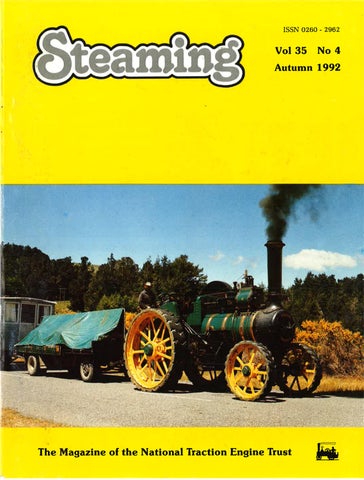
Road run, New Zealand style. In November 1989 the Southbrook Traction Engine Club took engines to celebrate the 75th anniversary of the Coleridge Power Station — the construction of that hydro-electric venture involved a goodly number of traction engines hauling iron pipes, timber and general building materials up into the hills. Here we see David Gower's 3 speed Marshall traction engine 39914 and its train, running through the gorse on its return journey — 72 miles in one day! (David Gower) 167
Trust News (continued from previous page) The additional administration involved is being handled by our excellent Rally sub-Committee under Andrew Semple — they have attended a seminar and have received directives on this new approach to traction engine rally approval. This matter will be fully dealt with at the forthcoming Rally Organisers Conference. Perhaps the best known 'authorised approving body' is the Royal Automobile Club, whose work and activities through their competition and rallying sections is well known. From time to time the Trust has been concerned at the high cost of
maintenance of our traction engines, the operation of which, after all, forms the main feature of our activities. A year or two ago the Engine Owners sub-Committee was charged with the task of producing a Code of Practice for Traction Engines and Similar Vehicles. This objective marks an important milestone in that the document produced could become a standard work and guideline which all traction engine owners could adopt. The new Code has been produced after much research, discussion, consultation and burning of midnight oil (or possibly wall• Michael Davies and his Engine Owners sub-Committee are to be congratulated on their excellent
From Alan Martin's Collection
58
production, which covers operation, maintenance and care of engines, and meeting current legislative requirements for steam boilers and pressure vessels, as well as much general information. It is now on sale to all engine owning members of the Trust and will be officially launched at a special meeting following the Annual General Meeting on 21st November 1992. I am pleased to record the significant step forward, which will rank as a major item in the cause of the traction engine owner. As these are the last notes to be written before •the Annual General Meeting, I would like to thank all officials and committee members for their hard work and support over the last twelve months. In particular my thanks go to Sylvia Dudley and Andrew Semple, my vice-chairman, the officers who carry out special duties so willingly, and to Michael Davies for leading the engine Owners sub-Committee in recent years. (Eric Fillmore, Chairman)
F ng
in. nwn.r. infq..rnn
Engine Owners sub-Committee
This is Frederic Rose's 7hp Ransomes, Sims & Jefferies single cylinder traction engine 10513. Rose operated from the village of Thwaite, south of Eye in Suffolk. His 1895 engine and two traction wagons are briefly posed of for the photographer about 1910 at the station yard at Eye, the mile long branch line from Mellis. The contract work is moving road making stone, which had been delivered to the area by rail, probably from the midlands where suitable hard stone or granite was more readily available. The men atop the loads were no doubt pleased to straighten their backs and put on their hats after the hard work of hand shovelling several tons. Rose also had his crew van there; a peculiar looking structure this, which would not have looked out of place on a seaside beach as a bathing hut. Note the extraordinary length of the Ransome's chimney; perhaps it was to improve the engine's steaming capabilities? 168
As I pen these words towards the end of a season that proved very disappointing for some events from the point of view of weather, it seems hardly possible that excessive heat was our main problem at the Banbury Rally in June. The Traction Engine Code of Practice is now available, and about 70 are now in circulation; basically they seem to have been well received by their recipients. We are pressing ahead with the incompleted sections and hope they will be available before too long. I would like to record my thanks to the various members of my sub-Committee for their hard work on the Code, and especially to Jim Newnham for his contribution on technical matters and to Sylvia Dudley, who undertook the compilation of the work into the printed sheets and the loose leaf binders.
I renew my invitation to all engine owners to the official presentation of the Code immediately after the Winchester AGM on 21st November (see Future Dates column for further details), and trust we shall all benefit from discussion of the dqcument. Looking forward to next year, we still have to make final arrangements for another Engine Driving Course, but plans are being made for an event at the Amberley Chalk Pits Museum, near Chichester, West Sussex on 18th April 1993. (Michael Dailies, chairman, Engine Owners sub-Committee)
Problems with Standards In his letter in the Summer edition of Steaming, Derek Rayner raised the question of British Standards covering loco-type multitubular boilers. BS931 : 1951 Loco-type Multitubular Boilers of Riveted Construction was withdrawn in 1971 'on grounds of obsolescence'. There never has been a standard specifically for loco-type boilers of welded construction, although BS 931 does cover some welding applications, including fireboxes and some attachments. I have been in touch with the British Standards Institution and am assured that, although it has been 'withdrawn', BS 931 is still valid for the purpose for which it was drawn up and may be used as a standard for riveted work on loco-type boilers. Copies of the Standard can be obtained from Customer Services Information, Standards British Institution, Linford Wood, Milton Keynes MK14 6LE. It will be a photocopy and (take a deep breath) costs £40.00. Mr Rayner also mentioned cases where head office engineers had quoted BS 2790 : 1992 Shell Boilers of Welded Construction. Paragraph 1.1.1. of this Standard clearly states 'This Standard does not apply to boilers of the locomotive type', so there is no possible excuse for anyone trying to use it as a means to prohibit riveted boiler barrels. Although it would be more convenient, when tackling repairs involving welding, if there was a specific British Standard for loco-type boilers of welded construction, the section of BS 931 covering welded fireboxes appears to be perfectly adequate and the appropriate parts of BS 2790 can provide weld standards for barrels, tube plates, etc. The choice between riveting and welding is clearly one for the owner but hybrid construction — part riveted, part welded — must obviously be very carefully thought out and properly designed.
The National Traction Engine Trust's
1992 AGM will be held at 2.00pm on SATURDAY, 21st NOVEMBER 1992 at The Guildhall, Broadway, Winchester, Hampshire Please refer to the formal notice in the Report and Accounts which are distributed with this issue for details of agenda etc, and to the Future Dates column for notes on the other extensive arrangements that have been made for the day.
Finally, if anyone is thinking of buying a copy of BS 2790: 1992, take an even deeper breath first — it costs £200.00! (Jim Newnham, Hon Safety Adviser) (Derek Rayner would welcome more response from readers to his request in the last issue (page 158) for details of problems with insurance company attitudes to boiler repair. — Hon Editor.)
Rally Organisers Column Rally sub-Committee Once again the rally season comes to a close, and this year has been a real challenge for many organisers. Interestingly the legislation we covered at the Spring Conference stood one event in good stead when a problem arose. There has been a small increase in accidents reported this year; I think this can be related to the poor ground conditions experienced at many rallies. Elsewhere in this edition of Steaming you will find official information on the Motor Vehicles (Off Road Events) Regulations. Next year these regulations will effectively replace 'Rally Approval' with 'Authorisation' under the Act. The responsibility for administering this Act and planning how to carry this out has taken up a considerable amount of time and our new Authorisation Officer — J.R. 'Smudge' Smith — has spent many hours on this task. The conditions it imposes on us as an authorising body are quite clear and lengthy, but at least we are in a position to govern our own activity as it stands.
For next year rally organisers will apply to the Trust for Authorisation; acceptance will exempt them from the provisions of the Act, a valuable safeguard for exhibitors of moving vehicles at an event. The Trust is required to carry out inspections of events unannounced (unlike the previous visits). In the unlikely event that the rally is not satisfactory, the inspecting officer will be required to withdraw Authorisation on the spot and is required to inform the senior police officer present of his action. The Trust can approve events other than traction engine rallies that can be run under the Code of Practice, for example vintage tractor events, and is obliged to accept anybody applying provided they comply with the Code of Practice. A great deal of time will be devoted to this subject at the Autumn Conference on 24th October so do take the opportunity to attend, details are elsewhere in this issue of Steaming This conference is open to all who run events that will require Authorisation, so we will welcome delegates from vintage tractor clubs and similar bodies. We are planning further safety training seminars in the Spring, prior to the rally season — details to be advised later. I look forward to seeing you at the Autumn Conference. (Andrew Semple, chairman, Rally subCommittee)
The Road Traffic Act 1988 Motor Vehicles (Off Road Events) Regulations 1992 From 1st July 1992 the offences of dangerous, careless and inconsiderate driving of a mechanically propelled vehicle on a road (sections 1, 2 and 3 of the Act as amended by the Road Traffic Act 1991) will also 169
-
kg
National Traction Engine Trust
Appointment of
National Sales Officer The present National Sales Officer to the Trust has given notice, because of family and business pressures, of retiring at the end of the year, after many years of valuable service to the Trust. Applications are therefore Invited from suitably qualified persons to serve in this valuable position. Those wishing to apply should have some basic knowledge and experience of: • Retail sales • Ordering and stocktaking procedures (Including
computerised stocklists) • Involvement with movement of Sales Stands around the rallies • Handling of mechanised cash register • Handling of and accounting for cash flow
Interested persons should seek further information from, or apply in writing to: Sylvia Dudley, 12 Hillway, Woburn Sands, Milton Keynes, Bucks MK17 8UL as soon as
possible and, preferably, by
2nd November 1992.
apply to a public place. The Department of Transport has issuer( the following paragraphs of explanation: 'The extension of road traffic law to public places has important consequences for those who take part or organise events involving motor vehicles in fields, parks or other areas where the general public is admitted either free of charge or on payment of an entrance fee. There is no intention to make it illegal to hold properly organised events in a public place. The above offences do not apply to those taking part in 'authorised motoring events when driving in a public place other than a road, provided they are driving in accordance with the appropriate authorisation for that event. Section 13A allows for the disapplication of sections 1 to 3 for authorised motoring events and provides powers for The Motor 170
Vehicles (Off Road Events) Regulations 1992 which introduces a system for authorising events. It is not illegal to organise or take part in an unauthorised motoring event in a public place, but drivers and riders should be aware that they are liable to prosecution if they drive dangerously or carelessly.' The body appointed by the Department of Transport to authorise steam powered and related vehicle events is the NTET, but the above paragraphs will no doubt need much further explanation to those involved in rally organisation. The various members of the Rally sub-Committee, who have spent many hours of work seeking to clarify the implications of the new Regulations on traction engine rallies and the like, will be present at the forthcoming Rally Organisers Autumn Conference and, hopefully, delegates will be able to return home much wiser on the subject. Please see the Future Dates column for details of the Conference.
Steam Apprentice Club Apprenticeships Wanted A recent survey among members of the SAC reveals that whilst many are already involved with one or more engines, there is a significant number who would like the opportunity to work on traction angina. As it is one of the aims of the Club to enable members to learn about engines from the people who actually work them, the help of sympathetic engine owners is needed. At present there are over 30 young people, buys and yids, who have expressed an interest in helping with an engine. They are aged between 5 and 20, the majority are over 11 years old, and live in Buckinghamshire, Cambridgeshire, Cornwall, Derbyshire, Devon, Dorset, East Sussex, Essex, Hampshire, Hertfordshire, Kent, Leicestershire, Middlesex, Northamptonshire, Norfolk, Suffolk, Surrey, Warwickshire, West Midlands and Yorkshire. Any engine owner willing to consider taking on an Apprentice is asked to contact Steph Gillett, SAC Magazine Editor, 93 Devon Road, Easton, Bristol BS5 6ED, who is also keen to receive articles, etc for the magazine, which might appeal to this younger age group. In the meantime
the Steam Apprentice Club would like to thank all those engine owners who currently involve young people with their engine. In particular our thanks to members of the Road Roller Association and others who made their engines available for Apprentice activities at the Dorset Steam Fair. (Steph Gillett, SAC)
Training Weekend The last weekend of April saw a small group of Steam Apprentices gathering at Richard Parrott's farm at Weeting, near Brandon, on the Norfolk/Suffolk border, and the SAC magazine editor dutifully drove the 375 mile round trip from Bristol to seek news and meet some Apprentices for the first time. Arriving at lunchtime on the Saturday Steph found the morning's activities coming to an end, with picnic lunches being devoured at locations throughout Fengate Farm. The first impression walking down the lane was one of great activity, the scene being something like a small traction engine rally. In the barn the theory and practice of steam traction was being taught by Lesley Colsell and Gary Wragg. Lesley is Curator at the Museum of East Anglian Life at Stowmarket, whilst Garry is the Senior Conservator for Hampshire County Museum Service. Their work brings them into contact with young people and children, giving talks and showing them aspects of the museum collections, so both were well equipped for our training weekend. The programme for the SAC weekend was more technical than their usual talks, and covered the theoretical as well as tho practio1 aspocts of stcarn. On Saturday morning the Apprentices had been learning the various parts of an engine; the basics of boiler management theory — fire, water, injectors, etc; what happens when the file is lit and so on. On the ',tactical side the cleaning of tubes and ashpans had been covered. Not all of the activity was taking place on the engines themselves — the programme also included talks, slide shows and even a demonstration of pressure vessels by boiling a saucepan of water. Burrell roller 4061, in pieces for restoration, enabled the Apprentices to see how the components of an engine go together. After lunch Gary demonstrated, with the help of Richard and others, how to remove and replace the boiler tubes of Burrell traction 2159. Then the participants returned to the engines to help with fire-lighting, and learn about fire-laying and management. The idea for the weekend had
come out of conversations between Richard Parrott and Sylvia Dudley, chairman of the Steam Apprentice Club. Richard's family connections with steam go back 120 years to 1872 when his great-grandfather had a threshing business. Unfortunately all the engines were disposed of during the depressed 1930s and none are in Richard's collection, though 2159 is similar to one of the old fleet. Ten engines were in steam for the weekend, many of great interest or age. Apprentices were therefore able to experience a range of engines, from Burrell traction 748 of 1877, through Burrell traction 3695 of 1915 (this engine carries the crane formerly on the showman's engine EMPEROR) and Burrell 8 ton roller 3994 of 1924 to Burrell traction 4088 of 1930 (owned by Barry Freeman, and the last traction engine built by Burrells at Thetford). In the evening there was a visit to Thetford to the Burrell Museum for a special opening, whilst the Sunday provided an opportunity to put into practice some of the things learnt the
previous day. Lesley and Gary had further instruction planned and the last few tubes were put into the engine in the barn, which was later steamed and all was well. The afternoon was finished off with some steam threshing. The SAC is extremely grateful to Richard, Gary and Lesley and their team for their hard work before, during and after this event to make it all happen. There are already plans in hand for a similar event next year when it is hoped more Apprentices will attend. (Steph Gillett, SAC)
A Chairman's Year It has been my pleasure to make the acquaintance of a number of Apprentices during this season — and to hear news from those that I have known since the beginning of the Club, several of whom now have their own engines and are helping the new generation to enjoy our obsession! We were able to announce a new SAC trophy at the Great Dorset Steam event. Given by Stuart Pryke, a keen
Posed against the background of the fairground at the 1991 Roxton rally is an engine that has gradually emerged, swanlike, through many years of rallying into immaculate condition. Wallis & Steevens roller 2660, built as a 3 ton steam motor in 1903 has been a lightweight roller, converted with makers' components, for most of its life. (John Maund)
photographer, together with three smaller mounted shields for the winners to keep, this trophy was awarded to the winner of the photographic competition and we were pleased with the high standard of entries which were displayed in the hospitality area of the NTEC Sales marquee at Tarrant Hinton. Plans for a driving course for the SAC over fourteens are taking shape and will be announced in the next SAC Magazine; it will take place in the Midlands around Easter time. As with the course held this year at Weeting, the event will be a serious attempt to instruct our future engine drivers, with maintenance and good practice included, on a private site and not at a public event. (Sylvia Dudley, chairman SAC)
NTET Hospitality Tents Hospitality was available to members at St Agnes and Great Dorset Steam events and they were well used. Donations into the grease-top hat have been placed in the Trust's Preservation Fund. Much useful information is obtained and given on these occasions. In particular specimen
copies of the new Traction Engine Code of Practice were available for inspection and puchase; this contains the Engine Log section which we hope will be appreciated by our engine owning members. Following my appeal for help in the Dorset tent may I thank those who came and contributed to its successful running. Their help was much appreciated by Trust officers and members and I hope that they enjoyed working with us. (Sylvia Dudley, vice Chairman)
Payment by cheque Our Treasurer draws attention to certain recent changes to the Cheques Act which makes it most important that cheques are in future made out for payment with the correct title of the recipient. Members are therefore asked to ensure payments are made to the 'National Traction Engine Trust'
172
for memberships, advertising, rally and conference fees, and to the 'National Traction Engine Club (1984) Ltd' for mail order items etc, and not to Steaming or individuals. The latter circumstances will now necessitate the return of cheques to the payee for amendment before they can be received by the Trust.
Affiliated Clubs Trust members in the Harlow area, and EATES, RRA and Herts clubs members, may like to know of a new series of monthly meetings of the 'noggin and natter' format, which commenced in October and will continue throughout the closed season on the first Monday of each
A fine period scene from east Sussex, kindly sent by Peter Love. Research by his father Bill Love and Alan Duke corrects local thoughts that the engine's owner was one Ban field of Hen field, no one of that name appearing in Alan's lists. It is felt that the owner of the Marshall traction engine was Thomas Bourn of London Road, Albourne and later Hen field Road, Sayers Common — all the villages are in a small area about a dozen miles north west of Brighton. Bourn and his son traded up to the 1950s, using Oliver tractors after they finished with steam for threshing. This picture was taken about 1908 with the men enjoying a break with pipes of tobacco and drink from the jug on the front wheel — the engine is parked in front of a public house. If the machine is Bourn's it is either Marshall 33769, a 6hp engine of 1900 (and scrapped in 1946) or Marshall 37210, another six horsepower built just two years later, and which by 1921 had been sold on.
month. The venue is the John Barleycorn at Threshers Bush, a few miles east of Harlow; further information is available from Alan Nash, 62 Manor Road, Old Harlow, Essex CM17 OBG.
Personal Wally Dell, of Hayle, Cornwall, wishes to send his thanks to all those members and friends who have contacted him with good wishes following his recent illness.
Obituaries John Boughton It is with greet sadness that I record the death in July of one of our oldest and hardest working members — John Henry Boughton. The Trust has lost a keen supporter — as his letter in our Summer issue shows — and I a dear friend. For those who did not know him, my recollections of a few of our times together may help. In the 1930s we had long been a threshing firm, with not enough to do in the summers — and here were Boughton's rollers all around us on tar spraying! So it soon came about that they had a driver or two from us for the period. It would be mid 1940 when I called on Mr Thomas Trafford Boughton, tall and of noble mien, a Plymouth Brother, perhaps in his late sixties. He said: "I was surprised when you phoned about a steam roller as we want no more of hiring these, with prices cut to ribbons! Nevertheless I have steam up for you in one and will leave the business to my younger son." That was when I first met John, very like his father, honest and likeable in face and eye. The roller was an Aveling converted three shaft tractor with left hand steering, number 8662. It handled well, though was exceptionally high in top gear — "Just right for keeping up with these modern tar sprayers", said John. We soon agreed a price and he was to drive it half-way to Poddington, Bedfordshire, where an aerodrome was under construction. I met him when well my side of half way, and took over. But though perhaps the more experienced driver, then, I could not get it along well and phoned him so that night. "You can't fire Welsh coal, you can't" he said. And next day with a thicker fire I, of
course, soon finished the journey. It was not long before we wanted another roller, when young John had steam up in Wallis & Steevens 2323. It sounded right and handled well but the rear rolls were so sloppy on the axle that the near side one would sometimes rub against the flywheel. "We'll put a washer there," he said "but not being too tight on the axle's ideal for narrow cambered roads." The third Boughton one was 10 ton Aveling single 4053, elderly with slipper bar crosshead instead of trunk guides. This engine was in splendid order and so was seldom mentioned between us! Odd how one remembers a phrase or two. We've laughed many times about Welsh coal and sloppy wheels — but there was the beginnings of a good salesman. Later achievements in selling his brother Trafford's tractor winches and other products all over the world earned John an OBE and OstJ. Having a deal with John was always a pleasure. Despite his great emphasis on the merits of what he had to sell, you knew there was no untruth, and should anything go wrong you knew he'd put it right, as those who have his book Steam in the Veins — featuring Boughton haulage engines, threshing engines, steam ploughs and steam wagons — can see from his looking at you from the footplate of his Fowler! (Esmond Kimbell)
Jack Lawrence It was with deep sorrow I learned of the passing on Monday, 3rd August of Jack Lawrence of Great Milton, Oxfordshire. He died peacefully, in his sleep, having just spent a happy weekend acting as a steward at the Worminghall rally.
I had known Jack for 45 or more years and my thoughts go back to the times we met at the St Giles Fair, Oxford, along with Blossom Trinder, Pomp, Ellis Portsmouth, Des Vincent and our showman friends, many, sadly, no longer here. Somewhere I have a photograph of us taken in the bar of the Lamb & Flag all with a glass of beer in our hand, exchanging good cheer and engine stories; it would say more than words I can write. Jack was a grand sort, always there to do all he could when help was needed as perhaps some instances of when we were re-assembling my Burrell showmans QUEEN MARY will illustrate. Of me setting up a vice on Jack's orders, for him to run down the badly worn tender bolts which earlier I had given up as beyond it; not so Jack, "they'll be alright after I've run them down with a die", and so they were. Then the crankshaft — "We are coming over every Friday afternoon through the winter to help you," said Jack and after the brasses had been scraped by Alan, his son and a toolmaker, we had the thing up and down like a yo-yo until satisfaction was gained. Jack's encouragement won the day when we put back the rear axle. It was a task complicated by it having to be threaded through a gap in the side of the shed made by removing some of the tin sheets, and then swinging it laterally by means of a derrick pole. The part-assembled engine had to be moved forward on temporary wheels to line up the whole lot, which meant half of it being outside the shed, and I had misgivings on that due to the short February days and the risk if something going wrong — I didn't want everything left wide open to the world
Cruise the beautiful sealochs and canals of Scotland in an original coal-fired Clyde Puffer. Good food, comfortable accommodation.
Send Large SAE for free brochure to Rachel and Nick Walker, The Change House, Crinan Ferry, LochgdpheacC, Argyll PA31 8QH (Tel 054 65 232). 173
overnight. Then on the Saturday morning there was heavy snow falling and I had the warm thought, well, at least we won't go out in these conditions. But I was wrong and a knock at the door revealed Alan with Jack calling from the car "Come on!". We did it all, of course. I shall long recall the good company of those days — so long Jack, old pal. (Viv Kirk)
Future dates Autumn Conference for Rally Organisers and Affiliated Clubs The Autumn 1992 Conference for Rally Organisers and Affiliated Clubs will take place at The Harborough
Leisure Centre, Northampton Road, Market Harborough, Leicestershire on Saturday, 24th October 1992 at 11.00am. Please note the changed venue, which has become necessary through circumstances not of the Trust's making. Invitations and formal notices, together with details of the venue, will be sent out in the usual way, but newcomers are always welcome to these instructive and mutually beneficial gatherings. Much of the time at the afternoon session will be devoted to discussion and explanation of the implications of the new Motor Vehicle (Off Road Events) Regulations 1992. Coffee will be served from 10.30am; a buffet lunch will be available during the mid-day break (prior booking is essential) and tea will be served at the conclusion of th€, meeting at about 4.15pm. First time attenders are invited to contact
Climbing in the Chairman's footsteps. The activities of the Steam Apprentice Club offer much opportunity for youngsters to learn to follow the enginemen of yesteryear in the care and operation of traction engines. This ambitious SAC member, however, seems to have high places on the Trust's committee in mind as he climbs to the footplate of the Fowler ploughing engine until recently owned by our chairman Eric Fillmore, and which was in use at the Dorset event in the new ownership of John Keeley. (Peter Jackson)
General Secretary Sue Jackson for further details and bookings. The venue is located on the A508 road on the extreme southern edge of Market Harborough town and within 30 minutes car journey of the M1 and M6 motorways; suitable InterCity train services are available from London St Pancras and Leeds.
AGM 1992 The 1992 Annual General Meeting of the Trust will take place on Saturday, 21st November 1992 at The Guildhall, Broadway, Winchester, Hampshire. Formal notice of the meeting, the agenda, and the Annual Report and Accounts will be distributed with this issue of the magazine. In the event of any voting being necessary at the AGM only current Trust members will, of course, be eligible. Members are therefore asked to ensure they have their current membership cards with them at Winchester. We are grateful to Gary Wragg, Trust member and Senior Conservation Officer to the Hampshire County Council Museums Service, for making extensive arrangements for a package of activities around our AGM
CHILCOMBE HOUSE Hampshire CC Museums Service
in Winchester. The Museum Service's store premises at Chilcombe House, Winchester, not open to the public, will be available to members from 9.00am. The workshops and store sheds hold a large number of Tasker and Wallis & Steevens engines which will be of prime interest to Trust members but the collection also contains a very large amount of Hampshire made and used agricultural and industrial artefacts. Members are requested to use the Chilcombe House venue for car parking for the day, as such space in Winchester city centre is in very short supply. Special vintage bus services will be provided from the Museum premises to the Guildhall from 12 noon onwards, enabling members to take their midday refreshment in the city before the AGM commences at 2.00pm prompt. At the conclusion of the AGM, about 4.00pm, tea will be served in the King Charles Suite of the Guildhall, and members will then have the choice of returning on the special buses to Chilcombe House, or of staying in the Guildhall for the official presentation, at 4.30pm, by the Engine Owners subCommittee, of Trust's Traction Engine Code of Practice. It is hoped a large number of owners and keepers of engines will be present at Michael Davies' presentation of his Committee's work, and take an active part in the ensuing questions and discussion session which should do much to assist in the future well being of our engines. It is envisaged this meeting will conclude between 5.30 and 6.00pm, and the buses will again be available for return to the Museum premises. For further evening entertainment, Gary has arranged suitable accommodation at the Museum's buildings from 6.00pm. After a short introductory slide show on the Service's activities, a finger buffet and pay bar will be available, followed by a presentation by Alan Martin of some pictures from his collection of working engines, perhaps some with Hampshire connections, and a further period for conversation before dispersal. On the Sunday, arrangements are in hand for a visit to Twyford Pumping Station, which will be running (£1.30 admission charge), and possibly to the Mid Hants Railway at Alresford. All members, of course, can attend the AGM without prior notice, and notification will not be necessary for the visit to the Hampshire Museums grounds at Chilcombe House. However, the evening buffet must be booked and prepaid (£5 per head) — tickets are available from our general
secretary Susan Jackson, 153 Mickleford Road, High Wycombe, Buckinghamshire HP13 7HA. Cheques should be made payable to National Traction Engine Trust and an SAE for return enclosed — last date for applications is 14th November 1992. Sue will also be pleased to provide a list of suggested weekend accommodation in the Winchester area (hotels, bed and breakfast or camping) on receipt of a SAE. The details and extent of the Sunday activities are not finalised at the time of going to press. Members staying in the area overnight and interested in joining in are asked to let Susan know their intentions when booking for the evening buffet. Evening classes Shrewsbury College of Arts and Technology are repeating their popular 'Steam for Pleasure' course this Autumn term. Classes start on Tuesday, 6th October. A series of six evening lectures on the theory and restoration of steam traction engines will conclude with a Saturday morning driving lesson at the college on 21st November 1992. Details are available from Jim Cook or Bill Morriss, IT 0743 231544.
Of importance...
Autumn Conference for Rally Organisers and Affiliated Clubs SATURDAY 24th OCTOBER 1992 The Harborough Leisure Centre, Northampton Road, Market Harborough, Leicestershire See Future Dates column for further details — note change of venue
1992. A series of colour slides from a variety of rallies presented by Graham Bull. TUESDAY, 8th DECEMBER 1992. — On this evening the speaker will be Charles Roads, whose subject will be ploughing engines. TUESDAY, 12th JANUARY 1992 — Sandy Ross will visit again with a talk 'More on Avelings and other fine rollers'. (Bill Timmings, London meetings organiser)
London Area Social Meetings The 1992/3 season of social meetings in London will commence in November, and all members, potential members and interested visitors will be welcome to attend one or all of the evening talks or slide shows which have been arranged for the Trust by Bill Timmings. As mentioned in the Summer 1992 issue a new venue has been secured for this coming winter's meetings with a function room booked at the Yorkshire Grey public house, Langham Street, London W1. This location is off Langham Place and Portland Place and little more than five minutes walk north of Oxford Circus tube station. Meetings will be held, generally, on the second Tuesday of each month, at 8.00pm, with the room available from 7.30pm. It is hoped members will continue to support our speakers in the enthusiastic way they have in the past. For the first three dates in our calendar, the following programme has been arranged: TUESDAY, 10th NOVEMBER
`The Waimate County Council's new heavy traffic by-laws have aroused considerable opposition amongst engine owners, and a meeting called for Saturday evening was well attended. Mr George Geddes was voted to the chair. Mr H.F. Chaffey, Secretary to the New Zealand Traction Engine Owners' Association, was present, and urged upon them to join the Association, Mr Stewart, Hakataramea, being the member in this district. In the North Island they had the license fee reduced from £50 to £10, and in Ashburton they upset the by-law, the Road Board being mulcted in costs and having to return fees already paid. Mr John Hunt thought a load of 12 tons should be permitted with a six inch tyre. Most of the traction engine owners were farmers, and it was hard lines to have to pay licenses to cart their own grain. After some discussion it was decided that the owners present join the Association, and try and induce others to do the same.' (from the Timaru Herald, 24th October 1906.) 175
Camions a vapeur de Valentin Purrey, Bordeaux, France
Purrey steam wagons Derek Rayner
The 1909 built Purrey steam wagon preserved at Fondation de /'automobile Marius Berliet, Lyon. (Fondation Marius Berliet)
Although we perhaps think of the steam wagon as a traditionally British
Techniques, 292 rue Saint-Martin in Paris. The Bonee's, father and son,
tramways and railways and several more to other undertakings, including
product, we must not lose sight of the fact that other countries also had an involvement in its development. Mention steam wagons and perhaps the first names which spring to mind are Sentinel or Foden, but in England
and others continued this tradition with their steam broughams and landaulettes and so it was perhaps not surprising that when steam trams became popular, they were also built in France. Valentin Purrey began
were also other builders — Yorkshire, Robey, Clayton & Shuttleworth, Mann's and Atkinson amongst them — whose products are still represented, even if in small numbers, on
making trams at Bordeaux, in south west France, in 1887, at first for local lines and then for Paris in 1897. These developed from a small steam tram
coal and mining companies. Many of those supplied to the public service companies were in charabanc, bus or tram form and were used fur the carriage of passengers. By 1913, the works had expanded to such a site that it was said to have been capable
the rally fields today. Gone however are the firms of Straker, St. Pancras, Coulthard, Lifu and Londonderry, whose wagons — of the early 1900s — were in the forefront of developments. Another name was also prevalent around that time, PurreyExshaw, but it will be only a dedicated historian who has come across this French name before. It must not be forgotten that
France could be considered as the cradle of our hobby of steam on the roads, for it was Nicholas Cugnot who in 1769 produced the first proper steam road vehicle, still preserved for all to see at the Musee National des 176
loco capable of hauling a trailer to a self contained double decker tram, each utilising the standard Purrey steam generator. In 1898, concurrently with similar British developments in the haulage of heavy loads on the roads, Purrey began building steam wagons and very quickly became a large and well
respected manufacturer of such vehicles under the name of Les Anciens Etablissements ValentinPurrey. Within ten or twelve years, the firm had supplied 34 vehicles to a sugar refinery, 25 to ice makers, 26 to gas works, 68 to goods transport companies, 172 to the Paris Tram Company, another 80 to various other
of producing up to 300 vehicles, rail or road, per year. In 1903 the firm supplied a steam
railcar for the Midi Railway and a similar one to the Paris-Orleans line for use on lightly loaded branch lines. Several more of these vehicles were made for both home and abroad; they went to Italy, Portugal, Sweden, Argentina and Australia, where one, in 1907, was in use at a Tasmanian coal mine carrying spoil.
In 1907, a demonstration took place at Nansouty Barracks near Bordeaux of a 'train Purrey'. This consisted of a charabanc with two two-wheeled close coupled trailers which were fitted, charabanc style, with seats and side curtains. This outfit was capable of carrying up to 110 people and proved quite
TABLE 1. Purrey-Exshaw wagons known to have been used in Great Britain company notes reg. no. date LN 4866 c1912 demonstration wagon LN 9892 c1911 ? LN 9999 c1911 Harrods Ltd, Knightsbridge, London fleet No 367 1913 Wandsworth, Wimbledon and Epsom and Dist. Gas Co, London for sale 1913 Benjamin Noakes & Co, Bermondsey, London LH 8794 c1914 Commercial Gas Co, Stepney, London still in use 1921 LH 8911 1914 Wandsworth, Wimbledon and Epsom and Dist. Gas Co., London LH 8998 c1914 Commercial Gas Co, Stepney, London still in use 1921 Field Bros, Fleet, Hampshire tipper — for sale 1914-15
successful (although undoubtedly uncomfortable), as photos exist of it in several locations including the docks and Manege station. During World War 1, a number of the wagons and buses saw use for military purposes for the carriage of both soldiers and supplies. Some were made as special disinfestation units, called Voitures Sanitaires, for not only the French Army but also for the Serbian Army and the French Red Cross. Incidentally, Fodens made a similar product, utilising steam from the wagon boiler. Later, the Ville de Paris (Paris Corporation) had a number of Purrey wagons fitted with combined street watering and sweeping equipment and they were also used as the basis of tar sprayers for road maintenance purposes. In 1911, after a somewhat abortive attempt the previous year, the successors to the original company, Messrs J.H. Exshaw & Co, opened a London branch at 81 Shaftesbury Avenue under the management of David M. Turner. This lasted until the outbreak of World War 1. How many wagons in total were sold in Britain by this agency is not recorded but it is known that Harrods of Knightsbridge had a 5 tonner in 1911. Details of those wagons known to have been used in Britain are shown in Table 1. Of the range of three sizes of wagons then currently on offer in France, only the smaller sizes of 3 and 5 tonners were made available in England. The larger 8 ton payload machine was not imported since it would have been too heavy to comply with the 1904 British regulations relating to heavy and light locomotives, and would have had to be treated as a traction engine. From
information supplied by the manufacturers, based on actual prices in France at that time land converted to English currency), the costs per ton for a 25 mile journey and a 75 mile journey worked out at 2.1d (1p) and 1.25d ( p) respectively for a 3 ton vehicle loaded to capacity, and 1.33d ('/2p) and 0.79d ( Ya p) for a similarly laden 5 ton vehicle. In February 1913 a demonstration was arranged on a one day trial basis for the firm of Haulage Ltd, Walworth, London and the wagon used on this was six tonner LN 4866. It carried a load of paper for printing the journal Commercial Motor to the Temple Press warehouses. Around the time of
this demonstration, the wagons' capacitites were reviewed by the manufacturer and what was the 3 ton vehicle was fitted with the 5 ton size boiler, thus becoming a 4 ton model. Similarly the 5 ton vehicle was fitted with the 8 ton size boiler, resulting in a 6 ton vehicle. An engine redesign took place concurrently with these changes. The differences between the sizes are set down in Table 2. Further trials by the makers had been arranged in late 1912 and by way of demonstration over five days a wagon worked in the London area for Lloyds of Sittingbourne delivering paper rolls. On the first day, working with a trailer, a total of 27 tons was
TABLE 2 ENGINE boiler (sq.ft) bore (ins) stroke (ins) 69 51/2 100 5'/2 61/2 100 6% 51/2
type 4 ton 6 ton 8 ton
revs 340 300 268
PRICE (platform body) £490 £575 £620
hp 25 35 40
It would be interesting to know the circumstances behind Noakes & Co's purchase of this Purrey wagon in about 1911-1912. (collection Fondation Marius Berliet)
METALLIC ASK VORC-.: B•NOAKES&C°
011111M WWI ONLIMI--I
SPA ROAD BERMONLSEY
•
.L ON DON
1
-
'
klOP
guar
110
uuttrommess wen new
10> r
I
carried in three journeys, a time of four hours being taken up with loading and unloading. The following day, four journeys were made without trailer and 24 tons were carried, with four hours again being spent in the unloading and loading. The same was accomplished on the third day but the next day was spent changing the type of wheel, from an iron tyred example to a rubber shod version. The final trial was run in extremely poor weather conditions with a 6 ton load from London to Bath lybourne, returning the following day. The total load carried during the trial period was 87 tons, the wagon running in steam for about twelve hours and during that time, it used just over 1'% tons of coke. In 1913, the firm's name was changed to Purrey & Exshaw and it continued in this guise until about 1920 when it became H. Exshaw et Cie. By the early 1920s the Purrey wagon, just like the Sentinel Standard model, had gained itself a reputation for reliability, but it was becoming somewhat dated. After World War 1 most manufacturers of road steam motors were faced with competition from a glut of cheap ex-Army motor
The spartan driving position of the Purrey steamer. At the driver's back is the steam generator, the top steam drum at shoulder level. (Derek Rayner)
vehicles, but unlike that of the Sentinel, the Purrey design was not developed further to make the product more acceptable. The firm ceased production about 1929, but not before a two-speed pneumatic tyred tractor had been made utilising the standard wagon power unit and engine, and also an agricultural tractor based on the same equipment. Neither of these machines was of a particularly advanced design and both failed. Spares for steam wagons still in service continued to be supplied for about ten years. Records of production are incomplete but it is known that some 200 wagons were made for use in France and most probably other unrecorded vehicles existed. In addition, some 30 vehicles were sent to other countries including some to French colonies as the firm enjoyed an export trade to places such as Italy, Spain, Cuba and, perhaps surprisingly, Russia. An original sales brochure in Russian still exists. How many rail/tramway vehicles were built in total is not known.
TECHNICAL DETAILS The boiler and controls of the Purrey steam wagon were of a rather more sophisticated design than was available on even later built British produced products. The maximum working pressure of the vertical boiler was 20 bar (290 lbs sq.in) The firm
described the steam producer as a generator, since it was a dry-backed vertical water-tube flash type boiler. It consisted of a group of tubes from a lower rectangular collector to an upper cylindrical drum. Water was transferred from the lower collector through vaporising tubes. Steam collected in the upper drum, from whence it was superheated through snake-like tubes and passed into the upper compartment of the lower collector. Because of the contraflow design, there was little risk of subsequent condensation and with this arrangement, not only was there rapid generation of steam, by virtue of the circulating effect of these tubes, but benefit was said to be gained in the reduction of deposits found in the tubes, because the water passed along them so quickly. A large inspection door was located on the rear of the boiler and by judicious removal of screwed plugs it was said to be possible to easily replace defective tubes, or blank off, whichever was appropriate. Firing arrangements were by
View from the rear of the Purrey chassis preserved at Lyon, showing the engine and crankshaft in the foreground and the back of the steam generator within the cab — the large inspection door has been removed to show the serpentine water tubes. (Derek Rayner)
A upper cylindrical drum B lower collector box C two straight connecting pipes D serpentine connecting tubes E serpentine connecting tubes F serpentine connecting tubes G water line in upper drum
H superheater box carrying safety valves K large inspection door L screwed plugs at tube ends M slanting grate N fuel hopper 0 float for regulating water level
Front elevation and sectional drawings of the Purrey steam generator.
Part sectional elevation drawing of the Purrey four-cylinder tandem engine.
means of an automatic feed (of coke) from a hopper mounted on the boiler side, onto a grate which sloped at an angle of about 45°. A large ashpan was provided below the grate. Water level control was automatic, utilising float switch devices situated in the boiler's upper cylindrical drum. On the fall of water level, a valve was opened by the float and steam admitted to a donkey pump mounted on the side of the boiler. This took water from the tank situated below the frames at the rear and pumped it into the boiler. An upper float shut off the pump. This system was found in France to be so reliable that many of the wagons running there were not equipped with gauge glasses, although provision was made for them to be fitted if necessary. All the water, before passing through the donkey pump, was drawn through a single feed water heater located at the rear of the firebox. The donkey pump was of the reciprocating double action type, so arranged that by the action of two springs bearing on a collar on the pump shaft, it was ready to pump at the beginning of a stroke on every occasion it was called upon to work. The pump could also be worked by hand, using a lever provided, to fill the boiler in the event of there being no steam available — a useful addition and something which saved the bucket of water and funnel exercise many of us have to face prior to lighting up on a morning when the engine's water level is out of sight in the glass. The totally enclosed engine was located in an inclined position under the wagon frame at the rear of the firebox. The earlier models were fitted with four cylinder tandem compound engine. Being totally enclosed, the engine was well lubricated. The valve gear was located between the tandem cylinders and worked by means of an ingenious eccentric gear, whereby reverse direction of rotation was obtained without any form of link motion. This was achieved by a plate and wedge arrangement which was moved along a shaft by means of a lever adjacent to the driver. This served to adjust the locations of the eccentric sheaves to the correct positions for obtaining forward or reverse motion, as required. There was no gearbox and all variations of speed and power were obtained directly from the throttle valve. Final drive was by chains and a simple differential bevel arrangement, which was driven from a cross shaft, geared to both ends of the engine crankshaft. 179
The Purrey patent wheel
The wheel construction was of wood, and of some interest. The felloes were made in sections which, whan pinrari in pnQitinn loft n "V" shaped recess at the rim. The spokes, wedge shaped at both ends, fitted into these recesses at the rim, the other ends coming together at the hub, leaving further spaces into which V-shaped wedges of hard wood were fitted. A conical rim at the hub enabled these wedges to be driven home and at the same time, forced the rim against the tyre. One major advantage of the arrangement was that all tyres were put on cold and it overcame many of the problems previously experienced with wheels of wooden construction, caused by excessive vibration due to the poor quality of the loads at the time. Tyres could be either rubber or steel, to order. In the case of the latter, sand boxes were provided for use in slippery road conditions.
The water tank held sufficient for a run of between 25 and 30 miles and a water lifter was provided to replenish when necessary. Another important, and perhaps unusual, feature for a steam wagon was a winch fitted at the rear on some wagons. This could be worked either by hand or by steam and could serve a useful purpose when loading or unloading the wagon. Another unusual feature was the provision of Purreys patent acetylene generating plant in one corner of the cab. This provided acetylene for two front running lamps and a lamp provided under the roof of the canopy over the driver, enabling him to see what he was doing in the dark, as well as being able to observe the level of water in the boiler when a water gauge was provided. Albeit a small item, it did give the driver some degree of creature comfort on a wagon which otherwise appears to have been an exceedingly uncomfortable vehicle to drive. In common with many other contemporary wagon manufacturers, both steam and petrol powered, J.H. Exshaw & Cie exhibited at the Olympia Commercial Motor Show in July 1913. They were to be found on Stand 70 and had a 6 ton wagon on display. It featured the patent Purrey wheel, a two cylinder simple engine and the company's standard superheating boiler. Also fitted was a two way hydraulic side-tipper body, actuated
by means of a small hydraulic jack on the side of the wagon, and the firm's patent winding drum at the rear, operated by the engine. Various other types of body could be provided: a three way tipper, a two compartment two way tipper or a box body — it depending on customer requirements. As a matter of incidental interest, other steam wagon manufacturers represented at the Olympia show were Allchin, Aveling & Porter, Clayton & Shuttleworth, Garrett, Tasker, Yorkshire and Wallis & Steevens; the latter, together with Taskers, also showed their conventional 5 ton steam tractors. Heavy petrol powered commercial vehicles 14 tons and above) were exhibited by such firms ac Allriays, Belsize, rnmmerrAr, Daimler, Dennis. Durham-Churchill, HaIlford, Halley, Karrier, Leyland, Maudsley, Milnes-Daimler, Pagefield, Stevens, Straker-Squire and Thornycroft, whilst continental machines on view included Brasier, Benz, NAG, DAAG, Buessing, and coincidentally, Berliet of France. Most of the exhibitors names, especially those for the lighter goods market, have long since disappeared but others lasted longer and can still be seen on today's rally fields. Some — very few — continue to produce commercial vehicles. The author was recently privileged to see what is believed to be the last remaining Purrey wagon preserved in
A Purrey steam wagon of about 1905. (collection Fondation Marius Berliet)
France — there are no survivors in Britain. The wagon is in the care of the Fondation de ('automobile Marius Berliet of Lyon in mid France, and is kept at their vehicle storage warehouse at Le Montellier, some distance from Lyon. The Fondation is not a museum as such, although it does have a large and representative collection of historical commercial vehicles. Most are associated with the Lyon area but also in the collection are makes from other Departments in France. That Lyon is a suitable place for such an organisation is unquestionable — the greater Lyon area had no fewer than 244 types of wagon, car and similar vehicles constructed there. The Fondation, which was established in early 1982, has two objectives: the preservation and enhancement of the automobile heritage of the Lyon region, and the preservation and enhancement of the French heritage of lorries, coaches and buses of all makes. In addition to collecting and restoring vehicles, it also lends out exhibits from its collection to exhibitions and displays. Also available for loan are archives from the documentation centre to any automobile, transport or energy museum. The Fondation premises in Lyon are housed in the historic home of Marius Berliet at 39 Avenue Esquirol, in a once affluent suburb of the city. As well as the now unique Purrey steam wagon, the collection comprises of about 250 vehicles of 27 different makes, all of them French, and including the names of Renault, Berliet, Saurer, De Dion-Bouton,
Accidents that cause a spectacle have always attracted photographers and here we see two Purrey steam wagons in trouble. In the top scene the vehicle has left the road and only been stopped from carrying on down the side of a bridge by a telegraph pole; the location looks to be tropical. Below we see another wagon off the road and being prepared for rescue by another at the left; the location is a Porto Rico sugar plantation. (collection Fondation Marius Berliet)
Panhard and Latil. Fire engines, military vehicles, buses and dump trucks are all represented. For anyone specifically interested in commercial and military vehicles, of whatever age, this is an awe inspiring collection of very well presented vehicles. Unfortunately, it is not open to the public. The last remaining Purrey has been
restored to a high standard and painted in bottle green, lined with orange and yellow. It is on rubber tyres but does not have a body — there are no plans to incorporate one, as this would preclude access to and visibility of the engine, which is the earlier four cylinder compound tandem type. The model on display is a 5 ton version, 181
A works picture of a Purrey steam wagon taken in September 1906. The steam generator is neatly cased in and the body comprises two roadstone containers that will rotate to tip on either side of the wagon. (collection Fondation Marius Berliet)
Purrey type B, and was new in 1909. It was fitted with an 800 litre (210 gallons) water tank, giving a range of approximately 50km (30 miles). The author would like to thank the Fondation de ('automobile Marius Berliet and in particular its Director, Monique Chapelle, for the generous assistance rendered during the preparation of this article. Thanks are also extended to Glasgow City Council's Mitchell Library for access to their copy of Motor Traction (22nd July 1911) and to the National Motor MUSUUll I Library, Beaulieu, (fui Cummercial Motor, April and July 1913, and Veteran and Vintage, July 1977). From these publications the basic technical details of the Purrey wagon have been obtained. In addition, reference has been made to The Undertype Steam Wagon by M.A. Kelly and Lucien Chanuc's book, Histoire de l'Automobile a Bordeaux. Grateful thanks are also extended to Bob Whitehead and Alan Duke for and additional encouragement information which has enabled this article to be produced.
'Purrey-Exshaw lorries. Fuel and water feed absolutely automatic. Coke Fuel. Demonstrations Arranged. D.M. Turner, Manager for United Kingdom, 81 Shaftesbury Avenue, London W.' (a display advert in Motor Transport, 15th July 1911). 182
An Erring Speedometer On Saturday 30th November 1929 the attention of the magistrates at Buxton Police Court was occupied 'for some considerable lime ... respecting cases in which drivers of heavy vehicles were summoned for exceeding the speed limits'. The cases, reported in the following week's Buxton Herald, make interesting reading. Three of the defendants were steam wagon drivers, and although their vehicles -were not identified in court, nor the work they were engaged in, it is quite likely they were running roadstone from the quarries around Buxton to the Manchester area.
William Higgins, junior, of Tunstead Milton, Whaley Bridge was said by PC Oliver to have travelled along a 440 yard speed trap on the Dove Holes Road, Buxton at 20mph. The defendant's father told the court "I was with him and I don't think we were doing it"; the Clerk retorted "It is a pretty poor think you know". Higgins claimed the speedometer didn't say 20. "I have sent it away to see whether it is right (laughter). The wagon is one of the old type and won't do 12." A fine of 20s (£1.00) was imposed. Thomas Stockham, of Reddish, found himself facing a similar charge. At 9.50am on 18th November he had been timed by PC Winkle in London Road at 33 miles 587 yards per hour
— presumably there was access to a ready reckoner in those pre-calculator days. Stockham claimed that as he came over the top of a hill his attention was attracted by two men running into a wood and then two police officers, and he thought something was wrong. But it was frosty and he would have skidded had he applied his brakes; he let the vehicle go and kept it straight. However, the police officers, who had been operating the speed trap, told the bench the wagon pulled up alright when It was signalled to stop. Stockham had to pay 30s (£1.50). The third defendant was Arthur Richardson of Bradford, Manchester, whose solid tyred wagon traversed the Doves Holes Road at 17 miles 1130 yards per hnur, a trRnggrPCCirin w_ high cost him 15s (75p). The speed limit for that particular class of vehicle was 12mph. If Richardson had any excuses, they were not recorded; perhaps the paper's reporter had become bored with the subject.
Proof of the pudding 'I am prepared to admit that the steamengine has accomplished great changes, great revolutions; but then, have they all been for the good? One may venture to hint that, quite possibly, the world might have done pretty well without it; but could the world, or at all events the English, which is a tolerably large portion of the world, have done without the plumpudding? Where would be Christmas? For no one can conceive of Christmas without its pudding: 'twould be like Sullivan's music without Gilbert's libretto... But all will agree, I think, that Christmas is more important than tile steam-ei an d as Christmas, I repeat, could not be without the plumpudding — every boy and girl in the country would laugh you to scorn if you said otherwise! — it is clear that the said pudding is of greater value than the said engine.' (A paragraph which appeared in Illustrated London News for 22nd December 1888, brought to our attention by Michael Graham.) 'Traction Engines for Gympie. The Gympie companies completed arrangements with Mr Trackson of Brisbane to convey the companies' quartz from their mines to their batteries by a steam traction engine capable of drawing 5 ton loads at each trip. The contract is to last for twelve months and at the end of the time the company are to have the right if they desire to purchase the traction engine at a fixed sum.' (from Worlds Carriers, March 1906.)
EDMONDS on Engines
Chris Edmonds
Ask yourself an honest question, and give yourself an honest answer — 'Are you a BUT person'? What I mean is, are you the type of person who goes to a rally or looks at an engine and then says, 'Well, it's alright BUT ...'? If you are, then I'm very sorry for you, because you are missing out on one of life's great joys — simple appreciation of other people's efforts. Still, you are in good company,
because there are plenty of you about at every rally. BUT people are actually quite easy to spot. First of all they never smile because smiling is against the rules, and if they did it would show that something had delighted them, and that would never do. So the first rule for being a professional Butter is no smiling. Butters rarely exhibit at rallies, because they are terrified of getting Butted themselves, but they do like to drop bombshells into the conversation by casually letting you know what they have managed to hoard. 'The three Burrell showmans engines I have had locked in my shed for the last thirty years' would be a classic Butter remark 'BUT I would never bring them to one of these rallies'. So the second rule for good Butting is to tell people what you have got, but for goodness sake don't be too quick to show it to them. Potential voyeurs must be made to feel humble and very honoured, and so an appointment must be made, preferably cancelled twice, and then a great fuss about unlocking the shed and switching the lights on. The third golden rule is never sell anything to anyone. There is a very
good reason for this, because if you are a But person its an almost certain way of getting Butted yourself. You can just hear it can't you — 'BUT it was in one hell of a state when I bought it off old Mr Butterworth'! There are a couple of classic BUT stories around. A beautifully restored Wallis Simplicity roller was being torn to bits by one of these unfortunate people. This was wrong, that was wrong, and this and that wasn't right. After ten minutes the owner leaned over the side and said quietly 'Having spent so much time and energy telling me what's wrong with this engine — could you now tell me if there is anything right about it?' Perhaps the great BUT of all time must go to the person who was shown in great detail a newly restored Fowler showman's engine. After explaining all the problems of restoring it, and the trials and tribulations with the boiler inspector, and the difficulty in obtaining the correct rubber tyres, and all the research into the original livery, the professional Butter drew himself up to his full height, took a great big deep breath and murmured "But shame it isn't a Burrell!"
The Chatham Steam Restoration Company The Steam Centre, Slip 6, Historic Dockyard Telephone 0634 826555 or 726377 Chatham, Kent IV1E4 4TE
BOILER MAKERS and STEAM RESTORATION ENGINEERS New boilers — welded or riveted Repairs to any type of boiler Welding to ASME 9 Full machining service Models built — model boilers in copper or steel Canopies built in wood or steel We can supply stays, rivets, bolts, nuts, etc Tenders, smokeboxes, fireboxes, tubeplates, chimneys, firebars and castings all made to order NEW — small works department for those silly little jobs you have Traditional flanged and riveted firebox recently completed for an Aveling & Porter 10 ton roller. (M. Staniforth
183
SPEED SIX UPDATE 4 Richard Parkinson Another Update already ... it seems hard for me to believe it's a year since the last one. On reading through number three, prior to writing this one, I see that some of the things that I was hoping to have completed during the year haven't happened; however, some other jobs which I hadn't expected to tackle have been done, or nearly so. The engine assembly has not progressed much further, but should do soon as I have now received the poppet valve caps and collets to enable me to assemble the valve chests; once that is done they will be fitted to the trunk guides, and cylinders, pistons and cylinder heads
can be fitted, hopefully before the end of the year. A jcb that has recently been finished is the complete rebuild of the control lever assembly. This consists of the alloy frame holding the gear change and engine cut-off control levers. The assembly was in a bad state when removed from the chassis; after stripping down into its component parts the alloy base casting was sand-blasted and had some welding done on it. I was then able to re-engrave the cut-off settings and gear position indicators before painting. The levers went to Gordon Glover for some careful scarfing in of new steel and welding. I was later able to spend a fair bit of time grinding and shaping them up, and after painting they were re-assembled with new springs etc, and new hardwood knobs turned up by an Exeter wood company. The assembly was then fitted up to the chassis. Two of my pictures show the pleasing contrast between the unrestored unit before removal, and the newly refurbished assembly re-fitted. Once again it has been possible to repair and retain a high percentage of original mbtudal. Not so however, with another job
dealt with recently. This was one which I hadn't expected to get to yet, but the recession — yes, I'm sure you've all heard of it — does have some brighter aspects, and this particular one was the location of a small structural steel firm in the area who were down on orders and looking for some work. To fill potentially idle hands, they took on board the job of making the complete new steel underframe for the tipping body. The old body was retrieved from its slumbers in tho fiold where it had been since the Speed Six arrived in 1988. Upon setting it down in the yard, close investigation with a de-scaling hammer quickly proved that repair of its channels and angle sections would not be viable. All fixings were burned off and all the component members loaded into the van and shipped into Exeter for copying. The job went well and quickly, and once all parts were made and put in primer, the whole frame was bolted together in the works to check all was well, then disassembled (after careful marking) and taken back to be put into dry storage for the time being. Although the frame has all been replaced, a lot of the fittings, hinges, etc will be re-usable.
The control lever assembly in the cab of the Speed Six. The contrast between before and after restoration is all the more remarkable in colour with the dull greys and brown of the rusted hulk and the pristine red paint of the refurbished unit. (Richard Parkinson)
The Foden's tipping body before dismantling for rebuilding. (Richard Parkinson) Other jobs during the year have been gratifying. One which I was delighted with, although now tinged with some sadness, was the production of new Speed Six works plates. This was through the great kindness of the late John Boughton and his nephew Richard of TTB. John had an original worksplate off the former Boughtons Speed Six 14044, which had been cut down to a tractor and later fitted with a Sentinel boiler. (Readers may recall this being described by John in his article in the Winter 1989 issue of Steaming.) John's nephew was able to get a pair cast for me in correct alloy and with the correct works number for my wagon. The illustration shows one of them after fettling and polishing and painting. My grateful thanks go to John (who I never met, but had interesting phone calls and letters from) and to Richard Boughton for his time and trouble. Whilst on the subject of thanking people, I have been remiss in not doing so in the case of Mr A. Baskerville of Blandford, Dorset, who kindly wrote to say that he worked at Fodens from 1926 to 1934, and that he had a Speed Six parts book and a drivers instruction book. I visited Mr and Mrs Baskerville and came away with the books which are a great help in the rebuild. He also let me have a Foden official photo of the top end of the engine. This, of course, is very useful and interesting, and once I get to that stage of the engine rebuild I'll try and
include it into another Update article. Jobs soon to be tackled are the rebuild of the tipping ram cylinder and the completion of the engine rebuild. Hopefully the cambox should be back before long, also the new camshaft actuating/selector assembly which is being made new as the original was missing. Talking of the tipping gear reminds: has anyone out there got a Foden three-way cock? This is to control the pump feed to clack, tank or ram. I'd be pleased to hear if one is available anywhere. Similarly, I could do with a reflex water gauge (Klinger pattern) of what I think is the smallest size. Various people have asked about progress on the boiler. Well, the state
The wagon's replacement serial number plates, made up by using that from 14044 as a pattern. (Richard Parkinson)
of play is that I have recently finished removing the tubes and also the fusible plug (which came out a treat). The crown of the firebox is good, original thickness by the looks of it, and even the plug threads in the crown are perfect. Quite possibly it was the first time it had been out since fitting in 1930. The next job will be removal of the foundation ring and the outer firebox section so that the final evaluation of the inner firebox/tube nest can be done. The way I see it (after consultation with a large boiler insurance company) is that various design and structural modifications are going to have to be made to the boiler, mainly confined to the outer shell, and that is probably going to be expensive, I therefore feel it is better to forge on with the rest of the wagon up to a pretty well finished state before going on with the boiler. The Speed Six was designed so that the boiler could be fitted from the front through removable apron panels, so I think a lot more can be done towards finishing the cab before the boiler. So all in all, still a lot to do, but a lot also done and doing. Four years work so far ... my thanks as always to all who are helping me near and far.
'An accident happenea last week to a steam motor-wagon employed by Blackburn Corporation to convey navvies to their work at the borough sewage works at Salmesbury. Fifty navvies were on the wagon and trailer attached, when, as they were descending Beechwood Hill, the brake broke, and the wagons rushed down the steep incline at great pace. Fortunately the driver, James Redhead, retained his presence of mind and steered the runaway round a dangerous corner and through the traffic until he brought the motor to a standstill on the level; but five navvies who threw themselves out of Ahe trailer were seriously injured.' (from Industrial Motor Review, 26th July 1905. Alan Duke records the Corporation as owning two Leyland wagons at the time — both tippers, with one new in June 1902 and the other in March 1903. Local press reports add little to the story but make it clear the men were expected to stand in the bodies of the lorry and trailer for their journey to work. The Sewage Committee of the town's council decided to grant the driver 3 guineas (£3.15) 'for his gallant action in retaining his position at the wheel, and gave full wages to those men unable to follow their employment as a result of the incident.) 185
James Blenkinsop During the restoration of any piece of machinery there are bound to be times of frustration and success, with hours of tedium in between. The task which I am about to describe fits into all three categories, but once completed has given an enormous sense of satisfaction. Whilst rebuilding Garrett tractor 33981 I found that the high pressure valve port face was very badly worn. Not only was it 0.015in concave, but the face had been worn so low that it no longer stood proud of the steam passage outer walls. During its working life someone had even chiseled away part of the surface of the walls to give clearance on the overrun, thus leaving them only 0.25in thick. It was obviously useless to try and take off any more material, as this would not only leave nothing for future wear but it would be very likely to end with scrapping the whole block. Not having experience with this type of repair the first thing to do was to seek advice, and who better to speak to than David Walker who had completed a similar task on a Garrett showmans tractor GREYHOUND when in his ownership. The advice was to carefully machine the valve port face in position, using a valve seat planer and then to make a new valve port plate
Valve port rebuilding in situ which would be fixed to the old face, thus restoring its original dimensions. The first task was to research the correct valve port dimensions, as the ports in the block were not machined but left in the rough as cast state. Here Joe Powell, a Garrett expert, was instrumental in supplying the details and so a new valve port plate was cast in grey iron and then machined to the dimensions shown on Garrett's
Here we see the Wilson hand operated valve planing machine mounted on the cylinder casting by means of steel bars bolted to the valve chest cover studs. The rack and pinion drive to reciprocate, the tool across the valve port-face can be clearly seen. Also visible is the vertical slide feed wheel. This is rotated a small amount after the end of each return stroke of the tool to present the next cut across the valve face. (Dick Blenkinsop)
186
drawings. The back face of the valve port plate was surface ground to aid a steam tight joint without the use of any jointing compound, but all other surfaces were left as machined. Once the plate had been made, a valve port planer, which had been located, was very generously loaned by its owner. He assured me that, despite its obvious age and wear, it could still be relied upon to produce accurate work. The next task was to work out how to attach it to the cylinder block with sufficient rigidity, whilst still allowing access into the deep and very restricted valve chest. Obviously it is important to ensure that the cutting tool plane of action precisely matches that of the working valve face, so, assuming the cylinder block was originally machined on a jig using a common datum for all surfaces, it would be fairly safe to 'pick up' on the planed outer surface of the valve chest. As can be seen in the photograph bright steel bars held the planer rigid to the valve chest. I should add that before any machining took place a Dial Test Indicator was used to check the alignment of the planer to a dummy valve rod. Using a specially made long tool holder firmly clamped in the planer carriage, a single point round tipped tool was manually driven across the valve face by means of the rack and pinion. As there was no relief for the tool on the back stroke care had to be taken to ensure not too great a cut was made. The hand wheel at the top left of the planer controlled the advance of the tool across the face and would normally automatically feed at the end of each stroke. However, as insufficient stroke was used to operate the advance mechanism, this wheel also had to be manually operated in sequence with the carriage. Not too difficult, but, if done out of sequence, the resultant dulled tool tip caused further wasted set up time. The tedium in the job came as a result of working the cutting tool across the valve face 350 times to remove no more than 0.004in, a process which had to be repeated until the valve face had been completely cleaned up. To enable machining into the top and bottom corners of the port face with a tool which only reaches one at a time, it is necessary to turn the tool and the tool holder over. This leads to some very fine setting to ensure that a step is not left in the machined face. Once the old valve face had been machined the planer was removed and a specially prepared surface block was blued and offered up to the port face. Success: virtually the whole of the
Sr
The very long tool can be seen mounted in the tool holder, visible just be/ow the rack. A fine adjusting screw is used in conjunction with the square headed c/amp screw to give the very fine depth of cut adjustments needed on a job of this nature. (Dick Blenkinsop)
This picture shows the new cast iron valve port plate, fixed by brass cap screws and dowels to the re-machined valve face on the high pressure side of the cylinder casting. (Dick Blenkinsop) 187
In steam for the first time in over thirty years — Garrett No 4 compound tractor 33981 of 1920. It Is an engine which has never been rallied, end was in the stable of Chris Lambert of Horsmonden, Kent for many years, though leaving before his sale in 1952. Is there anyone who knows of its history from then until purchased by the family of the late Sir Charles Colston around the end of the 1950s? (Dick Blenkinsopl machined face had fine blue markings on it. However, to ensure the mating face was really steam tight, further scraping removed any high spots. The next task was to fix the new valve port plate onto the remachined valve face. I decided to use four 5/16in. Whit brass cap headed screws which would end up slightly below the port face. Being brass it is anticipated that they will wear with the working surfaces and not be left proud to gorge into the valve itself. With steam pressure in the valve chest forcing the valve onto its seat, it was thought important to prevent the brass screws from being sheared due to the sideways loading on the plate by the valve. Thus dowel pins accurately locate and take all the sideways loading, care being taken to ensure the dowel heads were nowhere near the height of the working face. Once 188
dowelled into position the machined screws were put in tight — hopefully they will not need to come out again in my lifetime. As previously mentioned, the working face of the port plate had been left as machined to enable oil to be trapped in the face and aid running in. The final job was to check the fit of the valve on the new face by blueing up the valve and sliding it back and forth. Happily only light scraping produced the desired finish on the port face. It remains to be seen just how steam tight the port plate joint is, but at least another major hurdle has been overcome to enable the engine to run again. My thanks must go to Bob Payne, Joe Powell, Michael Maskell and David Walker for their help and advice and also my father for the photographs.
Post-script — or perhaps Post steam. Having recently steam tested the engine, it is pleasing to report that the newly fitted valve port plate is steam tight. Also, the reverser controls the engine extremely well, with nu overrun when placed In mid gear. Another pleasing by product of the attention given to the valves is a clear and well-defined exhaust beat, even on tick-over.
'A Mann's wagon for Scotland. Mr J. Spencer, of Navan, Balbriggan, is putting into service a very neat 2 ton steam lorry made by Mann's Patent Steam Wagon Co Ltd. The vehicle has every appearance of a thoroughly reliable machine and will be more handy for coping with the difficulties which hamper motor transport in Scotland, than a vehicle of the 5 ton type.' (from The Worlds Carriers,
November 1907. The staff at that magazine were not too strong on geography — Navan and Balbriggan are some miles north of Dublin!)
Proving Power The opportunity to carry out dynamometer testing of steam engines and tractors arose when Trevor Ellis, owner of Fowler roller BONNY LASS and chief technician at Anglia University, became aware that a Heenan & Froude dynamometer at the Mid Essex Technical College was surplus to requirements and available on permanent loan. It had been used at the college for instructional purposes, driven by a motor car petrol engine. The possibility of dynamometer testing at rallies was in the forefront of Trevor's mind, and knowing my interest and experience in matters of engine testing I soon became involved. Graphs and helpful information of the power absorption characteristics were obtained from Heenan & Froude. It was learnt from them that to absorb the expected power output using an 8 inch 'drum' pulley, a step-up gear would be essential. In order to achieve the requisite dynamometer speed, Trevor obtained and coupled a three speed Morris Commercial gearbox to the dynamometer, mounting the driving pulley on the output shaft. An outrigger bearing was fitted to support the shaft carrying the pulley to withstand the belt tension of approximately 15001b. This outrigger was easily removable to enable an endless belt to be used. The gearbox was used in second gear giving a step up of 1.7:1. Trevor then mounted the dynamometer and gearbox on a fabricated frame which in turn was bolted to a four wheel cart loaned by Jim White. An essential item in the operation of a dynamometer of this type is the provision of a water supply at 301bsisq in, three gallons per minute. This was provided by a reciprocating pump driven by a Lister D belonging to Graham Austin. At Marks Tey, a skip was used as a water tank. This also acted as an anchor to resist the belt tension. At Barleylands a smaller water tank was used and Mr Ready's diesel roller was the anchor.
Alex Watford writes on the dynamometer testing of steam and tractor exhibitors at the Marks Tey and Barleylands rallies in 1990.
The dynamometer, gearbox and belt pulley ready for mounting. (Pat Freeman)
Test Conditions An important consideration in a test of this nature is that all engines
Marks Tey rally in August 1990 with the author taking readings. (Pat Freeman) 189
DYNAMOMETER TEST OF STEAM ENGINES AND TRACTORS THE ENGINE/TRACTOR WILL BE CONNECTED BY DRIVING BELT TO THE DYNAMOMETER. THE PULLEY ON THE DYNAMOMETER IS 8.0 INCHES DIAMETER AND AT NORMAL ENGINE SPEED FOR STEAM ENGINES WILL TURN AT 1050 RPM AND FOR TRACTORS AT 1312 RPM. A GEARBOX BETWEEN THE PULLEY AND THE DYNAMOMETER WILL STEP THE SPEED UP TO 1800 RPM FOR STEAM ENGINES AND 2250 RPM FOR TRACTORS. THE DYNAMOMETER LOAD WILL BE ADJUSTED TO MAINTAIN 1800 RPM OR 2250 RPM AS REQUIRED. AN ALLOWANCE OF 5% WILL BE MADE FOR LOSS IN THE GEARBOX. THE POWER PRODUCED MAY BE LIMITED BY BELT SLIP OR INCORRECT GOVERNOR OPERATION. J3 RAKE LOAD X RPM X 1.05 4500 The notice displayed explaining the method of testing the engines.
DYNAMOMETER TEST OF ENGINES AND TRACTORS
Engine or Tractor Maker
Owner
8
8 theRELL
Type p t C 7/vg-ip
VR E-1/741
gggistration; Ur F 9'6 4 6 Rally' Entry No: -3 Normal Running Speed Dynagogeter RPM
Tested By
/ 4- 0 5-6• 0
6,141÷s/.
Date or_705t g g
The test results as set down and presented to the engine owners. 1 90
Carrying out the Test Lining up the engine to the dynamometer and ensuring adequate belt tension was quite a time consuming process, taking longer than the test itself. Some engines were tested with the governor in operation, but they were mostly tested without the governor. The brake load was adjusted simultaneously with the driver opening the engine throttle until the desired speed was reached at full open throttle (or otherwise at the discretion of the engine driver). Full power was only maintained for approximately one minute, as it is known that tube leakage can be experienced by operating at high power output for too long. Comparing a traction engine with a steam railway locomotive, the power output per square foot of grate is much lower, but rail locomotives have either copper fireboxes or welded in tubes and usually a brick arch to protect the tube ends from severe heat. I he reading of the brake load was obtained and noted and the power output calculated. The engine owners were given a certificate with the relevant data and the results were also displayed on a blackboard. The test attracted great interest and video cameras were much in evidence.
Test Results
/6"-OC)
weight. on_Dynasoaeter Engine BHP
/6 0
should be tested under similar conditions. It was decided to establish the engine power output at the normal speed at which they would be used for threshing. The actual revs per minute (rpm) of the engine would depend on flywheel size. To obtain a constant nominal speed of the drum pulley of 1050 rpm, an engine with a 54 inch flywheel rotated at 155 rpm. An allowance of 5% was made to cover losses in the gearbox. A high quality heft is essential; this was loaned by David Dale. In order to transmit the engine power on full throttle, the belt tension had to be very high, necessitating adequately chocking the engine, and as already mentioned the cart carrying the dynamometer had to be fully restrained. Plenty of 'belt stick' was also applied.
It should be noted that with the governor inoperative, full power may not be achieved because the governor valve is incorrectly adjusted with respect to the ball head, and throttling occurs. The performance of engines on the governor was of great interest to me as I have been involved in the design development and application of
Summary of Test Results 1. Steam Engines and Rollers type NHP BHP remarks maker 6 40 Clayton & Shuttleworth single traction Clayton & Shuttleworth single traction 7 47.2 Burrell single traction 6 50 Burrell compound traction 7 56 compound traction 7 52 60 in double high Burrell single crank 7 44 Burrell compound traction 4 32 Burrell roller compound traction — 54 double high Foden compound traction — 23 incorrect valve Ransomes single traction 6 44.8 setting? Ransomes 6 37 single traction Ransomes 7 40.5 single traction Ruston Proctor single traction 7 50 Ruston Proctor compound tractor 4 29.6 Garrett governors to engines and turbines for 35 years. The number of engines tested on the governor was small; however it was obvious that the standard of governing was not very high as judged by the difference in engine speed between no load and full load. A good governor should give no more than 5% rise when full load is removed. The only engine which had a notably good governor was a Ruston traction owned by Mr Hines. This had a genuine Pickering governor. Pickering type governors were made by many firms, but the finer points of detail were often missed in their production. In particular the importance of control valve shape was not realised and the steam forces acting on the control valve adversely influenced the quality of governing. Notable from the power output aspect was the Retmans' Foden compound road engine 1294 which produced 54 brake horsepower (bhp) on double high at 1401bs, and this on a built up shrunk and welded crankshaft manufactured by the Retman brothers. For a small engine, Brian Bourne's 4hp Burrell roller FIRE QUEEN produced a credible 32 bhp. A certain well known road locomotive owner was disappointed in not being able to 'sweep the board'; we were unable to fit the endless belt due to limited clearance. A number of farm tractors were also tested. The test conditions were slightly different to allow for the 10 inch drum pulley which was normally used for tractor operation. Thus the dynamometer speed was increased by 25%. Some tractor owners encouraged their machines to produce maximum power by pushing in the excess fuel button (to little effect, except in making smoke) and even removing the air filter. The test results, summarised and, for the sake of discretion, not fully detailed, are shown in the table.
Garrett Garrett Wallis & Steevens Fowler Marshall
compound tractor compound tractor roller compound traction single traction
4 4
28.0 26.8 28 —48 40
2. Agricultural Tractors maker type NHP BHP remarks Marshall S1 29 Marshall S2 33 Ford E27N 20.5 Ford E27N 24.5 Ford E27N 27.5 Perkins P4 Ford E27N 31.5 Perkins L4 Ford E27N 36.0 Perkins P6 Oliver 80 24.5 at 2000 rpm dyno Massey 36.0 Perkins P6 International 41.5 David Brown 30C 11.0 breathing heavy!
A Burrell single crank compound working hard at the dynamometer at Barleylands rally, 1990. (Pat Freeman)
'Dear Sirs, Kindly send 9 centre bars to fill up a width of 18in as per enclosed sketch. The bars to be 3ft 3%in long. We believe you have the pattern of these measurements in your works. We already have the two side bars. Will you kindly send these at your very earliest to the above Wandsworth address per goods train, Yours faithfully, Jacob Studt Junr & Sons' (A letter to the Avonside Engine, Co, railway locomotive builders at Fishponds, Bristol, courtesy Ken Plant. The typed letter had a heading giving the amusement caterers permanent address as 2 Office Road, Maesteg, Glamorgan, but was sent from the Fair Ground, High St, Wandsworth SW18
on 12th March 1932. The engine, identified on the attached sketch as THE MONARK, would have been Burrell 3579 MONARCH, an 8hp scenic showmans road loco new to Studts in July 1914 to travel the London and South areas with their Savage scenic ride built the same year.)
'Thornycroft 4 ton steam covered van in good condition, recently thoroughly overhauled; £135 for prompt consideration. Box L4142, Motor Traction.' (from that magazine's for sale columns, 26th August 1911.) 191
Rubber strakes for traction engines ? Dave Davies Like many other owners of general purpose agricultural traction engines, we have operated our Robey 6hp 33348 of 1914 at a variety of events each year. The engine is unsprung and is on its original wheel strakes, but the amount of damage caused to a private road — two rows of rectangular hollows impressed into the surface for some considerable distance — and our withdrawal from a carnival procession because of the potential problems where part of the route had been relaid with brick pavers, means that, for us, road runs might become a thing of the past. We have also noticed an increasing amount of damage being done to this 78 year old engine, especially when travelling for some distance along a trunk road: rivets in the strakes have begun to loosen and push through; the fractures where the steel spokes were cast into the iron hub have deteriorated; nuts, bolts and various joints have worked loose. This considerable vibration cannot be doing the fabric of the engine any good at all. What is needed is something to give the smooth ride of the road loco whilst maintaining the appearance of strakes, because, for us, visual authenticity is important. Unfortunately, most of the observed solutions to this problem are not without their drawbacks. Circumferential rubbers as seen on showmens engines give completely the wrong impression and are useless in muddy conditions; cut-down tractor tyres are a visual disaster and conveyor belt 'strakes' begin to look tatty as the canvas frays. What is needed, I feel, is a form of rubber strake made to the size and shape, and set at the same angle to the axis of the wheel as were the original strakes. I have recently arranged for a firm of polyurethane moulders and no less than 22 rubber moulders to be appraised of the problem and invited to suggest solutions. It seems that one answer might be the production of a steel strip with a moulded rubber 192
section the same as that which is made for showmans engines and road locos, but to a more appropriate size. As most strakes are about 3 inches (75mm) wide the cross section might be as Fig.1. It is not technically 75mm
rubber steel strip weld original strake wheel rim
Figure 1 feasible to mould rubber directly onto an existing wheel. Rubber can be struck on using primers and adhesives, but the process is not straightforward. The moulding of rubber takes place in substantial solid steel dies to withstand the pressures involved but polyurethane — which has ten times the wear resistance of rubber — is a liquid which can be poured into a thin sheet metal mould. The raw material cost is, unfortunately, considerably more. For longevity and wear resistance the rubber needs to be 60-80 shore hardness, and deflection ought not to be greater tnan 15% — I have assumed a load of 4 tons per rear
wheel for the heaviest traction engine. The load per unit area on the road of Fig 1 is about the same as for the original strake, so the only way of reducing this is to increase the surface area of the top of the rubber, i.e. the surface in contact with the road. For practical and cost reasons mouldings must be done on available standard sections of steel strip or flat. A 4 inch (100mm) wide strip gives us approximately 31/2 inch (87mm) across the top and the appearance is excellent, mirroring the oripinal straketo-gap ratio quite nicely. Wooden models have been made of this size, and of the next largest standard steel section, 5 inch (125mm), which looks far too heavy, although the working performance would be better. Four inch strip would have to be affixed to the original strakes straddling the gap between them as shown in Fig 2. I am assuming that strip welding will be the method of fixing: I doubt that many owners would want to drill 76, or 152 holes (for a 76 strake engine, ie 38 per wheel). The height of the rubber is arbitrary. One inch (25mm) seems to do little to improve riding qualities, especially for an unsprung engine. Compared to 1in thick tank pads which I have, a 2inch (50mm) thickness of rubber would improve the ride considerably, and be kinder to the engine. However, to some eyes it would be less visually acceptable. For individually moulded strakes, tooling costs quoted so far range from £700 to £2250, and two would be needed as strakes are 'handed'. One firm, however, produces 'rail' — a steel strip with rubber moulded on in square section (Fig 3) to any size
Figure 3
100mm x 60mm
required, in an adjustable mould, in 2 metre lengths. For example, 100 x 60 (10mm plate plus 50mm rubber) would give a static deflection of 6mm (ie 12%, well within the recommended 15%) with 57 shore hardness rubber: the softer the rubber, the better the ride. This 'rail' can therefore be cut to the lengths and angles of the strakes of any make of engine, and there is no tooling cost. This product works out at just under £2000 per 76-strake engine, for 100 x 60, but 100 x 40 lie about 1% in thickness of rubber on %in (10mm) thick steel and 80 x 45 is also available at less cost. All of these are available in natural rubber, the colour of which is black. The cost for polyurethane strakes is about £3000 per engine (two rear wheels), using 50mm thick polyurethane, 4 inches (100mm) across the top, on Sin x 1/2 in thick steel, which is available in semi-circles approximately 46 inches diameter — two of which are needed per front wheel at a cost of under £800 per two wheels. Agricultrual traction engine front wheel tyres are usually Sin wide and so fixing by welding edge to edge would be easy and unobtrusive. For rear wheels, I am awaiting a price for polyurethane moulded onto 100mm x 10mm steel strip which will give a width across the top of about 3%in (83mm) either in 3ft lengths (for
two strakes) or moulded individually with the correct angle at the ends. This is probably the best solution, though not the cheapest. Enquiries have also been made regarding colour. As solid rubber tyres were never fitted to traction engines a black tyre (or strakes) would look less original than the natural colour of the steel: light grey. Experiments are now proceeding to see if polyurethane tyres and strakes can be made in steel grey: this might result in a tyre which would be as visually unobtrusive to the original appearance of the engine as it is possible to get. I would like to receive observations and comments from traction engine owners. Those who are also seeking to lessen the damage to their engines and roads might well benefit from the lower prices per unit cost a larger production run would entail, but as there are several options, I wish to pursue the possibilities the majority would be satisfied with. Please write to me in the first instance, especially if you can send the dimensions of your strakes, or phone, and I'll keep you informed of progress. Dave Davies, The Robey Trust, 9 Churchill Road, Tavistock, Devon PL 19 9BU (tr 0822 615960 — evenings)
Marshall 7hp compound agricultural 52540 of 1909 moves across the wide (and dry) open spaces of the 1991 Great Dorset Steam Fair. Note the neatly formed strakes, cut from rubber belting, on the hind wheels. (Roger West)
OUR MAGAZINE 25 YEARS AGO
The Club's Autumn Rally Conference added for the first time a morning session for discussions by representatives of Affiliated Clubs. Anthony Heal was now chairman of the Historic Vehicle Clubs Joint Committee (forerunner of the present FBHVC) and, of course, represented the NTEC on that body. The Club had been well represented at the Royal Show during the summer, with a prominent stand and involvement in two parades per day in the ring which passed the Royal Box. A good representative selection of engines had been provided, but trouble had been experienced with smoky coal. Perhaps the venue had something to do with the resulting speedy response — 'the NCB acted magnificently and arranged for some Welsh cobbles to be delivered immediately.' Their successors seem to have destroyed any way of supplying the stuff at all! Reports of rallies from Kent contained Interesting assessments of the crowds attracted. Acrise entertained 3000-4000 on the Saturday and 5000-6000 on the Sunday. Bredhurst saw about 5000 over two days and Detling 12000-15000 in the weekend. The report of Hykeham rally, Lincoln, brings back memories of the steam wagon circus that invaded many Midlands rallies from the South Yorkshire area. Remember the impressive line up from the Fearnley family, the Parkins, Ernie Liversedge and Ted Ashton?
'A Showman's Choice. — William Foster and Company, Limited, of Wellington Foundry, Lincoln, has recently delivered a compound showman's steam tractor for use by Mr Haydn's Grand Variety Show. A large number of showmen use heavy traction engines but this departure by Mr Haydn provides one of the earliest examples of the adoption of the more modern form of road locomotive for such purposes.' (from Commercial Motor, 17th October 1907. The machine was Foster 3468 (FE375) and A. & E. Haydn of Caldecot, Monmouthshire named it MULTUM IN PARVO.) 193
taken the view that the machines are better off in the hands of enthusiasts who will care for them, than if they remain in situ, an increasing liability, and potentially dangerous to the very children they were to entertain. As reported later in these notes, new owners will probably have been found by now for the two Aveling rollers at Southend but it is strange that Dorchester council are going against the national trend of suitable disposal — and you may even find this commendable after reading the Dorset notes. Certainly they have taken better care of their charge than others who have allowed machines to languish with little or no attention in recent years because of council cut backs or for other reasons. With the benefit of hindsight a far better means of retaining nostalgic machinery in a council's charge is Devon County Council's scheme of putting out to tender the care of their rollers on a long term basis. Enthusiasts who perhaps cannot afford to own an engine of their own
can thus enjoy looking after and exhibiting their charge in the name of the council at different rallies. Here, thousands can appreciate them, rather than a few local passers by in a park. The advice given a couple of issues or so ago on lobbying the remaining keepers of playground rollers, may have put some enthusiasts in line for a chance to bid for the Southend rollers. If pressure is kept up, perhaps the remaining examples will soon leave their resting places and eventually take to the roads and rally fields. Maybe, in view of the comments coming from Dorchester, their exEddison machine will be the last steam roller children will be able to play on in a park. My grateful thanks are extended to members and friends who have provided the many details for this section — also to the affiliated clubs who regularly send information. The following are acknowledged: Banbury SS, Hollycombe Steam Collection, Leeds & District TEC, Road Roller Association, Scottish TES, Somerset TEC, Southern Counties HVPT, Steam Plough Club, Thames Valley TEC, West of England SES and Michael Armer, John Bainbridge, Len Ball, Reg Bosley, Dave Davies, Adrian Dawes, David Dean, Gerry Doherty, Martin Fletcher, Pat Freeman, Ted Gale, Steph Gillett, Peter Green, Andrew Hall, Jack Hampshire, John Hatfield, Ran Hawthorne, Peter Haywood, Richard Hesbrook, Richard Hullah, Ray Hulock, Tim Keenan, John Newton, Andrew Phillips, Denise Rayner, John Reeves, Chris Rhodes, Sandy Ross, Lyndon Shearman, Barry Thirlwall, Alan Thomas, 'Tomo' from the Living Van and Michael Watts and not forgetting Traction Engine Register for the detail references. Press date for the next issue is the last day of October. Information, news and letters by then please to D.A. Rayner, 'invicta', 9 Beagle Ridge Drive, Acomb, York YO2 3JH. Press dates for future issues are the last day of January and April 1993.
winch and tractor type gearing. Allchin conversion 3858 INV100), owned by Nigel Partridge, started life as a roller in 1931 but has been converted to traction form in recent years. Though the 1991 event at Lansdown was a washout, this year's Bath Steam & Vintage Festival in mid June enjoyed hot sun and attracted large crowds (at least on the Sunday) but not all the programmed steam entries turned up. Star of the show was undoubtedly Colin Wait's splendidly restored former W.J. King's 1925 Foden wagon 11850 (MB9404) SUPERIOR, definitely the worst one of the bunch extracted from the trees
and undergrowth and auctioned at the Kings sale in 1988. Colin has done a tremendous job to achieve the condition in which the wagon now is. Also present was Andy Melrose's 1933 Marshall tandem roller 87125 (VG5715), Burrell showmans 3090 FERMOY owned by the Miles family and 1905 Marshall traction 43345 (AF3520) belonging to Tony Beeching. Aveling roller 5467 of 1904 (PB9619) owned by Brian Workman was also present. Several familiar local engines took part in the road run and steam event at Bristol Docks in early July. This also featured, as in previous years, steam
Steamin Around Compiled from members notes and reports by Derek Rayner
It is perhaps opportune to return to the subject of steam rollers standing in public parks and playgrounds in view of the mention of five such residents (or former residents) in these notes. In 1976 when the fledgling Road Roller Association first published Parked Up Rollers there were 32 steam rollers listed. Although it was known at the time that some of these may have already been saved for preservation there were others that should have been on the list, such as Aveling 10114 of 1921, understandably omitted whilst in a London playground but covered up under a huge mound of earth. Since that time, many changes have taken place and when the list was last updated by the RRA in 1982 it showed a reduction of incumbents to eighteen. The latest assessment shows but ten steam rollers remain in playgrounds or parks: Leamington Spa; Southend (two); Grantham; Stamford; Dorchester; Pontypridd; Caerphilly; Gorseinon (Swansea); and Aberfeldy. Many local authorities have
AVON Fine weather at the Castle Combe event in mid May made a welcome change. There were just a few steam exhibits at the show; included in these were two Aveling E type rollers 10594 of 1923 (YA6375), owned by Colin Hembury, and 10997 of 1924 (M03687), the latter now belonging to T. Burton-Shelley. Another roller was the Hawkins family's S type Marshall 82389 of 1927 (U02835), having its first outing since complete restoration — and very fine it looked too. This machine was built for Devon County Council as a convertible tractor and features a flywheel brake, 194
boats, a shunting locomotive and a crane in operation. Of the fourteen engines present on the Sunday, eight were rollers and these included Diccon Pridie's Aveling 2018 of 1884 (NR131, late in steam after earlier difficulties, together with two Wallis Advance types: 6 ton 8030 of 1929 (0U3787) and 10 ton 7929 of 1927 (OT 4812) owned by Messrs Steve Gunn and Martin Hawkins respectively. Clayton & Shuttleworth roller 48946 of 1924 (YA9576) previously owned by the late Rill VaughanJenkins and now with Terry Hughes in the same area may be on the move shortly. It has again been advertised for sale.
shaft, which carries the third speed, fell off in the road. They were fortunately able to get to the rally in second gear. A new shaft was made by Maskell's so the engine could take part in the Bedford river festival at which eight local engines were present. These included Russian type Fowler 14910 of 1917 (CT90921, out for the first time in the new ownership of Ted Wootton. An engine to leave the area is the Marshall S type compound roller from Portugal, which Eddy Prior bought about three years ago. Believed to be 78787 of 1925, it has been sold in a dismantled condition to the Brighton area.
BERKSHIRE Several engines were in attendance to support John Carter at his annual May Fair at Pinkney's Green near Maidenhead. Amongst those present were Paul Fowler's 1920 Foster showman 14501 VICTORIOUS, Steve Dean's recently acquired Garrett showmans style tractor 32969 of 1917 (BJ3280) and Boz Oram's 1891 Savage lighting engine 537, making easy work of generating for the chairoplanes. They joined John Carter's nwn Fowler, 17905 of 1913 IKE28381, previously a roller and only recently restored to be presented as the only commercially worked showmans engine.
BEDFORDSHIRE Ted Davenport's 1909 Allchin traction 1458 (DD2006) which had a new firebox fitted last winter is back out on the rally fields again, now immaculate in maroon livery with red wheels. The superb painting was done by his son David. Brian Sharp and Michael Watts had a lucky escape whilst on Michael's 1902 Marshall convertible 36258 (FU921; they had descended Hammer Hill near Bedford on the way to Stoke Goldington Rally when the second
Burrell showmans engine 3950 PROGRESS is a relative newcomer to the
rally scene — it is pictured here by Eric Sawford at the Banbury event this June. The engine was built as a 5hp road loco in 1924 and exhibited by Burrell's at that year's Royal Show. After, for a time, it was used as a demonstrator, and then worked with an owner in Berkshire, before being
acquired by Edwards of Swindon in 1932. It was they who rebuilt it for their use in showiand, and gave the name, and thus transformed PROGRESS spent the next eight or nine years travelling with a set of three abreast
gallopers. Edwards kept the engine, along with Burrell 3651 EARL KITCHENER, in covered store at their Swindon yard long, long after they had finished using them, and 3950 only came out into daylight when sent for auction in 1987, still in the condition in which it finished its work.
195
Preservation history was relived at the Newbury Steam Funtasia, a commercially organised event which attracted large crowds. Jack Wharton's Burrell showmans 3489 of 1913 (PB9624) KING GEORGE VI was generating for the big wheel, and displayed the name plate DUCHESS OF AVON, the part the engine played in the film The Iron Maiden. Fowler showmans 15657 of 1920 (FX6661) which took the title role in the film, and has popularly been so named ever since, was also present. It is now in the ownership of the Marchington family. A third showmans at the event was Peter Wyatt's 1914 Wallis & Steevens tractor 7482 (AA5459), which has since gone to Goolds of Camerton for crankshaft repairs. Other engines present at this event were Fred Cooper's 1915 Aveling roller 8489 (0K58), Paul Fowler's Foster showmans VICTORIOUS and Steve Parrott's 1908 Marshall traction 51025 (D02056). At Knowl Hill, patterns have been made up and sent for casting for a new cylinder block for John Keeley's 1920 8hp Wallis & Steevens traction 7588 (BL8303); the original block had broken under hydraulic test some time ago and repair by stitching has proved ineffective. The Thames Valley TEC's June visit was to see the Jim Thomas collection of tractors at Wokingham and two engines had steamed from
vic r
irt( tio,
!W.? et%
1.I1
•
414, •Ar.:
a
David Gower of Rangiora, North Canterbury, New Zealand sends this picture in the hope someone can comment on exactly what the references on the cast iron plate apply to. Two such plates were mounted on the inside of the fender of McLaren 919 of 1907, a 6hp compound convertible which spent much of its life working as a roller. Comments to the Editor will be forwarded to David. 196
Winnersh to be there. These were Dave Spooner's unique Shay type Aveling 7411 (XP2915) of 1912 and a first time outing since restoration of Mark Wingfield's 1912 Burrell Gold Medal tractor 3355 (AH5240), which was making its first public appearance for some years. Until 1989 it was the property of the late Alfie Price. The report in the last issue on the sale of Ted Gale's Foden tractor 13484/12300 was unfortunately in error, for the machine has not yet been sold. It is still on the market, as is the owners Burrell Gold Medal showmans tractor 3497 of 1913 MAY QUEEN.
BUCKINGHAMSHIRE Events of mid summer were unfortunately overshadowed by the sad death of John (Mr John) Boughton who collapsed at home in July, aged 73. He was a much revered man of steam and will be sadly missed by all who knew him. Many old friends were on hand to pay their last respects at his funeral. Boughton's 1916 Tasker tractor 1697 (SRI 516) and the family's 1897 Fowler traction 7788 (BH6971) BLACK JACK were positioned along the route of the funeral, both in immaculate condition. The Fowler had only recently emerged from an extensive overhaul which included considerable work on the gearing, shafts and bearings. The engine was rebuilt by Phil Honour and team, painted and lined out by Mike Thompson, all within the space of a week. Roy Latchford has taken over the reins of BLACK JACK from Dave Knott, leaving him free to concentrate on the restoration of his own engine, 1920 Aveling traction 9096 (AF6001), formerly with Dingles in Cornwall. Mr John's last project, Fowler conversion 17502 SIR BERNARD, has also been out and about. Jim Sarney looked after the engine at the Chiltern Rally, standing in as 'Heavy Amusement Contractor' during the temporary absence of his Burrell road loco LORD ROBERTS. ROBERTS himself is now back in steam following intimate boiler surgery by Michael Lugg and much hard graft by Jim and fellow Burrell enthusiast Colin Slade. Jim, Colin and the 'big red one' should be active again by the time this appears in print. Meanwhile, the indomitable Martin Fagg, aided by valiant steerswoman Della Cox, have again been off on their travels aboard the original Big Mac BOADICEA. They roaded the engine to Upton-on-Severn, a distance of over a hundred miles, without incident, so Martin's previous 'temporary' repair to the McLaren's fragmented eccentric
casting seems to be holding up nicely (a new one is being cast). Next stop was Cornwall but there they cheated just a little, going by low loader. An engine not seen for some time has been brought back to life over the winter. Arthur Grover's 1920 Aveling tractor 9170 (KN9352) is back in action. The engine lay at Honour's yard in a dismantled state for many years following extensive boiler work. It is good to see it back on its wheels again. Steve Dean has been getting acquainted with Garrett showmans style tractor 32969 of 1917 (BJ3280). This engine has already attended a number of events along with his showmans living van. Peter Williams' 1920 Aveling tractor 9225 (CJ4160) CLEMENTINE has appeared in her new summer outfit of Aveling green with authentic lining — this kept Mike Thompson busy over the winter. This engine is easily recognised by enthusiasts by the showmans saloon bar and restaurant which follows it wherever it goes! The Chiltern rally unfortunately fell victim to bad weather this year. Too much of that scarce commodity without which our engines will not function — water — falling prior to and during the weekend, led to a gradual shut down of events. A partial grand parade was held on the Saturday but by Sunday, all movement had to be stopped as the continuing showers were creating a mud bath. Sterling efforts by the committee and helpers kept the gateways passable and with a reduced admission price because of the weather, a good number of the public continued to arrive and paid to go in to support this popular event. Incongruously, the clearing up was done on the following day, Monday, in blazing sunshine beneath a cloudless sky; better luck next time! Engines noted for sale in the area have been the three Fowlers: 1927 T3B class roller 17234 (PP9257); 1930 DNB roller 17483 (CV1454) and showmans conversion 17502 of 1928 (AV1632). The first belongs to David Eves, the other two are from the Boughton collection.
CAMBRIDGESHIRE An engine to change hands is 1928 Aveling tractor 11997 (K06739), which Peter Wright of Saffron Walden has sold to Tim Moore not far away.
CORNWALL Since the last issue, one engine has left the Duchy, and to redress the balance, another has arrived. Marshall
IMPORTANT INFORMATION FOR THOSE NEEDING ECONOMICAL REPAIRS ON THEIR TRACTION ENGINES
B. 8, C. Reconditioning (Gears) Ltd PINIONS
SPURS
BEVELS
All types and makes of bevel gears, spur pinions, spur wheels, helical gears etc rebuilt to standard
Our address is:
B & C Reconditioning (Gears) Ltd, off London Road, Amesbury, Wiltshire SP4 7EQ Telephone Amesbury (0980) 623210
197
traction 48341 of 1907 (TA1488) which has been in the ownership of Paul Tucker since 1974 has been sold to a new owner in the Blandford area of Dorset. It has been laid up awaiting heavy boiler repairs since 1980. The addition to the ranks of the county is 1918 Fowler ploughing engine 15256 (BW4638) RENOWN, which has been acquired by Geoffrey Gotts. This was lately stored in a North Yorkshire shed in the ownership of Jim Lowther, who used it as standby engine to his working pair of AA7s, WINDSOR and SANDRINGHAM. The new owner has already dismantled the engine in readiness for firebox replacement. In late April, Camborne's annual Trevithick Day was attended by eight engines in fine weather. Robert Hawkins brought along his newly acquired Ransomes traction 38088 of 1927 (D06883), whilst another engine there for the first time was John Nicholls' 1927 Fowler roller 16979 (WW1442). Dave Goodwin brought Burrell showmans THE GLADIATOR along for the first time in his ownership, and Don Hussey - did likewise with his 1926 Aveling roller 11448 (NP7791). There were other regular supporters from Cornwall at the event, as well as a parade of miniature engines. Next year's event will be the tenth, and it is hoped to make it a special, with an increased attendance of in excess of thirty engines. During the May Day bank holiday weekend, Dennis Warren took his newly repainted Foden wagon 11208 (YA7952) to an event at St. Austell. She is now resplendent in Whitbread's blue livery. Later the same month, the long awaited re-appearance of Burrell traction 3816 of 1919 (AF3518) took place. It has been owned by Mark Syms since 1970 and many years of hard work have proved well worth the effort for the engine now looks a picture, resplendent in new maroon paintwork. At the end of the month of May, several events took place simultaneously in the county. On the Friday and Saturday, Dave Goodwin took Burrell THE GLADIATOR back to Redruth, her home for so many years, for the town's Murdoch Day celebrations. On the Saturday, John Sawle took his 1913 Marshall traction 62121 (TA3624) to Truro to participate in the city's first Edwardian Festival where it joined company with Great Western Railway 4-4-0 locomotive CITY OF TRURO, brought down from the National Railway Museum at York for display at the event in the town centre. St Merryn Rally, held on the 198
Sunday, drew a number of local engines. THE GLADIATOR was joined by Paul Wills' 1925 Aveling roller and George 11216 (TT4018) Hawkins' 1937 Sentinel 9307 (DYY134) and his Ransomes traction. Launceston Rally saw the Ions awaited debut of John Dyke's 1912 Burrell showmans engine 3423 (CJ4152) STAR, a road locomotive rebuilt for showland use by Openshaw at Reading. When this engine came to Cornwall nine years ago as a heap of rusty metal, the eventual reappearance of a working engine could barely be contemplated but innumerable hours of dedicated work have put it back on the road again. Finishing touches still required to be done, such as lagging and twisted brass, but the engine performed well on her first appearance in public. Also present was Roger Pridham's 1925 Aveling roller 11220 (RL1085) and several other engines, together with a quartet of steam cars. Mabe Shindig on the bank holiday Monday was attended by Roy Richards' two rollers, the Aveling and the Marshall, whilst two Burrells also took part, one being Brian Sanders' 1924 roller 3999 IRL74), the other David and Kay Hicks' traction 3918 of 1923 (PU578). St Agnes Victorian Fayre held on the same day was supported by John Sawle's Marshall traction and Bernard True's 1914 Aveling roller 8301 (FX7026). The Royal Cornwall Show at Wadebridge once again presented a display of a dozen steam engines. Burrell traction 3816 owned by Mark Syms' attended this, its first official event. Bernard Broad's 1919 Garrett tractor 33353 (BJ4236) and his 98 key Marenghi organ stood alongside the fairground which included Ayres' gallopers — the following weekend, these were some 500 miles away attending the Newcastle Town Moor fair. Certainly a well travelled ride. The Lands End steam gathering saw four engines present, these being Dennis Warren's Foden, Ian and Wendy Beard's 1927 Fowler conversion 17290 (AV1045), Len Hosking's Burrell traction 3902 of 1921 (MA7503) and the Fowler roller belonging to John Nicholls. Roche Rally this year attracted a record number of engine entries for the event, ten being present. The Garrett family's Burrell showmans engine 3950 PROGRESS was a first time attender, as was Mark Syms' Burrell traction. George Hawkins contributed the two engines from his collection mentioned above and also there was the Daniel brothers' Fowler ploughing engine 15163 of 1918 (WR7151) and
Alan and Mary Henwood's Fowler roller 19205 of 1932 (AAF130). Steve Buscombe's 1926 Burrell roller 4041 (U0793) was another roller present, its canopy now re-lettered R. DINGLE & SONS, STOKE CLIMSLAND. Just prior to this event, Paul Wills steamed his Aveling roller over to Padstow to provide official transport at a wedding. Restoration news includes a steam test being successfully carried out by Graham Vincent on his Burrell showmans boiler for 2351 of 1901 (AL9309) EPHRAIM and a start being made on the engine's reassembly. John Vincent is also making good progress with his recently acquired showmans style 1912 Garrett tractor 30959 (BJ1458). A new front tube plate and tubes have been fitted and a steam test will, by now, have been carried out. A new dynamo bracket, of standard proportions, has been fitted, replacing the former upswept one. Terry Morcomb has the new boiler barrel in place in his 1907 Aveling roller 6165 (MD441 1) and the cylinder block refitted. The new firebox is also in situ and marked ready for drilling. David Solomon has almost completed fitting the stays in the new firebox of his Clayton traction 48279 of 1919 (TA4561) and the new tender has been painted and lined out. David Cowling is well on the way to completion with his 1927 Aveling roller 11969 (VB1107) and hopes to be out and about later in the year. Raymond Hoskin has removed the firebox from his 10 ton Fowler roller 17481 of 1929 (YC7438). The sides were found to be badly cracked on the water side but the crown has suffered very little wear and it is hoped that this can be re-used in the construction of the new box. Judith Walker has been busy lining out the wheels on 1922 Burrell traction 3919 (BW6030) which will nicely finish off this already tidy engine. The re-boxing of Dingle's 1937 Marshall S-type roller 88097 (DAF499) has been completed and the engine is now well on the way to being fully re-assembled at Roger Pridham's works at Lamerton. Also at this location for repairs is the boiler of Robey tandem roller 42129 of 1924 (RL75) owned by Peter Williams.
CUMBRIA A visitor to Staveley near Kendal found an interesting engine on the premises of a local wood turning firm, the Staveley Woodturning Company. The engine was a Garrett built in 1913, number 31164. It is one of the semi-stationary type which, according to Bob Whitehead's Garretts of Leiston, was built in a range of seven
A firebrick lined extension was fitted to the combustion chamber, external to the barrel, presumably to enable the use of wood chips or dust as a fuel. Another engine, also understood to be a Garrett, is said to be at the same location but was not available for inspection; it had seen use as recently as 1973.
DEVON Aveling roller 7583 of 1912 (TF395) seems to be somewhat ill fated. Miko Asher is now the owner and the engine is currently at John Cooper's premises, requiring new front forks, having been involved in an incident with a low loader. This is not the first time it has had front fork problems, as the enaine ran away down a hill in the Sheffield area in a previous ownership and suffered a ruinous crash, which also virtually destroyed the living van it was pulling.
DORSET
The St Columb rally in Cornwall in August gave Dave Bagley a good, if damp, reward for the long journey from his Lincolnshire home — a first opportunity to photograph (top) Burrell 3159 THE GLADIATOR back in its proper showmans guise and deep red livery only four weeks since, and (bottom) Burrell 7hp showmans 3423 of 1912 STAR, one of this year's rally debutantes, having a season of bedding in after a thorough (and most necessary) rebuild, before having its final lining out etc added.
sizes during a period of some twenty years. The power unit has been used to power the factory by a belt drive at some time in the past but its present location did not appear to have been
its working position. The engine is a piston valve compound mounted on top of the boiler, this having a corrugated cylindrical combustion chamber contained within the barrel.
On the occasion of the annual Weymouth Trawler Race Day, spring bank holiday Monday, David Hedgeman's 1923 Burrell showmans 3949 PRINCESS MARY was present outside the Brewers Quay complex, generating power for the Anderton & Rowlands 98 key fairground organ. The Dorset Evening Echo in early July featured a short article about the former Eddison Aveling E type roller, 10317 of 1922 (FX9412), still to be found parked up in Dorchester's Kings Road recreation ground. It told of a 'steam preservation buff' from Suffolk who had written to the council pointing out the roller was not only a health hazard due to the presence of blue asbestos, but it was also dangerous to children since it had: spikes on top of the boiler, sharp edges on levers, steering gear wheels and chains which could trap fingers, and access steps which were rotten and too steep. The enthusiast had continued "I would therefore offer to take this liability off your hands and into preservation in order to restore it to its former glory. As the scrap price of the steam roller is not more than £300, I would consider that £600 would suffice and should cover the cost of a replacement climbing frame — perhaps it could even be in the shape of a steam roller." Councillor Wally Gundry, acting as spokesman for the council, obviously felt strongly about the subject: "That roller means a lot to the children and their parents. We can't possibly sell it." What the hopeful enthusiast hadn't realised was that Wally, 25 years ago, had been a digger driver for 199
Eddison. (The firm, which donated playground rollers to many towns and schools, had its headquarters in Dorchester.) Mr. Gundry had worked on the roller prior to it going into the playground as a labour of love and was able to tell the newspaper that not only had they lagged it with fibreglass, installed new fire tubes and welded up the levers but he personally took the pin from the steering linkage to disconnect the wheel. He considered the approach was just a cheeky ploy to get the council to part with it. In mid June, the Three Okefords Preservation Society's second annual rally was blessed with glorious sunshine on the Sunday. It was held at the former Somerset & Dorset Railway station and was a small friendly affair, seemingly well run. It had the distinction of featuring the only traction engine yet seen by our well travelled correspondent which featured a 'Trevor the Traction Engine' face from the popular Thomas the Tank Engine series of children's books. This was Paul Antell's 1910 Robey traction 29333 (AD9899) WALLY; others present were Jack Miles' 1901 Marshall traction 36033 (NK2524), Antell's 1936 Wallis Advance roller 8100 (BAA432), Arthur Field's Fowler roller 18652 of 1930 (TK4285) and the Loader's 1910 Fowler road loco 12255 (FX7170).
CO DURHAM There has been a further increase in engine numbers in the county with the arrival of McLaren traction 1105 of 1910 (A06266) MARGARET, acquired by a new engine owner, Peter Sendhall. This is the machine mentioned in the last issue, auctioned from a small museum at Appleby, Cumbria. The McLaren has close ties with the county and it is quite fitting that it should return as it was owned over thirty years ago by two pioneers of preservation in the north east, Jack Peirson and Jack Richardson. A new event was held this year at Newton Aycliffe which, although not primarily a steam show, attracted several local engines. These included Peter Baker's 1923 Aveling roller 10575 (PR280), a former Eddison machine; B.M. Stafford's 1929 Foden wagon 13476 (KX5003), and Henry l'Anson's Burrell showmans 3195 of 1911 (UP2936) COUNTRY GIRL. A miniature Burrell owned by Richard Doran was also present. In mid-June, the Meadowfield Vintage Extravaganza at Durham attracted a varied selection of engines including H. Wakefield's Foden tractor 13536 of 1930 (RY9259), George Vardy's 1921 Aveling piston valve 200
Ruston 'Lincoln Imp' tractor 52656 of 1919 making light at the Colon rally, Co. Louth, July 1992. The engine is one of a batch of a hundred ordered from Ruston, Proctor by the War Office during 1918. By 1925 it was with J. Davies, a showman of Stratford in east London (see our Spring 1986 issue for a photograph from Alan Martin's Collection whilst in Davies' ownership). The engine had migrated to Ireland by 1932 and was with MacDonalds Amusements; Mollie, one of the MacDonald girls married Harry Toft and took the engine with her, it then being used with Tofts Amusements. As far as the present owner Gerry Doherty knows, the Ruston lay in Tofts Dublin yard from the 1940s until he acquired it, by then derelict, in 1962. The engine was rebuilt at Chatham between 1986 and 1990. (Gerry Doherty)
roller 10005 IBB5023), Ken Hartburn's older Aveling single roller, 5347 of 1903 (GA7832) and Henry Thompson's Foden tractor 13218 of 1928 (BUP71). The Fowler crane engine 8920 of 1901 (SG4713) owned by John Bainbridge was here for the first time in his ownership and Fowler roller 16008 of 1923 (SG8149) was also there. The latter is now in the ownership of E.N. Ritchie; it was previously with John Bainbridge. Regrettably engine movement at this Durham event is becoming very restricted, like others in the north, and the show would certainly benefit from working demonstrations of the engines and associated tackle. This sort of thing would not be too difficult to arrange, as most of the necessary equipment is already on site.
EIRE Six engines attended the Ashville Vintage Rally held on the second weekend in July at Colton, Co Louth. In excellent weather, a very large crowd turned up on the Sunday and they were entertained by steam threshing together with corncutting by
the first combine harvester to come to Ireland in 1934, an International model. There was also stonecrushing and for the first time, a sawmill was present. Engines present were James Glynn's 1917 Burrell traction 3771 (MI1207), H. Rowntree's McLaren traction 1447 of 1917 (Al 3164), John Dillon's 1904 Burrell agricultural 2644 (IY36) and Gerry King's Clayton general purpose 47134 of 1915 and Benny O'Gorman's 1920 Ransomes traction 31100 (IP711). Also present was another Ransomes belonging to James Glynn, 11412 of 1897 (F11407), but the only non-agricultural machine was Gerry Doherty's fine Ruston showmans tractor 52656 of 1919 (Y12853). In early August, the Cooley '92 Vintage Day also attracted large crowds; the main attraction this year was a ploughing demonstration, organised at short notice by John Hanlon, chairman of the event. Cooley is beside Carlingford Lough, Co Louth. One of the Fowler ploughing engines came over from England — Richard Metcalfe's 15139 of 1918 (HR3399) — whilst the other and the plough
belong to Rory Woolf. 15223 of 1918 (CT4290) was obtained by Rory from England only a year or so ago and he and his team have done much work to get it ready for this year's event. It is possible that this demonstration may have been the first time steam ploughing has taken place in Eire, for our correspondent has been unable to find any previous reference to such activities in his extensive records of steam happenings in the country, though there is in his photograph collection a picture, given by the late Kevin McGivern, of an Aveling & Porter ploughing engine in Co Meath; further details are not known. Maybe our friends in the Steam Plough Club can comment? Other engin.. prcoci 1. at the Cooley event were John Dillon's 1913 Aveling compound roller 8036 (XN4688), his Burrell traction 2644 and the other engines listed earlier owned by H. Rowntree, G. King and Gerry Doherty. The funds raised from the event were to be shared by worthy causes — two local hospices and a children's hospital in Crumlin.
ESSEX A relatively small rally held at South Woodham Ferrers clashed with the big Norfolk event at Weeting in mid July but nevertheless sixteen engines were on view. Possibly most interesting was Steve Bullman's 1923 Aveling roller, 10571 (NU1916), having its first rally outing for many years. Both the Keeling family's 8hp Burrell tractions were there — single crank compound 2855 of 1906 (N01463) and single cylinder 4063 of 1927 (VW742). Mike Kettle's 1921 example of the Thetford marque, 3882 (AH7306), made up a trio of these Norfolk produced engines — this 8hp single machine had been used for steaming greenhouses prior to being purchased foi piesei va Lion. Two Fowler rollers were on show, one being Francis Titmarsh's 1921 built 15813 (WR8965) and the other, the Saunders family's 17560 of 1929 (TM4782). The Stotfold based group also brought along their Foden sixwheeler and their recently acquired 1919 Garrett showmans tractor 33566 (AD9069) LITTLE BILLY, which was once owned by Henry Thurston. The Essex County Show, held at Great Leighs, included a smell steam section which comprised two engines normally kept together only a few hundred yards from the showground. These were Trevor Ellis's 1935 Fowler roller 19546 (SR9484) and Alan White's Burrell 1606 of 1892 (N02533); this engine has been in the
ownership of the White family since 1921. The Barleylands Museum's pair of Fowler ploughing engines, 14728 and 14729 of 1918 (D01918/9) were engaged in a cultivator demonstration whilst the Retman brothers were woodsawing with their 1909 Foden road engine 1294. Wally Hicks' Foster showmans tractor 13036 of 1913 (FE1079) PRIDE OF ESSEX was supplying power for his Marenghi 72 key organ. Barleylands Museum have acquired Ransomes portable 42019 from Edna Driscoll. This 1931 built machine was bought by Edna and her late husband Eric and they completely restored it. John Garwood, who looks after and drives Cyril Philp's 1899 Clayton & Shuttleworth traction 32900 (HK9836) has been undertaking slide valve refacing. For this, he borrowed Jim White's slide valve facing machine, in the White family's possession almost as long as their Burrell engine mentioned above. John fitted in the work whilst also carrying on with the complete rebuild, with the help of colleagues, of Cyril Philp's 1920 Fowler road loco 15467 (AD9200) SIR DOUGLAS. Late news concerns the decision of Southend Council to dispose of three rollers which have been parked up in the borough for 25 or 30 years. The two Aveling steamers and one diesel roller will no doubt have been the subject of many an enthusiast's pilgrimage to Cluny Square and to Lifstan Way, though more recent visitors would have found them well robbed of fittings. The one in Cluny Square was perhaps the most interesting, it being a 12 ton convertible machine, 5646 of 1904, and as such possibly the choice pick of rollers which are still left in playgrounds. The other machine is H8 class slide valve single 9114 of 1920 (HJ1658). The council did not put the rollers out to public tender but contacted those who had enquired about them over the years. In this way, they presumed those notified would be sufficiently interested to make a sealed bid and the machines would go into preservation and not be treated by the local metal merchants as a load of scrap.
GLOUCESTERSHIRE The second Lister-Petter rally at North Nibley at spring bank holiday was a larger version of the first event held in 1991, but with only a small steam section; again there was no programme. Mike Sonley's 1929 Fowler traction 18539 (NM74) was making one of its few appearances this year. Two rather older engines were 1898 Marshall traction 29944
(AL9271) owned by D.R. Price and Burrell agricultural 1426 of 1889 (AJ6705) belonging to Lionel Amos. Kelston Sparkes' Burrell showmans 2072 (AD8785) THE MASTERPIECE, also of 1898, was positioned in front of the Anderton & Rowlands Noah's Ark whilst the McLaren marque was represented by 1904 traction 757 (A13029) owned by Richard Wilcox. Completing the line up was Nigel Partridge's Allchin conversion 3858.
HAMPSHIRE Over a very hot sgring bank holiday weekend at the end of May, eighteen engines visited the Hollycombe Collection for the annual Festival of Steam. Although the numbers were slightly down on last year, a third of those present were making their debut at the Collection. One of the most impressive displays of the weekend was that staged by Fred Cooper and the road mending gang. Surrounded by all the impedimenta of road making, including his 1915 Aveling roller 8489 (OK 58), living van and water cart plus tar boiler etc, Fred and his gang put down and rolled something like 25 tons of hard core, vastly improving the estate road along Lime Walk. The sawing demonstration utilised four engines, mainly from the Bicknell stable of Ransomes engines: crane engine 31066 of 1920 (PV4943) HOOKY loading timber; portable 30005 of 1919 making its debut in public driving their rack bench, and Alec Bicknell's 1891 portable 8613 belted to a push bench, reducing the offcuts to firewood. The fourth engine coping with timber was Pete Lyon's Fowler traction 11698 of 1909 (NK925), driving Stuart Howick's Stenner reef< bench. An unfortunate problem with leaking mudhole joints prevented Janet Rowland's Huston Proctor portable 30656 of 1908 taking part in the stone crushing demonstration and this machine had to be driven by a tractor. This is the second engine owned by Janet (it was once owned by her father), the other being Aveling traction 8653 of 1915 (KE6455). The portable used to work in a sawmill and still had much of the dust covering it when on display. Cultivation by steam was also hampered by a problem with the Allen ploughing engine's injector and a stud shearing off on a crankshaft bearing cap. The engine, number 67 of 1913 (BW4613), did manage a few pulls to entertain the public however and things were better the following weekend when a full afternoon's cultivation took place. 201
BOILER MANUFACTURE AND OVERHAULS TO YOUR INSURANCE COMPANY'S ENTIRE SATISFACTION Also Flanging and
Platework for Tenders, Tanks, Smokeboxes, Tool-boxes, Chimneys, Ashpans, and Gear-guards.
orothea estorations t id
8ING BRITAIN'
The Collection now has the Howard ploughing engine belonging to Richard Vernon on loan. This will not be seen on display until restoration is complete. The engine is being stripped down by Bicknell's for initial inspection. Other engines included Richard Tarrant's Foden wagon 13716 of 1930 (RP9208), Charlie Russell's Marshall convertible 14421 of 1886 (BP9045) and 1924 Sentinel Super 5104 (CA6395) together with D. Roberts' Wallis tractor 7372 of 1913 (H05608) and R. How's 1912 Aveling roller 7771 (PC9014). Another roller was Aveling 11675 of 1926 IRK8041) belonging to W. Field, only recently come to the area from North Wales. In late July, a long awaited first steaming took place of the new cylinder block on Ron Walker's Burrell Gold Medal tractor 4072 of 1927 (PH2900) TINKERBELL. The longrunning problems associated with the making of a brand new block for this engine have often been described in these pages in recent years. Now things are back together, and all appeared to be well. The gearing, rather noisy after being built up and re-machined, will undoubtedly quieten down in time and following the refitting of a few items, the engine will be 202
c.•si
Boiler Department: New Road; Whaley Bridge, via Stockport, Cheshire SK12 7JQ Tel: 0663 - 733544 Fax: 0663 - 734521
a good talking point at the various rallies it attends.
HEREFORD and WORCESTER July saw the Herefordshire Traction Engine and Vintage Club stage their rally at Much Marcie near Ledbury in good sunny weather. All 26 engines listed in the programme turned up and in addition there was a half size engine and the centre engine in Ashley's Gallopers. Interesting engines included 1904 McLaren convertible now in traction form 757 (A13029) owned by Richard Wilcox; lwan Jones' 1931 Foden D type tractor 13762 (VN2911), formerly North Riding County Council, Yorkshire and the now unique Gibbons & Robinson agricultural 959 of 1891 (AY9874) owned by Richard Hesbrook. Others present included Steve Hill's 1923 Fowler D5 roller 15902 (KR8728), R. Cooke's Garrett showmans tractor 33486 of 1919 (AD8787) QUEEN OF GREAT BRITAIN, which worked for Cole's, the Bristol based showmen, in fairground use, and Lionel Amos's 1889 Burrell traction 1426 (AJ6705) OLD FAITHFUL. Frank Lythgoe's five showmans engines were a long way from home and also present was
Duncan Price's 1909 Fowler showmans 11 108 (YA92) DREADNOUGHT, recently advertised for sale. There were 50 engines present at the Upton-on-Severn rally at the end of July, representatives of all the major makes and types being present. Included in those present were some long distance travellers — C. Garratt's 1924 Burrell showmans 3950 (M02916) PROGRESS from Cornwall, Anthony Heal's McLaren road loco 1652 BOADICEA from the Chilterns and Stuart Tomlinson's 1911 Fowler traction 12761 from Leicestershire being examples. The latter has been re-united with its original Buckinghamshire index number BH8166 after spending its preservation years up to now as 397TR0. Also on show was 1902 Garrett traction 23992 of 1902 (CF3473) acquired in late 1991 from the Yorkshire area by S.E. Davis & Son and now minus the incongruous third speed gear fitted when the engine was preserved in the Home Counties. Another newcomer was recently acquired Aveling roller 5092 of 1902 (YA2216) shown by Edward Meale. Wagons included Peter Clare's Sentinel Super 5665 of 1924 (RS5540) a long way from home in Lancashire, whilst among the nine rollers present was Trevor Daw's 1921 Ruston & Hornsby 114059 (CJ4853), originally worked fairly locally to the Upton area by Leominster Council.
HERTFORDSHIRE This year's Little Wymondley rally at the beginning of June suffered from the wet early summer — not only did movement become difficult on site, but the miserable weather before and during the event also kept the public away. Nevertheless, about sixty engines were present, indicating that the event at least remains popular with the engine fraternity. The Herts Steam Club does not restrict engine attendance to club members, as do some events, so engines are attracted from a wide area, giving both the enthusiast and public alike a change from year to year. With the weather problem, ring activity was very limited but displays of road rolling, sawing and threshing ensured that there was activity to be seen, as well as the antics of positioning the engines on the site. Looking very smart was Fowell traction 93 of 1904 (CE7894) owned by John Gorman, but its appearance is not superficial as the engine has recently been rebuilt with a new firebox. Also starting the season with a new firebox was Bill Davenport's 1458 traction Allchin 1909
(DD2006), one of the diminishing number of engines seen travelling on the road between events. A newcomer to the local scene was John Mead's Burrell traction 3125 of 1909 (AF4574). Another Burrell now seen more often than for many years is 1907 Gold Medal tractor 2876 (PB9615) RELIANCE, the owner Eric Choake being assisted by Terry Petty, whose Marshall traction 61970 of 1913 (BJ5934) remains off the road awaiting firebox attention. Also noted in the showmans tractor class was Keith Honour's newly acquired Garrett showmans style tractor 31193 of 1913 (BJ1659) HENRIETTA. At some stage in its life this machine has acquired later style rear wheels with pressed on rubbers — a fact which provides scope for experts on the Leiston product to ponder their origin. Another Garrett of several parts was Terry Young's contemporary 31633 (BJ1696) which was restored some years ago after a period of diesel power, with the help of several parts from a similar machine, 34562. A further newcomer to the scene was the authentic showmans tractor 33566 of 1919 (AD9069) LITTLE BILLY, now in the ownership of the Saunders family. The total Garrett 4CD tractor attendance at Wymondley was seven — equalling the number of Aveling rollers on site! In this latter category was Aveling 12103 of 1928 (SM7013), a 10 tonner of Scottish ancestry recently relocated from Surrey and now owned by R.A. and A.D. Harvey. Portables are not often rallied in the area, so D. Venn's little 4hp single cylinder Ruston & Hornsby 173763 of 1934 was an attractive sight belted to a sawbench. Although built in 1925, this engine carries the much later serial number from the mid 19306 as it was not sold until then. The Great Amwell rally, organised by the local Rotary Club, was held a week later. In contrast to the Hefts Club event it enjoyed glorious sunshine and, once again, excellent support by the public. Some 40 engines were present, most having been seen the weekend before at Wymondley. The Punch Bowl rally was again supported by local owners, a total of thirteen engines being present. During the period of more than twenty years in which the Steam Owners and Drivers Club have held rallies at this site, not only has the pub become a theme restaurant but the nearby River Ver has dried up. The steam engine fraternity, obviously, has better staying powers — many of the exhibits (and owners) having been
present in the early days. One such example is Bill Colebrook with his Fowler AA6 ploughing engine 13880 of 1917 (N0371), which makes one exclusive appearance per year at this event. Chris Lavery's former Dearborn Museum USA Foden wagon 3510 of 1913 (M4673), although still for sale, was in attendance and from 'over the hills', came Boughton's 1916 Tasker chain drive tractor 1697 (SR1516) under the stewardship of Malcolm Biggerstaffe. A stranger was the rather asthmatic sounding Burrell showmans style road loco 3894 of 1921 (NX947) owned by Trevor Williams, present for the first time. As usual, a northbound parade of engines left the field on the Sunday evening, bound for Friars Wash and home.
LANCASHIRE Twenty-two engines were present at the Morecambe Bay Traction Engine Club's event, this year held on a new site at St Michaels-on-Wyre. Included in these were Frank Lythgoe's parade of five showmans engines along with Mrs Susan Varley's Burrell showmans 3444 HIS LORDSHIP. From Shropshire, David Goddard brought along 1902 Burrell agricultural 2512 (TB2846) DEWET which returned to the Fylde for the first time in 25 years. On the Sunday morning of the rally, DEWET was driven back to Isaac Ball's old premises at Wharles; from this yard the engine spent all its working life. Also present at the rally was
David's Stanley steam car, driven all the way from Shropshire to the event, whilst other long distance visitors included Robert Tyler's 1928 Fowler conversion 16365 (YC3689) and Geoff Lamb's beautifully restored Burrell traction 1941 of 1896 (YA5799), both from the Nottingham area. On the restoration front, Michael Armer's 1906 Aveling roller 5636 (CWB285) has had the boiler stripped down and the firebox is now ready for removal. Michael's other engine, Marshall convertible 76831 of 1923 (SW1404) also makes steady progress, with stays being removed. It is hoped that when the rebuild commences on this engine, it will be returning to its original roller form. The Preston Guild Rally in May attracted a good number of engines. Out for the first time in a number of years was Jack Johnson's 1921 Burrell tractor 3862 (MA8472); also there was the now unique Leyland steam wagon, the works number of which is not known. A correction is necessary to the Lancashire notes in the last issue, where it was reported that Anthony Cowell had purchased Marshall traction 23885 from Michael Armer. In fact, this machine was bought from Harry Carr, and was the last engine to leave Ball's yard at Wharles in 1976, having stood outside for twenty years after fire severely damaged it. At present the Marshall is still a long way from being sufficiently presentable to show on the rally fields.
Burrell 8hp single cylinder 2855 of 1906 pictured at the 1988 Barleylands event in Essex. (Robin Walker) 203
LEICESTERSHIRE A fresh engine now based in the county is Marshall tractor 74962 of 1921 (YA2197). Bob Whitfield is still the owner of this much travelled machine which was seen in Avon in roller form and more recently has been rallied in Kent. Fred Dockray has commenced boiler work on Vic Makey's Clayton & Shuttleworth traction 36731 of 1904 (AJ5890), down from East Yorkshire. A steam roller to leave Fred's yard is 1920 Aveling 9347 (L8953) belonging to Geoff Peach.
Reg Beeby used 1927 Marshall roller 82517 (RR7519) to roll some land at the rear of the garage at Rempstone in mid-May. In the south of the county, Market Harborough's new bypass was opened in June, a steam road roller providing an appropriate media accessory for ministerial photographs
at the tape cutting ceremony. Mick took along his 1923 Armstrong Whitworth roller 10R2 (BD7511) and TV and the local press quickly found it to their liking for pictures with Public Transport Minister
George
Roger Freeman carrying out his duty of the day. Claybrooke rally always has a nice entry of steam vehicles. This year saw
only the second outing of Richard Vernon's 1909 Fowler B4 ploughing (HK9843). Barry engine 11637 Cousins was also present with 1934 Sentinel S4 wagon 9016 (HV3865) whilst among the general purpose engines present was Geoff Goodall's Aveling 5065 of 1902 (SA4835).
LINCOLNSHIRE A new event was held at Tailington, near Stamford in mid May under the banner of the Old Glory Steam Festival '92, organised in association with the preservation magazine of the same name. Around forty engines were in attendance and these included some rarities to the area such as the only working example of a Green of Leeds product, Devon County Council's 1917 roller 1968 ITA2431),
and Philip Carter's unique Clarke portable of 1880, down from Yorkshire for the event. There were several local engines there, as well as other well travelled examples such as Richard Preston's 1913 Burrell showmans 3526 LIGHTNING II from
roller 87635 of 1935 (APX542) owned by Ray Wilcox and Richard Hinch with his 1928 Ransomes tractor 39149 (UE7213). The rally was well laid out and well marshalled for a first event, even though the programme was a little on the expensive side for its contents. One page, an engine checklist, contained a great many mistakes and nowhere were the engine registration numbers quoted; a pity, as these are generally an easily seen point of identity for anyone wishing to read up more on an exhibit. At the end of the month, the well established Carrington event was held
over the spring bank holiday weekend. Fowlers were specially featured at this event and 23 examples of steam powered machines were to be seen, together with over a dozen diesel tractors, a Gyrotiller, a motor plough of 1917, countless implements, a living van and a barn engine — 57
entrants in all of Steam Plough Works machinery. The organisers are to be congratulated on this excellent collection of items. In addition to the array of Fowlers, a score or so of other ranks were represented and these included Steve Corston's 1916 Aveling 15 ton convertible roller 8679 IBT8812); Frank Knight's Foden wagon 13138 of
Isle of Man Highways Board Fowler roller 15814 of 1923 (MN9390) has recently been moved from the Steam Packet Co's warehouse, where it has been stored for several years, to Ballagunnel museum. Subject to a satisfactory lease being negotiated, restoration to working order should begin shortly.
NORFOLK A visit to Strumpshaw Hall at the end of May saw the Norfolk Steam Engine Club's rally taking place. The engines outside in the sunshine seemed more positive than their brethren inside the steam collection's shed, which unfortunately seemed a little neglected, interesting though
1928 (AN9568) and Ruston Proctor traction 35501 of 1908 (8E7438) owned by Peter Wright. The Fowlers included Ron Heugh's
they were. Key's Burrell showmans style engine 3789 of 1918 (SW742) looked well in the sun whilst another conversion, Garrett tractor 33395 of 1918 (BJ3398), owned by Cliff
1923 roller 15942 (WY8058); Crawford's B5 class stump pulling engine 17107, interestingly standing alongside Len Crane's B6 crane engine 17212 of 1929; Crawford's D5 class
Aldrich, sported yet another of its temporary topical names THE LIBERATOR. Others present included the now unique Garrett piston valve single traction 34045 of 1922
traction (with wide 'Fenland' wheels) 14765 of 1920; Z7 ploughing engine 15673 of 1922 owned by Michael Davies; Macdonald's 1934 T3B roller 18867 (AFW301) and, specially
(BJ6628) owned by Wesley Key, whilst the Norfolk club's own Marshall traction 54486 of 1910 (AH7349) was present, as was David Dean's
refurbished for the occasion and in steam for the first time for some years, TE2 class hauling and winding engine 14933 of 1917 ICT6891).
After a couple of outings minus its lagging, Ray Booty's 1927 Robey traction has now been reclothed by the owner, ably assisted by Robin Drury. The engine is 42675 (JU8198) and has been in Ray's ownership now
similar 1909 engine 52483 1E5114) which was belted up to a threshing machine, none the worse for being victimized by the Westminster parking wardens after its phantom London visit mentioned in our last issue. One portable was present, this being Peter Berry's 1935 Ransomes 43030 but the only other roller was Bill Bird's 1916 Aveling 8766 (MNG259V), an
for around thirty years.
ISLE OF MAN
North Yorkshire, Ernie Eagle's Marshall traction 49725 of 1908 (BW4509) from Suffolk and Richard Gillham's 1910 Burrell agricultural 3201 (BP5919), also from Yorkshire.
On Sunday 31st May all five working engines on the island, together with vintage tractors, cars and lorries gathered at Mooragh Park, Ramsay, for the annual Steam and
Local engines included Brian Knight's 1915 Robey tractor 33957 (FE1620) VILLAGE QUEEN; Marshall Universal
Vintage Day. Organised by the Ballagunnel! Farm Museum, the increasingly popular event attracted some
204
7000 visitors (about a tenth of the island's resident population!) and raised several hundred pounds for Guide Dogs for the Blind. The engines were Fowler showmans 15117 HEADWAY; Burrell agricultural 3391 of 1912; Marshall roller 75408; Foden wagon 13848 and Aveling conversion 5293. Tony Gillett is at the time of writing touring the rallies of northern England with his Aveling conversion 5293, promoting the Isle of Man and particularly with the 1993 Year of Railways events in mind.
BARNES BROS SOUT .1P.J C K G_P z;
The Carrington, Lincolnshire, event in May featured a fine display of Fowler products. Two particular engines standing next to one another make for interesting study. Len Crane's crane locomotive 17212 and Robert Crawford's stump pulling engine 17107 have cylinder block castings of exactly the same design but the layout and detailing of the rest of the top works of the two machines, designed for very different tasks, provide fascinating contrast. (Roger West)
engine acquired by the previous owner from FS, the Italian State Railways. A visitor to the developing Burrell Museum at Thetford in May found two examples of the makers single crank compounds on display — Richard Parrott's 2626 of 1903 (TB3717) and the museum's own 2479 of 1902 (AH5239), which requires extensive renovation.
NORTHAMPTONSHIRE It was a somewhat wet event held at Hollowell in early July — no fault of the organisers, of course, but it did not encourage visitors to linger. In consequence only brief notes were made by our correspondent. About two dozen engines were noted and these included Pete Johnson's 1924 Fowler roller 16175 (NW8198); Mr Clayton's Aveling roller 5161 of 1903 ICT6902); Phil Dickens' 1937 Foster traction 14637 (VL8371) and Fowler road loco 14888 of 1917 (H06420) owned by the Eaton family. A newcomer was a recent repatriation from America — 1924 Foden wagon 11538, which had just arrived back from Domino's Pizza Museum, Detroit, Michigan. It was sold to America in
1968 by J.H. Fisher of Berkshire; the new owner is Mike Rodgers. Other engines present included R. Care's Fowler traction 10855 of 1906 (NK91 1) and Burrell traction 2112 of 1898 (TB2849) owned by A. Stevens.
NORTHUMBERLAND The South Tyne Traction Engine Club's rally at the picturesque Tynedale Park, Corbridge, fielded a disappointing engine line up to that shown in the programme. Two of the main attractions were missing at the last minute due to a misunderstanding between the rally organisers and owner Frank Lythgoe, who was thought to be bringing two of his showmans engines from Cheshire. Also not present, but in the programme, was the much publicised Steam Heritage Road Category 1991 Award Winner and Scania Transport Trust 1992 interim winner — Andrew Black's 1922 Aveling 6 ton roller 10014 (NL3701) which used to be in a playground at Morpeth. In this case problems with low loader transport caused the non-appearance. One other thing missing at this year's event was the pithy commentary of Professor Bill
Weeks. All in all, the rally appeared to be successful with plenty of visitors. Engines on show included George Byerley's 1935 Marshall portable 87501 (which has since been sold); Mike Muller's 1924 Fowler roller 16235 (AV45); Aveling roller 10921 of 1924 (PT3779) belonging to Peter Corbett bnd Digger Lister's 1906 Clayton agricultural 38742 (NM 216). Worthy of special mention is the project team from Walker School on the other side of Newcastle, who steam Aveling-Barford roller AH363 (CTL225) TERRAS on the road on all its outings, complete with authentic living van and water cart. The roller, owned by Newcastle's Science and Industry Museum, is a product of local industry, being assembled at Vickers' works in 1947.
NOTTINGHAMSHIRE Mrs Swingler's two Foster showmans style engines have both had repairs carried out on them recently. A new chimney base has been cast for 14564 of 1926 (FE8055) whilst 12509 of 1910 (UX6727) has had some work undertaken on the crankshaft. News of some of the various Aveling & Porter products that were collected together some years ago by Aveling-Barford successors at Grantham, but which through the changed fortunes of that company have now moved on. Senior member of the group is 1882 built Aveling 205
roller 1760 (DP36721, indeed the oldest surviving Rochester roller in the country. It has been in its shed for some two years — Jim Crane, Andy Best and Peter Hodgkinson now being the owners. The 10 ton roller took part in the Road Roller Association's 1982 event in Rochester to mark the centenary of the death of Thomas Aveling, and it was also on display at Donington Park Motor Museum a few years back. The above group rally another former Aveling-Barford museum piece, Aveling & Porter 6hp traction engine 1995 of 1884 (BT3939). Finally, the UK's only surviving Aveling & Porter portable, 3338 of 1894, appeared in an auction sale at Grantham in July; it is now, apparently, with Dave Saunders in North Wales. Aveling compound roller 8778 of 1916 (E5349) has been reluctantly offered for sale by Mike Ward; the new owner is Laurie Fletcher from South Yorkshire. Mike's other engine, Burrell road loco 3257 of 1911 (AH35171, was steamed for the first time in two years at the beginning of July. Colin Brothwell and Robert Tyler with Ruston & Hornsby agricultural 115100 of 1922 (D02953) and 1928 Fowler tractor 16365 (YC3689) respectively, made the long journey to the Weeting rally in Norfolk in mid July.
OXFORDSHIRE There were twelve engines on this year's Thames Valley Club road run, which was a circular tour, starting and finishing at Robin Greenaway's yard at Stoke Row. First away was Peter and Roy Green's 1899 Fowler traction 7942 (TA626) JONAH, soon to be overtaken by Derek Marder's 1918 Ruston Proctor tractor 52453 (0R8501). Pulling the water bowser was Noel Greenaway's 1921 Burrell traction 3917 (TA2374), whilst Robin Greenaway drove his Foden wagon 12018 of 1925 (EU2683). A second Foden was provided in the shape of Dave Last's 1928 tractor 13222 (FK3925). There were a variety of Aveling rollers on the run including Bob Staunton's 1913 single 8116 (TA2435), and the ex-Barnes Bros slide valve 14001 of 1929 (KR478) owned by Roger and Heather Page. Joining the run at Goring Heath was another Aveling, 1914 compound 8240 (EE3119), which has recently had a face lift. Arthur Aldridge has spent the winter and spring working hard on the roller, which had a new firebox two years ago. It was rallied last year in what might have bean described as 'back-of-the-yard' livery. The machine now has a new wooden canopy and a lined out repaint. The old 206
painted wooden nameplates have been replaced with ones in brass, cast from a pattern made by Ran Hawthorne. Arthur's next project is now underway — a purpose built engine shed. Also on the run were a couple more rollers, a Fowler still fitted with tar spraying gear belonging to Ralph Fear, 17506 of 1928 (UA3582), and David Spooner's now unique Shay type Aveling 7411 of 1912 (XP2915), this being the survivor of nine built. Steve Parrott brought along hs 1908 Marshall agricultural 51025 (D02056) and road engines were represented by Phil Johnson's Clayton & Shuttleworth 47216 of 1915 1CT4817). A new engine to the area is Garrett showmans tractor 33545 of 1919 IBJ4384), which has been bought by Robin and Noel Greenaway; it is in need of a rebuild and has come from the Hampshire area to stand alongside another Garrett tractor, 31210 of 1913, an engine earlier presumed sold to North Yorkshire but which is still very much at the Greenaway's yard. Most of the engines on the road run reported above stayed at Stoke Row for the rally there a fortnight later when they were joined by others including Arthur Napper's Marshall engine 37690 of 1902 (BH7373) and Mick Cherry's 1920 Foster traction 14418 (LVN891). Restoration is progressing in the middle of the county on Joe Curryer's 1924 Marshall roller 77550 (H06292), and it is hoped to be out again by the end of the year. Ran Hawthorne and sons John and Richard have made and fitted a new piston rod to Fowler roller 14674 of 1922 (BW9937) BUSY BEE. The crosshead and big end bearings have been re-machined and refitted. Although it was a new site and a new date for the Woodcote rally, there were still some old regulars present, namely Fowler roller BUSY BEE which has been owned by Ran for 33 years. Another regular to the rally is Marshall traction 54587 of 1910 (AJ5781) owned by Jim Darnell, and in early preservation days to be found in North Yorkshire. Another agricultural engine with North Yorkshire connections was Mick Cherry's 1920 Foster with which Ran Hawthorne was delighted to renew acquaintance. In the late 1940s the engine was owned by the late Dick Preston of Potto, driving a thresher and baler, the driver at that time was Kit Walls. Ran often worked with the Foster on a 'borrowed hand' basis (one farmer helping another) on the farms adjacent to his father's. Also at the rally was a first time visitor in the shape of Ted Freeman's 1912 Burrell
road loco 3395 IFJ15361, whilst providing the lights for the evening entertainment was David Wren Davis' Burrell showmans 2668 of 1904 (NM257) BRITANNIA. Further restoration news concerns Brian Wallington's Robey single cylinder traction 28094 of 1908 (A08932). This engine has been off the rally scene for ten years and during this period has undergone much major surgery including a new firebox, smokebox, tube plate and bearings plus a complete wheel re-bushing and re-cutting of all gears. This work is now complete and partial assembly has been achieved, sufficient to allow a total cleaning down and an initial coat of primer. Most of the work is being done by Brian's two sons, Anthony and Paul, who, whilst convinced they could complete it in time for this season's back end events, then preferred to take their time and ensure a perfect job for 1993. Meanwhile, close by, Nigel Heath has stripped his 1901 Aveling roller 4872 (BW6965) to give it a retube, and although work is progressing well, it looks as though another local regular will have missed the 1992 season. An engine to change hands is Bill Faulkener's 1914 Wallis & Steevens traction 7370 (BL4707) FAIR ROSAMUND — this has been sold to Dave Paxton in Warwickshire.
SCOTLAND An engine to arrive in Scotland from south of the border is 8 ton Fowler roller 16157 of 1924 (D05490). This has been acquired from Devon by Richard Dehany on the Isle of Mull. The roller was having major renovation work done at Jack Johnson's of Banks (Southport) prior to a hoped for appearance at the Aberdeen rally in June. Another roller to move is 1904 Aveling 5590 (CH3282), which has been for sale for sometime. This was the roller which was driven by the late Sid James in the The TitheId famous comedy Thunderbolt. Previously owned by Bob Smith, the new owner is a contractor, David Taylor. Archie Rennie, Scottish TES President, is considering the sale of his Aveling tractor 5917 of 1906 (5T3083) PROGRESS to enable him to concentrate on his 1938 Fowler roller 21636 (CS7859) COVENANTER. Archie was hoping the engine would remain north of the border if sold. Sandy Steele has now acquired the historically correct registration number (with the help of Peter Smart and Alan Duke) for his Fowler showmans conversion 9177 of 1901. The number
previously carried, BS8013 was a DVLC age related example and the engine now sports AD8930. It is pleasing to see the DVLC's relaxation in respect of lost registrations is enabling many engines to be re-united with their proper numbers and the opportunity continues to be available via the good offices of Peter and Alan — initial contact for interested owners is via Peter whose address appears in the Trust News section of most issues of Steaming. The annual rally of the Stirling and West Perthshire Vintage Vehicle Club was held at the Doune Motor Museum at the end of June. There was only a small turnout of engines, many of the regulars preferring to travel to the Aberdeen rally being held on the same weekend. Archie Rennie showed his Aveling tractor 5917 whilst from Summerlee Museum at Coatbridge came 1928 Fowler roller 17251 (DS7206) and Trevor Rees' 1924 Sentinel Super wagon 5676 (EC5927). As usual there was a wide range of other equipment and stalls. Although the weekend was not the meteorological disaster of previous years, the crowds attending were somewhat sparse which must have been a disappointment to the organisers after all their hard work. We conclude by recording the death earlier in the year, following a short illness, of Harry Watson, immediate past president of the STES. Harry was one of the early members of the Society and became a bit of a celebrity when he introduced steam boating to Loch Awe in the shape of LADY ROWENA in 1986, and THE FLOWER OF SCOTLAND last year. Although never the owner of an engine, he was one time secretary of
the Society, organised a rally of engines in 1963, and covered many miles on the road acting as mate to Jimmie Drummond on Jimmie's 1927 Fowler conversion 17260 (ES9796) KENMORE. He will be sadly missed.
SHROPSHIRE An engine to come into the area is Aveling roller 11583 of 1926 (RP2948). This former Northamptonshire County Council roller was previously owned by Nick le Count, now ielying on a Ruston & Hun isby roller. The new owner is Andrew Furness.
SOMERSET One of the first events of the season was the Abbey Hill Steam Rally at Yeovil in early May. Fifteen or so engines were present out of twenty listed in the programme but as this listed neither engine nor registration numbers, actually determining which engines were missing was somewhat difficult. Amongst those present were Aveling conversion 7056 of 1910 (MD4517), being rallied by Phil Upshall, who also had his Fowler conversion 21635 of 1937 (CS7852) on show as well. Tractions included David Maidment's 1901 Allchin 1173 (KE1984) and Ruston Proctor 51737 of 1917 (E138164) owned by George Train. Rollers included Colin Hembury's 1923 Aveling 10594 (YA6375) and Steve Gunn's now fully restored Wallis Advance 8030 of 1929 (0U3787). Three wagons present included Sentinel DG4 8393 of 1930 (DX9048) HMS SULTAN from the Royal Navy training base at Gosport — quite a way from home. Another Sentinel a long way from home was Peter Clare's 1924 Supor
5665 (R55540) which attended the Langport rally in mid July, down from Lancashire. This joined John Woodley's rather older Sentinel wagon 1465 of 1916 (AW3321), and Nick Marshall's 1920 Aveling roller 9128 (E5336). Another roller was Alan White's Fowler 16134 of 1924 (U9493) on a welcome return to Langport and resplendent in Fowler black following its second restoration. The Miles' family showed their Burrell showmans 3090 of 1909 FERMOY (which carried black ribbons In respect of a family bereavement) and their 1901 Marshall traction 36033 (NK2524). A week later, Gordon Bruce and Gareth Moon drove the former's Burrell tractinn 4014 of 1995 (TT5615) from Langport to Bishop's Lydeard for the village fete — the engine is one of the former W.J. King fleet so was returning to its native heath. Piloted through Taunton by John Reeves, suitably ensconced in the coal space, a late arrival at the fete was partly due to John's mathematics — the distance was five miles more than calculated. He encountered some friendly ribbing over the error and we should not be surprised, John being a school teacher! However a pleasantly nostalgic photo-stop was made outside the old King's yard to take pictures of the engine outside its old home. Despite several ripples on the pond and certain shortcomings in some areas, the event billed as the Great Somerset Country & Steam Fair at Wincanton over the first weekend in August did, at least, give enthusiasts in the county the opportunity to view engines not normally seen in the area. Steam entries were well spread out
•L• BOILERMAKERS — BOILER REPAIR SPECIALISTS — BOILER PLANT ENGINEERS Craftsman built flanged and butt welded fireboxes complying with 'The Boiler Code BSS 2790' — made and fitted. All types of traditional high class boiler repairs
Farling Top, Cowling, Keighley, West Yorkshire BD22 ONW Tel: 0535 634674
Fax: 0535 636802
207
with little of the usual rally clutter, which made photography very much easier. Around three dozen engines were present, mostly from far afield. Frank Lythgoe, for example, showed four showmans engines. Another showmans present was James Gilbey's Burrell 3483 now sporting a correct and original style name plate PERSEVERENCE THE SECOND. J.A. Phillips brought along his Mann's tractor 1325 of 1918 (U4748) from North Wales, whilst Garth Holman exhibited Ransomes, Simms & Jefferies tractor 36220 of 1920 (UE2496), formerly with Bill Scurlock and so briefly back in its former local area. Interesting comparisons could be made with a 1905 American Case traction engine owned locally by J. Smith, an enthusiast who has vintage tractors. This engine is not yet steamable, and came into the country some time ago. Burrell traction 1840 of 1895 (YA2481) DUKE OF WINDSOR, owned by Stuart Baines, was also present and looking very smart after a long overhaul by Stuart. This engine was once owned by Charlie Trott in Dorset and appeared in the film Far from the Madding Crowd adapted from Hardy's novel. For this it was authentically fitted with a canopy and 'Y' shaped supports in original fashion. It is painted in the correct Burrell green and was driving Beano Hill's sawbench at the event, much to the delight of visitors. The same weekend, the West Somerset Railway rally took place at Bishop's Lydeard and this was well supported by local enthusiasts. Twenty four engines attended, one of 208
Returning to the rally field at Pickering in July, after a break of many years, was Foden tractor 13536 of 1930, its front end graced by a burnished smokebox and door. The makers made a practice of turning out some wagons with smokebox doors in polished bright metal in the 1920s. (Dave Bagley) the most impressive being Robert Coles' large 8hp Marshall road engine 52962 of 1909, brought in from Australia. Others included Ian Patrick Taylor's 1904 Aveling roller 5467 (PB9619), Paul Antell's Robey traction 29333 of 1910 (AD9899) and Clayton agricultural 48225 of 1919 (BE7639) owned by Cyril Thomas and driven by Lew Lewis. Gerry Stoneman showed his 1914 Aveling conversion 8432 (NM244) which was in the charge of Norman Cuverly. Gerry's 1926 Foden 12388 (TU3113) was also present, and with Colin Wait's 11850 of 1925 (MB9404) and Jess Walrond's 13752 of 1930 (MW8324) a reunion took place — all three worked with Kings of Bishop's Lydeard. Nick Baker's new acquisition, Burrell traction 3368 of 1912 (TA 1849) put in an appearance; it was once owned locally by Dennis Chappell and has now been named JELLICOE after a similar engine once operated by the one-time owners of Nick's present premises. Shortly before the event, news came to hand that the empty and abandoned King's yard was to be demolished for building purposes and permission was obtained to take engines there for photography. The Antell's went up on Friday afternoon with their engines; Arthur Field and Alan White took their Fowlnrs, 18652 and 16134 respectively on the Friday
evening. The highlight of the weekend, however, was on Sunday morning when the three Foden wagons were taken back to their home premises for a photo call. Colin Wait's 11850 will almost certainly be the last of King's steam vehicles to leave the old yard under its own power — and in an amazing contrast to its departure as a rusting hulk in May 1988 after the famous sale.
STAFFORDSHIRE Klondyke Mill engines have had a number of outings this summer, particularly Les Wright's 1915 Aveling roller 8672 (1-1J1732), which journeyed to Cadeby and to Cromford as well as more local events. Les also took the roller into the Potteries and Craig Wormington's school open day — Craig being Bob Wormington's younger son and a junior member of the crew on Andrew Hall's Aveling roller EVELYN. Craig wanted to show his pals what a steam engine was and what he gets up to at weekends. Phil Jeffs' 1931 Fowler roller 18507 (5M8832) has had a quiet season and is performing well: likewise the North Staffs & Cheshire Club's Aveling roller 8316 of 1914 (E5335) LADY HAMILTON after its overhaul of the motion and a re-bore of the cylinder. Phil Jeffs and Peter Magee are well pleased with the roller's performance.
The other engine owned by the club, Burrell single crank compound 2706 of 1904 (TB2845) ADMIRAL TOGO — usually just THE ADMIRAL — has been fitted with its shining new front tube plate. The next job is the fitting of the stay tubes and full retubing. Various parts have been made up and custodian Des Hutton expects good progress to be made during the coming months. Andrew Hall's 1929 Aveling roller 12081 EVELYN is well on the way to becoming a complete engine again. Since Bob Wormington fetched the completed boiler from Fred Dockray's, rapid progress has been made — the front forks and wheels were fitted the same afternoon. With the able and willing assistance of Tony Wilson (one of Ian Bennett's former crew on Robey tractor VILLAGE QUEEN — now sold), Bob and Craig Wormington and the rest of the Klondyke group, the job should be completed by the end of September — and certainly in time for the Club's steam party evening.
SUFFOLK The Farm Machinery Preservation Society held its annual rally at Great Waldingfield near Sudbury at the end of June. On the Saturday of the event, five engines were present: Ernie Eagle's 1908 Marshall traction 49725 (BW4509), Burrell traction 1606 of 1892 (N02533) belonging to Jim White; Kath and Denis Barrett's 1912 Burrell showmans tractor 3433
(AH0108) PETER PAN; Richard Webb's Fowler ploughing engine 15421 of 1920 (1-1R4262), which is now painted black with a simple lining out in red (it was previously in apple green), and Brian Bourn's 1924 Burrell roller 3973 (BJ9516).
SUSSEX Sentinel DG6 wagon 8213 of 1930 (GF8655) has been purchased from Mr J. Shone by Jim Hatfield. This wagon, one of the Crown Steam Haulage fleet run In preservation by Eager Shone, had the distinction of being Britain's first ready mix concrete lorry, being originally owned by British Steel Piling and subsequently by Wiliments. It has not been steamed since 1986 and will shortly be moved to Essex where overhaul will be undertaken by Mick Tuxworth. It would be nice to see it eventually restored with a replica of the original cement mixer body, surely not a terribly difficult fabrication project in these days of casting new cylinder blocks from new patterns.
WEST MIDLANDS On Easter Sunday, Barbara Shearman held another steam party at her home. The Shearman's 1860s Brown & May portable was in steam along with John Rickett's miniature traction engine which spent the afternoon giving rides to local children and leaving miniature strake marks on the road and public house car park.
BUCKCAND
'
Fowler DNA 10 ton roller 19049 pauses for a brief rest whilst en route to Upton-on-Severn rally in July 1992. (Roger Newberyl
Easter Monday had a steam and craft fair in Wolverhampton town centre. Len Crane's (sorry, Jane's) Marshall roller 79087 of 1925 (NR6120) was in Queen Square, the Fowler crane engine being out of action for repairs. The following weekend, at the end of April, was Joe Davies' event at the Compton Boy's Club where the extension to the building, funded by Joe's previous rallies was finally complete. Lyndon Shearman's portable was present, driving the air pump used for the diving exhibition at Himley last year. Phil the diver bought a corn mill at Melees last year and has since bought a larger mill in Cornwall, so he's really caught the rally bug) Other engines were Robert Rate's Aveling traction 4561 of 1900 (KE3775) JIMMY and the Crane's Marshall roller. The first weekend in May, Oldbury Gala, Bridgnorth was attended by Geoff Minshall's 1914 Clayton & Shuttleworth roller 46688 (EP3137). In May large crowds and an impressive engine line-up outside the Museum of Science and industry filled Birmingham's Newhall Street. Twenty engines were present for the Sunday rally and the grand parade around the quiet streets and the heavy showers did not seem to dampen the public's spirits — maybe just fill up the museum a bit. The museum have rearranged the power hall and Aveling roller 2992 of 1892 (AB9331), worked commercially by George Law of Kidderminster, and a long time exhibit, is not now on display. The Ruston portable and most stationary steam engines were running however. Outside, many of the regular [Menders were present but Stuart Arrowsmith was driving Dave Hording's 1930 Foster tractor 14608 (PN5629) instead of his former Fowler roller 19049 of 1931 (TK6488), which was present with new owner Stuart Buckland. A visitor which made a fine sight steaming up the road was Fowler BB1 ploughing engine 15142 of 1918 (BP6125) owned by John Collins and an engine new to the area was Andy Davis' recently acquired 1902 Garrett traction 23992 (CF3473). Another interesting find was the former Mountain Ash council roller 9347 of 1920 (L8953), owned by Geoff Peach. It was once reported during its working days as having its works plate so polished that the makers number was no longer legible — but that has now been restamped. The portable engine which stood outside the pub in Tipton known as 'Mad O'Rourke's Pie Factory' has now gone — destination unknown. It was 209
there merely as a draw for customers — they do funny things with portables in the Black Country ... in another of the O'Rourke's pubs at Netherton a Marshall portable brass regulator quadrant, possibly from the same engine, serves as an ornament. At the end of May, the Weston Park bank holiday event took place; amongst engines attending were Geoff Minshall's Clayton roller; Nick le Count's 1928 Ruston & Hornsby roller 149813 (VF3186); Roy Tideswell's 1914 Tasker tractor 1625 (BP5833) and Burrell roller 2623 of 1903 (MA8207) owned by Bob Bailey. The same weekend, Robert Bate took his Aveling traction down to Goodyear's summer fair at Oxley. JIMMY's strake marks are now becoming quite a familiar sight on the roads in the Wolverhampton area. Mid June saw engines attending the Shareshill village fete. Ray Preece's Ransomes traction 27524 of 1918 (E5123) was there with Peter Hough's 1930 Aveling roller 14062 (HV861), Ruston & Hornsby traction 169167 of 1933 (TL5452) owned by the Morrell brothers and Robert Bate's Aveling traction.
WILTSHIRE The eighth Nostalgia Weekend at Lydiard Country Park near Swindon took place in early June. There were ten full size engines, one half size and several miniatures present. Garretts were well represented and those present included Peter Best's 1910 traction 28410 (N01186) and 4CD tractor 33738 of 1919 (BJ4791) belonging to Joe Powell. Mark Garratt showed 1924 Burrell showmans 3950 PROGRESS. This was back near its home town for the weekend, being formerly owned by R. Edwards & Son, the Swindon based showland firm. Others present included I.I. Jones' Marshall conversion 76301 of 1923 (EC4680) and Wallis oil bath tractor 7872 of 1930 (0U5247) owned by John Cam.
YORKSHIRE Fowler roller 15981 of 1923, mentioned in the Oxfordshire notes of the last issue, recently repatriated from Sri Lanka, has found its way to a new owner in the Barnsley area. Our reporter was initially somewhat confused by the name Jersey on the machine thinking this was its place of origin, but the name is believed to be an indication of shipping arrangements. An event held at Temple Newsam, Leeds over the spring bank holiday, saw Frank Lythgoe out in force with his engines; also there were Steven 210
Hardy's 1910 Burrell showmans tractor 3191 (VLJ346) FURIOUS; Stan Houseman's Clayton & Shuttleworth agricultural 43187 of 1911 (AH5473) and Mrs N.E. Whitwell's 1909 McLaren traction 1038 ICT4212). John Alderson, previous owner of Fowler showmans style road loco PRINCE OF WALES, presented his steam shooting gallery, a popular attraction with the punters, whilst a visitor from Nottinghamshire was the Ragsdales' 1909 Burrell showmans 3118 DREADNOUGHT. It was pleasing to see Ann and Chris Rhodes' 1928 Wallis Advance roller 7962 (0T8117), now sporting a coat of maroon paint, rather than the blue which it carried when they bought the roller last year. In mid June, several of the above engines made their way to Ripley Castle, north of Harrogate, for a one day show. They were joined by John Bolton's locally owned Fowler roller 15851 of 1923 INX3974); Fowler tarspraying roller 17492 of 1928 (U12066) belonging to Robin Knox; Brian Dunford's 1907 Foden wagon 1364 (M1606) and Harold Bell's Sentinel Super 7591 of 1928 (WE3236). July was a busy month for enthusiasts in Yorkshire, there being three rallies held in the county. The first was at Duncombe Park, Helmsley where two newcomers vied for attention among the regulars. Firstly, in splendid eyecatching condition was Bill Barrack's newly acquired 1921 Burrell showmans 3871 (DX3076) TERESA, attending only its second rally. This engine had made the long journey down from Aberdeen, returning the complement to one or two of the north eastern engines which had made the long trip to Aberdeen rally the previous week. The other newcomer was John Bainbridge's fine Fowler crane engine, recently purchased from Bill Barrack. This is 8920 of 1901 (SG4713) and probably the first visit back to Yorkshire since it was built for this engine, which was for so many years ensconced in the premises of Wilkinson's of Leith. The journeys to the rally of a couple of the rollers are worthy of mention: Bob Baker and his crew had steamed 65 miles from their Co. Durham base to attend with Aveling roller 10575 of 1923 (PR280), a one time resident of Botton Hall Village near Castleton in North Yorkshire, not far away. They had encountered a little trouble on the way and arrived on site about half past one the previous Monday morning, hopefully not too much to the consternation of the
residents of Helmsley. Nigel Crisp's 1931 Wallis Advance 8069 (GN1804) was attending its first rally in steam. Present at the 1991 event as what appeared very much to be a load of scrap, the ensuing twelve months have seen Nigel and his friends undertaking sufficient restoration work for the roller to be again steamable, but it came part of the way to the rally by train, emulating Aveling 11956's journey of a couple of years ago when that too was owned by Nigel and his partner. Restoration has been undertaken at Grosmont on the North Yorkshire Moors Railway and the easiest way out of there, with all the very steep hills, was by train to Pickering from where the engine was lowloaded to the rally. It was good to see Andrew Hawkeswell's 1929 Garrett tractor 35225 (0U3239) out again after intensive restoration work by its owner. Andrew had roaded to the event but not without incident on the way. In the middle of the month Masham in the dales was again the venue for what one enthusiast, perhaps somewhat unkindly, calls the conversion event of the north. Only one genuine showmans engine was present out of the six listed and another three engines were previously rollers. Richard Preston showed his Burrell showmans 3526 LIGHTNING II and also present was his unusual 1908 Foster lighting engine 3643. John Bainbridge's Fowler crane engine made a first time appearance whilst an engine from away was Mike Muller's 1913 Foster traction 13111, or 12438, (AH5496). An agricultural which used to reside at the opposite end of England, in Cornwall, but which is now local to Masham, is Dave Robinson's 1902 Marshall 38024 (TA629) CRESSING TEMPLE. Aveling rollers were represented by Bob Baker's 10575 and 10921 of 1924 (PT3779), owned by Peter Corbett. Keith Collins presented his award winning 1917 Fowler tractor 14406 (CJ4338) PANDORA. In contrast to Masham, the Pickering event at the end of July was overburdened with genuine showmans engines. Not only were Frank Lythgoe's quintet present, but also Susan Varley's 1913 Burrell HIS LORDSHIP, Rundle's Brown & May 8742 GENERAL BULLER and Burrell 3669 of 1915 NERO owned by Willem Middlemiss. There were about 80 engines listed in the programme and although not all turned up, an attendance approaching 65 is something of a record for the county in recent times. To everyone's surprise, there is a
new roller owner in the county — someone who all thought would never buy another roller, and an Aveling at that. David Parkin, who used to have a very nice Fowler roller is now the owner of Aveling 9093 of 1920 INK9344), which stood in Queens Park, Scunthorpe until it became too dangerous. The machine was removed some time ago by the Council, which subsequently offered it for tender, David's being the successful bid. The second playground culler in Scunthorpe — Aveling 12257 of 1928 (XU3509) — was also disposed of and still remains in the Scunthorpe area, purchased by someone who used to play on it as a child, to save it from scrap. When David collected 9093 two halves had to be reunited before it could be put on a lowloader. When being removed from the park by council workmen the front end assembly had parted company with the boiler since the smokebox was so rotten. That was just one problem — another was the roller would not steer as the top of the forecarriage head had been filled with concrete. The engine could only be moved around in a slight curve which did not help when putting it onto the lowloader! Identifying missing parts and
Foster 6hp traction engine 2821 of 1903 simmers gently among the superb range of specimen trees at Bressingham Hall, Norfolk, and provides the ideal perch for some quiet discussion on engine matters. (Roger West) obtaining them is one of David's tasks for this winter and he has been lucky so far as Derek Rayner has loaned some of the steering gear (currently not needed on his similar R8 roller whilst it is under repair). These are being used as patterns to manufacture duplicates. One puzzle to be solved In due course is the style of replacement makers plate to be fitted to the 1920 roller. Derek's 1915 built machine has, of course, an Aveling & Porter plate but around 1920, the style changed to incorporate the AGE symbol when Avelings joined the ill-fated Agricultural & General combine. The question is which style did 9093, new in February 1920, carry? The roller worked around the Lincoln area for Winton Construction into the early 1960s end some members may have photographic evidence — please contact Derek Rayner. Finally, another roller has come to the East Yorkshire end of the county in the shape of Aveling 12502 of 1929 (MW5825). This is owned by Hugh Gordon and is from the Isle of Wight.
ROAD ROLLER ASSOCIATION
I0 R.R.A.
The concerns previously expressed by the RRA over the planned open air display of Staffordshire County Council's Green steam roller 2054 of 1927 (RF3309) have been eased by a letter from the County Surveyor. This explains that after discussions with 'interested persons' and taking further advice, it now seems most unlikely that the proposal to use the rare machine for display outside new council buildings at Stoke-on-Trent will be progressed further. The roller remains, seemingly uncared for, at Shugborough Hall museum and the Association has offered its services to the curator as agents to try to organise a better and more appropriate future for the unusual roller. Not being in a position to undertake any of the necessary work itself, the RRA feels the Green, and an Aveling which is also under the care of the council, 211
could benefit from the sort of agreement other councils have arranged, where enthusiasts maintain and rally. the machines on a loan or tender basis. The Association's AGM will be held early in March 1993 in the West Midlands.
THE ROBEY TRUST The second Tavistock Steam Fair was a tremendous success for the Robey Trust. In glorious weather, Dave Davies' 1914 Robey traction 33348 (Z200) and Paul Dove's. Burrell agricultural 2662 of 1904 (AF3531) took turns to take a traction wagon load of people (the wagon generously loaned by Richard Sandercock) around
one circuit of the town whilst John Woodley's new acquisition, Sentinel Super lightweight 1465 of 1916 (AW3321) took passengers on a longer, faster circuit. Speeds of up to 30 mph along the Plymouth Road left most of the passengers quite fazed Ito use a local term); most agreed it was a fantastic experience. There was but one casualty; a little boy who caught a hot cinder at the back of his neck, but after repair by the St John's Ambulance crew he was well delighted with his gift of a Robey porcelain mug! There was much else present of steam interest, models and miniatures, and the town council was so impressed with the interest shown by the public that they have booked 6th June 1993 for a third event; whether
Around olcalir the 774 World
it becomes a two day event, as the council would wish, depends on exhibitor's interest. Robey traction 33348 was out again a fortnight later for the first Tavistock Hot Air Balloon Festival. Because of winds, no balloons took off in the day time but some managed very early morning and late evening flights. However, using a huge trailer from a farm park, the Robey was kept busy giving rides for five hours without a break. For atmosphere and effect, household coal is de rigeur on these occasions. Finally, the Trust heard in mid July the good news that planning permission for their restoration depot has, at last, been granted. (Dave Davies, Chairman, Robey Trust — rt 0822 615960)
The Editor gratefully acknowledges receipt of magazines, etc from Iron Men Album (USA); Stanley Museum (USA); The Heritage Eagle (USA); Stoomwalsenclub Nederlands; the Lake Goldsmith Club (New Zealand); Steam Traction Society (New Zealand); the South Canterbury club (New Zealand); the Lake Goldsmith club (Australia) and Euchaca Steam Rally (Australia), and reports from other correspondents as individually credited.
CUBA For the past few years railway enthusiasts have been able to visit Cuba to sample the delights of a large number of American steam locos still in seasonal use in the island's sugar industry. Member D. Fielding recently saw, in passing, the derelict remains of a steam roller near the village of San Diego de Nunez, Pinas del Rio province. The machine was almost overgrown with tropical vegetation and, being tilted over at an angle, had perhaps lost one of its rear rolls, or suffered a broken axle.
GERMANY AUSTRALIA — A wierd scenario with a familiar shape looming through. A Burrell single-crank compound cylinder block is well recognisable, but the reason for the space-age figures is less evident. In fact, the scene is the workshops of the New South Wales state railways, where asbestos lagging is being removed from Burrell 7hp traction engine 2901 of 1907. The threespeed machine is owned by Sydney's Museum of Applied Arts & Sciences, but the boiler has proved to be not well, with wastage in the barrel and inner firebox, which also has had some bad repairs in days gone by. The question of the engine's future repair is presently undecided. (Ross Goodman) 212
A Ruthemeyer steam roller can be seen displayed at Schwarzach on the B22 road between Wurzburg and Bamberg, North Bavaria. Formerly operated by the local road making contractor of W. & J. Scheid, the machine is a single crank compound with disc type rear rolls. Displays of road making are believed to take place occasionally at a museum at Woldbulle Brunn near Wurzburg.
PORTUGAL Two steam rollers, preserved on display in Portugal, are reported by Roger Hogben. At Santarem, some 45km north east of Lisbon, a municipal or contractors public works yard has two examples exhibited on plinths just inside the gate, roughly painted in yellow but in reasonable condition for outside storage. The German built machines are Zettelmeyer 365 of 1927, a single crank compound, and Henschel 2533 of 1929, an overhead piston-valved double crank compound. The latter seems to be from a batch of about twenty rollers that were probably imported at the same time, judging from other examples noted in fairly recent years at Belem, Lisbon (number 2522) and near Mirandella (number 2539). In the north of the country, at Viano do Castelo and about 65kms north of Porto, a large group of portables is to be found. Three single cylinder machines stand in a roadside
yard — one very overgrown with briars, one elderly looking and one of more modern appearance; all are of continental build and rather derelict. Up to ten other portable engines are said to be stored in an adjacent building.
USA Member Alex Joyce sends news of two Sentinel S type lorries in America. Alex owns 9031 of 1934, an S4 which went across the Atlantic in the 1950s, and having discovered it in reduced circumstances in California in more recent years, he shipped it back to Britain for restoration by the Goold brothers, after which the wagon made a brief rally outing to the 1990 Bishops Castle event. In June this year Alex steamed 9031 on the 750 mile round trip from his home in Virginia, up to Don Bourdon's premises in Vermont, there to spend a week touring around in company with Don's S6 tipper 9142.
Letters Fodens and Sentinels In the summer issue of our magazine we read yet another letter on ioden and Sentinels Er um Ken Judkins, who so continuously over the last 20 years or so has strongly criticised Sentinel steam wagons compared with his beloved Fodens. In his book My Life in Steam, published in 1970, he writes on his employment by Fodens on steam lorry deliveries etc, but then, without saying why he left the company he tells us he went to Thomas Hill of Rotherham, employed 'as a demonstrator and tester' on Sentinel steam shunting locos for which Hill was the official agent. So despite all his criticism and condemnation of everything the Shrewsbury works turned out in the road steam line, he was presumably glad enough to receive, indirectly, a living from the Sentinel Waggon Works Ltd — and the railway locos used very similar vertical boilers tool If Mr Judkins is comparing the Foden overtype with the Sentinel over-
type then why did Fodens go on to build an undertype, which, by the evidence of the few that were sold, didn't in the customers' experience match the Sentinel or Garrett undertypes? Nowhere in his book can I find reference to his ever driving a Sentinel wagon so all his strong opinions about their faults and inefficiency can only be hearsay. It is time Mr Judkins gave us some figures on what he feels about the supremacy of Fodens over Sentinels and put it down in black and white for us to read and compare, and then judge for ourselves. He will never prove his points unless he offers statistical facts. Joe Thomas Rush wick, Worcester
Under the Glory How refreshing to read an article in the last edition that wasn't looking at our hobby through rose coloured spectacles, and didn't once mention boiler explosions. I refer, of course, to
This machine is a left hand steer model that was taken by Sentinels to America when new in 1935 and used by the Pocahontas Coal Co. Nice to know British engines taken over to the States are in appreciative hands, and, indeed, covering trips it would be difficult enough to set up on our own island! (Further details on these Sentinels appear in our Spring and Summer 1985 and Winter 1990/91 issues.)
Stanley Steamer 1909•
Stanley Steamer...1909— 'Snk
12 11
rarer The 1909 Stanley steam car as portrayed on the current 12 cent United States postage stamp.
that excellent article by Peter Clare entitled 'It's getting gory under the glory'. He mentions the fact that unrestored items are getting hard to find. They are not hard to find, but they are hard to buy. In East Anglia and the south and south east of England there are over 150 unrestored engines that have certainly never been to a rally. Almost without exception they have been standing for many years in the same ownership and the one thing they have in common is that they are not for sale at any price! So popular have our rallies become that it seems anything over ten years old is worth preserving and exhibiting at an event. I sometimes feel that I should walk round in the grand parade — after all, I am forty eight! Mr Clare is absolutely spot on when he talks about engine owners being exploited by unscrupulous rally organisers. I have heard one organiser openly boast that he needn't pay any of the engines, as he could replace them with owners that would come for nothing. I have no axe to grind with a commercial concern that openly admits their event is commercial, or with any steam club that openly states that the profits will go to club funds, or with a truly charitable event. What makes my blood boil is a rally masquerading under the banner of charity or local amenities, where the engines are paid a pittance six months afterwards, and half the profits go into the organiser's back pocket as 'expenses'. Charitable 213
dishonesty is the worst type of dishonesty. This problem will thrive and flourish all the time the NTET has no teeth. "Nobody is going to dictate to me where I take my engine" is a cry often heard by enginemen. Well then, they can't moan if they go to a rally that is openly exploiting them. Fairs, on the other hand, that get exploited by exhorbitant rents can be ruled out of order by the Showmens Guild, and this usually makes the local authority or landowner see sense. I can think of two so called charitable rallies that should, by rights, be ruled out of order if the NTET had the power to do it. But the only way they would be given that power was if the whole of the engine movement overwhelmingly voted for it, and that I doubt very much would ever be achieved. All I can do is to appeal to the better nature of these so called charity rally organisers and say this — "We know what you are up to, and we are powerless to stop it; you have ridden financially rough shod on the backs of of the engine owner, and no doubt you will do for years to come; you publish no accounts and the ones that you do produce are private. We think that a lot of the profits are going in your back pocket, but we can't prove it. The only thing we could ask you to do is to declare that, just for a change, next 214
Burrell scenic showmans road locomotive 4030 of 1925 DOLPHIN at the Astle Park rally in August 1988. (Robin Walker)
year is Engineman's Benefit Year — with all the profits coming to us." As I didn't come down with the last shower of rain, I will say one thing more — not in a million years would they ever do it! Chris Edmonds
Haddenham, Buckinghamshire
With regard to Mr Clare's article in the last issue of Steaming, I would make the following points: • If individuals wish to hazard very considerable sums of money in promoting traction engine rallies for their own private profit (or loss), that is entirely their own business. The only bodies they have to account to are the Inland Revenue and Customs and Excise; certainly not the NTET, Mr Clare or anybody else in the traction engine movement. • Should engine owners wish to support these events they are perfectly free to do so and, again, it is no concern of Mr Clare's. Many engine owners find some of these commercial events preferable to some club or good cause rallies.
Making a reasoned response to the article is made difficult as Mr Clare has not sufficient courage of his convictions to say which rallies or rally promoters he is accusing. However, as two of the principal events in the north west are Grappenhall and Astle Park, these events organised by Frank Lythgoe and Simon Boak, and as Mr Clare no longer attends these events with his Sentinel, it seems fair to assume that they are within the scope of his remarks. Having attended these events with an engine every year, I must say I have not seen or heard any evidence to suggest that the organisers pick or choose, or unfairly discriminate. On the contrary, at Grapperhall this year there were certainly new entries that had been accepted on the last minute and the line up of engines certainly had not been selected on the basis of 'crowd pulling appeal of an exhibit before all else'. My own experience of the Lythgoe/Boak events is that one receives an early and polite invitation to attend, which if you accept, is acknowledged. On arrival on the day there is a friendly greeting and you then find a place in the line of engines.
Terris Culverwell (INSURANCE BROKERS) LTD
36 ST. JOHN'S STREET DEVIZES WILTSHIRE SN10 1BL TEL. 0380 729369 FAX 0380 729379 Established 1882
If we can help, please telephone
There is not the regimentation of some events where you park your engine there, but you must park your car somewhere further away, etc! In short, the engine owner is allowed to proceed in a responsible manner and the event runs with the minimum of red tape. Coal is always delivered to the engine by a coal merchant who is prepared to load it into the bunker, back of the wagon etc, as directed. At the end of the event Frank Lythgoe always makes a point of personally thanking you for attending, and if the weather has been bad and you have difficulty getting off the field he is always there with a tractor to give careful assistance. I know from discussion and observation that my experience is typical, so one is led to the conclusion that if thA problems niitlinAd in the article
We are registered insurance brokers who pride ourselves on giving personal service to all our clients. We arrange insurance for motor vehicles, houses, life, medical cover, liability, etc.
Traction Engine insurance inspection and/or comprehensive insurance
along. Clearly we must avoid an overkill of rallies, and not allow them to appear like local car boot sales every weekend. And yes, selection of exhibits for some events will no doubt be necessary if we are not to bore our public with an endless line of similar tractors, stationary engines, or 1950s Green Goddesses. We hear of smaller crowds at rallies, diminished from the days of six deep around the ring for the grand parade to only a scattering of folk. Is this, as some would argue, because of the increased amount of
attractions and working demonstrations or are our public bored or not getting what they expect? In fact, are many of this year's visitors likely to come back next year as an exhibitor of anything from a collection of stamp albums and old bottles to an accumulation of Mamod steam toys — together, of course, with their caravans, cars and family! If there is a slight touch of cynicism in this letter it's because I feel more could be done by the movement as a whole to ensure the continuing success of transport and steam preser-
exist at the Lythgne/Rnak rallies they are peculiar to Mr Clare. If so, perhaps
he has only himself to blame. W.A. Briggs
Knutsford, Cheshire
I, and many others, read with interest Peter Clare's piece 'It's getting gory under the glory'. It seems to have caused some discussion around the rally circuit! I agree with Peter Clare that an excess of commercial exploitation could cause long term damage to the motivation of preservation and subsequently our public audience could drop. Some would say that a resulting return to the 1960s type of club event would be a good thing, but then times have changed. Our public have also changed from seeking pure nostalgia to wanting a family day out, and perhaps without commercial sponsorship they may lose the desire to come
Garrett traction engines are not all that commonplace in preservation — only a dozen or so survive, so it is a welcome return to steam this year for 33442 of 1919 after extensive boiler repairs. The 7hp single cylinder engine was photographed by Peter Love at Bredgar, Kent in July. 215
vation events. Some time ago as a then member of the Trust's committee I proposed a need for market research amongst rally visitors, with the objective of establishing what they expected to see and what they actually felt they got! Such research, conducted by a simple questionnaire amongst a sample of visitors, say 250, from each approved NTET rally, could provide after one season a most valuable piece of data, showing geographical differences in expectations and trends. It would be to the benefit of all NTET scheme organisers in planning future events and follow up research would show shifts in attitudes to rallies in general. As many will recognise such research is a basic requirement for successfully marketing any product. Once we have decided just who our public are and what the product we are selling is we can perhaps identify whether we should concentrate on nostalgia, a family day out or a steam fair. By helping each other with information, rally organisers, club and commercial alike, can aim to provide a continuing successful path to future events. Stuart Gray
Hitchin, Hertfordshire
similar viewpoint, dumped at Druidale Farm in August 1958. It had lain derelict for many years in the yard at the farm, on the west shore of the new Sulby Dam, its front wheels and axle having been removed during World War 2 for use under a trailer to be used in connection with airfield construction. About 1952 its remains were dragged to the location shown in this photograph and trees planted around it. When 're-discovered' and removed in 1977 some of the trees had to be purchased and cut down.
bottom right hand corner of the picture — there are at least four of them. I feel this is the clue that confirms that the photograph was taken either morningof-sale or the day before. I can't think of any other reason for the blades to be laid out thus, a typical method of displaying lots at a 'walk round' type of agricultural sale. The state of the trees and the vegetation on the ground would be compatible with the auction date of 20th July, so I think its quite likely those posed in front of the engines are the owners and their relatives.
Ray Hulock
J.J. Armstrong Evans
Ballaugh, Isle of Man
Annual Camp The fine photograph from Mike Jones of Ruthin, reproduced on page 147 of the last edition, intrigued me sufficiently to write to the Imperial War Museum in London. They have advised me that the troops were members of the Shropshire Yeomanry, a Territorial Army cavalry regiment based in Shrewsbury. The summer camp was held in Newton Park, Brecon in 1911. William Powell must have found his Burrell tractor 3250 satisfactory for by 1941 he was using another such engine, 3349, which he had purchased fourth hand. Alan Martin
Ruislip, Middlesex
Wallis T169 on the Isle of Man
A Summers Day
I was interested to see the picture of Wallis & Steevens traction T169 and pleased to note the progress on its restoration. Readers may be interested to see another photograph of it, from a
Referring to the short illustrated article on the two Hampshire Fowlers in the last issue (page 1281, no mention was made of the circular saw blades laid out on the ground in the
Callington, Cornwall
(It is strange coincidence that Fowler 12132, the 7hp R class general purpose engine in the picture in our Summer issue, should, all these years later, come to be featured in two contemporary articles, for it is also mentioned in an auction sale catalogue featured in the August 1991 Journal of the Road Locomotive Society. On 3rd Sepember 1920, just over five years after Cowie & Huth's sale, the engine once more found itself the centre of attention for auctioneers and potential buyers, as Lot 20 at the Fair Field, Dorchester. The occasion was the sale of seven sets of steam threshing tackle owned by Lott & Walne Ltd, who were discountinuing that branch of their business owing to labour difficulties and a large increase of work in other departments. The engines had been recently overhauled ready for the coming working season and some sets had already been in use threshing that year's corn. At the Lymington sale in 1915 the auctioneer had been praised by the local paper for obtaining 'such satisfactory prices ... when money was so scarce... ; at that time he would no doubt have been interested to know his hammer price of £320 would have to compare five years on with the successful bid of £540 from J. Gifford & Sons of Dorchester. Prices of new and used plant and machinery had risen considerably after the end of World War 1 in 1918, only to fall dramatically in the early 1920s. — Hon. Editor)
Where's the rally? May I send out a plea to all rally organisers? This year I have noticed a lack of advertising of forthcoming gatherings, particularly the newer and less well-established events in the north of England. Furthermore, having travelled many miles to attend, you can be faced with a distinct lack of signposts and 216
directions, the first sign often appearing only half a mile or so from the rally field, many of which are down country lanes which even locals are unfamiliar with. If these enjoyable weekends are to flourish, let's have more publicity and better signposts. 0. B. Palmer
_dsoic‘sttEETTR,it vro
Yeadon, Leeds
2') ,s I
(The most cost-effective way of reaching dedicated road steam enthusiasts is, of course, for the organiser to join in the Trust's Approved Rally Scheme. One of the many benefits is the inclusion of the rally's title in The Rally List, which as well as appearing annually as a supplement to our own magazine, is distributed to the tourist trade and is incorporated in many other published events lists. — Hon Editor)
Burrell and Wallis veterans I found the last issue of the magazine of particular interest because of news of the oldest surviving Burrell, 540, and the oldest Wallis & Steevens, the only survivor of the T series, T169. I understand from Bob Whitehead it was not the boiler of 540 which gave trouble, but. the boiler levelling gear. The engine is believed to have been used in a stationary capacity well into the 1920s. As to T169, I had the pleasure of seeing Bill Briggs' labour on the engine at the end of May this year and was most impressed at the quality of materials and skills which is going into this important restoration of a unique survivor. Bill Martin
4•09":
'Big Toys for the Big Boys' THE SOUTH STREET TRADING COMPANY
31-32 South Street, Riddings, Derbyshire 0E55 4EJ Telephone: 0773 541527
the boiler inspector why the heads did not come off with one blow — and got the answer that if they did he'd be worried about what they were made of.) Secondly the angle of the set shown would merely gouge a groove out of the plate, whereas with Steve's holesaw method the plate is not touched. Thirdly, when rivets are set off a punch is required to start the rivet moving, but Steve has a spigot standing proud of the surface, so the initial 'moving' blow is direct and cannot possibly swell the rivet. With safety in mind, using the saw involves no high speed flying rivet heads, and only involves one worker and no heavy unwieldy equipment. Finally, regarding speed, Steve has a Burrell firebox to scrap, so if Mr Goodison would like to give a demonstration rm. Siiie vyc Gail aiiciiyc something.
Buxted, Suffolk
Rivets simply removed When I wrote my short item on how my friend Steve removed some %in rivet heads (Spring 1992 issue) I was not intending to say this was the best, the quickest or any other most superior way of doing the job — merely that it was an alternative that was successful and, above all, safe. I now read Mr Goodison's letter and wonder what sin can be committed next. I now feel duty bound to highlight a few facts on both methods. Firstly, Mr Goodison's 'foundation ring' resembles that of a Tidman centre engine, thus suggesting that the rivet in question would only be 9/16in as opposed to V4in. This could account for the heads being removed in one blow. (Following a rivet setting off session some years ago we asked
Steam Models a Speciality
Good quality collectors' toys, models, and other interesting items of Nostalgia
TINY TIM and OLD JUMBO Pat Freeman's article on the above pair of Fowler ploughing engines in the Summer 1992 issue is full of interest. Please may I add a crumb or two to this excellent account of their eventful lives?. In 1981 I went to see Herbert Johnson, an old steam ploughman then living at North Parade, Grantham, Lincolnshire. The conversation turned to these engines and he told me that when farmers Thomas Wright & Son bought the pair from a Nottinghamshire owner, he was one of the drivers who fetched them home to Hough-onthe-Hill, near Grantham. Wright's son, however, was soon concerned at the dangerous condition of the engines' boilerwork and refused to work with them.
WE BUY, WE SELL WE EXCHANGE
When they were sold to Paul Wiseman, Johnson was a driver in the crew hired by Thomas Wright to take the tackle to the agreed halfway point at Stilton. On the day they set out, and when three miles on their way, they pulled up outside a pub at Foston, where it was found that the firebars on one engine had fallen into the ashpan. The chaps decided to chance it and moved out on to the Great North Road and the next thirty-five miles to Stilton. Their luck held and they were there by evening; the tackle was driven into a lay-by and left there! Harold Bonnett
Cranleigh, Surrey
Mystery photograph ;Nes surprised and delighted on opening the Summer issue of Steaming to see on page 161 a photograph nt mine — the steam roller working at Gunston Farm. Broadchalk, Salisbury. It was, in fact, preparing these farm roads for a new hill climb being developed by the British Automobile Racing Club, and Bill Boddy would have had a copy as publicity for Motor Sport magazine. I enclose a short write up on the hill climb. Michael E. Ware
The National Motor Museum, Beaulieu
(The Editor, having used an anonymous picture, is grateful to the photographer for being 'delighted' at its appearance in print. Michael Ware's notes reveal that the new hill climb venue was announced in spring 1967, the BARC south western centre investing many thousands of pounds in widening the 217
Burrell 8hp single cylinder traction engine 1694 visited the Corbridge, Tyneside, rally in June 1992, from its Falkirk, Scotland base. The 1893 built engine displays its age by the design of the riveted-on hornplates (Dave Bagley)
existing farm roads, inserting a loop, forming safety banks and laying the new surface with Burrell 4025. The 1100 yard course quickly became established as a venue for RAC speed hill climb championships and includes a 200 yards downhill rush into a fast left hander, a sharp right hander, a short dip over which the faster cars take off and a final climb to the finish. All this, hopefully, was beyond the more peripatetic capabilities of the Burrell. The roller was owned then, as now, by Bert Dibben. It has recently been returned to steam after receiving a new firebox.)
Missed opportunity I have just read with great interest the article in the Summer issue on TINY TIM and OLD JUMBO including details of dredging contracts undertaken in recent years. Why, oh why couldn't news of 218
these jobs have been mentioned in our magazine at the time, so that enthusiasts could have had a look? I should have thought news of the Newbury job could have reached our pages in time, as it was of four months duration. I always read of these very occasional steam dredging jobs after they have been completed; I have never yet seen one! Don Smithers
Whit wick, Leicestershire
(We would be pleased to mention in advance in our columns any use of steam road engines for real work away from the rally field environment, but we do, of course, have to rely on being suitably advised in time enough to allow for our quarterly production schedule. Further, most of these operations will take place on private property where it may not be possible for even a few score people to turn up during the course of a week. And then
there are the Health & Safety at Work regulations... — Hon Editor.)
Pricing us out? I sympathise with Roger and Heather Page (last issue, letters) regarding the serious rise in engine insurance costs. In this area of the West Midlands, it has been a topic of concern in conversations at several events I have attended. One engine owner has actually withdrawn from the rally circuit after being asked for a £200 a year rise! Some miniature engine owners are reported to be refusing to meet more stringent boiler examination requirements and have apparently withdrawn from the public circuit. My own circumstances relating to my Brown & May portable are such that I was asked for what was equivalent to a 775% rise in respect of my engine insurance. I actually offered the insurance company the loan of my tube brush and told them where to locate it and decided to shop around for a sensible quote. However, I cannot have a conversation now with fellow enginemen hereabouts without hearing grumbles
about ever rising costs. Regrettably the rally appearance monies do not seem to be keeping pace but this is, I suppose, a fact of life in these times of recession. Lyndon Shearman Wolverhampton, West Midlands
Fowler's Change-over Device The item on Fowlers' Patent Change-over Device (page 139 of the last issue) makes interesting reading and reminded me that the device, not surprisingly, had its own published instructions and that these were reprinted in 1970, together with other contemporary catalogues, by David & Charles. Whilst the instructions are fairly detailed, the directions for removing the rear rolls ('always change the hind end first') make it sound easier than many of us know it is from practice. From the write-up it seems the 'four wooden struts' for the front end were included in the conversion kit, but it looks doubtful if they included the concave under boiler packing which went under what Fowlers termed 'locking plates'. Steve Bullman
men, with a substantial handspike each, can comfortably pinch the front rolls clear. About eight feet will be enough to allow for introducing the front traction wheels into position.' The pivotal head needed careful treatment — not that Fowlers were worried about the safety of the workmen, more their machine: 'to deaden any effect of a blow to the underside of the smokebox (should the pivotal head swing free) a piece of sacking may be tied on the end to act as a buffer.' Once the traction forecarriage had been manoeuvred into place and the fixing pin cottered up, the front wheels were scotched and a sling chain
Books
Chelmsford, Essex
(Readers may be interested in more of Fowlers instructions. If jacks were unavailable to lift each alternate side of the roller to rotate the hind wheels from the axle, they suggested, 'in a reasonably level position, preferably on a hard surface', that the machine be reversed up inclined planks laid on wedges, and then packing be inserted under the tender and scotches placed hpfnre the front rollers the virprigeri
planks could then be knocked out, leaving the rear wheels clear of the ground. When the front end had been unbolted Fowlers suggested 'two
STEAM PLOUGH TIMES EXTRA. 36 pages, card covers, 8 Y2in x 6'% in, 59 illustrations. Published June 1992 by the Steam Plough Club, and available from R.F. Oliver, 143 Norfolk Avenue, South Croydon, Surrey CR2 8BY or from NTET Sales Stands. Published to celebrate the 25th Anniversary of the fnundinn of the Steam Plough Club, the V booklet contains an excellent series of photographs of ploughing engines, many never before seen in print. The album takes the form of four pictures per
New Members A sincere welcome is extended to the following new members who have joined the Trust during the last three months. We hope they will all gain much friendship, information and enjoyment from their membership over a period of many years.
attached to one hind wheel and the corresponding front wheel as a simple precaution against over-running. With the rear wheel scotches removed the engine, in slow speed, could be steamed forward into final position. Easy! Maybe for those with a less than deft hand on the regulator, the makers noted 'the necessary power required for converting may be attained by revolving the flywheel by hand.' What a pity a complete set of parts doesn't still exist, for demonstrating it would make a fine rally attraction, and surely worthy of a free night in the beer tent for those who had done the work without mechanical aid. — Hon Editor.)
double page spread, each with a welldetailed accompanying caption ; these are quite sensibly carried over into several pages of extra notes at the end of the book in cases where more information is available then can be accommodated in two or three lines. It is, of course, not surprising that the majority of the engines featured are built by Fowlers at Leeds, but even so, that marque is illustrated by a quite large variety of different sizes and types, proof that not all examples used in Britain were of the AA or BB classes, which might have been thought the case by rallygoers until only a few years ago. The selection of illustrations includes both close up portraits of individual engines and wider scenes of operations at the headland or in the yard. It is the latter pictures which make one wonder if the larger A4 format would in future be better for such valuahle old 'manes of past working days. They deserve, indeed demand, close study of the fine detail captured by the diligent photographers of sixty and eighty years ago. (Roger West)
R.J.F. Mills, 70 Mill Road, High Heath, Walsall, Staffordshire. H. Booker, Nesfield Cottage, Barlow, Sheffield. J.A. Hamilton, 4 Clears Cottages, The Clears, Reigate, Surrey. P. Cooper, West Vale, Old Coach Road, Cross, Axbridge, SurrierseL, D. Parkin (family members: Diane, Katie, Dean and Kevin), 100 Aketon Road, Cutsyke, Castleford, South Yorkshire. W. Parker, Stowe Grange, St Briavels, Lydney, Gloucestershire. K.B. Redgrove, Nyula Stud, Grose Wold Road, Grose Wold, NSW 2753, Australia. P.B. Claxton, 8 Johnson Street, Lower Hopton, Mirfield, West Yorkshire. B.W. Ball (family member: Catherine Valentine), 98 Linkfield Road, Isleworth, Middlesex. Helen Sandford, 65 Ringsbury Close, Purton, Swindon, Wiltshire. A. Finch (family member: Vivienne), 58 Windmill Lane, Belper, Derbyshire. P. Miles (family member: Gillian), 46 Westcroft Drive, Mosborough, Sheffield. 219
WORLD'S FAIR 1111. 11
The outdoor entertainment weekly incorporating
ER ioaq .
kak
av
itS
Rallies, News, Reports and Advertising
Place a regular order NOW with your newsagent. Something to sell? An event to promote? For all your advertising requirements there is no better publication. For advertising and subscription details contact: The World's Fair Ltd., P.O. Box 57, Oldham OL1 4I3B. 0 061-624 3687 D.A. Lukeman, 107 Holberry Close, Winyates Green, Redditch, Worcestershire. P. Milner, 15 Robin Royd Drive, Mirfield, West Yorkshire. G.J. Robinson, 2 The Street, Boxted, Bury St Edmunds, Suffolk. Barbara Sykes (family member: David), 2 The Street, Claxton, Norwich. M.J. Clayton, Chapel-on-the-Green, Car Colston, Nottinghamshire. J.H. Garwood, 113 Hawkwood Road, Sible Hedingham, Halstead, Essex. N. Warner, 27 Far Lane, Normanton-on-Soar, Leicestershire. Mrs V. Downs, 11 Church Road, Wickham Bishops, Witham, Essex. M.J. Smith, 26 Bacon Lane, Kingsbury, London. M.E. Greeves, 28 Bower Hill, Epping, Essex. J. McCloy, Box 72013, Nairobi, Kenya. C.S. Seaton (family members: Carolyn and Roland), The Smithy, Hoby, Melton Mowbray, Leicestershire. E.J. Smith, 40 Paterson Place, Shepshed, Loughborough, Leicestershire. D. Radsma, 17 Richard Street, Cathays, Cardiff. D. Wood, Bradwood, Bagley Lane, Kinsey Heath, Audlem, Cheshire. C. Maggs (family member: Pamela), Green Gables, Wells Hill, Radstock, Bath, Avon. H.N. Cain (family members: Sheila, Louisa and Howard), 7 Acre Close, Hayton, Carlisle, Cumbria. R.T. McAvoy, 71 Grasslot, Maryport, Cumbria. R. Constance, 1 Gravity Street, Beckenham, Western Australia. T.D. Jamieson (family members: Pamela and Steven), 76 Windermere Avenue, Hullbridge, Hockley, Essex. J.S. Mitchell, Cedar House Farm, Challock, Ashford, Kent. Miss A.R. Collier, 7 Aylesbury Road, Wendover, Aylesbury, Buckinghamshire. A.D. Batchelor, Sergeants Mess, RAF Brize Norton, Oxfordshire. D. Higginbottom (family members: Bebra, Adam, Laura and Noosha), 137 Ridgehill Avenue, Sheffield. J.S. Cox, 17 Lagham Park, South Godstone, Surrey. E.J. White, 11 Stanfield Road, Ferndown, Dorset. S. Gunn, 18 Bramley Cose, Pill, Avon. G.J. Avery, 23 Downhurst Road, Ewhurst, Cranleigh, Surrey C.M. Fance, 10 Walnut Tree Close, Poplars, Stevenage, Hertfordshire. T. Beaven, The Rowans, Mowatt Road, Grayshott, Hindhead, Surrey. T. Prosser, 109 London Road, Apsley, Hemel Hempstead, Hertfordshire. J.R. Tate, Amberley, New Road, Acle, Norfolk. Miss J. Knight, 11 Sedgebrook Close, Lincoln. P.J. Afford, 8 Venn Hill, Milton Abbott, Tavistock, Devon. A.E. Jenkins (family members: Ann, David and Jamie), 8 Vanity Lane, Stone, Staffordshire. F.H. Forward, 40 Howard Road, Horsham, Sussex. R. Bicknell, 54 Camelsdale Road, Camelsdale, Haslemere, Surrey. 220
R. Down (family member: Diana), 8 Warburton Road, Cranford Heath, Poole, Dorset. C.J. Coomber (family member: Rupert), Willow Cottage,Coombe, St Austell, Cornwall. S.L. Powell, Caton Road, Whitacre Heath, Coleshill, Birmingham. J.M. Beattie, 43 Tawfield, Tawfield Copse, Bracknell, Berkshire. D. Scott-Barron, 613 Chigwell Road, Woodford Green, Essex. D.A. Alderton, Frenchlands, Rolfe Lane, New Romney, Kent. P. Reidy (family members: Kathleen, Elizabeth and David), 17 Parker Avenue, Calow, Chesterfield, Derbyshire. M.A. Staniforth, Lendreena, Cookham Hill, Borstal, Rochester, Kent. D.J. Gough (family members: Phyllis and Toby), 4/5 Rock Lane, Washington, Sussex. D. Meadows, 42 Nymark Avenue, Willowdale, Ontario, Canada. B.P. Larkworthy (family member: Lynda), 10 Standard Hill, Coalville, Leicestershire. Mrs M. Senneck (family members: Alan and Christopher), 124 Redhouse Estate, Hogmoor Road, Bordon, Hampshire. G.B. Jinks, 77 Hazelwell Crescent, Stirchley, Birmingham. J. Hollowell (family members: Sally and John), 37 West Haddon Road, Guilsborough, Northampton. J. Kuitwaard, Kogendyk 105, Bergen, Holland. I. Smith (family members: Caroline, Louisa, Alexander and Michael), Ankerdine View, Knightwick, Worcestershire. K.R. Thorpe (family members: Janet, Alexander and Andrew), Perseverance Villa, Pilham, Gainsborough, Lincolnshire. Rene Visser, Poelkensdyk 10, Schijndel, Holland. Miss M.A. Hatherhill, 74 Shirley Avenue, Shirley, Croydon, Surrey. Alfred Meyer, Brunnwiesenstr 2, 8590 Marktredwitz, Germany. M.P. Wilson (family members: Patricia and Malcolm), 55 Draiteloe Close, Woburn, Milton Keynes, Buckinghamshire. M. Ross, Killara, Rockfield Park, Waterford, Eire. G.L. Williams (family members: Beverley and Daffyd), 3 Neath Court, Thornhill, Cwmbran, Gwent. G.B. Walker, 1 Deepdale Lane, Nettleham, Lincoln. J.D.G. Hancock, 15 Lon-y-Plas, Johnstown, Carmarthen, Dyfed. R. Flynn, 33 Main Street, Newton, Rugby, Warwickshire. M.J. Kearsley, 5 Park Close, Didcot, Oxfordshire. D.J. Corley, Ty Coch, 19b Queens Road, Weybridge, Surrey. A.C. Roberts (family member: Norah), Trenton, 31 Monks Lane, Newbury, Berkshire. L. Andrews, 7 Robbins Close, Marshfield, Chippenham, Wiltshire. W.J. Arthur, 19 Bampton Court, Corby, Northants. J.D. Bentnall, 73 Grittleton Road, Horfield, Bristol. A. Barber, 33 Rectory Court, Church Lane, Marple, Stockport. H. Mitchell, 6 Killakee Court, Firhouse, Dublin, Eire. R.W.J. Dowling (family members: Daniel, Annette and Lisa), 32 Jevington, Birch Hill, Bracknell, Berkshire. R.J. Lowe, 31 Weald Close, (stead Rise, Northfleet, Kent. E. Robinson, 150 North Road, Ravensthorpe, Dewsbury, West Yorkshire.
D.C. Lock (family member: Irene), The Old Tavern, Fordgate, Bridgewater, Somerset. J. Hall, North Lodge, Whatton Estate, Long Whatton, Leicestershire. C.R. Iveson, Olive Branch Lodge, Elmley Road, Brambledown, Sheppey, Kent. W. Treloar (family member: Graham), Westgate Chambers, Haltwhistle, Northumberland. M. Smith (family members: Fernleigh, Helen and Nigel), Penlan Fawr, Plwmp, Llandysul. R.E. Bullen, 28 Newleaze, Steeple Ashton, Trowbridge, Wiltshire. H. Garlick, 31 Esmond Grove, Clevedon, Avon. P.W. Blunden, Keepers Cottage, East Maxalls Lane, Lindfield, Sussex. J.S.A. Palmer, 12a Allendale Road, Burnham-on-Sea, Somerset. Miss W. Pickersgill, 42 Honicombe Park, Callington, Cornwall. T.H. Allen, Park St Garage, Park Street, Salisbury, Wiltshire. W.M. Smith, Box 621, RAF Bentwaters, Woodbridge, Suffolk. G. Armour (family members: Martha, Andrea and Gladys), 6 Carnearney Road, Ladyhill, Antrim, Northern Ireland. T.W. Mason, 10 Ainslie Road, Bolton, Lancashire. R.J. Bambridge, 4 Martin Close, Creekmoor, Poole, Dorset. J.D. Brookfield (family members: Susan, Sarah and Michael), 3 West View Terrace, Madeley, Telford, Shropshire. M. Shepherd, 23 Farm Street, Harbury, Leamington Spa, Warwickshire. G.W. Adams, 3 Wharf Road, Wendover, Aylesbury, Buckinghamshire. Misses K. and A. White, 208 Major Road, Toronto, Ontario, Canada.
Small Adverts Small advertisements for private SALES, WANTS and ANNOUNCEMENTS, and appertaining to road steam engines and their associated equipment (inc. items suitable for their maintenance and support), are free of charge to National Traction Engine Trust members, subject to a maximum of 75 words, excluding name, address and telephone number. Advertisements should be written clearly and concisely, and to ensure publication must be accompanied by the advertiser's NIEI membership number. Non-members rates for small adverts are 10p per word, with a minimum charge of £1.50, payable in advance. Members wishing to use these columns for trade purposes may do so at 5p per word, minimum charge £1.50, payable in advance. The publishers retain the right to refuse or withdraw advertisements at their discretion and do not accept liability for clerical or printers' errors, although every care is taken to avoid mistakes. ALL SMALL ADVERTISEMENTS TO BE SENT TO THE EDITOR; SEE TITLE PAGE OF EACH ISSUE FOR PRESS DATE.
Ruston & Hornsby transfers — full range of designs and sizes; send for list. Engines dated gratis. Full sets of publications available for most models. — Ray Hooley, 16 Alexandre Avenue, North Hykeham, Lincoln LN6 8NR (tr 0522 682406). For sale — Fowler T3 roller, complete rebuild of boiler work and motion etc 1992. Full boiler certificate from May 1992. Professionally painted and lined out. — if 06802 407. Wanted — for restoration of Aveling 6 ton roller 8764, single slide valve ex Pontypool playground: cylinder drain cocks; injector; brake assembly (inc. shaft arm, band); whistle; patterns for fire-bars; Aveling oiler lids; gland bushes for pump/piston rods; manhole door bridge piece; front roll saddle; pressure gauge; clack valve; little end oiler and pump bleed valve plus pipework. — Brian Allison a 0948 75657. Wanted — to buy or copy: any photos/slides of Burrell showmans 3888 GENERAL GOUGH taken whilst in Jimmy Miller's ownership. — Andy Haskins, 13 St Annes Avenue, Keynsham, Bristol BS18 2EJ. — IT 0272 866119) Parts warned for Aveling 8 ton roller, single cylinder 192U, BT type: steam manifold — 4 stud for top of firebox for waterfittings and injector feed; pairs of water yauyes; injector; water valve for pump side of tender; rampant horse and Invicta plate; trigger and pawl for reversing lever; any pipework for pump and injector; 1 %in boiler tubes; firebars 33'/in long; ashpan and controls; steering gear; lamps. — a 0977 514521.
the last few issues have contained several mentions of the McLaren 10hp compound road locos delivered to the War Department in World War 1 and subsequently used on dredging work. Lewis Surnmerfield kindly sends this snapshot of 1652, now well known in preservation as BOADICEA. The picture shows Sam Cross at the age of nineteen (he is now 85), sitting on the nearside belly tank of the engine in 1927. Sam was an apprentice at E.A. Foley of Meadowgate, Bourne, Lincolnshire and had been sent to fetch the engine from Barks ton, near Grantham back to Foley's yard. The engine, then registered CT5632, was later included in one of i-oley's sales — on 27th March 1928, as Lot 449.
For sale — 43 clean copies of Steam Preservation Nos 35 to 77 (magazine of East Anglian TEC), £20 the lot; volumes 1 to 5 of The Steam Scene (Blenkinsop), £10 the five. — if 0621 819368 (Tiptree, Essex). For sale — Aveling 10 ton roller axle boxes; Aveling smokebox name plate; Sentinel knight figure; tubebrush and rod; Morrisflex 6in grinder; ring and open-ended spanners; small brass displacement lubricator; snatch chain; 3/4 in Penberthy Universal injector; quantity of Garrett tractor spares (sell as one lot only); four small tube expanders, in down; new stop valve cradle; square gland packing; water gauge fittings; heavy brass Invicta door knocker, new — L.J. Lambe, 84 Redditch Road, Stoke Heath, Bromsgrove B60 4JR If 0527 313981. Steam Plough Club — for all interested in steam cultivation, offering regular newsletter, events, visits, history and technical advice. Subscription £8.00 per year, OAP's £2.00 — John Billard, Old Station House, Twyford, Berkshire RG10 9NA. 221
(—"N
For further details contact
We specialise in the construction and repair of locomotive type boilers. Firebox construction can be of the traditional flanged and rivetted design, or flanged and welded. Construction is to the appropriate British Standard Specification and all welding is by coded welders to BS 4870. Work being done is approved at all stages by an engineering surveyor from your boiler insurance company. Construction of tubeplates, smokeboxes, tenders etc, also undertaken.
Roger Pridham, Hollybank, Chilsworthy Beam, Gunnislake, Cornwall. Telephone Tavistock (0822) 615276
Road Locomotive Society Sales — Fowler Steam Cultivating Machinery (Gilbert) £11.95; Review of Steam Tractors (Whitehead) £10.95; Traction Engine Locomotives (Hutchinson) £3.50 paperback. Available post paid from — RLS Sales, Foxgrove, Burnt Common Lane, Ripley, Surrey GU23 6HT. For sale — copies of Steaming, traction engine books, makers catalogues and brochures, reprints, journals etc. Send large SAE for lists to M.R. Lane, Street House, Boxted, Bury St Edmonds, Suffolk IP29 4JY or sr 0284 830264. For sale — the odd couple; a pair of 2 inch scale model ploughing engines, one BB1 and one class V single with Allen conversion. Both models have copper boilers and are very detailed. — Alan Cunningham, rr 0761 432369 evenings. Sentinel S patterns — for sale; throttle valve; water pump (as original type), cylinder head; bottom half of safety valves. Also have one original water pump body for S type, and two stainless steel superheat coils, 1in bore, Vein wall thickness, 20in centres on outlets (can be easily altered). — 484 Ripponden Road, Moorside, Oldham, Lancashire OL4 2LL Ite 061 678 04461. For sale — one only, solid rubber tyre 20in x 9in, unused £5; firebars, one triple, two singles, 28in long unused, £5 for three; endless leather belt approx 29ft 6in x 6in wide; endless Balata belt approx 30ft x 5in wide. — Ran Hawthorne tr 0491 680484. Steaming back numbers — odd copies from Vol 6 No 2, long runs inc complete volumes from Vol 17, £2 each; area specials £2.80 each. — Ran Hawthorne tr0491 680484. For sale — Aveling water lifter blanking caps and swivel hose unions, cast in gunmetal to original dimensions from part no H465, unmachined or machined and polished, thread 2%in dia x 5 tpi — M.J. Collier, te 081 897 3436. For sale — Maynard patent chaff cutter, safety feeder, rally condition, ready to use, £500 ono. — M. Bryant, Mill Farm, Pakenham, Suffolk (tr 0359 30277). Hollycombe Steam & Woodland Garden Society — Liphook, Hants GU30 7LP operates up to 31 steam engines, 2hp to nearly 2000 every Sunday and Bank Holiday throughout the season. Adults £4.00, OAPs £3.50, children £3.00. Please apply to Membership Secretary for membership details.
For sale — water cart, rectangular shape, approx 220 gallons, pneumatic tyres, carries Eddison style number plate No 548, £175 ono. — P. Smart a 0420 472018. For sale — cheap to a good home: early drawbar pantechnicon trailer, partly restored on ball race hubs, rubber tyred wooden wheels. A fine example that must be worth preserving — would look superb behind a tractor or Foden wagon. — if Peter Wright, Saffron Walden (07991 528388 or 523422. Graham Chard Waite, the steam and country artist, has produced a limited number of 1993 Traction Engine Calenders featuring seven skillfully executed pen and ink drawings (inc. cover) of different types of engines. This fine art production is printed on high quality A3 size paper and costs only £5 (inc postage in UK only). Copies are obtainable from the artist — Graham Chard White, 27 West Chiltern, Woodcote, Oxfordshire RG8 OSG (a 0491 681285). For sale — Locomobile steam car mechanical lubricator (genuine) c1901, £75; large displacement lubricator, suit road or ploughing engines; four wheel dropside trailer, ideal for traction engine, all new woodwork inc. platform and much new ironwork, new 750 x 20 tyres inc spare, new drawbar, roller bearing axles, totally rebuilt for Lord Mayor's Show and not now required, £550 no offers (or £600 ono); pair King of the Road commercial front oil lamps, fork mounted, complete but in need of some restoration, suit small showmans tractor, Foden or Sentinel, €110 ono — Stuart Gray, 9 Walnut Way, Ickleford, Hitchin, Hertfordshire SG5 3XT (a0462 4318481. For sale — 1910 Ransomes 4hp compound steam tractor 23266, 5% tons, believed one of five left in country, complete and original, canopy, on rubbers, complete set of curtains. Full history, many extras, unused for 12 years. Past boiler certificates, view by appointment. Offers a 0473 728701. For sale — Wallis & Steevens 3 ton Simplicity steam roller, one of 16 originally built for Far Eastern market; this one number 7936 10T5187) was not exported. Built 1927, its working life was spent in Kendal with Chaplow & Sons. Now one of six existing, it has a recent major overhaul and full boiler certificate. Offers over £18,000 — if 0939 234348 after 6.30pm.
For sale — Robey transfers, authentic and accurate reproductions of the originals. Large 19in x 12in, small 9in x 6in, available loose or mounted and varnished for display. — Robey Trust Sales, 1 Churchill Road, Tavistock, Devon PL19 9BU (ir 0822 614405).
ARIES nameplate — any help appreciated in tracing this plate removed from Marshall roller 74648 whilst in ownership of late Jack Wakefield of Hetton-le-Hole. Also required (originals, replicas or patterns): circular Marshall plate, rectangular HEGGIE & ROBERTSON plate, pre S-type Britannia for 10 ton headstock. — Neil Smith, 0724 720 155 (Scunthorpe) or 0742 560804 (Sheffield).
For sale — Marshall 6hp cross arm governor base casting (compound type) with some top parts and Marshall drawing. £75 the lot; Allen 2 tine scarifier, offers; Foden wagon front wheels (unrestored), offers. — Ray Hulock, if 0624 898032.
Road Roller Association — for all who are interested in steam or motor rollers, road making machines, practices and history. Quarterly journal ROLLING. Subscription £10.00 per year. — Membership Secretary, Dave Crampton, 6 Norwood Close, Mackworth, Derby DE3 4GA.
222
For sale — Sentinel injector castings — new ones just cast; brazing hearth with blow gun and electric blower; Moore & Wright depth micrometer, English or metric; Fowler shaped valve — P. Bowers, Station chest cover, approx size 19in x Road, Priory Road, Sunningdale SL5 OEN la 0344 212861. Retired steam engine fitter has for sale workshop tools and equipment. Ring for details — is 0484 662491 (Huddersfield). For sale — Aveling & Porter 8 ton piston valve roller, recently restored, all major boiler work done, bearings, bushes etc, scarifier fitted. Also Burrell A type 10 ton single roller, boiler work in progress, one of only few surviving. Offers on either, or consider exchanges for compound machine. Also lots of associated tackle, threshers, tar boiler, living vans etc. Details — le 0637 851873/873268. Wanted — for 10 ton Wallis & Steevens Advance roller: trunk guides, numerous motion parts, water lifter, gravity feed cylinder, lubricators, bearing caps, water gauge, plus numerous other parts including front roll. — sr 0579 62623 evenings.
Apprenticeships Wanted — for members of the Steam Apprentices Club, in most areas of the UK. Engine owners willing to involve young people and teach them the principles of traction engines please contact — Steph Gillett, SAC Magazine Editor, 93 Devon Road, Easton, Bristol BS5 6ED. tr 0272 511399. Wanted to purohase — working, non rally photos, good clear definition coloured pictures DG4, 6 or 8 and S4, 6 or 8. Good price paid. What have you? — J.L. Thomas, 5 Minett Avenue, Rushwick, Worcester W22 5TQ la 0905 421252). Engine equipment — oil bottles, traditional style, 1 gallon, gallon, £11; two pint pourers, £10; leather footplate C15; bag, £30; three colour paraffin lamp, £42; firing shovel, £16.50; (all postage £3.50). Also traditional bib/brace overalls 1950s style includes jacket, 100% UK cotton, state chest and leg size, £35, over 46in chest £38, postage £4; enamel tea can, £7.75 inc post. SAE for full list. — J.N. Beesley, 19 Swing Gate Lane, Berkhamsted, Harts HP4 2LJ (sr 0442 866812 after 6pm).
For sale — Savage replica 8hp chain driven traction QUEEN VICTORIA, built 1975, just retubed, excellent boiler report, first class rally condition, only two engines of this type, last traction engine ever built. Sensible offers or exchange conventional traction, steam tractor etc. Serious enquiries to — is 021 501 3190 (Midlands). For sale — living van, Burton type with mollycroft roof, built 1900 by Stokes of Broadway, wooden wheels, Queenie stove, angel lamp, brass hubs, much carved wood, oil lamps, cut glass windows etc. It is in restored condition. Serious enquiries only — a 021 501 3190. Wanted — Vol 8 No 1, Vol 9 Nos 1, 3 and 4 of Steaming. RLS Journals Vols 1 to 13. Clean copies required for binding; Naylor and Herefordshire photographs required. All expenses paid. — R.G. Hodges, No 1 Slade Gate, Bullinghope, Hereford HR2 7SA (sr 0432 2649451. For sale — Sentinel S4 wagon 9074, BEV466, at Coldharbour Mill, Uffculme, Devon on 31st October 1992. Auctioneers — Stags of Tiverton, Devon. For sale — chimney base casting for Fowler DH 10 ton roller, 28in o.d. smokebox. Unmachined. £75 — R. Gibson, Is 0492 573569 evenings IN. Wales). Wanted — spare wheel for Moss of Cambridge low loader. sr 0492 573569 evenings (N. Wales). For sale — Burrell front wheels, 40in x 6in; four screw bottle jacks; Fowler axleboxes; low loader two speed winch; two rachet jacks. — sr 0420 63677 or mobile 0836 715914. Garrett undertype steam wagon parts wanted; parts can be identified by numbers with QL prefix or suffix. — M. Walters, 4 0924 405107. For sale— 1919 7hp agricultural engine Wallis & Steevens 7769, current boiler certificate renewed August 1992, as original but extensive renovations carried out. Full details can be supplied to serious offers. — R. Earnshaw-Brown, Punch Bowl Farm, Whatlington Road, Battle, East Sussex (tr04246 3685). For sale — loose copies of Steaming, and complete volumes unbound from 1959. SAE for list to A.C. Baker, Highfield House, The Martins, High Heiden, Kent TN26 3LD. Wanted — any component parts for a Fowler footplate operated differential lock. Please phone B. Moorman sr0474 358647. For sale — estate collection of books on traction engines. Free list from South Sea Books, 65 Ruskin St, Christchurch 2, New Zealand or fax 64-3-384-5138. Wanted — spares for 1926 Aveling & Porter F type roller: chimney stack; connection for pick up hose to tender; alloy cover for safety valves (or loan of this: I can get cast if anybody else needs one please contact). — Andrew sr 0746 764491, Bridgnorth, Shropshire. National Vintage Tractor and Engine Club — caters for all enthusiasts (3500 members nationwide). 28 local groups organise meetings with illustrated talks and help for members. Club magazine Vaporising with articles of interest and free ads to members. Basic membership £10. Details from Mrs P.E. Sims, 1 Hall Farm Cottages, Church Lane, Swarkestone, Derby DE7 1JB (sae please, sample magazine £1.00 stamps).
Long after the diesel road rollers left for other contracts, Mick George's Armstrong Whitworth roller 10R2 represented road making equipment at the opening of the Market Harborough bypass in dune 1.9.92. With the completion of the new road a 7.5 tonne weight restriction came into force on some nearby village roads to stop the passage of heavy lorries. Here we see Mick, with Alan Walker, worried about the future itinerary of their autumnal road runs, taking the opportunity of discussion of the subject at top level with Public Transport Minister Roger Freeman. Steaming is, at present, not party to the decision on which way the Armstrong will leave Harborough on its autumn jaunts. 223
- 1,4 Of,k, e
, (FIMBIO
■
040
NI '41.
4,„0 4 0 'cilia ' Et,. „
VII Nill*Ii
vs.,910 p,s4 e
vet
Investments Tax-planning Budgeting Mortgages & Loans School fees Life assurance NTET Insurance Scheme Self-administered & insured company pension schemes Personal pension plans Personal insurances Commercial insurances
JOHN SCOTT & PARTNERS LTD Personal Investment & Financial Management Consultants & Brokers Park Row, Farnham GU9 7JH 0252 725555 and in CITY OF LONDON • KINGSTON-UPON-THAMES • MARLOW