The Magazine of the National Traction Engine Trust
NATIONAL TRACTION ENGINE TRUST Membership of the National Traction Engine Trust is open to those who, whether engine owners or not, have a genuine interest in the preservation of self propelled steam road vehicles, portable engines etc.
President: S.J. Wharton Vice Presidents: Esmond E. Kimbell; Richard N. Parrott Chairman: E.A. Fillmore, 34 Northwick Park Road, Harrow, Middlesex HA1 2NU. Vice-Chairmen: Mrs Sylvia Dudley, 12 Hillway, Woburn Sands, Milton Keynes, Buckinghamshire MK17 8UL; A.J. Semple, Penyghent, 8 Chelwick Close, Church Stretton, Shropshire SY6 7BY.
The annual subscription is £12.00 for individuals, £14.00 for family membership and £7.50 for pensioners. The Trust's magazine Steaming is sent free to members during the early part of January, April, July and October, and other benefits of membership include advantageous terms for boiler insurance as well as access to advice on technical matters. Membership of the Steam Apprentice Club is available to young people under 21; details available from that section's Chairman (see right).
General Secretary: Mrs Susan Jackson, 153 Micklefield Road, High Wycombe, Buckinghamshire HP13 7HA. Membership Secretary: J.R. Cook, 25 Ripon Drive, Sleaford, Lincolnshire NG34 8UF. Treasurer: J.T.G. Harris, Oak Cottage, Cottesbrooke, Northampton NN6 8PH. Chairman, Rally Sub-Committee: A.J. Semple, Penyghent, 8 Chelwick Close, Church Stretton, Shropshire SY6 7BY. Chairman, Engine Owners Sub-Committee: M.O. Davies, Hill Farm, Avon Dassett, near Leamington Spa, Warwickshire CV33 OAA. Chairman, Steam Apprentice Club: Mrs Sylvia Dudley, 12 Hillway, Woburn Sands, Milton Keynes, Buckinghamshire MK17 8UL. National Sales Officer: K.D. Shakespeare, 138 Shaw Lane, Stoke Prior, Bromsgrove, Worcestershire B60 4DZ. Insurance Officer: R.J. Blenkinsop, Cornerstones, Church Lane, Claydon, Banbury, Oxfordshire OX17 1EW. Publicity Officer: S.J. Parrott, Cherry Cottage, Crendon Road, Shabbington, Buckinghamshire HP18 9HE.
Be wise before the event...
RALLY SAFETY SIGNS DANGER — beware of moving vehicles etc —
The Trust's newly revised
CODE of PRACTICE for the better organisation of Steam Traction Engine Events is now available and is essential reading for all rally organisers and safety officers
yellow with black lettering Unauthorised persons prohibited etc —
red with white lettering FIRE POINT — red with white lettering Printed on rigid plastic boards
DANGER Beware 9f moving vehicle. & machmerY
Price £3.00 each plus £1.50 postage from — Mrs Sylvia Dudley 12 Hillway Woburn Sands Milton Keynes Buckinghamshire MK17 8UL
£2.20 each sign inc VAT, postage £5 per order From: A.J. Semple (NTET) Unit 6, Mynd Industrial Estate Church Stretton, Shropshire SY6 6EA
The Magazine of the National Traction Engine Trust
Volume 35 Number 3
Summer 1992 Editor: Roger West, 14 Charles Street, Market Harborough, Leicestershire LE16 9AB Assistant Editor: Derek Rayner, 'Invicta', 9 Beagle Ridge Drive, Acomb, York Y02 3JH Display Advertising: to the Editor Small Ads to the Editor Distribution and Change of Address: John Cook, 25 Ripon Drive, Sleaford, Lincolnshire NG34 8UF The Editor is pleased to consider contributions of suitable articles, shorter items or photographs for inclusion in future issues. All material submitted is voluntary and payment cannot be made for any material published, although expenses incurred may be met. The opinions expressed in the magazine, with the exception of those printed as Trust announcements, are those of the contributors and do not indicate the views of the Trust as a whole. All items are held copyright by the contributors and/or the NTET. Next issue: The press date for news items, recent photographs and small adverts is 28th August 1992. For the date for Steaming Around see that section. ISSN 0260 - 2962 Published by the National Traction Engine Club (19841 Ltd for the National Traction Engine Trust at 14 Charles St, Market Harborough, Leicestershire. Printed by AB Printers Ltd, Leicester.
Editorial It might seem our Trust News columns feature an increasing amount of boring little paragraphs about fresh legislation on this subject or that, all potentially affecting road steam engines or our enjoyment of them. Unfortunately we live in times where Authority has decided we shall, by law, be safe at work and play and whilst commonsense tells us the idea is right, it does appear a monster has been created that threatens many innocent pleasures of life. One wonders how the circumstances square up to the much vaunted Citizen's Charter, which is supposed to save us from unnecessary restrictions and bureaucracy. In this particular issue announcements are made on the publication of the Trust's Traction Engine Code, and on the extension of the Road Traffic Act to cover off road gatherings. For better or worse, it has to be accepted these circumstances will affect us; engine owners and rally organisers in particular and all of us in general. We would encourage members to note the dates of the conference and meetings arranged for the autumn months at which these topics can be discussed positively with, hopefully, problems ironed out. It is better that we have such problems known of so that they can be addressed, rather than hidden away within small isolated groups of members.
This issue 116 122 127 128 130 133 134 136 138 140 154 159 160
Trust News Pat Freeman TINY TIM and OLD JUMBO Bill Boddy Outing! A Summer's Day Stephen Carter and Ray Hulock Steam on Man, part 3 A Burrell Veteran Peter Clare It's Getting Gory under the Glory Ran Hawthorne Sixty Years Ago Wartime Scrap Steaming Around, compiled by Derek Rayner Letters Books New Members, Small Adverts
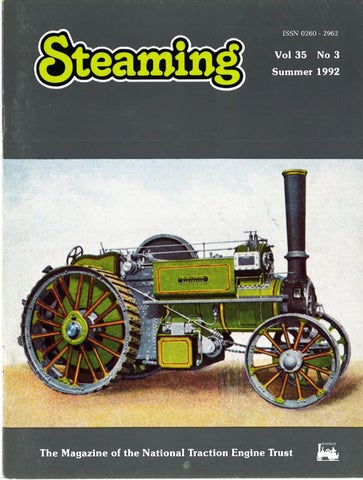
Cover A fine colour rendition of one of Aveling & Porter's compound road locomotives — some notes on which were contributed to our last issue by Derek Hattam. The illustration comes from a small booklet issued by the makers in or about 1902. It featured three tissue paper protected colour plates, the other two showing Aveling's other principal products, a 10 ton roller and a compound ploughing engine, and was printed by Bemrose & Sons of Watford and Derby. It was probably the case that the booklet was not as freely available to potential customers as ordinary black and white publications) The vagaries of accurately representing colours of paints etc via the printing process are well known but the shade of green depicted here looks to be about right for a turn of the century Rochester product. Perhaps readers may care to make comment — we would be pleased to feature some discussion on the various shades of Aveling green, difficult and subjective though that might be via the printed word. Thanks are due to the Road Locomotive Society for the loan of the catalogue from its library. 115
Trust News Rally Organisers Column Rally sub-Committee Some rally organisers who attended our Spring Conference at Rugby indicated their interest in the rally site signs as now advertised inside the front cover of the magazine. I have despatched all the outstanding firm orders, so would ask those who require signs to please place your orders as soon as possible. Ron Copp has recently resigned from the Rally sub-Committee after 20 years of managing the paperwork for the Approved Rally scheme. I would like to take this opportunity to express our thanks for his work over this time. Ron's task has been taken over by
Smudge Smith, more properly J.R. Smith, The Poplars, Grange Road, North Frodingham, Driffield, North Yorkshire Y025 8LN. All matters relating to the Rally Code of Practice and approval scheme, and safety officers reports etc should now go to him direct. The new Motor Vehicle Off the Road Events Regulations are now law, and the NTET has been appointed as an Authorising Body under these regulations. We are now closely examining the implications of the new circumstances, whereby certain sections of the Road Traffic Act are extended to cover, for example, rally fields, and will report in full at the Autumn Conference at Rugby. Please note the date in your diary —
From Alan Martin's Collection
57
For a short period at the beginning of this century the main roads into London from the west each night carried a procession of steam tractors and wagons, bound for the Covent Garden Market with produce from the market gardens of West Middlesex. Here we see A. W. Smith's of Feltham Wallis & Steevens road loco in Kensington High St, London about 1909 with three
highly laden trailers, two of them the traditional marker garden type which were formerly horse drawn. It is likely the 5hp compound, 2728 of 1904, was photographed one morning on the return journey with empty baskets. 116
Saturday, 24th October 1992 — for this will be an important meeting at which to discuss the new regulations. Although they become effective on 1st July 1992, their enforcement has been deferred until 1st October, so there should not be any problems during this rally season, but if anyone finds they have urgent queries on the subject then please contact me. (Andrew Semple, chairman, Rally sub Committee)
Engine Owners Column Engine Owners sub-Committee The Trust's driving and maintenance course took place, as planned, on 9th/10th April, and fortunately the weather was quite helpful. We are again most grateful to the North Staffs and Cheshire Club for their hospitality and help at The Klondyke Mill Centre. The co-operation of the club members made a great contribution to the success of our weekend. I should also like to offer a very sincere vote of thanks to those engine owners and others who put so much into instructing over the weekend. We had about 45 participants, a third of whom were on the follow-up course, after their participation in 1991. Although there is still plenty of room for im,vernent, I think we offered good value and we are getting together an excellent group of instructors. The Traction Engine Code is now available. It consists of a loose-leaf ring binder which includes, or eventually will include sections on the following aspects: Part 1 — Operation and Maintenance Part 2 — Driving and conduct on public roads and at public events Part 3 — Transport, laying up and storage Part 4 — Examination of the pressure system Part 5 — Mechanical inspection Part 6 — Repairs Part 7 — Appeals and Arbitration Part 8 — Records and Reports
Vouchers will be included for sections which are presently not completed, and protective plastic wallets for all parts including the steaming log, boiler reports and repair records. Obviously, Section 4, which is complete, is of vital importance and we are hoping that members will obtain their copy of a Code so that they may participate in our Open Committee Workshop which is planned for the late afternoon of the AGM in November. I must emphasise that we are quite happy to issue amendments should that prove necessary following discussion, and we do wish to hear your views. The law as it stands requires that all owners put their house in order and I feel that we are offering good value compared to the prices charged by insurance companies for the equivalent article. We are most grateful to Jim Newnham for all the time and effort he has put into this on a voluntary basis; his experience in Health & Safety matters has been invaluable to us. We hope that the steaming log and repairs record will become a valuable asset when engines change hands. I must emphasise that these Codes are intended for and available to members only. They are available from Sylvia Dudley, (address inside front cover) at a price of £15, plus £1.50 postage and packing. Bob Back has recently done some good work on the difficult problem of gauge glass protection for some types of Fowler engines. It consists of two half tubes of heat-resistant glass and seems to have been successful, so if anyone wishes to have further details, let me know. Finally, I must point out that John Glaze, who is a valuable member of our Engine Owners sub-Committee, operates as an entirely independent boiler inspector, and is not either employed or sponsored by the Trust, as has been implied in print in other published sources. By the time you read this, the rally season will be well under way and I hope that you will all have an enjoyable and rewarding time. (Michael Davies, chairman, Engine Owners sub-Committee) Lost Registration Numbers The steady trickle of applications continues, as does the high success rate. Simple cases where the old-style log book can be presented are being processed by DVLC in little more than ten days, and this is very encouraging. It is those cases where there is no official documentary evidence that the number being claimed was
NTET Coal Supplies The Trust hos again arranged low priced coal for use by rally organisers, clubs or individual owners In association with Arscott Collieries, Coal Factors and Merchants, Gateway Chambers, 26 Castle Street, Shrewsbury SY I 2BJ • pre-packed 25kg plastic bags • haulage can be arranged to any rally site • ring John Watkiss on 0743 362482 to discuss your requirements and haulage cost, anywhere in Britain DRY STEAM COAL (when available)
£111.00 per tonne ex Shrewsbury Bituminous also available Cash on collection or pre-payment Please order early to obtain supply of steam coal
genuinely carried by the vehicle where problems can arise. Under these circumstances it is the Road Locomotive Society records and the good offices of Alan Duke that are the key to success. FBHVC News There has been little of concern or interest to steam engine owners from this organisation during recent weeks, from the point of view of regulations that will affect the continued use of steam vehicles on the road. However there are two items which may have some influence on our hobby. Export of Cultural Goods — When national frontiers are abolished the export of cultural objects will be controlled by a system embracing national export laws within a framework created by two proposed community regulations. The first of these Regulations deals with exports from any of the member states to a destination outside the community. It provides for a Community Export Licence to be issued by the member state in which the object was situated at the time of the coming into force of the Regulation (aimed for 1st January 1993) or to which it has lawfully been removed thereafter. In the case of motor (including steam) vehicles the Community Licence will be required for all vehicles which are over 75 years old. Value will not be material. The second Regulation allows a member state to recover from another member state cultural items which have been exported from the former against their national export
laws to a destination within the community. Although member states can maintain their own heritage export licensing this must be within the limits set out in the first of the Regulations. In the case of motor vehicles this covers all vehicles over 75 years old regardless of their value. The FBHVC Committee is consulting with interested parties, both in the UK and EC, to determine whether or not to lobby for tighter controls to prevent historic vehicles being exported — at present, vehicles over 25 years old and over £40,000 in value require an export licence. Bits and Pieces — Clubs whose members are lucky enough to be able to find spare parts in scrapyards are advised to warn their members that the days of the traditional scrappie are numbered, and it could be well worthwhile gleaning as much material as possible from known yards before pollution control legislation closes most such establishments down. A correspondent from Switzerland advises us that legislation in Italy makes it illegal for anyone other than an authorised repairer to carry out major repair work to vehicles (owners are limited to doing no more than simple servicing such as oil changes — and the oil has to be returned to the oil companies for disposal). He goes on to report that he has been unable to purchase axle oil in Switzerland as this commodity is available only to licensed service operators. Small points for steam engine owners, maybe, but they could be pointers to the way restrictions could appear in 117
future that will affect the running of our engines. (Peter Smart)
Your New Driving Licence In February 1991 important changes were made in the regulations concerning Driving Licences, mainly, it seems, to co-ordinate our categories with the European ones. They are defined in the DVLA publication /NS57 revised February 1991, and the statement is made on the outer cover — 'These changes could affect you.' I looked at the details and found that I would be affected. I have a licence now in Categories B, B1, C1 — which is the new way of saying Groups A, B, B1, C and D. The material one for steam tractions or steam lorries is Category C1. It appeared that the upper weight limit of the vehicles I could drive would be 7.5 tonnes, which as we all know is not much for some of our engines. Holders of such a licence would be barred from driving traction engines above about 7hp, road locos, showmans road locos, plough engines, crane engines, etc. It also seemed that, to be able to drive the heavier engines, I would need the modern equivalent of an HGV Class 1, now Category D + E. So I got in touch with Swansea to find out the score. This is all very important because a valid driving licence is the common requirement for insurance cover which will give protection to the holder even on a rally field. Without special arrangements with the insurers no licence equals no cover — anywhere. The first piece of news I obtained from Swansea was that our engines, having bccn built before 1st January 1960, could be driven legally without a Category C entitlement when used unladen and not drawing a laden trailer (DVLA publication D200, page 10, paragraph L, item 5). But this news was not practical, for example, for a plough engine whose range for water could be as little as 5-10 miles, so I went back to Swansea by phone and letter and said so. The kind Mrs Griffiths wrote to me in reply on 19th February 1992 (letter ref DO/DIP28/D-1). I quote the relevant sentences only: 'Apparently, a paragraph on page 10 where it states 'Used unladen and not drawing a laden trailer' refers to vehicles manufactured before 1960, and not steam powered vehicles. It has since been decided to amend the D 200 so as not to be confusing'. I have quoted and referred in detail to the correspondence because the situation was confusing, and probably still is to some extent. 118
Members holding C + E Categories have no limitations nor, now, will members holding C1 Category. I imagine that the cost of tuition and driving test for those people needing it will be much less than the same thing for the full C + E. (Giles Romanes)
be able to escape for a while to assist us will be much welcomed. Please contact me at the address shown inside the front cover. (Sylvia Dudley, vice-chairman)
Publicity Officer Steam Apprentice Club SAC members will have by now received the first of what I hope will prove to he many issues of the Magazine edited by Steph Gillett. I also hope Trust members will consider supporting the SAC by producing items for the younger enthusiast's magazine. Please contact me if you can help — also, if you know of any SAC member who has not received their Magazine recently, I will be pleased to deal with the problem. Those SAC members who managed to get to the SAC event at Fengate Farm at Weeting enjoyed a splendid weekend; the weather was kind to us. I would like to record the participants' thanks to all who contributed, not least to our host Richard Parrott, and Lesley Colsell and Gary Wragg who arranged the programme of tuition. This took the form of theory with the help of a stripped down engine's components; practical sessions on engines in steam; a threshing session and a private visit on the Saturday evening to the Burrell Museum. (Sylvia Dudley, chairman, SAC)
NTET Hospitality Tents We are still seeking help in staffing the hospitality areas in the Trust Sales tent at the Great Dorset Steam Fair, a problem which I mentioned in this column in the last issue. Can you help please? We need volunteers to meet and talk to members and other visitors and also to help on the tea and coffee table (no washing up!) — if we don't have the promise of more assistance there will be periods when the area has to be closed. My thanks go to those who have already offered to spend some time with us but we do need more if it is not to be a harder task than usual. Any 'engine grass widows or widowers' staying on site who might
We are pleased to announce that committee member Steve Parrott recently agreed to take on the task of Publicity Officer to the Trust, a post which has been unfilled for some years now. Steve will no doubt be working on ways to increase awareness of the Trust's activities with public bodies, private organisations and, of course, potential members.
Obituaries Ian Fraser Regarded as one of the country's foremost steam enthusiasts, member Ian Norman Fraser of Arbroath died in February, aged 80. Ian Fraser was a steam enthusiast all his life. Grandson of Douglas Fraser, founder of an Arbroath engineering firm manufacturing machine tools, his boyhood interest was stimulated by living at Ogilvy Place, Arbroath, where his father developed designs for textile machinery and family picnic outings to the Angus glens were in a steam car designed by his father. Educated at Melrose and Edinburgh Academy, Ian Fraser served an appieiiticeship with the LNER at Doncaster under Sir Nigel Gresley, and then worked at the Darlington and Inverurie workshops until the eve of railway nationalisation. In 1948, by then back in his native town, Ian acquired Marshall 5 ton tractor 68823 of 1915 and he became a familiar sight in the 1950s and 1960s driving the machine in and around Arbroath. Later he decided to leave the large house and grounds at Ogilvy Place. occupied by the Fraser family for over 100 years, and in 1958 made plans for a new house elsewhere in the town. It was to be complete with an elegant coach house style engine shed (with a weather vane topped tower) to garage and maintain the Marshall and the shortly-to-arrive narrow gauge Dundee gasworks locomotive. Consternation was rife among other local residents and planning permission was refused.
IMPORTANT INFORMATION FOR THOSE NEEDING ECONOMICAL REPAIRS ON THEIR TRACTION ENGINES
B. & C. Reconditioning (Gears) Ltd PINIONS
SPURS
BEVELS
All types and makes of bevel gears, spur pinions, spur wheels, helical gears etc rebuilt to standard
Our address is:
B & C Reconditioning (Gears) Ltd, off London Road, Amesbury, Wiltshire SP4 7EQ Telephone Amesbury (0980) 623210
119
The subsequent and unique case of the appeal to the Secretary of State to establish the right to keep the machines as his hobby at his residence made history — the story of the public enquiry and its successful outcome for Ian Fraser was beautifully and amusingly set down in his book The Arbroath Affair. During the years that followed Ian became much respected among steam enthusiasts for his contribution to the preservation of railway locomotives, which included acquisition of main line examples in the shape of LNER 4-4-0 MORAYSHIRE and BR 2-6-0 46464. The Marshall tractor was donated to Leicester Museum of Technology some years ago, and Fowler roller 17273, which Ian bought to roll the roadway to his engine shed, went into ownership elsewhere in Scotland. To replace the engines at his home Ian Fraser had designed and built a 15 inch gauge garden locomotive, and though limited by a stroke he suffered
in 1990, with the help of his family and engine-minded friends, he enjoyed regular steaming parties throughout 1991. (David Fraser) Edward Haggard With regret I record the death of Edward 'Ted' Haggard of Swindon in April, aged 78. An engine owner of 25 years, Ted will be remembered by many members in Wiltshire, Gloucestershire and Oxfordshire. Ted's interest in steam goes back to his early working years, when as a self taught engineer, first working at the Garrard factory in Swindon, he made model marine engines in his spare time. During World War 2 he was in charge of the machine shop at Chilton Aircraft Co near Hungerford and following the war he set up with his brother Cyril in business as motor engineers in Swindon. Ted purchased his first engine, Aveling piston valve roller 10762, in 1964. He became a
regular attender at Appleford, Andover and Bloxham events, always driving the machine on the road. In 1966 Ted purchased his second engine, Burrell single crank compound 2426 of 1901, which he completely overhauled, using his extensive home machine shop, over a period of five years. The engine was subsequently rallied virtually every year, often up to 200 miles a year by road, until failing health demanded its sale in 1988. Ted had many friends on the rally fields, and was always willing to offer help and advice to others. On many occasions he would give spare parts from his own collection, or carry out machining jobs, and take nothing in return. He actively encouraged Steam Apprentices, youngsters of 10 and 14 years of age, to use the machinery in his workshop to make models etc. As a young boy, in 1969, I remember my first trip on the Aveling roller to the first Fairford Park rally. I look back now and am very pleased to recall his encouragement into such a fulfilling hobby. I know I speak for others when I pay tribute to Ted's generosity and interest. The legacy of his fine models and the condition of the Burrell traction will live on. (Colin Hatch)
Future Dates Annual General Meeting
Hampshire County Council Museums Service succeeded in gaining the attention of both the local and national media when they steamed their recently restored Tasker 5 ton tipping wagon at a special presentation at their Winchester headquarters in April, just before its appearance in the HCVS's Brighton run. The Museum, which can boast the country's largest collection of agricultural engines, implements and equipment outside the Science Museum, has spent five years on the refurbishment of the Andover built steam wagon, the work being very largely completed by volunteer enthusiast labour led by Gary Wragg. The brief formalities of the day, pictured above, were appropriately performed by Leonard Fuller (left), presently managing director of Andover Trailers Ltd, and the last chairman of the old Tasker company. He recalled his grandfather had acquired a half share in the business in 1927, at a time when steam was in descendancy, and how a few years later the firm came to specialise in trailer manufacture. The 1924 built Tasker steam wagon was part of a large collection of their products that the company built up about 30 years ago, most of which was later acquired by Hampshire Museums at auction. 120
Advance notice is given to all members that this year's Annual General Meeting will be held on Saturday, 21st November 1992 at The Guildhall, Winchester, Hampshire. Formal notice, together with all relevant information, proxy forms and audited accounts for the year ended 31st March 1992, will be sent to all paid-up members of the Trust with the Autumn Issue of Steaming. Any member may submit a motion for discussion at the Annual General Meeting. All motions must be in writing, signed by the proposer and by a seconder. Such items for discussion, in order to be published as required by Article 16 of the Trust's Constitution in the Agenda for the Annual General Meeting, must reach the company secretary Sylvia Dudley not later than Saturday 26th September 1992 (address inside the front cover). As an added attraction for members journeying to Winchester for the AGM, we are grateful to member Gary Wragg, senior conservation officer at the Hampshire County Council Museums Service for arranging for their collection of Tasker and Wallis &
Steevens engines, rollers and wagons to be available for inspection by Trust members on the Saturday morning and, for those wishing to stay overnight in the area, on the Sunday morning. Engine owners and crew members should note that following the AGM in the late afternoon, the Engine Owners sub-Committee will be holding a presentation of their Traction Engine Code of Practice (including the Engine Log) and it is hoped this will generate constructive discussion amongst those present. In the evening it is planned to hold further social events. Details of the arrangements for the weekend will be published in the Autumn issue of Steaming, together with a location map. A list of overnight accommodation will also be prepared for those wishing to make a weekend break around the planned activities. It is hoped it may be possible to arrange special visits to one or two local centres of engine interest on the Sunday, as well as the Hampshire Museums opening.
London Area Social Meetings For the past two years the winter seasons of social meetings have been held at the Model Railway Club premises at Keen House, near Kings Cross. Although the facilities have generally been found adequate, the dates available to us around the MRC's own needs of their clubroom have proved restrictive. Also it is felt a venue where members can have access to a bar before or after the meetings would be preferable. A new venue has therefore been found for the 1992/93 season and
STEAMING past OUR MAGAZINE 25 YEARS AGO
Almost the whole of the Summer 1967 magazine was devoted to area notes sent in by a very widespread selection of local correspondents. An interesting appearance at the early summer event at Pirton, Hertfordshire was Sentinel DG6 8351,
Cruise the beautiful sealochs and canals of Scotland in an original coal-fired Cry& Puffer. Good food, comfortable accommodation.
Send large SAL for free brochure to Rachel and Nick Walker, The Change House, Crinan Feny, Lochgdphead, Argyll PA31 8QH (Tel 054 65 232).
meetings secretary Bill Timmings has booked accommodation at the Yorkshire Grey, Langham Street, London W1 for the second Tuesday of each month, starting in November and running through to April 1993. The new venue is quite close to our meeting place of a couple of years ago (the Horse & Groom) and not far from Oxford Circus tube station. Details of the programme of speakers and subjects will be published in the Autumn issue.
Poor Steaming The 6 ton Aveling & Porter roller at Pontypridd, illustrated and discussed on pages 100/101 of the last issue was unfortunately referred to several times by the wrong works number — the correct number is 8794 and we thank Alan Duke for pointing out the error.
which had been in use carrying stone until the previous year on the breakwater at Aberdeen. Fowler road engine 15649 had undertaken an enterprising trip across the Pennines to deliver a new 15 inch gauge steam loco to the Ravenglass & Eskdale Railway. The journey from York to Ravenglass included a creditable 75 miles on the third day. In Sheffield the group of Sentinel Standard wagons owned by Brown Bayley Steels for internal transport at their steelworks — machines which had laboured far, far beyond the time their makers could possibly have envisaged — were to be retired at the end of the year and had
'Deakin & Sons, Amusement Caterers, permanent address 2 Alma Street, Brynmawr, Brecon; reply to Fair Ground, Blaenavon, Mon. July 3rd 1934. Dear Sir, We want a set of firebars for a 7 horse Burrell engine. We are enclosing sketch of Firebox and hope you will be able to make the Bars from the sizes. As our Bars are very bad we would like you to send so we can have them this weekend. Thanking you for an early despatch, we remain, Yours faithfully, A. Deakin & Sons.' (A letter to The Avonside Engine Co, railway locomotive builders at Fishponds, Bristol, courtesy Ken Plant. The competent sketch sent with the request showed that two side and nine centre bars were needed for the 36in long by 21/n wide box. The ailing engine was probably Burrell 3952 MODESTY, a 7hp scenic new to Deakins in 1923, but which enjoyed a surprisingly short life, being scrapped in 1937.1
already been booked for preservation. Events large and small featured in the various reports and 25 years on no doubt many present day readers will be able to recall pleasant memories from one or more of them — the wet Woburn, changed from the August holiday to early May in the hope of better weather; the North Staffs club's steam party at Draycott-in-the-Clay, Staffordshire; the first Newhall Street event outside Birmingham's Museum of Science & Industry; gatherings at Eric Middleton's yard at Hartlebury, Worcestershire and similar socialiSing at Derrick Hackett's premises at Ross-on-Wye. 121
TINY TIM and OLD JUMBO Pat Freeman The names Bill and Ben will, to many of us, conjure up a picture of the children's TV Flower Pot Men, but to the knowledgeable engineman they are also synonymous with TINY TIM and OLD JUMBO. In other words they are, or have been, the names of two Fowler BB1 steam ploughing engines now in the ownership of Les Birch of Kent. I became interested in this pair of engines after chatting to Les at the 1991 Barleylands Rally at Billericay, where they were being put through their paces. Les was able to show me old photographs of TINY TIM and OLD JUMBO and also tell me that on the
rally site was Peggy Gowiett, daughter of the late Oliver Taylor. 011ie, as he was known to his friends, was the brother of Ben and Charles Taylor who had gone into business together in 1923 trading as Taylor Bros of Wimbish. The firm had owned TINY TIM and OLD JUMBO for over twenty years and 011ie, who worked for the company, was closely associated with these two machines during most of that time. So I went and saw Peggy in her caravan and she kindly produced more old photographs and interesting facts about the two engines which whetted my interest to try and detail, as far as possible, a history of their movements from initial manufacture to the present day.
Fowler BB1 ploughing engine 15226, soon after entering preservation with Taylor Bros of Wimbish, taking part in the rally at North Weald in 1959. Cyril Richardson is in charge. (collection Cyril Richardson) 122
Many will think they know the history of the engines, so I have tried through personal contacts, to come up with a few facts and anecdotes which may not be quite so well known. During World War 1 the Government feared famine due to the enemy blockade, particularly as a result of submarine action. In 1917 it therefore formed the Agricultural Machinery Branch of the Ministry of Munitions to give priority to the mechanisation of food production. An order was soon placed with John Fowler & Co, Leeds, for a considerable number of pairs of ploughing engines, together with ancillary equipment, which would be allocated by the Ministry to bona fide agricultural contractors for £3000 per set, to be paid for on the instalment system. The two engines with works numbers 15226 and 15227, the subject of this article, were part of this large order and were allocated to Thomas Powers of Barwell, Leicestershire, on 8th October 1918. In due course they were given the registration numbers of NR77 (152261 and NR76 (152271. Mr Powers' plant was auctioned off on 26th August 1932 and the two engines (he had others) went to an unknown owner in Nottinghamshire. In 1943 they were at Kesteven, near Ely, and in that same year were bought by Thomas Wright of The Grange, Hough-on-the-Hill, near Grantham. In 1944 they were acquired by Paul Wiseman of Wimbish, Essex. It was at this point in the engines' history that I was able to make contact with a past owner, and could get authenticated accounts of their exact movements. Paul was able to tell me (and also navy ma a rnpy of the en!o rinrs.rnent) that he bought the two engines, together with a plough, cultivator, living van, water cart, mole drainer and five tons of spares from T. Wright & Son, The Grange, Hough, Grantham for a total of £370. This transaction was completed on 8th May 1944, and at the same time Paul paid Mr Wright £20 for two teams of his men to take the engines from Hough to Stilton (near Norman Cross, Huntingdonshire) where he had arranged for his own crews to pick them up. The two crews were 011ie Taylor and Paul, and George Lanham and Stan Saville, and it took them two days to get the pair to Harry Goode's Heath Works at Royston, where repairs were to be carried out. Harry Goode traded as Engineer and Millwright, and as well as being an agent for Claytons, Rustons and others he specialised in boiler work and repairs to traction engines and steam ploughs. He was also noted for converting single cylinder machines to
tandem compound operation. Both engines were there for about two months, during which time NR76 had a 6 inch square section cut out of the bottom of the firebox and a new plate fitted, riveted and welded into place and NR77 had the firebox walls built up by electric welding. NR76 had 22 new stays and NR77 had seven new ones fitted. In September 1944, the ownership of both engines was transferred to Paul's firm of H. Wiseman & Son. During 1945 the original Fowler chimneys were removed and replaced by ones made by Goode, which were about 18in shorter but still with genuine Fowler brass tops. The earlier chimneys had created difficulties when moving along headlands where trees had overhanging branches, which made the saw an essential item in the tool box! Also at that time both engines were re-tubed and fitted with new smokeboxes and smokebox doors, all the material supplied by Goode. Their quotation for the supply was as follows:
A fine study by Barry Finch of Fowler 15227, hard at work about 1960, with 011ie Taylor well engrossed at the task in hand.
TWO SETS BOILER TUBES — 15s' 9d 179p) each 145 tubes per set) TWO SMOKE BOXES, welded construction, comprising wrapper plate, front ring and stiffener plate — £36.0.0 each plus 12% % war increase TWO SMOKE BOX DOORS with baffle plates — E4.17.6 1E4.88) each plus 12% % war increase. Delivery 6 to 8 weeks. At the same time as he fitted the new smokeboxes Paul took out the front axle centre pins and turned them back to front. This was because they were bent and at certain angles of lock, a front wheel would foul the rope drum. Turning the pins around cured the fault. Goode also supplied two sets of their patent white metal gland packings each made up of about twelve sections, for the pistons and valves. It was found that both engines were very heavy to steer so the 5%
inch winding shafts were removed and replaced with 21/2 inch shafts with 5 1/2 inch sleeves welded on each end. These shafts were taken from a set of AA engines at Chrishall, near Cambridge, belonging to Messrs Drage & Kent, which were being scrapped. The work was carried out in the winter of 1945 in Paul's workshop. As the chimney blowers were missing" when the engines were acquired the workshop made up and fitted new taps and pipework. In 1946 NR77 had its tender repaired, and both engines were repainted. After about two years in Wisemans' use the glands blew in one of the engines, so the fire was put out to refit a new gland. But, coincidentally, before the job could be finished the gland on the other machine went as well! Another coincidence occurred one day when an injector would not lift due to corrosion, and almost 123
A scene in the field at the back of Taylors yard at Wimbish about 1960 — Fowler 15226 and driver Cyril Richardson being kept company by Aubrey Richardson (Cyril's brother), Charlie Mynott, 011ie Taylor and another. (collection Peggy Gowlett)
immediately the same thing happened on the other engine! On 26th October 1957 both engines, a plough and 45 new tubes were sold to Charlie Taylor, of Wimbish, for £275. The living van had earlier been sold to a family who had been bombed out of their home in London, so that they could use it as temporary living quarters.
Although Charlie bought the engines on the date given above it appears that they were not transferred to the ownership of Taylor Bros until the following February. On that date they are shown in their Plant Book as items number 15 and 16. The entry states that they were bought from Paul Wiseman (H. Wiseman & Son), together with 80 new tubes and a few
Fowler 15226 demonstrating mole draining at Wimbish about 1960. (collection Cyril Richardson)
spares for both the engines and plough, all for a total of £300. Perhaps the extra tubes and spares were supplied by Charlie from another source — hence the difference in price. Soon after the purchase 15226 was retubed by 011ie Taylor and George Swann and the boiler was fitted with new tubes on 1st January 1959. The boiler was also hydraulically tested to 270Ibs, and an entry in the Plant Book, at the same time, states 'wheels have had spokes welded'. As a result of a chat with Kevin Swann, one of the Trustees of Taylors' Yard, Wimbish, I arranged to go and see Cyril Richardson at Radwinter, Saffron Walden. Cyril, now in his eighties, worked for a long time for Taylor Bros, and whenever the two ploughing engines were rallied, or used, he would drive 15226, TINY TIM. He told me that after its retube he took it to North Weald for its first rally. Over a period the pair were rallied at Wimbish, Debden and Ford End and other venues. Cyril said that although the engines were bought primarily for preservation, nevertheless they were occasionally used for ploughing jobs. They were always employed to plough a six acre field which backed onto Taylor's yard and sometimes they were used on jobs before, or after, demonstrations and rallies. As an example, Cyril remembers a rally at the Spread Eagle, Ford End, near Chelmsford, where they were asked to plough
the whole of a 27 acre field which was to be used for the rally demonstration. This meant arriving on site a week or so early so as to get most of the work done before the rally began. Soon after they got underway it was noticed that the fire box was leaking but work continued until the required acreage was completed. The late John Downs was on site preparing his fair for the rally and he offered to try and repair the fire box. When Cyril arrived on site on the morning of the rally, much to his surprise, there was TINY TIM already in steam. John told him that when he put a spanner on the fusible plug and gave a slight turn it dropped out completely. There was no alternative but to cut away a piece of the crown plate until a thickness could be found which would take a weld and John had inserted an almost completely new top together with the fusible plug. Cyril was full of admiration for this repair carried out under adverse circumstances and said that John deserved the highest praise for the quality of his workmanship. In 1970 TINY TIM was again retubed, followed in 1971 by OLD JUMBO having the same treatment, as well as having twenty new bottom stays fitted. Ben Taylor died on 23rd December 1979 (Charlie had passed away in 1974 and Oliver in 1976) and on 12th July 1980 Cheffins Grain & Chalk of Saffron Walden held an auction at Shire Hill Farm of 'Steam Engines, Implements and Accessories' by direction of the executors of B.M.Taylor. A total of 58 lots went under the hammer including four ploughing engines. Lot 56 was a very rare Fowler class K5 8hp single cylinder 12360 of 1910; it was sold to T. Longford of Morborne. Lot 57 was Fowler class BB1 15332 of 1919, which went to C. Garman. Finally Lot 58 comprised TINY TIM and OLD JUMBO plus a Fowler anti-balance six furrow plough, and these were bought by Tom Varley. About a year later they were advertised for sale after being placed in an auction at Leeds Market, where they did not reach their reserve figure. Vic Mitchell, of Midhurst, Sussex saw the advertisement and after discussions with two engineering friends, father and son Allan and Michael Pronger, he decided he could find enough work to make their purchase commercially viable. All three men travelled to Gisburn to carry out an inspection of the engines, and Vic tentatively agreed with Tom Varley to purchase them provided certain repairs were carried out. Tom accordingly sent the engines
Later days of real work — in September 1982 Fowler 15226 and 15227, by then in the ownership of Vic Mitchell, dredged a pond at South Mundham near Chichester, Sussex. This shows the start of the clearance with the dredging scoop behind the front wheels of NR77. (Vic Mitchell)
to Rory Woolf, of Belfast, where they were re-boxed (using welding techniques instead of the original riveting) and fitted with new tenders. At the same time new tool and paddle (or spud) boxes were fitted together with new tubes with 3/16 inch walls instead of the usual Ye inch. The boiler work was supervised and tested by National Vulcan inspectors. When the work was complete Vic travelled to Northern Ireland and saw the engines engaged in a ploughing demonstration at Shanes Castle, and there completed the deal. The Antell brothers made two low-loader trips to move the engines to Seale, near Guildford. It was there that Vic and his helpers completed the cladding operation, using wood and aluminium, and carried out a ploughing demonstration in September 1981. Vic is a very well known writer of steam railway books, mostly concerning the branch lines, and he publishes them via his own company, Middleton Press of Midhurst, West Sussex. However, he set up a new company, V. Mitchell & Co Ltd, to cater for dredging work, and also designed his own 4 cubic metre scoop which his son-in-law Philip Pede and Michael Pronger fabricated. In May 1982, whilst stored at Hollycombe, the 31/2 in diameter front axle centre pin of OLD JUMBO snapped off. Vic obtained copies of the
1913 Fowler drawings from Reading University and his brother Richard made a new pin which was fitted — after much struggling. Some of the more noteworthy contracts completed with the engines were: July 1982 — a pond dredged at Tooting Common; September 1982 — a farm pond at South Mundham, near Chichester cleaned out and June 1983 — swamp excavations carried out prior to road making taking place at Willenhall, near Wolverhampton. However, Vic began to find that the amount of dredging work was patchy and time devoted to obtaining contracts was detracting from his mainstream livelihood of writing. He therefore sold both engines, but not the scoop, to Normal Ball of Ryde, Isle of Wight and in August 1983 two lowloaders took them from Singleton to Ryde. As things turned out, one or two contracts which Vic had sought later came to fruition, and on 22nd September 1983 he hired back both engines. One contract was to clean out a small pond at Ripley, Surrey and the other was to dredge a lake at Benham Valence, near Newbury, Berkshire, which took four months to complete. These were winter months and the Prongers lit up in the dark at 5.30am, often in severe frost, and worked until dusk. On average 70 tons per hour were moved over a distance of 300 yards, with no mechanical 125
Posed together in Vic Mitchell's ownership, Fowlers 15226 and 15227 — the registration numbers NR77 and NR76 were always the wrong way round for the works numbers. (Vic Mitchell)
failures. Whilst the machines were on hire Vic re-lined the drum brake bands with wooden blocks and also replaced the ash pans. Both engines were returned to Norman Ball on 21st February 1984. Norman Ball told me that when he received the two engines they were in very good mechanical condition but nevertheless he had them steam cleaned and re-painted. As he did not know they earlier had the names TINY TIM and OLD JUMBO (no nameplates were on the engines), he decided to name them BILL and BEN for exactly the reason stated in the opening paragraph — his children and grandchildren were great Flower Pot Men fans. Norman used the engines for rallies and demonstrations, and when he decided to auction ott his collection the engines were lot 333, with an estimated price of £45 - £55000. The auction was carried out at Ryde by Sotheby's of New Bond Street, London, on 21st April 1991, and they produced a magnificent catalogue for the occasion which covered the whole collection of vintage bicycles, motor cycles, cars, steam rollers, portables and the ploughing engines. With these two engines went 'a very rare Fowler combination cultivator, roller and harrows in one reversible unit'. It was the vendors wish that the engines should continue to be operated together and, to again quote from the catalogue, 'respecting those wishes, the engines are offered as a pair and together with the rare Fowler cultivator'. This latter item had been bought from the Hollycombe 126
collection during a period of financial stringency and although, later on, they would have liked to repurchase it, Norman had decided to keep it. Les Birch, of Sellindge, Kent, was the successful bidder for Lot 333 at just below the estimated price and he brought them home using two of his own low loaders and a flat bed lorry fitted with a crane. He subsequently rallied them at Redhill and Barleylands, as well as having them on show at Sellindge, and after a thorough over-
haul this last winter the pair should be gracing many rally grounds in the years to come. Les has reverted to calling them TINY TIM and OLD JUMBO and intends to have nameplates made and permanently attached to the engines. Perhaps after reading the foregoing others will be encouraged to carry out research on the history of a chosen engine, or engines. It will entail a lot of letter writing, the making of numerous telephone calls and, hopefully, the meeting with owners post and present. But it should ensure a lot of personal satisfaction as well as the knowledge that many new friends have been made — try it. iYr
The pair seen again in their current ownership, posed for the author's camera at the 1991 Barleylands event, with owner Les Birch in 15227 OLD JUMBO (left) and Tony Slingsby on 15226 TINY TIM.
Outing
Forty years ago last month, Bill Boddy, editor of Motor Sport, visited one of the early traction engine events at Apple ford, Berkshire and duly recorded his outing in the following month's magazine. We are grateful to Mr Boddy for allowing us to reproduce here an outsiders contemporary impressions of the atmosphere of the day.
On Sunday 8th June, we decided that, as a change from watching motor-races, we would attend a race for traction engines. This entailed, first of all, half-an-hour's run to Reading, happily free of congestion on this dull morning. Then out along the road to Pangbourne and along beside the peaceful Thames to Streetley, here to fork left on to that winding undulating road over the downs towards Wantage, where the speedometer needle of the Morgan Plus Four stood at between 60 and 70 mph. As we turned off into the lanes, bound for Appleford and Bridge Farm, we encountered at first a stream of cyclists, then a solid line of cars, for this race of the giants, originating as a friendly contest three years ago, has become, in 1952, a public spectacle. The free car park was full of hundreds of cars and five coaches. There was no charge, either, for admission to the big field which formed the arena — only numbers of
charming young ladies collecting for Oxford's Eye Hospital. The atmosphere was that of an English country fair and must have made envious any Americans who were present. There was a beer-tent, and news-reel and television chaps, but we were spared a loud-speaker commentary as five agricultural traction engines, a Burrell showmans road-locomotive, and a Foden tractor steamed slowly along to the appointed duelling place, preceded by a man in top hat waving a red-flag and by a one-third scale model traction engine. We observed, and smelt, with pleasure the black smoke from their tall chimneys, the engines were turned out in the pristine condition one expects of veteran cars at VCC meets. There was considerable delay before the five main performers were unleashed for their once-up, round a post, and once-back race in this Berkshire meadow. Yet the big crowd, 8000 strong, remained respectfully behind the ropes, although no police
were present — being far too busy genially clearing the traffic jams from the surrounding roads. Eventually the race started. Someone had to be last and someone had to win, but first place was warmly contested, and everyone was glad that Mr Napper, aided by a burly 'stoker', won on his Wallis & Steevens, so keeping the prize in Appleford. After which the rain fell steadily, the smart cars of the farmers and their friends melted away, and the father and mother of all traffic blockages occurred in the narrow roads. Even the red-flag was defeated in getting a clear passage for the victorious engine on its return journey to Bridge Farm. Yet no horns hooted, no tempers became frayed. A traction-engine race is like that — long to get going, short and sweet when in duration, but inevitably soothing. Sitting in the Morgan amongst tatty farm cars, farm labourers in Sunday-best and scores of children with flags and balloons, we wondered anew at the enthusiasm — nicely emphasised by a Sentinel drainsdredger parked while its crew enjoyed the fun, a brightly painted Trojan tourer from a neighbouring farm and, favourite of small boys, the Auster in the corner of the field, in which E. Kimbell had flown down, from Sywell, to drive his engine, which had preceded him on a vast Pickford's transport, which now barred our way. Soon we were clear of the traffic and pushing the Morgan fast along those pleasant roads, its Vanguard engine as crisp after 15,000 miles (one 'de-coke' and valve-grind) as when it was new. In less than an hour we were back in a world of sports cars and motor-racing — and had almost forgotten being told that morning of a Burrell, in good running order, for £45!
BOILER MANUFACTURE AND OVERHAULS TO YOUR INSURANCE COMPANY'S ENTIRE SATISFACTION Also Flanging and
Platework for Tenders, Tanks, Smokeboxes, Tool-boxes, Chimneys, Ashpans, and Gear-guards.
orothea estorations NG BRITAIN'S VI '
Boiler Department:
New Road; Whaley Bridge, via Stockport, Cheshire SK12 7JQ Tel: 0663 - 733544 Fax: 0663 - 734521
'A Scotch Steam Wagon. — We notice that Scotland has at last produced a steam wagon. It has always surprised us that the canny Scot has not long before this turned his attention to the making of heavy steam motors, but he is now putting the Glasgow steam wagon on the market.' (From The World's Carriers, 16th January 1905.1 127
A Summer's Day There could be a certain poignancy to this picture of two Fowler engines and the small group — perhaps a summer's day scene being recorded for posterity by the camera, with the knowledge that the future would never be the same as in times past. However, the exact circumstances of the occasion are unknown — the picture was acquired by member John Newton of Hungerford, to whom we are grateful for allowing its reproduction, only with the information that it showed a family group of a timber hauling and sawing business in Hampshire. Nevertheless, scrutiny of the engines provides clues which enable Alan Duke to provide identification, and allows further details to he gleaned from the Fowler records at local and University Reading newspapers. The engines were in fact part of the not inconsiderable fleet of Cowie & Huth, steam haulage, sawing and threshing contractors of Lymington, Hampshire and probably at the time of the picture their two best engines. 128
Behind the group is Fowler 12132, an R class single cylinder traction, new in February 1910 and seen to be bearing the name NORTHERN STAR; to the left is DREADNOUGHT, Fowler compound road loco 11302 also of 1910. Much detail on the order for the latter engine survives in the Fowler engine books at Reading University. It was ordered by Cowie & Huth of Buckland, Lymington on 23rd August 1910, with delivery promised for 8th October — just over six weeks ahead. The specification for the short fireboxed class A7 (55 indicated hp) engine included springs, a third speed road gear, 75 yards of wire rope on a drum, 6ft 6in diameter by 18in wide hind wheels and 4ft 4 1/2 in by 9in front wheels, 200 gallons water capacity (130 hind and 70 in the front tank), an awning, locking gear to the differential and Penberthy injector. The cover plates to the motion bore brass plates — cowiE & HUTH, LYMINGTON on the right and the engine's name and UNDER 12'% TONS on the left. The machine was finished in
the maker's usual colours of black with amber, red and yellow lining and was delivered on 31st October. Though it was three weeks later than promised, the road loco would surely have become the pride and joy of its owners. Cowie & Huth's business was probably doing well at the time and both these Fowlers would have been worked hard. Both machines bear assorted licence plates for travelling the roads of the area and those which can just be made- out on the original for print indicate permissions Hampshire and Bournemouth — the other plates would have been for adjacent counties or boroughs to account for the likely area of the engine's activities. Though the machines appear well groomed and in good mechanical order, by the time of uur picture the Fowler cabs have suffered much, presumably from working among trees or by felled timber being moved about. Sadly, within a few years, so many people's lives were to be affected by the Great War. On 8th July 1915, the auction sales columns of the Lymington Chronicle carried notice of a dispersal sale for the machinery of Cowie & Huth, 'who have both responded to their country's call and are now both on active service.' What
family heartache and apprehension might have lain behind that brief statement? Hewitt & Gater, auctioneers, of Lymington and Southampton, offered about 300 lots, including seven traction engines, at the Buckland premises on 20th July 1915, when according to the subsequent press report 'keen competition' was evident. DREADNOUGHT, the road locomotive, fetched £450, by far the highest price, whilst the 7hp single Fowler was knocked down for £320. After these, there followed several more engines which were perhaps not in such good order: a 6hp Marshall of 1886 fetched £100; a Fowler single £65; a Reading Ironworks engine £85; a 6hp Wallis & Steevens engine £66; a Tasker engine £46 and a 6hp Marshall portable £37. A rack saw bench made £69 and two Tasker sawbenches £23 and £22. Five threshing drums by Clayton, Tasker and Marshall brought in prices from £106 down to £20, six traction wagons various prices from £54 down to £5. Also sold were two living vans, water carts, timber nibs and gins, four galvanised iron sheds, belting, tarpaulins, chains, jacks and general stores — the extensive tackle of a haulage, sawing and threshing contractor sadly dispersed in under six hours. The newspaper report of the sale praised the auctioneer for his thorough knowledge of the engines and machinery and his ability in disposing of every lot at such satisfactory prices at a time when money was so scarce and being invested in other securities. So, just what occasion does our picture show? Are Cowie and Huth posed, perhaps with a wife or sister
and a father, for one last picture, just before the sale in July 1915. Many similar small businesses succumbed to World War I — engines or tackle were requisitioned by the Government; contracts or threshing rounds disappeared or became less remunerative and, of course, younger men volunteered or came under the scrutiny of the Appeal Tribunal for War
Service. The Lymington local paper at that time featured in each issue, with portraits and brief details of their background, a dozen or more local men serving at the front; unfortunately our friends Cowie and Huth seem not to be mentioned to enable us to know a little more about the no doubt sad chapter in their lives.
'Hackney. — The Borough Council Works Committee had the following tenders for the supply of a road roller:— Diesel Motor Petrol Motor Steam Road Roller Roller Roller s s d f s d Aveling & Porter Ltd 821 15 0 646 7 0 (Allowance for Old Roller, £152 10s.) John Fowler & Co, (Leeds), Ltd 680 8 0 526 10 0 500 8 0 (Allowance for Old Roller, £60,) 727 4 0 573 6 0 545 10 0 549 0 0 582 6 0 R. Garrett & Sons, Ltd (Allowance for Old Roller not stated.)
812 889
0 0
0 0
The tender of Messrs. Aveling & Porter, Ltd., at £646 7s Od., is recommended.' (From Roads & Road Construction, difference in allowances for the old 1st November 1930. The roller acquired by Hackney was Aveling & Porter 14082 (GK3598), a class AD compound 10ton roller built in the latter part of 1930. It replaced Aveling 4582, another 10 ton compound that the Borough Council had taken new in 1900, and which Avelings, as agreed, took in part exchange; they sold 4582 to R. Furborough of Wolvey, Warwickshire. The multiplicity of prices that Fowlers submitted for their steam rollers would have, no doubt, covered different weights or fittings and single/ compound variants, but noting the
roller, it would seem the Aveling and Fowler quotes were very close fora 10 tonner. Aveling 14082 worked with Hackney for nearly 20 years until it was sold to A.M. Cole of Slea ford in 1950, and scrapped.)
'Driver, single, requires situation, drive tractor or steam wagon. Overtype wagon preferred; good references. — Box 7478, Motor Traction.' (from that magazine's 'Drivers disengaged' column in their issue for 13th May 1911.)
H. Mgc,E en ,t
ESTABLISHED 1968
BOILERMAKERS — BOILER REPAIR SPECIALISTS — BOILER PLANT ENGINEERS Craftsman built flanged and butt welded fireboxes complying with The Boiler Code BSS 2790' — made and fitted. All types of traditional high class boiler repairs
Farling Top, Cowling, Keighley, West Yorkshire BD22 ONW Tel: 0535 634674
Fax: 0535 636802
129
Steam at the farm Many years ago, Manx farmers were in many ways very selfsufficient. Apart from cropping for sale or fodder, keeping stock and all the
normal activities carried on by the modern day farmer, his counterpart at the turn of the century had often to make use of other resources available on the farm. One such example was timber. The farmer often used any standing or fallen timber on the land for a variety of purposes. Small or awkward shaped
lumps would be cut up for winter firewood to supplement coal supplies in the domestic grate, whilst longer straighter lengths would be cut up into
Steam on Man
Andreas. AfilSEY • Kirk Michael • Snaefell PEEL
St Iohns
Baldwin •
Crosby St Marks
Oncnai: . "NAL AS
Enn
Stephen Carter and Ray Hulock
Derovnavaa Dag neSS
Part 3
rough planks for repairing buildings or making stock pens and the like. Similarly, atone was often quarried on a suitable site, and rocks ploughed up from the fields were not discarded
machine to a man named Coffey of Ramsey. Thio picture woe takon comotimo before World War 'I but the location is unknown. The driver however, is
However, they were too high geared for working the more hilly districts, which entailed much bottom gear work, and most threshing contractors in the middle or south of the Island
but kept for walling and building purposes. Steam played an important part in many of these activities. Many people today think that before the coming of
thought to be Jimmy Bridson who drove this engine for Shimmin for the period prior to and during the war. Wallis & Steevens engines were very popular in the north of the Island where the land was relatively flat.
preferred Clayton & Shuttleworth or Marshall engines which although not generally as fast, could go to most places with a mill without having to change gear. The second photograph shows the
the motor tractor, when most farms only possessed horse power in the form of magnificent Shires or Clydesdales, the only time steam
power would appear on a farm was at threshing time. However the old engines would make many visits to farms at other times of the year. Often the powerful winch fitted to a traction engine would be used to pull out trees, roots and all, and then the engine would be used to power a circular saw to cut up the fallen
timber. Traction engines would also haul stone and building materials to a farm in heavy four wheeled wagons. The two photographs reproduced with this article are of the same traction engine, and in the first picture the engine is shown carrying out just such a task. It is coupled to a circular saw and the farm's timber is being cut up into planking. It can be seen that as
when threshing, sawing was a labour intensive business, for including the engine driver, there are seven men on the photograph and somewhere there was probably another carrying water to the engine. The engine itself is an unidentified 6hp Wallis & Steevens. At this time it was owned by R.G. Shimmin, of Lower Sulby Farm, Onchan, and it was
his first traction engine. He had purchased it second hand from J.J. Christian of Braust, and later sold the 130
Shimmin's Wallis & Steevens 6hp traction engine working a sawbench at an unknown Manx location, sometime before World War 1. (collection Stephen Carter)
other side of the work carried out by these engines. In this case the Wallis is hauling, not timber or stone, but a 13 ton railway locomotive. The WEST BALDWIN was one of four locomotives purchased by Douglas Corporation for the three foot gauge railway built to facilitate the construction of the Baldwin Reservoir in 1900. The photograph can be accurately dated as September 1901, as this is the date that the six wheel saddle tank engine was delivered new from the Hunslet Engine Co of Leeds, at a delivered price of £925 on Douglas Quay. It shows the WEST BALDWIN on a wooden wheeled wagon on the Battery Pier, Douglas after being unloaded from the ship. R.G. Shimmin is the tall man leaning against the rear wheel of the Wallis, and the driver is thought to be a Northside man named Quayle who was bought with the engine so to speak, he being the driver for the previous owner as well. The traction engine took the railway engine by road to the sidings which had been set up at Sir George's Bridge, Abbeylands, where it was unloaded by building rails up a ramp to the rear of the trailer. R.G. Shimmin's father at this time owned both Ballacreech Farm where the clay for the reservoir dam was extracted, and also Lower Sulby, and the Wallis & Steevens was probably bought with haulage work for the dam
Battery Pier, Douglas in September 1901 with R.G. Shimmin's unidentified 6hp Wallis & Steevens, about to take the small Hunslet railway locomotive to the West Baldwin reservoir contract site. (collection Tom Cowell)
in mind. Shimmin later went on to buy new traction engines, the first being a Ransomes Sims & Jefferies in 1919, and he went on to become the leading engine owner and heavy haulier on the Island until after World War 2. The photograph with WEST BALDWIN was kindly provided by Tom Cowell of West Baldwin and it came from the collection of his father, the late Tom Cowell, who worked as
engineer on the construction of the Baldwin Reservoir. The other information was supplied by Jack Shimmin of Peel, formerly of Lower Sulby Farm and R.G. Shimmin's son. Mr Shimmin is an authority on these subjects and is always willing to fill in the many blanks in researches for which the authors are most grateful.
Carnival at Douglas On the way to Douglas Carnival in the Isle of Man — the picture was taken in July 1914 just before the outbreak of World War 1. Driving the Fowler traction engine, named SIR JOHN and not yet one year old, is Danny Pitts, foreman to owner R.G. Shimmin of Lower Sulby, Onchan, near Douglas. The first trailer carries a tableau of girls with dairy equipment and on the second are young men with a plough and other farm tackle. The immaculately groomed engine and gaily decorated trailers are travelling down Westmoreland Road before it was built up — the houses in the background are Tynwald Street. The Fowler is A 7 class 6hp compound 13825 which Shimmin had purchased new in November 1913. He used it through to the late 1930s before selling to Cain Bros of Camlock. It was dismantled for scrap in 1960 and with some of the remains being put in Ramsey tip — where they still are! 131
A Manx Mann's Curiosity A highly unusual machine that once graced the roads of Man was this Mann's convertible tractor. The unorthodox design of the Leeds maker's steam cart led to the development of their equally distinctive tractor. On this, the large, shaped water tank over the rear wheels offered weight that could be put to effective use for direct traction ploughing. The example in our picture, however, afforded its owner even further variations of use, for it has the smokebox arranged with a four-bolt angle iron flange for the fitting of a casting to carry the forks for front rollers. The bottom half of the smokebox is cut back to clear the rolls; note also the chains steering the front wheels via outside shoes, a feature which allowed the rolls, when fitted, to be operated in a similar manner. The small Mann's works number plate on the cove, plate fronting the smokebox reveals the compound engined machine to be 1170, which dates it to about 1916. The tractor was owned by Cunningham's Camp
at Highcliffe, Douglas, and the picture was taken some time after Febtualy 1919, when the Manx registration MN703 was issued and applied to the engine, but its further history is unrecorded. Cunningham's Camp was a tented encampment off
Victoria Road on the then outskirts of Douglas for young single men in the 1920s. The low cost of staying there, it is said, partly compensated for the enforced abstinence from drink and women! (collection Stephen Carter)
The Chatham Steam Restoration Company The Steam Centre, Slip 6, Historic Dockyard Chatham, Kent ME4 4TE Telephone 0634 826555 or 726377 BOILER MAKERS and STEAM RESTORATION ENGINEERS New boilers — welded or riveted Repairs to any type of boiler Welding to ASME 9 Full machining service Models built — model boilers in copper or steel Canopies built in wood or steel We can supply stays, rivets, bolts, nuts, etc Tenders, smokeboxes, fireboxes, tubeplates, chimneys, firebars and castings all made to order NEW — small works department for those silly little jobs you have Traditional flanged and riveted firebox recently completed for an Aveling & Porter 10 ton roller. (M. Staniforth)
132
A BURRELL VETERAN In the mid 1860s, the German firm of SteinmCiller commenced the production of paper goods at its factory in Gummersbach, some thirty miles east of Cologne. Transport in the locality at the time was unsatisfactory, due to the poor road conditions; there was no railway station in the vicinity and the local council did not provide any form of conveyance for items of commerce. The firm therefore had great difficulty in distributing its finished goods and so the Steinmililler brothers, Karl and Lebrecht, who succeeded their father in 1864, decided to improve matters by the purchase of a suitable haulage engine to pull a trailer loaded with their products. There cannot have been a large number of suitable vehicles available to choose from in the early 1870s. It is presumed the brothers were able to explore the market available to satisfy their needs and decided eventually to place an order for a Burrell steam tractor — a three-wheeled machine with a horizontally mounted locomotive type boiler mounted over the rear axle — which was delivered in 1872. Unfortunately, this engine did not come up to expectations. Frequent repairs were required, in particular on the boiler, and these continuing problems, as well as the tractor's high initial cost, led the Steinmuller brothers themselves to make a decision to manufacture a better boiler than the Thetford product had proved to be. Lebrecht Steinmuller had previously developed a great interest in technical matters, in particular relating to boilers, and it so happened that when his father-in-law required a boiler for an engine to drive machinery in his printing works in 1874, the first Steinmuller boiler was produced. The firm has developed considerably in the near century and a quarter since then but it may be considered an interesting combination of circumstances in the first place that had there been adequate transport facilities in Gummersbach and if the brothers had not decided to buy the less than adequate Burrell steam tractor, there may not have now been a Steinmiiller boiler factory in the town. It is here, in Gummersbach, that the 1872 Burrell tractor number 540, still in existence despite the disappointment to the
Burrell steam tractor 540 as presented at the Steinmiiller works at Gummersbach, Germany. (Steinmuller Archives)
brothers when it was new, now proudly stands, externally restored, to greet visitors to the Steinmuller factory. A further coincidence is that Trust member Bart Oldenziel keeps his 1930 Marshall portable 85220 on the premises of Dutch boiler makers Nederlandsche Electrolas Maatschappij, near Groningen in north east Holland. In early 1991 this firm formed
a liaison with the German firm of SteinmCiller. The details of the Burrell are provided by Bart Oldenziel as a result of discussions on matters of mutual interest with an engineer at Steinrhuller, Herr Gunter Friedel, Dipling., to whom we are grateful for this interesting insight into some of the past history of what is surely the oldest Burrell engine in existence.
133
Its getting gory under the glory Peter Clare 1 — The Glory A period of over thirty years of preservation activity has left much of the country awash with preserved mechanical equipment. There is, on the other hand, an increasing dearth of substantial items for restoration, so much so that some shows now feature a special section for rusting hulks — rarities indeed! Yet, thuuyh LI re flow of first time restored artefacts has now become a trickle it could be many years before the trickle becomes a drop, for there are still hardy explorers ready to scour the earth for relics of the mechanical age, and bring them back to Britain. Not long ago the story was told of one desperate enthusiast who had travelled to foreign parts on a mission shrouded in secrecy in the belief that a steam engine (I know not what kind) had many years ago fallen off a wharf and in to the water, where it remained. On arrival he made his way to the waterfront and, as he was peering over he edge, one of the locals called out "I suppose you're looking for that engine — we yet so many folk coming in search of that these days." The Loch Ness Monster also attracts tourists. Few would doubt that it is fun restoring a mechanical object — there is excitement, recreativity, nostalgia, challenge and, it must be said, a certain amount of pride. When you hear a preservationist going on about just how much it cost to restore his pride and joy in terms of blood, sweat, tears, toil and cash, take no notice; they have loved almost every minute of it. It is not surprising that tens of thousands of these 'Caractacus Potts' characters have embarked on restoration projects which have often meant self denial in other directions, and a degree of imposed austerity on their families. It is probably in this way that most families find themselves involved. If, when their project was complete, preservationists were content to admire their gleaming contraptions in the garage, the workshop, or on the drive outside the house all would be well but, alas, most have other intentions. They want to display their treasures at a location where there is 134
likely to be plenty of folk around to admire them. Yes, it is delightful to look down from the cab of a vintage vehicle on to a sea of supremely happy spectactors, and to know that such pleasure has been brought about, in part, by one's own labours. The fact that so many folk are interested in his tackle is the preservationist's greatest reward. So it is then that vast numbers of vintage equipment owners want to participate at events as exhibitors, and having done so, usually with their families land also having made friends amongst others of their ilk), wish to return. To many, one of the best features of the preservation movement is that it is, to a large extent, based on family activity. So far so good, but the consequence of all this frenzied restoration is that there is now a glut of preserved equipment and that, in parts of the country, saturation point has been reached. The problem is compounded by two other factors. Firstly, the ease with which equipment can be transported to events from one part of the country to another and, secondly, the emergence in the last fifteen years of much entirely newly tackle' 'character constructed especially fair organs and other mechanical musical instruments. It is now not uncommon for section leaders at events to have long waiting lists in respect of some types of exhibit, indeed, the pressure for places for almost all classes at many major events now exceeds the space available. These matters may have been discussed in somewhat hushed tones previously but it is only right that they should have more general currency. Those about to embark on restoration projects should understand what the position is.
2 — Under the Glory A situation in which the supply of preservation equipment is in excess of event demand has created a situation which threatens the character and integrity of the preservation movement. The ability of organisers to select and reject exhibits means that they have an all-powerful role in relation to exhibitors and their families. As regards club events there is usually an abundance of fairness and understanding. The open forum of
the club meeting Is Invariably effective in this situation. Alas, this is not the case with privately promoted company events, the organisers/directors of which are able to pick and choose with little or no compunction. Exhibitors at such events are in the position of artisans who can be hired and fired at the whim of an omnipotent director. Such a person will tend to put the crowd pulling appeal of an exhibit before all else. Private company vintage show operators have done little to disprove the adage 'There is no sentiment in business'. It is about time also that they understood that exhibitors are neither company employees, hirelings nor serfs! Successful commercial operation depends on the effective use of resources, and private promoting companies in the area of preservation have devised a unique way of managing, if not to say manipulating these resources. The company hires, or may own, the show site; it hires a relatively small amount of labour for the basic running of the event and, where this is the case, for the operation of its own preserved capital equipment — steam engines, fair organs, roundabouts etc. The remarkable feature of these preservation shows, and one that has a great bearing on their success is that the organisers have at their disposal millions of pounds worth of preserved equipment owned by private preservationists together with the services of these private individuals, family and friends as operators — all of which can be utilised for a weekend, for a pittance or a plaque. Never in the history of commercial activity (at least since the abolition of slavery) has so little been paid for so much, and this has been made possible by the enthusiasm of decent folk and the glut of event exhibits. To add to this, certain companies give the impression that exhibitors themselves are there on sufferance, and that if they could get exhibits without owners it would be much more satisfactory. In the case of those companies with a large stock of their own preserved items — who could doubt that they would, if it were feasible, be ready to run events comprising entirely their own equipment operated by their own employees? Is it any wonder that certain of
these private promoting companies fail to be entirely open as regards the commercial nature of their activity both to exhibitors and the general public? Further, in most cases, they show little sense of commitment to the preservationist movement as a whole, eg National Traction Engine Trust. Perhaps it could be said the involvement of these companies with the preservationist movement is little more than parasitic, in that they thrive on those who are unaware of the true nature of their activity. If it is that any private promoting company in the sphere of preservation considers that these strictures are unreasonable or misplaced then let them demonstrate their goodwill in the following ways: 1 — Acknowledge and support the national preservation organisations and make welcome any observers from these bodies. 2 — Establish a system of accountability in relation to the fair and just treatment both of exhibitors and the general public. 3 — Show a willingness through their representatives to answer public criticism that may be made
of their companies, advertising practices and events. 4 — Give consideration to established club and 'good cause' traction engine rallies in deciding the dates and location of their promotions. In short let them demonstrate openness and fairness. Readers with some knowledge of history will be aware that many spheres of human endeavour and achievement have had four phases conception, early development, years of consolidation — sometimes called the 'golden years' — and finally,
decline. Recent developments within preservation movement must now prompt the question: have we gone beyond the golden years? (Peter Clare, engineman)
(There has long been a certain disquiet among some traction engine enthusiasts about the 'commercial' or 'privately promoted' rally. But as has become evident from explanations and discussions at Rally Organisers Conferences over the years, it is extremely difficult to define such events, let a/one find concensus on whether they are a rising or dying trend and whether they are just the thing for everyone or something to be avoided by exhibitors and visitors alike. It is a fact that many independent owners gladly take their engines to these rallies which so antagonise their fellows, and have done so in successive years by their own choice. Perhaps they may care to say what is on the other side of the coin. — Hon Editor.)
Burrell road locomotives 3593 DUKE OF KENT and 3057 LORD ROBERTS head a heavy electric generator load up the Dorset hillside at the 1991 Steam Fair. Both are in well groomed order, it being the Thursday but by the Sunday evening the strenuous activities of the heavy haulage group of engines had almost reduced the arena to a dustbowl. (John Maund)
SIXTY YEARS AGO Ran Hawthorne This time last year, in our Summer 1991 issue, I looked back 30 years to my meetings with the Mechanical Tarspraying & Grouting Co's engines that were then in use. Now, I want to go back another 30 years to 1931. I was but four years old, living in our family's 107 acre farm in north Yorkshire. The thresher come four or five times a year, pulled and driven, of course, by a traction engine. Our farm stood on a hill, half a mile from the main road. The tackle always arrived the day before the work was to be done, usually between 5.30 and 6pm, but I had spent the whole day in the stockyard where I could see the length of ow farm road, two or three miles of the main road and four or five other farms, at any of which the thresher may have been working. Mother would have been busy baking for the following day, whilst I kept reporting back: " I can see smoke at Uncle Willie's" or "they've stopped for dinner now". Later in the day, much more excitedly it would be "he's just come through High Leven". Once the cavalcade had turned Into our farm
drive I never left my post, whilst he steadily travelled up the hill. After what seemed to a youngster like an age, he was at last in the yard. I say he, for my childhood name for the engine was 'the Billy'. "The Billy is coming tomorrow" my mother would say. The driver, as always, was a small man Johnny Wallace, Johnny to everyone except the farmers themselves, who respectfully called him Mr Wallace. The feeders, who steered the engine when shifting between farms, came and went, though Fred was feeder man for several years. The third man, Harry — he looked after the tier — followed in a horse and high trap. This outfit would then take the three of them back some tell miles to the yard, and bring them out again the next morning. "Where do you want us, Mr Hawthorne" Johnny asked of father. More respect! It might be alongside the dutch barn or a stack outside, almost invariably using the push-pole to position the machine into the right place in our small stackyard. Johnny always referred to the engine and himself as one, as indeed they were in
Fowler 9271 of 1901, an R class 7hp traction engine, being driven by Johnny Wallace when owned by Charles Turner & Sons Ltd of Lazenby near Middlesbrough. 136
a sense. "Loose me off" he would shout to Fred. When the machine was placed and levelled the engine was moved away to avoid fire risks, the side and back sheets were dropped from the canopy, the hat put on and various other jobs attended to that I did not then understand. Harry went to the fencing heap and, using a sledgehammer, broke up a massive armful of lighting wood for the morning, If it was wet the wood was put in the smokebox. On one occasion a few years later this nearly had disastrous consequencies. Robert Thompson, a neighbour, phoned through "we can see flames in your stackyard". The wood in the smokebox had ignited and flames were coming from the chimney (the door had been left open a guar ter of an inch) and sparks were flying over the hedge into the ploughed field. Had they gone the other way, the whole harvest would have gone up. Having put the engine away, the men came indoors for a meal before going home. At that time I would quietly slip out into the dark of the stackyard and slowly take in the atmosphere — the mighty machine on its blg wooden wheels; the pulleys and corn shutes, bright from daily use — everything was now still but how it would all come alive tomorrow. Then it was over to the engine, a little glow at the ashpan. I almost reverently ducked under the sheets to stand alongside the boiler barrel, A sizzle, a plop: the sounds of en engine singing itself to sleep. The smells, not only of the hot uil which we can still have today, but of the golf ball size lumps of mud that had squeezed through the spud holes into the wheel rims: they had their own never-to-be-forgotten aroma. By the time I looked out of the window next morning smoke would be coming from the chimney, Johnny engrossed in oiling round. What a proud four year old I was a few minutes later to be sat having breakfast with 'the threshermen'. Johnny was always finished first — he was out to fire up and line up to the machine. Fred unrolled the belt. Father allocated the jobs to sheaf forkers, band cutters, corn men (the elite!), straw men and the humble chaff lad right at the bottom of the strata. I spent my day at the 'corn end',
near the beloved engine. Over the years as I learned to read my eyes must have gone a thousand times over those two plates on the smokebox door which carried a magical mysterious message: JOHN FOWLER & CO (LEEDS) LTD ENGINEERS LEEDS, Who was John Fowler? Where was Leeds? Why put Leeds twice? The questions ran through my mind, but of course I knew better than to ask anybody; they were all too busy. The job was done, the belt came
off, the big Marshall drum was silent once more. It was sheeted up, pulled out and hitched up and, sadly, they were all off to another farm. Sixty years ago... Yet it is still as clear, perhaps clearer, than what happened to me yesterday. Johnny was to come for another twenty years, always with the same old Fowler. She is number 9271. 'Is' because the engine survived into preservation days and is now in Lincolnshire I believe. Hopefully I will
see her again one day. We never thought to take pictures of engines in those days; it seemed they would go on for ever. Fortunately, as rallies started, Jack Pierson did manage a photograph of 9271 as she looked when at our farm. Here is that picture, with Johnny Wallace on the footplate, crossing the North Yorkshire moors in 1954 on their way to an early Pickering rally. It shows an engine which, more than any other, gave me my love of steam.
A modified Marshall regulator valve
square nuts 12, 31 to stop them turning on the valve rod (41. This valve is free to float up and down. The main valve (51 can be made from %in ground plate but would be better cast in bronze or iron. The valve rod passes through clearance holes in the ends of the main valve allowing the small valve %in fore and aft travel. When the regulator is closed the small valve assembly abuts the main valve covering the steam holes and keeping it shut. When opening the regulator, the small valve moves first, progressively uncovering 3/18in.holes (61 until it contacts the rear abutment of the main valve and begins to open it, but only after a build up of pressure on the underside of the main valve, making it easy to move. This modification has radically improved the handling of the engine and by good luck the steam admitted via the small valve alone enables my particular engine to achieve maximum comfortable road speed, running light, without opening the main valve. I have not given dimensions because apparently similar engines vary one from the other. Should anyone want to make a valve like this I can supply data and some added know how — Hamish Orr-Ewing, 12 0793 770496.
usual methods was impossible. After many attempts, using all manner of 'nadgering irons', the decision was made to drill out the plug. The first step was to melt out the lead, which took nearly an hour and an unknown quantity of propane gas, largely because the boiler plate was at ambient temperature. Eventually the lead moved enough to be dug out. This left a hole about %in diameter right through the plug and it was at this time the idea occurred to use a screw extractor. For those who have not come across these useful tools, they resemble a tapered hexagon section, twisted to a left hand thread which when turned to the left, digs in and thus theoretically drives the plug to the left and unscrews. Locally, we know them as easy-outs. The first problem encountered was that we only had sizes 1 to 5 and a size 6 was clearly needed, only available in a full set. Fortunately they are not very expensive. The second problem came when we found even a size 6 would not grip in the bronze, so after much consternation we decided on an apparently nutty idea — coating the extractor with Superglue. It worked; the glue provided enough grip to allow an initial dig into the metal and thus the plug came out using a 10in rachet. This proved that the plug was fitted correctly — that is tight enough not to leak, but not too tight to remove. Needless to say, our new replacement fusible plug will have a square rather than a hexagon head. And oh, in case you were wondering, the plug was later put in the bench vice and when the extractor turned to the right it came straight out, Superglue or not. (S.A. Bullman)
In the spring issue of Steaming the Editor invited articles on unusual work on engines. Here is a modification which may be of interest to others. Marshalls are notorious for fierce regulators. A simple modification borrowed from 19th century railway locomotive design improves the regulator out of all recognition, without altering the original parts — so you can put it all back if you dislike the result! The regulator is hard to move because the valve block covers a hole more than 2in square. At 150Ibs the load on the valve is around six hundredweights, so its not surprising it takes some shifting. The sketch shows an easy-tomake 'piggyback' valve; a small valve on top of a big one. The main valve does the same job as the standard Marshall arrangement but the smaller valve opens first and allows some steam in through holes in the main pressure the reducing valve, differential so that it is easy to move. The small valve is a square section bronze block 111, sandwiched between 2
1
3
A Trouble Shared Recently it fell my lot to remove the fusible plug from a Sentinel firebox for boiler inspection. The plug concerned has seen use through fourteen rally seasons, and a now unknown number of working years up to 1969; it had been removed every winter. Due to the close proximity of the water tubes the only practical tool for removal of the plug is a ring spanner or a socket, both of which drive onto the corners of the hexagon. This practice, coupled with the recent use of imported Polish coal with its very fierce flame, has rounded the corners to such an extent that removal by our
No
approx 4in
The type of screw extractor referred to in the article 137
Wartime scrap Dave Davies kindly forwards this picture which was recently featured in the Tavistock Times, where it caused a couple of weeks rather confused correspondence from locals who could half recall the circumstances and the people posed against the cavalcade. Now, with the benefit of more local research by Dave, plus comment by Lea Burbery and by Alan Duke from his lists, we can form a fuller caption for the picture The scene is in Bedford Square, Taviatock and shows two of W.J. Friendship & Sons' engines hauling a heavy bogie loaded with a scrap casting which had been part of a crushing plant at the council quarry at Kilworthy, just north of the town. The conical roller probably ran in a circular crushing pan. At the time the photograph was taken in 1941 or 1942, the World War 2 wartime scrap drive was well under way and it seems the local military undertook to demolish the casting by explosion on Whitchurch Down, some 2 miles or so east of the town. This they proceeded to do — and, it is recalled, 'on a Sunday, which wasn't too popular!' What of the engines that took the load to Whitchurch? Coupled to the eight wheeled bogie is a Wallis & 138
Steevens 6hp single cylinder traction engine, driven by William Friendship. The firm, threshing contractors of St Dominick, 8 or 10 miles from Tavistock and across the Tamar in Cornwall, had two such engines. Both were purchased new, one either side of World War 1. Wallis 7261 was new in Novembei 1911 and 7614 was delivered in March 1919 — which one it is can't be determined from this photograph. Both survived the war, but the newer example was sold on locally by friendship in 1916 and the older one was last licensed by him in January 1948. The engine helping on the front, driven by Bill Bennett, has a more diverse history. It is Fowler 14798 (U5313), delivered as a Tiger tractor in September 1919 to Dulverton Rural District Council in Somerset; in September 1925 they took delivery of parts to enable it to be used as a road roller. Fowlers had commenced marketing their 'Patent Change Over Device' in the early 1920s, claiming 'a much more perfect engine (either a traction engine or road roller) is obtained than has been possible hitherto.' The Dulverton surveyor must have been persuaded the appliance was worthy of purchase.
How long the engine continued in use by the RDC is not recorded; it was purchased by Friendships from another Cornish owner and passed from them to Dingles, before entering preservation in the mid 1950s. Since then many readers will have become familiar with the Fowler, named FIREFLY, which has been rallied by a succession of owners in Cornwall, Essex, Yorkshire, Derbyshire and now, in 1992, returned to Cornwall. It has been in showmans guise for the last 25 years or so. Some notes on Fowlers 'Patent Change Over Device' may be of interest at this point. The makers considered all road authorities, engineers, sui veyois and cunt' auto's appieuiate the benefits of having at their disposal engines which may be readily con verted for use as rollers or tractors, offeiing edventeges such as — two engines in one; only one engine to maintain; at short notice either rolling or hauling could be undertaken. There was economy in hire expenditure for either haulage or rolling. Convertibles had enjoyed a certain popularity around the turn of the century and rollers at the time were somewhat heavier than later practice demanded — they were of 10, 12 and even 15 ton nominal weights. It was no mean task on such large machines to change to traction engine wheels for haulage during the dry summer months and then back again to rolls for road making and rolling, best done during the wet winter and spring seasons. And it was probably a day or twos work for two or more men.
With the vogue for lighter steam rollers after World War 1, Fowlers probably decided the convertible was worth further promotion especially as the design was suitable for supply either on a new engine or for fixing at any future date, as happened with the Dulverton tractor. A new, heavier smokebox must have been essential to support the pivoting forecarriage bracket. The latter, in the traction engine form, was fixed in its lower position with six bolts through the two curved angle irons — one on the bracket and the other on the underside of the barrel, just behind the smokebox. How was the latter fixed to an existing engine, or did it get fitted through the bottom of the smokebox?
To reform the engine as a roller the pivotal bracket was swung into the upper position and similarly fixed by the bolted angles at the back of the bracket and at the front top of the smokebox, just behind the chimney. The front rolls and forecarriage then bolted underneath it — in exactly the same way as on most of Fowlers other small or medium sized rollers of the period. The hind wheels or rolls were 'exchanged in the usual manner' — accompanied by much hard work! One of the more interesting features of the apparatus was Fowlers' claim that no lifting and lowering appliances were required, that work being done by the power of the engine. Whether they supplied the neat supporting blocks with the kit of parts is not known, but the method seems to have been as follows. With the support blocks placed under the front ring of the boiler (with a gap of about 3 inches), the front wheels
securely scotched at the rear and the fixing bolts withdrawn, the in-steam engine was gently reversed, an action causing the machine to draw away from the front end, which, as it swung on the pivots, lowered the engine onto the blocks. Putting the front end back on involved similar arrangements — driving forwards towards the wheels scotched at the front lifted the engine back to the correct position. Attaching or detaching the roller forecarriage was accomplished in much the same way: drawing back from or pushing onto the headstock, the whole assembly being stopped from overturning by gently falling onto the special suitably sized timber supports temporarily bolted around the chain guides. All in all, quite a clever device, but can any of our readers claim to have seen it used, and was the change quite as 'easily made within a couple of hours', as Fowlers claimed?
Fowlers Patent Change Over Device as shown in one of their General Catalogues of the early 1920s. (collection Welland Valley club)
'The Machinery Department of the Canterbury Farmers Co-operative Association have sold a complete threshing and hauling plant to Messrs Elworthy Bros., Pareora [New Zealand]. The plant comprises the following: an 8hp compound agricultural traction engine, mounted on springs and fitted with 3 speeds, by
Clayton & Shuttleworth; a 5 foot threshing mill with elevators, self feeder and self chaffy also by Clayton Empire Shuttleworth; an & chaffcutter, by Andrews & Beaven; two traction lorries with springs and 8 inch wheels made of solid iron bark, by Wallace & Cooper; a saw bench by P. & D. Duncan; a mens' whare on
springs and fitted with all the latest conveniences. This is one of the most complete and up-to-date plants in the Colony and will facilitate the working of the Pareora Estate, enabling the owners to do all their own work when they are ready, instead of having to wait for contractors.' (from the Timaru Herald, 15th October 1906.1
139
Steaming Around Compiled from members notes and reports by Derek Rayner
Marshall traction 52483 of 1909 1E5114) was pictured in our last issue gently engaged in threshing duties at Raveningham Hall, Norfolk last year. Since then it has been on a law breaking trip to London — or so the Parking Ticket Office of the City of Westminster seemed to think. In February, David Dean, owner of the recalcitrant Marshall, allegedly received notice that he had failed to pay a £30 Excess Charge issued to vehicle E5114 after it had overstayed its time at a parking meter in Charles II Street, SW1 on 7th October 1991. Dire consequences were promised if the reminder was ignored. David duly replied that there must have been a mistake in recording the registration of whatever offending vehicle had been in SW1. The real E5114 was having its usual out of season rest — and as he pointed out, with an average speed of 3mph, trips
AVON Considerable progress has been made by Steve Gunn recently on his 1929 Wallis Advance roller 8030 (0U3787). It has received a new barrel, tubeplate and firebox, and at the same time an appreciable amount of welding work had to be undertaken around the foundation ring and the throat plate, which had grooved very badly. The roller was reassembled sufficiently to attend some 1991 events (without canopy) but did not perform too well. The trouble was traced to the valves, and having had the cylinders rebored and new valves fitted, Steve was somewhat annoyed (to put it mildly) when he found he could push something the thickness of a hacksaw blade between the bore and the valve bobbin. It transpired the new 140
to London from Norfolk were not lightly undertaken. Authority didn't seem to understand — a further demand arrived by recorded delivery. Perhaps the City of Westminster computer or its operator couldn't cope with a traction engine, but their Guidance Note G did want to know the colour of the vehicle. David couldn't resist replying with a whole page of great detail on that one; after all, the Marshall is nicely restored and well lined out — quite a lot to describe compared with a plain off-white diplomatic Mercedes likely to be illegally parked in SW1. Someone at Westminster must at that juncture have realised an error had been made in recording or, later, transposing the registration number of the Charles II Street offender. David has been notified that the Notice was incorrectly forwarded, and received an apology, though with no explanation
valves had been made to the size of the old ones, rather than to the rebored size. Replacements have subsequently been ordered to cure the problem; fitting these and a repainting exercise are the major jobs still to be tackled before the Wallis takes to the road once more.
BEDFORDSHIRE Marshall S type roller 83901 of 1928 (TM3589), which belonged to the late Charlie Smith, has had its tubes removed by his son Stan, in readiness for the boiler inspector. The roller, which has not been steamed for about 20 years, latterly stood in a chicken run but has been saved from the weather by its canopy. Richard Coulson's 1918 Garrett showmans style tractor 33380
of the circumstances. But what a shame that poor Mr Dowding, in writing the final letter from his desk in the depths of Westminster City Hall, couldn't see his way to bring even a small amount of humour or whimsy into his dreary daily grind — heaven knows he must have few enough occasions! I am, once more, grateful to the many contributors to this issue who have sent in letters, press cuttings, etc from which these notes have been prepared. My especial thanks are extended to the Thames Valley club, who have appointed a volunteer to forward information specifically about their area. I would very much like other local clubs to follow suit. Magazines from clubs and societies are acknowledged as follows: Banbury SS, Hollycombe Steam Collection, Leeds & District TEC, Scottish TES, Sentinel Drivers Club, Somerset TEC, Southern Counties HVPT, Steam Plough Club, Thames Valley TEC, West of England SES and Steve Arrowsmith, Len Ball, Reg Bosley, Peter Clare, John Cole, Percy Dabbs, Dave Davies, John Dean, John Easterbrook, Martin Fletcher, Pat Freeman, Mick Gaines-Burrill, Ray Goad, Peter Green, Andrew Hall, Martin Hallows, Peter Haywood, P, Jackson, Henry Marshall, John Newton, John Pyatt, Sandy Ross, Brian Shaw, Ernie Taylor, Alan Thomas, David Wallis, and Michael Watts. Press date for this secton of the next issue is the last day of July. Information, news, letters and marked up rally programmes by then please to D.A. Rayner, 'Invicta", 9 Beagle Ridge Drive, Acomb, York YO2 3JH. Press dates for future issues are the last day of October 1992 and January 1993.
(CT4565) SAPPHIRE is at Maskell's boiler works having a new tender made and fitted. This works is almost mass producing half size Foden steam wagons — six are being presently built and Michael Maskell is building a six wheeler for his son. Ted Wootton has bought another engine; he now has nine engines in his collection. The latest addition is Fowler Russian type hauling and winding engine 14910 of 1917 (CT9092). This engine was first preserved in Yorkshire in the early 1960s.
BERKSHIRE An open day at the end of March at John Keeley's Knowl Hill premises was a very suitable pre AGM venue for members of the Steam Plough Club
and friends. For this special occasion, John steamed his recently acquired (and now unique) Fowler DDS ploughing engine 13910 of 1914 (AB9987), newly arrived from Co. Durham. A further sole survivor of its type, Fowler T1 class ploughing engine 142b3 of 1916 (AC9689), also owned by John, was in steam too, as were two visiting rollers — Jumbo Palmer's 1924 Wallis 7799 (H06354( and 1927 Fowler 17234 (PP9257) owned by David Eves. Other resident engines in steam were 1929 Sentinel Super 6722/8109 (YC7914) and Clayton portable 45269 of 1912. Restoration work has restarted on John and May Keeley's 1921 Burrell showmans 3906 (CR5830) EARL BEATTY, whilst 1920 Wallis traction 7588 (BL8303) together with Burrell traction 3297 of 1911 (TB2848) MAURETANIA, are awaiting their turn. A visit was also paid by SPC members to Mick Smith's yard. Mick and his son are proceeding well with the restoration of their Fowler ploughing engine 15164 (WR7185) of 1918. A new firebox and boiler barrel have been fitted and the cylinder block is ready to go back into place. A new
rowler DNB class roller 17506 of 1928 approaches the village of Boarstell, Buckinghamshire, returning from the Worminghall rally in August 1990. The machine, formerly in the Mechanical Tar Spraying & Grouting Co's fleet at Reading, sports a full tar spraying apparatus. (John Maund)
smokebox has also been made and work has started on the overhaul of many of the major mechanical items. Mark Wingfield is nearing completion of the restoration of his 1912 Burrell tractor 3355 (AH52401 although he has had a slight set back in the reboring of the rear wheels. An Easter Monday steam up at Fred Cooper's yard brought a variety of exhibits out into the sunshine, amongst which was Fred's own 1915 Aveling roller 8489 (0K58( making its first appearance in public since being reboxed last year. Bob Staunton's 1913 Aveling roller 8116 (TA2435) steamed over from his premises a few miles away to be present, whilst two engines which called in on their way to the later Newbury event were David Eves' 1927 Fowler roller and Bob Hyett's 1914 Aveling road loco 8471 (AF4478), now sporting the name of the late lamented Burrell road loco CLYDE. Driving Fred's Ruston &
Hornsby threshing drum was Steve Parrott's '1908 Marshall traction 51025 (D02056). Another Aveling tulle' was also in the engine line, this being 10671 of 1923 (PR1165) owned by Jack and Percy Douglas. Ted Gale has sold his 1930 Foden tractor 13484 (123001 (LG8784) although the new owner is not yet known.
BUCKINGHAMSHIRE An engine noted for sale at an asking price of £25,000 was 1919 Clayton & Shuttleworth traction 48232 (D57537). This former Isle of Man engine (hence the pseudo Scottish age-related number) was owned by David Searle, who was also advertising a 1945 Aveling-Barford DX motor roller at £2,500.
CAMBRIDGESHIRE A visitor to the Ramsey Rural Museum over the May Day Bank 141
Holiday found a couple of engines in steam. Burrell traction 3984 of 1924 (NU4495) owned by Geoff Gilbert was driving a straw baler, in company with 1904 Aveling roller 5598 (XD8052), owned by the Jennings brothers. Displayed inside the museum is Savage centre engine 561 of 1892. CHESHIRE The Pontypridd roller advertised for sale by tender in the Winter 1 991 /92 issue of our magazine has gone to Brian Allison, who now has the lengthy task of renovating the machine, a one time member of the Eddison fleet. It has been standing in a playground for around 25 years and the ravages of children and the weather have taken their toll. The roller is 8794 of 1917 (FX7043). A further change of ownership to report, albeit somewhat dated, is Mr A. Gibson of Sussex's interest in the unique (in this country) French-built Albaret steam roller 1953 of 1953. This machine has now passed to Paul Kohut in Cheshire and active steps are now being taken in its restoration. CORNWALL The county's engine ranks have recently increased with the addition of a rare breed — so far as the West Country is concerned. George Hawkins has become the owner of Ransomes, Sims & Jefferies traction 38088 of 1927 (D06883) ENTERPRISE, which has moved from the Essex area. Actually it is the second time the engine has been in Cornwall in preservation, for she was owned by the late Wes Goad of Bodmin in the mid 1960s and rallied locally until he moved away in 1972 to Sussex, taking the engine with him. An engine to change hands within the county is 1912 Garrett showmans style tractor 30959 (BJ1458) which has been sold by Bernard True to John Vincent. The engine had been laid aside recently awaiting major repairs and the new owner has already dismantled it in readiness for the necessary work; he hopes to have the machine back in working order to attend some late season events. Bernard's other engine, Aveling roller 8301 of 1914 (FX7026), is having welding undertaken on the rear wheel spokes, some of which have broken loose in the casting. In the period following Christmas, a number of engines were in action in the county. The annual seasonal steam up took place at Tredinnick where George Hawkins presented his 1930 Fowler roller 18843 (EXX760) and Sentinel S4 wagon 9307 of 1937 (DYY134), the pair being joined by 142
ONTNieltio 0\0rOlga
t
•
'Big Toys for the Big Boys'
Steam Models a Speciality
Good quality collectors' toys, models, and other interesting items of Nostalgia THE SOUTH STREET TRADING COMPANY 3132 South Street, Riddings, Derbyshire DE55 4EJ Telephone: 0773 541527
Mark Garratt's 1924 Burrell showman 3950 PROGRESS, having its first outing since moving into the area. Other engines out and about included Steve Buscombe's — he went to his local with 1926 Burrell roller 4041 (U0793), whilst Robin and Sue Daniels took their Burrell road engine 3937 of 1922 (SU1212) JANET to its new covered accommodation — what luxury! A day or two later, this journey was travelled in the opposite direction by Fowler BB1 ploughing engine 15163 of 1918 (WR71 51), owned by the Daniel
WE BUY, WE SELL WE EXCHANGE
brothers, whilst further west, Mort Betty was out with 1935 Wallis Advance roller 8095 (GOU537). During March, Burrell traction 3919 of 1922 (BW6030), owned by David and Judith Walker, spent several days at the Wood's farm at Little Petherick, driving a Stenner racksaw bench owned by Brian Johns. A few miles away, Dick Wood's 1904 Burrell showmans 2651 CHALLENGER is prepared for the fitting of its new boiler barrel as soon as the owner's farming commitments allow. Two Fowler ploughing engines are in the
A rT
Alongside other contemporary traction engine designs the Foden marque had a distinctive appearance, with large diameter boilers and hind wheels, and a heavy looking compound cylinder block. Foden 8hp traction 9052 of 1920 was photographed by Dave Bagley at Liphook, Hampshire in August 1972.
news; Geoff Westlake's K7 class 14694 of 1918 (MA5128) has reached boiler test stage and close by, its sister engine, 14695 of 1918 (MA5129) owned by John Boyling, has had the new barrel fitted. John hopes to have all the boiler work completed during the year. A machine which will emerge in different colours this year is Dennis Warren's 1924 Foden wagon 11208 IYA7952). It is currently being repainted in a dark blue livery in readiness for its first season of promotional events for the brewers Whitbread. This firm is successor to the Cornish Brewery Co in whose red livery the Foden was previously finished. An engine advertised for sale in Cornwall is Paul Tucker's 1907 Marshall traction 48341 ITA14881 EXCELSIOR. The machine is in need of a new firebox, a fact reflected in the asking price of £16,000. At the time of writing, the engine had not been sold.
CUMBRIA An auction sale in early May saw George Barker's unique collection of implements from his agricultural museum go under the hammer. There was a lot of pre-sale interest in this well known collection at Warcop, which included Willy Douthwaite's 1910 McLaren traction 1105 (A06266) MARGARET, used in the locality for many years on agricultural contracting work.
DERBYSHIRE Much work has been undertaken on Terry Gibson's 1911 Garrett traction 29764 (AC9326) over the last couple of years and these labours should be cornpleted during this forthcoming summer. An event on the Bass recreation ground in Derby attracted six exhibits, including Graham Love's 1918 Fowler road loco 15323 (HR3697) and Harry Palmer's Ruston Proctor roller 50735 of 1915 (6E9143).
DEVON Foster Wellington tractor 13088 of 1913 (FE1125), owned by Ian Norman, has been noted for sale. An asking price of £26,000 reflects the sought after nature of these small, manoeuvrable engines.
Two pictures of Marshall 74962 taken by Robin Walker. The 5 ton compound engine is seen (top) in roller form at the 1974 Camerton rally whilst in the ownership of G. Peacock of Bristol. Some years later, and now owned by Bob Whitfield, we see the engine (bottom) at the 1982 Fairford event rebuilt as a tractor. The machine was delivered to Chard RDC, Somerset, in 1921, one of a batch of six steam tractors, arid this one worked in the Ilminster area, hauling roads tone, It was later used in roller form by Somerset C.C.
DORSET
ESSEX
An engine swap has taken place: Nick Baker has exchanged his 1917 Garrett showmans style tractor 32969 (BJ3280) for Burrell traction 3368 of 1912 (TA1849) owned by Steve Dean of Buckinghamshire.
During the winter, after carrying out retubing, Jim Stanley completely repainted his Aveling roller 8837 of 1917 (N01221). Jim has been lucky enough to acquire the original scarifier for the roller which will be restored and replaced.
Jim's roller was one of several engines on show at the Barleylands Museum at Billericay over the Easter holidays. Others were the pair of Fowler ploughing engines owned by 14728/14729 the Museum, (D01918/1919); Mike Kettle's single cylinder Burrell traction 3882 of 1921 143
(AH7306); Aveling roller 10994 (WT6042) new in 1924 and now owned by Ruth Anderson, and Roy Chapman and Alan Titmarsh's 1914 Clayton traction 46823 (KE4173) DUSTY. This small gathering was not well publicised and unfortunately few people attended. The latter circumstances did not appertain at the end of April when the East Anglian club organised a road run of about 14 miles at Saffron Walden. In addition to the dozen engines there were also a few vintage tractors and cars. The run started from the site of the Shire Hill event, down the main street of the market town and then took a circular route to finish back in the town square. Heading the run was Keith Honour's nippy little Fowler roller 15973 of 1924 (BW7794), driven on this occasion by another Fowler owner, Trevor Ellis. The reason for the change was that Keith was in charge of his new acquisition — Garrett showmans style tractor 31193 of 1913 (BJ1659) HENRIETTA, previously owned by Bill Gocher in Kent. Whilst Trevor's steed completed the full 14 miles, the other two participating rollers — both Avelings and not, for some reason, as fast as the Fowler — took a short cut to get to the finish in reasonable time. The Avelings were Martin Hunt's C type 10784 (PU3094) and Melvyn Camps' E type 10126 (FX8651). The East Anglian club's president, Steve Neville, was present with his well known Burrell road loco 3593 of 1914 (KE3865), whilst others present included Peter Richardson's 1928 Foden tractor 13068 (EU3764), Dave Gowlett's Fowler traction 10373 of 1905 (CE7922) and Peter Wright's
1928 Aveling tractor 11997 (K06739). As befits an East Anglian event, there was a good turn out of Garrett engines and these included Albert Fensom's 1921 tractor 33991 (FK1300) and showmans tractor 33566 of 1919 (AD9069) LITTLE BILLY previously with Robert Finbow, and now owned by the Saunders family. The latter engine suffered the indignity of a burst tube en route and had to stop to await the services of a low loader for its return to base. The road run was organised by Terry Young and Kevin Swann and was supporting the local St Clare Hospice. Collecting buckets, carried by each engine, brought in over £300 for the fund. An engine noted as being for sale in the area was Ransomes traction 38088 of 1927 (DO 6883) owned by Martin Broad. The engine, an Bhp compound, later left the area for Cornwall. A further engine for which offers are being sought is a recent import from Australia by Mark Money — Garrett portable 29478 of 1911, which an entry in the Australian Steam Engine Listing.
GLOUCESTERSHIRE Celebrations were the order of the day early in January when the Prout family welcomed a further engine into the county in the shape of Roger Prout's 1912 Burrell 8hp single traction 3407. This is an import from New Zealand, where it was based at Darfield. It left the island in December 1991 and arrived at Tilbury on New Year's Day. Roger and Allen, together with their father Dave, checked the engine over and it was steamed on the second day after its arrival at their yard. It will be an added attraction for
Israel Newton & Sons Ltd manufacturers of.•
* locomotive type steam boilers of riveted or welded construction to BSS. Insurance company inspected. * Smokebox tubeplates, back heads, throat plates, new fireboxes, boiler retubing, welding repairs by coded welders. * Stockists of boiler tubes and rivets. * Industrial steam and hot water packaged boilers. * Hydraulic press work — dished and flanged ends. Summerley Iron Works, Idle, Bradford, West Yorkshire BD10 8TT
telephone 0274 612059 144
enthusiasts at the Upton-on-Severn rally later in the year. Dave has advertised his 1904 Ransomes traction 15609 (CJ4220) for sale, whilst in the same area 1929 Fowler traction 18539 INM74), owned by Mike Sonley, has also been offered for sale.
HAMPSHIRE At Derek Marder's yard, Ewan Davies has been making good progress with his 1922 Aveling 10282 (FX9005), a former Eddison machine. He has steamed the boiler satisfactorily. Work has now begun on rebuilding the motion work and the flywheel has just been refitted. Whilst stabling at the same location during the winter, Steve Parrott's 1908 Marshall traction 51025 has received a new third shaft and is now fully operational again. It was noted that Charlie Reeves' 1917 Fowler ploughing engine 14712 (N04630) WILBUR has been offered for sale.
HEREFORD and WORCESTER An engine to come into the locality from the Bristol area is Mike Ford's 1924 Aveling roller 10981 (AF9604), which Mike has sold to Dave Smith, owner of Aveling roller 11115 of 1925 (PU5894) — a couple of examples of the same piston valve family, but the former the largest sized 12 ton G type and the latter the smallest A type 6 tonner.
HERTFORDSHIRE Work carried out at Friar's Wash during this last winter has been concentrated on wheels and axles. Albert Fensom's 1921 Garrett tractor
boilermakers established in 1803
33991 has had a rubber tyre section re-fitted and the differential drum rekeyed to the axle. A rather heavier project was the fitting of a new rear axle to Sandy Ross's 10 ton Aveling roller 10596 of 1923 (YA5385) This was successfully achieved without removing the tender — a potentially difficult project, since the tightening keys on the brake and drive assemblies are driven in from the outside, so making their eventual removal problematic. The roller's Morrison scarifier will be replaced in due course. Chris Lavery's Foden wagon 3510 of 1913 (M4673) has again been offered for sale, but there is no news of a buyer yet. This is the wagon which spent a considerable time in the Ford Museum at Dearborn, USA, before being repatriated a few years ago, still in its original paintwork, which has since been carefully nurtured. The first outing of the year for many engines was to the May Day holiday steam weekend at Whipsnade Zoo. This combines road and rail steam activities — a 2ft 6in gauge railway runs through some of the enclosures — together with the
A study in fine late afternoon lighting conditions of Burrell Gold Medal 5 ton tractor 4084 of 1927, taken at the Black Country Museum event in October 1987. (Bob Payne)
resident animals, though what the public made of the canopy lettering COULSONS FLYING PIGS on Richard Coulson's Garrett tractor 33380 SAPPHIRE is unclear. Most would not have heard of the fairground ride of years gone which featured pigs instead of horses or cockerels — maybe they just thought it was a joke for the weekend! Enjoying bright spring sunshine this year, the event has now become an established and successful feature in the steam calendar. Engines which attended the event included Peter Williams's 1920 Aveling tractor 9225 (CJ4160), now repainted in authentic green livery together with matt black boiler components. Another much earlier Aveling present was a convertible roller based on the compound tractor design, 6319 of 1907 (BP7501), owned by Betty Vickery. This little engine has undergone an extensive rebuild in recent years, including a
new firebox, front tubeplate, tender and some mechanical parts Rat!!her' this last winter was Gordon Heeps' 1927 Fowler conversion 17287 (UW1329). Also making a first appearance was Derek Rules' magnificently restored three abreast Savage gallopers of 1893, steam driven by a 1918 Tidman centre engine. The public appeared to love this superb machine since it was riding to capacity throughout the weekend and provided a splendid highlight for the event.
KENT Work has continued on the second Pierce and Stonier Fowler ploughing engine 2861 of 1876 during the winter. The engine, registered AD9451, worked as the pair to Fowler 3195 of 1877, the restoration of which, last year, gained prizes. The same dedicated gang who put 3195 back on the road have rolled up their sleeves again on Wednesday evenings and weekends and have thus devoted 145
much time to the task. The boiler's outer firebox sides have been drilled and work is being carried out finishing the tender; wheels and crankbox have gone to be shotblasted. A completion date of early 1993 is contemplated. A number of engines have been noted for sale in the county. One was an Aveling roller and the others consisted of virtually the entire collection of Les Birch of Sellindge. These comprised McLaren showmans conversion 1713; Marshall road engine 74871; Aveling traction 6893; a pair of Fowler ploughing engines 15226/15227; and two rollers, Aveling 14072 and German-built Zettelmeyer 553. An engine to come into the county and the ownership of John Easterbrook is Aveling roller 10190 of 1922 (FX8654), previously with Peter Leman in Norfolk. Unfortunately Peter has been very ill recently with a spinal injury and has reluctantly had to part with the former Eddison roller. Bob Whitehead of Tonbridge corrects information set down in the Kent notes in the last issue regarding his Fowler ploughing engine. He writes: The registration number in the log book is KE2319 with the works number 3448. This is all very well, but from the historian's point of view the latter cannot be entirely correct as that number was a 'wrought iron engine' whereas mine is one provided with a cast iron crank box. Researches by the late Reuel Stebbing suggested that this part of it, at least, belonged to either Fowler 1049 or 1050, both of which were 'cast-iron engines' also owned by Thomas Wood of Crockenhill, Kent. The 'new' gear cover mentioned in the report, we made, from memory, about 1985, but work
New Publication:
JESSE ELLIS and THE MAIDSTONE WAGONS by R.A. Whitehead An account of the life and work of an under-valued pioneer of steam wagon building. 96 pages, A4 format, 46 illustrations. Price £11.50 R.A. Whitehead & Partners 42 Hadlow Road, TONBRIDGE, Kent TN8 INZ 146
which has just been finished is building up the front axle and rebushing the front wheels to improve the steering. I might add that the new forks for Les Warren's Aveling roller (same notes) zs e an entirely new set of steel forks, one of the finest pieces of fabrication I have seen, and though Damon Holah, and for that matter myself, gave him help, the bulk of the work was Leslie's own.
LANCASHIRE Earlier in the year, the now unique Davey Paxman 10hp straw burning traction engine 14766 of 1908 (N03645), previously at Johnson's at Banks, near Preston, came into the ownership of Rochdale Electric Welding Company. The engine, built for South America but never exported, has for many years unfortunately been without most of its gears and correct rear wheels, but these matters are now to be rectified. Should any reader have any information about this type of engine or access to Davey Paxman's records, the present owners would be pleased to hear from them — details via DAR please. A portable engine boiler was reported some time ago, seen from a train near one of the stations on the Manchester (Oxford Road) to Warrington line. The station turns out to be Flixton, but the object is merely a portable boiler, not a portable with cylinders and motion removed. Rather unusually for today's world it still bears its makers plate — Marshall 90534, probably dating from about 1945. It appears to have connection with the adjacent public house now in the former station buildings, where much railwayana is on display.
LEICESTERSHIRE These notes commence with sad tidings. Firstly, the death in March of Ken Hubbard of Hathern. Ken was the owner of the ex-Lindsey Lincolnshire County Council Marshall roller 76796 of 1923 (FU1326). He bought it straight from work with the council in 1962 and steamed it back home from Louth, and had owned and rallied it ever since, always presenting the roller in spick and span condition. Secondly 16-year old Nial Lander has been tragically killed in a car accident. Nial, with his father, owned Aveling roller 14017 of 1930, and was a regular crew member of Beeby brothers' Fowler ploughing engine 2479 (NR1213) of 1874. Asa mark of respect, the Fowler appeared at Nial's house in Shepshed on the day of the funeral and later, at Loughborough Crematorium, Les Wright's and Dave Marris's steam rollers made fitting
tribute to a young man who will be sadly missed. Kegworth based engineering firm Slack & Parr have been busy re-boring cylinder blocks. The latest two tackled have been those of Ruston Proctor traction 46596 of 1913 ISFE5190 and Fred Dockray's 1923 Marshall roller 76116 (YA5040). The Ruston belongs to the Museum of Lincolnshire Life. Fred Dockray's New Year resolution was to steam his 1920 Foster tractor 14431 (FE3217) as soon as possible. In fact, he achieved this rather quickly, indeed, before the end of January: it was the first time the engine had seen steam since it was owned by the late Jack Stubbins. Wallis Advance roller 7784 of 1923 (XP2338) owned by Barry Johnson is having a new set of tubes fitted for the forthcoming season. A pre-season steam up at the home of Phil and Vaughan Price offered two steamers, both owned by Robert Tyler. These were 1928 Fowler T3 class tractor 16365 (YC3689) and the other, Fowler conversion 15970 of 1924 (NW6092), now in the guise of a showmans tractor. A new engine to the area is another tractor, Robey 33957 of 1915 (FE 16201, previously with Ian Bennett. The new owner is Brian Knight.
LINCOLNSHIRE In early January, a few hours threshing were undertaken by John Selby's 1925 Marshall traction 79441 (FU4677) using his 4ft 6in Foster drum at Mr Harris' farm at Epworth. Mr Clement's 1894 Marshall 23803 (6E7795) is still at Macdonald's workshop at Louth having a new firebox fitted. As there is quite a lot of other work to do — new smokebox, tubes and repairs to the tender — it is doubtful if it will be ready for this season's rallies. Bill Hambleton's superbly restored Fowler ploughing engine 15416 of
Steam Fire Engine Register Some time ago we published an appeal by John Hallam for details of surviving steam fire engines in Britain and elsewhere around the world. John was pleased with the response and now seeks further details and is prepared to send out report forms to any interested party, whether owner or non-owner. Those attracted to the subject of steam fire engines are invited to contact John C. Hallam, 46 Belsay Avenue, Whitley Bay, Tyne and Wear NE25 BPZ.
1919 (BE7517) received many admiring looks and much praise at the events it attended in 1991. Its pair, 15417 (8E7516) is now well on the way to a similar splendid appearance onto the rally circuit, probably in time for this season's late events. Both engines were brought by Bill from Nicholson's of Faldingworth, Lincolnshire. Peter Gull is progressing steadily with the restoration of his 1913 Marshall tractor 62387 (SL9940), but it is unlikely to be ready to rally this year. Mike Matthews from the south of the county has sold his 1924 Wallis traction 7801 (PU3378) to Wesley Key at the Strumpshaw Hall Museum in Norfolk. He has also sold his Marshall threshing drum.
NORFOLK A Burrell roller has been donated to the Charles Burrell Museum at Thetford by the national company Tarmac Roadstone. The 1927 roller 4061 (U0945), an 8 ton machine, has been idle since the 1950s and has come to Norfolk from Tarmac's quarry workshops at Matlock, Derbyshire, which are about to close. The roller came into Tarmac's ownership when they took over a quarry in Somerset but has now found a most satisfactory home, back at its original maker's works. A considerable amount of work will be required to make it presentable again: the Friends of the Charles Burrell Museum are looking for
Annual camp A nicely posed picture at an annual Army training camp near Brecon, mid Wales, probably taken in one of the years prior to World War 1. The Burrell Gold Medal tractor is William Powell & Sons' GEORGE V, new in November 1910, makers number 3250 (EU232). The Powells were haulage contractors of Blew') and this occasion was lecualed on the original glass negative as 'End of Camp SY Brecon'. Possibly the Burrell was engaged on ferrying the training equipment and tents to the nearest railway station for its return journey to base, wherever the volunteer soldiers had come from — might SY be Shropshire or Staffordshire Yeomanry? The Burrell continued in use by Powells' for thirty years, being last licensed in 1941, but no doubt most of the men relaxing for a moment in front of the photographer shortly went through the hardship or worse of a devastating war — all look to be of military age. The engine was reduced to scrap about 1955, and was noticed in pieces in the hack of a lorry by the foreman of Eddisons depot at Brecon, when the loaded vehicle briefly called in their yard. Thanks are due to member Mike Jones of Ruthin for loaning the picture.
assistance, so if any reader wishes to help with either labour or cash donations, please get in touch with the Friends, c/o the Burrell Museum, Minstergate, Thetford, Norfolk.
OXFORDSH IRE The official opening of Kennedy's garden centre at Hinksey near Oxford brought quite a show of engines to support the event. These included Pete Wyatt's 191/1 Wallis showmans tractor 7482 (AA5459) ROYAL STAR; Jack Wharton's 1913 Burrell showmans 3489 KING GEORGE VI; Tasker tractor 1697 of 1916 (SR1516) owned by T.T. Boughton and Derek Hitchman's Aveling tractor 11705 of 1926 (PP7142). Arthur Aldridge has been getting to grips with the task of repainting his
1914 Aveling roller 8240 (EE3119), and is now awaiting the arrival of some new lagging sheets to enable him to complete the task. Matthew Kearsley has stripped down his 1930 Aveling roller 14084 (KX5922) and the boiler and firebox are now ready to be sent away for repairs. An identical roller which has also been receiving attention over the winter period is 1929 Aveling roller 14001 (KR478) owned by Roger and Heather Page. This roller has just been retubed. Despite very cold weather, an auction in the village of Balscott in December saw a large collection of steam and heavy haulage enthusiasts at the dispersal sale of Peter Court's collection. As well as several Scammell tractors, and a large quan147
tity of other items, three steam engines were offered. Fowler Z7 ploughing engines, 14367/14368 of 1916, which Peter, together with Michael Davies and David Adkins, was instrumental in bringing back from Mozambique some years ago, were unrestored, and had a number of useful spares included with them. The engines were offered separately but were eventually purchased as a pair by the same buyers at £13,250 each. They will be moving to Sussex. Peter's other engine, 1897 Marshall agricultural 28922 (BH7606) was withdrawn when bidding stopped at £24,000. Another item which raised quite some interest on the day was actually sold prior to the sale. This was a Crane Freuhauf trailer of 200 ton load capacity having an unladen weight of 60 tons and running on many 14 x 20 tyres. This huge multiwheeler of vast proportions was bought by the Great Dorset Steam Fair team and a very pleased Michael Oliver eventually took delivery in Dorset. The move necessitated no less than two low-loader outfits, two articulated flat trailers and a 60 ton crane just to get it off site. At 12ft width and over 60ft length it will give the heavy haulage brigade at the 1992 Great Dorset Steam Fair plenty to deal with. Another Fowler roller has come into the county, indeed into the country, for Jeremy Walker has again secured the import of one of Sri Lanka's engines. This one is Fowler 15981 of 1923, a DN1 compound originally supplied to the Municipality of Kandy, Ceylon. It is presumed to have arrived in Britain as part of a further plant deal, in a similar way to
A new Goad Medal cylinder block Many members will recall reading in our magazine of the problems faced by Ron Walker of Stanmore, Middlesex when the cylinder block of his Burrell Gold Medal tractor 4072 was found to be cracked, and when later the original was lost, hampering efforts to make a new copy. Following on from the notes in our Winter 1991/92 issue, DM Foundries at Thrupp, near Stroud in Gloucestershire completed work on the patterns and core boxes. In February Andy Morris and his team melted down 320 kilos (7041bs or 6% cwts) of Grade 14 cast iron and poured it into the sand cored boxes to cast the new block. The boxes comprised 21 com148
the clutch of Aveling rollers brought back last year.
SCOTLAND A major item of news this time is the purchase by Trevor Rees of Richard Straughan's Sentinel Super wagon 5676 of 1924 (EC5927) which Richard rebuilt after rescuing its remains from a Cumbrian mountain. Details of this amazing rescue were featured in an article in this magazine a few years ago. The wagon joins the increasing number of steam vehicles to be seen at the Summerlee Heritage Trust at Coatbridge. Trevor's 1940 Foster portable 14657, previously on loan to the museum, has been purchased by them and will provide power for a saw-mill exhibit currently under construction there. The crankshaft of Summerlee's 1928 Fowler roller 17251 (DS7206) has been removed and despatched to Eric Lipski at Jem Engineering, Laurieston, near Falkirk, for regrinding. Also at Summerlee is Geoff Hayes' 1924 Robey tandem roller 41593 IFE62551, which is to receive a new set of tubes before the new season gets underway. The Fowler roller which formerly belonged to James Craig, 16783 of 1926 (SA9876) has gone to a new owner, J.H. Connor, in Inverurie, north of Aberdeen. Another engine to change hands is Marshall single cylinder roller 53755 of 1910 (SD5453), which was being converted to traction engine guise by Freddie Forrest. The machine has now gone to Douglas Buchan in Tayside; it previously was from Farrells at Warrenpoint, Northern Ireland. In mid February, steam power
ponent parts and it took some 31/2 hours to carefully assemble everything, pinning and glueing where necessary and then holding down the top row so they didn't float up when the 1500 degree molten metal was poured in. Six people were involved in the preparation for the pour and then it took just three or four minutes to run the molten metal — then it was left for three days over the weekend to cool down. On the Monday the sand and the surplus metal were broken off before shot blasting the new block. The nett weight was then thought to be 270 kilos. The casting has since been transferred to Bicknell's workshops at Liphook for inspection, together with the boiler, by Michael Webber of Worthing, who is to machine the
returned to the streets of Glasgow when Jimmy McFarlane and his Fowler conversion 16276 of 1925 (NW9212) were involved in the transportation of the ex-North British Railway loco GLEN DOUGLAS from the Glasgow Museum of Transport at Kelvin Hall. The initial destination was George Square in Glasgow where the locomotive was to be displayed for a few days prior to being moved to Bo'ness, where the Scottish Railway Preservation Society are to restore it to working order. The Fowler was coupled in front of the tractor unit hauling the low loader with GLEN DOUGLAS, and sported a chime whistle borrowed from an A4 Pacific locomotive. The sight and sound of the procession, arranged at very short notice, created a lot of interest and reminded many of the days gone by when traction engines hauling newly built railway locomotives to the docks were a regular sight on the streets of the city. Finally, things keep turning up... an advertisment in the Edinburgh Evening News offered a steam boiler for sale. It turned out to be a one-time portable engine of unknown made and about 6hp, adapted for steam sterilisation work by removal of its cylinder and motion work etc. One fitting which might be worthy of further use, however, is the front axle which looks as though it might have been attached to a steam tractor at one time. Anyone interested should contact the advertiser, J. Martin n 0506 834240. A new engine to arrive in the north east of Scotland, into the ownership of Bill Barrack, is Burrell showmans 3871 of 1921 (DX3076) TERESA, lately at
block. The gasket was still on the boiler, so enabling the marking of the underside of the block for drilling the fixing holes. The other component parts of the cylinder block — end covers, valve covers etc — were taken from the stores, and if everything goes to plan it should have been possible to return the cylinders to the boiler before these notes are published. The core boxes and patterns will be kept at Stroud for the present, and if the first block proves successful, a second one will be cast, which will go on display at the Burrell Museum, Thetford, together with the 21 core boxes and some sand cores, a quantity of sand and some general foundry bits and pieces, to become the centre piece of a foundry display. (Ron Walker)
good number of the mechanical components are also well on the way to restoration. Also undergoing rehabilitation at this location is Diccon Priddie's very old Aveling roller, 2018 of 1884 (NR13), and Brian Snelgar's venerable Fowler traction 7786 of 1898 (HR4229) ALFRED, which has been out of use for some considerable time.
STAFFORDSHIRE
Garrett No 4 compound tractor 33782 of 1920 takes a rest from arena activities at the 1990 Henham rally. (Jim Semple)
the financially troubled Bygones Village, near Great Yarmouth. Bill has been looking for a showmans engine for some time, having sold his Fowler crane engine recently and this fine Thetford specimen, originally supplied to Sidney Stocks of Ipswich, clearly fits the bill.
SOMERSET Visits by our correspondent to various locations in the county have cleared up some interesting goings on. A report of a visit to Lynne Salter's premises warned of some potentially strange conversion work going on, until it was realised there was a typographical error in the account — Robert Crabbe's 1927 Fowler roller 17501 (8Y3413) had been said to be dismantled, and a new burrell was being fabricated. However, the process of re-assembly has begun around a replacement boiler barrel and also the fitting of a new box. New slide valves have been fitted and a general overhaul of the motion is progressing as time permits. It is doubtful if the roller will be rallied in steam this year, but a visit to Tarrant Hinton is envisaged, whatever the state of restoration is at the time. At Colin Wait's premises, he and Andy Melrose have been hard at work on Kevin Gamlen's 1915 Burrell Gold Medal tractor 3631 (OR2729) KATHLEEN. Again, it is the firebox which is being replaced and it is hoped to have the engine up and running before too long. Also here is Colin's former W.J. King Foden wagon 11850
of 1925 (MB9404). Those at the well remembered sale in 1988 will recall the sight of how the Foden looked then with the lower half of her front end buried in a mound of earth. Since then much hard work has gone into the wagon and it has now been steamed — just up the track and back, but that is a start. The cab and body have been restored using as many of the original fittings as possible and a
Easter at the Bass Museum at Burton-upon-Trent saw six steamers on display at an event organised on behalf of the museum by a quaintly titled team — the Black Hand Gang. Geoff Hallam and his supporters, who keep the exhibits in the museum in such fine condition, invited several local engines to the show and those present included John Bosworth's 1920 Foster agricultural 14410 (UP6481) SPRIG, and another traction, Marshall 36575 of 1902 (BT3667), owned by John Blagg from South Yorkshire and making the journey to Burton for the first time. Several rollers were also present, including Les Wright's well travelled Aveling 8672 of 1915 IHJ17321, and Aveling 12342 of 1929 (UT4405) owned by Steve Jacobs. Steve Hill brought along 1923 Fowler 15902 (KR8728), whilst also there, its first time out following major restoration, was Barrie Littlewood's Aveling 12079 of 1928 (PH9633), presently minus canopy. Sentinels were represented by Bass's own 1917
Aveling 5156 of 1902, a 10 ton overhead valved compound roller, photographed by Peter Love at Bredgar near Sittingbourne, Kent, in July 1990. 149
Ferris Culverwell (INSURANCE BROKERS) LTD 36 ST. JOHN'S STREET DEVIZES WILTSHIRE SN10 1BL TEL. 0380 729369 FAX 0380 729379 Established 1882 If we can help, please telephone
Standard wagon 1488 (AW3407) and C. Clarke's Super tractor 5558 of 1924 (P01854).
SUFFOLK An unusual event was held in May at the engineering works of Richard Webb at Acton, near Sudbury. It was advertised mainly through the railway press to enable enthusiasts to see the collection of ten locomotives and five wooden bodied coaches which have been imported from Finland. To add interest for the spectators, the workshops were open and this enabled visitors to see Richard's 1920 Fowler ploughing engine 15420 (HR4261) in a stripped down condition, and being prepared to have a new section welded into the lower half of the boiler barrel. Sister engine, 15421 (HR4262) was being retubed during the weekend and was steamed the following week. Spread around several workshops were the component parts of Richard's Foden tractor 14078 of 1932 (MJ369) MIGHTY ATOM. The cab was being rebuilt using as much of the original timber as possible. A cracked crown wheel had been repaired by welding and many other parts were being renewed or repaired. Outside in steam was Richard's Tuxford portable 1434 — until recently this engine was owned by Mr De'ath in the same area. Marshall traction 40101 of 1903 (BJ6356), also owned by Richard, was gently ticking over, coupled to a Marshall traction wagon, a high sided example with steel wheels. Simon Webb's 1898 Foster traction 2127 (0020031 was operating a stone crusher and alongside Foster 14622 of 1931 (FW1917) was driving an Allchin rack saw bench converting tree trunks into planking — the engine is owned by 150
We are registered insurance brokers who pride ourselves on giving personal service to all our clients. We arrange insurance for motor vehicles, houses, life, medical cover, liability, etc. Traction Engine insurance inspection and/or comprehensive insurance
Ken Steward. Other engines present included Kath and Dennis Barratt's Burrell showmans tractor 3433 of 1912 PETER PAN and the Sentinel Standard of the Crown Haulage Company, (V513), Burrell together with showmans 3703 of 1915 (DW2120) LADY MARY, owned by David Foreman. The event was organised jointly by Richard Webb and Steam Traction Ltd — the railway loco owners — to raise funds for the repair of the tower and roof of the fourteenth century Acton parish church.
SURREY News of two Aveling rollers owned
yearsis
by David Wallis and which are normally resident at Chatham Dockyard: David has owned 10269 (PC9203) for some time now and work carried out on the 1922 machine to date includes the fitment of a new boiler barrel, inner firebox and tubeplate. When the compound cylinder block was fixed down on the boiler barrel, a hydraulic test showed up a crack in the block which would have allowed live steam into both cylinders with the regulator shut. This was perhaps caused by frost damage during a period of 30 year's idleness. The block has been removed again and sent to a firm in Erith, Kent, for the casting to be repaired.
Not seen in public for a few Charlie Russell's 1907 single crank compound Burrell 2933. It is pictured here whilst attending a rally at Bracknell in May 1990. (Robin Walker)
In studying the paintwork on this engine in various places during the strip down, the amount of extra yellow lining found along with special cornering on the gearcase suggests the roller may have been exhibited somewhere when new in March or April 1922. Several Aveling experts have apparently seen this lavish lining and all are baffled; David is convinced it is original! The other of David's rollers, recent acquisition 8455 of 1914 (NM971), has had its cab removed as it was not original and a repaint is currently underway. The engine was steamed recently to enable David to pass his road roller driving test. The two rollers will eventually become twins, bearing the names David recalls on the Imperial Airways Handley Page HP42 air liners which flew from Croydon Airport before World War 2 — HENGIST and HORSA, after the two brothers who founded the Kingdom of Kent, and nicely appropriate for these Kent produced and based rollers.
WALES The principality has been sadly lacking in news coverage in the last couple of issues of our magazine; however, two engines are now reported to have changed hands. Mog Thomas has sold 10 ton Aveling roller 8906 of 1918 (DW5880) MORGANYDD which was rescued by Mog in 1966 from Woodham's scrapyard at Barry Docks, and subsequently restored. It has been purchased by John Cole of South Wales, one of the partnership that formerly owned the Garrett road loco VERA. John in turn has sold his 1921 Marshall compound roller 75015 (DE2929) PRIDE OF PEMBROKE to Richard and Karen Scourfield, who have taken the engine 'back home' to Pembrokeshire and will restore it there. In the north of the principality, at Llandudno, the annual Victorian Extravaganza took place over the May Day holiday weekend and this year, for the first time, was run by the Llandudno Heritage Trust. Engines to be seen in the town's streets included Dale's Burrell 2950 of 1907 (AF3532), the Garrett tractors of Peter Timmis and John Wootton, LADY SARAH and LEADER respectively, and John Phillips' 1918 Mann's trar•.tnr 1375 (U4748) not too far from its Anglesey base. Tony Hunt came down from Yorkshire with Burrell 3849 (TA905) MARSHAL FOCH, whilst other long distance visitors were Fowler showmans 15653 RENOWN owned by the Howard brothers from Derbyshire, Fred Dockray's 8 ton Marshall roller 76116 of 1923 (YA5040) from
Aveling & Porter 10 ton roller 9314 of 1921. The single cylinder machine was pictured by Roger Newbery at an end of season outing to Holyport Gwen, new Maidenhead in October 1991.
Leicestershire and, from closer to hand in Lancashire, Peter Clare's 1924 Sentinel Super wagon 5665 (RS5540), the first steam wagon to have appeared at the event.
YORKSHIRE Steam came to the centre of Leeds in mid February when the Great St. Valentine's Fair was held on two separate sites in the city centre. The much advertised 'steam-driven carousol' turned out to be Noyco's Gallopers — superbly turned out as ever but electrically driven with not even the centre engine in situ. Adjacent to this ride and in steam for part of the time was Tony Hunt's
1921 Burrell 3849 (TA905) MARSHAL FOCH, generating only for its own lights. This was at the Headrow site adjacent to the Art Gallery and Museum — and rather tastelessly also adjacent to the War Memorial and Garden of Rest. One visitor to the event for whom the sight of the engine brought back happy memories was Joe Kitchen, an honorary Leeds Alderman, who painted the engine 34 years ago during its refurbishment by Tony's father, the late Tom Hunt. Joe's comment was that it was like meeting an old friend. Even after all these years, the paintwork looks as if it was done yesterday. An engine has been noted for sale
Clayton & Shuttleworth 10 ton single cylinder roller 48813 of 1923 at J.E. Corfield's yard at Newton, Montgomeryshire in September 1967. (Geoff Hayes) 151
in the north of the county — Fowler showmans style 14948 of 1918 1E64999) PRINCE OF WALES, owned by John Corcoran. This engine, converted by the late Ted Meadowcroft at Crayke in the 1960s, is one of the TE2 class hauling and winding engines, not R3 class as advertised, though the former machines were based on the latter class. Many new parts have been made for this engine and it will be good to see it returned to steam once more in the not too far distant future. At the end of April, Derek Rayner's 1915 Aveling roller finally emerged from Newton's boiler works at Bradford following a successful hydraulic test. Now begins the hard slog of putting it all back together with a view to re-emerging on the rally fields in 1993. On the same weekend, a further gathering of local engines took place at the Black Swan public house at Burn Bridge near Harrogate. Robin Knox's superbly restored 1928 Fowler roller 17492 (U12066) was joined by John Bolton's Marshall traction 35554 of 1901 (N026) and former Leamington Spa council Fowler roller 15851 of 1923 (NX3974), which was alleged,
1 52
in our report of their 1991 late event in our Winter 1991/92 issue to be a showmans roller. On this occasion, specifically for the benefit of your reporter, the small generator which had been temporarily clamped to the forecarriage head was belted up to the flywheel and the canopy lights were illuminated, just to prove the arrangement did work; a showman's roller — really! Also present at this very pleasant event was Tony Hunt with his Burrell MARSHAL FOCH. Steam appeared briefly at York during the Easter holidays on the occasion of the annual model railway exhibition at the Racecourse. This year, a long way from home in Derbyshire, came Terry Gibson's 1920 Fowler showmans engine 15652 REPULSE, which stood outside the grandstand to entertain visitors — who were perhaps more interested in
small scale models than 12in to the foot ones. The Fowler roller mentioned in the notes of the last issue as being in the Mirfield area appeared at an event in the county in early May. Peter Claxon owns single cylinder 10 tonner 19570 of 1934 (AAF704), purchased from Devon, and he took it to one of the regular steamings of mill engine SARA at Skopos Fabrics, Dewsbury. Peter is reportedly intending to convert the ex-Dingle's roller to a showmans style tractor. With sadness we record the death of John Tennant, a farmer in North Yorkshire who had owned 1919 Garrett showmans tractor 33459 (TC64) SAMSON since the 1960s. It visited Masham rally for the first couple of years after John bought it, being travelled by road in the care of well known North Yorkshire engine-
Held in February this year the Great St Valentine's Fair was the first major street fair to have been held in the Leeds city centre, and several streets were closed off for the period. Here we have a scene showing the Rio Madness Fun House and James Noyce's Golden Gallopers, the latter providing an appropriate location for Tony Hunt's Burrell 3849 of 1921, MARSHAL FOCH. (Leeds & District TEC)
A Bush Leviathan The ability and ingenuity of engineers working in the timber industry of Australasia seems to have known no bounds, bearing in mind the limited resources available to them. This leviathan probably roamed the forests of Victoria around the turn of this century, running astride felled trees up to 5 feet diameter and then lifting them a few inches clear of the ground for transport to the sawmill. It was probably created by enterprising individuals out of local timber, plus a few bought in components such as the engine and boiler — or maybe they came secondhand from some defunct machinery. The picture (courtesy Joe Thomas) first appeared in The Scientific Australian in March 1912. The machine's capacity was quoted as 6 ton logs and it had 9 feet diameter rear wheels, 18 inches wide on the tread, on a cranked axle. The total width was 13 feet and the unladen weight 8 tons. The vertical boiler at the rear provided steam for a hnriinntal geared engine between the massive high level timber frames which drove via a pitch chain to a large sprocket fixed to the spokes of the hind wheel. This fine example of bush engineering is said to have worked for many years at the task it was built for, and was then sold to the Standard Quarry Co in Victoria, who found it equally suited to transporting blocks of stone.
since Tom is currently more involved with Charlie Robinson's very old Marshall traction, 17134 of 1889 (PY298), he decided to sell the roller to concentrate on the latter. A roller to come into the county is Fowler 19190, a 1933 machine brought back from Portugal and which has been part dismantled in this country for some time, in order to attend to major internal works. It was advertised in our lost issue by R. Clavell and the new owner is Steve Denton who has access to the facilities to complete the jnh and declared he has absolutely no intention of putting it back together as anything other than its original condition — as a steam roller.
ROAD ROLLER ASSOCIATION man, Percy Dabbs and rally organiser Bill Wise at the wheel. Percy looked after it for several years but the tractor has not been out in public for some time now. John's widow Anne is intending to keep the Garrett though it is possible the other of John's loves, his fairground organ, may be sold. Graham Turner, in the north of the county, is progressing well with the restoration of his diesel converted
Aveling E type roller 10890 (SW1558). He has acquired many parts, including a cylinder block for the 1924 machine but still requires more (see Small Advert in last issue). Also in the north of the county, Tom Swinbank has advertised for sale his 1925 Aveling roller 11200 (BT8252) at an asking price of £9000. This is the machine he obtained from Eric Wood of East Yorkshire a few years ago but
R.R.A. The Association's AGM and visit at Bolton in mid-March was extremely well attended and many members and friends were made very welcome by Fred Dibnah at his yard. Both his Avelings were on show — roller 7632 of 1912 (DM3079) was ready to go, whilst work continues on the other — Aveling convertible 7838 of 1912 153
(TA2436), which Fred he is putting back into tractor form. Steam had been raised in the stationary boiler, enabling various engines to be run and work undertaken with the line shaft driven machine tools for the benefit of the visitors. After AGM, in the town's Swan Hotel, Fred entertained with a splendid talk on past experiences, both with his roller and during his time as a steeple jack.
THE ROBEY TRUST As readers of this column may know, the Robey Trust is a unique organisation within the road steam preservation movement. Unlike steam railway locomotives, the majority of which have been purchased by the collective membership of a society, most steam road vehicles are owned by individuals. The Robey Trust has established a modest collection of Robey-built road and stationary steam
details of the scheme — to enjoy being a part-owner of a somewhat unusual vehicle, please apply for a prospectus to the Robey Trust chairman: D.A. Davies, The Robey Trust, 9 Churchill Road, Tavistock, Devon PL19 9BU (Tr 0822 615960).
and diesel plant, which has been maintained and operated by active members, whilst others further afield render their support for the cause by subscription. Over the years, many railway locomotives have been acquired by organisations which have sold shares in the ownership of the engine in question — with various perks attached to the shareholding. The Robey Trust, a registered educational charity, envisages the same method being applied to an opportunity which has recently arisen, where one of the two surviving Robey tri-tandem rollers land the only one seen in steam for many years) has been offered to the Trust for purchase. The Trust is therefore proposing to issue shares to members, and any other interested persons, in part ownership in proportion to the shares held. This will follow legally correct and well established procedures, taken from railway preservation practice and the shares will be redeemable. If any reader would like further
The Club's AGM was scheduled to take place at the National Railway Museum, York, in February. A recent SDC Newsletter carried an updated pattern and spares register for both steam and diesel versions of the wagons and also, as an interesting addition to the workshop (or office) wall, a somewhat doctored version of a photograph of the Horseshoe Pass, Llangollen turned into a 1992 calendar — a reminder of the exeptionally well attended and organised road run there last year.
McWhannel will be happy to meet you at' which has been completed in handwriting in this instance 'at Kneales Victoria Inn on Wednesday week Ramsey Fair'. An original method of collecting debts! McWhannel had the following engines:
Clayton & Shuttleworth 17726, a 6hp single new in December 1879. Wallis & Steevens T160, a 6hp single new in November 1881 and which by 1897 was with Thompson Bros of Newtonards, Co. Down. Wallis & Steevens T169, a 7hp single new in October 1883.
SENTINEL DRIVERS CLUB
Letters Threshing on the Isle of Man In recent issues of Steaming there have been items on engines in the Isle of Man and on the price of threshing contracting when engines were in use. To bring the two subjects together I thought readers might be interested in a bill from James McWhannel of Glenduff, Sulby, Lezaye on the island, near Ramsey. The original came to light just over two years ago. The bill, to Mr Fell of Kella, dating from 1884, is 'to use of threshing machine ... £2.0s.0d', but unfortunately no details are written in as to how much time the charge was for. What is a nice touch across the bottom of the invoice is the printed enjoinder 'Mr 154
Wallis & Steevens T169 of 1883 pictured earlier this year after some nine years restoration work. The engine had been lying in the open for sixty years and had been attacked for its brass by the hammers of two lots of scrapmen. (Jackie Briggs)
Wallis & Steevens 2316, a 6hp Expansion new in July 1895. The two latter engines went to J.J. Christian of Braust and T169 I now have under restoration. Perhaps the bill was for a day's work with T169. Bill Briggs
Knots ford, Cheshire
Marshall 51025 I am seeking photographs and other information of my Marshall traction engine 51025 (DO 2056), whilst in its working days or when laid up prior to restoration in 1980. The engine was new to Bates of Risegate, near Spalding, and worked in that area of Lincolnshire for all its working life. I believe at a later date the engine was bought by Sid Loverton of Quadring. Any information or copies of photographs any member can provide would be most appreciated and I would, of course, be willing to meet any costs. Cherry Cottage, Steve Parrott Crendon Road, Shabbington, Buckinghamshire HP18 9HE
Marshall 68754 The photograph reproduced on page 67 of the last issue, showing Marshall 68754 is very interesting. I think we ran date it as 1920; the tractor facing the other way is Aveling GND type tractor 7050, new in 1910 to Mrs Frances Lawrence of Kennington, London and according to the Kent
County Council licensing records, passing into the hands of Cole Bros in January 1920. As mentioned in the first part of the article ( Spring 1989 issue ), Marshall 68754, having been acquired by Cole Bros in August 1919, had by September 1920 been reregistered CH2462 on its purchase by Proctor of Derby. Alan Duke
London
Studied puzzlement for a few moments on the footplate of Ruston traction 115100 HILDARY at the second of the Trust's Drivers Courses, caught by the camera of Barry Job. Barry, one of the participants on the course, writes that he found the weekend educational, interesting and very enjoyable and sends thanks to the organising committee, the engine owners and the local host club.
box integral with the bellytank, a feature I have not seen before but which appears to be original. As might be expected, the hind wheels appear to he wider than those used for engines delivered in Britain. As to precisely which engine it is, I cannot say. A number of the type were supplied to Northern Rhodesia (now Zambia) for use in the copper mines, shipped via Algoa Bay, South Africa. Several others went to South Rhodesia (Zimbabwe) for work around mines in that country. If the information in the 1980 report — that the engine arrived in Zambia in the 1920s after a journey of 1000 miles hunt LdUrelleU Marques, Mozambique — is true, it may well have been another of the engines sold to Blame &
Co of Johannesburg, who perhaps sold it to a customer in Mozambique.
Aveling's compound road locos Following the publication of my notes on Aveling road locos in the last issue, the Editor recalled a photograph of another African example published
Derek Hattam Camborne, Cornwall
A Ransome conversion
in our magazine some years ago, and accordingly drew my attention to the
I was interested to see the photograph on page 98 of the last issue of Steaming, showing the ex
Winter 1980/81 issue, and asked if I could make further comment. The engine was at that time preserved in a park at Kabwe, Zambia. The engine is definitely of 8hp or 10hp. It has several interesting features — the spud pan that is modified from the much deeper design on home market engines and the tool-
Wilga Mill traction engine converted for rail use. From my own efforts at researching such machines, I have this one recorded as originating as Ransomes,Sims & Jefferies number 18047, new on 23rd January 1906 to Splat, Wall & Co, and of 8hp; single cylinder 9in x 12in; 4ft 6in diameter flywheel, 1601bs pressure and one of
the makers Colonial type. It was converted to run on 3ft 6in gauge rails in 1921 and I also record the name SNORTING LIZ. I wonder, therefore, where the date of 1870, mentioned in the original report, comes from, and if any of our Australian readers know any more about the machine, or other similar examples converted to rail use in Australia, either still surviving or long scrapped. Bruce Henderson Reading, Berkshire (The date 1870 appears on an engraved plastic label attached to the machine, but it would seem from Mr Henderson's research that the present custodians have an exaggerated notion of its age. — Hon Editor.)
Fodens and Sentinels I fear that being chairman of the new Sentinel Drivers Club may have gone to Mick Tuxworth's head (letters page, last issue). Years ago I had a brother who drove a Sentinel 4 tonner. He remarked many times how they threw their back ends about and of the coal they used compared to a Foden. He also, later, drove a Foden 6 wheeler for Hillhead Quarries, Buxton. That firm had two Sentinels, Nos 5 and 7, but never any more; they consumed near twice the amount of coal the Fodens did. Please Mr Tuxworth, do not think 155
my recollections are dimmed through the passing of the years. I am fortunate to retain a good memory of my 52 years earning my daily bread with steam on the road or rail. Stafford
K.K.K. Judkins
Removing old rivets Some members have weird ways of removing rivets (last issue, page 75) — the old boiler makers would be spinning in their graves if you suggested using cutters, drills etc. You set the rivet heads off with a sledge hammer. One good blow on the set and the rivet snaps like a carrot and then you can punch out the remainder. The only ones you drill back are corner studs. We would have chopped round
hammer
set
foundation ring rivet
mmer
use on the 2 foot gauge Hunslet loco GWYNEDD — in 1968! Further, the whistle from one of the ploughers can be seen and heard on our Norwegian standard gauge loco KING HAAKON 7. Thus the running of the railway locos takes priority, as the fact is they are a major source of income and it follows that some of this income has provided a dry, secure and permanent home for the road engine collection. In reality most of these engines were acquired by Alan Bloom in the early 1960s from the then plentiful engine scrap yards in East Anglia. Most were in derelict condition, but could be made to run without major boiler surgery. They therefore had a relatively short burst of preservation life before the boiler inspector confined them to being static exhibits. However, during the 1970s Foster 2821 received a virtually new boiler; more recently the Garrett 4CD tractor 34641 has had the same treatment. The Sentinel timber tractor 8756 is steamable, but requires work on its brakes and the firebox has to be dropped for examination. Also as reported, Burrell 2701 BLACK PRINCE awaits its turn for a new lease of life and a return to steam. So all is not as bleak as it may seem at Bressingham. Personally I have taken an interest in Burrell compound roller 3993, as this is believed to be reasonable about the boiler. It has been cleaned out ready for inspection during June. The roller may look 'sad' in its coat of green paint but look closer — this has preserved the original Burrell paint and
lining underneath. Despite working full time in the workshops (... on locomotives) I am, with the help of volunteers, working on the roller in my own time. So, rather than criticise the 'depressing sight', if your correspondent should want to be constructive, why not come along and give us a hand in reviving the Burrell, as it will definitely need a new front tubeplate, smokebox and tubes etc. It is the Museum Trustees aim that all the engines should be steamable, but a helping hand, not criticism, would not go amiss. Jonathan Wheeler
Diss, Norfolk
Burrell showmans TERESA Having recently purchased Burrell showmans 7hp road locomotive 3871 TERESA/WESTERN PIONEER, I would like to get to know the history of it. If any members have information or reminiscences on the engine's working life, I would be most grateful to hear from them. The machine is now the only Burrell and showman's engine in the north of Scotland. W. Barrack
Stobhall, Maryculter, Aberdeen AB1 OBU
Savages' tractors The article and photos in the Winter 1991/92 issue of Steaming relating to steam tractors made by Savages of Kings Lynn brings back to me memories of the 1920s. I cannot
L
a foundation ring using these sets while your correspondent was setting up his tackle. G. Goodison Beckingham, Doncaster
Engines at Bressingham I was sorry to read of your correspondent's dismay (Norfolk notes in the last issue) regarding the 'sad and depressing' condition of the road engine collection at Bressingham. On my showing the notes to the longer serving engineers in the workshops here, they were amused to read about the robbery of the mechanical lubricators from the AA7 ploughing engines; these items were removed for 156
The Savage tractor put to work by Boughton's in the 1920s on light sawbench work. (collection John Boughton)
shed any light on the total quantity of these little engines that were built, and have no knowledge of the maker's or registration numbers of those that existed. What I do know, however, is that my father T.T. Broughton owned one, and I am enclosing a photo of it in the hope that it will be of interest to readers. The first I saw of this engine was during the 1920s. It belonged to an oldish character at Wycombe Marsh, near Loudwater, High Wycomb in Buckinghamshire. He used it to drive a rack bench, sawing timber for the furniture trade for which the town was famous. Regrettably his name escapes me. From where he acquired the engine I do not know, but I have an inkling that it had been owned by a showman. The owner was a great authority on the use of rackbenches and advised my father on their use. At the time we had such a bench ourselves which was not performing very efficiently and our old friend came over to Amersham and was able to put us right on some technicalities. To cut a long story short the little Savage was underpowered for its job of driving the rack bench and my father swopped a Marshall compound with radial valve gear for it. I suppose that one good turn deserved another and the swop caused no great hardship as engines were 'two a penny' in those days. For some years the little Savage was used in our business, mostly, as I recall, for driving a mobile push-bench travelling the countryside working for farmers during the closed seasons when threshing was completed and
there was little lucrative work for the drivers and mates to do. The drivers used to comment that the Savage was too highly geared in fast wheel and being a single cylinder it was difficult to start with a load. Inevitably the boiler reached the stage where it needed expensive repairs which, it was considered, were not economical or justifiable. Consequently the little engine was broken up. Had it survived to preservation times the story might have been very different as it would be unique nowadays. 'C'est la vie' as the French say. John Boughton
Little Chalfont, Buckinghamshire
Problems with Standards Regular readers of the Yorkshire notes in the Steaming Around section of our magazine may have noticed that I have been including reports on the boilerwork being done on my Aveling 8 ton roller 8506 of 1915. This is an exercise, of course, now common on engines all over the cou-' .y, and I am not alone in facing the j_roblems that arise. But I am seriously concerned over one aspect that I and many others, seemingly, have no control. There have, in recent times, been many discussions as to the effectiveness of boiler inspectors and at the moment I consider myself lucky to have one who knows locomotive-type multi-tubular boilers. However, in discussing the relative merits of different insurance companies with Trust members from widespread areas, there is revealed a great variance in the experience of their
dealings with the head offices of the companies, all of which leaves a lot to be desired. From a personal view I am not satisfied with the attitude of the head office of the firm I am dealing with. They have been quick to take the money but not to explain the reasons behind their requirements on my new firebox. They have pointedly refused to comment on what I consider to be a case of dual standards being applied by them between my case and another recent one of some similarity. One owner has told that his experiences with this same company were such that during the course of his firebox repair he changed company, for he was getting little or no satisfaction from them. This seems a fairly drastic step, leading one to consider if this dissatisfaction relates to one firm, or if there are other 'problem' companies. I ask, therefore, whether any other members who have had to have their plans for new work approved by a company's head office would let me know of the success or otherwise of their dealings, and whether they were satisfied with the company in question. I would like to be in a position to compare various experiences and will advise the appropriate Trust subcommittee of the outcome in due course. This should assist other members in future who have to undertake similar restoration jobs. I certainly get the impression that there are firms which just do not want our business, or they are not competent to deal with it. My own questioning has revealed there is no current British Standard
WORLD'S PAIR The outdoor entertainment weekly incorporating
Watla..,? 4a; 47„tr. 01, 0, j10,9 A 'T ' .4*41114-..\--te
6)6-1
Raz,"4 As 7E aiotl
Rallies, News, Reports and Advertising
Place a regular order - NOW with your newsagent. Something to sell? An event to promote? For all your advertising requirements there Is no better publication. For advertising and subscription details contact: The World's Fair Ltd., P.O. Box 57, Oldham OL1 48B. 2 061-624 3687
157
Flintshire County Council's Aveling & Porter 10 ton single cylinder roller 8981 of 1919 BLODWEN stands by the roadside at Holywell in June 1955, carrying all the trappings necessary for a working roller. (Geoff Hayes)
the company's office asking for the justification for such an increase brought forth the answer that it was the figure their Chief Inspector had set 'for our type of inspection'. I accept that costs have to increase but if charges rise on this scale each year it will price us out of our hobby, and, I suspect, several others. In desperation, we contacted our insurance brokers John Scott & Partners. They told us of a number of similar cases of complaint, and suggested we use an independent boiler inspector, recommending a contact whose qualifications they accepted. We subsequently found the inspector would be prepared to inspect, hydraulic and steam test our engine for a fee of £120 and would carry out the work at weekends — try getting a national company to do that. We judged the work was done in a concise and professional manner; unlike some inspectors we have come into contact with, our independent man had a genuine interest in the hobby — probably stemming from the fact that his father was a boiler inspector with the Great Western Railway. Roger and Heather Page
which deals with riveted locomotive type multi-tubular boilers. BS 931: 1951, which covers traction engines and road rollers, was declared obsolete some years ago, presumably because their commercial use had died out! The currently quoted standard is BS 2790:1992, which is specifically for welded boilers — but how many road steam engines were built with these? If one is to make a correct renewal to an historical boiler, then the repair should be in the same form as the original. There should be no problem with a like-for-like repair, but one now gets the impression that head office engineers of today do not understand riveted boilers — and what they don't understand, they don't want to know about. There seems to be a case for the Trust, somehow, to arrange to have BS 931:1951 reinstated so that it can be an acceptable standard and recognised by the insurance companies for repairs to our machines. A similar, now withdrawn, standard (BS 665: 19511 covered cross tube boilers of the vertical type. If these became live documents again, there would be no excuse for head office engineers to refer to BS 2790, which in many instances is inappropriate for correct historical renovations. It would also do away with one insurance company's remark, heard recently, that in future, riveted boiler barrels will be unaccept158
able and everyone will have to fit welded examples when a repair is needed. I would welcome comments on the above points from readers who have experienced problems — and indeed, those who have not experienced problems and who have had good service from their chosen company. Clearly, although discretion is necessary in the putting together of such information, the collected knowledge will be of little use unless I can have details of the company names and owners etc. These details will, therefore, remain strictly confidential to myself or the Trust's Engine Owners sub-Committee and if, in the course of time, the assembled data was to be referred elsewhere, those who provided it would be contacted for their permission. Derek Rayner 9 Beagle Ridge Drive, Acomb, York Y02 3JH
Pricing us out? In March we received the annual renewal form from our insurance company — a well known national firm — inviting us to have our steam rollers inspected by their engineer for the coming season. To our horror we discovered that the inspection fee had been increased by 118% — from £99.59 in 1991 to £217.37. A call to
Didcot, Oxfordshire
More from Mornement & Ray The complementary notes to my letter in the last issue were of great interest, particularly the mention of Pugsleys yard. I visited there on 8th January 1950 — the site, incidentally, is probably swallowed up in what is now Bristol Parkway railway station and car park complex. There were nine road engines and five railway locomotives present, mostly for resale. Among the group were two ploughing engines in a detached part of the yard, and semi-derelict. These were Fowler 13879 (CF4161), carrying Mornement & Ray's plate on the rear of the tender, and another with no maker's identification (13D5505) with the name HILDA and 14 tons on the front of the smokebox and also carrying the legend 'Bristol Corporation, 7 College Fields, Bristol 8'. They were probably a remnant of the 1943 movement from Huntspill Eric Hannan
Sutton Coldfie/d, West Midlands
(The unidentified engine was 16hp compound McLaren 1553 of 1918. A picture of the engine at work in May 1938 appeared in Alan Martin's spot in our Autumn 1990 issue.)
117d BEN e—rs
For further details contact
We specialise in the construction and repair of locomotive type boilers. Firebox construction can be of the traditional flanged and rivetted design, or flanged and welded. Construction is to the appropriate British Standard Specification and all welding is by coded welders to BS 4870. Work being done is approved at all stages by an engineering surveyor from your boiler insurance company. Construction of tubeplates, smokeboxes, tenders etc, also undertaken.
Roger Pridham, Hollybank, Chilsworthy Beam, Gunnislake, Cornwall. Telephone Tavistock (0822) 615276
Books JESSE ELLIS and The Maidstone Wagons by R.A. Whitehead. 86 plus x pages, hardbound, 12in x 8 1/2 in, 57 illustrations. Published 1992 by R.A. Whitehead & Partners, 42 Hadlow Road, Tonbridge, Kent TN9 1NZ. Price £11.50 inc postage. The number of books that have been written as a detailed study of one small aspect of road steam engine history is, lamentably, quite small. The amount of subjects and the research material available is almost plentiful but there seems a general paucity of both authors and, judging by the cheap remainders offered of some detailed histories in the past, of interested readers. This is a pity, and it is to be hoped that the latter comments will not apply to Bob Whitehead's latest book — the writing of which was spread over 25 years — for it is a fine piece of historical research, which should be good reading both for those interested in steam engines and for students of Kentish local history. Jesse Ellis was a remarkable, strong willed character. He commenced his own business in steam at
Maidstone in 1869 when just 23 years old. In the years that followed he built up a large fleet of contract haulage engines, rollers and ploughing engines, all Aveling & Porters, for he was on terms of good friendship with both founders of that firm and with Aveling's son. Ellis's move into steam wagon building seems to have stemmed from what he saw as an opportunity to provide a better method of transport for local Kentish fruit farmers in getting their produce to the London markets. The distance was not great (some 40 miles), the service by the area's two main line railway was notoriously bad and the transhipment necessary at each end was a major problem. After A hrief experimenter period with a steam buck wagon design for South African use, Ellis's well-equipped workshops commenced production of a series of steam wagons that sold largely to local Kentish purchasers. Between 1899 and 1907 some 45 vehicles were built, mostly with vertical boilers and all with undermounted engines. They possessed a variety of design features, altered and improved during that fascinating period just after the turn of the century when the steam wagon industry offered such a bewildering variety of mechanical options to their customers. Ellis's business acumen, however, managed to spread across the world and it is remarkable that the small Maidstone workshop sent wagons to such exotic locations as India, Egypt and Chile. Unfortunately the business did not prosper and the Ellis firm went into receivership in 1907. Robert Whitehead's book thoroughly charts the vicissitudes of
Ellis's achievements. Chapter headings cover the building up of the business; a description of the workc; the different and developing wagon types; the trip to Egypt with one of the wagons; the working fleet of hire engines. The fatal explosion of one of the firm's 8hp Aveling tractions in 1880 had a profound effect on Jesse Ellis, and much space is devoted to reports of that accident. Reproduction of the excellent selection of photographs and illustrations is good. Though the typescript is reproduced direct from wordprocessor copy, it is a method which has enabled the author to publish a hard-backed book, with what will obviously be a low print run, at a very reasonable price. A highly roc= mended read, with much original and carefully prepared material set down fur the first time, on one of the more colourful storjes of the British road steam vehicle. (Roger West)
TRACTION ENGINE REGISTER compiled by John B. True. 88 pages, softbound, 8% in x 6in. 22 illustrations. Published by Southern Counties Historic Vehicle Preservation Trust. Available from 1 Pollingtord Cottages, Ellens Green, Rudgewick, Horsham, Sussex or NTEC Sales or Rally Stands. Price £3.95. The sixth edition of what can now be considered as the traction engine enthusiasts bible shows a considerable quality improvement on previous issues — it having a full colour cover and a four page photographic colour insert in the middle. The listings follow the previous understandable format and among the three thousand or so amendments from the previous 159
edition, the editor has also revised the steam fire engine entry layout to make the details of these allied type machines a little more understandable. There are one or two new categories, or makes, from the previous issue and a new section is devoted to engines which have been exported from Britain since preservation and lists their current location in order to record their passing from previous issues of the Register. The review copy was found to be a little light on the print, thus making it more difficult to read than it should have been, but this minor problem will not prevent the book's very heavy future use during the preparation of 'Steaming Around' notes for this magazine. The task of keeping up to date a publication of this nature is very difficult — clearly it will never be totally correct since engines change hands all the time — and John True, together with his band of helpers and Brian Johnson his editor, is to be thanked and congratulated on the diligence of providing for us all a publication worthy of its name at an economical price. (Derek Rayner)
Bill Boddy kindly sends this superb but unidentified and undated scene from his collection. However the picture largely speaks for itself — a steam roller steadily if noisily going about its work of widening a farm road in fine rural scenery. The 8 ton roller is Burrell 4025 of 1926, now in preservation in Wiltshire.
ROAD ROLLERS, Shire Album 281, by Derek Rayner. 32 pages, card covers, 8Y2in x6Y4in, 42 illustrations. Published by Shire Publications Ltd, Princes Risborough, Buckinghamshire. Price £1.95. The latest — the 281st — of the well-known Shire Album series on vintage topics takes up the subject of road rollers. It is written by Steaming's assistant editor Derek Rayner, who, having owned an Aveling roller since 1964 and been a leading member of the Road Roller Association since its early days, has good credentials for the task. The album is typical of the publisher's long running list of titles in that it crams the maximum amount of pictures and information into its 32 pages. In fact the text covers more than just road rollers and gives the reader a good grounding in the whole
New Members A sincere welcome is extended to the following new members who have joined the Trust during the last three months. We hope they will all gain much friendship, information and enjoyment from their membership over a period of many years.
I.J. Knight, 8 Queens Drive, Huntingdon, Cambridgeshire. T.J. Scheffler, Ffynnon, Maenclochog, Clynderwen, Dyfed. M. Murray, 16 Knightscroft Avenue, Rothwell, Leeds. G.P. Stockman, The Round House, Framlingham Road, Easton, Woodbridge, Suffolk J.C. Hallam, 46 Belsay Avenue, Whitley Bay, Tyne & Wear. M. Garratt, Greenholme, Withiel Farm, Roche, St Austell, Cornwall. A.J. Bullock, 3 Brownlow Rise, Totternhoe, Dunstable, Bedfordshire. S. Boak, 21 Market Place, Pickering, North Yorkshire. R.W. Reed, (family members: David, Robert and Catherine), Station House, St Johns Chapel, Bishop Auckland, Co Durham. R.H. Williams, 11 Caernavon Road, Borras Park, Wrexham, Clwyd. M.J. Hasker, The Old Schoolhouse, Stockcross, Newbury, Berkshire. G.C. Heselton, Keepers Cottage, Allerton, Pickering, Yorkshire. Rolf Egli, Kirchgrasse 29, CH-8706 Meilen, Switzerland. P.C. Masee, 28 Johnson Close, Lichfield, Staffordshire. G.D. Mills, 8 Chester Road, Midunbury, Southampton, Hampshire. J.J. Pryke, 52 Oaklands Avenue, Watford, Hertfordshire.
160
topic of road making from the time mechanical road rollers came into vogue. Section headings cover the topics of development, steam roller makers, motor rollers, roadmakers and oddities of the roller world. Within the range of illustrations continental makes are featured, both steam and internal combustion, but typical British scenes are well to the fore, though maybe the average reader is not well enough informed on just which scenes or types of machine were typical and everyday, and which represent the unusual. Shire Albums are noted for their value for money and Derek Rayner's addition to the titles upholds the tradition — a good basic discourse on the subject and especially useful to a newcomer to the subject. (Roger West)
M.E. Ranieri, 108a Alcester Road, Stratford-upon-Avon, Warwickshire. S. Cox, Burleigh Oaks Farm, East Street, Turners Hill, Sussex. P. Honour, Cambrai, Lodge Lane, Little Chalfont, Buckinghamshire. Albert Gotthalmseder, Meggenhofen, Austria. M.J. Squire, 28 Meadow Sweet Road, Stratford-upon-Avon, Warwickshire. J.E. Easterbrook (family member: Christine), Glebe Cottage, 2 Warden Road, Eastchurch, Sheerness, Kent. R. Champion, 15 Norwich Drive, Medley, Reeding, Berkshire. T.C. Muddle, 2 Mill Cottages, Mill Lane, Ashington, Sussex. D.E. Jeffery (family members: David and Andrew), Little Steading, 41 Moor Road, Breadsall, Derby. I.P. Taylor (family members: Patrick and Carol), The Croft, Bye Mills, Pensford, Bristol, Avon. A.C. Clayton (family member: Joyce), 62 Warren Close, Belmont Estate, Tipton, West Midlands. R.M, Dinallo, 86 Wigram Way, Stevenage, Hertfordshire. H.P. Thompson, Cestria Garage, Pelton Fell, Chester le Street. S. Brown, 1 The Chase, Church End, Newton Longville, Buckinghamshire. D.H. Forshaw, 46 Oak Croft, Woodend, Clayton-le-Wolds, Chorley, Lancashire. R. Randell, The Moorings, off Chapel Hill, Skipton, North Yorkshire. T. Harrigan, The AyIsham Centre, Rye Lane, Peckham, London. T. Johnson, 38 Wheatfield Road, Northampton. R.A. Lipsett, 7 Solent View Road, Gurnard, Cowes, Isle of Wight. W.C. Davies, The Cottage, Plas Coch Road, Wrexham, Clwyd. R.F. Millward, Castle Croft, 95 Stourbridge Road, Halesowen, West Midlands. D.W. Walker, The Tower House, Hartburn, Morpeth, Northumberland. C.A. Hall, 69 Furnace Hill, Woodhouse Mill, Sheffield, Yorkshire. K.P. Flynn, 21 Ivanhoe Mews, Swallowsnest, Sheffield, Yorkshire. D.P. McLeod (family members: Sarah, Rachel, Jane and David), 4 Palace Close, Old London Road, Flint, Clwyd. P. Sendall, 12 Mayfair Gardens, South Shields, Tyne & Wear. J.W. Malkin, 74 Cheadle Road, Upper Tean, Stoke on Trent, Staffordshire. D.J. Burch, 3 Abbots Hall Road, Stowmarket, Suffolk. P. Mountford, Station House, Hulke End, Buxton, Derbyshire.
Small Adverts
Wanted — for Fowler D2: waterlifter; lifter hose strainer; sludge cock or blowdown; three stud injector clack valve; displacement lubricator and mounting elbow; two rear axle cast iron sand caps; boiler pressure plate, boiler water line plate; reflex or Klinger water gouges; makers plate for boiler side; %in bsp steam jet cock, plug type; '/ in bsp injector steam cock, plug type; brake wheel 7 1/2 in-8in dia with handle; 4in dia pressure gauge, 180Ibs, eccentric hand type. — 12 Bishop Auckland 772578. For sale — 1969 Scammell Handyman Mk4 tractor unit, fitted with Leyland 680 engine and Hiab hydraulic crane. — Colin Wait, .zr Long Ashton 393480.
Small advertisements for private SALES, WANTS and ANNOUNCEMENTS, and appertaining to road steam engines and their associated equipment linc. items suitable for their maintenance and support), are free of charge to National Traction Engine Trust members, subject to a maximum of 75 words, excluding name, address and telephone number. Advertisements Chnuld he written clearly and concisely, and to encure publication must be accompanied by the advertiser's NTET membership number. Non-members rates for small adverts are 10p per word, with a minimum charge of £1.50, payable in advance. Members wishing to use these columns for trade purposes may do so at 5p per word, minimum charge £1.50, payable in advance. The publishers retain the right to refuse or withdraw advertisements at their discretion and do not accept liability for clerical or printers' errors, although every care is taken to avoid mistakes. ALL SMALL ADVERTISEMENTS TO BE SENT TO THE EDITOR; SEE TITLE PAGE Of EACH ISSUE FOR PRESS DATE.
Ruston & Hornsby transfers — full range of designs and sizes; send for list. Engines dated gratis. Full sets of publications available for most models. — Ray Hooley, 16 Alexandre Avenue, North Hykeham, Lincoln LN6 8NR ltr 0522 6824061 Gauge gl many sizes available. Send for list. — Ray Healey, 16 Alexandre Avenue, North Hykeham, Lincoln LN6 8NR (Tr 0522 6824061. Wanted — set of front forks for 1921 Aveling & Porter 10 ton roller. — 1:r 0388 537474 anytime.
Armstrong Whitworth — I would like to locate, for genuine reasons, owners of steam rollers 10R11, 10R17 and 10R35. — Bernie Ward, 273 London Rood South, Lo..vcstoft, Suffolk NR33 ODS la 0502 516691). Wanted one or a pair of Dependence No 443 commercial lamps, ton body. brass trim, gyrnbal mounting to suit Sentinel Standard or Super. Other lamps or Sentinel parts available to swap. — Grahame Clegg, Box 408, Young, NSW 2594, Australia (Tr Aus 063 0332/4) or contact L. Redder, 105 Butt Lane, Allesley, Coventry la 0203 407262). Wanted — The Portable Engine by W.D. Wansborough (Crosby Lockwood & Co); A Treatise on the Steam Engine, Historical, Practical and Descriptive Vol 3 by Farey (D&C reprint). — M.A. Poole, 89 Glebelands, Pulborough, West Sussex RH2O 2JH. For sale — original leaflets for Farquhar Portable Sawmills and Engines and Boilers. £4.18 for set of 2 different leaflets. — M.A. Poole, address as above advert. For sale — Fowler road loco rear wheels (6ft 6in dial plus diff and gears etc for same. — Peter Clare tr 0706 366021. For sale — Steaming Vol 14 No 2; Vol 15 Nos 1, 2, 4; Vol 16 Nos 1 to 4, Best offer. — Briggs, Oak Lea, Moss Lane, Mobberley, Knutsford, Cheshire WA16 7BU. Wanted — front wheels for 7hp Wallis & Steevens 3ft 6in dia x 8 1/2 in width of rim. Would exchange front wheels for 7hp Burrell for correct W&S wheels. — Briggs, address as above advert. Road Roller Association — for all who are interested in steam or motor rollers, road making machines, practices and history. Quarterly journal ROLLING. Subscription £10.00 per year. — Membership Secretary, Dave Crampton, 6 Norwood Close, Mackworth, Derby DE3 4GA.
161
Wanted — The Undertype Steam Road Wagon (Kelly); Development of the English Steam Wagon (Clark); National Traction Engine Owners & Users Association brass plaque; National Traction Engine Club brass plaque. — a 074 582383,
Scurrying home after a Sentinel Drivers Club meeting at Toddington, Bedfordshire in October 1991 is Sentinel 8448 of 1930, survivor of the shaft drive prototype vehicles from the Shrewsbury works. (John Mound)
Sheffield. Wanted — to buy, or exchange for Marshall 5hp 3 speed compound tractor 36258 IFU92) in excellent rally condition (new firebox fitted 1984 and rubbered all round), Fowler 6 or 7hp compound traction engine in need of repairs or restored. Anything considered with cash adjustment. — (is 0462 8135431. Steam Threshing and Flower Festival at Over, Cambridgeshire (10 miles north of Cambridge), Saturday, 5th September 1992. For further details — IT Mike Dyson 0954 30659. Wanted — Morrison 2 tine scarifier for 1922 Aveling & Porter F type roller; all parts must be present if in dismantled condition, wheel hub extension not required but will purchase to clear. — David Wallis, e 081 666 6805/6804 (work) or 081 393 3493 (home evenings). For sale — traction engine piston, 8 1/lain dia and rod 1 7/16in dia plus gland brass, £50. — sr 0579 504447. Book clearance — offers please for: 115 rally programmes covering 30 years: 19 Old Motor, 1963-67; 104 Steaming, 1959-86; Burrell Showmans Road Locomotives (Lane); Steam Plough Works (Lane); Garretts of Leiston (Whithead); Chronicles of a Country Works (Clark); Development of the English Traction Engine (Clark); The Fairground Organ (Cockayne); Steam Rollers and Wagons of Worcestershire C.C. (Rhead); A Hundred Years of Road Rollers; A Century of Service (Eddison): English and American Steam Carriages and Traction Engines (Fletcher). — Tr 0579 50447. Wanted — for Aveling 810 roller: front forks to take 4ft 4in wide roll; third shaft output pinion, 12 teeth, bore approx 3'/. in diameter. Any information to Blackheath Engineering, Honiton, Devon (Tr 0404 850612 1. 162
For sale — 900 x 20 tyres with centres, good tread. — Tr 0939 260921. For sale — six new boiler tubes, 6ft 6in long, 1 IA in inside dia, l'Ain outside dia, offers; old showmans dynamo General Electric Co Ltd, Witton, 100-140 volts dc, 5.9 amps, 600 rpm, 4.6kw, good order, offers. — Tr 0823 275793, Taunton. For sale — two pressure gauges: Dewrance, 10in face, 0.300lbs. (very good); Hopkinson, 101n face, 0-160 lbs (requires glass). — v0977 518905 (Castleford). Wanted — one rear lamp to fit my 10 ton Wallis Advance roller. — 17 0977 518905 (Castleford). Wanted — Wallis & Steevens back axle casing for Advance 10ton roller (early diesel would suit). — e 0258 861170 evenings, Dorset. For sale — Fowler valve cover with safety valves, 191n x 24in approx; 214in pitch chains, Thin wide, 1%in rollers, two 14ft lengths, E25 to clear; Aveling steering worm and wheel in good condition; two hand held air rivet guns, one Consolidated Pneumatic No 2, one Atlas, £15 the two. — P. Bowers 17 0344 21286. Steaming Vol 1 Nos 1-4; Vol 2 Nos 1, 2; early Wanted ones for exchange. Also any Sentinel books or advertising literature, or parts to help with restoration of my steam wagon or diesel lorry and bus — P. Bowers a 0344 21286. Road Locomotive Society Sales — Fowler Steam Cultivating Machinery (Gilbert) £11.95; Review of Steam Tractors (Whitehead) £10.95; Traction Engine Locomotives (Hutchinson) £3.50 paperback. Available post paid from — RLS Sales, Foxgrove, Burnt Common Lane, Ripley, Surrey GU23 6HT.
Steam Plough Club — for all interested in steam cultivation, offering regular newsletter, events, visits, history and technical advice. Subscription £8.00 per year, OAP's £2.00 — John Billard, Old Station House, Twyford, Berkshire RG10 9NA. For sale — Aveling water elevator blanking caps, cast in gunmetal, unmachined or machined to original dimensions from part No H465, thread 2%in dia x 5 tpi. — M.J. Collier, TS' 081 897 3436. Wanted — photograph of Robey traction 33348 of 1914 in Ireland, any location, between 1914 and 1986. — Dave Davies v 0822 615960. For sale — set of new rubber-tyre sections, originally produced for NTEC, 6in x 3in x 42in, 18no. Also 5in x 3in x 16in i.d. tyred rings, 6no. Details and offers, please Pt 0 5 7 9 51071 evenings. Wanted — for my Aveling & Porter 10 ton E type roller: mounting plate bottom bracket, or any type of mountings, so that I can fit a Morrison 3 tine scarifier to this roller. Any advice very welcome. — R. Goulby, 25 Kirkley Street, Lowestoft, Suffolk (a 0502 573930). For sale — traction engine lamp, near side front, spring mounted, front glass, bezel and burner missing (easy repair), otherwise v.g. condition, £20. — Ran Hawthorne, 69 West Chiltern, Woodcote, Reading RG8 OSG (IT 0491 680484). Steaming — back numbers from Vol 6 No 2, long runs, complete Vols from 17 No 1, £2 each or £2.80 for specials, post free UK. — Ran Hawthorne, address as above advert. Instructions for Working Traction Engines, Fowler 1898 edition signed by Alf Pepper. Another with T.E. Law insert. Another similar of later date minus cover. — Ran Hawthorne, address as above advert. ARIES nameplate — any help appreciated in tracing this plate removed from Marshall roller 74648 whilst in ownership of late Jack Wakefield of Hetton-le-Hole. Also required (originals, replicas or patterns): circular Marshall plate, rectangular HEGGIE & ROBERTSON plate, pre S-type Britannia for 10 ton headstock. — Neil Smith, 0724 720 155 (Scunthorpe) or 0742 560804 (Sheffield). Menzel lubricator pump units rebuilt. Also limited spares available. Other types of lubricators will be considered for overhaul. — J.E. Blenkinsop, tr 0926 817824. For sale — two Worthington steam pumps, size 3 x 11A x 2; Pickering governers No2, 2in steam pipe; dynamo, 1350 rpm, 70 amp, 100/150 volt; bonded rubber wheel rims — eight 4in wide, 2in thick with casing, 20in outside dia; six 26in outside; one 8in wide. Reasonable offers invited. — te 0480 473646. Take a step back in time on Sunday 27th September and enjoy a steam threshing show and ploughing rridLeli al Oasby near Grantham, Lincolnshire. Commences at 10.00 with a wide range of attractions tor all the family. Inquiries to Hoyce and Angela Longland — ST 05295 442 For sale — 13 unused firehars, 24in long — £35; one axle and cast wheels with brakes to suit living van etc. — £20; three traction type steering/brake wheels — £15 each; mechanical lubricator, ten feeds, £20; complete water gauge assembly, suit Lancashire boiler — £75; pair Weir boiler feed pumps with all plumbing — £35; 40ft endless drive belt, 5in wide — £40; toughened glass blocks for gauge glass protectors, various sizes — £2 each; twelve various tube expanders up to 3%in — £10 each. — Colin Hatch, v. 0793 825088 (Swindon). National Vintage Tractor and Engine Club — caters for all enthusiasts (3500 members nationwide). 28 local groups organise meetings with illustrated talks and help for members. Club magazine Vaporising with articles of interest and free ads to members. Basic membership £10. Details from Mrs P.E. Sims, 1 Hall Farm Cottages, Church Lane, Swarkestone, Derby DE7 1JB (sae please, sample magazine £1.00 stamps). For sale — 40 plus clean copies of Steaming, 1958-68 — £20. 20 unused assorted imperial gib heed keys — £12.50i 20 brand new British HSS twist drills, assorted sizes from "/Isin. to %in. — £12.50. —.IT 0484 662491 (Huddersfield). For sale — 1914 Mann's steam wagon; new firebox, boiler barrel, tubes and tube plate, current boiler certificate. For sale or exchange for Sentinel DG or Super. — tr 0532 788818.
Wanted — Foden steam wagon, 6 tonner preferred, but absolutely anything considered, even a d-i-y kit of parts. Cash waiting. — W.R. Gocher, Lodge Farm Cottage, Padbrook Lane, Elmstone, Wingham, Canterbury, Kent CT3 1 HF (IT0227 722569). For sale — showmans living wagon — £5000; Yale pull lifts, 1% tons — £40; sylvester — £10; Duff 5 ton rachet jack — £20; heavy Simplex (USA) 5 ton screw jack — £20; Vulcan test pump — £100; brass standpipe, key and hose — £100; four tube expanders — £40; 5 ton wooden jib LNWR crane — offers; Development of the English Traction Engine — offers. — et 0827 717820. Wanted — to copy or buy, please, any old photographs of Burrells 3509 RAJAH; 3669 NERO; 3395 CITY OF EXETER; 3996 CONQUEROR; 2336 STANLEY MONARCH; Marshall 52483 (my own engine) and any other engines when owned John H. Henton, Hopwas, Tamworth, Staffs or previous owners. Also any history of the firm or its engines. All expenses paid. — David Dean, Woodstock, Linen Post Lane, Hopton, Great Yarmouth, Norfolk NR31 9BA (IT 0502 730903). For sale — No 5 steam digger by Thomas Cooper of Kings Lynn c1898. Believed to be the sole survivor of its kind, largely complete but requiring total restoration. Enquiries to — Fullbore Motors Ltd, Heathmans Yard, Heathmans Rd, London SW6 4TJ (sr071 371 59311. For sale — McLaren second shaft spur gear, 15 teeth, unused; Fowler third shaft brake drum; Aveling belly tank filler pocket; Aveling brake wheel bracket; Penberthy lifting injector for sprayers; Premier injector, size J, 1%in bsp; two gauge glass protectors 13in long: two ditto 7%in. — tr Bishop Auckland 772578. Wanted — Fowler parts: waterlifter; 1 %in hose strainer; blowdown cock; injector check valve; two rear axle caps; 4in dia Budenburg pressure gauge; %in bsp taper cock (packed); 1/ in ditto; displacement lubricator. — IT Bishop Auckland 772578. For sale — Savage replica 8hp chain driven traction QUEEN VICTORIA, built 1975, just retubed, excellent boiler report, first class rally condition, only two engines of this type, last traction engine ever built. Sensible offers or exchange conventional traction, steam tractor etc. Serious enquiries to — IT 021 501 3190 (Midlands). For sale — complete set gauge frame fittings suitable for traction engine; brass washout pump; whistle valve ( 1/2 in hap); dynamo pulley with flanges Sin dia, 6in wide, 1%in bore; Worthington steam pump in show condition — tr 021 501 3190 (Midlands). Wanted — model traction engine, anything considered but 3in or 4in preferred. it 021 501 3190 (West Midlands) For sale — original makers catalogues and spare parts lists, most makes. Many other steam related books. Please send SAE for list. — Mrs A.M. Cook, 1 Bottle Green, Bottle Lane, Littlewick, Maidenhead, Berkshire SL6 3RY. For sale — large quantity of spares for S model Sentinel. Send SAE for list to address in above advert, Buyer takes the lot. Wanted — left hand steering box casting for 1927 C type Foden wagon, could offer a right hand as swap. Also 6in bore tipping ram cylinder. Also pair of large differential bevel gears with a diameter of 24in or larger, prefer Fowler but any make considered. — R.J. Moorman, 22 Colyer Road, Northfleet, Kent DA11 8AY (IT 0474 3586471. genuine Fowler Tiger tractor, complete rebuild, For sale new firebox, boiler, tubeplate, tubes, smokebox, fender, bellytanks, all machine work done, painting and lining out. Full boiler certificate — £25,000 nno. — P. Layfield, Ivy Cottage, North Rauceby, Sleaford, Lincolnshire. Wanted — for Aveling & Porter 8 ton roller, scraper units for rear rolls (to mount on tender), automatic drain cocks, water lifter (to mount on tender). Component parts of any of above also considered. — v 0705 324896 (Portsmouth). Hollycombe Steam & Woodland Garden Society — Liphook, Hants GU30 7LP operates up to 31 steam engines, 2hp to nearly 2000 every Sunday and Bank Holiday throughout the season. Adults £4.00, OAPs £3.50, children £3.00. Please apply to Membership Secretary for membership details. 163
10
/14
O ff e%0/ /11 11eit 4 *it?'0 . 40
FI IMERA) (
4,1) 400,
NIFM1WH
116:
Investments Tax-planning Budgeting Mortgages & School fees Life assurance NTET Insurance Scheme
Se7-adminis1ared Zik insured company pension schemes Personal pension plans Personal insurances Commercial insurances
JOHN SCOTT & PARTNERS LTD Finarocial TV: &
Park Row, Farnham GU9 7JH 0252 725555 and in CITY OF LONDON • KINGSTON-UPON-THAMES • MARLOW