ISSN 0260 - 2962
Vol 35 No 2 Spring 1992
H f'
Ind:1(1. tt11 Owl 1:,10\ti \VI rill
)
The Magazine of the National Traction Engine Trust
NATIONAL TRACTION ENGINE TRUST Membership of the National Traction Engine Trust is open to those who, whether engine owners or not, have a genuine interest in the preservation of self propelled steam road vehicles, portable engines etc.
President: S.J. Wharton Vice Presidents: Esmond E. Kimbell; Richard N. Parrott Chairman: E.A. Fillmore, 34 Northwick Park Road, Harrow, Middlesex HA1 2NU. Vice-Chairmen: Mrs Sylvia Dudley, 12 Hillway, Woburn Sands, Milton Keynes, Buckinghamshire MK17 8UL; A.J. Semple, Penyghent, 8 Chelwick Close, Church Stretton, Shropshire SY6 7BY.
The annual subscription is £12.00 for individuals, £14.00 for family membership and £7.50 for pensioners. The Trust's magazine Steaming is sent free to members during the early part of January, April, July and October, and other benefits of membership include advantageous terms for boiler insurance as well as access to advice on technical matters. Membership of the Steam Apprentice Club is available to young people under 21; details available from that section's Chairman (see right).
General Secretary: Mrs Susan Jackson, 153 Micklefield Road, High Wycombe, Buckinghamshire HP13 7HA. Membership Secretary: J.R. Cook, 25 Ripon Drive, Sleaford, Lincolnshire NG34 8UF. Treasurer: C.J.C. Barber, 6 Merrydown, Downley, High Wycombe, Buckinghamshire HP13 5NQ. Chairman, Rally Sub-Committee: A.J. Semple, Penyghent, 8 Chelwick Close, Church Stretton, Shropshire SY6 7BY. Chairman, Engine Owners Sub-Committee: M.O. Davies, Hill Farm, Avon Dassett, near Leamington Spa, Warwickshire CV33 OAA. Chairman, Steam Apprentice Club: Mrs Sylvia Dudley, 12 Hillway, Woburn Sands, Milton Keynes, Buckinghamshire MK17 8UL. National Sales Officer: K.D. Shakespeare, 138 Shaw Lane, Stoke Prior, Bromsgrove, Worcestershire B60 4DZ. Insurance Officer: R.J. Blenkinsop, Cornerstones, Church Lane, Claydon, Banbury, Oxfordshire 0X17 1EW.
Be wise before the event...
RALLY SAFETY SIGNS DANGER — beware of moving vehicles etc —
The Trust's newly revised
CODE of PRACTICE for the better organisation of Steam Traction Engine Events
yellow with black lettering Unauthorised persons prohibited etc —
red with white lettering FIRE POINT — red with white lettering Printed on rigid plastic boards
is now available and is essential reading for all rally organisers and safety officers Price £3.00 each plus E1.50 postage from — Mrs Sylvia Dudley 12 Hillway Woburn Sands Milton Keynes Buckinghamshire MK17 8UL
each sign inc VAT, postage £5 per order From: A.J. Semple (NTET) Unit 6, Mynd Industrial Estate Church Stretton, Shropshire SY6 6EA
The Magazine of the National Traction Engine Trust
Volume 35 Number 2
Spring 1992 Editor: Roger West, 14 Charles Street, Market Harborough, Leicestershire LE16 9AB Assistant Editor: Derek Rayner, 'Invicta', 9 Beagle Ridge Drive, Acomb, York Y02 3JH Display Advertising: to the Editor Small Ads to the Editor Distribution and Change of Address: John Cook, 25 Ripon Drive, Sleaford, Lincolnshire NG34 8UF The Editor is pleased to consider contributions of suitable articles, shorter items or photographs for inclusion in future issues. All material submitted is voluntary and payment cannot be made for any material published, although expenses incurred may be met. The opinions expressed in the magazine, with the exception of those printed as Trust announcements, are those of the contributors and do not indicate the views of the Trust as a whole. All items are held copyright by the contributors and/or the NTET. Next issue: The press date for news items, recent photographs and small adverts is 22nd May 1992. For the date for Steaming Around see that section. ISSN 0260 - 2962 Published by the National Traction Engine Club (1984) Ltd for the National Traction Engine Trust at 14 Charles St, Market Harborough, Leicestershire. Printed by AB Printers Ltd, Leicester. Tel: (0533) 769921
Editorial Many of the readers of Derek Rayner's Steaming Around section of our magazine will have noticed the ever increasing complexity of the jobs being tackled in the name of road steam engine restoration. It is inevitable that as time goes by even more complicated work will be required on engines to fit them for continued use — the centenarian machine, quite a remarkable rarity only a few years ago, will be relatively commonplace before long. But looking back to what was done or considered necessary twenty five years ago, the change is dramatic. We recall wondering at the labour of love of one enthusiast who built himself a new tender for his Clayton engine in 1966 — many rusty and rotting tenders were then only being provided with bolted on patches, like overlarge potmenders. New fireboxes have been provided throughout the preservation era; indeed in the earlier days the workshops that could be called on to do the work still had a thriving trade in commercial boilerwork. Nowadays the replacement of the inner firebox has become routine and there seems no part of the boiler that has not been tackled. Complete new units have been produced, along with many of the different patent fireboxes, and this issue mentions the forming of the front throatplate for one of Aveling's Belpaire boilers of the 1920s — definitely a tricky job. It's an accepted fact that traction engine owners and enthusiasts are happier with the spanner than with the pen, and that is why there is a relative dearth of articles in our magazine on the enterprise of some of our more adventurous restorers. However, we would be pleased to see an increase in written accounts of some of the more unusual tasks successfully carried out in the restoration of road steam engines, not necessarily of the whole engine, but maybe just the fuller story of one particular or unusual element.
This issue 60 66 70 71 74 75 76 80 83 85 98 100 107 108 109
Trust News Marshall 5 ton tractor 68754 Mike Jones Edmonds on Engines Chris Edmonds Walo's Swiss rolls Robert Verhoeven Two Marshall portables Rivets simply removed Highwayman Some notes on Aveling's compound road locomotives Derek Hattam Up to date Electric Sports Cars on tour Joe Seaton Fosters favoured Steaming Around, compiled by Derek Rayner Around the World Letters Videos, Books New Members Small Adverts
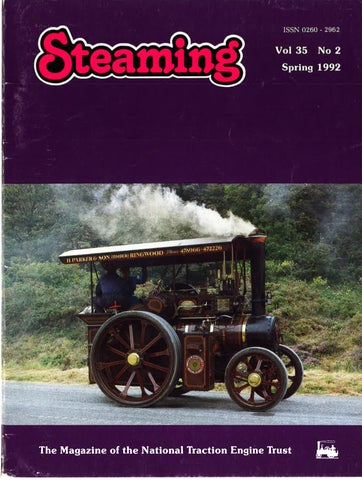
Cover Having taken water from the roadside stream at Porthtowan, Wallis & Steevens Oilbath tractor 7638 of 1919 builds up steam before tackling Engine Hill, the 1 in 6 climb to the top of the cliffs on the north Cornwall coast. The occasion was the West of England club's road run on the day before their 1990 rally weekend. (Roger West) 59
Trust News From the Chairman The Trust is fortunate in having so many willing and capable officers and committee members. Much work, taking a great many hours to accomplish, is undertaken by them; without their efforts our organisation would not run so smoothly, nor would so much be accomplished. On occasion we come to take some officers for granted and when they decide to retire, it comes as something of a shock. Chris Barber has been our Treasurer for many years, but has indicated that he now wishes to relinquish his appointment. He has given a great deal of service to the Trust and has been responsible for the financial and some company affairs, which has enabled us to keep our house in good order from this point of view. We shall miss him very much with his wise counsel and quiet professional manner: the thanks of all members are due to Chris for his ten years of excellent service. At the time I write these lines the Spring Rally Organisers Conference is about to be held; these are important meetings and enable rally organisers to get together to discuss problems of mutual interest, particularly those relating to legislation, which can affect so many of our activities these days. The Conferences and the Safety Seminars we have been holding are intended to bring to the notice of Rally Organisers and their Safety Officers the many requirements of the various Safety Regulations which now exist. As these words will appear in the Spring issue of Steaming, I would like to wish all our members a very pleasant rally season in 1992 be they engine owners, organising officials or merely attending the various events as spectators. Let us hope the weather is co-operative. (Eric Fillmore, chairman)
include an engine log in which owners can keep a record of all major repairs and maintenance as well as steaming details. The whole thing will soon be available in a loose leaf file, so that all engine details can be kept together. Although the Code may appear complex at first sight, it is hoped that it may reduce the anomalies in the present set-up and in certain cases, the inspector may be able to allow less frequent inspections. This has all become necessary due to recent legislation which requires owners to take responsibility for their own safety procedures in line with the trend for effective self-regulation. The law now requires that all fittings etc. which are subjected to steam pressure are included in the inspection. You are reminded that from now on most rallies will require an NTET disc as evidence of insurance. I would also remind owners that their engines should be equipped with an effective spark arrestor and scotch block. By the time you read this, our driving course will have taken place, on 11th and 12th April. We have had a good response so far with nearly thirty participants, quite a few of
whom are coming for the second time. (Michael Davies, chairman, Engine Owners sub-Committee). Lost Registration Numbers The steady trickle of applications to recover old registrations continues and the success rate is very encouraging. Although DVLC should inform me of an application's success, it does not always do so, and often the first I hear of the restoration of the old registration is a letter of thanks from the owner. I would like to take this opportunity of thanking those who have written to me; it is very pleasing to be instrumental in getting back the old numbers and especially to know that it is appreciated. It would be very helpful if members seeking to recover a registration number would either talk to me first, or follow the guidelines set out in the Winter 1990/91 Steaming. For those wishing to speak to me, my telephone number is 0420 472018. Please do not ring after 9.30pm and note that I am not available during the working day; it is my hobby too! I am aware that some people do not find official
NTET Coal Supplies The Trust has again arranged low priced coal for use by rally organisers, clubs or individual owners In association with Arscott Collieries, Coal Factors and Merchants, Gateway Chambers, 26 Castle Street, Shrewsbury SYI 2BJ
• • •
pre-packed 25kg plastic bags haulage can be arranged to any rally site ring John Watkiss on 0743 362482 to discuss your requirements and haulage cost, anywhere in Britain
DRY STEAM COAL (when available)
11 1 I .00 Engine Owners Column Engine Owners sub-Committee We have now agreed the draft of the Boiler Code of Practice. It will 60
per tonne ex Shrewsbury Bituminous also available Cash on collection or pre-payment Please order early to obtain supply of steam coal
forms very straightforward and I am only too pleased to help if I can. I would also like to remind applicants that the fee is £10 (E20 for nonmembers), and that your current membership card should be sent with the application. There is no need to include a stamped addressed envelope. Incomplete applications cause delays which can cause aggravation for the applicant and certainly makes unnecessary work for me. Please make sure that the application is supported by as much information as can be supplied. There must be a recent photograph to prove that the engine is ready for the road. If there is no old style log book, I require a photograph of the works plate so that the link with the index number being claimed can be substantiated. The most important requirement is that there must be a clearly established link between the vehicle and the registration number being claimed. If an old style log book is produced, little further documentation is needed to establish the claim except a recent photograph of the engine. However, the problems arise when there is no such document and it has to be clearly established that the engine did carry the number being sought. I rely heavily on Alan Duke, the Road Locomotive Society's Records Officer, being able to confirm the fact that the engine concerned did carry the index mark being claimed. This takes time and delay is bound to occur in the process. DVLC is taking a minimum of two weeks to process applications and some are taking much longer. There has been one case where a letter was lost in the post and this has caused a very long delay. Since the post is not totally reliable, if you do not hear within a reasonable time, then please telephone to ask what is happening. Please note: I am only able to deal with steam engine registrations. FBHVC The Federation of British Historic Vehicle Clubs continues to protect the interests of all preserved vehicle owners, particularly through the contacts with the European Commission. There has been very little to report of interest to steam engine owners, although I have found much to interest me at the two Committee meetings which have taken place since my election last year. The point that is most forcibly made is the sheer volume of paper generated by the European Commission. The Federation is a most important body in protecting the continued use of old vehicles and
From Alan Martin's Collection
56
Whilst the outline of Fowler ploughing engines is no doubt well known, an equally impressive product was offered by Aveling & Porter of Rochester, though the number built was by no means as great as that turned out from the Steam Plough Works at Leeds. My picture shows Aveling 6817 of 1909 (D01906), a 14hp slide valve compound and the right hand engine to its pair, Aveling 6818. They were owned in the late 1930s by B.N. and C.E. Smith of Guthram, Spalding, Lincolnshire. The driver has for the moment taken his attention from the cultivator, behind the engine, to the camera; he seems to be something of an artist in the stacking of his coal supply, which surely would have survived intact with only the most gentle progress along the head/and.
its value will increase as time goes by. However, the funds available to the Federation are being consumed more rapidly than they are being replaced, and any donations would be very gratefully received. (Peter Smart) From the Insurance Officer The new Rally Code of Practice has a section on Engine Insurance which requires the cover to be increased for Approved Rallies. If you Insure through the Trust Scheme by John Scott & Partners, this is automatically taken care of by the Insurers. However, there are a few engine owners who require NTET discs, and insure through other companies. Since I can only issue discs to the new requirements, will the small number of owners who wish to obtain a disc from me please also provide documentary evidence, apart from the usual papers, showing that their insurance includes cover in accordance with the following
extract from the Code: Insurance of Steam Engines and Boilers All engines and steam boilers attending rallies must be insured by a policy which includes Rally use as follows: (i1 Where such event takes place off the public road this policy must cover Public Liability in respect of Death, Personal Injury and Third Party Property damage with a limit on any one accident of not less than £1,000,000. Such policy must cover sparks and ashes claims up to at least £100,000 for any one accident. (ii) Where use on the public road is involved cover for Death of or Personal Injury to Third Parties must be unlimited in amount and Third Party Property damage must be covered for not less than £1,000,000 any accident. Such policy must cover sparks and ashes claims up to at least £100,000 any one accident. The following letter has been received from John Scott & Partners 61
(s‘
.40-4.' 4..
• • r: );-•
to answer a number of queries recently raised by members. Needless to say if you have queries with the Trust scheme please get in touch with them direct. 'John Scott & Partners Ltd — For several years John Scott & Partners have offered an insurance scheme for engine owners with a choice of cover at sensible levels of premium. We believe that, generally, the benefits of the scheme are appreciated by members, but there have been a number of queries as to the extent of use permitted. The use permitted is social domestic and pleasure, and the majority of engine owners are adequately covered by this description. However, 'rallies' are often specifically excluded by motor insurers, so we therefore add a clause (Clause 5 of the Steam Vehicle Amendment) which reads: 'Use at Steam Engine Rallies and similar functions organised by the National Traction Engine Trust or any other recognised club is covered by this insurance.' 62
,
'
_
17;
Aveling & Porter 6hp convertible traction engine 5800 Of 1905 and a well restored tar boiler pictured at the 1990 Dorset event. (Dick Blenkinsop) It is this clause which appears to have created doubt in the minds of some members and we have agreed a revised wording of this clause which we hope will reassure those people. The new wording reads: 'Pleasure use is extended to include both attendance at, and participation in, events at Steam Engine Rallies and similar functions organised by a) the NTET or similar recognised club. b) any other organisation, provided that they have arranged insurance to cover their liability for at least £500,000. We can also confirm that social domestic and pleasure use would include a 'rally' or gathering with no pre-arranged audience or attendance by the public, and also attendance at any rally not covered above for static display purposes only. If any member still has doubts about a particular event, an enquiry by letter or phone (see advert on rear
cover of any issue) to either Michael Chamberlin or James Campbell at John Scott & Partners will elicit a specific assurance, in writing if required, or, in exceptional cases, the reason why cover cannot be granted.'
Rally Organisers Column Rally sub-Committee Once again we prepare for the rally season, and I am pleased to report that forty events were represented at the two safety training seminars conducted at Grantham and at Swindon earlier this year. Delegates went home with renewed confidence to tackle the complexities of Environmental Health legislation and Electricity at Work, plus many other points. I am most grateful
to Tim Holt and Mike Garstang who conducted these seminars so expertly, drawing as they did on their professional knowledge, as well as their practical experience as rally organisers. My thanks also to John Cook and Robert Herring for organising the two events. Subject to demand we plan to run more of these training days next winter. Next is the nutty problem of coal! at the time of writing the situation regarding supply of Welsh coal in poor. British Coal have only one source and supplies here are limited. However, if you indicate your requirements early our coal merchant will be able to help. At the time of writing another private mine looks to hold much promise; presently this mine has no washery, but we are informed that one should be in service 'by early summer', thus enabling them to supply the graded products which we require. The new opencast at East Merthyr, which we had hoped last year would be our salvation for this year has not yet started production. There is an amendment to the Code of Practice, and a new page is being issued to correct page 8 in the Code, regarding the subject of children riding on engines. Please send a SAE to Sylvia Dudley for an amended page.
By the middle of April new signs will be available for use at rallies, These will be the general warning sign BEWARE OF MOVING VEHICLES, etc, and the prohibition sign KEEP OUT OF THIS ENCLOSURE. These signs will be produced in the correct colours and utilise the international logos to indicate the message they are intended to convey. They will be printed on plastic card similar to house for sale signs. Please see advert elsewhere for details. Artwork reproductions of the NTET Approved Rally logo (the triangle) are available free from Sylvia Dudley; please send a SAE to Sylvia for a copy. We ask all rally organisers who are running an approved event to use the logo as much as possible on publicity material to tell the public that the rally is being run under the safety Code. I hope you all have a successful rally season. (Andrew Semple, chairman, Rally sub-Committee)
Affiliated Clubs Notices for the renewal of Affiliation to the NTET for the coming
year were sent out with invitations to the Spring Conference. If your local club did not receive one, or wishes to receive further information of the arrangements, please write to me and I will answer your queries. The Trust committee is aware there are many involved in our hobby who belong to a local group but not to the NTET. We feel it would strengthen the Trust's bargaining power on matters of legislation, insurance and other related situations, if we knew the size of the Affiliate membership. To this end I would be grateful if club secretaries would let me know how many members they have within their clubs. (Sylvia Dudley, Vice Chairman)
NTEC Sales Sales Stands 1991 The sales stands visiting Approved Rallies in the early part of the coming season will be manned by Keith and Tracey Shakespeare and by Mick and Maureen Garrett. Later Ken and Edith Beeby will be joining in, attending some of the events later in the season. The following are the events where we plan to have NTEC Sales stands.
The Chatham Steam Restoration Company The Steam Centre, Slip 6, Historic Dockyard Telephone 0634 826555 or 726377 Chatham, Kent ME4 4TE
BOILER MAKERS and STEAM RESTORATION ENGINEERS New boilers — welded or riveted Repairs to any type of boiler Welding to ASME 9 Full machining service Models built — model boilers in copper or steel Canopies built in wood or steel We can supply stays, rivets, bolts, nuts, etc Tenders, smokeboxes, fireboxes, tubeplates, chimneys, firebars and castings all made to order Fowler BB1 boiler leaving Chatham in October 1991 — a 90% new boiler with new backhead, firebox, crownsheet, barrel and front tubeplate. (M. Staniforth)
63
May — Stoke Goldington (Mick and Maureen); Carrington (Keith and Tracey). June — Parham (Mick); Great Amwell (Keith); Berry Hill Park (Mick); Aberdeen (Mick); Banbury (Keith). July — Chiltern (Keith); Elvaston (Mick); Rempstone (Ken and Edith); Weeting (Keith)i; Upton-on-Severn (Keith); Cumbria (Mick). August — Knowl Hill (Keith); West of England (Keith )•; Fairford (Keith); Bishops Castle (Mick); Great Dorset Steam Fair (Keith and Mick)•. September — the remaining part of the Great Dorset Steam Fair; Malpas (Mick); Astwood Bank (Mick). The dates and further details of these rallies (some have been set down with their more popular names) appear in the Rally List supplement published in this issue. Events marked ■ will have the Trust's hospitality tent at them and our thanks go to the organisers of those events for allowing our sales stand to expand for the period of their shows, and enable us to offer more to members. At the end of September Keith and I will be giving up the sales stands and Keith will be resigning his post of National Sales Officer. Pressure of work has increased for both of us recently, with Keith having an internal change of job at his workplace and me now working more days a week, having passed my driving test. (Tracey Shakespeare)
Steam Apprentice Club As a result of the advertisement in the last issue of Steaming, I am pleased to welcome a new Editor for the SAC Magazine. Steph Gillett has already begun work with the material to hand and will have his first edition ready shortly. On his behalf may I ask you for contributions on any branch of our hobby to assist our work with the next generation engine drivers and enthusiasts. Steph's address is 93 Devon Road, Easton, Bristol BS5 6ED. I would like to record my thanks, for work carried out in the past, to former Editor David Hurley (who still plans to work with the Apprentices in other ways), and also to the other people who responded to the advertisement. Another big change concerns our method of dealing with SAC membership; it has been decided that we should hold this on the main Trust computer. John and Sue Cook (25 64
Ripon Drive, Sleaford, Lincs NG34 BUF) will handle the task in future and it will speed up the processing of renewals for members. General enquiries should be sent to me at the address inside the front cover. We have arranged an SAC training weekend for 25th/26th April at Fen Farm, Weeting, near Thetford, Norfolk. Members over 14 years of age are invited to contact me for further details of the event, which promises to be both interesting and informative. Richard Parrott, owner of Fen Farm and NTET vice president, has a wide range of activities planned with engines and other equipment. Unfortunately, we are at present unable to gain access to the existing membership records of the SAC (this will not happen when the records are on the computer, as a duplicate set can be kept seperately). We therefore ask SAC members who see this notice to send details of their full name, address, date of birth and membership number to me so that we can send the new issue of the Magazine. May I also ask any Trust member reading this to pass my request on to Apprentices they may know, so we can get back to normal operation as soon as possible. (Sylvia Dudley, SAC Chairman)
NTET Hospitality Tents 1992 Many of our members have been grateful to rest their weary feet and partake of tea or coffee at the Trust's tent over the past few years — and we are pleased to meet you and hear news or answer queries in person. The contact is a very worthwhile one. Plans are afoot for tents at Weeting and St Agnes rallies; if others are added to the list, they will be located next to the Trust's Sales Stand. Staffing the smaller units is up to a few people on many occasions and whilst it is tiring it is also enjoyable. However the additional days at the Great Dorset Steam Fair are posing problems and I am looking for volunteers to assist during this event for part of the time. Male or female volunteers will be welcome and you are invited to contact me as soon as possible to let me know when you could assist. This is an opportunity for members and/or their partners to meet other members and become more Involved In the Trust. Your services will be much appreciated, both by me and the people you meet during the time you are working with us. (Sylvia Dudley, Vice Chairman)
Poor Steaming The picture of the Pickering 'traction engine Derby' on page 48 of the last issue was wrongly attributed to the year 1953. It seems it shows the race on the second year it was run, in 1954. Vic Makey says Clayton & Shuttleworth traction OLD GLORY was being driven by Ernest Mortimer, a local and well respected engine driver. Out of sight, sitting in the bunker but bravely supporting the activities, was Mr Wardell, the owner of the field in which the first two 'Derbies' took place. We understand embryo plans are in hand to celebrate the 40th anniversary in 1993.
OUR MAGAZINE 25 YEARS AGO
The Spring of 1967 saw the Club address Itself to points of safety at rallies. The 33 repesentatives of 22 clubs at a conference of organisers in March had agreed that henceforth engines taking part in their events should have valid boiler inspection certificates and insurance cover. An illustration appeared in the magazine of the newly introduced NTEC insurance disc for display on engines, which it was hoped would gain wide recognition by owners and organisers alike. The theme of boiler safety -- at the time still considered an unnecessary subject for discussion or action by some owners it seems — was continued in a two and a half page article on 'Preparing for the Boiler Inspector' and then in a lengthy reproductinn of the report of a fatal boiler explosion. This concerned an 8hp Aveling of 1877 which exploded at Maidstone in Kent — 20 pages of Victorian detail relieved only by a few grotesque illustrations of the resulting twisted metal. Working engines mentioned included a pair of Fowlers dredging lakes and ponds in the Rivelin valley, west of Sheffield; work had been continuing on Saturdays and Sundays to keep up to schedule during the short daylight hours of winter. Torquay Corporation offered their Wallis Advance roller for sale by tender, the Borough Surveyor seemingly being under the impression it was a compound!
IMPORTANT INFORMATION FOR THOSE NEEDING ECONOMICAL REPAIRS ON THEIR TRACTION ENGINES
B. & C. Reconditioning (Gears) Ltd PINIONS
SPURS
BEVELS
All types and makes of bevel gears, spur pinions, spur wheels, helical gears etc rebuilt to standard
Our address is:
B & C Reconditioning (Gears) Ltd, off London Road, Amesbury, Wiltshire SP4 7EQ Telephone Amesbury (0980) 623210
65
Marshall Mike Jones of Ruthin, North Wales continues the story of his most thorough restoration of a 5 ton steam tractor, built in 1915. The first part of the account appeared in our Spring 1989 issue. Little or no work was done on the boiler of Marshall tractor 68754 between May 1988 and January 1991. This was due in no small part to the loss of, firstly, my brother, and then my father. My father had been interested in engineering and machines all his life and it is due to the purchase of a 1939 Austin Seven for family transport in 1954 that my interest in pre-war vehicles was first introduced. As time and circumstances permitted during this time small items were acquired, manufactured or sent for repair. In December 1988 an original brass Marshall circular cylinder end cover plate (low pressure) was purchased through Derek Kilburn of Worthing. These plates were only fitted to show engines and are therefore very scarce. A similar but smaller brass plate for the high pressure cylinder was cast from an original. These brass plates are fixed to the cast iron end cover plate which bolts onto the end of the cylinder block. February 1989 saw the delivery of the completed chimney with riveted seam and brass chimney top from Derek Kilburn's works at Worthing. This was delivered via a Sentinel Drivers Club meeting. The August bank holiday of that year was used to transport the tractor's differential gear to Ewan Jones at the Bishops Castle Rally. From here the diff would be transported to Ewan's home at St Mellons, Cardiff, where he would undertake repairs to the planetary gear wheel pins. The tender was taken from store during Christmas week 1989 and the process of dismantling all pipework, plates and brake gear commenced. On the side of the bunker, under the oval brass plate giving the firebox number, was found traces of the original paintwork and lining. This has been 66
5t on steam tractor
the only trace of the engine's original livery found remaining on the engine. When only the bare shell of the water tank and bunker remained this was removed to a local engineering works for removal of 53 rivets holding the manstand in place, and the manufacture of a new manstand. This, when fitted, was to be removable for ease of future access to the back tank. During late summer and early autumn 1990 the tender was taken to Millingtons at Whitchurch and shot blasted. A MASCOT nameplate for the engine was cast locally out of gunmetal and fitted to the smokebox assembly, which had been dismantled, derusted and primed ready for fitting to the boiler. Each weekend for the remainder of the year saw myself, son and daughter dismantling all easily removable items from the boiler. This was still sitting on its temporary home of a Howard manure spreader frame. Some considerable time was spent descaling the cylinder block, after removal of the lagging sheets. It was
68754
also surprising how hard coal dust, dirt and oil becomes when it is alternately heated and cooled over a period of seventy years. To improve mobility a slave rear axle for fitting to the firebox foundation ring was constructed. Eagle trailer wheels and stub axles were welded to a hefty U section channel. Two smaller U section channel offcuts were also obtained for welding to the U section axle channel below the ashpan location brackets on the firebox. These offcuts would then be drilled and the slave axle fitted to the boiler using substantial bolts. In the meantime some poplar wood was obtained to provide material for new rear wheel brake blocks. The engine on its trailer was brought from its place of external storage and parked in my back yard at home prior to its transportation to Millingtons at Whitchurch for shotblasting and rewheeling. The boiler together with the front axle and slave rear axle was delivered by low loader to Millingtons on 5th January 1991. The whole
Marshall 68754 had to spend much time until January 1991 aboard its trailer — an old Howard manure spreader chassis. (Mike Jones)
Instant engine. Great strides appeared to have been made on 19th January 1991, when the front end was fitted to the boiler. (Mike Jones)
operation was uneventful except when unloading the two axles, due to our forgetting to scotch the wheels, they nearly rolled off the trailer and could have injured someone. A fortnight later we were back at Millingtons with the smokebox and perch bracket in the trailer. The boiler was now a nice shade of green primer. Using a mobile crane the smokebox was fixed to the ring on the boiler using half a dozen bolts. The whole boiler was then lifted and the front axle assembly was connected to the turntable and perch bracket assembly. The slave rear axle was wheeled into place, the U section offcuts were bolted to the ashpan brackets and then allowed to sit on the U channel axle prior to welding in place. With the crane attachments removed, the transformation of boiler to something resembling an engine was complete. Everyone who witnessed the rewheeling of the boiler felt that a milestone had been passed on that day. The 19th January was also a red letter day in another sense. Ever since I bought the engine in 1969 I had been looking for a photograph of her as a tractor. Pete Gull had finally found such a picture in Major Henry Marshall's collection and arranged for a copy to be made. It was a pleasant co-incidence that the print arrived through the post on the day the engine became a tractor again. The old picture showed 68754 in steam in Coles' yard at Roxholme near Sleaford in 1919. She was obviously well looked after as the flywheel boss appears well burnished. The engine was brought home using a multi lift loader and was parked at the back of my home. Some further shot blasting of the boiler was under-
taken locally. Many of the remaining larger parts for the engine were also degreased and blasted at this time. With the coming of the spring a conscious decision was taken on my part to commence work from the front and work backwards. Hence, new bolts were purchased for bolting the smokebox ring to the boiler ring. The original nuts were used with the new bolts for modern nuts are smaller in
size than the originals and therefore do not look correct. Work then commenced on the cylinder block. Lagging fixing screws which had sheared in the block were drilled out and re-tapped. The trunk guides were removed one at a time, blasted, primed and painted and put back. The studs on the block were inspected and cleaned up using an appropriate die nut. John Glaze in the meantime had been contacted and asked to carry out a preliminary boiler inspection bearing in mind the fact that the engine would not be ready to steam for some considerable time. He came on 21st March and pronounced the boiler A 1; subsequently he took away the safety valves and governor for overhaul in his workshop. The blower valve and pipe, and the brass glands and plugs in the block were cleaned and burnished. The chimney was tried and fitted to the chimney base temporarily — how that improved the frontal view of the engine!
Marshall 68754 in steam at Coles' yard at Roxnolm, Sleaford, about 1919. It carries the engine's original registration BE2864 and has a well cared for finish judging by the burnished flywheel centre. The belly tank bears the inscription WTE (plus some other lettering beneath); can anyone explain the meaning? (collection Mike Jones, courtesy H.D. Marshall) 67
The repaired Marshall works plate for 68754 — the wording 5 TON had been chipped off, but the repair is now barely discernible. Note the makers' method of attaching the cylinder block to the boiler shell. (Mike Jones)
ow 6010
l
mo
• co
• tr
V
tiG-dif
CANNONS, tlfttilD Ai= 5 ION ---,id, tttiwVIP"' 114
"Mr e 41̀Wr
• M.
•L
S
—• • •
•
During the tractor's working life one of the brass works plates had had the words 5 TON deleted from the script, presumably to confuse highway surveyors in the engine's other life as a roller. Derek Kilburn managed to get the 5 TON script cast and machined and then soldered the script into place. It is now very difficult to detect the repair. Two other difficult jobs were the removal of two gib head keys from, firstly the wheel on the steering scroll shaft, and secondly the flywheel on the crankshaft. The first task was successfully done by welding a shaft (fitted with a weight which could slide up and down the shaft) onto the end of the key protruding. By knocking the weight onto a stop fitted to the end of the shaft the key was eventually prised loose from its keyway. The flywheel key was removed after much cursing, by gaining access to the rear of the flywheel and driving it out with a large sledge hammer and drift. The flywheel was then sent to Winson Engineering at Porthmadog for them to burnish the rim and boss. Transportation costs were kept to a minimum by using a local engineering suppliers pick up for delivery on one of its two weekly delivery runs to Gwynedd. Each year sees the holding of the Urdd National Eisteddfod here at Ruthin. With the engine now on wheels it was possible for it to be displayed and so it appeared behind a restored Fordson E27N tractor in the Proclamation Parade during the first week of May. The engine's next appearance was to be her rally debut at Much Marcie rally on 13/14th July. Between these two dates, however, much work was completed including the refitting of the refurbished 68
The Marshall tractor's first public outing — hauled by a Fordson tractor, the abbreviated engine joins in the Urdd Eisteddfod Proclamation Parade through Ruthin in May 1991. (Mike Jones)
The Much Marcie event in July 1991 saw the engine presented to rallygoers for the first time. Foden tractor 13762, standing alongside, provided motive power for parades. (Mike Jones)
regulator bracket and lever; the manufacture of a circular wooden mounting board for the pressure gauge; cleaning and overhaul the brass oilers to the trunk guides and valve rod guides and the overhaul and painting of the firehole door frame and mechanism. Also the cylinder lubricator oil valve on the cylinder block was refurbished. It is only when one starts on these jobs that the time involved in refurbishing a small item becomes apparent. All too soon the time came to despatch the engine to Much Marcie. This was done using a local haulier and his multi lift unit. The family had a very pleasant weekend at this rally. An added bonus was for myself and children to haul our engine in the grand parade using Andrew Semple's Ruston tractor. Our thanks go to Andrew for his kindness, also to Ewan Jones from Cardiff for hauling the engine about the rally field, and to the cider works for parking at the end of the weekend. From here the engine was to be low loaded directly to the Bishop's Castle rally. At the new rally venue John Phillips' Mann's tractor, John Heselwood's Aveling tractor and Will Dakin's Davey Paxman traction engine all towed our engine about the site. The restored safety valves, courtesy John Glaze, were refitted at the rally. The difference in condition from before to after restoration was quite remarkable. Will Dakin gave a superb display of engine handling when he loaded the Marshall onto the lorry body for transportation home. It is very difficult indeed to load or push any item with a turntable onto a body using the front of the engine hitched to the drawbar of the item being loaded. Very little has been put back onto the engine since it returned from Bishops Castle other then the belly tank, which has been fixed temporarily to the boiler for ease of storage and to provide a working platform. However
The Heyday of the Steam Wagon It is no exaggeration, I think, to state that in a walk before eight o'clock in the morning, say, from Paddington to Ludgate Hill — something of a stretch but useful excercise nevertheless! — no fewer than eight different makes of steam wagons are likely to be encountered, and some of the types quite a number of examples. They will be found at all kinds of work and not a few of them will be stationary either loading up or for
A backward view from Andrew Semple's Ruston tractor reveals the stark and spindly proportions of the stripped down machine. The large bracket to the top left of the hornplate is for the gear change lever and forks. The lamps are genuine Aveling & Porter items, acquired over 20 years ago. (Mike Jones)
work still continues. After locating locally a former tool maker, he has machined and refurbished the steering gear for the Marshall. He has also made a new valve layshaft using the
old one as a pattern. That then is progress to the end of 1991. I hope to be able to conclude the story of the restoration of Marshall 5 ton tractor 68754 in a year or so.
some other reason, and can with little difficulty be examined in detail. Here and there a driver — civil men they are, as a rule — will readily answer a question or two as to tne benaviour of his charge. In the [wartime] absence of exhibitions and Royal Shows, no more instructive display of the production of the steam wagon industry is likely to be found, I should imagine, than in the principal streets of the metropolis before breakfast, unless it be in Liverpool and Manchester and even there not in such wide variety. (from
one of the columns of editorial commentary in Commercial Motor, 7th March 1918.)
'The Oxford City Council has decided that a new scarifier must be purchased from the Oxford Steam Plough Co at a cost of £89, the sum of £5 being allowed for the present scarifier which is obsolete.' (from Roads and Road Construction, December 1924.) 69
EDMONDS on Engines
Chris Edmonds
Do you remember the days when a usual rally consisted of ten engines? If you do you are tapping on a bit, because you have to go back to the middle fifties to remember that sort of event. Time was of the essence then. Time to stand and stare and park your car (if you had one), and time to thoroughly look at each exhibit. Not so today. You can't really get round these enormous modern events and say that you have properly seen all. What you have done is simply observed. Nobody can really look at one hundred engines and assorted tackle in three days — three weeks maybe? I'm not saying that larger rallies are not good — I think they are, but in a very shallow and perfunctory way. Ten or fifteen years ago I gave up walking round Stourpaine — but I still go. So let's settle down, and be quiet for a moment and go back in time to the 1961 Chartridge rally run by the Chiltern Traction Engine Club on the small field in the village. Only ten engines, and let's have a look at mine — a Burrell single crank compound number 2426, built in 1901, new to Paxman's of Clifton Hampden. Now let's stop there while I tell you that back in 1901 Mr Paxman was so enthusiastic that he made the considerable rail journey to Thetford to witness the engine's erection. Look more at the details of the machine — a round front axle you will notice, denoting a Burrell of pre 1902 vintage. But then you may ask "What's that strap around the right hand side of the perch bracket?" Well, that's where Tommy Yeo, the driver for Wilders of Wallingford, the second owners, tried to pull the thresher out of a bad patch and broke the axle. Now, look at that lovely cast iron chimney! Isn't that beautiful — but if you have a look 70
round the back of it you will find a great big crack, suffered when it was struck by lightning whilst on a threshing job in the thirties. Do you notice anything unusual about the smokebox? Well have a good look at the photograph. The platework is five inches longer than Burrell's original and this was a Wilder speciality, with the chimney set back. Next let's look at the cylinder block and note the lovely 'old English' cast lettering on the side of the valve chests. The number 2426 was stamped on a tiny raised portion of the casting and was illegible when I first owned the engine, much different from the later cast brass plates that Burrell's used. Moving along again we see the crank is unbalanced, and note
how good that will be for livening up one's liver on a Sunday morning steam up after a heavy Saturday night! That's because if you look underneath you'll see the engine is mounted on giant helical springs and is able to bounce like a yo-yo! Look at that reversing lever and regulator and those sliding fire doors. They say Burrell was always a GWR fan and these latter features almost prove it, especially when you look at the shape of the bunker and compare it with the upper half of that on a GWR tank engine. I don't know how long it has taken you to read this but I can tell you that it's taken me half an hour to write. So ponder this: how many engines could you really look at in a day? jjj
G.A. Hopkins & Sons (Metal Spinners) Ltd Metal spinning, specialist chimney tops, lamp bezels etc IA. riDieur■
MIM I
Any original spinning reproduced in any material. Phone us for a quote.
Unit 2 Kenway, Brook St, Shepshed, Loughborough LE12 9RG Telephone 0509 502216 day, 504576 evening, 650008 fax
Walo's Swiss rolls Robert Verhoeven with additional information by Derek Rayner No, we haven't started a cookery page in the magazine and the title alludes not to an item of confectionery, but to the road construction firm Walo-Bertschinger of Zurich, Switzerland. They owned a total of twenty-three steam rollers during their working days, and the company currently retains an interest in some fourteen of these rollers, mostly exhibited on plinths at different Walo depots and other locations in Switzerland. In Schlieren, near Zurich, at the firm's headquarters, one engine is kept in a complete condition this being Aveling compound roller 5983 of 1906. It is housed in a shed along with a living van, tar boiler and tool cart and with a little work could be restored to steamable condition. This article, however, deals mainly with the unique type of steam roller produced for Walo as a result of them placing a contract in the early 1920s with the Winterthur engineering company, Schweizerische Lokomotive and Maschinenfabrik ISLAM, for a series of machines to their own design, only three of which were subsequently built. Today, two of these interesting rollers survive, one adjacent to the firm's works at Schlieren and a sister engine in the nearby village of Unterengstringen, located in the grounds of the local junior school. Neither of these rollers, unfortunately, is in working order, although the external condition of both is good, and they seem to lack few of their fittings. This is mainly due to the firm's extremely laudable attitude to its old rollers, for every five years or so each of them is removed from its plinth and taken back to the main workshops for an overhaul, a fresh coat of paint and a polish. After this, they are returned to their exhibition locations in various parts of Switzerland for another period on public display. Walo's standard livery for rollers is chocolate brown with red wheels and, of course, polished copper or brass where appropriate — making the whole a very attractively
The unusual outline of an SLM roller. Works number 4122 of 1924 is displayed on a plinth outside Walo's workshops at Schlieren, near Zurich. (Rob Verhoeven)
ai
A second SLM roller, 4142 of 1924, is set up in the grounds of a junior school at Unterengstringen, near Zurich. (Derek Rayner) 71
presented machine and certainly different to the usual green colour for rollers. SLM, the firm entrusted with the manufacture of the three locally built rollers was, and indeed still is, a famous railway locomotive building works — specialising, not surprisingly, in building locomotives for mountain rack railways and supplied those which work on the Snowdon Mountain Railway in North Wales. Thus, quite a few railway practices were to be found carried over into the design and construction of the rollers. The mounting of the boiler on top of a plate frame chassis, with the cylinders placed on either side of the frame and driving on to a crankshaft under the throatplate of the boiler is unusual for a roller. (It is, perhaps, reminiscent of the single cylinder traction engine made by Fisken Brothers of Leeds to the patented design of Mr Willisher of London, and exhibited at the 1878 Smithfield Show. One of these machines was later converted to a road roller and used in North Yorkshire until around 1914). The SLM roller design has two cylinders but is not compound. There is a steam dome, which is necessary because the cylinders are not at the highest point in the system, as is usual in road steam engine practice. The valve gear used is not the conventional Stephenson link but motion Heusinger's eccentric system. The SLM rollers have a heating surface of 91/2 square metres (102.25 sq ft), a working pressure of 12 atm (174 Ibs) and they weigh 13 tons. The rolling width is 1850mm .16ft 0 3 in1. They have no flywheel — in this respect they are similar to a Wallis & Steevens Advance. In the early days of use, the SLM rollers were perhaps surprisingly mainly employed as tractors for towing a trailed scarifier but after a time, they were used as conventional road rollers. The example remaining at Wale's Schlleren premises is SLM 4122, the Unterengstringen one being SLM 4142, Walo fleet numbers 24 and 25 respectively. Contrary to relatively recent reports, a visit to the various Walo premises in April 1991 revealed Wallis & Steevens roller 2451 at the company hospitality building near Schlieren station, but only Aveling 5983 in the firm's workshops area, with SLM 4122 plinthed up outside.
Neatly displayed at Walo's Restaurant in Rutistrasse in Schlieren is the former Wallis 2hp steam motor 2451, a Swiss roll since 1909. (R.A. Verhoeven) 72
WALO BERTSCHINGER: fleet list of known steam rollers fleet maker works built cylinders weight last reported location/date no no 1 Aveling 7615 1912 compound 12 tons Zurich, Schlieren, derelict 1989 despatched 7 May 1912 to Fritz Marti AG, Berne 3 Aveling 6288 1907 compound 14 tons Lausanne Ecublens (Schulhausplatzl, plinthed 1989 despatched 7 June 1907 to Fritz Marti AG, Berne with scarifier 864 4
Fowler 8581 1900 single 12 tons Lenzburg, plinthed 1991 D2 class, despatched to or by order of Magdeburg works
5 Aveling 6415 1907 compound 17 tons Zurich Schlieren (Schulhausplatz), 1989 to Paris Sales, 7 January 1908, from where bought by Pegny & Barthelemy of Puissaux 6
Aveling 4851 1901 single 14 tons Therwil (Werkhof), plinthed despatched 26 Septembr 1901 to H.H. Meyer (of?) for Riga, Russia
7
Fowler 12470 1910 single 14 tons Zurich Schlieren, derelict 1989 number doubtful as 12470 was a ZZS ploughing engine for Magdeburg. A check on the actual roller is required.
10
Fowler 15739 1923 single 9 tons T3 class new to W. Thiele, Geneva
20
Wallis 7882 1926 duplex 10 tons ? scrapped new to U. Ammann, Langethal (Wallis agents in Switzerland)
Zurich Schlieren, derelict 1989
23
SLM
4120
1924
duplex
13 tons
? scrapped
24
SLM
4122
1924
duplex
13 tons
Zurich Schlieren, plinthed 1991
25
SLM
4142
1924
duplex
13 tons
Zurich Unterengstringen (Schulhausplatzl, plinthed 1991
named LOKI 27 30
Wallis 8003 1929 10 tons Zurich Schlieren, derelict 1989 new to U. Ammann, Langenthal (Wallis agents in Switzerland) Aveling 10748 1923 single
8 tons
Zurich Schlieren, derelict 1989
type D, despatched 8 February 1924 to Jean Spinedi of ? 34
Wallis 2451 1899 single 9 tons named MARELI, see text for other history
35
Heilbronn 412W 1914 compound 14 tons Solothurn (Rotistrasse), plinthed 1989
Zurich Schlieren, plinthed 1991
36 Aveling 7042 1910 compound 14 tons ? scrapped despatched 12 April 7910 to Fritz Marti, Berne; fitted with governor, awning and scarifier 1042 40 Aveling 5983 1906 compound 15 tons Zurich Schlieren, derelict 1989 despatched 7 April 1906 to Jacob & Becker of Leipzig. This firm were agents for a considerable part of Europe, including Switzerland 43 Aveling 6738 1909 compound 14 tons Lugano (Casa Primavera), plinthed despatched 3 April 1909 to l'Etat de Neuchatel, No 2 50
Wallis 8083 1933 10 tons ? scrapped new to U. Ammann, Langenthal (Wallis agents in Switzerland)
The above details are taken from records in the writer's collection and from European Traction Engine Register, compiled by John Toy and Derek Rayner (1990). Additional information supplied by Alan Duke, Tony Olive, Peter Smart and MERL, Reading University. Intermediate fleet numbers in the above list were allocated to motor rollers manufactured by Steck; Ammann; Green; Kaeble; Springfield; Deutz and Barford & Perkins.
Details of the left hand cylinder and Huesinger valve gear on the SLM design. (R.A. Verhoeven)
After a pleasant riverside walk, SLM 4142 was found outside the school at Unterenstringen. A helpful employee gave directions to Lenzburg where Fowler 8581 in immaculate condition could be photographed at the side of the road, on the outskirts of the town. Time did not permit visits to other locations and nothing further was gleaned on the entry in European Traction Engine Register of other rollers at the Schlieren works, as the only English speaking person who knew the answer to these questions was on holiday on the day of the visit. Can any of our Swiss members, or any others speaking German and who visit Zurich, find out more for us? Mention must again be made of Wallis & Steevens roller 2451 because of its historic associations. It was originally built in 1898 as 2410, one of the first 3 ton Wallis steam motors; it may have been the prototype for there was not another similar engine recorded as being built until March 1901, and 2410 is noted in the Wallis records as being their yard engine, registration number AA38. On 11th February 1899, it was sent to Rebora Bros at Brig, Switzerland, having had its works number altered to 2451. It thus seems to be the earliest Wallis steam motor to remain extant, but why a firm in the very heart of the Swiss Alpine region should require such a lightweight steam tractor has not been established. Roller parts were supplied from Basingstoke to Switzerland in early 1909 and one assumes the motor was converted to a roller very shortly afterwards. Walo-Bertschinger has demonstrated a positive and very much appreciated attitude to the preservation of its past heritage in continuing the upkeep of its steam rollers. We hope that it may be extended to the restoration of one of the unique design of SLM rollers — a real Swiss Roll — into steamable condition once more, perhaps with the help of the locomotive firm itself or local enthusiasts. (The decidedly distinctive arrangement of the SLM rollers may, historically, owe something to the designs built by King & Co of Wollishofen, Zurich. Members may like to refer to illustrations of one of those rollers, with some notes, which appeared in the Summer 1987 issue of Steaming.)
-41
Fowler roller 8581 of 1900 is well presented at Lenzburg in the Walo livery of dark chocolate brown with red wheel spokes and polished brass — even though it is on roadside display. (Derek Rayner)
'Every Garrett wagon supplied bears our trade mark, affixed to the front of the drivers' cab in the form of a lioness about to spring. The whole attitude denotes strength, speed and silence, which is synonomous with the performance of the Garrett sixwheeler in everyday use.' (Garrett's boast in their advertising in the transport press in 1930.)
'Eleven new Aveling & Porter steam rollers and nine sleeping vans were purchased during the year at a cost of £12602,14s,0d (E12602.70) towards which the Ministry of Transport contributed one-third.' (from Roads and Road Construction, January 1924, reporting county surveyor W. H. Morgan in the Essex C.C. annual review) 73
Two Marshall portables It was mentioned in the last issue (page 9) that portable engines perhaps receive less than their fair share of recognition. Bob Walker of Renfrewshire kindly sends these two pictures of Marshall examples which will repay careful study. The engines are painted in flat grey paint for photographic purposes and that technique can be seen to be quite effective — the parts which were to be painted in colour, painted in black, or finished as bright
74
metal are quite clearly delineated and their image is well able to survive onto the printed page of a catalogue or whatever. It seems as though several shades of grey were used, from almost white for the lining, through a light colour to represent, say, green, to darker hues to show dark reds and black. Can any readers comment on this practice, or even claim to have witnessed a machine so painted? Virtually all makers spent what was presumably a not inconsiderable sum of money on painting and lining engines for photography, and they would, of course, all need repainting
RIVETS SIMPLY REMOVED It can be argued that the easiest way to remove rivet heads, prior to driving them free, is with an oxyacetelyne cutter. This is probably true — if you have both the equipment and the ability to use it in a clean wnrkmanlike manner. Another method to achieve the same result is to use a drill, electric or ratchet, but this requires first, either the removal of the head or a very accurate centring. It was the difficulty of this latter
hole saw
drill chuck if possible use original as opposed to formed head
completed work
always use a cutter of similar size to rivet shank; relying on head to self centre will result in this effect, thus aiding driving out of rivet
before sale, delivery or display. The identity of the two portables is not known. The large picture shows a 10hp machine of 1913. The single cylinder slide-valved engine was an export model and went to Kiev in Russia to the order of Smith (unless Marshalls' caption on the print 'as supplied to Smith' means it was like another of the same model that had been sent to Kiev.) Note the chain, shackled to the chimney top, which could be released after climbing atop the engine and used to haul the chimney to the vertical. The second, smaller portable is of
operation that led a friend of mine to think up an alternative way; having broken a quarter inch drill in the head he could not then drill out the rest of the head with the ratchet drill and the inner head was then the only option. After a bit of thought it was decided to attempt to remove that head with a hole saw, or tank cutter, depending on what you call them. The accompanying sketches should show the method quite clearly. Points to note that a hole saw of the type with a removable drill, such as Sarrett or Sandvic, should be used, with the drill removed so the saw will self-centre on the rivet head. After removal of the head, a shank of reduced diameter will be left and this will enable the rivet to be hammered out without too much 'mushrooming'. The main advantage of the method is that an ordinary low speed pistol drill can be used, thus minimising the risk of injury due to lifting a weight up to any height. I cannot say if foundation ring heads so treated could then be removed by hammering; it is quite possible they would still require drilling
'Little Hercules Sales. We learn that Mr A.E. Jackson, who was formerly with Wallis & Steevens Ltd of Basingstoke, has now taken over the post of representative in the South and West of England for Clayton and Shuttleworth Ltd of Lincoln in respect of tractors. We wish him every success.' (from Commercial Motor, 22nd August 1907. Despite the magazine's good wishes, Mr Jackson's endeavours do not seem to have materially altered the popularity of the Little Hercules model — Clayton's tractors never achieved the volume of sales of some other makers.)
6hp size for the home market, typically purchased for agricultural or sawmill use. It is 1918 built and its forecarriage is arranged for its most likely form of motive power — the horse. Whilst, apart from their size, most of the detail and finish on the engines is similar, the wheels differ. Was the construction of those on the export model, with the spokes formed into a loop and then riveted back to back and to the wheel tread, a more economical alternative to the rolled T-ring wheels of 6hp machine?
A rivet after removal of one head by using a hole saw. The intact end is original Burrell work! (Highwayman)
or cutting, but using a hole saw as described has been very successful used on the hornplate rivets of an 'angle iron crank pit' Burrell. (Highwayman)
Irjj
'Steam Roller for Bath — At Bath City Council a letter was read from the Ministry of Transport agreeing to
contribute £255 towards the cost of a roller. The City Surveyor submitted an estimate from Messrs Aveling & Porter Ltd for the supply thereof at £765 and the Council decided to obtain a 7 1/4 ton quick reversing steam road roller. (From Roads and Construction, June 1923. The roller purchased by the Council was Aveling 10586, an 0 type vertical hollered tandem. Delivered in May 1923, Avelings had to reboiler it in 1926 — the circumstances might be interesting to know.)
75
AVELING & PORTER'S COMPOUND ROAD LOCOMOTIVE. This is in most respects like the locomotive just described ; where it chiefly differs is in being fitted with high and low pressure cylinders. It will be noticed that the valve chests arc placed on the outside of both high and low pressure cylinders, admitting the use of larger valves and ports, giving much easier access for the steam, and very considerably increasing the power of the engine. The crank-shaft is o[ the best steel, cut from the solid ingot; the counter-shafts and driving axle are also of the best steel, and all of ample dimensions. The additional cost of the compound engine is not a seiiuus one, and is very soon repaid by the economy in fuel it ensures ; for in it the steam is used twice over, first in the high and afterwards in the low pressure cylinder, and is not discharged through the exhaust until its pressure has been reduced almost to that of the atmosphere itself. In other words, there is more duty got from the steam in a compound engine than in a single cylinder engine, for the same expenditure of fuel. Another advantage of the compound engine of great importance is that of its subduing the noise of the exhaust when at work ; for, perhaps, in no class of engine is silent working more essential than for a road locomotive, or a steam road roller, seeing that their use is chiefly in towns or on busy suburban roads. This comparative noiselessness is, of course, clue to the low pressure at which the steam is discharged into the atmosphere. The fittings and outfit are as already described on the previous page. AVEL1NG & PORTER, Limited, strongly recommend Road Locomotives mounted on their arrangement of laminated steel springs to hind and front axles, and consider that all hauling engines should be so fitted.
76
Some notes on Avelings compound road locomotives Aveling & Porter made a distinctive looking road engine at their Rochester, Kent works in the early years of the century and the design featured strongly in the sales catalogues of the time. These notes, by Derek Hattam, are prompted by a report of a survivor in Africa, but start with a description of one of these impressive machines.
The reproduction (opposite) of a page from Avelings' 1905 general catalogue is believed to be of works number 4789. The illustration was used widely — in the company's sales literature and contemporary books as a half-tone block, on catalogue covers as an engraving, and in 1902 it had appeared in a delightful, small colour brochure issued by the works. 4789 was completed in June 1901 and exhibited at the Hoyal Agricultural Society of England's Show at Cardiff. Later in the year, in December, it was shown again, this time at the Smithfield show and then apparently sold to F.C. Flower of Herefordshire. The machine was classified LCB, rated at 8hp and with cylinders 7in and 11 thin bore by 12in stroke, and working at 1801bs pressure, gave maximum continuous power at 150rpm. Three speeds more provided and the engine was mounted on laminated springs. It had a four shaft layout and the first three shafts were all carried in a single massive bracket on each hornplate. These engines had larger steam ports and valves than the earlier Aveling compounds which had valves over the top of the cylinders, but the motion retained the use of trunk guides. The brakes acted on the inside of the hind wheels, which had 18 spokes. There was no door, or access opening, in the tender. The lights were now carried on the smokebox. A steam pump was fitted in place of the usual mechanically driven type. These engines weighed 15 tons or more empty and were capable of handling a 25 ton load on good roads with a gradient of 1 in 12. Cost as fitted out was just over £800. In practice the engines were found
to be rather clumsy and perhaps too heavy; they had a reputation for not being the easiest to steam. (It is interesting to note that Aveling & Porter tended to use larger cylinders than on machines of similar size made
by most other makers. Consequently the engines used more steam.) On the home market the Rochester firm's most loyal haulage contractor was Edwin Colthup of Faversham, Kent. In all he had seven new road locomotives between November 1891 and March 1905. All but one were 8hp and three of these had compound cylinders with the outside valves. The odd one, new in 1907 was rated at 6hp and also had outside valves; although it was built as a road locomotive, Colthup had it altered when new to a convertible. A photograph exists — it has been published in A
In the 1909 sales catalogue Aveling & Porter depicted their 6hp road engine. All the 6hp compounds had the exhaust pipe entering the smokebox on the offside, whereas the 8hp (or larger) machines had it entering on the nearside. This applied to compounds with top valves or side valve cylinder blocks and is the easiest way of telling an engine's size from photographs — but it applies to traction engines and road locomotives only. (Welland Valley club collection)
Opposite — Aveling & Porter's presentation of their compound road locomotive in the 1905 general catalogue. (We/land Valley club collection) 77
Aveling 5037 of 1902 — one of Co/thugs fleet when new, pictured in the 1930s at the yard of the Wingham Engineering Co, Kent, in their ownership. (collection A/an Martin)
This near identical viewpoint of Aveling 4885 of 1901, rebuilt for a role in showland, makes interesting comparison with the above picture of 5037. The engine was photographed standing at Felsted, Essex in June 1957; note small, and low-sided, coal bunker and Aveling's arrangement for the drawbar on their road engines. (A/an Martin)
Kaleidoscope of Traction Engines (Whitehead) — of Colthup and his staff posed with four of the engines in the firm's yard. It must have been taken between 1908 and 1920 and shows the machines to be kept in immaculate condition. The engines were 6430 of 1907 PIONEER (the 6hp example); 4666 EMPRESS, new in 1900; 5698 of 1905 PRINCE OF WALES and 5037 KING EDWARD VII, a 1902 machine. Working as a haulage contractor, Colthup appears to have started up his business in the early 78
nineties in Faversham. It was a useful town to work from and in the centre of a large agricultural area. It had a small port, large breweries and a gunpowder works whilst to the west was all the industry of the Medway towns, and in the opposite direction was the county town of Canterbury and the spread of eastern Kent — all of which gave ample scope for a successful business. On their overseas market Aveling & Porter's best customer for road locomotives was an agent in Johannes-
burg, South Africa, who traded as Blane & Co Ltd. The firm took no less than eight compound road locomotives of Bhp in just over one year — numbers 4956, 4964, 5060, 5079, 5110, 5178, 5210 and 5230 (January 1902 to March 1903). All of these engines had outside valves and were very similar to the machines in Colthup's photograph, especially to 5037. Not much is known about the firm in South Africa but it appears that at least one engine was subsequently engaged in hauling machinery on the 250 mile journey from Tete on the Zambesi River, across virgin territory to the new Sasare gold mine which was being developed in the eastern province of what is now Zambia, just after the turn of the century. The mine is now disused but during its life, an ox wagon route was opened up to connect it with civilisation. Although Avelings produced 106 outside valved compound road locomotives of 8hp or more (45 of them were exported) as far as the writer was aware only one of all these great engines has survived to preservation. This is number 4885, new in December 1901 to the Admiralty at Chatham and named SAMSON. It was later, in different ownership and working days, converted to a showmans engine and is now in Cumbria. However! In an article that appeard in a preservation magazine The Automobile (June 1989 issue), there is a recent photograph of a road locomotive lying derelict, but seemingly in reasonable condition, which the writer of these notes was asked by a reader to identify. Although in the picture the wheels are missing, it is without any doubt an Aveling & Porter road loco and is certainly one of the eight such engines sent out to Blane & Co Ltd, as it carries their nameplate on it. Surely, this engine must be worthy of further investigation, with a view, if possible, to repatriation and restoration. Perhaps a syndicate of eager young enthusiasts might be the answer. It may well be a unique opportunity! I acknowledge the following in my quest for information for these notes: The Automobile (June 1989); Road Locomotive Society portfolios and engine records (per Alan Duke); W.S. Love; Aveling & Porter sales literature; Steam Carriages and Traction Engines (Fletcher) 1904.
srael Newton & Sons Ltd
I
boilermakers established in 1803
manufacturers of:
* locomotive type steam boilers of riveted or welded construction to BSS. Insurance company inspected. * Smokebox tubeplates, back heads, throat plates, new fireboxes, boiler retubing, welding repairs by coded welders. * Stockists of boiler tubes and rivets. * Industrial steam and hot water packaged boilers. * Hydraulic press work — dished and flanged ends.
,1,pi 111211111111111.1.525.
Summerley Iron Works, Idle, Bradford, West Yorkshire BDIO srr telephone 0274 612059
For further details contact
We specialise in the construction and repair of locomotive type boilers. Firebox construction can be of the traditional flanged and rivetted design, or flanged and welded. Construction is to the appropriate British Standard Specification and all welding is by coded welders to BS 4870. Work being done is approved at all stages by an engineering surveyor from your boiler insurance company. Construction of tubeplates, smokeboxes, tenders etc, also undertaken.
Roger Pridham, Hollybank, Chilsworthy Beam, Gunnislake, Cornwall. Telephone Tavistock (0822) 615276
wen LA BOILERMAKERS — BOILER REPAIR SPECIALISTS — BOILER PLANT ENGINEERS Craftsman built flanged and butt welded fireboxes complying with The Boiler Code BSS 2790' — made and fitted. All types of traditional high class boiler repairs
Farling Top, Cowling, Keighley, West Yorkshire BD22 ONW Tel: 0535 634674
Fax: 0535 636802 79
Up to date Electric Sports Cars on tour -
!Pr
80
Joe Seaton has kindly lent us photographs given to him by his brother Frank nearly fifty years ago. The engines were owned by showman Arthur Traylen of Earlsfield, Surrey and travelled various fairs around London and in particular that area about a dozen miles south and west of the capital. The scenes are from the early years of the war, when fairs were officially encouraged to provide entertainment for 'holidays at home', which were enforced by wartime travel restrictions. These circumstances, and the shortage of fuel for petrol lorries gave steam engines an Indian summer on many fairgrounds. The small snapshots probably date from 1941 and are thought to have been taken at Egham. They give brief glimpses of Foster showmans 14381 QUEEN MARY. The engine had been new as a road loco to Edward Edwards of Norwich in October 1919, and here it later acquired the index mark CL4318. Traylen acquired it about 1935 from dealer George Taylor of Redbourn, Hertfordshire, who had converted it for showman's use. The top photo shows QUEEN MARY standing at the edge of the tober alongside a small lake and surrounded by grazing cows; probably the engine was only used for hauling the loads between fairs at this particular time, and not for generating power or lights. Next we see a moment of relaxation for workers and family as the engine, coupled to its loads, waits for the ott. It is probably Arthur Traylen's son, George, with the baby. Notice the brightly polished brasswork and the workmanlike spark arrestor to the chimney. The canopy lettering reads UP TO DATE ELECTRIC SPORTS CARS ON TOUR. Once off the fairground there is a brief pause for a check round before setting off with the loads. The final snapshot shows a moment of consternation with a loaded trailer off the road and leaning over at an embarrassing angle. A Scammell tractor stands by to assist, but whether it is a steam engine off picture at the head of the train is not known. The top picture (opposite) shows Foster 14381 in more detail. Standing by the rear wheel are driver Frank Seaton and Father Greville, fairground enthusiast and one-time chaplain to the Showmans Guild. The scene is Uxbridge, on Saturday 7th May 1941. The picture shows well the working environment of a showmans engine at that time — coal heap to the right; cables from
the dynamo trailing from the front end and the engine kept nicely polished by its keeper. The name QUEEN MARY is painted on the front of the dynamo bracket and the engine appears to have three trailer C licences as well as its own, and its tax disc. Their location under the front of the canopy seems a canny place. Not many curious policemen would have been able to easily check their validity, so far from eye level and perhaps faded and smokestained — but they were displayed in an obvious position! Our last picture of QUEEN MARY (centre, right) shows it basking in the sun at Wanstead Flats fair at Easter 1939. The back of Joe Seaton's post card photo bears an interesting note by his brother, who it seems had only just finished attending to the rear wheels. Short lengths of rubber treads have been neatly but laboriously fixed on top of each strake — as Frank noted '38 strakes each wheel, 76 in all, 152 bolts, a whole winter's work to cut new strakes by hand, and drill all bolt holes by hand.' The final picture shows a Burrell 8hp owned by Traylen. Numbered 2576 it had been new in 1903 as a road locomotive, purchased by H.E. Blunt of Sholden, Deal, Kent. It was still in the same ownership in 1921 when the machine was issued with registration KE5879, but how and when Traylen came to own the Burrell is not known. By the late 1930s the name MARINA was painted on the dynamo bracket but whoever converted the engine for showland use didn't provide overmuch in the way of brasswork and the driver on the Burrell certainly wasn't able to keep the engine looking as well as its stablemate QUEEN MARY. The picture was taken at Mitcham in 1939 and it is probably owner Arthur Traylen, trilby on his head, on the footplate. MARINA is recalled by Alan Martin as maybe the noisiest engine on the road that he ever saw, due to its badly worn gearing. It was metaphorically flogged to death. Both Burrell 2576 and Foster 14381 went to Hardwicks yard at Ewell in June 1950 and there ended up as so many pieces of scrap metal. Frank Seaton said he could have bought one of them for £20. Traylen did have a third engine — Burrell 2633 of 1903, which, again, had started life as a road engine, this time in Exeter. After several owners it went to Earlsfield and showland in 1923 and then carried the name SHAMROCK. Although still around in 1942, its eventual fate is unknown. Joe Seaton has lots of boyhood memories of Traylen's engines — of helping to wash the hind wheels on 81
one of them as it generated alongside the main road at Hampton Court Fair and then, another time, hitting the top of his head on the side timbers of the canopy whilst climbing around the engine. Once, up on the footplate with brother Frank whilst the engine was generating, the governor belt broke and the engine began to race. The few lights under the canopy became brighter and brighter as Frank rushed
forward to pull back the regulator to reduce the speed. Then the engine had to be driven on the regulator until the belt could be repaired — they couldn't stop the ride and lose money! Frank drove both QUEEN MARY and MARINA. At times he would take one of them and its loads to the new site and then be driven back by car to bring the second engine and its load.
Minting Commemorative Plaques
Dorset Steam Fair, a Hazelwood & Dent drop hammer, made in Birmingham in 1889, was minting plaques for the event at the event. Saved from a breakers yard, Ted Frater of Wareham, Dorset, had restored the 11/2 ton machine and, most importantly, made it the first to be transportable. This required a rafted base to withstand the 100 tons of energy that the hammer produces and a rigid frame to support the cast iron hammer guides and raising mechanism. The interest shown since has resulted in a series of five plaques planned for 1992 called 'The Great Age of Steam'. Each one will be minted at a different rally and the group will comprise Burrell traction engine 4048, a Stanley steam car of 1911, Stephenson's ROCKET, a Boulton & Watt beam engine of 1777 and the paddle steamer WAVERLEY. They will be minted in the traditional 70/30 brass, and in copper gilding metal and silver. The mint has been invited to Almere in Holland in May, to near Krefeld in Germany in June, then at the Banbury, Weeting, Upton-uponSevern, Great Dorset and Astwood Bank rallies. Plaques will be available from NTET sales stands at these events. Further information on the plaques and the mint can be obtained from E.V. Frater, Threshers Heath Cottage, Wytch, near Corfe Castle, Wareham, Dorset BH2O 5JR.
Commemorative plaques for exhibitors have become an established part of the rally scene. Introduced in the 1950s, shortly after the beginnings of rallying, they could now be a basis for an historical survey in their own right. There are basically three ways to make plaques. The oldest method is casting, using molten metal — some good examples have been done by the Upton-upon-Severn organisers. The latest way has been by using photoresist acid etch printing — that lends itself to modern production methods, but is noted for its cheap appearance and poor artistic qualities. The third method is the minting technique. This requires a model, usually in wax, which is an illustration of the original subject. From this a resin negative is cast; this is the master pattern from which the negative tool die is cut. This is done on a three dimensional die sinking machine and is a specialised skill. The dies are then hardened and can be used on a variety of minting machines. The method has its origins in the skills of coin making and will give very good results. In 1990 a new development in rally plaque making was seen. At the Great
'Dear Sir, Mr Small, I am writing to say you have got to go on with the job but I want you to do it as reasonable as you can as you know things are very bad as I've already arranged with you to take engine all apart and put a new fire box in new tubes and a new back plate, outside boiler plate for the sum of £50. As soon as you have got the WHITE ROSE ready to go back together I would like to see her and if you want any help we have got family of men to assist you, Yours truly, Mr Chas Heal.' (A letter dated 10th February 1933 to The Avonside Engine Co, railway loco builders of Bristol — in mentioning to the firm that his family might be available as free labour, Mr Heal clearly had to make every suggestion to keep down his costs in the hard times of the 1.930s depression. The engine being attended to at Avonsides was Burrell 2804 of 1906, an 8hp showmans road loco named THE WHITE ROSE OF YORK. Michael Lane in his book, The Burrell Showmans Road Locomotive records that in the late 1920s Anderton & Rowland, by then owners of THE WHITE ROSE, tried to fit rubbers to the 7 foot diameter hind wheels but finding insufficient clearance between the wheel rims and the flywheel boss, abandoned the project and later sold the engine to Charles Heal. Perhaps the boiler also needed attention and that is why Heal, of Argus Road, Bedminster, Bristol, had the machine at Avonsides works early in 1933. We can presume he or Avonside were solving the problem of rubbering the back wheels for Heal's suitably flamboyant notepaper (The Leading Amusement Caterers... illuminated at dusk by thousands of coloured lights) boasted 'All wheels connected with conveyances are 6 inch in width, with Rubber Tyres, thus obviating any damage to turf or grass in parks, fields or on lawns.' Burrell 2804 subsequently passed to the ownership of Pat Collins, renamed THE GRIFFIN. It survives in preservation in the collection of Bill Hunt at Oldbury, West Midlands.)
'The Llandudno Urban District Council considered tenders for the repair of the steam road roller, and also for the supply of a new steam roller and decided to accept the tender of Messrs Wallis & Steevens of Basingstoke, for the supply of a new 10 ton roller at the sum of £792, provided the firm will take over the old roller in exchange, and allow therefore a sum of £300.' (from Roads and Road Construction, December 1924.) 82
•i
Fosters favoured 'War Office Tractors. Messrs Foster Ltd of Lincoln are supplying six light tractors to the War Office and this is very fair percentage out of an order of ten which was recently placed. In this type of military tractor they have introduced special compensating levers on the back axle. The levers are supported by a powerful laminated spring. The engine is of the compound type, and the boiler is of the tubular locomotive type. It is hardly necessary to add that the road tests have been hugely satisfactory, otherwise it is not likely that Messrs Foster would be favoured with so large a percentage of a Government order.' (from The Worlds' Carriers, December 1906. Alan Duke kindly provides the works numbers of these Wellington tractors as 3275, 3323 and 3324 of November 1906 and 3341 to 3343 of December 1906. Their Army history, like many a War Office purchase, is not well documented. The above photo (from Foster's catalogue) shows one of the six undergoing a test by the War Office Mechanical Transport Committee on a gradient of 1 in 9. The high level tanks lettered A.S.C. No 38 (Army Service Corps) were referred to
as saddle water tanks by Fosters and provided for a range of 30 miles. The 'Improved Patent Spring-mounting Arrangement' was claimed to ensure absolute simultaneous and equal vertical movement of the hind axle bearings. The engine's weight was carried by the single laminated spring a, having a large number of thin and broad leaves giving it great elasticity. The ends of the spring bear up against the axle boxes b which are fitted into the hornplate c, whilst the buckle of the spring a rests on a pair of compensating levers d. The outer ends of
these levers bear against the axle boxes b. The compensating levers and the spring are both supported by the beam e to which are connected the axle bearings f by means of . the adjusting bolts g. Thus any wear taking place in any of the parts can be compensated for by tightening the bolts and bringing the axle back to its correct position. Whatever the makers thought of that arrangement, later Wellington tractors had the rear springing in a position above the axle, thus lowering the centre of gravity of the machine.) 83
HEROIC EFFORTS These two pictures of a showmans engine at the unusual task of using its car crane for timber loading and of hauling timber are kindly sent by Harry Lee. The scene, not surprisingly, is sometime between 1914 and 1918 during World War 1, and the engine is Fowler class R2 compound 11127 HERO. It had been new in March 1908 to W.H. Marshall of Bradford for use with his cinema show, but the haulage job was probably not a one off task, for the trouble has been taken to remove the dynamo from its bracket and the canopy reads HAULAGE CONTRACTORS. The trailer being used is the car truck built for transporting four switchback cars of W.H. Marshall's Savage-built motor car ride — W.H. is on the engine in this photograph and Goldthorpe Marshall by the side of the trailer. HERO passed to H. Waddington for use with his steam yachts in 1932 and was sold for scrap in 1947 for the princely sum of £10, but the Feast crane was salvaged and retained by Harry Lee for fitting to the AEC Matador tractor he was to use with his ex Waddington yachts — and there the fitting still is.
Fowler gathering We apologise for an error in the advance Rally List 1992, published in the last issue, where the date for the Carrington Rally in Lincolnshire was shown incorrectly. The date is, in fact, the Spring Bank Holiday weekend, 24/25th May and the rally this year has an added attraction to enthusiasts with the staging as a special feature of a gathering of Fowler products. It is hoped to have a good cross section of machines made at the Steam Plough Works at Leeds — a selection of most types of road steam engine, and of ploughs, implements and diesel crawler tractors. It is hoped to make it the best exhibition of Fowler machinery ever assembled at a rally. Interested exhibitors should contact Roy Jermey, c/o R.H. Crawford & Son, Frithville, Boston, Lincolnshire PE22 7DU la 0205 750367).
'5 ton Coulthard, steel tyres, fitted with new Sentinel boiler two years ago, to be sold cheap, ready for immediate work. Box 3005.' (from 14th March Commercial Motor, 1918.1 84
Highland Steamboat Holidays Cruise the beautiful sealochs and canals of Scotland in an original coal: tired Clyde Puffer. Good _food, comfortable accommodation. r.r:, •
l•
Send large SAE for free brochure to Rachel and Nick Walker, The Change House, Crinan Ferry, Lochgdphead, Argyll PA31 8QH (Tel 054 65 232).
12 and 13 — Blackpool Steam and Transport Spectacular, Blackpool Airport, Lancashire (about 25 engines expected). M. Smith, The Ranch House, Bombers Lane, Marton Moss, Blackpool, Lancashire, FY4 5LQ.
19 and 20 — Roxton Rally, Roxton Park (A428/A1), near Bedford (about 60 engines expected). P. Worby, Park Farm, Old Arlesey Road, Henlow, Bedfordshire SG16 6DF.
26 and 27 — Essex Steam Rally, Barleylands Farm, Billericay, Essex (about 70 engines expected). Mrs P. Philpot, Barleylands Farm, Billericay, Essex CM11 2UD.
26 and 27 — Astwood Bank Steam Party, SandhiIls Farm, Astwood Bank, near Redditch, Worcestershire (about 20 engines expected), Keith Shakespeare, 138 Shaw Lane, Stoke Prior, Bromsgrove B60 4DZ.
26 and 27 — Old Tyme Farming and Vintage Raly, Alphington, Exeter (about 7 engines expected). T. Yelland, Headway Farm, Dawlish Road, Alphington, Exeter EX2 8XW.
Rallies Approved by the National Traction Engine Trust
October 24 and 25 — Newark and Notts Steam and Organ Festival, Winthorpe Showground, Newark, Nottinghamshire (about 20 engines expected). D. Hoyles, 81 Westwick Road, Bilborough, Notts NG8 4HB.
Further general details of the Trust, and membership application forms are available from: The Membership Secretary, John Cook, 25 Ripon Drive, Sleaford, Lincolnshire NG34 8UF
Additional copies of this list can be obtained from Tony Fookes, Spent Penny Farm, Craigs Lane, Mount Bures, Colchester, Essex CO8 5AP on his receipt of your SAE plus 24p in stamps per copy.
Approved Rallies The organisers of all these events have undertaken to conduct them in accordance with the recommendations contained in the National Traction Engine Trust's Code of Practice. This code is designed to promote the interests of rally organisers and the public by encouraging high standards of entertainment and organisation, and particularly, furthering all aspects of safety affecting visitors or exhibitors alike. The List The title of each event is followed by a brief description of the location or venue and the organiser's address. The number of engines expected to attend is offered for guidance, but must not be taken as a guarantee — rallying vintage steam engines can be fraught with problems. Most events feature other vintage vehicles as well as steam engines. The information is given in good faith and is correct at the time of publication and the NTET cannot be held responsible for subsequent variations. If you are in doubt, it is suggested you confirm arrangements with the organiser concerned. The Approved Rally symbol
1st April 1992 ©This list is the property of the National Traction Engine Trust and shall not be reproduced whole or in part, without prior permission.
Published by the National Traction Engine Trust
23 to 25 — Cuckoo Fayre, A27/A259, Pevensey, Sussex (about 15 engines expected). D. Antiss, Elmsfield,
Saltmarsh Lane, Hailsham, Sussex BN27 2RG. 24 and 25 — Carrington Rally, near Boston, Lincolnshire (about 30 engines expected). H. Epton, Medlam Avenue,
Carrington, near Boston, Lincolnshire PE22 7HX. 25 — Market Drayton Town Carnival and Steam Parade, Shropshire (about 8 engines expected). C.J. Smith, 42 WaIkmill Road, Market Drayton, Shropshire
TF9 1JZ.
April 18 — Avoncroft Steam Rally, Museum of Buildings, Stoke Prior, Bromsgrove, Worcestershire (about 6 engines expected). K.D. Shakespeare, 138 Shaw Lane, Stoke
Prior, Bromsgrove, Worcs 860 4DZ.
June 6 and 7 — Wymondley Rally, Little Wymondley, near Hitchin, Hertfordshire (about 60 engines expected). J. Saunders, 6 Carters Way, Arlesey, Hitchin,
Hertfordshire SG15 6UG. 6 and 7 — Nostalgia Weekend, Lydiard Country Park, Lydiard Tregoze, Swindon, Wiltshire (about 10 engines expected). J. Bond, 56 Pavenhill, Purton, Swindon,
Wiltshire SN5 9BZ.
May 2 to 4 — May Day Steam, Abbotsfleld Park, Flixton, Manchester (about 15 engines expected). G. Coles,
18 Braemar Avenue, Stretford, Manchester M32 9NA. 2 to 4 — Transport Cavalcade and Country Show, Higham Ferrers, Northants (about 20 engines expected).
R. Woodcock, 30 Griffith Street, Rushden, Northants NN10 ORL 9 and 10 — Stoke Golding-ton and Gayhurst Rally, Stoke Goldington, near Newport Pagnell, Buckinghamshire (about 20 engines expected). D. Jones, 12 High Street,
Stoke Goldington, Milton Keynes, Buckinghamshire MK16 8NR.
6 and 7 — Manchester Steam Spectacular, Heaton Park, Manchester (about 35 engines expected). S. Boak, 21 Market Place, Pickering, North Yorkshire Y018 7AE. 13 and 14 — Great Amwell Steam Rally, A10/A414, Great Amwell, Ware, Hertfordshire (about 35 engines expected). P. Haynes, Myddleton Lodge, Yewlands, Hoddesdon, Herts EN11 BDF. 13 and 14 — South Tyne Traction Engine Society Rally, Tynedale Park, Corbridge, Hexham, Northumberland (about 10 engines expected). Mrs A. Burns, Tyne
View Road, Haltwhistle, Northumberland NE9 9JQ. 13 and 14 — Stoke Row Steam Fair and Rally, Nuffield, near Henley-on-Thames, Oxfordshire (about 12 engines expected). M. Robins, The Grove, Stoke Row,
Henley-on-Thames, Oxon RG9 5QC.
10 — Birmingham Museum Traction Engine Rally, Newhall St, Birmingham (about 30 engines expected). Miss J. Baldock, Birmingham Museums and Art Galleries,
13 and 14 — Parham Steam Rally, Parham Park, A283 Storrington, West Sussex (about 30 engines expected). P. Read, 17 Old Mill Square, Storrington,
Newhall Street, Birmingham B3 1RZ.
West Sussex RH2O 4NQ.
16 and 17 — Old Glory Steam Festival '92, Stallington, off A16 near Stamford, Lincolnshire (about 35 engines). Rallyscene, Unit 2, West Street, Stamford
13 and 14 — Country Fair and Vintage Gathering, Pewsey, near Marlborough, Wiltshire (about 15 engines expected). Mrs J. Tilling, Springfield Cottage, Grafton
PE9 2PT.
Road, Burli)age, Wiltshire SN8 3AP.
23 to 25 — Frocester Manor Steam and Vintage Vehicle Working, near Eastington (junc 13, M5), Gloucestershire (about 15 engines expected). P. Prosser,
20 and 21 — Claybrooke Vintage Rally, High Cross, Claybrooke, Leicestershire (about 10 engines expected).
2 Bodium Avenue, Tuffley, Gloucestershire. 23 to 25 — Leeds Steam Spectacular, Temple Newsam, off A63 near Leeds (about 35 engines expected). S. Boak, 21 Market Place, Pickering, North Yorkshire Y018 7AE.
M.F. Perkin, 2 School Lane, Shuttington, Tamworth, Staffs B79 ODX. 20 and 21 — Berry Hill Park Rally, Berry Hill Lane„ Mansfield, Notts (about 20 engines expected). G. Mellors,
77 Davies Avenue, Sutton-in-Ashfield, Nottinghamshire NG17 2BL.
26 to 28 — Nottingham Steam and Country Rally, Wollaton Park, Nottingham (about 15 engines expected). D. Hoyles, 81 Westwick Road, Bi!borough, Nottingham NG8 4HB.
27 and 28 — Banbury Steam Society Rally, Bloxham, near Banbury, Oxon (about 50 engines expected). B.A. Wells, 129 Main Road, Middleton Cheney, Banbury, Oxfordshire OX17 2PW.
CAOIIT FIALL.Lorworo.w.,4
27 and 28 — Bath Steam and Vintage Festival, Lansdown Playing Fields, Bath, Somerset (about 10 engines expected) A. Billett, 25 Westerleigh Road, Combe Down, Bath, Somerset BA2 5JE.
27 and 28 — Bon Accord Steam Festival, Hazelhead, Aberdeen (about 20 engines expected). Guy Bentinck, Burgh House, 7-9 King Street, Aberdeen AB2 3AA.
11 and 12 — Ardingly Vintage Vehicle Show, South of England Showground, Ardingly, West Sussex (about 15 engines expected). Mrc A. Frampton, 32 Brownfeaf Road, Woodingdean, Brighton BN2 6LB. 17 to 19 — Weeting Steam Engine Rally, Weeting, Brandon, Suffolk (about 60 engines expected). R.N. Parrott, Fengate Farm, Weeting, Brandon, Suffolk IP27 OQF.
July
18 and 19 — Woodcote Vintage Transport Rally, Goring Heath, near Reading, Berkshire (about 20 engines expected). G. Noble, 32 Bridle Path, Woodcote, Reading,
4 and 5 — Heddington and Stockley Steam Rally, Heddington, near Caine, Wiltshire (about 25 engines expected). G. Hyde, 34 Goatacre, Caine, Wiltshire
Berkshire RG8 OSE.
SN11 9JE.
Birchall, Pixley, Ledbury, Herefordshire HR8 2RL.
4 and 5 — The Chiltern Rally, The Hangings, Prestwood, Great Missenden, Buckinghamshire (about 50 engines expected). P.B Honour, 'Cambrar, Lodge Lane,
18 and 19 — Somerset Traction Engine Club Rally, Lowham, Langport, Somerset (about 18 engines expected). 0. Slade, Heddon Mills Farm, Braunton,
Little Chalfont, Buckinghamshire HP8 4AJ.
North Devon EX33 1HQ.
4 and 5 — 25th Bromyard Gala, Stoke Lacy (A465), Bromyard, Herefordshire (about 30 engines expected). J. Wilkins, Chactonbury, Pencombe Road, Bromyard,
18 and 19 — The Downs Rally, Hartling, West Sussex (about 20 engines expected). and J. Dean, 33 Chalk
Herefordshire HR7 4SS.
4 and 5 — Elvaston Castle Steam NI Transport Rally, Country Park, Borrowash, Derby (about 40 engines expected). Mrs E. Renshaw, 21 Windsor Drive, Spondon, Derby DE2 7DR. 4 and 5 — Hollowell Steam and Heavy Horse Show,
near Northampton (about 30 engines expected). A. Eaton, Brickle House, Hollowell Road, Creaton, Northants NN6 8NU.
4 and 5 — Gatwick Vintage and Country Show, Balcombe Road, Crawley, Sussex (about 15 engines expected). A. Urben, Dower Walk, Gossops Green, Crawley, Sussex RH11 8EN.
11 and 12 — Rempstone Steam and Country Show, Wymeswold, Loughborough, Leicestershire (about 30 engines expected). S. Price, 58 West Leake Road, East Leake, Loughborough LE12 6LJ. 11 and 12 — Ashville Vintage Rally, Collon, Co. Louth, Eire (about 10 engines expected). G. Doherty, Artoney, Lough Village, Dundalk, Co. Louth, Eire.
18 and 19 — Marcie Steam Rally, near Ledbury, Herefordshire (about 25 engines expected). T. Chester,
Lane, Sidlesham, Chichester, West Sussex P020 7LW.
24 to 26 — Netley Marsh Steam Rally, Meadowmead Farm, Netley Marsh, Southampton (about 25 engines expected). B. Vokes, The Retreat, Pranks Green, March wood, Southampton SO4 4WQ. 25 and 26 — Cumbria Steam Gathering, Cark Airfield, Flookburgh, Grange-over-Sands, Cumbria (about 20 engines expected). T.P. Holt, South View, Hutton Roof, via Carnjorth, Lancashire LA6 2PF.
25 and 26 — Upton-on-Severn Steam Engine Rally, RyaIls Court Farm, Upton-on-Severn, Worcestershire (about 50 engines expected). D.A. Prout, Old Forge Garage, Dymock, Gloucestershire GL18 2AF. 25 and 26 — Rushmoor Steam and Vintage Show, Rushmoor Arena, Aldershot, Hampshire (about 45 engines expected). J. Wade, Box 1232, Andover, Hampshire SP11 6NH.
29 to 2 August — The Great Somerset County Fair, Wincanton, Somerset (about 75 engines expected), J.A. Pretlove, Unit 2, West Street, Stamford, Lincolnshire PE9 2PT.
August 1 and 2 — Redhill Steam Rally, Kings Mill Lane, Redhill (Junc 8, M25), Surrey (about 35 engines expected). 2 The Engine Shed, Robins Cook Farm, Kings Mill Lane, Redhill, Surrey RH6 7NN. 1 and 2 — Great Bucks Steam Working, Oakley Road, Worminghall, near Aylesbury, Bucks (about 25 engines expected). S.J. Parrott, Cherry Cottage, Crendon Road, Shabbington, Bucks HP18 9HE. 1 and 2 — Cornish Traction Preservation Club Working Rally, St Columb, Cornwall (about 25 engines expected). M.K. Lee, Gainsborough Park, Foxhole, St Austell, Cornwall PL26 7UW. 8 and 9 — Knowl Hill Steam Rally, A4 near Maidenhead, Berkshire (about 50 engines expected). Mrs S. Baker, Bramble Cottage, Star Lane, Knowl Hill, Reading, Berkshire RG10 9XY. 8 and 9 — Driffield Steam and Vintage Rally, Driffield Showfield, North Yorkshire (about 35 engines expected). Mrs C. Hebblewhite, 22 Wilbert Grove, Beverley, Humberside HU17 OAN. 8 and 9 — Cadeby Steam and Country Fair, Cadeby (A447 north of Hinckley), Leicestershire (about 15 engines expected). Mrs J.A. Boston, The Old Rectory, Cadeby, Nuneaton, Warwickshire CV13 OAS. 14 to 16 — West of England Steam Engine Society's Rally, Tywarnhayle Farm, St Agnes, Cornwall (about 40 engines expected). Mrs K. Hicks, 40 Foxglove Cottage, Halvasso, Mabe, Penhryn, Cornwall TRIO 6BY. 15 and 16 — Rudgwick Steam & Vintage Show, Rudgewick Showground, Horsham, West Sussex (about 22 engines expected). T. Hand, Windacres Barn, Rudgwick, West Sussex RH12 3EG. 22 and 23 — Fairford Steam Rally, A417, Fairford, near Cirencester, Gloucestershire (about 30 engines expected). Mrs J.R. Yells, Ivy Villa, Cirencester Road, Fairford, Glos GL7 4BS. 22 and 23 — Knepp Castle Country Show and Rally, A272, West Grinstead, near Horsham, West Sussex (about 20 engines expected). P. Read, 17 Old Mill Square, Storrington, West Sussex RH2O 4NQ. 28 to 31 — Island Steam Extravaganza, Havenstreet Railway Station, near Ryde, Isle of Wight (about 15 engines expected). B. Degan, Railway Station, Havenstreet, Isle of Wight P043 4DS. 29 and 31 — Town and Country Festival, Royal Showground, Stoneleigh, Kenilworth, Warwickshire (about 10 engines expected). T.R. Daw, RASE, Royal Showground, Stoneleigh, Kenilworth, Works CV8 2LZ, 29 to 31 — Harewood Steam Rally, Harewood House (Leeds-Harrogate road), near Leeds, Yorkshire (about 30 engines expected). N. Boyes, 'Islay', Lancaster Road, Knott-End-on-Sea, Blackpool, Lancashire FY6 ODU.
29 to 31 — Liskeard Steam and Vintage Rally, Merrymeet, Liskeard, Cornwall (about 25 engines expected). L.C. Baker, 15 Pengover Green, Pengover, Liskeard, Cornwall PL14 3NH. 30 and 31 — Chapeltown Barton Traction Engine Rally, Chapeltown Barton, near Barnstaple, Devon (about 15 engines expected). A. Yelland, Headway Farm, Dawlish Road, Alphington, Exeter, Devon EX2 8XW. 30 and 31 — Bishop's Castle Rally, Walcot Park, near Bishop's Castle, Shropshire (about 40 engines expected). D. Whitefoot, Bronte Cottage, Lydbury Heath, Shropshire SY7 8BA. 29 to 5 September — The Great Dorset Steam Fair, South Down, Tarrant Hinton, Blandford, Dorset (about 150 engines expected). M.F. Oliver, Dairy Mead, Child Okeford, Blandford, Dorset DT11 8HD.
September 5 and 6 — 1st Milford Steam Rally, Milford, Lifton, near Launceston, Devon (about 20 engines expected). R.J. Sandercock, Stoke Climsland, Callington, Cornwall PL17 8PD. 5 and 6 — Waddesdon Steam Working Rally, Waddesdon, near Aylesbury, Buckinghamshire (about 25 engines expected). T.J. Petty, 1 Southbank Road, Northchurch, Berkhamsted, Hertfordshire HP4 ILL. 12 and 13 — Haddenham Steam Rally, A1421, Haddenham, Cambridgeshire (about 35 engines expected). Mrs D.M. Young, Darkin, Meadow Lane, Earith, Huntingdon, Combs PE17 3QG. 12 and 13 — Malpas Yesteryear Rally, Hampton Old Hall, Malpas, Cheshire (about 25 engines expected). Mrs P. Williams, Lees Farm, Willington, Malpas, Cheshire SY14 7LD. (continued page 8)
At one time there was a large number of steam rollers standing in public parks and children's playgrounds at schools and elsewhere. No doubt they served their purpose well — quite a few of those who enjoyed an imaginary world clambering over and under the machines will have fond memories if they chance to see a steam roller on its way to a rally. Who knows, we may have a member of the Trust whose adult interest stems from times on a playground roller. But times change. The safety standards of play equipment are now much more vigorous and time expired steam engines, however solidly built, do not have an after life that is free of maintenance. By current standards the playground steam roller has become a dangerous object and this has been recognised in guidance issued to local authorities etc by the Health & Safety Executive. However, although many former parked up rollers have been liberated and indeed restored for rallying, others remain in situ. Examples include Aveling 10392 of 1922 at Wyndham Park, Grantham and another is at Stamford; quite a few were provided in Lincolnshire at one time, due largely to the benevolence of Eddison Plant who had their headquarters near Grantham, and had a nice policy of presenting machines, which would otherwise have gone for scrap, for the delight of children. Surely the time has come for all these historical relics to be released for preservation. With the high capability of today's restorers, any missing fittings should not be too great a problem and the continuing condition of boilers and fireboxes will be no greater a headache than on any other steam engine. Aspiring engine owners could do worse than lobby the remaining keepers of playground rollers, so that the engines can take on yet another lease of life. I am grateful to those who have taken the trouble to send information for use in this section, both regular contributors and others, but in particular to the few affiliated clubs who have me on their mailing list. I am increasingly of the opinion that there are only a handful of clubs who actually do produce magazines and newsletters. Thanks therefore to: Banbury SS, East Anglian TES, Hollycombe Steam Collection, Leeds & District TEC, Road Roller Association, Sentinel Drivers Club, Somerset TEC, Southern Counties HVPT, Steam Plough Club, Thames Valley TEC, West of England SES and John Albon, Bob Back, John Bainbridge, Reg Bosley, Stan Cook, Dave Davies, John Dawson, Michael Doherty, Mike Dyson, Mrs
Steaming_ Around Compiled from members notes and reports by Derek Rayner • E. Finch, Pat Freeman, Steph Gillett, Andrew Hall, Martin Hallows, D.R. Hart, Steve Hayes, Peter Haywood, Brian Johnson, John Newton, John Pyatt, Lyndon Shearman, 'Smokescreen', Alan Thomas, Michael Watts, Jonathon Wheeler and, as always, to Traction Engine Register. A revised edition of this ever-useful listing of road steam engines in preservation should be published in time for the coming rally
BEDFORDSHIRE Marshall agricultural 52367 of 1909 (NM182), which Phil Ives has rallied each year since the mid 1960s, is having a major overhaul. The boiler has gone to the Valentine engineering works at Raunds in Northamptonshire
season. Press date for the next issue is the last day of April. Information, news and letters about current happenings by then please to D.A. Rayner, 'Invicta', 9 Beagle Ridge Drive, Acomb, York YO2 3JH. Press dates for future issues are the last day of July and October 1992.
where a new firebox and tubeplate are to be fitted. Jim Rochester is making new gears for the top two shafts and Phil has had a new flywheel cast from a pattern borrowed from Henry Marshall. The Saunders' family have added
Burrell 6hp single crank compound agricultural 3233 of 1910 at the Barleylands event in September 1988. (Robin Walker) 85
to their collection of engines with the acquisition of Finbow's Garrett showmans tractor 33566 of 1919 (AD9069) LITTLE BILLY. They were out with the engine in Biggleswade at Christmas time raising money for charity. On the way home, an eccentric rod broke; Ted Saunders, on the footplate with Eddy Prior, managed to maintain control but the engine had to be push-poled back to the yard. John Saunders is currently working on 1924 Aveling roller 10916 (MB5721), which he acquired from Flacks at Orwell. The boiler is in fair condition; the smokebox has been renewed and at the time of writing, the Vickery family were carrying out sandblasting. David Scott's Fowler estate engine 15466 of 1920 (PF7364) has been stripped down and the boiler sent to Bicknell's at Liphook, Hampshire for a new firebox and tubeplate. John Gorman's 1904 Fowell traction 93 (CE7894) has been at Maskell's for major boiler works and is now being reassembled. Another engine to have a new firebox this winter is Ted and Jane Davenport's Allchin compound agricultural 1458 of 1909 (DD 2006).
BERKSHIRE
The outline of Wallis' conventional 10 ton rollers of the twenties is well shown in this broadside view of 1923 built number 7779, taken by Roger Newbery at an end-of-season gathering at Holyport Green near Maidenhead, in October 1991. With the success of their Advance roller design, the Basingstoke company built fewer of the older type and only six examples newer than 7779 survive in preservation — the products of Aveling, Fowler and Marshall of this period were far more prolific.
An end of season steam up in aid of the Binfield Park Hospital at Paley Street near Maidenhead attracted a goodly number of engines. The venue was the Royal Oak and several road runs occurred, in different directions, before the participants re-assembled for fund raising activities in a specially erected marquee. Engines present included Jumbo Palmer's 1924 Wallis roller 7799 (H06354), Mick Smith's Ransomes agricultural 27277 of 1918 (D57473) and Eric and Ian Best's
1923 Wallis 7779 (H06260). Also there was McLaren road loco 1652 of 1919 (WF1864) BOADICEA, owned by Anthony Heal. The following weekend the annual steaming of the stationary engines at the Englefield Estate yard near Reading took place. The view from across the fields with the sawmill engine house chimney showing a faint trace of smoke and the two plumes of
Terris Culverwell (INSURANCE BROKERS) LTD. 4 MARKET PLACE DEVIZES WILTSHIRE SN10 1HT TEL. (0380) 729369 AFTER 6PM 71004 Established 1882
If we can help, please call Jonathan Lucas
86
exhaust steam from the working engines brought nostalgic memories to at least one member who attended. Roy and Peter Green were there with their 1899 Fowler traction 7942 (TA626) JONAH and they were joined on the Sunday by Noel Greenaway with Burrell traction 3917 of 1921 (TA2374) TRIUMPH. A late arrival was Arthur Aldridge with his 1914 Aveling roller 8240 (EE31 19); after an
We are registered insurance brokers who pride ourselves on giving personal service to all our clients. We arrange insurance for motor vehicles, houses, life, medical cover, liability, etc. Traction Engine insurance inspection and/or comprehensive insurance
enforced stop en route on the Saturday, Arthur finally turned up on the Sunday — better late than never! In addition to the full size engines in attendance, there were plenty of miniatures and models, as well as other exhibits at this well attended event. After replacement of the firebox on his 1915 Aveling roller 8489 (0K58), Fred Cooper carried out a satisfactory hydraulic test on the boiler and is now pressing ahead with reassembly of the engine. He was expecting to have a steam test and trial run with the machine before Christmas. Work on Mick Smith's 1918 Fowler ploughing engine 15164 (WR7185) is proceeding apace, with the acquisition of its new firebox. Mick plans to continue restoration with the objective of finishing the engine in time for 1992's Knowl Hill rally. Fowler traction 13140 of 1913 (Y9955), VOLUNTEER, belonging to John and Barnaby Newton, is now stripped down at Bicknells' boiler works, but the boiler has been found to be in a poor state. At present, a new backhead has been provided together with a new outer wrapper, throatplate, barrel and tube plate.
having a new third speed gear fitted; whilst Tony Warwick's McLaren road loco, 1332 of 1912, is having new gears made — however, difficulties were also being experienced with the removal of the flywheel. Work has started on restoration of Garrett showman 27160 of 1908 (AD1891) CRIMSON LADY now owned by Charles Saunders and Bruce Whateley. This engine was pictured in the last issue. The engine is being stripped down in readiness for a new firebox and tender. Geoff Gilbert's 1936 Wallis Advance 10 ton roller 8098 (LPO 122) is being restored in the colours of the Royal Engineers — its first owners. Another similar roller, 6 tonner 8047 of 1930 (0U6002), owned by Mike Dyson, Is having a new firebox, barrel, tubeplate and backhead fitted.
CORNWALL Several steam ups took place in the county during the autumn months, the first in mid October, when eight engines gathered near the West of England SES rally site near St Agnes. They then journeyed through St Agnes to Towan Cross where a stop for lunch was made at the Victory Inn. Among
those taking part were John Sawle's 1913 Marshall traction 62121 (TA3624), Dennis Warren's Foden wagon 11208 of 1924 (YA7952) and Morton Betty's 1935 Wallis Advance roller 8095 (GOU537). Attending from the northern part of the county was George Hawkins' 1937 Sentinel S4 wagon 9307 (DYY134), whilst Aveling roller 8581 of 1915 (DW2166) belonging to Jed Cox was also present. At the end of October, a similar gathering took place at the Countryman at Piece, near Redruth. Seven participants included Jed Cox, Dennis Warren and Morton Betty, whilst David and Kay Hicks brought along 1923 Burrell 3918 (PU578); Marshall roller 88096 of 1937 (DAF560) belonging to Roy Richards was also in attendance. At St Colomb in early November, the Cornish TPC held its bonfire steam up. It was a very cold and blustery evening but two engines braved the elements — David and Judith Walker's Burrell traction 3919 of 1922 (BW6030) and Don Hussey's 1926 Aveling roller 11448 (NP7791). A week later, at another bonfire gathering at Mawla Well, near Red-
CAMBRIDGESHIRE On the Cambridgeshire/Hertfordshire borders, Fowler Tiger tractor 15629 of 1920 (U7290), owned by Bob Drage, is undergoing a rebuild and hopefully will be out again later in the year. This engine has been out of action for some time. At the same location, Roy Swain is re-boxing his Aveling 6 ton roller 11556 of 1926 (MK6933) whilst a third engine receiving attention is Peter Richardson's 1928 Foden timber tractor 13068 (EU3764), which is having a new cab roof fitted. The Haddenham rally, reported in the last issue, saw the first public appearance in Stan Burgess's ownership of 1928 Foden C type wagon 13120 (VM4536), first preserved by Walter Fearnley of Castleford, Yorkshire. Since that appearance there have been a few finishing touches applied to the wagon. Many readers will recall the wagon, whilst in the ownership of Bill Gardiner, in the livery of the Openshaw Brewery at Manchester. However, during the recent rebuild some of the original paintwork was discovered and the Foden is now signwritten with the name of the wagon's first owner — Ashworth's of Frodsham Bridge, Cheshire. Two engines are having repairs carried out on their gears. The Chamberlain family's 1921 Burrell scenic showmans 3912 DRAGON is
As the restoration of Burrell 6hp compound traction engine 3739 nears completion, one of the trial steamings in November 1991 provided opportunity for a reunion with the engine's former owner. Phil Eva, of He/ston, Cornwall, thought the Burrell had gone for scrap when he disposed of it in 1943 but 48 years later he was back on the footplate. The engine had ended up in one of Edwards scrap yards around Swindon and was taken from there for preservation in the 1970s by the late Sam Love, minus nearly all fittings, bearings etc that could be easily removed. P.J. Barnes of Peter Tavy near Tavistock has been slowly rebuilding 1916 built Burrell since 1977 and this year should see it out on the road again. (P.J. Barnes) 87
MORRIS LUBRICANTS
KccADing 6tcam Alivc A COMPREHENSIVE RANGE OF TRADITIONAL STEAM CYLINDER AND BEARING OILS.
0
MORRIS LUBRICANTS
Castle Foregate, Shrewsbury, Shropshire SY1 2EL, Telephone: (0743) 232200. Fax: (0743) 353584
ruth, the resident engines were in steam — namely Jed Cox's Aveling, Ken Brown's 1921 Aveling roller 10159 (N03867) and Mort Betty's Wallis. They were joined by Ian and Wendy Beard with Fowler conversion 17290 (AV1045), built as a roller in 1927. The Gladiator Organ Club's Verbeeck organ provided musical entertainment. In December, an engine which had never before appeared in the Duchy made a fleeting visit, along with the owner's organ. The Oram brothers travelled from Hampshire with their 1891 Savage electric light engine 537 and Hooghuys organ to raise money for the Truro Cathedral Music Foundation Appeal. The single cylinder engine was drawn through the city streets by horses before being positioned in front of the cathedral where it generated for the Hooghuys for two days. To compensate for two engines leaving the county during the autumn, two have recently arrived. Phil Gregory has purchased 1938 Marshall roller 88360 (DR0890) from the Shropshire area and this joins his 1923 Aveling roller 10824 (P13595). The second newcomer is somewhat more impressive — Burrell showmans 3950 of 1924 (M02916) PROGRESS, has come from the ownership of Jim Gratton in Yorkshire to Mark Garratt. Work proceeds on a number of engines in the area. Charlie Daniel is getting on with what is probably the hardest task, in making something out of the remains of two very old 14hp Fowler single ploughing engines which he purchased at the Beeby Bros' auction sale in Nottinghamshire a few 88
FOR ORDERS OF LESS THAN 100 LITRES PLEASE CONTACT YOUR LOCAL STOCKIST OR MAIL ORDER FROM -
MIDLAND MOTOR MUSEUM
(220
MORRIS LEISURE MIDLAND MOTOR MUSEUM Stourbridge Road, Bridgnorth, Shropshire, WV15 6 DT Telephone (0746) 761761 Fax (0746) 762992
years ago. Although several component parts remained, including wheels, rope drums and cylinder blocks, many more were missing — and there were no boilers. It is intended to make one complete engine, keeping the other pieces as spares. To this end, a new barrel has been made, together with new backhead, throat plate and sides for the outer firebox — and a new inner firebox. Also acquired are an Allen style chimney, such as would have been fitted to the engine in its later days, and a suitable flywheel. The original engine's identity is uncertain; two numbers have so far been found on the parts, which gives opportunity for further research. In addition to working on the ploughing engine, Charlie has been helping David Solomon with the new firebox on his 1919 Clayton traction 48279 (TA4561). David Cowling has had the new boiler barrel fitted to his 1927 Aveling roller 11969 (VB1107); Aveling 6165 of 1907 (MD441 1), belonging to the Morcomb family, has also had a new barrel and Terry has taken delivery of the replacement firebox, installation of which will be the next job. Richard Eslick has sent his 1901 Aveling roller 4747 (NX371) to Chatham Dockyard for a complete rebuild. Virtually everything is to be replaced and work is unlikely to be completed before 1993. A local pair of Burrell showmans engines have also been receiving attention. Dave Goodwin is fitting a new smokebox to 7hp engine 3159 GLADIATOR, whilst Dick Wood has dismantled his 8hp engine 2651
CHALLENGER in readiness for the fitting of a new barrel, tubeplate and tubes. James Armstrong Evans has started restoration on his Garrett 4CD tractor 34684 of 1925 (PU6591). The front and rear water tanks have been rebuilt and galvanised and the rear wheels are currently being re-straked. The next job is the big one — replacement of the firebox. In between times, James is working on his two narrow gauge railway locomotives, 1886 built Hunslet VELINHELI and 1906 Bagnall SYBIL, which are kept at the Launceston Steam Railway. The latter engine requires a complete new boiler and this has been designed to incorporate a suitably modified Garrett tractor style corrugated crown firebox which, with its new dimensions, will produce the required heating surface. An interesting adaption of traction engine practice to a small railway loco! Two rollers have recently been hard at work. Steve Buscombe's 1926 Burrell 4041 (U0793), and Don Hussey's 1926 Aveling 11448 (NP7791), were given the job of rolling the yard of Cornish amusement caterers J. Rowland & Sons at St. Blazey. It is probably the first time that steam has been in action there since the firm finished using their own showmans engines.
DERBYSHIRE Showmans engines are in the news in this county and two Fowler examples in particular. Fowler 15653 RENOWN, owned by the Howard brothers, has had its old firebox removed and a new one fitted in the space of six months, whilst the
Buxworth Steam Group's 15657 KITCHENER is away for similar treatment. Engine ownership changes in the county see George Stafford's Garrett tractor 33632 of 1919 (TB3740) moving a little further north to Ian Strange. Another Garrett to change hands is Alan Tingay's 1920 tractor 33986 (BJ5601), which Alan has roaded to rallies in the vicinity for the last 25 years. The new owner of this much travelled engine is David Bosworth.
DEVON The Robey Trust engines were present at Tavistock's Dickensian evening in December when, on a clear and dry evening, traction engine 33348 of 1914 (Z200) attracted dozens of children who wanted to see the large fire (in the firebox!) and have a quick toot on the whistle. Tandem roller 42693 of 1925, now virtually complete, was the focus of many admiring inspections and praiseworthy comment.
CO DURHAM Henry Wakefield has been preparing his rarely seen Foden tractor 13536 of 1930 (RY9259) for a number of rally appearances in 1992. The engine has only been seen at events on two or three occasions in the mid 80s but will be out and about later this year in the hands of Dave Cuthbertson. An engine leaving the county is Fowler DDS ploughing engine 13910 of 1914 (AB9987) up to now owned by John Bainbridge. The new owner of the now unique engine is John Keeley of Knowl Hill. That departure from the county is more than compensated for by John's acquisition from Scotland of Fowler crane engine 8920 of 1901 (SG4713), as mentioned in the last issue. An unidentified Aveling roller, mentioned in the Autumn 1991 issue as now located in Upper Weardale, is confirmed as Aveling single 9103 of 1920 (N01218) ANNETTE, previously owned in the Derby area by Ernie Bull. The new owner is Mr Reed and he attended his first event with the engine, a local agricultural show, towards the end of last summer. Another Aveling roller in this area which also deserves mention, if not just because of the apparent strange circumstances it now finds itself in, is 10 ton single 10357 of 1922 (NL 4218) RESOLUTION. The roller was auctioned by a Darlington firm some two years ago and was understood to have been sold for about £13,000, despite seemingly requiring major
McLaren 6hp traction engine 547 of 1896 causes the sawdust to fly and catch the sunlight as its powers a Stenner rockbench at the Great Dorset Steam Fair in August 1991. (John Maundl
boiler work and other attention. Oddly, it remains at the auctioneer's premises for reasons which, at the moment, are unexplained.
ESSEX Dave Dale had the misfortune to have the fireboxes in two of his engines condemned during 1991. The engines were Fowler agricultural 11554 of 1908 (CJ5366) and 1907 Clayton traction 39400 (CF3365). Despite this double dose of trouble, Dave has set to work and had a new box made for the Fowler, and in a matter of months has got the job virtually completed. He has been concentrating on just the one engine and the Clayton is waiting its turn.
Another engine with boiler trouble in the area is 6 ton Aveling roller 11670 of 1926 (SN3875) belonging to Mike Kettle. Thls engine's problem relates to the barrel, so it has been sent away for repairs to Newton's boiler works at Bradford, West Yorkshire, where work has started with the preparation of a jig with which to re-align the cylinder block with the bearing housings etc once the new barrel is in position. During the latter part of 1991, Aveling roller 10994 of 1924 (WT6042) was seen in Mike's yard, having been parked there by owners Roy Chapman and Ruth Atkinson following a problem with the differential. A few miles away, Brian Bourn has removed the firebox of his three speed Burrell 89
BANS &PARTRIDGE STOCKBRIDGE
15th SPRING AUCTION SALE Thruxton Circuit, near Andover Hampshire STEAM ENGINES VINTAGE TRACTORS STATIONARY ENGINES COMMERCIALS HORSE DRAWN and BARN MACHINERY SPARES — MANUALS FARM, DOMESTIC & TRADE BYGONES
Saturday 9th May 1992 Entry forms, catalogues (f4.00) and applications for inclusion in our comprehensive mailing list to: Evans & Partridge, Agriculture House, High Street, Stockbridge, Hampshire S020 6HF sr 0264 810702
traction 3474 of 1913 (SP5348). In the west of the county, the Aveling roller belonging to Mike Liss and Paul Whipps is being reboxed. This roller, 11833 of 1927 (YC29), is being fitted with a fully flanged and riveted firebox made by Roger Pridham. This is the machine which was owned by the late Teddy Tucker in Taunton and was classified by the popular press as being 'forgotten'. Enthusiasts with even medium length memories, however, would recall it, and it was also to be found recorded in Traction Engine Register. In the more northerly reaches of the county, there was a mini-steam up at Taylor's yard, Wimbish in early November. Taking part were David Nourse's 1916 Garrett traction 32936 (ER603); Aveling roller 10784 of 1924 (PU3094) owned by Martin Hunt; Melvyn Camps' Aveling 10126 of 1922 (FX8651), Keith Honour's 1924 Fowler roller 15973 (BW7794) and Terry Young's 1913 Garrett tractor 31633 (BJ1696). The latter engine has developed a wobbly back wheel and the probability is that rebushing will take place before determining whether any more drastic action is required to cure the problem. Melvyn Camps has fitted a new canopy to his Aveling roller 10126 and Martin Hunt has subsequently 90
removed the crankshaft from Aveling 10784 as it seemed to be bent; an attempt was to be made to straighten it. During a rest period from boiler bashing at Wimbish, the resident engine owners at the yard have been building other structures. They now have an eight bay engine shed, over 100ft long and believed to be the largest preservation-built engine shed in the country. Wimbish Yard, as it is affectionately known, was once owned by the late Ben Taylor, one time president of the East Anglian TEC, whose life story is recorded in the recently published society book The Old Guard. More engine work to record is that being undertaken by Trevor Ellis, who is re-lagging the boiler on 1935 Fowler 10 ton roller 19546 ISR9484), whilst Jim Stanley is re-tubing Aveling roller 8837 of 1917 (N01221). In November, an interesting situation occurred when Les Vince took his Burrell miniature traction engine to Jim White's yard. Les coupled the little Burrell to a pump which was then used to wash out the boiler of Alan White's 1892 Burrell general purpose 1606 (N02533) — an interesting use for a little 'un. On the Essex/Suffolk border, work is continuing apace on Fowler road loco 15467 of 1920 (AD9200) SIR DOUGLAS, owned by Cyril Philp. This engine has been stored in an open sided barn since the early 1960s and is currently stripped down to its component parts. Peter Philpot of Barleylands has purchased Edna Driscoll's 1931 Ransomes Sims & Jefferies portable 42019 THE WINGHAM, whilst another engine to change hands (and a new one into the county) is a purchase by Charlie Dore. Charlie has bought ex-Tanfield UDC Aveling roller 11956 of 1927 (UP327), from Nigel Crisp and partner, who had kept it until recently on the North Yorkshire Moors Railway at Grosmont. This roller was lowloaded by rail from Grosmont to Pickering a year or two ago to attend Pickering rally and so avoid several steep ascents and descents. Finally, ending on a sad note, the death is recorded of Aubrey Titmarsh of Forest Gate. Aubrey owned Clayton & Shuttleworth agricultural 46823 of 1914 (KE4173) which he kept at Barleylands. He will be missed by enthusiasts and friends in the county.
HAMPSHIRE End of season activity at the Hollycombe Steam Collection included steaming 1921 Aveling roller 10050 (XM4037) so that a little rolling job
could be done. As well as using her to give rides (in a trailer) for the public, the opportunity was taken to roll brick rubble around the area of Lime Walk and the narrow gauge railway crossing, in order to improve the road's surface. In the event, despite keeping the roller in a state of readiness for five weekends after the Collection had closed, a lack of staff (of the labouring variety) meant that only a short section of the road had been repaired and rolled before the Aveling had to be drained off for the winter. Further sessions were to be arranged at the start of the 1992 season. Michael Doherty is progressing with his 1926 Babcock & Wilcox roller 95/4014 (YB5088). After dismantling the machine in his back garden, he has sent the boiler to Mark Filer on the Isle of Wight for attention. A new flanged and riveted box is being made together with a new front tubeplate. It is hoped to have the roller back on the road in 1993. Another roller in the news is Aveling 11699, new in 1927, which has recently returned home from Sri Lanka as part of a construction plant deal. This has now gone into preservation in the ownership of Harry Pounds on the south coast. An engine to leave the county is Robey portable 43739 of 1927, sold by Jason Parker to D. Coneley & Sons of South Wales, in whose ownership it was noted on display at the 1991 Great Dorset Steam Fair.
HEREFORD and WORCESTER The new owner of Fowler roller 19049 of 1931 (1K6488) is Stewart Buckland. He is Alan Lloyd's brotherin-law — Alan being the owner of 1926 Aveling roller 11467 (CP4694) VIATECT. To accompany his newly acquired Fowler, Stewart has recently fetched a large Fowler ploughing engine van in a somewhat dishevelled condition from Leicestershire; it will require some renovation before it can be put behind the roller on the road, but at least the ironwork and wheels seem to be alright.
KENT Alan Jones is making progress on 1913 Fowler K7 ploughing engine 13830 (FN5021) which he purchased from the Hopper brothers early last year. The engine has had the smokebox shortened as Alan did not like the length of the one which was fitted. Many other modifications will be noted on this engine when it appears in the not too far distant future. The engine was actually moved home by
steam power from the Chatham Dockyard, using Alan's very rare Fowler single cylinder B6 class traction 13600 of 1914 (N01449) as the hauling engine. The steering of 13830 was an exciting duty for Bob Moorman, who has recently started on the stripping down of his ex-King's sale Foden wagon 12630 of 1927 (TU6199). Bob has been purchasing various parts for this wagon as and when available for some time now, but he still has a long way to go before it will be ready for the road. One thing is certain, however — that when the job is finished, it will be to the highest standard, as with Bob's other restorations. An engine to move from the east to the west of the county is Richard Francis' 1912 Marshall traction 59435 (PB9888). When Richard purchased this engine from Brian Coleman in August 1991, it was taken direct to Tarrant Hinton where it was booked to appear, but teething problems crept in and the engine served as water bowser for Peter Love's small Marshall portable 59763, a task performed quite admirably. During this winter, it was intended to overhaul the engine's pipework and clack valves, and during the spring, it is hoped to caulk leaks at the foundation ring,
noted when the engine was last in steam. An engine to change hands is the late Garrett traction 35461 of 1931 (0U9309) ROB ROY, which has been sold by Bill Best to its previous owner, Malcolm Hobbs. The engine needs boiler work and developments are awaited. Bill's other Garrett traction, 33442 of 1919 (BL9009), has been relagged by Brian Hope and the engine is now being re-painted by Bill's brother, David. Les Warren has been rebuilding the forks of his 1922 Aveling roller 10393 (FX9641). Most of the work is being undertaken by Damon Holah, with Les assisting. Les has also been working with Bob Whitehead on the old Fowler ploughing engine usually referred to locally as HEINZ. A new gear coves has been made for the engine, which is said to be works number 1049 or 1050, although it is usually referred to as 2620 of 1875 (KE2322) since that is what it says in the engine's log book. This is the machine which is fitted with a Burrell single crank compound cylinder block and hind wheels cast by Thomas Wood of Crockenhill — hence the above mentioned name! Also in the same area, another ploughing engine is making progress. Pierce and Stanier,
having got Fowler single 3195 of 1877 (AD9452) out and about, have been concentrating on the other engine of the pair, 2861 of 1876 (AD9451). A completely new boiler assembly has arrived from Israel Newton's at Bradford and the engine is being stripped down to refit the parts to the new unit. Brian Hope has now refitted the tender to his Fowler ploughing engine 14213 of 1914 (HK9840) and is now making more stainless steel parts including a steering shaft. Brian has recently received valuable help from Dennis Hurrell and Peter Love, who have carried out the painting and lining on the tender. Another Fowler to receive a new tender is John Bailey's 1900 road loco 8903 (HR3709) LORD ROBERTS. This is well up to the high standard of the rest of the work undertaken on the engine; John is currently overhauling the motion work but has still some way to go before completing the machine.
LANCASHIRE At the back end of last year, a visitor to Jim Waterworth's premises found 1911 Burrell roller 3305 (TB3722) undergoing boiler repairs. It was formerly one of the large fleet of engines and rollers owned by Isaac Ball of Wharles. Also in the shed ws Burrell agricultural 3307 of 1911 (AH7457). On the outskirts of Preston, another of the relatively large number of Isaac Ball fleet survivors, 1893 Marshall general purpose 23885 (TB2843), belongs to Anthony Cowell. The engine was purchased from Michael Armer of Cockerham and is currently undergoing a full restoration; it has not been seen on a rally field for twelve years or more but will hopefully be out again shortly.
LEICESTERSHIRE
The compact 5hp McLaren compound traction engine 1642, pictured by Eric Langley at the coal stocks in the locomotive depot yard on the Mid Hants Railway at Ropley.
At the end of November, a wedding with a difference took place at Moira, when Arthur Henton and Karen Bull were married. Transport for the bride and groom from church to reception was in Jeff and Gay Goodall's suitably decorated showmans living van, hauled by Arthur's 1903 Allchin agricultural 1261 (AY9878) leading Steve and Linda Hayes' Marshall convertible 35978 of 1901 (TA2434). A weekend of special entertainment on the Great Central Railway saw an unexpected but nevertheless welcome visitor to the county, performing at Rothley sidings. Burrell showmans 3847 of 1920 PRINCESS MARINA owned by Arthur Thompson 91
of Wiltshire, provided power for the ex-Anderton & Rowlands 98 key Marenghi organ. Dave Marris has collected his roller from Fred Dockray's yard at Long Whatton. Extensive boiler work has been carried out on Aveling roller 6340 of 1907 (E5333), which Dave hopes to rally later in the year in its present eye-catching livery — certainly not one for the purist. Still at Long Whatton, Fred hopes to be sending away his Foster showmans tractor 14431 of 1920 (FE3217) for painting in the spring. The last weekend of December saw Mrs Freda Swingler's Foster showman style engine 14564 of 1926 (FE8055) at an event at Castle Donington.
LINCOLNSHIRE Lincoln Christmas Market, held not far from the Museum of Lincolnshire Life, gave that establishment an ideal excuse to steam Fowler ploughing engine 16053 of 1925 (E65518). At the Market itself, Don Robinson had Foster showmans 14502 VICTORY providing power for Mrs Eileen Ayres' Gallopers. Richard Booty and Andrew Johnson looked after the Foster over four extremely cold days during the pre-Christmas period. Don also gave his 1911 Burrell showmans THE BAILIE an outing in the locality of his home on Christmas Eve afternoon.
LONDON By the end of October Bicknell's at Liphook had completed boiler work on Aveling & Porter F type roller 10114 and the cold test had been carried out to the satisfaction of the insurance company. It is now over two years since the machine was taken from its
CARRINGTON Traction Engine and Vintage Rally Spring Bank Holiday 24 and 25 May 1992 SPECIAL ATTRACTION —
PRODUCTS Fowler engines, ploughs, implements and tractors Details: Robert H. Crawford & Sons, Frithville, Boston, Lincs PE22 7DU (is 0205 750367) 92
•••
Marshall 7hp traction engine 52483 of 1909 at work on a threshing display at Raveningham, Norfolk in August 1991. (John Albon)
burial mound in Cumberland Market, London, and custodian Ron Walker of Stanmore has ambitious plans for its high profile return to Camden, fulfilling his promise to locals (viewed with scepticism at the time► that the 10 ton roller wouia steam back into the area around which it worked from 1921 as part of the Borough of St Pancras engineer's fleet.
NORFOLK The Autumn 1991 issue of Steaming carried a list of engines to be found at the Bygone Heritage Village at Fleggburgh, near Great Yarmouth. Recent newspaper reports indicate this tourist attraction has called in the receivers, blaming high interest rates and hard-up visitors spending less money as the reasons for losses. The receivers were confident that the village would be sold as a going concern since it was such an unusual tourist attraction and there was talk of a management buyout. At the time of writing, there is no further news on the fate of the collection of engines. Another museum displaying traction engines has also been experiencing difficulties. The Strumpshaw Steam Museum is said to have been on the verge of closing — again due to cash problems — but assistance was rendered by the Norfolk County Council and hopefully the Museum will be open again in 1992. At another of the county's museums, the proposed rebuilding at
Bressingham of Burrell road loco 2789 of 1905 (D02067) THE PRESIDENT to its original showmans specification has been cancelled in favour of overhauling another Burrell, road loco 2701 of 1904 (PE8171) BLACK F'HINUE. It is believed that THE PRESIDENT is the only 8hp 3 speed Burrell road loco not in showmans guise and this is the reason for the change of mind. Work on BLACK PRINCE will be undertaken by Mervyn Mayes, who has just reboxed and repainted the Museum's 1925 Garrett 4CD tractor 34641 (CF5913) BUNTY. A recent visitor to Bressingham noted that by and large the collection of engines was looking a little sad. It was especially noted that the AA7 ploughing engines had been apparently robbed of their mechanical lubricators and our correspondent remarked that overall, it was rather a depressing sight. However, an event to be held at Bressingham on 20th/21st June is intended to feature traction engines rather more strongly than is usually possible at the Museum. Some visiting engines have been invited to attend and it is hoped some of the static road engines in the Collection will be outside for photography. Trevor Wrench is making good progress with his 1919 Clayton agricultural 48215 (PT1916) acquired last year from Eric James in Northamptonshire. The engine is completely stripped and the old firebox will be out shortly.
NORTHUMBERLAND The streets of Newcastle upon Tyne produced the sight and sound of a Foden wagon in full flight in mid November. The occasion was a promotional venture by a city centre store. The wagon, 13218 (BUP71 I, was built as a six-wheeler in 1928 but when purchased for preservation by Henry Thompson, the present owner, in 1955, it was altered to a four wheeled tractor to improve manoeuvrability. Two stationary boilers — a Marshall and a Garrett portable with their topworks removed — which have languished in a market garden in the Ponteland area for some forty years have disappeared, the site having been developed. Our correspondent wab earlier assured by the owner they would not be scrapped, but their present whereabouts is unknown.
OXFORDSHIRE The annual FFF&BPS ploughing event suffered with the weather for the second year running and no steam working was possible at all on the Sunday, following a continuous downpour on the Saturday. Herculean efforts by the crews concerned did achieve a public display until around tea time on the Saturday, despite the heavy rain, and congratulations and thanks are due to all those concerned. Andrew Melrose and Colin Waite brought along Andrew's Fowler single 1368 of 1870 (AL8468) and the other steamer was 1919 McLaren 1552 (B05504) owned by Charles and Robin Daniel. Jeremy Walker, who sponsored the steam ploughing at the show, exhibited his pair of Fowler diesel ploughs. In October, an end of season event was held by Peter Best at his home and although the weather was not too kind during the day, it improved later, enabling those who wished to drive their engines around the field. Keeping company with the resident engines, which include Peter's rare Barrows portable 2420 of 1896, were Tim Tomlin's 1909 Burrell traction 3121 (N01310); Mick Cherry's Foster agricultural 14418 of 1920 (LVN891); Aveling roller 11467 of 1926 (CP4694) owned by Alan Lloyd, and Jeff and Anne Shackell's 1925 Foster traction 14568 INT7184). Others present included Derek Hitchman's Aveling tractor 11705 of 1926 (PP7142) and another Aveling, roller 10671 of 1923 (PR1165) owned by Jack and Percy Douglas. The following Sunday morning some of the engines participated in a road run to the Chequers hostelry at Chilworth Bassett.
An engine to come into the area is the late George Lea's 1928 Foden D3 tractor 13222 (FK3925) CHESHIRE MAID. This has been purchased by David Last, whose father drove for Harry Tuckwell of Oxford on Foden wagons in days gone by. It is good to know that there is a Foden presence back around the family.
SHROPSHIRE A roller to change hands is Liz Mason's 1931 Fowler 19053 (WX7694), which is now in the ownership of Roy Matthews in the same area.
SOMERSET New Years Day was fine and sunny for the Somerset Club's road run in Taunton, organised by John Reeves. A large number of vehicles of all shapes and sizes participated in the event which started at the Market car park, passing through the town to a pub on the outskirts. Penny-farthing cycles, cars, lorries, buses and tractors all took part with several steam engines joining the run as well. These included Alford and Stoneman's already familiar ex-King's Foden wagon 12388 of 1926 (TU3113); Kelston Sparkes' 1923 Foden tractor 10694 (PC9928) and Aveling roller 9024 (NT2019), new in 1919, now owned by Lew Lewis. Also there were John Cooper's 1910 Burrell tractor 3245 (AH054) hauling a suitably decorated trailer, Sentinel wagon 1465 of 1916 (AW3321), owned by John Woodley, and Nick Baker's Garrett showmans style tractor 32969 of 1917 (BJ3280). Nick Baker has sold his other Garrett 4CD tractor 33278 (DP4479) to Mick Ford, who has now advertised his 1924 Aveling type G roller 10981 (AF9604) for sale.
STAFFORDSHIRE The North Stalls & Cheshire Club's Burrell traction engine 2706 of 1904 (TB2845) is still awaiting its new front tubeplate, although the item has been manufactured by Stuart Woodbine, who is due on site at the end of February to carry out the fitting. Meanwhile, various bits and pieces of motion work are being worked on. The Club's other engine, Aveling roller 8316 of 1914 (E5335), is having a new piston and piston rod. The old piston was discovered to have a blowhole in the casting and the rod was badly necked. New parts have been cast and Phil Jeffs is in the process of machining them in readiness for the coming season. Phil's own 1931 Fowler roller, 18507 (SM8832), has been fitted with a set of Pickering
governors and Phil is now searching for a suitably sized stone crusher to drive with the roller. Peter Knight's 1926 Marshall roller 81427 (PY6079) still sits forlornly in the Klondyke Mill yard, awaiting a start on the necessary firebox remedial work. The large Crossley oil engine referred to in the notes in the last issue is now in running order and apart from one main bearing getting a bit warmer than it should, the machine runs very well, to the great satisfaction of all concerned in its rebuilding. Andrew Hall's Aveling roller 12081 of 1929 (RF57151 is now well on the way to recovery. The new throatplate is riveted in, the firebox and casing plates are drilled and countersunk and the box has been fitted to the foundation ring. A new barrel is bolted in place ready for fixing and the next job will be riveting on the cylinder saddle which, incidentally, is a near perfect fit to the new barrel, itself a
STEAM on VIDEO
TRACTIO11 EflelflEf GALORE Mixed Rallies Vol includes: The Witney-Brize NortonCurbridge road run 1991; Haddenham Rally 1991; Corbridge, Northumberland Rally 1991; Wrexham, Clwyd Rally 1991 Running time approx 2 hours. Price f15 inc post* Mixed Rallies Vol 9 includes: Anglesey Road Run 1991; Great Yorkshire Steam Rally, Ouncombe Park 1991; Knowl I Rally 1991; Woolpit Suffolk Rally 1991. Running time approx 2 hours Price f15 inc post*
ass
The Bishops Castle Rally 1991 Running time approx 2 hours. Price f/5 inc post* The Great Buckinghamshire Rally 1991 Running time approx 2 hours. Price f15 inc post*
ags
* UK only; overseas post on application VHS format only S. Coupland, 32 Sea Road, Chapel St. Leonard,, Skegness, Lino, PE24 ;SA rs 0734 72600
93
• ."-...„ors.r."1-7.
•
Summer Break George Stribbfing's fleet of threshing engines is pictured here at Merstham, Surrey, sometime after 1915. Mr Stribling stands at the controls of the nearest engine, his wife Polly by the front wheel, and around the other machines are his four sons, and four other drivers together with some of their children. The engines look as though they may be resting hit the summer — the vegetation is well grown up around the wheels but trodden down in places where work may have been done on maintaining the group. It almost looks as if they are parked up along the edges of the footpath and roadway — Stribbling's address was The Nest, Albury Road, Merstham, so perhaps the house in the background is still recognisable today. Alan Duke's fine engine records enable the identity of every one of the engines to be suggested. From left to right the first engine could be Marshall 47801, a 7hp engine new to Stribbling in Sepember 1907 — this was the newest of four Marshal's he bought between 1896 and 1907. It certainly looks the freshest of them in this line-up; also it doesn't seem to have yet needed the angle iron strengthening of the smokebox door hinges fitted to the older Marshal's. Next is the smaller of the two Fowlers in the fleet: 5hp D2 class 11714 sent new to Merstham in 1909. Then, if the square base to its chimney indicates it is the oldest of the Marshal's, comes 8hp traction 26514 of 1896. Another Fowler stands fourth in line, this being 11040, an A4 class 6hp engine, acquired secondhand in March 1912 from Lord Lucas of Wrest Park, Bedfordshire. The odd man in the group comes next, 7hp Davey Paxman 15434 of 1915, purchased from George Young of Croydon; its smokebox carries the makers' large and distinctive brass name ring. Finally, two more Marshal's. If the end one is, as it looks, the larger of the two, it could be 8hp traction 33359 of 1900, with 7hp example 39209 of 1903 standing before it. On George Stribbling's death the business was taken over by his son George, and then later by his son Bill. For sending the picture for our use, thanks are due to our member Richard Bartrop, and to David Francis, grandson of George Stribbling.
very good fit in the new throatplate. By the time these notes appear in print, this almost new boiler should be well on the way to being the heart of a ten ton steam roller. On a point of interest — Fred Dockray thinks this new throatplate 94
may be the first Belpaire type to have been made in preservation. It has been an expensive item, for a lot of hand flanging was involved but the finished article, when delivered to Fred from Israel Newton's of Bradford, was a good job, and a tribute to the skill of
the boiler makers involved. It fitted very snugly to the horn plates and other components.
SUSSEX A welcome guest at the Amberley Chalk Pits Museum's autumn gathering was Robert Coles' 8hp Marshall road engine 52962 of 1909, which looked even finer than it did at the 1991 Dorset Steam Fair — on this occasion the former Australian machine was shown for the first time in public with all boiler lagging fitted. Other visitors to the event were Douglas White with 1934 Sentinel S4 wagon 9075 (BEV467) and Wallis tractor 7637 of 1920 (H02779) owned by Peter Lyons. Winter work at the museum will see Brian Johnson's recently re-boxed 1946 Aveling-Barford roller AG758 (FRM973) in action and a Tasker traction wagon restored. Now nearing completion is Neal Herridge's Aveling tractor 10722 (FL3446), a 1923 compound engine built as a convertible. The paintwork on the engine is superb; many new items have been made, including many brass fittings such as the blowdown valve etc. The wheels have been rerubbered at Bicknell's boiler works at Liphook and at present Neal is making a new canopy for the engine, which should have been steamed by now with the owner looking forward to a season's rallying. Just down the road from Neal, a well restored Aveling roller, 10762 of
1923 (MF4008), is noted for sale due to ill health of its owner, E. Knowels. The engine has never been rallied locally, although the owner has carried out many hours of work on the engine. Brian Downey is at present overhauling worn axle bearings on his Fowler traction 11814 of 1909 (M02909) BERKSHIRE TARIFF QUEEN with the assistance of Brian Hope. Over the Christmas period, in steam and enjoying the good weather of New Years Day, were John Beale and his 1906 Fowler roller 10714 (WR7737). They had a run out from Hadlow Down around the Buxtead area. They were later joined by Aveling showmans tractor 7899 of 1913 (09079) SOUTHERN QUEEN, owned by Mrs Jessett, which is out again after major boiler work carried out by Bicknell's, including a new boiler barrel and the front part of the outer boiler wrapper plate etc. The lagging is to be completed shortly. Peter Haining's 1909 Garrett road loco 27946 (016818) VERA, which was to have also attended the new year jaunt, could not do so. Although passing its hydraulic test, attention had to be turned to the crankshaft which again broke in late September. This had resulted in a tow back to Hadlow Down and subsequent strip down for repairs. Having been to Tarrant Hinton with 3hp Marshall portable 59763 of 1912, Peter Love put the engine away for winter hibernation and turned attention to his other charge, Marshall traction 61880 of 1913 (FL3942). He has now stripped out the tender and is making a replacement; at present the side plates are being flanged. Down in West Sussex, Bicknell's have plenty of engines in their works for attention. Noted in steam on New Year's Day was Ransomes portable 30005 of 1919, which came into their ownership last year. This 12hp engine was being steamed for the first time and after a few adjustments, the exercise was repeated the following day. Since then, the cylinder block has been removed and Andrew Bicknell is refacing the slide valve face, which was very worn. The engine, at one time in Ireland, has been booked to make its first public appearance at the Hollycombe Festival of Transport in May. Other work recently undertaken has included a new firebox, tubeplate and smokebox to Bill Best's Ruston & Hornsby roller 115023 of 1922 (XM6373); a new firebox for Les Searle's 1929 Foden wagon 13488 (R06330); a new boiler barrel and tender for Marchington's Fowler showmans 15657 KITCHENER (this engine has subsequently gone to Alan
[
The 11992 DOWNS RALLY NIth499th * July *
Torberry Farm, Harting, nr Petersfield
on the B2141 on the Hampshire/West Sussex border
A new rally from an old team! This event will include steam engines, cars, commercial and —'1"--y vehicles, buses, tractors, fire appliances and stationary engines. Our aim is to present a show with a friendly atmosphere and plenty of activity. Send a SAE for a leaflet, advance tickets or entry form: SIDLESHAM STEAM, 33 Chalk Lane, Sidlesham Chichester, West Sussex P010 7.1,W (Tr 0243 641284)
[Sidllesitant Steattil
Ruston & Hornsby 10 ton roller 115123 of 1922 simmers beside a neat stack of road making tools and appears to be waiting for the return of its attendant gang of workers of the 1930s, for there are few things to show this is a modern scene. It was, in fact, taken at the Chatham Historic Dockyard event in May 1991. (Robin Walker) 95
Fry's workshop at Yeovil for rebuilding before returning to the rally circuit in May); a boiler overhaul for John Carter's 1895 Tidman centre engine ANNA, and from Devon, a full rebuild for John Lea's 1904 Tasker tractor 1309 (DV9883), a resident of his Sandy Bay holiday village museum. There are many others and work proceeds apace. In December, Alan Mitchell took delivery of his latest purchase, Marshall road engine 68632 of 1915 (KE2361) BEN LOMOND. This machine was at one time owned by Ron Page and is in need of serious boiler attention. It is one of the few three-speed Marshall engines still extant and has, in the past, been rallied only spasmodically. Also arriving in the county in late December were a pair of Fowler Z7 ploughing engines purchased by Cox and Mitchell from Peter Court's sale. These are 14367/14368 of 1916, and its true to say the new owners have taken on a task and a half, for they need a lot of work to make them functional once more. John Eastwood's newly established and expanding museum at Bodiam has had work carried out by a Hastings firm on a couple of their engines. This consisted of a tidy up and repainting exercise on two portables — Garrett 35425 of 1930 and 192 / French built brouhot 5215. It will be interesting to see if these engines are steamed in 1992.
WEST MIDLANDS The end of season steam party at Robert Bate's took place at the end of October. Lyndon Shearman towed his Brown & May portable to the event the relatively short distance along Stafford Road, turning plenty of heads in the process. Other engines attending included Robert's Aveling roller 11520 of 1926 (MK5128), celebrating its 65th birthday; his Aveling road loco 4561 of 1900 (KE3775) JIMMY; Jane Crane's 1925 Marshall roller 79087 (NR6120); Garrett showmans tractor 33987 of 1920 (BJ5597) owned by John Wootton and Steve and Linda Hayes' Marshall convertible 35978 of 1901 (TA2434), this engine celebrating its 90th birthday. Several of the engines took runs around the area. One other engine was Ray Preece's 1918 Ransomes traction 27524 (E5123), which took turns with the Marshall in driving Robert's Foster threshing machine, whilst Lyndon Shearman's Brown & May sawed wood.
WILTSHIRE A visitor to Dave Plant's yard near the Gloucestershire border towards the end of 1991 found the most welcome sight of Humphries portable 1663 of 1886 THE KING. This engine has recently returned south, nearer to its birthplace of Pershore, and had been owned by Mr Rimmer of Worsley, Manchester, who had intended to use it as an attraction for
wont'
MAW -
)5" -,re...!"tir4 4 9.P.
-wDdevtvL tgo ,Cr sliaso,Tado p..
grivr•
1
Having spent much of its working and preservation life in Yorkshire, Fowler road loco 9381 of 1902 LADY BETTY is now resident in the south, and is seen here at the Yeovil event in May 1991. New to Tadcaster brewery, the engine was taken into show/and by Johnsons of Wakefield in 1922 and fitted with a dynamo, but with little in the way of brass decoration. (Robin Walker) 96
his antiques business. Dave was engaged in giving the dark blue painted engine a thorough check over prior to steaming it, assisted by Carl Brown, owner of 1923 Burrell roller 3E47.6 (HT8219), previously in Dave's ownership. Two more of Dave's engines were in the workshop, undergoing repair. One was another somewhat rare portable, Barrows & Stewart 1098, which until recently was thought to be number 542. Dave discovered the higher number stamped on the outer firebox wrapper during restoration work and this is now taken as being the machine's makers number. The other engine receiving attention was Robey tractor 37657 of 1918 (AP9341), awaiting reconstruction after attention to firebox and tubes. An engine to come into the area is Aveling roller 11675 of 1926 IRK80411, formerly with Fred Whitehead of North Wales. The new owner is Nick Field. This nicely balances the departure of Hamish OrrEwing's 1924 Garrett portable 34193, sold to David Best in the Bristol area.
YORKSHIRE An engine just discovered in the area is Fowler ploughing engine 15256 of 1918 (BW4638) RENOWN. It is lying under cover in the north of the county and has apparently been there for some time. It Is type AA and belongs to Jim Lowther. A recent inspection of the engine revealed it to have been well robbed but whether this was to provide spares for Jim's working engines, or by vandals, is not known. It is accompanied by a Fowler ploughing van and the engine is believed to have come from a sale at Sleaford, Lincs, some while ago. Of passing interest to some members may be Scarrotts shop located in the Main Street of Mexborough. They offer a nice line in pictures of steam engines, including traction engines (to order if necessary), utilising discarded components from clocks, tin cans, motor cars, tv's and toys. Produced by a local retired railwayman, they are said by our correspondent to be works of art and a talking point for many people he meets. Work continues on various engines in the county. Ann and Chris Rhodes have stripped Wallis Advance roller 7962 of 1928 (0T8117) for repainting. Gary Collins has been helping and the engine is now at primer stage although the final colour has not yet been decided. The reboxing of Derek Rayner's 1915 Aveling roller 8506 (CT5012) continues at Israel Newton's at
Bradford. The new box is in position and stays are now being fitted. Attention is also being given to one of the rear rolls, a couple of loose rivets in the tyre being replaced. Other work currently being done by Newton's includes a new barrel for Mike Kettle's 1926 Aveling roller 11670 ISN38751, and the manufacture of some parts for Bill Hambleton's ploughing engine, Fowler 15417 of 1919 (6E7516). The firebox backplate of this engine was in such a poor state as to require complete renewal, having worn right through in places along the foundation ring line. David Mitchell's 1920 Fowler Tiger tractor 15625 (U7148) is expected in shortly for a new firebox; this engine has been a regular on Yorkshire rally fields for over 30 years, but seemingly, its time has now come! A Fowler roller is reported to have arrived in the Mirfield area, its identity not yet established. Another relatively recent addition to the county is Wallis Advance 7920 of 1927 (0T4606), reported as having arrived at Goathland from Wales last July. The owner is Chris Newton.
Homeward bound. Aveling & Porter single cylinder roller 8956 heads a procession of rally exhibitors heading for home on the Sunday evening of Roxton rally, September 1991. The roller would probably be abed as quickly as any of them — travelling aboard its low loader. (John Maund) other engines. Mention was made in the Summer 1991 issue of Steaming of the unfortunate decision by Staffordshire County Council to continue the open air display of the rare Thomas Green steam roller 2054 of 1927 (RF3309) — one of only five Green examples surviving in this country. It is presently at Shugborough Hall, but despite recent RRA contact with the authority, it appears there are plans to site it outside a new council building being erected at Stoke-on-Trent. A contact at Shugborough museum is Geoff Elkin and should any Trust member in the vicinity feel sufficiently strongly about this mistreatment of a piece of the county's heritage, it is suggested they write to Staffordshire County Council to protest about the unwarranted and nowadays inappropriate exhibition of this significant artefact.
THE ROBEY TRUST
ROAD ROLLER ASSOCIATION R.R.A. A committee meeting recently held at Market Harborough gave the opportunity to see rollers under restoration at the Welland Valley Club's premises. These included Aveling motor and steam rollers owned by various members, as well as
Following last year's successful Tavistock steam fair, held in the centre of this attractive town, the Robey Trust have been asked to stage another. To be held on Sunday afternoon, 31st May, it is hoped to attract six or eight engines and, with two trailers, give rides about the town
centre; displays of other vehicles will also be offered. The main object is to raise funds for the Robey Trust's proposed new accommodation in the town. A Sunday in December saw Robey tandem roller 42693 steamed for the first time following its long term restoration. It was over 8 years since the engine had been rescued from the children's playground in the Meadows park — though work was suspended locally and redirected to other Robey engines owned by the Trust, whilst the tandem's boiler was at Robeys' works at Lincoln for 3'Y2 years from 1984 to 1988. It was expected there would be problems at the first steaming — the engine had not been used for 30 years and here it was with a new boiler, many secondhand fittings and others reconditioned, and all the local work carried out over a protracted period by successive years of technical college students. However, most faults which arose — the fire had to be dropped twice — were fairly easily resolvable, either on the day or to be done later. It was an exciting and interesting day for all who took part. Such was the fervour that when the time came to push the tandem back under cover with Robey traction engine 33348, it was found the latter's fire had gone out! (The Robey Trust) 97
Lincoln. It displays both these names cast into the cylinder cover, along with the makers number 56503 of 1917. (Roger Morgan)
FRANCE
AUSTRALIA Preserved at an open air museum at Manjimup, Western Australia is a Ransomes, Sims & Jefferies traction engine which has been subject in the past to some severe 'bush engineering', and has survived for posterity in its reincarnation as a tramway locomotive for shunting timber to a logging mill at Wilga. The 8hp single cylinder machine of about 1870, has had its rear wheels simply replaced on the existing axle by a pair of driving wheels, 4ft or so diameter, from an old railway locomotive. The front axle has been replaced by an ancient and smaller pair of railway wagon wheels, mounted under the front of a timber frame which extends from beneath the smokebox back to the firebox throatplate. Thus firmed up a little to the general structure, the bush designers must have felt confident enough to attempt to make the machine four
wheel drive by coupling the two axles, on the right hand side, with a lengthy chain running round cog wheels fixed to the wheels — note they are two differently sized wheels! However, the front end was probably not judged man enough to hang any load on, for the smokebox has a pair of curved brackets riveted to each side, which may have been part of a drawbarmounting or the like.
AUSTRIA The annual Erntefest of the Gallhuberhof Farm Museum at Dietach in August 1991 exhibited French-built portable by Cassan Fils, of Bourgoin, Isere, number 1333, in steam and driving a threshing drum. Inside the farm buildings was another portable, not in steam, manufactured by Hofherr-Schrantz of Austria, a firm linked with Clayton & Shuttleworth of
Visitors to France report several engines in museums and other locations. At the Eco-Musee at Ungersheim, 13km north of Mulhouse, is a small single cylinder portable with double flywheel. EPPLE-BUXBAU is cast into the wheel hubs, from which it may be deduced the engine is probably of German origin. A second engine here is a Canadian-built Waterloo traction engine; the single cylinder machine, with disc crank, has a full length canopy sporting the legend ALDERSHOT TRANSPORTATION INC. The Musee de la Montagne at Chateau Lambert, near Le Remiremont in the Vosges departement, houses a Societe Francaise engine which appears to have originally been a portable, although it might have been built as a semi-portable. Located in a large barn, it is belted to a rack sawbench via a horizontal underground shaft, the saw being mounted horizontally rather than the more usual vertical position on a conventional portable sawbench. Another Societe Francaise engine is owned by Phillipe Abit in the Brie area, to the east of Paris. This machine is said to be the only complete Societe Francaise traction engine in France, and Phillipe and his cousin Marc Solvet have been wanting to acquire it from the south of the country for some years but have only recently realised the ambition. So that the engine can be returned to steam, it may come to Britain for restoration at some time in the future. Also in the collection are several portables, including two by Merlin and a Lutz, together with some balance ploughs — one of these is a small single furrow example, originally used with a portable engine and separate winding drum and ground anchors, as in pre-double engine days of steam ploughing. Not far from the above extensive collection Jean-Claude Cadine has an American Case 50hp traction engine, prebenuy strippea Tor restoratuu. Jean-Claude also has a collection of Renault tractors including some early examples, as well as another of the ubiquitous Merlin portable engines, built at Vierzon, France. (Reg Bosley, Derek Rayner)
GERMANY This Ransomes Sims & Jefferies traction engine, rebuilt as a tramway locomotive, worked at Wilga timber mill, Western Australia from 1921 to 1936 — a credit to those who carried out the conversion of an already 50 year old machine with presumably quite minimal resources. (collection Mike Jones) 98
Busso Hennecke of Dusseldorf reports on several engines to be seen in Germany. At Legende, near Braunschweig (about 65kms east of
The cylinder block and some of the motion on Ruthmeyer single crank compound roller 777 at Legende, 3ermany. (Busso Hennecke)
Hannover), enthusiast Juergen Eschemann has since 1985 put together a good collection of steam and other artefacts at his former garden centre premises. A beam engine, a railway locomotive, tractors and a James Watt memorial room are on show as well as Ruthmeyer roller 777 of 1936, a 10 ton single crank compound. There are no rallies in this part of the world but the engine, which was in commercial use until the mid 1950s, is steamed up to four times a year at Legende. The reunification of Germany has, of course, enabled the freedom of travel for innocent purposes and not surprisingly led to the 'discovery' of engines preserved in the former East Germany. Busso Hennecke visited the Agrarwirtschaft Liches museum just across the former border at Ummendorf (about 40kms west of Magdeburg and near the HelmstadtBerlin motorway) in April 1990. The agricultural museum is home to two Heucke-built ploughing engines, both largely complete if somewhat rusty. (A third example there had recently been moved to a museum at Wandlitz, Berlin.) The compound machines are said to date from around 1904/05 and
Heucke of Gatersleben built these ploughing engines, presently on open-air display at an agricultural museum at Ummendorf, Germany. (Busso Hennecke)
were used until the mid 1960s by contractors working the LPG state-run farms (Landwirtschaftliche Produktions Genossenschaft) in the Altenweddingen area south west of Magdeburg. In a farmyard near Ummendorf lies a derelict portable. Built by R. Wolf of Magdeburg in 1933 (no.24632), the engine seems never to have got very far from its birthplace, the makers works being only about thirty miles away. It has a circular marine firebox (similar to the Marshall Britannia design) and a centrifugal crankshaft governor.
GREECE Standing just inside the gateway of a yard near Athens is a German built compound roller that could be available for purchase. The piston-valved machine is lacking very few of its fittings, though the cylinder top cover and some boiler mud lids are missing, and, unfortunately, the flywheel is very badly cracked at its centre. Although devoid of identifying plates, the roller was probably built by Henschel and could date from the 1930s. It is owned by Th. Mayromatis-Bouzouki brothers, who run the adjacent scrapyard near the 99
The scrap yard roller awaiting its fate at Athens-Korinthos, Greece. (J.L. Steadman)
Aspropigos traffic lights on the 18th Kilometre Public Road, AthensKorinthos, and a price of 2 million drachmas has been mentioned — that's about £6150. (J.L. Steadman)
HOLLAND Arrangements for the forthcoming 'Dordt in Stoom' event at Dordrecht (advertised in our Autumn 1991 issue) should result in an interesting rally for Holland's oldest town on 23rd/24th May. The free-entry biennial event is largely limited to steam powered vehicles (no tractors or trucks) but the wide variety of exhibits will enable visitors to buy tickets to travel from the road steam and fire engines displayed in the town centre by vintage bus to the Central station, from there by main line steam train to the Merwehal model exhibition and thence by steam narrow gauge railway to the powerplant and back to the shops and bars in the town centre by steam tug. Dordrecht is only 30 miles from Hook of Holland.
NEW ZEALAND The Steam Traction Engine Society's Newsletter reports the first steaming of Garrett colonial 4CD tractor 29777. It ran out of its shed after restoration on 21st September 1991 — the exact 80th anniversary of its leaving the Garrett works in 1911. A canopy is to be fitted to complete the job. The Christmas street parade at Feilding featured McLaren traction 514, Marshall compound roller 55620, Garrett 29777 and Ransomes 12747 among its 65 floats. The Marshall and the McLaren had also featured in a Life Style exhibition at Palmerston North in September, the roller being set to a threshing mill and chaff-cutter. A further engine to have been completed and returned to steam is Marshall compound traction 50670 — a neat and workmanlike restoration.
ZIMBABWE A note of portable engines to be seen on open air display in Zimbabwe comes from Gary Hendy/Tim Hunt. At a museum at Bulawayo is a single cylinder Marshall, whilst an engineering college at Masvingo offers two Ruston & Hornsby products — a small single and a larger duplex cylindered machine — and Marshall 80818, a single cylindered piston valved Britannia model, with the patent tubular firebox. 100
Letters Corrections on Sentinels The caption to the picture of Sentinel 9081 on page 21 of the last issue is misleading. The wagon indeed worked for Morriss's for only five years, but was then sold to Noel Bonell of Audlem, Cheshire, who ran several Sentinels. He kept it for a year or two before selling it during World War 2 to Tennant Bros Ltd, the Sheffield brewers, and they ran it until the end of 1952. The machine thus had a working life of over 18 years. Alan Duke
London
I have in my collection an original print of the photograph of the Altrincham gasworks Sentinel 5479, published on page 42 of the last issue. This shows the registration number is MB5792, not as published. Joe Thomas Rush wick, Worcester
The Aveling at Pontypridd I was about to write in with the news that the little Aveling 6 ton roller had 'vanished' from its location in
Pontypridd Park when the Winter Steaming, with its invitation to tender for the machine by Taff-Ely Council, showed me the reason. I will be pleased to see the machine go to a good home as I have known her for some time. Aveling 6 ton single 8764 was new in February 1917. It was allocated by owners Eddison Steam Rolling to their Brecon Depot registered FX7043, and it was fitted with a Brecon-type cab. The roller was not a favourite with the crews for on the road they were constantly juggling with the state of the fire, the steam pressure and the water level; I am told that, being such a small engine, one or the other would be up or down. At some time the headstock became cracked and strengthening straps were fitted around the top. The roller was laid off from work in the late 1950s or early 1960s with a suspect firebox — I was told it was a crack but can't confirm it. After languishing in Eddison's Brecon yard in the company of three other rollers, 8764 was presented for a playground display in Pontypridd Park in the late 1960s. Taff-Ely Council took very good care of the machine and despite the
hundreds of children over the years climbing on her, she was regularly given coats of mid green gloss (including the motion, wheels and spokes and other bits picked out in red). A new canopy replaced the Brecon one and helped to maintain a fairly tidy condition. In Eddison days the company fleet number 254 was carried on a plate on the headstock, but this has long since disappeared.
David Hall
Newport, Gwent
Threshing prices I would like to respond to your invitation to comment on the article we read in the last issue which featured the NTEO & UA's threshing prices for 1930. My father, C.H. Lambe, purchased a new Fowler 5hp single cylinder traction engine and a Humphries threshing box from the Kidderminster Show in 1907. He was the first one to own a traction engine in the Bromsgrove district.
A smartly painted Aveling 8754 doing sterling duty in the children playground at Pontypridd Park. (David Hall)
At the time he was operating about thirteen horses and carts and wagons, and also kept the Mitre Inn at the top of the town. I was born there in 1910 — the 'wilding is still standing but not now an inn. Later, my father purchased a Foster 5hp traction but this was used for haulage purposes. On looking through one of our old ledgers I notice that in 1909 the price for threshing was as follows:
2 days threshing at 20s per day £2 Os Od straw trusser at 5s per day lOs Od shifting machine 6s Od £2 16s Od This included two men; the farmer supplied the coal. The charge for shifting perhaps needs explaining. It has been usual in the days when the portable engine was used as power for threshing, for the farmer hiring the set to collect it with his own horses from where it had last been working. That would need four horses — two for the box and perhaps two for the engine, depending on whether it was 6 or 8hp. I think 6hp was the more popular size and if the local roads were fairly level one horse might manage. The contractor with a traction engine, of course, did not require the use of the farmers horses to move the equipment but he made a charge for shifting to cover his additional expenses. When most threshing engines had become self-moving and competition increased, the moving charge was done away with but the daily rate increased accordingly. In 1917 the price seems to have gone up:
threshing machine, 1 Y2 days at 32s per day trusser, 1 day at 7s 6d shifting
£2 8s Od 7s 6d 6s Od
£3 1s 6d On some of the farms the string for tying the straw bales was also supplied — for example in 1917: two
balls of string at 5s 6d — 11s Od. Other work done was sawing timber: 17th July 1917, traction
engine at sawbench sawing timber, one day £1 15s Od. My father also
Foui Aveling single cylinder rollers in Eddisons yard at Brecon in 1964: from the left are 8 ton piston valve 10393; 6 ton slide valve 8794; 8 ton piston valve 10240 end 10 ton piston valve 10126. 10393 had been cannibalised somewhat to keep others going but 10240 was in good order. The centre pair have the cabs of the type made up at the Brecon yard. (David Hall)
operated a cider mill and press and for making the cider he charged one penny ( 1/2 p) per gallon. It seems he went out of threshing in 1917 and sold the engine and machine. However, in 1922 he purchased another set at the local cattle market — an auction on behalf of a man who had gone broke. The set comprised a Saunderson model G tractor and a Ruston & Hornsby machine and trusser. The price for threshing by then 45s per day. Two years later, in 1924, father purchased a Garrett tractor, built in 1917, as the Saunderson was rather 101
The Robey steam wagon design that appeared after World War 2 was one of the most sophisticated of its class. Mainly produced as 6 ton drop side wagons or tippers, the type was also offered as a flexible articulated 10 tanner, though only a dozen or so of these were constructed This picture shows Abbey 40696 lFE57861, delivered in October 1924 to The Callow Rock Lime Co Ltd at Cheddar in Somerset, and presumably photographed at that company's quarry — the carefully stacked bags of lime must represent a good 10 tons worth of load. Notice the front wheels of the engine have Ackerman steering action. The wagon was last licensed in 1933 by its original owner, becoming, no doubt, a victim of the recently increased taxation on solid tyred vehicles. Thanks are due to Mr P.G. Murdock and the ECC Quarry Group, St Austell for allowing reproduction of the picture.
light in weight and sometimes the winch on the rear axle had to be used on some of the local hills. In 1927 he purchased another Garrett tractor from the same farmer he had acquired the first one from and also a Garrett threshing box from a farmer in Malvern. This machine had not seen much work, having been at one farm only. We then used the two sets for some time. When another contractor had his threshing box burnt out father sold him the Ruston machine but we used the Garrett set until 1944 when it was put on rail and sent to Devon — we had sold it because we couldn't get coal. That was the end of steam threshing for us but we continued using various tractors. Stories come to mind of threshing days — father often had trouble in getting paid for the work he had done and some farmers would want more 102
threshing carried out even though they hadn't paid for the year before. On one occasion father went to collect some outstanding money and came back with two brass candlesticks; I have them still today. Les Lambe
Bromsgrove, Worcestershire
Owner drivers I found the item in our last issue (page 21) on John Werrell's experiences of steam wagon driving of much interest. I well remember his six wheel Foden, painted red with a brass insignia MASTERPIECE at its smokebox. It was to be seen around Oxford carting ashes and other various loads for the local electric light company, whose generating station was in Russell
Arrangement of Ackerman steering and cross-
springing On Hobey steam wagon.
Street, off Mill Street and but a stone's throw from the GWR railway station. I recall seeing Werrell's four wheel Foden on balloon tyres — I believe that was at one time owned by Maunsly Millers of Mill Street — in 1934 whilst it was crossing Carfax with a load of ashes. That, of course, made a pretty light load and extra side boards had been fitted to the body. John Werrell's steamers were definitely going strong after Tuckwell's, the other Foden users in Oxford, had gone over to diesels from the same stable. But strangely, when Werrell finished with steam he used Albions, one of which, in turn, carried the MASTERPIECE insignia from the old steam wagon, and perpetuated the same red livery. The cab front board on the Albion carried the slogan WECANCARRYIT, which I used to think was Welsh until someone pointed out it was four
words joined together to catch the eye! Over thirty years ago Blossom Trinder told me stories of John Werrell and his son Frank. John lived in one of the row of two-up, two down terrace houses in Mill Street. He worked with his six-wheel Foden for the millers further down the street, later purchasing a four-wheeler for contract work at Chawley Brickworks where the machine was kept. Engine drivers started early in those days. Blossom told me of the mornings when he was getting ready to leave his thatched cottage home in Botley to go round the corner to Curtis' yard to light up the Tasker tractor, and he would hear Frank Werrell's motorcycle passing by along the Botley Road, John riding pillion. "There go John and Frank on their way to light up the Foden at Chawley" Blossom would say to his mother. It would be about 4.30am. John Werrell later purchased some land at Wootton, near Abingdon where he built a house and laid out a yard where the Fodens were kept. Viv Kirk
Oxford
Fodens and Sentinels I feel that I must reply to Ken Judkins' article in the last issue of Steaming. He makes a number of insinuations about Sentinels that must be answered. I realise that the passing of time does lend a certain romance to events of sixty years ago, but really, some of the stories quoted seem somewhat exaggerated. First of all the accusation that a
new Sentinel wagon (presumably a Super) was sent back because of its excessive coal consumption. Now I know that the earlier Supers with the corrugated firebox were not as efficient as the square type firebox. They were faster steamers, but used more coal. However this is comparing Sentinel with Sentinel. I would find it difficult to believe that a Foden would be so much more economical with its loco-type boiler and no superheat. The next implication was that Sentinels were not capable of making their own boilers. Whether that was so or not I do not know; they were certainly capable of designing the most efficient and lightweight boiler during the era of the steam lorry, but that they chose to contract out the manufacture was a business decision pure and simple. When I think about the problems that Foden had when trying to design a boiler to compete with Sentinels legendary efficiency, and the great difficulty they had selling any of their undertypes when Sentinels were making S-types in large quantities, the evidence is enough for me. The innuendo that Sentinels stirred up problems for Foden I will ignore, unless evidence to the contrary appears. Some of the performance figures quoted for Fodens are very interesting. If a Foden overtype would cruise at over 60mph empty and over 40mph fully loaded, how did Sentinels ever sell anything? How were these speeds known with no speedometer fitted? Some of the figures quoted for water consumption are also interesting. If Fodens were capable of such fantastic economies why were these attributes
The Isle of Man notes in last issue's Steaming Around recorded the retubing and repair of Aveling conversion 5293. Norman Bo yes kindly sends a photograph of this homely activity, the location being the kerbside adjacent to owner Tony Gillett's Douglas home.
not quoted in publicity? Don't get me wrong, I am positively not anti-Foden, I have driven and fired Fodens and enjoyed them. I certainly prefer Sentinels (and own a DG6T). Please get a little balance in the articles is all I ask. Mick Tux worth, Chairman, Sentinel Drivers Club
Rally categories A quick memo to Mr Peter Haynes (Letters page, last issue► . If the cap fits, old son, if the cap fits .... Chris Edmonds
Aylesbury, Bucks
May I put forward the view of at least one average punter concerning rally categories, as portrayed by Chris Edmonds (Steaming, Autumn 1991). I have never met any of the legends mentioned by Mr Edmonds — I've seen Michael Oliver on video, but I don't suppose that counts! — and I have only attended the Dorset Steam Fair twice. But as a paying member of the public (as well as an enthusiast) I do not feel that biggest is necessarily best. Being a commercially motivated rally does not automatically ensure efficiency or high standards — I expect to get decent toilets with my entrance fee. Comments made in' other publications concerning the 1991 Dorset Fair suggest that I am not alone in this view. Peter Haynes has already put the case for Mr Edmonds second category, so I will turn to the third category of rally — steam and vintage society run events. I'm not sure where Mr Edmonds travels have taken him in the last few years, but not, it seems, to any of the society run events I have been to. All the club events I attended last year were generally well run, provided an interesting and well presented programme, and, above all from the perspective of a paying punter, were mostly friendly and welcoming. I expect people to smile when they take my money and feel more valued when exhibitors and organisers are prepared to talk to me. The Somerset Traction Engine Club and the South Somerset Agricultural Preservation Club are two good examples, but they are certainly not unique in this respect. I suspect Mr Edmonds made his comments rather tongue-in-cheek; I hope so anyway. I would suggest just two categories — good and bad. And, of course, what is good will in many respects be a purely personal view. Steph Gillett
Easton, Bristol 103
Clayton portables My 31/2 hp Hofherr-Schrantz portable 3561 of 1912 has now been restored and running on a number of occasions and I am sending a photograph which I hope will be of interest to Trust members. It shows what a major continental manufacturer considered necessary for a tiny portable. I am grateful to John Wharton for his friendly advice and information which he gave me some five years ago when I started restoration. In past issues of Steaming there has been discussion and queries on the history of Hofherr-Schrantz/ Clayton & Shuttleworth and the following summary of their develop-
ment is taken from the firm's 1920 catalogue. 1842 — Clayton, Shuttleworth & Co, founded in Lincoln, with a sales office in London. 1857 — CS&Co establish a sales office in Vienna, as well as production facilities. 1858 — Adolf Erkovy founds a sales company for British agricultural machinery (mainly CS products) in Hungary at Pest, part of Budapest. 1860 — The Erkovy concern is taken over by CS&Co. 1869 — Mathias Hofherr establishes a factory in Vienna, Austria. 1870 — The title of Clayton, Shuttleworth & Co is altered to Clayton & Shuttleworth.
A fine job has been done in Germany on the restoration of Hofherr-Schrantz portable 3561 of 1912 and it is photographed here in appropriate and sympathetic surroundings. (F. W. Busch)
1881 — The title of the Hofherr company is changed to Hofherr und Schrantz Aktiengesellschaft ( = joint stock company). 1888 — Hofherr und Schrantz open a branch in Budapest. 1900 — The Budapest branch becomes the company's headquarters; a factory is founded at Kispest also in Hungary. 1903 — Clayton & Shuttleworth are re-organised to a London based joint stock company, Clayton & Shuttleworth Ltd. 1908 — Hofherr und Schrantz's Kispet factory is reorganised as a joint stock company, Hofherr und Schrantz Ungarische Maschinenwerke Aktiengesellschaft. The Budapest Hofherr und Schrantz company remains. 1912 — Hofherr und Schrantz Aktiengesellschaft buy the continental branches of Clayton & Shuttleworth Ltd. The name of the company becomes Hofherr-Schrantz-ClaytonShuttleworth Ungarische Maschinenwerke Aktiengesellschaft. Hofherr und Schrantz (Budapest) is liquidated and the Budapest factory becomes Hofherr-Schrantz und Clayton-Shuttleworth Aktiengesellschaft. 1919 — The Budapest concern becomes the property of the Kispet business. Friedrich W. Busch
Jettenberq, Germany
Gauge glass protectors ... and pressure gauges I commend Derek Rayner for his comments on the lack of gauge glass protectors on some engines, and the lack of red lines on pressure gauges. It has been mandatory for gauge glass protectors to be fitted to all boilers since the Prevention of Accidents Rules 1902 were published. All boilers fitted with glass tube water gauges must be fitted with a protector. Boilers fitted with Klinger Reflex water gauges do not require protectors. The red line of a boiler pressure gauge is also mandatory, and must indicate the maximum permissible working pressure. If the boiler inspector allows a boiler to be steamed at a reduced pressure then this pressure must be marked on the pressure gauge and any existing marks removed. The comments by Henry Marshall in the Winter 1990/91 issue are interesting, as most commercial water gauge manufacturers (for example, Klinger, Dewrance) have fitted such devices for decades. They are highly recommended, as I can testify, having
had a glass go on a railway loco at 250 lbs. I would also suggest that all engine drivers test their gauge fittings every day that they steam their engine. The proper method of doing this is: 1. shut the top and bottom cocks 2. open the drain cock and leave open 3. open the top cock, blow through, then shut 4. open the bottom cock, blow through, then shut 5. shut the drain cock 6. open the bottom cock slowly, then open the top cock. The water should then show in the glass. The reasons for doing this are to keep the gauge fittings clear of dirt and scale, and to keep the shut valves free, they should move fairly frccly. P. Pickering
Colchester, Essex
Lainchbury's of Kingham I am researching the old firm of Lainchbury's of Kingham, Oxfordshire, who were steam threshing contractors. If there is anyone who has an engine once owned by Lainchbury's, I would be most grateful if they could let me have a few details, and if possible a photograph. John L. Compton 55 Grenfell Avenue Hornchurch, Essex RM12 4DN
Aveling & Porter 8420 I write regarding the comments in the Shropshire notes in the Steaming Around section of the Autumn 1991 issue, referring to our family's Aveling & Porter engine 8420. The inference was that it had been converted into something bad. What was omitted from the note was the fact that this engine was turned out when new in 1914 as an agricultural type road engine; it was therefore only being returned to its original state. The machine was sent back to Avelings in 1926 to be made into a convertible and thereafter spent most of its life in roller form. When we purchased it in 1978 it already had been restored as an engine. We then did much research into its history and set about returning its appearance to that described in the original specification, copies of which had been obtained from Aveling-Barford. It was in that state that the engine was offered for sale and, incidentally, not because of its value, but by reason of the loss of our father in 1990. I am totally against changing engines to something they never were, but perhaps a little more research should have been done before your notes were put in the magazine. Keith Millington
Whitchurch, Shropshire
Aveling & Porter compound traction engine 8420 of 1914, resplendent in the bright green lined livery of its makers at the 1983 Astle Park rally. (Robin Walker)
Mornement & Ray and McLaren 1652 Referring to the fascinating article 'Dredging with Mornement & Ray' in the Autumn 1991 issue and the comment under Poor Steaming in the last issue perhaps I can add a little. I visited Watson Brothers premises at Whittlesey on 22nd April 1951, and McLaren 1652 was outside the workshop, in working order, with cable pulley on the left hand side. In a nearby field were nine other engines, all partially derelict — two Fowler ploughing engines; four Burrells (three single crank compounds and one single), all with the pulley arrangement for drainage work, and three of the McLaren engines referred to in the footnote to the article, numbers 1613, 1621 end 1628, this trio without their chimneys. The latter engines all had the open rear footplates with the curious circular coal bunkers each side, which I was told was a special M&R devised feature. Passing the premises again on 4th August 1953 all nine engines had disappeared. Eric Hannan
Sutton Coldfie/d, West Midlands
(By now some readers may have lost the thread of this discussion, which arises because of an Editorial error in our Autumn 1991 issue in introducing McLaren 10hp road locomotive 1652 into the Mornement & Ray story. In checking our facts to set the story to rights Alan Duke and Frank Strange have both been good enough to provide more interesting comment on the latter day working life of 1652 and the others, and we feel readers will find this elaboration of the story will not come amiss. McLaren 1652 is, of course, now well known in its preservation life as BOADICEA and has been extensively rallied over many years, first by Steve Neville and nowadays by Anthony I leal. Frank Strange of Brigg, Lincolnshire, writes: McLaren 1652 was never with M&R and never went dredging with them, but was converted for a similar job by Watson Bros of Whittlesey. As we saw in the article in the Autumn 1991 issue, M&R bought six McLarens from the War Department and they were converted for dredging at their East Harling, Norfolk, works but their first — and biggest — job was the new sea bank at Wingland, at the south side of the Wash. Ultimately, when that contract ended, all six went to the Boston area for dredging and I think I'm correct in saying they were all overhauled prior to that happening. My old informant, the late Harry Bull, 105
drove one on dredging for eight or ten years. By 1940 most of the dredging work that needed the use of the engines was complete and Colonel Mornement had passed away; his partner J.N.C. Ray continued in business running draglines for a number of years after. As for the engines, Watson Bros took over those remaining — or at least most of them — and finished what work was left. I was unsure if they were moved to Whittlesey after that but Harry Bull worked with them up to the end in the Boston area. By this time only three McLarens were left, the others being scrapped. I am pleased to learn from Mr Hannan's letter the numbers 1613, 1621 and 1626 because it clears a small query of my own and I am now sure, by elimination, which were broken up earlier — my guess is that those were the three on the tidal end of the dredging at Wingland. During World War 2, sometime about 1940/1941, a new munitions factory was constructed on Huntspill Level, near Bridgwater, Somerset, and it meant a new river needed to be cut to allow drainage from Sedgemoor to the Bristol Channel. You can see it today, dead straight and at right angles to both A38 and M5 between
Bristol and Bridgwater. The engineer who had charge knew about M&R and their methods and decided to do the same for this job. I think it is right to say that Watson's provided the tackle, although Alan Duke's lists quote Somerset Rivers Catchment Board as being the owners of the engines concerned from 1940. The tackle provided included three ex M&R McLarens and two or three pairs of Fowler ploughing engines which came from East Harling direct. Since one more big McLaren was needed to make up the second pair, 1652 was brought in. Harry told me she was lying in the yard at Cunliffe's in Handsworth, Birmingham, but I have heard that she was with either Cole or Foley. Whichever it was, she was converted by Watson's and taken to Somerset. Ultimately when the job closed, all of the McLaren engines came back to Whittlesey, and of those only 1652 was ever to leave there in one piece. It was later bought by Steve Neville, of course. Now, about the round tub coal bunkers. This was a War Department requirement for the engines when they were new in World War 1, but something that M&R's men liked — get both full and there was enough coal for half a weeks work! But as far as I know,
BOILER MANUFACTURE AND OVERHAULS TO YOUR INSURANCE COMPANY'S ENTIRE SATISFACTION Also Flanging and Platework for Tenders, Tanks, Smokeboxes, Tool-boxes, Chimneys, Ashpans, and Gear-guards.
106
4.;
4R/NG BM TAIN'51.100
Boiler Department: New Road; Whaley Bridge, via Stockport, Cheshire SK12 7JQ Tel: 0663 - 733544 Fax: 0663 - 734521
these were the only big Macs to remain as built. Other examples that come to mind are a pair which went to Pat Collins at Bloxwich for conversion to showmans and three more that William Kerr of Glasgow bought — these were converted to normal tender and much stronger draw gear. 1652 herself was converted to normal tender before being bought by George Roberts of Caistor in the early 1920s — and incidentally must be one of the most converted and re-converted engines extant. Personally I like her in current form, as built, but apart from the heavy conversions, she was also altered from right hand steerage to left hand during her commercial life. In closing, I have a nostalgic story about 1652. While Roberts owned her she was driven by the late Joe Shacklock — a legendary engineman of this area — and his son, Ernest steered for him. Sadly Joe died long before preservation came, but Ern lived long enough to see some of the early North Hykeham rallies. He was there to see 1652 with Steve Neville as the owner, but Ern was not quite sure if it really was the engine he thought. He knew little of maker's numbers and the registration she carried was not BE (Lindsey, Lincs), which is what he remembered, but what he didn't know was that she had been re-registered in East Yorks at a later date! So finally, unable to bear it any longer, he crawled beneath the back tank and found an old repair job done years before by Roberts' fitter. He had found 'Dad's old engine', and I remember his joy telling me so. McLaren 1652's appearance in 1953 alongside some of the former M&R examples is thus explained. It would seem reasonable to conclude that its cable pulley device might have come from the scrapped engines (which had had a horrendously hard life on the sea wall) but, without demeaning M&R's capabilities in creating the additional tackle in the first place, we can assume the necessary equipment could also have been readily acquired from everyday sources to suit 1652 to work with the others. Alan Duke comments further: There are several possibilities that we may never be able to sort out over the ownership of these McLarens in the early years of World War 2. I have seen the licence files for the three M&R examples, which are all shown as licensed from 1940 by the Somerset Rivers Catchment Board and subsequently in the name of Watson Bros (1621 specifically from 1942). But the Board may never have actually owned the engines, merely carrying
out the licensing as part of the terms of a contract. The SCRB also 'had' three sets of former M&R Fowler ploughing engines and another McLaren, which was later scrapped. Two of the Fowler sets finished up at Pugsleys yard at Bristol by 1943, their work at the Huntspill Level works (Royal Ordnance Factory, Puriton, presently still operating as a Ministry of Defence establishment — Hon Ed) presumably long since completed. As Frank says in his letter to us, the erroneous association of McLaren 1652 with Mornement & Ray is something that crops up now and then — this is perhaps understandable bearing in mind the above notes. If any member can add any more hard facts to the tale from local soutces, we ate sure Alan and Frank will be pleased to know. (Hon Editor)
Videos MAJESTIC DAZE — A VIEW TO THE LIVING PAST. VHS, 3 hours running time. Produced by Video Scene, Unit 2, West Street, Stamford, Lincs PE9 2PR. Price £15.95 plus £1.50 postage. The content of this video closely follows that of Old Glory, with which the producers have a liaison. It is, perhaps, good for anyone with a particular specialisation to obtain a general view of activities within another sphere — indeed most of us have preservation interests other than road steam — and this is a formula which Old Glory fills quite admirably. Features in this premier issue video include in-depth coverage of Sentinel steam wagons, interviews with the Saunders family and several rally round ups, along with an extended report on the 1991 Great Dorset Steam Fair. Other preservation activities are pieces on Foden diesel lorries, a traditional craft in the form of coopering and fairground organs. In general, the quality of pro-
faslitEerTR ,t _ -z‘v). comPAAT r spit P.h
.
%-""0
•2 It I
for the Big Boys'
,s1 rr
.•
Steam Models a Speciality
Good quality collectors' toys, models, and other interesting items of Nostalgia THE SOUTH STREET TRADING COMPANY 31-32 South Street, Riddings, Derbyshire DE55 4EJ Telephone: 0773 541527
duction of the reports is good and should not date with time. However the links, the news presentation and the titling is amateur in the extreme and not of the style to which one has become accustomed in similar professionally produced videos; indeed for the price asked the producers need to look for a major improvement in these areas for the future. And oh, that title! (Derek Rayner)
STEAM AMONGST THE TREES — ASTLE PARK '91 VHS Pal, 60 minutes running time. Produced by Camera Two Video, Withers Lane, High Legh, Knutsford, Cheshire WA 16 OSF. Price £15, post free. Although the cover gives the impression this video might be a somewhat amateur production, it is, in fact, tar from it, for the professionalism of the commentary and the production is good. The scenes filmed are of various engines travelling to the event on the Friday (some with what seems to be a local custom of two living vans in tow), followed by plenty of action at the rally, which unfortunately suffered wet weather. Astle Park is held in pleasant leafy surroundings and the access from the main road obviously gave several steersmen some heart stopping moments as they inched forward into the narrow gateway. The general rally scenes are as one would expect at many rallies and for that reason perhaps more to be valued by those who actually participated in or visited the event.
WE BUY, WE SELL WE EXCHANGE
The commentary is by well known north west roller man Jim Stevenson, with, as announced on the video cover, tongue in cheek. Although a few minor errors of detail were noted these did not spoil the overall enjoyment of the tape. A recommended buy. (Derek Rayner)
Books MORE MUCK THAN MONEY by Jimmy Nicholson, 92 pages, softbound, 9 Y2in x7 'Ain. 59 illustrations. Published by the author, S.J. Nicholson, Catfield, Norfolk. Price £7.50. Jimmy's first book / Kept a Troshing was reviewed in our Spring 1991 issue. This book is a follow-up; another privately published work which continues in the same format. Again, much of it is written in Norfolk dialect. Jimmy recounts many engine and related stories which took place around the north of that county, the style and the language in which the book is written adds much to its effectiveness and readability. 107
Photographs are again plentiful, ranging from working days to the first rally in the county in 1956, through to the present day and Jimmy's model engineering achievements. For the enthusiast, as commented on in the review of the previous book, a little more research into the engines featured would have been beneficial — rather than referring to them by owner or name, a number and date may have assisted present day identification. It is not usually possible to write one's life story twice but the author has succeeded in recalling a fresh series of anecdotes to accompany his tale. There may be a little overlap from the previous book, but this is by no means detrimental to the enjoyment of this second volume. Jimmy admits that now, in his advancing years, his fire is getting low and the steam is going down. He doesn't think he will write anymore, since he has virtually exhausted the stories associated with his life. He has obviously gained a great deal of satisfaction from this short sojourn as an author and we should be grateful to him for setting down the stories for the benefit of future generations. A recommended book. (Derek Rayner)
Burrell 7hp single crank compound traction 2819 of 1906, pictured at the Weald of Kent club's open day at Bill Best's premises near Sittingbourne, Kent in May 1990. (Peter Love)
New Members A sincere welcome is extended to the following new members who have joined the Trust during the last three months. We hope they will all gain much friendship, information and enjoyment from their membership over a period of many years.
J.S. Cottingham (family member: Elizabeth), 192 Beech Road, St Albans, Hertfordshire. D. Higgs (family member: Anthony), West Green Recovery, Monk Bretton, Barnsley, Yorkshire. N.H. Field, 17 Monks Place, Totton, Southampton, Hampshire. D.A. Wigmore, 215 Dalton Street, Orange, NSW, Australia. A.D. Harvey, 140 Cozens Road, Ware, Hertfordshire. R.A. Harvey, Bramble Cottage, Hertford Road, Hoddesdon, Hertfordshire. I. Locke, 24 Castle View, St Stephens, Saltash, Cornwall. A. Miles, 7 Gurmeny Road, St Albans, Hertfordshire. W.G. Smith, 56 Edinburgh Road, Newmarket, Suffolk. Mrs S. Pauline, 3 Hatton Lane, Hatton Village, Warrington, Cheshire. P. Jones, Willowbed Farm, Kingsnorth, Ashford, Kent. M. Kunz, Hornlistrasse 44, CH-8400 Winterthur, Switzerland. L.W. Dann, 4 Helhard House, Bron-y-mor, Tywyn, Gwynedd, North Wales.
108
Miss C. Waite, 37 Elmshurst, Tadley, Basingstoke, Hampshire. J. Wilkie, Weylode, Tetbury Rd, Old Sodbury, Bristol. A. Black, 53 Mildenhall Road, Clanton, London. S.J. Smith, 42 Buckingham Road West, Heaton Hook, Stockport, Cheghire. R. Joynes, (family members: Doris, Craig and Karl), 46 Shelley Road, East Grinstead, West Sussex. G.C. McLeod (family members: Christine, Carrie, Anne and Stuart), Homeside, 43 John Street, Lowestoft, Suffolk. B. Whelan, 212 Mercer Way, Cupernham, Romsey, Hampshire. R. Smith, 11 Burlem Drive, Shavington, Crewe, Cheshire. P. Faint, RMD Saddleworth, South Australia 5413, Australia. D.C. Cain, 118 Lynhurst Crescent, Hillingdon, Middlesex. G.W. Manley, 15 Croughton Road, Stoak, Chester. Mrs V.F. Bygrave, Meadowdeart, Sem Hill, Semley, Shaftesbury, Dorset. G. Cupper, The Old Coach House, Whitbourne Court, Whitbourne, Worcester. J. Bates, Long Meadow Farm, Aston Hill, Halton, Aylesbury, Buckinghamshire. S.J. Hansford, 11 Brutasche Terrace, Street, Someret. N.G.P. Kibby, 72 St Johns Road, Yeovil, Somerset. M.F. Parker, (family member: Ann), 2 David Road, Bilton, Rugby, Warwickshire. M.A. Shadbolt, 4 New Cottages, Church Road, Tilston, Malpas, Cheshire. B.L. Jackson, Foxelwood, Westwick Oakington, Cambridge. B. Stratton, Coopers Corner Cottage, Hemland, Basingstoke, Hampshire. G. Leigh, 47 Lyndhurst Road, Sheffield. D.R. Gibbons (family members: Simon and Richard), 2 Leofric Road, Pinnex Moor, Tiverton, Devon. K.P. Abbott, 51 Millbrook Gardens, Cheltenham, Gloucestershire. C.L. Birkett, The White House, 105 Barton Road, Stretford, Lancashire. R.P.H. Hutchings, 103 The Park, Cheltenham, Gloucestershire. Mrs J.D. Farmer, 14 Hilldown Road, Hayes, Bromley, Kent. P.D. Pickering, 19 Mill Green, Edwardstone, Colchester, Essex.
T. Nursall, 42 Kings Road, Flitwick, Bedfordshire. T.J. Gurr (family members: Linda, Samantha and Adam), 47 Medway, Hailsham, Sussex, M. Preston, 21 Worcester Road, Chipping Norton, Oxfordshire. J. Watkins, 7 Rock Hill, Chipping Norton, Oxfordshire. B.D. Camp, Ley Farm, Modbury, Foybridge, South Devon. F. Wright, 35 School Cottages, Lingwood, Norwich. R. Blashill (family member: Mary), Moat Farm, Welwick, Hull. Corien Schutten, Opzoomerlaan 126, Hellevoetsluis 3221 AP, Nederlands. M.P. Gray, 4 Pine Glen Avenue, Ferndown, Dorset. P.J. Layfield, Ivy Cottage, North Rauceby, Sleaford, Lincolnshire. N. Tooke, 36 Portland Drive, Willen, Milton Keynes, Buckinghamshire. J.L. Hockham (family member: Avis), The Bungalow, 1a Egmont Road, Tolworth, Surrey. R. Grundler, AM Luchsgraben 19, CH-Zurich, Switzerland. M.J. Henderson, Churchward, 8 Church Street, Didcot, Oxfordshire. J.C. Gilbert, 3 Wycombe Road, Princes Risborough, Buckinghamshire. I.D. Grant, 194 Crisp Street, Poplar, London. P.W. Smith, Diu Stevens 'raid, 113 For wale' Rudd, Chei fsey, Surrey. J.P. Hawkins, (family members: Claire, Jacob and Isaac), 2 Shire Terrace, Moorland, Bridgewater, Somerset.
Small Adverts Small advertisements for private SALES, WANTS and ANNOUNCEMENTS, and appertaining to road steam engines and their associated equipment (inc. items suitable for their maintenance and support), are free of charge to National Traction Engine Trust members, subject to a maximum of 75 words, excluding name, address and telephone number. Advertisements should be written clearly and concisely, and to ensure publication must be accompanied by the advertiser's NTET membership number. Non-members rates for small adverts are 10p per word, with a minimum charge of £1.50, payable in advance. Members wishing to use these columns for trade purposes may do so at 5p per word, minimum charge £1.50, payable in advance. The publishers retain the right to refuse or withdraw advertisements at their discretion and do not accept liability for clerical or printers' errors, although every care is taken to avoid mistakes. ALL SMALL ADVERTISEMENTS TO BE SENT TO THE EDITOR; SEE TITLE PAGE OF EACH ISSUE FOR PRESS DATE.
Wanted — small Weir or Duplex pump — tr Rod, 0384 262680. Wanted — Vol 26 Nos 3 (Summer) and 4 (Autumn) 1983 of Steaming. — R.W. Wakefield, 18 Hockley St, Port Elizabeth 6070, South Africa. Wanted — two water lifter castings to suit Fowler 8hp engine, size approx 8in high. — tr 0732 850853. For sale — water cart, rectangular shape, approx 220 gallons, pneumatic tyres, carries Eddison style number plate No 548. £175 ono. — P. Smart, sr 0420 472018. Wanted — 4 inch or 41/2 inch scale G.P. engine, scale model and exhibition finish not required. Good steamer required to drive round garden. Please tr 0703 234724.
K. Gibson, 2 Glebe Close, Stratton, Cirencester, Gloucestershire. R.B. Bennett, 25 Harding Strings, Didcot, Oxfordshire. R.D. Coward, West Chase Farm, Bowerchalke, Salisbury, Wiltshire. M.D. Gale, 23 Avondale Road, Pontrhydyrun, Cwmbran, Gwent. L.J. Morris (family member: Maureen), Lenmaur, 47 Newton Green, Brecon, Powys. A. Bennett, 6 Newlay Lane Place, Bramley, Leeds. P. Downer, Purbeck, Spring Lane, Little Bourton, Banbury, Oxfordshire. Hans Heupink, Oldenzaalsvoetpad 13, 7631 EB Ootmarsum, Netherlands. R. Croucher, 8 Cumberland Drive, Lower Halstow, Sittingbourne, Kent. D.W. Hoey (family member: Stephanie) 35 Nicholas Gardens, High Wycombe, Buckinghamshire. K.E. Shorrock, Little Dean, Smithills Dean Road, Bolton, Lancashire. Mrs A. Birch, 400 New Inn Lane, Trentham, Stoke on Trent, Staffordshire. N. Page, 31 Rushmoor Avenue, Hazlemere, High Wycombe, Buckinghamshire. D.S. Rice, Orchard House, 545 Harlestone Road, New Duston, Northampton. C.J. Shipley, 233 Di ettell Lane, Amblecote, Stourbridge, Wcat Midlands. P.D. Smith, 28 Crondall Lane, Farnham, Surrey. S.M. Rodenhurst, Hordley Hall, Hordley, Ellesmere, Shropshire.
Retired one time roller driver and ex-engine owner would like full or part-time job driving and maintaining engine. Please write to — R.S., Whelpley View, Newton Lane, Whiteparish SP5 2QQ. For sale — Burrell copper chimney top to suit 5 or 6hp engine, bottom die 12 1/2 in, top 13%in, correct shape, brand new. Offers — tr 0508 20308. Wanted — 10 or 20hp Stanley engine. Reward offered for information leading to purchase. — a 095378 8376. For sale — hacksaw machine, £150; boxes of 10 hacksaw blades £30 per box; new Dayland steam car engine, 21/2 x 31/2 x 2hp. — a 095378 8376. Wanted — drawings or information for making an 8-10in organ whistle. — Mike Dyson, tr 0954 30659. Wanted — Sentinel DG; would consider wagon requiring boiler work if generally in good order. — Tr 0204 41498 evenings. Wanted — please, to copy or buy any old photos of Marshall convertible 35978 of 1901 (TA2434). New to J. Grant, Mullochard, Inverness-shire; 1910-1914 with J.W. Taylor, Prestwick; 1914-1919 War Dept in France; 1919-1965 in roller form with Devon C.C. Please look at your collections — you never knowl All expanses paid -- Steve Hayes, 53 Twycross Road, Burbage, Leics LE10 2SF (st 0455 230761). For sale — 24 new solid lubber tyre sections amounting to Soft, gin wide x 3in thick on %in hacking plate, apprnx 2ft radius. Sensible offers to J.E. Blenkinsop, Harold Cottage, Church Road, Long ltchington, Rugby, Warks CV23 8PR (tr 0926 817824). Wanted — for Garrett 4CD tractor: blow down valve, blower valve (same as drain cocks), water pick-up hose fittings (coupling to rose), warning gong as fitted to back plate, little end oilers, balance pipe and valve. Are there any other Garrett tractor owners requiring similar parts who would be interested in getting together to order a small batch quantity? — J.E. Blenkinsop, address as above advert. Road Locomotive Society Sales — Fowler Steam Cultivating Machinery (Gilbert) £11.95; Review of Steam Tractors (Whitehead) f10.95; Traction Engine Locomotives (Hutchinson) £3.50 paperback. Available post paid from — RLS Sales, Foxgrove, Burnt Common Lane, Ripley, Surrey GU23 6HT. Wanted brass makers/builders plates from traction engines, steam rollers, wagons, stationary steam engines, old boilers etc for display in my steam engine house. — Write or phone Alan McEwen, Farling Top Farm, Cowling, near Keighley, West Yorkshire 1ff 0535 6346741. 109
WORLD'S FAIR 4=111
,
Ara
The outdoor entertainment weekly incorporating
irme rii&i wr-ep
leAL
emzsz&NeR,RA.66
Rallies, News, Reports and Advertising
Place a regular order NOW with your newsagent. Something to sell? An event to promote? For all your advertising requirements there is no better publication.
For advertising and subscription details contact: The World's Fair Ltd., P.O. Box 57, Oldham OL1 4BR IT 061-624 3687
For sale — one Foster copper chimney cap — £35; Foster transfers — £22 including packing and postage. — Fred Dockray, 88 Main Street, Long Whatton, Loughborough, Leics LE12 5DG (Tr 0509 848613).
Wanted — for 1892 8hp Fowler single; this engine was stripped for a refit in 1920 and was never rebuilt — I need a lot of parts. Can you help. Please write to Tim Crowley, Upper Glanmire, Co. Cork, Ireland or Fax Inter + 353 21500821.
For sale — Yin and %in Penberthy injectors; Manzel mechanical lubricator; new Fowler type whistle; new Foden timber tractor anchor chains; snatch chain; snatch blocks; %in/'Ain wire rope; %in wire rope slings; curved Aveling smokebox plate; Fowler script brass plate; Advance brass plate, Sentinel knight figure; water gauge top section (asbestos packed), yin bsp; heavy type water gauge fittings; Dewrance water gauge, .rein; steam gauge; A frame tnw har; Wallis nameplate; Marshall round ditto; firebox stays; new water gauge fittings. — L.J. Lambe, 84 Redditch Road, Stoke Heath, Bromsgrove, B60 4JR la 0527 31398).
Wanted — for 1923 Fowler 10 ton roller — h.p. cylinder cover, chimney top, pressure gauge, high and low pressure front covers, bottom for non-return valve, injector, water pump chest. — Tim Crowley, address as above advert.
For sale — brake wheel bracket off Aveling tender; Aveling bellytank filler pocket; Fowler 3rd shaft brake drum; Aveling 4-way water sprayer manifold (no H9571; Penberthy No 1 lifting injector, type XL96 for water sprayers; two gauge glass protectors, 5%in visible glass; four ditto, 9%in visible; Steam (Ripper) 1906; Come to the Fair, 1961; Traction Engines in Retirement, 1961; 22 copies of Vintage Roadscene; The Steam Engine and Gas and Oil Engine (Perry), 1904. — Bishop Auckland 772578 Wanted — Ruston chimney base casting (or loan of pattern) to suit 6/7hp traction. — Jonathan Wheeler, 4 0379 88 795 evenings. Wanted — siren whistle, Savage 2%in preferred or w.h.y.? Loan of patterns, details or raw castings considered. — a 0379 88 795. Steam Plough Club — for all interested in steam cultivation, offering regular newsletter, events, visits, history and technical advice. Subscription £8.00 per year, OAP's £2.00 — John Billard, Old Station House, Twyford, Berkshire RG10 9NA. Wanted and For sale— books/catalogues on farm and construction machinery, steam or diesel/tvo. Collections purchased. — A.C. Mole, IT 0844 238 305 (Dorton, Bucks). N.G. Mobile Welding — specialising in stainless steel, alloy, cast and coded BSS 4870 for boilers. Any distance considered. — Ring Nigel on Liskeard (05791 82935. For sale — two Worthington steam pumps, size 3 x 1'A x 3, one no 5088423, no lubricators, Reasonable offers invited. — a 0486 73646. For sale — Aveling roller, 1923, 8 ton piston valve, excellent boiler, new tube plate, tubes, smokebox etc. Fully rebuilt and repainted, £10,000. Contact — N. Herridge, Hornbeams, Tollgate Road, Sedlescombe, Sussex (Tr 0424 870806 home 0424 424720 work). 110
For sale — retired steam engine fitters tools in travelling chest, £100 (ring for full details); two unused 5 ton screw/rachet jacks with handles, £20 each or £35 pair; two 25 ton x bin lift Tangyc Hydraulites with chains and handles, £60 each or £100 pair; unused BIG Super oxy-propane heating torch and spare nozzles, £70; two 3 ton Yale Pulls, £70 each or £120 pair; one Felco 2 ton x 12ft lift chain block, £25. — a 0484 (Huddersfield) 662491. Wanted — for Aveling E type roller: trunk guide, cross head, con-rod and crank carrier bearing caps — Tr 0845 (Thirsk) 401280 evenings. For hire — purpose made hydraulic press for bending solid rubber tyre sections to required radius. Will accept up to 9in wide sections on %in backing plate. Runs off tractor hydraulic pump and fits to 3 point linkage. Manzel lubricator pump repair/overhaul service offered; pump units rebuilt to highest standards. — J.E. Blenkinsop Tr 0926 817824. Wanted — Steam Wagons in Focus (Crawley); E.S. Hindley & Son Catalogue No 279; Kaleidoscope of Steam Wagons {Whitehead), — A.P. Robertson, 28 Symes Road, Hamworthy, Poole, Dorset BH15 4PT. Ruston & Hornsby transfers — full range of designs and sizes; send for list. Engines dated gratis. Full sets of publications available for most models. — Ray Hooley, 16 Alexandre Avenue, North Hykeham, Lincoln LN6 8NR (a 0522 682406). Wanted — NATIONAL TRACTION ENGINE OWNERS AND USERS ASSOCIATION brass plaque to fit on the toolbox of my engine — Steve Parrott, Cherry Cottage, Crendon Road, Shabbington, Bucks HP18 9HE (Tr 0844 2012821. Wanted — blowdown cock for piston valve Aveling roller — 3 stud fixing. — A.M. Black, 66 Lindisfarne Lane, Morpeth, Northumberland NE61 2UL (se 0607 511113). For sale — pair cylinder drain taps, believed Clayton wagon. — A.M. Black, address as above. Hollycombe Steam & Woodland Garden Society — Liphook, Hants GU30 7LP operates up to 31 steam engines, 2hp to nearly 2000 every Sunday and Bank Holiday throughout the season. Adults £4.00, OAPs £3.50, children £3.00. Please apply to Membership Secretary for membership details.
For sale, or exchange for Robey literature: original catalogues by Ruston Proctor, Marshall and Oxford, and other documents. Please send for list - Dave Davies, 9 Churchill Road, Whitchurch, Tavistock, Devon PL19 9BU. Wanted - for Fowler DH roller restoration: displacement lubricator, Fowler pattern lubricators for gearcase etc, water level plate, boiler pressure plate, pressed ashpan, cab stays. Any assistance welcomed. - R. Gibson IS 0492 573569. For sale - small Tortoise stove, also Webbers cast iron stove for living van, both in good condition; large chain hoist and travelling carriage; Taskers 4-wheel pole carriage on pneumatics and Sentinel drop side trailer on solid rubber tyres, all new woodwork with original ironwork. - sr 0884 855255. Wanted - Vol 1 Nos 1 to 4 of Steaming; NTEC lapel badges - tractor, general purpose, steam wagon; Dorset Steam & Vintage Vehicle Club lapel badge and car badge; EATEC Steam Preservation Vol 1 No 1 and Spring 1962. - M.A. Poole, 89 Glebelands, Pulborough, West Sussex RH2O 2JH. Wanted - front wheels for Marshall engine or wheels for Marshall trailer. Also 5-hole clack valves for Marshall and clack valves for Burrell engine. - a 02665 40356. National Vintage Tractor and Engine Club - caters for all enthusiasts (3500 members nationwide). 28 local groups organise meetings with illustrated talks and help for members. Club magazine Vaporising with articles of interest and free ads to members. Basic membership £10. Details from Mrs P.E. Sims, 1 Hall Farm Cottages, Church Lane, Swarkestone, Derby DE7 1JB (sae please, sample maoazine £1.00 stamps). For sale - lamp, near-side front, spring mounted, front glass, bezel and burner missing, otherwise very good condition. - G. Ran Hawthorne, 69 West Chiltern, Woodcote, Reading RG8 OSG (a 0491 6804841. Foden driver's badge for sale, oval 1 11/16in, depicts 5 ton steam wagon, rim lettered THE 'FODEN' STEAM WAGON in blue enamel. - G. Ran Hawthorne, as above. Steaming back numbers, some from Vol 6 No 2, long runs from Vol 17 No 1, £2 each or £2.80 for specials, post paid in UK. - G. Ran Hawthorne, as above. For sale - Some Wallis & Steevens Traction and Steam Wagons (Wallis and Mullett), with additional notes of owners, 24 official W&S works photographs and sundry W&S details. G. Ran Hawthorne, as above. For sale - Chronicles of a Country Works, clean but no dust jacket. Details from/offers to - a 021 (Birmingham) 427 4297. For sale - recently restored showmans steam tractor with full certificate. Would take in part exchange a sound less valuable tractor. - Box 52, Steaming.
For sale - Robey transfers, authentic and accurate reproductions of the originals. Large 19in x 12in, small gin x 6in, available loose or mounted and varnished for display. - Robey Trust Sales, 1 Churchill Road, Tavistock, Devon PL19 9BU (a 0822 6144051. Wanted - for 6 ton Wallis & Steevens Advance roller: cylinder block, trunk guides, all motion parts, injector, water lifter, water gauge, front forks. - L.J. Lambe, 84 Redditch Road, Stoke Heath, Bromsgrove B60 4JR (sr 0527 31398). For sale - set of double firebars, 28 34in long, ex 6hp Burrell, together with pattern, £80. New slide bars available. Also front spring thought to be for Garrett tractor, £25. D. Walker, Tr 0208 350 135. For sale - 1904 Aveling & Porter roller (R10). Good condition throughout, current boiler certificate. - sr 0278 722726. Wanted - Steaming magazine Jan 1963 Vol 7 No 1 Steam Roller issue for OAP. - D. Smithers, 74 Tressall Road, Whitwick, Leicestershire LE6 3QD. For sale - Barrows portable 2420 of circa 1880, 10hp duplex cylinders, fitted new firebox, tubes, tube plate, chimney, ashcan etc in 1990 and rallied since. Unique engine in excellent condition, £10000. - Peter Best, a 0235 868238. Steaming - Vol 14 and other books, journals etc from the early 1970s. SAE to - M. Clark, 1 Templestowe Hill, Leeds LS15 7EJ or sr 0532 647976 evenings. For sale - 1931 Foden 5 ton trailer on pneumatics, ex Speed 6; 100 yds %in dia wire rope, new; two living van stoves, one Queen, one ex brake van; various oddments including gauge glass protectors and several fairground naptha flares. - a 021 353 1050. For sale - artic pole carriage, Albion running gear, 5th wheel, needs a dolly, ideal for rallies, £150. - a 05473 347 days and evenings. Wanted - Dunlop 5-stud wheel rims, tyre size 34 x 7 or 7.50-20 as fitted to later Marshall and Foster threshers. A.G. Smith, a 0484 606497. German engineer without engine but NTET and RLS member since years, would like to work as steersman/fireman at Great Dorset Steam Fair this summer. Who will give me the chance to practise my hobby. - G. Sonneborn, Luedorfstrasse 27, D-5600 Wuppertal 2, Germany (a 01049 202 705632). Road Roller Association - for all who are interested in steam or motor rollers, road making machines, practices and history. Quarterly journal ROLLING. Subscription £10.00 per year. - Membership Secretary, Mrs Alison Arrowsmith, 7 Worcester Close, Lichfield, Staffordshire WS13 7SP.
Fo► sale - 1927 Ransomes Sims & Jefferies 8hp compound traction engine 38088 ENTERPRISE, believed to be one of only two left in the country. Good boiler and firebox, full boiler certificate, genuine offers in region of £25000. - a 0279 718262. For sale - unfinished 12 year project: Fowler T3A2 6 ton compound roller 19190, cx Portugal. Work to dote includes new riveted corrugated firebox, barrel, smokebox tubeplate, smokebox, tubes, chimney, tender floor and back, back axle, various castings and much more. The engine is complete but unrebuilt. Much machine work done but some to do. Fowler drawings, photographs and history available. £13000 spent, lack of time forces regretable sale. Best reasonable offer secures. R. Clavell, 26 Chadkirk Road, Romiley, Cheshire SK6 3LB (a 061 494 6965 evenings). For sale - Aveling & Porter steam roller, 1916, 15 ton compound, slide valve. Complete and original, unused for 15 years, requires re-tubing and painting, £12500. Michael Ward, Southwell, Notts (a 0623 882856). For sale - traction engine books. Full list now available. SAE to - Anthony P. Cowell, Three Mile Cross Farm, Grimsargh, Preston PR2 5SA. For sale - old Steamings, SAE for revised list and prices to - Anthony Cowell, address as above advert. For sale - early Burrell enclosed governor; Marshall 54in thresher; Marshall living van; Marshall roller front forks and headstock. - sr Anthony Cowell 0772 653569.
'I've just bought it! They say you won't be able to get them soon' - a cartoon published in Commercial Motor, 17th December 1943. (courtesy A. Bennison) 111
t4 Off/ 0 4, -eve. eIF"
(FiliV)
had
t•
oe
4°, ,
oz.
4tho%
e.
investments Taxbplanning Budgeting Mortgages & Loans School fees Life assurance NTET Insurance Scheme Self-administered & insured company pension schemes Personal pension plans Personal insurances Commercial insurances
JOHN SCOTT & PARTNERS LTD Personal Investment & Financial Management Cone-,0*-ros & R—Imrs
Park Row, Farnham GU9 7J11 0252 725555 and in CITY OF LONDON • KINGSTON-UPON-THAMES • MARLOW