The Magazine of the National Traction Engine Trust
NATIONAL TRACTION ENGINE TRUST Membership of the National Traction Engine Trust is open to those who, whether engine owners or not, have a genuine interest in the preservation of self propelled steam road vehicles, portable engines etc.
Vice Presidents: Esmond E. Kimbell; Richard N. Parrott Chairman: E.A. Fillmore, 34 Northwick Park Road, Harrow, Middlesex HA1 2NU. Vice-Chairman: Mrs Sylvia Dudley, 12 Hillway, Woburn Sands, Milton Keynes, Buckinghamshire MK17 8UL.
The annual subscription is £12.00 for individuals, £14.00 for family membership and £7.50 for pensioners. The Trust's magazine Steaming is sent free to members during the early part of January, April, July and October, and other benefits of membership include advantageous terms for boiler insurance as well as access to advice on technical matters. Membership of the Steam Apprentice Club is available to young people under 21; details available from that section's Chairman (see right).
General Secretary: Mrs Susan Jackson, 153 Micklefield Road, High Wycombe, Buckinghamshire HP13 7HA. Membership Secretary: J.R. Cook, 25 Ripon Drive, Sleaford, Lincolnshire NG34 BUF. Treasurer: C.J.C. Barber, 6 Merrydown, Downley, High Wyonmhe, Buckinghamshire HP13 5NQ. Chairman, Rally Sub-Committee: A.J. Semple, Penyghent, 8 Chelwick Close, Church Stretton, Shropshire SY6 7BY. Chairman, Engine Owners Sub-Committee: M.O. Davies, Hill Farm, Avon Dassett, near Leamington Spa, Warwickshire CV33 OAA. Chairman, Steam Apprentice Club: Mrs Sylvia Dudley, 12 Hillway, Woburn Sands, Milton Keynes, Buckinghamshire MK17 BUL. National Sales Officer: K.D. Shakespeare, 138 Shaw Lane, Stoke Prior, Bromsgrove, Worcestershire B60 4DZ. Insurance Officer: R.J. Blenkinsop, Cornerstones, Church Lane, Claydon, Banbury, Oxfordshire OX17 1EW,
St-eaift116 binder Each binder can take up to twelve copies — that's three year's Issues. Produced in royal blue with the magazine title and club motif nicely blocked in gold on the spine — a fine addition to your bookshelves and an excellent way of keeping your magazines in good condition whilst near at hand.
-444111k
Be wise before the event... The Trust's newly revised
CODE Of PRACTICE for the better organisation of Steam Traction Engine Events is now available and is essential reading for all rally organisers and safety officers Price £3.00 each plus £1.50 postage
tlr Pri c e £4.95 ilikkimerok Available by post from NTEC Sales, 138 Shaw Lane, Stoke Prior, Bromsgrove, Worcestershire B60 4DZ
from — Mrs Sylvia Dudley 12 Hillway Woburn Sands Milton Keynes Buckinghamshire MK17 8UL
The Magazine of the National Traction Engine Trust
Volume 34 Number 4
Autumn 1991 Editor: Roger West, 14 Charles Street, Market Harborough, Leicestershire LE16 9AB Assistant Editor: Derek Rayner, 'Invicta', 9 Beagle Ridge Drive, Acomb, York YO2 3JH Display Advertising: to the Editor Small Ads to the Editor Distribution and Change of Address: John Cook, 25 Ripon Drive, Sleaford, Lincolnshire NG34 8UF The Editor is pleased to consider contributions of suitable articles, shorter items or photographs for inclusion in future issues. All material submitted is voluntary and payment cannot be made for any material published, although expenses incurred may be met. The opinions expressed in the magazine, with the exception of those printed as Trust announcements, are those of the contributors and do not indicate the views of the Trust as a whole. All items are held copyright by the contributors and/or the NTET. Next issue: The press date for any news items, recent photographs and small advertisements is 15th November 1991.
Editorial This issue completes yet another volume of the Trust's magazine and makes a suitable time, perhaps, for me to make comment and offer thanks. Our Chairman, Eric Fillmore, in his Report which forms part of the Accounts distributed with this issue for the forthcoming AGM, rightly draws attention to the fact that I am only the Editor of the magazine and I do not create it out of thin air or my own mind. Whilst being Editor means that I am responsible for suitably preparing the material for our conscientious and supportive printers — making sure it accords with the Steaming style of presentation, and all the other tasks an Editor traditionally covers — it is from members that practically all the content or potential content comes. Some of the articles or features arrive complete and of some length but other material may be little more than an old photograph accompanied by a few comments in a letter, which after a bit of research can be made into something very worthy of putting into print and picture. It is for the help I receive in making these features that I am particularly grateful — to those who are prepared to share something with other members via the magazine in the first place and to those who I know I can contact to find further facts. Derek Rayner, my Assistant Editor who produces the Steaming Around portion of the magazine for me, equally relies on members to furnish the material to create that section. Again, he has his back-room contacts for the checking of figures — an inevitable necessity given the subject matter. My thanks go to the Chairman for his kind remarks about the magazine. I look forward to continuing to receive the support of members in producing what I consider to be a very strong and healthy club journal.
This issue 160 166 170 172 176 177 179 180 182 184 185 186 201 202 204 206
Trust News Jack Aldrich Dredging with Mornement & Ray Chris Edmonds Edmonds on Engines Stephen Carter and Ray Hulock Steam on Man Peter and Wendy Faint All steamed up W.F. Ives Queenslands first Classic Steam Rally Richard Parkinson Speed Six Update 3 John Reeves Switchback Venture Ken Judkins Elworth Experiences Some Tasker Wagons Viewpoint Steaming Around, compiled by Derek Rayner Around the World Letters Books New Members, Small Adverts
ISSN 0260 - 2962 Published by the National Traction Engine Club (1984) Ltd for the National Traction Engine Trust at 14 Charles St, Market Harborough, Leicestershire. Printed by AB Printers Ltd, Leicester. Tel: (0533) 769921
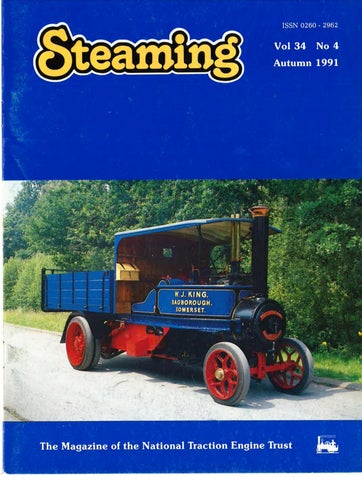
Cover One of the more interesting new faces at 1991 events has been 1924 built Tasker 5 ton wagon number 1915. The Hampshire County Museums Service owned machine made its rally debut — after many late nights by curator Gary Wragg and his local volunteers — at the Rushmoor rally at the end of July, and Ian Taylor, one of the crew, kindly took this picture to show the wagon's ex-works condition. 159
Trust News From the Chairman Summer is essentially the rally season as far as our members are concerned. There are many events held throughout the land so that it should be possible for every member to attend those of his choice whether he is taking an engine there, assisting in the running of the rally or attending as a spectator. Each of these categories is very dependent on the other two, for, without any of them, there would be no traction engine rallies as we know them today. But our special thanks are due to the engine owner and the rally organiser for making rallies possible. Over the years the composition of the traction engine rally has altered and, in some cases, out of all recognition. In the early days, traction engines were the main content, possibly with a few other vintage vehicles. The changes over the last two decades have produced in many instances something approaching a Vehicle and Country Fair with traction engines. Not everyone may like this trend, but it must be borne in mind that to put on an event these days is very costly. An organiser, therefore, wishes to attract as wide a public as possible; our rallies have become very much a family day out, and many attractions for the family must be provided. Most rally organisers do this very well and, whatever their size, are to be congratulated on the show they put on. The Trust, generally, has a duty to ensure the continuing survival of active operation of traction engines and portable engines. It is necessary for your committee to be ever watchful of possible pressures that restrictive legislation may bring upon our activities — albeit some of it not intentional, but arising as a side issue where more modern transport, machinery and equipment are concerned. To this end we are represented on the British Federation of Historic Vehicle Clubs, who monitor the outpourings of the legislators on behalf of all organisations interested in veteran and vintage vehicle preservation. Recent news from the Federation regarding the European 160
Economic Community seems to be that the latter body is taking a more favourable attitude to preserved vehicles in that an assurance has been given that 'there is no wish to remove older vehicles from the roads'. This is indeed good news of a trend but, nevertheless, the Trust must be ever watchful of pressures that might affect our activities. Very recent proposals to make further Regulations under the Road Traffic Act, 1991 are at present engaging our attention. (Eric Fillmore, Chairman).
From the Vice Chairman With the Rally season drawing to a close (but with the Trust's Steam Party and Road Run still to come), it has been my pleasure to meet and talk
with more members than ever this year, mainly in the Trust's hospitality areas, which the sales section of the Trust makes available for you all. The Great Dorset Steam Fair is our most ambitious effort and there we meet the largest and perhaps furthest travelled section of our members. We value meeting both Trust members and those of local clubs when we travel further afield ourselves. I would like to thank those members of the Trust who gave up time to join the committee and officers to work in these areas, whether talking to you all, or serving the tea and coffee — which, incidentally is kindly provided by a member. This enables us to provide the refreshment free of charge, but many visitors made donations at the time and the monies have been placed in the Trust's Preservation Fund; thank you for your generosity. (Sylvia Dudley, vice Chairman)
From Alan Martin's Collection
54
This is Ho/tom & Sons' well kept 5 ton Foden wagon 2832 of 1910 (M2895), named WINDRUSH PRIDE. The firm were 'roller millers' at Ducklington near Witney, Oxfordshire, and the wagon is pictured opposite the Marlborough Hotel in Witney's Market Square about 1912. Driver Charles Pearce and, to the right, mate George Kearse appear to have just started relieving the Foden of some of its nicely arranged load of sacks of flour.
Engine Owners Column Engine Owners sub-Committee We are now coming to the end of another hectic and very enjoyable rally season. My impressions are that, on the whole, the weather has been quite amenable and that the recession has not affected attendance as much as we might have expected. Safety precautions at most events that I have attended seemed adequate, although engines still have to move in areas where there are pedestrians. We have had a number of enquiries about repairs and spare parts which Bob Back has dealt with, and I am always pleased to pass on letters to him. We can now look back on the Engine Driving Course, held in May, and try to work out how we can improve, if, as some suggest, we should repeat the exercise. It is most rewarding to meet some of the participants at rallies and hear news of their activities. We shall be holding an sub-Committee Owners Engine meeting shortly before these notes are published and will give particulars of our plans in the next Steaming if we are going ahead next May with another Course. The new Boller Code and the impact of recent legislation is still a major part of the sub-committee's activity. (Michael Davies, chairman, Engine Owners sub Committee)
Lost Registration Numbers Having reported earlier in the year that applications for recovery of lost registrations were being dealt with by DVLC in about two weeks, the situation instantly changed! Recent experience has been very variable and unpredictable. The worst case has been ten weeks and the best about three, but we are having a very good success rate, which is encouraging. One minor problem is that I am not always informed by DVLC when an application is successful and it may become necessary to close the loop with owners by introducing some kind of reply slip to be returned when the application is confirmed. Once again I must stress the need for a good recent photograph of the engine and its maker's plate which should clearly show the engine number.
FBHVC The Federation's Annual General Meeting takes place on 26th October when officers and committee for the next triennium will be elected. Our current representative on the committee is John Crawley and he has been outgoing the by nominated
The National Traction Engine Trust's
1991 AGM will be held at 2.00pm on SATURDAY, 23rd NOVEMBER 1991 at
The Water Hall, Kew Bridge Steam Museum, Green Dragon Lane, Brentford, Middlesex Please refer to the formal notice in the centre of this issue for details of agenda etc, and to the Future Dates column for notes on the other arrangements that have been made for the day.
committee. The most recent FBHVC News Sheet reports a meeting held in Brussels between a delegation representing the FIVA European Affairs Committee and senior officials of the Transport Directorate of the European Commission known as DG7. The FIVA delegation included Peter Glover, chairman of FBHVC, Michael Banfield, FBHVC committee member and chairman of FIVA European Affairs Committee and Edward SeymourRouse, FIVA lobbyist. The delegation presented the following proposal for the definition of a preserved historic vehicle:'A preserved historic vehicle is a mechanically propelled vehicle, preserved and maintained in historically correct condition and at least to the construction standard appropriate to its era and which was manufactured more than 20 years ago.' Where it is required to identify preserved historic vehicles of a particular era they can be classified as follow: Category A — vehicles built up to 31st December 1904 built vehicles — Category B between 1st January 1905 and 31st December 1918 vehicles built — Category C between 1st January 1919 and 31st December 1930 vehicles built — Category D between 1st January 1931 and 31st December 1945 built vehicles — Category E between 1st January 1946 and 31st December 1960 Category F — vehicles built on or after January 1st 1961. Member states may exclude from this category vehicles that remain in daily use. Some DG7 officials had difficulty in
accepting that commercial vehicles should he considered 'historic' until shown photographs of the recent London to Brighton run for commercials. The FIVA group also presented a paper setting out the FIVA position with regard to roadworthiness testing. The DG7 officials explained that they had been working for some time on compulsory testing for commercial vehicles and would wish to extend this to private vehicles, but at present there is no proposal to set down any particular standards. The FIVA position is that on the grounds of safety all historic vehicles should be subject to roadworthiness tests, but only to reach the standards to which they were originally built. The Brussels lobbyist submitted his half yearly report in May and one point of interest is that during the previous six months 27 separate pieces of European Community legislation had been identified that might possibly or potentially have an effect on the historic vehicle movement. Obviously, it is a matter of extreme import that all potentially damaging legislation is identified as early as possible and the lobbyist is to be congratulated on his vigilance. (Peter Smart)
Rally Organisers Column Rally sub-Committee Writing for the autumn copy of Steaming is a slightly depressing task as it heralds the end of the rally season; that said, I can once again report that it has been a safe and successful summer for rallies. There 161
WORLD'S FAIR 411•111
The outdoor PO entertainment weekly incorporating
A Fe-'13.,,SRR:44A,R7t433 PIP
Rallies, News, Reports and Advertising
Place a regular order NOW with your newsagent. Something to sell? An event to promote? For all your advertising requirements there is no better publicatio n.
For advertising and subscription details contact: The World's Fair Ltd., P.O. Box 57, Oldham OL1 4BB. 061-624 3687 have been incidents, some of which could have been avoided, and we must all continue to be vigilant in this respect. The introduction of the new rally Code of Practice created some challenges for rally organisers, and I hope those who did not update to the new Guide will start planning to do so for next year. There has been an increase in visits to rallies by various officers from the Fire Service and Environmental Health Departments; if you are one of those who think this sort of visit will die down or maybe even go away, can I encourage you to think again, for you may be in for a surprise next year. Many of you who are involved in our movement will have attended events which are not run under our Code of Practice. If you have the opportunity please try and encourage the organisers of these events to join us, because the future of all traction engine rallies could be placed in jeopardy if there is a serious incident at a badly run event. The Code of Practice is available to all interested parties to help in the effective running of events; please contact Sylvia Dudley if you want a copy (see advertisement inside front cover). The autumn conference will be held at the Clifton Court Hotel, near Rugby on October 26th. The morning will be given over to routine business, the afternoon will be opened by Tim Driver, the Trust's Solicitor, who will talk about the ever growing legislation applicable to rallies. If you have any specific questions you are welcome to send them to Tim (via me) and he will provide answers at the conference. I appreciate that some of you, like me, 162
will feel this is a pretty dry topic for discussion but it will be useful to cover it! The rally safety sub-committee is planning to organise a training day for safety officers in the early spring before the 1992 season gets under way; please let me know if you are interested, especially if you are not attending the conference. Many thanks go to the members of my committee for their work during the season, and especially to Ron Copp who deals with the administration. If you would like to attend the autumn conference and have not received an invitation when you read this, please contact Susan Jackson, our Secretary, whose address you will find inside the front cover of this copy of Steaming. (Andrew Semple, chairman, Rally sub-Committee)
arriving as scheduled, which is much regretted, but we hope to have things up and running to time again shortly. At the Great Dorset Steam Fair we held a SAC committee meeting — this committee consists of three members of the Trust's main committee and several 'workers', some of whom are past members of the SAC. The raw material for the contents of the SAC magazine is a problem and I would ask readers to note, please, that we do rely on both our own younger members and members of the Trust to provide suitable items for inclusion in the magazine — all contributions will be gratefully received. I am pleased to thank all engine drivers and crews for their co-
Remember...
Steam Apprentice Club At a recent committee meeting, following the appointment of Susan Jackson to the post of General Secretary, which I had been covering in recent times, it was decided that I should resume chairmanship of the Steam Apprentice Club, a position vacant since the resignation of Robert Herring. I have, of course, been involved with the SAC since its inception. SAC magazines, for a number of reasons, have not recently been
Autumn Conference for Rally Organisers and Affiliated Clubs SATURDAY 26th OCTOBER 1991 The Clifton Court Hotel, Lilbourne Road, Clifton-on-Dunsmore, near Rugby Warwickshire See Future Dates column for further details
operation with the work of the SAC on and off the rally fields. At the Dorset Steam Fair we held our customary 'breakfast on a shovel' session and a certain Tasker tractor resembled a steam version of the Pied Piper of Hamelyn when it led the participants
through to the ploughing field armed with their plates, and eggs and bacon. A number of engines also supported an afternoon meeting when members were given a chance to learn about a selection of different types of engine. Thank you drivers for your help; our work would be so much harder without your understanding. It is hoped to run a training session
for older Apprentices next spring and details will appear in the SAC magazine nearer the time. (Sylvia Dudley, SAC chairman).
Affiliated Clubs Many of our Affiliated Clubs hold regular social meetings throughout the year, or at least the winter season: At one time a calendar of such meetings was published in every other issue of
Steaming, but that practice seems to have faded out when the responses dwindled to a low level. A recent request to the Trust by an Affiliated Club highlighted the
necessity for all social secretaries to have a suitably healthy list of potential speakers, able to entertain by lecture or illustrated talk on traction engine and associated subjects. The .Trust would be willing to hold a countrywide list of names and addresses of such speakers, together with a note of the
subject or subjects covered, and the distances they would be prepared to travel, bearing in mind that club meetings are usually held on weekday evenings. Individual arrangements would then be up to the respective parties. If anyone is willing to put forward their names for such a list, or feels they could benefit from access to it, they should contact the magazine Editor in the first instance; the project will be proceeded with and kept up to date if sufficient response makes it worth going ahead with.
Scania Transport Trust Awards Four interim finalists in the 1991/92 Scania Transport Trust award scheme have been announced. In the road section the winner is Andrew Black of Morpeth, Northumberland, who has been selected for his restoration of Aveling & Porter 6 ton roller 10014 of 1922. NTET member Andrew describes his effort as being achieved with limited funds, out of doors with few facilities, and by novices who are still learning the hard way. Each section finalist — the others cover rail, water and air projects — receives an Interim Winners cheque for £250 and certificates and entry into the 1992 finals of the awards scheme. (Scania Transport Trust Awards)
the John Mound's picture of Fowler A9 class compound 13138 FINELLA in Spring issue of our magazine contrasts well with this earlier purtiait of the for same engine, taken in 1921. We are grateful to Eddie Shirras of Harrow was sending the picture for our use. The 1914 built three speed road engine first owned and worked by his grandfather John Shirras of Auchenblae, Kincardineshire, some 25 miles south west of Aberdeen. The Aberdeen set photographer made his picture of the immaculate Fowler and its threshing at Fordoun, near Auchenblae — John Shirras has his arm on the water tank and his middle son Willie is to the right; behind are 1910 Clayton & in the Shuttle worth mill 40295, a living van and a Massey Harris trusser new previous year. Note that the smokebox door is adorned by a brass star behind the handles, a decoration carried by the machine to this day.
163
Obituary Peter Bartlett Many steam enthusiasts in the Hertfordshire area will be saddened to learn of the death of Peter Bartlett. In particular, those whose rallying spans twenty or more years will remember Peter, on the road, with his 5hp Foster MATILDA which he owned for more than thirty years. Some of us who knew Peter more closely remember him not as one for the crowd or party but rather for his quiet patience, engineering skill, but above all for his generosity to those who sought advice or help. Peter started his steam hobby as a model maker and many years ago constructed a remarkable model railway track, in a field near his home in Chipperfield, which still exists today. However he found working on full sized items much less of a strain on the eyes. For many years his farm became a centre for several local enaine owners who not only enjoyed a range of engineering facilities not normally associated with farming, but also sound advice and plenty of practical help. More than once a broken part left on his bench one weekend would be found a week later either repaired or even made anew, ready for refitting.
It was Peter who made it possible for me to acquire my own engine and it was he who gave so many hours of help to get It back into steam. So, goodbye old friend. We'll all miss Peter but none more than Judy, Catherine and Polly, his wife and daughters, with whom we share our sadness at his passing. (Peter Williams)
Engine Records Most readers of this magazine will be familiar with Alan Duke's name and with the grateful Editorial credits to him in picture captions and other historical references of engines long since gone — as well as those surviving into preservation. Ac Editor, I continually marvel at the wide extent of the engine records of the Road Locomotive Society, of which Alan has been custodian for half a century or so. Engine owners, historians and enthusiasts will for many years to come have reason to be grateful for the care and diligence which has been bestowed by Alan on the compilation of the records and their upkeep. The AGM reports of the RLS prompt me to attempt to repay some
Watercolour Prints
of the debt we, as readers of this magazine, owe to the RLS records. In the past the engine and owners lists have been largely built up by reference to available makers records and to county licensing authority records. Whilst these sources have been more or less completely cleared up many years ago, further references to engine history still surface from time to time. Particularly useful can be the minute books of local and county councils and the like, deposited in Record offices. However, finding out the whereabouts of such files can be difficult and time consuming on a countrywide basis for just one person living in London and Trust members may be able to help on two fronts. Alan would be pleased to receive help in discovering more minutiae of road engine history through local contact; making hi o, awa re ui aim vivitig records, or better still undertaking the task of extracting the information. Anyone interested should write to Alan to ascertain what areas should be tackled. Further, among our members there must be more than a few who are the sons or grandsons of past engine owners, who may have family records or recollections. Past correspondence with such people has enabled Alan to tell of engines owned by their forebears and then led to more information coming to light. You are encouraged to write to Alan (1 Cumberland Court, Cyprus Road, London N3 3SA), even if at first you may not feel you have anything to offer.
London Area Social Meetings
PRINCESS MARINA Burrell 6nhp
WILBUR Fowler BB 14nhp Beautifully detailed watercolour prints with an image size of WA" x 13" (21.5cm x 33cm) with a generous border for framing.
BOXER'S BEAUTY Wallis & Steevens 7nhp
.E12.75 each Including packing and postage to U.K. (For Europe add £2.00, Overseas £3.00) To order, simply send your name and address stating prints required, together with your cheque or postal order made payable to: ROBERT SMITH ILLUSTRATIONS
7 TEMPLE ROAD, LISS FOREST LISS, HAMPSHIRE, GU33 7BS, ENGLAND 164
The 1991/92 season of social meetings in London will commence in October, and all members, potential members and interested visitors will be welcome to attend one or all of the evening talks or slide shows which have been arranged for the Trust by Bill Timmings. The new venue for the 1990/91 season proved popular and our meetings will continue at Keen House, Calshot Street, off Pentonville Road, London Ni. Public transport to the Kings Cross area is, of course, good and Calshot Street is some 500 yards east of the main line and tube stations, up the Pentonville Road hill and the fifth street on the left. Keen House is a small somewhat plain building on the right hand side of Calshot Street, adjacent to the wine
bar on the corner. Although there is no bar at Keen House, tea and coffee are available. Meetings will be held on the first Wednesday of each month, at 8.00pm, with the room available from 7.30pm. It is hoped members will continue to support our speakers in the enthusiastic way they have done in the past. For the first three dates in our calendar, the following programme has been arranged: WEDNESDAY, 6th November 1991 — Graham Bull will be showing a selection of his slides taken around the rally fields of Britain. WEDNESDAY, 4th December 1991 — this night we have an interesting dissertation on the 'Wall of Death' by Alan Ford. Due to the New Year holidays we shall not be having a meeting on the first Wednesday in January but meetings will continue — WEDNESDAY, 5th February 1992 — A most interesting illustrated talk, by Frank Strange and Robert Oliver, on Mornement & Ray's steam dredging activities in the Fenland drains. (Bill meetings London Timmings, organiser)
Future dates Autumn Conference of Rally Organisers and Affiliated Clubs The Autumn 1991 Conference of Rally Organisers and Affiliated Clubs will take place at The Clifton Court Hotel, Lilbourne Road, Clifton-onDunsmore, near Rugby, Warwickshire on Saturday, 26th October 1991 at 11.00am. Invitations and formal notices, together with details of the venue, will be sent out in the usual way, but newcomers are always welcome to these instructive and mutually beneficial gatherings. Coffee will be served from 10.30am; lunch is available at ,the Hotel (prior booking is essential) and tea will be served at the conclusion of the meeting at about 4.00pm. First time attenders are invited to contact Trust Secretary Sue Jackson for further details or bookings. (Andrew Semple, chairman Rally subCommittee)
AGM 1992 The 1991 Annual General Meeting of the Trust will take place on Saturday 23rd November 1991 at 2pm in The Water Hall, Kew Bridge Steam Museum, Green Dragon Lane, Brentford, Middlesex. Formal notice of
KEW GARDENS csqk,'.y
the meeting, the agenda, and the Annual Report and Accounts will be distributed with this issue of the magazine. The Kew Bridge Steam Museum is open from 11am, and members attending the AGM will have free access to the Museum on production of the current Trust membership card. We thank the Museum for making these facilities available to us. Working exhibits will be in steam from opening time — they consist of three massive beam engines together with various other steam engines of waterworks ancestry, engineering workshops, waterworks railway etc. It is hoped to have some road engines in steam for the occasion. Tea and coffee, and hot and cold snacks including hot pies are available on the premises. The accompanying sketch map shows how to approach the Museum from the end of the M4 at Chiswick Flyover, or the North Circular Road. From central London, Network SouthEast Hounslow line trains run to Kew Bridge Station from Waterloo at 25 and 55 minutes past each hour on Saturdays, taking 23 minutes for the journey. It is then less than five minutes walk to the Museum — look for the tall tower. To facilitate the task of the Membership Secretary and the Museum staff during the course of the day, members are asked that they pay particular attention to having their Trust membership cards with them.
Fire at Amersham Although our magazine does not cover the subject of fairground organs, many members will wish to be associated with sympathy for Teddy Reed of Amersham, a friend and acquaintance of many on rally fields over a wide area, for his tragic loss of many fine fair organs in a fire at his museum and workshops in August.
'No 1 Section [of the 9th Field Company, South African Engineer installed immediately Corps] themselves in the power station after the capture of the town [Addis Ababa] and set to work to get the diesel engines into action, while the temporary power supply was maintained by two steam rollers coupled to some ancient generators. These infernal machines rattled and snorted as they struggled to meet the load, and fuelled as they were by wood, menaced the surrounding property by belching out a nightly firework display of sparks. But very soon the diesel engines were turning again and the fireworks died down. The Sappers had done their last job in the East African and Abyssinian Campaign, and done it well." (from Nine Flames, by Ken Anderson (Purnell, Cape Town, South Africa), in the chapter describing events following the capture of Addis Ababa, Ethiopia, by the South African forces in 1941. Kindly submitted by Nevil Miller.) 165
Dredging with Mornement & Ray Jack Aldrich In 1932 I started work as an engine driver for the then well-known dredging firm of Mornement & Ray of East Harling, midway between Thetford and Diss in Norfolk; for over forty years they kept the drains and rivers of the Lincolnshire Drainage Board in good ordcr. I had been told to report to Mornement & Ray's yard, where they had extensive workshops, one Monday morning. I 4-iad to travel from Harpley village between Kings Lynn and Fakenham, a journey of about forty miles. That meant getting up for a 2.00am start for the long push-bike ride. I remember I'd had toothache all day on the Sunday and it was pouring with rain with a high wind as I set off. However I got to East Harling in good time at 6.45 — it was almost a crime to be late for work in those days, and the same attitude was taken towards any driver making an engine prime or dropping a fusible plug; it was as good as asking for the sack. I reported to Mr Chenery and explained my toothache, asking if I could go to a dentist. One lived just across the street so that was alright and after I had got acquainted with what my job would be and my
surroundings I went across to the dentist at 9.00am in my overalls. He took one look at the ailing fang and enquired if I had brought a hard chisel and a hammer with me. "Why" I asked. "I shall need them to remove the tooth" he said — there was a small tooth locked in between two larger ones. Anyhow, he got it out, not without some difficulty and with that over I went back to work. We were getting steam up in a 10hp McLaren and oiling ready for a long journey from East Hailing to Frithville, about five miles on the north side of Boston. By the time the engine was nearly ready I was ready for a drink of tea and something to eat and
during that break I was introduced to my mate, Jack King from Cockley Clay, near Swaffham. Actually, we had met before in 1929 at Hobhole Drain but that's another story! I was also introduced to the other driver, Harry Bull from Sibsey near Boston, and he, of course, was on his way home on this journey for Sibsey WdS only just around the corner from where we were going to work. Also going with us were two or three other men who worked as scoop or bork operators, or coal and water carriers to keep the engines supplied. Soon we were about ready for the road with all the kit — living vans, trailers with all the dredging equipment; borks,
A good general view of how the dredging of the Fen drains was accomplished by Mornement & Ray. These pictures, which all came from the collection of the late Harry Bull and are reproduced with the kind permission of the Road Locomotive Society, are unfortunately not identified by location or date, but show much interesting detail. As can be seen, the amount of space on the top of the embankment of the drain is limited and with a lot of mud to come up onto the left bank, there was usually not much of an area to cope with it all — you couldn't stack it up like straw or timber! The operation is working towards the camera and the second pair of engines have their bork in mid-air as it returns to the right hand side to be dropped into the mud for the next pull or cut. The wings which elevate to the contour of the bank can be seen in outline. The two engines on the right side are working in reverse because their rope drums are on their left sides. All of the engines pictured seem to be Surfeits.
scoops, timbers, coal etc. I might add here that in those days some of the young men or lads were prepared to do all sorts of work — cooks and general labouring duties — just to be with engines. Before they got to be a driver or even a steersman they started by cleaning out the firebox, sweeping the tubes and getting up steam — all good practice to begin with because if you can't steam an engine, how can you drive one? The time I am writing about was during the recession of the 1930s and quite a few firms failed to survive to carry on. I believe it is true that Mornement & Ray were almost on the point of ceasing business when this drainage job came up again out of the blue. The work was the cleaning out of the Medlam Drain which runs from Frithville the six or seven miles north to Revesby Bridge. In fact the tender for the job had been won with a lower price by Watson Bros of Whittlesey who would have used tractors, and Mornement thought the contract was lost to them. But once the tractors started work it wasn't long before one was pulled into the drain. I don't know if anyone was killed or injured but the job was stopped and after some delay the contract was re-let to Mornement. I also gather that Watsons tried using ploughing engines but they couldn't do the job. Other things must have been wrong too, because a steel dam had been put in but it hadn't stopped the water. We had to re-dam with wooden piles in front of the steel. It was most important to stop all the water as we liked the section of the drain we were working on as dry as we could get it to start with. But back to East Harling. We got going on our journey about 10.30 to
Another general view, which shows the clean and neat results obtained by the method of working. Both scoops are loaded and being pulled to the left hand bank for emptying. In the mid-distance can he seen the tempnrary dam but much water drained back into the bottom of the cleaned out drain through the mud — that didn't matter much as it made the mud easier to handle. The figures on the right bank top would be the foreman with two of the Drainage Commissioners men, and beyond them can be glimpsed the dim shape of one of the living vans for the crews. Again, the engine appears to be a Burrell single. 11.00. I took the lead, having made sure the steering chains were tight or adjusted to suit, for the engines would do a speed of over 15 miles an hour without much trouble. But one had to think of the tackle behind, which was on solid wheels, and often with no springing, and also keep a good look out for the man in blue. They could be easily spotted in those days on their tall bicycles and they weren't too bad in most areas but in Boston they were keen — they had a measured mile here from bridge to bridge and it was supposed to be 2mph through towns and villages. There was also the question of smoke — it was against the law to make smoke in built-up areas. This is food for thought for present day beginners or apprentices in learning to make as little smoke as possible. We used to coal up heavily, well out of towns so that we had a clear fire when needed. It was unfortunate when we got an engine with a badly fitting damper or a damaged ashpan. At times it meant opening the firehole door a bit with a piece of coal — not good practice but sometimes there was little choice for us in the matter. We all eventually arrived without mishap where the drain begins at Frithville — then, as now, near Crawfords premises. But Harry Bull's
engine was getting very much the worse for wear, with the smokebox near collapse. He decided to go back to Boston, to Grattons, who at the time were steam engineers and would fit a new smokebox. I remember it took about three days — when Harry returned we gave him a warm welcome with our whistles, piping him home you might say. I was stationed on the left hand bank, pulling out most of the mud, which was about four feet deep. Bull's engine was on the other bank, pulling some mud out on that side. Four feet of mud is a lot to deal with if you haven't got much room to put it or get rid of it to, therefore my engine was positioned over on the far left of the shoulder of the embankment to the drain, leaning over at about a 10 or 15 degree angle, so the mud would run out under the engine onto the lower level. The engine was at such an angle that to stand level I had to put my left foot on the side of the tender, not a very nice feeling at first, though I got used to it eventually. But you had to see this practice to believe it. The rope pull was made possible by fixing a 12 inch by %in band around the barrell of the boiler, just in front of the firebox. The water tanks under the belly if any, had been removed. An eye on this band carried a 15 or 18 inch 167
pulley block in line with the roping drum on the hind axle. This enabled the engine's wire rope to work off the front of the drum and then out via the pulley. A restraint support from the smokebox took some of the thrust and strain of the rope passing around the pulley and a turnbuckle was provided in that restraint to enable adjustment to be made. All this had to be designed so that it could elevate up and down to counteract the angle at which one was working. The McLarens that we used were good for the work as they were high off the ground. The Burrells we had were good as the differential was easy to lock up. So if anyone has a couple of suitable engines they would like to fit up, I'd be only too pleased to give advice! Mornement & Ray had six of the McLarens — they were part of a batch of twelve for the War Department in France during World War 1. After getting them to work they found the engines good enough to make them wish they had bought the lot. As built the 10hp road engines were nearly ten A scooprnan reaching down to turn the handle to adjust the cutting blade on feet wide and it was necessary to trim the scoop. The chain around the shaft can be seen along the length of the several inches off the outside edges of scoop. A Burrell is the dredging engine. The author thinks the house could be each of the hind wheel T-rings to the one where they worked through a farmyard on the bankside on the enable the engines to legally go on the Medham Drain contract in 1932 but he can't be sure after nearly 60 years. road without an escort or permit. The engines were fully spudded and had angle iron rim extensions on we did when the mud went under the and relied on the scoop man. the front nearside wheel. To move engine was to make certain we'd Talking about experiences I am forward from one cut to the next one propped the ashpan lid to slop the pan often amused on the rally fields to see was a tricky job. Having got the bork filling up with mud and killing the fire some of the things done nowadays, back on top of the bank out of the through lack of air. for example poking the fire. I have a way, I left my roping gear in and When returning the scoop for the poker on my engine which I've only engaged the road gear. My mate kept next cut, the engine that was pulling used two or three times in ten years. his roping gear in too, and supported out had to keep its roping gear in to "Clever b----" you might say. Well, I me while I moved forward without hold the bork up in the air high above was at a certain place letting a young sliding sideways down the embankthe mud until it was in a position man drive my engine and he poked the ment to the fields below. The strain where there was sufficient for a load fire, so I told him off and asked what these engines were being put to is (8 tons or more, depending on the he was doing. He would perhaps have almost unbelievable — It was certainly density of the mud), then letting it been surprised to see quite usual something the makers never intended drop to the bank. This was done by adverts of the 1920s — 'Wanted, or even had considered they might be holding the reversing lever up near the Engine Driver (experienced) but put to. middle of the quadrant, more or less all firebox tinkers and plug droppers need You're probably wondering what a day, for 8, 10 or 12 hours. All this not apply.' But back to dredging. bork was. I think it was Mornement & wasn't playing about with engines but We had been running for some Ray's own patent, to be used in lieu of working them to their full capacity, weeks without a mishap when the a more normal scoop, and gave better about one of the worst jobs we could weather broke and it rained for two or results. The bork had a reversible do with an engine. three days and stopped the job for a cutting blade on the bottom. It was There were cases of the engines while. As you might imagine we adjustable by means of a roller shaft being down in the drain and one or two considered this a minor godsend, for it and chain on top of the machine — this turned over. In September 1929 a gave us a breather and enabled us to was worked by the scoop or bork man, Burrell 8hp single had been down in get some cleaning and mechanical enabling him to put cut on as required, Bellwater Drain near Boston. After adjustments done. When we were at or take it off. With this tool, the drain getting it out the engine was work a driver couldn't stop and do or river could be deepened in places, completely rebuilt (and it still survives things to suit himself; with four which we couldn't do with a scoop. in preservation at Gedney, Lincolnengines working in pairs if one set Another important feature, compared shire). A McLaren also turned over at stopped for long there was soon with a scoop, was the six foot long Tydd near Sutton Bridge. Mornements trouble. So in this lull in the work I adjustable wings which oscillated and were dredging out the River Ouse managed to strip down my Menzel oil took up the contour of the drain or between Sutton Bridge and Tydd St pump which seemed to be giving river bank. Fixed wings would have let Mary — this is a tidal river. The whole trouble. I took it all to pieces, cleaned out the mud. job was very much a team job; drivers it out but couldn't see anything An important thing to make sure sometimes could not see each other wrong. I did a bit of experimenting but 168
it wouldn't pump as normal — it worked off the slide valve rod movement. Now bearing in mind our reversing lever was half the time in the centre of the quadrant it became evident it was not allowing the pump to work at all. When I tried turning the rachet a third or half a turn it pumped quite a good measure of oil. I persevered with my tinkering and eventually, with the use of a piece of tin strip — the only bit of material I could lay my hands on — I got the pump to work off the piston rod. The fine weather returned and we had to start work again before I was completely satisfied with the pump's action, so I asked the foreman Bill Hamblin if he would come and drive my engine for an hour or so. I told him what the problem was and he said there was a blacksmith just down the road, so off I went with my pattern and the smith had it made up in half an hour. Whilst getting up steam the following morning I fitted up the pump and believe me I found the engine was as different again as it had been 24 hours before. It ran so freely I had a job to stop it. One day soon after we completed 250 yards of dredging in a day and the old hands said it was the longest length they had seen done at one go. My mate Gulley Stubbs found it better for his 8hp single Burrell too, for by giving my McLaren more oil it made the load for the other engine a lot easier. Imagine pulling round a 10hp double crank compound with the reversing lever in the centre and a three or four ton weight in between — quite a load for an 8hp single. Gulley often had his engine sitting on the water tank when pulling back and the front wheels up in the air. It's unfortunate no one had a camera around at the time. The foreman thought I'd done a good job with the pump but when a week or so later he came round with the manager to show him the pump Mr Gratten said it was no good and would wear out the pump. Bill popped back later and said leave it alone and don't take any notice as the manager didn't know what he was talking about. In 1923/24 my father J.E. Aldrich and my brother Charles had been driving some of the McLarens by The Wash at Wingland Marsh by Long Sutton, where the engines were anchored down on to sleeper and timber mats. The tides came in and put out the fires. Again, a pity there were no cameras around to record this intricate job. My father always taught me to listen and to watch what he did and I did just that for one whole weekend I was there. They were sitting around after supper on the
A close up of a Burrell 8hp single cylinder engine, and typical of the way Mornement & Ray fitted up their engines for their special requirements. The strap to carry the pulley block passed around the boiler just in front of the throatplate and enabled the rope from the engine's winding drum to be led forward and out at a much more stable position. The additional restraint from the side of the smokebox also includes a turnbuckle to allow adjustment. The engine is fully spudded on the rear wheels, with a rim angle to the nearside front wheel. Note the drive pin partly removed to free the rope drum.
Despite its poor quality this photograph is worth including as it shows one of the 10hp compound McLaren engines during a pause between pulls, with the crew taking a few minutes relaxation. The pulley arrangement was much the same as that applied to the Burrell. The high circular shaped coal tubs that were a feature of the WD McLaren engines can be seen. 169
Saturday evening, talking engines, when I heard my father say that the McLarens weren't getting enough cylinder oil. I didn't think too much of it at the time as I never thought I would be driving one eight or ten years later. However, I did, and was able to rectify what was my father's diagnosis those few years before. He also told me never to run an engine with dirty water. I can remember my first lessons in that sphere, when at the age of only six or seven I used to go with him on
EDMONDS on Engines
Chris Edmonds
Travelling, as I have done, around the rallies more extensively these last few years, and an exhibitor to boot, I begin to see a pattern emerging so far as rally organisers are concerned. Invariably, it seems, they come in three categories. First of all you have the highly motivated commercial individual who runs rallies for his own personal gain with a few local charities thrown in. Then there are events run by the local Rotary Club or parish council, and they take nothing for personal gain, but give everything to their' pet charity. Last but not least, you have the local steam club itself. Three of our largest southern rallies come into category one. The organiser of each has long been a household name, legends have grown up around him, and most people are terrified of even a mention. You can enhance your standing at any meeting by claiming that you have actually spoken to the man, and even more if it can be proved that he actually spoke to you! In my experience, however, they are the finest of all rallies. From the moment you arrive, the all-seeing eye of the organiser is upon you, and this can work to your advantage. Invariably, these demi-gods are scrup170
the cross bar of his push bike, every other Sunday, to wash out the engine boilers — I was allowed to work the Force pump.
(Mornement & Ray acquired six of the former War Department 10hp compound McLaren road locomotives that were included in a sale at Boulogne, France in 1922. They were works number 1613, 1621, 1622, and 1624 to 1626, all built in 1918.
ulously efficient, with no argument as to where you have got to go, and even less if you decide not to. Because he has a vested interest in the success of the event, his advertising is quite phenomenal, usually resulting in a very largo attendance. I have done very well out of category one, and would you believe — and I'm not name dropping — I have actually met John Crawley, Phil Read, John Keeley and Michael Oliver, and on more than one occasion they have actually spoken to me! Beware, however, the local PCC or the Rotary club! They have not the faintest idea of what they are doing or what you want to do. They are totally ham-fisted and spend most of their time vying with each other's Porsches and Range Rovers and shouting at each other in pseudo upper class accents. They are obsessed by putting in little posts everywhere, which you will trip over in the dark, and they are much more painful than big posts that you bump into in the dark! Their knowledge of our needs and ethos is nil — illustrated by one of them who came up to a -Fordson tractor driver and asked how long it would take to get up steam! Category two events must therefore be approached with extreme caution, although they generally pay very well. This salves their conscience when they produce the accounts at an AGM to which you are not invited. Category Three is just a joke. No steam or vintage society has any business running a rally. They simply can't do it, or more precisely, don't want to. A club rally is an absolute shambles from the word go. The site is usually on the side of a 1 in 6 hill with an eight foot entrance and down a very muddy track which does not improve with use. The committee fall out worse than usual, and this leads to tantrums and scenes in the local Dog and Duck. The emphasis is, of course, local. The local farmer owns the land and exercises his one moment of
None still exist today but 1652, a similar engine, was acquired later by Mornement and does survive in preservation. It is well known by Its present name BOADICEA and is widely and enthusiastically rallied in the south of England by Anthony Heal and his helpers, but its undoubtedly hard times on dredging contracts sixty years ago seem eclipsed in present day minds by constant reference to the engine's brief showland career with Corrigans.)
power by not releasing it till the very last moment. I have actually seen rally fields full of sheep and cattle two days before a club event, with showmen, engines and tent people queuing up at the gate! This type of event pays nothing, but nobody turns up so it doesn't really matter. What profit there is usually goes on a frightful pop group or disco in the beer tent (with a novelty organ standing silently outside) but then this suits the locals — they don't like too many strangers about. So is your local rally in category one, two or three?
Wanted All kinds of steam engines, a set of gallopers, working steam models for
Dordt in Stoom 1992 One of Holland's largest steam rallies to be held in Dordrecht (10kms east of Rotterdam and 30kms from ferries)
23rd, 24th May Some participants can stay over for the rally at Almere (28-31 May)
Please write with picture of your exhibit to: Robert Deventer, Annerstreek 26, 9468 AN Annen, Holland
Beautiful full colour print of AVELING and PORTER R6 STEAM ROLLER No 5636 'OLD JOE' AVELING and PORTER
— STEAM COLLECTION
— TYPE R6 ROAD ROLLER No. 5636 OLD JOE -
In addition to its gleaming red and green paintwork and highly polished brass, the most fantastic detail, both internal and external, can be seen in this superbly cut away and ghosted artwork by international Technical Artist 'Tom Liddell'. The print would be ideal as a present for any Steam Engine enthusiast, either to grace his den, or mounted and framed and hung in the home as a work of art. Finely reproduced on high quality paper, prints measure 28" x 20" with sufficient border to allow for mounting and framing. This is the first edition from the Liddell Publications 'STEAM COLLECTION' and supplies are limited. On receipt of your order the print will be posted to your home, well protected, in a stout cardboard tube. The cost of each poster is f7.75 including postage and packaging (UK only). Overseas orders please add f2 for Europe, £4 outside Europe. To order. Please send cheque/postal order payable to: LIDDELL PUBLICATIONS LTD. 2 BROOK HOUSE, UPPER WESTBY STREET, LYTHAM, LANCASHIRE. FY8 SNG, ENGLAND
171
Steam on Man Stephen Carter and Ray Hulock
Andreas.
„Sulby
• AMSEY
• Kirk Michael • Sneefell PEEL
St lohns
Baldwon Oncimn
Crosby St Marks
• DOUGLAS
Erie Po Vokv te8:111"414 Oarbvftvon Langres&
Part 1
An Introduction The Isle of Man, considering its small area of but 227 square miles and its hilly, even mountainous, nature, had a surprisingly large amount of traction engines, rollers and steam wagons. The number that has worked there at one time or another comes to almost one hundred. The largest group from any one maker represents Aveling & Porter. Eighteen of these, mostly and not surprisingly rollers, vied with sixteen Marshall products, these almost exclusively traction engines. The first recorded self-moving engine on the island, as distinct from portables of which there were several, is thought to be a Marshall delivered to Thomas Bell of St Johns in 1879. A great many engines survived until comparatively recent years, but succumbed to the scrap drives of the late 1950s and early 1960s, when several rare examples, including the Highway Board's Kemna, went to the melting pot for as little as £5. Of the few which remained, most were bought for preservation on the mainland during the 1960s and 1970s. Perhaps the saddest loss, to nobody's real gain, was Reg Crellins' old Marshall BEN-MY-CHREE, scrapped in St Marks in 1970, well into the preservation era. Today, eight road steam engines remain on the Island, although only two worked there, the rest being recent imports. A further eight or so Manx engines are preserved in England. Over the next few issues we will be publishing a series of short articles by two Isle of man enthusiasts, setting down some of the varied history of road steam on the Isle of Man.
The day they moved a 30ton whale On 8th May 1925, a huge whale swam head first into the Horse Gullet at Langness near Castletown at the south western tip of the Isle of Man. Unable to swim backwards or turn, the beast died of suffocation by its own weight as the tide receded. The whale was of a species called Rudolphs Rorqual and was nearly 50 feet long
172
and weighed about 30 tons. The carcass was subsequently towed around to Derbyhaven beach by boats, and then one of the most intricate recovery and haulage operations ever seen on the Island took place. Bobby Shimmin of Lower Sulby Farm, Onchan, a threshing and haulage contractor as well as farmer, secured the contract for moving the whale to Litts' plant at Baldwin. Bobby Shimmin did most of the heavy haulage work on the Island at that time and he owned a number of traction engines, threshing mills and large trailers. It must be remembered that in those days, although there were motor lorries, they could only carry a few
tons on a short deck, and heavy haulage was still very much the domain of steam engines. Bobby Shimmin assembled a selection of his biggest tackle at Derbyhaven. Three heavy trailers were positioned along the road, coupled one behind the other, and parallel to the beached whale carcass. Two traction engines, Fowler 6hp compound 13825 of 1913 and a Clayton & Shuttleworth 7hp (possibly 46889 of 1915) were then positioned at right angles to the trailers, and ropes from their winch drums were passed round the whale's carcass and back to the engines. In this way the carcass was rolled up on heavy planks and onto the trailers. The whale was then chained down, and the engines moved to the front to pull the road train, which, including the two engines and three trailers and the whale, weighed over sixty tons. On the flat, the Fowler engine pulled the trailers on its own. Going up the Brown Cow Hill at Santon the Clayton was attached to the front to give an extra pull and going down the Richmond Hill the Clayton moved to the rear to act as an extra brake if required. However, so powerful were the engines, especially the compound Fowler, that this engine took the load down Richmond Hill on its own without using any brakes, just the engine holding the load back. As anybody who is used to driving heavy vehicles will tell you, descending a hill is more difficult than going up one. The huge load eventually reached the knackers yard at Litts, where the carcass was unloaded and placed in a pit and covered with earth and sand and left for a year to decompose naturally. Later the skeleton, which itself weighed 3Y2 tons, was dug up and later displayed in the Manx Museum, where it can be seen today. Apart from the traction engines, the heavy trailers themselves were of interest. The leading trailer on the photographs was built of steel and was one of two which were brought to the Island in 1921 with heavy machinery for the Douglas Corporation Ridgeway Street Power Station. The firm of Ruston Proctor was installing some new generating machinery and these trailers, which were capable of carrying thirty tons each, were shipped in along with a 10hp Ruston traction engine to pull them, there being no suitable heavy tackle on the Island at the time. When the job was completed Rustons tried to sell the engine and the trailers on the Island to save shipping them back across.
A pause for photography at Derbyhaven in May 1925 as the less than aromatic Rudolphs Rorqual reaches the top of the timber laid against the train of assorted trailers. The bunker of the Clayton is seen at the left.
,
Fowler 13825 and a 7hp Clayton positioned by the roadside at Derbyhaven, having hoisted the 30 ton whale up the beach and onto the trailers.
But the engine, which was probably the biggest traction engine ever to be on the Island, was considered too large for local use and did not sell. R.G. Shimmins, however, was successful in obtaining the heavy trailers which he used to advantage for a number of years until eventually sold during World War 2. What would today's Highways Department think of the loads of 30 tons being carried on a trailer that weighed five tons on just four steel wheels, when the present maximum for normal loads for an articulated lorry is 32 tons for vehicle and load and that usually divided between four axles and 14 wheels? Another interesting job undertaken by Shimmins with the same tackle was the removal of the boilers from the Snaefell Railway Power House at the Bungalow. The engines had to be driven down the railway lines which were protected from damage by planks and timber. The boilers were winched out of the boiler pit and up onto the rails, and winched up to the road, and then onto trailers, using the same method as loading the whale. The four boilers were taken to different locations, the last one being used as a water tank on Lower Sulby Farm for many years. Immediately after World War 1 there was a shortage of traction engines, and R.G. Shimmin was looking for another to supplement his fleet. He travelled to England to look at various second hand machines but none were up to standard, and because of war shortages the waiting time for a new one was too great. R.G. went to see Norman Box in Manchester, at that time the country's leading heavy haulage specialist, who had a fleet of engines and trailers. Box had three brand new Germanbuilt Kemna traction engines which had been acquired through a war repatriation scheme. Shimmin bought all three and shipped them back home.
Close up of the leading trailer used for the journey from Derbyhaven to Baldwin — the Ruston Proctor built 30 ton vehicle was taken to the Island when delivering generators. 173
Crowds watch as the surely, by now, malodourous cavalcade starts its journey behind the Fowler and the Clayton tractions in May 1925.
He kept one himself and sold the other two, one to the Highway Board and the other to Ellerslie Farms. Shimmin did much work for the Highway Board carting stone behind his engines in his big trailers and later carrying the Board's heavy plant. The Kemna's were interesting engines. They had two high pressure cylinders and superheated steam, were very fast on the road but not thought to be so good in hilly places like the Island. They also had piston valves instead of the more usual British style slide valves, and were very prone to breaking piston rings. R.G. Shimmin used to keep a stock of rings from a Blackburn motor car, as these lasted longer than any other make. To revert to the whale, these days all wide and heavy loads which travel on the roads have a police escort. The whale did as well, but the constable on a bicycle was not warning other traffic, he is reputed to have been warning householders to shut their doors and windows to keep the smell out! The authors are indebted to Bobby Shimmin's son Jack Shimmin of Peel, who worked on the operations mentioned and who provided most of the information for this article.
The procession passes the Lancashire Inn on the Castletown to Douglas main road, Walter Creer driving the Clayton 7hp engine in the lead. The crew no doubt welcomed the stiff south-easterly crosswind/
c'E en
BOILERMAKERS — BOILER REPAIR SPECIALISTS — BOILER PLANT ENGINEERS Craftsman built flanged and butt welded fireboxes complying with The Boiler Code BSS 2790' — made and fitted. All types of traditional high class boiler repairs
Farling Top, Cowling, Keighley, West Yorkshire BD22 ONW Tel: 0535 634674
1 74
Fax: 0535 636802
A Kemna postscript An interesting close-up of one of the German built Kemna traction engines which were imported to the Island by R.G. Shimmin in his quest for one engine for his own use. This example is the machine sold on to Elizabeth Cunningham of Ellerslie Farms at Marown in the centre of Man — this venture was built as a model farm, using Italian internees during World War 1. The Kemnas were rated — probably by German standards rather than British — at 10hp and had duplex high pressure cylinders. They were said to be prone to 'running away' by carrying over water into the superheaters, when working with a too full boiler. The belly tank bears a plate revealing the machine as a Kemna Tractor Type EM, its works number 775 (of 1920) and the agent's name Everitt & French of Manchester — can anyone offer more information on this firm's part in the imports? (collection Stephen Carter)
R.G. Shimmin's Kemna was number 889 of 1919. This photograph was taken at his Lower Sulby Farm, Onchan, in June 1950, by which time the engine was dumped out of use; it had been sometime fitted with a crude wooden gantry over the smokebox to enable the rope drum to be used as a hoist. (P. W. Bradley) 175
All steamed up Peter and Wendy Faint It all started when we attended the Barossa Valley Club's display at the 1990 Eudunda Show, here in South Australia. A chap I knew from previous meetings came up and said he had seen something with a chimney, sitting on a dam bank, on a station he went to for pig shooting. Well, the mention of a chimney certainly got my adrenalin going, and he promised to get a photo the next time he went up to the area. True to his word Peter soon brought over a photo of a portable steam engine, and the p•rint had the name and address of the owner on the back. I wasted no time in contacting him and he turned out to be quite keen to see the engine restored. After attending the National Rally at Goolwa I was even more fired up to get my hands on the engine as I had only internal combustion types at the time. As it was so dry in May this year in the mid-north of South Australia, and seeding on my farm was delayed, I made arrangements to travel and inspect the engine. It was over 900kms away in New South Wales, so I decided to go in the truck to give me the opportunity of bringing back my prize. When I rang the owner the night before, however, he suggested I leave it a while as he had no way of loading the engine. This was a blow; I was all charged to go! A quick phone call to my neighbour Henry Behn solved the problem as he has a winch and ramps used for retrieving crawler-tractors. After loading up all this it was 10.30pm — I set off at 4.00am. After an uneventful trip, I arrived at the property at dusk. An inspection of the engine by the truck's headlights was essential, but then I settled into the shearers' quarters for the night. Before the sparrows had even thought about it the next morning I was at the scene, poking around the treasure. It appeared in a fair state; the governor was missing and the smokebox had definitely seen better days. All the brass fittings were missing but brass on the engine was intact. There would be a problem with the mudholes around the bottom of the firebox needing some work. However, I am, 176
by now, hopeful we will have it running shortly, though of course it will be up to the DLI for the final say. A price was agreed between the owner and myself and loading commenced. Thanks to Henry's winch the job was simple. It handled the 7 tonne toy with ease, pulling the machine straight out of the foot deep holes it had stood in. A visit to the rubbish dump produced a Pickering governor but I doubt if it comes off the engine. The return trip was commenced and all was plain sailing until one of Australia's national emblems jumped out in front of the truck, and kicked the radiator into the fan. Confronted with a pool of water on the road, I had to hitch 80kms to a roadhouse, there arming myself with a can of Barrs Leak and some chewing gum before getting a ride back with a professional kangaroo shooter. After three interesting hours, I was back by the side of the road patching the radiator with rag and gum. By leaving off the cap, the repair got me safely 700kms to home! I called in and saw the boys of the
West Darling Machinery Preservation Society at Broken Hill on the Sunday morning. From there, five hours saw me home at Steelton with my new toy. One certainly gets some curious looks from passers by and plenty of interest was shown wherever I stopped. Hopefully a month or five of Sundays will see me kicking the chainsaw into life and getting 'all steamed up'. But what of the engine itself? It appears to be something of a rarity, and I would be pleased to hear from readers if they have anything they can tell me about the makers, their business and their products. Cast around the wheel hubs are the words FARMER ROBEY BROWN & Co Ltd GAINSBORO,
whilst the plate on the main stop valve reads ENGINEERS, TRENT FOUNDRY, GAINSBOROUGH No 362. 214/W iS stamped on the boiler, BUTTCRLEY B on some of the boiler plates and NETHERTON BEST on the fixed rear axle. The agents who imported it into Australia were Roberts Chalmers & Co of Sydney. The boiler has thirty-four 21/2 in tithes, 86 inches long. The inner firebox is 34in wide x 38in deep and 30in high. The engine, which is reversible by Stephenson link motion has a single cylinder 111/2 in diameter and 15in stroke. The flywheel is 66 inches diameter with a 9in face. Rear wheels are 56 inches diameter x 61/2 inches width; the front are 45in x 61/2 in. As I set to restoring the engine to its former glory I would appreciate anything anyone can tell me about
Abandoned in the Australian outback — a rare British-built portable. (Peter Faint)
Farmer Robey Brown & Co of Gainsborough. (Peter Faint, RMD Saddleworth, South Australia 5413, Australia) (Ronald H. Clark, in his Steam Engine Builders of Lincolnshire (1955), records that the Trent Foundry at Gainsborough commenced business just prior to 1842, under the ownership of Thomas Farmer. By about 1880 he had taken partners, the business trading as Farmer, Robey, Brown & Co until 1884, when Brown dropped out. The legend cast into the wheel hubs of the Australian survivor would therefore seem to date it to this period. Products of the foundry included agricultural implements, castings and from the late 1870s small vertical and horizontal engines as well as portables, though the latter probably constituted a small proportion of the output. Can readers add more?)
Queenslands first Classic Steam Rally The Queensland Steam & Vintage Machinery Society Inc. was officially opened to the general public in June 1990. On that weekend we had recommissioned our Stewart mill engine and our 45hp colonial boiler. In the twelve months following this we have installed and recommissioned a Belliss & Morcom compound generating engine, increased the building's size from 100ft to 200ft length, threequarters restored a 100hp colonial boiler and installed a yet to be commissioned triple expansion engine. After the success of that first weekend it was decided to investigate the possibility of having a fully fledged steam rally as well as running the museum every weekend. With the group of people we have in our team it was not hard to get enthusiastic at this task, so off we went despite most of us having had no previous experience. One advantage was we didn't know the word impossible. We started out with a general idea and wrote to about fifty people requesting assistance with transport,
The portable is winched aboard the author's truck before its 900km journey to a new life. (Peter Faint)
but only received three replies. We then went on to fuel and then to exhibits. That may seem to be the wrong way round but steam engines without transport to get them and no wood to burn are not much use. Three weeks before the rally our building had no doors, two walls, no floor, the Belliss was half assembled, no lines were connected and the triple had just been delivered. Two days before the engines started to arrive the shed was at the lock-up stage. During the week before the rally the shed looked like a sardine can, with engines wheel to wheel. As well as setting up and finishing details during that week we also had a promotional event at Westfield Shopping Centre. We took a Ruston Proctor
portable down and steamed it from 7am until 8pm, a task which tied up a number of us for the day. On the Friday preparation was in full swing. We had one of the Marshall tractions in steam as a shunting engine and off we went to get nine traction engines, one Oil Pull Rumley and a Robey portable outside and set up for the weekend. In the meantime inside exhibitors were arriving, the colonial boiler was steamed up for final checking of the Belliss & Morcom, and we set up the thresher, a job finished with lights at about 6.30pm. The Saturday morning arrived with a beautiful fine Queensland winter's day. Slowly, all around the front of the shed engines were having their fires lit. The exhibitors started to arrive at
The extensive covered accommodation of the Queensland Steam & Vintage Machinery Society at North Pine Country Park. 177
A Marshall 3 speed road engine owned by A. Roberts climbs the slope at North Pine against a background of typical Australian trees.
about 7am with displays, and soon after that the public started to arrive. The Saturday was planned to be a practice day, which is just what we used it for; the programme went out the window as it became obvious it was unworkable. The number of visiting people, including some from Victoria, New South Wales and Western Australia, was very encouraging because we had very little advertising for the Saturday. The main thing was that the events did not stop all day. Engines were driving on our traction engines' road; threshing
displays were held (once they twisted the belt to get it to run the right direction) and the Case tandem compound of Norm Ferguson arrived in steam from Kingaroy and promptly attempted and completed our very steep hill climb. We held an impromptu grand parade at 1.30pm, with a drive past on the bottom road and up to the big turning circle for a photo line, and then back to an afternoon of playing. Saturday evening was a highlight of the rally with a lavish roast dinner cooked in the park's wood-fired bakers oven with an old steam tradition — a
A Foden 5 ton wagon, owned by R. Schuster, pictured at the Queensland Classic Steam Rally.
very large trifle, and then many tall stories told into the wee hours of Sunday morning. Sunday arrived with the same fine warm weather but with one big difference — the first of the estimated 35,000 people had arrived. Today was the day to see how we would cope with a large crowd. Everything was under control with the engines and displays; people were everywhere. The displays were all under way today, the threshing ran nearly all day, engines were continuously running up and down the road, the Thompson roller was getting stuck on the hill and fun things were happening. Even with all those people present there were no incidents, mainly due to the very competent operators on the machines. Grand parade time came and the organiser of the rest of the Festival wanted us to continue and to run right thrniigh the markets anri all the penple (a bit of a worry). Off we went up our traction road to the marshalling point, avoiding parked cars, camera crews, bullock and drafthorse teams. We then proceeded onto the bitumen road on the perimeter of the park following bullocks, drafthorses, troopers and so on back in through the front gate and down the main street. In all we had thirteen steam powered vehicles, a Rumley Oil Pull tractor, a McDonald pavement roller, a Case tractor complete with Furphy water cart and the Austin leaning wheel ripsnorter tow grader behind the Buffalo Pitts. After the parade it was back to two hours of displays and running for the general public's amusement. Then the fun started again putting things away. This was completed by about 7pm on that evening, which was a real surprise and relief. By the Wednesday of that week most of the heavy engines had been taken home. With the rally being over it was time to set the shed ready for the next Sunday's normal running day. Since the rally, we as a Society have held our post-mortem and decided we have some fine tuning to do but the general reaction of visiting enthusiasts was they had an excellent weekend and we had no major problems, so next year we are going to have another Classic Steam Rally. The Society would like to publicly thank all the engine owners and the exhibitors for their enthusiasm and help. The Museum is located at North Pine Country Park, Daboro Road, Petrie, Queensland, Australia and operates on Sundays Barn to 2pm from February to December. (W.F. Ives, 53 Lisa Street, Deception Bay, Queensland 4508, Australia)
SPEED SIX UPDATE 3 Richard Parkinson Readers may recall from Update 2 (Autumn 1990 issue) that work was well under way on the engine rebuild of my 1930 built Foden Speed six wagon 13750. All of the major parts of the engine have now been completed, and at the end of June this year the engine/gearbox assembly was refitted in the chassis. The gearbox was found to be in excellent condition, the sticky oil it contained having preserved the gears and roller bearings perfectly; it was only in need of a strip down to wash off the components and the case, and then to reassemble and fit to the crankcase. The crankcase had to have a fair bit of attention to the mounting brackets which were corroded, but this was all sorted out by various means. The crankshaft was fitted into the crankcase before assembly to the chassis, and the whole unit jacked up
View from above the chassis, showing the engine/gearbox assembly in position. IR. Parkinson)
and bolted into place. By the time this article appears, the major re-assembly of the engine should he completed. Connecting rods, crossheads, pistons etc all of which were refurbished — or in the case of missing parts, made new — are ready to fit. New poppet valves, and new cylinder heads are to hand, so if all goes to plan, the engine should be able to be steam tested (courtesy of steam from the Horrell brothers Foden 6 tonner) in the autumn. The new crankshaft is ready to be fitted to the cam case when the latter has had attention to the rocker arms, cam followers etc. Some small parts that were missing have still to be made; the camshaft activating fork
The engine/gearbox assembly seen from the front of the chassis. The feedwater heater is in the foreground. (R. Parkinson)
and linkage, but hopefully this shouldn't take too long. In concluding I would like to thank several enthusiasts from the Kent and Carob, idgeshire areas who have been extremely helpful in getting several of the major engine components produced, these gentlemen know who they are, so my thanks to them. I would also like to mention some of the firms who did fine work on the engine bits, and their names may be of use to other enthusiasts. Full details can be provided, but they are — SANDERS & RALPH VINTAGE MOTOR ENGINEERS, Yate, near Bristol; PELICAN FOUNDRY, Chatham, Kent; ZEPHYR CAMS, Lowestoft.
Engine components. The cylinders and the pistons are new, as are the timing gears; the connecting rods and crossheads are reconditioned original items. (R. Parkinson) 179
Switchback Venture
John Reeves On Saturday 24th August, Bank Holiday weekend and just a few days before this year's Great Dorset Steam Fair, three Burrell showmans road locomotives made a memorable and nostalgic journey from Salisbury to the South Down rally site at Tarrant Hinton. The engines, which started from Arthur Thomson's Churchfield Dairy on the edge of the city, were hauling the packing trucks of the Rodeo Switchback ride, each Burrell pulling two loads. First away was David Hedgeman's 8hp 3949 PRINCESS MARY, with
A Burrell showmans road locomotive engaged at the task it was built for — PRINCESS MARINA nears the top of Coombe Hill on the way to South Down, Tarrant Hinton, with the Rodeo Switchback cars. (John Reeves)
Jimmer Marsh driving, Denise White and Malcolm Hedgeman as crew and Michael Edwards as brakeman. Their load was one of the wagons carrying the ride and the centre truck. About half an hour later Jack Miles's 6hp Burrell 3090 FERMOY, with regular driver Bill Burden at the regulator, was
away. Larry Collins was steersman and Bill's sons, Arran and Carl were brakemen. FERMOY was pulling the second wagon, and Arthur Thomson's 89 key Gavioli organ, which currently works with the ride while the usual 1920 Marenghi instrument is under repair.
FERMOY, Burrell 3090, passes through the picturesque village of Coombe Bissett with packing trucks and centre engine. (John Reeves)
The third load was taken by Arthur's own Burrell 3847 PRINCESS MARINA and was the same as the engine took on a relatively unpublicised similar run last year, when it hauled the car truck and Arthur's living van to South Down. That run was, in fact, the inspiration for this year's trip, which came about as the result of conversation between Arthur, Jimmer and Bill. This year's run took place in glorious weather conditions, and, of course amid the most beautiful sunshine and Dorset scenery. The route, after the Salisbury ring road, was the A354, and included passing
through the picturesque villages of Coombe Bissett and Tarrant Hinton. One of the highlights of the trip was the long steady climb of Coombe Hill — a location that attracted most spectators. There was, of course, considerable other road traffic, which probably meant that the three locomotives took longer to do the trip than they would have done in the days when traction engines travelled up the middle of the road and everyone else
More pleasure from portables
This we did for 15 hours out of the 24 the diver was in the tank, although we had intended only to supply air for the few hours of the show. But the modern air pump failed to arrive, and its replacement caused problems during the night, so the diver and his support team actually preferred to run with steam. It was quite a delicate job of engine driving. It had to be run at just the right speed, about 30rpm, which is of course quite slow. With speed needing to be regulated precisely, steam pressure also had to be held within close limits. However, at this slow speed the pump would just nicely keep the water level steady, so I couldn't waste water by blowing off, for I would not have recouped the water level if it dropped. Quite a delicate situation, with nothing less than a man's life depending on the old engine
Continuing to find fresh tasks for his portable Lyndon Shearman relates how his small Brown & May, featured in the last issue of this magazine, stole the show at the Dudley Show held during the summer at Himley Hall, West Midlands. I had been approached by a diver earlier in the year — he wanted to do a sponsored dive in a large tank of water and to do it in a nineteenth century diving suit complete with brass helmet. To complete the effect his air would be taken from an air pump of about 1890 vintage — and he wanted me to drive the air pump with the portable!
got out of the way! The 1991 journey took about seven hours. In consideration of traffic flow, the engines travelled at intervals. However, on reaching Tarrant Hinton village, they joined up to move up to the South Down site together — a memorable sight as all three lined up with their loads at the end of the day. As Arthur Thomson put it — "Magic, Just Magic!'
The three Burrells lined up at South Down after their journey from Salisbury — left to right are PRINCESS MARINA, FERMOY and PRINCESS MARY. (John Reeves)
— that was quite a sobering thought! However, all went well, the engine behaved impeccably and the diver survived to emerge unscathed. He is now talking about the next display...
'Nottinghamshire County Council report states the Council has six steam rollers and one petrol roller. In addition, four steam rollers are hired at a daily cost of £2.6s (£2.301. The cost of the Council's rollers last year was £1.10s (£1.50) per day or £200 per annum less than those on hire. In these circumstances it has been deemed advisable to authorise the purchase of an additional 10 ton single cylinder roller at the cost of £767.' (from Roads and Road Construction, June 1924.) 181
Elworth Experiences Ken Judkins continues with tales of his experiences with Foden wagons in the later 1920s.
Look back in Wonder J.N. Miller of Wolverhampton had five Foden wagons in the late 1920s, engaged on grain haulage from Liverpool to Wolverhampton. I had had the task demonstrating to the firm and its men the performance and economy of the Foden wagon, and Mr Miller later let me have the cost sheet for their wagons for the six months to August 1929, which showed an advantage over rail transport of getting on for £1000. During my period of instructing drivers at Wolverhampton, it was usual to leave Millers garage depot at about 5.30am, so as to be at Liverpool's Garston Grain Dock for 8.00. We could be loaded up by 8.30 and be on our way, to stop at the Sankey Cafe at Warrington for half an hour or so for food, to tank up with water from the underground cistern and to clean the fire, and then be away again for Wolverhampton. It was about 85 miles each way, with plenty of hill climbing. We got back about 1.45 and by 2.15 had discharged the load and had the wagon put away, with time for half a pint in the nearby pub. The rest of the day was my own. One Wednesday morning we arrived at Liverpool to find the dockers on strike — I reckon one of them had found a couple of crossed tea leaves in his mug of tea. We stood around all day but then about 4.30 someone shouted "Miller — get under the chute". And so, about forty minutes later we were ready for the off. I said to the Millers driver who I had under instruction "Do you mind if I take her home — I think we can be in Wolverhampton, unload and have our half before closing time." He said "Never!" but agreed to my suggestion and we were on our way — up the 1 in 10 from the dock on Lower Parliament St and Upper Dock St for nearly 500 yards in low gear. We stopped at Sankey as usual to clean and trim the 182
J.N. Miller Ltd of Old Steam Mills, Wolverhampton operated two generations of Foden steamers over a twenty year period. Four 5 tonners were acquired between 1914 and 1916 and then in October 1928, the firm purchased five rigid six wheelers with special hopper bodies for conveying bulk grain. No 6, depicted in these illustrations taken from Fodens catalogue of about 1929, was works number 13110 of 1928 (UK6034) and was accompanied by 13112, 13114, 13116 and 13118, Millers' fleet numbers 7 to 10. Most of the early 5 tonners were sold for scrap in 1931 but Alan Duke, who kindly provided the information for this caption, says the fate of the bulk grain wagons is unknown. (RLS collection)
J.N. Miller Ltd Wolverhampton Inwards Transport Costs. Foden Wagons (5) Half Year ended 31st August, 1929 1. Fuel and Wages 498 gallons Engine Oil at 1s 3%d (61/2 p) 500 gallons Cylinder Oil at 2s 6d (12%p) 292 tons Coal at £1.12.10 ton Wages 2. Other Costs Insurance Licence Rent Charge, Garage, etc Depreciation (Cost £1,200) Waste & Sundries Office Overhauls (say every four years) Tyres, front, 2 at £12 every 6 months Tyres, rear, 8 at £12 every 8 months
£
s
d
Per Annum 27 0 0 60 0 0 240 0 0 200 0 0 100 0 0 50 0 0 200 0 0 48 0 0 144 0 0
£
s
d
£ s d 32 3 3 62 10 0 479 7 4 849 16 0 1,423 16 7 6 months 5 Fodens 135 0 0 67 0 0 300 0 0 150 0 0 120 0 0 1,000 0 0 500 0 0 100 0 0 50 0 0 50 0 0 25 0 0 1,000 0 0 125 0 0 240 0 0 120 0 0 720 0 0 360 0 0 Total 1,517 10 0
half a mile of reasonably flat road and it was there I passed the Sentinel. I did a short period with the new Foden I delivered to W.H. & E. Edwards of Mill Lane, Liverpool. She had a fast chain sprocket on the rear axle and when I let her go — empty, and with a trailer on the rear — could knock off 52 mph. I oftimes did this, if the police weren't about. That was in 1926. The standard sprockets were 12 tooth on the motion shaft to 30 tooth on the rear axle, which would give about 31 mph. Each tooth added to the back axle gave an additional 2 1/2 mph to the top speed. The motion work at those higher speeds looked a mass of solid steel.
£2,941 6 7 represents 8s 5aAd 142%pl per ton carried
Wagon No 6 Wagon No 7 Wagon No 8 Wagon No 9 Wagon No 10
Mileage 13,904 14,678 15,062 14,693 13,371 Total 71,708
Tons 1,309 1,422 1,424 1,445 1,335 6,937
cwts 15 1 9 14 13 12
qrs 0 0 2 1 0 3
Railway Rates 6,938 tons at 11s 3d (56p) PROFIT BALANCE
fire of clinker — think on that, for the fire had been lit at 5.0am that morning; my mate did a grand job going back, no more than 5 or 10Ibs under the 2201bs all the way. We made it; unloaded and the Foden shedded, and us sitting in front of half a beer by 10.15. The five Fodens that Millers had were the first commercially built bulk grain carriers. They had steel bodies. The load was 16 tons and we used about 7 hundredweights of Welsh steam coal and three tanks of water or less — mostly less. Our legal speed limit then was 16mph but so long as bobby was not about we did nearly twice as much.
Nipping by Much has appeared in Steaming over the years on both Foden and Sentinel steam wagons. I handled both in workaday life and can offer some perspective of their relative qualities. When I drove at Hillhead Quarries, a few miles south of Buxton in Derbyshire, we had both Fodens and Sentinels — there were only two of the latter, fleet No 5 and 7, and the company later ordered more Fodens. As an instance, on the run with tarred road material into Manchester, an
3,902 12 6 £961 5 11
average about 30 miles, with the two types of tippers equally loaded with about 16 tons, the Fodens would do the return trip on, at most, 4 cwts of Welsh coal; the Sentinel 6 wheeler would consume 7 or 8 cwts easily. I once passed No 7 on Long Hill with one of the Wall Grange Brick Co's Foden wagons. I had a much lighter load than usual, only about 41/4 tons of bricks instead of weights up to 16 tons, and I think I much surprised the driver of No 7, which was empty. He tried twice to baulk me, but I partially took to the grass verge and shot past him. Later, after delivering my bricks, I called at Hillhead, the nearest spot for me to replenish my water tank. Driver Stockham, on No 7, had just pulled up in the yard and was telling the foreman, Jim Merrill, about how I had passed him. Exciting days for us! It was driver Stockham who told his employees at Hillhead that Sentinels would do better than the Sandbach product, hence my exuberance in passing him. That hill between Buxton and Whaley Bridge entailed 3 miles of climbing from Buxton mostly in bottom and middle gear, then a 4 mile drop to Whaley Bridge. Coming back, between Quarry Corner and the first of the snakey bends — and, by heck, there were a good few of these — one got about
'Reliability In Excelsls. The driver of one of three Sentinel five-ton steamers owned by Messrs Sugden, flour millers, Brighouse, during the recent bad weather witnessed in Yorkshire, suffered an experience, which, to say the least, he does not wish to repeat. A snowfall, a thaw and then a keen frost, left the roads in the worst possible condition, but leaving home the driver made the best of things until on the return journey, going down-hill, the wagon commenced to slide. In fifty yards the vehicle made two complete turns, and then collided with a wall, knocked it down, and dropped 10 feet into a field wrong side up. Strange to say, neither driver nor mate was injured and the vehicle was not in the least damaged. The accompanying photograph was taken a week later and the wagon will be seen to be none the worse for its acrobatic experience.' (from Commercial Motor, 14th February 1918. Sugdens' early Sentinel wagons are not precisely identified in Alan Duke's records but our clumsy skater would seem, by its registration number, to have been a pre 1916 example, built at Polmadie by Alley & McLellan.)
'York Corporation Street Committee has decided to purchase a Foden steam wagon for £830. (from Commercial Motor, 14th February 1918. Despite their resolution, the Street Committee's desires were probably thwarted by the Government not allocating them the necessary authority to take one of Fodens' quota of new wagons available for home use. They had to make do with purchasing a secondhand substitute, Clayton & Shuttleworth 47349 of 1915, in June 1918.) 183
SOME TASKER WAGONS The re-appearance in steam of the sole survivor of the 120 or so Tasker steam wagons that were built between 1910 and 1925 provides an occasion for the illustration of others of that marque. The Andover firm never achieved great sales with the product and like many of the smaller builders of steam wagons, their designs differed considerably over the years, with side-firRd locomotive boilers being used as well as the more normal type. Although the overall layout was generally similar to that which Fodens made such a success of, the passage of time has handed down to us that the Tasker machine was a somewhat sluggish product — perhaps those who run the Hampshire Museums example, when they get to know the machine better next season, will be able to make interesting further comment on the matter. The photograph below shows Tasker 5 ton wagon 1488, built in February 1912, registered AA5013. It was, no doubt, given a rather better
184
than normal finish, for it was sent on exhibition to that year's Manchester Motor Show. The customer was Elgar Brett, haulage contractor, of Gordon Road, Canterbury, Kent. By 1921 the wagon was with Southern Transport of Kemp Town, Brighton and about 1924 sold to someone of unknown name in Angus, Scotland where, probably, it ended its career. The backgrnimri to the pirrtnrR is the Waterloo Workmans Hall, built opposite the works entrance in 1867 by the Tasker brothers as a reading room and a place where concerts and temperance meetings could be held. The building survives today, used as a local church hall, and one of the few surviving structures in the Anna Valley from the Tasker era, for all of the Waterloo Ironworks itself has been demolished, replaced by 1980s houses. The second picture, taken in the road immediately outside the works buildings, shows a Tasker wagon built a couple of years later than the previous example, in June 1914. This,
as the other, was built around a conventional loco type boiler rather than the side-fired type, but it was slightly smaller, being a 3 tonner — one of only nine built at Andover. Being a 3 tonner and mounted on rubber tyres the wagon was allowed a road speed of 12mph. Number 1616 was registered BK 2251 and sold to Edwards Brewery Ltd, Bishops Waltham, Hampshire_ Though of small size, Edwards must have considered the machine adequate for their needs, for the Abbey Brewery only had eleven public houses to serve; the concern was taken over by the Winchester Brewery in 1923, but no further history of this Tasker is recorded, so whether it survived until then is unknown. The lettering on the canvas tilt and the body sides is a fine example of the signwriters' art, and merits study by present day owners of steam wagons of that era. Thanks are due to Allen Eaton for loaning the pictures for our use, and to Alan Duke for historical information.
, 1••••••••
.4LALP -H,&' ,t164111&-a V 131/Eilfr? IYINEPSPWIT .711EntHAN TS,
51614004 WALTHAIL PRIZE \1l DA I\
Viewpoint A Rally in Threadneedle Street It may well be that other members of the NTET, as well as myself, came to discover this summer that the Trust and the Bank of England have at least one thing in common — they both issue an 'approved list'. The Bank's little register is of financial institutions which will accept large sums of money from local authorities and others who don't really know where to put the stuff. It has now become evident that a place on the Bank of England's list does not necessarily mean that it is safe to let these named institutions take your money, or even that less than perfect practices are unlikely to
be present within these supposedly august concerns. In short, the Bank's list seems to be of little help to those responsible people who seek guidance. And what of our own approved list: is it any more credible or informative? Application for approval should involve, above all, a commitment by an event organiser; to potential exhibitors, to the general public, traders and, may I suggest, to the movement as a whole. Such a commitment is likely to be more meaningful when made on behalf of a club. In the case of a private promoting company, will not the foremost consideration by the state of the bank account in the wake of the event. Approval by the NTET likewise implies a similar commitment by the Trust. One of the saddest aspects of
MIL)" BITTER ,II.F 6ToUT
301- 'I'i-
\
I? Xits.
the movement in recent years has not only been the persistent lack of good faith on the part of certain private promoting companies, but the corresponding unwillingness of the Trust to tackle the problem. Time and again the Rally sub-Committee has given approval to events promoted by organisers who, by earlier behaviour, have shown that their interest in traction engines hardly extends beyond the admission gate. At the 1990 AGM, in reply to a question, the chairman of the Rally sub Committee indicated that, to his knowledge, a rally approval application had never been turned down. One wonders if there are just criteria in existence on which such a refusal could be based. How can there be a valid system of approval without the clear possibility of disapproval? The fact that rally organisers are not bound to seek NTET approval does not lessen the need for the system to be entirely credible. So, the question really is "Can we have any more confidence in the NTET Approval Scheme than that of the Bank of England?" Or to put it another way, would you put your money in a bank on the NTET list? (Peter Clare, engineman) 185
It is pleasing to note a continuing but gradual increase in the numbers of engines in Great Britain. In recent years there has been something of a decrease, particularly to the Netherlands where enthusiasm is creditably strong and there are just not enough engines to go round. In this issue there are reports of engines coming back from both America and Sri Lanka, and it is understood that there may be even more on the way from Australia. With the breaking down of the former Iron Curtain barriers in Europe, who knows what may even now still be lying unrecognised for its historical worth in Poland, Romania and Hungary? Fowlers and Clayton & Shuttleworth in particular exported a considerable number of engines to these countries — indeed Fowlers had a large factory at Magdeburg in eastern Germany as
did Clayton & Shuttleworth in Vienna, Austria. Surely these products cannot have totally disappeared and it could be considerably cheaper to bring back overland engines found in these countries, rather than the long sea voyage across the Atlantic or from the Indian Ocean. The difficult bit, I suppose, is finding something in the first place... I should like to touch again on the issue of safety in connection with gauge glass protectors. I was recently privileged to act as an engine judge at a local rally. It surprised me to find that engines do exist which carry no protector over that most vulnerable of items, the gauge glass, which is usually — and literally — located right in the firing line! Needless to say, engines found thus had points deducted in the course of my judgement, as did engines which had
no red line marked on the pressure gauge. It makes one wonder at the level of competence of boiler inspectors who allow such things to be perpetrated. I have been heartened by the response from several new correspondents who have sent news for this issue. It does not matter if there seems to be a regular correspondent for a particular area — he or she can't be everywhere and if two reports about the same event give similar but slightly differing accounts they can be combined to make a more interesting and readable story for us all to enjoy. My sincere thanks to all who have supplied information etc for this issue. Details have been received from the following members and also information has been extracted from magazines of clubs and societies noted. Banbury SS, Hollycombe Steam Collection, Scottish TES, Somerset TEC, Southern Counties HVPT, Steam Plough Club, West of England SES and John Bainbridge, Len Ball, Reg Bosley, John Bosworth, Norman Boyes, Graham Burbcry, Luuise Cuuk, Mai Lin CI dig, Dave Davies, Gerry Doherty, Mrs E. Finch, Martin Fletcher, Pat Freeman, Andrew Hall, Dennis Harnaman, Paul Harrison, D.R. Hart, Peter Haywood, Clive Holliday, Tim Keenan, Peter Love, John Pyatt, Dean Rayner, Robert Rees, John Reeves, Brian Shaw, Lyndon Shearman, Peter Stanier and Michael Watts. Press date for the next issue is the last day of October 1991. Information, news and letters about current happenings by then please to D.A. Rayner, 'Invicta", 9 Beagle Ridge Drive, Acomb, York YO2 3JH. Press dates for future issues are the last day of January and April 1992.
AVON
BEDFORDSHIRE
CHESHIRE
The rally at Bristol Docks in mid July had not only traction engines in steam but also steam tugs, small steam boats, steam trains and even a steam car in attendance. Engines present included Burrell showmans 3090 FERMOY owned by the Miles family, and Burrell showmans tractor 3631 of 1915 (0R2729) KATHLEEN, a relative newcomer to the area and owned by Kevin Gamlen. The latter engine is interesting in having pneumatic front tyres, a legacy of its later working days. Others present included Peter and Margaret Spokes' 1919 Aveling roller 9024 (NT2019) and Sentinel Super wagon 5665 of 1924 IRS5540), all the way from Lancashire and owned by Peter Clare.
Garth Holman has added to his collection of engines by acquiring Ransomes Sims & Jefferies tractor 36220 of 1920 (UE2496) from the Taunton area. The tractor, which was a works demonstrator for some six years, is in very smart and original condition. Another acquisition in the same area is by Paul Harrison, who has purchased 1926 Burrell roller 4040 (TT7917) HEATHER from Jim Hutchens. Paul has had ambitions of becoming an engine owner since six years of age and after many attempts achieved what he believed was the impossible early in 1991 after a 30 year delay. The necessary cash was raised by Paul's sale of his house — dedication to an aim indeed!
An engine noted at Steve Dakin's premises in Sandbach was Ransomes Sims & Jefferies agricultural 26994 of 1916 (WT1271) owned by Peter Warby. It was having new rubbers fitted to the wheels. Another engine also to receive new rubbers later this year will be Foden traction 2312 of 1910 (MA7770) owned by Mr Jeffs; an overhaul for this fine example of a Cheshire made product is due.
Steaming Around Compiled from members notes and reports by Derek Rayner
186
CORNWALL Easter once more saw the start of another season of activity in the area with steam ups at Roche and Bodmin. The Cornish TPC once again organised the annual gathering at the former. Only one engine, George Hawkins'
Fowler showmans THE IRON MAIDEN was present at a cold and windy event but other sections were well represented. Over at Bodmin, at the Bodmin & Wenford Steam Railway's terminus, it was decidedly warmer as the location is somewhat more sheltered. Four engines present, complementing the railway's attractions, were Burrell 3919 of 1922 (8W6030), an agricultural owned by David and Judith Walker, Steve Buscombe's Burrell roller 4041 of 1926 (110793) together the with Daniel two brothers ploughing engines, Fowler 15163 (WR7151) and McLaren 1552 (BD5504). The Camborne Trevithick Day on the last Saturday in April was held in good weather. It was attended by eight engines: Steve Buscombe's Burrell and Jed Cox's 1915 Aveling roller 8581 (DW2166) attended for the first time whilst a very commendable effort was made by Charlie and Nicky Daniel in steaming the Walker's Burrell all the way from Bodmin, over 30 miles, to be present. Others in attendance included Alan Henwood's 1932 Fowler roller 19205 (AAF130) and Dennis Warren's Foden wagon 11208 of 1924 (YA7952). Over the May Day weekend, the latter wagon undertook the long trip to take part in the HCVS London to Brighton run for commercial vehicles, the third year in succession that it has participated. This time saw a trouble free trip, although the weather was a little on the damp side. At the end of May, four events took place over the same weekend. Mabe Shindig on the Monday was supported by Roy Richards' two rollers, Aveling 7641 and Marshall 88096, and also Morton Betty's 1935 Wallis Advance roller 8095 (GOU537). At St Agnes on the same day, two engines took part in the annual Victorian Fayre — Bernard True's 1914 Aveling roller 8301 (FX7026) and John and June Sawle's Marshall traction 62121 of 1913 (TA3624) THE WHALE. St Merryn Vintage Rally near Padstow had two Aveling rollers present, Hedley and Tyrone James' 8 ton single 10445 of 1923 (FX9806) and Paul Wills' similar model, 11216 of 1925 (TT4018), whilst David Goodwin's Burrell showmans 3159 THE GLADIATOR was once more out in road locomotive form for this season. The final event was the Launceston rally which was attended by John Dyke's 1921 Foden wagon 10530 (TA1216) and Roger Pridham's 1925 Aveling roller 11200 (BT8252), whilst newcomers to this event included Clarence de la Cour with the Devon County Council's
1917 Green roller 1968 (TA2431), John Woodley's 1930 Robey tritandem roller 45655 (VL2773) and Ian and Wendy Beard's Fowler conversion 17290 (AV1045) JUBILEE new in 1927. On the first Sunday in June, Dave Davies organised a steam event in Tavistock in aid of Robey Trust funds and later in June, the Royal Cornwall Show at Wadebridge once again had a static display of engines as part of its supporting attractions. These included Len Hosking's 1921 Burrell traction 3902 (MA7503), Dingle's Marshall traction 69303 of 1915 (NM340), Dennis Warren's Foden wagon and Alan Henwood's Fowler roller. In mid June, the Roche Rally suffered from bad weather, and continuous rain on the Saturday did little to attract the crowds. Paul Wills' Aveling roller 11216, Dave Goodwin's Burrell showmans 3159 and the Daniel brothers' Fowler ploughing engine were among those present. On the same weekend, the Lands End steam and vintage aathering saw Len Hosking's Burrell 3902, Ian and Wendy Beard's Fowler JUBILEE and John Nicholls' recently acquired Fowler roller, 16979 of 1927 (WW1442) named DOROTHY from new but recently renamed. They were all, of course, participating in the most westerly event to be staged in the county.
-v!
Since coming into the Duchy in March, Burrell showman 2351 of 1901 (AL9309) EPHRAIM has been completely dismantled by new owner Graham Vincent and the various replacement boiler components are in the process of being made. These include a new barrel, firebox and tubeplate. Another engine similarly dismembered is the Morcomb family's Aveling roller 6165 of 1907 (MD4411) and George Hawkins' Fowler showmans style tractor 14798 of 1919 (U5313) FIREFLY is to haVe a new barrel. It is hoped that this will be fitted later in the year.
DERBYSHIRE The Elvaston Castle rally was held at the beginning of July in changeable weather but a good crowd was present on the Sunday. The organisers had gathered a fine collection of engines, amounting to 44 in numher — these included Dave Cope's nicely restored Fowler Tiger tractor 14805 of 1920 (UG1496), latterly in commercial use by Olive & Partington of Glossop, whose name is still carried on a plate on the motion sheet. Agricultural engines were represented by Colin Brothwell's 1922 Ruston & Hornsby 115100 (D02953), Steve Hayes' Marshall convertible 35978 of 1901 ITA2434), and John Blagg's 1902 Marshall 36575 I8T36671. A total of eighteen rollers present
SIAIIKEY NW & FR /of wi ft, TIVERTON
Foden 5 ton wagon 1742 of 1908 featured in our Spring and Summer 1990 issues as an example of an engine caught up in the World War 1 Defence of the Realm regulations. The number allocated under the order can clearly be seen on the framing in this picture taken at the Devon club's Chapeltown rally this year, when the wagon returned to steam in the county for the first time in 61 years. The former Tiverton brewery wagon has recently been reboilered, and is presently the oldest operational Foden. (John Reeves) 187
4- •
These two interesting pictures from Northern Ireland were taken by a professional photographer, Cooper of Strabane, Co Tyrone and have kindly been made available to member Gerry Doherty of Dundalk by Desmond Fitzgerald. Few details are known about either of the scenes which are dated to about 1910. Working the large portable stone crusher and screening plant (top) is an Aveling & Porter compound convertible in traction engine form. The headstock casting can just be made out in the original. Three stone carts await loading from the screens with road making material, so the engine and plant could be owned by one of the county councils. The Marshall roller in the second picture is probably working at Strabane — it appears to be Strabane railway station in the background. The men are thought to be Tyrone CC roadmen but if so the roller must be on hire, for Alan Duke says that Council never had a Marshall. The smartly turned out single cylinder roller appears to be fitted with an Aveling steel canopy and its chimney cap also seems not of Marshall origin.
included Peter Wood's 1925 Marshall 78572 (NR6296), Michael Baines' 1900 Wallis 2524 (BP8585) and Brian Boucher's 1922 Aveling 10237 (FX8715). Foden wagon 1364 of 1907 (M1606) owned by Brian Dunford was also present. A roller to move from the county is Aveling single 11308 of 1925 188
(PU9964) which local owner P. Baker has sold to Craig Saul in Lancashire.
CO DURHAM Three engines have recently moved into the county, reversing the usual trend which is to see engine ranks being depleted. Foster traction 2373 of 1899 (D02050) has arrived
from Lincolnshire and is now in the ownership of George Vardy. John Bainbridge has acquired Fowler class BBS ploughing engine 13910 of 1914 (AB9987) and has been out and about with it during the summer. The winding gear on this now unique engine is not operational at the moment but it is hoped to remedy this during the forthcoming winter so that the engine can be fully operational next year. Thirdly, an as yet unidentified Aveling roller has moved into the St Johns Chapel area. In the same area Bob Arthur has been on haulage duties with his Garrett traction 27341 of 1908 (BL8322(. The job in hand was an interesting combination of two preservation exercises — employing an engine on a task it was fully suited for and, at the same time, fulfilling a useful purpose towards the completion of the renovation of the waterwheel at the Killhope Mine Museum. The Garrett hauled several new buckets for the wheel from the makers, through 13 miles of somewhat undulating country. An engine moving within the county is 1923 Aveling roller 10575 (PR280) which has a new owner, R.G. Baker. This ex-Eddison roller was the subject of a presentation to Botton Village Trust at the end of its working life; it was wrapped up like a big Christmas present for handing over to the charity by Eddisons. It was later preserved in Yorkshire by Aussie Windle before passing to Co Durham some time ago. On a final note, which may be of interest to members in the Co Durham _ area, it is hoped to form a new traction engine club in the county with the aims of re-establishing the successful Birtley and Chester-le-Street rallies held in the 1960s and early 70s. These
were organised by the now defunct North of England STES. Anyone interested should contact John Bainbridge, 5 Lydford Way, Springs Estate, Birtley, Co Durham DH3 2LT.
EIRE In mid July, the Ashville Vintage Club staged a rally at Mellitont Abbey, Collon, Co Louth. This was held in a field known as the Deer Park, on land owned by the Cistercian religious order. It was a two day event and although Saturday did not attract a large crowd, the organisers were well pleased with the turnout on Sunday. There were seven engines present: John Dillon's 1904 Burrell traction 2644 (IY36); Ransomes Sims & Jeffries agricultural 31100 of 1920 11P711) owned by B. O'Gorman; James Glynn's Burrell traction 3771 of 1917 (MI1207) and Ransomes 11412 of 1897 (F11407); Harry Rowntree's 1913 McLaren traction 1447 (Al 3164) and Gerry King's 1914 Clayton agricultural 47134. Gerry Doherty's nicely restored Ruston showmans tractor Dz000 of 1919 (Yi2853) was also present, but pride of the show this year was Gerry King's 6hp Clayton traction 47134. Just back in May from England, after restoration by Allen Prout in Gloucestershire, this was one of the engine's first outings. It was new to Mr Troy of Co Laois before passing to William McEvoy and by 1962 was with Mr Delaney, also in the same county. The engine is unusual in possessing a feed water heater mounted on the side of the smokebox; the water from the pump is heated by the exhaust steam on its way to the boiler. In early August, a two day event was held over the Irish Bank Holiday at Stradbally Hall, Co Laois — the 27th by the Irish Steam Preservation Society. Perhaps the most interesting engine at this year's event was Mayo County Council's Fowler road loco 12746 of 1914 (BL8272) on its first visit to Stradbally. This engine remained hidden, along with the others owned by the council, for some considerable time and it is nice to see it out on display after all these years. Originally supplied to Lady Wantage in Berkshire, the Fowler was owned by the large contracting firm of Greggs of Larne, Co Antrim, before passing to Mayo. (/ recall seeing this engine, still with Gregg's name visible, along with a Marshall road loco and a Wallis roller at Castlebar some 30 years ago — and a fine sight they were. — DAR.) Other Fowlers present at this year's Stradbally were tractions 21626 of 1936 (1P3320), owned by Denis O'Mahoney, and Kilkenny
County Council's 21649 of 1936 (K11973), together with 1889 Marshall 17287 (M11954) owned by John Rochford. Two Ransomes agriculturals were James Glynn's 11412 of 1897 (F11407) and 43014 of 1936 (IC1892) owned by the Murphy family, whilst on its first appearance at Stradbally was Sean Lordan's Foster traction 14636 of 1936 (J17021), one of the very last traction engines ever made. Rollers were represented by J. Fleming's 1914 Aveling 8088 (ZA 1454) and Nicholas Tynan's 1922 Fowler 16355 (YB1226) — an engine not in Traction Engine Register — whilst Benny O'Gorman's 1916 Foden wagon 6350 (M8681) was the only one of that type present. This report concludes on a sad note by recording the death of Patrick Maguire of Townrath, Drogheda, owner of Fowler compound roller 19191 of 1932 11Y2784). Patrick purchased the engine from Drogheda Corporation in 1964 and he was a regular visitor to the Stradbally event where he was well known to all the engine owners.
ESSEX At the May Bank Holiday Young Farmers' Show on the Essex Show-
ground at Great Leighs, Chelmsford, a few engines were in attendance to complement the main agricultural exhibits. Reg Stutely brought along 1909 Burrell Devonshire agricultural 3135 (BJ6398) from Norfolk to stand alongside the engine of his friend, John Mead. This is another Burrell, 3313 of 1911 (AH6813) which started life as a roller but was converted to a traction in the late 1950s. Also present were Trevor Ellis's 1935 Fowler roller 19546 (SR9484) and Brian Bourn's Burrell roller 3973 of 1924 (BJ9516) together with Fowler ploughing engine 14728 of 1918 (D019181 belonging to Barleylands Museum, Billericay. Both the Barleylands ploughing engines, 14728 and 14729 were at the Essex Agricultural Show held a little later at the same location. A threshing demonstration planned for the show was nearly cancelled due to the unavailability of Barry Freeman's engine as Barry was attending the funeral of Richard Parrott's father. However, Jim White stepped in at the last minute to use his son Alan's Burrell traction 1606 of 1892 (N02533) to drive a Marshall threshing drum. Wally Hicks was also present at this event with his 72 key Marenghi organ and Foster showmans
interior of firebox
we now manufacture
exterior of firebox
to BS 2790
boiler installed
NEW BOILERS for the 'SENTINEL' WAGON Also Flanging and Platework for Tenders, Tanks, Smokeboxes, Tool-boxes, Chimneys, Ashpans,
and Gear-guards.
44.4,
!NC BRITAIN.41•XV,°
Boiler Department: New Road; Whaley Bridge, via Stockport, Cheshire SK12 7JQ Tel: 0663 - 733544 Fax: 0663 - 734521
189
style tractor 13036 of 1913 (FE1079) which was generating for lights. The annual Crank Up at Saffron Walden and the Wings & Wheels event at Audley End saw some of the following engines. Steve Neville, President of the East Anglian Traction Engine Club, attended with his 1914 Burrell road loco 3593 (KE3865); John Garwood was in charge of Cyril Philps' 1899 Clayton traction 32900 (HK9836) whilst another agricultural was David Nourse's 1916 Garrett 32936 (ER603). Rollers included Keith Honor's Fowler 15973 of 1924 (BW7794) and Aveling 10126 of 1922 (FX8651) owned by Melvyn Camp.
GLOUCESTERSHIRE A visitor to Allen Prout's workshops in mid May found Clayton agricultural 47134 of 1915 in steam following a visit from the boiler inspector earlier in the day. The engine had been give a clean bill of health. Dave Pollock, an engineer from New Zealand who worked alongside Allen on the engine's restoration over the previous twelve months was particularly pleased with the results, for the Clayton came to Gloucestershire as a kit of parts. It returned home to Gerry King in Co Louth, Eire at the end 190
Burrell 5hp traction engine 4037 simmers amongst the farm buildings at Tattondale. The 1926 built compound is based there and usually provides power for the threshing drum and baling press on a weekend in October, when the farm museum deals with a stack of cereal crop harvested in the traditional way. Tattondale is the home farm for Tatton Park, Knutsford and now boasts a restored working single cylinder horizontal engine (with Meyer valve gear) among a wide range of agricultural exhibits. (Jim Stevenson)
of May (see also Eire notes). Dave, along with a colleague, is the owner in New Zealand of Fowler road loco 11982, a 10hp machine built in 1909. He will have returned to the Antipodes by the time these notes are in print and was looking forward to completing the restoration of the road loco when he got back home. Dave Prout, Allen's father, has been putting the finishing touches to the restoration of Burrell showmans 3288 of 1911 (TA1118) NANCY. This engine stood in a harsh and windy saltladen Cornish climate at Indian Queens for many years and was almost literally scooped up and taken to Yorkshire in the ownership of Geoff Drury about twenty years ago. Little was left of the original material and one could break gear teeth off, so badly were they corroded. It will be a tribute to the restoration team when the engine finally steams again.
Other engines noted at the works pending restoration were Aveling roller 10448 of 1922 (HR7446); Burrell traction 1127 of 1884 (AD8988); 1927 Fowler roller 17077 (UW1331); 1918 Garrett tractor 33219 (BJ6180); Marshall roller 82096 of 1927 (RF2836) and Wallis tractor 2811 of 1905 (AD7460).
HAMPSHIRE At Hollycombe's Festival of Steam, held over the Spring Bank Holiday, there were 39 engines present, including nine belonging to the Collection. The latter's 1917 Fowler BB ploughing engine 14383 (NM1284) PRINCE was making its first public appearance since complete restoration. The Fairground is now almost back to its former glory with lots of interesting steam driven rides. Among engines present were T. and L. Hinton's 1931 Aveling roller 14090
(NG564); another Aveling, the huge 1906 ex East Riding CC 6090 IBT8883), justly named LEVIATHAN at 18 tons, and Colin Knight's Wallis traction 7293 of 1913 (BH6808) which spent the weekend on threshing duties. Others were P. Lyon's Fowler agricultural 11698 of 1909 INK925), David Hedgeman's 1923 Burrell showmans 3949 PRINCESS MARY and Charlie Russell's 1886 Marshall convertible (in roller form) 14421 (BP9045) on one of its first public appearances since restoration. Probably the highlight of the weekend was Giles Romanes' little Wallis (GRX400) hauling the woodland ride. The engine sounded in fine form as it hauled the trailer up the numerous hills. Other news from the Collection is that the Clayton portable 50010 of 1926 is due to return shortly after reboilering and painting but due to a lack of volunteers, Aveling roller 10050 of 1921 (XM4037) has had to take a back seat and is unlikely to be seen in steam again until next season. Jimmer Marsh was seen at the regulator of the Collection's Gold Medal tractor SUNSET and when asked what he thought of the little Burrell engine, he replied "It makes a change to be able to see where I'm going". In early May, a visitor to Breamore House found a Shand Mason fire engine of 1904 named HINTON ADMIRAL. It had been stored in a barn on George Meyrick's estate of the same name near Christchurch. Very little restoration will be required on this machine which remains the property of Mr Meyrick but will be on display shortly in the Coach House Museum at Breamore. The engine's number is not known.
For further details contact
HEREFORD and WORCESTER Much Marcie provided an interesting selection of engines in mid July. Tom Walker did a marvellous job in persuading Mike Jones to bring along his Marshall tractor 68754 of 1915 (CH2462), which was exhibited in a incomplete state and towed round the rally field by Andrew Semple's 1918 Ruston & Hornsby tractor 52607 — this was probably the highlight of the event, the Marshall being on its first rally appearance. Also of particular interest was Richard Hesbrook's now unique Gibbons & Robinson traction engine 959 of 1891 (AY9874), which made its rally debut last year. This time the engine was powering a stone crusher and gave an excellent performance. Other engines present included Lionel Amos' 1889 Burrell traction 1426 (AJ6705); wan Jones' 1931 Foden tractor 13762 (VN2911); D.R. Price's 1898 Marshall traction 29944 (AL9271) and Steve Hill's Fowler roller 15902 of 1923 (KR8728). Nigel Partridge's Allchin traction 3858 (NV100) was also present; it was built as a roller and was first registered in 1931. This year, steam ploughing was featured for the first time, being demonstrated by Brian Garman's 1919 Fowler 15333 (AL9855) and Michael Davies's Fowler Z7 15670 of 1922.
HERTFORDSHIRE Spring of 1991 saw engines appearing at a number of local events prior to the commencement of the main rally season. The largest of these was the annual Whipsnade Zoo steam event, which has now moved to the May Day bank holiday weekend so
avoiding a clash with the nearby Eaton Bray rally. Run in conjunction with the Zoo's own 2ft 6in gauge steam railway, the event was most noted for the biting wind which resulted in white clouds of saturated exhaust steam billowing from engines as they ambled around the site and through the various animal enclosures. Strangers to the area included Fowler traction 11594 of 1908 (EW2335) owned by Don and Steven Wing and Ruth Groom's Foster agricultural 14422 of 1924 (CT6708), the latter driving the Zoo's own Clayton drum, which was rescued from a local farm. Outings attended by local engines included carnivals at Harpenden and Redbourn — the latter was attended by Statham's Fowler showmans 14425 (DP4418) CARRY ON; during the last winter a new canopy has been made and fitted. As usual, Eric Choake's Gold Medal Burrell showmans tractor 28 /b of 190/ (1-:19b1 b) attended the Herts County Show at Friars Wash. The major events in Hertfordshire were again the Herts SPS sponsored Wymondley rally, attracting 50 plus engines, followed a week later by the Hoddesdon Rotary Club show at Amwell. Most engines attended both venues, in many cases steaming the fifteen miles between venues. Both events were extremely successful, reporting increased attendance by the public. There was some last minute confusion concerning commercial sponsorship for entrants at Amwell, but eventually the rally followed its previous successful formula. The road rolling set piece at Wymondley was again dominated by Nick Allen's classic Aveling 10 tonner 9246 (CE9188) of 1920. New this year was J. and A. Brice's fine 12hp
We specialise in the construction and repair of locomotive type boilers. Firebox construction can be of the traditional flanged and rivetted design, or flanged and welded. Construction is to the appropriate British Standard Specification and all welding is by coded welders to BS 4870. Work being done is approved at all stages by an engineering surveyor from your boiler insurance company. Construction of tubeplates, smokeboxes, tenders etc, also undertaken.
Roger Pridham, Hollybank, Chilsworthy Beam, Gunnislake, Cornwall. Telephone Tavistock (0822) 615276
191
Ruston & Hornsby portable driving a stone crusher; some years ago this was auctioned as a derelict engine at a Chiltern club rally. Other rollers present included the recently acquired Burrell 4040 (TT7917), now in the ownership of Paul Harrison. Making a rare appearance as a late entry was T. Hudson's 1928 Wallis Advance 7963 (0T7939), once in the fleet of Bristowes Tarvia, Grantham. A new attender was Aveling 8 ton piston valve roller 10190 (FX8654), an ex Eddison engine now in the ownership of Peter Leman of Norfolk. This year the two Burrell tractions belonging to the Piggott family have appeared smartly repainted in a uniform crimson livery. Colin's elderly engine, 1522 of 1891 (CF3579), is now lagged and finished off. This engine was recently rebuilt in its previous ownership with a new boiler and outer wrapper to the firebox — it is of the earlier Burrell design of bolted hornplates and cast iron chimney and makes an interesting contrast with the more modern single crank compound 3017 of 1908 (KE2739), belonging to Dave Piggott. Aveling 10 ton roller 8837 (N01221) of 1917 has reappeared in steam this year. Built for Essex County Council as one of several similar engines, it was fitted with a new firebox shortly before being sold to Taylor Brothers of Wimbish in the 1950s. It was later purchased by David Philpot and attended some early Herts rallies before quietly retiring to the back of the yard at Friars Wash. This year it was rallied at both Wymondley and Amwell in the ownership of Jim Stanley of Essex, and is already improved in appearance. A newcomer to both the Wymondley and Amwell rallies was Foden 6 ton wagon 13764 (TF3106) of 1930, now in the ownership of John Forshaw. This is the wagon referred to by Ran Hawthorne in the July issue of
STEAMING past OUR MAGAZINE 25 YEARS AGO
The final issue of the year covered about twenty of the 1966 rallies. Many of the locations had by now become established venues and some — Carrington Park, Harewood, Wood192
Steaming when in the ownership of the Mechanical Tar Spraying & Grouting Co of Reading, as a tarsprayer. The wagon, stored out of use for 18 years, is now requiring further detail attention but is in steam again following boiler repairs. The tarspraying gear has been exchanged in more recent years for a platform body. Back in action again this year is Peter Coulson's McLaren tractor 1837 (AAM801) of 1936, now extensively repaired since its accident on the Al last year. New at Wymondley was Ransomes, Sims & Jefferies tractor 36220 (UE2496), now in the ownership of Garth Holman. This attractive little engine has been extensively rebuilt in recent years, and looks most authentic, being still on steel wheels. Although carrying a 1926 builder's number, the engine was in fact built in 1920 but remained unsold. The Punch Bowl rally at Redbourn managed to attract nine engines. Once again Bill Colebrook brought along his Fowler ploughing engine 13880 of 1917 (N0371) and the Vickery family steamed their Wallis roller 2357 (H06139) of 1896 to the rally field. Not in attendance, but not far from the site is their little 1907 Aveling GND convertible 6319 (BP7501) QUEEN OF HERTS. Following the construction and fitting of a new firebox and tender, the engine was test steamed prior to reassembly during the spring.
ISLE OF MAN The first ever Manx steam engine rally took place on Spring Bank Holiday Monday. Organised by Peter Howe and Ray Hulock it was staged in Mooragh Park and five engines were exhibited, the largest gathering ever held on the Island. Those present were Billy Kneele's two engines, 1920 Fowler showmans 15117 (BE8558) HEADWAY and 1912 Burrell traction 3391 (MAN1999, formerly N0404),
cote — even survive today, though many of the engines listed seem to have gone to ground. Interesting inclusions in the reports were rallies at Stradbally, Eire with fourteen engines and one at Ashburton, New Zealand — in October 1965 — with 44 entries! A fresh feature in the magazine was an Affiliated Clubs Diary with nine clubs offering regular meetings during the non-rally season. The Club itself was to start London social meeting in November, organised by Alan Martin. Rollers spotted at work during the summer included Burrell 4062 owned
Ray Hulock's 1922 Marshall roller 75408 (MN9389) SOUTHERN MILL and his 1917 Ransomes portable 27162 (which was not operational), and Peter Jones' Foden wagon 13848 of 1931 (RB3525) which was first used in the Derbyshire area carting stone for the county council. In addition to the engines there were also other items of transport interest on display, such as tractors, buses and cars.
KENT There was a good and interesting selection of engines at Sellindge rally at the end of May. Included in this was David Birch's McLaren showmans 1713 of 1922 INH3998), previously a crane engine. At one time, when newly rebuilt, the engine had the dynamo mounted at the front in a position parallel with the boiler rather than at right angles to it — the drive being taken from a bevel gear which operated the crane mechanism. Other unusual engines were Mrs Birch's 1930 German-built Zettlemeyer roller 553; Colin Tucker's Barrows & Carmichael portable; Atkinson wagon 72 of 1918 (CK209) owned by Michael List-Brain, and John Brice's 1922 Ruston & Hornsby roller 115123 (XM6374). Also present were Tony Slingsby's 1898 Marshall agricultural 30164 (MA7510) and the Birch's recently acquired pair of Fowler ploughing engines, 15226/ 15227 of 1918 (NR77/76), which came from the Isle of Wight. Noted in the yard, out of use, was the Birch's Aveling roller 14072 of 1930 (DV70771. Twenty seven engines were present in total. Garrett road loco 27946 of 1909 (016818) VERA, owned by Peter Haining also attended the Sellindge event but in late June suffered a broken crankshaft whilst on the way to an event at Saddlecombe. The immobilised engine was low-loaded to
by Kings of Bishop Lydeard and Devon CC's Aveling 6889; indeed, the latter's Wallis Advance 7904 had had its rolls replated. The Herefordshire county surveyor was so keen on his still working Aveling roller 9166, that he had it repainted so that it could go to a rally. Offered for sale with a modest small advert was Traction Engine Register — 27 pages compiled and published by Mr Kinsey of Westonsuper-Mare for the princely sum of 3 shillings (15p).
an engineering firm where the crankshaft was welded up, crack detected and pronounced fit again. It was then fitted up by Jonathan Vartan and Peter and driven to the Blindley Heath rally in early July. At the Kent show in mid July, making their debut at an event in the county were Peter Love's 1912 Marshall 3hp portable 59763, and one of the two aged Fowler ploughing engines owned by Peter Stanier and Richard Pierce. Fowler 3195 of 1877 (AD9452) looked splendid and although there are a few minor problems, these will be ironed out as the season progresses. Work is now to start in earnest on the second engine of the two, 2861 of 1876 (AD9451) during the forthcoming winter months; the complete new boiler assembly has been delivered from Israel Newton's of Bradford in readiness for the forthcoming rebuild. Peter's Marshall portable was one of the 22 engines which attended the event and it was put to work driving Will Day's Garvie drum (ex John Crowther in Yorkshire). The little engine performed well on its debut, apart from blowing a pump gasket, which was replaced over the Thursday evening. The weather somewhat spoiled the County show as it rained on the Saturday of the three day event. Peter Love's other engine, 1913 Marshall traction 61880 (FL3942), is progressing well with its rebuild. At Bicknell's boiler works, Robert and the team have riveted the boiler and tube plate and have made a flanged and riveted firebox with a proper Marshall patent impressed stayless crown. This has since been fitted and the firebox is being stayed up by Peter. Brian Hope has been making steady progress on his 1914 Fowler ploughing engine 14213 (HK9840). A new tender was completed by Bicknells for the engine at the end of last year, and this has recently been fitted. Brian has been spending many hours making assorted new parts for his engine which will be back in commission shortly. Brian has also been busy on other engines as well, having completed the reassembly of Garrett traction 33442 of 1919 (BL9009) for Bill Best. This engine had a complete new boiler and firebox assembly made at Bicknell's during last winter. Engines to leave the county are Allchin portable 1544 of 1912, now with Colin Knight in Hampshire, and Terry Benn's 1931 Fowler roller 18503 (G05298). The latter is now with Jock Murray who, beset by the conversion bug, is understood to be
First of the horribly derelict Foden wagons sold at the often-recalled Kings sale to grace the rally fields in fully restored condition is Gerry Stoneman's 1926 6 tonnor 12388. Tho wagon, barely rocognisablo as one of the orange brown hulks at Bishops Lydeard in May 1988, is seen here at the Yeovil rally in May. (Robin Walker)
intending to turn it into a traction engine in the fullness of time.
LANCASHIRE Seven engines attended the annual village fete at Slaidburn, including the late Tom Varley's 1921 Foster wagon 14470 TRITTON. The following weekend, three of the engines steamed in convoy travelling through the notorious Trough of Bowland, encountering hills as steep as 1 in 5, both up and down, on the way to Cockerham. The intrepid voyagers were Brian Allison's Aveling tractor 11839 of 1927 (SM6448) OBERON; Aveling tractor 9081 of 1919 (KN5785) owned by John Hesselwood, and George Cole's 1913 Clayton & Shuttleworth agricultural 46059 ICE7943). All completed the journey safely and without any problems, and the following weekend they joined some fourteen other engines at Stodday for the Morecambe Bay Traction Engine Rally. Others there included Alan Porter's 1913 Burrell roller 3535 (TB2710) and the immaculate 1924 Sentinel Super Wagon 5676 (EC5927) belonging to Richard Straughan. A new entry to the event — a late entry — was R. Tyler's Fowler tractor 16365 of 1928 (YC3689) driven for the weekend by Geoff Lamb, as his Burrell is out of commission. A visitor to Steamtown at Carnforth during the summer found Patrick Cowell's Burrell roller 2642 of 1904 (TB3778) ETHEL on display. The engine was unsheeted and very much
open to the elements and the perhaps unwanted attentions of the many visitors to this popular location.
LEICESTERSHIRE A real coup for ploughing engine of Vernon collector Richard Cotesbach, Lutterworth has been his successful return to this country of the only complete Howard ploughing engine. The engine, believed to have been built in 1876, has been at the Henry Ford Museum in Dearborn, Michigan, USA for over 60 years and was pictured in the last issue of our magazine. The middle of May saw Richard in the news again with the first steaming for over forty years of his Fowler ploughing engine 11637 of 1909 IHK9843). This is something of a rarity, being the sole survivor in this country of the B4 class. Robin Williamson has been busy rebuilding some of the gearing and giving attention to the eccentrics on his Fowler showmans style engine 9475 of 1902 (1358015). An early start to the season was made by Fred Dockray who took his 1923 Marshall roller 76116 (YA5040) to an event in Llandudno. How Fred went on with speaking Welsh remains a mystery to all but the crew.
LINCOLNSHIRE There was a definite emphasis on Marshalls at the Carrington rally at Spring bank holiday — not only in the steam entries, but on the tractor lines as well. Engines of that marque present included Horace Smith's 1906 193
'Supper's Ready'
From an original painting by
Michael Dale
A quality Fine Art reproduction, limited to 250 copies, featuring John Murphy's Fowler showmans engines REPULSE and RENOWN Image size 191/4in x 121/4in Each print is individually numbered and signed by the artist Still available — Threshing Day, also priced 228 to NTET members.
Price 232 including postage and packing
(E28 to NTET members)
traction 45689 (BT6525) and Universal roller 87260 of 1934 (VG6178) owned by Robert Crawford & Sons. Others present were T.A. Hinch's 1928 Ransomes agricultural 39149 (UE7213); Steve Corston's big Aveling roller 8679 of 1916 (BT8812) and Wallis traction 7801 of 1924 (PU3378) owned by Mike Matthews. Carrington is one of the events where the former Harry Lee set of steam yachts now owned by Fred Coupland makes one of its rare travelling appearances; these were supported by Dorman's gallopers. The now unique Brown & May showmans 8742 of 1912 (AU4705) GENERAL BULLER was also present, this being owned by Rundles, whilst another interesting exhibit owned by Alan Rundle was the boiler/firebox unit from Robey tandem roller 42287 of 1925 (FE6813); it is intended to form these remains into a steam wagon. Robey's tandem roller and steam wagon of the 1920s shared the same basic design of boiler and engine assembly.
NORFOLK The annual rally of the Norfolk SEC took place at Strumpshaw Hall over the Spring bank holiday. Twenty one engines were present and these 194
Send PO or cheque to Michael Dale, 63 Little Moorside, Aston on Trent, Derbyshire DE7 2AD (Tel: 0332 792893)
included two in steam from the Wesley Key collection on display at the adjacent Strumpshaw Steam Museum — 1931 Foden wagon 13802 (VN2912) and Burrell showmans conversion 3789 of 1918 (SW742). Also present were J. Green's 1913 Fowell 103 (AH5456); Richard Seago's recently acquired 1923 Aveling roller 10695 (PR1083); J. Middlemiss' Fowler roller 12530 of 1912 (J7255) and Burrell showmans 3669 NERO; Ruston Proctor agricultural 49804 of 1914 (E63554) belonging to Alan Hines, and Aveling roller 10190 of 1922 (FX8654) which used to belong to Alan but which is now with Peter Leman. Another agricultural was Bill Bird's Wallis 7690 of 1922 (8,18765), whilst portable engines were represented by Peter Berry's 1935 Ransomes 43030. Over the last couple of years these columns have contained various notes about the acquisitions of the Bygone Village at Fleggburgh near Great Yarmouth. A recent visitor to the museum listed all the engines to be found there and for the sake of completeness, the fifteen are as follows: Aveling tractor 6221; Brown & May portable 6226; Burrell tractions 2513 and 3036; Burrell showmans 3871; Clayton portable of 1868,
Foden replica steam bus 11340; Foden tractor 13444; Marshall portable 69872; McLaren traction 551; Ransomes portable 26871; Robey portable 37871; Ruston roller 122282; Savage traction 474 and Sentinel replica steam bus 9151. Most of the engines are housed in an exhibition hall with very dim lighting. This, combined with them being packed very closely together, makes viewing and photography rather difficult. Three of the portables were sheeted up outside and therefore unable to be photographed satisfactorily at the time of the visit. The Sentinel and Ransomes portable were having work carried out on them in the workshop which wasn't open to the public.
NORTHAMPTONSHIRE Hollowell Steam Rally and Heavy Horse show, organised by Allen Eaton and his team of helpers, was worthy of support in early July. It had very good weather on both days and an extensive selection of all types of exhibits. The Ruston & Hornsby portable 173763 of 1934 owned by Julian Measures was on display, having just received a new firebox and other restoration work at Phil Foreman's yard at Brixworth. A
surprise exhibit was Foden wagon 7536 of 1917 1T8750), which was sold in 1966 by auctioneers Sotheby's to the USA. It returned to this country on 25th June, now owned by E.M. Rogers, haulage contractor of Northampton. Other portable engines are in the news, since two have departed the county. Ransomes portable 20737 of 1908 has been sold from Eric James' yard at Great Oxendon in the north of the county to a new Norfolk owner, who intends to display it at local events, which will undoubtedly please many enthusiasts, for the engine has not been on a rally field for many years. The other portable to change ownership is Brown & May 6226 of 1899, which has been sold by Cyril Buckland of Towcester to the Bygones Village at Fleggburgh where it is on display. Clayton & Shuttleworth traction 48215 of 1919 IPT19161 has also left Eric James' yard to travel to Norfolk into the ownership of Trevor Wrench.
NOTTINGHAMSHIRE Newark Agricultural Show in late May was the host to two steamers, one relatively local in the form of Don Robinson's Burrell showmans 3334 of 1911 THE BAILIE, whilst Peter Bowers' Sentinel DG4 8454 of 1931 (UX7958) was a long distance visitor from the home counties. The ONCA rally at Edwinstowe had seventeen entrants with M. Heath having Sentinel DG4 8381 of 1930 (KF2110) on rally display for the first time in his ownership. The wagon was part of the late Tom Paisley's collection but was not included in the dispersal sale in 1980 and later was kept in the Glasgow area. The present owner has had it for about four years, during which time a considerable amount of work has been carried out, especially on the boiler. A roller in new ownership and attending the ONCA event for the first time was 1926 Wallis Advance 7869 (0T1498), previously owned on the Yorkshire/Lancashire border and more recently in Hampshire. It is now in the care of the Anderson family. Paul Scholey gave his 1903 Foster traction 2775 (FW3333) an outing, whilst repairs are being carried out to his Fowler crane engine 17106 DUKE OF YORK.
from Sri Lanka by Jeremy Walker as part of a contractors plant deal. These were Aveling & Porter 11695 of 1927, 14017 of 1932 and an AvelingBarford of 1947, not specifically identified but known to be one of a batch of four AH366-AH369. Elsewhere on site was another 1927 Aveling, 11699; these single cylinder 8 tonners are unusual in having only one speed gearing. The rollers are understood to be for sale. What a tremendous rally the Banbury Steam Society staged at the end of June. This club was also celebrating its Silver Jubilee and 57 engines attended the event. Perhaps the most notable of these were the Howard ploughing engine of Richard Vernon and the welcome reappearance of John Wharton's 1887 Marshall traction 15391 (BW5249), recently re-restored. Another ploughinfl making its public dcbut, also owned by Richard Vernon, was 1909 Fowler B4 class 11637 (HK9843); it was last steamed in the mid 1(14(1. Others present included Tom Henderson's 1908 Ransomes portable 20539; P. Dicken's 1937 Foster traction 14637 (VL83711 — the last of the engines built by this Lincoln firm; the now unique Gibbons & Robinson agricultural 959 of 1891 owned by Richard Hesbrook and Dick
Blenkinsop's 1938 Aveling-Barford roller AC624 (CVC979). Wagons were represented by Barry Cousins' 1934 Sentinel S4 9016 (HV3865), whilst Fowler showmans REPULSE and RENOWN as well as Buckland Bros SIR JOHN FOWLER were also present. An engine to leave Jack Wharton's ownership is 1898 Fowler roller 8111 (BW47981, which has lain dismantled in their yard for a number of years. New owner D. Paxton, an engineer by trade, will no doubt have considerable enjoyment in its rebuilding and will be anxious to return it to the rally fields — probably next season. Jeff Shackell has purchased another engine — Foster traction 14568 of 1925 (NT7184).
SCOTLAND The Bon Accord rally at Aberdeen had twenty one steam engines on display. By for the furthest ti avelled was Don Robinson from Lincolnshire with Burrell showmans 3334 of 1911 THE BAILIE — the first time the engine had been back to Scotland since 1931. The distance involved would have been in the order of 375 miles — quite a journey to attend a rally. Also from over the border came Vincent Allen with his 1920 Aveling tractor 9183 (KE18) THE PIRATE. A couple of local rollers were Grampian Council's 1931 Fowler 19457 (AV4778) and
OXFORDSHIRE The Steam Plough Club's 25th Anniversary celebrations at Witney at the end of May were reported in the last issue but visitors to the event were also able to see three Aveling rollers which were recently repatriated
Marshall 6hp convertible 14421 made its first rally appearance after a long restoration period at the Parham rally in June 1991. The 1886 built engine clearly shows the casting over the smokebox, to which the bracket for the front roller was attached by eight bolts. (Robin Walker) 195
STEAM on VIDEO
TRACTIOn EnGinEf GALORE Mixed Rallies Vol 6 includes — 25th Anniversary of Steam Plough Club at Witney near Oxford; Stoke GoldingIon rally 1991; May Day Steam at Flixton, Manchester; Thames Valley Club's road run at Stoke Row. Running time approx 2 hours. Price £15 inc post* Mixed Rallies Vol 5 includes — The Burrell Museum opening, steam tossi engines on the road; Sheffield Steam Weekend at Rother Valley; steam threshing in Lincolnshire; Wisbech Historic Vehicle weekend at March, Cambs; Home Time at Doncaster Racecourse. Running time approx 2 hours. Price f15 each inc post* Weeting Steam Rally 1991 Running time approx 2 hours. Price t1.5 inc post*
00
25th Anniversary of Steam Plough Club at Witney i Running time approx 2 ssisS hours. Price £15 Inc post* * UK only; overseas post on application S. Coupland, 12 Sea Road, St Leonards, Chapel St. Leonards, Skegness, Lincs PE24 SSA -4T 0754 72600
another Fowler, Jim Craig junior's 16783 of 1926 (SA9876). Fred Watson from Bonnybridge brought along his 1928 Aveling roller 12174 (KS4086) as his relatively recently acquired Burrell showmans 3610 of 1914 (J6857) , previously named WILLIAM V, is having a new firebox fitted. Bill Barrack contributed six engines to the display, including the ex Wilkinson's of Leith Fowler crane engine 8920 of 1901 (SG4713). It is reported that the Aveling roller 12174, noted above, has moved on and is now with a new owner in England although the details are not yet known. Previously with Alan Croxford of Inverness, this engine at that time perhaps had the distinction of being the most northerly preserved engine. A traction engine featured in a recent sale of quarrying and contractors plant at Banknock, Falkirk. This was Aveling & Porter 6890 of 196
1909 (IW3565) brought from Ireland by A. Watson. News of the present whereabouts of this engine is awaited. Marshall roller 83452 of 1928 (SY3582) jointly owned by Rees and Wood has had the tubes removed to assess the amount of work necessary in connection with renewal of firebox stays. It is hoped to start work on these during the forthcoming winter. In early June, Jimmy McFarlane and his 1925 Fowler conversion 16276 (NW9212) took part in the opening ceremony of the new Dalkeith bypass. Sir James Douglas Hamilton took to the footplate, shovelling about ten shovels of coal into the box for the benefit of the photographers — which caused the engine to blow off furiously — and then steered the engine as she broke the tape on the bypass. The fire lasted well until the engine was put to bed back home some considerable time later, and the day was considered by all to be a great success.
SHROPSHIRE Jim Cook has fitted a winch rope to his Garrett showmans tractor 33486 of 1919 (AD8787) QUEEN OF GREAT BRITAIN. One wonders whether he is expecting to attend a lot of wet rallies in the future! An engine advertised for sale is the Millington family's Aveling & Porter road loco 8420 of 1914 IBT8884), the asking price being £55,000. It will be recalled that when this engine was sold out of service by the East Riding County Council in the early 1960s, the successful tender price of about £100 was for an excellent if large-sized steam roller — such vicissitudes will probably add fuel to the conversion discussion featured in these pages some time ago. The County of Salop beginning of season Steam Up was held this year, as usual, at Mike Salt's premises in Wem. Four engines attended — David Goddard's 1931 Sentinel DG4 8571 (KF6482) was driven to the event by Joe Rowson, followed not too closely by David in his recent import from America, a Stanley steam car.
SOMERSET A good rally, warm and dry with the public turning up in droves, was held at Langport by the Somerset TEC at the end of July. There were 31 engines present with plenty of nonstop action in the now well established long arena. It was a welcome return to the event by the Club's mascot engine, Sam and Bette Killman's 1905 Burrell agricultural 2767 (YA1683) KING SEDGEMOOR, after major surgery. Another interesting traction was G. Train's single speed Ruston
Proctor 51737 of 1917 1EB8164). Also present in mellowed working livery were three more Burrells — John Cooper's Gold Medal tractor 3245 of 1910 (AH054); Gordon Bruce's 5hp traction 4014 of 1925 (TT5615) and 1910 crane engine 3197 (AB8904), now owned by Dave Allen. Four engines made the trip to and from the event under their own steam, namely John Cooper's Burrell tractor, N. Marshall's 1920 Aveling roller 9128 (E5336), Wallis Advance roller 7929 of 1927 (0T4812) owned by M. Hawkins, and D. White's 1934 Sentinel S4 9075 (BEV467). First time attenders included Steve Gunn's 1929 Wallis Advance 8030 10U3787), which has undergone major rebuilding at Colin Wait's yard near Bristol. Phil Upshall was present with his newly acquired Fowler conversion 21635 of 1937 (CS7852). Phil would welcome any information about this former Scottish roller, especially photos of it in roller form. (Any contributions to DAR please, for passing on.) Another first timer was Aveling showmans conversion 7612 of 1912 (F5218), purchased recently by Ron Sams from Jim Hutchens. In consequence, Ron's Clayton traction 48224 of 1919 (BH7651) has gone to Des Fry. Another event took place in the county at Bishops Lydeard in early August, organised in conjunction with the West Somerset Railway. There was a good selection of 17 engines, including Dave Antell's Wallis Advance roller 8100 of 1936 (BAA432), Marshall traction 36033 of 1901 (NK2524) owned by J. Miles, and Gerry Stoneman's 1926 Foden wagon 12388 (TU3113), ex Kings sale. It was nice to see Dennis Cook, one time driver for W.J. King, at the controls of a Foden wagon. For old time's sake he took the wagon up to the old King's yard in Bishops Lydeard village, and in a most competent manner too. Also present was R. Young's Fowler conversion 19354 of 1933 (YSV866) and Paul Antell with his 1910 Robey traction 29333 (AD9899). Paul and his wife Helen were noted with their children in car type safety seats neatly positioned in the bunker although by the time of the final parade, Paul was alone as Helen had taken the children for their tea — presumably they wanted more than the coal dust they had previously been eating.
STAFFORDSHIRE At Klondyke Mill, Phil Jeffs' 1931 Fowler roller 18507 (SM88321 is now fully operational and has had one or two trips to such places as the Bass Museum and the Bosun's Charity Rally
at Palmer Moor near Doveridge. The North Staffs & Cheshire Club's Aveling roller 8316 of 1914 (E5335) LADY HAMILTON has likewise been out and about in the custodianship of Peter Moyse. The club's Burrell agricultural, 2706 of 1904 (TB2845) THE ADMIRAL, is still waiting quietly in the workshop for a quote regarding construction of a tubeplate. There is much to keep the custodians of this engine, Bob and Des, occupied in sorting out the various bits and pieces of this dismantled machine. Andrew Hall's 1929 Aveling roller 12081 (RF5715) is making serious progress since Fred Dockray has delivered the new barrel (including smokebox and welded tubeplate) and new firebox. By the time these notes appear in print, the throat plate should have been built up and patched where necessary; the boiler backplate also, and the new items fitted. Peter Knight's 1926 Marshall roller 81427 (PY6079) still sits forlornly in the yard at Klondyke awaiting commencement of work in connection with the new firebox. Hopefully this will start in the not too distant future.
SUFFOLK The Garrett Long Shop Museum at Leiston celebrated its tenth anniversary on July 6th with a steam party. In steam was the museum's 1923 Garrett 10 ton roller 34265, now restored to working order and immaculate in mid green livery with
red rolls. The roller has been named CONSUELO ALLEN after the wife of Sir Peter Allen of the Transport Trust. Sir Peter was instrumental in repatriating the roller from Spain 15 or more years ago. Also present was Garrett Suffolk Punch tractor 33180 of 1919 (BJ4483) owned by Jim Hutchens. As indicated in the last issue of Steaming, Jim is disposing of his collection of full size engines and has given the Leiston museum the opportunity of acquiring the machine for their collection. They are now appealing for donations to raise the purchase price. Garrett tractor 34641 of 1925 (CF5913), at one time to be seen in a semi-derelict state at Bressingham, was gently ticking over in one corner of the parade ground, fully restored in splendid condition with original chocolate brown livery and red wheels. Two late arrivals were Charles Saunders' tractor 33295 of 1918 (NH5567) PRINCESS ROYAL and QL type wagon 35465 of 1931 (CV5166) of Richard Sadler. Lastly, the museum's own Garrett tractor 32944 of 1916 (BJ3206) PRINCESS MARINA was busily extracting the Garrett 54 inch threshing machine from the Long Shop, having to negotiate two tight corners. In a very confined space, the final pull had to be from the rear of the drum with a Landrover hitched to the steering axle to guide the whole outfit from the rear. It proved to be excellent entertainment for the spectators.
Fowler A9 class road locomotive 15313 of 1920 RED GAUNTLET is a rare rallygoer, but seen here in owner Freddy Forrest's yard in Scot/and in July 1990. (Jim Semple)
Alan Hines had a somewhat more relaxing time the following day at the Museum of East Anglian Life at Stowmarket. Alan had his own engine in steam, 1914 Ruston traction 49804 1E635541, in company with the museum's Burrell ploughing engines 776/777 and 1912 Burrell traction 3399 (AH5446). Also in steam was the unique Turner portable 981 of 1874 which is kept at the Museum, and owned by L.R. Moore. An engine new to the county, near the Suffolk border, is Marshall traction 69269 of 1915 (D096), which appeared at Weeting rally in the ownership of J. Law. It was previously in Leicestershire.
SURREY Restoration of Clive Holliday's 1921 Marshall traction 74614 ITA1937), ex Kings sale, is at an advanced stage. The engine has been stripped and found to be generally sound. Replacement items being manufactured are a new firebox, chimney plus top, smokebox, smokebox door and spud pan. The front axle has been built up and re-machined and the front wheels are in the process of being rubbered, following which they will be refitted to the axle. Fortunately the tender requires only minor cosmetic surgery. All boiler work is in the very capable hands of Michael Lugg at Billingshurst and it is hoped to have the engine completed some time in 1993.
SUSSEX A very pleasant visit was paid to the Tinkers Park rally at the beginning of June. In its 26 years this event has raised over £70,000 for cancer research. Thirteen engines were present including Martin Staniforth's 1925 Aveling roller 11206 (PE2458), Bill Rivett's Sentinel Super wagon 6887 of 1927 (DL5478) and Fowler road loco 14910 of 1917 (CT9092) owned by Barrington brothers. Also there was Colin Attride's Aveling roller 10271 of 1922 (ME2103) and Barry Yeoman's similar 10028 of 1921 (XM5870). A fortnight later, Parham rally suffered from the weather. Lots of rain on Friday night meant a lot of engines didn't even come off their low loaders, and more heavy showers on the Saturday afternoon boded ill for the Sunday. There were five Sentinels present this year, after the excellent display in 1990. There was also a quintet of Marshalls, including a very old pair of tractions — Peter Fagg's 1886 6hp 14242 (H05913), and 14421 of 1886 (BP9045) owned by Charlie Russell. Others present 197
included Brian Hope with Peter Stanier's 1917 Fowler ploughing engine 13877 (282HYR), Mrs P. Hampshire's Foden wagon 13716 of 1930 (RP9208) and the pair of Fowler showmans 15653 and 15652 RENOWN and REPULSE. Arthur Mills showed his 1920 Wallis tractor 7637 (H02779) complete with 1928 built living van and rollers included the Brice family's Ruston & Hornsby 115023 of 1922 (XM6373). The Southern Counties HVPT rally at Blindley Heath also suffered from the weather. A heavy rainstorm on the Friday evening made conditions such that no engines could move about during the weekend of the show. Engines present included Peter Haining's recently repaired Garrett road loco 27946 of 1909 (016818) which had recently suffered a broken crankshaft; Charlie Russell's 1886 Marshall traction 14421; Lance Statham's Fowler showmans 14425 CARRY ON and Peter Denham's 1923 Armstrong Whitworth roller 10R19 (FJ2795). Others present included 1915 Aveling roller 8615 (MP8169) owned by Phil Knapp and Savage electric light engine 537 of 1891 owned by Boz Oram. Work undertaken recently has
included some stay replacements by Geoff Burgess assisted by Peter Love on Geoff's 1909 Aveling roller 6847 (PC9630). Dave Anton, an Englishman presently based in America and owner of 1918 Fowler ploughing engine 15165, has replaced the chimney and his team have straightened the front axle and carried out other sundry repairs prior to Dave flying back to California in late June. An engine to come into the county is Fowler traction 11814 of 1909 (M02909), now owned by Brian Downey. The engine was welcomed by a party at Brian's premises and was noted running around the farm long into the night, such was the enthusiasm for the new arrival. Since then, the neatly restored engine has been taken to various events around the county and has been much admired.
WALES As usual, Frank Lythgoe's stable provided the bulk of the steam presence at the Llandudno Victorian Extravaganza in early May. He had a total of nine engines at the event, including the quintet of showmans. Others present Included John Phillips'
A chance encounter whilst returning from a Severn Valley Railway visit in May 1990 gave Jim Stevenson the chance to photograph Aveling & Porter E type roller 11520 heading north out of Wolverhampton. It brought back memories for Jim for the engine attended the Trentham Garden rallies in the late 1970s alongside his own E type 10906 CINDERELLA. 198
conventional Manns tractor 1325 of 1918 (U4748), Fred Whitehead's 1926 Aveling roller 11675 (RK8041) and a newcomer this year — and a long way from home in the East Midlands — Fred Dockray's small Marshall S type roller 76116 of 1923 (YA5040). The former Ashley set of gallopers was also in attendance and after the event, several of the Lythgoe engines parked at Rhos-on-Sea Golf Club before going on to the Anglesey rally a fortnight later. At this event, Aveling roller 8788 of 1916 (A06579) owned by A.H. Clarke was a newcomer, whilst others present were Mark Walker's Burrell roller 4069 of 1929 (RL9960), James Gilbey's Burrell showmans tractor 3192 of 1910 (CR6229) ST BERNARD and Foster showmans conversion 12509 of 1910 (UX6727) owned by Mrs Swingler. An oddity here was a so-called steam dog cart displayed outside the model tent. A small event — the Blaenau Ffestiniog Festival of Transport and Energy — took place in early August. Road steam was represented here by Fred Whitehead's Aveling roller 11675 and C.P. Timmis' 1917 Garrett showmans style tractor 33074 (BJ3451). The latter made a fine sight as she blasted her way through the steep streets of Blaenau at the rear of the procession of participating vehicles. Two engines have been sold in south west Wales. Aveling compound roller 6573 of 1908 (CA6333), previously owned by Stan Rees, has been sold to Paul Robinson. This roller was preserved in Yorkshire at one time and originated in North Wales. Gerald Miles has sold his 1909 Foster agricultural 12394 (6E7638) to Jeff James. This latter engine has received a considerable amount of attention in the last four years from boilerman John Lowe and Robert Rees. A new front tubeplate, smokebox and back plate have been made and Jeff is well on the way to making a new firebox to bring the engine back to full working pressure. Robert Rees' brother Talfyn unfortunately passed away at the beginning of the year. Together the brothers owned 1870 Foster portable number 201 and 1899 Marshall traction 31022 (DE2506), which they had totally restored from a derelict state. Sadly, John Lowe also died recently. Both men will be sadly missed in the South Wales area. John had helped in the restoration of many engines and locomotives in the area and it is pleasing to note that Robert Rees has purchased his tools so that these can continue to be of use to both himself and others in the future. Our
condolences go to the families of those concerned.
WARWICKSHIRE A new two-day event took place in mid July at Birdingbury near Rugby. Ten engines attended the Country Festival where the accent was on working. Allen Eaton's 1912 Allchin traction 1546 (AP9079) powered a threshing drum, Stuart Tomlinson brought along his 1911 Fowler agricultural 12761 (397TR0) to drive a rack saw bench, and Graham Burbery's Aveling roller 10669 of 1923 (NX7282) was put through its paces, belted up to a large stone crusher. Also there were two small Wallis rollers — Barry Two's diminutive 3 ton machine 2660 of 1903 (CJ4816) and Geoff Chambers was there with his newly acquired 1923 machine. Modern steam road transport was represented by Sentinel S4 wagon 9016 of 1934 (HV3865) owned by Barry Cousins. The Birdingbury site is rare in that it has its own stone road complete with period road making artefacts. The produce from the two stone crushers was added as surface dressing and rolled in by both steam and motor rollers. The missing working exhibit was steam ploughing, and this is planned for the 1992 event.
WEST MIDLANDS In mid May, Birmingham Science Museum's rally-in-the-street took place. There were around a dozen engines present at the event including Trevor Daw's 1921 Ruston & Hornsby roller 114059 (CJ4853); John Wootton's Garrett showmans style tractor 33987 of 1920 (BJ5597); Dave Harding's Foster tractor 14608 of 1930 (PN5629); the museum's own Burrell Gold Medal tractor 4084 of 1927 (FK3564) and the Fowlers of Len Crane, crane engine 17212, and Steve Arrowsmith — roller 19049 of 1931 ITK6488).
WILTSHIRE A well organised little event took place at Pewsey in mid June in the style of how rallies used to be — for those old enough to remember... Engines present included Bill Simpkins' 1922 Aveling roller 10385 (HR7288), the Hardimans' Tacker tractor 1895 of 1922 (SA5861), Garrett showmans tractor 32122 of 1914 (BH8900) owned by the Goddard family and Peter Barker's 1913 Burrell tractor 3458 (AB8795) DEFIANCE. Bert Dibben's 1909 Wallis traction 7102 (BH7446) was driving a threshing machine. The Heddington & Stockley event
was staged in early July, a feature of which was a road run from Stockley to Heddington on the Saturday morning. Those taking part in both the run and the rally included Andrew Melrose's 1933 Marshall tandem roller 87125 (VG5715), Foden tractor 13454 of 1929 (KX3340) owned by David Hirst and Colin Hembury's Aveling roller 10594 of 1923 (YA6375). Burrell traction 2426 of 1901 (BL4843) owned by Colin Hatch and Richard Hurley and Bill Simpkins' Aveling roller 10385 were among those on display at the rally, along with Robert Finbow's 1919 Garrett showmans tractor 33566 (AD9069), a long way from its home in East Anglia.
YORKSHIRE A first outing for Dennis Higgs' newly acquired Aveling-Barford roller AC605 of 1937 (DTM537) turned to tragedy when a passing motorist was killed by one of the ramps which fell off the roller's transporter — not, apparently, a low-loader but a platform lorry which relied on lengthy ramps to enable the roller to gain access to its bed. Dennis owned a steam roller some 25 years ago, former West Riding CC Fowler 16854 of 1927 (UA1684), now with Harry Denton in traction form. He had recently bought the Aveling-Barford from Chris Smith. The Temple Newsam event at Leeds in late May saw a return to steam of an exhibit which was shown the previous year in semi-derelict form. During the ensuing twelve months a considerable amount of work has been undertaken by John Smith and his team (on behalf of owner Michael Jennison) on Fowler road loco 8424, a two speed engine built as a convertible. This engine is shown in Traction Engine Register as 8715 of 1900 (DE2543), but closer examination of the constituent parts during the rebuilding has proved otherwise. Twenty one engines were in attendance at Temple Newsam, including a contingent owned by Frank Lythgoe from over the other side of the Pennines. More local engines included Burrell traction 3201 of 1910 (BP5919) owned by Richard Gillam, Malcolm Stirk's 1929 Fowler roller 17585 (UA81781 and Harold Bell's finely restored Sentinel Super 7591 of 1928 (WE3236). Early July saw the second rally staged at Duncombe Park near Helmsley on a superb field close by the house. Nearly thirty engines were present, including long distance visitor Foden tractor 11444 of 1924 (VA2519) HEILAN' LADDIE owned by Bill Barrack of Aberdeen. From nearer
home it was a welcome return to Yorkshire for 1923 Aveling roller 10575 (PR280) owned now by R.G. Baker of Co Durham whilst another Aveling roller was that of Crisp and Parrish, 11956 of 1927 (UP327). This roller has now been sold to Mr Dore of Essex. Nigel Crisp's semi derelict 1931 Wallis Advance 8069 (GN 1 804), on which work has started, was also in attendance to show the public how much work actually goes into restoring an engine. No less than seven engines at this event were conversions from steam rollers to either agricultural form or showmans. The most remarkable of these is perhaps T. Farrow's 'scenic showmans engine' Fowler 19204 (YG4747) which started its life as a humble steam roller in Keighley in 1933. In mid July, a small event was held at Bewerley Park, Pateley Bridge — the Nidderdale Steam Rally — and four engines attended, all Fowlers. As well as the two venerable Fowler road engines owned by Jennison and Smith — beginning to look very much like twins in appearance — also present were showmans conversion 18875 of. 1931 (TY8176) owned by Ben Farrow, and David Webster's agricultural 16289 (NL8292) which started life as a roller in 1924. The Helmsley event's conversion total was surpassed by that of Masham, where a total of nine were present out of the 34 engines on display. Three long distance visitors to this event were James Gilbey's 1910 Burrell showmans tractor 3192 (CR6229) ST BERNARD, Burrell
199
What do you think of these? The two old snapshots reproduced here are not, admittedly, of top quality but up to yet identification has proved impossible, so a wider viewing may yield further clues or a proper knowledge of the occasion from among readers. The scene is thought to be a small station yard on the former North Eastern Railway. Being put onto a low railway wagon from the stone edged loading dock is a Foden compound road engine. Perhaps the attending traction engine to the left of the top picture — it might be a Clayton & Shuttle worth — has not done its duty properly for the Foden is poised on the brink of going over the far end of the truck, its front wheels resting on the buffers after running up the ramp and over the headstock. However, maybe not too much damage was done; certainly the other picture shows the road engine safely in the bed of the truck, the faces of the posed engine crew and station staff showing mixtures of sheepishness and relief. A clue to the location could be the coal merchant's sign in the background — Ben, Frank & Sons; the date must be after 1923 as one of the railway wagons bears the LMS initials, but strangely, neither road engine seems to bear the registration number that would have been necessary from 1921. The Foden carries on each motion plate a rather fine metal decorative plaque with interwoven initials in its centre. Can anyone offer further comment? (photographs, collection Derek Rayner) 200
agricultural 1426 of 1889 (AJ6705) OLD FAITHFUL owned by Lionel Amos which was making a welcome return, and Mike Muller's 1924 Fowler roller 16235 (AV45), a roller which spent some time in its early preservation days in Yorkshire. The Burrell agricultural was the centre of attention for many of the engine men, including John Henderson who looked after it for preservation owner Peter Rhodes whilst it was previously in North Yorkshire. It was a nice gesture of the new owner to return the engine, if even only for a short time, to the county in which it saw commercial use. Also present at the event for the first time was 1928 Wallis Advance roller 7962 (0T8117) owned by Ann and Chris Rhodes and John Bainbridge's 1914 Fowler ploughing engine 13910 (AB9987) — possibly the first time that a ploughing engine has graced the field at Masham. Others present included Nick Meadowcroft's 1923 Aveling roller 10545 (HR7772), Dave Robinson's Marshall traction 38024 of 1902 (TA629) CRESSING TEMPLE in its unusual blue livery and Richard Preston's Foster lighting engine 3643 of 1908. Unfortunately, as it is usually the case at Masham, very little engine movement was to be seen, the arena being mainly taken up by other activities only allowing the engines brief moments of glory in opening and closing parades. Whatever happened to the rallies of old? Pickering rally at the end of July attracted a good field of 39 engines. These included John Machin's 1910 Fowler agricultural 12170 (WY5321), Mike Jones' Allchin traction 1406 of 1907 (KE1985) and Lionel Amos's Burrell 1426 OLD FAITHFUL. Frank Lythgoe's quintet of showmans engines was paraded along with Tony Gibson's 1920 Fowler showmans 15652 REPULSE and Burrell 3118 of 1909 DREADNOUGHT owned by Doug Ragsdale. Nigel Crisp's Wallis roller 8069 was also to be found, having been seen during the previous week literally dumped on the grass at the side of the road outside the rally field, looking for all the world like an abandoned hulk. It can now be confirmed that the new owner of Burrell traction 3636 of 1915 (CF3476) GEORGE is John Corcoran who is also the owner of a very similarly registered Garrett — 23992 of 1902 (CF3473). It will take an appreciable amount of work to put the Burrell to rights but it does, on the surface at least, appear to be intact. Another newcomer to North Yorkshire is Wallis Advance 7920 of 1927
10T4606), although the new owner is not yet known. A visitor to York — one of the city's many tourists — found a magnificent set of three abreast gallopers situated on the riverside. Although not now steam driven, the lady in charge of the set, when questioned, said that she had the engine for the gallopers safely at home at Melton. It would be interesting to identify this centre engine, for there is not one recorded at that location in Traction Engine Register.
THE ROBEY TRUST On 2nd June the Robey Trust held its first Steam Fair — not a rally, as it was staged In the centre of I avistock, but the line up of engines seemed to impress the crowd which gathered. There were two rollers present — the Trust's Robey tandem 42693 of 1925 IFE74901, its restoration very nearly complete, was joined by John Woodley's tri-tandem roller 45655 of 1930 (VL2773) which has been fitted with a new stayless firebox. Robey traction 33348 of 1914 (Z200) was also there plus an interloper with a horse on the front — Peter and Margaret Spokes' 1919 Aveling roller 9024 (NT2019). Rides were given around the local streets by various engines, utilising a traction wagon normally towed behind the Aveling. In addition, Colin Davis brought along his half size Burrell which prompted several bystanders to enquire what the little engine was once used for. Ignorance is bliss.... In mid July, a carnival and procession held in Tavistock enabled the Robey traction to join in and to tow the roller around the town. The engine had a face over the smokebox door copied from the Thomas the Tank Engine series of books representing Trevor the Traction Engine, a sight which drew rounds of applause and cheers from the crowds. In a similar context, the roller is known to the locals as Stumbles the Steamroller — the local press still so refer to it — a name taken from a children's Ladybird Book Toot/es the Taxi. The boiler inspector, on a visit to do the cold examination on the traction, took the opportunity to inspect the tandem's boiler. He was well satisfied with the quality of construction of what was Robey's last boiler — it is now all systems go for completion of the remaining pipework and to have 42693 in steam before the end of this year.
Anniversary Exhibition and Sale To mark 44 years in the traction engine and farm machinery industry bookseller Russell Jones and friends will hold a display of books, rare catalogues, models and other
collectors items at Hurley, Berkshire on 26th October 1991. Many of the items will be on display and for sale for the first time. Entry to the exhibition is by invitation and interested members should apply in writing to Russell Jones Books, The Coach House, Hurley, Berkshire SL6 5NB.
Around c-401P the World AUSTRALIA The Editor gratefully acknowledges receipt of magazines, etc from Iron Men Album (USA); The Heritage Eagle (USA); Stoomwalsenclub Nederlands; the Lake Goldsmith club (Australia); Steam Traction Society (New Zealand) and from other correspondents as invidually credited.
The Melbourne Steam Traction Engine Club has continued with its progress in forming a National Steam Centre and Melbourne Engineerium at its new grounds. A large collection of engines and machinery of assorted uses, sizes and ages is being restored to working order. Road steam engines, owned by the Club or individual members include a Buffalo Pitts 10hp traction; Clayton & Shuttleworth 8hp
A species of road steam engine peculiar to North America was the log hauler. Used on forest tracks far pulling trains of timber to the sawmills, the front wheels could be replaced by a sledge in winter when the tracks were snow covered. This example — a Phoenix 'Centipeci` — is preserved at the museum at North Battle ford, Saskatchewan, Canada, and features two vertical two cylinder engines driving each side onto the tracked bogie, and a goodly amount of water capacity, both over the boiler in a saddle tank, and under the boiler between the wooden frames. (Rob Whethaml 201
compound traction 42129 of 1910; Fowler B5 single traction 9709 of 1903; Fowler Z7 ploughing engine 15500 of 1920; Buffalo-Springfield duplex cylindered roller 10669 and Fowler 12 ton roller 16243. Portables are represented by makers Brown & May, Garrett, Marshall (no less than seven examples from 4 to 20hp) and Johnson & Sons, the latter a single cylindered furnace-tube boilered machine, built in Australia. Visitors to the Centre for the March 1991 rally included Fowler 7hp class R traction 11314 and Cowley compound roller 1215 of 1928.
Kon. Wegenbouw Stevin
NEW ZEALAND A long holiday at the New Year saw Darryl Ayson make progress with the re-boxing of his McLaren roller 1704 at Maewa. He and friends put in 500 man-hours in five weeks to complete the firebox, refit the foundation ring and rivet and stay the whole thing up. Retubing followed and the machine now awaits further holiday time for more progress. Work on other engines at Maewa includes valve facing and a steam test on Marshall roller 55620; boiler work to Marshall portable 46262; a steam test on Ransomes 12747 and retubing and tubeplate rivets for McLaren roller 917. Burrell traction 2774 — said to be one of only three 6hp singles on springs — has been sold by Len Ward to new owner Colin Graham, but will remain at Maewa. Fred West's Ruston & Hornsby roller 121786 has had work completed on its much robbed topworks and has successfully been
German built Schwortzkopf single cylinder roller 8885 of 1927, an exhibit at the Hengevelde rally in the east of The Nederlands in June 1990. (Jaap van Pelt)
The annual invitation steam car tour was this year held around Charlottesville, Virginia in mid June. The rolling hills and winding roads of the old south provided a route of 487 miles spread over five days, and taking
part were 35 steam cars — mostly of Stanley manufacture and dating from between 1908 and 1922, but also including four White cars. Also participating was co-host Alex Joyce's Sentinel S4 wagon 9031 of 1934, crewed by Sentinel Driver's Club chairman and secretary, Mick and Wumf Tuxford. The Sentinel was recently rebuilt in this country by the Goold brothers (see Winter 1990/91 issue, page 40).
purchase when new in 1912 by Fred Payne of Red Ball, Devon. The Paynes were an old steam family, but the failed unfortunately business sometime before World War 2, and the various assets were purchased by Kings. The late Fred Payne told me these things when he helped me retube Burrell showmans 3711 after I had purchased it from Whiteleggs. In those days the smaller double
crank compound roller 4004 lay in the quarry with other engines at Vinnicombe in the Quantock Hills near Williton. It carried no name but a few years later when it was moved to a yard at Bishops Lydeard, it appears that the nameplate was transferred to it from 3411. This and other rollers worked in the Taunton area for some years — from memory they were 3942, 3946, 4062 and 4044. The last was allowed to run down to scrap condition and 4062 carried the name LORNA DOONE — a title once carried by an Aveling in same Kings ownership before and during World War 2. According to Road Locomotive Society lists which I have seen, this name was many years before carried by a Burrell road engine of Kings. So from all this it seems the firm made a practice of swapping names around, or at least allowing drivers to do so.
steam tested — the problem remains of acquiring suitable rear rolls for the machine. (Steam Traction Society Newsletter)
USA
Letters PRIDE OF SOMERSET Further to the discussion on the name PRIDE OF SOMERSET bestowed on Burrell rollers 3411 and 4004 (see our Winter 1990/91 issue page 36, and the Summer 1991 issue page 1371, I can add a few further comments. I remember the plate being carried by 3411 in the early 1950s, when in the ownership of W.J. King — it had been given this name on 202
I hope someone responds to the present owners plea for the nameplate to be re-united with the engine. Dennis Chappel
Hi9itiand Steamboat Horidays Cruise the beautiful sea(ochs and canals of Scotland in an original coaf-fired Clyde Puffer. Good food, comfortable accommodation.
Wellington, Somerset
Help wanted We, members of the steam section of the East Anglia Transport Museum, are currently restoring a horse drawn water cart, manufactured about 1920 by Lott & Walne of Dorchester and fitted with an oval water tank. We are seeking information, including photographs, to assist us. Also we would be grateful for photos of West Suffolk CC living vans displaying any lettering to assist in our Museum project. K.C. Ward 18 Lancaster Drive, Bovingdon, Herts HP3 ORX
Unusual Showmans Engines May I say how much I appreciate Alan Martin's historic photographs in each of our magazines and also in the last issue, the two early showmans engines submitted by John Middlemiss. I wonder if anyone can produce photographs for us of other rare showland engines of which I have never seen pictures? Of the German built Kemna engines used on the fairgrounds only Silcocks' engine MUKAR seems to have been photographed —
'"aArtr--
,— •
•—
Send Urge SAE for free brochure to Rachel and Nick Walker, The Change House, Crinan Ferry, Locfujilphead, Argyll PA31 8QH (Tel 054 65 232).
were the others ever in front of a camera? I understood five showman used Mann's wagons (including numbers 812, 1044 and 1135) and two families worked Yorkshire wagons, but again I have never seen them illustrated. Bernard Fielding
rallying. Not quite so; when anno domini dictates, or the sheer expense of rallying full size engines becomes prohibitive, then can heartily recommend the next progressive step in rallying a steamable model traction engine, as we have done amongst our new friends in the Theale Model TEC. See you around...still steaming!
Liverpool Jim Hutchens
Still Steaming In the Steaming Around Berkshire notes in the Summer Issue, the correspondent noted that I had given up
Tasker B2 type tractor 1666 of 1915 ONE OF KITCHENER'S BOYS was photographed by Roger Newbery at the Chiltern club's 1990 rally.
Maidenhead, Berkshire
More on Garrett 34084 Having read the article Tale of G in our Spring 1991 magazine I can add a little more to the activities of Garrett roller 34084. I photographed it still in the ownership of Suffolk CC some four years later than suggested, on 27th May 1954, near its home depot of Kessingland. The machine was in immaculate condition, and carried its Allen scarifier, by the Oxford Steam Plough Co Ltd, number 333. The roller was accompanied by a Garrett living van and a Wallis & Steevens water cart, both with the BJ7045 registration on them. Both motion sheets bore East Suffolk County Council plates, and the right hand side additionally had a brass plate, J.B. LUND, M I.C.E , County Surveyor. The roller was taxed until 31st December 1954. The flywheel had red, white and blue lining painted by the driver who had also fitted a brass teapot on a metal bracket over the front G. Other decoration was a white painted horseshoe over the number 3 on the rear of the tender. The driver was clearly devoted to his machine and told us that No 3 was one of six Garrett rollers intended for export to Russia, but diverted to the UK market. 203
East Suffolk had three: I was told No 4 was based at Saxmunden and had then recently been withdrawn and scraped (presumably this was 34085). The third Suffolk example was based at Eye. The fact that 34084 and 34085 were available to the CC within a fortnight lends credence to the frustrated export story. I visited Mr Lambe's yard on 6th March 1973, and he told me he had bought 34084 from Oxfordshire and that it had gone on to Midland Rolling & Haulage Co at South Yardley, Birmingham. I saw the roller there the following day in the main workshop, partially dismantled with the front roll removed but the scarifier still in place. It had a long sojourn there until May 1974, as reported in the article. Eric Hannan
Sutton Cold field, West Midlands
LADY, PRIDE OF ENGLAND Some three years ago I purchased Burrell showmans road loco 2625, named LADY, PRIDE OF ENGLAND. Despite an apparently clean bill of health at the time of acquiring it, the engine has required an extensive rebuild, a new boiler and firebox only being the start. Apart from the above we have now renewed the smokebox, chimney, canopy, dynamo, electrics, steam fittings, overhauled the motion (the flywheel was so loose that we had to build the crankshaft up over 40 thou.) etc. The repaint is the next big job. Having both documented and photographed the work as we went along, I intended to write a series of articles on the rebuild. However so many people have suggested: "Why not go all the way — write a book on the history of the engine with its various owners, the final chapters being the various aspects of the rebuild." To gather information I placed an advert in The Worlds Fair, with a request for information/photographs etc. I realised that things would not be easy. Mr J.H. Nixon, of Haydon Bridge, who owned the Burrell from 1984 to 1989, has been very helpful, but few other inviduals or societies etc have been able to assist with useful information. Surely there must be some more recorded history of LADY somewhere. I should be extremely grateful for any pieces of information any readers of Steaming can provide; even suggestions of where I might be able to start some research. Dennis Leadbetter Liss, Hampshire 204
Wallis & Steevens 10 ton Advance roller 7943 of 1927 at the Elvaston Castle event in July 1990. (Robin Walker)
Books Wm ALLCHIN LTD, NORTHAMPTON by John L. Middlemiss and Eric Sawford. 100 pages, hardbound or softbound, 12in x 8Y2in, 195 illustrations. Published 1990 by Allan T. Condie Publications, Nuneaton. Price £12.95 (hard), f9.95 (soft). Whilst the name of Allchin, as an engine builder, is familiar enough to most road steam enthusiasts, a good knowledge of the firm's products is a little difficult to acquire from the few surviving traction engines that are rallied at any one time, and impossible to glean from their steam wagons, for regrettably none survive in this country. It is therefore pleasing to find a history of Allchin of Northampton being attempted by the present authors. The task was somewhat difficult for practically no written records have survived, and since the relatively small business failed in 1931, it is inevitable that the ensuing 60 years have rendered oral history a less than bountiful source for researchers, indeed, the name of Allchin is virtually ignored in any local history studies in the Northampton area. Faced with such problems John
Middlemiss and Eric Sawford have produced a reasonable work and if it relies rather heavily on being an illustrated history of the Globe Works' products, that method is understandable in the circumstances. The text of the book consists of brief groups of paragraphs on the family, the firm and the works etc and is then followed by sections on the various products — traction engines, road locos, road rollers, steam wagons, portables, stationary engines (Allchins never ventured into the steam tractor market). The first of these sections contains a good description of the maker's design features and practices. The book is completed by lists of the engines and wagons with brief general details plus customer. The illustrations which form a large part of the content of the book are adequately reproduced. About half are reproduced from Allchin trade literature and a good proportion of the rest are modern photographs from the camera of Eric Sawford and some other well known names. Seven of the pictures are in full colour. A novel pictorial feature is the inclusion of a
Terris Culverwell (INSURANCE BROKERS) LTD.
4 MARKET PLACE DEVIZES WILTSHIRE SN10 1HT TEL. (0380) 729369 AFTER 6PM 71004 Established 1882
If we can help, please call Jonathan Lucas
number of small close-ups of various parts of two sample Allchins, enabling one to see the changes in design between types, and over a period of time. This interesting review would perhaps benefit from being laid out (rather than in a visual trip around one engine) in a series of chronological illustrations of the way the maker arranged his design of say, the cylinder block, or the gear train. The authors' style of writing will be viewed by some as a trifle cryptic and on occasion could cause confusion in the reader's mind — for example: 'the Brixworth-based Corporation roller' (number 11871 was always owned by the County Borough of Northampton (there was a county council yard at Brixworth) but has, since its sale for preservation been owned near Brixworth. Though there are pictures of Allchin wagons signwritten for the Northampton furnishers Jeffery & Co, that firm are not known to have ever purchased an example. AlIchins, along with many others in business in the early years of the century, were not averse to the extensive and beautifully delicate touching up of pictures in the photographers studio, and possibly some of their customers had risen to the bait of a nicely presented photograph of a steam wagon signwritten with their name. It would be interesting to know if so! There is a wealth of fascinating detail within the pictures in this book and one further comment will serve to show how much of road engine history we perhaps fail to properly appreciate. The caption to the picture of Allchin wagon 212 draws attention to the 'wheel scotches' but these are some sort of canvas guard hung inside the periphery of each wheel, close to the ground. They are to be seen on other Allchin pictures and (elsewhere)
We are registered insurance brokers who pride ourselves on giving personal service to all our clients. We arrange insurance for motor vehicles, houses, life, medical cover, liability, etc.
Traction Engine insurance inspection and/or comprehensive insurance
on illustrations of wagons by other makers, so the fittings were presumably a proprietary item, probably similar in reason to today's anti-spray flaps for HGVs, but intended to suppress dust from waterbound roads onto the working parts, or onto passing pedestrians. Who can tell us more on this subject? This book is to be recommended to members, especially at a time when there seems a dearth of books on the history of road engines and their makers. (Roger West)
TRIUMPHS OF TRANSPORT by John H. Boughton. 111 pages, hardbound or softbound, 11 Y2in x 8 'h in, 116 illustrations. Published by the author at Kings weir, 69 Amersham Road, Little Chalfont, Buckinghamshire HP6 6SP. Price 13.95 (hardbound), £9.95 (sultbound). The Boughton family name has now been familiar to Home Counties rallygoers for a generation or more. John Boughton's second book will surprise many with the story of the business endeavour behind the firm's name — the length of time since its foundation, the geographical spread of its work and, more recently, the diversity in the range of its products. The format of the book is one large illustration at the head of each page, with a brief caption, on which the author elaborates in the extended text on the rest of the leaf. Thus we learn of the difficulties of the early days of steam road transport and of how they affected the firm's founder Thomas Boughton and his neighbours. There is an interesting series of photographs of the secondhand Foden wagons acquired for employment in timber hauling and rebuilt to suit their
owners' particular requirements. Over the years the Boughton business has changed from agricultural contracting and threshing, through road haulage and steam rolling to timber extraction and transport. Inevitably steam had to be phased out of even the latter trade — but in relatively recent days by Boughtons — and the Foden diesel became the principal tool for the job. There are less than thirty of the pictures that depict steam engines but all should be new to most readers and some have great atmosphere. Some will find it annoying that the engines are not better identified, but the author's style is to set the scene around the particular picture or point in time. Many potential purchasers will find interest in the timber hauling scenes of later days, when diesel tractors provided the motive power. The latter part of the book may read a little like an advertising brochure but nonetheless few will fail to be surprised by the diversity of the modern day products of the Boughton group. The application of Boughton winches and hydraulics is worldwide and ranges from high tech military machines to everyday skip and rubbish loaders. (Roger West)
STEAM COLLECTION Poster Print. Published by Liddell Publications Ltd and available from them at 2 Brook House, Upper Westby Street, Lytham, Lancashire, price £7.75 inc post and packing in UK. During the summer we were pleased to receive a proof copy of a poster sized print by technical artist Tom Liddell. The print has since been published (an illustration of it can be seen in an advertisement elsewhere in 205
A feature of the Somerset club's Langport rally is its heavy haulage demonstrations, which in the last two yeera have continued after dark on the Saturday evening. Even the 'small fry' can have a go as illustrated here by John Cooper's Burrell Gold Medal tractor 3245 and Giles Romanes' Wallis tractor GOLIATH/ as they head up the ring with Richard Sandercock's traction wagon. (John Reeves)
this issue) and should appeal to steam engine enthusiasts with either an intense or a casual interest in the subject. Torn Liddell's technique is to produce a full, and correct, colour representation of the subject with the technical features shown by cutting away or ghosting the salient parts. Thus we can see, within the cylinder block, the piston and the steam cavities, and further along the machine the gearing, the firebox and various other constructional features receive the same careful treatment. The original illustration is developed by applying paint with an airbrush to create subtle graduation of colour and tone to make art effective finished product. The subject chosen for the first print — other steam engines are on the drawing board — is John Armer's 6 ton Aveling & Porter roller 5636 of 1905. Brief statistical data is printed around the perimeter of the print, which for mail order sales is sent in a good strong postal tube. It is some while since a good technical illustration of a road steam engine has been available and we can recommend this quality poster print. Its creator is a professional illustrator and a lecturer on the subject of technical illustration at the Blackpool & Fylde College. (Roger West)
R.L. Moore, 8 Beaver Close, Lullington Road, London SE20 J.R. Dehaney, Lussa Cottage, Ardura, Craignure, Isle of Mull,
New Members A sincere welcome is extended to the following new members who have joined the Trust during the last three months. We hope they will all gain much friendship, information and enjoyment from their membership over a period of many years.
Argyll G. Swindley, 12 Allington Place, Handbridge, Chester P.D.G. Heald-Gledhill, 13 Blackmoor Road, Wellington, Somerset G. Rockett, (family member: Eva) 17 Nettlecombe, Furzton,
Milton Keynes, Buckinghamshire D. Barden, 129 Higham Lane, Nuneaton, Warwickshire P. Benson, family members: Susan, Sarah and Alice) Sixth Lock Cottage, Holly Lane, Grendon, Atherstone, Warwickshire W.A.E.Demon, (family members: Susan and Mary) 10 Pugsden Lane, Steventon, Abingdon, Oxfordshire A.E.F. Nash, 62 Manor Road, Old Harlow, Essex N.P. Holden, Flat 32, The Village, Southam Road, Banbury, Oxfordshire S. Pitchforth, 381 Milnthorpe Lane, Sandal, Wakefield, West Yorkshire
M. Lillywhite, 23 Towerside, 146 Wapping High Street, London T.G. Renshaw, c/o Godstone Road, Lingfield, Surrey G. Winwood, Ruthall House, 5 Greenfield Road, Bridgnorth,
Paulo Lagomarsino, via Garbieri 2-5, 16145 Genova, Italy D.G. Rumens (family members: Elizabeth, Edward and Analise), 88 West Road, South Ockendon, Essex L. Boucher, The Acorns, 33 0akhill Drive, Welwyn, Hertfordshire D. Wheeler, 8 Pirton Road, Hitchin, Hertfordshire T.E. Earlam, 184 Draycott Old Road, Draycott, Stoke-on-Trent, Staffordshire S.W. Arnold, (family members: William, Jannet and Kelly) 70 Linden Road, Newport, Isle of Wight M. Oliver, 15 St Davids Court, Balcombe Road, Peacehaven, East Sussex R. Phipps, Standford, Chequers Hill, Doddington, Sittingbourne, Kent A.M. Jones, 88 Wren Road, Sidcup, Kent
206
Shropshire D.J. Manning, (family member: Barbara) 33 Douglas Road,
Aylesbury, Buckinghamshire D.J. Reed, (family members: Gillian, Nicholas and Amelia) Sweepers Lodge, 21 Broome Manor Lane, Swindon, Wiltshire J.R. Hamblin, 39 Latimer Drive, Calcott, Reading. Berkshire B.J. Pengelly, 1 Bentinck Square, Lincoln S.I. Daniels, 3 Fisher Court, Ilkeston, Derbyshire Mrs E. Brown, Meeston Lodge, Chapel Lane, Meeston, Isle of Wight R.E. Jeffrey, Windmill House, Pebworth, Stratford upon Avon, Warwickshire L.J. Hale, 411 Basingstoke Road, Reading, Berkshire A.R. Cross, 6 Burton Road, Repton, Derby
R.D. Prout, Pound Cottage, Tillers Green, Dymock, Gloucestershire P.G. Leman, 16 Quintin Gurney House, Keswick Hall, Norwich D.C. Spearman. (family member: Marie Sammit) 1 Bush Hall Cottage, Thrushs Bush, Harlow, Essex D.B. Gooch, (family member: Elizabeth) 23 Crown Way, Banham, Norwich J.E Proctor, (family member: Thelma) Orchard House, The Heath, Woolpit, Bury St Edmunds, Suffolk F.J. Erickson, (family members: Lee, Kirstie and Sonja) 55 Wildfields Road. Clenchwarton, Kings Lynn, Norfolk D. White, 116 Summerwood Lane, HeiseII, Ormskirk, Lancashire G. Taphouse, Park View, Skelton, Penrith, Cumbria D.N. Hamilton, 421 Midgeland Road, Marion, Blackpool, Lancashire F. Bearton, (family member: Eileen) 118 Meadway, Dunstable, Bedfordshire A. DaCre.Lacy, Coombe Lodge, Farnborough, Wantage, Oxfordshire R. Hunt, (family member: Lesley) 17 Parkridge Drive, Halesowen, West Midlands D. Hill, (family members: Marjorie, Garry and Paul) 6 St Milburgh Close, Offenham, Evesham, Worcestershire K.J. Goward (family members: Margaret and Martin) Holmcroft, 8 St Austins Grove, Sheringham, Norfolk B.J. Crowley, Egmont House, 101a Pound Lane, Sonning, Berkshire P.M. Warden, 89 Rivehall Avenue, Welton, Lincoln F.A. Hiscocks, 11 Lingfield Avenue, Kingston on Thames, Surrey Mr K.W. Wightman, 47d The Avenue, Beckenham, Kent Miss S.E. Cook, 22 Amande Court, Langley, Slough, Berkshire A.J. Stiller, (family member: Una) Upper Spoods Farm, Tinkers Lane, Hadlow Down, Sussex L. Hosking, Atlantic Cottage, Sennen, Lands End, Cornwall P. Griffin, 21 Tellis Cross, East Coker, Yeovil, Somerset J. Moore, Valentines, Crowcombe Heathfield, Taunton, Somerset C.J. Porter, Ferry Lodge, 79 Granby Road, Bournemouth, Dorset K. Dobson (family member: Lynne) 11 The Millfields, Beckermet. Cumbria J. Hillarby, Flat 3, 2 Foxglove Way, Wallington, Surrey W.C. Fell, 44 Longriding, Basildon, Essex C. Rogers, 5 Fernhill Court, Parkway, Apse Heath, Isle of Wight R. Howorth, 2 Cricket Street, Denton, Manchester D. Maris, 6 Ford Close, Dronfield, Sheffield A.J. Dix, 8 Brampton Road, Ross on Wye, Herefordshire R.K. Earner, 36 Furze Road, Rudgwick, Horsham, Sussex R. Constable, Ardor, Hobbs Cross Road. Old Harlow, Essex M. Inker, 1 Jays Close, Basingstoke, Hampshire P.M. Robinson, Treboeth Fach, Scieddall, Fishguard, Pembrokeshire M.J. Peach, 48 Melrose Avenue, Portslade, Brighton, Sussex S. Gillett, 93 Devon Road, Easton, Bristol M.J. Twelftree, 1 Priory Cottages, Rising Lane, Lapworth, Solihull, West Midlands S. Ritchie, Dalegarth, Station Road, Hetton-le-Hole, Co Durham J. Bannison, The Bungalow, Cocken White House Farm, Great Lumley, Co Durham E. Knight, 44 Muriel Road, Waterlooville, Hampshire B.J. Hitchings, 9 Crown Lane, Creech Heathfield, Taunton, Somerset C. Plant, 62 Lawnswood Avenue, Wordsley, Stourbridge, West Midlands D. Freemantle, 1 Fir Vale, Tanfield Lane, Wickham, Fareham, Hampshire P.G. Stone (family member: Heather) 23 Elm Court, Elm Grove Road, Salisbury, Wiltshire T. Musselwhite, (family member: Oscar) The Rosses, Merle Common, Oxted, Surrey M.E. Goulding, 14 Main Street, Althorpe, Scunthorpe, South Humberside R.B. Smith, 26 Main Street, Cayton, Scarborough, North Yorkshire J. Feeney, Town Park, Lismore, Co Waterford, Elre T.G. Allen, (family member: Barbara) 81 The Chase, Brackla, Bridgend, Mid-Glamorgan C.D. Seamark. 4 Caine Drive. Berinsfield, Oxford A. Kaminski, 92 Brixharn Crescent, Ruislip, Middlesex P. Barnes, 8 Valiance Close, Burgess Hill. West Sussex N. Barnes, 46 Saxon Crescent. Horsham, West Sussex C.P. Deakin, Tollbar Bungalow, Langrish, Petersfield, Hampshire P.J. Wainwright, 5 Elvaston Close, Dronfield Woodhouse, Sheffield S.W. Herring, (family members: Doris, Gerrard and Andrea) Algarth, Banbury Road, Finmere, Buckingham
G.T. Hall, (family members: Thomas, Andrea and Irene) 9 Denby, Jackmans Estate, Letchworth, Hertfordshire J.E. Rodgers, (family member: Susan) Heath Farm, Sandy Lane, Duston, Northampton W.K. Ellis, 5 Millar Place, High Bonnybridge, Stirlingshire A. Watson, 62 Bridge Street, Bonnybridge, Stirlingshire D. Hitchman, 8 High Cogges, Witney, Oxfordshire S K Ruckland, (family members: Rachel and Francesca) Flapgate, Colwell, Malvern, Worcestershire G. Keeton, 507 Stradbroke Road, Woodhouse, Sheffield P.I. Marshall, (family member: Celia) 28 Valley Road, Portslade, Brighton, Sussex D.B. Scales, /3 Osgodby Crescent, Scarborough, Yorkshire Mrs G.F. Duncombe, 35 Bridge Close, Gillingham, Dorset M.A. Morris, (family members: Cheryl and James) 43 Queen Street, St Just, Penzance, Cornwall D.H. Bartlett, (family members: Sarah, Andrew and Matthew), 4 Cotley Place, Heytesbury, Warminster, Wiltshire S. Denton, 34 King John Avenue, Portchester, Fareham, Hampshire B. Jeffs, Lodge Farm, Oakmere, Northwich, Cheshire M.R. Green, 70 Underwood Drive, Whitby, Ellesmere Port, Cheshire J. Thorley, Stokeleigh,Wyson Lane, Brimfield, Ludlow, Shropshire
Small Adverts Small advertisements for private SALES, WANTS and ANNOUNCEMENTS, and appertaining to road steam engines or associated items, are free of charge to National Traction Engine Trust members, subject to a maximum of 75 words, excluding name, address and telephone. Advertisements should be written clearly and concisely, and to ensure publication must be accompanied by the advertiser's NTET membership number. Non-members rates for small adverts are 10p per word, with a minimum charge of £1.50, payable in advance. Members wishing to use these columns for trade purposes may do so at 5p per word, minimum charge £1.50, payable in advance. The publishers retain the right to refuse or withdraw advertisements at their discretion and do not accept liability for clerical or printers' errors, although every care is taken to avoid mistakes. ALL SMALL ADVERTISEMENTS TO BE SENT TO THE EDITOR; SEE TITLE PAGE OF EACH ISSUE FOR PRESS DATE.
Wanted copies of Steam Sphere. — M.A. Poole, 89 Glebelands, Pulborough, West Sussex RH2O 2JH. Wanted — for Aveling 1922 C type roller: safety valve cover and escape pipe; water lifter complete with suction hose connection; brake assembly for Aveling 10 ton traction wagon. — D.J. Newton, 1 Queens Road, Chesham, Bucks HP5 3AE la 0494 773012). Wanted for 1921 Marshall 6hp traction engine: No 2 displacement lubricator; Harmony whistle; Marshall type lubricator. — Clive Holliday, 11 Rusham Road, Egham, Surrey TW20 91.5 (e0784 434957). Wanted — for 10 ton Wallis Advance 7962 of 1928: blast pipe: big end oilers; correct size pressure gauge; front D link coupling, — to 0977 ICastleford) 518905. 207
Road Roller Association — for all who are interested in steam or motor rollers, road making machines, practices and history. Quarterly journal ROLLING. Subscription £10.00 per year. — Membership Secretary, Mrs Alison Arrowsmith, 7 Worcester Close, Lichfield, Staffordshire WS13 7SP. Will some kind member please loan (against security) issue Vol 2 No 1 (January 1958) of Steaming, so that I may photocopy (doubleside) and bind a complete set? Reciprocal arrangement, or original copy, welcomed. — M. Gilkes, 42 The Green, Southwick, Sussex BN42 4FR (sr 0273 593233). For sale — Steaming magazines: Vol 14 Nos 2 and 3; Vol 17 No 1 to Vol 33 No 1 inclusive (67 issues) in mint condition, £100. Also 98 rally programmes including 1980 Paisley and 1980 Stourpaine auction catalogues, £25. Also 110v 27a dynamo (2cwts), £150. Buyer collects. — ar 0226 (Barnsley) 722881. For sale — genuine Garrett tractor chimney top, £75; traction engine gauge fittings (complete set) £100; Barford Demon vertical boiler, 4ft high, 2ft diameter, built 1963, immaculate £350 ono; traction engine washout pump, all brass, £45; two iron wheels, 10 spokes, 32 in diameter, 4in wide, suitable for steam tractor front wheels or for portable etc, £100; vertical boiler, copper, 16in high, 8in diameter, £150. — Tr 021 501 3190. For sale — GEC (Witton) showman generator 100-140v, 5.4kw 600rpm, good condition, open frame. Offers — 27 0823 275793. Wanted — Steaming, Vol 1, Vol 2, and Vol 3 Nos 1 and 2 (only) to complete set, also two small size Steaming binders, RLS Journals and any RLS publications. — Coleman, 3 Hornbeam Close, Southill, Weymouth, Dorset DT4 9LJ (Tr 0305 777843, 6pm-9pm). For sale — 3 inch scale Fowler single cylinder traction engine, built to a very high standard. — Tr 0993 703375 or 773088. 208
Fowler 7hp compound 14012 of 1915 cross belted to a Garvie threshing drum at a Young Farmers rally at Toddington, Bedfordshire in October 1990. (John Maund)
Steam Plough Club — for all interested in steam cultivation, offering regular newsletter, events, visits, history and technical advice. Subscription £8.00 per year, OAP's £2.00 — John Billard, Old Station House, Twyford, Berkshire RG10 9NA. For sale — Y2 inch Craven hand wheel operated injector and %in Halls automatic ditto, both suitable for stationary boiler; 4hp Morrisflex 6 inch grinder, 250/440 volt, 3 phase; Record 6in machine vice; large open ended spanners; Fowler walking plank brackets; handbrake screw rod and bracket; high and low pressure gauges; toolbox for inside engine cab; small boiler test pump (no pipes); 'Mn and %in Penberthy injectors; chimney base flanges; new %in wire rope; bottle screw type jack; Fowler big end brasses, etc. — L.J. Lambe, 84 Redditch Road, Stoke Heath, Bromsgrove B60 4JR (p0527 313981. For sale — Fowler R3 road loco brass engine no plate and wash out plate, £1 50 the pair; Garrett brass plate no 12605 (4%in x 8%in), offers; Tasker 4 wheel pole carriage, good tyres and brakes — a 0884 855255 (Devon). many sizes available. Send for list. — Ray Gauge gl Hooley, 16 Alexandre Avenue, North Hykeham, Lincoln (Tel 0522-682406). Ruston Hornsby transfers — full range of designs and sizes; send for list. Engines dated gratis. Full sets of publications available for most models. — Ray Hooley, 16 Alexandre Avenue, North Hykeham, Lincoln (Tel 0522-682406).
Wanted and For sale- books/catalogues on farm and construction machinery, steam or diesel/tvo. Collections purchased. - A.C. Mole, tr 0844 238 305 (Dorton, Bucks).
Wanted - NTEC members lapel badges: tractor, general purpose and wagons; The Dorset Steam & Vintage Vehicle Club lapel badge and car badges; Steam Automobile Club of America Inc lapel badge. - M.A. Poole, 89 Glebelands, Pulborough, West Sussex RH2O 2JI I. For sale - vintage rally programmes: send SAE with your wants list. - M.A. Poole, address as above advert. For sale - 1972 Crane low loader, 26ft well, hydraulic power pack with two cylinder Lister diesel, electric start, 45 tons gross, twin axle, set of spray guard mud flaps to fit and all chains and racket straps, £3500 ono. Also 1965 Commer two stroke breakdown, used to pull showmans living van, £1500. Also 26ft showmans living van, mollycroft roof, bedroom, living room, kitchen, coal fire and Hostess stove, cut glass mirrors, £4000. - 40283 225409. Photog►aphs available on approval on all steam transport and road transport, some postcards still available, lists can he sent, state make of vehicle interested in. - G. Blunden, 8 St Andrews Road, Basingstoke, Hampshire RG22 6PS. For sale - 4in scale (% full size) single cylinder freestyle traction engine with current (July) boiler certificate. Built c1987, weighs approx 6 cwt. Ready to rally; I can deliver by appointment. Tony .er 021 308 2334 (Sutton Coldfieldl. Attention - is anyone in the north east of England interested in forming a club with the aim of having a go at re-establishing the Birtley/Chester Ic Street rally, and in doing so generating interest in traction engines in the area. If so, write with name, address and phone number to - John Bainbridge, Power House, Back Station Lane, Birtley, Chester-le-Street, Co. Durham.
For sale - Morgan low loader hydraulic swan neck, 17ft well, new hydraulic power pack, good tyres, £500. - a 0454 318336.
Wanted - Foden steam wagon, any condition or d.i.y. kit of parts. Anything considered, cash waiting. - W. Gocher, Lodge Farm Cottage, Padbrook Lane, Elmstone, Wingham, Canterbury, Kent CT3 1HF If 0227 7225691. Exchange - one pair Hetherington roller lamps Nos 203 and
National Traction Engine Club (1984) Ltd
Mail Order Many books, model kits and other items of interest to traction engine enthusiasts are available from the Sales section. Readers are urged to take advantage of this service (which also benefits Trust funds) for trouble free and economical postal shopping. Just tick the box for items you require and fill in the address slip.
TRACTION ENGINE READING New Triumphs of Transport (Boughton) hard £13.95 soft
New Steam Heritage Yearbook New Vintage Steam Albums (Sewfunl)
1. Allchin of Northampton
soft £9.95
Wood, Wurlitzers and Wesley (Sanders)
£13.95 hard £12.95
enthusiasts (3500 members nationwide). 28 local groups organise meetings with illustrated talks and help for members. Club magazine Vaporising with articles of interest and free ads to members. Basic membership £10. Details from Mrs P.E. Sims, 1 I lall Farm Cottages, Church Lane, Swarkestune, Derby DE7 1JB (sae please, sample magazine £1.L)U stamps).
New Fowler parts - firehole door (11 9); chimney base (D, BB1); smokebox door makers plates )BB1 brass); cast iron toolbox; firebars; water line plate; wire bound suction hose; tube brushes. - Dorothea Restorations Ltd, New Road, Whaley Bridge, Stockport, Cheshire SK12 7QW if 0663 733544).
£5.50
Steam in the Veins (Boughton)
soft I Kept a Troshin (Nicholson)
£8.95 £6.50 £6.00
The Old Guard (Harding/Bu//man) Vintage Steam Albums (Sawford) 1. Ploughing Engines
£3.95 0 £3.95 LI
2. Agricultural Engines 3. Showmans Road Locomotives
£4.95 0 £3.95
4. Steam Tractors Scale Traction Engine Building MINNIE Hull end East Riding - Early Days on the road in photos (Dods worth)
Fairground Heritage (Wilkes)
National Vintage Tractor and Engine Club - caters for all
hard £12.95
(Middlemiss/Sawford) New Whilst I Live I'll Crow (Wilkes)
Wanted - brass forecarriage makers nameplate, script letter type, to suit 1924 Fowler T3 roller. - IT 06802 407 evenings. For sale - axles and steel wheels ex Bomford & Evershed
1988 and rallied for three seasons. Great hauler, current boiler certificate, reason for selling - I'm building a half size engine and need the doshl Can deliver anywhere. Best sensible offer secures this fine engine. tr Rod 0579-84012 (Cornwall).
£4.95 ❑
New British Traction Engine Builders
Fairground Heritage Vol 2
For sale - 4in scale Foster traction engine 1Y3 full size), built
£4.95 ❑
5. Road Locomotives 6. Steam Rollers
204, for Eli Griffiths offside sprung mounted roller lamp (cash adjustment if necessary). Sale of the above £70. - M.J. Collier, if 081 897 3436.
living van; boiler test pump; Burrell 5 or 6hp chimney base casting; Allchin wagon shock springs for steering chain; drivers instruction book for Foden steam wagon. - M.A. Burr, If 0742 480051).
£9.95 £1.99
❑❑❑ ❑❑❑❑❑
Makers catalogues - reprints for sale: Ransomes, Sims & Jefferies Engines and Threshing Machines £1; Foden Wagons, 1904 £2.95; Foster Traction and Road Locos, c1911 £1.95; Naylor Hereford Wagons £1.50; post free from Road Locomotive Society Sales, Foxgrove, Burnt Common Lane, Ripley, Surrey GU24 6HD.
£11.95 £4.95 ❑
- the steam age (Wilkes) Iron Men of the Road (McTaggart)
£8.50 £6.75 £8.50 £5.50
The Great Nottingham Goose Fair Steam in My Family (Newton)
£4.95 £2.25
Traction Engines and the Law (Tew)
non members £2.75 Steam Engine Builders of Norfolk (Clark) £17.95 Steam on the Road (Gladwin) £9.95 Aveling & Porter (Preston) £3.00 The Sentinel Volume 2 (Thomas) Fowler Steam Cultivation Machinery1900-1930
£12.95
non members
£9.95 £11.00
now only £3.95 now only £3.95
Sentinel Diesel Lorries A Zoo on Wheels (Midd/emiss) Traction Engines of Rutland Historic Fairground Scenes (Ware)
£7.99
Steam Wagons (Sowford) Steam Power, Farm and Highway
£2.95 £10.00
non-members Steam Threshing in the Cotswolds (Thexton)
£12.95 £6.25
non members
£7.50
£4.00
continued overleaf
For sale — Marshall cross-arm governor (bhp) with curved base to suit portable, restored, £100; mudhole and manhole doors; water level test cocks; filler and whistle bosses for Marshall portable, no reasonable offer refused; Allen 2 tine scarifier £50 ono. — Details ir Ray Hulock 0624 82 4293.
KITS FOR MODELMAKERS
For Faller, Preiser, Carnival and other fairground model kits and white metal kits tel 0527 575003 for details and availability.
Steaming back numbers, some complete volumes, odd copies from Vol 7 No 2; area specials £2.80, others £2 post free. — G. Ran Hawthorne, 69 West Chiltern, Woodcote, Reading RG8 OSG (cr 0491 6804841.
Wileso models and kits with 10% discount to members on makers recommended prices, also spare parts available. Telephone as above for details.
STEAMING back numbers Vol 29, all issues (1986) Vol 30, all issues (1987) Vol 31, all issues (1988) Vol 32, all issues (1989) Vol 33, No. 1, 2 (1990)
non per copy members members £2.00 £3.00 £2,00 £3.00 C2.00
£3.50
£2.50 £2.50
£4.00 £4.50
❑ ❑ 0 ❑ ❑
CLUB ITEMS: (all with NTEC logo and/or lettering) £4.95 ❑
Steaming binder T Shirts, navy blue with white logo,
'Engine drivers do it Under Pressure' (members) Sizes XL and XXL only
£5.00 ❑
(non-members)
£5,95 0
Sweat Shirts, navy blue with NTET logo Sizes XL and XXL only (non members) Members badge Car badge Car stickers — member — I love traction engines
£13.50 D £16.00 0 £1 25 D £15.50 0 £0.50 ❑ £0.25 0
Special NTET badges, all priced at 95p each Showmans QUO VADIS ❑ Tractor VILLAGE QUEEN 0 ❑ Showmans SUPREME ❑ Crane engine Showmans EVENING STAR ❑ Showmans VICTORY 0 0 Whites Gavoli Organ 0 Showmans LIGHTNING
Duplicate parts for Traction Engines, Road Rollers and Traction Wagons, Fowler's spares book 15in x 11 in, £42; similar item Steam Cultivating Machinery, ploughing engines etc, £45; blueprint GA drawing 5 ton Foden steam wagon drawing No WP374, stamped Fodens Ltd Sandbach, £15; foster catalogue of tractions, road locos etc with other Foster literature, £45; several other items also available. — G. Ran Hawthorne, address as above advert. For sale — Price scarifier for 8 ton Aveling roller, £75. — Tr 0502 573930. For sale — showmans living wagon, 22ft, three rooms, sleeps 5, new beds, good condition, used this season for rallies. — 170535 643824 (Haworth). For sale — Garrett tractor, 1920, current certificate; also 24ft showmans living wagon with all mod cons. — a 0827 717820. Wanted — iron wheel to replace one missing on my old portable — cast iron rim and centre, round wrought iron spokes (12); 401/2 inch diameter x 5 1/2 in rim width; boss width 8 3/4 in or nearest to above. — R. Willcox, Ravenna Cottage, Stanley Downton, Stonehouse, Glos lir 0453 824133). For sale — Savage 8hp chain drive traction engine, known as QUEEN VICTORIA, built 1975 to 1868 design. Just retubed, current boiler certificate, taxed for the road and in first class rally condition. There ale only two of this type and this is the last traction engine ever built. The engine is open to offers, or exchange for conventional traction engine, steam tractor or similar. Serious enquiries only. Write to: Robert Millward, 95 Stourbridge Road, Halesowen, West Midlands B63 3UA. Wanted — Fowler conical injector clack valve No Z 4460A; Fowler spur bevel governor gears ejlein. pitch; bevel pinion 16 teeth, 2Nin dia; bevel wheel 25 teeth, 41/2 in dia. New or in very good condition. — Steve Wing, 17 0858 434562.
To claim post-free for UK members please enclose current membership card. Non-members please enclose £2.50 postage per order. Overseas members please enclose £5.00 postage per order (European); £7.50 (rest of world). PO/Cheques (in sterling please) to be made payable to: National Traction Engine Club (1984) Ltd. Visa, Access and Mastercard accepted; please state card number, expiry date and name on card, or phone 0527 575003 evenings, Orders to be sent to: NTEC Sales, 138 Shaw Lane, Stoke Prior, Bromsgrove, Worcestershire B60 4DZ Please allow 28 days for delivery. Name Address
Membership No.
Amount Enclosed List 24, Autumn 1991
A cartoon that needed no caption when published in The Commercial Motor on 17th March 1950 — about the time Sentinels sent a large batch of steam wagons to Argentina, and just after the magazine had conducted a road test on one of them. The report was reprinted in our Summer 1987 issue.
IMPORTANT INFORMATION FOR THOSE NEEDING ECONOMICAL REPAIRS ON THEIR TRACTION ENGINES
All types and makes of bevel gears, spur pinions, spur wheels, helical gears etc rebuilt to standard
B & C Reconditioning (Gears) Ltd, off London Road, Amesbury, Wiltshire SP4 7EQ Telephone Amesbury (0980) 623210
211
to
0
ft° 011 %1 4% '4s e/ 4 -
N°1'
I) 0
0„,, Po, 00 Teats. .90,0 0
Investments Tax-planning Budgeting „Mortgages & Loans School fees Lvf- -ssur-ince NTET Insurance Scheme Self.administc ed & insured company pens.on schemes Personal pension plans Personal insurances Commercial insurances
JOHN SCOTT & PARTNERS LTD arsonal Investment & Financial Management Consultants & Brokers
Park Row, Farnham GU9 7JH 0252 725555 and in CITY OF LONDON • KINGSTON-UPON•THAMES • MARLOW