The Magazine of the National Traction Engine Trust
NATIONAL TRACTION ENGINE TRUST Membership of the National Traction Engine Trust is open to those who, whether engine owners or not, have a genuine interest in the preservation of self propelled steam road vehicles, portable engines etc.
Vice Presidents: Esmond E. Kimbell; Richard N. Parrott. Chairman: E.A. Fillmore, 34 Northwick Park Road, Harrow, Middlesex HA1 2NU. Vice-Chairman: Mrs Sylvia Dudley, 12 Hillway, Woburn Sands, Milton Keynes, Buckinghamshire MK17 8UL.
The annual subscription is £12.00 for individuals, £14.00 for family membership and £7.50 for pensioners. The Trust's magazine Steaming is sent free to members during the early part of January, April, July and October, and other benefits of membership include advantageous terms for boiler insurance as well as access to advice on technical matters. Membership of the Steam Apprentice Club is available to young people under 21; details available from that section's Chairman (see right).
Acting General Secretary: Mrs Sylvia Dudley, 12 Hillway, Woburn Sands, Milton Keynes, Buckinghamshire MK17 8UL. Membership Secretary: J.R. Cook, 25 Ripon Drive, Sleaford, Lincolnshire NG34 8UF. Treasurer: C.J.C. Barber, 6 Merrydown, Downley, High Wycombe, Buckinghamshire HP13 5NQ Chairman, Rally Sub-Committee: A.J. 'Semple, Penyylieni., 8 Chelwick Close, Church Stratton, Shropshire SY6 7BY. Chairman, Engine Owners Sub-Committee: M.O. Davies, Hill Farm, Avon Dassett, near Leamington Spa, Warwickshire CV33 OAA. Steam Apprentice Club: contact D. Duffill, 181 Foden Road, Great Barr, Birmingham B42 2EH National Sales Officer: K.D. Shakespeare, 138 Shaw Lane, Stoke Prior, Bromsgrove, Worcestershire B60 4DZ. Insurance Officer: R.J. Blenkinsop, Cornerstones, Church Lane, Claydon, Banbury, Oxfordshire OX17 1EW.
teaming binder Each binder can take up to twelve copies — that's three year's issues. Produced in royal blue with the magazine title and club motif nicely blocked in gold on the spine — a fine addition to your bookshelves and an excellent way of keeping your magazines in good condition whilst near at hand.
Be wise before the event... The Trust's newly revised
CODE of PRACTICE for the better organisation of Steam Traction Engine Events is now available and is essential reading for all rally organisers and safety officers Price £3.00 each plus £1.50 postage
Price £4.95 Available by post from NTEC Sales, 138 Shaw Lane, Stoke Prior, Bromsgrove, Worcestershire B60 4DZ
from — Mrs Sylvia Dudley 12 Hillway Woburn Sands Milton Keynes Buckinghamshire MK17 8UL
The Magazine of the National Traction Engine Trust
Volume 34 Number 2
Spring 1991 Editor: Roger West, 14 Charles Street, Market Harborough, Leicestershire LE 16 9AB Assistant Editor: Derek Rayner, 'Invicta', 9 Beagle Ridge Drive, Acomb, York YO2 3JH Display Advertising: to the Editor Small Ads to the Editor Distribution and Change of Address: John Cook, 25 Ripon Drive, Sleaford, Lincolnshire NG34 BUF The Editor is pleased to consider contributions of suitable articles, shorter items or photographs for inclusion in future issues. All material submitted is voluntary and payment cannot be made for any material published, although expenses incurred may be met. The opinions expressed in the magazine, with the exception of those printed as Trust announcements, are those of the contributors and do not indicate the views of the Trust as a whole. All items are held copyright by the contributors and/or the NTET. Next issue: The press date for any news items, recent photographs and small advertisements is 24th May 1991. ISSN 0260 - 2962 Published by the National Traction Engine Club (1984) Ltd for the National Traction Engine Trust at 14 Charles St, Market Harborough, Leicestershire. Printed by AB Printers Ltd, Leicester. Tel: (0533) 769921
Editorial We were pleased to accept an invitation to be present, at the end of March, at the official opening of The Charles Burrell Museum, freshly created in the old company's former finishing shop in Mlnstergate, Thetford. The present time is not exactly propitious for launching ventures such as these. In this case the success or otherwise of a Burrell Museum rested on the financial support of local town and district councils and it is to their credit, and to the quiet tenacity and encouragement of our vice president Richard Parrott, that the story of the manufacture of steam engines in rural Norfolk can now be opened to public display. That the Museum is able to display more than a few items that were actually used by Burrells, or formed part of the fabric of their works, is even more remarkable, given the sixty years that have passed since the closure of the works, and this reflects well on the work of the Museum trustees and the support of the Friends. It is to be hoped that the general public, both locally and from further afield, will find much of interest in the Museum, which is presently only open at weekends and bank holidays. Members visiting East Anglian rallies during the coming season, especially the Weeting event, will find the Charles Burrell Museum a worthwhile additional calling point, with much to be studied among its exhibits that cannot be found, or successfully seen, on the rally field, however comprehensive the engine line up. The shapes and sizes of Thetford's fireboxes and boiler components on show caused interesting discussion at the opening. We look forward to seeing the Museum develop and thrive in the coming years.
This issue 60 67 70 73 74 75 78 79 80 82 84 85 99 100 103 104
Trust News The Defence of the Realm The Tale of a G Albert Mosley Travelling North Road to Rail Tall Haulage Edmonds on Engines Elworth Experiences Worth the paper its printed on Aussie Oddity Steaming Around, compiled by Derek Rayner Around the World Letters Books, New Members Small Adverts
Pat Freeman
Stuart Gray Chris Edmonds Ken Judkins Lyndon Shearman
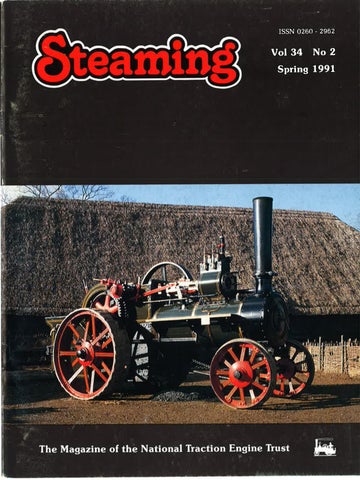
Cover Posing for its portrait against the fine thatched barn of Botley Manor Farm, near Southampton in the spring of 1986 is Tasker 'Economic' type agricultural engine 1352, built in 1905. The 7hp single cylinder machine was restored by its owners, Hampshire Museums Service, in 1984 and is often used for threshing with the Museum's own drum, and attends rallies across southern England. (Ian Taylor) 59
Trust News From the Chairman Within the traction engine world we have been fortunate that many of the makers' records have been preserved for posterity. Not all such records have been saved, but certainly those of most of the major traction engine builders have. These are to be found in Museums up and down the country, but storage of the great volume of material, hopefully with arracc for interested pnrtiac , brings a
problem of its own — space. One such depository, The Museum of English Rural Life at Reading University, has launched an appeal for funds to assist in setting up a new building — The Rural History Centre — which amongst other things will house the Fowler, Wallis and Ransomes records which the Museum has in its safe keeping. No adequate storage space for these irreplaceable items exists and the corridors where they are presently kept are overcrowded. The Trust considers the provision of a special, purpose built building a most worthy, essential and urgent matter. Your committee has therefore made a donation substantial from Its Preservation Fund to this appeal. We hope that rally organisers when distributing their surplus funds will also see fit to make a donation. As most members will know, much of the activity of your committee is, in fact, carried on by sub-committees which are appointed to cope with a particular aspect of the Trust's activities, or, in some cases a specific project. During the recent winter months two of your sub-committees have been very active and both should be producing the results of the their labours during this year. The Trust operates a Code of Practice covering the traction engine rally scene. This Code is updated from time to time as and when altered circumstances require; each edition is usually in force a few years. Your rally sub-Committee has recently made available to Affiliated Clubs and Rally Organisers the 1991 edition of this Code. This time it is an entire re-write and I would thank Andrew Semple and his sub-Committee for all the work they have put in over the last year. 60
The Engine Owners sub-Committee which covers the requirements of the engine owner and also covers the technical services aspect is tackling the production of a document which will be a Code of Boiler Practice as applicable to traction engines, and will cover all aspects thereof. This is a monumental task particularly as it is a first time effort. Much care and research is going into the project nthirh infoanti, Ito ,A,ill be of .-.siderable help to all engine owners. Michael Davies, chairman of the subCommittee, has assembled quite an expert and hardworking group and I look forward with interest to seeing what they produce. In the case of both these subCommittees all members should be indebted to them for their efforts and for the hard work they put in — much of it in their own time — for the
ultimate benefit of all members. The NTET and its predecessor the NTEC has had an independent existence since 1954 — thirty-seven years in fact. There are still within our membership a few members who were active in those far off days — but, sadly, as the years pass we have to record those for whom the fire has been drawn for the last time. Elsewhere in this issue is an obituary to the Reverend Philip Wright who was active in the Club from these earliest times and who held office of chairman at a period when the very existence of the Club was precarious. He did much to bring stability and firm leadership when it was most needed; subsequently he was our earliest President. Many of our older members will be saddened at his passing. (Eric Fillmore, chairman)
From Alan Martin's Collection
52
Crew and rural postman pose with Ransomes, Sims & Jefferies 7hp traction engine 14663 whilst engaged moving a sizeable load of baled hay. The engine, new in 1903, was owned by Fred Stacey of Houghton, near Arundel, West Sussex, and patriotically named for the reigning monarch KING
EDWARD VII.
Rally Organisation Rally sub-Committee Saturday 16th March saw a very well attended Spring Conference of Rally Organisers and Affiliated Clubs. This meeting marked 25 years since the first of the Trust's rally conferences. The new venue at Clifton Court Hotel near Rugby was excellent, and was most economical in cost to the Trust. The high attendance was (I hope!) a reflection of interest in the revised Code of Practice which was introduced at the afternoon session. During the morning Trust officers reported on their activities, the rest of the morning was occupied by an interesting debate on the need or otherwise of having unusual or special attractions to draw the crowds to a rally. The Editor of Steaming, normally safely hidden behind his typewriter, found himself defending his last Editorial, where he felt engines were the only attraction needed to draw crowds to a rally. There was a considerable disagreement with his view. It would be difficult to summarise the revised Code of Practice in this column, so I urge all Rally Organisers to obtain a copy from Sylvia Dudley before the start of the rally season. Copies are £3 each, postage £1.50 (see advertisement, inside front cover). The main changes set down in the document are the increases in the levels of cover for insurance, and the need to increase public safety in some areas of rallies is also highlighted. The Rally sub Committee have all put a lot of time into the revision and I thank them for their efforts. I would also like to thank David Franklin for his knowledge and recommendations on insurance which we have adopted in the Code. The result is, we feel, a good practical guideline to the safe operation of a rally. We will in future be keeping a mailing list of holders of the new Code of Practice. As it is in loose leaf form, an update page will be issued from time to time, so if you obtain a copy of the Code other than directly from Sylvia Dudley, please write to her to ensure you are put on the mailing list. During next winter we plan to run seminars to assist rally safety officers whose responsibilities grow each year. I will be pleased to hear from anyone who feels they will benefit from this; it will assist in possible planning of venues. Elsewhere in this issue you will see the advertisement for coal. Our suppliers advise there will be a shortage of steam coal with the
NTET Coal Supplies The Trust has again arranged low priced coal for use by rally organisers, clubs or individual owners In association with Arscott Collieries, Coal Factors and Merchants, Gateway Chambers, 26 Castle Street, Shrewsbury SY 1213J • pre-packed 25kg plastic bags • haulage can be arranged to any rally site • ring John Watkiss on 0743 362482 to discuss your requirements and haulage cost, anywhere in Britain DRY STEAM COAL (when available)
•
£106.00
WELSH DISESTEEM OWL 25kg
per tonne ex Shrewsbury Bituminous also available Cash on collection or pre-payment
Please order early to obtain supply of steam coal
closure of the Deep Navigation pit. The new East Merthyr pit will not be on stream until next year, so it is essential that you give our suppliers as much notice as possible; it seems inevitable that at the height of the season there will be a shortage. Arscott Collieries intend to offer good quality bituminous coals if steam coal is not available, but please seek advice from John Watkiss at Arscott Collieries on alternatives if this is a problem you encounter. I hope you all have successful and safe rallies this season — and that the summer rain only falls mid-week. (Andrew Semple, chairman, Rally Organisers sub-Committee)
Engine Owners Column Engine Owners sub-Committee At our meeting on the 26th January we were particularly pleased to welcome Michael Ward to the Committee and very much hope that he finds his time with us rewarding. Our main pre-occupation at the moment is the Trust's engine drivers course at the beginning of May. We have had a satisfactory response from would-be attenders and most of the instructors are members of our own Committee. It should prove to be a very interesting and enjoyable weekend. We are still deeply involved with the new boiler inspection Code and associated matters and Jim Newnham
and John Glaze are making steady progress. I strongly support the initiative agreed at the Autumn conference to make insurance discs standard and would remind engine owners that spark arresters are necessary for insurance purposes and that some rally organisers may insist on them. We wish all members a trouble free and enjoyable rally season. (Michael Davies, chairman, Engine Owners subcommittee) NTET Insurance Disc scheme The NTET Disc Scheme, which enables Rally Safety Officers to easily check the insurance of engines, has been a great success over the years and was originally put into operation by John Hirons. At last year's Autumn Conference of the Affiliated Clubs, Rally Organisers and Safety Officers it was agreed that all Approved Rallies would encourage and request the use of Discs, for easy inspection and to prevent the Safety Officers having to wade through a pile of papers which often do not provide the vital piece of information. The majority of engine owners obtain Discs from John Scott & Partners each year when they renew their insurance cover, but some owners who insure with other companies obtain the Disc by sending the relevant documents to me, and I issue a Disc providing the papers are in order. Last year was my first year in the job and I am afraid to say that over half those papers submitted were incorrect or did not contain the required information. 61
So let me be a blt more constructive. The accompanying reproduction of the 1991/ 1992 Disc shows three requirements apart from the make and registration number of the engine. • date of expiry of boiler insurance. • date of expiry of boiler inspection. • date of expiry of public liability insurance. Before sending the papers to me fur a Disc, please make sure that you can obtain the three dates from the papers you send, because if you cannot then there is no chance for me! The other papers that I need to see are
1991.92 MAKE REGO No DATE OF WIRY OF BOILER INSURANCE DATE OF EXPIRY OF BOILER INSPECTION DATE OF EXPIRY OF PUBLIC LIABILITY
INSURANCE 4b
tNO °/LER INSPEC: o N-.-41:00, PUBLIC LI"-
62
Cheshire enginemen welcome Foden 6hp traction engine 2312 of 1910 as it arrives on the Friday evening for the 1988 event at Astle Park near Chelford. (Jim Stevenson)
the Cold Inspection Report ana the Hot Inspection Report. The first provides the date 12 or 14 months on for the expiry of the boiler inspection, and the second proves that the engine has passed the steam test, and this is a definite requirement today. If you send the correct papers I can send them back by return with a Disc, but remember I sometimes go away for short periods and then there will be a delay. If you have any problems a telephone call to 0295 89696 in the evenings between 20.00 and 21.00. will usually find me. Last season some engine owners complained that the time taken from the hot inspection to when the report was received was anything up to three weeks and this of course delayed the issuing of the Disc. May I suggest the following; as soon as the surveyor has finished a satisfactory hot inspection you should ask him for a hand written note on his company's notepad confirming what has taken place — you can send this to John Scott & Partners (or me) for proof of the hot
inspection. Make sure it mentions the make and registration number of the engine and the date of inspection. (Dick Blenkinsop, Insurance Officer)
Lost Registration Numbers Since the introduction of the DVLC system last November there has been a steady trickle of enquiries, and after a slow start the system now seems to have settled down. So far there have been 14 applications for numbers to be restored and of these two have been rejected while several others are delayed due incomplete to applications being submitted. Please make sure that the application is supported by as much information as can be supplied. There must be a recent photograph to prove that the engine is ready for the road. If there is no old style log book I require a photograph of the works plate so that the link with the index number being claimed can be substantiated. Perhaps the most important lesson
learned is that there must be a clearly established link between the vehicle and the registration number being claimed. If an old style log book is produced there is little further documentation needed to establish the claim except a recent photograph, assuming of course that it is genuine! However, the problems arise when there is no such document and it has to be clearly established that the engine did carry the number being sought. In these cases a letter or statement is required from the Road Locomotive Society's Records Officer confirming the fact that the engine concerned did carry the index mark being claimed. This can be done centrally although some delay is bound to occur in the process. At the moment DVLC is taking about two weeks to process successful applications.
of importance in recent happenings to report to steam engine owners although the changes in lighting regulations could affect steam wagons fitted with electric lighting. The point at issue is the dipping of one headlight while the other is extinguished. The new regulations require matched pairs of lights and it is clear that the intention of the new regulation is to have pairs of lights illuminated and switched together. There appears to be some unintentional loopholes that allow for a single dipped beam but it is a matter of legal argument. The safest course is undoubtedly to have two dipped beams and it may be that a non dipping system is the most satisfactory compromise. If any members require further information please contact me. (Peter Smart)
Federation of British Historic Vehicle Clubs The Federation continues to work very hard in the interests of all preserved vehicle owners, particularly through the contacts in Brussels and Strasbourg. The most recent news sheet reports the FBHVC AGM and gives a useful precis of the work at the European Commission. There is little
Supper's Ready'
Transport Trust Award Scheme Members may recently have had difficulties making contact with the Transport Trust, due to their new premises at St. Pancras being unavailable. Their present address is: The
Transport Trust, British Petroleum, Britannic Tower, Moor Lane, Moorgate, London EC2Y 9BU. Entries for both the Scania Awards and Steam Heritage Awards should be sent to this address. Entry forms for the Scania Awards are available from me at the address inside the front cover of this magazine. Both the Transport Trust and the National Traction Engine Trust are surprised at the small number of entries from the traction engine world for these awards — it seems a pity that these schemes for acknowledging the dedicated work many of you put into your engines is not more widely used by our members — is it modesty? Apart from the presentation there is also financial reward to each recipient and I am sure each of you could think of a dozen ways in which your machine could benefit if you won prize money. Your committee considers that the Transport Trust has, recently, been very much railway orientated, but it is up to the traction engine movement to. put this right — we cannot blame them for not knowing about our part of the Steam Heritage if we do not tell them about it, and use the advantages they offer through the above awards. (Sylvia Dudley)
From an original painting by
Michael Dale
A quality Fine Art reproduction, limited to 250 copies, featuring John Murphy's Fowler showmans engines REPULSE and RENOWN Image size 191/4in x121/4in Each print is Individually numbered and signed by the artist
Price £32
including postage and packing
(E28 to NTET members)
Send PO or cheque to Michael Dale, 63 Little Moorside, Aston on Trent, Derbyshire DE7 2AD (Tel: 0332 792893) 63
Steam Apprentice Club Last year, 1990, saw a very large growth in the SAC membership, with over a hundred new members joining the club. Preparations are under way to hold special SAC events and it is hoped to increase the number of venues for this year. An Apprentices photographic competition is now in full swing with a good response expected. The under-21 section of the Trust is of great importance in that it is training and supporting our future rallygoers, rally helpers and organisers and tomorrow's engine owners and crews. The old guard are, of course, not getting younger, but perhaps we could appeal for help in providing teaching material, assisting with general training of younger enthusiasts or writing articles for the SAC's Magazine. Also, any owners or engine crews prepared to take on an enthusiastic SAC member as trainee or helper will be offering a most useful service — we do need to provide for our future. Please make contact via the SAC address inside the front cover of this magazine. (David Duffill)
Agricultural Division
SPRING AUCTION SALE Thruxton Circuit, near Andover Hampshire STEAM ENGINES — TRACTORS STATIONARY ENGINES COMMERCIAL — HORSE DRAWN & BARN MACHINERY — SPARES, MANUALS, BYGONES
Saturday 11th May 1991 Catalogues f3.50 (admit 2) from: Agriculture House, High Street, Stockbridge, Hampshire 5020 6HF s 0264 810702
64
Obituaries Reg Griffin He roamed throughout the country Knew every road and bend Remembered everyone he met Right till the very end. He loved his Scammell and his Foden He even used to crew Upon the mighty showmans and ... dropped a plug or two. Since retirement you can bet Each rally and steam fair We heard the voice of Griffin Tho' struggling ... he was there And this year at the greatest Steam Fair in the land Old Reg climbed off his death bed To come and give a hand But now old mate you've lost the fight and all of us must wait To hear you call our name ... and more When we pass through that gate. (Gerry Burr)
George Lea George S. Lea was born into a family of threshing contractors which had been started by his grandfather. Although their first self-moving engines were Aveling & Porter, the firm turned to Foden of Elworth in the late 1880s and returned on later occasions when other engines were in mind. It was on one such occasion that George, then a small boy, first met a member of the Foden family, and his subsequent meeting of younger members of that family led to a lifelong friendship between him and the Fodens. Being born into the trade, George understood threshing and its requirements from childhood and he went out to work with a set of tackle when he was old enough to do so. When he was older he was able to take charge of a set and his engine was Foden compound 1395. When this engine had been new in 1910, it was the product of a specification worked out by Mr Lea (senior) and embodied a number of modifications. This was at a time when buying a new engine was a personal matter between the maker and the buyer, and in this instance the buyer got what was to become a very successful engine. It was an engine which George had a great affection for, and it was also a lucky engine. In respect of the latter, George was involved in a rear•end-collision while shifting tackle during the wartime blackout and the whole set was written off. The engine, although
badly damaged, was taken back into Elworth and completely overhauled, and then returned to George in first class condition. It continued to serve the firm until the end of steam. One of George's regrets was that he allowed himself to be talked into scrapping Foden 1395, and he would have told us that he made a bad mistake in doing so. George was one of the very early people to go into engine preservation and steam returned to his life because of it. Perhaps he was best known as the owner of Foden tractor THE CHESHIRE MAID, for this was the engine which he was to take to rallies in so many far flung places. It was usual for him to travel under his own steam too, and the distances which were covered must have been immense. And always, for the onlooker, there was the sight of this pristine tractor that ran so beautifully. A more knowing onlooker would be able to appreciate the tractor when under way, for he was listening to a real professional at work in perfect harmony with his engine and it was a great pleasure to hear it pass by on the road with George in control. Apart from his active steam interest he was always willing to give good and helpful advice on things related to steam or routes to use with engines when they had to travel. He was an excellent writer and a fine lecturer who could hold his audience by bringing his subjects to life, and many of us will remember him in this guise. His passing leaves yet another gap in the few remaining real professional ranks of enginemen and we tender our deepest sympathy to Mary, his widow, who helped him with so much of his life among steam, and his sons, Brian and John, who also shared his interests. (Frank Strange)
Major Reverend Philip A. Wright, MBE, HonCF It is with great sadness that I write in fond memory of my dear friend Philip Wright, who died at the end of January, aged 82. Philip became interested in steam engines on his father's farm; he became a competent driver and had a good general knowledge of the construction and mechanics of steam engines. For a short while he did own a Fowler. He was the author of many books including Traction Engines, Old Farm Implements, Old Farm Tractors, Salute the Cart Horse, Country Padre (an autobiography) and Day by Day (a collection of sermons).
At the AGM of the National Traction Engine Club held at the White Hart Hotel, Kings Road, Chelsea, on the 26th October 1957 Philip Wright was elected Chairman (taking over from Ron Deemer). He remained as Chairman until the AGM on 20th November 1965, but did not seek reelection due to moving to a new parish near Chelmsford with more work. Anthony Heal was elected to succeed Philip. Not wishing to lose the Country Padre from the movement, Philip was made the first President in which office he served for three years. Philip was one of those men that generated anecdotes either from listening to stories from his past life or from spending time with him. He once raffled a horse and trap in order to raise money for the church restoration fund — the horse was a clothes horse and the trap was a mouse trap. Whilst vicar at the parish church of St Paul at Woodford Bridge in Essex, funds were required to repair the flaking Kentish ragstone from which the church of St Paul was built and the organ was badly in need of repair. As a result a traction engine rally was organised on Broadmead Meadow, Woodford Green on 29th August 1959. I remember driving our Burrell KING GEORGE VI from Minster Lovell to Woodford Bridge, John Hirons at the wheel. Having reached our destination, we had a car with us, so we drove around the Essex countryside. I recall commenting to John what a lovely life old Philip enjoyed; two
Included in our Autumn 1990 issue was a report taken from The Worlds Carriers in 1906 that the Barcelona city authority was acquiring a roller from Wallis & Steevens. It would seem the purchase was somewhat delayed for there is no trace of a suitable candidate in the Wallis records around that date, but in January 1911 they despatched 7234, a 15 ton compound roller. Les Burbery kindly provides a picture of this machine, pictured by the makers, as usual, in the LSW Railway goods yard at Basingstoke. The Wallis registers record the roller as sold to Morgan & Elliot, 'representes' (agents) of Barcelona, Madrid and Gijon, and it must have been one of Basingstoke's largest rollers, being built up around the boiler used for their 6hp compound road loco. The register additionally sets down that for future 15 tanners, a greater lap of the rollers must be arranged on the left hand side, also that the saddle bracket (the headstock) needed lengthening at the back to avoid a gar between it and the front of the lagging. The first reminder may have been something to do with a scarifier that appears to be fitted at the far side of the roller; the second was perhaps a cosmetic requirement rather than a constructional necessity.
services on a Sunday and a visit to his parishioners when he feels like it. When we arrived back at our caravan in the evening we discovered one of Philip's cards had been slipped through the window. On the reverse of the card was written "So pleased you have arrived safely. Had a bad day. Two Christenings at the church. Organ broke down. Church yard caught fire". My view of his glorious life was reviewed. The Woodford Green rally was supported by traction engine owners from near and far, with eighteen engines in attendance. Philip was the commentator at the event perched on the back of a Model T Ford, wearing a baggy and crumpled lightweight suit of salmon pink, adorned with a bright
red carnation. His straw boater was tipped forward as he entertained the crowd of 3615. A sheet collection, whereby a large cloth attached to the rear of KING GEORGE VI toured the grand ring, raised £25 12s 9d. Other money making ideas involved a man with a 100 year old tortoise which people paid to see (raising £7 16s Od). National Traction Engine Club stalwarts Alan Martin and Charlie Durrant supervised the ring events. The resulting profit of the event was £444 2s 3d which enabled the restoration of the stonework to go ahead. Following Philip's entertaining commentary, I invited him to repeat his performance at Northleach Rally in Gloucestershire. On the Sunday we attended a service at Northleach 65
Church; with the blessing of the parson Philip took part in the service. The church was packed to capacity; though the souls were clean, many hands bore witness to the uncleansed hobby of traction engines. Following the service the Revd P.A. Wright, in the Wheatsheaf Hotel, gave a further sermon of tales from the past. I conclude this memory of Philip in the manner in which he would end his own letters: "God Bless you and yours ever". (S.J. Wharton)
London Area Social Meetings The 1990 season of London meetings finished earlier this month, with the new Keen House location proving popular and having attracted a good number of members to all of the talks. Meetings commence again in the Autumn and the dates of the first Thursdays in the months October 1991 to April 1992 (except January) have already been booked at the Keen House venue — more details, of course, in future issues. (Bill Timmings)
records are on computer. The survey is based on postal code groupings in Great Britain and the accompanying map should give readers a fair idea of the spread of membership. Beyond our shores the figures are — Eire 32 USA 23 Australia 52 Germany 20 Holland 42 Others 43 New Zealand 29 Affiliated Clubs 38
Leeds Industrial Museum Members who last November attended the Trust's AGM at the Leeds Industrial Museum at Armley were impressed with the restoration efforts on the Leeds-built steam engines in their collection Other members, and indeed those who found the dull wet weather on the occasion of the AGM a little off-putting, may like to know the steaming days at Armley for 1991. On each occasion it is hoped to run the Fowler ploughing engine; the 18 inch gauge Hunslet loco and the mill engine. Dates are 6th May; 26th to 28th May; 26th/27th August — all bank
Membership OUR MAGAZINE 25 YEARS AGO
Members may be interested in John Cook's location survey of members, easily arranged now our 66
March 1966 had seen the first of the Club's Rally Organisers Conferences. A total of 41 delegates had attended representing 25 different clubs. The event, proved successful and further conferences were indicated. Another inauguration was the Historic Vehicle Club's Joint Committee, a body intent on monitoring the likely effect of legislation etc on preservation activities and representing seven clubs. The NTEC's Anthony Heal was elected to the chair of the joint committee, so engine owners could rest assured matters of steam would be fully considered. Already advice had been received that steam tractors would be exempt from the then proposed legislation on safety cabs for agricultural tractors.
holiday dates, and in addition each Wednesday and Thursday in August7/8th; 14/15th; 21st/22nd and 28/ 29th. Further details are available from the Museum, v 0532 637861/2.
'The Terror of the Road. According to Mr Chapman, Kent county surveyor, traction-engine traffic is responsible for very serious main road damage and the increased cost of maintenance. This traffic is not only damaging in winter time when the sub soil is saturated and more yielding but also in summer, when the hot temperature causes the bitumenous surfacingz.- to be more or less plastic and more readily compressed or displaced by the cross bars of the driving wheels, owing to the weight and the tractive effort combined. The damage is accentuated when the loads, hauled or carried, are excessive, and when the engines struggle to travel especially nn gradients.' (from Roads and Road Construction, February 1924.)
Engine news featured strongly in this Spring issue with long reports sent in by area representatives identified only by their initials — but most of those initials are recognisable today as members who are still active. Rollers and ploughing engines were still being noted in commercial work and fresh engines were still coming into preservation — a 1920 Ransomes, Sims & Jefferies in South Wales had come from an estate complete with tools, lamps, jointing and oil, and handbooks, having been hardly ever moved from the estate sawbench which it powered. It had but one man to look after it from new. From Australian member Warwick Turner came a list of nearly 150 engines preserved by fellow enthusiasts in Australia. Another clear out of local authority equipment found the Borough Surveyor at Tunbridge Wells offering for sale his Wallis & Steevens Advance roller 7790, bids to be at the Town Hall by 12 noon on 17th May. Also among the small adverts, Harold Bonnett was asking if anyone was interested in the starting of a small club to specialise in ploughing engine matters.
14 ti•
The Defence of the Realm The years which spanned World War 1 saw much change come about in the transport of goods by road. The movement around the country of the necessities of life was, of course, largely the province of the railways, but even in their Victorian and Edwardian heyday that form of transport still needed local haulage from manufacturer to railhead and again from city or country siding to the eventual consignee — and the other way round for some raw materials. Thus there existed the necessity for a vast amount of road haulage, by horse and cart, van or wagon until the turn of the century, the steam wagon in addition from that time and then, during the early 1900s, the first petrol motors. At first these were used only for light and local deliveries. The hostilities had not gone on for long before the petrol lorry became a sought after tool of war, and along with existing steam wagons (and horses) became the subject of requisition orders, under which owners had to relinquish their property for the furtherance of the war effort. Manufacturers' capacity was expanded several fold but the output was largely taken by the Government for the Military, with only a small allocation allowed for certain essential domestic uses. By 1918, road transport at home was bordering on a state of chaos, with a serious proportion of those fragile early petrol lorries idle through lack of spares and the rest probably overworked far beyond their designed capacity. Long distance haulage was taking place and steam and petrol wagons were making such journeys as Birmingham to London with types of goods which would never have been considered for anything other than rail transit over such a distance since railways came to the scene. Action was needed if the war effort was not to be seriously jeopardised, and that action inevitably meant Government control. Under the Defence of the Realm Act, parliament
came up with the Road Transport Order 1918, embracing new regulations 'with a view to providing and maintaining an efficient system for the transport of goods by road ... best suited to the needs of the country ... [and] furthering the successful prosecution of the war.'
Amongst the provisions of the Order were the right to regulate and give direction on the sale of vehicles; to take possession absolutely or by hire; for owners to return details of their vehicles; to prohibit or prescribe the radius of carriage by road; to give directions on routeing to depots etc of goods; to prescribe rates and conditions of carriages and so on. Compensation was allowed for and in case owners felt they could cheat the system, the Board of Trade could enter premises to inspect. Although contemporary trade papers had complained bitterly of the existing state of affairs in the early months of 1918, and sought remedy from the Government, the sceptics among us will not be surprised that the Order, when it was published in May, did nothing to please the transport industry. Mercifully, the hostilities came to an end in November, and from
DEFENCE OF THE REALM.
PERMIT for the use of Goods-Carrying Vehicles driven by means of Steam, including Tractors or Traction Engines.
In Accordance with the provisions -:of the Road Transport Order, 1918, made under the Defence of the Realm . Regulation, 211J, this permit authorises .of to 11Sia ilitt vehicles described in the attached schedule, subject to the c,onditions set t-
.out herein,
"Si CONDITIONS under which this PERMIT is issued. 1. That the owner shall comply with any instroctions issued to him from time to time by or on behalf of the Road Transport Board. 2. That the owner shall, when required, place the vehicle, fully equipped, at the disposal of the Road Transport Board, or any officer acting on their behalf, at a place determined beforehand, for use in an emergency, subject to payment of such compensation as shall in default of agreement be determined by the duly appointed Arbitrator. 3. That the Transport Registration Number of each vehicle (as shewn in the schedule attached hereto) and the name and address of the owner shall be clearly marked on the vehicle. 4. That this permit shall be produced to any officer authorised by the Road Transport Board for inspection at any time if required, and shall be subject to forfeiture if the holder, contravenes or fails to comply with any of the conditions of issue of the permit, or of the Road Transport Order, 1918. I hereby undertake to comply OM the foregonu; conditions. SNputture
. 4"
nr-•
This permit 11 nor valid unless signed by tilt bolder.
The inside front and rear covers of the Defence of the Realm Permit issued to Sandy Gray. 67
having a shortage of transport, the time rapidly came about when thousands of surplus vehicles were available for all and sundry — but that is another story. The above paragraphs form the background to the interesting survival which is the main subject of the article — the Permit issued under the Road Transport Order 1918 to Alexander Gray of 27 Princess Street, Huntly in Aberdeenshire and which his son, Sandy Gray, has kindly loaned to us. The card permit, folded to 4in x 6in, carries the usual phrases of authorisation and conditions, and encloses a four page paper schedule on which the owner's vehicles were listed — room enough for 60 or 70 entries, which had to include trailers as well as driven -vehicles. Gray's permit forms tl good record of his fleet at that period and Alan Duke has kindly consulted his records to enable further comment. The scheme allowed for dividing the country into thirteen Divisional Boards to regulate the Order — each to consist of a Board of Trade officer, a Road Transport Officer, representatives of the Ministry of the Munitions and of the Food Commission and three members drawn from the local transport industry. Each vehicle had to bear the Transport Regulation Number allocated to it, not in any particular position but suggested to be on the nearside, following the name and address usually shown at that point. Huntly fell within the Aberdeen division and to continue to run his business Gray was given the permit number S ABd 78, his vehicles thus carrying that number with the suffix /1, /2 etc. The S clearly indicated steam as the permit is endorsed 'for the use of Goods-Carrying Vehicles driven by means of Steam, including Tractors or Traction Engines'. Other divisions naturally used different letters — for example H. Bentley of Bradford's Fowler still bore the number S Bfd 76 after the war. The first entry on Gray's permit, SAbd 78 (without the suffix) was listed as Marshall 6hp traction 37209. This had been new in July 1902 from the Highland Show at Aberdeen to James Chisholm of Chapelton (probably the one near Arbroath, rather than the other one in Lanarkshire). Gray had acquired the engine at an unknown date. SAbd 78/1 was Fowler class B3 8hp traction 6929, another machine new from the Aberdeen Show, this time back in July 1893 and purchased there by J.S. Sharp of Premnay, Aberdeenshire. Again it went to Gray at an unknown date. SAbd 78/2 and 3 were entered on the list as 6 ton trailer wagons, presumably for use with the 68
Schedule of Vehicles authorised to be used under this permit : Transport Registration No.
DETAILS OF VEMCLE (for purposes of identification).
The Schedule of Gray's steam vehicles in the Permit,
traction engines. SAbd 78/4 was applied to Garrett 28738, a 7hp traction that had been new to Alexander Gray in November 1910, named ROYAL GEORGE. SAbd 78/5 to /7 were a further two trailer wagons at 6 tons and a trailer lorry at 3 tons — the difference in name
presumably being their respective heavy and light construction. SAbd 78/8 was given to Gray's first steam wagon — Garrett 5 tonner 33854 of 1920 (BJ5508)* — which was paired with SAbd 78/9, a 3 ton trailer. Finally SAbd 78/10 covered another 6 ton trailer. Whether the bracketted names
* This wagon was illustrated in our Winter 1989/90 issue, as part of an article by Alexander Gray on his memories of the family's Garrett wagons.
indicated the manufacturer or their related vehicle is not clear. Although the War ended in November, the Road Transport Order must have continued in force for some time, as the Garrett wagon was new in the autumn of 1920. Just when the scheme was relaxed is unknown (nearly two years after the Armistice seems a strangely lengthy time► , nor why all of the entries are crossed out in red ink except the Garrett and its trailer. Perhaps the engines had returned to their usual task of threshing. The purpose of the Order being to effectively regulate transport, traction engines only came under its regulation when engaged in transport of materials or goods. Many a threshing contractor must have expanded his business during the War by purchasing heavy wagons and taking contracts for haulage with his agricultural engines, however unsuited. Gray however already had such a business. Following his threshing round which took up the late autumn, winter and early spring of each year, the engines spent the summer on haulage, often taking the grain they had previously threshed to the meal mills or local railway stations, or, if it was barley, to the Glendronach Distillery. The distillery also required a good coal supply, so that commodity was loaded from Huntly station, with sometimes draff (husks) or whisky as a return load. Other business came Gray's way from wood merchants cutting down trees — the sawn wood had to be hauled in from anything up to 10 miles away from Huntly station, where it was put on rail. At that time most of the farms in the Huntly area were part of the Duke of Richmond and Gordon estates and many of the buildings were constructed of wood, which had to be brought from the Duke's sawmill at Fochabers, about 20 miles to the north. An engine sometimes towed three wagons back on this task. Roadstone was another material to be transported. Gray probably used the County Council's own side tipping trailers for this task, and these vehicles, of course, conveniently deposited their loads literally at the roadside. Stone was also hauled for other people for general use and for building houses etc. One off jobs included the later occasion when the boiler at Huntly Gasworks was found to be leaking on Sunday afternoon, and Gray's 6hp Aveling & Porter 1553 of 1879 deputised for over three weeks until a fresh boiler was fitted up. There was great excitement that Sunday, for Mr
Gray was a very religious man, an unfailing attender at church and allowing no work in his business on the Sabbath, but this day was different, for if he had not agreed to provide an engine the town would have been without its gas supply. Sandy Gray recalls the incident, in 1926 or 1927, and his twelve hour shifts firing the traction engine from 6am to 6pm with another man then coming on until the next morning. Sandy also remembers that the Aveling was never used for haulage, being put to threshing and, during World War 1, the family's sawbench in Huntly. This was used for cutting trees
brought in by farmers with their own horses. The Aveling does not appear on the Road Transport Order Permit, perhaps because of its stationary role in life at the time. Our thanks are due to Sandy Gray for his reminiscences of his father's business and for loaning the Permit, a relic of a short interlude in transport history and an instance of how the problems and restrictions of wartime transport spread even to rural north east Scotland. It is doubtful though, that the Regulations would have had much effect on the day to day running of Alexander Gray's engines.
Foden 5 ton wagon 1742 of 1908 still carried its 1918 Transport Registration Number when this picture was taken in Tiverton goods yard in 1925 — the somewhat roughly painted characters S/Exe/52/2 can just be seen in the shadows on the channel framing, to the rear of the usual speed limit information. The Foden survives and owner Bill Briggs keeps the licence number painted in the same manner. There seem to be few pictures available of wagons and engines showing these Defence of the Realm requirements (the numbers were in any case quite small in physical size), but another example adorns the Fowler road locomotive of H. Bentley illustrated elsewhere in this issue. (collection W.A. Briggs)
'The St Pancras Borough Council have placed an order with the Yorkshire Patent Steam Wagon Co, Hunslet, Leeds for two of their steamers with gulley emptiers. One of these is fitted with sprinkler apparatus.' (from Roads and Road Construction, February 1924. The machines were briefly mentioned on page 78 of our Spring 1990 issue.)
'Hiring of Steam Rollers — Lowestoft Borough Engineer reports that some difficulty has been experienced with regard to the hire of steam rollers, but an arrangement has been made with the County Surveyor for the Council to have the use of two rollers at 26s. (£1.301 each per day, exclusive of fuel.' (from Roads and Road Construction, September 1924.) 69
The tale of a G Pat Freeman I blame it all on Steaming! The numerous telephone calls made; the many letters written; the hours spent in the Records Office and the frustrations that occurred trying to obtain information that no one seemed to have. It all began when I spotted a For Sale advertisement in the 1988/89 Winter issue of our magazine which read 'G badge for Garrett steam roller, saddle fitting'. As my late father-inlaw, George Ottley, used to drive Garrett engines, and as my wife worked in Garrett's Leiston factory during the war (making shells, not engines), I have an affinity for Garrett artefacts. I therefore answered the advert with some trepidation, expecting that someone would have beaten me to it — but I was lucky and became the owner of a Garrett brass G badge with no roller attached to it. I was, however, a bit puzzled as to how it came to be on its own and this was the question I put to Les Lambe from whom I made the purchase. He told me that when he bought Garrett roller
34084 (BJ7045) from Tim Tomlin of Bampton Castle in Oxfordshire, it did not have the G on it. However when, later on, he went back to collect some odds and ends Tim handed him the badge which Les never fitted, and when he sold the roller in 1974 to George Howard of Southport, it was still without the item. This satisfactorily explained how I became the owner of a piece of a Garrett roller and it whetted by curiosity to find out more about that particular roller's history. I started at the Suffolk Records Office in Ipswich, and the staff were most helpful. They supplied me with copies of Specification No 17 — a list of drawings for 8 and 10 ton 3 shaft C/D Light Road Rollers; the actual build list for roller 34084; and the invoice to the Suffolk County Council for rollers 34084 and 34085 and steam wagon 34139. I browsed through a number of minutes of the Suffolk Roads and Bridges Committee and noted that on 13th December 1921 the County Road Surveyor suggested that two steam rollers, offered by Messrs Garrett & Sons Ltd
for delivery within a fortnight, be purchased by the Council so that they could get one third of their cost paid for by the Ministry of Transport. This was agreed and the Minutes of 21st March 1922 stated that two steam rollers and a steam wagon had been purchased, which must have been those referred to on 13th December 1921. Sometime earlier the Council had received quotations for a 10 ton roller as follows: Garretts — £809; Ruston & Hornsby — £967; Aveling & Put lei — £956. The build list clears up one point. Traction Engine Register gives the date of manufacture or first sale as February 1922 but elsewhere it has been given as 1921. The definitive document shows that the building of the engine was started on 11th February 1921 by the erector, a Mr Butcher, and was completed on 3rd February 1922. On the invoice the delivery of 34084 was set down as 3rd February; of 34085, 8th February and of the steam wagon 34139, 31st January 1922. The exact wording on the invoice for the rollers is as follows — No 34084 10 ton compound 'Light' Road Roller BARON fitted with Injector, Waterlifter and 26ft. hose; Standard Rollers with all accessories £1275 Os Extra for 3-Tine Allen Scarifier 167 Os £1442 Os Extended awning with Curtains (gratis) 10% 144 4s £1297 16s No 34085 10 ton Compound 'Light' Road Roller £1297 16s Extended Awning with Curtains Gratis Road Rollers to have Brass Nameplate on each Motion Guard East Suffolk County Council, Ipswich. Nos 3 & 4 respectively. Painting — Standard Green.
Garrett 34084 in Potters yard at Dereham in August 1960. This is the oldest picture of it that the author has traced and shows the Allen scarifier still fitted; no brass chimney cap; steam pipe from cylinder block to injector passing across East Suffolk brass plate; original G on headstock; registration plate on roll forks and the small tool box at the rear of the canopy. (collection John Crawley) 70
Red Rollers and Undercarriage. Weight to be painted on each Roller. East Suttolk County Council was therefore the first owner of 34084 and it successively moved from them to Sligo & Harrison of Lowestoft; to
Potter Bros of Yaxham; to Cliff Aldrich of Forncett; to Tim Tomlin of Bampton Castle; to Les Lambe of Bromsgrove; to George Howard of Southport; to John and Shirley Lea of Scholes and finally to John Millington of Audlem in whose possession it still is. Alan Duke kindly told me that 34084 was with East Suffolk C.C. until about 1950 when, together with 34085, it was sold to Sligo & Harrison. I have tried to trace this transaction in the minutes of the Roads & Bridges Committee but have had no concrete indication of the sale in the minutes between 1919 to 1954. The nearest I have got to any date is in the March 1949 minutes which read: 'The C.C. owns eleven steam rollers — these are from 22 to 49 years old. During the past two years it has been necessary to scrap two rollers as they were beyond economical repair or it is impossible to obtain the requisite spares. Of the 11 rollers referred to above, three are under repair and it may be necessary to scrap two of them as essential spares are unobtainable and the cost of having them made is prohibitive.' Alan Duke also said that 34085 was scrapped in 1953, but 34084 remained and was sold to Potter Bros in 1959 then in 1971 it went to Cliff Aldrich. Cliff said that Mr Potter was a building contractor in Dereham, Norfolk who had two other rollers — and during the Egyptian crisis also had a Hudson car converted to steam operation. Page 82 of John Crawley's book Steam Rollers in Focus shows roller 34084 standing in Potter Bros. yard; the photograph was taken in September 1960. Cliff also told me that he bought the roller in March 1971 and never had it in steam, selling to Tim Tomlin on 12th December 1971 for £825 plus £39 for a set of new tubes and £50 for transport. Around 1973 Les Lambe bought the Garrett from Tim together with the still unfitted set of tubes. He had it in his mind to convert it to a tractor but the water tank did not have a transverse tunnel to take a brake shaft, which prevented fitting wheel brakes. He tells me that, in retrospect, he is glad he could not convert it as there are not too many Garrett rollers left in preservation. When he bought it a nameplate THE BARONESS was on the motion cover, together with the East Suffolk C.C. plate, and he understood that Tim Tomlin had given 30484 that name as he already had an Aveling & Porter roller called THE BARON. It is interesting to note that on the Garrett drawing specification the class name for a 10 ton CD road roller is BARON (for the 8 ton it was PRINCE).
: vs(
ctortui I r '11, IfriC) * N .;.`
The plates on the 3 shaft roller's motion side sheets about the time the roller was first acquired by George Howard — the steam pipe now takes a different route. (collection George Howard junior)
After Les bought the roller it was brought back to his place at Btomsgrove by Neville Melhuish, a well known engine owner and driver of Chipping Norton. It was then sent to the Midland Rolling & Haulage Co to be retubed and tested, and to have its motion-work overhauled. In May 1974 it was collected from there by Trevor Daw of Henley-in-Arden and steamed straight to the Birmingham Rally. On the Sunday of the rally Les operated the Garrett, then it was low-loaded back to Bromsgrove. Later in 1974 Les sold the roller to the late George Howard of Southport, who already had a Burrell Gold Medal tractor. George carried out a great many repairs on 34084, dismantling and rebuilding the forks, rolls, headstock, steering gear etc as he thought everything was loose and slack. Exactly what work he carried out his son George was unable to tell me but he did say that his father did a superb job to bring THE BARONESS up to a very high standard. As an example the roll forks had fifteen coats of gloss paint, each brushed and flattened by hand — the resultant finish was like vitreous enamel. George Howard Jnr confirmed that there was no G on the roller when his father bought it and remembers that a wooden pattern was made of a G and a new brass one cast at a local Southport foundry. Whilst at an Astle Park rally a would be thief was disturbed just as he had unscrewed the G but luckily he dropped it when he ran off.
Although the late George Howard made an excellent job of the restoration of 34084 it was for him, being used to his nippy three 3 speed Burrell, too slow and unwieldy, and when the Burrell was due for a major overhaul 34084 was sold to finance that work. That was in 1979 and the next owners were John and Shirley Lea who kept her for the next eight years or so. During that time they rallied the roller at Lancaster, Kendal, Grappenhall, Astle Park and Leeds and all the maintenance required during that period was bearing adjustments and packing glands. In September 1987 they sold it to the present owner, John Millington of Audlem, Cheshire who fitted a new set of tubes in 1990. With John, 34084 travels between 300-500 miles each year to rallies under steam, and in 1990 visited Astle Park, Market Drayton Carnival, Malpas and Sutton Hall. Work to be done on the engine during this winter includes refixing the rear wheel tyres. The above paragraphs take us briefly through the various owners from the factory to the present day. I wondered for some time how best to display the G badge, which because of its curved nature precluded fixing it to a flat board. Sometime previously my son had lopped the top off a silver birch tree that was in his garden and had given me several pieces, about 10 inches long and 6 inches in diameter, so that I could make them into nest boxes. The G fitted neatly around one of these 71
Garrett 34084 at Harewood House rally in 1985, whilst in the ownership of John and Shirley Lea. Notice the 'cotton reel' type steering gear. (Roger West)
which I then split down the middle. The G was fixed to it and into the flat side I fitted a hanging device. My silversmith friend, Ron Oddy, from a picture of 34084, kindly made a cut out of it in brass and this I affixed onto the wood In the centre of the G which gave the whole thing an extra dimension. This now hangs on my wall as a permanent reminder that you do not have to own a complete engine to become involved, in a small way, in the preservation movement. At this point some preservationists might say that the G should be put back on 34084 from whence it came. In defence I would point out that, over the years, there have been several changes to the roller the least of which may be the substitution of a duplicate G. The following are some examples. When the engine was named THE BARONESS around 1972, plates carrying that name were affixed to the motion covers just above the original 'East Suffolk County Council' plates. Subsequently the latter (which, incidentally, still bear the inscription BARON on their reverse side) were removed and one was fixed onto the top front strengthening rib of a new canopy which was made by George Howard. At the same time a large tool box replaced the small box originally fitted. It also appears that when he removed the 'Eact Suffolk' and repositioned THE BARONESS sign in the centre of the right hand motion cover he also re-routed the steam pipe 72
from the cylinder, to go underneath this cover, instead of being around the outside of it. Originally this pipe had gone diagonally across the cover so it must have already been changed before. By comparing past and present photographs it would seem that the headstock/roll forks have been modified slightly as the fork spindle is now more prominent than it was. The registration plate has been removed from the front fork and is now on the top front of the canopy. When the engine left the factory it had an Allen scarifier attached and also a brass top to the funnel, neither of which are now on 34084. Quite a lot of paint lining work now adorns THE BARONESS which seemingly was not part of the factory specification. I do not think any of these changes detract from our appreciation of a well preserved roller and indeed the judges at the 1979 Haydock Rally must have been of like mind because they awarded THE BARONESS the Supreme Challenge Trophy, the longest distance trophy and the award for the Best Steam Roller. It may be of interest for readers to see some of the other information which I gleaned during my researches from the build lists and from the Roads & Bridges Committee minutes, as well as from local personal contacts. One of the latter is Mr Percy Broomfield, aged 96, who started work as an apprentice at Garretts of Leiston in 1909. He remembers Mr Butcher who
was the leading erector on the building of engine 34084. Percy went into the Test and Brake House in 1911 and he told me that each engine spent a full week in that department undergoing water and steam tests etc, and the probability is that he took part in the testing of engine 34084. Records show the boiler was pressure tested to 360Ibs (working pressure 1 ROIhs1 And the unladen weight was 11 tons 4 cwts. The front roll fork was made of cast steel channel section to reduce the overall weight. This and the roll head were of the distinctive Garrett type — the vertical rotation of the front roll was by the post moving in a sleeve within the tubular steel casting of the head, whilst the horizontal movement was a pivot in the centre of tile lurk. Another item on the build list is 'right hand hind wheel nave, turned to suit scarifier cap'. As with many Garrott rollorc the machinc'3 3tccring chains fitted round 'cotton reel' extensions to the chain shaft. From the minutes I picked out the following. In 1924 two sleeping vans were purchased from Eagle & Co Ltd of Warwick at £100 15s Od each. Two water carts were also bought from Messrs Thurlow & Sons Ltd of Stowmarket for £35 each. In 1929 the Suffolk County Council was given a demonstration of a diesel motor roller and it was then
The author's Garrett G motif from roller 34084, now mounted for display on part of a silver birch tree trunk. (Pat Freeman)
estimated that the comparable operating costs vis a vis a steam roller were as follows:
oil
steam
10s Od 9s Od drivers wages water cost and 12s Od horseman oil, petrol, 7s Od 6d 1s coal haulage etc 11s 9d depreciation, repairs 13s 9d 7d 7d insurance £1 5s 10d £2 0 4d (£2.02p) (£1.29p) Mention was made earlier of a steam wagon 34139, purchased at
the same time as 34084, and it is interesting to note that in R.A. Whitehead's book Garretts of Leiston about 700 overtype wagons are listed, all except two having build dates. I can thus confirm that one of those two, 34139, should have the date 31st January 1922. In conclusion I should like to thank Les Lambe, George Howard junior, John and Shirley Lea and John Millington for all the information they have given me and for photographs either donated or loaned. I give acknowledgement to John Crawley
Albert Mosley, Haulage Contractor Albert Mosley (standing right) takes a few minutes from the working day of both his drivers and steam wagons to set up a photograph that might be of future use for business purposes. Dudley Hill is a district of Bradford and the scene is presumably Mosley's yard. Alan Duke is unable to identify the Atkinson and the Yorkshire wagons, for their makers records have not survived and the Bradford vehicle licence records are also less than complete. Nearest the camera is an Atkinson 6 ton tipper, registered KU172 — which dates it as new to early 1922 — and nicely lettered in flowing script on the front apron. The No 1 fleet number under the registration could indicate it was Mosley's first wagon. Second in line is another Atkinson, its later registration KU3321 pointing to it being new in late 1923. Here the sign writing is much less fanciful and seems to be under grime, such that some applied chalk has been thought necessary to make the legend show up on a photo. Last in line is a much older Yorkshire wagon: Alan Duke feels this may be works number 152 of 1906, new to J.E. Spence of Waterford and later recorded with Mosley & Dickenson of Dudley Hill, the latter presumably being a later partner of Mosley. The registration number may be AK45xx which would have been issued about 1915, perhaps the time when the wagon came to the Bradford area. Thanks are due to Harry Lee and the East Bowling History Workshop for access to the picture.
for allowing me to use a copy of an illustration from his book and to the Suffolk Record Office for producing the Minute Books for me to browse through and for supplying copies of the definitive build lists. Finally, perhaps I should now rewrite my opening paragraph. It really ought to have read 'I would like to thank Steaming for being responsible for my having had many hours of enjoyment researching facts, for my making several new friends and for increasing my knowledge of Garrett products'.
'1928 Foden 13108, 10/12 ton Overtype Rigid 6 wheeler delivered new September 1928, licensed and used 18 months only, practically like new. f795. — Scammells, Fashion Street, Spitalfields, El ."Two Fowler Undertype Steam Wagons, 1927 tipper, 1928 platform, £150 each for quick sale — Box 6882.' (These two consecutive adverts from Commercial Motor, 21st July 1930, illustrate the
relative secondhand worth of two contemporary steam wagon designs; the Foden well tried and developed over a quarter of a century and the Fowler, despite its pedigree, somewhat less successful. However, the Fowlers may have seemed a better bargain to someone, for the advert appeared only once, whereas Foden 13108 remained on offer by G. Scammell & Nephew Ltd for many more weeks.)
73
This finely posed picture of a Fowler road locomotive and its load was probably made in the mid-1920s on the Al near Haddington, some 15 miles south of Edinburgh. The photographer's prime purpose was probably to capture, for makers
Travelling North
Ruston & Hornsby, an image of one of their Lancashire boilers in transit. However the whole scene is now of great interest in depicting just one of the jobs undertaken by H. Bentley & Co (Bradford) Ltd of Dick Lane in that city. The living van bears several of the firm's boasts and the tackle box between the wheelbase of the trailer sports the legend 'Engines and Boilers moved and fixed'. The motive power is Fowler 9495, a B5 long firebox Lion class road loco built new for the War Department in March 1904. Like many WD engines,
its early working life is obscure. It would seem to have been acquired by Bentley by early 1918 at least, for the belly tank bears the number SBF°76.2, indicating the engine was authorised for use by a Bradford owner under the provision of the Road Transport Order 1918, made by the Defence of the Realm Regulations. In 1920 the Fowler was provided with a new boiler, works number 15754, and in 1921 h was registered in Bradford K9024, named TIGER. The wocd block rear wheels are believed to have been
fitted in the early part of World War 1 and can be seen to have the lettering 'Aveling & Porter, Rochester' cast into the rim. Bentleys also owned at various times, secondhand 8 and 10hp McLaren engines and also 8hp Avelings. The fleet that remained in 1945, including Fowler 9495, was sold to Allen, Knight of Huddersfield; our subject lasted until 1950 when it was scrapped. Thanks are due to Willem Middlemiss for kindly loaning the picture, and to Alan Duke for notes from his engine records.
F.? %Pe HAULAGE CONTRAC TOP
H.BENTLEY&C'fam,,,,P.
TELE, puvtEYHu.L 124
ANY WEIGHT ANY DISTANCE
ROAD to RAIL Stuart J. Gray Early in 1990, like many of us contemplating, during our period of winter inactivity, which forthcoming rallies to attend, I caught sight of an advertisement in Steam Railway, placed by former main line railway locomotive driver, Clive Groome. He offered the chance to experience and learn the art of firing and driving a standard gauge steam loco on the Bluebell Railway in Sussex. What particularly caught my eye was the 'Book now for the winter season!' At last something to do and ease the pain of withdrawal symptoms, for I had stripped my Sentinel's boiler down for inspection. The course, entitled 'Footplate Days and Ways', is aimed at the broad spread of steam and railway enthusiasts who have varying degrees of knowledge, but principally seek the magical experience of actually firing and driving a full sized locomotive. The course fee of £230 for the five days seemed quite reasonable. The timetable commenced with two days of theory, followed by two days of actual firing and driving within station limits, learning the basic skills of preparing the engine for steam, cleaning, oiling up and then acquiring competence in firing round the box (not as easy as you might think — fire it like a traction engine and all your coal ends up on top of the brick arch!) buffering up to rolling stock, and later of course cleaning the engine out at the end of the day. Not much difference from traction engine practice here; just more of it. The final day, having proved your abilities, is the chance to take the locomotive and a brake van on a round trip of ten miles up the line and back, once as a fireman and once as a driver. Clive Groome, who runs various courses on both the Bluebell and Swanage Railways, has a wealth of main line steam experience and during his time at the Nine Elms depot in London became one of the steam era's youngest express passenger drivers at the age of just 26. We found him an excellent teacher and nothing was too much trouble for him to explain or demonstrate.
Arriving at the Bluebell Railway's Sheffield Park station on the first morning, I joined the five other course students as we were met by Clive. He introduced us to the loco depot to familiarise us with the regulations and to book on, and to establish just what sort of a team he had in front of him. As we introduced ourselves, Clive enquired what steam experience we had, if any. As you would expect it varied, from just interested to a live steam modeller, and then to myself having restored and rallied both traction engines and latterly a Super Sentinel. Despite having some twenty years restoration and rallying with steam, I could not pretend I was any more than a novice at that moment if I was to gain from the extensive knowledge and experience that Clive Groome was to pass on. With traction engines I had no formal instruction in their use (a circumstance, incidentally, that both
the Trust and the Steam Apprentice Club now seek to rectify for future newcomers► , and whilst over the years I have built up a healthy respect for steam, prior to this railway course I had not appreciated the finer points of disciplined practice. Such habits, of course, can not only prevent accidents but can also ensure proper care and maintenance and so help promote the unique relationship between man and machine. The first day of theory was broken up into various sections, most of them just as relevant to road steam. The subjects were combustion; types of coal; use of primary and secondary air to control combustion and smoke emission; the boiler, firebox and general layout arrangements; cab controls and lubrication. We even made our own Worsted trimmings — always carry a spare in case you find one missing! At one stage during the day, Clive took us all into the firebox of a Bulleid Pacific. With seven of us standing on the firegrate, Clive demonstrated exactly where combustion of the fuel took place and at the same time pointed out that just about where my shoulder was, the firebox temperature reached 2,500°F — far higher than the melting point of copper. Day two tackled the different types of valve gear. Not only did Clive
Day five, and it's my turn to drive, whilst my fireman remembers the technique to fire round the box. (S.J. Gray) 75
The usual course photograph, together with the North London tank to pose against. Clive Groome is on the extreme right. (S.J. Gray)
utilise excellent and very original sectional models to explain theory behind valve timing, lap and lead, expansion and cut-off etc, but he was also able to demonstrate and test our understanding by taking us into the loco yard to read from the positions of big ends and eccentrics, the relative positions of valve ports according to whether the engine was in forward, reverse or mid gear. The workings of various types of injectors were explained using similar sectional models designed to enlighten even the most confused steam enthusiast on the inner mystery of what goes on within those fittings. Lastly our theory session touched on the various types of braking systems and in particular vacuum brakes. These two days of theory I found of tremendous value and interest. Clive was an excellent teacher and was intent on our understanding each subject before moving onto another. If necessary, a trip into the shed yard to confirm or demonstrate any aspect of the locomotive was taken to ensure we were all prepared for day three. By then all were eager to put theory into practice; we split into two groups, one to prepare the engine whilst the other cleaned — next day we would change over. Our allocated engine was the six-coupled former North London Railway tank, and working across the footplate, we all took it in turns to act as driver, fireman and third man, running up and down 76
within the station limits and practising buffering up to a brake van. Vacuum brakes really were something different compared to my wagon's steam brakes. Drop the brake handle and 30 ton tank locomotive stops almost instantaneously. It was difficult to appreciate the braking control I had with such power and weight. Does anyone have a conversion kit for my Sentinel? Now I should like to pass on the lessons I learnt in firing. As with traction engines, firing on the principle of a little and often and around the box is followed in practice; however in a steam locomotive firstly you do not have to contend with a third shaft right in front of the firebox door and secondly by comparison you have a much larger grate area. The method of firing is best described as combining the disciplines of throwing a hand grenade and swinging a golf club. Looking into the firebox to make sure you know where you are throwing your coal is not the right way and neither is selecting large lumps and firing by hand (habit!), something I found easier than firing left handed! The idea is to take a large shovel and only half fill it, stand at an oblique angle to the coal bunker, feet astride and as if swinging a golf club, throw the coal into the firebox, making sure the coal leaves the shovel before it reaches the firedoor. Placing the coal in a selected part of the firebox is simply achieved by a last split second
flick of the wrist and without looking down or into the firebox if you want to avoid your efforts ending up either on top of the brick arch or all over the footplate! I obtained a real sense of satisfaction in getting the action just right, although I am not sure I will live down my firing-by-hand technique! Our fifth and final day allowed us to put newly learnt skills together for our first real round trip and to our delight we had a different locomotive, the railway's former Southern Railway Maunsell 2-6-0 U class, affectionately known at the Bluebell as 'The U-Boat'. Six trips were made during the day, so each student had a turn acting as fireman and driver for one full trip. Firing up the bank was much more intense than the previous two days and Clive was able to give excellent guidance, so we ran into few problems. By this time I felt I had mastered the firing technique well enough — for 4 miles anyway — and I thoroughly enjoyed the trip. Driving the locomotive was really the icing on the cake for everyone and Clive continued to ensure we learnt as much as possible, insisting we stopped halfway up the bank and restart without rolling backwards or snatching at the couplings. I found it interesting to experience the 'fine tuning' of the cut-off control for the valve events and for one short spell to open the regulator into its second valve position! At the end of the day there was an opportunity to reflect on the week; I felt I had learnt much, having received perhaps the most in-depth training I could have had in today's steam preservation scene and in such a short space of time. My lasting impression is the discipline instilled in every operator of railway steam locomotives, stronger, maybe, than that which was experienced with agricultural engines, and above all the teamwork. Unsuspecting members of the public had every right to wonder what I meant last season as I shouted up to my colleague 'Going under' as I ventured underneath my Sentinel wagon to check the oil. Had I gone broke, or was I about to commit suicide? No, it was just locomotive practice. I had participated in a thoroughly enjoyable and informative course which I would highly recommend to any traction engine enthusiast. For details on future courses, write enclosing a SAE to: Clive Groome 'Footplate Days and Ways' 40 Sidney Road South Norwood SE2S 5NB
a
sfIGAI?
RIVERS
LEVERP00011::65ND6N
My usual steam mode of transport, Super Sentinel 6327 of 1925 — perhaps the nearest thing to a locomotive on pneumatics. (D. White)
Restoration problems ...1 not any longer! A FULLY COMPREHENSIVE MACHINING SERVICE IS NOW AVAILABLE FOR ENTHUSIASTS FOR ALL TYPES OF RESTORATION PROJECTS Some of our recent machining projects have included: New 4-foot diameter wheels Boring cylinder blocks New front and back axles Boring and re-bushing of back wheels Various types of valve gear components, bushes and small parts For further details, please contact —
ADVANCE ENGINEERING SERVICES LTD SPECIAL MACHINE MANUFACTURERS, TOOLMAKERS AND PRECISION ENGINEERS
FARLEY BANK, HASTINGS EAST SUSSEX, TN35 5QF HASTINGS (0424) 424720 FAX (0424) 442924
77
Tall Haulage Many readers will know the name of E.W. Rudd in connection with heavy haulage — not so much for his fleet of engines, which was minimal in number, but for his exploits with the removal of Hackbridge built transformers from their works at Waltonon-Thames, and in particular on the occasion of the well-photographed accident in 1936 when the two leading engines got pushed off the road into a ditch. I his photograph, trom the tormer GLC Whiffen photographic collection, shows Rudd at work on his local ground in the East End of London, the
78
task being the removal of the Dr. Stanley Atkinson Memorial Tower from the centre of Burdett Road, Stepney, where by 1933 the increasing amount of road traffic at the intersection of five roads had resulted in it becoming something of an obstruction, and the area becoming what we would now call an accident black spot. Stepney Borough Council had been appealed to by the Ministry of Transport to move the tower, but borough engineer and surveyor Bernard Belsher, in investigating its demolition and re-erection on an island site at Stepney Green, hesitated at the
estimate of £525. Further, suspecting the glazed brick and ornamental panels could be ruined in the course of dismantling, Belsher approached E.W. Rudd Ltd of Bow Common Lane, Stepney to see if they could move the tower whole, from ground level or thereabouts. Rudd had been previously engaged by the Council to move heavy machinery and had, or had access to by way of hire, a specially constructed and suitable trolley for carrying upwards of 100 tons. A contract was entered into after full discussion and the work scheduled for Sunday, 29th January 1934. Work on raising the tower ready for loading was commenced after the overhead tramway trolley wires had been taken down by London Transport workmen as soon as the last trams had passed along the route at about 1.15am on the Sunday morning. The trailer used for the work consisted of two bogies either end of straight carrying beams that passed either side of the load, enabling the lowest part of the object
to be as near the ground as practical. It seems to have been specially designed for the transport of electricity transformers of up to 100 tons weight and must have been, capable of being dismantled and then re-erected around the load to be carried. Just who owned the trailer is not definitely known — Rudd used it on several other photographically recorded occasions (in 1933 and 1936) and the local press reports of the Burdett Road clocktower move (on which much of this account is based) intimate he owned it, but Tam McTaggart in Iron Men of the Road thought the vehicle was owned by one of the electricity or power station companies. Can any member comment? Once loaded the overall height of the portion of the clocktower carted through the streets measured 30ft bin, and it weighed about 30 Ions. The removal was carried out without any damage whatever being done to the structure. Best of all was the fact that the cost of transport had only come to £75 — though there would no doubt have been additional costs in the preparation of the temporary timber encasure and of the underpinning of the brickwork to the tower prior to it being wheeled away from its foundations. The engine which provided the motive power is Fowler 9904, a B5 class road locomotive of 1904. It was actually owned by Coulson & Co of Park Royal, London and, as on a number of other occasions, was on hire to Rudd, who had his name signwritten on boards which were hung on the outside of the motion cover sheets. The Fowler was owned by Coulson thoughout the 1930s and survives in preservation with Ken Frost in Norfolk. The picture presumably shows the cavalcade fairly early on during the dull Sunday morning of 29th January, with plenty of children, probably less ragged than during the week, jostling to be in on the photograph. London Transport would have wanted the pile of masonry out of the way so it could re-erect the overhead electric wires for tram services during the morning, and the outfit is now clear of tram tracks, but still in the way of telegraph wiring. figures important-looking Several appear in the crowd and we can muse as to whether the gentleman with the white scarf near the rear wheel of the engine is Mr Belsher the surveyor, perhaps by now a more relaxed man. His spectacular solution to the problem was of lasting benefit to the citizens of Stepney for the clock tower survived the London blitz and is still a local landmark.
A postcript Since the above was prepared for publication a reference to Rudd's transporter has been found in the issue of Motor Transport for 14th July 1930. A short article on the vehicle is accompanied by an illustration showing it to be lettered E.W. RUDD LTD exactly as in the clock tower photograph, and all the visible details are identical. Headed 'New 100 Tonner' the notice says the trailer was built by E.W. Rudd Ltd of 190 Bow Common Lane, London E3 in their Poplar Works, its purpose being the movement of transformers. Two massive 8 wheel bogies were
EDMONDS on Engines
Chris Edmonds
I do get increasingly tired of hearing moans and groans about our movement getting commercial. What do these grousers expect? Do they honestly wish that we are still at the stage of five engines (some with silver painted motionwork), a tea tent and a crowd of fifty people? Anything that is worthwhile must do two things. It must adapt, and above all it must grow, otherwise it dies. There is no doubt that our movement has grown, but it has also adapted to modern needs and therefore it has changed. The fact that that has happened has ensured its prosperity and its continuation, and surely it must be a joy to know that our hobby has captured the hearts and imagination of countless thousands. That is, of course, where the commercialisation starts to creep in. With ever growing crowds of people flocking to our events, the costs start to escalate. Insurance companies get very interested in things like Public Liability and all the other policies that they are past masters at dreaming up.
located at either end of the pair of carrying girders which weighed 41/2 tons each and had strengthening plates riveted top and bottom. It was these girders from which the transformer, or any other load, was suspended between the bogies. The trailer had no back or front, being capable of haulage from either end via a drawbar. The bogies, moving under a turntable beneath the superstructure, were lockable in a set position. Each cast wheel, fitted with solid rubber tyres, weighed 8 cwt and was braked by internally expanding shoes via a handwheel at the outer end of each bogie. The whole outfit with its capacity load weighed 'not far short of 130 tons'. (Roger West) g
Once upon a time you only saw local engines at local events, but isn't it nice that successful rallies can bring examples and their owners down to our neck of the woods, precisely because the rally is financially viable enough to pay for it? We British are a funny puritanical lot at heart. The two things that none of us can do without — love and money — are the two things we get most incensed about when we think anyone else is getting more than his or her fair share of either! I suppose a better description is simply jealousy. Over the years I have spent more money than I care to remember in buying, rebuilding, and rallying engines. My financial reward was nil.There is an old saying 'There is nothing in getting nothing' and I think I have learnt that lesson. I would add a rider — there is nothing wrong in making money, provided it is in a fair and decent fashion. The traction engine owner has had a pretty raw deal over the years in this respect, and I have always felt that some rallies could pay them a lot more then they do. 'Enginemen before the Village Hall' should be our rallying cry, but then charity will soften the hardest heart. Perhaps I have that hardest heart because a well known engine owner came up to have a look at my quaint little steam locomotive PILGRIM with which I give passenger rides on my portable railway. "Well Chris," he said "after all the engines you've had in your time, this one is a joke". "Yes," I agreed, "it is, but then jokes are supposed to be laughed at. How much are you getting for bringing your magnificent road loco here?" "About sixty pounds," he replied. "Well," I said, "I've earned ten times that amount — so we can both laugh at the joke, can't we?" 79
Elworth Experiences Ken Judkins started with steam engines in 1915, and they continued to dominate his working life for another 50 years. He spent the years 1925 to 1930 with Fodens at their works in the village of Elworth, near Sandbach, Cheshire, and became their chief test driver and demonstrator during the period when the classic C type overtype was produced, and the vertical boilered E type was developed. This is the first of a series of short essays by Ken on his experiences of over 60 years ago.
Sam Gregory — he used to be top
demo driver, and I took over from him when he left to drive his own wagon — cattle feedstuffs from Liverpool. Bob Heslington — a 6ft tin former World War 1 guardsman. Phil James George Johnson — later, his brother
Ted joined the sales manager's side.
The Works Drivers I thought it might be of interest to set down a list of drivers who were on the paid staff during the time I was employed at the Foden steam wagon works from 1925 to 1930. I was engaged in demonstration driving to get orders from prospective customers and was, indeed, successful enough to gain some of the company's largest orders. I also delivered some 50 or 60 wagons, new or secondhand C types. In all my driving-demonstration runs, test runs out of the works, deliveries,
and the free week of instruction driving given to the customer or his driver, I reckon I covered over 300 thousand miles with the Foden company. There were some two dozen works drivers, a number to my knowledge never exceeded by any other steam wagon works. Jim Abbiss, or 'Blackpool Jimmy,
nicknamed after his native town. Tom Cook Dicky Cooke Tom Dolan Fred Goddard
Ken Judkins Ted Large — the steam tractor driver
after Jim Dyer died. Jock Mair — a Scot. Percy Parrott Bill Preston Ben Samson — 'Rodeo, for he had
travelled in the United States and Canada, driving Foden wagons. Harold Taylor — a Mancunian and the firm's expert on flexible six wheelers; no one could handle them better than he. Jabez Tolly — a grand fellow, whose parents were narrow boat people on the canals. Jack Walker — another former guardsman from World War 1, 6ft 4in tall and 92 when he died. Charlie Williams — usually the driver of the steam bus when it took out Fodens' band. Danny Wilshaw George Worthington In Foden's repair shop there were: Ned Whittingham Bill Forster Harold Forster — these two were
brothers, and Harold was known as 'Toper' because when off work he liked his ale in bucketsful — but for that matter we all liked a jar of nectar.
Thoughts on the E type
Fodens' publicity illustration of the flexibility of the turntable on their six wheeler — something the test drivers would no doubt be called upon to demonstrate to potential purchasers. The turnplete consisted of two large dished steel plates forming 'a bowl and socket' joint which allowed the necessary lateral and longitudinal movement. The flexible six wheeler (the word articulated is not used in the maker's literature) was rated for a load of 10/12 tons at 12 mph; the trailer was not designed for everyday parting from the tractor unit as is usual nowadays. (RLS collection) 80
We hear much of how good this or that steam wagon was, but how many, other than the Foden E-type could manage in one week, two round trips, each of 660 miles? For six weeks I drove one of these six-wheel undertype platform wagons; loaving Corditt with a 2114 ton payload of ship armour plate on Sunday evening at 7 o'clock, the route was London, then to Birmingham with 12
HAUL AGE CONTRACTORS
One of the undertype Foden E type wagons. Built at Sandbach for four years or so in the late 1920s alongside the famous overtype machines, the E type had a vertical boiler and was the makers' attempt to increase their share of the contemporary steam wagon market. The poor economic conditions of the time resulted in only 40 or 50 of these undertypes being built, for despite their performance being impressive it is probably true to say unreliability and other faults were their downfall. This example is Foden 13516, sent in February 1930 to Perry & Purkess of Beaminster, Dorset delivered by works driver Percy Parrott. The Cardiff wagon, made for G.C. Wadsworth, junior, was two feet longer in the body to take the armour plating sheet.
and, after spending the day at my digs whilst the wagon was loaded up, I was off again at 7 in the evening, to complete the second round trip and arrive back in Cardiff about 8 on Saturday morning. To see me through the journey I took 30 cwts of Welsh coal in bags on top of the load, though I usually had two or three left after the journey. The wagon I had was specially built with a lengthened body and weighed 11 tons 7 cwt herself. There was never a Sentinel built that had the pulling power of a Foden E type. On the way to London from Cardiff, the wagon had to take that 21 Y2 tons up the 1 in 6 gradient of old Birdlip Hill near Cheltenham. I could have gone an easier way, more or less level, but it would have taken longer because the road was spongy, so I took the short road up the 1 in 6 on a hard surface; I still had the full admission notch in hand. No, never was a Sentinel made that would equal that Foden, but one thing set them back, for they were far too heavy. The rear wheel bogie, equipped with solid rubber tyres, was well nigh 4 1/2 tons and I could never understand why Sandbach bought in this Kirkstall bogie when they could have built their own much lighter version. But I wish there was a Foden E type in preservation — I could show people a thing or two!
Frightened to Death , 01,1,11% CO, WHULFSAP,
Foden undertype wagon 11754 (BU4353), supplied new in July 1926 to the Co-operative Wholesale Society Ltd's Star F/our Mills at Oldham. This CWS location was a good customer at El worth over the years, purchasing five 5 tonners and two 3 tonners by 1916 and then, between 1924 and 1930, three 6 ton and two 6 wheel overtypes and five undertypes (two 4 wheel and three 6 wheel). A solitary Atkinson, taken in 1921, does not seem to have impressed sufficiently to draw the Society from the Foden product. However, all the steamers were disposed of about 1934 or 1935. Foden driver Bob Heslington, the former guardsman, left the works to drive for the Co-op. (collection Welland Valley club)
tons of boxed candles, from where I went empty up to Darwen, Lancashire, to pick up 16 tons of Walpamur
paint for Avonmouth Docks, and finally, back to Cardiff via Gloucester. That took until Wednesday morning,
I was disappointed that no one seemed to make comment on the picture of the old McLaren engine at Honister Quarries near Keswick that appeared in our Summer 1990 issue, because I have a personal memory of the place. About 1927 Fodens delivered to them, new, a 6 ton C type platform wagon with sides and a 33 tooth rear axle sprocket. It was taken there and commissioned by work's driver Bill Preston — I saw him after he returned — in his words "what a job; almost frightened me to death". The local roads must have made the job of driving somewhat daunting because, after Preston had left, no less then three local drivers had been engaged and almost immediately left the job as being too dangerous. So, after that, Foden sent me up there in late November and I stopped for three months until I got a chap to stick to the task, but truly it was a bit hair raising at the time and you didn't have to let it frighten you — a lot of grit was needed. Perhaps I'll write more on that place another time. 81
WORTH THE PAPER ITS PRINTED ON Lyndon Shearman I was fortunate, recently, to be able to acquire some old share certificates in the firm of engine builders Brown & May Ltd, of Devizes. They make fascinating reading, and give some insight into this long defunct firm. One certificate is for £100 of first mortgage debentures, part of an issue of £15,000 in 1896. The year is significant. By 1895 the founders of the firm, William Brown and Charles Neale May, both reached the age of 65 and wished to retire and take their money out of the firm. For the firm to continue, it was clearly necessary to raise further capital, so a limited company was formed, Brown & May Ltd. The share certificate contains the signature of a director and the company secretary. The director's signature appears to read 'James Dole', and the secretary's 'D. Owen'. The debentures were repayable on 1st January 1950, had the firm survived, an annual interest of 5% being payable meantime. The purchaser of this particular block of debentures was one James Bathurst Godwin, of Bristol. On the reverse side of the certificate an interesting story unfolds. In 1910 the shares were transferred to William Octavius Moberly and Frederick Augustus Jenkins (chartered accountant), both of Bristol, and Fred Lawson Lewis of London. Had Mr Godwin died, and were these people his executors? In 1914 the shares were transferred again to Messrs Jenkins and Lewis and Ada Mary Jane Digby Godwin. Who was Ada Godwin — a daughter come of age; Mr Godwin's widow? If the latter, why was she not named in the 1910 transfer? A further transfer then took place in 1922, to Lloyds Bank Ltd, Edward James Harrison and Ernest Frank Horley, of Lombard Street, London. By now students of Brown & May will be saying "But Brown & May closed down in 1913". Further notes on the certificate, and a notice to debenture holders, explain some of what transpired. It seems that as a result of an action in the Chancery Division of the High Court, brought against the company by one Penrose, a receiver was appointed on 18th March 1913, but not until 22nd 82
February 1923 was a final dividend of £1 19s 4d (C1.97) paid to the owners of this nominal £100 worth of shares. A pencilled note refers to 'Godwin dec'd', and a cheque for £1 19s 4d was posted on 22nd June 1923 from Gedge, Fiske & Gedge, solicitors to the plaintiff, to Lloyds Bank and Messrs Harrison and Horley. All of which poses more questions than it answers. Who was Penrose, whose patience presumably gave out in 1913 when he put the company into Chancery? Was he a supplier to the firm, and if so, of what? Who were all the transferees named above — executors? And what sort of man was the investor, James Bathurst Godwin, who risked a not inconsiderable sum in 1896 to help keep a celebrated business going? A further puzzle is a faint undated pencil note on the back of the certificate 'Repaid £62 1 Os Od'. Did Mr Godwin's executors manage to recoup this as well as the final dividend? One further share certificate adds a little more. This is for £50 of Preference Shares, of an issue of £30,500 of share capital made up of 20,000 preference shares at £1 each and 15,000 ordinary shares at 14s (70p) each, issued in August 1911. This certificate was issued to Eliza
-Nr-44, 'Po. or (Certitude 135
Woodman Bowyer, spinster, of Trowbridge, Wilts — of the celebrated meat firm? On this certificate, David Owen is still company secretary, and Harry Fisher and Henry Blake were named as directors. (Fisher is known to have lived at Sheffield, and it has been suggested that remoteness of control may have been a factor in the firm's demise.) The year is again significant. The firm appears to have been in trouble by this time, and the issue of further capital may have been an attempt to keep the firm going. Last ditch attempts followed in 1912, and then receivership, closure and sale in 1913. The closure of the firm hit Devizes hard, and some employees probably never worked again. These share cause one to pt.)! lder UM the hardships sustained by the shareholders too. Miss Bowyer, for example, within two years of her investing £50, saw her certificate worth no more than the paper it was printed on, and the £100 of James Bathurst Godwin, though it will have earned a fiver a year in interest for a while, eventually came back as a meagre £1 19s 4d, ten years after the old firm finally ceased trading. Was it all worthwhile? Did William Brown and Charles May see what the future held when they retired in 1895? At least they did not see the final indignity, Brown dying in 1901 and May in 1908. All we are left with is a handful of engines and few documentary remains of a company whose name was once known the world over.
rAv--0*-4 <WO •,*••-.
Preference %bares.
mo. of earn Oa
BROWN & MAY, LIMITED. InemarMd under Ike Omp•Ms A..1012 hp Ma
SHARE CJA_PITA_I, £30,500, Divided Into .o,000 Sin and a Hall Par Cent. Cumulative Preference Mares of El each, and 15,000 Ordinary Shares of 14/- each
Pis is to Certifu ch.A..ttzrid„„4„...s,r U+• tte; ReTt)-icAeci, 7tot.AutoN Acyakek. ai Gm.e num& eaM, 'max &ICA& 413,,g2,/,,,,w,L_ omel, i. BROWN & MAY, LIMITED, to. Me, .A41,54.4. and, Me, Rack, aktd, R.,:r.do.kiart4.4 So.A.d. Okm+amAt, aka Mak Mks,e, flak. 5e.4.0kek .4 mein, n4 seekk Shame. Me. 541.4n. Tattk,a, tno.4tvnlthe Said,AAA.* We/. patet t welt keksike. es..omm 1ml . a. Pq Lk. _24.i_ otiic—lq.IL •
BOIL-14 Tnar of
fat fl IM Ran
OE Prank ad It *awl
11. coaled. In la red r IM Pointe Ilk
14 and 15 — Steam and Transpsort Spectacular, Blackpool Airport, Lancashire (about 30 engines expected). M. Smith, The Ranch House, Bombers Lane, Blackpool, Lancashire, FY4 5LQ. 21 and 22 — Essex Steam Rally, Barleylands Farm, Billericay, Essex (about 70 engines expected). Mrs P. Philpot, Barleylands Farm, Billericay, Essex CMI1 2UD.
28 and 29 — NTEC Steam Party, Sandhills Farm, Astwood Bank, near Redditch, Worcestershire (about 15 engines expected), Keith and Tracey Shakespeare, 138 Shaw Lane, Stoke Prior, Bromsgroue B60 4DZ.
October 13 — NTEC Road Run, Ewe and Lamb, Stoke Heath, Bromsgrove, Worcestershire (about G engines expected). Keith and Tracey Shakespeare, 138 Shaw Lane, Stoke Prior, Bromsgroue, Worcestershire B60 4DZ.
Rallies Approved by the National Traction Engine Trust Approved Rallies The organisers of all these events have undertaken to conduct them in accordance with the recommendations contained in the National Traction Engine Trust's Code of Practice. This code is designed to promote the interests of rally organisers and the public by encouraging high standards of entertainment and organisation, and particularly, furthering all aspects of safety affecting visitors or exhibitors alike.
Further general details of the Trust, and membership application forms are available from: The Membership Secretary, John Cook, 25 Ripon Drive, Sleaford, Lincolnshire NG34 8UF
Additional copies of this list can be obtained from Tony Fookes, Spent Penny Farm, Craigs Lane, Mount Bures, Colchester, Essex C08 5AP on his receipt of your SAE plus 40p in stamps per copy.
The List The title of each event is followed by a brief description of the location or venue and the organiser's address. The number of engines expected to attend is offered for guidance, but must not be taken as a guarantee — rallying vintage steam engines can be fraught with problems. Most events feature other vintage vehicles as well as steam engines. The information is given in good faith and is correct at the time of publication and the NTET cannot be held responsible for subsequent variations. If you are in doubt, it is suggested you confirm arrangements with the organiser concerned. The Approved Rally symbol
.1.4fi v
1st April 1991 ©This list is the property of the National Traction Engine Trust and shall not be reproduced whole or in part, without prior permission.
Published by the National Traction Engine Trust
-‘1811=11111
8 and 9 — Nostalgia Weekend, Lydiard Country Park, Lydiard Tregoze, Swindon, Wiltshire (about 12 engines expected). Mrs C. Harvey, 154 Cheney Manor Road, Swindon, Wiltshire SN2 2NR.
8 and 9 — South Tyne Traction Engine Society Rally, Tynedale Park, Corbridge, Hexham, Northumberland (about 10 engines expected). Mrs E. Henderson, 29 Lambton Close, Woodside Park, Crawcrook, Tyne &- Wear NE40 4UX. 8 and 9 — Steam Fair and Rally, Nuffield, near Henley-on-Thames, Oxfordshire (about 14 engines expected). M. Robins, The Grove, Stoke Row, Henley-on-Thames, Oxon RG9 5QC. 15 and 16 — Morecambe Bay Steam Engine Rally, Mnrpearnbe,TLancashire (about 24 engines expected).
May
Mrs F.M. Carr, 27 Norfolk Aye, Morecambe, Lancashire LA3 1,1G.
Li to o — may uay steam, abootsnew nark, Hixton, Manchester (about 15 engines expected). G. Coles,
lb and lb — Parham Steam Rally, Parham Park, A283 Storrington, West Sussex (about 40 engines expected). P. Read, 17 Old Mill Square, Storrington,
18 Braemar Avenue, Stretford, Manchester M32 9NA.
4 to 6 — Grand Transport Cavalcade and Country Show, Rushden, Northants (about 20 engines expected). V. Chiuerton, 51 Collingwood Road, Eaton Socon, Huntingdon, Combs PE19 3JQ. 11 and 12 — Stoke Goldington and Gayhurst Rally, West Side Farm, Stoke Goldington, near Newport Pagnell, Buckinghamshire (about 20 engines expected). D. Jones, 12 High Street, Stoke Goldington, Milton
West Sussex RH2O 4NQ.
15 and 16 — Claybrooke Vintage Rally, High Cross, Claybrooke, Leicestershire (about 10 engines expected). M.F. Perkins, 2 School Lane, Shuttington, Tamworth, Staffs B79 ODX.
15 and 16 — Country Fair and Vintage Gathering, Pewsey, near Marlborough, Wiltshire (about 10 engines expected). C.F. Tilling, Springfield Cottage, Grafton
Keynes, Buckinghamshire MK16 8NR.
Road, Burbage, Wiltshire SN8 3AP.
18 and 19 — Crofters Steam Fair, Wolverhampton Rugby Club, Castlecroft, Wolverhampton (about 15 engines expected). M. Dawson, 3 Hoylake Road, Per-ton, Wolverhampton, West Midlands WVti 71"S.
22 and 23 — Bath Steam and Vintage Festival, Lansdown Playing Fields, Bath; Somerset (about 10 engines expected) A. Billett, 25 Westerleigh Road, Combe Down, Bath, Somerset BA2 5JE.
18 and 19 — Anglesey Vintage Rally, Plas Goch, Anglesey, North Wales (about 20 engines expected). A.
22 and 23 — Berry Hill Park Rally, Berry Hill Lane„ Mansfield, Notts (about 20 engines expected).
Glover, Penrhos Newydd, Four Mile Bridge, Anglesey, North Wales.
G. Mellors, 77 Davies Avenue, Sutton-in-Ashfield, Nottinghamshire NG17 2BL.
22 and 23 —.Bon Accord Steam Festival, Hillhead Park, Aberdeen (about 20 engines expected). Guy Bentinck, Burgh House, 7-9 King Street, Aberdeen AB2
3AA.
June 1 and 2 — Wymondley Rally, Little Wymondley, near Hitchtn. Hertfordshire (about 50 engines expected) J. Saunders, 6 Carters Way, Arlesey, Httchin, Hertfordshire SG15 6UG.
8 and 9 — Great Amwell Steam Rally, A10/A414, Great Annwell, Ware, Hertfordshire (about 35 engines expected). P. Haynes; 18 high Street, Hoddesdon, Hertfordshire EN1I 85Y.
28 to 30 — City of Nottingham Steam Rally, Wollaton Park, Nottingham (about 20 engines expected). D. Hoyles, 81 Westwick Road, Bilborough, Nottingham NG8 4HB.
29 and 30 — Banbury Steam Society Silver Jubilee Rally, Bloxham, near Banbury, Oxon (about 30 engines expected). B.A. Wells, 129 Main Road, Middleton Cheney, Banbury, Oxfordshire OX17 2PW.
July 6 and 7 — Vintage Vehicle Spectacular, Blindley Heath, near Lingfield, Surrey (about 15 engines expected). A. Urben, 2 Dower Walk, Gossops Green, Crawley, Sussex RH11 8EN. 6 and 7 — Heddington and Stockley Steam Rally, Heddington, near Caine, Wiltshire (about 25 engines expected). G. Hyde, 34 Goatacre, Caine, Wiltshire SN11 9JE. 6 and 7 — The Chiltern Rally, The Hangings, Prestwood, Buckinghamshire (about 50 engines expected). P.B. Honour, 'Cambrai', Lodge Lane, Little Chalfont, Buckinghamshire HP8 4AJ. 6 and 7 — Bromyard Gala, Stoke Lacy (A465), Bromyard, Herefordshire (about 25 engines expected). J. Wilkins. Chactonbnm Penrnmhe Road Rrnmyn,l, Herefordshire HR7 4SS. 6 and 7 — Elvaston Castle Steam 'n Transport Rally, Station Road, Bon-owash, Derby (about 40 engines expected). Mrs E. Renshaw, 21 Windsor Drive, Spondon, Derby DE2 7DR. 6 and 7 — Hollowell Steam and Heavy Horse Show, near Northampton (about 25 engines expected). A. Eaton, Brickle House, Hollowell Road, Creaton, Northants NN6 8NU. 13 and 14 — Rempstone Steam and Country Show, Wymeswold, Loughborough, Leicestershire (about 35 engines expected). C.A. Fox, 105 Beacon Road, Woodhouse Eaves, Loughborough, Leicestershire LE12 8RW 13 and 14 — Bristol Steam and Vintage Festival, Princess Wharf, City Docks, Bristol (about 15 engines expected). N. Baker, 22 St Aidans Road, St George. Bristol BS5 8RT. 13 and 14 Woodcote Vintage Transport Rally, Goring Heath, near Reading, Berkshire (about 20 engines expected). G. Noble, 32 Bridle Path, Woodcote, Reading, Berkshire RG8 OSE.
19 to 21 — Weoting Traction Engine Rally, Weeting, Brandon, Suffolk (about 50 engines expected). R.N. Parrott, Fengate Farm, Weeting, Brandon, Suffolk
IP27 OQF 20 and 21 — Somerset Traction Engine Club Rally, Lowham, Langport, Somerset (about 15 engines expected). 0. Slade, Heddon Mills Farm, Braunton, North Devon EX33 1HQ. 26 to 28 — Netley Marsh Steam Rally, Meadow Farm, Netley Marsh, Southampton (about 25 engines expected). B. Vokes, The Retreat, Pooks Green, Marchwood, Southampton, Hampshire SO4 4WQ. 27 and 28 — Cumbria Steam Gathering, Cark Airfield, Flookburgh, Grange-over-Sands, Cumbria (about 30 engines expected). T.P. Holt, South View, Hutton Roof, via Carnforth, Lancashire LA5 2PF. 27 and 28 — Ross-on-Wye Steam Engine Society Rally, RyaIls Court Farm, Upton-on-Severn, Worcestershire (about 50 engines expected). D.A. Prout, Old Forge Garage, Dymock, Gloucestershire GL18 2AF. 27 and 28 — Rushmoor Steam and Vintage Show, Rushmoor Arena, Aldershot, Hampshire (about 50 engines expected). Organiser, Box 1232, Andover, Hampshire SP11 6ND.
13 and 14 — Marcie Steam Rally, near Ledbury, Herefordshire (about 18 engines expected). T. Chester, Patches Coppice, Little Marcie, near Ledbury, Herefordshire.
August
13 and 14 — Ardingly Vintage Vehicle Show, South of England Showground, Ardingly, West Sussex (about 16 engines expected). Mrs A. Frampton, 32 Brownleaf Road, Woodingdean, Brighton BN2 6LB.
3 and 4 — Redhill Steam Rally, Kings Mill Lane, Redhill (Junc 8, M25), Surrey (about 30 engines expected). 2 The Engine Shed, Robins Cook Farm, Kings Mill Lane, Redhill, Surrey RH6 7NN
19 and 20 — Cawoods Ulster Traction Engine Rally, Shanes Castle, Antrim (about 20 engines expected). J.S. Beach, Estate Office, Shanes Castle, Antrim, Northern Ireland BT41 4NE.
3 and 4 — Great Bucks Steam Working, Oakley Road, Worminghall, near Aylesbury, Bucks (about 20 engines expected). S.J. Parrott, Cherry Cottage, Crendon Road, Shabbington, Bucks HP18 9HE.
3 and 4 — 31st Cornish Traction Preservation Club Working Rally, Winnards Perch, Wadebridge, Cornwall (about 30 engines expected). M.K. Lee, Gainsborough Park, Foxhole, St Austell, Cornwall PL26 7UW.
4 and 5 — Irish Steam Preservation Society Rally, Stradbally Hall, Co. Laois, Eire (about 25 engines expected). Mrs E. Kennedy, Bunnacranagh, Timmahoe Road, Stradbally, Laois, Eire.
10 and 11 — Knowl Hill Steam Rally, A4 near Maidenhead, Berkshire (about 45 engines expected). Mrs S. Baker, Bramble Cottage, Star Lane, Knowl Hill, Reading, Berkshire RG9 6RY.
25 and 26 — Chappleton Barton Traction Engine Rally, Chappleton Barton, near Barnstaple, Devon (about 15 engines expected). A. Yelland, Headway House, Dawlish Road, Alphington, Exeter, Devon EX2 8XW.
25 and 26 — Bishop's Castle Rally, Walcot Park, near Bishop's Castle, Shropshire (about 40 engines expected). D. Whitefoot, Bronte Cottage, Lydbury Heath, Shropshire SY7 8BA. 28 to 1 September — The Great Dorset Steam Fair, South Down, Tarrant Hinton, Blandford, Dorset (about 150 engines expected). M.F. Oliver, Dairy Mead, Child Okeford, Blandford, Dorset DT11 8HD.
10 and 11 — Driffield Steam and Vintage Rally, Driffield Showfield, Yorkshire (about 25 engines expected). J.R. Smith, The Poplars, North Frodingham, Driffield, Yorkshire Y025 8LN.
10 and 11 — Cadeby Steam and Country Fair, Cadeby (A447 north of Hinckley), Leicestershire (about 15 engines expected). Mrs J.A. Boston, The Old Rectory, Cadeby, Nuneaton, Warwickshire CV13 OAS.
16 to 18 — West of England Steam Engine Society's Rally, Tywarnhayle Farm, St Agnes, Cornwall (about 40 engines expected). Mrs K. Hicks, 9 Nicholas Avenue, Four Lanes, Redruth, Cornwall TR16 6QF.
September 7 and 8 — Waddesdon Steam Working Rally, Waddesdon, near Aylesbury, Buckinghamshire (about 25 engines expected). T.J. Petty, 1 Southbank Road, Northchurch, Berkhamsted, Hertfordshire HP4 ILL.
Road, Fairford, Glos GL7 4BS.
7 and 8 — Haddenham Steam Rally, A1421, Haddenham, Cambridgeshire (about 35 engines expected). Mrs D.M. Young, 13 Cooks Drove, Earith, Huntingdon, Combs PE17 3QG.
17 and 18 — Bleadon Steam Country Fayre, near Weston-super-Mare, Avon (about 10 engines expected).
7 and 8 — Malpas Yesteryear Rally, Hampton Old Hall, Malpas, Cheshire (about 25 engines expected).
17 and 18 — Fairford Steam Rally and Show, A417, Fairford, near Cirencester, Gloucestershire (about 30 engines expected). Mrs J.R. Yells, Ivy Villa, Cirencester
C. Henderson, 44A Alma Street, Weston-super-Mare, Avon BS23 1RD.
Mrs P. Williams, Lees Farm, Willington, Malpas, Cheshire SY14 7LD.
23 to 26 — Island Steam Extravaganza, Havenstreet Railway Station, near Ryde, Isle of Wight (about 15 engines expected). S. Castle, 22 Daniel Street, Ryde, Isle
14 and 15 — Roxton Rally, Roxton Park (A428/A1), near Bedford (about 70 engines expected). P. Warby,
of Wight P033 2BH.
24 and 25 — Egham and Thorpe Royal Show, Runnymede, Egham, Surrey (about 25 engines expected). I.H. Fear, 1 Rowan Avenue, Egham, Surrey TW20 8AN.
24 to 26 — Town and Country Festival, Royal Showground, Stoneleigh, Kenilworth, Warwickshire (about 15 engines expected). Organiser, RASE, NAC, Stoneleigh, Kenilworth, Works CV8 2LZ.
24 to 26 — Harewood Steam Rally, Harewood House (Leeds-Harrogate road), near Leeds, Yorkshire (about 30 engines expected). N. Boyes, 'Islay', Lancaster Road, Knott-End-on-Sea, Blackpool, Lancashire FY6 ODX.
24 to 26 — Liskeard Steam and Vintage Rally, Merrymeet, Liskeard, Cornwall (about 25 engines expected). L.C. Baker, 15 Pengover Green, Pengover, Liskeard, Cornwall PL14 3NH.
24 to 26 — Expo Steam '91, Manby Showground, Louth, Lincs (about 60 engines expected). P.Worby, 35 Old Hale Way, Hitchin, Hertfordshire SG5 1XJ.
35 Old Hale Way, Hitchin, Hertfordshire SG5 1XJ.
14 and 15 — Knepp Castle Country Show and Rally, A24 south of Horsham, Sussex (about 10 engines expected). P. Read, 17 Old Mill Square, Storrington, Sussex RH2O 4NQ. (continued page 8)
IMPORTANT INFORMATION FOR THOSE NEEDING ECONOMICAL REPAIRS ON THEIR TRACTION ENGINES
PINIONS
SPURS
BEVELS
All types and makes of bevel gears, spur pinions, spur wheels, helical gears etc rebuilt to standard
Our address is: B & C Reconditioning (Gears) Ltd, off London Road, Amesbury, Wiltshire SP4 7EQ Telephone Amesbury (0980) 623210
83
An Aussie Oddity This picture will, we think, puzzle most readers at first sight, but reference to published sources (R.H. Clark's Development of the English Steam Wagon and M.A. Kelly's The Overtype Steam Road Waggon) seems to establish the hybrid wagon/roller's identity as a rare, and unique, object. We are grateful to Terry Paton of Lawes, Queensland, for sending this picture. It is a copy from one of a number of old pictures which were the subject of a massive throw out by the Queensland Department of Main Roads, but fortunately saved by a right thinking employee. No detail was known except that the machine was used by the Department somewhere in Queensland at some time. Both the above mentioned books contain lists of Allchin wagons. After a brief flirtation between 1906 and 1908 with loco type boilered undertypes, Allchin's Globe Works at Northampton in 1910 wedded itself to the overtype in a form closely resembling Foden's successful application. It would be interesting to know the circumstances in which Allchins
84
managed to sell a batch of eight wagons of their new design to distant Australia, seemingly before they managed any home sales, but so it was that Smellie & Co Ltd, agents in Queensland, took three tipping and five ordinary wagons in the six months from November 1910 (works Nos 110-117), and then another six examples, between November 1911 and November 1912. Of this half dozen, two were tippers (130, 131) and three ordinary (132, 143, 146), whilst 134, sold as 136 on 11th May 1912, was listed as 'roller convertible'. There would seem little doubt that our picture shows 136, for the whole aspect of its construction accords faithfully to Allchin's practice — all the additional items to change the wagon into a roller are exactly in the style of Allchin conventional three-point rollers. Just how long the Queensland road surveyors managed to keep the beast in everyday use in its hybrid form we know not. The ashpan would seem particularly vulnerable to falling
foul of striking the roadstone, but here we have pictorial evidence of the roller in steam, and engaged on heavy roadbase compaction, not just lighter repair work. As well as being unique for a Northampton product in its roller form (the Leeds firm of Mann's did offer a similar convertible), the design also shows the early form of Allchin's main frames, arranged to circumvent Foden patents of taking the frames through to the front of the boiler barrel for support. Allchin's steel joists cranked down in front of the rear axle and fixed at low level to an extension of the hornplates in front of the firebox; that extension also provided fixing for the steering gear. The Globe Works soon abandoned this design for an arrangement suspiciously similar to Foden's and the fourteen Queensland wagons seem to have been most of those built with cranked frames. At least one slide-valved this example of compound engined group still exists in Australia. yrj
Steaming Around Compiled from members notes and reports by Derek Rayner
At the Trust's AGM in November, as recorded in the last issue, I was presented with the Edney Shiold in connection with my efforts in producing this column over the years and also for my activities with the Road Roller Association. I am very honoured to receive this award, which came as a complete surprise to me, and am most grateful to the Trust for its recognition of my services. A regular column of this nature does take a considerable time to produce. It may be that neither I nor the Editor can be ill and holidays have to be taken to avoid press dates, but this column, of course, cannot be achieved at all without the assistance of you, the members. Little or no information sent in results in only a few pages of reading for everyone
when the magazine is published. The success or otherwise of Steaming Around depends very much on readers efforts since I can only edit that which is sent to me. A comment by a member at the AGM gave food for thought about the contents of Steaming Around. It was suggested that Mr Average Enthusiast in Cumbria has little or no interest in whose or how many engines attended an event in, say, Kent and in consequence, valuable space is taken up on unwanted reporting. Whereas this may be true, Fred Bloggs whose engine did appear at the Kent rally would no doubt be pleased to see the reference and his name in print. It is difficult to know, in a national (and international) magazine, how else to cater for the needs of everyone.
Little or no feedback has been received over the past few years as to opinion on the content or style of presentation of these pages. There have been subtle changes by your editors over the years which have perhaps gone unnoticed. In view of the AGM comments, now is possibly a suitable time to ask for any views from readers. Does, for example, the style of engine reference offend; are too many details given; can improvements be made to the column — and if so, how; should Steaming Around be expanded or curtailed and if the latter — what should replace it? Let me know. Meanwhile, as usual at this time of year, inevitably fewer letters have been received. Engines are in hibernation or arc having the U31101, largely unreported, close season work carried out in readiness for the forthcoming season. Information and details have been received from the various individuals, clubs and societies noted below, to whom my thanks are extended for taking the trouble to send items to fill out this section of your magazine. Banbury Steam Society, Cumberland News, Hollycombe Steam Collection, Leeds & District TEC, Road Roller Association, Scottish TES, Steam Plough Club, Somerset TEC, Southern Counties HVPT, Thames Valley TEC, West of England SES and Brian Allison, Bob Back, Bill Bird, Reg Bosley, Fred Britton, Martin Craig, Pat Freeman, Ray Goad, Andrew Hall, Martin Hallows, Peter Haywood, Duncan Marston, John Newton, Steve Parrott, John Pyatt, Chris Rhodes, Sandy Ross, Lyndon Shearman, Alan Thomas, Deryk Vernon and Michael Watts. Press date for the next issue is the last day of April. Information, news and letters about current happenings by then please to D.A. Rayner, 'Invicta', 9 Beagle Ridge Drive, Acomb, York YO2 3JH. Press dates for future issues are the last day of July and October 1991.
AVON
Aveling & Porter 11279 of 1925, a 111dIUUll livetied 10 ton E type single cylinder roller, owned by J.S. Jones Ltd of Prestatyn, North Wales and seen here in March 1959 standing at roadworks near Bodelwyddan on the A55. (Roger West)
An outing by Mike Sonley with his engine, Fowler traction 18539 of 1930 (NM74), to his local pub at Iron Acton resulted in the engine gaining a new name. The christening ceremony at the White Hart Inn was performed by broaching a bottle of beer and liberally anointing the fire hole door — anything more exotic being deemed too good for a working engine! An engine sold Is Fowler ploughing engine 15219 of 1918 IKE3167) belonging to Bob Hobbs. The new location is not known. 85
Terris Culverwell (INSURANCE BROKERS) LTD.
4 MARKET PLACE DEVIZES WILTSHIRE SN10 1HT TEL. (0380) 729369 AFTER 6PM 71004 Established 1882 If we can help, please call Jonathan Lucas
BEDFORDSHIRE Robey tractor 41492 of 1924 (FE5736) belonging to Les King, which had the boiler work done many years ago, is steadily being rebuilt by Les in a barn at his home. The cylinder has been rebored, the valve refaced and new valve rods turned. In addition, the back wheel bearings have been rebushed and many other small jobs remain to be completed; nevertheless, it is hoped to be ready for the coming season. Another engine to arrive in the area is from Lincolnshire, into the ownership of Garth Holman. This is Clayton & Shuttleworth convertible 46817 of 1914 (YA2095); its large side-valve compound block is served by the makers unusual cross over valve gear and the connecting rods are of rectangular cross section instead of the more usual circular type. The engine requires a new firebox.
Weekend, July 6/7th Sunday, July 21st Sunday, Sept 8th Sunday, Sept 15th
BERKSHIRE Work is progressing steadily on Fred Cooper's 1915 Aveling roller 8489 (0K58). The new firebox has
Midhants
Austin Day (pre 1955 vehicles) 1960s Summer Holiday (pre 1970 vehicles and dress and music of the 1960s) STEAM TRANSPORT DAY Morris Day (pre 1955 vehicles) Bus Bonanza War-on-the-Line (WW2 vehicles and atmosphere)
— Mike Wall, Customer Services Manager, Mid Hants Railway plc Alresford Station, ALRESFORD, Hampshire S024 9JG IT 0962 734200 / 733810 / 773400
Entry forms and further details from
86
Traction Engine insurance inspection and/or comprehensive insurance
John Slater's Wallis traction 7115 of 1910 (H05815) is at Michael Maskell's workshop having a new tube plate fitted, and will probably need a new section in the barrel as well. Fowell traction 93 ICE7894), built in 1904, belongs to Jon Gorman and is also having the barrel renewed. Peter Coulson's McLaren tractor 1837 of 1936 lAAM801), badly damaged in a road accident last summer, is nearly ready for the coming season. The engineering work has been completed and a new canopy is now being built. Gordon Heeps has replaced the front tubeplate in his now unique Lampitt traction No 6 of 1887 (BW4433) after doing some building up and it has now been riveted in.
1991 SPECIAL EVENTS DATES Sunday, May 26th Sunday, June 23rd
We are registered insurance brokers who pride ourselves on giving personal service to all our clients. We arrange insurance for motor vehicles, houses, life, medical cover, liability, etc.
een collected from Bicknell's and drilled in readiness for fitting; minor building up inside the hornplates and backhead has been completed, leaving the boiler ready for inspection prior to the fitting of the new box. Jacky and Andy Cundick are getting to grips with their acquisition which was rescued from a children's playground at Wensum Park, Slough by Robin Greenaway. This is Aveling roller 10639 of 1923 (PP249) which remained in the park until 1987. Most of the motion has been freed off, cleaned and painted, having been welded up for safety whilst the engine was at rest. The concrete which had been put in the tender whilst the roller was in the playground has been chopped out and a lot of other minor components have been made or acquired in readiness for the final build up. This roller has only recently been identified and does not appear in TER. Bob Hyett and Reg Dore are busy constructing a half cab to the original pattern for Bob's Aveling road loco 8471 of 1914 (AF4478). This will make this most impressive engine even more dramatic. At the same location, Mick Smith's 1918 Fowler ploughing engine 15164 (WR7185) is to be found in many bits and awaits the arrival of a new barrel. Mick, meanwhile, has sold 1929 Aveling roller 12442 (MY102) and bought, in part exchange, 1921 Aveling roller 10217 (MV763) which arrived with only half a firebox. The engine, which is said to have never been rallied, has had this removed in readiness for its complete replacement. A 1916 Marshall Q type traction engine has been offered for sale in the county. It is 70321 (UR9369) owned by R. Alder and the asking price was £25,000. This engine carries the makers plate from Marshall 84226.
Tarspraying by Glossops
W. & J. Glossop traded as tarring contractors and public works contractors from Hipperholme, Halifax and a number of other depots around the country — Croydon, York, Grantham and Bridgend. They built up, from the 1930s to the 1950s, a considerable fleet of tar spraying machines mounted on steam wagon chassis, including these two Sentinels. The top photograph (by Bob Payne) shows Sentinel DG model 8666 (0015721, the vehicle Glossops selected for preservation. It is seen here in the fully equipped and glossy condition it was kept in at the firm's Tonbridge depot for a few years in the mid 1980s. The wagon was new on pneumatics in 1932 to William El worthy at Tiverton as a tipper, but was taken back by the makers the following year. When Glossops acquired it in 1952 it carried the works plate from Sentinel 6400. In more workaday condition, and differently fitted with a square riveted tar tank and rear mounted pumps, the second picture
(collection Roger West) shows Sentinel 8343 (GK5516). This DG4 was new in 1930 to the Cement Marketing Co and passed to Glossops in 1938, when it wos
made up as a tar sprayer and fitted with pneumatic tyres. The scene is probably in the London area — one of the crew couldn't resist pulling a silly face for posterity to see.
R
BUCKINGHAMSHIRE A steam up at Christmas at Winchmore Hill saw Ed Bolton's 1910 Clayton traction 43200 (8E80031 on show, having arrivod towing his recent acquisition, Hornsby portable 6239 of 1882, returned to this country from Australia not long ago. Another road
engine to put in an appearance was Jim Sarney's 1908 Burrell road loco 3057 (8E7217), on its way back home from Little Chalfont. The weather was most unkind for the occasion and many visitors retired to Ed Bolton's engine room at Woodrow to see his stationary engines under power. Steve Parrott has sold 1918 87
66 MARKET STREET MILNSBRIDGE HUDDERSFIELD WEST YORKSHIRE HD3 4HT
Boiler-tube Brushes Flue Brushes General Purpose Rrushes
TELEPHONE (0484) 640733 Fowler ploughing engine 15223 (CT4290) to Rory Woolf in Northern Ireland. The engine had stood derelict in Warwickshire for many years and was missing a considerable number of parts, a large proportion of which Steve had been able to acquire from several sources prior to its sale. Steve's Marshall traction 51025 of 1908 (D02056) is well under way to a complete rebuild at the hands of Derek and Stephen West. A new firebox, throat plate, backhead, smokebox, bearings, axleboxes and other items are among the components fitted. The new box is being made by Newtons at Bradford, Yorkshire and it is hoped the engine will be about finished by the time these notes appear in print. Steve's wooden wheeled living van has been sold, having become too small for his gang. It had been hauled some 4000 miles during his ownership — a considerable distance — and Steve has now purchased a 24ft showmans van and an elevator to complete his outfit. It should be quite a sight on the road this year.
CAMBRIDGESHIRE An end of season gathering took place at the Bull public house at Godmanchester last October. Charles Saunders was present with his 1918 Garrett 4CD tractor 33295 (NH5567) and Bill Davenport's Allchin agricultural 1458 of 1909 (DD2006) also put in an appearance. A miniature owned by Gordon Hudson also attended; dwarfing it was Tony Warwick's 1912 McLaren road loco 1332 (DS7128), an engine repatriated some time ago from Australia, where it was originally sent when new. The Cambridge Museum of Technology, in the former pumping station 88
on the edge of the town, also had an end of season event when several of their stationary steam engines were running. Outside, David Trainer steamed his 1917 Aveling roller 8842 (R02590), a former Hertfordshire County Council machine.
CHESHIRE Peter Walton's 1903 Aveling roller 5199 (NX369) is nearing the end of a major overhaul and now only requires the refurbished tender to be riveted up and the engine painted. Alan Wilkinson continues the rebuild of his Aveling roller 10486 of 1923 (FX 9966); he is presently involved with work on the crankshaft and when this is complete, the cylinder block can be fitted and lined up. A hydraulic test will then be the next item on the agenda. Brian Allison is currently replacing all the crown stays and two side stays on his Aveling tractor 11839 of 1927 (SM6448) in readiness for the forthcoming season.
CORNWALL Two fresh engines have come into the Duchy in recent months and there has been a change in ownership. Raymond and Joyce Hoskin have sold their Aveling roller 11448 of 1926 (NP7791) to Don Hussey. This was occasioned by the purchase from the Derby area by Raymond and Joyce of 1929 Fowler single roller 17481 (YC7438); the machine was originally in the West Country with W.J. King of Bishops Lydeard in Somerset but has been in the ownership of various preservationists in Hampshire and the Midlands before being laid up. The second newcomer is another roller, Aveling 5697 of 1905 (006064),
which has been brought by Phil Williams from George Vines in Gloucestershire. During the back-end, there was the usual spate of steam outings and activity prior to the winter lay off. The Warren family staged their ever popular get together at Carn Brea Village and this included a run over to a public house at nearby Piece. Nine engines took part including David and Kay Hicks' 1923 Burrell traction 3918 (PU578), Alan Henwood's Fowler roller 19205 of 1932 (AAF130) and Marshall traction 69303 of 1915 INM340), owned by Rex Curtis. Aveling roller 8581 of 1915 (DW 2166) belonging to Jed Cox was also there. The Cornish Traction Preservation Club held their end of season event to coincide with bonfire night at Tregatillian. Donald Pethick steamed Dennis, Warren's 1924 Foden wagon 11208 (YA7952) from Redruth and back, whilst also there were George Hawkins' much travelled Fowler showman 15657 KITCHENER, Steve Buscombe's 1926 Burrell roller 4041 (U0793) and Burrell traction 3919 of 1922 (BW6030) owned by David and Judith Walker. On the same weekend in early November, a road run took place in the St Agnes area. Organised informally, a couple of engines took part, these being Ian and Wendy Beard's 1927 Fowler showmans style 17290 (AV1045) and Glenn Carter's 1907 Fowell traction 97 ICE7893). Winter work being undertaken includes the fitting of a complete set of rubber tyres by Dennis Warren to his Foden wagon 11208. New rear wheel bushes have also been fitted to Burrell showmans 3103 of 1909 (TA945)
QUEEN ALEXANDRA but work proceeds on this only as time permits. David Solomon is making good progress with his Clayton traction 48279 of 1919 ITA4561), a new boiler barrel having just been fitted. Many other components are also being renewed on this engine and it will be a while yet before the engine returns to the rally fields again. Terry and Ian Morcomb have been dismantling the family's recently acquired Aveling roller 6165 of 1907 (MD4411) prior to an extensive rebuilding programme. The engine was seized solid on delivery. Finally, George Hawkins' Fowler 6 ton roller 18843 of 1930 (EXX760) PRINCESS CAROLINE is being dismantled prior to a complete repaint, following its recent boiler repairs. This engine is one of the other stars of The Iron Maiden, the film from which George, of course, also owns the leading lady.
CUMBRIA The age of road steam returned to Appleby in mid December when a steam wagon delivered a load of bricks for the rebuilding of a water tower. Two steam hauled trains, pulled by locomotives PRINCESS ELIZARFTH and DUKE OF GLOUCESTER also added to the atmosphere at Appleby station where the Appleby and District Round Table are re-creating the tower, demolished in 1969, so that it can be used again to supply water to steam hauled railway special trains running on the Settle and Carlisle route. The Sentinel steam wagon involved was Richard Straughan's award winning Super 5676 of 1924 (EC5927), once again resplendent in the livery of its original owners, the Penrith & District Road Carrying Co of Glenridding.
I
lit
PP
Garretts of Leiston did not have a large business in road locomotives, but 27946 of 1909, a 6hp example, is not only the sole survivor of its marque, but was also the last rued engine of any maker to remain in commercial use. The engine, named VERA, spent its working life right up to the 1960s with John Harkness & Co Ltd, cartage contractors and warehousemen, from their yard in Mountpottinger Road, Belfast. It is seen here in en undated picture — probably the early 1950s — hauling large steel beams somewhere in the Belfast docks or shipyards. The engine's final duties also involved retrieving, by its winch rope, the drag chains used during ship launches from local yards. Our area notes pages frequently record the Garrett's present day outings in preservation. (photograph by Hugh Heatley, courtesy Gerry Doherty)
DERBYSHIRE One of the county's well known engine owners passed away whilst on holiday in late 1990. Ernie Bull was always a jovial character on the footplate of his 1920 Aveling roller 9103 (N01218). Although not rallied
Israel Newton & Sons Ltd manufacturers of.• * locomotive type steam boilers of riveted or welded construction to BSS. Insurance company inspected. * Smokebox tubeplates, back heads, throat plates, new fireboxes, boiler retubing, welding repairs by coded welders. * Stockists of boiler tubes and rivets. * Industrial steam and hot water packaged boilers. * Hydraulic press work — dished and flanged ends.
for a number of years, it had been Ernie's intention to move the engine from its present position in a quarry with a view to making a comeback onto the rally fields. Sadly he will not now see this. The roller has subsequently been offered for sale.
boilermakers established in 1803
Sumnierley Iron Works, Idle, Bradford, West Yorkshire BD10
arr
telephone 0274 612059 89
The Chatham Steam Restoration Company The Steam Centre, Slip 6, Historic Dockyard Telephone 0634 826555 or 726377 Chatham, Kent ME4 4TE
BOILER MAKERS and STEAM RESTORATION ENGINEERS New boilers — welded or riveted Repairs to any type of boiler Welding to ASME 9 Full machining service Models built — model boilers in copper or steel Canopies built to order in wood or steel We can supply stays, rivets, bolts, nuts, etc Tenders, smokeboxes, fireboxes, tubeplates, chimneys, firebars and castings all made to order Our Chatham workshops in November 1990 (Martin Staniforth)
DEVON
ESSEX
Towards the end of the last season, two or three tubes started to give problems on Fred Britton's 1896 McLaren traction 547 (8D5448). The set was put in about twelve years ago, and have given good service and it has now been decided to retube the engine. The old ones have been removed, the delivery of a new set is awaited and the hard work of putting them in will then commence. Consideration is also being given to fitting the engine with one of these newfangled injectors. It has always only had a pump for water feed and a secondary water supply would undoubtedly be useful at times. A few other small jobs on the brake and governors are also contemplated. Last season the McLaren was in use on the belt at three shows including Langport and Exeter and her performance was less than perfect on these occasions. Hopefully a strip down and rebuild will remedy the situation. After Christmas, several enthusiasts enjoyed putting the large mill engine at Coldharbour Mill under steam. Led by Gerry Stoneman, the team did a sterling job and created just the right atmosphere for the after Christmas period.
The Cats, a public house at Woodham Walter, was the location of a small but well attended steam up at the latter end of last year. Wally Hicks, the landlord, displayed two engines, Tasker tractor 1513 of 1912 (1815971 and Foster conversion tractor 13036 of 1913 (FE1079). Also present was 1902 Wallis roller 2574 (H06045) owned by Jack Rhodes and another roller, Burrell 3973 of 1924 (BJ9516) owned by Brian Bourn. This latter engine was to take pride of place in a Christmas procession around the Moulsham Street area of Chelmsford. Terry and Marie Swann were showing their recent acquisition, Ransomes traction 42013 of 1931 ITL1874). Since the event, this engine has been stripped down and is being retubed. A new smokebox and chimney base will also be fitted. Also present at this enjoyable event were some miniature engines and ploughs. At the end of the rally season, Trevor Ellis's Fowler roller 19546 of 1935 (SR9484) was put to good use by veteran engineman Jim White. He had laid fourteen tons of stone on his drive and used the roller to do the compaction. It usually winters in Jim's yard and at present, Trevor is re-tyring her front rolls.
90
A roller seeing the light of day after being wrapped up in a tarpaulin for the past six years is John Dine's 1921 Aveling 10017 (FX8388). John is having some boiler work carried out and hopes to progress with some restoration work over the next few months. Another roller in use during the winter months has been Aveling 8837 of 1917 (N01221) owned by Jim Stanley. In addition to levelling a football pitch and a driveway, Jim took her out for a run round the local roads on Boxing Day and New Year's Day. Terry Young's 1913 Garrett tractor 31633 (BJ1696) has been having some key work carried out. Terry has made and refitted keys on the second shaft and on the main axle holding the differential. It may be recalled that this tractor spent some years in a children's playground at Sawbridgeworth before being rescued and restored by Terry. Unusually, she was converted to diesel power in 1940 and the rebuilding involved the help of some parts from a similar 4CD Garrett 34582, also in a playground.
HAMPSHIRE The Hollycombe Steam Collection's Fowler conversion 16395 of 1925 (MB8481) which has been Ian-
guishing in the engine shed for a number of years has finally been removed for stripping down ready for boiler work. Initially it was thought only to require a new box but further investigations indicate that parts of the boiler may also require replacement. The newly arrived Mann's tractor 1260 of 1917 (U4298) has also been stripped and is awaiting a boiler report before the job of repainting is undertaken. A repaint job is also to be done on Burrell Gold Medal tractor 3815 of 1919 (BP5757) SUNSET No.2 — this has been booked into Gerald Whittaker's for treatment, following the engine's recent first excursion from Hollycombe for twenty years when it attended the Northchapel drain out party. An crigino advertised for sale by John Baldock at Hollycombe, and only recently acquired by him, is Fowler pinlighin engine 14383 of 1917 (N M1284). Brian Snelgar's end of season steam up took place at his yard where visitors were able to see sixteen engines in steam and several more in stages of renovation. Those in steam included Colin Knight's 1913 Wallis traction 7293 (BH6808), Aveling roller 7771 of 1912 (PC9014) owned by Martin Howe, Len Crane's Fowler crane engine 17212 and Gary Olverson's 1899 Burrell traction 2250 INM94). Engines in the course of restoration were Brian's own 1898 Fowler traction 7786 (HR4229) and Marshall conversion 78953 of 1925 (T02652) owned by Peter Jury. A recent Sunday morning visitor to Derek Marder's yard at Andover found work being undertaken on Bob Staunton's 1878 Brown & May portable 2700. This is the sole survivor of its type, being a 7hp single cylinder model. Bob was welding Inside the firebox whilst Malcolm Randall was replacing various studs and freeing off other bits, including the patent steam tube cleaning arrangement. Also there was Trevor Brown, new to the hobby, who was steaming his first steam acquisition, the late Alf Price's 1934 Sentinel S4 wagon 8957 (BPD969).
Foden tractor 14084 of 1933 (AMB300) belonging to Ian Sparks; Fensom's 1921 Garrett tractor 33991 (all the way up from Hertfordshire) and Fowler road loco 13141 of 1913 (H05671) owned by Michael Davies. Also present, but not on the road run was Fowler ploughing engine 15143 of 1918 (BP6127) belonging to the Collins family and on one of its very infrequent outings. This engine was in the hands of Bob Davis who owns the other of this pair. In addition, John Wootten's 1920 Garrett showmans style tractor 33987 (BJ5597) was also present. It was an excellent day's entertainment and hopefully will be repeated again in 1991. A visitor to Alan Prout's workshop in the depths of winter found Clayton traction engine 47134 of 1915, Melling completion after a rebuild; the machine hails from Ireland. Awaiting attention were 1884 Burrell traction 1127 (AD8988) and Garrett tractor 33219 of 1918 (BJ6180), engines owned by G.P. Tyler and Robert Griffiths respectively.
HERTFORDSHIRE Work continues in rebuilding David Philpott's Clayton traction 48154 of 1918 (NM1161), efforts now being concentrated on fabricating the new tender. Albert Fensom and family have recently retubed their well known Garrett tractor PATRICIA 33991, some ten years or so having passed since the last major rebuild of this attractive engine. At that time, the engine was rebuilt with a new
STEAM on VIDEO
TRACTIOn EilelilEf GALORE Mixed Rallies Vol 4 son includes — direct steam ploughing at Casterton 1989; Waddesdon Steam Working Rally 1990; Henham rally 1990; Leeds Steam Spectacular 1990; Witney Road Run, near Oxford 1990 Running time approx 2 hours Price £15 inc post
Mixed Rallies Vols 1 and 2 sue available. Approx 2 hours Price f15 each inc post
Mixed Rallies Vol 3 — see the last Steaming for details The Official Video of the 5th Lincolnshire Steam and Vintage Rally 2 hours f15 inc post
OS
S. Copland, 52 Sea Road, St 1 eonards, Chapel St. Leonards, Skegness, Lints PE24 3SA Ts 1)734 72600
corrugated firebox originally supplied by Garrett's many years ago but kept in storage for forty years. At one time, the firm of T.C. Fensom ran several Garrett tractors, but fate decided that 33991 should be the most honoured
HEREFORD and WORCESTER The Trust's Steam Party and Road Run was organised by Keith and Tracey Shakespeare at Stoke Heath, Bromsgrove, in mid October. Among engines on the road run were A. Gibson's Fowler showmans 15662 REPULSE, steered by none other than Michael Oliver; Jane Crane's 1925 Marshall roller 79087 (NR6120);
Allchin 8hp traction 1261 of 1903 basks in the sunshine at the 1990 Great Dorset Steam Fair. (Roger Newbery) 91
concerned. A steam roller at Fred Dockray's for boiler repairs is Aveling R15 model 6340 of 1907 (E5333), this having been sold by Bowen and Bickford in the Black Country to the Sheffield area. This roller will join 1882 McLaren traction 127 (H05618) belonging to the Arrowsmith family and Vic Makey's Clayton traction 36731 of 1904 (AJ5890) from Yorkshire. Currently being worked on is Ransomes traction 18504 of 1906 (NO 6925) owned by Vaughan Wray. Finally, on a sad note, we record the death of George Henton of Nortonjuxta-Twycross. The Henton family have long owned engines, both for work at threshing and in more recent times in preservation. They include Aveling roller 14129 of 1931 (WD2760) which when owned by Gallifords, contractors, worked on the reconstruction of Leicester's St Margaret's bus station as late as 1961. Burrell 7hp single crank compound 2250 of 1899, poses for cameraman Roger Newbery at Tarrant Hinton in August 1990. This engine provides one of your editor's first childhood memories of road steam engines — dark and silent in the abandoned (and frightening) sawmill of neighbour Walter Nares Walker of Kettering, Northants in the early 1940s. But Kimbells' rollers, chasing the tarsprayer and chipspreader, were warm and lively, and much more acceptable at the time.
survivor of the fleet. (One wonders whether there any more 'spare' fireboxes lying on the stores shelves, unused, after all these years, which will fit straight into an engine! DAR.)
KENT On a road run held by the Weald of Kent TEC from Borough Green to Offham, in addition to various cars and commercials, seven engines participated. These included the Barrington brothers' 1917 Fowler road loco 14910 (CT9092), Martin Conroy's Aveling roller 10043 of 1921 (FX 8240), 1923 Armstrong Whitworth roller 10R19 (FJ2795) belonging to Peter Denham, Will and Alan Day's 1917 Aveling tractor 8809 (SG2850) and Richard Pierce and Peter Stanier's Fowler ploughing engine 13877 of 1917 (N05). Two rollers have been advertised for sale in the county, these being an Aveling single of 1913 and AvelingBarford AH162 of 1948 (JXH174) belonging to P. Sidey. The latter was purchased only recently.
LANCASHIRE Harry Carr has sold his venerable Marshall traction 23885 of 1893 (TB2843) to Anthony Cowell. This has resulted in the derelict Burrell 1687 of 92
1893 (MS3090) being offered for sale by tender; the machine is the oldest surviving single crank compound Burrell agricultural engine and was previously in Scotland. In the north of the county, Mike Armer has started work on the replacement of the tubes in his 1923 Marshall conversion 76831 (SW1404), whilst over at Bolton, Fred Dibnah is again working on his Aveling tractor 7838 of 1912 ITA24361. The new firebox has been made and is awaiting fitting; the front wheels have now had rubbers fitted.
LEICESTERSHIRE An end of season event at the Rose & Crown, Thringstone in late October saw two engines participating: Mrs Freda Swingler's Foster conversion 14564 of 1926 (FE8055) and Fowler showmans 15653 of 1920 RENOWN belonging to Ian and Gary Howard. On a bitterly cold day at the end of December, an event at Donington Park entitled 'Wheels' had two engines in attendance — the Foster mentioned above was joined by Geoffrey Lamb's Burrell conversion 4083 of 1928 (RT4058) on static display inside. Mrs Swingler's engine certainly drew the short straw on this occasion since it stood outside generating, extremely cold for all
LINCOLNSHIRE A threshing day at Middle Rasen, organised for charity, was a fitting end to the steam season in the area. Richard Booty's 1927 Robey traction 42675 (JU8198) was belted to a Foster threshing drum; other engines were Epton's 1939 Foster showmans style tractor 14639 (BWV338) and Don and Dorothy Robinson s showmans engines, Foster 14502 VICTORY and Burrell 3334 THE BAILIE. The latter engine had one further outing in 1990, for on Christmas Eve it was in Market Rasen, with Richard Booty and Andrew Johnson in charge for the afternoon.
LONDON Ron Walker and helpers have continued work on Aveling roller 10114 of 1921 (XD8230), unearthed last year at Cumberland Market, close to Euston Station. The former St Pancras Borough roller has been cleaned out and the list of missing spares has reduced considerably as parts have been found all over the country. A boiler inspection took place in the middle of 1990 and plans are in hand for the engine to be moved to Liphook for repairs to be carried out by Bicknell's with the ultimate aim of returning the roller to steaming condition. The roller, now named CUMBERLAND after its association with the playground area in Cumberland Market, now has its own newsletter and publicity is spreading — articles appearing not only in this country but also in magazines in America and Australia, courtesy of the Road Roller
Association. The fund now has its own bank account and further information about the newsletter etc can be obtained from Nick Dolezal, Leisure Dept, London Borough of Camden, The Corndale Centre, 220 Eversholt Street, London NW1 *IDE. New Year's Day in the City of Westminster was celebrated by a parade around the streets and included, along with marching bands and conventional floats, was Denis Brandt's 1916 Foden wagon 6216 (M8562), resplendent in its WD livery, in which it served the country during World War 1 in France.
NORFOLK A newly restored engine was presented in public for the first time in the autumn at the 0-ygone Viliaye di Fleggburgh. Burrell traction 3036 of 1908 (AH6494) has been carefully rehuilt and now joins other working engines at the museum. Visitors to the event included Ronald Clark who broke a bottle of champagne against the engine's front wheel — an appropriate gesture since the engine's name is BUBBLES. Also present from the world of steam were George Cushing of Thursford and Jimmy Nicholson, steam contractor and more recently, author. Garrett traction 34045 of 1922 (BJ6628) has been sold to the Strumpshaw Museum, owned by the Key family, on the death of the previous owner, Fred Hammant of Burgh Apton. The 6hp engine is rare, being a piston valve single model, and will need an amount of boiler work prior to it steaming again, not having been steamed or shown in public for about twelve years.
Garrett 7hp traction engine 28410 of 1910, photographed at Fairford rally in August 1988. (Robin Walker)
Three engines attended Bill Bird's threshing day at Tunstead early in the autumn: Bill's own Wallis traction 7690 of 1922 (BJ8765) driving a Marshall threshing machine and a buncher; John Green's Fowell agricultural 103 of 1913 (AH5456) working an Innes chaff cutter, and the Norfolk Steam Engine Club's 1910 Marshall traction 54486 (AH7349). Also present at this pleasant little event were a selection of vintage cars, stationary engines, tractors and military vehicles. They also set themselves a record to beat for 1991 by
threshing and grinding the flour and then completing the baking of two loaves of bread in just 44 minutes 58 seconds. By so doing, this sponsored effort raised £580 for the Norfolk Deaf Children's Society. An engine offered for sale by private treaty by the executors of the late Arthur Mason is 1937 Fowler conversion 21635 (CS7852). The asking price for the former roller, now a tractor sporting much chrome plating, was around £35,000, understood to have been the selling price at auction two or three years ago when
WORLD'S FAIR The outdoor entertainment weekly incorporating
_.-416
171,is s ^
EA 33
Rallies, News, Reports and Advertising
Place a regular order NOW with your newsagent.
Something to sell? An event to promote? For all your advertising requirements there is no better publication For advertising and subscription details contact: The World's Fair Ltd., P.O. Box 57, Oldham OL1 4BB. e 061-624 3687 93
TRACTION ENGINre7,4, RALLY
I
1st & 2nd June
• Up to 55 Steam Engines • Vintage vehicles, tractors, stationary engines and fair organs • working demonstrations by steam • Craft tent, trade stalls, fairground • Working models • Refreshments
Little Wymondley Hitchin Junction 8 on AiIM), then take the A602 towards HITCHIN.
Application for entries to: JOHN SAUNDERS, 6 CARTERS WAY, ARLESEY, BEDFORDSHIRE 40462) 733097
HERTS STEAM CLUB LIMITED
offered for sale by the former Yorkshire owner who converted the engine.
(BJ3280), purchased from Turners Merry go round organ museum at Northampton by Nick Baker of Dorset.
NORTHAMPTONSHIRE
OXFORDSHIRE
The Rushden Historic Transport Society's weekend in the autumn gathered more signatures on their petition to save their site at Rushden station from being turned into a link road. Four road engines included Nick le Count's 1928 Ruston & Hornsby roller 149813 (VF3186); Mick Maskell's 1915 Fowler traction 14012 (CE7818); Fowler road loco 14888 of 1917 (H06420) owned by Allen Eaton and Fowler roller 18279 of 1930 (CV1503), lately belonging to Allen but now with Bob Clements. Many other exhibits were present including lorries, cars and buses and the Society's prime rail exhibit — Aveling • Porter geared tramway locomotive 8800 of 1917 SIR VINCENT, owned by Mick Smith and formerly in the Hollycombe collection. It is understood that the petition was successful and the Society are to be allowed to stay at their station location. Nick Le Count has purchased Aveling 11583 of 1926 (RP2948) from Cyril Buckland of Towcester. An engine to leave the county is 1917 Garrett showmans conversion 32969
The annual tongue-twisting Fairford, Farringdon, Filkins and Burford Ploughing Society's event took place at Brighthampton at the end of September. It turned out to be a bit of a wash out because of poor weather but a reasonable amount of steam ploughing was done by members of the Steam Plough Club. Engines present were Andrew Melrose's Fowler 1368 of 1870 (AL8468) and the Daniel brothers McLaren 1552 of 1919 (BD5504) HERO. Jeremy Walker's pair of diesel ploughers, Fowlers 14379/14380 of 1917 (NK1754/1755) took over on Sunday when the steamers found the going too tough, but even these gave up after a few pulls when the ground became difficult to move about on. The annual bonfire at Minster Lovell was attended by eight engines and a highly successful evening raised a considerable amount for charity. Included in the participants were Nigel Heath's 1901 Aveling roller 4872 (BW 6965), the Wharton pair of showmans engines SUPREME and KING GEORGE VI, Dave Harding's 1930 Foster
94
tractor 14608 (PN5629) and Garrett traction 28410 of 1910 (N01186), owned by Peter Best. Jack Lawrence has sold 1915 Burrell showmans tractor 3631 (0R2729) to the Bristol area although the new owner is not yet known.
SCOTLAND A sight familiar to Glaswegians in the 1950s was recreated in the grounds of Summerlee Heritage Trust at Coatbridge at the end of October. Archie Rennie's Aveling 5917 of 1906 (5T3083) and Jimmie McFarlane's Fowler 16276 of 1925 INW9212), both conversions from rollers, were coupled to a trailer carrying the boiler section of a dismantled Beyer Garratt articulated locomotive and hauled it along the roadway, outside Summerlee's exhibition hall. It was in this manner that many of the products of Glasgow's locomotive building works were sent to the docks for export all over the globe. The 200 ton 3ft 6in gauge Garratt loco, built by the North British Locomotive Co at Springburn, Glasgow, in 1957, worked for South African Railways until it returned to this country for preservation a few years ago. It is eventually to be displayed at Springburn Museum but will remain at Summerlee for the time being, where it is creating a good deal of interest. In mid November, following arrangements made at the Summerlee steam weekend in August, Richard Straughan's 1926 Sentinel wagon arrived at the museum for sign writing. This was undertaken by Steve Henry of Coatbridge who has also written the side boards of the Fowler and AvelingBarford (motor) rollers at the museum. The Sentinel left again at the beginning of December to take part in a filming assignment in Appleby, referred to in the Cumbria notes in this issue. Summerlee Museum's Fowler roller 17251 of 1928 (DS7206) was in steam at the Heritage centre during the school Christmas holidays. Two Aveling rollers have been offered for sale in Scotland recently. The first was Ron Smith's Aveling 5590 of 1904 (CH3282), which took part in the 1960's film The Titfield Thunderbolt; the asking price for this was £15000. The second was 1928 10 tonner 12174 (K54086), this with a £14000 price tag on it. The latter roller is a former Roxburgh County Council machine, having only just been acquired by Freddie Forrest from Alan Coxford of Inverness — possibly this was the northernmost preserved engine in the British Isles. An engine sold by Freddie Forrest is the Garrett he recently retrieved
Burrell Gold Medal tractor 3808 of 1919 FORESTER climbs away from Masham after the 1989 rally, heading for Thirsk and home. (John Maund) from Ireland: single cylinder traction engine 33827 of 1920 has gone to A. Whitcombe of South Wales.
SHROPSHIRE A visitor to Joe Rowson's premises in October noted that work was continuing on hls Burrell roller. This is 1925 single 4012 (RL12541. Wallis Simplicity roller 7936 of 1930 :0T5187) owned by Mike Salt is noted as for sale. It is rare that such rollers come onto the market; being so small they are very manageable and easily transported, and so are a very attractive item to own.
1910 (AH054) belonging to John Cooper. John made a forty odd mile round trip to be present, starting the weekend before Christmas and leaving the engine during the festive period at Taunton ambulance station.
SOMERSET The Somerset TEC's road run took place at the end of December in the quiet period between Christmas and the New Year. Three steamers were followed by several cars, commercials and tractors. Ron Sams set out to join the contingent but not far from home his Aveling conversion 10563 of 1923 (DD2068) lost most of one of its front tyres. Those which did take part were Doc Homanes and Jimmer with the Wallis 3 ton motor GOLIATH! (GRX 400), Dave and Robert Allen with their 1923 Clayton roller 48751 (YA6182) and Burrell Gold Medal tractor 3245 of
STAFFORDSHIRE An end of season steam up was a great success at the North Staffs & Cheshire TEC's premises at Klondyke Mill. Still in the workshops undergoing careful re-assembly was Phil Jeff's 1931 Fowler roller 18507 ISM88321. By the time these notes appear in print, the roller should be complete. Steam has already been raised and preliminary trial circuits of the yard have been made and shown that so far, all is well.
Ewee Lt
ESTABLISHED 1968
BOILERMAKERS — BOILER REPAIR SPECIALISTS — BOILER PLANT ENGINEERS
Craftsman built flanged and butt welded fireboxes complying with The Boiler Code BSS 2790' — made and fitted. All types of traditional high class boiler repairs
Farling Top, Cowling, Keighley, West Yorkshire BD22 ONW Tel: 0535 634674
Fax: 0535 636802 95
Doing some work rolling at the event was the Club's own roller, Aveling 8316 of 1914 (E5335), only recently emerged from the club's workshops. The Dale family's 1907 Burrell traction 2950 (AF3532) was driving a threshing machine; also present was Alan Williamson's 1933 Sentinel S4 wagon 8884 (TJ3319). Into the winter maintenance season and the Aveling 8316 had its boiler inspection, passed with flying colours. Various bushes on the third shaft are being renewed and also the setting of the slide valve was to be adjusted. Gloom and despondency have descended on the custodians of the club's other engine, Burrell traction 2706 of 1904 (TB2845) THE ADMIRAL. Des Hutton and Bob Wormington have discovered the engine's front tubeplate is too thin for further service. There are problems associated with its removal, for a hoop has at sometime in the past been welded onto the boiler barrel slightly concentrically and not far enough away from the tube plate rivets to allow proper practice to be followed in the now necessary repair. No doubt further thought will enable a solution to be found. Andrew Hall's Aveling roller 12081 of 1929 (RF57151 is still in limbo, the recent very cold weather having held up progress. Fred Dockray has been reluctant to remove the cylinder block whilst temperatures were well below zero as they may have rendered it brittle. A good point — and a thoughtful one, for a cracked cylinder block is the last thing an owner needs. Very little mechanical work is necessary on the roller due to an appreciable amount having been undertaken in the 1970s in previous ownership.
included Richard Earnshaw-Brown's 1923 Wallis agricultural 7769 (PD7172) and the Eastwoods' nicely restored Aveling traction 6601 of 1908 (KE2501), the latter an unusual left handed cylinder machine. Plougning engines at the event were the Eastwoods' Fowler BB1 15347 of 1919 (8E7542) — which has returned to steam after a considerable amount of work has been undertaken by Brian Hope with assistance from Gordon Castle — and Fowler BB1 15165 of 1918 (WR7180) with its new owner, Dave Anton, from America. One other machine present was Wallis Advance 8016 of 1929 (0U3532) in the hands of Ken Robinson for the weekend. Ken, the organiser of the Redhill event, learnt how to fire and drive the roller during the weekend. The motion work of the Wallis, another of the Eastwood engines, was overhauled by Brian Hope early in 1990. Amongst others present was Derek Harding's 1929 Marshall traction 84562 (KP6969), which powered Roland Burgess's sawbench.
WALES A visitor to the Maritime and Industrial Museum at Swansea in December found Aveling roller 8370 of 1914 (NK4562) on display.
WARWICKSHIRE Late in 1990, the county saw the arrival of a further engine in the shape of Fowler ploughing engine 13482 of 1913 (N0797). This comes from Jim Crompton in Lancashire and has been purchased by K.G. Gibbard. It is at present stored at Michael Davies' premises where it will be worked on prior to, hopefully, being rallied during the forthcoming season.
WEST MIDLANDS In September, Robert Bate's Aveling roller 11520 of 1926 (MK5128) paid a visit to the HGV testing station at Featherstone, Wolverhampton. It went on a courtesy visit, to show the staff what is usually loaded on Robert's lowloader which is tested there. Heads were scratched when it was suggested the roller should be put on the brake testing rollers to see how it would perform. At the end of October, Robert organised a steam party in his back garden. As well as his own Aveling, others present were Jane Crane's 79087 roller Marshall 1925 (NR6120), John Wootten's Garrett showmans style tractor 33987 of 1920 (BJ5597) and Lyndon Shearman's venerable Brown & May portable. Lyndon towed the portable there behind his car, but it travelled back a little more decorously behind
SUFFOLK Jack Aldrich's 1907 Davey Paxman traction 13073 (NK967), which has been on the market for some time, has recently been sold. The new owner is Duncan Marston who already owns 1917 Ransomes portable 27268. It is Duncan's intention to retain the Davey Paxman's previous name — VICTORIA.
SUSSEX The season finished in fine style in East Sussex with a big event at the Quarry Farm Steam Museum at Bodiam, organised by John and Tina Eastwood. This new site has a good potential for the future and although the weather could have been better, many people braving the elements were rewarded with seeing several engines fresh to the rally fields. These 96
Jim Lowther has recently completed the dredging of Draycot Lake, some four miles north of Chippenham, Wiltshire, with Fowlers 15364/15365 WINDSOR and SANDRINGHAM. The contract finished just before Christmas and the pair are seen here as they stood awaiting transport away from the area during January and February, SANDRINGHAM on the left. (John Hosegood)
Joe Davis's Scammell tractor. One other item of steam interest at the party was a small steam pump owned by Robert. This is a self-contained unit with boiler made by Hartley & Sugden of Halifax and the pump unit at Culwell Works, Wolverhampton. A few weeks prior to the above event, the two rollers owned by Jane Crane and Robert Bate travelled under their own steam to a country fair at Brewood. Engine news includes the acquisition by Bob Bailey of single crank compound Burrell roller 2623 of 1903 (MA8207). This was noted for sale at the Malpas rally earlier in 1990 whilst in the ownership of Peter Lightfoot. It is reported that the Morrell brothers' Marshall traction 41 151 of 1904 (BH7607) is up for sale; it has not been steamed during 1990 but was displayed as a static exhibit for a while at Hatherton Marina. New to the area in late November was Aveling road loco 4561 (KE3775). New in 19S),0...Ibis has been purchased by Robert Bate from the Surrey area, but has not been steamed for about ten years. It is an overhead slide valve two speed engine and a good example of a turn of the century road loco, so different from those of fifteen or twenty years later. The machine is unusually fitted with Lamberts patent springing on the back axle (though the front is unsprung) and has a small belly tank, motion screens and flywheel spokes that are sheeted in. It was originally sold, according to maker's records, as a road loco and first used for hauling bricks. The new owner is very pleased with this recent acquisition which joins his other Aveling in his back garden. An engine currently off the circuit is Hunt's Foster showmans 14446 of 1921 (DH4593) THE LEADER, which requires boiler attention.
WILTSHIRE Last autumn, the little village of Sutton Benger near Chippenham echoed to the sounds of steam ploughing at work. Jim Lowther and crews were dredging a 3 'Y2 acre lake using his Fowler ploughing engines, 15364/ 15365 of 1919 (N01236/ 1 2351 WINDSOR and SANDRINGHAM.
YORKSHIRE An engine to change hands is Burrell traction 3201 of 1910 (BP5919). This has come into the area from Peter White of Buckinghamshire and is now owned by Richard Gillam; the engine arrived in Yorkshire in early December. For sale in the south of the county was American built twincylinder Buffalo Pitts traction engine
interior of firebox
we now manufacture
exterior of firebox
to BS 2790
boiler installed
NEW BOILERS for the 'SENTINEL' WAGON Also Flanging and
Platework for Tenders, Tanks, Smokeboxes, Tool-boxes, Chimneys, Ashpans, and Gear-guards.
No 299. This is the machine, mentioned in the last issue, which arrived too late to be auctioned at the Dorset Steam Fair in August. American engines are unusual in Great Britain — all have arrived here in preservation days — and this one is described as 'restored steamable' and an outstanding engine. It appeared at Sheffield club rallies early in the 1980s. An event organised by the local Round Table was held in the autumn at the Royal Oak, Tickhill. Around ten engines attended, including John Blagg's 1902 Marshall traction 36575 IBT36671, Jim Gratton's Burrell showmans 3950 of 1924 (M02916) PROGRESS and Richard Hullah's 1889 Aveling roller 2481 (CE9187). Another Aveling roller, not seen often in public, was P. Lister's compound 8211 of 1914 INU19171, and also present was Paul Scholey's Fowler crane engine 17106 DUKE OF YORK looking decidedly strange without its crane. A recent visitor to the North Yorkshire Moors Railway site at Grosmont confirms the Wallis Advance roller being worked on there by Crisp and Parrish is 6 tonner 8069 of 1931 IGN18041, previously owned by Bill Best in Kent.
(.).;
Boiler Department: New Road; Whaley Bridge, via Stockport, Cheshire SK12 7JQ Tel: 0663 - 733544 Fax: 0663 - 734521
Aveling 6 ton roller 10662 of 1924 (FX9743), owned by Jim Gratton, has returned to South Yorkshire from Kent and is undergoing further work at Sam Ward's workshop at Killemersh. Jim's father used to drive the roller when he worked with Eddison and it is hoped the engine will be rallied in South Yorkshire before long. Jim's other Aveling roller, single cylinder 14029 of 1930 (TM6672) has been sold to Chris Keaton.
ROAD ROLLER ASSOCIATION R.R.A. A new plant depot was opened by Eddison Plant in Nottingham in November. As well as providing a selection of memorabilia, literature and photographs of work from a bygone era to contrast with new items of construction equipment on show at the Open Day, the RRA arranged the display of two rollers and provided their pre-war contractors stand to display them in. The machines came from the Leicester Industrial Museum — an Aveling-Barford DX roller of 1941, and to represent the older age of steam, Aveling 3319 of 1894 97
(HR6013). Both were, coincidentally, presented to the Leicester Museums by Eddison Plant some time ago.
THE ROBEY TRUST In December, traction 33348 of 1914 (Z2001 towed the near completely restored Robey tandem roller 42693 (FE7490) into the centre of Tavistock for exhibition at the town's Dickensian popular increasingly evening. Amidst pre Christmas revelry and festive spirit, the gently steaming agricultural engine caused much excitement among the many children. The Trust's sales stand, placed between the two engines, did a good trade, with all proceeds going towards the cost of a permanent depot and workshops for the Trust's collection of engines. In their temporary accommodation, however, the recently cast boiler feed pump has been machined and work carried out on other items such as the waterlifter neck and rose for the roller. Painting on the roller has now reached a state where the transfers can be applied, followed by final varnishing. In order to further the quest for a permanent depot, plans have been drawn up for a 16 metre x 8 metre building for the Trust by a firm of civil engineers and building surveyors and in conjunction with the West Devon Borough Council, a suitable plot of 98
Sentinel S4 wagon 9016 leaves The Fancott Arms near Toddington, Bedfordshire, after a Sentinel owners gathering in October 1990. (John Maund)
land is being sought in the Tavistock area on which to put the building. Meanwhile, funds are being raised to finance the construction, estimated at £14000.
SENTINEL DRIVERS CLUB The final event organised by the Club in 1990 was a Noggin and Natter session at the Fancott Arms, Toddington, just off the M1 in Bedfordshire. Five wagons attended — Barry Weatherhead's Super 5778 of 1925 (SF1345); Ian Woolett's shaft drive SD4 8448 of 1930 (UX8724); 1934 S4 9016 (FIV3865) owned by Barry Cousins; Stuart Gray's 1925 Super 6327 (NE4770), and Standard 3373 of 1920 (AW7963), brought along by Dan Doncaster. Also present was an interloper in the shape of David Crawley's 6 ton Foden 12364 of 1926 (TW4207), in the hands of the Fensom family. A brave crew to bring a Sandbach product to a gathering of Sentinel men! The recent issue of the SDC magazine features an impressive full colour cover, taken from a 1926 issue
of Sentinel Transport News, which has a blue Super model in an attractive woodland setting. Mention is made of two S4 wagons in Australia. Both are imports from the UK in more recent years — 8992 of 1934 (TJ4148) was familiar to northern enginemen in the 1960s as the water carrier rallied by Ernie Liversedge and is now owned by Kelvin Erskine, who purchased it in 1986. The other example is 9310 of 1937 IEGP155), purchased in 1976 in a very derelict and incomplete state by John Davies. It is pleasing to note that both of these wagons are operable and are enjoyed down under by drivers and public alike.
STEAM PLOUGH CLUB
A ili
L
This year sees the 25th anniversary of the Club, a special occasion which is to be marked by a steam ploughing event, a celebration lunch and the publication of a booklet of steam ploughing photographs. The special event will take place in the spring and should feature ploughing engines by Burrell, McLaren, Fowler/Burrell and Fowler diesels as well as nearly all variations on the Fowler steam plough types.
Around 1;411,0 the World The Editor gratefully acknowledges receipt of magazines etc from Iron Men Album (USA); The Stanley Museum (USA); The Heritage Eagle (USA); Stoomwalsenclub Nederlands; Lake Goldsmith club (Australia); and from other correspondents as individually credited.
THE NETHERLANDS A finely restored Marshall portable of 1918 is to be found on public display in The Hague. Numbered 71123, it is located in Museon — where a multitude of subjects from the
human and natural sciences are exhibited. There are also other engines, both gas and steam, on show. Museon is adjacent to Omniversum. and is accessible by tram, but closed on Mondays. (Derek Rayner)
NEW ZEALAND Members of the South Canterbury club spent a day steaming two engines from their premises at Seadown to the three day Mid Canterbury rally at Ashburton in October 1990. Fowler 11592, a 3 speed 7hp compound of 1908 and entrusted to the Club by the Mowat family, hauled 8hp single Fowler 13597, owned by the Club, with the latter working on the hilly
sections. 11592, on only its second outing since restoration, proved a pleasing engine to drive, running smoothly at 12mph. Lack of interested ticketed members meant the Club Fowler was not lit up on some of the rally days. Other engines present were Warren Wood's 8hp Burrell 2618 of 1903 and Burrell 2886 of 1907, an 8hp traction owned by Arthur Wigley who also entered Ransomes steam truck 32039. Aveling single roller 11358 of 1926, in need of major boiler repairs, moved from Seadown in September 1990 to a Methven buyer. The Steam Traction Society's Newsletter reports the movement in September 1990 of McLaren compound roller 725 of 1903 (a former New Plymouth City Council machine) from the farm where it has been stored since it was last rallied in 1969 to a shed built for it at the premises of the local model engineers at New Plymouth. Restoration will be carried out in due course. Ruston & Hornsby class SCR roller 121786 of 1924, owned by Fred West, has recently arrived at the Society's yard at Maewa. The compound's boiler has been away for rebuilding, a new tender is fitted and the cylinder has been honed out ready for reassembly of the topworks.
SPAIN
Ransomes, Sims & Jefferies 35231 of 1924, preserved on en agricultura l estate near Naivasha, about 55 miles west of Nairobi, Kenya. It is one of the makers type RCT (Ransomes Colonial Tractor) spacial light agricultural traction engines, rated at 35bhp and claimed suitable for direct traction ploughing. The engine's full history was set down in our Summer 1984 issue. Note the friction clutches just discernable on the inside rim of the flywheel. (S.A.M. Hewett)
The detailed notes on the Fowler/Babcock & Wilcox built roller preserved near Palma, Mallorca which appeared in this column in our Winter 1989/90 need correction in respect of the engine's location. The roundabout providing a home for the hybrid is at Costa d'en Blanes between the island airport and Palma Nova, which is on the west side of the Bay of Palma. Town bus route 21 from Palma to Palma Nova stops by the roundabout. The roller itself seems to have little wear on the gearing etc but has suffered several breakages to cast components such . aerage shoes, chimney base and the inside of the wheel rims — perhaps evidence that these castings were not produced at the Leeds foundry? Can anyone explain the works number sequences of various Babcock & Wilcox rollers of the 1920s? It seems a little more than coincidence that the Fowler parts were built up by the Spanish Babcock company into a machine bearing the reference number 95-5078-5, whilst the British Babcock company constructed rollers of Clayton & Shuttleworth design at Lincoln, after acquiring the company, using numbers in the 95/4000 series. (Derek Rayner) 99
Days gone by
Letters
Thank you for continuing to send me Steaming. I enjoy it very much; I see a great many Club magazines but none is better produced then your journal. I regret I have practically nothing to offer as a contribution — the days are over when, in the early 1950s, I could go out in Hampshire in my Austin 7 with a vest pocket Kodak camera and find engines to photograph within a few miles of home. I enclose a picture of a roller, probably taken in the 1960s, which you can probably identify. I have also come across an account of a North African journey made in 1926 by a lady owner of a Renault tourer, which developed gearbox trouble at El Kantara, 'gateway to the desert', where at a camp she saw a steam roller and its van manned by a French crew, who sent an Arab to help her. The outfit was awaiting tar being brought behind a horse team, and although it was no doubt not the only steam roller to get close to the Sahara, one wonders how many were used there and of what kind. Bill Boddy
Editor, Motor Sport
Whither Rallies
Aveling & Porter E type roller 11208 of 1926 and Baker type water cart, pictured in the evening light at road works in Radnorshire, banked down for the night. (Bill Boddy)
Highland Steamboat Holidays Cruise the beautiful searochs and canals of Scotland in as original coal-fired Clyde Puffer. Good food, comfortable accommodation.
Send large SAE for free brochure to Rachel and Nick Walker, The Change House, Crinan Ferry, 1,ochgifpfiend, Argyll PA31 8QH (Tel 054 65 232). 100
The Winter 1990/91 issue of Steaming contained several letters from members concerned about the current format of traction engine rallies. The common theme is a lack of steam interest and activity at many events these days. As an engine owner I most wholeheartedly agree with those sentiments. Frankly, I find many rallies boring. Very little activity is organised for the steam engines; often the only event for steamers is the grand parade and any other movement is positively discouraged, if not completely banned. When this is the case who can blame engine owners who, like myself, light up at the last possible moment and then let the fire out as soon as the parade is over. I am sure a static exhibit is no more interesting just because it is in steam. This inactivity is not the fault of the engine owners, and responsibility must lie with the rally organisers responsible for the weekend's activities. The public want to see engines working, not standing in neatly arranged rows doing nothing. I have seen direct evidence of this when we do even a small amount of rolling or scarifying. There is soon quite a crowd gathered around the roller. Even
simple tasks such as sweeping tubes, raking out ashes and lighting the fire seem to draw crowds. I know it takes a bit of effort to organise working exhibitions, but when done properly it attracts a great deal of attention, All engine owners I have spoken to would much prefer to be using their machines properly and clearly this is what the public would like to see. It is time organisers made a greater effort to present their steam exhibits constructively. When this happens rallies will become far more enjoyable for both the public and the engine crews.
Steve Arrowsinith
Lichfield, Staffordshire
The Winter issue's Editorial and some correspondents in the Letters pages made the point that our rallies seem to be coming less reliant on steam engine participation. It is my view that the majority attending rallies are not steam enthusiasts but members of the general public who, with their families, just want an interesting day out. It is this vast mainly untapped potential that
we should seek to more closely interest in the engines, such that in the long run demand from them would ensure steam featured prominently in future. A potent means for obtaining and holding interest, I believe, is a well produced informative programme. It should cater for the fact that most of its buyers will not have much preknowledge of engines and it therefore should contain simply stated but instructional information. Besides the now standard write-ups against each entry (and a good many of these are little better than hier oglyphics to the average rallygoer — Non Editor), there should be descriptions of how a steam engine works, and of the uses of the various categories to be seen — portables, ploughing engines, rollers etc. More importantly a section is needed on engineman's tei rus end, of course, good and plentiful illustrations.
Such a programme was produced for the 1990 Colchester rally and it brought forth many congratulatory comments not only from the public but also from enginemen. Anything that helps to catch and keep the imagination of the public is worthwhile — a good programme is likely to be kept awhile as something to refer to. I'm sure the time and effort expended on a well-produced programme will in the long run be amply rewarded.
Pat Freeman
Chelmsford, Essex
Engine horsepower A thought occured to me recently whilst reading back copies of Steaming. People often ask, how powerful, or what horse power, is this or that engine? The term nominal horse power is really meaningless to the actual or
The sturdy outline of a Fowler A7 class three speed road engine. FINELLA, 13138 of 1914, poses in the Dorset sunshine during an August 1990 holiday from its home in Aberdeen. Note the burnished bright steel cdgcs to the plate work around the smokebox and perch bracket, the perpetuation of an old practice among Scottish enginemen — the front end of railway locos were similarly decorated. (John Maund)
a
The road vehicle fleet of Brown & Tawse Ltd, steel and iron merchants, of Bromley-by-Bow, London E3, nicely lined up and loaded with a wide range of steel joists and channels, angles and plates as well as reinforcing bars, all doubtless for the !wilding trade. The well polished steam wagons are Clayton & Shuttleworth 5 tonners 48545 (FE3479) and 48617 (FE3532), new to the company in June and September 1920 respectively; both had special framework behind their cabs to suit them for their task. The picture was probably taken soon after the wagons were delivered. They were joined by a third example in May 1921 an all were scrapped or sold in the early 1930s. (courtesy Brown & Tawse Group plc)
indicated horse power that the steam engine can develop. Manufacturers had to come up with some sort of guide that could be used to indicate to potential customers of their engines, the amount of work that could be reasonably expected from an engine. For example, an engine rated at 6nhp could actually develop 22 indicated horse power. If that engine was compounded, and the steam pressure increased from say 120 to 1401bs it would develop 24 indicated hp yet still be rated at 6nhp. Watching showmans engines supplying electricity for a ride, it became apparent to me that here was an instant dynamometer. We should bear in mind that the electrical horse power developed is always less than the brake horse power of the engine driving it, because the dynamo is not 100% efficient; in fact typically it ranges between 88% for a small machine to about 95% for a larger one. We can work out the actual electrical horse power being developed using the formula H = 74: where H = electrical horse power developed V = volts shown on voltmeter A = amperes shown on ammeter 746 watts = one horse power 102
Now, suppose our 6nhp traction engine is generating for a ride needing 110 volts at 125 amps, using the above formula we can show the power our engine is developing. 11ex 125 - 18.43 electrical H = 746 horse power. Assuming our dynamo to be say 92% efficient then we have: 100H _ 1843
bhp = 92 - 92 = 20 bhp This a far cry from the 6nhp we began with, so when you are wandering around the 1991 showmans line up at the Dorset Steam Fair, take out your pocket calculator and work out the sum of the horse power being developed in front of you, and just imagine what it would be if all the engines were really generating hard. Chris Evans
Pickering, North Yorkshire
Understanding hydrants The article on the correct use of fire hydrants, in our Winter issue, omitted to mention rule number one. As many hydrant valves open clockwise as do ones that open anticlockwise. If you try to open one the wrong way it is not too difficult, with
a good lug on the turning key and bar, to snap the spindle of the valve, with spectacular results. During the first years of owning the former Henry Ford Museum 4 ton Foden wagon, I was shy about standing alongside the old engine hands in the beer tent. But the day came to pass when I was accepted as an experienced engine owner; as one who had dropped a plug and bust a hydrant valve. I was now allowed to take wine with the likes of Steve Neville and Jim Sarney. You can drop a plug without too many people finding out, but the sight of an engine standing alongside a twenty foot high fountain of gushing water tends to get noticed. You can't creep away up the road as though nothing has happened. It teaches you instant humility. For the next hour it is not wise to invite people to "p... off". You must force yourself to be polite to the locals who come streaming out of their front doors, blaming you for the loss of their tap water. You must ignore the nearby prize flower bed in the front garden that now has a millrace flowing through the middle of it, and hope its proud owner is on holiday in Majorca. You must remember to smile when PC Plod appears, with his notebook in hand, and explain why you cannot produce a MOT certificate. Then comes the hard part. Looking like a drowned rat you knock on somebody's front door and ask if you can use their phone to contact the local Water company. It's a waste of time taking your boots off, your wet feet still leave a stain on the carpet. When speaking to the Duty Inspector hope and pray he hasn't got out the
wrong side of bed that morning and have in the back of your mind that besides a new valve he's also going to charge you for every litre of water that has been wasted. Now comes the time for the climax of the show. With a large audience standing at a safe distance, laughing their silly heads off, you and your mate have to stand in the middle of the gushing fountain to try and divert some of the water into the Foden's tank, for until this is achieved you, cannot disappear from the scene. The Hertfordshire club's chairman, Albert Fensome, heard about my escapade within an hour of it happening. Satellite television news has nothing on the speed of the grapevine Albert is tuned into. Next time we met he asked why I was such a berk, when all I had to to do was to turn the hydrant cover over on its back to see which way the valve opened. In all the times I had taken water I had never done this. But it's true. Turn the lid over and there's a plastic disc with an arrow pointing which way to turn the valve open. These days, with 7,400 miles on the road behind me, I act like a very experienced engineman. When we stop for water I lift the cover open, lay it on its back, have a careful look at the plastic disc, then coming the old soldier, tell my steersman I'm going to oil the motion, and it's his job to open the hydrant valve. Christopher Lavery
Kil!aloe, Co Clare, Eire.
Books I KEPT A TROSHIN by Jimmy Nicholson. 91 pages, softbound, 9 Y2in x 7%in, 34 illustrations or sketches. Published by the author, S.J. Nicholson, Staithe Farm, Catfield, Great Yarmouth, Norfolk. Price £6.50 plus postage. This book is a personal account of the vicissitudes of business and life in rural Norfolk, told by one who came from quite impoverished beginnings and built up, through his owr endeavours, a flourishing business. Jimmy Nicholson has had a lifetime love of traction engines; as a small boy he would play truant from school to see them. Working with threshing sets as soon as he was able, Jimmy started his own business of contract threshing in the lean years between the wars. Later, he had the foresight to anticipate the change from threshing to combine harvesting and was locally in the forefront of hiring out these machines and other plant hire equipment. Engine stories in the book are plentiful — some of the scrapes owner and crew got into being particularly
New Members A sincere welcome is extended to the following new members who have joined the Trust during the last three months. We hope
they will all gain much friendship, information and enjoyment from their membership over a period of many years.
Mrs M. Ockendon (family members: Norman, Simon and Sarah),
62 Linkfield Road, Isleworth, Middlesex. R.P Wilson, 6 Kelvin Terrace, Springwell Lane, Northallerton, North Yorkshire. D.M. Scragg, 6 St Anthony's Drive, Westlands, Newcastle, Staffordshire.
hair raising. Now well past retiring age, Jimmy was helped during the expansion of the business by his children — all fourteen of them — and has been able, in recent years, to enjoy chairmanship of the Norfolk Steam Engine Club, and exhibiting his own engines at rallies in Norfolk. The registration number presently carried by his 1924 Fowler steam roller 16098 (PP928) is SJN 14, and at one rally, the commentator was heard to say that obviously the letters SJN were the owner's initials and the number 14 related to the number of children he had reared — which although certainly true, nevertheless gained a laugh from the crowd. Your reviewer is privileged to have lived in Norfolk for a while and during that time met the author on a couple of occasions. He is typically Norfolk and this comes over very well in the book; it is often written in the local dialect as she is spoke, and may cause some readers slight puzzlement (the publication's title included!) but these things give the book a character of its own. It is a pity perhaps for historical reasons, that many of the engines are not identified by number but that does not detract from the overall contents of the book. This is a good heartwarming story of a threshing contractor with all his business trials and tribulations. Jimmy is to be commended on his initiative in privately publishing the book and it is certainly recommended for all steam farming enthusiasts. It do tell things just how it werel (Derek Rayner)
J. Stattnn, 51 Bishopton Road, Bearwood, West Midlands, R.J. Scourfield, Lawrenny Road, Carew Mountain, Cresselly, Kilgetty, Dyfed. S.P. de Brouck, 79 Richmond Avenue, London. G.J. Smith, 18 Melbourne Road, Walthamstow, London. R.G. Wigley, Southlea, East Lane, Wheathampstead, Hertfordshire. D. Bowman, 34 Bridlepath Road. Bedfont. Feltham, Middlesex. J. Gasworthy, 15 Daysbrook Road, Streatham, London. S.P. Birch, Roden Acre. Frampton End Road, Frampton Cotterell, Bristol. Mrs D. Doncaster, The White House, Green Lane, Ardleigh, Colchester, Essex. R.J. Semple. 8 Chelmick Close. Church Stratton. Shropshire. J.G. Elunnett, 16 Morningside Road, Worcester Park, Surrey. P. Davis, 26 Western Avenue, Felixstowe, Suffolk. G. Downend, 2 Castle Drive, Hood Green, Stainborough, Barnsley, Yorkshire. R.M. Vickery, The Orchard, Loxbeare, Tiverton, Devon. W. McConachie (family member: Barbara), 18 Airyhall Avenue,
Aberdeen. A.P. Cresswell, Unit 6a, Pivington Mill, Pluckley, Ashford, Kent. J. Bibby, 68 Elm Drive, Hove, Sussex. B. Murrell, 25 Baverstocks, Alton, Hampshire. R. Corrie, 2 Queen Street, Little Bowden, Market Harborough, Leicestershire. C.G. Dobbs, 7 Bretton Road, Belper, Derbyshire.
103
D.G. Bowkley, Little Mayhill, Knighton-on-Teme, Tenbury Wells, Worcestershire. J.F. Pyatt, 141 The Chantries, Coventry, Warwickshire. (family member: Jean), 154 Station Road, Crayford, Wilson A. Kent. H.F. Wightwick, 117 South under Cliffe, Rye, Sussex. M.C. Judge, 23 Westhorpe Park, Little Marlow, Buckinghamshire. M. Jones, Wai-iti Orchards, Hillgates, Llanwarne, Hereford. W.H. Simpson, 433 Archer Road, Stevenage, Hertfordshire. W.R. Bispham, 7 Westminster Road, Salisbury, Wiltshire. W.C. Gill (family members: Catherine and Amanda), Chalwin, Garmancarr Lane, Wiston, Selby, Yorkshire. A.J. Hayward, 29 Addison Avenue, London. I.J, Bailes (family members: Kathryn, Daniel and Stuart), 7 Rubens Close, Black Dam, Basingstoke, Hampshire. D.R. Miller, 60 Swan Lane, Coventry, Warwickshire. B. Foord (family members: Esther, Samantha and Louise), 14 Carters Wood, Ham Street, Ashford, Kent. K. Yarwood, Fox Farm, Trewern, Welshpool, Powys. Copyhold Rise, Copyhold Lane, Cuckfield, Sussex. Andronov, I. A.J.C. Boothman, 80 Cannon Close, Coventry, West Midlands. C.J. Lee, Nutwell Court, Lympstone, Exmouth, Devon. C. Porter, 15 St Mary's Flats, Buttgarden Street, Bideford, Devon. Israel Newton & Sons Ltd, Summerley Works, Idle, Bradford, West Yorkshire. D. Bowditch, 42 Mickleburgh Avenue, Herne Bay, Kent. J.M. Hammond, Wernbank Cottage, New Farm, Redhill, Nottinghamshire. D. Massey (family members: Jean and James), 119 Doncaster Road, Harlington, Doncaster, South Yorkshire. K.J. Millard (family members: Sharon, Craig and Carl), 71 Kimble Drive, Bedford. R.J. Bailey, 3 Westview, Poolside, Horsehay, Telford, Shropshire. N.D. Sixsmith, Dublin Road, Carlow, Eke. K.R.,Lewis, 168 Westfield Road, Belgrave Drive, Hull. N.O'Keeffe, 137 Furnival Avenue, Slough, Berkshire. J. Cary, 50 Pelham Road, Cowes, Isle of Wight. T.M. Broadhurst (family member: Carl), 24 Bonner Hill Road, Kingston upon Thames, Surrey. C.E. Paull (family member: June) Flat 7, 2 Victoria Road, Barnstaple, Devon. A.M. Holden, Annadale, Elvet Moor, Durham. M. Felton (family member: Roberta), 31 Ilchester Road, Weymouth, Dorset. R.W. Douglas, Fairfield, Skelsceuth Road, Winden, Frizington, Cumbria. E.M. Scott, 41 Felstead Road, Orpington, Kent. R.L.G. Moore (family member: Timothy), 11 Cundall Way, Harrogate, North Yorkshire. L.C. Baker (family member: Vivienne), 2 Netherton Farm Cottages, Netherton, Andover, Hampshire.
-3
Small Adverts Small advertisements for private SALES, WANTS and ANNOUNCEMENTS, and appertaining to road steam engines or associated items, are free of charge to National Traction Engine Trust members, subject to a maximum of 75 words, excluding name, address and telephone. Advertisements should be written clearly and concisely, and to ensure publication must be accompanied by the advertiser's NTET membership number. Non-members rates for small adverts are 10p per word, with a minimum charge of £1.50, payable in advance. Members wishing to use these columns for trade purposes may do so at 5p per word, minimum charge f 1.50, payable in advance. The publishers retain the right to refuse or withdraw advertisements at their discretion and do not accept liability for clerical or printers' errors, although every care is taken to avoid mistakes. ALL SMALL ADVERTISEMENTS TO BE SENT TO THE EDITOR; SEE TITLE PAGE OF EACH ISSUE FOR PRESS DATE. Stanley Steamer 1913, desirable coffin nosed Model 65 four seater tourer, 10hp, new certified boiler to BSI standards, 5001bs pressure, cruises 35/40mph, hood and sidescreens, superb condition, £27000 ono. IS 0482 849380 after 6pm (Hull). For sale — Southbend screw cutting lathe, pillar drill, bench mounted finisher, milling machine, shaper, engine crane. Offers please, space needed or part exchange, see wanted ad. below. Wanted — copies of The Engineer or Engineering, 1860-1930; small vertical boiler to power stationary engine, any condition. — A.K. Grimmett, 7 St James Lane, Coventry CV3 3GR (vs 0203 305564). Road Roller Association for all interested in steam or motor rollers, road making machines, practices and history. Quarterly journal ROLLING. Subscription £7.00 per year. — Membership Secretary, Mrs Alison Arrowsmith, 7 Worcester Close, Lichfield, Staffordshire WS13 7SP.
We specialise in the construction and repair of locomotive type boilers. Firebox construction can be of the traditional flanged and rivetted design, or flanged and welded. Construction is to the appropriate British Standard Specification and all welding is by coded welders to BS 4870. Work being done is approved at all stages by an engineering surveyor from your boiler insurance company. Construction of tubeplates, smokeboxes, tenders etc, also undertaken.
For further details contact Roger Pridham, Hollybank, Chilsworthy Beam, Gunnislake, Cornwall. Telephone Tevistock (0822) 615276
104
National Traction Engine Club (1984) Ltd
Mail Order kie Many books, model kits and other items of interest to traction engine enthusiasts are available from the Sales section. Readers are urged to take advantage of this service (which also benefits Trust funds) for trouble free and economical postal shopping. Just tick the box for items you require and fill in the address slip.
TRACTION ENGINE READING
Makers catalogues - reprints for sale: Ransomes, Sims & Jefferies Engines and Threshing Machines £1; Foden Wagons, 1904 £2.95; Foster Traction and Road Locos, c1911 £1.95; Naylor Hereford Wagons £1.50; post free from Road Locomotive Society Sales, Foxgrove, Burnt Common Lane, Ripley, Surrey GU24 6HD. Steam Plough Club - fur all interested in steam cultivation, offering regular newsletter, events, visits, history and technical advice. Subscription £8.00 per year, OAP's £2.00 - John Billard, Old Station House, Twyford, Berkshire RG10 9NA. Wanted - Flat bed pulley, 8in diameter, belt face 7in, shaft bore 1 %in or near. Peter Timmis, Moorlands, Baschurch, Shrewsbury SY4 2EB tr 0930 260921). Wanted - books on steam road vehicles, commercial vehicles, buses, etc. Magazines, single books or whole collections considered to expand private collection. - Ian Dean 33 Chalk Lane, Sidlesham, Chichester, West Sussex P020 7LW. Please list clearly what you have. For sale - 8hp Ransomes, Sims & Head, number 3686, built June 1878, 80% complete. Offers to - R. Heyer, 45A Jones Road, Kenthurst 2156, Sydney, Australia (ir Australia 654/235). Wanted - to purchase or for copying, photos of Aveling 8 ton C type roller 11999 (PH6999). Worked for Coulsdon & Purley UDC, T.T. Boughtons of Amersham and B.R. Mills of Chesterfield. Believed to have attended early Rempstone and Hykeham rallies 1962-3. Also any photos of Southwell RDC (Notts) rollers. Every care taken with any material loaned. tr 0636 812728 Wanted - copy of The Foden Story by Pat Kennett (Patrick Stephens Cambridge 1978). Also Trucks in Camera by E.L. Cornwell Ilan Allan 1981). Please quote your prices including postage to - J.L. Thomas, 5 Minett Avenue, Rushwick, Worcester WR2 5TQ (tx 0905 421252).
❑ ❑ ❑❑❑❑❑❑
❑
DIIIDIEIC100=10C1=100001:1D EIEDEICI ODE
Aveling & Porter compound 4 ton tractor 8809 of 1917 during a road run in the Weald of Kent, October 1990. (Peter Love)
New Vintage Steam Albums (.Sawford) 5. Road Locomotives £4.95 ❑ 6. Steam Rollers £4.95 ❑ New British Traction Engine Builders 1. Allchin of Nut thanipluil hard £12.95 (Middlemiss/Sawford) soft £.9.95 New Whilst I Live I'll Crow (Wilkes) £6. 60 New Wood, Wurlitzers and Wesley (Sanders) £13.95 New Steam in the Veins (Boughton) hard £12.95 soft £8.95 I kept a Trnshin (Nicholson) £6.50 The Old Guard (Harding/Bu//man) £6.00 Vintage Steam Albums (Sawford) 1. Ploughing Engines £3.95 2. Agricultural Engines £3.95 3. Showmans Road Locomotives £4.95 4. Steam Tractors £3.95 Hull and East Riding - Early Days on the road in photos (Dods worth) £4.95 Fairground Heritage Vol 2 - the steam age (Wilkes) £8.50 Iron Men of the Road (McTaggart) £6.75 Fairground Heritage (Wilkes) £8.50 The Great Nottingham Goose Fair £5.50 Steam in My Family (Newton) £4.95 Traction Engines and the Law (Tew) £2.25 non members £2.75 Steam Engine Builders of Norfolk (C/ark) £17.95 Traction Engines (Morland) £6.95 Steam on the Road (G/adwin) £9.95 Aveling & Porter (Preston) £3.00 The Sentinel Volume 2 (Thomas) £12.95 [9.95 Fowler Steam Cultivation Machinery1900.1930 e11.00 non members Steam Traction Engines in Camera (Crawley) £12.95 Sentinel Diesel Lorries now only £3.95 A Zoo on Wheels (Middlemiss) now only £3.95 Traction Engines of Rutland £4.00 Historic: Fairground Scenes (Ware) £7.99 Steam Wagons (Sawford) £2.25 Steam Power, Farm and I lighway C10.00 non-members £12.95 Steam Threshing in the Cotswolds (Thexton) £6.25 non members £7.50 The Big Box (Mc Taggart) £5.75 Pioneers of Heavy Haulage (Mc Taggart! £5.75 continued overleaf
For sale - 1904 Aveling & Porter R10 roller, recent new firebox, smokebox, front tube plates and tubes. Offers it 0278 722726 Fowler BB ploughing engine for sale: first class condition after complete overhaul and repaint. Offers to 12 0428 723233.
KITS FOR MODELMAKERS
For Faller, Preiser, Carnival and other fairground model kits and whitc metal kits tel 0527 575003 for details and availability. Mamod and Wileso models and kits with 10% discount to members on makers recommended prices, also spare parts available. Telephone as above for details. STEAMING back numbers non per copy members members £3.00 £2.00 £3.00 £2.00
Vol 28, all issues (1985) Vol 29, all issues (1986) Vol 30, all issues (1987) Vol 31, all issues (1988) Vol 32, all issues (1989) Vol 33, No. 1, 2 (1990)
£2.00 £2.00
£3.00 £3.50
£2.50
£4.00 £4.50
£2.50
❑ ❑ ❑ ❑ ❑ ❑
CLUB ITEMS: (all with NTEC logo and/or lettering) Steaming binder T Shirts, navy blue with white logo, 'Engine drivers do it Under Pressure' (members) Sizes XL and XXL only
£4.95 ❑
(non-members)
£5.95 ❑
Sweat Shirts, navy blue with NTET logo Sizes XL and XXL only (non members) Members badge Car badge Car stickers - member - I love traction engines
£5.00 ❑
£13.50 ❑ £15.00 ❑ £1.25 ❑ £12.50 ❑ £0.50 ❑ £0.25 ❑
Special NTET badges, all priced at 95p each ❑ Tractor VILLAGE QUEEN ❑ ❑ ❑ Crane engine Showmans SUPREME I..J SI 'owl-Flans EVENING STARE Showmans VICTORY ❑ ❑ Whites Gavoli Organ Showmans LIGHTNING Showmans QUO VADIS
£26.95 ❑ £26.95 ❑
Tapestry kits PRIDE OF ENGLAND Embroidery kit, Fairground
To claim post-free for UK members please enclose current membership card. Non-members please enclose £2.50 postage per order. Overseas members please enclose £5.00 postage per order. PO/Cheques (in sterling please) to be made payable to: National Traction Engine Club 11984) Ltd Orders to be sent to: NTEC Sales, 138 Shaw Lane, Stoke Prior, Bromsgrove, Worcestershire B60 4DZ Please allow 28 days for delivery. Name Address
Membership No
Amount Enclosed List 22, Spring 1991
For sale - Fowler spoked flywheel, £250; wooden pattern for flywheel for Fowler 3 speed road locos, used once only and has produced first class flywheel, £360; Churchill cylindrical grinding machine, 38in between centres 1 2in, l'hin wide, suitable for work up to 12in diameter, 3 phase complete with internal grinding attachments arid coolant tank, £250. Write/phone 97 Old Brompton Road, London SW7 3LD. (Tr 071 581 8422, fax 071 581 8425). For sale - Aveliny & Porter 10 ton roller 5590 of 1903 (CH3282), in very good mechanical order and general condition, boiler in excellent order with current certificate, retubed in 1988. This roller is the other 'star' of the film Titfield Thunderbolt as driven by Sid James. Offers around £13000 ('0 02764 70586 (Perthshire). Can't find it? - If all or part of your advert is missing from this issue please refer to the revised conditions for free advertising on pages 117 and 165 of our Summer and Autumn 1990 issues. Traction engine and road steam associated items only from now on please! For sale - postcards and photographs of rollers, traction engines, road engines, plough engines, steam wagons and a int of road transport items sent on approval; state main interest. G. Blunder], 8 St Andrews Road, Basingstoke, Hampshire RG22 6PS (0256 47031). Wanted - for Aveling & Porter roller 11358 of 1926 - feed pump, preferably complete with plunger valves. eccentric strap and roo. mounting flange is b rain aia, .11/a in stud centres. Also two mud lids 3in x 2in for Fowler B6 boiler and clean copy of Chronicles of a Country Works (R.H. Clark). - D.J. Pollock, Ryelands Lodge, Taynton, near Gloucester GL19 3AP (z 045 279 706). For sale - Foster 5hp single cylinder traction MATILDA 14568 of 1926. New riveted firebox and front tubeplate fitted 1984. New rubber tyres, excellent working order throughout. Best offer over £27500. - tr Peter Bartlett 0923 262478 (Hertfordshire). Last chance - before I scrap) Front roller, fork and headstock for Marshall 10 ton roller, rolls 2in thick - 14 0005 711137. good home at Museum or similar establishment, Sentinel wanted for ex Brown Bayley Standard wagon No. 1960. Restoration on mechanical side not completed. Now in store at York. If you are interested in taking this wagon on long term loan please write to - J.M. Richardson, 5 Ravine Hill, Filey, North Yorkshire Y014 9EU (no telephone calls please). Wanted - 4ft 6in inserted tooth circular saw blade, other larger sizes considered; worm gear and gear wheel for rack saw bench gearbox, approx 5%in centres, ratio 10:1 and 5:1; 2no 14 inch dia. pulley wheels (fast and loose), 6%in width. Stewart Howick, te 0483 417300 (Godalming). For sale - due to bereavement: Aveling traction in need of restoration, believed built 1862. Open to sensible offers S. Varley, Todber, Gisburn, Clitheroe, Lancashire BB7 4JJ (Tr 0200 445007). For sale - Garrett 2nd shaft with 2 speed gearing; Aveling roller axle boxes and sliding gear wheel; Klinger water gauge; set large water gauge fittings; 1 %in, 11/4 in, 1 Ve in tube expanders; %in wire rope; wire rope slings; snatch blocks and chain; Fowler front roll and headstock (no chain sweeps); four wheel pneumatic tyred timber carriage; odd lengths thick walled copper pipe; portable engine chimney; various wheel and gate valves, steam gauges; Sentinel apron plates; tube brush and rod complete; 1/2 in injector; unused slide valve. - L.J. Lambe, 84 Redditch Road, Stoke Heath, Bromsgrove B60 4JR TP 0257 313981. New Fowler parts - firehole door 111 x 91; chimney base (D, BB1); smokebox door makers plates 1881 brass); cast iron toolbox; firebars; water line plate; wire bound suction hose; tube brushes. - Dorothea Restorations Ltd, New flood, Wholcy Bridge, Stockport, Cheshire SK12 7QW (Tr 0663 733544).
Wanted - pins to fit spuds on agricultural traction engine; also has anyone any jute corn sacks to use with Humphries drum - any condition. - Steve Parrott sr 0844 201282. Wanted - Marshall brass smokebox door ring for agricultural engine. - Steve Parrott sr 0844 201282. Free - for cost of postage: approx 105 copies of rally programmes, 1971-1988. Prefer not to split. - Mrs J. Lomas a 08677 5429 (Oxfordshire). Wanted - NTEC Newsletter No 1; Traction Engine Register, 1st Edition; copies of FCSF Merry-go-Round; RLS Journal Vol 11 Nos 3, 4, 6; Vol 12 No 1 and 2; Vol 13 No 6; Vol 25 No 1; Vol 32 Nos 1 and 2. - G. Hendy, 91 Gammons Lane, Watford, Hertfordshire WD2 5HU (a 0923 220466). Gauge glasses - many sizes available. Send for list. - Ray Hooley, 16 Alexandre Avenue, North Hykeham, Lincoln (Tel 0522-682406). Ruston Hornsby transfers - full range of designs and sizes; send for list. Engines dated gratis. Full sets of publications available for most models. - Ray Hooley, 16 Alexandre Avenue, North Hykalham, Lincoln (Tel 0522-682406). For sale - set of drawings for 4inch scale single Burrell traction engine. - J.C. Attwood, 17 Orford Way, Malvern, Worcs WR14 2EJ (iv 0684 561267 evenings). Val sales - Fuwlei 71ip single traction, built 1909, on springs front and rear, good boiler and firebox, full certificate, fully restored, photo in Vol 29 No 1 p46. - Geoff Fincham sr 0258 860044.
Wanted - please, to copy/buy any old photos of Marshall convertible traction 35978 of 1901 (TA2434). With J. Grant, Mullochard, Invernessshire. 1901-10; J.W. Taylor, Prestwick, 1910-14; WD France 1914-19; in roller form with Devon CC 1919-65. Due to lack of response to previous advert please look at your collections; you never know! All expenses paid etc. Steve Hayes, 53 Twycross Road, Burbage, Leics LE10 2SF (sr 0455 2307611. Wanted - Foden 6 ton wagon boiler feed pump, boiler fittings, piston rings. Please contact. - R. Newton, 33 Thesiger St. Lincoln LN5 7UW. For sale - Burrell traction engine/road loco front wheels; early Burrell enclosed governor; Burrell crankshaft pinion, 8 spline, 15 tooth; set of Burrell engine spuds; 1 pair Burrell roller rear rolls. - sr Anthony Cowell 0772 653569.
For sale - Garrett Suffolk Punch tractor 33180 of 1919, together with Howard 3 furrow steerage plough c.1920. Aveling & Porter showmans tractor AMELIA, 7612 of 1912, type GND, 4hp. Further details a 062 882 2581 evenings. Wanted - The NTEC Steam Directory; The Phantom Flotilla (Shankland, Collins); Steam Returns to the Royal Highland Show (STES). - M.A. Poole, 89 Glebelands, Pulborough, West Sussex RH2O 2JH. For sale - differential bearing housing and springs for Mann's tractor (possibly suit other make); three Gresham & Craven 1 inch injectors; rubber tyres, new, one each 30in x 6in, 34in x 10in, 30in x 12in; rubber tyres, secondhand, three 33in x 7in, one 30in x 12in. Offers - IT 0532 788818. For sale - Robey transfers, large/small sizes, loose or mounted and varnished. Discounts for two or more and to members. Post free worldwide. For sale/exchange: other makers catalogues, photos etc - send for list. Wanted for purchase or copying - Robey catalogues, drawings, photos, share certificates, specifications, quotations, orders etc for archival collection; also Robey nameplates, worksplates and miscellaneous spare parts patterns etc, details of Abbey steam mine winders in India; does a Robey traction wagon exist? Membership of Robey Trust is invited: £6.00 per year. D.A. Davies, chairman, 9 Churchill Road, Tavistock, Devon PL19 9BU. (a 0822 6159601. Showmans caravan, carefully restored, uncertain date (?19081, painted ceilings and decorated mirrors. For sale £12000 ono - Wobage Farm, Upton Bishop, Ross-on-Wye, Herefordshire HR9 70P (sr 098985 233). National Vintage Tractor and Engine Club - caters for all enthusiasts 13500 members nationwide). 28 local groups organise meetings with illustrated talks and help for members. Club magazine Vaporising with articles of interest and tree ads to members. Basic membership £10. Details from Mrs P.E. Sims, 1 Hall Farm Cottages, Church Lane, Swarkestone, Derby DE7 1JB (sae please, sample magazine £1.00 stamps).
For sale - Vol 7 to 28 of Steaming - send SAE for full list. - Anthony Cowell, Three Mile Cross Farm, Grimsargh, Preston PR2 5SA. For sale - twenty foundry casting pots, 12in dia x 20in tall; various Pickering governors, copper standpipe and hose. a Anthony Cowell, 0772 653569. The Great Steam Fair - wanted to borrow for duplication any slides taken at the Great Steam Fair at White Waltham 1964, for use in expanding presentation made to clubs on that historic event, Any postage costs will be paid and greatest care taken with your material. Also trying to locate original poster for the event. - Steve Dean, e0494 443508 evenings or weekends. Steaming back numbers, £2 each posted in UK, from Vol 6 No 2; Light Steam Power, 43 copies 1963-1971, £1.50 each or £45 the lot. - Ran Hawthorne, 69 West Chiltern, Woodcote, Reading RG8 OSG (tr 0491 680484). European Traction Engine Register: now published following Information gleaned from pervious requests in these pages. Additional copies of this illustrated booklet now available. £2.50 - Derek Rayner, 9 Beagle Ridge Drive, Acomb, York Y02 3JH. Solid Wheel Tyring Se►vice - solid rubber tyres cast to size and bonded onto your existing metal wheels as special refurbishment process. Owners of traction engines and other preservation vehicles please note. Highly durable tyre coating for large metal wheels now available using latest V-Thane synthetic rubber. Gives excellent cushion, wear resistance and load capacity. Tyres can be one piece with no jointing, or section build up. Attractive traditional appearance. Send for details Roger Skelton, Hallam Polymer Engineering Ltd, Callywhite Lane, Dronfield, Sheffield S18 6XR (sr 0246 4155111.
Ian Taylor sends photographic evidence that somewhere, someone has taken seriously Chris Edmonds' jesting comments in his column in our Autumn 1.990 issue, where he discussed the tub bunkers fitted to McLaren military engines /with guns mounted thereon), and then wondered if Wallis & Steevens copied the idea for their Advance rollers. Here we seem to see secret evidence of a rough attempt to mount some ancient piece of artillery onto Wallis 6 tonner 7867 of 1926, hut counter espionage by Steaming reveals the location to be the Hampshire Museum's workshops near Winchester, where the authentic steam engine restoration and rebuilding of historical armaments is known to go on side by side. 107
'0 4
off; -4,10
ohs itfr•
l eeek.
File A Ili-- mmt
(
01, (1ftep, 96,
Investments Tax-planning Budgeting Mortgages & Loans School fees Life assurance NTET Insurance Scheme Self-administered & insured company pension schemes Personal pension plans Personal insurances Commercial insurances
JOHN SCOTT & PARTNERS LTD Personal Investment & Financial Management Consultants & Brokers
Park Row, Farnham GU9 7JH 0252 725555 and in CITY OF LONDON - KINGSTON-UPON-THAMES - MARLOW