The Magazine of the National Traction Engine Trust
NATIONAL TRACTION ENGINE TRUST Membership of the National Traction Engine Trust is open to those who, whether engine owners or not, have a genuine interest in the preservation of self propelled steam road vehicles, portable engines etc.
Vice Presidents: Esmond E. Kimbell; Richard N. Parrott. Chairman: E.A. Fillmore, 34 Northwick Park Road, Harrow, Middlesex HA1 2NU. Vice-Chairman: Mrs Sylvia Dudley, 12 Hillway, Woburn Sands, Milton Keynes, Buckinghamshire MK17 8UL.
The annual subscription is £12.00 for individuals, £14.00 for family membership and £7.50 for pensioners. The Trust's magazine Steaming is sent free to members during the early part of January, April, July and October, and other benefits of membership include advantageous terms for boiler insurance as well as access to advice on technical matters. Membership of the Steam Apprentice Club is available to young people under 21; details available from that section's Chairman (see right).
Acting General Secretary: Mrs Sylvia Dudley, 12 Hillway, Woburn Sands, Milton Keynes, Buckinghamshire MK17 8UL. Membership Secretary: J.R. Cook, 25 Ripon Drive, Sleaford, Lincolnshire NG34 8UF. Treasurer: C.J.C. Barber, 6 Merrydown, Downley, High Wycombe, Buckinghamshire HP13 5NQ Chairman, Rally Sub-Committee: A.J. Semple, Penyghent, 8 Chelwick Close, Church Stretton, Shropshire SY6 7BY. Chairman, Engine Owners Sub-Committee: M.O. Davies, Hill Farm, Avon Dassett, near Leamington Spa, Warwickshire CV33 OAA. Chairman, Steam Apprentice Club: R.T. Herring, Glebe Court, Stoke Lyne Road, Fringford, Bicester, Oxfordshire OX6 9RJ. National Sales Officer: K.D. Shakespeare, 138 Shaw Lane, Stoke Prior, Bromsgrove, Worcestershire B60 4DZ. Insurance Officer: R.J. Blenkinsop, Cornerstones, Church Lane, Claydon, Banbury, Oxfordshire OX17 1EW.
binder
Chimney tops
Each binder can take up to twelve copies — that's three year's issues. Produced in royal blue with the magazine title and club motif nicely blocked in gold on the spine — a fine addition to your bookshelves and an excellent way of keeping your magazinesJn good condition whilst near at hand.
-.444141k
Price £4.95 Available by post from NTEC Sales, 138 Shaw Lane, Stoke Prior, Bromsgrove, Worcestershire B60 4DZ
An engine's chimney top is, arguably, the one item which if not to the right shape can spoil an otherwise immaculate restoration. The Trust has arranged for the manufacture and supply of chimney tops, in brass or copper, to a wide variety of designs and shapes, all from makers original drawings or, if the latter are unavailable, from well researched dimensions. The costs are competitive and delivery is prompt. For further details contact Ian Howitt, Springhill Farm, Doncaster Road, Craton, Wakefield WF4 1PR.
The Magazine of the National Traction Engine Trust
Volume 34 Number 1
Winter 1990/91 Editor: Roger West, 14 Charles Street, Market Harborough, Leicestershire LE16 9AB Assistant Editor: Derek Rayner, 'Invicta', 9 Beagle Ridge Drive, Acomb, York Y02 3JH Display Advertising: to the Editor Small Ads to the Editor Distribution and Change of Address: John Cook, 25 Ripon Drive, Sleaford, Lincolnshire NG34 8UF The Editor is pleased to consider contributions of suitable articles, -shOrter ItemS'"Or photograph for -"'"'" inclusion in future issues. All material submitted is voluntary and payment cannot be made for any material published, although expenses incurred may be met. The opinions expressed in the magazine, with the exception of those printed as Trust announcements, are those of the contributors and do not indicate the views of the Trust as a whole. All items are held copyright by the contributors and/or the NTET. Next Issue: The press date for any news items, recent photographs and small advertisements is 22nd February 1991. ISSN 0260 - 2962 Published by the National Traction Engine Club (1984) Ltd for the National Traction Engine Trust at 14 Charles St, Market Harborough, Leicestershire. Printed by AB Printers Ltd, Leicester. Tel: (0533) 769921
Editorial This and the last issue of our magazine have brought forth worried views of the way rallies are becoming less reliant on steam engines, or at least not using exhibits to the best advantage. It does seem a pity that whilst the bi-annual Conferences held by the Trust and the Code of Practice have borne much fruit in better, safer and more professionally run rallies, the entertainment value of our engines has, perhaps, become underestimated by many organisers. Why can't steam engines be the principal arena attractions at a steam engine rally? We would suggest the catalyst for an improved presentation is an above average commentator, one able to give a better and fuller understanding of our engines to the layman but in an easy and attractive manner. Working displays are all very nice, but many spectators only pay passing attention — how much better if one of the displays could be stage-managed at set times for say 20 minutes or so with a mobile commentator giving a description to the crowd on a sort of walkabout basis. Certain members of the team could be interviewed on a public address system attached to a Landrover, and the whole set up then transferred to the sawbench, the stonecrusher or the road rolling area. In the main ring, setting to the drum; hauling and reversing trailers around an obstacle course on a competitive basis must have interest and instructional value, but such activities must be properly presented, with good commentary, again maybe in an interview style with one of your local experts. And its better to do this sort of thing in a much smaller arena than usual, to give spectators an adequate close up view Imagination ale] fieslitlinikely is needed lo save us Iron] marching bands and cold engines by mid-afternoon.
This issue 4 11 13 16 17 18 20 22 24 25 26 27 28 43 46 49
Trust News George Frederick Beck Working for Coulsons Steam Roller to the Rescue The Use of Fire Hydrants The Spirit of '90 The New Boiler Regulations Final Duties John Fowler in California Poplar Proposes Prohibition of Steam Wagons Geisers in the Woods Steaming Around, compiled by Derek Rayner The Great Dorset Steam Fair 1990 Around the World Letters Books, New Members, Small Adverts
Ernest Godsmark Engineer W Bob Payne Jim Newnham
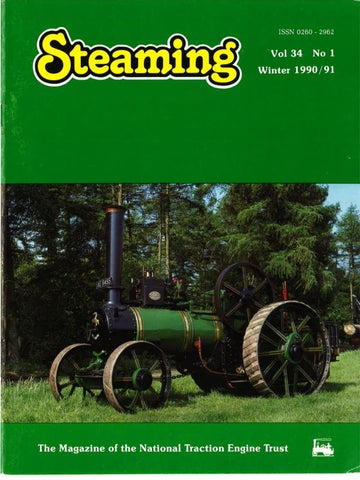
Cover Aveling 8653 was built in 1915 for the War Department, and was delivered to Boulogne. Quite what the 5hp traction engine got up to in France history does not record, but it did return to these shores to be owned, by 1921, by Wingham Engineering Co in Kent. The engine worked for several other owners in that part of the country; this picture shows the Aveling resting at Hollycombe in May 1989. (Robin Walker) 3
Trust News From the Chairman The Annual General Meeting of any organisation is a unique occasion in its calendar of events, for it is the occasion when the past, the present and the future are all considered. The Trust is no exception to this rule. Let me expand on some aspects of this theme a little in so far as it applies to the Trust. I he I rust held its Annual General Meeting on Saturday 24th November 1990 at the Leeds Industrial Museum, Armley Mill, Leeds. Here we were the guests of the Leeds and District Traction Engine Club who made all the arrangements for our accommodation and creature comforts; excellent arrangements they were too, as all members who attended will agree. What a fine venue this proved to be, with so many excellent exhibits in the museum for us to inspect, not forgetting the Aveling roller of Barry Wood of Leeds in steam outside for the occasion. A pity the weather was not more co-operative. Of the past. The activities of the Trust during the year ended 31st March 1990 were reported on by the officials and the financial results for the year were submitted to members for their consideration TI.,.,... a satisfactory state of affairs with a strengthening financially in some areas, particularly those where the figures in the previous year's accounts
caused some concern. All reports submitted, including the accounts, were approved by members. Ot the present. An Annual General Meeting is a members' meeting and is the time at which members may raise any relevant matter that they wish. It is the time when, for the most part, they are face to face with the various Trust officials. Two members' motions were submitted and, although neither was adopted, nevertheless much useful discussion took place; many questions were asked, points made and views expressed. All of these items will be carefully noted by your committee and considered in the ensuing year to ascertain if they can in any way further the purposes of the Trust and its members.
Of the future. I look forward to the next and future years of the Trust with every confidence. Most of our activities are progressing well and the various sub-Committees are meeting regularly and I anticipate revised and additional Codes of Practice from both the Rally and Engine Owners subCommittees will appear during the next twelve months. At most Annual General Meetings one welcomes new officers and committee members and the meeting held recently was no exception. Of recent years the Trust has been endeavouring to get a wider, more national, representation with its officials. This trend has continued this year. At Leeds members elected two vice-presiaents — tsmond Kimbell of Northampton and Richard Parrott of
From Alan Martin's Collection
51
Bob Oram's report in the last issue on surviving South African engines made interesting reading and prompts me to show an engine of earlier times. Burrell 2524, a two speed compound traction fitted with a 5 ton crane, was indeed a big engine, for it was rated by its makers at 12nhp. It was completed on 14th October 1902 and exported to the Ge/denhuis Estate and Gold Mining Co Ltd at Johannesburg. Besides its size, another interesting point was that the _holler barrel had been sp.eciffed to be all one pLete; ! wonder if B:Jrrells therefore had to have the plate rolled by another company because their own plate bending rollers were of insufficient length. The engine's cylinders were 7%in and 11%in diameter by 12in stroke, and it is pictured about 1908 hauling three well loaded wagons of spoil on the South African Rand.
Weeting. We shall benefit greatly from the knowledge and experience of these gentlemen. The chairman of the Trust is myself, Eric Fillmore. All existing committee members retiring by rotation were re-elected (some indeed hold appointments as well as being committee members), whilst Peter Smart, co-opted to the committee during the year under review, was formally elected. The following members were elected to fill vacancies on the committee — Ian Howitt of Wakefield; Robert Oliver of Sanderstead; Steve Parrott of Shebbington, near Aylesbury (no relation I am advised of Richard Parrott) and Richard Sandercock of Stoke Climsland, Cornwall. One appointment made just before the Annual General Meeting was that of Tim Driver, who is now our Honorary Legal Adviser in succession to David Tew, who had relinquished his appointment owing to ill-health. Mr Driver is a member of the Trust and very experienced in many aspects of the law. He should be of considerable assistance to the Trust over the years. I would like to extend a warm welcome to all our new officials and wish them a productive and rewarding term of office; I am sure the Club will benefit from having them on the committee. Finally, may I record our thanks to Joan Copp, who has recently retired from the position as one of the Trust's minutes secretaries. Joan has since the mid 1970s given us regular and faithful service in that role, the quiet and familiar figure on the top table at so many Rally Organisers' Conferences. (Eric Fillmore, Chairman)
Engine Owners Column Engine Owners sub-Committee The committee met on 10th November 1990 and of the seven members present, I was particularly glad to welcome new member John Glaze; Dick Blenkinsop — the Trust's Insurance Officer — and the Trust's Safety Adviser Jim Newnham, who, as a former HSE Inspector, has been doing sterling work drawing up a Code of Boiler Practice on our behalf. The new Pressure Vessel legislation was obviously a priority for discussion. It was felt that our code was largely compatible with the recent legislation and it was agreed that Mr Newnham should now discuss it with the HSE. It was also agreed that he and John Glaze, who is a professional
boiler inspector, should draw up a required standard scheme of examination for members' engines, as it was felt preferable to have one form rather than all the different ones offered by the various insurance companies. (Owners are referred to Jim Newnham's article elsewhere in this issue for further details.) In response to a number of requests, we are organising a practical Engine Driving Course over the May bank holiday weekend — the 5th to 7th May 1991. It is hoped to integrate two or three talks on basic principles, with practical work on engines both cold and in steam. Although this is essentially a first stage event, I feel sure there will be plenty of interest to all enthusiasts whether engine owners or not. The event will be non-profit making but there are obviously expenses to be met and we anticipate a booking fee of around £25 per participant to cover overheads apart from catering. It would be helpful if people could make a firm booking by 3rd March in order that adequate arrangements can be made, particularly with regard to having available on site sufficient engines. Families will be welcome but those under-21 will not be allowed to drive engines, unless they are members of the SAC, for insurance reasons. The event is to be held at The Klondyke Mill Centre, Draycott-in-the-Clay, Derbyshire, which is on the A515 Lichfield to Sudbury road. It is a four acre site with ample accommodation for caravans etc. with toilets and washing facilities and a good workshop. There are two good pubs in the area and also a motel. All inquiries about local facilities at Klondyke should be addressed to Steve Durance, The Roebuck Inn, Draycott-in-the-Clay, Sudbury, Derbyshire DE6 5GZ, tel 0283 820211, but bookings please to me, Michael Davies at the address inside the front cover. Bob Back has now got the Trust's Supplies Register on a card index system and would be pleased to deal with any inquiries and additional information. Members are again reminded that fire damage caused by engines not using spark arrestors may not be covered by insurance. There have recently been a number of failures in wrought iron fittings and it appears that this is due to them becoming brittle after 40 years, so members are advised that both wrought iron and gun metal are liable to fail due to crystalisation and serious thought should be given to their replacement. (Michael Davies, chairman, Engine Owners sub-Committee)
Officers and Committee 1991 Vice Presidents E.E. Kimbell R.N. Parrott Chairman E.A. Fillmore Vice Chairman Mrs Sylvia Dudley Treasurer C.J.C. Barber* Hon Solicitor T. Driver* Hon Safety Adviser J.M. Newnham* Membership Secretary J.R. Cook* Committee R.J. Blenkinsop N. Boyes (W. Yorks) R.A. Copp (Surrey) M.O. Davies D. Duffill (W. Midlands) S.K. Durance (Derbys) A. Fookes (Essex) R.T. Herring I.D. Howitt (W. Yorks) B. Johnson (W. Sussex) R.F. Oliver (Surrey) S.J. Parrott (Bucks) R.J. Sandercock (Cornwall) A.J. Semple K.D. Shakespeare 0. Slade (Devon) P.G. Smart (Hampshire) R.E. West M.J. Wharton (Oxfords) Representatives R. Allison (Road Loco Society) * R. Mattless (NV Tractor & EC) * Auditors (and registered office) Hamiltons, Forum House, 1-6 Millmead, Staines, Middlesex TW18 4UQ This column lists, for the information of members, all Officers and Committee of the Trust for 1991. The addresses of those with special duties are given inside the front cover of each issue of this magazine; others may be contacted via the General Secretary or sub-Committee Chairmen. Names marked with an asterisk* are appointments by the Committee and are nonvoting positions in Committee.
Gauge glass protection With reference to Derek Rayner's comments on gauge glass protection in his introduction to Steaming Around in the Autumn Steaming, as a professional boiler inspector, I could not agree more with him. Safety on any footplate is a priority; I look after almost 100 engines at present, up and down the country, and I find the state of the engines to vary quite a bit. In my official capacity on a live test, or steam examination as it used to be called, I will not pass any engine if it is not fitted with gauge glass protection. 5
On a lighter note, being an avid engine enthusiast, I can be seen on most weekends through the rally season crewing on engines I have worked upon. So I know they are right. It is, however, interesting to note that when walking around a rally field, and looking at an engine which is not under your care, the little anomalies one can find — drips and dribbles from boiler fittings, no red line on the pressure gauge, mud-doors weeping, etc. I always try to bring it to the attention of the engine owner or crew, but how come they get away with it? I can safely say that I would not let pass any of the engines under my care with these little deficiences, and the engine owner I work for knows that too! In conclusion if any member or engine owner seeks advice or information on gauge glasses, gauge glass fittings etc, I would be more than happy to help. Please contact me via the Chairman of the Engine Owners sub-Committee. (John Glaze) Chimney Tops After a gap of twelve months the Trust is now in a position to again supply spun chimney tops for engines. Many different formers are held, and if we have not got the correct one for your engine they can be made as required. In order to improve the service that we can offer to our members, anyone with drawings and or patterns or any other information on chimney tops is asked to pass this on to the Trust for safe keeping. Orders for tops, enquiries or any information should be sent to — Ian D. Howitt, Springhill Farm, Doncaster Road, Crofton, 'ttv'dAefieiu VVF•% I FR
Lost Registration Numbers As has been widely predicted the DVLA has now introduced a scheme by which genuinely authenticated cases may have their original registration numbers reissued. However, as will become obvious from the following information, it will not be as simple as one might have hoped! There will be several caveats, the most important being that applications will only be considered for complete vehicles, ready for the road. The most fundamental single change is that applications will have to be forwarded through one of the specialist historic vehicle clubs for authentication. The NTET is one of the recognised clubs and will only handle applications for steam vehicles. There will be a charge for this service because of the amount of clerical work that is 6
required and to cover the cost of postage and stationery. If an inspection of the vehicle is necessary an extra charge will be levied to cover a proportion of the travel costs for myself or a representative to call and examine the engine. There are two categories of application to register a vehicle under its original number to be considered. 1. Those which have been issued with an 'age related' mark in recent years. 2. Those referred to as new cases, that is, vehicles that have not been issued with an age related mark and are therefore not on the Swansea computer. Category 1. For vehicles to which age related marks have been issued, the following application forms need to be submitted to DVLC — • V765 Application to register a vehicle under its original number. • Old style log book; if this is not available DVLC will consider other documentary evidence that the vehicle was previously registered under the mark claimed. • New style registration document bearing age-related number. NB — There is no need to include a V55/5 with this category of application. Category 2. For new cases, a local Vehicle Registration Office (VRO) will require — • V55/5 Application for first licence for a motor vehicle and declaration for registration. • V765 Application to register a vehicle under its original number. • Old style log book, or other documentary evidence as for category 1 above. in either case these forms and supporting documents must be sent to me and I will either send them on to DVLC or return them for local VRO action when I am satisfied that the
application is valid. If I do not consider that the application is reasonable I will return the documents, and I am bound to inform DVLC of the fact that an application for that index mark has been refused. Do not include an application to relicence the vehicle but wait until the change of number has been agreed and apply for a new licence using a form V10 in the normal way. DVLC will consider the case and applicants will be advised of the success or failure of their application through the NTET. While it is possible to check details of index marks issued through the good offices of Alan Duke, Records Officer of the Road Locomotive Society, I will also need to be convinced that the engine is the one for which the original registration was issued. For vehicles or engines that have been issued with an age related registration and the maker's number is recorded on the new style registration document, there is no need to prove the identity of the engine. However, if the engine is not currently listed on the Swansea computer then it will be necessary to identify it by its maker's number. To that end, photographs of the complete vehicle and a close up of the maker's plate will be required. Where there is any doubt a visit will be necessary to view the engine to resolve its true identity. It is clear from the foregoing that the responsibility placed on us for the vetting of applications is an onerous one. DVLC reserves the right to verity our recommendations, and it is obvious that in the early life of the scheme most applications will be very carefully checked. Equally, we will be very careful in making certain that only genuine cases are approved. Obviously we do not want to lose the privilege that we have been granted and I shall be very thorough in considering each application as it is
The Engine Owners sub-Committee present a
PRACTICAL ENGINE DRIVING COURSE to be held on the weekend of 4th, 5th and 6th May, 1991 At the Klondyke Mill Centre, Draycott-in-the-Clay, Sudbury, Derbyshire, by kind permission of the North Staffs & Cheshire Traction Engine Club Ltd The site has full facilities including caravans and camping. See Engine Owners Column for further particulars.
presented. With this is mind I ask for a little patience from members applying to register a vehicle under its original registration number. There will almost certainly be delays until the scheme has had time to settle down. Please do not submit claims that you know to be false; you will be making extra work, ana I shall have no hesitation in refusing any application that is in any way dubious or that cannot be substantiated by our Records Officer. A further restriction is that any number re-issued under the new scheme is strictly non-transferrable in the future to any other vehicle. The fee payable is £10 for members, £20 for non-members, and this must be enclosed with the application. If a visit to inspect the engine becomes necessary then an additional charge of £30 will be imposed. Members must also include their current membership card with the original application, and all cheques should be made payable to the NTET please, and sent to NTET Lost Registrations, c/o P.G. Smart, Longdene, Slea ford, Bordon, Hampshire GU35 OQP. Burrell 6hp single crank compound 3771 of 1917 was one of the entries at the 1990 Upton rally in Co. Cork, Eire. (Geoff Hayes)
Rally Organisation Rally sub-Committee The Autumn Conference of Rally Organisers and Affiliated Clubs took place in Birmingham on 17th November 1990, and was attended by 45 delegates. The greater part of the day revolved around various aspects of insurance but a considerable number of other topics were raised and answers provided by Trust officers or from other delegates, providing a valuable exchange of information. The most significant item was the unanimous vote by delegates to ask all engine owners attending their rallies to display NTET Insurance Discs as a condition of entry to the event. It is proposed to hold the Spring Conference on 23rd March, although the venue has yet to be arranged (see Future dates column). The conference will be the launch pad for the Trust's revised Code of Practice on which the sub-Committee are at present working. Peter Smart is retiring from our sub-Committee to undertake work on vehicle registration numbers and our thanks are due to him for his valuable contribution. Two members were elected by the Autumn Conference to join the sub-Committee — J.R. Smith of the Duffield rally and M. Lee of the
Cornish club's event; we have also coopted two further members — Peter Duncan and John Cook, our membership secretary. (Andrew Semple, chairman, Rally sub-Committee)
Trust Trophies The Annual General Meeting recently held in Leeds provided an occasion for the presentation of some of the Trust's trophies. The various awards and citations were as described below and the trophies were presented by Tony Hunt, chairman of the Leeds club and by Jack Wharton. The PERCY HIRONS BOWL was awarded to Stuart Harrison of Bradford for the rally support and road journeys in the North of England he has undertaken with his Fowler road loco 12899. The ARTHUR NAPPER CUP for TRACTORS was presented to Keith Collins of Goole for the renovation and restoration of a well loved engine — Fowler Tiger tractor 14406 PANDORA. The ARTHUR NAPPER CUP for TRACTIONS was awarded to the owner of a nicely restored roller — to Barry Wood of Leeds in recognition of
his work on and travels with Aveling & Porter 5308 to various rallies. The CONNIE HUTCHENS BOWL went to Ian Fearnley of Pontefract in acknowledgement of the considerable reconstruction and renovation of the remains of Mann's steam cart 881, which had been converted to a roller. The CURTIS TROPHY was presented to Richard Straughan of Appleby for the restoration and preservation of Sentinel wagon 5676 — the story of which appeared in our Autumn 1989 magazine. The EDNEY TROPHY went to Derek Rayner for his work over many years as Assistant Editor of Steaming and also for his activities with the Road Roller Association. The JACK HOLLOWAY BOWL was awarded to Tony Hunt, chairman of the Leeds & District Traction Engine Club in recognition of his long service to that club and to the movement generally. In addition to tha above, a further NTET trophy was presented by Andrew Semple on behalf of the Trust at a committee meeting of the County of Salop club on 23rd November 1990. The GOLDEN FILM SHIELD was given to David and Diana Goddard of Shrewsbury in recognition of their many years of excellent service to the County of Salop Steam Engine Society (our hosts for our 1989 AGM) and also 7
The Trust is desirous of appointing a General Secretary in order to strengthen its administration.
working life farming and contracting in the lovely Golden Valley of Herefordshire. I have spent many a long winter's evening in his cottage reminiscing over his exploits with steam during his working life. He recalled travelling with his threshing set; hauling burnt lime from the local kilns to spread on the fields, a very dirty job; bringing block stone out of the railway sidings for road making, with two trucks behind his engine and all for fourpence farthing a ton. In the autumn he travelled his cider making press around local farms.
During recent years the duties of General Secretary have been carried out by other officers in addition to their own duties, but the committee feels the time opportune to make this additional appointment.
able engineman and was always willing to pass on these skills to us younger students. I am proud to have known Joe, we will all miss him greatly and be the poorer for the passing of a good friend and true man of steam. (Gordon Williams)
National Traction Engine Trust Appointment of
General Secretary
Applications are therefore invited from suitably qualified persons to serve in this responsible position, which carries an honorarium, within the Trust. A knowledge of general administrative procedures is essential. The duties will include the arranging and notification of meetings, production of minutes thereof and handling correspondence. A job specification giving full details of this important position is available to intending applicants (who do not necessarily have to be members of the Trust). Please apply to Eric A. Fillmore, 34 North wick Park Road, Harrow, Middlesex, H,4.1 2NU. Closing date for applications is 28th February 1991
for their activities within the preservation world — particularly as they have a Sentinel wagon in their fleet of three steam vehicles. (Eric Fillmore, Chairman)
Obituaries Joe Phillips It is with sadness I report the death of Joe Phillips in September 1990 at the age of 91. Jne, horn the son of a farmer in 1898, spent all of his 8
Inn ,n
indeed n vnry knnwindgen_
Sandy Law Traction engine people in the Aberdeen area and indeed all over Scotland suffered a big loss with the death in November 1990 of former member Sandy Law at the age of 88. Sandy was a founder member of the Bon Accord Steam Engine Club in 1970, a few years after he had returned from South Africa where he had in the past driven and maintained traction engines. He had much skill with everything connected with steam and he undertook the task of reconditioning the nine traction engines and rollers belonging to D.C. Stewart, public works contractor of Aberdeen. He also helped a lot of other people — very often somebody who had bought an engine and did not know too much about it. During World War 2 Sandy was driving a six wheel Sentinel and trailer belonging to the well known contractors William Tawse Ltd. He took building materials from the Aberdeen area to aerodromes all over the north of Scotland, and he was sometimes sent all the way down to Lincolnshire with plant, for it was quite easy to get coal for the Sentinel and no fuel coupons were required! Sandy also at one time worked for Aberdeen County Council at Aboyne with a Sentinel tractor and two trailers hauling road material. There is so much more I could write about Sandy Law and the good work he did. He will be much missed. (Alexander Gray) Sid Mallett The death has occurred of Sid Mallett of Hythe, Southampton, aged
6R, whn had heen a member of the Trust for the past 25 years. He had been a great steam enthusiast for most of his life starting as a small boy at Orford in Suffolk where he followed the steam engines as they entered the village with the fair wagons. Sid attended most of the steam rallies in the southern area, where he had many friends; he especially enjoyed Stourpaine having attended every gathering there since the first in 1969, until his death in August. He had built up a fine collection of photographs taken through thn yrc. (Mrc 114. Mn//nffi Tom Varley We regret to record the death in December of Tom Varley of Todber, near Gisburn in Lancashire. Few members, over the years, will not have been to a rally which Tom was supporting with something from his unique collection of engines and steam wagons. The efforts he and his helpers put into bringing back to steam some very derelict and only partially complete wagons, first from more local sources and then later from Australia, are legendary. Tom has been a familiar figure on rally fields literally the length of the country, from the Highlands to Cornwall and will be much missed by a huge circle of friends and acquaintances in the steam world.
NTEC Sales Members Hospitality Areas During the past year it has been my pleasure to meet members in the hospitality areas provided by the Sales section of the Trust at Yeovil, Weeting, St Agnes in Cornwall, the Great Dorset Steam Fair and our own late season event at Stoke Heath. These have been opportunities for members to come and rest their feet, have a cuppa and to air their views on what the Trust is or might be doing for them! It is also the chance to meet other members who may be visiting at the same time and share or exchange views. During the coming season I hope to again join Keith and Tracey Shakespeare with the kettle and cups at a number of events, so watch out for the hospitality sign and come In and say hello. (Sylvia Dudley — Vice Chairman)
and humidity control and security and fire protection systems. Clearly much of the funding is expected from major commercial sponsors, but smaller sums are also sought and will be allocated to specific purposes within the scheme. We hope to include more detail of the development in a future issue, but in the meantime anyone interested in seeing the Appeal Document, which sets out the problems and proposals, and having further information should contact E.J.T. Collins BA PhD, Director, Institute of Agricultural History, University of Reading, PO Box 229, Whiteknights, Reading RG6 2AG (s. 0734 3186621.
The Charles Burrell Museum ✓. & F. Howard's traction engines, built at Bedford, had an unusual design, with the single cylinder being mounted at footplate level in the tender. This 1872 survivor, owned and restored by Tom Varley, is seen in steam at Gisburn, Lancashire, October 1989. (Peter Love)
University of Reading Few members will be unaware of the comprehensive traction engine makers records that are part of the extensive resource of archives, books, photographs and objects at the Institute of Agricultural History and Museum of English Rural Life at Reading University. Concern has been expressed in recent years at the poor quality of accommodation — pre-
For further details contact
fabricated buildings of the early 1960s — in which the collection is housed, and readers will no doubt be pleased to learn that the University is now planning a £3.5 million Rural History Centre to be built near the existing museum. Sponsors are being sought for the 32000 sq ft building which will be built to a high quality and to appropriate British Standards for housing archival material, with temperature
After more than two years hard work the Trustees and Management Committee of the Charles Burrell Museum at Thetford are pleased to announce that it will officially open to the public on 25th March, 1991. The Museum is housed in the former finishing shop of Charles Burrell & Sons of Thetford, where extensive building work has been carried out. This work includes the reglazing of one of the gable ends, construction of a gallery at gantry height which runs the entire length of the building, and the provision of an office and storeroom, sales/reception area and toilet. This work has been funded through donations and grants from Norfolk County Council, Breckland District Council and Thetford Council and with
We specialise in the construction and repair of locomotive type boilers. Firebox construction can be of the traditional flanged and rivetted design, or flanged and welded. Construction is to the appropriate British Standard Specification and all welding is by coded welders to BS 4870. Work being done is approved at all stages by an engineering surveyor from your boiler insurance company. Construction of tubeplates, smokeboxes, tenders etc, also undertaken.
Roger Pridham, Hollybank, Chilsworthy Beam, Gunnislake, Cornwall. Telephone Tavistock (0822) 615276
9
The Rally List 1991 The Rally List 1991, those rallies organised under the Trust's approved rally scheme, will be published as usual as a supplement to the Spring edition of this magazine, but many organisers have already decided their dates for 1991 and we publish now a list of rallies notified to and approved by the Rally sub-Committee by 1st December 1990. Although only a brief title is used the rallies should be identifiable by readers, and we hope this advance information will enable notes to be made in diaries etc, earlier than usual. Further details and addresses of organisers will be in the next issue. May 4 to 6 — Abbotsfield, Manchester June 8/9 — Corbridge, Northumberland; Lydiard, Swindon; Great Amwell, Herts 15/16 — Parham, Sussex; Pewsey, Wiltshire 22/23 — Berry Hill, Notts. July 6/7 Chiltern, Bucks; Elvaston, Derbys; Blindley Heath, Surrey; Heddington, Wilts; Hollowell, Northants; Bromyard, Herefords. 13/14 — Woodcote, Berks; Ardingl y, Sussex; Rempstone, Leics; Marcie, Herefords. 19/20 — Cawoods, Ulster 19 to 21 — Weeting, Suffolk 20/21 — Langport, Somerset 26 to 28 — Netley Marsh, Hants August 3/4 — Worminghall, Bucks; Winnards Perch, Cornwall 10/11 — Driffield, Yorks 23 to 26 — Havenstreet, Isle of Wight 24 to 26 — Liskeard, Cornwall; Harewood, Yorks 25/26 — Chappleton, N. Devon 30 to 3 Sep — Great Dorset Steam Fair. September 7/8 — Malpas, Cheshire; Haddenham, Cambs. 14/15 — Knepp Castle, Sussex 21/22 — Barleylands, Essex 28/29 — NTEC Steam Party, Worcs October 13 — NTEC Road Run, Worcs
10
a major gift of steel and the necessary labour from Paul Rackham of Thetford — which enabled the Museum to build the gallery. New exhibits that are Burrell related or manufactured continue to turn up and are being incorporated into our displays, the main emphasis of the displays is to talk about the Burrell family (and many descendants have been traced); the Burrell works, showing the extent of land covered in Thetford and to talk about the people who worked there. This section, including a piece on other products made by the company, will be housed on the upper floor of the gallery. Below it in partitioned areas will be displays of workshops which will attempt to explain some of the processes involved in making a steam engine. This includes some heavy machinery rescued from Lancashire, which actually came out of the original Burrell works. The main floor area will display one or two engines and some Burrell threshing tackle. In time it will include panels on the different types of engines produced. After the official opening in March the Museum will be open to the public every weekend and Bank Holiday until the end of October. It will also open during the week for school parties and other groups by arrangement. We do hope you will pay us a visit. (Lesley Co/sell — Charles Burrell Museum Trustee)
Future dates Rally Organisers Conference The proposed date for the Spring 1991 Conference of Rally Organisers and Affiliated Clubs is Saturday, 23rd March 1991; the venue is still to be arranged at the time of going to press, but it is hoped to find a suitable location in Birmingham. Invitations and and formal notices, together with details of the venue, will be sent out in the usual way, but newcomers are always welcome to these instructive and mutually beneficial gatherings. Please contact me should you require details as a first time attender. Some rally organisers have, in the past, been in the habit of handing in their rally approval application forms at the Spring Conference. In view of the proposed later date of the 1991 meeting it is essential that all organisers' applications are sent in to Ron Copp as soon as possible, and
certainly not left until the Conference, or their rallies will miss the final printed Rally List. (Sylvia Dudley — address inside front cover)
London Area Social Meetings The 1990/91 season of social meetings in London continues in February, March and April and all members, potential members and interested visitors will be welcome to attend one or all of the evening talks or slide shows which have been arranged for the Trust by Bill Timmings. Members are reminded of the new meeting place at Keen House, 4 Calshot Street, off Pentonville Road, London N1, about 500 yards from Kings Cross. A detailed description of the location was included in our Autumn 1990 issue. All meetings commence at 8.00pm with the room available from 7.30pm. Those attending should note the need to ring the door bell for admission to Keen House. WEDNESDAY, 6th February 1991. 'Steaming with Bob Todd' — a mixture of road and rail steam pictures will be shown on our first meeting of the year. WEDNESDAY, 6th March 1991. 'Ross on Rolling' — Sandy Ross presents an illustrated talk on steam and internal combustion rolling with special reference to road rolling demonstrations. WEDNESDAY, 17th April 1991. 'An Evening with Bill Timmings'. The final talk of the year — note the date is Hui die usuai iirsi Wednesday. (Bill Timmings, London meetings organiser)
Poor Steaming The Editor apologises to Lyn Mileham for introducing errors into the captions of the pictures which accompanied his letter on page 208 of the last issue. As Lyn set out in his letter, the traction engines etc, were assembled to test the Reading bridge, not the Caversham spans.
'Seven Clayton wagons, all in different ownership, passed a wayfarer standing for a short while in Attercliffe Road, Lincoln, the other morning, whilst no other wagon came in between.' (from Motor Transport, 14th November 1918.)
George Beck, our General Secretary for a number of years up to 1985 died on 14th March 1990, aged 84. As a mark of the respect and affection in which he was held by all who had contact with him, we now publish these brief tributes from just some of his associates within the Trust.
Sylvia Dudley, our Vice Chairman, writes: George Beck was working at the Royal Mint at Loughton, when, approaching retirement, he saw our advertisement for a General Secretary. The result was the following report by Chairman Anthony Heal to the Annual General Meeting of the Club on 16th November 1968: 'The size of the Club now results in the need for a permanent paid secretary, and I feel that we have found a worthy successor to Eric (Fillmore) in one of our own members, Mr George Frederick Beck. I see this as an opportunity for the Club to take a step forward and improve its organisation, in keeping with a Club of this size and importance.' During the time that I experienced working with George on the Committee his quiet efficiency never wavered and from various casual remarks, I know that his prompt, friendly replies to members and public were much appreciated. He often remarked on letters he received, particularly from abroad, as though he was speaking of personal friends. During later years he found walking difficult and eventually had a hip replacement, but he continued to make what must have been an arduous journey to our meetings and perform his duties. It was a hard task to find a successor and in fact, despite failing eyesight, he carried on until making his last appearance at the General Committee Meeting on 26th October 1985. During that time our membership had increased considerably; we had moved through becoming the National Traction Engine Club Ltd and had become the National Traction Engine Trust; all of which had involved
George in a considerable amount of work as our secretary. A revision to the Rally Code of Practice had been formulated and put into operation and many other smaller changes, which we accept today as the normal running of the Trust, had been established. George died on 14th March 1990, and having served as one of his minuting secretaries for a number of years, I was pleased to represent the Trust at his funeral and arrange for flowers to cheer the day for his obviously close family. From David Tew, honorary solicitor to our organisation until recently: George always said that he ran the NTET like a Trades Union, which was hardly surprising as I understand that he had at one time been the General Secretary of the breakaway London Busmen's Union. After that I believe he was an adviser on labour relations to the Conservative Party and I should be surprised if his advice was always what Central Office wanted to hear. From the first time I met him I discovered that we spoke the same language, and I found him invariably helpful when referring matters to me when I was Hon. Solicitor to the Trust. He made my job much easier and I missed him badly when he finally had to resign as General Secretary. George was a wonderful man and it was an honour and a privilege to have known him. Joan Copp, for many years took minutes at Trust conferences, has fond memories of Meetings with George. Back in the late 1960s, my first meeting with George Beck was for one of the NTEC's Executive Committee
gatherings. I was feeling rather overawed, but George sat me down next to him and said "What a lovely perfume you have on; now, just take a note of the main points discussed. Would you like a beer?" Over the years there were many such committee meetings, and George always there with a happy greeting. Conferences were always 'jolly affairs'. I would arrive early and help George set up the room. To the many questions asked by rally organisers, George always had an answer, and being a professional these conferences ran like clockwork, except after lunch when some had indulged at the bar and questions came fast and furious — but George was equal to all this. Our lunch time visits to the Trattoria across the road were very happy times. Going downstairs (very dark), we gradually worked our way through the menus, sampling many of the Italian dishes. Some of the conference delegates discovered our venue and followed us to this establishment, where we all had a very merry time. George particularly liked this time, as he was able to talk and listen to members who would not have stood up at conference and voiced their opinions. I have other memories of George at a club dinner at the Guards Club, Whitehall, trying to find a tie for someone who had arrived without one; of him altering his after dinner speech so many times that I felt I ought to have brought my typewriter; of the many times George whispered in my ear 'don't minute that' or 'don't write all that down — he's waffling — time the chairman stopped him'. Two or three days after each conference, George would telephone me to see how I was getting on with the minutes and suggest something to be added. We would discuss how things had gone and people taking part, usually laughing over something amusing or a mishap. I will always remember George with affection; his kindness, his consideration and sheer professionalism. Norman Boyes, long time NTET committee member and representative of the Leeds & District club writes: I was fortunate to be at the Committee meeting on 16th November 1968 when Eric Fillmore introduced George, who had been selected by the Executive Committee to succeed him as the Secretary of the then National Traction Engine Club. I therefore knew him at the start of his association with the club. Throughout his period of office I always found him more than helpful on many points that I have 11
spoken to him about, either on the telephone or at Committee meetings. One of his main interests was to see that the yearly Rally List was distributed as soon as possible worldwide. George was a quiet spoken man but also very friendly. My wife recalls that if he phoned me and she answered, he always had time for a chat. From Anthony Heal, former chairman and long serving NTET official: George Beck had been a member of the NTEC and of the Herts Steam Preservation Society for some years. and had attended every traction engine rally he could get to when he applied for the post of General Secretary of the NTEC in November 1968. The sub-Committee, charged with the task of selecting a candidate to recommend for the appointment, met at Baylins Farm to interview the applicants on 10th November and unanimously decided to nominate George Beck who was duly appointed. years had seventeen He experience of helping members of trades unions and party constituencies when he was area organiser of the Industrial Department of the Conservative Central Office, and Inspector in the Security Department of the Bank of England Printing Works. He was
friendly and helpful and got on well with officials and members of the NTEC. He did a great deal to bring a large number of local traction engine clubs throughout the country into affiliation. He greatly improved the Club's administration and set a high standard with our committee minutes and records, as well as doing much to facilitate our expansion and development during his term of office. He gave me most valuable support during my period as Chairman.
OUR MAGAZINE 25 YEARS AGO
The Winter issue for 1966 was a Road Locomotives edition — the usual special format was followed with each manufacturer, in alphabetical order, being featured by a good selection of full page photographs and tables of typical dimensions. Well known builders such as Burrell, Fowler and
Aveling filled many pages but there was interest to be gleaned of the machines by Clayton & Shuttleworth, Foster, Marshall, Ransomes and Robey — none of them noted for production of road locomotives. One wonders how many of the wide variety of sizes offered ever got as far as production. Among the short articles was an amusing account of moving a mine boiler from Redruth to Levant in the early years of the century — a task seemingly accomplished with less professionalism and panache than the similar iob undertaken by Cornish enginemen last summer. The Club's AGM at Bush House, London, had been attended by 127 members — and the dinner in the evening, when the ladies joined the assembled company, was served to no less than 249. Membership had risen by 268 to a total of 1484. The Rev. Philip Wright had retired as Chairman and Anthony Heal was appointed in his stead. The members gave their approval to the Club's Code of Practice for the better organisation of Steam Traction Engine Rallies. From the small adverts it seems there had been a spring clean in the stores at the Rural District Council offices at Temple Cloud — a pair of Fowler lamps were offered at £20.
Restoration problems ...? not any longer! A FULLY COMPREHENSIVE MACHINING SERVICE IS NOW AVAILABLE FOR ENTHUSIASTS FOR ALL TYPES OF RESTORATION PROJECTS Some of our recent machining projects have included: Boring cylinder blocks Y New 4-foot diameter wheels Boring and re-bushing of back wheels New front and back axles Various types of valve gear components, bushes and small parts For further details, please contact —
ADVANCE ENGINEERING SERVICES LTD SPECIAL MACHINE MANUFACTURERS, TOOLMAKERS AND PRECISION ENGINEERS
FARLEY BANK, HASTINGS EAST SUSSEX, TN35 5QF HASTINGS (0424) 424720 FAX (0424) 442924
12
Working for Coulsons Ernest Godsmark recalls the days when his father drove heavy haulage engines
I recently came across the picture of Fowler road loco 14861 at work in the East End of London which was published in the Spring 1987 issue of our magazine (page 75) and found it of much interest, because the driver, 'looking well at ease' according to the caption, was my father, Charles Godsmark. He was senior heavy haulage driver for Coulson & Co of Park Royal, London NW10 from soon after World War1 until just before the take-over of their Coronation Road depot by Pickfords in 1941. The picture brought back many memories of the hours I spent in that yard where my father also performed wonders as a blacksmith, including work, I believe, on the first low loader with demountable rear wheels and the four-wheeled bogie steering from the rear. I hope these few reminiscences from the mid-1920s, when I was 10-14 years old, will be of interest to members. My father was born in 1885 near Burgess Hill in West Sussex. When he left school he was apprenticed to a blacksmith and wheelwright and at the outbreak of World War 1 in 1914 joined the Royal Engineers, mainly working on coastal defences due to his impaired hearing. He was demobbed just before the Armistice, and drove a Foden steam wagon, dressed up as a warship with grey painted plywood sheets, in the 11th November parade in Eastbourne, carrying a large number of cheering and singing men in the open body. From then until 1921 he drove steam tractors in the southern counties and used to tell how he overcame the problem of compacting the hardcore base when the road up Pebblecombe was first built. The rollers of the day were adequate for reasonable uphill gradients and downhill but lacked the power and adhesion to do the work up the steepest hills. So he started at the top — broadside on — and moved from side to side, skidding in a controlled slide to the bottom of the slope. The return detour back to the top on better roads took quite a long time, particularly if stopping for a pint or two on the way. Once back the process was repeated as often as necessary.
Although this picture of Fowler 14861 at work in the East End of London was published in this magazine as recently as Spring 1987, it bears further reproduction in this article being the one which stirred Ernest Godsmark's memories. A detailed description of the 1925 scene accompanied its original appearance and we now know the driver is Chas Godsmark and that the behatted gentleman standing bottom left could be Dick Coulson. (Whiffen collection)
Reproduced from an item of business literature, this illustration shows Garrett 4CD tractor 33406, new to Coulson in December 1918, coupled to two traction wagons, the second one wooden wheeled. The engine's index number in registration records is CT4584, but all known photographs show the number on the machine to be CT 4854 — an error presumably never spotted by owner or authority. (collection Alan Martin) 13
Two more of Coulson's steam tractors. The rubber tyred Foster Wellington tractor 14377 (CT3975), new in October 1919 (top), is pictured on a gloomy day in the early 1920s with its fresh-faced young driver on what seems to be a near finished housing estate. The Ruston Proctor Lincoln Imp tractor (bottom), either 52698 or 52754 of 1.919, was photographed on the same occasion, but this machine is still on straked wheels. (collection Alan Martin)
In those days the speed limit for many road steam engines was about 5mph and as work was often far away from any accommodation it was customary to tow a living van behind the load. This was more like a shed on wheels than a caravan but was equipped with a coal-fired stove, food cupboard, table and two double bed bunks across one end. On a lengthy journey it was necessary to tow a coal trailer and water was collected from ponds, rivers, ditches etc, by means of the suction hose which all engines carried. At the end of the day the 14
driver, mate and any other crew dossed down in their portable hotel, the fire in the engine usually being damped down to save time raising steam next day. My family moved to London in 1921 when Coulson & Co had the business in Coronation Road, Park Royal. The yard was a piece of field which faced a railway marshalling yard, enclosed by double gates and a corrugated iron fence and having for buildings an office, forge with covered working area and a coal bunker. Clinker was collected from Kensal
Green Gas Works and was rolled into the field to make hard standing for engines, trailers and living vans. I recall two little Foster tractors registered to Coulsons as CT3974 and CT3975 and the name Garrett comes to mind as well as the Fowler road loco in your picture. Our Editor has let me have sight of the pictures that Alan Martin has kindly loaned to illustrate my reminiscences. He and Mr Duke had hoped I would be able to identify some of the men photographed with the tractors, but unfortunately I am unable to rerooniqe any of them — some of the men may have been casual workers and not with Coulson for very long. It does appear to be my father Chas Godsmark on the footplate of Fowler 14861 in Chelsea. I was very pleased to see the photo of Foster 14377 (CT3975) which was one of the regular Coulson work-horses, hauling 10 cubic yards of sand or gravel from the pits, or a similar cube of clinker from the Barlby Road gas works at Kensal Green for rolling in for footings for new roads. This steam tractor was the one I often had the pleasure of steering back to the Park Royal yard in the quiet of the evening — the peak of delight for a 12 year old! My father's journey to the yard was by foot-slogging or catching the GWR steam rail-motor car service which ran from Westbourne Park to Greenford via Old Oak Common and from Greenford to Ealing Broadway. The train consisted of an 0-6-0 tank engine usually with one coach fore and aft — called, obviously, the push-pull. The nearest station was Park Royal, just two platforms and waiting rooms etc reached by a footpath from Coronation Road. It was probably originally intended to serve the wartime Army camp, where the Guinness brewery now is, and Queens Park football ground, but it was very useful for Coulson's men. In the yard a Mr Brooks was cashier and clerk and other drivers, besides my father, were named Wright and Jones. Jimmy Green was my father's mate or fireman. I believe that he became foreman or similar when Pickfords took over much later. Dick Coulson, the proprietor, was also there most days and if I am not mistaken, I believe that he is the welldressed gentleman wearing the grey Homburg hat and bearing a neat moustache standing behind the policeman in the bottom left hand corner of your picture. Coulson was often on hauls as an onlooker and woe betide any newspaper reporter who 'invented' a damaged lamp post or pillar box. The
An example of Coulson's more spectacular haulage work. Fowlers 14861 and 9904 (at the rear) are escorted on their way along Kings Road, Chelsea at a pedestrian pace hauling a 70 ton composite girder of 102ft length and 8ft 9in height. They were en route to Victoria SW1. The driver of 14861 appears • to be Chas. Godsmark. The date is 1929; ▪ 1916. notice that rubber tyres have been fitted since 1925, but already nearly worn out! (Alan Martin) fi
boss very quickly demanded a printed apology, being very jealous of his good name and the reputation of his workers. I was with Dad one Sunday when a bridge girder was lifted onto the brick abutments to carry the Hendon extension of the Golders Green tube railway across what must now be the A406 North Circular Road but was then little more than a country lane. In those days travelling cranes did not exist and huge boilers and upright transformers were loaded onto low trolleys using screw jacks, rollers, heavy timbers with the engine's wire rope for motive power, relying on the skill and ingenuity of the haulage crew led by the driver to get the object onto the site and set it into position. The bridge girder at Hendon was placed across the road near the foot of the walls and a vertical derrick placed and guyed at each end. The wire rope from the Fowler was run through a bottom pulley and down to a shackle on a chain around the girder at one end. The Garrett was not sufficiently powerful to cope similarly at the other end so the rope was passed around the capstan and back under the girder to a Foster, to raise that end. The Fowler and the Garrett were securely chocked but the Foster's job was to haul away on the Garrett's
rope. As the Foster had a canopy the driver could not see the signals of the man on the top embankment, so I was placed on the outswung steering seat to relay the hand signals. After a long steady pull the required height was reached and one set of guy ropes were slackened and the others tightened to inch the girder onto its setting, to the satisfaction of the site foreman. The magazine's picture of the East End job shows steel strakes on the wheels and these had to be re-riveted or replaced occasionally. A trailer wheel was similar to a car wheel but with a built-in bronze sleeve bearing. The tyres were pieces of steel about 8in wide x %in thick and perhaps 20in long formed into an arc and drilled and countersunk on the outside. These were clamped onto the wheel rim and a red-hot round head rivet inserted from the inside of the rim by tongs through the holes, the head being kept in place by a recessed dolly held up by the dolly boy — me! The rivet was then upset by the smith with the countersink in the tyre with heavy hammer strokes and much flying of sparks. On awkward overhanging loads a push bar might be used rather than a draw bar. It consisted of a piece of steel maybe 8 feet long and 2 inch diameter with a forged eye in each
end. These often got bent or even broken and were soon back in the smithy and with the weight supported the bent part could be heated and straightened. A broken one was not so simple. The fractured ends were heated and hammered to a taper or feather which required many visits to the forge — until both ends could lie taper to taper and be roughly round. Now both ends were re-heated, brought out and laid together and hammered. After many more visits to the forge and much hard work it was not easy to see where the break had been and that push bar would never again bend or break around the hammer weld. But I suspect that it would have been cheaper to replace the push bar. The forge had an open hearth and hand-pumped air from a bellows. The traction engine was very versatile, being capable of extracting itself from a soft hole in a track, salvaging loads or trailers overtaken by rising tides, towing tree trunks from forestry grounds into position, and loading onto bogies, trolleys or timber wagons over 6 feet in height by using the wire rope, chains, pulleys or snatch blocks. Routine maintenance was very interesting. A hand-hole cover at the bottom of the boiler released the 15
water, lime-scale, sludge etc which was washed out by inserting a hosepipe at mains pressure. The tubes were swept by a gigantic 'bottle brush' and any weeping ends were expanded with a taper tool and club hammer. This was easy at the smokebox end although it meant working with your head half up the stack, but the firebox end was a different matter. That involved removal of the ashpan and fire-bars and sitting on a box under the engine in the fire-box with daylight coming in the fire door behind your head. And didn't the hammer blows echo! After refitting and refilling. generally checking packing glands, grease cups and extensive work with the oil can, back to work! Probably most of this is 'old hat' to many readers but it was always very exciting to a school boy.
Steam Roller to the Rescue At half past three on the morning of Saturday, 15th November 1890, the good citizens of Middlesbrough were rudely awoken from their sleep by a huge explosion at the town's gasworks. The force wrecked the engine house, bringing the overhead water tanks down on the engine and, unfortunately, killing engineman William Ogden. The gas service to the town was cut off and by 9.00am the supply within the mains had been exhausted and the town crier was sent round the streets warning householders that they would have to supply themselves with lamps or other means of lighting their homes until after the weekend. Heavily industrialised Middlesbrough, apparently, used gas for domestic. hooting and light industrial power rather more than other areas of the country and several trades were threatened with suspension of business for the day, the latter including the North Eastern Daily Gazette, whose printing machinery was driven by gas engine. So it was that the Saturday evening's newspaper came to be produced with the aid of a steam roller. Anxious not to lose sales on an occasion when news of what had happened would be eagerly sought, the management approached the Surveyor to Middlesbrough Corporation for the loan of one of the town's steam rollers, to be used in the capacity of a traction engine in driving the giant Marinoni printing presses. The Surveyor agreed and having knocked down part of the wall, 16
, ......11/LS0114i:7V' PAPA. WAAL !am . 0
tdel.
A line up of crew and workers pose against Coulson's 8hp Fowler 9904 of 1904, sometime in the 1930s — the engine has a work-worn appearance, no doubt justly earned. (collection Alan Martin)
the roller was steamed into the yard of the Grand Hotel, which adjoined the Gazette office and a belt passed from the flywheel through a window to drive the machinery. The publishers had kept faith with their readers and
shortly after 7pm the last edition was completed, 64500 copies having been produced during the day. The roller's glory, however, was but one day long for the gas supply was partially restored by the Sunday evening. yrj
THE USE OF FIRE HYDRANTS Engineer W Road side streams within the available reach of a steam engine's water lift hose are becoming a rarity. The engine driver wishing to drive to an event further than the range provided by the tender water tank is therefore forced to seek alternative water supplies en-route. Fire hydrants are one source of good clean boiler feed water; but they are fitted on the drinking water mains distribution system of the local water company, not on separate fire mains. However, incorrect use of a hydrant causes many problems to this mains system, a loss of pressure and rusty water being just two. When obtaining water from a hydrant it is imperative to use a standpipe, turning key and hose. These items may be hired from the water company — contact the local office for further details. All standpipes are required to incorporate two anti-vacuum non-return valves and ideally the hose should be of the 'layflat' type. These measures are necessary to eliminate the backsyphonage of dirty water into the mains. Having acquired suitable apparatus, good practice and common sense must be followed in its use. Screw the standpipe onto the hydrant, connect the hose and position the discharge along the road away from the chamber. When all is ready, open the valve slowly until a gentle flow of water is obtained. Allow the initial discharge of rusty water to run to waste. As soon as the water is running clear, start to fill the tank(s). When sufficient water has been taken, close the valve slowly. Do not overtighten the valve. If a slight weep is detected, open the valve and close again, it will probably be rust on the valve seat. Remove the standpipe and turning key from the hydrant. To prevent the accidental removal of the valve spindle cap ('the carrot'), the turning key is lightly tapped with the bar as the key is lifted. Store the equipment away from any dirt, oil, chemical or animal contamination. Finally replace the chamber lid and leave the area tidy.
anti-vacuum non-return valves
Under no circumstances should engine crews flood the chamber and use the lift hose to obtain water. Whilst your needs are satisfied, this method saturates the soil around the chamber turning it to a slurry. This slurry fills back into the chamber (and potentially back into the main) and renders the hydrant unserviceable. Ask not who fills the chamber with soil — it may be you. No advice on the best practice concerning the use of hydrants would be complete without a reminder of the legal position. The water company has statutory duties concerning water supply to domestic consumers — these include constancy of supply and pressure, and the duty to supply at all times water that is fit for domestic use. Nobody likes rusty water through their tap. The hydrants are provided for fire-fighting and no person may insist on using them for any other purpose. In strict terms, any use for purposes other than fire-fighting is unlawful. If you find a hydrant not in working order, or damage it yourself, this must be reported to the water company. In short the use of a hydrant is by the goodwill of the owners. Any abuse would quite properly result in a prohibition upon the use of hydrants with perhaps even prosecution of those caught in the act. The water industry is undergoing major changes. Higher standards of quality and service are being demanded. All complaints are investi-
(A brief note on the recent experience of a member who has had a standpipe and key from Anglian Water Services Ltd at Northampton may be of interest. The company were found to be helpful in answering the request and providing the standpipe, which is flow-metered and will need reading at intervals for calculating charges — this is a circumstance yet to be gone through. A deposit of 100 was required by Anglian for the equipment but there was no particular restrictions on its use. Possession of the official standpipe is claimed by our member to be worthwhile, allowing one to be quite relaxed when taking water from hydrants. — Hon Editor)
The Commercial Motor for 11th April 1918 noted that the Water Committee of Birmingham City Council was taking note that steam wagons were taking part in long distance haulage and had made arrangements 'for appliances for filling boilers from the street hydrants to be deposited at 14 fire stations and 7 police stations in the neighbourhood of main roads, to be available on the production of vouchers obtainable at a charge of 9d (4p) each — the scheme is now in operation.'
'59453. Compound Tractor, by Wallis & Steevens, makers No 2846, new in July 1905, intended for working pressure of 150Ibs when new, cylinders HP 4 34 in, LP 814 in by 9in stroke, weight under 4V2 ton unladen, £375. (From Phillips Monthly Machinery Register, June 1921 published in Newport, Monmouthshire. Purchased new by R. Wynn & Sons of Newport, the engine was probably being offered by them, but there is no record of a further owner in Alan Duke's lists.)
gated and should your mis-use of a hydrant be the cause, a getaway at 4 mph on a somewhat conspicuous vehicle will undoubtedly be noted! Please do get into the habit of using the correct equipment in a proper manner.
17
The Spirit of '90 words and pictures by Bob Payne
'"esfegribttivetstwskp .410,mNiWilkv
Wallis 10 ton Advance 8095 is shown in a timeless scene on the coast road near Porthtowan, Cornwall. Once again the West of England Steam Engine Society organised an extensive engine run on the roads near to the St Agnes rally site. The event attracted engines from far afield and good enginemanship was needed to complete the hilly route. Compared with other makes, there are very few derelict or poorly restored Ruston traction engines. Perhaps it is the sound engineering design and excellent workmanship that ensures owners sympathetically restore these engines. We see one such example here — 5hp traction 169166 of 1933, at Masham Rally.
18
"What's all this then?" At last a bit of engine testing on the rally field; the Barleylands event provided a water brake dynamometer testing demonstration and several owners took the opportunity to belt up and have the horse power figures chalked up on a results board. Here we see Garrett 4CD tractor 33782 in action. A real step in the right direction in the engine preservation hobby. 19
The new Boiler Regulations Jim Newnham Hon Safety Adviser After a gestation period of some thirteen years, the new Pressure Systems and Transportable Gas Cont a in er s Reg, ,/ tinny 1QRQ fin.fly appeared in the spring of 1990. The original legal requirement for boiler inspection goes back well over a hundred years but by the 1960s it was evident that many accidents were happening in other parts of pressure systems and the practise of looking at just the boiler and leaving the rest to chance needed to he revised. This was one of the many things considered by the Robens Committee, whose Report eventually led to the Health & Safety at Work Act 1974 (the HSW Act). Matters really came to a head, as far as pressure systems were concerned, with the Flixborough disaster in 1974, when a chemical works was almost totally destroyed by an explosion and many people were killed or injured. The Health and Safety Executive (I-1SE) produced a consultative document in 1977, but it received such a hostile reception from industry that it seemed to disappear without trace. There were occasional rumblings in the mid-80s and I was promised that the NTET would be consulted if there were any serious moves to revive the proposals. In spite of my regular enquiries about progress, the Trust was, as far as I know, never consulted. Turning to the Regulations themselves, the first question must be 'Do they apply to steam driven road vehicles?' The answer, regrettably, must be 'yes, no and maybe'. This most unsatisfactory answer comes about because the Regulations are made under the Health & Safety at Work Act and whether they will apply or not depends upon whether an engine is used at work. For example: • If an engine is used for commercial ploughing, cultivating, dredging, tree pulling, etc and the owner is being paid for the job or is doing it as part of his commercial operations, e.g. farming or estate management, the HSW Act and the Regulations would almost certainly apply; • If an engine is simply taken to a rally and driven around from time to 20
time, the HSW Act and therefore the Regulations, would almost certainly not apply; • The 'maybe' area comes when an engine is used for demonstrations such as wood sawing, threshing etc. The fact that the demonstration is not done by way of trade or for purposes of gain, and there is almost certainly no profit, might not cut any ice if someone were taken to court. Ultimately it is, of course, for the Courts to decide but I personally would not put money on the way they might jump in any of the above circumstances. Whether the Regulations technically apply to some of our activities or not, they do get away from the old fixed system of the boiler having a 'thorough examination' within every 14 months, and give us a framework inside which the NTET can draw up a Written Scheme of Examination (as the Regulations call it) which will be suited to the particular needs of steam driven road vehicles. As many members will know, work was started within the Trust about 2 Y2 years ago on a complete Code of Practice for the operation, care and maintenance, inspection and repair of steam driven road vehicles. This has proved to be a mammoth task. The section on boiler examination was drafted about 18 months ago but then had to be put aside when I heard that the proposed Regulations were being breathed on again, if not actually brought back to life. Fortunately the scheme which had been drafted was very close to meeting the new Regulations and not much alteration will be required. The parts of the Regulations which deal with boiler examinations do not come into force until 1st July 1994, and the NTET Scheme of Examination should be in place long before that. Some engine owners have received letters from their insurance companies in which they state that they, the company, will carry out an assessment and prepare the appropriate Written Scheme of Examination (for which they will no doubt charge a substantial feel at various times before July 1994. At least one company is pressing owners to send a written acceptance of this proposal. My advice to owners is not to commit
themselves (unless they want to) until they have seen the NTET Scheme. The Regulations themselves are not unduly complicated and are backed-up by a Code of Practice and a Guide, both of which are written in plain understandable English. In principle thc Rcgulationa follow the trend (like the CoSHH Regulations for those who have met them) in making the person who controls the operation or equipment responsible for working out the best safe way of using and maintaining it. It would be impossible here to detail the whole of the Regulations but the following gives a brief outline of the bits which apply to steam driven road vehicles: REGULATION 2 gives the definitions of many of the words and terms used. These include Competent Person to mean what we generally regard as the Boiler Inspector, or the companies which employ them. For the purposes of the Regulations the NTET will be a competent person. The 'who does what' clause in the Regulations divides responsibility between the User in the case of installed systems (which are described elsewhere as 'those systems which are essentially fixed in a permanent location') and mobile systems, when the Owner is responsible. Now one might be forgiven for thinking that a steam driven road vehicle must be a mobile system. Oh no! With a piece of logic that must be similar to that which led the bureaucrats of Brussels to define carrots as fruit, steam locomotives are defined as installed systems. So next time you are trundling happily along the road on your way to a rally, remember that you are actually 'fixed in a permanent location' — the Law says so! Fortunately sanity returns with the definition of a pressure system as a system comprising a pressure vessel (which includes boilers), its associated pipework and protective devices. This means that the pipes from feed pumps and injectors may be included and, of course the steam pipes on Sentinels, etc. Cylinder blocks will not normally have to be dismantled, however. REGULATION 4 covers design, construction, repairs and modifications. This lays-down standards in fairly general terms but two points in
the HSE Code of Practice will be of interest to engine owners: • A requirement that steam boilers with a rating of more than 100kW should be fitted with at least two water level indicators, at least one of which should be a water gauge connected directly to the boiler. This has already caused problems for some traction engine owners and Sentinel owners, whose boiler inspectors have demanded the fitting of test cocks. The proposed NTET Code will not require the fitting of second water level indicators where they were not part of the original design of the boiler. • A requirement for effective gauge glass protectors which protect people against the effects of the glass breaking and steam or hot water being ejected. Some engine owners have in the past got away with having completely unprotected gauge glasses or nothing more than a bit of brass tube partially covering them. There is no way that we could justify allowing this dangerous practice to continue and owners will have to come to terms with fitting suitable protectors. If there is not room to fit standard plate glass protectors, reflex gauges can be fitted in place of ordinary gauge glasses. REGULATION 5 deals with information and marking. This is generally already in place but there is a requirement that anyone who repairs or modifies a boiler, must provide sufficient written information to enable it to be operated safely. REGULATION 6 deals with installation and need not bother us. REGULATION 7 requires owners to establish the safe operating limits of the pressure system. This is already well established in most cases but would have to be revised if, for example, a boiler was 'down-rated' or substantially rebuilt. REGULATION 8 is the one which establishes the principle of each pressure system having its own written scheme of examination. For most owners this will be met by the NTET Scheme, which is being designed to be suitable for nearly all steam driven road vehicles. Owners can of course, if they wish, get their scheme drawn-up by their insurance company as previously mentioned. Alternatively owners are free to drawup their own written scheme of examination but if they do, it will have to be approved by a competent person, which for all practical purposes means their boiler inspector or one of the companies which provide
an inspection service. Every written scheme of examination must specify the period within which the next examination must be carried out. This will not normally exceed the traditional 14 months and may be less — to quote the HSE Code of Practice — for boilers operating under arduous conditions or where its condition has deteriorated. The proposed NTET Scheme of Examination will allow for longer periods, up to 26 months between examinations, but only where the boiler is in very good condition, is operated and maintained to the highest standards (including proper water treatment►, is properly prepared for laying-up at the end of the season, and stored under good conditions. Owners who like to treat their engines in the 'traditional' way — that is systematic abuse during the season and total neglect for the rest of the year — will be lucky to get a 14 month certificate and soon may not get one at all. REGULATION 9 covers examination of pressure systems. The examinations will still have to be carried out by a competent person and specified repairs will have to be carried out within time limits, as before. A change for the better is that boiler inspectors' reports will have to contain much more positive information about the condition of the boiler and the rest of the pressure system. The examination in steam should normally be done within 8 weeks of the cold examination, but the proposed NTET Scheme will allow longer periods in some circumstances. REGULATION 10 requires a boiler inspector to, in effect, prohibit the use of a boiler or pressure system if he considers that it may give rise to imminent danger. In any such case he must send a written report to the HSE within 14 days. REGULATION 11 will require owners to provide adequate and suitable instruction to drivers and steersmen for the safe operation of the system and action to be taken in the event of an emergency. REGULATION 12 requires the boiler and the rest of the pressure system to be properly maintained in good repair, so as to prevent danger. REGULATION 13 covers the keeping of records. Under the NTET Scheme, owners who hope to get a certificate for more than 14 months will have to produce records showing steaming dates and details of water treatment. The above has been an attempt to
pick out the important bits, as far as engine owners are concerned, from two documents, one 42 pages long and the other 60. For anyone wishing to study the subject in more detail they are: • Safety of Pressure Systems — Pressure Systems and Transportable Gas Containers Regulations 1989 — Approved Code of Practice, ISBN 0 11 885514 X HMSO £4.50 net, and Health and Safety Series Booklet HS(R) 30, A Guide to the Pressure Systems and Transportable Gas Containers Regulations 1989 ISBN 0 11 88 516 6 HMSO £4.50 net. References have been made in this article to the proposed NTET Code of Practice and Scheme of Examination. The original draft will have to be amended to match the new regulations more closely but these will be only minor alterations, and the Scheme at least (if not the rest of the should be available for Code) members' comments during the first half of 1991. Although the new arrangements do not come into force until July 1994, the Regulations allow owners to take them up beforehand if they wish to do so. Engine owners will be under no obligation to take up the NTET Scheme of Examination and are quite at liberty to continue their present arrangements with their insurers. However, any who find that their insurers' scheme is less advantageous than the NTET scheme, will be able to change to another inspecting organisation or an independent inspector and obtain their insurance through the NTET. jiy
Threshing engine wanted English Heritage has in its care Boscobel House, a 17th century hunting lodge in Shropshire. The site is best known for its link with Charles II who hid in the house and oak tree after the battle of Worcester in 1651. In later years the property was used as a farm and it was common in the earlier part of this century for steam threshing to be carried out on the site. A club or enthusiast is sought to operate a traction engine from the site. A concrete area next to the barn is suitable for siting threshing events to be held at weekends during the summer season. Boscobel House is situated 8 miles north west of Wolverhampton just off the A5. Anyone interested should write to: R. Bu/ley, Room 622, Keysign House, 429 Oxford St, London W1R 2HD. 21
Final duties
These pictures show steam engines owned by Stockton-on-Tees Corporation engaged on major road building in 1936. The two panoramas — the same scene from opposite ends of the vista — are of the reconstruction or extension of Church Road, probably the formation of an underbridge to pass beneath the railway in the background of the top picture. Consolidating the excavation is a heavy and elderly Aveling & Porter roller. Alan Duke records Aveling 3703 of 1896, a 15 tonner, as new to
Stockton Corporation, and this would seem most likely to be the roller depicted. It was sold to AvelingBarford in part exchange in 1936 (by then registered UP3191), so the task we see it engaged on could be one of its last duties, with its 15 tons being put to good effect. Note the use of portable two foot gauge railway track and V shaped tipping skips or wagons for spoil removal — one of the skips swings in mid-air from the jib of the derrick. The third picture is almost certainly
of the same job, but here we have a close up of Clayton & Shuttleworth 5 ton tipper 47750, new in 1919 to Stockton Corporation Highways Department, registered FE251 1. It was last taxed in 1935, so this picture too probably shows the machine at its final task. It has been mounted into a fixed position by suitably placed timber baulks, and with the back end raised clear of the ground the rear axle is acting as a winding drum for hauling the V skips via a rope — probably up an incline from the bottom of the excavation away off the right hand side of the picture. Once on the level the railway wagons could be taken away for tipping by the Simplex petrol locomotive seen at the left of the picture. Unfortunately the ropeman stands in the way of us seeing just how the winding drum is fixed to the Clayton's axle; it was possibly fixed direct to the offside wheel. We thank Reg Sowler and Stockton-on-Tees Museum and Galleries for allowing us to reproduce these interesting views of road construction of fifty years ago.
'Bridge Test on New Southend Arterial Road — The testing of Red Bridge at New Wanstead on the Southend Arterial Road took place recently. Messrs J.J. Prior, of Stonebridge Wharf, Limehouse E14, contracted to supply the necessary vehicles for the undertaking of the test. In an interview with one of our representatives, Messrs Prior stated that they supplied three traction engines (two Rustons and one Fowler), and a Burrell steam roller, together with heavy trolleys, each loaded with 15 tons of ballast, the approx weight of all being 100 tons. The bridge, built by W. & C. French, Buckhurst Hill, Essex of ferroconcrete, was 60 feet wide with a span of 40 feet. The test was satisfactorily carried out in he presence of Mr Shaw, Mr Gibbons and Mr Weaver, surveyors of Ilford and Wanstead, and the bridge engineers to the Essex County Council respectively.' (From Roads and Road Construction, July 1923. From the above description and the registration numbers gleaned from the accompanying illustration, Alan Duke identifies the engines used as Ruston, Proctor tractors 52483 and 52557, both new to the WD in 1918; Fowler single cylinder class B3 traction engine 6849 (if the registration is XC9430, as it appears to be in the picture) and Burrell single crank compound roller 3376, new to Prior in March 1912.)
This picture shows Fowler R3 class 15117 at Nottingham in 7925. Then only five years old the engine had already had varied owners and circumstances. It was new, as a road locomotive named HEADWAY, to John Drury & Sons of Laceby in the Lindsey division of Lincolnshire. About 1922 it was converted to a showmans engine on its sale to John W. Hibble of Nottingham. Nibble later joined forces with Mellor and our picture shows the Fowler lettered only with the latter's name — note also the whitening between some of the strakes on the rear wheel; as we have seen in other photographs in the magazine, it seemed the thing at times, once the engine was in position for work, to paint up the wheel surfaces with whitewash. Sold out of showland in 1944 the engine has had several preservation owners and is now on the Isle of Man. (collection Ran Hawthorne) 23
JOHN FOWLER in CALIFORNIA These two splendid photographs are kindly loaned by John Newton of Hungerford. They were given to him several years ago by an elderly man whose father was one of Fowler 's delivery drivers — and the tale handed down seems to be that the pictures show engines owned by S.W. Farmer being worked for G. Betteridge of Little Bedwyn, Berkshire. This, however, cannot be, for whilst Farmer did have seven sets of Fowler ploughing engines, they were mostly old 14hp single cylinder sets from the 1870s, and a study of these pictures shows them to be taken on foreign soil — confirmed by the very faint impression of the cameraman's name in one corner, 'Judkins, Santa Maria, California.' On one of the wooden boxes in the background between the pair of engines (note also the typical American buckboard horse-drawn carriage) the lettering UNION FE... CO. can be seen. Enquiries at the
24
University of California reveal the Union Feed Co was a subsidiary of the Union Sugar Co in Santa Barbara County, California. The company was formed in 1897, the rich black soils of the heart of the state being ideal for growing boot :Rigor. The dry farmlands of the Santa Maria valley were provided with an irrigation system and became lush, productive fields, the beet being taken for processing to the company's newly built plant at Betteravia. Their booklet celebrating 50 years of sugar production records 'huge mobile steam engines with long cables dragged plows across wide fields.' Fowlers' surviving records at Reading University provide further identification of the engines. About 1906 the Steam Plough Works commenced a batch of twelve Z5 compound ploughing engines and two sets were eventually despatched to the Union Sugar Co (nothing more detailed in the way of eventual
destination) — 10754/10755 on 22nd November 1906 and 19756/10757 on 30th March 1907. All were oilburners. It is thought these are the machines pictured by Judkins. Mr Judkins' photographic work, therefore, is of considerable II est. What is presumably the oil fuel tank can just be seen in one of the engine's bunkers. Although the engines are engaged at cultivating, ploughs were also supplied, and the canopy side timbers look to be somewhat battered, maybe from the plough coming too close. The machines' front wheels are also marked by the ropes, indicating the pair had at least done a few years work by the time of the pictures. Thanks are due for information to Alan Duke, Jonathan Brown (Museum of English Rural Life, Reading University) and John Skarstad and Peter Hanff at respectively University of California, Davis (Shields Library) and Berkeley (Bancroft Library).
Poplar Proposes Prohibition of Steam Wagons in London 'Contending that the smoke nuisance is injurious to health, the general purposes committee of the Poplar Borough Council recommends that legislation should be sought to prohibit the use of steam wagons in London streets. In this connection the borough council has communicated with the police, and the Commission has replied to the following effect: "Nearly all mechanically propelled vehicles including steam lorries, come under the provision of Section I (11 of the Locomotives on Highways Act, 1896. The effect of this is that if they have been instructed on the principal of consuming their own smoke, proceedings cannot be taken for the emission of smoke or visible vapour unless the prosecution is able to prove that it is not of a temporary or accidental character. The question is one that has occupied the attention of the courts on several occasions, notably in the case of the Star Omnibus Co. v. Tagg, Davis v. Rochdale Justices, Hindle and Palmer v. Noblett and a recent magisterial case at Horncastle."
The question, it is stated, has also been considered by Parliament and the Home Secretary. The Commissioner adds that he has recently been going very carefully into the question, and he is advised that proceedings would be very difficult. So far as the police are aware, nearly all mechanically propelled vehicles are, with the exception of those commonly known as traction engines, etc., constructed on the principle of consuming their own smoke, but if the Poplar Council has evidence that any type is not so constructed the Commissioner will consider the matter further. With regard to the question of cinder deposits, the nuisance is recognized, but in the absence of specific regulations on the subject the police cannot take any action.' (A report in Commercial Motor, 4th November 1924. In the light of the current 'green policies' being promoted by various politicians, local and national, this item makes interesting reading and one which should perhaps be pondered over by engine crews of preserved engines. One questions if things change that much; no doubt the present day guardians of Poplar are equally concerned with the similar injury to health from the excess of road traffic
around the Docklands area. A further thought occurs: can any reader offer comment on how, for example, a Foden or Clayton & Shuttle worth overtype steam wagon (examples of the latter were owned by the local council — see our Spring 1987 issue) differed from a traction engine in that they were 'constructed on the principle of consuming their own smoke' as claimed by the police who advised the Commissioner?)
'Aveling & Porter Ltd, Rochester. Stand No89. This firm will be exhibiting four steam road rollers and a steam tractor. The quick reverse tandem type steam roller for bitumenous carpeting will no doubt attract a good deal of interest. Its weight in working order is 6 tons and has a rolling width of 4ft. There will be a compound steam roller of the 'D' type with 'Belpaire' boiler and piston valve engine with renewable rims to the driving and front roller wheels. There will also be two single cylinder rollers, types 'E' and 'R' and there will be a steam tractor type 'M' (heavy type).' (from Roads and Road Construction, June 1924, noting displays being arranged for the forthcoming Royal Agricultural Show at Leicester.) 25
Geisers in the woods Many lovers of English traction engines find it hard to come to terms with the machines developed in America. However, despite their, to us, unfamiliar outline the engines across the Atlantic worked as hard as any, and doubtless they were as well regarded by their owners as any Leeds or Lincoln product was over here. These two picturesque scenes, kindly sent by Tom Downing from Pennsylvania, are full of atmosphere. They show a couple of Walt McQuiston's single cylinder Peerless engines — which were locally built by the Geiser Manufacturing Co in Waynesborough — hard at work in the south east corner of the state of Pennsylvania. First is a 13hp Peerless, belted to what is probably a Frick thresher set. The date is about 1915 and the location near Chewton, a village in Lawrence County; last man on the right is John McQuiston, joint owner of the outfit which is working in a situation quite different from the wide open prairies usually associated with American threshing. The engine seems to have wooden front wheels; note that the water tank on the left side is turned so that a belt could be run from the flywheel backwards, a Geiser feature. The cleared slopes in the background of the second picture bear witness to the activities of the Peerless 18hp traction. This time Walt (left) and John stand either side of Clarence Brunswick, all three resting from work on the sawmill, which the engine with a full head of steam is impatient to keep turning. This picture is a couple of years later than the threshing scene and was taken on Weingartner's farm in Wayne Township, again in Lawience County. To add to the two pictures Tom Downing recalls a tale once recounted to him by Walt McQuiston. One of his threshers was to be set up on a farm in the hills on the old Pittsburgh road out in Wayne Township. The direct approach was a steep and narrow muddy lane which looked like trouble. So they took a better road to another farm and came in across a couple of fields where the sod held up well as 26
the way was almost level or slightly downhill. So it was all okay until the Peerless settled her hind wheels in a wet furrow ditch and refused to come out. They unhitched the seperator and sent for a team of horses at the destination farm. These turned out to be a black team which wouldn't normally pull the hat off your head, with a driver that let them get away with it. But they were afraid of the hissing old Peerless and were very nervous. Well, Walt got up a full head of steam and laid out the rope blocks secured to a convenient tree. When the team arrived, the horses were
hooked up and the ropes made taut. Walt said "Then I pulled the throttle open with one hand and the whistle cord with the other ... boy, did those horses pull. Their hind feet put mud on the smokebox door from quite a piece away, but they got the engine out on dry ground." It wouldn't have been good to be driver of such a scared team and it's an easy guess what the ASPCA would say about such behaviour today, but maybe the story was embellished a bit by time — in those days the vital thing was to get the set moving again, and there was no bigger tractor to send for.
Steaming Around Compiled from members notes and reports by Derek Rayner
One aspect of taking our engines on the road that all drivers must remember is responsibility to other road users. It is no good adopting the attitude that it is our divine right to he there because our machines have been around much longer than the tin boxes on wheels that some of us lovingly call cars. Every engine driver, whether on a long journey or just trundling down the road to a village event must adopt a responsible attitude to others — and that means being able to be seen in all circumstances and perhaps, more importantly, not putting the engine or himself at risk from other drivers. It must be borne in mind that many drivers have never seen a traction engine or steam roller on the road, and have no comprehension of the difficulties we can experience in driving in traffic. A comment in the notes for Buckinghamshire regarding Steve Parrott's journey with engine and road train to Dorset and back is a case in point. Planning the route of a journey of this nature is of utmost importance. Where it is possible to avoid large centres of population, dual carriageways and other potentially dangerous situations,
this must be done. Also, it is sensible to physically check the proposed route before setting out on the engine, to make sure there are no major road works underway at the time, necessitating a long stretch of single line traffic — with the consequence of frustrated motorists behind and waiting in front. It is also useful to check for steep hills, bends and such things as cattle grids which may restrict the engine's progress. Visibility is also all important. The rear end of a living van from a distance looks very much the size of a pantechnicon unless it carries some other distinguishing features. The average driver knows from experience that big articulated vans or lorries are capable of high speeds and usually travel at the same 50mph plus that he motors at — he is not prepared for an unusually slow moving vehicle. If one approaches a farm tractor from the rear, it is instantly recognisable and one instinctively accepts its speed is around 15-20mph. This enables avoiding action to be taken. Certain slow moving vehicles are, in some circumstances, required by law to carry a rotating amber light,
BEDFORDSHIRE
(0T7939) belonging to T. Hudson; Barry Cousins'1934 Sentinel S4 9016 (HV3865) and 1912 Aveling roller 7771 (PC9014) owned by R. How. An engine attending its first rally for many years, following just completed boiler work, was Ruth Groome's Foster agricultural 14422 of 1924 (CT6708), being shown in an unlagged state. Others present included Burrell showmans 3912 DRAGON, owned by the Chamberlain family and fresh from its Paignton triumph, whilst a pair of tractions were
Joy of joys, it didn't rain at last September's Roxton and for the first time for several years, this event enjoyed a dry weekend with consequently large crowds for the 22nd event organised by the Bedfordshire Steam Preservation Society. Seventythree engines were on display and four were new to the event. These were Fowler traction 11594 of 1908 (EW2335) owned by Don Wing and once with Dick Joice; locally owned Wallis Advance roller 7963 of 1928
visible throughout 360 degrees. Although it is not a legislative requirement on steam road vehicles — yet — our responsibilities to other road users should be that all engines on the road should likewise carry such a lamp, battery powered, if only temporarily, to safeguard themselves against the other, usually unsympathetic driver who 'just didn't see anything'. Make ourselves be seen must be our motto. All engine owners should ask themselves this close season whether they are doing all they can to protect themselves — and their engine — from the other driver. Further, if they neglect to provide adequate signing, visible from the rear together with a rotating amber lamp, whether they are really furthering the traction engine cause by driving in an irresponsible manner. I take this opportunity of wishing all my past correspondents and passers of information, very good steaming for 1991. Please keep up the good work and to any more who feel inclined to put pen to paper — don't just think about it — do it. Information and details are acknowledged for this issue from the following: Banbury Steam Society, Devon TES, Hollycombe Steam Collection, Scottish TES, Somerset TEC, Southern Counties HVPT, Steam Plough Club, Thames Valley TEC, West of England SES and Brian Allison, Mike Armer, Len Ball, Reg Bosley, Martin Craig, Percy Dabbs, David Dale, Gerry Doherty, Alan Duke, Mrs E. Finch, Martin Fletcher, Pat Freeman, Andrew Hall, Steve Hayes, Peter Haywood, Barry Herbert, Ray Hulock, Arthur Hunt, Steve Jenkinson, Mike Jones, John Knapton, Henry Marshall, Steve Parrott, John Reeves, Chris Rhodes, Sandy Ross, Brian Shaw, Lyndon Shearman, Barry Thirlwall, Alan Thomas and Michael Watts. Press date for the next issue is the last day of January. Information, news and happenings by then please to D.A. Rayner, 'Invicta', 9 Beagle Ridge Drive, Acomb, York YO2 3JH. Press dates for future issues are the last day of April and July.
Colin Piggott's 1891 Burrell 1522 (CF3579) and Christine Bath's 1923 Marshall 76751 (13T6447). Dave Piggott's Burrell traction 3017 of 1908 (KE2739), which has been at Maskell's boilerworks for major repairs, is now back home, having passed its hydraulic test. It is hoped to see the engine out next season in first class order. John Forshaw who has built and rallied a half size Burrell traction for the last five years has now sold it and purchased at auction Foden three 27
roI l isz„
S Et
L, - 10./01 )1
yr%
- r.111,
I
• a• r
_
f tervvel _ i (I I/11
The Dorset Steam Fair scene typified, with the rolling hills bearing testimony to the thousands who had travelled to be there. Marshall 7hp traction 36033 of 1901 HAYDEN PRINCESS works the rack bench in the wood sawing area.
The image of Burrell scenic 3938 QUO VADIS has for many years been the centrepiece on the advertising for the Stourpaine event. The engine returned to the 1990 Dorset gathering from its present home in Northern Ireland with a pleasant surprise — the authentic lettering of William Wilson of Peckham Rye SE15, the Burrell's original owner.
28
Another engine long associated with the Great Working is Giles Romanes' Wallis & Steevens 3hp steam motor. The 1902 built engine regularly performs in the threshing area on duties beyond its makers' expectations, gallantly working the owner's 36 inch Ransomes threshing drum, the latter of the lightweight design specially built for small farms.
After the crowds had gone... A quartet of Fowler ploughing engines rest after a day's work on the Dorset slopes in the soft evening light. Nearest the camera is Andy MetrnAp'A 1R7n hilllt cmgle cylinder machine, number 1368, the doyen of all surviving Fowlers.
photographs by Dick Blenkinsop (top left and bottom right) and Roger West (others)
29
C.3 0
Tarrant Hinton Extra
.
C•
A welcome introduction at the 1990 event was an enclosure for the heavy haulage demonstrations, with occasional crossing places for the crowds. Besides being a considerable addition to safety standards, the plastic fencing actually encouraged people to stop and really watch the splendidly noisy processions, with plenty of space to view and photograph. Dick Blenkinsop, from a prime, position, captured the magic of the Fowler crane locomotives of Len Crane and Paul Scholey, together with Anthony Heal's McLaren, as they attacked the gradient with 25 tons of stone blocks as handicap. iii
•
y jrnn,r,„
-=:11111111 7
al* "
speed wagon 13764 of 1930 (TF3106). This was last in steam in 1972; it spent the well known late years of its working life as a tar sprayer with Mechanical Tar Spraying & Grouting at Reading. The Foden's front tube plate has been removed and John is now waiting for a visit from the boiler inspector before deciding on further work to be undertaken.
BERKSHIRE Glorious weather in early August did not prevent yet another massive turn out of both spectators and enthusiasts for the Knowl Hill 21st Anniversary event. Many shows during 1990's splendid summer suffered with reduced attendances but this event was a spectacular reversal of this trend — there being more people on each of the two days than in 1989! The most interesting display to many was the Rot and Rust Show, jointly provided by organiser John Keeley and friends. This collection of 'rust' included two portables owned by Mick Smith (Ransomes 30005 of 1919 and a Marshall), both recently from Ireland, whilst John Keeley showed his 1916 Fowler ploughing engine 14253 (AC9589). There was also some of Fowler ploughing engine 15409 of 1919 which is one of a batch cut down by Boughton's of Amersham many years ago for export to India fur further use as portable engines. This particular one, now owned by John Keeley, remained in this country and has been cannibalised for spares over the years. Another engine in this section was John Paul's unique 1912 Ruston Proctor colonial traction 44180, brought from the Phillipines. Exhibitors in steam included Albert Fensome's 1905 Marshall agricultural 43560 (BD5414), driving a band saw; Richard Preston's 1913 Burrell showmans 3526 LIGHTNING II a long way from home in North Yorkshire, and Steve Dean's recent acquisition, Burrell traction 3368 of 1912 (TA 1849). This latter engine is understood to have returned from Ireland. The programme for this event was up to its usual brilliant standard — and only 50p. It is a great pity more rally organisers cannot achieve this standard of excellence. On a very wet evening at the end of September an informal gathering of engines (which could easily become an annual event) assembled for the Knowl Hill Drain Out Party outside 'The Seven Stars' just down the road from the well known rally field. The fourteen engines stayed out until the small hours of Sunday morning and included Steve Dean's Burrell traction; Jumbo Palmer's 1924 Wallis roller
7799 (H06354); Boughton's Tasker tractor 1697 of 1916 (SR1516); Clayton traction 43200 of 1910 (3E8003) owned by Gareth Bolton; Mick Smith's 1918 Ransomes traction 27277 (DS7473) and his Aveling roller 12442 of 1929 (MY102) CANTANKEROUS. This latter engine certainly lived up to its name for its whistle fell off en route in Twyford, necessitating an hour or so delay whilst the fire was dropped, repairs made and the fire re-lit. The whole outfit was eventually pushed to Knowl Hill by Bob Hyett's 1914 Aveling road loco 8471 (AF4478); the roller arrived with twenty pounds of steam on the clock.
BUCKINGHAMSHIRE The Chiltern TEC's rally at Prestwood was, sadly, held shortly after the death of their chairman, Bernard Ruff, who had held that office for some 21 years. Engines present included Alan Garwell and David Pond's 1930 Fowler roller 18659 (DG3969), Graham and Stephanie Waite's 1937 Aveling-Barford roller AC601 (CPT233) and Burrell showmans 2668 of 1904 (NM257) BRITANNIA owned by David Wren Davis. Steve Parrott powered a threshing drum with his 1908 Marshall agricultural 51025 (D02056). A sight which confused members of the public was to be seen on Tony Vince's 1926 Wallis Advance 7905 (0T3191) — Tony had fitted a 'flywheel' to his engine, consisting of a motor driven car steering wheel which he described as the 'Latchford Slow Race Conversion Kit'! It puzzled some of the bystanders for it even ran with the regulator closed! Steve Parrott made the long journey to the Great Dorset Steam Fair with his Marshall traction, towing a Humphries drum, living van and water cart. The tackle is on steel wheels or wood wheels, so the journey was perhaps not one of the most comfortable. Before setting out to Dorset, Steve took the precaution of forward planning the route to avoid busy or dangerous roads — a very wise move. Steve's Fowler ploughing engine 15223 of 1918 (CT4290) is currently for sale and may be replaced shortly by a roller.
CHESHIRE A new engine to the area is Fowler conve►sion (ex roller) 21222 of 1937 ICS54091 which has been purchased by Herman White to join his other engine, Aveling 6240 of 1907 (AWB997) — a roller boiler which is presently being reconstructed as a tractor. An engine noted for sale is
1903 Burrell roller 2623 (MA8207) belonging to Peter Lightfoot; the asking price is understood to be £10,000. A further engine to change hands is Walter Fitter's 1910 Foden traction 2312 of 1910 (MA7770) which has been sold to Mr Jeffs to go with his threshing tackle and will thus remain in its native country. Foden wagon 13764 of 1930 (TF3106), belonging to Phil Priestner, has not been seen in public for 18 years and was recently auctioned along with a Foden four wheel trailer. The wagon boiler was in very poor condition and will reauire considerable work, although the rest of the machine is in good condition. The price at the fall of the hammer was £41,000, sold to Bedfordshire. The Melbas Vintage Machinery Association held its 19th rally at Hampton Hall, the second such event to be held there. Around thirty steam engines were on display in a total count of exhibits which numbered over a thousand. Included were Richard Metcalfe's 1918 Fowler ploughing engine 15139 IHR3399), Bill Dakin's 1911 Davey Paxman traction 16849 (AF3373) and the Dale family's Burrell agricultural 2950 of 1907 (AF3532). The conventional Mann's tractor 1325 of 1918 (U4748) was exhibited by John Phillips, whilst rollers included John Millington's 1922 Garrett 340134 (9.1/0451 and Dave Taylor's 1925 Armstrong Whitworth 10R35 (NE2271). Also present was David Goddard's 1931 Sentinel DG4 8571 (KF6482) and S4 9293 of 1937 (UJ9497) owned by Nancy and Jeff Cox. Len Crane was spotted undertaking a delicate winching job with his Fowler crane engine, removing a much too mobiie toilet booth which had collapsed into an adjacent cess pit. The annual Holly Bush Steam Party was held as usual in early October and all except two of the dozen engines attending travelled by road to be there. A previous regular attender returned after three years in dry dock — the steam tug KERNE, which had steamed from Liverpool to the nearby Weaver swing bridge. Engines present included Frank Lythgoe's Burrell showmans DOLPHIN, John Heslewood's Aveling tractor 9081 of 1919 (KN5785) and Greg Barlow with 1911 Foden traction 2654 1E5684), which was having its first outing with a newly fitted front axle and perch bracket following a road accident a year or so previously. John Heslewood's tractor and the Avcling tractor belonging to Brian Allison, 11839 of 1927 (SM6448) were to be seen on the Sunday travelling at speed 31
along the nearby A49, ferrying crew members back and forth to the steam tug. The Rushton Spencer Vintage Vehicle Society organised their seventh event at Sutton Hall near Macclesfield in late September. All the usual attractions were present and engines included Richard Metcalfe's Fowler ploughing engine, Bill Dakin's Davey Paxman traction and Aveling roller 10873 of 1924 (NT4368) owned by Richard Wragg. Also present were Bill Briggs and his newly restored 1908 Foden wagon 1742 (M2128) and Alan Williamson's Sentinel S4 wagon of 1933, 8884 ITJ3319). This event, the Society's most ambitious yet, was unfortunately not blessed with good weather.
CORNWALL It was the West of England Society's 35th event in 1990 and what a splendid one it turned out to be. Meticulous organisation had gone into the planning and it paid off. There was a larger entry in all sections, especially the steam exhibits, but one thing unable to be planned was the weather and it rained very hard on the Saturday riiyIrt, the field conditions next day in consequence were not very good. Friday activity centred around a road run and no less than 41 engines took part — a record. Sixty engines, including two steam cars, were on the field. Not surprisingly, there were several newcomers to the event and these included Doc Romanes with his Wallis tractor (GRX400); Jane Crane's immaculate 1925 Marshall roller 79087 (NR6120) and Glenn Carter's latest acquisition, Ransomes portable 27441 of 1918, exhibited in as found condition. The Liskeard Steam & Vintage Club held their annual event at Merrymeet over August bank holiday. Engines from further afield which had been to the West of England's show stayed on for this one. These included Kelston Sparkes' 1898 Burrell showmans 2072 THE MASTERPIECE; Colin Knight's pair of engines, Wallis traction 7293 of 1913 (BH6808) and Aveling conversion 14060 of 1930 (DW7125), plus Len Crane's Fowler crane engine and his wife's Marshall roller. It was a first time in the county also for Tom Varley's Burrell showmans HIS LORDSHIP along with his 115 key Verbeek organ, down from Lancashire. Two engines have left the county. Ian and Wendy Beard sold their Aveling-Barford roller AH162 of 1948 (JXH174) whilst at Tarrant Hinton. She has now taken up residence in Kent. Also to depart is David and Kay Hicks' 1918 Fowler 32
ploughing engine 15218 (KE3175), which has gone to Dorset. New arrivals have been Glenn Carter's Ransomes portable, acquired from Dave Dicker, and 1907 Aveling roller 6165 (MD4411), now owned by Terry and Margaret Morcomb. This also came from Dave Dicker, who purchased the pair from Ken Doney. Work continued on engines in the autumn and David Cowling is fitting a new boiler barrel, tubeplate and tubes to his Aveling roller 11969 of 1927 (VB1107), whilst David Solomon is carrying out similar work plus a new firebox on his 1919 Clayton traction 48279 ITA4561). The new firebox for Brian Sanders' Burrell agricultural 2575 of 1903 (TA1489) was delivered direct from Derbyshire for exhibition at the West of England rally site; it is now with Brian in readiness for fitting. Two more Burrells well on the way to completion are showmans engine 3423 STAR, owned by John Dyke, and 1919 showmans conversion 3816 (AF3518) belonging to Mark and Steve Syms. Len Hosking recently used his 1921 Burrell traction 3902 (MA7503) lu low the Trevithick Society's Cornish boiler from Geevor to the Levant Mine for the official launch of their appeal.
CUMBRIA The Cumbria Steam Gathering at Cark Airfield, Flookburgh, attracted a good entry in 1990 with 16 engines attending. Included in these were Tom Varley's 1921 Foster wagon 14470
(ex Australia); Peter Corbett's Aveling roller 10921 of 1924 (PT3779) and Brian Kellett's 1929 Sentinel DG4 8009 (YD7509). Others there were Andrew Barber's 1900 Burrell and agricultural 2336 (E51 13) Aveling-Barford roller AD073 of 1938 (CUP396), owned by J. Loader. At the recent Lowther horse driving trials and country fair, George Barker of Warcop was demonstrating the manufacture of fence posts utilising a saw bench powered by his 1910 McLaren traction 1105 (A 06266).
DEVON The Devon TE Club's annual rally at Chapelton Barton was declared to be one of the best yet with over twenty engines attending. These included the late Fred Shambrook's 1915 Aveling GND tractor 8624 (KT61371, now completely rebuilt, and another engine making a return after heavy repairs — David and Nicholas Dicker's 1912 Wallis 7294 Expansion agricultural (H056011. From out of the county came Brian Sanders Burrell roller 3999 of 1924 (RL74) and Aveling conversion 10563 (DD2068), owncd by Ron Sams, new in 1923 as a roller. Also there was Burrell traction 1426 of 1889 (AJ6705) belonging to Lionel Amos and previously in North Yorkshire. At the end of September, the Devon Club put on a small working rally and ploughing match at Matford Barton in aid of children's charities. In addition to the Shambrook family's
Burrell single crank compound roller 2623 of 1903, out of use at the yard of Samuel Jackson & Sons Ltd, Wistaton, Cheshire in April 1956. (Geoff Hayes)
Aveling tractor, there was Owen Slade's 1916 Marshall traction 68955 (TA212) driving Tony Yelland's Ransomes thresher and Fred Britton's 1896 McLaren agricultural 547 (BD5448) driving a racksaw bench.
designer watches and dangerous household items. Ian Patterson's Aveling 10 ton single 4505 of 1900 provided the crushing weight to ruin the confiscated goods at Wimborne tip in front of press photographers.
DORSET
EIRE
If the various steam cars, roundabouts, steam yachts and a fire pump were included in the totalling, there were 181 steam engines at the Great Dorset Steam Fair at Tarrant Hinton in 1990, a slight increase on the previous year. The site was much better laid out with the engines not being spread out over such a large area, but the fine weather inevitably caused problems with dust. There were no less than sixteen varied Aveling rollers and an interesting selection of steam wagons, including two Yorkshires — Mervyn Wines' 1927 WG type 2108 (UA1788) and Loaders' tractor 2118 of 1927 (UA1163) — together with Tom Varley's 1920 Foster 14470. All five showmans owned by Frank Lythgoe were present and another of this type, from Scotland, was Burrell 3610 of 1914 (J6857), lately named WILLIAM V and now in the ownership of Nick Watson. Fowler conversion 17290 (AV1045) owned by Ian and Wendy Beard was included in the annual auction but was understood not to have reached the reserve price of £40,000; the engine was built as a roller in 1927. Wallis Advance roller 7992 of 1929 (0U788) was also auctioned at a figure of around £4,000. The previous owner of this roller was E. Sampson and it has gone to the Yeoman Group, it now being kept at Gerry Stoneman's yard. One owner was not so lucky, for Americanbuilt Buffalo Pitts traction 299, imported from Australia some years ago, arrived for the auction too late and didn't stop on the site for long. Another American product in the form of Case engine 5396, owned by A.M. Smith of Somerset, was also present but the lack of a boiler certificate precluded it being in steam. Perhaps the furthest travelled engine to attend the event was Fowler road loco 13138 of 1914 (SU884) FINELLA owned by 11 Barrack from Aberdeen; another road loco — with Irish connections in its past history — was 6hp Garrett 27946 of 1909 (016818), now owned by P. Haining, Sussex. Trading standards officers in Dorset sought the assistance of a steam roller In November to publicly and ceremoniously destroy, as part of a promotion of consumer rights, pirated tapes and videos, fake
The annual vintage rally at Cooley, Co. Louth was held in early August. John Dillon attended with his Aveling roller 8036 of 1913 (XN4688) and 1904 Burrell traction 2644 (1Y36); also present was Harry Rowntree of Co Cavan with his 1917 McLaren traction 1447 (A131641. The two traction engines drove threshing mills. Gerry Doherty's 1919 Ruston & Hornsby showmans tractor 52656 (YI2853) spent much of the time generating for its own lights. The following weekend the annual Moynalty steam threshing was held. John Dillon's traction spent the time driving a stone crusher; also there was Harry Rowntree's McLaren and Burrell agricultural 3771 of 1917 (MI1207), owned by James Glynn of Carlow. In mid August, Tofts Amusements of Dublin celebrated 100 years of amusements in Skerries. To mark the event, Gerry Doherty took his Ruston & Hornsby showmans tractor for a return visit to her former owners, in steam again with them after an interval of more than 50 years. Early September saw the nineteenth rally staged at Fenagh, an event well supported by local and (usually) English engines. Engines present in 1990 included James Tynan's 1902 Clayton & Shuttleworth traction 34060 (1P15291; Jim Hosey's Burrell agricultural 3296 of 1911 (K11094); Allchin traction 1311 of 1905 (HR5059) owned by Fred Jenkinson and James Tynan's 1917 Ransomes portable 27185. Others present included Jim Hosey's 192b Fowler roller 16355, the registration of which is not known, and a further seven tractions — Fowler 15786 of 1925 (MI2229) owned by Jim Tector; the Irish Steam Preservation Society's Fowler 21649 of 1936 (K11973); 1917 Ransomes 27258 (1R1253) belonging to Jack Doyle; the oldest working engine in Ireland, Marshall 17287 of 1889 (MI19541, owned by John Rochford; Ransomes 19494 of 1907 (M15466) owned by Jim White; Benny O'Gorman's 1899 Fowler 8635 (IB5747) and Jack Shaughnessy's convertible Marshall, details of which were not reported.
ESSEX The Shire Hill Crank Up at Saffron Walden was the venue for the first showing at a rally for six years of
STEAM on VIDEO
TRACTIOn EneinEf GALORE Mixed Rallies Vol 3
ogsk includes — a road run to lckford; Hollowell steam rally; West Bucks steam rally; Ruston Gathering at Weeting; Expo '90 at Manby Showground; heavy haulage and showmans. Running time approx 21/2 hours Price f17 inc post
Mixed Rallies Vols 1 and 2 still available. Approx 2 hours Price £15 each inc post
Mixed Rallies Vol 4 — available Feb/Mar — call for details
CO
The Official Video of the
5th Lincolnshire Steam and Vintage Rally 2 hours f15 inc post S. Coupland, I2 Sea Road, St Leonards, Chapel St. Leonards, Skegness, Lines PE24 ISA 'a 11754 72010
Aveling roller 10784 of 1924 (PU3094). In 1985, Jim White sold her to Martin Hunt and since then, Martin has carried out a considerable amount of restoration work including new firebox, boiler barrel and tubeplate, smokebox and chimney. Alan White, son of Jim White, had his 1892 Burrell traction 1606 (N02533) at the Marks Tey, Colchester, event organised by the East Anglian club. The engine has been in the ownership of the White family for the last 70 years. Martin Hunt's Avelino roller also attended this event along with another newcomer, 1912 Burrell traction 3385 (SG6600), which had come into the ownership of Harry and June King only a fortnight or so before. Their Aveling tractor 8809 of 1917 (SG2850) has gone back to its previous owner in Kent. Also present at Marks Tey was Brian Bourn's 1924 Burrell roller 3973 (BJ9516) and Barleylands Museum's Fowler ploughing engine 14728 of 1918 (D01918). Phil and Mike Retman were in charge of a saw bench powered by their 1909 Foden traction 1294 (110JLB), another Australian repatriation being Tony Warwick's 1912 McLaren road loco 1332. The event at the Barleylands Farming Museum at Billericay has become a well established show under 33
The rally scene of yesteryear epitomised by Aveling & Porter 4hp compound tractor 7898 of 1.913, neatly cleaned and not over restored. Note the elementary refreshment tent. (collection Peter Eves) the direction of Peter Philpot and a fine spread of exhibits were assembled for the 1990 event. Mike Kettle displayed his recently acquired 1925 Aveling roller 11236 INX8887), and Terry Petty was there with his Marshall agricultural 61970 of 1913 (BJ5934) — this engine had a new smokebox fitted earlier in the year. One of the seven remaining Fowell engines built at St Ives, Huntingdonshire, was also in attendance: number 93 built in 1904 (CE7894), owned by John Gorman of Essex. Work undertaken last year on Reg Stutley's 1909 Burrell traction 3135 1BJ63981 included building up both differential gears and subsequent machining. This engine has been in Reg's ownership for the past 35 years and was one of the last 'Devonshire' engines to be built .at Thetford. David Gowlett's 1905 Fowler traction 10373 (CE7922) has also had some attention recently — stainless steel valve rods have been fitted.
50010 of 1926 has gone to the Bicknell workshops for major boiler repairs. A cursory examination of this engine, irreverently known as The Bomb, indicated it had a large crack down the side of the firebox and some stays capable of being broken off by
hand. Its nickname was thus not surprising but when completed, EILEEN, as the engine is properly known, will be put to work driving a threshing machine on the Collection's demonstration farm. The engine has an interesting history as it was originally a traction engine built for export to Russia but the order was cancelled due to the Revolution and the machine was subsequently converted to a portable for home sale. Other new arrivals at Hollycombe have been 1917 Mann's tractor 1260 1114298), which spent some time in Yorkshire a few years ago, and Barrows portable 2667 of 1904; the latter is personally owned by Society chairman, Chris Hooker. The Barrows' actual pedigree is a little unclear and further researches are being undertaken. The Mann's tractor has been purchased by John Baldock, who has also acquired a big wheel to expand the fairground ride collection. It is hoped to have this machine steam driven by a further acquisition, Clayton portable 44140 of 1911, also now owned by Mr Baldock and lately with Kathleen Pile. In late September, a steam up at Derek Marder's premises near Andover saw nine engines on a road run, along with various miniatures. The venue was a local pub and the participants included two Wallis Advance rollers, 8086 of 1933 (CG4543), owned by Derek Marder,
HAULM;
CONT iACTOR
HAMPSHIRE The main news from Hollycombe is the return of the Razzle Dazzle fairground ride and the Steam Yacht, complete with engines. The arrangements for driving these are, as yet, uncertain, for the Razzle engine is now non-steamable and will probably run on piped steam from an external boiler. The condition of the yacht engine is not known at present. Clayton & Shuttleworth portable 34
Returned to the rally fields after a number of years is 1933 Sentinel S4 8846. It is seen here at the Parham, Sussex event in June 1990, sporting a red and white livery. (Robin Walker)
and 8034 of 1930 (0U5264), belonging to Malcolm Randall. Clayton traction 47216 of 1915 ICT4817) owned by Philip Johnson was also there and some of the portables to be viewed in the yard were Derek's Marshall 89199 of 1942 and Robey 40892 of 1923. Early in the season, a chance sighting of a ploughing engine on a low loader on the M27 prompted further investigation, which revealed that Charlie Reeves' Fowler 14712 of 1917 (N04630) had been contracted to get a mains electricity cable from an island in Portsmouth Harbour to the mainland. It was felt that the best way to accomplish this task was by the antiquated method of using a steam ploughing engine, and this was proved correct by the fact that the job was actually done by Charlie in less than half an hour. Perhaps this is proof that there is still room for commercial operation of steam, even in the 1990s.
HERTFORDSHIRE These notes recently reported that a complete new boiler had been built for John Crawley's Super Sentinel 5407 of 1924 (FA1803) by C.H. Thompson of Oldham; in mid-August the wagon left Friars Wash for
Heading for home, as the afternoon shadows lengthen after the Chiltern club's 1988 end of season steam up to the village of Chenies near Rickmansworth, Herts, are Burrell 10 ton single cylinder roller 4040 of 1926, and Aveling & Porter 6hp traction onginc 9096 of 1920. (John Mound)
Camerton, Avon, to be reassembled and returned to full working order. An engine from the county which can now be transferred from the slumbering to the active list is T. Hudson's 1928 Wallis 10 ton Advance 7963 (0T7939), a Former Bristowe's Tarvia roller purchased in the mid 70s and only recently seen about in steam.
ISLE OF MAN In the last issue it was reported that Steve Carter's 1918 Fowler ploughing engine 15165 (WR7180) had been sold to south east England. This was only partly true for whilst it is to be kept in Kent, the new owner is Dave Anton of San Diego, California, USA. Its place on the Isle of Man has, numerically speaking, been more than filled by three arrivals during August and September, making a total of eight engines resident there now. Tony Gillett of Douglas has purchased 1903 Aveling conversion 5293 (1E31726), which arrived from
Northamptonshire, having been a roller in Co. Armagh, Northern Ireland during its working life. The new owner hopes to do some haulage work with it. Secondly, Ray Hulock has bought 10hp Ransomes portabla 77162 of 1917 from the PenrIth Steam Museum (Cragg and Cutriss). This is currently being retubed and restored after some twenty or more years out of action and Ray is hoping it will be ready for the 1991 season. This engine joins Ray's other machine, 1922 Marshall roller 75408 (MN9389). The final newcomer is Peter Jones' 1931 Foden wagon 13848 (RB3525) which has come from Kent. There were a number of engine events during last summer, all held in the north of the island. At the end of July, as part of Yn Crunniaght, a Manx cultural festival, Billy Kneele's engines — Fowler showmans 15117 of 1920 (8E8558) HEADWAY and Burrell traction 3391 of 1912 (MAN 1999 — and not as reported previously) — 35
along with Ray Hulock's Marshall roller led the parade of participants through the streets of Ramsey. In mid August, all three of these engines plus the Ransomes portable, which had only arrived the day before, appeared at the annual Jurby Air Show. In early October the Ballagunnel Farm Museum held its annual threshing day using Billy Kneale's Burrell traction to drive his Crighton threshing mill and Smith baler, attracting around a thousand visitors. The oats being threshed were cut by vintage Bissett binder and transported by a Marshall Series 1 tractor hauling a trailer. The straw was ultimately used by a local thatcher for a cottage roof.
KENT The East Kent railway opened their Shepherdswell site to the public at the end of September. A visitor on the Saturday found, in addition to two small railway locos and several stationary engines, five engines. These were Marshall traction 59435 of 1912 (PB9888), owned by Brian Coleman; Wallis Advance roller 8064 of 1930 (0U5978) belonging to John Ulman; Les Birch's 1921 Marshall convertible 74871 (BE9002); Jim Bates' Aveling roller 2941 of 1891 (AL9463) and the Birch family's McLaren showmans conversion 1713 of 1922 (NH3998).
LANCASHIRE The Morecambe Bay Club's 21st rally was a very successful show, with some twenty engines appearing. Frank Lythgoe brought DOLPHIN and KING CARNIVAL II whilst Tom Varley was in attendance with HIS LORDSHIP. Burrell enthusiasts were delighted with no less than four rollers of this marque — G.B. Rawstrone's 2649 of 1904 (TB3779) and A. Cowell's similarly dated 2642 (TB3778), both of which had previously worked for Isaac Ball, the Fylde threshing contractor, whilst the other two were Alan Porter's 3535 of 1913 (TB2710) and 4004 of 1925 (Y132010) owned by Arthur and Richard Bridge. (It has been pointed out that despite the plea in the last issue of Steaming for the whereabouts of the nameplate PRIDE OF SOMERSET, this roller did not carry such a plate when in the ownership of King's of Bishops Lydeard.) Other noteable entries were Harold Bell's 1928 Sentinel Super wagon 7591 (WE3236) from East Yorkshire, and R. and J. Tyler from Nottinghamshire with their 1928 Fowler Tiger conversion 16365 (YC3689). Towards the end of September, a threshing weekend was held at the Fylde Country Life Museum. Engines present included Mike Armer's 1906 Aveling roller 5636 (CWB285), Rawstone's Burrell roller and one of the pair of Fowler ploughing engines,
Fowler class Z7 compound 15670 of 1922 making easy work of ploughing stubble at the ploughing demonstration at the Manby event in August 1990. (Jim Wade)
13481/2 of 1913 (N0796/71 owned by J. Crompton and A. Witney (which has since been sold to the Warwickshire area► . The museum is intending setting up an Isaac Ball section in 1991; this will be of interest to many enthusiasts and it is hoped to have in attendance at least two of the engines from the large number owned by the firm over the years. Tom Varley's October open day at Gisburn attracted a number of visiting engines including Dave McNamee's 1940 Marshall portable, Frank Lythgoe's Foden showmans PROSPECTOR and the replica Leyland steam lawnmower, built by Leyland's own apprentices years ago and now in custody of the British Commercial Vehicle Museum. Resident engines included HIS LORDSHIP, 1921 Foster wagon 14470, Howard traction 201 of 1872 and in the depths of the shed, the elderly Aveling & Porter traction engine, still in the condition in which it came from Australia.
LEICESTERSHIRE A steam party at Long Whatton, home of Fred and Linda Dockray, in July saw 1920 Foster showmans tractor 14431 (FE3217) seeing daylight for the first time in a number of years, though not in steam. The canopy for the engine has been made by a local joiner from oak and ash wood torn up by contractors building the nearby M42-M1 link road. A road run between Long Whatton and Kegworth was a feature of this event. Six engines participated, including Mick George's 1923 Armstrong
Whitworth roller 10R2 (BD7511). Noted for sale is 1915 Marshall traction 69269 (D096) owned by Michael Froggatt. The last time Michael rallied the engine was in 1986. Work is continuing well at Long Whatton on Ransomes agricultural 18504 of 1906 (N06925) owned by Vaughan and Lynne Wray. The new barrel, firebox, backhead and tubeplate are fitted — the boiler has been filled with water and is to be tested shortly. The welded smokebox has been replaced with an authentic riveted rind and the tender is to be completely replaced. Vaughan was able to find the original spud pan from the engine, and retrieved it from a farmyard scrap heap in Cambridgeshire where it has resided for the past thirty years. This is to be used as a pattern for a replacement. The Cadeby Steam and Country Fair in August enjoyed a turn out of around 20 engines. Stuart Tomlinson demonstrated timber loading in the arena before lunch with his 1911 Fowler traction 12761 (397TRO), safely and during a time when little other activity was taking place. Graham Burbery used his 1923 Aveling roller 10669 (NX7282) to power his stone crusher. Steve Arrowsmith's 1931 Fowler roller 19049 (TK6488) was coupled to Steve and Linda Hayes' 1901 Marshall convertible traction 35978 (TA2434) and hauled around the field a lengthy road train comprising of a period trailer, two Bomford living vans and a tar boiler. Also present were Arthur Henton's 1903 Allchin traction 1261 (AY9878) and Dave Corbett's 1912 Aveling roller 7798 (R7497). Noteably 80 per cent or so of engines at this event came under their own steam. September saw the annual Moira Furnace rally held, somewhat unusually, on two sites, about half a mile apart. I his novel presentation gave the public plenty of opportunity of seeing a large variety of engines travelling up and down the highway between the two locations. 22 engines were present which included most of those mentioned in the previous paragraph together with Jim Smith's 1900 Fowler road loco 8712 (DE2439), the Goodall's 1902 Aveling traction 5065 (SA4835) and Marshall roller 76116 of 1923 (YA5040) owned by Fred and Linda Dockray. Sunday morning commenced with a two mile road run in which virtually every engine participated.
LINCOLNSHIRE The Lincolnshire Society's weekend rally on the County Showground
interior of firebox
lAlla ww
/Iel Al MO WI
manufacture
exterior of firebox
to BS 2790
boiler installed
NEW BOILERS for the 'SENTINEL' WAGON Also Flanging and Platework for Tenders, Tanks, Smokeboxes, Tool-boxes, Chimneys, Ashpans, and Gear-guards.
In mid August was blessed with two fine days and a turn out of about 50 engines. Engines attending included Jack Aldrich's 1907 Davey Paxman 13073 INK9671, Maddison brothers' Ransomes agricultural 26475 of 1914 (E5122) and Glyn Macdonald's 1929 Burrell conversion 4073 (VF5265). Also there were three Marshall tractions, owned by John Selby — 79441 of 1925 (1U4077), John BidUU — 36575 of 1902 (BT3667) and Henry Marshall — 45415 of 1906 (BE7798), as well as Marshall roller 76797 of 1923 (FU1327) owned by Mark Rigall. The following weekend, the August bank holiday, saw the first event held at Manby Showground. John Crawley resurrected Expo Steam and provided spectators with an interesting event with a wide selection of engines, local and from further afield. Perhaps the longest distance travelled was by Sandy Steele's 1901 Fowler 9177 (BS8013) from Scotland whilst from the other end of the country in Cornwall was another Fowler, the famous showmans 15657 KITCHENER owned by George Hawkins. Other engines at the event included the Saunders family's Burrell scenic 4000 EX MAYOR, Philip Ogden's 1919 Burrell tractor 3808
Boiler Department: New Road; Whaley Bridge, via Stockport, Cheshire SK12 7JQ Tel: 0663 - 733544 Fax: 0663 - 734521
(AH570) and Tom Varley's remarkable Howard traction 201 of 1872. Rollers included the locally owned 1929 Fowler 16967 (FU9970), belonging to Richard Drakes, and Michael Wilson's 1920 Aveling 9102 (N01226). An end of season event at Market Rasen saw the presence of Burrell showmans 3334 THE BAILIE and Foster showmans 14602 VICTORY, both uwned by Don Robinson. Also present were Jack Epton's 1939 Foster showmans conversion 14639 (BWV338) and Robev traction 42675 of 1927 (JU8198), owned by Richaid Booty. Horace Smith is making steady progress with his 1906 Marshall traction 45689 (B16525). Reassembly is well underway after the engine's new camber top firebox was fitted and it is hoped she will be ready for rallying later in 1991.
NORTHAMPTONSHIRE Allen Eaton organised the show held at Hollowell again and engines included James Batchelor's Garrett tractor 33414 of 1919 (KSU848/ BJ41951 previously with Harkness's of Belfast; Allen's own 1912 Allchin agricultural 1546 (AP9079); Stephen and Don Wing's recently acquired Fowler traction 11594 of 1908 37
(EW2335) and Barry Cousins' 1934 Sentinel S4 9016 (HV3865). There can by now be few engines that have stood in one place since the end of their working days, but after 33 years Marshall 6hp compound traction 34151 of 1900 (TB2649) moved into preservation in November from its resting place under a tree in the threshing contractors yard of Perkins at Old, near Northampton, and into the ownership of the Middleton family of nearby Holcot. Retained by the Perkins family after all their other engines were sold off in . the 1960s, the Marshall has not suffered as much as might be expected having been regularly doused in old oil. The Middletons, who briefly owned the engine in its working life, envisage four years or so of restoration ahead of them on the Marshall, which was turned out from Gainsborough with extra finish, it being a show engine.
NOTTINGHAMSHIRE Burrell road loco 3257 of 1911 (AH5317) has been completely stripped by owner Mike Ward ready for transportation to the Chesterfield area for firebox and tubeplate renewal. A decision on the state of the barrel was due to be made after further investigation. An engine to return to steam after similar major surgery is Fowler roller 15688 of 1921 (AD9802) belonging to Pete Gull. This was obtained several years ago in very poor condition, and with many fittings missing, from the Danson Lane playground in Hull. It is a tribute to Pete's dedication and determination that he has now been able to have a few runs out with the engine from his home both in the county and over the border into Lincolnshire. Pete's Marshall tractor 62387 of 1913 (SL9940) is currently away having a new firebox fitted by Stuart Woodbine.
OXFORDSHIRE Our correspondent commented that Fairford in mid August was a nice rally in fine weather — at least when he visited it — but there seemed to be something lacking; perhaps because the engine entry was down to 25 (there were several 'no shows' in the programme) or maybe other reasons. Present were Derek Hickman's 1926 Aveling tractor 11705 (PP7142); Fowler roller 15935 of 1923 (NX3268) owned by Peter Best; Hatch and Hurley's Burrell traction 2426 of 1901 (BL4843); John Keeley's 1929 Sentinel Super 6722/8109 (YC7914) and Aveling roller 11467 of 1926 (CP4694) VIATECT owned by Alan Lloyd. 38
Allchin 7hp traction 1546 of 1912 moves amongst the other entries at the Rushden Historical Transport Society's 1990 event. (Jim Wade)
The President's Rally was held in early September when the Thames Valley club president, Arthur Napper, hosted a get together at his premises and entertained several club members' engines. On show were Peter Best's Garrett traction 28410 of 1910 (N01186), Bob Staunton's 1913 Aveling roller 8116 (TA2435) as well as Arthur's two engines, Burrell road loco 4093 of 1931 (DV9252) DOROTHY and OLD TIMER, Marshall 37690 of 1902 (BH7373) — one of the engines which started it all at Appleford some forty years ago. One other engine present, but not in steam, was a recent find by John Paul — unrestored Fowler roller 11095 of 1908 which originated in Yorkshire and was plinthed up for many years in Aberdeen — an engine not in Traction Engine Register. Since the rally season, several engines have been dismantled for firebox repairs. These include David Cooper's 1915 Aveling roller 8489 (0K58) and Steve Parrott's 1908 Marshall traction 51025 (D02056) which is now at Fairford. Mick Smith's derelict Fowler, BB1 ploughing engine 15164 of 1918 (WR7185) has also
been totally stripped for a complete rebuild, whilst Nigel Greenaway continues apace on the rebuilding of his 1907 Aveling tractor 6298 (D3313). This was formerly with Chris Lambert of Horsmonden, and later John Baldock and was in many pieces when purchased by Robin Greenaway, needing major boiler work. The boiler has now been steamed and the engine should be on the road later this year. Another of the Greenaway family, brother Noel is working on Garrett tractor 31210 of 1913 which came to him in pieces with many missing parts in 1989. The engine was stripped many years ago by its previous owner and has never been rallied.
SCOTLAND A rally at the Doune Motor Museum near Stirling during the summer suffered with inclement weather; interesting fresh engines appearing at the event included Nick Watson's Burrell showmans 3610 of 1914 (J6857) WILLIAM V — now sporting another name — Aveling traction 6890 of 1909 (IW3565) owned by A. Watson and Marshall roller 76798 of 1923 (FU1328) belonging to W. and
J. Ellis. The latter is reported to be about to undergo conversion to a Q class traction engine. Also there was 1893 Burrell traction 1694 (3118SC) owned by E. Lipski, undergoing restoration. Jimmie McFarlane and Archie Rennie have been out and about this season with 1925 Fowler conversion 16276 (NW9212) and Aveling convertible 5917 of 1906 (ST3083) respectively. As well as attending the Doune event, they visited local shows in the Bowling area, and events at Pollock House, Glasgow and Springburn. Two engines belonging to Jim MacAuley are now housed at a museum at his premises. These are 1920 Aveling convertible 9232 (SA4259) and 1902 Burrell traction 2505 (CF3354), acquired in 1976 and 1985 respectively. They have hardly turned a wheel since these dates and the latest news seems to indicate little prospect of these circumstances changing. The only steam exhibit at Annandale Vintage Rally held at Crosshouse
was Aveling-Barford conversion 14181 of 1935 (TL4427) owned by George Kerr. The August event at Summerlee Museum, Coatbridge is turning into the major event in central Scotland. Several interesting engines were among the entrants. Richard Straughan's recently completed Sentinel Super wagon 5676 of 1924 (EC5927) was named TAM after the late Tam McTaggart in the presence of his widow, Maggie. Tam gave Richard much encouragement during the early stages of the project (see our Autumn 1989 issue► . Another waaon present was Russell Kingan's 1928 Foden 13156 (UR1328) newly restored from a boiler and a kit of parts obtained from Mark Halsall plus a cylinder block dredged up from Ayr harbour. There were also two Fowler rollers at this show, one being Summerlee's Fowler 17251 of 1928 (DS7206), the other, Willie Smith's magnificently restored former Angus CC 17273 of 1928 (SR6849). George Kerr's AvelingBarford conversion was also present.
Other engine activity to report concerns Archie Rennie's Ayr CC Fowler roller 21636 of 1938 (CS7859) COVENANTER. This has been moved to Jimmie McFarlane's yard so the engine can be retubed this winter. This machine is the only one of the three Ayr CC rollers to remain in its proper form. Bob Smith, former owner of 1893 Burrell traction 1694 (3118SC) has acquired Aveling roller 5590 of 1904 (CH3282) from Michael Brain in Gloucestershire. Another roller in the news is Geoff Hayes' 1924 Robey tandem 41593 (FE6255) which. after a lona period of inactivity. is being prepared for retubing and may be operational before long. Finally, it is reported that Chris Hutchinson has purchased a Sentinel engine (said to be 9593 of 1954 from a railway locomotive) and intends to create a wagon around it.
SHROPSHIRE The County of Salop Steam Engine Society's event over August bank holiday can be guaranteed to have at
R.J. and A.G. Monday are pleased to announce that the business formerly known as W.M.G. Hedges & Sons is now under new ownership and management, trading as
The Chatham Steam Restoration Company The Steam Centre, Slip 6, Historic Dockyard Chatham, Kent ME4 4TE Telephone 0634 826555 or 726377
BOILER MAKERS and STEAM RESTORATION ENGINEERS New boilers — welded or riveted Repairs to any type of boiler Welding to ASME 9 Full machining service Models built — model boilers in copper or steel Canopies built to order in wood or steel We can supply stays, rivets, bolts, nuts, etc Tenders, smokeboxes, fireboxes, tubeplates, chimneys, firebars and castings all made to order Our Chatham workshops in November 1990 (Martin Staniforth)
39
agricultural 29333 of 1910 (AD9899) and John presenting Fowler traction 11491 of 1909 (AH6486). Other engines included quite a surprise in Robert Coles' 1925 Fowler ploughing engine 15452 (5D9377) recently acquired from Yorkshire and his Wallis traction 7227 of 1911 (HR3577), together with R.G. Young's Fowler conversion 19354 of 1933 (YSV866). The visit paid by Arthur and Richard Bridge's Burrell roller 4004 to King's yard at Bishops Lydeard was reported in the last issue, but they also took it to the home of Jack Clark, King's foreman fitter, who is now housebound — a kind gesture.
STAFFORDSHIRE
Sentinel S4 wagon 9031 was well known to Yorkshire and midlands rallygoers in that late 1950s and it is pictured here in Ernie Liversedge's yard at Balby Road, Doncaster in May 1959, a couple of years before it was sold to an owner in America. Thirty years on it returned to these shores for restoration work as mentioned in the Shropshire notes. (Brian Shawl
least one outstanding exhibit present and the 1990 show was no exception. This time, centre stage was a Sentinel wagon from America, the machine having been exported there in the 1950s, eventually finding its way to California, where it became derelict. It was bought by Alex Joyce who had sent it here for restoration by the Sentinel specialists, John and Vince Goold from Avon. They finished the task just in time for the Salop event; the wagon is 9031 of 1934. It joined another newly restored S4 model at the event, 8980 of 1934 (TJ4651) owned by Dennis and Phil Wedgewood. Other engines present included D. Horton's 1908 Burrell roller 3047 (AH6867), Fowler road loco 13141 of 1913 (H05671) owned by Michael Davies and Mike Salt's 1930 Wallis Simplicity roller 7936 (0T5187), which has subsequently been offered for sale. In addition, from Northern Ireland came Burrell showmans 3938 QUO VADIS, owned by Lord O'Neill. Whilst John Cook's Garrett showmans tractor 33486 of 1919 (AD8787) QUEEN OF GREAT BRITAIN was generating outside his local pub for a Harvest Festival evening, the scene was suddenly plunged into darkness when all the lights went out. Initially suspected that the generator fuse had blown, closer examination 40
revealed the bakelite fuse holder had disintegrated — possibly with age. The moral is to check such items regularly for cracking, to avoid later embarrassment. With regret, we end on a sad note with the report of the death, following a long illness, of Peter Millington, who passed away at his home near Whitchurch. Peter was well known on the footplate of the family's 1914 Aveling engine 8420 (BT8884), which worked for many years as a roller with the East Riding County Council of Yorkshire.
SOMERSET Taunton Agricultural Show in August, boasted the pair of 1919 Clayton & Shuttleworth tractions — Don Fry's 48224 (BH7651) and 48225 (6E7639) owned by Cyril Thomas, both operated threshing machines although only the former was actually reed combing corn. Also present was Ron Sam's 1923 Aveling conversion 10563 (DD2068) and Ransomes tractor 36220 of 1926 (UE2496) owned by Bill Scurlock. The West Somerset Railway rally was held in a field adjacent to Bishop's Lydeard station on the first weekend in August. The Antells were there in profusion with David providing his 1936 Wallis Advance roller 8100 (BAA432), Paul showed Robey
Peter Knight's 1926 Marshall S type roller 81427 (PY6079) is at present under wraps pending boiler repairs which are likely to include firebox renewal. Phil Jeffs is making steady and meticulous progress in the reassembly of Fowler roller 18507 of 1931 ISM 8832), and the pile of bits in the Klondyke workshop now bears a strong resemblance to a steam roller! The North Staffs & Cheshire Club's Aveling roller 8316 of 1914 (E5335) has had a successful summer season in the custody of Peter Magee and Phil Jeffs (when not otherwise engaged on bolting bits back on the Fowler). The Club's other engine, Burrell agricultural 2706 of 1904 (TB2845) is still in a semi-dismantled state waiting for an enthusiastic member to sort all the pieces out and make a start on its restoration. Given time and dedication no doubt the future will see this worthy machine in steam once more. Andrew Hall's Aveling roller 12081 of 1929 (RF5715) is still in pieces with the boiler at Fred Dockray's awaiting firebox renewal and whatever else is found when the box is cut out. It is hoped to commence reassembly in mid 1991 and one item already awaiting this is a set of 140Ibs safety valve ferrules, for with a new box the engine will be back on full working pressure.
SUFFOLK The little village of Buxhall near Stowmarket has organised an historic fair for the last few years. Eight engines attended the 1990 event and these included Ernie Eagle's 1908 Marshall traction 49725 (BW4509), and recently acquired agricultural Ruston Proctor 49804 of 1914 (EB3554) owned by Alan Hines. Present for the first time at the show was John Crawley's Foden wagon 12364 of 1926 (TW 4207); another first time attender was Colin Gilbert's
1923 Tasker Little Giant tractor 1902 (KL9885). Local engine owner Richard Webb, owner of a Marshall compound traction, Foden tractor and a pair of Fowler ploughing engines has now taken on something bigger. In partnership with others, he has bought no less than twelve railway locomotives and some carriages from Finland where they were mothballed many years ago. Being of the Finnish railway gauge of 5ft Oin, those to be run on existing preserved railways will need extra rebuilding in the course of their restoration.
Held at a new venue, other engines present included the Hollycombe Collection's Garrett showmans conversion 33348 of 1918 (SZ100) LEISTON TOWN and Burrell Gold Medal tractor 3815 of 1919 (BP5757) SUNSET No.2 — the first time for twenty years it had been to an event Hollycombe. George outside Freemantle's 1934 Aveling-Barford roller 14179 (BKX861), driven to the event by Barry Tidbury, and HMS Sultan's Sentinel 8393 (DX9048) also attended but the wagon was out of steam due to problems with gauge !asc fittingo.
weather; eleven engines attended. Amongst these were John Robins' 1909 Burrell traction 3126 (BJ71551, Aveling roller 8361 of 1914 (PC9151) owned by Dave Maddocks, and Steve and Linda Hayes' 1901 Marshall convertible 35978 (TA2434), the latter possibly the oldest surviving Marshall compound road engine. Pride of place went to Ted's former engine, Fowler 12761 of 1911 (397TRO), now owned by Stuart Tomlinson, the display of which brought back memories, and Mike Sansome with his 1923 Marshall roller 76913 (PU804).
SUSSEX
WALES
The fourth Rudgwick Steam & Vintage Show at Cox Green Farm attracted some twenty engines. Organised by Terry Hand, owner of Fowler ploughing engine 15332 of 1919 (AL9854), the event brought it together in steam for the first time in preservation with its pair, 15333 (AL9855). The latter is owned by John Garman from Shropshire who, until recently, owned both engines. A further Fowler ploughing engine at the event was Beeby Brothers Daimler Benz diesel engined conversion 15198 of 1918 (AL8509), owned by Basil Gibbons. More conventional engines at the event were Bob Langley's Fowler agricultural 7459 of 1895 (BW4506); Phil Knapp's 1915 Aveling roller 8615 (MP8169); Charlie Russell's 1926 Foden timber tractor 12370 (TT8659) and Charlie's Burrell traction 2933 of 1907 (CF3507). The latter was also present at the Northchapel drain out party in late October, along with several others, although there were fewer in attendance than at previous years' events.
Restoration on Marshall tractor 68754 of 1915 (CH2462), owned by Mike Jones, is progressing again after a couple of dormant years. The front axle with perch bracket, turntable and rubbered wheels awaits imminent attachment to the boiler. Other components are to be shot blasted and painted at Whitchurch and some reassembly undertaken, with a slave axle and wheels to enable the engine to become mobile again and at least look like a steam tractor. In the meantime, other work in connection with the tender proceeds and a new man stand has been made. Another engine under repair at present is Peter Warby's 1916 Ransomes traction 26994 (WT1271) which is stripped down for a new front tubeplate and new tubes to be fitted. This work is to be carried out by Fred Dibnah at Bolton.
Dudley Show took place at Himley Hall in early August and had an energetic steam section again. There were more engines than ever at the show, proof that it is growing into a popular venue for exhibitors and spectators alike. The ten engines represented, most unusually, no less than nine different makes. The duplicated manufacturer was Fowler, Len Crane's crane engine 17212 and the Pearson brothers roller 15977 of 1923 (DM2621) being present, along with Geoff Minshall's Clayton roller 46688 of 1914 (EP3137); Armstrong Whitworth roller 10R2 of 1923 (BD75111 owned by Mick George and Lyndon Shearman's 1860s Brown & May portable. The latter was seen to have its water barrel chock-full of bottles of mineral water, beer, cider and wine, all keeping cool over a blazing hot weekend — a major advantage of a portable engine over the new (angled self-moving engines possessed by other engine owners!
WARWICKSHIRE September saw an event dedicated to the memory of Ted Sansome take place at Caldecote in excellent
WEST MIDLANDS
WILTSHIRE At the time of our correspondent's
ESTABLISHED 1968
BOILERMAKERS — BOILER REPAIR SPECIALISTS — BOILER PLANT ENGINEERS Craftsman built flanged and butt welded fireboxes complying with The Boiler Code BSS 2790' — made and fitted. All types of traditional high class boiler repairs
Farling Top, Cowling, Keighley, West Yorkshire 11D22 ONW Tel: 0535 634674
Fax: 0535 636802 41
Highiand Steamboat Holidays Cruise the beautiful seafochs and canals of Scotland in an original coal fired Clyde Puffer. Good food, comfortable accommodation.
Alli „..1 glial (..e:.—......-1.10 , . , i
,
Send large SAE for free brochure to Rachel and Nick Walker, The Change House, Crinan Ferry, Lochgilphead, Argyll PA31 8QH (Tel 054 65 232).
visit to Lydiard Country Park, Swindon, for the Nostalgia Weekend in the early summer there were not many engines present. A total of six were counted, along with Webb's gallopers with Savage centre engine 377 of 1886 providing the rotary power. The other engines included Ian Jones' 1923 Marshall conversion 76301 (EC4680) — newly reunited with its original registration following a sojourn in the Isle of Man — Garrett showmans tractor 32122 of 1914 (BH8900) THE GREYHOUND owned by N. Goddard and Dr J. Cam's 1930 Wallis Oilbath tractor 7872 (0U5247).
YORKSHIRE A new site for a rally was Duncombe Park, Helmsley where the Great Yorkshire club staged an event in early August. Twenty-four engines were present including one or two rarely seen in public, such as John Machin's 1910 Fowler traction 12170 (WY5321), driving a threshing machine, and Chris Rockliff's Aveling roller 14071 of 1930 (VN2095). A newcomer to the area was Nicholas Ramsden's 1922 Aveling roller 10235 (N04558), which used to reside in the Derby area, and more local engines included former Tanfield UDC Aveling roller 11956 of 1927 (UP327) and owned by Crisp and Parrish. This latter engine has since been offered for sale; the partners are understood to be presently working at Grosmont on a Wallis Advance roller which originated in Kent. Others present included Harrison's 1899 Marshall traction 32092 (PY5827) and Richard Preston's Ruston & Hornsby agricultural 169166 of 1933 (TL3433). Also in early August, the annual HCVS Trans-Pennine run terminated 42
on the Stray in Harrogate and a few steam engines were to be seen there, but not all had been driven from Manchester. Two Sentinels to temporarily return to 'home' territory, having been owned previously in Yorkshire at one time, were Stuart Gray's 1925 Super 6327 (NE4770) and Douglas White's S4 9075 of 1934 (BEV467), the wagons now from Hertfordshire and Hampshire respectively. Brian Kellett's locally owned DG4 8009 of 1929 (YD7509) was also present as was Tom Varley's Howard traction on a low loader (class winner), driven by Richard Gillam. Robin Knox's well restored tar-spraying Fowler roller 17492 of 1928 (U12066) was also in attendance, intriguing many with its flywheel boss extension and chain driven pump on top of the tar tanks. The same weekend as Helmsley, the East Riding club held their event at Driffield and produced a very nice programme which sold at 60p. There were many engine entries from Lincolnshire, so the toll booths on the Humber Bridge would have done well if they had charged by the ton. Appearing here, having returned to the area after a long time away was 1920 Aveling tractor 9354 (KE1748) which was converted to a roller at one time during its life but now carries full showland trimmings. The present owner is J.G. Atkinson, who has a holiday camp on the coast. Another tractor of this form was H. Epton & Son's 1939 Foster 14639 (BWV338) whilst authentic showmans included Don Robinson's Foster 14502 VICTORY and David Byass' similar Foster 14632 SUCCESS. Also there was John Stephenson's 1930 Marshall traction 85620 (TF2954) and, for the first time at a rally, Ian
Fearnley's 1914 Mann's wagon 881 (TF2598) in chassis form. Mike Middlewood's pair of Fowler ploughing engines 15154/5 of 1918 (FX6823/4) were also there as was Glyn MacDonald's Fowler roller 18867 (AFW301), new in 1930 but not delivered to her first owners, Louth Borough Council, until 1938. The Leeds & District club's event at Harewood House at the end of August was host to several first timers. At only its second rally was Ian Fearnley's Mann's wagon; creating interest was Richard much Straughan's Sentinel Super 5676 of 1924 (EC5927); Martin Jones' 1907 Allchin traction 1406 (KE1985) was the first of this marque to appear at a Leeds club event, whilst Nick Meadowcroft was present with his newly restored Aveling roller 10545 of 1923 IHR7772). Still under restoration was M. Jennison's Fowler 1900 road loco 8424 or 8715 (the number remains to be confirmed) which also created a lot of interest. At both of the above events at Driffield and Harewood, Barry Herbert presented his 10hp 1913 Stanley Steamcar (DS7656). The car is now for sale as Barry has recently imported a 30hp 1914 Stanley Mountain wagon which has 12 seats and is powered by a de-tuned and lower geared version of the famous Florida 127mph steam power unit, which held the world speed record in 1907. In early September, the Hunton Steam Gathering in North Yorkshire attracted five engines to an event which grows in stature each year. Organised by David Robinson, it featured his 1902 Marshall traction 38024 (TA629) in charge of Percy Dabbs, driving a threshing drum and baler, whilst on saw benches were Harry Lyon's Robinson & Auden traction 1376 of 1900 (AD8889) and 1924 Fowler conversion 16289 (NL8292) owned by David Webster. An engine to move within the county is Joe Duckett's Clayton traction 43187 of 1911 (AH5473), which has been sold to Stan Houseman in the east of the county; another engine to change locations is Derek Rayner's 1915 Aveling roller 8506 (CT5012). This has been stripped down for some time, pending firebox renewal. The farmer on whose land it was standing announced his impending retirement earlier in the year and a new home was found. Thanks to several friends, the move of the dismantled roller (which had to be part reassembled to get it onto the low loader), together with living van and water cart, was accomplished satisfactorily. Also in North Yorkshire,
John Corcoran is making progress with his 1902 Garrett traction 23992 (CF3473). It is almost complete after extensive rebuilding work and has been offered for sale. Towards the end of September, the Stanningley Steam Rolling Co's Aveling roller 5308 of 1903 (1-1D1573)
appeared at the Middleton Railway's Steam Gala in Leeds whilst the following weekend, Stuart Harrison's 1912 Fowler road loco 12899 (BX1937) took part in Webster's Beerjolais Challenge, a charity sponsored event involving getting a barrel of Webster's Yorkshire Bitter from Halifax to Paris
Around-lc-40r the World The Editor acknowledges receipt of magazines etc from Iron Men Album (USA); The Heritage Eagle (USA); Stoomwalsenclub Nederland; the Lake Goldsmith club (Australia); the South Canterbury club and Steam Traction Society (New Zealand) and from Jan Brinksma, Busso Hennecke, and other correspondents as individually credited.
AUSTRALIA The Lake Goldsmith Society's 55th twice yearly rally took place In May 1990 at their permanent show grounds near Beaufort, Victoria. Though traction engines will form the prime interest for readers, the event enables the society to show off a bewildering variety of exhibits — the 40 page programme listed over 600 entries. Most are small steam or i.c. engines but the spread is from small home and farm artefacts up to a reconstructed pioneer house. Many of the items are permanently exhibited in the specially erected storage sheds. Fowler engines present were 9836 of 1903. an R class 7hp traction; 11487 of 1909 la 7hp A7 on an A8 boiler); 11565 of 1908, an A4 6hp single; 8hp traction 11724 and 16107 of 1924, an 8hp traction that is not presently steamable. Aveling piston valve rollers, all built in 1926, were 11149 and 11389, the latter newly restored by John Norris the Society's secretary — and 11084, now converted to a tractor. Foden 1144, a 7hp traction was also unsteamable, but Foden 2262 of 1908, an 8hp example, had been recently retubed and repaired. Other engines present
were the Society's own Kelly traction 2061 of 1906 (built in Ohio, USA); Ruston Proctor 4hp traction 43199 of 1911; Robey compound three-point roller 42958 of 1924 and, still under restoration, Clayton & Shuttleworth 5 ton wagon 47838 of 1916. Eight portables by varying makers were also present at the rally grounds. British readers thinking of visiting Australia in the future may like to make a note of the future dates of the Lake Goldsmith events — the first weekends in May and November 1991 and 1992. For those looking very far
within 24 hours, without spending more than £5.00 per team member. Stuart and John Knapton took the engine to Halifax, carried the barrel for about half a mile down the road and returned to base — about five hours of graft for ten minutes participation — but it was all for a good cause!
ahead the 75th rally is on 29th/30th April 2000) (Lake Goldsmith rally programme)
CANADA Member John Wykes reports two road steam engines on display at the Heritage Park at Calgary in Alberta — single cylinder 65hp Case traction engine 33347, and a twin cylinder road roller built by Waterous Engine Works Co of Brantford, Canada, their number 5005. Though in August 1990 both stood outside, exposed to the elements, fresh growing grass beneath their fireboxes and bunkers indicates they may only recently have been so placed.
CZECHOSLOVAKIA The house magazine distributed to Skoda dealers in the UK recently featured a steam roller now preserved in Moravia. Twenty years ago it seems to have been faced with burial under water as part of the deadweight and stability of an earth dam being built across a valley to form a reservoir in the north east of the province. Luckily, someone in the district highway
Waterous roller 5005 at Calgary, Canada. (John Wykes) 43
I
srael Newton & Sons Ltd
boilermakers established in 1803
manufacturers of:
* locomotive type steam boilers of riveted or welded construction to BSS. Insurance company inspected. * Smokebox tubeplates, back heads, throat plates, new fireboxes, boiler retubing, welding repairs by coded welders. * Stockists of boiler tubes and rivets. * Industrial steam and hot water packaged boilers. * Hydraulic press work — dished and flanged ends.
Sunnnerley Iron Works, Idle, Bradford, West Yorkshire BD10 8TT telephone 0274 612059
administration at Novy Jicin made a rescue before the waters rose and the department's workshops have since reconditioned the machine, making replacement connecting rods and canopy and painting it black with red rolls, so it can stand on display outside the headquarters building on Road 48, allegedly ready to raise steam. The report identifies the machine as a Ruthmeyer roller of 1928 — the familiar outline on the accompanying picture shows it to be one of that firm's copies of a 10 ton Wallis Advance. (Les Burbery)
GERMANY A rally organised by Peter Borstel took place at Bad Laer in late August 1990 in the Teutoburg Forest. It was extremely hot and for those Dutch engine owners who visited the event, it was a strange place, surrounded by hills and slopes — unfamiliar territory for those only used to flat landscapes. English engines which had travelled to the show were Alan Fry's 1907 Burrell showmans 2879 PRINCESS ROYAL and Bob Bicknell's Ransomes crane engine 31066 of 1920 (PV4943). This latter engine was employed delivering tree trunks to a sawbench driven by Dutch owned Ruston & Hornsby portable 544070 of 1930. On the Saturday, the Dutch-owned Sentinel Super tractor 7527 of 1928 belonging to Jan Brinksma was sent out to advertise the event — and promptly got lost. Whilst touring around looking for the way back, they were followed for some distance along a hilly narrow road by a white convertible Mercedes with the top down, full of young people in very light coloured clothes. Needless to say when the car eventually passed the Sentinel, neither 44
car nor occupants were white anymore, due to the poor quality German coal being used. Other engines present at this biannual German event were the organiser's Ruthemeyer roller 381 of 1925 and Peterman portable 578 of 1901; Ruthemeyer roller 42 of 1906, based at Cologne and owned by Deutag GmbH, and several other Dutch owned machines. It was at Cologne in early September that another event was held. For the first time a horse riding track hosted a rally organised and sponsored by the beer trading firm of Heller. Several Dutch owned engines were present, the only German owned one being Ruthemeyer roller 42, noted above. Close inspection of this single crank compound roller reveals it to have Whitworth nuts and bolts in its construction, not common on the continent. This suggests that 42 may be an exceedingly faithful copy of an original Burrell compound roller or even add evidence to the suggestion that it was a direct import from Thetford, later fitted with a German maker's plate. It could be interesting to investigate the types of threads and bolts used on later Ruthemeyer built rollers in an attempt to prove or disprove this theory. Others present at Cologne included Ge van De Pol's 1922 Burrell showmans STOKOMOLIEF, Sentinel tractor 7527 of Jan Brinksma, Burrell tractor 3846 of 1920 (formerly AD7782) and Ger Kollin's Aveling conversion 12020 of 1928 (formerly KX731. Nanne Bekkema's Stanley steamer mountain bus 7013 was also entered at the event, which was agreed by all concerned to have been the rally of the year on the continent.
NEW ZEALAND The finals of ploughing matches at Rakaia near Ashburton in May 1989 saw Peter Butterick give an exhibition of direct ploughing with his 8hp compound McLaren 1240 of 1913. Much interest was shown in the engine's work in trailing two fivefurrow ploughs. The South Canterbury club's Fowler 11357 has continued in use at various events during 1990 and members have now started work on 6hp Marshall single 58069 — for the first time in many years the flywheel turned after the motion had been cleaned down and soaked in oil. Investigation of the condition of the boiler will follow. Three years work has resulted in the restoration of Marshall 50670 of 1909, a 6hp traction owned by Bob Stevenson. This compound engine has three speeds and a solid flywheel. (South Canterbury club) The Newsletter of the Steam Traction Society of Feilding reports the reboilering of Fowler 9912, an 8hp compound traction of 1904. The old top section of hornplates has been welded to new lower side plates, and a new throat plate was formed, in a four hour job, by hand flanging the metal over a former; a new barrel has also been provided but the original outer crown wrapper re-used. The next item is the fabrication of a new firebox. McLaren 917, a 6hp convertible traction engine has been provided with a new tender; boilerwork will follow.
SOUTH AFRICA S.A.M. Hewett of Ladybrand, Orange Free State, reports progress on the restoration of his Fowler DNC
roller 16663 of 1926. The roller last steamed in the mid 1970s when owned by Zastron Municipality, and appears to have been lightly used during its working life. Most of the restoration work was confined to cleaning and painting, but retubing has been completed, and a new ashpan, chimney and manhole cover and muddoors have been imported from the UK to replace items lost whilst in store after the engine last worked. A hydraulic test was scheduled for October and if all was well the Fowler should have been steamed shortly afterwards.
SRI LANKA Three steam rollers stand on display at a Highway Museum Complex close by the side of the main Al road from Kandy to Colombo, some 7kms west of Kandy where the road crosses the railway. The machines are kept in a quite immaculate condition, despite being outside in a very humid climate. Aveling-Barford 6 ton single, state highways number SR189, was illustrated in our Autumn 1987 issue and has now been set on a plinth, near to an unidentified Marshall 8 ton S type single, named MERRY. Some distance away at the opposite end of the museum is SR171 Aveling & Porter 12007, a 10 ton compound piston valve roller, probably of 1928; it would seem to have been involved in an incident at some time for it bears a forecarriage head of the type fitted to the later 1930s slide valve design. All three are well painted in mid green with red and silver details, and surrounded by other items of road making equipment, including two trailed scarifiers. At Colombo a museum devoted to similar subjects has been put together by the Municipality of the city. Located under the strongly colonial buildings of the Pettah Market and next to the former civic buildings, the main exhibits are a late 1920s Aveling & Porter oil engine roller (labelled in English 'The first steam roller of Colombo'D and a rather battered Sentinel Super tipper. Joe Thomas kindly quotes from his records that the Municipal Council of Colombo took delivery of three pairs of Supers: 5202/5203 late in 1923, 5437/5438 early in 1924 and 7129/7130 in 1927. The survivor bears no identification but would seem likely to be one of the above six. Road travel around Sri Lanka has revealed other glimpses of steam and early oil-engined rollers, dumped or roughly preserved around works department yards, but with urgent
A somewhat work-worn Sentinel Super tipper, formerly in the fleet of the Colombo Municipality, exhibited in the public works museum under the splendidly decorative canopy of Pettah Market in old Colombo, Sri Lanke. (Roger West)
appointments for a journey on a Sentinel steam railcar, it was not the time to start persuading companions to stop, even if one is the Editor of Steaming. The Sri Lankan Railways have recently restored Sentinel railcar 7303 to run for tourist hire on their 2ft 6in gauge Kelani Valley line out of Colombo. The coach, one of three built in 1928, is in remarkably original and tidy condition, and is obviously the
pride of the very enthusiastic local railwaymen. Sri Lanka's other well known road steamers, the Robey overtype wagons at British Ceylon Corporation, Colombo, are retained by the company in working order, though now only for parades etc, having last deputised for diesel lorries about three years ago. Robey 47357, a flexible six wheeler and 42288, a four wheeler, are now painted in bright yellow livery.
A fine survivor of Sentinel's other products of the 1920s and 1930s is narrow gauge steam railcar 7303, photographed at Pannipitiya, near Colombo, on its inaugural outing after restoration in March 1990. (Roger West) 45
Letters •
Traction Centres Further to Mr Fielding's letter in the last issue about Fowler traction-centre engine 4765, I can offer more notes on this engine and her ride. William Reynolds junior, of Coton, and Charles T. King of Little Swaffham (both places in Cambridgeshire) designed the first overhead-crank operated roundabout after seeing an idea being developed by Henry Thurston, senior, of Stanstead, Essex. Reynolds and King were granted a patent for their new ride on 15th December 1885 (number 15383) and had an example traction-centre engine of the embodied in the patent constructed by Fowlers of Leeds. This engine, works number 4765, was despatched on 26th May 1886 to the works of Frank Allchin, Linnell & Co Ltd of Northampton, where the ride was being manufactured. An illustration of the completed and built up ride appears as figure 215 in the first (19601 edition of Clark's
Development of the English Traction Engine where it is wrongly captioned as being the Savage built tractioncentre EMPRESS and ride; however, this is corrected in the second (19741 edition. Fowler 4765 itself is illustrated in Lane's History of the Steam Plough Works (figure 220). Careful and close comparison of these two illustrations shows all discernable detail on the engines to be the same. Figure 215 in Clark's book also reveals the engine's flywheel to bear the lettering REYNOLDS & KING'S — possibly the hidden word PATENT followed — and the brass nameplate EMPRESS. According to Lane, the Fowler was built for George Gittens, a Worcestershire showman. The name should probably be Gittus — the family were well known engine owners in the area — and in May 1889 Edwin Gittus of the village of Stoke Works near Bromsgrove, applied to Worcestershire County Council for the registration of
An unidentified Fowler AA2 ploughing engine preserved at Koffiefontein — said to have been imported in 1900 for ploughing over and transporting kimberlite (diamond bearing blue ground). It is accompanied by three traction wagons, out of sight in our picture, but strung in a curved line behind the tender; the engine's rope drum is missing. (S.A.M. Hewett)
an engine under the Highways & Locomotives (Amendments) Act of 1878. The maker was entered in the county registration records as Frank Allchin, Linnell & Co. With a recorded width of 7ft 6ins and weight of 7 tons 10 cwt, this surely must be Fowler 4765 EMPRESS. The small mention on page 137 of our Summer issue which led to this correspondence records that William Reynolds was driving the engine in July 1889, so who was the actual owner? If, as Alan Duke records, Reynolds & King applied for a 'further' license in 1891 then the position becomes more confused. From Clark's comments on page 108 of the 1960 edition of his work, where he says that the photograph of the engine and ride was taken 'shortly after coming into the ownership of Messrs Reynolds & King', it would seem that Reynolds & King were not the original operators. It may also be significant that the photograph of EMPRESS taken in Fowler's works, although fully painted and lined out, does not have Reynolds & King's name lettered around the flywheel. The engine and ride was eventually purchased, in 1913, by London showman Richard Clasfor, who presumably later scrapped EMPRESS and her ride. As an aside, Reynolds & King were operating as showman in Cambridgeshire prior to their patent of 1885 for they purchased organ engine 251 from Savages of Kings Lynn in 1881. Peter C. Wells
Norwich
Engines in South Africa I would like to offer more details on engines in South Africa, including some mentioned by Bob Oram. The engine at Swakopmund, nicknamed MARTIN LUTHER, was made in Germany by the firm of Dehne Halberstadt. The exact date of manufacture is not known but it was unloaded in Walvis Bay in 1896, and weighed 14 tonnes when complete. The story of it being in that part of the world is interesting in itself. Lieutenant Edmund Troost, an officer serving in the German Imperial Army, bought the engine from the makers while on leave in Germany — paid for out of his own pocket. He also hired a driver on a five month contract. After engine and driver arrived at Walvis Bay, Troost being engaged on military duties, had no time for his purchase, so it lay idle, and after his contract expired the driver returned home. Eventually the engine travelled to Swakopmund, taking three months to
cover the 30kms; apparently water supply caused tremendous difficulties. Troost is reported to have said "In order to work Saturdays we have to carry up water from Monday to Friday". After that the engine made a few trips hauling three wagons to the nearby towns of Nonidas and Heigamchab until it got stuck in the spot where it stands today. At the Kimberley mine museum in Cape Province there is Fowler AA2 ploughing engine 12094. The diamond mine at Koffiefontein between Kimberley and De Aar exhibits an uniriantifiahia Fnwler ploughing engine at its entrance. The Midmar Historical Villages' collection includes Fowler B4 ploughing engines 12455/12456 — the only other known pair are in Holland and a single example survives in England. There are many portable and stationary engines about in Transvaal and a contact could be supplied if a member wished to investigate further. Bob Back
Norwich
Further to Bob Oram's article on engines in museums in South Africa in the last issue, readers may like further details of the engines at the James Hall Transport Museum at Pioneer Park, Johannesburg. I corresponded with the curator in 1965, particularly on the subject of their several Sentinel wagons. The Sentinels in order of age were:
Sentinel wagons displayed at Pioneer Park, Johannesburg in the late 1960s: left to right these are registrations TS2138, TS13454 and TS3719. The latter is still much as when it was built but the two older vehicles have been rebuilt during a hard working life by their gold mining company owners with pneumatic tyred wheels and open fronted cabs of similar outline to the S design. (collection ✓oe Thomas)
• Super platform wagon, possibly 6795 of 1926 (registered TA813) • Super haulage tractor 7222 of 1927 (TJ1826), restored and used at rallies in 1960 • Super haulage tractor 7942 of 1929 (TU4777) • Super wagon ? of 1930 (TS13454) • DG wagon ? of 1933 (TS2138) • S shaft drive ? of 1935 (TS3719) • S shaft drive ? of ? (T0251) The other road steam exhibits in 1966 were Fowler crane loco 16199; McLaren crane loco 1870 of 1937; an
The boiler of Fowler DN1 compound roller 19539 in August 1990, photographed during an evening reception at the James Hall Transport Museum to mark its return from boiler repairs by Marklyn Engineering of Johannesburg. The roller is being restored by a group who call themselves Resteamers and hope to have it in steam by February, for the Museum's 25th Anniversary. Member S.A.M. Hewett, who sent the picture, also reports the Museum has long term plans to bring most of its exhibits (many mentioned in this Letters column) back to working order; Sentinel 7222 may be ready for the Anniversary.
unidentified Garrett steam wagon; three Aveling & Porter 10 ton rollers; two Fowler rollers; Wallis Advance 8118 of 1938 and a Ruston Proctor portable. Joe Thomas Rush wick, Worcester (Bob Oram kept his article deliberately brief in view of the inevitably limited interest we thought the far away museums would have to many members. However, he confirms the engines ore still on display much as Joe lists, except that the Aveling rollers and four of the Sentinels are either not now on public view or have been taken elsewhere. — Hon Editor.)
Gallopers by Aliens These notes are in response to the enquiry in the last Issue from Bernard Fielding regarding gallopers built at Cowley by John Allen & Sons (Oxford) Ltd around the time they changed their title from Oxford Steam Plough Co Ltd. I have in my posession copies of most of the documents relevant to roundabout manufacture that existed when the old works were finally pulled down. Around the 1920s the company had been carrying out engineering repairs for travelling showmen. One of their regular customers, William Wilson, persuaded them to build him a set of gallopers. Subsequently several were built at a cost around £5000 each, and one was selected to appear at the Wembley exhibition in 1924 Unfortunately I have not had sight of 47
the firm's order book, but it appears four or five machines may have been built. The letters I have from suppliers cover a period between 1922 and 1930. Some have had notes scribbled in the margin and the names of Studt, Pat Collins, Mrs Irvin, and Botton appear pencilled in on letters and drawings. The documents include drawings, initial sketches and notes, calculations of shipping weights (interestingly, also of four-abreast machines), packing truck designs, and full lists of materials and suppliers. Most materials come from local suppliers, but one or two specialist items were from more distant manufacturers in particular crank-leaf springs (for centre trucks and packing trucks), and carved work. Although a note on a piece of blotting paper gives the address of Verbeek & Son, woodcarver, Copenhagen Street, London all carving came from Friedrich Heyn, Neustadt, Germany. Verbeek's however may have supplied the organs. Letters from Heyn in 1923 gave the price of a twelve-section rounding board for a 38 foot diameter machine as £105, including packing and delivery. Delivery of boards, and 36 horses, was six weeks from date of order. It is likely that the continental appearance of this decoration gave rise to the idea that the company imported machines from Germany, which they certainly did not do. All roundabouts were electrically driven by 15hp, 110 volt motors, with upright tram type controllers giving resistive speed and braking control. Special motors were ordered for the Wembley Exhibition ride so that the ride and organ could run on 440 volt dc town mains. The machines were test erected at the works in what became known as 'the roundabout shed', a building which continued to be known as such until pulled down. Testing day was always looked forward to, for a full load of riders was required for at least one hour. Thus the whole works staff, right down to the tea boy, were involved! It has been tempting to quote all sorts of facts and figures when compiling this brief resume but in the interest of brevity I have resisted, and hope I have answered one or two questions. Chris Raworth
Kidlington, Oxford
(Bernard Fielding adds that one of the Allen-built sets survives at Butlins Holiday Camp at Minehead, Somerset. By the early 1920s gallopers driven by 48
a steam engine fell out of favour, the punters wanting a faster and more exciting ride; apart from a few homemade rides assembled from bits and pieces, Allen's machines thus marked the end of galloper building in this country.)
fatalities which would be very bad publicity, particularly for those members who take great pride, not only in their exhibits, but in the safety precautions which must be observed at all times. Stuart Clarke
The Oldest Survivor In regard to the question raised about which and where the oldest surviving traction engine is remaining, I would like to point at the Tuxford road loco of 1861, now preserved at Hagfors railway museum here in Sweden. The engine, which was described in both history and details in the Summer 1984 issue of this magazine, was then supposed to be the oldest remaining traction engine, if the French-built Cugnot sapper of 1770 is excluded. To me it is also believed to be the sole survivor of the traction engines made by the firm of Tuxford & Sons, Boston. As one very interested in the older tractions or portables I would welcome a closer presentation in Steaming of the most ancient machines mentioned in the Traction Engine Register. As enthusiasts living a bit aside and under quite different circumstances to most members, we have often wondered how such old engines can be known of, but at the same time seem so anonymous. And that in Great Britain of all countries! Tore Blom
Gdtene, Sweden
Steam Engine Rallies May I, through the columns of our magazine, warn readers of the obvious dangers that all types of steam vehicles and engines pose to the general public. I am sure they are aware of the safety regulations that must be observed when operating, driving or even observing a hobby of which we are all proud. Whilst at the Great Dorset Steam Fair, I and friends observed a former official of the NTET on a ploughing engine, seemingly under the influence of drink, and using bad language when asked to move away from a refreshment area. The engine in question had no ash-pan, which was causing a great fire risk due to the very dry conditions. Those people who were meant to be in control of the vehicle could not show a boiler certificate when requested. These are all very dangerous practices. I am sure all will realise the severity of this situation; it could have caused
Exeter, Devon
(Michael Oliver, secretary of the Great Dorset Steam Fair comments: The situation described by Mr Clarke had been quickly brought to the attention of both myself and the safety officer for the event; those concerned were told the circumstances could not be tolerated, and that the engines would have to be removed from the site at once or have their fires drawn. The crews did agree to the demand and honoured that agreement by taking the engines away from the centre of events and drawing the fires. They were not steamed again over the period of the rally.)
Whither rallies? I write in support of Richard Smithers' letter and the adjoining Editorial comment in the Autumn 1990 issue of Steaming. The declining use of our engines in sensible ring events at rallies is, in my opinion, a very ill advised tendency. By all means have other attractions at rallies to cater for all the family; but to only allow the engines to move for the grand parade seems a very bad policy. If the event is advertised as a Steam Rally then steam it should be for a reasonable proportion of the afternoon. I seriously begin to wonder if some rally organisers any longer realise how much entertainment can be provided by engines in the right hands. Has the present position arisen due to the efforts of the safety lobby, or is it the result of those engine owners who would rather spend their time in the beer tent? My real fear is that if the owners and their engines don't start to make more of an effort, some wise guy will try running an event of the type that our labours have popularised without any engines being present. I have always considered one of the things that pleases me most about our hobby is the ability to give pleasure to other people whilst ourselves enjoying driving the engine. If I am forced to remain inactive on the side lines of the rally field it is likely I won't be enjoying myself, so there is less likelihood of giving pleasure to others. David Philpot
Luton, Bedfordshire
Playing to the gallery (as usual), Len Crane's Fowler road loco 17212 parades the ring at the 1989 Astle Park rally. (Jim Stevenson) I am seriously concerned, like Richard Smithers (Letters, last issue► , about the lack of steam content and activity at today's rallies. Obviously, nobody wishes to deny families and other non-enthusiasts a good measure of entertainment, particularly as some or all of the day's receipts may go to charity, but unfortunately things seem to have got out of hand. I was able to attend two rallies early in the season — both had a good turnout of engines, and both had engines of special interest within that turnout. At one, the only steam activity consisted of the grand parade; the ,,.her only supnlerner,,nd thin by period of public steering, though both presented a saw bench in operation. As one of the events required a round trip of 240 miles, I think I was entitled to feel disappointed. Another farce is often enacted at the end of the grand parade, when the commentator announces a quarter of an hour for photographers to come into the arena. Cameramen then find themselves confronted with a closely packed group of smokeboxes. Surely this situation could be bettered by the engines each spending perhaps five minutes during the day at a convenient uncluttered spot, In the matter of steam activity, racing as such is quite rightly frowned on. However, in bygone days the obstacle race and rolling the barrel
demonstrated crew skills, and entertained the crowds. I feel that at tworing events, one of them should have steam activity almost all day, and a proportional amount of time be allotted at one ring events. Otherwise perhaps we should advertise events as 'Fete and Open Air Market with parked Steam Engines'. Peter Anderson
even bothered to steam up. I suppose it could call itself a steam rally as the other attractions there were virtually non-existent — about six trade stands and a couple of tractors. Maybe there ought to be a minimum number of engines attending before a show can call itself a steam rally. Mrs S.J. Evans Havant, Hampshire
East Molesey, Surrey
I am writing with reference to what criteria a show must satisfy to call itself a Steam Rally. Whilst I agree with some of the points in Mr Smithers' letter regarding the Netley Marsh event (Letters, Autumn 1990) I do think that he exaggerated somewhat. I suppose you could call me and my husband Mr and Mrs Average Rallygoer, but we enjoy Netley Marsh because of the wide variety of exhibits and trade stands. Of course improvements could be made, but at least a respectable number of engines attend. On this point I would like to comment on the Bracknell event; in the notes in Steaming Around our correspondent referred to five engines saying that they were among the engines attending — in fact they were the only ones. When we arrived about eleven after our journey of 11/2 hours they hadn't
Books THE EUROPEAN TRACTION ENGINE REGISTER, compiled by John Toy and Derek Rayner. 36 pages, paperback, 8 %in x 5 3/4 in, 8 illustrations. Published by the authors — copies are available from D.A. Rayner, 9 Beagle Ridge Drive, Acomb, York YO2 3JH. Price £2.50 including postage. The format and content of Traction Engine Register is well known and used by engine enthusiasts and owners, both for those whose pleasure it is to record their personal sightings of surviving traction engines 49
IMPORTANT INFORMATION FOR THOSE NEEDING ECONOMICAL REPAIRS ON THEIR TRACTION ENGINES
B. & C. Reconditioning (Gears) Ltd PINIONS
SPURS
BEVELS
All types and makes of bevel gears, spur pinions, spur wheels, helical gears etc rebuilt to standard
Please note our new telephone number Our address is:
B & C Reconditioning (Gears) Ltd, off London Road, Amesbury, Wiltshire SP4 7EQ Telephone Amesbury (0980) 623210
50
and those who idly uco the book to confirm just how many Marshall Stypes still exist, or whether they stand a chance of seeing a Fyson compound road loco anywhere on their travels. The rising interest in steam road engines on the continent has enabled members John Toy and Derek Rayner to compile this list of all known engines on the continent of Europe. The list has been made up from personal sightings and those of friends and other contacts, and readers of this magazine who responded to requests for information. The result io o list of just over 700 entries — a wide variety of types of which almost half are portables or steam fire engines and pumps, and a further 250 are steam rollers. However, the remaining number offer a wide variety of types built by many different continental manufacturers, though not unnaturally the traction engine itself is thinly represented. Sole known survivors by Esterer, by Lanz, by Hof herr and by Budapest reflect the very slight effect the self moving steam engine had on the mechanisation of European agriculture — and doubtless the scrap drives of World War 2 played a greater part in the elimination of what did exist than in this country. The list reveals that although a fair spread of types is represented in Germany (and large numbers of the ubiquitous steam roller), France offers few traction engine types at all, though museums exhibit some rare early steam vehicles.
Wallis & Steevens Advance 7909 of 1926 spent its working life in The Netherlands; here it parades the showring at the 1990 Almere rally in Holland. (Jaap van Pelt)
Twenty European countries feature in the listings (Albania, Bulgaria, Romania, Russia, Turkey and Yugoslavia have yet to yield entries) which are arranged alphabetically by country and within those headings by manufacturer, then showing works number, date, type, location, status and date of last sighting. Also noted are the various museums in which many of the engines are to be found and, for some countries, other
New Members A sincere welcome is extended to the following new members who have joined the Trust during the last three months. We hope they will all gain much friendship, information and enjoyment from their membership over a period of many years.
G.R. Bunyan, GB Engineering, Merthyr Industrial Estate, Dowlais, Mid Glamorgan. S. Hudson, 30 Woodland Crescent, Swillington, Leeds. M.P. Tuxworth, 3 Rayments Bungalows, Wimbish, Saffron Walden, Essex. M. Pugh, East View, Tattenhall Lanes, Tattenhall, Chester. A. Bond, Lychside, Burchetts Green Lane, Maidenhead, Berkshire R. Hall, c/u 120 Mill Lane, Wednesfield, Wolverhampton, West Midlands.
comments on the presence of rallies, etc. As befits the initial publication of such a listing the quality of production of this booklet is basic, being by photocopying. However, the concise information presented will be of much interest and value to many enthusiasts who travel on holiday abroad. Additions and amendments are solicited through the pages of this magazine. (Roger West)
D.J. Hudson, 62 Derron Avenue, South Yardley, Birmingham. R. Evison, 91 Lake Road, Loscoe, Derby. B.T Merry (family member Barbara), 443 Hinckley Road, Leicester. A.Friwards, 11 Cydenh.m House, Cmxteth Gate, Liverpool. F. Sidey, 21 Kelmscott Close, Blackstock, Northampton. M.J. Whelan, Flowing Spring, Henley Road, Sonning Eye, Oxfordshire. P.F. Miller, Cowley Road, Highfield, Lymington, Hampshire. Hamelton Bros, Brigg Road, Castor, Lincolnshire. D.A. Wing, Oakleigh, West Street, Welford, Northampton. P.J. Saunders, The Laurels, Barnstaple, Devon. D. Stallard, 137 Vicarage Crescent, Redditch, Worcestershire. M.K. Stubbins, 7 Harvey Road, Shrub End Estate, Colchester, Essex. J.S. Sandison, 18 Blacketts Wood Drive, Chorleywood, Hertfordshire. R. White, 1 Fir Tree Rise, Chelmsford, Essex. A.D. Smith, 17 Aldbury Road, Rickmansworth, Hertfordshire B. Noble, 9 Brookhill, Stevenage, Hertfordshire. M. Supple, 12 Cresswell Road, Twickenham, Middlesex. P.W. Ray, 612 Hanworth Road, Hounslow, Middlesex. C.R. Stephenson and family, 1 Beech Gardens, Townville, Castleford, Yorkshire. T. Burton-Shelley, 18 Tanglewood Grove, Sedgley, Dudley, West Midlands. M.S. Richardson, Flat 4, Wesingham Mansions, 390 Fulham Road, London.
51
G. Stapley, 14 Westmead Drive, Salfords, Redhill, Surrey. W.A. Gilletts, 11 Upper Duke's Road, Douglas, Isle of Man. Dr P.J. Venn (family member: Miriam), 3 Jacobs Close, Witney, Oxon. M.J. Tuft, 19 Silverton Way, Lyndale Park, Wednesfield, West Midlands. R. Preece, 108 Greenheath Road, Hednesford, Cannock, Staffordshire. B. Smith (family member: Judy), 69 Milton Road, Ware, Hertfordshire. H.F. Goodyear, 106 Gander Green Lane, Sutton, Surrey. B.G. Brazier (family members: Vivienne, Claire and Daniel), The Archways, Conyngham Lane, Bridge, Canterbury, Kent. K.M. Lean, 25 Highview, Blackwater, Truro, Cornwall. M.D. Howland, Lawn House, The Village, Andreas, Isle of Man.
J. Cole, Ty Benfro, The Downs, St Nicholas, Cardiff. A. Thompson, 11 Lanvit Close, Leechmere Grange, Sunderland, Tyne & Wear. Maisons Paysannes d'Alsace, Chemin du Grosswald, BP71, F68190 Ungersheim, France. S.A. Gorston, 96 Jerusalem Road, Skellingthorpe, Lincolnshire. M.J. Dooley, 59 Aragon Drive, Hainault, Ilford, Essex. Mrs S. Coupland (family members: David and Paul), Ash Cottage, 52 Sea Road, Chapel-St-Leonards, Lincolnshire. R.C. FeIthem, 6 Canterbury Road, Ash, Aldershot, Hampshire. A.K. Haskins, 6a Lulworth Road, Keynsham, Bristol. H.E. Allison, Woodbury House, Hinderton Road, Neston, South Wirral, Merseyside. E.G. Cox (family members: Margaret and Timothy), 132 Wakefield Road, Swillington, Leeds.
For sale — front rolls 41 3/4 in o.d. x 21in wide, with bearings to suit 21/2 in axle (ex Fowler T3(. — R. CleveII, 26 Chadkirk Road, Romiley, near Stockport, Cheshire SK6 3LB. For sale — 41/2 inch scale model Burrell; 3'/flinch Aveling & Porter, with boiler certificates. — 3 Dobbin Arch, Kingskerswell, near Newton Abbot, Devon TO12 5DJ (IT 0803 8721161.
Small Adverts Small advertisements for private SALES, WANTS and ANNOUNCEMENTS, and appertaining to road steam engines or associated items, are free of charge to National Traction Engine Trust members, subject to a maximum of 75 words, excluding name, address and telephone. Advertisements should be written clearly and concisely, and to ensure publication must be accompanied by the advertiser's NTET membership number. Non-members rates for small adverts are 10p per word, with a minimum charge of £1.50, payable in advance. Members wishing to use these columns for trade purposes may do so at 5p per word, minimum charge £1.50, payable in advance. The publishers retain the right to refuse or withdraw advertisements at their discretion and do not accept liability for clerical or printers' errors, although every care is taken to avoid mistakes. ALL SMALL ADVERTISEMENTS TO BE SENT TO THE EDITOR; SEE TITLE PAGE OF EACH ISSUE FOR PRESS DATE.
For sale — traction engine truck made by Robinsons of Binstead, Hampshire, on iron wheels 42in x 9in, needs renovation — tr 0420 63677 evenings (Hampshire). For sale — Fisher Humphries stationary wire baler on pneumatics, ready to use. £550. — 14 evenings Goole (0405) 861119. Dynamo wanted — must have provision for pulley at both ends. 110 volt, 200.400 amp.. Showmans engine for restoration required, will part exchange chain drive Scammell (1931). — Wood, v 0430 440619 after 7.30pm, Hull area. For sale — Fowler BB1 ploughing engine in need of extensive restoration. — 14 0844 201282. Wanted — Fowler D2 parts: displacement lubricator, two cast iron steerage segments, boiler blowdown cock, two iron rear hubcaps, curved nameplate for head, owls badge, boiler side makers plate, Sister & Dunbar cylinder lubricator — v Shildon 772578. Gauge glasses 7- many sizes available. Send for list. — Ray Hooley, 16 Alexandre Avenue, North Hykeham, Lincoln (Tel 0522-6824061. Ruston Hornsby transfers — full range of designs and sizes; send for list. Engines dated gratis. Full sets of publications available for most models. — Ray Hooley, 16 Alexandre Avenue, North Hykeham, Lincoln (Tel 0522-6824061.
WORLD'S FAIR /116 The outdoor entertainment weekly incorporating
IctgJ.-...Z,N 4T, .34 -832,i1;ATA'a
Rallies, News, Reports and Advertising
Place a regular order NOW with your newsagent. Something to sell? An event to promote? For all your advertising requirements there is no better publication. For advertising and subscription details contact: 061-624 3687 The World's Fair Ltd., P.O. Box 57, Oldham OL1 4BB.
52
Road Roller Association for all interested in steam or motor rollers, road making machines, practices and history. Quarterly journal ROLLING. Subscription £7.00 per year. - Membership Secretary, Mrs Alison Arrowsrnith, 7 Worcester Close, Lichfield, Staffordshire WS13 7SP. For sale - Savages, history by R.N. Clark; Aveling type CSB headbook; RLS Journal May 1974; Steam in the South & West; Aveling brake wheel bracket off bunker side; Thorneycroft front wheels; various square shank twist drills (all new). - IT Shildon 772578 Wanted - four or six wheel timber carriage on pneumatic tyres in good condition. - L.J. Lambe, 84 Redditch Road, Stoke Heath, Bromsgrove, B60 4JR (TT 0527 31398). Wanted - elevator and chaff cutter to complete threshing set of traction and drum; make not important. Would also consider baler. - Steve Parrott, v 0844 201282. Solid Wheel Tyring Service - solid rubber tyres cast to size and bonded onto your existing metal wheels as special refurbishment process. Owners of traction engines and other preservation vehicles please note. Highly durable tyre coating for large metal wheels now available using latest V-Thane synthetic rubber. Gives excellent cushion, wear resistance and load capacity. Tyres can be one piece with no jointing, or section build up. Attractive traditional appearance. Send for details Roger Skelton, Hallam Polymer Engineering Ltd, Callywhite Lane, Dronfield, Sheffield S18 6XR ra 0246 415511). For sale - two twin solid rubber tyred wooden wheels, lorry axle suitable for living van; injector feed cock with handle; %in electric drill complete with smokebox drilling jig, hand feed; Aveling boiler clack valve; Sentinel condenser coil spacers; small test pump; Fowler whistle; steam gauges; Garrett tractor 2nd shaft with 2 speed gearing; Aveling roller axleboxes; Foster solid rubber tyred wheels and axles; Penberthy and Buffalo injectors; heavy duty water gauge fittings; water hose brass strainer L.J. Lambe, 84 Redditch Road, Stoke Heath, Bromsgrove B60 4JR (IT 0527 31398) Wanted - dynamos, approximate measurements, one with 9in diameter body (preferably with double ended shaft); another with 6in dia body. Output up to 115 volts. Anything considered. K. Hartley, 1 Fairway Drive, Wibsey, Bradford, BD7 4JN (Tr 0274 501485 evenings). Fodenslearn wagon lapel badges. I am now expecting delivery of the second order of these. Two types - 5 tonner in gilt or 6 tonner with trailer in silver, from original maker and dies. Will all those interested including previous enquirers contact with SAE for details - R. Parkinson, 6 Okefield Ridge, Crediton, Devon EX17 2EG. What interest is there in fnrmina a Soden Drivers C:Inh similar to the Sentinel club? For exchange of spares, information, possible newsletter and events etc. Contact Richard Parkinson v 03632 5611 (evenings), 0392 211569 (days). Wanted - Information on whereabouts of traction engine nameplate SIR DOUGLAS or the original please. All replies treated in strictest confidence. - v 0725 52677 evenings. Traction Engine Restoration - work undertaken to repaint a limited number of engines to manufacturer's specification. Showmans engines a particular speciality. Engines will be hand brush painted, lined and signwritten only after careful research into authentic liveries. Examples of work to date - Fowler N type roller, Burrell showmans NERO. Please contact Willem Middlemiss, Southend House, Loddon, Norwich NR14 6DX (Tr 0508 20308). Selection of out of print books, information etc on steam engines and agricultural machines usually available. Collections of catalogues or items required. Illustrated catalogue of Tasker collection sale 1969, genuine and mint condition, £22.50. - A.G. Mole, Dorton, Aylesbury v 0844 238305. The National Vintage Tractor and Engine Club - caters for all enthusiasts (3000 members nationwide). 26 local area groups organise meetings with illustrated talks and help for members. Club magazine Vaporising with articles of interest and free ads for members. Basic membership £8.00. Details from Mrs P.E. Sims, 1 Hall Farm Cottages, Church Lane, Swarkestone, Derby DE7 1JB (sae please; sample magazine £1.00 stamps).
National Traction Engine Club (1984) Ltd
Mail Order Many books, model kits and other items of interest to traction engine enthusiasts are available from the Sales section. Readers are urged to take advantage of this service (which also benefits Trust funds) for trouble free and economical postal shopping. Just tick the box for items you require and fill in the address slip.
TRACTION ENGINE READING New Vintage Steam Albums (Sawford) C4.95 ❑ £4.95 ❑
5. Road Locomotives 6. Steam Rollers New British Traction Engine Builders 1. Allchin of Northampton
hard £12.95 ❑ soft £9.95 ❑
(Middlemiss/Sawford)
£5.50 ❑ New Whilst I Live I'll Crow (Wilkes) New Wood, Wurlitzers and Wesley (Sanders) £13.95 ❑ hard £12.95 ❑ New Steam in the Veins (Boughton) soft I kept a Troshin (Nicholson) The Old Guard (Harding/Builman)
£8.95 ❑ £6.50 ❑ £6.00 ❑
Vintage Steam Albums (Sawford) 1. Ploughing Engines
£3.95 ❑ £3.95 ❑
2. Agricultural Engines 3. Showmans Road Locomotives
£4.95 ❑ £3.95 ❑
4. Steam Tractors Hull and East Riding - Early Days on the road in photos (Dods worth)
£4.95 ❑
Fairground Heritage Vol 2 - the steam age (Wilkes) Iron Men of the Road (McTaggart)
£8.50 ❑ £6.75 ❑
Fairground Heritage (Wilkes) I he Ureat Nottingham Noose fair
£8.50 ❑ tb.bU LJ
£4.95 ❑ Steam In My Family (Newton) £2.25 ❑ Traction Engines and the Law (Tew) £2.75 LI non members Steam Frigine Builders of Norfolk (Clark) £17.95 ❑ £6.95 ❑ £9.95 ❑
Traction Engines (Morland) Steam on the Road (Gladwin) Aveling & Porter (Preston)
£3.00 ❑ £12.95 ❑
The Sentinel Volume 2 (Thomas)
£9.95 ❑ "ion members £11.00 ❑ Machinery 1900-1930 Steam Traction Engines in Camera (Crawley) £12.95 ❑ now only £3.95 Sentinel Diesel Lorries
Fowler Steam Cultivation
A Zoo on Wheels (Middlemiss) Traction Engines of Rutland Historic Fairground Scenes (Ware)
now only £3,95 £4.00 £7.99 £2.25
Steam Wagons (Sawford) Steam Power, Farm and Highway non-members Steam Threshing in the Cotswolds (Thexton) non members The Big Box (McTaggart) Pioneers of Heavy Haulage (McTaggart)
£10.00 £12.95 £6.25 £7.50 £5.75 £5.75
continued overleaf
For sale - Marshall 8hp single 37823. Machine is completely stripped, new barrel, firebox crown and smokebox, all ready for re-assembly. All parts complete. Price Aus $5000 plus container freight to England Aus $5500 minimum. - R.L. Richards, Nunamara P.O. Tasmania 7259, Australia.
KITS FOR MODELMAKERS For Faller, Preiser, Carnival and other fairground model kits and white metal kits tel 0527 575003 for details and availability. Mamod and Wileso models and kits with 10% discount to members on makers recommended prices, also spare parts available. Telephone as above for details.
STEAMING back numbers non per copy members members £2.00 £3.00 £2.00 £3.00
Vol 28, ail issues 11985) Vol 29, all issues (1986) Vol 30, all issues (1987)
£2.00 £3.00 £2.00 £3.50
Vol 31, all issues (1988) Vol 32, all issues (1989) Vol 33, No. 1, 2 (1990)
£2.50 £4.00 £2.50 £4.50
❑
For sale - set of cast iron wheels and axle; vertical coal fired boiler; back numbers of Steaming - a 0633 49 376 (Gwent). For sale - Marshall 8hp portable 8839 of 1881, believed oldest working Marshall to survive; full boiler certificate, runs like a watch, for sale because of completion of traction engine rebuild. See our Autumn 1989 issue for picture, p196. - Richard Hesbrook Tr 0432 71 256 evenings.
❑
For sale - forward/reverse mechanism for Aveling roller, also few odd sizes of tube expanders Offers - TP 0295 59352 (Warwicks). Wanted - one pair of spoked iron wheels for Tasker water bowser. - 1r 0295 88352 (Warwicks).
❑
❑ ❑ ❑
❑
CLUB ITEMS: (all with NTEC logo and/or lettering) Steaming binder T Shirts, navy blue with white logo, 'Engine drivers do it Under Pressure' (members) Sizes XL and XXL only (non-members) Sweat Shirts, navy blue with NTET logo
£4.95
£5.00 ❑ £5.95
❑
Sizes XL and XXL only
£13.50 ❑
(non members)
£15.00 ❑ £1.25
Members badge Car badge Car stickers - member
£12.50 £0.50
- I love traction engines
❑ ❑ ❑
£0.25 ❑
Special NTET badges, all priced at 95p each Showmans QUO VADIS Showmans SUPREME Showmans EVENING STAR Showmans LIGHTNING
❑ Tractor VILLAGE QUEEN ❑
❑ Crane engine ❑ Showmans VICTORY 1-1 Withal( Guvoll Organ
Tapestry kits PRIDE OF ENGLAND
❑ ❑
7
£26.95 ❑ £26.95 ❑
Embroidery kit, Fairground
To claim post-free for UK members please enclose current membership card. Non-members please enclose £2.50 postage per order. Overseas members please enclose £5.00 postage per order. PO/Cheques (in sterling please) to be made payable to: National Traction Engine Club (1984) Ltd Orders to be sent to:
NTEC Sales, 138 Shaw Lane, Stoke Prior, Bromsgrove, Worcestershire B60 ADZ Please allow 28 days for delivery. Name Address
Membership No. _
For sale - complete disposal in one lot. Fowler DNA compound roller (new firebox this year), only three private owners since new 1926; Eddison living van 1926, fitted out and equipped for travelling; also 13ft 6in flat bed coal/water trailer inc. tank, plus tools, spares, and working equipment. Whole outfit in rally condition, fully history and reedy to drive anywhere. - 12 0773 822651.
Amount Enclosed List 21, Winter 1990/91
For sale - restored vertical enclosed Robey engine, slide valve, c4hp, with governor, ?age, suitable for boat or generator. Another, as above, unrestored but complete, less governor. Small steam Stones turbo generator, model LBB, 24 volt, 500 watt, suitable for mounting on belly tank of road loco for road lights, 21 in long x 13in wide x 12in high. Sensible offers to tr 062 882 2581 evenings. Wanted - set of beater bars for the drum of a 54in Foster threshing mill. - Gerry Doherty, Artoney, Louth Village, Dundalk, Co Louth, Eire (12 042 745641. For sale - pristine unused vetical crosstube boiler 6ft x 2ft 6in dia., 1001bs working pressure, complete with all fittings, injector, grate, chimney etc. Suit workshop or as rally exhibit, E'3000, would deliver. - a 0625 612743. Annual Spring Collective Auction Sale - Thruxton Circuit, near Andover. Hampshire, Saturday 11th May 1991. Steam engines, vintage tractors, stationary engines, commercial, horse drawn, barn machinery, spares, manuals, rural bygones, etc. Entry forms a%reilahle shnrtly: Prudential Agricultural. Agriculture House. High Street, Stockbridge, Hump:Amu tsv 0201 0107021. Free - large collection of rally programmes tram the 1950s to the 80s. £5 towards postage; please write to D.L. Roseaman, 101 Westbrook, Bromham, Wiltshire SN15 2EE. For sale - Fowler steam roller, good boiler and firebox, fully restored, full boiler certificate. Sensible offers invited, for appointment - write with SAE to R. Newton, 33 Thesiger St, Lincoln LN5 7UW. For sale - two traction engines, one restored with full boiler certificate, other requiring restoration. Sensible offers invited R. Newton, address as above advert. Reward - offered for information leading to recovery of chime whistle taken from my Fowler showmans engine on 4th November 1990. R. Newton, address as above advert. For sale - Vol 7 to 28 of Steaming - send SAE for full list. - Anthony P. Cowell, Three Mile Cross Farm, Grimsargh, Preston PR2 5SA. For sale - as a whole or will separate: 15 sets of 4 inch scale traction engine wheels, some boiler parts. - A.P. Cowell, address as above advert or tt. 0772 653569. Makers catalogues - reprints for sale: Ransomes, Sims & Jefferies Engines and Threshing Machines £1; Foden Wagons, 1904 £2.95; Foster Traction and Road Locos, c1911 £1.95; Naylor Hereford Wagons £1.50; post free from Road Locomotive Society Sales, Foxgrove, Burnt Common Lane, Ripley, Surrey GU24 6HD. Steam Plough Club - for all interested in steam cultivation, offering regular newsletter, events, visits, history and technical advice. Subscription £8.00 per year, OAP's £2.00 - John Billard, Old Station House, Twyford, Berkshire RG10 9NA.
Terris & Culverwell (INSURANCE BROKERS) LTD. 4 MARKET PLACE DEVIZES WILTSHIRE SN10 1HT TEL. (0380) 729369 AFTER 6PM 71004 Fstablished 1882
If we can help, please call Jonathan Lucas
For sale — framed print, Burrell showmans PRINCESS ROYAL, owned by E.W. Gale, Whittlesey, £100. — A.P. Cowell fr 0772 653569. Wanted — Chronic/es of a Country Works (Clark) — A.P. Cowell v 0772 653569. Genuine — Foden draw bar trailer in good running order, straight and rust free, good solid tyres, £400. Also period designer built 2 wheel water bowser trailer with space for coal and fitted tool boxes, good running condition, £250. — Please ring during office hours v 0323 833295. Wanted please to copy/buy any old photos of 1901 Marshall convertible 35978, reg TA 2434 from 1922. 1901-1910 with J. Grant, Mullochard Farm, lnvernessshire; 1910-1914 J.W. Taylor, Prestwick; 1914-1919 WD France; 1919-1965 Devon CC. Please look at your collections. All expenses paid etc. Does anyone know of a pair of correct pattern straked wheels for this 5hp engine? — Steve Hayes, 53 Twycross Road, Burbage, Leics LE10 2SF (ix 0455 230761). Wanted — solid rubber tyres minimum width 5in, thickness with steel 3 3/4 in; connecting rod for 4hp inverted vertical Marshall. — Solomon, 30 Churchview Road, Tuckingmill, Camborne, Cornwall TR14 8RQ (22 Camborne 713169). For sale — original illustrated parts catalogue for single and compound Marshall traction engine; original catalogue all steel Marshall 1924 threshing machine, or will swop for Clayton catalogues. — Solomon, address etc as above advert. Can't find it? — If all or part of your advert is missing from this issue please refer to the revised conditions for free advertising on pages 117 and 165 of our Summer and Autumn 1990 issues. Traction engine and road steam associated items only from now on please! Wanted — photographs of A2 Tasker tractors, particularly numbers 1710-1717 sold to War Office in WW1, or after they sold them on. This is to aid building of a 4in scale model. All expenses will be met either for purchase or loan to copy prints. v (Fleet) 0252-623023. For sale — one Overland low loader, 22ft in the well, knock out rear axle and MOT, 19.560 tonnes gross weight, £900.42 0258 4527901. Wanted — crankshaft for Aveling & Porter 10 ton single cylinder, E type. Also wanted — brass bell whistle, roller living van. — R.A. Gouldby, 25 Kirkley St, Lowestoft, Suffolk NR33 OLU iv 0502 573930). Wanted — Vol 1 Nos 1 to 4 of Steaming; NTEC Newsletters; members lapel badges (showmans, wagon, general purpose, tractor); The Steam Fair (Hawthorne); German Developments of Steam Road Vehicles (HMSO); Eddison Instructions to Drivers (RLS reprint); The Thirlmere Lake Accident 1908 (Fairground Society); Sentinel Steam Wagons, Alley & McLellan (EP Publishing). — M.A. Poole, 89 Glebelands, Pulborough, West Sussex RH2O 2JH,
We are registered insurance brokers who pride ourselves on giving personal service to all our clients. We arrange insurance for motor vehicles, houses, life, medical cover, liability, etc. Traction Engine insurance inspection andiur comprehensive insurance
For sale — about 1000 rally programmes. Send SAE with your particular wants to M.A. Poole, address as above advert. Portable or semi-portable engine wanted, up to 5hp. I have had no replies to my previous cheeky adverts, so I will be more polite this time. John Sawle, Beacon Cottage Farm, St Agnes, Cornwall — tr 087 255 2347 eveningsj. Maynard chaff cutter, information wanted on these machines. — John Sawle, address as above advert. For sale — cast front rolls for Fowler DNB, thin rolls, good hubs, bushes and spokes; steering worm; chimney base, Fowler type to suit 23in smokebox. — re 0494 776105. Wanted — 'A in Reflex gauge glass and fittings (brass Klinger type), max length of visible glass 4in; incomplete set considered. — D. Proudlock, a 0429 838277. For sale — Burrell traction engine 1687, the oldest single crank compound in existence but sadly in derelict condition. — For details IS Anthony Cowell on 0772 653569. For sale — traction engine/road loco front wheels, believed Burrell. — IT 0772 653569 Steaming — back numbers, £2 each posted in UK; long runs of Light Steam Power; Farming with Steam (Bonnett) £5; Discovering TEs (Bonnett 1969) £3; TE Pictures/TEs on Parade (both Beaumont) £3 each; The TE (Gillford) part missing, c1956, '1 Tc Registers 1 og.Q/107 ,?/107.4. Fa tanrh: Pn=ri Ri 0,6,1.1 in the 20s (Highway Dept, S. Australia, English engines) £3; sale catalogue for Tasker Collection 1969, illustrated with prices marked, £10; ten other engine sale catalogues 1960/70s. — Ran Hawthorne, 69 West Chiltern, Woodcote, Reading RG8 OSG (2r 0491 680484). For sale — palr of whistles, one 6in diameter, one 4in dia un cast bronze manifold with valve with 1%in o.d. outlet; one 4%in tube expander; air gun rivet snaps, various sizes; set of new large Whitworth taps; various rivets Visin. to Yin (quantity); three new water gauge assemblies (complete); brake hand wheel,•12in o.d. 4 spoke, bored to 2%in; Yin Whit brass wing nuts; new pairs of brass crosshead bearings approx 2%in x 1 %in x 1 i n bore; various unused old tractor/diesel engine gaskets; quantity of parts and operators manuals for Gardner 8L3, 6LW engines etc, also Transit and Ford D series; Cat D4 manual; pair of Great Western loco whistles. — For details 2r 0984 56116 or 0752 779580. For sale — open wagon, very suitable companion for 5ton steam tractor, on solid rubber tyres, woodwork rebuilt professionally, restoration almost complete, body 10ft long x 5ft 6in wide, overall length 14ft 10in, wheels 34in dia over tyres. Will consider sensible offers. — Derek Hattam, ir 0209 719793 evenings or weekends. For sale — stay taps 2no. lin x 14tpi, lno 15/isin. x 12tpi, 1no 1 1/isin x 12tpi. sr 0725 52677 evenings. Wanted — smokebox door ring for Wallis 6hp traction THE WALLIS TRACTION ENGINE. — a 0725 52677 evenings. 55
of
he itin. nei ar; 0,4
I
4/ F/MBRA) (
Nii %nil ll ‘,.
6 . 1 64
>ie e ke 0tio i 40 .. 4 0 90._
Investments Tax-planning Budgeting Mortgages & Loans School fees II
NTET Insurance Scheme company pension schemes Personal pension plans Personal insurances Commercial insurances
JOHN SCOTT & PARTNERS LTD Personal Investment & Financial MnnNle.ment Consultants & Broker Park Row, Farnham GU9 7JH 0252 725555 and in CITY OF LONDON • KINGSTON•UPONTHAMES • MARLOW