r
e
he Magazine of the National Traction Engine Trust
NATIONAL TRACTION ENGINE TRUST Membership of the National Traction Engine Trust is open to those who, whether engine owners or not, have a genuine interest in the preservation of self propelled steam road vehicles, portable engines etc.
Chairman: E.A. Fillmore, 34 Northwick Park Road, Harrow, Middlesex HA1 2NU. Vice-Chairman: Mrs Sylvia Dudley, 12 Hillway, Woburn Sands, Milton Keynes, Buckinghamshire MK17 8UL.
The annual subscription is £12.00 for individuals, £15.00 for family membership and £7.50 for pensioners. The Trust's magazine Steaming is sent free to members during the early part of January, April, July and October, and other benefits of membership include advantageous terms for boiler insurance as well as access to advice on technical matters. Membership of the Steam Apprentice Club is available to young people under 21; details available from that section's Chairman (see right).
Company Secretary: Mrs Sylvia Dudley, 12 Hillway, Woburn Sands, Milton Keynes, Buckinghamshire MK17 8UL. Membership Secretary: J.R. Cook, 25 Ripon Drive, Sleaford, Lincolnshire NG34 8UF. Treasurer: C.J.C. Barber, 6 Merrydown, Downley, High Wycombe, Buckinghamshire HP13 5NQ Chairman, Rally Sub-Committee: A.J. Semple, Penyghent, 8 Clielwick Close, Church Stretton, Shropshire SY6 7BY, Chairman, Engine Owners Sub-Committee: M.O. Davies, Hill Farm, Avon Dessert, near Leamington Spa, Warwickshire CV33 OAA. Chairman, Steam Apprentice Club: R.T. Herring, Glebe Court, Stoke Lyne Road, Fringford, Bicester, Oxfordshire 0X6 9RJ. National Sales Officer: K.D. Shakespeare, 138 Shaw Lane. Stoke Prior, Bromsgrove, Worcestershire B60 4DZ. Insurance Officer: R.J. Blenkinsop, Cornerstones, Church View, Claydon, Banbury, Oxfordshire 0X17 1EW.
ateaTt(ift binder Each binder can take up to twelve copies — that's three year's issues. Produced in royal blue with the magazine title and club motif nicely blocked in gold on the spine — a fine addition to your bookshelves and an excellent way of keeping your magazines in good condition whilst near at hand.
Badges in gilt and colour,
depicting a variety of well-known showmans engines and other rally exhibits. See Mail Order pages for list — all 95p each
-40411161„
Price £3.95 Available by_post from NTEC Sales, 138 Shaw Lane, Stoke Prior, Bromsgrove, Worcestershire B60 4DZ
Available by Mail Order from NTEC Sales 138 Shaw Lane Stoke Prior, Bromsgrove Worcestershire B60 4DZ
The Magazine of the National Traction Engine Trust
Volume 33 Number 2
Spring 1990 Editor: Roger West, 14 Charles Street, Market Harborough, Leicestershire LE16 9AB Assistant Editor: Derek Rayner, 'Invicta', 9 Beagle Ridge Drive, Acomb, York Y02 3JH Display Advertising: to the Editor Small Ads to the Editor Distribution and Change of Address: John Cook, 25 Ripon Drive, Sleaford, Lincolnshire NG34 8UF The Editor is pleased to consider contributions of suitable articles, shorter items or photographs for inclusion in future issues. All material submitted is voluntary and payment cannot be made for any material published, although expenses incurred may be met. The opinions expressed in the magazine, with the exception of those printed as Trust announcements, are those of the contributors and do not indicate the views of the Trust as a whole. All items are held copyright by the contributors and/or the NTET. Next Issue: The press date for any news items, recent photographs and small advertisements is 25th May 1990 ISSN 0260 - 2962 Published by the National Traction Engine Club (1984) Ltd for the National Traction Engine Trust at 14 Charles St, Market Harborough, Leicestershire. Printed by AB Printers Ltd, Leicester. Tel: (0533) 769921
Editorial We hope all readers will forgive the late arrival of this issue of the magazine, a circumstance which we like to think is sufficiently rare, despite the fact that the task undertaken by the Editorial team is in their leisure time, to be noticed by members on the occasion that things do go awry. The reasoning for the delay was deliberate enough — the Editor belatedly arranged to go exploring for steam engines in India and Sri Lanka right in the middle of the quarter's production schedule. The time wasted, he argued, could be appropriately used for the handover between the outgoing and the new Membership Secretaries, and the subsequent transfer of the Trust's membership list onto computer, a task which needed completion with accuracy but within a very short period of time. At the time of writing, all of the above events have come to pass successfully, and it is hoped that this issue, the first to be distributed under the new system, will have reached you with no further delay. This will be the last Steaming to make its postal journey in a manilla envelope into which it has been hand packed, for during the next couple of months arrangements are to be made for the magazine to be despatched in a much more economical plastic wrapper, and for that work to be done semi-mechanically, so completing the task of bringing suitably up to date methods to our membership lists and magazine distribution. It is realised some members will perceive the plastic wrapper as a retrograde step, but careful scrutiny by committee members of material delivered to their homes or offices has not shown any real evidence of increased damage. The task of packing by hand over 4000 magazines Ito date uncomplainingly accomplished by Fay Wood in but a couple of days each quarter) can no longer be considered, either from the point of view of the labour — even if voluntary — or of the cost involved.
This issue 60 68 75 76 77 78 81 82 84 88 89 101 103 106
Trust News The second restoration of Burrell 3535 Viewpoint On the Brink 1992...and all that An Aveling Exhumed Edmonds on Engines The Sentinel Archives Conversions...still more thoughts Steam to Pickering Steaming Around, compiled by Derek Rayner Around the World Letters New Members, Small Adverts
Alan Porter Richard Brooks Chris Raworth Chris Edmonds John Hutchings John H. Meredith
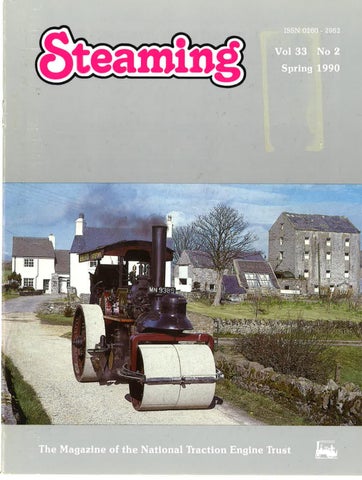
Cover Marshall 10 ton compound roller 75408 of 1922, formerly fleet number 5 of the Isle of Man Highways Board, indulges in a bit of real road rolling work at Cast/etown, in the south of the island, in March 1989. (Paul Stratford) 59
Trust News From the Chairman Since my note in the last issue of Steaming, I am pleased to report that the Trust is making good progress and further committee meetings and a Rally Organisers Conference have been held. Attendance at the Conference held in Birmingham was good and many matters were discussed including safety and fire precautions at rallies. As I mentioned previously, both the Treasurer and the Membership Secretary had indicated their wish to relinquish their appointments. Following the advertisements in the last issue many enquiries and applications for these posts were received and much sorting out and interviewing has taken place. I am pleased to announce that our new Membership Secretary is John Cook of Sleaford, Lincolnshire.
By the time you read this he will have taken over from Fay Wood and commenced his duties. Your committee has every confidence in John's appointment and I would ask all members to give him every support, but a little forebearance may be necessary during the time it will take for John to get fully acquainted with our requirements and to conquer the computerisation of our membership records. I was most gratified at the response to our appeal to the general membership and would thank all applicants for so readily volunteering their services. Once again, Fay Wood has to be thanked for the devoted and meticulous service she has given to the Trust for many years. Thank you, Fay. Although the advertisement in the Winter issue for a person to fill the position of Treasurer brought forward
From Alan Martin's Collection
48
This picture is somewhat unusual in that it portrays a four-shaft road engine, one of only about four built by Burrells. This 8hp, 2 speed, single crank compound, 1485 of 1890, was photographed in Stroud Street, Dover, circa 1912, in the ownership of Arthur Baldock of Dover, when probably engaged in bringing in road-making material. Another unusual feature is that the winding drum is on the right hand side of the engine. 60
some applications, the Committee were unable to make an appointment and the appeal is again made in this issue. I would remind readers that any member can, of course, correspond with any official of the Trust they may wish; addresses are given on the inside cover. Correspondence should, as far as possible, be sent to the appropriate official but all general correspondence should go to the Company Secretary land Vicc chairman) Sylvia Dudley. (Eric Fillmore — chairman)
Rally Organisation Rally sub-Committee The magnificent display of daffodils on the verges here in Church Stretton, combined with the task of replacing the lagging on my Ruston makes me realise that spring and a new rally season are upon us. At the time of writing the list of Approved Rallies, that is events which the organisers have agreed to run in accordance with our Code of Practice, has grown once again; there are some new events on the rally list which you will find in this edition of Steaming. The increasing popularity of rallies is something which continues to surprise some people; however, let us not overlook the fact that more events are being run, often with an increasing accent on working demonstrations. The latter are something that I personally enjoy, but we must accept that we have to maintain high standards of planning and operation of events to maintain the excellent safety records of recent years. The rally subcommittee is already reviewing some aspects of the Code of Practice to update in line with new rules and recommendations. The Spring Conference proved the need for this exercise in some areas. I would particularly ask rally organisers and safety officers to contact me with any unusual or new problems which they
experience at their rallies so that we may be able to assist the next time the problem occurs. The Spring Conference was very well attended and I sincerely thank all the delegates who attended and contributed to the wide range of topics that were discussed, which included, in particular, fire safety at outdoor events, safety guidelines for steam ploughing demonstrations, police costs at rallies and future plans to assist with rally publicity. At the Conference it was decided that the guideline figure for rally appearance money should be £55 per engine per day. Due to the cancellation of the Autumn Conference no fresh representatives of the Affiliated Clubs were appointed to the Rally sub-committee. I would be most interested to hear from one or two experienced rally organisers who plan to visit rallies other than their own this summer, who would be prepared to assist us with rally visit reports, as well as providing input to the committee in their own right as rally organisers. In taking the chair of the rally subcommittee from Eric Fillmore, I would like to thank him for his many years of hard work in developing the Rally Approval scheme and bringing the Code of Practice to the level of acceptance it has attained as a comprehensive guide to all aspects of rally operation. I also thank Ron Copp who administers the whole scheme with practised ease, producing the list which is taken forward by Roger West into Steaming, Tony Foulkes our Publicity Officer who dispatches lists to many Tourist Boards and other bodies, and Peter Smart whose computer skills feature in the compilation of the list. I hope you all have an interesting and dry rally season and look forward to meeting Rally Organisers and Affiliated Club representatives at the Autumn Conference on November 17th — put the date in your diary now! (Andrew Semple, chairman, Rally subCommittee)
Engine Owners Column Engine Owners sub-Committee Michael Davies, a long standing committee member, has agreed to become Chairman of the Engine Owners sub-Committee and will now be working with the other members of that committee towards the resump-
Membership' Secretary Members are asked to note that John Cook has now taken over the post of Membership Secretary from Fay Wood and all future subscription renewals, changes of address and queries over non-receipt of Steaming should be addressed to John. His address appears inside the front cover of each issue, and also on the title page, as well as on any subscription reminders that are sent out. Members are also reminded of last year's change in subscription charges — the current rates are printed inside the front cover of each issue of this magazine.
tion of its activities on behalf of the engine owners. Tentative plans have been made to continue the supply of authentic chimney tops in brass or copper and it is hoped these can be concluded for the arrangements to be set down in the next issue. In the meantime, urgent requests in this direction can be directed to Michael at the address inside the front cover. Environmental Protection Bill Engine owners and many other members may be aware of the concern being experienced recently that steam engines could be affected by the proposed Environmental Protection Bill, currently being discussed by Government. The Bill is intended to create sweeping powers to ban or severely restrict the emission of smoke, steam and other fumes and could conceivably have been used to stop the steaming of our engines on the rally field, the highway and, indeed, anywhere. As we go to press however, it is understood that efforts by the preserved railway lobby have been successful in tabling an amendment to the Bill that will lift the threat of a ban on steam engines. Lost Registrations The Federation of British Historic Vehicle Clubs has been party to further negotiation on 'lost' registration numbers — those numbers on vehicles which are not registered on the Swansea computer, and the re-issue of which often represents a problem to fresh owners of engines which have been stored for many years by the previous owner. In October Minister of Transport Robert Atkins agreed in principle to a change in policy to enable 'lost' registration numbers to be re-issued in genuine cases, albeit on a non-transferable basis. A further
- National Traction
kk
Engine Trust
Appointment of
Treasurer The Trust's present Treasurer has given notice, through pressure of personal business, of retiring at the end of the financial year, after many years of sterling service. Applications are therefore Invited from suitably qualified persons to serve in this essential position within the Trust. The selected candidate will have the necessary accounting skills to • Maintain the accounting records of the Trust and its trading subsidiary. • Provide to the Trust's National and Executive committees reports on the Trust and trading company's financial position. • Liaise with the auditors in preparation of the annual accounts. • Liaise with the Sales Officer on budgeting for stock purchases for the trading company. • Monitor the Trust and trading company cash positions to ensure funds are available to meet liabilities as they fall due. A job specification giving full details of this very important position, which carries an honorarium, is available and persons wishing to have a copy (they do not presently have to be a member) should apply to Eric A. Fillmore, 34 North wick Park Road, Harrow, Middlesex HAl 2NU. Closing date for applications with curriculum vitae etc, is 19th May 1990.
61
meeting between the DVLC and representatives of the FBHVC and some member organisations highlighted several problems — mainly the cost effectiveness of what is a very small part of the DVLC's operation, and concern about fraud. Whilst making the re-issued numbers non-transferable removes the obvious possibility of fraud for gain by selling the new number, there is a very real risk that the unscrupulous will use the facility to give authority to fake vehicles, whether those built up from original parts, replicas or clones (two or more vehicles from an original one). In order to overcome this problem, the DVLC will be placing greater reliance on the integrity of Clubs to vouch for the pedigree of vehicles, and future applications will require such authentication. The NTET will endeavour to provide this support to members. There is, however, much work to be done on the Swansea computer before the change in policy is implemented, and just how the system will work is not yet known; current advice from the FBHVC is to wait for further announcements before making any application for a 'lost' number. (FBHVC Newsheet 4).
FIVA Members may like to have a brief explanation of FIVA, occasionally referred to in these columns, and its finances. The Federation Internationale des Vehicules Anciens was founded in 1966 as a worldwide organisation bringing together national clubs or associations concerned with mechanically propelled road vehicles. In its early days, FIVA's prime function was to provide a universal framework of rules for the organisation of automobile rallies on an international basis. FIVA then became recognised by FIA internationals de — Federation ('Automobile — as the sole authority recognised on an international basis for matters connected with historic vehicles. It is thus a very important organisation, without which the Federation of British Historic Vehicle Clubs and, through the latter body, our Trust would have no effective lobby in Europe. Unfortunately FIVA has to be funded, and the financial obligations falling upon the FBHVC and hence onto the British preserved vehicle movement will be increasing noticeably. The UK contribution for 1990 will be £5000 and some means of
raising this requirement has to be found. As yet no decision has been taken but it seems likely that either the FBHVC subscriptions will be raised or some form of appeal will be made. (The NTET subscription for 1989 was £60.) Donations to the Eurofund totalled £36,100 at 30th November 1989 and approximately one third of this has been used in connection with the lobby. The balance will not be sufficient to finance the lobbyist through to 1992, when FIVA assumes responsibility for the lobby, and so further donations will be called for by thc FBHVC. (FELLIVC Newsheet).
Coal Supplies Rally organisers and many engine owners, both as individuals and in groups, have been taking advantage of the low priced coal supplies arranged by the Trust in the last two years. For 1990 the scheme hoe been expanded to enable rallies and owners further north to obtain attractively priced coal. I am advised that at this time the Deep Navigation Pit (one of the few remaining sources of Welsh steam coal) is experiencing production difficulties and its future is under
NTET Coal Supplies The Trust has arranged low priced Welsh Steam Coal for use by rally organisers, clubs or individual owners In association with Arscott Collieries, Coal Factors and Merchants, Gateway Chambers, 26 Castle Street, Shrewsbury SY I 2BJ • pre-packed 25kg plastic bags • haulage can be arranged to any rally site • ring John Watkiss on 0743 62482 to discuss your requirements and haulage cost, anywhere in Britain
In association with Powell Duttryn Fuels Ltd, from their depot at Hove, East Sussex • pre-packed 25kg plastic bags • I tonne shrink wrapped pallets • haulage can be arranged • contact Terry Goodwin on 0273 728161 for further details
DEEP NAVIGATION COAL
£90.50
WELSH STEAM COAL
per tonne ex Shrewsbury
Price on application
Bituminous also available Cash on collection or pre-payment
62
cheque 7 days prior or cash on collection
review. British Coal have intimated to our suppliers that coal should be available from the colliery during the coming season and it is intended to develop alternative sources for the future. This year coal will be available from J.A. Smallshaw in Shrewsbury, as well as the established supplies from Powell Duffryn, this year from Hove on the south-coast. Our new suppliers, who trade as Arscott Collieries, have for many years been supplying suitable coal for steam boilers in preservation — the GONDOLA on Coniston Water, the paddle steamer KINGSWEAR CASTLE, the National Museum of Wales and several preserved railways. Rally organisers and engine owners are referred to the advert elsewhere in this issue, and should contact either John Watkiss at Smallshaws at Shrewsbury or Terry Goodwin at Powell Duffryn, Hove. Both merchants will assist with transport arrangements and prices for same. I hope all concerned with coal purchase will consider the scheme and take advantage of it, for as well as benefiting the Trust by way of a small commission from suppliers, it could help ensure future supplies by adding to the bulk buying power of the steam preservation movement. Finally, some coal consumers may not be aware that VAT will apply to the purchase of coal after 1st July this year. (Andrew Semple, chairman, Rally sub-Committee)
This fine road mending scene would seem to be taken in Westmorland or Cumberland, probably during the heyday of tarspraying country roads in the late 1920s. The engines are identified by Alan Duke as owned by J. Chaplow & Sons of Kendal, the drystone walling probably confirming that they were being used fairly locally. The traction is 6hp single cylinder McLaren number 619, new in 1898 to a Manchester owner and named ALICE. It was purchased by Chaplows from Higginsons of lrlam in 1914, later registered EC3367 and scrapped in 1945. The McLaren is towing a large four-wheel tar tank and a grit spreading trailer behind that. In the background is Aveliny & Porter 10 ton roller 5264 (KS 1368), an overhead valved compound which was new to Roxburghshire C.C. Kelso District in 1903, and passed to Chaplows, after another owner in Berwickshire, in 1923. It was last licensed in West Yorkshire in 1954. The road gang pose with their respective tools, the two drivers being the jacketed figures on the extreme left and third from left. Thanks are due to Alan Walker for lending the card from his collection.
Affiliated Clubs
Obituaries
The secretaries of all local clubs that are affiliated to the Trust should have received reminders that the annual affiliation fee of £15 per club is due for renewal on 31st March 1990. We are aware that collection of these fees has been less than perfect over the last few years, and as a prelude to enhancing the interaction between local clubs and the Trust, the Committee want to have a proper list of affiliated organisations. If any secretary did not receive a reminder, or if any local club member feels that his group have lapsed and should be re-affiliating please contact me at the address inside the front cover. Affiliation is open to all local groups involved in road steam preservation and enables them to keep in touch with information and news from other similarly involved organisations. (Sylvia Dudley)
Hugh Bull It is with great regret we record the death in February of Hugh Bull of Queensland, Australia in his 80th year. Before moving to Australia quite a few years ago, he had a busy and varied working life around steam engines in the West Country. A year or two ago Hugh set down his experiences for us in two excellent articles. 'Isaacs of Braunton' and 'A Plant Engineer Remembers'. In recent years he has travelled long distances in Australia with the 3 inch miniature traction engine he built. Our sincere condolences go to Mrs Bull in her sad loss.
Albert E. Deans Albert E. Deans of Baldock died in Stevenage hospital in January, aged 97. He left a widow Marjorie, who for
the last ten years had nursed him with great care as Albert's mental capacities gradually faded in very old age. Albert's steam experience was gained from the family agricultural engineering business in Baldock, from where threshing and steam cultivation contracting was also undertaken. Albert was one of the earliest committeemen of the old National Traction Engine Club. In the late 1950s, when two Appleford rallies had made a loss of around £200 each, there were murmers in committee about winding the club up. But Albert would have none of it; he was unshakeable in his belief that we could run a rally and make money out of it. The outcome was the 1958 rally on Squire John Pryor's land at Weston Park, near Baldock. The NTEC treasurer at the time was E.W. Edney of Horndean. He asked me to phone him that Saturday evening, since he was anxious about 63
the result, and when told that there was a profit of around £200, he said 'Excellent — now we are high and dry.' The Club never looked back! In later years, after disagreements in committee, Albert resigned his membership. (Harold Bonnett) Percy Harrison Percy Harrison of West Farm, Blansby Park, Pickering, North Yorkshire died in January 1990 after a short illness. He worked with traction engines throughout his life at the family home at Marishes and surrounding area with his father and brothers. Marshall general purpose engine 32092, named BLACK BESS, new in 1900 at Hull Fair, was purchased by Percy's father in 1923 and used continually until after the last war for threshing in the Vale of Pickering. In 1953 BLACK BESS was one of four engines to attend the first Pickering Rally (the others being OLD GLORY then owned by Les Lazenby, SURPRISE, then owned by N. Thackray, and MARY, then owned by Craggs brothers of Ebberston). On the death of Percy's brother Stanley in 1964 the engine was acquired jointly by Percy and his elder brother Francis James and has attended rallies at Pickering, Castle Howard, Harewood House, Burton Constable, Masham and Driffield at various times ever since. Percy was also a member of the Great Yorkshire Traction Engine Club and of the Leeds and District Traction Engine Club. He was a dedicated farmer and dearly loved his engine as all who knew him will know, and the steam world will be all the poorer for his passing. He leaves a widow and two sons. (frdward Harrison) Ken Purchase Weep not for him for can't you see around you what's been done The things he's made, including friends.
National Traction Engine Trust
CAR BADGES Finished in gilt and two colour enamel
£12.50 from NTEC Salesuse Mail Order form
64
Treasures, every one He gave his talents, gave his time The wise now say, How clever Old Ken has made his mark on earth and so will live for ever. The fire is out, the pressure gone the ashes now are cold But in the future friends will sit and stories will be told Of Ken's vast knowledge, skill and care More than words can relate I know that I am very proud Ken Purchase was my mate. (These lines, by Gerry Burr, were Cl)ldflUll dC1VII:d of read uui ai aid Kenilworth Donald Purchase of Yeovil, who died last year. Ken assisted with restoration and driving of Burrell 3824 LORD FISHER OF LAMBETH.) Vic Walker It is with deep regret I report the passing of Robert Victor Walker in January 1990. Vic was born in 1913 in an area of King's Lynn known as the North End. In this close-knit community of narrow streets and yards almost the sole employment was centred on the sea (either the docks or the fishing fleet), or on Savage Brothers engineering works. Vic started work at Savages' St. Nicholas Works, with them for 47 years until their closure. In his time he worked through the various departments and thus rubbed shoulders with men who had worked in the heyday of the steam engine and steam roundabout and who had known Frederick Savage personally. He became an expert carver and skilled engineer, and was foreman of the carpentry shop from 1947. In Savages' latter years Vic jealously guarded the unique collection of patterns that dated back to their first chain-engine of 1858 and was largely instrumental (along with the late David Braithwaite) in saving them. When Savages closed in 1973 this entire collection, together with the firms' works drawings and engine registers, were purchased by Bill McAlpine and placed on permanent loan to the Norfolk Museum Service. Vic supervised the removal to a museum store and then spent four and carefully sorting months cataloguing everything. Vic then went to Belmec Engineering Ltd and was able to realise a lifelong ambition in seeing a Savage chain-engine in steam when they built two full-size replicas under his leadership. Whilst there Vic also supervised the rebuilding of Robert Crawford's Clayton & Shuttleworth steam wagon and many similar tasks. In 1975 the old firm of Dodman
Engineering ceased to function and as a result of this and other events in King's Lynn a West Norfolk branch of the Norfolk Industrial Archaeology Society was formed. Both Vic and I were at the inaugural meeting and despite our age difference became good friends. I soon came to realise the vast knowledge Vic had about steam and our industrial past; there was hardly a site visited by our society that Vic did not have a working knowledge of. Upon retirement Vic continued his many interests, so there is hardly a fairground DrPgerVAtinn grherna that has not benefited from his knowledge or practical help. Vic was also well known for his town and village signs, many of which grace the Norfolk countryside. An evening spent in Vic's company was an experience never to be forgotten as with a wide grin and a twinkle in his eye he would recount anecdotes concerning Savages and his fellow workmates. Vic was a living link with a past that in future will only be known about from reading hooks. In spite of ill health Vic never looked back and even before Christmas was talking about assisting in a project to preserve a small part of the North End, where his heart will always be. I feel very privileged to have known Vic Walker and my sincere condolences go to his wife Susan, his daughter Jenifer and son-in-law Tony. (Peter C. Wells)
The Charles Burrell Museum Work on the Charles Burrell Museum at Thetford, Norfolk is steaming ahead in the former Burrell's paint shop which has been acquired by the Breckland District Council. Last year the exterior and interior of the building were repainted, now the main interior work is taking place which includes the erection of a display gallery, office and toilet facilities. Once the building is completed, the Trustees and Friends of the Museum will be eagerly preparing the various exhibits. A great collection of machinery, tools and of course Burrell engines will feature in the Museum's display. There is however a shortage of old carpenter's and wheelwright's tools and if anyone can help, the Friends would be pleased to hear from them. If any readers would like to join the Friends of the Charles Burrell Museum or require further information they
should contact Margaret Steele, The Wardens House, East Wretham Nature Reserve, Thetford, Norfolk. It is anticipated that the Museum will be ready for opening in May or June 1990 and we look forward to seeing you. (Geoff Gilbert)
The Sentinel Works, Shrewsbury At the public enquiry last year into planning applications for retail development in Shrewsbury, which included use of the site of the Sentinel Waggon Works, chief executive John Crawley expressed the concern of the Trust and its affiliated clubs about the obliteration of an historic site. The inspector, Mr J.E. Acton, issued his Report at the end of the year and included the following points that are pertinent to steam enthusiasts. He noted the Trust's case that something needed to be done on the site to record a milestone in transport: that the works, which were erected in 1915 solely for the manufacture of steam wagons, had been innovative in flowline production techniques and that the output of a product which became a market leader had been prodigious. The Sentinel knight had been a worldwide trademark. Mr Acton noted that distinctive features of the Whitchurch Road frontage of the works included the Sentinel knight in a niche in the facade of the original building (see photograph on page 23, Steaming, Winter 1986/87) and two pairs of metal gates, the southern pair incorporating the words SENTINEL SHREWSBURY. He considered the Trust's suggestion that if the original works or office or the facade and gates could not be retained, the statue of the Sentinel should be relocated on the site with a plaque recording that the site was the former premises of a major manufacturer. The inspector concludes that to his mind the suggested interest 'is not sufficiently important to affect the decision on the application, nor to justify a condition requiring the preservation of any part of the buildings. However, if planning permission is granted the developers might consider commemorating the industrial history by locating together the statue of the knight, the southern pair of gates and a suitable plaque as an interesting feature of the retail element of the development'. The County of Salop club and other
Garrett 4CD tractor 32944 of 1916 poses at the Long Shop Museum, Leiston. (Scania Transport Trust Awards)
interested enthusiasts have accordingly contacted the developers with a view to the implementation of the inspector's recommendations.
Scania Transport Trust Awards The winners of the 1990 Scania Transport Trust Awards — the scheme was mentioned in our Autumn 1989 issue — were announced in February. At a presentation at thn Royal Automobile Club, HRH Prince Michael of Kent gave out prizes worth £5000. Overall winner and recipient of £2500, was the Windermere Steamboat Museum in Cumbria, commended by the judge for their fine collection of craft, mainly immaculately restored steam boats, which were a way of life on Lake Windermere for nearly a century. Runners up were Mike Sutcliffe of Bedfordshire, for two finely restored Leyland buses from the 1920s and the Cotswold Aircraft Restoration Group. Yet again, road steam is conspicious by its absence in the prizewinners lists, though Garrett 4CD tractor 32944 features among the exhibits of the Long Shop Museum at
Leiston, which was one of the twelve finalists, all of whom received a cheque for £250. Entry forms for the 1991 Awards are available from the General Administrator, The Transport Trust, Melbury House, Melbury Terrace, London NW1 6JU (a01 262 8864) and engine restorers among our members are urged to consider entering the competition — and refer back to and re-read the comments on page 65 of our Spring 1989 magazine.
Future dates The 1990 AGM of the Trust will be held on Saturday, 24th November 1990 in the Leeds area. Arrangements for the meeting, and associated visits,
65
IMPORTANT INFORMATION FOR THOSE NEEDING ECONOMICAL REPAIRS ON THEIR TRACTION ENGINES
B. & C. Reconditioning (Gears) Ltd PINIONS
SPURS
BEVELS
All types and makes of bevel gears, spur pinions, spur wheels, helical gears etc rebuilt to standard
Please note our new telephone number Our address is:
B & C Reconditioning (Gears) Ltd, off London Road, Amesbury, Wiltshire SP4 7EQ Telephone Amesbury (0980) 623210
66
are now being prepared and will be set down in future issues. The Autumn Conference of Rally Organisers and Affiliated Clubs will be held on Saturday 17th November 1990 at Birmingham. Again, further details nearer the time.
London Area Social Meetings The final meeting of the 1989/90 season, due to be held on 24th April, had to be cancelled as a result of the closure to business of the venue, The Horse & Groom. Meetings will be continued in the autumn and details of a fresh venue for the social meetings in the London area will be announced in the Autumn issue. (Bill Timmings)
Correction We apologise to Prudential Agricultural for printing the wrong date on their advertisement on page 32 of the last issue — the correct date is Saturday 12th May 1990. Prudential advise this collective sale near Andover, Hampshire includes a 1929 Foden 6 ton wagon among the entrants, as well as the usual steam spares and catalogues etc.
OUR MAGAZINE 25 YEARS AGO
At the Club's 1965 AGM it was announced that a Code of Practice was being drawn up for the use of rally organisers. A total of 1400 members would be on the books when all were paid up, and a dinner had been attended by the largest gathering yet — an astonishing 244 members and guests. This figure probably reflected the important social role the Club effected at the time before there was a proliferation of regional clubs; there were reports of the founding of such groups in Lancashire and thoughts of one in Warwickshire. Engines detailed as still in commercial use included two Fowler rollers in use by Kitchens in Lincolnshire for Kesteven CC, and ten Sentinels at Brown Bayley Steels at Sheffield, the latter probably the last steam wagons on haulage. Notable among engine purchases were Mr A.S. Heal who had acquired McLaren 1652 from Steve Neville, and Mr C.L. Edmonds, new owner of Burrell showmans 2879. The events diary listed 41 rallies between May and September.
'February 13th, 1931. Dear Sir, Enclosed please find £7.18.6d (E7.921/2 ) re settlement of enclosed a/c. We shall be glad if you can let your man come down to put the stays 118) in the Dragon engine on Monday next as per phone conversation this morning.' (Letter to The Avonside Engine Co of Fishponds, Bristol, who apparently did quite a bit of general engine repair work for showmen, from Anderton & Rowland of Bedminster, Bristol. The highly coloured drawing as heading to the notepaper depicts a set of diving dolphins and chairoplanes, a racing motor jungle ride and many side shows (but no showmans engines!). The letter has been filled in at the appropriate places 'This week ...Gloucester Lane, Next week... Bristol', so presumably the opportunity was being taken to have Avonside attend the engine whilst close to their works. Anderton & Rowland purchased DRAGON new from Burrells in 1921 (number 3912). The 8hp scenic engine survives in preservation, owned by the Chamberlain family in Cambridgeshire and, as many readers will realise, is rallied over a wide area of England.) 'Armstrong Whitworth Steam Rollers — Amongst other important orders recently received by Sir W.G. Armstrong Whitworth & Co Ltd, Openshaw Works, Manchester, are ten for the Spanish Government, some of which have already been shipped to Spain.' (From Roads and Road Construction, April 1923.)
WORLD'S FAIR W The outdoor 16 entertainment weekly incorporating
3137:4 444
-SA
Ft".. z.VR:;*-7.R:4 7:1•er_otTIS
Rallies, News, Reports and Advertising
Place a regular order NOW with your newsagent. Something to sell? An event to promote? For all your advertising requirements there is no better publication. For advertising and subscription details contact: 061-624 3687 The World's Fair Ltd., P.O. Box 57, Oldham OL1 4BB. 67
The second restoration of
Burrell 3535 Introduction -age crt!ale hee been wr!tten by the owner of Burrell 3535 to show the reader, and particularly the young enthusiast, how a 10 ton steam roller can be rebuilt in the open using only basic equipment, a bit of ingenuity and plenty of muscle power. In addition to the knowledge obtained, I hope some entertainment may also be gained from the narration. The story is also a tribute to the loyal crew of Burrell 3535 — to Geoff Ashdown and his wife Carol of Burnton, near Northwich and to Paul Doggett of Bury and Alan Dagnall of Lainford, whose dedication, support and assistance enabled the roller to be back in steam and on the road within the space of two years. Also my thanks are extended to numerous preservationists for services rendered and to the landlord of a certain Cheshire hostelry where the restoration took place, some 10 miles from my home.
The roller is one of a few survivors of a -i.ell's class A 10 ton double crank compound machines and actually weighs nearer 12 tons 10 cwts in full working order. It was ordered by Leyland UDC, near Preston, Lancashire, at a cost of £477 and was dispatched to the council on 12 December 1913. The roller is named OLD ERNIE as a tribute to its last driver, Ernie Cooper of Eccleston near Leyland, who drove the machine from 1947 until it was retired in 1963. The following year it was bought for preservation and restoration and acquired by the present owner in 1975.
Trouble Brewing The necessity for a second restoration of Burrell 3535 has its roots in the winter of 1986/87 when the boiler inspector cast doubtful glances at the second row and crown stays in the firebox. Thoughts in that direction accelerated in August 1987 when,
Alan Porter
towards the end of a 32 mile road trip to attend ire Giediogion Park Rally in Shropshire, one bright-eyed member of the crew, after an excellent pub lunch in Whitchurch, spotted that the flywheel had moved about %in down the crankshaft. Later, on closer examination, it was found that the rear near-side wheel was so loose on the axle that it had thumped the flywheel. When the same thing happened again a couple of months later so that the flywheel intermittently touched the hornplate, something had to be done to rectify the problem. Rebushing the rear wheels would be the answer. While doing this it was prudent to true the axle and, as the axle bearings were of white metal, it was decided to have new ones of phosphor bronze inserted in the axle boxes. This work was arranged with a local (Congleton) firm of engineers well known in steaming circles. Because re-bushing necessitated, of course, removal of the rear wheels and axle the ideal opportunity was going to be presented to replace the doubtful stays. Further, because the tender would have to come off, replacement of this seemed a good idea, especially as the much-patched water tank was extremely pitted on the inside and was looking rather seedy on the outside. As the roller had not been painted since 1964 it also seemed sensible to do a re-paint back to near 'its original maroon livery (if the purists don't like the shade of maroon they are quite welcome to come and repaint the roller!). In short, it was a second restoration job.
Demolition Begins
Burrell 3535 at work, scarifying in Leyland in 1962, the driver the late Ernie Cooper. (Ken Cooper) 68
OLD ERNIE was steamed the week after the 1987 Holly Bush steam party to its appointed place where the rebuild would take place, coincidentally at the back of another hostelry, The Bear's Paw Inn at High Legh. The area to be occupied was the former midden of the farm which used to belong to the pub. Though on a slight slope it really was ideal, being an L shaped piece of clean concrete with each arm of the 'L' about 30ft long
August 1986 The Burrell busy rallying in brown livery at Astle Park. (Ted Dyer)
and 12ft wide. The nearest electrical power source was some 55 yards away, but a roll of cable soon solved that problem. On arrival, the Jackson living van, which was now to become workshop, toolroom, messroom and general stores, was positioned in the upright of the L and the roller brought down into the boot, finishing at right angles to the van and about ten feet away. Dismantling began in earnest the following week, on 18th October 1987, and continued every Sunday until, by mid-December, there wasn't much work remaining. From the cylinder block backward there was nothing but a bare boiler barrel and the canopy, which was supported by its front and centre stays and two specially made and cross-braced timber uprights at the rear. All the heavy and large lumps were shifted using a combination of brute manpower and a little ingenuity — no cranes or fork-lift trucks. The scarifier came off first, being supported on a couple of pallets and small timbers before the retaining bolts were removed and the whole lot dragged clear. Ashpan and firebars were next, then substantial timber baulks were placed directly under the firehole door end of the foundation ring and protruding some four inches proud of each hornplate, before the rear wheels were tackled. Each rear wheel was removed by sliding it onto an oiled steel plate using the time-honoured method of two hefty and long timber planks positioned front and back of the roll to lever the wheel off. The brake drum and spur gear were drawn off onto precisely positioned (for height) pallets then wheeled away, the second shaft gearing cluster was lowered, by a rope slung over the hornplate, onto the pallets used for the spur gear, then man-handled away. The axle was drawn out onto precisely positioned timbers to be carted away. The five hundredweights of solid flywheel was removed by slinging a substantial rope over the canopy and threading it through one of the three holes in the solid plate. Once free of the crankshaft it was lowered onto its
uov
November 1987 Geoff Ashdown with long crowbar persuades the tender down planks prior to rolling away. (Alan Porter)
January 1988 Will Dakin showing how to correctly drill out a second row stay without damaging the threads. (Alan Porter) 69
boss on a scaffold platform then slid down a plank to the ground. After the axle boxes were removed, the tender was propped on a hefty baulk supported by a large and strong pallet (making just the right height), all fixing bolts were removed, then, using two four-foot long crow bars, it was slid along the baulk until clear of the hornplates. It then continued down two sloping planks to a third which had some lengths of old tube underneath it so that the whole lot could be 'wheeled' away. To extract the crankshaft, a 7ft Iona niece of ?in dia tube wag fwd underneath the canopy and slung from it was a hand operated ratchet block. The crank was lifted out of its bearing housings and lowered over the back of the now tenderless hornplates onto a pallet and man-handled under the living van. Simple really! But it was when the axle was removed that a nasty shock came, On close inspection six longitudinal cracks, each over 2in long, glared at us. That's that, then; scrap! Fortunately, a replacement lump of suitable bar was soon located and taken to Congleton to join the wheels and axle boxes which had been taken there in mid-November. Incidentally, the rear wheels were loaded onto a wagon using a friend's ex-Army Scammell tractor fitted with a hand-winch crane. Boiler Work A break was taken for Christmas and work recommenced in early January 1988. With work on the wheels and axle underway, and the old tender dispatched as a pattern for the new one, we could turn out attention to the firebox stays. The sixteen second row stays were attacked fiisl, Leiny uarefully drilled out beyond the plate thickness both from inside and outside using heavy-duty electric hand drills. Once drilled to %in dia to leave the threads undamaged, the remaining neck of each stay was broken using hammer and chisel. Next came the crown stays. The supporting nuts on the inside were burnt off and the remains ground flat and flush with the crown. First to be drilled was the front centre stay. A great cheer came from within the firebox when this stay came out to be followed by profuse and unprintable language, from which I deduced that I was invited to inspect the thickness, or lack of it, of metal in the crown. Oh heck! Three more strategically placed stays were drilled, two midway on each side and one at the back in the centre. The result was the same — a thin, very thin, crown plate. No more than two threads deep. 70
May 1988 Geoff Ashdown striking nut a foundation ring rivet. (A/an Porter)
When the boiler inspector looked at the box during the following week he confirmed our fears, the crown was beyond hope — we would have to fit a new one. On consultation with a well known Staffordshire boilermaker/ repairer he recommended a complete new box, particularly if I intended to keep the roller, which I did. Prices were discussed at length and at the end of the conversation it was agreed that, as we were not expert boilermakers, and to make the replacement as financially viable as possible, we would remove the old box and he, the
boilermaker, would make a new allwelded one, fit it, stay it and re-tube the boiler up to hydraulic standard by Easter 1989. Our target for being back on the road was the Holly Bush steam party, October 1989; we are optimists one and all! Box Removal By now it was mid-March and with the winter weather still reasonably mild we blasted on with the box removal. First the tubes were knocked clear of the firebox, leaving them iii the barrel for removal at a later date
June 1988 The firebox being tipped on its side prior to renewal from beneath the boiler. (Alan Porter)
(actually October). The remaining 38 side stays were removed from the outside plate only, by a combination of drilling beyond the plate depth and cutting the remaining shell just inside the hornplates with the burner. The eleven remaining crown stays were drilled from inside, then the necks severed using the burner. Next came the foundation ring and firehole door rivets. All 77 of these were removed by first drilling out some 2 3Ain depth to %in dia then belting the remainder out with a 9/l6in dia hardened steel drift and a seven pound sledgehammer. If this failed — and it did on a number — then we resorted to flushing them out with the burner. When burning out the uncooperative rivets above the timber packings, the molten swarf often caused a minor fire to start. To the amusement of all concerned we called out the 'fire brigade', which consisted of someone armed with an iron bar, to knock the worst of the molten swarf away, and an old Fairy Liquid bottle full of water in the other hand, to quell the burning wood. Sometimes, however, the fireman's aim with the bottle was off target, provoking howls of abusive language from the offended and drenched oxy-operator. Anyway, the method did work and gave some light relief to an arduous task. In June, after some 250 man hours of hard slog, the box finally dropped onto the concrete. Getting the box away was reasonably easy, thanks to the fact that the clearance between the bottom of the hornplates and the ground level on this Burrell is enormous, being some 21 inches. With every stay and rivet out the timber baulks were eased back, clear of the foundation ring. The box stayed there; nothing happened — so we took the opportunity to fit a specially made lowering device. This consisted of two box-section girders with a piece of 1 in diameter tube welded in the centre and on one side of each girder. They were positioned above the firebox, one resting on the hornplates over the front centre crown stay and the second beam lay across the bearing housings above the fourth centre crown stay. Two 3ft long pieces of %in threaded bar were inserted through each tube and firebox crown and tension applied. Now we could tackle the foundation ring in safety. A couple of hours of persistent thumping with chisels and specially-made drifts through the mud holes was punctuated by a lunchtime reviver in the pub. Given this added strength, and relieving the tension in the box by gutting each corner with the burner, resistance from the foundation ring
didn't last long. Once it began to move it soon fell to the concrete, to a gleeful chorus. The lowering device was slackened off about nine inches, but the protruding remains of the stays caused the box to jam. A thump through the firehole door cured that! This operation was repeated until the box again jammed about a foot from the floor. Both threaded bars were then carefully removed and the box given another tweak with a baulk. Down it came onto the concrete to a great roar of relief! Once the box was on the ground, a hydraulic jack was placed under each hornplate at the back and the whole bf the back end of the roller was raised about two inches to allow the box to be gradually tilted onto its side before being dragged clear. Easy when you know how!
Painting and More Painting Whilst Geoff and Paul had done the brunt of the firebox removal, many of the smaller components had been cleaned end painted by other members of the team. Now other restoration work and the re-paint job on the bigger bits could commence. The re-bushed wheels arrived in early July and the new tender at the end of the month. The wheels were positioned some ten feet behind the roller and the tender manoeuvred in between and dead in line with the hornplates. To protect them, and us when working on them, a makeshift tent was constructed using redundant 3in x 2in timber for a framework, which was constructed inside the rear wheels, the lot being covered by half a wagon tarpaulin,
generously donated by a local haulier. 'The Hut', as it became known, was to prove its worth during the showery months of August and September. During these months, and October, hours and hours were happily spent on the wheels and tender — filling, rubbing down and painting; more filling, more rubbing down and more painting. An endless procedure, weekend in, weekend out, rain or shine. As a break from this routine other restoration work was also carried out, like the fitting of a new phosphor bronze bearing in the offside of the second shaft; fettling up the big end and main crankshaft journals and bearings; painting in first gloss of the flywheel, hornplates and canopy name boards. Time was also found one fine day in September for a quick coat of maroon gloss on the outside boards of the living van and to repair the roofing felt on the canopy. In October the old firebox, foundation ring and fire-hole door ring were carted off by the boiler maker, and the first coat of maroon gloss was applied to the tender and rear wheels. On a gloriously sunny Sunday at the end of that month the opportunity was taken to remove the front rolls, drop the fork down and extract the tubes. While the good weather lasted the front fork was stripped of its layers of paint and filler and given a good coat of red oxide. The middle of December, in addition to the rear wheels and tender, many smaller bits were finished up to first gloss and all was ready for the boilermaker to come and perform. It was decided by management,
March 1989 A view of the restoration site at Bears Paw Inn. (Alan Porter) 71
May 1989 Crown stays being drilled in the new firebox. (A/an Porter)
The Last Lap
vigorously persuaded by the crew, that a well earned break would be taken for Christmas and the New Year. New Year, New Firebox On returning to the fray in early January 1989 there was little outside work on the roller we could do until both the winter weather (though very mild) had improved and the new firebox had been fitted and hydraulic tested. During January, February and March we took a bit of a break, only working the second and third Sundays of each month, though there were enough small components to be painted, brass fittings and copper pipes to be cleaned. They kept us nicely occupied and the living van proved its worth as a very cosy workshop! Easter, at the end of March, came and went with no sign of the new firebox, as promised. As the weather had improved by early April, a start was made on the front rolls, removing the old paint, rust and years of muck from the inside rims. Though not very thick, this frightful mixture of compacted and very stubborn dirt, oil and general clag took a whole day to shift, even with the assistance of a brand new wire brush on the electric drill! The weather remained kind for the next five weekends and by midMay the rolls and front fork were finished, each having received two coats of red oxide, two undercoats and two maroon gloss. By late April things had, at last, stirred on the boiler front. Several rivets had been replaced in the barrel seam, on the throatplate and in the pump clack housing, and the new allwelded firebox had been delivered on 72
site complete with tube holes drilled. It was a lovely job, well worth waiting for and a pity it would soon be hidden from view, In early May the boilermaker's men began drilling the foundation ring and stay holes. On arrival on 14th May for our usual Sunday stint, we were heartily cheered to find the firebox in and riveted up. Work on fitting the stays continued at a steady pace and by early June the firebox was finished and successfully hydraulic tested to 3001bs. We were now clear to start the final phase — rebuilding. From now on it was all systems go, every weekend, and rally visits would have to take a back seat.
Sunday 11th June was a pleasant sunny day, ideal for humping big lumps of steam roller. As if by coincidence all four members of the crew reported for duty that morning, plus two friends — six of us in all. While one gang stabilised the front end — by removing the packings from under the barrel and packing the forks under each leg and stacking pallets under and across its whole width (because the rolls were out awaiting lining out) — a second team extracted the tender from 'The Hut' by using a plank and rollers and positioned it behind the hornplates. Next move was to slide the tender, on steel plates, over the outside of the hornplates and lever its front end up some 14 inches until one hole each side was in line and could be loose bolted. The back end was then jacked up horizontal in three lifts so all tender bolts could be inserted. With the tender in place two of us erected the rear canopy stays while the others man-handled newly rebearinged axle boxes into position and bolted them up ready for the new axle. However, before this could be inserted, it was prudent, and necessary, to assemble the second shaft gear cluster, and before that went on the high speed pinion on the crankshaft had to be put on. This in turn meant that we had to put the refettled
May 1989 Tapping out the near-side stay holes. (A/an Porter)
bearings on the crankshaft before it got too heavy to lift. Having done all this it meant the axle could be fitted, followed by the spur gear. Four of the team, two at each end of the axle on a crow bar inserted through the collar locking bolt hole, bodily carted the axle some 20 feet from where it had been delivered the previous Thursday evening. It was offered up to the nearside bearing and in it went. After a spot of jiggling, it slid into the offside housing, fitting them both like a hand in a glove. By now it was lunchtime so crowbars and muscles were rested for a good hour in the pub bar before the next, and most awkward, big lift of the lot — the flywheel. This 5cwt of clumsiness was assembled exactly the same way it came off — pushing it on its rim up a plank onto a platform on a builders scaffold, then heaving it upright onto its rim with three on the flywheel itself and two more pulling on a rope slung over the canopy. Once up on its rim, it was comparatively easy to turn it round and slip it onto the shaft. A good day of progress was completed by coaxing the spur gear onto the axle. With the heavy lumps safely in position the next stage was a static steam test, conducted successfully to full pressure, with no leaks, one Saturday afternoon in early July. So successful was the test that it enabled an early departure to be made to see LNER class K4 THE GREAT MARQUESS as she came through near home on a railtour from Hereford en route to the West Highland line. A very satisfactory end to a very satisfying day. The next few weekends and some evenings were spent putting back dozens of bits from whence they had come some fifteen months previously. Motion, gear change, boiler pipework and replacement wooden wedges between iron tyre and rim of the offside rear roll were all fitted. Also, the lining out on the front rolls, motion covers and gear guard had been completed. One Sunday in early August work was prematurely interrupted when the crew downed tools just before lunchtime to race off to see the return of the aforementioned K4 as she thundered through Plumley station, some 12 miles from site, on her way back to Hereford. We returned to site and spent the rest of the afternoon wrestling with the replacement of the front rolls. By mid-August new keys for the brake drum and spur gear had been made. The brake drum keys were fitted first, with the drum being gently but firmly driven on to them by using half a sleeper! The rear nearside roll
June 1989 Lifting the flywheel onto scaffold platform ready for fitting onto the crankshaft. Team of the day is, from the left, Geoff Ashdown, lan Fraser, Paul Doggett, Alan Dagnall. (Alan Porter)
was then manhandled some 15 feet from 'The Hut', where it had resided since July the previous year, until it was positioned exactly in line with the axle. Then it was a question of two very long and stout timber baulks positioned at the foot of the roll and one each side to lever the roll along a well-oiled plate and onto the axle. The whole operation took only about 15 minutes. The spur gear was treated in much the same manner only greater care was taken in establishing that its two keys were exactly the right dimensions for a very tight fit. Three trial runs were needed before we felt confident that the spur gear would go on all the way. Our calculations were correct, though it could hardly refuse to go with three of us using the half sleeper as a battering ram! At least it was a very tight fit. Fitting the gear guard, steering rod and rear offside wheel (now complete with a section of new wooden wedges between tyre and rim) was relatively easy. We must be getting experts at this sort of thing! By now OLD ERNIE was looking more like a steam roller.
In Steam at Last The August Bank Holiday period turned out to be a very hectic five-day affair for us. The Saturday was spent getting ready for a steam test on the Sunday, which turned out to be a long hard day thanks to the scarifier body not fitting properly on the new tender
and modifications having to be hurriedly made. However, we did manage to raise steam in the late afternoon and have a test of sorts. All seemed to work well and certainly the sound from the chimney was that superb and unmistakable deepthroated Burrell roar. Monday was spent preparing the boiler for the official hydraulic test and this preparation included a boiler wash out. Readers may recall an article in Steaming (Spring 1989) about boiler treatment for traction engines. It sounded good, so we tried it. A quantity of Heat Treat 502 was obtained from Houseman's Manchester Depot and four pints of the liquid were poured into the boiler in early July just after the boilermaker had completed his own hydraulic test. Houseman's recommended that if a boiler has a lot of scale (as this did on the inside of the barrel) then a hefty dose of Heat Treat 502, left undisturbed for several weeks, would help to shift it. The doseage we used was twice the normal amount required for all-season protection. By the time we came to the hydraulic test, the Heat Treat 502 had been cooking away for over eight weeks and the opportune time had come to see if it worked. It had! In that eight weeks not only had it removed a lot of scale, shown by the dense black colour of the water when drained, but it had coated the new tubes, stays and box with a protective layer. When the boiler was refilled a token amount of 73
October 1989 OLD ERNIE in pristine glory at the Holly Bush steam party. (Alan Porter)
one pint of Heat Treat 502 was put in to keep up the good work until hibernation took place later in the year. On the Tuesday the boiler inspector duly arrived to conduct the hydraulic test to 3001bs which was held with no leaks, drips or anything untoward. The following day he toddled along to witness the live steam test and again all went well, indeed the boiler was A 1 and he was well satisfied. The planned series of road tests was condensed into one, and combined with a real road run the following Sunday — ever the optimists, as I have observed before! The reason behind this mad behaviour was the necessity to get OLD ERNIE to the Holly Bush to complete the painting there along with
boiler lagging and other jobs. Twentytwo months earlier the same 10 mile route had been traversed in the reverse direction, taking 2 'Y hours and with the motion and gearing making an awful racket. There wasn't much difference on this return trip! Though the gearing seemed much quieter there was definitely something wrong in the motion. However we got there in just under four hours, having managed to conveniently break down, with a loose flywheel and several hot bearings, outside a pub at the half way stage. The annual Holly Bush steam party (in reality a steam-up and booze-up) was now only five weeks away, and the next four weekends were spent
Terris Culverwell (INSURANCE BROKERS) LTD.
4 MARKET PLACE DEVIZES WILTSHIRE SN10 1HT TEL. (0380) 729369 AFTER 6PM 71004 Established 1882
If we can help, please call Jonathan Lucas
74
frantically getting the bearings sorted, timber lagging fitted, cladding on and painted, and a host of smaller jobs completed. The valve timing also came in for close scrutiny, but was found to be perfect. Thanks to some sterling work and long hours put in by the crew we made our intended deadline but only just. The 22nd Holly Bush steam p2rty held cvor the '.A.p.ekenc.1:-f 718th: October 1989 was marred by driving rain all day on the Saturday, though we did get steam up to have a closer look at the motion in action. Helped by several knowledgeable engineers, adjustments were made to the main crank, big end and little end bearings. By tea time the downpour had ceased, so up the road we went on a much quieter engine. The rest of the weekend was spent socialising and trundling up and down the nearby lanes. Though there was still a bit to do on the old boy, we had more or less completed the second restoration of Burrell 3535 in two years and here the story ends. The project had involved some 2,200 man hours being spent on it, in all weathers, almost every weekend. It must be emphasised once again that without the loyalty and hard work of the crew, along with help from several other local enthusiasts, the rebuild would not have been completed within two years. But that's what steaming's all about — teamwork.
We are registered insurance brokers who pride ourselves on giving personal service to all our clients. We arrange insurance for motor vehicles, houses, life, medical cover, liability, etc.
Traction Engine insurance inspection and/or comprehensive insurance
Viewpoint Exports and Imports The export trade in engines effectively ended fifty years ago apart from such well documented cases as the Argentine Sentinels and Robey portables etc. However, the international movement of engines is far from dead and I think it is time that we took stock of events in recent years, reflected over rights and wrongs, and consider implications for the future. It is my contention that we should develop a code of practice and responsible attitude towards imports and exports, judging by the recent approach of buying as cheaply as possible and selling to the highest bidder, wherever he is on the globe. For the past ten years I have driven a repatriated engine, Ruston Proctor 5hp 46596 of 1913, brought back from France by Ray Hooley specifically for Lincoln, its birthplace. In 1987 I initiated the import of Hornsby 8hp traction 7297 for the Museum of Lincolnshire Life, a donation from semi-public trustees in Tasmania. This left, to my knowledge, two other derelict Hornsbys in Tasmania, another destined for Victoria and Geoff Wishart's restored exam* in the latter state. The eight Hornsbys exported to Tasmania in 1889-1892 must have really established tractions in a country where there had only been isolated examples before. Had 7297 been the only survivor in Tasmania, it should have stayed there, but in the circumstances it was acquired to be part of a representative public collection in Britain's leading engine building county. 'Shared heritage' was a term recently used by one of my correspondents in Australia, and I would claim it fits our own importation of the Hornsby. However, over the years engines have steadily come out of Australia apparently without any regard for their historical value there, nor destined to be displayed in any real context here. I suggest part of the historic value of an engine, (rather than its wretched cash one), is the relationship to where it was built or worked, and the machinery associated with it when it is displayed. Thus I'm
sure most of use would agree working displays are more 'right' than steering races or a tug of war. But what has become of these imported engines? Forgive me if I malign any recoverers who have retained their engines complete with woodracks for fuel, but too often these imports have later changed hands for spiralling amounts, acquired mythical Disneyland paint schemes and in one case lost a crane to turn a fine haulage engine into yet another pseudo showmans. Another unique variant has been exported to Europe; presumably that's where the best cash offer came from. It seems Australians have had enough of seeing Pom engine dealers selectively loot their heritage and have persuaded their legislators to put a stop to it. True, their engine preservation movement was slower off the mark so prices were modest by our standards, but did ready cash really give English collectors or dealers the right to go in without offering anything else in return? I think not. Now it looks as if exporting will actually be illegal; let's hope nobody tries any ruse to get round regulations. Yet similar legislation in New Zealand, as I understand it, failed to stop one of only two Foden tractions leaving those shores. If our movement applauds its arrival then we are ignoring the New Zealanders' loss and contravention of their regulations. Perhaps there's a good reason for the dearth of material in Steaming from Australia and New Zealand — what has the British engine movement collectively offered in return for its gains? Certainly in researching for my book Lincolnshire Engines Worldwide I had invaluable help from the Antipodes but was aware that there was suspicion about enquiries from Britain, especially relating to rarities. Hence certain information was communicated on the strict understanding that it is not to be published or otherwise passed on. But there's another alarming side to the coin and that is the trend in exports from Britain. Perhaps someone better qualified than I could list all the engines which have left in the last few years, but I would suggest that if the European market is really
cultivated and encouraged we could well see the selective trickle become a flood, as sellers and dealers chase after the best prices. One only has to think how prices for vintage and classic sports cars have taken off to realise how cheap, in comparative terms, even showmans engines are. If international investors move in then the knock-on effect will reach down the price range to Aveling rollers and promote the trend to convert or showmanise! Alright, its a free country — people can buy and sell as they choose and no enthusiast has a right to see any particular engine. If the owner wishes to shut it away, let it rot in the brambles, mutilate it by conversion, cut it up or auction it off to Japan or USA, thats up to him. But by the same token we are free to express our disapproval of any action which appears to pay little attention to the harmony or long term health of a working engine preservation movement, here or internationally. Might I suggest that if we are to view engines as part of a country's heritage it is contradictary, just for private possession or gain, to export or import from a country which has an established movement preserving the engines which were once used there. We should only be looking at moving engines from countries where they face an uncertain future, not looting from each other's heritages. In the meantime I wonder if there is any covenant or restricton that sympathetic vendors can put on their engines to prevent them leaving our shores for good? (Richard Brooks, Lincoln)
An auction sale of antique printed ephemera by Christies, South Kensington in February included three advertising posters once used by J.E. Thomas & Sons, removal contractors of Welsh Walls, Oswestry. The one showing a Foden 5 ton wagon of about 1910 complete with lift van and hauling a typical former horse drawn pantechnicon, sold for the substantial sum of £350.
1
r.
L LLI,L1
eiluswitt, 01, '
75
On the brink This picture, of what must have been an embarrassing interlude in many hours of hard graft, has been sent by Michael Ware, curator of the National Motor Museum at Beaulieu, 1-i0111pbhil e, 111 due huye ul fufthei identification. Michael's own researches and general knowledge of canal history showed that the scene was almost certainly Brentford, Middlesex, at the bottom end of the Grand Union Canal, but quite why the boiler was either being removed or placed in situ when the upset happened, or who the owners were, was unknown. Alan Martin, as one who is a native of the district concerned, agreed to investigate further. A visit to Brentford canal basin quickly established that the picture had in fact been taken there, indeed, the railings topping the basin wall are still in place and show
76
the evidence of repair in exactly the expected spot! None of the buildings survive in recognisable form however, and little further information could be culled from visits to several local iaGvlu 311iCc6, vi iiuraica. Alan's knowledge of Wallis & Steeven's .products enabled him to recognise the engine which has presumably delivered the boiler as one of that makers 5hp compound road engines of the early years of the century and, in conjunction with information provided by Alan Duke, he feels with a reasonable degree of certainty that the road engine was either Wallis 2797 of July 1905 or 2867 of March 1906, both delivered new to Pickfords and still owned by them in 1908/1909, the period when the picture is thought to have been taken.
The fallen boiler is of Robey manufacture — a stationary boiler to provide steam for some sort of process work. Note the chimney flue base angled to come out of the smokebox at an angle. The canalside works proves to be Wylies Soap Works, and since the boiler looks new rather than old and well used we can perhaps assume the accident happened as the boiler, just delivered, was about to be turned through 90° to be threaded through the hole in the brick wall of the soap works. The large crowd give us no further clues to work on — no CvidCria36 11 OM dell diee a. to whether it is winter or summer, in fact there is little expression on anyone's face. Somewhere in one of the local newspapers, hidden like the proverbial needle in the haystack, there is almost certainly a report of the accident, recording just what happened when one of Pickford's road engines stood at Brentford canal basin. If only we had a firm date to start from... Thanks are due to Michael Ware, Alan Martin and various local librarians and archivists for information. We would be pleased to have further comment from readers.
1992 and all that Chris Raworth "Next!" I got up and walked over to a doorless cubicle where a bespectacled man sat wearing a standard grey Eurosuit, and expression to match. "Sit." I sat. He continued staring at the file in front of him. "I.D. card." "Ah!...um yes...do I need it?" "You should carry your I.D. at all times. Name?" I told him. He took out a large sheet of computer output and thumbed through it. "5764/RR/193/274(e)." He wrote the number on a form, and looked back to the original file. "You've made an application for a permit?" he said, finally looking up at me. He seemed to have developed a way of doing this without moving his head. "Yes," I replied brightly. So far so good. "To move a non-standard vehicle on a Euroway..." he continued. "Might I enquire the nature of the non-standard vehicle?" "It's a steam roller." I tried to sound enthusiastic in the hope I could engender some interest in our grey person, and maybe then ease the ordeal. I failed. "Oh dear" was all he said. "There's no classification for that, I'll have to put it down as 'unclassified nonstandard vehicle!" "Reason for request?" I had to think quickly. I came from an era when you actually did things for no particular reason. "How about road testing following overhaul?" I suggested. "Personal recreation." he said dryly, ticking a box on the form. "Place of departure?" "Our back yard." I had him — here I had applied for, and got, a permit to keep an unclassified non-standard vehicle in a classified and specific place only last year. He seemed upset by this. "Destination?" "The Cock and Pfennig" — I thought it best not to mention that the idea was to meet up with the lads for a litre or three of Morrells best Europils. "Is that a listed site?" he enquired. "Oh yes," I replied truthfully, after all it had been listed only last week in the latest free newspaper The West Europe Gazette under 'Europubs worth forgetting'. "And what is the number of the Euroway on which you intend to travel?" This presented a bit of a problem. It was known locally as Potholey Lane,
but I've never heard of it having a number; I told him so. "It must have a number," he said, "names are no good; the computer can't understand them. This is 1994 you know." "2", I pointed out. "1992," he corrected himself, "Look, you'd better have one of these forms 'Application for Euronumber for unspecified highway' and when you've filled in the details send it to the local office in Luxembourg — you should have a number through in seven or eight months. I'll put it down as 'applied for', for now." We seemed to have arrived at the bottom of the page, and I felt hopeful. The grey person sat back in his chair. "I suppose as a pre-1990 unspecified vehicle you will require vouchers to draw a limited quantity of non leadfree, high carbon fuel oil?" "No," I beamed, mentally notching up a point to me. "No?" he echoed quizzically, "then may I enquire as to the type of fuel you intend to use?" "Coal," came my reply. He shook his head, "Not possible." It was my turn to be the echo, "Not possible — you're joking". "I never joke," he said with an expression that immediately confirmed his statement. "Coal is a heating fuel for industrial use only. Road vehicles cannot burn coal." "But mine does, it always has. For the last 70 years it's burnt nothing but coal!" Eurofeatures was unimpressed. "No road vehicles burn coal," he took a large grey volume from a drawer and dumped it on his desk. "You can't argue with that." "Why not?" I dared to enquire. "That's the latest, up to date, circular from Brussels, and I can assure you that there is absolutely nothing in there about road vehicles burning coal," he said slapping it on the front cover, in a gesture to emphasize the omnipotence of the hallowed book. "But maybe that's just an oversight, perhaps they havn't heard of steam engines in Brussels. Perhaps it's a printer's error". It didn't work. As far as our little grey man was concerned if it wasn't in the book, then it didn't exist. I decided to change course. "You must have heard about steam engines in the past," I suggested. He admitted he had seen something on TV a couple of months previously; an historical documentary on Channel 27. "I presume I would be allowed a coal
allocation for educational purposes?" I enquired. He agreed that it may be possible. "Then if I get a few folk to come and have a look it would be very educational for them." I had him — he supposed that could be regarded a possibility. A voucher was duly signed and stamped in triplicate for me to receive a coal allocation, not that they were giving any of it away. A temporary permit was issued for the journey. I came out of the building and blinked in the sunlight as I looked at the square glass box from which I had emerged. A litter bin stood at the kerbside. I dropped the permit in. "Sod it," I thought, "I think I'll ride my bike, instead." (This cautious look forward to the days of European Harmonisation first appeared in the Autumn 1989 issue of The Smokebox, the lively journal of the Old Steamers Traction Engine Club, based at Cowley, Oxford. We are grateful to that magazine's editor Chris Raworth and author of the piece, for his ready permission for its reproduction in Steaming.)
"Jr PRUDENTIAL Agricultural Division Auctioneers and Valuers Private and Collective
Auction Sale STEAM ENGINES — TRACTORS STATIONARY ENGINES MOTOR CYCLE and COMMERCIAL VINTAGE EQUIPMENT HORSE DRAWN & BARN MACHINERY SPARES, MANUALS, BYGONES
Our 13th Spring Sale will be held near Andover, Hampshire
SATURDAY 12TH MAY 1990 Entry forms, catalogue requests (f3.00) and application for inclusion on our mailing list to Prudential Agricultural, Agriculture House, High Street, Stockbridge, Hampshire S020 6HF sr Andover (0264) 810702 Please note — the date of this sale was incorrectly printed in the last issue. 77
An Aveling Exhumed The rescue of engines for preservation has, over the years, provided many a good tale, both for setting down in print in our magazine and for reviving memories amongst aood company in the rally beer tent. Few of these stories however will be quite as curious as that of the Aveling F type roller that at the turn of the year reappeared from a mound of earth amid a welter of media attention. The Metropolitan Borough of St Pancras must have been one of the first owners to have put a cast off steam roller into a children's playground. The actual date seems forgotten bul local residents vaguely remember Coronation time in 1953 and certainly it was photographed late that year providing innocent entertainment, before the age of juvenile vandalism, to young lads dressed in the generously cut short trousers and braces, and with socks round their ankles. St Pancras possessed seven steam rollers at one time or another — plus, incidentally, three Yorkshire Patent Steam Wagon gulley emptiers one of which was available for use for at least a couple of years after World War 2. The Vestry of St Pancras's first venture into steam rolling was with an Aveling 6 tonner in 1887; three years later it was changed for a 10 ton oxamplo, and a Green 8 tonncr alao purchased. The turn of the century saw the authority become a Metropolitan Borough and by 1905 the old rollers had been replaced by two Aveling 10 ton compounds, these in turn giving way in the early 1920s to the latest models from Aveling's current catalogue. For general traditional use the Surveyor had chosen another 10 ton compound but this time one of the F type, fitted with piston valves and a Belpaire firebox — Avelings had introduced this new design early in 1921 and St Pancras's example was number 10114 delivered in June of that year, registered XD8230 and complete with Price 2-tine scarifier and canopy. In 1923 the modernisation of the roller fleet was completed with the arrival of an 0 type tandem roller with vertical boiler, a design presumably selected with mind to the then changing practices in road 78
repair in urban areas. (Thanks are due to Alan Duke for historical details from his engine lists.) As with their predecessors, these machines served the Rorough for twenty years or so — years that were to be of great change and tragic happenings in the capital. The F type saw use until 1950 or so, but by then its labours were quite intermittent. During one lunchtime walk from his workplace at Kings Cross about this time, Geoff Gilbert came across the roller in Woburn Place. The elderly driver, who had been in charge of the Aveling for a long time, but lately occupied on other tasks, said it had not been steamed for some time and he was worried when sent for by the office — he was over age and feared he was about to be given bad news, but the instructions were to prepare the roller for a job of work. The occasion could have been its last task. Between Euston Station and Regents Park, just west of Hampstead Road and north of Euston Road lies
Cumberland Market. Nowadays the area is very similar to many areas of our capital city — modern high rise and lower blocks of flats and few traces of just tho 'IRVc on, hy . outside the ancient city boundaries, has a long history, being, as the name implies, an old hay market and doubtless a very lively place a hundred years ago when the motive power for most of London's road transport depended so much on that commodity. It was in this square, to provide a plaything for local children, that Aveling 10114 was retired at the end of its working life. Stripped of fittings such as steering gears and chains, a few potentially dangerous moving parts and canopy, but leaving some brass fittings, the engine was placed on a hard surface on the west side of the square and left to its fate. Quite often, it appears, fresh coats of paint were applied, probably the remaining contents of part-used tins from other jobs, for a multitude of colours still show — green, orange, yellow and several
Aveling 10114 in its guise as a childrens plaything in Cumberland Market in July 1962. The paintwork appears reasonably fresh, and frequent applications of garish colours have probably helped the engine through its years of burial. (John H. Meredith)
different shades of reds and blues! Local residents recall that by the mid 1960s the Aveling's luck had changed for the worse. New housing was by now encircling Cumberland Market and the play area needed a fresh approach. In accord with ideas of the time the area was laid out as 'Traffictown' with miniature roads, junctions and traffic signs to teach road sense to young children, and. more elaborate play structures were constructed — slopes to run up and slide down, climbing frames and such like. Road steam enthusiasts who knew of the Aveling and passed the area on occasion suddenly found it missing — certainly it had gone from its usual position but there was a very large earthen mound with children's slide on the south side of the square and the story was the roller was beneath its surface — quite believable but not easily confirmed. Some seekers were persistent. Derek Rayner wrote of his search in our August 1976 issue. 'Finding the elevated play area but no roller I enquired of the playleaders at the nearby hall. "Oh yes," one mum said, "I used to play on the engine when I was a girl; it's still over there." She pointed to the other end of the square from whence I had just come. "It was concreted in," she explained, seeing my bewilderment, "when they modernised the playground at the same time as the flats were built; they couldn't be bothered to take it away, so they covered it over and put those tree trunks and things on top. A pity really, 'cos it was quite fun to play on, my kids would have loved it." This story was confirmed by two more of the ladies in the room, so I left them to their immediate problem of the table tennis game, and marvelled at the planners who could have allowed such a thing to be done.' Those who claim nothing is nowadays made to last can be allowed a smile at this stage; last year the London Borough of Camden (successors to St Pancras), having refurbished some of the post-war flats on the estate, recognised that the play area too had become less than attractive and embarked on a scheme of fresh landscaping. Memories are short and it is in the nature of things that children grow up and move from their childhood areas. Few locals remembered the old St Pancras steam roller was still entombed when the landscape contractors' JCB appeared in the square just before Christmas last year. The driver gave doubtful and old fashioned looks to the now middle aged residents who came down to warn him there was a steam roller
The roller standing on the spot where it was buried under a mound of earth and playground equipment until December 1989. The Post Office Tower rises above the flats in the background. (Roger West)
under the mound in front of his bucket. Some at the Town Hall weren't much more excited, but very soon the JCB struck iron and the memories were proved right. After twenty years or so Aveling 10114 had emerged into a somewhat different age where current attitudes to history and leisure were to prove its salvation.
Within commendably short time of three or four weeks Camden Leisure Services had decided that here was a piece of local history that should not only be spared destruction as so much scrap metal but should be retained by the Borough as a museum piece and restored to working condition for local exhibition.
Aveling 10114, still encrusted with mud, on its way to the lowloader. (Roger West) 79
By fortunate chance Camden's director of Leisure Services happened to be the brother-in-law of Ron Walker of Stanmore, Middlesex, owner of Burrell Gold Medal tractor 4072, and he naturally knew of the capabilities of the traction engine hobby. Ron agreed to give a temporary home to the Aveling whilst enquiries were made for missing parts, repairs and the all important sponsorship towards the inevitably high costs of restoration. Thus it was that on a dismal Sunday morning at the end of January, Camden's media team invited local and national press ♦,' ,.v;tness the departure of the roller on another stage of its feline-like life. Beside a huge mound of earth and rubble that until a few days before had hid it from even the most dedicated enthusiasts (Traction Engine Register never quite had the confidence to include an entry for 10114), the Aveling stood on the large stone setts which formed the surface of the old Cumberland hay market. Just how much of its period of incarceration will have affected the engine Ron Walker has yet to fully discover, but the layers of multicoloured paint from those half empty tins may have proved to be a blessing in disguise, for the condition, though poor, is not as bad as one might expect in the circumstances. Initial cleaning with a high pressure hose has not revealed serious corrosion. Many fittings, however, are missing and unfortunately the broken cast brake wheel and bracket may have been damaged by the JCB in uncovering the engine. Ron and his team of helpers efficiently moved the Aveling from its curious resting place to the low loader watched from their balconies by hundreds of local flat dwellers. The Mayor of Camden, Councillor Barbara Hughes enthusiastically watched the exhumed roller being winched up onto the low loader and spoke of being glad to see part of the local industrial heritage being saved. If sponsors could be found she believed it would provide a major attraction at local events and an eye-opener for young children to see. Camden community recreation officer Nick DoWel is intending to keep the project well to the fore and will be organizing visits for schools or interested groups to see progress on the restoration. The story certainly appealed to the press for reports of the discovery will already have been seen by some of our members, the engine having featured in The Sun, Daily Express, The Mirror and Daily Telegraph. as well as sundry preservation magazines. In recognition of the Aveling's near 40year association with 80
The results of 25 years of entombment. (Roger West)
Ron Walker (holding the Aveling motif) and the Mayor of Camden, Barbara Hughes, pose for the press photographers whilst the rescue squad with mission accomplished, take refreshment. (Roger West)
Cumberland Market it will be named CUMBERLAND. Ron Walker and family are currently attempting to locate many missing or damaged parts suitable for an Aveling & Porter F type roller. The list is long (a copy can be sent to anyone who feels they may be able to
help — telephone Ron Walker on 01 954 1864) but includes brass footplate fittings, hand brake wheel, ashpan, smokebox door and fittings, safety valve assembly, cylinder drain cocks and fittings, mud lids and bridges, Menzel XD lubricator, motion yrj covers and many other parts.
EDMONDS on Engines
Chris Edmonds
I am eternally glad that I was practically in at the start of this movement, or, at least, it was only seven years old when I started in 1957. There was a pioneering spirit about it, and the discovery of an engine was really exciting. Nobody goes 'engine hunting' anymore because they are all known about, documented and photographed — so there's no point. Years ago we used to select an area and find a country pub where the landlord was the fount of all knowledge. "Do you know anyone round here who has got a traction engine?" we would ask. "Well" would come the reply "old farmer so and so used to have one, but I haven't seen it about lately." Old farmer so and so would be finally located and we would get a welcome that ranged from the rapturous to the downright hostile. Out would come tea and photographs, or the double barrelled shotgun, or even the missus telling us to clear off as it was Sunday afternoon and the farmer was 'busy'; the bedroom window would then be slammed shut. I remember going to a scrapyard called the Cow's Roost near Tring and asking the scrap man if he had any engines. "Yes" he replied "there's one under that pile over there". He used a magnetic crane to uncover it, which we thought was a marvellous device. It was amazing to see old cans and car bodies literally leaping up in the air. Looking back, what was more amazing was what was finally revealed — a Davey Paxman single. We really should have saved it, but in those days the restoration of it would have been beyond us. During my college days in Sussex I saw two or three engines in a farmyard and decided to investigate. I duly knocked on the door to ask per-
better for the front lawn". To own a showman's engine in those days commanded a degree of respect and almost hero worship, but now it's all so matter of fact and the price paid is more the topic of conversation than the engine's history. Back in the fifties people would ask me where The Rally was. Today the reply would be "Which one?" In those days there was only Andover, Appleford and Woburn to choose from, with perhaps one or two others, and they were eagerly anticipated because it was all so new and fresh. Real steam drivers abounded, and you could hear gorgeous snatches of conversation. Two old codgers were leaning on the front wheel of the Burrell showmans LORD NELSON and one said to other in a broad Devon accent "I tell 'ee — 'er did work for Anderton & Rowland's — 'er did". Ah, those were the days! Irjj
mission, but the farm was deserted. I was just having a quick look when out of the corner of my eye I saw three Alsatians racing across the field towards me, and they didn't look too friendly. So discretion being the better part of valour I hopped up on the footplate out of harm's way. The dog's bayed and snarled round the engine and I realised that I was trapped. Then a thunderstorm broke and I got soaked and it was getting dark, and still the dogs watched and waited. At long last a car drew into the yard and out got the late Major Drewitt. He called the dogs off, and once explanations had been given, he was friendship personified, even driving me back to college. In those days steam rollers were still working, and 'hunt the roller' was another enjoyable pastime. Lost in a myriad of country lanes one would stand and listen intently to see if you could hear it, or a bit like bird watching, use binoculars, on one occasion from the top of a church tower. The slight eccentricity has completely gone too, and today one is looked on with a degree of tolerance that to my mind has rather spoilt things. To say you wanted an engine for a hobby was usually met with a look of outright incredulity or witticisms like "Don't you think a garden roller would be
'Ilford's New Roller — Ilford Council's Works Committee recommend acceptance of the tender of Messrs Marshall Sons & Co Ltd for a 10 ton Single Cylinder Steam Road Roller with driver's canopy at the price of £660.12s plus £87 15s for an independent scarifier, making a total of £748 7s.' (from Road and Road Construction, December 1923.)
McEwen Boilermakers ESTABLISHED 1968
BOILERMAKER and STEAM REPAIR SPECIALISTS • NEW traction engine or steam wagon boilers - riveted or welded • NEW fireboxes, smokeboxes, tubeplates and tenders • REBUILDING of all types of vintage steam boilers — traction engines, railway locomotives, steamboats, etc • RETUBING, riveting, welding to BSS 4870, patternmaking • WE CAN SUPPLY — new boiler tubes; boilerplates; Whitworth bolts; brass, bronze or cast-iron castings; fusible plugs • ALL SIZES of firebars SEND FOR FREE ILLUSTRATED LEAFLETS
H.A. McEwen (Boiler Repairs) Ltd • Farling Top, Cowling, , Keighley, West Yorkshire BD22 ONW Tel: Cross Hills (0535) 34674
I LI
• 81
THE SENTINEL ARCHIVES John Hutchings Through the generosity of Thomas Hill (Rotherham) Ltd, The Sentinel Trust has acquired the surviving official records of The Sentinel Waggon Works Ltd of Shrewsbury, formerly held at Kilnshurst. The collection comprises basically the contents of the Drawing Office, principally for rail vehicles. Fortunately a quantity of road steam drawings also survive and in order to describe these and the difficulties in accessing them it is necessary to outline the sequence of use of the rail collection, which is as follows. Order books When an order for a vehicle was received by the Sales Department they issued a typed 'chit' giving a unique Job (or Works) number. This chit gave details of the date of the order, customer, type of vehicle, approximate delivery date etc. The Drawing Office received a carbon of these chits which was pasted into a large ledger. As the order progressed more chits could be issued for the same job giving further details, particularly if there were any deviations from standard. From Job number 6416 the chits for rail vehicles were kept in a separate ledger, but prior to this it is believed that road and rail orders were combined in one single book, at least as far as the Drawing Office was concerned. Drawing Office record books and LOP (list of parts) files Sentinel rail locos were built up to a series of specifications, or list of parts, and each had a unique alpha/ numeric code. These followed roughly the sequence of build with A for frames through to Z for tools and accessories, although some letters were not used for all types of vehicle. The first specification took numeric code 1 (i.e. Al)and any sub-divisions within this general specification catered for by sub-specs A1/1, A1/2 etc. The next completely new spec took A2/1 and so on. For every rail vehicle erected the list of specifications used was kept in small Drawing Office Record Books to which the staff could refer for spares orders, 82
modifications etc. The LOP files themselves contain lists of components used to build that specification and the relevant drawing numbers. Drawings and Drawing Office sketch books The drawings that survive are contained in four separate series as follows — 1. CHESTER DRAWINGS Drawn by Sentinel Industrial Locomotives at Chester and covering mostly locomotive rebuild Jobs but also more general work. Drawings numbered are 1-800, with B prefix. The period covered is approximately 1 926- 1 930. Some drawings are missing. 2. LONDON DRAWINGS Drawn by the London Drawing Office and covering both road and rail applications. Drawings are numbered 1-2075 with L prefix. Period covered approximately 1918-1926 and again some drawings missing. 3. SB (sketch book) DRAWINGS Covering mostly steam road vehicle bodies. Possibly a secondary Shrewsbury series, certainly all drawn there. Drawings are numbered 1-2512 with SB prefix. Period covered 1923-1936 with some drawings missing. 4. Shrewsbury drawings and microfilm drawings The main drawing sequence covering all applications of Sentinel units, Road/ Rail/Stationary et al. The period covered is 1918 to 1957 sub-divided as follows: (a) drawings 3000-3993 and 5000-19282, with gaps and missing drawings; lb) microfilm drawings 19283-19999, 4000144254 and 45001-45580 with gaps and missing drawings. Subjects to 19999 are generally for pre-war construction, 40001-45580 cover post war rail applications. Drawings in sections 1 to 4a are in the form of sheet film negatives measuring approximately 61/2 1n by 4 6/bin. They were copied to this format from the original drawings shortly after World War 2. Over the years, due to adverse storage conditions, some have deteriorated and are lost for reproductive purposes although the bulk of the collection is still sound. The process for making drawings from
these negatives is now obsolete but at the time of writing can still be arranged. It is perhaps worth mentioning that none of the Doble drawings numbered in the AD series hRvp pRR.ed VI .1p.
Where a part was required that had not previously been used a sketch would be made in the Sketch Books provided. These books had two carbons for each numbered page. Once a sketch was considered satisfactory one or both the carbons would be torn out and issued to the draughtsmen for a proper dimensioned drawing to be made. The original normally remained in the sketch book, usually with the annotation 'Transferred to Drawing No XXXX', although in some cases originals also have been removed. The Sketch Books are numbered 1-16 with number 14 wanting. They date from February 1925 to May 1934 and cover both road and rail jobs. Latterly, sketches were made and then kept in loose leaf files and a very few of these have survived. At this point I should perhaps explain why these records came to be transferred to Thomas Hill from Sentinel. The 1956 takeover at Shrewsbury was prompted by the need of Rolls Royce for a factory to manufacture their oil engines, particularly the C range; anything else being produced at Sentinel took second place to this objective. Steam loco manufacture, which was only a small part of Sentinel's total output, had been in decline for some time, mainly due to the provisions of the forthcoming Clean Air Act and the general trend towards diesel locomotives for shunting. Thus it was quite logical to cease production altogether and only outstanding orders and the sale of the locos that had been ordered for stock were proceeded with. Rolls Royce did, however, see the potential to introduce a modern diesel hydraulic shunting locomotive using the C range engine and the American twin-disc torque converter which they were to manufacture under licence in the UK. Sentinel's UK marketing for steam locomotives had been handled for many years by Thomas Hill at Rotherham and indeed the breed's success
had been in no small measure due to their marketing expertise. This relationship was to continue into the diesel loco era and it was decided that what business remained in steam spares, after the diesel locomotives were introduced in 1959, would be better handled direct by Thomas Hill, leaving Shrewsbury to concentrate wholly on diesel matters. Thus in the spring of 1960 several lorry loads of steam loco spare parts and the records described above were transferred to Thomas Hill at their Whiston Works, Rotherham, although most of the records were later moved to the Kilnhurst Works in the 1960s. Having explained the sequence of use for rail vehicle building we can now discuss in more detail the surviving road steam drawings. Fortunately, the Drawing Office issued numbers sequentially irrespective of application (road, rail or other) so in any given batch of 50 drawings, depending of course on dates involved, one can find parts for both locos and road wagons represented. What is missing for road vehicles is all the order books, Drawing Office Record Books and LOPs etc. (This assumes that the method of construction for road vehicles followed a similar procedure to rail; there is some evidence that this was so.) The letter E in locomotive LOPs was allocated to boiler specifications and a loose sheet of paper found in an old file gave the first two codes for DG wagon boilers. DG E 1/1 to DG E1/6 covered variants with spirally corrugated fireboxes whilst DG E2/1 to DG E2/6 covered boilers with square fireboxes. Similarly specifications P E1/1 to P E1/5 were boilers for portable power units. In the case of Super Sentinel wagons the specifications appear to follow a three or four figure series initially, although positive proof is lacking. Whilst accepting that one swallow does not make a summer, the similiarity between rail and road categories described above lends credence to the theory that road specifications in general did, latterly at any rate, follow the same practice as rail. So when did the road vehicle records perish? At this point some speculation will have to be resorted to, based on discussions with former employes at both Shrewsbury and Kilnhurst. It has been stated that all the steam records were burnt out just after Rolls Royce took over at Shrewsbury, but we now know this was not so. At some time between the autumn of 1956 and spring of 1960 when the material moved to Rotherham all the road steam records which could be separately identified were
Sentinel 6887 of 1927 was pictured in our Autumn 1.988 issue, lettered up in the style of its former owners, Westmore Limited of Newport, Isle of Wight. Ted Brittan sends in a copy of an old photograph showing the Sentinel, presumably in the late 1920s, hauling an old railway coach body, partly supported on the wagon's body and partly on a bogie at the rear. The coach appears to be another example from one of the London Underground railways and could have been destined for further use as a holiday home on the island. (collection Ted Brittan)
destroyed as of no commercial use. The drawings, being a mixture of road and rail, could only be sorted with difficulty (something we can confirm thirty years later!), so accompanied the rail material to Rotherham. It is just possible everything went to Rotherham and the sorting took place there, but the balance of probability favours Shrewsbury. To stretch credulity to the limit there is the remote possibility that some of the road steam records still exist away from Shrewsbury or Rotherham, but if so, someone is keeping very quiet a long time after the event. Those of you who have waded thus far through this article may now say 'Yes, but how can I get a drawing for my DG6 Mudguard?'. The Sentinel Trust have decided the best way to sort the drawings is to first make a complete list of each of the four sequences. Once this is completed it is intended to sort them by type of vehicle/assembly/component, hopefully using a computer to ease the task. This is naturally going to be a protracted business but good progress has been made with the Chester and
London drawings. For the remainder the only sequence they follow is a numerical and chronological one. Until sorting is complete the only way we can assist those restoring Sentinel wagons is if an accurate drawing number is already known which will enable us to locate same. Sentinel's spare parts list for wagons often (but not always) quoted part numbers that are also drawing numbers and this can prove a useful starting point. It should be mentioned that all drawings other than those in the course of listing at a given time are stored in a depository in the Midlands and cannot be referred to without some weeks delay. The Trust is committed to making the information contained in the archives available to researchers and those restoring Sentinel vehicles. It is hoped that the above explains why, in the case of road vehicles, this is going to be a lengthy procedure. Those seeking information should write in the first instance (with an SAE) to — The Sentinel Trust, Archives Section, Quainton Road Station, Quainton, Aylesbury, Buckinghamshire HP22 4BY. yrj 83
Conversions ... STILL MORE THOUGHTS After the extensive airing of the subject of conversions in the last two issues the Editor felt a further feature on the topic would not be necessary. However, the letters continued to arrive...
From recent correspondence on the subject of converting steam rollers to other types of engine, it seems there are at least two separate attitudes of owners to their engines. There are those who see their engines as part of the nation's history which they are privileged to be the custodians in order to pass them on to future generations so that they may see the marvels of their engineering inheritance. To these people, any modification is a crime against the nation's heritage, that of conversion being the most heinous. Then, on the other hand, there are those, among whom I count myself, who own engines only for the pleasure and fulfilment gained from restoring, driving, and where possible using, their engines. I have done this for the past forty years. Up here, in 'Indian territory', the latter constitute by far the majority of engine owners, and in many cases their engines, at current prices, are their most valuable possessions. Perhaps it was a roller which they bought some time ago, but constantly in their mind is the memory of a traction engine or road loco which figured prominently in their youthful past, and from their infatuation with steam engines they develop an overpowering ambition to have one for themselves. With the large price difference between rollers and other engines it seems as though ambitions will never be realised, so no opportunity is left but to convert their engine to the one of their choice. As many steam rollers were their maker's version of a light road engine, but fitted with three rolls instead of four wheels — such as the Fowler Tiger and Hercules, they make perfectly satisfactory conversions if properly engineered. Those done with threshing machine or living van wheels at the front and rubbers over the cast iron rear rolls, and no compensating gear, are certainly monstrosities and 84
desecrations. But there are several conversions in Yorkshire done properly with genuine engine front wheels, correct style perch bracket neatly fabricated, double tee rings riveted on the rear with winding drum and compensating gear — in one instance home made and well done too — which entirely satisfy their ownore and give thorn a life time of pleasure. What could conceivably be reprehensible about this, as there are hundreds of engines left for those who care about posterity. For those who buy such machines in the future, as for those who buy paintings and works of art — 'Caveat Emptor'. What with dynamos, rubber tyres and high speed gears, perhaps the only original engines left for the future will be portables. However, in Ireland there is a cloud on the horizon in the form of a conversion of a portable engine to a ploughing engine! Mounted on pneumatics with electric lights, power take off, hydraulic lift for direct ploughing, it was converted from a portable which was itself converted some time previously from a stationary engine and boiler.
Philip Ogden Thirsk, North Yorkshire ■ After reading, later than most of you, the various letters concerning the pros and cons of engine conversion, one begins to consider what the movement is all about. It is reasonable, one supposes, to 'upgrade', if that is the right word, a road locomotive to the splendour of a showmans engine. But let us take a closer look at a showmans in general. The flywheel is not spoked, but covered in — nothing can beat the whirl of spokes. There are covers surrounding the beautiful motions which must be one of the greatest attractions of any steam engine, which to a lay person always seem to
be rotating out of synchronisation. Are we in the movement to make money, or because of the love of steam which these dinosaurs of the mechanical world partly represent? To go to a rally of 30 or 40 engines would mean to be one of a crowd. Surely events of half a dozen engines would be more satisfying, at the local school fete, or a worthwhile charity where you are the centre of attraction. I think it is so meaningful to own any engine in beautiful and original condition, instead of a weird converted contraption that could never look right amongst fellow enthusiasts in this great exclusive movement of ours. If you do not feel wanted at your local rallies, emigrate to sunny Australia (with engine, of course!) and I can guarantee a welcome to the Melbourne Steam Traction Engine Club.
Ian Ruscoe
Frankston, Victoria Australia •
I am surprised by the mere existence of this ongoing debate. Preservation is preservation, conversion is conversion, whether it be to create 'toys' for the simple minded, or fakes for the dishonest. The conversionists argue that individuals have the right to do as they wish with their own property. What right? A glance at the legislation affecting historic buildings will confirm that English law recognises no such right. Rather, it highlights the clear responsibility of the majority to control the actions of the irresponsible minority, that such actions do not result in the destruction or alteration of artifacts deemed worthy of preservation. Presumably the Trust considers traction engines to be worthy of preservation? If so, the way forward is surely clear.
Bruce Henderson Reading, Berkshire • I am writing to express my opinion on the subject of conversions as the owner of a convertible engine. This is Tasker B2 chain drive tractor (convertible) number 1833, which many tell me was a roller, but look at page 364 of Talker's Engine Register. Everyone has the right to do as he wishes with his or her engine — even cut it up if they so wish — but any structural alteration should be disclosed in rally programmes or at time of sale. This will give the rallygoer or prospective purchaser the information to make up their minds on the quality
September 1 and 2 — Whitfield Yesteryear Rally, Chatterley Whitfield Mining Museum, A527, Chell, Stoke-on-Trent, Staffs (about 5 engines expected). D. Hallam, The Firs, Draycott-in-the-Clay, Sudbury, Derbyshire DE6 5GX. 8 and 9 — Waddesdon Steam Working Rally, Waddesdon, near Aylesbury, Buckinghamshire (about 25 engines expected). T.J. Petty, 1 Southbank Road, Northchurch, Berkhamsted, Hertfordshire HP4 1LL. 8 and 9 — Haddenham Steam Rally, A1421 Haddenham, Cambridgeshire (about 35 engines expected). Denise Young, 13 Cooks Drove, Earith, Combs PE17 3QG. 8 and 9 — Malpas Yesteryear Rally, Hampton Old Hall, Malpas, Cheshire (about 25 engines expected). Mrs P. Williams, Lees Farm, Willington, Malpas, Cheshire SY14 7LD. 15 and 16 — Knepp Castle Country Show, A24 south of Horsham, Sussex (about 10 engines expected). P. Read, 17 Old Mill Square, Storrington, Sussex RH2O 4NQ. 22 and 23 — Essex Steam Rally, Barleylands Farm, Billericay, Essex (about 60 engines expected). Mrs J.C.W. Philpot, Barleylands Farm, Billericay, Essex CM11 2UD.
October 13 and 14 — Steam Party and Road Run, Ewe & Lamb, Stoke Heath, Bromsgrove, Worcestershire (about 10 engines expected). Keith and Tracey Shakespeare, 138 Shaw Lane, Stoke Prior, Bromsgrove, Worcestershire B60 4DZ.
Rallies Approved by the National Traction Engine Trust Approved Rallies The organisers of all these events have undertaken to conduct them in accordance with the recommendations contained in the National Traction Engine Trust's Code of Practice. This code is designed to promote the interests of rally organisers and the public by encouraging high standards of entertainment and organisation, and particularly, furthering all aspects of safety affecting visitors or exhibitors alike.
The List Further general details of the Trust, and membership application forms are available from: The Membership Secretary, John Cook, 25 Ripon Drive, Sleaford, Lincolnshire NG34 8UF
Additional copies of this list can be obtained from Tony Fookes, Spent Penny Farm, Craigs Lane, Mount Bures, Colchester, Essex C08 5AP on his receipt of your
The title of each event is followed by a brief description of the location or venue and the organiser's address. The number of engines expected to attend is offered for guidance, but must not be taken as a guarantee — rallying vintage steam engines can be fraught with problems. Most events feature other vintage vehicles as well as steam engines. The information is given in good faith and is correct at the time of publication and the NTET cannot be held responsible for subsequent variations. If you are in doubt, it is suggested you confirm arrangements with the organiser concerned.
SAE plus 30p in stamps per copy.
©This list is the property of the National Traction Engine Trust and shall not be reproduced whole or in part, without prior permission.
The Approved Rally symbol 1st April 1990 IL Published by the National Traction Engine Trust
N//
27 and 28 — Cricket St. Thomas Steam Engine Rally, Wildlife Park, Cricket St Thomas, near Chard, Somerset (about 10 engines expected). Mrs J. Jones,
21 Rolle Street, Exmouth, Devon EX8 1HA. 27 and 28 — Carrington Rally, Boston, Lincolnshire (about 25 engines expected). B. Ingham, Stump Cross,
Swineshead, Boston, Lincolnshire PE20 3JL.
June VA y 5 to 7 — Abbey Hill Steam Rally, Barwick Park, Dorchester Road, Yeovil, Somerset (about 25 engines expected). D. Bowles, 30 Font Villas, West Coker,
Yeovil, Somerset BA22 9BY. 5 to 7 — May Day Steam, Abbotsfield Park, Flixton, Manchester (about 15 engines expected). G. Coles,
18 Braemar Avenue, Stretford, Manchester M32 9NA.
5 to 7 — Transport Cavalcade '90, Higham Ferrers, Northants (about 20 engines expected). V. Chlverton, 51 Collingwood Road, Eaton Socon, Huntingdon, Cambs PE19 3JQ. 5 to 7 — Newbury Steam Fantasia, Old Showground, Shaw, near Newbury, Berkshire (about 12 engines expected). Buxworth Steam Group, Barren Clough Farm,
Buxworth, Stockport, Cheshire SK12 7NS. 12 and 13 — Stoke Goldington and Gayhurst Rally, West Side Farm, Stoke Goldington, near Newport Pagnell, Buckinghamshire (about 20 engines expected). J. Armstrong, 15 Malting Close, Stoke Goldington,
Newport Pagnell, Bucks MK16 8NX. 19 and 20 — Crofters Steam Fair, Wolverhampton Rugby Club, Castlecroft, Wolverhampton (about 15 engines expected). M. Dady, The Fieldhouse, Hilton,
near Bridgnorth, Shropshire WV15 5PJ. 26 to 28 — Derbyshire Steam Fair, Hartington Moor, A515 near Ashbourne, Derbyshire (about 7 engines expected). Buxworth Steam Group, Barren Clough
Farm, Buxworth, Stockport, Cheshire SK12 7NS. 26 to 28 — Frocester Manor Steam and Vintage Rally, Frocester, near Easington, M5 junc 13,
2 and 3 — Avebury Manor Steam Rally, Avebury ncz: V.7!!tsl-.!:c (z!---cut 1C
G. Hyde, 34 Goatacre, Caine, Wiltshire SN11 9JE. 2 and 3 — Wymondley Rally, Little Wymondley, near Hitchin, Hertfordshire (about 50 engines expected).
J. Saunders, 6 Carters Way, Arlesey, Hitchin, Hertfordshire SG15 6UG. 9 and 10 — Great Amwell Steam Rally, A10/A414, Great Amwell, Ware, Hertfordshire (about 30 engines expected). J. McNally, 23 Tamworth Road, Hertford,
Herts SG13 7DD. 9 and 10 — Nostalgia Weekend, Lydiard Tregoze, Swindon, Wiltshire (about 12 engines expected). Mrs C. Harvey, 154 Cheney Manor Road, Swindon,
Wiltshire SN2 2NR. 9 and 10 — South Tyne Traction Engine Society Rally, Tynedale Park, Corbridge, Hexham, Northumberland (about 18 engines expected). A. Cobb, Clyde Puffer LADY MORVEN, Elizabeth Dock, Maryport, Cumberland. 9 and 10 — Puff an' Snuff Steam Rally, Stoke Row, Henley-on-Thames, Oxon (about 12 engines expected).
M.C. Robins, The Grove, Stoke Row, Henley-on-Thames, Oxon RG9 5QL. 16 and 17 — Morecambe Bay 21st Steam Engine Rally, Morecambe, Lancashire (about 20 engines expected). Mrs F.M. Carr, 27 Norfolk Aye, Morecambe, Lancashire LA3 1JG. 16 and 17 — Parham Steam Rally, Parham Park, A283 Storrington, West Sussex (about 30 engines expected). P. Read, 17 Old Mill Square, Storrington,
West Sussex RH2O 4NG.
Gloucestershire (about 15 engines expected).
16 and 17 — Claybrooke Vintage Rally, High Cross, Claybrooke, Leicestershire (about 10 engines expected).
T. Fielding, Alma House, Anthony's Cross, Newent, Gloucestershire GL18 1BQ.
M.F. Perkins, 2 School Lane, Shuttington, Tamworth, Staffs B79 ODX.
26 to 28 — Bracknell Steam Show, Bottle Lane, Bracknell, Berkshire (about 20 engines expected).
16 and 17 — Eaton Bray and District Steam Rally, Church Farm, Totternhoe, Dunstable, Bedfordshire (about 15 engines expected). G. Chappell, Hollywell Cottage,
J.H. James, 6 Hazlewood Lane, Binfield, Bracknell, Berkshire RG12 SME.
Churchgate, Edlesborough, Bedfordshire LU6 2LE.
27 and 28 — Strumpshaw Steam Rally, Strumpshaw Hall, near Brundall, Norwich (about 20 engines expected). Mrs M. Snowden, Chickering Corner Farm
16 and 17 — Staverton Steam and Vintage Show, Staverton Airport, Gloucester (about 10 engines expected). A. Perry, 1 Charlock Close, Robinswood,
Cottage, Hoxne, Eye, Suffolk IP21 5BT.
Gloucestershire GL4 9YT.
23 and 24 — Banbury Steam Society Rally, Bloxham, near Banbury, Oxon (about 30 engines expected). B.A. Wells, 129 Main Road, Middleton Cheney, Banbury, Oxfordshire OX17 2PW. 23 and 24 — Bath Festival of Steam, Lansdown Playing Fields, Bath, Somerset (about 10 engines expected) A. Billett, 25 Westerleigh Road, Combe Down, Bath, Somerset BA2 5JE. 23 and 24 — CSVA Club Steam and Agricultural Rally, Showground, Cranleigh, Surrey (about 20 engines expected). R.A. Mould, 13 Worcester Road, Guildford, Surrey GU2 6SZ. 23 and 24 — Berry Hill Park Rally, Berry Hill, Mansfield, Notts (about 20 engines expected). Mrs L.M. Wright, 133 Dale Road, Blidworth, Notts NG21 OSU. 23 and 24 — Waldershare Vintage Weekend, The Park, Eythorne, near Dover, Kent (about 12 engines expected). W. Harris, 36 Grove Road, Folkestone, Kent CT20 1NH. 29 to 1 July — Nottingham Steam Spectacular, Wollaton Park, Nottingham (about 30 engines expected). D. Hoyles, 81 Westwick Road, Bilborough, Nottingham NG8 4HB. 30 and 1 July — Vintage Vehicle Spectacular, Blindley Heath, near Lingfield, Surrey (about 15 engines expected). A. Urben, 2 Dower Walk, Gossops Green, Crawley, Sussex RH11 SEN.
July
13 and 14 — Cawoods Ulster Traction Engine Rally, .r..;;“.fieb Cabil, Aldill!! (dbuuL 2.5 engines expected,. J.S. Beach, Estate Office, Shanes Castle, Antrim, Northern Ireland BT41 4NE.
14 and 15 — Rempstone Steam and Country Show, Wymeswold, Loughborough, Leicestershire (about 35 engines expected). C.A. Fox, 105 Beacon Road, Woodhouse Eaves, l.oughhorough, Leicestershire LE12 8RW. 14 and 15 — Bristol Steam Weekend, Wapping Wharf, Bristol (about 15 engines expected). N. Baker, 22 St Aidans Road, St George, Bristol BS5 8RT. 14 and 15 — Woodcote Vintage Transport Rally, near Reading, Berkshire (about 20 engines expected). G. Noble, 32 Bridle Path, Woodcote, Reading, Berkshire RG8 OSE.
14 and 15 — Marcie Steam Rally, near Ledbury, Herefordshire (about 25 engines expected). R. Hesbrook, Row Farm House, Upper Wellington, Herefordshire HR4 8AP.
7 and 8 — Heddington and Stockley Steam Rally, near Caine, Wiltshire (about 25 engines expected). G Hyde, 34 Goatacre, Caine, Wiltshire SN11 9JE.
14 and 15 — Ardingly Vintage Vehicle Show, Showground, Ardingly, West Sussex (about 14 engines expected). Mrs A. Frampton, 32 Brownleaf Road, Woodingdean, Brighton BN2 6LB.
7 and 8 — The Chiltern Rally, The Hangings, Prestwood, Buckinghamshire (about 40 engines expected). P.B. Honour, 'Cambrai', Lodge Lane, Little Chalfont, Buckinghamshire HP8 4AJ.
20 to 22 — Weeting Traction Engine Rally, Weeting, Brandon, Suffolk (about 50 engines expected). R.N. Parrott, Fengate Farm, Weeting, Brandon, Suffolk
7 and 8 — Bromyard Gala, Stoke Lacy (A456), J. Wilkins, Chactonbury, Pencombe Road, Bromyard, Herefordshire HR7 4SS.
20 to 22 — Netley Marsh Steam Rally, Meadow Farm, Netley Marsh, Southampton (about 25 engines expected). The Committee, c/o The Retreat, Pooks Green, March wood, Southampton SO4 4WQ.
7 and 8 — Elvaston Castle Steam Rally, Elvaston, Borrowash, Derby (about 35 engines expected). Mrs E. Renshaw, 21 Windsor Drive, Spondon, Derby DE2 7DR.
21 and 22 — Somerset Traction Engine Club Rally, Lowham, Langport, Somerset (about 15 engines expected). 0. Slade, Heddon Mills Form, Braunton, North Devon EX33 1HZ.
7 and 8 — Lyme Steam Fair, Poynton Park, near Stockport, Cheshire (about 7 engines expected). Buxworth Steam Group, Barren Clough Farm, Buxworth, Stockport, Cheshire SK12 7NS.
21 and 22 — Lambeth Country Show, Brockwell Park, Herne Hill, London SE24 (about 10 engines expected). Ms. E. McBain, Lambeth Amenity Services, International House, London SW9 7QE.
7 and 8 — Hollowell Steam and Heavy Horse Show, near Northampton (about 20 engines expected). A. Eaton, Brickle House, Hollowell Road, Creaton, Northants NN6 8NU,
27 to 29 — Cumbria Steam Gathering, Cark Airfield, Flookburgh, Grange-over-Sands, Cumbria (about 25 engines expected). T.P. Holt, South View, Hutton Roof, via Carnforth, Lancashire LA5 2PF.
Bromyard, Herefordshire (about 25 engines expected).
1P27 OQF.
27 to 29 — Ross-on-Wye Steam Engine Society Rally, Ryalls Court Farm, Upton-on-Severn,
18 and 19 — Bleadon Steam Country Fayre, near Weston-super-Mare, Avon (about 20 engines expected).
Worcestershire (about 40 engines expected). D.A. Prout, Old Forge Garage, Dymock, Gloucestershire GL18 2AF.
C. Henderson, 44A Alma Street, Weston-super-Mare, Avon BS23 1RD.
28 and 29 — Rushmoor Steam and Vintage Rally, Rushmoor Arena, Aldershot, Hampshire (about 60 engines expected). Secretary, 2 Greyswood Drive,
24 to 27 — Island Steam Extravaganza, Havenstreet Station, near Ryde, Isle of Wight (about 15 engines expected). S. Castle, 22 Daniel Street, Ryde, Isle of
Mytchett, Camberley, Surrey GU16 6AR.
Wight P033 2BH. 25 and 26 — Egham and Thorpe Royal Show, Runnymede, Egham, Surrey (about 30 engines expected).
August 4 and 5 — Redhill Steam Rally, Kings Mill Lane, Redhill, Surrey (about 20 engines expected).
I.H. Fear, 1 Rowan Avenue, Egham, Surrey TW20 BAN. 25 to 27 — Town and Country Festival, Royal Showground, Stoneleigh, Kenilworth, Warwickshire (about 25 engines expected). Organiser, RASE, NAC,
K. Robinson, 2 The Ridgeway, Horley, Surrey RH6 7NN.
Stoneleigh, Kenilworth, Warks CV8 2LZ.
4 and 5 — Great Bucks Steam Working, Oakley Road, Worminghall, near Aylesbury, Bucks (about 20 engines expected). S.J. Parrott, Cherry Cottage,
25 to 27 — Harewood Steam Rally, Harewood House, near Leeds, Yorkshire (about 30 engines expected).
Crendon Road, Shabbington, Bucks HP18 9HE. 4 and 5 — City of Nottingham Organ Festival, Castle Gate, Nottingham (about 10 engines expected). D. Hoyles,
81 Westwick Road, Bilborough, Nottingham NG8 4HB. 4 and 5 — 30th Cornish Traction Preservation Club Rally, Wadebridge, Cornwall (about 30 engines expected). M.K. Lee, Gainsborough Park, Foxhole,
St Austell, Cornwall PL26 7UW. 5 and 6 — Irish Steam Preservation Society Rally, Stradbally Hall, Co. Laois, Eire (about 25 engines expected). Mrs 0. Condell, Main Street, Stradbally,
Co. Laois, Eire. 11 and 12 — Colchester Steam Rally, Marks Tey Racecourse, Colchester, Essex (about 25 engines expected). T. Taberer, 1 Dene Court, Chignall Road,
Chelmsford, Essex CM1 2JQ. 11 and 12 — Knowl Hill Steam Rally, A4 near Maidenhead, Berkshire (about 54 engines expected).
D.K. Anns, 1 Maghill Close, Spencers Wood, Reading, Berkshire RG7 1BW. 11 and 12 — Driffield Steam Rally, Driffield Showfield, East Yorkshire (about 15 engines expected). Mrs C. Hebblewhite, 22 Wilbert Grove, Beverley,
East Yorks HU17 OAN. 11 and 12 — Cadeby Steam and Country Fair, Cadeby (A447 north of Hinckley), Leicestershire (about 10 engines expected). Mrs J.A. Boston, The Old Rectory,
Cadeby, Nuneaton, Warwickshire CV13 OAS. 17 to 19 — 35th West of England Steam Engine Society's Rally, Tywarnhayle Farm, St Agnes, Cornwall (about 40 engines expected). Mrs K. Hicks, 9 Nicholas Avenue, Four Lanes, Redruth, Cornwall TR16 6QF. 18 and 19 — Fairford Steam Rally and Show, Fairford, near Cirencester, Gloucestershire (about 30 engines expected). Mrs J.R. Yells, Ivy Villa, Cirencester
Road, Fairford, Glos GL7 4BS.
N. Boyes, 'Islay', Lancaster Road, Knott-End-on-Sea, Blackpool, Lancashire FY6 ODX. 25 to 27 — Derbyshire Country Show, Hartington Moor, near Ashbourne, Derbyshire (about 7 engines expected). Buxworth Steam Group, Barren Clough Farm,
Stockport, Cheshire SK12 7NS. 25 to 27 — Liskeard Steam and Vintage Club Rally, Merrymeet, Liskeard, Cornwall (about 25 engines expected). L.C. Baker, 15 Pengover Green, Pengover,
Liskeard, Cornwall PL14 3NH. 25 to 27 — Expo Steam '90 and Transport Extravaganza, Manby Showground, Louth, Lincs (about 70 engines expected). J. Crawley, Bunkers Hill House,
Badby, near Dauentry, Northants NN11 6AW. 25 to 27 — Ashfield Steam and Vintage Gathering, Derby Road, Mansfield, Nottinghamshire (about 10 engines expected). D. Hoyles, 81 Westwick Road,
Bilborough, Nottingham NG9 4HB. 26 and 27 — Devon Traction Engine Club Rally, Chappleton Barton, near Barnstaple, Devon (about 15 engines expected). A. Yelland, Headway House, Dawlish
Road, Alphington, Exeter, Devon EX2 8XW. 26 and 27 — Bishop's Castle Traction Engine Rally, Bishop's Castle, Shropshire (about 35 engines expected).
D. W. Goddard, 29 Nibs Heath, Montford Bridge, Shrewsbury, Shropshire SY4 1HL. (continued page 8)
and authenticity of a machine on offer. There is the financial advantage of showmanisation, as many rally organisers are persuaded into paying more appearance money for these machines. Places at rallies now being in high demand it works against the honest engine or roller owner who seems to lose out. Many I know have been quoted "You can bring your roller; we will be able to find you some coal but as we have our quota of engines we cannot help with your other costs." What is our engineman to do — leave it at home, or accept the offer? At least if he goes he has the opportunity to display the engine. This problem is partly due to the appearance demands of owners of large and showmans engines, (genuine or otherwise). If they wish to obtain a return on the capital expended I suggest they sell their engines and invest the money elsewhere. It is, after all, only a hobby. Are not all engines and owners equal on the rally field? Or are some more equal then others (apologies to George Orwell). A fair deal for all and an end to the travelling engine circuses. Ian Bennett Spalding, Lincolnshire
and white photograph. There are two other engines of the class in this book, numbers 1887 and 1908, and it can be seen that they are also very similar. I think confusion has arisen because the famous picture on page 45 (it also appeared in the Summer 1986 Steaming) of 1876 hauling ten switchback loads in 1897, when two years old, shows EMPEROR with dynamo bracket but no dynamo and only a half cab, before returning to Burrell's works. As Michael Lane writes on page 41, all of this class 'were rebuilt with full-length canopies and twisted brass canopy supports.' It seems to me to be just as desirable to restore an engine that has been modified by the makers a few years after first delivery, to its completed state, as to the incomplete state in which it first came out. I hope that Mr Wheeler may find
the time to visit Hollycombe and check for himself how exactly we have followed the later photograph and the details of the engine in Burrell's order book. Conversions of road locomotives and tractors by or for professional showmen are considered acceptable and a large proportion of existing showmans engines come into this category. Some years ago we had need of an engine to drive a set of chairoplanes and converted a Garrett 4CD tractor. A small charge was made for the rides so perhaps LEISTON TOWN can be regarded as legitimate. J.M. Baldock
Liphook, Hampshire •
Mr Philpot's letter in the last issue indicates he is quite willing to admit to the destruction of a perfectly good roller. Although he now terms it a
• Jonathan Wheeler, writing in the last issue, and apparently alluding to my Burrell EMPEROR, considers that as a result of the restoration just completed it now bears 'no resemblance' to how it originally looked. As EMPEROR is the oldest showmans engine, the only single crank compound and the third showmans engine ever built (if by showmans engine you mean an engine fitted with a dynamo bracket on the smokebox and not just an engine used to haul showmans tackle), I thought it merited very great pains being taken over its restoration and this was only carried out after a great deal of research. I was only able to find two photographs of EMPEROR (one of which may be her sister engine, in fact) and both of these are in Michael Lane's book Burrell Showmans Road Locomotives, on pages 42 and 45. The first is the same as that on page 56 of the special Showmans Engines issue of Steaming (Vol 12 No 1, or the 1981 reprint); the latter however gives the number as 1876 (the engine under discussion) while Michael Lane's book gives it as 1777, which was the other EMPEROR of the class and the very first true showmans engine, sold to Pat Collins. It is really immaterial whether this photograph is of 1777 or 1876 as both EMPERORs were of the same class and would have been virtually indistinguishable in a black
Readers who have followed the conversion debate thus far may like to learn of an engine still in its original guise as a humble steam roller, which has been playing the part of her big sister the showmans engine, writes Anthony Cowell. Last summer Anthony's 1904 Burrell single crank compound roller 2642 was working on the fairground, being used to promote one of Geoffrey I hompson's shows at Blackpool Pleasure Beach. The engine worked for Isaac Ball of Wharles, Lancashire until laid up in the 1950s, but ten years later it passed into preservation and the ownership of John Webster. It was driven to many rallies in the north west by the late George Howard and the rather flamboyant colour scheme of maroon wheels with dark green and tan boiler and tender, well fined out with gold leaf, resulted in ETHEL becoming mischeviously known as 'the showmans roller' among the enginemen. Anthony acquired the Burrell some time after Mr Webster's death, having run it for the family for many years, and so he came to be at Blackpool Pleasure Beach, every Sunday and Monday throughout last season, steaming ETHEL up and down the promenade to the surprise of many holidaymakers — one even offered cash to have the Burrell run over his wife! 85
Hi9ftfand Steamboat Horidays Cruise the beautiful sealochs and canals of Scotland in an original coal-fired Clyde Puffer. Good food, comfortable accommodation. •
'At. 1111
is
cuti • mid
Quo ar j ji jrir....--4:1160•Eme.
Send large SAE for free brochure to Rachel and Nick Walker, The Change House, Crinan Ferry, Lochgaphead, Argyll PAM 8QH (Tel 054 65 232).
number plate I'm not too sure where he gets this information from, because there is no number stamped on the plate. I will fully agree that the works plate is of the wrong design, but we could not find anyone with an older type square plate to copy so we had to make do with the later design. Finally, to sum up, we never have suggested that our wagon was really any more than built up from a pile of bits; if others may have got the wrong end of the stick through things we have omitted to say or put over wrongly, then I and my team apologise. More to the point surely, is that we now have another Sentinel wagon on the road rather than several rotting hulks in various scrap yards dotted over the British Isles. Dan Doncaster
Colchester, Essex
• traction it bears no more resemblance to such a machine than the ones found on sea fronts and in amusement parks, pulling loads of children and similar to those tug tractors seen in large railway stations. Mr Philpot, it seems, did not want to be seen at rallies with something as menial as a steam roller whilst his traction was indisposed. As to rollers not being suited to modern road conditions one only has to look at the many problem-free miles travelled by preserved rollers to and from events — my own included. Surely it is up to the driver to avoid raised drain covers etc, and by his own skills travel his engine safely. When I purchased my roller in 1986 the hotheads of the Thames Valley area, cited by Mr Philpot, could not have been more helpful, both with practical advice and invitations to local rallies such at Woodcote, Knowl Hill and Rushmoor. I feel it is time the Trust made it a rule of becoming an approved rally not to accept preservation converted engines at the exclusion of genuine examples and that if converted machines must be tolerated, they should be clearly labelled and paid as second choices. Fred Cooper
Thatcham, Berkshire
• I read with interest the feature 'More Thoughts on Conversions' in the Winter issue, and particularly noted the letter from Joe Thomas referring to the Sentinel wagon. As I helped to rebuild the wagon and am now the keeper, on behalf of Mr E.N. Shone, I feel the time has come to put the record straight. In the mid 1960s Mr Shone pur86
chased the remains of a wagon from Weston-super-Mare and at a later date he also acquired the remains of two or more wagons from Huntly in Scotland. Bearing in mind that the owner of the Huntly wagons had already constructed a 4 ton Standard wagon out of his parts, the remainder were, to say the least, in poor condition. As the Somerset wagon had lain derelict in a hedge since 1927 that, too, wasn't in showroom condition. At the beginning of the rebuild Mr Shone did not technically have a wagon; all he really possessed was a pile of bits. But he decided, rightly or wrongly to the purists, that he would like to see the wagon built as an 8 ton version — after all, 6 ton Standards are rare enough, although some of them are about, but Sentinels made an 8 ton version and there aren't any left, so why not reconstruct one? After sorting out all the best parts a start was made to rebuild the wagon, but still a lot of parts were missing. These were made up as near as possible to original Sentinel design. So I'm sure you must agree that we have not made a conversion, after all we didnt have anything in the first place to convert. What we do have is a Sentinel wagon built as far as possible from genuine Sentinel parts and all replica parts to genuine Sentinel design. Contrary to Joe Thomas's thoughts some of the Huntly wagon parts were a good deal older than 1914 and a high percentage of these were incorporated into our wagon. Mr Shone also found one of the rear chassis cross members with a V5•• registration number plate. As it was known that V513 was a Sentinel wagon the DVLC agreed to let us use that age-related number. As to his reference to A3927 on the works
I find it abhorrent to even think of changing a roller, road loco or agricultural engine from one form to another unless its past history justifies it. Let us consider an example — the road locomotive purchased by a haulage contractor, used as such, then passed to the ownership of a showman and converted to full showmans requirements, and later reverting to a mundane everyday engine on general work. These stages form its historical background. If the preservationist wishes to portray it in any one of these guises, so be it. But for me to consider making my Fowler roller into anything else would be like trying to recreate British and Canadian history into some alien form. It cannot be done with honesty and integrity intact. Sure, making the roads in the City of Toronto may have been an unassuming task but that's what the machine's history is — we cannot change that. Alas, there are those who wish to alter history for glory or profit — woe unto them. There will always be part of our fraternity who will convert sure pieces of history to something that never was; that cannot be changed. However I strongly urge that engines so altered be declared as such and identified. Of course this will not prevent the man with more money than knowledge from buying sullied engines, and so it should be for we still live under free enterprise. Yet for the sake of true historical significance of equipment with honorable histories, a stand should be taken. Convert if you will but be honest and admit the deception. John Snider
Ontario, Canada
(classic depict
Colour Slides
steam engines showmans engines traction engines steam tractors steam wagons vintage cars gallopers Try before you buy A first class stamp brings you one sample colour slide, one sample colour print and a comprehensive price list from — Would the showmanising of a Wallis Advance he the ultimate conversion was a question posed in the last issue. But Bob Millard reveals it has already happened — his great friend Peter Bull tel/s that his great uncle Loada, a small time Irish showman, needed something to power his small ride and organ. When he won a 6ton Advance in an all night poker game with a group of tarmac contractors the chance came to have it altered to a showmans tractor. Unfortunately the only pictorial evidence now surviving is this somewhat Guiness stained and crumpled drawing. The way the dynamo was driven off the crankshaft is self evident and the steering worm and sector was mounted on the perch bracket with additional bevel gears employed to divert the turning action. The rebuilt machine was a big hit and ran for several years until the engine's steering jammed whilst traversing a roundabout on 1st April 1941 and Loada Bull's Hit Showmans Tractor disappeared in a puff of smoke.
• By now a considerable number of points of view have been aired, both against and for conversions. Doubtless the arguments will continue into the future, but to avoid complete alienation setting In within our ranks, the Editor now feels that, for the time being, the subject should be considered closed to the pages of the magazine.
Aveling archives As a consequence of alterations with the Invicta Works of Aveling Barford (Machines) Ltd at Grantham, it is no longer possible to accommodate there the engine records and drawings relating to Aveling & Porter, Barford & Perkins and early Aveling-Barford products. The records have now been moved to Lincolnshire County
Alex Reid 6 Highcroft Villas Brighton BN1 5PS
'Wanted to Sell Traction Engine (Showman's) 10hp Wallis Diamond Jubilee, 10hp Compound Aveling, two 3 ton Wallis Tractors, 3ihp overtype Engine and Boiler (suitable for driving organ &tc), Dynamo, or for hire, cheap. — White Bros, Engine and Machinery Co Ltd, Stratford.' (from The World's Fair, 19th February 1910.1
This is, however, perhaps an appropriate time to point out for those members who have not yet noticed that for ten years now it had been Editorial policy not to knowingly feature pictorially any engines which have been converted during their life in preservation to something other than one of their forms of working days. It is not intended to alter this policy.
'One hears ... that a particular wellknown rubber-tired steam wagon has been timed to travel at the rate of 23mph.' (from the editorial columns of The Commercial Motor, 14th July 1910. One clue to whom they were referring may be the good editorial support the Foden 3 tonner was receiving from the magazine about that time.)
Archives where their permanent preservation is assured. Regrettably, this does mean that it will be some appreciable time before access to the records can be restored. Lincoln archivists are well aware of the considerable calls for data, drawings, etc, that come from engine owners and others concerned with our industrial heritage, so will keep this
break as brief as practicable. I shall be doing all I can to help Lincoln in this. When access is restored, the address for correspondence will be Lincolnshire Archives Office, The Castle, Lincoln (a 0522 5251581, but please be patient — they have some major problems of space to overcome. (E.A. Olive, consultant archivist, AB Archives) 87
Steaming to Pickering Could this be the first time a road engine has been taken to a rally by train? The problem facing Aveling & Porter 11956's restoration team was that all roads leading from their working site had gradients approaching 1 in 3 and the owners were unsure of the roller's ability to descend such hills in a controlled manner, let alone climb them in the first place. However, the working site at the village of Grosmont is also the northern terminus of the North Yorkshire Moors Railway, whilst its southern terminus, 18 miles away, is at Pickering on the edge of the very flat Vale of Pickering. So it was decided to take the roller most of the way to the 1989 Pickering traction engine rally by train and in so doing those involved were to accomplish a quadruple steam event. Firstly, 11956 was loaded on to a Lowmac (a low floor height 2-axle wagon) by the Grosmont Depot steam breakdown crane. Then it had its own special train along this scenic moorland route, complete with brake van and hauled by War Department design and former Greek Railways 2-10-0 locomotive 3672 DAME VERA LYNN. Once at New Bridge yard, Pickering, the Railway's other steam breakdown crane offloaded the roller back on to terra firma. Finally it was able to steam off to the rally field less than two miles away over level roads, all thanks to the efforts of two steam cranes, one steam locomotive and the Aveling's boiler power. The roller is a C type 8 ton single cylinder piston valve machine built in 1927 and registered UP 327. It was first used by the Tanfield UDC in County Durham, an authority later merged into the Stanley UDC. In 1967 it was sold to J.H. Verity of Darlington; some two years later it passed to J. Henderson of Romanby, North Yorkshire, and moved on in about 1975 to L. Martin of Great Ayton. Its latest move to its present owners, Nigel Crisp and Chris Parrish, took place in 1988 and restoration was completed just in time to attend the Pickering Rally in July 1989. It is intended that the roller will be one of the attractions at the John Bellwood Museum which is now being developed at Grosmont. (John H. Meredith) 88
Lifting Aveling roller 11956 from its wagon at New Bridge Yard, Pickering by steam crane. (Don Smith)
The Aveling roller's special train between Grosmont and Pickering on 25th July 1989. Heading the train, with its headlamp code appropriately indicating an express freight train, is the much travelled War Department 2-10-0 3672, built in Glasgow in 1944. (Don Smith)
Steaming Around
tt
Compiled from reports by Derek Rayner
'Buried Treasure' might almost be the theme of these notes in this issue since reference is made to three separate locations where engines have been rediscovered, having either been unearthed after a lengthy burial or possibly about to be uncovered. The condition of an engine buried in the ground for some 50 years can only be described as dubious but it is at least heartening to learn that the numbers of engines in the country is being increased by these discoveries. One has visions of the many enthusiasts
who yearn to own an engine, setting out with metal detectors to search the fields and quarries for more! Perhaps there are further discoveries to be made and we shall be curious of the results. Shortly after the last magazine had been published I found I had misfiled, due to disruption during home decoration, a quantity of material submitted for inclusion in that issue. I must therefore offer profuse apologies to a number of clubs and to Messrs Beer, Bosley, Craig, Crockford,
BEDFORDSHIRE
BERKSHIRE
Maskell's boiler works at Wilstead is very busy at the moment, with boilers being repaired and many waiting for repair. Work is in progress on the boilers of Dave Piggott's 1908 Burrell traction 3017 (KE2739) and Ruth Groom's 1924 Foster agricultural 14422 (CT6708). This latter is having the front section of the barrel replaced as well as the firebox and tubeplate. Pete Ware's 1917 Fowler ploughing engines 14381/14382 (NM557/558) are making steady progress as time permits, whilst Garth Holman's Fowler general purpose 11357 of 1908 (NM219) has recently been moved to Wilstead for boiler attention. Michael Watts, who has been trying to find a flywheel for his Marshall compound 36258 of 1902 (FU92), a former roller, for over three years, is having one made by the London Brick Company at a very reasonable cost; the present flywheel is from an Aveling R10 roller which was fitted by Herbert Gurnhill in the working days, after the Marshall one had fractured.
An annual event for the Thames Valley TEC in the closing weeks of the season is the gathering at Englefield, not far from Reading, where the stationary engines on the estate are steamed and sawing is demonstrated to the visitors. Engines also visiting the 1989 event were Peter Wyatt's Wallis showmans tractor 7482 of 1914 (AA5459) ROYAL STAR which was under the care of Barnaby Newton, David Cooper's 1915 Aveling roller 8489 (OK 581 and Steve Parrott's Marshall traction 51205 of 1908 (D02056). Parked outside the front of the purpose built engine house was John Newton's Burrell road loco 4066 of 1927 (VF589) JOHN OF GAUNT, whilst several miniatures were also present at this enjoyable event. Early in the month of November, on a particularly dark evening, a sight which must have been very familiar in days gone by was recreated at David Cooper's premises at Thatcham. Engines were in steam, some fes-
Fletcher, Marshall and Shart for the non-appearance of their contributions. Although some material has been salvaged for this issue, I regret most had dated too much for use at this time. I trust the unfortunate circumstances will not prevent those concerned from sending notes in the future. I promise I shall not be redecorating 'the office' in the forseeable future! For this issue I am pleased to acknowledge receipt of information from the following: Banbury Steam Society, East Anglian TES Hc!!ycornbc Stcarn C3Noct;or L shire TEC, Leeds & District TEC, Scottish TES, Somerset TEC, Southern Counties HVPT, Steam Plough Club, Thames Valley TEC, West of England SES and Bernard Bartram, Reg Bosley, Norman Boyes, Geoige Colas, Mai Liii Craig, Alan Crockford, Gerry Doherty, Pat Freeman, R.A. Greenslade, Andrew Hall, Peter Haywood, Ray Hulock, John Newton, Steve Parrott, John Reeves, Sandy Ross, Lyndon Shearman, Don Shackell, Peter Stanier, Alan Thomas, Deryk Vernon, Michael Watts, Peter Wells end W.R. Wilson.
Press date for the next issue is the last day of April. Information, news and letters about current happenings by then please to D.A. Rayner, 'Invicta', 9 Beagle Ridge Drive, Acomb, York YO2 3JH. Press dates for future issues are the last day of July and October 1990.
tooned with lights, some with only a hurricane lamp to watch over their water level, whilst food was cooked and ale was quaffed — a superb atmosphere for a steam up in a yard where once threshing engines went about their daily business. Engines present here were Peter Wyatt's Wallis showmans tractor ROYAL STAR, David Cooper's Aveling roller, John Newton's Burrell road loco and Graham Smith's 1924 Aveling roller 10997 (M03687). An opening ceremony of the inner distribution road at Reading in December was marked by a Cavalcade of Transport with a large procession of vehicles, supposedly one manufactured in each year for over a century. The procession stopped at the new bridge over the River Kennet in Wallington Street where the steam engines were lined up for a photo call in an attempt to recreate the famous testing of Caversham Bridge in 1925, when twenty five steam vehicles were assembled with a total weight of three hundred tons. The 1989 engines were 89
organised by Reg Dore and included Bob Hyett's 1914 Aveling road loco 8471 (AF4478), Aveling roller 12442 of 1929 (MY102) owned by Mick Smith, Peter Bowers' 1931 Sentinel DG4 wagon 8454 (UX7958) and Burrell showmans tractor 3497 of 1913 (H05993) MAY QUEEN owned by Ted Gale.
BUCKINGHAMSHIRE The Three Horseshoes public house at Seer Green near Beaconsfield was the venue for an end of season event organised by Phil Honour. Some of the engines ventured forth from Honour's Yard at Little Chalfont, including their own 1921 Aveling roller 9314 IHR43991, whilst Phil himself was in charge of Boughton's 1916 Tasker Little Giant tractor 1697 ISR1516). The largest engine in the run was Anthony Heal's McLaren road loco 1652 of 1919 (WF1864) BOADICEA, whilst also present was Aveling roller 7249 of 1910 (PR3371)
owned by Steve and Wendy Dean. Many of the above engines also took part in the Chiltern TEC's drain out run from Honour's yard to the Red Lion Hotel at Chenies and back before settling down for the winter sojourn. They were joined by Jim Hutchens' 1912 Aveling showmans conversion 7612 (F5218), Boughtons' 1897 Fowler traction 7788 (BH6971) BLACK JACK and from over the water (in this instance, the south side of the River Thames), and appearing at this event for the first time, was Jumbo Palmer's Wallis roller 7799 of 1924 (H06354). Another engine to join the cavalcade was Terry Petty with his Marshall traction 61970 of 1913 (BJ 5934). The usual Boxing Day event was held at Penn Street, Amersham where outside the Squirrel public house was a gathering of steam engines and other items of vintage interest, all enjoyed by the visitors from far and wide. As well as a wonderful assortment of
cars, motorcycles, miniatures and tractors, there were three road engines present, these being Gareth and Edgar Bolton's 1910 Clayton traction 43200 (8E8003), Steve Dean's Aveling roller 7249 and Anthony Heal's McLaren BOADICEA, in the good hands of Martin Fagg. A Fowler to come into the area is ploughing engine 15223 of 1918 (CT4290). This is now owned by Steve Parrott who has purchased it from N.C. Hales of Binton, Warwickshire. There are apparently many parts missing from the engine, much having been taken to restore others of the same make. These items include the flywheel, chimney base, much of the motion and many of the fittings. Steve would welcome assistance in acquiring any appropriate parts via his Small Ad in this issue. From perusal of the Traction Engine Register it appears that this engine is a diesel conversion but this is not the case since no such engine has ever been fitted.
CAMBRIDGESHIRE Fowell traction 7hp 91 of 1902 trundles down a Bedfordshire lane during a members only event organised by the Bedfordshire Steam Preservation Society in August 1989. (John Maund)
The Museum of Technology in Cambridge held an end of season event at its former sewage pumping station on the outskirts of the city and
in addition to the resident stationary engines, both large and small, steam and internal combustion, a visitor was David Trainer's 1917 Aveling roller 8842 (R02590). Also at this interesting venue is to be found a printing shop, featuring an early printing press as well as some early computers and radios.
CHESHIRE The 22nd Holly Bush event was a little depleted in early October, due not only to the weather, but also because of illness, both on the part of the pyhihitnrc and alcn th‘air charges. Nevertheless, the show was its usual homely self and was certainly as enjoyable as ever. Sunday's good weather contrasted with Saturday's downpour and brought out crowds to see around fourteen engines on display. Included were Will Dakin's 1911 Davey Paxman traction 16849 (AF3373), Harry and Brian Allison's Aveling tractor 11839 of 1927 (SM6448) and Alan Porter's 1913 Burrell roller 3535 (TB2710). The latter engine was noted some time later as having found a snug home for the winter at the Musedm of Science and Industry in Manchester; although not on display to the public, it can be seen by the diligent enthusiast with a nose for seeking out such things. David McNamee's small Marshall portable was also present at the Holly Bush, as was Fred Dibnah's 1912 Aveling roller 7632 (DM3079) and the Burrell agricultural 4037 of 1926 (EW4904) owned by the triumvirate of Adamson, Allsop and Bolger which was belted to a Garvie thresher and baling press owned by Albert Cowap, landlord at the public house which hosted the event. A visitor to Dorothea Restoration's premises at Whaley Bridge later in the same month found three engines present. These were Ian Fearnley's Mann's wagon 881 (TF2598), Fowler road loco 14100 of 1914 (J6673) owned by Outsetts Engineering, Derby and the Leeds City Museum's Fowler BB class ploughing engine, 15428 of 1920 (D01994). The latter is awaiting attention, the other of the pair having been finished some time ago and returned to Leeds where it is now on display in the Armley Mills Industrial Museum. It is understood that Ian Fearnley's wagon has since returned to its owner in Yorkshire and has been steamed, though completion is some considerable way off.
CORNWALL Recent months have seen one engine depart the county and two newcomers take up residence. At the
BOILER MANUFACTURE AND OVERHAULS TO YOUR INSURANCE COMPANY'S ENTIRE SATISFACTION Also Flanging and Platework for 'Fenders, Tanks, Smokeboxes, Tool-boxes, Chimneys, Ashpans, and Gear-guards.
orothea estorations
beginning of October, John Vernon's 1935 Ransomes compound traction 42035 (ANG194), which has been in Cornwall for about six years, returned to its owner's home in Leicestershire. During its time in the south the engine had only made one rally appearance and more recently, a start had been made on conversion to a pseudoshowmans form. Later in October Aveling roller 11448 of 1926 (NP779 I I was purchased from Warwickshire by Raymond Hoskin and now resides at Mawla Well. The second newcomer was also a roller but in this instance, it was more of a homecoming, for the Burrell in question had spent many years working on the Cornish roads. Don Wing of Northamptonshire recently advertised 4041 of 1926 (U0793) for sale and the successful purchaser was Steve Ruscombe who is now looking forward to rallying this fine engine during the summer months. There was a fair amount of activity at the back end of the 1989 season. In September, Mort Betty and Richard Eslick took their respective rollers, Wallis 8095 of 1935 (GOU537) and Aveling 4747 of 1901 (NX371) to Truro as part of the Cornwall County Council Centenary Celebrations. At the end of October, a road run to the Countryman Inn at Piece was part of
lid
Boiler Department: New Road; Whaley Bridge, via Stockport, Cheshire SK12 71Q Tel: 0663 - 733544 Fax: 0663 - 734521
an end of season steam up organised by Dennis Warren at Carn Brea. Participants included the Warrens' own 1924 Foden wagon 11208 (YA7952), David and Kay Hicks' Burrell traction 3918 of 1923 (PU 578) THE COUNTRYMAN, Mort Betty's 1935 Wallis roller and Ian and Wendy Beard's 1948 Aveling-Barford roller AH162 (JXH174). Into November and the Cornish TPC staged their annual late season get together at St Columb Major and supporting this were Alan and Mary Henwood's 1932 Fowler roller 19205 (AAF130), Paul Wills with Aveling roller 11216 of 1925 (TT4018) and Dingle's Marshall roller 88097 of 1937 (DAF499) in the good hands of Terry Morcomb. On the restoration front, Dave Goodwin has just completed the fitting of the tender to Burrell showmans 3159 of 1909 THE GLADIATOR and may well have steamed the boiler by the time this appears in print. Dave hopes to have her out and about in road loco form during the summer whilst she is being run in. Another Burrell showmans nearing completion is John Dyke's 3423 of 1912 (CJ41521 STAR. This one is now at the paintwork stage and there is every hope she will make her debut during the forthcoming season. Rex Curtis continues to work on 91
the rebuilding of his Marshall traction 69303 of 1915 (NM340) TITAN. The boiler has been relagged and the engine primed ready for repainting. The crankshaft is once more back in place and here also, a trial steaming will by now have taken place. Rex intends finishing her in the correct Marshall livery. Willy Alford has taken delivery of a new firebox for his Fowler from Roger Pridham. This engine, road loco 12693 of 1911 (FJ 1850) BRUNEL, has been off the road for some time now pending repairs. The forward step will hopefully mean a new lease of life is not too far away. Another Burrell which has been successfully trial steamed is traction 3816 of 1919 (AF3518) owned by Mark and Steve Syms. They are hopeful of having the engine reassembled to participate in some of the major rallies later on in the season.
DERBYSHIRE Aveling roller 10235 of 1922 (N04558), advertised for sale by Bernard Bartram in the last issue, has been sold to Nicholas Ramsden of North Yorkshire. The engine will remain at the Klondyke Steam Centre for the time being whilst Nicholas familiarises himself with the quirks and foibles of a piston valve machine and takes driving lessons from the roller's previous owner — a sensible and wise precaution.
DEVON In October, a visitor to Clarence de la Cour's premises in the north of the county found a relatively new arrival in the shape of Aveling roller 4873 of 1901 (TA6120), whilst in the same area David Shambrook's Aveling tractor 8624 of 1915 (KT6137) was noted fully restored. Burrell roller 3381 of 1912 ITA451), also owned by David is stored. An engine to come into the area is 1891 Fowler traction 6376 (J6235), now owned by Gerry Stoneman.
DORSET An engine to change hands is Burrell showmans 3651 of 1915 (HR3964) EARL KITCHENER. This was purchased at auction a couple of years or so ago by showman Keith Emmett who rallied the engine to a limited extent and used her for charity events. New owner Dave Corbin acquired the Burrell at the end of the 1989 travelling season and subsequently EARL KITCHENER visited Salisbury Pleasure Fair, thus giving much pleasure to many during the period of the show.
ESSEX The county's steam enthusiasts have much reason to thank the late Ben Taylor, for in the recently published book by the East Anglian TES (reviewed elsewhere in this issue►, we learn that Ben decreed in his will that the premises he had used for so long
should be used as a stabling point for the maintenance, repair and storage of steam engines, and for this purpose they were leased to the local Parish Council. So it was that in late 1989, a washout weekend, combined with a bonfire and fireworks evening was held by EATES members. Terry Young had his 1913 Garrett tractor 31633 (BJ1696) in steam, whilst also there was Peter Wright's 1928 Aveling tractor 11997 (K06739) together with Martin Hunt's Aveling roller 10784 of 1924 (PU3094), undergoing restoration in the yard's workshops. Another engine in steam was David Gowlett's 1905 Fowler traction 10373 (CE7922). This had previously belonged to the owner's grandfather, the late 011ie Taylor, one of Ben's brothers and was 'preserved' as long ago as 1947. Probably the last steam up in Essex in 1989 took place at Purleigh in mid November with three engines on display. These were Brian Bourn's Burrell roller 3973 of 1924 (BJ9516), Wallis roller 2574 of 1902 (H06045) belonging to Jack Rhodes and Arthur Bullman's 1917 Sentinel Standard wagon 1716 (AW3833). This latter drew a considerable amount of attention — it was supplied new to Brown Bayley Steels of Sheffield and was worked by them for some 50 years. During that period, it was used as a yard wagon and often carried stainless steel ingots of five tons in weight. When acquired by Arthur, the chassis had been bent and broken in several places and the front axle was twisted three inches out of true as a result of rough handling. This particular wagon was one of a fleet of ten Sentinels which transported links for the special stainless steel restraining chain around the base of the dome of St Paul's cathedral, in London — each link 12 feet long and the chain, when completed, 450 feet long and 35 tons in weight. An interesting snippet is a report that some ploughing engine remains have been uncovered from the yard of an agricultural contractor in deepest Essex where they have been buried for about eighty years. More news on this exciting find when details are to hand.
HAMPSHIRE
Aveling & Porter piston valved compound tractor 11251 of 1925 at the 1987 Parham rally. (Robin Walker) 92
Bert Dibben's annual steam up at Martin was one of the last events in the southern steam calendar and the usual engines were in attendance. It was nice to see Bert's 1926 Burrell roller 4025 (PR6641) gradually assuming a more familiar shape. She had the front roll and boiler section re-united and the fire was alight, keeping up a good head of steam.
Giles Romanes' little Wallis tractor (unknown number of around 1904 vintage) GRX400 was in attendance, as was Ernie Lucas' Fowler Super Lion 19782 (UB9763) THE LION, new in 1932 to Anderton & Rowlands at Bristol. Nowadays, this engine doesn't stray far from home territory and a visit to this gathering is virtually the only sure way of getting to see her. The annual Titchfield Bonfire Parade was graced in 1989 by Stuart Maggs' 1917 Garrett showmans style tractor 32981 (BJ3282). The same engine also took part in the Gosport Hartagc Fayro at Stc,kes Bay back August and very nice it looked, standing next to Peter Webb's fourabreast gallopers. An Aveling roller has recently been purchased by Colin Hancock from the Meon Valley. This is 14035 of 1930 (MW8224), which was new to Salisbury Corporation and passed to Eddisons in 19/15. By a strange coincidence, its next owner was Tom Parker, whose dairy is less than 300 yards from the roller's present home. It is reported that the Hampshire County Museums Service, who are responsible for the Tasker collection of engines and engineering products, has so far been unsuccessful in finding a location for a permanent display for the collection. One of the local councillors for the Test Valley wniild like to see this collection, to which access is limited, moved back to a permanent site in Andover, Tasker's ancestral home, provided a suitable location can be found. In the meantime, enthusiasts will have to be content with viewing some of the items of the collection which attend rallies in the South of England — where they are probably better seen than in a museum!
HEREFORD and WORCESTER An early October rail/road event on the Severn Valley Railway at Kidderminster saw two road engines in attendance. These were E. Minshall's 1914 Clayton & Shuttleworth roller 46688 (EP3137) and Aveling tractor 11728 of 1927 (TW6713), reported as owned by Peter Richmond. This latter was also noted at the Dean Forest Railway's preservation rally the previous weekend, where it was the sole road steam example present. Following the highly successful annual dinner of the Ross on Wye SES at the Chase Hotel, a Boxing Day steam party was held at the Hopton Arms, Ashperton, where the main exhibit was Dave Prout's 1904 Ransomes agricultural 15609 (CJ4220). A road run was organised
TRACTION-1 ENGINEi' RALLY 111 Musa/ 1:1_ "wad MN IX as
June • Up to 55 Steam Engines • vintage vehicles, tractors, stationary engines and fair organs • Demonstrations of threshing, wood sawing, roadmaking, stone crushing and ploughing by steam • Craft tent, trade stalls, fairground • scanunelirally • working models
Little Wymondley Hitchin Junction 8 on AI(M), then take the A602 towards HITCHIN. Application for entries to:
iTh
JOHN SAUNDERS, 6 CARTERS WAY, ARLESEY, BEDFORDSHIRE I0412) 733097
MI HERTFORDSHIRE STEAM PRESERVATION SOCIETY for vintage tractors and a number of veteran cars also were present.
ISLE OF MAN The largest gathering of traction engines on the island for nearly half a century took place on August holiday weekend at the Laxey Heritage Vintage Machinery Show. In addition to tractors, vintage cars and stationary engines, there appeared Billy Kneale's 1920 Fowler showmans 15117 (8E8558) HEADWAY, Steve Carter's
Open Day Denis Brandt and James HerveyBathurst will be displaying to the public some of their steam collection on Sunday 6th May at Eastnor Castle, near Ledbury, Herefordshire. The display will be open from 12pm, and the castle will also be open. Engines expected to be in steam include Fowler road locomotives ATLAS and TITAN, an ex-WD 5 ton Foden, two Foden 6 tonners lone wagon and the other a tractor), an Aveling AF type roller and a McLaren general purpose engine. Richard Willcox has been invited to bring his
Marshall conversion 76301 of 1923 (EC4680) and Marshall road roller 75408 of 1922 (MN9389) owned by Ray Hulock. It was an excellent show in the historic environment of the Laxey Mine washing floors and was spoiled only by torrential rain in the late afternoon. Some weeks later, Steve Carter's Marshall, which has in the past year or two performed some interesting haulage jobs on the island, was sold to a new owner in Wiltshire, thus
own Fowler road locomotive with Fowler trailer to join the restored Foden and Dyson trailers from the Eastnor collection. Other items on display will include a Wallis Advance roller, a Merryweather fire pump and Ransomes 6hp agricultural engine, last rallied in 1975. In the afternoon, it is planned to have a road run with the two Fowlers hauling a loaded trailer up the main road over the Malvern hills. The day will be a good chance to see some unique engines in steam, with an unusual opportunity to photograph a heavy haulage outfit on the road. 93
BOILERMAKERS AND STEAM RESTORATION ENGINEERS New boilers — welded or riveted Repairs to any type of boiler Welding to ASME 9 Full machining service; cast iron welding Models built; model boilers in copper or steel Canopies built to order in wood or steel Green canvas drop sheets made to order We can supply stays, rivets, bolts, nuts etc. Tenders, smokeboxes, fireboxes, tubeplates, chimneys all made to order
W M G HEDGES & SONS Written enquiries to: The Steam Centre, Slip 6, Historic Dockyard, Chatham, Kent ME4 4TE Telephone Medway (0634) 826555
• WINNERS OF THE 1987 STEAM HERITAGE AWARD FOR ROAD ENGINES • 94
returning to the mainland. In November, Billy Kneele's 1912 Burrell agricultural 3391 (N0404) had an outing to Ballagunnel Farm Museum where forty sacks of oats were threshed using a Crighton mill. This engine has recently been reboxed. An addition to the Island's engines is Steve Carter's replacement for his lately departed Marshall — Fowler BB1 ploughing engine 15165 of 1918 (WR7180), acquired from Phil Dickens in Northamptonshire. It had a new firebox in 1979 but was not finally steamed after restnratinn until 1os:17 Steve hopes to have the engine working commercially on dredging and winching by March, having established there is a market for such tasks by his use of the Marshall. This is the first ploughing engine ever to be seen on the Isle of Man. Some land opposite the Highlander Inn at Crosby has recently been sold for redevelopment and it will be interesting to see whether the remains of Aveling roller 3235 of 1893, which was buried there in the 1950s, come to light when redevelopment takes place.
ISLE OF WIGHT Ransomes traction engine 42013 of 1931 (TL1874) has been advertised for sale on the Island, suggesting that it was not sold at the auction there referred to in the last issue. The engine was reboxed in Cornwall in 1981.
KENT In early September in some excellent weather, Richard Pierce and Peter Stanier enjoyed some ploughing in Kent with their Fowlers 14213 of 1914 (HK9840) and 13877 of 1917 (282HYR) iespeeLively. Later on in the month, the same pair were hard at it at a ploughing match at Rochester, whilst in October, after a change in ownership with Brian Hope taking over Richard Pierce's engine, the same two machines were at Frittenden. Here the weather remained fine until late afternoon when drizzle and problems with a broken share strut brought proceedings to a premature halt. Restoration has started on the two new engines in the county reported in the last issue, Fowler single cylinder ploughing engines 2861 and 3195 jointly owned by Peter Stanier and Richard Pierce. 3195 has had everything stripped from the boiler, revealing both it, the smokebox and firebox to be in very poor condition. Arrangements have been put in hand to have all these items completely replaced with new material, The other engine has, at some time in the past,
Clayton & Shuttleworth 7hp single cylinder traction engine 41322.5 of 1.91.9 at the 1989 Great Dorset Steam Fair. (Roger West)
suffered a broken crankshaft and had consequently been fitted with a replacement together with an incorrect dished flywheel. Fortunately the originals came with the engine, so use will be made of these during the restoration; the opportunity will also be taken to return them both to their original 8hp specification — but not using wrought iron for the boilers as the originals because it is no longer available and would cause considerable problems when it came to obtaining a boiler certificate.
LANCASHIRE A newspaper cutting from the Ormskirk Advertiser of 31st August features Fowler roller /446 of 1896 (CK3584) reputed to have started life as a traction engine in the Boer War — can this be confirmed? The engine was shown to have appeared at the Aughton Antiques Road Show where the valuer put a price on it of £30,000, and went on to say "it would be expected to fetch between £20,000 and £30,000 when auctioned at our London Auction Room in October." Nothing further has been heard of such a sale. The roller is, or was, jointly owned by Peter Knowles and Matthew Pearson — they purchased it a couple of years or so ago from Hartley Baldwin of Ormskirk. It has had a number of owners in preservation since finishing work with Thomas Croft of Preston 25 years ago. During the winter months, the opportunity has been taken by Harry and Brian Allison to strip the differential of their 1927 Aveling
tractor 11839 (SM6448). This has been very noisy on the over-run of late and when stripped it was found to be about the only part of the engine which John Crowther, the previous owner, didn't rebuild, as all the bushes required renewing. George Coles effected a removal job late on in the year when he used his 1913 Clayton traction 46059 (CE7943) to tow his 1919 Ruston portable 52721 to Tyldesley. In so doing the new bridge over the M63 with its 22 ton limit was tested. The Clayton weighs 13 tons fully loaded, and the portable must weigh some 8 tons, so the bridge must have carried almost full load.
LEICESTERSHIRE A steam roller that has not appeared in front of the general public for some three years was due for a steaming during the back end of 1989. Robin Williamson, owner of 1932 Fowler 19356 (JU1294) has moved to a new home and it was an ideal excuse to steam the roller to roll his new driveway. Another roller in the news is Aveling 3319 of 1894 (HR6013) owned by the Leicester Museum of Technology, A visit to the Museum by the Duke of Gloucester in early November saw an extra day's steaming for the Aveling. A new owner, living on the Leicestershire/Staffordshire border, is Jeff Goodall. Jeff has purchased Aveling traction 5065 of 1902 (SA4835), referred to in the last issue, from the Barrack family in Scotland. 95
This engine was owned by the late D.C. Stewart for most of its working life. Ted Sansome, well known on the Midlands rally circuit with his wife Elsa who owns Fowler traction 12761 of 1911 (397TROI, was quite seriously ill prior to Christmas. We wish Ted a speedy recovery and look forward to seeing him out again during the summer months.
LINCOLNSHIRE Several Marshall built engines are in the news. Geoff Kitching's traction 38977 of 1903 (HR3775) has had a new firebox fitted at Horace Smith's Old Leake premises. Another traction, 78085 of 1924 (E9624) and formerly preserved at the former Marshalls works at Gainsborough, is now to be found in a museum within the Bentall Simplex works at Scunthorpe, whilst also being reboxed is Horace Smith's 45689 of 1906 (BT6525). This is taking a long time to complete because of work undertaken there on others' engines. A further engine in a similar position is John Lynigar's 1894 Marshall traction 23803 (6E77951, ex Peatfield of Market Rasen, which is dismantled awaiting the fitting of a new firebox. John Paul's 1912 Ruston Proctor
'Threshing Day'
colonial engine 44180 of 1912 is nearing completion after a mammoth rebuild following its return from the Phillipines via Singapore. It was built for direct ploughing in the Far East and has recently had a new boiler, firebox, smokebox, chimney and other fittings and should be in steam for next season. This engine will be a very welcome addition to the 'other' types of ploughing engine and will contrast very effectively with the Fowlers with which we are so familiar. A correspondent refers to a visit paid to Nicholson's yard at Faldingworth about four years ago when he saw a part diesel conversion of an Aveling roller. This had been acquired only a few months previously — in early 1986 — from Branston near Lincoln; there was no works plate on the machine and no appropriate entry appears in Traction Engine Register under the registration number WD3284 which it bore. Further identification, and the machine's present whereabouts would be welcomed by the Assistant Editor. Don Robinson had his usual Christmas steam and organ session. In 1989 the engine was 1911 Burrell showmans 3334 THE BAILIE. Cab lights are now fitted, a new driving belt has been purchased and a new
extension chimney made to the original Burrell specifications — 10ft in length.
LONDON A road locomotive creeping though the West London gloom was a rare sight at the New Year when, after taking part in the Lord Mayor of Westminster's New Year Parade from Berkeley Square to Marble Arch, Denis Brandt's 1911 Fowler road loco 12226 (HL930) was noted heading for its temporary home at Kew Bridge Steam Museum. The engine, towing a trailer with a large internal combustion engine on board, was apparently the only one in the parade and contrasted well with the international flavour provided by marching bands and other gaily decorated floats.
NORFOLK A threshing weekend was organised in the north west of the county by Downham Market Steam Museum and this kept the volunteers busy in feeding the Ransomes threshing drum driven by the Museum's recent acquisition, 1911 Allchin traction 1527 (CF3650). The organisers staged a very good reproduction of an old style farmyard scene using the engine; several other
From an original painting by
Michael Dale
A quality Fine Art reproduction, limited to 250 copies, featuring Ruston & Hornsby general purpose engine 115100 Image size 191/4in x 121/4in Each print is individually numbered and signed by the artist Price £32 including postage and packing
(£28 to NTET members)
96
Send PO or cheque to Michael Dale, 63 Little Moorside, Aston on Trent, Derbyshire DE7 2AD (Tel: 0332 792893)
contemporary exhibits were also on hand to complement the major attraction. The venue for the event was Bates Wood near Downham Market and part of the proceeds from the event were donated to the Denver Trust who are involved with the preservation of the local windmill. A link with the past was forged in the presence of the Minister for Roads and Traffic, Robert Atkins, when the opening of the new Thetford bypass took place in mid November. The event unfortunately took place in fog but the vehicle which led a procession diuhy the new road was Richard Parrott's 1915 Burrell crane engine 3695 (TB2740) LORD DERBY. The 74 year old engine, having been made in the town, was a very appropriate trail blazer, and carried Mr Atkins on the footplate for the journey. Also on the footplate during the occasion was Terry Lambe, Mayor of Thetford, complete with chain of office and boiler suit. Terry is also Chairman of the Friends of the Charles Burrell Museum, which organisation gained valuable publicity from the exercise. Albert Smith's Bygone Village near Fleggburgh has purchased a couple more engines to add to its collection. One of these is a splendidly restored Burrell showmans engine which has been in Norfolk for some considerable time but which has never been rallied — the engine, 3871 of 1921 (DX3076) THERESA, was built for Sidney Stocks of Ipswich and had three showland owners. She makes a very attractive acquisition for this popular holiday venue. The other recent acquisition, from the same source — Arthur Mason — was Fowler conversion 21635 of 1937 (CS7852), and these two newcomers join other interesting and rare examples of engines such as 1894 McLaren traction 551 (AH5507); the only surviving Savage traction 474 of 1889 (AH5955) and Foden steam wagon 11340 of 1923 (M6359), fitted with a replica body of the Foden Works Band bus. An engine offered for sale in the county is an 1891 Burrell 8hp traction recently fitted with a new firebox. It is understood that this is Chris Way's 1522 single (CF3579), as he has recently moved into the area.
NORTHANTS The autumn event of the Scammell Owners & Enthusiasts Club at Raunds was attended not only by a number of this marque, but also a couple of local steam engines to give a contrast in the different styles of heavy haulage. The engines present were Aveling 5293 of 1903 (IB1726) jointly owned by Bob
Ploughing at Rotherfield. The driver of AA6 class Fowler 13877 of 1917 takes a brief respite as the plough moves away on another journey across the field during the Sussex Agricultural Working in September 1987. (Peter Love)
Pentelow and Pete Skinner, and Jim Rochester's 1914 Burrell Gold Medal tractor 3626 (AH0221). The venue was a field adjacent to the old station yard and plans are being made for further events following the success of this one.
OXFORDSHIRE An informal steam up was organised at the Catherine Wheel public house at Crowell, Chinnor and a couple of engines turned out to attend. These were Terry Petty's 1913 Marshall traction 61970 (BJ5934) which created much interest by venturing out into the lanes and byways and giving rides, and Bob White's Foden road loco 4752 of 1914 15N1647) SANDY MACNAB. In early November, ten engines from a sixty mile radius gathered at the Minster Lovell yard of Jack Wharton for a road run around the local villages. In addition to the Wharton duo of showmans engines, those taking part included Alan Lloyd's 1926 Aveling roller 11467 (CP4694) from Worcestershire, Aveling tractor 11705 of 1926 (PP7142) owned by Derek Hitchman, Terry Petty's Marshall, Peter Best's Garrett traction 28410 of 1910 (N01186) and Ann and Jeff Shackell's 1920 Fowler roller 15490 (CA6328). A bonfire and fireworks entertained the large crowd which gathered following the conclusion of
the run, and hot beverages and ale were served in a marquee; at the end of the day some £650 had been raised for three national charities, a very worthwhile effort by those concerned. Earlier in the year, during the last weekend in September, the annual mouthful — the Fairford, Farringdon, Filkins and Burford Ploughing Match was attended by Andrew Melrose with his Fowler ploughing engine 1368 of 1870 IAL8468) MARGARET, accompanied by Charlie Daniel's Fowler 15163 of 1918 (WR7151) — usually it is Charlie's McLaren engine that appears. The pair were working with the plough belonging to Graham Thomas and Colin Wait. At the same event, the pair of diesel Fowlers, 14379 and 14380 of 1917 INK1754/17551, owned by Jeremy Walker who also sponsored the steam ploughing at this event, were working with Michael Davis's plough. Both crews enjoyed this event which fortunately had fine weather.
SCOTLAND Marshall traction 78312 of 1924 (SW1686) ROB ROY, has been sold by Barracks' of Aberdeen to Alex Scott. This engine was new to Kirkcudbright County Council and passed to D.C. Stewart in 1939 until that firm's auction in 1976. Bill McConachie has been reboxing his Fowler traction 11695 of 1908 (SA4155). 97
A Marshall portable of unknown works number but around 1914 vintage, owned and operated by Jimmie and Walter Borthwick, has been acquired by Jimmie Stewart. Rumours abound in Scotland of two Aveling engines which have apparently been found in a quarry in the Outer Hebrides and shipped back to the mainland. An intriguing tale, of which confirmation and further details are awaited with interest. Marshall portable 89203, mentioned under this heading in the last issue, is in fact a working exhibit at the Landmark centre at Carrbridge, Invernessshire. Part of this adventure park scheme, just off the A9, is a forestry heritage park, where the Marshall has been installed in a period sawmill and is steamed regularly during the summer months.
SHROPSHIRE Late September saw two ploughing engines working at Ryton. These were both Fowlers, one being Andrew Melrose's 1870 single 1368 and the other, John Garman's compound 15333 of 1919 (AL9855). An engine reported for sale in the county is 1907 Aveling roller 6340 (E5333), formerly owned by Mr Bickford in Staffordshire. The asking price of £5000 reflected the need for a new firebox.
SOMERSET The Somerset TEC's Taunton road run on 27th December included six steamers amongst the entrants. These were Aveling roller 10981 of 1924 (AF9604) recently acquired by Mike Ford from Ian Whitlam of Bristol; Aveling conversion 10563 of 1923 (DD2068) owned by Ron Sams; Nick Baker's 1926 Burrell traction 4049 (TW5228) and John Cooper's Burrell Gold Medal tractor 3245 of 1910 (AH054). Also taking part was Giles Romanes' Wallis tractor GOLIATH! and Ransomes tractor 36220 of 1926 (UE2496) owned by Bill Scurlock — it was Bill who organised the run. The Ransomes has, more recently, been offered for sale (including low loading trailer) at an asking price of £35,000. Two engines are reported to have left the county. Dennis Chappell has sold Garrett tractor 32762 of 1915 (AD8954) to A.E. Reed of Buckinghamshire and Norman Bashford's Aveling roller 4932 of 1901 (FX6932) is now with Phil Tracey in Surrey. Mr Bashford has a new acquisition from a local estate in the form of a Marshall portable with wooden wheels, dating from about 1885. This does not appear in Traction Engine Register and the boiler is now with Derek Marder at Andover for attention. A widely heralded sale took place at Taunton in mid February, when the contents of the late Teddy Tucker's
Tasker compound roller 1926 of 1926 being dragged from its resting place of 15-20 years, prior to being auctioned in February — see the Somerset notes. (John Reeves) 98
orchard, garden and sheds were sold. Mr Tucker died in 1975 and the collection remained untouched until 'found' late last year, when his widow, Betty, decided to sell the property. The hoard contained two steam rollers amongst a host of highly collectable vintage cars, commercials and other items — one of the cars, a 1912 Calthorpe, being a rare marque, fetched £28,000. Aveling 8 ton roller 11833 of 1927 (YC29), however, was knocked down at £10,000, but Tasker roller 1926 of 1926 ITT83441, previously owned by the Devon road contracting firm of Nott and still with this name on the canopy, was sold to A. Nott for the staggering price (for a roller) of £18,000. It is nice to see an engine being acquired by its former owners for historical reasons. The roller spent some time to 1975 in the Tasker collection at Andover; Mr Nott also owns one of the Foden wagons from the Kings sale of a couple of years back.
STAFFORDSHIRE Phil Jeffs is reported to be in a state of euphoria following a trip with Andrew Hall and Bob Wormington to collect his completed boiler with shiny new firebox, barrel, tubeplate and tubes from Stuart Woodbine's premises near Chesterfield. The assembly forms the basis of 1931 Fowler roller 18507 (SM8832) and on return was skillfully moved into position by Bob with his Hiab lift in the workshops at the Klondyke Mill Steam Centre, premises of the North Staffs & Cheshire TEC. It now awaits the addition of the rest of the components; Phil hopes to have the Fowler more or less finished later this year. The Club's own roller, Aveling 8316 of 1914 (E5335), was moved into the workshop for winter storage by compressed air — using a large mobile compressor (which can, if necessary, be towed along behind). Various small jobs need to be done prior to the coming season. Andrew Hall's charge, Aveling roller 12081 of 1929 (RF5715), is unfortunately now a mere shadow of her former self. EVELYN experienced a few minor problems on the way home from an event at Shugborough and although cured with little or no problems, they were a portent of things to come. During December's boiler inspection, the firebox crown was determined to be unacceptably thin and so the engine has been dismantled and a space booked at Fred Dockray's for the necessary remedial work to be undertaken, hopefully for a re-emergence on the rally fields in 1991.
SUFFOLK The end of season steam up at the Museum of East Anglian Life at Stowmarket was worth visiting for they had no less than five engines in steam on the premises. These included the unique Turner (of Ipswich) portable 981 of 1874 MARY, owned by Len Moore, and the Museum's own Burrell traction 3399 of 1912 (AH5446) EMPRESS OF BRITAIN. The pair of 1879 Burrell ploughing engines also owned by the Museum, 776 and 777, were also in attendance and the numbers were completed by Alan Hioe' 1322 Avelioy loner 10190 (FX8654), also is kept on the premises. It was the first lighting up at this event for the Coleman's tar boiler previously used by Woodbridge Council and now the property of the museum. This may feature in road making demonstrations at some time in the future. The Aveling roller referred to above has recently been offered for sale.
SUSSEX Mid October saw the end of season steam up at Northchapel at which some 15 engines were present. Included in the gathering were Bicknell's 1920 Ransomes crane engine 31066 (PV4943); Garrett showmans tractor 33348 of 1918 (SZ100) from Hollycombe and Jim Hutchens' Garrett Suffolk Punch tractor 33180 of 1919 (BJ4483). Others included Burrell showmans 3878 ISLAND CHIEF owned by Adrian Tarrant and Burrell traction 2933 of 1907 (CF3507), which had not been out for some time; this latter engine is owned by Charlie Russell. Marshall portable 87866 of 1936 belonging to Jim Hampshire was also in attendance — this engine is fitted with a Britannia type circular firebox. The weekend after Northchapel, the annual Harvest Steam Up at the Downs and Weald Museum at Singleton took place. It happened to be the worst weekend of the year for weather and the exhibitors had to contend with high winds and heavy rain. The usual team of Bert Dibben and Arthur Thompson were in charge of the threshing with Arthur's 1912 Foden traction 3384 ISN1646) WATTIE POLLOCK providing power for Bert's tackle. It would perhaps be nice one year in the not too distant future to see Bert's Wallis agricultural REEDER EXPRESS used for this purpose. The poor weather meant that they were not able to operate at all on the Saturday. Also present were a couple of Fowler ploughing engines although our correspondent was unsure as to which these were.
Harry Lynton perches on the rear wheel of his Aveling tractor and poses for the camera at an unknown date and location. The slide valve compound GND type was Aveling's 6940 (registration D4848), new in 1909 to David Murphy of Belfast; by 1922 it was with Frazer & Naughton Ltd of Cullybachey, Co Antrim. Later it is said to have been owned by showman E. Barry and, seemingly by evidence of this photograph, Harry Lynton who used it to run Lynton's Hippodrome. The tractor, though brightly painted, has no showland embellishments, though a very makeshift and temporary canopy extension or windbreak has been created around the front of the engine. The photograph is kindly sent by Gerry Doherty of Louth Village, Co Louth, Eire — he obtained the original some years ago from the late Paddy Belton, who in his day worked for McGiverns Amusements and Tofts Amusements of Dublin. Alan Duke provided details of the A veling's history.
After Northchapel, the Hollycombe Garrett returned home and was completely stripped down for remedial works. It has since had a new barrel, firebox and tubeplate fitted by Bicknells. The items renewed were all the original parts from when the engine was new 71 years previously — so the engine has certainly lasted well. A satisfactory trial steaming took place before Christmas after the work had passed its hydraulic test — Bicknells took but two weeks to complete the job! It was reported in the last issue that Hollycombe was hoping to have something on loan for the 1990 season. The engine has now arrived at Hollycombe and is the now unique John Allen & Sons 12hp ploughing engine 67 of 1913 (BW4613) owned by and on loan from the Allen family. The initial reports from the boiler inspector were encouraging and it was decided to steam the engine. It was the first time in steam for 22 years but when the engine was put under light steam, a leak was found at the flange of the firebox tube plate. If the box had
had roof stays, it is possible the crown of the firebox could have been successfully patched, but girder stays are fitted and a new box will therefore be required. It is uncertain at this stage whether this repair will be effected before next season. Before the fire had to be drawn it was remarkable that, despite the engine being unused for such a long period, after a liberal dosing of oil the motion turned over quite freely — a tribute to the way in which it has been looked after by previous keepers. Early in October, John and Tina Eastwood opened their farm near Bodiam Castle to the public fur the first time in the form of a vintage vehicle rally and country fayre. There is a large collection of engines to be found at this location but despite press advertising indicating that they would be out on show, this unfortunately was not the case as far as some of them were concerned. Two engines were in steam on the field, these being Garrett tractor 34461 of 1924 (PM4795) and 1923 Burrell road loco 3941 (8P95471 (both 99
illustrated in our last issue — page 33) whilst Marshall traction 84562 of 1929 (KP6969) was belted to a sawbench. This latter was the only non-Eastwood engine at the event, it being owned by David Harding. Two further engines were pulled out of the barn for the benefit of photographers — Wallis Advance roller 8016 of 1929 (0U3532) and 1902 Fowler road loco 9456 (KK3634) JESS. Enthusiasts were left to view and take photos as best they could of the other engines remaining inside — they included Burrell showmans 3285 of 1911 (AH5304) KING GEORGE V and Aveling traction 6601 of 1908 (KE 2501). Very many years ago at Bodle Street Green (what an excellent country style name — somehow reminiscent of Trumpton), there was a steam contractor, John Barnes & Sons, who owned several Wallis & Steevens and other engines which were used in the course of their business. Peter Love, who now lives in the village, found that the last steam driver to take an engine out of Barnes' yard was still active and so invited Fred Creasey to drive his own engine in the same yard again. It was therefore set up for Marshall traction 61880 of 1913 (FL3942) to arrive at the yard in early November by low loader (courtesy of Burgess Engineering), be off loaded and then be driven away by Fred. The day was tinged with regret for it was the last day that the Marshall was to be in steam for some time, the journey being to its resting place for dismantling, prior to fitting of a new firebox.
A roller has been noted for sale in the county, this being B.W. Patience's Aveling 10028 of 1921 (XM5870).
WARWICKSHIRE An engine to miss the whole of the 1989 season is Garrett tractor 33986 of 1920 (BJ5601), owned by Alan Tingay. The engine's hydraulic test was due and Alan thought it best to strip the Garrett for this purpose and, at the same time, carry out other repairs. Alan usually travels many miles on the road with the engine during the summer months to and from rallies.
WEST MIDLANDS At the end of October, Bob Bate held one of his now legendary steam parties at his home near Wolverhampton. His Aveling roller 11520 of 1926 (MK5128) was in steam and Lyndon Shearman also attended with his 1860s 2'/ hp Brown & May portable which he actually towed there using his own car — quite a sight to see, trundling along Stafford Road, Oxley on a busy Saturday morning. The portable sawed wood, some of which was used to fuel the Aveling. In addition, both LEADERS were there — Foster showmans 14446 of 1921 (DH4593) THE LEADER owned by Bill Kent and John Wootton's 1920 Garrett tractor 33987 (BJ5597). In mid December there was a gathering of engines on the green at Tettenhall. The Christmas lights were on along with the recently installed old fashioned style street lamps, looking like traditional gas lamps — all in all it was an attractive scene. Bob Bate's
Aveling was there with Lyndon Shearman's portable, John Wootton's Garrett and Len Crane put in an appearance with his Fowler crane engine 17212. The lengthy rebuild of Len's S type Marshall roller 79087 is nearly finished and its appearance is eagerly awaited. Lyndon Shearman's Brown & May may soon be driving a small threshing machine. Lyndon has purchased a Dania, which was made in Denmark by Dronningborg, from Hubert Ellis who owns a small Marshall portable. The machine is substantially complete but requires work to make it tidy. Correspondence with the makers suggests it could be post war but others think it pre war. Lyndon asks whether any other similar machines exist in this country and would like to get in touch with other owners (correspondence will be forwarded by the Assistant Editor).
WILTSHIRE Brian Snelgar's annual steam up was held in his yard at Whiteparish in early November. Including the residents, there were seventeen engines to be seen plus four boilers on blocks, all nicely identified in lettering in chalk for the benefit of the visitors. The four were Fowler 7786 of 1898 IHR4229), a traction belonging to Brian; Marshall conversion 78953 of 1925 (TD2652) owned by Peter Jury; Martin Clarke's Marshall roller 86104 of 1931 (FW 2355) and another roller, owned by Gary Wragg, Wallis 7738 of 1924 (PD8685). Burrell engines present included Gary Olverson's 1899traction 2250 INM94), Arthur Thompson's showmans 3847 (CL4483) PRINCESS MARINA and another showmans, 3651 of 1915 (HR3964) EARL KITCHENER, proudly displayed by new owner Dave Corbin. C. Reeves' 1917 Fowler ploughing engine 14712 (N046301 was also present and joining the party, having been roaded to the event by Gary Wragg, was Hampshire County Museum's recent acquisition, Tasker B2 tractor 1726 of 1917 ISR1294). An engine noted for sale is 1902 Fowler showmans 9381 (WR6770) LADY BETTY, a recent addition to the ranks of engines in the county. It came from Yorkshire into the hands of Mike Sweeney and has now gone to Devon.
YORKSHIRE
Burrell showmans 2668 of 1904 BRITANNIA awaits the start of Worminghall rally in August 1987. (Roger Newbery) 100
An engine never yet seen on a rally field has recently been offered for sale. It is one of the former East Riding County Council 12 ton Avelings, 8679 of 1916 IBT8812) owned by G. Hardy near Hull. It was priced (to include water cart) at £9,500.
Around IciSpir the World the Editor gratefully acknowledges receipt of magazines etc from Iron Men Album (USA); Stoomwalsenclub Netherlands; South Canterbury club (New Zealand) and from members and other correspondents as individually credited.
WEST GERMANY A lately built steam roller is to be found on display at Elbrinxen, not far from Hameln, West Germany.
Henschel 5063 of 1953 is owned by Herr Meier of Bau Meier and is externally in very good condition, probably needing little work to put it into running order. Not far from this location are to be seen two derelict ploughing engines, standing opposite their birthplace — the works of Ottomeyer, Fahrzeug und Gerateban, Tiefpflug und Planierung at Bad Pyrmont. The engines are similar to two on display at the Grosse Hesepe Moor museum, these being in use in north western Germany until the early 1970s. All the machines were made in 1953. It is believed only four were made and they weighed 25 tons apiece, had welded fireboxes and a boiler pressure of 3001bs. (Derek Rayner)
AUSTRALIA Preserved steam continues to dominate the area around Echuca and Moama on the River Murray in Australia, some 125 miles north of Melbourne. The twin townships name themselves 'Australia's paddle steamer towns', the distinctive river steamers being very much a tourist attraction. Their design invariably featured a British built portable engine as the power plant and both genuine survivors and replicas offer examples for road steam enthusiasts to travel on. An annual event attracting road engines is the Echuca Steam, Horse and Vintage Rally, held every Queen's Birthday weekend, organised by the local Rotary Club in aid of community servinn projects. Engines attending the 1989 event included Marshall 8hp compound road loco 40041 of 1903, the survivor of three built; Fowler 6hp traction engine 6724 of 1889; Ransomes wagon 34036 of 1924, new to Glenelg Shire Council for carting roadstone; McLaren compound traction 1314 of 1912, used for scrub clearing and irrigation work in New South Wales; a Case tandem compound roller of 1928; Cowley 12 ton roller built In 1927 at Ballarat, NSW; Sentinel 3 way tipper 5227 of 1923 and at least six portables. British enthusiasts in Australia at the time of this year's rally (9th and 10th June) are invited to visit Echuca and are assured of a warm welcome.
Henschel roller 5063 of 1953 on display at Elbrinxen, West Germany. The livery is green boiler and flywheel, red wheels and white canopy; note the unusual scarificr. (Derek Rayner)
A pair of Ottomeyer ploughing engines at a low ebb at Bad Pyrmont, West Germany. (Derek Rayner) 101
Castelo are a pair of somewhat incomplete and quite rusty engines — one a large flywheeled Davey Paxman probably dating from before the turn of the century; the other is of German manufacture. A few hundred yards away is another very incomplete portable by Lanz of Germany. A more complete engine is to be found at Lixa. Manufactured by T.H. Floether of Gassen, Germany, it is complete with fittings, firing irons etc having only recently been removed from its shed in a timber yard. An electric motor has taken its place, though judging by the heavily corroded state of the engine's smokebox it has not been steamed for years.
SPAIN
A Fowler roller working at Wazirabad, Pakistan in 1982. (Paul Stratford)
PAKISTAN A somewhat back-dated report, but notable nevertheless, is that of a Fowler roller seen in Wazirabad, Pakistan in 1982. Paul Stratford observed the machine, owned by the Pakistan Railways, at work on railway property. It now bears no worksplate, but seems to be a 10 tonner, probably a D2 class of about 1905.
viously standing unrestored at Kuriheka sawmill, the single cylinder engine has moved to the club's Seadown premises to be stripped down for boiler examination, something of an unknown quantity as details of the new, stringent steam boiler regulations for New Zealand were still awaited at the turn of the year.
NEW ZEALAND
PORTUGAL
The South Canterbury club have negotiated a five year lease on Marshall 6hp traction engine 58069 of 1912 with owner Robin Nichols. Pre-
David Ross reports portables seen in northern Portugal last summer. Standing outside a factory producing solid fuel kitchen ranges near Viana do
Israel Newton & Sons Ltd manufacturers of:
* locomotive type steam boilers of riveted or welded construction to BSS. Insurance company inspected. * Smokebox tubeplates, back heads, throat plates, new fireboxes, boiler retubing, welding repairs by coded welders. * Stockists of boiler tubes and rivets. * Industrial steam and hot water packaged boilers. * Hydraulic press work — dished and flanged ends. Summerley Iron Works, Idle, Bradford, West Yorkshire BD10 8TT
telephone 0274 612059 102
The preparing of the various notes under the above heading in the last issue proved to have confused the Editor slightly. The Fowler/Babcock & Wilcox steam roller described is, in fact, the one displayed on the traffic roundabout outside Marineland near Palma.
USA From the columns of The Heritage Eagle we note that Case enthusiast John Chirtea of Brinklow, Maryland continues to rally Garrett 4CD showmans tractor 27342 of 1909 PRIDE OF SCOTLAND — many of the British engines that have crossed the Atlantic in preservation years seem to have gone to ground. The tractor attended a farm festival in Prince George's County, Maryland at the end of September 1989, the canopy retaining the lettering HEWSONS ANIMATED PICTURES, a reminder of its days on the fairgrounds of Scotland.
boilermakers established in 1803
Letters Sentinels and Fodens May I through the letters page, reply to Bill Martin's letter in the last issue regarding comparisons between my Foden Speed Six and Sentinel S type wagons. I agree that it would be an interesting exercise but don't feel that it would be truly a test between contemporaries, as the Speed Six was designed and introduced in the 1928-29 period, whilst, as we know, the first S didn't come out until 1933, and was a very different wagon. (I don't really feel that the S has a true contemporary, with its four cylinder single-acting engine). What I do feel (and Joe Thomas kindly agrees with me), is that a much fairer and accurate comparison would be with a late Sentinel DG with large boiler at 2751bs pressure and on pneumatics as built. These vehicles and the Foden Speed Sixes were, from the point of view of engines and construction, very and very contemporary, both having twin cylinder double-acting power units and identical boiler pressure, and both having been in commercial use at the same time. The S falls between these and the even later Doble and Henschel wagons of much greater sophistication. However, it is an interesting idea of Mr Martin's, and one which I feel would indeed have to be conducted 'off road', as running privately taxed wagons with full loads would no doubt incur the wrath of Swansea! Let's hope that we may indeed, at some time in the future, see such an event. Richard Parkinson
Crediton, Devon
Readers may be interested in notes I can offer after the letters in the last issue from Joe Thomas and Bill Martin. Referring to the letter on page 15 from Mr Thomas, I bought the Sentinel lying at Butt's Quarry, Weston-superMare about 1965-66; at this time it was on waste ground not in a hedge. It was a 5 ton one-way tipper. The Sentinel number plates were missing; the engine appeared complete; the boiler had some fittings missing and the old-style Weir steam pump for the tipping frame had also gone. The solid rubber tyres had worn right off and the
vehicle had been used as a dumper — most of the cab was missing and the whole lot was very rusty. After a week or so, having had second thoughts and difficulty in finding a low loader, I sold the wagon to Frank Rivers at Aldermaston, and he sold it to Edgar Shone. Turning to Foden v Sentinel on the letters page I can remember a Foden Speed Six sometimes running through my village, belonging to Bath City Steam Transport. I don't think they kept it for long. A friend of mine who owned a haulage business at Clutton near Bristol, often having six or eight Sentinels of various types, about 1934-36 bought two Foden Speed Sixes from in or near Reading for £50! He used one to tow the other back to Clutton but when he tried running one of them at work it was not economical; there was also engine trouble I think. Later they were both broken up and one boiler helped fill a hole in the firm's yard. Geoffrey King
Barry, South Glamorgan
safety rests in the hands of the exhibitors. The following incident happened at Stourpaine last year but could equally have happened on any rally site or even on the road. The crew of a general purpose engine decided to make a spirited climb of the hill in the ploughing area. Having prepared, the crew set off at a cracking pace, but due to the soft nature of the freshly cultivated ground and the steepness of the climb the engine eventually stalled half way up. The driver screwed on the brake and made to change out of what had nhviot.aly been top gear. Renatiae the weight of the engine was still on the gears it was impossible to get it out of mesh. The change was then abandoned and the engine run in reverse to the bottom of the hill. But... had the driver succeeded in getting the machine out of gear, it could well have turned over in its hurried descent of the slope. I ask everyone, especially those who operate vintage machines on rally fields, to think for a few seconds about the time belts have been thrown off — but went the right way; of the time the draw pin broke — just as you stopped etc. Next time make sure you set up the belt that may come off so it will go away from spectators, and that the safety chain is hooked up for even the shortest move. The last thing any of us want is the curtailing of the movement and working of our prize possessions on the rally fields. Fred Cooper
Thatcham, Berkshire
Safety at rallies On the subject of safety at rallies, which Alan Holmes wrote of on page 49 of the last issue, I feel that such
DEVON
Brave Attempt I was interested in Mr Boughton's mention of Foden Speed Six 14044 in
FOR RESTORATION AND USE by loan agreement with DEVON COUNTY COUNCIL Wallis & Steevens 'Advance' steam roller no. 7904, built 1926, DCC fleet no. 139, registered OT3167. Written applications are invited from experienced steam enthusiasts who are interested and able to finance the restoration, and then maintain the roller in working condition. County Engineer & Planning Officer Transport Co-ordination Centre, Lucombe House, County Hall, Exeter EX12 4QW 103
his article in the Winter issue, for I am the granddaughter of the Grew side of Coleshill haulage business of Watton (not Waddon as printed) & Grew. Mr Watton was my uncle. My grandfather bought the Speed Six in August 1931 and we still have a copy of the specification sheet as it was entered up by Fodens in their records. Before that the firm had purchased overtype tipper 13492 (UE9483). We do not have any photos of either of these Fodens and it was sheer delight to find a photograph of the Speed Six. If anybody can help us with further pictures we would love to hear from them. Watton & Grew finished with steam lorries after 1931 and went on to petrol Bedfords and diesel ERFs. My late father took over the business until 1972 and how we wish now we had asked more about the steam wagons. Mrs J. Lewis Coleshill, Birmingham (The Foden specification sheets reveal that 13492 was a 6 ton 3 way tipper, despatched in October 1929 in the standard red and chocolate paint scheme. Speed Six 14044 sported the colours of red and dark blue, the 6 ton side tipper's body details being 13ft 6in length x 6ft 9in width internal, with 2ft deep hinged sideboards in two portions, all covered with sheet steel. Detachable 6 inch topboards were fitted, also a lessors/owners plate. A few dates on sheet indicate the wagon's progress through the Sandbach works — the boiler is recorded as hydraulically tested to 460 lbs on 29th June; the completed vehicle was received in the garage for testing on 28th July and passed onward on 4th August to be dispatched on 31st August, the latter intervening period presumably being mostly spent in the paint shop.
excess of 10 tons and the loaded trailer (in the photograph) could well be another 25, making a total of some 35 tons. The Speed Six designed for an all-up weight of 13 tons (I have never seen a picture of one with a trailer) had axle ratio of 4.2:1, even the Speed Twelve 6 wheeler had this ratio lowered to 4.8:1, so I presume that Mr Boughton's example was very overgeared for its converted purpose, bearing in mind the extra weight. With this in mind I would think that plenty of low gear work was done and even when high gear was used this was mostly done nearer the late cut-off positions, in which case the high coal consumption can well be imagined. As far as the Sentinel boiler is concerned, I feel that in the light of later knowledge now available, the chimney/draughting characteristics of the Sentinel boiler can be improved, which could have helped Mr Boughton with the re-boilering if it had been available to him. As it is unlikely that a combination of a Speed Six chassis and a Sentinel boiler will appear in the future, any potential success must unfortunately remain conjecture. R. Nixon
Hatfield, Hertfordshire
Convertibles With reference to the mention of convertibles in the last issue (pages 16/17), I can send some details of our
convertible Aveling which is of the design illustrated. The machine is works number 5800, new on 7th September 1905 to James Buchanan of Lavington Park, Petworth, Sussex, for use on the estate — as a traction engine for general haulage such as coal from Selham station, agricultural work driving a threshing machine or sawbench and then, as the occasion demanded, in its second guise as a road roller. The engine was unsprung, had two speeds and a winch and differential. Its horsepower was quoted as 6 and the weight as a roller 14 tons 8cwt 2 quarters. Buchanan was founder of Buchanan whisky distillery firm and became Lord Woolavington in 1922. Following his death in August 1935 the engine was purchased by Carter Bros of Wisborough Green, where it stood under cover, though little used for many years; when my brother and I acquired the Aveling in 1965 it had passed to Arnolds scrap yard in Horsham, and was in traction engine form without the road roller equipment. Whilst I cannot say what the designed speeds are in the two gears, the traction engine and roller hind wheels were of different diameters — 6ft and 5ft 6in respectively. Presumably this was to help address the inevitable compromise in functions. Paul Abbott Lyndhurst, Hampshire
Foden Speed Sixes I was interested to read of John Boughton's experiences with a Foden Speed Six. As this conversion to a timber tractor was pioneering work done, no doubt, with the knowledge and experience available to them, I do not wish to make or imply any criticism of Mr Boughton or his associates of those days, but to offer a couple of reasons as to why perhaps it wasn't as successful as hoped — particularly when it was fitted with the Sentinel boiler. I suspect that the Foden itself after conversion, with the addition of winch, extra water capacity and coal, would probably have weighed in 104
Ron Painter of Stoke-on-Trent kindly sends this picture as a postcript to John Boughton's account in the last issue of the rebuilding of a Foden Speed Six to a tractor. The illustration shows Foden's Type 0 steam tractor, based on the mechanical components of the Speed series lorries. Two examples were ordered by Warwickshire County Council for hauling roadstone in trailers: 14018 of 1931 and 14156 of 1932, and the picture is thought to depict one of them at the Sandbach works when new.
Correspondence Wanted I would like to exchange information about portable steam engines with equally concerned people, preferably speaking Italian. My best thanks. Walter Venturini Via Margaritone 3, 52100 Arezzo, Italia
Burrell 1876 I noticed two letters in the last issue of Steaming which mentioned the ahnve newly restnreri mart Innn Referring to the one from Mr Clark giving his experience of a longish road trip on the engine, I have a possible explanation for the heavy vibrations which he suffered when the speed exceeded 6mph. As built EMPEROR had a very heavy flywheel, but when converted by Burrells into a crane engine for their own use, and mainly for yard work and runs to Thetford railway station, this heavy flywheel
was replaced by a much lighter one to make the engine 'hardier' for crane work and yard shunting. This change probably accounts for EMPEROR's over lively behaviour at speed. The speed of 6mph on modern hard roads with an 1895 two speed road engine, by then sprung only on the hind axle, is quite fast, as I suspect Mr Clark well knows. The engine was probably designed for 2mph and 4mph. Incidentally, the restored engine does look magnificent with period open dynamo. One can always criticise — the canopy is oversize and the present frnnt axle is iinspri inn, hi it as the only surviving single crank compound 10hp showman, EMPEROR is vastly more impressive now than as a rather ugly crane conversion. Yes, conversions are nothing new!
(Accepting that by the later years of the nineteenth century traction engine designers knew their art quite
competently, one might wonder how much latitude there was in the specified or claimed performance of engines. The law may have said no faster than 4mph but it must have had as much transgression, relatively speaking, as speed limits do today. So surely Burrells designers would know one of their road engines was likely to exceed the legal top speed by 50% or more — even if they couldn't say so in their adverts and catalogues — and would have catered for the fact in their products. Burrells' 1894 catalogue notably omits any reference to speed !Aihen decryihing the varinlic featoreR of its road locomotives, perhaps a tacit acknowledgement of what was everyday law-breaking by road engine owners. It would be interesting to learn more about the topic, but contemporary sources are hardly likely to have set down any facts in print other than the numerous local press reports of when the law was discovered being broken! — Hon. Editor)
working during the week and then he driven to a rally during the weekend before returning to work on the Monday morning. The choice of title is very fitting for an East Anglian book and it is a commendable effort on the part of the authors — both notable members of the EATESociety. Oh, that similar publications were available from other regional sources for time is, inevitably, running our for the Old Guard everywhere and it is beholden to us all to chronicle their stories now, lest they be lost for ever. Robin and Arthur, assisted by Peter Wright, deal with the part of the book relating to Ben Taylor. In this, they were well assisted by the diaries and note books which Ben kept over the years. Photos of all the rollers and other engines which were owned by Ben are included as well as a lot of detail of the type of work carried out. Copies of contemporary correspondence also feature as well as several interesting incidents which occurred during the commercial days. Who
would have thought, for example, that the firm would have bought an Aveling roller in 1932 — from Fowlers of Leeds! It is an interesting and varied account of a rural road rolling contractor with a love of steam and who, in this instance, had the commercial foresight to purchase rollers before World War 2 and use them extensively during the conflict to make and repair the numerous East Anglian airfields. Arthur Bullman has tackled the details of Charlie Brown's activities, with support given by Charlie's wife May. Again, many photographs of both commercial and rally activities are included especially of McLaren tractor 1418 MAY QUEEN, the engine on which Charlie and May are best remembered. These flavour this section of the book which concludes with a couple of previously unpublished stories from Ben's pen — one tells us of his own experiences on joining up in 1914; the other a perhaps fictional account of 'A Day in the Life of a Cook Boy' on a ploughing set. The book is, on the whole well produced and informative, but the proof reading could have been better. Both sections are unfortunately a little disjointed, probably due to the sources of information available but this does not distract too much from the overall context of the stories. It is a fitting tribute to founder members of their club by later members who are able to carry on the
Bill Martin
Buxted, Sussex
Books THE OLD GUARD, by Robin Harding and Arthur Bullman. 136 pages, card covers, 6in x 8in, 76 illustrations. Published 1989 by the East Anglian Traction Engine Society, 1989. Price £6.00. In the compilation of this book, the authors have put together a double biography of two Men of Steam, well known to many enthusiasts — Ben Taylor and Charles Brown, both of Essex. Indeed Wimbish, the home of the late Ben Taylor is a name revered by road steam enthusiasts countrywide. Charlie Brown, from some miles further south at Rayne, was a threshing contractor. OLD GUARD was the name given to a Fowler single cylinder ploughing engine which Ben, a rolling contractor in days gone by, and his helpers restored to life after inactivity and dereliction. Both men spanned the gap between working with commercial steam and the rally scene as we know it today — indeed it was not unknown for one of Ben's rollers to have been
105
We specialise in the construction and repair of locomotive type boilers. Firebox construction can be of the traditional flanged and rivetted design, or flanged and welded. Construction is to the appropriate British Standard Specification and all welding is by coded welders to BS 4870. Work being done is approved at all stages by an engineering surveyor from your boiler insurance company. Construction of tubeplates, smokeboxes, tenders etc, also undertaken.
For further details contact
Roger Pridham, Hollybank, Chilsworthy Beam, Gunnislake, Cornwall. Telephone Tavistock (0822) 5276 Daytime, 832945 Evenings
preservation activities started by old colleagues. Certainly without the skill and knowledge of Ben and Charlie and the fact that Ben in particular, retained engines into the preservation era, we should all be much the poorer today. As a privately produced book, it deserves to succeed and members with an interest in either rolling or threshing are recommended to acquire a copy. Although this is the story of a couple of East Anglian based contractors, it is typical of many others, in fact, it could have been written about virtually any rural steam contractors. As such it deserves a wide audience. (Derek Rayner)
Also noted: McDonald, Industrial Pioneer. This 330 page book from Australia is full of interesting information on internal combustion engined road rollers, tractors and engines. The author, Ken Neal McDonald, covers a period of some eighty years of progress of the family engineering business and we are treated to 430 illustrations of rollers (1912-1985), stationary engines (1904-1948) and tractors (from 1908); all of excellent quality and most never published before. McDonald tells stories not previously recorded on this major
New Members A sincere welcome is extended to the following new members who have joined the Trust during the last three months. We hope they will all gain much friendship, information and enjoyment from their membership over a period of many years.
R. Newman, 30 Foley Gardens, Stoke Prior, Bromsgrove, Worcestershire. A.H. Hale, 17 Pembridge Road, Bovingdon, Hertfordshire. R. Fardell, 49 Manor Road, Farnley Tyas, Huddersfield, West Yorkshire. D. Robins, 4 Maple Gardens, Riseley, Bedford. P.R.M. Lewis, Stornoway Cottage, Guist, Dereham, Norfolk. C.M. Parrott, 140 Newcastle Avenue, Worksop, Nottinghamshire
106
Australian manufacturer. We read of the firm's association with engineerdesigner Bottrill and the building of the massive 'Big Lizzie' tractor; Ben Bingham's road roller drive and the Michel crankless engine. The high quality book is full of fresh facts, experiences and photographs which were previously unrecorded in book form. Published personally by the author the book is a limited edition; most have already sold but a small number of signed copies are available at £26.95 post free from the UK distributor, Russell Jones Books, The Coach House, Hurley, Berkshire SL6 5NB ($ 062 882 4237).
M. Howe, 11 Summer Brier Drive, Eccleshill, Bradford, West Yorkshire. P. Marriott, 15 Birch Tree Ave, Hazel Grove, Stockport, Cheshire. Family members — Margaret and Jonathan. J.W. Mercer, 2 Peel Street, Newton-le-Willows, Merseyside. T.H. Coniffe, 9 Gade Bank, Cassiobridge, Watford, Hertfordshire. I. Whittington, 36 Lower Newport Road, Aldershot, Hampshire. R. Bradley, 35 Eton Street, Halifax, West Yorkshire. R. Brooks, 14 High Street, Swinderby, Lincolnshire. I.D. Jones, Oak Lane Farm, Easterton, Devizes, Wiltshire. R.J. Morgan, 25 Downbank Avenue, Barnehurst, Kent. B. Whatley, Atticus House, Church End, Hilton, Huntingdon, Cambridgeshire. P.S. Coppin, 35 London Road, Forest Hill, London. M.F. Duke, 166 Lockwood Square, London. R. Todd, 16 Roselands Avenue, Hoddesdon, Hertfordshire. J. Parkinson, The Bakehouse Studio, 45 Doods Road, Reigate, Surrey. M.R. Hannaker, 19 Limes Avenue, North Finchley, London. N.H. Bradshaw, 84 Dumbreck Road, Eltham, London. M.J. Sonley, 10 Shackleton Avenue, Yate, near Bristol. J.R. Chaplin, 22 Romulus Court, Justin Close, Brentford, Middlesex. T. Cook, 14 Millfield Road, Deeping St James, near Peterborough, Cambridgeshire. P.F.P. Wheeler, 88 Whyteleafe Road, Caterham, Surrey. Family members — Barbara and Alex. E. Allsop, The Lantern Studio, 85 Doncaster Road, Goldthorpe, near Rotherham, South Yorkshire.
C. Paine, 35 Imberhorne Lane, East Grinstead, West Sussex. A.D. Scott, Parkview, Calcots, by Elgin, Moray. F.H. Greenwell, Elstob Lane, Darlington Road, near Mordon. Sedgefield, Cleveland. A.A. Jopp, The Campanile, Church Road, Stoulton, Worcester. J.K. Rhodes, Inshallah, Fambridge Road, Mundon, Maldon, Essex, Family members — Jean, Warren and Paul. Mrs S. Edmonds, 4 Stockwell Furlong, Haddenham, Aylesbury, Buckinghamshire. T.W. Clemo, 20 Ifton Road, Rogiet, Newport, Gwent. P. McGeough, 66 Redstone Close, Churchill North, Redditch, Worcestershire. R.M. Stark, 2 Marcus Terrace, Wandsworth, London.
Small Adverts Small advertisements for private SALES, WANTS and ANNOUNCEMENTS, and appertaining to steam engines or associated items, are free of charge to National Traction Engine Trust members. Advertisements should be written clearly and concisely, and to ensure publication must be accompanied by the advertiser's NTFT membership number, Non-members' rates for small adverts are 10p per word, with a minimum charge of £1.50, payable in advance. Members wishing to use those columns for trade purposes may do so at 5p per word, minimum charge £1.50, payable in advance. The publishers retain the right to refuse or withdraw advertisements at their discretion and do not accept liability for clerical or printers' errors, although every care Is taken to avoid mistakes. ALL SMALL ADVERTISEMENTS TO BE SENT TO THE EDITOR. SEE TITLE PAGE OF EACH ISSUE FOR PRESS DATE.
P.E. Wiseman, Brook Cottage, Moorside, Mareham-le-Fen, Lincolnshire. H.M. Upton, 16 Mill Crescent, Scotter, Gainsborough, Lincolnshire. A.C. Groves, Hammetts Farm House, Pimperne, Blandford, Dorset. D.G. Stevenson, 78 Greenfields Avenue, Shavington, Crewe, Cheshire. F.D. Brackenbury, Seal Seam Ltd, Orpwoods Farm, Great Milton, Oxfordshire. M.J. Ford, The Cottage, Dry Lane, Gillingham, Dorset. N.R. Else, The Bailiff's Cottage Farm, Tansley Wood, Lumsdale, Matlock, Derbyshire. Family members — Wendy and Victoria. D.E. Wallis, 15 St NO1111d11.8 Way, Ewell, Epsom, Surrey. S.J. Morris, 104 North Road, Pontywaun, Crosskeys, Gwent.
Wanted — knock out rear end low loading trailer, 20ft well to take 14 ton engine, preferably wood decked and DoT plated. — Peter Jacobs, 7 South Close, Blackfordby, Burton-on-Trent, Staffs DE11 8AW — la 0283 2148351. Wanted — one set of cast iron hub caps for Garrett 4CD tractor, also original cylinder drain taps. Please IT 0579 51071 evenings. For sale — Aveling steam manifold and top water gauge manifold (with fittings) for round top boiler. Also Aveling brake handwheel, rear wheel scraper and Foster mechanised lubricator. IT 0579 51071 evenings. Wanted — Volume 1, Nos 1 to 4 of Steaming, also members badges (showmans, wagon, general purpose and tractor). Books The Steam Scene Vol 5 (Blenkinsop), Steam at Thursford (Cushing with Starsmore). — M.A. Poole, 89 Glebelands, Pulborough, West Sussex RH2O 2JH. For sale — Traction Engine Register, editions 2, 3 and 4; some EATEC Steam Preservation magazines; Steamings and rally programmes. Please send SAE to M.A. Poole, address as above advert. Wanted — mobile apple mill, horse or belt driven. Also literature on cider making equipment. — Steve Veal, Wheal Rose, Downgate, Callington, Cornwall PL17 8LA tr 0579 70665. For sale — 900 x 24 lorry lyre, new suitable for steam wagon or Scammell, £50. Rear wheels, solid rubber tyred, believed steam wagon, offers. — Steve Veal, address, etc as above advert. For sale — Sentinel S4, used last summer, some repairs needed. Also very old power chaff cutter by Bridgend Foundry, Cardigan w 0446 734959
Wanted — for restoration of Fowler A4 2 speed road engine — solid disc type flywheel, motion covers, cab stays and braces, cab bows, pressure gauge solid rubber tyres. Contact — John Bainbridge tr 091 4100225. Wanted — set of governors suitable for 1919 Aveling 10 ton roller; a belt for same, appropriate for stone crusher. — P. Spokes, Red Lodge, Dawlish Road, Powerham, near Exeter EX6 8JN. Wanted — Volumes 1 to 6 of Steaming. Must be mint copies to complete my bound run. I will pay high price for first class copies or complete volumes. Write or phone — Jeff Savage, 830 Lightwood Road, Lightwood, Stoke-on-Trent, Staffs ST3 7HB la 0782 599990 8am to 8pm or 0782 310169 after 8pm). Wanted — copy of Waterloo Ironworks (Rolt), Also any literature on Tasker engines especially The Little Giant. I am building a 4in scale model of this type and would like to gather Information on the company and its engines. Tr Mr Watts, 0923 779767. For sale — photographer's private collection of photographs, slides, and negatives, black and white and colour. 1800 items total. All of traction engines, term equipment, rallies etc, 1950 to 1970 approx. Will separate or exchange for railway relics, any description. — e 01 888 9005.
For sale — Fowler T3 class roller, 1920, compound. Box, barrel, tuheulate and srnokebox renewed, repainted in 1986. Offers to Jeffrey Shackell sr 0993 773088. For sale — two axleboxes with good bearings for Aveling 10 ton roller; one 30 tooth sliding pinion for 2nd shaft; new copper chimney top for Burrell 7hp engine; %in Gresham & Craven infector; 'Mn Penberthy injector; coil of bin x 5 ply Balata belting; steel tube brushes. — L.J. Lambe, 84 Redditch Road, Stoke Heath. Bromsgrove B60 4JR le 0527 31398. For sale — part-built 3in scale Showmans traction engine, probably Burrell. Some parts, including wheels and boiler, are rusty and pitted and will need sandblasting. Offers (or would exchange for model stationary engine or why) to W. Taylor, 6 Thompson Terrace, Fraserburgh, Aberdeenshire AB4 5NY In 0346 27206). May 12th/13th — 300hp mill engine SARA, 1883, in steam with open day at Mill and stationary steam, oil and gas engine rally at Skopos Design, Providence Mill, Syke Lane, Earlsheaton, Dewsbury. West Yorkshire. Films — 16mm films on steam cultivation for hire, Ploughing by Steam showing machinery in action — ploughing, cultivating, draining and dredging — E11 per day; Original Fowler films made in the 1920s/1930s — land clearance. ploughing and cultivating, Gyrotiller prototype — £17.00 par day. Both taken together — £24 per day. — John Billard, Steam Plough Club, Old Station House, Twyford, Reading, Berkshire RG10 9NA. 107
Gauge glasses — many sizes available. Send for list. — Ray Hooley, 16 Alexandre Avenue, North Hykeham, Lincoln (Tel 0522-6824061. Ruston Hornsby transfers — full range of designs and sizes; send for list. Engines dated gratis. Full sets of publications available for most models. — Ray Hooley, 16 Alexandre Avenue, North Hykeham, Lincoln (Tel 0522-6824061. Rare opportunity to purchase 8hp Marshall road loco/ traction engine, 1902. One of only three built, fully restored and inspected, best offer over 60,000 Aus. dollars. For details telephone English contact 0743 271723. For sale — antique machines: treadle lathe £250; hacksaw £120; blacksmiths bellows £200; tongs and bench drill; steam duplex pump; repro Cornish corn elevator nameplates £15; engine washout pump £20; Foster thrasher catalogues £12; engine valve facing machine £75; Drummond round bed lathe (rough) £125. te Boston (02051 480260 for further details. 19/20 May 1990, 10am-5pm — Merstham Model Steam Show, St Nicholas School, Taynton Drive, Mertsham, Redhill, Surrey RH1 3PU. Live Steam Model Railways, Thin, gauge 1, 16mm n.g., model engineering, boats, submarines, craft fair, caravan rally. Adults £1.50, family £3.50, children 75p, OAP £1.00. Models welcome, v 0737 760400 evenings. For sale and wanted — books on steam and other agricultural and industrial plant. Sales literature and other items of interest. Collections bought. v 0844 238305, A.C. Mole, Dorton, Aylesbury. For sale to best offers — Steaming Vol 29 No 4; Vol 30 all; Vol 31 all; Vol 32 No 2, 4; Steam Scene Vols 1 to 5, new condition; A Traction Engine Miscellany, brand new condition, original price £10.00; Steam on the Road (Beaumont); Steam at Work (Beaumont); Steam Traction Engines Wagons and Rollers (Johnson); Steam on the Road (Burgess Wise); 43 colour postcards of showmans engines, etc; 30 hard back steam railway books, half price. SAC for titles and prices or ring W.E. Charlton, 2 Field House, New-kyo, Stanley, Co Durham DH9 71-0( la 0207 2817181. For sale — New Manchester power hacksaw fitted 3 phase motor, 61n vice, 14in blade; Max Arc electric welder single phase 190/500 volts, 15/250 amps, mobile; 5in Balata belting; injectors; 15 cwts pull lift, new; compressor unit; heavy electric cable; glass sight feed lubricators; non return valves; %in and '/ in wheel globe valves; circular saw, rise and fall table, 3 phase motor; Wallis & Steevens trailer steel wheels and axle; Foster trailer wheels, solid rubber tyres and axle; stainless steel churn type water can, 3 gallon, ideal for showmans van; spring mounted road loco oil lamps; odd oil lamps. — L.J. Lambe, 84 Redditch Road, Stoke Heath, Bromsgrove B60 4JR la 0527 31398). For sale — 2in o.d. 10g steel boiler tubing in approx 13 foot lengths 50p per foot, or can be cut to required lengths. Fred Cooper 0635 62411 evenings. Wanted — steam siren size 0, also two note organ whistle, can exchange for miscellaneous bell whistles to 6in diameter. 3 note chime whistles to Bin dia. and sirens sizes 01 and 2. — R.W. Dean, 18 Ardenconnel Way, Rhu, Helensburgh G84 8RZ (v 0698 591091. For sale — old Steamings, traction engine books and rally programmes. SAE for full list and prices to Anthony P.Cowell, Three Mile Cross Farm, Grimsargh, Preston PR2 SSA. Wanted — 6hp Burrell scc parts inc crankshaft, differential, gearing crosshead and any other bits for rebuilding number 1687. — A.P. Cowell (a 0772 653569 or fax 0772 651114. Wanted — Chronic/es of a Country Works (Clark) also Steam Engine Builders of .„ books by Clark and / Worked with Traction Engines (Hampshire). A.P. Cowell, as above advert. Wanted — any parts to help restore Fowler BB1 plough engine 15223, especially flywheel, chimney base, motion parts, boiler fittings, ploughing gear parts — in fact anything for a BB1. — S. Parrott, Cherry Cottage, Crendon Road, Shabbington, Buckinghamshire HP18 9HE la 0844 2012821. Wanted — Eli Griffiths & Sons off-side sprung mounted roller lamp; Aveling water elevator blanking cap part no H465; suction hose union for above; Aveling smokebox door closing handle. M.J. Collier 01 897 3436.
108
Number plates — pressed aluminium black background with silver letters, send sketch with £13.50 for pair of plates inc packing and postage. Cheque with order. — B. Morton, 5 Cottisford Crescent, Great Linford, Milton Keynes, Bucks MK14 5HH (v 0908 677866 evenings). Wanted — Haflingers and early forward controls. Good condition — good price paid, must be MoT. Details to B. Morton, address as above advert. Tyres — Firestone, new, SATs and T&C 6/8 ply, 600 x 16, 650 x 16, 750 x 16 from £35 plus carriage. — B. Morton, address as above advert. Steam Plough Club — for all interested in steam cultivation, offering regular newsletter, events, visits, history and technical advice. Subscription £8.00 per year, OAP's £2.00 — John Billard, Old Station House, Twyford, Berkshire RG10 9NA. For sale — tube expanders, 1%in, 11/2 in, 1 9/thin., 1 %in, 2in, 2%in; whistle valve %in bsp fitting; Wm. Foster original works photos of tractors, tractions etc. — v0522 681611. Wanted — Sentinel S type rear brake drum 181/2 in i.d. — 24 0522 681611. Wanted — for AA7 Fowler, later type crankshaft, have earlier type with change gear to exchange; 3rd motion shaft driven gear (large) (or to hear from others interested in having same cast); displacement lubricator. — Robert Jameson, Brokenhurst, Betchworth, Surrey (v 030678 298 office, 463 home). Sentinel S owners — I have available castings of regulator body, cylinder head, bottom half of safety valve (boiler fitting half), waterpump body (machined if required). Patterns can be made to your requirements, small engineering work also undertaken — turning, milling, metal spraying, gear cutting etc. Reasonable rates. — Winterbottom, 484 Ripponden Road, Moorside, Oldham, Lancs OL4 2LL (v061 678 04461. Makers catalogues — reprints for sale: Ransomes, Sims & Jefferies Engines and Threshing Machines £1; Foden Wagons, 1904 £2.95; Foster Traction and Road Locos, c1911 £1.95; Naylor Hereford Wagons £1.50; post free from Road Locomotive Society Sales, Foxgrove, Burnt Common Lane, Ripley, Surrey GU24 6HD. Wanted — Morrison 2-tine scarifier; Marshall 6hp cross arm governor base casting (flat based pattern for compound) and valve. Marshall inscribed cast hubcap for rear axle. — Ray Hulock, 1 Parliament Lane, Castletown, Isle of Man (v0624 82 4293). For sale — Allen 2-tine scarifier complete in good condition (view Southport, Merseyside). £50 ono. Some Marshall 6hp cross-arm governor parts. Marshall portable manhole doors and a few boiler fittings — Ray Hulock, address as above advert. Steaming back numbers, many from Vol 6 No 2, please ring or write your wants for quotation. Working day photos sent on approval, please state type or make wanted. Two large Fowler official sepia photos of traction and roller. Several books and large range of traction engine literature for sale. — G.R. Hawthorne, 69 West Chiltern, Woodcote, Reading RG8 OSG. v 0491 680484 Wanted Morrison scarifier for Aveling 10 ton roller. — Les Wright v 0283 47852. Wanted — Steam whistle and lubricator for 7hp traction engine. (a Mick on 08447 283. For sale — 27 issues of Steaming between Vol 7 and Vol 22 including Vol 7 No 1 Steam Roller Special, Vol 12 No 1 Showmans Special and Vol 13 No 1 Traction Engine Special. — v 0274 665210 evenings. Wanted — pre Vol 10 Steamings to complete my collection, also catalogues or books on traction engines. v0274 665210 evenings. For sale — canopy for Garrett tractor, sound but needs cosmetic work, £85 ono. — S.A. Maggs v 0489 5575868. Wanted — trailer to mount shepherds hut body on, approx 12ft x 6ft, also steam siren. — S.A. Maggs v 0489 575868. Road Roller Association for all interested in steam or motor rollers, road making machines, practices and history. Quarterly journal ROLLING. Subscription £7.00 per year. — Membership Secretary, Mrs Alison Arrowsmith, 7 Worcester Close, Lichfield, Staffordshire WS13 7SP.
The Robey Trust - for all interested in the history and products of Robey of Lincoln 1854-1988. Subscription £5, brings magazine published termly. The Trust exists to restore Robey machinery of all types and to collect information on all aspects of the firm. Registered educational charity. - Dave Davies (chairman),9 Churchill Road, Tavistock, Devon PL19 9BU (tel 0822 615960). Continental Traction Engine Listing - details required now of engines on the Continent for publication in limited circulation compilation to be produced mid 1990. Please send to John Toy, 41 Himley Green, Linslade, Leighton Buzzard, Beds LU7 7PY. For sale - authentically shaped two piece spun copper chimney tops for Garrett 4CD tractors at a reasonable price. Details R. Payne, 31 Newton Road, Geddington, near Kettering, Northants NN14 1AU. For sale - approx 105 copies of rally programmes over 1971-1988. Prefer not to split. Offers to Mrs J. Lomas, Oxfordshire tr08677 5429 or 4434. For sale - 30 new boiler tubes, tin diameter, 5ft long, 10 gauge swaged, £5 each; Marshall front roller fork and head stock, £350, will separate. - 2 Alnwick (0665) 711137. Wanted - Steam Tractor issue of Steaming. - Tr Alnwick (0665) 711137. For sole Ruston 3 cylinder diesel engine VRO model, on stand with saw bench. Tr Chatteris 2375 evenings. For sale - two 24 inch ten stud wheels with split rings to suit 40 x 8 tyres, ex Foden, £25 to clear. ALSO one old hand turned pillar drill, suitable for conversion to flat belt drive, £15 to clear. le093586 3492. For sale - Burrell 3 speed road loco, good boiler and firebox, restored to very high standard, full boiler cert, substantial offer required, for appointment please write. - R. Newton, 33 Thesiger St, Lincoln LN5 7UW.
National Traction Engine Club (1984) Ltd
Mail Order Many books, model kits and other items of interest to traction engine enthusiasts are available from the Sales section. Readers are urged to take advantage of this service (which also benefits Trust funds) for trouble free and economical postal shopping. Just tick the box for items you require and fill in the address slip.
TRACTION ENGINE READING £6.75 ❑ £8.50 ❑
Iron Men of the Road (McTaggart) Fairground Heritage (Wilkes) The Great Nottingham Goose Fair
£5.50
Roundabout Scotland (Showmans Guild, Scottish Branch) Lincolnshire Steam in Camera (Bonnett) Engine List (Steam Plough Club)
£1.00 ❑ £4.95
Traction Engines and the Law (Tew)
£2.25
non members Steam Engine Builders of Norfolk (Clark)
Wanted - Foden steam wagon or Garrett 4CD showmans tractor. Top cash paid. - R. Newton, address as above advert.
Aveling & Porter (Preston)
Wanted - bottom mounting bracket for Price scarifier to fit Aveling roller - it bolts under tender with eight 1 inch bolts. Please a 0502 573930 anytime. For sale - dynamo (Newton) for showmans engine, 110v, in working order, complete with pulley; traction engine flywheel, 42in dia, 2%in bore; inserted tooth circular saw blade, 2ft 6in dia. - 120287 32605 days, 0947 841053 evenings. For sale - Shanks 30hp stationary engine, single cylinder, open crank, diesel, air start, c1938. - W. Smith, Greenbank Cottage, Roundyhill, Forfar, Scotland (sr Glamis 439). Wanted - The Sentinel Volume 1, by J.L. Thomas. ALSO a Sentinel S type steam wagon. - Peter Best, Circourt Farm House, Denchworth, Wantage, Oxon 0X12 OEB (20235 87 239). Wanted - for Aveling R10 single cylinder roller: double 3rd shaft gear comprising 12 tooth and 34 tooth gears, also pair of 17 inch wide rear rolls. - Richard Mawdsley it 0704 42569. For sale - old living van, 22ft long, reasonable condition but requires roof joints to be bitumen painted. Wired for electric light and Calor gas; gas stove and solid fuel stove. Situated at North Farm, Horton, Wimborne, Dorset. Enquiries to Mr S. Jones, manager at above farm. Low loader outfit - Dodge tractor unit, Perkins turbo, 2 speed axle, power steering, T reg, together with 1975 knock out axle low load trailer, 20ft bed, good condition, complete with purpose made loading ramps, toe jacks etc, suit tractor or roller. Offers - a 0747 822745 (Dorset) evenings. For sale - Marshall 6hp agricultural engine 1910, stripped and rebuilt over last 10 years, current boiler certificate, steamed to all rallies. Offers to sr 01 723 0253.
£4.50 ❑ £8.25 ❑
Steam in My Family (Newton)
For sale - Aveling steam tractor good firebox and boiler, fully restored, full boiler certificate, complete with living van plus many extras, substantial offer required, for appointment please write - R. Newton, address as above advert.
Wanted - steam tractor, traction engine or road locomotive requiring restoration and/or major boiler repairs. Any information leading to same would be much appreciated. Please phone 0706 66021 (Greater Manchester).
Traction Engines (Morland)
❑ ❑
£2.75 ❑ £1,7.95 ❑ £6.95 ❑ £9.95 ❑ £3.00 ❑ £12.95 ❑
Steam on the Road (Gladwin) Steam Power (Sawford) The Sentinel Volume 2 (Thomas)
£12.95
Fowler Steam Cultivation Machinery1900-1930
❑
non members
❑
£9.95 ❑ E 1 1.00 ❑
£12.95 ❑ Steam Traction Engines in Camera (Crawley) now only £3.95 ❑ Sentinel Diesel Lorries now only £3.95 ❑ A Zoo on Wheels (Middlemiss) £1.95 ❑ A Parade of Steam Traction Engines, Vol 1 Rally Scene, Vol 1 Some Adventures of Samson Cogg All the Fun of the Fair (Showmans Guild) History of the Steam Plough Works (Lane) Steam Threshing in the Cotswolds (Thexton) non members
£1.95 n £3.95 ❑ £1.50 ❑ £12.95 ❑ £6.25 ❑ £7.50 ❑
❑
Lincolnshire Built Engines
£2.50
The Big Box (McTaggart) Steam Rollers in Focus (Crawley)
£5.75 ❑ £9.95 ❑ £9.95 ❑
Ploughing Engines in Focus (Crawley) Memories of St. Giles Fair
50p U
Traction Engine Register A Little and Often (Edmonds)
£2.50 ❑ £4.95 ❑
A Wager for Ale (Edmonds)
£4.95
Pioneers of Heavy Haulage (McTaggart) Traction Engines in Close Up (Sawford)
£5.75 ❑ £4.95 ❑
Fairground Art
£29.95
❑ ❑
Traction Engines Past and Present (Beaumont)
£4.95 ❑
Trucks in Britain - Articulated Lorries (Wright)
£5.95 ❑ £3.95
Steaming hinders
ri
continued overleaf
KITS FOR MODELMAKERS
£49.95
Agricultural Engine
f 64.95
Road Engine
£67.95
Showmans Engine Aveling & Porter roller
£72.95 £77.60
Foden steam wagon water cart
£77,60 f13,80
man
£2.50
model tool kit
£8.4.0
EIDEE111111111111 E1
Wills Flnecast ( 3/8 th scale) Living Van
4mm White metal £3.50 ❑ £4,95
NTET Allchin engine
n
non-members Other kits (plastic) Ferris wheel, 1:87 scale
£8.95 ❑ £12.95 LI
Carousel, 1:87 scale
Also other fairground model kits and white metal kits — tel 0527 575003 for details and availability. Mamod and Wileso models and kits with 10% discount to members on makers recommended prices, also spare parts available. Telephone as above for details. Members badge £1.25 0 Ties, maroon with white logo (for members only) £2.50 ❑ T Shirts, navy blue with white logo, 'Engine drivers do it Under Pressure' Sizes XL and XXL only
£5.00 0
Sweat Shirts, navy blue with NTET logo Sizes XL and XXL only (non mamhers)
£13.50 EI £15.00 0
Special NTET badges, all priced at 95p each Showmans QUO VADIS ❑ Tractor VILLAGE QUEEN El
Showmans LIGHTNING
❑
Crane engine
Showmans VICTORY 0
❑ Whites Gavoli Organ
Tapestry kits PRIDE OF ENJGLAND Embroidery kit, Fairground
0
£25.95 El £25.95 El
To claim post-free for UK members please enclose current membership card. Ndn-members please enclose £2.50 postage per order. Overseas members please enclose £4.00 postage per order. PO/Cheques (in sterling please) to be made payable to: National Traction Engine Club (1984) Ltd Orders to be sent to: NTEC Sales, 138 Shaw Lane, Stoke Prior, Bromsgrove, Worcestershire B60 4DZ Please allow 28 days for delivery.
Address
Steaming magazines for sale: Vol 13 No 1 Traction Engine special (128 pages), £7.50; Vol 14 Nos 2, 3, 4; Vol 15 and 17 complete; Vol 18 Nos 1,.3, 4; Vol 19 complete — 15 standard issues for £15 or £1.25 each. All prices inc postage. ts• 0904 781519 evenings. Wanted — governors, whistle suitable for Marshall 1923 Q type, also literature on same. ALSO rubbers for Ransomes, Sims & Jefferies threshing machine 30in and 40in dia. — I.D. Jones, Oak Lane Farm, Easterton, Devizes, Wilts SN10 4PD Iv 0380 813368). Wanted — drivers or maintenance manuals of any general information on Wallis & Steevens Advance rollers, or perhaps someone can offer driving lessons — all expenses met. Please write to Martin Harney, 26 Kielborough Rd, Gossops Green, Crawley, Sussex RH11 8HW (a 0293 516754). For sale — Whitworth spanners; single 1 Y4 and 1 Vein, double 1 x Ye and % x %in — £15 the lot; double spanner 1% x 1%, wide, £5; single end with 4Y4 wide opening, £2; spanner by Robey & Co with 2in wide opening, £5; brand new single King Dick spanner 2 9/rsaf, £10; brand new single %in wide, £1; glass insert for Klinger type gauge, 12V x 1%in wide, £5. Can be seen at May Day Steam, Flixton, Manchester (May 5th-7th) or a 061 973 5852 (Alan Porter, Altrincham). For sale — Fairey capstan winch for Landrover, little used, in excellent condition, £175. Workshop manual for Landrover Series III, £15. P.G. Smart, IT 0403 (Bordon) 2018. For sale — most traction engine and tractor books published since 1904, also rare tractor catalogues. Keen to buy collections with special interest in Caterpillar and other earthmovers. — Russell Jones, The Coach House, Hurley, Berkshire SL6 5NB ( 062 882 4237 full time). Wanted — exhaust pipe casting for Aveling E type 10 ton roller, part no E245; steerage worm for ditto, must be good condition. — R.E. West, sr 0858 67326.
Ransomes threshing machine and stationary baler instruction books wanted plus other literature on same. — John Sawle, address as above advert.
Amount Enclosed List 18, Spring 1990
•
For sale — early Stenner & Gunn portable rack saw bench, made 1876, wooden frame, steel tables, cast iron rollers, 4ft English saw, in need of restoration. Offers — a 0297 52562.
Portable or semi-portable engine wanted, no larger than 5hp, preferably in running order but not essential. — John Sawle, Beacon Cottage Farm, St Agnes, Cornwall (a 087 255 2347).
Name .
Membership No.
For sale — 1917 Aveling & Porter 10 ton roller 8837 (N01221), new to Essex CC, reboxed by them in the mid 1950s, then owned Taylor Bros of Wimbish until 1965, advertiser since then. Attended few rallies 1965-1974, stood sheeted up since. Recent encouraging ultra sonic report available. Offers invited over £7000. tr 0582 (Luton) 571234, 9-6.30 weekdays.
For sale — Bomford & Evershed living van on solid rubber tyred wheels, some work needed. Offers — a 0297 52341.
CLUB ITEMS: (all with NTEC logo and/or lettering)
Showmans SUPREME ❑ Showmans EVENING STAR ❑
The National Vintage Tractor and Engine Club — caters for all enthusiasts (3000 members nationwide). 26 local area groups organise meetings with illustrated talks and help for members. Club magazine Vaporising with articles of interest and free ads for members. Basic membership £8.00. Details from Mrs P.E. Sims, 1 Hall Farm Cottages, Church Lane, Swarkestone, Derby DE7 1JB (sae please; sample magazine £1.00 stamps). American exhibits required for Town & Country Festival, Stoneleigh, on late summer Bank Holiday, 25-27 August — preferably large steam, diesel and petrol driven transport. Any other items suitable for large outdoor event. — Town & Country Festival, National Agricultural Centre, Stoneleigh, Walls CV8 2LZ. Wanted — your old 8mm cane film of traction engine events, working engines, road runs, rallies. Genuine offer for good film by private collector, not trade. — Telephone S.J. Gray 0462-31848 with details.
For sale — Marshall living van, 1924, wooden wheels with iron tyres and heavy drawbar, double boarded body in fair order, 21ft x 8ft, slept 5 men of hay pressing gang. — R.D. Gent, Oaklands, Oudle Lane, Much Hadham, Harts SG10 6DQ (a 0279 84 2652).
Expo Steam '90 ))1 ! PM'
TRANSPORT EXTRAVANGANZA AT
MANBY SHOWGROUND, LOUTH, LINCOLNSHIRE SATURDAY, SUNDAY & MONDAY 25th, 26th & 27th AUGUST, 1990 "•"••••••-•* Over 70 Traction Engines, Showmans Engines, Steam Wagons, Steam Rollers, etc. • Fairground Organs Steam Ploughing ' Steam Threshing Steam Wood Sawing • Old Tractors • Stationary Engines • Vintage Cars & Motorcycles • Vintage Commercials • Steam Driven Galloping Horse Roundabouts • Marching Bands Contest (Monday only) Refreshments — Family Entertainment — Free Car Park •410-111-44-40.+ Trade stand applications, exhibitors entry forms, camping for non exhibitors, write to ... Rally Secretary: John Crawley, Bunkers Hill House, Badby, Northants, NN11 6AW. Telephone: (0327) 300401
i fp! --, -r---,,,AMt.. .--; ,--_ _ -.),,,lie .”it .,570 i AtLi
*014
d
•,
ts&,
pi, 4
NOW
Run in accordance with the N.T.E.T. Safety Code of Practice
111
tO
404
e
Oft
H.., le/ -46 %s•tio.
(FINMA)
clic:A; SPPo4.
Sio
Irdvestments Tax-planning Budgeting Mortgages & L s Schoo! fees L e ass rah ce NTET Insurance Scheme Self-administered & insured company pension schemes Personal pension plans Personal insurances Commercial insurances
JOHN SCOTT & PARTNERS LTD Personal Investment & Financial Management Consultants & Brokers Park Row, Farnham GU9 7J11 0252 725555 and in CITY OF LONDON • KINGSTON-UPON-THAMES • MARLOW
‘4-