The Magazine ❑ f the National Traction Engine Trust
NATIONAL TRACTION ENGINE TRUST Membership of the National Traction Engine Trust is open to those who, whether engine owners or not, have a genuine interest in the preservation of self propelled steam road vehicles, portable engines etc.
President land Technical Services): S.J. Wharton, Southern Down, Minster Lovell, Oxford OX8 5RD. Vice Presidents: P.R. Barker; Anthony S. Heal. Chairman: P.G.C. Barber, Ramridge Dene, Weyhill, Andover, Hampshirc SP11 OQP. Vice-Chairmen: J. Crawley, E.A. Fillmore
The annual subscription is £10.00 for individuals, £12.00 for family membership and £7.50 for pensioners. The Trust's magazine Steaming is sent free to members during the early part of January, April, July and October, and other benefits of membership include advantageous terms for boiler insurance as well as access to advice on technical matters. Membership of the Steam Apprentice Club is available to young people under 21; details available from that section's Chairman (see right).
Chief Executive: J. Crawley, Bunkers Hill House, Badby, Daventry, Northamptonshire NN11 6AW. (tel 0327 300401) Membership Secretary: Mrs Fay Wood, 'Windrush', Hail Weston, Huntingdon, Cambs PE19 4JY. Treasurer: C.J.C. Barber, 6 Merrydown, Downley, High Wycombe, Buckinghamshire HP13 5NQ Chairman, Rally Sub-Committee: E.A. Fillmore, 34 Northwick Park Road, Harrow, Middlesex HA1 2NU. Chairman, Engine Owners Sub-Committee: N.P. Barker, Iverwood Farm, Cutting Hill, Hungerford, Berkshire RG17 ORN Chairman, Steam Apprentice Club: R. Herring, Bellacourt, Blacklocks Hill, Banbury, Oxfordshire 0X16 BSZ. National Sales Officer: K.D. Shakespeare, 138 Shaw Lane, Stoke Prior, Bromsgrove, Worcestershire B60 4DZ. Insurance Officer: J.S. Hirons, 98 Hailey Road, Witney, Oxfordshire OX8 5HQ.
(5 ec'lm111
binder
Chimney tops
Each binder can take up to twelve copies — that's three year's issues. Produced in royal blue with the magazine title and club motif nicely blocked in gold on the spine — a fine addition to your bookshelves and an excellent way of keeping your magazines in good condition whilst near at hand.
-444111k
AP" -
Price £3.95 Available by Est from NTEC Sales, 138 Shaw Lane, Stoke Prior, Bromsgrove, Worcestershire B60 4DZ
An engine's chimney top is, arguably, the one item which if not to the right shape can spoil an otherwise immaculate restoration. The Trust has arranged for the manufacture and supply of chimney tops. in brass or copper, to a wide variety of designs and shapes, all from makers original drawings or, if the latter are unavailable, from well researched dimensions. The costs are competitive and delivery is prompt. Tops available from stock — • Burrell scenic showmans engine • Aveling & Porter 10 ton roller • Foden 6 ton wagon • Wallis & Steevens Oil Bath tractor For further details contact John Crawley. Bunkers Hill House, Badby, Daventry, Northamptonshire NN11 6AW (tel 0327 3004011.
The Magazine of the National Traction Engine Trust Volume 32 Number 4
Autumn 1989 Editor: Roger West, 14 Charles Street, Market Harborough, Leicestershire LE16 9AB
Assistant Editor: Derek Rayner, 'Invicta', 9 Beagle Ridge Drive, Acomb, York Y02 3JH
Display Advertising: to the Editor
Small Ads: to the Editor
Distribution and Change of Address: Mrs Fay Wood, 'Windrush', Hail Weston, Huntingdon, Cambs PE19 4JY The Editor will be pleased to consider contributions of suitable articles, shorter items or photographs for inclusion in future issues. All material so submitted is voluntary and payment cannot be made for any material published, although expenses incurred may be met. The opinions expressed in the magazine, with the exception of those printed as Trust announcements, are those of the contributors and do not indicate the views of the Trust as a whole. All items are held copyright by the contributors and/or the NTET.
Next issue: The press date for any news items, recent photographs and small advertisements is 21st November 1989. ISSN 0260 - 2962 Published by the National Traction Engine Club (1984) Ltd for the National Traction Engine Trust at 14 Charles St, Market Harborough, Leicestershire. Printed by AB Printers Ltd, Leicester.
Editorial Another rally season is over and most rallygoers, enginemen and event organisers will be able to look back on a fine summer, with settled weather, and weekend conditions ideally suited for being in the open air and messing about with steam engines in fields. We hope all those who worked to put on the large number of events have had their labours rewarded both in financial terms and in the satisfaction of a job well done and appreciated by all. Organising rallies doesn't get any simpler over the years — quite the opposite in fact, as those who regularly attend the Trust's Rally Organisers Conferences in London will confirm. For some ten years the task of Secretary to the Welford Rally was undertaken by your Editor, a job much enjoyed, especially as the event grew from year to year, producing an ever wider circle of friends and helpers. Since that rally's demise, various local people have often asked for ,it to be started up again but with the passing of the years the thought now horrifies this former organiser. Although the costs of acquiring, hiring or transporting the various items that go to make up the fabric of a rally field have probably only risen in line with inflation (despite what we might generally feel), everything is pricier because it is so much more complex — better toilets, bigger catering tents, more extensive advertising, many more engines to pay for, increased time and effort to cover the more professional approach demanded by authority and customer alike; the list goes on. And, of course, we should continue to strive for better rallies with a more polished approach. This former hand though, is now quietly content to attend other's events and pay tribute to the immense and ever-increasing amount of work put in by many of the steam fraternity, so that all may enjoy engines in steam. Long may it continue!
This issue 168 172 173 180 181 184 186 192 194 196 198 212 215 216
Trust News Register of Suppliers Burrells Patent Single Crank Compounds Derek Hattam Viewpoint Peter Clare A Total Wreck ... Tam McTaggart Charles Gregory, an appreciation Kenneth Brown Some Thoughts on Conversions Speed Six Update Richard Parkinson Edmonds on Engines Testing for Power Derek Rayner and Richard Hesbrook Steaming Around, compiled by Derek Rayner Letters Books, New Members Small Adverts
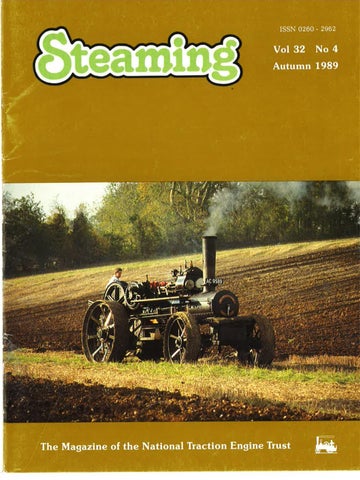
Cover Autumnal colours surround Fowler T1 class ploughing engine 14253 of 1916, as it awaits its turn to pull whilst working at Beauworth, near Winchester, Hampshire in October 1988. (lan Taylor) 167
Trust News From the Chairman As usual, there has been little Committee activity to report to members during the past three months, when many of us are actively engaged on the rally scene. However, detailed planning of a large event in the eastern midlands, which the Trust has been asked to organise, is now under way and a public announcement about this event will be made in the next month or two. Our Sales team has again been active throughout the summer months and has represented the Trust at a number of events. The Trust's hospitality tent was again present at the Great Dorset Steam Fair and was visited by many of our members. I should like to pay tribute to the efforts put in by the Sales team and other club officers manning our stands, which contribute so much to the finances of the Trust and our service to members. The activities of the Federation of British Historic Vehicle Clubs, on which we represent the interests of steam propelled preserved vehicles, have continued unabated, although there have been no major development to report since my last Chairman's notes, The common tyre tread regulations, which I mentioned in the Summer issue had become law almost before the Federation were consulted. II l eas thus been necessary to apply for a suitable derogation of Community law to apply to tho United Kingdom and this process has now been put in hand. This is another example of the need to maintain continuing vigilance over the activities of the European Parliament. In closing, I would like to mention that Anthony Heal, our senior Vice President, and previously Chairman of the Club for many years has announced that he wishes to retire and will not seek re-election at the forthcoming Annual General Meeting. Anthony has served firstly the Natonal Traction Engine Club and subsequently the Trust for the past thirty years and apart from his club offices, has also represented the Trust on the Historic Vehicles Clubs Joint Committee (now the Federation of Historic Vehicle 168
Clubs) for most of this period. His elk"' ts for the Trust have been tremendous and I would like to thank him on behalf of all of the membership for the dedicated work that he has put in over so many years. (Peter Barber)
Engine Owners Column Featured elsewhere in this issue will be found the first section to be reproduced from the Trust's Suppliers and Repairers Register. The Engine Owners Sub-committee hope that you will find this feature both of interest and benefit. With your support the content can be extended and improved. It is intended to cover further subjects in future editions of Steaming. There has been considerable interest in the Penberthy Injector literature and I will continue to make copies available upon receipt of a large SAE. It is intended to prepare a short list of UK agents still interested in supplying these products, and this will also be featured in a future edition of Steaming. You are again invited to let me have any contributions for inclusion. The F;iih-committee has not for mally met during the Summer but will have reconvened by the time you read these notes. We will continue to review topics of general concern and should be pleased to hear from anyone with issues of concern, perhaps arising from this Summer's events. From my own travels this season I would make one important plea to all event organisers — please ensure that you use quality smokeless coal. It becomes increasingly obvious each year that the general public will no longer cheerfully tolerate rally fields enveloped in smoke throughout the day. There is no need to use low grade smokey coals. Although unit costs may be cheaper any engine driver will tell you that the quantity consumed will at least double with low grade coal. Thus any professed economies
are a fallacy. Whilst it continues to be more difficult to obtain genuine steam coal, the Trust has initiated a scheme through Powell Duffryn Fuels Ltd and some excellent coal has been available during the last couple of years. Organisers should note incidentally that the 'Green lobby' have already fired some warning shots over the issue of smokey coal and its use at rallies! I have also attended one or two events where the very basic commodities of coal and water have not been as readily available as they should be. At one weekend event the coal did not arrive until 4.00pm on the Saturday afternoon. Too frequently the provision of water supplies is totally inadequate for the number of engines present at an event. Organisers — if you want active engines then please pay particular attention to those important items. Finally, my thanks to the following members for their contributions to the Register: Graeme Thirkell, J.S. Liming and Dave Davis. (Nick Barker, chairman, Engine Owners Subcommittee)
Traction Engine Insurance Members may have seen earlier this year some fairly protracted correspondence in The World's Fair on the above subject. It started with the suggestion that the insurance rates for traction engines were a ramp, or words to that effect. As the Trust's official brokers we thought that this must be a criticism of our scheme and required an answer. We gave some brief details of the rates applicable and suggested that they were not excessive. This has been proved by the fact that there has not been one case of a member complaining to us about the cost of their policy. There is no doubt that an accident to an engine can cost a great deal to repair, and whilst we could give details of actual claims to the Trust committee, if necessary, it would not be normal for us to publish details of individual members' claims in the press.
Most members will have heard of an accident somewhere in their vicinity; they are usually discussed by members anyway. Suffice to say that the cover offered under the NTET Scheme is wider than it ever was before we took it on and so far as we know no member has been dissatisfied with his claim settlement. The story about the engine damaged by the sails of the windmill is a true one, as is the line about the insurers asking why the engine concerned was not moved out of danger. However, as soon as we pointed out to their claims department that it took quite a while to get up steam and that the owner was more concerned about the fate of his home they replied "sorry we realise now that its not a Golf Gti"! Sorting out little queries like this is all part of a day's work for a broker — better I would suggest, that he should do this for you rather than having to do it yourself. (David Frank/in, John Scott & Partners Ltd)
Rally Organisation Rally Sub-committee During the summer most of us are involved with rallies one way or
another; the majority I suppose as spectators who attend the various events to enjoy the scene, the engines and generally to get involved with the very pleasant surroundings. Some are fortunate enough to be engine owners or engine crews; these are perhaps considered the elite of the rally field and no doubt the envy of the spectators. But there is another category of enthusiast present, often not seen is the very hard-working rally organiser heading a probably close-knit committee who have been working and arranging for many months. Without them there would not be a rally. In order that rally organisers and their safety officers may have an opportunity to meet to discuss matters of mutual interest, to exchange ideas and to settle any outstanding items of procedure, the Trust organises a Conference twice a year to which all rally organisers are invited. These are held in the Autumn and the Spring; one tending to look back over the season just ending and the other looking forward to the new rally season. This year the Autumn Conference has been held earlier than usual at the end of September at the Victory Club, Marble Arch, London, which we hope will become our permanent venue for those conferences which are held in the capital. Already our thoughts are turning
From Alan Martin's Collection
46
towards the Approved Rally List for 1990. The application forms for next season will be available at the end of September and will be distributed to those on the 1989 list. Any other organiser wishing to have an event included can obtain an approval application form from me — address on inside cover of this magazine — or from Ron Copp, our approvals secretary. Early application is essential — even if all the rally details have not been settled — as our first list is dated for 1st December each year and goes to the British Tourist Authority who require information before Christmas for their overseas publications; the English Tourist Board comes next for they require a list by the end of December each year. So again, I would emphasise the necessity to get applications in early if you wish to get in these important publications and receive maximum benefit. (Eric Fillmore, chairman, Rally Subcommittee)
Steam Apprentice Club The Steam Apprentice Club has enjoyed a successful season, the high spot being the 10th Anniversary Birthday Party at the Great Dorset Steam Fair in September, a report of which will feature in the next issue of this magazine. An enlarged special edition of the SAC Magazine also marked the anniversary. The 56 page issue contains articles by apprentices, as well as some very much older steam men, maintaining the ideal of encouraging the youngsters into a good understanding and appreciation of engines. There has been a change of Editor for the magazine, Richard Hurley, on commencing college, handing over the position to David Hurley of Boston (no relative). Any readers of Steaming who are willing to provide suitable material for the SAC magazine will no doubt be warmly welcomed by David (address: Leyland Cacti, Willington Road, Kirton End, Boston, Lincolnshire PE21 1NR).
NTET Sales Hospitality Unit Basking in the Whitsun sunshine, temporarily out of use, is E. Andrews of Tunbridge Wells, Kent converted Aveling & Porter compound tractor 8885 of 1917 (KN699) photographed at Tunbridge Wells fair in 1933.
Following the experimental provision of a hospitality tent at the 1986 Banbury Rally, a section of the NTEC sales tent at the Great Dorset 169
Trust Coals to Florida
Steam Fair has been used for members to meet and rest whilst enjoying a cup of tea or coffee. This received such welcome comments that Keith Shakespeare decided to try a smaller version at a few other events during the 1989 season. The first of these was at the Weeting event. A small area at the side of the sales stand was equipped with a stove, kettle and plastic cups for the tea and coffee; picnic chairs and the Trust flag completed the arrangement. Thus the scene was set for many a welcoming smile, and much conversation between members who would otherwise never have met, sharing a few minutes together whilst resting their feet or renewing their membership subscription. Later in the season the venture was repeated at the West of England Rally at St Agnes, where the unit end sales team were made very welcome by the organisation and local members. It is hoped to stage more of these areas alongside the sales stand when it visits rallies in the 1990 season. (Tracey Shakespeare)
Burrell Gold Medal tractor 3540 has featured several times in our pages in recent years (Steaming, Winter 1988/89 page 20; Winter 1987/88 page 10 and, much earlier, March 1980), so a further report from Ron Walker to keep us up to date with its progress will not be amiss. Following the tractor's overhaul by Bicknells at Liphook it returned to its owner, Finlay Matheson of Coral Gables, Miami, Florida in November 1988. Supplies of suitable coal being virtually non-existent in the southern states of America, it was decided to order a larger size container for the Burrell's transatlantic journey and to balance the weight of the engine at one end with 8 tons of coal at the other. Thus did over 300 sealed sacks of the NTET/Powell Duffryn Fuels Welsh Dry Steam Coal sail the seas; a supply which should last for three nr four years and which will be a vast improvement on wood fuel, the only freely available alternative.
Steam Heritage Awards, 1990
The Scania/Transport Trust Awards
Delighted with the record number of submissions received for the 1989 Steam Heritage Awards, principal sponsors British Coal are increasing the value of the prizes on offer for 1990. Category winners in the Road, Rail, Marine and Static/Museum sectors will each receive £750 and the Premier Prize for the outstanding entry overall goes up from £2,000 to £3,000. Submissions, giving details of achievements by organisations or individuals in the restoration and preservation of steam powered forms of transport or stationary machinery, are now being sought for consideration for the 1990 Steam Heritage Awards. These will be the fifth annual Awards since the inception of Steam Heritage by British Coal in collaboration with the Transport Trust, the Associaton of Railway Preservation Societies, the National Traction Engine Trust and similar bodies. Entries are required before 30th November 1989 and application forms can be obtained from Allan Heritage Steam Mirchandaney, Awards, Hobart House, Grosvenor Place, London SW1X 7AE (tel 01-235 2020).
Further to the paragraphs reporting the 1989 Sr•.ania/Transport Trust Awards published in our Spring issue, the first interim winners for this year's competition have been announced. This time they do include one entrant with a connection with road steam engines — the Long Shop Project at Leiston, Suffolk has restored several Garrett engines and as well as receiving a cheque for f250 as one of the interim winners, they will go forward to compete in the 1990 final. The four winners of the first Awards in 1989 recently took part in a VIP visit to Sweden to see some of the transport preservation projects in the Stockholm area. Traction engine owners — individuals or groups — are again urged to submit their work for consideration (see our Spring 1989 issue, page 65), so that the fraternity may share in this very worthwhile competition. Entry forms are available from Phil Sampson, Public Relations Officer, Scania (Great Britain) Ltd, Tongwell, Milton Keynes, Buckinghamshire MK15 BNB.
170
Obituaries Leonard Charles Byass We are saddened to record the death of Charles Byass. He died at his home, The Dower House, Little Weighton, East Yorkshire in July at the age of 80. Charlie as he was known to his steam friends, was a strong man, not only in stature but also in his beliefs. This showed in his work as a parish and local councillor and as a practical farmer — maintaining his Christian ideals, he would never harvest on a Sunday. When attending steam rallies which suffered from adverse weather conditions, he would often be seen persuading other exhibitors to join him in returning some, or all, of their appearance monies to help keep the rally or the organising body solvent. He was a faithful supporter of the Leeds & District Club, not only as an engine and organ owner but also, until his illness, at 'social evenings and dinners. Whilst driving to his funeral along the narrow roads of the East Riding that he knew so well, we thought of him doing likewise after leaving the rally at Harewood late on the Monday afternoon, driving his Foster showmans SUCCESS complete with road train (organ, caravan and pick up truck — some 90ft overall) and
arriving home at Little Weighton that same evening. The large number that attended the funeral clearly showed the high regard by which Clarles Byass was held by all who knew him; the community of the East Riding and the Leeds Club are the poorer for his passing. To Charles' wife Pat and his family we offer our deepest sympathy. (Norman Boyes and Howard Snowden)
George Howard I regret to record the death of George Howard of Banks, Southport, Lancashire. He passed away in July 1988 after a lengthy illness aged 71. George, a craftsman joiner by trade, became interested in preservation of engines in 1969 after driving newly restored Burrell roller 2642 at Burtonwood rally. He purchased Burrell tractor 3808 from Isaac Ball and following restoration rallied FORESTER extensively in the north of England. He also purchased Garrett roller 34084 THE BARONESS; this he restored to absolutely perfect condition not only from an engineering point of view but paint wise as well. He rallied the roller for one season and won many awards before selling it into Yorkshire. Meanwhile 3808 was in need of major boilerwork and so
followed a second restoration of this engine. George really went to town on the Burrell this time and made an absolutely first class job of restoration. When FORESTER emerged from the workshop it bore testimony to his meticulous efforts and his patience; it must rank as one of the best restored engines in the country. George once again rallied 3808 and also loaned it to the Leyland vehicle museum at Leyland for display. At the official opening of this museum he was very proud to have H.R.H. the Duke of Kent steer his engine. Shortly afterwards George was taken ill and after a long stay in hospital he decided to sell 3808 and so it passed to P. Ogden in Yorkshire. As well as restoring his own engines George helped in the restoration of many other machines which grace our rally fields today. He built around thirty canopies for different engines in this area and so was respected as both a master joiner and a master engineer. George and Mrs Howard had many friends on the rally scene and so it is to her and her family we extend our deepest sympathy. (Anthony P. Cowell)
London Area Social Meetings The 1989/90 social meetings in London will commence in October and all members, potential members and interested visitors will be welcome to attend one or all of the evening talks or slide shows which have been arranged for the Trust by Bill Timmings. The venue continues to be 'The Old Horse and Groom' in Great Portland Street, London W1. The premises are a few minutes walk from Oxford Circus tube station north along Great Portland Street, on the right hand side. The meeting room is on the first floor with access via the door on the left hand side of the front of the building. Meetings are on the last Tuesday of each month from October to April (excluding December), the talks starting at 8.00pm but with the room available from 7.30pm. For the first two dates the following has been arranged: TUESDAY, 31st OCTOBER 1989 — Members slides, the traditional opener for each season, for which a projector and screen are provided by the Trust. It is hoped members will appear with an interesting selection of
Fowler AA class ploughing engine 14728 of 1918 engaged on ploughing work at the Waddesdon rally in Buckinghamshire in September 1988. (John Maund)
pictures from this years sun-soaked rallies. TUESDAY, 28th NOVEMBER 1989 — 'South African Steam'. An opportunity to view steam on rails and in different surroundings; Barry Walker will be illustrating 3ft 6in and 2ft Oin gauge railways in South Africa, including Garratt articulated locos. (Bill Timmings, London meetings organiser)
Future dates AGM 1989 The 1989 Annual General Meeting of the Trust will take place on Saturday, 18th November 1989 at the Museum of Iron, Coalbrookdale, Telford, Shropshire at 11.00am. Formal notice of the meeting, the agenda and the Annual Report and Accounts will be distributed with this issue of the magazine, and members are referred to the notice for further details of the venue. The County of Salop Steam Engine Society has kindly offered to act as hosts for the Meeting. The Museum of Iron is only one part of the extensive and attractive lronbridge Gorge Museum complex and the various sites will be open for visiting during the rest of the day.
Corrections We regret another error within a caption to one of our cover pictures — the McLaren featured on the last issue was photographed by Tony Porter at the Corbridge Rally in June 1985, not as shown.
Motors and the Markets. Steam motors were proving popular on the run into Covent Garden from the Feltham and Hounslow market garden produce areas, according to The World's Carriers for February 1905. They made the journey every night in summer; three nights a week in winter. Their enthusiastic reporter revealed, 'The other night we met in Chiswick the traction engine and two of the tractors going into Covent Garden.At the same time we saw two of Pickford's tractors. All five were built by one firm — Wallis & Steevens'. 172
Register of Suppliers This is the first instalment from the Register of Suppliers and Repairers, compiled by the Trust. The subjects chosen for this issue are jointing materials, manhole/mudhole rings and packing materials. The ultimate intention is to cover a different section of the Register within the pages of Steaming at intervals, each to be repeated at a later date incorporating any additions or deletions that the passage of time will render necessary. Thus each instalment is not intended to be a comprehensive or finite listing but a base upon which to build for the future. The continued worth of the Register will depend on the support and sustained contributions from the membership. There must be many
more names of firms that could be added to this current section and if any reader can provide further information please contact me of Barnaby Newton. It is proposed that the next section to be published will cover steam boiler fittings and further contributions to add to that section of the Register will be gladly received. Note that some of the firms included in this issue do provide other services, and the names will be repeated where appropriate, under future subject headings. All of the information is offered in good faith, but members must be aware that the Trust cannot be held responsible for the performance of any of the suppliers listed. (Nick Barker, chairman, Engine Owners Sub-committee; address inside front cover)
Section 1, Jointing materials, etc. • BELDAM CROSSLEY LTD, Unit 2, Market Trading Estate, Christopher Road, Southall, London UB2 5YG 01 573 9888) and 17 branches Offer: sheet jointing, manhole/mudhole rings, packing • BINNEY & SON LTD, Cook Street, Coventry CV1 1JJ (is• 0203 20228/9) also at 12 Louisa St, Edward St, Birmingham B1 2RP (Tr 021 236 0521/2) Offer: sheet jointing; manhole/mudhole joints; packing • BOILER SPARES CO. (P.C. ENGINEERING), Unit 4, 127A Reading Road, Wokingham, Berkshire RG11 1HD (is 0734 790965/790715) Offer: manhole/mudhole joints; packing • BSS. Head office: Fleet House, Lee Circle, Leicester LE1 3QQ (Tr 0533 23232) and regional depots Oiler: inemilule/ifiudhule past:16,1y, • CLOUGH (Croydon) LTD, Suprete House, 85 Manor Road, Wallington, Surrey SM6 ODH lir 01 669 9626) manhole/mudhole joints • W. ELLIOT & SON LTD (Boiler Engineers), 155 Glaisdale Drive West, Nottingham ltr 0602 285724) Offer: sheet jointing; manhole/mudhole joints; packing • J. HICKEY (RICHMOND) LTD, Engineers and boiler makers, 11 Sandycombe Road, Richmond, Surrey TW9 2EP (Tr 01 940 2284/5/6) Offer: manhole/mudhole joints; jointed materials and compounds • HILLS RUBBER CO, 85 Bedford Road, Reading, Berks RG1 7EZ (Tr 0734 580535/6) Offer: sheet jointing material • SEALS, PACKINGS AND GASKETS LTD, Shaw Lane, Barnsley, South Yorkshire S70 6EH (IT 0226 299401) Offer: manhole/mudhole gaskets; packing • SPECIALISED SEAL SERVICES, Unit 7, Great Western' One, Bristol Street, Swindon SN1 5EQ 11! 0793 511410) Offer: joints; gaskets; seals • THURLOW NUNN STANDEN LTD, Bury Street, Stowmarket, Suffolk IP14 1HB lis• 0449 613185) Offer: manhole/mudhole joints • JAMES WALKER & CO LTD. Head office: Lion Works, Woking, Surrey GU22 8AP (Tr 04862 5951) and depots throughout UK. Offer: sheet jointing; manhole/mudhole joints; seals; packing
Burrells Patent Single Crank System of Compound Cylinders Burrell single crank compound engines are one of the most familiar yet individualistic designs to be seen on our rally fields. The patent for the design was granted in February 1889 and during the rest of that year Burrells introduced their new product more widely to the public at various shows. Derek Hattam describes the features of the type to mark its centenary year.
The use of compound cylinders on an engine engaged in traction work was not new in 1889. It had been successfully introduced in 1881 by J. Fowler & Co, using parallel cylinders side by side and two cranks set at right angles on a single shaft. Nevertheless, the introduction of parallel compound cylinders with both pistons acting on a crosshead connected to a single crank was completely new. The arrangement had been designed and developed by Frederick Burrell, (who by then was the firm's chief designer) and an application to patent the system was filed. The patent, number 3489, was granted on 27th February 1889 and the object of the patent was to become known as 'Burrell's patent single crank system of compound cylinders'. The first engines fitted with the cylinders had been a pair of 18hp ploughing engines, numbers 1257 and 1258, discreetly exported to France after completion in December 1886. Although an engine with single crank compound cylinders and fitted with a digger attachment (number 1290) was exhibited at the Royal Agricultural Society of England Show at Newcastle in 1887, Burrell's catalogues of subsequent years state that the system was introduced in 1889 and
was first shown publicly at the Windsor Show, by which time the patent had been granted. The exhibited engine was number 1387. The cylinders subsequently proved to be a most successful design and were fitted to nearly 40% of Burrell's total production following the first sale. At the time when their system was being designed, Burrell (and other makers) argued that compounding as used in the Fowler system decreased the durability of the engine by not only introducing several more wearing parts compared to a single cylinder engine but also, by the necessary reduction of the bearing widths on the crankshaft, (which in those days were, size for size, generally mounted on relatively smaller and narrower boilers than most of the engines we know in preservation). These reductions were needed to accommodate the additional crank and eccentrics on the double crankshaft in the same limited space between the hornplates of the boiler. Indeed, Burrell (among others) claimed they had sacrificed the economies of fuel and water associated with compounding for the simplicity, reliability and durability of their single cylindered products. The firm did, however, recognise the advantages to the boiler
Frederick J. Burrell
in that compounding allowed a slower rate of combustion by a cooler fire and, therefore, involved less wear and tear on the firebox and tubes. They also recognised the fact that far less destruction of the slide valves and valve-port faces took place with compound cylinders than in a high pressure single cylinder engine of similar power. Secretly at least, they must have longed to use that system which offered the more efficient consumption of coal and water and which allowed longer periods of work between stops — a particular advantage on road work, where a market in which they were apparently getting quite interested, was developing at an increasing rate. Fowler's system was patented so Burrells just had to find another way if they were to compete on equal terms. The design of the single crank compound was quite clever and yet remarkably simple. Instead of being horizontally side by side, the high pressure cylinder is placed diagonally above the low pressure one. This has the effect of drastically reducing the width between the cylinder centre lines although it does make the casting rather taller. The reduction of this width allows the piston rods to be coupled together in a single crosshead, which is much larger than usual and runs in a set of four guide bars centred vertically and horizontally between the cylinder centre lines. On some of the larger engines cylinders incline slightly so that both the cylinders and guide bars are pitched slightly down toward the crankshaft on account of the unusually high arrangement. A gudgeon pin runs through the centre of the crosshead to take the small end of the connecting 173
0
0
0
0
General arrangement of the early 8hp single crank compound cylinders, as published in Burrell's 1984 catalogue.
rod which transfers the power to a shaft with only one crank and most frequently no balance weights. The crankshaft is fitted with only one pair of eccentrics that give motion to a Stephenson type link which, in turn, transfers movement to an intermediate shaft that is connected through a yoke to the end of each valve rod. As a result of this arrangement both pistons travel forward and backward at the same time. The crank shaft layout is, therefore, retained as in a single cylinder engine and there is no need for reduction of the bearing surfaces. Externally, the only increase in the number of wearing parts that the extra ;iced adjustment is four glands for the piston and valve rods of the low pressure cylinder and an extra pair of guide bars. Internally, the wear and tear is reduced considerably compared to a single cylinder engine because two pistons and two valves are now sharing the same work using less steam and also the fire burns less fiercely, thereby reducing wear and tear on the boiler. The firm's accent on simplicity and durability was not only maintained but actually enhanced! They had produced an exceedingly compact compound with several excellent features that were simple, efficient and economical. During the first two years after the design was introduced just over a dozen engines of various size were built. The earliest engines worked close to 140Ibs per sq in but this was increased by stages to 185 for tractions and 200 for road locos. They used the steam in a particularly 174
effective way. Because the low pressure valve chest is immediately below the high pressure valve port faces, and also because both pistons always travel in the same direction as each other all the time, there is no
need for a receiver to be interposed between them as on a double crank compound. The steam after doing its work in the high pressure cylinder, flows straight into the low pressure valve chest, through the ports and into the low pressure cylinder to act on the piston and assist the high pressure piston on the same stroke. There is very little loss in pressure NOTES: 1.Later cylinders had a separate cored cavity which took steam to the stop valve quite independently of the steam jacket. 2. On some cylinders the front cover was cast integral with to safety valves the main casting.
Schematic section through Burrell single crank compound cylinders showing flow of steam etc. (drawing by Derek Hattam) equilibrium valve (governor)
stop valve (regulator)
- cylinder drain exhaust cavity f 1
c7.
.;„ z•-•
, pry
flange for blast pipe (on back of block)
The single crank compound cylinders as depicted in Burrell's 1894 catalogue. (Welland Valley Club collection)
during this transfer because of the close positions of the valve chests, and a reduction in the volume of the low pressure valve chest by means of an internal projection cast with the cover. Thus the total space is only equivalent to that of the ports, so the steam therefore passes directly to the low pressure cylinder. Also, for the same reason, the clearances are very small. Moreover, because both pistons are travelling together at a constant velocity there is a steady flow of steam through the engine. The clearances consist of the space at each end of the cylinder through which the piston does not travel, together with the space occupied by steam in the cylinder ports. By suitably designing and timing the closure of the exhaust port, and opening of the steam ports, a certain amount of steam is trapped and then compressed by the piston in the final stages of its stroke. This action effectively assists the slowing down of the piston before it momentarily stops to change direction, the steam (by then at full working pressure) acting as a cushion when it is being compressed. The build-up of this pressure is extremely rapid compared to most engines and is the reason, coupled with the closeness of the valve chests, why they can be notched up so well on the reversing lever (an . action strongly recommended by the firm) without unduly increasing the back pressure from the lower pressure cylinder. (Conversely, it is also the reason why most of these engines are fitted with a flywheel brake, especially so if the engine is to work in hilly districts.) The main advantage is found in the economy of the engine by allowing a more effective expansion of steam and use of the least amount of coal. The firm and many people claimed that a single crank compound of 6hp, driving
4ft 6in threshing machine, could do a full day's work of ten hours on just 3 to 31/2 hundredweights (392 pounds maximum) of good coal. The reduction of the clearances to achieve these economies required that the general diameter of the crankshaft be increased to allow the use of larger bearing surfaces which were also lengthened, (particularly the crank pin, eg 8hp — 4 3/4 dia x 4in longl) to help absorb the great residual inertia of the pistons and very large crosshead to which they are attached. The thickness of the hornplates was also increased slightly to cope with the increased stresses. The effect of this inertia is pronounced on these engines and can be seen when one of them is working on the belt. The engine rocks to and fro wth a much greater movement than a single cylinder engine (even more so when compared with a double crank compound) of similar power and doing similar work.
Although it is not so apparent, the same effect takes place when the engine is engaged on road work although balance weights were often fitted on road locomotives to assist in counteracting the imbalances. Some idea of the efficiency of the design was published in 1890. According to The Engineer, an 8hp engine of this design, used on indicator tests, showed that with a boiler pressure of 160Ibs and a crank shaft speed of 200 revs per minute, over 80 indicated horse power was produced and there was reason to believe that with an increased load and by forcing the boiler (i.e. increasing the pressure), something of the order of 100ihp could be obtained. Figures like this had never before been met with on 8hp engines. Burrells' claimed a more modest (and practical) figure of 40-50ihp used over prolonged periods under regular working conditions. In other comparative practical tests conducted by the firm on their own engines of 8hp, one on the single cylinder pattern and the other a compound, there was a saving of 30% of both coal and water by the latter engine. The cylinder ratios were proportioned so that the strains on the pistons are the same when the engine is working at full pressure with a full load and the regulator wide open. Apart from the fact that the huge crosshead had to be comparatively wide and high to unite both ends of the piston rods, it also had to be unusually
Burrell single crank compound crosshead, viewed from below. (drawing by Derek Hattam)
cylinders
guide bar
rubbing plates
175
long. Originally, the length was equal to the distance between the cylinder centres but on later engines it seems to have been standardised at twelve inches. The reason why such a long crosshead was necessary was to help it to take care of the unequal side thrusts that were forced on it by the pistons doing different amounts of work when the boiler pressure or the load varied from that which the engine was designed to work. For the same reason, friction took place not only above and below the guide blocks on the crosshead but also at its sides. On the earliest engines the piston-rods were secured to it by the use of nuts at both ends but later engines had flat cotters for the same purpose. Due to the enormous length of the crosshead the guide bars are much longer than is normally found on engines with similar strokes. All four bars can be adjusted vertically or laterally to compensate for wear which was said to be much less than on single cylinder engines. In practice, it was found necessary to fit clips to help prevent outward lateral movement of the slide bars due to the unequal thrusts which sometimes came from the crosshead. As already mentioned the connecting rod was considerably more substantial than those used on engines with other cylinders. Some other points of interest associated with Burrell single crank compounds are notably, the use of just two cylinder drain cocks and, the immense power available when starting. Only two cylinder drains are necessary because the high pressure cylinder is set higher than the other. Consequently, any water carried by the steam or condensed in the high pressure cylinder is swept right out during the exhaust stroke and is able to gravitate straight into the low pressure valve chest. From there it is carried into the cylinder which is fitted with drain cocks that can be opened whenever the engine starts to prime or the driver finds it necessary. The immense power available when starting (with the aid of the simpling valve) is much more than either a single cylinder or double crank compound of the same horsepower and is due to the fact that both pistons are travelling together in the same direction all the time so the steam is acting on both at the same time. On a double-crank compound (or duplex engine) which normally has cranks set at right angles to each other, the pistons travel in opposite directions to each other for parts of every revolution, so the steam is cometimes only acting on one piston. It is interesting to notice that a single crank 176
compound with cylinders only 5'/tin and Din diameter x 10in stroke lend then rated at 6hp but later on as 5hp), had much more starting power than a contemporary single cylinder engine fitted with a 10in cylinder and rated at 10hp. Another advantage over a single cylinder engine was the use of the simpling valve just as the crank went over centre. When in tight places, just a touch of the button was much better than a jerk on the regulator handle — and safer too! Over the years improvements were introduced which required slight alterations to the design and construction of the original cylinder blocks. On the early engines the governor was mounted on the weigh shaft bracket and a rod transferred its action through a gland to a throttle valve within the cylinder block and situated above the high pressure valve chest. Later, some engines had the governor mounted on top of the block which directly controlled an equilibrium valve immediately below It. These governors were a completely enclosed affair which were introduced around the turn of the century and soon discarded. However, many of the road locomotives were still being fitted with the original design well after the turn of the century. Eventually, Pickering type governors were fitted on top of the cylinder block as a standard attachment for tractions, and on road locomotives when required. Again, on the earliest engines, the
simpling valve (operated from the footplate) was mounted on a bracket above the cylinders. Live steam was taken by a pipe from the top of the casting and another pipe delivered the steam to the low pressure valve chest, entering from the front of the cylinder. Later engines had a slightly different and better arrangement whereby the live steam was taken through a hole in the front of the casting, directly to the simpling valve which was mounted right over the hole. A shorter pipe then delivered the steam to the valve chest. The exhaust steam from the low pressure cylinder (which was normally discharged when the engine was fully loaded at a pressure of approximately 25Ibs) is carried through a cored cavity, cast under the cylinder ports, to a flange connection on the back of the cylinders. A screwed filler plug was incorporated in the early castings situated just below the valve chest cover but later engines were filled from higher up on the opposite side through a hole in the steam jacket above the low pressure cylinder, and closed by a plate. About the turn of the century some strengthening on the front of the block where the guide bars are mounted was incorporated in the casting. Both cylinders and both valve chests are respectively covered by single covers, but false covers are fitted on the back of the cylinder cover. The engine's works number is to be found on the valve chest cover. Lubrication of the valves and cylinders
'Messrs Burrell and Co's compound traction engine' as illustrated in The Engineer during December 1890. The engine is believed to be number 1513, which was exhibited at the Smithfield Show in the same month.
Driver's eye view of a single crank compound roller from Burrell's 1901 catalogue. Note that the governor has been removed. was originally by use of a single displacement lubricator on the valve chest and a suet lubricator on the cylinder but mechanical lubricators were also provided on later engines. A little bit of railway locomotive practice was borrowed in the lubrication of the guide-bars on early engines which were provided with wipers at each end. The reversing lever on tractions and road locomotives was normally on the right hand side of the engine. Many of the rollers had the lever on the opposite side. Except on some export engines, twin Ramsbottom 2in safety valves were always used. The cylinder casting is mounted directly on top of the boiler barrel, and secured to the boiler with bolts through the surrounding flange. An account such as this would be incomplete without at least briefly mentioning a few details of the very exacting general specification. The cylinders were steam jacketed quite independently of the steam supply to the cylinders which also contributed to the efficiency of the design, as did the fact that the ports, valves and openings were of ample area for a good practical working piston speed when the engine was fully loaded. The cylinder liners were of best cold blast cast iron, 'as hard as can be bored'. The valves were also of similar best cold blast cast iron. The pistons were cast steel and fitted with Ramsbottom rings. The piston rods were mild steel, usually 11/2 inches in diameter and screwed and riveted to the piston and fitted with metallic packings. The valve rods were of similar material with solid forged ends to avoid nuts in the valve chest; it was usually a single casting of best malleable iron. The rubbing faces of the guide blocks had fitted and pinned cast iron linings on some engines, others had white metal or brass linings and some crossheads were just cast iron. The guide bars were of best mild steel accurately planed to 2in x 1 %in but the very robust connecting rod was produced from best forged scrap-iron, turned, polished, and fitted with adjustable bearings at both ends. As has already been said, great consideration was given to the bearing surfaces of the crankshaft. The dimensions of the crank pin have been mentioned and the main journals were carried in adjustable bearings 3%in diameter, cast in gunmetal and measuring 6 and 8 inches long. The flywheel on early
A gear side view of the single crank compound as depicted in Burrell's 1894 catalogue. The engraving may have been prepared from another photograph of 1513 and thus show the other side of the illustration of the 1890 Smithfield Show engine, opposite. (Welland Valley Club collection) 177
8hp engines was 4ft 4in diameter but other sizes were often fitted. It was governed at 170 rpm. The crank shaft itself was of wrought iron, in one piece and without welds. Other parts of the motion and reversing gear were manufactured from best faggotted scrap Yorkshire iron with all wear surfaces of extra large dimensions and deeply case hardened. The whole motion was polished to a bright finish. The extra cost for fitting the system was, in 1894, quoted as £50 for all sizes of engines; that is, on top of £400 for a 6hp machine, or £520 for a 10hp. As we now know, the combination of design, development and specification produced an extremely successful, even unique, arrangement that proved very hard to beat. Burrell's themselves. stated 'We fully believe that it will eventually supersede all other systems of compounding and will render single cylinder engines obsolete.' They also stated that 'our system of compounding is the simplest in the world' and they were probably right about that as far as traction engines were concerned. Even so, no amount of good engineering is totally devoid of its critics or shortcomings. Perhaps the greatest shortcoming was that the system retained the same problem as that found with a single cylinder engine in that, if the engine stopped on either of the dead centres, the flywheel had to be pulled over by hand to start it again. Another matter in common with the single cylinder was that the single crank compound cylinders received two powerful impulses in every revolution whereas, a double cranked engine received four, more gentle, impulses in the same time. The shock of two pistons receiving steam at the same time undoubtedly contributed to the slight imbalances in the engine but the flywheel was able to smooth most of them out. However, when coupled with the inertias inherent in the unusually heavy crosshead and both pistons, all of which had to start, stop and change direction at the same time twice in every revolution, it proved impossible to completely balance out the forces generated by the reciprocating motion and produce an engine that ran as smoothly as a double crank compound. Nevertheless, when well maintained and carefully set up these engines were capable of running so quietly that the only noise to be heard was the ticking of the ratchet on the mechanical lubricator. In spite of these shortcomings, history has shown that the single crank compound was unquestionably a resounding success 178
This engine is thought to be 7hp single crank compound 2263 when new in February 1900, standing outside the finishing shop, now the major surviving part of Burrell's premises and the future home of the Burrell Museum. The plate on the too/box bears the future owner's name IS interesting to note that 'WOOD & NESBET, ECCLES, BERWICKSHIRE. N.B while many of the later 7hp engines had cylinders of 6in and 10in diameter, as on many 6hp machines, the stroke was increased from 10in for the latter to 12in for the 7hp examples. (collection Alan J. Martin)
6hp single crank compound 2742, with cylinders 6in and 10/n xl0in and three speeds. The scene is inside the finishing shop and the engine went out, in August 1905, to T. Home of Auchencrow, Reston in Berwickshire. It was one of nine examples of the 'Aberdeenshire' type of which only 2933 of 1907 survives in preservation, located in southern England. The type, like both the 'Devonshire' and later 'Irish' models, utilised the single crank compound cylinders in their original form. The engine probably sports photographic grey livery, and has a flanged tender rather than a built-up one. (collection Alan J. Martin)
for the firm. Although it did not succeed in rendering single cylinder engines obsolete or supersede double crank compound engines, it did enhance the manufacturers already excellent reputation and within just a short spece of time production had considerably outstripped the number of single cylinder engines being built by Charles Burrell & Sons. In the five year period up to February 1897, when the firm introduced double crank compound cylinders fitted to tractions and road locomotives for sale on the home market, they built a total of 360 engines comprising, road locos, tractions and rollers. Of these engines no less than 245 (or 68%) were single crank compounds. During the following five years they built another 442 similar engines, which included double crank compounds and of this number 249 lover 56%) were single crank compounds too. In a nutshell, approximately 62% of all production during the ten years period were single crank compounds. Several published photographs taken inside the works during the latter part of this period bear testimony to the very large contribution the engines made to the firm's production. This undoubtedly represents the decade of peak production but large numbers of engines fitted with these cylinders continued to be produced for several years. The last such engine was built in 1928 — well over forty years after the prototype was built! In Cornwall, a good testing ground for any traction, single crank compound engines became extremely well liked. Many of them proved themselves capable of withstanding long and arduous working lives of forty years or more if properly maintained. In fact, as a specific type, more Burrell single crank compounds of various sizes were purchased for use in the county than any other maker's design. It is not surprising, therefore, that 68 (approximately 7% of total production of this type of engine) are known to have been owned and worked west of the Tamar. Of these, no less than 53 came into the county when new. Nine of them were large road locomotives of 8hp or more and five of these came after the introduction of Burrell double crank compounds in 1897! It is interesting to note briefly a few general facts peculiar to single crank compounds in Cornwall. The first to come was a road locomotive, 1485, new in 1890 to one of the greatest pioneers of mechanical road haulage in Cornwall, C.H. Carlyon of Kenwyn. The first 6hp traction of this type built by the firm for sale on the home market, 1503, came new to S.
How Burrell's men often last saw the objects of their labours — an unidentified single crank compound ploughing engine has been loaded on a Great Eastern Railway well wagon at Thetford station for its journey to a port and on to Germany. The engine is partially stripped to fit the railway's loading gauge and a workman on the footplate is protecting the exposed crankshaft bearing surfaces with the contents of his grease-pot. Engines such as these were supplied in sizes up to 20hp, which required cylinders 81/2 in and 14in x 12in stroke. (collection Alan J. Martin)
Batten of St Keyne, a little later in the same year. The first 'Devonshire' type, 1805, to come went to James Penno of Ruthen Bridge when new in 1894. The largest cylinders used on any single crank compound road loco or traction were fitted to road locomotive 2661, (rated at 10hp but equal to 14hp), supplied new to Harvey & Co of Hayle in 1904. One of the two smallest traction engines built by the firm which carried the patent cylinders was originally a 4hp single cylinder digging traction, number 1272 of 1887. In 1892 it was refitted with single crank compound cylinders 5in and 9in x 9in and soon after it went to Cornwall where it worked in various places for over twenty years. The last new engine with this type of cylinder block to arrive in the county was in 1921 and it was a traction 3893 ordered by J.H. Gilbert of Breage. The Trevithick Centenary Parade held at Camborne in 1901 was led by 2334, a large traction with single crank compound cylinders. The last traction engine still working commercially in Cornwall (number unknown, but named PONTO) also had cylinders of this design, as did the founder engine (26621 of the West of England Steam Engine Society. These type of engines were quite numerous at the early rallies held in the county but many have since been sold farther
afield. Only one engine, 3755, has remained continuously in Cornwall throughout both its working and preserved lives. This engine was preserved by our member Len Hosking and is now owned by R.T. Beazley, St Austell. However, other engines with these cylinders have come into the county in recent years, the most notable of which are the youngest road loco in preservation (3937), and the youngest 'Devonshire' type (39181 in preservation, and are currently owned by Cornish members and their families, Robin Daniel and David Hicks respectively. Nearly a dozen other makers attempted to develop compound engines with a single crank. Most of them tried using tandem cylinders. Burrells themselves had attempted a design of this nature in the very early 1880s but rejected it because it was too dimensionally long. None of the other designs were particularly successful. One or two attempts were also made after the introduction of the Burrell patent but were so similar to it that the firm successfully objected on the grounds that the other designs were infringing their patent.
Acknowledgements Conversations with numerous old engine men; Burrell Catalogues; Instructions for working Burrell Patent 179
Traction Engines; The Engineer, 1890; Road Loco Society Portfolios; Steam on Common Roads — Fletcher, 1891; Road Loco Society Burrell lists — A. Duke; Chronicles of a Country Works Clark, 1952; Century of Traction Engines — Hughes, 1959; Development of the English Traction Engine — Clark, 1980; and Traction Engine Miscellany — Clark, 1975.
(This article first appeared in the Magazine of the West of England Steam Engine Society. We are grateful to author Derek Hattam and magazine editor Alan Thomas for their ready agreement for us to reproduce the work, which has had some revision and additions in the light of further research since its first appearance.)
Viewpoint The Distortion of Preservation Our movement, which was founded on mutual interest, enthusiasm and, last but not least, friendship, is becoming increasingly based on hire, reward and profit. The private companies that have jumped on the steam rally bandwaggon, are hiring engines and organs in the same way that they hire rubbish skips, toilets and other ancillary rally equipment. In addition, these companies tend to have an increasing amount of their own 'preserved' capital equipment including engines, organs and roundabouts operated by their own employees. Indeed a number of rallies are so dominated by company or associated company exhibits that private exhibitors are n!!‘"A/prl to fee! that they are not indispensible; in other words, 'take care or you will not be invited next year!'. Furthermore, some of their show sites are actually rally company owned prime locations. Often these companies produce near repetitive events for which a small number of 'special' and highly paid exhibits are transported around the country from one company show to another, to be joined at each venue by some local exhibitors. It is clear, however, that many owners of preserved equipment in the vicinity of these locations are reluctant to get involved. Thus what emerges is a touring show rather than a genuine steam rally and, perhaps to camouflage this fact and possibly to avoid the consequences of wrongful description, these promoters have become adept in conjuring up names for their events which give a steam rally connotation, but which are in themselves meaningless, for 180
example Steam Funtasia. The traction engine movement in the north west of Fngland has been particularly blighted by this commercial steam show development, and certain of these events which have taken place over the last few years have reflected great discredit on the traction engine rally movement as a whole. Further, many readers must have noticed just how coy these companies are when it comes to even admitting that their activity is purely commercial. In this respect alone they have done much disservice to club and wholly charity motivated events. The public might be forgiven for believing that they are groups of steam enthusiasts working on a voluntary basis. Both exhibitors and the general public deserve to have sufficient information to be able to distinguish commercial steam rally operations from the rest. Clearly in writing a critique of this nature, I may well have foregone the doubtful privilege of being invited to attend these shows, if only because there is already evidence that these firms tend to confuse private exhibitors with company employees. So be it. It behoves all who exhibit at these company events to understand that what is hired can also be fired, and for no just cause. Then for some it is not a question of lost appearance money, but of a greater loss, namely, the chance of meeting fellow enthusiasts and friends. It is hard to believe that the vast majority of enthusiasts, as well as the hierarchy of the National Traction Engine Trust, have failed to understand what is taking place — simply, the gross distortion of the preservation movement, for profit. (Peter Clare, engineman)
What do you think of these Of the three mystery pictures from the Wakefield area, published in the Summer 1989 issue, only the engine on Chantry Bridge has brought forth any further identification from members. Jack Hampshire from Ravensthorpe, West Yorkshire has in his scrapbook another illustration of a similar scene published in a Wakefield paper some years ago. There, the engine is described as 'G. & J. Stubley's famous 'Jumbo' which drew loads of shoddy from their mills in Portobello Road, Wakefield to Batley.' Steve Arrowsmith wrote to say he feels the engine is a McLaren of about 1880 vintage. Equipped with these clues Alan Duke is now able to provide further detail. Stubley's, of Bottom Mills, Bradford Road East, Batley and Hick Lane Mills, Batley purchased McLaren 113 new in April 1882. It was an 8hp single cylinder engine, and a license for its use on the highway was issued annually until 1892. In July of that year the firm had delivered to them new a Fowler B3 compound engine, number 6656, and this probably replaced the McLaren. If so, both the pictures referred to above predate 1892. The newspaper cutting shows the engine to have a solid, or at least sheeted in, flywheel and possibly a belly tank, but although the caption mentions the name JUMBO, Jack Hampshire recalls that name applied to the Fowler, not; probably more likely, it being a larger haulage engine. But maybe the name was only an affectionate nickname among local people for both of Stubley's early engines. The mills subsequently had two 10hp and one 8hp compound McLaren road engines for haulage to and from the mills, and used these to the late 1920s when a Leyland petrol lorry replaced steam. John Harrison, who also advised that the unidentified engine was owned by Stubley's, refers to illustrations of 10hp McLaren 956 of 1907 in John Crawley's In Focus and In Camera albums, when working for a later owner. Mr Harrison also remarks that three steel-shod trailers stood derelict alongside the Wakefield mill into the early years of World War 2.
'Two Straker Omnibuses, equal to new, or would sell the Omnibus bodies separately — Arthur Wedgwood, Leek Road, Cobridge, Staffs.' (from Industrial Motor Review, 21st February 1906.)
'Steam Waggon Plunges into Ravine. Glenridding men jump for their lives. Two Glenridding men had a narrow escape from serious injury if not death on Thursday 2nd June [1932]. A steam waggon belonging to the Penrith & District Road Carrying Co had just left the lead mines with six tons of chippings when something went wrong with the steering gear. The road is very narrow at the place and the driver John B. Graham realising that an accident was inevitable, jumped out and called on his assistant John Edward Poole to do the same. Poole's braces however caught on the cab handle and he was in great danger of being hurled to death on the ponderous vehicle now out of control. He managed to release himself and he jumped clear. A minute or two later the waggon went on the grass verge, hit a rock, somersaulted over the bank; it fell twenty or so feet and eventually came to rest in a ravine where it now lies a total wreck. Neither man was injured but Poole suffered somewhat from shock.' (A contemporary report from the Cumberland & Westmorland Herald.) It was a few years ago I first heard of this unfortunate Sentinel, which surprisingly was still lying in the gully, whilst Hubert Nixon and I sat in his kitchen sampling a bottle of malt whisky. Hubert told me it was next to a lead mine at Glen Ridden and my mind immediately went to near the Kyles of Bute — but there were no lead mines there! Brought back to England, and Glenridding, on the west shores of Ullswater in the Lake District, I better appreciated the whereabouts of the wreck, but probably thought no more of it until I met Richard Straughan of Appleby at a tractor show in Cumbria. He explained he had had an expedition to Glenridding to rescue the remains, and the story further unfolded, with amazing photographs to be studied at another meeting with him at Bishops Castle rally. It was Richard Straughan's friend Eddie Poole — son of one of the crew at the time of the accident — who had first told him of the Sentinel. They went to look over the remains even though Eddie said there was very little left to see — an odd bit of chassis and a wheel or two. Their car had to be left a couple of hundred yards away and the remaining distance, over rough road, was covered on foot. Eddie was right, little remained. What there was was buried in small rocks and sand, and on two different levels of the tumbling stream. The wreck had originally landed above some falls and had laid there for thirty years until floods in 1954 or 1955 washed it over
A Total Wreck.. ...well, nearly. Tam McTaggart relates the background to an extraordinary rescue.
The top picture shows Sentinel 5676 as it ended up among the rock strewn ravine at Glenridding in 1932. Compare the surroundings with, bottom, a present day view of the falls and the pool to where most of the remains of the wagon gravitated over the years. Part of the front portion of the wagon appears above the water level on the left. (collection R. Straughan) 181
•
the top, down into a deep pool. Scrap filen aiiiviiiy Idle! burned uff the engine and a few other bits, but fortunately they realised they wouldn't get the heavier stuff up the ravine and so gave up their quest. The retrieval of the Sentinel's remains was the work of Richard Straughan, his brother Andrew and Eddie Poole. Given the OK by the lead mine proprietors to take the pieces the team arrived in June 1988 with lorry, tractor and various ropes, picks, shovels and crowbars — and wearing Wellington boots. Stones and boulders around the various visible parts were moved aside but despite much work the first attempt to haul the remains clear of their resting place by cable attached to the tractor resulted in the wire fouling overhanging rocks — just as the earlier scrapmen had found. It was decided to try again with a mobile crane, so th'b rest of the day involved furious digging — a task rewarded with the discovery that the boiler was still in situ and finding the injector, water pump, water gauge, safety valve, cab front window frames and the steering gear. The rear of the chassis was winched to another level to get the water level down in the main pool, and with that accomplished there appeared the front part of the chassis, cut behind the cab. The two front wheels were also present — cut off at the axle ends and presumably saved from scrap only by their weight defeating the scrapmen's efforts. Other bits located were the remains of the tipping ram lit had been broken to remove the brass piston) and one rear wheel with sprocket. It is
The Sentinel lying upside down in the position it was swept to in 1954/55 when a dam half a mile upstream burst after snow, rain and a quick thaw. Note the rear wheels, void of rubber tyres, taken by the miners. (courtesy Derek Stoyell
said the solid tyre had been cut off by the miners to sole their clogs. The fate of the missing rear axle was known — Eddie had removed it when he worked with the mining company in the 1950s, machining it down to be used as a lineshaft at the mine. The required crane appeared the following day. The boiler and front part of the chassis resisted removal; the crane heeled over and the danger bells rang with the driver visualising himself joining the old wreck. Then, with a surge, the lift swung upward —
Parts of the wagon scattered around awaiting removal. 182
the upside down cab roof, full of stones and held down by that weight had broken free. Richard was at the upper level instructing the crane driver who was working blind. Once the lift was landed all were amazed to see the Sentinel makers plate still in place on the cabside and as a bonus the registration number EC5927. Not bad after 56 years. With the heaviest portion of the remains lifted from the ravine the rest of the recovery went without a hitch and the old Sentinel was soon loaded up on the waiting lorry.
The retrieval of the boiler and forward part of the chassis.
The front part of the chassis, safely aboard the transport. Oil is dripping from the steering box.
Richard Straughan guiding part of the chassis onto the waiting transport.
Despite the finding of much more of the old steam wagon than had originally been envisaged, a fair amount was missing — the engine had gone for scrap as had the rear springs, drive chains, mechanical lubricator and one rear wheel. The crankshaft had been taken a few years before for another rebuild. However, two months later the water tank, in very battered condition, was found about a mile downstream! Richard was subsequently able to purchase a suitable engine that was available about thirty miles away. Progress with rebuilding the wagon has been very swift and it should be ready for steaming by the time these words appear in print. Already the chassis and cab apron has been exhibited at the South Tyne and the Cumbria rallies this summer — the work done to date was rewarded with a prize at the latter event. In conclusion, further details of the Sentinel from Alan Duke's records will be of interest. The waggon was number 5676, new in 1924 and registered EC5927, probably in December 1924 or January 1925. It was purchased by the Penrith & District Road Carrying Co and used for work by an associated company, the Greenside Lead Mining Co, transporting lead ore and stone to Troutbeck Station, about eight miles north of Greenside and Glenridding. Other wagons owned by the company
were Foden 1879 of 1909 which was sold south to Staines, near London in 1914, and in earlier days, two Straker wagons. Owner Richard Straughan would be pleased, out of curiosity, to hear
from other Sentinel owners who may have used parts salvaged earlier from 5676, and also from anyone who has, or knows of, photographs of the wagon when in use.
The rescue team with Sentinel 5676 successfully extricated from its watery grave. 183
Charles Parsons Gregory an appreciation Charles Gregory, one of the pioneers of the steam traction preservation movement, died at his home at Riviere Towans near Hayle, in Cornwall, in late August. He was within a year of his 85th birthday. Only a few days earlier he had spent two full days at the annual St Agnes rally organised by the West of England Steam Engine Society, of which he was founder and President. On the Friday before the rally the writer steamed the 6hp McLaren traction engine 547 of 1894 THE MAC specially for him to have a quiet drive around the rally field. This engine was a favourite among the five he once owned. Charles fell into the steam world almost by accident. A man whose kindness to others and unassuming nature became almost a legend, he often said that he had never meant to become famous. He was genuinely surprised at the interest created by his purchasing an engine to help create a caravan site out of a piece of woodland. This was in the early 1950s, about the time of the famous Appleford traction engine race, and before the organised events had begun. Charles' boyhood was spent at Draycott, near Cheddar in Somerset in a house which had a small layby alongside. Now and again the local steam roller would park up overnight and he enjoyed watching the antics of the driver backing into the layby which was at right angles to the road. From his bedroom window Charles could look almost straight down the chimney and enjoy the delicious aroma. School journeys to Wells were along the Great Western branch line from Frome and gave him brief glimpses of the Somerset & Dorset and its locomotives, some of which were still painted bright blue in the post-grouping era. Although his family were mostly farmers, Charles soon displayed a 184
remarkable technical skill. Anything mechanical or electrical fascinated him. Of many gadgets he rigged up in his youth, fitting his motorcycle gauntlets with electric heating elements was one of the most successful. He also built several radios at a time when communications over the air waves were in their infancy. He was in business as an electrician in 1931 when he married Chrissie Salmon, later moving to Lydford-on-Fosse. During the 1930s end 1940s he wired up many houses, churches and schools as electricity was spreading into the more remote rural areas. Family camping holidays in Cornwall started after World War 2, inducing him in 1951 to purchase a wooded hillside plot in a valley at Coombe, between Camborne and the North Cliffs. His plan was to create a caravan site with a difference — no serried ranks but each unit in its own plot set amongst trees, shrubs and flowers. For some years the family lived in caravans, which Charles had built himself from fuselages of wartime troop-carrying gliders. The early years were a struggle but Charles had not forgotten his love of steam, which was shared by his daughters, Phyllis and Heather. To deal with the problem of pulling out tree stumps and to generate electricity he hit upon the idea of buying a traction engine which could then be had very cheaply.
His choice fell upon 6hp Burrell single crank compound 2662 of 1904. Phyllis recalls that she didn't even know what one looked like until she beheld the engine coming down the hill to the site with her father taking a driving lesson from a local farmer! The power generation idea never got off the ground, but news of an engine at work using its winch spread like wildfire. More and more visitors appeared at Coombe, many of whom were to become personal friends and allies in tho drive to cave as many engines as possible from the torch. In 1954 Charles bought a diminutive single cylinder Aveling & Porter converted roller 5541 of 1904, as a birthday present to Phyllis, who named it BO-PEEP. This engine continues to attend the local rally in her ownership. In 1955 he invited a few engines to a steam gathering at Coombe. Four arrived, including the Burrell showman's GLADIATOR then newly arrived in the Duchy. There was a huge crowd; as Charles put it afterwards 'I was expecting about 20 but nearer 500 turned up'. From this event the West of England Steam Engine Society was formed. Charles and his friends often did long car drives into Devon and beyond, searching for derelict engines which might be bought for restoration. By their efforts many were saved and steamed down to Cornwall, resulting
A West of England SES rally about 1960 — Charles Gregory driving THE MAC with his daughter steering and the late Chris Gittens riding in the tender. (collection K.M. Brown)
'a
4.46 Wir -
•
.
A
'
"
•
I41)1E0V
I-
The car park at Coombe was jammed with people for Charlie Gregory's steam gathering in 1955. This led to the formation of the West of England Steam Engine Society, the pioneer preservation group in the west. (collection K.M. Brown)
in some distinctly 'hairy' journeys which would give today's insurance inspectors a blue fit! Charles also organised regular pilgrimages to Andover Rally where the writer, then living in the London area, used to meet them. In 1958 the Cornish party stayed over on the Sunday to tour engines in Oxfordshire. It was on this trip that Charles and Phyllis first saw THE MAC. Mr Bury of Great Tew had kindly put his Burrell showman 2668 BRITANNIA into steam for the party, but if he was disappointed that more interest was shown in a grubby farm engine under a sheet with hens pecking round it, he was too much of a gentleman to show it! Encouraged by fellow enthusiast Clifford Winn of Bude, Charles bought the engine soon after. Next problem was to get it home. It seemed to be in perfect working order so Mr Winn, who had driven engines for the army, said 'Why not steam it?' That led to the bold decision to drive the engine the whole of the 251 miles, towing one of Charles' caravans to provide accommodation. The story of the eleven day trip on an unsprung, steelshod engine, when it rained part of every day, is legendary. Nothing quite like it has been attempted since. The engine behaved perfectly, with Mr
Winn driving and Phyllis doing most of the steering. Charles drove the family car — the only time he drove the engine on the entire trip, he confessed with characteristic modesty, was backwards into a gateway! The publicity given to this trip gave a great boost to the West of England Society rallies which had started in 1956 and Charles was a frequent guest at other rallies up and down the country. Coombe remained a mecca for steam people as several engines lived there. In the 1960s Charles built two bungalows on the site, in one of which he continued to live after the death of his wife in 1975. A feature of the early West of England rallies which Charles initiated was inviting a personality from the BBC radio series The Archers to perform the opening ceremony. Friendships sprang from this, and right up to the time of his death, Charles would try never to miss an episode. He called on the late Chris Gittins, who played Walter Gabriel, only last year. In 1976 he achieved a lifelong ambition by touring Australia where he was greatly touched by the many kindnesses shown him by steam people out there. Soon after, he suffered a heart attack which restricted his activities from then on, and led to his moving to Riviere Towans to be looked
after by his younger daughter Heather and son-in-law. Failing eyesight became a problem in his final years and the last out-county rallies he attended were Stourpaine in 1985 and Chapelton in 1988. Apart from being a National Traction Engine Trust member for many years, and one-time regular contributor of Cornish news for Steaming, Charles also belonged to the Road Locomotive Society, of which he was President for 1984-5. He took a keen interest in all forms of steam power and was especially impressed by the large Cornish beam engines at Kew Bridge — a breed he just missed seeing working in their native land — and was a member of the Kew Bridge Engines Trust. In May last year the WESES staged a commemorative steam party in honour of their long-serving President by getting together all the engines which Charles had owned, and striking a memorial plaque. In addition to THE MAC, ATTRACTION and BO-PEEP were OMEGA, Aveling-Barford's last steam roller for the home market, built in 1948, and Robey 5 ton tractor 41493 which Charles had owned for a short time simply to save it from scrap. But THE MAC was always his favourite. Thanks to the generosity of the present owners, Fred and Olive Britton of Tiverton, Charles enjoyed several reunions with the engine in recent years, the last being a few days before his death. He bitterly regretted ever selling the engine, which he said he had done on the spur of the moment to pay for 'the Australia trip'. Charles' other great regret was that so many of his friends and contemporaries in the steam preservation movement passed on before him. They included Jack Hampshire (the author), Clifford Winn, Joe Warren, Jack Trounson and Wearne Pearse. On a personal note the writer greatly misses the friendly banter about things steam and humorous tales of happenings long ago that Charles could relate. Many, many people's lives were enriched by knowing Charles. His profound commonsense combined with an impish sense of humour came across even to people with whom he had only corresponded, never met. Despite a clash of dates with Stourpaine, a large number of steam personalities and family friends were present at the funeral at Truro Crematorium on 30th August to pay their last respects. Our sympathy is extended to Phyllis, Heather and his sons-in-law and three grandchildren in their R, grievous loss. (Kenneth Brown) 185
SOME THOUGHTS ON
Conversions The Editorial in the last issue has brought forth unprecedented response from readers. It is rare for the Editor to receive more than a couple of letters for publication on any one topic — however contentious the sub,-,2ct may have appeared — but here, presented as a separate feature, are a dozen letters of reaction to the continuing conversion of engines. Strong feelings are obviously aroused and space can be made available for continuing the debate in future issues.
I rejoiced in our latest magazine's sound Editorial on the subject of con versions, and cannot agree more with the comparisons our Editor draws with old houses, paintings and vintage vehicles. I personally whistled through my teeth when I read that a converted steam roller had fetched £35000 and sought in vain for a solution to the problem. It is indeed high time that our engines were listed and graded to try and stamp out this practice of conversion. I would propose that no conversions are ever accepted at rallies to the exclusion of a genuine example. Conversions should be paid at least half the fee commanded by an original specimen, and any conversions accepted should be publicly announced as such by the commentator and also printed in the pr.ogranirno. It would seem to me that if we don't take a stand about this before long, firms will come into existence purely for the purpose of converting steam rollers. If that were ever to happen our preservation movement would simply turn itself into a financial sham. Whilst on the subject of truth, I would close by pointing out to the Editor that the famous painting entitled The Haywain was by Constable and not by Turner. Chris Edmonds Haddenham, Aylesbury, Buckinghamshire (Oh dear... the Editor exposed as a Philistine of artistic appreciation, converting a Constable to a Turner! He promises, for the near future, to limit his thoughts on brushwork to attaining the correct shade of Aveling green. — Editor.) 186
In the summer 1989 issue's editorial the question is posed 'why is a preserved road engine considered fair game for altering to something it never was?' I think we need to look no further than our national club for the answer to this question. Rally organisers consistently show a distinct preference for this type of vehicle. With no clear lead from the NTET are we to blame them? In seventeen years of rallying steam rollers it has become obvious to me that these machines are often the least welcome exhibits at rallies. Showmans engines and road locos are the clear favourite. However, the problem does not stop there. Many rally engines now have a standard of paintwork and decoration far removed from that of a working engine. Chromium plated levers and motion woII wort; raftAy Goon in working days. The quality of paintwork is often out of character with a commercially used engine. Steam engines were brush-painted not sprayed; the colours were often dark and sober, certainly never metallic like one prize-winning roller seen this year. Road locos have never been noted sporting coupling boxes with several layers of filler and gloss-paint so lovingly applied you could see your face in them. The proliferation of brass plates seen on many roller i agricultural engines is totally ot_ seeping with working days. Showmans engines only had one or two light bulbs under their canopies, not rows of bulbs only inches apart. Another current fad is increasing the gear ratios to give a higher top speed. Why this obsession with speed? I think it is high time we took stock of the situation. Showmans conversions are the most obvious mutilation
of our great engineering heritage, but there are a great many other changes gradually overtaking our steam engine population. Should the trend continue there will eventually be no true examples of working steam engines to show future generations. If rally organisers continue to show a preference for highly painted and polished engines how can we blame the engine owner when he pi esents his exhibit in a manner which will clearly give him the best chance of having his entry accepted into rallies. Considering the difficulty experienced by many roller owners in getting their exhibits accepted, who can blame them for converting them to something more appealing to the misguided rally organiser. This craving for 'overdone exhibits' is probably somewhat misplaced. The vast majority of people attending rallies are not enthusiasts but Joe Public taking the family for an afternoon out. These people often do not even see the difference between showmans engines and rollers. I have even heard a member of the public tell her children that the owner of a magnificent Burrell showmans road loco would 'probably get a front roll for it when he can find one.' We owe all these people the opportunity to see a part of life from years ago. The public are usually fascinated by genuine scenes from the past. Surely the way forward for rallies is to provide more working displays featuring genuine working steamers and not painted wonders lined up in pretty little rows. Let me stress one point though; a 'working engine' must not be confused with a neglected wreck. There can be no substitute for safe boilers and GOund mechanical condition. Working engines need not be dirty, though they often were. Cleanliness will only enhance traditional paintwork and show off the small amount of brass fittings and plain ironwork to the best possible advantage. Come on NTET, let's get our act together and start to positively encourage restoration to an authentic standard, not necessarily as new but as at some stage during the working life of our engines. Surely the NTET must declare its position on this issue. If the NTET puts genuine preservation above mere gaudy appearance and inaccurate mechanical restoration then it must say so. Rally organisers and individual engine owners must be encouraged to provide genuine historic exhibits for the public's education and enjoyment. If we continue to modify our historic machines we will only debase the entire steam preservaton movement.
Perhaps I have got it all wrong and the NTET is only concerned with organising displays of customised little engines bearing steam resemblance to their vintage ancestors. Lichfield, Staffordshire
Steve Arrowsmith
• The Summer issue's Editorial on the conversion of engines prompted me to consider our organisation and its purpose. The important word in this context is Trust. The Oxford Dictionary describes the word thus: committed to one's care; resulting obligation; confident he will not misuse it; responsible for preservation and administration. The practical lesson deduced from my thoughts on these definitions is that the Trust has a clear duty to ensure that future generations do not accuse us of standing aside. We can take positive, useful and constructive action, without being critical of individuals. We can change attitudes. Every engine known to be in preservation can be described in detail, not as it is now, but as it was when built and worked. Details would
include engineering highlights, livery and types of work undertaken. All this information would be available to auctioneers and purchasers. Converted engines would be recognised as not genuine and as false, and they would be less valuable and sought after than a pedigree engine. Better still, our interest and appreciation in a unique part of British heritage would be immeasurably improved. Such a contribution could surely prove that the NTET had truly come of age. Roger Newbery
Ringwood, Hampshire
• The Editorial in the Summer issue of Steaming invited comment on the thorny subject of engine conversion. Does this Editorial indicate that our national body is going to do something about this awful practice, or is the pot being stirred once again just to fill the letters page? One thing is plain — as long as individuals with seemingly bottomless pockets are prepared to pay thousands for a non-genuine article, it will only encourage more conversions to be made. There are already some 145 of these unfortunate machines in exist-
Of the showmens engines that have survived into preservation, a greater number than we generally realise are conversions — but they do possess a pedigree. They were built new for road haulage work and then taken, secondhand, for fairground use later in their working career. Fowler 15657 of 1920, an R3 road loco, first worked at hauling Portland stone from Dorset, and was then rebuilt for showland use in the north Midlands. Its preserved life has continued in that guise; this early preservation picture shows KITCHENER (or THE IRON MAIDEN) in Sheffield in 1954. (collection Roger West)
ence. What will be next, a Marshall scenic showman? If the Trust is serious about preventing conversions, and possibly reversing the practice, it must lead the way with definite proposals b .th as a matter of policy and as a matter of practicality. On the other hand, if they are not prepared to act then the steam movement should shut up and shelve the problem. One way to ascertain the feeling of members would be for the general committee to instigate a ballot of the whole membership, through Steaming, with alternative proposals on the definition of a conversion, the policy which could be adopted and on what action, if any, could or should be taken against those who either convert or presently own such engines. But will our committee do it? Ironically, some good can occasionally come of converting engines, particularly rollers, when as a result of the butchery, certain large components become available as spares for the genuine roller owner. However distasteful conversion may be it has this, and only this, in its favour. A/an Porter
Altrincham, Cheshire
• The vexed question of engine conversion, especially to showmans form, should certainly call for members comments. A few years ago a Fowler TE2 Russian type road loco came up for sale. I made enquiries and was asked a breathtaking price and at the same time told that the machine would make a good showmans engine. Recently a disguised 6hp Clayton & Shuttleworth compound traction engine was sold at auction for a figure which would almost have bought a genuine showmans. This particular engine was acquired by its previous owner as an almost hopeless derelict. It was rebuilt, not in true Clayton form with rectangular section connecting rods, indirect high pressure valve linkage, ring drain cocks and other interesting features which distinguish a Clayton compound from the common herd of Burrells and Fowlers, but as a nondescript fairground engine. I must admit it is a sound engineering job — but aesthetically not right. There are only five known large Clayton compounds in the UK and two have been converted. So there are, today, probably more Clayton 'showmans' than in the heyday of steam on the fairground. I think the listing or grading of engines is a non-starter; it would be 187
Whilst the design of some road steam engines precludes their adaption to other forms — ploughing engines a good instance — other types offered fairly easy opportunities. This Fowler roller started life as one of that maker's lightweight 3-cylinder compound tractors for the War Department. Shorn of one of its high pressure cylinders and equipped with rolls, the machine (works number unknown) then served the Royal Aircraft Establishment at Farnborough both for road making and, further rebuilt with flanged railway wheels, as a rather minimal shunting locomotive. (collection Roger West)
difficult to force owners to register their engines. In the main engine owners are a pretty independent lot. One step could be for auctioneers to declare the history of the engine before sale. I sometimes wonder, when a roller is converted to a road engine, whether Swansea DVLC alter the Inn cheat nr not It appPars that most converted engines are bought by people who don't seem to worry whether it is genuine nr not. Unless, that is, they intend to rebuild the machine to its original specification as did the gentleman with the Foden road loco, highlighted at the Great Dorset Steam Fair last year. Phil Johnson Hunger ford, Berkshire A When I was young I was very fortunate that my parents purchased a house alongside the then recently completed A580, the East Lancashire Road, which ran between Manchester and Liverpool. In the 1930s and 1940s I was able to observe the last years of commercial steam operating on the road on a regular basis; I saw wagons, tractors, rollers, general purpose traction engines (in season), heavy 188
haulage road locomotives and showmans road locomotives all going about their allotted tasks and for which they had been designed. Quite possibly some of the heavy haulage and showmans road locomotives had been converted from one to the other at some time in their lives. flu railway prpcaryatinn nnlleagues are at present debating whether a streamlined casing should be put on one of the Stanier Pacifics. This would certainly represent an authentic period in the locomotive's history. But I have not heard of any move to put a streamlined casing on a six-coupled freight locomotive or shunting tank and attempt to pass it off as an express passenger locomotive. However well designed, the freight locomotive or shunting tank could never hope to perform the express duties of a Stanier Pacific. However there are a number of people in the traction engine movement who are virtually saying — "yes it could", and proceed to convert rollers and general purpose traction engines into 'showmens road locomotives'. Just as a freight engine with a streamlined casing passed off as an express passenger locomotive would be nothing but a sham, so are a large
number of so-called showmans conversions. Whilst a large roller may have the same cylinders as one of the smaller types of road locomotive, the boiler is considerably deficient in heating surface and grate area. It could never hope to perform the continuous heavy haulage demanded of a road locomotive of whatever form. Some time ago a depressing sight met my eyes at a rally — an engine purporting to be a Burrell showmans road locomotive. To anyone with half an eye for these matters it was very obvious it was no such thing. A moment's closer examination revealed it to be a conversion from a Burrell roller which was well-known to me from earlier years. Here was what had been a fine machine, well fitted for the purpose for which it had been designed, being presented as a machine whose duties it never had and never could perform. The not rocult was the complete ruination of a perfectly good roller design and one that is rare enough in any event. In the very same issue as the editorial comments which prompt this letter were several photographs of beautifully restored general purpose engines and rollers, all of considerable engineering merit in their own right. However if the reports contained in Steaming are to be believed, it would appear that our movement is being increasingly invaded by a yuppie brigade, who with scant regard for the worth of a good roller or for sound engineering practice, are more concerned with being seen driving a flashy machine or making a fast buck. If an engine is not considered worth preserving in a form in which it punt at laaat part of if'. wnrking !ifs then perhaps it would be better if we emulated the motoring fraternity. Advertisements would then appear in Steaming — compound roller, breaking for spares! This at least would help those hardworking souls attempting to rebuild an engine from a derelict wreck. One also wonders how close the vendors of such roller conversions are to running foul of the Trade Descriptions Act. Geoff Hayes
Cupar, Auchtermuchty, Fife
• On the subject of conversions, I do not think we get down to the reason for the phenomena. I and several road roller owning friends have encountered over the last few years a real problem which should be brought to the attention of the
NTET. It is very difficult, and quite often impossible, to have ones entry accepted at a rally, simply because there so many rollers in preservation. I'm sure other roller owners, especially of Aveling & Porters, will agree with us on this point. The vast majority of the public are not interested in the different types of engines, in fact one has only to listen to conversations to hear traction engines, showmans engines etc all being referred to as steam rollers! Another fact is that some rallies give the least appearance money to rollers yet they cost just as much to run, and sometimes more, than other types of engine. Most road rollers are owned by ordinary folk. I know of instances where such people have saved for years to buy a roller and then spend vast amounts restoring it — nowadays often including a new firebox, barrel etc. These owners often put up with hardship in their determination to complete their project. When the time comes for the rallying of their pride and joy the reply is "Sorry, we've already got too many rollers this year but we will bear you in mind next year". Again, I'm sure other members will recognise the scenario. Under these circumstances it's hardly surprising that more and more rollers are being converted, is it? By all means list or grade road rollers, but only when they receive the same respect as all other steam road vehicles. Let us hear from other roller owners — stand up and be heard. Steve Hayes Hinckley, Leicestershire
• Full marks for the excellent editorial in the last issue. The points put forward need to be stated with increasing conviction and with greater frequency to try to stem the loss of authentic vehicles and to slow the continuing appearance of hybrid or otherwise spurious engines. It has been said in the past that owners are free to do with their possessions as they please. I would venture to suggest that this attitude borders on the irresponsible. With very few exceptions, of an existing stock of less than 3000 engines, the present owner did not order the engine from new, nor is he the last commercial user. It may also be reasonable to suggest that present owners will not be the last: our engines will outlast all of us to provide pleasure for generations of owners and the public in the decades ahead, providing, that is, present guardians do not wilfully destroy or mutilate those engines
which are in our temporary care. The point about veteran and vintage cars and commercial vehicles, and preserved railway liveries was well made: as a one time loco fitter at the Great Western Society at Didcot, I was amazed at the number of 'rivet counters' among the general public, and the railway press echoes to howls of disapproval when a non-authentic livery appears. A repaint is easy to do; major mechanical surgery is more difficult to reverse. At least one had the comfortable feeling at Didcot that, with numerous expert and knowledgeable eyes on one's restoration efforts, one was assured of getting it right, i.e., as it was when it was built or authentic to some period in its working life. In contrast, the situation in the road steam movement gives cause for concern. The quest for genuinely authentic restoration seems to be the aim of all too few owners (though a substantial number, nevertheless); many get it about right, though one is left with doubts about details such as colour and lining out, and the addition of sundry embellishments, while a growing number of engines, by all accounts, are being altered to bear little resemblance to their appearance during their working days. Certainly the time has come for an authoritative body like the NTET to formulate a list of standards of authenticity, issuing a small plate which can be carried on the engine, and a dated certificate to the owner. The information for the citation can be obtained firstly from a questionnaire sent to the owner (with fee) and verified at some opportune occasion (e.g. at a rally) by an officer of the NTET, RLS or other preservation body of respected individuals. The following is a list of suggestions for consideration: Grade A (or Class 1, or whatever...) Engine as built. All replacements and repairs as original. Livery to be as near to original as historical research will allow, inc. lining out. Tractions to be on strakes. Solid tyred vehicles to retain these, no conversion to pneumatics. No canopy if not originally fitted. Lettering to be of genuine commercial user, etc. The essence of Grade A to be of highest comparability to the condition as built or early use. Grade B — Engine as built, but with certain permitted modifications which do not detract from the overall authenticity, e.g. fitting of injector and pipework when not originally supplied. Canopy added providing it is to the style, size and design of the engine manufacturer. Livery substantially correct for the period and make, lettering ditto, though not necessarily
of a previous user of that particular vehicle. Tractions fitted with neat tidy rubbers as per road locos, though otherwise unaltered. Grade C — Engine substantially in the form in which it was built, no major mechanical changes. Permitted deviations: livery and legends the choice of the owner though compatible with accepted practice; pneumatics on erstwhile solid tyred wagons; canopy of freelance design(?); otherwise authentic wagon but with different body to original, e.g. tar sprayer to flatbed, providing that the reconstructed body is to wagon manufacturer's design. Limited application of embellishments. It should not be too difficult to draw up lists of criteria which are fairly watertight and not open to differential interpretation, and these could become universal standards to be aspired to by those restoring engines to historically authentic condition. The value of this excercise goes beyond that of establishing the commitment of the road steam preservation movement to historical integrity. Our 'heritage' may well be a currently overused notion, but it is a genuine one, nevertheless. Historians, industrial archaeologists and conservationists rightly stress we have a duty to future generations to preserve accurately aspects of the past (one difference between essential museums and tourist attractions). Amateurs and professionals in industrial and transport preservation hold these principles central to their efforts. So should we. The owners of the vast majority of genuine engines ought to welcome such a scheme, not only because it places a stamp of authenticity on their considerable efforts, but also because the imbalance in auction and sale prices between genuine engines and conversions may begin to be reversed in favour of the former. The NTET may indeed receive some flak if a grading scheme is introduced, but I suggest its standing among genuine enthusiasts worldwide will be greatly enhanced. This letter is a response to the invitation by our editor contained in the last sentence of his editorial. It is a personal view and I leave it to others to support, modify or condemn the points made as they see fit! Tavistock, Devon
Dave Davies
• I was interested to read the Editorial in Vol 32 No 3. On the page opposite that Editorial is a paragraph 189
stating that membership of the Trust 'is open to those who...have a genuine interest in the preservation of self propelled steam road vehicles...' Note the word preservation. Conversion is not preservation; to radically alter an engine to something it never was is desecration. In the 1950s there was a 'paint 'em yellow; wear a bobble hat' brigade in the vintage car world. Hearses were converted to open tourers. The veteran and vintage car world has put its house in order. In the early days of railway loco preservation there were some peculiar paint jobs. That movement too has put its house in order — they still squabble whether a, say, 1910 engine should be in pregrouping, post-grouping or BR livery, but it carried all of them during Its working life so the argument is not that serious. Where "does all this leave road steam? The answer, sadly, is a long way behind. Many magnificent restorations have been carried out but unfortunately many others have been done in a 'paint 'em yellow; wear a funny hat' fashion. There is an answer. Under the leadership of the Rev. Philip Wright, rallies moved away from the spectacle of flat races with attendant bookmakers. Under the leadership of Anthony Heal proper boiler certification and safety on rally fields became accepted. It needs the initiative of the NTET to halt, and then reverse this insidious practice of conversion. All it needs is for the Trust to give a lead by encouraging rally organisers to invite only those engines that are in a form they were at some time in their working lives. Engines in the guise of something they never were is not preservation; such machines should be excluded. At least one rally does just that.
conversion of engines is for profit. Not only are these persons misleading the public and prospective purchasers, they are destroying our heritage. There are several sole-surviving types or classes of engines that have already been converted and lost for ever. Derek Marder Andover, Hampshire
The Editorial in the last issue was to the point and timely. One can but feel sorry for the unfortunate purchaser of the engine which was referred to. However, the fault lies with the perpetrator of the conversion, for while the misguided may exist to purchase such mutations, it is a calculated act to destroy a roller to
Ran Hawthorne Woodcote, Reading
• I was very pleased to read the editorial in the last issue of Steaming. As many will know I have very strong views on the subject of conversions and would like to see all rally entry forms have a declaration on them stating the entry is a genuine engine. Organisers could then ban conversions from the rally fields. I feel this would help to stop people converting as they would have no rallies to go to, Another thing I would like to see come about is that anyone who converts an engine should be barred from membership of clubs, the NTET in particular. The only reason I can see for the 190
Steam tractors are particularly vulnerable to the present day practice of conversion, especially the four shaft Garrett No 4 design. That make always was a popular choice for use on lighter duties in showland, both as a new purchase and, more commonly, as a converson of a secondhand engine ousted from general haulage by the petrol lorry. But such conversions have a pedigree; it will be a dreadful reflection on current attitudes In preservation if one day our successors find themselves unable to look upon an ordinary Garrett steam tractor — or any other type — because they have all been turned into something they never were. The illustrations show (top) Garrett 31215 of 1913 EAST LYNNE, a well equipped and beautifully painted showman example working Cotterell's Dramatic Picture Show in Suffolk and (bottom) Garrett 33991 of 1921, still rallied in much the same state as when it was delivered new. (collection Roger West)
produce a caricature for no other reason than financial gain. The Editor is right in stating that engines were converted in working days, but the fundamental difference is that only suitable engnes were selected. No showman ever converted a steam roller to showmans tractor for the simple reason that it would not do the job — and let us not forget that showmen worked their engines long and hard. Most rollers were built with smaller boilers and all with very much lower gear ratios than the comparable tractor or traction engine. A dynamo bracket and rubber rings over the rolls do not make a satisfactory engine either for generating or road haulage! There were, of course, some notable conversions from showmans to heavy haulage locomotives of which SUPREME was a well known example. In my view the key to the whole debate is in the meaning of the word preservation. If we are preservationists, then it is incumbent upon us to preserve our engines in a representative condition, preferably as built. The Road Locomotive Society has records listing details of the output of most manufacturers in this country. Information is also available about standard liveries adopted by most makers. All this knowledge is available to engine owners from the RLS and ignorance of originality is not a valid defence for creating an abortion. An enquiry enclosing an SAE, sent either directly to the RLS or through the Trust, will elicit a suitable reply. Peter Smart
Bordon, Hampshire
• In the field of preservation of industrial and agricultural artefacts the museum world has to be ever thankful for the endeavours of many clubs, societies and very private people, who, in their :turn have provided financial and physical help to save what is left for those to come. However, there are always problems when faced with the job of presenting, perhaps, your recently acquired object, for display. Do you conserve or restore it? Has it got to work? How much is original? Is it complete? Is it safe to work? To what standard should you work? What are the ethics and museum code of practice concerning such work? All these points and many more are brought together to form a policy, for individual or collective items, as to the way forward. Sometimes bogus parts have been added to the machine's structure during its working life to aid the operator and on occasion to com-
plete rebuild, thus not only changing its appearance but also its application. This could mean the replacement of wheels for rolls or extending the canopy and installing a dynamo etc. This is part of its history and should not be altered unless, for operating reasons, it is dangerous. Whether professional or voluntary it should be the responsibility of all individuals involved with this work to see standards are upheld, and not be drawn by the financial gains of conversion. Trying to persuade somebody not to convert their machine will merely provoke the response of: "It's my engine and I will do what I want with it", and quite right too in our free society! The only way major alterations will stop happening is if opinion becomes strong enough to make it socially unacceptable in the steam world. Hampshire County Museums Service is one of many establishments which follows ethical guidelines that are accepted practice in the restoration and servicing of museum artefacts. In adopting these principles, while machines are in the care of museums, albeit not always on display, they are there safe in the knowledge that they will not be altered or sold off. Hampshire County
Museums Service has a large collection of industrial and agricultural items including some fifteen engines, of which by next year over one third will be running and in display at shows and rallies in the south. Senior Conservator Hampshire County Museums Service
Gary Wragg
'Lost, 17th June, BRASS NUT off Water Pipe belonging to Traction Engine, between High Toynton and Horncastle. — Reward on returning same to 35 Foundry Street.' (from Horncastle News & South Lindsey Advertiser, 26th June 1920. Whoever it was who lived at number 35 was probably the engine driver, anxious to avoid the cost of the replacement being taken from his weekly wages!)
'For Sale (immediate delivery). 8hp Compound Burrell on wood wheels and with dynamo bracket complete, good condition. — Apply Wm. Foster & Co Ltd, Lincoln.' (from The World's Fair, 17th September 1910.)
ESTABLISHED 1968
Ewen oilerma era BOILERMAKER and STEAM REPAIR SPECIALISTS • NEW traction engine or steam wagon boilers - riveted or welded • NEW fireboxes, smokeboxes, tubeplates and tenders REBUILDING of all types of vintage steam boilers — traction engines, railway locomotives, steamboats, etc ▪ RETUBING, riveting, welding to BSS 4870, patternmaking • WE CAN SUPPLY — new boiler tubes; boilerplates; Whitworth bolts; brass, bronze or cast-iron castings; fusible plugs • ALL SIZES of firebars SEND FOR FREE ILLUSTRATED LEAFLETS
H.A. McEwen (Boiler Repairs) Ltd Farling Top, Cowling, Keighley, West Yorkshire BD22 ONW Tel: Cross Hills (0535) 34674
191
SPEED SIX UPDATE Richard Parkinson Readers may remember the article in our Autumn 1988 issue describing my purchase of Fodor) Speed Six number 13750 (LG4815) at the neverto-be-forgotten King's sale on 14th May 1988. Work has been carried on with the restoration non-stop since then, and some good progress has been made. All involved have been delighted at the good condition of some of the parts. Many more items than would have seemed possible at the time of purchase have been reclaimed by sandblasting and welding. As restoration has proceeded it has become evident that the quality of Fodens workmanship on these wagons was high, for example, a large proportion of the castings are of steel, not iron, and very malleable steel at that. This has made welding and building up an easier and cheaper exercise than replacing parts. This of course keeps the vehicle more original, an aim which is being adhered to as strictly as possible, within obvious constraints. The chassis was completely dismantled and assessed and it was immediately clear that the two longitudinal side members were beyond repair. The chassis was taken to Gerry Stoneman's works at Willand and new sections were ordered from the steel mill ready snot masted and primed. After they had been delivered, Gerry's chaps carefully marked across and measured up from the old ones, and drilled and cut all the holes. We were able to reclaim all the original cross members with sand blasting and the odd small bit of welding. I was able to work on the chassis at Willand, and once the members were completed I assembled it there. My thanks to Gerry Stoneman and his crew land family) for a job well done in most congenial conditions. Once the chassis was returned in late 1988 we had to tackle the axles, firstly completely dismantling the front one. The track rod was bent by the chassis having been blocked up on it for the best part of fifty years, but a versatile blacksmithing firm in Exeter sorted that out. The Speed Six has four-wheel brakes of course, so the front shoes were despatched to 192
Gordon Glover for building up while I took the axle beam to Gerry Stoneman for needle gunning. During this time I was also fitting all the rebuilt spring hangers to the chassis together with other parts. Two replacement front springs were made to match the originals by Brambers of Willand; a very good job they turned out. They also examined and calculated the life expectancy of the rear springs and passed them as OK. 'Over engineered' was their comment; I guess that's the way they used to do it in 1930. But interestingly one rear spring had a date of 1932 on it, so Kings must have needed a replacement. I've been told that 12 tons on a 6 ton capacity wagon was commonplace, so it's no wonder that most of the spring shackle pins were worn — by up to 50% in some cases. If this wagon only worked at most for five years, as is believed, they must have been hard years. But I think they were for all the fleet! The rear axle was completely stripped down. The internals, having been preserved by it being full of oil, were like new (as has been the case with all the gears, etc) so the basic axle was sealed up and sandblasted
and then primed and painted. The front axle meanwhile had been refitted to the chassis, along with the new front springs, together with new pins and rebushed spring hangers. The back axle was then refitted with the original springs, but with other bits treated as for the front. Wheels were obtained from Horrells and Colin Shears and new 40 x 8 tyres from Lambrooks at Farway. Mid Devon tyres did a good job of uniting them once all wheels had been blasted, and by the time this article appears they should have been fitted and the chassis will be rolling. Turning attention to the boiler, the first job was to burn off all the bolts holding the sections together, very similar to Sentinel practice, although the boiler design seems to have been more sophisticated than theirs and was by all accounts that I've heard, a prolific steam producer. Once all the bolts were removed, we parted the two sections. It was plain that the outer shells were too thin to be expected to be saved, but the inner firebox/tube section was very thick, almost original thickness in the bits we gained access to, so hopes are that the inner shell may be re-
The Speed Six reconstructed chassis, with axles and springs fitted, awaits its wheels. (Richard Parkinson)
Two views taken during the dismantling of the boiler. The firebox end is at the front end of the vehicle. (Richard Parkinson)
usable, with a redesigned outer shell to suit current standards. Tubes are still being taken out at present prior to removing the foundation ring, etc. The gearbox has been removed from the engine and is in excellent condition internally. It will be stripped out to enable the alloy casing to be sandblasted and alloy welding used to build up a few corroded spots. Although rumours abound about high magnesium alloys being used (shades of Sentinel's Electron) we have found that after blasting it takes a bog standard alloy tig rod satisfactorily. The water pump/tyre pump/dynamo unit was removed as a whole for later stripping down. Attention was then given to unsiezing the crankcase. After removing all the nuts holding on the trunk guides, a few sharp blows freed the frozen crosshead and the crankshaft rotated on the weight of the con-rod. So really that's the state of progress at the moment. Cylinder heads are being produced, plus many other parts. The cab should be constructed through the winter months, also the water tank. Apart from one back axle main roller bearing found to be missing (which Timkens and EW Bearings produced within a week), most obstacles have been nowhere near as bad as most pundits predicted. New pistons are about to be produced, also timing gears and camshaft, and so the story will continue
0
For further details contact
We specialise in the construction and repair of locomotive type boilers. Firebox construction can be of the traditional flanged and rivetted design, or flanged and welded. Construction is to the appropriate British Standard Specification and all welding is by coded welders to BS 4870. Work being done is approved at all stages by an engineering surveyor from your boiler insurance company. Construction of tubeplates, smokeboxes, tenders etc, also undertaken.
Roger Pridham, Hollybank, Chilsworthy Beam, Gunnislake, Cornwall. Telephone Tavistock (0822) 5276 Daytime, 832945 Evenings
193
EDMONDS on Engines
Chris Edmonds
An apocryphal story concerns the farmer who once bought a pair of ploughing engines, but didn't get on at all well with them. In the end he sent for a man from Fowler's to show him the ropes: 'Put the regulator in the wide open position and leave it there and when you see the fire bars coming out of the chimney, that's the time to shut it', he advised. How long the man - from Fowler's kept his job is not recorded. A very old friend of mine bought a Garrett tractor, and used it to take his driving test. After the usual preliminaries it was time for the emergency stop. 'Now' said the examiner, 'I want you to drive round and round this block of flats while I go and hide in the bushes. On one of your circuits — and I shan't tell you which — I am going to jump out into the road, and I shall expect you to stop'. Round and round went the Garrett with the examiner nowhere to be seen. Gaining in confidence, the engine went faster, until at the least expected moment the examiner hurled himself prostrate into the road. My friend pulled the regulator hard back, which to his horror made the Garrett leap up in the air, nearly flattening his inquisitor. 'That wasn't an emergency stop' roared the examiner 'that was attempted murder!' Of course a Garrett regulator, like a Wallis, is push forward to stop, whilst every other make is pull back. Burrells, and some of the big Fowlers have a double regulator, so you take your pick. Every time I meet up with dear old Peter Coulson, the first thing he says to me is 'Chris — do you remember the time when...' Well, yes Peter I do remember the time when we were all involved with the making of the film The Iron Maiden and we were at 194
Woburn Abbey for the filming of the mock rally. John Crawley had asked Peter and Ito look after his little Fowler roller PRINCESS CAROLINE as well as our own two engines. The only time we were allowed to move was during the lunch hour, so we decided to go for a spin. First of all we went for a circuit of the arena with my Burrell single crank compound, and then with Pete's McLaren tractor (which, of course, he still owns) and finally with John's little Fowler. This had been in' steam for four or five days, chock full of water with a very sluggish fire, and very sooty tubes. We decided to take it over to the refreshment tent to get some lunch; Peter drove and I steered, and it was only as we approached the marquee, that things started to happen. There were all the actors and actresses disporting themselves on the turf, with smoked salmon, and champagne flowing like water. We got right in the middle of them when I said to Peter 'That'll do', and he pulled the regulator hard back. The little Fowler roared a solid column of soot, sparks and, finally water out of the chimney which . rained down all over the
assembled thespians. Peter ended up spreadeagled in the coal, and it was only my quick thinking that pushed, rather than pulled, the regulator shut. Up came John Crawley — much more officious in those days than he is now — together with the producer, who together made our life hell for about ten minutes, and threatened us with the entire cleaning bill for the whole film set. Peter and I slunk away, with our tails metaphorically between our legs, and decided to get out of overalls and try and creep back incognito for something to eat. My abiding memory is going into the bar to be confronted with a Dame Sybil Thorndyke-like character sitting on a bar stool in a pure white outfit, who was being drooled over by one of the actors. 'Darling' he drawled, 'you look more like a zebra than a beautiful woman — whatever have you done to yourself?' I have done precisely nothing' she snapped 'one of those confounded steam things has just been sick all over me!' Peter, for the rest of our lives, please don't come up and say 'Chris do you remember...?' because you know damned well I shall never forget!
BOILER MANUFACTURE AND OVERHAULS TO YOUR INSURANCE COMPANY'S ENTIRE SATISFACTION Also Flanging and Platework for Tenders, Tanks, Smokeboxes, Tool-boxes, Chimneys, Ashpans, and Gear-guards.
SING BR
-
Boiler Department: New Road; Whaley Bridge, via Stockport, Cheshire SK12 7JQ Tel: 6633 - 733544 Fax : 00663 - 734521
IMPORTANT INFORMATION FOR THOSE NEEDING ECONOMICAL REPAIRS ON THEIR TRACTION ENGINES
B. & C. Reconditioning (Gears) Ltd PINIONS
SPURS
BEVELS
All types and makes of bevel gears, spur pinions, spur wheels, helical gears etc rebuilt to standard
Please note our new telephone number Our address is:
B & C Reconditioning (Gears) Ltd, off London Road, Amesbury, Wiltshire SP4 7EQ Telephone Amesbury (0980) 623210
195
Testing for Power Derek Rayner from information supplied by Richard Hesbrook
The Winter 1987/88 issue of our magazine featured (page 31) efforts by the Much Marcie, Herefordshire, rally organisers to measure the power outputs of a couple of traction engines. This concept is a regular feature of engine meets in America but little similar work has been undertaken in this country, especially at rallies. At the instigation of Richard Hesbrook, chairman of the Much Marcie event, a hydraulic dynamometer was equipped to be driven by belt from an engine fly wheel, via a specially made shaft. Assistance in the setting up and working of the dynamometer was obtained from John Griffiths of Hereford Technical College and the set-up was first tried out at Richard's home using his 1881 Marshall portable 8839. The dynamometer, made by the M&W Gear Co, a US company, is basically a rotary pump which forces oil through an orifice, the size of which can be reduced to increase the load on the source of power. The power was transmitted by an adaptor, made by Richard, comprising a shaft with a pulley at one end mounted on a framework and with a splined power take off shaft at the other. The framework was spiked to the ground, thus allowing the engine to be tensioned on the belt in the same way as when set to a threshing machine. Using this arrangement, with the portable engine blowing off at 501bs pressure and pulling hard on the belt, a continuous power output of 24 brake horse power (bhp) was measured. The 8hp Marshall portable is insured for 801bs so no doubt could do better but it being a centenarian Richard did not want to overdo things. Following this trial a similar test was carried out at the rally on two traction engines. The first was Allchin 1546 of 1912, a 7hp traction owned by John Williams of Gloucestershire. This registered 31bhp on the dynamometer and the engine was used under load for several minutes so that the crowd could hear the engine exhaust barking over the public address system, via a radio microphone. John 196
Photographs by Richard Hesbrook
Williams was a trifle upset to see all the carefully applied paint on his smokebox starting to blister but well excercise the thought worthwhile. The second engine used was Marshall 28922 of 1897 owned by Peter Court. This was an 8hp engine and generated 48bhp; driver Dennis Smith said that in his opinion, the engine had further power but at this loading, the belt was starting to slip on the dynamometer pulley due to the wet weather. At this stage, perhaps a brief note is necessary on the relationship of nominal horsepower (nhp — more usually shortened in Steaming to hp) and brake horse power. Traction engine lore suggests that in early days engines were rated, somewhat unscientifically, by the amount of work they would do compared with
the normal power of the day — the horse. This very rough comparison was brought more into line when it was found that power was in some proportion to the cylinder diameter; this dimension became part of the equation when horsepowers were quoted in later years: nhp = (cylinder diameter in inches) 10 Small engines (tractors) were usually around 4nhp, road engines up to 8 or 10hp and ploughing engines usually 16 or 18nhp but some export models, such as Fowler Z7s were as high as 20-22. Also in 1987 at Much Marcie, a range of vintage tractors tried the dynamometer and for even more modern comparison, a new Ford TW25 direct into the power take off. John Smith's 1942 standard Fordson produced 18hp on the pulley as did his 1953 Ferguson petrol T20. Henry Clark's 1950s Nuffield managed 14hp; Brian Taylor's 1940s International 10/20 produced 17hp but John Brooks Allis Chalmers model B
Marshall portable 8839 of 1881, set up to run the dynamometer.
Two views of the M&W Gear Co dynamometer.
only a disappointing 8hp. However, the Allis D272 of Sam Brooks produced 28hp, only 3hp less than the figure claimed by the makers when the machine was new. The modern turbocharged Ford TW25 easily produced 150hp and a plume of black smoke from the exhaust. The dynamometer could not bring the tractor to its knees as the handwheel which regulated the flow of oil got too stiff to turn any further. Spurred on by the success of the 1987 efforts with the oil pump dynamometer, Richard determined to undertake a further series of engine tests at Much Marcie in 1988 but this time, using a drawbar dynamometer for strain gauge). The device used was made by Roadless Traction and comprised an oil filled cylinder with piston which, when put in tension, registered
on a gauge the pull exerted in tons. To measure a pull, one end was coupled to the winch cable of a ploughing engine and the other to a road locomotive: respectively Jonathan Garman's 1919 Fowler BB1 15333 and Michael Davies' A5 Fowler 13141 of 1913. The application was for the road loco to draw out the ploughing engine's rope for some distance and then be pulled backwards towards the ploughing engine. During the pull, the road loco offered resistance by having the reversing lever in the forward position; pulls were reasonably constant in the range of 3.5 to 4.5 tons, peaking at over 5 tons, the maximum reading possible on the gauge. From this, it was a relatively simple matter to calculate the horsepower produced at the rope by timing the pull over a measured distance of 88 feet and using the formula drawbar horsepower = drawbar pull in lbs x speed 6mph) 375 taken from data supplied by the manufacturers of the dynamometer. That information also included a table to convert the time taken to cover a distance of 88 feet into mph. Efforts on the Saturday of the rally were explorative, whilst the equipment was being set up and investigations were underway to see what it could do. Initial measurements gave 29hp and then, with more enthusiasm, 53hp. However, during this trial period neither engine was up to full boiler pressure as it was unknown what sort of punishment the drawbar dynamometer could take. By Sunday, after an enjoyable evening deliberating the problem, a better arrangement was devised. The dynamometer was nut in nn one side of a chain arranged in a V formation, the ends of which were attached to the outer holes of the drawbar of the road locomotive. The pull was applied to the apex via a shackle and since the chain was free to slide through the shackle, the forces on each side were in balance, the gauge registering half the true value. Thus coupled together the same two engines prepared to take the second day's experiments quite seriously, a feather of steam issuing from their safety values. The first pull registered 64hp — Andrew Semple operating the BB1, had got the bit between his teeth! Another pull with the engine giving all and Michael Davies putting up a spirited resistance on the road locomotive resulted in an
I Pull by Road Loco I
Drawbar Dynamometer
Tonnage indicated = Yz pull by ploughing engine Pull by ploughing engine average pull of 4.5 tons, a speed of 3.5mph and no less than 94 calculated horsepower. As in 1987, a new tractor was on hand for comparison — a Case International 145hp four-wheel drive model 14riri machine In second gear high At 1800 rpm the tractor was coupled to the V chain on the road loco to give these readings: average pull 3.5 tons, speed 2.1 mph, equating to 44hp. Also produced, by slipping in the wet ground, was a set of deep ruts! On drier ground and without wheelslip, the Case would undoubtedly have produced better results but as both it and the Fowler BB1 were designed to pull six furrow ploughs, albeit of differing vintages and design, the figures give an interesting comparison. It should be pointed out that the tests were performed in a safe manner, with no unnecessary persons in the arena; the pulls exerted, of around 5 tons, are well within the capabilities of the size of wire rope used in the trials. The perpetrators express hAlateri thanks to site owner Norman Powell for his understanding attitude to the rutted field. yrj
The drawbar dynamometer — the oil filled cylinder with coupling eyes on the right and pressure gauge, left. 197
BEDFORDSHIRE
Steaming Around Compiled from members notes and reports by Derek Rayner
This quarter sees the report of new events being organised this year into an already full calendar. Some shows inevitably disappear from each year's activities from time to time but the rally total continues to grow in numbers, albeit slowly. Ultimately, the question must be, where will it end? Are we going to be able to continue to attract paying customers to shows with merely the pull of the traction engine or has everyone in Great Britain, after 25 or 30 years, now experienced a rally of some sort? Some events attract big crowds and large engine entries; others not so. Some unfortunately clash with other similar events organised in the same locality and perhaps give the rally movement in general a bad name in the eyes of the public for not being able to get its act together. At steam rallies the same type of entertainment is generally provided — parades and then engine games in the arena, such as bursting balloons and slow races, as well as demonstrations of the use of an engine — sawing, threshing, rolling. But what about something different? When did you last see a traction engine driving a pump at a rally — and where are we going to see an evening traction engine tattoo with military displays in a floodlit arena? Has it been done before? It was encouraging to hear of the Somerset club taking a lead in creating something different — a double arena, dumbell shaped with a roadway between for movement purposes. How much nicer to have this and for the public to see action almost continuously, than for the engines to stir into life only for an opening parade at lunch time, then off with full pressure to the engine park to stand 198
until four or five when the final parade is impossible since the fire has gone out. Meanwhile, the arena may have been successively filled with old cars, performing dogs, tractors, morris dancers, commercial vehicles, gymnastic displays, buses and batontwirling majorettes. But what does Joe Public want? Answer that correctly and give it to him and one has got the recipe for a successful event for ever. I extend my thanks, as always, to the many who have provided information for this section of the magazine, including, I am delighted to say, several new contributors. Details have been taken from information provided by the following and also from magazines and rally programmes of the clubs and societies noted. Banbury Steam Society, Hollycombe Steam Collection, Leeds & District TEC, Scottish TES, Somerset TEC, Southern Counties HVPT, Thames Valley TEC, West of England SES and Reg Bosley, Norman Boyes, S. Bowdidge, Paul Brock, Martin Craig, Alan Crockford, Gerry Doherty, Mike Dyson, Mrs E. Finch, Martin Fletcher, Peter Haywood, Alan Jenkins, Stuart Maggs, John Newton, Andrew Phillips, John Reeves, Richard Smithers and Michael Watts. Press date for the next issue is the last day of October. Information, news and letters about current happenings by then please to D.A. Rayner, 'Invicta', 9 Beagle Ridge Drive, Acomb, York YO2 3JH. Press dates for future issues are the last day of January, and April, July and October 1990.
Tony Warwick, owner of McLaren 10hp road locomotive 1332 of 1912' named (DS7128) previously LIONHEART and now GIGANTIC, had a not too serious misadventure when roading the engine recently. A threaded nipple holding the chime whistle onto the cylinder block snapped; the whistle fell into the road and the engine was immobilised. Tony has built a new canopy for the engine, rubbered the wheels and painted the engine brunswick green, making it look most impressive. Several local engines are undergoing major boiler work at present. Two of Ted Wootton's Fowler ploughing engines are at Bill Hedges' premises in Kent — class Z7 15509 of 1920 and class BB1 15208 of 1918 (AJ6405), one of the pair which came from R. White's of Marlborough. The other BB1, 15209 (AJ6406), is at Mick Maskell's Bedford boiler works. Another engine to have boiler work carried out is David Piggott's 1908 Burrell agricultural 3017 (KE2739); he has already stripped the motion ready for the engine to go to Maskell's. Eddie Prior, who has owned Aveling tractor 12152 of 1928 (SC1577) for some time, has sold the engine to Ernie Speed of Lancashire. That well known enthusiast of steam and chimneys, Fred Dibnah, travelled down with Ernie to view the engine.
BERKSHIRE A pub crawl with a difference — involving John Crawley's 1926 Foden wagon 12364 (TW4207), driven by Albert Fensom, and Fred Cooper's 1915 Aveling roller 8489 (0K58) — resulted in a handsome donation to a local charity when the two engines journeyed fror,n Radio 210 studios near Reading to the old showground at Newbury. The engines, crews and assistants called at various public houses on the way and collected over £3000 during the course of their journey. Sun and steam were the order of the day at Sarratt where a road run from Little Chalfont preceded a display on the village green and a collection for local charities. Engines taking part included Peter Williams' 1920 Aveling tractor 9225 (CJ41601; Peter Bartlett's 1925 Foster traction 14568 (NT7184); G. and E. Bolton's Clayton agricultural 43200 of 1910 (BE8003), in the hands of Gary Smith; Terry Petty's 1913 Marshall traction 61970 (BJ5934) and Miss Margaret Boughton's Fowler roller 17483 of 1930 (CV 1454) with Roy Latchford at the controls.
Somewhat over twenty engines attended the Littlecote House rally near Hungerford in early June. The admission price, at £4.00, was rather high but the entry fee did include all attractions on the site. Amazingly enough, there was no programme; apparently it lost money the previous year and so was dropped for the 1989 event. Notable engines present included Mrs Kathleen Pile's exPortuguese Clayton & Shuttleworth portable 44140 of 1911, on Its first rally attendance; Noel Greenaway's recently reboxed Burrell traction 3917 (TA2374) and Steve Parrott's 1908 Marshall 52105 agricultural (D020561. Others were Phil Johnson's 1915 Clayton road loco 47216 (CT4817), Burrell road loco 4066 of 1927 (VF589) belonging to John Newton and Graham Smith's 1924 Aveling roller 10997 IM036871. Also at this event P. Wyatt's Wallis shuvvinans tiaelui 7482 of 1914 (AA5459) became incapacitated, which provided a heavy haulage job for John Newton's big Burrell. The spectacle of this outfit ascending Hungerford High Street in top gear on the Sunday evening was a sight to behold! The weekend after the Littlecote event, five engines found it convenient
to drop into the Hungerford Gala, held to raise money for the I-ire and Police Benevolent Funds and other national charities. The Aveling rollers of Graham Smith and David Cooper and Philip Johnson's Clayton road loco were included amongst these, and a surprise visitor to the proceedings was Fowler traction 13140 of 1913 (Y9955) VOLUNTEER, specially reassembled for the event end driven there by father and son team John and Barnaby Newton.
BUCKINGHAMSHIRE The Stoke Goldington event in mid May was a good old fashioned rally. It was dry, there were plenty of people there and a good line up of engines for the enthusiast. Six newcomers were at the event and these included Graham Burberry's 1923 Aveling roller 10669 (NX7282) with living van and various road making gear, John Slate' 's Wallis ti action 7115 of 1910 1H05815) and Ted Wootton's 1920 Z7 Fowler ploughing engine 15510.
Two interesting rollers also appeared: Marshall Universal 84144 of 1928 (MSV165) owned by B. Clements and NUFFRUSH, a rebuilt Ruston & Hornsby roller 52694 of 1919 (NR5056), which many years ago had a Nuffield tractor diesel engine fitted in place of the cylinders and motion to provide the power. The latter curiosity is owned by Allen Eaton and David Parriss, and when sufficient parts have been located, it is intended to restore it to its original steam condition. An engine noted for sale is Aveling roller 7920 of 1913 (0H6783) owned by Mick Cherry.
CAMBRIDGESHIRE The weather for the Wood Green rally in July was unfavourable — not because it was wet, but because it was too hot. The heat clearly kept the crowds away from what was an excellent event. This was the fifth rally organised by the Herninufui d Abbut committee but the site has altered and it is now held at the Wood Green
An interesting newcomer to the rally field is Will Day's 6hp single Davey Paxman agricultural 16849 of 1911. The nicely proportioned engine is seen here on its inaugural outing in steam to the Astle Park event, Cheshire, in August 1989. (Jim Stevenson)
Terris Culverwell (INSURANCE BROKERS) LTD.
4 MARKET PLACE DEVIZES WILTSHIRE SN10 1HT TEL. (0380) 2237 AFTER 6PM 71004 Established 1882
IF WE CAN HELP, PLEASE CALL US
Animal Shelter at Godmanchester. A turn up of some sixteen engines was dominated by Reg Saunders' Burrell scenic 4000 EX MAYOR and John Middlemiss' smaller Burrell showmans 3555 BUSY BEE. The largest engine present was Ted Wootton's Fowler Z7 ploughing engine 15510 of 1920 WARSPITE now restored in green livery, Others present included Dave Trainer's 1917 Aveling roller, 8842 (R02590), Charles Saunders 1918 Garrett showmans tractor 33295 (NH5567) PRINCESS ROYAL and 1915 Fowler traction 14012 (CE7818) owned by Mick Maskell.
CHESHIRE The Cheshire Steam Fair at Grappenhall was attended by some three dozen engines of which Frank Lythgoe's collection made up a large proportion. His five showmans were joined by the Fowler twins REPULSE and RENOWN from Derbyshire whilst other, more local, engines included the Foden agriculturals of Greg Barlow, 2654 of 1911 (E5684) KING GEORGE V, and Walter Fitter's 2312 of 1910 (MA7770) ELIZABETH. A couple of unusual engines were Davey Paxman agricultural 16849 of 1911 (AF3373) belonging to Will Dakin, and J. Phillip's 1918 Mann's conventional tractor 1325 (U4748). Steam rollers present included J. Millington's 1922 Garrett 34084 (BJ7045) BARONESS and Aveling 8788 of 1916 (A06579) owned by A. Clarke.
CORNWALL Camborne Trevithick Day took place on the traditional last Saturday in April. The weather was perfect but for various reasons the number of engine entries diminished until only seven actually assembled on the day. These included Robin and Sue Daniels' 1922 200
We are registered insurance brokers who pride ourselves on giving personal service to all our clients. We arrange insurance for motor vehicles, houses, life, medical cover, liability, etc.
Traction Engine insurance inspection and/or comprehensive insurance
Burrell road loco 3937 (SU1212), Ken Brown's Aveling roller 10159 of 1921 (N03867) and John Sawle's Marshall traction 62121 (TA3624) new in 1913. A road run was held the following day to Treleigh and although the weather was dull and dismal all trip engines completed the satisfactorily. At the end of May, Spring bank holiday saw the usual spate of events in the county, unusually accompanied by some superb weather conditions. The Launceston rally was supported by Roger Pridham's 1925 Aveling roller 11220 IRL1085) together with its newly restored living van, Joy and Haydn Davies' 1937 Fowler roller 22596 (EJ5535) and Foden wagon 10530 of 1921 (TA1216) owned by Bob Dyke. At Mabe, for the annual Shindig, were three rollers — examples of Aveling and Marshall owned by Roy Richards, and Morton Betty's Wallis Advance 8095 of 1935 (GOU 537). In early June, South Crofty Mine near Camborne held an open day supported by Jed Cox's 1915 Aveling roller 8581 (DW2166) and Ian and Wendy Beard's Fowler showmans conversion 17290 of 1927 (AV1045). This latter engine then travelled to Wadebridge to join other engines at the Royal Cornwall Show. These included Dennis Warren's 1924 Foden wagon 11208 IYA7952), Alan and Mary Henwood's Fowler roller 19205 of 1932 (AAF130) and Sid Hosking's 1909 Marshall traction 52540 (6E7581). On the restoration front, Rex Curtis has received the rebuilt boiler of his 1915 Marshall traction 69303 (NM340) TITAN back from Roger Pridham's and has successfully had a trial steaming. Work is now proceeding apace on reassembly but the
engine is unlikely to be out this year. Glenn Carter has got the new firebox for his Fowell traction 97 of 1907 ICE7893) and is to fit this himself, with assistance. David Hicks has been working on his recently acquired 1918 Fowler ploughing engine 15218 (KE3175); the old tubes have been cut out and the front end is currently being dismantled for removal of the smokebox. Clive Gibbard is fitting the new firebox to his 1913 Burrell showmans 3509 (G64691 RAJAH. An engine to leave the locality after repairs and which had a long journey home was Richard Eslick's 1901 Aveling roller 4747 INX3711. David Solomon has had new tender plates made for his Clayton & Shuttleworth traction 48279 of 1919 ITA4561). Work on a complete rebuild of this engine, including a new firebox, will hopefully commence next year. David has now completed the rebuilding of the Clayton threshing machine which formerly accompanied the engine.
DERBYSHIRE A change in ownership which has not been previously recorded in these pages took place last year. It involves the movement of Wallis Advance roller 7943 of 1927 (0T6007); previously owned by Kevin Town in Kent, the roller has come into the county and now belongs to Nigel Else. It was hoped that the roller would make its debut at Kegworth rally at the end of July. Peter Knight will be out of action for a while with his 1926 Marshall roller 81427 (PY6079) — a new firebox is needed for this former North Yorkshire County Council machine. An excellent weekend's weather following rain on the Friday saw crowds turn out to the Elvaston Castle event in early July. Two notable pairs
of engines were present. Fowler showmans RENOWN and REPULSE, now both locally owned, belonging to the Howard brothers and Terry Gibson respectively, offered almost identical appearance whilst contrast was exhibited with two Aveling tandems. These were the Shay geared machine 7411 of 1912 (XP2915) owned by David Spooner, and Andrew Bigland's single cylindered version 6530 of 1908 INM291). Andrew had made the long journey on the road from Yorkchiro in stages, having driven this occasionally unsteady "machine over 60 miles without incident, towing a living van, to attend the event. These Avelings incidentally, were part of a line up of no less than 18 rollers. Also down from Yorkshire was Brian Dunford's 1907 Foden wagon 1364 (M1606) and Craven Tasker's 1906 Tasker Little Giant tractor 1318 (AA2143) crewed by John and David Carr. Considerable interest was shown in the unrestored and recently acquired Wallis Advance roller 8099 of 1936 (A0U941), now owned by Colin Savage. This roller came from the Cannock area. Another engine in relatively new ownership was Garrett tractor 33632 of 1919 (TB3740) JOYCE, owned by the local black pudding king, George Stafford. A late entrant was David Eansworth's Fowler agricultural 9230 of 1902 (NP3049).
CO DURHAM The City Council of Durham and a local enthusiasts group co-operated to stage the Meadowfield Extravaganza; as well as four full size engines, the event was notable for the relatively large number of miniatures appearing here, many coming north from Yorkshire to exhibit. Full size engines present were Henry Thompson's 1928 Foden tractor 13218 (BUP71) CESTRIA, Milburn Stafford's 1920 Fowler road loco 15649 (CT3940) PROVIDENCE and a couple of rollers — Ken Harburn's 1903 Aveling 5347 (GA7832) and Fowler 16008 of 1923 (SG8149) owned by J. Bainbridge. Mid-June saw the auction sale of engines owned by Robert Oliver, occasioned by his ill-health. Clayton & Shuttleworth 48656 OLD ENGLAND, built up by Bob as a showmans conversion from a boiler and miscellaneous parts acquired from the west of England was sold for £80,000; his controversial rebuild of Aveling roller 14068 of 1930 (VN2092), now showmanised and on pneumatic tyres, was withdrawn at £30,000 but apparently sold later. An unblemished Marshall roller, 83217 of 1928 (SL1314)
Returned to the rally field this summer after reboxing by Colin Wait in Bristol, was Mike Lawrence's 7hp Wallis & Steevens Expansion engine 7685 of 1919. It is pictured here at the Somerset club's Langport event.
GLENEAGLES, was withdrawn from the sale at £5,800.
EIRE The Ashville Vintage Club held their annual old time threshing and vintage rally at Deer Park, Collon, Co Louth in early July. The weather was
excellent and a large crowd attended. John Dillon of Monasterboice, Drogheda had 1904 Burrell agricultural 2644 and Aveling compound roller 8036 of 1913 (XN4688) present, whilst two Ransnmes tractions were owned by Benny O'Gorman of Naas — 31100 of 1920 (IP711 — and James
Hi9bland Steamboat Holidays Cruise the beautiful seafochs and canals of Scotland in an original coal-fired Clyde Puffer. Good food, comfortable accommodation. •
".`
• .
•
Send large SAE for free brochure to Rachel and Nick Walker, The Change House, Crinan Fen-y, Lochgdphead, Argyll PA31 8QH (Tel 054 65 232).
201
Glynn, Carlow — 11412 of 1897 (F11407). These Ipswich products both drove Ransomes threshing mills, whilst the Burrell powered John Dillon's Baxter stone crusher. A selection of vintage tractors and oil engines was also on display. In early August, the Cooley, Co Louth, Vintage Club held their annual field day and John Dillon's Burrell traction 2644 was in attendance.
HAMPSHIRE Apologies are due to Richard Smithers for misleading statements in these notes in the last issue — he says he is not, unfortunately, a professional organist but technical manager at Southampton's Guildhall, an appointment which, however, does involve working hours inconducive to steam engine rallying. Paul Brook has now seen the first gentle steaming of his Aveling roller after a complete strip down and repair. The boiler work which included a new section on the front of the barrel, a new tube plate, new tubes and patches in the grate area of the firebox together with replacement of 34 stays was undertaken by Husbands Shipyard at Marchwood. The work progressed well enough for the engine to appear at the Rushmoor event. The roller is F type compound 10025 of 1921 (R8325). Paul has restored old vehicles previously, but never a steamer; one comment he was heard to make was that there were fewer parts to a steam roller than to a motorcycle — they were just a lot bigger! An event with the unlikely name of Tadley Treacle Fair saw the appearance of several steam engines. Jim
Darnell's 1910 Marshall traction 54587 (AJ 5781) powered a threshing machine; three rollers included Sandra Marder's 1932 Fowler 19194 (PJ8763), and Bob Bicknell's Ransomes crane engine 31066 of 1920 was used to load logs for a sawing demonstration. The most interesting combination to many, however, was the re-uniting of Paul Fowler's 1920 Foster showmans 14501 (MD983) VICTORIOUS with Pettigroves' gallopers, with which it spent its working life. The Foster, after lying derelict for many years, is now returned to former splendour including the Pettigrove name and address on its canopy. The engine had the privilege of once more driving the lights on the Tidman gallopers for the two days of the show. The annual rally of the Vintage Transport Association — the Southsea Spectacular — was held in June and over 200 vehicles of all types were present. Douglas White's 1934 Sentinel 9075 (BEV467) deservedly won the class for the best pre-1940 commercial vehicle. The first weekend in July saw LSWR 150 celebrated on the Mid Hants Railway. However the 'steam gala' offered at Four Marks and Medstead Station sported only a couple of engines — Ian and Julia Dean's 1918 McLaren traction 1642 (13E8739) and Clive Holliday's Aveling roller 12103 of 1928 (SM7013). Despite the relatively poor road steam showing, railway loco availability was excellent with double heading of trains the order of the day and ten engines at work. There were again very good crowds in excellent weather towards
the end of July for Netley Marsh. The commentator at this event is always amusing — it is a pity other events cannot emulate this style of public entertainment. Mark Loader's newly acquired Yorkshire wagon 2118 of 1927 (UA1163) was a big attraction since very few of this marque are to be seen in the south. Loaders also brought along 1910 Garrett traction 28758 (FX7239) since their intended entry of Wallis tractor 7751 was indisposed. Also included among the 32 engines on the field were Joe Corbett's 1916 Fowler ploughing engine 14253 (AC9589); Ruston Proctor tractor 52573 of 1918 (TF8240) owned by Mrs Inge and the Abbott brothers' Aveling convertible 5800 (BP6043), new in 1905. David Hirst's 1929 Foden tractor 13454 (KX3340) also took the eye appearing in the livery of the Wiltshire Brewery Company. Stuart and Tina Maggs purchased 1917 Garrett showmans conversion 32981 (BJ3282) earlier in the season from the West Midlands. After selling their roller, Aveling 7600 of 1912 IMP51851, to Andrew Fox in Oxfordshire some three years ago, they had been looking for a tractor and with the Garrett they have realised their ambitions. The engine was last inspected some ten years ago and has lain idle since; some boiler work was required but a couple of small steam ups have been attended already this season. Several heads turned earlier in the summer when the PORTWAY PUFFER left its home of a considerable number of years, as a result of changes in safety and teaching practices. Wallis & Steevens roller 7449 of 1915
Michael Dale Fine Art Quality paintings undertaken, in oils or watercolours, specialising in steam railways and traction engines Enquiries to: Michael Dale, 63 Little Moorside, Aston on Trent, Derbyshire Telephone: 0332 792893
202
(KM9034) had been parked up at the Portway inior Sr.honl, Andover, and as long ago as 1974, Derek Marder had asked the headmaster if he could acquire the machine when it came to the end of its school days. The school was well known locally for having acquired several other exotic items of playground or educational equipment, including an Avro Anson aircraft, a fire engine and a caravan. All have now left and it is Derek's intention to restore the Wallis in due course; it has been found to be pleasingly complete and not like the much robbed examples that have come from some playgrounds. Finally, and going back to early May when Pearsons held an auction sale at Thruxton, 1906 Wallis traction 2918 (TA351) was sold for £20,500 and Aveling roller 10590 of 1923 (BB6961) went for £6700; steam whistles sold for £35, £42 and £55 respectively.
HEREFORD and WORCESTER The new owner of Aveling 8 ton roller 11880 of 1927 (DW5598) KNAPP, 'lost' in the Warwickshire notes of the last two issues, is Peter Deathe of Kidderminster; he has been out with the machine several times this summer including events at Upton-on-Severn, Bromsgrove and Malpas. Twenty three engines attended the Bromyard Gala and these included ten different manufacturers. Burrells included James Gilbey's shownians tractor 3192 of 1910 (CR6229) ST BERNARD, A.R. Robins' traction 2051 of 1897 (CF3638) and Alan Fry's showmans 2879 of 1907 (N0698) PRINCESS ROYAL, the latter looking extremely smart in newly finished livery. Others present included Ransomes F.J. Williams' 1916 traction 26952 (AY9704) and Dave Smith's Aveling roller 11115 of 1925 (PU 58941. Much Marcie rally in mid July was very hot — there were lots of engines from the Lythgoe stable present and a couple of portables at work — Richard Hesbrook's 1881 8hp Marshall 8839 driving a stone crusher and Tom Henderson's 1908 Ransomes 6hp 20539 powering a threshing drum. Other engines present included Michael Davies' 1922 Fowler Z7 ploughing engine 15673 and Foden tractor 13762 of 1931 (VN29111 owned by Iwan Jones.
HERTFORDSHIRE The Hertfordshire Show at the end of May attracted two visitors to the
Aveling & Porter 5 ton convertible tractor 9383 of 1921, pictured at the 1988 Barleylands rally. (Robin Walker)
site at Flamstead. Choake's Burrell showmans tractor 2876 of 1907 (PB9615) RELIANCE formed the centrepiece of their farm drainage contractors stand, whilst Sentinel DG4 wagon 8454 of 1931 (UX7958) owned by Peter Bowers was presented as a representation of the steam wagons once operated by James & Son, brewers grains merchants, on that firm's stand. The Herts Steam Preservation Society returned, for their 25th birthday rally. to their original rally site at Little Wymondley and staged an excellent show. Among engines present were John Wootton's Garrett showmans tractor 33987 of 1920 (BJ5597), Stuart Gray's 1925 Sentinel Super wagon 6327 (NE4770), Lance Statham's Fowler showmans CARRY ON and a couple of Burrells — Steve Neville's road loco 3593 DUKE OF KENT and the Chamberlain family's scenic showmans DRAGON. Punchbowl Meadows, St Albans was the venue for the 21st rally staged by the Steam Owners and Drivers Club. The event unfortunately suffered some of the rare poor weather in this excellent summer and the grand parade had to be cancelled in the interests of public safety. Participating engines included Chris Lavery's 1913 Foden wagon 3510 (M4673), Peter Williams' Aveling tractor 9225 of 1920 (CJ4160) and Lance Statham's Fowler showmans
CARRY ON. Also there was the Aveling roller of Andrew Caldow, 14113 of 1931 (TM8871), and Garth Holman's Foster showmans conversion 14605 (YC7165) new in 1929 and lately in Northern Ireland. Winching or pulling out was the order of the day for engines at the conclusion of this event.
LANCASHIRE Early June was the annual Slaidburn Steam Weekend at the Hark to Bounty Inn in the Forest of Bowland. Seven engines attended the event, organised as usual by Dave McNamee; the star attraction was Tom Varley's Burrell showmans HIS LORDSHIP. Amongst other engines there, some of which had steamed up and down some notorious hills to attend, were Harry and Brian Allison's 1927 Aveling tractor 11839 ISM64481, John Wareing's 1934 Sentinel wagon 9003 (VE9963) and John Heslewood's Aveling tractor 9081 of 1919 (KN5785). Others noted were Alan Atkinson's 1925 Wallis roller 7851 (H06459) and Ransomes agricultural 25542 (AY9456) new in 1913 and owned by John Waterworth. The majority of the above engines were entered for the Morecambe Bay rally at Stodday in mid June. Also programmed to attend this event were Hughie Winterbottom's 1934 Sentinel S4 wagon 9086 ISE40131, J. Looker's Aveling-Barford roller AD 073 of 1938 203
(CUP396), Brian Rawstrone's 1904 Burrell roller 2649 (TB3779) and Granville Oldroyd's 1924 Aveling roller 10915 (WT6640). An engine noted for sale was Marshall conversion 78150 of 1924 ITT18561. The asking price, by C.P. Sumner, was £14,000 for this former Devon County Council roller.
agricultural 1563 of 1891 (AH7350). On a stationary engine preservation club's stand, Cliff Aldrich had 1918 Garrett showmans style tractor 33395 (BJ3398) in steam. The show lived up to its name for the Duke of Kent toured the exhibits and visited the various displays.
LEICESTERSHIRE
An early season event which was unlucky with the weather was that organised by the Rushden Historical Transport Society at Lancaster Farm. The eleven year old event had outgrown its previous in-town location and was looking forward to expanding on a new rural site but did not want or need to contend with the bad ground conditions. However, as the ground dried out, it was possible for engines to move around. Engines present included John Slater's 1910 Wallis traction 7115 (H05815), Garrett agricultural 28218 of 1909 (CF3556) owned by Ken Mallard, and the rebuilt diesel engined Ruston & Hornsby roller 52694 of 1919 owned by Dave Parriss and Allen Eaton (see the Buckinghamshire notes).
An engine awaiting major boiler repairs at the yard of Fred Dockray at Castle Donington is 1882 McLaren traction 127 (H05618), now in the ownership of the late John Mayes' daughter, Alison. Due to ill health, John Golding has reluctantly placed his Aveling roller 10991 of 1924 (BC9483) on the market. Steve Hayes has been out on the rally rounds with his new steed — Marshall 35978 ITA2434). Dating from 1901, it is believed to be the oldest surviving compound traction of the Marshall marque — it was previously in Northumberland.
LINCOLNSHIRE
NORTHANTS
The big news from the county is that Don and Dorothy Robinson's fourteen year restoration on Burrell showmans 3334 (GA2168) THE BAILEE is about over. The engine appeared in a virtually completed condition at the Lincolnshire Agricultural Show in mid June and by the time these notes appear in print, it is expected it will have made its rally debut after restoration at the rally on the showground in August. Supplied in 1911 to the Scottish showman George Green, the engine is perhaps best known for its work with the Warrington amusement caterers Silcock Brothers. Caenby Corner rally bounced back into the events calendar in 1988 after a ten year gap and the 1989 show was just as good. Over fifteen engines were present at the implement showground north of Lincoln. Although metaphorically in the middle of nowhere over 12,000 people attended. Engines included Fowler crane engine 17106 of 1928 (KD2826) owned by Paul Scholey and Jack Quincey's 1923 Ruston & Hornsby traction 122160 1E856701. An engine noted for sale was 1923 Aveling compound roller 10695 (PR 1083) belonging to Peter Cutter. It is a former Eddison machine.
Although there was a slightly reduced engine entry at the South Tyne Society's rally at Corbridge in mid June it was not particularly apparent as there was plenty of engine activity. One regular which was missing was Robert Oliver's Clayton & Shuttleworth showmans conversion 48656 of 1920 OLD ENGLAND which, along with other engines in the Oliver collection, had been auctioned in Co Durham on the Saturday morning of the event — its ultimate destination is the south of England. Engines present at Corbridge included H. Lister's Clayton agricultural 38742 of 1906 INL1216); J. Bainbridge's Fowler roller 16008 (SG8149) built in 1923; another Fowler roller — from Aberdeen and down specially for the event — 16235 of 1924 (AV45) owned by Mick Muller; and George Byerley's 1935 Marshall portable 87501. An exhibit which caused considerable interest to enthusiasts was the chassis of Sentinel wagon 5676 belonging to Richard Straughan of Appleby, which has only recently been recovered from a watery grave in Cumbria.
NORFOLK
NOTTINGHAMSHIRE
A visitor to the Royal Norfolk Show found a couple of engines on display there. On its owner's agricultural machinery stand and attracting quite a lot of attention was Bunn's Burrell
It is perhaps inevitable someone is going to suffer a wet weekend even in this most glorious of summers; Rempstone rally drew the short straw but it did not seem to deter enginemen or
204
public, and everyone took the conditions in their stride. At the close on Sunday, visitors saw large vehicles being towed out, it proving quite entertaining. The programme details of the engines were very concise, simple and effective apart from engine histories — and other organisers would do well to copy Rempstone's efforts in this respect. All 32 engines listed turned up (quite an achievement!) and these included A. Henton's 1903 Allchin agricultural 1261 (AY9878), Barry Johnson's Wallis Advance roller 7784 of 1923 (XP2338) and Frank Knight's 1928 Foden wagon 13138 (AN9568). Also present was Mike Ward's 1911 Burrell road loco 3257 (AH5317) which during last winter had a lot of attention to the gearing; other mechanical work included the manufacture of new balance weights for the crankshaft,
OUR MAGAZINE 25 YEARS AGO
NORTHUMBERLAND
The now legendary Steam Fair at Shottesbroke Park, White Waltham in Berkshire had been sponsored by John Smith on the occasion of the Silver Jubilee of the Friendship Circle of Showland Fans and attracted a crowd of 180,000. A sad loss to the engine world had occurred with the death, at the age of 81, of Alf Pepper, a long term employee and enthusiast of the firm of John Fowler. The magazine was the year's Rally Issue and many of the events will be recalled by readers of long standing. The Andover rally had 20 engines; Umberleigh produced 22 and much rain; Redruth 25; Beaulieu had Jack Wharton entertaining the Applejack pop group on his Marshall 15391; Gaddesden Row offered 23 engines and the Somerset rally had 14 exhibits. Mr Cuthbert of Grenoside, Sheffield, aged over 80, had had Fowler 14100 EMPRESS out on threshing work in the area (it is now under heavy repair in Derbyshire), whilst in Yorkshire a group of engineering students in Leeds, under the name of the White Rose Steam Traction Co, had acquired Aveling roller 8506 — among the group was one D. Rayner.
BOILERMAKERS AND STEAM RESTORATION ENGINEERS New boilers — welded or riveted Repairs to any type of boiler Welding to ASME 9 Full machining service; cast iron welding Models built; model boilers in copper or steel Canopies built to order in wood or steel Green canvas drop sheets made to order We can supply stays, rivets, bolts, nuts etc. Tenders, smokeboxes, fireboxes, tubeplates, chimneys all made to order
Wantage 1522 — a recent contract
IV M G HEDGES & SONS Written enquiries to: The Steam Centre, Slip 6, Historic Dockyard, Chatham, Kent ME4 4TE Telephone Medway (0634) 826555
• WINNERS OF THE 1987 STEAM HERITAGE AWARD FOR ROAD ENGINES • 205
the flywheel bored out and bushed, with new keys made for the crankshaft end.
OXFORDSHIRE A fine collection of engines participated in the first Thames Valley club road run at the end of May, an event descended from the Stoke Row road run and the earlier Stoke Row rally. The event started from Robin Greenaway's premises at Stoke Row, and Roy and Peter Green took along their 1899 Fowler traction 7942 (TA626) JONAH and Bob Alder his Marshall traction 70321 of 1916 (UR9369), the first time out for several years. Rollers included Tony Vince's 1926 Wallis Advance 7905 (0T31911, Bob Staunton's Aveling 8116 of 1913 (TA2435) and the Waites' Aveling-Barford AC601 of 1937 (CPT233). Also taking part was Ralph Fear's 1928 Fowler roller 17506 (UA3582), this being on its first preservation outing following a lengthy rebuild. The machine retains its full complement of Fowler-Woods tarspraying gear, with which it was fitted when it worked for the Mechanical Tar Spraying and Grouting Co, Reading. It was hoped, following the success of this outing, that the run
would become an annual event in the TVTEC's calendar. Banbury rally at Bloxham was its usual friendly affair with some three dozen engines in attendance. Much interest was paid to a locally built engine, a large 12hp Barrows portable of about 1898 and owned by Peter Best. It was attending its first rally after an extensive restoration period. In contrast, the portable entered by Kathleen Pile, Clayton & Shuttleworth 3hp 44140 of 1911 looked tiny by comparison. This former Portuguese machine was moved about by oxen during its working life. Others present included Ian Sparks' 1933 Foden tractor 14084 (AMB300); the Lincolnshire based Brown & May showmans engine 8742 of 1912 (AU4705) GENERAL BULLER owned by the Rundles; Ruston & Proctor traction 33471 of 1907 (EW2691 I belonging to Mike Thexton and A. Stevens' 1898 Burrell traction 2112 (TB2849), another machine being rallied for the first time after restoration. Ted Freeman's Burrell road loco 3395 of 1912 (FJ1536) THE DALESMAN was
also present together with Dick Blenkinsop's 1938 Aveling-Barford roller AC624 (CVC979), out for the first time since 1987 after major boiler repairs. There were eighteen engines in attendance at the Woodcote Rally in mid July where the sun shone its brightest and a very pleasant afternoon's entertainment was enjoyed. Roger and Heather Page's 1929 Aveling roller 14001 (KR478) was present together with other rollers included Ralph Fear's Fowler, Bob Staunton's Aveling and Ran Hawthorne's Fowler 14674 of 1922 (BW9937) BUSY BEE. Martin Fagg took along Anthony Heal's big 10hp McLaren road loco 1652 (WF1864) BOADICEA, whilst Jim Darnell's 1910 Marshall traction 54587 (AJ5781) was also present. Not far away, at Brill, a pleasant village green steam up and vintage gathering together with a local sale was held during the summer which resulted in a substantial collecton being taken for local charities. Engines present included Steve Parrott's 1908
Aveling E type 10 ton roller 10235 of 1922 makes its way south along the A6 road from Cromford village in August 1988. (John Maund)
WORLD'S FAIR !Mb The outdoor entertainment weekly incorporating
2 E'er,,_
Rallies, News, Reports and Advertising
Place a regular order NOW with your newsagent. Something to sell? An event to promote? For all your advertising requirements there is no better publication. For advertising and subscription details contact: The World's Fair Ltd., P.O. Box 57, Oldham OL1 4BB. 272 061-624 3687
Marshall traction 51025 (D02056), David Last's 1915 Tasker tractor 1666 (AA5639) and Terry Petty's Marshall traction 61970 (BJ5934) new in 1913.
SCOTLAND The first event under the guidance of Bill Foster, the Scottish Traction Engine Society's new rally organiser, took place at New Lanark. Archie Rennie's Aveling conversion 5917 of 1906 (ST3083) was present together with three rollers — Fowlers 17251 of 1928 (DS7206) and 17471 of 1929 (GM1523) owned by Summerlee Heritage Trust and Murdoch McKenzie Ltd respectively, and Marshall 83452 of 1028 (SY358") ownad by Race and Wood. Three weeks after this successful event, a small and fairly informal show was staged at the Livingston Mill Farm Museum where the Aveling conversion, Summerlee Fowler and other supporting exhibits participated. Towards the end of June, the Doune Rally was held at Stirling where nine engines were present. Jimmy MacFarlane's Fowler conversion 16276 (NW9212) appeared in public for the first time in the guise of a traction engine, having being built as a roller in 1925. From Aberdeen came Bill Barrack's impressive Fowler crane engine 8920 of 1901 (SG4713) and E.R. Muller presented his 1909 Foster agricultural 13111/12438 (AH5496). Freddie Forrest's recent acquisition from Northern Ireland, Aveling roller 4505 of 1900 (A08101) was also present. An engine reported for sale is 6 ton
Wallis Advance roller 7833 of 1925 (H063971 owned by Elza Craig. An engine due to return to Scotland, having been purchased by Trevor Rees from Peter Thompson in Northumberland, is Foster 10hp portable 14657 of 1940. This engine worked at Gifford, East Lothian until the mid 1950s. Peter, incidentally, has purchased the now unique Clayton & Shuttleworth tractor 49008 (VJ5861). This engine was built around 1924 and was used as the Clayton works yard engine for some ten years prior to being sold. An engine move not previously reported is that of Sentinel DG4 wagon 8381 of 1930 (KF2110). This was part of the large Tom Paisley oMection, dispersed after hie death in 1980, although this particular wagon was not part of the sale, being retained by the family. The wagon is now in the Norfolk area following a take over of the Brownlee sawmill in Glasgow where the wagon had been stored. On the east side of the Scottish lowlands, the Prestongrange Mining Museum had a steam weekend at the beginning of June. A couple of full size engines were joined by two steam fire pumps and a range of other equipment whilst the museum's unusual Grant Ritchie shunting locomotive gave brake van trips on the railway. The engines were Archie Rennie's Aveling conversion and Tom Middlemiss' Aveling tractor 8288 of 1914 (KT2192). The fire pumps, both Merryweathers, were Edinburgh Fire Brigade's number 1898 and Chris Hutchinson's 2691, a former Beeston, Nottinghamshire machine.
SHROPSHIRE A steam party was held by the County of Salop society near Wem and was attended by five engines which included two Garrett tractors — 33486 of 1919 (AD8787) owned by the Cook family, and C. Timmis' 33074 of 1917 (BJ3451) — Burrell traction 2512 of 1902 (TB2846) belonging to the Goddards and Steve Miln's Aveling convertible roller 9264 of 1922 (EJ966).
SOMERSET There were some interesting improvements to the Low Ham rally at Lengport, organised by the Somerset club in mid July. The incorporation of second arena joined to the usue! one by a double-roped roadway enabled continuous entertainment to be staged in each, with additional movement up and down the linking roadway. The latter was used for haulage demonstrations, motive power being not only the usual road locomotives, but also steam rollers — Fred Dibnah, who came down to the event with Aveling roller 7632 of 1912 (DM3079) took part in this excercise coupled with Dave Antell's 1936 Wallis Advance roller 8100 (BAA432). Other engines present included Burrell traction 4049 of 1926 (TW5228) DAPHNE owned by Nick Baker, Phil Lock's 1915 Wallis Expansion traction 7411 (AP9261I and Somerset club chairman Owen Slade's Marshall agricultural 68955 of 1916 (TA212), making a welcome return after extensive repairs. Looking somewhat unfamiliar was Brian Casely's 1919 Burrell road loco 3824 207
(photographs and comment by John Reeves)
Disillusioned Pressmen
Photographers from certain tabloid newspapers might have flocked to the West Country, had they heard that a former episcopal peer and a young nymph had been seen running around topless in the fields at weekends... However, they would have been disillusioned to find the characters were both Burrell traction engines. Left we see LORD FISHER OF LAMBETH, Burrell 6hp road loco 3824 of 1919, well known for heavy haulage on southern rally fields. Its appearance has been considerably altered by the removal of the canopy, and whilst the carpentry of a replacement was pending Brian Caseley and family have (bottom) enjoyed the sunshine of this excellent summer. Burrell 4049 (right), a 7hp traction apparently built on a 8hp boiler in 1926, was acquired by Nick Baker last year and has had the original name replaced — DAPHNE, the mythological nymph who changed into a laurel! Seen (top) in 1986 at Bishops Castle, this engine has also changed character with the removal of the rather heavy looking canopy — in this instance permanently.
LORD FISHER OF LAMBETH, the engine speraliiiy the summer without a canopy. A new engine present was Aveling conversion 10563 of 1923 (DD2068), now owned by Ron Sams. Ron purchased it earlier this year from Scotland since he wanted something a bit easier to handle than his Clayton traction 48224 of 1919 (BH7651) VALIANT. This has now passed to Mr Fry who intends to use it for threshing — presumably demonstrations and not fully commercially, however nice that thought might be. One further innovation at Langport which might be copied by other events was the chance for the public to ride, steer or drive an engine for a 50p donation to charity. This was very popular and a considerable sum was raised as the engines concerned were on the move all day. (But the implications of insurance cover would surely need investigating before setting up this worthwhile attraction — Hon Editors.)
SUFFOLK A brief visit to the Thurlow rally on the Sunday morning towards the end of July found some twelve engines on the field and one unidentified machine just disappearing on a low loader.
8lasaic presents the
Colour Slides
Magicard Ibis Christmas let a Magicard say it all. An Alex Reid Magicard is the modern way to say 'Merry Christmas'. It is a card, a calendar for 1990 and a hand made photograph of the magnificent steam roller WILLIAM SCOTT, all in one. This specially designed Magicard folds back to make a standing picture and a calendar that will be treasured long after the Christmas decorations have been taken down. A first class stamp will bring you a free sample Magicard from —
Alex Reid 6 Highcroft Villas Brighton BN1 5PS
Those present included David Nourse's Garrett traction 32936 of 1916 (ER6031, 1917 Sentinel wagon 1716 (AW3833) belonging to Arthur Bullman and Dave Dale's 1907 Clayton traction 39400 (CF33651. Also present was Fowler traction 10373 of 1905 (CE7922) belonging to David Gowlett and Trevor Ellis's 1935 Fowler roller 19546 (SR 94841. There were some 17 engines listed in the programme but another event not too far away may have had some bearing on the lack of support for this event. The little village of Woolpit, between Bury St Edmunds and Stowmarket, was the scene of a pleasant small gathering at Grange Farm. Engines present included Natal Taylor's Wallis agricultural 7497 of 1916 (NO47101, Geoff Wheeler's 1920 Ruston & Hornsby 113043 (CE7977) and Robert Finbow's Garrett showmans tractor 33566 of 1919 (AD9069) from just along the road at Cotton's Mechanical Music Museum. Ernie Eagle's Marshall traction 49725 of 1908 (BW4509) was also in attendance. There have been two engines offered for sale recently. One was the now unique Turner 8hp portable 981 of 1874 owned by L.R. Moore; the other Ransomes traction 27000 of 1916 (EW2321) belonging to R. Brooker.
SUSSEX The Parham Park event in mid June was as magnificent as ever with an ever increasing number of exhibits; this year approaching 15001 In a short time, Parham has earned itself an excellent reputation and this year was no exception. Pride of place in the engine line-up was taken by engines from the north; from Derbyshire came the two Fowler twins — RENOWN and REPULSE, owned respectively by Howard brothers and Terry Gibson. Numbered 15653 and 15652, they were delivered on the same day in May 1920 to the north of England showman John Murphy. Another northerner to attend, from the other side of the Pennines, was Fred Dibnah's Aveling roller 7632 of 1912 (DM30791. More local engines included a trio of Burrell showmans PRINCESSES — 2879 of 1907 PRINCESS ROYAL, owned by Alan Fry; 3847 of 1920 PRINCESS MARINA owned by Arthur Thompson and 3949 of 1923 PRINCESS MARY, belonging to David Hedgeman. Other engines present included Gerald Russell's 1926 Foden tractor 12370 (TT86591, Len Crane's Fowler crane engine 17212 and Aveling roller
GB
Engineering 33 The Meadows, Amersham, Buckinghamshire HP7 9AR All types of restoration work undertaken: fabrication casting, machining, fireboxes and smokeboxes, tenders etc
G. Bolton 0494-722087 day 0494-722699 evening
14000 of 1930 (KR477) owned by Norman Avis. Parham falls down on one point — our correspondent reiterates his comment of last year that the programme at £1.00 was poor value for enthusiasts. The engines were allowed but one page and details were very minimal leaving a lot to be desired. The organisers should realise the steam section deserves greater prominence. Over at Hollycombe, the rebuild of the EMPEROR is now complete. Despite a couple of false starts, Burrell 1876 of 1895 (AH53661, the one-time Burrell workshops crane engine, is now returned by Hollycombe to original showmans form — and is the oldest surviving engine of that type. The engine took its place on the fairground on 23rd July on one of the Collection's Bioscope days. Many of the Hollycombe collection of engines were assembled and, as EMPEROR was backed into position, they let out a long whistle of welcome. Mrs Baldock, wife of Hollycombe's owner, echoed the welcome with the words 'Welcome mighty EMPEROR. Welcome back to your fairground empire, from which you were so rudely banished over eighty years ago. May your second reign be more glorious than the first.' The nameplate was unveiled and champagne splashed over the smokebox. EMPEROR had arrived. The early July rally of the Southern Counties HVPT at Blindley Heath was disappointingly down on the anticipated attendance, even though the weather was excellent and the exhibits were plentiful and varied. As is usual at this event, in view of the aims and objectives of the Trust, non 209
steam featured heavily, but some two dozen steam engines did appear. Included in these was a newcomer to the area and a late entry by Les Birch — McLaren showmans conversion 1713 of 1922 INH3998), a former crane engine and recently acquired from Northern Ireland. The rare Wantage traction 1522 of 1908 (BW4415) belonging to Tony Brett was also present, as were Aveling tractor 8653 of 1915 (KE6455) of Mrs J. Rowland, Brian (Smudger) Smith's 1922 Tasker tractor 1895 1SA5861) and Fowler roller 10714 of 1906 (WR7737) belonging to John Beale and Peter Haining.
WEST MIDLANDS This year, the rally in the city centre celebrated its 30th anniversary with the Birmingham Museum of Science & Industry welcoming over 10000 visitors to its free show in Newhall Street. There were eighteen steam vehicles present in total, compared with just seven on the first occasion all those years ago. The honour of leading the parade around the streets was given to the only one
210
of those seven present in 1989 — the late Frank Holl's 1927 Burrell tractor 4084 (FK3564) BUSY BEE, since presented by Frank to the Museum. Other engines attending included Dave Smith's 1925 Aveling roller 11115 (PU5894), Bill Hunt's Foster showmans 14446 THE LEADER and 1933 Foden tractor 14084 (AMB300), a D type timber haulage version of the popular wagon, owned by Ian Sparks. A new event, the Crofters Rally, was held at Wolverhampton in the grounds of the Castlecroft Rugby Club and attracted a selection of engines, both local and long distance vistors. A pair of Fowler ploughing engines were the largest exhibits there, these being Tony Marchington's 15146 and 15147 of 1918 (AL8508 and 8507);
the smallest was probably Lyndon Shearman's tiny Brown & May portable of 1860s vintage. A newly restored exhibit on the rally fields was Aveling roller 10824 of 1923 IPT3595), owned by Phil and Nigel Gregory, whilst regular rally attenders included Colin Brothwell's Ruston & Hornsby agricultural 115100 of 1922 (D02953) and George Hawkins' Fowler showmans IRON MAIDEN, a long way from home in Cornwall. A fortnight after Castlecroft, a small one-day event was held at Shareshill. This was attended by Peter Hough's Aveling roller 14062 of 1930 (HV861), the Gregory brothers' Aveling 10824 and Alan Morrell's 1933 Ruston & Hornsby traction 169167 (TL5452).
Under new management! An Astle Park attender in the ownership of Peter Startup for more years than the photographer can recall, returned to the 1989 event freshly rebuilt by Terry Gibson — Fowler 15652 of 1920 REPULSE is one of the consecutive pair of showmans engines operated when new by John Murphy of Gateshead. Both were, and still are, notable for their plainness and lack of decoration and twisted brass, and for their dark blue livery. (Jim Stevenson)
Fowler 15653 of 1920 uses its rear post crane and jib to assist in the dismantling of Harry Lee's Steam Yachts on the Sunday evening after the 1988 Great Dorset Steam Fair. (John Maund)
WALES A fine collection of veteran and vintage exhibits were displayed on the streets of Llandudno in May for the fourth Victorian Extravaganza. The Lythgoe collection provided most of the glitter, for there were five showmans engines from that stable in the North Wales resort with an array of organs and other fairground attractions. Fowler KING CARNIVAL II, Foden PROSPECTOR, McLaren GOLIATH and Burrells DREADNOUGHT and THE DOLPHIN, supported Mann's tractor 1325 of 1918 (U4748) owned by J. Phillips and another locally owned engine, Aveling roller 11675 of 1926 IRK80411, belonging to Fred Whitehead. A newspaper report of the impending restoration of 'the only steam engine of its era' made interesting if not correct reading. Gwent Council at Newport, South Wales has been given Fowler road loco 15463 of 1920 (DW2121) by Mr Noel Wynn whose family firm used the engine as part of
their haulage fleet. Robert Wynn & Sons were very well known in the area (and indeed further afield) and the council's Leisure Services Committee supported a suggestion that £12000 should be spent on the renovation of this link with Newport's past, together with £3000 annual running costs! The Fowler is reported to have been lying in a barn in Tredegar for the past seven years. It is hoped its new guardians will properly appreciate and respect the engine's history and also ensure its occasional outings to preservation events.
WILTSHIRE It was very hot and there were few people present at the fresh rally venue of Avebury Manor, at the end of May, the same weekend as the FA Cup Final. Nine engines were present, including a very recent newcomer from Yorkshire — Fowler showmans 9381 (WR6770) LADY BETTY, far from her native Tadcaster, Yorkshire where she started life as a road locomotive in 1902; the new owner is
Michael Sweeney. The Fowler certainly earned its money since it was hard at work all afternoon driving a fairground rido. Other onginea there included Bill Simpkins' Aveling roller 10385 (HR7288), his second Aveling, 9260 of 1920 (FX7077); J. Lucas' Fowler showmans conversion 21221 of 1937 (CV 0734) and Wallis traction 7269 of 1912 (N03343) owned by Steve West.
YORKSHIRE The Spring bank holiday event at Temple Newsum, Leeds, attracted a goodly number of engines with several coming over the Pennines to attend. There were 22 present at the event, including the Fowler rollers of Robinson and Bygraves — 16436 of 1925 (SA8439) and 19353 of 1932 (YG914) respectively — together with Brian Kellett's 1929 Sentinel DG4 wagon 8009 (YD7509) and Whitwell's fine 1909 McLaren traction 1038 (CT4212). Another Sentinel was Harry and David Parkin's S4, 8942 of 1934 (ATN320) which was later rumoured to be for sale due to the poor health of the owners. Brian Dunford's venerable 1907 Foden wagon 1364 (M1606) was also in attendance. Several local events were attended 211
by Chris Rockliff's 1934 Marshall agricultural 87003 (TL3612) during the summer, including a school fair at Haxby and a charity gala on the Knavesmire in York; the engine also made the trip up to Masham for the Silver Jubilee year rally. Also at this event, in scorching sun in the middle of July, was F. and P. Harrison's 1899 Marshall traction 32092 (PY5827) and a first time attender, David Searle's 1919 Clayton & Shuttleworth traction 48232 (D57537), a recent newcomer to the county from Buckinghamshire. Richard Preston turned out his usual complement of engines at the show, dominated by Burrell showmans 3526 LIGHTNING II and including 1933 Ruston & Hornsby agricultural 169166 ITL3433). The rally organisers express their thanks to the enginemen for clearing up their raked-out ashes; this unwanted task usually falls to octogenarian Percy Dabbs but on this occasion, he had nothing to do. There was one disappointed
engine owner in connection with the Masham event. John Corcoran set off from York with his 1902 Garrett traction 23992 (CF3473) to drive to Masham. He got only a very short distance along the road when several teeth sheared off the main drive gear, causing some damage to the engine and also to John, who was driving — at least one of the detached teeth hit him in the chest, causing bruising. The engine, not surprisingly, stopped suddenly, with the result that the crankshaft bent. The gears had only just been refitted, having been away for reconditioning. It was fortunate nothing more serious in the way of personal injuries was caused but the breakages could have resulted in a far worse situation. The engine was towed home by tractor, and John had to miss what was to have been his first rally with the engine. More work is now required on the engine, including the straightening of the crankshaft and replacement of the previously reconditioned gears.
ROAD ROLLER ASSOCIATION R.R.A. The centenary of Staffordshire County Council was celebrated with a Victorian weekend at Shugborough Hall, which is also the County Museum. The Association was invited to stage a road making display; this was a commendable effort, with four steam rollers taking it in turns to scarify and roll stone which was reduced in size via John Bosworth's 1920 Foster traction 14410 (UP6481) on the stone crusher. Rollers taking part were Andrew Hall's 1929 Aveling 12081 (RF5715), an engine which worked in Staffordshire at Wednesfield when new (and thus a very Mick appropriate participant); George's Armstrong Whitworth 10R2 of 1923 (BD7511); Peter Knight's 1926 Marshall 81427 (PY6079), and Harry Palmer's Ruston Proctor 50735 of 1915 (6E9143).
Mechi's influence
Letters Strakes Further to my letter in the Summer issue (page 157) regarding the hind wheel strakes fitted to Burrell 3812 perhaps I should have offered an explanation for the phenomenon, so at the risk of being accused of trying to teach my granny to suck eggs I offer this theory. We all know what strakes are for; to improve traction and fitted in such a way to enable replacement. However, there is an important feature which relates to the angle of the strakes, for without this the strakes might just as well have been fitted at right angles to the tread. But they were fitted at an angle and what is more in a particular direction which we have all come to recognise as the 'right' way. The reason was to impart thrust inwards onto the axle bearings and hornplates rather than outwards and so placing all of the thrust onto the wheel retainers, 212
which would have been the case had the strakes been fitted the other way around. This would have been bad engineering practice. This assumes of course that for the major part of its working life the engine is hauling in forward gear. However, if a potential customer had a particular need whereby for much of the time an engine was to work at full stretch whilst hauling in reverse gear it is conceivable the customer, if well informed, might specify the strakes to be fitted the other way round. It would be interesting to know just what task the first owner required the engine for. I doubt very much if it was a case of the music hall joke about the car workers and Friday afternoons, when priorities are apt to get in a bit of a muddle! Ron Acock
Weston-super-Mare Avon
With reference to the article in our Summer issue (page 138) and the mention of J.J. Mechi, for the first twenty-six years of my life I could look across the countryside to a farm called by the name of Mechi. The farm got this name through the meeting of Mechi and one of the Lawsons of Brayton Hall, Aspatria, Cumberland. Through this meeting the Lawsons purchased some steam ploughing equipment and to commemorate this Brayton Hall Home Farm was retitled Mechi Farm. Two of the ploughing engines used were named CAIN and ABEL and I well remember, when the first Fordson tractor came to the farm where I worked in 1940, the local joiner (who was then in his seventies► got on the machine and declared "I have sat on this and on CAIN and ABEL, and none of you here can say that!". F. Foster Penrith, Cumbria (The story of the Lawsons' involvement in steam cultivating in Cumberland was covered in the serialised reprinting of a contemporary article starting in May 1986 issue of the Road Locomotive Society Journal. The enterprise flourished for ten years or so from 1862; CAIN and ABEL were Fowler 543 and 544 respectively, delivered in September 1866. — Editor)
Sentinels and Fodens
Mass production
I would like to point out that Mr Martin's comments in the caption to the picture of Sentinel 1976 of 1918 (page 116, last issue) is wrong in the statement that Sentinels built 'moro steam wagons than any other maker'. The accolade must surely go to Fodens' Elworth Works at Sandbach and I happen to know as I was demonstrator driver in my time to both the roden and the Sentinel companies.
The question was posed in the article Enumerating Engines in the Winter 1988/89 issue, which type of engine was built in the largest number. If wo acoopt cinglo and oompound versions of the same design, a good contender must be the Ruston Proctor 10hp SLA singles and SCLA compounds. No less than 990 were sent to the Argentine in the period 19041913, with a few to other markets; peak production was in 1910 with 172 taken by Agar Cross & Co in Buenos Aires. In the accompanying picture (courtesy Ray Hooley) around 50 of these prolific engines stand by some Argentinian railway sidings. However, I understand that in the USA the Case company produced over 25000 tractions, with annual runs being in the hundreds.
K.K.K. Judkins
Wimborne, Dorset
. Alan Martin comments: I have always been led to believe that Sentinels built the larger number, by about 200 or 250, than did Fodens. However I decline to argue, having no definitive knowledge or proof. I have spoken with Alan Duke on the subject and he too is unable to be sure one way or the other; his makers lists being incomplete so far as the number that each firm exported. It is of course a fact that both Sandbach and Glasgow/Shrewsbury sent quite a number overseas. Does Mr Judkins, or anyone else, know more precise facts, and whether for example Sentinels acknowledged the possible boast of their rivals? I am certain however that both firms each produced more steam wagons than those made by all the remaining producers put together!
Richard Brooks Swinderby, Lincoln
A member's view Our chairman's notes in the last issue draw attention to the finances of the Trust and the likelihood of 'a substantial rise in subscription rates. This concerns me as I feel such a rise will see many of the less financially welloff members simply failing to renew their subs...myself included.
As a lifelong steam and old vehicle enthusiast I subscribe to three different steam interest societies plus a couple of model-making groups. The subscription for each has now risen to £10 or more per year. There are other preservation aotivitios I would like to support but cannot afford to — I guess I am fortunate to subscribe to the number that I currently do. As subscription renewals come around I now have to ask myself whether I could do without membership to this or that club. It was pretty close with one or two this year and if the Trust starts 1990 with 'a substantial rise' I quite simply shall not be renewing. I wholeheartedly support the committee's efforts to lobby against possible EEC legislation; I realise that this costs money and the whole membership will enjoy the benefits of continuing free movement of engines ...not just engine owners. However, I feel it is the engine owner that the Trust has done most for and who gets his membership at a bargain price. Thus one solution to assisting the Trust's finances would be to introduce two-tier membership — armchair or rally-going enthusiasts would continue to pay the present level and engine owners — who do, let's face it, gain practical benefits from membership — would pay a substantially higher rate. 213
The roller we used for the tests was Alan Mountfield's 1916 Aveling 8 tonner 8727 ITC21731, formerly worked by Walton-le-Dale Council in Lancashire, and kept now at Steamport Museum. Richard Mawdsley
Southport, Merseyside
The Engineman's Fate
Seen here at the Waddesdon rally in September 1988, Fowler Z7 class ploughing engine 15670 of 1922 is one of a number recovered from Mozambique in 1977, where it had worked for Sena Sugar Estates. That company's motif adorns the boiler lagging plates. (Robin Walker)
Dare I suggest twice the current rate (£20) for someone owning one or two engines; £30 for those owning up to five engines and perhaps £40 for the owner of more. Notes or news specifically for engine owners now printed in Steaming could be put out as an insert for engine owners only. Despite the affluence the Prime Minister would have us believe in, money is in short supply with many households. It would be regrettable if the Trust raised the subscriptions only to lose a large number of true enthusiasts who cannot stretch their often limited incomes any further. Finally, I would remind the committee that there are sources other than Steaming for the average enthusiast to gain news of preservation activities — The World's Fair and Old Glory magazine, not to mention the incredible 'steam grapevine'! Richard Collis
Langport, Somerset
Driving rollers A lot of engine owners seem to be unaware that they require a Group G qualification on the Department of Transport Driving Licence to entitle them to drive a steam or diesel roller on the highway. (If owners are ignorant of this fact they are skipping important bits of Steaming — see 214
page 61 of the Spring 1989 issue. — Hon. Editor.) At the end of May, Alwyn Rogers, Alan Mountfield and Richard Mawdsley, three members of the Steamport Museum at Southport, Lancashire took and passed the Group G test. Earlier, however, it had taken some amount of enquiry to find out what the test really involved and NTET members may be interested to know what happens. Actually, the elements are much the same as the car driving test. An emergency stop is required; reversing round a corner or into a concealed entrance; use of hand signals etc, and a hill start (if there is a hill within easy range of the agreed venue!) The only departures from the car test I could spot was that a three point turn was not called for. One of our worries before the test was that the examiner would not be sympathetic towards the operation of a steam roller compared with a modern diesel roller. These fears were unfounded as our examiner, Mr J. Strachan, was a former threshing engine and steam roller driver. Highway Code questions were based on those appertaining to slow moving vehicles; it is a good idea to know the working weight and axle loading of the roller and overall dimensions in case you are asked, but essential information for road use in any case.
May I send congratulations on the fine range of articles in the Summer issue of Steaming. I especially liked Giles Romanes' contribution on matters medical. Besides being aware of engines slipping off low loaders, having dodgy fireboxes or faulty safety valves, the engineman must now understand terms such as tobacco amblyopia, optic nerve atrophy and frequency of micturation. Giles also warns us that if one of our fellow members has a misfortune to enter hospital for an operation, it must be considered bad taste if his friends parade their engines around the hospital grounds just as the surgeon is handed the scalpel; there is a good chance of a helper appearing on the footplate dressed in a bloodstained gown, rubber gloves and welly boots! Could Giles be persuaded to make a further contribution covering the dangers of food and drink at rallies? Is it true too many visits to the real ale tent can shorten one's life span and are there grounds for thinking that fish and chips from Reg Saunders coalfired range are the elixir of life, as the smoke kills all those funny bugs that are found every week on supermarket shelves? What about another danger to life — the late session in the beer tent. When you stagger out to partake in 'the cheapest pleasure of life' your chances of being crippled by an unnoticed tent peg or guy rope are very high. With the life expectancy of an engineman sounding like that of an infantryman on the Somme it is regrettable that our late lamented friend of the cloth, Teddy Boston, is no longer able to put pen to paper. After Giles has finished his tales of woe, Teddy could have cheered us all up by offering a text on an engineman's future following his premature end on this earth. Will we all be seated at the right hand of the good Lord, or has our love of coal and steam already condemned us to the dungeons of hell, surrounded by fire and smoke? Chris Lavery
Killaloe, Co Clare Eire
generous in number, are previously unpublished and will therefore please the purchaser. (Roger West) Also noted:
Books THE IRON MEN OF THE ROAD, by Tam Mc Taggart. 108 pages with colour card cover, 10in x 7 1/2 in, 181 illustrations. Published by Alloway Publishing Ltd, Ayr, 1989. Price £6. 75. This is the third book to come from Tam McTaggart and within its pages we are treated to another dip into the lore of heavy haulage. Of the previous titles in this matching trilogy Pioneers of Heavy Haulage covered in words and pictures the exploits of Scottish hauliers and The Big Box similarly recorded the enterprise of Norman Box; the present title is more a pictorial survey of heavy haulage concerns, selected at random. From the score or so names appearing on the contents page, some, such as Wynn, Rudd or Coulson should be familiar to many readers, but others will be found more obscure. Other owners also feature in single pictures and the coverage of the whole country is well spread. Road Engines & Kerr, detailed in Pioneers is again featured but with further information and different illustrations. The pictures cover a wide variety of large road steam engines from the latter years of the nineteenth century round to the end of steam, with in
some cases the coverage carrying on through to the days of petrol and diesel engined Scammels et alia. A surprising amount of the engines featured have survived to preservation. It is notable too, from the engine lists, how many of the now legendary names in heavy haulage possessed in fact, a numerically very small fleet — such was the specialised nature of the trade that the use of many of the engnes and trailers was nationwide. That fact, together with the understandably prolific photography of the exploits, probably leads to an erroneous impression today that Britain's roads of the 1920s were packed with gigantic loads hauled by the products of Leeds and Thetford. The production of this book is rather crisper than the earlier two and at £6.75 it is good value. The text however is spoilt by many spelling mistakes, especially in names. The history of some of the firms, and the content of some of the captions and engine lists, is cryptic in the extreme, or•.r•.asionally to the point of However, the book is mainly illustrative and the vast majority of the pictures, adequately reproduced and
New Members A sincere welcome is extended to the following new members who have joined the Trust during the last three months. We hope they will all gain much friendship, information and enjoyment from their membership over a period of many years.
V. Butler, 22 St David's Square, Rhyl, Clwyd. Family members — Peter, Edward and Steffani J.A. McPherson, 75 Brodrick Road, Eastbourne, East Sussex. Family member — S.J. McPherson G.G. Sparrow, 4 Woodlinken Way, Verwood, Dorset. Family members — Anna-Maria and Cyril
Industrial Railway Record No 117, The Royal Gunpowder Factory, Waltham Abbey. Though there is nothing of road steam or even railway steam interest in this account of a fascinating narrow gauge railway system, members who are owners of Ruston Proctor products may find the booklet worthy of purchase for the detailed description and the illustrations of the Lincoln-built 10hp oil engined locomotives used on the railway from 1917. Copies of the book are available from IRS Publications, 47 Waverley Gardens, London NW10 7EE, price £1.75. Round -a-bout Scotland. This attractive 76 page book, published by Johnnie Swallow for the Scottish Section of the Showmans Guild, is a series of photo features and essays by different authors on varying fairground subjects, brought together to mark the centenary of the Guild. Whilst the Scottish showmans engine is not specifically detailed, a dozen or more pictures of them appear throughout the book, some from early days; some (in colour) of engines used north of the border and now preserved. A strong sense of family tradition and history comes from the pages and it is therefore disappointing to find one of the illustratons is of a recent conversion — evidence, perhaps, of how such misrepresentations can deceive the unwary. Copies of the book are available from NTEC Sales.
C.R. Britten, 51 South Lawne, Bletchley, Milton Keynes, Buckinghamshire S. Green, 38 Shelley Grove, Droylsden, Greater Manchester J. Stirling, RR Not, Morpeth, Ontario, Canada NOP IXO R.C.E. Tubbs, 47 Wilding Road, Wallingford, Oxfordshire C.C. Newton, Galli Las, Llanafan, Aberystwyth, Dyfed D.P. Bowman, 4 Pietley Cottages, Trowley Bottom, Flamstead, St Albans, Hertfordshire R.W. Greaves, 17 Tinshill Drive, Cookridge, Leeds, West Yorkshire D.M. Tempest, 47 Queen Street, Horncastle, Lincolnshire. Family members — Polly, Zoe and Ashley E.W. Smith, 4 Napier Close, Crowthorne, Berkshire R.J. Roberts, 5a West Street, Helpston, Peterborough, Cambridgeshire. Family members — Cindy, Adrian and Lee S.M. Morrison, Min-y-Nant, Fron, Caernarfon. Family members Ann, Michael and Chris C.W. Mills, 59 Cornwall Road, Felixstowe, Suffolk S.W.K. Brown, 1 The Chase, Newton Longville, Milton Keynes, Buckinghamshire G.I. Hill, 207 West Road, Sawbridgeworth, Hertfordshire G.H. Whitelock, 19 Churchill Drive, Marlow, Buckinghamshire K. Phillips, 23 Willow Grove, Old Stratford, Northamptonshire M. Gundling, Herman Lons Str 10, D 6050 Offenbach, West Germany A.J. Purkiss, Rundells Lodge, London Road, Potter Street, Harlow, Essex. Family members Evelyn and Beryl
215
P. Barber, 98 Bulwer Road, London M. Wilshaw, 258 Haydons Road, Wimbledon, London. Family members — Lynn and Daniel B. Bailey, 129 Cubbington Road, Leamington, Warwickshire J. Rose, Glebe House, Church Lane, Reed, near Royston, Hertfordshire A. Ruston, 91A Sedbergh Road, Kendal, Cumbria J.M. Mills, Edgehill Cottage, Loxley, Warwick G.A. Yeomans, 128 Bouldton Lane, Alvaston, Derby A.S Gumbrill, 17 Journeys End, Skilling, Bridport, Dorset. Family members — Sarah and Emma B.R. Roberts, 19 Roman Road, Lowestoft, Suffolk R.J.H. Hoar, 8 Church Road, West Kingsdown, Sevenoaks, Kent P. Ellis, 45A Deacon Road, Willesden Green, London C.F. Jones, 1 Tanrallt, Cwm-Penmachino, Betws-y-Coed, Gwynedd L. Chatfield, 52 Hertford Road, Brighton, East Sussex C. Dunning, 15 Montreal Crescent, Cottingham, East Yorkshire D.V. Goadby, Smithy Farm, Nailstone, Nuneaton, Warwickshire J. Pardy, 35 High Street, Pleasley, Mansfield, Nottinghamshire I. Clayton, 41 Malcolm Road, Kingsley, Northampton R.J. Clements, 41 Binley Road, Stoke, Coventry, Warwickshire B.W. Patience, Hill Crag, Lampool Corner, Maresfield, Uckfield, Sussex M.C. Cridge, Merrywood, The Street, Patching, East Sussex F. Howkins, 54 Yewtree Road, Witley, Godalming, Surrey M. Lewis, 6 Lagham Road, South Godstone, Surrey B.M. Gooding, 6 Hazelwood Cottages, Knowle Lane, Cranleigh, Surrey. Family members — Rosemary, Andrew and Richard A.L. Bullock, 10 Woodcourt, Woodbridge Hill, Guildford, Surrey P.J. Lewis, 9 Brookville Road, Fulham, London P. Wood, 1 Fern Cottage, Abinger Hammer, Dorking, Surrey R.M. Tomlinson, 18 Burnham Rise, Nuneaton, Warwickshire J.R. Sparks, 13 Sirius Court, Mill Park 3082, Victoria, Australia. Family members — Margaret, Jo-Ann and Michelle C. Browne, 21 Gordon Road, Chelmsford, Essex. Family membership D. Carruthers, 11 Crawfordstour Road, Portclenone, Co. Antrim, Northern Ireland I.J. Wilson, 78A Forsyth Road, Newcastle-upon-Tyne D. Hussey, 46 Ventonlace, Grampound Road, Truro, Cornwall I. Goodwin, 17 Heath Road, Stockport, Cheshire F. Clavell, 1 Westfield Road, Rhyl, Clwyd N.J. Batten, Rodina, Partridge Hill, Landford, Salisbury, Wiltshire C. Brown, 90 Devon Road, Luton, Bedfordshire P.E.H. Johnson, Rose Cottage, The Green, Nun Monckton, North Yorkshire J. Colton, 6 King Style Close, Crick, Northamptonshire J. Patterson, 63 Lisnagrot Road, Kilrea, Co Londonderry, Northern Ireland P.S. Anderson, 97 Send Road, Send, near Guildford, Surrey J.M. Harvey, 3 Broadbridge Cottages, Broadbridge Lane, Smallfield, Horley, West Sussex N.R. Carpenter, 95 Oak Road, Ridgemede, Bishops Waltham, Southampton D.J. Lavallee, 115 Canterbury Way, Stevenage, Hertfordshire T.H.H, White, 3 Dobbin Arch, School Lane, Kingskerswell, Devon P.L. Jones, 24 Cromwell Road, Bulwark, Chepstow, Gwent P.J. Stratford, Ballacraine, Armscote, Stratford-on-Avon, Warwickshire J.T.W. Challen, 50 Berry Hedge Lane, Winshill, Burton-on-Trent, Staffordshire L.C. Clifford, 5 Victoria Terrace, Selston, Nottingham P.A. Appleton, Hideaway Cottage, Main Street, Wymondham, near Melton Mowbray, Leicestershire P. Doggett, 27 Kensington Drive, Bury, Lancashire F.C. Ewers, 37 Mill Road, Mile End, Colchester, Essex. Family members — Diana, Genna and Robert R.A. Back, 7 Gertrude Road, Norwich P.B. Wing, 29 Sevenacres, Orton Brimbles, Peterborough, Cambridgeshire S.P. Bunker, 12 Phillips Road, Barham, Ipswich, Suffolk J.W. Miller, 1 Bury Close, Harlington, Bedfordshire I. Fox, 9 Holly Croft, Sele Farm Estate, Hertford, Hertfordshire B.R. Lazzari, 204 Churchgate Road, Cheshunt, Hertfordshire J.F. Dillon, Hilltop View, Coolfore, Monasterboice, Drogheda, Co Louth, Eire E. Bothwell, Nicholastown House, Ardee, Co Louth, Eire B. Watson, PO Box 21, Tokomaru, Manawatu, New Zealand 216
T.J. Drive, Swell Wold, Wonston, Hazelbury Bryan, Sturminster Newton, Dorset. Family members — Jacqueline, Nicola and Alice D.J. Reader, 101 Goodyers End Lane, Bedworth, Nuneaton, Warwickshire J. Bratt, Mulberry Street Warehouse, Ashton under Lyne, Lancashire L. Chaddelar, Mulberry Street Warehouse, Ashton under Lyne, Lancashire B.C. Collins, Mulberry Street Warehouse, Ashton under Lyne, Lancashire P. Squires, 22 Allwyne Drive, Shipton Road, York. Family member — Pamela J.G. Atkinson, Flower of May, Lebberston, Scarborough, Yorkshire B.F. Sheffield, The Old Place, Ugley Green, Bishops Stortford, Hertfordshire K.W. Maynard, 1 North Meadow, Offham, West Mailing, Kent T. Watkins, 26 Orphanage Road, Erdington, Birmingham, West Midlands L.R. Newton, 6 Gaist Avenue, Caterham, Surrey R.G. Hore, Trelyon, Grampound Road, Truro, Cornwall
Small Adverts Small advertisements for private SALES, WANTS and ANNOUNCEMENTS, and appertaining to steam engines or associated items, are free of charge to National Traction Engine Trust members. Advertisements should be written clearly and concisely, and to ensure publication must be accompanied by the advertiser's NTET membership number. Non-members' rates for small adverts are 10p per word, with a minimum charge of £1.50, payable in advance. Members wishing to use these columns for trade purposes may do so at 5p per word, minimum charge £ 1.50, payable in advance. The publishers retain the right to refuse or withdraw advertisements at their discretion and do not accept liability for clerical or printers' errors, although every care is taken to avoid mistakes. ALL SMALL ADVERTISEMENTS TO BE SENT TO THE EDITOR. SEE TITLE PAGE OF EACH ISSUE FOR PRESS DATE.
The National Vintage Tractor and Engine Club — caters for all enthusiasts (3000 members nationwide). 26 local area groups organise meetings with illustrated talks and help for members. Club magazine Vaporising with articles of interest and free ads for members. Basic membership £7.00. Details from Mrs P.E. Sims, 1 Hall Farm Cottages, Church Lane, Swarkestone, Derby DE7 1JB (sae please; sample magazine £1.00 stamps). For sale — one pair iron wheels, 2ft 9in dia, ex Clayton & Shuttleworth threshing machine; main drive gear and third shaft to fit Aveling E type roller in good condition (non diff type); Allchin rack bench, part restored, all metal parts available; Ransomes MG6 crawler engine less carb.; cast bronze chimney top, suit steam tractor; Alba shaping machine complete; Tasker B2 Little Giant 3 speed chain drive convertible engine complete, new firebox 1983, new rubbers, full boiler certificate; Tasker four wheel trailer on pneumatics. Offers to — I. Bennett, Ashleigh House, Guanockgate, Sutton St Edmond, Spalding, Lines Itel 0945 7008121.
National Traction Engine Club (1984) Ltd
Mail Order Wi Many books, model kits and other items of interest to traction engine enthusiasts are available from the Sales section. Readers are urged to take advantage of this service (which also benefits Trust funds) for trouble free and economical postal shopping. Just tick the box for items you require and fill in the address slip.
TRACTION ENGINE READING
A regular attender at the Astle Park, Cheshire, rally since it was restored some five or so years ago is Wallis & Steevens Advance 8 ton roller 7967. (Jin? Stevenson)
For sale - Merryweather boiler/pump on carriage, £1750; Worthington Simpson boiler pumps, three different sizes, £35-f55; Lister water pump, £35; set of four wooden wheels ex 19th century showmans caravan, £200; six 20in aluminium/ bonded rubber tyres, £75; two wooden 4ft 3in wheels, carved spokes, ex Sicillian wedding cart, £200; two Locomobile steam car engines, £450 each; WW2 portable steam generator, £375; part built models - 7%in Basset Lowke 0-6-0 tank, £1500; 7% Greenly Royal Scot and tender, 85% complete, £4500; 3in Burrell traction engine by Lion Engineering, £1200. Telephone 0730 (Liss, Hampshire) 89366 for further details or appointment for viewing. For sale - flat belt drive lathe, 3ft bed, very old. Telephone 0706 (Rossendale) 211909. 1934 Sentinel S type steam wagon in rally For sale condition, recent ultrasonic/hydraulic boiler tests. Reluctant sale owing to illness. - Telephone 0977 514521. For sale - Fowler T3 15970 of 1924 (NW6092) as a tractor. For full details telephone 0522 686150. For sale - Ruston & Hornsby No 8 Thermax vertical boiler, c8ft 6in high x 3ft 6in dia; single cylinder horizontal open crank stationary steam engine, c5in x 6in piston, governors, brass oilers etc, made R.J. Dempster, Manchester. - Joice, telephone 07605 (Castle Acre, Norfolk) 320. For sale - unused slide valve, 7%in x 7in x %in face, unbodied, believed Aveling; Marshall compound S type weighbar; Sentinel Knight figure; Aveling horse, small type; new 5in and 6in Balata belting, 5in 6 ply rubber Balata threshing belt, 60ft not endless, new; various glass sight feed lubricators. L.J. Lambe, 84 Redditch Road, Stoke Heath, Bromsgrove B60 4JR (tel 0527 31398). Road Roller Association for all interested in steam or motor rollers, road making machines, practices and history. Quarterly journal ROLLING. Subscription £7.00 per year. - Membership Secretary, Mrs Alison Arrowsmith, 7 Worcester Close, Lichfield, Staffordshire WS13 7SP.
New Iron Men of the Road (McTaggart) £6.75 CI New Fairground Heritage (Wilkes) £8.50 CI New The Great Nottingham Goose Fair £5.50 CI New Roundabout Scotland (Showmans Guild, £4.50 0 Scottish Branch) £8.25 CI New Lincolnshire Steam in Camera (Bonnett) £1.00 0 New Engine List (Steam Plough Club) Steam in My Family (Newton) £4.95 0 £2.25 CI Traction Engines and the Law (Tew) £2.75 CI non members £17.95 CI Steam Engine Builders of Norfolk (Clark) £6.95 CI Traction Engines (Morland) Steam on the Road (Gladwin) £9.95 El Aveling & Porter (Preston) £3.00 0 £12.95 0 Steam Power (Sawford) £10.95 0 Men, Mud and Machines (Saunders) The Sentinel Volume 2 (Thomas) £12.95 CI Fowler Steam Cultivation £9.95 111 £11.00 CI Machinery1900-1930 non members Steam Traction Engines in Camera (Crawley) £12.95 CI now only £3.95 0 Sentinel Diesel Lorries now only £3.95 CI A Zoo on Wheels (Middlemiss) C1.95 CI A Parade of Steam Traction Engines, Vol 1 £1.95 111 Rally Scene, Vol 1 Some Adventures of Samson Cogg £3.95 0 £1.50 CI All the Fun of the Fair (Showmans Guild) History of the Steam Plough Works (Lane) lower price £10.95 CI A Review of Steam Tractors (Whitehead) £10.50 0 non members £11.50 CI £6.25 CI Steam Threshing in the Cotswolds (Thexton) non members £7.50 CI Lincolnshire Built Engines £2.50 CI The Big Box (McTaggart) £5.75 0 £9.95 CI Steam Rollers in Focus (Crawley) £9.95 CI Ploughing Engines in Focus (Crawley) 50p CI Memories of St. Giles Fair Traction Engine Register £2.50 0 A Little and Often (Edmonds) £4.95 CI £4.95 ❑ A Wager for Ale (Edmonds) £5.75 CI Pioneers of Heavy Haulage (McTaggart) Trucks in Britain - Fairground 8 wheelers only £1.95 CI Iron Men Album (American magazine, back issues C3.00 CI continued overleaf
Gauge glasses - many sizes available. Send for list. - Ray Hooley, 16 Alexandie Avenue, North Hykeham, Lincoln (Tel 0522-6824061.
KITS FOR MODELMAKERS Wills Finecast ('lath scale) Living Van
£49.95 ❑
Agricultural Engine Road Engine
£64.95 ❑ £67.95 ❑ £72.95 ❑ £77.60 ❑
Showmans Engine Aveling & Porter roller
£77.60 ❑ £13.80 ❑ £2.50 ❑
Foden steam wagon water cart man model tool kit
£8.45 ❑
4mm White metal NTET Allchin engine
£3.50 ❑
non-members
£4.95 ❑
Other kits (plastic) £6.95 ❑ £8.95 ❑
Ferris wheel, 1:87 scale Carousel, 1:87 scale
Also other fairground model kits and white metal kits tel 0527 575003 for details and availability. Mamod and Wileso models and kits with 10% discount to members on makers recommended prices, also spare parts available. Telephone as above for details.
CLUB ITEMS: (all with NTEC logo and/or lettering) Ties, maroon with white logo (for members only) £2.50 ❑
T Shirts, navy blue with white logo, 'Engine drivers do it Under Pressure' Sizes XL and XXL only
£5.00 ❑
Sweat Shirts, navy blue with NTET logo £13.50 ❑ £16.00 ❑
Sizes XL and XXL only (non members)
Special NTET badges, all priced at 95p each Showmans QUO VADIS
❑ Tractor VILLAGE QUEEN ❑
Showmans SUPREME ❑ Crane engine Showmans EVENING STAR ❑ Showmans VICTORY Showmans LIGHTNING ❑ Whites Gavoli Organ
❑ ❑ ❑
£25.95 ❑ £25.95 ❑
Tapestry kits PRIDE OF ENGLAND Embroidery kit, Fairground
To claim post-free for UK members please enclose current membership card. Non-members please enclose £2.50 postage per order. Overseas members please enclose £4.00 postage per order. PO/Cheques (in sterling please) to be made payable to: National Traction Engine Club (19841 Ltd Orders to be sent to:
NTEC Sales, 138 Shaw Lane, Stoke Prior, Bromsgrove, Worcestershire B60 4DZ Please allow 28 days for delivery.
Wanted - pneumatic rivet holder, also rivet gun snaps; two 4ft dia, 4in wide Clayton wood wheels; Clayton & Shuttleworth traction wagon, any condition - Solomon, 30 Churchview Road, Tuckingmill, Camborne, Cornwall TR14 BRU Camborne 713169) For sale - new copper chimney top for Burrell showmans engine; hand brake screw and bracket; steel tube brushes; instruction hooks for drivers of Fowler ploughing engines, Burrell and Aveling engines; Burrell engine catalogue. - L.J. Lambe, 84 Redditch Road, Stoke Heath, Bromsgrove B60 4JR (tel 0527 31398). For sale - Fowler spoked flywheel, 6 spokes, 54in dia, 3'/ in shaft, £250. - Bryan Richmond-Dodd, 97 Old Brompton Road, London SW7 3LD (tel 01 581 8422 day). Wanted - Steaming Vol 25 No 2 - B. Thirlwell, 21 Ringstead Crescent, Overcombe, Weymouth, Dorset DT3 6PT (tel 0305 832001). Wanted - do you have some duplicates or an entire collection you would like to sell? I am interested in good quality sales catalogues, magazines and hard back books on farm tractor, traction engines, steam wagons and construction equipment. - Russell Jones, The Coach House, Hurley, Berkshire SL6 5NB (tel 062 882 4237). For sale - Scammell Trunker K reg tractor unit, good condition, has been used for transporting traction engine, £650. Telephone 0302 743190. Wanted - for 1912 Aveling & Porter R10 roller, 17 inch wide rear roll (offside only, but will buy pair); 12 tooth final drive pinion. - R.J. Mawdsley, 132 Norwood Road, Southport, Merseyside PR8 6HQ. Wanted - blowdown valve and displacement lubricator for 6hp Burrell; similar fitting acceptable. Also living van about 18ft long. - Telephone 045 57 2516. For sale - Merryweather C boiler; Merryweather pump unit, late nineteenth century with brass receivers; horizontal steam pump by American Steam Pump Co; large open twin reversing crank steam engine; several open crank engines; Aveling steam whistle; steam crane safety valve and bell whistle. R.W. Dean, 18 Ardenconnel Way, Rhu, Helensburgh G84 8RZ. Steaming - back numbers please write or phone your wants for quotation. Books, makers literature, photos etc G.R. Hawthorne, 69 West Chiltern, Woodcote, Reading RG8 OSG (tel 0491 6804841. Wanted - pair of plough engines in working order, preferably including some tackle; unmatched or single considered. - Steve Parrott, telephone 0844 201282 or 0836 344989. For sale - two inserted tooth circular saw blades one 5ft one 4ft 6in to suit large rack saw bench, 2in centre hole. - H.I. Jones, Haulfryn, Tan-y-Groes, Llangurig, Powys SY18 6SQ (te105515 623). Foden lapel badges - I have recently had a small batch of Foden lapel badges made by the original makers, using original dies and to correct specifications. Two types are available - one depicting a 5 ton wagon, the a 6 tonner with trailer. For further details telephone Richard Parkinson, 03632 5611. The Robey Trust - for all interested in the history and products of Robey of Lincoln 1854-1988. Subscription £5, brings magazine published termly. The Trust exists to restore Robey machinery of all types and to collect information on all aspects of the firm. Registered educational charity. - Dave Davies (chairman),9 Churchill Road, Tavistock, Devon PL19 9BU (tel 0822 61 5960).
Name _ Address
Membership No
Ruston Hornsby transfers - full range of designs and sizes; send for list. Engines dated gratis. Full sets of publications available for most models. - Ray Hooley, 16 Alexandre Avenue, North Hykeham, Lincoln (Tel 0522-682406).
Amount Enclosed List 16, Autumn 1989
Does anyone know of the existence of any Robey agricultural machinery - threshing machinery, elevator, maize sheller, corn grinder or traction wagon? Information please to address as above advert.
Wanted — your nld Rmm eine film of traction engine events, working engines, road runs, rallies. Genuine offer for good film by private collector, not trade. — Telephone S.J. Gray 0462-31848 with details. Still required — ANY Foden Speed 6 spares, Foden water lifter, etc. — R. Parkinson, 6 Okefield Ridge, Crediton, Devon EX17 2EG (tel 03632 5611). For sale — good clean copy of Chronicles of a Country Works by R.N. Clark, 1952. Offers to R. Parkinson, address as above advert. For sale — Steaming: Vol 10 No 2; Vol 14 Nos 1,2,4; Vol 15 No 1; Vol 16 Nos 2,3,4; Vol 17 complete; Vol 18 Nos 1,3,4; Vol 19 complete; Vol 20 Nos 1,2,4; Vols 21 to 23 completb; Vol 25 No 3; Vol 26 No 2; Vol 27 Nos 3,4; Vol 28 No 4; Vol 29 Nos 1,2,4; Vol 30 Nos 3,4. — Mike Dyson, 43 Fen End, Over, Cambridge CB4 5NE (tel 0954 306591. Wanted — large smokebox door ring in brass 'The Burrell Traction Engine'; have 'The 'Wallis' Traction Engine' in brass for exchange. — G. Doherty, Lough Village, Dundalk, Co Louth, Eire. Wanted — The Fowells of St Ives by Paisley (pub H.W. Oldman (St Ives) Ltd; Traction Engines in the North by Joy (Dalesman); Steam at Work, Road and Farm Engines by Beaumont (David & Charles); The Foden Story by Kennett (Patrick Stephens). Also old type member's badges — wagon. tractor, showmens and general purpose; old type car badge. — M A Poole. 89 Glebelands, Pulborough, West Succox RH2O 2JH For sale — 1924 Aveling & Porter G type 12 ton single piston valve with scarifier. Retubed and hydrauliced in 1988, new certificate June 1989, full lined. — I. Whitlam, 23 Yeomeads, Long Ashton, Bristol BS18 9BE (tel 0272 3936451. For sale — front rolls, fork, headstock, wheel scrapers for Marshall roller, 29in diameter smokebox and front ring; thirty tin dia, 60in long boiler tubes. — Telephone W.P. Thompson. (Alnwick) 0665 711137. One twentyfourth scale model fairground swingboats, striker, round stalls, coconut sheet and halter skelter. Drawings or kits. SAE for details — Doug Roseaman Engineering, 101 Westbrook, Bromham, near Chippenham, Wiltshire SN15 2EE. For safe — one 4Y in scale and one 3in scale model Burrells, both double crank compound tractions on rubber tyres and with boiler certificates. — William Gill, Overton Smithy, Ellon, Aherdeenshire A84 9EP. For sale — Fowler brass chimney tops at a reasonable price. Authentic two piece spinnings of 12in dia (for classes N, D2, D5, DH, DN, DN1, DNA/B/C and T3A/B) and 13in dia (for classes TE2, R, R3, A4/6, A7/8/91. Details from R. Payne, 31 Newton Road, Geddington, near Kettering, Northants NN14 1AU. For sale — solid flywheel, 3ft 6in diameter, 2%in bore, 4in wide flange. — Telephone 0287 32605 day, 0947 841053 evening. Foden spares: various firebars and boiler fittings for Foden steam wagon. — Telephone 0271 42202 between 8pm-9pm. Wanted — for 1930 Fowler DNB roller: cast front rolls — telephone 0494 776105. For sale — Bamford & Evershed Ltd 4 man living van, stable door, two windows; coal stove; original wrought iron wheels and undergear. A solidly built van, well cared for, situated Kingstonon-Thames. — Telephone Domleo 0372 65136. For sale — best offer secures; LOT 1 Steaming. Vol 10 Nos 3,4; Vol 12 No 4; Vol 13 No 4; Vol 14 complete; Vol 16 No 2; Vol 17 No 4; Vol 19 to 23 inclusive. LOT 2 Steaming, Vol 24 to date. LOT 3, The Iron Wheel (Lancashire TEC Journal) Nos 1 to 3. — Telephone 0538 722379 (after 7pm).
For sale — 26 solid rubbers, 20in x 9in, acquired fur engine now sold and no longer required — Telephone 063 876 8143. Books — road and stationary steam, rare and out of print, plus magazines. List No 6, 8 pages, £1.00 plus SAE. — Ray Roberts (Booksellers), Whiston Hall, Penkridge, Staffs ST19 5QH (tel 0785 7122321. For sale — approx 1000 rally programmes 1950s-1980s, all good condition, £200 + postage or 20p each, would rather sell in one lot, I need the space. — R. Descouches, 32 St Johns Road, London E17 4.113 (tel 01-531 8936 after 7.30pm) For sale — 24 new solid rubber tyre sections amounting to 50ft; 9in wide x 3in on Y2 in backing plate, approx 2ft radius. Sensible offers or part exchange for 115ft of 5ft wide rubbers. Also portable diesel compressor, 140 cfm, recently rebuilt, ideal for sand blasting or riveting tools. — J.E. Blenkinsop, Harold Cottage, Church Road, Long ltchington, Rugby, Warwickshire CV23 8PH (te10926 817824). Wanted — for Garrett 4CD tractor; blow down valve, blower valve, water pick up hose fittings, warning gong for back plate, little end elbow oilers. — J.E. Blenkinsop, address as above advert. Wanted — issues of Merry-go-Round, the magazine of the Friendship Circle of Showland Fans (FCSF), also the friendship badge, early issues of the RLS Journal. — Gary Hendy, 91 Gammons Lane, Watford, Herts WD2 5HU (tel 0923 220466). For sale — 120 copies of Steaming, 1957 to 1989, some copies are missing whilst othere are well worn from use. Best offer accepted and purchaser collects. — Harold Bonnett, telephone 0483 275352. For sale — special LWB Landrover 1972, with 3 litre engine, many extras, low mileage, MOT, taxed, vgc. For further details telephone Bordon 2018. Wanted — one pair of chain carriers for Fowler T3B roller, non tar spraying type. — Telephone Dave Eves, 0628 664158. Wanted — loan of pattern for casting a new fire door for Aveling & Porter E type roller; circular hinged type, 10%in dia with 5%in hit and miss damper, makers parts list, no. 519228. Or good secondhand example to purchase. — Please contact Roger West, telephone 0858 67326 evenings.
Steam Plough Club — for all interested in steam cultivation, offering regular newsletter, events, visits, history and technical advice. Subscription £8.00 per year, OAP's £2.00 — John Billard, Old Station House, Twyford, Berkshire RG10 9NA. Films — 16mm films on steam cultivation for hire, Ploughing by Steam showing machinery in action — ploughing, cultivating, draining and dredging — £11 per day; Original Fowler films made in the 1920s/1930s — land clearance, ploughing and cultivating, Gyrotiller prototype — £17.00 per day. Both taken together — £24 per day. — John Bi'lard, Steam Plough Club. Old Station House, Twyford, Reading, Berkshire RG10 9NA.
'Boiler inspectors conscientious employees of the insurance industry' a correspondent wrote in their defence in the last issue of our magazine. Fred Whitehead of Bangor, Gwynedd sends this picture as visual proof — but is it a set-up, or does he have a particularly diligent observer come to his Aveling roller? 219
0
Otf.
"0 40_ toi
'Iteo
I149/ 6.10,
(FIMBRA) NI I.:
el 4'-, ..a0 44 ce
(rio 4„._ o fe, q.9 1 e
k
Investments Tax-planning Budgeting Mortgages & Loa School fees Life assurance NTET Insurance Scheme & inured company pension schemes Personal pension plans Personal insurances Commercial insurances
JOHN SCOTT & PARTNERS LTD Personal Investment & Financial Management Consultants & Brokers
Park Row, Farnham GU9 7JH 0252 725555 and in CITY OF LONDON • KINGSTON•UPON-THAMES • MARLOW