The Magazine of the National Traction Engine Trust
NATIONAL TRACTION ENGINE TRUST Membership of the National Traction Engine Trust is open to those who, whether engine owners or not, have a genuine interest in the preservation of self propelled steam road vehicles, portable engines etc.
President land Technical Services): S.J. Wharton, Southern Down, Minster Lovell, Oxford 0X8 5RD. Vice Presidents: P.R. Barker; Anthony S. Heal. Chairman: P.G.C. Barber, Ramridge Dene, Weyhill, Andover, Hampshire SP11 OQP. Vice-Chairmen: J. Crawley, E.A. Fillmore
The annual subscription is £10.00 for individuals, £12.00 for family membership and £7.50 for pensioners. The Trust's magazine Steaming is sent free to members during the early part of January, April, July and October, and other benefits of membership include advantageous terms for boiler insurance as well as access to advice on technical matters. Membership of the Steam Apprentice Club is available to young people under 21; details available from that section's Chairman (see right).
Chief Executive: J. Crawley, Bunkers Hill House, Badby, Daventry, Northamptonshire NN11 6AW. (tel 0327 300401) Membership Secretary: Mrs Fay Wood, 'Windrush', Hail Weston, Huntingdon, Cambs PE19 4JY. Treasurer: C.J.C. Barber, 6 Merrydown, Downley, High Wycombe, Buckinghamshire I IP13 5NQ Chairman, Rally Sub-Committee: E.A. Fillmore, 34 Northwick Park Road, Harrow, Middlesex HA1 2NU. Chairman, Engine Owners Sub-Committee: N.P. Barker, lverwood Farm, Cutting Hill, Hungerford, Berkshire RG17 ORN Chairman, Steam Apprentice Club: R. Herring, Bellacourt, Blacklocks Hill, Banbury, Oxfordshire 0X16 8SZ. National Sales Officer: K.D. Shakespeare, 138 Shaw Lane, Stoke Prior, Bromsgrove, Worcestershire B60 4DZ. Insurance Officer: J.S. Hirons, 98 Halley Road, Witney, Oxfordshire OX8 5HQ.
Chimney tops
An engine's chimney top is, arguably, the one item which if not to the right shape can spoil an otherwise immaculate restoration. The Trust has arranged for the manufacture and supply of chimney tops, in brass or copper, to a wide variety of designs and shapes, all from makers original drawings or, if the latter are unavailable, from well researched dimensions. The costs are competitive and delivery is prompt. Tops available from stock — • Burrell scenic showmans
engine • Aveling & Porter 10 ton roller • Foden 6 ton wagon • Wallis & Steevens Oil Bath tractor
For further details contact John Crawley, Bunkers Hill House, Badby, Daventry, Northamptonshire NN11 6AW nal 0327 3004011.
Keep it to yourself..
Do your friends a favour. Don't let them read your copy of Steaming — suggest they ensure their own copy by becoming a member of the Trust. Although our membership grows steadily, an even larger number would mean increased circulation for Steaming, with the attendant prospect of a larger magazine or longer times between subscription rises. The membership secretary (see above panel for address) is always pleased, on request, to send a Trust prospectus/application form to any interested enthusiast. By persuading someone to join the Trust you will help us to grow bigger and stronger — that way everybody benefits.
The Magazine of the National Traction Engine Trust
Volume 32 Number 3
Summer 1989 Editor: Roger West, 14 Charles Street, Market Harborough, Leicestershire LE16 9AB
Assistant Editor: Derek Rayner, 'Invicta', 9 Beagle Ridge Drive, Acomb, York Y02 3JH
Display Advertising: to the Editor
Small Ads: to the Editor
Distribution and Change of Address: Mrs Fay Wood, 'Windrush', Hail Weston, Huntingdon, Cambs PE19 4JY The Editor will be pleased to consider contributions of suitable articles, shorter items or photographs for inclusion in future issues. All material so submitted is voluntary and payment cannot be made for any material published, although expenses incurred may be met. The opinions expressed in the magazine, with the exception of those printed as Trust announcements, are those of the contributors and do not indicate the views of the Trust as a whole. All items are held copyright by the contributors and/or the NTET.
Next issue: The press date for any news items, recent photographs and small advertisements is 29th August 1989. ISSN 0260 - 2962 Published by the National Traction Engine Club (1984) Ltd for the National Traction Engine Trust at 14 Charles St, Market Harborough, Leicestershire. Printed by AB Printers Ltd, Leicester.
Editorial It is some time since the thorny subject of conversions has been discussed in our columns, but the recent sale at auction of the transmutation of a Fowler T3B roller for the reported sum of £35000 must occasion raised eyebrows in the road steam world. There are, of course, many members who abhor the spoilation of the rich but not unlimited store of engines that has survived into preservation. In the past they have probably thought such matters to be the owner's private affair, considering that the lessened monetary worth of engines deprived of their pedigree would protect the vast majority of our honest engines from conversion. Rut it has been proved that converting an engine does enhance its value and the new height recorded above will give cause for concern among historians and purists. Why is a preserved road engine considered fair game for altering to something it never was? Many engines were altered in their working lives (and in a very similar way to how it is now being done), but that is part of their very own history. We purport to keep, restore and preserve these artefacts as examples of past engineering skills, used to do everyday jobs, so why turn them into something they never were? It is difficult to think of other aspects of our nation's heritage where such alterations take place. No one publishes fresh editions of Dickens' works with additional chapters here and there, or fresh characters introduced; no one clamours to have another haywain painted onto Turner's masterpiece, and Burghley House won't be emptied and changed to a stately supermarket. Nearer to our own field of interest, veteran and vintage cars enjoy meticulous preservation, and vintage commercials, even from the 1950s, are presented with authentic contemporary colours and lettering. Railway locomotives are rarely restored unless accurately portraying a definite period in their working life. Traction engine preservation has grown up — it is past the stage of racing machines across rough fields with steam leaks everywhere and all rivets painted cream. Responsibility to sound boilerwork and good mechanics is accepted without question. Has the time come for our engines to be 'listed' or 'graded' in some way, perhaps akin to the way historic buildings are scheduled? What do readers think — our correspondence columns are available for debate.
This issue 116 122 128 131 132 134 136 137 138 143 154 157 159
Trust News Wallis & Steevens 7881 More Portables in Chile Great Expectations From my viewpoint Henry Tate's early steamers What do you think of these? A McLaren starts work To steam, or not to steam? Steaming Around, compiled by Derek Rayner Around the World Letters New Members, Small Adverts
Mark Loader Ian Thomson Giles Romanes
Pat Freeman
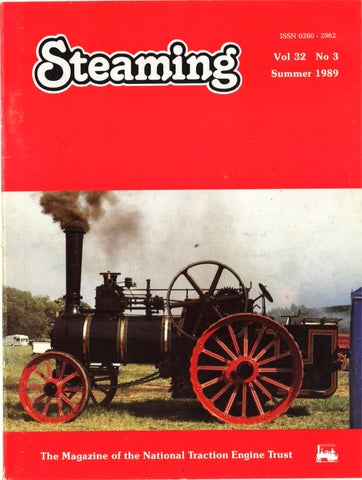
Cover McLaren 1038 of 1909, an 8hp single cylinder agricultural engine, posed at a Castle Howard rally. (Tony Porter) 115
Trust News From the Chairman Elsewhere in this issue, members will find a note from our Honorary Legal Advisor, David Tew, who wishes to stand down after a long period of devoted service to the Trust. David has immense experience of legal problems related to traction engines and their operation and many readers will have been helped .by his definitive work on the subject Traction Engines and the Law published by the Trust. I would like to thank David on behalf of all the officers and members of the Trust for the experience and attention he has given the Trust's affairs for so many years. Meanwhile, may I add to his plea for a member solicitor who is willing to take on this important post to come forward. The Trust continues to actively participate in the affairs of the Federation of British Historical Vehicle Clubs. The Federation maintains a constant watch on the activities of the Transport Commission of the European Parliament and employs a parliamentary lobbyist to keep watch on any impending EEC legislation or regulation. In the last quarter the FBHVC has reported some specific successes in securing amendment or reconsideration to EEC regulations that might adversely affect the operation of preserved vehicles throughout Europe. One of the regulations concerned tyre tread depth and these proposals, which would clearly have affected solid rubber tyred traction engines, could have had serious consequences. The Federation has now received an assurance from the Commission that they have instructed their staff to find a solution to this problem. Further problems that have arisen, though not directly affecting traction engines, are certain proposed regulations affecting air pollution and others concerning electromagnetic compatibility. These regulations would have adversely affected very many old internal combustion propelled vehicles, particularly those with low tension and magneto ignition. It is clear that it is essential to maintain this close scrutiny of all EEC 116
draft legislation of the type described above before it passes into law. This will be a continuing drain on our funds over the next few years and I would like to again remind members, and steam engine event organisers, that the Trust's Legislation Fund deserves their generous and continuing support, so long as this threat to our activities persists. During the past few weeks extensive discussions have taken place in committee concerning the future funding of the Trust's activities. The year to 31st March 1989 will show an operating loss on the Trust's activities for the first time for some years and clearly this cannot be allowed to continue, particularly when the Trust had to be prepared to meet legal expenses in connection with the EEC legislation as well as the renewed, and we hope temporary, onslaught of
inflation. During the past year the operating expenses of the Trust have risen inevitably due to the more professional approach we have now taken to our everyday affairs, and your committee have adopted this policy in the firm belief that in due course additional income will flow from the new sources that are now being opened up. We expect to make firm announcements concerning a number of projects in the Autumn issue of this magazine. Nevertheless, the Trust needs to further augment its funds, as we find ourselves the poor of the transport preservation movement, probably due to a long history of relatively low subscription and a total reliance on the efforts, often stupendous, of our volunteer officers. I must therefore give the membership notice that there is every likelihood of a motion to implement a substantial
From Alan Martin's Collection
45
The picture this time completes my coverage of the better known makers. It is a mere coincidence that Sentinels have been left until last, in spite of their making more steam wagons than any other maker, so to remedy my omission I hope 6 ton Standard Sentinel waggon 1976 of 1918 (AW4153) portrayed here in Manchester in the 1920s will appeal. It is posed with its smartly dressed crew when owned by timber merchants J.W. Southern & Son Ltd.
rise in subscription rates being placed before the next Annual General Meeting of the Trust. A more detailed announcement will be made in the next issue of Steaming. (Peter Barber)
Engine Owners Column It is disappointing to record that I have received only four enquiries from members in response to Sydney Smith-Dennis Ltd steam gauge offer reported in the last issue. Clearly the Trust will need to be able to negotiate with a far stronger order if a price advantage is to be secured. I will hold the offer for a further three weeks from the publication of this issue — this is your last chance to secure one of these gauges through the Trust. Since the last issue I have been in contact with the Shop Services Division of the Midwest Central Railroad, Iowa, USA. This division has been set up as a specialist organisation supplying goods and services to steam museums and tourist railroads. From their literature I note with particular interest stocks of Penberthy injectors. These are stated as still being standard current production items, manufactured in pipe sizes from %in to 2 1/2 in. I have secured for the Trust Register some illustrated loose leaf technical data for the Penberthy range, together with a parts list and US prices. Any member who would like photocopies of this literature should send me a large SAE (suitable for seven A4 sheets). Turning to the question of training/driving instruction courses, I am again disappointed to record that the response has been poor. I thank those who did take time to write with comments, but a far more positive response will be necessary if the proposal, outlined in the last issue, is to materialise. Your sub-committee will consider the responses at its next meeting in the autumn. I would thus urge any other interested members to let me have their ideas by the end of August. At the last of our meetings it was decided to set up an archive containing an example of each of the remaining engine maker's transfers still available. Henry Marshall has kindly donated a Marshall example and others should be acquired in the near future. The idea is not to produce copies at present but to set aside samples for future reproduction when all other sources have been exhausted. If any member has an
DEEP NAVIGATION COBBLES
//\
1103
PDFuels LOW LOW PRICE
OAKDALE COBBLES
193 0.• inuteetea)
[
1110111111
INAVST
WELSH DRY STEAM COAL
25kg
PER TONNE EX SOUTH COAST DEPOTS Cheque required 7 days prior to collection or cosh m collection
I TONNE SHRINK WRAPPED PALLETS AVAILABLE (C5 REFUNDABLE DEPOSIT) CALL SALLY RYE or CAROL SUBIRATS on
0705 291222 AT MARKETING DEPARTMENT, POWELL DUFFRYN FUELS LTD, BROAD STREET, PORTSMOUTH P01 2LB
1st APRIL TO Ist SEPTEMBER 1989 PREPARED IN COLOURFUL 25KG BAGS
HAULAGE IF REQUIRED CONTACT Richard Preston & Son Ltd e g E12 per tonne to Eaton Socon Depot Cambs. (Clive Eaton: 0480 213200) or LIS per tonne to Potto Depot North Yorks (Malcolm Horton: 0642 700243) — for other delivery locations phone Preston for quote.
example that could be donated for the benefit of this aim, or knows of sources, Andrew Semple or myself would be delighted to hear from him. Finally, my thanks to the following individuals for their contributions to the Supplies/Repairers Register: Dave Davis (Robey Trust), Patrick Rigby, R.J. Frances, Mark Filer, Jeff Rees. Please keep the contributions coming in. (Nick Barker, chairman, Engine Owners sub-committee) Boiler reports A problem has arisen this year over boiler reports. John Scott & Partners have been asked by the Trust not to issue NTET Discs unless we have seen boiler reports both cold and in steam. This has brought to light the fact that quite a few members do not have the steam test done at all, whilst others get it done at an early season rally they attend when their boiler inspector sometimes sees a number of engines at once, without extra charge. In the case of those who have not been getting a steam test report at all there is no answer but to get it done. But in those cases where it is done at the first rally, then I think the only solution is to take along the temporary cover note or insurance certificate, and the certificate of the cold inspection for the rally organiser to see and to arrange things so that the testing or inspection is done before the public are admitted to the rally field. The two certificates can then be produced to John Scott and an NTET Disc issued for future events. Another and perhaps better answer is to try to get both tests
carried out at the end of the rally season before the engine is put away for the winter, and then members will have all they need to get their Disc before they venture out to a rally. (David Franklin, John Scott & Partners Ltd)
Rally Organisation Rally Sub-committee Looking back through past issues of Steaming, the Summer issue is not one in which the activities of my subcommittee are reported to any extent. This is not because we are not very active; on the contrary much is going on or under consideration. With much rally activity taking place, it has been our practice to send observers to selected events to liaise with the organisers to learn of the various problems and difficulties that arise in practice. This we are continuing this year. Much of our Code of Practice is built up from practical experience. The next conference of Affiliated Clubs Officials, Rally Organisers and Safety Officers will take place earlier this year on Saturday 30th September at the Victory Club, Marble Arch, London. Official notices will be sent out later, but perhaps all interested officials would note the date. Currently, the agenda is still being considered, and it is hoped the first of the guide notes on specific aspects of rally safety will be ready for 117
submission and discussion. All Safety Officers are reminded that their reports should be completed and sent to Ron Copp shortly after their rally has taken place. (Eric Fillmore, chairman, Rally subcommittee)
The Rally List 1989 Two additional rallies can now be added to the 1989 Rally List supplement, contained within the last issue. • 5th/6th August — Winnards Perch Rally, Tredinnick Farm, St Columb, Wadebridge, Cornwall (about 20 engines expectedl. S. Symes, 62 Newquay Road, St Columb, Cornwall TR9 6SW. • 10th September — Steam Working, Town and Country Day, Showground, Dereham Road, New Cottesey, Norwich (about 5 engines expectedl. Royal Norfolk Agricultural Association, Dereham Road, New Cottesey, Norwich NR5 OTT. The Anglesey Vintage Rally, held at Llanfair PG on 20th/21st May, also undertook to organise their event within the NTET's Code of Practice, and was duly added to the Rally List after its publication in the Spring issue.
From the Hon. Legal Adviser I have recently finished work at my legal practice and have given up my practicing certificate. This means that I must not in future 'hold myself out' as a Solicitor. However, I do not think that there is any objection to my being described as 'Hon. Legal Adviser' to the Trust. I explained to a recent National Committee meeting, that while I am willing to continue as Legal Adviser pro tem, I feel that as time passes I must inevitably get out of touch with the legislation which Parliament churns out. Therefore, I feel it would be in the best interests of the Trust if I stood down as soon as a replacement can be found. If any Member who is a Solicitor would consider taking over my duties, I would be pleased to explain what is involved. An Honorarium is paid. (David Tew, Hon Legal Adviser)
Legislation Fighting Fund The following donations have been received, and are gratefully acknow
Mick Maskell's 7hp compound Fowler 14012 of 1915 passes the thatched cottages of Stoke Goldington, Buckinghamshire in May 1989, in readiness for the following weekend's rally. (John Mound)
ledged, for the Trust's fund for future use in combating adverse legislation affecting the use of steam vehicles on the highway (see notes in the last issue, page 651. Donations received from: £ Devon Traction Engine Club 150.00 Banbury Steam Society 100.00 P.G.C. Barber 50.00 Fairford Steam Rally 100.00 Road Roller Association 50.00 Malpas Steam Snowily 109.20 County of Salop Society 100.00 Isle of Wight Rally 100.00 W.A. Washington, new member 50.00 total £809.20 carried forward from previous report 1000.00 current total £1809.20
Steam Heritage Awards The 1989 Steam Heritage Awards, sponsored jointly by British Coal and the Solid Fuel Advisory Service, were presented at a ceremony on board the SS GREAT BRITAIN in Bristol's Great Western Dock on 28th April. The Awards were presented by British Coal's commercial director Malcolm Edwards after sailing through the docks to the venue on board one of the prizewinners, the steam tug MAYFLOWER, and took the fotm of engraved miner's lamp trophies,
Terris Culverwell (INSURANCE BROKERS) LTD. 4 MARKET PLACE DEVIZES WILTSHIRE SN10 1HT TEL. (0380) 2237 AFTER 6PM 71004 Established 1882
IF WE CAN HELP, PLEASE CALL US
certificates and the prize cheques. Steam Heritage was formed four years ago by its sponsors, who join forces with a number of interested bodies including the Transport Trust and the Association of Railway Preservation Societies, using the scheme to increase public knowledge in the use of preserved transport and machinery powered by coal. At the conclusion of the presentation, Mr Edwards encouraged preservationists to enter for the 1990 Awards, and made the welcome announcement of an increase in the value of the prize monies for the coming year. The 1989 winners were: • Premier Award — £2000 for outstanding technological contribution to Strathclyde Regional Water Department for the restoration, operation and maintenance of SS WALTER SCOTT on Loch Katrine in the Trossachs, Scotland. Built in 1900, the 115 ton vessel is the only surviving screw steamer in regular passenger service, working from May to September each year, and is in original form except for the installation of a new bridge and replacement boiler. • Road category — £500 to the Buxworth Steam Group, Cheshire, for the restoration and return to steam power of a set of 1893 Tidman gallopers. • Rail category — £500 to the Caerphilly Railway Society in South Wales for their restoration of Taff Vale Railway 0-6-2 tank locomotive No.28. • Marine category — £500 to the Bristol Industrial Museum at the City Dock for the six year restoration of the 1861 tug MAYFLOWER — the world's oldest tug. • Museum static category — £500 to the Forncett Industrial Steam Museum in Norfolk for their large and represen-
We are registered insurance brokers who pride ourselves on giving personal service to all our clients. We arrange insurance for motor vehicles, houses, life, medical cover, liability, etc. Traction Engine insurance inspection and/or comprehensive insurance
tative collection of stationary steam engines. • Special Merit Award — £250 to the Road Locomotive Society for their action in purchasing the surviving original Burrell engineering drawings, records and documents with the aim of permanently preserving the collection and housing it, in conjunction with local bodies, in the former Charles Burrell finishing shop at Thetford. We congratulate our sister Society on the recognition of their project, which should encourage and enable the authentic restoration of any Thetford-built engine, and draw the attention of all Burrell owners to some notes on the Collection elsewhere in these columns. Entry forms for the 1990 Steam Heritage Awards will be available in due course, and members interested in making an application should write to the Trust's Chief Executive, who will forward copies as soon as they are available from the organisers.
NTEC Sales We welcome to the sales team Mick and Maureen Garrett, who have taken on a sales stand, mainly for the Derbyshire area, and we wish them well at all the rallies they attend. This year is the 21st anniversary of the Great Dorset Steam Fair (or Stourpaine for the diehards), and for the whole five days of the event the sales team have arranged and will be staffing a Trust hospitality area as well as the sales marquee. As in previous years, we are able to provide pre-paid one-day admission tickets for the Great Dorset Steam Fair
at Tarrant Hinton, to be held over the period Wednesday, 30th August to Sunday, 3rd September. The tickets are available by post from the Mail Order address, or in person from rally stands, at a cost of £4.00 per adult ticket; £2.00 for children and pensioners. This is a 25% discount on gate prices on the day. Please note — this offer ends on 15th August. Keith and Tracey Shakespeare are organising an end of season Steam Party on Saturday and Sunday 14th and 15th October 1989. The venue is 'The Ewe and Lamb', Stoke Heath, Bromsgrove, Worcestershire and it is hoped to present a set of steam gallopers and five or more engines. Admission will be free! If you are interested in attending the event, either with an engine or for the weekend, there is limited camping for members. For further details please contact Keith or Tracey on 0527 575003; more information will appear in the next issue of this magazine but may not reach members until a couple of days before the event. An added bonus at the Steam Party will be an end of season sale of various stock on the sales stand. Events to be attended by the Trust's rally sales stands in the second half of the 1989 season are as follows: August — Knowl Hill (David); Great Yorkshire (Keith); Cadeby (Ken); West of England (Keith); Fairford (David); Isle of Wight (Ken); Egham (Keith); Bishops Castle (David). September — Great Dorset Steam Fair (everyone); Brill (Keith); Roxton (Ken); Barleylands (Keith). The dates and further details of these rallies appeared in the Rally List supplement published within the last (Tracey Shakespeare) issue. 119
Interested readers should, in the first instance, write to The Charles Burrell Museum, c/o Planning Department, Breckland District Council, The Guildhall, East Dereham, Norfolk NR19 1EE, stating their requirements and quoting, of course, the relevant works number of the engine. For the time being there is no public access to any of the Museum's material, but details of progress of the venture will be announced in due course.
Future dates AGM 1989
Puler Smart (left), chairman of the Road Locomotive Society, receives the Society's Steam Heritage Award from British Coal commercial director Malcolm Edwards at the presentations at Bristol in April.
The Charles Burrell Museum The Management Committee of the Charles Burrell Museum at Thetford, Norfolk are pleased to announce an initial service to engine owners and enthusiasts based on the archive drawings, ledgers and registers etc which have been loaned to the Thetford Town Council by the Road Locomotive Society. As recorded elsewhere in this issue, the RLS action in acquiring the collection and initiating the venture has been rewarded by the Special Merit citation in the Steam Heritage Award scheme. The drawings, some 10000 in number and formerly owned by William McAlpine, have been transferred to Norfolk where they are to be held on permanent loan by a Charitable Trust set up to form and run the Charles Burrell Museum. The museum is to be located in the Burrell finishing shop, one of the few surviving relics of the old days that remains in good order and one which will be visually familiar through its appearance as the background of many Burrell engines when they had their works photographs taken. The drawings have now been cleaned and catalogued to the extent that a service can now be offered to those who wish to acquire details of Burrell engines, and copies of the 120
drawings or pages from the register can now be provided on request The scale of charges is set out below; the costs have to reflect the time and effort involved in researching the correct documents, the need to finance their present and future care and conservation, and to make some contribution to the running costs of the embryo Museum. (Understandably some of the archive is by now in an extremely fragile state.) It is hoped that Burrell owners, and other enthusiasts, will make the fullest use of this excellent facility for researching in detail the history of their engine.
Advance notice is given of the date of the 1989 Annual General Meeting of the Trust. This will take place on Saturday, 18th November 1989 at Ironbridge, near Telford, Shropshire. We are grateful to the County of Salop club who will be acting as hosts for the AGM and making various arrangements for the day. Further details will be published in the next issue of this magazine. Members are reminded that motions to be put before the above meeting under Article 16 of the Trust's Constitution must be received in writing, accompanied by the member's full name, address and membership number, not less than 42 days before the date of the meeting. Any such motion should be sent to the Chief Executive at the address to be found inside the front cover. (John Crawley, Chief Executive)
Obituaries Des Penny
PRICE SCHEDULE Engine Specifications for engines up to number 3906 brief details (2 pages) £3.00 full details (10 pages) £15.00 for engines from number 3906 onward brief details (2 or 3 pages) £3.00 full details (19 pages) £16.00 Boiler Certificates copies of original certificates £2.00 each Drawings (priced according to number required): 1-10 £4.00 each 11-25 £3.50 each 26-50 £3.00 each 50 plus £2.50 each All prices are exclusive of post and packing, the cost of which in most cases will be about C2.00.
It is with great regret I record the passing of one of the Somerset Traction Engine Club's most esteemed members, Des Penny, in March. Des, one of the club's most popular engine owners, had been ill for some time; the fact that he faced up to his illness so courageously had, perhaps, deluded us into misunderstanding its seriousness. It is a tragedy that having survived major heart surgery, he fell victim to a more insidious disease, at the relatively young age of 55. Des was literally a one engine man and it is with Ransomes 7hp traction 26995 MENDIP LADY that he was inseparably linked. Particularly we will remember him driving the rack saw for Beano Hill and Bert Thorne for many
The well presented MENDIP LADY, Ransomes, Sims & Jefferies 7hp agricultural 26995 of 1916. It is seen here at the Yeovil event in May 1987. (Robin Walker)
years and at many venues, including Holland. In his way Des was an outgoing personality, though he was not an extrovert. We shall remember, with pleasure, his verbal battles with portly Jack Miles — a ready wit was one of his charms. Equally, Des did many kindnesses, unobtrusively helping or advising a lot of people. A practical person, he was a good engineer, as witness the mechanical integrity of his Ransomes. The funeral took place at Binegar when the congregation, comprising men and women from all aspects of life, including the preservation movement, filled the church to capacity. Des was laid to rest in the churchyard only yards from his home; a true man of the Mendips at peace in the countryside he loved. Our sympathy is extended to his widow Marge, together with his brother Roger and the rest of his family. (Ernie Taylor)
Corrections We apologise for two errors within the advertisement for video films by H. & J. Eckhardt in our last issue — the mis-spelling of their name and a wrong telephone number. The correct number is 72167. The Marshall roller pictured on the front cover of our Winter 1988/89 issue, is works number 74747, not as incorrectly shown in the caption on page 3.
OUR MAGAZINE 25 YEARS AGO
The Spares Section comprised a page of wants by various members and there was talk of scouring scrapyards for bits and pieces, and buying them in for future requirements — it was still accepted that some engines were only suitable for scrap. Burrell Gold Medal tractor 3397 COCK 0' THE NORTH was undertaking a John o' Groats to Lands End run. A sad end was predicted for Aveling 8752, Devon CC's last steamer in their St Thomas, Exeter district: parked in a lay-by at Halton Moor and prepared for its boiler inspection it was robbed of brass and copper to such an extent that it could only be considered worth cutting up — the engine however cheated fate and survives in the Midlands. Working rollers were reported in South Wales — Rhondda BC were using their two Aveling-Barford 8 tonners (AH365/AH412) on road construction, and Pontypridd UDC had retubed their Wallis Advance 8112. One member had gone off on an afternoon's engine hunting in north Pembrokeshire and found three rollers for the record.
'A Series of Accidents. J.H.H. (Hendon) writes as under:— If this account of a day's work of mine finds a space in the 'Drivers News' I hope it will prove interesting to your readers. I am the driver of a Straker wagon. I did two trips of about three miles each way a few days ago. We had a load of about five tons each time on board. The road to our destination was good, with the exception of the last furlong, which was very soft, as well as being up a moderately steep gradient. We finished our work somewhere about 10 o'clock at night. When we arrived home we were told to go to the assistance of one of our other motors, which was stranded about three miles away with a broken crank shaft. As we were going down the road on our way we found another of our wagons stuck in the soft piece of road which I mentioned above, owing to being overloaded. We hooked on our cable and dragged it out, and then we went and towed home the other wagon, which was loaded up with about four tons of stones. Our wagon had not enough power to haul this heavy load, so we had to press into service the wagon which we had previously helped out of the soft place. I have never had such an experience in the whole of my life: no sooner had my mate and myself started to go home, tired out, than we were ordered out again to help another of our wagons, which had broken down about ten miles away, with all the bolts broken out of one of the pinions. We transhipped the load on to our platform, and hooked the disabled wagon on behind, eventually arriving home without further trouble.' (from the columns of The Commercial Motor, 1st March 1906. The passage of time fails to record whoever it was in North London that owned a Straker and three other wagons — Alan Duke regrets his lists cannot identify the machines.) A Thornycroft steam wagon recently came to the assistance of a heavy steam roller in Durham. Owing to the recent heavy rains in the district between Middleton and Langdon Beck, the road was under repair, a heavy steam roller rolling in new metal. On a particularly soft piece of road, the roller stuck and sunk over a foot into the ground, when by good fortune the Thornycroft steamer hove in sight, was promptly hitched by means of ropes and chains to its ungainly sister, and without any difficulty steamed away hauling the roller after it.' (From Automobile Commercial Motor Review, October 1903.1 121
WALLIS & STEEVENS 5hp compound road locomotive
7881 Mark A. Loader My small Wallis & Steevens road locomotive 7881 will probably be familiar to members who were visitors to earlier rallies in the south of England in the 1950s and 1960s, and even early Stourpaine events, but it has been out of circulation for some years now, under restoration. In response to comments from friends, and before the sands of time obliterate the finer detail in my mind, I will endeavour to set down the story of the engine's recent rebuilding. The rally appearances mentioned above occurred when the engine was in the ownership of my late grandfather Seth Loader, who was a ready supporter of many events. The responsibility for the engine later became that of my father, but eventually, with much help and encouragement from this two generations of experience, the stewardship was passed to me. By way of an introduction to the current restoration work I must digress and review the engine's past history. The original owners were Kinson Pottery Ltd of Poole, Dorset who took delivery of the engine during March 1927. The delivery from Wallis & Steevens' works at Basingstoke to Poole was by road, apparently completed in a day. The Pottery had been past customers of Wallis' and it is also understood that the Pottery subsequently employed Wallis's fitters to service the engine. The makers classed the engine as a 5hp compound slide valved road engine and it left the works, registered PR8420, on 11th March 1927. At the time the firm's business was largely centred around Advance rollers with some 10ton three point rollers, for the tractor and engine market was rapidly collapsing to the inevitable march of the internal combustion engined vehicle. The design was an updated version of earlier engines, with outside valve chests replacing inside valves, 122
rr!
Wallis & Steevens 5hp compound road loco 7881 of 1927, photographed by the makers when new and before delivery in Basingstoke railway station goods yard, their usual location for such photographs. At least six different viewpoints were used to record the engine. (collections Mark Loader and Peter Eves)
and the wheels fitted with endless rubber tyres. Only four examples left the works, 7881 being the first, with a later batch of three, 7964 to 7966, leaving Basingstoke to various purchasers in the south of England between 1928 and 1930. The fact that 7881 has always been resident within a few miles of where it worked has led to a number of people remembering the engine at work in and around the town of Poole. Even today, visitors coming into our workshop reminisce and relive its working days. One story we have heard several times was the large numbers of school children who hitched a ride on the rearmost of her two Foden trailers (these were ex Bournemouth Corporation), much to the disgust of engine driver Harry Jeffrys who would throw lumps of coal at them as the engine and loads made their way from Poole Quay or the pit to the Potteries, a journey of a couple of miles. We did meet, at one of the early Stourpaine rallies, a gentleman who has been steersman for a few years and well remembers that one had to be careful when alighting from the footplate, since a build up of a static charge would catch the unwary and give a notable shock. The daily workload for the engine would include hauling coal from Poole Quay, or clay from the surrounding pits in the Poole and Hamworthy area. During the early part of its life, 7881 ran away in Dorchester for reasons unknown; it demolished a wall and turned over, though little other detail is known about this. One of the engine's many duties worthy of mention was the occasional hire by our own firm to pull our 'low loader'. I use the term loosely as will become evident. With the purchase by Loaders of a Priestman Cub excavator for civil engineering and plant hire work in 1933 came the problem of transporting the machine from site to site. An old Clayton & Shuttleworth steam wagon was acquired (details unfortunately unknown), and the cab and motionwork removed. The excavator was loaded onto the back of the wagon body as follows; the wagon rear axle was raised by jacking, then wheels removed and the chassis lowered to the ground. After placing blocks and ramps the machine was driven onto the back of the wagon and wheels replaced. The wagon was then coupled to the rear drawbar of the borrowed Wallis by a push pole, and with the steersman mounted on the Clayton chassis, away the combination would go. For journeys which did not require any severe hill climbing one of our own Wallis Oilbath engines
The engine at an unknown event in preservation days — note the worn tyres. (collection Peter Eves)
in the yard would be used; notably number 7638 in tractor form, or more often than not in roller form, but for difficult journeys the Pottery engine would be used. Unfortunately, despite much delving through family photographs no trace of these escapades has survived — but one can certainly imagine! It was on one of his many visits to the Pottery Works to order some pipes, that grandfather was asked if he would be interested in buying the Wallis, as shortly a replacement in the form of a motor lorry was due to arrive. At first Kinson's offer was turned down, but on further visits an understanding was eventually arrived at and the Wallis passed into our hands circa 1953-54, but on a gentleman's agreement that under no circumstances should the engine ever be cut up. So one Saturday morning the engine was pulled out of its shed and towed back to our yard by the Fowler road loco 12255 PRINCESS. Over the next couple of months the engine was cleaned and painted by Mr Wren, the son of grandmother's next door neighbour, and prepared for the Andover rally to be held at Frinkley Farm, Andover in 1956. From then onwards the Wallis became a regular attender at both local rallies and further afield. However, at an event at Downton Carnival near Salisbury, a problem developed while still on the low loader. A crack
between three stays on the nearside firebox wrapper plate mysteriously appeared. The engine was drained off and welded at nearby premises, and participated in the proceedings later on in the day. One year at the Taunton rally when the ground was very wet, the little Wallis received a cup for the engine most able to travel around without assistance. This was the occasion for the first appearance of Ted Hines' QUO VADIS although the Burrell remained on the low loader outside the event since the conditions were appalling. Shortly afterwards the
The Wallis ready for transport to an Apple ford rally, loaded on a six wheel GMC low loader. (collection Mark Loader) 123
View of the back of the outer firebox, looking at the firehole door. (Mark Loader)
Wallis's rear wheels were re-rubbered, a decision which had been reached before the Taunton event, since the rubber was virtually worn away to nothing. Unfortunately, it was not possible to acquire any press on endless tyres as originally fitted, so smaller diameter endless tyres were obtained, opened out and fitted to the wheels. The front tyres were not touched at this stage since there was still plenty of life left in them. During the mid seventies we decided to replace the canopy since it was becoming rather tired and liable to disintegrate. Thanks to the kindness of
the late Geoffrey Hurst, the engine was taken to his yard at Christchurch, the canopy removed and taken into the next door joinery works for a replacement to be made. While this was being completed, the crankshaft and flywheel were removed complete, and then separated so that the crankshaft could receive some attention. The splines on the end of the crankshaft were worn where the gearing is fitted, and similarly on the crankshaft
gears themselves. Having come across cases of splines being welded up and subsequently resulting in distorted crankshafts, we opted for machining a true face on the crankshaft spline, and the splines in the fast and slow pinions built up and the internal faces recut. James Harris of Poole, carried out the work successfully, and then the crank, flywheel and canopy were replaced one Saturday afternoon. A trial steam up the following weekend showed a very marked improvement. Not long after this work had been completed, a move to Nottingham for my employer was necessary, and so apart from a couple of occasions over the next two years, the engine didn't venture very far. However, I was made very welcome at the homes of both the Beeby and the Swingler families and I was therefore able to maintain my interest and involvement. Most evenings and weekends found me involved with the conversion and rebuilding of Jesse Swingler's Foster VICTORIA, and repairs to MAID MARION. This was to prove of
Drilling the wrapper plate rivet holes (left) and preparing the foundation ring for fitting (right). (Mark Loader)
Inside view of the new firebox after riveting. (Mark Loader)
immense value as I was able to gain an insight into removing, manufacturing and fitting of fireboxes and to that end I will always be indebted to the Swingler family for their help and kindness to me. Having settled back home in 1976 and wanting in earnest to start rallying the Wallis again during the coming season, we removed the lagging and side tanks during the Christmas holidays to prepare for hydraulic test and relagging. However after the initial visit from the boiler inspector, who incidentally was quite happy with the condition of the boiler for the time being, we started pondering over the rights of what our next course of action would be. Our dilemma was as follows; although the boiler had been passed, it seemed rather wasteful in terms of time, money and energy to relag and repaint the engine, if we would have to replace the firebox within the next few years. A problem which often makes itself apparent and real to other engine owners. So apart from doing some work to the motionwork and front axle, much time was spent in studying and considering the options available to us. After discussing the problem with Michael Lugg, whose family and my own had
The completed firebox before drilling for the stays, and with the foundation ring. At Michael Lugg's premises in May 1984. (Mark Loader)
known each other since the early Andover rallies, it was decided to strip the engine down to a bare boiler, and then, after delivering it to Sussex, the old firebox was removed. The boiler was delivered in November and by December the old box was out and the barrel and inner box were ready for descaling and cleaning. After studying the old firebox very carefully, any earlier hesitations were forgotten with the evidence we discovered. In places the original wrapper plate still bore the original mill scale, yet in other areas after removal of scale the original metal was well wasted. Consequently, we felt our course of action was correct and justified. I have never felt very happy about an all welded firebox so we decided to construct a flanged and riveted firebox as original, having previously obtained the relevant drawings through the help of David Phillips at Reading University. We very quickly came upon our first problem with the insurance company who were dealing with the supervision of the work. Upon examination of the working drawings they were unhappy about the pitch of the screwed stays and eventually made the following alternatives; either we increase the size of the stay from Ye in to 1in
diameter, or increase the plate thickness of the box itself. We decided on the latter, but it took nearly three months for the company to make up their minds what alternatives they would offer. This obviously stopped progress dead in its tracks, but all was not lost. Another area dealt with and completed while all this was progressing; I had already intended to replace the smokebox when the boilerwork was finished and the engine was back at home, but with Mike's help and equipment and our continual weekend trips to Sussex, we removed the old smokebox and fitted a new extension to the boiler barrel, immediately next to the front tubeplate (which incidentally was extremely sound). A new packing ring, smokebox, door and baffle, and door ring were made and fitted and all hot riveted into place. Meanwhile at home, during the week, I had had made new smokebox door hinges, and pin, dart and handles and had a new nameplate cast for the smokebox door. All was really going too smoothly — and then came another problem which we hadn't anticipated. After refitting the perch bracket, it became rapidly apparent that something just didn't seem quite 125
right. From much examination we concluded that the bracket itself was twisted slightly along both planes. We tried cutting and shutting, but it was an impossible task so we ended up having a new bracket folded as the original. The bearing housing was found to be in need of some attention so this was bored and bushed, when fitted into the new perch bracket. The rest of the front axle components were examined and attended to where necessary; the front wheel bearings were very good though the front tyres did cause a few more problems. Originally, both front and rear wheels had been fitted with Macintosh Endless Solid Rubber Tyres. During the working life these were changed regularly every two years, but by now the front tyres had become extremely tired and perished. I had placed on occasion an advert in Steaming for a pair of 771mm x 160mm tyres, but to no avail. It appeared that the only option remaining open to me would be to buy some Avon sections and fit those. Unfortunately, it soon became evident after fitting that this method was not going to be successful, as gradually the rubber was lifting away from its backing plate, possibly because the radius of the sections had been signficantly altered. Eventually the wheel and tyre started to resemble an old threepenny bit. Since we were
not in a position to use the engine at that time, I conveniently decided to shelve the matter for the time being. I did contact an agent for Dunlop solid tyres but the price seemed really prohibitive. However, after some roundabout enquiries via various other persons a pair of tyres was eventually acquired. The Avon tyres were carefully removed from the wheels and on our next visit to Mike's workshops we took the wheels with us in the pick-up. After placing on the bed of the 100 ton press, the tyres were fitted to the wheels in a matter of minutes. At long last clearance came on the firebox construction. The forming block for flanging the front and rear tubeplates was profile cut and ground to shape. By using boiler plate of metric dimensions the thickness of the wrapper and tubeplates had been nominally increased compared with the original imperial dimensioned material. The firehole plate was flanged initially so that the former could be redressed, since the front tubeplate was thicker than the firehole plate. The tube holes were drilled in the flanged plate under the radial drill. The wrapper plate was folded and then the two endplates positioned on it and tack welded into position. With the use of a limpet base drill we then started drilling pilot holes around the edge of the wrapper plate starting
from the middle of the crown and working towards the radius, and then down the side of the wrapper towards the foundation ring, placing bolts into each hole and pulling down as the drilling proceeded. To finish, the final drilling and reaming to size was completed under the radial drill. The two edges of the wrapper plate were now cut to size having left them until now to allow for creepage of the plate as it was pulled down into the tubeplates. Riveting the box together then followed using a hydraulic rivet squeezer, the foundation ring was refitted to the box after some dressing of the four corners of the firebox, and with the boiler turned upside down the firebox was lowered into position for the first time. After locating the foundation ring into its appropriate position by a few bolts and pulling up until tight, we were then able to take various measurements to ensure the firebox was located squarely in the outer box. With this completed, a pilot bush was placed in the stay holes and their respective centres marked and spot drilled. The firebox was lifted out and drilled to tapping size under the radial drill. A suitable stay tap (Vein by 14 threads per inch) was then used with the box back in place. The foundation rivet holes were tapped and the box removed for a further time to deburr
Two views of the newly made smokebox — the perch bracket still to be fitted. (Mark Loader)
The newly completed tender plates ready for transporting home. (Mark Loader)
and remove any surplus swarf. After having received a couple of coats of Apexior No 1 it was placed back into the awaiting boiler shell, which had by now been built up where necessary and similarly coated with Apexior. The screwed stays which had been previously run up for us were unfortunately not suitable, so another batch was quickly procured. The reason for the first batch not being suitable for use occurred because they were not tight enough in the threads. Stays should be tight in the thread and 'squeak' when screwed into place. At this stage we had to leave Michael to finish the stays, fit the crown stays and rivet the foundation ring in place due to our other commitments at home. It was a few weeks later that we returned with the tubes, and spent a day fitting and expanding them. The boiler was then turned the right way up and after washing out, the mudhole doors were replaced. Upon slowly filling with water a couple of tubes needed a little more expanding, and a couple of stays wanted some attention. We then warmed the boiler through during the course of a whole day so as to give everything a chance to expand gradually and for the Apexior coating to fully cure. It was during January 1985 that the boiler inspector gave his stamp of approval; one part of the saga was now over and another about to begin. Whilst all the work just described had been steadily proceeding in Sussex, when time permitted at home we had been preparing some of the other parts ready for fitting to the completed boiler unit upon its return. The side tanks and mounting brackets were inspected for damage and cracks etc, and after a small amount of minor attention, were sandblasted and primed. We had rigged up our own sandblasting equipment and although
rather tedious, the process was extremely successful and much cheaper than contracting it out. The rear wheels were inspected after cleaning and the nearside was found to have a couple of loose spokes in the hub; these were prepared and welded using special welding rods. The tender had been examined on several occasions and was then descaled with a needlegun to produce quite a few buckets full of scale and rust. Initially the floor of the tank and the footplate appeared to warrant complete replacement. The rivets were blown out with the oxy-acetylene torch one evening, but upon closer inspection the side plates seemed quite poor, particularly in the corners. Not knowing which way to go next, I did the best thing and slept on it. It was on a following weekend that when fitting the firebox into the boiler and discussing the problem with the tender, Mike and I considered the idea of building a completely new one. At that moment he was making a belly tank for a Burrell road locomotive, and with a small amount of alteration the formers could be utilised to flange the tender sideplates. These were completed together with the front dividing plate and then put to one side to be taken home with the completed boiler.
Before we brought the finished boiler back, we spent a day line boring the axle box locating holes in situ, whilst we had the use of the limpet drill. Some of the axle box bolts which locate in the hornplates, had worn and so we drilled and reamed the holes out from 7/8 in to 31/a2in and turned up some fitted bolts to suit. On a morning in March 1985 the boiler was winched onto our lowloader for the journey back to Hampshire, together with the pieces of the new tender. (to be continued)
(No photographs of Wallis 7881 in its working days in the Poole area have come to light and we should be pleased to hear of any copies that would be suitable for publication in the second part of this article and for the author's collection.)
'Wanted — Engine Cleaner and Waterman, one who can steer preferred, to travel with picture show; private business only; two or three weeks in a town — write Arthur James, 4 York Terrace, Sunninghill, Ascot, Berkshire.' (from The World's Fair, 17th September 1910.)
The finished boiler of Wallis & Steevens 7881 being loaded for return to Hampshire in March 1985. (Mark Loader) 127
More portables in Chile Following on from his article in the last issue, Ian Thomson reports on a return visit in January 7989 to the Temuco area of Chile in search of more portable engines. He was rewarded with enough discoveries to add a lot more interesting information. (all photographs by the author)
Some 1989 visits The somewhat uneven introduction I was able to give to the subject of present day portable engine use in Chile as the result of my 1988 searches was much amplified by a long weekend trip made to the Temuco area (about 650 kms south of Santiago) in January this year. I hope the following is of interest.
The Gorbea district Gorbea is sited about 40 kms south of Temuco, on the main Route 5 Highway, and has a population of about 5,000 people. A fairly exhaustive tour was made of the Gorbea district, where a small concentration of portable engines (locomOviles in the local parlance) is to be found. Although there are about 14 locomOviles in the district, the author would never have stumbled across more than three or four, were Ms Astrid Segue!, Secretary of Public Works in the Gorbea Municipality, not to have offered to act as guide. Most of the engines were located in sawmills by the side of one-lane gravel tracks, but a four-wheel drive vehicle is not necessary to reach them, at least not in the dry season (southern hemisphere summer). Three engines, one dumped and two operating, were seen within the Gorbea town limits. All three were found close to the section of the street (cane) Carrera, between calles Centeno and Camilo Henriquez. The dumped machine was a single cylinder model of unknown make, although it is undoubtedly of English manufacture. The first operating engine seen was a double cylinder Marshall product, found in the sawmill of Waldo Cravero. No evidence of the maker's number, nor year of build, was detected. Just to the south is the sawmill of Waldo's 128
brother, where a 1929 vintage single cylinder by Richard Garrett works. The next engine observed was found in the sawmill of Raul Rubio, a few kilometres south of Gorbea, not far from the main highway, near the junction with Faja 6. It is an operational, double cylinder model, built by Marshall, with a Britannia type circular firebox type engine. I noted the number 4148, but I don't think that this can be the series number. Next, in the sawmill of Schiel Schneider, owner of the Marine farm, about eight kilometres from the main highway along the Faja 6, was Marshall 83825, a late import dating from 1933. This is a single cylinder eight horsepower model. I had quite a long chat with Mr Schneider, who knows Ms Seguel; although we arrived unexpectedly, he gave us a warm welcome and offered us home-produced apple cider. He said eucalyptus was by far the preferred fuel, compared to pinewood. His engine works occasionally. It was bought in scrap condition and then repaired about five years previously, since when it has required virtually no maintenance. Operating costs consist of the operator's wages of one thousand pesos per day (about £21 and maybe five hundred more for oil, grease and other materials. The boiler had not been washed out since the engine was repaired! (The water in the area is soft.) The sawmill has a small, wooden-tracked railway of about 40 metres length, along which a small, human-powered iron-wheeled trolley runs to carry timber to the saw. It has a one ton carrying capacity, and must be similar to early railways of the mines of Europe about four hundred years ago. The sixth, seventh and eighth engines seen were found in a sawmill near the intersection of the highway and the Faja 6, in a sawmill belonging to some friends of the author. One was taken out of service a while ago, due to problems with the cylinder; it
has since been cannibalised, being Ransome, Sims & Jefferies 17523. In operation is another Ransomes machine, also single cylinder, number 18398. Next to it, also operational, is Marshall 15010. It too is single cylindered. The ninth locomovil was seen in the sawmill on the property of a Mr Boock, at about 6 kms along the Gorbea-Galpones track. This one is also in operation and is something special, since it was not built in England, but in the United States, being the only US built portable steam engine that the author can recall having seen. It is a product of the J.I. Case Threshing Machine Co of Racine, Wisconsin. It bears the number 1316 C, but this may not be the series number. (The number is stamped on to a part of the back of the firebox.) It is a single cylinder engine, and differs from English machines in appearance, as can be seen from the accompanying illustration. There are also interesting technical differences between the Case and the vast majority of English locomOviles. For instance, the latter have cylinders located at the back of the machine, above the firebox, which drive a flywheel located further forward; the Case engine is reversed and has the cylinder situated on the rear part of the boiler barrel, driving a flywheel set further back, and which itself is comparatively small in diameter. The Case engine had been out of use for several years, before being repaired and returned to active employment early in 1988. The tenth engine seen was formally preserved, in the garden of the owner of the Nebraska farm, at the end of a track which leaves the Gorbea-Galpones road about 3 kms from the highway. It is a small, single cylinder engine from Marshall, number 45333. It is complete, but not operational. Its firebox is cylindrical. Finally, when it was already getting quite dark (around 21.00 hours), in a sawmill at about 10 kms from the highway along Faja 4, a twin cylinder Marshall machine was observed. It is operational, but in indifferent condition, with a corroded smokebox. As far as could be seen, it
bears no maker's number.
Curacautin and Temuco area
A Chilean portable steam engine in typical surroundings. The engine is the 1929-vintage Garrett machine mentioned in the text at Gorbea in January 1989. It is very difficult to photograph the vast majority of the operating engines; they are normally housed in low-roofed workshops with piles of timber, barrels of grease, saws, pulleys, roof supports and various categories of junk all around, which makes for problems in getting a dear view of the engine. The problems are aggravated, especially in daylight in summer without flash equipment, by the sharp difference in contrast between the black, undercover engine and the bright sunlit exterior. If flash is resorted to, problems are posed by the significant difference between the nearest part of the engine and other parts of engine and the scene! Unusually, the drive belt is taken backwards, one rear wheel being removed to make room for this.
All the above engines were seen in the afternoon of Saturday 7th January 1989. The following day, I took a drive to see the eruption of the Lonquimay volcano, to the north-east of Temuco, and came across Ransomes, Sims & Jefferies engine 14364 in a sawmill belonging to a Mr H. Yatiez, on the north side at 26 kms along the Victoria-Curacautin road. It is a double cylinder model, in operation. There were certainly more engines to be found in the area, but I had no guide, and was short on time and thus did not see them. The next day I spent a few minutes looking around the workshop belonging to Guillermo Klagges in calle Le6n Gallo in Temuco. This is one of the places where locomOviles are repaired, in 1989! In the yard, apparently dumped, but to be repaired according to one of the firm's employees, were Ransomes, Sims & Jefferies 14244, a small single cylinder engine and an unidentified twin cylinder model. The latter bore no maker's plate, but it did have a plate revealing that it was imported by the US owned agents W.R. Grace, of Valparaiso. Grace was the importing agent for Ransomes machines, so it can be safely assumed that this latter engine was a Ransomes product. Definitely being repaired was a large and impressive, double cylinder 14hp Ransomes, Sims & Jefferies machine, number 17420, and another unidentified 10hp model from the same manufacturer. Mr Klagges said that, once repaired, a locom6vil is good for about ten years work. He asked me where they still make portable steam engines, since the demand for them in the south of Chile could feasibly fall short of the available supply. (Mr Schneider had told me two days before that it would take six hundred thousand pesos to buy his machine. This is very much more than scrap value and the demand for their services means that the scrap value I cited earlier seems to be an understatement of typical sale prices.)
Victoria district
Beauty and the beast — the beast, in this case, is the Case built engine referred to in the text. Note the small flywheel, the cylinder in front of the flywheel, the spindly-looking wheels, the steam dome and the chimney placed to the back of the smokebox. Photographed in January 1989.
Finally, the next day, on the way back to Santiago, I saw Ransomes, Sims & Jefferies 40088 (double cylinder of 10hp) in a sawmill a few hundred metres along the Traiguen highway from Victoria. It was in use until March 1988, and still looked in good condition. It must have been built around 1930. There can have been very few Ransomes' machines imported after this one. There cannot be very many locomOviles in the 129
Victoria zone, and this one is probably due to be transferred to somewhere else in the near future. Although the number of engines seen is not statistically significant, it is evident that Marshall Sons & Co and Ransomes, Sims & Jefferies were the dominant portable steam engine exporters to Chile. Importing agents were respectively, Williamson, Balfour & Co and W.R. Grace. It is also clear that steam engines are in no immediate danger of dying out in Chile. They are still being given thorough overhauls, and cases of engines in scrap condition being repaired and brought back to service were observed. They are cheap to operate, especially in inaccessible hilly country where the cost of transporting liquid fuels for internal combustion motors would be prohibitive. However, most operating locom6viles are located away from main highways, and a guide with good local knowledge is required to track them down.
A Postscript Reference to the extensive collection of Ransomes, Sims & Jefferies archive material at the Institution of Agricultural History, University of Reading enables further comment to be made on some of the portables used in Chile described by Ian Thomson. It would take a considerable amount of research to even start to understand the worldwide export trade that Ransomes had with their portable engines — indeed that would be so with any builder's business in that type of machine. Suffice it to say
,°Q For further details contact
that the Ipswich firm was still making good sales in the mid and late 1920s, although it then seems to have ceased quite suddenly in the autumn of 1930. The late Ransomes portables still working in Chile were supplied to British & Foreign Machinery Co Ltd, a firm of which nothing is known other than that name, but which was presumably an export/import agency based in London and South America — and not necessarily selling only in Chile. This firm ordered some three dozen portables during 1928-30, typically in batches of two, three or four, each group made up of a mix of 10hp, 8hp or 6hp engines, no doubt to suit the orders coming in or expected from their customers. From the varying dates in the different record books it seems Ransomes were building for stock in the mid 1920s, it sometimes being a year between steam test and sales order. By 1930 however that period was down to a month, probably indicating the engines were being built to order. Ransomes 'Turnery Book' provides much detail of each of their products; as an instance we may quote what was recorded for 40081, the engine still at work in the sawmill at El Turbio. '40081, No 10 [ie 10hp] Slide Valve, Double Cylinder Portable Engine, Colonial Firebox, Injector etc. British & Foreign Machinery Co Ltd, 21st October 1929. Two cylinders 7in x 12in, 165rpm, working pressure 120Ibs, [hydraulic] test 2301bs. First 10hp DC Bored Guide engine (also 40088). With pole for bullocks...fitted with colonial firebox for burning wood or coal and prepared to receive straw burning apparatus, second flywheel, second No 3 single bell chime whistle, spark catcher, packed for export...'
The engine had been tested in steam in May 1928. The specification for 40083, an 8hp single engine, was generally similar but the smaller sized engines had been built with bored trunk guides for the previous couple of years or more. Particulars of some of the other Ransomes, Sims & Jefferies portables mentioned in the article are: 14364 12hp double cylinder June 1902 ordered by W.R. Grace & Co
17523 8hp single cylinder Aug 1905 ordered by Grace & Co
18398
8hp single cylinder June 1906
ordered by Grace & Co
37023 10hp double cylinder Nov 1925 ordered by B&FM Co Ltd
40081 10hp double cylinder Aug 1929 ordered by B&FM Co Ltd
40083
8hp single cylinder Aug 1929
ordered by B&FM Co Ltd
40088 10hp single cylinder Sep 1929 ordered by B&FM Co Ltd
Our thanks are due to the Institute of Agricultural History at Reading for access to the Ransomes records from which the above postscript has been compiled.
We specialise in the construction and repair of locomotive type boilers. Firebox construction can be of the traditional flanged and rivetted design, or flanged and welded. Construction is to the appropriate British Standard Specification and all welding is by coded welders to BS 4870. Work being done is approved at all stages by an engineering surveyor from your boiler insurance company. Construction of tubeplates, smokeboxes, tenders etc, also undertaken.
Roger Pridham, Hollybank, Chilsworthy Beam, Gunnislake, Cornwall. Telephone Tavistock (0822) 5276 Daytime, 832945 Evenings
130
Great Expectations A story from the early days of preservation
Anyone proposing to set off with a redundant steam roller on a 240 mile trip was headline news in 1960. It was the earlier days of preservation and the sale of one of West Riding County Council's last steam rollers to a Wiltshire enthusiast attracted the attention of the Leeds-based Yorkshire Evening Post and the Evening News in April 1960 — mainly because the journey to the roller's new home was to be under its own steam. The engine was a comparative ►arity — Marshall Universal roller 87260 of 1934 (YG6178). David Colvin, an engineering draughtsman from Winterbourne Monkton near Swindon, had paid the princely sum of £100 for it, and he and fellow draughtsman Tony Kenyon were planning, with the help of their respective wives, to drive the Marshall away from the WRCC's Otley depot la dozen miles north west of Leeds) at an average speed of 4 knots. The reporter seems, curiously, to have latched on to a nautical theme for his writing. In case the overnight stopping places came an inconvenient distance from a suitable hotel the ladies were following in a car containing provisions, cooking stove and emergency bedding — a trailer behind carried a 250 gallon tank of water to slake the roller's estimated thirst of 30 gallons to the mile and, atop the tank, two sacks of coal, each to last ten miles. And so, after five or six days they were to arrive in Wiltshire where the Marshall would become a showpiece. Before leaving Otley, however, various frivolities had been arranged. As a surprise for the men, their wives named the roller BANDOOLA, solemnly pouring a bottle of stout over the front roll. The name apparently derived from the book Elephant Bill. A large incongruous bulb horn from a London taxi was added to the engine's equipment, it seeming to be the right thing to do in Mr Kenyon's words "to give BANDOOLA that aesthetic touch". Perhaps there wasn't a whistle, and to be legal one really should have some means of attracting attention when on the road. Jollities over, the foursome set off with high hopes, despite poor spring weather. The reporter returned to his naval theme — 'BANDOOLA hit a gale within a few minutes of leaving her
home port. She snorted and chuntered her way through it, with winds of Force 8 snatching her steam and trailing it in plumes across the fields. Skipper and first mate heaved to and battened up the hatches and lashed down the coal bags, red flags and bits of wood. She will lie up tonight at Doncaster, the first of five coaling stations — caches of Welsh steam coal left at garages'. Then, presumably, the newsman left them to it, for the truth appears to be that the voyage lasted but a few hours and covered only eight miles. Whether it was the poor weather; the Marshall not liking being given a name or any other problem is not known, but some short time later local enthusiasts could view the roller standing in the sawmill yard at the bottom of Harewood Bank, eight miles from Otley and 35 miles short of their intended initial stop at Doncaster. The Marshall was abandoned there for quite a while; the two draughtsmen, it seems, had drawn a line under their
steam road in involvement preservation. Perhaps the roller was made of sterner stuff, for it turned up later on the Castle Howard estate in North Yorkshire, where eventually attempts were made to steam it. Reputed to be a shy steamer, Philip Ogden and the late Ted Meadowcroft once had a good try at getting it going. Preparatory work was required including use of a tube brush and hammer to clear a way through the tubes; making an extension chimney and sealing up the smokebox door. Plenty of wood and good coal only produced 601bs after five hours, at which stage a tube burst and the attempt was abandoned. Someone at the West Riding Council must have known the trick however, or surely the roller wouldn't have been one of their last in use. The events at Castle Howard were reported at the time in Steaming and the reporter suggested the roller might be scrapped, and wondered if all Universals suffered the trait of poor steaming — the intrepid men of Wiltshire might have agreed! Marshall 87260 was not scrapped and now lives in Lincolnshire, hopefully now a willing steamer. Perhaps its present owner may like to comment, or others give experience of the breed. Was shy steaming universal to Universals? (Derek Rayner)
Marshall Universal 87260 was West Riding CC's fleet number 63, and is seen here at the Otley depot in May 1956. (Brian Shaw) 131
From my viewpoint Giles Romanes continues on matters medical
The steam engine itself has the reputation of running quietly. Even a worn out and badly-maintained engine makes little mechanical noise, apart from some knocking. With such sophistication of design and beautiful workmanship, the relative crudeness applied to the transmission of power to the wheels is a curious inconsistency. There were early mechanical failures because of defects in the material used, and later engines were fitted with cast steel gears. This did nothing to reduce the noise, which is well above the level that can lead to deafness. As is well known, people working in the boiler shops became deaf from noise when riveting, and this was known as 'boilermakers disease'. We have all met deaf of partly deaf engine crews, who must have some degree of noise-induced deafness. Most of their exposure is to gear noise, which is made worse in the road locomotive because the canopy acts both as a sounding-hoard and a reflector. The driver of an agricultural engine had the benefit of no roof, short travel distances, and his remote position from the exhaust, so was less affected than a haulage or showmans engine man. Just as the exposed head becomes a target for injury, the eyes are similarly involved, but are mainly vulnerable to two types of foreign body. I he first is one which happens when using a grinding wheel, when a spark from the tool flies into the eye and often sticks into, the cornea, the super sensitive window of the eye. The pain and watering is acute and only relieved by removal of the speck of rusting metal. The second type of foreign body is that which cuts its way right into the inside of the eye itself. This typically happens in the 'hammer and chisel' incident. The heads of chisels often resemble a mushroom in shape and an accurate blow with the hammer can cause a small flake to fly off. When it does so, it is often travelling very fast. It is also razor sharp on its edges and often very hot, because it contains most of the energy transmitted from the hammer head. The result is a penetrating foreign body. It has often caused so much damage to the structures inside the eye on its entry path that the prospect for 132
restoration of useful vision after removal is not good. However, the foreign body must be removed if the eye is to be saved, because if it remains in place it causes gradual degeneration of all the intra-ocular contents, resulting in total blindness of that eye. Removal requires accurate location with x-rays, followed by the use of the giant magnet in most cases, so the operation is done preferably under general anaesthesia as an inpatient. The incidence of these injuries is falling, following the introduction of power tools, flame cutting, and welding. In the days of steam, the skilful use of the hammer and chisel in various forms, such as caulking, beading and riveting, was a stock-intrade of everybody working with a traction engine. There are also a few conditions which are hardly caused directly by traction engines, but which, because of the circumstances of the work with engines, could be expected in engine crews. For example, many men were heavy smokers of tobacco but they usually 'rolled their own' or smoked a pipe. This type of consumption sometimes led to cancer of the mouth and tongue where the concentrated stream of smoke impinged always at the same spot. More often seen perhaps amongst pipe smokers who were thrifty was a form of blindness known as Tobacco Amblyopia. Sufferers often saved the 'dottle' out of the bottom of the pipe bowl. This term applied to the residue of unburnt tobacco which had acted as a filter for the smoke to some extent. It was dried and used again. In the first place, victims lose the quality of colour vision and later develop optic nerve atrophy, with severe visual loss. Though not directly associated with the steam engine, people working with them were at risk to get the disease. Then, no treatment was available, but now the actual process is known so that treatment for early cases is available. If, as some farmers insisted, there should be no smoking in a stackyard, the addict had to resort to chewing tobacco. He nearly always kept his plug in a cheek, the lining of which could easily become cancerous because of the constant irritation. Again, an irregular and strenuous
life meant that many men were great drinkers of beer. Though they did not obviously become alcoholics, if only because of the expense, they certainly had frequency of micturation. This was said to have been made worse by the vibration of travelling on steel wheels because 'it shook up the kidneys'. No doubt this is the reason why it is said still to be legal 'to use the nearside wheel' and thereby enjoy the cheapest pleasure known to man, which is urgent relief of this particular pressure. Typical beer drinkers could go on to develop cirrhosis of the liver. In all the symptoms, conditions or diseases mentioned so far, it is possible to compare the findings of examination with the normal individual. If however we look at Behaviour, the definitions and boundaries are more vague and blurred. Indeed, these may vary in the mind of society from time to time, and it becomes difficult to say what is normal and what is not. I quote one case history without fear of litigation. Ever since I can remember, I have been fascinated with steam engines. If I heard one in the distance, I had to stop whatever I was doing to listen and savour the music of the exhaust and ring of the gears. Add to that the drone of a thresher, and I simply had to be there. I could not concentrate on any other occupation if an engine was in earshot, and failure to go and be associated with it led to a feeling of disquiet, to say the least of it. As a teenager, I gave my father the slip one day to go to Bassett-Lowke's shop in Holborn to buy their Y.tin Burrell with an overpaid allowance. Reprehensible and dishonest perhaps it may be seen, but I still have the model. When I qualified as a doctor, and went as a House Physician to Basingstoke, Wallis & Stoovens premises became almost a Holy Place. I bought an engine, now that I had somewhere to keep it, and drove it back to Park Prewett Hospital. There I was offered a free psychiatric consultation with my chief, which I declined. I often wonder if his collection of grandfather clocks has appreciated as much in value as our engines have done in the post-war years. Now engine ownership and preservation has become part of our heritage, and quite a normal interest in life. It is no longer regarded as a clinical sign of Arrested Development or Mental Retardation. The very mention of a disease sometimes makes the reader wonder if the symptoms fit their own feelings. If this be so, then the proper way to find out more is to go to their own family doctor. Similarly, there is no intention to imply a warning of a health hazard
behind any clinical condition, nor should any of the statements in the article be taken as a recommendation as to how to avoid such a hazard. If anyone has doubts or feels in need of advice on these grounds, a discussion with the family doctor might well point out the appropriate authority with whom to discuss the matter in proper detail. Also, the whole subject of disease may seem to be a depressing one to many people who never have a day's illness in their life. To such people, who have read so far and may have come to the conclusion that I have shown the traction engine to be a cause of much morbidity, let me look at some positive things. Smoke has a traditional symbolism of the acceptance of an offering in sacrifice. It is also, though not when derived from coal, used as a preservative in foods. But coal smoke or its constituents are used in many ways in the pharmaceutical industry to provide agents for the treatment of a host of diseases and discomforts. Steam itself is useful in a medical sense too. It is the agent for sterilizing in the autoclave, and without it there could have been no surgery until quite recently, when sterilizing came to be done by other means. It has given comfort to millions of sufferers with head colds, because it is the vehicle which enables us to inhale the soothing oils of Friars Balsam. Finally, there is nothing so peaceful as the sound of a kettle gently simmering on the hob.
'Accident with Traction Engine — On Wednesday evening [23rd August 1882] an accident, fortunately unattended with any serious results, occurred in Market street [Wellingborough]. A new traction engine, belonging to Mr John Franklin, and intended for threshing purposes, and which had been exhibited in Marketsquare was being backed onto the main road in Market-street, when for some unexplained cause it became unmanageable, knocking down a lamp-post at Mills's corner. The driver fortunately succeeded in regaining control of the machine in time to prevent further damage being done, although the shops of Messrs Mills Bros., and of Mr A. Sanderson, on the opposite side of the street, were for a time in imminent danger.' (From Wellingborough & Kettering News, 26th August 1882. At the next meeting of the Wellingborough Local Board, their clerk was instructed to apply for costs for repairing the damage to the lamp-post.)
Burrell Class A 10 ton roller 3244 of 1910, photographed (top) at Henham rally in 1988, the first year the engine had been seen in public in preservation. Purchased when new by F. Payne of Redball, Devon, the Burrell
moved to owners in Essex in 1926, passing into the hands of the Essex Steam Rolling Association about 1939. By 1966 it had been laid aside, robbed of various parts and brasses (generally with a hammer; and the derelict was then saved by present owner P.W. Chapman of Filby, Great Yarmouth. The second picture (bottom], taken at Strumpshaw rally at the end of May, shows the unusual and massive Rutty scarifier. (P. W. Chapman; Roger West)
133
Henry Tate's early steamers The infant steam wagon, when first developed in the closing years of the last century, was not an immediate success and for quite a time gave only marginal advantages over the ubiquitous horse and dray, even for heavy duty. The series of Liverpool Trials, organised by the Liverpool Selfpropelled Traffic Association in 1898, 1899 and 1901, gave encouragement to manufacturers to better their products by engaging in competition fur prestigious Gold Medals. Although fifty invitations were issued for the first of the Trials, only three firms participated, such were the conditions of entry, and the state of development of the motor wagon. So, with internal combustion vehicles as yet incapable of carrying the 2 tons required by the rules, it was left to the Lancashire Steam Motor Co, the Lifu company and Thornycroft (two entries) to pertorm before the judges, with the first mentioned maker's Leyland vehicle obtaining the £100 prize. Three years on, for the 1901 trials, much progress had been made with the motorised heavy goods vehicle, and seven makers of steam powered lorries participated — but it was still Leyland and Thornycroft who were to the fore, both winning Gold Medals. The docks, quays and warehouses of Liverpool relied strongly on heavy cartage at the turn of the century, much of the business of the port being in weighty, bagged commodities. Henry Tate & Sons Ltd, sugar importers and refiners, would doubtless have been keenly interested in the results of the TiiaIs — dlid probably the target of both Thornycroft's and Leyland's salesmen of the day. Our two pictures show a couple of early steam motors that might have well been purchased as a direct result of the Liverpool Association's competition and the attendant publicity. The first photograph shows Thornycroft wagon number 45, sent new to Henry Tate in March 1901, that is, before the third of the Trials. It 134
has a tipping body, probably of four tons capacity, though whether the water tank was under the crew's seat or over and behind the engine and rear axle is not clear — in either location it would have been of small size, but perhaps the makers felt their compound engines gave sufficient economy to allow for this. The wheels are of a built-up resilient pattern, similar to, or perhaps of, the Gare patent type where shaped hardwood blocks were arranged tangentially to the hub and surrounded by rubber bonding. The contrasting heavy horse dray in the other half of Tate's imposing gateway shows a load of
raw sugar being delivered to a four storey warehouse, but just what the Thornycroft would have been handling in its tipping body is unrecorded. The main clue to the date of the picture is the Liverpool borough registration K116, which would have been added early in 1904 as a result of the Heavy Motor Car Act — did the aluminium works plate which would have been affixed to the same spot get thrown away? The other picture shows one of the Lancashire Steam Motor Co's Leyland products — Tate was being impartial at this stage of the steam wagon's history! Less is known of this vehicle.
It shares the vertical boiler and compound undertype engine arrangement of the Thornycroft but is a somewhat more fragile vehicle. The immaculate sacks, full of Henry Tate's 'Fine Granulated Sugar', are branded 2 cwt and at a rough count if seems the bewhiskered loading gang are intent on getting three dozen or so on the platform — a good 21/2 tons. The registration B254 is another early application under the HMC Act, this time for Lancashire county, which almost certainly puts the scene in Liverpool's dockland. Our thanks are due to the Public Relations Manager of Tate & Lyle plc (per Derek Rayner) for allowing us to reproduce these photographs from the firm's archives.
'HARFORD AND CO LTD for steam wagons. We have for immediate delivery the largest stock of reconditioned and thoroughly guaranteed steam wagons in the country. All these wagons are in very fine condition and have been finished to a high standard. Buy a late model wagon of a late type from us and save yourself depreciation and capital outlay. Hire purchase terms quickly arranged; trailers included if required. 5 New Burlington Place, Regent Street (opposite Galleries Lafayette)...' (From Commercial Motor, 27th November 1923. Harford's advertised frequently at this time, but surely the selection wasn't kept in the salubrious area suggested by their address?)
Those were the days — seventy five years ago, when the contents of your elegant three storey Lodge would be moved by a smoky Foden steam wagon and creaking pantechnicon. Alan Duke's lists record Pearkes as taking Foden 1810 of 1909 (M2162), which they used in their business for some eight years until sold to E. W. Rudd of Poplar in 1917. The 5 ton wagon presumably inspired the illustration in this advertisement, published in Kelly's 1914 directory for Middlesex.
Ovi EMOVEF
Steam Fire Engine Register John Hallam of Newcastle is seeking to set up a Register of steam fire engines and to put owners in touch with each other if required. The information required is: • type of engine — make, model if known, size (gpm rating). • a brief description of its features such as horizontal or vertical engine, number of cylinders, engine in front of or behind boiler, position of firedoor etc. • any inscriptions, serial numbers etc. • owner and location Ito be kept confidential if requested) • name of contact for further information. • a photograph, if possible. It would also be interesting to know if the machines are workable. Detached or stationary engines, or fire pump boilers used for other purposes are also of interest. Members owning such engines, or knowing of examples, are invited to contact John Hallam at The National Museum of Science and Engineering, Blandford Square, Newcastle-on-Tyne NE1 4JA. WITHOUT expert help Moving le always a terrible bother—WITH expert help It is al.• most a pleasure. If you are changing houses this quarter, we can make It easy for you—for WE TAKE COMPLETE CHARGE OF THE ENTIRE OPERATION and. relieve you of all the worry which. moving usually entails.
•
Our representative will call at any time convenient to you to take instructions, and our estimate-the lowest possible -will follow' quickly.
PEARKES a SONS 747,
WATFO 3D L)
HOUSE FURNISHERS WATFORD
RECENT TESTIMONIAL. Removal,- Storage (25 Loads) and Fitting Up at "Felden." "Mr. and Mrs. R. A. COOPER (now Sir Richard and Lady Cooper) have much pleasure in expressing their entire satisfaction with all the work done for them. The removal was. carried nut most efficiently, and the greatest acre was taken with the pictures and china. The goods came out after to months' storage in a perfect condition, and no damage or injury of any kind was done. The Upholstery and Decorating Work is also perfectly satisfactory." Felden Lodge, Boxmoor, July, 1913. cre.f i . g wcr../.;-
z.r.5
fret7'
House Furnishers & Removal Contractors,
W. E. PEARKES at, SONS,
119, 125, 127,
High Street,
WATFORD. 135
What do you think o Many readers from the Pennine regions will recognise the location of the first of these three pictures, all of which otherwise turn out to be rather lacking any means of fully identifying the subject or occasion. The first scene is the Old Chantry Chapel and Bridge over the River Calder at Wakefield in West Yorkshire. Crossing the bridge, hauling two large wooden wheeled trailers heavily laden with what could be wool products, is a single cylinder engine which, unfortunately, doesn't show its features sufficiently clearly to help identification. The picture has the appearanr•.e of heing taken around the turn of the century. The unusual design and layout of Mann's undertype wagon of the early 1900's is well shown by the second illustration. A high pitched boiler was side-fired by the driver sitting on the right hand side lit was a one-man machine) and the two cylinder compound engine was mounted in an oil bath between the plate frames forming the chassis of the machine. Drive to the rear axle was by gearing. This tipping wagon, probably of circa 1910 vintage, was owned by the New Sharlston Collieries Co Ltd of Normanton, near Wakefield. They had two pits, at Sharlston West and New Sharlston and the company could well have gone to Mann's for their wagon after years of good experience with other engineering works in that famous small area of Hunslet, Leeds — for almost forty years the colliery company had purchased Manning 136
Wardle and Hudswell Clarke shunting locomotives for working their railway sidings. The tipper was probably used for local coal deliveries from the colliery but just why the dozen workmen should be posing for the photographer is anybody's guess. Another large gathering, including a splendidly bearded gaffer at the front of the engine's rear wheel, pose for the photographer in the third picture. Belted to a Marshall threshing drum and chaff cutter is a Ransomes, Sims
& Jefferies single cylinder engine, probably of 1890s vintage. If only because the other two scenes are known to be in the Wakefield area, we might assume this one too is from that area. As usual, readers' comments on the picture would be welcome. Thanks are due to Wakefield Art Galleries and Museums for permission to reproduce these prints from the collection and to member P. Jervis for the arrangements.
A McLaren starts work 'Mr McLaren of Christchurch [New Zealand] erected on Saturday at the railway goods shed an 8hp road engine, landed ex RANGATIRA, from the works of J.H. McLaren, of Leeds, the foremost makers of road engines today. The engine has been sent to the order of Mr H.F. Chaffey, of Fairlie, who has already one of these engines on the MacKenzie County roads. Mr McLaren informed us that the one he has now put together contains several improvements upon those previously imported from the same makers, and that McLaren's road engines are now ahead of all others in reliability and handiness. An inverted saddle tank under the boiler adds to the distance traversable without watering, this engine being able to go 15 miles loaded without a drink. The engine is compounded, and the arrangement of the cylinders, close together with the valve boxes outside places the latter in the most accessible situations. Mr McLaren points out detail after detail in which the maker he represents has made improvements, in both large and small matters. One important detail is that all castings are of steel, and the whole engine therefore greatly lightened; it is 30 cwts lighter than ordinary engines of the same power.
An important class of improvement tending to cheapen, lighten, and strengthen the structure of frame, boiler and tanks, is obtained by the use of hydraulic flanging tools, which by turning down edges saves the use of angle irons, and the weakening of plates and extra labour in riveting them on. The fore-carriage contains a novelty in a double king-bolt, which allows the axle to sway like the beam of a balance on one bolt, while another allows of the ordinary turning. We should say that this ingenious device would find many useful applications in road vehicles. The parts appear to be landed in excellent order, and the erection is proceeding rapidly.' 'Mr Chaffey's McLaren road engine, which was put together on Saturday at the railway station, started yesterday for Haldon Station, MacKenzie County, drawing two strong trucks loaded with flour, woolpacks, etc. The trucks were made by Anderson, of Christchurch, and not too skillfully, as the body frames are too low down, so that with the light upload on, the frames came down on the wheels — a most efficient brake. It was necessary to get them blocked up, and thus lose the usefulness of the springs. There were a good many
people there to see the start. The engine went off as if it had been long accustomed to its work.' (An interesting account, taken Timaru Herald for from the respectively 4th and 5th December 1893, showing how one of McLaren's export engines started its working life. It is interesting to see the amount of technical detail indulged in by an ordinary provincial newspaper. Was the Mr McLaren of Christchurch one of the McLaren family? The extracts are courtesy the South Canterbury club in New Zealand.)
'The other day while Mr Jacob Studts traction engine, drawing three heavy trucks, was descending the Corn Stores Hill, which leads from Merthyr road into Pontypridd, the wheels of the engine skidded and the engine swerved round, with the result that one of the trucks upset, and was damaged considerably. The electric cars run on this route and owing to the accident the road was completely blocked to vehicular traffic for two hours.' (From Automobile Commercial Review, 26th April 1905.) 137
To steam, or not to steam? Pat Freeman explores the very earliest days of steam power in agriculture, before the portable engine, at a time when the fixed engine was challenging horse power About 140 years ago there was much exercising of the minds by Essex farmers as they debated the pros and cons of using steam engines for agricultural purposes. The question even featured in advertisements in the local paper. One of the most influential farmers of the time in the district, and also well known nationally, was Mr J.J. Mechi of Tiptree Hall, Kelvedon. He stated in 1845 that he was satisfied he could do well without steam, and went on to say that gentlemen in the north who were surprised at his not having a steam engine should consider that whilst they had coal and engineers close at hand he would have to pay 22 shillings to 24 shillings (E1.10E1.20) per ton for the coal and have to send 50 miles to get an engine repaired. He therefore strongly preferred manual labour, where the difference in cost was trifling and more than compensated for by a saving in pauper and county rates. In 1849 Mary Westlake & Coy of Fairkyte Ironworks, Hornchurch were advertising a new Four Horse Threshing machine: 'which if it does not surpass, at least is almost equal to steam power without a tenth of the expense and damage attending it'. (Chelmsford Chronicle, 2nd November 1849). However, others were becoming aware of the shortcomings of using horses to power threshing machines and other farmyard machinery and listed these in a manner which made it obvious that steam power had overriding advantages. It was stated that the work of driving a threshing machine was always severe and could prove injurious to the horses and the motion conveyed to the machine was generally irregular. Also, the twin objectives of early threshing to get the 138
labourers would be released from the drudgery of working in the barn and could then concentrate on the all important matters of tillage of the soil and cultivation of the crops. As an example it was quoted that a certain Mr Hudson of Castle Acre, who had two steam engines, had a farmland of unsurpassable cultivation. Mr Mechi, who in 1845 was against the use of steam, had by 1849 been won over and was praising the advantages of his 6hp steam engine which cost £150 to purchase and a further £40 to install. Various other equipment such as millstones, a linseed crusher, a chaff cutter, pumps and a threshing machine took the total cost to about £500. 5 cwts of coal was the average consumption for a 10 hour day, the engineer was paid 14 shillings (70p) a week and a boy Gd (2 1/2 p) per day. The economics were such that the steam engine did more work in a ten hour day at a cost of 10 shillings (50p), than could be accomplished by two relays of nine
beet price for the corn and tillage of the land could not be carried out simultaneously with a limited number of horses. Financially the odds seemed to be heavily in favour of the engine and comparative figures for threshing 20 quarters of grain proved this. Using three pairs of horses took eight hours to thresh the 20 quarters. s d One shilling per hour for each pair of horses 1 4 0 (1.20) One man driving 1 4 10.06%) One man feeding 1 4 (0.06 1/2 ) One man forking straw 1 4 10.06%) One woman riddling straw 8 10.03 1/2 ) One woman tramping straw 8 (0.03 1/2 ) Two women handing sheaves to the feeder 1 4 (0.061/2 ) Total 1 10 8 (1.52) I hreshing by steam, 20 quarters took 3 hours.
s d Firemen (engaged 1 1/2 hours before hand to raise steam) 1 6 (0.07 1/2 ) One man feeding 6 (0.02 1/2 ) Two men forking straw 1 0 10.05) Three women handing the sheaves 9 10.04) Two women riddling straw 6 (0.02'/21 One woman tramping the straw 3 (0.01) Six cwt of coal at 10d (41/2 p) per cwt 5 0 (0.25) Total 9 6 (0.47 1/2 1 Incidentally, the occupation of women, handling the sheaves at 1d ( 1/2 p) per hour, could be hazardous. In horses, with a cost of two shillings 1854 a certain Ann Selston of Thur(10p) per day per horse, over a similar rock whilst handing a sheaf to the period. However things did not go feeder slipped and fell into the smoothly to start with and Mr Mechi machine. Her foot and leg were drawn gave an account to the London between the rollers where the foot Farmers Club, reported in the Chelmswas completely severed and the leg, ford Chronicle on 15th June 1849. up to the knee, was completely ground 'When I had my first steam engine off. I encountered what may be called the As the debate continued conmiseries of such an engine. We started sciences in some quarters were stirred remarkably well, and proceeded well as it was felt that the introduction of so long as the flues were new and steam must result in a number of clear, wondering how it was that we labourers being put out of work, with had so much more power; but in less the consequent social problems. than three weeks we found that more However reasoned arguments were coals were required, that more stoking put forward to gainsay this point of was necessary to keep up the proper view as it was pointed out that those power; and that even with these it was
impossible to obtain the power that was requisite. How was this? The chimney smoke polluted the neighbourhood. The coals, instead of being converted into gas, were converted into smoke. I had been told that steam shafts always cleared themselves and required no sweeping; but even when the boiler is placed in the best possible way — supposing it to be a flue boiler, which is the most economical, producing a given amount of steam with the least amount of coals — a volume from the fire, passing under the boiler, returns through the middle of it, goes round the sides of the boiler, returns again over a portion of the boiler, and ultimately goes up the chimney. I opened the back of the breast work, supposing that there was something wrong, where I found two barrow loads of fine, but very heavy material like sand; It was, In fact, the metallic particles of the coal which had been carried along by the draught until they came to a corner, where they were deposited and the consequence was that they obstructed the free action of the chimney. I would recommend all who have engines to pay a bricklayer 2s 6d 1121/2 p) a month to have the bricks removed from the back of the furnace, and all foreign matters taken away, so that there may be perfectly free draught'. The engine was actually installed in December 1847 and twenty years later Mr Mechi wrote that it was still as efficient as when he first bought it. Meanwhile, in 1866, he had fitted it with a new Cornish boiler which measured 12 feet long by 4% feet in diameter. At another meeting of the London Farmers Club, in 1853, the subject for discussion was 'The comparable advantages of the application of fixed and portable steam engines for agricultural purposes' (reported in the Chelmsford Chronicle, 17th June 18531 and it was introduced by Mr Allan Ransome of Ipswich. He explained the differences between high and low pressure engines and suggested that the one best suited for agricultural purposes was a 6 to 8 horsepower horizontal engine; if to be used as a fixed engine with a Cornish boiler and if to be used as a portable with a multitubular boiler. The choice between fixed and por table had to be made by the individual farmer taking into consideration what was required of the engine and where it was to be used. Points in favour of a fixed engine were economy in first costs, greater durability, less time lost from stopping for repairs, less annual cost of repairs, and simplicity of operation. If it was convenient that threshing the crop,
-1e544teirmir
Threshing at Tiptree Hall Farm, Essex — an engraving included in Profitable Farming published by Mechi in 1877.
i? THRASHING BY STEAM.
A
A. Eddington advertising his services in the Chelmsford Chronicle, 11th April 1856. Later in the year the firm was styled A. & W. Eddington.
EDDINGTON informs Agriculturists the following are his charges for Thrashing, including three men and all cloths necessary for thratliing abroad, or begged Wheat ]s. 2d. per qr. Reaped Wheat And Barley ... Is. Ocl. „ Oats ..„.. ... Qs. 10d. The machines are n11 made by Clayton and Shuttleworth, iral chaff and saelc the corn, born the barley, kc. A. B. returns his grateful acknowledgments to theme gentlemen who have patronised his machines. And informs them that to meet the increased demand lie has ordered six morn, with 8-horse engines, in addi: I inn In rem he already has. All orders within 20 miles of Chelmsford will be gratefully received and punctually attended to. Address Lion Terrace. Springfield, Chelmsford.
John Joseph Mechi was born in 1802 and in 1828 he set up in business as a cutler in Leadenhall Street. It prospered such that in 1841 he bought a 170 acre farm in Tiptree, Essex. In 1843 he erected Tiptree Hall (above) and then became a prolific writer and experimenter in agriculture. He became one of the three foremost experts in farming in Britain, and died in 1880. (C. P. Freeman) 139
grinding the corn, cutting the chaff, steaming cattle food and sawing wood could be carried out in one location then there was no question but that the fixed engine was preferable. However on large farms where the different operations were carried out over a widely spread area then the portable could be used with advantage. Similarly, on very small farms, a shared portable may have been the answer as, to quote, 'Where one individual could not expend £300 in the purchase of an engine to thresh his own corn, 30 individuals, by subscribing £10 each, accomplished the same object cojointly.' Summing up the meeting Mr Baker of Writtle said that as the agriculturalists of this country were now required to compete with the whole world, it was impossible for them to work successfully without the aid of science and machinery; but he did not despair of seeing England, in agriculture, as in manufacture, the greatest country in the world. In spite of reservations in some quarters the groundswell of mechanisation steamed ahead and in 1851 trials of the new American reaper took place on Mr Mechi's farm. In 1856, watched by seven hundred guests, Mr Fowler demonstrated his new steam plough with sub-soiler attached. However some upheavals followed in the wake of this progress which can best be described by quoting from Mechi's book of 1877, entitled Profitable Farming: 'What a change has come over British Agriculture in my time and I am only 69. The primitive and pastoral age is passing away; so is the small farmer, and so are the waste lands, rough pastures and low rents. What has made British Agriculture ancient in 50 years? Steam.' My thanks are due to the Essex Record Office for access to contemporary newspaper and other material.
Steam at the Opera In the second half of the nineteenth century operas became increasingly spectacular. Those of Wagner, in particular, made great demands on new and inventive stage machinery to provide the required effects and member Frank Singleton draws our attention to a fascinating paragraph in Opera by Edward J. Dent (Pelican 1940). 'The transformation scenes were another problem, and Wagner's demand that Alberich should become alternately invisible and visible by means of the Tarnhelm. For this purpose Wagner invented the steam curtain; steam was released from a row of jets along the line of the footlights, which gave it whatever colour was desired — generally pink; behind this curtain of steam a black curtain was let down until the scene had been changed. The steam was also used to hide Alberich on the stage, and to represent the flames which surrounded Brunnhilde. Its installation at Covent Garden in 1897 was a matter of some difficulty, and the steam was supplied at first from a traction-engine standing in Floral Street.' It would be interesting to know more — who provided the engine and what it was. Despite being right in the heart of London, the Covent Garden area was to become quite familiar with road steam engines within a few years, when market gardeners in Middlesex and Essex started using, about 1905, steam motor tractors and former horse-drawn wagons for moving their produce into the market every night, to add to the glorious melee of horses, vans, carts and handbarrows. On a cold and foggy winter's night, Wagnerian scenes indeed!
A Customer wrote this advertisement for us. EAD this appreciation of the " Super-Sentinel " from a wellknown Firm of Haulage Contractors. It tells of the " Super. Sentinel's" good points far more convincingly than we could have done ourselves.
R
" Our driver reports that the ' Soper. Sentinel is a decided improvement qo the standard type, and the standard type 'Sentinel' is a good Steam Waggon that le hard to beat. "In the 'Super'type, the steering is better and more accessible to Ebb driver. The driver has a better view, more room and comfort and better protectiOn from the weather, in an improved cab. The Boiler is an improvement, with the tubes being almost vertical any sediment that there is drops and instead of having to be forced out in the .Case of the standard type with trio horizontal tubes. Steam is got mucli quicker, much. greater speed, next in no vibrailon owing to the perfect wringing of the waggon, with this there ought to be very much less wear and tear to chassis and tyres, etc. The' Super' is driven by two chains Instead of one, This gives more power and evert driving and eliminated much of the vibration caused by the single chain. The braking arrangemeats Cr.. more effective. The pump is a very great improvement on the old type. The ' Super' type we think will now be able to get over the difficulty we experienced with the standard type on a bill, The vehicle has got a greater carrying capacity for water and coal and it has greater platform area. "If in the future the waggon performs as it has done since it came into our pose session and with plenty of work, it will certainly be a very good investment."
The original of this advertisement by The Sentinel Waggon Works (1920) Ltd, kindly sent in by Alan Crock ford, appeared in The Times for 5th December 1923, of all places! It vied for attention with the adjacent hunting reports and an account of an Old Etonians versus Cavalry Club golf match. The Super Sentinel had been introduced by the Shrewsbury firm just six months earlier, in June 1923 and was very soon selling in large numbers. The heading illustration used in the advert however, shows one of the tractor versions — Joe Thomas described these quite various designs in articles which started in our Summer 1983 issue. Just legible on this representation (probably worked up from a photograph to make it more suitable for newspaper use) are shipping marks and the legend 'Prague No 1'. Joe's articles record Sentinel tractors 5658, 5884 and 5885 as sent to Skoda, Czechoslovakia — a firm which still operates in Prague — but these later examples were dated December 1924. Our small-wheeled example therefore must have been a very early one, for the first Super tractor is said to have been constructed in October 1923. 140
It is what "Super" Owners are saying everywhere. The "Super-Sentinel" is a very good investment. You owe it to yourself to investigate, to-day, without delay. Despite the fact that the Works are now turning out 15 vehicles per week, the demand Is very heavy. The sooner you take the first step, the sooner the " SuperSentinel " will prove a " good in. vestment " for you..
The "Sentinel" Waggon Works (1920) Ltd. Shrewsbury.
IMPORTANT INFORMATION FOR THOSE NEEDING ECONOMICAL REPAIRS ON THEIR TRACTION ENGINES
B. & C. Reconditioning (Gears) Ltd PINIONS
SPURS
BEVELS
All types and makes of bevel gears, spur pinions, spur wheels, helical gears etc rebuilt to standard
Please note our new telephone number Our address is:
B & C Reconditioning (Gears) Ltd, off London Road, Amesbury, Wiltshire SP4 7EQ Telephone Amesbury (0980) 623210
141
MCE
ESTABLISHED 1968
Ile BOILERMAKER and STEAM REPAIR SPECIALISTS • NEW traction engine boilers or steam wagon boilers — riveted or welded • NEW fireboxes, smokeboxes, tubeplates and tenders • REBUILDING of all types of vintage steam boilers — traction engines, railway locomotives, steamboats, etc • RETUBING, riveting, welding to BSS 4870, fabrication, patternmaking • WE CAN SUPPLY — new boiler tubes; boilerplates; Whitworth bolts; brass, bronze or cast-iron castings; fusible plugs • ALL SIZES of firebars SEND FOR FREE ILLUSTRATED LEAFLETS
H.A. McEwen (Boiler Repairs) Ltd trading as
McEwen Boilermakers Farling Top, Cowling, via Keighley, West Yorkshire BD22 ONW Telephone Cross Hil $ (0535 34674
142
AVON
Steaming Around Compiled from members notes and reports by Derek Rayner
In the days of steam on the railways and the times when trainspotters visits were arranged to the main works where locomotives were repaired, there was always great debate later about whether a partir•.rilar locomotive had been seen or not. Some would have noted the smokebox door number on a boiler removed from a frame — others had seen a number on a cab side attached to the frame. Arguments ranged long and loud in this context as to what actually constituted a locomotive but it was generally accepted that the frames (even without wheels) were the locomotive. The reasoning for this conclusion was held to be that there were usually more boilers for any type of loco than there were numbers of the class, thus allowing the engine to spend a minimum of time in the workshops by taking an already prepared, refurbished boiler. The boilerwork of course, always took longer than other mechanical overhaul. All this is mentioned because of the ever increasing number of reports that come in of 'engines' being sent away to boiler repairers for work to be carried out. Such reports will presumably continue to proliferate as engines grow older. In many cases the item sent to the works, sometimes at the other end of the country, is the barrel and firebox plus hornplates and smokebox, sometimes with cylinder block and water pump still attached. The wheels, motion, tender and fittings usually remain at home. In the interests of correctness, this fact makes for an editorial quandary as to where the engine really is. Since your Assistant Editor is already steeped in engine lore of the flanged wheel variety, the easiest way of resolving the problem
might have been to emulate the railway industry precedent outlined above. However, on reflection, this cannot be, since spare (as opposed to replacement) boilers were not supplied to traction engines and indeed, in general engines didn't have frames, the boiler being the very basis for the machine. It seems we shall have to accept that when engines are under heavy repair, they may be schizophrenic and appear to be in two places at once. Readers should therefore be aware that when Joe Soap's rare Wallis & Porter is reported under repair at the Rocket Boiler Works, its presence will be to a greater or lesser degree. I extend my sincere thanks to all those who have sent information for this issue. Details have been received from the following members, and information extracted, as appropriate, from magazines of societies and clubs noted. Avon Valley SES, Banbury SS, Hollycombe Steam Collection, Scottish TES, Sheffield & District SS, Somerset TEC, Southern Counties HVPT, West of England SES and Reg Bosley, Fred Britton, Martin Craig, Alan Crockford, Dave Davies, Steve Gunn, Peter Haywood, John Maund, T. Moore, Richard Preston, Chris Rhodes, Sandy Ross, 'Smokescreen', Stuart Tumlinsun, Deryk Vernon, Michael Watts, Richard Willcox and Paul Wood. Press date for the next issue is the last day of July. Information, news and letters by then to D.A. Rayner, 'Invicta', 9 Beagle Ridge Drive, Acomb, York YO2 3JH. Press dates for future issues are the ends of October 1989 and January and April 1990.
A lot of boilerwork has been going on in the Bristol area during the past months. At Steve Gunn's yard, three engines are being re-boxed and in some cases, rebarrelled. Steve's own 1929 Wallis Advance roller 8030 (003787) is having a new box and barrel together with a new front tube plate; whilst the inner box is out, the outer box has been sent to Colin Wait's for the throat plate to be built up. Concurrently, it was decided to have the block rebored and new pistons and valves made. The second engine receiving attention is Bob Garnett's E type Aveling roller 10555 of 1923 (YA5591). Dismantling has commenced in preparation for a new box and some of the stays have been removed. The third engine is Fowler ploughing engine 15529 of 1921 (EJW510), owned by Steve Gunn and his father Bob, and a former Bomford & Carr engine. It is in a pretty bad way, having suffered considerably in its working life, and requires considerable major surgery to put it right. The engine was acquired in a dismantled state and is considered by the owners to be very much a long term project. Although much of the engine is near Bristol, the boiler is at Bob's premises in North Wales. Colin Wait has been busy reboxing and re-barrelling his 1918 Fowler BB1 ploughing engine 15222 (CT4289) and has almost completed its reassembly, hoping to get it on the ally fields this season. Progress on Colin's ex-King's Foden wagon 11850 of 1925 (MB9404) is going well. A new chassis has been made and the axles mated to it; cleaning down and descaling the boiler unit is well under way In readiness for the fitting of a new firebox. Colin has also been fitting a new smokebox and firebox to Mike Lawrence's 1919 Wallis Expansion traction 7685 (H05587). Vince Hawkins has been busy on his Marshall roller 82389 of 1927 1U 02835). This is having a total mechanical overhaul; the gears have been built up and a number of other new components made. Vince hopes to have the roller completed and to rally her this season. In readiness for this, he has recently taken his group G (roller) driving test on his father Colin's 1930 Aveling roller 14089 (YD973) — and passed it. Neil Baker discovered during last season that a crack had appeared in the flywheel of his 1914 Aveling roller 8196 (DF5055). This has now been dealt with by stitching. Neil has also refitted the Allen scarifier, reported to be the only one of that make fitted to an Aveling roller from new. 143
Recreating a scene of sixty years ago, Burrell 3949 of 1923 makes a fine show of bringing the loaded trucks of John Down's gallopers onto the tober at last year's Great Dorset Steam Fair. Noyce's set, seen in the background, were pulled down on the Saturday night to move to St. Giles Fair at Oxford, and Down's ride took over for the following day. (John Maund)
Andrew Melrose has replated the drive roll of his newly restored Marshall tandem roller 87125 of 1933 (VG5715). This was out for the first time last season and received many admiring looks from the rallying public. Andrew is also making a new canopy for the roller to complete the very thorough restoration of this now unique machine.
BEDFORDSHIRE After rebuilding the engine of his 1925 Sentinel Super wagon 6327 (NE4770), Stuart Gray was hoping to satisfactorily complete the early season HCVS London to Brighton run with it. He has also been advertising recently for a stoker and helper. Derek Wheeler's 1876 Shand Mason fire engine is at Maskell's boiler works for a new firebox. Also there, making good progress, is Ted Dyer's much damaged 1901 Burrell agricultural 2386 (N0394) (see our Winter 1987/ 88 issue). Luggs of Billingshurst have repaired its front axle and Michael has made a new rear axle; it is hoped to 144
have the engine in steam again before the end of the season. Les King is making steady progress on his 1924 Robey tractor 41492 (FE5736). He has removed the cylinder block and also has had the valve ports refaced and the cylinders rebored.
BERKSHIRE Newbury Steam Funtasia, held at the end of April, was a little wet and therefore the engines moved only with difficulty. The reasonable selection of engines listed seven Avelings, including traction 8653 of 1915 (KE6455) belonging to David Rowland, roller 10997 of 1924 (DS7219) owned by Graham Smith and another roller, 8832 of 1918 (HR4386), owned by Colin Knight. Bicknell's crane engine, Ransomes 31066 of 1920 (PV4943) accompanied a recent product of the Liphook workshops — Hardimans newly showmanised 1915 Burrell 3655 (FU822) ENGLISH HERO. An actual showmans was George Hawkins Fowler 15657
IRON MAIDEN, a regular attender at this group's events; another Fowler was the diesel ploughing conversion 15198 of 1918 (AL8509), now belonging to Basil Gibbons. The centenary of the formation of County Councils resulted in several authorities commemorating their road maintenance activities with road making demonstrations and similar events. A display at the Shire Hall at Reading included local authority road making personnel dressed in period costume and Jumbo Palmer's 1924 Wallis roller 7799 (H06354) and a roller living van owned by Mike Smith. Inside the Hall, Council members re-enacted the first meeting of the Council. An auction at the end of April at Warfield, near Bracknell had a couple of items of interest to enthusiasts. The sale was on behalf of Ted Gale (Forest Estates) and the lots included Garrett 10hp portable 32577 of 1916 and a Marshall steam• engine boiler and firebox, the number given as 89320, and which was quoted as being unused since being rebuilt. The number would be of 1942 vintage and the machine is not quoted in Traction Engine Register. It may well be a sterilizing boiler rather than a portable engine.
CORNWALL During the festive period several engines were in steam. George Hawkins once again held his annual steam up at Tredinnick, where his two Fowler showmans, tractor conversion 14798 FIREFLY and 15657 THE IRON MAIDEN were joined by John Boyling's Fowler K7 ploughing engine 14695 of 1918 (MA5129) and David Cowling's 1927 Aveling roller 11969 (VB1107). Mort Betty took his Wallis Advance roller 8095 of 1935 (GOU 537) for a trip to Portreath and back from its base, and in the Mabe area Roy Richards' two rollers, Aveling 7641 (FX6996) and Marshall 88096 (DAF 560) joined Dennis Warren's 1924 Foden wagon 11208 (YA7952) and an organ for a New Year get together. Rex Curtis's new acquisition, Marshall traction 69303 of 1915 (NM340), is nearing completion of a heavy overhaul at Roger Pridham's. A new bottom section has been fitted to the boiler barrel, it has alsu ieceived a new firebox, tubeplates and tubes. Whilst this has been going on, Rex and his team have rebuilt the tank and tender and overhauled most of the fittings ready for reassembly. A new firebox for Glenn Carter's 1907 Fowell traction 97 (CE7893) is also being made at Lamerton. Glenn's other engine, Ransomes portable 44126 of 1943, is also being retubed and has been offered for sale. Well known steam enthusiasts David and Judith Walker have moved into the county from Shropshire and have brought their collection of engines with them, thus increasing the county's population by two. Marshall portable 6158 of 1878 is in course of
restoration but Burrell single crank compound traction 3919 of 1922 (BW6030) will hopefully be seen on the local rally fields in the area very soon. A Burrell showmans has also moved into the vicinity — one of the Bostock & Wombwell twins, 3509 of 1913 (G6469) RAJAH, is now owned by Clive Gibber& coincidentally related to David and Judith Walker. The Burrell is now a resident in the area and the boiler is being reboxed at Roger Pridhams. Again, it is hoped the engine will be seen on Cornish rally fields in due course and also retrace some of its previous paths in Cornwall in the days when it visited the Principality with Bostock's menagerie. A local engine to change hands is Fowler showmans conversion 17290 of 1927 (AV1045), now owned by Ian and Wendy Beard. This former Scottish roller was converted in Buckinghamshire not many years ago, prior to coming west. Ian has so far overhauled the top works, fitted a new bottom to the smokebox and is intending doing something with the gearing in the near future. The Beards' Aveling-Barford roller AH162 of 1948 (JXH174) OMEGA is currently being retubed and will then be offered for sale. Another engine receiving similar boiler treatment is the Daniel brothers' 1919 McLaren ploughing engine 1552 (BD5504). John Middleton is currently working on the front wheel bearings of his 1904 Clayton & Shuttleworth traction 36336 (BP6821), whilst Brian Sanders is fitting a new tubeplate and tubes to his Burrell roller 3999 of 1924 (RL741. Work is also proceeding well on Dennis Warren's Burrell showman 3103 of 1909 (TA945) QUEEN
THE OFFICIAL VIDEO FILMS of
The Great Dorset Steam Fair filmed and produced by Jonathan Eckardt commentary by Michael Oliver 1986 event I'1 hours £20.00 1987 event 2 hours £22.00 1988 event 21/2 hours £24.00 The Scammells at the Bushes 30 mins L12.00
postage and packing one tape £1.50 two tapes £2.00 please state VHS or Betamax
H & J Eckardt, The Steps, Bridge Street Sturminster Newton, Dorset DTIO I BZ (0258 72167) DON'T FORGET — 1989 will be the 21st Anniversary Steam Fair, 30th August-3rd September 1989 at Tarrant Hinton
ALEXANDRA. The other Burrell showmans in the same area, John Dyke's 3423 of (CJ4152) STAR is having rubber tyres fitted to the rebuilt rear wheels. Fowler roller 22596 of 1937 (EJ5535), owned by Joy and Haydn Davies, has had its canopy rebuilt. Another Fowler in the news is BB1 ploughing engine 15218 of 1918 (KE3175) which has recently appeared in the county; it has been purchased by David Hicks from the Avon area. Although rallied in the early 1960s, the engine has been laid up for a number of years and will require quite a lot of work to become a rallygoer again. The Fowler's previous owner Ken Hobbs still owns another BB1, 15436 of 1920 (N01364). DERBYSHIRE Burrell roller 4061 of 1927 (U0945) is receiving a complete rebuild at the Tarmac workshops in Matlock. It was noted there in mid February and is owned by them. An engine to leave the county is Bill Gardiner's 1928 Foden wagon 13120 (VM4536), sold in a dismantled state to Stan Burgess of Cambridgeshire. This wagon is one which was renovated by Walter Fearnley in Yorkshire in the early 1960s and rallied extensively by him at that time; a new box was fitted just after acquisition by Bill and his partners some twenty or so years ago. DEVON Work is progressing on Simon Caudwell's 1922 Fowler single traction 15710 (M0780). The old box was removed by Simon and his helpers and a new flanged and riveted one made. As the general condition of this two speed sprung engine Is good, it will be a fine example of a general purpose engine when it is complete. One of the derelict wagons purchased at the King's sale last year by Gerry Stoneman, Foden three-way tipper 12388 of 1926 (TU31131, has had its chassis and axles all checked and painted. A new boiler has been made complete with new box and tubes; new gears have also been cut and made up. Engine parts are being checked over and the high pressure cylinder has been bored out to 40 thou oversize. The steering is also now rebuilt and kingpins and bushes fitted. A new driving chain is on order (quoted cost is £28 per foot for the 27 feet), and a new water tank has been made. It is hoped to use a high grade pine and ash for the body and cab, and an electric lighting set is being prepared. An anticipated completion date for the wagon is early 1990. Gerry has subsequently sold his 1912 145
Seen at Hollycombe in May 1988 is the Bicknell brothers' latest acquisition, Fowler 12750 of 1911, an R3 road locomotive recently returned to this country from Australia. Its intended colonial use is illustrated by the provision of wide rear wheels and racks for wood fuel. (Robin Walker)
Wallis oilbath tractor 7289 (AA 5014) to R. Michell. Work on a further King's wagon, Foden 12116 of 1926 (TU 1215), now owned by A. Notts Quarries, is also proceeding apace and may be in steam by this autumn. The firm rebuilt an early Foden diesel lorry a few years ago and so some of the experience gained will stand them in good stead. The new acquisition will pair up with the early diesel very nicely in due course. So far, the boiler and box are Roger at attention receiving Pridham's. The crankshaft is being reground and the engine checked through. New bearings have been made and all spares are to hand to complete the vehicle. The chassis and tank were found to be satisfactory and have been cleaned for painting. Finally, Martin Hawkins has been appointed National Vulcan Insurance Company's local representative and has taken over a local agricultural engineers yard, complete with a large shed. He is now reboxing his 1927 Wallis Advance roller 7929 (0T4812) and is well on the way with the work. An engine noted for sale is 1913 Foster Wellington tractor 13088 (FE1125), owned by Ian Norman. Its present whereabouts is unknown.
HAMPSHIRE Aveling roller 7771 of 1912 (PC9014) has been noted for sale. Owner Richard Smithers, who acquired the roller from Bill Targett not so long ago, is a professional church and theatre organist and under the circumstances found rallying at
weekends a little difficult — also having to be careful not to leave black fingerprints on the white keysl At Hollycombe, a trial steaming of Burrell showmans 1876 EMPEROR has been undertaken after the new firebox and other works were finished. The exercise showed up a few problems but nothing major and the Burrell was due to be steamed in public for the first time over the Spring holiday weekend. The Marshall boiler ex Kempton Park racecourse mentioned in the last issue has been deemed to require a new firebox crown. Bicknell's are confident that it can be replaced in situ since there is so much room inside the box and the barrel. The Steam Collection opened for the new season on Good Friday and had excellent weather (and attendances) despite what the forecasters had to say about it. An engine making its first appearance in a new guise was Burrell compound traction 3655 of 1915 (FU822) ENGLISH HERO, recently showmanised for her owners, the Hardimans, by Bicknell's. Other news from that direction is that Tony Harman's Garrett conversion 33374 of 1918 ICE8250) which went in for a new firebox at the end of last season, was unfortunately found to also require a renewed boiler barrel — perhaps as a result of it standing unprotected in the open for a considerable time whilst still in Ireland. This work has now been completed. Another engine which has had a complete rebuild and repaint at
DORSET David Corbin is the new owner of Burrell showmans 3888 of 1921 (N02379) GENERAL GOUGH. 146
Immaculately presented 1918 Ruston Proctor 5 ton 'Lincoln Imp' tractor 52329, photographed at Breamore House, May 1989. (Robin Walker)
classic depict
Colour Slides
steam engines showmans engines traction engines steam tractors steam wagons vintage cars gallopers Try before you buy A first class stamp brings you one sample colour slide, one sample colour print and a comprehensive price list from —
Alex Reid 6 Highcroft Villas Brighton BN1 5PS • Bicknell's is Aveling traction 8653 of 1915 (KE6455) owned by David Rowland; it made its first appearance at Hollycombe at the beginning of April. All the way from Norfolk, Richard Parrott's Burrell traction 2948 of 1907 (N0106) has also been admitted for surgery, needing a new firebox. Wallis compound roller 7449 of 1915 (KM9034), which has resided in the children's play area at the Portway School, Andover for many years, has now been removed, acquired by Derek Marder. Another engine to change hands is Tasker tractor 1726 of 1917 (SR1294) which has been sold by Keith Leadbetter to Hampshire County Museum Services, to join their other Andover built products. This purchase adds a chain drive version of the Little Giant tractor to make interesting comparison with the gear drive examples in the collection.
HEREFORD and WORCESTER Mr Tyler's 1884 Burrell 1127 (AD8988) LORD BURRELL remains out of use near Worcester; however, his son advised our correspondent in early April that his father hoped to start a rebuild soon. Further south, Alan Prout has purchased 1922 Aveling roller 10448 (HR7446) from the Mansfield area. In his workshops,
he and his father Dave are currently completing the restoration of what remained of Burrell showman 3288 of 1911 ITA1118) NANCY, after it had been rescued from Indian Queens in Cornwall and taken to Yorkshire. It will be interesting to see the final product in due course as this particular engine suffered most severely from corrosion during her thirty years exposure to sea air near Newquay.
Folkestone, has bought McLaren showmans conversion 1713 of 1922 INH3998) from Lord O'Neill's collection at Shanes Castle in Northern Ireland. Rumour has it the engine may be returned to its original form as a crane engine, a most refreshing suggestion if true, for the 8hp compound was an impressive engine when in use with the Northampton County Borough Highways Department.
HERTFORDSHIRE
LEICESTERSHIRE
David Philpott has now dismantled his 1918 Clayton & Shuttleworth traction 48154 (NM1161) at Friars Wash in prepalatioii fur a new firebox. The boiler was due to go to Bicknell's in May for the work to be carried out. In the meantime, David's Marshall conversion 77876 of 1924 (PU4053) will be out and about again this year, now sporting a copper chimney top and a set of Pickering governors from a Foden wagon. David's 1917 Aveling roller 8837 (N01221), a 10 ton slide valve, idle for many years, may be available for sale at sometime in the future. A stranger recently spotted in the county on a trial run following an in steam boiler inspection was Ian Woollett's unique Sentinel lightweight SD4 wagon 8448 of 1930 (UX8724). Another wagon which may soon be in the news when it leaves the country is Chris Lavery's Foden 3510 of 1913 (M4673). Chris is planning to exhibit the vehicle in August in his native Ireland at the 25th anniversary Stradbally rally. Sandy Ross's 10 ton Aveling roller 10596 of 1923 (YA5385) is now back in action following a major rebuild including a new firebox, new or reprofiled gears throughout, new bearings to the second intermediate shaft and rear axle, plus an overhaul of most fittings. Repainting in full Aveling livery has also been carried out on the boiler lagging sheets, gear cases and tender. Purists should note that the Morrison scarifier has only been temporarily removed to facilitate low loading during the running in period. An Aveling roller which has not been seen for many years is Jeff Price's attractive little 6 ton piston valve 11659 of 1927 (MR8277). This engine, which now resides near Hemel Hempstead, has been in the same family for many years following a working life with Barnes Brothers of Wiltshire. Some repair work has recently been carried out with a view to steaming the engine again.
One of the first engine movements in the county this year took place during the first weekend of February under unusual circumstances. The engine involved was Burrell traction 2421 of 1901 (EB3051) owned by Albert and Roland Felstead; the Loughborough yard rented for their business was to be taken back by its owners, necessitating the removal of the engine. Albert and Roland quickly re-assembled the engine from a barrel and box, and as not in steemeble condition, it was moved to its new resting place utilising a two tool compressor from which air was fed to the cylinder block via a special adaptor. The engine was last steamed in the early 1960s. Mark Jinks has purchased Marshall roller 76913 (PU804), new in 1923, from Chi is Simii iui ids in Sussex. Having got the Marshall home and comparing it with the details in Traction Engine Register it looks more like a 12 ton model than the 10 as listed; the all up weight under steam is in the order of 14-15 tons. The unloading of the engine from the transport which brought it north was effected using Mrs E. Sansome's 1911 Fowler traction 12761 (397TR0) driven by Stuart Tomlinson.
KENT It is reported that Les Birch, organiser of the Sellindge Rally near
GB
Engineering 33 The Meadows, Amersham, Buckinghamshire HP7 9AR All types of restoration work undertaken: fabrication casting, machining, fireboxes and smokeboxes, tenders etc
G. Bolton 0494-722087 day 0494-722699 evening 147
BOILERMAKERS AND STEAM RESTORATION ENGINEERS New boilers — welded or riveted Repairs to any type of boiler Welding to ASME 9 Full machining service; cast iron welding Models built; model boilers in copper or steel Canopies built to order in wood or steel Green canvas drop sheets made to order We can supply stays, rivets, bolts, nuts etc. Tenders, smokeboxes, fireboxes, tubeplates, chimneys all made to order
M G HEDGES SONS Written enquiries to: The Steam Centre, Slip 6, Historic Dockyard, Chatham, Kent ME4 4TE Telephone Medway (0634) 826555
• WINNERS OF THE 1987 STEAM HERITAGE AWARD FOR ROAD ENGINES • 148
Within a couple of hours of arriving on Leicestershire soil, the Marshall was in steam but this had to be curtailed due to a mud hole door joint blowing. The following day saw more activity when full working pressure was raised, a bit of rolling done and then a satisfactory road test was undertaken. April saw an open day at Cadeby, home of Mrs Audrey Boston, to celebrate the seventieth birthday of the resident narrow gauge locomotive PIXIE. Added interest on this occasion was her Foster traction 14693 of 1927 (FE9179) (in steam) and Aveling roller 5163 of 1903 (NR6525); also present, in a dismantled state, was Peter Wood's Aveling roller 7856 of 1912 (MD5902). Marshall tractor 68823 of 1916 (13E3044) owned by the Leicester Museum of Technology recently had a four hour road journey to its new home. It is now resident attraction at the Snibston Heritage Museum in Coalville. This is the engine which was once owned by Ian Fraser and featured in 1959 iii a legal battle over its future home — a purpose built engine house adjacent to Ian's residence in Scotland. Ted Sansome and his friends from Sketchley near Hinckley started the new year with attention to two engines in the area On Dave Maddocks Aveling roller 8361 of 1914, half a day was spent at Sketchley replacing seven rivets to the firehole door (as foretold in our last issue) and then the equipment was transferred ten miles down the A5 to Cotesbach, where the rest of the day was well used in refitting eight rivets to the front tubeplate of Richard Vernon's Fowler B4 ploughing engine 11637 of 1909 (HK9843(. The latter is one of three sets and twn ndd ploughers at Hall Farm — as well as the B4 there is Z7 class 15669 of 1922, one of the Mozambique repatriations, and BB1s 15334/15335 (N02044/2045), all owned by Richard, and Fowler BB1s 15170/ 15171 (NR78/79), owned by Andrew Fisher, and K7s 15516/15517 (CT4051/4052) owned by Mrs Hancock.
LINCOLNSHIRE It is understood that the second Scunthorpe roller (from Queens Gardens), Aveling 9093 of 1920 (NK9344) and mentioned in the last issue, has now been removed from its long standing position in the children's playground. Its new location is not known, nor whether it has left council hands, but a new country park and museum has recently opened in the
The nicely matured Aveling & Porter R10 roller 7024 of 1910 produces much smoke in its endeavours to reach operating pressure at Breamore House rally in May 1989. (Robin Walker)
BOILER MANUFACTURE AND OVERHAULS TO YOUR INSURANCE COMPANY'S ENTIRE SATISFACTION Also Flanging and Platework for Tenders, Tanks, Smokeboxes, ?;.1, Tool-boxes, Z1/4, Chimneys, Ashpans • etio and Gear-guards.
orothea estorations ud
Boiler Department: New Road, Whaley Bridge, via Stockport,
8RITAINS4Is
Cheshire SK12 7J0 Tel: 06633 • 3544 Fax: 06633 • 4521
149
Holland's Cake Walk and it was complemented by David Vipan's fair organ. The Garrett spent many years in Northern Ireland working for Harkness's around Belfast Docks, prior to being preserved and being brought to England where it was converted. The engine repeated the display at the opening of Grantham's three day fair around Easter time, gaining much praise from the Civic dignitaries present.
Normanby area of the town, and it is possible it has been transferred there to be restored as a working exhibit. Confirmation of the roller's whereabouts would be appreciated. A road run from Louth was organised in conjunction with a steam threshing event at Grimoldby where Jack Aldrich's Davey Paxman traction 13073 of 1907 (NK967) was threshing and baling. It turned out to be a very successful event with vintage tractors and barn engines also in attendance. Proceeds were donated to the Louth Hospital charity. Restoration of Fowler ploughing engines 15146/15147 of 1918 (AL8508/8507) belonging to W. Hambleton is progressing slowly. It will be recalled that these engines remained in Nicholson's yard for a number of years in an unsheeted condition. Work on John Linager's Marshall traction is at a standstill; the old firebox is out and a new one ready to put in. This engine, 23803 of 1894 (6E7795), has not been rallied at all and restoration has taken a number of years so far. John also owns 1923 Marshall roller 76795 (FU1325). A recent visit to Don Robinson's revealed that Burrell showmans 3334 of 1911 (GA21681 THE BAILLIE is nearly ready for the road. By the time these notes have been published, it should have been rallied. An interesting addition to the Mid Lent Fair in Stamford was a Garrett showmans tractor conversion giving the event, which was held in some good weather, a little touch of nostalgia for the old 'uns. The engine, Gordon Tuckwood's 1919 Garrett 33419 (BJ4201), was sited in front of
LONDON Fred Titmarsh has sold his 1927 Wallis roller 7920 (0T4606) to the Farnborough area of Hampshire and has purchased Steve Parrott's 1921 Fowler roller 15813 (WR8965), which worked at one time in the West Riding of Yorkshire.
NORTHERN IRELAND McLaren 1713 of 1922 (NH3998/, originally a crane engine with Northampton Council which was converted to a showmans engine in the 1970s has been advertised for sale by Lord O'Neill. It is reported that Burrell showmans 3938 (XL9086) QUO VADIS has been purchased by Lord O'Neill from Barry Herbert in Yorkshire.
SCOTLAND A correction is necessary to the notes in the last issue on the crane engine acquired recently by Bill Barrack of Aberdeen. Alan Duke points out that Fowler 8920 of 1901 was not a one owner from new engine as for the Fowler records show it was supplied to William Stewart of Leith. Wilkinson's, however, had it by 1921
when it was registered SG4713. Bill, incidentally has recently steamed the engine and had it ticking over. A recent issue mentioned that the Summerlee Heritage Trust at Coatbridge was interested in obtaining a steam roller of its own. In consequence, they have now acquired Chris Hutchinson's T3 class Fowler 17251 of 1928 (D57206), together with a living van. It is hoped to steam the roller at Summerlee during the summer on Wednesdays and Thursdays as well as on some Sundays in July and August, and it is also planned to attend some local galas and fetes, where it is sure to be a big attraction. The roller was originally with Tyrone County Council in Northern Ireland and was registered J14175. It is reputed to have been sold for £1 about 1960 to contractors W.J. Farrell & Sons, Warrenpoint, lying there for some considerable time until coming to Scotland through Freddie Forrest of Bonnybridge. At the latter location, changes have been taking place. Robey Express tractor 43388 of 1929 (VL983) has been sold to David Plant in Wiltshire, whilst two engines have returned to the yard from Ireland. These are Foden traction 5814 of 1915 (5D5293) and 1922 Marshall portable 75345. These were lately with Nick Watson in Northern Ireland and via the same source, Freddie has also purchased Garrett traction 33827 of 1920 and 1909 Aveling traction 6890 (IW3565). An engine to leave Scotland is Bill McConachie's 1925 Aveling traction 11137 (S02182) WIZARD. This unusual engine has gone to Lincoln-
WORLD'S FAIR /Mb The outdoor entertainment weekly incorporating
7MR
4grhi'..7t," \..
(owl. .
_
,s” ER "tlf4
A
134 iN
Rallies, News, Reports and Advertising
Place a regular order NOW with your newsagent. Something to sell? An event to promote? For all your advertising requirements there is no better publication. For advertising and subscription details contact: The World's Fair Ltd., P.O. Box 57, Oldham OL1 4BB. Et 061-624 3687
150
William Smith & Sons
(Non-Ferrous Founders) UNIT 1, 9A, SOUTH STREET, WOODVILLE, SWADLINCOTE, BURTON-ON-TRENT, STAFFS DE1 1 7DW. • SPECIALISTS IN HIGHLY DETAILED RALLY PLAQUES, OWNERS PLATES AND NAME PLATES. • GENERAL CASTINGS, BEARINGS ETC. • PATTERN MAKING AND ART WORK SERVICE AVAILABLE.
B
•
qo
T
TEL: (0283) 218384 DIE CASTING SHELL MOULDING GREEN SAND RESIN BONDED SANDS shire and the ownership of Fred Coupland, where it will undoubtedly go on display in his steam collection. Bill is now re-boxing his other two engines, Tasker tractor 1911 of 1924 (SA6914) and 1908 Fowler traction 11695 (SA4155), the work being undertaken by a firm in Inverurie which employs a number of boilermakers from the town's long closed railway works. A steam roller which might be available for restoration is Marshall 74648 of 1921 (SP6292), owned by William Carswell and returned to Scotland in 1979 as one of a pair bought by the Carswell brothers from the late Jack Wakefield of Co Durham. One of these has subsequently been converted to traction engine form, but 74648 has languished in a barn for a number of years. Although complete, it will require a considerable amount of work to put back into working order. A query in a recent issue of the Scottish club's newsletter concerned Sentinel wagon 183 (V513), supplied new to the Scottish Co-operative Wholesale Society, Morrison Street, Glasgow as number 3 in their fleet: was the wagon still in existence? Apparently a Sentinel wagon has appeared recently at rallies in Eriyleird bearing these numbers. It is doubtful if any of the very early Scottishproduced Sentinels still remain intact. Traction Engine Register records the earliest survivor as 763 of 1914 (V3057). The Scottish club would be pleased to hear from any reader who can tell more of the reported SCWS wagon, via the Editors. Finally, a 1919 10hp single Marshall portable has been reported for sale in Scotland, its exact identity being unknown.
SOMERSET A roller noted for sale in the Taunton area is believed to be Dick Lacy's 1923 Aveling single 10590 (BB6961). A roller to come into the area is the now unique Mann's patching roller 1145 of 1916 (KM514), previously in Kent. It is now owned by Christopher Wood. Cause for local celebration was the return to steam, following major overhaul, of Burrell showmans engine 2879 of 1907 (N0698) PRINCESS ROYAL. This engine spent a considerable time in preservation in the Cheshire area in the ownership of Peter Harper and is now owned by Alan Fry. A birthday party to celebrate the engine's 82 years was held at Tintinhall village hall, where Chris Fdmnnds, a previous owner of the engine in preservation, toasted the engine's successful overhaul and the new owner's achievement. One of the first major events of the season is the Abbey Hill show at Yeovil. This year's event was visited by our correspondent on the last day of April where he found some eighteen engines present. These included A. Beeching's new acquisition from Dave Plant in Wiltshire, Marshall agricultural 43345 of 1905 (AF3520), Aveling roller 12400 of 1929 (TK 2922) belonging to R. Hawkesworth and 1909 Fowler general purpose 11814 (M02909) owned by G. and P. Fincham. The weather was so unkind at this event that the engines did not move at all. Another fresh engine present, in addition to the Marshall and Aveling noted above, was Nick Baker's Burrell agricultural 4049 of 1926 (TW5228), a recent purchase from Shropshire. As a result of his purchase noted
above, Tony Beeching has sold 1904 Aveling roller 5467 (PB9619) to Brian Workman, also in Somerset. The late Des Penny's 1916 Ransomes traction 26995 (EW2320) has now been purchased by A. Tluskie.
STAFFORDSHIRE One of the Bass Museum's early events this year at Burton-on-Trent was a Scammell gathering organised by that marque's owners club around their AGM. As a complement to the large numher of Scammells present from recovery vehicles and eight wheelers down to the diminutive 3 ton mechanical horse, some steam engines were also present — Roy Tideswell's 1914 Tasker tractor 1625 (BP5833), Potor Jaeob'a Aveling roller 12342 of 1929 (UT4405) and finally, out on Its first public appearance, Les Wright's Aveling roller 8672 of 1915 (HJ1732). Recent road widening at Uttoxeter uncovered a very old Marshall traction engine — 6hp 16553 (R6730), new at the Smithfield Show in 1888. The engine has been owned by Barlows of Uttoxeter since around 1912 and was last licenced in 1947. It is complete down to the spuds and governor belt, although chimney and smokebox are very rotten — a good job Marshalls fitted a staybar between firebox and perch bracket! Being in a bad place to extract it from, the engine was appropriately rescued by a 1948 Marshall diesel tractor with winch. It has now gone to Richard Willcox of Stonehouse, Glos to await restoration after completion of his 3hp Marshall portable 36382 of 1901 — the latter recently given major boilerwork at Bicknells of Liphook. 151
One of the very large Aveling rollers, 6340 of 1907 1E53331, belonging to Bowen and Bickford and weighing around 17 tons, has been offered for sale.
SUFFOLK Further evidence has emerged on the identity of the Marshall traction engine now owned by J. Law in the north of the county. This was believed to be 25556 of 1895, which originated on the Isle of Man. However, detail differences such as spectacle plates, or lack of, indicate the engine was built later than 1895 and it transpires the machine is 52435 of 1909.
SUSSEX A roller noted for sale recently was 1923 Marshall 10 tonner 76913 1PU 8041 owned by Chris Simmonds; it has since moved to Leicestershire and is mentioned in that section of these notes.
WARWICKSHIRE Aveling roller 11880 of 1927 1DW55981mentioned in these notes in the last issue has now been located in Mike Troman's yard. Although the identity of the new owner is not known, he is believed to live in the Bridgnorth area.
WEST MIDLANDS An observant correspondent noted Ron Gregory's 1923 Aveling roller 10824 1PT3595) in steam in his yard on 1st April. He did not comment whether or not it was cotton wool stuck to the safety valves, bearing in mind the date!
YORKSHIRE showmans surprising Several engine moves head the notes this time. The county has now definitely lost the Tadcaster based Fowler 9381 of 1902 (WR6770) LADY BETTY — originally a road loco owned by local brewers John Smith's, and fairly recently converted back to the showland form in which it spent part of its working days. Jack Gillam, after offering both the Fowler and his Burrell, 3610 of 1914 1J68571 WILLIAM V, for sale, has sold the Fowler to Michael Sweeney in Wiltshire whence it was delivered in early May. Another preservation conversion, Fowler 14948 of 1918 1E1349991 PRINCE OF WALES has also changed hands and moved a few miles further south. The Alderson family have owned this engine for a number of years and John's more recent
Dee & Atkinson Saxtons Great Yorkshire Traction Engine Rally
3rd ANNUAL VINTAGE AUCTION Saturday, 12th August, 1989 on the saleground, Driffield, East Yorkshire entries now being accepted for vintage/veteran motor vehicles, tractors, farm machinery, fairground equipment, stationary engines, vintage spares and general vintage miscellanea Early entries appreciated to assist national advertising Entry forms available Ref PWB/167 from General Accident The Exchange, Driffield, East Yorkshire Y025 71„1 (0377) 43151
152
activities with his attractive steam shooting gallery have taken up most of his time. The new owner is John Corcoran, recent purchaser of Garrett agricultural 23992 of 1902 from the south. The county has lost Burrell showmans 3938 1XL90861 QUO VADIS to Lord O'Neill in Northern Ireland, whilst another showmans, the unique Aveling 4885 of 1901 (ME6052) SAMSON, is reported to have been purchased from Tom Varley at Gisburn by Derek Stevenson of Lincolnshire. Gisburn is now in Lancashire but its roads received the attentions of the West Riding County Council rollers in days before the boundary changes and it seems more appropriate to report it here. Derek Stevenson also owns Aveling roller 6343 of 190716E78141. Two rollers which have not been seen at events in public for a very long time are receiving attention near York. The first is Chris Rockcliff's Aveling 14071 of 1930 (VN20951, which is being retubed and renovated with a view to an appearance on the rally field later in the season. The second is Wallis Advance 7861 of 1926 1H064961, now owned by The Prince's Trust. It was sold at an auction near Doncaster in June 1988 and is currently under repair at the Apprentice Training School at BREL 119881 Ltd, York where the apprentices are gaining valuable fitting and turning experience whilst carrying out the work. Unfortunately, at the time of our correspondent's visit, work in the roller's temporary shelter had stopped due to the discovery of some asbestos on the machine. This turned out to be the sheet packing used for jointing between the cylinder block and the cylinder and valve end covers. Once disposed of in the approved manner, more dismantling and renovation work will be undertaken. The other roller sold at the same Doncaster sale, 1884 Aveling 2031 1ME39181 has been reported in the Goole area, standing outside, unsheeted and neglected. The third oldest roller in this country deserves better than this. As a postscript to the mention of the event at Hunton, near Bedale, in the last issue, readers who recall the long series of articles in this magazine by Percy Dabbs on his work on tarspraying may like to know he was being very active at the gathering. Percy is now well into his eighties and was driving Richard Preston's 1914 Burrell tractor 3618 (TD4276) THE SCOUT. He gave everyone at the tractor's base, Potto, the surprise of the year by steaming the forty miles home on the engine — with a faulty high pressure injector into the bargain.
When Aveling & Porter tractor 11423 of 1926 was converted to a roller by Aliens of Oxford, its rebuilders made sure no one would be mistaken as to who produced its unusual lines by boldly casting their name on the forecarriage head. Pictured by Robin Walker at Breamore House, May 1989. A very creditable performance for an octogenarian!
ROAD ROLLER ASSOCIATION
I0 R.R.A.
The Association held its AGM in early March at York. Outside the hotel where the meeting was held, Derek Rayner displayed his diminutive 10cwt Motor Units pavement roller, built in 1935 in Coventry. The meeting was addressed by Trust Chief Executive, John Crawley, on the subject of EEC harmonisation. After an early evening private visit to the National Railway Museum, members gathered at their hotel for dinner and a social evening. The highlight of the evening was an auction, at which some most interesting lots were sold to unsuspecting buyers. Firelighters, matches and Brasso wont for vastly inflated prices; even a carrier bag fetched £6 — but it did have the Aveling-Barford logo on it! Sunday morning's visit to the Yorkshire Farming Museum at Murton on the outskirts of York was enjoyed by all. Derbyshire County Council invited the RRA to organise a one day road making demonstration as part of its centenary celebrations. This was staged at Ilkeston and two Aveling rollers took part — Bernard Bartram's 10235 of 1922 (N04558) and Dave
Corbett's 7798 of 1912 (R7497); the latter, appropriately, was owned by Derbyshire County Council during its working life. The rollers consolidated a considerable amount of roadstone. Complementing this activity was John Bosworth's 1920 Foster traction 14410 (UP6481), driving a stone crusher. In addition, there was a display of road making artifacts, both old and new. The Association's road making training course has been altered to a one day format and the running of it has been taken over by Bernard Bertram. Bernard resigned as chait man of the RRA during the spring; the office has been taken over by Paul Wood, former treasurer. The spring training course took place at Leicester Museum of Technology and was fully subscribed. Thanks are extended to Museum staff for providing rollers and facilities. Anyone interested in future courses (planned for the autumn and May 1990) can contact Bernard on 0332-880592 (evenings).
THE ROBEY TRUST Restoration of Robey tandem roller 42693 of 1925 (FE7490) proceeds apace. A visit was made to a College of Further Education vehicle painting section, where two old hands in the
trade gave advice on materials and techniques of coach painting by brush. As far as we are aware, no spray guns were used in 1925 and we are striving for authenticity in our restoration. We were also told the whys and wherefores of lining out. As a result of the visit and the information gained, the recommended brushes — there are several specific types, for varnishing, painting and lining — were purchased from Handover of London. Results are so much better when one uses the correct tools, but much practice will be needed to get the best results, especially with the lining out. We were pleased to ascertain that our choice of Tekaloid paint by Croda was confirmed as being the best for the purpose, and the American produced One Shot lining paint was the best for lining out. Patterns are currently being made for the boiler feed pump, to be cast in gunmetal, and also for the steering wheel which will be made from aluminium. The finished results are eagerly awaited. (David Davies, Robey Trust)
STEAM PLOUGH CLUB
A 40
A highly successful visit, with over fifty SPC members attending, was paid to Edward Wootton's premises at Ravensden, Bedford on 1st April. Members saw the result of substantial restoration efforts on a number of engines including the Z7s purchased at Stourpaine last year — one of them was ready for steam. The visit was followed by the Club's AGM held at the nearby Aircraft Research Association, again a well attended meeting. Richard Pierce was elected president for three years, following in Michael Davies' footsteps. The meeting regretted the loss of respected member David Phillips, late Archivist at Reading University, Museum of English Rural Life, and of Isobel Pelly, who had been the last tangible link with the great days of John Fowler & Co. The meeting expressed a view on the importance of safety at ploughing demonstrations, and as a result, the committee has produced a draft code of practice for the use of event organisers which has been conveyed to the NTET for comment. The Steam Plough Cup was presented to Andrew Melrose in recognition of the efforts put in by him and his colleagues in the Bristol area. Members noted with pleasure the reports of an increase in membership of the Club and of the 153
frequency of steam plough demonstrations through the season. Following the AGM, cine film of dredging activities, produced by member David Spooner, was shown. A Club visit to Richard Vernon's premises in Leicestershire was held in
May. His extensive collection of implements and engines was on display, and glorious weather accompanied the use of BB1s 15334 and 15335 using, for the first time, Richard's restored frame disc harrow. (John Billard)
Around oifir the World The Editor gratefully acknowledges the receipt of magazines etc from Iron Men Album (USA), The Stanley Museum (USA); Stoomwalsenclub Nederlands; South Canterbury club (New Zealand) and from members and others as individually credited.
FRANCE Visits to two French museums can be reported. At Ambert in central France's Auvergne region, not far from Clermont Ferrand, is the Musee de Agrivap, an interesting collection of agricultural equipment and static and mobile steam engines. The prize exhibit from our point of view is Albaret steam roller 1116, made in
Ratigny, Oise, France, whilst there are also several French built portables with typical cylindrical fireboxed horizontal boilers, the engines in some cases mounted on a cast frame above the boiler. One of these was Merlin 44 of 1907, once owned by Moreau Fils, and there were two more unidentified Merlins plus a small portable of about 2hp by Cassan Fils of Bourcoin and (outside) a derelict by A. Moulin. German-built Floether portable 8368 of 1921 was also present. The majority of the engines are displayed within a maze of screens, a concept which makes photography difficult. The Museum, on the outskirts of the town not far from Ambert station, also offers tractors, stationary steam engines and threshing machines.
An auto museum at Briare, about 90 miles south of Paris on the N7, possesses a large collection of cars and another Merlin portable, in good order with brass clad boiler and firebox but no identification. Outside was what appeared to be a Laffly steam roller, but despite the ponderings in these pages in recent issues as to whether this firm actually built steamers, this machine seems to prove nothing, it apparently being an unfinished conversion — a small vertical boiler has replaced the petrol or diesel engine between the hind rolls and is paired with a very small steam engine of probably inadequate size to move the roller let alone do any work. The 'conversion' lacked much pipework, and more importantly, any evidence of transmission to make the thing run. (Derek Rayner)
WEST GERMANY A member from West Germany, Mario Peters, kindly sends details and photographs of another steam roller placed on display by a road construction company. The machine is Henschel 4392 of 1939, a compound of about 10/12 tons nominal weight, with overhead piston valves, quadrant and sector steering above the headstock and a scarifier. It stands on a neat mound of granite roadstone outside the premises of Hermann Matthai of Verden, near Bremen, Lower Saxony and off road No.215 north of Verden. The Henschel's wellkept green paintwork, lined yellow and with red wheels, complements the extremely neat and tidy surroundings — a far cry from similar premises here in Britain. The roller seems quite complete but for boiler lagging and screw in type mud hole plugs.
THE NETHERLANDS
Henschel roller 4392 of 1939, on display near Bremen, Lower Saxony. (Mario Peters) 154
SPRING IN HOLLAND. As the sun climbs higher in the sky after a gloomy winter sleep, it is not only the bulbs which start to flower in Holland. Sheds are opened and steam engines are rolled out after a winter period which in most cases is a restoration time. It was at the end of April that a small but cosy rally opened the session at Bladel, North Brabant near the Belgian border. Entries included Burrell tractor 3846 of 1920, POUS NOUKNOUK, owned by Jaap Kuitwaard, Fowler tractor conversion 18640 of 1931 owned by Rob van Deventer and Ger Collins' Aveling tractor conversion 12020 of 1928. The latter was brought to Holland in 1986 and following renovation goes into its second year of rallying.
Ruthemeyer single crank compound 11 ton roller 470 of 1926 at the Almere event, May 1989. (A.J. van Pelt)
Garrett 10 ton roller 34185 DE GEBROEDERS (THE BROTHERS), newly restored and presented at the Almere rally in May. (A.J. van Pelt)
On the first weekend in May there was a large rally in Almere. More than fifty engines of varying sorts were in steam. Interesting rollers were German-built Ruthemeyers such as 470 of 1926 and 716 of 1930, the latter a Wallis Advance copy. For the first time after restoration was steaming Garrett roller 34185, a single cylinder 10 ton machine owned by Wout van t'Hof. The roller was exported to Holland in 1922 and worked for many years for the Hogenbirk roadworks firm. Other entrants were French built Chatagnier roller 141 of 1913 and, from Sweden, the Blom family's Munktells traction engine 5605 of 1914, which did a lot of hard work on the sawbench, The remarkable rebuild of this engine featured in our Autumn 1983 issue. (report by Jaap van Pelt) The National Automobile Museum at Raamsdonksveer, north of Breda, has some exhibits of steam interest among an extremely well presented collection of cars, motorcycles and carriages. From the early years of the century is a petrol driven fire engine with a steam boiler for the pump by A. Bikkers & Zoon of Rotterdam. A Marshall portable in brown and yellow colours is devoid of further identification, but a 1906 Fowler roller reveals itself as 10601, with the legend N/V P.C. Zanen Aen en Wegenbouwbedrijf, Heemstede on the canopy. A plate on the bunker Province de Liege 1911 may indicate that the roller once worked in Belgium. Its pleasant green and red livery covered a considerable amount of welded repairs in various places, indicating a hard working life for the machine. (Derek Rayner) Fowler roller 17496 of 1931 (GN8299), as mentioned in the Kent notes in our Winter 1988/89 issue, is now owned by C. Heikoop and son of Nieuwendijk, Noord-Holland; they arc well known steam engineers driving and maintaining narrow gauge locomotives for several people and also visiting rallies with their small portable.
Swedish-built and mauve-livened Munktells class SK6 traction engine 5605 enjoying a spring Dutch holiday at Almere rally in May. (A.J. van Pelt) 155
A sight unique to New Zealand — four of the heavy haulage wagons of the type used at the turn of the century for carrying huge loads of bagged wool or grain to the country's warehouses or ports. These examples, once worked by P. & E. Duncan of Christchurch, are well preserved, having been kept under cover. The typical solid wheeled wagons are pictured here being hauled by Peter Butterick and Suzan Kent's 8hp 3 speed McLaren 1240 of 1913 at a field day held at the Butterick's farm at Ashburton, mid Canterbury in December 1988. (courtesy South Canterbury club).
NEW ZEALAND The South Canterbury Traction Engine & Vintage Steam Club reaches an important milestone in 1989, this being its 25th year. Real achievements have been made, for the club has its own land, extensive buildings and equipment and the support of hard working members. A field day was held at Peter Butterick's farm at Wakanui near Ashburton in December 1988 in very hot weather. Four engines and one steam roller were in steam — the host's 8hp single Burrell 3522 of 1913 and McLaren 8hp compound 1240 of
1913; I. McKeller's 8hp compound Burrell 3165 of 1909 and D. Gordon's 5hp Marshall single 59534 of 1912. The roller was P. Butterick's McLaren 1834 of 1926. Steam engine owners in New Zealand — both traction engines and railway loco enthusiasts — were considerably dismayed last year by the publication in November of some extremely ill-conceived new rules for Engineer Surveyors of the Marine Transport Department of the Ministry of Transport. The new requirements included:
• comprehensive ultrasonic thickness testing on a 50mm grid at each 10 year stripping down of lagging etc (including removal of brackets, rubbing plates etc), • all stay bars to be drilled at each end along their centre line, the hole to extend 25mm beyond the water side surface of the firebox, • all lap riveted longitudinal joints to have crack detection grooves cut in the joints, • where the water side surfaces and stays of fireboxes cannot be examined visually for cracking, grooving or wastage, the firebox to be removed for inspection within 12 months and thereafter at intervals not exceeding 20 years. However, following much liaison between NZ steam clubs, a deputation travelled to Wellington to seek answers from 'the experts' as to why such extreme standards were being demanded; the result was seen immediately with the withdrawal of the regulations, in force since 1st January, and the prospect of new land hopefully more realistic) ones later in the year. Nick Barker (chairman of the NTET Engine Owners Committee) and Jim Newnham (working on the NTET Code of Practice for Boilers) have both sent written comment on the NZ Ministry of Transport regulations, and we hope their remarks on the subject and on current UK standards will support New Zealand traction engine owners and assist towards a realistic attitude being adopted by NZ authorities. In November 1988 South Canterbury club members went off on a group visit to various collections in the Kuriheka and Totara areas. At the sawmill at the former place stands Marshall 6hp single traction engine 58069 of 1912. Bought in the 1950s to pull trees to the mill it had been a bit of a failure, a bulldozer replacing it, and the engine now stands preserved among century-old shearing shed, cookhouse and sleeping quarters. Calling for tea at Don Clark's near Maheno, members found Don had steamed his 8hp Burrell 3410 of 1912. (from South Canterbury club's Newsletter and correspondence).
SPAIN
A Spanish built roller preserved at Gerona, Spain. (Frank Whiting) 156
Preserved on a plinth by the main entrance to a small quarry and depot by the main road into Gerona is an unusual Spanish built roller. A makers plate thereon reads Casa Metager SA. Barcelona and the slide valved compound machine looks of relatively modern build. It is painted all over blue-grey.
Marshall single cylinder 10 tonner 75826 of 1923 was one of the last machines made before the firm introduced the more modern, but equally massive, S type piston valved design. The machine is pictured at St Agnes rally in 1986. (Alan Thomas)
Letters Thomson steamers I was pleased to see Walter Reiff's letter in the last issue. The Editor has let me see photographs sent by Mr Reiff (colour pictures and unfortunately not suitable for reproduction in the magazine — Editor) but it looks like a later Best built machine from Oakland. What I am hoping to find still exists somewhere is the Colonel Hyde replica of the Thomson steamer, last reported at Bakersfield before the turn of the century! Can any of our American members help in establishing if one of these earliest machines survives — or an original Thomson built in Newark, New Jersey. Tam Mc Taggart
Hamilton, Lanarkshire
replaced inside out on its own side it would make absolutely no difference to the direction of the strakes. Alternatively, if the idea was that the wheels were simply swapped over, offside to nearside, though it would reverse the apparent direction of the strake, it must be realised that wheels are not interchangeable if only because the driving side has the drive bevel attached. Some other reason for the unusual format must prevail. Ron Acock
Weston-super-Mare, Avon
(The Editor guiltily submits the simple plea of being half asleep when preparing the caption!)
Re-straked wheels
Safety and Insurance
I fully appreciate that with the passing of anno domini the old grey matter ceases to function quite as one would wish, but I am somewhat confused by the caption under the picture of Burrell 3812 in the Winter issue (page 25) I have pondered long over the suggestion of the hind wheels being replaced inside out and must raise the query: is this possible? If it was intended to infer that each wheel was
At the risk of hearing faint mumblings of "He's a fine one to talk", may I add my two-pennyworth to the recent round of correspondence on Safety and Boiler Insurance? But do I join the complacent view of Chris Edmonds — "Tell'em it hasn't happened in over forty years and not likely to, after all boilers were always made of material far thicker... etc, etc,' or do I join the emerging band of selfappointed safety vigilantes who seem
intent on going to rallies to both intimidate the local rally safety officer, and to pick on any poor engineman's pride and joy which is either dripping, blowing or over the red line or merely just not up to his standard of restoration? Well, my mother, in her wonderful innocence, reckons a steam engine is only a steam engine if it's dripping from somewhere and blowing from somewhere else, so those of you who really fear steam engines, should perhaps give it up or go and look for radiator leaks at a classic car show! What I would like to advocate however is the need for common sense. Most of us will agree that the better boiler inspectors, whether they lack experience of locomotive boilers or not, seem to do quite well if they are allowed to make their own judgement against common sense. As for pressure gauges, I've yet to see safety valves generally lift at the red line; there usually appears to be a good 301bs between valves starting to lift and full lift. A simple remedy for those who are really worried is to paint your line with a thicker brush! Of course, now I'm being facetious, but let us remember that every engine or boiler has had to pass a thorough inspection, which should include a steam test, prior to insurance and at that time the inspector should have satisfied both himself and the owner of the condition and serviceability on all aspects of the pressure system, including boiler fittings and the pressure gauge. Who are we to doubt these qualified inspectors? And if we do and our common sense tells us something different, then we can give ourselves peace of mind by taking that little extra precaution What we are not, is qualified to take charge of someone else's engine which hasn't as yet exactly burst a blood vessel — just because we think it's dangerous. Alright, this doesn't stop you doing the owner a favour by putting some water in, if that's what you know he'd want, but Mr Gilbert, please do not get on my engine and start tampering with it, as I won't with yours. I am the first to admit that at some rallies one is likely to witness potential safety hazards, and I have been horrified at what I have seen over the years, and yes I too have been as foolish and as guilty as some in the past. On the whole, if we have an exemplary safety record it's not without luck — don't you agree Chris? But let me get back to engines and boilers. I agree pressure gauges should give an accurate indication of boiler pressure; water gauges should have protectors etc, etc. But we must leave the judgement as to what is safe and 157
what is not to the inspectors, rally safety officers, and the individual engine owner who, if all armed with the one quality of common sense, should prove more than adequate. Of course if you are not happy at any aspect which might endanger members of the public in any way then approach the safety officer or organiser of the event who will have the authority to take the appropriate action, and I can assure you the NTET go to great lengths to brief rally organisers and respective officers on running an event as safely as possible. A last plea for common sense, for none of us want tighter restrictions; by far the greatest danger on rally fields today is as it probably always has been — our own behaviour and our example to others. We cannot perhaps ban our growing families, cousins or the whole visiting tribe from joining us during the grand parade but we must ensure they ride safely, and perhaps in turn. We should be aware who else may be watching as we climb 'beer-glass-inhand onto the roof of our beloved steam roller; when we allow young inexperienced individuals to have a go at the busiest time of the afternoon, and as we finally try to steam off back to the engine line from the beer tent (at any time of day or night), glass in one hand, regulator in the other! Stuart Gray
Hitchin, Hertfordshire
Boiler inspectors I was sorry to read Chris Edmonds' anecdote of a boiler inspector having to be physically restrained from using a 14Ibs sledge hammer on a boiler to test its suitability for 2000 Ibs, this
behaviour being explained by the inspector's naval background. This is a very silly story! Boiler inspectors are usually well informed and conscientious employees of the insurance industry. If some inspectors are suspicious of elderly boilers in irresponsible hands, who can blame them! Boiler inspections have been a NTEC/T requirement for nearly thirty years and it is unhelpful to relationships between inspectors and engine owners when a contributor to Steaming perpetuates these old wives tales. Several boiler inspectors have helped me greatly with advice over the years and to one of them I owe the solution to an intractable priming problem in the water tube boiler of my steam launch. Where repairs have been insisted upon unreasonably let us hear about it, but let us also remember that many boiler inspectors are good friends of the steam preservation movement. Hamish Orr-Ewing Purton, Swindon, Wiltshire
Boiler safety Having re-read the recent correspondence regarding safety, boilers and insurance I cannot for the life of me see what all the fuss is about. I think the root cause of the furore is that certain readers, the editor and the chairman included, have mistaken controversial comment for statements of fact. Nowhere have I said that I approved of weak boilers, sticking safety valves, or any other dangerous practice. I simply pointed out that
Highland Steamboat Holidays Cruise the beautiful sealochs and canals of Scotland in an original coal-fired Clyde Puffer. Good food, comfortable accommodation. L
occasionally spring loaded safety valves will stick beyond the permitted working pressure, but if and when they do it is normally only marginally above the correct pressure. If and when it happens the fault should be attended to, but the whole point is, the boiler will not automatically explode. The other point that I wished to make, and signally failed to do, was if the likes of Mr Gilbert go on bleating about boiler explosions ad nauseam, the insurance companies are going to get highly alarmed, and it will show in our premiums. What is so terribly wrong in saying that? May I state finally and categorically that I am not in favour of sticking safety valves, or weak boilers, or leaking fittings or boiler explosions or mass crowd massacre! I am in favour of sensible experienced working and knowledge of steam engines. Haddenham, Chris Edmonds Aylesbury, Buckinghamshire
Gauge glasses As an owner of a Sentinel S4 wagon, several years ago I fitted a Klinger water gauge frame and glass in place of the standard type. A few months ago I was approached by another Sentinel owner who wished to do likewise, but who subsequently was unable to obtain the particular size required through a Manchester agent. The firm that produces the Klinger glasses is Austrian but has an English distribution subsidiary in Kent. They inform me the required size of glass has been discontinued but that the parent firm have agreed to make a minimum batch of twelve or more if required. Perhaps this letter could be published in Steaming to let other owners know of the situation — the price will be £15 which is the normal counter price complete with joints. The size I write of is Type OA Reflex, 95mm length, 30mm width, 17mm thickness. The address is Richard Klinger Ltd, Fluid Control Division, Ruxley Corner, Sidcup, Kent DA14 5AG (tel 01 300 77771. H. Winterbottom Oldham, Lancashire
A Somerset quarry
_.
= -- ------— ------ -. ..::-.7-—,-1
. ..:. Semi large SAL for free brochure to Rachel and Nick Walker, The Change House, Crinan Ferry, Lochgdphead, Argyll PA31 8QH (Tel 054 65 232).
158
I was interested in two articles in the Autumn 1988 edition of Steaming. 'Somerset Recollections' and 'Some Thoughts on a Foden Speed Six' both mention an old quarry at St. Audries. Since first seeing this
quarry I have always wondered who it belonged to and of the engines that were there. In 1965 I started spending holidays at a small but very nice holiday camp at St Audries — it was then privately owned and bookings were by recommendation. The camp organised rambles to various places nearby and on my second day there was one organised on a route which took us through St Audries quarry. It did not look as though it had been worked for some years, but there was a steam roller (Fowler 18070) parked in a clear space and two derelict steam wagons in the bushes — which must be the ones mentioned in the Speed Six article. I could not stop at the time but went back another day when to my surprise there was a watchman. He allowed me to have a closer look at the roller, but I could not get any information about ownership of roller or quarry; at the time I was interested in trying to get an engine, as they did not cost what they do today! The roller was not derelict but did have one or two parts missing — broken gauge glass and steam pressure gauge, but otherwise appeared to be complete. I have always wondered if this roller passed into preservation — the site was cleared in the early 1970s when the engines disappeared and the remaining buildings were pulled down. R.M. Goodey
A rear view study of Aveling 4hp tractor 11839 of 1927, taken at the Holly Bush Inn gathering in October 1988. (Jim Stevenson)
New Members A sincere welcome is extended to the following new members who have joined the Trust during the last three months. We hope they will all gain much friendship, information and enjoyment from their membership over a period of many years.
P.T. Jeffs, 196 Aldridge Road, Streetly, Sutton Coldfield, West Midlands A. Baldry, 37 Beechcroft Gardens, Ramsgate, Kent D. Beatson, 23 Fullerton Road, Calgary, Alberta, Canada Lt Gen Sir John Waters, Headquarters, Northern Ireland, BFPO 825
Wickford, Essex
(Fowler 18070 of 1930 (YC8375) does survive in active preservation and appears at events in Cornwall and Devon, as occasionally recorded in Steaming Around.)
J. Wakefield, Beechwood House Farm, Hargill Hill, Howden-le-Wear, Crook, Co Durham P. Fairbrother, 60 Beech Lane, Stretton, Burton-on-Trent, Staffordshire R. Butler, 20 Briarwood Crescent, Walkerville, Newcastle upon Tyne J.E. Scott, Fairlawn, Throop Road, Bournemouth, Hampshire G. King, Ashville, Dunleath, Co Louth, Eire G.W. Cottrill, SHQ Troop D Squadron, 1st Royal Tank Regiment, Tofrek Barracks, BFPO 102 N. Bron, Leerdampad 20, 1324 L V Almere, The Netherlands P.J. Westwood, 20 Norman Crescent, Ipswich, Suffolk G. Power, 2 Meadow Croft, Wythall, near Birmingham B. Boucher, Westwood Farm, Main Road, Westwood, Nottinghamshire T.A. Howe, 13 Sanda Place, Saltcoats, Ayrshire R.A. Fleming-Williams, 13 Woodborough Road, London. Family membership. P. Butler, Blue Hall Farm, Garton, Aldbrough, Hull. Family members — Mary, Robert, Christine and Michael J.A. Murrell, 374 Purley Way, Waddon, Croydon, Surrey F.J. Randall, 78 Gaywood Drive, Newbury, Berkshire J.C. Hubert, Mill Lane, Friskney, Boston, Lincolnshire S.E. Ward, 79 Station Road, Killamarsh, Sheffield D.S. Ross, 20 Church Street, St Albans, Hertfordshire
159
L. Stott, 43 Addison Road, Chesham, Buckinghamshire R.W, Johnson, Church Farm Bungalow, Sausthorpe, near Spilsby, Lincolnshire M.A. Jinks, 67 Greenmoor Road, Burbage, Hinckley, Leicestershire B. Nicholson, 53 Moss Lane, Burscough, Lancashire R.W. Harvey, Myrtle Cottage, 1 Pawlett Road, Huntspill, near Highbridge, Somerset E. Speed, 271 St Mary's Road, Moston, Manchester G.W. Corry, 104 Sutton Street, Echuca, Victoria, Australia M.A. Taylor, 75 Moor View Road, Woodseats, Sheffield N. Middleton, The Cottage, Poplar Lane, Holcot, Northampton J. Corcoran, Croft House, Nun Monkton, York. Family members — Joan and Dominic R.L. Jubb, 87 Willingham Road, Knaith Park, Gainsborough, Lincolnshire K. Bragg, 89 Egloshayle Road, Wadebridge, Cornwall H. Fisher, 21 Mornington Road, Lytham St Annes, Lancashire R. Leary, 58 Domville Road, Liverpool J.C. Holloway, 49 Field Way, Chalfont St Peter, Buckinghamshire D.W. Garland, 50 Torrington Road, North End, Portsmouth, Hampshire D.C. Gould, 11 St Marys Crescent, Leamington Spa, Warwickshire J. Pinnington, 16 Madeley Road, Aylesbury, Buckinghamshire L.G. May, 261 Park Road, Sittingbourne, Kent D. Bailey, 38 Hazledene Road, Chiswick, London P. White, 9 Heron Court, Clyde Park, Hailsham, Fast Sussex J.A. Glaze, 54 Greenfield Court, Greenfield Lane, Fordhouses, Wolverhampton, West Midlands
L7mall Adverts Small advertisements for private SALES, WANTS and ANNOUNCEMENTS, and appertaining to steam engines or associated items, are free of charge to National Traction Engine Trust members. Advertisements should be written clearly and concisely, and to ensure publication must be accompanied by the advertiser's NTET membership number. Non-members' rates for small adverts are 10p per word, with a minimum charge of £1.50, payable in advance. Members wishing to use these columns for trade purposes may do so at 5p per word, minimum charge £1.50, payable in advance. The publishers retain the right to refuse or withdraw advertisements at their discretion and do not accept liability for clerical or printers' errors, although every care is taken to avoid mistakes. ALL SMALL ADVERTISEMENTS TO BE SENT TO THE EDITOR. SEE TITLE PAGE OF EACH ISSUE FOR PRESS DATE.
Road Roller Association for all interested in steam or motor rollers, road making machines, practices and history. Quarterly journal ROLLING. Subscription £7.00 per year. — Membership Secretary, Mrs Alison Arrowsmith, 7 Worcester Close, Lichfield, Staffordshire WS13 7SP. For sale — Reader, Sissons and Bellis & Morcom steam engines/generator sets, feed pumps; Reid steam yacht steering engine; Gemma! & Frow steam winch; Robey high speed steam engine/generator; single cylinder barring engine; Reid reversible steam winch; Sissons single cylinder enclosed crank engine;
160
W.E. Collard, 3 Crescent Drive, Brentwood, Essex K.W. Wilkin, 244 Downham Way, Downham, Bromley, Kent R. Crabbe, 47 Riverside, Beaminster, Dorset T. Solly, 611 Garratt Lane, Wandsworth, London I.C. Bray, 18 Turnpike, Sampford Peverell, Tiverton, Devon. Family member — James G.W. Thropp, 17 Rosewood Gardens, Marchwood, near Southampton, Hampshire. Family member — Jill G.R. Burden, 92 Forest Road, Kingswood, Bristol M.W. Heason, Rowan Cottage, The Green, Puddletown, Dorchester, Dorset P. Woodbines, 5 Old Coastguards, Squires Lane, Axmouth, Seaton, Devon R.J. Smith, 40 Avon Road, Pershore, Worcestershire B. Donkin, 144 Woodside Avenue, Chislehurst, Kent. Family member — Joan A. Beattie, 22 The Avenue, Merthyr Tydfil, Mid Glamorgan. Family members — Paul and Graham W.A. Washington, 3 Flaxwell Street, Pleck, Walsall, West Midlands A. Delderfield, Wayside, Tring Road, Dudswell, Berkhamsted, Hertfordshire E.R. Meale, 3 Level Crossing Cottage, Llanelly Hill, Abergavenny, Monmouthshire J. Luckett, Roche Bank, Half Acre Drive, Rochdale, Lancashire J.H. Lovell, Skippers Retreat, 22 Lands Road, Brixham, Devon. Family members — Patricia, Caroline, Helen and Mark A.P. Jaques, 61 Bents Close, Clapham, Bedford. J.G. Hughes, Tan-y-Graig, Glanconwy, Colwyn Bay, Clwyd J.D. Harrison, 9 Church Road, Aspley Heath, Milton Keynes, Buckinghamshire
Goodwin vacuum pump; Haworth single cylinder engine, c1860, 8 feet long, 4 feet flywheel. Please contact for further details — Bryan Richmond-Dodd, 97 Old Brompton Road, London SW7 3LD (tel 01 581 8422 daytime). Wanted — Sentinel wagon or tractor, any model or condition — C.R. Hutchinson, 171 Bo'ness Road, Grangemouth, Stirlingshire FK3 9BT (tel 0324 4838651. For sale — 110 volt dynamo, 40 amps, complete with pulley and adjustable base plate, also voltmeter and ammeter, £135. — G. Peacock, 17 Merrimans Road, Shirehampton, Bristol BS11 OAG (tel 0272 8262511. For sale — living van stoves (4 not, all reconditioned, some spare parts. — Telephone 0773 822651 (Derbyshire) Wanted — Merryweather boiler fittings, B or C pump unit, very small steam pump, steam organ. — R.W. Dean, 18 Ardenconnel Way, Rhu, Helensburgh, Scotland G84 8RZ Itel Rhu 820385 weekends). For sale — Tidman engine — vertical open crank. — R,W. Dean, address as above advert. For sale — some older traction engine books, makers' catalogues and rally programmes. SAE for full list to D. Roseaman, 101 Westbrook, Bromham, near Chippenham, Wiltshire SN15 2EE. Fairground Models — 1/24th scale of Striker, Swing Boats and Round Stalls. Available as kits or drawings. SAE to Doug Roseaman Engineering, 101 Westbrook, Bromham, near Chippenham, Wiltshire SN15 2EE. Original traction engine and vintage vehicle paintings in watercolour from your favourite photographs. Overall size framed approx. 16in x 14in. Write or phone Ron Woods, 31 Falmer Avenue, Goring-by-Sea, West Sussex, BN12 4SY 010903 5023111. NTET member. For sale — Vintage Commercial Vehicle magazine, No 1 to present; Vintage Road Scene, No 1 to present. Offers to Sheffield 582383 after 6pm. Wanted — Vol 1 Nos 1, 2, 3 and 4 of Steaming, also member's badges of Showmans, Wagon, General Purpose and Tractor. — M.A. Poole, 89 Glebelands, Pulborough, West Sussex RH2O 2JH. Wanted — DC dynamo, any voltage considered, size approx 10in dia x 12in long. Telephone 0642 783197 (evenings).
Welded steel chimney with simple welded flange and half round top beading, 4ft long x 9in and 1114in outside dia. Fits Fowler D series rollers; not authentic but very thick and sound. Free on collection to anyone who can use It to get an engine going. ALSO Robey tandem cast iron chimney base, chimney bottom ring and curved blast pipe. Genuine unused Robey spares - EN. buyer collects. - Telephone Roger Pearson on 021 354-6282 (evenings). For sale - 60ft Balata threshing belt and 5in and 6in Balata belting, all new; wire rope and snatch blocks; Yale pull-lift; screw jacks; compressor pump fitted with V pulley; steam wheel and check valves; steam gauges; %in and %in injectors; Lister diesel engines on trollies; 15 cwt Wingate diesel dumper; tube brushes; %in glass heavy water gauge fittings; Epco hydraulic pump; portable engine chimney; Wallis & Steevens trailer wheels and axles; Foster trailer wheels pressed on solid rubber tyres and axle; Whitworth stocks and dies; Aveling 10 ton roller second shaft complete with gears, spare sliding gear; rear axle boxes with good brass bearings. - L.J. Lambe, 84 Redditch Road, Stoke Heath, Bromsgrove B60 4JR (tel 0527 31398). Wanted - pre 1965 photographs or cine film relating to R. Edwards & Sons, Swindon, Wiltshire. Steam or diesel to buy or copy, good price paid and expenses. - C. Randall, 57 Princess Margaret Avenue, Ramsgate, Kent CT12 6HX (tel 0843 5818681. Wanted - 19ft of 6in wide x 21/2 in thick (inc. steel) or thicker solid tyres; boiler feed pump and connecting rod for 1915-1922 Clayton; two 4ft dia x 4in wide Clayton wooden wheels. - Solomon, 30 Churchview Road, Tuckingmill, Cemborne, Cornwall (tel 0209 713169). Wanted for Fowler compound roller 16663 - two slide bar lubricators, one big end lubricator; two mud doors with clamps and nuts (to suit opening 2 3/rein x 3 3/lain); one manhole cover with bridges and nuts (opening 13%in x 10 15/16in); Fowler nameplate for headstock; drawing for ash pan. Advertiser will be in UK early August to mid-September, please write to S.A.M. Hewett, c/o 94 Waddington Avenue, Old Coulsdon, Surrey CR3 ION.
National Traction Engine Club (1984) Ltd
Mail Order Many books, model kits and other items of interest to traction engine enthusiasts are available from the Sales section. Readers are urged to take advantage of this service (which also benefits Trust funds) for trouble free and economical postal shopping. Just tick the box for items you require and fill in the address slip.
TRACTION ENGINE READING New Lincolnshire Steam in Camera (Bonnett)
£8.75
New Engine List (Steam Plough Club)
£1.00
Steam in My Family (Newton) Traction Engines and the Law (Tew)
£4.95 £2.25
non members
£2.75
Steam Engine Builders of Norfolk (Clark) Traction Engines (Morland) Steam on the Road (Gladwin)
£9.95
inc translation
Stoomwalsen (Gebhard) Aveling & Porter (Preston) Steam Power (Sawford) Pumping and Winding Engines,
£3.00
Williams Perran Foundry catalogue Men, Mud and Machines (Saunders)
E2.95 £10.95 ❑ £12.95
The Sentinel Volume 2 (Thomas) Fowler Steam Cultivation
Wanted - Foden Speed Six steam wagon parts - cylinders, heads, valves, camshaft, camshaft gear train, pistons, cab parts, windscreens, boiler fittings etc. R. Parkinson, address as above ndvert
The Farm Tractor A Parade of Steam Traction Engines, Vol 1
For sale - copies of Steaming 1975-1988 complete; 105 rally programmes from 1971-1989; 1100 35nrn colour transparencies of steam engines and tractors at rallies over the same period. Offers. Telephone 08677 4434 (Oxford) evenings. Wanted - for Robey tandem roller: boiler feed pump lair vessel and valve box brass castings), wire bound hose. For Robey traction: suitable water gauge frame and boiler clack valve. -- D.A. Davioc, 9 Churchill Rood, Tnvintook, Devon PL19 9BU Itel 0822 615960). For sale - 25 boiler tubes, 214in od x 73in long, swaged one end. - M.A. Burr, 22A Green Lane, Killamarch, Sheffield S31 8BD (tel 0742 4800511. Wanted - for restoration of Burrell road loco: pair of front wheels, 3ft 10in dia. - M.A. Burr, address as above advert. Wanted - Eli Griffiths & Sons off-side spring mounted roller lamp; Aveling water elevator blanking nap part no. H465; suction hose union for above. - M.J. Collier, telephone 01 897 3436.
£14.95 £12.95
For sale - Stuart Turner 6A compound steam launch engine 2%in x 4in x 3in, brand new, engineer built, air tested only, complete with feed and vacuum pumps and full set of drawings, only needs cylinder lagging and painting to finish. Examples of these engines sell completed 'off the shelf' in excess of £4000; offers around £3000 in cash or part exchange considered. Photo available. - R. Parkinson, 6 Okefield Ridge, Crediton, Devon EX17 2EG (tel 03632 5611).
For sale - Ransome threshing drum AM54 No.52016 and Albion 5A binder, all in full working order - £1000. Reason for selling: can't take them with me. - R.S. Enticknap, telephone Godalming 22064.
£17.95 £6.95
£9.95
Machinery 1900-1930 non members Steam Traction Engines in Camera (Crawley)
£11.00 £12.95 £4.50 ❑
Fairground Family Sentinel Diesel Lorries
now only £3.95 now only £3.95
A Zoo on Wheels (Middlemiss)
£14.95 £1.95
Rally Scene, Vol 1 Some Adventures of Samson Cogg
£3.95
All the Fun of the Fair (Showmans Guild)
£1.50
£1.95
History of the Steam Plough Works (Lane)
lower price A Review of Steam Tractors (Whitehead)
non members Steam Threshing in the Cotswolds (Thexton)
£10.95 £10.50 £11.50 ❑ £6.25
non members Traction Engines of Rutland
£7.50 £3.75
Lincolnshire Built Engines
£2.50
The Big Box (Mc Taggart)
£5.75 £9.95
Steam Rollers in Focus (Crawley) Steam Wagons in Focus (Crawley) Ploughing Engines in Focus (Crawley)
£9.95
Memories of St. Giles Fair
£9.95 50p
Traction Engine Register A Little and Often (Edmonds)
£2.50 £4.95
A Wager for Ale (Edmonds)
£4.95
Pioneers of Heavy Haulage (McTaggart)
£5.75
U
Vintage Steam Owners in the Colne Valley Area Wanted - your old 8mm cine film of traction engine events, working engines, road runs, rallies. Genuine offer for good film by private collector, not trade. - Telephone S.J. Gray 0462-31848 with details.
(Harding)
F7.75
Trucks in Britain - Fairground 8 wheelers only
£1.95
continued overleaf
Steam Plough Club - for all interested in steam cultivation, offering regular newsletter, events, visits, history and technical advice. Subscription £8.00 per year, OAP's £2.00 - John Billard, Old Station House, Twyford, Berkshire RG10 9NA.
Wills Finecast (%th scale) Living Van Agricultural Engine
£49.95 0 £64.95 0
Road Engine
£67.95 0
Showmans Engine Aveling & Porter roller
£72.95 0 £77.60 0 £77.60 0
Foden steam wagon
£13.80 0
water cart man
£2,50 0 £8,45 0
model tool kit
Other kits (plastic)
ri
Ferris wheel, 1:87 scale Carousel. 1:87 scale
£6.95 £8.95 I-1
Also other fairground model kits and white metal kits tel 0527 575003 for details and availability. Mamod and Wileso models and kits with 10% discount to members on makers recommended prices, also spare parts available. Telephone as above for details.
CLUB ITEMS: (all with NTEC logo and/or lettering) Ties, white logo (for members only)
25p
I love traction engines Member (members only)
40p 70p
'Save Oil - Use Steam'
£12.50 £1.25
Fowler cap badge
£1.00 (non members)
Garrett badge
£1.25 £1.50
Ell=1CIODO
Cloth patch (SAE with order) Gilt/enamel car badge Gilt lapel badge (members only)
85p
Crane engine badge NTEC Postcard Set (6)
£1.00 0
(from Steaming covers) Tapestry kits PRIDE OF ENGLAND
Number plates - pressed aluminium, black background with silver letters. Send sketch with £13.25 for pair of plates inc packing and postage, cheque with order. - B. Morton, 5 Cottisford Crescent, Great Linford, Milton Keynes, Buckinghamshire MK14 5HH (tel 0908 677866). For sale - Steam Road Vehicles (HMSO paperback) 1959, as new; Book of Traction Engines (Bloom), 78pp, as new; Vintage Commercial, May 1963 and Dec 1962, as new; Road Run and Steem Party programme 1975, mint; other railway and industrial books. Offers - R. Walker, 1 Kilnknowe Cottages, Howwood, Johnstone, Strathclyde PA9 1AJ. For sale - set of drawings, 41/2 in scale Burrell agricultural and 4in scale Fowler road loco. - S.C. Attwood, 17 Orford Way, Malvern, Worcestershire WR14 2EJ (tel 0684 561267 after 5.30pm). Wanted - both front and rear wheels for Fowler traction engine or road loco; full canopy and stays for 12 ton Fowler roller. Also set of firebars for BB1 ploughing engine. Telephone John Paul, 01 968 4998 evenings.
f2.50
navy blue/maroon/dark brown Windscreen stickers (SAE with order)
Films - 16mm films on steam cultivation for hire, Ploughing by Steam showing machinery in action - ploughing, cultivating, draining and dredging - £11 per day; Original Fowler films made in the 1920s/1930s - land clearance, ploughing and cultivating, Gyrotiller prototype - £17.00 per day. Both taken together £24 per day. - John Billard, Steam Plough Club, Old Station I louse, Twyford, Reading, Berkshire RG10 9NA.
❑
KITS FOR MODELMAKERS
£25.95
Wanted - original copy Steaming Vol 2 No 1 (Jan 1958). Also in good condition Vol 5 No 1, Vol 6 No 1, Vol 9 No 1 and Vol 23 No 2 and 3. - Telephone John Paul, 01 968 4998 evenings. Wanted - Price 2 tine scarifier for Aveling-Barford roller (they also fitted on diesels), also 1%in Pickering governor. Following available for part exchange: Allen type scarifier fur in governor. - Paul Hilditch, Walker Steam 10 ton roller; Engine Project, c/o Walker School, Middle Street, Walker, Newcastle upon Tyne (tel 091 262 0911). Wanted - %in or Yin injector, any type, working between 60 and 1501bs; %in Penberthy available in exchange. We can supply castings from new patterns for Aveling-Barford T type roller for: smokebox door, firebar (single); safety valve casing. Price depends on quantity ordered. - John Hallam, Museum of Science and Engineering, Blandford Square, Newcastle upon Tyne, NE1 4JA (tel 091 232 6789). Wanted - steam tractor or traction engine around £1 /000. - Telephone 061 682 2437.
To claim post-free for UK members please enclose current membership card. Non-members please enclose £2.50 postage per order. Overseas members please enclose £4.00 postage per order. PO/Cheques (in sterling please) to be made payable to: National Traction Engine Club (1984) Ltd Orders to be sent to:
NTEC Sales, 138 Shaw Lane, Stoke Prior, Bromsgrove, Worcestershire B60 4DZ Please allow 28 days for delivery. Name Address
Steaming Vol 21 to Vol 31 complete for sale as one lot only. Best offer secures, buyer collects. - Dormer Cottage, Staple, near Canterbury, Kent CT3 1LN (tel Ashford 812987). Wanted - steam roller or traction engine, running or in need of restoration, absolutely anything considered. - Telephone 0793 (Swindon) 826457. For sale - original 35mm colour slides of traction engines, all types, 20p each plus postage. SAE for full list or phone B. Thirlwall, 21 Ringstead Crescent, Overcombe, Weymouth, Dorset DT3 6PT (tel 0305 832001). For sale - 2nd shaft with high and low gearing for Garrett tractor; 2nd shaft and gears, also spare sliding gear for Aveling 10 ton roller; new oil burning tail lamp; anchor chains for Foden STG5 timber tractor, new; slide valve rod bearings for Aveling 8 ton roller, new; Yin male threaded gunmetal water gauge fittings, new; Buffalo class A injector; Premier %in injector; Foster portable instruction book, Chaseside rope drive shovel instruction book. - L.J. Lambe, 84 Redditch Road, Stoke Heath, Bromsgrove B60 4JR (tel 0527 31398). Gauge glasses - many sizes available. Send for list. - Ray Hooley, 16 Alexandre Avenue, North Hykeham, Lincoln (Tel 0522-682406).
Membership No
Amount Enclosed 1 ist 15, Summer 1989
Ruston Hornsby transfers - full range of designs and sizes; send for list. Engines dated gratis. Full sets of publications available for most models. - Ray Hooley, 16 Alexandre Avenue, North Hykeham, Lincoln (Tel 0522-682406).
Bolton Steam Museum, operated by Northern Mill Engine Society, now has another engine in steam, an 1860 vertical. This and 5 other textile mill engines (twin-beam, non deadcentre, horizontal) working on 28th May, 28th August, 8th October, 10th December, 11am to 4pm. Parties welcome. Free parking. The Enginehouse, Atlas No 3 Mill, off Chorley Old Road, Bolton (11/2 miles NW of town centre on B6226(. For further information tel 0204 74776. The Sentinel 1930-1980, - Volume 2 by A.R. and J.L. Thomas. This 320 page book with 153 illustrations still available. See book review in Spring 1988 issue of this magazine. Available from NTEC Sales or at £12.95 post free from Woodpecker Publications, Woodpecker Lodge, Barneshall Avenue, Worcester WR5 3EU. Wanted - pair 1/2 in gauge glass fittings, water lift, set of 4 cylinder drain cocks suitable for Aveling tractor. N. Greenaway, The Beeches, Stoke Row, Henley on Thames, Oxon RG9 5RB Itel 0491 680585). For sale - steam roller driver's living van, good condition, requires paint only, on traction engine type wheels (38Y in dia x 6'/sin) - suitable for roller conversion. Also 450 gallon square water cart on 321n x bin rubbers with lift pump and hose and over-run brakes (ideal behind Landroverl, carries up to 15cwt coal and spares on top. Utters. - Telephone 0822 81575 evenings (West country). For sale - Woodhouse Mitchell vertical turret milling machine, tilting head, table feed, 3 phase, £375. Viceroy cabinet lathe (similar Boxford), 41/2 in x 24in, 240v, £340. Moving house forces sale. - Telephone 0793 825088 (Swindon). Wanted - Marshall steel wheels off all-steel drum, 36in dia. Only two required, would purchase all four. - M.W. Mayes, Station Yard, Station Road, Yaxham, Dereham, Norfolk NR9 1RD (tel 0362 6935091. Help wanted in locating one of the three sets of 4ft die Marshall wheels sold at Kings' sale May 1988; or do you know of a pair suitable for a Marshall portable? - M.W. Mayes, address as above advert. Wanted - for Aveling 10 ton E type roller - chimney or chimney base only; complete set of gears; grease lubricators for front roll; mudhoic doors; boiler door; whistle; sprinklers and pipework; rear roll scrapers. - R.A. Onuldhy, 25 Klrkley Street, Lowestoft, Suffolk (tel 0502 573930). For sale - 'Belle Portable' range, suit showmans or plough van, £250 ono; two Bryna No 1c slow combustion stoves, suit roller van or workshop. £45 each; one 'Romesse' pot belly stove, restored, £100; one Eli Griffiths unsprung traction engine lamp, no burner or side glass but remainder very sound (near side). Lbt), one square Gldfields 'Dependence' side lamp in kit form, £30; one pair Lucas King of the Road 'Projector' lamps, acetylene, would suit veteran car, offers; Phoenix Rapid tar boiler, approx 100 gall capacity, part restored. £275 ono. - M Fagg, telephone 0252 516451. Wanted - genuine brass plate Eddison Steam Rolling Co, Dorchester; any Eddison fleet number plates; Aveling aluminium safety valve bonnet, pattern no.H382. - M. Fagg, telephone 0252 516451. The Robe,/ Trust - for all interested in the history and products of Abbey of Lincoln 1854-1988. Subscription (5, brings magazine published termly. The Trust exists to restore Robey machinery of all types and to collect information on all
aspects of the firm. Registered educational charity. - Dave Davies (chairman),9 Churchill Road, Tavistock, Devon PL19 9BU (tel 0822 615960). Required - any Robey literature, catalogues, photographs or drawings either to purchase or to copy for archive. Also personal memories or knowledge relating to Robeys of Lincoln. - Address as above advert. Providence MIII, Syke Lone, Earlshee.on, Dewsbui y, West Yorks - the now unique horizontal tandem compound mill engine SARA, in steam, and working on July 15/16; September 16/17 (Jowett Car Club also on 17th); December 2/3
(special Christmas steam up). On all dates visitors can look round the working mill (free!) and see the silk screen printing process of cloth.
For sale - 44 no 21/4 in dia x 7ft 2in unused boiler tubes. - Telephone 0306 78 463. For sale - Clayton & Shuttleworth agricultural engine, single, 7hp, good order, new boiler certificate, rally condition, £15000 ono. - telephone 0823 275793. Wanted - for 1912 Aveling R10 roller, 17 inch wide rear roll (offside only required but will buy pair); 12 tooth final drive pinion. - R.J. Mawdsley, 132 Norwood Road, Southport, Merseyside PR8 6HQ (tel 0704 42569). For sale - 2in scale Burrell THETFORD TOWN, built 1955, rebuilt 1988 and air tested. Copper boiler, complete with jib, spares, set of drawings, photo available. Tel Halifax (0422) 202909. For sale - Garvie 24in threshing drum, repaired and repainted inside and out, on wooden wheels with new waterproof cover, £1750 ono. - R. Willcox, Ravenna Cottage, Stanley, Downton, Stonehouse, Glos (tel 045 382 41331. Wanted - for 1888 6hp Marshall traction, smokebox door, dished, 2ft 3in diameter; correct Marshall pattern whistle and displacement lubricator. - R. Willcox, address as above advert. Wanted - copy of catalogue issued by Thomas Walker & Sons, Engineers, Tewkesbury, original or photocopy, alternatively would appreciate the opportunity of just looking through a copy. - J. Stephens, 18 Newtown Lane, Tewkesbury, Glos (tel 0684 293552 evenings).
photograph of fairground ride 'The Tabogaboo' Wanted built by Thomas Walker & Sons, c1920, to purchase copy or the opportunity to view for modelling project. - J. Stephens. address as above advert. Fowler ploughing van wanted, must be in good order. Also portable engine 4hp or 5hp, must be complete. - John Sawle, Beacon Cottage Farm, St Agnes, Cornwall (tel 087 255 23471. For sale - one leather dynamo endless driving belt; one ditto Relate; three traction engine spuds; solid rubber tyre, unusued, 20in x 9in x face, £5; wooden pattern for showmans dynamo pulley 91/2 in x TAin; Steaming back numbers from Vol 6 No 2 - please state wants for quote. - G.R. Hawthorne, 69 West Chiltern, Woodcote, Reading RG8 OSG (te1 0491 680484). For sale - Ransomes threshing machine, purchased new 1948, 54in no 59373, on rubber tyres. Also International W4 tractor on rubbers. - W. Widger, 25 Weston Lane, Bridgetown, Totnes, South Devon. For sale - fairground organ, taped music, motor driven, 72in long x 46in high, on purpose built trailer, ideal for fetes etc, immaculate condition, £850 ono. Also Sentinel steam wagon parts. - R. Newton, 33 Thesiger St, Lincoln LN5 7UW. Wanted - 27ft showmans living van in good order, suitable for marl loco; set of Pickering governors to suit Fowler Tiger tractor; photos of engines at early rallies, any area, good quality
black and white or colour, good price paid. Also RLS Journals, East Anglian club magazines and rally programmes. - R. Newton, address as above advert. Small Portable wanted - make less important than condition of boiler and engine. - Hamish Orr-Ewing, Fox Mill Farm, Purton, Swindon, Wiltshire SN5 9EF (tel 0793 770496). Wanted - brass plaque 'Traction Engine Owners & Users Association', genuine or replica. - Telephone Sheffield (0742) 582383. Wanted - one pair of ploughing engines and suitable plough in good working condition. Make not important but engines from same maker preferred. Price, condition, boiler history etc to - Plough Engines, 37a Shortland Street, Aranui, Christchurch 6, New Zealand. Wanted - conversion kit for Perkins P6 engine to fit Standard Fordson. - Telephone 0858 67160 evenings. The National Vintage Tractor and Engine Club - caters for all enthusiasts (3000 members nationwide). 26 local area groups organise meetings with illustrated talks and help for members. Club magazine Vaporising with articles of interest and free ads for members. Basic membership £7.00. Details from Mrs P.E. Sims, 1 Hall Farm Cottages, Church Lane, Swarkestone, Derby DE7 1JB (sae please; sample magazine £1.00 stamps).
163
t.
Oni*•-• twee/
nr
ai Ire/
(FIMBkA)
Wk.
M I BF
Investments Tax-planning Budgeting Mortgages & Loans School fees Life assurance NTET Insurance Scheme Self-administered & insured company pension schemes Personal pension plans Personal insurances Commercial insurances
JOHN SCOTT & PARTNERS LTD Personal Investment & Financial Management Consultants & Brokers
Park Row, Farnham GU9 7JH 0252 725555 and in CITY OF LONDON • KINGSTON•UPON-THAMES • MARLOW