ISSN 0260 - 2962
Vol 32 No 2 Spring 1989
NATIONAL TRACTION ENGINE TRUST Membership of the National Traction Engine Trust is open to those who, whether engine owners or not, have a genuine interest in the preservation of self propelled steam road vehicles, portable engines etc.
President (and Technical Services): S.J. Wharton,
The annual subscription is £10.00 for individuals, £12.00 for family membership and f 7.50 for pensioners. The Trust's magazine Steaming is sent free to members during the early part of January, April, July and October, and other benefits of membership include advantageous terms for boiler insurance as well as access to advice on technical matters. Membership of the Steam Apprentice Club is available to young people under 21; details available from that section's Chairman (see right).
Chief Executive: J. Crawley, Bunkers Hill House, Badby,
a
Southern Down, Minster Lovell, Oxford 0X8 5RD.
Vice Presidents: P.R. Barker; Anthony S. Heal. Chairman: P.G.C. Barber, Ramridge Dene, Weyhill, Andover, Hampshire SP11 OQP.
Vice-Chairmen: J. Crawley, E.A. Fillmore
Daventry, Northamptonshire NN11 6AW. (tel 0327 300401)
Membership Secretary: Mrs Fay Wood, 'Windrush', Hail Weston, Huntingdon, Cambs PE19 4JY.
Treasurer: C.J.C. Barber, 6 Merrydown, Downley, High Wycombe, Buckinghamshire HP13 5NQ
Chairman, Rally Sub-Committee: E.A. Fillmore, 34 Northwick Park Road, Harrow, Middlesex HA1 2NU.
Chairman, Engine Owners Sub-Committee: N.P. Barker, Iverwood Farm, Cutting Hill, Hungerford, Berkshire RG17 ORN
Chairman, Steam Apprentice Club: R. Herring, Bellacourt, Blacklocks Hill, Banbury, Oxfordshire OX16 8SZ.
National Sales Officer: K.D. Shakespeare, 138 Shaw Lane, Stoke Prior, Bromsgrove, Worcestershire B60 4DZ.
Insurance Officer: J.S. Hirons, 98 Hailey Road, Witney, Oxfordshire OX8 5HQ.
Chimney tops
For edification or entertainment —
Traction Engines and the Law by David Tew
SECOND EDITION
A second, completely revised edition of this exceedingly useful book is now available. It covers the history of the requirements of the law as applied to traction engines, details present day practice and covers many other points of interest to engine owner or enthusiast.
An engine's chimney top is, arguably, the one item which if not to the right shape can spoil an otherwise immaculate restoration. The Trust has arranged for the manufacture and supply of chimney tops, In brass or copper, to a wide variety of designs and shapes, all from makers original drawings or, if the latter are unavailable, from well researched dimensions. The costs are competitive and delivery is prompt. Tops available from stock — ■ Burrell scenic showmans engine • Aveling & Porter 10 ton roller • Foden 6 ton wagon a Wallis & Steevens Oil Bath tractor For further details contact John Crawley, Bunkers Hill House, Badby, Daventry, Northamptonshire NN11 6AW 01 0327 3004011.
Available only from NTEC Sales or NTET Rally Stands £2.25 NTET members £2.75 non members
The Magazine of the National Traction Engine Trust
Volume 32 Number 2
Spring 1989 Editor: Roger West, 14 Charles Street, Market Harborough, Leicestershire LE16 9AB
Assistant Editor: Derek Rayner, 'Invicta', 9 Beagle Ridge Drive, Acomb, York YO2 3JH
Display Advertising: to the Editor
Small Ads: to the Editor
Distribution and Change of Address: Mrs Fay Wood, 'Windrush', Hail Weston, Huntingdon, Cambs PE19 4JY The Editor will be pleased to consider contributions of suitable articles, shorter items or photographs for inclusion in future issues. All material so submitted is voluntary and payment cannot be made for any material published, although expenses incurred may be met. The opinions expressed in the magazine, with the exception of those printed as Trust announcements, are those of the contributors and do not indicate the views of the Trust as a whole. All items are held copyright by the contributors and/or the NTET.
Next issue: The press date for any news items, recent photographs and small advertisements is 25th May 1989. ISSN 0260 - 2962 Published by the National Traction Engine Club (1984) Ltd for the National Traction Engine Trust at 14 Charles St, Market Harborough, Leicestershire. Printed by AB Printers Ltd, Leicester.
Editorial Putting the magazine together and getting it ready for printing is always a somewhat hectic time in the Editorial household but an additional minor interference attached to this issue was that the timing coincided with a change of motor car. So in having to make the decision of what to buy — the make, which model, new or secondhand and was Brown's trade-in offer better than Jones's — it crossed our mind whilst driving back trom one trip to Leicester that those questions might have been exactly the same thoughts that were going through the mind of Farmer Smith when he knew he would have to get another engine for the approaching threshing season, or lose business to his competitor two villages away. We know quite a lot about the mechanical side of traction engines, because through our own efforts hundreds still exist to be studied and compared at will, and if we want more engineering information a fortunate selection of maker's records and drawings have survived. But one fascinating part of the business history of the various makers is more difficult to understand, and probably never was set down — what of their position in the market and their ability to make sales over the heads of their rivals? For all the stories we read of how such and such a make was better for this or that work than the ones built in Somethingshire, we shouldn't be surprised if the buyer's choice came down to much more personal reasons. The perceived results of past experience with one make — excellent or disastrous — must have played a great part in Farmer Smith's musings, but his final decision could well have been influenced by much the same (and possibly irrational) thoughts that we sift through when taking another motor car. "Nicely lined paintwork, Mr Smith, and an excellent brass top on the chimney; it's a very tidy engine at the price..." Perhaps times don't change all that much.
This issue 60 67 77 82 84 87 88 99 100 103 106 107
Trust News Marshall 5 ton steam tractor 68754 Portables in Chile Engines at Hull Docks Water Treatment — Why not? Edmonds on Engines Steaming Around, compiled by Derek Rayner Around the World Letters Books New Members Small Adverts
Mike Jones Ian Thomson Roger Pearson Chris Edmonds
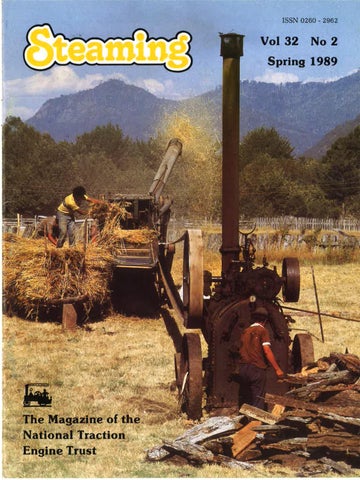
Cover Threshing by steam in Chile, South America in January 1988. The 8hp Ransomes engine, number 40083, is one of several British portables featured in an article in this issue and the threshing drum is by Case, of America. (Ian Thomson) 59
Trust News From the Chairman Elsewhere in this section of the magazine, we announce the establishment of a Legislation Fighting Fund. This Fund has been established by popular demand following the concern at affiliated clubs and Trust members about the effects of future EEC legislation on steam preservation. We are grateful to those who have already subscribed and look forward to receiving substantial and continuing donations to this very important fund. Since our objective is to combat any threat of adverse legislation stemming from Britain's membership of the EEC, it is important that all members understand the current action that is being taken by the Federation of British Historic Vehicle Clubs, which as I have previously explained in this column has been formed to present a united front on behalf of all the various preserved vehicle interests in the UK. At the present time, the FBHVC employs a political lobbyist, familiar with the corridors (and the byways!) of power in the European Parliament, to alert them of any matters adversely concerning preserved vehicles, and to make representations to MEP's and Euroci ats cunusniiny suuli matters Ull our behalf. The Trust, as a major member of the Federation, has to bear a share of the cost of this representation. At this time, the Federation is not aware of any EEC plans to drive old vehicles off the road and, despite certain Inaccurate publicity in the press, no one from the Federation has said any such intention exists. What has been said is that legislation coming from Europe in the process of harmonisation prior to 1992 could have serious implications for the movement, with the attendant possibility that certain freedoms, which we currently enjoy, could be lost. There is no doubt that the publicity, albeit inaccurate, which we had last year has brought the strength of feeling among all sections of the preserved transport movement to the attention of the politicians. By and large, we have no political enemies, so 60
we are in a strong position, but it is essential that we do not let this be eroded. Therefore, there is great danger in hosts of enthusiasts writing to MPs and MEPs at this stage. All this does is to occupy their time in replying, the reply being that there is nothing to worry about, but the risk is that a potentially important ally could be alienated. The time to bombard our politicians with letters is when there is a serious and concrete threat to our continued freedom to use our steam vehicles. When that time comes, the Federation and the Trust will press all members and affiliated clubs and organisations to write to their MEPs. The EEC legislation is a long and tortuous process and apart from the cost of funding our current representation, further expense may suddenly become necessary at some future date, should a specific concrete threat to our activities be revealed. For this reason, it is vitally important that we build up our Fighting Fund now, because if and when money is required, further representations will be costly, and the need for action immediate. On quite a different note, I was surprised to note so little comment from members in reply to Chris Edmonds provocative dissertation about boiler safety and insurance in our Autumn issue. Perhaps this shows good sense from the membership, who did not consider such a load of nonsense was worthy of a reasoned reply. Chris has been around the rally scene for many years, and I suspect he knows as well as anyone the importance of taking every step possible to ensure that no serious explosion or uncontrolled emission of steam ever occurs on a rally field or the public highway. I can certainly recall from personal experience the concern — akin to panic which Chris experienced when a certain showmans engine's firebox perforated with attendant fizzes and sprays at Appleford Rally many years ago, fortunately with no serious consequences. Of course, traction engine boilers, in accordance with most of Victorian practices, were over-engineered in comparison with current standards,
with high factors of safety, and it is probably for this reason that so many engines survive to this day. However, very few engines are now less than fifty years old and quite a few almost double this age; fifty years during which most of their boilers have been operated using all sorts of doubtful feed water. Although many components have been replaced, there is always the danger of corrosion and wasting remaining undetected particularly within the water space, therefore it is essential that both boiler inspection and operating standards be of the highest order. The boiler pressure gauge serves the engine driver in two ways. Firstly it advises him of the steam power he has to draw on when travelling on the road or driving a load. Secondly, it advises the driver if the safety valves are maladjusted or malfunctioning and it is for this reason that the working pressure, at or near which the safety valves should open fully, is so clearly marked in red on the gauge dial. No sane or responsible person would want to be standing on or near an engine with an overpressurised boiler, especially without warning and the consequent opportunity to take immediate remedial action. So enough of this nonsense Chris, and please use your undoubted journalistic talents to better effect, such as our EEC Campaign outlined above. (Peter Barber — chairman)
Engine Owners Column Engine Owners Sub-committee I am pleased to introduce some new members of the Engine Owners Sub-committee: • Andrew Black of Northumberland • Steve Durance of Derbyshire • Barnahy Newton of Berkshire • Andrew Semple of Shropshire If whilst out and about at events this summer you meet up with any members of the sub-committee, then do let them have your suggestions, comments etc.
From Allan Martin's Collection
44
associated 'consumables'. If any reader would like to let me have further names for inclusion in the Register then contributions will be gladly received. The sub-committee are also working to produce an updated list of suppliers of engine transfers, and the location of surviving manufacturers' records and drawings. It is intended that this will also be published in a forthcoming issue of the magazine. Finally, my thanks to Phil Johnson and Keith Shakespeare for contributions to the Register. (Nick Barker, chairman, Engine Owners Subcommittee) Insurance notes
Having hitherto not shown an engine in this feature made at the Globe Works, Northampton, I hope this 5 ton Allchin wagon, 156 of 1913 (NH1020), will interest readers. It was photographed about 1914 in Pickering, North Yorkshire, when on hire to George Ward Ltd, Furniture Removers of Harrogate, carrying one of that firm's lift vans and hauling an older ex horse-drawn pantechnicon. The wagon was in the ownership of C.H. Johnson of Killinghall, near Harrogate, and he stands proudly on the right.
One suggestion already received is that the Trust consider organising driving instruction or training, possibly combined with a social event. The session would ideally be aimed at the newer or novice engine owner (or indeed prospective owner► . The Road Roller Association have been running some commendable training courses in the skills of roadmaking and it may now be appropriate for a more general training event. This would perhaps be centred around two or three engines with basic tuition in handling an engine, routine maintenance etc. Before your committee explores this proposal in any detail it is essential to establish the likely support, and we would appreciate the views of as many readers as possible as to the need for such an event, and suggestions on its form. Similarly, if any individual or preferably an affiliated club would be prepared to host such an event on behalf of the Trust, then please let me know (address inside front cover), if there is not sufficient interest then obviously the idea will have to be dropped. Since the last issue of Steaming I have been in contact with Sydney Smith-Dennis Ltd of Nottingham in
response to the letter from their technical manager Roy Edwards. He has confirmed that they are able to supply 4 inch eccentric type steam pressure gauges with dials marked solely in lbs per sq inch, having flanged brass case and brass bezel, %in bsp fitting with 0-350Ibs range. The firm has a minimum order charge of £50 but has indicated that if a quantity of gauges be grouped together and ordered en-block, then a unit price of £38.95 plus VAT would apply. If sufficient members wish to take advantage of this order, then I am prepared to co-ordinate the bulk order to secure the price advantage, subject to a small handling charge towards Trust funds. Please write to me as soon as possible with your requirements. Providing there is sufficient response I will obtain a bulk order — please note this offer will only be open to Trust members. A large amount of work has been put into the Register of Suppliers and Repairers, and we are now looking towards publishing a first extract in the autumn issue of Steaming. It is envisaged that this initial portion will feature names of suppliers of mudhole door joints, gasket materials and other
Insurance brokers John Scott & Partners, who run the official NTET insurance scheme, tell us that the claims experience from last season has been better than in previous years and that this should stand us in good stead where future premiums are concerned. Perhaps it would be a good idea to remind members that where comprehensive insurance is taken it is, in fact, an All Risks policy so far as the engine is concerned and any accidental damage, fire or theft which occurs would come within the scope of the policy. The law has changed recently where Third Party claims are concerned, but the NTET policy has been updated so that it still meets the legal requirements. One question recently asked was whether the boiler explosion cover included explosion of other parts under steam pressure such as the cylinder and, of course, we confirm that this is covered, as indeed is steam piping and any other part which is under pressure. It is very gratifying to note that there has been a significant reduction in low-loader accidents but this only goes to show how important it is for members to take great care to secure engines properly to low-loader trailers, for inevitably, a vehicle falling off is going to result in a substantial claim on the scheme, which has in the past had some effect on premiums. Where steam rollers are concerned, members are reminded that a special driving licence is required and that if they do not hold such a licence having passed that test, it is a condition of the insurance that the vehicle displays L plates. We have, however, a special dispensation that on rally fields not subject to the provisions of the Road Traffic Act an L plate need not be displayed. John Scott & Partners tell us that they are always happy to deal with any queries which members may have and 61
DEEP NAVIGATION COBBLES
1103
PDPuels
OAKDALE COBBLES
-1I .41
LOW LOW PRICE
(400A4 ,TIRACTION
r I171
,
WELSH DRY STEAM COAL
25kg
193 PER TONNE EX SOUTH COAST DEPOTS Cheque required 7 days prior to collection or cash on collection I TONNE SHRINK WRAPPED PALLETS AVAILABLE (E5 REFUNDABLE DEPOSIT) CALL SALLY RYE or CAROL SUBIRATS on
0705 291222
1st APRIL TO 1st SEPTEMBER 1989 PREPARED IN COLOURFUL 25KG BAGS
AT MARKETING DEPARTMENT, POWELL DUFFRYN FUELS LTD, BROAD STREET, PORTSMOUTH P01 2LB
HAULAGE IF REQUIRED CONTACT Richard Preston & Son Ltd e.g. E12 per tonne to Eaton Socon Depot Cambs. (Clive Eaton: 0480-213200) or EIS per tonne to Potto Depot North Yorks (Malcolm Horton: 0642 700243) — for other delivery locations phone Prestons for quote.
that David Franklin, although he is now Secretary of the Vintage Sports Car Club, is still acting as a Consultant to them and is always pleased to help members of the NTET with any queries over their traction engine insurance. NTET Discs With the fast approach of the rallying season could I please remind all engine owners of the Trust's insurance disc scheme. The scheme is for the benefit of owners who make their own inspection and insurance arrangements. If such owners care to send me proof that the engine has been currently inspected and insured for both boiler explosion risks and public liability (we recommend for at least £500,0001, I will then send an NTET insurance disc which can be displayed on the engine, enabling rally officials to see the engine is fully covered in accordance with our Code of Practice. Having the disc on the engine means that you don't have to show all the relevant papers every time you go to a rally, let alone remember to take them with you in the first place and then look after them during probably hectic times. 62
Any owner who insures with the Trust insurers John Scott & Partners will automatically get a disc each year with his renewal. Could I remind engine owners that it is a requirement that following the 'cold boiler inspection' an 'in steam' inspection must be carried out to complete the inspection. (John Hirons, Insurance Officer)
Rally Organisation Rally sub-committee The traction engine year can be divided into two more or less equal halves. During the summer — essentially the practical one — we spend much of our time either going to rallies to see the engines or, if lucky enough to be an owner, indulging in all the various activities necessary to keep an engine in good condition. During the winter there are the many social activities and meetings of various types to occupy the enthusiast. The Rally sub-committee, too, has its year
in the same two phases. Our most important phase is during the winter. During this time we have two Conferences of Rally Organisers and Affiliated Club Officials, one in the Autumn and the other in the Spring. Arranging a Conference takes quite a time and not a little effort on the part of the officials concerned. The next conference will be over by the time these notes are read and will have been held in Birmingham. I hope it will have produced useful ideas for our future consideration and possible action. Incidentally the Autumn 1989 Conference will be held on Saturday, 30th September 1989 at the Victory Club, Marble Arch, London which proved such a satisfactory venue last December. Perhaps all officials will note the date and endeavour to be present. In January we attended the Excursions '89 Workshop held by the English Tourist Board. This travel show is aimed at the Day-out Excursion organiser with representatives of the travel trade and coach operators present. We were able to distribute about 200 packs of the up-to-date
rally list and those leaflets we had been sent; but we can only do this in respect of the dates and hand-out material supplied to us. I would like to thank those organisers who did send items for distribution. We produce a list of Approved Rallies each year which appears in the Spring edition of Steaming. At the time of writing there are 74 events on the list. Although the size, scope and location varies considerably there should be an event that each member can visit. In closing I would like to thank all members of my sub-committee, particularly Ron Copp our approvals secretary who compiles the rally list, for the considerable amount of work put in. This is greatly appreciated. (Eric Fillmore, chairman, Rally subcommittee)
Standard Rally Entry Forms Following the request of delegates attending the Autumn Rally Conference in December 1988, that the Trust should produce a standard rally entry form, such forms have now been printed and are available for purchase and use during this coming season. Two variations are available, one covering steam engines and the other intended for internal combustion
entrants; both include blank space for the title and date of the individual event to be inserted. The forms are supplied in packs of 50 and are priced at £4.85 including VAT and postage. Cheques should be made out to 'National Traction Engine Club (1984) Ltd' and sent with order (state clearly how many packs of each variety) to the Chief Executive, John Crawley, Bunkers Hill House, Badby, Northamptonshire NN11 6AW.
Obituaries Harold Hearn With deep regret we note the passing of Harold Hearn in January, aged 84, after a short illness. The steam world has lost a real man of steam with his passing. He followed his father, on leaving school, to work for T.T. Boughton at Amersham Common. He drove many of the motley collection of engines the firm had including the only one they ever had
from new, Fowler BLACK JACK, and the duplex cylindered Foster roller rebuilt from the experimental Pedrail engine — the one which had elephantlike feet arranged round the wheel rim. Harold later left and worked for Jesse Wright of Chesham, hauling round timber with first a large solid-tyred Sentinel timber tractor until that gave way to a Latil and then a Douglas. Then came a return to Boughtons in 1954 and work in the machine shop on a centre lathe. Many members will remember Harold with the 6 ton Foden C type which was rallied from 1956 until his retirement, which coincided with the final season for Boughton's steam ploughing contracts. Many of the engines restored and rallied from the Amersham stable were the result of Harold's work. He always kept any engine he drove immaculately clean and steam or smoke only came from the chimney — not the safety valve or piston glands. During retirement he was a busy modelmaker and assisted David Wren Davis with his engines until last summer. Many of us are far wiser from the
Burrell showmans road loco 2668 of 1904 BRITANNIA steaming along in a world of trees at Prestwood, Buckinghamshire in July 1986. (Clive Hollingworth)
wealth of knowledge Harold Hearn imparted willingly to we youngsters. We extend our sympathy to his widow Dorothy and to his family. A man with many fascinating tales to tell, which he did with never, to my knowledge, having to swear. A great loss to us all. (John Bush)
tar tank for Aberdeen County Council. He later attended all the traction engine rallies around our area in charge of various people's engines; the last few years helping me with William Nicol's Clayton agricultural engine 47040. Sadly, William Nicol also passed away the day atter Billy. (Alexander Gray)
Jim Proctor I regret to record the death of Jim Proctor of East Bridgford, Nottinghamshire. He passed peacefully away in hospital on New Years Eve 1988. Jim was born in 1907, and brought up in the village of Roxholm near Sleaford, Lincolnshire where he followed his father and elder brother into the employ of Messrs Cole Bros, the well known contractors and engine dealers. By 1926 Jim was a fully fledged driver and his first command was an elderly Aveling & Porter roller — this being the first of many Avelings he was to drive and own. Around 1928 Jim left Cole Bros to join Dickinsons of Doncaster, a large road rolling contracting firm, owning forty or so rollers of various makes and types. Jim stayed with Dickinsons for twenty odd years travelling far and wide to different jobs. Nottinghamshire County Council was Jim's last employer who he joined in 1950 starting with a steam roller and finishing up on diesel rollers. Steam was always a favourite with him, and during the 1950s when rallies were just getting going he often drove one of John Blagg's engines and eventually bought an engine of his own — an Aveling & Porter roller. More followed — all Aveling & Porter rollers and all called EDNA — after his daughter. Jim sold his last roller in 1973 but maintained an active interest in steam either by driving one of his friend's engines or just visiting a rally to enjoy a pint and a chat. At his funeral held at the parish church in East Bridgford a large congregation gathered, made up of family and friends from the steam world and other walks of life. Jim was something special; he always had a smile and a cheery greeting, always ready to help if you were in trouble. To Edith his wife and his daughter and son-in-law we extend our sincerest condolences. (Steve Durance)
Jim Smith James Arthur Smith — Jim Smith — died in early December 1988. He had a lifetime's connection with steam threshing and rolling, starting work at 15 with Hampshire Bros of Ravensthorpe, Dewsbury, in Yorkshire. There, his favourite engine became McLaren 616 an engine which survives in Lancashire. During World War 2 Jim went to work for Josh Rodgers at South Crosland, Huddersfield on threshing engines and steam rollers and then, for the last 17 years of his working life, he was employed by Spenborough Council, driving Fowler roller 15854 until it was retired and replaced by a diesel in 1969. Thus Jim was probably the last man to drive a steam roller full time commercially in Yorkshire and was visited in the latter days of the Fowler's use by many enthusiasts keen to savour the sights and sounds. In the 1940s Jim, along with Alf Pepper, Jack Wilkinson and a few other like-minded people, formed the
British Fairground Society, later to be incorporated into the Leeds & District Traction Engine Club. He was also a very early member of the NTEC, and of the Road Locomotive Society; he had the honour of being their President in 1985. In the early days of engine preservation Jim drove Fowler showmans 14862 EXCELSIOR for owners Millers Oils of Brighouse. In 1954 he purchased an engine of his own — Aveling & Porter tractor 8030 of 1913, which however he never rallied though keeping it for some fifteen years. It gave Jim a great deal of pleasure when a later owner, John Woodward, drove the Aveling to the Harewood Rally in 1975 so that Jim could see it restored and take a turn on the footplate. The hobbies of Jim Smith included model engineering and photography and during the last three or four years, unable to get out of his house so much, he printed up many negatives taken years ago and produced a large number of slides from photos of working engines he had acquired over the years. A practical and cheerful man, Jim will be sadly missed by all who knew him and his passing has made one less the ranks of those who were once working steam engine drivers. Our condolences are extended to his wife Elsie, and his daughter Dorothy and son-in-law Frank. (Norman Boyes)
William Scott One of our older members, William Scott of Turriff, Grampian, died in December 1988, aged 88. William, better known as Billy, had worked with steam since he left school and was the last man to drive the Sentinel 64
Aveling & Porter 6 ton roller 8489 of 1915 engaged on the task of compacting hardcore at Jubilee Farm, near Andover in October 1988. (Roger Newbery)
WORLD'S FAIR The outdoor entertainment weekly incorporating
'ERR.'' ⅈ;
...a. Mr
A
irr'RR.SRRNA,'E33.43.3
Rallies, News, Reports and Advertising
Place a regular order NOW with your newsagent. Something to sell? An event to promote? For all your advertising requirements there is no better publication.
For advertising and subscription details contact: The World's Fair Ltd., P.O. Box 57, Oldham OL1 4BB. Et 061-624 3687
NTEC Sales Following our practice of recent years we give, below, a list of approved rallies at which it is intended to present the Trust's Sales Stands in the first half of the season. All members and casual readers of Steaming are urged to support the stands during the course of the summer, for the profits form a very important part of the Trust's income. The sales teams will again be: • Keith and Tracey Shakespeare • David and Andrea Duffill • Ken and Edith Beeby. Reference to the Rally List will provide dates and more details of each of the short titles mentioned here. May — Abbotsfield (David); Rushden (Ken); Abbey Hill (Keith); Stoke Goldington (Keith); Carrington (Keith). June — Wymondley (Ken); Great Amwell (Keith); Claybrooke (Ken); Morecombe Bay (David); Parham (Keith); Banbury (David). July — Chiltern (Keith); Blindley Heath (David); Rempstone (Ken); Weeting (Keith); Netley Marsh (David).
Legislation Fighting Fund During debate at the Autumn 1988 Rally Organisers and Affiliated Clubs Conference it became apparent that a large proportion of the delegates were strongly in favour of the establishment by the Trust of a fighting fund for future use in combating adverse legislation affecting the running of steam vehicles on the highway.
Accordingly, at the express request of that meeting the Trust has opened a Legislation Fighting Fund, which will be a reserve fund of monies for use as and when required. Our Chairman's notes on this issue explains in further detail the necessity for a Fund. It is hoped that this column, detailing donations, will be appearing at frequent intervals; we gratefully acknowledge the following sums received for the Fund, up to the end of February. Donations received from £ National Traction Engine Trust 500.00 Great Yorkshire Traction Engine Club 100.00 Hertfordshire Steam Preservation Society 50.00 Isle of Wight Traction Engine Club 50.00 Ross-on-Wye Traction Engine Club 100.00 J.G. Anderson 50.00 D. Brandt 50.00 J. Hervey-Bathurst 50.00 S.J. Wharton 50.00 total 1000.00
Steam Apprentice Club This year sees the 10th Anniversary of the Steam Apprentice Club. To celebrate the occasion we will be arranging some very special events for the members. Although details have not yet been finalised one event that has been settled on is a birthday party to be held at the Great Dorset Steam Fair in September. The Club's Cornish section has had
a set-back because local organiser Tyrone James has had to resign due to increased business workload. The Club is actively looking for a replacement and would welcome any offers or introductions. Following the success of the Cornish secton, it is hoped to initiate three similar groups during the coming season. (David Duffill, 181 Foden Road, Great Barr, Birmingham B42 2EH).
Scania Transport Trust Awards The winners of the 1988/89 Scania Transport Trust Awards (announced in our Spring 1988 issue, page 63) were declared in February. The paddle steamer WAVERLEY, Chatterley Whitfield Mining Museum, a Fairey Gannett airplane and the steam tug MAYFLOWER were the projects unanimously chosen by the judges to be the recipients. They were presented with their awards and cheques totalling £5,000 by HRH Prince Michael of Kent, President of the Transport Trust, at the Royal Automobile Club in London. The above projects received, respectively, first, second, third and fourth prizes but the total value of awards was £10,000 which includes £250 awarded to each finalist in the year as interim winners. In all, about 160 entries were considered and the year ended with eleven finalists from which the four major prize winners were selected. All very nice, but the disappointing feature about the lists of winners and 65
finalists sent out by Scania is the nonappearance of any road steam vehicles. Surely, one asks, some of the undoubtedly good work being done on our engines can stand comparison with that done in the field of railways, road vehicles, ships or aircraft? The answer, Scania tell us, is not that road steam entries were thought to be of inadequate quality but that out of 160 applications not one was from a road steam engine owner. We find this incredible. The award organisers assure us that one man entries are just as likely to attract awards as schemes run by groups — all the applications will be considered on their relative merits. The awards system runs on a rolling competition basis, with entries being considered, and a series of awards being made throughout the Those these receiving year. acclamations later go forward to competition in the finals of the Scania Transport Trust Awards for the year. Trust members wishing to enter a project should request an entry form and information from Phil Sampson, Public Relations Officer, Scania (Great Britain) Ltd, Tongwell, Milton Keynes, Buckinghamshire MK15 8HB.
few minutes walk from Oxford Circus tube station, north along Greet Portland Street. All members are welcome, as well as friends or potential new members, and the upstairs room is available from 7.30pm. TUESDAY 25th APRIL 1989 — For the final meeting of the winter season's Social Meetings, Steve Neville returns to show more (Bill cine-film. on 'Memories' meetings London Timmings, organiser)
London Area Social Meetings
'One hears ... that some steam wagon drivers 'drink' their coke — the time lost taking water, cleaning fires and waiting for steam (in pubs) is much more than most owners imagine.' (from The Commercial Motor's gossip column, 30th October 1910).
Social meetings will continue to be held on the last Tuesday of each month, starting at 8.00pm. The venue is 'The Horse & Groom' in Great Portland Street, London W1 which is a
Stolen After last year's Abbey Hill rally at Yeovil a whistle was stolen from Jack Miles' Burrell FERMOY. It was a rare example, being a five note chime whistle with valve and five bolt flange which originated on an Australian rail loco. The whistle was on loan from David Antell's collection and is valued at several hundred pounds — with the publication of these details it is hoped someone may realise they have seen it (or have been been offered it) and will be able to help in its recovery; local police have drawn a blank. (Information to the Editor please, for forwarding)
OUR MAGAZINE 25 YEARS AGO
The Founding by the Club of a Spare Parts and Technical Advice Section was announced, to be worked on a clearing house basis. Though continued ever since this service has had fluctuating fortunes, so with availability of materials and knowledge becoming ever more difficult it is good to see recent proposals to enhance the usefulness of the Section. The derelict gravel pit at Fairford, Gloucestershire, presumed to be the last resting place of many engines taken in for scrap by Edwards of Swindon, was being cleared. Robinson & Auden 1376 (AD8889) and Fowler road loco 9177 (AD8930), both local engines which had stood abandoned for years, had gone for preservation but 18 or so other engines and rollers remained. Apart from the two mentioned, few others have yet to appear on the rally field. In Eire, Aveling & Porter E type 10617, on loan to the Transport Museum Society in Dublin had appeared at a D-I-Y exhibition — whether to illustrate hobby engineering or self-help road maintenance was not recorded. Much news of preservation filled the magazine — virtually all the magazine supplied by eleven correspondents. For £200 Tipton (Staffs) Council had disposed of their AvelingBarford 6 ton roller AG785.
W bl G HEDGES d SONS BOILERMAKERS AND STEAM RESTORATION ENGINEERS Boilers of all types built or repaired. Wrought iron boilers a speciality. Coded welding to ASME 9. Tenders, smokeboxes, chimneys, etc built to order. We now offer a full machining and fabrication service, plus cast iron welding. Written enquiries to: 33 Cheney Road, Faversham, Kent or phone: Medway 826555 (day), Faversham 538128 (evenings) • WINNERS OF THE 1987 STEAM HERITAGE AWARD FOR ROAD ENGINES •
66
Mike Jones Marshall's 5 ton Compound Tractor number 68754 left the Gainsborough Works on 19th July 1915. Registered BE 2864, it was supplied through Thurlows of Stowmarket to F.G. King of Ipswich, also trading as the Eastern Counties Haulage Co, and was subsequently employed on general haulage and furniture removal duties. According to the maker's erection sheet for the engine the awning sideboards were half an inch deeper than standard and it was fitted with a bell (not a whistle) fixed to the awning supports to the rear of the manstand, and painted in blue with white lining and aluminium boiler bands. One can only wonder why F.G. King bought from Gainsborough when Ransomes made a similar tractor not much more than a stone's throw away in the same town. The cost of a Marshall steam tractor in 1920 was £1127 with free delivery by rail; Wallis & Steevens' equivalent then cost £850. No photographs have turned up of 68754 in King's ownership, but I have been fortunate in obtaining a photograph of a Garrett wagon worked by F.G. King and one might presume that the trailer pulled by the Garrett was at some time pulled by the tractor. A note of other engines owned at various times by Eastern Counties Haulage may be of interest — two further tractors were by Mann's and Garrett; wagons were represented by three of the superheated Garrett 5 ton overtypes and a secondhand Foden and then there was a 7hp Garrett traction, again secondhand. Little is known of 68754's first years around Ipswich, but it is rumoured that it was commandeered by the War Office and put to work towards the war effort — a not uncommon fate for steam tractors about 1916-1917. Alan Duke's painstaking researches into engine history reveal what happened in the next ten years however. From the records of Thurlow's of Stowmarket, Suffolk, we find the tractor, through their arrangement, went to the well known firm of dealers Cole Bros of Roxholm, near Sleaford in Lincolnshire in August 1919. By September 1920 it was being used by showman Arthur Proctor of Derby, and it was he who had the Marshall re-registered CH2462 in 1921, and possibly named it MASCOT. However, by 1922 it was back with Coles — maybe it was a hire purchase arrangement that faltered, or the end of a couple of seasons' hire or just simply a case of selling it back when circumstances changed. Coles then must have thought the tractor
Marshall 5ton STEAM TRACTOR
68754
The 'Marshall Steam Tractor with compound cylinders' as shown in the makers' 1921 catalogue. The illustration shows how the tractor appeared about midway through its production run of 131 examples built between 1911 and 1930. 68754, the subject of this article, was very similar except for the brass makers plate — rather than the large circular type, it has the earlier rectangular sort. Other engines had the plates replaced by an owners plate on one side, or by a Marshall 'Britannia' transfer. The tractor illustrated here is fitted with the earlier design of smokebox door hinge. On 68754 the original rear wheels were as this picture but were later replaced by the roller conversion type. After World War 1 MarshaIls rear wheels were made up with a smooth face for finishing either with endless solid rubber tyres (for a tractor) or with plate rolls (for a roller). (collection Welland Valley Club) 67
One of the Garrett superheated overtype 5 ton wagons, owned by Eastern Counties Haulage Co, Ipswich (F. G. King, manager). It is engaged on a furniture removal, seemingly on sub-contract or similar to Footman, Pretty & Co, the local house furnishers of Ipswich whose business and property is now part of the Debenhams group. The entourage is standing outside the Bethesda Baptist Church at Ipswich, on St Margarets Plain leading to Fonnereau Road, but just where it was bound for, and the date, is unknown. (collection R.A. Whitehead)
would sell more readily as a roller and accordingly made arrangements for its conversion. Marshall's own records state that a set of front rolls and forks and a pair of rear rolls to convert the engine to a road roller was ordered by Coles on 25th August 1922, at the cost of £300. Although Marshalls' ledgers do not confirm the fact, Coles put a new firebox into the engine at this time — I was told this when I acquired the engine from the eventual purchasers in 1969, and further confirmation came to light upon the removal of the firebox in July 1984, when evidence of gas welding on the boiler backhead from the water space side was discovered. Coles advertised the rebuilt roller for sale in various places from 1923, including a long run in Phillips Machinery Register from October 1924 to April 1925. The times, perhaps, were not right for a good turn over in such machinery as small road rollers, but by April 1927 a deal was completed with Robert Bridson & Son of Neston, Wirral. Marshalls supplied Coles with a new safety valve connection and cover that month, maybe 68
at Bridsons' request, and in due course the roller was delivered to Neston together with her original tractor front and rear wheels, though these, as far as is known, were never fitted to the engine again and eventually went for scrap. Bridsons bought the engine because as a conversion from a tractor she was fast, and could keep up with the tarsprayer during the season of rolling chippings into newly laid tar. By the 1920s the firm of Robert Bridson & Son was well established as a haulage and threshing concern using steam as its prime mover, as, indeed, they did until the demise of the firm in 1967. In the yard at Neston the Marshall joined two road locomotives — Burrell 3098 of 1909 (MA5657) and Fowler 15376 of 1920 (MA5656). The Fowler was used for threshing duties during the winter and for supplying steam for heating tar in the summer. The Burrell prior to 1920 had been used for threshing and haulage, moving furniture for Browns of Chester not just locally but as far as Cumbria in the north of England, and Machynlleth in North Wales. There still lives a
gentleman in the Ruthin area who remembers the Burrell threshing during World War 1 on a farm at Hawarden near Chester. Other duties included using Marshall traction wagons to transfer lead ore from the mines at Halkyn near Mold in Flintshire to the railway station at Greenfield at Flint for onward transhipment for processing. With the coming of the Fowler in 1920 the Burrell was converted to a tar spraying unit; the Marshall traction wagons were converted to tankers and with the acquisition of some Fowler patent gritting hoppers tar spraying was ready to commence. The Burrell with its accompanying tackle, together with Marshall 68754, carried out tar spraying duties over an area from Machynlleth to Birkenhead and as far south as Newtown in Montgomeryshire (now Powys). For the latter destination both engines would leave Neston at 6.00 in the morning and both would be in Newtown by 6.00 that evening, hauling all the plant required for the tarspraying behind each engine. The Marshall roller accompanied the Burrell for some twenty seasons until by 1947 the latter was put on one side and replaced by Sentinel DG4 8122 of 1929 (0F5783) as a tar spraying unit and with Sentinel S type 8942 of 1934 (ATN320) as a tar tanker for supplying the sprayer. For the next twenty years the Marshall continued to follow the tar sprayers during the season and was also use-
fully employed rolling hardcore on new housing estates springing up in and around the Wirral. During this time 68754 had been joined by Fowler roller 17500 of 1929 (CM9858) acquired from Birkenhead Corporation. During her time at Bridsons the Marshall was looked upon as a shy steamer, a shortcoming no doubt helped by the confined roller smokebox and the large Aveling front roll, fitted to replace the smaller roll supplied by the Marshall works. This was done, one can only surmise, to increase the compaction of the chippings into the tar by a heavier front roll. During the fifties and sixties when I grew up very little road steam remained in use; there were plenty of steam rollers but wagons and traction engines were decidedly rare. I recollect seeing the Sentinel wagons of Castle Firebrick Co of Buckley, near Mold whilst a passenger on the upper deck of Crosville's double decker buses; in fact the house where I spent the first thirty years of my life was built with bricks delivered by steam wagons. But after 1956 these wagons plied the local highways no more. The last of Castle's Sentinels, 9075 (BEV467) left Buckley in 1964 as a hulk, for rebuilding in Yorkshire. The only engine I then saw was a Foster Wellington tractor which was parked from 1948 to 1963 next to my old secondary school playground in Ruthin. This tractor, 14514 of 1925 (CA8534) is now owned by Denis Brandt in London and was removed from Ruthin in 1963 for the princely sum of £50 by L.J. Lambe of Bromsgrove, Worcestershire, possibly after visiting the owner in the course of business — the latter had a works making boiler tube brushes. During the early sixties I was fortunate to become associated with the Lloyd Jones Brothers of Llanfair DC near Ruthin. In those days, it was still possible to hire out steam rollers to various local authorities and earn a reasonable living for oneself whilst doing so. At one period or another during those times Marshall single roller 77017 of 1924 (MB3604) and Fowler roller 21628 of 1937 (FF4912) were working for the then Denbighshire County Council. I used to follow these rollers and visit them when I could if only to clean the chimney top on my way to work for 8am. In 1966
Raising steam in Robert Bridson & Son's yard at Quarry Road, Hoylake in the summer of 1954. Getting ready for work are, from the left, Sentinel DG4 8122 of 1929, Sentinel S4 8942 of 1934 and the subject of this article Marshall roller 68754. (E. Lloyd Jones)
The Marshall roller leaving Bridsons' yard for the last time during Spring 1969, on a low loader which cost £10 for the 40 mile round trip. (Mike Jones)
Marshall 68754 soon after purchase Aveling lamps purchased locally for restoration in 1969. A pair of grace the front forks. (Mike Jones) 69
Details of the make-up of Marshall tractor 68754 as set down in the maker's record books. (courtesy Henry Marshall)
Ala. 77e . 7 6k.1- ,
, r Ton/ (ote t;.1 .
..
1 9 , wi.t.v,
, A. .e F/0-4-
.1'
14Lrait4 t,r . 1 Crode a PretaZfidary 191 .tat d SPRING MOUNTED ..' . Er ador t11•64-4. HIND & 1.11UNI. vyjii.e, , Le ErtiothagAYo. 4%0I visited my first traction engine rally at Church Stretton. Then, during 1967, the principal of Messrs. R. Bridson & Son passed away; overnight this old established steam business ceased to trade. Over the next year or so the Sentinel S type tanker went to Dave Webster at Ludlow, and the Sentinel DG4 came to Ruthin for further use by the Lloyd Jones brothers, as did Fowler 17500 of 1929 (CM9858). The Burrell 3098 which had been kept under cover at the works since 1947 went to the Liverpool Museum. I was fortunate enough to be offered Marshall 68754. However, I bought her with the knowledge that the machine had major boiler problems (just how bad I waited 15 years to discover). Apparently the back head had caused problems for years, with traces of major welding repairs visible upon close inspection. It took nine months of saving out of my twelve pounds per week pay to acquire the agreed sale price. During this time I did not dare tell my parents of my acquisition. Only on the day of low loading the engine to its new home did I summon courage to reveal the truth. Getting the engine home was done by a local plant hire company — £10 for twenty miles. How things have changed. That was in 1969. Between 1969 and 1984 I quietly steamed the roller a couple of times, without insurance, I might add; a local newspaper did an article on myself and engine. I also had to move the engine to a new location, using a Marshall single cylinder diesel tractor. Although some thought the engine was forgotten and discarded, she was well oiled, sheeted and ventilated and stood on railway sleepers to keep her feet warm. During the seventies, I continued to visit rallies and was able to assist the Lloyd Jones Brothers with their engine fleet, which now numbered five. It has always been my intention to restore the Marshall back to tractor form. Being introduced to the preservation world through the medium of vintage cars, I was taught, and still believe, that restoration back to originality is the only proper course of action. If the Marshall had been built new as a roller I would have restored her as a roller; however she was not and hence restoration as a tractor was my aim. During the engine's long sleep I 70
•-.. ,.!..,
sg/.7.42)
NsmArtRi§,
retgx
.i kali Di
4 'Wee k- .c.Keirek 51.kog Care 4#,_ x 1
General Plan Cylinder
a ee,247.4.irkt er/eZ.(A;17ed
Cocks
r.el4.761.
P.
50.1eValre
le/la a YttZt, awl/ en./ Lfige,Ar &p ad oityflicit;ex.e4 (6,7-(e55a.er 4,y4,,,x,: e.4z1-4 . eizr"Al 143P7 rkt.,-/2e flan/ "e'd;faseAt, rta
i d
Lubricator A
•/er a d• .P*!0.41, •im. Guide Bare _ Cross Ifraday44a6
Diameter 5
Opy. Pulley (crank) (cylinder end)
„
30 /",4 V4, /". / 114-s: 5.2irot fitext‘fccolethite
CA:angting Rod
mak.Shaft end Axles . 4.
Ai bprining Pins
0403
Jiiladkr.eza 0-1540 , "Lea. a). ma-fe )(.14.4;
friyl, Metier
eng,h fife.
.o4-7/e .4,44tri
"Ire Rrc. Rode nine. Roll •
S•
4''S
Alteeeri. PAP•dtay‘ FA*6.40
Colt. te. utt a!
and Rod
.14.)9.4.e ot/I "Pet- 'rink:77
wive Beres
0/445.1,6 4,4e-04-4
limbt4hoots`t-Ti-767/
...At_ Valve inrout ,Catedp/fgajo
Slip
71;6 30
4.z9 deate-42:4nr)Attri711, Azir ,22 -6 PA
Feel Plate arrgt. .
.9?"1..Z11,420
9 Comm to tact
eVi rSuY
rA, 0747_,
13/elekee
ariewa • Artto-e4 1.)/Y //1(6
oke;Pe.rt-.10ti., /Ace!. L-715i4a.
X•;,
Gunk Shell Brackets • VA:median, Axle Brackets
Arai 1,44 44 4: diet.
0-24et.
E'iMr: •
46(
edo
/
te %.11eLt....416eivs-
Verde el Sep. Verdi
•
itree-Of •oryial, erarerlieia •
9,!,111.111,12 - nic 41)4
,eue144 ,,
e
Z-1•144.:,11,7 ey.kiv rale 144.4 ;geld Nitts a&if aftt.z -gd-a.ak ak,font 4 -71-0" ate"...,:q 7iegda/ ';244. i Ad./ #
/41*,.
•-
4 elt1,14:54
Pr•••,;%•
continued to look for and acquire spares which might prove useful for the engine's eventual resurrection. During the early seventies I located the 2 ton Yorkshire steam wagon 117 now owned by Tom Varley; that had been derelict since 1927. I also acquired the front end of a Clayton overtype wagon which had been fitted to a sterilizing boiler. I swopped these front wheels from this axle for some eight spoke engine type wheels from
Stan Burgess of Haddenham; he hoped to reuse the wheels on his Clayton steam wagon, then in the process of restoration. During the winter of 1975 and the spring and summer of 1976 Dick Woolley from Craven Arms came up to Lord Newborough's Estate on the A5 at Corwen to dredge a large lake with Fowler BB class ploughing engines 15194 and 15195 now with the Science Museum. These engines took eight
Drawing.
7-
Crank Pinions
4,2(.57
REMARKS.
ataaii4— iuv19,6"-,
P.M- -I // let y _
Sliding Pinions
'4
9
pg
klmivo Biaioxo.
/47,,
„ Wheel /
4 /072
(6.41 caf; Y. ( -1) 1/16-6
Main Spot Pinion //4 „ Ring ,) 2 I
43-4
Bevil Wheel with boss44
4766/ ,
without brod.44
,, 1 i.).35vfiv‘4 ..7//q/9
4
/Amyl
.
/YE-1'41 :e
AO?' „IX/4e Compensating Body
014•6st
• .f
Front Wheels and Axles FrouL.Rollers
77; Centexa
.444'
3i
Road Wheels[/ 70 A /.2/ 2. .r..1 11-0 2
/0' 31 , Aft10 Y4C/edisSO../44/415&;0 /44 Arere.r.. reoce 444 9:77.444,5 :41 yed if•:eee2 S Ilrit .1.4 A 1 eeee 4 Mee TAW/ it.14-3.1
Undergear Bracket Bolls,-CarrEi•ge
JRP P
-1441.
d
Sur-a-per -hrmt
„
Details-
'7.7"7
Turoplate
6_4t
W.B.
t / hdy 10. 6•, r e Slookeho Boo:
SO 10 c (44 4tite( // a ay
tong .3 Boiler No./d-A
Fusible Plug No.3
•
,fre,--,,a4.ff .efal 7;.-_,zzeze..44;:14•fe,* • . /-// 1.x18 Cola
damblo6.1. Ildesa 4440*-11.
,,,,e(// ye:;,%. f1
Spring Scat,r4 .
J44.16.‘ tia yeziele,,ger/Zy mirOlffeterte,oi u, . Basle' In reipm-linetei Manhole, 1,•44•0 5 r 505: "."'"'
A iv ni rig /-pyl
Fj6jg
Chimney i,a,)
62pr
Chimney Base /0,9 4 Exhaust Pipe pR42,34
ri/fika
Pressure Gauge No-
.__ Water Gauges dam W•birrele,gdeery 6e4,11
Mudholes0
ty'rerrAidal
Toolbox ,er,..a/
o-r
NTE "
D..
Gram &us
Footplate A!
4kdiam.
Mu41--6elleeser
e 60 2?, 4 4.14?•11 -,972
Eire
Fore Took
if Tubes
,y5-/O-
Li0 I LEN
Tender
244' ,-.1411 LP .4-113 ,:c-ftica • aula -6-T-0.d ski ' 9.43. 441trs&le/F W91.1 / II • 44:44!X„7 units+ Snitikebna .114Mai
4„„ /1„,,4„/
er'dviiketaiefeelt g a.m. 4 . on. long ; lop._ .sit atehrf4serice6.40.4dst)i'ke.fi k44:404, 4.4.41W 114/.1 • . I. r i, Rea Yank' grad :4,0,-hev:. Snihoel { ¢'
clue/0
o.Z sFla
./.3 a•r:CW"V'ee/Cle. Friiii, t
N. Oose.ol ..0 .114 0,111e4i of-0;J'
1..trel
to J P1.."•'' r"-.. ..04,764XCAKe gilboc(4701V4tetie Water Lifter / 4P, a/006 Jo. ' R. .1 ludaakeze,94,47NeGV/Arit, /52 dey 'cam, z ty4zni, rfia.‘d ord.a:de. laiMWotarlYertideifq/rOy. 5-031P /LsrliPsotrit'40 / &tr . ha ceely grel fe{corekeieZde,' A'-gg ., D.W.44414 Finish/o7;,,e 9 ,,,,./( 4 &, ?Mgr &UMW. 46
:„_ Blow-off Cock A ,64/ ,
/Se
. Steam Jet 07„rpa./trym,
Spanners lee" .'. I. .
K
Firing. _.— .,'Ai4,
PI161 I rciwool'edoor ireeh'
f 4r„,„,...,i.t,,,,,..6,74 te eel/Lehi:roc Ail a 4000447 /
fdi 0 w" 4. UV.
months to do the job and during this time Mr Woolley told me of a farm on the Newcastle Emlyn road out of Clun, in Shropshire, where he had threshed before the war. Here, he told me, he had seen a great many steam tractor wheels and axles awaiting their turn to be fitted to farm trailers, presumably replacing horse-era wooden wheels. Though a great deal of water had flowed under the bridge since then, one Sunday soon after I heard of this a
•
,..,..
" /51 2thf Ie. (1
visit to Clun was undertaken. The second farm I visited on my quest was the one visited by Mr Woolley and his threshing tackle all those years ago. Furthermore two pairs of wheels together with axles still remained at the farm! One set was by Howard of Bedford and was located in the farmyard. On this one, though the wheels were of the correct type, they had only a single rivet connecting the spokes to the T ring. The other axle was located
some hundreds of feet above the farmhouse and was a Tasker timber drag axle and wheels — and it was almost exactly right for my Marshall. Furthermore the hubcaps were screwed rather than bolted onto the wheel hub as per genuine Marshall steam tractor front wheels. Needless to say a deal was concluded for the wheels, and a further trip was arranged to transport the items home. Through the good offices of Fred Dibnah at Bolton it was organised for the rims and tyres of these wheels to be turned to an acceptable profile as it was obvbious that during their lives they had been subject to rough handling. Eventually, during the early eighties, I was lucky to acquire five brand new solid rubber tyres out of the scrap pile in a Wrexham scrap yard for £10. A local engineering works fitted them to the wheels for a further £90. Drawings had been obtained over the years from Derek Kilburn at Worthing for the remanufacture of a proper Marshall steam tractor front end as per ex works. These were now used for a smokebox door and front and rear smokebox rings were manufactured as drawing by Abbots of Newark; the parts were picked up by a haulage driver who lived across the road. Tubes were also acquired, £20 for a complete set. These were carefully stored for future use. From 1979 the Marshall ceased to by 'my' engine, and became 'our' engine. The reason — my marriage to my wife Nerys, and the eventual birth of my son Hedd and daughter Elen. I had also inherited a stepson and stepdaughter who came to know rally fields quite well during the following years. During the early 1980s it became obvious that engine repair costs were soaring. It also became clear that many engines were becoming life-expired as far as their boilers were concerned, some even having spent as much time in preservation as in use. Hence, there were people prepared to set up in business to carry out boiler repairs. In 1982 and 1983 at the various traction engine rallies and gatherings we attended, enquiries were made with anybody who had had work done, or knew of someone whose engine had been repaired. Two main criteria were of concern to us — first was obviously the cost but secondly was the journey time to visit the works whilst the engine was under repair (with small children this factor was very important). Eventually, a visit was made in spring 1984 to the works of Stuart Woodbine at Chesterfield. A decision was made to send the boiler to his works for rectification. This 71
decision was made believing that only the backhead and the firebox of the engine would need to be replaced. Even this might be difficult from a technical point of view as Stuart had never replaced a complete backhead to a boiler, should the Marshall prove to need one. Upon arrival home, a place to remove the engine to for dismantling had to be found. Arrangements were made with a commercial vehicle repairer and engineer to remove the engine to a local contractor's yard, using an Albion Heavy Recovery Truck (ex World War 2) to push the roller along. At the end of April the engine duly moved to its new home and dismantling commenced on the Monday — a bank holiday. Most of the stripping down was straightforward using the well-tried technique of bottle jack and wooden blocks to lift or lower parts as necessary. A forklift truck was used to remove the smokebox casting/fork from the front of the engine. A JCB with 10ft long forks on the front bucket was used to remove the canopy and this was transported home on the roof of my Ford Transit van. The biggest headache with the dismantling programme materialised with a visit from the owner of the yard early one Friday morning. He asked if we could finish the job by the following Monday morning as he wanted to construct a concrete plant on the engine's present position. This presented major problems as the engine was by then without wheels and axles. However, with the help of my best friend, work continued to take apart the engine whilst the contractor cleared the site all round. With the parting of the tender from the engine, the boiler with top works was moved away to another position with a Manitou fork lift truck. Here the flywheel and crank, still attached to the bearings, was removed from the boiler, again using the forklift. The piston rods, eccentric straps, and remaining plumbing were then taken off prior to the boiler being transported in July to Chesterfield by Land Rover and trailer. A word of thanks here to the Millington family of Whitchurch for their kindness in transporting the boiler to Stuart Woodbine. On arrival Stuart saw just how bad the exterior of the backhead was and commented that it looked as if he would have to learn how to do a complete backhead renewal on our boiler. Using the Woodbine patent tractor crane with no steering wheel the boiler was eventually unloaded to join the Pearson brothers 1910 Burrell road locomotive and the Fowler road locomotive ex Mathy in Pembrokeshire, 72
The first stages of dismantling in May 1984 comprised the well practiced use of jacks and wood blocks. (Mike Jones)
the latter one of four engines I viewed derelict fourteen years previously in Pembrokeshire. Little did I think then that my Marshall would join one of these hulks in the same repair works. Following the 1984 Bishops Castle Rally another journey was made to Chesterfield to view the boiler with the firebox now removed; it was in poor shape. As stated earlier, the Marshall had been reboxed in 1921. During this
earlier renewal the backhead was found to be cracked. Some gas welding had been undertaken from the water side but when the new box was put in these repairs had caused further stresses leading to more cracking of the plate over the years. The repairs and materials used to stop leaks through the backhead were quite visible from the water space side, with large chunks of steel welded into the backhead from the outside and ground
After a further 50 hours of work the boiler needs only its topworks removing before the journey ro the Sutton Spring Wood boiler works. (Mike Jones)
flush, but protruding into the water space some considerable distance in some instances. The corners of the throat plate were also cracked. During the visit it was agreed to remove and renew the tubeplate, throatplate and backhead together with the firebox. Further, the foundation ring was badly corroded due to sediment, present in no small part because of The stupid position of the mudlids on these small Marshall tractors. The firebox crown was also badly corroded, with no rivets showing at all. A particular design fault on some of the early Marshall 5 ton tractors was the spacing of the stays. These were quite wide apart at four inch centres. This meant that if one stay broke it was imperative to renew it straight away, otherwise the remaining stays, if wasted, would not be able to withstand the added strain. When burning out the old firebox it was found that all the stays on the throatplate had broken. With a belly tank fitted to the engine it would have been quite difficult to detect these broken stays when working in any event. By September 1984 the tubeplate had been removed and further inspection caused Stuart to telephone me with the news that the barrel was suspect. Though my detailed diary of events during 68754's reconstruction does not record this event, I seem to recall that at that point it became inevitable that I give instruction to go ahead and fit a new boiler barrel to the engine. Two things became clear during the last few months of 1984; one, when you start restoring an engine there is no going back for with a dud boiler the engine as it stands is virtually worthless, and two, the cost of repairs can be vast. I had been saving for some years towards the cost of boiler repairs, but some considerable amounts of money now had to be found to pay for the repair
works. Consequently, much of my collected automobile and transport related items were auctioned where appropriate — a 1931 Singer Ten was sold, and some autojumbles were attended to help defray the costs of the boiler work. It had become evident from conversations with Stuart Woodbine that very little existed in published reference books as to the various techniques employed by both railway and road engine manufacturers to produce the various component parts needed to make up a complete certificated boiler. Consequently the old techniques have had to be re-invented to reproduce appropriate boiler repair plates. To the layman, reproducing such an item as a backhead or throatplate in any size might not seem too great a challenge. However, in actual fact, it is quite an undertaking. When the boilermaker starts with a flat piece of boiler plate, knowing he wants a backhead out of it, he may have to reproduce in one pressing an item with flanges, curves, and radii in different directions. On top of this he has to allow, when making the pressing tools, for expansion due to pressing the plate when white hot, and also for contraction or shrinkage when the plate cools. If at the end of the whole operation his calculations are correct the component will fit where required with only the minimum of handwork necessary. Thus during 1985 my diary records little with regard to progress on my boiler at the Sutton Spring Wood boiler works. However, Stuart was not idle. A press from Abbots of Newark had been erected and its workings perfected to enable new boiler parts to be pressed out as required. The firebox crown had been removed from the old box and the surface of the water side of the crown was restored, using car body filler, to something near its original profile
when new, to show the patent Marshall corrugated firebox top. This was needed so that a male and female pressing former could be produced from the shape of the original corrugated firebox top. The old backhead had also been removed and it was on this item that Stuart learnt the do's and dont's of reproducing new boiler parts. On the home front spring 1985 saw each Monday or Tuesday evening taken up at a small local engineering workshop with my young son Hedd, finally putting together all the front end parts collected and produced so far. The rear and front smokebox flanges were fitted and tack welded to the rolled smokebox plate. Holes were drilled for the rivets required and the whole unit was then hot riveted up as ex works. Using a template marked from the original roller smokebox, holes were drilled in the rear smokebox flanged ring for mounting it on to the boiler in due course. The former roller smokebox was cannibalized for its baffle plate and centre cast iron bearing for the smokebox door locking pin. These were then offered up to the tractor smokebox door which was drilled to suit, and baffle and centre bearing hot riveted in place. During March 1985 I contacted Edna Driscoll in Essex and Derek Kilburn at Worthing, also Leicester Museum, hoping to obtain a detail of the smokebox door hinge arrangement as this varied during the years of production of the 5 ton tractor. Though Mrs Driscoll's tractor (Marshall 65650 of 1914) was now a roller she was fortunate enough to
Two views of the old firebox and foundation ring after removal from the boiler. The wastage to the crown is very apparent. (Mike Jones)
73
The inside of the backplate. Note the extensive grooving immediately above the foundation ring, also the way the boiler plate has been cut and then pushed to the water side to fill wastage and help in the welding repairs. It was quite easy to effect such repairs in working days when grime and difficulty of access would render the work hard, if not impossible, to detect. (Mike Jones)
acquire the original tractor front end with the engine when purchased. That part of the reconstruction work was then left for the summer. Throughout the summer months the opportunity was taken to remove all the large components from the contractor's yard where the engine was dismantled to the small yard at the rear of my home. This was done by hauling the tender, flywheel and crank, and roller smokebox on small four wheel trailers and towing them home using the family car. The rear rolls were moved indoors using a heavy vehicle recovery crane. The front rollers and fork were advertised in The Worlds Fair and were sold to Alan Wilkinson of Altrincham for eventual use on his 1924 Aveling roller. At the start of winter 1985 the belly tank off the tractor was delivered to Jim Dakin at Sandbach for renewal. Soon after, Leicester Museum, who now house and look after Marshall tractor 68823 of 1915 1E1E3044), the engine made famous in Traction Engines Worth Modelling by W.J. Hughes, returned the motion side panels and the accompanying Marshall nameplate after copying as they were busy restoring JINGLING GEORDIE to original ex works condition. Not content with borrowing small parts, they now took away the roof and supporting woodwork and ironwork for copying at Leicester Museum 74
Workshops! In the meantime they also purchased my Aveling living van (ex Dickinsons of Doncaster) as it was busy deteriorating and would be just a pile of wood when my engine was finished and I was ready to refurbish it. Furthermore, I knew of another van near Llangollen on solid rubbers, which I eventually purchased — and still own. During the last couple of months of 1985 the one original rear spring was sent to Sheffield for copying. Oddly enough this original spring was made in Sheffield and dated 1915. My son and I, together with the principal of the local engineering works, completed work to the smokebox with the manufacture and fitting of smokebox door hinges (from drawings supplied by Edna Driscoll and Leicester Museum) and smokebox, also the front drawbar. The perch bracket, made some years earlier through Fred Dibnah at Bolton, was also fitted and pilot holes drilled prior to permanent fixture. The reason for this was that the top bearing arrangement needed to be fitted to the smnkehox underside and the bearing and plate for the turntable needed to be fitted to the perch bracket. As yet these items were not available, and no arrangements had been made for their manufacture. The new belly tank was collected from Jim Dakin's workshop just before Christmas 1985, and a very nice job it was too. By April 1986, 68754's boiler had been fitted with a new backhead and a trial throat plate and been pressed. A visit to the works on 4th April found the boiler upside down. The flywheel and crankshaft together with all the top works in pieces were delivered at this time, as they were required for accurate measurement purposes prior to removal of original boiler and fitting new boiler. By June 22nd the old barrel had been removed after fitting the new throat plate and the new rolled barrel awaited welding by an
An external view of the old boiler backplate shows the extensive external we/ding on both sides of the top radii, as well as some below the firehole door. (Mike Jones)
approved welder under the lean-to in the yard. MacLaren road loco 1421 of 1913 CAPTAIN SCOTT had by now joined the other engines in the yard. The last four months of 1986 saw a great deal of progress. The engine's new corrugated firebox top had been pressed and was on display at Stourpaine in September, where we saw it for the first time. By October 20th the new boiler barrel had been welded and passed and had been fitted to the carcase of the engine and bolted in place prior to fitting the cylinder block on the barrel. Stuart now required the belly tank for fitting to boiler; this was duly delivered in November. In the works, we saw 68754 on its side in the radial arm drill undergoing drilling work. The clack plate had been fitted to the boiler and it was hoped that riveting would commence during that same week. I had been able, after some years of trying, to buy a pair of Robey tractor wheels with front axle which had been fitted to a Clayton threshing box many years earlier. I had first seen these wheels about ten years previously on a farm, 'Pant y Ceubren', above Llanuwchllyn near Bala. From there the threshing box moved to Corwen some 12 miles away, but again I was unable to purchase the machine. Eventually it ended up with a local second hand dealer where, after the exchange of rather more money than I anticipated plus a replacement axle and wheels, I was able to buy just the wheels and axle. Knowing that Peter Gull of Clarborough near Gainsborough had bought Marshall tractor 62387 of 1913 (5L9940) which started life as
the maker's own 'yard engine', I offered him the wheels for his engine. He duly purchased them and I offered to deliver them over Christmas 1986. Also wanting to borrow JINGLING GEORDIE's chimney base as a pattern for casting one for our tractor, I worked out a round trip via Leicester and at the same time viewed two further Marshall steam tractors, and our own, on the way home. On our visit to Stuart we confirmed that the borrowed chimney base fitted 68754's smokebox, as by now the boilermaker also wanted this item for fitting the ring to the front of the boiler barrel. On our return home the chimney base was forwarded to wan Jones of Cardiff with haste as we only had six weeks or so to produce further chimney base castings from the original. After considerable bother over prices and the ability to reproduce the item, a foundry in the Forest of Dean reproduced perfect copies of the chimney base for both 68754 and 62387. JINGLING GEORDIE's chimney base was returned in time for refitting to the engine at Leicester prior to an outing during the Easter weekend. By mid March 1987 all the remaining parts of the boiler jig saw had been pressed, that is, the firebox sides and ends together with a new tubeplate. All that now remained to do was welding the pressed crown to the firebox sides, the riveting up to complete and fitting to the boiler. By 20th September 1987 a visit to Sutton Spring Wood revealed 68754 upside down with firebox in place, together with belly tank. After some deliberations, it was decided to fit traction engine type mudlids as per original in the new backhead and throat plate. At some time in the engine's working life these had been modified to screw type mudlids using Sentinel boiler washout plugs. The new mudlids were cut out and the firebox riveted into the boiler that same week. Three weeks later the last few firebox stays were being knocked up. The tubes had been cut to size, the ends jumped and they were ready for fitting. During the next ten days, the tubes were fitted and expanded, the
The new firebox fitted to the refurbished foundation ring prior to refitting to the boiler, October 1987. (S. M. Woodbine)
cylinder block was fitted and the boiler was filled with water for the first time in nearly twenty years. By the 20th October the engine had been moved outside and trial steamed to 1701bs pressure on wood only — Stuart was a bit apprehensive as he knew there were at least 14 feet of riveted seams to leak on the finished article! His strategy was to trial steam the boiler to blowing off pressure of 2001bs, followed by a hydraulic pressure test prior to the boiler inspector's visit. The steam trials were completed successfully with some leaks, though nothing too serious. Strangely enough under hydraulic test the joint between the cylinder block base and its boiler mounting base plate developed a serious leak under pressure. This took some curing. All the engine works had to be again dismantled and the block taken off the boiler. A new joint was made and together with some welltried techniques the block base joint with boiler was remade. After reassembly, and under further hydraulic pressure test, the joint held. All was now ready for the boiler
This illustration (also from Marshall's catalogue) shows their Patent Firebox and stayless crown, and enables a good appreciation of the work which Stuart Woodbine had to think out from first principles. The firebox top with the patent corrugation was pressed first; the sides were then welded to the crown. The tubeplate and the firehole door plate ends were pressed and riveted to the wrapper plate. The press has a tremendous job to form a flat plate into the tubeplate with the flanges radiussed in both directions in one place. The completed firebox has 14 feet of riveted seams. (collection Welland Valley Club)
inspector, who duly came on 10th and 16th November for the hydraulic pressure test to 3001b and the steam test respectively. Arrangements were now made to transport the engine back to North Wales. This was done using a 10 ton Ford truck and trailer, the latter being used to carry the finished boiler. We left home at 6.00 on Sunday morning, 6th December, and had loaded the boiler onto the trailer at Sutton by twenty past eleven. This was quite an achievement as with the large truck and trailer manoeuvring space was very limited indeed in the Boiler Works and surrounding area. To add to the fun, on our way out of Sutton Spring
MARSHALL ' PATENT FIREBOX
75
The boiler steam lest up to 2001bs pressure at Sutton Spring on 26th October 1987 — with the top works In place the regulator was opened and the engine run, nearly rocking itself off its supporting blocks (S.M. Woodbine)
Wood we met a Landrover and horsebox on the narrow track. Fortunately, after some shunting we inched our way past. We arrived back outside my home at 3 o'clock. In the weeks prior to the engine's homecoming, I bought the remains of a Howard side emptying manure spreader. The aim was to obtain the chassis A frame and axle and wheels supporting the main works of the spreader. I had calculated that the boiler would sit nicely on the A frame if suitably supported. A friend's Fordson E27N was to provide the motive power for moving the frame and the whole set up had been parked opposite our back door on the day before the move. We used a JCB 3C excavator to lift the boiler off the trailer and as the lorry with trailer was moved away the tractor with trailer was backed under the boiler; everything worked perfectly! A colleague from my office had been taking photographs of the proceedings, but as it was now dark he was asked to go ahead of the tractor and engine with lights, whilst I made up the rear with my Transit van. We had a couple of miles to take the boiler to a temporary home at the Lloyd Jones Bros yard in Llanfair DC. After sheeting up and seeing the Fordson home, we returned to our 76
own home to get our feet up. The following Saturday my young son was dressed up in his oldest clothes and was put inside the firebox to paint it with fresh oil. Meanwhile, I removed the smokebox and painted the exterior of the boiler with fresh oil. Christmas week 1987 again saw us on the move. An order had been placed with Derek Kilburn at Worthing, Sussex for a complete front axle assembly, the ends of the new axle being turned to suit my front wheel hubs. And so my van was loaded with completed smokebox, existing axle as pattern for turning ends, perch bracket, and also a La Salle car axle for delivering to the National Motor Museum at Beaulieu. We eventually arrived at Worthing long after Mr Kilburn had given up hope of seeing us on that partcular day. Fortunately my mother had a friend in Worthing who kindly put us up for the night. To help defray costs of the production of a front axle assembly for 68754, Peter Gull had also ordered an axle for his tractor 62387. In this way, it is surprising how costs can be saved, whilst also progressing towards the eventual completion of an engine restoration project. Early in May, another journey to Worthing was contemplated, to collect the two completed front axle
assemblies. This time the outward journey was to be via Newcastle Emlyn, Swansea, Cardiff and Bristol to Worthing. On this journey two Calcott car axles were to be delivered to Michael Worthington Williams at Capel Iwan, near Newcastle Emlyn. On then to Cardiff, to Iwan Jones' establishment at St Mellons; here we stayed the night and unloaded 68754's rear axle for renewal by Iwan in due course. Here also we saw Foden D type tractor 13762 of 1931, awaiting the return of its repaired boiler from Yeovil. The following morning an early start was made as we intended visiting the GREAT BRITAIN at Bristol on our way across country to Worthing where we eventually arrived at tea time. Derek was in a bit of a panic — due to pressure of work some tasks remained to be done on Peter's axle. After settling the family at Mum's friends in Worthing, I returned to the workshop at 9 the same evening to collect both axles. We returned home to Wales the following day with a brief call at Bridgnorth en route to see the Severn Valley Railway. On our return the axle was offered up to the front wheels and fitted with little or no end movement. The wheels were then sent for shot blasting locally and when back the whole front axle unit was permanently assembled and painted. Derek Kilburn also came to the rescue when I was attempting to find a manufacturer to produce a correct chimney top for the engine. He had a detail drawing of the required top and this was forwarded to Hetheringtons (who advertised in Steaming) for a quotation. Again, Pete Gull ordered a top for his engine which again reduced the cost of producing the items. From the placing of the order to delivery of both tops to Ruthin only ten days elapsed. The finished article was a joy to behold. One top was then forwarded to Worthing where Derek Kilburn would fit it to the chimney which will eventually grace the front of 68754.
That then is the story to date; 1988 was a rest year for me as far as undertaking any restoration work on the remaining parts of the engine. It is hoped to recommence reassembly of the engine early in 1989. In the meantime the boiler on its trailer has been to a couple of local events. Only ten engines live in the whole of North Wales, and considerable interest was shown in the boiler. A
Peru )
PORTABLES in
Chile
Bolivia
...........
Pacific Ocean
Although Trust engine owners may think their engines represent survivors of a past age, the predecessor of them all, the humble portable engine, still does useful everyday work in one part of the world.
Ian Thomson (all photographs by the author)
Introduction Before readers get very deep into this article, they should be warned that the author lays no claim to be an expert on portable steam engines, although he does know something about steam railway locomotives. But he happens to live in Chile, and Chile is probably the last country on earth where portable steam engines are in day to day use on a significant scale, or, at least, he concludes that this is so by the dearth of written material on their commercial usage in other countries. They are used almost exclusively in Chilean sawmills although, as is pointed out later, the employment of steam power in agriculture is not entirely dead, or, at any rate, one vestige of its use lingered on into 1988. As far as is known, the only operating portable steam engines in Chile are those in commercial use, there being no preservation movement to speak of, although a few machines have been placed, or are due to be placed, on static display in museums (in Santiago, San Fernando and Punta Arenas and maybe elsewhere). If any reader of Steaming wishes to buy a portable steam engine, she or he might find worthwhile a trip around the centre or south of Chile; the sale (scrap) price would be approximately 20 pesos — approximately 4 pence — per kilo. That is to say, you can have a typical engine for around £200 sterling. As far as can be discerned, the
vast majority of the wheeled (nonrailway) steam engines imported to Chile were portable types. Some road rollers can still be seen on display in public parks, but the author has never seen a traction engine anywhere in Chile, alive or dead, with the exception of an open-air museum, some 15 years ago, between Punta Arenas town and its airport, a location far south and 3000kms by road from Santiago. There were examples in use, but they were probably scrapped a long while ago. According to a verbal account dictated a few months ago, two traction engines were employed in the Pucon region of southern Chile to around 1948, hauling timber for railway sleepers from sawmills to Lake Villarica for onward shipment. There must have been others that disappeared a long while ago. Portable types were probably preferred to traction engines due to the ready availability of teams of oxen for haulage. Oxen are still used for moving portable engines from one site to another.
Valparaiso
• Santiago
co
0 111ricagtre
tan rFernando C
IT
• Chillan
Concepcion
chi
Valdivia
Tem.Cico .• Pucon • Ovrno • Puerto Montt
Chitoe Island
Atlantic Ocean
Geography and generalities Chile is a military-governed Republic occupying the narrow strip of land (on average only 175kms wide) between the Andes mountains and the Pacific Ocean. Its surface area is 756,626 sq km, without counting the Antarctic Territory. The north is dry, and includes the driest area on earth, that is the Atacama Desert. The south is wet, and probably includes some of
Punta Arenas
0
Chile kilometers
600
900
map based on the Shell Road and Tourist Map for Chile. 77
the wettest places on earth! The portable engine zone is, generally speaking located between Santiago, the capital, and Puerto Montt, 1,079 kms to the south (by rail). The engines are found in the more isolated and lesser developed of the areas where timber is extracted arid roughly cut. In the more developed and accessible timber processing zones more advanced forms of power are used. This means that the engines are frequently not all that easy to track down, although once you get near one, its exact location is generally given away by the site of a tall chimney protruding through the roof of the shed where it is housed. Many of those still in use work spasmodically. There is also a seasonal pattern to their usage. Those In the timber-felling districts are steamed during the dry summer months of December through April. Rain makes working conditions difficult in the felling districts, and, therefore, for the rest of the year those engines maintained in sawmills closer to towns and villages are the more likely to be activated. Labour migrates seasonally, and it is possible that some of the portable engines are also hauled between the two zones of operations, although this is not a common occurrence, due essentially to the extreme difficulty of dragging the machines along steeply inclined dirt tracks in periods of changeable weather between the wet and dry seasons. Some of those found by the author in the interior of the Ninth Region, about 725 kms south of Santiago, could only have reached where they are by having been dismantled before being transported. As far as the author knows, there are no steam engines working within the Metropolitan Region of Santiago, although there are unconfirmed reports of two operating in the interior of the Sixth Region, the capital of which is Rancagua, and which is centred approximately 100 kms south of the capital. Driving south along the Southern Highway, portable steam engines are rare as far as ChiIlan, 400 kms south, and even those located thereabouts are usually not visible from the Highway, especially not working examples. The heart of the steam engine territory is approximately 750 kms south of Santiago, in the zone whose main towns are Temuco, Osorno and Valdivia. There may be a number of working examples on Chiloe Island, south of Puerto Montt, although the author has not heard any hard and fast evidence of this; nor has he visited the island (see map). In certain places in 78
A typical view of a steam-powered sawmill in the more remote parts of southern Chile. This scene is of a mill in the Rinconada zone, some 10 kms south of Catripu//i, in February 1988. On the left, a Ruston Proctor engine is sitting in front of a pile of wood. In front of the engine arc unsaleable scraps, which will be fed to the firebox as fuel. To the right are freshly cut wooden blocks ready to be sold and taken away. Behind is the author's jeep, the like of which you need to get to some of the more off the beaten track sites.
Ransomes, Sims & Jefferies engine 40081 drives woodcutting machinery in a sawmill just before El Turbio, a few kilometres to the east of PucOn, in February 1988. The following day it was stopped, because the water level of the nearby stream had dropped too low for any water to be able to be piped to the mill. The engine ran like a sewing machine, and the mill was quite large and professionally run. There is a Grace's agents plate on the smokebox door.
this zone it is possible (or, at least it was possible until recently) to see operational portable engines visible in sawmills from the roadside. However, even in the heart of this zone, you won't see very much unless you get off the main Highway, and you won't see everything unless you spend a lot of time driving a four-wheel-drive vehicle over many kilometres of rough tracks in the interior, asking anybody you see by the roadside whether they know of any steam engines ('locomoviles' in the local parlance) in the locality. All portable steam engines in Chile burn wood and, indeed, the ready availability of this fuel is largely responsible for their continued employment. In sawmills, there is always a lot of unsaleable wood lying around that can be fed into the firebox of a steam engine. Some spare parts for steam engines are still available from domestic manufacturers. For instance, it appears that a certain M. Gleisner & Co Ltd of ConcepciOn still makes pressure gauges. Some of the operators know something about their engines and can keep them going without too much risk of blowing up themselves and their machines. However, not all operators are in the same category. A while back the author was speaking with a lady who occasionally operated an engine in the neighbourhood of Valdivia. Upon being asked about boiler pressures, she admitted to not being an expert on the matter, but said it worked well enough when the pressure marker reached a point indicated by her finger. She said the 'maestro' came every now then to have a look at it. The maestro probably dealt also with tractors, trucks, and anything else mechanical in the neighbourhood. Occasionally an engine blows up, killing or maiming those near it. The vast majority of the engines are of English manufacture, having been imported by trading agencies founded by British businessmen. Amongst these agencies are Williamson, Balfour and Rose-Innes, both of Valparaiso, and W.R. Grace & Co., whose location has not been identified, but who were of American rather than UK origin. Engines produced by the following makers, amongst others, are to be found: Clayton & Shuttleworth, Lincoln; Ruston, Proctor & Co Ltd, Lincoln; Marshall, Sons & Co, Gainsborough and Ransomes, Sims & Jefferies Ltd, Ipswich.
Some engines in current use Whilst on vacation in the 1988 summer in Pucon, in the Chilean Lake
Ransomes 40083 silhouetted against the mountain ranges.
District, approximately 750 kms south of Santiago, the author spent a few hours exploring the area between Pucon and the frontier with Argentina, with the object of identifying working portable steam engines. The following machines were seen: • Out of use for the summer season was Marshall twin cylinder engine 47212 at a sawmill 4kms east of PucOn, just to the north of the road and close to the local airstrip. It was in good condition. • In another sawmill, located 10 kms south of Catripulli (between PucOn and the border) and close to a road whose condition steadily deteriorated as it was travelled along, in a district known as Rinconada, was a Ruston Proctor machine, which was to be used three days later. • In the same district, a kilometre or so further on, was a 14hp Marshall
engine, last used about one year previously. It lacked the chimney extension, but was said to be in good condition, although it didn't look like it to me. • Still in regular use in the same zone, for powering wood sawing machinery, was Ransomes, Sims & Jefferies 10hp engine 37023, dating from 1925. • Ransomes, Sims & Jefferies 40081 was being used (on the first two days I saw it) in a relatively large sawmill in the locality of El Turbio, which lies about 10 kms to the east of Puc6n, where the road to the border leaves that to Lake Caborgua. This is an impressive 10hp machine, and was built in 1929. Its safety valves lift at 1251bs, but works quite happily at 100 lbs. The mechanical lubricator was not working too well, but the engine operated very quietly and seemingly efficiently. However, on the 79
third day, a Saturday at the beginning of February 1988, it should have been working, but was not. The problem was the drying up of its river-fed water supply, due to a fall in the river's level in the dry season. It was not expected to work again until the water supply was restored, probably in April. The mill would shut down until then. (This reveals one of the problems of sawing by steam.) The engine uses about 10,000 litres of water daily. • Ransomes, Sims & Jefferies 40083 was driving a thresher in a field just to the west of Catripulli, east of Pucbn. More of this is explained below. Before going on to telling a folklore like tale of Ransomes 40083, just a few words about some of the other machines seen during the past few years. These were seen without really looking for them, since my main interest was, and is, railways and I normally investigated portable engines only when I could do so without messing up my intended schedule too much. • In January 1977, a Ruston single cylinder engine was seen lying on its side by the edge of the Southern Highway near Gorbea, about 50 kms south of Temuco. It had evidently fallen off a truck on a curve. Six and a half years later it was still there, righted and, apparently, having been robbed of pieces that might have served as spare parts. • Marshall single cylinder engine 15011 was working in a sawmill near Collipulli, about 550 kms south of Santiago, in January 1977. • Also in January 1977, a double cylinder Clayton & Shuttleworth engine was seen in a sawmill about 50 kms south of Linares, about 300 kms south of Santiago, visible from the Highway. It was still in occasional use, although not working when seen. • In June 1983, another Clayton & Shuttleworth engine, 42741, was seen in a sawmill at Quitrahue, near Gorbea, just south of Temuco. It was in regular usage, a single cylinder model, and clearly visible from the Highway. • A few kilometres further south, on the same day, a Ruston, Proctor engine was in occasional use in a sawmill close by the Highway.
ground between the two pieces of equipment, but nobody was around to ask what was going on. Intrigued by the sight, I went back the following day, to find two men and some younger helpers digging a hole by the side of the engine. I enquired as to what they were doing, to be told that they were digging a well to siphon off water for the engine, which they hoped to have in action the following day. The following morning, Saturday 6th February, the engine was still cold but a pile of somewhat ragged wood had been placed near the firebox, and a tank by the side of the boiler had been filled with water. A man and a boy were fixing some things on the thresher. I returned on the afternoon of the same day to see the engine being steamed. Two hours were needed to build up a pressure of 120Ibs at which the safety valve lifted. I laid back in the sun at the side of the field to admire a scene that I thought had been extinct for many years. It was like watching a Kitson-Meyer locomotive or a Milodon come back to life. Into the field advanced a cart-load of newlyharvested wheat, hauled by a brace of oxen. This was just what was needed to enable me to take photographs that would not look out of place at all in a scrapbook for 1947. The owner-operator, Gasyar Munoz, a self-taught mechanic of 65
years of age, told me about his engine. It was normally employed in a sawmill close by, but, once a year, for 20 or 30 days in the summer, he used it for threshing. Munoz did not know how to read or write, but he personally carried nut all maintenance on his machine. He pointed out a fitting for a steam injector, but he didn't know how to repair it. He said he would like to have been able to top the boiler up by means of an injector. As it was, he had to set the engine working, in order to activate the feed-water pump, which was driven from the crankshaft. The machine had a mechanical lubricator. Although the boiler lagging was coming adrift and parts of the smokebox were very rusty and various bits and pieces had been repaired in a do-ityourself way with wire, the engine seemed to be in a reasonable condition, considering the circumstances under which it had to operate. To tell the truth, when in operation it needed less attention than the thresher, which appeared to be of the same vintage as the steam engine. Its makers plate revealed it to be a Case threshing machine, from Racine. Wisconsin, makers number 328196. Once pressure had built up to 551bs, Munoz set the machine in action. Everything seemed to be working. Another oxen-hauled cart was passing by on the road, bound for a tractor-powered threshing operation
Threshing by steam in 1988 Now let's return to the tale of Ransomes 40083, one of the later portables to be imported to Chile. One day in early February 1988, whilst driving east into Catripulli, I saw, in a field of partially harvested wheat adjacent to the road, on the north side, a portable engine close to a threshing machine. A pulley was lying on the 80
The owner of Ransomes, Sims & Jefferies 40083, a friend and two younger helpers discuss tactics as to the best way to rig up the well they have just dug to provide water for their steam engine, which sits in a field of partially harvested wheat. The engine has been levelled by sinking the front wheels into the ground. A wooden drawbar is attached; the engine had been towed a few hundred metres a couple of days before from the nearby sawmill, where it was normally housed. Photographed on 5th February 1988.
a couple of kilometres away to the east. Munoz sounded the whistle a couple of times, and the driver decided to deliver the wheat for steampowered threshing instead. Soon threshing began in earnest. The past became the present for a while. I watched from a prudent distance, taking photos, and lapping up an experience that soon must become so much embedded in the past to be beyond recall. Then, Munoz shouted to his assistant to put the fire out, which he did so by throwing earth into the firebox. There was a problem with the feed pump and the boiler water level was dangerously low. A few minutes later, the fault had been repaired, and more wood was thrown into the firebox, which was still quite hot enough to set alight to it spontaneously. The threshing then recommenced. After a while, I bade farewell and drove back to PucOn, the beach and my girl friend. Two days later, at 6.30 in the evening, I returned with some more film, but the scene was desolate. There was nobody in sight, boiler pressure was down to 10Ibs and the fire was dead. The pulley to the thresher had been disconnected after about five or six cart loads of wheat had been dealt with. Something had gone wrong; I never did find out what it was, for the next day we started back to Santiago. Maybe the thresher had developed a problem, or may be
Steam powered threshing, in 1988. Ransomes 40083 of 1926 is hard at work driving a thresher, near Catripulli, east of Puc6n. The driver/owner has just completed a bout of firing, using the ragged scraps of wood lying in the foreground. Yoked oxen that have brought the wheat to the thresher wait beyond the portable for the next task.
there was not enough demand to warrant keeping the engine going. At other locations in the neighbourhood, threshing was also taking place, by tractor power. Maybe the history of steam-powered threshing had finally come to an end.
(The author, British by nationality, has lived in Chile for over twelve years, working as a transport economist for the United Nations. He is president of the Chilean Railway Conservation Association, a preservation group.)
Highland Steamboat Holidays Cruise the beautiful sadochs and canals of Scotland in an original cod-fired Clyde Puffer. Good food, comfortable accommodation.
7 11 1LS ,: ir.....4) , 7 • c Ar.:„ iMatlita . ... — ,....qiet. iai r ._ Mal ,711 emizik.i•iii.j.,11 _ ..: 41.0011" .. i lea_cr .1.4 .. ija till ' ''''',-- - -
'.""--:"-.--- neoli...-"--•:----`-i==-jr
-
-,,- - -' —
Send large SAE for free brochure to Rachel and Nick Walker, The Change House, Crinan Ferry, Lochgifphead, Argyll PA31 8QH (Tel 054 65 232). 81
Engines at Hull Docks The account culled from a Model Engineer of 1952 and reproduced on page 135 of our Summer 1988 issue caused two members to contact us with further details. Keith Lewis of Hull sent along a series of snapshots showing ten or so of the engines lined up at No 6 Victoria Dock. Although four agriculturals can be seen well enough to recognise what they are (a Burrell single, a Foster compound and a single and a compound Marshall) only the Burrell shows a registration number sufficiently clearly fur us to identify it by. Alan Duke is able to say WR8382 is Burrell 8hp single 2634 POLLINGTON QUEEN. The engine had been new in 1903 to Holmes Bros of Pollington Grange, near Snaith, East Yorkshire. By 1934 the Grange and the Burrell had apparently passed into the ownership of William Roberts, and it was probably from his hands that the engine went to the Docks. Geoff Ellerker of Bridlington recalls that his father's last threshing engine went to join the dockside gathering. It is said the machines were selected for use on soil sterilizing work in Holland but weren't allowed into that country and ended up going to Belgium, where they were cut up and the pieces brought back to England! The Ellerkers' engine was Fowler 20035, a 1933 built compound traction engine which carried the name OLIVE. Family recollections have it that the engine was originally ordered to showland specification by a Whitby showman, but that the purchase was cancelled when he died before delivery. The Fowler was said to be a 6hp engine on a 7hp boiler and equipped with a higher gear ratio on account of its originally intended duties. Certainly the engine did not have an easy construction at the Steam Plough Works, for the firm's records at Reading University reveal it to have been made up on boiler 15712 which was one of a batch of twelve A9 class examples, 15709 to 15720, ordered in 1920. The rest of this dozen boilers was used up at various dates between 1920 and 1927, the engines being both compound and single cylindered machines of various types — at least four of the group survive in preservation. Whatever had happened to boiler 15712, it was to lay around at 82
Leeds for more than ten years, probably in a partially built up state and awaiting a suitable customer to come along to take it in a similar form to which it had originally been planned. However, it seems time went on and it was eventually decided to finish it off as an agricultural engine. Thus, in April 1933, the now finished machine was booked out to George Hebblewhite of Brandesburton, an East Yorkshire village a dozen or more miles north of Hull. In accordance with their practice at the time Fowlers bestowed it with a more up to date serial number, 20035. By 1943, ten years later, the engine was owned by William Ellerker of Lockington, near Driffield, but it was last licensed by him in 1946. We are grateful to Geoff Ellerker for lending old snapshots from his wallet showing the Fowler at work and, as a supplement to the above, some interesting and probably typical bills for the insurance cover that was taken on Ellerker's engines during World War 2 and the years after. In September 1941 Choisy & Simpson had effected Third Party (including Sparks) Liability and Fire insurance at Lloyds (under the National Traction Engine Owners & Users Association policy) for the ensuing year. Foster 7hp traction engine 3297, McLaren 6hp traction 393 and two threshing machines (one by Foster, one by Marshall) and two
elevators including belts, sheets and accessories were insured for £9.11s.6d (£9.58), a sum amusing to us nearly half a century on, but no doubt of considerable importance to William Ellerker when it came to working out his hire fees for the season. The engines were valued at £250 each, the drums at £300 and £150, and the elevators at £90. Five years on, in 1946, the Foster and McLaren engines had gone, replaced by Fowler 20035 (valued E250), although the Foster drum still merited a valuation at £300 and a Ruston straw baler (£300) had been added to the equipment; similar cover under the same policy now cost £6.17s.4d (£6.86). We have strayed a little from the subject of the scrap engines standing at Hull Docks, but hope readers will appreciate the opportunity for our magazine to record more detail of traction engine history that has come to the fore simply because two readers thought "I know a bit more about that". The Editor is always pleased to receive follow-up material for inclusion in the magazine, either as brief comment for the Letters page, or as in this case, information which needs additional comment from other sources and has taken up a page or more. And, of course, if anyone can add to this story... Yrjj
Two of the doomed engines standing at No 6 Victoria Dock, Hull in 1952: (left) Burrell 2634 and (right) an unidentified compound Foster. (collection K. Lewis)
AUCTIONEERS and VALUERS Private and Collective Auction Sales STEAM ENGINES — TRACTORS STATIONARY ENGINES VINTAGE EQUIPMENT HORSE DRAWN & BARN MACHINERY SPARES, MANUALS and BYGONES
Our 12th Spring Sale will be held near Andover, Hampshire on SATURDAY 6TH MAY 1989 Catalogues available £3.00 Enquiries on any matter to: Prudential Property Services, Agriculture House, High Street, Stockbridge, Hampshire 5020 6HF Tel: Andover (0264) 810702
THE HISTORIC DOCKYARD CHATHAM presents
Two views of Fowler 20035, an A9 class engine of 6 or 7hp, depending on whether your judgement rates the boiler or the cylinders. It is the unusual solid flywheel that probably corroborates the story of its intended use in showland. (collection G. Ellerkerl
Unusual rollers? David Ross, organiser of the road making display at the Hertfordshire Steam Preservation Society's rally to be held on 3rd/4th June (see advert in this issue► , is keen to include entrants this year of some of the more unusual
steam rollers such as tandems, Marshall Universals etc, as a contrast to the more usual three point machines. Any interested owners of suitable engines are invited to contact David Ross, 20 Church Street, St Albans, Hertfordshire AL3 5NQ.
Join a 'steam trail' and see steam at work — on land and sea. Relive the great days of steam in the Historic Dockyard * Live and static displays * Paddle steamer rides 3.7 May 7-11 June 5-9 August 26-28 August 4-8 October For further information and details on admission charges and group rates contact: The Visitor Centre, Chatham Historic Dockyard, Chatham, Kent. Tel 0634 812551
83
WATER TREATMENT Why not? Roger Pearson In the Autumn 1988 issue of Steaming our Hon Safety Adviser, Jim Newnham, raised the question of water treatment for traction engines. It appears that few engine owners take any steps to prevent scale and corrosion inside the boiler. 'Limescale' is deposited from 'hard' water and can be a serious problem. David Walker found scale sometimes forms quickly on the tubes and can badly affect the steaming performance of even the best engine (Steaming, August 1977, page 234). Thicker scale on firebox plates leads to overheating, resulting in localised burning or cracks. When stays are also caused to leak, the end result may be widespread caustic cracking. The popular notion that a layer of scale provides a useful protection against corrosion cannot therefore be recommended. The ideal boiler is one that is clean inside, but is prevented from rusting. Most owners would like to think that their expensive new barrels, fireboxes, etc would last at least for their own lifetime, but this is unlikely to always be so without effective water treatment. It is widely recognised that modern boiler steel corrodes more readily than the old materials of seventy-odd years ago, and we are already hearing of engines which have needed a second new box in preservation. The luckier owners, whose boilers have survived working days in remarkably good condition, would surely like them to remain so. We are all familiar with the pitting which occurs on tubes and elsewhere, and with the nagging thoughts that one of the wet blisters, which grow so quickly, might conceal future trouble. My own interest in water treatment began with the wish to prevent a new set of tubes from rotting out as the old ones had done. It is satisfying to open the boiler manhole, at the end of each season, and see tubes which are still virtually 'as new'. Better still, you can 84
show them to the boiler inspector and infer that there will likewise have been no corrosion anywhere else inside the boiler since he last looked in. The NTET would like to negotiate some relaxation of the increasingly costly annual inspection requirement. On the basis of their minimal usage, a thorough cold examination every two or three years is more than adequate for most preserved boilers, retaining the annual 'steam test' for safety valves etc. But this argument only holds up if boilers do not continue to deteriorate while standing for half the year full of water. It hardly helps if traction engine boilers are the only ones the inspectors now see which do not have the benefit of water treatment. It is probably true to say that water treatment can be as complicated as your care to make it. For an introduction to the chemistry of scale, corrosion, and the principles of internal water treatment the readers might begin with the excellent article by Bob Garnett (Steaming, June 1979, pages 161-166) and the useful comments by Brian Bourn (Steaming, December 1979, pages 24/25). Fortunately for most of us, it is not necessary to understand all the science to be able to use water treatment successfully. I am no expert, but for many years I have used DM treatment mentioned by Mr Newnham, and which used to be advertised in Steaming. It is not the only method, but is probably the easiest and the results are impressive, so perhaps other engine owners might like this brief introduction to how it is done. Anyone starting to use DM products obviously does so at his own risk and is advised to seek guidance, as I did, directly from the manufacturers: Messrs Houseman (Burnham) Limited, The Priory, Burnham, Slough SL1 7LS. I should add that I have no connection with this firm beyond being a satisfied customer. These notes are based on my interpretation and understanding
of data kindly supplied by their predecessors (Houseman & Thompson Ltd) and on more recent discussions with an area engineer about their current range of products. The remainder is an account of my own experience of using DM treatment in two 10 ton Fowler steam rollers. The substance called 'DM' was developed over eighty years ago and is a vegetable extract, containing tannins obtained from several plants. When added to the boiler water, this 'herbal remedy' fulfils all the main requirements of an internal water treatment, that is 1) It absorbs oxygen from the water so that it cannot cause corrosion; established rusting is also arrested. 2) It has a physical action which prevents precipitated solids from adhering together on the plates to form scale. Particles remain in suspension in the water. 3) It slowly softens any existing scale. Most of this goes into suspension as a mud, but occasionally larger chunks may be loosened and settle out, for example, around the foundation rings. 4) Clean underwater surfaces acquire a protective 'sheen' layer of minute thickness, which does not affect heat transfer. The boiler slowly turns black rather like the inside of a metal teapot. Because its scale-preventing action does not depend on the detailed adjustment of several chemicals to suit the particular water being used, DM treatment is in principle very simple. Regardless of changes in water quality the only real requirement is that a sufficient concentration of DM be maintained. (No treatment will work if you don't put enough in!) This makes it particularly suitable for traction engines whose water supply is constantly changing. DM is not evaporated, so does not carry over in the steam and cannot affect gland packing or cylinder lubrication, but it is used up in oxygen absorption, scale prevention and in active descaling. Pitting corrosion is greatly reduced if the boiler water is alkaline (see Mr
25 pence
9 and 10 — Malpas Yesteryear Rally, Hampton Old Hall, Malpas, Cheshire (about 35 engines expected). Mrs P. Williams, Lees Farm, Willington, Malpas, Cheshire SY14 7LD. 16 and 17 — Roxton Park Rally, A428/A1, near Bedford (about 100 engines expected). P. Worby, 35 Old Hale Way, Hitchin, Hertfordshire SG5 1XJ. 16 and 17 — Rotherfield Vintage Steam Working, Rotherfield, East Sussex (about 10 engines expected). A. Urben, 2 Dower Walk, Gossops Green, Crawley, Sussex RH11 8EN. 23 and 24 — Barleylands Steam Rally and Craft Fair, Billericay, Essex (about 50 engines expected). Mrs J.C.W. Phi/pot, Barleylands Farm, Billericay, Essex CM11 2UD.
Rallies Approved by the National Traction Engine Trust Approved Rallies The organisers of all these events have undertaken to conduct them in accordance with the recommendations contained in the National Traction Engine Trust's Code of Practice. This code is designed to promote the interests of rally organisers and the public by encouraging high standards of entertainment and organisation, and particularly, furthering all aspects of safety affecting visitors or exhibitors alike.
The List Further general details of the Trust, and membership application forms are available from the Chief Executive of the Trust: John Crawley, Bunkers Hill House, Badby, Daventry, Northamptonshire NN11 6AW
Additional copies of this list can be obtained from Tony Fookes, Spent Penny Farm, Craigs Lane, Mount Bures, Colchester, Essex C08 5AP on his receipt of your SAE plus 28p In stamps per copy.
The title of each event is followed by a brief description of the location or venue and the organiser's address. The number of engines expected to attend is offered for guidance, but must not be taken as a guarantee — rallying vintage steam engines can be fraught with problems. Most events feature other vintage vehicles as well as steam engines. The information is given in good faith and is correct at the time of publication and the NTET cannot be held responsible for subsequent variations. If you are in doubt, it is suggested you confirm arrangements with the organiser concerned. The Approved Rally symbol
1st April 1989 ©This list is the property of the National Traction Engine Trust and shall not be reproduced whole or in part, without prior permission.
Published by the National Traction Engine Trust
28 and 29 — Carrington Rally, East Kirkby Aerodrome, Lincolnshire (about 30 engines expected). H. Epson,
Medlam Avenue. Carrington. Boston, Lincolnshire.
29 — Festival Drayton Vintage Rally. Hinstock, Market Drayton, Shropshire (about 10 engines expected).
C.J. Smith, 42 Walkmill Road, Market Drayton, Shropshire TF9 1JZ.
June May 29, 30 April, 1 May — Abbey Hill Steam Rally, Barwick Park, Dorchester Road, Yeovil, Somerset (about 25 engines expected). D. Bowles, 30 Font Villas, West
Coker, Yeovil, Somerset. 29, 30 April, 1 May — May Day Steam, Abbotsfield Park, Flixton, Manchester (about 15 engines expected).
G. Coles, 18 Braemar Avenue, Stretford, Manchester M32 9NA. 29, 30 April, 1 May — Cavalcade '88, Rushden, Northants (about 20 engines expected). R. Woodcock,
3 and 4 — Wymondley Rally, Little Wymondley, Hitchin, Hertfordshire (about 40 engines expected).
J. Saunders, 6 Carters Way, Arlesey, Hitchin, Hertfordshire. 10 and 11 — Great Amwell Steam Rally, A10/A414, Great Amwell, Ware, Hertfordshire (about 30 engines expected). J. McNally. 23 Tamworth Road, Hertford,
Herts SG13 7DD.
30 Griffith Street, Rushden, Northants NN1O 0RL. e 29, 30 April, 1 May — Newbury Steam Vantasia, Old Showground, Shaw, near Newbury, Berkshire (about 15 engines expected). Buxworth Steam Group, Barren
Clough Farm, Buxworth, Stockport, Cheshire SK12 7NS. 4 to 7 — Almere Steam Weekend, Almere Haven, Holland (about 50 engines expected). G. Kwekel,
10 and 11 — Nostalgia Weekend, Lydiard Country Park, Lydiard Tregoze, Swindon (about 8 engines expected). Mrs C. Harvey, 154 Cheney Manor Road,
Swindon, Wiltshire SN2 2NR. 10 and 11 — Scarborough Fair, Olivers Mount, Scarborough, North YOrkshire (about 15 engines expected). — Buxworth Steam Group, Barren Clough Farm, Buxworth, Stockport SK12 7NS.
3225TE Hellevoetsluls, Netherlands. 13 and 14 — Stoke Goldington and Gayhurst Rally, West Side Farm, Stoke Goldington, near Newport Pagnell, Buckinghamshire (about 20 engines expected).
J. Armstrong, 15 Malting Close, Stoke Goldington, Newport Pagnell, Bucks MK16 8NX. 13 and 14 — Crofters Steam Fair, Rugby Club, Castlecroft, Wolverhampton (about 15 engines expected).
M. Dady, The Fieldhouse, Hilton, near Bridgnorth, Shropshire WV3 8NA.
3 and 4 — Littlecote Steam Rally and Victorian Fair, Littlecote, near Hungerford, Berkshire (about 20 engines expected). Miss D. Wood, Littlecote Park, Hungerford, Berkshire RG17 OSS.
-
20 to 21 — Avebury Manor Steam Rally, Avebury Manor, Wiltshire (about 10 engines expected). G. Hyde, 34 Goatacre, Caine, Wiltshire SN11 9JE. 27 to 29 — Derbyshire Steam Fair, Hartington Moor, A515 near Ashbourne, Derbyshire (about 15 engines expected). Buxworth Steam Group, Barren Clough
Farm, Buxworth, Stockport, Cheshire SK12 7NS. 28 and 29 — Strumpshaw Steam Rally, Strumpshaw Hall, near Brundall, Norwich (about 25 engines expected). G. Riseborough, 86 Rider Haggard Road,
10 and 11 — South Tyne Traction Engine Society Rally, Tynedale Park, Corbridge, Hexham, Northumberland (about 18 engines expected). A. Cobb,
Clyde Puffer LADY MORVEN, Elizabeth Dock, Maryport, Cumberland.
10 and 11 — Great Morton Hall Steam Rally, A34 Congleton-Newcastle, Staffordshire (about 20 engines expected). F. Harden, 4 Twemlow Green. Holmes
Chapel, Crewe, Cheshire.
17 and 18 — Morecambe Bay Steam Engine Rally, Waterside Farm, Ashton with Stoddy, Morecambe, Lancashire (about 20 engines expected). Mrs F.M. Carr, 27 Norfolk Ave, Morecambe, Lancashire LA3 1JG.
17 and 18 — Parham Steam Rally, Parham Park, A283 Storrington, West Sussex (about 30 engines expected). P. Read, 17 Old Mill Square, Storringion, West Sussex RH2O 4NQ.
17 and 18 — Claybrooke Vintage Rally, High Cross, Claybrooke, Leicestershire (about 10 engines expected).
Norwich.
D. Hirons, 34 South Avenue, Ullesthorpe, Leicestershire LE17 5DG.
28 and 29 — Cricket St. Thomas Steam Engine Rally, Wildlife Park, Cricket St Thomas, near Chard, Somerset (about 10 engines expected). Mrs J. Jones, 21 Rolle Street, Exmouth, Devon EX8 1HA.
17 and 18 — Lyme Park Steam Rally, High Lane, near Disley, Stockport, Cheshire (about 15 engines expected). Buxworth Steam Group, Barren Clough Farm, Buxworth, Stockport, Cheshire SK12 7NS.
17 and 18 — Eaton Bray and District Steam Rally, Dunstable, Bedfordshire (about 15 engines expected).
G. Chappell, Hollywell Cottage, Churchgate, Edlesborough, Bedfordshire LU6 2LE.
AW4
yyirs
17 and 18 — Stoomdagen Maldegem 1988, Railway Station, Maldegem, Belgium (about 15 engines expected).
Vianne Daniel, Korte Sportstraat 15, 8310 Brugge, Belgium. 17 and 18 — Caenby Corner Steam Rally, Caenby Corner, Lincolnshire (about 15 engines expected).
P.C.R. Thomas, PO Box 26, Altrincham, Cheshire WA15 9TF. 17 and 18 — Staverton Steam and Vintage Show, Staverton Airport, Gloucester (about 10 engines expected). A. Perry, 1 Charlock Close, Robinswood,
Gloucestershire GL4 9LL. 24 and 25 — Banbury Steam Society Rally, Bloxham, near Banbury, Oxon (about 35 engines expected).
B.A. Wells, 129 Main Road, Middleton Cheney, Banbury, Oxfordshire OX17 2PW. 24 and 25 — 5th Bath Festival of Steam, Lansdown Playing Fields, Bath (about 15 engines expected)
D. Cowell, The Barn, Mead Close, North Petherton, Somerset TA6 6QX. 24 and 25 — Nottingham Steam Spectacular, Goose Fair Site, The Forest, Nottingham (about 20 engines expected). D. Hoyles, 81 Westwick Road, Bilborough,
Nottingham NG8 4HB.
July 1 and 2 — Heddington and Stockley Steam Rally, near Caine, Wiltshire (about 20 engines expected).
G. Hyde, 34 Goatacre, Caine, Wiltshire SN11 9JE. 1 and 2 — The Chiltern Rally, The Hangings, Prestwood, Buckinghamshire (about 40 engines expected). P.B. Honour, 'Cambrai', Lodge Lane,
Little Chalfont, Buckinghamshire HP8 4AJ. 1 and 2 — Bromyard Gala, Stoke Lacy (A456), Bromyard, Herefordshire (about 25 engines expected). J. Wilkins, Chactonbury, Pencombe Road, Bromyard,
Herefordshire HR7 4SS. 1 and 2 — Elvaston Castle Steam Rally, Elvaston, Borrowash, Derby (about 40 engines expected).
Mrs E. Renshaw, 21 Windsor Drive, Spondon, Derby DE2 7DR. 1 and 2 — Vintage Vehicle Spectacular, Blindley Heath, near LIngfield, Surrey (about 25 engines expected). A. Urben, 2 Dower Walk, Gossops Green,
Crawley, Sussex RH11 8EN. 8 and 9 — Rempstone Steam and Country Show, Wymeswold, Loughborough, Leicestershire (about 35 engines expected). C.A. Fox, 105 Beacon Road,
Woodhouse Eaves, Loughborough, Leicestershire LE12 8RN.
8 and 9 — Bristol City Docks Steam Rally, Avon (about 15 engines expected). N. Baker, 22 St Aidans
Road, St George, Bristol BS5 8EY. 14 to 16 — Weeting Traction Engine Rally, Weeting, Brandon, Suffolk (about 50 engines expected). R.N. Parrott, Fengate Farm, Weeting, Brandon, Suffolk
IP27 OQF. 14 and 15 — Cawoods Ulster Traction Engine Rally, Shanes Castle, Antrim (about 25 engines expected). J.S. Beach, Estate Office, Shanes Castle, Antrim,
Northern Ireland BT41 8NE. 15 and 16 — Woodcote Veteran Transport Rally, near Reading, Berkshire (about 20 engines expected).
G. Noble, 32 Bridle Path, Woodcote, Reading, Berkshire RG8 OSE. 15 and 16 — Somerset Traction Engine Club Rally, Lowham, Langport, Somerset (about 15 engines expected). 0. Slade, Somerset Traction Engine Club,
Heddon Mills Farm, Braunton, North Devon EX33 1HZ. 15 and 16 — Herefordshire Traction Engine Rally, Much Marcie, near Ledbury, Herefordshire (about 25 engines expected). R. Hesbrook, Row Farm House,
Upper Wellington, Herefordshire HR4 8AP. 22 and 23 — Netley Marsh Steam Rally, Meadow Farm, Netley Marsh, Southampton (about 30 engines expected). B.S. Vokes, The Retreat, Pooks Green, Marchwood, Southampton SO4 4WQ 22 and 23 — Lambeth Country Show, Brockwell Park, Herne Hill, London SE24 (about 10 engines expected).
Lambeth Amenity Services, 164 Clapham Park Road, London SW4 7DQ. 29 and 30 — Kegworth Carnival and Rally, Hailstone Meadow, Kegworth, Derby (about 30 engines expected).
P.G. Haywood, 49 Nottingham Road, Kegworth, Derby DE7 2FH. 29 and 30 — Cumbria Steam Gathering, Cark Airfield, Flookburgh, Grange-over-Sands, Cumbria (about 25 engines expected). T.P. Holt, South View, Hutton Roof, via Carnforth, Lancashire LA5 2PF. 29 and 30 — Rushmoor Steam and Vintage Rally, Rushmoor Arena, Aldershot, Hampshire (about 50 engines expected). Secretary, 2 Greyswood Drive,
Mytchett, Camberley, Surrey GU16 6AR.
29 and 30 — Ross-on-Wye Steam Engine Society Rally, Ryalls Court Farm, Upton-on-Severn, Worcestershire (about 40 engines expected). D.A. Prout, Old Forge Garage, Dymock, Gloucestershire GLIB 2AF. 29 and 30 — Warwickshire Steam Fair, Meridan Mile Showground, A452 Comets End, Warwickshire (about 15 engines expected). Buxworth Steam Group, Barren Clough Farm, Buxworth, Stockport, Cheshire SK12 7NS.
August 5 and 6 — Redhill Steam Rally, Kings Mill Lane, Redhill, Surrey (about 15 engines expected). K. Robinson, 2 The Ridgeway, Honley, Surrey RH6 7NN. 6 and 7 — Irish Steam Preservation Society Rally, Stradbally Hall, Co. Laois, Eire (about 25 engines expected). Mrs 0. Condell, Main Street, Stradbally Hall, Stradbally, Co. Laois, Eire. 12 and 13 — Colchester Steam Rally, Marks Tey, Colchester, Essex (about 25 engines expected). T. Taberer, 1 Dene Court, Chignall Road, Chelmsford, Essex CM1 2JQ. 12 and 13 — Knowl Hill Steam Rally, A4 near Maidenhead, Berkshire (about 50 engines expected). D.K. Anns, 1 Maghill Close, Spencers Wood, Reading, Berkshire RG7 1BW. 12 and 13 — Great Yorkshire Rally and Steam Working, Driffield Showfield, North Yorkshire (about 30 engines expected). C.F.P. Bromley, The Lodge, Swinton, Malton, North Yorkshire Y017 OQR.
26 and 27 — Egham and Thorpe Royal Show, Runnymede, Egham, Surrey (about 15 engines expected). I.H. Fear, 1 Rowan Avenue, Egham, Surrey TW20 8AN. 26 to 28 — Town and Country Festival, Royal Showground, Stoneleigh, Kenilworth, Warwickshire (about 25 engines expected). Organiser, RASE, NAC, Stoneleigh, Kenilworth, Works CV8 2LZ. 26 to 28 — Harewood House Rally, Harewood House, near Leeds, Yorkshire (about 35 engines expected). N. Boyes, 'Islay', Lancaster Road, Knott End-on-Sea, Blackpool, Lancashire FY6 ODX. 26 to 28 — Derbyshire Country Show, Hartington Moor, near Ashbourne, Derbyshire (about 15 engines expected). Buxworth Steam Group, Barren Clough Farm, Stockport, Cheshire SK12 7NS. 26 to 28 — Liskeard Steam and Vintage Club Rally, Merrymeet, Liskeard, Cornwall (about 25 engines expected). L.C. Baker, 15 Pengover Green, Pengover, Liskeard, Cornwall PL14 3NH. 27 and 28 — Devon Traction Engine and Vintage Car Club Rally, Chappleton Barton, near Barnstaple, Devon (about 10 engines expected). Mrs L. Leaworthy, 15 Church Terrace, Heavitree, Exeter, Devon EX2 5DU. 27 and 28 — Bishop's Castle Traction Engine Rally, Bishop's Castle, Shropshire (about 40 engines expected). D.W. Goddard, 29 Nibs Heath, Montford Bridge, Shrewsbury, Shropshire SY4 1HL.
September
12 and 13 — Cadeby Steam and Country Fair, Cadeby (A447 north of Hinckley), Leicestershire (about 10 engines expected). Mrs J.A. Boston, The Old Rectory, Cadeby, Nuneaton, Warwickshire CV13 OAS.
30 August to 3 Sept — The Great Dorset Steam Fair, Southdown, Tarrant Hinton, Blandford, Dorset (about 150 engines expected). M.F. Oliver, Dairy Mead, Child Okeford, Blandford, Dorset DT11 8HD.
18 to 20 — Vestingdagen hellevoetsluis, Zuidfront, Hellevoetsluis, Holland (about 50 engines expected). Stichting Vestingdagen, Kees TiJsze, Struytse Hoeck 188, 3224HB, Hellevoetsluis, Netherlands.
9 and 10 — Brill Steam Society Rally, Waddesdon, near Aylesbury, Buckinghamshire (about 25 engines expected). T.J. Petty, 1 Southbank Road, Northchurch, Berkhamsted, Hertfordshire HP4 ILL.
19 and 20 — West of England Steam Engine Society's Rally, Tywarnhayle Farm, St Agnes, Cornwall (about 40 engines expected). Mrs K. Hicks, 9 Nicholas Avenue, Four Lanes, Redruth, Cornwall TR16 6QF.
9 and 10 — Haddenham Steam Rally, A1421 Haddenham, Cambridgeshire (about 35 engines expected). Mrs D.M. Young, 13 Cooks Drove, Earith, Cambs PE17 3QG. (continued page 8)
19 and 20 — Fairford Steam Rally and Show, Fairford, near Cirencester, Gloucestershire (about 30 engines expected). Mrs J.R. Yells, Ivy Villa, Cirencester Road, Fairford, Glos GL7 4BS. 19 and 20 — Bleadon Steam Country Fayre, near Weston-super-Mare, Avon (about 10 engines expected). C. Henderson, 44A Alma Street, Weston-super-Mare, Avon BS23 1RD. 25 and 28 — Island Steam Extravaganza, Havenstreet Station, near Ryde, Isle of Wight (about 15 engines expected). S. Castle, 22 Daniel Street, Ryde, Isle of Wight P033 2BH.
Garnett's article) and Housemans recommend a value of pH 10. (Acidity or alkalinity is measured on the 'pH' scale from 1 to 14. pH1 is very acidic; pH14 is very alkaline; p1-17 is neutral. Here endeth the chemistry lesson.) Most mains water is about pH7-8 but some of the water our engines have to use can be quite acidic that from ponds and roadside ditches, for example. It is possible to use plain DM supplied as a dark brown liquid called '4-in-1 Concentrate', and to add also a separate alkaline mixture 'Alkatreat -2' to adjust the pH to 10. However I was advised to use instead a combined product which is more convenient and contains both DM and alkali in the right proportions for general use. This is called 'Heat Treat - 502' It so happens that the capacity of DM to absorb oxygen is also much greater under alkaline conditions so the benefit of a high pH value works in two ways. Housemans supply a very simple test to measure the concentration of DM in the boiler water in terms of a 'DM Number'. No special equipment is needed and it takes about five minutes. Alkalinity is even easier to measure using Universal Indicator Paper which changes colour according to the pH. In practice the amount of testing I find I need to do is very minimal, and no one need be put off by the idea. My Fowlers hold 77 gallons of water up to the normal level. Most tractions would be about 100-120 gallons — not as much as you might think. I fill immediately before steaming and add two pints of 'Heat Treat - 502', a dark red liquid, distributed as evenly as possible. Tests show that this gives me a DM
For further details contact
Number of 15 (the recommended value) and pH10. Thus the correct initial dose is about one pint per 40 gallons mains water (but see later under 'Priming'). Additions to feed water average 1/4 pint per 100 gallons water actually used, but treatment is not added every time the tank is filled. There is no point in putting an oxygen scavenger into water which may remain open to the air for long periods in a tank. Treatment is best added during road runs or 'working' sessions when it will be quickly transferred into the boiler. If your engine always rides on a low-loader and rarely 'works' it might be better to make occasional bulk additions via the filling plug, mixed in a bucket of water and put in just before lighting up. My Fowler is still slowly descaling and consumption would probably be less than this for a really clean boiler, when both the DM concentration and the pH should be easily maintained. In my boiler the DM Number falls quite quickly, but experience shows that providing I add enough 'Heat Treat 502' to generally keep the pH up I do not need to worry about the apparently low DM concentration. Even the pH is not too critical; pH9 appears to be adequate and even short periods of pH8 have not resulted in corrosion. This very simple dosage scheme seems to be sufficient to give good results in my case. Water treatment is not a substitute for regular washing out which should still be carried out 'as prescribed'. I wash out once in the middle of the season to remove the mud produced by descaling (and any that has come up the lifter pipe) and re-fill straight away adding another two pints of treatment. I much prefer washing out
to blowing down, which is very messy and if not done carefully could be quite dangerous. So much for the method, now what are the snags? Priming Jim Newnham found this to be a common criticism levelled against the use of water treatment. There are two main causes of priming — three if you leave the pump on! 1. Too much DISSOLVED solids content This is a problem in any boiler which is used for too long without either washout or blowdown. Permanently dissolved material is gradually concentrated until priming becomes inevitable. DM in fact adds much less than most other tieatments to the total dissolved solids and prnrit no soluble reaction products. For priming to result from the presence of dissolved DM itself, the normal dose would have to be grossly exceeded, so we can forget this one. 2. Too much UN-DISSOLVED solids content This is the one you do need to understand. Most reported priming with water treatment probably concerns boilers like my own, which were pretty dirty inside at the start of treatment. I first began by putting in the full dose of DM and set off, all innocent, to drive to a rally. After less than a mile, in the local shopping centre, the old single was priming very badly at half-glass on a level road and just would not stop. I even lost my noclaims bonus (we had one in those days) when a motorist claimed for having oily-smuts cleaned off his shiny new Jag. Oh yes, I know what they
We specialise in the construction and repair of locomotive type boilers. Firebox construction can be of the traditional flanged and rivetted design, or flanged and welded. Construction is to the appropriate British Standard Specification and all welding is by coded welders to BS 4870. Work being done is approved at all stages by an engineering surveyor from your boiler insurance company. Construction of tubeplates, smokeboxes, tenders etc, also undertaken.
Roger Pridham, Hollybank, Chilsworthy Beam, Gunnislake, Cornwall. Telephone Tavistock (0822) 5276 Daytime, 832945 Evenings
85
mean about priming! The DM had grabbed all the really loose scale and fine surface rust and turned it into a thick slimy mud which was found heaped up all over the box and tubes. Refusing to be beaten, I washed this out, then just a half-dose was added and the boiler was steamed at home and washed again. With another half-dose of treatment only, I was then able to venture back onto the road without priming. After a further wash-out the mud yield was much less and a full two pint dose was used safely thereafter. With a gradual introduction to DM for my other engine, seven years ago, I avoided priming altogether. As a guide I suggest that not more than one pint of 'Heat Treat — 502' be added to any boiler at first — less for a small tractor or wagon. After steaming, wash out soon to see what is happening and wash out more frequently than usual during the first season, as the treatment dosage is gradually increased. With DM priming is a once-only problem of dirty boilers, soon overcome by a little perseverance in the early stages.
Leaks Dame Rumour has blamed water treatment for causing all sorts of leaks. Both my boilers had been re-tubed immediately before starting to use DM and I have seen no leaks at tubes or anywhere else. Of course tubes must be fitted properly with all metal surfaces brightened, no rust or rolling mill scale in the joint and with black lead between the surfaces. If rust has been allowed into the joints, perhaps by re-expanding old leaky tubes or fitting second-hand ones, leaks might develop when DM fetches it out. There is no reason why a sound boiler should start to leak when water treatment is used. Leaks after repairs, at seams or around rivets and stays are always due to poor workmanship, which is unsatisfactory for many reasons, as Michael Mason pointed out in his series of articles on boilerwork (Steaming, varous issues between Winter 1981/82 and Winter 1983/84). If a boilersmith has relied on rust or oatmeal compound to hide his own shortcomings DM would probably soon find him out.
Fittings and Joints If bronze fittings are allowed to leak and fizz out at joints 'Heat Treat 502' will cause a green deposit to form on the outside, but it does not cause this leakage. It appears to have no effect at all on asbestos jointing or on the rubberised materials used nowadays for mudlid joints. As long as 86
all joints are properly made and steamtight there seems to be no problem and the inside surfaces of gauge fittings, clacks etc are not affected. Nor does it make clacks stick or bung up injector cones or attack regulator rod packing or have any other nasty habits that I've yet found.
What about the cost? DM treatment for the 1988 season cost me less than £20. This included four rallies, two carnivals and several lesser steam-ups with more than 200 miles on the road and twenty-four days in steam. It's pretty small beer compared to the other running costs.
Special Precautions — WARNING Please note that care is needed when handling the concentrated alkaline mixture 'Heat Treat - 502'. As supplied, in 25 litre plastic drums, it is quite caustic. It can attack paintwork
and would be injurious to eyes, skin etc. Therefore keep it well away from children and ensure that those handling it know the facts and take it seriously. There's no need to be paranoid about this — just sensible. Do not drink or wash with feedtank water containing DM in any form, and do not make tea with the boiler water. (Does anyone really do this dirty trick?) To sum up, I have found DM water treatment to be easy to use, effective and well worthwhile. Incidentally, in nearly thirty years, every boiler inspector I've ever met has thoroughly approved of it. As our engines steam on towards the twenty-first century water treatment could have an important part to play in their continued preservation. By concentrating on the practical aspects I hope this article has helped to take the lid off this mysterious subject.
Problems with Smoke Part of the atmosphere of the conventional traction engine rally is the haze of smoke and steam, producing a warm nostalgic ambiance and rekindling memories of times past. At the North of England Open Air Museum at Beamish we try to create as authentic an environment as possible but sometimes find that the public expect us to be more like their perception of a conventional museum and don't come prepared, either for walking considerable distances or combatting inclement weather, perhaps not realising that much of their visit will be spent outside. A similar mentality no doubt prompted a rash of complaints about clothes allegedly soiled by emissions from our steam roller. Our traditional fuel for railway locomotives and other steamers has been a local coal of household quality — Easington doubles — which apart from the smoke meets our requirements quite well. As one or two of these complaints were quite serious, prompt action had to be taken to reduce or eliminate the problem, if only to convince our insurers that we were tackling it. While oily steam can make a mess, we believe that the main problem was smoke. Help came in the form of a splendid trial offer from Coalite, the producers of Britain's best selling smokeless coal for domestic use, and we have been given a year's supply of
Coalite to carry out exhaustive experiments. Trials to date have shown that, after lighting up, going over to 100% Coalite gives the desired effect, namely no smoke, and enables us to maintain a steady head of steam, particularly when the roller is ticking over — it's usual function nowadays. There is an additional benefit of very much cleaner tubes and smokebox. (We had ascertained beforehand that there would be no detrimental effects to the firebox as a result of using this new material). Because Coalite is a much less dense material than coal, a larger volume is required to obtain the same heating effect and we are still experimenting with the firing technique when under way, so that temporary loss of steam does not result during movement of the roller. The largest size of Coalite available is also rather small for the firebars, but the beneficial effects well outweigh the detrimental, particularly as we have had not one complaint from the public since trials began. I believe that the MAID OF THE LOCH has been made to run satisfactorily on Rexco, a similar material made by a subsidiary of Coalite, and therefore thought that our experiences should be shared with engine-owning colleagues. What is our pleasure may after all cause irritation to others and we don't want to jeopardise the continued use of steam vehicles. (Alistair Arnott, Keeper of Industry and Technology, Beamish.)
EDMONDS on Engines
Chris Edmonds
Boilers — "Oh, no, not boilers again", I hear you moan, and it is certainly true they have enough coverage in this magazine, but then traction engines don't go very far without them. I am not going to go into the fact that I prefer them riveted rather than welded, because I shall have every coded welder down on me like a ton of bricks. In the old days boilers used to explode, and although this was in most cases an horrific occurrence, it could occasionally have its amusing side. An ancient steam locomotive once blew up in the middle of the night, sending the stationmaster and his wife soaring through the air to land on top of the carriage shed — still in bed! On another occasion, the sound of an engine blowing off so got on the
nerves of a farm labourer that he climbed up and screwed the safety valves down. The peace and quite was sheer bliss for about a quarter of an hour until the engine decided to take its revenge. It blew up with such a shattering report that the labourei was deafened for life. Jim Hutchens told me a most amusing story concerning the time he was out timbering on a cold winter's day. He had an assistant with him who was none too bright, and he watched intently as Jim undid the filler plug to fill the boiler with water. In due course they got up steam and went to work. At lunchtime, Jim left the engine to go and get a bite to eat, saying as a parting shot: "If she starts blowing off, fill 'er up for me." He hadn't walked more than a quarter of a mile down the road when he heard the most tremendous roar from the direction of the woods. Yes, you've guessed it — the filler plug was missing — and so was the assistant! The late Adrian Vickers of Worthing, who was tragically killed in a road accident at a very young age, used to keep his Wallis roller in Gordon Lugg's yard at Billingshurst, and had informed Gordon of a boiler inspector's visit later in the week. Gordon was sitting in his house one lunchtime when he heard the sound of metal being struck very hard and rushed outside to investigate. There was the boiler inspector, stripped to the buffs, knocking all hell out of Adrian's roller with a fourteen pound hammer. Gordon had to physically restrain him, and asked what the devil he thought he was doing. "I can't pass
this boiler", snapped the inspector "it couldn't possibly hold two thousand pounds per square inch." It turned out he was a naval man who had never met a steam roller in his life. Luck was on the side of a friend of mine sonic years ago when he rallied his engine for some five hundred miles during the season, only to find, when he came to wash her out that he had forgotten to put the bridge and nut on the back mud door! Perhaps the best steaming boilers of all were the 'Little Giant' Taskers with the row of big tubes at the top, although they, in common with a lot of engines, seem to steam better full up, and not at the recommended water level. The only exceptions are Avelings; more than half a glass and you get socially unpopular! A little Wallis 3 ton roller that I worked with for a timc was a very shy steamer if you could see the water, but a completely different character once the water went out of the top of the glass. I didn't see the water for three months. Many an old driver has told me that if you drive the same engine day in and day out for any length of time you don't need a water glass. Somehow you can just tell. Finally, one more story that has always made me chuckle was the final paragraph of a press report of the explosion of a Fowler ploughing engine. It concluded: "Mr South the farmer was uninjured by the blast as he was standing behind the engine at the time, but his four Shire horses were only recaptured with great difficulty being finally discovered four parishes away — Derby winners all!"
r Great Amwell TRACTION ENGINE RALLY, near WARE HERTFORDSHIRE 36 engines, vintage and veteran cars, bands, funfair, craft fair, display of heavy horses, etc.
10th and 11th June 87
Steaming Around Compiled from members notes and reports by Derek Rayner
The traction engine season, as it is often referred to, used to extend from about the end of May until early October with an odd extension to Bonfire Night. Now, it has gradually extended early and late, and although most engines hibernate during the usually frosty months of January, February and March, there is a growing tendency to still be in steam at Christmas. This issue records several events over the festive season, the number growing each year that passes. The winter just over will probably go down on record as being one of the mildest ones for a very long time. It has certainly fooled the trees and plants and it has undoubtedly
contributed to extending the weeks of the steaming season. The writer recalls, from not too many years ago, battling through snow piled higher than the car at the sides of the road to attend a Boxing Day steam up deep in the Yorkshire Wolds — but this year, where was all the snow? The weather was sufficiently spring like in mid January for thoughts to turn to painting outside and even putting those thoughts into practice in an unprecedented fit of enthusiasm in the middle of this non-winter. We may yet see rallies all the year round, although with the British climate, this is unlikely to be on the traditional green field site. The
BEDFORDSHIRE
tised their overhead compound engine in sales literature, they claimed the valves could be seen and adjusted whilst the engine was in steam. However, Michael indicates that this is not the case from his experience, as first the regulator rod and glands have to be removed to get at the valve. Nowadays such statements might come under the Trades Descriptions Act! Has any other Marshall owner with the same type of block experienced similar problems?
A correspondent's visit in late January to Maskell's boiler works at Wilstead, near Bedford was coincidental with the departure of the boiler of Roger West's Aveling E type roller 10647 of 1923 (PD6727), newly fitted with replacement firebox and tubeplate and having needed suprisingly little other work or building up of wastage etc. (Yippee! — Hon Editor). Also almost ready to leave was John Saunders' 1915 Garrett 4CD tractor 32682 (NM179) this boiler having had a new barrel and firebox; another Garrett which has received similar attention at Wilstead is Richard Coulson's showmans conversion 33380 of 1918 (CT4565) SAPPHIRE. Michael Watts has purchased a Clayton & Shuttleworth threshing drum to restore and use with his Marshall engine. Michael is currently making new valve spindles for his engine, 36258 of 1902 (FU92); he points out that when Marshalls adver88
BERKSHIRE The end of season event at the Englefield Estate yard near Reading was attended by several members of the Thames Valley TEC and friends. Two horizontal steam engines operate there — an 1863 Clayton & Shuttleworth and a similar 1900 built Ransomes Sims & Jefferies product. The latter, as well as providing a means of cutting wood, also pumped water for the Estate and in the nearby village. On this occasion, as well as
ambitious enthusiast, with unlimited resources, could achieve this by loading up his engine in a container and taking it down under for the winter, returning in the spring in readiness for the start of our events again. Ah — but we can dream, I suppose! My grateful thanks are extended to those who provided information for this issue which tends, not unnaturally, to be less than other quarters. However, contributions have been received from the following and details taken from the magazines of clubs and societies noted. Banbury Steam Society, Hollycombe Steam Collection, Leeds & District TEC, Road Roller Association, Scottish TES, Sheffield & District SS, Southern Counties HVPT, Steam Plough Club, West of England SES and Bernard Bertram, Reg Bosley, Norman Boyes, John Bush, Percy Dabbs, Martin Fletcher, Geoff Foulds, Sandy Fraser, D.R. Hart, Andrew Hall, Peter Haywood, Peter Jacobs, John Reeves, Chris Rhodes, 'Smokescreen', Deryk Vernon and Michael Watts. Press date for the next issue is the last day of April. Information, news and letters by then please to D.A. Rayner, 'Invicta', 9 Beagle Ridge Drive, Acomb, York YO2 3J H. Press dates for future issues are the ends of July, October 1989 and January 1990. Please note small advertisements should go to the Editor by the date to be found on the title page of each issue.
some models and an organ, the gathering was made all the more pleasant by the attendance of Roy and Peter Green's 1899 Fowler traction 7942 (TA626) and Aveling roller 8489 (OK 581 owned by David Cooper.
BUCKINGHAMSHIRE The Chiltern TE Club's annual autumn run in and around Little Chalfont had ten engines taking part, including John Boughton with 1919 Clayton & Shuttleworth 48232 (DS7537), Ian Woollett's unique shaft drive Sentinel SD4 wagon 8448 of 1930 (UX8724) and Steve Dean's 1910 Aveling roller 7249 (PR3371). Also making the trip in very pleasant weather conditions were the agricultural engines belonging to club chairman Bernard Ruff — Burrell 4005 of 1925 (RL574), and Dave Knott — Aveling 9096 of 1920 (AF6001). A barbecue held in October at Cheddington by the Historic Commercial Vehicle Society was associated with a road run of local members'
vehicles including many and varied lorries and vans. A visitor was David Scott's 1920 Fowler road loco 15466 (PF7364) which on this occasion sported a Thomas the Tank Engine (or should it be Trevor the Traction Engine) type smiling face to its smokebox, much to the amusement of the children present (but probably to the stifled abhorrence of grown up purists). At the end of the calendar year, the Penn Street steam up near Amersham at Christmas has become part of the established events and another successful gathering took place at the end of 1988. Despite the departure from the area of well known previous regular attenders, a couple of engines were present on this occasion as well as a number of other preserved items. The engines were both Clayton agriculturals — John Boughton's 48232 of 1919 and Gareth and Edgar Bolton's 43200 of 1910 (6E8003).
CAMBRIDGESHIRE A visitor to Charlie Roads' premises in October saw the unusual sight of Fowler ploughing engine 15240, an AA type, in the course of being cut up. He presumed this action was being taken for spares purposes, since the engine came from Tanganyika. A similar engine, 15564 of 1920 (N0652) is stored, well sheeted, in the yard whilst its companion, 15563 (N0373), is at another location not far away. Our reporter also visited Esmond Flack's premises and noted son Clive's Aveling roller 10916 of 1924 (MB5721) standing in the yard together with Phillip Paxman's 1913 Davey Paxman portable 18025.
CHESHIRE The Gredington Park event, organised by the Malpas Vintage Machinery Association near Hanmer was tinged with a certain amount of sadness since the 1988 show was to be the last one held at that particular venue. For 1989, the event will return to a location previously used at Hampton Hall, near Malpas. Twentyseven engines were present in the steam section out of a total entry of about one thousand exhibits. Included in the engine entries were Millington's ex East Riding County Council roller — long rebuilt in traction engine guise — Aveling 8420 of 1914 (BT8884); Frank Lythgoe's Fowler showmans 19783 KING CARNIVAL II and Epton's Foster tractor 14639 of 1939 (BWV338) over from Lincolnshire. Also present was Garrett showmans tractor 33987 of 1920 (BJ5597) owned by O.J. Wootton and Sentinel S4 wagon 9293 (UJ9497), new in
Extensive boiler work has been done on 7hp Farmers Foundry portable, 36 of 1910, at Bicknells works at Liphook. The compound cylindered engine is seen here sans tubep/ate and smokebox in June 1988. (Peter Love) 1937 which now belongs to Jeff Cox. Engines noted as being for sale in the area have been 1891 Fowler traction 6376 (J6235) owned by John Lea and 1907 Aveling 6240 of 1907 (AWB997) owned by Peter Millington.
The latter started its rejuvenation as a mere boiler (believed to be the remains of the dismantling of a roller in the Doncaster area) in the ownership of Brian Hardy in Sheffield, from whence it has been built up into a tractor.
TRACTION-1 , ,1
ENGINE' RALLY I3rdJune & 4th • Up to 55 Steam Engines • Vintage vehicles, tractors, stationary engines and fair organs • Demonstrations of threshing, wood sawing, roadmaking, stone crushing and ploughing by steam • Craft tent, trade stalls, fairground • Scammell rally • Working models
\ 4ry
Little Wyrnondley Junction B on AI(M), then take the A602 towards HITCHIN.
•
JOHN SAUNDERS, 6 CARTERS WAY, ARLESLEY, LEY, BEDFORDSHIRE (0462) 733097
(Application for entries still openk
IMMI HERTFORDSHIRE STEAM PRESERVATION SOCIETY 89
Another photograph, by Ran Hawthorne, of Aveling roller 4986 of 1902, pictured on page 9 of the last issue. Ran sends a copy of the notes he made at the time, in March 1961 — 'Devon CC No 1, formerly Eddison No 110, driver Jock Parsons...photographed about 6 miles south west of Exeter, consolidating road improvements. The driver told me he had been with the roller over 40 years and that she was now over 60 years old. Known as MANKILLER, having pulled a driver into the motion and killed him when he was reaching for an oil can. As can be be seen she is in good order. Devon CC have more rollers than drivers and have no intention of giving up steam.'
CORNWALL The annual Lowerquarter Fair at Ludgvan in October was attended by Len Hosking's 1921 Burrell traction 3902 (MA7503) and Ian and Wendy Beard's 1948 Aveling-Barford roller AH162 (JXH174). This latter had the misfortune to blow a tube en route to the event and with the offending item blanked off, the rest of the journey to and from the show was completed without incident. Two weeks later, Dennis Warren and family revived the Drain Out party started by his late
DEVON
90
father some years earlier at Carn Brea Village. On this occasion, nine engines participated, including David and Kay Hicks' 1923 Burrell traction 3918 (PU578), Jed Cox's 1915 Aveling roller 8581 (DW2166) and Bernard True's 1912 Garrett tractor 30959 (BJ1458). The chimney on the latter parted company with its base en route to the event and the engine had to remain in the village yard whilst the others participated in a very pleasant road run to Piece, a few miles away. Also joining in was Dennis's own
FOR RESTORATION AND USE by loan agreement with DEVON COUNTY COUNCIL Aveling & Porter overhead valved compound roller 4873 (TA6120) fleet number 138 — pictured in the last issue of this magazine. Written applications are invited from experienced steam enthusiasts living in the south west or Devon, who are interested and able to finance the restoration and then maintain the roller in working condition. County Engineer & Planning Officer Transport Co-ordinating Centre Lucombe House, County Hall, Exeter EX12 4QW
engine, Foden wagon 11208 of 1924 (YA7952) and George Hawkins' Fowler showmans style tractor 14798 (U5313) FIREFLY, built in 1919. During November, three engines made the journey to Lands End to take part in the BBC's Children in Need appeal. FIREFLY travelled by road whereas Dennis's Foden wagon and George's other Fowler, showmans 15657 IRON MAIDEN were transported. However, everyone was disappointed when after several hours of transmission of the programme on the night, the producers did not feature the engines. On the following Sunday, the Cornish TPC held a steam up at Summercourt. Included in this gathering were IRON MAIDEN, Paul Wills' 1925 Aveling roller 11216 (174018) and Hedley and Tyrone James' 1900 Marshall traction 34022 ITA2876). An exchange of engines took place during the autumn. Rex Curtis swapped Fowler traction 11594 of 1908 (EW2335) for Tom Crago's 69303 traction Marshall 1915 (NM340) — Rex actually owned the Marshall some time ago and has now achieved a long held ambition to be re-united with the engine. He plans to have much restoration work done on the boiler, which is scheduled for Roger Pridham's works whilst other items receive attention at home. On the restoration front, work progresses on two Thetford built showmans engines. Burrell 3159 (C03823) THE GLADIATOR has had the new firebox riveted in place by Dave Goodwin and his team. The cylinder block has also been refitted. During December, the rebuilt boiler on its wheels was removed to its owners' home, using Robin and Sue Daniel's Burrell 3937 of 1922 (SU1212) as motive power. Work on John Dyke's Burrell 3423 (CJ4152) STAR is also progressing well; the rear wheels have been rebuilt and fitted with rubber tyres. Alan Henwood is retubing his 1932 Fowler roller 19205 (AAF130) and hopes to have her repainted and lined out in readiness for the coming season. Another engine receiving attention is John Sawle's 1913 Marshall traction 62121 (TA3624) which is having its new canopy completed.
DERBYSHIRE Due to the serious illness of their owner Denis Waters, his two Fowler rollers, T3 compound 16523 of 1925 (EL1228), ex-Portugal, and 17481 of 1929 (YC7438) have now passed to Alf Baker, another well known local steam enthusiast.
DEVON A Garrett showmans style tractor has recently been advertised for sale in the Tiverton area at an asking price of £35,000. The engine is 1926 built tractor 34789 (YB7841) CORNISH STAR, purchased in 1988 by Rex Payne for £25,000.
ESSEX A visitor to the county in October spent some time tracking down engines in the vicinity. Ted Rowlinson's 1898 Fowler traction 8224 (HK9982) was noted on its home ground; this engine attends rallies and was noted in the company of 1942 Ransomes portable 44123, which also appeared to be used. The latter is also owned by Ted as are three other engines at the same location, stored under cover: 1918 Aveling tractor (with winding drum) 8942 (N0194), Fowler R class traction 9922 of 1904 (N0876) and BB class Fowler ploughing engine 14222 of 1914 (NK1963). Elsewhere in the county, Mr Smith's 1920 Garrett tractor 33829 (BJ5157) was seen, as was W. Child's 1937 Aveling-Barford roller AC621 (GMK939), a regular rally attender, and McLaren tractor 1413 of 1913 (AL8769) which was stored. Fowell traction 108 of 1922 (EW2981) owned by Gordon Wells was almost completely restored whilst further north, Mr Clark is proceeding apace with the rebuild of his 1894 Fowler traction 7129 (BH8759). A yard not too far away contained what appeared to be a Sentinel DG6 wagon in the process of being rebuilt and our correspondent queries whether this might hve been Sentinel 8351 of 1930 (RG1417) owned by Mick Tuxworth. The report of the Barleylands Museum event in the last issue was in error inasmuch that the Museum's own Fowler 14728 was working with visiting Fowler Z7 class 15670 — 14729 was at the time still in the process of being rebuilt and could be seen in various pieces around the outbuildings.
HAMPSHIRE In late October, Joe Corbett's farm near Winchester was the scene for a weekend of steam ploughing featuring Joe's own Fowler T1 engine 14253 of 1916 (AC9589), paired with Charles Daniel's 1919 McLaren 1552 (BD 5504). The plough itself is believed to be of considerable age but it is very difficult to exactly date such items when no identification plates are fitted. At the Hollycombe Steam Collection, all the engines have passed their boiler inspection ready for the
forthcoming year's activities. This means that there will be only rush paint jobs to do later on. Garrett 33348 of 1918 (SZ100) LEISTON TOWN, however, will need reboxing in about two years time. The relatively mild and fine winter has enabled several projects here to be undertaken satisfactorily. The exception was one wet Sunday in November when Reg Bosley, Sean Cullen, Ralph Hodder and Chris and Richard Hooker decided to put the rolls back on Aveling roller 10050 of 1921 (XM4037), a task that had to be done to move it out of Bicknell's yard after a successful hydraulic test. After much blood, sweat and tears — the latter two being more to do with the rain than anything else — the job was completed just as the sun came out. Sand blasting and painting has now started on some of the major parts. Work also continued on Burrell showmans 1876 EMPEROR with painting and fitting of smaller items. The canopy has also now been fitted, making the engine look absolutely huge. There is no fixed date for her first public appearance as there are still a few items required, but with twisted brass only on the six vertical canopy supports, the open frame dynamo of the period and only three large lamps, she should create some interest. It is hoped that Wallis Simplicity roller 8023 of 1932 (CG571) will be going to Bicknell's workshop shortly for a complete boiler rebuild, and as soon as Society funds permit, 1926 Clayton & Shuttleworth portable 50010 EILEEN will be rebuilt. A massive Marshall boiler has been acquired from Kempton Park Racecourse, to act as stationary boiler to feed some of the steam plant on site, namely the sawmill and the paddle steamer engine. The engine's barrel is 4ft diameter and 10ft long with a grate 4ft square. It was originally believed to be one of six portables supplied during World War 2 for emergency use at water pumping stations by air raid precaution volunteers in the event of damage to the static boilers by enemy action, but subsequent investigations show that by comparison with a known ARP boiler at Kew Bridge Pumping Station in London, although the leading dimensions are similar, there are detail differences. Calculations using the stay pitches and plate thicknesses indicate that the boiler was probably rated initially at 1801bs pressure and not 2001bs as earlier thought. The boiler tubes have now been removed and the remaining sediment cleared — this amounted to several wheelbarrows full, indicating the poor quality of water in the London
area when used for steam boilers, and the need for frequent washouts and scale removal in normal operating conditions. The Hollycombe Society would appreciate assistance from any member who can help identify this Marshall boiler and give them any further details about it. (Replies to the Editor will be passed on.)
HEREFORD and WORCESTER An end of year steam up on Boxing Day was organised by the Ross on Wye Society at Ashperton, outside the Hopton Arms Hotel. Two Ransomes Sims & Jefferies engines attended, these being Dave Prout's 15609 of 1904 (CJ4220) and 26952 of 1916 (AY9704) belonging to Gerry Williams. They took turns in giving rides up and down the road outside the hotel and a fine time was had by all.
ISLE OF MAN A booklet published by the Isle of Man Steam Packet Co last year contained a short article on unusual items of freight carried to the island. The top item in the categorised list was the then recently acquired Fowler showmans engine belonging to Billy Kneale of Booth W. Kelly Ltd at Ramsey Shipyard. The engine, Fowler 15117
As outsiders see it 'Britain has more old tractionengines, motor-cars, antique tractors, mobile threshing-machines and vintage motor-cycles than the rest of Europe put together. Years ago, I used to drink Theakston's bitter and read the Yorkshire Post as I travelled to the Masham vintage rally sitting in a deckchair on a trailer towed behind Christopher Dickens' fine Case tractor, now a much-sought after collector's item. Hundreds of similar vehicles would gather harmlessly from all over the North Riding. The road traffic statistics do not show that thousands of people every year are being mown down by vintage Bentleys, steam engines, horseless carriages or velocipedes. Europe has the right to keep the old crocks off the roads on the Continent, if it is smallminded enough. But our own roads, in this matter, are our own affair!' (from London's Evening Standard, 10th February 1989 — columnist Christopher Monckton commenting on the possible fate of vintage vehicles on Europe's roads with the 'harmonisation' of EEC laws in 1992.) 91
of 1920 (6E8558), has subsequently taken part in a summer fair at Ramsey Grammar School, but most unfortunately has been deprived of part of its fairground history with the removal of its name HEADWAY, in favour of something local. The engine was formerly owned in Yorkshire by Steve Hardy and his late father Jack; Steve now has a Burrell tractor in his charge. Marshall Q type conversion 76301 of 1923 (EC4680) belonging to Steve Carter, which was mentioned in the last issue, has been observed at work. The intention of using the machine for commercial haulage around the island came to pass and it was noted hauling a relatively large boat MASTER FRANK from Peel to Ramsey. Though rare to see this sort of thing happening in 1988, it is quite in keeping with the other elderly forms of transport still giving good service on the Isle of Man. Steam haulage was similarly used on the island on occasions until 1956, when overhead slide valve Aveling road loco 4895, owned by the Isle of Man Transport & Highway Board was replaced by an AEC Matador. Though subsequently kept in reserve for a year the old Aveling was then scrapped, although several other engines on the island did survive into preservation days and some have found their way onto the mainland.
KENT There have been many happenings noted at Chatham Dockyard, with the Hooper brothers making progress with Fowler K7 ploughing engine 13830 of 1913 (FN5021). The new tender has been riveted together and the boiler also riveted up and completed by the team. The engine was moved over the Christmas period, using Marshall tractor 74962, to a new home in the lower building along with all the other engines adjacent to Bill Hedges' workshops. Among various people carrying out repairs to engines on the site are Bob Whitfield, who is repairing the back axle assembly of his tidy Marshall tractor 74962 of 1921 (YA2197). Bob has recently sold 1931-built 12hp Ruston & Hornsby compound portable engine 163864, lately kept at the Museum of Kent Rural Life at Sandling just outside Maidstone, to John Brice for use at his Farm Museum near Tenterden; John intends using it to power a stone crusher. John's son Alan has recently purchased Aveling roller 10445 of 1923 (FX9806) from the James' in Cornwall. Much boiler work was carried out on this engine by Loaders of Yeovil some years back. In early October, Richard Pierce and Pete Stanier had their Fowler ploughing engines active at Snodland, 92
near Rochester. The machines are respectively BB class 14213 of 1914 (HK9840) and AA class 13877 of 1917 (N05). The occasion had fine weather but whilst roading the engines home in monsoon type weather, it rained so hard that water was running out of the bottom of the crew's trousers — perhaps they should have been wearing drainpipe trousers and pumps to get rid of it! The previous weekend the pair had been ploughing at Wittersham, and those present could not have wished for a better days ploughing — in warm sun with blue skies, a large flat field and a steam railway to keep them company. What more could one ask for? During the latter part of the year, efforts continued to be made at Langton Green near Tunbridge Wells to clear up storm damage of the previous year. Steam was used to good advantage, and in the skilled hands of Gordon Castle, Burrell traction 3941 of 1923 (BP9547) was put to roping out timber. The engine in question has not been rallied much of late; it was built as a road loco for Lord Cowdray of Midhurst, supplied via Penfolds of Arundel. In charge of the operation was Don Eastwood, and several other local enthusiasts lent a hand. Engines noted for sale recently include the now unique 1916 Mann's patching roller 1145 (KM514) owned by Michael List-Brain and also, from the same stable, a compound Aveling standard gauge tramway locomotive, 8800 of 1917. An engine to come into the area is Garrett traction 33442 of 1919 (BL9009) previously owned by Les King; the new owner is a Mr Best.
LEICESTERSHIRE Any award for the last steaming in the county for 1988 should have gone to Barry Johnson who took his 1923 Wallis Advance roller 7784 (XP2338)
eia88/0 depict
Colour Slides
steam engines showmans engines traction engines steam tractors steam wagons vintage cars gallopers Try before you buy A first class stamp brings you one sample colour slide, one sample colour print and a comprehensive price list from
Alex Reid 6 Highcroft Villas Brighton BN1 5PS to Fred Dockray's Long Whatton yard and back on 31st December. At his premises, Fred is working at high horsepower on a number of boiler projects; the latest to leave is Les Wright's Aveling roller 8672 of 1915 IHJ1732). Work carried out on this engine included a new firebox, barrel, part backhead, part throat plate and part horn plate. Fred's own Foster showmans tractor 14431 of 1920 (FE3217) has had small amounts of work carried out on it as time permits. Latest additions are a dynamo bracket and chimney base. Vaughan Wray is busy at Long Whatton stripping down his 1906
Marshall 5hp tractor 74962 of 1921 receiving a new tube plate in the commodious sheds at Chatham Dockyard, Kent. (Peter Love)
Ransomes traction 18504 (N06925). The tubes have been removed along with the motion and cylinder block. Next in line will be the crankshaft. Whilst removing the various parts, the original paintwork has been uncovered — a pleasant olive green. A traction engine noted on a low loader travelling on the M1 near Loughborough was eventually identified as Lance Statham's Garrett 23992 of 1902 (CF3473), on its way from Hertfordshire to a new home in Yorkshire. Another engine to change hands and not previously reported is one which made the journey in the reverse direction down the country into Leicestershire. Fowler traction 15773 of 1927 (JS3111), previously with Jack Gillam of Tadcaster, was sold in August 1987 to Ivor Vaughan from near Melton Mowbray. Another Fowler traction, 12761 of 1911 (397TR0) belonging to Mrs E. Sansome, has had a re-tube and a set of Pickering governors fitted. Other work carried out on engines in the area has included repair to a cracked headstock, repinnIng the motion and high pressure valve refacing to Dave Corbett's 1912 Aveling roller 7798 (R7497) and the making of a full length steel canopy and fitting of an original three-tine Price scarifier, water sprays and a new Penberthy injector to Peter Jacob's 1929 Aveling roller 12342 (UT4405). Another engine new to the area is Aveling single cylinder roller 8361 of 1914 (PC9151) which is now in the ownership of Dave Maddocks. Some rivets need replacing around the firehole door; a re-tube is necessary, and also a replacement back axle before it can venture onto the rally grounds.
REMPSTONE
Steam and Country Show
8th and 9th JULY 1989 WYMESWOLD, near LOUGHBOROUGH, LEICESTERSHIRE 35 working steam engines amongst 300 exhibits together with family entertainment and a full programme of ring events PLUS Collective Auction Sale (Saturday only) Show and Auction enquiries: tel 0509 890063 Trade and Autojumble enquiries: tel 0509 853458
46596 driving an 1878 Foster threshing machine. The 1913 built engine, owned by the Museum of Lincolnshire Life in Lincoln visits several similar events during the course of the year and on this occasion the sight was enjoyed by visiting school children.
many bands and floats, one vehicle took the eye of the watching public — Denis Brandt's 1916 Foden tipper 6216 (M8562). Presented in War Department condition and livery it brought many appreciative comments from the assembled crowds.
LONDON
NORFOLK
A New Year's Day parade took place in Westminster with all the pageantry usually associated with a Lord Mayor's parade. Along with the
An interesting collection of engines has been obtained by Albert Smith of the Bygones Village at Fleggburgh near Great Yarmouth. The
LINCOLNSHIRE The roller which had been parked up in Ashby Park, Scunthorpe has been moved. Aveling & Porter compound 12257 of 1928 (XU3509) is understood to have gone to a museum, though whether local or not is unknown. A second Aveling, 9093 of 1920 (NK9344), presently stands in Queens Gardens, Scunthorpe but is also likely to be sold, and further news is awaited on the pair. A threshing demonstration towards the year end was held at Field Home Farm, Epworth in aid of the village's war memorial pavilion. Marshall traction 79441 of 1925 (FU4677) owned by John Selby provided the power for his Foster threshing machine, which dates from the early 1950s. Another end of season threshing event at Church Farm Museum, Skegness had Ruston Proctor agricultural
This picture will form an interesting contrast to that on page 193 of our Autumn 1988 issue. Both show Mann's 5 ton tractor 1325 of 1918 but here we see the engine just after removal from its shed of incarceration about 1966. It had been bought, many years previously in 1940, by Captain Hewitt to save it for posterity. New owner John Jones of Ty Croes, Anglesey is steering home his new acquisition. (John Jones) 93
quartet have come from R.D. Morse and comprise the earliest surviving Clayton & Shuttleworth engine, a 10hp portable with overhung crank, 11305 of 1868; the now unique Savage traction engine 474 of 1889 (AH5955); McLaren traction 551 of 1894 (AH5507) and Aveling tractor 6221 of 1907 1E6021. It is presumed these will eventually go on display at Fleggburgh.
NORTHUMBERLAND Hubert Nixon's 1904 Burrell showmans 2625 LADY, PRIDE OF ENGLAND has recently been sold from her Haydon Bridge home. Local rumours suggested a destination of either the Netherlands or America, but the engine has subsequently been reported with Brian Dunford in Yorkshire. There now remains but one engine at Hubert's yard, that being Fowler ploughing engine 13910 of 1914 (AB9987) an unusual DD class machine.
NOTTINGHAMSHIRE In the south of the county a sad loss has been noted with the death of Bob Bramley of East Leake. Bob owned unrestored Burrell showmans 2351 of 1901 (AL9309) EPHRAIM.
SCOTLAND An interesting engine movement has taken place recently with the sale of Fowler crane engine 8920 of 1901 (SG4713). This is a one-owner-fromnew machine, being originally purchased, and then used up to the 1920s, by Wilkinson's of Leith. It has 94
Supporting the ladies steering event at the 1988 Astle Park event is Andrew Barber's Burrell single crank compound 2336 — the Barber family were involved with the organisation of these rallies for 23 years. (Jim Stevenson)
stood out of use since then, although always under cover, and because the owners have been very reluctant to discuss the engine, in fact positively discouraging enquiries about her, comparatively few people have been privileged to see it. The old Fowler had become something of a legend in Scotland, so with the recent news that Bill Barrack of Aberdeen has purchased it, many more enthusiasts in Scotland and beyond will be able to see the engine. Mark Halsall has moved his 1912 Aveling roller 7857 (SH4274) from New Lanark. It had been undergoing firebox repairs for the previous couple of years and has now gone to a location nearer to his home on the other side of the country. An engine noted for sale recently was the much travelled 1929 Robey Express tractor 43388 (VL983) owned by Freddie Forrest. It is one of only two remaining from the nine Express tractors built. Freddie Forrest has also repurchased Fowler conversion 12905 of 1913 (KE2838) which has spent some time with Bill Marriott in Co. Durham. The roller was originally in a playground near Blackpool before going to Scotland.
SOMERSET A Boxing Day road run was organised by the Somerset Traction Engine Club as a protest against
possible EEC legislation banning some types of vintage vehicles from the roads. (Though such actions may be highly laudable, we draw attention to the Chairman's comments on page 60 of this issue. — Hon Editor.) The event proved an unqualified success and there are talks of promoting a similar venture for 1989. Cars, lorries, tractors and a motorcycle were joined by six engines and these included two which had steamed to the event: B. and J. Finch's 1913 Garrett showmans tractor 31193 (BJ1659) and Burrell Gold Medal tractor 3245 of 1910 (AH054) owned by John Cooper from Devon. A few days later, incidentally, the Burrell was briefly seen passing Taunton racecourse during a TV news item on the success of a local racing trainer. Others participating in the run were Ian Whitlam's 1924 Aveling roller 10981 (AF9604); Ransomes tractor 36220 of 1926 (UE2496) owned by Bill Scurlock; Ron Sams' 1919 Clayton & Shuttleworth traction 48224 (BH7651) and Aveling Shayengined roller 7411 of 1912 (XP2915) owned by David Spooner.
STAFFORDSHIRE At the North Staffs & Cheshire TEC's premises at Klondyke Mill, work is now proceeding apace on the club's own Aveling roller, 8316 of 1914 (E5335). This fine 12 tonner has stood forlornly in the shed for a number of
years with firebox problems but following some building up of the firebox sides, a boiler certificate has been promised, subject to re-tubing and a satisfactory hydraulic test. The two club stalwarts doing most of the work are Phill Jeffs (part owner of Fowler roller 18507 of 1931) and Peter Magee. It is hoped to be able to steam the roller for the club's open days later in the year. The Road Locomotive Society paid a visit to Klondyke as part of their October AGM weekend. A lot of activity was found by the visiting enthusiasts as some of the resident engines were in steam for the occasion — Bernard Bartram's 1922 Aveling roller 10235 (N04558) and Peter Knight's 1926 Marshall 81427 (PY6079). Bernard is concentrating this winter on the rebuild of his living van, assisted by Dave Crampton. Also at Klundyke, Andrew Hull's 1929 Aveling roller 12081 (RF5715), ex Wednesfield UDC, has recently received a new chimney which was rolled from 3mm ('/a in) plate by Coleman's of Derby (of tar boiler fame). Next on the agenda will be the repair and alteration of the canopy and fitting of new wheelscraper bars. If time permits, a repaint may even be attempted before the season starts.
AL
SURREY At the Southern Counties HVPT Centre at Copthorne, Garrett showmans tractor 33374 of 1918 (CE8250), owned by John Harman, was making plenty of steam at the Trust's Christmas Party, an event enjoyed by all the members present. R. Williams has put his Aveling roller and outfit on the market at an asking price of £8,000. This comprises 1924 piston valve compound 11093 (EIT7935), ex East Riding County Council, together with living van and water cart.
SUSSEX Gary Brockhurst has been working on his Aveling roller 8615 of 1915 (MP8169) in preparation for a hydraulic test following the fitment of new tubes. This roller has been rallied only very locally in the East Sussex area since it came into Gary's ownership a couple of years ago. Down at Hadlow Down, at the premises of the late Claude Jessett, Peter Haining and his team have been working on Burrell Gold Medal tractor 3851 of 1920 (PB9359) readying it for another summer's use after much late season problems last year. They are also stripping down 1913 Aveling showmans tractor 7899 (D9079) for a new
firebox to be fitted by Bicknells at Hollycombe in the near future. Another Aveling being worked on is 10722 of 1923 (FL3446). This was built as a tractor, being turned into a roller some considerable time ago. Neal Herridge purchased the engine in a rundown condition and in parts. The boiler has been finished off by Robert Bicknell and his team and a new set of lagging sheets have just been made for it. Whilst this work was going on, Neal has rebuilt the water tanks and is fabricating a set of front wheels of the correct size; we look forward to seeing the engine — formerly of the Peterborough Borough Council — out and about again. Noted in Battle delivering Father Christmas was Earnshaw Brown's 1923 Wallis & Steevens traction 7769 (PD7172). The engine has been rebuilt over the last few years and several boiler stays have been replaced. On the Kent/Sussex border, Gordon Castle has been tending 1923 Burrell road loco 3941 (BP9547), as well as carrying out minor repairs with Peter Love on the lalter's 1913 Marshall traction 61880 (FL3942). This has included a new chimney including cap and base. Peter's other engine, Marshall portable 59763 of 1912 is making great progress; new
BANBURY STEAM SOCIETY a weekend of attractions from days gone by
JUNE 24th-25th r trrc
AT
BLOXHAM APPROX 3 MILES SOUTH OF BANBURY
FREE CAR PARK Secretary: B.A. Wells Tel: 0205 710076
OPEN 10a.m. ARENA DISPLAYS FROM 11a.m. STEAM ENGINES RURAL CRAFTS • MODELS FAIRGROUND ORGANS BARN ENGINES • TRACTORS VINTAGE CARS MOTOR CYCLES • COMMERCIALS TRADE STANDS
FAIRGROUND & WORKING EXHIBITS BAR & REFRESHMENTS camping available adjacent to site ADULTS £2 CHILDREN & O.A.P.s f1
95
CYNGOR SIR
DYFED
COUNTY COUNCIL
HIGHWAYS & TRANSPORTATION DEPARTMENT The Department is shortly to offer for sale by tender a number of the following items of surplus plant.
STEAM ROLLER LIVING VANS These are located at various sites within the County and are in varying state of repair. Prospective purchasers may obtain tender documents together with a schedule of locations by application in writing quoting Ref:-M/23/(W)/RMM to County Engineer and Surveyor, Dyfed County Council, Highways and Transportation Department, Llanstephen Road, Johnstown, Carmarthen, Dyfed SA31 3LZ or by telephone 0267-233333; Ext. 4319. Closing date for such applications will be 22nd April 1989.
lagging has been fitted to the engine in its purpose built shed. It is thought that this portable is the first in preservation to have had a complete new boiler barrel fitted. Aveling & Porter traction 8653 of 1915 (KE64551 owned by Dave Rowland is making good progress at Bicknell's works. They have fitted a new firebox, tubeplate etc and a new tender. At present, the engine is being fully repainted by the Bicknell team and is coming on fine. This engine has sometimes been classed as 5hp as it looks quite small. However appearances can be deceptive and the opportunity taken of measuring the cylinder bore whilst the covers were removed has confirmed it is a 6hp machine. Other engines being attended to by Bicknells (who have just completed extensions to their buildings) include Marshall traction 52121 of 1909 (DL2108), over from the Isle of Wight, and another visitor from across the' water in the shape of Aveling roller 4711 of 1901 from Holland, an engine whose outline is familiar as the emblem of the Stoomwalsen Club, Nederland. The roller is having a complete new boiler assembly including horn plates and throat plate, due to the very stringent boiler regulations in the Netherlands. David Eves' Fowler roller 17234 of 1927 (PP9257) is also in for extensive • repairs as well as Burrell 3655 of 1915 (FU822) ENGLISH HERO owned by Nobby Hardiman and said to be the subject of conversion to a showmans. Five Ash Down, near Uckfield hosted live steam when the Southern Counties Trust held their second New Years Day gathering outside the Fireman's Arms pub. First there was Trevor Williams 1921 Burrell show96
mans conversion 3894 (NX947) ST BRANNOCK which came down from London for the event and was joined by two Fowler rollers — Jonathan Varten's 1936 compound 21833 (CRL110) and Peter Haining and John Beale's 10714 of 1906 (WR7737). There were a goodly number of enthusiasts and engine owners who turned up for this out of season event.
WALES With the restaying of the backhead complete and the overhaul of the motion work, transmission and tender well under way, John Bush and his team hope to have Garrett road loco 27946 of 1909 (0168181 VERA back
on the rally fields in the summer after a two year break. Joining her this year will be John Bush's new acquisition, Fowler single traction 18539 of 1929 (NM74), purchased from Rowland Green last September, and Malcolm Freestone's 1937 Fowler roller 21698 (FF49101. This latter will be rallied by Bob Underwood and John Bush after a new chimney and cab have been fitted.
WARWICKSHIRE Aveling roller 9347 of 1920 (L8953) is now reported in the ownership of G.M. Peach who has purchased it from Mr Powell of Herefordshire. Peter Wilson has purchased 1918 Fowler ploughing engine 15183 (H05868) from Bob Griffin; Peter previously owned Aveling roller 11880 of 1927 (DW5598) which has now been sold, although the identity of the new owner is not yet known.
WEST MIDLANDS Robert Bate entertained several visitors for his end of season steam up at his home near Wolverhampton. His own 1926 Aveling roller 11520 (MK5128) was present, in addition to various vintage lorries and stationary engines, Len Crane's Fowler crane engine 17212 and 0.J. Wootton's Garrett showmans tractor 33987 of 1920 (BJ5597), which provided lights to keep the party going into the evening. These same engines also provided an attraction at Tettenhall on another occasion when a highly successful steam up was organised to raise money for a local boys club.
Fowler roller 21628 of 1937 (FF4912) working in picturesque surroundings in the mid 1960s. The former Merioneth CC 8 tonner was purchased by Lloyd Jones Bros in 1963, and is seen here whilst on hire to a local tarmac laying firm, rolling roads within the confines of Ruthin Castle. (Mike Jones)
IMPORTANT INFORMATION FOR THOSE NEEDING ECONOMICAL REPAIRS ON THEIR TRACTION ENGINES
B. 8, C. Reconditioning (Gears) Ltd PINIONS
SPURS
BEVELS
All types and makes of bevel gears, spur pinions, spur wheels, helical gears etc rebuilt to standard
Please note that we have moved to new premises ... Our address now is: B & C Reconditioning (Gears) Ltd, off London Road, Amesbury, Wiltshire SP4 7EQ Telephone Amesbury (0980) 23210
97
T-SHIRTS & SWEATSHIRTS 1111
1611618fiVELPEN" '2 FREE CARRIAGE Other Top Quality Personalised Products Sports Shirts, Ties. Hats. Lighters. Bags Stickers Badges, Apron, Tea-towels. Write for tree colour brochure to:
v."
INTERPRINT Dept. STM CRAVEN ARMS, SHROPSHIRE SY7 9NY. FAX 0588 676188
TEL: (0588) 673444 YORKSHIRE The fourth annual steam gathering at Hunton near Bedale was a very successful day and larger than the 1987 event. Engines present included organiser David Robinson's 1902 Marshall traction 38024 (TA629), David Webster's 1924 Fowler conversion 16289 (NL8292) and Harry Lyon's 1900 Robinson & Auden traction 1376 (AD8889). Andrew Craske's Fowler roller 15589 of 1920 (U8709), which worked locally for many years for Woods' of Yeadon, was also present with the Woods' living van in tow. A new engine to the area is now owned by David Searle from near Richmond. He has bought Clayton & Shuttleworth 48232 of 1919 (DS7537) from John Boughton. This engine was originally supplied to T.W. Brew on the Isle of Man and has been extensively reconditioned recently. Engines offered for sale recently in the county include Chris Smith's 1937 Aveling-Barford roller AC605 (DTM 537) and 7hp Burrell showmans 2625 of 1904 (BD5257) LADY, PRIDE
OF ENGLAND, by Brian Dunford. The Garrett traction mentioned in the last issue's Hertfordshire notes has now been traced to a new enthusiast, John Corcoran near York. The engine is 23992 of 1902 (CF3473); it was fitted with a third speed some time ago.
THE ROBEY TRUST Progress on the restoration of Robey tandem roller 42693 of 1925 is necessarily slow but, we hope, done to a first class standard. The boiler built for the Trust by Robey of Lincoln, their last to receive a hydraulic test and certification in the Globe Works, has proved to be correct in every dimension; the cylinder block is fitted together with the pistons, trunk guides and connecting rods, the crankshaft with its new ball races is mounted on the trunnion bar, the journals lining up with the big ends perfectly. Following detailed research in the Lincoln archives, the original wording painted on the bunker sides was ascertained. Plymouth City Library came up with the correct coat of arms for the period and the other six steam rollers still owned by Devon County Council were visited and tracings made of the size and form of lettering used. The bunker has been professionally signwritten and is now in place. A new canopy to the original drawings has been made, right down to the correct weight of canvas, bedded down on white lead. After the new softwood lagging (pine or deal) on a locally restored Aveling caught fire, the advice of the Timber Research and Development Association was sought on which
Terris Culverwell (INSURANCE BROKERS) LTD.
4 MARKET PLACE DEVIZES WILTSHIRE SN10 1HT TEL. (0380) 2237 AFTER 6PM 71004 Established 1882
IF WE CAN HELP, PLEASE CALL US
98
species of wood we should use on boiler lagging. A mahogany was suggested as being the most resistant to heat, in particular red meranti or utile. This was duly obtained, sawn and planed to size and fitted; the lagging plates are now being offered up. New Robey transfers are being professionally made for our use and for Robey owners world wide. This venture is to cost the best part of £1000 and will be the Robey Trust's largest single expenditure to date. Hopefully, sales to others will recoup the outlay eventually. Does anyone know of a supply of 1 1/nin o.d. x 12 swg copper tube for the pipework? Robey traction engine 33348 of 1914 has also had much work done on her over the winter. After a full retube only days before the St Agnes rally, the engine was laid up. Since then much rotten platework in the bunker has been cut away, a new curved rear section was pressed to shape and fitted, the water lifter overhauled and a new bunker front is awaited, the original having rusted through and been repaired by patching years ago in on Ireland. From evidence photographs and by measuring existing examples a new toolbox in solid oak has been made, varnished and fitted. Restoration to as authentically original condition as possible is envisaged, as with all Robey Trust engines: the widely held view that Robey flywheels were always black and roadwheels red has been found to be erroneous as far as 33348 is concerned. These items were undoubtedly originally bright green like the rest of the machine — a colour that is indistinguishable from Ransomes' green, and now applied to John Deere equipment by some paint manufacturers. (David Davies, Robey Trust)
We are registered insurance brokers who pride ourselves on giving personal service to all our clients. We arrange insurance for motor vehicles, houses, life, medical cover, liability, etc.
Traction Engine insurance inspection and/or comprehensive insurance
Around the World The Editor gratefully acknowledges the receipt of magazines etc from Iron Men Album (USA), The Heritage Eagle (USA), Nederlands Stoomwalsen club and South Canterbury club (New Zealand), and from members and others as individually credited.
FRANCE Frank Whiting sends details and pictures of several engines seen in various countries on the continent in recent years. There has been quite a bit of discussion in these pages over recent years on Laffly oil-engined rollers. At the risk of offending the steam diehards, we publish a picture of one of this breed, which, being newly painted in white, clearly shows why they are easily mistaken at first glance for a steam roller — and then even at second glance as a rebuild of one. The 'boiler barrel' can be seen to be in reality the tank for the oil engine's coolant water, the tubes making an effective cooling surface. The engine compartment, constructed of steel plate and making a sturdy box to build the machine around, appears to be very similar to a firebox and hornplates, but has never been prepared for crank and countershafts; neither is there room at the sides in the design for gear trains or flywheel. The oil engine, of course, is situated approximately over the rear axle. On the headstock can be seen the remains of the brass elephant trademark (see our last issue, Letters page), its front legs and trunk being roughly broken off. The roller is standing at the Association du Tacot des Sablieres de Borron, Grez sur Loing, south of Paris. A Merlin portable is on display outside the Musee de l'Agriculture et la Locomotion near Uzes, and there are others within the museum itself.
-401r
editor in 1971 dumped in exactly the same position, but it was then identifiable as Henschel 2539 of 1929 (see page 121 of our March 1980 issue).
THE NETHERLANDS
roller in a scrapyard on Route 16 from Cagliari, before Vilasor and on the right hand side going out of town.
MOROCCO The T. Green rollers pictured in the last issue was seen in the same circumstances by E. Brittan in 1983, and Vincent Allen was told the machines were left there by a French company as long ago as 1952 after road construction. Further works are due to start shortly, when the steam rollers ere said to be scheduled for bulldozing down the bank at the roadside.
PORTUGAL Quite a few German built Henschel steam rollers have been spotted in Portugal over the years, and presumably a fair quantity of them were imported into the country in the 1920s as reparations after World War 1. Frank Whiting reports seeing an example near Braganca in 1983, painted bright yellow but somewhat derelict. The roller was seen by your
The interesting Chatagnier roller, 141 of 1913, mentioned on page 44 of the last issue, has changed hands; the new owners are Henny van Duuren and Jan Brinksma, both of whom already own Sentinels. Jan's Sentinel tractor 7527 now has another stablemate to keep it company in Holland for Piet Hondema of Krommenie, Noord-Holland, has acquired Sentinel shunting tractor 5644 of 1924, THE ELEPHANT, once well known for its use on the quays at Teignmouth, Devon. Piet has already stripped the cab and the boiler for examination and testing. THE ELEPHANT will keep her name in the Netherlands (what happened to the attractively crude decoration in bottle tops that the old Teignmouth driver used to lavish on her? — Hon Editor.) Other recent arrivals in the country are Burrell Gold Medal tractor 3846 of 1920 POUS-NOUK-NOUK, now owned by Jaap Kuitwaard of Bergen, Noord-Holland and Fowler 18640 of 1931, a conversion from a roller now acquired by Rob van Deventer of Venhuizen, Noord-Holland. Rob was able, single handed, to make quick preparation for the engine's boiler inspection before visiting all the important events on the continent and also a trip back to England for Stourpaine.
ITALY Frank Whiting reports his brief sighting on the island of Sardinia last year, from a passing coach, of a steam
Laffly oil-engined roller at Grez-sur-Loing, France, August 1988. (Frank Whiting) 99
Demolition by steam
Letters Reed combers and Claytons The picture on page 172 of the Autumn 1988 issue interested me for the machine seems to work the opposite way round from the Isaac patent reed combers which I was familiar with (see our Winter 1987/88 issue► . I have dug out a couple of old snapshots which show what I mean. In the Isaac machine a lid is shut over the drum and the corn is fed between a couple of conveyor belts (you can also see this on the Somerset picture on page 1721, all sheaf heads the same way round. The corn was attacked by four revolving beaters running outwards. These removed the 'flag' (the flat bit) and knocked out the grain; the resulting reeds are then conveyed down the rear of the machine, as seen on my picture, to be bound into sheaves. Some other details of the photos may be of general interest. They were both taken at the same job at Marsh Farm, Wrafton, near Barnstaple, Devon in August 1923. The man standing by the hind wheel in the close up is the late William Isaac of Braunton. He was the son of William
Isaac, the founder of the firm and builder of the machine in the background. At the time the picture was taken they were threshing, as the conveyor is idle and the belt driving the comber is off — you can see it in position in the other picture. The small boy, a nephew, is a grandfather now. The engine is Clayton single 34250 (TA926) and comparison with Shire's later compound Clayton in Somerset is very interesting. The handbrake and footplate access are on opposite sides, and the spectacle plates differ. The new engine sports Pickering governors instead of the Watt type; it has a geared pump, curved spokes (rather than straight) to the flywheel and a horizontal rather than vertical regulator. My pictures at Wrafton show a location which disappeared under concrete with the extension of Chivenor airfield and housing estates. Will Isaac reckoned the Taw Valley was the best wheatland in North Devon, with Chivenor Farm heading the field. Hugh Bull
Queensland, Australia
Further to my letter in the last issue, a member in the Wirral advises me he has a large photograph of Burrell showmans ALBERT engaged on the demolition of buildings in Liverpool during World War 2, and another member from Bristol tells of a pub in that city that has displayed a photo of a McLaren ploughing engine doing a similar job there. Mr Edwards of Liverpool draws my attention to a panoramic picture of the devastation in the Lord Street and South Castle Street in Liverpool in May 1941 which was published in 1943 and again in 1983 (Bombers over Merseyside, Scouse Press). Employed in the dismal task of clearance is a general purpose engine and a showmans engine, the later probably the Burrell ALBERT. Alan Martin's picture of the old Underground carriage being taken away for scrap forms an interesting contrast to a postcard available in the Pamlin Prints, Croydon series, which shows a brand new coach being delivered to Morden, Surrey in 1925. This time the motive power is a tractor — Pickford's Aveling & Porter 8661 of 1915, their No 146. Bernard Fielding
(Alan Duke comments on ALBERT, the 8hp Burrell 2818. It would have been owned at the time by M.A. Collins at Hightown, Liverpool, having been new to his father John Collins in July 1906. The engine was last licensed in 1942, so the grim tasks
Threshing at Wrafton near Barnstaple, Devon in August 1923 with Clayton 34250. (collection Hugh Bull)
100
Liverpool
another one similar to the picture on page 15 in the Death Valley, California, USA. The tractor, somewhat robbed of parts including engine, stands in the Furnace Creek Ranch, that's the tourist centre in the valley's bottom, 140 miles north west of Las Vegas and about 200 feet below sea level. A sign in front of the engine, which is exhibited with its train of two ore wagons, dates the machine to 1894 and claims it replaced 20-mule teams. Walter Reiff
Eberdingen-Hochdorf West Germany
Ransomes 18504
The fine model of Wallis & Sleevens 7130 MINORU. (Roger Newbery)
around Liverpool city would have been some of its last work.)
May I thank Bernard Fielding, through these columns, for his kind comments on the photographs I submit for Steaming. His letter in the last issue prompts me to offer brief details of further engines used in London in 1941 and 1942 on demolition work as a result of the war: Foden wagon 11800 (London CC) Foden tractor 13068 PERSEVERANCE (London CC) Foster showmans 12499 MARVEL (Geo. Irvin) Fowler showmans 13469 ILLUMINATOR (S. Squires) Fowler road loco 14921 (E.W. Rudd Ltd) Tasker crane loco 1925 (H. Sabey & Co Ltd) Two of the Fowlers listed in Mr Fielding's letter suffered damage — 12435 was seriously damaged by an incendiary bomb, and 13152 was only slightly harmed when it ran back over insufficient scotching in Queen Victoria Street in London EC4 when using its wire rope. Only D type Foden tractor 13068 survives in preservation. Alan Martin
Ruislip, Middlesex
MINORU The London Blitz photograph from Alan Martin's collection and the detailed response from Bernard Fielding in the last issue were of special interest because they took a step further my knowledge of the
history of one of Wallis & Steeven's grander products. MINORU was built at Basingstoke in 1910 and sold to Marshall and Ernest Hill at Bristol to transport and light their four-abreast set of gallopers. The 8hp engine was named after King Edward VII's Derby winner in 1909. The Wallis travelled widely throughout the west country from Cornwall to Hereford during the period to 1934, when it was purchased by Mrs Brown at Guildford. Ernie Summerhayes, in conversation with Ned Matthews, heard how Ned's big brother drove it to the 1934 Easter Fair at Portsdown Hill with Jim Noyce as steersman; the engine then had so many leaks and the valve faces were in such poor condition that it had difficulty in climbing the hill. The faults however were soon corrected. It is believed MINORU was destroyed during its World War 2 demolition work, either by a bomb or a collapsing building; even so it had an active life of over 30 years. The engine pictured is a one-eighth scale copy constructed from the maker's drawings and building records. The cylinders had displacement and mechanical lubricators. The picture illustrates the very sizeable three speed gearing outside the hornplates and the single very deep front water tank. Roger Newbery
Ringwood, Hampshire
Thomson steamers I was fascinated to read about the Thomson tractor in the last Steaming issue, for two years ago I have seen
In the last issues of Steaming you published a letter regarding the history of our Ransomes, Sims & Jefferies traction engine 18604 (N06925). We are extremely grateful to Robin Harding for this useful information, and for the details contained in his excellent book Vintage Steam Operators and Owners of the CoInv Valley Area as we are engaged in compiling a comprehensive history of the engine. The engine is presently called SYBIL, and we do not intend to change this name. She is currently stripped down for major boiler repairs as the firebox is in a very poor condition around the stays and the firehole door. There is also a large build up of weld on a cracked corner of the foundation Z ring, and the box was patched on both sides some considerable time ago. This damage suggests that the box could be the original which was fitted in 1906, and the earlier repairs could be those performed by Baldocks
GB
Engineering 33 The Meadows, Amersham, Buckinghamshire HP7 9AR All types of restoration work undertaken: fabrication casting, machining, fireboxes and smokeboxes, tenders etc
G. Bolton 0494-722087 day 0494-722699 evening 101
of Haverhill due to frost damage in the 1930s. Although we have not as yet steamed SYBIL, she appears to be in excellent condition with little sign of wear in the motion work and gearing. However, opposite ends of the engine have been badly corroded and this suggests that she stood for some time with only the motion work covered. Could anyone confirm this? The smokebox and chimney have been replaced with welded fabrications, the spud pan is missing, and the tender has been patched. We intend to replace these items to restore the Ransomes to its original specification. We have found two repairs done during working life; these were to a broken winch roller bracket and a cracked crankshaft bearing cover. We wonder whether this could be the consequence of her being recklessly driven by Albert Copping! Towards the end of SYBIL's working life, she appears to have been painted black all over. However, detailed investigation of earlier paintwork discovered underneath the gear guards has revealed an olive green scheme with simple lining in red, yellow and white. This we believe to be the original livery. However, this scheme does not comply with works livery portrayed in photographs of the time. Could it be that the engine was delivered unpainted? If anyone could advise us on these matters we would be very grateful. We would be delighted to hear from anyone who has more information about SYBIL, or has general advice, handbooks or sales literature on Ransomes 7hp singles. In addition, we wish to collect copies of any photographs of the engine at work or during preservation. During her fifty
years of working life she visited many farms in the Colne Valley — does anyone have any records of these visits? She is known to have been in a group of redundant engines on Hole Farm, Sible Hedingham, between 1947 and 1961 — did anyone see her there? Was anyone involved in restoration with Gerald Beavis of Stapleford? She was rallied in Cambridgeshire, Herefordshire and Pembrokeshire — did anyone attend? Any photographs or rally programmes from this period are of great interest and the chance to see these and copy them would be much appreciated. Of course, all materials provided will be treated with the utmost care and speedily returned. Vaughan Wray Sileby, Leicestershire
From the Attic In the feature From the Attic in the Summer 1988 issue (page 134/135) the third and fourth illustrations are stated to be of Aveling 1242 of 1876, but I believe this to be incorrect and that it is not a Rochester product. Looking at the footplate view, notice the unusual form of the reversing lever, also the regulator stop valve, the rod of which passes through the steam space of the boiler. To the left just over the box bracket can be seen the opening of a safety valve, the lever of which is behind it, pointing upwards. Also note the left hand steering wheel — so far as I know all Avelings except steam tractors and ploughing engines were right hand steered. The engine is also built with its gearing on the four shaft layout — the first four shaft Aveling was not built until 1878.
Ransomes 18504 last year, before work commenced on a much needed thorough rebuild. (Vaughan Wray)
The shape of the cylinder of the engine has a similarity to that used by Holmes of Norwich, but this is only my guess. I think the photographs of the interesting old machine require further investigation because the engine also bears close resemblance to the products of Savage of Kings Lynn, a likeness which I feel is well shown by various illustrations of the firm's engines in Ronald Clark's Savages Ltd, A Short History and other books by the same author. A further small point concerns Marshall 76301, lately owned by Vince Allen of Durham, and mentioned in Steaming Around in the last two issues (page 197 and 39 respectively) where it is described as a conversion. The machine was supplied new to R. & J. Richardson of Bolton, near Appleby, Westmorland as a Q type convertible, traction to roller. In the 1940s the engine was with W.E. Sayer of Brough and by the 1970s saved from scrapping and stored at Stafford's yard at Houghton-le-Spring. My friend the late Jack Peirson was related to the Marshall's first owner and clearly remembered it coming from Gainsborough when new in 1923. He told me how for many years after the last war the rear traction wheels, and the front end of smokebox, perch bracket, axle and wheels etc were still stored in Mr Richardson's workshop. The alternative front and rear rolls, incidentally, were of the cast steel type as fitted to the S type rollers. Graeme Thirkell Shildon, Co Durham Graeme Thirkell's observations on the ancient engine languishing at Redbourn, Hertfordshire are interesting and his study of other designs in the published sources quoted is worth emulating. We thank Ronald Clark for the following comments on Mr Thirkell's suspicions about the engine: I've studied the prints in great detail and my conclusion is that the engine concerned is an early Aveling. It has their typical wooden front axle similar to one I photographed in Litcham, Norfolk years ago; it has the two plank design found on some Rochester drawings. Savage had a much wider base cylinder flange with seven 3/4 in studs each lower side, whereas that shown on the illustration has its flange too narrow to take more than say six, at most. Also the whole design of cylinders and its style is un-Savage. The rear end cylinder flange has only four studs but Savage, being a more expensive design, had six. There were no moveable pinions
on the old engine in question and when in running order, none would be spare or lying about. I have to agree with Alan Duke with his identification from the Buckinghamshire CC plate and so I come out to say its an early Aveling. To sum up, it's an autochthonous Aveling and in my opinion not a robust, heavyweight long lasting Savage from Lynn Regis. Ronald Clark Shotesham All Saints, Norwich
A Suffolk Garrett Reluctant as I am to disagree with such an acknowledged Garrett expert as Mr Whitehead, I beg to differ on his identification of the tractor shown on page 186 of the Autumn 1988 issue. I have in my photo collection nearside views of both 27886 and 30050 — buil! have solid flywheels. Although the mystery tractor is shown on page 186 by an offside view, the top part of the flywheel can be seen and it has two holes in the visible part and is thus apparently of the variety which had six holes. I am therefore of the opinion that the puzzle tractor is 31804. Incidentally the village near Saxmundham is Swefling with just one f. J. K. Williams
BOILER MANUFACTURE AND OVERHAULS TO YOUR INSURANCE COMPANY'S ENTIRE SATISFACTION Also Flanging and Platework for Tenders, Tanks, Smokcboxcs, 4 Tool-boxes, Chimneys, Ashpans. and Gear-guards.
(.) p„,
BRITAINS 1kt
Boiler Department: New Road, Whaley Bridge, via Stockport, Cheshire SK12 7R0 Tel: 06633 3544 Fax: 06633 • 4521
Blurton, Stoke-on-Trent
Foster 14605 A friend recently sent me a copy of the programme for last September's rally at Roxton, Bedfordshire. I congratulate the organisers and entrants on such a fine turnout but may I respectfully correct an error which appears in one of the entrant's history lines? Foster tractor 14605 is credited as having been 'used in Ireland by McGiverns' but this information is not correct, for the tractor was never used by that Warrenpoint family for their amusements. It was converted to showmans type by its previous owner using a dynamo plate from a Foster showmans tractor in Co Wexford, Eire. Perhaps the fact that the conversion work was done in McGivern's yard at Warrenpoint and that the engine was always stored there may have led to the understanding that it had been used by McGiverns. If I recall correctly the late Kevin McGivern told me Foster 14605 was at one time owned by Chivers, the jam manufacturers. Gerry Doherty
Dundalk, Co Louth, Eire
Books THE STEAM ENGINE BUILDERS OF NORFOLK, by Ronald H. Clark, MIMechE. 232 pages, hardbound, 1 1 in x 8 Y2in, 349 illustrations. Published October 1988 by Haynes Publishing Group, Yeovil, Somerset. Price f 17.95. Just a few of our older readers will recall the appearance in 1948 of a slim volume of this same title — price 5s 6d (27 1/2 pl. Among the other things that the ensuing forty years have seen is a striking growth in the public interest of all forms of steam engineering and it is pleasant to record that Ronald Clark is now able to have published a greatly enhanced new edition of his earlier work. The book details all known Norfolk manufacturers of steam engines (road vehicles and stationary, marine, fairground and other engines) from the most obscure to certain makers who
need no introduction in our pages. The number of builders discussed totals 42, no mean list and surely a worthy comparison with a large northern county supposedly the centre of British steam engineering. Those members who still have a copy of the original book need not ponder whether the current volume has sufficient extra content to warrant its purchase — there is no comparison. For just a few of the earliest or less prolific makers it is inevitable that Mr Clark has been unable to seek further history and engineering detail, but for the principal builders of Burrell, Savage, Dodman etc a much greater and more representative amount of space is allocated, with their many and varied products described in depth. Ronald Clark's earlier books have all benefitted from a good selection of reproductions of maker's drawings and the volume under review is no 103
exception, indeed the variety is probably even wider. There are also many from the author's own drawing board. A nice touch is the inclusion of reproductions of letterheads, signatures, portraits and worksplates et cetera. Interesting facts abound — many traction engine makers had a wide range of products beyond road vehicles, but the Norfolk builders appear particularly prolific in this respect. Dodman of Kings Lynn, for instance, offered an amazing variety portables, semi-portables, of horizontal fixed engines (single cylinder, duplex, tandem or cross compound), winding or hoisting engines, launch and paddle boat engines et alia. We find that many Norfolk engineers went the rounds, so to speak, which probably accounts for a certain similarity in design in some cases. Savage and Dodman were both apprentices at Willets; Savage also worked for Holmes before he set up on his own, and so on. The book probably concentrates on mechanical oddities more than is warranted by their historical importance, but that matters not when the reader is enlightened with fresh facts and, in any case, the commonplace is
also well recorded. The author's long interest in the subject has enabled him to amass a fine collection of steam engineering lore, and it is to be hoped that he and the Haynes Publishing Group will be encouraged by the reception of this book to consider similar treatment of the rest of Mr Clark's original trilogy covering the eastern counties. The book contains a few errors in proof reading and caption/text cross references, but not enough to annoy. Several large photo illustrations have been randomly spread across two pages with the usual unsatisfactory result. One or two of the repeated halftone illustrations have (surprisingly) reproduced less well than in 1948, but that is probably harsh comment because the overall standard of reproduction of illustraton and line drawings is good, matching the general quality of the book. But oh, the awful dust jacket — the subject within deserved something more dignified. Some readers may feel the cost of the book to be high, but it does seem to be a typical price by today's standards and should be judged as good exchange for a feast of illustration and knowledge that is offered. (Roger West) • Available from NTEC Sales
McEwen Boilermakers have recently completed the rebuild of the boiler of Burrell 7hp single 3391 (N0404). The 1912 boiler received a new barrel, tubeplate and firebox plus extensive welded repairs, and has now returned to owner William Kneale on the Isle of Man via the four hour Heysham-Douglas sea crossing. McEwens have a considerable business in boilermaking and repairing in the food, chemicals, textile and brewing industries, as well as carrying out work for industrial museums. Other work in hand includes a wood-fired loco type boiler for the Windermere Steam Boat Museum and a coal-fired Scotch marine boiler for a steam launch in Berkshire. 104
ENGINES LINCOLNSHIRE WORLDWIDE, by Richard Brooks. 96 pages, paperback, 8%in x11 %in horizontal, 214 illustrations. Published 1989 by Lincolnshire County Council, Department of Recreational Services and available from the Museum of Lincolnshire Life, Burton Road, Lincoln. Price £5.95 (plus 80p postage). First perusal of this album indicates Richard Brooks has come up with a little gem and the more the reviewer delved deep among its pages the more these suspicions were confirmed. A considerable amount of painstaking research and communication with all parts of the world has gone into the preparation of the book — and the result probably redresses the perceived imbalance of Lincolnshire engines compared with those produced elsewhere. It would be a formidable task to determine an accurate total of the engines produced within the county by the various manufacturers but this book gives a good indication of the wide range of products — some of which are very strange to British eyes, despite being built here — which carried Lincolnshire engineering expertise to all corners of the Empire. The book is mainly given over to traction engines and their derived products including steam wagons, but also featured are steam navvies (by Ruston, Proctor and Ruston & Hornsby), railway locomotives (by Robey and Ruston), portable engines for installation in Australian river steamers, and early internal combustion engined tractors. A considerable number of engines went to the Antipodes and so, reasonably, many of these are featured, illustrating the adaption for the particular work they were to undertake. Often, a certain amount of American influence is evident. As suggested by the title of the book, upwards of thirty countries are covered by the engines illustrated, the more unusual including Algeria, Latvia, Bolivia, The Philippines, Canada and Egypt. In addition to traction engines and portables, we find steam rollers and wagons within the pages, perhaps the most remarkable picture is of a clever reforming of a Ruston & Hornsby designed wagon -(built by Ransomes at Ipswich) which, on arrival in Tasmania was found to be too heavy for the roads and was used to make a shaft drive two bogie narrow gauge bush tramway loco. Although little criticism can be made of the book — the quality of the reproduction is good — one annoying
feature was difficulty in distinguishing text from the good, extended captions, and the poor relationship of the captions to their illustrations — sometimes not even on the same page. The author of the book is a volunteer at the Museum of Lincolnshire Life and has indicated that profits from the book be donated to the restoration of the Museum's recently acquired Hornsby traction 7297, featured in our Autumn 1988 issue. These funds deserve to be considerable, for this book is extremely good value; members are advised to seek out a copy urgently for the initial print run is only 1500. (Derek Rayner)
STEAM IN MY FAMILY, by John Newton. 128 pages, paperback, 8% in x 5 3/4 in, 34 illustrations. Published by Meresborough Books, Rainham, Kent. Price £4.95. This fascinating book is remarkable in being a story of one family's work with steam engines, told by a member of i Is fifth generation. John Newton, the author, is well known for rallying his Burrell road engine from the Thames Valley area and, indeed, being chairman of the local Thames Valley club. But his progenitors, from the Romney Marshes in Kent, must have had a rather less relaxed view of steam engines over the 60 years or more they used them. The story is set down in excellent style and is the result of much research within the author's family; around other local history sources and from the surviving records of engine makers etc, resulting in a work which is much more than an engine history or even the record of a small family business. Here we have the saga of a whole way of rural life in a small community, set around a couple of sets of steam ploughs and their crews, and later, a threshing round. Woven into the general narrative are the activities of, firstly, Edward Newton, who purchased a fourteen year old set of Fowler tackle for £675 in 1891. There still survive the documents for this acquisition, which was surely a huge step for the man and, not surprisingly, one on which the outlay was spread out over four years. The 1877 engines were to serve the family firm well, working until the 1930s, having merited reboilering by the Oxford Steam Plough Co about 1920. Through the famous photographic work of Major R.J.W. Ind we are able to see what the set looked like and the 1905 yard view, with the Newton family in attendance, is one of
the more charming old engine pictures to have survived and is, not surprisingly, a treasured possession of the author. Your reviewer found the book an extraordinary little volume; it is, echoing the words of Bob Whitehead in his foreword, a most pleasant work and deserving to be read not just for its history of a steam ploughing and threshing business, but for its recording of long gone rural life. The production of the book is good and at the price asked represents first rate value. (Roger West) • Available from NTEC Sales
LAKE GOLDSMITH 50th ANNIVERSARY — AUSTRALIA'S PREMIER RALLY, Filmed in Australia by Peter Grill. Running time: 1 hour 28 minutes. Available VHS. Price £21.50 including postage and packing. Available from Tony Ward Video, 48 Harpur Avenue, Littleover, Derby DE3 7EL. Video films for the steam enthusiast featuring 'home grown' events are now widely available. It is therefore a refreshing change to be afforded a view of preservation from the other side of the world. Lake Goldsmith has become well-known as Australia's centre for steam, a permanent site where rallies are held twice yearly and where there are facilities for storage and restoration of equipment. The soundtrack of the video makes use of the sounds of the actual tackle on camera at the time, with occasional voice-overs to describe a particular exhibit when it is deemed necessary, although it is a pity that the commentator's descriptions come over as though they are being read straight
from the rally programme. Picture definition is good and colour quality has lost little in the copying process. The film commences with a 20 mile road run of steam engines to the rally site and for the next hour or so, the event is afforded comprehensive coverage. Every aspect is encompassed and the cameraman switches from one section to another to sustain interest. The steam parade is followed by a look at the tractors, for example, and then on to the fairground. A little bias is perhaps afforded to the stationary engine when the overall footage is considered, but there are so many unfamiliar breeds of 'spit-bang' featured that on no occasion does the viewer feel the need to engage fast forward! The film is indeed an insight to the preservation scene down under. Some engines are restored to a fair standard whilst others appear as though they have just taken time off a normal day's work to visit the rally. It's a bit like turning the clock back to our events of the 1950s. Many interesting engines are featured, particularly the steam wagons: two Yorkshires, a Ransomes, a Clayton and an Aveling. Traction engines include a couple of Foden compounds, and the recentlydocumented Werribee Fowler Z7 ploughing engines are shown at work. Other notable entries are a massive Ruston steam navvy and locally-built steam crane. The production is obviously aimed at all rally enthusiasts and as such will have a wide appeal. If you're looking for steam and steam alone, prepare for disappointment. Most viewers, however, will find it a worthy addition to their library. A breath of fresh air from across the waves. (Alan Thomas)
THE OFFICIAL VIDEO FILMS of
The Great Dorset Steam Fair filmed and produced by Jonathan Eckhardt commentary by Michael Oliver 1986 event I 1/2 hours £20.00 postage and packing 1987 event 1988 event
2 hours £22.00 21/2 hours £24.00 The Scammells at the Bushes 30 mins 412.00
one tape two tapes
£1.50 £2.00
please state VHS or Betamax
H & J Eckhardt, The Steps, Bridge Street Sturminster Newton, Dorset DTIO I BZ (0258 72163) DON'T FORGET — 1988 will be the 21st Anniversary Steam Fair, 30th August-3rd September 1989 at Tarrant Hinton
105
Israel Newton & Sons Ltd
boilermakers established in 1803
manufacturers of.•
* locomotive type steam boilers of riveted or welded construction to BSS. Insurance company inspected. * Smokebox tubeplates, back heads, throat plates, new fireboxes, boiler retubing, welding repairs by coded welders. * Stockists of boiler tubes and rivets. * Industrial steam and hot water packaged boilers. * Hydraulic press work — dished and flanged ends.
Summerley Iron Works, Idle, Bradford, West Yorkshire BD10 8TT telephone 0274 612059
New Members A sincere welcome is extended to the following new members who have joined the Trust during the last three months. We hope they will all gain much friendship, information and enjoyment from their membership over a period of many years. B.J. Newton, Chalklands, 7 Tarrants Hill, Hungerford, Berkshire. S. Ward, 10 Scale Hall Lane, Lancaster. R. Colley, Woodlands, Mayhew Road, Irby, Wirral, Merseyside. W.F. McAuley, 100 Ellesmere Road, Walton, Warrington, Merseyside. Family membership. K.F. Gough, 13 Arkwright Street, Wirksworth, Derbyshire. G.H. Small, 4 Ingleby Close, Kings Lynn, Norfolk. J. Clarke, Beavers Pond, Three Leg Cross, Ticehurst, Sussex. H. Landenberger, Adlikerstrasse 79, CH 8105, Regensdorf, Switzerland. M. Ostick, 273 Broadstone Road, Heaton Chapel, Stockport, Cheshire. J.H. Hodsdon, 64 West End Lane, Barnet, Hertfordshire. M. Frankland, 46 The View, Leeds. I. Newman, 1 Kents Road, Haywards Heath, Sussex. M.A. Harvey, 26 Kidborough Road, Gossops Green, Crawley, Sussex. B.H. Kingsnorth, 3 Brook Gate, Egerton Forstal, near Ashford, Kent. D.J. Searle, Jasmine Cottage, Dalton, near Richmond, North Yorkshire. R. Wilcox, 9 Nene View, Oundle, Peterborough, Cambridgeshire. A. Knight, Severn Wells Farm, Stoke Doyle, Oundle, Northamptonshire. A.J. Tingley, Sandhills Farm, Fifehead Neville, Sturminster Newton, Dorset. G.R. Hack, 17 Bolton Crescent, Basingstoke, Hampshire. B. Crossen, 55 Rydal Street, Christchurch 2, New Zealand. R. Playdon, 7 Newbold Street, Leamington Spa, Warwickshire. R. Pook, 10 Cromwell Place, Herontye, East Grinstead, West Sussex. 106
P.J. Coles, 7 Bamville Wood, Harpenden, Hertfordshire. B. Workman, 12 Brook Lane, Catcott, Bridgwater, Somerset. Family member — Lucy. R.J.S. Bates, Philipse Brook Road, Garrison, New York 10524, USA. M.H. Kendall, 8 Salcombe Road, Ashford, Middlesex. J.J. Doe, 22 The Barn Row, Wootton Hill, near Newbury, Berkshire. R.C. Millard, 42 Sirdar Road, Portswood, Southampton. Family member — Anne. K.J. Rolph, 63 Suez Road, Cambridge, Cambridgeshire. N. Cleverley, 10 Meadow View, Bampton, Devon. P.G. Death'e, 19 Arley Lane, Shatterford, near Bewdley, Worcestershire. A. Hills, The Brecon Mountain Railway Co Ltd, Pant Station, Merthyr Tydfil, Mid Glamorgan. F.J. Scrace, 23 Churchways Avenue, Horfield, Bristol. G. Barguss, 19 Lime Street, Chadderton, Oldham, Lancashire. S.P. Harris, Old Manor Farmhouse, Lower Road, Edington, Westbury, Wiltshire. P.J. Fussell, 8 Balk Road, Ryhall, Stamford, Lincolnshire. C.J. Parker, 43 Logan Road, Market Harborough, Leicestershire. Family members — Ruth and Gary. A.A. Cundick, 11 Blakeney Fields, Great Shefford, Newbury, Berkshire. K. Hutchinson, 1 Trowel! Grove, Long Eaton, Nottinghamshire. D.S. Reeves, 8 Adstowe Road, Caddington, Luton, Bedfordshire. T.S. Higgs, 7 Bridle Close, Hoddesdon, Hertfordshire. J. Capel, 2 Radnor Road, Wallingford, Oxfordshire. T. Fleet, 138 Little Lullaway, Lee Chapel North, Basildon, Essex. Family members — Doris, Joyce and Douglas. J.H. Young, 12 Mount Drive, Saltdean, Brighton, East Sussex. B.L. Gough, 40 Eskdale Avenue, Chesham, Buckinghamshire. R. Norwood, 17 Whitby Road, Ruislip, Middlesex. D. Webb, 12A Cauldwell Avenue, Ipswich, Suffolk. M.A. Pardoe, 34 Lancaster Road, Hitchin, Hertfordshire. R. Mason, 23 Reveroy Road, Bermondsey, London. P.R. Whipps, Willow Cottage, The Street, Main Road, Steeple, Essex. M. Cummins, 27 Tiverton Road, Potters Bar, Hertfordshire. Family member — Shirley. T.P. Gibbons, 95 Eddystone Tower, Oxestalls Road, Deptford, London. M.W.W. Barnes, 365 Exeter Road, Exmouth, Devon. P.A. Calver, 6 Corsair Road, Stanwell, Staines, Middlesex. D.J. Cooper, 35 Henwick Lane, Thatcham, near Newbury, Berkshire. A.G.A. Fulcher, The Bungalows, New Cut, Thorney, Peterborough, Cambridgeshire.
H.W. Wood, 10 Golden Acres, East Cowton, Northallerton, North Yorkshire. C. Cooksey, 116 Pool Road, Newfoundpool, Leicester. P. Mergelkuhl, Teichstr 4, D 3200 Hildesheim, West Germany. S.P. Larcombe, Pinebrow Reservoir Road, Pettavel, Victoria 3216, Australia. I.J. Mitchell, Dreemskerry, 32 Mountain View, Peel, Isle of Man. R.I. Hay, 117 Brookhurst Avenue, Bromborough, Wirral, Merseyside. R. de Jong-Breure, Ruijsdaellaan 15, 4625 BJ Bergen op Zoom, The Netherlands. J.C. Tait, 44 Castle Avenue, Penarth, South Glamorgan. R.M. Jameson, 8 Brockhamhurst, Betchworth, Surrey. R. Hofstede, Jacobaweg 4A, 6862 HG, Oosterbeek, The Netherlands. V.E. Hodge, 8 East Ridge, New Road, Bourne End, Buckinghamshire. M.S. Symcox, 32 Morning Side, Madeley, near Crewe, Cheshire. J.M. del Peso, Les Narcys, St Loup, Cosne-sur-Loire, France. J. Bach, 60 Cotes Road, Barrow-on-Soar, Leicestershire. C.P. Field, 37 Milestone Road, Carterton, Oxford. A. Joss, 15 Lyndhurst Terrace, Dundee, Tayside. Family membership. G. Muller, Berliner Ring 22, 2956 Moormerland, Neermnr, West Germany. J. Scholes, Farnworth Hall Farm, off Turton Road, Tottingon, near Bury, Lancashire. R. Compton, 34 Hipley Road, Havant, Hampshire.
Small Adverts Small advertisements for private SALES, WANTS and ANNOUNCEMENTS, and appertaining to steam engines or associated items, are free of charge to National Traction Engine Trust members. Advertisements should be written clearly and concisely, and to ensure publication must be accompanied by the advertiser's NTET membership number. Non-members' rates for small adverts are 10p per word, with a minimum charge of £1.50, payable in advance. Members wishing to use these columns for trade purposes may do so at 5p per wurd, minimum charge £1.50. payable in advance. The publishers retain the right to refuse or withdraw advertisements at their discretion and do not accept liability for clerical or printers' errors, although every care is taken to avoid mistakes. ALL SMALL ADVERTISEMENTS TO BE SENT TO THE EDITOR. SEE TITLE PAGE OF EACH ISSUE FOR PRESS DATE.
Road Roller Association for all interested in steam or motor rollers, road making machines, practices and history. Quarterly journal ROLLING. Subscription £7.00 per year. — Membership Secretary, Mrs Alison Arrowsmith, 7 Worcester Close, Lichfield, Staffordshire WS13 7SP. For sale — Burrell canopy with authentic stays and fitted curtain side sheets; short length with white calico top, will fit most 5hp to 8hp. £600 ono — Telephone 0990 21542. For sale — 30 new tubes, 1%in o.d. x 53in (would suit Foden or similar). — Telephone Goole (04051 861119 evenings. Wanted — set of Pickering governors. — Telephone 0788 815361 (evenings).
For sale — set of drawings for C type 6 ton Foden in Sin scale, also (a few only) castings for same. — Telephone 01 488 1891 (East London) after 4.30pm. Wanted Fowler roller or Burrell traction engine. Telephone 058 083 248. For sale — gears for Aveling & Porter 10 ton piston valve E type steam roller. A complete set available except for crankshaft slow speed. Offers to A.J. Ross, 2 Bassett Close, Redbourn, St Albans, Herts AL3 7JY (tel 058 285 4453). For sale — showmans living van built by Birkby — this van has been extensively rebuilt and now only requires repainting to finish the job. At 19 feet it is ideal for haulage by a steam tractor. Offers to A.J. Ross, address etc as above advert. Wanted — 19ft of 6 inch wide x 2%in thick (inc steel) rubber tyres; boiler feed pump and connecting rod for 1914-1922 Clayton 6hp; two 4ft dia x 4n wide wood Clayton wheels. Would person who contacted me before re Clayton wheels please get in touch again. — Solomon, 30 Churchview Road, Tuckingmill, Camborne, Cornwall (tel 0209 713169). For sale — Caterpillar crawler R2 farm tractor, tvo, c1938, complete and restored to very high standard, original log book. £1500. — A. and R. Millward, Castlecroft, 95 Stourbridge Road, Halesowen, West Midlands B63 3UA. For sale — pair of axles and wheels, approx 1936, 24in dra x btt track, solid rubber tyres Sin wide, front axle complete with solid towbar and swivel plate etc, £75. — Telephone 0602 (Nottingham) 732595. For sale — one vertical high speed steam engine, 4'/zin bore x 31/2 in stroke, piston valve, internal admission, totally enclosed, pressure lubrication, 750rpm, complete but bearings need attention. One dynamo, shunt wound, continuous rating, 110 volt, 27.3 amp, 3kw, 750rpm, direct coupled, good condition electrically, needs cleaning up. Engine and dynamo made by SEM, Gent, Belgium about 60 years ago. Price £400 engine and dynamo, buyer collects. — Burton, Evendyk West 34, 8380 Brugge 5, Belgium. For sale — steam loco, 2ft gauge, 0-4-0, vertical Merryweather boiler; GWR indicator signal; two ground signals; one set detonator placer levers; two sets points; 150 yards approx track; flat deck bogie; tipper wagon; bogie only; passenger trucks; petrol loco (unfinished); Merryweather fire pump and transporter. Owner moving house — must sell. Offers — telephone 05643-3362. For sale — Aveling roller 2nd shaft complete with gears, spare sliding gear, rear axle boxes and bearings; Aveling 6/8 ton slide valve rod bushes; brass bearings, 2%in bore x 41/4 in, new; Foster trailer wheels, pressed on solid rubbers and axle; Wallis & Steevens trailer wheels and axle; heavy duty push pole; %in wire rope, various snatch blocks, glass drip feed lubricators, steam gauges, heavy bronze water gauge fittings for % glass; Thin and 3A in injectors; chimney tops for 5hp and 7hp engines; small displacement lubricator; old railway loco displacement lubricator; round Marshall nameplate; Fowler nameplate; various screw jacks; new Yale pull lift, wheel valves and clacks. — L.J. Lambe, 84 Redditch Road, Stoke Heath, Bromsgrove, Worcs B60 4JR (tel 0527 31398). Wanted — pump, drive sprocket and spray bar for 1937 Fowler-Woods complete road making machine. Also Fowler bell type whistle, Fowler displacement lubricator, pair of lamps J.H. Davies, telephone Launceston 5916. suitable for a roller. Wanted — pair of back wheels for Fowler Tiger tractor; other make might be acceptable if very similar. Front axle, spring and perch bracket also required. — Baldock, Hollycombe, Liphook, Hampshire GU30 7LP (tel 0428 723233). For sale — set of six bolt-on rubber tyres on steel backing, formerly on 76in diameter wheels and in moderate condition. £500. — Baldock, address etc as above advert. Gauge glasses — many sizes available. Send for list. — Ray Hooley, 16 Alexandre Avenue, North Hykeham, Lincoln (Tel 0522-6824061. Ruston Hornsby transfers — full range of designs and sizes; send for list. Engines dated gratis. Full sets of publications available for most models. — Ray Hooley, 16 Alexandre Avenue, North Hykeham, Lincoln (Tel 0522-682406). 107
The National Vintage Tractor and Engine Club — caters for all enthusiasts (3000 members nationwide). 26 local area groups organise meetings with illustrated talks and help for members. Club magazine Vaporising with articles of interest and free ads for members. Basic membership £7.00. Details from Mrs P.E. Sims, 1 Hall Farm Cottages, Church Lane, Swarkestone, Derby DE7 1JB (sae please; sample magazine £1.00 stamps). Wanted — water lift for Fowler 5hp engine, also mechanical lubricator complete and good condition for Burrell 5hp engine; Penberthy and Premier %in injectors required, and instruction book for Foden STG/5 diesel timber tractor. — L.J. Lambe, 84 Redditch Road, Stoke Heath, Bromsgrove, Worcs B60 4JR (tel 0527 313981. For sale — Aveling-Barford 6 ton roller, new canopy and many extras. Very rare model, would suit enthusiast as first machine. Also water carriers, governors, tubes and crankshafts etc. — Telephone 095 389 440. For sale — Aveling & Porter royalty plate 2350, complete with brass horse and Invicta script (ex 10 ton roller new 1888, Kirkleatham UDC). Offers to — Brian Murray, 1A Arden Grove, Harpenden, Herts AL5 4SJ (05827 65040). For sale — Aveling & Porter exhaust pipe, casting D245, believed 8 ton compound; Aveling rear axle brake bracket off tender side, fits most types; air start cylinder 15in dia x 48in long, new 1918, tested to 40001bs; one pair Thornycroft front wheels 720mm x 120mm solid rubbers, 2ft 9in dia overall; one large snatchblock, ex WD Scammell; various new twist drills for engineers ratchet brace; instructions for Ruston oil engines class VOR and VRON, 4 cyl; handbook Chevrolet 3 ton 4 x 4 models C-605 and C-60L; Thorneycroft illustrated parts book for Sturdy ZS/TC4, 1938; RLS Journals May 1972, May 1974; one copy Traction Engines in Review (Finch); Yorkshire steam wagon catalogue, 1927, WG, complete with original lettered envelope and road test from 1926 Commercial Motor, mint, swap for Marshall traction catalogue or parts list; fore end loader complete for Fordson Major. — G. Thirkell, Britannia House, Eldon Bank Top, Shildon, Co Durham DL4 2HJ (tel Bishop Auckland 772578). Wanted — Marshall traction catalogues and parts list; Willcox semi-rotary water pump, size 5, 11/2 in bsp outlets; old type stick chopper, belt drive, copy Waterloo Ironworks, A History of Taskers (Bolt). — G. Thirkell, address as above advert. Wanted — urgently! Fowler scarifier hub cap, to purchase or loan as pattern. Must be seven stud fixing. Steve Hill, 135 Solihull Road, Shirley, West Midlands (tel 021-745 4585). For sale — water lifter hose 11/2 in dia wire bound canvas in good order; would exchange for 2in dia. Various firebars also in good order, some new. Steve Hill, address etc as above advert. Wanted and For Sale — sales literature of early steam or farm tractors etc, books. Will buy, exchange or sell. — A.C. Mole, Dorton, Aylesbury, Bucks (tel 0844 238305). Providence Mill, Syke Lane, Earlsheaton, Dewsbury, West Yorks — the now unique horizontal tandem compound mill engine SARA, in steam, and working on April 15/16 (vintage motor cycles and stationary engines also on 16th), July 15/16; September 16/17 (Jowett Car Club also on 17th); December 2/3 (special Christmas steam up). On all dates visitors can look round the working mill (free!) and see the silk screen printing process of cloth. Wanted — small stationary steam engines for the creation of a small steam museum/heritage centre. Telephone 0751 73999 after 6.00pm. Steam Preservation — the East Anglian TE Club's magazine. Back numbers available: 36, 37, 39 to 50 inc, 53, 54, 56, 57, 59, 60 at 75p each inc postage. Send cheque payable EATEC to Pete Forecast, 5 Penny Lane, Stanford-le-Hope, Essex SS17 8EG. For sale — Aveling & Porter 8 ton compound roller 8240, recently retubed, new smokebox and full length cab, new boiler certificate (with hydraulic test and lagging removed). Offers around £5750. — J. Richardson, Alberta, Stelling Minnis, Canterbury, Kent (tel 0227 87 477). For sale — steam turbine, ideal for fast steam launch, weighs about 1'/cwt, £175. — J. Richardson, address as above advert. 108
For sale — Empire lathe, 7in x 48in, chucks, faceplate, steady, gearbox, tools, will swing in 20in gap, single phase motor, £575 — J. Richardson, address as above advert. For sale — Dobbie & McInnes patent engine indicator, as new in mahogany case. Instruction books for Fowler series D diesel engine and Ruston & Hornsby class HR. — Telephone 0333 26866. For sale — to best offers — RLS Journal Vol 17 Nos 3-8 inc, Vol 18 No 1; Steaming Vol 14 No 3, Vol 18 No 4, Vol 21 No 2, Vol 23 No 1, Vol 25 No 4, Vol 26 No 4, Vol 27 Nos 1 and 2; Steam Preservation Nos 36, 37, 39, 42, 43, 45, 47, 49, 52, 53, 61; Traction Engine on Parade (Beaumont) 1963; Traction Engine Pictures (Beaumont) 1961; Traction Engines at Work (Finch) 1962; RLS catalogue reprints No 9 McLaren Traction Engines, No 10 Foden Steam Wagons, No 13 Burrell Steam Tractors; Some Working Traction Engines (Bonnett), A Century of Service (Whitehead) 1968; The Age of the Traction Engine (Whitehead) 1970; Garretts of Leiston (Whitehead) 1964; A Century of Traction Engines (Hughes) 1959; Saga of The Steam Plough (Bonnett) 1965. — C.R. Kilgour, 7 Sunderland Road, Easington Village, Peterlee, County Durham SR8 3TP (tel 091 5270743) (mornings). Sentinel DG steam brake footvalve, surplus to requirements, £50. ANY Foden Speed 6 parts wanted, particularly engine parts, cylinders, cylinder heads, valves, crankshaft etc, also boiler fittings and any cab parts. — R. Parkinson, 6 Okefield Ridge, Crediton, Devon EX17 2EG (tel 03632 5611). For sale — horse drawn pantechnicon (converted to drawbar), made in solid mahogany and in very sound roadworthy condition. Ideal behind road loco or tractor. Also solid tyred axles on good 720 solid tyres. — G. Radcliffe, Carters Corner Farm, Cowbeech Hill, Hailsham, East Sussex BN27 4JA (tel 0323 8332951. Wanted — for restoration of coal trailer: beaded edge wheels for 895 x 4135 beaded edge tyres. The wheels I am in urgent need of are the solid dish type with six stud holes as used on the 1920s light commercials. — G. Radcliffe, address as above advert. For sale — Amanco No 2 water pump, complete but stripped for rebuild, £95; open crank 3 throw water pump, possibly by Weeks of Maidstone, weight 4Y2cwt, £75; Lister D, good runner, needs painting, £40; Ruston & Hornsby PB9, 41/2 hp, hopper-cooled, runs well, needs painting, £100. — Telephone 0727 60450 (St Albans). For sale — wooden pattern for pulley, 9'%in dia, 7'/sin face, £20; one solid rubber tyre, unusual 20in x 9in face, £8; Fowler oval works plate 13470 together with washout plate; Aveling oval works plate 2846 (of 1891); Burrell showmans tractor curved dynamo bracket plate. — G.R. Hawthorne, 69 West Chiltern, Woodcote, Reading RG8 OSG (tel 0491 680484). Steaming back numbers — Vol 6 No 2, Vol 7 Nos 2 and 4, Vol 13 No 1, long runs from Vol 14 No 1. Please state wants for quotation. Rally programmes from 40p, please state areas/years required; Steam Preservation, Nos 35, 37 (1972), £2 inc postage; Steam Power Vol 27 Nos 3 and 4, Vol 28 and 29 Nos 1-4, Vol 30 No 1 (1978-1982), £10 the lot inc postage. — G.R. Hawthorne, address as above advert. Books — Steam Engine Builders of Suffolk, Essex and Cambs (Clark) 1950; English Steam Wagon (Clark) 1963; The Sentinel Vol 1875-1930 (Hughes/Thomas) 1973; Walter Hancock and His Common Road Steam Carriage (James) 1975; Penman Boilers (catalogue No 651; Ploughing by Steam (Haining/Tyler) 3rd edition 1985; The Age of the Traction Engine (Whitehead) 1970 — G.R. Hawthorne, address as above advert. Steam Plough Club — for all interested in steam cultivation, offering regular newsletter, events, visits, history and technical advice. Subscription £8.00 per year, OAP's £2.00 — John Billard, Old Station House, Twyford, Berkshire RG10 9NA. Films — 16mm films on steam cultivation for hire, Ploughing by Steam showing machinery in action — ploughing, cultivating, draining and dredging — £11 per day; Original Fowler films made in the 1920s/1930s — land clearance, ploughing and cultivating, Gyrotiller prototype — £17.00 per day. Both taken together — £24 per day. — John Billard, Steam Plough Club, Old Station House, Twyford, Reading, Berkshire RG10 9NA.
Wanted - for Tasker B2 Little Giant tractor, front wheels, axle, spring and perch bracket. Also chimney base or loan of Pattern and any other spares for same - R. Willcox, address as above advert. Bolton Steam Museum, operated by Northern Mill Engine Society, now has another engine in steam, an 1860 vertical. This and 5 other textile mill engines (twin-beam, non deadcentre, horizontal) working on 28th May, 28th August, 8th October, 10th December, 11 am to 4pm. Parties welcome. Free parking. The Enginehouse, Atlas No 3 Mill, off Chorley Old Road, Bolton (11/2 miles NW of town centre on B6226). For further information tel 0204 74776. Wanted - information about vintage Lancia cars, especially examples with armour plating. - William Hooks, Apt 203, 2537 I akeshore Boulevarde West, Toronto M8V1E8, Ontario, Canada. For sale - traction engine truck on springs, in good order. One wire bound lift pipe, as new, 25ft x 11/2 ins. - Telephone Pangbourne 2639. Wanted - Fowler single cylinder steam roller, 8 or 10 ton, must have good boiler and firebox. - Telephone 0462 31848. For sale - Gas Engine Magazine back numbers Vol 1 No 1 to Vol 9 No 6 complete; many others up to 1981. Best offer in writing by August secures. - J. Hirons, 98 Heiley Road, Wltney, Oxon OX8 SHQ. For sale - Ransomes, Sims & Jefferies steam portable engine 10hp single, new tubes just fitted and National Vulcan tested, £4500. Old Maynard chaff cutter, and old elevator, £500 pair. International Farmall F14 tractor, £650. - Telephone Porthtowan (0209) 890395.
Mail Order Many books, model kits and other items of interest to traction engine enthusiasts are available from the Sales section. Readers are urged to take advantage of this service (which also benefits Trust funds) for troublefree and economical postal shopping. Just tick the box for items you require and fill in the address slip.
TRACTION ENGINE READING New Steam in My Family (Newton) £4.95 ❑ New Traction Engines and the Law (Tew) £2.25 ❑ non members C2.75 ❑ New Steam Engine Builders of Norfolk (Clark) f 17.95 ❑ New Traction Engines (Morland) £6.95 New Steam on the Road (Gladwin) £9.95 New Stoomwalsen (Gebhard) inc translation £14.95 New Aveling & Porter (Preston) £3.00 New Steam Power (Sawford) £12.95 New Fairfield Folk (Brown) new edition £14.95 Pumping and Winding Engines, Williams Perran Foundry catalogue £2.95 Men, Mud and Machines (Saunders) £10.95 The Sentinel Volume 2 (Thomas) £12.95 Fowler Steam Cultivation £9.95 Machinery1900-1930 non members £11.00 Steam Traction Engines in Camera (Crawley) £12.95 Fairground Family £4.50 Sentinel Diesel Lorries now only £3.95 A Zoo on Wheels (Middlemiss) now only £3.95 The Farm Tractor £14.95 A Parade of Steam Traction Engines, Vol 1 £1.95 Rally Scene, Vol 1 £1.95 Some Adventures of Samson Cogg £3.96 All the Fun of the Fair (Showmans Guild) £1.50 History of the Steam Plough Works (Lane) lower price £10.95 A Review of Steam Tractors (Whitehead) £10.50 non members £11.50 Steam Threshing in the Cotswolds (Thexton) £6.25 non members £7.50 Traction Engines of Rutland £3.75 Lincolnshire Built Engines £2.50 The Big Box (McTaggart) £5.75 Steam Rollers in Focus (Crawley) £9.95 Steam Wagons in Focus (Crawley) £9.95 Ploughing Engines in Focus (Crawley) £9.95 Memories of St. Giles Fair 50p Traction Engine Register £2.50 A Little and Often (Edmonds) £4.95 A Wager for Ale (Edmonds) £4.95 Pioneers of Heavy Haulage (McTaggart) £5.75 Vintage Steam Owners in the Colne Valley Area (Harding) £2.75 Trucks in Britain - Fairground 8 wheelers only £1.95
❑❑❑❑ ❑❑❑❑ ❑❑❑❑ ❑ ❑
For sale - Simplex steam indicator instrument made by Elliot Brothers c1920. In full working order complete with 10 different range springs, valve, scale rules etc and manufacturers instructions. Fitted in original wooden box, £200 or offers. - Telephone 0451 20154 (day); 20986 (evenings). For sale - Foden pressure gauge, 4in diameter, 0 to 360Ibs, red marked at 2001bs. Offers - W.P. Thompson, tel Alnwick 711137. Wanted - 4hp compound tractor. Anything considered but Burrell preferred. - W.P. Thompson, tel Alnwick 711137. Wanted - for Aveling & Porter R10 10 ton roller of 1920: head stock, low speed sliding gear for crankshaft 31/2 in square centre hole x 8%in die 14 tooth, whistle, brass nameplate ring for the rear roll, hub, set of firebars. - Telephone Geoff Peach 0676 33580. For sale - Garvie 241n threshing drum, repaired and repainted inside and out, on wooden wheels with new waterproof cover, £2000 ono. Also engine chimney with bottom flange end as new brass top, riveted scorn, ex Clayton/Babcock 10 ton roller, €100 ono. - R. Willcox, Ravenna Cottage, Stanley Downton, Stonehouse, Gloucestershire Itel 045382 4133).
National Traction Engine Club (1984) Ltd
❑❑❑ ❑❑❑❑ ❑ ❑❑❑❑ ❑❑❑❑
Sentinel S owners - I have patterns available for castings to be taken off for throttle or regulator body, and cylinder heads. Anyone interested contact me. - H. Winterbottom, 484 Ripponden Road, Moorside, Oldham, Lancashire DI 4 2LL (061 678 04461. For sale - 40 x 8 and 900 x 24 tyres, Gardner 6LW crankshaft and con rods; 4 cast iron living van wheels; Aveling roller motion covers and gearing; 2 Worthington Simpson steam pumps; Burrell crane engine screw jack; 4 cylinder drain rocks (flanged); miscellaneous spares inc. axles, tool boxes, lamps, fittings. I know the whereabouts of some steam wagon axles and wheels - contact me if interested. - S. Veal, Wheel Rose, Downgate, Callington, Cornwall PL17 8LA (tel 0579 706651. Wanted - any spares to fit 1929/30 Fowler rollers 18070, 18075, both singles. Also copy of Chronicles of a Country Works (Clark). Any early Fowler catalogues. - S. Veal, address as above advert. Model Traction Engine Rally - on 10th/11th June 1989 at the Buckinghamshire Railway Centre, Quainton Road, near Aylesbury, Bucks. Also visiting miniature railway locos, all the Centre's full size locos (many Sentinels) etc. For further details, entry forms etc contact Vale of Aylesbury Society of Model Engineers, Bill File, 7 Ketchmere Close, Long Crendon, Aylesbury, Bucks HP18 9BG (tel 0844 208046).
continued overleaf
KITS FOR MODELMAKERS
£2.50 £8.15
CI DEI DE111100E1
/8th scale) Wills Finecast (3
£6.95
CI
£49.95 £64.95
Living Van Agricultural Engine Road Engine Showmans Engine
£67,95 £72.95 £77.60 £77.60
Aveling & Porter roller Foden steam wagon water cart
£13.80
man modol tool kit Other kits (plastic) Ferris wheel, 1:87 scale
Also other fairground model kits and white metal kits tel 0527 575003 for details and availability. Mamod and Wileso models and kits with 10% discount to members on makers recommended prices, also spare parts available. Telephone as above for details.
£2.50
I love traction engines
'Save Oil — Use Steam' Gilt/enamel car badge
70p £12.50 £1.25
Gilt lapel badge (members only) Fowler cap badge
£1.00 (non members) £ 1.25
Garrett badge Crano engine badge
£1.50 80p
❑❑❑❑❑❑❑
25p 40p
Member (members only) Cloth patch (SAE with order)
NTEC Postcard Set (6) (from Steaming covers)
£1.00
Tapestry kits PRIDE OF ENGLAND
£24.95
To claim post-free for UK members please enclose current membership card. Non-members please enclose £2.50 postage per order. Overseas members please enclose £4.00 postage per order. PO/Cheques (in sterling please) to be made payable to: National Traction Engine Club 11984) Ltd Orders to be sent to: NTEC Sales, 138 Shaw Lane, Stoke Prior, Bromsgrove, Worcestershire B60 4DZ Please allow 28 days for delivery.
Wanted — for private steam roller, Aveling & Porter BSDA replica of the emblem or rearing horse with inscription Invicta; drawings about the centrifugal force governor. Offer please to Hanspeter Landenberger, Adlikerstrasse 79, Regensdorf, Switzerland. Wanted — for 1912 Aveling R10 roller: water lift valve, pipework, hose and strainer, 12 tooth 3rd shaft pinion (final drive), 8 or 10 ton gauge glass fittings, 1/2 canopy, one pair rear loll scrapers. — R.J. Mawdsley, 132 Norwood Road, Southport, Merseyside PR8 6HQ. Wanted — Information/photographs of Aveling single roller 7673 (JH2739) whilst in the ownership of A.E. Bridger & Sons, Waltham Abbey (became Lea Road Construction Co Ltd in 1939). Expenses reimbursed. — R.J. Maudsley, address as above advert.
chimney base, lolling Wanted — fur Aveling 10 tun E gear pinions, cover for rolling gear pinion (alloy), 32in firebars, pair front roller lamps. — R. Gouldby, 25 Kirkley Street, Lowestoft, Suffolk (tel 0502 573930). Wanted — small older type showmans living van up to about 18ft, prefer one nearly ready for use. Also traction engines or roller for restoration, absolutely anything considered. Details please to W.R. Gocher, Lodge Farm Cottage, Padbrook Lane, Elmstone, near Wingham, Canterbury, Kent CT3 1 HF (tel 0227 722569). For sale — water tender suitable for roller or traction, 4 wheel sprung chassis, 750 x 16 tyres, 250 gall riveted tank, side boxes for 8cwts coal, rear tool box, 2 seats, valve and hose to connect to engine, handbrake, drawbar. Offers — C.R. Hutchinson, 171 Boness Road, Grangemouth, Stirlingshire (tel 0324 4838651. For sale — Aveling & Porter engine 7056 (MD4517) built 1910, completely restored and in full working order, new firebox, front tubeplate, smokebox, new rubber tyres. — Telephone 01 947 2366. For sale — Stewarts & Lloyds Ltd 1903-1953, 160 pages, illus, mint condition; Wards at Work, 1962, 169 pages, illus, mint; will exchange Yarrows — the First Hundred Years, 135 pages, illus, for Steam Engine Builders of Lincolnshire. Offers for above to R. Walker, 1 Kilnknowe Cottages, Howwood, Johnstone, Strathclyde PA9 1AJ. The Robey Trust — for all interested in the history and products of Robey of Lincoln 1854-1988. Subscription £5, brings magazine published termly. The Trust exists to restore Robey machinery of all types and to collect information on all aspects of the firm. Registered educational charity. — Dave Davies (chairman1,9 Churchill Road, Tavistock, Devon PL19 9BU (tel 0822 6159601. Does anyone know of the existence of any Robey agricultural machinery — threshing machinery, elevator, maize sheller, corn grinder or traction wagon? Information please to address as above advert.
Name Address
Membership Nu.
For sale — Aveling & Porter roller R10 saddle and forks. — Telephone 0749 78639.
For sale — three new 3ft fire bars for Fowler ploughing engine, also 3 plough coulter blades; 250 galls water cart on solid rubbers; four Foster drum wood wheels; set of four cast iron elevator wheels and stub axles; drum skid-shoe and chain; drum belt etc; early Model Engineer and Steaming magazines etc, — F. Smith, 50 West End Road, Frampton, near Boston, Lines (tel Boston 722260).
CLUB ITEMS: (all with NTEC logo and/or lettering) Ties, white logo (for members only) navy blue/maroon/dark brown Windscreen stickers (SAE with order)
For sale — restored 27ft showmans van, bevelled, cut glass complete, inc curved cut glass cabinets; 1961 Scammell Highwayman and 1967 Atkinson Borderer (both Gardner 150 engines); petrol/paraffin Ferguson tractor; David Brown D30; Stanley steam car boiler shell; Scammell rear hubs. Telephone 0952 810219 (Newport, Shropshire).
Amount Enclosed List 14, Spring 1989
Wanted — steam road roller, Burrell or Fowler, preferably with new firebox etc, good price paid. Also wanted — small showmans living van or nice roller box and fuel/water cart. Please phone Steve Hayes on 0455 633125 or write 28 Oak Close, Rrrrhage, I eicestershire I F10 2.1X. Wanted — Nipper No 6 living van stove — Telephone 0536 204/60 evenings.
MC
ESTABLISHED 1968
BOILERMAKER and STEAM REPAIR SPECIALISTS • NEW traction engine boilers or steam wagon boilers riveted or welded • NEW fireboxes, smokeboxes, tubeplates and tenders • REBUILDING of all types of vintage steam boilers — traction engines, railway locomotives, steamboats, etc • RETUBING, riveting, welding to BSS 4870, fabrication, patternmaking • WE CAN SUPPLY — new boiler tubes; boilerplates; Whitworth bolts; brass, bronze or cast-iron castings; fusible plugs • ALL SIZES of firebars SEND FOR FREE ILLUSTRATED LEAFLETS
H.A. McEwen (Boiler Repairs) Ltd trading as
McEwen Boilermakers Farling Top, Cowling, via Keighley, West Yorkshire BD22 ONW Telephone Cross Hills (0535) 34674
z 111
(
FIMBIO %IF:WIER
Investments Tax-planning Budgeting Mortgages & Loans School fees Life assurance NTET Insurance Scheme mii4ured
company pension schemes Personal pension plans Personal insurances Commercial insurances
JOHN SCOTT & PARTNERS LW Personal Investment & Financial Management Consultants & Brokers
Park Row, Farnham GU9 7JH 0252 725555 and in CITY OF LONDON • KINGSTON-UPON•THAMES - MARLOW