The Magazine of the National Traction Engine Trust
NATIONAL TRACTION ENGINE TRUST Membership of the National Traction Engine Trust is open to those who, whether engine owners or riot, have a genuine interest in the preservation of self propelled steam road vehicles, portable engines etc.
President land Technical Services): S.J. Wharton, Southern Down, Minster Lovell, Oxford 0X8 5RD. Vice Presidents: P.R. Barker; Anthony S. Heal. Chairman: P.G.C. Barber, Ramridge Dene, Weyhill, Andover, Hampshire SP11 OQP. Vice-Chairmen: J. Crawley, E.A. Fillmore
The annual subscription is f 10.00 for individuals, £12.00 for family membership and f 7.50 for pensioners. The Trust's magazine Steaming is sent free to members during the early part of January, April, July and October, and other benefits of membership include advantageous terms for boiler insurance as well as access to advice on technical matters. Membership of the Steam Apprentice Club is available to young people under 21; details available from that section's Chairman (see right).
Chief Executive: J. Crawley, Bunkers Hill House, Badby, Daventry, Northamptonshire NN11 6AW. (tel 0327 300401) Membership Secretary: Mrs Fay Wood, 'Windrush', Hail Weston, Huntingdon, Cambs PE19 4JY. Treasurer: C.J.C. Barber, 6 Merrydown, Downley, High Wycombe, Bur•.kinghamshire HP13 5N0 Chairman, Rally Sub-Committee: E.A. Fillmore, 34 Northwick Park Road, Harrow, Middlesex HA1 2NU. Chairman, Engine Owners Sub-Committee: N.P. Barker, Iverwood Farm, Cutting Hill, Hungerford, Berkshire RG17 ORN Chairman, Steam Apprentice Club: R. Herring, Bellacourt, Blacklocks Hill, Banbury, Oxfordshire OX16 8SZ. National Sales Officer: K.D. Shakespeare, 138 Shaw Lane, Stoke Prior, Bromsgrove, Worcestershire B60 4DZ. Insurance Officer: J.S. Hirons, 98 Hailey Road, Witney, Oxfordshire OX8 5HQ.
teammT
binder
Each binder can take up to twelve copies — that's three year's issues. Produced in royal blue with the magazine title and club motif nicely blocked in gold on the spine — a fine addition to your bookshelves and an excellent way of keeping your magazines in good condition whilst near
444111k.
at hand.
Price £3.95
sr' - '5 ..le . ' A
Available by post from NTEC Sales, 138 Shaw Lane, Stoke Prior, Bromsgrove, Worcestershire B60 4DZ
Back numbers Back numbers of this magazine are available, by post, as listed below. Newer members will be able to find a wealth of reading and pictures in these earlier issues — and members of longer standing may be able to find missing issues to fill gaps in their collections, made when someone hasn't returned a borrowed copyl per copy non members members
Vol 25, No 3 only (1982) £1.50 £2.50 Vol 26, No 2 only (1983) £1.50 £2.50 Vo' 27, Nos 3 and 4 (1984) £1.50 £2.50 Vol 28, all issues (1985) £2.00 £3.00 Vol 29, all issues (1986) £2.00 £3.00 Vol 30, all issues (1987) £2.00 £3.00 Vol 31, Nos 1, 2 and 4 only (1988) £2.00 £3.50 Vol 32, No 1 (1989) £2.50 £4.00 To claim post-free for UK, members please enclose current membership card. Overseas members please add £1.00 postage per order. Cheques/PO's should be made payable to NATIONAL TRACTION ENGINE CLUB (1984) LTD Orders to be sent to: NTEC Sales, 138 Shaw Lane, Stoke Prior, Bromsgrove, Worcestershire B60 4DZ
The Magazine of the National Traction Engine Trust
Volume 32 Number 1
Winter 1988/89 Editor: Roger West, 14 Charles Street, Market Harborough, Leicestershire LE16 9AB
Assistant Editor: Derek Rayner, 'Invicta', 9 Beagle Ridge Drive, Acomb, York Y02 3J H
Display Advertising: to the Editor
Small Ads: to the Editor
Distribution and Change of Address: Mrs Fay Wood, 'Windrush', Hail Weston, Huntingdon, Cambs PE19 4JY The Editor will be pleased to consider contributions of suitable articles, shorter items or photographs for inclusion in future issues. All material so submitted is voluntary and payment cannot be made for any material published, although expenses incurred may be met. The opinions expressed in the magazine, with the exception of those printed as Trust announcements, are those of the contributors and do not indicate the views of the Trust as a whole. All items are held copyright by the contributors and/or the NTET.
Next issue: The press date for any news items, recent photographs and small advertisements is
24th February 1989
Editorial With this issue we start yet another volume of Steaming, and, hopefully, the Editor will be excused if he uses this space on this occasion to briefly mention a few points about the magazine, or 'the book' as we are flattered to hear some members refer to it Firstly, a word of explanation to some correspondents who at times wait a little longer than may be expected for replies to letters or for acknowledgements of material received for inclusion in the magazine. Steaming doesn't have a full time office as it seems some believe, and is produced entirely in the spare time the Editor and Assistant Editor have from their respective daily occupations, and their other domestic commitments. So come the time of each quarter when activity on the magazine becomes most frantic, we sometimes get behind with normal correspondence — and hope it doesn't show too much! Editorial thanks must be expressed to all those members who, regularly or occasionally, support the magazine by writing articles and smaller pieces; by sending pictures old and new; by providing the notes for Steaming Around and Around the World and by carrying points further in our Letters section. This journal thrives because it is a club magazine and it is the very lifeblood of the Trust, whose members are spread nationally — indeed internationally. — and are not always able to meet as much as they would like. A final and public thank you must be offered by the Editor to a third unsung member of the production team: to his wife Celia, who as well as cheerfully putting up with his self-indulgence in that august post, provides the editorial typing services and proves, every issue, to be proof reader par excellence, finding the last minute errors that West and Rayner fail to observe.
This issue 4 9 15 16 18 20 22 25 26 28 30 32 43 46
Trust News A Plant Engineer Remembers The Continuity of an Idea A Broken Link The Spirit of '88 Two tractors... Enumerating Engines The First LNER Sentinel Vintage Roadmending Great Dorset Steam Fair 1988 A Restoration Viewpoint Steaming Around, compiled by Derek Rayner Around the World Letters, New Members, Small Ads etc.
Hugh Bull Tam Mc Taggart Michael Lane Bob Payne Raymond Rowe John Hutchings Dick Blenkinsop Jonathan Minns
ISSN 0260 - 2962
Cover
Published by the National Traction Engine Club (19841 Ltd for the National Traction Engine Trust at 14 Charles St, Market Harborough, Leicestershire. Printed by AB Printers Ltd, Leicester.
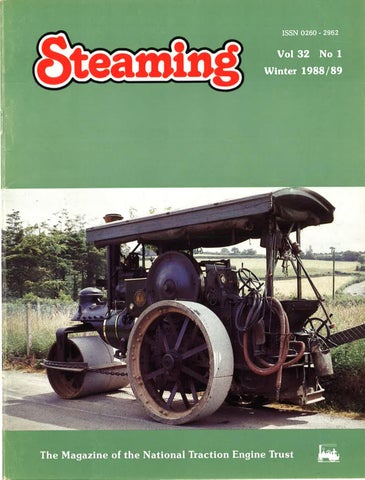
A fine portrait of a working engine — Devon County Council's Marshall 10 ton roller 74774 of 1.921 (TA244.31 stands by the roadside exhibiting not only the dust and dirt of work and the clutter of the necessary tools and accessories, but also the care and attention of its driver in the well kept brass work and, doubtless, the good day to day mechanics of the machine. Mick George, who took the photo in June 1964, can't recall the exact location, but then many of us have probably taken photos not thinking how valuable they would later become. 3
Trust News From the Chairman I was pleased to see a good attendance at our Annual General Meeting which was held at the Midland Hotel, Birmingham early in December. In the afternoon, we were addressed by Derek Grossmark, Chairman of the newly formed Federation of British Historic Vehicle Clubs, which is spearheading the battle to prevent any adverse regulations affecting the use of preserved vehicles on the EEC roads. He stressed the importance of keeping ever watchful for 'sideways' regulations which, although apparently innocuous, can result in preserved vehicles losing the free right of use of the highways. An example of this, was the EEC regulation requiring installation of tachographs in coaches. This well-intended regulation has restricted the right of bus preservationists to use their vehicles at all times and freely on our highways. The Federation, of which the National Tlactiorf Engine Ti ust lb d leading member, has retained a European Parliamentary lobbyist to report pending legislation and to represent all our interests in Brussels and Strasburg and by this means it is hoped to ward off unwanted regulations. Both Paul Channon and Peter Bottomley have also promised to protect the interests of 111( preserved vehicles as far as they are able. Nevertheless, EEC regulations will represent a continuing threat right up to 1992 and at some time in the future it may well be necessary to ask all our members and engine owners to make concerted representations to their MPs and MEPs about matters which might have a disastrous effect on the use of our engines. When that time comes, we will of course let you all know. At the Annual General Meeting, the formal business of the Trust was conducted and an election was held to fill the positions on the Committee vacated by the retiring members. Messrs C. Barber, P.Berber, N. Boyes, D.Duffill, D. Franklin, S. Gray, J. Hirons and M.J. Wharton were elected to office. David Franklin is a new member of the Committee and he 4
will be able to add his extensive experience of insurance matters to our deliberations. We welcome him to membership and would also like to thank Colin Nessfield, the retiring member who failed to secure reelection, for all his past services to the Trust. John Wharton has resigned from his office as Chairman of the Engine Owners sub committee due to pressure of his business. We would like to thank him for all the work he has put in to this important task and I am pleased to record that he will continue as a member of the subcommittee. The Chairmanship will be taken over by Nick Barker, a long time member of the sub committee. Nick hopes to implement a number of new ideas to provide additional services to our engine owning members. Finally, I would like to repeat to the membership in general the appeal I made to the AGM for younger members of the Trust to come forward for membership of the Trust's subcommittees. We need people who ore interested in our engines to ensure their continued preservation and operation well into the twenty-first century. Now is the time to get involved in the Trust's affairs. I should
be pleased to hear from anyone who would like to be participate and feels that he or she has something worthwhile to contribute. (Peter Barber, chairman)
Rally Organisation Rally sub-committee Winter time might be considered to be one of the quietest for officials of the Trust, but this is not the case with the Rally sub-committee. In fact, most of our work is done in the winter time. By the time members read this the first of our two Conferences for rally organisers and affiliated clubs will have taken place and another will be imminent. These meetings are open to all who come within the categories described; they serve as a forum for the exchange of ideas and provide an opportunity for the officials concerned to discuss mutual problems and difficulties. Often points raised by a delegate can he answered or commented upon by someone else from a different part of the country who has had a similar experience.
Chimney tops for engines An engine's chimney top is, arguably, the one item which if not to the right shape can spoil an otherwise immaculate restoration. The Trust has arranged for the manufacture and supply of chimney tops, in brass or copper, to a wide variety of designs and shapes, all from makers original drawings or, if the latter are unavailable, fr6m well researched dimensions. The costs are competitive and delivery is prompt. F. Iw the, details contact John Crawley Bunkers Hill House, Badby, Daventry, Northamptonshire, NN11 6AW Itel 0327 300401)
At the Conferences there is usually a guest speaker who gives a talk on a specific subject of which he has a particular knowledge, or possibly a great deal of experience in. The subjects covered have ranged from the successful organisaton of a rally to the requirements of the Health and Safety Executive — quite a spectrum of aspects of a traction engine rally have been covered. Each approved rally appoints a Safety Officer who, in turn, submits a report to us of the facilities and experience of the particular event with details of safety measures and checks taken. These aspects, in turn, form the basis of forward planning particularly of various aspects covered by the Code of Practice. The Code is being constantly updated when changed conditions require such amendments and a completely reprinted edition is produced approximately every five years. Currently we are preparing the Rally list for 1989; already there are
over forty approved rallies and no doubt there will be many more by publication time for the Spring edition of Steaming. May I in closing thank all Trust officials for their help and assistance during the past year and particularly the members of my subcommittee for their co-operation and efforts. (Eric Fillmore, Rally subcommittee)
Engine Owners Column The Engine Owners sub-committee has recently had a change of chairman. John Wharton, who has enthusiastically led the engine owners sub committee for a number of years, has reluctantly decided to stand down due to business commitments. Having served on the committee with John for some time I have agreed to take over the chairmanship, and would like to
From Allan Martin's Collection
43
The picture I have selected this time shows a strange cavalcade. The City & South London Railway was London's first deep level underground tube railway, opening from the City to Stockwell in 1890. By 1922 the line was being reconstructed to form what is now the City branch of the Northern line and the old trailer carriages were being taken away for scrap or, less bogies, for such uses as summerhouses. Here we see one of the trailer car bodies, perched on a trailer and hauled by 5 ton Foden wagon 4040 of 1913 (M5606), having arrived on 11th August 1923 at the Underground group's Acton Works in west London from the Stockwell depot. The wagon was owned by Pickfords Ltd, their fleet number 182 — see how the smokebox door appears to be closed by bolts around its perimeter.
express appreciation to John on behalf of all the membership for his considerable efforts upon our behalf. I am delighted to say that John has agreed to continue as a sub-committee member. For the future, I would like to see a greater participation from engine owning members in all matters that are common to us. Firstly, the sub committee is in need of a few members to inject fresh ideas and spread the workload. Ideally, I would like to see volunteers from several different geographical areas and try to encourage greater liaison with the membership at local level. So if there is anyone who would like to join this subcommittee I should be very pleased to hear from them (my address can be found inside the front cover of this magazine). Secondly, I would also be pleased to hear from any owners with suggestions for items that they feel need addressing for the benefit of all, and indeed of any individual problems they are experiencing and which are within the province of this sub-committee. Again, please drop me a line. For some while now I have been endeavouring to build up a register of suppliers and repairers. Whilst I have assembled an amount of useful data, this is still insufficient. One idea that I am considering is the inclusion within Steaming at periodic intervals of short listings of suppliers of a given item, ie mud-hole door joints, gauge glasses etc. The sources of these supplies are clearly diminishing, I have a number of suppliers on the register but would very much like to learn of further sources. Next time you make a purchase of such items, please drop a line to me stating where you were able to buy the particular item. If there is sufficient response then I will prepare a listing for publication in the magazine. Feed me the information and I will make it available for the benefit of all. We all read with interest in the area notes of the progress others are achieving with the rebuilding of engines. If you have the name of a repairer who has done work for you and who would be willing to offer his services to others then please let me know. As soon as we have re-formed the sub-committee we shall be addressing a variety of topics of general interest and I will endeavour to keep you advised of progress through this column. Finally, my thanks to David Spooner for a number of useful contributions that he has submitted following the restoration of his own Aveling & Porter 5
Remember...
Spring Conference for Rally Organisers and Affiliated Clubs SATURDAY 18th MARCH 1989 The Midland Hotel, New Street, Birmingham See Future Dates column for further details
tandem roller, and which in due course I will make available to others. (Nick Barker. chairman, Engine Owners sub committee)
Trust Trophies The Annual General Meeting recently held in Birmingham provided an occasion for the presentation of some of the Trust's trophies. The various awards and citations were as described below and the trophies were presented by Derek Grossmark, chairman of the Federation of British Historic Vehicle Clubs. THE GOLDEN SHIELD, a major
trophy of the Trust, was presented to Anthony Heal, a vice president of the Trust and a former chairman, on the occasion of his retirement from the Federation of British Historic Vehicle Clubs committee on which he has represented the Trust and its many affiliated and associated clubs with conspicious success over very many years. THE JOHN CRAWLEY BOWL, a trophy often awarded for multiple services to the movement, went to David Prout, rally organiser, engine owner and engineer who has rendered much service to many people over the years. THE ERIC MIDDLETON CUP was presented to Peter Robinson, director of the Birmingham Museum of Science and Industry to mark our appreciation of the many steam exhibits at the Museum and also the unique engine rally held in the street outside the museum. THE CHOISY and SIMSON CUP was awarded to Stephen Hill, vice chairman of the Road Roller Association and chairman of the Hockley Heath Rally committee, for his services to both organisations. THE DACRE LACY CUP, presented by the first chairman of the NTEC and member No 1, is usually awarded for outstanding restoration of an engine and was so again this year, in recognition of the outstanding work done by Bob Payne and Michael Dix on their Fowler roller. THE J.T. BEEBY CUP, often awarded to a younger member, goes to Richard Hurley, editor of the magazine of our thriving Steam Apprentice Club. (Eric Fillmore)
Steam Apprentice Club The SAC Magazine is now well established under its editor Richard Hurley, but shortage of material is a recurring problem. If any Trust member would like to write an article or even a shorter piece aimed at the younger enthusiast, such contributions would be much appreciated by Richard and SAC members alike. Any offers can be sent to me in the first instance. This year the SAC will again be organising several events at rallies for their younger members, but activities arranged specifically for Apprentices away from rallies are very popular and usually highly instructive and useful to all. We are quite short of venues for suitable events of this type, and would be grateful for any invitation we might receive. If any owners or groups are holding pre-season steam-ups and wouldn't mind a few of our members popping along, or even giving a hand with preparing engines for rallying, do please contact me for further discussion. Any such visit by Apprentices would be supervised by SAC stewards. (David Duffill, 181 Foden Road, Great Barr, Birmingham B42 2EH)
Obituary George Swann
Highland Steamboat Holidays Cruise the beautiful seafachs and canals of Scotland in an original cod-fired C(ydt Puffer. Good food, comfortable accommodation.
Saul large SAE for free brochure to Rachel and Nick Walker, The Change House, Crtnan Ferry, Lochgdphead, Argyf PA31 8QH (Tel 054 65 232).
6
I regret to record the death of George Swann of Saffron Walden, Essex. He had a severe stroke in July and was admitted to Addenbrookes Hospital, Cambridge, where he passed away peacefully on 20th October 1987. George will never be forgotten, for there are not so many left now who earned their living driving engines, and he knew all about make do and mend to keep them going until they got home at the end of the season. His brother Will told me years ago that when George was at school and there was a set of ploughing tackle working in the Wimbish area he would hurry his tea and be gone with the gang until work finished. When George left school he went to work with Drage & Kent as a cookboy — I don't know how many years he was with them but I often heard him talk about steam ploughs, carting sugar beet in Foden wagons, and timber hauling as well.
Before World War 2 George was with Taylor Bros at Wimbish on road rolling work and stayed there for over thirty years until Ben retired. He spent his last working years with a firm making masonry drills and all sorts of things for the building trade. George was laid to rest in Wimbish churchyard near to his old friends Ben, Charlie and 011ie Taylor. At the funeral there was a large congregation of steam people and those from other walks of life, for George was well known. (David Nourse)
NTEC Sales The sales team wish all members a Happy New Year! We hope that 1989 won't produce the problems that our Mail Order service suffered during last year — our moving house and then the postal strike did mean a less than good service and we send thanks to those members who bore with us so patiently during the inevitable delays. Incidentally, it will be appreciated if the old type loose Mail Order leaflets are not used any more — they have the wrong address on them and in many cases the prices have altered — (Tracey occasionally downwards! Shakespeare)
Future dates Rally Organisers Conference The 1989 Spring Conference of Rally Organisers and Affiliated Clubs will take place at the Midland Hotel, New Street, Birmingham on Saturday, 18th March 1989 at 11am, with coffee and biscuits available from 10.15.
Invitations and formal notices will be sent out in the usual way, but newcomers are always welcome to these instructive and mutually beneficial gatherings. Please contact me should you require details as a first time attender. (John Crawley — address inside front cover)
London Area Social Meetings Social meetings will continue to be held on the last Tuesday of each month, starting at 8.00pm. The venue is 'The Horse & Groom' in Great Portland Street, London W1 which is a few minutes walk from Oxford Circus tube station, north along Great Portland Street. All members are welcome, as well as friends or potential new members, and the upstairs room is available from 7.30pm. TUESDAY, 31st JANUARY 1989 — Barry Walker will present a slide show of 'South African Railway Steam': Beyer Garratt articulated locos on the 2ft Oin gauge and huge main line steam on the 3ft 6in gauge. TUESDAY, 28th FEBRUARY 1989 — 'A Rally Commentary' an illustrated talk by John Hirons, the Trust's Insurance Officer and well known rally commentator in the Oxfordshire and Buckinghamshire area. TUESDAY 28th MARCH 1989 — A Peter by presentation slide Richardson, driver of a certain Foden steam tractor, bringing back 'Rallies of Yesterday'. TUESDAY 25th APRIL 1989 — For the final meeting of the winter season's Social Meetings, Steve Neville returns to show more (Bill cine-film. on 'Memories' meetings London Timmings, organiser)
Join the Team!
Corrections
You see us at good rallies, At Stourpaine we're under a tent, If you wished you could join us — Your help would prove heaven sent. The Sales Team needs many helpers, To make 89's rallies an event — So contact Keith Shakespeare for details, and start in time for Lent
Several unfortunate errors crept into the last issue of Steaming. The one which most causes the Editor to help himself to a generous slice of humble pie is the heading to the report of the repatriation of Richard Hornsby engine 7297 on page 183. The title of A Hornsby Homecoming would, of course, have been proper. The arrival date in the top caption should have read 2nd July 1988. The old Aveling at Baldwin Bros, Wadhurst, pictured in the Summer edition, was not works number 1232,
Contact Keith on 0527 575003 or write to his address inside the front cover.
as suggested on page 207 of our last issue, but 1141 of 1875 (AP9199), an engine new to William Mercer of Five Oak Green and said to have come to Baldwins about 1890. Further views of the engine, probably earlier than the one in the Spring issue, appear in John Crawley's Steam Traction Engines in Camera.
OUR MAGAZINE 25 YEARS AGO
The first issue of 1964 was a Steam Tractor Special but although a large section of the magazine was devoted to tables and illustrations covering that breed, other more topical subjects provide interest 25 years on. The gain in membership was still thriving: the 856 members in 1959 had risen to 1441 in 1963. The remarkable thing about these figures is that (allowing for an unusual increase in 19631 they multiply out very closely to today's figures — they represent a surprisingly consistent average yearly increase to the present 4300 or so. In the area notes it was recorded that one Jim Sarney had recently been at work with 7hp Burrell traction 2505 on timber hauling and wood sawing. The Teignmouth Quay company's two Sentinels had ceased their duties in Devon and gone for preservation — S4 8850 and shunting tractor THE ELEPHANT had worked until then moving railway wagons from main line siding to quayside. Dingles in Cornwall had sold their last roller in good order into preservation, 4041 (U0793), but six others remained 'quite beyond any hope of restoration' — however, they all survive today and several have graced the rally fields. Kings of Bishops Lydeard had pulled several Foden wagons from the bushes and put them behind locked doors — 'none can be purchased'. Though effectively correct, time does prove an undoer of fact, as can be seen from our Summer 1988 issue. The For Sale and Wanted columns were as interesting then as now — Aveling copper chimney tops were offered at £5 perfect, £3.10s imperfect. Thirty one rallies were listed inside the back cover including an Olde Tyme Steam Fair scheduled to be held at White Waltham in August. 7
IMPORTANT INFORMATION FOR THOSE NEEDING ECONOMICAL REPAIRS ON THEIR TRACTION ENGINES
PINIONS
SPURS
BEVELS
All types and makes of bevel gears, spur pinions, spur wheels, helical gears etc rebuilt to standard
Please note that we have moved to new premises ... Our address now is: B & C Reconditioning (Gears) Ltd, off London Road, Amesbury, Wiltshire SP4 7EQ Telephone Amesbury (0980) 23210
8
DEVON COUNTY COUNCIL 1946 -1951
A Plant Engineer Remembers Hugh Bull The plant of which I had charge and which I am going to write about was the machinery required for the production and treatment of roadstone, from its extraction from the quarry to its laying on the county's roads. The roadstone was usually tarred, which added to the amount of machinery and, in the words of a certain song in each case 'the whole damned thing was driven by steam'. Devon was divided, as far as the County Council roads authority was concerned, into two parts, the dividing line being the A30 road which, running east to west, roughly bisects the county in north and south portions. My responsibility was for the plant in the Northern section. As far as road mileage was concerned the Northern part had by far the greater mileage, for nearly every farm had some kind of road leading to it, whereas the Southern section included more populated areas such as Exeter, Torquay and Plymouth which looked after their own roads. So, in effect, the roads were under three different, and often quarrelsome, authorities. In 1946, all the plant was suffering from the effect of hard work and neglected maintenance of the World War 2 period but was being enlarged and modernised to a small extent, within the financial confines imposed on it by the state of the economy generally — and which incidentally included my salary! About 1947, it was decided to amalgamate the Rural District Councils into the Devon County Council for the purposes of road maintenance and this resulted in the acquisition of quite a bit of extra plant to keep up, most of which was war-weary, one old Morris 2-tonner being in such a state that I wrote a poem about her. Anyway, poor condition or not, the plant at 1950 was valued at more than 21/4 million pounds, and was scattered all over north Devon.
One of Devon County Council's large fleet of steam rollers — Aveling & Porter R10 class single cylinder 4986 of 1902 (TA2658) travelling between jobs in their Eastern Division. (collection Alan Martin)
The tarmac plants were at Beacon Down, which must have been as windswept a place as anywhere in England, and so cold that I had to build an extra windshield in front of the engine house to combat the freezing Atlantic gales which made the portable's tubes leak. Plant included the aforementioned portable, a Clayton twin cylinder machine, but I now forget if she also drove the tar plant, as well as the crushers. The quarry was distant from the crushers by about half a mile, connected by a narrow gauge railway, and our first diesel loco was used on this line — a Ruston & Hornsby called JOSEPHINE. We had a lot of trouble with her as the engine ran too cold in spite of the radiator being blanked off — which shows just what the climate was like there! Beacon Down was about ten miles from Lynton and was the nearest
quarry available during the war to supply stone for an airfield at Chivenor, near Barnstaple, so the place was requisitioned by the RAF who undertook their own tunnelblasting with the aid of some surplus bombs. I understand that their efforts were quite spectacular in that not only did they remove the stone from the quarry, but they also spread it over some miles of adjacent roads and removed the roof of the quarry workers' mess into the bargain! Local casualties were light as absenteeism was noticeable on the day of the blast. Coming south, the next quarry was at Plaistow, a city of two hayricks and a cottage near Barnstaple. A portable and the usual crusher, granulator and screens were located here. The next tar plant was right in the middle of Barnstaple and was of considerable nuisance value. A Garrett portable 9
waa uacd at Barnstaple. I won't bore readers with full details of other plants at Bideford, Holsworthy and Okehampton (sometimes called Soakamptom for obvious reasons!). The largest quarry and plant were at Tavistock and there were two separate crushing and sorting plants. Stone from the floor of the quarry was transported by narrow gauge railway worked by three steam locos, one of which is now in beautiful condition and preserved in the Birmingham Museum. They were built by KerrStuart and one was named LORNA DOONE. The plant itself was driven by Marshall Locomobiles lone in each plant) in each case with surface condensers, but we had a lot of trouble due to water contamination. The local stream came from a limestone area and in spite of expert advine we conldn't get the right water treatment. Locomobile firebox and tube assemblies can be removed as a unit as the smokebox tubeplate is flanged as well as the rear of firebox. Quite a job, however to remove and replace, more especially as in this case the water supply used to virtually weld everything together. One of my first jobs was to fell the 90 foot chimney which had rusted out. Luckily one of the boys was an exsailor and we got it down more or less where we wanted to (it only hit the engine room a gentle crack!) The County Surveyor who was responsible for all the plant was the late R.M. Stone, a man before whom the strongest quailed, but who had a heart of pure gold. He wanted to see every wheel turning, including wheelbarrows. and knew the histnry of every man, every nut and bolt, in this connection it would be of great historical interest if some museum could locate the Plant Log Book which resided on my desk at Bideford and which recorded in great detail the histories and repairs of all my plant. If I remember right the book must have been at least twenty years old in 1946 and, of course, I added the plant acquired in the aforementioned takeovers. When Exeter took over management in 1951, the book went there, but as there is now nothing left of that plant, the book is doubtless gathering dust in some archive. As one can imagine, it was a massive tome. It had to be, as it recorded the activities of the fitters over the years, but it would be of inestimable value to the Trust, as it contained minute details of steam wagons long since scrapped. The Devon County Council went in for Garrett wagons of which, by 1946, there were two or three still in service
10
as tar-sprayers, pressure being supplied by Westinghouse pumps. An interesting feature of these wagons was that they were superheated, the elements being a nest of small tubes in the smokebox, the hot header being fitted with a safety-valve. Apparently in the hilly conditions encountered in Devon, if the water got too high, the priming flashed into steam in the superheater and blew the regulator valve off its seat, causing a chain reaction. In the final days we couldn't get superheater elements (which were a weak spot), and I ran the wagons on wet steam — without any appreciable difference, in spite of the drivers' dire predictions. As I was out on the road so much,
nm (as he was affecLiundlely known) authorised me a driver, and Jack Shambrook, father of the late Fred (both Trust members) became my first driver and from him I learned both the Devonian dialect and the history of the plant and of the men concerned, many of whom have received honourable mention in these pages. First to mind is the late Bill Moore and his Burrell tractor SUPREME. At work he was the driver of our Aveling traction engine of which I forget the details, but remember that she was pretty far gone. Anyway, as there was so little work for the engine, Bill became the plant painter and a very good one at that. Once a vehicle or roller had been overhauled and
f
,
L VON COUN TYCOUNCI L URIOLL,. Oil.,, aslon .11
.• Ii NOW:
YO.111N(.11..
:POO nrui.01,,i,r4
Devon County Council purchased quite a few Garrett 5 ton superheated tipping wagons for use by its Roads and Bridges Department. A wealth of interesting detail can be observed in these two pictures taken by the makers when No 61 34613 was new in October 1925, and before it was despatched to the County's Northern Division yard at Barnstaple. (collection Alan Martin)
One of the narrow gauge tramway locos at Devon CC's Tavistock Quarry in 1951 — the tiny, and simple, 2ft Oin gauge engine was built in 1922 by Kerr, Stuart of Stoke-on-Trent (number 4250). (Frank ✓ones)
painted, pride of workmanship was very evident. Bill could recite the colour and sequence of linings of any roller and there are two very good photos of Bill's engine in the book The Building and Running of Steam Traction Engine and Roller Models by H.R. Plastow. Bill liked his snuff and would sometimes take a teaspoonful and forthwith carry on with his work and draw a perfectly straight line with a tiny paint brush. Sometimes of a summer evening Bill would steam SUPREME and hie him to the local water-hole, where he was always welcome as he could play the concertina. Well, the local parson was a traction fan and one evening he asked Bill to let him steer the engine back to Bill's place. His reverence soon found that steering an engine was not all that easy and landed in the ditch, and we are led to believe that Bill's monologue of Esperanto was quite something. The parson later said that he was called everything but a gentleman. Meanwhile, Bill having run out of breath told the parson "You got the bugger in the bloody ditch, now you getter out!" He then tottered back to obtain a little more tranquiliser. Luckily there was someone in the crowd who could manipulate engines and wire ropes and by the time Bill returned the engine was awaiting the return of the master. Jack Shambrook became my driver on the selling of the steam crane of which he was the erstwhile driver. We got Welsh steam coal by barge direct from South Wales and one must pay tribute to the sailors who used to bring
their tiny sailing ships across the Bristol Channel to Barnstaple. There were wharves at Braunstone, Fremington and Barnstaple on the Taw, and of course others on the Torridge, but as any resident of the west coast will tell you, when the Atlantic plays up, even the fish dive for cover. The County Council wharf was just up the Yeo, but the crane disappeared before my arrival, and to the best of my knowledge coal was supplied under contract. I believe the crane was a Stothert & Pitt job. Then there was one driver who was noteworthy for always wearing a collar and tie and of course his roller was as spotless as he was. We had quite a collection of rollers. One inherited from Torrington RDC boasted her original firebars and I believe was the oldest in the fleet; it could have been the Green. Her driver was Charles Laughton to the life! During the war one of the Okehampton rollers nearly became a casualty. Jerry jettisoned a bomb near the roller and knocked off her chimney nightcap whilst he had a banked fire. Sometime later someone was alerted to a strange noise. Now, as you can imagine, strange noises during a war and late at night are not conducive to curiosity and it was sheer luck that a stray motorist came past and reported that there was a steam roller enveloped in steam some miles up the road. I am told that her driver broke cycling records to go to the rescue. Early in 1950, I had to supply a portable crusher and suitable power to run it at a small quarry near Torrington.
Normally this was the job of a Robey tractor, but just at this time the boiler inspector condemned her boiler, leaving me with no other alternative but to conscript a spare portable. One of the rollers was fitted with a governor, but she could only be spared under sufferance. The result may be seen on page 73 of volume 104 of Model Engineer (19511. I remember having trouble with her steaming, which is a very rare complaint amongst portables. We eventually traced it to the chimney damper lever and butterfly being out of phase. When in the supposedly open position it was in fact only half open. About the time I joined, a kitten also appeared on ration strength, and was named PLUMBER as he did odd jobs round the place. However soon PLUMBER gave birth to four kittens, and so I renamed her OXY in view of the fact that she produced 'a set o' lean' kittens. We were having trouble with our first oxy-acet gear at the time. Younger readers may not be aware that one has to earth a rubber-tyred steam wagon, due to static build up which in dry weather can be something terrific. Now the watchman who lived on the premises acquired a yappy little beast of a dog which used to 'book in' all the vehicles in the manner usually associated with the canine race. Well one of the steam tarwagons, a Garrett, was stationed in the yard for a bit and the driver told me that he was going to cure the dog of christening his wagon and invited all to be at the ceremony. The cure was to be effected by hanging up the staticearth chain and thereby building up a suitable deterrent. The dog took the bait; earthed the charge through a spark visible to the naked eye and was last seen acquiring take off speed in the general direction away from steam wagons. Incidentally there was a law compelling the use of these earthing chains due to fatalities, though I suppose there are other means of earthing vehicles these days. Another amusing item that comes to mind concerns the inherent delight we all have of getting one-up on authority, more especially the Army. I bet there's nobody who wouldn't like to see the Sergeant-Major lose out. It happened this way. A steam roller, living van and water cart were proceeding across Dartmoor. It was raining and cold as usual, when the crew were accosted by two very bedraggled soldiers. Apparently they had been cast into outer darkness and told to make their way back to camp without being seen by their superiors and they asked the driver if 11
they could be smuggled to the area in the living van. The driver, who was an old sweat himself, told them that the van would be the first place that would be searched, but if they liked to be wetter than they were already, they stood a fair chance in the (more or less) empty water cart. This they chose and the roller proceeded right up to the sentry tent at the camp's entrance where the driver made gestures indicating passengers in the van. The sentry fell for it and
was locked in whilst the 'fugitives' ran through the gate. There was a sequel when the District Surveyor rang me up and asked me to explain a packet, which had arrived addressed to 'The driver and fireman of roller No xx' The packet was found to contain a packet of cigarettes. The surveyor, also an old soldier, one who didn't smile too much, laughed until he cried. Each District had its depot where they parked their vehicles and in the case of South Molton this was quite a
With their use en masse until the 1960s it is not surprising that a goodly number of Devon's steam rollers survived into preservation. No 116, Robey tandem 48869 of 1939 (EDV9161 is seen (top) when still in use — it is now in Berkshire — whilst No 140 Wallis & Steevens 10 ton Advance 7905 of 1926 was photographed (bottom) at the Holton rally in June 1987, sporting the correct COUNTY OF DEVON ROADS lettering and insignia on its green paintwork. (collection D.A. Rayner,' A/an Walker) 12
way from the nearest house and only a mile and a half from the nearest part of Exmoor. The said depot was in a coppice with a stream at the rear. Now Jack Isaac (later to be killed by a runaway at Countisbury Hill) and his mate were working on a lorry in front of the South Molton depot when they were suddenly confronted with a stag, the size of which has lost nothing in the telling. Jack shouted and his mate shut the stag in the shed. Not long after the hunt appeared in full cry and the hounds went mad all round Jack and the building. Huntsmen came up and demanded an explanation. Jack told him that if his dogs didn't know the difference between a steam roller which was in the building and a stag then they were bigger fools than blokes who had nothing better to do than chase a smell. Also even if he did have a bloody key he wasn't going to let them have it. Ile explained the hounds' interest by saying that a dog had shared their meal and it must have been a bitch. Jack said that they kept the stag and the roller together for the rest of the day and that the stag was not a bit frightened of them. Of course, crushers have to have at least two men to operate them — one to feed and another to clear the chippings. Well the feeder dropped his dentures into the crusher and appeared on the lower stage to see if he could locate them. His mate helped him look, took out his own and said "Well I'll be buggered. Here they are and not hurt a bit". The feeder took the teeth and they fitted perfectly! As this happened before my time I don't know the sequel. For the following tale a bit of background is for those who y have not visited England. A number of country parsons are lumbered with enormous houses, built to withstand the onslaughts of the ungodly, and with grounds large enough in which the legions of the godly might be encamped. In the case in question, there was a long drive leading up to the vicarage. Now old Jack Shambrook was working with a gang which was repairing the road outside the vicarage, and His Reverence (Jack's words!) spent a very happy day with Jack on the roller. Came knock off time and Jack was a bit suspicious that his pupil might try arid drive the roller during the evening, so instead of banking the fire he cleaned the grate and drew the fire. Next day, on Jack's arrival at the roller, he found the parson 'as black as a nigger' and none too happy: he had tried to raise steam and failed, even after burning the family's lightings as well as Jack's and had even caned the
paraffin ration. Unfortunately he didn't know enough to remove the nightcap! However Jack let his Reverence do a solo down the drive, for which I am assured that Jack was forgiven a host of sins! But to return to more mundane matters. The works at Bideford which was my headquarters was a very ramshackle affair and consisted of three lathes and the usual accessories, all driven by line shafting — no electric power. The line shafting was driven by an old Ruston paraffin hot-bulb engine with the usual hit and miss governor. Quite a ceremony to get her going in the morning. First the hot-bulb had to be heated by means of a whacking big blowlamp which was probably supplied with the engine, and which was said to have been blowing a foghorn off the Scilly Isles at the turn of the century. Then, having quelled all secondary conflagrations, the two old turners set about swinging the flywheel — a thing which must have weighed a ton or so. Very often she would chuff off in reverse. No worries, they waited for her to calm down and then when she wasn't looking loop-in full compression. Result was that she bucked a couple of inches off her foundations and got the message and set about another day's work. Both turners at that time were overdue for retirement, due to the war. The elder had the most amazing apology for a lathe that I have ever seen. The old boy had modified it over some 50 years in order to do special jobs with the result that he could do just about anything in the machining line — milling, shaping and so on. It was a long-bed lathe but I never knew just how long due to its being buried some feet deep under special jigs and so on. The slide rest flapped around in the breeze and if you didn't break your ankle trying to approach, you weren't really trying. That is when I took over. He was very hostile when I made the whole workshop gang clean up the place. The building itself was built of lumps of stone stuck together with mortar in the manner usually observed in that part of the world. It was right on the banks of the Torridge about a quarter of a mile upstream from Bideford Bridge and it was not unknown for water to seep into the engine pits during a very high tide whilst the outside wall had some lusty cracks nearly big enough for any enterprising seagull to nest in. The gulls, of course, kept the roof well painted. We were blessed in that there was a shipyard at Appledore, about a couple of miles downstream from us
Many readers will, in the 1950s and early 1960s, have come across Devon CC rollers parked by the roadside — here No 138, Aveling & Porter overhead valved compound 4873 of 1901 rests at an unrecorded location. (collection D.A. Rayner)
and that their welding shop boss was capable of the most amazing work. One of the Marshall rollers developed a crack in a crankshaft web and I knew that if I reported it, Head Office would order her demise, so Sid Hill (the shipyard foreman) and his gang got their heads together, and I borrowed a chef's hat in order to cook the books and we gave the roller a new lease of life. I wonder if she is still on the road for when she left the yard after being fitted with the repaired crankshaft and old Bill Moore had blessed her with a couple of pounds of snuff, she was certainly as good as new and the weld was difficult to see. If my memory serves me the fault was in the near side web; I also think that she was the one with a couple of welds on her firebox wrapper — one each side and about a foot long and left unground as they were out of sight under the crankshaft. Most unusual for a Marshall to have anything like that as the corrugated crownsheet seemed to cure all ills sustained by stresses. On the other hand I don't think any of the Robey portables survived without welded fireboxes due to cracks on the shoulders and it would seem that the Robey system of crown stays was altogether too rigid. If one sees a Robey box in the open, the stays would support the Ford Foundation, and if the engine worked in an area where the water was bad, the whole assembly was fossilised. Some time ago R.L. Stevenson's Kidnapped was filmed in Devon and
the Torridge Welding Co (Sid Hill's branch of the shipyards) got the job of rebuilding a sailing ship to act as the pirate ship in the film. On completion the film company called for volunteers to act as pirates and Sid Hill's boys got the job as they didn't need any make up! The original crew sailed her, and on one occasion they outsailed the tug and camera crew. Wish I'd been there to have heard the exchange of Esperanto. It is well known that salmon fishing is the sport of the wealthy and that keen anglers will pay a fortune for a yard or two of stream that is endowed with salmon. Such a stream flowed past a layby where Ned Gist and Stan Horrel were repairing a steam roller, so of course Ned must try a bit of poaching, never having fished before but always up to mischief. Well they loaded a bit of bent wire with half a sausage and in nothing flat Ned was struggling to hold a salmon which was outraged at being duped so easily. Stan was in the stream chivvying the salmon towards Ned and they had just beached the fish when they saw a fully-rigged fisherman wading down the stream. Ned beaned the fish with the coal hammer and awaited his fate which was not long in being pronounced. The old boy examined the culprits' fishing gear, compared it with his own and bought the salmon off them — allegedly for a quid — and then went off 'laughing fit to bust'.
13
To the best of my knowledge there are only two of my old gang left. Charley Porter who is in charge of the plant at Sandy Bay Holiday Camp (they have the best preserved Burrell I have ever seen►, and 'Jacko' Johns, who made my wife's day when he told her that he had planted his spuds in her heel marks after he had shown her around his garden! Jacko is in retirement near Torrington and his collection of memorabilia is quite something. However, things were never the same when remote control became so remote that I had the responsibility without control and, indeed, that belonged to an anti-steam lobby. Nothing now remains in the steam line except one or two rollers that have
fallen into good hands. Tribute is due to the wonderful work done by the fitters, often under shocking conditions. The saying 'Glorious Devon, where it rains six days out of seven' is quite apt, and to do a boiler test in the cold rain or a snowstorm on Dartmoor was not a job for the fainthearted. I don't know anything colder to work on than a dead engine. I was indeed lucky that Devon was a stronghold of steam during my time. When I first drove a diesel into the yard at Bideford, many regarded it as an omen of the future. They were probably right, as nothing now remains — no workshop, no steam and only a small garage/stores. The
fact that an apprentice that I signed on is now the last of a wonderful gang makes me feel terribly old. But, luckily, it is the funny memories that persist and I often recall the tales we laughed over — I wish I'd have been there when the fox went across the unrolled chippings near Bow, and some of the hounds got caught in the wet tar, or have heard first hand what the South Molton driver said when he found boys driving his roller around the car park.
(Thanks are due to several members for providing photographs to illustrate this article. The author now fives in Queensland, Australia.)
We specialise in the construction and repair of locomotive type boilers. Firebox construction can be of the traditional flanged And rivetted design, or flanged and welded. Construction is to the appropriate British Standard Specification and all welding is by coded welders to BS 4870. Work being done is approved at all stages by an engineering surveyor from your boiler insurance company. Construction of tubeplates, smokeboxes, tenders etc, also undertaken.
For further details contact
Roger Pridham, Hollybank, Chilsworthy Beam, Gunnislake, Cornwall. Telephone Tavistock (0822) 5276 Daytime, 832945 Evenings
WORLD'S FAIR MIR
The outdoor entertainment weekly incorporating
73337, ftqL€.,% 47, di ;itst,
•
VI"
irraTE RR:4A AiotTi
Rallies, News, Reports and Advertising
Place a regular order NOW with your newsagent. Something to sell? An event to promote? For all your advertising requirements there is no better publication.
For advertising and subscription details contact: The World's Fair Ltd., P.O. Box 57, Oldham OL1 4BB. e 061-624 3687 14
THE CONTINUITY OF AN IDEA Tam McTaggart By the 1860s the world was desperate for a mechanised direct ploughing machine. Even in the New World, with its vast acres, ploughing relied on horses, mules and oxen. Fowlers of Leeds, of course, had their well known cable ploughing system, and similar outfits were built by Burrells, McLarens and Avelings but successful though that operation could be in many circumstances, ploughing by direction traction had yet to be mechanised in a troublefree and effective manner. R.W. Thomson, a civil engineer living in Edinburgh, designed the first reliable gang ploughing engine and had it built by Tennents of Leith, Edinburgh. The three-wheeled steamer was fitted with rubber tyres and an upright boiler with twin simple cylinders and two forward speeds. The demand for this machine was great, so much so that three East Anglian traction engine builders were licensed to build examples — Robeys of Lincoln; Ransomes, Sims & Head at Ipswich and Charles Burrell of Thetford. On the other side of the Atlantic, D.D. Williamson of New York acted in a similar capacity and had ninety or so of the design built by the Grant Locomotive Works of Newark, New Jersey. The popularity of the type grew, even if two thirds of the cost of each machine was held to be in the rubber tyres. Among the agents appointed in America was Benjamin Holt of Stockton, California. His business was situated in the main agricultural area of the region, in the large valley between the high Sierras and the coastal range, and as he shipped in the Thomson steamer it was only a matter of time before someone copied it. Colonel Hyde of San Francisco was the first; his was a much larger copy of the design with a capacity of 20nhp, and the engine was used to haul 50 ton stone columns from a quarry to the state buildings under construction in both Sacramento and San Francisco, and then taking the job of hauling silver ore in Utah. Then came another derivation — a tractor that was a near copy but without the rubber tyres, which were not really necessary on the fairly solid soil of the valley. This machine could be purchased at a fraction of the price of the Thomson examples which
A 6hp Thomson road engine of 1868, pictured at Govan dockside, Glasgow. (collection T. McTaggart)
American version — a Best 110hp steam tractor dating from the early years of the century, abandoned somewhere in America. Its cylindrical water tank is missing — it was mounted horizontally above the engine and gearing between the vertical boiler and the single front wheel. (collection Brian Caseley) 15
meant that it sold whilst its progenitor did not. The Best Manufacturing Co, set up by Daniel Best at Oakland, California was the new developer of the design. Holt also later built machines influenced by Thomson's originals and his heavy tractors were much used in the West Coast timber business, and even hauled Shay and Heisler geared railway locos into the forests on skids to work on their isolated railway systems. Best and Holt joined forces in
1925, taking the latter name, but twenty years before that Holt had produced versions of their vertical boilered steamer with endless tracks — the caterpillar tracks that eventually spawned the Caterpillar company famous throughout the world. What would our traction engines have looked like if Thomson had not died in 1872? Tennents of Leith and Robeys of Lincoln were still building examples of his design up to the turn of the century and three separate firms
A Broken Link The death nor:wren, at the greet age of .95, in October 1988, of Isabel Pelly, the last member of the Fowler family to be intimately involved with the affairs of the Company before it was annexed by the Government in 1941. These notes, part of an address given by Michael Lane at a Memorial Service at Dorchester Abbey in Oxfordshire in November, offer tribute to a much loved lady and to a famous family, and mark the end of an era.
ISABEL AMY PELLY 1893-1988 Isabel Pelly's passing marks the end of an era, for she was the last of a long and distinguished line to be intimately involved with the world famous engineering business in Leeds founded by her great uncle, John Fowler, junior. This great enterprise was successively managed by three great uncles, her father, Robert Henry Fowler. his brother Alfred and by her brother and second cousin, one of whom, Godfrey Pelly, she married in 1919. Her great-great grandfather, Robert Fowler, was a Quaker minister of some renown who travelled widely in the faith. In 1790, he married Rachel Barnard, whose father was associated with Abraham Darby at Coalbrookdale, the place regarded by most as the birthplace of the industrial revolution. Robert and his wife resided in a splendid Georgian house at Melksham in Wiltshire, which remained in the family for nearly a hundred years until the death of Sir Robert Nicholas Fowler. He was a distinguished banker, MP for Falmouth, and was twice elected Lord Mayor of London. Her great grandfather, John Fowler senior, also resided in Melksham. He was a man with a great taste for reading and selfimprovement, but his greatest love was for the countryside, horses 16
and shooting. But it was the life's work of her grandfather's younger brother, John Fowler junior, which had the greatest impact on Isabel Pelly's life. Following a visit to Ireland during the 'Potato Famine' in 1845, he resolved to devote his life to the improvement of land drainage and agricultural machinery and the means of cheapening food production. He became the 'Father of the Steam Plough' and his many stihcnriiiPnt intiPntinne ret/nhitinniced
agriculture until the steam engine was overtaken by the internal combustion following World War 1. Tragically, John died in 1864 at a comparatively early age following an accident in the hunting field. He was succeeded firstly by his brother Robert and then by William. During their stewardship the Fowler business blossomed into a great company known throughout the world. They became famous not only as manufacturers of agricultural machinery and steam traction engines, but built also large numbers of railway locomotives, stationary steam engines and machinery for driving the early electric generators. Their contribution to the progress and prestige of British engineering in the second half of the last century was enormous. By coincidence, in the same week as Mil — for that is how she was known to her family — passed away, the firm's achievements were recalled
used them for heavy haulage in Glasgow right up to the 1930s, the last being scrapped in 1932. Thomson is credited with inventing the trailer V bar in the USA but whether he first thought it out in this country I don't know — he is said to be the first to use articulation. Acknowledgment is due to the University of California for information from the F. Hal Higgins Collection in their care.
in the press when those engaged in the construction of the present Channel Tunnel broke into the original partly finished 1882 tunnel, excavated by a unique Fowler built boring machine which is still intact in the tunnel. William Fowler, who presided over the affairs of the Company from 1888 to 1905, was twice elected MP for Cambridge. He was a director of the National Discount Company and other financial institutions in the City, and was at the centre of the great Overend & Gurney crash in 1866, an event long referred to as 'Black Friday' and reminiscent of the crisis in the world's stock markets just a year ago. Upon William's death the chairmanship of John Fowler & Company was taken over by Mil's father, Robert Henry Fowler, a nephew of the founder. He had joined the company in 1875 and proved to be a man of enormous stature, held in the highest esteem by his peers. Mi!, his second child, v.T..s born in October 1893. Her childhood was spent partly in London and partly in Leeds. She received her education of The Mount, a Quaker school in York, but frequently her parents took her with them on their overseas business trips. In this manner she visited the four corners of the world, but travelling in those days was very different from today. Passages by sea were slow and often dangerous and involved many ports of call — all of which contributed enormously to her experiences of life and character building. I first met Mil in the early 1970s when I embarked upon the task of writing a history of John Fowler and the firm he founded. For two years I was kept at arms length. She constantly protested that John Fowler would have wished to shun any form of publicity, but slowly I gained her confidence and doors which had remained shut for many years were
reopened. The burden of responsibility I felt towards this remarkable lady and her family was enormous. Eventually, she wrote the Foreword to my book. I know this caused her considerable emotional stress and that it was not easy for her. However, it is now generally accepted that her contribution was exceptional, and quite the best part of the book. In 1919, Mil married her second cousin, Godfrey Pelly. His mother, Emma Mary Fowler was John Fowler junior's eldest daughter. Godfrey had recently returned from Mesopotamia where he served with great distinction with the rank of Lieutenant Colonel and had been awarded the DSO and MC for gallantry. Their happiness was somewhat marred by the death of Mil's beloved father in the same year. His younger brother Alfred became Chairman of the Company and Godrey Pelly, his younger brother Dennis, Mil's brother Charles and another cousin Nicholas Geldard all eventually joined the Board. All four had received their training in the works at Leeds and at the firm's experimental farm in the Transvaal in South Africa. But following her father's death things were never the same again. At the turn of the century he had sensed that the days of the steam engine were numbered and had initiated some early experimental work on internal combustion engines. World War 1 and its accelerated aftermath uncertain change and precipitated economic depression worldwide. Soon the boast of 'A land fit for heroes' was forgotten, unemployment began to rise and many great old established firms got into difficulties. For the next twenty years, Isabel Pelly was at the very centre of events. Her brother Charles left the firm and Alfred Fowler died; an outsider was brought in as Chairman and shortly after rejoining the army in 1939 her beloved Godfrey died. The climax was the take-over of the company by the Government in 1941 under powers vested in the war time Defence Regulations. Truly a link has been broken with the passing of Isabel Pelly.
'In a recent issue of the Cairo Journal Officiel, I read a Ministerial Decree, deciding that Portable Engine No 45, by Ruston Proctor, bearing the date 1863, being in a state of imminent danger, shall be restrained from working. The Mudir of the province is therefore ordered to
This nicely posed study shows a pair of Fowler ploughing engines owned by R. Bridson & Son of Neston, in the Wirral. The occasion seems to have been marked by the crews being joined by the boss and, perhaps, his grandson, on the toolbox of the engine on the right. The inscription on the other machine's toolbox is apparently rendered in chalk. Alan Duke has a pair of 8hp Fowlers listed as owned by Bridson, but the works numbers or dates are not known. (collection Mike Jones)
Fowler A5 class road locomotive 11111 of 1910 CITY OF HULL made a return to the rally fields at the Egham event in August 1988. (Robin Walker)
immediately stop the engine by administrative means. I presume that the owner, Morkos Effendi Barsoum, refuses to recognise the decrepitude of his engine, for it is perhaps scarcely reasonable to suppose that the fiftyyear-old Ruston Proctor refuses to stop working unless by the compul-
sion of an officially executed decree. In either case the builders of this faithful old machine have every reason to be satisfied with the advertisement thus given to them.' (Comment from a
correspondent in the Near East, published in Ruston Proctor & Co Ltd's 1918 catalogue.) 17
The Spirit of '88 words and pictures by Bob Payne
...after the rain, the sun. Bishops Castle rally on the Sunday.
One excellently restored newcomer to appear last year was Foden D type tractor 14084; it is seen here leaving the Upton-onSevern rally. The engine sports a new crankshaft which was forged at Lincoln and machined in the West Midlands. To complement this the cylinder bores, valve faces, link motion and rear axle assembly were all re-machined, resulting in a very smooth running engine. This tractor, the last of its type for the home market, was delivered to J. Murch & Sons of Umberleigh, Devon during October 1933. lan Sparks, the owner, would like to paint the tractor in its correct Foden dark red livery with the original style of Murch lettering. Can anyone help from memory or with photographic evidence?
Burrell 3984, now running on restraked wheels, and with baler in tow, makes its way homeward after the Haddenham rally. Will we still be able to enjoy this delightful scene after 1992? I hope so.
Marshall S type roller 79108 POPPYLAND, delivered in April 1925, is one of the few engines left with all of its original paintwork. For this reason, it is of great interest to the small, but growing number of enthusiasts who are restoring engines to ex-works condition. Save for the Aveling steering wheel on the Allen scarifier, the non-standard chimney top, and a few minor details, the roller is also quite original mechanically. After a leisurely working life rolling the roads of Cromer, the Marshall is now occasionally steamed at Thursford, as seen here in May.
,•
: ...,,,,
-.J!1. \.
. $«. zi-
Two tractors.....
The back end of last season saw the reappearance in steam of two steam tractors, both very nicely restored and making an interesting comparison. Burrell Gold Medal tractor 3540 of 1914, the senior of the pair, has spent the last year at Bicknells boiler works at Liphook, the restoration work being undertaken for the tractor's American owner Finlay Matheson. The Burrell went to the States in 1959, acquired by the Boston Museum of Transportation, but the extensive boiler repairs later found to be necessary to enable the engine to steam again led to the Museum selling it to Mr Matheson in Miami. Returning the engine to England for repair was deemed the best idea and work at Bicknells involved a new firebox and other boiler 20
work, rebuilt gears and motion, new canopy and rubber tyres and a complete maroon repaint. The engine was run in on several local outings including the Woodlands ploughing match at Seale near Guildford, Surrey, in September, where Robin Walker photographed it (above) demonstrating its skills at direct ploughing. Subsequently the machine was divested of its canopy and chimney, packed into a shipping container with a goodly supply of coal and sent back to Florida, where it arrived in late October. A 'training' video, produced by Ron Walker (fellow Gold Medal owner►, should help Finlay to master the art of operating a steam tractor, in an area of the world that historically has probably seen few road steam engines.
Ransomes 4hp compound steam tractors are, and always were, rather less common than their Thetford built counterparts. Bill Scurlock of Taunton, acquired number 36220 from the estate of the late Gordon Limb of Halesowen in 1986. The attractive engine was built in 1920 as 31109 and was used, until sold in 1926, as the maker's exhibition engine, being shown at several annual County shows. It seemingly carried seven different serial numbers on its works plates during that time, presumably to fool eagle-eyed customers into noting the apparent healthy sales potential and popularity of the breed! In Bill's ownership number 31109/32011/ 33070/33233/34181/34359/36220 has had an extensive and thorough overhaul including new boiler barrel
and firebox; smokebox, chimney and door; tender and canopy and, in this case, a new green lined livery. It took to the road again in August 1988 and as well as Saturday afternoon runs to nowhere in particular, has attended Taunton Agricultural Show and local fetes. John Reeves' photographs show (left) the Ransomes on the road on one of its outings and (below) at the Somerset club's AGM. (compiled from reports by Ron Walker and John Reeves)
'Arthur Milne Carter, 24, a motor car driver of Chiswick, was charged at Clerkenwell with being drunk while in charge of a light locomotive, with van attached, at Roseberry Avenue, Clerkenwell. Mr D'Eyncourt said these big engines and trucks were quite dangerous enough on the highways when driven by sober men. Defendent would have to go to gaol for a month.' (From The Automobile Commercial Motor Review, January 1904.)
21
Raymond Rowe In the Summer 1987 issue of Steaming' Derek Rayner referred to the Aveling & Porter roller as 'The Ruler of the Road'. That statement made me wonder just how many steam traction engines there are in preservation. Then, in reviewing the latest edition of Traction Engine Register in the following Autumn edition Derek threw down the gauntlet, suggesting that someone take on the task of compiling an article on all the statistics in John True's excellent compilation. I could not believe my eyes for this was something I had the ability to do; I contacted Derek (who admitted that he had made the comment tongue-in-cheek) — and then my problems started. I soon realised that I had to set out clear aims and objectives if my analysis was to mean anything. These nhjects were — 1. Aim: to analyse the number of steam traction engines still known to be in existence in the United Kingdom and Ireland . 2. Objective: that I and others will be able to appreciate the rarity of certain types of these engines. For the purpose of this analysis a steam traction engine is defined as any steam traction engine or derivative described in the Traction Engine Register as either a tractor, traction engine, a road locomotive, a road roller, a ploughing engine, a portable engine, or a centre engine/lighting engine/yacht engine/stationary engine and boiler. This lot includes engines described as showmans, conversions and tandem rollers but at this stage excludes wagons and wagon based tractors: fire engines and nrcian engines. I have also excluded, for fairly obvious reasons, the following overseas or home built engines — A lharet; Buffalo Pitts; Case; Fisher; Pecard Freres; Rumley; Trottcr; Waterloo; Watson and Zettelmeyer. So, with the above in mind we find Traction Engine Register indicates there are 2583 steam traction engines in preservation in the United Kingdom and Ireland, representing 39 manufacturers. Getting on for half the engines in preservation today are road rollers (952), and almost half of those are Aveling & Porter (462). Hence one manufacturer's rollers represents nearly a fifth (18%) of all steam traction engines in preservation today! Thomas Aveling has been called the 'father of the traction engine', and, could he know, he would be surprised at the number of his 'grandchildren' there are still in existence. Of all the steam traction engines (remember our definition!) today, 79% of them will 22
Enumerating Engines Table 1: Engines by type and maker rn
41.) 5
o s
1 2. TOTAL
304
Allchin Allen Armstrong Whitworth Aveling-Barford Aveling & Porter Babcock & Wilcox Brown & May Burrell Clayton & Shuttleworth Collings Davey Paxman Foden Foster Fowell Fowler Garrett Gibbon & Robinson Green Hornsby Howard Humphries Lampitt Mann's Marshall McLaren Ransomes, Sims & Jefferies Robey Robinson & Auden Ruston, Proctor Ruston & Hornsby Savage Sentinel Tasker Tidman Tuxford Thornycroft Wallis & Steevens Wantage Yorkshire
0
m
"'"
1:3 1 (163
661
195
952
cm
2_9.
18
165
2
256
Q.,
0o t„
0
3
50
162
1
7 19 562 5 12 320
50
40
6
34
142
1 96
1
31
3
11
2
1
2
10 3
1
14
5
1
25 62
2745
7 19 462 5 1 43
28 18
LL,
21 1
1
5 6 25 7 86 16
Q2 o
6 8
1
64 2
154 8
158
9
43 1
1 10
1 3
1
65 1 5 83 62 7 489 101 1
5 1 1
4 7
1 9 11 3
120 20
6
53
7
8 1 13 9 3
16
21
6
7
21
46 2
2
106
304
1 6
1 89 1
2 85 2 41
5 5 1 7 1 12 306 32 100
22 5 19 12
1
6
54 6 39 35 42 95 39 10 9 2 176 2 6
TOTAL
2583
661
195
952
165
256
50
162
2745
percentage
100% 12% 22%
8%
39%
7%
10%
2%
not applicable
2 5
5 9
39 2 1 9
2 9
95 1
2 1
Table 2: Engines by type types
total
proportion
tractors traction engines road locomotives road rollers ploughing engines portable engines others*
304 661 195 952 165 256 50
11.5% 25.5% 7.5% 37% 6.5% 10% 2%
TOTAL
2583
100%
*centre engines, steam yacht engines, lighting engines
have been manufactured by one of the following seven companies: Aveling & Porter (561), Fowler (488), Burrell (320), Marshall (306), Wallis & Steevens (175), Ransomes (100) and Garrett (58). (See Table 1.) Looking at makes with relatively large proportions of engines, Burrells have almost 50% of the road locomotive field (96) and Fowler have over 95% of the ploughing engine field — excuse the pun! — (158). Garrett have the largest number of tractors with almost 20% of the total (62), whilst Burrell have the largest number of traction engines at 21% (142), with Marshalls closely following at 18% (120). Marshalls have the largest number of surviving portables — the 85 total represents 33% of all portables (see Tables 1 and 2). Since I had access to Bob Whitehead's data on the output of Garretts and Wallis & Steevens from his excellent books on these manufacturers, I continued my analysis and compared the total number of Garrett and Wallis & Steevens steam traction engines made, and the number now still remaining in the United Kingdom and Ireland. Garretts produced some 7725 steam traction engines, 77% of which were portables (6009). Wallis & Steevens on the other hand produced just 48 portables (2%) of the 1870 steam traction engines produced. Despite this large difference in totals, these two manufacturers produced similar numbers of tractors and traction engines (see Table 3). Table 4 indicates the number of survivors from these two firms and shows that the enthusiast is more likely to encounter a Wallis & Steevens road roller than a Garrett road roller. The reason for this could be that the Wallis & Steevens Advance roller was a more modern design intended for work on asphalt and tarmacadam, whereas the Garrett product was the conventional slow reverse roller. Another factor that must not be overlooked is how many steam traction
Fowlers supremacy in the ploughing engine market is so well known to enthusiasts that few would need to refer to statistics to confirm the point — here AA class 14728 of 1918 (D01918) is pictured after work at the 1988 Waddesdon rally in Buckinghamshire. (Robin Walker)
It would take a considerable amount of research — and then no doubt argument — to decide just which type of engine was built in the largest numbers. Whatever the outcome (and portables aside), Aveling & Porter's 10 ton compound or single roller of the early years of the century must be a contender. This is Aveling 7553 of 1911 (FX7093), which spent its working life in and around Portland, Dorset. (John Crawley)
Table 3: Production by Garrett and Wallis & Steevens types
Garrett
tractors and traction 970 engines 14 road locomotives 379 road rollers 31 ploughing engines 6009 portable engines 322 others 7725 TOTAL
Wallis & Steevens
Table 4: Survivors by Garrett and Wallis & Steevens types
Garrett
100 646 nil 48 11
tractors and traction 78 engines 2 road locomotives 8 road rollers nil ploughing engines 10 portable engines unknown others
1870
TOTAL
1065
98
Wallis & Steevens 68 2 106 nil nil unknown 176 23
Table 5: Garretts at home and abroad types
exported
UK
tractors and traction 281 689 engines road locomotives 10 4 road rollers 309 70 ploughing engines 30 1 portable engines unknown 10 others unknown unknown TOTAL
624
780
engines were exported. Garretts sent abroad almost 82% (309) of their road rollers, leaving 18% (70) in the United Kingdom. It is not surprising, therefore, that only 11% (81 now remain in the United Kingdom (see Table 5). Having completed my analysis I now realise how lucky I was, at Stourpaine in 1907, to have Lieeii slielleiiiig from the rain under the generator bracket of Brown & May showmans road locomotive GENERAL BULLER (see Table 1). Having concluded my investigation into steam traction engines, I decided that I would then look at steam wagons and wagon-based tractors. There are 161 steam wagons listed in Traction Engine Register, representing thirteen manufacturers. Well over half of the steam wagons (59%) in preservation today are Sentinels (95), the next largest contingent being Fodens with 26% (43); other manufacturers represent but 15% of the total.
Much further comment would be possible on these statistics but whilst browsing through John True's compilation I wondered if any consideration had been given to the names of engines. I am aware that these can change at the whim of the owner; however, research identified five appelations that are predominant DREADNOUGHT 10; ELIZABETH 10; MARGARET 9; VICTORIA 9; VICTORY 9; I was also able to compile almost a full alphabet of the other names - ALICE, BESS, CORNISHMAN, DANDIE DINMONT, ELIZABETH, FIREFLY, GEORGE, HERO, INVINCIBLE, JUBILEE, KATHLEEN, LION, MARGARET, NORTHERN STAR, OLD FAITHFUL, PROGRESS, QUEEN MARY, ROB ROY, SMOKEY, TALISMAN, ULTIMUS (one only for this letter), VICTORIA, WINIFRED, nothing for the letter X, YORKSHIRE LAD, ZEBEDEE. I was tempted to fill the missing letter with EX MAYOR!
24
In terms of surviving agricultural engines Burrells outnumber all their rivals: driving a threshing drum at the Havenstreet, Isle of Wight, event in August 1986 is 7hp single cylinder 2507 of 1902. (Robin Walker)
Wallis & Steevens' modern design for their Advance roller and its subsequent sales into the 1930s tends to distort the maker's ratings in any statistical reviews of surviving engines. 7972 of 1928 is seen here whilst in use by Fordyce Bros of Orpington, Kent. (collection Roger West)
'From a return made in the year 1880 it appears that the number of steam rollers working on the roads was as follows: — One 25 ton roller, one 21 ton, one 17 ton, thirty-three 15 ton, one 141/2 ton, six 10 ton and one 9 1/2 ton, or only 44 steam rollers in all, whereas now there must be many thousands of mechanised rollers at
work on our roads. For many years 15 ton and 10 ton rollers were principally used but since the introduction of bitumen roads much lighter rollers are to be found suitable.' (from Roads and Road Construction, November 1923 and an article on machinery for roadmaking by Percy H.J. Boulnois, City Engineer at Liverpool.
The first LNER Sentinel John Hutchings When coupling the names of the London & North Eastern Railway and the Sentinel Waggon Works Ltd one immediately thinks of the large fleet of Sentinel shunting locomotives and Sentinel-Cammell railcars the LNER purchased between 1925 and 1933. These vehicles, totalling in number 139, made the LNER by far the largest UK customer that Sentinel had. However, the first business the LNER conducted with the Sentinel company was a more mundane purchase, covering just one Super-Sentinel steam wagon in December 1923. When the Super Sentinel was introduced early in 1923 Sentinel circulated all likely prospective customers including the Cartage Manager of the LNER. As a result, in July 1923 Sentinel received an enquiry from the railway company for one 6 ton Super Sentinel wagon. They wished to part exchange Garrett wagon number 31524, registered BJ 1794, which had been new to their predecessors the Great Northern Railway in 1913, and which was then stationed in Manchester. Sentinel
originally quoted a 'reduced new price' of £800 for a 6 ton Super, but agreed to reduce this to £550, plus an allowance of £100 for the Garrett. The LNER then asked Sentinel if they would be prepared to take a Clayton wagon in part exchange as well as the Garrett. This was Clayton & Shuttleworth 47491 of 1916 (FE 1968) also new to the Great Northern Railway and also lying at Manchester. Intent on maximum business, Sentinel wrote back on 18th August 1923 offering various options, including supplying two new Super Sentinels against the two old wagons, plus £950 in cash. But the LNER eventually decided to take only one Sentinel for a cash payment of £350 plus the two old wagons. The official order was placed on 28th December 1923 with the new vehicle to be delivered to the LNER's Goods Station at City Road, Bradford. The order materialised as Sentinel works number 5284, registered XR2554. Sentinel cannot have made much, if anything, on this transaction and probably viewed it as a loss against potential future business. In this their hopes were unfulfilled as far as road
vehicles were concerned, although the aforementioned railway orders must have countered several times over any loss on the solitary wagon. The writer has so far been unable to trace a photograph of the Sentinel wagon in LNER livery. One would think Shrewsbury would certainly have taken an official photograph of a wagon sold to such a prestigious customer, but it is possible it was delivered unpainted, and later finished in the LNER's own depot, thus denying Mr Micklewright, the Sentinel works photographer, his negative. I would be pleased to hear from anyone who does have a photograph of this wagon to prove the point one way or the other. Sentinel was last licensed for road use in December 1933 and withdrawn in 1934. For accountancy purposes it was replaced by the railway company with a Latil Traulier tractor purchased in March 1934 for £865. I would like to thank Alan Duke for assistance in identifying the Clayton and Garrett wagons, and the Public Record Office at Kew for details of the replacement by Latil tractor. All other information has been extracted from papers in the author's collection. Iry
'8hp Aveling Road Loco in good order £125; 6 Aveling Traction Wagons, 6 and 8 tons, from £24 each; 6 good Marshall and Clayton Thrashers from £20. — Foley, Bourne, Lincs.' From Industrial Motor Review, 19th July 1905.)
'Whilst driving my loaded steam wagon a short time ago, the back axle broke in half, when about 21/2 miles from home. I got the load off and found a piece of strong chain; this I hitched round the axle on each side of the fracture with non-slip knots. I then hunted round and found a small pinch bar, which I slipped through the slack of the chain and twisted it round, drawing the broken ends of the axle together. I started the engine slowly,and found by careful handling that I could manage to get her home. I hope this dodge will be useful if the same thing should happen to one of fellow-readers.' my recording his experiences in the Drivers Column in The Commercial Motor, 18th May 1905.)
Burrell 3812 at low ebb. The 1918 built 6hp engine is now well restored in Shropshire (see Winter 1983/84 issue) but Geoff Hayes' April 1956 picture shows the condition it deteriorated to in the station yard at Castle Caereinion. Note the wheels have been replaced 'inside out', possibly after re-straking. 25
Vintage Roadmending The clock was put back over fifty years during last year's August Bank Holiday when members of the Road Roller Association in the Midlands staged a demonstration of vintage roadmaking at the Black Country Museum. The weekend's activities enabled the accompanying period photographs to be taken after the public had departed. Included in the exhibits working were four steam rollers, a tar boiler, several living vans and a Baker water cart, and all the vuluiiteers were in period costume to complete the effect. It all proved very popular with the general public. The demonstration served a two fold purpose, giving the visitors a chance to see roadmaking how it used to be carried out, and providing the museum with a first class road surface which looks right for the period setting
of the reconstructed Black Country village. The expertise of the volunteers was not all guesswork but the result of an intensive training course which the RRA provides for anyone who wants to learn the art of roadmaking, and how to use their road roller correctly. The course covers various types of roadway preparation both in the classroom, and then practically using vintage road rollers in work. The
courses are residential and take place in May and October each year, conducted by RRA president Lyndon Shearman, who was formerly a road rolling contractor and is now a qualified training and safety engineer. The courses arc open to everybody and full details may be obtained from the Secretary, Road Roller Association, 7 Worcester Close, Lichfield, Staffordshire W13 7SP.
The old-time vintage road making scene typified by the Road Roller Association's efforts at the Black Country Museum's village. Fowler DNA class single cylinder roller 19049 of 1931 puts the final touches to the weekend's work — compressing the chippings into the emulsion adhesive base. The gang look on, their hard work done. On the opposite page (top) the roller rests alongside the tar boiler, water cart and other paraphernalia.
A posed but nevertheless authentic looking photograph of a 1920s roadmaking gang. The manhole cover in the foreground was covered in sand to stop the emulsion sticking to it, the surface being brushed clean after rolling in the chippings. In the background is Paul Woods' Baker water cart, the restoration of which was only completed on the morning of the event.
The emulsion being poured onto the old road surface and granite chippings being spread on top — the latter had been delivered by narrow boat to a nearby canal wharf. The new surface is not being laid on top of the granite setts but on the last small patch of asphalt base adjoining them — the gutter remains cobbled to ease the flow of surface rainwater into the drains,
photographs by Bernard Bartram
• ',- r •1111,0bellk„. .
1
Great Dorset Steam Fair words and pictures by Dick Blenkinsop 28
1988
—
CURIM'FIGCMI" COUnwl
For those of you who did not visit the new Tarrant Hinton site, my main picture, taken from the top of the cultivating area, shows to advantage the enormous extent of the site; Fowler BB ploughing engine 14712 awaits its next pull. Two photographs taken outside the splendid NTET sales and hospitality tent on the often stormy Thursday afternoon show the heavy haulage engines taking a rest. Burrells 3593 DUKE OF KENT and 3057 LORD ROBERTS are leading McLaren 1652 BOADICEA; in the smaller illustration Fowler traction 11594 and Wallis roller 7742 bask in the sunshine. Amalgamated Mini Haulage are seen touring the shuwground in style and my final photograph, bottom right, is of Fowler road engine 12902, towing a Bomford & Evershed living van.
8948
A RESTORATION VIEWPOINT Jonathan Minns director and curator of the British Engineerium, Hove
We live in a period of massive change, and nowhere is this more constantly represented than in the daily restoration and conservation work undertaken by the British Engineerium Trust in Hove. Technology is advancing at such a phenomenal rate that anyone restoring and enjoying a piece of period machinery is becoming, quite suddenly, virtually in a world of his or her own. Here, at the Engineerium, a museum based within the confines of an 1865/75 beam engine pumping station, we are just as likely to be working on a highly sophisticated Siemens Halske counter-rotary aircraft engine of 1915 for the Science Museum, as a 1930s traction engine representing a much earlier technology. In a sense, through its practicality and quality of manufacture, the latter has perhaps survived being overtaken by up and coming innovative rivals. There is of course another vital factor, and that is that those who built and daily ran
these agricultural and general purpose dinosaurs, were part of a vital chain of proud apprenticeship, and a strong belief in the qualities and values of both craftsmanship and operation. All of this represents a heritage of massive importance. To try to illustrate the scale of problems we face in the movement, one can compare the history of the world to a flight between New York and Heathrow. Coal was formed over Northern Ireland, but technology only one a half metres before touchdown! In that minute period of world evolution, we have progressed from the flint axe to genetic engineering. Where does all this leave Traction Engines? Well, if technology has advanced at a compounding rate, so too have ideas in both the private and public sectors of collecting. If we are to regard the intitiative taken at the Science Museum, South Kensington, as a way of things to come, then there is an ever increasing pressure on engine owners to fend for themselves and their charges with an even greater
VICTORIA and ALBERT, respectively the 1886 Marshall and the 1895 Fowler agricultural engines restored at the Engineerium, where they can be seen in the collection. (British Engineerium) 30
degree of professionalism. Since the early days of steam preservation, when people poked a fire in an engine, virtually as it stood, and gathered at the pub with a few mates, we have seen engines meticulously restored, living in heated accommodation, standing on carpeted floors. We have also witnessed the exploding commercial implications of the rally scene, and we have happily participated with fellow continental enthusiasts with their comparatively new interest. The vital factor remains, that our engines are suddenly beginning to become threatened by the loss of the older generations, for whom engines were part of both multi-disciplined engineering apprenticeships and skilled commercial use. There has therefore never been such a need to share information and experience, in preparation for the 'curatorial' responsibilities of future owners. It is as well to remember our engines will far outlive us all, to represent some of the incredible roots of the space age future of technology. At the Engineerium, amongst many different kinds of machinery, we have restored four Fowler engines — 1895 general purpose compound agricultural engine 7453 ALBERT; 1896 general purpose single agricultural 7459 ENDURANCE; 1905 compound showmans road locomotive 9393 SIR JOHN FOWLER, and 1918 compound Tiger tractor 15293. Other engines have included the oldest known Marshall general purpose 1886 of 14242 agricultural VICTORIA, Foden 5 ton wagon 2876 of 1911, 3hp Ransomes Sims and Jefferies E409 of 1956, and three horse-drawn steam fire engines, not to mention a steam cart — the marvellously tranquil Grout Steam Car of 1904, sent over from the USA — and a Walker centre engine. The latest challenge to leave our shops, under the exceptional guidance of Peter Fagg, our Chief Engineer, is Aveling & Porter 2185 of 1886, a single cylinder, two-speed, 10 ton roller which was restored for the Science Museum and can now be seen at their Wroughton Annex in Wiltshire. This engine needed a completely
Aveling & Porter roller 2185 of 1886 is one of the oldest of its make to survive in preservation. It is also a good example of the heavy 15 ton machines that were very popular with the county and borough surveyors of the 1880s and 1890s, and as such deserves its place in the collection of the Science Museum. Extensive restoration work has recently been completed on the Aveling by the British Engineerium at Hove in East Sussex and the unlined paint work is in the livery of the County Borough of Croydon, who worked the engine until as late as 1966. The roller will now be able to steam at open days at the Science Museum's Wroughton stores in Wiltshire. (British Engineerium)
new tender, front and back axles, with the attendant bushing and re-keying required and, indeed, the removal of the cylinder from a previously repaired boiler barrel with a view to refitting the saddle for alignment. For this, we supplied the tapered saddle bolts carefully copied from the typical practice examples found securing the weighshaft bracket. Then the boiler, smokebox and heat baffles were attended to, wood lagging and cladding fitted, and motion and steam fittings (including a rare period injector that sings like a music hall star) were fully restored. Even the cast main bearing brackets had to be re-riveted to the hornplates. Finally, the scarifier, a later addition of circa 1894 was rebuilt and fitted with new tines and shaped wedges. With any such extensive rebuild, we must continuously bear in mind when to be cautious of existing information. For instance, the old
rotten tender had firstly been mounted some six degrees out of true, and then been further worked to the near side by the ravages of the tearing scarifier. When the new tender was fitted, it had to be meticulously re-aligned and drilled in situ for the fourteen fitted bolts either side. Further care was taken to refit the massive %in thick scarifier tender reinforcing plate, and the conscious decision was made to ignore the 'wear' marks on the hornplates so that previous faults introduced after manufacture could be corrected. Here, we believe strongly in turning a job out as the manufacturer would have, thus ethically preserving the scientific information presented by each project. All restoration or conservation is essentially a compromise since, in a perfect world, three essential elements have to be present at once in order to achieve the best results — firstly, the 'curatorial'
expertise and judgement; secondly, the complete spectrum of skills required, and, of course, thirdly the necessary money. The problem is now serious, not just because of the cost of labour and materials, but because of the decreasing pool of skills resulting, not least, from the decline of apprenticeships in the manufacturing industries right throughout Europe. In order to help clarify those anomalous words conservation and restoration, we were asked to define them relative to our work on mechanical antiquities. As it happens, we were asked to do this by the New South Wales Government in Australia when there advising on the care of the incredible collection of the Powerhouse Museum, Sydney. Those accepted definitions are as follows: Restoration means: To use whatever original materials, or modorn cub stitutes if unavoidable — whether woods, cloths, metals, paints or any special substances, skills and time — to render the object to its original state as built and supplied to its first use, owner or advertised state of sale or invention. Conservation means: To maintain and guard any object to the best of one's ability and changing proven scientific knowledge, against any visible, measurable or otherwise definable deterioration. Here at the Engineerium, we have always had full five-year apprenticeships. We have also had specialist courses for post-graduate people from all over the world who desperately need the kind of hands-on practical experience we can offer. They can take aci.vantage cs.f +h privi!eged. variety of work throughput, field industrial archaeology and museum developments undertaken at the rate of a new museum virtually every two years since 1965, which we have conceptualised and built. If there is one message to get across, it is that because of the undeniable scientific importance of each preservation project, because it is unlikely ever to be done again owing to the changes mentioned, information must be freely circulated, applied and, above all, passed on to the decreasing number of new young enthusiasts. With this in mind, it would be useful to consider a Technical Restoration stand at geographically dispersed notable rallies, and we would be pleased to hear of any views from people prepared to become involved. (The address of The British Engineerium is Neville Road, Hove, East Sussex BN3 7QA.) 31
We have remarked before that a road steam engine's registration number, although of absolutely no benefit to its mechanical well-being or its ability to do useful work, is visually a rather noticeable part of the machine. So it is not surprising the frustration shown by some owners who have crossed swords with the DVLC's oft-times infamous computer at Swansea, in vain attempts to retrieve their engine's original index number. We are pleased therefore to note an apparent change of heart by the DVLC. The problem started five or six years ago with a dictum from Swansea that all registration marks would have to be recorded on their computer and any number not so documented by November 1983 would not be available again. The command was well publicised in vintage circles at the time (see Steaming Autumn 1983, page 156) but obviously it wasn't likely to catch the eye of an engine owner who had lost interest, ceased to be in the know about what went on in the hobby and was metaphorically sitting on his engine, vaguely thinking he might sell it in due course. Five years on several such machines already have new owners who find the previous keeper had
indeed failed to accord to Swansea's request. Up to now the DVLC have generally offered a two letter, four figure or three letter, three figure number when putting these engines on the computer and licensing them for the road — at least fairly well in keeping with the spirit of the system but not really satisfactory for a vintage vehicle enthusiast whose interest is essentially historically based. It wasn't as if, in most cases, the evidence of identity was shaky — log books survived, photographs existed and many enthusiasts have an intimate knowledge of the history of engines. Whether the change of heart is official we know not, but it does seem that two people in particular have been instrumental in convincing Swansea of the historical importance of an engine's original registration number. The DVLC has frequently asked for evidence of a machine's identity in the form of a letter from a Club, Society or Register etc, and this confirmation has usually been forthcoming from Jack Wharton, our President, or from Alan Duke, Records Officer of the Road Locomotive Society (and who is prepared to act in this matter for Trust members and indeed any engine owner► . In Alan's case, of course, he is effectively quoting to Swansea their
predecessor's records, for there are few County Councils or County Boroughs that he did not visit during the 1950s and 1960s to inspect their registration files, together with the original declarations where they survived, in his quest for information for his lists on any road steam vehicles. Our thanks are due to Jack and Alan, and to someone at Swansea, for the proof and acknowledgement that a little bit of white paint on a black background does have an important historical relevance. When these notes appear in print it will be the New Year and I would like to take this opportunity of thanking all the many contributors who have written to me in the past year and sent items for publication, be it magazine editors, secretaries, engine owners, regular contributors or individual interested members. Please keep up the good work, for without information from you all there would be nothing to read in this section — we must remember Steaming is a club magazine, compiled from members efforts, and not the work of professional full (or part) time Editors. A Happy New Year and Good Steaming for 1989. Magazines and contributions for this issue from which details have been taken, have been received from the following. Banbury Steam Society, Hollycombe Steam Collection, Scottish TES, Sheffield & District SS, Somerset TEC, Southern Counties HVPT, Steam Plough Club, Ulster TEC, West of England SES and Len Ball, Gerald Burns, Martin Craig, Alan Crockford, Mrs E. Finch, Martin Fletcher, Andy Hart, D.R. Hart, Peter Haywood, R.W. Hulock, George Little, Vic Makey, Steve Parrott, Andrew Phillips, John Reeves, Sandy Ross, Lyndon Shearman, 'Smokescreen', Alan Thomas and Michael Watts. Press date for the next issue for this section of the magazine is the last day of January. Information, news and letters by then to D.A. Rayner, 'Invicta', 9 Beagle Ridge Drive, Acomb, York YO2 3JH. Press dates for future issues are the ends of April, July and October 1989.
BEDFORDSHIRE
showmans style tractor 14605 (YC7165) and Marshall Universal roller 87635 of 1935 (APX542) belonging to Ray Wilcox. Another newcomer was Wallis & Steevens 7115 of 1910 (H05815) BOXER'S BEAUTY, now owned by John Slater. Tony Warwick's new acquisition, McLaren road locomotive 1332 of 1912, was noted sporting registration
DS7128, a recent addition, for the engine was imported from Australia only a few years ago; it has just been rubbered. Other engines present included P. Coles' Ruston & Hornsby traction 122300 of 1924 (CJ7207), Savage electric light engine 537 of 1891 belonging to Oram brothers and Fowler BB1 ploughing engines 15208/ 15209 of 1918 (AJ 6405/6406)
Steamin Around
. •
Compiled from members notes and reports by Derek Rayner
The 20th Roxton rally in September was blessed with two days of fine weather, giving both the general public and enthusiast alike a treat, with fresh exhibits from near and far. Among the new were Willem Middlemiss' 1915 Burrell showmans 3669 (G6470) NERO, now finely restored; Garth Holman's 1929 Foster 32
belonging to Ted Wootton. A further set of ploughing engines has been added to the Wootton stable at Ravensden, Bedfordshire with the acquisition of Fowler Z7 engines 15509/15510 from the sale held at the Great Dorset Steam Fair in September. These were brought back from Africa about two years ago. Another engine to change hands is Les
King's 1919 Garrett agricultural 33442 (13L9009) which he has sold to Mr Best in Kent. Les has now acquired Sylvia Dudley's Robey tractor 41492 of 1924 (FE5736). This has been dismantled for many years but a new boiler and tender were made some time ago although never built up.
BERKSHIRE There was not a lot new to be said about the Knowl Hill Rally in mid August — as excellent an event as ever — but the weather was not too good on the day our correspondent visited the event. He was amused by a splendid cartoon illustration on the front cover of the programme, showing an avid steam engine collector with many engines parked by his house and in his element on the footplate of a traction engine, whilst his wife, with bags packed, is just leaving home. At the show were 44 engines including the Wharton (almost inseparable) showmans, SUPREME and KING GEORGE VI, Peter Williams' 1920 Aveling tractor 9225 (CJ4160), Eric and Ian Best's 1923 Wallis roller 7779 (H06260) and Percy and Les Palmer's Wallis agricultural 7664 of 1919 (BL1331). Others present were A. Price's 1934 Sentinel S4 wagon 8957 (BPD969), Ian Wool lett's unique Sentinel SD4 8448 of 1930 (UX8724) and Mick Smith's 1918 Ransomes agricultural 27277 (DS7473) which only recently came back 'home' from Ireland.
BUCKINGHAMSHIRE
tinitiit I r ,, CPALNAI i5
V N, IA100140 AmERSFIA4 PI
r
.ix 3-.11.,
k 1 40
The Enfield rally in May 1988 featured a large gathering of Sentinel wagons in its list of entrants. Pictured here are number 5256 of 1924, a Super model, and 8448, one of the prototype shaft drive models. The former was latterly owned by The United Africa Co and is now painted in their bright red livery, looking very much as it did thirty years ago when still in use around the Liverpool docks and warehouses. The shine on the paint work of 8448 dates from rally appearances of that same period, though the wagon's outings have been rare in recent years; its earlier history was pictured on page 47 of our Winter 1987/88 issue. (Robin Walker)
The event at Worminghall in early August was held on what was probably the hottest weekend of the year. Twenty-three engines attended giving an extremely interesting selection, including Tasker tractor 1513 of 1912 (IB1597), only just recently arrived in England from Ireland and very smartly presented by Steve West of Wiltshire. Super Sentinel 6725 of 1927 (KA5574) owned by D. Cooper continues to receive attention and will be a very tine restoration when completed. Other engines present at this event were Peter Best's 1910 Garrett agricultural 28410 IN01186), Robey traction 29333 of 1910 (AD9899) owned by Paul Antell of Dorset, Roger and Heather Page's 1929 Aveling roller 14001 (KR478) and Fowler roller 15813 of 1921 (WR8965) owned by Steve Parrott. This latter engine has subsequently been sold by Steve to a Mr Butler of Oxfordshire and in turn he has purchased 1908 Marshall agricultural 51025 (D02056) from Horace Smith of Lincolnshire.
CAMBRIDGESHIRE August saw the presentation of the seventh Buckden event staged by the Rusty Iron Club. The majority of exhibits were agricultural machines and vintage vehicles but a couple of traction engines were present in the shape of Peter Coulson's 1936 McLaren tractor 1837 (AAM801) and Bill Davenport's 1909 Allchin traction 33
ESTABLISHED 1968
• NEW traction engine boilers or steam wagon boilers — to riveted or welded design • BOILER REPAIRS — fireboxes, tubes, smoke boxes, tenders, cast iron welding, tubeplates, riveting • ELECTRIC WELDING by coded boilermaker welders H.A. McEwen (Boiler Repairs) Ltd trading as
McEwen Boilermakers Farling Top, Cowling, via Keighley, West Yorkshire BD22 ONW
1458 (DD2006). At the end of August, a total of 34 engines attended the Peterborough Expo event, included in which was D. Wheeler's 1876 Shand Mason horsedrawn fire pump 2017. Two big Burrells were there — Saunders' EX MAYOR and Chamberlain's DRAGON — both are scenics — and another showmans was Don Robinson's Foster 14502 VICTORY (XC9862). Other engines present included Frank Knight's 1928 Foden wagon 13138 (AN9568), Colin Piggott's Fowell 93 of 1904 (CE7894) and the diminutive Wallis roller 2660 (CJ4816) owned by Barry Two. Comment has been made previously on the dearth of information about the engines in the programme or, as it is called, the Expo Enthusiasts Guide. This time it amounted to twelve column inches — not very much!
CORNWALL The latter part of the summer saw the usual spate of events in the county, although the weather took its toll of many. The Kernow Club's annual event at Wadebridge in July was a complete washout on the Sunday — very disappointing for the organisers. George Hawkins' Fowler showmans style tractor 14798 of 34
1919 (U5313) attended and his Fowler showmans THE IRON MAIDEN was also on her way when disaster struck. The flywheel completely sheared off from the crankshaft. Fortunately no one was injured and repairs were immediately put in hand, the engine re-appearing at the Winnards Perch Rally a month later. St Buryan's tenth anniversary event in late July was held in fine weather and three engines attended: Len Hoskin's Burrell traction 3902 of 1921 (MA7503), Roy Richards' Aveling roller 7641 of 1912 (FX6996) and Fowler traction 11594 of 1908 (EW2355) belonging to Rex Curtis. On the Sunday, Rex's engine travelled to the east of the county for the Morval event where she was in company with eight others, including three first timers — Sid Hosking's Marshall traction 52540 of 1909 (BE7581), Jim Snell's 1936 Wallis traction 8052 (0U7435) EAST LOTHIAN STAR and Fowler roller 22596 of 1937 (EJ5535) EVENING STAR owned by Joy and Haydn Davies. The first weekend of August was undoubtedly the best of the summer, weatherwise, and the organisers of the Cornish Traction Preservation Club's event at Winnards Perch were lucky to have their rally that weekend,
Telephone Cross Hills (0535) 34674
it being the first time in several years that they had two good days for the show. Over twenty engines attended, including a newcomer to the county in the shape of Joe Corbett's 1916 Fowler T1 ploughing engine 14253 (AC9589) brought down from Hampshire to team up with John Boyling's K7 for the cultivating demonstration. With the Daniel brothers Fowler and McLaren machines also working with the plough, it was the first occasion that two pairs of ploughing engines had been featured at work at a Cornish rally. The now traditional road run from the rally field to St Columb and back took place on the Saturday evening with several engines participating. The following weekend saw a large convoy of engines en route from this venue to the West of England Society's rally site including Peter Wright's Burrell tractor 3951 of 1923 (RL1978) SUPREME which fairly stormed down the A30 in a mere two hours. Unsettled weather was experienced at Tywarnhayle Farm on the rally weekend with rain on the Saturday morning, but a cold wind on the Sunday dried the field so that engine activities could take place as the organisers would have wished. There
were exceptional numbers of entries in every section and no fewer than 42 full size engines were present along with three steam cars and three large scale miniatures. Long distance visitors included John Hardwick's 1922 Burrell Scenic 3909 WINSTON CHURCHILL and also another first timer from the same owner, Tasker chain drive tractor 1741 of 1917 (H02040) JOHN WALLACE, named after his grandfather. The most unusual steam exhibit was also down in the area from the Home Counties in the shape of Aveling tandem roller 7411 of 1912 IXP29151 owned by David Spooner. This Shay geared machine with the engine mounted vertically on the offside and a huge water tank on the other is now unique and attracted a lot of attention. Other newcomers were Sid Hosking's 1909 Marshall traction, Terry Morcomb with inales' 1937 Marshall roller 88097 (DAF499) and Dave Davies with his Robey traction 33348 of 1914 (Z200). The following weekend, August Bank Holiday, saw several events in the vicinity but the weather turned decidely unfavourable. At Liskeard, where 21 engines appeared, all were kept at a standstill due to poor ground conditions. Here there were two newcomers to the Duchy, Gordon Bruce from Devon brought his 1925 Burrell traction 4014 ITT56151, acquired from the Kings' sale in May, and Boughtons from Amersham exhibited their 1916 Tasker chain drive tractor 1697 (SR 1 5161. As the museum at Mawla Well is no more, Reg Morse coined another name for his annual event. The Mawla
received a new firebox. This machine has previously been seen at her owner's annual steam up in Hampshire but has yet to be rallied. Marshall compound convertible 68995 of 1916 (TA212) belonging to Owen Slade is receiving a new firebox and backhead whilst another engine from Devon having attention is one of the Foden wagons from Kings' sale, 12116 of 1926 (TU1215), now owned by A. Nott.
CUMBRIA Gerald Burns, owner of Aveling roller 11565 of 1926 (TW3931) and Ruston & Hornsby traction 113143 of 1920 (A063401, has bought another engine. This has lain outside for some 35 years and was obtained from Scotland in a not too good state. The engine is Foster traction 2728 of 1903 (V7917) which has come from the Lanark area and was previously in the ownership of R. and T. Reid.
WPII nathPring WAR attAnripri hy coma
twelve engines including a number of first timers. One of these was George Hawkins' Fowler tractor FIREFLY which made the journey from St Issey and back in a day — getting on for 30 miles each way. Others were Terry Morcomb with Dingles' Marshall roller and a new resident, Ken Brown's 1921 Aveling roller 10159 (N03867) which has recently come into the county. Information on work being carried out on engines in the county all emanates from Roger Pridham's boiler shop at Lamerton where Tom Crago's 1915 Marshall traction 69303 (NM340) is currently undergoing a major overhaul, including a new firebox. A new firebox has also been made for Steve Gunn's 1929 Wallis Advance roller 8030 (0U3787) which is to be fitted by the owner near Bristol, where the engine resides. The boiler of Bert Dibben's Burrell roller 4025 of 1926 (PR6641) has also
Two of the more unusual genre from the traction engine world to have survived into preservation are these Savage portable light engines. The side view of 537 of 1891, seen at work at the Black Country Museum in 1984, shows the general layout of the machines which the lesser Victorian showmen must have found most useful; the close up depicts compound cylindered 761 of 1900 in steam at Beamish Museum in September 1987. (both photos, Tony Porter) 35
DEVON A correspondent who attended the Teign Valley tractor rally in September was both pleased and surprised to see Burrell traction 4014 of 1925 (TT56151 in steam and running very sweetly. Now owned by Gordon Bruce, she was pictured in the last issue en route from the boiler works in Cornwall to Exeter. At the Teign Valley event the crew were attacking the brasswork with Brasso but otherwise the engine is unrestored and was presented just as a working engine should be. One problem appears to be that the rear boiler cladding sheet may have come from another of the engines in Kings' sale, as it didn't fit correctly and was the wrong colour!
DORSET Stourpaine was actually at Tarrant Hinton in 1988 but it was still Stourpaine to the spectators who came in their thousands to the sparsely populated Dorset countryside of rolling hills. Many people had different comments about the new site. The weather was atrocious on the Thursday and Friday but the weekend could not have been better. To some it didn't feel like Stourpaine, in spite of the weather. Perhaps the site was too big, most people took in only half of the attractions on one day, leaving the remainder for the following day and even the ardent enthusiast undoubtedly came away with the feeling that he hadn't seen everything — it was all on such a vast scale that it was awe inspiring. There were perhaps not as many showmans engines as in previous years and, amazingly the tally went down by one during the course of the event. Recently showmanised Foden road locomotive 4752 of 1914 (SN1647) SANDY MACNAB had the front end of its canopy and dynamo and perch bracket ceremoniously removed in front of her genuine sisters land others) during the Saturday night line up in front of the fair. All congratulations to Michael Oliver and to Bob White, owner of the engine, for arranging this gesture — a mark of the true enthusiast. In all 119 engines were present, including the auction and the fair etc, and the tally included one continental visitor — Rob Deventer from the Netherlands was present with his Fowler tractor conversion 18640 of 1931 (WX7697), along with a large Dutch contingent of enthusiasts. The huge NTET hospitality tent and sales stand did exceptionally well, and was well received by both members and overseas visitors. Unusual engines among the huge 36
collection assembled on the slopes were aplenty, the highest rated in this category perhaps being Andrew Melrose's 1933 vertical boilered Marshall roller 87125 (VG 5715). There was also a Britannia boilered Marshall portable and an unrestored 1881 Robey portable which was only recently discovered in Shropshire, where it had turned up out of the blue at a farm auction. Mention of auctions reminds one that a pair of Fowler Z7 ploughing engines, recently brought back from Africa, were auctioned on the Friday and realised £20,000 for the two, being sold to a Bedfordshire collector. Other notable ploughing engines were the two diesel engined examples sold at Beeby's auction in the Midlands in June. They were at work creating quite a gathering of the curious who had not witnessed such a diesel powered spectacle before. Two engines are reported to have arrived in the county. Burrell traction
4049 of 1926 (TW5228), which was in the ownership of Jim Cook in Shropshire and is now with Nick Baker who also has a Garrett tractor; Fowler ploughing engine 16064, an AA type of 1927 (D07036), which was the last of this type with Charlie Roads of Cambridgeshire , is now with John Antell.
DURHAM The end of September saw the Tanfield Railway's last steam weekend of 1988 where, in addition to the various railway locomotives which were operating, four road engines also appeared. These included Henry l'Anson's Burrell showmans 3195 of 1911 COUNTRY GIRL (UP2936), Stafford's Fowler road loco 15649 of 1920 (CT3940) and Henry Thompson's 1928 Foden D type tractor 13218 (BUP71) CESTRIA.
The start of a trend? Some pretty odd and unexpected things have happened in the dark at Stourpaine over the years but possibly none have gathered so large a crowd of curious engine owners, crews and friends than the defrocking of Foden 'showmans road loco' 4752 of 1914 SANDY McNAB. The much heralded event of publicly removing the 6hp engine's spurious showland fittings of dynamo, bracket and canopy extension took place in mid evening near the fairground and main refreshment tent. In this picture we see the final act — the dynamo extension bracket being lifted away by a friendly Fowler crane engine, enabling the old Scottish Foden to regain its dignity as a workmanlike road engine. But to be frank, it did appear to be enjoying itself generating power in the fairground the previous evening! (Jaap van Pelt)
ESSEX
PRLDENTIAL Auctioneers and Valuers Seasons Greetings to all customers old and new Private and Collective Auction Sales STEAM ENGINES — TRACTORS STATIONARY ENGINES VINTAGE EQUIPMENT HORSE DRAWN AND BARN MACHINERY SPARES, MANUALS, BYGONES Our 12th Spring Sale will be held near Andover, Hampshire on
SATURDAY 6th MAY 1989 All enquiries to: Prudential Property Services, Agriculture House, High Street, Stockbridge, Hampshire S020 6HF Tel: Andover (0264) 810702
Rally Organisers before you book your next show take some sound advice and consider some
Quality Pubfic Address I specialise in high quality sound systems
f
or ;Az: l„,y,.., Littality ,...11.0 I lUal11 L Wart
all backed by the crystal clear clarity and reliability of TOA Equipment
At Low Low Rates my prices can't be beaten back up equipment • choice of systems references from top events radio microphones distortion free sound friendly efficient staff N.T.E.T. discounts don't delay—big or small give us a mil
P hit Dixon Sound Engineer P.O. Box 72, Derby DE1 1WW (0332) 662355 also sales and service
The East Anglian Railway Museum held its end of season steam up at Chapel and Wakes Colne in early October and twelve engines were present. Amongst these were Fowler roller 19546 of 1935 (SR9484), owned by Trevor Ellis, and AvelingBarford roller AC621 of 1937 (GMK939) belonging to W. Childs; tractions were represented by Natal Taylor's Wallis 7497 (N047101 new in 1916 and 1922 Burrell 3935 (NK4450) of D. Foreman. Arthur Bullman's Sentinel Standard wagon 1716 of 1917 (AW3833) was also present, as was Terry and Marie Swann's Burrell showmans 3703 (DW2120) LADY MARY. This engine has been offered for sale as Terry is intending going to the Middle East. Understandably, Marie will be sorry to part with the engine when she's just gut to know all the brass bits which need polishing! The road engine side of the museum steam up was organised by the East Anglian club and members were admitted at half price on production of their membership cards. Saturday was the best day for a visit for although it was cold and dull, on Sunday it poured with rain all day! A fortnight or so earlier, the weather had not been much better at the Barleylands Museum event held over the weekend at the end of September. Mud was widespread and not many engines moved at all. However, a good selection of engines was present — 53 of them, including most of those at Chapel and Wakes Colne as well as Richard Parrott's 1899 Burrell traction 2159 (BW4424), Ashley Biuvvri's 1898 Burreii agricultural 2147 (BL4716) and Jim Thompson's 1925 Aveling roller 11236 (NX8887). Present in the working area were C.H. Cole & Sons' Fowler ploughing engines 1 5453/1 5454 of 1925 (TW1803/1802) and the Museum's (H.R. Philpot & Son) Fowler AA7's 14728/14729 of 1918 (D01918/ 1919) together with Dave Dale's 1908 Fowler traction 11554 (CJ 5366).
HAMPSHIRE The Rushmoor event at the end of July had over 60 engines present — certainly a good gathering. There were nine Avelings, ten Burrells and half a dozen of each of Fowler, Tasker, Wallis & Steevens and 'Sentinal' — when will rally programme compilers learn to spell that name! As might be expected, the Hampshire County Museum exhibited three of their Tasker collection on their home territory whilst other engines present
included Anthony Heal's McLaren road loco 1652 of 1919 (WF1864) BOADICEA, Albert Fensom's 1921 Garrett tractor 33991 (FK1300) and Clayton & Shuttleworth traction 48232 of 1919 (DS7537) owned by Boughtons. C. Fowler's Foster showmans 14501 (MD983) VICTORIOUS was also present. The one line of description per entry for the engine list in this event's programme meant that even a seasoned rally goer had difficulty identifying some of the entrants — all the information provided consisted of make, some times a name, a building date and a name end town for the owner. Incidentally, Sentinel DG4 8666 of 1932 (0D1572), now owned by Brian Richmond-Dodd, is one of only two Sentinels still remaining as a tar sprayer. This particular one looks very smart, having been restored some years ago by its erstwhile owners and user W.&J. Glossop, tarspraying contractors. The following weekend, on a very hot day, our correspondent visited Alderholt and found 31 engines present at the Godshill, Fordingbridge venue. Organised by Ron and Barbara Hood, the steam entrants' statistics featured well in the programme, such a contrast to that available at Rushmoor. Engines present included David Maidment's 1901 Allchin traction 1173 (KE1984), Bert Dibben's 1909 Wallis agricultural 7102 (BH7446) and M. and J. Hillary's 1912 McLaren general purpose 1160 (H05570). Steam tractors included two Rustons, one being G. Chiverton's Ruston Proctor 52329 of 1918 (CT5554) and the other Mrs J. Inge's Ruston & Hornsby 52573 (7F8240i, new in 1918. Colin Knight's recently reborn Aveling 14060 of 1930 made an appearance in its first year of rallying: it was discovered as a boiler, cylinder block and crank only a year or two ago and now emerges as a tractor, presumably originally being a roller. An historically authentic conversion was to be found in the roller line up: Aveling 11423 (KM2229), originally a tractor delivered new to Kent County Council in 1926, was converted by Aliens of Oxford in 1928 using rather an ungainly and high pitched front end. The machine is now owned by G.P. Gerrard of Dorset. J. Young's Aveling roller 7807 of 1912 (EL7730), formerly on Jersey and only returned to the mainland in 1969 (hence the new registration), was also in attendance. In August, a small event was staged by the Wessex Historic Agricultural Machinery Society at Upham near Bishops Waltham. The two 37
Ruston's Lincoln Imp steam tractors were among the heavier of their genre, being four shaft machines. They were therefore more costly in their original purchase price, not selling as well as more competitively priced tractors from other manufacturers. Ruston Proctor 52329 of 1918, nicely restored and still maintained on strakes as it would have been delivered, is seen here at lbsley on a gentle outing in the New Forest and about to steam home to Ringwood. (Roger Newbery)
engines present were M. and J. Hillary's McLaren 1160 and M. Doherty's 1926 Babcock & Wilcox roller 95/4014 (YB5088). The same weekend a big effort was made at Basingstoke on behalf of the local Scanner Appeal. In contrast to the programmes of other events, mentioned previously, this event's example contained a wealth of detail about each entrant, including its colour to assist in identification — quite a good idea to aid the uninitiated reader. It was just a pity that there were many non-attenders in the list of entrants and the weather was unkind. Mrs Jill Fowler, who organised the event, said in a subsequent newspaper interview that she was hoping for an attendance of some 15,000 but only something like half that number turned up. The paper also carried a picture of Bob Hyett's Aveling road loco 8471 of 1914 (AF4478), quaintly described as an Avon & Porter steam engine! Other engines present included Arthur Mills' 1914 Burrell tractor 3545 (AH0173), Derek Marder's Fowler roller 19194 of 1932 (PJ8763) and 1924 Aveling roller 10997 (DS7219) owned by Graham Smith. Over 20 engines were present and these included Fowler ploughing engines 15198/15199 (AL8509/8510) owned by R.C. 38
Gibbons — the pair rebuilt by Beeby Bros many years ago with diesel engines and sold by them in June 1988. Road locomotives BOADICEA, LORD ROBERTS, DUKE OF KENT and PRINCESS MARY were all practising for Amalgamated Heavy Haulage's performances at the Great Dorset Steam Fair and made several sorties up a steep slope — they really sounded well. August Bank Holiday saw the Gosport Heritage Fair under way and a couple of steam engines attended this — J. Leadbetter's Tasker tractor 1726 of 1917 (51312941 and Aveling roller 14147 of 1932 (YD4740) owned by Dick Martino and Bob Bean. The following weekend, still in the same vicinity, that Aveling roller and Jim Hutchens' 1912 Aveling showmans tractor 7612 (F52181 were part of the publicity for the Eastney Steam Engine House — making runs along Southsea sea front. At the end of September, Railshow 150 at Winchfield offered a number of traction engines, as well as the expected railway exhibits. They included Burrell showmans 3443 (C03822) LORD NELSON owned by Beaulieu Motor Museum, Boughton's 1916 Tasker tractor 1697 (SR 15161, Eric and Ian Best's 1923 Wallis &
Steevens roller 7779 (H06260) and Jim Darnell's Marshall traction 54587 of 1910 (AJ5781). Dorman's steam gallopers with Savage centre engine 903 of 1934 were also there. Derek Marder hosted a steam up in his Andover yard at the end of October for his friends and the Steam Plough Club. A new engine to appear there is the bits comprising a Fowler roller, recently moved from Dorset. It is number 9005 of 1901 (HR3582), a type D2 and one of only a few of this type known to exist; it is also a fairly local engine having been worked by Rawlings of Collingbourne Ducis, Wiltshire. The machine does not appear in Traction Engine Register and thus adds to the ever growing list. Bert Dibben's steam up at Martin at the end of September had eight engines in attendance including, of course, Ernie Lucas' resident Fowler showmans 19782 (UB9763) THE LION, and Bert's Wallis traction 7102 and ex-Army 6 ton Wallis Advance 8105 of 1936 (SOR490G). Also there were R. Cole's Wallis traction 7227 of 1911 (HR3577), the Loader's Fowler road loco 12255 of 1910 (FX7170) and the Hood's Aveling roller 7024 (TA2657). For the 1989 'at home' Bert hopes to have the boiler of his 1926 Burrell roller 4025 (PR6641) PRIDE OF DORSET back from Pridham's and the engine on show.
HERTFORDSHIRE For some years Lance Statham has 23992 Garrett elderly rallied (CF3473), an engine dating from 1902 and extensively rebuilt at Redbourn and rallied alongside the big Fowler showmans CARRY ON. In recent years the engine has acquired a third, high speed gear to help in these activities. The engine has now left the area and is believed to be in new ownership in Yorkshire. Briefly seen passing through the county, en route to the Huntingdon area, was Geoff Gilbert's 1936 Wallis
T-SHIRTS & SWEATSHIRTS by
I MINIMUM ORDER — ONLY 12 FREE DESIGN SERVICE FREE CARRIAGE Other Top Quality Personalised Products
111 :1 j
Sports Shirts. Ties Hats, Lighters, Bags Stickers, Badges, Aprons Tea-towels
Write for free colour brochure to,
INTERPRINT Dept.STM CRAVEN ARMS, SHROPSHIRE SY7 9NY. FAX 05882 6188
TEL: (05882) 3444 & 2703
M G HEDGES & SONS BOILERMAKERS AND STEAM RESTORATION ENGINEERS Boilers of all types built or repaired. Wrought iron boilers a speciality. Coded welding to ASME 9. Tenders, smokeboxes, chimneys, etc built to order. We now offer a full machining and fabrication service, plus cast iron welding. Written enquiries to: 33 Cheney Road, Faversham, Kent or phone: Medway 826555 (day), Faversham 538128 (evenings) • WINNERS OF THE 1987 STEAM HERITAGE AWARD FOR ROAD ENGINES •
Advance roller 8098 (LP0122), the machine having had a new firebox fitted at Liphook. This roller is interesting in having a water pump and water ballasted rolls. The last steaming reported in the county for 1988 was the sight of John Crawley's two wagons in the Chiltern Hills on a glorious autumn day at the end of October. The 1921 Sentinel Standard 3899 (ET19691 was leading, with the more rapid Foden 12364 of 1926 (TW4207) bringing up the rear. Members of the Fensom family are reported to have been seen in the cabs and amongst the coal in the back!
this rare breed of engine in this country — in Robert Crawford's collection in Lincolnshire.
KENT Fowler roller 17496 of 1931 IGN82991, based in the county in the ownership of Jock Murray, has now been sold to the Netherlands for a price approaching £10,000.
LEICESTERSHIRE Burrell traction 3126 of 1909 (R.I71 RR), owned by John RnhinR, has made a return to the rally fields after a few years of resting, attending a couple of back-end events. Graham Burbery is also back in the fray with his 1923 Aveling roller 10669 (NX7282), after having had boiler repairs carried out at Fred Dockray's. After all the speculation about Fred's portable, mentioned some time ago in these
ISLE OF MAN Our last issue included a full report of engines currently on the Island, but vv;tiiin a rev,/ days ur its going to press a further engine arrived in the form of Marshall Q type conversion 76301 of 1923 (EC4680). This was purchased in rally condition from V. Allen of Co. Durham by Steve Carter of the Laxey Towing Company. Steve has also bought a vintage low loader to go with the engine and is intending to use the engine for commercial haulage around the island.
ISLE OF WIGHT Fowler traction engine 7769 of 1898 (HC2431) reported in a recent issue of Steaming as being seen on the Isle of Wight ferry, is now in the ownership of Norman Ball. Another engine to join his growing collection on the island has been brought back from South Africa. This is 1930 Foden Sun tractor 13630, which was advertised from there at an asking price of £25,000. Prior to the arrival of this machine, which has seen some degree of modification, there was only one of
The odd looks of this Clayton & Shuttle worth portable suggest an interesting history and such is the case. The single cylinder machine number 50010, was originally built in 1916 for Russia and equipped as a ploughing engine. However, the Revolution intervened and it was not delivered, staying with the makers and eventually being converted ten years later for sale as a portable engine. It has been a long time resident at Hollycombe House and was photographed there by Robin Walker in May 1988. 39
pages, he has now had confirmation that the 1862 machine is of the rare Lampitt make. A great-great-grandson of the Lainchbury family gave Fred the news at the end of July. Moira Steam in September saw a good turnout of engines of which two had a Leicestershire debut. Sentinel Super tractor 5558 (PD18541, new in 1924, and Aveling roller 8788 of 1916 (A06579) were in attendance, both owned by Tim Clarke from Cheshire.
LINCOLNSHIRE An engine new to the county is a rare lately-built three speed compound traction by Aveling & Porter. Fred Coupland has purchased the machine from Bill McConachie of Aberdeen and the piston valved engine's details are 11137 of 1925 (S02182); it was at Fred's end of season open day. At Market Rasen, work is nearing completion on Don Robinson's Burrell showmans 3334 of 1911 (GA21681 THE BAILIE. The painting and lining of the final item, the front axle, is nearly ready. A new canopy is being constructed and a provisional steaming date has been set. The third annual threshing event at Newton on Trent took place in early September. The focal point was Ray Booty's 1927 Robey traction engine 42675 (JU8198) which provided the power for the threshing machine. Other vintage attractions were also present and a large number of visitors attended. The organisers were hoping that over £4000 would be raised for restoration work at the village's 800 years old All Saints Church.
NORFOLK At last, at last, George Cushing's Thursford Museum has a steam roller on show within the exhibition hall. Aveling & Porter 14163 of 1934 (MJ4597) was steamed into position on 20th May immaculately rebuilt and restored, but alas destined to be a static exhibit. Many and varied are the rollers around the outside of the buildings, and it is therefore pleasing to hear that one of the type of engine which George used in his road repairing days in East Anglia is now on display under cover. Another new face to join the glossy presentation is former Charles Thurston Burrell showmans 3075 of 1909 (CL4301) ALEXANDRA.
NORTHERN IRELAND The Ulster club held its 21st rally at Shanes Castle, Co Antrim in mid July. The weather on the first day was excellent and the event was opened by Fred Dibnah. Unfortunately the second 40
One of Aveling & Porter's last rollers was 14163 of 1934, of the slide valve single cylinder 10 ton design. It is seen here raising steam in May 1958 whilst engaged on the construction of the Foston Beck diversion of the Al in Lincolnshire. Note the large supply of coal (other steamers were present) and the gathering of Eddison living vans. The roller is now on display at the Thursford Museum. (Roger West)
day saw a huge downpour, probably the worst weather experienced during all the previous years! Steam ploughing was demonstrated on both days by John Antell who, with John Uphill and James Marsh, travelled from the Hampshire/Dorset area with Robert Corbett's Fowler T1 ploughing engine 14253 of 1916 (AC9589). The second engine came from almost as far in the opposite direction — Fowler K7 15405 of 1925 (SU18271 from the Barrack collection at Aberdeen was crewed by Sam Barrack and Les Sutherland. Another visitor from across the water was Burrell Scenic 3938 of 1922 (XL9086) QUO VADIS owned by Barry Herbert of Yorkshire. The engine remained in Ulster for a month or so after the event and travelled to Ballymena where she underwent boiler work and had new tubes installed at the works of Woolf Engineering. The organisers of the Shanes Castle event were once again thankful to P&O European Ferries who, as in previous years, assisted with transport of exhibits from Scotland. An interesting first appearance, after a substantial amount of rebuilding work, was Clayton & Shuttleworth 5 ton wagon 48637 (M19461 built in 1920 and once owned by the Irish Gypsum Co. Rory Woolf of Woolf Engineering, Ballymena, purchased this wagon about nine years ago and has spent many years on its excellent
restoration. A further engine which has received a lot of attention at the same location — in fact it was only delivered from Ballymena five days prior to Shanes Castle — was Wilmar Bryce's 1908 Wallis traction 7008 (DZ16261. This has had a new firebox, smokebox, tubeplate and many other items. One other engine having similar work carried out, but which did not make the deadline for the rally was H. and T. Connolly's 1914 Marshall general purpose 66134 (1R20831. A fresh face at the event was former Co. Armagh Fowler traction 8635 of 1899 (1135747), which had lain derelict for over forty years in that county until purchased by Ben O'Gorman of Co Kildare, Eire. He has made a splendid job of the restoration. Other engines present included three Ransomes: traction 26687 of 1915 (MS30951, owned by James Patterson; Hugh Kennedy's compound traction 43033 of 1935 (MI 3719) and T. Wasson's 1922 traction 33156 (IJ57471. Marshalls were represented by 1930 tractor 85556 (PN5494) belonging to Stevenson Bros and the 1907 traction 47576 (IF6088) of Paddy McKendry and Avelings by roller 14007 of 1930 (SY4144) owned by James Doherty and Robert Edward's tractor, 9405 of 1921 (IA2500). One engine to leave the area for the mainland is 1913 Fowler traction 11114 (GZ2065), which was owned
NOTTINGHAMSHIRE
eit788/0 depict
Colour Slides
steam engines showmans engines traction engines steam tractors steam wagons vintage cars gallopers Try before you buy A first class stamp brings you one sample colour slide, one sample colour print and a comprehensive price list from
Alex Reid 6 Highcroft Villas Brighton BN1 5PS
by William Wilson, Co Antrim; it has now gone to Willie Smith in Scotland. On a sad note of regret, the Ulster club lost one of its founder members in August with the death after a long illness of Robert Patterson of Kilrea, Co Londonderry. Robert gave a large amount of time and effort over the years to the club and in preserving several engines he helped and advised others- from his H. will be much missed.
NORTHUMBERLAND Very little has been happening in the area of late although one end of season event did produce a surprise appearance of an engine. The Northumberland Vintage Tractor Club's rally at Millfield was the first rally outing in over twenty years for Aveling tractor 8910 of 1918 (KN1140), owned since 1921 by the same family and since 1938 by A. Davidson in the middle of the county. Other steamers present at the event were Hubert Nixon's 1904 Burrell showmans 2625 LADY, PRIDE OF ENGLAND, George Byerley's 1935 Marshall 16hp portable 87501 and two engines belonging to Staffords from south of the Tyne — Foden wagon 13476 of 1929 (KX50031 and their well known Fowler road locomotive 15649 of 1920 (CT3940) PROVIDENCE.
At the end of June a large sale, with nearly a thousand lots, brought many visitors to the former Steam Plough Works of Beeby Bros at Rempstone. Whether they came to buy or for a day out, many regarded the premises as one of the last homes of a great number of ploughing engine spares. It is pleasing to note that none of the family's restored steamers were in the sale. Charlie Daniel is reported as having bought enough bits, apart from boilers, to construct two Fowler singles. Numbers in the 2xxx series are discernable on some of the pieces, indicating they may be of 14hp and built in the 1870s. As always at such events, reports on who bought what are somewhat confused; several lots actually changed hands after the sale and some spares unfortunately went to scrap merchants. The star lots were the pair of 1918 Fowler BB1 ploughing engines 1 51 98/1 51 99 (AL8509/ 85101 which had been rebuilt by Beeby Bros some forty years ago with Daimler-Benz diesel engines atop the smokebox, and worked commercially until comparatively recently. The successful bidder was R.C. Gibbons from Hampshire and the pair have since appeared at several events.
OXFORDSHIRE The Fairford rally in the middle of August was, as usual, a good event, although a very heavy shower in the middle of Saturday afternoon did dampen the proceedings somewhat. Some thirty engines were present
including Allen Eaton's 1917 Fowler Russian 14888 (H06420), Boughton's 1916 Tasker tractor 1697 (5131516) and Sentinel wagon 1465 (AW3321) owned by Ian Ridley. Others in attendance were C. Hawkins' 1930 Aveling roller 14089 (YD7931, Peter Best's 1923 Fowler roller 15935 (NX32681 and Burrell traction 2426 of 1901 (BL4843), owned for many years by Ted Haggard — now belonging jointly to Colin Hatch and Andrew Hurley.
SCOTLAND The third rally held in August 1988 at the rapidly expanding Summerlee Heritage Park in the centre of Coatbridge had an increased attendance of exhibits. There were seven full size engines as well as Chris Hutchinson's Merryweather fire engine and Jimmie Houston's miniature TIGGER. A feature of this event was a roller working, the bottoming for a new road to the north and east of the Monkland Canal being prepared over the weekend. Developments which have already taken place at this location make it a prime target for visitors interested in industrial archaeology and when current plans come to fruition, the result will be a museum of which Scotland can be justifiably proud. Engines appearing at the event included Aveling tractor 5917 of 1906 (ST3083) owned by Archie Rennie, Freddie Forrest's 1929 Robey Express tractor 43388 (VL983) and the rollers of Chris Hutchinson — 1928 Fowler 17251 (DS7206); Murdoch McKenzie 1929 Fowler 17471 (GM1523) and
S_J 1
EST t. 'IONS .14.0thill,
Tasker 5 ton 82 class tractor 1513 of 1912 came to England from Belfast in 1987 and is pictured here at the 1988 Fairford Rally. (Robin Walker) 41
srael Newton & Sons Ltd
I
boilermakers established in 1803
manufacturers of:
* locomotive type steam boilers of riveted or welded construction to BSS. Insurance company inspected. * Smokebox tubeplates, back heads, throat plates, new fireboxes, boiler retubing, welding repairs by coded welders. * Stockists of boiler tubes and rivets. * Industrial steam and hot water packaged boilers. * Hydraulic press work — dished and flanged ends. Summerley Iron Works, Idle, Bradford, West Yorkshire BD10 STT
telephone 0274 612059
the Marshall jointly owned by Trevor Rees and Jimmie Wood — 83452 of 1928 (SY3582). The latter remained at the Museum for some time afterwards as an additional exhibit. Having had an Aveling-Barford DX diesel roller presented to the Park by David Dow, the manager is planning to form a roads section and is currently looking for a steam roller with Scottish associations (and that doesn't mean that its driver just happens to be partial to whisky). Can anyone help, please? (Replies to the Editor, please.)
SOMERSET The South Somerset Agricultural Preservation Club's rally was held in two days of beautiful late summer weather at Puckington in mid September, on a site first used in 1976. There was much of interest to be seen, with around 250 stationary engines, about half that number of tractors and an increased steam presence in the form of a pair of Fowler ploughing engines, Graham Thomas's 15278 of 1919 (FA1301) and Andrew Melrose's ancient single 1368 of 1870 (AL8468). Also there were Nick Marshall's much travelled Aveling roller 9128 of 1920 1E5336), Horrell brothers 1929 Foden wagon 13316 (UU1283), Ron Sams' Clayton traction 48224 of 1919 (BH7651) and Reg Payne's 1926 Garrett 4CD tractor 34789 (Y67841). Bill Scurlock's 1920 Ransomes tractor 36220 (UE2496) has been very active in the last part of the season. It is now fully restored and with regular forays around the highways and byways south of Taunton, has become a familiar sight to those in the know. Visits have been made to 42
carnival processions, school fetes and an agricultural show. A newcomer to the area is Wallis agricultural 7411 of 1915 (AP9261) now owned by Messrs Lock.
SUFFOLK Early September saw another Buxhall Historic Fair, again with a good attendance of engines. Eight steamers were present along with a very interesting Walsh & Clarke (built in Guiseley, Yorkshire) oil engined tractor (GV9719) of around the World War 1 era. Those present included Alan Hine's Aveling roller 10190 of 1922 (FX8654), Richard Webb's 1932 Foden tractor 14078 (MJ369), Marshall agricultural 49725 of 1908 (BW4509) owned by Ernie Eagle and Terry Swann's Burrell showmans 3703 (DW2120) LADY MARY. This latter was in charge of Simon Webb (who normally rallies Foster traction JUMBO THE 4TH) as Terry and Marie were not present. Whilst our reporter was at the event, the engines did a lap of honour around the perimeter of the ground, led by a lone piper who seemed in danger of being run down by the lead engine, for he was doing a slow march and making it difficult for the enginemen to keep a constant slow speed on the bumpy grass. Richard Webb appeared to have kangaroo coal in his Foden, judging by his erratic progress. The local free newspaper later reported that 70 steam engines were present — such are the exaggerations conjured up by confused (or absent) reporters!
SURREY One change of ownership to report is the purchase by Michael Smith of
1933 Foster traction 14638 (VL4777) from the Buckinghamshire area.
WILTSHIRE The Science Museum's September open day at Wroughton near Swindon was well patronised as ever. There was a wide range of anything with wheels — buses, lorries, cars, traction engines, tractors, aircraft and also stationary engines. In the steam line up were the Museum's Fowler BB1 ploughing engines 1 51 94/1 51 95 of 1918 (FX6820/6821) working on a demonstration plot. Richard Hornsby portable 1851 of 1871 was busy threshing while Foden wagon 6368 of 1916 (M8118) PRIDE OF EDWIN and 1917 Sentinel Standard wagon 1718 (AW3835) were chugging around the wide runways all day. A visitor was Colin Hatch and Andrew Hurley's Burrell traction 2426 of 1901 (BL4843).
YORKSHIRE Comment is required on the mention in the last issue (page 202) of John Ward's Fowler conversion 21635. The registration number quoted, DSV263, was the result of the previous owner not applying to the DVLC at Swansea for the original's retention at the appropriate time. During its recent rebuild John wished to replace the original mark CS7852 and through the good auspices of our President Jack Wharton and with a lot of persistence, he has succeeded. The buff log book which John still has, incidentally, shows the roller to have been first registered on 14th May 1938, so it probably stood at Fowlers before sale to Ayrshire County Council. John Ward's conversion work was
undertaken at his farm premises in the south of the county using parts made from Fowler's original tractor drawings. The twentieth annual TransPennine run from Manchester to Harrogate was organised by the HCVS in early August. Appearing on The Stray at Harrogate were Tony Hunt's 1921 Burrell 3849 (TA905) MARSHAL FOCH and David Mitchell's 1920 Fowler Tiger tractor 15625 (U7148). An engine in the programme as undertaking the full run was Brian Kellett's Yorkshire based Sentinel DG4 wagon 8009 of 1929 (YD7509). Unfortunately this arrived on a lowloader, having failed en route. Also entered, but not seen was Sentinel Super 5558 of 1924 (PD 1854) owned by Tim Clarke of Cheshire. An Aveling roller now located at
the North Yorkshire Moors Railway is owned by two of their members, Norman Crisp and C. Parrish. It is 11956 of 1927 (UP327), an 8 ton piston valved machine, and understood to be stripped down at Grosmont at the northern end of the line, awaiting the renewal of some stays. Another engine requiring boiler work has recently changed hands. Clayton & Shuttleworth traction 36731 of 1904 (AJ5890) OLD GLORY participated in rallies in North Yorkshire in the early 1950s but then went to ground near Bridlington. It has stood at Skipsea since 1961 and is now owned by Vic Makoy, who is looking at her restoration as a long term project, having moved her nearer to his home. The Leeds & District club's 25th Anniversary rally was celebrated in
style at Harewood House at the end of August. A road run from Leeds was organised for the Saturday morning and a firework display together with the fair open was offered on the Saturday night. One nice touch here was a special firework depicting a traction engine — even the wheels moved! Ploughing engines were represented at this event by the unmatched pair of Fowlers owned by Hears but the local engine, owned by the Leeds Industrial Museum was not in attendance. This latter engine did, however, venture to a colliery open day at Pontefract in June on behalf of British Coal; it is Fowler 15429 of 1920 (D01995) which is currently based at Armley Mills awaiting return of its pair from Dorothea Restoration where it is undergoing extensive rebuilding.
WEST GERMANY
Around the World The Editor gratefully acknowloc the rece:;ot of magazines etc from Iron Men Album (USA); The Stanley Museum (USA); The Heritage Eagle (USA); Nederlands Stoomwalsenclub, the Lake Goldsmith club (Australia).
AUSTRALIA The Steamworks at Kallangur, Queensland has recently acquired a further Ruston Proctor to add to their collection — this time traction engine 35841, in good condition and missing only a few minor fittings. Selwyn Hawley of Gatton, Queensland has acquired the remains of two Allchin tractions in the hope of rebuilding parts into one engine. Assistance with suitable information is sought by Selwyn — if you can help please answer the request in the Small Ads. The Lake Goldsmith club's newsletter, in recording current news on
Yo4„ preserved river paddle boats in Australia, i lei ILIVI s several of the semi-portables that provide their motive power. The local design of steamer incorporated the plain and simple portable engine, usually twincylindered and British made, to drive the paddle wheels. Recently refurbished for use on the Murray River is the OSCAR W of 1908, engined by 16hp duplex Marshall 49945. The ENTERPRISE, built in 1878 with a duplex portable by the Beverley Iron Works in East Yorkshire and which has recently had its 501bs pressure boiler renewed by Perry Engineering, sails on Lake Burley Griffin at Canberra. Marshall single cylinder 4hp portable 75266 has recently been incorporated in a newly built replica steam boat. Robey three point roller 42958 of 1924 recently featured in a bi-centenary celebration at Willaura at the request of Ararat Shire Council, Victoria and took part in a procession hauling an old road grader owned by the Shire.
The Teutoburger Steam and Truck Festival was held at Bad Laer at the end of August. The show encompassed an Auto jumble, tractor, truck and model show. There were, for the first time, a group of visitors from England — Horrell brothers 1929 Foden wagon 13316 (UU 12831, Howard brothers Fowler showmans RENOWN and Cyril Finch's 1913 Garrett showmans tractor together with several Dutch engines and Dr Peter Borstel's 1925 Ruthemeyer roller. The Dutch visitors included NBM's 1928 Fowler roller 17264 DE
A very prominent works plate on the headstock of Chataignier 141 of 1913. (Roger West) 43
T. Green & Sons they are compounds, and seemingly identical 10 tonners. They have obviously been disused for very many years, left by the roadside at what seems to be the local highway authority's dump. The rollers are well rusted and completely devoid of paint, and although basically complete, look to be missing some brass fittings.
THE NETHERLANDS
T. Green rollers in northern Morocco during the summer of 1988. (Mike Wareing)
7,j pi ,t,g401,14
Marshall 5 ton single cylinder steam roller 78329 of 1924 SIJMEN has been a faith full attender at Dutch events for many years. The smallest roller in Holland is seen here at the 1988 Hellevoetsluis event. (Jaap van Pelt)
KRAB, the same firm's 1924 Marshall roller 78329 SIJMEN and Henny van Duuren's 1933 S4 Sentinel wagon 8827 (formerly UJ22251. Peter Borstel and his wife Petra are to be congratulated on their organisation of this biannual event, which gets bigger and better each time. 44
MOROCCO Some time ago in these columns we reported the existence of two rollers at steam abandoned Chaecocien, in northern Morocco, and Mike Wareing, recently on holiday in that country, kindly supplies photographs of the machines. Built by
A long weekend in the Netherlands in August 1988, gave me and my wife the opportunity to follow up several more engines that I had been told about. The area visited was north-east Holland and at Sappemeer, close to Groningen, our first sighting was Marshall 10hp portable 85220 of 1930, owned by retired doctor and NTET member B. Oldenziel. The engine (incidentally, it was advertised for sale by Gravens of Ely in this magazine in 19551 has not been rallied in the Netherlands, but it is in good order and presently undergoing external refurbishing — Herr Oldenziel hopes one day to obtain a threshing drum as well, to relive his boyhood memories of helping with the harvest. In Meppel we saw the greater part of Sentinel tractor 7527 of 1928 IMP59391, recently acquired from Somerset by Jan Brinksma. The boiler is currently under repair at Henk van Duuren's premises — Henk is the owner of the other Sentinel in the Netherlands, an S4 wagon. The tractor's front axle was stripped down for repair and when rebuilt the finished machine will be painted in maroon with yellow lining. Sentinels, with their enclosed engines and boilers, are still looked upon with much confusion by enthusiasts on the continent, who are usually only familiar with steam rollers. A repeat visit to Teun Drost's yard at Koekange (see Steaming, Autumn 19861 gave us another look at Marshall portable 72484, still on the lawn, although the unidentified Ruston Proctor portable had joined the large collection of other vintage machinery behind the house. Some of the old tractors, and two motor rollers, an Albaret and a Laffly, may be available for purchase (serious enquiries to Derek Rayner in the first instance). An automuseum at the newly opened Verkheerspark, near Assen, exhibits a large steam roller by the French firm Chataignier & Cie of St Etienne; the 15 tonner was built in 1913, number 141 and is fully restored, being steamed from time to time. Do any Chataignier engines survive in their native country?
Close by the Hoorn-Medemblik Stoomtram workshops at Hoorn, north west of Amsterdam, was Ransomes, Sims & Jefferies portable 684025 of 1939. The engine was sheeted down and well cared for, so probably a participant in the railway's 20th anniversary event in July. The final find on our holiday entailed a very long walk to the east end of Stadionweg, Rotterdam, close by the Van Brienoord bridge. Here stands a Zettelmeyer roller in the yard of a builder named Geerdink, but unfortunately the machine, the only representative of its make in the Netherlands, is parked up behind a steel fence and in a highly unphotographable position. Our grateful thanks go to several Dutch members and their wives who acted as our hosts on social evenings during our visit, and especially to Jan and Gretha Brinksma who took us on a long trip to the Dortmund area, West Germany, to meet Willem Leerhaar, a Dutchman who has taken on the daunting task of rehabilitating several industrial archaeological sites for the Westphalian regional government. Of special interest to readers here would be the Lanz semi-portable and Merryweather Gem steam fire engine 3272, lettered Buckfastleigh UDC Fire Brigade! (Derek Rayner)
the Connecticut River at Essex, and a conventional three-point roller on a plinth outside an automobile museum near Kittery Point, Maine. This engine is a typical Buffalo Springfield product with a twin cylinder engine and a narrow rimmed flywheel (mounted on the right hand side of the crankshaft), which seems far too narrow to allow the use of a belt to drive crushers etc
so why the governors on top of the cylinder block? Raymond Scott also mentions a Fowler ploughing engine, probably a K5 class engine, brought to California after being discovered in Hawaii as a heap of scrap metal. Now owned by a farmer who has a vast collection of gas tractors, restoration is proceeding on the Fowler.
SOUTH AFRICA Ian Sutherland has located and acquired for restoration Robey portable 22615 of 1903. It has been abandoned for some time at Dargle in Natal and unfortunately presently lacks crankshaft, flywheel and the motion to its duplex cylinders.
Monarch steam roller on display outside a Californian bar. (Raymond Scott)
USA Two members send details of steom rollers preserved on open air display in America. Raymond Scott of California reports a Monarch roller built by the American Road Machinery Co of Groton, New York. It stands outside a bar restaurant in California's Silicon Valley, an anachronism in that high tech area but a none the less welcome sight for that. The twin cylinder engine has overhead inclined valves and is set over the rear part of the barrel and firebox, a large steam dome being placed in front of it. The company produced other steam rollers with smaller diameter front rolls placed under the boiler on a perch bracket, and a similar but larger boilered road loco version for use in the construction industry. John Dines of Maldon visited New England states recently and found an unidentifiable tandem roller in the station yard of a preserved railway on
A Fowler ploughing engine from Hawaii under restoration in California. (Raymond Scott) 45
Letters Safety and Insurance The purpose of Chris Edmonds' letter on page 206 of the last issue is difficult to understand. A boiler is supposed to work at a pressure agreed by the insurers and this is marked on the pressure gauge by a red mark. The gauge is checked for accuracy against the boiler inspector's pressure gauge. Safety valves should blow off at the agreed reading on the pressure gauge, or even before it, and the boiler inspector's examination under steam should make this a simple matter. John Middlemiss
Huntingdon, Cambridgeshire
(As well as the above letter commenting on Chris Edmonds' unusual opinions on boiler safety, the Editor has received much sharp and strong reaction from others, all of whom, unfortunately, decline to have their retort or their names put into print. Similar reaction was repeated in open discussion at the Trust's recent AGM but all the comment has been vehemently opposed to Mr Edmonds' views; words such as foolishness, stupidity and catastrophic have been used. It may be that the self-carved niche Chris has made for himself in the traction engine world is so deep and
GB
Engineering 33 The Meadows, Amersham, Buckinghamshire HP7 9AR All types of restoration work undertaken: fabrication casting, machining, fireboxes and smokeboxes, tenders etc
G. Bolton 0494-722087 day 0494-722699 evening 46
disagreeable that no fellow enthusiast wishes to prise him out by continuing the discussion, but the Editor feels it would have been nice for him to have had printable reaction that discredited the ideas that fly in the face of common opinion and, indeed, common sense. The subject is still open for discussion in our pages — Hon Editor.)
Excise dodging I found Chris Edmonds' comments on the wheel in the last issue (page 1841 most interesting, but I am nevertheless a little surprised that he doesn't know who invented it. I personally know of several individuals who think they invented the wheel! Especially intriguing was the reference to a certain firm based in London who owned and ran a fleet of engines of which only one was registered and licensed, and who resorted to infringement of the law in order to use the entire fleet on the road in turn. I can recall a very similar situation which must have occurred sometime in the thirties, when a local quarry owner in Weston-super-Mare owned two Sentinel wagons for lime and stone delivery throughout the area. Only one of the machines was licensed, the contorted philosophy probably being that whilst one wagon was making a delivery on the road the other was being loaded in the quarry. For just how long this cost saving exercise was enjoyed is not certain. However, came the fateful day when one of the Sentinels suffered a breakdown and without considering the possible consequences the other Sentinel was sent out to effect a recovery operation. In those far off days the village bobby had far less demands upon his time and was obviously sufficiently observant to notice that only one of the two vehicles was displaying the mandatory tax disc. I am not aware of the outcome of the saga, but can vaguely recall coverage in the local newspaper. Interestingly, whilst visiting the Fairford rally in 1988 I was delighted to see one of those very Sentinels,
number 8109 now fully restored and resplendent in a smart dark blue livery albeit far from the original colour of the thirties, and with the name of the original quarry owner depicted incorrectly. I must say that I found this a little disappointing in view of the immense amount of work that had gone into the restoration. I wonder if the second Sentinel from the original quarry owner, Henry Butt, is still in existence? Perhaps this wagon may be more happily resplendent in the original livery — a rather drab flat grey/green colour which regretfully I am unable to positively identify, but can recall most vividly, living as I did at the time close to the bottom of the hill up and down which the two Sentinels were running a shuttle service from the quarry to various delivery points throughout the area. I wonder if the current owner has ever tried to find any local records of the two Sentinels in order that a more truthful restoration may be achieved. I would be only too willing to assist if he so wished by looking through the local archives. Ron Adcock
Weston-super-Mare, Avon
King's Sentinels I was pleased to read of King's steam lorries in the last issue and thought members may be interested in some of my past experiences. I started work with Somerset County Council in May 1936 and that year or the next we were working on the A38 road between Bristol and Bridgwater. I had to get there early to prepare FLOSSIE, one of the County's 10 ton Aveling & Porter rollers, which is still around today. The sheets had to be rolled up, the ashpan cleaned and then it was oiled up. By then the rest of the men would have arrived and the foreman would judge just how far to put down the load of carpet coat when it arrived. About twenty galvanised sheets had to be moved and placed on the road for the tarmac to be tipped on — the roller was run over them to ensure they were flat and the men's shovels would not run under them. About 8.30 a hiss of steam could be heard and one of W.J. King's Sentinels would appear with 13 tons of carpet coat. After tipping the load on the sheets it was up to the two men loading the wheelbarrows, me on the wheelbarrow, and three men spreading. We did two loads a day wet or dry and spent many weeks on that job. I recall when we did a length of the
Bob Whitehead in A Century of Steam Rolling seems to ascribe the brass elephant trade mark to the Birmingham firm of T.C. Aveling, rather than Laffly. Certainly there was no sign of such an embellishment on the Madagascar roller. The chimney, flat spoked wheels and dome over the front roller pivot would have passed on a Marshall anywhere. Not far from the dockyard was a hefty portable built in 1915 by Societe Francaise of Vierzon. It looked interesting but, of course, I had no camera and the French were doing their best to shoot any who did have one! Godfrey Hobson
Fowler R class traction engine 11594 of 1908 at the St Columb rally in Cornwall, August 1988. (Alan Thomas)
A38 at Langford, it was the first time we had lorries deliver the material — ERFs they were, but we had smaller loads and some days the Sentinels returned. Kings had the lorries fitted with metal linings to keep the heat in the load. J. Cox
the Foden flywheel was found, is still there at an angle to the main road, and although over 50 years have passed since I first heard of the smash I still recall it each time I pass. James Houston Airdrie, Lanarkshire
Bristol, Avon
Laffly rollers Foden's rear axles May I just once more ask for a little space in Steaming to thank all those who took the trouble to communicate with me on the subject of Foden rear axles. I have learned a lot and am now like Samuel Coleridge's Ancient Mariner 'a sadder and a wiser man'. I'd like to think in particular Robert Borland of Ardrossan for his informative letter in the last issue and especially for his remarks on WEE MACGREGOR. But with due respect to him there was no mistake in the names of the places mentioned in my article. Coatdyke, where the Bradshaws had their premises, which is now covered by an indoor bowling centre, is the small town sandwiched between the burghs of Airdrie and Coatbridge, and an integral part of them. I should know, I've passed through it night and morning for the last 45 years! Bellside is a tiny village, partly on the A73 Airdrie-Newmains road and partly on the road to Hill of Murdiston, and I used it as a marker to pinpoint the scene of the accident I wrote about. The field-gate opening, where half of
The Editors posed a question on page 37 of the Winter 1986/87 issue as le whether the French firm of Laffly ever built steam rollers. As there seems to have beef' nu iepiy, peilidps you will excuse this belatedly offered memory. In 1944, when I was serving in the Merchant Navy, my ship was ordered to Diego Suarez Dockyard on the northern tip of Madagascar, that large island off the east coast of Africa. Near the yard stood a small steam roller, about 6 tons, very like a Marshall, but with no identification on it. I questioned the foreman; he produced a piece of chalk and wrote on the roller's saddle Laffly et Albaret, Rantigny. (Laffly, incidentally, is the correct spelling.) As far as I could gather from the foreman's rapid French, they took over Albaret in the late 1920s and slapped Laffly nameplates on the last steamers they assembled, much as Babcock & Wilcox did with Clayton about the same time. To this extent we might say Laffly did make steam rollers, but I have no further proof of the worthy foreman's story,
Durban, South Africa
(Albaret did, in fact, build further numbers of steam rollers after World War 2. Sixty went to Thailand in 1950-1953 (one was brought to this country for preservation some years ago) and Albaret 2120 of 1954 was at work in Indonesia until a few years ago — see the overseas columns in the Winter 1985/86 and Summer 1987 issues. It is believed Albaret are still in the road making machinery business. The elephant trade mark was definitely used by Laffly on some rollers sold in France; a group of Laffly oil-engined rollers seen in a yard in mid-France some years ago sported the brass emblem on their headstocks a la Aveling & Porter. — Hon Editor)
An interesting point Several points in the last issue of the magazine were • of particular interest to me. The Aveling roller on page 170 could be identified as Barnes owned before reading the caption, as they had their own shape of chimney top, quite different from Avelings. Then, Giles Romanes piece. I went to his Wallis at an early Appleford rally with my driving hints, which he accepted more graciously than some don't do it any more, by the way). "What's your job?" I asked. "Oh, I'm a doctor." "One of those always-in-a-hurry GPs?" "No; I specialize in the eye." "H'm...friend of mine went into hospital recently for eye trouble. A local anaesthetic and they took it right out — not far mind, so as not to break its connections. After scraping the socket they soon replaced it and he deems the operation a great success." "That's indeed quite new to me", said Giles. "Must apply to Northampton for a course. Didn't know till now 47
that an eye could be taken out and put back again like that." However, when I was next with my friend, his opinion on the technique of the operation was less firm and he thought the anaesthetic just might have influenced his imagination! Mention of steering wheels on page 190: most Fowler single ploughing engines had this back-hand steering where the wheel turns the wrong way, as the chain is pinioned to the vertical steering column directly underneath the tank. I once asked the late Stan Cambrey, John Allen's roller manager and brought up with steam ploughs, why the chains were not crossed so as to make the steering action more logical. "You should know better than to suggest crosschains. Look at the undergrowth they would have collected, instead of sliding through it!" Also in the Avon report, a Garrett tractor is mentioned; that maker with possibly back-hand steering in mind, put arrows on their tractor steering wheels, showing which way they should be turned. Allchins three shaft engines: as mentioned on page 207, those early ones seemed a more sensible design than the heavy off-side Burrell type. But the flywheel had to be pushed out too far, with the pinion between it and
the bearing, and there was no provision to prevent both gears being slid in at once! A curved spoke flywheel and linkage between the gear levers would have been improvements. When I used to visit Allchins, not living so far away, there was a tough general foreman, a Mr Butler. He could have been a son or nephew of the Butler portable makers that Allchins merged with when they enlarged their blacksmithing business to steam engines. These engines began just right, with trunk-guided crossheads long before Avelings got round to it, and maybe there was a Butler behind Al!chin's four shafts and their steam wagon developments. I now think an Allchin four shaft the best threshing engine of all, particularly later ones with Pickering governors. Previously the Foster was so favoured; so gentle on the regulator, easy steaming with its big boiler and crank which did not have to be 'just right' to start. But the Northampton firm's products had these qualities too, with a shorter wheelbase and no ugly front overhang with 5ft 9in rear wheels. Their later three shafts (if a customer wanted one! were of the Burrell pattern, which the company said would handle a heavier load than a four shaft. The
BOILER MANUFACTURE AND OVERHAULS TO YOUR INSURANCE COMPANY'S ENTIRE SATISFACTION Also Flanging and Platework for Tenders, Tanks, Smokeboxes, Tool-boxes, Chimneys, Ashpans. and Gear-guards.
48
Boiler Department: New Road, Whaley Bridge, via Stockport, Cheshire SK12 7J0 Tel: 06633 • 3544 Fax: 06633 - 4521
latter however, was still very handy in a stock yard. It is a pity my father did not start with one of these, but perhaps he did not like the Mr Allchin of the period. Esmond Kimbell
Northampton
Ransomes 18504 The last issue contained a request (page 1951 for information on Ransomes 18504. I can tell much about the machine as it worked the area where I live and I visited its home farm many times. A copy of my book Vintage Steam Operators and Owners of the Colne Valley Area shows it on the front cover. The engine was new to Oliver Pearson of Belchamp Walter, near Sudbury in Essex in August 1906. In October 1922 it moved to Alfred G. Bloomfield at Maplestead Hall, only a few miles away. The Ransomes was little used in his ownership, being only used for threshing on the estate, plus wood sawing, etc. By the 1930s Alfred Metson, a contractor of Hole Farm, Sible Hedingham, needed a newer engine to replace his ageing Ransomes 14006 and Bloomfield let him buy 18504 on agreement that Metson came and did his threshing each year — an arrangement that suited them both. However, the engine had a crack in the box due to the water being left in over one winter. Baldocks of Haverhill, the ploughing engine company, sent a couple of welders over to patch it, and later Jack Miller drove it to Hedingham. I wonder if this is the box now being removed? I guess it must have had another since! It was in this ownership of Alfred Metson that I remember Ransomes 18504, and my mother's uncle — Sammy Dyson — often drove it. Bob Stanhope did too, on occasion, but he was partly retired. Bob named the engine SYBIL, often in these parts thought a mis-spelling of the place name Sible Hedingham. Not so; Sybil was Bob's grand-daughter. Albert Copping was the worst chap that drove the engine and he once hurried her along so fast from Gosfield to Hole Farm that he shook the fire out through the bars and they had to stop and relight! Metsons threshed from Halstead, through Gosfield and around the Hedingham and Maplestead areas. Any further out and they were encroaching on the territories of the other contractors — Blackwells of Earls Colne, Rowe & Cornell of Bulmer and W.A. Butcher of Toppesfield to name a few. They all had their area.
Fowler 14868 THE PRINCESS (Billy Smart) Fowler 14877 LITTLE MARGARET (Billy Smart) Fowler 14902 ROYAL JOHN (Billy Smart) Fowler 14916 DEMOLICIOUS (Biddalls) Fowler 15324 RENOWN (Irvins) Foster 3642 MAUDE (Rose) Foster 12468 OLYMPIC (Fred Gray) Foden tractor 13250 FAIRWAY (London County Council, ex Case, Swansea) Wallis & Steevens 7130 MINORU (Biddalls)
There is a certain Edwardian quality about this picture of Marshall three speed engine 46276 of 1906 at the Rushmoor rally in July 1987 — with the splendid four-trailer train transformed into haycarts the scene could be the start of one of those village outings often depicted in Alan Martin's spot on page four. (Peter Love)
About 1947 it ceased to be viable for Metsons to continue threshing work and that bad winter was the last time 18504 was out. I remember the engines standing idle at Hole Farm after then. The older Ransomes 14006 and the old Burrell that was once used to run a tower mill at Sible were really derelict by this time and finally cut up. How I wished I could save the last one, but I was only a boy then. In 1961 after standing a dozen years or more Gerald Beavis of Stapleford bought the Rar 'sullies arid she attended East Anglian rallies after that time. In 1969 she went to J.M. Bowyer of Peterchurch, Hereford and ten years later to Dai Jones. And now, as we see, the engine is in Leicestershire. I hope this answers Mr Wray's question. It would be nice to think that if he hasn't decided on a name for it yet to either choose SYBIL, or BOB or SAMMY, after the old drivers. It would be a nice gesture to history. Bob Harding
East Anglian TES Society Records Officer Halstead, Essex
(A much fuller account appears in Mr Harding's book, which is still available from NTEC Sales.)
Demolition by steam Alan Martin's superb collection of photographs never ceases to amaze
me, but I was especially pleased to see the offering in the last issue showing Fowler 10302 NORAH demolishing war-damaged buildings in London during World War 2. Censorship and security were, of course, very tight at that time, so it is amazing that any such pictures exist. A tramway enthusiast friend of mine was arrested for photographing a tram during the last war! Apart from 10302, I have only seen three other such scenes. These are Fowier y481 KING GEORGE VI in Manchester in 1940-41; Fowler 13152 SPITFIRE in London 1942 and Fowler 14868 THE PRINCESS also in London 1941-1942. Over a period of thirty years I have built up, from references in books and magazines, the following lengthy list of engines which were used on wartime demolition work: LONDON BLITZ, 1941-42 Burrell 2355 MONS STAR (Biddalls) Burrell 2701 BLACK PRINCE (Fred Gray) Burrell 3019 IRON DUKE (Beachs) Burrell 3311 ENTERPRISE (Bottons, Kent) Burrell 3604 LITTLE EDWARD (Bottons) Fowler 10302 NORAH (Billy Smart) Fowler 12435 UNCLE BILL (Fred Gray) Fowler 13152 SPITFIRE (J. Sanders) — fell into a basement in Lower Victoria Street, June 1942. Fowler 14595 PRIDE OF THE SOUTH (lrvins)
LIVERPOOL 1941 Burrell 2818 ALBERT (John Collins) Burrell 3840 QUEEN ELIZABETH (Greens) — subsequently stood in a side street near the docks for several months, presumably in case of further air raids MANCHESTER 1940 41 Fowler 9487 KING GEORGE VI (J.P. Collins) SWANSEA Burrell 3948 JOHN BULL (Henry Studt) Most of these engines were scrapped at various dates after the war, two (Fowlers 10302 and 14877) suffering the indignity of being sent abroad for that fate, but a couple of those listed survive in preservation — Burrell 2701 and Foster 3642. I would like to hear if anyone can add to my list, or come up with any further photographs. Perhaps the editor could be got in touch with, so that the record can be as complete as possible and we can all see these most interesting pictures. Bernard Fielding
Crosby, Liverpool
Pressure Gauges I read Mr Gilbert's comments on pressure gauges in our Summer issue (page 1 54) with interest. I have made enquiries with the firm of Sydney Smith Dennis Ltd of Nottingham who manufacture gauges and would be prepared to produce their special traction engine gauge again if there was sufficient demand — and possibly keep some in stock. I suggest interested engine owners contact the firm direct. Colin Brothwell
Bees ton, Nottingham
I have had my attention drawn to the subject of traction engine pressure gauges by Mr Brothwell and the 49
apparent difficulty of obtaining the authentic type. The eccentric pattern pressure gauge, which Mr Gilbert refers to in your magazine, is still manufactured by our company and is supplied to compressor manufacturers and also to British Rail, who use this type in a 4 inch diameter case for certain brake system applications. Although the pattern is not so widely used in industry today, 6 inch diameter eccentric steam gauges are still made in limited quantities and should there be sufficient call for such a gauge, as a company we would be pleased to receive enquiries for examples, and maybe hold small stocks of standard pressures. A most important point for all users of steam gauges to note is that a syphon should be fitted in between the gauge and the boiler to prevent steam entering the pressure gauge and causing problems with the joints of the
Bourdon tube. Any enquiries regarding supply of gauges can be sent to me at Sydney Smith Dennis Ltd, Crossgate Drive, Queens Drive Industrial Estate, Nottingham NG2 1LQ. Roy Edwards, Technical Manager (Mr Edwards also kindly forwarded a brief history of his company. Sydney Smith invented the steam pressure gauge and his patent gauge of 1847 is generally acknowledged the first efficient design suitable for use with high pressure steam. Geoff Gilbert comments that whilst 4 inch diameter gauges would have been fitted to many wagons and steam tractors, most other road steam vehicles probably sported a 5 inch face to the gauge. A 6 inch one would look distinctly out of place. Geoff also
Two unusual rollers awaiting their fate in the yard of F.R. Godden of Cheam, Surrey about 1950. On the right is Wallis Simplicity 8022 (CG506), purchased new by Godden in 1932 and to the left Robey tandem 42561 (F56876), unusually without the typical Robey curved front canopy. The latter was new to Bournemouth Corporation in 1925 but the eventual fate of both engines is unrecorded — no doubt it was the scrapman's gas torch. (photo G. Watkins, courtesy D. Bird)
repeats his previous remarks on the general use by traction engine makers
of gauges that covered pressures up to twice the working pressure, such that the blowing off point was reached with the needle in the vertical position — easily and accurately judged by the driver at a glance, and even when he might be off the footplate and some distance away, as when engaged on threshing or sawbench work.
A Suffolk Engineman I can comment on Garrett tractor pictured on page 186 of our last issue. I incline to the view that it is the older of the two suggested — 30050, for 31804 had a Menzel! lubricator, and the one illustrated appears to have a Mollerup or a Pony fitting. The owner, by the way, was Noah Etheridge (not Etherbridge) and he lived at Blythburgh Lodge. With regard to 33019 of 1917 this did belong to Alex Cooper, but it was a 4CD tractor not a traction engine. Cooper bought it in 1933 and sold it in 1947 to Robert Nesling at Bedfield, Suffolk. Bob Whitehead
Tonbridge, Kent
New Members A sincere welcome is extended to the following new members who have joined the Trust during the last three months. We hope they will all gain much friendship, information and enjoyment from their membership over a period of many years.
A.R. Garwell, 16 Kester Road, Chesham, Buckinghamshire. Family — Christine, Jasmine and Martine R.F. Clark, 1 Cascadia Close, Loudwater, Buckinghamshire J.M. Miriam, 44 Chesterfield Road, West Ewell, Surrey T. Riddle, 22 Clyde Road, Bristol. A. Knight, Oak Cottage, Bull Lane, Riseley, Reading, Berkshire R. Bramley, 16 Walpole Court, Hampton Road, Twickenham, Middlesex. M. Eddy, 38 Lucca Drive, Abingdon, Oxfordshire. J.M. Thompson, 1 Delemere Road, Turf Hill, Rochdale, Lancashire. Family — Geoff, Sue and Barcley H.N. Coombs, Sillens, Coombe Bissett, Salisbury, Wiltshire J.J. Cox, The Crown House, Kynnersley, Telford, Shropshire. Family — Nancy C.A. Hill, 98 Wilcot Road, Pewsey, Wiltshire. Family — MaryLyn, Martin and Krystina J.N. Spurgeon, 83 Chapel Hill, Halstead, Essex G.D. Tierney, 1 Granville Road, Chester. T. Jones. 18 Ford Road, Velindre, Port Talbot, West Glamorgan. 50
Terris Culverwell (INSURANCE BROKERS) LTD.
4 MARKET PLACE DEVIZES WILTSHIRE SN10 1HT TEL. (0380) 2237 AFTER 6PM 71004 Established 1882
IF WE CAN HELP, PLEASE CALL US
R W Ross, Highfield, The Mount, Heswall, Wirral K. Milmoe, 15 Baker Avenue, Broughton, Kettering, Northamptonshire G.F. Crouch, No 1 Spring Cotts, Spring Road, Lymington, Hampshire Mrs S.A. James and family, Hill Crest, Freystop Cross, Haverfordwest, Dyfed J. McAllister, Hawthorns, The Ridge, Little Baddow, Chelmsford, Essex C. Randall, 57 Princess Margaret Avenue, Ramsgate, Kent B.A. Hill, 192 Abbeyhills Road, Oldham, Lancashire N.E. Meadowcroft, 36 Galtres Drive, Easingwold, York G.F. White, 73 Park Road, Wath-on-Dearne, Rotherham, South Yorkshire M. Clarke, 2 Boscawen Cotts, Fore Street, St Dennis, Cornwall P.R. Tansley, 67 Johnson Road, Birstall, Leicester I. Thorley, 15 Manor Road, Barlestone, Nuneaton, Warwickshire S. Jenkinson, Springfield, Ballywillimroe, Bagenalstown, Co Carlow, Ireland A.W. Hudd, 4c Streetly Lane, Sutton Coldfield, West Midlands D.W. Perkins, 41 Vox Lane, West Ewell, Surrey. Family — Richard and Maureen J.D. Bainbridge, Hillcroft, Northside, Birtley, Chester-le-Street, Co Durham RL. Long, 3 Solent Road, Dibden Purlieu, Southampton, Family — Judith, Neal and Nicholas I.C. Bailey, Shorts Green Farm, Motcombe, Shaftesbury, Dorset J.R. Hodgson, 16 Riverside, Bishopstoke, Eastleigh, Hampshire P.R. Lock, Whitegate Farm, Stembridge, Martock, Somerset C. Baker, 4 Southview Court, Southgate, Devizes, Wiltshire. Family David D.A. Greening, 9 Morston, Thornford, Sherborne, Dorset. Family — David C.J. Oldham, 43 Woodland Way, Devizes Wiltshire. Family — Susan and Stewart J. Hall, 81 Treecot Drive, Leigh-on-Sea, Essex. Family — Betty and Christopher P. Neal, 4 Meadow Drive, Devizes, Wiltshire. Family — Glenys J. Thornton, Heathercrest, Chilsworthy, Holsworthy, Devon. Family — Carole G.R. Ferguson, 79 Sweet Briar, Welwyn Garden City, Hertfordshire. Family — Duncan and Shirley P.A. Jay, 27 Little London, Heytesbury, Warminster, Wiltshire. Family — Janet, Michael and Deborah D.W. Foster, 40 Sandpit Lane, St Albans, Hertfordshire. J. Dent, Windyridge, Coronation Cafe, Guyhirn, Wisbech, Cambridgeshire. Family — Peggy P. Cleasby, 53 Great North Road, Welwyn Garden City, Hertfordshire H.F. Turner, 49 Stortford Road, Hoddesdon, Hertfordshire M.J. Busby, 31 Rugby Lane, Stretton-on-Dunsmore, near Rugby, Warwickshire M.R, New, 33 Mayfield Avenue, Finchley, London N, Murphy, 11 Berwick Street, Bath Road, Worcester
We are registered insurance brokers who pride ourselves on giving personal service to all our clients. We arrange insurance for motor vehicles, houses, life, medical cover, liability, etc.
Traction Engine insurance inspection and/or comprehensive insurance
A.R. Jonoc, 10 Borkoloy Cloco, Rocs on Wyo, Herefordshire R. Beeby, Wymeswold Road, near Loughborough, Leicestershire J.S. Page, 35 Beeleigh Road, Morden, Surrey. T. Hand, Windacres Barn, Rudgwick, West Sussex. M.A. Cadwallader, 13 Stockeston Crescent, Uppingham, Rutland. Family — Susan C.S. Hibberd, Sea Tower, Spencer Road, Birchington, Kent J. Whither, 1 Glen Rise Close, Brighton, East Sussex F. Dunn, Casa Ascona, 134 Ashford Road, Thanington, Canterbury, Kent T.R. Brown, Heythorne Cottage, Woodlands, Wimborne, Dorset L. Jefferies, 207 Bedford Road, Rushden, Northamptonshire A. Chambers, Tylers Fitzhead, near Taunton, Somerset. Family — Brenda A.J. Standfast, 24 Draycott Road, Chiseldon, Swindon, Wiltshire. Family — Wendy N.G. Foss, 59 Victoria Road, Emsworth, Hampshire B.K. Cousins, Manor Cottage, Daventry Road, Byfield, Daventry, Northamptonshire D. Stone, 5 St Catherines Mead, Ham Green, Pill, Avon J.N. Mortimer, 5 Hurst Road, Horley, Surrey L.J. Collins, Middle Farmhouse, Bridport Road, Dorchester, Dorset M.J. Lane, 12 Worminghall Road, Ickford, Buckinghamshire R.J. Holmes, 156 The BeeLheb,ily Glee11, Worcestershire. Family — Moira C.E. Bush, 12 Peverell Road, Turlin Moor, Hamworthy, Poole, Dorset T.W.C. Bush, 61 Pound Piece, Weston, Portland, Dorset M. Stone, 148 Central Avenue, Southend-on-Sea, Essex R. Hawkesworth, 27 Barton Gardens, Sherborne, Dorset A.M. Green, 1 Assembly Terrace, Brook Street, Tywyn, Gwynedd C.J. Caple, Pol-Perran, St Erme, Truro, Cornwall J. Bailey, 16 Priestlands Road, Lymington, Hampshire. Family — Pearl and James R,K. Beadle, 153 Caterham Drive, Old Coulsdon, Surrey. Family — Rosemary and Robin M.J. Webb, 3 Bean Oak Road, Wokingham, Berkshire P. Worbey, 35 Old Hale Way, Hitchin, Hertfordshire D.R. Field, 524 Maidstone Road, Rainham, Kent. Family — Anne A.H. Tilly, 111 Earlsfield Road, London. Family — Luke and Hannah D.L. Newnham, 38 Castle Grove, Portchester, Fareham, Hampshire. Family — Zena, Claire and Stephen S.P. Elleter, 28 St Adder' Rudd, Bridlington, East Yorkshire N.M. Budd, Southview, Littleworth, Partridge Green, Horsham, West Sussex D.J. Beer, 24 Countess Wear Road, Exeter, Devon. M. Brain, 11 Nelson House, Hilldean, Cinderford, Gloucestershire P. Howard, 142 Henshaw Road, Wellingborough, Northamptonshire. Family — Maureen A.B. Kolbert, 39 Parkside, High Street, Potters Bar, Hertfordshire F.W. Morris, c/o West London Aero Club, White Waltham Airfield, near Maidenhead, Berkshire D.A. Rochester, 18 Coworth Close, Sunningdale, Berkshire 51
I.S. Fairhead, 49 Chesterfield Road, Copnor, Portsmouth, Hampshire P.D. White, 13 Kinnaird Avenue, Chiswick, London A.G. Fry, Colwyn, Yeovil Road, Tintinhull, Yeovil, Somerset T. Eastley, 105 Main Road, Crockenill, Swanley, Kent G.W. Strutt, 11 Gillen, Waternish, Isle of Skye, lnvernessshire J.J. Belfitt, 38 Bromley Road, Haning Heaton, Batley, West Yorkshire J.R. Howard, 55 Churchill Avenue, Bishops Waltham, Hampshire H. Beekhuizen, Vlierboomstraat 348, 2564 The Hague, Holland M.R. Penfold, Box 113 River John, Pictou County, Nova Scotia, Canada J. Dallinge, Hoofdweg 34, 9939PE TJUCHEM, Holland J. Tilmans, Steenweg 174, 3668 AS Limburg, Belgium J.B. Sanfillippo, PO 367, Barrington, Illinois, USA 60011 T. Trager, 3500 Spring Road, Oak Brook, Illinois, USA 60521 W. Reiff, Theodor-Heuss-Strasse 68, 7147 Eberdingen, West Germany J.L. Sheets, St Willibrordstraat 8, Weert, Holland G.J. Hollink, Gouv. Houbenstr 9, 6081 ES Heelen, Holland R.H. Groot, Dr Leydsstraat 6y, Hellevoetsluis, Holland. D. Glynn, Myshall, Co Carlow, Eire E. O'Hanlon, Hilltown, Ballymitty, Co Wexford, Eire T.E. Moffat, 21 Allans Meadow, Neston, South Wirral, Merseyside D.R. Rubin, 69A Havant Road, Hayling Island, Hampshire S.G, Powell, Pen-y-bank, Van, Llanidloes, Powys P.L. Widlake, 12 Hamilton Road, Church Crookham, Aldershot, Hampshire H.I. Jones, Haulfryn, Tan-y-Groes, Llangurig, Powys D.W. Askew, 72 Haig Road, Aldershot, Hampshire N. Harvey, 63 Rothesay Road, Normacot, Longton, Stoke-on-Trent, Staffordshire. S.L. Hawley, 7 Peters Street, Gatton, Queensland 4343, Australia T. Paton, Box 896, Queensland Agricultural College, Lawes, Queensland, Australia P. McNaughton, 28 Boundary Road, Pilands Wood, Bursledon, Hampshire H. White, 11 Inell Farm Close, Malpas, Cheshire N. Tipper, 8 Springs Lane, Larkhall, Bath, Avon I.T. Dukes, 7 Ormes Lane, Tettenhall, Wolverhampton, West Midlands P.A. Loffet, Tremayne, Holt Forest, Holt, Wimborne, Dorset N. Mienozakowski, 96 Vernon Avenue, Nottingham K.S. Page, 76 Parkhill Road, Bexley, Kent D. Mellor, 83 The Forum, West Molesey, Surrey T.W. Hudson, Manor Bungalow, Turnpike Lane, Ickleford, Hitchin, Hertfordshire P...G_ Thurlow, Rosebeck, Back Lane, Halam, near Newark, Nottinghamshire G.W. Watton, 48 Barnes Road, Ensbury Park, Bournemouth, Hampshire. Family — Kathleen, Andrew and Jane D. Maddocks, 6 Hayes Road, Hartshill, Nuneaton, Warwickshire P.L. Smart, 48 Monks Walk, Buntingford, Hertfordshire P.J. Norman, Scaley Gate, Butterley Lane, New Mill, Huddersfield, West Yorkshire Deborah Langford, 7 Collyers Crescent, Liphook, Hampshire P. McKendry, 4 Mullen Road, Kilrea, Co Derry, Eire G.L. Earl, 10 Hawkins Way, South Killingholme, South Humberside C.D. Thomas, Meadow Cottage, High Road, Wortwell, Harleston, Norfolk M.E. Shaw, 14 Wimborne Avenue, Thingwall, Wirral, Merseyside J. Ludbrook, 40 Booth Road, Bewbush, Crawley, Sussex P. Collin, Lollebeekweg 48, Castenray 5811 AL, Netherlands Jackie Tulip, 26 Pennington Drive, Oatlands Chase, Weybridge, Surrey Jennifer Madden, Box 33 Creswick, Victoria 3363, Australia D. Hicks, 139 Falklands Road, Ropley, Basingstoke, Hampshire B.H. Downey, Catts Green Farm, Staplecross, near Robertsbridge, East Sussex C.A. Evans, Dale Hamme, Piltdown, Uckfield, Sussex F. Marshall, 3 Beards Hill, Hampton, Middlesex R.J. Albon, 35 Carradale, Orton Brimbles, Peterborough, Cambridgeshire T.C. Hopton, Mandalay, Jacks Lane, Marchington, near Uttoxeter, Staffordshire Joan Cuthbertson, 39 Beaumaris, Bournmoor, Houghton-le-Spring, Tyne & Wear. Family — Mark and David S. Weller, Bishops Hardware, Hillside, Forest Row, Sussex
52
Small Adverts Small advertisements for private SALES, WANTS and ANNOUNCEMENTS, and appertaining to steam engines or associated items, are free of charge to National Traction Engine Trust members. Advertisements should be written clearly and concisely, and to ensure publication must be accompanied by the advertiser's NTET membership number. Non-members' rates for small adverts are 10p per word, with a minimum charge of £1.50, payable in advance. Members wishing to use these columns for trade purposes may do so at 5p per word, minimum charge £1.50, payable in advance. The publishers retain the right to refuse or withdraw advertisements at their discretion and do not accept liability for clerical or printers' errors, although every care is taken to avoid mistakes. ALL SMALL ADVERTISEMENTS TO BE SENT TO THE EDITOR. SEE TITLE PAGE OF EACH ISSUE FOR PRESS DATE.
Wanted — six spoked flywheel, 3ft 6in to 4ft diameter and 5in to 6in rim — Telephone Hitchin 813543. For sale — as one lot, EATEC magazine Steam Preservation, complete years 1962-65 (unnumbered) and numbers 24 to 75. Mint condition, 67 copies in all, buyer collects or pays carriage. Offers — R. Walker, 1 Kilnknowe Cottages, Howwood, Johnstone, Strathclyde PA9 1AJ. Wanted — one small corn mill or the like suitable for driving of a stationary engine. — Telephone Sheffield 0742-582383 after 6pm. For sale — amateur video of Roxton Park rally 1988, one hour, filmed on Video 8 and tranferred to VHS tape only. £15 inc p and p Europe. — W. Clarke, Poppelvagen 13, S-46251 Vanersborg, Sweden. Wanted to purchase — copies of Sentinel Vol 1 1875-1930 by W. Hughes and J.L. Thomas. Please telephone 0905 421252. Good prices paid. Wanted — your old 8mm cine film of traction engine events, working engines, road runs, rallies. Genuine offer for good film by private collector, not trade. — Telephone S.J. Gray 0462-31848 with details. Wanted — for Aveling & Porter 10 ton E type roller, steel canopy or patterns for same, chimney and copper top, rolling gear pinion and cover, 32in firebars, strainer for injector water intake, injector, boiler check valve, copper piping, manifold etc. Also Price scarifier (either complete or less axle hub and tie bar). — R.A. Gouldby, 25 Kirkley Street, Lowestoft, Suffolk NR33 OLU (tel 0502 5739301. For sale — Rollermen; be properly dressed! Ex WW2 blue cotton armbands marked 'Emergency road repairs' in red lettering, 75p each inc postage etc. — A.M. Black, 66 Lindisfarne Lane, Morpeth, Northumberland NE61 2UL (WI 0670 5111131. For sale — Merryweather Greenwich Gem steam fire pump, mainly brass, mounted on 4 wheel road trailer for rallying, with Barford Wembley boiler, 6ft x 2ft, complete all mountings, hand feed pump, injector, built-in water tank, Worthington boiler feed pump 2in x 3in x 3in, canopy, hoses, nozzles. — L.V. Nelson, Rosecroft, Lugtrout Lane, Solihull, Warwickshire B91 2TW. Wanted — for 4CD Garrett — rear wheels, all simpling valve parts, boiler feed pump plunger, eccentric and strap, and front coupling. — P.W. Weaver, New Farm, Lacock Road, Corsham, Wiltshire (tel Lacock 678).
Wanted - for restoration of Baker 200 gallon water cart pair of 4ft Oin diameter iron wheels and axle, if possible; hand pump and seat. - Bartram, 55 Shaw Lane, Holbrook, Derbyshire (tel 0332-880592 after 6.00pm). Wanted - photographs, details etc of Bomford & Evershed four man living vans in original condition particularly details of interior. Also set of iron wheels and axles for similar. - Bartram, address as above advert. For sale - set of spring wheels, axles, forecarriage for Marshall living van/trailer. £100 or will exchange lot Buinford & Evershed wheels and axles. - Bartram, address as above advert. Wanted - 3/4In Penberthy injector for offside fitting of 10 ton Aveling, to work up to 2001bs. Also cylinder drain tap connecting rod. - Peter Jacobs, telephone 0283 214835. Wanted - old type NTEC members badges; showmans, tractor, general purpose, wagon and roller. - M.A. Poole, 89 Glebelands, Pulborough, West Sussex RH2O 2JH.
National Traction Engine Club (1984) Ltd
Mail Order Many books, model kits and other items of interest to traction engine enthusiasts are available from the Sales section. Readers are urged to take advantage of this service (which also benefits Trust funds) for trouble free and economical postal shopping. Just tick the box for items you require and fill in the address slip.
For sale - traction engine and railway books; send SAE for list. - M.A. Poole, address as above advert. For sale - steam roller living van believed ex Allen's of Oxford; sound condition, needs tidying and a coat of paint. On pneumatics. £500 ono, or swap for large o/c engine. Telephone 0844 238073 Buckinghamshire. For sale - Oldfield 'Dependence' off-side sprung front lamp, good, unrestored r•.ondition, £50; Railway Magazines 50 copies 1949-1963, average condition, 50p each. - Telephone Bordon (04203) 2018.
The oldest surviving product from Foden's El worth works in Cheshire to grace British rally fields is the 6hp compound traction 443 of 1899, pictured here at a Cheshire Steam Fair. (Jim Stevenson)
TRACTION ENGINE READING New Traction Engines and the Law (Tew)
£2.25
non members
£2.75
New Steam Engine Builders of Norfolk (C/ark) £17.95 New Traction Engines (Morland) £6,95 Now Steam on the Road (Gladwin) C9.96 New Stoomwalsen (Gebhard) inc translation £14.96 New Aveling & Porter (Preston) £3.00 New Steam Power (Sawford) £12.95 New Fairfield Folk (Brown) new edition £14.95 Men, Mud and Machines (Saunders)
£10.95
The Sentinel Volume 2 (Thomas)
£12.95
Fowler Steam Cultivation Machinery1900-1930
£9.95 £11.00
non members
Steam Traction Engines in Camera (Crawley) Fairground Family Sentinel Diesel Lorries
£12.95 £4.50 £6.95
A Zoo on Wheels (Midd/emiss)
£6.96 £14.95
The Farm Tractor A Parade of Steam Traction Engines, Vol 1 Rally Scene, Vol 1 Farm Tractors
£1.95 £1,95 £4.95
Some Adventures of Samson Cogg All the Fun of the Fair (Showmans Guild)
£3.95 £1.50
E.S. Hindley & Sons Catalogue No 279
£3.95
History of the Steam Plough Works (Lane) lower price
£10.95 £10.50
A Review of Steam Tractors (Whitehead) non members
L11. 50
Steam Threshing in the Cotswolds (Thexton) non members
£6.25
Traction Engines of Rutland
£7.50 £3.75
Lincolnshire Built Engines
£2.50
The Big Box (McTaggart)
£5.75
Steam Rollers in Focus (Crawley) Steam Wagons in Focus (Crawley)
£9.95 £9.95 £9.95
Ploughing Engines in Focus (Crawley) Memories of St. Giles Fair
50p £2.50
Traction Engine Register Steam Power in Agriculture (Williams)
£4.95
A Little and Often (Edmonds) A Wager for Ale (Edmonds)
£4.95 £4.95
Pioneers of Heavy Haulage (Mc Taggart)
£5.75 Vintage Steam Owners in the Colne Valley Area (Harding) £2,75 Trucks in Britain - Fairground 8 wheelers
only £1.95
continued overleaf
KITS FOR MODELMAKERS
Steam Plough Club - for all interested in steam cultivation, offering regular newsletter, events, visits, history and technical advice. Subscription £5.00 per year, OAPs £2.00. John Billard, Old Station House, Twyford, Berkshire RG10 9NA.
Wills Finecast ('lath scale) £49.95
Living Van Agricultural Engine
£59.95 ❑ £62.95 ❑ £87.95
Road Engine Showmans Engine Avelirry & Poiter roller
£77.60 £77.60
Foden steam wagon
£12.95
water cart man
£2.25 £7.75 ❑
model tool kit
Also other fairground model kits and white metal kits tel 0527 575003 for details and availability. Mamod and Wileso models and kits with 10% discount to members on makers recommended prices, also spare parts available. Telephone as above for details.
CLUB ITEMS: (all will NTEC logo endior lettering) Ties, white logo (for members only) navy blue/maroon/dark brown Windscreen stickers (SAE with order) I love traction engines Member (members only) Cloth patch (SAE with order)
£2.50 111 25p 40p 70p
'Save Oil - Use Steam' Gilt/enamel car badge Gilt lapel badge (members only)
£12.50 £1.25
Fowler cap badge (non members)
£1.00 £1.25 £1.50
Garrett badge
80p
Crane engine badge NTEC Postcard Set (6) (from Steaming covers)
£1.00
Steaming binder (12 issues, Vol 24 on)
£3.95 £24.95
Tapestry kits PRIDE OF ENGLAND
To claim post-free for UK members please enclose current membership card. Non-members please enclose £2.50 postage per order. Overseas members please enclose £4.00 postage per order. PO/Cheques (in sterling please) to be made payable to: National Traction Engine Club (19841 Ltd Orders to be sent to:
NTEC Sales, 138 Shaw Lane, Stoke Prior, Bromsgrove, Worcestershire B60 4DZ Please allow 28 days for delivery. Name Address
Membership No.
Amount Enclosed List 13, Winter 1988/89
Films - 16mm films on steam cultivation for hire, Ploughing by Steam showing machinery in action - ploughing, cultivating, draining and dredging - £11 per day; Original Fowler films made in the 1920s/1930s - land clearance, ploughing arid cultivating, Gyrotiller prototype - £17.00 per day. Both taken together £24 per day. - John Billard, Steam Plough Club, Old Station House, Twyford, Reading, Berkshire RG10 9NA. For sale - Wallis & Steevens Advance roller 7962 (0T8117) SMOKEY. New firebox, tubeplate, tubes in 1975. Last steamed 1982. In good working order, needs hydraulic test. £6500. Contact - R.F. West, Shepton Mallet, Somerset. (telephone 0749 55691. For sale - 1937 Aveling-Barford 10 ton compound, believed only one in captivity, excellent boiler report, recently retubed, photo available. Reason for sale - two is one too many! If you have £7500 to spare telephone 0429 8382/7. Wanted - small showmans living van up to about 18 feet; some work not objected to. - W.R. Gocher, Lodge Farm Cottages, Padbrook Lane, tImstone, near Wingham, Canterbury, Kent CT3 1HF (tel 0227 7225691. Wanted - traction engine for restoration, would like steam tractor but absolutely anything considered. Details please to W.R. Gocher, address as above. some traction engine books and rally For sale programmes; Sentinel figure from cab windscreen; two posters of Shottesbrooke steam fairs (and handbills for same); three copies of Road Scene; three copies of NTEC Nettlebed run programme. All in good order. - W. Dell, telephone 0209 (Camborne) 711542.
Wanted - large showmans type living van in need of restoration; will consider one already restored. Telephone Tunbridge Wells (08921 38406. For sale - set of iron wheels with steel tyres and axles to fit living van, rear 2ft 6in dia x 4in wide with axle tree; front 2ft x 4in with forecarriage, both with track of 5ft 2in. Also brake drag shoe for same. No reasonable offer refused. - D. Cook, 2a Norton Crescent, Sadberge, Darlington, Co Durham DL2 1SR (tel 0325 333743). Wanted - 40 x 8 and 36 x 8 wheels and tyres. Also copy of works photo of Robey wagon 46974 (VL51761, new to Lincoln Corporation Waterworks Dept in 1933. Expenses gladly covered. - D. Cook, address as above advert. Wanted - photos of Burrell scenic showmans 3610 of 1914 WILLIAM V (J6857) in working days and early preservation including The Iron Maiden film (engine was DREADNOUGHT in film). Expenses paid for any photos/information. - C. Rhodes, 6 Dawtrie Street, Airedale, Castleford, West Yorkshire WF10 3LZ. For sale - G badge for Garrett steam roller, saddle fitting; drain cock operating knobs; Fowler name plate; flywheel brass cap; regulator hand lever bracket, footboard bearers; water tank dipstick pipe; water tank filler bracket; 5in endless 60(1 threshing belt; 'lain Penberthy injector; NBC boiler test pump; %in wire rope; snatch blocks and chain; new rear oil lamp; 10 ton screw jack with toe lift; washout pump; 1/2 in and %"in Globe wheel valves; Aveling 2nd shaft with gears and sliding top gear for 10 ton roller; copper chimney top; 'Mn injectors; sight feed glass lubricators; EPCO hydraulic hand pump. - L.J. Lambe, 4 R e dditch Road, Stoke Heath, Bromsgrove B60 4JR (tel 0527 13981 313981. Wanted - for steam roller living van - complete wormwheeled braking system or similar; suitable coal fired stove. For Fowler 10 ton roller - water sprinkler system for wheels. Andrew Craske, Dolland House, Woodhall, Askrigg, Leyburn, North Yorkshire (tel 09693 408). For sale - good quality photographs in black and white or sepia tone of the vintage roadmaking demonstration at Black Country Museum as featured in this issue - 81/2 in x 61/2 in, £2 each (£3.50 sepia); 10in x Bin, £5 each (£8 sepia); 20in x 16in, £9 each (£12 each sepia). Please add £1 to each order for postage etc. - Road Roller Association, 55 Shaw Lane, Holbrook, Derbyshire DE5 OTG.
Wanted — to suit Robey traction: top and bottom water gauge cocks, flange mounting; boiler check valve; spherical brass water lifter hose strainer; hose pipe carrier bracket. For tandem roller: boiler feed pump casting; aluminum steering wheel. Also any Robey nameplates. — Dave Davies, 9 Churchill Road, Tavistock, Devon (tel 0822 615960). The Robey Trust — for all interested in the history and products of Robey of Lincoln 1854-1988. Subscription £5, brings magazine published termly. The Trust exists to restore Robey machinery of all types and to collect information on all aspects of the firm. Registered educational charity. — Dave Davies (chairman),9 Churchill RoadJavistock, Devon PL19 9BU 010822 6159601. Required — any Robey literature, catalogues, photographs or drawings either to purchase or to copy for archive. Also personal memories or knowledge relating to Robeys of Lincoln. — Address as above advert. Gauge glasses — many sizes available. Send for list. — Ray Hooley, 16 Alexandre Avenue, North Hykeham, Lincoln (Tel 0522-682406). Ruston Hornsby transfers — full range of designs and sizes; send for list. Engines dated gratis. Full sets of publications available for most models. — Ray Hooley, 16 Alexandre Avenue, North Hykeham, Lincoln (Tel 0522-682406). Wanted — steam hammer, any size or condition, and vertical open crank steam engine. Also old workshop machinery belt driven or hand operated, preferably complete but not necessarily fit for practical use — required only for display. Can collect, and dismantle if needed. — Telephone 07758 7252. For sale or exchange — Joseph Evans open crank steam engine and piston pump, bin bore, flywheel c3ft diameter, optionally mounted on rubber tyred trolley, would make nice rally exhibit, easily steamed by flexible hose from traction engine, weight about 1 ton, delivery no problem. — Telephone 07758 7252. For sale — back numbers of Steaming: odd copies from Vol 6 No2, complete volumes from Vol 14, please state wants for quote; rally programmes, please state year or area wanted; Steam Engine Builders of Lincolnshire (Clark); Steam Engine RuiIrinrA of Suffolk, Fryer and Combs (Clark); The Stationary Engine Watkin, 1968; Traction Engines in Review (Finch); Steam Traction Engines, wagons and rollers (Johnson); Ploughing by Steam (Haining and Tyler); many smaller traction engine books; makers literature. — G.R. Hawthorne, 69 West Chiltern, Woodcote, Reading RG8 OSG (tel 0491 680484). Wanted — Aveling & Porter water-elevator blanking cap, part no H465; suction hose.union for above; Menzel lubricator drip feed sight glass. — M.J. Collier, telephone 01 897 3436. Number plates — pressed aluminium, black background with silver letters. Send sketch with £13.25 for pair of plates inc packing and postage, cheque with order. — B. Morton, 5 Cottisford Crescent, Great Linford, Milton Keynes, Buckinghamshire MK14 5HH (tel 0908 677866).
Wanted — any parts for brake mechanism for Marshall 7hp single traction engine, either flywheel or band brake. Also does anyone have a front wheel for a Marshall 7hp single, or can anyone help in locating some spuds for my engine. — Steve Parrott, telephone 0844 201282. Hornsby owners — The Steamworks (Australia) is sponsoring the formation of an Australian Hornsby Steam Engine Owners Interest Group to foster closer relationships between owners to enhance further research and provide better opportunities for restoration. Please contact — Terry Paton, The Steamworks, PO Box 356, Kallangur, Queensland 4503, Australia. Wanted — assistance with information, and fittings that will help in the identification of the remains of two Al!chin tractions, to be rebuilt into one. Both 6 or 7hp, probably 1906/07. Please contact — Selwyn Hawley, 7 Peters Street, Gatton, Queensland 4343, Australia. Wanted — Marshall cross arm governors for 5hp compound; photos (for purchase or loan) of loM Highway Board roller No5, Marshall 75408 of 1922 (MN9389) at work 1922-1966. — R. Hulock, 1 Parliament Lane, Castletown, Isle of Man (te1 0624 824293). For sale — Allen 2 tine scarifier complete with axle hub, good condition, £60 ono (can be viewed in Southport, Lanes); Marshall Ghp pot table (cut down, nu cylinder, crank or motion), boiler and running gear good. Can deliver to UK port. Offers for whole or parts. — R. Hulock, address as above advert. For sale — 5 LP record set Calliopes, Band Organs and other Mechanical Instruments, recorded in USA (60 tracks total), boxed in mint condition, £10 + postage etc. Details — R. Hulock, address as above advert. The Sentinel 1930-1980, — Volume 2 by A.R. and J.L. Thomas. This 320 page book with 153 illustrations still available. See book review in Spring 1988 issue of this magazine. Available from NTEC Sales or at £12.95 post free from Woodpecker Publications, Woodpecker Lodge, Barneshall Avenue, Worcester WR5 3EU. For sale — Ransomes A54 threshing drum on good wooden artillery wheels, small amount of restoration needed but very sound, £250. — Telephone Hitchin 813543. For sale — old Jelly olugidiiiiiies, 1950s, 1900s and 1970s including Appleford rallies and NTEC Jubilee Run. Prices and details from Keith Shakespeare, 138 Shaw Lane, Stoke Prior, Bromsgrove, Worcs B60 4DZ (tel 0527 5750031. Road Roller Assooiation for all interested in steam or motor rollers, road making machines, practices and history. Quarterly journal ROLLING. Subscription £7.00 per year. — Membership Secretary, Mrs Alison Arrowsmith, 7 Worcester Close, Lichfield, Staffordshire WS13 7SP.
Wanted — ex MOD/RAF motorcycle, good condition, MOT — B. Morton, tel 0908 677866. For sale — 1912 Aveling & Porter 10 ton roller 7771 (PC90141, immortalised by a young Chris Edmonds in Little and Often. — Smithers, 121 Wyndham Court, Southampton SO1 OGU (tel 0703 8322861. Wanted — Aveling injector as fitted to early models of the 1880s with combined water control valve and flanged steam and boiler feed connections. Also small globe displacement lubricator suitable for fitting to cylinder end cover. — R. Hullah, 15 Rose Grove, Rothwell, near Leeds LS26 OQY (tel 0532 8293401. For sale — large belly tanks for Fowler DN steam roller, good condition. — Steve Parrott, telephone 0844 201282. The National Vintage Tractor and Engine Club — caters for all enthusiasts (3000 members nationwide). 26 local area groups organise meetings with Illustrated talks and help for members. Club magazine Vaporising with articles of interest and free ads for members. Basic membership £7.00. Details from Mrs P.E. Sims, 1 Hall Farm Cottages, Church Lane, Swarkestone, Derby DE7 1JB (sae please; sample magazine £1.00 stamps).
"Now, how on earth was I to know you were going to pull up so suddenly?"/(collection Bill Love) 55
1
(FIMB
tro
MF NI*
Investments Tax-planning Budgeting Mortgages & Loans School fees Life assurance NTET Insurance Scheme Self-administered & insured company pension schemes Personal pension plans Personal insurances Commercial insurances
JOHN SCOTT & PARTNERS LTD Personal Investment & Financial Management Consultants & Brokers
Park Row, Farnham GU9 7JH 0252 725555 and in CITY OF LONDON • KINGSTON•UPON-THAMES • MARLOW