ISSN 0260 - 2962
Vol 31 No 4 Autumn 1988
The Magazine of the National Traction Engine Trust
NATIONAL TRACTION ENGINE TRUST Membership of the National Traction Engine Trust is open to those who, whether engine owners or not, have a genuine interest in the preservation of self propelled steam road vehicles, portahle engines etc.
The annual subscription is £10.00 for individuals, £12.00 for family membership and £7.50 for pensioners. The Trust's magazine Steaming is sent free to members during the early part of January, April, July and October, and other benefits of membership include advantageous terms for boiler insurance as well as access to advice on technical matters.
President land Technical Services): S.J. Wharton, Southern Down, Minster Lovell, Oxford OX8 5RD. Vice Presidents: P.R. Barker; Anthony S. Heal. Chairman: P.G.C. Barber, Ramridge Dene, Weyhill, Andover, Hampshire SP11 OQP. Vice-Chairmen: J. Crawley, E.A. Fillmore
• Chief Executive: J. Crawley, Bunkers Hill House, Badby,30K Daventry, Northamptonshire NN11 6AW Membership Secretary: Mrs Fay Wood, 'Windrush', Hail 'Nebton, HiiiltiilyilOil, Cd1111/b PE 19 4JY. Treasurer: C.J.C. Barber, 6 Merrydown, Downley, High Wycombe, Buckinghamshire HP 13 5NQ Chairman, Rally Sub-Committee: E.A. Fillmore, 34 Northwick Park Road, Harrow, Middlesex HA1 2NU. Chairman, Engine Owners Sub-Committee: M. John Wharton, 85 Curti Sireet, Witney, Oxfordshire 0X8 7DH. Chairman: Steam Apprentice elnkt! R HPrring, Rgllacourt Blacklocks Hill, Banbury, Oxfordshire OX16 8SZ. National Sales Officer: K.D. Shakespeare, 138 Shaw Lane, Stoke Prior, Bromsgrove, Worcestershire B60 4DZ. Insurance Officer: J.S. Hirons, 98 Hailey Road, Witney, Oxfordshire OX8 5HQ.
8tearning binder Each binder can take up to twelve copies — that's three year's issues. Produced in royal blue with the magazine title and club motif nicely blocked in gold on the spine — a fine addition to your bookshelves and an excellent way of keeping your magazines in good condition whilst near at hand.
For edification or entertainment —
Traction Engines and the Law by David Tew
SECOND EDITION
A second, completely revised edition of this exceedingly useful book is now available. It covers the history of the requirements of the law as applied to traction engines, details present day practice and covers many other points of interest to engine owner or enthusiast.
•
Price
7/7...
....tc -7.•crjr.
£3.95
Available only from NTEC Sales or NTET Rally Stands
Available byjiost from NTEC Sales, 138 Shaw Lane, Stoke Prior, Bromsgrove, Worcestershire B60 4DZ
£2.25 NTET members £2.75 non members
The Magazine of the National Traction Engine Trust
Volume 31 Number 4
Autumn 1988 Editor: Roger West, 14 Charles Street, Market Harborough, Leicestershire LE16 9AB Assistant Editor: Derek Rayner, 'Invicta', 9 Beagle Ridge Drive, Acomb, York Y02 3JH, Display Advertising: to the Editor Small Ads: to the Editor Distribution and Change of Address: Mrs Fay Wood, 'Windrush', Hail Weston, Huntingdon, Cambs PE19 4JY The Editor will be pleased to consider contributions of suitable articles, shorter items or photographs for inclusion in future issues. All material so submitted is voluntary and payment cannot be made for any material published, although expenses incurred may be met. The opinions expressed in the magazine, with the exception of those printed as Trust announcements, are those of the contributors and do not indicate the views of the Trust as a whole. All items are held copyright by the contributors and/or the NTET. Next issue: The press date for any news items, recent photographs and small advertisements is 15th November 1988.
Editorial One more Stourpaine has come and gone and with it another excellent occasion for all concerned. (Will that name stick wherever the event wanders over the Dorset slopes, we wonder?) This year the Trust's formal presence at the event was greater than ever, with an even larger sales stand than that which appeared in 1987 and a more comprehensive hospitality area, where the modest refreshments or the opportunity to sit awhile was much appreciated by many. Our sales officer and his tremendously hard working team deserve high praise for their efforts on behalf of the Trust — their work throughout the season always translates into a very worthwhile addition to our funds, but the early morning struggle to clear the marquee of valuable stock whilst the gale force winds were almost succeeding in lifting the tent sky-high was above the call of duty. Much relief for the small band would come from additional help, so if anyone would like to consider joining the hectic but friendly and worthwhile circus, Keith would welcome an offer. Although some members, encamped on site for the week with engine and caravan, failed to see the point of the admittedly grandly named hospitality tent, it was, in fact, quite a homely venture, where many were able to meet fellow enthusiasts, be they long standing friends or new acquaintances. It was particularly pleasing for your Editor to come face to face with familiar names, especially those from afar. It was quite surprising to find the large numbers of members from Europe, Australasia and America that Stourpaine attracts. It would be invidious to list names in thanking all those who took part in the Trust's presentation — indeed, those who visited the tent were as important as those who staffed it — but sincere thanks are due to all those who put in long but enjoyable hours. The Trust's especial thanks go to the Steam Fair organisers for allowing us to take over the entertaining of the event's overseas visitors.
This issue 168 172 176 177 178 179 183 184 185 186 188 190 203
Trust News Somerset Recollections A Postcard Home Steam Party From my Viewpoint Acquiring a Foden Speed 6 A Ruston Returns Edmonds on Engines Information Wanted A Suffolk Engineman A Trip to the Factory Steaming Around, compiled by Derek Rayner Around the World, etc
Dennis Cook David Nourse John Reeves Giles Romanes Richard Parkinson Chris Edmonds Pat Freeman Vinson Gritten
ISSN 0260 - 2962
Cover
Published by the National Traction Engine Club (19841 Ltd for the National Traction Engine Trust at 14 Charles St, Market Harborough, Leicestershire. Printed by AB Printers Ltd, Leicester.
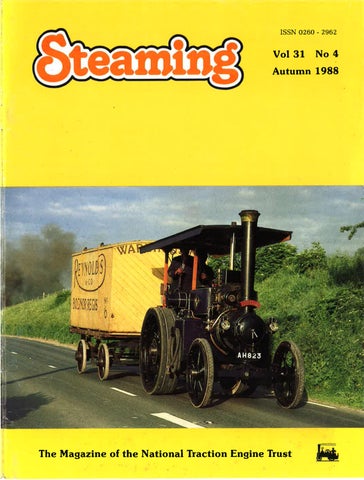
We've remarked before that of all types of steam engines, the steam tractor is probably most difficult to portray in its original role in preservation. Brian Johnson's picture of Marshall 5ton tractor 73900 of 1920 gives a fair impression of furniture removing sixty or more years ago whilst returning to the Amberley Chalk Pits Museum from the Parham rally in June 1985. The lift-off furniture box and trailer is one of four on loan to the museum from Reynolds of Bognor Regis, who first used them with Fodens and worked them until the 1950s. 167
Trust News From the Chairman I am pleased to announce that Major Henry Marshall, a member of the Marshall family and for many years associated with Marshalls of Gainsborough, the renowned manufacturers of steam traction and portable engines, has consented to be a Vice President of the I rust. We are honoured to have a representative of this fine marque of steam engines as one of our honorary officers and extend to him a warm welcome from the committee and all our members. As members will be already aware, the most important problem currently facing the Trust, indeed in my opinion perhaps the most important threat to our interests that we have yet faced, is the impending Common Market legislation regarding use of preserved vehicles which will be laid before the European Parliament in the coming months. In previous notes, I have outlined the dangers of this proposal which in essence is to restrict the use of preserved vehicles of all kinds used on European community roads to travelling to and from approved events, thus preventing engines from being used for small local events, travelling to and from the local fete or pub, or simply driving on the highways for pure pleasure. We shall all be affected, one way or another, by this unwelcome proposal — members of the public because their chances of seeing impressive steam engines travelling under their own power and appearing at local carnivals, processions and fetes will be seriously curtailed, and engine owners because they will no longer be able to use their engine on the road when they please. There is also a strong possibility that engine values may be adversely affected. I have promised to keep the membership up to date concerning progress of the campaign by vehicle preservation clubs to curtail and wherever possible eliminate EEC legislation which will adversely affect the use of preserved vehicles on the roads. Since my last notes, the Federation of British Historic Vehicle Clubs has been formed, this body 168
being a reconstruction of the Historic Vehicle Clubs Committee, on which the Trust has been represented for many years. We are represented on the committee of the new Federation by our Chief Executive and Vice Chairman — John Crawley, and the Trust has promised a substantial donation to the Federation's initial fighting Lund. Both Peter Bottomley, Minister for Roads and Traffic, and the Secretary of State for Transport, Paul Channon, have recently given assurances that there are no plans to restrict the use of older vehicles through the use of retro-
spective applying regulations, but this still leaves it possible for our engines to be hit by oblique legislation, or by harmonisation of European regulations. Therefore, in the words of Lord Montagu of Beaulieu, the President of the new Federation, 'the price of liberty is eternal vigilance'. The Federation have therefore appointed an experienced EEC Parliamentary lobbyist, Edward SeymourRouse, whose brief will be to watch out for any proposed legislation likely to affect historic vehicles and to continually campaign against it. The Trust recognises that the price
From Alan Martin's Collection
42
There is little of the romance of the fairground about this picture for it shows Fowler showmans road locomotive 10302 of 1908 being used in November 1941 to pull down dangerously blitzed buildings in the City of London, near St Pauls Cathedral. NORAH, as the A5 compound was christened, was owned by Billy Smart and it is said that it was from jobs such as these that he saved the money to buy his first big top. The engine still carries its topical decoration from four years earlier — CORONATION AMUSEMENTS, LONG LIVE THE KING on the canopy, together with much painted scroll work, and crossed Union flags on the belly tanks. Some two dozen showmans engines found similar work in London at this time, and others in blitzed cities elsewhere in the country,
of such vigilance may well be high, and that we may therefore expect continuing calls for additional financial support. Your committee feel that this is a cause which will have the enthusiastic support of all our members. (Peter Barber)
Rally Organisation Rally sub-committee During the summer months, of course, much rally activity takes place; there are many events throughout the country which should enable all members to get to at least one. But there are devotees who attend many events and therefore have a very good idea of what is happening on the rally fields. I wonder what the record number of rallies attended by one person is? This comment excludes those who are attending for business or commercial reasons or as assistants in the organisation of the event. The latter group are invaluable and we all owe a considerable debt of gratitude to those who come forward and offer to help; one volunteer is worth ten impressed men the saying goes, and it is certainly true of our volunteers in whatever aspect of the traction engine movement they are working. By the time these notes appear, the rally season will be over, only a few working events and steam parties remaining on the calendar; in some ways these are just as interesting as the traction engine rally proper, much personal interest being taken in them, which tends to bring about a more friendly atmosphere. From all accounts the season just ended has gone off fairly well and no major problems have been reported. Obviously the weather has played a great part in deciding on the success or otherwise of any particular event; some have done well, others have had a very difficult time, but in all cases we detect and note that all organisers do their best to give good value to the public attending their events. The major activity of the Rally subcommittee during the winter is to hold two Conferences which are designed to be a platform for exchange of views, ideas and information. This winter the two events will both be held in London and will be rather closer together than has been the case in the past. This has partly come about by the change to a new venue since the cost of hiring that used previously has risen considerably, and its continued use would have necessitated a sharp
increase in the conference fees. The new venue is at The Victory Club near Marble Arch, London, which should prove a very suitable location for us — more precise details of where it is are given in the Future Dates column. The date is Saturday, 10th December with the Spring Conference following on its usual date in February. Details will be sent to all Affiliated Clubs and Rally Organisers separately. Should any organiser or traction engine club not receive an invite perhaps they would contact me. I would like to conclude by thanking all the members of my subcommittee for the considerable amount of work they have put in during the year; this is greatly appreciated. (Eric Fillmore, chairman, rally sub-committee)
Engine Owners Column Boiler Inspection It is very gratifying to report that the response to my appeal for information, published in the Spring issue of Steaming has been excellent, and my thanks go to everyone who responded, especially those who took the trouble to write to me at some length. My thanks also to all the engine owners who have talked so freely and helpfully to me at the rallies which I have visited this summer. All your efforts have been invaluable to me in establishing the basis for the Code of Practice for the Operation, Care & Maintenance, Inspection and Repair of Traction
Engines and Other Steam Driven Road Vehicles. A ponderous although descriptive title, it perhaps might be better just to call it The Traction Engine Code for short. Work on the first draft of the Code is well advanced and, by the time these notes find their way into print, should be with the Committee for consideration. If all goes according to plan, it should be possible to get a consultative document out in the new year. This will be available to all interested parties and there will be ample opportunity for constructive comment before the Code goes into its final form. This may seem a long winded way to go about the job but it is most important that everyone's views are taken into account so that we get a Code which is acceptable to everybody, including the Health & Safety Executive and the insurance companies. The Code must, and will, set a high standard but undoubtedly those who choose to follow it will profit by maintaining a higher value on their engines, reducing costly repairs and, hopefully obtaining better terms of insurance. Furthermore, by setting our own standards at a high level, we stand a better chance of avoiding having swingeing restrictions imposed upon us by the EEC or our own authorities. A couple of points which may be of interest have come up in the course of my enquiries. By and large, most owners do not seem to be having any great difficulty in getting experienced and sensible boiler inspectors but, sadly, horror stories do abound. The trend, quite clearly, is that things are getting worse as the 'old school' are
Chimney tops for engines An engine's chimney top is, arguably, the one item which if not to the right shape can spoil an otherwise immaculate restoration. The Trust has arranged for the manufacture and supply of chimney tops, in brass or copper, to a wide variety of designs and shapes, all from makers original drawings or, if the latter are unavailable, from well researched dimensions. The costs are competitive and delivery is prompt. For further details contact John Crawley Bunkers Hill House, Bedby, Daventry, Northamptonshire, NN 11 6AW (tel 0327 300401)
169
retiring and younger inspectors come along with no experience of locomotive type boilers. To me, the most surprising thing was the attitude of the great majority of engine owners towards any form of feed water treatment. Answers to my questions about this ranged from 'Never! I'm ex-railway' (as if this excused anything) to 'No fear; I like to take hot water from the injector for washing and making the tea'. Railway companies did, in fact, try to improve water quality and some very big treatment plants were constructed. Any industrial engineer who ignored what went into the boilers would soon be out of a job, so why the 'this is not for us' attitude of most of the traction engine fraternity? One owner, having expressed his contempt for any sort of feed vvatci LICOtI1lClll, Wei LU complain that he had had to re-tube his boiler because the space between the old ones was choked solid with scale! There does seem to be a lack of understanding about water treatment amongst lr eetiurr engine people, perhaps because, in their working days, the engines had to put-up with any sort of water that could be found for them and they relied upon frequent washing out. The old dears (the engines, not the owners) are now getting on a bit so would it not be a good idea to cosset them a little? I mentioned a lack of understanding because quite a number of owners said that they had tried water treatment but given it up because after a time the engine primed; when asked how frequently they blew the boiler down, however, many either said 'never', or did not know what I meant. The principal of internal feed water treatments — that is those where a substance is added to tho water before it goes into the boiler — is to keep the minerals dissolved in the water in suspension rather than being deposited on the boiler surfaces.lt is therefore essential that the boiler is blown-du vn regularly to reduce the concentration — otherwise the damned thing will go off like a glass of sherbet. Many years ago, I was responsible for a large number of steam cranes and a liquid additive was used (probably a member of the DM family but it came from the stores under the title 'treatment, liquid, water, feed, boiler' — storekeepers have a language of their own). But the treatment did work very well, and kept the boilers nice and clean. At the end of each shift they were blown-down half a glass and there was never any trouble from priming. (Jim Newnham, Hon. Safety Adviser)
170
A brief pause on a sunny afternoon in the early 1940s for the road gang working around Aveling 8581 of 1915. The engine was delivered new to H. Richards & Co of Newport, Monmouthshire but passed on to Barnes Bros of Southwick, Wiltshire in 1929. Member Trevor Vanderplank, who kindly sends the picture, identifies his grandfather Arthur Skates as third from the right and the others standing were all from the Wallop area of north Hampshire, near where the picture is thought to have been taken. The pair perched on the roller were not locals, so presumably were the Barnes Bros crew. The roller is now preserved and rallied in Cornwall.
Insurance notes For some time we have been aware that steam roller drivers have been reluctant to display L plates on the rally field when they have not taken their Group G driving test. We are pleased to say that we have agreed with the Trust's official insurers that L plates do not need to be displayed on steam rollers except when the vehicle is being used in any place to which the Road Traffic Acts apply, e.g. on the public road. Use, therefore, on private land or a rally site which is not a public road is covered whether L plates are displayed or not. On the road there is no change and L plates must be displayed, in accordance with the law, A further change in the insurance scheme is that engines can now be insured for the full expended cost of restoration even if this is more than the actual market value of the vehicle. To do this we need to see photocopies of the bills for the work done. Whilst this may not have any effect on the more valuable engines it does mean that the more everyday ones can be insured for what you have spent. This is a completely new feature and not
avoilable, so far as we know, from airy other scheme, and it applies to cars and historic commercials too. (David Franklin, John Scott & Partners)
London Area Social Meetings The 1988/89 series of social meetings in London will commence in October, and all members, potential members and interested visitors will be very welcome to attend any or all of the evening talks or slide shows which have been arranged for the Trust by Bill Timmings. The venue will continue to be 'The Horse and Groom' in Great Portland Street, London W1. The premises are a few minutes walk from Oxford Circus tube station north along Great Portland Street, on the right hand side. The meeting room is on the first floor with access via a door on the left side of the front of the building.
Remember....
Autumn Rally Organisers Conference SATURDAY 10th DECEMBER 1988 The Victory Club Marble Arch, London See Future Dates column for further details
Meetings will be held on the last Tuesday of each month from October to April (but excluding December), the talks starting at 8.00pm but with the room available from 7.30pm for conversation etc. For this autumn and the first part of the winter the following has been arranged: TUESDAY 25th OCTOBER 1988 — Our traditional opener of Members' Slides, for which a projector and screen is provided by the Trust. This is the chance for members to bring along
OUR MAGAZINE 25 YEARS AGO
The final issue of the year was a Rally Issue with short reports and photo features. It had been a poor season for weather. However 37 rallies had taken place. This was revealed at the Club's AGM where the number was considered to be a barometer of the strength of the movement. Local clubs, mostly affiliated, numbered sixteen and there was a total of 1,300 paid up members. A resolution by S.W. Neville sought 'to regularise and control as far as possible the various events held throughout the country, and to endeavour to arrange for major events
a selection of pictures they have taken during the year, and hopefully show all present a few new engines that have appeared during the 1988 season. TUESDAY, 29th NOVEMBER 1988 — 'An evening with the Steam Plough Club'. Different types of engines attract their own followers, so here is the chance to be instructed and entertained by members of the club whose especial interest is the mighty ploughing engine and all its tackle and folklore. DECEMBER — no meeting. TUESDAY, 31st JANUARY 1988 — 'South African Steam'. An opportunity to view steam on the steel highway and in different surroundings — Barry Walker will be illustrating 3ft 6in and 2ft 0in gauge railways in South Africa, including the articulated Garratt locos on the narrower rails. Details of the rest of the 1988 meetings will appear in the next issue. (Bill Timmings, London meetings organiser)
Changes of address All members should note two important changes of address. Both John Crawley, the Trust's Chief Executive, and Keith Shakespeare, our Sales Officer, have recently moved house and their new addresses are as shown inside the front cover.
not to clash'. It was agreed to refer the subject for committee consideration, but the item was probably the first intimation of the Club's later Approved Rallies and Code of Practice which have done so much for organisers in the way of exchange of ideas in more recent years. The Teignmouth Quay company had sold their spare vehicle, a Sentinel S4, and ceased to use their well known shunting tractor THE ELEPHANT, Sentinel 5644, which was now for sale. The Worcestershire notes described the recording of the BBC radio serial 'The Archers', when 'old' Walter Gabriel took delivery of his latest fad — Foster compound traction engine 14564. Twenty-five years on the programme has long forgotten the Foster but the character of Walter has only just been written out of the scripts with the death of the 86 year old actor who played the part for so long. The engine, in real life, was showmanised many years ago.
Future dates AGM 1988 The 1988 Annual General Meeting of the Trust will take place on Saturday, 3rd December 1988, at 11.00am at the Midland Hotel, Birmingham. Formal notice of the meeting, the agenda and the Annual Report and Accounts will be distributed with this issue of the magazine.
Rally Organisers Conference The 1988 Autumn Conference of Rally Organisers and Affiliated Clubs will take place at The Victory Club, 63-79 Seymour Street, London W2, on Saturday, 10th December 1988 at 11.00am with coffee and biscuits available from 10.15. Invitations and formal notices will be sent to regular attenders in the usual way, but newcomers are always welcome to these interesting gatherings. Habitual customers will notice a change of venue from Paddington where the conferences have been held for many years, a change which is explained by Eric Fillmore in his notes. The Victory Club is on the corner of Seymour Street and Edgware Road, adjacent to Marble Arch. Some street parking is available in the area and the Hyde Park underground car park is about 100 yards distant. Marble Arch tube station is some 50 yards or so from the Club. Any organisation or individual requiring further details or an invitation should contact Rally sub-committee chairman, E.A. Fillmore (address always inside front cover).
'Furniture motor van for disposal. A 3 ton Gillette steam van, with specially finished, large capacity, hooded body, and with unworn Polack rubber tyres throughout; burns paraffin fuel; fitted to take a trailer; to be sold because it is the only steamer in the owner's extensive motor transport fleet; the vehicle is in good running order and has until recently been in regular service; it may be inspected and all particulars may be obtained upon application to the Transport Department, Waring & Gillow Ltd, 164-180 Oxford Street, London W.' (an advertisement in The Commercial Motor, 8th September 1910. The 1903 built van, still with iron tyred wheels, is illustrated in Bob Whitehead's Kaleidoscope of Steam Wagons, and there attributed to Gillett, not as shown in the advertisement.) 171
Somerset Recollections Dennis Cook Curland is a small scattered Somerset village six miles south of Taunton, and it was there that I spent Ole first four Leen years of illy life, frum 1913 until 1927. The roads were then made up with stones rolled and mucked in with sand and water, which, when dry, became very dusty. There were very few cars around, but plenty of horses and traps. My great interest, however, was the steam engines which were passing quite often. My father and two brothers were all engine drivers and worked for a local firm, A. Shire & Sons of Thurlbear near Taunton. The firm owned a few small quarries in the Blackdown Hills, and also did threshing and sawing. My father drove a large compound Clayton & Shuttleworth, mainly for threshing, and also a smaller Tasker traction engine with which he did haulage work. My eldest brother Arthur did threshing, reed making and sawing; he used a single cylinder Clayton — the one in the picture accompanying this article. My other brothcr Sidncy comc bock from World War 1 and also worked for Shires. Early in 1920 he went to Taunton station to collect a new 5hp Burrell, works number 3824 which had left the works on 16th December 1919. The engine is, of course, none other than LORD FISHER OF LAMBETH, mentioned many times in our magazine for its rally outings and seen on the cover of the Winter 1987/88 issue; that picture brought back many happy memories for me for I steered it many miles with my brother. The first three days Sidney used this lovely engine he had trouble with the crankshaft bearing (flywheel side) and had to keep stopping to cool down. On entering Easton & Johnson, engineers of Taunton, a young fitter was put on the job to correct the trouble. After some difficulty the key was removed from the flywheel and the bearing eased — a perfect job was 172
made and this engine was a pride on the roads around Taunton for many years. The then young fitter who did the job is still with us, and living at Bishops Lydeard where he was with W.J. King fur over filly years — and is just thinking of giving up work. Many steam engine owners will remember him, Jack Clark. For several years the same roller and driver from W.J. King of Bishops Lydeard came to do the stone rolling in and around Curland. The roller was single cylinder Aveling & Porter 8920 of 1918 (FX7058), mentioned in Steaming for Winter 1982/83 on page 32. I enjoyed many hours with this roller, for the driver, Charlie Morrel, used to let me drive it up and down the road and help him wash out
the boiler at weekends. Incidentally, that same issue of the magazine, later on, mentions Aveling 9260 of 1920 (FX7077); this Aveling also belonged to Kings, having been new to Eddisons, but In 1923/24 it developed firebox trouble and was sold for scrap. King acquired it and had a new boiler and firebox complete sent down from Avelings to Easton & Johnson at Taunton and the young Jack Clark completely rebuilt it. I he roller was used for several years pulling a 1000 gallon tar tank for tar spraying purposes. The first steam lorry I can recall seeing whilst at Curland was Tasker 1915 of 1924; this also belonged to W.J. King and is now under restoration at the Tasker collection at
A Clayton traction engine engaged on reed making when owned by A. Shire & Sons, taken about 1923. The driver, with his dog on the footplate, is Dennis Cook's elder brother, the late Arthur Cook. Shire's had two Claytons — 41200 of 1909 and 44110 of 1911. (collection D.G. Cook)
Chilcomb, Hampshire. This little Tasker wagon was used up to the year 1928 for general quarry work and for the last two years was driven by Albert Adams of Wiveliscomb, Somerset. It was then taken to a quarry in St Audries, near Williton where it lay derelict for many years until collected for inclusion in the museum set up by the old Tasker firm at the works at Andover. Albert worked for Kings for eight years doing various jobs including driving a Yorkshire steam wagon fitted with a tar tank, which did tar spraying for local councils and other jobs. W.J. King had two of these Yorkshires for tar spraying and these were used up to the middle of the 1940s; they were of the old type which had the exhaust jets in the smokebox and slide valve engines. (Alan Duke identifies them as Yorkshire 1404 (X08227) and 1408 (XB9882) both acquired from ShellMex & BP Ltd in 1929). In 1926 my brothers Arthur and Sidney left the employment of Shires at Thurlbear and commenced work for Kings. My father joined them the following year. Sidney was driving a new Burrell 6 ton steam wagon, 4035 of 1926, but had much trouble with breaking rear axles; Arthur had Burrell 4054, a similar machine new in 1927. However this wagon had very heavy
T
-
.-
W 01.1A17FIV (WNI BISHOPS L Yfit.. 11o r. P., Sti
Burrell 6 ton three way tipping wagon 4054 of 1927, when new. Driver Arthur Cook, and mate Tom Sealey, pose for the photographer with the wagon's body tipped to the rear; the location is outside the Four All Hotel, Corporation Street, Taunton. (collection Alan Martin)
Having survived working days to become a preserved engine, Alfred Shire's Burrell 3824 has no doubt since visited far more places than he would ever have foreseen. Here, driven by Brian Caseley, the 6hp road loco passes To wan Cross Farm near Porthtowan, Cornwall during a road run in 1.985. (Bob Payne)
W.J. King's two 1931 built Yorkshire light six wagons pictured at Bleadon near Weston-super-Mare in 1932 — WJ type 2182 (UB4999), on the left, and 2184 (UB5765) with Walter Cox, Dennis Cook, George Payne and Micky Stone posed across the front. (collection D.G. Cook)
steering, for the axle had been moved further to the rear to stop the axle trouble. These wagons, not being very successful, were sold to other owners in a quite short time. Sidney then had a new Foden steam wagon to drive — 12630 of 1927 ITU61991, whilst Arthur took on driving the other Yorkshire tar tank for many years and did various other jobs including threshing and sawing. In February 1929 I commenced working for Kings, my first job being mate on the Foden with brother Sidney. In 1930 I worked with my father who was by then driving Burrell 8 ton steam roller 4044 of 1926 IYB7730), which I see has now been restored and is owned by Richard Seago in Norfolk. I enjoyed driving this roller, for it was in new condition and was very economical on coal and
The same two Yorkshires standing back to back at Bleadon. The crews are left to right: Micky Stone, Harold Napper and Walter Cox — who came down from the Yorkshire Steam Wagon Co to demonstrate and decided to work for W.J. King. He later returned north. (collection D.G. Cook)
-1IRT
_TEA For further details contact
We specialise in the construction and repair of locomotive type boilers. Firebox construction can be of the traditional flanged and rivetted design, or flanged and welded. Construction is to the appropriate British Standard Specification and all welding is by coded welders to BS 4870. Work being done is approved at all stages by an engineering surveyor from your boiler insurance company. Construction of tubeplates, smokeboxes, tenders etc, also undertaken.
Roger Pridham, Hollybank, Chilsworthy Beam, Gunnislake, Cornwall. Telephone Tavistock (0822) 5276 Daytime, 832945 Evenings
174
t. ti
Three photographs of the 1931 Yorkshires engaged on taking spoil away from a cutting being made at Uphill, near Weston-super-Mare in 1932. Dennis Cook stands in front of number 2182 in the top picture. (collection D.G. Cook)
water. We had two of these Burrell rollers with belly water tanks and they only required filling once a day for eight hours working. The second one was 4062 (YB9360), the date of purchase being 14th April 1927. Other Thetford built rollers on the firm were 8 ton single 3946 of 1922 (YB4521) and 8 ton double crank compound 4004 of 1925 (Y132010), now owned by Arthur Bridge in Cheshire. There was also a single crank compound roller named PRIDE OF SOMERSET, 3411 of 1912 (TA2142) — another survivor to the present day, this time in Devon. There were many steam lorries around belonging to W.J. King, including Fodens, Sentinels and Yorkshires. One of these late Fodens was a Super 6 model and seemed to be very quiet running; I was mate for a couple of days on this one and enjoyed it very much. It was later put aside, but the remains were in the sale held at Bishops Lydeard earlier this year. Apart from the Fodens, there were four Super Sentinels, and a DG on solid tyres, and three Yorkshire wagons. After the heavy tax was put on them, they were laid aside, becoming derelict, but the older Yorkshires were replaced in 1931 by two Yorkshire light six wagons on pneumatic tyres and which I worked on and drove on many occasions, as shown in the photographs. There were also four DG6 Sentinels and one S4 on pneumatics which were used up to the late 1930s. The S4 has been restored and is now on Hayling Island. I did various jobs on steam, petrol and diesel vehicles for W.J. King but owing to severe illness, I had to leave after 36 years. Some four years and two large operations later I returned to work and spent ten years at precision engineering in Taunton until I retired in 1978. yrj
'Easton — Alfred Chamberlain, the driver of a steam thrashing machine, was summoned for an infringement of the Highway Act by erecting a thrashing machine within 25 yards of the highway at Easton [near Winchester] without a screen. The case was proved by Police Constable Gladwell, who found the driver of a horse and cart unable to get past the engine in question. Defendant, who was told he was liable to a penalty not exceeding £5 a day, was fined 10s [50p] and 4s [40p] costs.' (from the Hampshire Chronicle, 26th December 1885.) 175
A Postcard Home When, in 1908, Charles Pumfrey moved to Duxford in Cambridgeshire and set up on his own with a set of threshing tackle, he chose to buy a Ruston Proctor outfit through Thurlows of Stowmarket, the down payment being provided by his wife's Co-op dividend money. The actual set had been displayed at the Lincolnshire Show at Sleaford, the engine being number 35358, to which Pumfrey proudly gave the name PROGRESS. Once it was at work Rustons had photographs taken for catalogue and publicity purposes. Printed up as postcards the pictures made useful adverts for maker and customer alike and Pumfrey received a good sized bundle for use in his business, enough indeed for the family to be still using them nearly ten years later in December 1917. At that time son Rnh sent one hack to his mother from Peterborough
where he had gone on baling work for the War Department — "We have found the baling set, walked about six miles down the fen, real black land, sink in anytime. Garrett engine and Ruston baler, nearly new but used bad." Charles Pumfrey's choice of name for his engine was prophetic — in August 1914 he could return to Rustons, obviously satisfied with their products, for another 7hp, number 50278, which he quite reasonably christened SUCCESS. Two secondhand Rustons completed Pumfrey's fleet — a 1907 8hp acquired about 1914, and 6hp 113043 bought around 1925. The latter survives in preservation in the ownership of Geoff Wheeler and SUCCESS is still with the family, now owned and rallied by Ken Pumfrey. (compiled from notes by David Nourse and Alan Duke)
The postcards that Rustons supplied to their valued customers acted as an advertisement for both of them. The driver is Sidney Pumfrey and Charles Pumfrey stands extreme right, oil can in hand. (collection D. Nourse)
'The engine of the Millar-Marshall tandem roller is a typical Gainsborough product.' (From Commercial Motor, 27th November 1923).
'Catwick Mills, Sigglesthorne, Hull, April 19th 1912. Dear Sirs, I am glad to say that the Portable Engine No. 27360 has given me every satisfaction. It is very economical in coal, and sensitive in governing. The construction of the boiler is well arranged and strong. The engine is very handy for our work, having two speeds, and I may say the design is perfect. Any repairs can be done at half cost over the old design. 'The inspector remarked, on examination of the boiler. that it was very strongly constructed, and I had got a very good engine. 'The water, as you know, had been very destructive to the boiler, but we are now getting a new supply. I am yet allowed to run at 100Ibs. pressure; that is, the engine is still passed for 100Ibs. 'The engine was new January, 1904, and since then, in looking through the register, we have ground 16,000 qrs of corn to 31st December last. Yours truly, Coulson Bowser.' (A testimonial included in Ruston, Proctor & Co Ltd's catalogue of about 1918.)
•.1
Thrashing set, comprising 4'G. Strong Wuble Crank Thrasher, 7 H.P. Single Cylinder Steam Traction Engine, and 22'0' Elevator, supplied by Ruston. Proctor & Co. Ltd., Lincoln. to C. R. Puinfrey & Sees. Duxford, Cambs.
Steam Party On Sunday 19th May 1968 the Dorset Steam & Historical Vehicle Club and the Western Counties Fair Organ Club organised a gathering of engines and organs, together with some commercial vehicles and amusements at Great Yeatmans, Shaftesbury, the home of the now late E.C. (Ted) Hine. Twenty-one years later, on 21st and 22nd May this year, another Steam Party was held at Yeatmans to commemorate that meeting — the inspiration for, and forerunner of the present Great Dorset Steam Fair as Gordon Hine put it in his introduction to this year's programme. Three of the original steam participants were able to be present this year: Fowler road locomotive 12255 PRINCESS (a showmans road loco in 1968) owned by M.P. and S.J. Loader, Fowler roller 18652 FIPPENNY QUEEN owned by Arthur Field, and (pictured top) Fowler roller 16134 PROGRESS owned by Dr Alan White. The latter two engines were owned by E. C. Hine and J. Antell respectively, in 1968. Pride of place in 1968 must have gone to Ted Hine's Burrell 3938 QUO VADIS. This year, larger showmans engines were represented by Arthur Thomson's Burrell PRINCESS MARINA (centre picture) and D. and J. Hedgeman's Burrell 3949 PRINCESS MARY. In 1968 Jim Hutchens exhibited Fowler ploughing engine 15436 PRINCESS MARY; this year he was back with his well known Garrett Suffolk Punch 33180 THE JOKER, and Aveling tractor 7612 AMELIA. Looking superb following its very complete overhaul and restoration after a disastrous fire in 1986, Goold brothers Sentinel S4 9032 (bottom) now carries the name of its original owner — as well as a fair complement of family and friends! Len Crane came along with his crane engine, supplying timber for Beano and Bert's sawbench, under the supervision of Malcolm Hughes. At the other end of the bench was R. G. Coles's finely restored Wallis general purpose 7227 INVINCIBLE. With nearly twenty engines, fair organs inside and out, amusements and commercial vehicles, and with glorious weather thrown in for good measure, this was a delightful show, truly reminiscent of the early days of rallying. (comment and photographs by John Reeves)
From my viewpoint Giles Romanes, FRCS, DOMS, writes of some medical considerations relating to traction engines.
Now that some fifty years have passed since steam was in commercial use on the land, and in road haulage, it may be interesting to look back at that time through a medical eye. Amongst our members, there are several doctors, and possibly the list also contains names of pharmacists, nurses, physiotherapists, etrt; all of whom I hope will contribute to the correspondence columns of Steaming to fill in some thoughts which did not occur to me when putting pen to paper. Those of us who are fortunate enough to operate a traction engine are aware of the dangers, and exercise continual vigilance to ovoid accidents. In a sense, we are practising preventive medicine. It is obviously much better to have an annual boiler inspection than to have multiple scalds on the rally fields, or worse, if there should be an explosion. But however testing, much maintenance, measuring and advice is taken, the unexpected sometimes turns up in the most awkward situations. When that happens, proper preparation in siting exhibits, guarding ropes and belts, and in staff training and briefing, can keep the incident contained at joke level, rather than letting it get out of control to become a disaster. This sort of practice all started with steam. It has since grown into the Factories Acts, and into Health & Safety at Work Regulations. In the middle 1800s, when steam threshing became common, there were the most frightful injuries to men working and falling into the drum. The first legal obligation for safety with this machinery was to have a wooden cover which could be closed over the opening into the drum, to prevent such things happening. From the practical medical point of view, accidents and injuries to crews operating traction engines were the most common type 'disease'. We all have heard of engines which acquired a nickname such as THE KILLER because, for example, the clothing of a driver became entangled in the crankshaft so that he was drawn into the motion before he could stop it. Typical accidents like running over a man, or somebody losing a leg in a 178
working baler, were common enough for the staff in almost every Cottage Hospital to be able to draw on direct experience in the treatment of the next case to be brought in. The designer of the machinery tried to ensure safe operation. For example, on the traction engine he inrorpnrsteri the lice of a fusible plug, safety valves, shatterproof water gauges. He provided gear clutch interlocks and check chains on steering gear to guard against misuse resulting from forgetfulness, distraction or fatigue. He arranged for the fitting of sheet metal shields over gear-trains, on fly-wheels, and besides the rods. Those on the fly wheel and obscuring the motion, as seen from the road, were there to avoid horses taking fright and bolting. This seemed to be conforming to the theory that a carthorse needed blinkers on his head collar, because it prevented him seeing the turning wheels behind him. There are medical conditions which arise in circumstances associated with the steam engine. Some, like pneumoconiosis or silicosis, are mainly the result of coal mining, so are not directly related to the steam engine. However, constant breathing of air polluted with coal smoke does accelerate the onset of chronic bronchitis. This condition was so rife in England a century ago that it was known on the mainland of Europe as the English Disease. The sufferer gradually lost the cleaning action of the lining of his lungs, and windpipe, so that the long-standing irritation went on to the formation of fibrosis which replaced the normal elastic tissues. This prevents the lungs emptying themselves properly, so that the patient becomes barrel chested in shape, and his activities are curtailed by shortage of breath. The full-blown condition is known as emphysema. Though coal smoke smells lovely to we steam enthusiasts, it is not wholesome. Smoke occurs when there is imperfect combustion of the fuel, mainly when the engine is at rest. When it is working hard, there is usually less smoke, which is quite the opposite to what happens in the diesel engine. The smoke contains tars,
phenols, oxides of carbon, oxides of sulpher and carbon particles. Tars and phenols are agents which in high concentrations, under certain conditions, give rise to skin or other cancers. Carbon monoxide is a strong poison. It was feared so much — because its on-set is insidious and without discomfort of any sort — that the Railway Companies deliberately avoided providing more than a weathershield to protect their engine crew in the early days, because they felt that the concentration of this gas could rise to dangerous levels in a cab when steam was shut off. Such a risk is unlikely in operating a traction engine. Carbon particles, especially associated with soot, caused cancer of the skin of the scrotum in chimney sweeps, often enough to be known as their occupational disease. A similar condition was caused amongst some workers in the spinning mills who attended to the machinery for routine oiling and maintenance. In these people, their overalls and clothing became saturated with oil which they massaged against the skin many times a day as they lent over a bar at work. I have never heard of a traction man being a victim to these diseases, even if he was one of those whose overalls were so grimy that they stood up by themselves when taken off! I suppose the paste of grease, etc., made a sort of impermeable protection. Many of the evil effects of atmospheric pollution on people were known during the steam era, and all sorts of attempts were made to reduce the amount of smoke emitted. At first, the fuel for locomotives was changed to coke but this was soon found to be unsatisfactory, mainly because of its relatively low calorific value. So engineers tried to get conditions right in the firebox for coal to he burnt completely. One scheme was to have a divided firebox and to fire each side at different times. The idea was that the glowing side would enable the smoke form the newly fired side to be burnt completely, but it was not successful. The solution came long afterwards with the introduction of the brick arch in the firebox. This kept the heat high enough so that distilled gas, etc, could be burnt. It also enabled air to be introduced above the firebed into this hot zone, so that there would be enough oxygen for smoke consumption. While such engineering efforts were only partly successful, there was still room for improvement. This came about through the Smoke Abatement Acts. Locomotives were legally able to emit smoke for only five minutes in the half hour, but there was practically no way of enforcing these
provisions on the railway. On the highway, things were different, and poorly informed Police were often officious towards drivers of traction engines. Moreover, there were many local byelaws about emissions with which it was impossible to comply. Clean air really only came about when the domestic fire was no longer an economic way of space heating in the home. Since then, the scourge of chronic bronchitis and emphysema has lessened markedly in spite of the increasing average age of the population. We have by now all heard of Asbestosis, but we may not know that the disease was only described in the middle of the 20th century, and was quite unknown as a recognisable entity when steam was in vogue. It is very difficult to diagnose because of its relative rarity, its involvement of soft tissues, and its very slow insidious onset without characteristic symptoms. Often the only clue is the history of possible exposure to asbestos. This is a substance which every traction man made use of for pipe and other lagging, and as a component in gland packing materials. It is, fortunately, a rare disease, because it is incurable. What happens is that fibriles of asbestos get into the body's tissues. These tissues lead to the foreign body invasion in the normal way at first. The guard cells and those responsible for eliminating such material soon find that they are overwhelmed and are unable to act properly. So the material remains in place and sometimes provokes a special reaction of its own which is the production of a form of cancer that is associated with a mass of fibrosis. The organ containing the mass is so handicapped in its function that in the course of time it is unable to continue working properly. This leads to the inevitable outcome in the long run. (to be continued)
The hills of Derbyshire have for long been quarried for their limestone, and quite a few early railways conquered the uplands to enable the stone to reach markets further afield. The upgrading of roads in the 1920s to suit motor traffic saw steam wagons come into use on more local hauls from the quarries with the advantage that they could tip roadstone direct on the site. In the first picture we see Foden six wheel tipper 13620 of 1930 (R82043) setting out with a sheeted load of bitumenous macadam (tar coated limestone) from Hil'head Quarries Ltd's plant above Buxton. In the background, beyond the railway wagons awaiting their turn, a Sentinel DG wagon is being loaded under the hopper. The 6 ton tipper climbing the gradient to the main highway — watched by a group of 1920s flappers sitting on a roadside seat — is Foden 12982 (RA 6170), delivered new to Toft Bros & Tomlinson of Darley Dale, near Matlock. The 1928 built wagon, along with other Fodens, served this haulage contractor for only a few years before being sold; much earlier the firm had started in steam with a Hercules wagon purchased from Wedgwood of Cobridge, Stoke-on-Trent. (photographs collection R. Painter)
'Messrs Archer, Cowley and Co, of Oxford, were recently summoned for sending a traction engine through St Peter's street, Derby, without being licensed, on August 3rd. The engine was drawing three vans containing furniture, and caused great dislocation of traffic. The defendants said they had permits from Oxford to Wirksworth, and were not aware that Derby was a county borough. A fine of £1 and costs was imposed.' (From 20th Industrial Motor Review, September 1905.) 179
Some thoughts on acquiring a
Foden Speed Six In the early 1970s I was tripping around the country collecting information and parts for the rebuild of my Sentinel S6 8821, then completed as a running chassis/cab. Financial problems later necessitated its sale and the wagon is now rallied in immaculate Tarmac livery by Dave Webster. one of my trips took me to St Audries Quarry in Somerset, owned by W.J. King of Bishops Lydeard and which, at that time, housed several derelict steamers. One of these was a Sentinel S4 from which I was able to take measurements of the coal bunkers etc which my Sentinel was missing. Carrying further on up the county heading for the Goold brothers at Camerton (Sentinel lads of course►, we called at King's yard at Bishops Lydeard to see if the tales we'd heard of a derelict Foden Speed 6 (together with several other Fodens) were true. On peering through the hedge — it was a weekend and the yard locked, and any way admittance was virtually never granted at that time — we did make out the shape of a Speed 6's distinctive banana boiler. Having never seen anything like it before, our knowledge, of course, was from books, but although I had had but a glimpse a seed had been sown... What a shame to leave those wagons rotting away, but rot they did, and for quite a few more years, though a couple of years after that first call, some of the overtypes were pushed into one of the sheds. I called at Bishops Lydeard again, about five years later, and on a lunchtime visit, a polite request got me admittance to photograph the wagons. One of the men was even helpful enough to unlock the shed where the Foden overtypes, including the six-wheeler, were lying in 2 star undercover decay as opposed to the less fortunate examples at the rear of the sheds. On proceeding to see the latter, it was obvious that they were not enjoying their stay in the open, for bits were literally dropping off — and no, I didn't assist them! Readers remembering the excellent description of King's sale by John Reeves in the last issue will recall how the site had been largely cleared beforehand. Well, 180
it wasn't cleared on the occasion of my visit, any ideas of a sale or disposal being very much in the future. Making the best of the jungle, I was able to photograph the Speed 6 and the wagon adjacent to it, an overtype. Those lucky people who purchased lots 391, 393 and 394 might like to know that at that time the wagons were so overgrown as to make a photo impossible without a gang with machetes working for half a day! Anyway, this visit, followed by a second soon after with fellow engine owner Robin Barnard, only served to
Richard Parkinson
spur my interest in this Speed 6 wagon. All went quiet for about ten years I suppose. Marriage and children and changes of business came along (plus a few engines) and then we began to hear rumours and mutterings of a sale. "A sale at Kings? Never" was most people's reaction, hut you, adverts actually appeared, no less a firm than Prudential Property Services, who we all remember as good old Pearsons; people with steam experience were actually going to auction Mr King's desirable wagons and many other
Speed 6 Foden 13750 during its prime (and very short working life) with driver Bert Rose posing at Bishops Lydeard, about 1930/31. (collection Richard Parkinson, courtesy Mrs D. Barker)
items as well. Duly sending for the catalogue, I saw the Speed 6 was included — lot 395. May 13th 1988 was viewing day, and I was there early, too early as it happens and I wasn't allowed in. However after half an hour the gates were opened and the few people there were permitted to enter. Everything was well laid out and some internal combustion engined items were running. The steamers which were in the shed had been pulled out, but what of the others? On going to the rear of the sheds it was plain that it had been considered too much of an operation to shift the five Fodens lying there and the site had been cleared very well, enabling people to view the lots, but leaving any purchasers the job of extraction and removal. I took lots of photos, and video,and joined with several others who said that the engines (particularly the Speed 6) were too rough. "They'll fall to pieces" they said, and who was I to argue...? May 14th dawned blazingly sunny. "What a day to spend a lot of money" said my wife Maureen as we headed up the motorway. Arriving at Bishops Lydeard the sight was fantastic; it was like Stourpaine removed to Somerset, with cars jammed into car parks and overflow car parks, and the people... I guess anybody who's anybody in the steam world, and quite a few more were there. Tim Evans of Prudential was right when he described it on TV as the Sale of the Decade. We parked the van, fed the baby, and set off. Bear in mind Maureen had never seen the Speed 6 — only heard my descriptions. I always did tell her that it was rough, but for some reason upon seeing it she thought my description was to say the least mild. However, as she says, it's my money, and I can do it; nice to have the support. I shall need it. The day was very hot, but after a pub lunch in the village we returned refreshed, and hung around until at last the time came for the wagons to come under the hammer, when we made our way to the front of the shed where the auctioneer had his stand. Lots 391 and 392 made £5,500 and £5,600, not too bad I thought, always remembering the 15% VAT had to be added. Then they started to go up (prices were given in the last issue so I won't repeat them here) coming on to lot 395, "believed to be the only remaining Foden Speed 6". Various bidders got it up to £11,000. I put my bidding number up and got it to £11,500; looking good I thought, but Tim Evans thought otherwise and waited for a very long time, and sure
Pictures of how Foden 13750 looked to potential and successful bidder alike appeared on page 128 of our last issue. The auction over, came the task of getting the remains ready for standing on its feet again, here illustrated by 40 x 8 wheels being welded to the rear axles. (Robin Barnard)
enough others came in. I thought "I'm here to buy this, I've hankered after it for nearly twenty years", so I stuck my card up and left it there. Eventually Tim made his declaration: "£13,000, sold to number 7." I turned my card over — it did read number 7. Coming back to earth I found my fingers had gone numb where Maureen
had been gripping them, and that a chap in the next seat was trying to talk to me. He introduced himself as Gerald Wheeler from Bridgwater and, he said, he just happened to have an ERF eight wheeler with a telescopic 17 ton crane which would pluck the Speed 6 over the hedge and down into the back lane.
First chance to see the works of a Foden Speed 6 without lying on one's back in the undergrowth — another picture of the wagon being lifted over the hedge by hydraulic crane. (Robin Barnard) 181
I'd already come to the conclusion that craning it out would be the best way, for the dragging and manoeuvring to low load it would almost certainly damage the already weak chassis (and one of Mr King's sycamore trees!). So after writing the essential cheque and collecting the receipt we went to survey the remains. A large crowd had already gathered, and many opinions were voiced and noted. While I was reflecting on events, a lady spoke to me, "Excuse me, but my old Dad drove this wagon from new and I've got a photo of it in the car". So, leaving Gerry Wheeler to do his estimate and Maureen to go off and feed the baby, I willingly trekked off to the car park to view the photograph. Fventi 'ally the lady, Mrs Barker, kindly loaned me the original for copying, and hopefully our editor will get it to reproduce in this article. My thanks to Mrs Barker for her kindness. Getting back to the Speed 6, I found Gerry had done his figures and reckoned it was a feasible proposition, so we agreed a price and a date — Tuesday May 17th. Before then a lot of arrangements had to be made. I mananged to borrow four 40 x 8 wheels through the kindness of Horrell brothers of Stoke Canon, owners of the well known Foden steam cider tank. I went up on the Monday to dig around, and jack up the chassis and leave the wheels in King's shed. Tuesday morning dawned with the same hot weather that we had enjoyed through the sale period. Gerry Stoneman from Willand kindly brought his diesel powered arc welder, and with the crane from the ERF in the lane outside we lifted the chassis and tacked the wheels to the studs, as the threads were eaten away. The body was lifted off and left in the road 'pro tern' — then the tricky bit. I must confess to being a bit apprehensive as my £15,000 'one owner from new' Foden swung up to 30 feet in the air, but no problems. Over the hedge (previously judiciously thinned with the chain saw) and a graceful rotation to face the opposite way, and number 13750 was on its transport and ready to far•.e the outside world again. A quick journey down to Devon was followed by a safe unloading, and then came the big strip-down, most accomplished with gas cutting gear. Everything that was greased still worked; the gearbox operates well, the engine is seized though repairable, but the boiler — well that's another story. I'd be pleased to hear from any boiler firm who'd be interested in constructing a new boiler at sensible 182
When you were designed for running along the highway at a goodly pace and have spent fifty years abandoned to Mother Nature, its a bit of an indignity to make your first movement thirty feet vertically to roof top level. However, being of pedigree stock Foden 13750 probably knows the future is going to be better than the past. (Robin Barnard)
Fifty years of transport — Foden 13750 meets up with road haulage of the late 1980s for the first time, for its journey to restoration. (Robin Barnard)
cost; also from anyone who has any Speed 6 spares. My address is at the end of this article. The chassis is now dismantled and we are about to fit new chassis side members at the time of writing; all parts are being shot-blasted before painting and progress reports to our magazine will follow. In conclusion, I'd like to thank Gerry Wheeler, Gerry Stoneman, Jeff
and John Horrell, Robin and Lorrie Barnard and many others, not least my wife Maureen and our children; also Len Wilson and the chaps at Kings for assistance, advice and support. Finally, if the owner of ex Kings Foden 12586 would like to contact me, he may learn something to his advantage!
Technical data: Foden Speed 6 (Type 0) 6 ton steam wagon, number 13750 (LG4815), new July 1930 to W.J. King, Bishops Lydeard, Somerset. Assistance with information on Speed 6 wagons, spares etc will be gratefully received by the author and owner — R. Parkinson, 6 Okefield Ridge, Crediton, Devon EX17 2EG (tel 03632 5611). yrj
A Ruston returns The Museum of Lincolnshire Life recently took delivery of yet another piece of the county's industrial heritage — this time an 1892 built traction engine returned from Australia. Richard Hornsby 8hp single cylinder traction 7297 has been donated to the Museum by the Rotary Club of Scottsdale in north east Tasmania, following an approach by museum volunteer Richard Brooks and director Catherine Wilson. The engine was one of eight tractions built by the Grantham firm and supplied to Tasmania between 1889 and 1892 — almost doubling the number of engines then on the island. From 1930, 7297 was with Robert Arnold of Scottsdale, and he donated it to a children's park in 1966. Displaced from that chore several years ago, it then stood until coming to the Museum's attention as a potentially significant part of its collection and a further representative of the Lincolnshire engine builder's vast export trade. The intention is to restore the engine as soon as possible to take its place alongside Ruston, Proctor 5hp traction 46596 of 1913 SYLVIE, itself brought back from France some years ago by Ray Hooley. SYLVIE, incidentally has had a new boiler barrel, not a firebox as reported in our Summer issue. 7297 has had a hard working life, and a number of parts and fittings are missing — injectors, pump, Salter safety valves etc. A new firebox will be needed and work to the barrel is inevitable.
Richard Hornsby 8hp traction 7297 of 1892 at Lincoln on 2nd July 1892, being prepared for removal from its open shipping container. Notice the appropriate juxtaposition of the iron pilasters in the background — they are from the Hornsby works at Grantham. (Richard Brooks)
The same Hornsby engine at work about 1905, when owned by W. Tucker of Derby, Tasmania. The picture was entitled 'The Derby Express' and seemingly shows the removal of someone's household effects. (David Beck) 183
EDMONDS on Engines
Chris Edmonds
I wonder who invented the wheel, or more precisely, the traction engine wheel? I suppose Thomas Aveling would be a good contender, and it is interesting that all engine makers followed the same method of construction. Invariably, the spokes are cast into a solid hub and riveted to the outer rim. In some cases, mainly Aveling rollers, the rims are cast in as well. Later, Wallis & Steevens, Marshall and Aveling rollers had riveted solid plated rolls, but as far as I know the Thompson road steamers were the only traction engine to employ this type of construction. Perhaps the most striking design was that of the Aveling tractor with its solid cast wheels, with Y-shaped spokes. Lining of the paintwork varied with different makers, Burrell's favoured a broad band of black or gold up the centre of each spoke, whilst Fowlers edged each spoke in black with a 'fish tall' at the top. Variations on this theme sometimes favoured fish tails top and bottom. People who are unfortunate enough to fall under the wheels of a traction engine don't normally live to tell the tale, but so far as I know only one of these grim fatalities has been immortalised in stone. A head stone in a Norfolk churchyard solemnly proclaims: 'The traction engine wheel upon me fell — There was no time to bid my friends farewell'. Engine builders tried various methods of reducing vibration or damage to the roads by fitting different rims, but none seemed so successful as the plain solid rubber tyre. Just before the outbreak of the last war, legislation was before Parliament which would have insisted that all engines were put on rubbers, but the hostilities caused it to be shelved, and it has never been re-enacted. I 184
trust it never will be, because an agricultural engine just never looks right on rubbers. (Ah...! a subject where the Editor and Edmonds are in accord — Hon. Editor). My favourite story about wheels involved a famous firm of London showmen (no names — no pack drill) who ran two or three Burrells and a Foster. They only used to tax one engine, and run them all on the same number plate and tax disc. This worked a treat with the Burrells, but they had to 'doctor' the Foster to disguise it. One morning they were stopped by a copper who knew a thing or two about engines. They'd put a dustbin lid over the smokebox to hide the ring, and taken off the makers plate. The officer surveyed the scene, inspected their documents, and rubbed his chin thoughtfully. At long last he said "I'm booking you for evasion of duty, because that's the first Burrell I've ever seen running on Foster wheels, and seeing as I used to work for 'em, I know darned well they wouldn't fit." Now for a glimpse of the obvious. Smokeboxes are round — well, not in every case as certain Garretts were superheated and the header was housed in a square box on top, but yes, in the main smokeboxes are round. But then, just to confuse matters they can be riveted, welded, or bolted. Riveting is the correct and traditional construction, although bolting with dome headed bolts is easier, especially when it is time for renewal. The length of a smokebox can dramatically alter the appearance of an engine. Wilder's of Wallingford fitted Burrell single crank compound 2426 with a smokebox 4 inches over standard, and it almost gives an illusion of speed! Conversely, short smokeboxes as on some convertibles make an engine look dumpy. Just recently some owners have given up the fight to keep a shine on the smokebox and have painted them matt black. I think this looks very well, as it gives a certain austerity and businesslike appearance as well as setting off the gloss finish on the lagging. A liner in both smokebox and chimney is the only real answer to a long lasting gloss finish. American fashion dictated that on certain traction engines and railway locomotives the smokeboxes were painted silver, an idea that, mercifully, never caught on over here, although I believe the Burrell WAIT AND SEE was so adorned for a time. However many mistakes an artist may make in drawing a traction engine, he always seems to get the smokebox door handles right. The two handles, one longer than the other,
was a universal feature of traction engine design, excepting the early engines which had a series of lugs around the outer rim of the door. What else can one say about the humble smokebox, except that it is somewhere to put the chimney, something to support the front end, and act as a vacuum chamber for the fire. Oh yes, one more thing — it is very handy for cooking steak and kidney pies.! Finally, there's a lot of bunkum talked about blowers. They wouldn't have fitted them if they weren't intended to he used, and railway engines would be lost without them. Old codgers used to reckon they made the tubes leak, but then I wonder what sort of condition the tubes were in, anyhow. There is no difference in the effect of using a blower and blasting up a steep hill, although some engineers say that the continuous draft from a blower causes hot spots and warping in the firebox, but I think it's a weak point. One thing I do know. There's many a time I've been out on a poor steaming engine when the question arose 'to blow, or not to blow' and the right answer got me out of trouble!
eia88/0 depict
Colour Slides
steam engines showmans engines traction engines steam tractors steam wagons vintage cars gallopers
and now make exciting
Christmas Cards A first class stamp brings you • a sample slide • a beautiful steam Christmas card and the new enlarged price list from —
Alex Reid 6 Highcroft Villas Brighton BN1 5PS
Information Wanted This recent photograph (top) by Bob Payne shows good progress on the restoration of the chassis and running gear of Sentinel S4 wagon 9016. The lorry was built in 1934, together with drawbar trailer 9017, and delivered new on the 10th April of that year to coal merchants E. & A. Shadrack of East Ham, London. It carried their fleet number 7 and the registration HV3865. Shadracks had been good customers of Garretts of Leiston, having ordered five of their products in earlier years. It was, in fact, the last Garrett that they had purchased, six wheel QL wagon 35432 of 1930, that was traded in for the more flexible Sentinel outfit. Both Garrett and Sentinel were painted dark green and carried special high-sided wooden bodies for bulk coal and coke deliveries. The Garrett QL had also sported fleet number 7 and was much featured by the illustrations in sales literature sent out by the Leiston works. It is a pity therefore that Shadracks Sentinel was not so widely pictured, for that would have helped the present owner, Barry Northamptonshire Cousins, in his task of restoring the wagon to its original appearance. Fortunately Alan Martin has been able to come up with one view (bottom) which he took in 1955 at the yard of Frank Rivers near Aldermaston, Berkshire, shortly after it had been acquired from Shadracks for resale, and this can be one base for further research. (The other Sentinel, on the left, is S4 9163 (AER8001.( As an aid toward authentic restoration any further photographs — even much the same view to Alan Martin's but from a slightly different angle — or information would be greatly appreciated and can be forwarded via the Editor, with the usual assurances of good care and covering of expenses etc.
A Traction Engine Disaster. — A very curious and unusual occurrence tending to illustrate a serious danger likely to arise from traction engine traffic, is reported from Sidcup, in Kent. Just after a machine of this description had passed along the main
road in the direction of London, two very large shops which were on the point of completion collapsed with a loud crash. The scaffolding fell against the telegraph wires and strained them considerably, but the pressure was, fortunately, removed before the
tension to which the wires were put had any serious results. The buildings were entirely razed to the ground, and it is supposed that the collapse was due to the vibrations caused by the traction engine.' (From The Steam Agriculturalist, May 1885.) 185
A Suffolk Engineman Standing on the bellytank of this Garrett 4CD tractor is George Ottley, a Suffolk engineman over the period of two world wars. The picture is sent by member Pat Freeman of Chelmsford and Ottley was his father-in-law — he was driving a Garrett traction in 1945 when Mr Freeman was courting his daughter Ruth. The family connection
with Garretts' was strong, for Miss Ottley had worked at their Leiston factory during the late war — though helping to produce shells, not engines! George Ottley's workmate has not served us well by standing in front of the engine's registration number and the true identity of the Garrett is not known. The scene is thought to be the early part of World War 1, when Ottley, an asthma sufferer, had been enlisted to drive engines instead of undertaking active service abroad. The tractor could well have been on war work for the other side of the postcard sends a message to his wife at home in Norton, near Bury St Edmunds, telling her "we have not moved from here yet" — unfortunately there is no post-
Hig kfand Steamboat Hortdays Cruise the beautiful sedochs and canals of Scotland in an original coal-fired Clyde Puffer. Good food, comfortable accommodation.
Send forge SAE for free brochure to Rachel and Nick Walker, The Change House, Crinan Ferry, Locrigaphead, Argyll PA31 8QH (Tel 054 65 232).
186
mark to reveal where 'here' was! The print is another example of a local cameraman quickly producing postcards of current happenings or gatherings, hoping he could sell them to those pictured to send home or to relatives. Just visible, and only just, on the side sheets of the Garrett are the last few letters of the name of the owner and his address, and Alan Duke is able to tell us the rest from his lists. Noah Etherbridge of Blythburgh House, near Southwold owned four Garrett 4CD tractors: 27886 was new in 1909 and sold in 1913, probably to be replaced by 31804, new in that year but sold in 1915. 30050 of 1911 had also come new, to be eventually sold on in 1920 but the fourth, 31209, was a superheated example. So from the believed date of the picture the subject could be either 30050 or 31804. Can anyone offer comment? During the 1920s George Ottley worked on engines owned by John George of Wetherden, a few miles east of the family home at Norton. Then, in the 1930s, came a move to Sweffling near Saxmundham and employment with A.K. Cooper in that village on timber hauling and threshing. Garrett traction 33019 of 1917 was the one he was driving in 1945, and must have been scrapped soon after. qj
'The Hutt County Council [in New Zealand] has just purchased a traction engine and stone breaker. The engine, a second hand one, has not behaved well by its new owners. Two months ago, says the Evening Post, it was purchased, on the advice of a Wellington mechanical expert, from its owner in the Wairarapa. It was passed by a Government inspector and granted a full certificate as to soundness. Brought over the Rimutakas without mishap, the engine was overhauled and repaired at Upper Hutt and despatched to Mungaroa to assist in driving piles at one of the new bridges there. Then, strange to say, the boiler, suffering from an undetected malady, gave out. A new plate was put in, and the Council breathed freely again as the engine made steady progress towards Ngahauranga. Passing the gums at Taita the other day, it drew aside to allow a frightened horse to pass, and slipped under its own weight over an embankment, where its path of sorrow is now arrested.' (From The Timaru Herald, 16th July 1904.)
IMPORTANT INFORMATION FOR THOSE NEEDING ECONOMICAL REPAIRS ON THEIR TRACTION ENGINES
B. 8, C. Reconditioning (Gears) Ltd PINIONS
SPURS
BEVELS
All types and makes of bevel gears, spur pinions, spur wheels, helical gears etc rebuilt to standard
Please note that we have moved to new premises Our address now is: B & C Reconditioning (Gears) Ltd, off London Road, Amesbury, Wiltshire SP4 7EQ Telephone Amesbury (0980) 23210
187
A Trip to the Factory Vinson Gritten of Illinois recalls a boyhood dream trip to the engine factory
My dad started using Reeves steam engines and threshers early in his threshing experience — the reason I never remember being told — but it was all good machinery because he had it for many years. Dad owned many steam engines, a thresher or two and a gas tractor. Later, after Emerson Brantingham bought out the company, he took an agency for EB farm tractors and sold a few that I know about. As a youngster all these engines, of course, gave me great excitement. About 1914 or 15, I must have been about six or seven years at the time,
A view in the yard of the Reeves factory at Columbus, Indiana, USA about 1914. Nowadays there is a huge Cummins diesel engine plant on the site. (collection V.E. Gritten)
The large Reeves gas engine tractor whose axle housing went back to the works by Model T Ford. This picture, taken about 1914 or 15, shows the machine hauling gravel for making concrete to be used in rebuilding the Gritten home at Fithian, Illinois. (collection V.E. Gritten) 188
there happened what I then thought was a real big event in my life — a visit to the Reeves factory at Columbus, Indiana. My father had to remove the axle housing from the big gas tractor and take it to the factory to be re-babbitted.* The part was put in our Model T Ford touring car — the rear doors were opened and the housing placed in crossways. And it really made a load, sticking out the sides because it was seven feet long! The journey to Columbus took most of the day, going through Indianapolis but most of the way on dirt roads, so we were gone two or three days altogether. Dad kept telling me of all the steam engines that we would see on the visit. When we got there he had quite a lot of business to talk about in the office and that took some time. I kept worrying him that I hadn't seen any engines yet, and after a few replies of "just you wait''. Dad eventually came out with "all right — let's go to see the engines". We went around into a back warehouse and I never saw so many engines. There must have been hundreds, or so it seemed. They had one engine fired up they called THE MULE which was used for pulling the new engines around, like from the warehouse to the railroad loading dock and so on. I remember that impressed me because they didn't have to fire the new engines that were without water. I've never forgotten that visit. Dad must have had some input to the Reeves company and sometimes used to tell the engineers about improvements he would like to have on an engine. They had a wheel lug that they called the Gritten lug, the result of a suggestion my father made on a design that would clean itself in the mud. On one occasion the company called Dad and said they were shipping him an engine they thought would be just what he wanted. The machine duly arrived and I can remember going to the rail dock at Fithian, where we lived, to unload it. This was quite a chore in those days. Dad had to make sure the railroad company had put heavy plates on the car for us to run the engine off on. We also needed to borrow railroad ties and blocking. Then our mules had to come with a water wagon to fill the boiler, and to bring coal.
*Babbit metal — a soft alloy of tin, antimony and copper used in journal bearings etc, invented by the American inventor I. Babbit (1799-1862).
5
The high wheeled engine shipped to E.F. Gritten by the Reeves company for him to sample is seen here hauling gravel from the excavators to the concrete mixers. (collection V.E. Gritten)
Anyway, the new Reeves was all that Dad expected — a powerful and efficient engine. The tenders on it held enough water supply to run a full half day without stopping. This made it ideal for grading roads and other highway work — our engines did a lot of work in building early hard roads in this district. This Reeves had drive wheels 8 feet high which gave excellent traction. It could be hitched to real big trees to pull them out. I am told by Mr Hoffmaster who has done a lot of research on the Reeves company that there were only 10 or 12 of these engines built and they were called Canadian Specials. Dad, of course, had bought the engine, as the company had guessed. It must have been about 1915 or so. In the early twenties he sold it to someone in Minnesota. It was the last steam engine that he owned.
Foden 5ton wagon 6368 of 1916 — formerly in the Foden works museum and now owned by the Science Museum — is seen here during reassembly in the workshops of Dorothea Restorations Ltd, after the fitting of a new firebox. (Jim Stevenson) 189
Steaming Around Compiled from members notes and reports by Derek Rayner
A review elsewhere in this issue of the Trust's updated edition of Traction Engines and the Law serves as a reminder of one aspect of traction engine driving which has remained unaltered for a very long time. The maximum speed of steel wheeled vehicles should not, according to legislation, exceed 5 miles per hour or, for a vehicle on solid rubber tyres, 12mph. We read in the last issue of this magazine of the HCVS London to Brighton run being gloriously undertaken by Fowler RENOWN and loads — and that 'the Howards set an excellent pace of some 15mph...' In this issue we hear of Chris Smith's Aveling roller on the way to and from a Nottinghamshire rally travelling a distance of 40 miles in 8 1/2 hours in one direction and in 7 hours in the other, including stops. Perhaps we had
better feel there is a little exaggeration in the reports, for by my calculations, both of these engines were exceeding the laid down speed limits. In view of the Chairman's remarks in the last issue regarding the possibility of the UK coming into line with Europe in 1992, it must be remembered by all engine driving members that it will not take much to get on the wrong side of Authority and it behoves us all to make sure that we all keep within the letter of the law. In the past it may have been difficult to detect speeds with any accuracy but today's sophisticated electronic devices are highly accurate and we must all be careful to prevent any uncalled for intrusion by the law which may thus prejudice the NTET's cause in the future. My family holiday always meant time was going to be short for
AVON
(VG 5715). Andy has obviously a penchant for odd steering systems, for his 1870 Fowler ploughing engine MARGARET has the steering wheel mounted vertically on the tender, and it turns the opposite way to which you wish to proceed! Other engines present at the event included Fry's Garrett showmans style tractor 31193 of 1913 (BJ1659), Jim Hutchens' Garrett Suffolk Punch tractor 33180 and Des Penny's 1916 Ransomes traction 26995 (EW2320).
The Bristol Docks rally and road run took place in extremely damp conditions in early July. The route taken for the run was the same as last year and the Spokes' Aveling roller 9024 (NT2019) ROSETTA led off. On the way back, the roller experienced injector problems and was push-poled from lire city centre by Richard Sandercock's Burrell CONQUEROR, arriving at the rally site to the strains of the song 'Rosetta, are you better, are you well, well, well'. Bill Burden and the Miles' Burrell showmans FERMOY hauled CONQUEROR's trailer on the road run, while Andy Melrose sensibly avoided the hill climb away from the lunch time stop as he was still getting used to the steam steering on his Marshall tandem roller 87125 of 1933 190
BEDFORDSHIRE A recent visit to the Ravensden premises of Edward Wootton found Alec Ibbott and Fred Harris working on Ted's 1918 Fowler ploughing engines 15208/15209 (AJ6405/6406). Two more Fowler products have also been
preparing these notes, but I had reckoned without a local postal dispute at York which delayed incoming mail, and then a very painful back injury which I suffered just when everything could be started! Most pens don't work when used in the upside-down mode, with the writer flat on his back, but deadlines are there to be met and I hope the quality and extent of these notes has not suffered too much. I should like to take this opportunity to thank all those individuals and clubs who have contributed to this issue. Many rally programmes, or partial photocopies have been received and much information has been taken from these as well as letters and magazines of societies and clubs noted. Banbury Steam Society, Hollycombe Steam Collection, Leeds & District TEC, North Staffs & Cheshire TEC, Old Steamers, Scottish TES, Southern Counties HVPT, Steam Plough Club, Sheffield & District SS, Somerset TEC, West of England SFS and Len Ball, Fred Britton, Martin Craig, Alan Crockford, Percy Dabbs, Dave Davies, Ian Dean, Mrs E. Finch, Martin Fletcher, Roger Gouldby, Dennis Harnaman, Peter Haywood, Richard Hesbrook, Mike Jones, John Reeves, Sandy Ross, Jeff Shackell, Chris Smith, J. Stratford, Alan Thomas, Michael Watts and Peter Wells. Press date for the next issue for this section of the magazine is the last day of October. Information, news and letters by then please to D.A. Rayner, 'Invicta', 9 Beagle Ridge Drive, Acomb, York YO2 3J H. Press dates for future issues are the ends of January, April, July and October 1989.
acquired recently — 12 ton compound roller 16665 (UM3918) new in 1926 to Norman Box with tar spraying gear came from D. Shaw of Loughborough, and the other was Tony Warwick's Tiger tractor 15632 of 1923 (SP8063). Tony has gone for the larger end of the market, having acquired Michael Nibble's 10hp McLaren road locomotive 1332 of 1912 (ex Australia); he has already undertaken some work on this engine, having had some gears and shafts rebuilt. Two local club members have recently been in trouble with their engines. Stuart Gray was taking part in the HCVS Brighton Run in early May when a piston broke on his newly. restored Sentinel Super wagon 6327 of 1925 (NE4770), completely smash-
Engines present included the Howard brothers Fowler showmans RENOWN, G. Hawkins' Fowler IRON MAIDEN and Jim Hutchens' Aveling showmans style tractor 7612 of 1912 (F5218). The Ransomes crane engine owned by Bicknells, 31066 of 1920 (PV4943), was also in attendance as was 1931 Sentinel DG4 wagon 8454 (UX7958) belonging to Peter Bowers. At the end of May, a railway orientated event, 'Woking 150' was organised at that location. As well as eight steam railway locomotives, there was also a road steam presence and steam boats on the canal. At Woking Station Aveling roller 12103 of 1928 (SM7013) owned by Mike Holliday stood simmering, whilst on the canal bank, five engines included Martin Fagg's 1921 Avoling roller 10048 (FX8307), the Hampshire County Museum's 1926 Wallis Advance roller 7869 (0T1498) and Tasker tractor 1697 of 1916 (SR1516) belonging to T.T. Boughton & Son.
CORNWALL
Two days in the life of McLaren 1332. The 10hp compound road engine was one of a batch of five, numbers 1330-1334, built in 1912 to the same drawings as the later and now well known 1652 BOADICEA, and exported to Australia. The 1332 was photographed (top) by John Norris in July 1962 at Cal Lal by the River Murray, which forms the New South Wales and Victoria state boundary. A quarter of a century later, back in the county of its birth, the McLaren poses (bottom) for Eric Sawford at the 1988 Knebworth rally — the engine has recently changed hands and temporarily lacks a canopy.
ing the cylinders. Stuart has fortunately found a replacement engine and hopes to rebuild the necessary bits to enable him to steam again this season. Barry Two's little 1903 Wallis roller 2660 (CJ4816) developed tube trouble at Stoke Goldington rally and it is now at Bob Pentlow's place for a replacement set of tubes.
BERKSHIRE An early season event was the Windsor Safari Park Rally held in early May. Our correspondent remarked that this event was different, to say the least. The price of admission into the Safari Park also included the rally.
A combination of several good ideas iesulted in a gathering of engines in the Camborne area over the May Day bank holiday weekend. Camborne's annual Trevithick Day, in honour of its famous steam son, took place on the last Saturday in April and Alan Thomas, who was organising the engines to appear in the Trevithick parade, hit upon the idea of honouring the West of England Society's president, Charles Gregory, by bringing together a gathering of all his former engines. It was at Charles' Coombe premises that the first steam up took place in 1955; from that meeting sprung the WESES, a club that thrives strongly over thirty years later. The Saturday morning parade through Camborne meant a 6.00am start for most of the engine crews since the parade commenced at 9.00am. A total of fourteen engines took part, the highest number ever, and these included Terry Morcomb with Dingles' 1937 Marshall roller 88097 (DAF499) on her first preservation trip — after much midnight oil burning by Terry. Others taking place were Roy Richards with Marshall 88096 (DAF560), Ian and Wendy Beard with Aveling-Barford roller AH162 of 1948 (JXH174) and Martin True with 1912 Garrett showmans style tractor 30959 (BJ1458). Two parades were held, one in the morning and the other in the afternoon and, as is customary, in the afternoon as each engine passed the Trevithick statue outside Camborne library, a long whistle blast was given in salute to the famous Cornishman. 191
orothea estorations
Ltd
ALL CLASSES OF ENGINE REPAIRS • FIREBOXES • SMO KEBOXES • BARRELS • CHIMNEYS etc • RIVETED WORK PREFERRED
• TENDERS • ASHPANS • TANKS • FITTINGS etc • ENGINE SUNDRIES
New Road, Whaley Bridge, via Stockport, Cheshire. 06633 3544/4521 Churchill Road, Brislington, Bristol 4. 0272 715337
At the recent Kings sale in Somerset, it was fairly obvious to those who poked around a bit that Lot 407 stood the best chance of being the first re-incarnation of those on offer. Even so few would have thought that Burrell 4014 of 1925 would be trekking across Dartmoor within a few weeks. Our picture, by Gordon Bruce, shows the engine taking water on the journey from Roger Pridham's boiler works near Launceston to its new home at Dunsford near Exeter. New tubes and a small amount of welding to the tubeplate enabled the engine to make the 35 mile journey in 12 hours. 192
Sunday saw many of the engines heading for Reg Morse's premises at Mawla Well where the Monday's event was to take place. Most of the participants had a leisurely run but, as on the previous afternoon, they suffered a huge downpour. The engines from the run joined Mawla Well residents in the shape of Jed Cox's Aveling roller 8581 of 1915 (DW2166) and Bernard True's similar machine 8301 of 1914 (FX7026). Later the sun shone and there was a good atmosphere in the yard as the President and his five former engines were reunited. These were Burrell traction 2662 of 1904 (CF3531) ATTRACTION (now with Paul Dove and Margaret Deliske Gray); Aveling roller 5541 of 1904 (PP581) BO-PEEP (Phyllis Pettitt, Charles Gregory's roller Aveling-Barford daughter); AH162; McLaren traction 547 of 1896 (BD5448) THE MAC (Fred Britton) and Robey tractor 41493 of 1924 (MF3946) LITTLE GLUTTON (Derek Hattam). Various engines went off for a trundle around the local roads — Reg Morse had closed the road outside his yard as promised. All in all, it was a gathering very reminiscent of the 1955 event at Coombe; a day o►ganised by enthusiasts for enthusiasts and one of which our
Cornish friends can be justifiably proud. The same weekend as all the activity in and around Camborne, the Lanreath Steam and Vintage Rally was attended by newly restored Burrell traction 2417 of 1901 (AF4393), owned by Roger Phillips, and also Ron Gregory's 1927 Fowler showmans style engine 17290 (AV1045). During the late May holiday weekend, no fewer than four steam events were held in Cornwall which meant that engine entries had to be shared amongst them all. At St. Merryn, amongst others, were Hedley and Tyrone James' Marshall traction 34022 of 1900 (TA2876) and Dick Wood's Burrell showmans 2651 CHALLENGER, whilst at St Austell the participants included Alan Henwood's Fowler roller 19205 of 1932 (AAF130) and Fowler traction 11594 of 1908 (EW2335) owned by Rex Curtis. Launceston attracted the Fowler rollers of Steve Veal — 18070 of 1930 (YC8375), Andrew Cloake — 18075 (CV 1662) and Hadyn Davies — 22596 of 1937 (EJ5535). The latter was attending its first event since moving into the area last autumn. At the Mabe Shindig on the Monday, engines included Jed Cox's Aveling roller, David and Kay Hick's 1923 Burrell traction 3918 (PU578) and Wallis Advance roller 8095 of 1935 (GOU537), owned by Morton Betty. The Royal Cornwall Show at Wadebridge in June again attracted a nice selection of anginca and many of the already mentioned machines were exhibited there. An interesting newcomer was Sid Hosking's 1909 Marshall traction 52540 (6E7581), newly restored. Len Hosking also attended with 1921 Burrell traction 3902 (MA7503) and Dennis Warren with Foden wagon 11208 of 1924 (YA7952). Dennis's commitments with the Foden for Newquay Steam Beer promotions have kept him busy during the summer months.
CUMBRIA A remarkable acquisition has been made by new member Richard Staughton of Appleby. The Penrith Road Carrying Co, which also had interests in the Greenside Lead Mining Co, in 1924 took delivery of Super Sentinel 5676 (EC5927). The wagon was used to take lead ore to Troutbeck Station but about 1932 it ran away down a deep ravine and virtually buried itself. Since that time it has lain abandoned — and seemingly unrecorded by enthusiasts. Richard recovered most of the remains earlier this year and has commenced rebuild-
Mann's Patent Steam Cart & Wagon Co's 5 ton steam tractors had a certain individuality about them, as this picture of 1325 of 1918, taken at Astle Perk in August, reveals. (Robin Walker)
ing the Sentinel; it is hoped to have an article on the project in an early issue of our magazine.
DERBYSHIRE Bill Gardiner's Foden wagon 13120 of 1928 (VM4536) which featured on the front cover of our last magazine has had to miss 1988 rallies due to the necessity for boiler repairs. Another engine in the same situation is Carr brothers 1919 Ransoities traction 27596 (WR6553) which went into the workshops of S.E. Ward & Son at Killamarsh in early June. Within three days it was stripped down ready for a new box and front tubeplate; unfortunately, on closer inspection, it was found that the backhead may also have to be replaced. Hopefully the engine will be in steam again by late September.
DEVON Following Kings sale of the Fodens etc in Somerset, reported in the last issue, news filters through of the owners of some of them. Later in the month of May Gerry Stoneman exhibited Foden 12388 of 1926 (TU3113) at the Devon County Show in Exeter alongside Dennis Warren's Foden 11208, advertising Newquay Steam Beer. It is almost unbelievable that Dennis's wagon came from the same yard at Bishops Lydeard, in a
similar state, and not so many years ago. Colin Wait (owner of Fowler K7 ploughing engine GENERAL FRENCH) has Foden 11850 (MB9404), whilst Burrell traction 4014 of 1925 (TT5615) PRIDE OF DEVON, in the ownership of Guidon Bruce, is already back on the road again.
DORSET In late May the Great Yeatmans steam party took place to commemorate the holding of the similar gathering in May 1968 — an event from which the legendary Stourpaine came forth. The original small event was held to raise funds to enable the larger one to be staged. A replica of the original programme was on offer — but though 20 years ago it cost sixpence 121/2 p), now it sold at 25p, a tenfold increase! The programme was nevertheless well worthwhile. Three of the engines present in 1988 were at the original event — Mark Loader's Fowler road loco 12255 of 1910 (FX7170), and two Fowler rollers, 18652 of 1930 (TK4285) and 16134 of 1924 (U9493), owned by A. Field and A. White respectively. Other engines present included P. Wallis's Garrett showmans tractor 33305 of 1918 (HT7112) and the Goold brothers Sentinel S4 9032 of 1934 (US 5430).
193
T-SHIRTS & SWEATSHIRTS by
MINIMUM ORDER — ONLY 12 FREE DESIGN SERVICE FREE CARRIAGE Other Top Quality Personalised Products Sports Shirts. Tres, Hats. Lighters. Bags Shelters. Badges, Aprons. Tea-towels
Writ* for leer Colour btochuto to:
INTERPRINT Dept. STM CRAVEN ARMS, SHROPSHIRE SY7 9NY. FAX 05882 6188
TEL: (05882) 3444 & 2703
GLOUCESTERSHIRE Aveling roller 7583 of 1912 (TF395) has changed owners again — this is the roller which ran away in Steve Parrott's ownership in Yorkshire and was pictured in Steaming for Autumn 1985. The new owner is Charlie Price.
HAMPSHIRE Our correspondent visiting Netley Marsh rally on the Friday found some 29 engines in attendance — presumably more may have come the following day. An engine not in Traction Engine
Ratty Organisers before you book your next show take some sound advice and consider some
Quality PublicAddress I specialise in high quality sound systems for the larger quality events nationwide all backed by the crystal clear clarity and reliability of TOA Equipment
At Low Low Rates
Register was present in the form of Aveling 14060 of about 1930 vintage; still under restoration the machine was originally a roller and is being reformed as a tractor. In contrast, D. Edwards' 1906 Aveling roller 6090 (BT8883) which weighs a huge 18 tons, was also present, showing the considerable difference in size between these two products from the same maker. Others in attendance included Mike Hillary's McLaren traction 1160 of 1912 (H05570), Neil Herridge's 1928 Wallis Advance roller 7979 (0U285), Mrs E.J. Inge's Ruston & Hornsby tractor 52573 of 1918 (TF8240) and 1933 Marshall portable 86949.
HEREFORD and WORCESTER The Herefordshire Traction Engine & Vintage Club's rally took place at Much Marcie in July. This year there were seventeen engines in attendance and these included Alan Robbins' 1897 Burrell traction 2051 (CF3638), and Marshall traction 29944 of 1898 (AL9271) owned by D.R. Price. Showmans engines included D.D. Price's Fowler 11108 of 1909 (YA92) DREADNOUGHT and McLaren 1623 of 1918 (DH2483) GOLIATH owned by Frank Lythgoe. Other engines from the Lythgoe collection included Fowler KING CARNIVAL II and Burrell DOLPHIN; also at the rally were two Fowler road locomotives — 13141 of 1913 (H05671) from the Cuthbert sale at Sheffield in 1984 and now owned by Michael Davies and enjoying its first year's rallying, and Richard Wilcox's 12902 of 1913 (AB8948). N. Weston's 1920 Aveling roller 9158 (WR7274) was also present. An engine to change hands is the small Aveling roller with the flywheel inside the hornplates, 3781 of 1896 (AX 5645), previously with Prices. The new owner is M. Hughes.
my prices can't be beaten back up equipment • choice of systems references from top events radio microphones distortion free sound friendly efficient staff N.T.E.T. discounts don't delay—big or smaff give us a calf
Phil Dixon Sound Engineer P.O. Box 72, Derby DEl 1WW (0332) 662355 also safes and. service
194
HERTFORDSHIRE The Herts Steam Club's annual rally was again held at Knebworth Park in June, an attractive site with ready provided security, access and adequate facilities. Once again rain limited some of the planned activities but at least the made-up roads provided easy movement about the site. About 45 engines were presented, including a number of newcomers to the rally scene. Demonstrations included mole draining, haulage and road making. The former was achieved using the Case brothers 1915 Fowler K7 ploughing engine 14248 (Y81268) teamed up with Dave Howarth's BB class 15336 of 1919 (D01927).
Two Garrett tractors to be seen hauling a heavy solid tyred Eagle trailer loaded with machine tools, were Albert Fensom's 33991 of 1921 (FK1300) and 33782 of 1920 (BL5337) owned by Doug Williamson. Seen for the first time in public was Garth Holman's Foster showmans tractor 14605 of 1929 (YC7165), purchased from Northern Ireland. Also in the tractor section was Robert Tyler's Fowler 16365 of 1928 (YC3689). The soft ground limited the heavy haulage team, but two Fowler crane engines were to be seen loading the stone crusher brought from Weeting by Richard Parrott — these were Len Crane's 17212 and Paul Scholey's 17106 (KD2826)• A contrast in Foden steam wagons was to be seen with the brightly restored six-wheel tractor owned by the Saunders family, 13008 (SS9191), and the recently acquired but totally derelict 6-wheeler tipper 13274 of 1929 (LG544). This latter machine, now owned by Michael Hibble, was part of the King fleet and was presented just as purchased at the recent sale. Despite over 50 years of neglect, the Foden remains remarkably intact. Michael Hibble's McLaren road loco has now passed to Tony Warwick and this too was on display at Knebworth. It has now lost the somewhat cumbersome cab which previously made the engine look top heavy. The engine was a re-import from Australia some years ago. Also here for the first time was Terry Swann's Burrell showmans 3703 of 1915 (DW2120) LADY MARY. The road rolling display was enhanced this year by the presence of David Spooner's unique Shay engined 1911 Aveling roller 7411, formerly in Buncombes fleet. David has carried out considerable repair work to the roller, including a new smokebox, and plating to the bunkers and footplate. The Shay engine, fitted vertically on the offside of the firebox, has twin high pressure cylinders which drive the rear roll though a bevel gear; the water tank is on the nearside and hopefully balances out the weight — depending on whether you've got a full tank or not. Like most tandem rollers, the driver is perched high up over the rear wheel, a position which gives an alarming feeling of insecurity. However, the tandem took its turn with Aveling three-point rollers 7385 and 9246 to produce a not exactly smooth surface to the site road. The rollers' efforts were aided by Richard Parrott's 1903 Burrell Devonshire traction 2626 (TB3717) which was driving a stone crusher. Not in the rolling section, but new
• 11
— 41., ti". ... _At:
i1
111
'. "W.. T. It M. 81/VANN A SON
•
+
NOAH'S ARK & GALLOPS
. stir
, .i•Z. V 0, . It. -
to the event was Graham Smith and son's 1924 Aveling roller 10997 (DS72191; another attender was John Slater's Wallis traction 7115 of 1910 (H05815). On the following Friday, a steady stream of engines was to be seen making its way from Knebworth to Amwell, a journey of just under twenty miles. The Amwell rally was held on its usual site near Hertford; sponsored by various local firms it always attracts good crowds. Although new horses appear every year to keep it mobile, Derek Wheeler's elderly Merryweather fire engine sadly appeared out of steam, for age has taken its toll on the wrought iron firebox. A long distance attender at this event was Ian Bennett with Robey tractor 33957 of 1915 (FE16201.
ISLE OF MAN With the return to the island, after a 14 year absence, of Ray Hulock's former Isle of Man Highway Board Marshall convertible 75408 of 1922, the number of working engines has doubled. The other operative machine is Fowler showmans road loco 15117 of 1920 HEADWAY, which Billy Kneale of Ramsey acquired at Easter. The boiler of Billy's Burrell agricultural 3391 of 1912 is presently at
Burrell 6hp showmans road loco 3703 of 1915 LADY MARY has changed hands and moved south to Essex, being pictured here at the 1988 Knebworth event. The engine was converted for showland use by George Rogers & Sons of Chipping Sodbury, Gloucestershire, for use with their dodgems and Noahs Ark. (Eric Sawford)
McEwens of Keighley for complete rebuild, with its return due shortly. Of the other two road engines un the island, the Highway Board's own Fowler roller 15814 of 1921 is being prepared for retubing and partial restaying whilst Les Gleave's 5 ton Foden wagon 8304 of 1905 remains stored at his home.
LEICESTERSHIRE An engine new to the area is Ransomes traction 18504 of 1906 (N06925). The new owners are Gordon and Vaughan Wray and the engine is being kept at Fred Dockray's yard at Castle Donington, where a new firebox is to be fitted. The previous owner lived in Pembrokeshire. The new owners would appreciate any details of the engine's history — it is believed to have been in Essex at one time. Atrocious weather conditions meant only eleven engines could enter the actual rally field at Kegworth Carnival. Despite this setback — the
amount of rain which fell on Friday night left part of the meadow flooded — some of the engines which came to the event were accommodated around the village and space adjacent to the showground was used to house a further fourteen. It was almost a question of 'find the engine' for the enthusiast. A first timer here was Charlie Byass with Foster showmans 14632 of 1934 (AAU370) SUCCESS. Doug Ragsdale made a return with Burrell showman 3118 of 1909 (AH5305) DREADNOUGHT whilst Hughie Winterbottom exhibited 1934 Sentinel S4 9086 (SE4013) which last appeared at Kegworth in the ownership of Lister Fearnley. ,A surprise visitor was James Houston who journeyed from Scotland to meet his old steed 1912 Burrell traction 3385 (SG6600) DANDIE DINMONT, now in the ownership of Frank Knight. Another long distance visitor was NTET member Busso Hennecke who made the long trip from West Germany with his Aveling roller miniature and 195
friends to exhibit at the event. Other engines present included A. Henton's 1903 Allchin agricultural 1261 (AY9878), Mick George's Armstrong Whitworth roller 10R2 of 1923 (8D7511) and Beeby's 1874 Fowler ploughing engine 2479 (NR1213), recently fitted with a new firebox.
engines were working at threshing, sawing etc. There were two Fowell agriculturals present: number 91 of 1902, owned by Richard Parrish and 93 of 1904, owned by C. Piggott. Rollers included Aveling 8956 of 1918 (AY9690) owned by H. Gurnhill and the unusual Aveling Shay engined
tandem of David Spooner, 7411 of 1911 (XP2915). Frank Knight showed his 1928 Foden wagon 13138 (AN9568) and Sentinel DG tractor 8756 of 1930 (VN4294) owned by Robert Bloom of Bressingham was also in attendance.
LINCOLNSHIRE It was a somewhat wet and damp rally at Tattershall Leisure Park at the end of May. Nevertheless, a good selection of engines appeared although not much movement was possible. Showmans engines were represented by Don Robinson's 1920 Foster 14502 (XC9862) VICTORY and the now unique Brown & May 8742 of 1912 (AU4705) GENERAL BULLER, owned by Rundles. This was one of several rare engines at this event, others being R.H. Crawford's Thornycroft wagon 39 of 1901 (AD115) and J. Aldrich's 1907 Davey Paxman traction 13073 INK967). Other engines present included Fowler traction 9271 of 1901 (AJ5819) ALICE owned by P.R. Allen, M.G. Wilson's Aveling roller 9102 of 1920 (N012261 and Mark Riggall's 1923 Marshall roller 76797 (FU1327). A surprise piece of news in early June, was that the receiver had been called in to the Aveling-Barford firm at Grantham. Some 300 redundancies had been declared only a few months previously, indications at that time being that these would ensure the firm's future, so it came as a shock to Grantham that the remainder of the 800 strong workforce was facing an uncertain future. There were several rumours about possible takeovers after the news was made public and one which seemed to be favoured was a buy out by Ruston Bucyrus (Lincoln), the excavator manufacturers acquired by its management a couple of years ago. A tie up between these two famous companies could be good for both. What will, perhaps, concern enthusiasts is the safety of the Aveling & Porter and Barford & Perkins historical records which were held under the auspices of Aveling-Barford at Grantham. It is to be hoped that whoever holds the future of the Grantham business is also prepared to take a responsible attitude to over a hundred years of history.
NORFOLK It was an excellent Weeting Rally with, as seems appropriate, no less than 26 Burrells in the total field of 71 engines. There were two sets of ploughing engines and, as is usual at this well-organised event, many 196
Few readers who have encountered Aveling & Porter Shay engined tandem 7411 of 1912 on its first rally appearances this year will have found it anything other than a fascinating machine. The prototype roller (only a further handful were built) is seen here at Rushmoor in July. (Robin Walker)
Although not completely finished in every detail, Andy Melrose's handiwork on the restoration of Marshall vertical boilered tandem roller 87125 of 1933 has been seen at a good number of events this summer. It is pictured here on its inaugural outing, posed next to Marshall Universal 85060 of 1929 at the Langport rally in July. (John Reeves)
The Burrell contingent included the East Anglian Museum's pair of ploughing engines 776 and 777 of 1879 and C.H. Cole's 1926 traction 4051 (CF7108), as well as two rollers — Wright's 3994 of 1924 (PW3993) and 4044 of 1926 (Y137730), owned by Richard Seago. At an event at Stradsett Hall, near Downham Market, three engines were present — Allchin traction 1527 of 1911 (CF3650) driving a threshing drum and baler, Tasker showmans tractor 1822 of 1920 (H02930) and George Venni's Burrell 1744 of 1886. Both the first two engines are permanent exhibits at the Downham Market steam museum. The engine collection at Albert Smith's Burgh Hall bygone village near Great Yarmouth continues to expand. To join Ransomes portables 26871, a recent addition is Foden tractor 13444 of 1929 (VX1440) from Kemp of Hainford near Norwich; this was once part of George Cushing's collection at Thursford and features a dynamo and bracket on the smokebox. A more ambitious project is the purchase of Foden 11340 of 1923 (M6359) and Sentinel 9151 of 1934 (JH9994) from G. Milligan of Stalham, Norfolk for regular service. Both have, in more recent years, been fitted with omnibus bodies and it is Mr Smith's intention to run a regular service from Great Yarmouth to his museum complex! At Yaxham, Mervyn Mayes has taken delivery from the Bressingham museum of a pile of parts that constitute Gai lett udulur 34641 of 1924 (CF5913). This has been in pieces at Bressingham for at least ten years and it is good to know it is now to be restored to steaming condition. According to Mervyn, the paintwork is the original 1924 Smithfield Show livery.
NORTHAMPTONSHIRE At the end of May, the Hannington Vintage Tractor Club held a small rally at the nearby Lamport Hall. Six engines were present, including a new face — Ruston & Hornsby roller 52694 of 1919 (NR5056) jointly owned by Allen Eaton and David Parriss. This was converted to diesel power in 1962 but although it has stood in scrapyard isolation for some time, it did move under its own power. Plans are in hand by the present owners to put it back to steam, although a large number of spare parts will be needed before this can be achieved (see advert in the last issue, page 161). Other engines present included John Bett's Garrett traction 28218 of 1909 (CF3556), Aveling roller 7586 of 1912 (WR9359) owned
by Alan Odell, together with two newly registered engines. One was Garrett tractor 33414 of 1919 (KSU848), previously BJ4195 and one of the hard worked group of Garretts employed by Harknesses of Belfast into the mid 1960s. It is now owned by John Batchelor, having been returned to steam by Phil Foreman of Brixworth. The other newish face was Marshall Universal roller 84144 of 1928 (MSV165), a fairly recent import from the Far East and now in the care of Bob Clements.
NORTHUMBERLAND The South Tyne TES held their eleventh rally at Corhridge in mid June, at which some fifteen full size engines appeared. From Aberdeen, north of the border, name Mike Muller's 1909 Foster traction 12438 (AH5496) whilst another traction (roller conversion) was V. Allen's 1923 Marshall 76301 (EC4680). Rollers included Aveling-Barford AD073 of 1938 (CUP396), owned by J. Looker, and Andrew and Linda Black's 1922 Aveling 10014 (NL3701). Showmans engines included Henry l'Anson's 1910 Burrell 3195 (UP2936) COUNTRY GIRL whilst George Byerley showed his 1935 Marshall 16hp portable 87501.
NOTTINGHAMSHIRE The rally at Thoresby Hall park in May was attended by Derek Webb's 1912 Aveling showmans style tractor 7778 (0S803), E. Flear's 1917 Fowler AA6 ploughing engine 13881 (N0372) and the rollers of Harry Palmer and M. Baines, respectively Ruston Proctor 50735 of 1915 (6E9143) and Wallis 2524 of 1900 (BP8585). Other engines present included '1906 Tasker tractor 1318 (AA2143) driven by S. Gibson and sporting bright yellow wheels, and Chris Smith's 1937 Aveling-Barford roller AC605 (DTM537) which covered 40 miles in 8Y2 hours on the way to the rally. Chris suffered from heated crankshaft bearings on the way there, a fault which he diagnosed as due to using too thin an oil. On the way home he used a thicker oil, this making all the difference and enabling him to do the 40 mile return journey in 7 hours, including two stops for water and for dinner. An engine receiving attention in the vicinity is Jim Smith's 1900 Fowler road loco 8712 (DE2439), which is having a new final drive gear ring, new axle, second shaft drum centre and repairs to the compensatory gear carried out.
Firefly toe
THE ONLY STEAM POWERED NARROWBOAT for SELF DRIVE HIRE for details contact K.E. JONES, 12 Charles Street, Market Harborough, Leics. telephone 0858 63561
OXFORDSHIRE Firstly, an apology is due to Jeff and Ann Shackell for the erroneous report in the last issue that Fowler roller 15490 of 1920 (CA6328) had returned to Oxfordshire for the purpose of being turned into a tractor. Although this was reported as received from a correspondent in good faith, it is pleasing to note that a conversion is not contemplated and that the roller will remain as built. There are two rallies to report on in the county. The first was the Banbury Steam Society's event at Bloxham at the end of June — this being held on a good site with plenty of room for the wide variety of exhibits. Engines present included P. Coppenhall's Aveling conversion 5293 of 1903
GB
Engineering 33 The Meadows, Amersham, Buckinghamshire All types of restoration work undertaken: fabrication casting, machining, fireboxes and smokeboxes, tenders etc
G. Bolton 02403-22087 day 0494-722699 evenings
197
(1131726); P.J. Dickens' Foster traction 14637 of 1937 (VL8371) and B. Best's 1910 Garrett traction 28410 (N01186). Rollers included Bob Payne's and Mick Dix's Fowler 18882 of 1931 (GS2538), P. Wilson's 1927 Aveling 11880 (DW5598) and the Vickery family's 1896 Wallis 2357 (H06139). Fowler ploughing engine 15333 of 1919 (AL9855) was also there, owned by Jonathon Garman, whilst showmans engines included Burrell 3836 of 1920 (BH8020) STARLIGHT, locally owned by Dan Shorey. The second rally was in the south of the county at Woodcote, some two weeks later. This event was celebrating its Silver Jubilee and there were some twenty engines present, including a newcomer in the shape of the now unique Shay engined Aveling roller 7411 of 1911 (XP2915) owned by David Spooner. Two engines which previously graced the roads of Yorkshire were in attendance, these being 1921 Fowler roller 15813 (WR8965) owned by Steve Parrott, and Jim Darnell's 1910 Marshall agricultural 54587 (AJ 5781). Another traction was Mick Smith's Ransomes 27277 of 1918 (DS7473), and Robin Greenaway attended with his Wallis motor 2811 of 1905 (AD7460). The weather was showery on the Saturday, in contrast to the Sunday when it poured — such is rally life!
Foden 5 ton wagon 6216 of 1916 has a fascinating history — new to the War Department for service in France during World War 1, it was one of those fortunates that survived to do peacetime work — in this case for a chicory producer in Cambrai, France from 1918 to 1948. Although then sold for scrap it was not broken up and was kept for the twenty years to 1975 by Alexis Dreye in Cambrai before coming home into the ownership of Denis Brandt, and restoration into what is thought to have been its original form. Note the convoy buffers alongside the smokebox. (Robin Walker)
SCOTLAND The first Scottish event of the season took place at the May Day bank holiday at New Lanark and the stone buildings of the watermills provided a magnificent and appropriate backdrop for the engines. These included Archie Rennie's 1906 Aveling tractor 5917 (ST3083) and several rollers — Wallis Advance 7833 of 1925 (H06397) owned by J. Craig, Fowler 17471 of 1929 (GM1523) entered by Murdoch McKenzie Ltd and Chris Hutchinson's 1928 Fowler 17251 (DS7206). In mid June, a steam up was held at Livingston Mill and this event promises to become an annual occasion. Archie Rennie's Aveling tractor was joined by Marshall roller 83452 of 1928 (SY3852), owned by Rees and Wood and which had also been at New Lanark, and Chris Hutchinson's 1908 Merryweather fire engine 2691. On the other side of the country, not far from Edinburgh, the Mining Museum at Prestongrange has held its first steam up. The centrepiece of this exhibition is an 1879 beam pumping engine built by Harvey's of Hayle in Cornwall, but road engines present 198
included the Rees and Wood's Marshall roller, Chris Hutchinson's Fowler and Merryweather and these were joined by Tom Middlemass' Aveling tractor 8288 of 1914 (KT2192). At the end of June, the second rally was held at Doune, near Stirling, adjacent to the Motor Museum. Making its first public appearance in Scotland was Jim McAuley's 1902 Burrell traction 2505 (CF3354). Others present included Hubert Nixon's Burrell showmans 2625 of 1904 (BD5257) LADY, PRIDE OF ENGLAND, Freddie Forrest's 1929 Robey tractor 43388 (VL983) and his Fowler traction 15313 of 1920 (SX899) RED GAUNTLET. It was the Robey tractor mentioned above which was the mystery machine reported in the last two issues (pages 94 and 145) — obviously, not the engine we were suggesting. Robey 43388 is an Express tractor and has come south from Bill Edwards of Aberdeen who previously also owned Sentinel Super wagon 5665 of 1924 (RS5540) and 1920 Ransomes traction 31298 (SA4253) GARIOCH QUEEN. In Freddie's ownership the
Robey had been renamed WANDERING WILLIE — it now carries one of the name plates from the long scrapped Burrell showmans 3995 of 1924, owned by Bastables.
SOMERSET The Abbey Hill event, over May Day bank holiday was quite good for an early season event, with a fine cross section of steam exhibits. The Barwick Park site is very exposed, and although the views of the countryside are impressive, it also enables one to see the rain coming and does give time to take cover! Engines present included the Fowler's Foster showmans 14501 of 1920 (MD983) VICTORIOUS, the Miles family's 1909 Burrell showmans 3090 (0H5022) FERMOY and Allchin traction 1173 of 1901 (KE1984) owned by David Maidment. R. Crabbe's 1927 Fowler roller 17501 (SY3413) was present together with Pete Upshall's Fowler showmans style engine 17578 of 1928 (UA5597), recently acquired from the Lincolnshire area. This is yet another example of the creation of something without a history, the Fowler being a roller until recent years.
It was nice to see the Goold's Sentinel S4 wagon 9032 of 1934 (US5430) back at the event again and newly rebuilt, for after this event two years ago the wagon was mysteriously gutted by fire. Langport Rally, in mid July, had the unique sight of Sentinel S4 wagons 9074 (BEV466) and 9075 (BEV467) together for the first time since their later working days. Douglas White's (90751 has been finished in its original green livery for Browns of Chelmsford for some years and G. Redwood intends to paint his wagon the same way. Appearing at a rally for the first time was Andy Melrose's now unique 1933 Marshall vertical boilcred tandem roller 87125 (VG5715). This was new to Norwich City Council and mado an intorooting oomparison with Dobbin Warren's 1929 Universal roller 85060 (VX2427), another of Marshall's contemporary products. Other engines present were Ian Whitlam's 1924 Aveling roller 10981 (AF9604) and, making a welcome return to Landport, Aveling roller 5467 of 1904 (PB96191 owned by A. Beecham. The rally was opened by Judy Mills of Stonehouse who, in answer to a challenge issued by a certain World's Fair contributor, was planning to drive, single handed, a 15 ton Aveling roller to the Stourpaine event. She used Ian Whitlam's roller to perform the opening ceremony at Langport. It was a good rally with the days dry although Saturday evening was very wet. Fortunately the field at Low Ham dries out very quickly.
STAFFORDSHIRE The Garbett and Broughton partnership have added one of the W.J. King Foden wagons to their collection, this being lot 393, 6 ton tipper 12586
of 1927 (TU4871) from the sale as featured in our last issue. Following the auction Chris Garbett had an interesting conversation with a former King driver, Mr Cole, who kept detailed records of the fleet and confirmed that 12586 was known as MONARCH, a brass nameplate being bolted to the top quadrant of the smokebox door ring. Since the Foden was one of those in hedgerow condition at the rear of the workshops, care had to be exercised in removal. A day was spent raising it up and out of its resting place of many years, the present ground level being above the axles. Careful use of an oxy-acetylene heating torch and penetrating oil rejuvenated the wheels and steering gear, and by using a stilson wrench as a steering wheel, the wagon was towed out to the main yard area, ready for transportation to Staffordshire. Restoration will not be started for a year or so as a move of house and workshop is planned in the near future. Ransomes tractor 39088 of 1928 (UD2296) owned by Ron Maddison is having sonic repair work carried out, including a new smokebox and front tubeplate.
SUFFOLK Roger Gouldby has purchased Aveling roller 11648 (RT2474) from Kent where Robin and Bill Munday have spent the last ten years or so restoring her. The roller started its working life in Lowestoft in 1926, continuing until 1962. Two years later it was sold to the East Anglian Transport Museum at nearby Carlton Colville but essential repairs needed in the mid 1970s proved financially impossible for the museum, hence the move to Kent. The roller's new owner
Terris E.4 Culverwell (INSURANCE BROKERS) LTD.
4 MARKET PLACE DEVIZES WILTSHIRE SN10 1HT TEL. (0380) 2237 AFTER 6PM 71004 Established 1882
IF WE CAN HELP, PLEASE CALL US
is delighted to have been able to bring it back to Lowestoft where it can be seen once again as a working exhibit at the Carlton Colville Museum. A small rally was held at the Grange Farm Museum, Woolpit in early June. The atmosphere was very reminiscent of the early days of rallies and nine engines were present, including Natal Taylor's Wallis traction 7497 of 1916 (N04710), Ken Steward's Foster 14622 of 1931 (FW1917) and Burrell 3135 of 1909 (6J63981, driven by Reg Studely. Aveling roller 10190 of 1922 (FX8654) in the ownership of Alan Hines was in attendance as was the somewhat rare Walsh & Clarke oil engined traction engine, made at Guiseley, Leeds (GV9719). There woro the othor usual attractions and the small fair included Downs' steam gallopers. A month or so later, the Farm Machinery Preservation Society held its annual vintage rally at Great Waldingfield where five steam engines attended. These were Ken Steward's Foster traction, Richard Webb's 1932 Fuden D type tractor 14078 (MJ361), Tuxford portable 1434 owned by Mr De'ath, Alan White's 1892 Burrell traction 1606 (N025331 and Burrell showmans 3703 of 1915 (DW2120) LADY MARY, now owned by Terry and Marie Swann. Kath Barratt's Burrell showmans tractor 3433 of 1912 (AH0108) PETER PAN is presently part dismantled in Richard Webb's yard awaiting a new firebox. It is hoped that this popular little engine will be out and about again before the end of this year.
We are registered insurance brokers who pride ourselves on giving personal service to all our clients. We arrange insurance for motor vehicles, houses, life, medical cover, liability, etc.
Traction Engine insurance inspection and/or comprehensive insurance
199
SURREY Peter Lyons, owner of Fowler traction 11698 of 1909 (NK925) has purchased 1920 Wallis oil bath tractor 7637 (H02779).
SUSSEX A new arrival in the county is McLaren traction 1642 of 1918 (6E8739), formerly owned by Mark Henchoz and kept at Kew Bridge Museum in London. The engine has been acquired by Julie Dean and resides in the west of the county. The arrival at its new home caused a certain amount of interest, with certain local steam figures appearing by chance on the day of delivery and just happening to have a spare pair of overalls in the car! The first local run was to the village pub where by coincidence, they happen to sell Newquay Steam Beer. The Hollycombe Steam Festival took place at the end of May, twenty engines being seen, including some in Bicknell's yard, where Nobby Hardiman's Burrell traction 3655 of 1915 (FU822) was noted — it is understood that this engine is to be made into showmans style. Engines present at the event included Bicknell's Ransomes crane engine 31066 (PV4943), Garrett showmans style tractor 33374 of 1918 (CE8250) driven by T. Harman, Gerald Russell's Foden timber tractor 12370 of 1926 (TT8659) and the Hollycombe Collection's Burrell tractor 3815 of 1919 (BP5757) SUNSET II. At the Hollycombe collection it was a disastrous start to the season when Charlie Russell's Farmers Foundry portable 36 of 1910 was diagnosed as having a thin firebox crown. However, in a relatively short time the engine was returned to steam with new fire and smokebox, chimney and blast pipe, so she is now back generating steam for the gallopers. Burrell showmans EMPEROR is looking like an engine again; now that it is back on wheels work has started on replacing the motion. A problem was encountered when fitting the dynamo — in order to get the pulley in line with the flywheel, the shaft overhung the bearings by nearly two feet. Since this was unacceptable, another dynamo has been obtained and fitted. The new, square, open frame dynamo looks more in keeping with the age of the engine. Aveling roller 10050 of 1921 (XM4037) has had its new firebox, front tube plate and smokebox fitted by Bicknells and is now due for some long sessions of sand blasting to get the engine ready for reassembly. Another of the resident engines, Wallis Simplicity 200
A colourful addition to this year's rally scene is Sentinel DG4 wagon 8454 of 1931, now finished off in a splendid ochre livery after running for a couple of seasons or so in chassis form. James & Son, grain merchants, ran many Sentinels until quite late days, though 8454 was not one of theirs. However, in an arrangement mutually beneficial to owner Peter Bowers and to James & Son (still very much in business with transport in the same colours), the wagon now carries a replica of the unusual wet grains body and perpetuates another authentic livery with its red lettering completely in the character of the original period — a point all too often missed with many recent restorations. The wagon is pictured here at a Basingstoke event in August. (Robin Walker)
A repaint and some authentic sign writing have given Sentinel Super 6887 of 1927 a new image, shown here at the 1988 Rushmoor event. (Robin Walker)
8023 of 1932 (CG 571) has gone into the workshops for a much needed overhaul and boiler examination. The Hollycombe Steam Collection's secretary Ian Walker married in June at Linch church. He and his bride Rhona had a surprise, for on leaving the church, Garrett showmans style tractor 33374 was generating light outside the churchyard, which the couple left through an arch of firing irons. The journey to the reception was on a trailer hauled by Charlie Russell's Foden timber tractor 12370 with Gerald Russell at the wheel. The barbecue reception was held in the Hollycombe fairground with the steam gallopers, Marenghi organ and Garrett showmans style tractor 33348 of 1918 (SZ100) LEISTON TOWN working well into the night. Just prior to the wedding, Ian and Rhona bought a showmans living van and the former Isle of Man Fowler roller 19481 of 1935 (MAN57). The Parham Park rally in mid June is held in what must he one of the most attractive settings in the south. There was a really good turnout of engines, although the programme details on some of them left a lot to be desired. Some were overdescribed, others warranted barely a line — certainly a lack of consistency on the part of the compiler. Amongst those present were Lugg's 1926 Burrell traction 4048 (PW8905), Marshall traction 46276 of 1906 (H05556) owned by Ted Allen and entered by Amberley Chalk Pits Museum, Mrs Peggy Hampshire's Foden wagon 13716 of 1930 (RP9208) and Burrell tractor 3545 of 1914 (AH0173) owned by Arthur Mills. Brian Hope's 1902 Aveling roller 5156 (TU874) was also present. Another rally held in the county was that of the Southern Counties HVPT at Blindley Heath in early July. Some two dozen engines attended and these included Don Harding's 1929 Marshall traction 84562 (KP6969), the Chamberlain family's Burrell showmans 3912 of 1921 THE DRAGON, Aveling roller 14149 of 1932 (SM9415) owned by J. Taylor and Reg Fright's 1928 Wallis Advance roller 7972 (0T95861. Bill Rivett's 1928 Sentinel Super wagon • 6887 (DL5478) was also present together with C. Muddle's 1917 Marshall portable 70684, recently brought back from Australia where it had been used for powering sheep shearing and water pumping equipment.
WALES Little has been reported of active steam in Wales in recent issues — these notes seek to remedy this
omission. On the May Day bank holiday, the Festiniog Railway celebrated 125 years of steam locomotives and as well as plenty of steam on the narrow gauge, part of the celebrations included a small display of road vehicles at Minffordd Yard. Vehicles in steam comprised 1922 Aveling convertible roller 9264 (EJ966) of Steve Milns, David Webster's Sentinel S6 8821 of 1933 (BRF200), Burrell traction 3919 of 1922 (BW6030), belonging to David Walker and belted to a sawbench, together with 1928 Marshall roller 83412 (JDM 377/YSV363) owned by Castle Cement. Also to be seen were the scattered parts of Burrell showmans 3509 of 1913 (G6469) RAJAH which is undergoing a complete rebuild at this location. Over the same weekend, the Welsh seaside restort of Llandudno held its Victorian Extravaganza, attended by the Lythgoe stable. These included for the first time, the Fowler showmans KING CARNIVAL II. Also there from Yorkshire was Jack Gillam's 1902 Fowler showmans 9381 (WR6770) LADY BETTY, and this joined more local engines in the form of P. Timmis' Garrett showmans style tractor 33074 of 1917 (BJ3451), John Philip's 1918 Mann's tractor 1325 (U4748) and Aveling roller 11675 (RK8041) built in 1926 and owned by Fred Whitehead. Some of these engines, along with Jack Schofield's ex-Ashley Gallopers were parked at Rhos-on-Sea Golf Club until the Anglesey Rally some three weeks later. Other engines appearing at this latter event were Fowler showmans RENOWN owned by the Howard brothers, Burrell tractor conversion 4083 of 1928 (RT4058) owned by Geoff Lamb, Fowler 16365 of 1928 (YC3689) belonging to Robert Tyler, and John Lea's Foden wagon 5078 of 1914 (M7124). In early June, another Foden wagon was seen in North Wales. This was John Crawley's 12364 of 1926 (TW4207) observed being transported through Llandudno, in the care of Albert Fensom and on its way to a promotion of Newquay Steam Beer. The restoration of Mike Jones' Marshall tractor 68754 of 1915 (CH2462) continues to progress. The boiler is fitted with a new barrel, firebox, tubeplate, throatplate and backhead and it returned home during early December 1987. A front axle has been manufactured to original drawings and is now fitted to the front wheels which completes the new front end for the engine's reconversion back to its original tractor form. At the end of June, the Cardiff
Transport Extravaganza was held at the Civic Centre. Organised by the South Wales Area of the HCVS, it was primarily a car, truck and bus event but there were two steam rollers present; Fowler 21698 of 1937 (FF4910) owned by Malcolm Freestone and rallied by John Bush, and Aveling Barford AH412 of 1948 (ECT352) from the nearby Welsh Industrial and Maritime Museum.
WILTSHIRE Poor weather dominated the early season events in this area. At Littlecote in early June there were heavy showers but a gout.] selection of engines. This has the makings of becoming a very good rally if the eiganisetsietaiii lliu standard in years to come. Among engines present were D. Horton's 1908 Burrell roller 3047 (AH6867) and Bill Simpkins' Aveling roller 10385 of 1922 (HR7288). An interesting engine was the Savage electric light engine 537 of 1891, owned by the Oram family, and others present included John Newton's Burrell road loco 4066 of 1927 (VF589), R. Green's 1899 Fowler traction 7942 (TA626) and Wallis motor 2811 of 1903 (AD7460) owned by Robin Greenaway. In early July, during the time our reporter was at the Headington and Stockley event, it rained continuously but nevertheless he counted about twenty engines in attendance, including the very interesting Marshall tandem roller 87125 of 1933 (VG57151 owned by Andrew Melrose, newly rallied this year. Other rollers included D. Allen's 1923 Clayton & Shuttleworth 48751 (YA6182) and Aveling 8832 of 1918 IHR4386) owned by Colin Knight. Fowler diesel cngined ploughing engine 15199 of 1918 (AL8510) was a late entry and also present was 1901 Burrell traction 2426 (BL4843) jointly owned by Hatch and Hurley, together with Peter Barker's 1913 Burrell tractor 3458 (AB8795) DEFIANCE. It is reported that D.K. Plant has purchased three engines, these being Aveling roller 14002 of 1929 (KR479) ex Neville Melhuish; Burrell roller 3956 of 1923 (HT8219) from Mr Goring of Gloucestershire, and Marshall traction 43345 of 1905 (AF3520) from Peter Ellis in Hampshire.
YORKSHIRE A reader offers further explanation surrounding the incorrect report for which apologies were offered to Jack Gillam in the last issue. His confusion arose over the two Yorkshire LADY showmans engines — Burrell 3703 of 201
1915 (DW2120) LADY MARY at the time owned by Brian Dunford, and Jack's Fowler LADY BETTY. It is the Burrell which has gone to Essex and the ownership of Terry Swann. Brian now has two Foden wagons — an early machine, 763 of 1904 (D1396), which he has purchased from Martin Saunders and also 1364 of 1907 (M1606). This latter was one of a number of engines which attended the Leeds Steam Spectacular at the end of May, along with LADY BETTY and a large number of showmans of the Lythgoe stable from over the Pennines. Others present at the event at Temple Newsam were Kitchen's 1918 Ransomes traction 27512 (R6244), Fowler roller 19353 of 1932 (YG914) owned by Keith Bygrave, and Harry and David Parkin's 1934 Sentinel S4 wagon 8942 (ATN320). One of the talking points was the appearance of the chromed tractor owned by John Ward. This Fowler, 21635 of 1937 ICS7852), was built as a roller and worked in Scotland along with its twin 21636 (C57859) which remains over the border. In its new form the engine is registered DSV263 and sports perhaps rather more chrome trim than is pleasing to the eye, though no doubt the general public will find it attractive. An interesting non-traction engine exhibit at this event was Wrights' original Shooting Steam Jungle. This was a fascinating old shooting gallery of 1872, the moving targets of which were operated by a small single cylinder steam engine reputedly manufactured by Charles Hadwin at Ascombe in Furness. Steam was provided by a vertical boiler at the rear of the arcade, which is owned by John
Alderson of Boroughbridge, also owner of Fowler showmans conversion 14948 (E84999) PRINCE OF WALES. In the north of the county David Robinson, who bought Marshall traction 38024 of 1902 (TA629) from Cornwall last year, has been doing some renovation work on her in the shape of fitting a new smokebox. The old one might have lasted a year or two more but David had other ideas and the new item is slightly longer than the old one, which has improved the looks of the engine. In addition, the application of some new paint together with new rubbers will make her an attractive engine in due course. Another engine being repainted is Harry Lyon's 1900 Robinson & Auden traction 1376 (AD8889), a sole survivor which may be out again next year. A gala in Northallerton in early June saw an appearance of D. Redhead's 1925 Burrell traction 4032 (PW6287), an engine which a correspondent observed sometime later being driven along the Pickering to Thirsk road near the top of Sutton Bank. Our correspondent expressed surprise and wondered whether the engine had actually ascended the rather steep 1 in 4 hill. The owner farms near the top of the hill and since he was probably en route home after the Masham rally and there are other, somewhat less steep climbs (such as Wass Bank) close by, it is unlikely he will have gone up Sutton Bank. It was a somewhat uncharacteristically wet Masham event this year, although not as bad as the 1987 event. Even so, some engines didn't make it into the field, one being Jack
Gillam's 1914 Burrell showmans 3610 (J68571 WILLIAM V. Traction engines present included Eric Wood's 1910 Burrell 3218 (TB3959); Marshall 32092 of 1899 (PY5827) owned by F.J. and C. Harrison and, surprisingly, P. Allen's 1901 Fowler 9271 (AJ 5819), returning to its (almost) home area from Lincolnshire. This engine was originally rallied in the 1950s in North Yorkshire and remained in a shed in Teesside for a considerable period until recently purchased for preservation. Other engines present included J. Bainbridge's 1923 Fowler roller 16008 (SG8149) and Sentinel S4 wagon 9308 of 1936 IDDC838) owned by Keith Collins. The latter wagon was reportedly making its last appearance in Yorkshire in Keith's ownership, having been sold into Norfolk where it was due to be delivered to Ken Frost during the week following the Masham event. Earlier in the season, at a special evening opening of the Leeds Industrial Museum at Armley Mills, their 1920 Fowler ploughing engine 15429 (D01995) was in steam, as was the small 18inch gauge Hunslet-built 0-4-0 well tank locomotive JACK. Also on the rails was a newly restored Hunslet/ Hudson narrow gauge locomotive (with Fordson tractor origins) and perhaps the most impressive exhibit, their newly acquired Fowler ploughing engine 17621 of 1926 — a petrol version and built as such (not a more recent conversion► , which towered over the steam ploughing engine. This will be a fearsome machine on the road, if ever it is decided to take it anywhere. In mid June, an exhibition, parade
W M G HEDGES & SONS BOILERMAKERS AND STEAM RESTORATION ENGINEERS Boilers of all types built or repaired. Wrought iron boilers a speciality. Coded welding to ASME 9. Tenders, smokeboxes, chimneys, etc built to order. We now offer a full machining and fabrication service, plus cast iron welding. Written enquiries to: 33 Cheney Road, Faversham, Kent or phone: Medway 826555 (day), Faversham 538128 (evenings) • WINNERS OF THE 1987 STEAM HERITAGE AWARD FOR ROAD ENGINES •
202
and tattoo in Rotherham had one steam exhibit on show. Irvin Barraclough attended with his 1917 Fowler engine 14893 (CT6888) and was put to work driving a threshing machine. At the end of the month at Lindholme, near Doncaster, two rollers were auctioned. The location was highly inaccessible — in the middle of the Hatfield Marshes. A fair quantity of other interesting and highly restorable items were also sold at the same time. The rollers, owned by J. Lyons, were Aveling 2031 of 1884 (ME3918)
— the third oldest surviving Aveling roller — and Wallis Advance 7861 of 1926 (H06496). Both were externally rough but believed sound, and they appeared complete. It is understood they sold for about f5500-£6000 and the new owners are from the Hull area.
ROAD ROLLER ASSOCIATION R.R.A. Arrangements have been made fo the Association's 1989 AGM and Con
Around oilkuTlitto the t World We gratefully acknowledge the receipt of magazines etc from Iron Men Alhum (USA); The Stanley Museum (USA); The Heritage Eagle
vention to take place in York. A block booking has been made at an hotel close to the city centre and all the well known attractions. It is anticipated that at least two museum visits will be organised to places of appropriate interest. The dates are 4th and 5th March 1989 and further details may be obtained from the RRA address in this magazine's Small Ads section. (Road Roller Association).
(USA); South Canterbury club (New Zealand); Nederlands Stoomwalsenclub and from members and other sources as individually credited.
The Volund tandem roller seen at the Almere event in Holland. (courtesy Geurye Kwekel)
NETHERLANDS A second rally was held in May at Almere Haven, a new Dutch town some fifteen miles east of Amsterdam. The expected English contingent of engines was much depleted due to the ferry strike taking place at that time — some however turned up after a two day wait on the M2 in Kent. An international line up of rollers from Holland, Belgium and Germany were joined by a rarity exhibited by the Danish Road Roller Club; a Danish-built Volund tandem roller, the design of which seems to be heavily modelled on the Robey tandem roller.
NEW ZEALAND David Gower of Rangiora, Christchurch, points out an error on page 19 of our Winter 1987/88 issue, where a couple of lines were inadvertently omitted. Among the engines attending the Rangiora gathering were Burrell compounds 2621 and 2696, and McLaren compounds 1110 and 1719, not as shown. At the McLeans Island rally near Christchurch, at Easter 1988, the Canterbury Preservation Steam Society hosted nearly twenty traction engines. Among entrants not recently noted in our pages were McLaren 6hp single 1019 of 1909 and 8hp compound 797 of 1901; four 8hp compound Fowlers — 12921, 12810, 9534 and 4719, the latter perhaps the oldest surviving compound from the Steam Plough Works; Robey 8hp compound 29851 of 1910 and Burrells 3227, 3229, 3519 and 3975 — all 8hp double crank compounds. A field day in May 1988 at Geoige Winter's premises at MaWaro, South Canterbury was the biggest held in the district for some years. A fine and warm day brought out George 203
Winter's Burrell 3529 and McLaren 1242, J. Stacker and sons' Burrell 3148, Arthur Wigley's Marshall 57913 and McLaren 919, Pat Watkins' Burrell 2618 and the South Canterbury club's Fowler 13597. Under restoration in the yard were Burrell 3033, 3050 and Fowler 11952. The main working activity of the day was chaff-cutting and this produced a good total of 143 bags. The machines used were not steam driven but two lorry mounted chaffcutters of 1930s vintage. At the South Canterbury club's own premises, February saw their Fowler 13597 being rubbed down for a new green livery. Fowler 11952 is being retubed and new differential pins will be fitted. Burrell 2618 undertook the five hour trip to MaWaro (see above) towing Fowler 13597. (courtesy South Canterbury Club Newsletter)
SPAIN There have been several sightings this year by holidaymakers to Mallorca of 'steam rollers near Palma', to be seen on journeys to or from the airport. The most precise of the sightings reports what seems to be a Fowler steam roller plus an oil-engined roller similar to the early Aveling designs of the mid 1920s, and a large tar tank. Any readers taking an autumn or winter break on the island may like to investigate and photograph — the location is by a new stretch of motorway type road about two miles from Palma on the way to Porto Christo.
King of the American traction engines could be the mighty Case 110 — the Midwest Threshers in Iowa preserve this example, seen here with a model of lesser size. (courtesy Midwest Old Threshers)
SRI LANKA The Robey wagons at Colombo were continuing to enjoy life in March 1988. Though its not clear just how often the owners British Ceylon Corporation have them in steam, they are kept as workable museum pieces (along with the sole remaining vintage driver!) and do see occasional commercial use when there is a shortage of modern lorries. Robeys 42288, a 6 ton four wheeler, and 43757, an articulated six wheeler, now sport a clean bright yellow livery. Their cargo, when working, is vegetable oil carried in tanks placed in the body. The Robeys in Colombo featured in an article in our Autumn 1981 issue. Colombo also boasts an unidentified Sentinel DG wagon, preserved in a small museum under the elaborate old market buildings in the bazaar area of Pettah, and on the 2ft 6in gauge lines of the Sri Lankan Government Railways, three Sentinel railcars. One of 204
Strange to British eyes, and indeed untypical in America, was the Avery traction engine with its undermounted engine, a handy layout which placed no additional working stresses on the boiler. Odd it may look, but was it such a silly idea? We acknowledge the regrettably unrecorded American member who sent this picture.
these was receiving minor repairs to enable it to undertake charter and extra local services; the other two are dumped or awaiting heavier repair. (courtesy Mike Jackson)
USA It has to be admitted there is limited interest in this country in the North American traction engine, considered by many to be a wierdly engineered product. That verdict does,
of course, ignore the fact that many thousands of American and Canadian built engines gave excellent service over a period equally as long as British engines did, and that they contributed just as much towards the agricultural wealth and development of their own country. Horses for courses, in fact. Preservation and rallies started in the States long before they did here, even if the events are in a rather different style.
It is editorial policy not to cover American events in our magazine because the interest is, of course, perfectly well covered by Iron Men Album and other publications in the USA. The well known A/bum is and has long been available to anyone over here who wishes to subscribe. However, some of our members may like an update of what else is available for them to enhance their knowledge of American engines and the steam scene over the Atlantic. A newcomer is the Heritage Eagle, the magazine of the II. Case Heritage Foundation, a thriving organisation that boasts 1200 members in little over a year's existence! Case were one of the principal manufacturers of traction engines in America and also produced vast amounts of other agricultural machinery, and later, gas and diesel tractors, continuing trading to the present day. The Foundation can therefore cater for a veritable army of collectors, who include the owners of survivors of the 20000 quality petrol cars that Case built between 1910 and 1927. The magazine, now up to 60 plus pages, is typically trans atlantic in style — fullsome, chatty but always enthusiastic. It will prove an interesting read for anyone whose hobby spans steam engines, tractors and agricultural history. The Stanley Museum's Newsletter will appeal to those whose interest lies in steam cars, but in addition to that subject the Museum and its magazine covers the wide range of activity indulged in by the truly remarkable Stanley brothers — innovators of the steam car at the turn of the century, inventors of the photographic plate, makers of fine violins and local philanthropists. This is very much a speciality magazine, the subject being dealt with in a learned and educational manner, but none the worse for that. Subscriptions for all of the above publications or organisations will need to be transferred in US dollars — brief details and initial contacts are as follows: • IRON-MEN ALBUM — about £9.00 per year for six issues, contact PO Box 328, Lancaster, Philadelphia 17603, USA. • J.I. CASE HERITAGE FOUNDATION — about £9.00 per year for four issues, contact Secretary/ Treasurer, 204 East Melbourne Avenue, Silver Springs, Maryland 20901, USA. • THE STANLEY MUSEUM — about £7.00 per year for four issues, contact Susan S. Davis, PO Box 280, School Street, Kingfield, Maine 04947, USA.
Letters Foden's rear axles The article on page 85 of the Spring issue contains one or two mistakes in the names of towns mentioned in the second paragraph — Coatdyke should read Coatbridge and Bellside should read Bel!shill. My father owned Foden 362 named WFF McGRFC;OR and it was this engine that suffered a broken axle, in its later days. I wouldn't entirely agree that Fodens had an inherent fault with their rear axles. My father bought eight Sandbach built engines in his time, one being HECTOR McDONALD, which he had new in 1900. This Foden suffered a break in 1911, but once repaired it worked through two world wars with no more problems. We kept it until 1947 when the engine was sold for scrap. Out of the eight Fodens this was the only one that ever suffered a broken axle in our ownership. Incidentally, one of our fleet is still in existence and now rallied in the home counties — SANDY McNAB, Foden 4752, was bought new in 1914. Robert Borland
Kilmarnock, Ayrshire
Robey wagons I he short article on East Anglian Roadstone's Robey wagons in our Summer 1988 issue queries the purpose of the steel bar encircling the smokebox door on three of the engines. The bar was, of course, the smokebox door fastening; it was hinged on the right hand side of the smokebox and swung round with the door when it was opened. On the left side — unseen in the photograph, the bar is secured to the smokebox by a hinged clip and by screwing up the centre bolt, the bar acted as a stay and enabled the door to be tightly closed. The idea did away with the normal crossbar inside the smokebox, which would often get hot and distorted, thus allowing the door to lose its seating and draw air, spoiling the steaming of the boiler. Robey's also fitted several of their wagons with two turnbuckle handles
one above the other at about the one o'clock and the five o'clock positions, and again all outside the smokebox, in another attempt to stop the doors from warping and drawing air. Notice the very deep dished shape of the doors — this made them extremely strong and gave a good edge for sealing against the emokobox. A genuine attempt was made by Robeys to improve the overtype wagon and they produced a very advanced design, combining many new features, using modern methods and materials. These fine fleets of steamers were not forced off the road by oil or diesel engined lorries as suggested in the article, but by the Government of the day changing the laws relating to unladen weights and introducing penal taxes concerning the continued use of solid rubber tyres — the results of the infamous Salter Report of 1q34 Graeme Thirkell
Shildon, Co. Durham
Avelings at Strood I noted with interest Derek Rayner's remark in the last issue (book reviews, page 157) regarding Aveling & Porter's seeming rejection of the good citizens of Strood by choosing to continually refer to Rochester as their centre of business. I would suggest the reasons were good commercial ones. Whilst, as Mr Rayner suggests, Strood's population of 10500 in 1900 was not all that much less than Rochester's 16000, the town centre of the former was only a short walk from the city of Rochester across the Medway Bridge, and it was the latter place that the
205
bought to roll the airfield at Old Warden Park. The book contains an entertaining account of Richard Shuttleworth driving the roller home after purchase from E.R. Cole and mentions that it was overhauled by Gowers before being put into use in the estate. One suspects that the reason for its disposal was Richard Shuttleworth's untimely death in 1940, for by the standards of the time he was a keen steam enthusiast, owning a Locomobile steam car, a Clayton & Shuttleworth steam tractor and a 5hp McLaren. Turning to the picture of Foden 848 on page 147 I am afraid the caption is in error in stating that this wagon was built with wheels inside the frames in 1903. I have a copy of the original works photograph of this wagon, which shows it with channel frames when it left the works on 14th December 1904. I believe the last outside frame wagon was number 815. Burrell 6hp double crank compound traction 3794 of 1919 parades the ring at the 1984 Bishops Castle event, a neatly presented engine, nicely original and without the modern added-extras that seem to mar so many engines in the 1980s. (Roger West)
Bill Briggs
Knutsford, Cheshire
Safety and Insurance General Post Office chose as the post town for the area. Thus, in the pretelephone age, Avelings were wise to stick to a postal and telegraphic address which accorded with GPO recommendations — and also avoided the risk of confusion with the town of Stroud in Gloucestershire. QUESTOR
Aveling tandems and Fodens I was most interested to read Mr Wood's article in the Summer issue regarding Aveling & Porter tandem roller 10839. According to the biography of Richard Shuttleworth, written by Kevin Desmond, the was in Shuttleworth's Aveling possession by 1938, and had been
Geoff Gilbert's letter in the last issue of our magazine illustrated exactly the type of negative thinking that my own letter sought to dispell. He really is a man born out of his time, a purveyor of death and destruction. What a marvellous Town Cryer he would have made in London at the time of the Black Death! Like all these prophets of doom he goes on about what might have
WORLD'S FAIR The outdoor entertainment weekly incorporating
IntlaR44t1-.? io. :.7.,.. di..kii. ,th • .-,._1, --...r, ailT) AtroNwAbast... i'e 'R-.72,SRaV4AW;ioici
Rallies, News, Reports and Advertising
Place a regular order NOW with your newsagent. Something to sell? An event to promote? For all your advertising requirements there is no better publication. For advertising and subscription details contact: The World's Fair Ltd., P.O. Box 57, Oldham OL1 413B. 2i2 061-624 3687
206
happened, what could have happened, what might be done, what should be done, but never about what is done, and what hasn't happened. It is for that reason I shan't bandy words with him about pressure gauges going a bit over the red line, because any engineman knows that on occasion they will do, especially when an engine is standing. Twenty, thirty, or even fifty pounds over the mark is still within the hydraulic test, and who says that a boiler will explode even in the unlikely event of it reaching that pressure? For goodness sake let us stop this typo of talk. Let's rejoice in our safety record which is second to none, and to Geoff, who I have known for a very long time, I would just say this: steam engines are like horses — if you are scared of 'em, which it would seem you are, they'll always get the better of you. Chris Edmonds
Haddenham, Buckinghamshire
Registering rollers May I comment on a couple of items in the last issue? In the Lancashire notes (page 144) there is speculation as to the index number Aveling 7673 might have carried between 1921 and 1932. It is true that registration of all steam rollers used on the roads became obligatory from January 1921 — in theory, that is. But in practice the authorities seem to have allowed a good deal of latitude, particularly to local authorities. I know of many cases where local council rollers were not registered until many years later — some never. As an Instance, Huddersfield County Borough (also the licensing authority) had seven rollers in 1921, These were, except one, sold between 1923 and 1932 and in each case the new owners had to have current registration marks allotted to them. The sole exception seems to have been one which appears to have outlived the others; this, Aveling 6631, was seen at Coles of Sleaford in 1949, still without a registration number. It was later exported to Holland. Aveling 11600, pictured on page 123, was of the maker's larger P type not of the 0 type as captioned. The Purley tandem roller on the next page, Aveling 12621, was sold for scrap in 1952 to H.C. Lammas, who may have been connected with Lammas Motors of Fulham and Wandsworth. Alan Duke
Ancients at Wadhurst
London
The mystery Aveling pictured on page 135 of the last issue is identified by Bill Love as 8hp traction engine 1232 of 1876 (AP9199), photographed in the yard of its owners, Baldwin Bros at Wadhurst, Sussex. It was probably taken in the late 1930s, at which time Baldwins appear to have had a fleet of delightfully ancient engines. By co-incidence, about the time that Bill wrote, the editor realised he had in stock for future use a picture sent by Esmond Kimbell of an old Allchin engine that was obviously at the same location. And so on this illustration we see the same view as that on page 135 but with the Aveling drawn forward to reveal the Northampton built engine. Esmond remarks 'a pre 1900 three shaft — to me a sensible design with a second shaft spur on either side, rather than having the heavy offside second speed spur, later copied from Burrells'. The engine was registered AP9203 but never did carry an Allchin worksplate with a serial number. Baldwins had it by 1921, records Alan Duke, and it was supposed to have belonged to C. Hooker of Egeston in Kent before that, and to have been one of the engines supplied through agents Allchin, Linnet! of Northampton — they were a firm separate from the makers, but possibly had family connections. This business was particularly active about 788/ to 1890 and most Allchins turned out at that period went through the agency.
Tandem rollers I was very interested to read of tandem rollers in our last issue.) can recall one owned by the County Borough of Eastbourne in the 1930s — the driver was Bob Langford and he had the roller for a number of years. My father was foreman so at the age of 10 or 11 I managed many rides! The driver had to sit on a seat and the steering was by steam power; it was very good for asphalt surfaces as the machine did not leave a lot of ridges like ordinary rollers did (unless they were being driven by very experienced drivers), especially when used for rolling car parks and school play-
grounds. Quite what happened to the roller I don't know, but I can remember one of the Council's 10 tonners broke its forks in the headstock through trying to demolish walls in Bourne Street, Eastbourne after wartime bomb damage. It was sold for scrap, which was only about £40, but the buyer brought another set of forks along with him when he came to collect it and, having changed them over, the roller went away under its own steam to a good home! When I was 18 I was scarifying roads with an Aveling roller and acting as flagman when going through the centre, but in the back 207
streets I used to have a go on the engine. I can also recall one of Eddisons roller drivers — he never had a wash all week, but was clean on Sundays after he had a bath in his living van from a bucket of hot water from the engine. He was said to be never sober after 2pm and I never knew how he got up and down from the engines. Another Eddison driver used to be a fighter in the fairground booths and take on all corners. He told the ganger what he thought of him and never got any backchat from anyone on the job (it would not have paid them), but he was alright with me because I was careful how I spoke to him. C. Boniface
Gillingham, Dorset
(Alan Duke kindly identifies the engines Mr Boniface remembers. The tandem roller was Aveling 11941 of 1927 (HC8363), a type OA that had slide valves, it was sold in 1938 to a firm at Lewes, and scrapped. The 10 tonner would have been Aveling 5067 (HC2293) which was sold in 1949 to Hughson Ltd of Hawkhurst, Kent.)
A contrast in 6hp single cylinder traction engines at the Somerset club's Langport rally in June 1987. On the left is McLaren 547 of 1896, whilst alongside is Allchin 1173 of 1901 — both engines are the only examples of their make in the area. (John Reeves)
Thanks I would like to take the opportunity, through the pages of our excellent magazine, to thank all those fellow enthusiasts who helped me and my crew at our unfortunate experience at the Heddington and Stockley rally. I am indebted to everyone who helped and was amazed how knowledgeable and thoughtful everyone was at giving advice and equipment to help us on our way. Being a newcomer to the steaming world, I have a lot to learn (so far the hard way!). The next time I see any of the people who helped us, the drinks are on me. Colin Feyerabend
Catford, London
A Fighting Fund In the Summer edition of Steaming our Chairman reported the threat, from possible EEC regulations, to the future operation of preserved road vehicles and remarked that 'further substantial support will undoubtedly be necessary' from the Trust to counter this. May I suggest that each Affiliated club that organises a rally send £1 for each engine entered at their event. Thus each club would contribute to the fund according to their means. John Sawle 208
St Agnes, Cornwall
Books TRACTION ENGINES AND THE LAW, Second Edition by David H. Tew. 40 pages, paperback, 81/4 in x 5%in. Published 1988 by National Traction Engine Trust. Price £2.75 non-members, £2.25 members. Many people will recoil in horror at the thought of reading a book on law, for they probably imagine a dusty tome, a couple of thousand pages thick, filled with medieval legal jargon. David Tew's little book is nothing like that. It is a slim volume of 40 pages, nicely presented in an attractive cover, with content that is easy to read and understand. It is difficult to put the law into simple language, for some of the essential detail and accuracy can be lost, and the result is then either incomplete or inaccurate, but David has not fallen into that trap, and he manages to give a full yet readable interpretation of the law which applies to steam engines on road and rally fields.
The first chapter is historical, and I can imagine some of the headscratching which must have accompanied David's unravelling of laws long repealed, and cases long forgotten. The chapter is a fascinating contribution to traction engine history, and Arthur Wedgewood's reminiscences, added as an appendix, lend colour to that history. The bulk of the book, on presentday law, is invaluable for engine owners and drivers. There are hours of entertainment in browsing through the odd exceptions and saving clauses which David has unearthed — did you know, for example, that you can have a blue flashing light on a steam fire engine? — but the book has a more serious function. The steam vehicle movement is tolerated kindly by the authorities because it usually behaves responsibly. David's book goes a long way to' showing us what the law expects of us, so that we can continue
to enjoy our many freedoms. Just a couple of quibbles. I think David is wrong when he says (on page 20) that the legislation on boilers contained in the Factories Act applies to traction engines. The Factories Act applies only to factories as defined in the Act, and so would not apply to most engines in preservation. Similarly, a portable engine used to power a sawmill at a rally (page 22) would surely not be subject to the Factories Act unless people were employed there and the operation was conducted for gain. These, however, are minor criticisms on points which I hope will be researched and expanded in a Third Edition. For, with all the legislation pouring out from Europe, there must surely be a Third Edition in due course. And that about sums up this book; it really is so useful that it must be kept in print and up to date, and a book can have no higher recommendation than that. (Lyndon Shearman) • Available from NTEC Sales
STEAM ON THE ROAD, by David Gladwin. 126 pages, hardbound, 10in x 7 1/2 in, 140 illustrations. Published August 1988 by B. T. Bats ford Ltd, London. Price £9.95. Although this title appeared on an album of historical and modern photographs some nine years ago, the present book is not a re-issue but a completely new publication, and one which picks up quite a nice idea, for the title means just what it says. It covers all manner of steam vehicles that worked and travelled the public highways of this country and indeed the world. Thus we find, between the same cove's, accounts of load locomotives, trams, fire engines, wagons, 'motor' cycles, traction engines, cars,
rollers, buses — all propelled by steam. The first two dozen pages of the book comprise an introduction and descriptive sections on the various subjects — adequate in some cases but rather brief in others and completely lacking when it comes to an account of the later development of the steam bus. There follows the pictorial section ; obviously a wide variety of subject matter and again falling into sections according to type. Here the spread is rather more even, although still inconsistent for now steam buses are well represented but the most common uses of the steam tractor proper — roadstone and furniture haulage — gets missed altogether. No mention of Thomson road steamers either. Uespite the book's attractive theme, its execution is somewhat disappointing. As well as the sketchy and erratic coverage of the different subjects, there are more than a few inaccuracies in the far too brief captions; there are proof reading errors, and some pictures are cropped at the edges to an excessive degree. A redeeming feature is the diversity of the illustrations, most of which will be new to readers. (Roger West) • Available from NTEC Sales
TRACTION ENGINES by Andrew Morland. 128 pages, paperback, 9in x8X,in, 120 illustrations. Published by Osprey Publishing Ltd, London. Price £6.95. Osprey are new publishers to the traction engine subject, this title heing the latest in their series of preservation albums that are totally illustrated in colour. The book is obviously aimed at the mass interest, so any avid traction engine purchaser should beware and
New Members A sincere welcome is extended to the following new members who have joined the Trust during the last three months. We hope they will all gain much friendship, information and enjoyment from their membership over a period of many years.
not be disappointed that the section headings contain some rather dubious information. It is not to be considered an historical tome, for as a full colour album of traction engine pictures it performs its task in a most excellent fashion. The subject matter is half British, half American with the emphasis only just in favour of the former. The pictures are arranged alphabetically by maker of the engines, each of the 29 makes being headed by a paragraph or two on the firm's history. Each photograph is adequately captioned. They are virtually all rally shots, here or over the Atlantic, and taken in the last few years. Although the author does not seem to have great knowledge of traction engines (and has sensibly relied on others to provide captions) he has a good eye for a well restored engine and has generally chosen good specimens with few conversions or overdone 'restorations'. Many of the illustrations feature a detail part of the engine. All the above remarks apply just as much to the American siihjects. The overwhelming impact of the book comes from the superb photography (the author is a photojournalist). Almost without exception the pictures were taken in prime lighting conditions, carefully posed or set up and with little extraneous background in the way of caravans, tents etc. Potential contributors to Steaming please note! It is a disappointment therefore to see the publishers in ghastly mistake spreading many of these excellent images across two pages in most cases spoiling the pleasure of a fine picture. This criticism is only redeemed by the quality of the printing — the colour printing is probably the best yet seen In a traction engine book. (Roger West) • Available from NTEC Sales
K. Kleen, Dr Warsing-strasse 217, 2956 Moormerland 1, West Germany. L.A. Brown, 108 Gaston Way, Shepperton, Middlesex. A. Malcolm, 15 Windlesham Road, Shoreham-by-Sea, Sussex. D.J. foster, 106 Flowerhill Way, (stead Rise, Meopham, Kent. S.J. Hardaker, 3 Park Lane, Cowling, Keighley, West Yorkshire. J.A. Quelch, 38 Northumberland Street, Weston Mill, Plymouth, Devon. J. Wilkinson, Brookhouse Farm, Holmes Chapel Road, Middlewich, Cheshire. Family members — Joyce and Tina. D. Dawson, 385 Roman Road, Hollinwood, Oldham, Lancashire. P. Dark, 3 Henders, Stony Stratford, Milton Keynes, Buckinghamshire. C.C. Tarrant, 39 Claremont Road, Seaford, Sussex. R.M. How, 22 Penn Road, Park Street, St Albans, Hertfordshire. B.E. Chapman, 110 Wellington Street, Long Eaton, Nottinghamshire. T. Holyoak, Valley Cottage, Horham, Eye, Suffolk. 209
mcE en
ESTABLISHED 1968
Boilermakers • NEW traction engine boilers or steam wagon boilers — to riveted or welded design • BOILER REPAIRS — fireboxes, tubes, smoke boxes, tenders, cast iron welding, tubeplates, riveting • ELECTRIC WELDING by coded boilermaker welders H.A. McEwen (Boiler Repairs) Ltd trading as
McEwen Boilermakers Farling Top, Cowling, via Keighley, West Yorkshire BD22 ONW
R.J. McEnery, Croes Gwenllian, Drefach, Llanybydder, Dyfed. R.W. Provan, 37 Morrishill Drive, Beith, Ayrshire. G.R.H. Newbury, 9 Anstiebury Close, Beare Green, Dorking, Surrey. A. Young, 31 St James Close, Hanslope, Milton Keynes, Buckinghamshire. L.W. Handley, 15 Graveley Road, Great Wymondley, Hitchin, Hertfordshire. K.M. Yarrow, 35 Raby Road, Hartlepool, Cleveland. G.E. Bell, 28A Gibbon Road, Kingston-upon-Thames, Surrey. G.H. Mee, 32 Selbourne Street, Loughborough, Leicestershire. W.M. Raynish, Churchland, Spittal, Haverfordwest, Pembrokeshire. D. Lafay, 7 Place Piron, Sallenelles 14121, France. I.M. Dean, 33 Chalk Lane, Sidlesham, Chichester, West Sussex. Family member — Julie. A.G. Kean, The Flat, Stocks Reservoir, Slaidburn, Clitheroe, Lancashire. W.L. Powell, 206 Rush Green Road, Lymm, Cheshire. Family members — Susan, Doris and Carole. K. Christensen, Skytsbjergvej 40, Lyngby, 8472 Sporup, Denmark. Family members — Jennifer, Jan, Peter and Philip. W. Smith, 63 Cliffe End Road, Longwood, Huddersfield, West Yorkshire. D.P. Barker, 106 Cramlington Road, Great Barr, Birmingham. J.O. Lawley, Roundton House, Churchstoke, Montgomery, Powys. P. Gander, 3 Quarry View, Harecombe Rise, Crowborough, East Sussex. T. Thomas, 37 Windmill Avenue, Kettering, Northamptonshire. A. Whitney, 2 Merscar Lane, Burscough, Ormskirk, Lancashire. P.G. Smith, The Grange, Ings Road, Donington, near Spalding, Lincolnshire. B. Morton, 5 Cottisford Crescent, Great Linford, Milton Keynes, Buckinghamshire. H.H. Reid, 3014 Shelley Road, Wellingborough, Northamptonshire. E. Giles, 180 Thorncliffe House, North Hyde Lane, Heston, Hounslow, Middlesex. T. Duckworth, 81 Agincourt Street, Heywood, Lancashire. K.P. Saggers, 63 Star Street, Ware, Hertfordshire. 210
Telephone Cross Hills (0535) 34674
L. Nicholls, 14 Hood Crescent, Wallisdown, Bournemouth, Hampshire. M.L. Farquhar, 49 Haylands, Weston, Portland, Dorset. R.E. Belson, 26 Stradbroke Road, Gorleston, Great Yarmouth, Norfolk. P.D. Wilson, 36 Hillview, Carlton, Nottingham. M. Hayward, 127 Seal Road, Bramhall, Stockport, Cheshire. M.W. Graham, c/o Leventis Motors Ltd, PO Box 390, Apapa, Nigeria. G. Barnett, 63 Dalebrook Road, Winshill, Burton-on-Trent, Staffordshire. Family members — Linda and Nathan. G.P. Cartwright, 38 Eastfield Road, Louth, Lincolnshire. D.J. Butler, 2 Station Road, Grove, Wantage, Oxfordshire. A.P. Prior, 22 Wick Green Grove, Wantage, Oxfordshire. C.J. Thomas, Lower House Farm, Colwinston, near Cowbridge, South Glamorgan. Family members — Gwilym and Jennifer. S.C. Robinson, 47 Waverley Gardens, London. D. Sampson, 83 Westbury Road, Horton Bank Top, Bradford, West Yorkshire. Miss P. Munday, 78 Slade Road, Ottershaw, Surrey. I.A. Atkin, PO Box 2188, North Brighton, Victoria, Australia. P. Pickering, 5 Woodhouse Road, Coalville, Leicestershire. H. Turner, 23 Springfield Park Road, Ulverston, Cumbria. A.R. Turner, 62 Old Tiverton Road, Exeter, Devon. R.L. Hebditch, 121 Coombe Vale Road, Teignmouth, Devon. A.J. Stocker, Bretton House, 37 Kentstone Close, Kingsthorpe, Northampton. W.C. Gray, 134 Totteridge Road, High Wycombe, Buckinghamshire A.L. Rhodes, 27 Lombardy Close, Hemel Hempstead, Hertfordshire. R.G. Clarke, Birchwood House, Hoar Cross, Burton-on-Trent, Staffordshire. V.G. Holloway, 38 Winkfield Row, Horndean, Portsmouth, Hampshire. J.R. Michell, 64 Old Woodlands Road, Crownhill, Plymouth, Devon. R.B. Hosking, 16 Leofric Road, Pinnex Moor, Tiverton, Devon. J.M. Trethewey, Trewhill House, 8 St. Stephens Road, Sticker, St Austell, Cornwall. C.J. Myers, Swangs, Lowick Green, near Ulverston, Cumbria. M.E. Myers, 4 The Forge, Coniston, Cumbria.
P.E. Critchley, Ashcroft House, Ashton Road, Lancaster. Family members — Anne, Lisa, Thomas and James. N.M. Jackson, 10 Cranberry Avenue, Checkley-near-Tean, Stoke on Trent, Staffordshire. K.J. French, The Runnymede Boathouse, Windsor Road, Old Windsor, Berkshire. N.D. Walmsley, Tryddyn, Horning Road West, Hoveton St. John, Norwich. R.B. Undy, The Wharf, Stretton-under-Fosse, Rugby, Warwickshire. T.H. Brown, 12 Cannon Road, Ramsgate, Kent. C. Brown, 112 Dixon Street, Swindon, Wiltshire. W.A. Carter, 1 Green Lane, Woodstock, Oxfordshire. C. Sear, Clodgy, Northchurch Common, Berkhamsted, Hertfordshire. J.L.S. Leete, 205 Daniells, Welwyn Garden City, Hertfordshire, J.M. Orton, 0 Causeway Lane, Ctupslui 1, Leicester. R.A. Hill, 35 East View, Barnet, Hertfordshire. G.G. Spark, 11 Southcliffe, Banktop, Southowram, Halifax, West Yorkshire. D.J. Watts, Larksleve, Trafalgar Way, Stockbridge, Hampshire. D.J. Amos, 74 Beech Road, Chinnor, Oxfordshire. G.L. Jones, Lleifior, Caemelyn, Aberystwyth, Dyfed. -I Rnyl., g counnnt ctreet, Llsrbene, oaernarfcn, "..vyncdd. J.L. Rowland, 1 Home House Farm Cottages, Home, near Horley, Surrey Family member — David. P.C. Hammond, 8 Dell Road, Little Hallingbury, Bishops Stortford, Hertfordshire. Family members — Christine and Stephen. R. Edney, 32 Poulton Street, Swindon, Wiltshire. M.T. Gillam, Holmlea, Byeis Lane, South Godstone, Surrey. R.L. Straughan, 13 Belle Vue Road, Appleby, Cumbria.
A. Whitfield, Silverwell Cottage, Ilkley Moor, Ilkley, West Yorkshire. A.F. Hirst, Barnby Hall, Cawthorne, near Barnsley, South Yorkshire. R. Davies, Events Manager, London Borough of Bexley, Sidcup, Kent. C. Kuell, 9 Dunn Crescent, Kintbury, near Newbury, Berkshire. A. Fox, Butlin Farm, Claydon, Oxfordshire. S.J. Best, Manns Place, Bredgar, Sittingbourne, Kent. D.G. Best, Greenfields, Crumps Lane, Ulcombe, Maidstone, Kent. W.G. Best, The Warren, Bredgar, Sittingbourne, Kent. G. Lomas, 6 Bleakley Street, Whitfield, Manchester, Lancashire. F.A. Morriss, 2 Firtree Avenue, Haslemere, Surrey. Family members — Sheila, Christopher and Andrew. G.A. Firmage, 50 Retreat Estate, Downham Market, Norfolk. H.M. Gales, 4 Buckthorn Close, The Pines, Richmond Hill, Cannock, Staffordshire. E.D. Lindsay, 12 Ashgrove, Peasedown St John, Bath, Avon. A.G. Tyler, 65 Grove Avenue, Harpenden, Hertfordshire. A. Burrell, 8 Ellis Square, Pegswood, Morpeth, Northumberland. A.G. Collyer, 83 Tennyson Avenue, Rugby, Warwickshire. P.P. Anderson, 19 Feltham Avenue, East Molesey, Surrey. A.P. Schofield, 127 York Street, Bury, Manchester. C.M. Lucas, 6 Brow Close, Pulborough Road, Storrington, West Sussex. P.J. O'Sullivan, 52 Lower Buckland Road, Lymington, Hampshire. P.H. Grant, 68 Now Rood, Greenhorn, Newbury, Berkshire. W.J. Childs, 124 Francis Way, Silver End, Witham, Essex. Family members — June and Graham. J.S. Law, Keepers Cottage, 9 Brandon Park, Brandon, Suffolk. Family member — Jane. G. Vincent, Transport Recovery, New Road, Bodelva, Par, Cornwall.
Foden 6hp traction 2312 of 1910 heads for the arena line-up up at the 1987 Cheshire Steam Fair at Grappenhall. (Jim Stevenson)
•
211
R.W. Long, 28 Days Bank, Coniston, Cumbria. R. Young, Puttocks Bottom, Livermore Road, Great Barton, Bury St Edmunds, Suffolk. C.A. Fox, 29A Clarmes Road, Dovercourt, Harwich, Essex. Family members — Matthew, Joanne and James. B. Smith, 29 Heathlands, Penwood, Newbury, Berkshire. Family member — Glenda. R.J. Viner, 88 Tennyson Avenue, Motspur Park, New Malden, Surrey. K.W. Butcher, 5 Pitt Chase, Galleywood Road, Great Baddow, Chelmsford, Essex. C.E. Neale, 50 Bardown, Chieveley, Newbury, Berkshire. D.M. Baldwin, 7 Thirsk Close, Runcorn, Cheshire. W. Betts, 66 Testwood Road, Windsor, Berkshire. L.E.J. Witts, 7 Newbold Court, Blackberry Lane, Halesowen, West Midlands. R.A. Francis, Keswick House, Magpie Green, Wortham, Diss, Norfolk. Family members — Jennifer, Philip, Sarah and Paul. K.G. Jones, 25 Brynbedw, Blaengarw, Bridgend, South Glamorgan.
Small Adverts Small advertisements for private SALES, WANTS and ANNOUNCEMENTS, and appertaining to steam engines or associated items, are free of charge to National Traction Engine Trust members. Advertisements should be written clearly and concisely, and to ensure publication must be accompanied by the advertiser's NTET membership number. Non-members' rates for small adverts are 10p per word, with a minimum charge of £1.50, payable in advance. Members wishing to use these columns for trade purposes may do so at 5p per word, minimum charge £1.50, payable in advance. The publishers retain the right to refuse or withdraw advertisements at their discretion and do not accept liability for clerical or printers' errors, although every care is taken to avoid mistakes. ALL SMALL ADVERTISEMENTS TO BE SENT TO THE EDITOR. SEE TITLE PAGE OF EACH ISSUE FOR PRESS DATE.
For sale — second motion shaft complete with gears, also spare second speed sliding gear for 10 ton Aveling roller; Burrell copper chimney top; various wheel valves; steam gauge; Wallis & Steevens and Foster trailer wheels with axles; electric volt and amp meters; Garrett tractor front axle; Fowler and Unipower tractor name plates; washout pump; various lifting jacks; AGE smokebox door boss; wire rope snatch blocks; endless threshing belt. — L.J. Lambe, 84 Redditch Road, Stoke Heath, Bromsgrove B60 4JR (tel 0527 313981. Wanted — Penberthy Nin injectors. — L.J. Lambe, address as above advert. Wanted — any parts to suit pre 1920 3hp Fairbanks Morse engines. Have for exchange quite a few 6hp Fairbanks parts, also some Petter and Lister. — F.G. Peel, Nutter Cote, Thorntonin-Craven, Skipton, North Yorkshire BD23 3TT (tel 0282 842244). Books — early books on steam, tractors and agriculture usually available. Early sales literature on steam wagons, engines and tractors for sale. Collections bought. Fowler Steam Plough Duplicate Parts List £250 — A.C. Mole, Spa Cottage, Dorton, Aylesbury, Bucks HP18 9NE (tel 0844 228305).
212
C.J. Farmbrough, 12 Loddon Road, Bourne End, Buckinghamshire. N.J. Richards, 40 Church View Road, Tuckingmill, Camborne, Cornwall. H. Gold, 2 Venner House, Ebury Street, London. A. Hewitt, Leigh Farm, Marston Lane, Marston, Northwich, Cheshire. W.A. Chenoweth, 7 Roseland Gardens, Veryan, Truro, Cornwall. H. Willett, The Cottage, The Square, Dennington, Woodbridge, Suffolk. B.A. Coote, Deepwood, Farm Lane, Ashtead, Surrey. S.R. Jorgensen, Saiirvej 2, DK 3060 Espergaerde, Denmark. R.J. Bennett, 45 Broad Chalke Down, Badger Farm, Winchester, Hampshire. R.G. Woods, 31 Falmer Avenue, Goring-by-Sea, West Sussex. T. Burdett, 12 Havering Gardens, Chadwell Heath, Essex. The many friends and acquaintances of Wally Dell may like to note he has moved to Random Stack Farm, Gwithiem Road, Connor Downs, near Hayle, Cornwall.
Wanted — 5 ton steam tractor or similar. Telephone 04895 5868 (Hampshire). Leyland — any parts, whatever condition, needed to restore Leyland steam wagon. Also spoked solid tyred wheels for restoration of 1913/1921 Leyland petrol vehicles. Does anyone know of a derelict farm trailer or old living van standing on solid tyred chassis frame — surely you must know of one. — Mike Sutcliffe, 19 Woodland Rise, Studham, Bedfordshire LU6 2PF (tel 0582 873231). Leyland — sales brochures, parts lists, catalogues etc required for early Leyland steam wagons and petrol engined vehicles, 1896 to late 1920s, — Mike Sutcliffe, address as above advert. Solid rubber tyres — on bands to suit wheel rim size 720, 771, 850 and 881mm wanted, particularly sizes 120 x 720 and 160 x 850 — can anybody help please? — Mike Sutcliffe, address as above advert. For sale — 54 rally programmes, £16; original colour slides of traction engines, 25p each (on approval to NTET members); 12 GW Echos between Nos 24 and 57, £6.50; Lesney showmans engine, mint, no box, offers please — Coleman, 3 Hornbeam Close, Southill, Weymouth, Dorset DT4 9UJ Itel 0305 777843). Wanted — Clark's Steam Engine Builders of Norfolk, also ditto Suffolk, Essex and Cambridgeshire and A Century of Engineering; to loan please, a dust jacket of Chronicles of a Country Works to photograph fall expenses paidl; Steaming Vol 1 No2 and Vol 3 Nos 1 and 2 to complete set. — Coleman, address as above advert. Wanted — steam roller or road loco; any condition but preferably requiring extensive boiler work. Anything considered. — Telephone Allan 061 797 1889. Collection for sale — Aveling & Porter 8 ton C type roller, 1923, new boiler, all components overhauled, painted, polished etc needs only assembly; Burrell 10 ton Class A roller, 1925, complete but needs front tubeplate and tubes; Clayton & Shuttleworth 54in threshing machine 1912, rally condition and worked in 1987, fitted with binder; Ruston & Hornsby clover huller, 1909, rally condition on original iron wheels; Ransomes, Sims & Jefferies high density stationary baler, 1936, rally condition, rare marque; Bomford & Evershed living van, completely rebuilt to original design, on iron wheels; three vintage tractors — 1942 International W9, tvo engine, excellent runner, ready to rally; 1938 Farmall model H, tvo engine, recently renovated; 1944 Minneapolis Moline model GTA, tvo engine, big strong tractor; Aveling-Barford DX type roller, 8 ton, 1947, ready to rally. To sell as a collection or separately; exchanges for suitable steam engines also negotiated. — Hedley or Tyrone James, tel Newquay (0637) 873258 or St Austell (0726) 860188.
Wanted - items for 1927 Foden wagon: left hand steering box and three way tipping gear complete, also 6 ton parts book. - R.J. Moorman, 22 Colyer Road, Northfleet, Kent DA11 8AY (tel 0474 356847). Hunts Steam Roll & Ploughing Co - enthusiast seeks photographs and information about engines operated by this St Ives company. - Mike Dyson, 43 Fen End, Over, Cambridge CB4 5NE (tel 0954 30659). Wanted - for small private steam museum, brass makers plates from traction engines, stationary steam engines and old steam boilers. No reproductions please. - Alan McEwen, Farling Top Farm, Cowling, North Yorkshire BD22 ONW (tel 0535 346741. For sale - decorative brass rails for dynamo, off small showmans tractor; casting for left hand clack valve box for Garrett No 4 tractor; two heavy duty axles with springs and 650-16 tyres and wheels and towbar; Fordson high Major pet/paraffin tractor (needs restoration); push sawbench, 30in blade and 78in table; heavy 461/2 in flywheel, would suit gas or oil engine. - Telephone 0743 03 364. Wanted - some kind person who would be interested in completing /is scale model of Marenghi organ (mainly painting and assembly). Completed organ would be property of interested party. No finance involved. - Telephone 0203 598414 for further details. For sale - driving chain 21/2 in x 1 1/2 in, 102 links, fair condition. Offers - Telephone 0442 (Hemel Hempstead) 57498. Sentinel S wagons - I have available patterns, from which I can supply unmachined castings to order for throttle (regulator) body and cylinder heads - 484 Ripponden Road, Moorside, Oldham. Lancs (tel 061 678 0446). Wanted - trumpet type Burrell water lifter. Would buy or exchange for later brass type. - J.M. Baldock, Hollycombe, Liphook, Hampshire GU30 7LP (tel 0428 7232331. For sale - Aveling flywheel, GND, 35in diameter, 4in rim, 2'Arin diameter shaft_ - Bob Siddall, tel Mansfield (06231 842977, For sale - twisted brass tube and cast knobs, obtained for modifications to Burrell showmans engine: 2 1/2 in square (or 3in across diagonal), two 31in lengths, two 13'/ in lengths, one 12in length, all good condition; 2in square (or 21/2 in diagonally), two 24in lengths and one 15in length, both brand new; 1 4in square (1 %in diagonally) three 42in lengths, brand new; four brass castings for large knobs for 2 1/2 in square, machined, require polishing; four ditto for 11/4 in square, machined and polished, For sale as one complete lot at £60 ono. Buyer collects. - Telephone 036281 261. For sale - Hand operated winch, two crank handles, for top or second shaft for fast or slow drive to lower cable drum shaft. Rachet and brake on top shaft, base 23in x 16in, 23in high, no maker's name, probably ex WD low loader, excellent condition, very good cable. Last used for shifting engines not in steam. £100, buyer collects. - Telephone 036281 261. Gauge glasses - many sizes available, Send for list. - Ray Hooley, 16 Alexandre Avenue, North Hykeham, Lincoln (Tel 0522-682406). Ruston Hornsby transfers - full range of designs and sizes; send for list. Engines dated gratis. Full sets of publications available for most models. - Ray Hooley, 16 Alexandre Avenue, North Hykeham, Lincoln (Tel 0522-682406). Wanted - a boiler feed pump for a Super Sentinel or DG, also rear axle complete for Super Sentinel and rear mounted tank. - Telephone 07683 52113 after 6pm. Stone crusher or crushing plant wanted for use at rallies etc. Must be on iron travelling wheels, jaw size 16 x 9 or 21 x 10; also any literature, catalogues, manuals etc on pre-war crushing plant. - John Sawle, Beacon Cottage, St Agnes, Cornwall TR5 ONU (tel 087 255 2347). Spring drawbars now urgently wanted to complete the restoration of two Wallis & Steevens traction wagons; they should be with flat coiled volute springs on towing eyes, or has anyone got a pair of suitable springs to incorporate in new drawbars? Any information on whereabouts of such items welcome. - John Sawle, address etc as above advert.
National Traction Engine Club (1984) Ltd
Mail Order Wi Many books, model kits and other items of interest to traction engine enthusiasts are available from the Sales section. Readers are urged to take advantage of this service (which also benefits Trust funds) for trouble free and economical postal shopping. Just tick the box for items you require and fill in the address slip.
TRACTION ENGINE READING New Traction Engines and the Law (Tew)
£2.25 €2.75 not: members New Steam Engine Builders of Norfolk (C/ark) £17,95 New Traction Engines (Morland) £6.95 New Steam on the Road (Gladwin) New Stoomwalsen (Gebhard) inc translation
£9,95 £14.95
New Aveling & Porter (Preston) New Steam Power (Sawford)
£12.95
£3.00
New Fairfield Folk (Brown) new edition £14.95 Men, Mud and Machines (Saunders) £10,95 The Sentinel Volume 2(Thomas)
£12,95
Fowler Steam Cultivation
£9.95
Machinery 1900-1930 non members Steam Traction Engines in Camera (Crawley) Fairground Family Sentinel Diesel Lorries A Zoo on Wheels (Middlemiss)
£11.00 £12.95 £3.95 £6.95 £5.95 £14,95
The Farm Tractor A Parade of Steam Traction Engines, Vol 1
£1.95
Rally Scene, Vol 1 Aveling & Porter Ltd
£1.95 f2.75
Farm Tractors
£4.95 £3,95
Some Adventures of Samson Cogg All the Fun of the Fair (Showmans Guild)
£1.50
E.S. Hindley & Sons Catalogue No 279
£3.95
History of the Steam Plough Works (Lane) lower price
£10.95
A Review of Steam Tractors (Whitehead) non members
£10.50
Steam Threshing in the Cotswolds (Thexton) non memhers
£6,25 F7.50
£11.50
Traction Engines of Rutland
£3.75
Lincolnshire Built Engines The Big Box (Mc Taggart)
£5.75
Steam Rollers in Focus (Crawley) Steam Wagons in Focus (Crawley)
£9.95 £9.95
Ploughing Engines in Focus (Crawley) Memories of St. Giles Fair
£9.95 50p
Traction Engine Register
£2.50
Steam Power in Agriculture (Williams) A Little and Often (Edmonds)
£4.95
£2.50
£4.95 £4.95
A Wager for Ale (Edmonds) Pioneers of Heavy Haulage (Mc;Tagyart)
£5.75
Vintage Steam Owners iii ihe Colne Valley Area (Harding)
£2.75 El continued overleaf
Fur sale - %iii Penbei thy injector, £15. - Telephone 036281 261.
KITS FOR MODELMAKERS
Wills F111111;dbl. CAA st.e/e)
Living Van
£49.95 ❑
Agricultural Engine
£59.95 ❑ £62.95 ❑ £87.95 ❑ £77.60 ❑
Road Engine Showmans Engine Aveling & Porter roller
£77.60 ❑ £12.95 £2.25 £7.75 ❑
Foden steam wagon
❑ ❑
water cart man model tool kit Ambrico (4mm scale)
£8.50 £9.50
Burrell road loco Burrell showmans Fowler Super Lion showmans
£9.50
Also other fairground model kits and white metal kits; Mamod and Wileso models and kits (inc spare parts and 10% discount to members on MRP) - tel 0527 575003 for details and availability.
CLUB ITEMS: (all with NTEC logo and/or lettering) Ties, white logo (for members only) £2.50
navy blue/maroon/dark brown Windscreen stickers (SAE with order) I love traction engines
25p
Member (members only) Cloth patch (SAE with order)
40p
'Save Oil - Use Steam'
70p El £12.50 ❑
Gilt/enamel car badge Gilt lapel badge (members only)
£1.25 El
Fowler cap badge (non members)
£1.00 0 £1.25 0 £1.50 0 80p
Garrett badge
n
Crane engine badge NTEC Postcard Set (6) (from Steaming covers)
£1.00
Steaming binder (12 issues, Vol 24 on) Tapestry kits PRIDE OF ENGLAND
❑
£3.95 ❑ £24.95
❑
To claim post-free for UK members please enclose current membership card. Non-members please enclose £2.50 postage per order. Overseas members please enclose £4.00 postage per order. PO/Cheques (in sterling please) to be made payable to: National Traction Engine Club (1984) Ltd Orders to be sent to: NTEC Sales, 138 Shaw Lane, Stoke Prior, Bromsgrove, Worcestershire B60 4DZ Please allow 28 days for delivery.
Wanted for renovation of Foden Speed 6 wagon 13750 (LG4815). Any Speed 6 spares, particularly engine parts, boiler fittings, Whites/Penberthy %in injector, water feed pump, valve head assemblies (2); one CAV model E electric headlamp. Any photos of this wagon whilst in use by W.J. King of Bishops Lydeard, Somerset, for copying. If of interest to other Foden owners I should soon be able to supply Foden nameplates, Royal coat of arms, and overtype makers plates (cast from originals). Please contact me if interested. - R. Parkinson, 6 Okefield Ridge, Crediton, Devon EX17 2EG (tel 03632 5611). Aussie Video - Australian rally scene featured on video includes Werribee Fowler ploughers, Ruston steam navvy, tractors and stationary engines. Two titles: Lake Goldsmith's 50th Event and More Australian Rallies - both about 1% hours. Price £21.50 each inc p. and p.; special offer £35 both tapes. - Tony Ward, 48 Harpur Avenue, Littleover, Derby DE3 TEL It& 0332 761141). For sale - Allen two tine scarifier complete with axle hub, good condition, £60. Marshall style forecarriage fork welded up in 1in plate - made for roller to tractor conversion and unused, £50. Marshall portable fittings: test cocks, boiler fitting boss, whistle boss, mud-doors and manhole door, no reasonable offer refused. Can be viewed in Southport, Lancashire. - R. Hulock, 1 Parliament Lane, Castletown, Isle of Man (tel 0624 4293). Help wanted please - I've recently purchased Wallis 10 ton Advance 8099 of 1936 (A0U941), which is in need of some restoration. Help in obtaining the following articles would be appreciated (costs incurred refunded): roofsheets, smokebox, smokebox door, safety valve top cover (the one for the roof), whistle, any guard covers, any other parts considered. Also transfers of 'Advance' or copies, works drawings, photographs of working days with West Sussex CC. H.M.W. Gales, 4 Buckthorn Close, The Pines, Richmond Hill, Cannock. Staffordshire WS12 4SX (te105438 78929). For sale - Steaming October 1958; Vol 3 complete; Vol 4 No 4; Vol 6 Nos 3 and 4; Vol 7 No 3; Vol 8 Nos 3 and 4; Vols 9-13 complete; Vol 21 Nos 3 and 4; Vol 22 Nos 2 to 4; Vol 23 Nos 2 to 4; Vole 24-28 complete. Caterpillar tractor and associated equipment sales literature, approx 50 items 1936-1940; 12 pieces 1960; 13 pieces 1964. Commercial Motor Show Report issues for alternate years 1954 to 1980 inc. and 1955 Golden Jubilee issue and 1966 Artic Vehicle issue. Super Truck magazine, yearly issues 1976 to 1980 inc. Leyland Journal magazine in binders Vols 16 (1956) to 27 (1966) inc. Railway Magazine, ten issues from late 1960s. Railway World, four ditto, Steam World Nov/Dec 1981. Offers to M.J. Green, 49 Barnfield Road, St Albans, Hertfordshire AL4 9UD (tel 0727 60948). A retirement home - is offered to a NTET member/widow, by an old North Devon contracting firm, set in the beautiful Taw Valley, surrounded by outstanding countryside yet within reach of village shops, stat The National Vintage Tractor and Engine Club - caters for all enthusiasts (3000 members nationwide). 26 local area groups organise meetings with illustrated talks and help for members. Club magazine Vaporising with articles of interest and free ads for members. Basic membership £7.00. Details from Mrs P.E. Sims, 1 Hall Farm Cottages, Church Lane, Swarkestone, Derby DE7 1JB (sae please; sample magazine £1.00 stamps).
Name Address
Membership No
eleven 900 x 24 tyres, all on Scammell centres For sale five now romouldo, £66 ()Doh; cix part uood from £26 to PIO. - H. Winterbottom, 484 Ripponden Road, Moorside, Oldham, Lanes (tel 061 678 0446). For sale - Ruston & Hornsby compound portable steam engine, 12hp class PCG, current boiler cert. to original pressure. Offers around £5500. ALSO Marshall 54in steel threshing drum on pneumatics as new, working order but needs repaint. R.M. Whitfield, 9 Odiham Drive, Allington, Maidstone, Kent ME16 OTW (tel 0622 52011).
Amount Enclosed List 12, Autumn 1988
Road Roller Association for all interested in steam or motor rollers, road making machines, practices and history. Quarterly journal ROLLING. Subscription £7.00 per year. - Membership Secretary, 7 Worcester Close, Lichfield, Staffordshire WS13 7SS.
Living van — for steam roller, 13ft 4in x 6ft 8in, circa 1925, built by Barnes Bros, Southwick, Wiltshire. Arched roof, sound wooden chassis and frame, iron wheels, complete hand screw brake. Offers invited. — Telephone Trowbridge (0225) 763111, ext 165. Wanted — one set %in gauge glass cocks; one Klinger glass; %in high pressure injector. — Robin Greenaway, The Beeches, Stoke Row, near Henley-on-Thames, Oxon RG9 5RB (tel 0491 680585). Wanted — Sentinel trailer for my Sentinel SD4 wagon 8448, also 40 x 80 tyres and wheels — Ian Woollett, telephone Hemel Hempstead 833284. For sale — curved cast brass nameplate for smokebox front, reads SEMPER FIDELIS in sunk letters, outside radius 13in x 2%in wide; Whites water lifter ex Foden, also Whites backhead type injector as used on Foden wagons; pair heavy flanged water gauge fittings ex marine boiler with Klinger type reflex glasses, 16in centres; dynamo 110 volt, 11/2 kW, body 11in dia x 15in long, suit half size showmans engine, single bearing but would convert. — Ian Woollett, telephone Hemel Hempstead 833284. Steaming — many back numbers from Vol 6 No2 onwards, some complete volumes. Please state wants for quote. Rally programmes, please state areas or years for quote. T.E. books: Traction Engines in Retirement (Homanes); Painted Engines (Russell); Steam Engine Builders of Suffolk, Essex and Cambridgeshire (Clark); and many more, enquiries welcome. — G.R. Hawthorne, 69 West Chiltern, Woodcote, Reading, Berkshire RG8 OSG Itel 0491 680484). Tube expanders for sale, 1%ln, 1%in, 2Yein, 2 1/4 in, 2%/ Y2 in. Solid rubber tyre, unused 20in x 9in. — G.R. Hawthorne, address as above advert. Wanted — photographs of Fowler rollers 16078 (PP928), 16614 (PP5902), 17234 (PP9257) when in ownership of David Way & Sons, Princes Risborough to loan or copy, to aid restoration and painting of Fowler 17234. — Dave Eves, telephone 06286 64158. Wanted — Fowler T3 front rolls and Dunbar & Slater Transport Not RD one pint mechanical lubricator. — Dave Eves, telephone 06286 64158. Wanted — four Marshall steel wheels, axles and pressed steel forecarriage, maximum dia 44 and 32in, to suit Marshall 4hp S type portable. Please reply to M.W. Mayes, Station Yard, Station Road, Yaxham, Dereham, Norfolk NR19 1RD (tel 0362 6935091. Wanted — Vol 1 Nos 1 to 4 of Steaming; old type members badges — showmans, tractor, general purpose, wagon and roller. — M.A. Poole, 89 Glebelands, Pulborough, West Sussex RH2O 2J H. For sale — several good copies of Fairground and Circus Transport, 1973. — R.G. Hodges, 1 Slade Gate, Bullinghope, Hereford HR2 7SA (tel 0432 2649451. Wanted — Vol 1 to Vol 10 of Steaming, complete or odds; RLS Journal Vol 1 to 13, complete or odds; railway relics; photos or negatives of sales at Woolleys (Bucknall), Paisleys and Hirsts. R.G. Hodges, address as above advert. For sale — Fowler type water cart in good condition. Offers please to D.S. Marston, telephone 0638 713801. Wanted — to suit Robey traction: top and bottom water gauge cocks, flange mounting; boiler check valve; spherical brass water lifter hose strainer; hose pipe carrier bracket. For tandem boiler feed pump casting; aluminum steering wheel. Also any Robey nameplates. — Dave Davis, 9 Churchill Road, Tavistock, Devon (tel 0822 615960). The Robey Trust — for all interested in the history and products of Robey of Lincoln 1854-1988. Subscription £5, brings magazine published termly. The Trust exists to restore Robey machinery of all types and to collect information on all aspects of the firm. Registered educational charity. — Dave Davis (chairman), 9 Churchill Road, Tavistock, Devon PL19 9BU (tel 0822 615960). Required — any Robey literature, catalogues, photographs or drawings either to purchase or to copy for archive. Also personal memories or knowledge relating to Robeys of Lincoln. — Address as above advert.
For sale — 1920 Fowler Tiger steam tractor. — Telephone 022985 340 or 05394 41509. Wanted — %in Gresham & Craven lifting injector, also left hand gravity feed cylinder lubricator; pair of cylinder drain cocks; left hand blow off cock, all for Wallis Advance 8058. — Telephone 0909 733617. For sale — 1916 Fowler BB ploughing engine 14378, ex Paisleys collection, complete and with new smokebox but requires boilerwork, substantial offer required. 1923 Aveling 10ton E type roller 10671, new firebox, barrel, tubeplate, tubes, smokebox, back headplate and many smaller fittings, painted and only needs relagging and pipework to finish, excellent gearing and rolls, complete with full length metal cab and scahtier, a fine looking roller — £8,500. Wm Allchin sawbench, 6ft x 2ft 9in, originally self-feeding type, partially restored, no blade, approx 14 cwt, ideal for traction engine, offers. Rare c1870s Fowler ploughing engine van, end door, in as-found condition but sound with some interior fittings, £550. Marshall wooden 54in threshing drum c1900, no.16763, on iron wheels, restored, £900. Fisher Humphries wire tying baler on pneumatic tyres, painted and partially restored, offers. Cooks patent folding elevator, restored, £175. Ruston Hornsby clover huller o.25724, complete, sound and in ax farm condition but has been exhibited, £600. T. Coleman & Sons, Derby 'Flapper' tarpot/sprayer, very rare, one of only two known to eurvivo, 90% restored, will make useful roadmaking display machine, £850 ono. Taskers of Andover timber pole trailer c1916, believed sole surviving 10 tonner, ideal for heavy haulage display, 90% restored, £5000. Vertical boiler 2ft 6in dia x 5ft high, with new feed pump and I hp electric motor, ideal for steam driven workshop. £275. Merryweather Valiant fire pump. £250. 1948 Allis Chalmers B tractor, part restored but needs decoke, inc manual, £275. Two wheel timber bob, in good condition, f100. For further details telephone 0488 82487. Wanted — for restoration, 48in threshing drum, Marshall steel framed example on pneumatics preferred. — Michael Watts, telephone 0462 813543. Wanted — 6 ton Aveling & Porter roller or converted roller. Details and photograph please to Kees Heiknnp, DwarARteeg 8, 4255 SB Nieuwendijk, Holland. Wanted — for Burrell 7hp road loco: cylinder drain cocks, front wheel caps (cast iron), cast iron Burrell road locomotive smokebox door ring, and other parts? — John Dyke, telephone Launceston 2100 evenings. Steam Plough Club — for all interested in steam cultivation, offering regular newsletter, events, visits, history and technical advice. Subscription £5.00 per year, OAPs £2.00. John Billard, Old Station House, Twyford, Berkshire RG10 9NA. Films — 16mm films on steam cultivation for hire, Ploughing by Steam showing machinery In action — ploughing, cultivating, draining and dredging — f11 per day; Original Fowler films made in the 1920s/1930s — land clearance, ploughing and cultivating, Gyrotiller prototype — £17.00 per day. Both taken together — f24 per day. — John Billard, Steam Plough Club, Old Station House, Twyford, Reading, Berkshire RG10 9NA.
Endpiece Road traffic reports in newspapers and on radio in mid September featured warnings of disruptions caused by a dozen huge pressure vessels that are to be moved over several months from Birmingham to the Wytch Farm oilfield in Dorset. Three years of work is said to have gone into the planning of routes and arranging escorts, and it seems the research was particularly well done around the Dorset area. Notice how the moves have been timetabled to start just a week after Amalgamated Heavy Haulage returned to their respective homes from Stourpaine — nobody was going to be silly enough to risk letting that awesome bunch get the chance of hijacking 175 feet of oilfield tank for jollies around the local highways/ 215
MI3fA
Investments Tax-planning Budgeting Mortgages & Loans School fees Life assurance NTET Insurance Scheme Self-administered & insured company pension schemes Personal pension plans Personal insurances Commercial insurances
JOHN SCOTT & PARTNERS LTD Personal Investment & Financial Management Consultants & Brokers
Park Row, Farnham GU9 7JH 0252 725555 and in CITY OF LONDON • KINGSTON•UPONTHAMES • MARLOW