ISSN 0260 - 2962
Vol 31 No 3 Summer 1988
i[th I OM
fi
SIMS
'
npFtdcg .
;
BREVVE. c,, t!
-44536.
" AID
• 4
'211 11.
•
1..11116
The Magazine of the National Traction Engine Trust
NATIONAL TRACTION ENGINE TRUST Membership of the National Traction Engine Trust is open to those who, whether engine owners or not, have a genuine interest in the preservation of self propelled steam road vehicles, portable engines etc.
The annual subscription is £10.00 for individuals, £12.00 for family membership and £7.50 for pensioners. The Trust's magazine Steaming is sent free to members during the early part of January, April, July and October, and other benefits of membership include advantageous terms for boiler insurance as well as access to advice on technical matters.
President land Technical Services): S.J. Wharton, Southern Down, Minster Lovell, Oxtord 0X8 5RD. Vice Presidents: P.R. Barker; Anthony S. Heal. Chairman: P.G.C. Barber, Ramridge Dene, Weyhill,, Andover, Hampshire SP11 OQP. Vice-Chairmen: J. Crawley, Eric A. Fillmore
Chief Executive: John Crawley, Field House, Turvey, Bedford MK43 8DU. Membership Secretary: Mrs Fay Wood, 'Windrush', Hail Weston, Huntingdon, Cambs PE19 4JY. Treasurer: C.J.C. Barber, 6 Merrydown, Downley, High Wycombe, Buckinghamshire HP13 5NQ Chairman, Rally Sub-Committee: E.A. Fillmore, 34 Northwick Park Road, Harrow, Middlesex HA1 2NU. Chairman, Engine Owners Sub-Committee: M. John Wharton, 85 Corn Street, Witney, Oxfordshire 0X8 7DH. Chairman, Steam Apprentice Club: R. Herring, Bellacourt, Blacklocks Hill, Banbury, Oxfordshire 0X16 8SZ. National Sales Officer: K.D. Shakespeare, 179 Mickleton Close, Oakenshaw, Redditch, Worcestershire B98 7YA Insurance Officer: J.S. Hirons, 98 Halley Road, Witney, Oxfordshire 0X8 5HQ.
Keep it to yourself..
For edification or entertainment —
Traction Engines and the Law by David Tew
SECOND EDITION
A second, completely revised edition of this exceedingly useful book is now available. It covers the history of the requirements of the law as applied to traction engines, details present day practice and covers many other points of interest to engine owner or enthusiast. Do your friends a favour. Don't let them read your copy of Steaming — suggest they ensure their own copy by becoming a member of the Trust. Although our membership grows steadily, an even larger number would mean increased circulation for Steaming, with the attendant prospect of a larger magazine or longer times between subscription rises. The membership secretary (see above panel for address) is always pleased, on request. to send a Trust prospectus/application form to any interested enthusiast. By persuading someone to join the Trust you wilt help us to grow bigger and stronger — that way everybody benefits.
Available only from NTEC Sales or NTET Rally Stands £2.25 NTET members £2.75 non members
The Magazine of the National Traction Engine Trust
Volume 31 Number 3
Summer 1988 Editor: Roger West, 14 Charles Street, Market Harborough, Leicestershire LE 16 9AB Assistant Editor: Derek Rayner, 'Invicta', 9 Beagle Ridge Drive, Acomb, York Y02 3J H. Display Advertising: to the Editor Small Ads: to the Editor Distribution and Change of Address: Mrs Fay Wood, 'Windrush', Hail Weston, Huntingdon, Cambs PE 19 4JY The Editor will be pleased to consider contributions of suitable articles, shorter items or photographs for inclusion in future issues. All material so submitted is voluntary and payment cannot be made for any material published, although expenses incurred may be met. The opinions expressed in the magazine, with the exception of those printed as Trust announcements, are those of the contributors and do not indicate the views of the Trust as a whole. All items are held copyright by the contributors and/or the NTET. Next issue: The press date for any news items, recent photographs and small advertisements is 26th August 1988.
Editorial In his notes in this issue our chairman Peter Barber gives early warning of a very serious threat to our hobby — indeed, adverse legislation of the type suggested would probably result in traction engine enthusiasm taking on a very different, and poorer, form to that which we presently enjoy. The threat must be taken seriously, for the likelihood that it will go away of its own accord if not contested, is remote and certainly not an option to be risked. Restrictions on the operation of steam vehicles on the road in the United Kingdom are refreshingly few, and sensible use of our present rights, should, one might reason, entitle us to continuing freedoms in the future. The good folk of Tuscany or the Peloponnisos don't have a tradition of machinery in agriculture, and probably wouldn't know a traction engine if they saw one coming into their village — though we bet they'd be impressed! However, they undoubtedly like to preserve their heritage whilst living in a modern Europe, and reaping its benefits. We must be prepared to fight any imposition that is based on irrational thought, and that outlaws anything that is likely to seem alien to the Average European.
This issue 116 121 122 126 129 130 132 134 136 137 138 140 148 151 156 159
Trust News Roadstone by Robey A Wartime Phoenix Sale of the Decade Through the night to Brighton Australian Road Run By the CLYDE Pictures from the Attic Victorian Endeavour Explosion at Burnley Lyon a Vapeur Steaming Around, compiled by Derek Rayner Around the World Letters Books New Members, Small Ads
Harold Wood John Reeves Giles Romanes Andrew Reynolds
Derek Rayner
ISSN 0260 - 2962 Published by the National Traction Engine Club 119841 Ltd for the National Traction Engine Trust at 14 Charles St, Market Harborough, Leicestershire. Printed by AB Printers Ltd, Leicester.
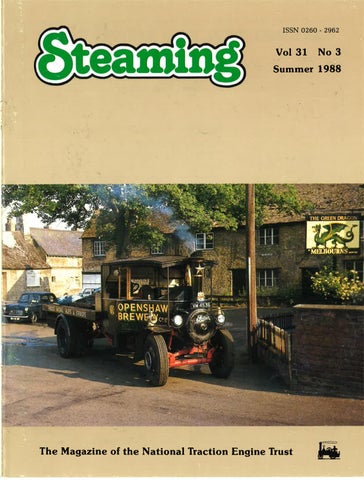
Cover The soft evening light falling on Foden 6 ton wagon 13120 of 1928 belies the impression that the brewers dray is delivering beer to the Green Dragon. The scene is Ryhall in Lincolnshire, a village of mellow Ketton stone houses with Collyweston stone slate roofs, and inside the pub the 1976 Stamford Rally is being celebrated in style. (Roger West) 115
Trust News From the Chairman Anthony Heal has recently retired from the Historic Vehicle Clubs Committee on which he has represented the Trust and its predecessor the National Traction Engine Club for well over twenty years. During this time he was also Chairman of our Club for ten years between 1966 and 1976, a period when considerable advances were made in the development of the Code of Practice for Rally organisation, general administration of the Rally calendar, and further expansion of the membership. However, it is for his work on the HVCC that on this occasion I wish to thank him on behalf of all members. For the benefit of those members who may be unaware of this Committee's activities, I should explain it comprises representatives of a number of clubs who are associated with the preservation of historic vehicles of one type or another, and which of course includes veteran and vintage cars, preserved commercial vehicles and buses, motor bicycles and of couse traction engines. Over the years the Committee has built up a good working relationship with government departments and has been able to comment on, and in many cases amend, legislation which is felt to affect the activities of preserved vehicles on UK roads. Anthony, who also has considerable interest in vintage cars, has built up a wealth of knowledge and experience about the regulations governing the use of our preserved vehicles on the roads and has ardently represented the interests of steam during his time as our representative. Fortunately, he remains a vice president of the Trust and a member of the general committee, where we hope his great experience in these matters will remain available to us for many years to come. Anthony Heal is succeeded on the HVCC by our chief executive and vice chairman, John Crawley, who also has a long and extensive knowledge of the problems involved, and will be well able to represent us. John succeeds at a time when the HVCC is in the 116
process of reorganising itself to face a major threat to the operation of all forms of historic vehicle on the roads of Europe in general and the United Kingdom in particular, which is likely to arise out of the reorganisation of the EEC regulations to be implemented by 1992. The present intention of the EEC legislators is that it will only be legal to operate preserved vehicles, which do not comply with the current provisions of the Construction & Use Regulations, if these vehicles are travelling to or from 'approved' preservation events. Should such legislation come into force, it would effectively mean the end of the private use of our engines on the highways, the trip to the local flower show or pub being outlawed. All the preservation clubs view this threat with trepidation and we are determined to mount an effective campaign to prevent such regulations from the EEC coming into force. To this end, the major historic motor clubs have already contributed to an initial fighting fund and the National Traction Engine Trust has made an initial donation of £500 to this fund. Further substantial financial support will undoubtedly be necessary in the months to come. Further information on the progress of resistance to this serious threat to our activities will be published in Steaming as it becomes available. (Peter Barber, chairman)
Engine Owners Column Boiler Inspection and Insurance During the past two years the Trust committee has become aware that some engine owning members are employing the services of boiler inspectors who are operating on a selfemployed basis. As such, these independent inspectors do not have the backing of an insurance company, which provides all the obvious resources should anything go wrong
as a result of their inspector's instruction or advice. Quite aside from the important question of competence, the committee take the view that any independent inspector must have professional liability insurance cover; so tar no one concerned has produced evidence of such cover. As I IdS bees I I epui Led iii [hese pages before, we have informed our brokers that the NTET cannot support any boiler report carried out by anyone, no matter how highly qualified or experienced he may be, if the surveyor concerned cannot produce evidence of adequate professional liability insurance cover. Further to this subject, the Trust has recently received a letter from one of the leading inspection and insurance companies, stating that many insurance companies are now no longer accepting reports of thorough examination on locomotive boilers that have been carried out by individual boiler surveyors. A member has brought to my notice some of the limitations of the Dominion policy that some members have for their engines. The Trust committee was very much aware of these shortcomings several years ago and they led it to attempt to get better cover for members. After looking at many quotes in 1984, we recommended the package put together by John Scott & Partners. I would stress that all engine owners should read the small print on their policies, no matter which company they do business with, and satisfy themselves that they have adequate and acceptable cover for their personal requirements and circumstances. (John Hirons, Insurance Officer)
Rally Organisation Rally sub-committee As I write these notes, it is a lovely dry sunny day — just the weather all
The Rally List 1988
rally organisers hope for; by the time the notes appear nearly half the rally season will be over and I hope the majority of events will be enjoying these ideal conditions. Apart from the organiser, good weather means much fo the exhibitors of all types and to the public who support our events. The Spring edition of Steaming included a list of seventy eight approved rallies and similar events at which steam traction engines are to appear; this is about our usual number although several more have subsequently sought approval bringing the number to over eighty, which is almost a record. It is interesting to note that although by far the large majority of these are being held within the United Kingdom, there are nevertheless some being held outside this country. We welcome these events and are pleased that they should adopt our Code of Practice as a basis of organisation. Whilst on the subject of
rallies we are pursuing our active policy of sending observers to selected events. I feel the wide spread of events throughout the country represents the fact that traction engine owning seems to fall into geographical areas of interest and these areas are, in turn, the basis of local clubs and of traction engine rallies. Since rallies are held in so many different parts of the country, it should enable every member to attend at least one event and, no doubt, some will visit many events. We hope these local groups will, in turn, affiliate to the Trust for a and working of closeness identification of common problems. Endeavouring to find a solution to them can only be for the benefit of the movement as a whole; most area clubs are already affiliated and we thank them for their support. (Eric Fillmore, chairman, rally sub-committee)
From Alan Martin's Collection 41
Fowler class B6 road locomotive 14425 featured in an article in our Summer 1987 issue. It is, of course, better known to most of us by its name of CARRY ON and for its showland career — which lasted longer than most of its type — with Kevin McGivern in Northern Ireland. This fine portrait shows the engine soon after it was delivered to the War Department new in May 1916 and was taken at Aldershot with a typical Army crew in attendance. Note that the works plate has been moved to the motion covers, its usual position on the lagging being obscured by the large wooden toolboxes.
Four further rallies should be added to the 1988 Rally List, published in the last issue. • 31st July — Barnstaple to Bideford Road Run — Devon TE club in conjunction with Armada 400 celebrations (about 5 engines expected). Mrs I. Wright, Sherringham, Woodtown, Fairy Cross, North Devon EX39 58Z. • 6th and 7th August — Alderholt Steam Engine Rally, Godshill Cross, near Fordingbridge, Hampshire (about 30 engines expected). R.C. Hood, 'Fernlea', Camel Green, Alderholt, Fordingbridge, Hampshire SP6 3A W. • 13th and 14th August — Great Yorkshire Engine Rally, Driffield Showground, East Yorkshire (about Mrs E. 25 engines expected). Heselton, Keepers Cottage, Oxdale Lane, Allerton, Pickering, North Yorkshire Y018 7PW.
117
NTEC Sales Enjoy a mini-package tour to
Stourpaine All-in coach trips to the biggest event of them all 1st to 4th September 1988 The Trust has arranged with several coach operators for them to run trips to this year's Stourpaine event. If you wish to join one of these excursions please send an SAE requesting details, and then make a firm booking as soon as possible, as, obviously, the trips will not run unless adequately supported. This is especially important in the case of the trips involving overnight stays as accommodation has to be booked in plenty of time. Do write now to ensure these ventures are well supported.
DAY TRIPS Saturday, 3rd September ADKINS COACHES, departing Daventry and picking up at Banbury and Oxford. Contact David Adkins, Upper Boddington, near Daventry, Northants (tel 0327 60388). WEALDEN OMNIBUS, departing Canterbury and picking up at Maidstone and Reigate. Contact Julien Brown, Badsell Road, Five Oak Green, near Tonbridge, Kent (tel 0892 833830 day; 0622 813368 evenings).
TWO NIGHTS STAY
There was an announcement in the last issue that the NTEC Sales Mail Order service was temporarily suspended whilst Sales Officer Keith Shakespeare and family moved to a new house. Unfortunately the exercise has proved protracted — doubtless many members will feel sympathy from similar experiences — and it has been decided that postal sales will not recommence until after the Autumn issue of the magazine is published. However, during the summer, the three rally sales stands will visit a large number of events over a wide area of the country, and traction engine publications and the like will therefore be available to most members via the rally fields. Events to be covered until the end of July were listed in the last issue, and the stands are booked to attend others as follows. August — St Columb (Keith); Attingham (David); Astle Park (Keith); Knowl Hill (David); Market Bosworth (Ken); Fairford (David); Egham (Keith); Harewood House (Ken); Bishops Castle (David). September — Great Dorset Steam Fair (Keith, David and Ken); Haddenham (Ken); Malpas (Keith); Roxton (Keith); Barleylands (Keith). The dates and further details of these events appeared, of course, in the Rally List supplement within the last issue.
Derby. Contact Norman Bo yes, Islay, Lancaster Road, Knott End on Sea, Blackpool FY6 ODX (tel 0253 811876).
SPRATTS COACHES, departing Norwich, picking up at Cambridge and Bedford. Contact Ken Frost, The Highlands, Swardeston, near Norwich Itel 0508 70467).
• 26th to 29th August — Island Steam Extravaganza, Havenstreet Village, near Ryde, Isle of Wight (about 15 engines expected) S. Castle, 22 Daniel St, Ryde, Isle of Wight P033 2BH). The undermentioned rallies, which have now taken place, also undertook to organise their events within the NTET's Code of Practice and were duly added to the Approved List: Stoke Goldington and Gayhurst (14/15 May). 118
Or a trip to...
Hellevoetsluis The popular Dutch steam rally 20th August 1988
outwards on Friday 2nd September, returning Sunday 4th September. DEWHURST COACHES, departing Leeds and picking up at Sheffield and
In the late 1950s John retired from motor racing and became absorbed in the restoration of traction engines. His first was the Aveling & Porter 4hp tractor OBERON. This engine still looks ex-works after thirty years and hundreds of miles of journeys to rallies. There was only one way to do any job in John's eyes — the right way, no shortcuts were ever contemplated. His great interest was in the restoration itself, followed by the road journeys to the rallies, rather than the rally itself. He frequently travelled out of the Dales onto the plain of York; single handed journeys of over 50 miles on the Aveling, which he used to say was "a reasonable day's run". He restored ten engines, all to the same high standard, as well as stationary engines and other equipment. Perhaps the best known of his efforts was the Burrell road loco THE DALESMAN. The first journey oil this engine was memorable, but two reasons stand out in particular, firstly because the engine completed the 100 mile journey to Wilsic Hall, Doncaster without the slightest problem, and secondly as he
Obituaries John Crowther John Crowther died peacefully at his home I he Hiddings, Long Preston, North Yorkshire, early in March, aged 81. John was a native of Huddersfield where for many years he controlled the family woollen mill. It was in those days, when he used to see the local engines going about their work, that his interest in steam on the road grew. For many years he raced vintage racing cars, the partnership of Crowther and Besse was a familiar entry in the placings at race meetings. John's driving expertise applied on the road too; a trip in his Porsche before the advent of the 70 mph speed limit was a lasting memory for many. He was a noted member of the Huddersfield & District Model Engineers and produced several 5in and 7Yeln gauge locomotives, all to very high standards.
This coach trip is to the well known and attractive town of Hellevoetsluis where the rally is held on the waterfront and adjacent to the historic old town.
ADKINS COACHES, departing Daventry, Northants about 3.00pm on Friday 19th August 1988, crossing to Holland via the Sheerness night boat and giving all day on Saturday at the rally. Returning on the Saturday night boat, arriving Daventry about lunchtime on Sunday 21st August. Fares are £34 per person, coach and ferry crossing only but other options for the sea crossing are: with Pullman reclining seat — £38.50; with couchettes — £41.20; with berth in 4 berth compartment — £49.50; ditto in 2 berth — £54.70.
All cabins with toilet and shower. Prices do not include entrance to rally — payable at turnstile. To secure your seat please forward your cheque or PO for £10 as a deposit to David Adkins, Upper Boddington, near Daventry, Northants (tel 0327
60388), Pick up points and full timings will be sent — please book
now because unless well supported the trip cannot operate.
kept the speed down on the A 1 whilst running in, only to find that the engine had covered 15 miles in the hour! John was a private man and quite shy, a characteristic misunderstood by people who did not know him well. It is no exaggeration to say he set the standard for engine restoration in the early 1960s in the north of England. It was a great privilege to be his apprentice in steam. He leaves two daughters to whom, with their families, we extend our deepest sympathies. (Andrew Semple)
John Ballard I hope it is not too late to record the death of John Ballard of Gillingham, Kent in December 1986. John was a man of very pleasant disposition, keenly interested in engines, especially those in and around the Medway towns, and acting as area notes correspondent for Steaming in the 1960s and early 1970s. He was also an early member of the RLS and a founder member of the ill-fated East Kent Traction Engine Club, which ran rallies at Bredhurst and Gillingham in the 1970s.
Garrett 4CD steam tractor 32944 of 1916, donated by the late Billy Jeanes to the Long Shop Trust, poses for the photographer at its birthplace. (Steam Heritage)
(Tim Keenan)
Steam Heritage Awards The 1988 Steam Heritage Awards were presented at a gathering at the North Woolwich Old Station Museum in London's Docklands in late April. The scheme, now four years old, is supported by British Coal, the Solid Fuel Advisory Service and enthusiast bodies such as the Transport Trust and the Association of Railway Preservation Societies and has set out to expand public knowledge and interest in the use of coal in preserved transport and machinery. The 1988 winners, selected from 50 submissions from all parts of the country, were: • Premier Prize — £2000 to the Long Shop Museum at Leiston, Suffolk. This venture, part of the old Richard Garrett works, uses an impressive collection of nineteenth century buildings including one of the earliest production line assembly halls in which steam engines were built. Run by the Long Shop Project Trust as a registered charity, the Museum provides work for the long term unemployed on the recovery and restoration of steam engines
•
•
•
•
•
and associated equipment, as well as giving lectures and live demonstrations to school children on the site. Road category — £500 to Tom Varley's Todber Museum of Steam at Gisburn, Lancashire for the recovery of a 1920 Foster overtype steam wagon, found in the bottom of an Australian quarry in a most derelict state. It is now well on the way to full working order, having recently had its hydraulic test, and is the only Foster wagon surviving in the UK. Rail category — £500 to the Somerset & Dorset Railway Trust, which recently completed restoration of S & D Joint Railway 2-8-0 freight loco 53808. A special merit award in the rail category of £250 was made to the Wells & Wolsingham Light Railway in Norfolk for its design and building of a miniature gauge Garrett articulated locomotive. Stationary engine category — £500 to the Queen Street Mill Museum at Harle Syke, Burnley for its restoration in working order of a steam powered cotton mill, powered by a 500hp tandem compound horizontal engine. Marine category — £500 to the Maritime Trust and the friends of PORTWEY for their work on the continued operation of the 1927
steam tug PORTWEY, built by Harland & Wolff on the Clyde. The awards were again presented to the winners by Malcolm Edwards, commercial director of British Coal, the principal sponsors of the scheme. Guests representing all the main steam preservation organisations were present and having witnessed David Morgan, chairman of the Transport Trust preside over the awards presentation at the Old Station Museum, they were able to cross to the nearby riverside to watch a spectacular display by the PORTWEY. The steam tug spent some time making complicated manoeuvres around the Woolwich ferries and other vessels and lighters on the River Thames.
Future dates AGM 1988 Insufficient response from the membership to the arrangements made for the 1988 Annual General Meeting has resulted in the weekend's activities in Yorkshire being abandoned. The AGM will now take place at the Midland Hotel, Birmingham at 11.00am on Saturday, 3rd December 1988. A full day's programme will be arranged and details will appear in the 119
Corrections
Chimney tops for engines An engine's chimney top is, arguably, the one item which if not to the right shape can spoil an otherwise in iii leculnte restoration. The Trust has arranged for the manufacture and supply of chimney tops, in brass or copper, to a wide variety of designs and shapes, all from makers original drawings or, if the latter are unavailable, from well researched dimensions. The costs are competitive and delivery is prompt. For further details contact John Crawley, Field House, Turvey, Bedfordshire MK43 EIDU Itel 023 064 2461
Autumn issue of this magazine. Members are reminded that motions to be put before the above meeting under Article 16 of the Trust's Constitution must be received in by the writing, accompanied member's full name, address and membership number, not less than 42 clear days before the date of the meeting. Any such motion should be sent to the Chief Executive at the following address: 12 Hillway, Woburn Sands, Buckinghamshire MK 17 8UL. (John Crawley, ChiefExecutivel NTET at Great Dorset Steam Fair This year will see the largest presentation yet by the Trust at this event. Adjacent to the large sales area
to be staffed by Keith Shakespeare and the full team of all his sales stand helpers will be the Trust's hospitality tent, available for the exclusive use of members and any overseas visitors. An area will be provided for sitting down for a while with a cup of coffee out of the pouring rain or the sweltering sun; coats etc can be left (at owners risk) and a notice board will be available for members to leave messages for others. Several committee members should be in attendance at various times, including the magazine Editor. Outside, it is hoped to have at least two engines standing in steam to give atmosphere and another innovation will be telephone access to the Trust's tent — members requiring information from the event, or wishing to leave messages can ring 0860-379977.
PRICES PER TONNE ex PD Fuels Ltd, Fratton Depot in Portsmouth, Hants.
PD65
WELSH
185 BITUMINOUS 40107oce
LOW LOW PRICE
,
1 1/1911113
MIST
WELSH DRY STEAM COAL
25kg
I st APRIL TO I st SEPTEMBER PREPACKED IN COLOURFUL 25KG BAGS
178
Cheque required 7 days prior to collection or cash on collection I TONNE SHRINK WRAPPED PALLETS AVAILABLE (LS REFUNDABLE DEPOSIT) CALL JACK KNIGHT ON
0705 864613 AT POWELL DUFFRYN FUELS LTD 001 DSMITH AVENUE PORTSMOUTH PO4 OAT
HAULAGE IF REQUIRED CONTACT Richard Preston & Son Ltd. e,g, P12 per tonne to Eaton Seam Depot Cambs. (Clive Own: 04B0-213200) or 615 per tonne to Potto Depot North Yorks JMalcolm Horton: 0642 60020.) — for other delivery locations phone Prestons for quote.
120
The report in the last issue (page 97) of the change in ownership of Fowler shnwmans 9381 LADY BETTY was, in fact, erroneous. Jack Gillam informs us that whilst in his possession the engine hos not been offered for sale to anyone and it has been prepared for a busy season of rallies and charitable engagements from its Tadcaster base. We offer our apologies to Mr Gillam and to Terry Swann for this mistake in our Spring issue and for any embarrassment caused, and take this opportunity to point out that whilst we welcome and indeed encourage reports from readers, it is imperative that material submitted is factual.
~ST EAMIN past OUR MAGAZINE 25 YEARS AGO
By today's standards the third magazine of 1963 seemed to offer bargains galore. Although the magazine's cover price had risen to 2s 6d (12 1/2 p), the Bedfordshire club was advertising a similar price for admission to their Bletsoe rally — though they didn't foretell of the appallingly wet weekend they would suffer. The new club badges were priced at 5s 6d inc post (28p) and consisted of representations of six varying types of steam engines over the club name — they are now considered collector's pieces. Chairman Philip Wright reflected on how different the hobby was from a dozen years before — he had people asking him where 'the Rally' would be this year and astonished them when he rattled off a long list of dates and places. Area notes came under ten different countrywide headings. The initials of the writers, shown as credits at the end of each section, reveal several of them to be members still active and well known, though by now they are presumably a little greyer, or at least in long trousers. The holiday season produced reports of the Devon C.C. rollers. A good proportion of their thirty strong fleet was available for work but the nicest touch was the sporting attitude of the Council in allowing five of their drivers to take their charges to the South Molton rally — specially cleaned and brassed up they must have looked a fine sight.
Roadstone by Robey The name of the Tilbury company is a familiar one on present day civil engineering contracts in the south of England. The firm, established just over a century ago as the London & Tilbury Lighterage Co, was originally involved in lighterage on the Thames and with dredging and construction work throughout the country and on the continent. A subsidiary company, East Anglian Roadstone & Transport Co Ltd, was formed in 1924 to supply East Anglia and adjacent areas with roads tone (the region has no natural resources of the material). The stone was shipped down the coast from the Inverkeithing quarries, Scotland, of the parent company — by then the Tilbury Contracting & Dredging Co Ltd. For this expansion in business and the delivery of the stone to its customers, the company indulged in a veritable shopping spree with Robey's of Lincoln. Between 1924 and 1927 they took no less than 29 steam wagons of varying sizes, from 4 ton to 6/7 ton tippers, as well as seven of the maker's individualistic Express high speed tractors and accompanying tipping trailers. Tilbury also augmented this Robey fleet with several secondhand machines of
other makes. The East Anglian venture distributed the stone which was landed at Yarmouth harbour, and also operated out of Norwich and Ipswich. In the picture above we see four Robey 6 ton tippers, lined up at one of the firm's depots. Left to right they are Robey 42662, 42927, 42514 and 42668, all dated between March and May 1926; judging from the good state of the front tyres the picture might have been taken later in that year. What is the bar encircling the smokebox door on three of the wagons? Not surprisingly Robey's took several official pictures of the first wagon they built new for Tilbury — works number 41597, dated May
1924, was a 6 ton three way tipper destined for use from their Kent quarries. The second picture shows their catalogue illustration of the machine in what might nowadays be termed the side-tipping mode. Comparison with other illustrations shows that the touching up artist has been busy — when the body is tipped to the rear we see POSTLEY FIELDS QUARRY appears on the bottom plank of the top side board, with MAIDSTONE on the drop board. In common with many other steam wagon fleets of the 1920s, the Tilbury Robeys no doubt had a relatively short life, soon replaced by the ubiquitous diesel lorry. Thanks are due to Tilbury Group plc for providing pictures for our use.
ylmiiffig ■
: 4.1: St (.4 .741 :,114TitiGtr!DREDCIIK1 0)69
M 111/5113iie
is
121
A Wartime Phoenix
Harold Wood, principal of the small Northampton firm of agricultural engineers, Wood Bros & Runham,
relates the trials and tribulations
of keeping a steam roller in good order for contract work during World War 2.
Unearthed from within a bed of nettles in a scrap yard at the side of the River Ouse, a dismantled Aveling & Porter steam roller was brought into the light and carted off for rebuilding in an engineers yard in Northampton. It was the early years of the war; rollers and the like were badly wanted, and it had been a chance remark that indicatod tho machino woo tying there in bits after having been bought in from its former owner. If all, or at least some, of the ports could be found it might well be made into a useful machine once more. The roller was in fact of the tandem type. Aveling & Porter had built it in June 1924 as their number 10839 IXT55831, an 0 type quick reverse roller designed for work on bituminous carpeting, and for asphalte rolling etc. The first owner was the Neuchatel Asphalte Co Ltd of Fulham, and the second Val de Travers Asphalte Paving Co but this firm later traded it in with Aveling-Barford for a new diesel roller, and the tandem passed into the hands of E.R. Cole Ltd, machinery merchants in London, probably without ever having visited AB's Grantham works. In 1939 the roller was sold to Richard Shuttleworth of Old Warden in Bedfordshire possibly for work on the estate (which is now home of the famous collection of early aircraft). Here it must have found disfavour, and have been got rid of to Fred James, who with his brother Don ran a large scrap yard in Newport Pagnell in Buckinghamshire, just over the river bridge going south. Quite why it was scrapped we never knew for it seemed to have done little work and, though rusty, showed few signs of wear — perhaps it was some whim or dislike. A deal was struck, and a few days later two lorries arrived at our yard in Campbell Street, Northampton, loaded with the frame, rolls, boiler, engine, pipes, gauges and other bits and pieces. Rebuilding commenced in our shed — a large span building behind a garage frontage which incidentally still serves as a tyre depot. The frame was put on blocks and the rolls introduced, 122
then the boiler mounted, followed by the engine. Other parts were fitted until it became apparent that there were some shortages — two balance weights from the crankshaft were missing, as was the primary drive pinion from the crankshaft to the large toothed intermediary shaft which in turn drove the rear roll. This was in feet in ju3t one width, not two sections. We returned to the banks of the Ouse to find the other missing parts but the journey was of no avail for we found nothing except a small heap of rusty bolts and a small shovel. Avelings were approached but although they could supply balance weights and fixing bolts, they couldn't offer a pinion, nor could they undertake to make one, being fully engaged in war work. We hunted around and were lucky enough to find a machine shop which could do gear cutting, and also had a billet of steel suitable for our job, an off-cut in fact. Although these engines were built with steam steerage engines for speed of work, our example had no such thing, though there was evidence it had at one time been fitted. The hydraulic test took place, was passed OK and when the new pinion arrived some days later and was fitted, the outfit was tried under steam and proved to run excellently. Now we needed a driver, also a living van. An example of the latter was acquired from near Oxford, and then a retired roller driver named Fisher with many years experience, was located at Oxendon, near Market Harborough and engaged — he seemed pleased to be employed again and doing his bit towards the war effort. Word had got around we had the roller, and as it was the type used for final surfacing, sometimes called a 'carpet roller', it was not long before a hire agreement was reached and the roller, van and driver were collected and taken to an airfield in Warwickshire, where the runways were to be surfaced after heavy wear and some bombing. • The Aveling worked well for several months until the old driver
went sick and a substitute had to be employed. Trouble now developed; leaky tubes. An inspection by a boiler engineer confirmed a retubing would have to take place. It seems the replacement driver had been in the habit of 'raving the firehole door open while operating, rather than stir the clinker and the practice had done cunsid cable ddrudye Lu the fil ebux and tubeplate. The boiler was lifted off the frame, using sheer legs, and taken in tu boiler shop, where some expensive repairs were carried out. Then the boiler came back to be remounted and lagged ready for work. By now the work on the site was at an end, and word then came that the roller was wanted on a base near Bicester, a fighter aerodrome I believe. The original driver had now recovered and came back to work, joining his machine and van on the site. As far as I can recall, working went on there for several weeks; I visited the site twice to see that all was well with the outfit. On one occasion I had a problem getting there; two roads leading to the camp entrance were completely blocked by planes which during the night had either failed to take off or make a landing and were straddling the roadways. I think they were Spitfires or Hurricanes. Leaving this site, Oakley it was, we were transferred to a place somewhere east of Dunmow, 'flitch of bacon country'. It was a United States Air Force station, and was suffering from some nightly attention at that time, with consequent hole filling in the morning to get things going again. Some tube trouble developed on the roller, probably due to the brackish water. Also the engine glands needed stuffing, so a journey had to be made across to Essex. I took an elderly but experienced steam fitter with me, one Harry Matthews. Harry had once worked at Allchin's Globe Works in Northampton and was a source of fine stories of even earlier times when as a young man he had gone to Egypt or the Sudan to erect Darby steam diggers for the cotton fields, and he
had a chain of fellaheen to fill his water tank, bringing it from the canals in goat skins. But to return to our tandem roller ... we set off very early in the morning, arriving on the site at the guard room gate about 9am. To go into this area we had had to obtain special passes, it being a prohibited zone. The papers were checked and we were directed to get on to the perimeter track and proceed in a clockwise direction until we arrived at a dispersal point, where our roller stood. It was a perfect morning, the sun shone, the bees were buzzing, and we trundled along around the pert-track without a care in the world. Our peace was suddenly shattered when a very urgent loud-hailer indicated that we were not wanted; we were invited to "get the hell out of it", a entreaty which was repeated twice more. A quick glance in the rear mirror showed a Jeep coming up fast behind, one man standing up and holding the hailer, while behind there seemed to be an endless string of largish fighter planes, taxiing nose to tail, all trying to overtake us. It was no time for arguing as to rights of way, and discretion being the better part of valour we took to the grass and let the cavalcade go by. There were five planes in the convoy, a species of fighter bombers I imagine, and they disappeared round the track. After gathering our wits, and not seeing anything else coming along, we continued our search for the roller. This we soon saw, for it was on the edge of a dispersal point, and a plane stood not far away being serviced by a ground crew, busy washing machine gun parts in large trays of petrol. We made ourselves known, and then proceeded to inspect the roller until a klaxon sounded nearby. Although we were near the east coast, and on a fighter station and had just been passed by a string of planes obviously scrambling for combat, the penny hadn't dropped that this was for real. I think we thought it was for a coffee break that the klaxon had sounded, until suddenly we realised that the ground crew had vanished with not a body in sight anywhere, and there was a lot of angry buzzing and rattling overhead. It was then that a sort of metallic pitter-patter was heard, and I shouted to Harry, the fitter, to get under the roller frame behind the front roller; the pitter-patter might only be spent bullets, but they would be dropping pretty sharpish, and it was no time to argue. After about ten minutes the buzzing and droning ceased, the klaxon sounded again, and out of a slit
in a concrete wall came the ground crew, who enquired why we hadn't joined them. We explained that we hadn't realised what was going on, and didn't know where they had gone and anyway the roller made good cover for anything dropping from above. Seeing the crew throwing petrol away after washing machine gun parts, I asked for and obtained about four gallons to put into our vehicle to lace up the Pool petrol which we all used. Their's was high octane, ours was very low, near paraffin at times, and the two would make a good mix — better than wasting it. It was late afternoon before we had finished our repairs, and although we had brought some food we were getting hungry, so on arriving at the guard room by the exit gate we enquired as to where we could get something to eat, and were given a pass into the NAAFI or its US equivalent. We had a good meal, and also managed to obtain, I recall, a few tins of peaches and some Camel cigarettes. I did not visit this site again, and Wiltshire was the next stop, an aerodrome on one of the Downs at Ramsbury near Hungerford. This was another USAF station. It was to be used as a reception for PoWs and had to be resurfaced in a hurry. At least seven rollers were working at one time, rolling asphalt. When over there one day I saw a number of Dakotas coming in towing gliders, possibly Hannibals. The tow
ropes were cast off and while the Dakotas circled away the gliders came in following each other in what seemed to me to be a much too close formation. All went well for the first two or three, then one veered too much to the side and neatly clipped off the chimney of one of the rollers standing on the runway edge. The glider swung round, broke a wing off, but came to a halt upright, while a following one, endeavouring to take avoiding action, ploughed into a heap of large upstanding packing crates, making a terrible mess of its front end. The gliders immediately started to disgorge their loads which consisted of German and Italian PoWs. They were a motley crowd, highly excited and probably very frightened, but obviously glad to be safely on the ground again. They were, by the clothes they wore, part of Rommels army from North Africa, and if this was so it would have been a long and hazardous journey, just on the end of a piece of rope! Trucks were standing by, and the gang was quickly marshalled together and marched off to load up. Our roller moved again, this time away to the eastern side of the country, just to the east of Lincoln. Things went on without much trouble until one night when Jerry, in a fit of retaliation or something, plastered this particular 'drome with bombs, including oil bombs. One of these contraptions hit our roller, and although it did not do much real material damage as it only struck a
AVELING & PORTER LTD. ROCHESTER. KENT
QUICK REVERSE
STEAM ROLLER ( Tandem Type.)
Aveling & Porter's quick reverse tandem type steam roller, illustrated on one of their trade cards. The engine is works number 11600 of 1926, an example of the 0 type. (collection R.E. West) 123
Coulsdon & Purley UDC had an 0 type roller until relatively recent years — >2621 (PL2747) is pictured here at their Purley yard in January 1951. (F. Jones)
glancing blow, bending a side plate over the rear roll, the ensuing fire burnt away all the boiler lagging and melted some of the fittings. The heat must have been intense, even if short lived. To their credit the RAF fire crews turned out with foam equipment and literally cocooned the machine in white foam which then congealed, making the roller look like a misshapen Christmas tree. A telephone call from the station advised us what had occurred and exhorted us to try and get repairs done as quickly as possible, as the runways had been badly pockmarked with the bombing. Consulting with my stalwart fitter Harry, we decided to go next day, making yet another early morning start, and we loaded some tools ready and filled up with petrol, it being a run of over ninety miles each way. We left about five-thirty, when it was still dark, arriving on the site soon after eight and just about daybreak — it was late autumn. Passing the guard, we located the roller. It was smothered in the white foam, but in the early morning light did not look too unlovely, and I wished I had a camera. Just then I looked away westwards towards Lincoln, probably some four miles away. The rising sun was just breaking and catching the colours of the stonework of the cathedral; the glowing pinkish gold was something out of this world, there for a moment, then gone. By now we had been joined by our driver, who had his van nearby on the edge of the airfield. He said it had been 124
all quiet during the past night, but the previous one had been hectic and he had been considering having his van moved much further away from the active parts of the site. He was a stout old customer and not easily rattled, so it must have been quite a show. Having cleaned the roller off it became evident that a lot of work would have to be done, probably also a retesting of the boiler as it had been subject to a lot of external heat. Northampton was ninety miles away;
Fosters of Lincoln were but four to five, and they were steam engineers further they could help. Leaving Harry and the driver to carry on cleaning up I went down to Lincoln to enlist assistance. After some passing from office to office I at last found a department which could undertake to do a field job for us, provided that we prepared the machine for them to inspect and work on as required. This we had already done to a great extent, and it was agreed that they would go out, inspect the boiler and test if required, supply any new fittings and then hand over the machine to our driver when completed; he was to assist them as required. This arrangement worked well and the roller was going again within a week. After a couple of months more work at Lincoln, a transter was made to Scampton, then Swinderby, and finally to somewhere heal Bourne, all in Lincolnshire. From there the roller was returned to Northampton. The war was over. Rolling now seemed at an end; there was plenty of work no doubt, but nobody had the money to spend on roads, not even the Councils, and the Aveling stood for sale in our yard for over a year before any interest was shown in it. An advertisement in the Contract Journal brought some enquiries, and it was eventually sold in 1945 to Kingston Plant Hire Ltd of London, who intended to scrap the engine and boiler, and convert the machine to diesel. Harry, went into retirement again, as did the driver. The van was sold to
Ipswich County Borough Council also had an Aveling tandem. Here, 11679 (DX6562) is seen at work in Stoke Hall Road in the town in March 1933. (R.G. Pratt)
a water board. I suppose the roller may just still be rolling somewhere, who knows. During a lot of my journeys to the roller, I was accompanied by Harry, plus a load of tools, for one never knew what might be wanted, nor how long a day it might be. We took lunch with us, hoping to improve on this with a canteen meal or something. It was a time of hard rationing, and the chance of a place in a meal queue in a nearby town was remote, so we often tried camp site feeding arrangements in the NAAFI or mess huts. In some of these, civilians were not too welcome, but when we could stress the importance of our presence to effect necessary repairs, some of those in authority would bend the rules a bit. This happened once on a RAF site, when a motherly WAAF allowed us into the mess hut at midday, provided we kept out of the way of the orderly officer. She sat us on upturned boxes,
behind a large Thompson stove, and brought us a tray with two large plates of 'toad-in-the-hole', rolls, and mugs of cocoa. We were enjoying this when there was a sudden hush — the orderly was on his way. There he was... coming up the middle aisle... now he'd moved over to the side one — and we moved slowly round the stove, keeping, we thought, out of sight, when suddenly he appeared from nowhere and demanded to know what we were doing in a Forces hut. It was no use making excuses, we simply told him that we were doing a job of work on a machine that was urgently wanted (which he probably already knew), we did not have the time to go searching for food, and we hoped he would understand. A reasonable type, he saw our point, and left us to finish our meal in peace. Some sites were better than others, the USAF ones were the most generous, but then they were not rationed in the way the RAF
were, and had a greater variety of food to boot. Our little firm was engaged in other contract work during the war years, but on reflection I often think that chasing around after the Aveling tandem was the most interesting. Some of the days were very long and tiring, and one such occasion, coming home along one of the fen roadways with wide grass verges, I dropped asleep momentarily, only to wake up with a start when we bumped across a drainage grip in the verge. I regained the highway, missing a telegraph pole by a foot or two, and then old Harry woke up and rubbed his eyes, saying "You know, I must have dropped off". Little did he know he wasn't the only one — I never did tell him. (Thanks are due to Alan Martin for providing photographs from his collection of 0 type rollers, in the absence of any known picture of Aveling 10839.1
Original Paintings
'FOR SALE, price £35, an 8-horse power portable STEAM ENGINE, by Clayton and Shuttleworth; may be seen at work. —Apply to T.J. Dugdale, Lymington.' (from Poole and Bournemouth Herald, 21st May 1885, via D.J. Payne. If we wish to consider relative values, the price asked represents about £1500 at today's prices. The portable's nearest modern equivalent is probably an ordinary agricultural tractor, and an average example changes hands at about that same figure when it first becomes secondhand after, say, 7 or 8 years. So although there obviously is such a thing as inflation, perhaps it is not quite what we casually accept it isl)
'The heavy steam vehicle industry started by the Most Noble the Marquis of Londonderry, KG, at his engine works at Seaham Harbour has proved so successful that at the present moment upwards of £2000 of new machinery etc, is being introduced to works in order to cope with the demand for vehicles. In one week alone orders were received from Messrs Watney, Combe, Reid & Co, London; Liptons Limited, London; McCreath & Sons, Berwick; C. Vaux & Sons, Sunderland, the Durham County Asylum and the machinery at the works is being run 24 hours per day.' (From Automobile Commercial Vehicle Review, September 1904.)
Many members would welcome the chance of having their favourite engine included in a painting of a scene of sixty or more years ago, and member Michael Dale, whose advertisement appears in the Small Ads of this issue can provide just that service. Working in oils or watercolours, Michael can take present day photographs of engines, and old rural or urban views, and bring them together to recreate superb scenes from the past. For each commission, the artist donates a percentage of his proceeds to the Save the Children Fund.
W M G HEDGES & SONS BOILERMAKERS AND STEAM RESTORATION ENGINEERS Boilers of all types built or repaired. Wrought iron boilers a speciality. Coded welding to ASME 9. Tenders, smokeboxes, chimneys, etc built to order. We now offer a full machining and fabrication service, plus cast iron welding. Written enquiries to: 33 Cheney Road, Faversham, Kent or phone: Medway 826555 (day), Faversham 538.128 (evenings) • WINNERS OF THE 1987 STEAM HERITAGE AWARD FOR ROAD ENGINES •
125
Sale of the Decade John Reeves All photographs by the author
Thus did the Somerset County Gazette headline their report of the auction sale on May 14th at the premises of W.G. King at Bishops Lydeard near Taunton, Somerset. Rarely, nowadays, does one come across a cache of nine Foden steam wagons and three traction engines which have laid virtually untouched since they were taken out of use. Many enthusiasts had speculated as to what 'WG' had hidden away; the two Fodens, two Burrells and one Marshall recorded in Traction Engine Register as being in the Taunton area must surely have been his... but no one really seemed to know. One or two people had entered the yard years ago, so eventually Mr King was forced to erect a high fence around his hidden treasure. When the auctioneers originally advertised, I wondered what would appear: at first it seemed that it would be mostly diesel tractors and threshing gear, but later the Fodens and tractions were added to their advertisements. The auction catalogue, when published, set the scene. William J. King, the present owner's father, had founded the business in 1905, operating from a cottage in Bishops Lydeard village and starting with one engine, purchased at a cost of £80. The enterprise grew, but for periods when there was little threshing work, a quarry was taken on to give useful employment to both machines and men, and to build up a road making side to the firm. By 1921 when registration of road vehicles became compulsory, King had three road engines, one traction engine and eight rollers. The quarry business expanded rapidly in the 1920s, a. period when the users of the new fangled motor car and lorry continually demanded better roads and at one time the firm had thirty steam wagons on the road of six 126
different makers. Alan Duke Ito whom we express thanks for information from his lists) records over a hundred engines as being in King's ownership at one time or another — 23 traction engines or road locos; six tractors; 28 rollers and 52 steam wagons, all working from four different yardc or quarric3 in Somerset. Much business was done with Thurlows of Stowmarket, engine dealers, with King buying new end secondhand through them and at the same time trading in a number of engines. But as a result of the notorious
1930 Road Traffic Act many of the solid tyred steam wagons had to come off the road in the following year — it was either that, pay excessive road tax or be equipped with pneumatic tyres. A few Fodens were so converted by Kings (some survived to be sold in 1970 and are now rallied) and another fleet was built up with balloon tyred Sentinel and Yorkshire wagons. Thus did a group of almost new Fodens come to rest at Bishops Lydeard — 'left to rust in peace' as the national press so succinctly put it in the week before the sale, though they then went over the top in alluding to '400 steam relics' being available. Prudential Property Services Agricultural Division, the auctioneers, quite aptly described the wagons as in hedgerow condition. Although lots 401 to 404 had been under cover for the last fifteen years or more, 391 to 395 were in very inuull the same position they had been put in in 1931 — some are said to have been roughly pushed to one side to enable sheds to be erected during World War 2. The ensuing fifty years had enabled a very substantial hedge to envelope the group, such that when the auctioneers
Even if you've absolutely no intention of buying, before the hammer falls any lot is suitable as a centrepiece of conversation. Foden 12630, Lot 393, one of the wagons liberated from the undergrowth, very adequately illustrates the auctioneer's statement that the machines were 'in hedgerow condition and dilapidated, but will offer enthusiasts an immense opportunity for undertakin g works of renovation.'
Local and national press latched onto Lot 404, six wheel Foden tipper 13247, as the star of the auction — and the wagon obligingly fetched the highest bid of the day.
were first asked to look at the engines in October 1987, it was not clear just how many examples lay in the overgrowth beyond the initially cleared section. I confess that I cheated slightly in getting the auctioneers' permission to enter the sale yard before the official viewing times in order. to photograph the engines without the inevitable crowds. However, I was only able to escape from work for a very short time and the five engines liberated from the undergrowth behind the sheds escaped my camera until an equally brief second visit on the Friday viewing session, and the sale itself, completed my photographic record. The three traction engines looked good; I envy the new owner of the little 1925 compound Burrell — a handsome machine! They had been stored under cover since 1940 — well oiled (though I imagine a fair measure of additional lubricant had been added for the sale), and there was a goodly amount of original paintwork and lining visible under the engines' grime. All three had been given a boiler inspection in February 1988, for which, of course, lagging and some tubes had been removed. The reports were available for scrutiny and although I did not see them, I was told by fellow Somerset club members that the boilers were indicated as in fair shape. I think David Bellamy would have had fun with the five Fodens lately in the hedge — all kinds of flora and fauna must have made them their own. One heard expressions of sheer amazement from locals on the credibility of those who might have sufficient money to waste on 'scrap'. The press were forcecasting five figure sums. Despite their decrepitude however, those old Fodens had a considerable amount of solid metal left under the bent and rusted platework and were remarkably original patterns. The four which had been placed in the
Burrell 5hp compound 4014 — a very original engine, probably still wearing its Thetford paintwork. It is understood minor boiler work has already been carried out on the engine and Lot 407 will be rallied this summer.
Auction Sale by Prudential Property Services at Bishops Lydeard, Somerset for W.G. King on 14th May 1988. lot no,
maker/number
date
registration
type
to
391 392 393 394 395
Foden 11850 Foden 12586 Foden 12630 Foden 13456 Foden 13750
1925 1927 1927 1929 1930
MB9404 TU4871 TU6199 LG2347 LG4815
6 ton tipper 6 ton tipper 6 ton tipper 6 ton tipper Speed 6 tipper
£5500 £5600 £9200 £12200 £13000
bid
401 402 403 404
Foden 11962 Foden 12388 Foden 12116 Foden 13274
1925 1926 1926 1929
TU219 TU3113 TU1215 LG544
6 ton tipper 6 ton tipper 6 ton tipper 6 ton tipper, 6 wheel
£11200 £14600 £16800 £22,500
All the Foden wagons were new to W.J. King and ceased to be used after 1931. Most, if not all, were three way tippers. It was not certain which was which of lots 392, 393. Value Added Tax was charged over and above the quoted selling prices.
405
Marshall 74614
1921 TA1937
6hp single traction
£15500
6hp single traction
£13000
5hp double crank compound traction
£19000
new to S.J. Richards, Colyton, Devon
406
Burrell 1941
1896 YA5799
ex J. Hall, Milverton, Somerset
407
Burrell 4014
1925 TT5615
ex C.W. Davey & Son, Abbotsham, Devon per Thurlow.
yard lone complete with the sawn-off trunk of a mature tree still solidly wedged into the front axle; Mr Bellamy wouldn't like that!) were surprisingly complete. Having said that, the prices paid for most of them were rather frightening when one considers the forthcoming cost of restoration. I think I shall have to be satisfied with my little Allis Chalmers D272 for a long time to come... It was a fascinating sale, with people from near and far, including many familiar footplate faces amongst those present on the FridaV and the Saturday. All the engines found homes in this country, and some, apparently, are in the West Country. The auctioneers and press had hinted at successful bids from America, Holland, West Germany etc, but they probably misjudged the situation; there is a very limited ability to succeed in the determination to rebuild one of these essentially English products, and it doesn't lie in Europe or America, when the condition of the machine is as desperate as these are . Perhaps in a few year's time the Somerset club will be able to stage a Kings of Bishops Lydeard reunion — we did get two already restored engines together a few years ago and there are others — now added to by another dozen.
(Tim Evans of Prudential Property Services expressed surprise and delight at the outcome of the sale. An estimated crowd of up to three thousand crowded the Bishops Lydeard premises on sale day and catalogues had sold out, despite an earlier reprint over the original order. 128
Three pictures illustrating branches, tree trunks, birds' nests and the derelict but uncannily complete state of the Foden wagons — left to right: Lot 402, 403 and 392.
Few enthusiasts have had the chance to study an actual example of the Foden Speed series of wagons. Exposed to public view at last, Lot 395 Foden 13750 exhibits its unusual reversed and inclined boiler — and the lengthy task ahead of the restorer.
Media interest came from local and national press and TV, and hundreds of local folk were to be seen looking over what their families had probably worked with sixty years ago. Mr Evans
would be interested to hear of any more nests of hedgerow derelicts that are secreted away and suitable for auctioning — but we all would, wouldn't we? — Hon Editor).
Through the night to Brighton Giles Romanes The Historic Commercial Vehicle Society's London to Brighton run on the first Sunday in May has become well established in the calendar of events and as well as attracting a yearly batch of steam wagons, has often included other steam road vehicles. Most of those completing the course have been road locomotives or tractors, but there have been several traction engines of the agricultural type that have been successful. This alone shows that with modern knowledge, the design criteria can be and the exceeded greatly achievements are a credit to all concerned. The 1988 Brighton run was notable because of the successful journey of two showmans road locomotives, each hauling wagon loads of a type similar to those handled in working days. The engines were Fowler R3 class 15653 of 1920 RENOWN, owned by the Howard brothers, Gary and Ian, from Derbyshire and Burrell 3949 of 1923 PRINCESS MARY, owned by David Hedgeman from Dorset and driven by Jimmer Marsh. The fairground wagons were bravely provided by Harris Family Amusements, showmen from Sussex. This 'first' in preservation — a loaded run for commercial vehicles was the brainchild of Phil Read of Storrington, Sussex. Phil is wellknown as organiser of the popular Parham Rally; he said the idea took him nine months from conception to fruition with action all the time. The engines set out from Battersea at 2.10am on the Sunday morning, 1st May, in convoy, with RENOWN leading. They made a splendid sight with steam showing up well and an initial shower of sparks coming from the chimney top. The Howards set an excellent pace of some 15mph; this must have been a comfortable one for the engine, which has special gear ratios to suit modern roads. The Burrell has no such advantage and had to run at high revs to keep station in the convoy. However, this was made possible at traffic lights by Phil Read indulging in unorthodox parking practices on the conflicting route with
his amber-beaconed Landrover to ensure the engines had a clear road to use a railway term. The only traffic difficulties I saw were caused by some video makers who parked cars rather thoughtlessly as far as the engine crews were concerned — some drove ahead in the driver's blind spot to get their special shots. The engines had a gift of two tons of Welsh dry steam coal from Powell Duffryn, packed in the special NTET bags and carried within one of the fairground trucks. At each stop for water the crews filled up their bunkers with a few bags. I gather PRINCESS used about 15 cwts altogether and RENOWN a similar amount. We stopped for water four times — which works out at a refill every 15 miles. We chose spots on long straight stretches so as to cause the minimum of inconvenience to other road users. Most motorists were very goodnatured and patient but one or two were so taken with the engines, they ran into the road-centre kerbs, or cut in front of the engines in a dangerous manner. Each water stop lasted about thirty minutes, and such was the quality of the coal that both machines steamed hard for all of 12 hours without the need to remove clinker from the fire. The day threw up its mechanical challenges. First was the overheating of the forward high pressure eccentric strap on PRINCESS MARY while coasting down into Redhill. Jimmer had great difficulty in stopping the engine because the binding of the strap increased the load on the reverse lever. He succeeded in stopping without incurring damage to the rods and was then able to loosen the strap to insert some shim. The material for this came from a beer can, the contents of which Jimmer had unselfishly consumed. His helpers Mark Hurlestone and Malcolm Hedgeman assisted with this task, and the Burrell got going again after about an hour's delay. They re-joined RENOWN at the non-breakfast stop at Crawley. It was a non-breakfast stop because we learned on arrival that the staff did not come in to work in the cafeteria at the bus station on Sundays. Information gleaned during
the planning stages had reassured Phil that the place would be open! RENOWN used the pause to good advantage because it enabled helpers John Blagg and Dave Cope to clear the filter between the front and back water tanks. Their next incident occurred south of Bolney while storming up New Timber Hill; Ian Howard was driving and heard a knock in the motion so stopped to investigate. It seemed to be nothing worse than a loose crosshead and this was not surprising because the engine spent a great deal of time priming. I suspect that the quality of the coal with such a high calorific value meant that there was a great temptation to keep the boiler feed on to try and control blowing off at the safety valves in built up areas etc. The crews agreed that generally speaking the traffic only became a real problem in Brighton itself. We topped up with the last lift of water opposite Preston Park at 11.00am, which was to ensure that there was enough for the final couple of miles to the front, any running about there and for the four miles or so to the site for loading at Shoreham. Thanks are especially due to the Harris family for their loan of the equipment to provide the loads — they also entered wholeheartedly into the spirit of the venture by riding all the way and acting as brakesmen when needed. Phil Read's contribution was magnificent — and at Brighton he produced, like a magician does a rabbit out of a hat, bottles of champagne for the crews to celebrate their superb achievement. We are all thankful he realised his dream.
'How Tractors Improve the Roads — The Gloucestershire County Council have decided to devote all the revenue from traction engine and motor car licences to the improvement of the road surfaces in their district. If this class of motor traction develops quickly enough we shall soon have better roads. It is a pity many of them have not better foundations on which to build the better surfaces.' (from The World's Carriers, June 1906.) 129
AUSTRALIAN ROAD RUN
Andrew Reynolds Commercial steam was never popular or common on the roads in Australia. There were no showmans engines, very few steam wagons and most of the traction engines tended to stay on the farms, for they were generally owned by the farmers themselves rather than by travelling contractors for threshing or ploughing. Even so, there were some exceptional trips undertaken in those days, especially into remote areas of the outback. Road rollers were the exception to the above and were a relatively common sight. The last commercial use of steam in Victoria was a Fowler roller used by Essendon Council in Melbourne until the 1960s. So, largely because of a lack of suitable engines and of the distances involved, as well as the absence of historical precedents, there is little road running by engines in preservation, although the hobby movement has been established here for many years. In the state of Victoria we have only four rallies each year — one in Melbourne in March; one at Echuca (130 miles north of Melbourne) in June and two at Lake Goldsmith (100 miles west of Melbourne), in April and October. These rallies, because of the long mileages between them, tend to have the same engines each year and few travel from one event to another. The Road Steamers Association is a very small group of owners who do take their engines on road trips. The first outing as a group was to Lake Goldsmith in May 1979 and taking part was Des Lang's Sentinel Super 6232 of 1924, Bill McKinnon's Cowley road roller (built in Ballarat in 130
Way out on its own in the Australian landscape is Yorkshire 2049, pictured somewhere between Melbourne and Lake Goldsmith. (Alan Johnstone)
1928) and John Smyth's Foden traction engine 1138 of 1905. Other runs followed and in 1986 a pleasant trip took place to the Dandenong Ranges east of Melbourne with the above mentioned three engines plus Bruce Weatherhead's Ruston Proctor and my Ransomes Sims & Jefferies 5 ton steam wagon 34036 of 1923. We met up with the famous Puffing Billy preserved 2ft 6in gauge railway and camped out in their station yard at Emerald. For 1987, the Lake Goldsmith
club's 50th rally was the objective and in October two steamers travelled the full distance from Melbourne. My Ransomes wagon was on its second such trip and was joined by Dave Mickle's newly restored Yorkshire wagon 2049 of 1924, out on its first major run. We travelled from, respectively, the eastern and southern suburbs of Melbourne, meeting up to take water and for lunch at the Polly Woodside Maritime Museum in the city. After a trip through the rather bleak western suburbs; the night was
AP
Ransomes, Sims & Jefferies 5 ton steam wagon 34036 rests during its 100 mile trip from Melbourne to Lake Goldsmith. The compound-engined wagon was booked out to Ruston & Hornsby at Melbourne in February 1923, one of six destined for that source at different times. (Alan Johnstone)
spent in the pretty township of Bacchus Marsh, thirty miles west of Melbourne. The next day's trip was far more scenic, with a couple of nasty hills but very pleasant scenery. By taking back roads we passed through some fine towns — and avoided the traffic. The wagons were lodged on a farm near Ballarat for the midweek period and were joined on the Friday by John Smyth's Foden traction and Reg Earl's Yorkshire wagon 1429 lit is fitted with a bus body) for a procession through Ballarat and on for the next 30 miles to Lake Goldsmith. Unfortunately Reg had to pull out when his Yorkshire
blew a tube but the others had a very pleasant trip through rolling hills, away from traffic other than that heading for the rally. The 50th event was by far the biggest yet held in Australia and attracted an immense amount of machinery and agricultural equipment for display. After the rally Dave Mickle drove his Yorkshire straight back to Melbourne but I am to steam my Ransomes wagon on the return journey after the 1988 April rally at Lake Goldsmith. For our 1988 run we are planning another visit to the Dandenong Ranges.
MONSTER VINTAGE RALLY Winchester Showgrounds South Canterbury New Zealand 25, 26 Et 27 March, 1989
Vintage Tractors Old-Time Machinery
Stationary Motors Traction Engine Rides Prizes Galore
Vintage Ploughing Threshing Display
Secretary W J Skinner 26 Campbell Street Geraldine, New Zealand
Traction Engines Chaff Cutting
Steam at the Mill A portable engine is being sought to work at Saxtead Green Mill, near Framlingham, Suffolk. The elegant white painted windmill, now in the care of English Heritage, is one of the finest surviving examples of a traditional Suffolk post mill and dates from 1796. In common with some other windmills the structure boasts a second set of milling machinery on the first and second floors which could be driven from an external power source. Mr Sullivan, owner of the mill, tells of how, when steam power came to flour milling, the proprietors of windmills could no longer catch up with maintenance or just put their feet up when the wind ceased to blow for periods in the summer — they had competitors who could provide a better service, albeit at higher cost. It was to face this problem that Saxtead Green Mill was adapted so that it could, on occasion, be worked by steam. A belt drive-wheel protruding from the walls of the brick roundhouse base is still present, together with the clutch arrangement on the inside. They bear testimony to the time when the wind dropped, the corn grinding ceased and the Saxtead miller contacted Garretts at Leiston, a dozen miles away. Horses would be hitched up to bring a portable on hire for a month or two during the summer. Unfortunately, no trace of such hire business appears in the surviving Garrett records but other evidence of the arrangement still present on site consists of the small engine house with its own ducted water supply from a nearby pond. Further, Rex Wailes records in his book The Post Mill that an old engine driver told of threshing during the day and attending portable engines at night — including one at Saxtead mill. An 8hp portable by Woods & Co of Suffolk Ironworks, Stowmarket replaced an earlier upright stationary engine at Saxtead and was, in turn, ousted by an oil engine. Saxtead Green Mill is open to the public and English Heritage would like to demonstrate the mill as powered by steam during summer periods, either by purchasing a suitable portable or hiring one for a few days each year. Anyone who can help, either with suggestions for engines, or with further information or pictures of windmills being driven by steam, is invited to contact English Heritage at their East Anglian office — 24 Brooklands Avenue, Cambridge CB2 2BU. 131
These two pictures have been kindly donated to the Trust's Photographic Archive by Esmond Kimbell, and were previously in the collection of the late Leslie Drewitt. They show William Kerr & Co's Burrell 3419 of 1912, the legendary 10hp road locomotive CLYDE, and the scenes are, of course, taken at the Glasgow Docks. The exploits of steam haulage in Scotland have been well recorded by Tam McTaggart in his book Pioneers of Heavy Haulage, and we are grateful to him for supplying additional notes for these captions. The first picture shows CLYDE having arrived at the docks at Govan. In the background are the red sandstone four storey tenement blocks so typical of Glasgow, except that these examples were occupied by foremen and managers, and definitely upmarket, with tiled closes. To the left is Govan Town Hall. The double trailer is the famous 'Loch Ness Monster', designed by Tom Kerr and made by P. & W. McLellan of Glasgow. The front part was built in 1926 and had a 36ft well and 16 iron wheels; the second part added shortly afterwards gave another 20ft well and the pair, shackled back to back, offered a carrying capacity of up to 150 tons, ideal to serve Glasgow's export locomotive business. Rubbers were fitted to the wheels in 1930.
The photographer was still around when CLYDE had shunted the load to the Whitefield crane at Peinces Dock (another 10hp road loco would have traced the Burrell en route to the docks), and the railway loco was being prepared for lifting. The nuge fixed jib steam crane had a 130 ton capacity — more than enough for the task of transferring the 95%2 ton locomotive from trailer to ship. The loco is one of a dozen built by the North British Locomotive Co in 1930 or 1931 for various Indian 5ft 6in railways, and an example of the standard XD class 2-8-2, surprisingly termed Light Goods locomotives when first designed in 1927. As well as its huge weight the loco boasted a 14ft height to chimney top, and 50ft length to the back of its cab. But even when CLYDE had been relieved of this burden there was still the 62 tons of empty trailer to take home! The scenes were photograohed sometime in 1931; most of that batch of these Indian locos were puilt in that year, and the figure by the rear wheel of the Burrell standing at the crane is Tom Kerr, who died in December 1931. The following year the firm went in with Road Steam Engines Co to become Road Engines & Kerr Ltd.
133
Pictures from the Attic
This spread of illustrations is taken from a series of glass plates recently presented to the Trust through the kindness of the Cambridgeshire Record Office and Mrs R. Smith of Little Eversden, Cambridge. The source of the negatives is a mystery and we hope some readers may be able to identify the photographer and in some cases the location — Alan Duke has provided details for most of the engines depicted but others can still only be described rather basically. The photographs were taken in Buckinghamshire, in Cambridgeshire and in Kent, and, judging by what is known of the engines' ownership, they all seem to have been pictured abqut 1936-1937. The box of negatives was in a suitcase full of junk which Mrs Smith found in the loft of her house when she moved in nearly twenty years ago — the previous owner had done a moonlight flit so how long they had been there and just why have to remain a mystery.. These five pictures show a trio of very old Aveling & Porter agricultural engines — the photographer obviously knew they were, by then, out of the ordinary. The first two show what is now quite a public engine, it being the machine exhibited at the Science Museum at South Kensington, London. Aveling 721 was built in 1871; by 1924 when it was registered KL3631 it was owned by H.H. Naylor of Maidstone, Kent. The Road Locomotive Society purchased it from Naylor in the early 1950s, and later presented it to the Museum for exhibition as a late survivor of one of the earlier traction engines to be built with hornplates, Aveling's invention of 134
1870. Here the old workhorse seems to have finished its days but at least been given some protection from the elements at Naylor's yard. Had it been pulled out for a photograph? The chimney is distinctly un-traction engine like and bears a close resemblance to those fitted to industrial railway locos built by Hunslet and Manning Wardle in Leeds — a number of these worked in nearby chalk quarries and cement works. The second elderly Rochester product (bottom, opposite page and top right) is identified by its Buckinghamshire County Council registration plate No 177, affixed to the front plate. Aveling 1242 was a 6hp single cylinder machine of 1876, and worked by T. Clarke of Tring, Hertfordshire and later by W.J. Stevens of Wendover, Buckinghamshire. At auction in August 1921, by when it would have been considered quite an old engine, it was sold to G. Taylor of Redbourn, and then given a registration number — NK1536. In 1935 it was seen languishing in Taylor's scrapyard and this is almost certainly where the photo was taken. Note the heavy timber front axle and the many other antiquated features. The final picture shows a further elderly Aveling. This time the photograph fails to yield clues to enable identity — several portables and another traction accompany the abandoned Aveling, which exhibits a typical fat boiler, large flywheel, square chimney base and small narrow hind wheels of ancient Rochester products. We shall be featuring a further selection from these mystery ryj negatives in future issues.
Traction Engines at Hull Docks 'At the present time on Victoria Dock, Hedon Road, Hull (behind St Peter's Church, a bombed building) there are lying some eighteen traction engines of all types and practically every make, including a Fowler ploughing engine, a sight worth seeing. These traction engines have been collected at this point for shipment abroad, but this shipment has been held up.' (A letter, published in Model Engineer, 2nd June 1952, from G.S. Shepherdson of Hull. Further comment and letters in subsequent issues revealed that whilst the engines were seemingly intended for export to Belgium for further use, they were seen by another correspondent
in the September in the process of chester plate 2979B, and Ruston & Hornsby 166246, the latter reported being broken up for scrap, one per in excellent order. Can anyone reveal day. The metal was being despatched further details of what may have been by railway wagons to British furnaces in the midlands and the north, possibly a mini-scandal of the day?) a change of plan, for current press comment in 1952 centred on the • ' undesirable export of scrap steel to the 'During the past year 107 traction continent. A Mr Dunn wrote that on engines were licensed for use in the county of Kent, and day permits were his earlier visit three of the engines issued and engines licensed for were being tested for working order on compressed air. (May this have been agricultural purposes to the number of 130. The corresponding figures for the just a ploy by a dealer to avoid restrictions over the lucrative export of previous year were 116 and 75. The returns the Surveyor has been able to valuable scrap metal?) It seems the 'ploughing engine' obtain from other counties show that may in fact have been a Russian type there are more traction engines in Kent than any other three counties put Fowler; the only others identified by together.' (From Industrial Motor Model Engineer were a Fowler bearing Review, 29th October 1906.) the Steam Users Association, Man135
This fine scene shows the early results of Albert Farr's enterprise in the early years of the century. Born in rural Herefordshire in the 1870s and orphaned as a 13 year old, Farr took to the building trade when living with his uncle. In 1903 he commenced a new life on the opposite side of the country, starting up a building and plumbing business at the developing resort of Frinton-on-Sea, Essex. Soon, to enable him to promise 'All kinds of orders executed on the shortest notice, Farr purchased a Mann's undertype steam tipping wagon. It was first registered, number F2106, in August 1906, and although in the absence of any surviving records from the Leeds maker we can't be sure the wagon was new when it went to Frinton, it would seem so. The local council granted permission for Farr to build a shed 'for a motor engine' in the September. Our picture shows the wagon, works number unknown, posed in front of
VICTORIAN ENDEAVOUR
the blacksmith's shop at the Old Road works at Frinton, with Albert Farr on the extreme left in the straw hat, one foot on the front of the smaller roller. The two unidentified Avelings were on hire, probably from Eddison for a contract for the making up of nearby Queens Road, which was completed in October 1906. It would have been a good opportunity to photographically record a scene which would impress future customers. The Mann's wagon was later fitted with a cab, made up in the carpenters shop in a professional manner, as might be expected; the supports were arranged so that lengths of building timber could be stacked on the tipping body and extend through to the front of the vehicle, under the canopy along the nearside of the bolter. The wagon passed into the ownership of Arthur Nutley of Coggeshall, Essex, in 1911 when the Frinton business temporarily struck hard times. Thanks are due to member E.P. Farr (Albert Farr's son) for providing details for the above notes, also to Alan Duke and Bovis Civil Engineering Ltd, successors to Farr's civil engineering business.
Explosion at Burnley This account of an accident involving a steam roller near Burnley in November 1910 may seem, to some readers, not much of a story compared with other hair raising Boiler Explosion Reports which have featured in these pages. However, the notification of the injury to the driver meant that the Board of Trade had to hold an Inquiry even on this relatively minor incident and the Report shows that the care, maintenance and testing of boilers should always be thorough and never be skimped. The inspector set the scene in his general remarks: Burnley Rural District Council were the owners of two steam rollers, the errant one involved in the Inquiry being known as No 1. 'It is used for the purpose of repairing the roads in the area controlled by the owners and is in almost constant use when weather conditions are favourable. Advantage is taken of stoppages, due to unfavourable weather conditions or want of material, to overhaul the engine and boiler, the latter being cleaned internally at least once a fortnight. The driver is responsible, for the working of the roller, to the engineer and surveyor, to whom he reports any defects observed.' The roller was Aveling & Porter 5896, a 12 ton compound machine delivered new to Burnley in November 1905. The report described its usual steel locomotive type boiler which had 33 brass tubes of 1 3/pinch diameter and about 12 SWG thickness. The working pressure was 150 lbs. It was less than a year after its delivery before the tubes started to give trouble. Owing to defective ends, two tubes were renewed in July 1906 and one in January 1907. The boiler was inspected annually by Vulcan Boiler & General Insurance and on 24th April 1909 the boiler was hydraulically tested to 1801bs in the presence of one of the company's inspectors, the test being satisfactory except that it should have been to 2401bs. However, owing to a defective mudhole joint, the pump was unable to maintain a higher pressure than 180Ibs. A year later on 25th April 1910 a further insurance company visit found all in order, as far as the inspector could see. He told the Inquiry it was his usual practice to test the tubes near their ends with a small crowbar or ordinary chisel, but he was
not certain whether it was done on that occasion or not. The boiler was examined under steam on 16th September and the safety valves checked to lift at 150Ibs; on 27th October the top row of tubes were re-expanded at the smokebox end. All the above would apparently indicate the Aveling was a carefully looked after machine. But we can assume that the top tubes were leaking in October to have needed expanding — they must all have been getting towards the end of their life — and it seems no hydraulic test had been applied for eighteen months, and that one was to a reduced pressure. At 7am on 16th November 1910, driver Thomas Wilson reached the roller, which was at road works at Red Syke in the village of Wheatley Lane, some 4 or 5 miles north of Burnley. He saw two inches of water in the glass and then lit his fire. The roller was needed for work about 10.30 and by that time there was over 100lbs pressure. After about 10 or 15 minutes work an explosion occurred. The centre tube of the bottom row collapsed and ruptured about 2 inches from the firebox end, and the contents of the boiler escaped through the hole. The force threw open the firedoor and the driver, in attempting to close it with his foot, was severely scalded about the legs.
The inspector recorded that the tube metal was so thin that he was surprised it withstood any useful pressure. The wastage was due to erosion by fuel. No comment was made on any blame for the accident — there was just the inspector's short statement 'The owners have decided to retube the boiler'. The local newspaper the Burnley Express & Advertiser adds little information for us lit was an age when industrial accidents were more commonplace than nowadays). Describing the incident as 'rather serious', a report tells us that Wilson was taken home to Burnley as quickly as possible, where 'a doctor was called to dress the unfortunate young man's injuries.' He was making satisfactory progress towards recovery at the time of the Board of Trade report in December. (Details extracted from Boiler Explosions Act, Report No 2001, dated 20th December 1910. Burnley RDC's first steam roller was Fowler 7723, a D1 10ton compound of 1896. The fact that the 1905 Aveling was the Council's No 1 seems to strongly suggest that on arrival it had taken over as their principal roller and the older Fowler was then a secondary machine; the latter was traded in with Avelings in 1907 in exchange for their 6361 — an 8 ton compound and the RDCs third roller.)
'Forcing a Foden. What appears to be 'the limit' in daily mileage for steel tired steam wagons is credited to the Foden ... the property of R. Chambers and Co Ltd, miller's carriers, of 47 Mark Lane, EC. The wagon, which works with a trailer, at times makes such journies as that from LondonBedford-Luton in a 'day'. Driver E. Taylor, who is in charge of the vehicle, sometimes has it out on ordinary work for a long day extending from 6am to 11pm and easily 'knocks up' over 70 miles and occasionally does as many as 90 miles! The vehicle is in fine condition mechanically, and, with good knowledge of the routes and watering places through the suburbs, little time is wasted in picking up the indispensible fluid, so that comparitively fast travelling time is possible. We think these high mileages
and average speeds, if correctly advised, are inexpedient — to use no stronger word.' (from The Commercial Motor, 6th October 1910; the caption to the accompanying illustration also conveyed reproach — 'we trust that the driver is given rest days'. The Foden that the magazine was so concerned for was works number 1728 of 1908 (M2118). Though sign written with Chambers name (fleet number 20) and stated as their property in the report, Alan Duke notes that Foden records and Cheshire CC licensing records give the wagon as owned by Eastern Motor Wagon Co Ltd, No 20, throughout its life. It would thus seem that the machine in its early years at least, was on contract hire or similar. Despite the suggested abuse, the Foden was not scrapped until 1926 or 1927). 137
Lyon a Vapeur Derek Rayner My family's holiday wanderings recently took us to Lyon, France's second city and situated more or less in the centre of that country. Many readers will recall the name of the city in connection with a fascinating high speed postal service run in the 1880s from there to Grenoble, 70 miles distant. The fascination centres around the three magnificent McLaren road locomotives entrusted with the nightly dash. Although no relics could be found of this enterprise, some steam presence, however, was discovered. The city is situated at the confluence of the rivers Saone and
Rh6ne and was the home of at least one steam engine builder; the firm of Tarpin, who were located at LyonVaise, a suburb to the north west. A representative of the make, a portable, is to be found preserved adjacent to 'Le Locomobile', a restaurant on Boulevard Stalingrad, rather a grim street next to the railway line to the north. The portable and its location offer a strange contrast with the 270 kph (168 mph) TGV trains as they enter and leave Lyon. Just outside the city, at Rochetaillee, the village's 15th century chateau perched high above the Saone houses the Musoe Francais de ('Automobile, created by Henri Malatre in 1960. The museum
The portable built by Tarpin of Lyon and displayed outside a restaurant in Lyon — the unusual machine deserves better preservation. (Derek Rayner)
138
a
contains cars dating from 1890 to 1955 as well as bicycles, motor cycles and a selection of public transport vehicles from the Lyon area. Steam is represented in the display, for in one of the rooms in the chateau is a wooden framed, three wheeled steam powered brake built by M. Jules Secretand. It won first prize at an Industrial Show at Bourg en Bresse when new, in 1890, and is powered by a flash boiler. The description of this machine as a 'brake' is loosely based on it being a shooting brake type vehicle; in truth, it is more akin to a small cart. Displayed outside is a French built portable engine by Merlin et Cie, Vierzon, and a small 60cm gauge railway locomotive. Further on, •outside the relatively new structure known as the Hall Gordini, is a strange machine — an American (-milt Case traction engine of indeterminate vintage and looking completely out of place in this essentially European display. There were no visible identification numbers on it and hence
A Merlin built portable at Rochetaillee Museum, Lyon. (Derek Rayner).
The Case traction engine on display at Rochetaillee, Lyon, (Derek Rayner)
identification was not possible. It had been presented to the Museum by Michel Garnier of Sathonay-Rillieux. Inside the Hall, among the delightful array of cars, including one used by Hitler — complete with bullet holes, was a delightful and unique Scotte steam brake which could transport five persons at a speed of 12 kph 17.5 mph).This was powered by a twin cylinder vertical steam engine, which derived its steam supply from a small vertical brass clad land highly polished) boiler. A visit was also made to Grenoble, the other end of the McLaren trio's postal trail, and to the vintage car museum at the top of their famous telepherique. Unfortunately this was closed but it was obvious that there were no Leeds built road locomotives surviving there either! Still, our holiday visits were not entirely without steam and there were oilier uumperisalions in plenty, including the very new trams in Grenoble — and the wine . What more could one ask? yrj
Is this you? Joe Thomas has forgotten the name of the person who contacted him over photographs and details of the McLaren diesel engine conversions of one of Bamford & Evershed's Aveling rollers. He now has had photographs printed and would be grateful if the enquirer could get in touch with him again at 5 Minett Avenue, Rushwick, Worcester WR2 STQ.
Firefly THE ONLY STEAM POWERED NARROWBOAT for SELF DRIVE HIRE for details contact K.E. JONES, 12 Charles Street, Market Harborough, Leics. telephone 0858 63561
A nice threshing scene at Moor Farm, Baschurch, Shropshire in 1917, sent in by member Peter Timmis. At the time his father worked the farm, being succeeded in 1949 by Peter and more recently by his son. The woodenwheeled portable is a single cylinder Marshall, with a threshing box by the same maker. It took three or four horses to draw either the engine or the machine. The man on the extreme right in Army uniform was an uncle home on leave from France to help with the harvest; sadly on his return to the front he was killed in action. 139
Steaming Around Compiled from members notes and reports by Derek Rayner
I make no apology for taking the opportunity to preach about safety yet again; my paragraphs this time stem from a report in .this issue about a roller's smokebox needing replacement — only found to be so after its condition was examined on removal of the saddle forecarriage head. In working days regular removal was a recommended practice, and I certainly know of one contractor who religiously lifted the forecarriage on each of his rollers every two or three years, to inspect the smokeboxes for corrosion, clean them down and to repaint them. To set down my own experiences, the casting on my 1915 Aveling had not been removed for a good number of years, and when tube replacement and hydraulic test time came around the opportunity was taken to inspect the smokebox with a carefully calibrated ultrasonic thickness measuring device. I was somewhat horrified to find that in some locations near the chimney aperture at the top, it was down to what can only be likened to baked bean tin thickness. That was not all: it was found that the smokebox was a sometime welded-on
replacement and at certain locations around the periphery of the weld, beneath the forecarriage head and out of sight, this had cracked and therefore the smokebox was not fully attached to the boiler barrel at the top. One must bear in mind that on a steam roller, this area is probably one of the weakest links in the construction of the machine and hence it is important that particular attention must be paid to this feature at all times. I haven't heard of a roller's smokebox and barrel parting company in preservation days, but prudence should encourage us to take any opportunity to look at the condition, by taking off the forecarriage head, descaling and painting the underneath — and, of course, renewing where necessary. Soot, rainwater, condensed steam and oil all combine to make a very acidic and hence wasting liquid and it does not do the steel or cast iron in this area any good at all. Prevention is better than disaster, so make sure your roller isn't the first offender. Another serious matter of safety is also recorded in the following pages. A stay head pulled out of a firebox,
AVON
magazine and was very impressed with the results when they were returned, Since the engine had no rear brake drum, in the interests of safety Vincent has begun collecting the appropriate bits in order to make a new one to the original pattern. At this stage, it has been decided to miss a year's rallying and to concentrate on the overhaul and giving the engine a coat of paint, rather than rush into the 1988 season somewhat unprepared. Charlie Hawkins, Vincent's father,
Vincent Hawkins purchased 1927 Marshall convertible roller 82389 (U02835) from Paul Cummings last September, and during the winter months has undertaken some repairs with a view to rallying it during this summer's season. However, on removing the gear guard, Vincent found that all the gears in the differential and the final drive needed to be rebuilt. He sent some of the gears to one of the advertisers in this 140
which was very thin, and caused a leak whilst an engine was on the road. One might ask whether plate thickness had been measured at the time of the previous hydraulic test. Indeed, some ,•.lay criticise the action of the owner concerned for continuing his journey under the circumstances described. How did he know that the whole lot was not going to tear out and cause, heaven forbid, a boiler explosion. Plate thicknesses do matter and it would perhaps be prudent to borrow or hire a measuring instrument to thoroughly check the thickness of one's own firebox to be on the safe side. Perhaps the Trust would consider assisting its members by purchasing such devices to hire out for members to measure their own plate thicknesses. These items are not too expensive. I would like to extend my thanks to all who managed to find information for this issue. There is a lack of reports for this quarter of the year when engines have been in hibernation and I get the feeling that most owners do likewise! Nevertheless, contributions were received from the following and information has been taken from the magazines of clubs and societies noted. Banbury Steam Society, Hollycombe Steam Collection,Scottish TES, Sheffield & District SS, Somerset TEC, Southern Counties HVPT, Steam Plough Club, West of England SES and Len Ball, Fred Britton, Alan Crockford, Mrs E. Finch, Vincent Hawkins, Peter Haywood, Tyrone James, Brian Johnson, Mike Johnson, Richard Maudsley, J. Morley, Sandy Ross, Ted Sansome, Chris Smith, Lyndon Shearman, Alan Thomas, Michael Watts and Austin Windle. Press date for the next issue is the last day of July. Information, news and letters by then please to D.A. Rayner, 'Invicta', 9 Beagle Ridge Drive, Acomb, York YO2 3JH. Press dates for future issues are the ends of October 1988, January and April 1989.
has been replacing some worn components on his own roller, 1930 Aveling 14089 (YD973). He has had a new back axle made and new bearings from the back axle up to the crankshaft and big end.
BEDFORDSHIRE The two engines recently advertised for sale in the county have now left for pastures new. Phil Ives' 1920 Garrett showmans tractor 33987 (BJ5597) has gone to John
Wotton in the West Midlands, and John Mayes' Fowler A9 showmans engine 15713 of 1923 (T11501) PRIDE OF THE SHANNON has gone to D.J. Corbin in Dorset. This latter, a genuine fairground engine, still needs a lot of work to get it into rally condition. Ted Dyer's 1901 Burrell single crank compound traction 2386 (N0394), which was badly damaged last year, has been moved to Maskell's boiler works and some parts have been acquired to commence the rebuilding; a front axle has been found and a crankshaft and flywheel obtained from Luggs at Billingshurst. Two more engines which will probably go Maskell's way are Derek Wheeler's 1876 Shand Mason single cylinder fire pump which needs a new firebox, and Garth Holman's 1908 Fowler agricultural 11357 (NM219), similarly smitten. Tho lottor onginc loot hod a new box in 1937 when in the ownership of Kitchener's of Potion, Bedford. Garth is now working to get his other engine ready for the road; he acquired Foster showmans tractor 14605 of 1929 (YC7165) from Warrenpoint in Northern Ireland fairly recently but it has not been rallied in this country. A model engineering exhibition at Clifton, held in a local school, was supported by twelve inch to the foot engines provided by the Saunders family and Michael Watts. Michael took along his Marshall conversion 36258 (FU92) and the other engines were Foden six wheel wagon 13008, Burrell showmans 4000 (WT8606) EX MAYOR and 1919 Wallis traction 7666 (BL8289).
BERKSHIRE Dave Spooner is hoping to have his recently acquired roller out on the rally fields this summer. It is the now unique Aveling tandem machine fitted with a vertical two cylinder Shay type geared engine, formerly owned by Buncombes of Highbridge. The roller, 7411 of 1912 (XP29151, will be one to look out for for aficionados of the Aveling marque and will be a first for most enthusiasts, being the sole survivor of nine built.
BUCKINGHAMSHIRE Bob White has purchased Foden 4752 of 1914 (SN1647) SANDY MACNAB from George Marsh of Kent. This road loco is currently equipped with showmans fittings, put on in recent years, but it is understood that Bob is intending restoring it to its original condition as a road loco. The engine did, however, spend several years of its working life on the fairgrounds in Scotland. Another Foden in the news is 1903 built road loco 664, which has been repatriated from New Zealand by Gareth Bolton. It is intended that the engine will be rallied during this current season, provided that boiler insurance can be obtained; it had a current NZ certificate when sold.
CHESHIRE There has been a serious outbreak of the dreaded disease, anorexia boxosis (thinning of the firebox), in a number of rollers in the north of the county. First to succumb was 1924 Aveling 10893 (NX6283) owned by Mike Johnson which developed symptoms on the way home from
Astle Park rally in 1987. Little has been done to the engine to date apart from the removal of the wheels and boiler fittings — it will have to take its turn with house extensions and other debatably unimportant things! Last autumn, Alan Porter parked his Burrell roller 3535 of 1913 (TB27101 at the Bear and Paw hostelry at High Legh and started to remove some crown stays for replacement. (Amazing what fits of enthusiasm can happen when one has had a few! — DAR) However, further investigation indicated that the firebox was on its way out and so replacement is in hand together with a new tender, back axle and sundry bearings. Jim Stevenson's Aveling roller 10906 of 1924 (MB5846) also has to have a new box. Since Jim's roller was built at virtually the same time as Mike Johnson's, they have surmised that the life of do Aveliiiq iiiebux is 64 years. No doubt others will refute this dubious statistic! It is of interest to note that in Mike's case, the box was found to be very thin and was last hydraulically tested only some three years ago. A stay head had pulled out of the box on the road, leaving a leak into the box. Since he was only five miles from home Mike continued cautiously on the road, with numerous stops to raise steam and judicious firing to the back of the box. He made it home, somewhat thankfully without further difficulties, in about two hours.
CORNWALL Roger Pridham's own Aveling roller 11220 of 1925 (RL1085) continues to make good progress at his boiler
WORLD'S PAIR The outdoor entertainment weekly incorporating
47,t0.7
goi,
-4LL. <7•It 111*- 6V" AI; .440%-416114 iS72:48RiEVA,77;433
Rallies, News, Reports and Advertising
Place a regular order NOW with your newsagent. Something to sell? An event to promote? For all your advertising requirements there is no better publication. For advertising and subscription details contact: The World's Fair Ltd., P.O. Box 57, Oldham OL1 4BB. ET 061-624 3687
141
West Riding steam wagons
Two West Riding steam wagons seen seventy or so years ago. The driver of Foden 2804 (M3522) WANDERER was doubtless very proud to pose in front of Elland Town Hall with the enormous load he had been entrusted with. Owned by John Harling of Elland, near Halifax, the 1911 built 5 ton wagon was en route from R. Dempster, engineer, of Elland with the major part of an overhead travelling crane for Fords' works at Dagenham, Essex (collection S. Bottomley). The Leeds Forge Co are believed to have purchased new Mann's steam cart 1070 of 1917 (U4126). The crew must have been equally proud to be photographed though probably thought nothing unusual of their grimy working environment. Surely the best of Leeds engineering didn't last long in moving heavy loads of coal and iron over those harsh cobbled surfaces and unyielding steel railway tracks (collection B. Smith) 142
works in the hands of Lyall and Keith Simpson. The new firebox has been fitted and a target completion date of the end of May has been set for the roller's appearance at a rally for the first time in over a decade. The next engine to be similarly treated at Lamerton will probably be Glenn Carter's 1907 Fowell traction 97 (CE7893). Glenn has completely dismantled the engine and removed the old firebox. Other renewals to be carried out on this engine include a new section in the front of the barrel, and a new tube plate and set of tubes. Bob Dyke has sold his Sentinel S6 wagon 8928 of 1934 (UJT333) to a new owner at Ascot, Berkshire and has replaced it with a White steam car. Elsewhere, Rex Curtis has been busy with a paintbrush on his 1908 Fowler traction 11594 (EW2335) and also working on his recent unusual acquisition — a steam crane from Falmouth Docks. This will be a novel exhibit at local shows when completed. At the same location, Terry and Ian Morcomb are making good progress with Marshall S type roller 88097 of 1937 (DAF499). The boiler has been relagged and sheeted, a new ashpan made and the engine is now being cleaned down and repainted. Hedley and Tyrone James now have the rebuilt boiler of their 1923 Aveling roller 10445 (FX9806) back at their yard and re-assembly is taking place. Hopefully this engine will make her long awaited rally debut this summer. Their Burrell roller, 4060 of 1927 (RL5549), has returned to Cornwall in unrestored condition and is now awaiting complete renovation which will take place over the next few years. Marshall traction 34022 of 1900 (TA2876), also owned by Hedley and Tyrone, has had her new main bearings fitted and other work recently carried out includes repainting various parts and a new chimney base and ring together with a refurbished chimney. Richard Eslick's Aveling roller 4747 of 1901 (NX371) has been having a 12 monthly service comprising a new big end bearing, attention to the headstock and canopy and the rolls shotblasted and painted. Another roller, Fowler 18843 of 1930 (EXX760) owned by George Hawkins, looks as though it will be out of commission for some time as it appears to require a new boiler barrel. Bernard True's 1914 Aveling roller 8301 (FX7026) will be another engine to miss this season as it requires new tubes. Morton Betty has been afflicted with similar trouble recently on his 1935 Wallis Advance roller 8095
(GOU537). Derek Hattam's 1924 Robey tractor 41493 (MF3946) is to have its firebox replaced, and work in the shape of a new tender is being carried out on Clayton & Shuttleworth traction 36336 of 1904 (BP5621) by owner John Middleton; he hopes to fit a canopy of correct Clayton pattern to the engine at a later date. During January an unrestored portable boiler of unknown make and a large stationary engine were noted passing through Tuckingmill towards Camborne on the back of a lorry. Further information on this move would be appreciated (to DAR please). A gathering of the Cornish TPC took place in early April at Roche. It was attended by commercials and tractors together with a few steam engines, which included Bob Dyke's 1921 Foden wagon 10530 (TA1216), Daniel brothers' Fowler ploughing engine 15163 of 1918 (WH /151) and their Burrell road loco 3937 of 1922 (SU 1212). Apropos the much talked of northsouth divide and escalating property prices to the south of the Thames, an advertisement was noted recently for a steam roller living van, in good condition, and in estate agents terms, with all mod. cons. Located near Wadebridge, it had been lived in until recently and the asking price of £1500 included the coal stove, sink and bed. One imagines this would be quite attractive to yuppies; they could commute in it, and it must have been a bargain compared with a single garage for conversion to a flat in London, much publicised at £36,000. Advance notice is given of the inaugural meeting of the Cornwall and Devon branch of the Steam Apprentice Club which will take place at the WESES rally at Tynwarnhayle Farm, St Agnes on 21 and 22 August. The venue each day will be around John Hardwick's Burrell showmans engine WINSTON CHURCHILL at 12.30. Any interested parties of any age are welcome to go along for a chat or if contact is required earlier, please phone Tyrone James on 0637 873258 (6 Fernhill Road, Newquay, Cornwall 1.
season including renovation of the weigh shaft brackets, new valve rods, a crankshaft regrind and new lagging and boiler cladding.
DEVON Two Burrell traction engines have recently become newly resident in the county. One of these is the oldest surviving single crank compound engine, 1861 of 1895 (CF3302) which is now near Newton Abbott. It is in need of boiler repairs before being seen in action. The second engine is owned by Peter Barnes and is 3739 of 1916 (AF3839), an ex-Cornish engine. In moving from the Berkshire area it is now closer to its original working area and will no doubt visit a Cornish rally in due course. Another newcomer to the area is 1922 Fowler traction 15710 (M0780), purchased by Simon Caudwell from Arthur Napper. Simon has decided to rebox the engine and do all the dirty work himself. Since the engine has done little road work during its lifetime, it is in excellent order and will be a very useful engine after repairs.
ESSEX A sad procession, led by a traction engine, marked the funeral of Bill Keeling in February. Bill had owned Burrell traction 2855 of 1906 (N01463) OLE BILL for a considerable number of years. It was the first he worked on at his 200 acre arable farm and in more recent years he had lovingly restored the machine. The family felt that having the Burrell lead the cortege would be a fitting way to pay tribute to one of the area's last farmers of the age of steam. On the Steam Plough Club's visit
to the Philp collection in early April, quite a number of engines were seen. Sets of Fowler ploughing engines were 15145 of 1918 and 15430 of 1919 (CI-3348 and CF3349), which had been worked as a pair; 15230 and 15231 of 1918 (AC9510, AC9511) ex Ward & Dale, Sleaford and 15362 and 15363 of 1919 (NK985, NK989) ex John Patten. In good rally condition was 1899 Clayton & Shuttleworth traction 32900 (HK 9836) plus living van, whilst unsteamable traction engines included Garrett 33068 of 1918 (AH54001 and two Wallis & Steevens, 2959 of 1906 (HR5110) and 7458 of 1917 (EB4590), both being Expansion models. There were three out of use rollers — Aveling 9146 of 1920 (N01224) and Garretts 34706 of 1925 (PU7494) and 34165 of 1922 (PU1042); plus Fowler roller 19546 of 1935 (5H9484) which is in rally condition and owned by Trevor Ellis. Also present were three portables — an unidentified Davey Paxman, Marshall 89259 of 1942 and Ransomes 12114 of 1898, and 1920 Fowler road loco 15467 (AD9200) in blue livery. Around the farm were threshing drums and cultivating machines in quantity, plus many tractors and wagons.
HAMPSHIRE Despite the Hollycombe helpers having lost some six weeks during the winter when it was all hands to the trunks to clear up after the October gale, progress was quite rapid up to their open days. Painting has been carried out on Garrett showmans tractor 33348 of 1918 (Z100) LEISTON TOWN, and on 1919 Burrell Gold Medal tractor 3815 (BP5757).
Cruise the beautiful sealochs and canals of Scotland in an original coal-fired Clyde Puffer. Good food, comfortable accommodation.
DERBYSHIRE Garrett traction 29764 of 1911 (AC9326) owned by Terry Gibson will be a non starter at events in 1988. She is undergoing a big programme of renovation work which includes a new firebox, new barrel and tube plate, piston rings and a steam chest overhaul. Terry's other engine, Fowler showmans 15652 of 1920 (CU977) REPULSE, has had a fair amount of work carried out during the close
Send large SAE for free brochure to Rachel and Nick Walker, The Change House, Crinan Ferry, Lochgaphead, Argyll PA31 8QH (Tel 054 65 232).
143
Atlas, an ancient king of Mauritania in north west Africa, is fabled to have held the world on his shoulders, and so handed down to us the synonym for strength. If a mere mortal had such capabilities it seems reasonable to assume Fowler's ATLAS 17105 of 1928 would have no trouble in supporting a model of itself on its belly. Ian Taylor's pictures show such a happening at the 1986 Knebworth event, when Eric Best introduced one of his excellent models to reality.
Burrell showmans 1876 of 1895 (AH5366) EMPEROR is slowly going back together. Much cleaning and painting is underway and the engine should look quite magnificent when finished, being so large. The paintwork is quite a dark shade of maroon which emphasises the size. One of the helpers was thought lost whilst cleaning out the tender water tank; he actually managed to crawl completely inside to do the job properly. Annual boiler inspections at Hollycombe were completed satisfactorily on all the engines although the Burrell tractor will require a new set of tubes in 1989. When the headstock was removed from the Aveling roller 10050 of 1921 (XM4037), it was found that the smokebox needed replacement and so that will delay completion of restoration for a while.
HERTFORDSHIRE Some years ago, a frequent attender on the rally scene in the area was Dennis Lee's elderly centre engine mounted on a light trailer. Savage 607 of 1893, a 5Y2in duplex cylindered engine, was by virtue of its age named GRANNY. Now, after several years of inactivity, the engine has been sold to Tony Marchington with the intention of putting it to work in his Tidman gallopers.
144
LANCASHIRE At a plant and equipment auction in the Preston area in mid April, one of the lots was an Aveling roller. It was purchased by Richard Maudsley, who advises that his new charge is 10 ton single 7673 of 1912 (JH2739). It has been in Lancashire since 1973 and was earlier worked in Essex until 1947. The first registration (in Hertfordshire) appears to date from mid 1932 and this raises an interesting question as to what index the roller carried (if anything) between compulsory registration in 1921, and 1932.
Quorn, the reason being a new set of tubes require fitting. Mention was made in the Winter 1985/86 issue of the firebox replacement on Bill Ford's Fowler traction 14600 of 1915 (H05590). This didn't actually happen until last December when the engine was stripped and the old box taken out by Henry Booth and Mike Beeby at Rempstone.
LINCOLNSHIRE The Museum of Lincolnshire Life's Ruston Proctor traction engine 46596 of 1913 (SFE519L), which has been off the road for some time, has now received a new firebox and a repaint and should be out and about again this year. The necessary work was carried out on behalf of the Museum at the engineering workshops of H.H. Smith & Son, Old Leake, near Boston. An engine noted for sale in the Stamford area is Fowler showmans conversion 17578 of 1928 (UA3397) owned by Fussell brothers. This has
LEICESTERSHIRE Despite having only a short period to organise the road side of the Road/ Rail '88 on the Great Central Railway at Quorn, seven steam engines were present. First time attenders were Fowler roller 16665 of 1926 (UM3918) owned by Dave Shaw, and Colin Brothwell's 1922 Ruston & Hornsby traction 115100 (D02953). Ken Hubbard has been busy lining the spokes on the front roll of Marshall roller 76796 of 1923 (FU1326). Unfortunately Ken was taken ill on Good Friday so the roller was taken to Quorn by Norman Warner and John Golding. Marshall roller 76116 of 1923 (YA 5040) owned by Fred Dockray was a surprise non-starter at
T-SHIRTS & SWEATSHIRTS by
MINIMUM ORDER — ONLY 12 FREE DESIGN SERVICE FREE CARRIAGE Other Top Quality Personalised Products Sports Shirts, Ties, Hats, Lighters, Bags Stickers, Badges, Aprons, Tea-towels,
Write for free coNsur brochure to'
INTERPRINT Dept.STM CRAVEN ARMS, .
me,. if
• 1
TEL: (05882) 2703 & 3444
now gone to Phil Upshall in Somerset who also owns Fowler roller 17077 of 1921 (UW1331).
one mentioned in the last issue as an import from Eire), an Aveling coffee pot roller, presumably also from Eire, and a Marshall portable.
OXFORDSHIRE One of Arthur Napper's trio of engines has been sold. Fowler traction 15710 of 1922 (M0780) TOMMY, owned by Arthur for some thirty years, has now gone to Devon and the ownership of Simon Caudwell.
SCOTLAND An engine to change hands is John Paterson's 1919 Marshall portable 71725 which has gone to Freddie Forrest of Bonnybridge. John acquired the engine in 1976 from the collection of the late Jimmie Farr of Edinburgh and spent a long time renewing firebox stays, a task which he had almost completed. Apparently, another project is in view — details later. Another similar engine, just discovered, is Marshall portable 89200, one of a batch built during World War 2 for timber operations. Its date of manufacture would be 1942 and it does not appear in Traction Engine Register. The engine worked on the Royal Balmoral Estate where its wheels were removed and it was mounted on a fire brick base; in this manner it drove a saw mill until the 1970s. The Marshall has been donated by the Duke of Edinburgh to the Grampian Transport Museum, and is now the subject of an appeal for the necessary restoration work to be carried out. Fortunately the wheels and undercarriage were not scrapped and the Museum were able to recover them from under trees close by the mill. It is understood that Bill Barrack's 1924 Foden tractor 11444 (VA2519) has recently returned from Northern Ireland having spent a year or so away at Rory Wolfe's works where a new firebox was fitted. At the end of March, considerable publicity was given to the opening to the public of the Summerlee Heritage Park, Coatbridge. Marshall roller 83452 of 1928 (SY3582), owned by Rees and Wood, was in steam for the occasion as was Jimmie Houston's home built mini tractor TIGGER. The opening ceremony was performed by the Provost of Monklands District Council, which has provided a proportion of the money for the development. The Provost was on the footplate of the Marshall as it broke the tape at the museum's entrance. Engines noted as being for sale include a Marshall portable in the Kincardine area and a number owned by Freddie Forrest. These included a 1923 Robey tractor (presumably the
SOMERSET An engine to come into the county is Yorkshire wagon 2108 of 1927 (UA1788) which is now owned by Melvyn Wines who has just sold his Sentinel tractor 7527 to Holland. The previous owner of the Yorkshire had been Hardwicks of Ewell, Surrey but the wagon will always be remembered with reverence in Yorkshire as 'Walter's wagon', for it was originally restored by Walter Fearnley and helpers at Castleford, Yorkshire, before passing to Tom Varley.
STAFFORDSHIRE The Easter event at the Burton on Trent Bass Museum attracted five steam engines. These were the Aveling rollers of Dave Corbett and Barry Littlewood, 7798 of 1912 (R7497) and 12079 of 1928 (PH9633) respectively, whilst Ted Sansome drove a Ransomes threshing drum with his Fowler traction 12761 of 1911 (397TR0). Two Sentinels
09/1288i0 Colouy Slides depict
steam engines showmans engines traction engines steam tractors steam wagons vintage cars gallopers Try before you buy A first class stamp brings you one sample colour slide, one sduiple colour print and d comprehensive price list from —
Alex Reid 6 Highcroft Villas Brighton BN1 5PS
Wallis & Steevens 3 ton roller 2660, built in 1903 as one of their fiery 3hp steam motors but long since converted to a 3 ton roller, resting at the Bedfordshire club's new rally at Croxton, near St Neots in June 1987. (Clive Hollingworth) 145
were present, the resident 1917 Standard 1488 (AW3407) and a first time visitor, Super 5558 of 1924 (PD1854), owned by the Clarke family. The note in the last issue that Andrew Hall's roller was for sale was erroneous (our apologies to Andrew); it is still very much in his ownership and the machine in question, Aveling 12081 of 1929 (RF5715), attended the November steam party at the Roebuck Inn, Draycott-in-the-Clay. Afterwards, Andrew, along with Tony Wilson (who formerly crewed for Ian Bennett on the Robey tractor VILLAGE QUEEN) steamed the Aveling the ten miles or so from Klondyke to Ashbourne for the town's late night Christmas shopping event. When the better weather approached, a small rolling job was undertaken on a garage forecourt in Waterhouses, and then the roller went to the Chatterley Whitfield Mining Museum's happening in the Potteries and, at the time of writing, was enjoying a rest (still in Andrew's ownership!) at Alan Williamson's not far from Leek.
SURREY An asking price of £30,000 for an 85% rebuilt 1915 Burrell three speed 6 hp traction engine, which was recently advertised for sale in the county, is a reflection on the way that prices are increasing for certain types of engine, and not others. The engine is Burrell single crank compound 3657 (KE2651) owned by David Gardner.
SUSSEX Amberley Chalk Pits Museum remains active with the recent arrival of a somewhat rare Clayton living van from the nearby Parham Estate sawmill. Brian Johnson's Aveling-
Barford roller AG758 of 1946 (FRM973) has received a new chimney, rolled up at the Brighton and Hove Engineerium. Aveling roller 14000 of 1930 (KR477), owned by V. Wheele, has had replacement front forks fitted as the originals were cracked. Marshall portable 86161 of 1931, owned by Ivan Fear, is now used on site to power a rack saw bench; this engine has had some tube replacements carried out over the winter period. More boiler work has been undertaken, this time by Luggs of Billingshurst, on the Museum's steam crane by Smith's of Rodley, Leeds; it is now fully operational. Barry Partridge has had a number of outings with his recently acquired Foden wagon, 2876 of 1911 (M3631), including undertaking the delivery of a steam boat from Storrington to Shoreham for sea trials — a journey well featured by the local television.
WEST MIDLANDS What was one of the last jobs to be carried out by the Midland Rolling & Haulage Co Ltd at South Yardley was the replacement firebox they fitted last winter to Lyndon Shearman's venerable Brown & May portable. (The engine is believed to have been built in the 1870s, although the exact date and specific identification of the engine is unknown.) Midland Rolling were to close very shortly after the completion of the above job — they were founded in 1911 and in their time were plant hire contractors, boiler makers and engine repairers to all. There is, by coincidence, a very tenuous connection between the firm and Brown & May. When, in 1913, the Devizes firm closed the chauffeur of Mr Brown or Mr May (oral history does
Terris Culverwell (INSURANCE BROKERS) LTD. 4 MARKET PLACE DEVIZES WILTSHIRE SN10 1HT TEL. (0380) 2237 AFTER 6PM 71004 Established 1882
IF WE CAN HELP, PLEASE CALL US
146
not record which) came to work for the Birmingham firm. The Brown & May referred to, of course, would have been the sons or grandsons of the original partners. Lyndon writes that having taken delivery of the portable after a satisfactory hydraulic test and steaming at the boiler makers, he steamed it at his premises in Wolverhampton on 27th March 1988, exactly seven years to the day after he first steamed the engine at his yard in Hali_fax following acquisition from the late Roger Wyeld in Norfolk.
YORKSHIRE David Carr and Bernard Mettam's 1929 Aveling roller 12467 (RF6437) made its return to steam at Wortley Top Forge Museum at Easter — and it actually moved about! It has received a new firebox, tubes and a new smokebox and the owners were very pleased to find that the only leak apparent was from one of the ashpan studs. It is hoped that after being repainted during this summer, the engine will be at the Leeds club's Silver Jubilee rally at Harewood in August. Other engines present at Wortley included Irvin Barraclough's 1917 Fowler road loco 14893 (C16888( and John Ward's Fowler 21635 of 1937 (DSV263), a former roller (originally registered CS7852) newly converted to a tractor, and decorated with various chromed fittings. Another Fowler T3 was also present, in its proper, original form as a roller; Jim Gratton's 1920 roller 15490 (CA6328) has however subsequently been sold back to Oxfordshire to the previous owner Jeff Shackell, where, we understand, it is likely to suffer conversion to tractor form. One of Jim's other engines,
We are registered insurance brokers who pride ourselves on giving personal service to all our clients. We arrange insurance for motor vehicles, houses, life, medical cover, liability, etc. Traction Engine insurance inspection and/or comprehensive insurance
Foden wagons are currently in the news but this example, 848 of 1903, is one of the oldest surviving Sandbach products and was originally built with the hind wheels inside the main frames. Restored and owned by R.G. Snodin of Midland Rolling & Haulage Co Ltd, Birmingham, the wagon has been displayed at that city's Science Museum in recent years and was sold to them last year. (collection Derek Rayner)
Aveling roller 12074 of 1928 (YV826), also attended Wortley; his Burrell showmans PROGRESS was sent down to Chatham, Kent, just before Christmas for a complete retit and paint job and is due to return to Yorkshire in July; his second Aveling roller, 14029 of 1930 (TM6672) is having boiler repairs in Yorkshire and is due back with Jim shortly for reassembly — with a little help from John Carr and Chris Smith. As mentioned in the last issue's Northumberland notes, Aveling roller 10662 of 1924 (FX9743) has been sold by Malcolm Bell of Haltwhistle and the new owner is — Jim Gratton. There is a family connection here, for Jim's father drove this roller for a living when he worked for Eddison's. When the roller came to the end of its useful life, it had three holes drilled in the barrel to prevent it being steamed again. These, however, were subsequently plugged and the roller driven such that it had almost worked itself into the ground. It will need a considerable amount of time and money to
bring it back to its original condition. The present state is that the barrel has been removed, although the rear rolls, firebox and tender are all in one piece. I he torecarriage head is in several pieces although there is a spare one to hand. I he bearings are all very badly worn and there is said to be 3/4 in play in the driving pins. A correspondent's observation in mid April of a low loader proceeding south on the Al in the Leeds area with 'half a small steam roller' on it would seem to be a sighting of Aveling 10662 on its way to South Yorkshire. John and David Carr's Ransomes traction 27596 of 1919 (WR6553) is also due to receive a new firebox and other repairs. This work is being undertaken by an engineering firm at Killamarsh near Sheffield and it is hoped that it will not take as long as the roller did. The brothers are hoping for a return to steam before the end of this rally season. A showmans engine in the news is Steve Hardy's Fowler 15117 of 1920 (3E8558) HEADWAY which has been
sold to the Isle of Man. The new owner is W, Kneale. In its place Steve has acquired Burrell Gold Medal tractor 3191 of 1910 from Jeff Shackell. It will be rebuilt as a showmans machine, a guise it appeared in on the fairgrounds in the 1930s when owned by G.A. Whittle in Surrey.
ROAD ROLLER ASSOCIATION R.R.A. The AGM of the Association took place in Winchester in March and although the number of members and friends was less than usual, those present nevertheless enjoyed themselves. Saturday morning was spent at leisure in the city and later two steam rollers, Martin Fagg's Aveling of 1921 and Jim Hutchens' 1926 Burrell, driven by Peter Cox, arrived somewhat noisily outside the Guildhall and parked up, much to the amazement and interest of the locals. The Association's flag flew over them and a buffet lunch was taken in the Guildhall prior to the meeting. This was ably managed by Chairman Bernard Bartram and during the course of the elections, Lyndon Shearman was welcomed back as president; his resignation the previous year was a 147
result of his job at that time being in Scotland. The Association was shown to be in a healthy financial state with the membership increasing. Plans were in hand for a major road making event to be staged at Dudley's Black Country Museum at August Bank Holiday. The RRA's training weekends were progressing satisfactorily and two were to be held later in the year. At the conclusion of the meeting, interesting illustrated talks were given by Eric Best on his engine modelling techniques using cardboard, and by Gary Wragg on the work of the Hampshire County Museum Service. The assembled guests were joined for dinner at the hotel for the first time by a visitor from the continent — Rob Deventer from the Netherlands was by coincidence visiting Hampshire on business. The weekend concluded with a Sunday morning visit to the Hampshire Museum's headquarters at nearby Chilcomb House, where the Tasker Collection is housed. The two rollers which had stormed the Guildhall the previous day were here and the Museum had specially steamed their Tasker roller and also pulled out for viewing the Tasker Economic traction engine. The very thorough renovation work being carried out on the Tasker steam wagon was noted with pleasure, and the rest of the collection before the visitors inspected dispersed. At a subsequent Committee meeting, it was decided that the 1989 AGM and weekend will take place in York. Further details of this, when available, and of the Black Country Museum event may be obtained from the RRA address in this magazine's small ads section. (Road Roller Association)
STEAM PLOUGH _ = in CLUB MO% The Steam Plough Club had a very successful AGM at Bedford in March, with over 40 members and friends attending. The existing committee and officers were re-elected with Simon Fisher joining the committee. The Steam Plough Cup was awarded to Charles Daniel for services to steam ploughing over many years. Items discussed were the microfilming of Fowler records, the NTET bagged coal offer and incidents of engines falling off low loaders. After tea, and following some films on the club's new projector, members were highly entertained by Frank Strange on the little known forty year 148
dredging exploits on the Fens by Mornement & Ray. The club's spring outing was a private visit to Cyril Philp's farm at Castle Hedingham. Mr Philp made members very welcome and all were able to explore the nooks and crannies of his farm. Over 60 members turned out on a pretty awful morning from all parts of the country for a memorable experience. The club is considering a standardised form of hand signalling for use during cultivating demonstrations, following concern expressed over possible confusion of whistle signals during multi-set working at large events. Finally, a SPC member undertaking a comprehensive rebuild of a pair of BB1 engines broke some cylinder head studs on disassembly; it was then decided to replace them all and a start made on removing the remainder. Some more broke — very easily. Gentlemen — check your engines! The club has had some interesting correspondence with James Hodgson
about his unique Wilder built ploughing engine. This was constructed by Wilders in 1926 and was given the build number 1. It is registered BL4150. Some components were manufactured by Wilders, namely the boiler, crankshaft, part of the motion work, smokebox and tender. The cylinder block, road gearing and chimney were cast elsewhere (by another Wilder) and machined by R.J. & H. Wilder. The rest were Fowler parts, mostly from an old engine, believed to be 1281 of 1869, owned originally by Noah Paxman of Clifton Hampden, but some items were supplied new by Fowlers in 1926. A new boiler barrel has been fitted recently together with a new smokebox. Still outstanding are the rebuilding of tender and gear guards, splicing together a new wire rope, painting and assembly. Apart from the top half of the whistle and all the lagging slats, the engine is complete. It is the owner's intention when the engine is finished that it will be worked with his Fowler BB1 engine.-(Steam Plough Club)
Around 00; 1 40r the • World We gratefully acknowledge the receipt of magazines etc from Iron Men Album (USA); The Stanley Museum (USA); The Case Eagle (USA); Lake Goldsmith club (Australia); South Canterbury club (New Zealand); Nederlands Stoomwalsenclub and from members and other sources as individually credited.
AUSTRALIA A Marshall traction engine is displayed at Sunraysia Highway near St Arnaud, Victoria, as a relic of the last century. It is one of two imported by James Longden and thought to be Marshall 16261, a 8hp single of 1881. Having survived to recent years the machine was presented by Mr Longden's daughter-in-law to the local Rotary club for static preservation as an historic machine from early pioneering days, and put on display in 1964.
CZECHOSLOVAKIA The accompanying illustration shows a steam roller owned by our Czech member Jan Tesik. We don't, unfortunately, know the maker of this unusual engine — it has a number of interesting features and variations on the standard three point layout. The twin cylinder engine has overhead piston valves and the pump mounted on the left side hornplate is run off the crankshaft.
WEST GERMANY Another steam roller preserved on a plinth and situated at Sindelfingen near Stuttgart is reported by member Martin Saunders. The compound machine, of unknown make, was worked by Rich. Mayer, a road building firm owning steam and motor rollers at Sindelfingen, and it now stands outside their works.
An unidentified roller steaming in a sylvan setting in Czechoslovakia. (Jan Tesik)
INDONESIA John Hall reports a further Ruston & Hornsby 6 ton roller preserved in central Java. The 1921 built single cylinder machine is mounted on a plinth at Brebes, and in August 1987
had just been repainted in black and silver to mark the country's Independence Day on the 17th.
THE NETHERLANDS An engine to cross the North Sea into the ownership of Jan Brinksma in the Netherlands is Sentinel Super tractor 7527 of 1928 (MP5939). Jan
has been on the lookout for a suitable replacement for his 1921 Marshall traction 74489 (formerly FX8607) which he sold recently. After several disappointments he was able to buy the Sentinel from Mervyn Wines in
Somerset. Jan's new acquisition will probably join Henny van Duuren's S4 Sentinel 8827 of 1933 on jaunts
around the Dutch countryside.
RUSSIA Trust membership secretary Fay Wood kept all of us in mind on a recent holiday in Russia by keeping a lookout for steam road engines, but the best she managed to come up with was a quick photograph through the window of an Intourist bus of a snow-covered
diesel roller on a low loader in Leningrad. So, in this time of glasnost, the prize is still awaiting the first report on the discovery of a sizeable fleet of steam rollers standing in the yards of
A compound roller at Sindelfingen, West Germany. (Martin Saunders)
Moscow's public works department!
SOUTH AFRICA Following
the
successful
appearance of steam engines at the Pietermaritzburg car rally in 1987 (see article in our Summer 1987 issue► , three engines again appeared at this year's event in Alexandra Park. Following several weeks of wet and miserable days 13th March proved hot and sunny — resulting in record crowds of 25000 — before rain returned in the evening to cause much
mud. The three full size engines appearing were those present the previous year. Colin Healey displayed his 4 1/2 ton Aveling & Porter roller 4698 of 1901, a machine of jaunty appearance, its lengthy chimney and
Ruston & Hornsby roller at Brebes, Indonesia (John Hall) 149
IMPORTANT INFORMATION FOR THOSE NEEDING ECONOMICAL REPAIRS ON THEIR TRACTION ENGINES
B. & C. Reconditioning (Gears) Ltd PINIONS
SPURS
BEVELS
All types and makes of bevel gears, spur pinions, spur wheels, helical gears etc rebuilt to standard
Please note that we have moved to new premises Our address now is: B & C Reconditioning (Gears) Ltd, off London Road, Amesbury, Wiltshire SP4 7EQ Telephone Amesbury (0980) 23210
150
Clayton & Shuttleworth 7hp single cylinder traction 46059 of 1913 rests at Reddish Hall Farm, in readiness for moving on to its next rally appearance. (Jim Stevenson)
narrow width being accentuated by its tall owner whose head nearly touches the underside of the canopy. Colin handles the engine well and delights the crowd with its quick and spritely movements. Another machine with swift responses is Shaun Potter's Foden Sun tractor 13630. Uninitiated onlookers seem unable to understand how and why it operates on steam. The third entrant was Marshall light colonial traction 53048 of 1909. This has been much rebuilt by the Pietermaritzburg workshops of South African Railways and since my last report stayed there as a guest until owners Colenso Town Council collected it for display in the town, to the great delight of the locals. Unfortunately a broken gear wheel and an awkward injector necessitated a return to the SAR workshops, after which the Marshall went to Alexandra Park, crewed by workshop staff. (Nevi/ Miller)
Letters Savage tractor
Boilerwork at Aliens
Perhaps I might comment on the Savage tractor in Alan Martin's picture on page 61 of the Spring magazine. According to vehicle licence registers of the Swansea CBC, index number CY432 was a 5 ton tractor first registered in March 1909 for Henry Studt, the well known showman. He seems not to have kept it very long; later it was with Daniel Jones as the photo shows. As some readers may know, although a register of Savage tractions, portables, centre engines etc, has survived, the numerical series it covers contains no tractors or steam wagons. Record of these must have been kept separately in books which no longer exist.
With regard to the illustration on page 81 of the last issue, the boiler suspended over the hydraulic riveter in Aliens works looks to be from a Wallis & Steevens road roller. The crank bearing bracket is certainly Wallis design; you can also see the studs on the throat plate to which the steering barrel bracket bolts. This method was used on early Wallis engine before the more commonly used plate brackets, riveted to the hornplates, became standard. Note too the outline of the final gear guard, or splasher as the Basingstoke works called it, in the oil and muck on the hornplate.
Alan Duke
Graeme Thirkell
Shildon, Co. Durham
London 151
Competent Boiler Inspection I note with interest that the NTET is to tackle the thorny problem of boiler inspection and maintenance by drawing up a Code of Practice. As welcome as this is I wonder if the Trust will have the courage to go to the heart of the matter and face the issue of the competence, or otherwise, of boiler inspectors. Clearly, there is no point at all in having a boiler inspected by anyone unless that person is proficient to make the inspection, and yet stories are legion of inspectors who quite evidently are unfamiliar with locomotive type boilers. There is the tale of one who on first seeing a corrugated firebox crown exclaimed "Good heavens, you have no stays in your firebox crown; I must calculate when it is going to collapse!" or the one who, during a hydraulic test, tried to measure the deflection of the firebox sides using nothing more than a two foot rule. Some inspectors have admitted "I know nothing about locotype boilers" — full marks for honesty,
has promoted so effectively over the years. What is a 'competent person'?
engineer coming ashore to take up duties as a boiler inspector might never have seen the inside of a loco-
Legislation is littered with references to them; for example the Examination of Steam Boilers Regulations 1964 require that boilers be 'thoroughly examined by a competent person', and this applied to boilers coming within the scope of the Factories Act 1961.
type boiler, so clearly he cannot be considered to come within the interpretation of the 'competent person' given in the Gibson case. So what is the answer? The Factories Act, section 33, gives us a clue for it states 'if a chief inspector [of factories] is not satisfied as to the competency of the person employed to make the examination, he may require the boiler to be re-examined by a person nominated by him...'. Now although the provisions of the Act do not apply to traction engines in preservation, the principal is certainly sound and its standards can be borrowed. I suggest that for our
Although there is no definition of the phrase, case law has interpreted the expression over the years and, for example, in the case of Gibson v. Skibo A.S. Marine 119661, a com-
petent person was held to be 'one who is a practical and reasonable man, who knows what to look for and how to recognise it when he sees it'. This suggests that theoretical knowledge
alone is not enough, but that experience is also necessary and,
purposes the principal of the above sub-section be turned on its head in
moreover, experience gained in the particular type of plant which is being inspected. Now, most insurance or inspection companies, for reasons best known to themselves, seem to recruit as boiler inspectors, men who have gained their
that the competency of the inspector should be established before the examination. It is not right that an engine owner should be subjected to the expense and hassle of a reexamination because an inspector has been found subsequently to be not accountable. To this end I suggest that as part of its code of practice the NTET should — no, must — lay down guidelines as to
but it does nothing for safety. There are even cases where an inspector has
experience at sea, and one presumes that this experience is deemed to
allegedly failed to detect faults. So although it is not easy these days to get hold of inspectors familiar with our
equip them for much of the work they have to do. However, loco-type boilers at sea are about as rare as rocking horse droppings, and I submit that marine experience alone is not sufficient to enable an inspector to make a competent examination of a
type of boiler, the problem is not going to solve itself and the judgement on boilers by persons who are not competent runs contrary to the thrust of the safety measures which the NTET
locomotive type boiler. A marine
A nostalgic farm scene recreated at Hollycombe, East Sussex in May 1987 as the fire in Ransomes 3hp portable 8613 of 1891 receives a good raking. (Peter Love)
152
what exactly will establish the competence of an inspector to examine traction engine boilers, and that the inspector or his employer should be prepared to demonstrate the adequacy
to any prospective client. In short, I am proposing a sort of licencing or certification system for inspectors, to be administered by the Trust, the H&SE and the insurance companies, and that any inspector must meet the required criteria before he is allowed to examine a tracton engine boiler. The corollary is that inspectors who are not competent to examine loco-type boilers would require to be trained and would be required to gain experience by accompanying capable inspectors on their examinations. I understand that one company presently sends its inspectors out with an experienced man on one visit to a loco-type boiler and then considers that they are competent. I suggest this is dangerous self-deception and that there is urgent need for action. I feel this letter will ruffle a few feathers, but frankly, any discomfiture so caused must be discounted against the need for good and safe conduct in the traction engine movement. As Chris Lavery commented in the Winter 1987/88 issue of our magazine, it may only take one mishap with a boiler to have the most serious repercussions on our hobby. With that thought I commend my ideas to the Trust in the
hope that they will be taken up and implemented. Lyndon Shearman
Wolverhampton
Safety and Insurance — 1 When, oh when, are we ever going to hear the last of boiler explosions? The whole movement seems besotted by a scenario that hasn't happened in all the thirty-eight years that we have been in existence as organised traction engine enthusiasts. Such a fixation about unrealised catastrophe tells me two things. Firstly, there is an inate fear, by more than a few, of live steam in general and steam boilers in particular. Secondly, such an attitude portrays in intrinsic lack of knowledge about the propensities of a steam boiler. Be well assured the insurance companies read this magazine, and no doubt they think to themselves: "If they are worried about explosions, then we should worry too — and adjust our premiums". If we, or our leaders in NTET will not rise to the occasion and fight back with facts on our behalf, then as I see us doomed to a very static existence, swallowed up by the ever widening jaws of insurance.
In the workshops of Dorothea Restorations Ltd near Stockport, the boiler of an Aveling & Porter C type roller is pictured, having received a new firebox; the cylinder block stands on the bench in the foreground. (Jim Stevenson)
ALL CLASSES OF ENGINE REPAIRS • FIREBOXES • SMOKEBOXES • BARRELS • CHIMNEYS etc • RIVETED WORK PREFERRED
• TENDERS • ASHPANS • TANKS • FITTINGS etc • ENGINE SUNDRIES
New Road, Whaley Bridge, via Stockport, Cheshire. 06633 3544/4521 Churchill Road, Brislington, Bristol 4. 0272 715337
153
What do I want our leaders to say? Simply this. Tell the insurance companies loud and clear that we have never had a boiler explosion. Tell them that steam boilers will always leak before they ever explode. Tell them that a traction engine boiler is constructed seven times stronger than it ever need be. Tell them that a piece of steel plate 1/16in thick, four inches square, will deflect at 50 lbs per sq in, but it will take 400 lbs per sq in to fracture it. Tell the insurance companies that one person died playing shove halfpenny in forty years because he swallowed the halfpenny, and remind them that our record on crowd accident is equal to that. I and many engine owners with whom I have spoken expect a firm lead in this matter. Put the problem in perspective before it assumes a proportion that ensures that, through insurance, we are finished. Chris Edmonds
Haddenham, Buckinghamshire
Safety and Insurance — 2 In recent issues of Steaming the accent has very rightly been on certain aspects of safety in the use of our engines. I am therefore prompted to write about some undesirable practices and happenings which I have witnessed in recent times, and have found most disturbing. Firstly, on a crowded rally field, the sight of a large compound traction engine standing quite alone and unattended with the safety valves blowing at 225 lbs per sq in according to the gauge, compared with the 180 lbs specified for the class. This put me in a dilemma, but luckily within a few moments of my discovery either the owner or his assistant appeared from out of the crowd and reduced the pressure by use of the injector. Thus the initial impulse to take the law into my own hands, by mounting the footplate of the unknown man's engine in an attempt to remedy the situation before something dreadful happened, could thankfully be was situation The dismissed. doubtless caused by incorrect safety valve setting or the use of an inaccurate pressure gauge. In either instance a potentially dangerous situation had been created and it would seem that inadequate attention on the part of the boiler surveyor and extreme ignorance of the owner were to blame. It is also the case that many engines are fitted with unsuitable pressure gauges. The gauge for a stationary boiler, so often used, is not 154
made to withstand the vibration of an engine travelling on the road, with the result that the rather delicate mechanism soon wears and becomes inaccurate. The correct fitting is the special 'traction engine' gauge which incorporates a simplified and robust connection from the end of the Bourdon tube and the lever on the pointer spindle without any toothed gearing. Such gauges were original fittings when engines were new and are easily recognisable as the pointer spindle is placed low down on the dial face, i.e. the arrangement is eccentric. The Bourdon tube type pressure gauge is not to be confused with the Schaffer and Budenberg diaphragm pattern which works on a different principle and was favoured by Fowlers, particularly for their ploughing engines. Ideally a pressure gauge should have a range of twice the working pressure, thus ensuring that the mechanism is never overstressed and allowing the pointer to be straight up when indicating the value for working. In this way the indication can be seen from afar, even if the figures are unreadable. The working pressure should be marked with a red line thus making it clear to all that when the pointer reaches this the safety valves should lift. While it is understood that the special traction engine pressure gauges are no longer available due to lack of demand, perhaps the NTET could take the matter up with one of the manufacturers. If owners were made aware that this is the correct pattern to use then there might be a sufficient number required to make a limited production worthwhile. To move on to a different point, another boiler fitting which receives much less attention than it should is the water gauge. A large number of engines have no guards or protectors fitted and without these there is dangerous potentially another situation. Guards are intended to prevent an unintentional blow to the glass itself from fireirons etc, and to mitigate the effects of flying particles in the event of a breakage. On the railways in steam days an engine would not be considered fit for service without the guards in place and instructions were issued that if the guard was removed for any reason the cocks were to be shut before this was done, Where a reflex pattern Klinger gauge is fitted no guard is necessary, since the water level is seen through a single piece of very thick unbreakable glass set in a heavy frame, thus affording virtually complete protection. Some further happenings I have
witnessed: a single cylinder traction engine was standing in the line up at a rally and being run out of gear by a youth who opened the regulator wider and wider, The engine shivered and danced up and down at an astonishing rate as the flywheel spokes and motion became a blur. I made a comment out loud that was the quickest way to a burst flywheel and a bystander remarked that as it had never happened yet it was unlikely to do so. Perhaps if he had known that above about 350 rpm the stresses generated by the centrifugal force in the rim of a cast iron spoked flywheel rapidly overtake the strength of the metal itself and bursting becomes imminent, he would not have made such a foolish comment. On another occasion it was seen that there was no cover or splasher to the road spur gearing of an otherwise apparently well restored engine, known originally to have carried such equipment. Not only do gear teeth require protection from stones and dirt dropping off the driving wheel rims but their nearness to the footplate invites the entanglement of the driver's clothing, particularly should he be wearing a long coat, with disastrous consequences too horrible to contemplate. Sadly, discussion with certain types of owners about these matters often seems to bring ridicule, betraying arrogance and pride in their own ignorance. Disasters on a national scale in recent times, due to failure to take sensible precautions, have no doubt caused those responsible for the 'it will never happen here' attitude to change their thinking. I submit that all our engines must be worked in accordance with best possible practices in every way, for our own lives and those of others depend upon us achieving this aim. Geoffrey Gilbert
Woodwalton, Huntingdon
A cold snap Recently, my brother-in-law and a friend were chatting and as it was a pretty nippy morning the subject arose of the effect of intense cold on some metals. The friend recalled an incident, reported in the local papers, which occurred during the very cold winter of 1947. Overnight a road roller belonging to the local council had been parked at the bottom of White Horse Hill, Chorleywood in Hertfordshire. This hill was on the route to Rickmansworth station taken by a driver of an Austin Seven. Whilst negotiating this slippery hill the car swerved off the road and hit
A nice ordinary roller, which would look quite at home if transported back in time to some roadworks in the 1930s, is 8 ton Aveling & Porter 14001, one of the first batch of machines built when the Rochester works reverted to slide valves in 1929. Note the BARNES BROS SOUTHWICK. WILTS brass plate as originally supplied on the machine by Avelings. Photographed at Worminghall, August 1987. (Clive Hollingworth)
the roller head on. Without so much as a 'by your leave' the driver reversed the seemingly undamaged little car and proceeded on his way, but he left behind a distinctly unhappy roller which had had its front fork pivot pin snapped clean off. Truly a meeting of David and Goliath! Pat Freeman
Chelsmford, Essex
Sisson portables I am able to give some information on the Sisson firm and its predecessors, as requested by Miss Madden in the Australian notes in the last issue (page 99). The facts came via a friend, Don Merrett of Teddington, near Tewkesbury in Gloucestershire, who served his time with Sissons. He comments as follows on the copy of the enquiry that I sent to him: J.J. Seekings moved to Gloucester in 1865 from Birmingham where he had been the partner of G.E. Belliss in a firm which built, among other engines, the small railway locomotive now preserved in that city's Science Museum. (Bellis, incidentally, went on
to found the business of Bellis & Morcom, later well known for high speed vertical steam engines.) Seekings had gone south to take over a small Gloucester engineering company and foundry called the Quay Street Ironworks and Brass Foundry. About 1875 J.J. Seekings & Co started to develop small launch engines and boilers, and also semi portable combined horizontal engines and boilers. Several of these were sent to Australia and the company's adverts of the 1880s show the design of the latter to be the same (less the wheels) as that pictured in the last issue. They were claimed to be 'very economical in working...specially adapted for Colonial requirements'. The Gloucester business was taken over by William Sisson in May 1889, and he naturally continued with the same products, and completed existing orders, prior to developing his own designs. Since it is know that at least one of the Australian survivors carries the Sisson name, it could he that the other unbranded examples are earlier products by J.J. Seekings. Gerry Doherty
Dundalk, Eire
Continental engines There are more engines coming to the Continent than ever before, as international interest in this hobby grows. This is particularly the case here in the Netherlands where rallies regularly attract large crowds and several former English engines are now owned by Dutch enthusiasts. There is not a regularly published list of engines on the continent although they are often mentioned in ones and twos in the magazine's Round the World section. I wonder whether lists of engines by country could be included in Steaming on a regular basis to help in the extension of our interest. Another alternative would be to include these in the lists published in Traction Engine Register, in a similar way as those are included which are in Ireland. This could result in extra sales, especially here in The Netherlands. I, along with my contacts in this country and elsewhere would be able to supply this information when required. Does anyone else think this would help? Robert Deventer
Hoogkarspel, The Netherlands
Foden rear axles In my article 'Elworth's Achilles Heel', published in the last issue, the story of the fatal accident at Newhouse is for the most part correct. However, I am informed by persons authoritative 155
in Foden lore that the section regarding Hugh Bradshaw's Foden, and the Foden WEE MACGREGOR (which I mistakenly quoted as HECTOR MACDONALD), is not in any way correct, and if I have inadvertantly upset any of my many friends in the west of Scotland or elsewhere who are knowledgeable about Fodens, I sincerely apologise and can only say that I have either at some time been misinformed or that my memory has not served me well. I am reliably told however that three Fodens did break their axles within the period of one year, although not the engines I mentioned, and that another engine broke two axles during its lifetime. James Houston Airdrie, Lanarkshire
Foden deliveries The picture of Foden 3 way tipper 12962 in the last issue (page 92) interested me greatly, for I delivered the wagon when it was new in 1928 — one of some 150 I similarly came into contact with whilst in the employ of Fodens Ltd from 1925 to 1931 as their top demonstration and test driver. However, the claim in the caption that it was on its first day's work at St Albans cannot be true, for I took the Foden to a depot Hertfordshire County Council had at London Colney at that time. Those double headlamps were not fitted as delivered there was a single electric lamp below the front coupling jaw, and two paraffin and electric side lamps. Nor was the Royal Appointment crest fitted — no wagon had that privilege until 1930. A Royal warrant had to be held for a full three years before a trader was allowed to display a crest. A 5 ton Foden wagon was supplied to Balmoral Castle in Scotland in 1926, to the order of King George V, and another order in 1930 resulted in a D type tractor going to the Sandringham Estate. I was there too! To return to London Colney, on arrival I had to carry out the work's Guarantee Week, and for the first two days — the Monday and Tuesday — the wagon had to be loaded to a precise 6 tons for all trips; no more, no less. Coal was weighed and water recorded, and in the evening after the day's work was over, the ashpan was raked out and the ash passed through a N in mesh riddle. What stayed on top had to be returned to the footplate and weighed. The idea was to substantiate the maker's and sales representative's claims on the economies of carrying a 6 ton load over a certain distance. I 1 56
came out very well in these coal and water consumption tests, even getting as high as 31 miles to the hundredweight, and the Council's man proclaimed the test results to be excellent. Also in the last issue, on page 103, the driver of the Foden Sun tractor, in both pictures, is Big Jack Walker — a former Guardsman of World War 1 and 6ft 8in tall. He lived to the age of 92 and, by heck, couldn't he down some ale! It may be of interest for me to record that during the time I was with Fodens we had some 24 drivers on the works' garage staff for delivery and demonstration, and another three drivers to deal with the repair shop arrangements. Never in the history of Sentinels, did they have such a number of drivers at their works! And, again, I know, because I later worked on the locomotive side at Shrewsbury. K.K.K. Judkins
Wimborne Minster, Dorset
Another slice please As a fifth generation flour miller; and ex Hovis employee and a Sentinel lover, I must compliment you on the article on Hovis transport in the last issue. It is the best article I have read in Steaming and I look forward to more — if you can find them! Ranks, Spillers, Paul Brothers all deserve their story setting down. J.L. Sisam
Leamington Spa, Warwickshire
(We don't normally publish congratulatory letters in Steaming, but Mr Sisam's kind remarks — which are nonetheless welcomed by the Editors — will serve to illustrate to members that articles of the Hovis type are popular, and enable us to remind readers that we do rely on them for a continuing supply of material. Editorial assistance in the 'polishing up' of an idea is always available, if needed. — Hon. Editor)
Books AVELING & PORTER LTD, by J.M. Preston. 94 pages, paperback illustrations. 125 8'/4 in x 5 3/4 in, Published 1988 by North Kent Books, Rochester, Kent. Price £3.00. Although moderately priced, this little book adequately fills a gap in traction engine builder's histories which has been apparent for a very long time. It details not only the already documented happenings at Rochester during Aveling's lifetime — he died in 1882 — but continues to the move of Barford & Perkins to Strood, and the eventual demise of Aveling & Porter and transfer to Grantham as Aveling-Barford Ltd. This latter narrative has always been somewhat unclear to your reviewer and had appeared overly complicated, especially with Aveling's involvement with the various other companies in the ill fated Agricultural & General Engineers combine. However the book sets out the progression of events in a very understandable manner. The well known steam road
products of the firm are covered in some detail with an obvious heavy emphasis towards their principle product, the steam roller, but reference is also made to the other diverse items produced — rail locomotives, petrol lorries and, in 1930, the diesel engined agricultural tractors, one of which set up a world non-stop ploughing record. There are descriptions of the factory's internal departments in the early years of the century together with photographs of the various production shops, drawing offices and stores. The pictorial record — and there are plenty of illustrations — relies heavily on well know Aveling-Barford archive photos, engravings and but reproductions, catalogue unfortunately the quality of printing is, in many cases, rather poor. In addition, a few 'new' historical pictures have emerged, and others are from the recent rally scene. One glaring caption error is the description of the 1871 Aveling now
Aveling & Puttet G ion ildUlUI 6331 (D3508) WdS new in Octuber 1907 to W. Livingston of Westport, Co. Mayo, Ireland. In 1909 it was acquired by Kane Brothers of Ballymena and this scene showing them using it at a threshing machine was included in Aveling's catalogue of about 1900. (Welland Valley Club collection)
exhibited in London's Science Museum as a lightweight engine built to conform with the 1903 Motor Car Act. Although this book is published more as a local history and lacks the deep engineering technicalities of some maker's histories, it will be well received by engine enthusiasts and deserves to sell briskly at its modest price. Many readers will be surprised to have dispelled the association of Aveling & Porter and Rochester. That name and that place appeared together on castings and serial number
For further details contact
plates on the engines and was so printed in catalogues, but in fact the works were on the west bank of the River Medway, in the town of Strood, a distinction seemingly ignored by Avelings although the place was not all that much smaller than Rochester. Engines produced by the firm were therefore entitled to be called Kentish Men, and not Men of Kent as anyone coming from east of the Medway can claim to be. There is a subtle difference — or so the locals say! (Derek Rayner) • Available from NTEC Sales
STEAM POWER, FARM AND HIGHWAY, Eric Sawford, 120 pages, casebound, 12%in x8Y2in, 204 pictures. Published 1988 by Trent Valley Publications, Burton upon Trent. Price £12.95. Steam Power, Farm and Highway is the latest offering from the camera and collection of Eric Sawford, the well, known rail and road steam photographer. It contains over 200 examples of his work including about a dozen in colour. The book's glossy jacket has four colour photos which indicate the type of book it is, a collection of rally pictures covering events from the early 60s in the eastern counties to the present day, including a well known Dorset steam fete. The book's page size, 12in by 8 1/2 in, though not popular with bookcase manufacturers allows for two photos per page, each une with a concise, well thought out caption; a few photos are warranted a full page. Some of these have the irritating feature of having the caption at ninety degrees to the photo and despite the use of reasonable quality glossy paper several of the photos have not reproduced too well, doing no justice to the photographer's skill. The photographs themselves are virtually all rally scenes, depicting a good cross section of engine types and makes. However, most suffer from the background clutter rally organisers deem necessary but serious photographers find abhorrent. Unfortunately a few caption errors have slipped past the proof reader, notably the transposition of caption for photo 183, Fowler plough 15345, to the photo 186 of Fowler plough 2693 and vice versa.
We specialise in the construction and repair of locomotive type boilers. Firebox construction can be of the traditional flanged and rivetted design, or flanged and welded. Construction is to the appropriate British Standard Specification and all welding is by coded welders to BS 4870. Work being done is approved at all stages by an engineering surveyor from your boiler insurance company. Construction of tubeplates, smokeboxes, tenders etc, also undertaken.
Roger Pridham, Hollybank, Chilsworthy Beam, Gunnislake, Cornwall. Telephone Tavistock (0822) 5276 Daytime, 832945 Evenings
157
Aveling single cylinder roller 4711 of 1901, a regular at steam events in Holland for many years, owned by Wegenbouw of Utrecht (courtesy G. Kwekel) After 25 years or so of preservation there can be very little new to produce bookwise and the photographer and publisher should be given credit for producing this book. It drops into a slot in the market already occupied by the likes of Beaumont and Blenkinsop, and if someone is looking for just one book to convey the rally scene this one could be a strong contender. But to be a commercial success it will be at the mercy of the enthusiasts, and we all know what a fickle bunch we can be! (Clive Hollingworth) • Available from NTEC Sales STOOMWALSEN by Rob Gebhard. 112 pages, casebound, 9'/in x 7in, 130 illustrations. Published 1988 by Uitgeverij De Alk DV-Alkaar, The Netherlands. Price 34.50 Dutch florins (about 10.00). Your reviewer is extremely hesitant about his entitlement to cover a book wholly written and published in a language he cannot understand! However, this nicely produced book on Dutch steamrollers will be of interest to a great many British enthusiasts with a similar lack of linguistics, but with the desire to learn something of what went on in the world of steam rollers beyond these shores. With this problem in mind author Rob Gebhard has provided a partial translation into English and the production of this will be sponsored by the Trust and made available with each copy of the book sold by NTEC 158
Sales. So, duly armed with the proof copy of the interpretation I hope my audacity will not appear too brazen. The book is very much a pictorial review of the steam road roller at work in the Netherlands. Steam rolling came late to the country, the first positive records of its use being dated June 1901, when Aveling & Porter 4711 commenced work for the Henk Boesewinkel. The roller survives, and its image is the motif of the Nederlandsche Stoomwalsenclub. Earlier roadmaking had centred on horse drawn rollers, or the tradition of paving roads with stone setts. The initial chapters cover the early history of road rollers in general and as this largely involves British practice, well covered in English books, the author has quite reasonably not gone into much detail of these times in his translation. The following chapters cover sixty years of Dutch road construction and then there follows a magnificent collection of illustrations of rollers at work — not just portraits of the engines but scenes conveying all the construction equipment, working practices, street views and, of course, the men (and their families) who were involved. The supplementary translation covers every one of these pictures, so the bulk of the book can be enjoyed by anyone who has no knowledge of the Dutch language. Whilst a good proportion of the rollers depicted are of British make (varying from the familiar Aveling E
type to the rarer Marshall tandem) a goodly percentage are of German manufacture, but none of Dutch construction. It is noticeable that although good general comment can be made on the pictures in most of the captions, the full identity of the engine is not always possible in the way British pictures can be detailed. Few firm dates are quoted and fewer works numbers. This deficiency is probably more a tribute to the painstaking records that have been built up over a long period by a very dedicated few in this country, rather than a reflection of the enthusiasm of our Dutch friends that country's records were destroyed before interest blossomed. Incidentally, the 'home made' caterpillar roller pictured on page 46 looks as if it may be the Aveling conversion referred to in the Allen's article in our last issue. The pictures in the book are well produced, and though some of the originals may not have been of top quality they make up for that in their interest as a contemporary scene. The book should be a worthwhile addition to any traction engine enthusiast's bookshelf — judging by the number of bystanders who can be seen in a large proportion of the illustrations, interestedly gazing at the roller going about its business, the Dutchman too has an affinity for his stoomwalsen. (Roger West) NEWCASTLE'S FIRE BRIGADES, by John Hallam. 32 pages, paperback, 6in x 8 Yin, 27 illustrations. Published 1988 by Newcastle City Libraries, price 80p and available from Tyne & Wear Museums Service, Blandford House, West Blandford Street, Newcastle upon Tyne NE1 4JA, at £1.00 post free. This little album of photographic illustrations has been produced to coincide with an exhibition 'Going to Blazes', which is being presented at Newcastle's Museum of Science and Industry until 17th September. Two pages of text provide a brief summary of fire fighting in the north east and the remainder of the booklet consists of a fine selection of photographs of the equipment, the events and the men of the local brigades. Although only one steamer is pictured, it is a fine study, showing the thoroughness with which the engines were prepared to await duty at a moment's notice — lighting up sticks are neatly bundled with a leather strap and buckle to make sure they were all there at the vital time. Several of the posed line ups of brigade engines are reproduced on fold out pages — the centre spread is over two feet in length!
This modest publication is very good value at 80p. The illustrations are excellently prepared and printed, and prove that good, sharp and well balanced half tunes need not be the sole province of books costing £12 or more. (Roger West)
ETABLISSEMENTS MERLIN & CIE, VIERZON. 52 pages plus folded dimension sheets, paperback 10V2in x 8 %in, 54 illustrations. Published by Confrerie des Amateurs de Vapeur Vivre, France, and available from Camden Miniature Steam Services, 13 High Street, Rode, near Bath, Somerset BA3 6NZ, price £7.00 including postage.
This facsimile makers catalogue — the original dates from 1928 — illustrates the products of one of France's foremost manufacturers of agricultural machinery. The brochure, which is entirely in the French language and has been reprinted in very small quantities, covers portable steam engines, stationary engines and boilers of several types, saw benches and threshing drums and balers. The portables are of a very distinctive type and the lengthy, small diameter boilers and vertical cylindrical fireboxes combine to form a rather spindly machine compared with the more familiar British or even German products. Whilst six pages cover these portables, eighteen pages detail the
New Members A sincere welcome is extended to the following new members who have joined the Trust during the last three months. We hope they will all gain much friendship, information and enjoyment from their membership over a period of many years.
N. Street, 93 Rowland Street, New Elton, Rugby, Warwickshire. F.J. Earl, 2 Woodside Close, Dersingham, Norfolk. W.N. Parr, 27 Manor Green Walk, Cadton, Nottingham. S.T. Casey, 42 Tow Hamlets Street, Dover, Kent. Family members — Stephen, Thomas and Elizabeth. J.S. Liming, Great Green Farm Bungalow, Rectory Lane, Bunwell, Norfolk. M. 7awadski, 26 Heyshott Road, Southsea, Hampshire. D.J. Walter, 24 St Michaels Road, Tunbridge Wells, Kent. C. Feyerabend, 62 Culverley Road, Catford, London. K.C. Turner, 102 Montfort Road, Strood, Rochester, Kent. A.M. Slingsby, 7 Rampart Road, Hythe, Kent. A. Rittman, Fordwater House, 5 Drake Grove, Burndell Road, Yapton, West Sussex. P. Waterworth, 40 The Chase, Rickleton, Washington, Tyne and Wear. P. Jackson, 17 Otago Close, Whittlesey, Peterborough, D. Rudkin, 1 Cricketfield Lane, Bishops Stortford, Hertfordshire. G.T. Anderson, 2 Elm Tree Cottage, Whilton Lodge, Daventry, Northamptonshire. M.J. Bickley, 364 Rectory Road, Sutton Coldfield, West Midlands, C. Hatch, 21 Blake Crescent, Stratton St Margaret, Swindon, Wiltshire. D. Humphrey, 43 Elmton Road, Creswell, Worksop, Nottinghamshire. P.A. White, 12 Marne Gardens, Lincoln, G. Wallis, 7 Tatton Street, Longton, Stoke-on-Trent, Staffordshire. D.R. Thomas, 2 St Marks Close, Little Common, Bexhill-on-Sea, Sussex. D. Molyneux, 4 Greenfield Avenue, Westbury-on-Trym, Bristol. N.J. Le Count, 17 Sywell Road, Overstone, Northampton. D.G. Putt, 50 Thirlmere Drive, Loughborough, Leicestershire.
threshing drums which probably funned Merlin's stock-in-trade. It is interesting to see the small size batteuse, or drum, was offered with the optional power of an electric motor, which was mounted on a boxed platform over the back of the machine. Those readers whose interest extends to portables and threshers etc, will find the catalogue of fascinating comparison to similar ones by, say, Ransomes or Clayton & Shuttleworth. The reproduction of the book is most excellent and includes the cream tint background of the original. The cover and title pages offer some fine art nouveau illustration. (Roger West)
R.J.K. Crocker, 2 Dalsetter Wynd, Dunrossness, Shetland. Family members — Ann and Hannah. D.J. Chambers, 68 Elmtree Avenue, Kilburn, Derbyshire. Family members — Christine, Glen and Craig. R.T. Collins, 97 Cowley, Chertsey, Surrey. Family members — Carol, Alison, Clara and Stuart. I Jones, 16 Heel Dafydd, Wrexham, Clwyd. A. Hine, 215 Port Hacking Road, Miranda, New South Wales, Australia. Family member — Lesley. D.V. Hubbard, 'Woodcocks', Pebmarsh Road, Little Maplestead, Essex. Family member — Belinda. J.B. Hughes, Southdown, 1 South Avenue, Rhyl, Clwyd. G.B. Lamb, 35 Combe View, North Seale, Walney Island, Barrow-in-Furness, Cumbria. H. Pedersen, Kirkevej 1, 4295 Stenlille, Denmark. D.A. Webster, Terrace House, Grantley, Ripon, North Yorkshire. N.R. McCorkindale, 80 Lislane Street, Ferny Grove, Brisbane, Australia, G. Wilson, Glenwood Cottage, Hampden Road, Speen, Aylesbury, Buckinghamshire. Family members — Neil and Michael. P. Abit, 77320 Beton — Bazochey, France. N.H. Avis, 2 Bramble Crescent, Durrington, Worthing, West Sussex. D.T. Cowling, Prince Parc, Winnards Perch, St Columb, Cornwall. E.C. Kettles, Flat 4, Emma Street, Blairgowrie, Perthshire. Family member — Sally. M. I is, 79 Mill Road, Burnham-on-Crouch, Escox. R. Wragg, Slacke Hall Lodge, Castleton Road, Chapel-en-le-Frith, Derbyshire. N. Bekkema, 0enerweg 5, 8161 P N Epe, Netherlands, I. Wadsworth, 10 Wedderburn Close, Harrogate, North Yorkshire, N.F. Taylor, Steam Lodge, Barking, near Needham Market, Ipswich, Suffolk. Family members — Judy and Donna-Marie. L. Kirk, 42 Grange Park Road, Bromley Cross, Bolton, Lancashire, J.T. Drury, 135 Dillotford Avenue, Styvichall, Coventry, Warwickshire. C. Davies, Ventnor, Dashpers, Brixham, Devon. L,G. Elgram, 3 Linroping Avenue, Canvey Island, Essex. 0.W, Kemp, 45 Merlin Mews, Sprowston, Norwich, Norfolk. Family members — Dorothy and Antony. T.C, Moore, Huntingdon House, 106 High Street, Sawston, Cambridgeshire, T.A. Watson, Pembroke Lodge, 11 Hill Road, Clevedon, AVon. Family members — Ann and Antony. M.W. Mayes, Station Yard, Yaxham, Dereham, Norfolk. C.S. Worsfold, 46 Regent Street, Whitstable, Kent. B. Clark, Magpie Corner, Spitalfield Lane, New Romney, Kent, Family member — Linda. D.J. Taylor, 59 Langley Road, Langley, Macclesfield, Cheshire. S. Burke, TRS Engineering Ltd, Aberrhondda Road, Porth, Rhondda, Mid Glamorgan. P,K. Schilling, Leydelstrasse 26, 4150 Krefeld, West Germany: 159
R.J. Lawrence, 8 Grove Road, Rushden, Northamptonshire. R.J. Fairweather, 39 Crickett Hill Road, Felixstowe, Suffolk. T.F. Murphy, 22 Horse!! Park Close, Woking, Surrey. A. Woods, 172 Britten Road, Basingstoke, Hampshire. W. Hambleton, Lisbon Cottage, 113 Brigg Road, Caistor, Lincolnshire. J. Humphrey, 5 The Avenue, Linthorpe, Middlesbrough, Cleveland. P.A. Dixon, 38 Carson Road, Chaddesden, Derbyshire. A. Hill, 83 Churcote, Stirchley, Telford, Shropshire. R. Johns, 9 School Lane, Belton, Loughborough, Leicestershire, P. Barnes, 10B Sussex Road, Southsea, Hampshire. D. Feyerabend, 1 Queensway, Coney Hall, West Wickham, Kent, R, McB, D. Park, The Old Smiddy, Gollanfield, near Inverness, Scotland. A.C. Mole, Spa Farm, Dorton, Aylesbury, Buckinghamshire.
Small Adverts Small advertisements for private SALES, WANTS and ANNOUNCEMENTS, and appertaining to steam engines or associated items, are free of charge to National Traction Engine Trust members. Advertisements should be written clearly and concisely, and to ensure publication must be accompanied by the advertiser's NTET membership number. Non-members' rates for small adverts are 10p per word, with a minimum charge of £1.50, payable in advance. Members wishing to use these columns for trade purposes may do so at 5p per word, minimum charge £1.50, payable in advance. The publishers retain the right to refuse or withdraw advertisements at their discretion and do not accept liability for clerical or printers' errors, although every care is taken to avoid mistakes. ALL SMALL ADVERTISEMENTS TO BE SENT TO THE EDITOR. SEE TITLE PAGE OF EACH ISSUE FOR PRESS DATE.
Wanted — dynamo suitable for showmans tractor, 110 volts. Price and particulars to — G. Doherty, Artoney, Louth Village, Dundalk, Co Louth, Eire, For sale — Traction Engines Past and Present, (19741; Garretts of Leiston (Whitehead), 1964; A Hundred Years of Road Rolling, (1965); A Traction Engine Miscellany (Clark), 1975; Traction Engines Worth Modelling (Clymer) 1952; Some Working Traction Engines, 1963; Traction Engine Prints; A Gallery of Old Timers, 1970; Ploughing Engines at Work, 1961; Traction Engine Pictures, 1961; The Royal Road (Allan), 1946. — P, Bowers, telephone 0990 21286: Wanted — Vol 1 of Steaming; Vol 2 Nos 1 and 2 and Vol 8 No 1. Also any issues of RLS Journal before Vol 10 No 4; Vintage Roadscene Vol No 1, 2 and 4; Sentinel Transport News or any Sentinel books_ — P. Bowers, telephone 0990 21286, Wanted — for 1909 Fowler B6 road loco 11982: feed pump barrel part number 05867 in good condition; plunger guide sleeve dia 3in, pump plunger dia 2in, length of stroke 2 Yz in; clack box flange mounted. Advertiser (from New Zealand) will be in UK mid August to mid September. Please reply to D.J. Pollock, c/o Fitton, 50 Firlands, Weybridge, Surrey. Wanted — 5 ton steam tractor or similar. Telephone Stuart Maggs, 04895 5868 (Southampton area).
160
E, Campbell, 5 Sherbourne Road, Cradley Heath, Warley, West Midlands. S.A.M. Hewett, 5 Prinsloo Street, Ladybrand 9745, Republic of South Africa. P. Horth, 4 Strathearn Road, Wimbledon, London. P. Sadler, 32 Church Close, Great Wilbraham, Cambridge. P. Webb, Rounce Farm, Rounce Lane, West End, Woking, Surrey. Family members — Betty, David, Simon, Desmond and Clare. L.S_ Taylor, 35A Trewsbury Road, Sydenham, London. R.M. Tyler, 16 Stockens Green, Knebworth, Hertfordshire. R.S. Davies, 40 Stafford Gate, Potters Bar, Hertfordshire. F. Dominey, 3 Elmhurst Road, Dovercourt, Harwich, Essex. P. Johnson, 16 Blatherwycke, Peterborough, Cambridgeshire. F. Singleton, 7 Laburnum Avenue, Waltham; 3rimsby, Lincolnshire.
Wanted — front forks for Aveling & Porter compound steam roller no. 8036, reference on forks is BSDA 222. — G. Doherty, Louth Village, Dundalk, Co. Louth, Eire (tel 042-745641, Glenruthen Woollen Mill — mill engine in steam 16/17 July, 30/31 July, 13/14 August, 27/28 August, 10/11 September. Engine house and museum open daily until end of September at Auchterarder, near Perth. Tyres — four unused 32 x 7 Goodyear All-Weather heavy duty (diamond pattern) to fit living van. Exchange for set of four unused 32 x 4 1/2 , 30 x 5, 36 x 6 or 38 x 7. Please contact G.L. Reynolds, St Mary's House, Chalford, Stroud, Gloucestershire (tel 0453 882392). For sale — pair Foden wooden wheels with steel tyres on axle, another single wheel (Foden) in need of repair. Lying at Henley. Contact G.R. Hawthorne, 69 West Chiltern, Woodcote, Reading RG8 OSG (tel 0491 6804841. Wanted — information on where to obtain '/ in bsp strainers for injector intake. Also feed pump to suit 1928 Aveling & Porter 10 ton F type roller and rear wheel scrapers and front forks for same. — Alan Croxford, Burnside, Towerbrae, Westhill, Inverness (tel 0463 790878 evenings). For sale — living van by Aveling & Porter, approx 12ft x 6ft 9in, spring mounted on iron wheels, sound condition, but in need of some repair, front entrance, complete with drawbar. — Iwan Jones, Y Bwthyn, Ty'r Winch Road, St Mellons, Cardiff (tel 022 791689). Wanted — original works photographs of my Foden D type tractor no 13762, reg VN2911, new to North Riding CC, Old Police Buildings, Northallerton, Yorkshire in August 1931. — lwan Jones, address as above advert. For sale — 1922 Aveling 10 ton single piston valve E type roller. Just had new tubes, tubeplate rivets, tubeplate built up and some new stays with full hydraulic and new certificate. Repainted and reluctantly offered for sale — best offer above £8,000 secures. Morrison scarifier to fit also available and delivery could be arranged. — C. Savage, Lilac Tree Cottage, Main Road, Whatstandwell, near Matlock, Derbyshire DE4 5HE. Wanted — traction engine, steam wagon or tractor needing renovation. Anything considered in any condition. Will also consider roller in part exchange for roller in above advert, provided it requires rebuilding, — C. Savage, address as above. Wanted — one pair 20inch wide rear rolls to suit Aveling R10 roller, 4 3/4 in bore. Also any photographs or information on Aveling roller 7583 of 1912 (TF395) during its working life or in preservation. Please contact Martin Staniforth, 'Lenreena', Cookham Hill, Borstal, Rochester, Kent ME1 3HB (tel 0634 811363). Bolton Steam Museum — for somewhere a little different, why not visit the Northern Mill Engine Society's museum of textile mill steam engines? Five engines (inc. twin beam, ndc vertical, horizontal) working in steam on Sunday 29th May; Holiday Monday 29th August; Sunday 9th October; Sunday 11th December, all 11am to 4pm. Parties welcome. Free parking. The Engine House, Atlas No 3 Mill, off Chorley Old Road, Bolton (1 Yz miles NW of town centre). — Further information: telephone 0204 74776.
Wanted — to borrow or buy, VHS video tapes of the following; The Iron Maiden, The Moon & the Sledgehammer (TV film shown on Channel 4 early this year), the first two series of Fred Dibnah's TV show. — Telephone 0742 582383 after 6pm. For sale — good quality original 35mm colour slides of traction engine subjects, mostly taken at Stourpaine 1980-1987. 20p each plus postage; SAE for list to Barry Thirlwall, 21 Ringstead Crescent, Overcombe, Weymouth, Dorset DT3 6PT. For sale — brass big G and curved nameplate for Garrett smokebox door; castings only — not polished. £25.00 each, p&p extra. — Telephone Huddersfield (0484) 602360 anytime. Wanted — information/photographs of Aveling & Porter R10 single roller 7673 of 1912 (JH2739), ex Hereford/Essex councils; last rallied Burtonwood 1973. Expenses reimbursed. ALSO wanted, for the above, set of rear roll scrapers, gauge glass protectors and wheel hub to suit scarifier tie bar. — Richard Mawdsley, 132 Norwood Road, Southport, Merseyside PR8 6HQ (tel 0704 42569). Steam loco — 2ft gauge, Merryweather vertical boiler, passenger trucks etc, signal (GWR), track and points, ground signals (owner moving house). Also Merryweather steam pumping engine and transporter. Offers around £10,000 for the lot, — J. Marshall, 38 Spring Lane, Hockley Heath, Solihull, West Midlands B94 6QY (tel 0563 3362).
Rollers at rest at the Hare wood House rally in 1985. Aveling & Porter 5308 of 1903, an oveiheed slide valved 10 ton compound, stands behind a somewhat later 8 ton single, 8506 of 1915. (Tony Porter) Please help — we have just saved from a scrap yard a very poorly 1919 Ruston & Hornsby 10 ton roller, believed no 52694. Many amputations have been performed hut we think we can nurse it back to health. But we need a great many spare parts; transplant donors are required for the following organs if compatible — flywheel, single cylinder block; safety valves, crankshaft, eccentrics and reversing gear, clack valves (21, pump, injector and also photos or drawings to make up a case history, The prognosis is good, if you can help us. Please contact David Parriss, 72 Pendered Road, Wellingborough, Northants NN8 2LT 010933 225438). Wanted — any photographers or references to Sentinel DG6 no.7537, feg CF 8662, once owned by my grandfather H.H. Kemp and shown in Steam Wagons in Focus page 93. Also any information on models of the DG6, either built or in kit form — Owen W. Kemp, 45 Merlin Mews, Sprowston, Norwich NR7 7BZ (tel 0603 410229). Wanted — boiler feed pump for Aveling & Porter A type roller. — Cowling, telephone 0637 880328.
For sale — three Matchbox models in new condition — one Fowler Big Lion showmans engine, one Allchin traction engine, one Aveling & Porter steam roller. Best offer secures. —Woolley. Station Road, Brize Norton, Oxford 0X8 3RR Itel 0993 843598).
Gauge glasses — many sizes available. Send for list. — Ray Hooley, 16 Alexandre Avenue, North Hykeham, Lincoln (Tel 0522-6824061.
Wanted — any books, brochures or other information concerning the Garrett Leiston Works and equipment produced there. — C.P. Freeman, 'Cron', 11 Avenue Road, Chelmsford, Essex, CM2 9TV (tel 0245 354925).
Ruston Hornsby transfers — full range of designs and sizes; send for list. Engines dated gratis. Full sets of publications available for most models. — Ray Hooley, 16 Alexandre Avenue, North Hykeham, Lincoln (Tel 0522-682406), 161
cE 13oiLerma
ESTABLISHED 1968
• NEW traction engine boilers or steam wagon boilers — to riveted or welded design • BOILER REPAIRS — fireboxes, tubes, smoke boxes, tenders, cast iron welding, tubeplates, riveting • ELECTRIC WELDING by coded boilermaker welders H.A. McEwen (Boiler Repairs) Ltd trading as
McEwen Boilermakers Farling Top, Cowling, via Keighley, West Yorkshire BD22 ONW For sale — Stuart Turner No 5A vertical reversing steam engine, bore 21/4 in x stroke 2in. Not yet steamed. Price (equal to cost of castings and part machining only) £330. Also available, displacement lubricator and coal fired boiler to suit. — Telephone Skegness 10754) 810502 or 610181 for further details, For sale — small size Steamings Vols 19 to 23. — Telephone Skegness (0754) 810502 or 610181.
For sale — surface grinder, floor model, 10in hand stroke, 6in x 4in magnetic chuck, 6in wheel, no.W01 9053, 1/4 hp, single phase, bargain at £150 ono. ALSO Holbrook lathe, old but v.g. condition, 4 1/4 in x 24in centres, 10 speeds, 3 jaw chuck taper turner also bullwheel dividing plate, motorised, single phase, auto cut-out on screwcutting. — J.C. Summers, 'Ringbourne', Longhedge, Corsley, near Warminster, Wilts BA12 7QS (tel 037388 523). For sale — complete run of Worlds Fair from January 1975 to December 1987, also cuttings from earlier issues. Good condition. Buyer to collect. Offers to C. Marlow, 116 Asfordby Road, Melton Mowbray LE13 OHS (tel 0664 635251,
For sale — 18 no. 26in x 6in bonded tank idler wheels; centres machined out ready for straightening_ Each wheel gives approx 78in of good bonded tyre and 18 are enough to do a 4hp tractor. £40 each. More available unmachined if required for a larger engine. — Telephone Taunton (0823) 335588 evenings. Wanted — Ransomes 2 or 3 furrow steerage plough for a bit of old time steam direct traction ploughing — look out Stourpaine. Also wanted set of Steaming magazines, — Telephone Taunton (0823) 335588 evenings. Steam Archivist researching the firms of D, Maggs and E. Hindley, both of Bourton, Dorset, would be grateful to hear of the existence of any artefacts or items bearing either of these names. Everything is of interest — from steam wagons, portables or fixed stationary engines, saws and ploughs down to pig troughs and even spades — they made them all. Could also be interested to purchase various items. Please contact — CHPF, c/o 'Langton', Northgate, near Pinchbeck, Lincolnshire PE11 3TB (tel 077587 2521.
162
Telephone Cross Hills (0535) 34674
Steam Plough Club — for all interested in steam cultivation, offering regular newsletter, events, visits, history and technical advice. Subscription £5.00 per year, OAPs £2.00. John Billard, Old Station House, Twyford, Berkshire RG10 9NA. Films — 16mm films on steam cultivation for hire, Ploughing by Steam showing machinery in action — ploughing, cultivating, draining and dredging — £11 per day; Original Fowler films made in the 1920s/1930s — land clearance, ploughing and cultivating, Gyrotiller prototype — £17.00 per day. Both taken together — £24 per day. — John Billard, Steam Plough Club, Old Station House, Twyford, Reading, Berkshire RG10 9NA. Miscellaneous clearout: galvanised tank with baffles, 34in long x 34in dia.; gauge glass cocks, presssure gauges, gaskets, etc. — Telephone Hitchin (0462) 711463. Wanted — any photographs please of Fowler roller 18655 when in ownership of S.T. Rosbotham & Co Ltd, Bickerstaffe, Lancashire. Postage etc refunded — J.J. Smith, 230 Humberstone Ave, Humberstone, Grimsby, Lincolnshire DN36 4JB. Wanted — for Fowler roller: one Fowler bell whistle; one Fowler displacement lubricator; one set Fowler roller lamps, two front, one rear. — Telephone 0566 5916. Wanted — large ship's steam whistle, whistle valves 11/4 to 3in bore; small syren 2 1/4 in diameter or similar; 2Y in diameter lubricator glass; old pressure gauges, 3 or 4in diameter; old 90° stop valves %. to 1in bore. — Telephone 0698 59109. Wanted — a set of beater bars, drilled or undrilled, and bolts to suit a 54in Marshall thresher. Please contact A. Smith, 17 Hollybank Avenue, Upper Cumberworth, Huddersfield (tel 0484 606497, evenings). For sale — winding gear, etc, to attach Ruston & Hornsby trusser to threshing machine. — A. Smith, address as above advert. Steaming — many back numbers from Vol 6 No2 onwards; please state wants. TE books and rally programmes. — G.R. Hawthorne, 69 West Chiltern, Woodcote, Reading RG6 OSG (tel 0491 680484),
For sale — Fowler BB1 ploughing engine 15222 of 1918. New boiler barrel, front tube plate, firebox and backplete, hydraulic tested with insurance certificate, shot blasted and primed — requires painting only. Best offer over £15,000 — Telephone I nog Ashton 0272 393480 For the discerning — quality paintings in oils or watercolours. A wide range of subject matter — railways and traction engines a speciality. — Contact Michael Dale, telephone Derby 792893. Classic Commercial Motor Show and Salisbury to Wroughton road run. Steam wagons wanted to participate in these events on Sunday 7th August. — Telephone 074789-545 for details and entry forms. Wanted — information or loan of photos of Northumberland C.C. (and ex-District/Rural Council) steam rollers and wagons. — A.M. Black, 66 Lindisfarne Lane, Morpeth, Northumberland NE61 2UL (tel 0670 511113). Wanted — photos when new or in working days of Clayton & Shuttleworth 6hp compound 48279 (TA 4561), exhibited Cardiff Royal Agricultural Show and Devon Show 1919; worked N. Devon 1919-1947. ALSO wanted two front and two rear road springs for Eagle roller living van (ex Buncombe), Contact 30 Churchview Road, Tuckingmill, Camborne, Cornwall (tel Camborne 713169). Wanted — Stourpaine 1987. The Steam Plough Club would very much like to borrow for copying any video tape taken at the cultivation demonstration — particularly of the engine line up on the Friday. Can you help? Please r•.nntact the SPC secretary, John Billard, Old Station House, Twyford, Reading RG10 9NA (tel 0734 340381). Wanted — rear wheels for Wallis & Steevens traction engine. 5ft 6in dia; could exchange for Burrell wheels if required. — Norman Parker, 103 Mersey St, Longridge, Lancs PR3 3RL (tel 077 478 20461. Wanted — literature, drivers instruction book, workshop manual, parts book etc covering the Foden 0 type steam wagon — the Speed 6 — to loan for copying to assist in restoration of no. 13750, Also any details, information etc from anyone who remembers these wagons would be appreciated; all costs refunded. Any Speed 6 parts wanted to purchase. — R. Parkinson, 6 Okefield Ridge, Crediton, Devon EX17 2EG (tel 03632 5611).
For sale — small living van on iron wheels, restored and in good condition. — Telephone 0952 83 465 after 7.00pm or write L.R, and C.D. Cowley, 61 Bolas Road, Ercall Heath, Telford, Shropshire TF6 6PN. Wanted — Vol I to 4 of Steaming; old NTEC enamel car badge; old type members badges — showmans, plough, tractor, general purpose, wagon and roller. Also 1971 edition of Stoomwalsen by R. Gebhard. — M.A. Poole, 89 Glebelands, Pulborough, West Sussex RH2O 2JH. Wanted — to restore Foden Eton wagon 3 way tipper 13456 of Aug 1929; information of past history whilst with King & Co of Bishops Lydeard, Taunton; smokebox door; chimney; water pump; steering wheel; electric lights; dynamo; 7in x 3in x /, in m.s. pre war channel, 17ft 6in length; injector; royal letters patent plate (to copy); drivers instructions notice; blast pipe (or pattern); front drawbar point; handbook; spare part book, Genuine replies only please; I am willing to visit. — Telephone 0536 724598. Fowler 7hp single agricultural for sale, 1913, full length canopy, recent satisfactory boiler report with hydraulic test. — Telephone 026477 2465 or 0672 870223. I am looking for a local model making enthusiast to restore my model of Whites Welsh Dragon showmans engine. It stands about 9 inches high by 16 inches long. Any enthusiast interested please telephone Barry 736885 (South Wales), Wanted — small set of Pickering governors to suit steam tractor — will purchase outright or swap for large set. ALSO wanted 150amp dynamo (Baxendale or similar) suitable for showmans engine, approx 700 revs. — Telephone 0405 861119 (evenings). The National Vintage Tractor and Engine Club — caters for all enthusiasts (3000 members nationwide). 26 local area groups organise meetings with illustrated talks and help for members. Club magazine Vaporising with articles of interest and free ads for members. Basic membership £7.00. Details from Mrs P.E. Sims, 1 Hall Farm Cottages, Church Lane, Swarkestone, Derby DE7 1JB (sae please; sample magazine £1.00 stamps). Road Roller Association for all interested in steam or motor rollers, road making machines, practices and history. Quarterly journal ROLLING. Subscription £7.00 per year. — Membership Secretary, 7 Worcester Close, Lichfield, Staffordshire WS13 7SS.
Congratulations — to members Janet Collier and Bruce Spiller on tho announcement of their engagement! Patternmaking — I have available a patternmaker who is interested in carrying out the making of patterns for members at a very much reduced rate, Please contact me, H, Winterbottom, 484 Rippenden Road, Moorside, Oldham, Lancashire (tel 061 678 0446). For sale — half length Aveling steel canopy and section to make full length, £15. — H. Winterbottom, address as above advert. Wanted — A Kaleidoscope of Traction Engines and A Kaleidoscope of Steam Wagons, both by R.A. Whitehead, and The Undertype Steam Road Waggon by Kelly, also Steaming Vol 23 to 27. — M. Noakes, Kernow, 23 Treskerby, Redruth, Cornwall (tel 0209 218451), Any information regarding Allchin wagons 283 and 351 especially in ownership of Noakes & Co Ltd — all costs reimbursed — also information on any other steam vehicles owned by same company. — M. Noakes, address as above advert. Wanted — information, literature, photos etc, on water and slurry tip carts made by Thomas Glover of Warwick. — G. Glover, Tawbridge, Wembworthy, near Chulmleigh, Devon EX18 7SL (tel 083 783 511). Chatham Historic Dockyard presents the DOCKYARD. IN STEAM. Join a 'steam trail' and see steam at work on land and sea; relive the great days of steam in the Historic Dockyard. Lectures, books, model railway, paddle steamer rides. 4-8 May, 1-5 June, 6-10 July, 3-7 August, 31 Aug-4 Sep, 5-9 October. For further information and details on admisSiOn charges and group rates contact: The Visitor Manager, Chatham Historic Dockyard, Chatham, Kent (tel 0634 8125511.
Driver of sports car: "Can you direct me to Mugglestone please?" Tractor driver: "/'m going there meself, so if you like to nip in behind I'll show you the way." (A cartoon originally published in The Commercial Motor, 18th August 1931.) 163
"
14 Will Ait
1911 0
lo.t.
401
44, 45°40 °el* Ofr. clke a %/...2
N
ca„
Investments Tax-planning Budgeting Mortgages & Loans School fees Life assurance NTET Insurance Scheme Self-administered & insured company pension schemes Personal pension plans Personal insurances Commercial insurances
JOHN SCOTT & PARTNERS LTD Personal Investment & Financial Management Consultants & Brokers
Park Row, Farnham GU9 7JH 0252 725555 and in CITY OF LONDON • KINGSTON-UPON-THAMES • MARLOW
Fa.