The Magazine of the National Traction Engine Trust
NATIONAL TRACTION ENGINE TRUST Membership of the National Traction Engine Trust is open to those who, whether engine owners or not, have a genuine interest in the preservation of self propelled steam road vehicles, portable engines etc.
The annual subscription is £10.00 for individuals, £12.00 for family membership and £7.50 for pensioners. The Trust's magazine Steaming is sent free to members during the early part of January, April, July and October, and other benefits of membership include advantageous terms for boiler insurance as well as access to advice on technical matters.
President (and Technical Services): S.J. Wharton, Southern Down, Minster Lovell, Oxford 0X8 5RD. Vice Presidents: P.R. Barker; Anthony S. Heal. Chairman: P.G.C. Barber, Ramridge Dene, Weyhill, Andover, Hampshire SP11 OQP. Vice-Chairmen: J. Crawley, Eric A. Fillmore
Chief Executive: John Crawley, Field House, Turvey, Bedford MK43 8DU. Membership Secretary: Mrs Fay Wood, 'Windrush', Hail Weston, Huntingdon, Cambs PE19 4JY. Treasurer: C.J.C. Barber, 6 Merrydown, Downley, High Wycombe, Buckinghamshire HP13 5NQ Chairman, Rally Sub-Committee: E.A. Fillmore, 34 Northwick Park Road, Hallow, Middlesex HA1 2NU. Chairman, Engine Owners Sub-Committee: M. John Wharton, 85 Corn Street, Witney, Oxfordshire 0X8 7DH. Chairman, Steam Apprentice Club: Sylvia Dudley, 12 Hillway, Woburn Sands, Buckinghamshire MK17 8UL National Sales Officer: K.D. Shakespeare, 179 Mickleton Close, Oakenshaw, Redditch, Worcestershire B98 7YA Insurance Officer: J.S. Hirons, 98 Halley Road, Witney, Oxfordshire OX8 5HQ.
Chimney tops for engines An engine's chimney top i :rat:ably, the ana item which if not to the right shape can spoil an otherwise immaculate restoration. The Trust has arranged for the manufacture and supply of chimney tops, in brass or copper, to a wide variety of designs and shapes, all from makers original drawings or, if the latter are unavailable, from well researched dimensions. The costs are competitive and delivery is prompt. For further details contact John Crawley, Field House, Turvey, Bedfordshire MK43 8DU (WI 023 064 248)
The Magazine of the National Traction Engine Trust Volume 31 Number 2
Spring 1988 Editor: Roger West, 14 Charles Street, Market Harborough, Leicestershire LE16 9AB
Assistant Editor: Derek Rayner, 'Invicta', 9 Beagle Ridge Drive, Acomb, York YO2 3JH.
Display Advertising: to the Editor
Small Ads: to the Editor
Distribution and Change of Address: Mrs Fay Wood, 'Windrush', Hail Weston, Huntingdon, Cambs PE19 4JY The Editor will be pleased to consider contributions of suitable articles, shorter items or photographs for inclusion in future issues. All material so submitted is voluntary and payment cannot be made for any material published, although expenses incurred may be met. The opinions expressed in the magazine, with the exception of those printed as Trust announcements, are those of the contributors and do not indicate the views of the Trust as a whole. All items are held copyright by the contributors and/or the NTET.
Next issue: The press date for any news items, recent photographs and small advertisements is
Editorial The start of the rally season is only just round the corner and we can look forward to seeing the fruits of fellow enthusiasts' labours in the form of 'new' engines on the rally fields — or at least old favourites given a new lease of life. It is, of course, right that standards of restoration should continue to rise. The days are past when an engine could be restored with a paint brush, and its mechanics and boiler condition be accepted as something left alone or conveniently forgotten about. It seems to us, however, that the man who goes to great lengths to restore an engine, with due regard for its history, gets small acknowledgement — his own circle of friends doubtless show appreciation, but little gets recorded in the pages of our magazine on the more laboriously rebuilt engines that do appear in our midst. It has long been obvious that, generally speaking, traction engine men are essentially practical blokes, more at home with the lathe and the spanner than they ever would be with pen and paper. But it would be nice for us to receive the occasional detailed article on the restoration of some particular engine. Over the years many such articles have been vaguely promised, so if anyone is out there hesitating, do get in touch — it is known that such articles are sought by our readership. Whilst on the subject of soliciting for articles, perhaps we can draw special attention to the point John Newton makes in the final paragraph of his article, and offer a final thought: are we making the best use of the availability of modern technology such as tape recorders, for purposes of taking down the oral history of the traction engine? The Road Roller Association have shown a lead in this respect and many of us could usefully follow it up.
This issue 60 66 69 79 83 84 85 87 99 102 105 107
Trust News Keeping them on A History of Hovis Steam Transport Working for Aliens German rollers Edmonds on Engines Elsworth's Achilles Heel Steaming Around, compiled by Derek Rayner Around the World Letters Books New Members, Small Ads
Paul Brook, Brian Freer Derek Rayner John Newton Chris Edmonds James Houston
28th May 1988. ISSN 0260 - 2962 Published by the National Traction Engine Club (1984) Ltd for the National Traction Engine Trust at 14 Charles St, Market Harborough, Leicestershire. Printed by AB Printers Ltd, Leicester.
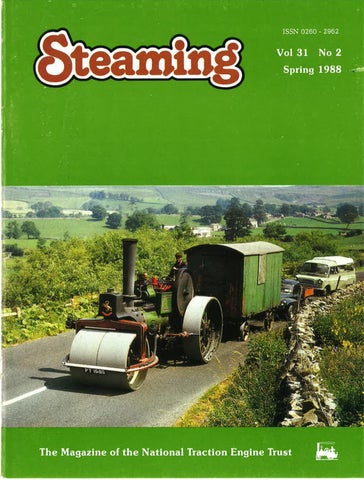
Cover An attractive scene of eight summers ago, when Aveling & Porter E type roller 10707 of 1923 ventured from its then home at Darlington in County Durham to the Masham rally, and then on across the Pennine backbone of north England to visit the Kendal event. The 10 ton machine is seen here, with its living van, near Hawes, and not very far from the 1000 foot contour. (Alan Thomas) 59
Trust News From the Chairman Some of our engine owning members may have recently been told by their boiler inspector that he can no longer carry out the annual thorough examination of their boiler. Probably the inspector concerned will have been an independent, and this decision by the inspector — and the consequent difficulties occasioned for the owner in locating a competent and friendly alternative — has been caused by the Trust's action in advising independent inspectors, not directly associated with insurance companies, to discontinue their activities, unless they are fully protected by professional indemnity insurance cover. Your Committee realise the trauma that a change of boiler inspector can give an engine owner. We also recognise that the great majority of independent inspectors are well qualified by many years of experience, often as engineer surveyors for insurers, to act as the 'competent person' required to examine boilers under the Examination of Steam Boilers Regulations 1964. It is therefore important that our reasons for giving this unwelcome advice are olcorly undorsto3d. We all recognise that the explosion of an engine boiler or its associated pipework on a crowded rally field could spell disaster for engine preservation as we cutiently know Whether or not there was loss of life, the resultant media coverage and the consequent public reaction would be likely to lead to a total ban or at least very heavy restrictions on our operations. Very large claims might be made against the engine owner and his insurers and should the engineer surveyor who last inspected the boiler not be an employee of the insurer, there is the possibility that negligence might be alleged against the inspector personally. If such negligence was subsequently proved, and the inspector was unable to meet the claims, the unfoi tunate engine owner — assuming he had survived the explosion — might find himself personally liable. Unless, of course, the inspector himself was protected 60
by a professional indemnity insurance giving an adequate level of cover. It is against this background, a scenario which we all hope will never come about, that the Trust must take action. As an initial step, we have suggested that independent inspectors should not operate without adequate professional indemnity cover and we have requested our official brokers not to accept independently issued boiler certificates unless this condition can be met. What is the Trust doing to ensure continuing high standards of boiler maintenance and inspection, and to help keep down the ever increasing cost of boiler inspection? We have opened discussions with the Health & Safety Executive, with insurers, boiler inspectors and other experienced experts in this field and are in process of preparing a Code of Practice for Boiler Maintenance and Inspection which we hope will be adopted as a national standard. We ore also actively examining the possibilities of a group professional indemnity insurance scheme for independent inspectors, but so far this has proved uneconomic in view of the small numbers of `.^.1Nlst tho now Code is in preparation we intend to explore the possibilities of offering and operating a Trust national boiler inspection scheme hopefully at very competitive rates. Memheis will be kept fully informed about our progress. (Peter Barber, chairman)
scheme, without the engine owner having to carry around with him reams of paperwork. Members who insure with our brokers John Scott & Partners automatically get a disc with their renewals. If however an owner prefers to make his own inspection and insurance arrangements, I can send you a disc. I shall require to see the copy (or photocopy) of the satisfactory boiler inspection report and also proof that the engine has a current boiler explosion risk policy and insurance cover for public liability. The Trust recommends this should be at least £500,000. Having satisfied myself that these papers are in order, I will return them all together with the completed NTET disc. On a different subject, but still reviewing aspects of insurance, I re-iterate the concern that has been expressed on what surely must be avoidable accidents when engines come off low loaders. These claims have been a considerable drain on the insurance resources; at the end of the day it is bound to reflect on premiums. I understand the subject of low loading is featured elsewhere in this issue, so anly rernaTk that during- last season I inspected the methods used by owners and hauliers in loading and securing at several rallies. In many cases, in my opinion, it was extremely gun'), but in Mlle's VVrIS appdlliug, with cases of engines just being held on by a winch rope and no fixing whatever at the rear to stop sideways movement. (John Hirons, Insurance Officer)
Engine Owners Column NTET Insurance Discs
Insurance notes
With the approach of the 1988 rally season may I please remind engine owners of the Trust's insurance disc scheme that we operate. The disc itself is paper and in the shape and size of a road fund licence, so fits into any typical licence holder. A disc will give rally operators all the inspection and insurance details they require under our rally approval
Underwriters who cover the NTET scheme are still concerned about the accidents which have involved engines falling from low loaders, and it is, indeed, also causing concern amongst engine °wile's. At this stage it is not possible to say what effect the claims will have on future premium rates but the NTET has asked us to discuss with the insurers a differential
scheme so that those who use low loaders pay a higher rate of premium than those who don't. This will, of course, leave those owners who have their own low loaders to investigate the possibility of taking a separate Goods in Transit cover related to the lorry, or whether to pay the extra premium for cover under the NTET scheme. Those who use hired low loaders will either have to satisfy themselves that the operator has adequate insurance or pay the extra premium under the NTET scheme. As soon as more details are known a note will be inserted in Steaming; if rates go up it is likely that these changes will be effective from the 1st May. (David Franklin, John Scott & Partners)
Boiler Inspection Survey As readers will have seen in the chairman's notes in the Autumn 1987 issue of Steaming, I have been asked by the National Committee to undertake a survey of existing standards for boiler inspection. This is progressing
well but it is important that I have information from engine owners as well as from 'official' sources. I would be pleased to hear, therefore, from members who can give me first hand information about any of the following: boiler • Difficulty in getting a inspector with experience of locomotive type boilers. • Having a boiler rejected because the inspector did not seem to know very much about what he was looking at. • Being made to take out all the tubes because 'it is now the rule that they must all come out every seven years' — but for no other good reason. • Having the working pressure of a boiler reduced only because it is over a certain age, rather than because of deteriorating condition. • Boiler inspection by an independent inspector (that is, one not employed by an insurance company or other organisation). I do not want to know his name but would like to hear about the quality of his work; thoroughness; the kind of equipment used (ultrasonic, optical, etc); the standard of the written report supplied and the charge compared to the insurance companies,
From Alan Martin's Collection
40
etc. • Any boiler failures (other than due purely to water shortage) where the cause was established. It would be helpful to know if the failure resulted from any shortcoming in the last inspection. • Any unusual boiler repairs, and whether there were any difficulties with the boiler inspector — either before the work was done or afterwards. • Any experience with feed water treatment: the system used; was it worth the trouble; did it save a lot of descaling and did the boiler inspector comment favourably on its use? • Any instances where ultrasonic instruments have given grossly misleading information. • Any experience of high pressure washing equipment for cleaning the fire and/or water sides of boilers. of chemical • Any experience cleaning — either by specialists or as a do it yourself operation. Any information on the above will be much appreciated, either as a brief note to me (I can always come back to you if I feel that I need more information), or a telephone call. Please assist the Trust in this important survey if you can. (Jim Newnham, Hon. Safety Advisor, Penlands, High Easter, Chelmsford, Essex CM1 4QW — telephone 024-531 283).
Rally Organisation Rally sub-committee
Little is known of this engine, or indeed, the whole scene. The steam tractor is one of Savage's distinctive single cylinder machines, produced in small numbers soon after the turn of the century — the registration it carries, CY432, would probably have been issued in 1905 or 1906. The engine was owned by Daniel Jones, a carrier and furniture remover of Newport, Monmouthshire — maybe that is he on the left in front of the pantechnicon — but the date of the picture is unknown.
As the name of my sub committee suggests, it is concerned with traction engine rallies and other events of a like nature at which traction engines will be present. Publicity of the many events being held throughout the country is one of our main concerns, so that we can bring notice of these events to as wide a section of the public as possible. To this end the Trust produces a list of rallies each year. All events shown on our lists are Approved Rallies, which means the organisers have agreed to comply with the recommendations and to meet the basic safety requirements as set out in our Code of Practice. Elsewhere in this issue is the current Rally List. There are many rallies varying considerably in size, in many different areas; an indication of the anticipated engine attendance is given against each entry. We hope there is at least one rally that every enthusiast can get to. But spare a 61
moment to thank those responsible for the list; a great deal of work is put in compiling it, much correspondence is exchanged before anything like a final list for publication is produced. Many of my sub-committee have a hand in this, but chiefly Ron Copp: thank you Ron. The Winter is always a time when the Rally sub-committee is busiest. Since the beginning of the year we have been involved in an Excursion Workshop of the English Tourist Board. This is a trade show for the travel trade and was held this year at the Wembley Conference Centre. It is aimed at the day out excursion operator including tour and coach operators, party organisers and the like. We have rally lists and much information about the various events to discuss with interested enquirers, in fact about 275 contacts were made during the day. Our main conference of Affiliated Clubs and Rally Organisers takes place in February of each year. This is an excellent opportunity for all to get together to discuss matters of mutual interest. At this year's gathering the morning session provided the opportunity of announcing the advantageous coal supply arrangements that John Crawley has made on
behalf of the Trust with Powell Duffryn Fuels Ltd from their Portsmouth Depot. After lunch David Pugh spoke on Trade Stands on the Rally Field giving his personal views both as a rally organiser and a trade stand operator. The February conference was outstanding in that it had the best attendance of any conference yet with 117 delegates representing 71 organisations; a most gratifying and rewarding result. As all members will know the Trust has recently appointed John Crawley as its Chief Executive to bring his own particular brand of expertise to the Trust's activities. This has already been apparent in both the abovementioned events as has also the assistance of Sylvia Dudley; thank you Sylvia and John. (Eric Fillmore, chairman, Rally sub-committee)
Welsh Steam Coal Rally organisers, affiliated clubs and even individual engine owners will be interested to see the very competitive price for pre-packed Welsh Steam Coal that the Trust has been able to arrange with Powell Duffryn Fuels Ltd of Portsmouth. All the necessary details should be found
on the accompanying advert, but PD Fuels will be pleased to answer queries via Jack Knight on the phone number quoted, and further questions on transport rates and arrangements to the midlands and the north can be made to the transport depots of member Richard Preston, again as quoted in the advert.
NTET Photographic Archive The National Traction Engine Trust is forming a photographic archive, which will enable members to contribute photographs and negatives to a central source for the safekeeping of such material for posterity. The collection is to cover a broad range of interest, not only traction engines of all types, but the manufacturing facilities, the men and women who were involved in their operation and a broad spectrum of activity right through to the present day and the current preservation scene. A photograph is an impression of a scene taken by the photographer in a
PRICES PER TONNE ex PD Fuels Ltd, Fratton Depot in Portsmouth, Hants.
one
WELSH
185 BITUMINOUS 41.310/%14
LOW LOW PRICE
£78
TRACTION ENOIN
Cheque required 7 days prior to collection or cash on collection
WELSH DRY STEAM COAL
I TONNE SHRINK WRAPPED PALLETS AVAILABLE (5 REFUNDABLE DEPOSIT)
TWIAT_ 25kg
I st APRIL TO I st SEPTEMBER PREPACKED IN COLOURFUL 25KG BAGS
CALL JACK KNIGHT ON
0705 864613 AT POWELL DUFFRYN FUELS LTD GOLDSMITH AVENUE PORTSMOUTH PO4 OAT
HAULAGE IF REQUIRED CONTACT Richard Preston & Son Ltd. e.g. £12 per tonne to Eaton Solon Depot Cambs. (Clive Eaton: 0480.213200) or £15 per tonne to Potto Depot North Yorks (Malcolm Horton: 0642 600243) — for other delivery locations phone Prestons for quote.
62
moment of time. It at once becomes a historic record and as the years go by becomes of greater value to historians and enthusiasts alike. All members of the Trust who take or collect photographs have work which the Trust would like to see in its archive. To start with we are looking for photographs and negatives in colour or black and white, of any size up to 1 5in x 12in, and the older the better. Please write on the back of each print your name and address and full details of the subject where known. These should be sent to Dick Blenkinsop (at the address below) who has kindly agreed to act as curator to the collection. If you have a collection of photographic material which you would like to donate to the Trust this would of course be most welcome. When the collection reaches a reasonable size it will be possible for members to inspect it by appointment. A further object of the exercise is to enable the Editor of Steaming to use the photographs from the collection for the benefit of members. If you have any queries an evening telephone call to Dick on Farnborough 1029589) 696 will be welcome — and, of course, all contributors to the archive will receive a letter thanking them for the work sent in and therefore recording its safe receipt. 'Cornerstones', (R. J. Blenkinsop, Church Lane, Claydon, near Banbury, Oxfordshire OX17 1 EW.)
NTEC Sales The Trust's National Sales Officer, Keith Shakespeare, is presently in the throes of house moving, and we hope members will understand that upheaval as the reason for there being no sales list in this issue. Obviously, the stock of NTEC Sales makes Keith and Tracey's removal that much more tiresome than any house moving inevitably is, but the service to members will be resumed during May, when the sales teams sally forth onto the 1988 rally fields, ready to do business and enhance the Trust's funds. This year's sales team is — • Keith and Tracey Shakespeare • David and Andrea Duffill • Ken and Edith Beeby and they will hopefully be attending the following rallies during the first half of the season. Reference to the Rally List will provide details and full titles, etc. May — Rushden (Ken); Abbey Hill (Keith); A bbotsfield Park (David);
Il Wnrringtort P. 49 Motorway M55
Runcorn
NorTwl th S':13
Lira rpoo [ Fjf,;•!)
Burrell roller 3535 takes a run on a highway of a very different character to that which it encountered when it was built in 1913. Sentinel 8714 follows, and the pair were heading for the Holly Bush steam party in October 1987. (Jim Stevenson)
Windsor Safari (Keith); Hartington Moor (David); Tattershall (Keith). June — Knebworth (Ken); Littlecote (David); Builth Wells (Keith); Holton (David); Great Amwell (Keith); Morecambe Bay (David); Claybrooke (Ken); Parham (Keith); Banbury (David). July — Blindley Heath (David); (Ken); Chiltern (Keith); Elvaston Alfreton (David); Woodcote (Keith); Weeting (Keith); Langport (David); Netley Marsh (David); Kegworth (Ken); Lambeth (Keith); Cumbria (Keith); Ross-on-Wye (David).
Wembley Exhibition The Trust's stand at the 1988 Model Engineer Exhibition at Wembley during the first week of the new year was a great success. The attendance figure of 56700 was 5000 up on the previous year and Keith Shakespeare and his volunteer sales team were able to serve a goodly number of them; our thanks go to the team for their efforts on behalf of Trust funds.
The Scania Transport Trust Awards Scania (Great Britain) Ltd, the British subsidiary of Swedish truck, bus and engine manufacturer Scania, in association with the Transport Trust, has recently launched this major new award scheme. A total of up to £10,000 will be presented to projects which are deemed to have contributed significantly to the preservation of transport heritage within the United Kingdom. In addition there will be a prize of a visit to Scania's own museum and restoration workshops in Sweden for members of the project judged to be the year's best entrant. The scheme begins in 1988 and will be open to all projects concerned with transport preservation, be they road, rail, water or air related. Groups or individuals involved in such projects are invited to enter for the awards. Typical of the type of entry expected would be the restoration of vehicles or associated preservation work on the infrastructures. The scheme will not cover work being undertaken by 63
Enjoy a mini-package tour to
Stourpaine All-in coach trips to the biggest event of them all 1st to 4th September 1988 The Trust has arranged with several coach operators for them to run trips to this year's Stourpaine event. If you wish to join one of these excursions please send an SAE requesting details, and then make a firm booking as soon as possible, as, obviously, the trips will not run unless adequately supported. I his is especially important in the case of the trips involving overnight stays as accommodation has to be booked in plenty of time. Do write now to ensure these ventures are well supported.
DAY TRIPS Saturday, 3rd September ADKINS COACHES, departing Daventry and picking up at Banbury and Oxford. Contact David Adkins, Upper Boddington, near Daventry, Northants (re( 0327 60388). WEALDEN OMNIBUS, departing Canterbury and picking up at Maidstone and Reigate. Contact Julien Brown, Badsell Road, Five Oak Green, near Tonbridge, Kent (tel 0892 833830 day; 0622 813368 evenings).
TWO NIGHTS STAY outwards on Friday 2nd September, returning Sunday 4th September. DEWHUHS I COACHES, departing Leeds and picking up at Sheffield and Dcrhy Co::•tact Lancaster Road, Knott End on Sea, Blackpool FY6 ODX (tel 0253 811876). SPRATTS COACHES, departing Norwich, picking up at Cambridge and Bedford. Contact Ken Frost, The Highlands, Swardeston, near Norwich (tel 0508 70467).
commercial restorers. A series of awards will be made throughout the year. Those receiving these awards will go forward to compete in the final of the Scania Transport Trust Awards for 1988. This final will be held early in 1989. Those requiring further information on the award scheme are asked to write enclosing brief details of their project or to telephone either Phil Sampson, Public Relations Officer, Scania (Great Britain) Ltd, Tongwell, Milton Keynes MK15 8HB (tel 0908 64
215384) or Peter Ballard, General Administrator, Transport Trust, Marylebone Station Offices, London NW1 6JR (tel 01 262 8864).
Obituary David Smith David Smith, who died in November 1987, had been a club member for many years. His interest surfaced in the period after the war, at a time when steam road vehicles were still reasonably common although often stored or derelict. Before the birth of traction engine rallies he purchased Garrett 4CD tractor 33284 from Vines of Gloucester. The engine was steamed home to Maidenhead and restoration proceeded quietly until his ill health forced its sale to Jim Hutchens. David was also co-owner for a while of the Garrett 'Suffolk Punch'. His interest in steam covered all applications — part of one holiday was spent as engineer on Salters Thames steamer MAJESTIC. He leaves a son and daughter. (Jim Smith)
London Area Social Meetings The final meeting of the 1987-88 season of social meetings at The Horse & Groom, Great Portland Street, London W1 is as set down below. The meetings will resume in October and details will appear in the Autumn issue. TUESDAY, 26th APRIL 1988 — 'British Locomotives 1948-1951' — an illustrated talk by Bill Timmings, postponed from an earlier date, when illness prevented its presentation.
Reading University We have been asked by the Institute of Agricultural History and Museum of English Rural Life at Reading University to let members know that, in the absence of David Phillips, their Archivist, the service of answering enquiries will inevitably be slower for the time being. However
Or a trip to...
Future dates Coach excursions The Trust has arranged for several coach firms in the northern and eastern areas of the country to run allin excursions to the Stourpaine event vs:col:end ir September It thc is hoped this will offer an excellent opportunity to those members without their own transport, or to those enthusiasts who might wish to make the journey with A small group of friends, but find a private coach not quite viable. Two of the planned trips are day excursions and two involve a two night stay at medium range accommodation; the latter trips will allow for an evening visit to the rally, to be at the famous evening line up of illuminated showmans engines. Brief details of the coach excursions are included in the accompanying advertisement and anyone who is interested is urged to contact the appropriate operators as soon as possible so that arrangements can be made. A similar excuisiun will run to the popular Dutch rally at Hellevoetsluis; interested members are, again, referred to the advertisement on this page.
Hellevoetsluis Tho popular Dutoh steam rally 20th August 1988 This coach trip is to the well known and attractive town of Hellevoetsluis where the rally is held on the waterfront and adjacent to the historic old town. ADKINS COACHES, departing Daventry, Northants about 3.00pm on Friday 19th August 1988, crossing to Holland via the Sheerness night boat and giving all day on Saturday at the rally. Returning on the Saturday night boat, arriving Daventry about lunchtime on Sunday 21st August. Fares are £34 per person, coach and ferry crossing only but other options for the sea crossing are: with Pullman reclining seat — £38.50; with couchettes — £41.20; with berth in 4 berth compartment — £49.50; ditto in 2 berth.— £54.70. All cabins with toilet and shower. Prices do not include entrance to rally — payable at turnstile. To secure your seat please forward your cheque or PO for £10 as a deposit to David Adkins, Upper Boddington, near Daventry, Northants (tel 0327 60388). Pick up points and full timings will be sent — please book now because unless well supported the trip cannot operate.
the Museum wishes to make it clear that they still welcome enquiries, preferably by letter, and visits can be arranged by appointment. The Museum regrets this state of affairs, but hopes members will appreciate the difficulty. The Museum's address is Museum of English Rural Life, University of Reading, Whiteknights, PO Box 229, Reading, Berkshire RG6 2AG (telephone 0734 875123 ext 475 or 7677).
Corrections Several unfortunate errors were included in the last issue, the most careless the being dastardly identification by the Editor of Dick Blenkinsop's transparency used tor the front cover. The engine is, of course, Brian Caseley's 6hp Burrell road locomotive 3824 of 1919 LORD FISHER OF LAMBETH. Our apologies to Brian and to Richard Sandercock if they were caused any embarrassment by the mistake, and to Dick Blenkinsop. On page 42 (column three) Blossom Taylor should read Blossom Trinder, and in Percy Dabbs' article on page 15 the firm he worked for was J.B. Souter and not Sunter as twice printed.
OUR MAGAZINE 25 YEARS AGO
The editor, following up an earlier plea for increased membership to enable a larger magazine, was asking members to take membership forms and actively seek new recruits. Twenty five years on John is now embarking on a further promotion of the Trust's activities, but for all our newer title, this is still essentially a club and he could well do with the sort of recruiting assistance he got from members in 1963. Engines were still working in the West Country — Devon C.C. rollers; Buncombes had just bought a roller
from Somerset C.C. but Marshall traction 48341, which had worked a sawmill at Ide, Exeter for many years, had ceased work and been sold to preservation. Overseas interest was stirring. A German enthusiast had exchanged letters with the Chairman on steam ploughs and modern steam cars in his country, whilst an Australian reported the discovery of R. Hornsby 8hp traction 6566 in Victoria; by coincidence D. Hackett of Ross-onWye, Monmouthshire, wrote to say he had acquired R. Hornsby 8hp traction 6557 from Gibbons of Castor, Lincolnshire. Among the three engines advertised for sale was a 1933 Sentinel timber tractor at f350 — nothing particularly outstanding about that except it is strange to realise now that it was only 30 years old.
Fresh from repairs and a repaint in the Camerton workshops of the Goold brothers is S4 Sentinel 9074 of 1934, seen here at the transport weekend at Bishops Lydeard railway station on the West Somerset Railway. Previously rallied by Roger Hickman and Ted Proctor in the Midlands, the wagon is now owned by Gerald Redwood. (John Reeves)
65
Keeping them on There has been much comment in recent issues on the potential problems of low loading steam engines. As a contribution to the debate we offer articles from two members, both of whom are professionally involved with the haulage of heavy loads in today's conditions. Paul Brook I have read with much interest and considerable concern the references in the last issue of Steaming to the subject of load reetraint ensuring that engines remain on the backs of their transporters. I have to agree with Mr Bullman as regards the inclusion of load restraint in the Trust's Code of Practice. I suggest that this addition is important for two reasons; firstly new (and indeed some old) users would have a readily available guide, and secondly I feel that the NTET has a responsibility to address the problem in a workmanlike manner, and thus avoid any criticism in the future. I am presenting for consideration a short guide on the subject which I feel would make the basis of a sound code of practice. I would welcome any comments members may have. The bulk of what I have set Jowl' is based on information available in the Department of Transport Code of Practice, Safety of Loads on Vehicles (HMSO 1984, £4.901. Whilst presently only a code the contents are likely to be .uppoi tut; uy 11101e birlr ryer IL ieyislation in the futuro. I have added further notes to the guide, based on my own experience in a service environment, to better recognise the needs of engine owners and operators. There are, however, two specific areas where I consider the code requires revision; these areas have already been brought to the attention of the DoT. Firstly the code advises that restraint forward should be equivalent to the all up weight of the load and that the lateral restraint should be equivalent to half the weight. This should be regarded as a minimum, and confined to ideal conditions; it is much safer to double these figures. Secondly the section of the code which deals with engineering plant (similar to our engine restraint needs) has some tiedown scheme drawings which show lateral restraint provided by a single lashing passing from one side of the trailer, through a towhook 66
or eye on the load, to the other side of the trailer. In my experience this is totally inadequate. Two separate lashings, or a proper bridle with a fixed midway fitting are required. In response to the discussion already published I would like to set the record straight on the use of webbing restraints. Properly constructed assemblies, to BS5759 and correctly used, are fast becoming regarded as one of the best methods of load restraint. The restraints are enormously strong, easily handled and have the added advantage of reducing shock loading on both the load and the vehicle securing points. Just to reinforce the point, the standard military lashing is a webbing and ratchet assembly and in the future even main battle tanks will be restrained with webbing. A word of caution, however. There are some cheap, and very nasty, webbing Assemhlies on the market. These are death traps, and seem to have the breaking strain of a warm Kit-Kat. The very best quality 18ft 5 tonne rated lashings complete with ratchet tensioners wiii oniy cost in tne region of £20-E25, so any saving made by buying poor quality lashings is not worth the risk. Chains and tensioners are, of course, a very reliable method of restraint. A word of caution here though — chains are not infallible and require careful maintenance and thorough inspection. Chains can and do fail, and it takes an experienced eye to spot, say, a strained link. The legal situation as regards load restraint is presently embodied in Motor Vehicles (Construction & Use) Regulations 1978. On the enforcement of any code (prior to the effect of any impending legislation) I am bound to say that as an engine owner myself I object to the prospect of having to pay for someone else's negligence in terms of increased insurance premiums. I wonder if the lashing equipment and scheme are taken into consideration when assessing a claim. I would like to think that the debate
which is already being aired will be sufficient to encourage the less respectable to mend their ways. Time will, of course, tell. To accompany these notes I offer a photograph which may be of interest. It is a picture which says a thousand words. There are but four chains holding that tank unto a trailer (the tank weighs 56 tons). The point is that they are in the right place and man enough for the job. There is no reason why an engine on d IOVV luadet should not survive in the same way. In this case no damage was sustained by the vehicle or the tank, and after a simple recovery they continued on their way. Food for thought indeed.
Load Restraint: a code of practice general principles 1. Forces are generated on the load when a vehicle brakes, accelerates, changes direction or crosses undulations in the road. These forces are frequently greater than the frictional force between the load and the vehicle, and therefore some restraint system will be required. 2. It requires much more force to stop a load which has started moving than it does to prevent movement in the first place. The 'battering ram' effect increases rapidly with the increase in distance through which the load moves relative to the vehicle. It is essential therefore that the load is restrained in such a way that movement relative tu the vehicle is prevented. 3. The basic principle on which the code is based is that the combined streirytli of the load restraint system must be able to withstand a force net loss than the total weight of the load forward and half the weight of the load backwards and sideways. Vertical movements may occur but these should be overcome if the conditions above are met. These principles will be sufficient for normal road use only. Doubling these levels will improve the safety margin considerably.
choice of vehicle 4. The design and construction of the vehicle must be suitable for the load which it is to carry. The loading staff should be competent and extremely careful. It is the vehicle driver's responsibility to check and ensure that the load is adequately secured at all times. 5. The maximum expected load on the floor should be ascertained and the luadbed should be capable of coping with this. 6. The overall height of the loaded vehicle should be checked to ensure that it is less than that of any overhead obstruction likely to be encountered en route. If the height of
the loaded vehicle exceeds 12 feet (3.66m) the actual height must, by law, be displayed in the vehicle cab. 7. To prevent grounding on level crossings etc. regulations require that a certain minimum ground clearance be maintained. (see Regulation 74A of the Motor Vehicles (Construction & Use) Regulations 1978, amendment 2.)
arrangement of loads 8. Before a vehicle is loaded it should be checked to ensure that its load platform, ramps and anchorage points are in a sound and serviceable condition. A check should be made also to ensure that the maximum permitted axle and gross weights will not be exceeded. Remember that the position of the load may cause individual axles to become overloaded. 9. The load should be arranged to achieve maximum vehicle stability with the load centre of gravity as low as possible and on the vehicle longitudinal centre line. Care
Brian Freer Though by no means professing to be the ultimate expert on the subject of low loading, I feel my experience, spread over many years, of moving several score steam engines to and from rallies, has equipped me to offer to readers some thoughts on a subject which has been under the spotlight in recent issues. Some of the engines have been transported dozens of times and by now I've come up against many of the pitfalls waiting to trap those who unwisely endeavour to earn a living by moving machinery on the highway. Firstly, a look at the vehicles that are available. The most common is the drop well articulated combination, with (nowadays) draw-bar versions in
should be taken not to obscure rearward vision unnecessarily. 10. If necessary the weight should be spread over the loadbed but note that sleepers etc for this purpose should be restrained as well. 11. Before commencing a journey all tensioners and turnbuckles must be adequately tensioned. They must not be overtightened however, as this will put an undue strain on all components. 12. The load should be checked frequently for security, and the lashings tested for adequate tension after a few miles and again at intervals during the journey. 13. All other loose items, chains, equipment, tools etc must also be restrained or stowed.
load securing equipment 14. A variety of load restraint equipment is available. This is described more fully below. Whatever the type, however, all types of restraint require frequent and
the minority. Some engines enjoy their own personal trailer, quite likely one of the older knock out axle design and hauled by a semi-retired tractor unit, but well turned out and sporting tailormade ramps and securing devices. Less fortunate owners resort to hiring. The vehicles provided will generally be larger and more sophisticated with hydraulic swan necks, or folding necks that form the loading ramps, and be capable of safely moving the largest engines, but being in commercial use with high capital and maintenance costs, will quite obviously be expensive to hire. The trailers will also have to be maids of all work in everyday use, able to carry a wide variety of load and having a fully adaptable selection of blocks, timbers, securing chains, tensioners etc.
thorough inspection; on no account should damaged devices ever be used. 15. Rope is suitable for light lashing only, eg for restraining tools, sheets etc. Preferred materials are polypropylene, polyester, sisal and manilla. Polyamide (nylon) ropes are not so suitable as they tend to stretch under load. Rope should be of 3 strand construction and must have a minimum diameter of at least 10mm. Details of ropes are specified in BS 2052 and 4928. 16. Steel wire rope (SWR) made up into straps is suitable for securing loads but only when used in conjunction with other devices such as shackles and tensioners. The strength of the SWR will depend on the thickness, material and construction. Full details are given in BS 302, 1290 and 6210; however, SWR with a diameter of less than 8mm will not be suitable for restraint purposes. Sharp bends will reduce the effectiveness of SWR considerably. 17. Webbing assemblies are suitable for restraining engines when properly used. The marked Rated Assembly strength should not be exceeded. The assemblies should be manufactured to comply with BS 5759. Care should be taken to ensure the assembly is sound. Protection should be used to prevent chafing if the webbing crosses sharp corners. 18. Chain assemblies are suitable restraining devices when used as per SWR, ie with a tensioning system. Unless it is marked as such, the rated assembly strength is unlikely to be known. Great care must be taken when inspecting chain. The strength of a chain will be greatly reduced if one or more links are Worn, stretched, bent, twisted or otherwise damaged. Bottlescrew tensioners should be tommed to prevent them working loose. The use of split link or iron chain is not recommended.
(Paul Brook's employment as a member of The Director General, Transport and Movements Staff involves advice to all three Services on loading and load restraint.)
The older knock out trailers, though limited in capacity by their single rear axles, are in a way advantageous for steam engines, for once loaded the engine travels chimney first and can be secured against the trailer front, thereby preventing movement due to braking and decelleration. Such trailers can also employ a winch on the top deck, capable of drawing aboard dead engines. Ramps or skids, about 6 or 8 feet long present an incline of about 1 in 6, no problem to most engines or rollers if the surfaces are clean and dry. Detachable or folding neck trailers, labour saving and faster, are loaded from the front and the engine is carried facing and abutting the rear bridge. It therefore requires very substantial 67
load restraint to resist the braking forces of the whole vehicle. Let us consider a typical move to a steam rally by a hired outfit. Some customers of long standing pay the high accolade of allowing the contractor to move their pride and joy without them being present, probably some days before the event, with the engine being delivered, sheeted down and left ready for steaming up on the Saturday. Such an engine, left suitably parked at the owner's premises, is loaded with the aid of a push pole between the tender and the front coupling of the tractor unit, and with a capable steersman, is soon aboard. The thing to watch here is to keep the pole in line and ensure the tractor unit is more than a match for what is being propelled. The push pole is, of course, removed after applying the engine brake and scotching up. Now to the important task of chaining down the load. Few, if any, engines were built with lashing eyes provided but the outside holes of the drawbar are obvious points to attach a turnbuckle or chain dog and chain, and thence to side shackles on the trailer. These will effectively stop sideways movement; a point to watch is that most engines or rollers have got quite a lot of side play on the hind axle and if this is not taken up with the lashings they will work loose after a few miles. Scotches under both hind wheels help to prevent fore and aft movement but these hlorks must hn rhnined in position — they are otherwise likely to work out and fall off during the journey. The front end of the load presents more of a problem, particularly with rollers, for quite naturally owners like to kear paintyvnrk to a high standard and don't take kindly to chain marks on the spokes or rims. The steering guides might look like handy points but they are castings and, after sixty years or so, likely to be brittle. Traction engines usually have a drawbar jaw in the perch bracket, but a chain merely passed through this point is not sufficient to prevent the front end sewing — two individual chains, one from each side, are far safer. When quite satisfied that all is properly secure you may feel the journey can begin, but what of the lid on the chimney top? I well recall one lid — in a previous life it had been a 14 inch Ransome plough coulter — which I discovered embedded in the trailer floor, having fallen from the chimney en route! The typical matchboard and felted canopy on an engine was designed and built without regard to the effects of its passage through the atmosphere at a mile a minute — 68
even runaways of yore failed to reach those speeds. It can be disconcerting for the lorry driver to see in his rear view mirror large pieces of felt attempting (usually successfully) to become airborne, not to mention the sight of swinging, dancing fireirons and poorly furled side curtains trying to get in on the act. The rally field you arrive at may be just off a main road, with a wide and sound gateway, helpful organisers and well marked unloading points. On the other hand it may be an outlandish minor stately home, approached by leafy lanes labelled '7.5 tonne except for access' and complete with 90° bends, dubious cattle grids and eight foot gateways. The unloading park may be an area of ridge and furrow pasture untouched since feudal times, with a picturesque covering of celandines and cowpats which together produce an efficient lubricant between tyres and ground, so that the engine you spent so much effort on to make it immovable whilst on your trailer, now refuses to budge because the tractor unit's wheels are spinning uncontrollably. The return trip after the rally is quite likely to involve collecting the engine on the Sunday afternoon whilst still in steam. We won't go into the potential hazards of taking a 50 foot low loader into the dying moments of a crowded day's proceedings or the attendant crowd of wellwishers wondering if you might muff the loading process. But with luck your engineman will have not spent too long in the beer tent and will drive a straight and steady course onto your deck, remembering to have put in both nina hafnra alimhinrj thp ramp Coupling up and chaining down is, of course, no less important going home, but there are the added problems of the sacks of coal likely to have been acquired — usually life expired fertilizer bags ready to spread themselves everywhere. Without wishing to appear immodest perhaps I can end with a few do's and don'ts that come to mind: Don't try to control an engine off a low loader by using a Thompson winch with the handles attached — they have an awesome destructive power if things slip. Do examine load binders, chains, screw buckles etc from time to time, not forgetting the side shackles on the trailer — they have a hard life too. Do avoid metal to metal contact between wheels, ramps, and steel trailer floors; lengths of former conveyor belting are alright if dry — but treacherous if wet or oily.
Don't rely on wire rope from the trailer winch to hold an engine against the neck or rear bridge of the trailer — the winch drum is usually higher than the perch bracket on an engine and tends to lift the weight of the front wheels instead of holding it down. Do keep down the number of well meaning volunteer helpers, especially when the public are close; one person should take charge of the operation and the engine driver and others only move under his direction. Do spare a moment's thought for the G forces that will be caused by heavy braking and by chicaning through traffic islands and roundabouts — especially if you are driving a latest model tractor unit with the cab insulated from noise and road shocks and with power assisted everything.
(Brian Freer runs a haulage business in the south midlands, specialising in heavy machinery in the road construction industry; many different engines have attended rallies through his efforts.) A
Auction Sales Spring 1988 Saturday May 7th — Thruxton Circuit, near Andover. 11th Spring Collective Sale of vintage steam enginac vintage trartnrc ctatinnary engines, bygone farm and domestic equipment, instruction books etc. Catalogues f3 Saturday May 14th — near Taunton, Somerset. Foden steam wagons, Marshall tractors, threshing machines, Commer lorries etc. Catalogues f2. Saturday May 28th — Chumleigh, Devon. Ashley Countryside Collection — contents of farm museum. Catalogues £2. Catalogues and further details from: Prudential Property Services, Agriculture House, High Street, Stockbridge, Hampshire 5023 61-IF Tel: Andover (0264) 810702 'COMPOUND Road Loco Steerer desires improver's position, with a view to driving eventually. — Box OC 222.' (From Industrial Motor Review 26th December 1906.)
A History of
HoVIS STEAM TRANSPORT Derek Rayner
Early days Richard Smith was a third generation flour miller, born in Stone, Staffordshire in 1836. He believed in the virtues of wheatgerm — the heart of the wheat — as a means of providing more nutrient than was available from white bread. The wheatgerm had a short life under normal circumstances, and didn't usually survive the baking process but after many attempts, Richard 'Stoney' Smith succeeded in perfecting a wheatgerm flour which was capable of producing a tasty brown loaf, rich in vitamins and long lasting. He took his creation to the established milling firm of S. Fitton & Son in nearby Macclesfield, and managed to convince Thomas Fitton of the viability of his product; together they registered 'Smith's Patent Germ Flour' in 1887. The product was a success and began to be produced by Fittons' but the brand name was too unwieldy for the bread to be effectively marketed. A national competition was therefore organised in 1890 and eventually the competition's £25 first prize was awarded to a London student, Herbert Grime, for his neat diminution of the Latin phrase hominis vis meaning the strength of man; the name Hovis was born. The shortening was sometimes indicated by a tilde over the letter o, actually an incorrect use of the mark, which is used in Spanish over the letter n to indicate a nasal pronunciation. The sales of Hovis bread flour became very much a Victorian success story. In 1896 Thomas Fitton extended his business to London, buying the Imperial Mills on the Embankment near to the Houses of Parliament (the site was later bought
for the gardens near Lambeth Bridge), and so cutting the cost of carrying large quantities of Hovis flour to the good markets of the south. There had been a mill on the site for some considerable time — and the history of the site is perpetuated in the name Millbank applied to the road alongside the River Thames. Expansion continued and the Hovis Bread-Flour Company Ltd was formed in 1898, the title becoming just Hovis Ltd in 1918. The firm was very conscious of the need for widespread advertising to put its name before potential customers and it had established its own signwriting department around the turn of the century. This later became the Van and Signwriting Department, though initially only coach painting work was undertaken. The new department was established at the rear of 172 Buckingham Palace Road in 1904. The payroll at that stage did not exceed £15 per week. As time progressed, general repairs to the horse drawn vehicles were carried out and, not unnaturally, the local coach builders who in the past had been entrusted with the work were not exactly pleased with the situation, even though there had been past problems with various companies. The success of the new workshops was such that the work found to be necessary was more than the original cramped premises could satisfactorily cope with and a move was made to a larger building in Phipp Street in the City of London. At the same time a similar venture was opened by the company at Macclesfield, and later on another in Birmingham. At this stage, the Hovis firm decided that complete vehicles could be constructed and work would not merely be confined to repairs and
repainting. The first products of this expansion were two London barrows and two horse vans, which although sounding a small achievement was, in fact, a big step forward for the department. Further expansion resulted in similar improvements at the other out of town locations and a new workshop was opened at Bournemouth. In 1910, the lease on the Phipp Street building expired, and at the same time the company vacated the old mill on Millbank. The directors decided to build a new van works on land available in Grosvenor Road, alongside their proposed new mill close to Vauxhall Bridge. Work proceeded apace and just before World War 1, the new Motor Transport Department was formed. Up to that time, horse drawn transport was the norm, this being maintained and controlled by the managers at their individual mills. Much valuable experience was gained during the war years so that after hostilities ceased the van building department was in a very favourable position to construct the special bodies necessary for the bakers' trade. Van bodies were made in great numbers, not just for the Hovis company but also for customers at all depots. Hovis coachwork became famous throughout the country. The premises at the Grosvenor Road mill in turn became too congested, and a further move round the corner into Vauxhall Bridge Road enabled maintenance of the firm's own flour delivery lorries. New vehicle construction was transferred to new premises at Andover and in further expansion depots opened around the capital at Stratford, Catford, Mitcham and Leigh-on-Sea. Repair work was carried out at each of these locations, whilst Andover supplied new bodied 69
70
Sixty years ago any business reliant on moving goods by road was keen to display to customers that it was up to date in its transport department. Hovis was no exception and many times took the trouble to line up vehicles for the photographer. The fine picture opposite shows the loading bays at the Battersea mill, London, and has a wealth of absorbing detail. The five glistening Fodens are part of the fleet of seven former War Department wagons acquired about 1919-20; the exact date they arrived is unrecorded and we can only go on when the registration numbers are said to be issued by Croydon council. From the right the first three Fodens are 5890, 3488 and 5402, but the works numbers of the other two are unknown. At the left is a very new looking Sentinel, 3970 of October 1921. When Fodens used this same picture in one of its catalogues the latter was not suprisingly trimmed off, but in fact Hovis had on the same occasion posed each section of its fleet — identical line ups were made of the Sentinel wagons and of the petrol lorries. Its notable that Fodens were not averse to depicting secondhand products in their publicity — if the wagons had a nice well known name on them! The glazed canopy over the loading bay looks very new and completion of fresh facilities was probably the motivation for having the photographs taken. The glass overhead would surely have become dirty in a very short time in an atmosphere of coal smoke, steam and flour dust — perhaps that's why it was designed to be so high. After the Garrett fleet arrived in the early part of 1924 they too were posed en masse at the loading bay, but by that time the photographs show less transparent glazing. From all these observations we
can probably date the Foden picture to about 1922. Looking behind the wagons we see the loading methods. With the sacks of flour weighing 1401bs each, ease of movement was paramount, so the gallery floor was at such a height that a man standing in the body of the Foden had the sacks at a convenient shoulder height — he then stacked the body three high from front to rear. The technique can be seen from studying the other Battersea photographs of part loaded wagons. The sacks had come from the warehouse by gravity down various chutes to the numbered bays, and the foremen (they stand on either side with white jackets) had a small office for carrying out their paperwork. The steam wagons themselves are probably in the brown livery — and lettered Hovis at least seven times! The task of the steersmen in gaining their places at the loading bays cannot have been easy, judging by the wheel tracks in the flour dust, but perhaps it was rare for all the positions to be occupied by steam wagons. The picture on this page is of Hovis's transport fleet in Lincoln in 1929, with the city's cathedral chosen to form an attractive background. At each end of the line up are small car-based delivery vans — maybe vehicles for the distribution of publicity material etc, rather than bread. Of the larger vehicles one of the early Saurer oil-engined lorries is furthest left, next to DG6 Sentinel 5518 of 1924, and the earlier Standard, 3971 of 1921. Whilst the latter has a Hovis built fixed side body and home made windscreen, the DG6 has high dropsides by its makers plus a canvas tilt. (Rank Hovis Ltd archive)
vehicles to individual demands from customers. Provincial expansion also took place with further branches being opened in Nottingham, Bristol, Tunstall (Staffordshire) and Manchester.
Mechanical transport arrives Coinciding with the acquisition of the Battersea firm of millers Marriage, Neave & Co, a decision was made for Hovis to wholly undertake transport of their own bulk goods, much of which had previously been carried out under contract. For this it was decided to purchase steam wagons, and to make one man responsible for them. Thus thp Hrwic Trenepnrt nopartmont proper came into being in May 1921, under the direction of Captain C.F. Roberts. The Department was split into two areas, Southern and Northern, the former being run from Battersea and the latter from Manchester. The transport fleet in London at that time consisted of two steam wagons, six petrol and eight electric lorries. Manchester had three steam wagons, one electric lorry and a number of horse drawn vehicles. The country mills which at that time were Hedingham (acquired 1918) and Haverhill (1915), in Suffolk, together with Newbury (19211 in Berkshire, had virtually no mechanical transport, relying on the horse and dray land the railway) for their transport needs. According to company records, the first mechanical transport purchased for London use was a 2 ton Leyland, acquired about 1912 and numbered 44 in the fleet list. However 72
This photograph, thought to have been taken at Manchester before or after a hospital or carnival parade, typifies the Hovis company's attitude towards publicity. The horse drawn dray has been decorated in fine style, whilst behind Clayton & Shuttleworth 5 ton wagon 47747 of 1916 has been nicely cleaned with hubcaps shining and oil lights gleaming. Each and every sack of its load has been carefully placed to ensure the Hovis lettering faced the firm's potential customers! (Rank Hovis Ltd archive)
Fodens' catalogue of steam wagons, issued to potential customers about 1905, contained a testimonial from Hovis-Bread Flour Co Ltd of Macclesfield, giving us evidence of earlier mechanical transport used at the mill the company started from. No doubt in response to Fodens' prompting Hovis hag to inform th.t ..p te• rctpnr+tarl: now the Wagon which you supplied us with in July has been very successful, she having earned £95 'Is 4d during the first six weeks, and costing £46 8s 6d run, to including depreciation of 25 per cent. As you will see by these figures she has about halved our rates, the £95 4s 4d having been got at by reckoning the present rail and canal rates. We may say that the boiler appears to be a very economical one, and find the best result is to use half coke and Welsh steam coal.' Alan Duke records Foden 948 of 1905 (M895) as new to Hovis and this would almost certainly be the wagon which had so pleased the Macclesfield mill with its performance. To return to the earliest London motor vehicles, however, we find the first 2 ton Leyland gave a creditable 15 years or so of service, lasting until 1928 when it was part exchanged for a new trailer. About this time, an American built Walker 5 ton electric
lorry was purchased, mechanically similar to the famous Harrods vans, and powered by Kathanode batteries. These vehicles had a range of 45 miles on one charge and were useful for deliveries within a short distance of a mill. Later, when the trailers were equipped with pneumatic tyres, they •....orc cc:pot:lc hculing s six ton load. Also acquired was a 4 ton Leyland, subsequently commandeered by the Government and sent to France for war service, where it was seen in action with Hovis still displayed on its cab. However, it was struck by a shell shortly after arrival and written off. This motor was replaced in 1914 by two Peerless lorries and a 4 ton Edison electric. When Taylor's Haverhill mill was purchased in 1915, a Foden steam wagon came as part of the assets of the mill and was later transferred to London. Another Foden was also transferred from Manchester to London about this time — maybe the Macclesfield Foden of 1905. In 1916 a Tilling Steevens was acquired; this type, a petrol-electric, was not favoured for war work and so lasted with the company until 1931. Following World War 1, opportunity was taken of the available surplus of War Department steam wagons to purchase, via a Croydon dealer, a fleet
of Foden 5 ton wagons. Many other electric and petrol lorries were acquired for lighter duties as the company expanded its activities. Coinciding with the appointment of Captain Roberts in 1921 a garage was started at the Battersea Mill, machine tools being installed. Henceforth all repairs to the fleet were undertaken from there, with the painting being undertaken by the Van Building Department. It soon became evident that this arrangement was unsuitable, for a complete overhaul took a month, as the incomplete vehicle had to be sent to Westminster for final painting. The overhaul and repainting were therefore undertaken simultaneously at the new premises at Battersea. Arrangements were also made in 1921 for the country mills in Suffolk and Berkshire to be supplied with wheat feed from the capital, with the transport bringing back the country flour milled there to London. For this, newly purchased 4 ton Sentinel wagons were used and a regular service was instituted to and from these mills. More mills were acquired — Andover in 1922 and Lincoln in 1923. In 1924, as developments in generally world the transport progressed, new types of steam wagon were introduced onto the market. Obviously, these were an improvement on the older wagons then in use, and after trials by the company, eleven Garrett wagons and
trailers were acquired in the early part of 1924 to replace the ex WD Fodens which by then were outdated. Deliveries to the country mills started a new era with the appearance of these Garrett wagons, for in place of the 4 ton loads each way, they were able to take 10 tons, with resultant economies. Work was taken away from the railway companies, to whom the company were paying relatively high rates; as a bonus the amount of handling was reduced. Instead of the loads being handled four times between source, road transport, rail transport, road again and delivery the transfer was reduced by 50%; the company also appreciated the benefits of the advertising power of the vehicles, which were suitably decorated, as they proceeded about their work.
The fleet costs recorded In the mid 1920s, the firm adopted an advanced attitude to transport costing and developed a scheme whereby mileage, fuel consumption and reliability were reported for the various types of transport the company was operating, as a means of assessing the cost effectiveness of each. In order to achieve this, a mileometer was utilised which was able to be simply fitted to either the front or rear wheels, thus avoiding the complication of having pulleys and cables to the cab — the 1920s technology of such devices may have been sufficient for motor cars but it was not up to heavy commercial vehicles. Fuel consumption was estimated either by issue of coal in hundredweight sacks, or by petrol tanks being filled to a recognised mark every morning with
Another splendidly atmospheric vignette at the Battersea mill loading area.
Garrett wagon XR6298 stands impatiently awaiting its full load, in a scene under the canopy which is probably more typical of everyday use than the posed line ups. The loader is just about down to a six foot square in the lorry body, merely swinging sacks round from the gallery to the three high load on the Garrett. The loader could well be the wagon driver, for there was an agreement in the milling trade that a special scale was paid to drivers for assisting in loading and unloading. The wagon has had some modernisation; a glazed windscreen protects the driver and an electric headlamp is provided at the lower offside. Notice the 'dump ashes here' facility; the now dirty glass in the canopy overhead and the prolific Hovis advertising on the lorry's white and black paintwork. At the left stands a large Leyland van which by its registration was new early in 1932 — thus dating our picture to quite late on in steam's reign at the Hovis transport department, for the Garretts were licensed for the last time in the following year. (Rank Hovis Ltd archive)
Sentinel 7163 was a DG6 model and one of the very first of that marque, being presented by the Shrewsbury maker late in 1927 at the Commercial Motor Show at Olympia London, presumably in Hovis livery as shown here. However, it was not delivered to the company for work until March 1928. (collection J.L. Thomas)
A HOVIS FLEET RECORD This table and the accompanying notes are taken from an article which appeared under the above title in The Times on 29th January 1925 and the following day. The figures reproduced here are for the five week period ending 30th September 1924. 1. TONNAGE/MILEAGE (average per vehicle) type of transport
total tons carried total miles travelled average load in tons total ton-miles*
ten 6 ton Garrett four 4 ton five 5 ton Walker four 4 ton steam wagons Leyland Sentinel or Edison with 4 ton trailers steam wagons petrol lorries electric lorries 318 1619 4.79 7760
248 1054 2.00 2105
214 1506 2.04 3079
311 706 2.34 1654
*The ton-mile figure for individual wagons was found by adding the maximum load carried on the outward trip to the maximum load conveyed homewards, and dividing by two, and the multiplying by the total mileage of the journey. 2. RUNNING CHARGES (average per vehicle) tyres fuel maintenance depreciation, licence, interest, insurance
£15. Os.5d £17.18s.1d. £10. Os.Od
total cost per ton mile
£2.12s.5d £13 12s.Od £10.10s.Od
£2.16.3d £22.19s.2d £15. Os.Od
£30.19s.2d
£19. 9s.7d
£17.13s.4d
£29. 4s.7d
£74. 7s.8d 2.3d (.95p)
£45.13s.Od £58.18s.Od 5.2d (2.17p) 4.5d (1.88p)
£44.18s.0d 6.5d (2.70p)
£1. 6s.4d £8. 2s.1d £6. 5s.0d
A total of six months (May to October) were detailed in the article and during that period the fleet produced the following figures: 10 Garrett wagons (inc. trailers) 17370 tons carried 77835 miles 4 Sentinel wagons 4946 tons carried 27502 miles 4 Leyland petrol lorries 4336 tons carried 35210 miles 5 electric lorries 7697 tons carried 25617 miles The Garrett wagons and trailers ran about 25 miles to a tankful of water with 10 ton loads, or approximately 35 unladen. It is notable that Hovis listed their Garrett fleet as only ten strong, though twelve are recorded in their ownership. 74
the amount taken being recorded. Maintenance costs were estimated over given periods from data supplied by the maintenance department adjusted to take into account the various increases which occurred from time to time. Tyre costs were also computed, based on a cost per mile figure, and the calculations included amounts for depreciation (the purchase price was eliminated after four years), licences and insurance. The company's efforts in keeping such records were considered topical and pertinent enough to be featured in The Times in January 1925, and, since the Garrett steam wagons showed iip well against the older Sentinels, the Leiston firm reprinted the two extracts in their steam wagon catalogue of 1926. In the tables published, wages, garage rent and staff costs are not taken into consideration. The milling industry's men were paid on a special rate, for which they also assisted with loading and unloading. A weekly cleaning bonus was also paid to the drivers to encourage them to keep their machines looking smart. At the end of each day, the delivery man handed in to the Transport Department, a form on which he had recorded the loads carried during the day, the times arrived and departed from the different locations, and the amount of coal or petrol used. On the reverse of the form he could report defects on the vehicle which he may have noted during his day's work. All these details were collated to produce the statistical information. It should be noted that the ton-mile figure of the electric lorries is deceptive because of their low mileage. Hovis actually !..,,,.a th!c: typo cf vohicio the list of earning rapacity, since they were employed on short journeys only and as such, could move as many as three or four loads a day. in 1977, there appeared on the market the first 6 ton commercial vehicle fitted with pneumatic tyres. Hovis obtained a 6 ton Garrett electric on pneumatics at this time. The following year, they took delivery from the Sentinel Waggon Works Ltd, their first six-wheel steam vehicle, capable of carrying a 12 ton load. This eliminated the necessity for Hovis using trailers for long distance deliveries. This Sentinel was a DG6 and it was followed into the fleet in 1929 by a similar vehicle. These vehicles appear to have been obtained on a part-exchange deal. In November of that year, the company's first six wheel petrol lorry on pneumatic tyres was exhibited on Leyland's stand at the Olympia Commercial Vehicle Show. A well known brand name sign-
written on the paintwork of your new product was not a chance to be missed. Leyland took full advantage of the sale, and the new lorry was a notable feature of the exhibition, for throughout the week the purchaser had supplied Leyland with Hovis bread and 'tea with Hovis' was taken inside the body of the vehicle by a large number of visitors to the Leyland stand.
A Hovis driver's recollections
Sentinel 6 ton Super wagon 5494 of 1924 was delivered new to Hovis Trafford Park mills in Manchester. The picture shows the machine in pristine condition at the maker's Shrewsbury works, probably just out of the paint shop and ready for a road test. Hovis were clearly happy to have Sentinels' do the bodywork (was the Andover workshop too far away?) but the drop sides are higher than usual and Sentinel had to provide the framed billboard on the cabside. The livery is the Ulsa grey, with the trade mark on a white oval. (collection J.L. Thomas)
A close up of loading at Battersea, photographed under the same glazed canopy. This time we see the method of loading the 140/b sacks — a layer on the bed of the lorry stacked upright, then a layer on their side followed by a top row again placed upright. The fixed side body is probably one constructed in Hovis's own Andover workshops — just the right height for the lower sacks and sturdily built, but even then it has a slight bow. The wagon is Garrett 34424 of 1924, one of the earliest of that make the milling firm acquired and in its original condition with open fronted cab and carbide and oil lamps, but pictured after 1928 because the livery is clearly the white and black version. (Rank Hovis Ltd archive)
In 1926 Lew Flint joined the Hovis transport department at Battersea — sixty years on he can recall that at that time the steam fleet there comprised eleven 6 ton Garrett wagons and trailers, four 4 ton Sentinels and one 8 ton Sentinel Super. Lew recalls that later the two Sentinel DG6 models were added to the fleet, and also that an 8 ton DG4 was based at Lincoln. His first job on steam was as a mate, tending to the needs of the various types of wagons and assisting the driver on journeys. After two or three years, he then learned to drive No 81 of the fleet (Sentinel DG6 number 76801 and passed from that onto the other wagons — the Garretts and Sentinel Supers. Lew's experience as a steam wagon driver lasted for only four or five years, for he remembers that it was he, in 1935, who drove Hovis's last steamer to work out of London — one of the DG6 Sentinels. However, he relates that a DG4 at Lincoln continued for a while after that, and this was the last steam wagon which the company owned. In Lew Flint's experience, the Sentinels were very reliable wagons, especially the DG6 machines which were fitted with windscreens, electric lighting and steam brakes. The latter were very efficient, in fact a bit too much so at some times. One instance which Lew recalled was when he was driving a DG6 along Romford Road, Manor Park in East London, following a tramcar. When the tram stopped without warning, Lew applied the steam brake; unfortunately the road was a little greasy at the time and the wheels locked, skidded and the Sentinel finished up sliding into the back of the tram. Mercifully no one was hurt by the bump but one can imagine that with a steam wagon weighing some 101/2 tons empty, and carrying in the order of 12'/2 tons of flour, coming into hard contact with a stationary object, it was not the wagon which suffered. The only damage to the Sentinel was to the bottom ring joint of the boiler which developed a slight leak where the fender of the tram caught it — the 75
tram itself was extensively damaged at the back. Lew had to call for another wagon and after transferring the load of flour, he was able to return the DG6 to the yard under its own steam. Comparing the Sentinels with the Garretts, the latter came out second best. One of their bad points was the stub axle arm, the metal of which was prone to crystalisation and fracturing without warning. These arms were fixed into the wheels. and a boss was fitted to the king pins, into which was located a tapered roller bearing (the stub arms were tapered). The stub arms were then secured by a washer and split pin. On one occasion, Lew was acting as mate on a Garrett wagon when the nearside front wheel was suddenly to be seen travelling down the road in front of them, detached from the wagon. The wagon keeled over to one side and was making for the pavement and some shop fronts, before the driver managed to stop it in time and prevent a serious accident. If that sort of thing had happened in today's traffic it could have had far more serious consequences! Another fault on the Garretts was with the studs at the top of the superheater elements. These were originally made from steel and would corrode and blow out. As a result steam escaped everywhere — and most dangerously into the cab, which 76
The Sentinel Waggon Works would clearly have welcomed an order from Hovis for one of their DG8 models when it was introduced in 1930. The Hovis company briefly used the maker's prototype (works number 8002 of 1929) in the period it was available as a demonstration model, and the splendid vehicle is seen here exceedingly well loaded at one of the firm's mills. The drop sides to the body show signs of spreading; the Hovis workshops at Andover must have been well aware of the vagaries of parent company's trade that had to be accounted for in their design and workmanship. Neither maker of the steam wagon nor the potential customer are letting pass the opportunity for advertising! (Rank Hovis Ltd archive)
STEAM WAGONS OWNED BY HOVIS LTD 1. SOUTHERN SECTION (vehicle's generally worked from Imperial Flour Mills, London SW1, but some may have been outstationed at the company's country mills.) maker
number
date new
Foden
948
7.1905
M895
Foden
1212
11.1906
M1341
registration fleet no notes new to Hovis Bread-Flour Co, Macclesfield; sold to Bauly, London acquired on purchase of Taylors mill, Haverhill, Suffolk; sold to Bauly, London
3488 Foden 12.1912 BY7302 Foden 5402 5.1915 BY7299 Foden 5458 6.1915 BY7499 5464 Foden 6.1915 BY7504 Foden 5890 3.1916 BY7298 7 Foden BY7300 Foden 7 8'17500 The above fleet of seven Foden wagons was acquired secondhand from the War Department via dealer John Bennett of East Croydon, c1919-1920. Some worked for Hovis until c 1923, possibly when the Garrett fleet arrived, but the exact dates are unavailable as Croydon BC licensing records were destroyed in World War 2.
Sentinel Sentinel
3970 3971
9 1921 10.1921
XH3257 XH6601
60 63
Sentinel Sentinel Sentinel
3972 3973 3974
9.1921 10.1921 10.1921
XH2968 XH6169 XH6602
59 61 62
Garrett Garrett Garrett Garrett Garrett Garrett Garrett Garrett Garrett Garrett Garrett Garrett
34387 34424 34426 34427 34428 34455 34457 34465 34466 34467 34468 34358
12.1923 1.1924 1.1924 2.1924 1.1924 2.1924 2.1924 2.1924 3.1924 3.1924 5.1924 .1923
XP8469 XR478 XR3817 XR6299 XR3816 XR6297 XR6298 XR6351 XR6300 XT2215 XU2436 BJ8672
9 12 50 53 51 52 54 56 55 57 58
to Sentinels 4,28 worked from Lincoln at some time; to Sentinels 12.29 to Sentinels 7.28
sold to Wandsworth, Wimbledon & Epsom Gas Co, .29 The above fleet of Sentinel wagons were 4 ton Standard models. A photograph of five Sentinels, in a similar pose to the Foden line-up reproduced here and probably taken on the same occasion, shows two of the wagons apparently bearing registration numbers XH4253(?) and XH7271, but further details are unknown.
later carried 34358 later carried 34467
later carried 34457 later carried 34424 later carried 34455 later carried 34465 probably later carried 34427 later carried 34466 purchased 1928 from Scammells The above were 6 ton wagons and possibly replaced the Foden fleet. All new to Hovis except 34358. Fleet numbers 9, 12, 50, 53 and 54 are recorded as last licensed in 1933. By this time, due to repairs and rebuilding during which the wagon cabs had been refixed on different chassis (see above), the true identity of the vehicles had become somewhat confused. The works numbers suggested in the captions to the accompanying photographs may, therefore, be in doubt. The Garrett fleet saw use with trailers, purpose built or former horse drawn drays. sold for scrap 1934 sold to H. Piercy & Son, Wrexham c12.33 Sentinel DG6 models; 7163, at least, fitted with canvas tilt body. Sentinel 7163 Sentinel 7680
4.1928 2.1929
YV2387 UL5160
74 81
1. NORTHERN SECTION (vehicles worked from the company's Trafford Park Mills, but some were probably outstationed at other Hovis mills.) Clayton Clayton Clayton Sentinel
47303 47747 48252 5494
11.1915 8.1916 4.1919 6.1924
FE1768 FE2156 FE2555 TC8168
Sentinel
5518
8.1924
TC9061
Sentinel Sentinel
6223 6457
1925 3.1926
TD4957
Sentinel
8084
12.1929
TE9906
Sentinel
8635
12.1931
TF6711
had no door on the offside. In consequence, the only escape for the mate was to bale out over the side, taking a chance that there was no other traffic about - another hazard that would be far worse a risk in today's traffic. The root of the problem was later cured when brass studs were used in place of the steel ones. The Garretts were fast wagons but drivers had to have their wits about them since the brakes were not all that good. The handbrake lever was of very light construction compared with the duty it was required to perform at times, especially when it was used as
sold for further use sold to Ashton & Holmes, Macclesfield ex J.Rigby & Sons, Liverpool, 1920 6 ton Super model; last licensed by Hovis 12.33 6 ton Super model; worked in Lincoln at some time; sold to Sentinel 6 ton Super model 6 ton Super model; sold to J.A. Webster & Co, Liverpool DG4 model; fitted with pneumatic tyres 12.33; sold to Grieve Haulage Co, Bramburgh, Cheshire 1935 DG4 model; new on pneumatics; sold to E.B. Ward, Warrington
a supplementary brake in cases of emergency and on more than one wagon, the lever snapped off when pulled just that bit too hard.
The last years of steam A general conversion of commercial vehicles to pneumatic tyres took place in 1930, pre-empting the 1931 Transport Act. In the latter part of the year, one of the six wheel Sentinels was converted to carry wheat in bulk to Newbury; up to that time, this business had, of course, been done in sacks. The sacks had to be filled, placed on the lorry, unloaded at Newbury and then dumped into the
bins. By fitting a large bin or tank in the body of the wagon to hold the grain and making two openings in the roof, and two outlets in the floor, it was possible to run in the wheat in bulk and then let it out at Newbury, thus saving a great deal of unnecessary labour. This wagon, apart from essential maintenance, ran both night and day with a double crew of drivers and mates, and in a month travelled some 4,500 miles. The 1931 Transport Act brought radical changes to the transport world and created the practical necessity that all vehicles should be fitted with pneumatic tyres, due to a penal rate of taxation on solid tyred machines. Some of the Hovis fleet could not be converted and hence were disposed of. The firm had looked round the contemporary type of commercial motor transport for their future transport needs and decided that the compression ignition oil engine was the way forward, having information about a vehicle of this nature which had been working in this country since 1928. In consequence, two 6 ton Saurer wagons were purchased, each capable of hauling a trailer. They were able to run on fuel which cost at that time 3 1/2 d (11/2 p) per gallon and were capable of handling a 10 ton load with a fuel consumption of 10 miles to the gallon, compared with the petrol lorry's consumption of 4.8 mpg. In 1931, the London fleet numbered eight steam wagons, six electric vehicles, seven petrol and two compression ignition. These totals were about the same as the fleet had stood at ten years earlier, but the carrying capacity of the individual vehicles had greatly increased. In a trade such as that of Hovis, the apperance of the vehicles was all important and as well as the cleanliness bonus offered to drivers, mentioned earlier, the company chose attractive liveries for their transport. Prior to 1921 the colour was chocolate, then, for seven years or so the lorries were painted Ulsa grey. In 1928, however, a decision was made to change the colour scheme to a striking white and black - very eyecatching and well liked in consequence. A Sentinel DG8 was provided by the makers for trials with the company about 1930. It was most probably Sentinel 8002, built about September 1929 and used as a demonstration vehicle for some while until sold to a customer. However, no order for an example of the model came from Hovis and Lew Flint is unable to recall the lorry at the London yard, although he did remember an undertype Foden 77
Joe Gladwin's inimitable phrase 'ee were a grreat baker were our dad'. Nostalgia has continued into the late 1980s, for one of the ways chosen by the Hovis company to mark the centenary of Stoney Smith's invention of wheatgerm flour was a further brush with their steam transport history. For toy collectors, steam enthusiasts and the interested public a splendid Model of Yesteryear in the Matchbox series was issued — a colourful representation of a Foden steam wagon complete with the Hovis legend emblazoned on its covered body.
A pause for photography in a London square for Garrett 34387 of 1923. The livery is the post 1928 white and black scheme, the contrast of which made the cameraman's work somewhat difficult. However, the detail of the sturdy Hovis built body again shows up well, also the poster board to the rear of the cab door for the Hovis Weekly Bulletin, The modernisation of the lighting and the provision of a windscreen is also in evidence. (Rank Hovis Ltd archive)
participating in similar demonstrations at one time. In Lew's opinion, had the later Sentinel S type models been introduced earlier they would more likely have found favour with the Hovis firm, with its tradition of steam for heavy work, and have held off the challenge of the diesels for a while. By the early 1930s though, the die had been cast and steam was in the decline Men.; ef 4,,.,i.',.Lende r. based steam wagons were last licensed in 1933 (ironically the year that Sentinel S models started production), and the two six wheeled Sentinels were disposed of a year or two later. Some of the wagons operated from Manchester continued for a short while after the end of 1933, but the firm ceased steam haulage not long afterwards, the DG4 at Lincoln apparently being the last. Most of the wagons went for scrap, but some saw further service with other operators, a couple of them even lasting until after World War 2. Mention has already been made of the importance the company placed on advertising. Posters, signs and other items were all produced in abundance over the years for all sorts of applications. The famous catch phrase 'Don't say brown, say Hovis' first appeared in 1924 and became widely known, more especially with the advent of commercial television in the 78
1950s. The nostalgia boom of more recent years brought us vintage advertising from the firm — who can now hear Dvorak's New World Symphony without visualising the baker's boy pushing his tradesman's cycle up the hill and perhaps recalling
I am most grateful to Dennis Dunkley of Rank Hovis Ltd for his efforts in providing information from the company's archives, which forms a large part of this article. Details have been taken from extracts of the Hovis company yearly reports; a two part article printed in The Times 129th January 1925 et seq) which was also used by Garrett in their steam wagon catalogue; the Hovis Centenary booklet and various other sources. The fleet list of Hovis steam wagons has been compiled from the extensive records of Alan Duke, and Joe Thomas obliged with photographs from his collection at short notice. The last of Nevis's steam wagon drivers, Lew Flint, contributed valuable information, and thanks are also due to Barry Wood for the intimation that Hovis information was available.
Sentinel 8635 was the one and only steam wagon delivered new to Hovis with pneumatic tyres. Its body had a fixed tilt and the vehicle, which was used by the Transport Department's Northern Section, is seen here outside the maker's Shrewsbury factory when new. (collection J.L. Thomas)
WORKING for ALLENS John Newton Last August, at the invitation of Viv Kirk, my son Barnaby and I set off to visit the allotments near Port Meadow, Oxford. There we were to meet a grand old man, Fred Quarterman, who had a fascinating tale to tell of times long ago when he worked, as a young lad, at the Cowley works of John Allen and for the Oxford Steam Plough Co. The tales told to us by Fred, then in his seventy-second year, were fascinating and well worth sharing with other members. Fred Quarterman was the second generation to go to work for the firm. His father had started with Aliens when he was fourteen years of age, remaining in their employ for a total of fifty-seven years. The family home was in the village of Garsington, some six miles south-east of Oxford, and Fred recalled that virtually all the male population of the village worked for Aliens. Sons frequently followed their fathers into the firm upon leaving school, as he had done. The few who did not most often found their employent with Wilders of Wallingford, eight
miles away to the south. Fred's father and his two brothers, Fred's uncles, all started working for Aliens in the same way, as cook-boys. One uncle was to receive a gold watch for fifty years continuous service with the firm, who he stayed with until he died. Quarterman senior, in due time, became foreman of the No 4 set of ploughing engines, during a time when Aliens had twelve sets out on contract work. Two brothers, Len and Perce Gee, also from Garsington, were foremen of other sets, as were Archie
Wayne, Mark Prior and George Yeatman — great rivalry being the norm amongst men of this close-knit community. Much of Fred's father's time was spent in the area north west of Newbury, each set having an annual regular run of farms to attend. We were told that, upon knocking off work at Saturday midday, his father and his gang would stride out for Wantage, often over the hills, on the first leg of their journey home — "They knew all the footpaths and
Aliens' yard at Cowley, with a host of engines present. Two sets of Fowler ploughing engines stand with their tenders towards the camera and to the left an array of elderly Aveling rollers. But the centrepiece is a fine old Fowler agricultural, temporarily rigged up as a crude hoist engine, and engaged on the early stages of erecting a timber extension to the works. The two wood poles, nearly 25 feet long, are pivoted from the front axle and supported with stout hemp ropes from the front stretcher plate — it's not clear if the rope from the pulley blocks goes back to the engine's rope drum or is just left on the footplate for hand operation. The engine is rather unusual for a Fowler — a three shaft single cylinder engine with a lengthy boiler barrel of a type built in the mid 1870s. Alan Duke cannot positively identify the Fowler. In the 1920s Allens had one or two of that make not known by works number, but it could be 3752 of 1879, originally built with a Church valved cylinder. (Museum of English Rural Life, University of Reading)
Boilerwork at Aliens — 1. The cameraman catches the moment an elderly Avelino & Porter roller first romps into contact with its new firohnv prnhahly sometime in the 1920s. The single cylinder machine might be an R10 type of the 1890s; certainly it was owned by H. Richards & Co Ltd, Newport for the card label secured to the front of the hornplate bears their name and the hopeful instruction URGENT. (Museum of English Rural Life, University of Reading)
short cuts in them days!" The brief time at home gave them respite from their labours and the chance to stock up with the requisites of life before the all-too-soon Monday morning dawn start. On reaching Wantage, often after a trudge of many miles, they would cadge a lift on the steam-hauled Wantage Tramway down to the mainline Wantage Road Station. There, the guard of the local stopping train, who knew them, would give them a lift to Oxford. Another seven mile walk, through the city and out to Garsington, finally brought them to their homes. But it was from money corned in this hard job that Fred's father paid 80
threepence each week for his son to attend a private school in Garsington House, there being no Church of England school at that time in the village. It was from there that Fred was to enter employment with Aliens, though it was not to last for very long as another source of employment, with better wages was soon to appear — the automotive industry was beginning to gather momentum nearby. In fact, Fred was to stay with steam for but three years, three days and three hours, before entering the factory where he was to stay for the remainder of his working life. However, even though his stay with Aliens was short, a vast variety of jobs
was his, many of which he was able to call to mind readily during our meeting. In alluding to the local car factories, perhaps I should tell you that Fred remembers their present site as cornfields, where a little train ran by on the nearby railway. It was to be his father, with his set of 12hp Fowlers, and the two Gees and George Yeatman, with their respective sets, who were to level those fields prior to the erection of the vast buildings destined to turn out those tremendous quantities of motor vehicles that were instrumental in changing the pace of life for all mankind. Fred's father's set worked with a large box scoop, whilst the three other sets had cultivated the land and loosened up the soil ahead of the scoop. Whilst this work was going on, it was Fred's duty to take tea to his father after school or during the long days of summer; the tea in a blue can and sandwiches in a hesket He was but eight or nine years old at the time, Returning to his own situation, Fred recalled he commenced his employment in the works as a boiler maker's apprentice, one of a threeman team. His mates were Jack Holley, an ex Great Western Railway man, and Sam Colebrook, all under a foreman named Ted, who, if he caught his young charges holding a chisel the wrong way in their hands, was wont to rap their knuckles with an old sledge-hammer handle he always carried! Hours of work were from Barn until 5pm with a half day on Saturday — five and half days for which Fred received ten shillings (50p) per week for the first year, with annual rises of two shillings and sixpence (12 1/2 p) per week for the succeeding years. The majority of the tasks consisted of taking out old fireboxes and refitting new ones in the large fleet of ploughing engines owned by the firm. This was done on a piece work basis and in order to achieve the maximum reward for their labours the team would really have to toil like men possessed. They allowed themselves three working days for each operation. Three days to remove the old box, for which the team were paid 3-10s (£3.501 and three days for fitting the new box — for the princely sum of 8-10s 1E8.501. Therefore it can be seen that if the gang could keep to this punishing schedule, the grown men could take home a handsome pay packet during those weeks, but I suspect that the apprentice only received a pittance of ten shillings for his labours. Fred recalls that the engines came into the works with the water drained out, the fitters then took off the fittings and wheels before handing the shell over to the boilermen
on trestles. The procedure was then as follows. Firstly, they would drill out the top stays, then tip the boiler over, drill out and knock out the rivets of the foundation ring, and burn and cut out the stays with oxy-acetylene. Next they would drill out the old stays just a little under size before tapping out the thread with a stay tap. Then, using the old box as a pattern, they would measure and mark out the boiler plate for the new one. This they made using a hydraulic press, flanging the corners in a gas coke fire. The tube plate and firehole plate were similarly used as patterns. Fred often used a large old edge planer. They then riveted up the assembly and caulked it. Once the box was riveted in and stayed up (the stays were made on an old threading machine), the heads then had to be riveted over. This was done by the two men outside using two-pound hammers, whilst Fred was inside 'dollying up' with a large twenty eight pound hammer. I can quite imagine that his latter day hard of hearing condition could quite well stem from his days spent thus in the bell-shaped sounding board of the new firebox. Deafness was a well known hazard of the boilermakers' trade of bygone days. Nevertheless, much variety came Fred's way during his time in the works, for when the boilershop became slack, the men turned their hands to anything which needed doing. During the winter time the travelling showmen called in with their engines, which often required maintenance. Aliens made a set of galloping horses during this period, electric ones which were sold to Jacob Studt, who fetched them away with one of his showmans engines. Fred also recalls that Arthur Wilson, son of travelling showman William Wilson, served an apprenticeship with the firm during the same time as himself. An interesting machine on which he worked was a conversion of an Aveling & Porter steam roller into one equipped with tracks fore and aft — two inside the front forks. This weird machine was designed to level the foreshore, presumably to enhance these areas for sea bathing. Upon its completion, it was despatched to Morecambe, and Fred went as mate to Bobby Wilmer travelling by train to carry out trials. He recalls, with a chuckle, that as the tide came in, cockles and whelks also appeared in vast quantities. The locals gathered them up in donkey, pony and hand carts and in every imaginable receptacle. During their five week stay in lodgings at Morecambe, not liking these supposed delicacies (unlike his
mate), Fred lost two stone whilst Bobby put one on! This ungainly machine must have been reasonably successful, for upon returning to the works, they converted a second machine which was sold to Holland. However, Fred recalls, "They were rare looking things." Another weird machine arrived in large boxes from America, and which he helped to assemble. It was a diesel powered Allen-Parsons trenching machine. "It could dig a ditch eight feet deep; the spoil went out of the side. I drove it when it was finished. They made another one with two booms which cut two trenches at once — I believe McAlpines bought them
both for a drainage job". Some more large boxes arrived one day, this time from Germany. When they built up that one, it was a machine on tracks, diesel powered with fifteen gears. It had a circular saw type mechanism on one side on a boom which could be set at any angle. This cut the trench sides, whilst following it up was a corkscrew-like contraption which would out the dirt. It was in fact a combined trenching and ditch-digging machine. During another slack period in the boilershop, Fred worked on the assembly of an Austin-Weston diesel engined grader, which went to Australia upon completion. He also helped to make a
Boilerwork at Aliens — 2. This photograph, taken on the same occasion as the one opposite, shows a boiler suspended in the jaws of a hydraulic riveter, This time the repair work carried out by Aliens has consisted of the provision of a new front half to the barrel together with a smokebox extension, probably for the fitting of a Fowler type headstock. Can anyone identify the make of the engine — it's a three shaft design, unsprung and seemingly possessing a belly tank, for there are no brackets on the boiler for the steering mechanism. (Museum of English Rural Life, University of Reading)
small diesel engined pavement roller with tiller steerage and worked on some of the first of the long line of Allen scythes. Around this time one of the old Fowler ploughing engines belonging to Aliens had been sold to a farmer near Leicester. Only sixteen years of age at the time, Fred was to go with one engine, but not being big enough to steer, he drove it instead! This took two days, the only mishap being a small argument with a telegraph pole on the first day's journey. As the winter gave way to spring, the boilershop men often followed their repaired engines out to work upon the land. This was to be Fred's lot for more than one ploughing season, two of his mates being the Becket brothers from Woodstock, Harry and Ted. Notwithstanding the variety of tasks that were his everyday lot, it was inevitable that with all his friends of like age now working in the burgeoning motor industry, Fred's thoughts on his everyday work should turn that way. Not the least consideration was the fact that his contemporaries were earning between £4 and £5 per week. In good weeks, and even after three years experience, he was still only earning fifteen shillings (75p) per week. Following his seventeenth birthday, he said goodbye to Aliens and entered the works of Pressed Steel, never to return to the world of steam engines and contract ploughing. In this new environment, his new foreman asked him if he had ever done any riveting, to which Fred naturally replied yes. So, he soon found himself riveting the chassis of IVIUl l lb Mil IIJla, VV; 111:1 I blJlt-; fUl C i 00,
using a small coke forge — all on piece work. Then he progressed to the Morris 8 line — the ones with wire wheels — and finished forty-seven years later as an inspector in the press shop. In the early days, he told me, the motor industry was forever up and down. Orders flowed in after the annual Motor Show, when they worked all hours until these orders were filled, but then they would go on short time. It was not unheard of for as little as three hours work being carried out in some weeks, for which a grown man received one shilling (5p) and the boys ninepence (41/2 p). On enquiring of Fred what was the over-riding memory he had of his days spent contract ploughing, I was surprised by his answer, which came back without hesitation. It was not the long hours worked or the long walks in mud-heavy boots that came instantly to mind, but the fact that, most of the time, he was hungry. Times were hard 82
for men who toiled outside from dawn until dark. The comforts of the plough van, though basic, were considered above the meagre rations they could muster. Maybe, being young, his appetite was growing with his stature, but I believe that for all those engaged in agriculture throughout those depressed times, there was a similar plight — hardship and hunger went hand in hand. Nevertheless, with a twinkle in his eyes, Fred was able to relive a few amusing incidents that revolved around his youthful quest for food. For example, the time they had to move a good distance from one job to another; starting out at 5am, it was eventide before they arrived at the new farm. They had not had any food for hours and on arrival the only living thing in sight was an old stag turkey. "It must have been seven or eight years old, if a day," said Fred, "We soon had his jacket off, threw his feathers in the firehole, and had stewed turkey for days. We suggested to the farm foreman, who enquired after it the next morning, that p'raps an old fox had got it." Another time, on arrival at a new farm, they set up at Saturday midday for an early start on the Monday morning. A chicken house lay between the engines, the farmer's wife saying that it would be moved over the weekend. Came the Monday morning Fred whistled up the other engine, which started to pull; the rope came taut and caught the unmoved chicken house in the middle — "There were chickens everywhere!" Working Chaddleworth way, he had raging toothache. He learnt that the village blacksmith was also the local dentist! You sat on his anvil and, will lout ally f11111 of al icmoti yanked the offending tooth out with his pliers. "I didn't like the sound of that, so they took me down to Wantage Hospital and I had it taken out properly." Whilst still working in the same area, one night after they had finished for the day and wanted some batty, the men headed for the local pub, passing on their way some laden Victoria plum trees in a cottage garden. "We'll have some of they on the way back," they said to one another. This they surely did and whilst gathering them, they overheard the couple inside the cottage having a tremendous argument. "I threw one of they plums through their open window — that soon stopped their racket," Fred told me. On another occasion, his mate Buster said "Nothing for dinner again, Fred." Then they spied a chicken house in the distance. They resolved to have a couple and whilst engaged in securing their dinner the old lady who
kept them heard her hens making a noise, thought that a fox was in all probability abroad that night, and came out and shut up her chicken house — with Fred inside! Sadly, the time available that warm summer's day in Oxford came to an end. I am quite sure, however, that Fred, prompted from time to time by Viv Kirk, could have gone on for hours recounting tales of long ago. I firmly believe that it behoves us all to stop and listen and to take down, where possible, these stories. For even though today we have some of the magnificent machines on which these old timers worked and around which tales .such as Fred's are woven, the men who toiled with them, like the works themselves, are by the passage of time becoming increasingly fewer. It is from the clear recollections of these grand old men that history is ecoi ded. With ievi table passing, the last tangible link with an age so different from that of today will be broken. All we shall have left is their machines and their memories; men such as Fred Quarterman were there, and did the job, so let us listen and make note.
Festiniog Railway 125 The Festiniog Railway, running from Porthmadog in North Wales, celebrates 125 years of steam traction during the weekend 30th April to 2nd May and as well as a wide variety of railway based attractions and newly rebuilt and visiting locomotives, there will be an exhibition of road steam engines at Minffordd, including two G...ti,..: vvayul rviici a al Id a traction engine.
GB
Engineering Chesham Buckinghamshire All types of restoration work undertaken: fabrication casting, machining, fireboxes and smokeboxes, tenders etc G. Bolton 02403-22087 day 0494-778356 evenings
German Rollers Steam rollers in West Germany have featured several times in recent years in our Round the World feature, but survivors mostly appear on plinths outside public works contractors yards or in museum collections as lost souls awaiting cosmetic restoration. These pictures show Henschel built rollers in the working environment of days gone by. The Henschel make was highlighted in some notes in our Winter 1985/86 issue. The first illustration shows a compound machine of 1936 build with the maker's typical overhead piston valve. Another distinctive feature is the geared steering, operated by a horizontal shaft to the rack and pinion contained within the headstock casting. The roller, trailing a typical small wheeled German living van and four wheeled water cart, is photographed off to its next job about 1956, crossing the bridge over the River Werra at Munden. The owner was Wilhelm Fehr of Hann-Munden and the lettering on the canopy sides reveals him to be a pflaslermeister — literally translated as a paviour master; no doubt the main part of his business in urban areas had been the laying of the granite sets which the Henschel is seen running over, such roads being more widespread in Germany than in this country. The second picture shows the same roller at work in a picturesque setting about 1957. The scene is again in Munden — an ancient town on the eastern border of West Germany — with the road surface being attended to in the town's Markt. The roller continued until about 1959. Our final view takes us back twenty years or so earlier, to before World War 2. The photograph was taken in 1937 during the laying of an experimental road made from wooden blocks or logs. The roller is another compound Henschel, but of earlier construction than the one above — note the steering is by chain to the front rolls. We thank member Basso Hennecke of Hannover for sending us the pictures from his collection. yrj
wheeled privy with on elderly couple seated within. One is saying to the other "Granted the trains are slower than they were, and granted they use what rolling stock then can get — but I still think we're in the wrong train." One of my favourites is the railway engine with its chimney used as the centre pole for a set of gallopers. Clouds of steam are pouring nut of the cab as the driver attempts to play the calliope mounted on top. The caption reads "There you are, you see, nothing like a spot of showmanship to revive a failing concern." Possibly Emmett's classic cartoon depicts two bank robbers roaring off in a cloud of dust and disappearing into the distance. Two distraught policemen are pointing in the direction of the escaping thieves and shouting at an astonished roller driver: "This is an order — follow that car"! Emmett must at some stage have come across a Wallis Advance working in his native county of Sussex, and it must have amused him for all his rollers have corrugated iron canopies. Other touches of humour are holes in the chimney, ridiculous spark catchers, ominous bulges in the fireboxes and cracked rolls. Carl Giles, another famous cartoonist, featured a threshing scene not long after he started drawing for the Daily Express just after the war. The engine, which if anything could be a Foster, is seen driving a drum with children joy riding along the belt! Presumably the joke is on the new farm safety regulations that were to be introduced. So far as I can ascertain the artist Thelwell only gives us one offering,
on the belt, but powering only one thing — the showmans electric shaver! Around 1950 the Daily Mirror ran a strip cartoon and part of the story involved two young men who were in love with the same girl. They used their respective engines, which looked decidedly Marshall, in a race to get to her house first. Possibly the idea for the story-line came to the artist by the early Appleford races which were held at that time. Steam humour in films is almost non existent except for the eternal Iron Maiden, although the Titfield Thunderbolt does feature an hilarious battle between an Aveling roller and a 14xx class GWR locomotive. The trouble with both these films is that technically they tend to go over the top and some of the episodes, to our experienced eyes, are simply not plausible, and therefore they tend not to be funny. If ever the classic novel Love on a Branch Line by John Hadfield was filmed it would be a surefire winner because the story line is credible; the traction engine scenes are hilarious, and an eccentric privately owned steam railway pervades all. The rich characters portrayed in the book would spring to life played by first class actors. Surely there must be a film producer somewhere who might consider it. Still in the world of literature we have the late Jack Hampshire's Apprenticeship in Steam and / worked with traction engines. I listened to all these stories told by Jack himself sitting in Gordon Lugg's cosy cottage at Billingshurst, long before they were ever published, and I never laughed so much in all my
inifnrmori rinmactir maid !ayinaj ni
hi it it is a wary accurate eirawino of a
life
washing in the road. The lady of the house is leaning out of the bedroom window, whilst her husband, looking slightly harrassed, is at the controls. She is addressing a neighbourly bystander with the caption: "Just let me finish this spot of ironing, and we'll be with you." Another cartoon shows what looks like a Fowler (albeit with the flywheel on the wrong side! and an evil looking tar boiler belching out black smoke. In the background the road stretches away to infinity, with just the hint of something coming over the horizon. The foreman is wagging his finger at the road gang and saying: "Quick, boys, steamroller in the middle, tar pressure up, and chippings at the ready — I do believe there's a car coming!" Then there is the scene of the train departing from the station whilst in the foreground a Wallis roller departs with its 'train'. On the end of the living van and water cart is a two
Foster showmans engine working hard
EDMONDS on Engines
Chris Edmonds
I've always loved the funny side of steam and the humorous aspect of it, and a sense of humour can be invaluable to an engine driver at times. No wonder then that I have been a life long fan of the cartoonist Rowland Emmett and his charming and whimsical drawings of The Far Twittering and Oystercreech Railway. Although his output was mainly on railway and tram subjects, a number of his cartoons featured steam rollers. There was a birthday card on sale a few years ago depicting a railway engine, loosely based on the Stroudley Terrier, passing a steamroller with the two drivers leaning out of their cabs and shaking hands, and the two enormously long chimneys entwined. Another, published in the magazine Punch, shows a compound Aveling roller with a Victorian villa built on top of the cab. In front of the roller is a
84
Hig hian J Steamboat Holidays Cruise the beautiful seafochs and canals of Scotland in an original coal-fired Clyde Puffer. Good food, comfortable accommodation.
Send large SAE for free brochure to Rachel and Nick Walker, The Change House, Crinan Ferry, Lucligdpheiul, Argyll PA31 SQH (Tel 054 65 232).
10 and 11 — Haddenham Steam Rally, (EATEC), A1421 Haddenham, Cambridgeshire (about 30 engines expected). Miss J. Giddens, St Georges Farm, Sutton Road, Ely, Cambridgeshire CB6 3PS.
10 and 11 — Malpas Yesteryear Rally, Gredington Park, Hanmer, near Whitchurch, Shropshire (about 30 engines expected). P.M. Millington, Holly Bank, Tybroughton, Whitchurch, Shropshire SY13 3BG.
10 and 11 — Kingsley Country Fair, Kingsley, near Stoke-on-Trent, Staffordshire (about 5 engines expected). Buxworth Steam Group, Barren Clough Farm, Buxworth, Stockport, Cheshire SK12 7NS. 17 and 18 — Roxton Park Rally, A428/A1, near Bedford (about 60 engines expected). P. Worby, 35 Old Hale Way, Hitchin, Hertfordshire. 17 and 18 — Rotherfield Vintage Steam Working,
Rotherfield, East Sussex (about 10 engines expected). A. Urban, 2 Dower Walk, Gossops Green, Crawley, Sussex RH11 8EN.
24 and 25 — Barleylands Steam Rally and Craft Fair, Billericay, Essex (about 45 engines expected). Mrs P.H.J. Philpot, Barleylands Farm, Billericay, Essex CM11 2UD.
Rallies Approved by the National Traction Engine Trust Approved Rallies The organisers of all these events have undertaken to conduct them in accordance with the recommendations contained in the National Traction Engine Trust's Code of Practice. This code is designed to promote the interests of rally organisers and the public by encouraging high standards of entertainment and organisation, and particularly, furthering all aspects of safety affecting visitors or exhibitors alike.
Additional copies of this list can be obtained from Tony Fookes, Spent Penny Farm, Craigs Lane, Mount Bures, Colchester, Essex CO8 5AP on his receipt of your SAE plus 26p in stamps per copy. Further general details of the Trust, and membership application forms are available from the Chief Executive of the Trust: John Crawley, Field House, Turvey, Bedfordshire MK43 8DU.
The List The title of each event is followed by a brief description of the location or venue and the organiser's address. The number of engines expected to attend is offered for guidance, but must not be taken as a guarantee — rallying vintage steam engines can be fraught with problems. Most events feature other vintage vehicles as well as steam engines. The information is given in good faith and is correct at the time of publication and the NTET cannot be held responsible for subsequent variations. If you are in doubt, it is suggested you confirm arrangements with the organiser concerned. The Approved Rally symbol
1st April 1988 ©This list is the property of the National Traction Engine Trust and shall not be reproduced whole or in part, with prior permission.
Published by the National Traction Engine Trust
NMI
0
4
29 and 30 — Tattershall Steam Spectacular, A153 Tattershall, Lincolnshire (about 25 engines expected).
Mrs J. Day, Revesby Road, West Keal, Spilsby, Lincolnshire PE23 4BY.
MOAD Low MOT LVL
May 30 April, 1 and 2 — Abbey Hill Steam Rally, Barwick Park, Dorchester Road, Yeovil, Somerset (about 30 engines expected). B. W. Taylor, 14 Eastlands, Yetminster, Dorset DT9 6NQ. 30 April, 1 and 2 — May Day Steam, Abbotsfield Park, Flixton, Manchester (about 15 engines expected).
G. Coles, 18 Braemar Avenue, Stretford, Manchester M32 9NA. 30 April, 1 and 2 — Cavalcade '88, Rushden Hall Park, Rushden, Northants (about 20 engines expected).
R. Woodcock, 30 Griffith Street, Rushden, Northants NN10 ORH. 30 April, 1 and 2 — Newbury Steam Fantasia, Old Showground, Newbury, Berkshire (about 10 engines expected). Buxworth Steam Group, Barren Clough Farm,
June 4 and 5 — Welsh National Steam and Agricultural Show, Royal Welsh Showground, Builth Wells (about 10 engines expected). Buxworth Steam Group, Barren
Clough Farm, Buxworth, Stockport, Cheshire SK12 7NS. 4 and 5 — Littlecote Steam Rally, Littlecote, Hungerford, Berkshire (about 20 engines expected).
Miss D. Wood, Littlecote Park, Hungerford, Berkshire R017 OSS. 4 and 5 — Knebworth Park Steam Extravaganza, off Al(M), Stevenage, Hertfordshire (about 50 engines expected). J. Saunders, 6 Carters Way, Arlesey,
Bedfordshire. 11 and 12 — Nottinghamshire Steam Engine Rally, Cotton Mill Farm, Farnsfield, Notts (about 15 engines expected). Mrs F. Cudworth, 56 Garside Avenue, Sutton-
in-Ashfield, NG17 1GD. 11 and 12 — Holton Steam Rally, Holton, near Wheatley, Oxfordshire (about 20 engines expected).
Buxworth, Stockpott, Cheshire SK12 7NS.
T. Pratt, The Hall, Molton, Wheatley, Oxford OX9 1QB.
7 and 8 — Windsor Safari Park Steam Fair, Winkfield Row, Windsor Park, Berkshire (about 10 engines expected), Buxworth Steam Group, Barren Clough Farm,
11 and 12 — Great Amwell Steam Rally, A10/A414, Great Amwell, Ware, Hertfordshire (about 35 engines expected). R. Hale-Sutton, 49-53 Fore St, Hertford, Hertfordshire SG14 8AL.
Buxworth, Stockport, Cheshire SK12 7NS. 14 and 15 Staverton Steam and Vintage Show, 3:.ave,Lon AiL dill i, Glin...aica (caLuitt a ciiyiiiia
11 and 12 — Nostalgia Weekend, Lydiard Country
expected). A. Perry. 1 Charlock Close, Robinswood,
Park TLeg6iC, Ovvii.i6t1 i; .1411GO expected). Mrs C. Harvey. 154 Cheney Manor Road,
Gloucestershire GL4 9LL.
Swindon, Wiltshire SN2 2NR.
28 to 30 — Derbyshire Steam Fair, Hartington Moor, near Ashbourne, Derbyshire (about 15 engines expected).
11 and 12 — Scarborough Fair, Olivers Mount, Scarborough, North Yorkshire (about 10 engines expected). — Buxworth Steam Group, Barren Clough
Buxworth Steam Group, Barren Clough Farm, Buxworth, Stockport, Cheshire SK12 7NS. 28 to 30 — Thurlow Rally, Stradishall Airfield, near Haverhill, Essex (about 25 engines expected).
M. Tuxworth, 3 Rayments Bungalows, Wimbish Green, Essex CB10 2XL. 28 to 30 — Frocester Manor Steam and Vintage Working, near Stonehouse, Gloucester (about 8 engines
Farm, Buxworth, Stockport SK12 7NS. 18 and 19 — Morecambe Bay Steam Engine Rally, Waterside Farm, Ashton with Stoddy, Morecambe, Lancashire (about 24 engines expected). Mrs F.M. Carr, 27 Norfolk Aye, Morecambe, Lancashire LA3 1JG. 18 and 19 — Parham Steam Rally, Parham Park, A283 Storrington, West Sussex (about 20 engines expected). P. Read, 17 Old Mill Square, Storrington,
expected). T. Fielding, 1 Gordon Close, Highnam, Gloucester GL2 8LL.
West Sussex RH2O 4NQ.
29 and 30 — Cricket St. Thomas Steam Engine Rally, Wildlife Park, Cricket St Thomas, Chard, Somerset (about 10 engines expected). Mrs J. Jones, 21 Rolle
18 and 19 — NVT & E Club Vintage Rally, High Cross, Claybrooke, Leicestershire (about 10 engines expected). R.B. Bliss, 13 Whitemoor Road, Stoke
Street, Exmouth, Devon EX8 1HA.
Golding, Nuneaton, Warwickshire CV13 6EE.
18 and 19 — Lyme Park Steam Rally, Disley, near Stockport, Cheshire (about 15 engines expected).
9 and 10 — Woodcote Veteran Transport Rally, near Reading, Berkshire (about 20 engines expected).
Buxworth Steam Group, Barren Clough Farm, Buxworth, Stockport, Cheshire SK12 7NS.
R. Dorling, 41 Cleeve Down, Goring, Reading, Berkshire RG8 OHA.
18 and 19 — Eaton Bray and District Steam Rally, Tottenhoe, Bedfordshire (about 15 engines expected).
9 and 10 — Bristol City Docks Steam Rally, Avon (about 25 engines expected). R.J. Garnett, 11 Oldfield
G. Chappell, Holly well Cottage, Churchgate, Edlesborough, Bedfordshire LU6 2LE.
18 and 19 — Stoomdagen 1988, Railway Station, Maldegem, Belgium (about 15 engines expected). J.C. Prigneaux, Postbus 29, B9990 Maldegem, Belgium.
18 and 19 — Caenby Corner Steam Rally, Caenby Corner, Lincolnshire (about 15 engines expected). P.C.R. Thomas, PO Box 26, Altrincham, Cheshire WA15 9TF.
25 and 26 — Banbury Steam Society Rally. Bloxham. near Banbury, Oxon (about 30 engines expected). B.A. Wells, 129 Main Road, Middleton Cheney, Banbury, Oxfordshire OX17 2PW.
25 and 26 — 4th Bath Festival of Steam, Lansdown Playing Fields, Bath (about 20 engines expected) T.J. Maple, Bath City Council, Pump Room, Stall Street, Bath BA1 1LZ.
Avenue, Clevedon, Bristol BS21 6HF.
9 and 10 — Alfreton Steam and Country Fair, Alfreton, Derbyshire (about 10 engines expected). Buxworth Steam Group, Barren Clough Farm, Buxworth, Stockport, Cheshire SK12 7NS.
15 to 17 — Weeting Traction Engine Rally, Weeting, Brandon, Suffolk (about 50 engines expected). R.N. Parrott, Fengate Farm, Weeting, Brandon, Suffolk 1P27 OQF.
16 and 17 — Somerset Traction Engine Club Rally, Langport, Somerset (about 14 engines expected). 0. Slade, Somerset Traction Engine Club, Heddon Mills, Braunton, North Devon.
16 and 17 — Herefordshire Traction Engine Rally, Much Marcle, Herefordshire (about 15 engines expected). R. Hesbrook, Row Farm House, Upper Wellington, Herefordshire HR4 8AP.
16 and 17 — Shugborough Steam Fair, Shugborough Hall, Milford, near Stafford (about 10 engines expected). Buxworth Steam Group, Barren Clough Farm, Buxworth, Stockport, Cheshire SK12 7NS.
22 to 24 — Netley Marsh Steam Rally, Meadow Farm, Netley Marsh, Southampton (about 30 engines
July
expected). B.S. Vokes, The Retreat, Pooks Green, March wood, Southampton SO4 4WQ.
23 and 24 — Lambeth Country Show, Brockwell Park, Herne Hill, London SE24 (about 10 engines expected).
2 and 3 — Heddington and Stockley Steam Rally, near Caine, Wiltshire (about 20 engines expected). G. Hyde, 34 Goatacre, Caine, Wiltshire SN11 9JE.
Ms C.A. Westley, Lambeth Amenity Services, 164 Clapham Park Road, London SW4 7DQ.
2 and 3 — The Chiltern Rally, The Hangings, Prez:weed, Bue!dngbarnsNr2 (about 10 eng!nce expected). PR Honour, rambrar, Lodge Lane, Little Chalfont, Buckinghamshire HP8 4AJ.
H: Eton:: Mcadow Kogv:crth Dcrby (about 30 cr4r.c.s expected). P.G. Haywood, 49 Nottingham Road, Kegworth, Derby DE7 2FH.
2 and 3 — Bromyard Gala, Stoke Lacy (A456), Bromyard, Herefordshire (about 25 engines expected). J. Wilkins, Chactonbury, Pencombe Road, Bromyard, Herefordshire HR7 4SS.
2 and 3 — Elvaston Castle Steam Rally, Elvaston, Borrowash, Derby (about 45 engines expected). Mrs E. Renshaw, 21 Windsor Drive, Spondon, Derby DE2 7DR.
2 and 3 — Vintage Vehicle Spectacular, Blindley Heath, M6 junc 6, near Lingfield, Surrey (about 25 engines expected). A. Urban, 2 Dower Walk, Gossops Green, Crawley, Sussex RH11 SEN.
9 and 10 — Rempstone Steam and Country Show, Wymeswold, Loughborough, Leicestershire (about 35 engines expected). M.J. Beeby, Rempstone, Loughborough, Leicestershire LE12 6RN.
23 and 24 — Kegworth Carnival and 35th Rally,
30 and 31 — Cumbria Steam Gathering, Cark Airfield, Flookburgh, Grange-over-Sands, Cumbria (about 25 engines expected). T.P. Holt, South View, Hutton Roof, via Carnforth, Lancashire LA5 2PF.
30 and 31 — Rushmoor Steam and Vintage Rally, Rushmoor Arena, Aldershot, Hampshire (about 50 engines expected). G. Burgess, 4 Mitcham Road, Camberley, Surrey GU15 4AP.
30 and 31 — Ross-on-Wye Steam Engine Society Rally, Ryalls Court Farm, Upton-on-Severn, Worcestershire (about 40 engines expected). D.A. Prout, Old Forge Garage, Dymock, Gloucestershire GL18 2AF. 30 and 31 — Warwickshire Steam Fair, Stoneleigh Abbey, near Coventry, Warwickshire (about 10 engines expected). Buxworth Steam Group, Barren Clough Farm, Buxworth, Stockport, Cheshire SK12 7NS.
August 31 July and 1 — Irish Steam Preservation Society Rally, Stradbally Hall, Co. Laois, Eire (about 25 engines
20 and 21 — Bleadon Steam Country Fayre, near Weston-super-Mare, Avon (about 10 engines expected). C. Henderson, 44A Alma Street, Weston-super-Mare,
Avon BS23 1RD.
Stradbally, Co. Laois, Eire.
20 and 21 — Steam and Transport Fayre, Basingstoke Common, A30, Basingstoke (about 25 engines expected).
6 and 7 — Cornish Traction Preservation Rally,
C.P. Fowler, Ilamedos', Basingstoke Road, Innersdown, Micheldever, 5021 3BW.
expected). Mrs 0. Condell, Main Street, Stradbally Hall,
Winnards Perch, St Columb, Cornwall (about 15 engines expected). J. Trethewey, Trewil House, 8 St Stephens
Road, Sticker, St Austell, Cornwall PL26 7HA. 6 and 7 — Attingham Park Steam and Country Fair, Atcham, near Shrewsbury, Shropshire (about 10 engines expected). Buxworth Steam Group, Barren Clough Farm,
Buxworth, Stockport, Cheshire SK12 7NS. 13 and 14 — Astle Park Traction Engine Rally, off A535, Chelford, Cheshire (about 35 engines expected). J.A. Barber, The Cottage, Chelford,
Macclesfield, Cheshire SK11 9AP. 13 and 14 — Colchester Steam Rally, Marks Tey Racecourse (Al2), Colchester, Essex (about 25 engines expected). T. Tabberer, 1 Dene Court, Chignall Road,
Chelmsford, Essex CH1 2JQ. 13 and 14 — Knowl Hill Steam Rally, A4 near Maidenhead, Berkshire (about 50 engines expected). D.K.
Annis, 1 Maghill Close, Spencers Wood, Reading, Berkshire RG7 1BW. 13 and 14 — Bakers Mill Rally, Bakery Museum, Wildert, Essen, Belgium (about 30 engines expected). Fr.
de Medts-Maas, St Jams Straat 48, 2190 Wildert, Essen, Belgium. 13 and 14 — Redhill Steam Rally, Kings Mill Lane, Redhill, Surrey (about 10 engines expected). K.
Robinson, 2 The Ridgeway, Horley, Surrey. 19 to 21 — Vestingdagen Hellevoetsluis, Zuidfront, Hellevoetsluis, Holland (about 55 engines expected).
27 and 28 — Egham and Thorpe Royal Show, Runnymede, Egham, Surrey (about 20 engines expected). I.H. Fear, 1 Rowan Avenue, Egham, Surrey TW20 BAN. 27 to 29 — Town and Country Festival, Royal Showground, Stoneleigh, Kenilworth, Warwickshire (about 20 engines expected). Organiser, RASE, NAC,
Stoneleigh, Kenilworth, Warks CV8 2LZ. 27 to 29 — Harewood House Rally, Harewood House, near Leeds, Yorkshire (about 35 engines expected).
N. Boyes, Islay', Lancaster Road, Knott End-on-Sea, Blackpool, Lancashire FY6 ODX. 27 to 29 — Derbyshire County Show, Hartington Moor, near Ashbourne, Derbyshire (about 15 engines expected). Buxworth Steam Group, Barren Clough Farm,
Stockport, Cheshire SK12 71‘/S. 27 to 29 — Liskeard Steam and Vintage Club Rally, Merrymeet, Liskeard, Cornwall (about 25 engines expected). L.C. Baker, 15 Pengover Green, Pengover,
Liskeard, Cornwall PL14 3NH. 27 to 29 — Devon Traction Engine and Vintage Car Club Rally, Chappleton Barton, near Barnstaple, Devon (about 15 engines expected). Mrs I. Wright, Sherringam Woodtown, Fairy Cross, Bideford, Devon EX39 5BZ. 28 and 29 — Bishop's Castle Traction Engine Rally, Bishop's Castle, Shropshire (about 40 engines expected).
D.W. Goddard, 29 Nibs Heath, Montford Bridge, Shrewsbury, Shropshire SY4 1HL.
Stichting Vestingdagen, PO Box 166, 3220A Hellevoetsluis, Netherlands. 20 and 21 — Nottingham Steam Spectacular, Wollaton Park, Nottingham (about 30 engines expected).
D. Hoyles, 81 Westwick Road, Bilborough, Nottingham NG8 4HB. 20 and 21 — Market Bosworth Steam Rally, Cadeby (A447 north of Hinckley), Leicestershire (about 14 engines expected). Mrs J.A. Boston, The Old Rectory,
Cadeby, Nuneaton, Warwickshire. 20 and 21 — West of England Steam Engine Society's Rally, Tywarnhayle Farm, St Agnes, Cornwall (about 30 engines expected). Mrs K. Hicks, 9 Nicholas Avenue, Four Lanes, Redruth, Cornwall TR16 6QF.
September 1 to 4 — The Great Dorset Steam Fair, Rushmore Park, Tollard Royal, near Blandford, Dorset (about 100 engines expected). M.F. Oliver, Dairy Mead, Child
Okeford, Blandford, Dorset DT11 8HD.
20 and 21 — Fairford Steam Rally and Show, Fairford, near Cirencester, Gloucestershire (about 30 engines expected). Mrs J.R. Yells, Ivy Villa, Cirencester
10 and 11 — Waddesdon Steam Working, near Aylesbury, Buckinghamshire (about 20 engines expected). T.J. Petty, 1 Southbank Road, Northchurch,
Road, Fairford, Glos GL7 4BS.
Berkhamsted, Hertfordshire HP4 1LL.
ELWORTH'S ACHILLES HEEL James Houston The traction engines built by Fodens at their works at Elworth in Cheshire were generally looked upon with much favour, especially in the west of Scotland. But they did suffer perhaps more than their fair share of broken axles. A little more than a year after the horrific accident described in the Summer 1985 issue of Steaming, an almost carbon copy happened about five miles from Plains, near Airdrie. One day in spring 1932, a compound engine known to me only as 'the auld Foden' — it was of 1900-1901 vintage hut I don't have a record of its number though I know it was owned by Archie Bradshaw of Coatdyke, Lanarkshire — had just finished a day's threshing at a farm quite close to that section of the Stirling to Carlisle road between Newhouse and Bellside known as the Moss road. Driver Jimmy Stouras and steerer Bobby Burnett, a young man of nineteen who, by rights, should not have been steering at all, brought the yoke out from the farm and onto the main road
and then headed north towards Newhouse. They had not gone very far along the road after squaring up the outfit when the hack axle of the 'auld Foden' broke, causing the road wheel to fall inwards against the flywheel. The flywheel burst and part of it struck poor Bobby, carrying part of his face away with it. One half of the flywheel was later found in the buncher of the threshing mill behind the engine and the other half flew about 150 yards and landed in a field gateway which was (and still is) at an angle to the main road. Jimmy Storrar was quite unhurt and only died a few years back, aged well over 90. At the enquiry after tha accident, it was suggested that the road wheel had fallen in on the flywheel because the brake band on the Foden was on the nearside and had pulled the wheel inwards. About two weeks later, another Foden, belonging to Archie Bradshaw's cousin Hugh, broke its back axle whilst working in the Paisley area but this time, the wheel fell outwards and so little other damage was done. Hugh Bradshaw's Foden had its brake on the offside.
After its accident the 'auld Foden' was pulled clear of the main road and taken back to the yard at Coatdyke by Road Engines & Kerr Ltd of Mavisbank, Glasgow — we might imagine them using their redoubtable pair of Burrells, CLYDE and LORD ROBERTS. Later on, I'm not sure exactly when, a single cylinder Foden traction, I think called HECTOR MACDONALD, suffered a broken axle. Having been sold several years before by an Ayrshire threshing contractor to Mungo Gray & Co, Grain Merchants of Edinburgh and used by them for some time, it was being taken to a scrapyard in Leith when the axle broke when the engine was just outside the scrapyard gate. Again, fortunately no one was injured. It is believed that this was the engine's second such incident. I wonder why Foden tractions seem to have been so prone to axle breakages? Is there anything in the position of the brake drum on the axle that determines which way the wheel is likely to fall in the event of an axle breakage — as suggested in the enquiry report mentioned? (Alan Duke kindly comments on the engines mentioned by James Houston. Fodens 803 of 1904 and 1622 of 1908 were both 6hp compounds owned by Archie Bradshaw and we can perhaps assume 'the auld Foden', by that description, was the former TA.,.., is no trcco in /113-;'s records of Hugh Rrarishaw as an owner, so perhaps he worked one of the above machines. The Foden single owned by Mungo Gray was most probably Foden 362 of 1896 — its original owner was W. Borland of Kilwinning, but the makers records show the name as LEE McGREGOR.)
Foden compound traction engine 313, as Illustrated by the makers by one of their engravings.
'Fodens Brass Band is hereby heartily congratulated on adding still another scalp to its long list of trophies; on Saturday last at Belle Vue, it was popularly acclaimed the winner of the annual contest, which is looked upon by bandsmen as the chief event of the year. A championship cup and £50 are thus added to its store.' (from 8th The Commercial Motor, September 1910). 85
IMPORTANT INFORMATION FOR THOSE NEEDING ECONOMICAL REPAIRS ON THEIR TRACTION ENGINES
B. & C. Reconditioning (Gears) Ltd PINIONS
SPURS
BEVELS
All types and makes of bevel gears, spur pinions, spur wheels, helical gears etc rebuilt to standard
Please note that we have moved to new premises Our address now is: B & C Reconditioning (Gears) Ltd, off London Road, Amesbury, Wiltshire SP4 7EQ Telephone Amesbury (0980) 23210
86
Steaming Around Compiled from members notes and reports by Derek Rayner
A memory was triggered off for me as I was compiling those notes and read an item in the Cornwall section. Last November several engine owners down there had their engines weighed on the local public weighbridge whilst out for a road run. Twenty years ago I passed a similar weighbridge in a council yard whilst out on the road one day with my Aveling roller, living van and trailer. The thought struck me — how much does WHITE ROSE weigh? With no more ado I left the trailers on the main road, suitably protected, and went and put the roller on the scales. She was obviously in full working order at the time, complete with tools
and tackle. I was a little apprehensive for a moment about the weighbridge taking the roller's weight, since I remembered the many old time photographs of engines in weighbridge pits, but this 30 ton capacity bridge in Leeds didn't flinch one bit when I drove onto it. With a quick flick of the wrist, the operator deftly balanced the scales and the printed ticket came out; two quarters over 10 tons, and this for a nominal 8 ton roller. I recall at the time being annoyed that the scale of charges was such that it changed at 10 tons and increased from 2/6d (121/2 p) to 3/0d (15p). Sixpence was a lot of money in those predecimalisation days! Nevertheless, my
ocriFrtRriapinc
tho rcyvvic;shc,wmariG Johnny Mayes. This engine, 15713 of 1923 (T11501) PRIDE OF SHANNON, has resided in Case brothers yard at Gravenhurst for many years, having been rescued by the late Tommy Redburn of Enfield from Eire where it had been abandoned and robbed. Some readers may recall the engine standing forlornly on a low loader at the site of the old Gaddesden Row rallies; Johnny Mayes was one time organiser of local rallies and made a start at the mammoth task of rebuilding the engine but a great deal of work is required before the engine can be put back into steam. Restoration ceased when Johnny lett the district some years ago.
.Inhn Slater, whn hag fnr some time rallied a Field Marshall tractor, has acquired 1910 Wallis & Steevens traction 7115 (H05815) from Terry Swann of Essex. The Wallis, rehoxed in 1979, spent most of its working life in the Hampshire area. There are two Garrett 4CD tractors to report on. Richard Coulson's 1918 showmans conversion 33380 (CT4565) was due for a repaint, when found to have tube trouble. On taking out the defective tube, the boiler inspector indicated he would only give the engine a ticket for a further year on reduced pressure, and it would be a new firebox after that. Paul Worby and Bob Pentlow have therefore started stripping down the engine in readiness to go to Maskells for the job to be done. Phil Ives has decided to spend more time with his fairground organs and has put his Garrett showmans style tractor 33987 of 1920 (BJ5597) up for sale. Another engine reported for sale is
BUCKINGHAMSHIRE An end of season steam up and bonfire party was staged at Phil Ives' premises, attended by five full-size engines and a couple of miniatures. In addition to the home based pair —
extravagance proved a point and I knew exactly what weight I had charge of on the Queen's highway. I wonder how many owners currently know the weight of what they are responsible for? Perhaps it may be of interest to find out next time you pass a weighbridge. Although the number of contributions lies been relatively small this quarter, due to the inactivity which winter inevitably brings to our outside operations, I should like to thank all those who have sent information for this issue. Also received have been several club publications, more of which would be welcome. Items have been used from the following: Banbury Steam Society, Hollycombe Steam Collection, Leeds & District TEC, Road Roller Association, The Robey Trust, Scottish TES, Sheffield & District SS, Somerset TEC, Southern Counties HVPT, Steam Pluugh Club, West of England SES and Phil Cherry, Alan Crockford, Percy Dabbs, Mrs E. Finch, Martin Fletcher, Peter Haining, Peter Haywood, David Hodgson, Peter Jacobs, Tyrone James, Alan Jenkins, Tim Keenan, John Marshall, Bill Padwick, John Reeves, Sandy Ross, 'Smokescreen', Howard Snowden, Alan Thomas and Michael Watts. Press date for the next issue is the last day of April. Information, news and letters by then please to D.A. Rayner, 'Invicta', 9 Beagle Ridge Drive, Acomb, York YO2 3J H. Press dates for future issues are the ends of July and October 1988 and January 1989.
Phil'. Ca.. .tylc and Marshall agricultural — also present were Peter Johnson's 1924 Fowler roller 16175 INW8198), George Care's Fowler traction 10855 of 1906 (NK9111 and 1914 Burrell Gold Medal tractor 3626 (AH221) owned by Jim Rochester. Around thirteen engines were present at the Little Chalfont end of season steam up at Honour's Yard in late October. Resident engines included John Boughton's 1919 Clayton & Shuttleworth traction 48232 (ex Isle of Man) and now registered DS7537, Margaret Boughton's 1930 Fowler roller 17483 (CV1454) and Honour's own Aveling roller 9314 of 1921 (HR4399). Visitors included a newcomer to the rally scene in the shape of 1927 Sentinel Super 6725 (KA5574), belonging to Dave Cooper. At the time of the event the wagon was without a body, but nevertheless a very welcome new face. Also present were 87
a couple more Aveling rollers — Mike Collier's 1937 Aveling-Barford 14187 (FPH 122) and ex-Eddison Aveling & Porter 10048 of 1921 (FX8307), owned by Martin Fagg. A lot of interest was shown by the many visitors in the boiler of the now unique Fowler T1 tractor, just returned from the Liphook works of Bicknells after renovation. The engine is number 11661 of 1909 (U11421, owned by Neil Honour and unusual in not having hornplates, the crankshaft bearings being bolted directly onto the top of the boiler. Shortly after the above event a leisurely road run to Chenies was organized by the Chiltern club and a number of the previously mentioned engines took part. In addition to these, also attending were Peter Bartlett's 1925 Foster traction 14568 (NT7184), Peter Williams' 1920 Aveling tractor 9225 (CJ4160) and Aveling showmans conversion 7612 of 1912 (F5218) owned by Jim Hutchens. Phil Honour and Trevor Petty crewed on Boughton's 1916 Tasker tractor 1697 (SR 1516).
CAMBRIDGESHIRE A Saturday evening get together at a local hostelry at Houghton near St Ives raised almost £1000 in aid of a local footballer injured in an accident. Engines present included Tony Warwick's Fowler Tiger tractor 15632 of 1923 (SP8063), Ted Davenport's 1909 Allchin traction 1458 (DD 2006) and Garrett tractor 33295 of 1918 (NH5567) PRINCESS ROYAL owned by Charles Saunders. Burrell showmans 3912 of 1921 (C04485) DRAGON, owned by the Chamberlain family, is to receive a new set of tubes this winter, to be fitted by driver Bill Gale.
CHESHIRE The regular end of season event took place at Goostrey at the end of October. Held, as usual, at the Red Lion Inn, seven engines attended this pleasant event as well as a large collection of stationary engines. The Clarke family contributed two engines, these being Aveling roller 8788 of 1916 (A06579) and 1924 Sentinel Super 5558 (PD1854), which worked for Criddles in Liverpool during its latter days of commercial use. Others present included Dave Dale's 1907 Burrell traction 2950 (AF3532), Wallis Advance roller 7967 of 1928 (0T7256), owned by Alan Painter, and Bill Briggs' Burrell single crank compound 2003 of 1897 IYA509). It was good to be able to attend a steam event in the middle of winter. If the weather for the Tom Barlow Boxing Day run was cold, there have 88
Garrett 33295 of 1918, an example of its makers well-known 4CD tractor, has moved south to Cambridgeshire with a change of ownership and is pictured here at the 1987 Roxton event. (Eric Sawford)
certainly been chillier times in years past and at least there was no snow in 1987, although the rain encouraged participants and visitors to sample the local brew at Broomedge somewhat earlier than possibly intended. The eight engines attending included the Allison family's 1927 Aveling tractor 11839 ISM64481, Frank Lythgoe's 1912 Burrell tractor 3397 (AH 095), the Burrell traction 4037 of 1926 (EW4904) of Russ Bolger and Steve Allsop, Clayton & Shuttleworth agricultural 46059 of 1913 ICE7943) owned by George Coles and Foden traction 2654 of 1911 (E56841 KING GEORGE V belonging to Greg Barlow. News is to hand on some of the restoration work being undertaken by our regular advertisers, Dorothea Restorations Ltd, of Whaley Bridge. The Science Museum's 1916 Foden wagon 6368 (M8118) has been fitted with a new riveted firebox and the boiler re-commissioned. The plate thickness turned out to be considerably worse than very extensive ultrasonic examination had indicated and the original seemingly simple task of renewing rivets grew to complete renewal of the firebox. Fowler roller 17492 of 1928 (U12066) arrived from Northern Ireland for overhaul in mid-1987. It belongs to Robin Knox of North Yorkshire, but whether the
engine will remain in England on completion is not yet known. The boiler is receiving a new riveted firebox, a half length patch in the barrel and a new tube plate and smokebox. More work has been undertaken on Derek Webb's 1912 Aveling showman's style tractor 7778 (05803) — new crankshaft bearings have been fitted, along with some building up of wear to the crankshaft itself. Nottingham Museum's Fowler ploughing engine 17757 of 1929 (V08987) is presently at Whaley Bridge for the renewal of some crown stays and a thorough examination. The firebox from Tim Clarke's Sentinel Super wagon 5558 has had a badly corroded area built up by weld.
CORNWALL In early October, Raymond Hosking, who has recently moved out of the Duchy to Wales, sold his Fowler roller 19205 of 1932 (AAF130) to Alan Henwood. The machine was steamed to her new home during the first weekend of the month, with extreme weather conditions on the first day. Andrew Cloake has acquired a set of Fowler harrows from Charles Roads in Cambridgeshire, along with many of the original components of his 1920 Fowler ploughing engine 15565 (D02238) which he purchased in
1987 as little mole than a boiler unit. Restoration of this engine will be a long term project as a tremendous amount of work is needed to get the engine back to steam. During December Paul Richards' Robey tandem roller 42129 of 1924 (RL75) was sold to John Williams. It has lain dismantled for several years and again, restoration will be a long term project. The 1987 West of England drain out party took place early in November in pleasant weather conditions at the Victory Inn, Towan Cross. Ten engines gathered for the event, and during the day several steamed off to Blackwater for a road run, the owners taking the opportunity en route to put their engines on the weighbridge in the village. Those participating included George Hawkins' Fowler showmans 15657 THE IRON MAIDEN, John Sowlc'a 1913 Marshall traction 62121 (TA3624) and Jed Cox's Aveling roller 8581 of 1915 (DW2166) together with Marshall
u action 34022 of 1900 (TA 2876) belonging to Hedley and Tyrone James. It was a disappointing day for Glenn Carter, who had the misfortune to have his Fowell agricultural 97 of 1907 (CE7893) blow a tube whilst raising steam. He has now decided to rebox the engine as the present firebox is nearing the end of its useful life. On the Sunday of the following weekend, the Cornish TPC organised a steam up at Summercourt. Unfortunately the weather was most unkind but several stalwart enthusiasts braved it to join the three engines present: George Hawkins' Fowler showmans, the James's Marshall traction and John Boyling's newly acquired Fowler K7 ploughing engine 14695 of 1918 (MA5129), which had arrived in the county literally overnight. Restoration proceeds on several engines. flex Curtis has fitted a bunker extension to the tender of his Fowler traction 11594 of 1908 (EW2335), and has now stripped the rear of the
engine for attention to the axle bearings. In the same yard, Dingle's 1937 Marshall S type roller 88097 (DAF499), currently in the custody of Terry and Ian Morcomb who hope to have it ready for a full season of events in 1988, has successfully passed a hydraulic test. The roller has been steamed and attention is now being given to valve settings. Apart from an out-of-steam appearance at the Dingle Centenary Rally in 1985, this Marshall has yet to be regularly rallied and its debut is eagerly awaited. Another roller which also appeared dead at Stoke Climsland is currently in the throes of a full overhaul — Roger Pridham's 1925 Aveling piston valve single 11220 (RL1085), a relatively rare 12 ton G type. New Zealanders Keith and Lyall Simpson, currently working at Roger's Lamerton boiler works have taken her on, and are currently fitting a new fiiabux, tubeplate, smokebox and tubes. There has also been some activity in the far West. John Richards has
Tribute to Charles Gregory The West of England Steam Engine Society are planning an extension of their May Day Steam Weekend. For several years they have supported the Camborne Trevithick Day parade with a variety of local engines and this year, following the parade through Camborne on the Saturday, the club is organising an event on Monday, 2nd May 1988 in honour of their president Cheries Greor ‘!vhc: among the earliest to preserve engines in Cornwall. It was an informal event at his then home at Coombe, Cornwall in 1955 which paved the way for the formation of the West of England society and it is hoped to re-unite at the gathering all five of the engines Charles once owned — Burrell agricultural 2662, Aveling roller 5541, McLaren traction 547, Aveling-Barford roller AH162 and Robey tractor 41493. The land at Coombe having been sold and redeveloped, Reg Morse has kindly offered the use of his premises at Mawla Well — an ideal substitute. The occasion is not being advertised to the general public but all enthusiasts will be welcome. Many from outside the West Country — including your Editor — have in the past been offered a warm welcome on a visit to Coombe and the reunion will be a fine tribute to a man who has done so much to foster the preservation of engines in the west.
The engines owned in preservation by Charles Gregory have been constant supporters of rallies in Cornwall and Devon. Aveling & Porter 5541, seen hew at the 1986 Si Agnes Rally, was built for Lord Ancaster in Lincolnshire in 1904, one of its maker's early and tiny 3hp single cylinder tractors. From 1923 it served successive owners as a 3 ton roller — the front rolls and steering head came from an American built Buffalo-Pitts machine (Alan Thomas) 89
0
For further details contact
We specialise in the construction and repair of locomotive type boilers. Firebox construction can be of the traditional flanged and rivetted design, or flanged and welded. Construction is to the appropriate British Standard Specification and all welding is by coded welders to BS 4870. Work being done is approved at all stages by an engineering surveyor from your boiler insurance company. Construction of tubeplates, smokeboxes, tenders etc, also undertaken.
Roger Pridham, Hollybank, Chilsworthy Beam, Gunnislake, Cornwall. Telephone Tavistock (0822) 5276 Daytime, 832945 Evenings
moved home and his Marshall roller 88166 of 1937 (DCV5) is now near Redruth. Work is also underway by Mike Vernon on his Ransomes compound traction 42035 of 1935 (ANG 1941; this is being rehashed as a showmans type. Over Christmas, Hedley and Tyrone James' Marshall was out supporting George Hawkins' Fowler Tiger showmans type tractor 14798 of 1919 (U53131 in Newquay at an evening Christmas shopping event. The Marshall was again in steam for Hedley's annual get together at Towerside Hotel in Newquay where M. Lyne also brought along his scale model Allchin traction ROYAL CHESTER. The day after, George Hawkins held his annual steam up, when both his Fowlers were in attendance and were joined by John Boyling's newly acquired Fowler ploughing engine and Aveling roller 11969 of 1927 (VB1107), belonging to D. Cowling. facelifts undergoing Engines include Bernard True's 1912 Garrett showmans style tractor 30959 (BJ1458), which is having new crosshead pins made and the last few bits and pieces attended to after last year's major surgery, and Hedley and Tyrone James' Marshall traction. The latter has had a new firehole door made, the reversing lever and the connecting rods have been repinned and the reversing quadrant has been built up and filed to shape. Attention is also being given to the main bearings. Roy Richards again took his rollers to the New Inn at Mabe near Penryn at the new year. A goodly number of people turned up and enjoyed the entertainment and the food. These engines were Marshall S type 88096 90
of 1937 (DAF560) and 1912 Aveling single 7641 (FX6996) and ex-Eddison roller.
CUMBRIA It is reported that Fowler tractor 18640 (WX7697), for many years part of the Bagot's steam collection at Levens 1Hall, has been sold to the Netherlands. The engine was built as a road roller in 1931 and is now owned by Rob Van Deventer, a well known visitor to these shores.
DERBYSHIRE A request from Stuart Woodbine of Chesterfield appeared in a recent issue of our American contemporary IronMen Album, seeking information on Rumeley tandem compound traction engine 14291, which he currently has at his engineering firm for re-boxing. As the original was removed some time ago the shape of the crown is unknown. The engine was located in South Yorkshire in recent years.
ESSEX Following the arrival from Yorkshire of Fowler showmans engine 9381 of 1902 LADY BETTY, Terry Swann advertised his 1920 Aveling roller 9102 (N01226) for sale. This had now passed to a Mr Wilson in Lincolnshire.
HAMPSHIRE The disastrous October storms wrought considerable damage at Hollycombe — many trees came down, the roof was completely taken off the tea room and part of the bioscope front was damaged. An estimated 260 trees were blown down and Gerald Russell pulled 50 out of the larch plantation using Charlie Russell's
Foden timber tractor 12370 of 1926 (TT8659). The Collection's 1919 Burrell Gold Medal tractor 3815 (BP5757) went into the workshop when the open days finished so that attention could be given to her gears — the sandy soil at Hollycombe gets everywhere and as plenty of use has been made of this popular tractor, both the final drive and steering gears required building up and regrinding. The work was completed and everything back together by mid November. The circumstances have delayed work on Burrell road loco 1876 EMPEROR, which is being returned to original showmans condition. This is now back
Steam on the Medway The Paddle Steamer Preservation Society announces another season of sailings for their river steamer KINGSWEAR CASTLE from its base at Chatham Historic Dockyard. The 1924 paddle steamer sails on a wide variety of cruises on Sundays, Wednesdays, and some Fridays Thursdays, Saturdays from June to September — an attractive colour brochure and booking form is available from Kingswear Castle Excursions Ltd, Chatham Historic Dockyard, Chatham ME4 4TQ 01 0634 8276481. The trips available would make an excellent day's excursion for Affiliated Clubs in the southern half of the country. Chatham Dockyard is fast becoming a good steam centre with the management there promoting Steam Trials on monthly five day periods during the summer, as mentioned in our Small Adverts section.
in the workshop and the perch bracket and front and rear wheels have been shot blasted. Two traditional steam ups marked the end of season in this part of the country. Bert Dibben's annual Martin Meet or Lion Spectacular attracted seven engines. In addition to the home-based pair and, of course, Ernie Lucas's Fowler showmans 10782 of 1932 (UB9763) THE LION, also present were the Hood's 1910 Aveling roller 7024 (TA2657) and Mrs Hunt's Marshall traction 57304 of 1911 (TM4430), the latter making a welcome return having missed the previous meet after Geoff Hunt's sad death earlier in 1986. The other event was at Brian Snelgar's yard at Whiteparish, at the beginning of November. Arthur Thompson's 1920 Burrell showmans 3847 PRINCESS MARINA was here, as it was at Martin, along with Mrs Hunt's Marshall. Also present were Doug Robert's 1913 Wallis tractor 7372 (H05608); Aveling roller 10564 of 1923 (EL7790) owned by Danny Dovey, and Charlie Reeves' Fowler ploughing engine 14712 of 1917 (N04630).
HERTFORDSHIRE Some members may have read Commercial Motor's Christmas edition road test on John Crawley's 1926 Foden steam wagon 12364 (TW4207). This overtype wagon was contrasted with Bill Rivett's Sentinel Super undertype wagon 6887 of 1927 (DL5478) and the article contained an interesting historical, operational and technical review of the two different types. However the dimensions and 1,1/1 low l i Nt i VlI fiyu. Ca, 4UULWU I ally, did seem rather odd, though
A long time resident at Hollycombe House in West Sussex, is Foden tractor 12370 of 1926, pictured here in June 1986. (Robin Walker)
obviously it was necessary to do it that way to give comparisons with today's vehicles.
KENT Aveling roller 11055 of 1924 (NY6931), a 10 ton machine, was brought out of retirement recently and used in the making of several estate roads south of Canterbury. The roller, owned by members of the Brett family, worked for the Robert Brett concern as their Fleet No 2 from 1929 until the 1950s, when it was put into SLOW di FdLidl Si !dill. Tile A veiitly Wdb recently restored in the Brctt work
Knebworth Park The Hertfordshire Steam Preservation Society present another superb Steam Extravaganza, featuring —
shops and has never been rallied. Another 10 ton Rochester roller 10271 of 1922 (MF2103) was also out in the Thanet area rolling various car parks; this one is owned by Colin Attride. Garrett agricultural engine 35461 of 1931 (0U9309), owned by Malcolm and Robert Hobbs, was put to good use following the October gales. The trio were out and about pulling up tree stumps after the trees had been removed. It was found that the engine's weight made the task Util 'bidet ably edSICI 'di! Wllell UIl ICI methods woro used and, in addition,
Traction Engine Rally, on the Al(M) at Stevenage, Herts
June 4 and 5
• heavy haulage road engines with demonstration loads • up to 55 steam engines of all kinds • vintage tractors and cars, stationary engines • craft tent, fair organs, market stalls, funfair • working demonstrations by steam • model tent • two foot gauge steam railway around the Park
John Saunders, 6 Carters Way, Arlesey, Bedfordshire (0462-733097)
91
fuel was no problem as there was plenty of wood about to keep the fire going. A contract with Canterbury City Council meant that the engine could be seen hard at work in and around the city centre for an eight week period. The sound of this engine brought back happy memories for a lot of folk although they were doubtless saddened by the reason for it all. An engine advertised for sale recently by J. Sheherd was Fowler roller 17496 of 1931 IGN82991. This roller is one of the few fitted with the Fowler-Wood tar spraying gear.
LANCASHIRE A recent change in ownership for Fowler roller 7446 of 1896 ICK35841, owned since 1977 by Mr Hartley, means it has travelled south across the River Ribble to Charles Baldwin's premises near Ormskirk. A machine noted for sale is Wallis & Steevens roller conversion 7830 of 1925 (H064011, belonging to Norman Parker. This unfortunate was reported in our Spring 1987 issue as having Burrell back wheels, a Ransomes front axle and a Fowler type chimney.
LEICESTERSHIRE At the end of November, Beeby Bros of Rempstone invited the Steam Apprentice Club members to go along and help to prepare their engines for the winter. In steam prior to draining off on the first day was Fowler ploughing engine 2479 of 1874 (NR12131 and it was intended to steam Marshall roller 82517 of 1927 (RR75191 for a similar exercise the following day. The Rempstone Rally organizers last year presented a sizeable amount of cash to various charities, being the profits from the 1987 event. The presentation took place in Loughborough and John Golding had his 1924 Aveling roller 10991 (BC9483) present. On a rather foggy November day, Dave Shaw had his 1926 Fowler roller 16665 (UM3918) perambulating around Loughborough on Father Christmas duties. Winter projects currently being undertaken in the area concern Dave Corbett's 1912 Aveling roller 7798 (R7497) which is having the front rolls replaced. The ones presently fitted were an odd set and were a trifle oval! Another roller receiving major attention is Peter Jacobs 1929 Aveling 12342 (UT4405). The boiler work is now finished — a new box, barrel, hornplates, front tube rplate and a patched throat plate. The tender, axle, crankshaft and all gearing have been refitted and the gears and bearings run in using a belt from a Field 92
Marshall tractor. The headstock, cylinder block and rear wheels are also now on, so steady progress is being maintained. Another engine undergoing maintenance is Ted Sansome's Fowler agricultural 12761 of 1911 (397TRO) which has just passed a hydraulic test and is now being fully repainted, having had attention to the crankshaft and second shaft keyways, and the gear selectors.
LINCOLNSHIRE Fowler BB1 ploughing engines, 1 541 6/1 541 7 of 1919 (6E7517/ 75161 have been sold by Nicholson Bros of Faldingworth to William Hambleton, and so remain in the county.
LONDON It is not often that a steam engine is to be seen running on the streets of the City of London but in early November, on the occasion of the Lord Mayor's Show, Fowler 20223 SUPREME owned by our President Jack Wharton, took part in the parade hauling a trailer on which was mounted a couple of mock fair organ fronts with suitable music played from
eia88/0 Colour Slides depict
steam engines showmans engines traction engines steam tractors steam wagons vintage cars gallopers Try before you buy A first class stamp brings you one sample colour slide, one sample colour print and a comprehensive price list from
Alex Reid 6 Highcroft Villas Brighton BN1 5PS
This picture shows Foden 3 way tipper 12962, new in 1928, on its first day at work for Hertfordshire County Council Highways Department. Christopher Lavery tells us the wagon was based at Mr Baum's farm on Cunningham Hill Road, St Albans — there are known cases of rural district council rollers or wagons being given weekend or winter season accommodation on the premises of landowning councillors such as farmers or estate owners, and this Foden may have been so favoured. It was eventually scrapped by the Hertfordshire council in 1947. (collection Christopher Lavery)
hidden speakers. The whole was presented as Selfridges' float and made a fine sight and sound for the crowds which lined the route. "A very enjoyable Saturday" was how Jack later summed it up.
NORFOLK The Downham Market steam museum held a drain-out party at its premises provided by Jeff Reed, himself owner of 1920 Tasker showmans tractor 1822 (H02930). Other engines present included Arthur Beale's Clayton & Shuttleworth tractor 49008 (VJ 58611, 1911 Allchin traction 1527 (CF3650) owned by Margaret Stubley and Neville Playford's large Burrell roller 3388 of 1912 (TB3718). A 1915 Ransomes portable, 26871 has come into the county from Kent. Previously owned by Ron Armstrong, this 6hp engine is now with Albert Smith at his Burgh Hall leisure complex. Following the sale of his Fowler traction 11594 to Cornwall, Dick Joice has now acquired Marshall agricultural 69254 of 1915, (D01948) which will be kept at Holkham Hall in the Bygones Collection housed there.
NORTHAMPTONSHIRE Mid October saw a gathering of engines at Naseby, site of the 1645 Civil War battle. The crews enjoyed a good evening's entertainment and refreshment at both the village's pubs. Those present included Don Wing's newly reboxed Burrell roller 4041 of 1926 (U0793), Peter Wright's 1908 Ruston Proctor traction 35501 (6E7438), Mick Smith's 1930 Fowler roller 1O')70 (CV150:3) and the Armstrong Whitworth roller 10R2 of 1923 (BD7511), owned by Mick George.
NORTHUMBERLAND At the Northumberland Vintage Tractor Club's Vintage Working staged at Park Farm, Alnwick, in addition to the many and varied tractors present, three steamers were in attendance. These comprised Peter Thompson's 1901 Marshall tractor 35978 (TA2434) together with Stafford's 1920 Fowler road loco 15649 (CT3940) PROVIDENCE and the same owner's Foden wagon 13476 of 1929 (KX5003). Andrew Black's 1922 Aveling roller 10014 (NL3701) had a busy autumn rehearsing for its owner's Group G driving lest — a most interesting hurdle thankfully passed, accordingly to the owner. (Thinks: hurdles are for jumping — perhaps they were something to do with the
prancing horse on the front — DAR). Due to storage problems, the roller is again resident in Morpeth, a mile or two from the playground it was retired to, and from where it was rescued a few years ago. In the interim it was based in Hexham. In the west of the county, another 6 ton Aveling is expected to move to an enthusiast in Yorkshire. Former Eddison Aveling 10662 of 1924 (FX 9743) was one of the county's last working rollers but has, for several years, resembled a large toy construction set, awaiting the fitting of a new boiler barrel. Slightly further north, at several sites along the main Edinburgh road between Coldstream and Dalkeith, four living vans have been noted. They are in various stages of decay (though not absolutely beyond redemption) and two are still in use as paint stores by Borders Regional Council.
NOTTINGHAMSHIRE A roller which has not been rallied for a number of years has left the area for pastures new — Aveling 10059 of 1921 (R7464) is moving with owner Trevor Allwood to Herefordshire.
OXFORDSHIRE A 1922 Aveling roller has been noted for sale in the county. This is Mike Berry's piston valve single 10126 (FX8651), an old Eddison machine. It has been sold into the Cambridge area, although the new owner is not yet known.
SCOTLAND Early October saw the Scottish TES providing engines for the Strathkelvin Karriivai Raiiy at Kirkintilloch. A number of attractions
were provided In Luggie Park and in addition to a miniature, Jimmie Houston's TIGGER and Chris Hutchinson's Merryweather fire engine, four full size engines attended. These were Sandy Steele's Fowler showmans conversion 9177 of 1901 (BS8013), Archie Rennie's Aveling tractor 5917 of 1906 (ST3083), Murdoch McKenzie Ltd's Fowler Roller 17471 of 1929 (GM1523) and 1928 Marshall roller 83452 (SY3582) of Trevor Rees and Jimmie Wood. The latter disgraced itself by sliding off the narrow road and bedding down in the mud. It was eventually extricated after a lengthy operation involving members and friends of the Society and two tractors. The Marshall traction mentioned in the last issue as being sold by Jock Mackay to a museum in the Glasgow area has, in fact, been acquired by the Royal Scottish Museum in Edinburgh, The engine is Marshall 47731 of 1907 (M53081), formerly with Raines of Stirling, and has not been steamed for a number of years, as it needed attention to the bearings. Until this work can be done the Marshall has been moved to the museum's store at Granton, where it will make a worthy addition to the Museum's collection of agricultural equipment. A roller has moved recently to Jimmie McFarlane's Yard, this being Fowler 21636 of 1938 (CS7859), now owned by Archie Rennie. It had been in Jimmy Borthwick's yard since 1981 when last steamed. Incidentally, Archie wishes it to be known that his Aveling tractor 5917 is not a conversion in the present day sense. It was in tractor form that the engine firsi appeared in 1906, It being changed into a roller in 1024, and
Steam and Rem stone Country Show 33rd Annual Charity Rally
9th and 10th July
35 engines in steam with working demonstrations together with
a host of veteran, vintage and classic vehicles, models and miniatures, a full programme of ring events and fun for all the family ... and this year for the first time COLLECTIVE AUCTION SALE of Vintage, Veteran and Classic vehicles, agricultural machinery stationary engines etc. All at TURNPOST FARM, WYMESWOLD near LOUGHBOROUGH, LEICS Admission f2.00 adults, f1.00 children and OAPs; weekend caravans f8.00; 20% discount for coach parties For further details contact —
Show: C.A.Fox 0509 890063 or Mike Beeby 0509 880363. Auction: Walker, Walton & Hanson, Chartered Surveyors, Auctioneers and Valuers, Melton Mowbray 0664 67555.
93
restored to its original form in more recent years. It is reported that a Robey tractor has been brought by Forrests from Ireland to their Bonnybridge yard, although no details of the engine are yet to hand. (The tractor could be Robey 43385 of 1927 (FE9436); that machine is listed as in Eire in the 4th edition of TER but is omitted from the current edition, possibly due to its 'disappearance'. — D A RI Another engine to change hands is a Fowler roller, being one with possibly the longest .preservation history in Scotland. William McFarlane of Dunfermline acquired Fowler 17580 of 1929 (MS8728) way back in 1950. William had many engines through his hands, including the ill fated Burrell showmans 4092 SIMPLICITY, the last of that particular Burrell marque. The shed in which the roller was previously kept at Cupar burnt down around it causing some damage to the machine, but it is fairly complete and appeared to be basically sound when bought by its new owner Sandy Steele. It is hoped that it will not be too long before the roller joins the ranks of the other workable rollers in Scotland.
SHROPSHIRE At the close of its successful 1987 season, the Ironbridge Gorge Museum organized a gas lit event at its Blists Hill premises and this attracted a number of visitors to see the street scene of yesteryear. In the reconstructed street, all the newly erected gas lamps were working and the pale glow from their mantles cast a pleasant light over the scene. In bright contrast were the canopy lights of C.P. Timmis' 1917 Garrett tractor 33074 (BJ3451), which was running an organ. Certainly a different sort of event!
SOMERSET Cyril Finch, having sold his Aveling roller and Wallis oilbath tractor, as reported in the last issue, has in their place purchased Garrett showmans tractor 31193 of 1913 (BJ1659) from Alan Fry. The Garrett was delivered at the end of November and in early December, Cyril and Lew Lewis drove it down to the Culm Valley Inn at Culmstock where it steamed in what was once the station yard of Culmstock station, closed in the seventies. Cyril's Aveling roller 9128 MAJOR is now owned by Nick Marshall, himself no stranger to engines since he once owned Allchin compound traction 1458 of 1909 (DD2006). The two former Cornish engines, which were lately the property of Bill 94
One of the pair of Fowler BB1 ploughing engines owned by the Science Museum, 15194, is pictured here in the course of rebuilding at Dorothea Restorations Ltd, Whaley Bridge, Cheshire. (Jim Stevenson)
Lobb — Aveling showmans style tractor 8432 of 1914 (NM244) which is now jointly owned by Gerry Stoneman and G. Wheeler, and 1926 Garrett 4CD tractor conversion 34789 (YB7841) owned by R. Payne — spent the first weekend in December entertaining the customers at a superstore in Tiverton. Both engines were steamed there and back and with Cyril Finch taking his tractor to Culmstock at the same time it was quite a steamy weekend on the road in the county. Alan Fry, having sold the Garrett, has moved up in the showmans league by acquiring Burrell 2879 of 1907 (N0698) PRINCESS ROYAL from the Cheshire area. The engine has been hydraulically tested and out on a road run, but needs attention to the tubes.
STAFFORDSHIRE The final event of the season at Burton upon Trent's Bass Museum had four visiting engines in steam in addition to the Museum's own collection. The latter comprises Sentinel Standard wagon 1488 of 1917 (AW 3407), Robey tandem compound stationary engine and the
Ruston portable boiler adjacent to it. The visitors were Ted Sansome's 1911 Fowler agricultural 12761 (397TR0), which powered a threshing drum, Graham Love's 1918 Fowler road loco 15323 IHR36971, and two
Dutch Trip The National Vintage Tractor and Engine Club invite readers to join their 1988 coach excursion to Holland. The main objective is the Hellevoetsluis Steam Weekend, but the 5 day/4 night trip also offers two days of alternative excursions to palaces, potteries or amusement parks. The provisional itinerary is to depart Ashby, Leicestershire by coach early on Friday, 19th August for the Sheerness-Vlissengen ferry crossing about midday. Four nights bed and breakfast accommodation at a 2/3 star tourist hotel follow before returning on Tuesday 23rd August. The total cost will be £140 (excludes event admissions) and further details are available from B.J. Sims, 1 Hall Farm Cottages, Church Lane, Swarkestone, Derby DE7 1JB (telephone 0332-702717).
WORLD'S FAIR The outdoor entertainment weekly incorporating
7R13:42. 4,g;
giaro r A
did
0434.7 FrR,RIRR:2;ATA3
Rallies, News, Reports and Advertising
Place a regular order NOW with your newsagent. Something to sell? An event to promote? For all your advertising requirements there is no better publication. For advertising and subscription details contact! 061-624 3687 The World's Fair Ltd., P.O. Box 57, Oldham OLI 488.
GFerris Culverwell (INSURANCE BROKERS) LTD. 4 MARKET PLACE DEVIZES WILTSHIRE SN10 1HT TEL. (0380) 2237 AFTER 6PM 71004 Established 1882
IF WE CAN HELP, PLEASE CALL US
We are registered insurance brokers who pride ourselves on giving personal service to all our clients. We arrange insurance for motor vehicles, houses, life, medical cover, liability, etc. Traction Engine insurance inspection and/or comprehensive insurance
Great Amwell TRACTION ENGINE RALLY, near WARE HERTFORDSHIRE 36 engines, vintage and veteran cars, bands, funfair, craft fair, display of heavy horses, etc.
11th 12th June 95
Aveling rollers — 7798 of 1912 (R7497) belonging to D. Corbett and Barrie Littlewood's piston valve 12079 of 1928 (PH9633). The end of October saw a steam up at the Roebuck Inn, Draycott-inthe-Clay where mine hosts, Steve and Pam Durance (owners of Marshall roller 57168 of 1911) entertained several engines on the pub car park. These included RENOWN, Howard brothers 1920 Fowler showmans, Mrs Freda Swingler's 1926 Foster engine 14564 (FE8055) powering Reeder brothers Gavioli organ, and Peter Knight's 1926 Marshall roller 81427 (PY6079). An engine noted for sale is Andrew Hall's 1929 Aveling roller 12081 (RF5715); it has not been in his ownership for very long.
SURREY It is unusual to find a rally staged in October, for the weather can be quite unpredictable — but then it can be in mid-summer, in this country! So although it was wet underfoot, and the ten or so engines attending was not an excessive number, this new event had the makings of a good rally, and it is hoped that the name of Redhill will feature as a two day event in the summer of 1988. Engines present included Trevor Williams' Burrell showmans conversion 3894 SAINT BRANNOCK, the Tarrant family's 1921 Burrell showmans 3878 ISLAND CHIEF, Neal Herridge's Wallis Advance roller 7979 of 1928 (0U285) and Garrett showmans style tractor 33374 of 1918 (CE8250) VERITY owned by T. Harmon.
his 1936 compound 21833 (CRL110), whilst the other was single cylinder 10714 of 1906 (WR7377), belonging to John Beale and Peter Haining. Despite the very wet, miserable day quite a number of local enthusiasts attended, including many other engine owners, who were all able to listen to Norman Hobb's Mortier organ and inspect the many other exhibits at this successful event. Work is commencing on the re-boxing of Aveling showmans conversion 7899 of 1913 (D9079) which belongs to Mrs J. Jessett at Hadlow Down, home of the Tinkers Park events. It is hoped to use the engine to power one of the fair organs in the Jessett collection at local events in due course. Bicknell's boiler works at Liphook continues its work on a wide variety of engines. One unusual job, previously referred to in these pages, has been the work carried out on 1914 Burrell Gold Medal tractor 3540 GLADSTONE, which departed these shores for the USA in 1952. The engine has been returned to England by her present owner, Finlay Matteson, for complete renovation and return to steaming condition. The actual work was relatively straightforward and its successful completion was celebrated in style with a special party. Steam was raised for the first time and a short journey made in the engine's homeland for the first time in
over 30 years. It is anticipated that the engine will return to America in the spring. The arrangements for the overhaul were made by Ron Walker, himself the owner of a Gold Medal tractor and who has been instrumental in the formation of a Gold Medal Register and organised the Gold Medal commemorative display at Thetford a few years ago.
WEST MIDLANDS Who or what was not at the Black Country Museum event in October? There were engines from all over the country — Kent, Cornwall, Nottinghamshire, Dorset, Lincolnshire and Derbyshire — whilst the varied accents heard in the crowd echoed all those places and Scotland, the Netherlands, Yorkshire and Lancashire as well. Showmans engines present included the Burrell PRINCESS MARY from Dorset, the Fowler RENOWN from Derbyshire, and two Fosters — VICTORY from Lincolnshire and the locally based THE LEADER. Other engines included Jack Marshall's Ransomes traction 15012 of 1903 (N04034), Smudger Smith's Tasker chain drive tractor 1895 of 1922 (SA5861) and Steve Arrowsmith's 1931 Fowler roller 19049 (TK6488). Action was the key word. Amalgamated Heavy Haulage pulled their loads up the slope, rollers rolled and the sawbenches were kept busy. This was an excellent event with
SUSSEX Shire horses and vintage machinery were used to recapture old style farming methods at the Weald and Downland Open Air Museum, Singleton. Threshing was performed by Arthur Thompson's Foden traction 3384 of 1912 (SN1646) WATTIE POLLOCK coupled to a 1943 Foster box owned by Bert Dibben. There were a couple of Fowler ploughing engines present, these being Graham Thomas and Colin Wait's Fowlers, 14256 of 1916 (KE3135) and 15278 of 1919 (FA 1301), both K7 models. It was very nice to see the ploughing engines at the event at last, but what a pity there was only the one engine in the rickyard — the previous year there were four. A new year steam up organised by the Southern Counties HVPT took place outside the Firemans Arms at Five Ash Down near Uckfield, and was visited by two engines, both Fowler rollers. Jonathan Vartan attended with 96
Wallis & Steevens Simplicity roller 8023 of 1932 tries its hand at road rolling at Hollycombe in August 1984. (Peter Love)
plenty to see and do in addition to the engines — trolley buses, trams and steam canal boats, as well as a steam fire engine pumping away. It is a great pity that there won't be another in 1988, at least not in October in the same style. What organiser Len Crane may be able to do in future years remains to be seen. An end of season event was held at Robert Bate's premises near Wolverhampton, at which his 1926 Aveling roller 11520 (MK5128) was in steam and joined by Len Crane with his Fowler crane engine 17212 and David Walker's Burrell traction 3919 of 1922 (BW6030). Geoff Peach has recently purchased Aveling 8 ton single roller 8752 of 1916 (TA2662) from Bob Davis. The roller was rallied last season by an enthusiastic crew of Geoff and Graham Gain. A roller which resides at Bob Davis' yard is Dave and Julie Smith's Aveling 11115 of 1925 (PU5894), which keeps Bob's own Aveling company, this being 14150 (DW7867), new in 1932. A couple more local Avelings are undergoing firebox jobs, these being Graham Burbery's 10669 of 1923 INX7282), and 10416 (NX2702) built in 1922, and now owned by John Walker, Steve Hill's big 1923 Fowler roller 15902 (KR8728) has had a major overhaul and some gear replacements; Steve has also fitted her with an Allen scarifier similar to the one removed many years ago, but still requires an operating handle for this. Can anyone help?
WILTSHIRE A Burrell single crank compound tiautiun which has recently had the Bicknoll'c treatment had been offered for sale. It is 2426 of 1901 (BL4843) owned by Ted Haggard.
YORKSHIRE There are one or two changes of ownership of engines to report this time. Fowler Tiger tractor 14406 of 1917 (CJ4338) PANDORA which was very widely rallied all over the country in the 1950s and 60s by the late Arthur Fearnley, and which since his death has been stripped down for firebox and barrel replacement, has now been sold by his son Maurice to Keith Collins, owner of 1937 Sentinel S4 9308 (DDC838). An engine being advertised for sale is Jack Gillam's 1907 Burrell showmans engine 2877 (HT3163) HIS MAJESTY which resided in Nortolk tor many a year. As far as is known, this engine has not been seen in public in Yorkshire. Jack has sold the recently restored Fowler showmans 9381 of 1902 (WR6770)
Photographed at the 1987 Thoresby Hall event is Ruston-designed Aveling-Barford roller AC605 of 1937. The Kim-bell motif on the chimney is a relic of its time in preservation with that Northampton rolling and contracting firm. It last worked commercially for Eddison Plant in the early 1960s. (Robin Walker)
LADY BETTY to Terry Swann in Essex. This road locomotive was used when new at the Tadcaster brewery of John Smith, being later fitted out as a showmans engine for Johnsons Amusements in the West Riding, and, after 1938, seeing use minus those fitments with agricultural engineers Bakers of Kellington. Jack Gillam has replaced LADY BETTY by Burrell showmans 3610 of 1914 (J6857) WILLIAM V, purchased from Frank Lythgoe, who in turn has added to his fleet, from the Conner family in North Yorksnire, Fowier showmans 1 y /63 1E14883) KING CARNIVAL II. This engine is one of the last four Super Lions built by Fowlers in the early 1930s. Many local enthusiasts were sorry to hear of LADY BETTY's departure from the county, it being felt by many that she had rightly 'come home' to Tadcaster, where she started her life, after several changes of ownership following the death of Walter Chilvers, her owner for many years and late president of the Leeds & District club. One of the engine's last tasks in Yorkshire was a Santa event around Otley in early December. The Leeds Industrial Museum have recently had the right hand machine of their pair of Fowler ploughing engines 15428/15429 of 1920 (D01994/ 1995) returned from Dorothea Restorations in Cheshire. It is now housed in the engine shed at Armley Mills along with several narrow gauge steam locomotives. The Museum has also acquired, from an agricultural
contractor T. Hinch in Lincolnshire, Fowler petrol ploughing engine 17621 of 1926. Another exhibit, the former Harrogate Shand Mason fire engine THE SAMPSON, is awaiting a boiler report with a view to possible steaming. Brian Dunford, owner of Burrell showmans 3703 of 1915 (DW2120) LADY MARY, is reported to have purchased from Martin Saunders, a very old Foden wagon said to be number 763 of 1904 (D1396). It will need much work to bring it up to rally condition. Yet another engine to move in the county is John Knapton and Eric Robinson's Wallis Advance roller 7941 of 1927 (DN2005). This engine was new to the City of Yolk (it is the only one of the city's steam vehicles still extant), subsequently passing to W&J Glossop and working from their York depot at Osbaldwick. The roller was rallied in their blue livery following purchase in the late 1960s by John Day and Eric Robinson. Its last public appearance was at Harewood in 1970, since when it has had some appropriate shelter, being stored in the former steam wagon shed at one of Armitage's quarries near Morley. The engine has been moved to a purpose built shed at John Knapton's home in Leeds, and assistance for off loading the roller from the low loader and moving it into the new shed was provided by Stuart Harrison's 1912 Fowler road loco 12899 (BX1937). The Wallis requires considerable 97
restoration but John's previous experience with Bradford Industrial Museum's Advance, 7986 of 1928 (0T8207) will stand him in good stead. John's wife Dorothy was half expecting to receive a card, decorated with storks and bearing congratulations on the new arrival, from the local wags, and was rumoured to be most disappointed when this did not appear. Charlie Byass had his usual Boxing Day steam up on his farm at Little Weighton near Hull. Engines in steam included Charlie's Foster showmans 14632 of 1934 (AAU370) SUCCESS, and Fowler D5 class roller 16031 of 1924 INW72771, whilst visiting engines were Mike Middlewood's 1908 Burrell traction 3048 (13D5468) and another Burrell, 3218 of 1910 ITB3959), steamed over from its home a few miles away by Eric Wood. Visitors who probed the depths of a barn could also find Allchin traction 1406 of 1907 (KE1985).
ROAD ROLLER ASSOCIATION
Ian Fearnley's Mann's wagon 881 of circa 1913 moves again. The occasion, mentioned in the Yorkshire notes in the Spring 1987 issue, was a move prior to a trial steaming at Top Farm Museum near Pontefract. The restoration still has a long way to go, but Ian and his uncle Walter and other helpers have now reached the milestone of providing something to photograph for all to see. (Chris Rhodes)
Firefly THE ONLY STEAM POWERED NARROWBOAT for SELF DRIVE HIRE for details contact K.E. JONES, 12 Charles Street, Market Harborough, Leics. telephone 0858 63561
98
Steam in the Dark A special evening opening has been arranged by the Narrow Gauge Railway Society at the Armley Mill Industrial Museum in Leeds. On Friday 6th May from 6.30pm to 11.30pm photographers and other visitors will be able to indulge in the sight of the Museum's 1898 built 18 inch gauge Hunslet clay pit locomotive, their newly restored Fowler ploughing engine and the recently acquired Fowler petrol ploughing engine — in steam or running. Other attractions will be a rebuilt mill engine, and vintage cinema with railway films. Admission is by pre paid ticket only, available from R.N. Redman, 14A Oliver Hill, Horsforth, Leeds LS18 4JF at the price of £2.00 — please include SAE for ticket.
At a recent meeting held in London, the Association's Committee authorised the purchase of a small dictaphone machine for use in gathering reminiscences of old roller drivers. Concern has been expressed that a lot of valuable information is being lost to us for ever as an inevitable result of experienced men passing on. It was felt that an effort should be made to capture at least some of this experience in the form of recordings for eventual transcription into the printed word for the benefit of members and others who may be interested in the historical record. It is anticipated that the machine will first see use in the Derby area and then possibly be passed on to other Committee members as appropriOte. There has been a good response towards the roller drivers training course mentioned in the last issue. If anyone has been hesitating, places are still available; the contact address is as given in the last issue. (RRA)
THE ROBEY TRUST Mention was made in the Devon notes in our last issue of boiler work being carried out on the Robey Trust's roller, 42693 of 1925, by its makers at their Lincoln works. It is sad to record that by the time these words appear in print the Robey company will have ceased to exist, though it was
promised the restoration work would be completed. More will be set down about the closure of the Globe Works in a future issue. As well as examples of Robey products, the Trust is assembling a growing collection of archive material, and asks any reader who has historical information which might enhance the Trust's collection, 10 consider contacting their chairman with a view to them copying it. A register is being compiled of all existing Robey engines and plant of any type and details of further sightings would be most welcome, especially of smaller vertical engines. The Trust already has in its keeping, in addition to the tandem roller, 1914 built traction engine 33348, a 1904 fixed engine; a 1911 drop valve winding engine; a horizontal engine of 1935 and a post war horizontal diesel engine. Recent acquisitions include a vertical boiler and a compressor, and for the future there is the possibility of a modern package boiler. The Trust is currently negotiating for a building in which to house their growing collection. A magazine is published regularly and the group would like to hear from anyone interested in Robeys (and particularly from Robey engine owners), not just in Britain but also abroad — there are many Robey portables land several other types) in Australasia, for example. The Trust's chairman is David Davies, 9 Churchill Road, Tavistock, Devon PL19 9BU.
STEAM PLOUGH CLUB
A
These were all in the neck behind the flange to which is bolted the steam supply pipe for the injectors etc. In addition, cracks were also found in the ordinary 'straight through' valves, again in the neck behind the flange.
We urge owners to check their engines! Details of membership of the Steam Plough Club can be found within the Small Adverts of each issue of this magazine. (SPC)
Around lic#11r the World We gratefully acknowledge the receipt of magazines etc from Iron Men Album (USA); The Stanley Museum (USA); Op Stoom (Netherlands) and from members and other sources as individually credited.
AUSTRALIA Jennifer Madden writes from Victoria asking if any readers have knowledge of Sissons portable engines. The firm of W. Sissons of Gloucester was well known for the manufacture of high speed vertical
engines for marine and industrial use. However, it would seem some of their earlier products were exported to Australia in the form of agricultural portable engines. The example recently acquired by Miss Madden is of 11/2 hp, the single cylinder and crankshaft being mounted on a launch type horizontal boiler with a circular inserted firebox. Similar engines of 3hp and 5hp also exist in Australia. The type was probably imported as fixed stationary engines for running machinery on farms, but the later provision of wheels for more mobility was an easy step — though the still
410 The Steam Plough Club had a veil/ successful 21st anniversary year in 1987, which will long be looked back on with pleasure. It culminated in a celebration lunch at the Civil Service Club in London attended by 54 members and friends. The club now has access to brand new wire rope. Suitable for Z7 size engines, it is 22mm ungalvanised Langs lay. Members are invited to club together to achieve a special price for this essential item. For the future the club is appealing for appropriate material hidden in lofts and wardrobes, particularly old cine film of engines, that might be lent for copying or safekeeping. Recently acquired is some 16mm cine film on the care of wire ropes and their splicing. Finally a member re-iterates the warning given in the Letters page of our Spring 1987 issue, regarding the discovery of cracks in the three way boiler crown valve of Fowler engines.
A 1 V2hp Sissons portable in Australia. The axles for the wooden wheels are fixed to cast inverted saddles which may have originally been bolted down into a brick or stone base. (Jennifer Madden) 99
extant 3hp example has cast iron wheels which are said to be originals. The latter engine is the only one to carry identity and the makers name is cast on the firebox front. Can anyone say if Sissons marketed the engines as portables anywhere else and provide a likely date for them? The Lake Goldsmith club's rally in October 1987 was of special significance to them, being the 50th of their twice yearly events to be held. The club's permanent grounds are some 150km west of Melbourne, Victoria, and a 50km road run was organised from Ballarat to the rally for some of the steam wagons and traction engines entered. British readers will find it strange to read that the weekend was somewhat marred by the hot weather — temperatures rose to over 35°C and there is little shade around! The entrants comprised an excellent variety of steam wagons — two Yorkshires, one Ransomes, an Aveling & Porter and a Clayton & Shuttleworth, whilst the traction engine list was dominated by six Fowlers and three Fodens, with, in addition, an American built Kelly and an Aveling conversion from a roller. There were two rollers — an Aveling and a Robey, and an entry of ten portables offered examples from Marshall, Clayton &
Shuttleworth and Barrows — several of the portables drove generators to provide lights after dusk. Principal attraction, however, was a ploughing demonstration with the Fowler Z7 machines brought from Melbourne; 15499 owned by Sam Marshall and 15505 of the Water Board, just retubed at the Meredith workshops. Moving engines of this size by road is no mean feat anywhere in the world since the Z7s are 8 feet wide over the front wheels and 10ft 4in over the rear — getting them to sit on an 8 foot low loader calls for a high degree of skill. Further, weight restrictions dictate the boilers have to be empty when moved, so the machines have to be winched aboard. Ploughing was tried at Lake Goldsmith on the Saturday afternoon in the soaring heat, but when it reached 35°, the crews decided enough was enough and finished the day swimming in the nearby river. The following weekend Fowler 15504 was taken to an agricultural show at Whittlesea and the one after that on to Sydney, New South Wales, where it was to be paired with Doug Wallis' Z7 15504 — but this didn't quite work out, as Doug's engine blew a tube, so they finished up running the sawbench with a little Case portable. As far as can be judged, 15504 still
has the original set of tubes in the boiler — and it was delivered in 1919! When 15505 was retubed early in 1987, it was original tubes which were removed and these, albeit a little thin on the ends, were in quite good order — it all indicates the small amount of use the engines have had in their working lives. (Bob Butrims, Dave Mickle and Lake Goldsmith Steam Co-operative Ltd) Richard Hornsby of Grantham was an early protagonist of the portable engine, producing examples from 1849. That model developed into one of the best known late nineteenth century designs — the Hornsby class D portable. Terry Paton and Graham Chapman recently reported the discovery of one of that breed — a survivor abandoned in the Queensland bush. Whilst waiting for a suitable time of year to bulldoze a way to recover the engine, they have been engaged on further research on the type through Ray Hooley of Lincoln, and contacted owners of three more complete or partially complete examples in Australia. They now ask whether any readers of Steaming can add to their knowledge — does anyone else own, or know of, any surviving Hornsby class D portables, the notable feature of its type being the raised firebox wrapper plate, which enclosed the cylinders. (Please contact Terry Paton, Box 896, QAC Lawes, Queensland 4395, Australia.)
WEST GERMANY
Steam threshing, Austrian style. This picture, kindly sent by Friedrich Busch, shows a scene in Obertrum near Salzburg in 1931. The portable engine was built by Esterer AG of Altiitting, Germany in that year for Johann Ober & Sons, threshing contractors. It was the manufacturer's type LB and most likely represented the ultimate in German portable design — 15/20/25 effective horsepower at 310 rpm on superheated steam, with piston valves to the single cylinder, and a crankshaft governor. These engines were noted for their exceptionally smooth running — note the engineer's silver pocket watch hanging from the pressure gauge cock, probably put there to show off the fact. 100
Busso Hennecke reports two further steam rollers still in existence in West Germany. At a road making premises at Neukirchen, near to Bad Hersfeld and about 100 miles north of Frankfurt is Henschel compound 5016 of 1950. Though surrounded by scrap metal and unprotected, the machine is not for sale; it is said to have worked until 1969 and is of the same type as the roller pictured on page 22 of our Winter 1985/86 issue. Standing on a plinth at the entrance to a tennis/squash club and restaurant named Zur Alten Walze (old roller) at Arolsen (20 miles west of Kassel, the home of the Henschel company) is a single crank compound Ruthemeyer roller, 825 of 1945. The maker's plate reveals it to be a 15 tonne machine, and as it looks more akin to a British 10 tonner, perhaps the weight is a more realistic working order figure than the very nominal tonnages our own country's makers usually quoted! The neatly presented roller has steering via a quadrant and worm over the headstock.
engine to have been considerably robbed of parts before being put on display — the front wheels, smokebox, chimney and cylinder block all look to have been fabricated up from sheet metal to make the remains at least resemble an engine. The tender is completely missing. However, the appearance of the rear wheels, the hornplates and the flywheel seems to indicate the poor thing started off as a McLaren. Can anyone say more about the engine — an export in 1896 to such an outlandish place (then a German colony) may be recorded in print somewhere.
NETHERLANDS
Ruthemeyer 825 of 1945 at Arolsen, West Germany in July 1986. (F.B. Hennecke)
GUATEMALA The Journal of the Industrial Locomotive Society, reporting recently on abandoned steam railway locos in the Guatemalan sugar industry, mentions Fowler road locomotive 11037. This engine stands derelict (in 1987) at Ingenio El Baul Mill, near Santa Lucia to the south of tho county's capital, Guatemala City.
recently published an illustration of the machine which stands on a low stone platform with a plaque which reads: 'Remains of the first steam tractor brought to south west Africa in 1896 by Lieutenant Troost to operate a freight service between Swakopmund and the inland. It came to a standstill here and thereafter became known as Martin Luther'. The pit:lute shows the
In September 1987 a steam exhibition was held on the quayside near the Maritime Museum in Rotterdam. Road steam featured the now familiar friendly mix of British and Dutch engines and owners with four visiting showmans engines from England and two from Holland — Ge van der Pol's Burrell 3926 STOKOMOLIEF and Nanne Bekkema's Garrett tractor 33505 of 1919. Other engines were Aveling & Porter tandem roller 12023 of 1928, now resident in Holland and owned by G. Kollin; Sentinel S4 wagon 8827 of 1933 and various rollers. The city centre event, however, was not a great success — the weather was not in a good mood, the space was limited and for the public the ticket prices were high. (Ruber I Verhueven)
INDIA On a recent trip to India David Hodgson found a 6 ton AvelingBarford ronor nr Kothgodorn, north east of Delhi at the foothills of the Himalayas. It seemed as though it had seen use in the not too distant past, though the lagging was off. (Perhaps even Indian boiler inspectors have been told of a 7 year rule! — Editor.) The roller, which bore no identification, appeared to be owned by Indian Railways, for it was painted in their brick red livery and carried on the coal bunkers the railway transfers which show a stylised railway loco at speed. Three other steam rollers — derelict — were glimpsed at Siliguri near the famous Darjeeling hill railway.
NAMIBIA Way back in 1983 our Summer issue, in a short article featuring traction engines on stamps, mention was made of a preserved engine at Swakopmund, Namibia (formerly South West Africa). Our American contemporary Iron Men Album has
Fowler ploughing engine 15203 of 1918, pictured at Maldegem, Belgium in August 1987. (Jan Brinksma) 101
NORTH KOREA John Hall draws our attention to an intriguing paragraph in an article on North Korea which was published in the magazine Time recently. in commenting on the poor state of the country's economy, and the need to use worn out and outmoded road vehicles, there is mention of 'wood burning trucks' still in use. Whilst our first thoughts may be of a steam
wagon, the vehicles are more likely to be powered by a wood fuelled gas producer engine. It would be interesting to know just what the trucks are — both gas producer and steam engined lorries were developed in the Eastern bloc countries in the 1950s and production examples may have been exported to some remote corners of the world. Has anyone any comment?
Letters Enlightenment
Recollections
Andy Preston's letter which was published in our Summer 1987 issue — and has brought forth no obvious response — indicates a need which will become increasingly common as the ranks of those with commercial experience of road steam grow thinner. If Mr Preston has, or is on good terms with any children, may I suggest he enrolls them in the Steam Apprentice Club, for having recently been successful in persuading my own two year old son to join that Club, I find their Newsletter usually includes an easily understood explanation of some of the basics of steam engines. I would support the Editorial suggestion (in the same issue) of an updated version of Michael Lane's book — by now it could do with a couple of extra chapters dealing with present day legislation affecting traction engines, and guidelines on safe operating, especially of low loaders and aspects of boiler inspection.
I would much appreciate it if any fellow members could comment on a few recollections I have of my early interest in steam. My parents came from Tavistock, Devon and in the late 1920s, it would be, I recall staying at my grandfather's house in Abbey Road. I was about six years old at the time. The house was at the end of a terrace near the river and railway. At about 6.30 the first morning I was awoken by much noise. Looking out of my back bedroom window I could see a yard beyond the short garden in which several steam wagons were raising steam. A little later they proceeded to move off for their day's work, passing the end of the house by a narrow entry to the main road. I suppose this must have been my first close encounter with steam and maybe the beginning of my great interest in commercial vehicles which eventually led me, after World War 2, to a long career in the sales department of Scammell Lorries Ltd. But I often wonder, what were those steam lorries I saw as a lad? The second recollection concerns something more tangible — well at that time. My father, when manager of a bank near Torquay about 1935, brought home for me a present which comprised what appeared to be the chassis of a model tandem steam roller. At the time I have to admit my interest in steam was very little; to me diesel lorries were so superior, especially the six and eight wheel rigids or articulateds which Scammell were then pioneering. I now believe
Andrew Black
Morpeth, Northumberland
(The final two points mentioned by Andrew Black are discussed elsewhere in this issue and will almost certainly be the subject of further work by the Trust; legislation on engines is covered in a new second edition of Traction Engines and the Law, which is in the final stages of preparation and will be published very shortly. — Hon Editor) 102
USA The newsletter of the Stanley Museum in Maine, reports that Don and Paul Bourdon attended a vintage car parade at Stowe, Vermont in August 1987 with their Sentinel S6 9142 of 1934. They were assisted by our members John and Vince Goold from Camerton, Bath.
the present to be part of a sales promotion model of an Aveling & Porter tandem roller (see Winter 1984/85 issue), probably given to my father by a customer of the bank who was an Aveling salesman or local agent. The model was far from complete. The main frame was a heavy casting some 18 inches long. The divided front rollers steered correctly; the full width rear roller supported the back of the frame, whilst the centre portion had a large diameter hole, presumably to accept a vertical boiler. All the items were cleanly cast, strong and to scale. It could take my weight. At the time I had not seen a tandem roller, so I had a problem imagining how the complete item looked — and little interest in finding out. It could have been turned into an excellent working model, but its fate I cannot recall. Have any readers ever heard of such a model? M.J. Green
St. Albans, Hertfordshire
(The yard at Tavistock may have been that of the Devon County Council, who owned a lot of Garrett, Clayton and Foden steam wagons which were used on highways work. — Hon. Editor)
Engines on lowloaders I would like to comment on the above subject, mentioned in several places in the last issue. There are some owners who seldom, if ever, travel their engines by low loader. Quite apart from these people, it is very unsatisfactory that other engine owners are, it seems, to have their comprehensive premiums increased because some engines come off lowloaders. In other paragraphs of Steaming advice, comments and precautions are offered on adequately anchoring an engine to a trailer. Are some non-professional lowloader
Foden Sun tractor The recent advertising of a Foden Sun tractor for sale in South Africa prompts Mr R. Painter of Scholar Green, Stoke-on-Trent to send these pictures to illustrate the type, which many readers may not be familiar with. The top picture shows the flywheel side of the agricultural version of the 1930 design — there was also an industrial road tractor model, an example of which, number 13630 of 1931, survives in the collection of Robert Crawford at Frithville, Lincolnshire. The tractors used the same engine as the Speed Six wagons, but with it located on top of the boiler rather than transversely under the chassis of the wagon. The second picture shows what is probably the same machine as above — and what could be the South African survivor — engaged on ploughing work. The makers claimed the Sun tractor could easily draw a six-furrow plough in heavy clay, but few examples were sold either for agricultural or road use. Further details of the type appeared in the notes on the Natal rally in our Summer 1987 issue.
their premiums), then other companies should be considered. The owner of the engine being lowloaded, and the carrier, should satisfy themselves that the engine is covered by insurance. An exclusion clause should be considered, which states that if the load is not adequately secured, it is not covered by the insurance. John Middlemiss
Godmanchester, Huntingdon
The Gorseinon roller - again On a family visit to South Wales last Christmas, I took the opportunity to drive to Gorseinon to view the South Wolc3 enigm❑ (last issue, page 411. On the headstock the Aveling roller still has a small cast plate 'No 48'. Perhaps this will help identify the machine. Deryk Vernon
Wolverhampton
(Such information has, in fact, enabled Alan Duke to find a good contender within his lists. The number 48 in H. Richards & Co Ltd of Newport fleet of rollers was Aveling & Porter 11439 of 1926, a C type 8 ton single. There is no note of its eventual disposal and as the survivor fits the above description it does seem very likely to be the above mentioned works number. Hon Editor)
Advances abroad
owners not conversant with all this? The normal channel for a claim in a road accident is against the insurance company of the owner of a vehicle. The owner of a lowloader, whether he be the engine owner or a separate contractor, must have his load insured, and it should not fall on engine owners in general to carry this
burden. (The engine owner with his own lowloader might even have to pay an increased premium for that fact, if he partir•.ipates in the NTET comprehensive scheme.) If the insurance company covering the owner of a lowloader cannot afford to meet heavy claims (without penalising other owners by raising
I can tell you of more steam rollers of the Wallis & StaPyPris Ariyanop typp that were built by Ruthemeyer of Soest and mentioned in the last issue (page 401. There are two preserved here in Holland: one is Ruthemayer 716 of 1930 in full restoration in the town of Weert and owned by Mr Smeets, and the other 775 of 1935 and owned by G. Ooms in Drachten. This is also in steaming condition and has the name DE GERVISCHLOOZE (THE SILENT). In West Germany, in a children's playground at the town of Alsdorf (a few kilometres north of Aachen and near the Dutch border) stands another roller of the same type. On the front I found the Ruthemeyer mark, but no other details. Also in Alsdorf you can find the last coal mine in Western Europe having steam locomotives in daily use — three or four of them and a must for anyone with interests beyond steam rollers! Robert Verhoeven
Rotterdam, Netherlands 103
ALL CLASSES OF ENGINE REPAIRS • FIREBOXES • SMOKEBOXES • BARRELS • CHIMNEYS etc • RIVETED WORK PREFERRED
• TENDERS • ASHPANS • TANKS • FITTINGS etc • ENGINE SUNDRIES
New Road, Whaley Bridge, via Stockport, Cheshire. 06633 3544/4521 Churchill Road, Brislington, Bristol 4. 0272 715337
C(7 D) (1)
'
ESTABLISHED 1968
nor aker
• NEW traction engine boilers or steam wagon boilers — to riveted or welded design • BOILER REPAIRS — fireboxes, tubes, smoke boxes, tenders, cast iron welding, tubeplates, riveting • ELECTRIC WELDING by coded boilermaker welders H.A. McEwen (Boiler Repairs) Ltd trading as
McEwen Boilermakers Farling Top, Cowling, via Keighley, West Yorkshire BD22 ONW 104
Telephone Cross Hills (0535) 34674
A Runaway Sentinel I think I can identify the errant Sentinel wagon owned by Joseph Fish of Bristol which was pictured on page 31 of our last issue. Firstly there is an error with the registration; it is AW5916, as can be seen from the back of the trailer, not as printed in the caption. (Apologies for this proof reading error — Hon. Editor.) My records of Sentinels show the registration AW 5915 was allocated to works number 2693, a model A 6 tonner. I have no proper records of what the registrations AW5916 to AW5919 were, but AW5920 was Sentinel 2698, another model A 6 tonner. So although there is no specific evidence land the index numbers could have gone to any road vehicle), the picture reveals that AW5916 was given to a Sentinel, and I think it is highly likely the four works numbers 2694 to 2967 were paired with AW5916 to 5919. I am happy to think Fish's wagon was Sentinel 2694, built in 1919. Joe Thomas
Rush wick, Worcester
Single handed drivers There have been many hundreds of words printed recently in Worlds Fair over some sort of challenge to drive an engine or roller to Stourpaine 'single handed' — welly leaders of Steaming will know what I am referring to, but I would like to offer a warning now to all members on driving steam engines with trailers alone on the highway. The law still stands that a second man is ed to dui ds brakesman and operate trailer brakes unless they can be operated from the towing vehicle. That's why it was customary to have a second man on steam wagons, either to steer or fire at the driver's discretion. Some lynx-eyed policeman is going to notice one of these single handed epics one of these days, and that is not going to improve relations between them and the preservation movement. Ken Judkins
Wimborne, Dorset
(It seems, looking at section 34 of the Road Traffic Act 1972, and the Construction & Use Regulations 1986 (section 91), that unless one is talking about road rollers (possibly!), Ken Judkins is perfectly right and one has to be very careful before considering single handed operation. A road locomotive or steam tractor would need a second man if towing a living van unless it had trailer brakes operable
from the footplate or overrun brakes. However, whilst the Act has a provision that it 'shall not apply to a road roller while engaged in rolling a road, the relevant exclusion in the Regulations merely mentions 'a road roller'. Either way, logic would suggest that if a roller was towing a living van it would come under the requirements of section 34. When the Eddison Steam Rolling Co issued an instruction booklet to its drivers to
cover the Road Transport Act of 1931, they stated that when shifting tackle (roller, living van and water cart) from one contract to another 'a flagman must invariably accompany the tackle'. When 'any other vehicle is attached to the tackle it is called a trailer' and an extra flagman became necessary. Our thanks to David Tew, the Trust's Honorary Solicitor, for some of the above notes. — Hon Editor.)
Books THE SENTINEL, Volume 2, 19301980, by Anthony R. Thomas and Joseph L. Thomas. 320 pages, casebound, 8 3/4 in x 5 3A in, 153 illustrations or diagrams. Published December 1987 by Woodpecker Publications, Woodpecker Lodge, Barneshall Avenue, Worcester WR5 3EU. Price £12.95 post free from the publishers or from NTEC Sales. If a job is worth doing, it's worth doing well and for the patient among us who since 1975 have waited for the promised second volume of The Sentinel, the wait has turned out most worthwile. The content and style of the earlier volume, which Joe Thomas co-authored with the late Bill Hughes, was good, and despite the set back of Bill's untimely death, Joe was convinced that readers would want the second part to be the same style and standard. But now, after a long struggle with the vagaries of book publishing, Volume 2 has appeared. Joe's son Anthony has taken over the co-authorship role, and with a certain amount of self help, a matching volume has resulted — the two will sit comfortably side by side on the bookshelf, despite the wide age gap. This volume takes up the Sentinel story with the appearance of the DG wagon around 1930, covering the various developments of the type and continuing to cover what was arguably the most successful of the Sentinel steam wagon designs — the S model. The fascinating excursions into the world of high pressure steam with Doble's experiments on both road and rail are covered, as are the later steam railcars and shunting locomotives which were built in goodly
numbers in the 1950s. The trials and tribulations of internal combustion engines within the pre-war firms of Garner, Gilford and HSG take up a chapter, and diversification of output enjoyed during World War 2 and just after is also covered. In this period the firm produced machine tools for Alfred Herbert; wood working machines for Wadkin; Bren gun carriers, shells and D-day tank landing ramps for the war effort; coal cutters and — least likely — kitchen units for the pre-fabricated bungalows built in thousands to ease the post-war housing shortage. Sentinel's transition to dieselengined road vehicles follows; this inciuded lorries as well as buses and coaches, but only 1w Len yeens ui su. The latter day steam products are dealt with in great detail, including the last big order — the wagons for the Argentine in 1960 and the home-built pair constructed after that. Also referred to in the book are the connections with the associated firms of Thomas Hill, Rotherham; Alley & McLellan, Glasgow; Glenfield & Kennedy, Kilmarnock and G.&J. Weir, Glasgow. Sentinels were eventually taken over by Rolls Royce in 1956. Unfortunately, at this juncture, many of the old records were destroyed. Joe Thomas's self-imposed task of re-collecting this data, at least in so far as steam wagon records are concerned, has taken a considerable amount of effort — but all definitely worthwhile. The book concludes with 23 appendices, covering some 70 pages, giving information on dimensions, prices, materials, running costs, legal requirements, owners and experi105
mental test results. There are also extracts from the 1946 Government Report on Steam Wagons, and lists of known owners of preserved (or still working) Sentinel produced vehicles. One minor error, presumably typographical, is the recording of the North British Locomotive built passenger engines for Egypt (Sentinels provided axle-mounted engines for a geared version of the same basic design) as of 0-4-0 wheel arrangement; they were actually 4-4-0s. A further small criticism is directed at the preserved steam wagon list which, presumably because of the length of time taken to produce the book, is some four years out of date on at least one entry. It has been Joe Thomas's long held ambition to have the full Sentinel story told, and he has achieved this most adequately after many problems along the way. As most readers will know, Joe's name has long been synonomous with that of Sentinel's and his knowledge of the subject is paramount. For more than 60 years he has built up a unique collection of Sentinel artefacts, literature and information and this book and Volume 1 are a most valuable contribution to steam road vehicle history. Joe and his son deserve success with the venture; to achieve their goal they set up their own publishing and distribution company. Included with the review copy was a post-paid card soliciting interest in a reprint of Volume 1, now long out of print. Should there be sufficient response a new edition may be forthcoming. (Derek Rayner) 106
Burrell 7hp traction 3984 of 1924 making a very good pretence of going off to work across the fens near Wistow, Huntingdonshire in June 1987. (Clive Hollingworth)
MODEL STEAM ENGINES (Shire Album No 207) by Bob Gordon. 32 pages, paperback, 8 YI in x 5 % in, 48 illustrations. Published 1987 by Shire Publications Ltd, Princes Risborough, Aylesbury, Buckinghamshire Price £1.50, Although this little book contains nothing about traction engines, it has much to recommend it to the road steam enthusiast, for there are many who wish to own a full size engine but have to fulfil their yearnings with a model. Bob Gordon's book features just one of the many types of model steam engine — those that come within the generic term of stationary engine, covering the varieties from beam, steeple and table engines to horizontal mill and triple expansion marine examples. He defines seven categories of model, included in which are those built as visual aids, apprentice pieces and commercial models. Each of these categories may be further subdivided into three types — freelance, scale and scratch built. Pictorial examples of each are given. The book contains an easy to understand description of how a steam engine works — just as applicable to a traction engine as a model. It also treats the reader to a potted history of how machine tools were developed, to enable the nine-
teenth century model engineer to follow his interest. Details are given of the pioneers of model engineering. The book concludes with a resume of various specialist firms who are, or have been, well known in the model engineering field; perhaps the most notable of these are Bassett-Lowke and Stuart Turner. As usual in Shire Publications a list of books for further reading is included for those whose interest has been stimulated and a list of locations where displays of models can be seen. (Derek Rayner)
STEAMING AROUND BRITAIN by Anthony Burton. 154 pages, casebound, 9 7/2 in x 61/2 in, 28 illustrations. Published 1987 by Andre Deutsch Ltd, London. Price £9.95. This journey around our country — involving nostalgic aspects of steam, and related in a very readable style — will interest many enthusiasts. It is obvious that the author is a railway enthusiast at heart, but his excursions to other aspects of steam power, including a traction engine rally, make for a book which encompasses a wider audience. It is well researched, giving much background information and includes accounts of visits to railway installations, railway journeys behind steam locomotives in different parts of the
W M G HEDGES & SONS BOILERMAKERS AND STEAM RESTORATION ENGINEERS Boilers of all types built or repaired. Wrought iron boilers a speciality. Coded welding to ASME 9. Tenders, smokeboxes, chimneys, etc built to order. We now offer a full machining and fabrication service, plus cast iron welding. Written enquiries to: 33 Cheney Road, Faversham, Kent or phone: Medway 826555 (day), Faversham 538128 (evenings) • WINNERS OF THE 1987 STEAM HERITAGE AWARD FOR ROAD ENGINES ■
country and on differing gauges, as well as descriptions of stationary steam plant and steam boat journeys. Places visited include the Kent & East Sussex Railway; Trencherfield Mill at Wigan; the Clyde Puffer VIC 32 (the owners are regular advertisers in our magazine); Kew Bridge pumping station and the Cromford traction engine rally in Derbyshire. The author mentions meetings with the late Teddy Boston; this involvement in the Cadeby Rectory collection and the joy it gave him comes over very well in the hook.
As one who is only peripherally involved with rracrion engines Anthony Burton's narrative on Crornford rally unfortunately refers to only one traction engine by name, describing it as a showmans engine of 1926. In fact the engine named was built in 1910, at which time it was certainly not a showmans engine, the machine being a preservation conversion. Regrettably, it is from published 'facts' such as these that history becomes accepted; unsuspecting readers could well believe such fictitious details to he
true — because they saw it in a book. The black arid while pliurugraplis, although not plentiful, adequately cover the wide range of topics covered in the book. The presentation is good and, as stated previously, it is a very easily read publication. At the price, to the enthusiast interested solely in road steam, the book will not be particularly good value, but for the person with broader interests, it is a bargain, for it is unusual to come across such a wide range of steam topics covered within the covers of a single volume. (Derek Rayner)
H. Dukes, 78 Beech Avenue, Alvaston, Derby.
New Members A sincere welcome is extended to the following new members who have joined the Trust during the last three months. We hope they will all gain much friendship, information and enjoyment from their membership over a period of many years.
R.J. Mawdsley, 19 Fleetwood Drive, Banks, Southport, Lancashire. Dr G.R. Matthews, New House Farm, Llangwm, Usk, Gwent. A.J. Combe, 16 College Street, Higham Ferrers, Northamptonshire. G.R. Wright, 8 Perth, Little Australia, Stonehouse, Gloucestershire. A.M. Phillips, 136 Misterton Court, Orton Centre, Peterborough, Cambridgeshire. H.F. Hilton, 21 Hepscott Terrace, South Shields, Tyne and Wear.
U. Jones, i a Bryn Lupus load, Lianrnos, Llandudno, Gwynedd.
M, Bolohor, 30 Rodotook Lono, Earloy, Roading, Berkshire, I.P. Nash, 60 Peveril Road, Newbold, Chesterfield, Derbyshire. C. King, 66 Dunstan Street, Ely, Cambridgeshire. A. Key, 80 Booker Hill Road, High Wycombe, Buckinghamshire. S Clarke, 4 Croft Cottages, Rrampforri Speke, Fxeter, Devon. P. Brocklesby, 27 King Charles Road, Halesowen, West Midlands C. Wares, 9 Beach Road, Newhaven, East Sussex. N.J. Underwood, 5 Daws Close, Writtle, Chelmsford, Essex. W.H. Kay, 35 Hall Lane, Whitwick, Coalville, Leicestershire. M. Drewitt, The Cottage, Imperial Sports Ground, Bishops Stortford Road, Morden, Surrey. C.S, Bowen, 5 Delwood Drive, Welshpool, Powys. M. Lee, 28 Park Hill, Gaddesby, Leicestershire. G. Blackmore, 12 Blenheim Road, Yapton, near Arundel, Sussex. R.A. Scott, 17 Bennett Road, Rift House, Hartlepool, Cleveland. A. Maynard, 1 North Meadow, Offham, West Mailing, Kent. D. Hall, 54 Findon Road, Wisewood, Sheffield, South Yorkshire. W. Huber, Irchelstrasse 18, CH 8424 Embrach, Zurich, Switzerland. P. Sargeant, 20 Marwin Close, Martock, Somerset. Family members — Jillian and Timothy. G.F.J. Williams, Poplar House, Broad Street, Hay-on-Wye, Herefordshire. M.B. Sturdy, 271 Fareham Road, Gosport, Hampshire. R.G. Joice, Mill Farm, Newton-by-Castle Acre, King's Lynn, Norfolk. J.J. Slater, 16 Homes End Road, Flitwick, Bedford, Bedfordshire. R.M. Collis, Riverview, Long Road, Langport, Somerset.
107
R.F. Foulds, 3 Farmington, Northleach, Cheltenham, Gloucestershire. D. Gras, Pauilhac, Ferme de Monfaucon, France. G.E. Wheeler, Langley Cottage, Langlands Lane, Catcott, Bridgwater, Somerset. A.G. Stoneman, Park Works, Station Road, Willand, Cullompton, Devon. A.M. Smith, Telston House, North Ladbury, Yeovil, Somerset. S.D. Russell, 1 Shepherd Cottages, Maynes Farm, Gorhambury, St. Albans, Hertfordshire. R.G. Murdock, 22 St Martins Way, Kirklevington, Yarm, Cleveland. M.J. Haines, 23 Brewster Close, Stoke Hill, Coventry, Warwickshire. V.P. Hawkins, 18 Holly Green, Kingswood, Bristol. K. Mallard, 45 Wellingborough Road, Earls Barton, Northamptonshire. P.D. Howard, 41 Mickle Hill, Little Sandhurst, Camberley, Surrey. Family member — Susan Sinclair. F. Rowntree, 1 Howard Thicket, Gerrards Cross, Buckinghamshire. Family members — Elisabet, Marcus and Stephen. W.G.H. Fuller, Ashcroft, Debden Green, Saffron Walden, Essex. E.R. Clifford, 6 Avon Way, Bath Road, Beenham, near Reading, Berkshire. T.W. Quayle, Anthorn, 55 Ballalough, Andreas, Isle of Man. M.G. Christie, 7 Spindle Warren, Havant, Hampshire. P.A. Wilson, 30 Dean Road, Haslingden, Rossendale, Lancashire. I, Hamilton, 9 McPherson Drive, Bothwell, Glasgow. R. Morgan, 1A Staverton Park, Bamfurlong Lane, near Cheltenham, Gloucestershire. H.L, Allum, 11 Westfield Avenue, Wells-next-the-Sea, Norfolk. G.G. Marshall, 22 Kingstone Avenue, Hessle, East Yorkshire. Family members — Rose and Paul. M. Smith, 6 Burmans Way, Cogenhoe, Northamptonshire. F.E. John Wood, 51 Far Street, Wymeswold, Loughborough, Leicestershire. M.F. Gear, 3 Lingfield Road, Borough Green, Sevenoaks, Kent. A. Denyer, PO Box 207, Pakenham, Ontario, Canada. D.W. Robinson, The Countryman's Inn, Hunton, Bedele, North Yorkshire. Family members — Pauline and Wendy. D.P. Goodwin, Lower Ffordfawr, Hay-on-Wye, Herefordshire. P. Brittain, 226 Ridgacre Road, Quinton, Birmingham. T.W. Johnson, 349 Uppingham Road, Leicester. H.F. Brown, 40 The Scarplands, Old Duston, Northamptonshire. N.W. Bates, 31 Lincoln Avenue, Twickenham, Middlesex. J. Criddle, 22 Church Road, Folkestone, Kent. D. Warwick, 36 Annetts Hall, Borough Green, Kent. M. Palmer, Stable Cottage, Hempton Road, Deddington, Oxfordshire. A.D. Deakins, 11 Oakfield Road, Hawley, Blackwater, Camberley, Surrey. R. Haase, Conifers, 8B Common Lane, New Haw, Weybridge, Surrey. Family members — Margaret and Gareth. F.C. Anyon, 2 Blackeys Lane, Neston, South Wirral, Merseyside. Family members — Sylvia and Paul. Miss E. Latham, Parkfield View, Woore Road, Burton, Cheshire. D. Piggott, 6 Jennings Close, Potton, Bedfordshire. B. Brown, Weston Lodge, Valley Road, Portishead, Bristol. M.J. French, 8 Alexandria Walk, Priors Farm, Cheltenham, Gloucestershire. F.H. Hatcher, 10 Sackmore Green, Marnhull, Dorset. M.J. Betty, 10 Linley Close, Threemilestone, Truro, Cornwall. S.M. White, 55 Stour Court, Shipston-on-Stour, Warwickshire. B. Albon, 34 Hillcrest, Baldock, Hertfordshire. R.E. Marswood, 41 Merleswen, Dunholme, Lincolnshire. P.J. Denham, 12 High Street, Chipstead, Sevenoaks, Kent. M.C. Cottiss, 2 Croft Close, Coggleshall Road, Braintree, Essex. R.W. Head, 49 Merritt Road, Didcot, Oxfordshire. P.W. Ransom, 17 Portelet Road, Stepney, London. J.C. Ward, Gunthwaite Gate Farm, Gunthwaite Lane, Upper Denby, near Huddersfield, West Yorkshire. A.G. Edmondson, 4 Lodeside, Station Road, Waterbeach, Cambridgeshire. L. Clark, 60A Benwick Road Garage, Doddington, near March, Cambridgeshire. W. Mumby, 11 North Holme Road, Louth, Lincolnshire. R.G. Self, Meadowside, Henley, Ipswich, Suffolk. J.N. Redmond, 15 Allport Road, Bromborough, Wirral. Family members — Kenneth and Heather. 108
J.H. Moss, 3339 Gapland Road, Gapland, Maryland, USA. Family member — Nancy. M. Vanderstegen-Drake, Pear Tree Cottage, Upper Kitesnest Lane, Whiteshill, Stroud, Gloucestershire. Family member — Susan. C.P. Rigby, Hollybank, 79 Bramley Lane, Lightcliffe, Halifax, West Yorkshire. S.J. Jarman, Jubilee House, Cheriton Fitzpaine, Crediton, Devon. P. Lammin, The Elms, Middle Sykes Lane, Grimoldby, Louth, Lincolnshire. T.H. Swann, Skippers Retreat, Basin Road, Heybridge Basin, Maldon, Essex. A.R. Beasley, 1 Avenue Road, Great Baddow, Chelmsford, Essex, P. Bryant, 2303 Palliser Drive, Calgary, Alberta, Canada. J.E.B. Barker, 47 Plover Way, Bedford. M. Dale, 63 Little Moorside, Aston-upon-Trent, Derbyshire. R.B. Pott, Botany Bay Farm, The Ridgeway, Enfield, Middlesex. W. Taylor, 6 Thompson Terrace, Fraserburgh, Aberdeenshire. J.J, Smith, 230 Humberstone Avenue, Humberstone, Grimsby, Lincolnshire. S. Whitelaw, 16 St Fagan's Drive, St Fagans, Cardiff, South Glamorgan. T.Coleman, 72 Send Barns Lane, Send, Woking, Surrey. P.A. Jones, 3 Willow Crescent, Gibbonsdown, Barry, South Glamorgan. Family members — Peter, Lee and Sean. A.P.Driscoll, 6 Molinnis Road, Bugle, St Austell, Cornwall. P. Zehetmayr, Suffolk House, 40 Byron Hill Road, Harrow-on-the-Hill, Middlesex. J.H.J. Rogers, 2 Hagley Park, Bartestree, Hereford. K. Crocker, 148 Kingsway, Selsey, Chichester, West Sussex. Family member — Barbara.
Small Adverts Small advertisements for private SALES, WANTS and ANNOUNCEMENTS, and appertaining to steam engines or associated items, are free of charge to National Traction Engine Trust members. Advertisements should be written clearly and concisely, and to ensure publication must be accompanied by the advertiser's NTET membership number. Non-members' rates for small adverts are 10p per word, with a minimum charge of £1.50, payable in advance. Members wishing to use these columns for trade purposes may do so at 5p per word, minimum charge £1.50, payable in advance. The publishers retain the right to refuse or withdraw advertisements at their discretion and do not accept liability for clerical or printers' errors, although every care is taken to avoid mistakes. ALL SMALL ADVERTISEMENTS TO BE SENT TO THE EDITOR. SEE TITLE PAGE OF EACH ISSUE FOR PRESS DATE.
For sale — excellent quality black and white negs 1964-1982, approx 1000; offers please. Colour slides originals, 25p each, no lists. Phone or SAE to — Coleman, 3 Hornbeam Close, Southill, Weymouth, Dorset (te1 0305 777843). Wanted — boiler feed pump for 1919 Clayton & Shuttleworth — any condition. — Telephone 0209 713169. Wanted — Burrell Showmans Road Locomotives by M. Lane; one Steaming binder Vol 19 size; two Steaming binders Vol 15 size; one Steaming binder Vol 14 size. — Telephone Sheffield 10742) 582383 after 6pm.
Wanted — any literature or photographs of old excavation equipment, especially steam operated. — David Wootton, 22 Old Eaton Road, Rugeley, Staffordshire WS15 2EZ. Any information about Ransomes steerage ploughs, or whereabouts of one. Other makes considered, but Ransomes preferred to pair with my tractor 36220 for some old time ploughing. ALSO I would like to purchase a complete set of Steaming magazines, so if you are giving up the hobby please give me the first chance. — Bill Scurlock, telephone Taunton (08231 335588 evenings. For sale — Steaming Vols 13 to 30 complete in excellent condition; Traction Engines and Steam Vehicles (Beaumont); A Rally of Traction Engines (Finch); Painted Engines (Russell); Fairground and Circus Transport (Warne); Fairground Architecture (Braithwaite). — James Hannah, 6 Brook Street, Strathaven, Lanarkshire tel 0357 20614). Wanted — for Fowler 10 ton roller: front rolls 3ft 6in wide (if wider I would want forks to suit); steering chain shoes; steering chain barrel; water hose carrier bracket; water tank control valve for injector, For Marshall tractor — belly tank water lifter; rear wheels, or back rolls would do. — Pete Gull, 11 Church Lane, Clarborough, Retford, Nottinghamshire (to! 0777 702808). For sale — Marshall front rolls, forks and headstock with smokebox. — Pete Gull, address as above. Wanted — Pickering governors for Aveling & Porter F type roller — G. Burbery, 15 Wych-Elm Close, Rugby, Warwickshire CV22 7TH. (tel Rugby 815361). For sale Stuart Turner No6A compound steam launch engine, suitable for hull up to 25ft. Brand new, engineer built, air tested only, complete with air/water pumps and drawings, only needs lagging and painting to finish. Superb example of a popular engine; sensible offers please, or would put against unrestored road vehicle. — R. Parkinson, 6 Okefield Ridge, Crediton, Devon EX17 2EG (tel 03632 5611). Lady (50) with car, fed up with solo excursions, seeks male or female companion living in London for outings to steam/fair organ functions. Share expenses. — Telephone 01-731 3018.
Compound traction engines by Ransomes are not all that common. Here, an impressive 6hp example, 35247 of 1924 parades at a Cheshire Steam Fair. (Jim Stevenson)
For sale — one pair Thornycroft front wheels c1914, 720mm >e. 120mm solid rubbers; two steam stop valves, brand new, 2in bore, £20; Aveling axle brake bracket, off tender side, £20 ono; rotary pump for front of Fnrdson Major, complete with mounting bracket, £25 ono; brand new twist drills for engineer's rachet, 1%in, %in, 17/32in, 13/isin, 3/isin, drivers handbook Bedford MW 4 x 2 15cwt, 1942, £5; ditto Chevrolet C-60S and 60L 4 x 4 3 ton, 1943, £5; ditto Austin WD 3 ton truck, £5; Thornycroft parts book for Sturdy ZS/TC4, 1938, £6; RLS Journals May 1974 and May 1972. — Graeme Thirkell, Britannia House, Eldon Bank Top, Shildon, Co Durham, DL4 2HJ (tel Bishop Auckland 7725781. Wanted — air start cylinder approx 10in diameter x 3 to 4 feet long for Aveling DC roller; RLS Journals October 1963 and December 1968. Graeme Thirkell, address as above. Wanted — rear offside scraper assembly or parts of same for Aveling 10 ton roller — Telephone Dave Perks, Stourbridge (0384) 372515.
For sale — rare Davey Paxman living van on good iron wheels, in need of restoration but much too good to scrap; good value at £200. ALSO 1930s 6 ton draw bar trailer with rare Ackerman steering on 900 x 20 wheels; chassis in reasonable condition — when restored would be ideal behind a late steam wagon: not expensive at £175. — G. Radcliffe, Carter's Corner Farm, Cowbeech Hill, Hailsham, East Sussex BN27 4JA (tel 0323 833295). For sale — Merryweather Valiant steam firepump and carriage, good condition, £1750. — R.W. Dean, 18 Ardconnel Way, Film, Helensbuigh, Scotland (Tel Motherwell 59109 evenings). Wanted — Mumford Desideratum boiler feed pump. — R.W, Dean, address etc as above advert, Yesteryear Steam Models — (Matchbox) YY8 Yorkshire steam wagon; YY12 Stephenson's Rocket; YY18 Atkinson wagon, two liveries; YY21 Aveling & Porter roller; YY27 Foden C wagon, three liveries; YY27 Foden with trailer; Code 3 steamers and Keilkraft kits also available. If you have problems keeping your collection up to date use our Mail Order Service for Matchbox, Yesteryear, Lledo and other diecast. For details write to M & M Toys, 4 Bowden Drive, Lincoln LN6 7LG (tel 0522 690997 anytime) or see us at your local rally. Boarstall Fete and vintage engine rally. Five full size steam engines, stationary engines, models, vintage tractors, lorries, cars, organs. Saturday 25th June at The Tower, Boarstall, near Brill, Buckinghamshire. Everybody welcome.
For sale — set of four wheels, 33in and 37in thought to be ex Aveling traction wagon, £75 ono. — Telephone Dave Perks as above advert.
For sale — Aveling safety valve base plate; pair cylinder drain taps; pair drain tap relief valves; cylinder drain tap bridge; small fusible plug; throttle linkage rod; water lift hose fitting. — Telephone 0670 511113.
Wanted — Aveling L1 or GND cast front wheels, 5in wide, 851mm or 1010mm diameter with rubbers. Also steering parts inc worm, worm wheel, chain barrel etc. Also Fowler tractor front wheels. — Chris Gerrard, 270 Blandford Road, Poole, Dorset (te10202 681778).
Wanted — small Aveling horse and 'Invicta' scroll, to suit 6 ton steam roller, horse size approx 4%in nose to tail. Alternatively loan of same, or pattern, for copying. — A.M. Black, 66 Lindisfarne Lane, Morpeth, Northumberland NE61 2UL (tel 0670 511113). 109
Wanted - by genuine enthusiast: steam roller or portable in need of restoration. Write to P. Stratford, 136 Windley Road, Leicester LE2 6TB. The National Vintage Tractor and Engine Club - caters for all enthusiasts (3000 members nationwide). 26 local area groups organise meetings with illustrated talks and help for members. Club magazine Vaporising with articles of interest and free ads for members. Basic membership £7,00. Details from Mrs P.E. Sims, 1 Hall Farm Cottages, Church Lane, Swarkestone, Derby DE7 1JB (sae please; sample magazine £1.00 stamps). Road Roller Association for all interested in steam or motor rollers, road making machines, practices and history. Quarterly journal ROLLING. Subscription £7.00 per year. - Membership Secretary, S. Arrowsmith, 7 Worcester Close, Lichfield, Staffordshire WS13 7SS. For sale - Burrell 1901 single crank compound; new firebox, and boiler overhaul, new smokebox, tubes and tubeplates by Bicknells 1982; on rubbers (front ones new 1986), chrome finish on motion etc. Last boiler certificate issued 1987. - Enquiries, telephone 0793 693599 or 612160.
Wanted - for 1935 10 ton Wallis Advance roller - front forks, cylinder displacement lubricator, main bearing brasses and double head type scarifier. Please phone Truro (0872) 77961 evenings. Wanted - 13 tooth third shaft pinion, 58 tooth diff. gear wheel, and driving pin for Marshall 6hp traction engine. ALSO front roll chain sweep (left hand) for Burrell roller or one to fit; whistle suitable for same. ALSO any photograph and information on Marshall 6hp traction 34022 of 1900 (TA2876) which spent from 1900 to 1958 in or around South Molton or Barnstaple; on Burrell 10 ton roller 4060 of 1927 (RL5549) with Dingles until 1966; on Aveling 8 ton roller 10445 of 1923 (FX9806) which worked for Eddisons and then in Northumberland - sold at Blandford auction c1981. All costs met. - T. James, 6 Fernhill Road, Newquay, Cornwall (0637 873258). Wanted - steam road roller, anything considered. Cash waiting. - Telephone 0761 414308 after 6pm or write to J.C. West, 63 Gregorys Tyning, Paulton, Bristol BS18 5PR. For sale - pair of Aveling back rolls 4ft 4in dia x 16in wide, 2%in thick rims. Aveling front rolls 3ft Oin dia x 4ft Oin wide, 1 %in thick rims with conversion headstock and angle plate for 2ft dia smokebox. Pair of Aveling 1' cast front wheels and axle, 28in dia on 2y in thick rubbers. - A. Rennie, 128 Dumbuie Avenue, Dumbarton G82 2JW. (tel 0389-63246). For sale - Wallis & Steevens 6hp Expansion 7411 (AP9261), completely stripped, fitted with new firebox, section of barrel, front tubeplate, tubes, new tender, gears built up, new rubbers, extensive repairs to motion. Repainted in original colours in exhibition order; would suit museum, export or someone who wants an engine ready for next 30 years! - Telephone 0273 736515. Bolton Steam Museum - for somewhere a little different, why not visit the Northern Mill Engine Society's museum of textile mill steam engines? Five engines (inc. twin beam, ndc vertical, horizontal) working in steam on Sunday 29th May; Holiday Monday 29th August; Sunday 9th October; Sunday 11th December, all 11am to 4pm. Parties welcome. Free parking. The Engine House, Atlas No 3 Mill, off Chorley Old Road, Bolton (1% miles NW of town centre). - Further information: telephone 0204 74776. For sale - bevel gear pinions for Fowler Tiger tractor; 60ft x 5in endless driving belt; 100yd coil of %in wire rope, new; two wire rope snatch blocks; 10 ton toe lift screw jack; boiler inspector's test pump outfit; two Wallis & Steevens trailer wheels and axle; two Foster trailer wheels (pressed on rubber tyres) and axle; various wheel valves; steam gauge; Fowler and Unipower name plates; %in injector; 2in boiler tubing; Marshall S type compound weigh bar; two polished steel cylinder end covers for Tiger tractor; Thurlow wash out pump; 2 ton screw bottle jack; Garrett front axle; Aveling & Porter steam roller spares, rear axle with gear wheel, brake drum, 1st shaft with gears (unused), spare sliding gear for first shaft. - L.J. Lambe, 84 Redditch Road, Stoke Heath, Bromsgrove B80 4JR (tel 0527 31398). 110
Wanted - genuine brass builders' plates from traction engines, stationary steam engines and old boilers. Write with details to - Alan McEwen, Farling Top Farm, Cowling, North Yorkshire BD22 ONW (tel 0535-34674). Wanted - original jack for threshing drum. ALSO typical photos of traction engine driven threshing sets at work in their working lives in Huntingdonshire, Northants and Cambridgeshire. - Telephone Peterborough 241857. For sale - Steaming Vols 4 to 30 (100 issues); Road Locomotive Society Journal, Vols 19 to 40 (90 issues); Stationary Engine, Nos 70 to 167 (107 issues); Model Engineer, Vols 140 to 145 (60 issues); NVT&EC Vaporising, 1974 to Vol XV; rally programmes 1960-1987 (140 total). Offers for all or individual lots to F.R. Howling, 12 Manor Terrace, Terrington St Clement, Kings Lynn. PE34 4NF (tel 0553 828854). For sale - nice old organ type steam whistle with integral valve, size 15'/ in x 2in; recently overhauled and professionally polished. Suit most engines, £110 ono. - R. Parkinson, 6 Okefield Ridge, Crediton, Devon EX17 2EG (tel 03632 5611). For sale - for Scammell Pioneer: two radiators, £40 each; two air cleaners, £10 each; two fuel tanks, £10 each; set of 4 15.00 x 20 tyres on WD divided rims, £40 each; seven 14.00 x 20 tyres on ditto (two matched pairs), £40 each tyre; twelve new clutch to gearbox coupling rubbers, £40; four aluminium spiders for coupling, £20. - Telephone C. Smith, 0742 (Sheffield) 884019. For sale - flywheel, 3ft diameter with curved spokes on 2ft shaft, Sin diameter. Good condition. - Telephone Rossendale 211909. Wanted for my Marshall portable steam engine: two hind wheels, diameter 4ft 6in. - B. Oldenziel, Mastenmaker 3, 9611 LW Sappemeer, Netherlands. For sale - drawbar trailer, recently used to carry 8% ton steam roller, three line air brakes, spring loaded rear door for loading and hardwood floor, needs painting. New 17ft length of 2in pitch roller chain - offers. Pair of 17 tooth sprockets for same, £25. Pair of Garrett cast wheels with pressed on rubber tyres and axle, would suit overtype wagon, £45. - Donald Cook, 2a Norton Crescent, Sadberge, Darlington, Co Durham DL2 1SR (tel 0325 333743). For sale - spares for Lafil timber tractor. - Telephone Pangbourne 2639. Wanted - 4hp steam tractor or similar engine. Telephone Pangbourne 2639. Wanted - for Fowler roller 17234, Dunbar & Slater mechanical lubricator Transport No1 RD (1 pint size). Will buy or exchange for Foster mech. lubricator. - Telephone Dave on 06286-64158. Steaming back numbers, odd copies from Vols 4, 6 and onwards, complete volumes from 10 onwards. Please state requirements, back numbers bought and sold, or exchanged. G.R. Hawthorne, 69 West Chiltern, Woodcote, Reading RG8 OSG (tel 0491-680484). Traction Engine - books, rally programmes and plaques (please state areas or years required). Photographs working or preservation - state make or type. I send on approval to members. - G.R. Hawthorne, address as above advert. For sale - Aveling, Burrell and Fowler works plates. G.R. Hawthorne, address as above advert. For sale - Ransomes crawler tractor (petrol) 1941. G.R. Hawthorne, address as above advert. For sale - Fowler type water cart in good order, recently shot blasted and painted. Offers - telephone 0638 713801. For sale - 4in Fowler showmans engine PRINCESS, finished August 1986, steel boiler, never steamed, run on air once, no boiler certificate. £8500. - Telephone 0727 (St Albans) 64687 or 60450. Gauge glasses - many sizes available. Send for list. - Ray Hooley, 16 Alexandre Avenue, North Hykeham, Lincoln (Tel 0522-682406). Ruston Hornsby transfers - full range of designs and sizes; send for list. Engines dated gratis. Full sets of publications available for most models. - Ray Hooley, 16 Alexandre Avenue, North Hykeham, Lincoln (Tel 0522-682406).
For sale — Traction Engines (Wright); My Life in Steam (Judkins); Age of the Traction Engine (Whitehead); Rally of Traction Engines (Finch); Traction Engines in Retirement (Finch); Steam and other Engines (Duncan); For exchange — Chronicles of a Country Works (Clark); Album of Historical Steam Traction Engines (Clymer). Wanted — Traction Engine Builders of Norfolk (Clark); railway items — loco plates, clocks, cast iron seat ends, pre grouping signs and lamps. — R.G. Hodges, 1 Slade Gate, Bullinghope, Hereford (tel 0432 264945). For sale — Garrett spares: top and bottom gauge fittings, steering shaft top bracket, back water tank control valve, boiler clack valve, lifting links die blocks, valve guide bush, change speed lever, final drive gear, wheel retaining collars, smokebox door curved Garrett brass nameplate. Fowler spares: R3 big end brasses, two gears llin o.d. x 5y in bore 12 teeth, diff. star gears and pin 8 teeth, chimney bottom flange 8 3/<in i.d. Foster spares: valve guide bush, Wellington crosshead, simpling valve. Chimney bottom flanges 8 3b in and 8 1/2 in bore, wash out pump. Crown stays 15/isin dia, 12tpi; big end brasses 3Y in bore; pump ram 1 %in dia with gland brass; various unused wheel and axle bronze bushes; boiler rivets; Barford boiler fittings and spares; steam valves and cocks (many sizes); gland brasses, tube expanders; %in injector; brass gauze water tank filter 1in bsp; brass oil pipes with nuts; heavy duty copper pipe '/,in bsp threadable; Worthington twin steam pump, horizontal, about 2ft long. — 'Castle Croft', 95 Stourbridge Road, Halesowen, West Midlands (te10384 64952, 6.30-7.30pm best). Wanted — Boughton winch complete with anchor, sound unit preferred. — Telephone 0425 619884 evenings. Wanted — RLS Journals and Steamings, long runs. Would purchase or exchange complete set. — R.G. Hodges, 1 Slade Gate, Bullinghope, Hereford HR2 7SA.
For sale — 1943 Ransomes, Sims & Jefferies 10hp steam portable. Full hydraulic test carried out 1986; needs retubing, otherwise in good condition, new set of tubes included. Purchase of traction engine forces sale, £4300. Telephone Glenn Carter, Porthtowan (0209) 890395. Wanted — Vol 13 No 1 Special Traction Engine issue of Steaming. Please contact Glenn Carter, Porthtowan (0209)
For sale — tube expanders 1 %in, 1 %in, 1 9/16in, 1 %in, 2in, 21/4 in; Klinger type water gauge 10Y in overall, %in o.d. ends; books — Steam Engine Theory & Practice (W. Ripper); Chronicles of a Country Works (R.H. Clark); collection of original catalogues, photographs, drawings and books of steam excavating machinery (mainly Ruston). — P.J. Auger, Glenvale, Whisby Moor, Lincoln LN6 9BY. Stone crusher or crushing plant wanted for use at rallies etc. Must be on iron travelling wheels, jaw size 16 x 9 or 21 x 10; also any literature, catalogues, manuals etc on pre-war crushing plant. — John Sawle, Beacon Cottage, St Agnes, Cornwall TR5 ONU (tel 087 255 2347). Spring drawbars now urgently wanted to complete the restoration of two Wallis & Steevens traction wagons; they should be with flat coiled volute springs on towing eyes, or — has anyone got a pair of suitable springs to incorporate in new drawbars? Any information on whereabouts of such items welcome. — John Sawle, address etc as above advert. Jack Hampshire — books wanted — I Worked with Traction Engines and Apprenticeship in Steam — John Sawle address etc as above advert. Wanted — copy of Garrett Gazette, Volume 1 No 1. — Michael Walters, 236 Halifax Road, Liversedge, West Yorkshire WF15 6NP (tel Heckmondwike 405107). Wanted — parts and information to assist with restoration of 1926 Garrett undertype steam wagon. — Michael Walters, address etc as above advert. Steam Plough Club — for all interested in steam cultivation, offering regular newsletter, events, visits, history and technical advice. Subscription £5.00 per year, OAPs £2.00. John Billard, Old Station House, Twyford, Berkshire RG10 9NA. Films — 16mm films on steam cultivation for hire, Ploughing by Steam showing machinery in action — ploughing, cultivating, draining and dredging — £11 per day; Original Fowler films made in the 1920s/1930s — land clearance, ploughing and cultivating, Gyrotiller prototype — £17.00 per day. Both taken together — £24 per day. — John Billard, Steam Plough Club, Old Station House, Twyford, Reading, Berkshire RG10 9NA.
890395.
Firehole door castings — lettered 'John Fowler & Co (Leeds) Ltd Leeds', sire 11in x 9in, £39.10 inn VAT. 2in and 11/2 in wire bound suction hose suitable for water lifters. — Dorothea Restorations Ltd, Whaley Bridge (06633) 3544.
Allen's Steam Rollers
For sale — unused crankshaft pinion for Fowler traction, 12 teeth, 9in dia x 3in, bored 3%in dia and two %in keyways set at 90°. — G. Glover, Tawbridge, Wembworthy, near Chulmleigh, North Devon EX18 7SL (tel 083783-511).
Wanted — photographs of Foden steam wagons in ownership of r_ Doney, L. Percy and Glove' & Uglovv, all haulage contractors of Launceston, Cornwall. All expenses re-imbursed. — G. Glover, address etc, as above advert. For sale — as one lot, buyer to collect, mint condition, £50: 15 vols of Steaming complete (Vols 11, 14 to 19, 21 to 25, 27, 28, 30) and 5 vols incomplete (Vol 12 No 4; Vol 13 Nos 2, 3 and 4; Vol 20 Nos 1, 2 and 3; Vol 26 Nos 1, 2 and 3; Vol 29 Nos 1, 3 and 4 — these are missing). — John Marshall, 38 Spring Lane, Hockley Heath, Solihull, West Midlands B94 6QY (tel 05643 3362). Wanted — traction engine models 6 inch and 3 inch scale. Please contact F.B. Hennecke, Wilhelmstrasse 23, 3510 Hann. Muenden, West Germany (tel evenings 01 049 5541-1092). Chatham Historic Dockyard presents the DOCKYARD IN STEAM. Join a 'steam trail' and see steam at work on land and sea; relive the great days of steam in the Historic Dockyard. Lectures, books, model railway, paddle steamer rides. 4-8 May, 1-5 June, 6-10 July, 3-7 August, 31 Aug-4 Sep, 5-9 October. For further information and details on admission charges and group rates contact: The Visitor Manager, Chatham Historic Dockyard, Chatham, Kent 01 0634 812551). Loco fi►ing shovels — genuine narrow blade type, new manufacture from original mould. Ash handle, traction engine length, ideal for serious use or ornament, £12.50+£2.50 p&p. — J.N. Beesley, 19 Swing Gate Lane, Berkhamsted, Herts HP4 2LJ.
No, this isn't a display advert inviting your custom for 10 tons of miscellaneous metal that you have always hankered after, but the wrapper from a Polo-type sweet from down under. It is extremely doubtful if the Australian manufacturer A.W. Allen Ltd realised the significance of the coupling of their name with the somewhat esoteric title chosen for their confection — perhaps they might find marketing them in the Oxford area would be profitable! We regret the packets are not, as yet, available from NTEC rally stands. (Bernard Bartram) 111
to 414e
0 46 • 44: lei too ohs 4:44.40 citio e
o4. et. "I'SPio •4' - 4
Investments Tax-planning Budgeting Mortgages & Loans School fees Life assurance NTET Insurance Scheme ,Q0C11 - clidMiniSterelpil kuk.ipired company pension schemes Personal pension plans Personal insurances Commercial insurances
JOHN SCOTT & PARTNERS LTD Pei,oklal Investment & Financial Management Consultants & Brokers
Park Row, Farnham GU9 7JH 0252 725555 and in CITY OF LONDON • KINGSTON•UPON-THAMES • MARLOW