The Magazine of the National Traction Engine Trust
NATIONAL TRACTION ENGINE TRUST Membership of the National Traction Engine Trust is open to those who, whether engine owners or not, have a genuine interest in the preservation of self propelled steam road vehicles, portable engines etc.
President land Technical Services): S.J. Wharton, Southern Down, Minster Lovell, Oxford 0X8 5RD. Vice Presidents: P.R. Barker; Anthony S. Heal. Chairman: P.G.C. Barber, Ramridge Dene, Weyhill, Andover, Hampshire SP11 OQP. Vice-Chairmen: J. Crawley, Field House, Turvey, Bedford MK43 BDU. Eric A. Fillmore
The annual subscription is £10.00 for individuals, £12.00 for family membership and £7.50 for pensioners. The Trust's magazine Steaming is sent free to members during the early part of January, April, July and October, and other benefits of membership include advantageous terms for boiler insurance as well as access to advice on technical matters.
Membership Secretary: Mrs Fay Wood, 'Windrush', Hail Weston, Huntingdon, Cambs PE19 4JY. Treasurer: C.J.C. Barber, 6 Merryriown, Downley, High Wycombe, Buckinghamshire HP13 5NQ Chairman, Rally Sub-Committee: E.A. Fillmore, 34 Northwick Park Road, Harrow, Middlesex HA1 2NU. Chairman, Engine Owners Sub-Committee: M. John Wharton, 85 Corn Street, Witney, Oxfordshire OX8 7DH. Chairman, Steam Apprentice Club: Sylvia Dudley, 12 Hillway, Woburn Sands, Buckinghamshire MK17 8UL National Sales Officer: K.D. Shakespeare, 179 Mickleton Close, Oakenshaw, Redditch, Worcestershire B98 7YA Insurance Officer: J.S. Hirons, 98 Hailey Road, Witney, Oxfordshire 0X8 5HQ. Publicity and Press Officer: S.J. Gray, 9 Walnut Way, Ickleford, Hitchin, Hertfordshire SG5 3XT.
NTEC Sales
binder Each binder can take up to twelve copies — that's three year's issues. Produced in royal blue with the magazine title and club motif nicely blocked in gold on the spine — a fine addition to your bookshelves and an excellent way of keeping your magazines in good condition whilst near at hand.
A selection of our new or most popular lines New Trust badges ■ Car or Engine badge — a new gilt, red and yellow Trust badge complete with fixing screws £12.50 • Lapel badges — Garrett tractor £ 1.50
-140111k
417.10t 1(1
c4g.
Best sellers in engine reading • Traction Engines in Camera (Crawley) • Traction Engine Register (True) • Lincolnshire Built Engines • Steam Plough Works (Lane) new lower price • Ploughing Engines in Focus (Crawley) • Round Timber Haulage (Saunders) special offer ■ The Big Box (McTaggart) ■ Fairground Art new lower price • Pioneers of Heavy Haulage (McTaggart) • Review of Steam Tractors (Whitehead)
£12.95 £ 2.50 £ 2.50 £10.95 £ 9.95 £ 4.95 £ 4.95 £29.95 £ 4.95 £10.50
UK members post free; add £4.00 (overseas members) or £2.50 (non members UK) for post and packing. POs/cheques payable to NTEC Sales (1984) Ltd
Price £3.95 Available by post from NTEC Sales, 179 Mickleton Close, Oakenshaw, Redditch, Worcestershire B98 7YA
Orders to: NTEC Sales, 179 Mickleton Close, Oakenshaw, Redditch, Worcs B98 7YA
The Magazine of the National Traction Engine Trust
Volume 30 Number 4
Autumn 1987 Editor: Roger West, 14 Charles Street, Market Harborough, Leicestershire LE16 9AB Assistant Editor: Derek Rayner, 'Invicta', 9 Beagle Ridge Drive, Acomb, York Y02 3JH. Display Advertising: to the Editor Small Ads: to the Editor Distribution and Change of Address: Mrs Fay Wood, 'Windrush', Hail Weston, Huntingdon, Cambs PE19 4JY The Editor will be pleased to consider contributions of suitable articles, shorter items or photographs for inclusion in future issues. All material so submitted is voluntary and payment cannot be made for any material published, although expenses incurred may be met. The opinions expressed in the magazine, with the exception of those printed as Trust announcements, are those of the contributors and do not indicate the views of the Trust as a whole. All items are held copyright by the contributors and/or the NTET. Next issue: The press date for any news items, recent photographs and small advertisements is 13th November 1987 ISSN 0260 - 2962 Published by the National Traction Engine Club (1984) Ltd for the National Traction Engine Trust at 14 Charles St, Market Harborough, Leicestershire. Printed by AB Printers Ltd, Leicester.
Editorial Much discussion took place this season on the different types of rallies which seem to be evolving. However, it's the enthusiasts point of view we're getting, apart from the odd remark garnered from relatives or neighbours who've maybe merely gone along to find out what we see in it all. Without doubt rally attendance is largely made up of folk only mildly interested in engines. If it was just the readers of this magazine that went to events, rally organisers would have to pack up in double quick time. So are we getting it right with the general public, or are we, as suggested in one of this issue's Letters, risking frightening them away with high gate prices that are inevitably linked to high costs in mounting the events. Different types of rally will have different ways of arranging their finances — what engine appearance money they pay; what's charged at the pay gates; where the profits go. The good old fashioned club rally, where every member's (and many friend's) engines are all welcome and reasonably paid, is bound to be a winner with enthusiast and owner alike — we all relish the chance to browse on forty or fifty engines. But it strikes us that the flying circus type event, with maybe a dozen grandly rewarded steam entrants with a plethora of supporting acts, has a strong financial advantage. Mr Public isn't able to distinguish the difference after his twelfth engine and his wife and kids were probably hankering to see the hot air balloon after number six. We should take care that the sort of event which started the general interest in traction engines isn't going to get swamped by what it has spawned — we should be much the poorer, and the general public probably won't even notice. To change the subject a little — Stourpaine seems to have been invaded by a record number of engines this year. The already traditional glittering Saturday night fairground line up was matched by an opposing row of Fowlers (plus a few of lesser make!) and then, after dark and just as the crowd in the midway was at its height, came the passing cavalcade of the heavy haulage men. An amazing and emotive sight to behold and if the enginemen and real enthusiasts among the thousands present had raised hair at the back of their necks and a pricking sensation in the eyes — well, why not?
This issue 156 162 166 167 168 170 173 174 176 178 179 193
Trust News Don Bradley Case 110, number 24151 John Mayes Farmers men and Contractors men Chris Edmonds Edmonds on Engines John Reeves Bristol Roadrun Barry Herbert Whither goest thou? Deceptive Engines New Faces Falkirk Sensation R.B. Rowlands The Steamed Bug Steaming Around, compiled by Derek Rayner Around the World, Letters, Books, New Members, Small Adverts
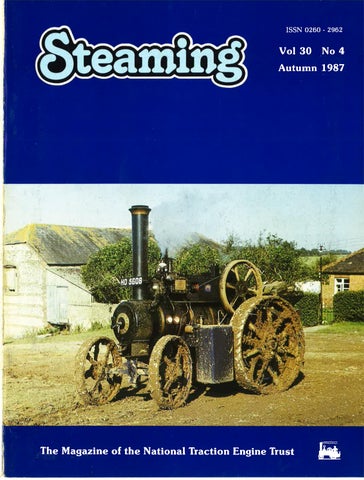
Cover Glorious mud appears to be out of style at Stourpaine nowadays, no doubt much to Mike Oliver's relief. Here we look back to the days when engines could really enjoy themselves — Alan Thomas' 1981 picture shows Wallis & Steevens oilbath tractor 7372 of 1913 on the Monday morning fresh from helping others out of their problem and appearing mighty pleased with itself. 155
Trust News From the Chairman The Trust has a duty to ensure the continuing survival in active operation of traction engines and portable steam engines and during recent months, your Committees have been considering matters which vitally affect this commitment. We are aware that concern has been expressed by a number of established rallies about the impact on their events of the newer type of 'commercialised' event which has proliferated in recent years. The Rally subCommittee of the Trust, when considering applications from organisers to hold events, has always had two major concerns in mind; firstly to ensure that any event is conducted in accordance with the established safety principles laid down in the Trust's Code of Practice, and secondly to avoid clashes of date between events held within a particular locality. A further consideration has been that adequate allowances in respect of coal and appearance money have been paid by the organisers to engine owners. The Trust has always sorted out the rally calendar by using its influence with organisers to observe safety rules which are in their own best interests and those of the public attending their event, and to avoid r•.lashes of date because of the obvious financial advantages involved. It must be emphasised that such results as we have achieved — and they are considerable — have always been reached by negotiation and in no sense by compulsion, since the Trust has no enforceable sanction against any person or association who wishes to promote a traction engine event. The view has now been expressed by some organisers that some rallies have not provided sufficient traction engine content, being little more than a weekend market with steam additions, and that these events present unfair competition to long established and more traditional traction engine events in their locality. Nevertheless many of the engine owners who have attended these commercialised rallies have reported 156
that they are well satisfied with the treatment they have received from the organisers and are keen to attend more such events, presumably because of the financial help this contributes to their ever increasing maintenance costs. Again, we have received some reports of clashing dates, these can only be avoided if the Trust receives early notification of rally dates for incorporation in the rally calendar which is provisionally settled in December for the succeeding year. To summarise, the Trust is presented with a predicament, we have no way of stopping a commercial rally organiser from holding an event if he is minded to do so. Indeed in the interests of our engine owning members and ultimately the whole
membership who wish for these engines to be preserved in active operation, there is a positive advantage in maximising the inflow of funds to engine owners. Nevertheless it is clearly desirable that public Interest be maintained by the promotion of events containing the maximum content of steam and preservation interest. Perhaps in the end, it all comes down to the laws of supply and demand, the general public will go to those events which they perceive as giving good value and maximum interest. Since this is a matter of interest to all rally organisers, the Trust intends to hold a conference of rally organisers to discuss the problem and to establish projected dates for the 1988 season.
From Alan Martin's Collection
38
Many showmen's drivers reckoned that Fosters were the finest engines for belt work, so perhaps it was other, financial, considerations that resulted in certain other makers gaining the larger slice of the available market. Nevertheless, H. Wallis & Sons of Sea forth, Liverpool did do business with the Lincoln builder and here we see HER MAJESTY, Foster 3664 of 1908, ready for work on an unidentified Lancashire tober about 1909. The 8hp engine, though plainly decorated, is very well groomed, with an excellent polish on the burnished steel flywheel. For extra effect Mr the occasion, however, the hind wheel strakes and the front wheel rims seem to have been whitewashed; notice how the application finishes just before it reaches the grass!
A notice concerning this meeting will be found elsewhere in this issue and the Rally sub-Committee will be writing to all known organisers drawing their attention to the date and venue some weeks before the meeting. If any organiser does not receive a notification due to an omission in our records, he or she would be most welcome to attend but if possible we would appreciate note of intention to attend (to the Chairman of the Rally sub-Committee) which will assist with our arrangements for the meeting. The ever increasing cost of boiler inspection and insurance of engines is another matter that is concerning your Committees. Inspection costs in particular have risen steeply during the past year and naturally a continuation of this trend will lead to engine owners seeking ways and means of minimising their running costs and maximising their returns from events. The Trust has been notified during the past year of the activities of a number of independent boiler inspectors who are operating outside the umbrella of an established insurance company. For this year only, we have investigated the qualifications and experience of such individuals and have accepted certificates that they have issued where these qualifications have been judged satisfactory. However we do not believe that it would be prudent to continue to do so after the current year unless the independent inspector can produce evidence of adequate professional liability insurance cover. Further we have noted a recent publication by the Health & Safety authorities concerning inspection standards for locomotive type boilers. This publication is really intended for locomotive boilers on railway engines and contains a number of requirements which are in our opinion unnecessarily onerous for traction engine boilers which are operated on an intermittent basis. Nevertheless the standards laid down are already being applied by certain insurers and this could give rise to additional requirements from some boiler inspectors (who may not have any experience with locomotive type boilers). We have therefore instructed our Honorary Safety Adviser, Jim Newnham, to investigate and report on suitable boiler inspection safety standards for locomotive boilers on traction engines, which can subsequently be discussed in detail with the Health & Safety Executive. (Peter
Barber, chairman)
At the Town & Country Festival at Stoneleigh at the end of August the Princess Royal spent twenty minutes inspecting the line up of engines at the end of the grand parade, and cha►ted to most of the engine owners. Dick Blenkinsop's photograph shows our President Jack Wharton introducing the Princess to his wife in front of SUPREME and Ted Freeman's Burrell THE DALESMAN.
Engine Owners Column The following three items, submitted by Anthony Heal, result from the work of the Historic Vehicle Clubs Committee (on which Anthony is the Trust representative) or are taken from official announcements by the Department of Transport, forwarded via the HVCC.
VAT relief on importation of historic vehicles Relief from VAT on importation depends on the classification of goods for customs purposes in the Community Customs Tariff. In order to get Customs looking at any relief it is essential to get the import entry classification correct. Failure to do this could lead to much misunderstanding and delay. Individuals should seek relief as
described in VAT Notice 712, paragraph II (Imports). A vehicle which is a collector's piece does not get relief as such — it is available only if the item is of historic interest. Customs interpretation of 'historical' is set out on page 21 of the above notice; briefly, an article will need to be of historical significance because of its uniqueness, or a rare example marking an important change in technical development in a particular field. Items which were mass produced or merely products of a bygone age are unlikely to be eligible. To claim the relief the vehicle must be entered on importation under tariff heading 99.05. It may be helpful to discuss an importation in advance with Customs & Excise. While notices and general advice can usually be obtained from the local office it is better to get in touch with the office at the point of 157
Remember
Autumn Rally Organisers Conference SATURDAY 14th NOVEMBER 1987 Great Western Royal Hotel, London See Future Dates column for further details
importation where the decision will be taken. Be prepared to pay a deposit at the time of entry while the claim is being examined. Customs officials are unlikely to make a decision in advance of seeing the vehicle at the time of importation. Export Licences Historic vehicles on trailers or transporters do not require Export Licences if temporarily exported for pleasure purposes, and comply with the agreed relaxation recently announced (see Steaming, Summer 19871, but they may require Form 271 and Transit Document (Carnet) for both the historic vehicle and the trailer or transporter. Flashing beacons on slow moving vehicles An amendment to the Road Vehicle Lighting Regulations 1984, which comes into force on 1st January 1988 contains new requirements for amber warning beacons on motor vehicles with a maximum speed of not more than 25mph when using unrestricted dual carriageway roads. However, representations from the HVCC on behalf of historic and vintage vehicles have been met by applying the Regulations only to vehicles first used after 1st January 1947. Although it is pleasing to see our steam vehicles exempted from this new regulation, the all too familiar hazards of today's highways should persuade owners to carry suitable beacons whenever necessary; indeed, the Department of Transport circular announcing the new Regulation confirms that the department 'recognises the efforts owners and users of slow moving vehicles make in using... 158
beacons to identify their presence. Any motor vehicle with a maximum speed not exceeding 25mph is already allowed to use amber beacons, and the Department would strongly recommend them for any...slow moving vehicle used on a main road, even if it is not a dual carriageway.' The Trust committee endorses this recommendation and welcomes the growing trend for crews who take steam engines onto the public highway for other than the shortest distance, to affix temporary amber beacons to the vehicle or trailers. It is, however, gratifying to know that the new Regulations will riot demand the continual disfigurement of historical vehicles with permanently fixed beacons or thp like.
Steam Apprentice Club The SAC Newsletter has recently celebrated its coming of age — 21 issues — with an enhanced image under its new editor Richard Hurley. Now in A5 size booklet format and of up to 24 pages in length the Editor has set a good standard in the three 1987 magazines issued so far, having persuaded some well known engine names to provide suitable writing and illustrations for Apprentices. To any
reader who feels a member of his family, or a young friend, may wish to join the section, David Duffil, SAC secretary, will be pleased to forward details of their activities (181 Foden Road, Great Barr, Birmingham B42 2EH).
NTEC Sales Stourpaine Rally 1987 The NTEC Sales team, led by Keith and Tracey Shakespeare, provided a large sales stand and members hospitality tent for the four days of the recent Stourpaine rally. They were rewarded by an extremely successful long weekend, and several hundred nnemhers (many from oversees) signer+ the visitors book, took tea, and met other members or briefly watched the steam video. The Steam Apprentice Club held one of their meetings in the tent on the Saturday morning. Some three dozen new members were signed up (and a similar number of Apprentices). The Trust's thanks go to those who put long hours into being present to serve or welcome members — to Jeff Armitt, treasurer Chris Barber, vice chairman John Crawley, SAC chairman Sylvia Dudley, David and Andrea Duffill, Roger and Mary Newbery, David Preston and Mrs June Shakespeare. (Keith and Tracey Shakespeare)
ihs4 glational 5iaction,Enginecelub
The sales teams have just finished a particularly busy year — and have been rewarded with good results. Many readers visited the huge stand mounted at Stourpaine but our picture shows the wide variety of items available (and the neatness of the presentation) at the more usual rally appearances — this one at Parham before the crowds came.
Winter Sales Stands The Trust will be promoted at the two undermentioned model engineering exhibitions during the coming months. The Midlands Model Engineering Exhibition will be held at the Great Hall at the University of Birmingham from 31st October to 7th November. Discount tickets (adults £2.25; family tickets — 2 adults, 2 children — £6.50) are available post free from Keith Shakespeare — address inside front cover. The 57th Model Engineering Exhibition takes place on the first eight days of 1988 at Wembley Exhibition Hall, London (see separate advert) and the NTEC Sales Stand will be present throughout.
engines in the yard at Stafford at the time I write of, for steam had only just finished. John was a man who got on well with others and he was always ready to help with his wealth of knowledge on steam vehicles. When he started rallying with his pair of Fowler ploughing engines all the equipment went with them on the road, cultivator, mole plough, the lot — and his McLaren engine with that huge water bowser. Those who knew him — and I speak especially for those of us in the Hinckley area — will miss John very much and we send our deepest sympathies to his family. (Ted Sansome)
chance for the cameramen to show off the little gems they managed to take during the recent season, and for the others to momentarily visit rallies they couldn't get to in person. TUESDAY, 24th NOVEMBER 1987 — Arthur Bullman from Essex will be the entertainer tonight, with films and perhaps slides on a variety of steam subjects. Details of the 1988 meetings will appear in the next issue. (Bill Timmings, London meetings organiser)
Future dates Rally Organisers Conference
Obituaries William Dowthwaite Billy Dowthwaite, of Penrith, Cumbria, widely known for his expertise with steam engines both professionally and, in later years, in retirement, died in July, aged 83. He was one of those whose everyday use of steam road engines overlapped from working days into preservation, and his story was most ably set down in our March 1973 issue. There, the early days with his father's threshing round from Hutton Grange in the Penrith area blended into the era of road rolling in the 1930s — including the fearsome job of the first metalling of Honiston Pass in 1934 and, later, into combine contracting in the 1950s, when Bill took to steam engines as a hobby. By 1970 he was able to again take possession of 6hp McLaren 1105, first acquired by the family over thirty years earlier. The last journey with Mr nowthwaite at the controls was featured in our A most issue. 1981 Summer respected steam man has gone from our ranks.
London Area Social Meetings The 1987/1988 series of social meetings in London will commence in October, and all members, potential members and interested visitors will be very welcome to attend any or all of the evening talks or slide shows which have been arranged. The venue will continue to be 'The Horse and Groom' in Great Portland Street, London W1. The premises are a few minutes walk from Oxford Circus tube station north along Great Portland Street, on the right hand side. The meeting room is on the first floor with access via a door on the left side of the front of the building. Meetings will be held on the last Tuesday of each month from October to April (but excluding December), the talks starting at 8.00pm but with the room available from 7.30pm for conversation etc. For this autumn the following has been arranged: TUESDAY, 27th OCTOBER 1987 — Our traditional opener of Members' Slides, for which a projector and screen will be provided. This is the
The 1987 Spring Conference of Rally Organisers and Affiliated Clubs will take place at the Great Western Royal Hotel, Paddington, London on Saturday, 14th November 1987 at 11am, with coffee and biscuits available from 10.15. Invitations and formal notices will be sent to regular attenders in the usual way, but newcomers are always welcome to these highly instructive and mutually beneficial gatherings. Any organisation or individual requiring further details or an invitation should contact Rally sub-committee chairman, E.A. Fillmore, (address always inside front cover).
AGM 1987 The 1987 Annual General Meeting of the Trust will take place on Saturday 21st November 1987, at 2.30pm in the Brabazon Suite of the National Motor Museum, Beaulieu, Hampshire. Formal notice of the meeting, the agenda and the Annual Report and Accounts will be distributed with this issue of the magazine. Following the meeting a social gathering and dinner has been arranged for the early evening and we hope many members will wish to make
John Mayes John Mayes of Eccleshall, Stafford died in September after a long illness. I first got to know him in 1954 when, as a lorry driver, I went into Pickford's depot at Stafford station and needed his help, as the one in charge of the yard, in the supervision of loading my lorry with something that was a bit on the big side. John was an expert on heavy haulage, being an ex-Box employee and, indeed, there were still
For those in need of something steamy after the Christmas holidays
-
NTEC Sales at the 57th Model Engineer Exhibition Wembley Exhibition Hall, London every day Jan 1st to Jan 8th 1988 Come and stock up on winter reading, model kits etc.
Stand 141 159
their journey to the AGM worthwhile by staying on for the evening. Additional access to the museum, the palace and the abbey will be by ticket at a specially arranged price and final details of these arrangements and a booking form are included within the formal notice.
Corrections One or two corrections are regrettably necessary to the last issue. In the McGivern article, the last sentence of the second paragraph on page 127 should read 'It was a very fat chimney...'; the Marshall on offer at the Thruxton auction (column 3 on paae 1 361 was works number 41151 and apologies are due to Derek Rayner for omitting his name as the photographer of the Fowler pictured on page 141.
OUR MAGAZINE 25 YEARS AGO
It was AGM time again. The subscription was agreed to be increased from 15s to £1. The club was to drop out of running rallies — there was a changing pattern and it was acknowledged that the emerging local clubs were better suited to the job. Tony Coombes from Devon wrote of a further five engines secured for Preservation. All had been long disused and he expressed surprise at the limitless enthusiasm of some people in tackling really difficult engines, probably with some justification because few of the five are regular rally engines in the 1980s. Joe Thomas reported on another of Eric
A second look at Fowler 14910 of 1917 — pictured in our last issue in its early years of preservation but seen here in 1979 at the Roxton rally, its first event after extensive rebuilding by David and Stuart Gray. (Dick Blenkinsop)
Middleton's steam parties. This one was the biggest yet with all of the engines engaged on some task, including Fowler crane engine DUKE OF YORK. Tea on the lawn, provided by Eric's sister, ensured the parties were to be a pleasantly recalled memory for many in the Worcester area for years after. Editor John Crawley reviewed the results of his questionnaire to members on Steaming. About a quarter of the readers had responded. Half claimed there was nothing wrong with the magazine at all — but some wanted it bigger and more often. Although John agreed with the former, it depended on increased membership and consequently better finance, and he regretted he couldn't produce issues more frequently he had to earn a living! Some disliked adverts (hilt they hrnnght in revennel and the first choices for content were old photographs of engines at work, and articles on working days, followed by maintenance/technical topics and rally photos and reports and then overseas engines. Maybe we should try it again, 25 years on, but your present editor suspects the review would make remarkably similar reading to the above.
CASE 110
Among American traction engines the mighty Case 110hp was held in high regard, A general purpose engine, it was 'designed for heavy ploughing, threshing and freighting' for all kinds of work demanding a large horse power output. The single cylinder was 12 inches by 12 inches, and over 900 of the type were built between 1906 and 1913, though the model was offered in Case's catalogues until 1919. Here, Don Bradley tells the story of 24151, an engine he has known since his childhood.
NUMBER 24151 This is the story of my Case 110 traction engine, serial number 24151. It all started when the engine was shipped, newly built, to Cartersville, Montana, to a Government demonstration farm. This was in 1910 or 1911, but I don't know if it was actually sold to the Government or not. The engine was never used while it was there but sat alongside a barn for about two years. My Dad was threshing about a mile or two from there at the time when the barn burned. It took the paint off the Case's right rear wheel and the flywheel. Not long after the fire, Joe Holtz bought the 110 and did contract plowing, breaking sod* on the Rosebud flat. This was about 30 miles west of Miles City on Interstate 94 — it is now the Clifford Wright Ranch. The engine also did some plowing on the 20 Ranch on Rosebud Creek. Dad was threshing a couple of miles from there at the time with his Case 25-75 steam engine. When he finished he moved to the creek crossing just as the 110 was coming the other way, intending to use the same crossing (The only one in ten miles). It was a race I guess. Well, the 110 got there first, but the engineer had got a little to one side and there she stood in the water on her head. Dad unhooked from the huller while they pulled the fire on the 110. He fixed on the plow and pulled it back, returned and hooked on to the 110.
* Sod — virgin ground, never before ploughed
Then, with the effort, the bull pinion on the 75 broke! Dad took a team and wagon and went to Forsyth which was about twenty miles, and there wired to Billings for a new pinion. Before he left the crossing he told them to drain the boiler and tanks of the 110, wrap a rope around the flywheel and hook a team on it. He left his men to jack up the 75 Case and take off the wheel and broken pinion. The next morning the new pinion arrived — he picked it up and drove back. They had the 110 out with the team and rope and were filling the boiler with water when he got there. Joe Holtz sold the 110 to a man by the name of Bower who used it for a year or so; then it was sold to a man by the name of Milligan. He had it moved to Tongue River, a distance of about 45 miles. Going up the Rosebud road it went through a bridge and broke the end off the lower canon bearings. As the story goes it took about two or three days to get it out. Then it went on to Tongue River where it was put on an 18-inch pump. I am not sure how long it ran the pump but I believe it was the early 1920s when they quit. They had left water in the boiler and one of my brothers, Claude, rode over on horseback and drained it before the weather got cold. It was about eight miles from home through the hills. Then he decided he wanted the 110 because the old 25-75 Case was getting in bad shape — the spokes were stripping out of the hubs on the rear wheels. There was an old 32-110 about 15 miles south of the town of Rosebud that had been abandoned, so Claude went and looked at
that too. He wanted to see if the canon bearing would fit the newer engine and it did, so he went on into Miles City to see Roy Milligan. Roy said he would sell the 110 for $750; Claude said it was too much money so he forgot the idea and the engine sat by the Tongue River until 1934. By then uncle wanted an engine to pump with and another of my brothers, Paul, who was working for him at the time, told him the 110 would be a good engine. They went to look at it. The riverbank had washed back so close you couldn't walk around in front of the engine. It was about 20 feet straight down to the water. They left to find Milligan and told him the 110 was about to go into the Tongue River. Milligan told them to take it and pay him whatever he thought it was worth. Next day Paul and my uncle came down in a model B Ford pickup. They got a stacker rope and along with the third of my brothers, Floyd, my dad and myself (yes, I got to go tool, we went to look it over. We got there and looked things over, all the while wondering if any movement might make the bank cave off. They wrapped the rope around the flywheel and hooked on the model B. My uncle was driving. The old flywheel went turning and the engine moved back about four feet. They kept wrapping the flywheel and pulling it until we got it back about sixty feet. Paul and Floyd were looking over to see what had to be done. Most all of the pipes were gone, and about half of the spokes were missing from the left rear wheel; the boiler jacket was hanging loose. Claude had already 161
Case 110, serial number 24151 and built in 1910, engaged in plowing at 20 Ranch on the Rosebud flat about 1915. (collection Don Bradley) MILES CITY
where 110 pumped anc1 lay urea 1934
BILLINGS STATE
%Or), road through Green Leaf tra Cutaer •
belierfluk1
Our first Case — the 25-75 described in the story, here pictured in a typically American threshing scene at Parkins in 1917. (collection Don Bradley)
miles 20 40
taken the whistle and safety valve so the brass hunters wouldn't get them. Back in 1929 the Yellowstone River had washed the bank really bad in the town of Rosebud. So they hired a couple of Cats to pull the old 32-110 I mentioned earlier into the river for riprapt. They had quite a time moving the old steamer. They hooked one Cat on each rear wheel because it had sunk in the dirt. They did•the same to get it up the steep hills — then one holding to go down. It took about a week to get it into town. They buried a dead man on the bank, fastened a cable to it and the drawbar then pushed the engine into the river. To get spokes Paul went to Rosebud and took them out of the old 32-110. He said the ice had done a lot of damage to it. Paul and Floyd loaded up jacks, blocks and tools in a Dodge Ford truck. (This was made up with a Dodge engine and transmission, 1925 model, and Ford truck rear and worm drive and rocky mountain transmission.) Then they went back to Tongue River to work on our 110. They pulled the rear wheels; used a piece of 6 inch pipe the right length for the end of the canon bearing that was broken off, and then an 8 inch pipe over the 6 inch and babbitted between them. They worked on it four or five days, then Claude went over to help. That is when I got to go again. I was 11 years old and I was sure excited because I was going to see the 110 run. When we got there Paul and Floyd had just gotten a tank of water, so we started washing the boiler. Pack rats had built nests in it, there were also cactus and sticks. I was small enough to crawl between the spokes so my job was to dig the sticks and cactus out of the hand holes. It took about three tanks of water to get it washed out. One time I was starting to crawl in the rear wheel while Claude was washing with the hose, when he hollered, "Look out, there's a snake". I tore the wheel apart getting out — none of us had seen a snake like it! Our uncle said it must be a snake of the United-States because it had red, white and blue rings around it. We found out later it was a King snake. When we went to putting in the hand hole plates we were short of one for over the firebox, but were able to fill it with water. Our old 25-75 sat about 12 miles east from where we were, and Claude and Paul got in the old Dodge pick up to get the plate off
I- Rip-rap — makeshift bank
reinforcement
A snapshot of the 22hp undermounted Avery engine (serial number 4580) at the Hammond pumping plant. It is turning a 42 inch pump, the last job it did in 1935. (collection Don Bradley)
her. I got to go with them again and was pretty excited, for I was going to see the 'old Case' (that is what we called it) which I hadn't seen since 1928. It was dark before we got there. To go back a bit — Dad had moved the sawmill in 1926. We used a 22hp undermounted Avery, but the flues went bad in that so we moved the 25-75 Case. Then the rear wheels on that went so bad we did't move it back home — that was why it was dumped. I can remember the 25-75 well, it was all together; just had to put water in the boiler and it was ready to go. Anyhow, at the sawmill was a big slab and sawdust pile. We were pretty careful because there were a lot of rattlesnakes around but we didn't hear any and we got a hand hole plate. Claude looked around for something to put in the hand hole to keep the snakes out, and in the end used a pitch knot. I remember it as a big engine, but it looked small after being around the 110. We started back and there was a bad storm building up — lots of lightning. The wind came and blew dust so bad you couldn't see. We had to stop for a while and when we got back to the 110 there wasn't anyone there. Floyd and Uncle Harry were gone but before long we saw a car light and it was our uncle. He told us that when the storm hit the wind and dust were so bad they just got the camp supplies and left. Well, there were two preachers staying at the Brandenberg schoolhouse so that is where they went for
shelter. We all went to the schoolhouse and our Uncle Harry cooked supper. The next morning we made our breakfast outside and moved our camp back to the 110. Claude and Paul went to work on the engine. The tank top was rusted out so Floyd put a floor board in it. About noon Claude started the engine, and the throttle or the governor didn't work right; then they had to set the valve. It was late afternoon when they put the clutch in and made a circle. They hooked the tank wagon on behind for water; the tender was rusted out. There was another problem — my brothers and uncle had run out of tobacco. That made them all grouchy, but we started out. Claude was running the engine and Paul was firing. It was dark when we got to the schoolhouse at Brandenburg so that is where we stopped. They were really needing some tobacco by then, so Paul and Floyd said they would go to the Wolf ranch and stay there for the night. Claude, Uncle Harry and myself headed for home. Paul and Floyd said they would fire up and haul water in the morning. We got up the road and saw a light; Claude said it was coming from Horton's sheep wagon and that he bet he would have some tobacco so we drove in. Claude and Harry knew the herder and, yes, he had plenty of tobacco. He also told us we could fix something to eat. We did and it sure tasted good! We all felt so good after the meal and tobacco that we decided not to go home so we went back to the 110 and went to bed. 163
Next thing I heard was the whistle. Steam was up and so was the sun and breakfast was ready. Claude had fired up about daylight and it wasn't long until we heard the old Dodge Ford coming. Well we got started on our way. Uncle Harry went for groceries and tobacco. Floyd was firing. We had to travel about five miles on the country road then cut through the hills. The steam got up to 160 but the valves wouldn't pop. Someone had screwed the adjustment way down. Claude said it must have been set for about 180. We made it through the hills okay and got about two miles from home that day; the next we got home with it and straight away belted it to the pump to irrigate the potatoes. Claude was going to use the 22 Avery but he had to help with the 110, so seeing as they had the 110 going they !!red it !t took about an hour with the 6 inch pump. When they moved it away from the pump Claude said the crankshaft would have to be re-babbitted. They went back to Rosebud to the old 32-110, and took off the flywheel, clutch arm and pinion. It took three or four days before they got the 110 going again, and it was late in the afternoon when Claude and Paul ran up to our yard. The next day they washed the boiler and tried to get me to crawl in the wheel to dig out in the hand hole, and I remember I was afraid there might be a snake in there. Uncle Harry had a man working for him by the name of Nick. While I was being coaxed into the wheel, Nick was doing pumping on the tank on the other side from us, but at that time was resting. Uncle Harry got the hose and aimed over the boiler at Nick and hollered "pump, Nick". That shot of water hit him just under his hat brim and knocked It off his head. We all got a good laugh out of that. The next day Claude and Floyd moved the engine to Uncle Harry's place and Paul ran the water truck. It was about a 15 mile trip and took all day. The next day they pumped about half a day and ran out of water. Paul and Floyd ran it a time or two after that, then the engine sat until the fall of 1936, when Uncle Harry had Claude and Floyd run it to pull out some stumps. About the same time the Cheyenne Indian agency was starting up a saw mill. It consisted of a No.3 I lowell mill, a three-saw edger and swinging cut off saw belted to a 16hp Russell. This engine was short on power so they asked my uncle about the 110. They made a deal that he take their Russell to use and they take the 110 and give him $12.50 a month. No one would 164
1976, and the 110 Case is moved into the workshops for more rebuilding. (Don Bradley)
steam the 110 on the road so they pulled the Russell to where the Case sat with a 65 gas Cat (about 8 miles). They pulled out the key on the left pinion, hooked up the 110 and pulled it onto the mill. There was the 110 and a lot of trouble with firemen — not a steam engineer among them and the engine eventually got to leaking steam so bad the Indians wouldn't work around it. In the spring of 1938 the superintendent for the Indians came to see Claude. He told him that if we would fix the 110 there was a steady job as long as the saw mill was running. The engine and saw mill were all shedded, but the 110 was in an awful shape; half the flues were leaking and the main valve on the dome was leaking where it bolted on. The elbow from the cylinder to the heater was broken off and the grate burned out. Claude told the superintendent it would have to be rebuilt. He replied that if Claude could make it run just long enough to saw 10,000 feet of bridge plank for the road department, they would then get him the parts needed to fix it properly. It took about three days work to get it so they could saw. After the plank was sawn, they shut down for the rebuilding. Claude had three Indians cleaning and scraping grease. The crank-disk was loose on the shaft, so that was sent to a machine shop and rebuilt. He ordered new piston rings, connecting rod brasses, oil pump, governor, grates, and injector. The sleeve on the clutch was worn so badly it had to be babbitted. He poured a new main bearing, after he got it to run.
The superintendent could not believe the difference in the 110, but the Indians were still afraid of it. Once they were sawing a lot of small logs, Claude let the water get pretty high. Then a big log was rolled on. Well, the old 110 pulled over or primed. The drawbar and tanks had been taken off and you stood on the ground to fire it. By the time he crawled up over the two cannon-bearings to the throttle there was not one Indian left in the mill shed! There were about twelve or fourteen working there most of the time. Another time the governor belt came off, and that cleared the Mill shed too. The Government bought the 110 from my uncle about the time it was rebuilt. They paid him $175 for it. They brought the Russell back as well, and put it right behind the 110 and belted it to a planer. In 1942 the mill was shut down and never run again. Claude and I went there in 1947 to look things over. I picked up the Case's smoke stack; it had been laying alongside the shed since being taken off when the shed was built. They put a piece of twelve culbert twenty feet long for a smoke stack. Claude said, "What are you going to do with that?" I said, "Some day I'm going to own that engine."
In 1952 I was working in southern Wyoming on road construction. I came home over Labor Day weekend and as I was going through Lame Deer, I
Case 24151 in October 1980, fully restored. The addition of a cab perhaps alters the scale of the engine to English eyes — judge the size by the footsteps to the motion. (Don Bradley)
stopped to look at the 110 Case, as I always did whenever I was close to Lame Deer. The shed was torn down and everything was in the open. The first thing I saw was a big S put on with green paint on the smokebox. As a matter of fact everything had a big S on it. I checked around and found out that everything was going for scrap to the highest bidder. I told Claude the deal and he said, "You don't want that engine, it's too clumsy." I only had a day before going back to work. I arranged for a man in Lame Deer to let me know when it came up for bid, but I never heard from him. It was late October when I quit Wyoming and came back to Montana, and as I pulled into Lame Deer there at a gas station was the Russell sitting on a truck. I drove over and was out of the car before it stopped. I asked who bought the engine. They said a junk dealer in Forsyth. The next morning I was in Forsyth looking for a junk dealer and eventually found the man. I asked him if he would sell the 110 and he agreed; asked how much he said "810 a ton and it weighs ten tons". Well it goes without saying he got 8100 right quick. I sure felt good that I had finally gotten what I had been dreaming of. I then went to work for an outfit five days a week. On my two days off I would work on the 110. All the pipes were gone except the water column which Claude had mounted on the back of the firebox where it was easier to see. I put it back on the side and Claude helped. We put the smoke stack on and that made it look a lot better. There were no string chains so
we used some off of a smaller engine. The wheels were in the dirt about three feet. I got a key made for the left pinion. Then I started thinking about getting the engine back home. The local road foreman was a good friend of ours, but he would not let me cross the bridges so we would have to go through the hills or Green-Leaf Mountains. The road department shop was close by. The road foreman brought some jacks and helped jack it up. The day before Christmas we fired up and ran it out. Christmas Day we didn't get started until noon. Without tanks or bunkers for fuel or water, we tied the water wagon behind, built a good fire and stood on the top cannon bearing to run it. We'd go until the steam went to dropping, then stop and put in another fire. The clutch shoes were gone so we had the clutch-arm chained to the flywheel and in this way we made about 10 miles on Christmas Day before dark. We left the 110 about where Dad sawed lumber for the Government with a 35hp Buffalo Pitts double about 35 years before. We got a late start the next day and turned off the main road after about two miles to start down the Green-Leaf valley. The first couple of miles the snow was so deep you couldn't tell where the road was. There were tall ponderosa pines on each side, so by staying in the center you were about on the road. We were out of the snow after about five miles. It was getting dark when we broke a steering chain. I was sure glad it didn't happen in the canyon. We used a chain binder and were on our way, and eventually got
to the Indian reservation line. On the third day we got an earlier start and had about 12 miles to go. We made it home that night using pitch wood — we had lots of black smoke. The whole trip was about 30 miles, but after that we never steamed up the engine until 1953. From 1952 until 1955 I worked on road construction and oil fields in three different states and on weekends I'd go around to the junk yards looking for engine parts and material to make a saw mill. I had the iron to a Curtis saw mill. In the spring of 1956 we had the mill completed with a Soule steam feed and we fired up the 110 and belted it to the mill. Everything worked well and we sawed about 20,000 feet. Next year Claude sawed about 30,000 feet. I helped him put a flue in (we knew the boiler was due for a new set of flues). That September Dad passed away and about six weeks later Claude died too. The 110 sat there. My boys, Gary and Jack, and I hauled the saw mill to town where we lived and repainted it. In the summer of 1965 I hauled the 110 to town; that was quite a job. No steering wheel but with a 24 inch pipe wrench we got the job done. I visited Walter Mehmke and he thought I could find parts to fix up the 110. I got a lower canon bearing from Walter Spreeman in Alberta, Clarence Young located a drawbar and bunkers and John Tysse helped locate two front wheels and axle. The fall of 1974 I started to make new water tanks and by March 1975 the tanks, coal bunkers, tool boxes were done, painted and stripped. In the summer I cut the flues out, took the rear wheels off, counter shaft and canon bearings, and the front, and rear wheels were sand blasted and painted. Donnie Reiger, who worked for me at the time did the painting and did a really good job. In January 1976, I pulled the 110 out of the shop all painted. I was short one steering chain so I did not fire it up until July. Then I ran it at our threshing bee. Since then I have taken the crankshaft out, sent the eccentric hub and strap, crankshaft and clutch arm to Jim Briden at Fargo for rebuilding. He made everything better than new. I also plan on making a cab and spark arrester for the engine. I want to take this opportunity to thank the following people who helped me — Harold Ottaway of Wichita, Kansas; John Tysee of Crosby, North Dakota; Bill Krumwiede of Voltaire, North Dakota; John Hall of Cape Girardeau, Missouri; Austin Monk of Marian, Montana; Ray German of Oilmont, Montana; Walter and Carl 165
Mehmke of Great Falls, Montana; Clarence Young of Great Falls, Montana; Norman Pross of Luverne, North Dakota; Jim Briden of Fargo, North Dakota; and Walter Spreeman of Olds, Alberta in Canada. (This story originally appeared in the American magazine Iron Men Album, for July/August 1981, and we are grateful to the author, and to Editor Gerry Lestz, for their ready permission to reproduce it here.)
Another Case 110 which has survived to preservation is the example at the Midwest Old Threshers at Mount Pleasant, Iowa. This 18 ton 1910-built engine was used in Canada for ploughing. (Midwest Old Threshers)
Farmers men and Contractors men In the late twenties and early thirties young engine drivers were quite commonplace, in many cases following a driver who had been in charge of the engine since new on the farm. During the latter half of the nineteenth century and the early part of the twentieth many farmers with fairly large acreages in East Anglia, the Fens and Lincolnshire had invested in their own sets of threshing tackle, and in some cases steam ploughing tackle also. Notwithstanding the numbers of threshing and ploughing contractors, these farmers preferred running their own sets rather than rely upon the availability of contractors to suit their requirements. Some of these farmers carried out a small amount of contract work for their immediate neighbours, but they seldom travelled far afield. The crews working these sets of tackle were quite different types to those working for contractors. For one thing the 166
John Mayes farmers' crews were not bitten with the 'wanderlust bug', being in their own homes, albeit tied cottages, every night. Furthermore they enjoyed full employment throughout the year for when the engines were not being worked they carried out other tasks on their employers' farms. The farm worker has, down the years, been looked upon disparagingly as a 'country bumpkin' — a bit slow on the uptake and not quite with-it in more modern idiom. The converse is in fact much nearer the truth. The farm labourer has at all times been a master craftsman. Who is better able to layer a hedge, thatch a stack, drain a field, grow and harvest a crop satisfactorily or attend to livestock? The list is endless. The farmers' enginemen were not without their other skills either. Apart
from carrying out maintenance and repairs to their tackle, in many cases they maintained the other farm equipment and repaired fences, gates, tumbrils and wagons. They sharpened the reaper and binder knives in the harvest field, mowed the square corners off to facilitate the passage of the horse drawn binders, thatched stacks, shod horses, helped with the milking, fed livestock and a whole host of other essential and skilled tasks. The enginemen considered themselves a cut above the ordinary farm workers; they had, maybe, a bob or two more in their pockets and the labourer on occasion brought his tools to the engine driver to sharpen or repair. The man who taught me to drive an engine was a first class harness maker and boot repairer. My great uncle in addition to being an engine driver, was a farrier in his own right and over the years taught me to make horse shoes and fit them. k,
EDMONDS on Engines
Chris Edmonds
They say it's a sign of getting just that bit older when one needs glasses to read the phone book, and when one suddenly realises that clergymen and policemen are younger than you are. To that I would add engine drivers. Have you noticed how many young people are taking to our hobby....and becoming very competent. Wives and sweethearts are to be seen on footplates today, and this is all to the good, although I still can't get used to the sight of a beautiful girl covered in oil and coal dust! In the early days the bulk of the engine owning fraternity was older men who were on one gigantic trip of nostalgia, and who, at any rate, could remember the things working. Perhaps it is a glimpse of the obvious when I say that the continuing success and prosperity of our movement depends on young people who have no nostalgia to fall back on, and that our engines attract their interest just by being the beautiful things they are.
"Without the youngsters" said Arthur Napper to me "the whole thing could die out again". Rest assured Arthur — it won't.
*
Have you noticed how often the eccentric straps on a traction engine can be their Achilles heel or the weak link in the chain of power? Compared to the big ends and main bearings, they always seem so lightly constructed for the work they do. Unlike the other bearings, they tend to give no warning if they are about to run hot or seize up, and either the strap just suddenly breaks, or if it doesn't the rod bends disastrous with consequences. The oilers, too, always seem somewhat inadequate with just a small reservoir in the casting, and no wicks. The late Bill Thorne, who used to drive the Foster BEATTY for Thurstons, had a couple of straps break on the road, and ever after that he used to slack them off at the top and put a shim in, and the fact that they knocked slightly was covered by the noise of the gearing. On the belt, he used to take the shims out, as for one thing, the engine was running slower, and secondly he could give them periodic attention with the oil can. Another reason he put them back was that Mr Thurston wouldn't be best pleased if he heard them knocking! Normally the things were made of cast iron, on a cast iron bearing, but some makers used bronze straps with a cast bearing. Burrell 4080, a five horse road loco, experimented with roller bearing eccentrics and mains, but with standard big ends. In the same way that back axles rarely broke on tractors, I haven't heard of too many of their eccentrics breaking, as the strength ratio to weight and work is
Terris Culverwell (INSURANCE BROKERS) LTD.
4 MARKET PLACE DEVIZES WILTSHIRE SN10 1HT TEL. (0380) 2237 AFTER 6PM 71004 Established 1882
IF WE CAN HELP, PLEASE CALL US
much greater on a tractor than a big engine. Some owners have had the bearing surfaces white metalled, and at least that gives you a chance if they do run hot. Funny things are eccentrics, but poetry in motion to watch them working.
*
*
*
Isn't it funny how some things in life which one would sooner forget become either hilarious, or very valuable as the years go by. Take the time when my Burrell single crank compound was put in the ditch by two inebriated drivers. Two days after it happened (way back in 1958) a villager came round with a complete set of photographs of the incident. I was so embarrassed that it had happened at all to my beloved engine that I practically showed him the door. Two years ago when mentioning the episode in a certain book, I would have given my right arm for a photograph of it, and exhaustive enquiries failed to locate one. On the same theme, praise to our Committee who meet and work behind the scenes for much of the time. You may often feel that your meetings are so mundane that they do not bear reporting, but I for one would like to hear more of your deliberations. Committee work can often be soul destroying, as you get the brunt of the bad tidings as well as the success stories. Whatever you do, make sure that a record is kept, for what you may feel is of no interest today may be invaluable tomorrow. In another book that I wrote (I must stop plugging!) the minutes of the early NTEC Committee meetings made sensational reading when the Club was practically bankrupt and about to be wound up. I'll bet none of them wanted that reported at the time!
We are registered insurance brokers who pride ourselves on giving personal service to all our clients. We arrange insurance for motor vehicles, houses, life, medical cover, liability, etc.
Traction Engine insurance inspection and/or comprehensive insurance
167
The Bristol Docks rally, held in July, is able to organise an unusual road run around the city streets on its Sunday morning. This year, in contrast to the torrential rain suffered in 1986, the engines took to the streets in gloriously sunny weather. John Reeves' camera captures four cameos of the morning's happenings.
Running on the level stretch past the Cathedral Ibut with the crews probably not able to listen to the pealing bells to best advantage) is Aveling & Porter 10 ton roller 9024 of 1919, framed by the outline of a medieval gateway leading up from the street.
Further along College Green, there occurred a meeting of two figures of royalty. John Wharton's Burrell showmans 3489 KING GEORGE VI is about to unamuse Queen Victoria as it passes with a cloud of dark smoke.
For a brief refreshment stop part way through their arduous journey, several owners stopped off at the Horse and Groom, a public house behind the city's Council House. Here four rollers could be seen parked in line, and, patiently awaiting the return of their crews and the resumption of their journey, they made an impressive sight in the bright sunshine. Heading the queue is Aveling & Porter E type 10594 of 1923, followed by Aveling 9024 again, Clayton & Shuttleworth 10 tonner 48946 of 1924 and bringing up the rear 8ton Marshall S type 82389 of 1927.
The return route of the road run had been specially chosen to include the short but sharp rise in College Street and many of the drivers made the most of this chance to stir up the fire a bit. Adding to the smoke haze and the layer of char on the road is Foster Wellington tractor 14608, showing it is very capable of living up to its name of IKANOPIT. This engine was steamed all the way from the West Midlands for the Bristol event.
Barry Herbert
Whither goest thou ? A brief history of a Burrell showmans engine, whose name is more familiar to us in the Latin version of the above phrase — QUO VADIS.
A wartime snapshot of Walls' engines at Petersfield Fair, Hampshire. From the left are Burrell 3311 ENTERPRISE; Burrell 3787 HER MAJESTY; QUO VADIS and Burrell 2744 ADMIRAL. The foursome seem to have attracted a sizeable fan club of young boys. (collection Barry Herbert)
QUO VADIS at the last fair she attended in commercial ownership — Gosport in 1948. Though without Walls' name on the canopy side and lacking the gloss of earlier years, the engine still has style and dignity; perhaps she knew better times would come eventually. (collection Barry Herbert) 170
During 1985 readers may have seen an advert in World's Fair, requesting offers for the purchase of, probably, the most famous Burrell scenic showmans engine of them all, number 3938 QUO VADIS. I was the lucky purchaser, and I had only just completed, at my premises at Howden Humberside, the restoration L of LADY Fowler showmans engine 9381, BETTY to a condition as owned by showman Chris Johnson in the 1920/30s. This engine had been restored from what was, effectively, scrapyard condition. After buying QUO VADIS, and naturally wishing to know more of her past, I placed letters in Steaming and asking for old World's Fair photographs. This brief article is a result of all the many letters, photographs arid reminiscences that i have had relating to the engine, and which I have been so pleased to receive, QUO VADIS was built in 1922 to the highest standard, being delivered in August of that year, to the order of W. Wilson of Rendezvous, Peckham Rye, in south east London. The engine was supplied as a 'special' scenic type, being one of the sixteen such 8hp engines built by Charles Burrell & Sons Ltd between 1920 and 1930. The term 'special' scenic means that the engine was built with auxiliary dynamo platform, and a bunker type crane tower as standard fittings. The compound cylinders are 6%in and 11 Y2 in bore by 12in stroke and drive through three shafts with double drive gearing to the hind wheels. It has the standard Mather & Platt main and exciter dynamos of 270 amps and 80 amps respectively at 1.10 volts. The first owners (Wilsons) used her to transport and generate for their rodeo switchback. This machine has recently been repatriated from America and restored; it now appears at many rallies around the country. The ride was steam driven until 1934 when it was converted to a full scenic ride. Wilsons' other Burrell engines were numbers 1887 EMPRESS OF INDIA, a 10hp single crank compound and 2652 DREADNOUGHT. The latter was sold in 1922 (when QUO VADIS appeared) to C.W. Abbott of Norwich. The old EMPRESS OF INDIA then always accompanied the new arrival. The rodeo switchback was laid up in 1940. Reg Smith of Charlbury, Oxford, remembers travelling on QUO VADIS many times when he was with Wilsons, being a personal friend of the family. He attended many back end fairs with her and the rodeo switch-
back, actually taking pictures of her alongside the switchback and on the road in the early 20s. QUO VADIS attended Oxford's St Giles Fair many times. A relative of Wilsons to send me photographs was Mrs N.R. Merrin, of Sutton Coldfield; William Wilson was her father's uncle. In 1940 the engine was laid up (along with EMPRESS OF INDIA) and shortly afterwards sold to Wall Bros. They were a Hampshire firm based, in those days at Petersfield. The family is still operating in Hampshire and the Isle of Wight today. In pre-war days they travelled a lovely fleet of Burrells, but the only one of these still in existence, apart from QUO VADIS, is LITTLE tractor 2876 Burrell SAMPSON. During her working days with Walls QUO VADIS was always known as a troublesome engine as she had a Belgium steel box which had a habit of splitting. Chris Edmonds of Haddenham, Aylesbury, has sent photos of QUO VADIS at Petersfield Taro Fair taken in 1942, and then in Walls ownership. His late father-in-law was offered her, in about 1946, by 'Buck' Wall for £15 and went with her on her last journey to Hardwick's yard at Ewell. Dick Jolly, of Cowley, Oxford sent me what must be a rarity — a picture of the Burrell in Hardwick's scrapyard looking very sorry and forlorn — taken by himself using a 31/2 x 2 'Y2 Thornton Pickard reflex camera, which he still has. He remembers, in 1953, an advert appearing in World's Fair — 'QUO VADIS for Sale — £100'. He, Viv Kirk (owner of QUEEN MARY) and the old engine driver Blossom arranged to visit Hardwick's yard to look at her, as Viv had said he would like to buy. However, he was warned off by Bert Barker (secretary of the British Fairground Society around that time► who knew she needed a new firebox: 'don't touch it — a new one will cost around £250, even if you could get anybody to do it! Hardwick's will probably scrap him!' That's how it was in 1954. But Dick and Viv made the visit and there she was along with two other now well known showmans engines: Fowler SUPREME cut back to a haulage engine and long before it was acquired by Jack Wharton, and Foster SUCCESS, now owned by Charlie Byass. No purchase was made but photographs were taken. Luckily old Hardwick didn't 'cut him up' as the Burrell was sold to Ken Coombes of Tiverton, Devon, for — wait for it — £150! This was in 1955. Ken has sent photographs of her taken at Weymouth after being unloaded from a low loader prior to delivery to his home in Portland. She was towed
Rumbling through the streets of Portland in 1960, QUO VADIS attracts most people's attention — and again gathers a retinue of young lads. (collection Barry Herbert)
by 7hp Fowler engine 15319 QUEEN MARY, then owned by the late Michael Salmon, to the bottom of Portland Hill, and later to the top of the hill during gale force winds by 1919 Garrett showmans LITTLE BILLY 33566 (owned by Percy Cole), banked in the rear by a Sentinel S4 steam wagon. We can all be thankful to Ken
for it is he who saved QUO VADIS from the cutting torch. Hardwick had already started to dismantle her when he arrived on the scene. In August 1956, the West of England Steam Engine Society published a list of all the Burrell engines, excluding rollers, that were known to exist in the West Country. QUO VADIS is listed as
Three years on and now the fan club has become the province of mature men! Edward Hines (left) is seen supervising the loading of QUO VADIS at Portland in 1963 after purchase from Ken Coombes. (collection Barry Herbert) 171
owned by Ken Coombes with the comment 'neither dynamo nor exciter; re-conpurchased for recently struction, but in a rough state'. The engine was kept at Portland for a few years, being used for part of the time as a winching engine, and having had the offside rear wheel removed in order to use the bare axle as a winch with which to pull up quarry wagons from the bottom of one the Portland quarries. Ken Coombes eventually sold the engine for £1,000 in part exchange for an Aveling roller. This was in 1962. The name QUO VADIS probably brings back memories of Ted Hines more than anyone. It was Ted who did much to restore her (in 19651 to the perfection she is in today. He did a tremendous amount of work to her and his name will always be linked with her. He also did a tremendous amount for the Dorset Club and the standard he set, in no small measure, set the standard for the successful steam workings at Stourpaine Bushes. Ted Hines used 3938 to generate for his Black Forest Gavioli fair organ which has a G4 scale and 89 keys. He died a few years after restoring her, and Gordon Hines, his son, says that it
was a sad day when, in the autumn of 1974, he said goodbye to the engine. She had been purchased by T.D. Cauglan of Danehill, Sussex and passed shortly afterwards to T. Rose of Sussex. During the mid 1980s rumours circulated that QUO VADIS had been sold to America; that an Arab had bought her for six figures; that she had gone to Japan, etc. In fact she was in the ownership of the Titanic Steamship Co Ltd a company whose address was at Ellastone, Derbyshire and which was owned by Mark Bamford. In 1983 Mark Bamford sold her to Paul Rackham who last rallied her at Weeting in 1985.
Since I purchased the Burrell it has had a major overhaul carried out in order to put her, once again, Into the magnificent condition that such a famous engine demands. She is shortly to have her roof signwritten in the original Wilson style and colours. I was pleased to be able to present QUO VADIS at the 1986 Stourpaine event, generating for the original Wilson's Rodeo Switchback and also for Gordon Hine's Black Forest Gavioli organ. History was being repeated.
Windermere Steamboat Museum The Windermere Steamboat Museum are planning extensions to the premises in which their superb collection of vintage steamboats is housed at the shores of Lake Windermere. The acquisition for re-erection of the old wooden Windermere fire station gives the opportunity to house a steam traction engine and sawbench to form a working exhibit in order to saw logs to fuel the steamboats. Being a privately funded museum of charitable status precludes outright purchase and the Museum would be pleased to accept on permanent loan a suitable engine, for which they can offer a secure home — and would be willing to undertake restoration and guarantee insurance, and also grant leave for the engine to attend rallies etc if required. A portable engine of 5hp or so could be an alternative. If any engine owner would like to help the Museum please contact Miss Jane Houston, Windermere Steamboat Museum, Rayrigg Road, Windermere, Cumbria LA23 1BN (tel 09662 5565).
ALL CLASSES OF ENGINE REPAIRS • FIREBOXES • SMOKEBOXES • BARRELS • CHIMNEYS etc • RIVETED WORK PREFERRED
• TENDERS • ASHPANS • TANKS • FITTINGS etc • ENGINE SUNDRIES
New Road, Whaley Bridge, via Stockport, Cheshire. 06633 3544/4521 Churchill Road, Brislington, Bristol 4. 0272 715337
172
DECEPTIVE ENGINES
Appearances can be deceptive. At first glance these engines could be at an early traction engine rally in the 1950s — perhaps at a stately home, waiting on the fringe of the engine lines for their turn in the ring. One even seems to have its canopy adorned with rally plaques. Closer inspection of the pictures, however, reveals the surroundings and trappings of working engines — for such they are. They belonged to Alfred J. Ward & Sons, of Thorpe Lea Engineering Works, Pond Road, Egham, Surrey and were pictured for posterity by an unknown photographer whilst in use on a public works contract in the 1930s, believed to be road construction at Camberley, Surrey. Wards owned almost 100 engines during the long period their business flourished, buying numerous rollers secondhand from Wallis & Steevens, who had taken them in part exchange for new ones. The two machines shown here, however, were purchased new by Wards. Wallis & Steevens 2225 (top) was a 7hp single cylinder engine delivered in July 1893. Under the 1898 Act it was given the registration mark MX8 of the Middlesex area, presumably indicating that it saw much use on road haulage despite being a general purpose engine — the railway loco type spectacle plate may be confirmation of this. Then, about 1921, it was re-registered PB9663, and later still PB9664 — but the origins of that swap may have been somewhat, how can we put it, 'unofficial'! The engine was last licensed in 1947 and bore the name PROGRESS. The other picture shows Clayton & Shuttleworth 32051, built in January 1899 as a convertible. It was registered in similar fashion to the Wallis — MX13 in its early days and PB9671 from about 1921. Its occasional use as a roller is
illustrated by the bracket plate on the tender side for a scarifier; the underset front wheels are also notable. The Clayton is recorded as derelict in February 1951. Neither engine has survived in preservation. Can any reader say more about the contract the pair worked on? The works also used the services of a narrow gauge tramway or railway, as evidenced by the tracks seen behind the Clayton. Thanks are due to Derek Rayner for supplying the pictures and to Alan Duke for identification.
'5ton Mann's overtype Steam Wagon. No 1109, double steerer, 3 speeds and reverse, double sprung (for furniture work). Rubber on front also pair of new front steel wheels ... First class cab. Body with drop sides and back, size 12'9" x 6'9"; sides 2'3". Reason for selling — just finished contract — £560. 0. 0.' (A wagon for sale in Phillips Monthly Machinery Register, June 1921. The wagon, registered 03714, was owned by C. V. Simpson of Llandilo, Carmarthen in January 1921, and by Davies & Son, Blaenyflos, Pembroke in 1922.) 173
•
174
Well — not completely new faces, because both of these engines graced rally fields many years ago, but 1987 certainly saw them with a fresh appearance. The 5hp Burrell twins which accompanied Bostock & Wombwell's travelling managerie, 350.9 RAJAH and 3669 NERO, have both survived into preservation. NERO, built in 1915, was acquired by Willem Middlemiss last year and appeared (above) in its 1920 guise at the Weeting, Norfolk event where it was pictured by Eric Sawford. A small rally at Hollowell, near Northampton provided Clive Hollingworth with the opportunity to photograph (this page) Fowler 14888, an R3 hauling and winding engine of 1917. This machine will be remembered by older members at the Woburn and Northamptonshire rallies of thirty years ago, in charge of the late Tom Burton and the late Jim Bennie; it is now owned by Allen Eaton.
Falkirk Sensation On 1st March 1922 the Eastern Division Committee of the Stirlingshire County Council took delivery of a new Marshall steam roller. It was the first time they had purchased from any firm other than Aveling & Porter, and indeed the roller was to be the only non-Rochester steamer they ever had. Works number /01.30 was a 10ton single cylinder machine, registered MS3793 and allocated to be used from the council's Falkirk depot. Out within a few months of being set to work the roller was headline news in the local newspapers. Just past 11 o'clock in the morning on Saturday 17th June 1922, driver Robert Johnston was returning to the Falkirk depot near the High railway station, having earlier been rolling at Slamannan. With him as steersman was Andrew Oswald, a road foreman, and they pulled a light wagon behind the roller. As they descended the hill into town and reached the bridge over the North British Railway near Falkirk High station the roller 'in some
unknown way ... got out of control'; in the dramatic words of the Falkirk Mail 'seldom, if ever, in the history of Falkirk has a disaster been so narrowly averted'. Johnston did everything he could to apply a brake on the fast moving roller, but to no avail — as the unfortunate assemblage arrived at the overbridge It swerved towards the stone wall skirting the forty foot deep railway cutting. Amid a cloud of dust and carrying with it an avalanche of huge boulders the lot clattered down the steep embankment. John Hay, who lived in the station house, was working in his garden and was able to give the Falkirk Herald an eye-witness account. 'I heard the shrill whistle and the rumble of the steam roller as it came down Slamannan Road. It seemed to me to be travelling at an unusually high rate of speed, and instinctively I looked up from my work to see exactly what it was. When the roller had passed some trees by the roadside it came fully into my view and
I realised at once from the frantic movements of the driver and his companion that something had gone wrong and that the vehicle was out of their control. As it came near to the bridge I was horrified to see it suddenly swerve to the left and crash into the bridge wall, burst through and come toppling down the steep embankment. When about half way down the slope it appeared to buckle up in front and then fall over on its side. In this position is rattled down to the foot, and after striking the edge of the platform, literally leaped across the double set of rails, where it settled down on its side.' Dishes and plates had fallen from shelves and cupboards in nearby houses, but to the relief of those who rushed to the scene, the rAlFitivAly iirisnathed Oswald, the steersman, had thought it prudent to jump from the footplate ac the roller broke through the wall, but was caught by the trailer and dragged down the slope sustaining cuts, and injuries to his back. Johnston, however, 'courageously remained at his post, and displayed wonderful nerve as his roller moved rapidly towards the railway line. What his thoughts were can be better imagined than described. If a train had been due at the time he and his companion would have been dashed to eternity.' The Mail didn't dwell on what effect 10tons or so of Marshall may have had on a speeding express! The driver was reported 'never to have
left his seat' and escaped uninjured though, not surprisingly, suffered from shock. Both men were detained in the local Infirmary. The railway line was the busy Edinburgh to Glasgow route but although a Glasgow express had passed fifteen minutes earlier, no other train was due for some time. Traffic on the line was immediately stopped and diverted to other routes whilst the Cowlairs steam crane was summoned to begin the clearing up. Half way down the slope the front end of the roller had broken off and the machine lay directly across both tracks, its tender ledged on the Glasgow bound platform edge and the wagon — now only fit for firewood — piled up on top. The engine's reversing lever was bent through 90° in a graceful curve. Though the local press commented that the Marshall was very badly damaged, with the front wheels torn off and the steering wheel destroyed, the roller survived to serve Stirling CC for many more years, eventually passing in 1948 into the hands of James A. White of Aberdour, Fife. Being four months old at the time of the accident, one might assume that the roller would be returned to the makers for a thorough rebuild. The Council, however, must have felt their own fitters could cope at the depot workshops, with duplicate parts from the makers, because Mr Henry Marshall can find no reference in Marshall records for any visit to Gainsborough by 75236 for repairs, and all such visits were carefully recorded on typed sheets attached to the engine register.
The pictures of the Marshall roller's downfall are reproduced by courtesy of the Museum of English Rural Life, University of Reading and the account is largely based on the reports that appeared in the Falkirk Herald and Falkirk Mail. Thanks are due to Henry Marshall and Alan Duke for other details concerning the identity of the roller. yrj
Motor lurries and their uses. The October 1904 issue of The World's Carriers reported that Messrs Carter Paterson, carriers, were now running regularly four steam 'lurries' between the City and the suburbs: one to Kingston, another to Croydon, a third to Penge and a fourth to Kilburn. Each lurry did two out and back journeys daily and the Kilburn one also managed a third trip. Carter Paterson
had replaced their horse vans on these routes about a year before and were now thinking, as the steam motors had 'proved so successful', that they would establish a service to some Midland towns. The four lurries were built by the Straker Steam Vehicle Co. Messrs Pickfords were using four Hindley steam wagons on London work, principally between the City and Fulham and Kingston. They were also
experimenting with Wallis & Steevens tractors. The Yorkshire wagon found great favour with brewers — 'one may count more than a dozen of their lurries carrying beer in London alone.' The Shell Transport Co were using steam lurries for the conveyance of oil in tanks.
177
The Steamed Bug R.B. Rowlands
Being Members, as we are, of the National Traction Engine Trust, it might be thought that our interests lie only in machinery which turns and puffs. Not so, of course. During the hundred odd years of the industrial revolution when steam power came to its zenith, there were many cases where the flexibility of the medium was utilised without e wheel ever being turned — soil sterilisation Is a case in point. My subject, however, is common in my steam disinfection working days but now little heard of. The history behind my notes lies with the problem confronting medical authorities between the two wars, when they were faced with the ever increasing list of notifiable infectious diseases, all of which required sterilisation of the patient's room and effects. Nothing is better for the elimination of bacteria than saturated steam, and so infectious disease and other hospitals all had their steam disinfector. The aim of this article is to describe one such installation with which the author was associated. The problems noted above were added to after 1930 by a heavy programme of slum clearance instituted by governments of the day, the consequences falling on the shoulders of the local authorities. After a disastrous false start, it was generally realised that one of the problems of slums, namely insect infestation, was being transferred to the new and clean houses along with the tenants' possessions. At this point, notice the grammatical variation — contact with infectious disease may cause infection; contact with slum property could cause infestation — mainly by bed bugs (Cimex Lectularious) and human fleas (Pulex IrritansI. It was realised that in so far as bedding and clothing was concerned, what killed bacteria would also kill insects — namely steam. In the scheme I was involved in the Council purchased two horse drawn furniture pantechnicons with wooden wheels, bow tops and colza oil lamps. In undertaking the removal of tenants from old property to new, they carried out the complete disinfestation of the furniture in the vans. Since bedding and clothing required separate treat178
ment about 1936 a new steam disinfector station was erected to provide for both disinfection and disinfestation within the area. The plant was housed in a modern flat roofed brick building located on the edge of town. Tenders were invited, and the successful contractor was Manlove Alliott & Company, a specialist firm in the type of eqi iipment. The building was bisected by a wall, and the disinfector chamber fittod contrally through this wall, thus providing infected and clean areas. Manlove Alliott's design employed an oval chamber into which the bedding etc, was placed. On entering the infected side from the street, one saw one end of the vessel, which was complete with a heavily dogged and gasketed door, the full length and breadth of the oval. This door opened to admit the infected bedding and inside the compartment was a full length rack, which withdrew from the chamber on extending rails, in order to load the linen. The whole of this equipment was steam jacketed, and well lagged. Moving round to the clean side matters become interesting to us. The area includes the boiler house, but continuing with the description of the disinfector itself, we see a second dogged door for the recovery of the now sterilised linen. Mounted above the chamber is steam admittance and pressure reducing gear, and on the side is a circular chart recorder, to provide a permanent record of the treatment given to each batch of clothing. In addition to the heat from the steam jacketing, a continuous flow of saturated steam passes through the chamber. Additionally, there are devices for injecting formaldehyde, carbolic, or even hot air when considered necessary. To the reader, the most interesting part may be the boiler house. This, situated on the clean side, contained a 4hp Marshall vertical cross-tube boiler, not unlike those once seen on Ruston excavators. The installation was oil fired. Provision for raising steam was by means of a Pillinger burner, driven from a Keith Blackman centrifugal blower, powered by the electricity mains. On nearing blowing
off point (80Ibs per sq in) the air blower was shut down, and a second oil burner, steam blown, was brought into action. It all worked well, but in retrospect the need for two systems is obscure, since the mains electricity was very cheap, and the thermal efficiency of the steam driven method is lower. Water level was dealt with by means of a Penberthy injector and a wall mounted steam driven pump. Light fuel oil was fed by gravity to the burners from a 500 gallon tank on the roof above, cold conditions being met with by steam heated coils in the body of the tank. The equipment performed well up to the time the writer's attention was called to sterner matters by HM Government. After six years war service in parts more tropical, he returned to find that although the plant had seen out the difficult years, the boiler uptake was wasted, and heavy repairs were under way, in the capable hands of Hickey of Richmond. Like most things steam, this splendid plant was subsequently wasted. The coming of penicillin and M&B, and of DDT and Gammexane, rendered the old lady redundant, and the area was swept away to form an industrial estate. As a postscript it is regretted that the name of the unsuccessful tenderer is lost in obscurity. This firm's products, although similar, were circular in shape, and a noteworthy feature in their brochure was a horse drawn portable unit, complete with chamber and boiler. It is probable that this was similar to the British Army version, used on the Western Front during World War 1 to disinfest the soldiers effects after a spell in the trenches.
'Preparations for the Royal Show at Liverpool are going on apace. I found this so at Mann's at Leeds, who are quite busy all round, and also at the Yorkshire Steam Wagon Co's works next door. Mr Deighton tells me they will make possibly a braver display even at the Yorkshire Show this year, as that is to be held on Roundhay Park, Leeds... At Fowler's at Leeds they are so extraordinarily busy with ploughs and in the other departments that they do not even propose to exhibit a small tractor at Liverpool, which from our point of view is to be regretted, especially as the Fowler tractors are such workmanlike jobs.' (From The Commercial Motor, 26th May 1910).
Steaming Around
41
Compiled from members notes and reports by Derek Rayner
I am pleased to report that I have hppn snowed under with in-format-inn for this issue. I am not complaining — it is nice to see so many new names in the credits and very gratifying that members are taking an active interest in what is going on around them, so that we may all read of the happenings. Rally reports abound this time but it is only fair to point out that pressure of space obviously precludes the inclusion of each and every engine that attends every event. A few only can be mentioned at each rally and we must apologise to all those exhibitors who are unfortunately left out. We hope we are able to ring the changes over a period of time and give everyone a fair mention. As always, my grateful thanks are extended to all those who have contributed to this issue. It is not possible for me to thank everyone personally and I apologise to anyone who has been lett out of the credits
below. I hope for a similar response for the next issu e Banbury Steam Society, Hollycombe Steam Collection, Leeds & District TEC, Scottish TES, Sheffield & District SS, Somerset TEC, Thames Valley TEC, West of England SES and Malcolm Barrell, Len Ball, Mrs S. Brockhurst, Paul Brook, H. William Coates, Martin Craig, Alan Crockford, C.H. Denyer, R.C. Doran, Tony Errington, Mrs E. Finch, Martin Fletcher, Keith Flinton, Peter Haining, Andrew Hall, D.R. Hart, Peter Haywood, Chris Hutchinson, Robert Hyett, Tyrone James, Mike Jones, Peter Jury, C.G. Mileham, John Reeves, Sandy Ross, Chris Smith, Ron Smith, 'Smokescreen', Alan Thomas, Bernie Ward, Michael Watts and Austin Windle. Press date for the next issue is the last day of October. Information, news, letters etc by then please to D.A. Rayner, 'Invicta', 9 Beagle Ridge Drive, Acomb, York YO2 3JH. Press dates for future issues are the ends of January, April and July 1988.
AVON
BEDFORDSHIRE
Most of the engines at the Bristol Docks event held in conjunction with the Wine Fair in mid July participated in a Sunday lunchtime road run via Anchor Road and Hotwells, with a break for refreshments at a pub behind the Council House. Return was by means of the one-way system and the weather, in contrast to last year, was fine and sunny. The short sharp rise of College Street made some of the engines bark a little. Among those participating were W. Vaughan Jenkins' 1924 Clayton agricultural 48946 (VA 95761, John Wharton's Burrell showmans 3489 KING GEORGE VI and John Crawley's Foden wagon 12364 of 1926 (TW4207).
The mystery of the 'other' Tichfield roller (mentioned in the Hampshire notes in the last issue) has been solved. It now stands in Case brothers yard at Gravenhurst and was purchased from Mrs Stacey Brown of Stubbington by Jonathan Wallis. The roller, Aveling 4604 of 1900 (PM2141), had boiler and firebox repairs started out some eight years ago and was then left. It was a five hour battle to load it onto a trailer. A recent arrival at Maskell's workshop is John Mehew's 1925 Foster tractor 14378 (PP7306) which, like Michael Maskell's Fowler 14012 (recently returned to steam and ex John Mehew), has lain idle for some
20 years. Simon Bath's 1908 Foster traction 3710 (CJ4222) is well on its way to completion, having had most of the barrel replaced and some work carried out on the hearings. An Aveling roller boiler recently delivered to Maskells for attention is from Roger West's 1923 E type 10647 (PD6727), which has never been rallied. Roger has brought it out of hibernation at Market Harborough to have a new firebox.
BERKSHIRE Sentinel DG4 tarsprayer 8666/ 6400 of 1932 (0D15721 has been sold by the Colas firm — who absorbed the previous owners, Glossops. The new owner is Brian Richmond Dodd. Newbury Steam Fair was held in mid June in wet conditions, so not much moved A gond selection of engines included one roller a long way from its home in Devon; Aveling 9024 of 1919 INT2019) owned by Peter and Margaret Spokes. Also present were the Whartons' pair of showmans and the Retmans' 1909 Foden road loco 1294 (110JLB) from Essex. Earlier in the month, SUPREME and KING GEORGE VI attended a new event held at Littlecote near Hungerford. This was quite a nice show for a first effort and it was good to see engines back in the Hungerford area. Most of the engines attending were local, such as Peter Barker's 1913 Burrell tractor 3458 (AB8795) and Peter Barber's Fowler traction 13140 of 1913 (Y9955), but engines from further afield also came to the event and these included Goold brothers 1933 Sentinel S4 8843 (UJ2112), Fowler roller 19194 of 1931 (PJ8763) owned by Derek Marder and Bill Simpkins' Aveling roller 10385 of 1922 (HR7288). Gordon Hedges' 1911 Foden wagon 2876 (M3631) was also present.
BUCKINGHAMSHIRE A display of vehicles and other vintage exhibits was arranged at the Chiltern Open Air Museum at Chalfont St Giles when, in addition to the various models, a couple of engines made a welcome appearance. These were Boughton's 1897 Fowler 7788 (BH6971) BLACK JACK and Gary Smith's 1924 Burrell roller 3991 (AF 9803). These two engines also attended a farewell party for the landlord of the Squirrel hostelry at Penn Street, a name well featured in these pages over the years. The landlord and his wife were given a rousing send off by members of the Chiltern club. Also 179
present were Edgar and Gareth Bolton's 1910 Clayton traction 43200 (6E8003), John Boughton's newly restored Clayton traction 48232 of 1919 (MN9036) and, on its first trip out in the new ownership of Alan Garwell and Dave Pond, 1930 Fowler roller 18659 (DG3969) a roller that saw service in Portugal prior to being repatriated some years ago. The Chiltern Club's rally continues to attract a good following and almost 50 engines gathered at Prestwood near Great Missenden to enjoy the event. There was a lot of whistle blowing on the Sunday to celebrate the fiftieth birthday of M. Collier's 1937 Aveling Barford roller 14187 (FPH122). Other rollers included Harold Dean's 1910 Aveling 7249 (PR3371) and the ex-Portugese Fowler. Chris Lavery was to be seen fresh from an excursion to Holland with his re-boxed Foden wagon 3510 of 1913 and Boughton's Tasker tractor 1697 of 1916 (SR1516) was in the care of Jim Callen. Another tractor present, although not in steam as it was not quite finished, was Archie Bolton's recent conversion from a roller, Aveling 11810 of 1927 (R06933).
CAMBRIDGESHIRE An event organised by British Rail to mark the opening of their newly electrified service to Cambridge was attended by several engines in early May. The show was at Great Chesterford and was one of several attractions at various stations along the line between Bishops Stortford and Cambridge. Those participating included Edgar Shone's 1928 Foden 13068 (EU3764) in the capable hands of Roy Swain, Keith Honour's Fowler roller 15973 of 1924 (BW7794), David Nourse's 1916 Garrett traction 32936 (ER603) and Steve Neville's Burrell road loco 3593 of 1914 (KE3865).
Cruise the beautiful seafachs and canals of Scotland in an original coal fired Clyde Puffer. Good food, comfortable accommodation.
•
Send large SAE for free brochure to Racket and Nick Walker, The Change House, Crinan Ferry, Locitgilphead, Argyll PA31 8QH (Tel 054 65 232).
11594 of 1908 (EW2335), now repainted in black, was joined at Roche by George Hawkins' Fowler showmans KITCHENER. This event was under the auspices of the Cornish club, whilst elsewhere, at Bodmin General Station, the local railway preservation society had a gala weekend and the Daniel brothers attended with their two ploughing engines, Fowler 15163 of 1918 (WR71511and McLaren 1552 of 1919 (BD5504). Also there was Robin and Sue Daniel's 1922 Burrell road loco 3937 (SU12121.
Later in April, the annual Trevithick Day was held in Camborne and Rex Curtis's Fowler took part along with Glenn Carter's 1907 Fowell 97 (CE7893) and Morton Betty's Wallis Advance roller 8095 of 1935 (GOU 537) and others. Several further small events took place at the beginning of May and at the end of the month, an event at Launceston attracted some eight engines which included Dr Bob Dyke's two steam wagons, 1921 Foden 10530 (TA1216) and Sentinel S6 8928 of 1934 (UJT333).
CHESHIRE An engine noted as being for sale by owners Frank Hardiman and Norris Lawton was Aveling 10753 of 1924 (NU3041), a very neatly and thoroughly restored D type 8 ton roller. News from the Frank Lythgoe stable indicates that both Foster traction 12539 of 1910 (MA5730) and Fowler traction 21647 of 1936 (ZB1135) require boiler repairs and they are unlikely to be steamed this year.
CORNWALL The first steam up of the season took place at Easter when Rex Curtis' new acquisition, Fowler traction 180
The brief return of a Burrell expatriate occurred this summer when Gold Medal tractor 3540 of 1.914 GLADSTONE arrived from the USA for boiler repairs and a full rebuild at Bicknells at Liphook. It will return to Florida when work is completed. (Peter Love)
A slightly larger turn out of thirteen engines attended the Royal Cornwall show at Wadebridge and these included David Cowling's newly acquired 1927 Aveling roller 11969 (VB11071 which has recently come into the area from Wiltshire. Another engine well known to Cornwall and which has just returned south, having been in Yorkshire and Derbyshire for a number of years, is Fowler showmans style tractor 14798 of 1919 (U5313) FIREFLY which has been re-purchased by George Hawkins. She left Cornwall in 1967 so it is good to see her back after a twenty year absence. Renovation work is proceeding on other engines: Dave Goodwin has taken delivery of the new firebox and boiler barrel for his Burrell showmans 3159 THE GLADIATOR and a new section has been fitted to the backhead. Roy Richards has retubed his 1937 Marshall S-type roller 88096 (DAF560) and work is being carried out on Richard Estlick's 1901 Aveling 4747 (NX371) to enable her to participate in events later on in the season.
DEVON A Foden tractor to leave the county is 13454 of 1929 (KX3340), which Joe Lynch has sold to David Hirst in Hampshire.
DORSET Fowler Z7 class ploughing engines 15509 and 15510 are the latest repatriations to these shores. New owner John Paul has recently acquired them
A veritable troupe of Taskers lined up at the Three Counties club's event at Rushmoor this year. The Hampshire County Museum Service presented their 7hp portable 1228; semi-portable 111 and 10 ton roller 1933 and their keeper Gary Wragg persuaded four other crews to join the stand with their charges for a while — B2 tractors 1625 (foreground), 1726, 1697 and 1902. (Roger West)
from Zimbabwe (they worked for Sena Sugar Estates in Mozambique), and the pair are now in store in Dorset awaiting John's return to England from his present stay In the Philippines.
DURHAM Although it was the first time that steam had been present at Durham City's second annual rally in mid June, the engines were a very welcome addition to the usual range of exhibits at an event of this nature. Local engines were Stafford's 1920 Fowler road loco 15649 (CT3940) and 1929 Foden C type wagon 13476 (KX 5003) whilst another Fowler, which had travelled up from Yorkshire, was Jack Gillam's 1902 LADY BETTY, 9381, now in showmans guise once more. Others present were Ken Harburn's 1903 Aveling roller 5347 (GA7832) and the unusual 1911 Burrell showmans 3195 (UP2936) COUNTRY GIRL owned by Henry ('Anson. Although the weather worried everybody, all the engines left the site safely with Fowler PROVIDENCE giving the crowd a winching demonstration by pulling its own low loader into position!
ESSEX A recent engine to come into the county is Burrell single crank compound 3125 of 1909 (AF4574) which has been purchased by Malcolm Barrel) and has come from the Redditch area. It will be a 'guest' engine at Barleylands Farm Museum at Billericay for the time being. Another engine new to the county is Aveling tractor 8809 of 1917 (SG2850) which has been purchased by Harry King from the Kent area.
GLOUCESTERSHIRE A roller to come into the county is Aveling 5590 of 1904 (CH3282). This was the roller which co-starred in the famous film The Titfield Thunderbolt. She was previously owned by Jim Miller of Bristol and is now with Mike
1 8 3 ta u G l$70
LICENGt
181
Brain. John Slade's Aveling, 1931 single 14102 (4132DG), has been sold; the asking price for the roller was £6,500. The new owner's identity is not yet known. Another roller to leave the county is Nigel Partridge's Aveling 11880 of 1927 (DW5598) and this has gone to P. Wilson in Warwickshire.
HAMPSHIRE A small event at Baddesley just outside Southampton in mid June was attended by four engines and a recently constructed 3 ton tractor made by K. Foreman of Braishfield. This machine was making its first appearance at a show and more details would be appreciated. The other engines were Bill Targett's Aveling roller 7771 of 1912 (PC90141, Burrell traction 3746 of 1917 (MA5733) owned by Don Culley and two 1926 Babcock & Wilcox rollers, 95/4013 (YB5089) of Andy Selwood and its twin 95/4014 (YB50881 owned by Ray Meader. An open day was held in mid June at the County Museum at Winchester where the Tasker collection is housed. Work was currently progressing on 1924 wagon 1915 (YB183) and it may be out in steam next year. Also being worked on was 1926 Wallis Advance roller 7867 (0T3078). In steam were the visiting Taskers of Keith Leadbeater, namely 1625 of 1914 (BP5833) and 1726 of 1917 (SR 12941, together with resident machines — 111 (the overtype stationary engine), portable 1228 of 1898 and 1926 roller 1933 (0T8201). Eric Best's Wallis 10 ton roller 7779 of 1923 (H06260) was also present. The roller recently referred to as the 'Tichfield Roller', Aveling 10025, is on the move again. Owner Paul Brook has removed the smokebox, tube plate and tubes and apart from having to patch a couple of areas in the grate area of the firebox, the boiler inspector was reasonably satisfied. In addition, because of some localised thinning in the area of the tube plate rivets, a new hoop has been grafted on to the cut back portion of the barrel. A new welded tube plate is being made, to be riveted in position in due course. The roller will soon be removed to Aldershot where Paul is now working, and he hopes to be able to continue the good rate of progress already made. There were some 60 engines at the Three Counties event at Rushmoor Arena, Aldershot at the end of June, where the ampitheatre setting is so magnificent. It is possible that photographers appreciated the fact that engines did not carry their 182
The last issue reported the sale by auction of Burrell showmans 3651 and 3950 at Thruxton, Hampshire in May. This picture shows the nicely complete condition of the 5hp 3950 of 1924, and the still legible lettering ON TOUR 1933 on the rear of the canopy — surely the last original paintwork to survive on a showmans engine. (Roger West)
programme numbers, but correspondents have pointed out how difficult it was to check whether engines were present or not in these circumstances at this large event. The brief line up of seven Taskers was something worth seeing — three from the Tasker collection plus Keith Leadbetter's pair of tractors were joined by John Boughton's 1916 tractor 1697 (SR1516) and C.R. Gilbert's 1923 tractor 1902 (KL98851. Agricultural engines included Marshall 54587 of 1910 (AJ5781), owned by J. Darnell, and M. Smith's 1918 Ransomes 27277 (DS7473) whilst wagons included Bill Rivett's 1927 Sentinel Super 6887 (DL54781. There were a large number of engines — eleven — making a first time appearance at the event. These included two of the Hampshire Museum's Taskers and Bob Hyett's Aveling road loco 8471 of 1914 (AF4478). An engine to change hands, but not leave the county, is Foden 3210 of 1912 (M4257) which has been purchased by Colin Knight from David Hirst.
HERTFORDSHIRE The Marshall engine mentioned in the last issue is conversion 73290 (8E9749) dating from 1920. This was
purchased from Haverfordwest by Peter Badger and although in running order it has not yet ventured onto the road. John Crawley's steam wagon fleet, usually based at Friars Wash, has seen some changes. The 1926 Foden 12364 (TW4207) is now in the livery of Devenish's 'Steam Beer' and has spent much of the summer in the West Country promoting this product. After some time at Bicknell's works at Liphook, John's Sentinel Super 5407 (FA1803) is now back in the county in a dismantled state and still requires a new inner firebox. Temporarily in the county, undergoing repairs at• Friars Wash is John Bett's Garrett traction 28218 of 1909 (CF35561. Both of the early rallies in the county suffered badly from the weather: during the first weekend in June the Knebworth event suffered rain driving almost horizontally across the field. There were over fifty engines present at the rally, at which a very good rolling demonstration was a feature. Newcomers included the Spokes' Aveling roller 9024 (NT20191 all the way from Exeter and Arthur Bullman steamed his 1917 Sentinel Standard from Essex. The Piggott family presented their two 'new image' traction engines: Colin's Fowell 93 (CE7894) has been transformed
from its previously rather worn condition to a very original and excellently presented example of this type whilst David's 1908 Burrell single crank 3017 (KE2739) has also been fully repainted. Some years ago, Fowler 15466 of 1920 (PF7364) was often seen in the area in the ownership of Brian Hailey. Now this fine traction engine, equipped with belly tanks and half canopy is owned by David Scott. Burrell showmans 3878 of 1921 ISLAND CHIEF (BT3997) was also present at Knebworth in the ownership of the Tarrant brothers and Heavy Amalgamated although Haulage was there in force, the road locos were restricted in their efforts by the state of the field. Other engines present included two other Fowells, numbers 91 and 92, in the ownership of the Parrish family; Lance Statham's narrett traction 73992 of 1902 (CF3473); N. Allen's 1920 Aveling roller 9246 (CE9188) and Sentinel Super wagon 8109 (YC7914) owned
exhibits were extracted from the mud. The Punch Bowl rally, held this year on a far from level field, saw one of the rare appearances of P.J. Cole's 1924 Ruston traction 122300 (CJ7207) and seen locally for the first time since rebuilding was Chris Lavery's Foden wagon 3510 (M4673), still in its pleasing and mellow original 1913 paintwork.
ISLE OF WIGHT An engine described as a pale green tractor with a canopy was seen by a friend of a correspondent on the Isle of Wight car ferry earlier in the year. It turned out to be Fowler D2 traction 7769 of 1898 (HC2431) which at one time was with Mr Green near Aylesbury. A correction is necessary to the names of the new owners of Burrell roller 3985 as noted in the Spring issue. They are in fact Alan and Michael Brittan and Robert Stacey. The engine is now on the Isle of Wight
and reassembled, and although not yet steamable, it was hoped to exhibit the machine at the Havenstreet event at the August bank holiday.
KENT Sellindge Rally was held at spring hank holiday and a welcome visitor was Rob Deventer with 1933 Sentinel S4 wagon 8827 (22-39-83, Netherlands registration), belonging to Henry Van Durren, over from Holland. Many English engines now go to events in the Netherlands each year so it is reciprocation. to see pleasing Smudger Smith attended with his new acquisition — 1922 Tasker tractor 1895 (SA5861) which he has bought from Don Culley, whilst his erstwhile Aveling roller, 10271 of 1922 (MF2103) was also present in the ownership of Colin Attride. Smudger's other engine, 1923 Fowler conversion 16044 (AF7718) has also changed hands, now being owned by Mr and Mrs Gocher. Amongst other exhibits in
by Rrurr. gni!liar ,
The rain came again at the Amwell rally, the Sunday afternoon turning into a large scale demonstration of engine winching and haulage as the
Burrell 6hp showmans road loco 3878 of 1921 spent much of its working life as one of a trio of Thetford built engines run from the Isle of Wight by Arnold Bros of Cowes. It is pictured here at the 1987 Parham rally. (Robin Walker)
183
ESTABLISHED 1968
• NEW traction engine boilers or steam wagon boilers — to riveted or welded design • BOILER REPAIRS — fireboxes, tubes, smoke boxes, tenders, cast iron welding, tubeplates, riveting • ELECTRIC WELDING by coded boilermaker welders H.A. McEwen (Boiler Repairs) Ltd trading as
McEwen Boilermakers Farling Top, Cowling, via Keighley, West Yorkshire BD22 ONW
the twenty strong field were George Marsh's 1914 Foden showmans conversion 4752 ISN1647), Foden wagon 12228 of 1926 (WL910) owned by Michael List-Brain and R. and J. Burgess' 1909 Aveling roller 6847 (PC9630). Three weeks or so afterwards, Wrotham Classic was held and amongst other exhibits were the rollers of Neal Herridge — Wallis Advance 7979 of 1928 (0U285), and Brian Hope — Aveling 5156 of 1902 (TU874), whilst Peter Denham's 1923 Armstrong Whitworth 1OR 19 (FJ2795) was a late entry. Burrell showmans 3894 ST BRANNOCK owned by Trevor Williams was present together with 1920 Fowler road loco 14754 (N0459) in the ownership of the Pierce brothers. The weather at this hill top event was somewhat showery but the show broke even. It was interesting to see that the Armstrong Whitworth roller has had a new taller chimney fitted and Peter, following Mick George's long term experience with Armstrong 10R2 in Leicestershire, has also adjusted the position of the firebars to give better air circulation under the grate, the two modifications transforming the steaming capabilities of the engine. The safety valves were actually observed 184
to lift several times over the weekend! Several engines have attended local fetes and galas. These have included Marshall tractor 74962 of 1921 (YA2197) of Bob and Trisha Whitfield in the Tunbridge Wells area, Brian Hope's Aveling at Yalding and 1922 Aveling roller 10393 (FX9641) at Tonbridge Carnival with Les Warner at the controls. Recently repaired by Brian Hope and crew is Peter Stainer's 1917 Fowler AA6 ploughing engine 13877 (282HYR), following its problems on the London to Brighton run. Also making progress with restoration is the ex-Norman Box Fowler 75 or 100 ton trailer, which has had the frame straightened up — however, much work still remains to be done.
LANCASHIRE The May Day steam event at Urmston organised jointly by the Lancashire TEC and the local Model Engineering Society provided a good start to the local season although the weather could have been better. Those present were all local engines and a large proportion had driven to the event. Rollers included Alan Porter's Burrell 3535 of 1913, Burrell 4004 of 1925 owned by Arthur and Richard Bridge, whilst Harry and Brian Allison were present with Aveling
Telephone Cross Hills (0535) 34674
tractor 11839 of 1927 (SM6448). Agriculturals by George Coles (Clayton & Shuttleworth 46059) and Greg Barlow (Foden 2654) complemented the other rollers and wagons present. David McNamee has sold his 1927 Aveling roller 11837 (EP3696) to Martin Marr and it is understood it will go to a new home at the Lakeside & Haverthwaite Railway. An engine out for the first time in public having had a new firebox fitted is Aveling roller 8727 of 1916 (TC2173), now owned by Alan Mountfield. This normally resides at another railway society — Steamport at Southport — and was seen at the Lancaster rally.
LEICESTERSHIRE A roller for sale in the county is Aveling 14167 of 1933 (XJ6815) owned by D. Swain. This roller was rallied by H. Booker just a handful of times a few years ago and has not been seen around much since. Whilst preparing his engine, Fowler conversion 9475 of 1902 (BS8015), for the Rutland Show, Robin Williamson met with a nasty accident, almost severing the top of his thumb. Another Aveling roller in the news is Graham Burbury's Aveling 10669 of 1923 (NX7282) which has arrived at Fred
Dockray's yard for the fitting of a new firebox. A new owner in the area is Dave Shaw of Loughborough. He has recently purchased Fowler roller 16665 of 1926 (UM3918), which belonged to the late Ernie Speed of Nantwich. Frank Knight must be in line for the longest journey by road award for 1987 — he steamed his 1912 Burrell traction 3385 (SG6600) the 84 miles from his home at Burrough in Leicestershire to Weeting for the Burrell single crank compound event. His reward came with the trophy for the best turned out example present. Kegworth Carnival at the end of July attracted a good field of entrants, some 33 engines being present including nine there for the first time. Included in this total was tho Base Museum's 191 / Sentinel Standard wagon 1488 (AW3407) attending its first open Fields rally for some five years. Other freshmen were Paul Scholey's 1928 Fowler crane engine 17106 (KD2826) DUKE OF YORK and Jim Smith's 1900 Fowler road loco 8712 (DE2439) together with Bruce Ragsdale's 1910 Garrett agricultural 28249 (FX8223) and the unrestored Aveling-Barford roller AE998 of 1943 (DTM 540) of J. Wood. Others present included A. Henton's 1903 Allchin 1261 (AY9878) and Sentinel S4 9308 of 1937 (DDC838) owned by Keith Collins.
LINCOLNSHIRE A road run took place in early May through the leafy lanes of Lincolnshire from Louth to Fulstow, when members of the Lincolnshire club came together for a successful early season event. Four engines travelled the eight miles, including Glyn Macdonald's 1929 Burrell conversion 4073 (VF 5265) and Reg Wells' recent Fowler tractor conversion 15970 of 1924 (NW6092). Also present were Charles Maddison's 1914 Ransomes traction 26475 1E5122) and Jack Aldrich's Davey Paxman agricultural 13073 of 1907 INK9671. The 'Carrington Park' event held at the end of May successfully transferred its site to Tattershall Park this year where fine weather contributed much to the success of the show. fleg Wells' tractor was there, as was Charlie Byass with his Lincoln-built Foster showmans engine 14632 SUCCESS. Others present included Clayton & Shuttleworth agricultural 48162 of 1920 (CT8260) owned by Stuart Wood and the rare Clayton steam wagon 48347 of 1919 (FE2931) belonging to R.H. Crawford & Sons. An engine noted as being for sale 'in neglected condition' is Fowler road loco 8715 of 1900 (DE2453). The asking price of £6500 by Fussell Bros reflects the state of the engine which stood for many years in West Wales
along with Fowler 8712, now being rallied from a Yorkshire base by Jim Smith. The Stamford & District Spastics Society's 24th annual event, held at Burghley Park, was an unusually small event and only some seven engines attended. These included the Fensom family's two charges, 1921 Garrett tractor 33991 (FK1300) and Burrell traction 4055 of 1927 (VF1273) together with R. Knight's 1930 Ruston & Hornsby traction 161250 (FW15091. Phil Ives was also present with his two engines, the Garrett showmans tractor 33987 and Marshall agricultural 52367. Despite its size, the event was quite interesting and there was plenty of co-operation from owners for steering practice — at 20p o time!
LONDON A big event was organised at Enfield in connection with the 10th Anniversary Pageant of the Enfield & District Veteran Vehicle Trust. This included a road run from London's Hyde Park which featured a number of Sentinel wagons and a large steam display at Enfield, the latter organised by John Saunders. Not surprisingly the Saunders' family engines were well represented, including their newly acquired 1928 Foden six wheeler 13008 (SS9191), here for the first time. Also on show was Michael Retman's 1920 Aveling tractor 9181 (EP1649) and Nick Allen's 1920 Aveling roller 9246 (CE9188), both of which steamed to the event with a living van in tow. Agriculturals present included Phil Ives' 1909 Marshall 52367 (NM182), David Piggott's 1908 Burrell 3017 (KE2739) and Colin Piggott's 1904 Fowell 93 ICE78941 out in his ownership for the first time. The weather was not too kind for this event at the end of May since it rained heavily on the previous day and so was quite wet underfoot, although actually fine on the day.
NORFOLK
Despite being in the shadow of its single crank compound brothers at their centenary celebrations at the 1987 Weeting rally, the tidy and original looks of Burrell 8hp single cylinder traction 1606 of 1892 SPANKER attracted the attention of Peter Love and his camera.
The Norfolk Steam Engine Club's rally at Strumpshaw Hall near Norwich had some good weather this year and welcomed a couple of long distance visitors to the event in the shape of Giles Romanes' tiny Wallis & Steevens tractor, dating from around 1903 (GRX400) and John Antell's 1909 Fowler agricultural 11491 (AH6486) also from the Dorset area. It was good to see Ken Frost's three engines there, Wallis Simplicity roller 7981, Burrell showmans 3343 PRINCESS MARY, and, most noteworthy, Fowler road loco 9904 of 1904 (MT2430) which has not been seen out for some 185
threshing and stone breaking.
NORTHUMBERLAND
A newcomer to 1987 events — this picture is at Holton in June — is Aveling & Porter 7249 of 1910, a 6 ton compound machine that despite its size travelled long distances between jobs in mid Wales for Eddison Plant, and right up to the early 1960s. (Alan Walker)
considerable time. Also present were Ted Mack's Fowler agricultural 8334 of 1898 (9314PW) and Willem Middlemiss' 1912 Fowler N type roller 12530 (J7255) — a well deserved prize winner. Several of the Strumpshaw Hall collection of engines were also on the rally field including 1918 Burrell showmans style 3789 (SW742) PRINCESS ROYAL and 1931 Foden wagon 13802 (VN2912). More information is to hand about the two items apparently abandoned on a layby near Loddon, mentioned in the last issue. They were purchased by someone in September 1986 at ale at Sotterley and were moved to the layby within a few days, being there ever since. When inspected recently the boiler and drum had not suffered too much at the hands of vandals, but this must be a constant threat, so it is rather distressing to see them left there for something approaching a year. The owner's name is not known.
NORTHAMPTONSHIRE Steam was only a small part of the huge cavalcade organised by Rushden Historical Transport Society, with many of the vehicles taking part in the Cobblers Road Run from Northampton. Among the steamers participating in the event were Peter Coulson's 1936 McLaren tractor 1837 (AAM801 1, Lance Statham's Fowler showmans CARRY ON (featured in the last issue in the article on Kevin McGivern) and Barry Krywald's 1910 Aveling roller 6970 IYA8931. Others 186
present included Mrs Chamberlain's Burrell showmans DRAGON in the hands of Bill Gale, Alan Eaton's 1917 Fowler Russian traction engine 14888 (H06420) and the Vickery family's 1896 Wallis roller 2357 (H06139). An engine noted for sale is Russell Bulley's Advance roller 8047 of 1930 (0U6002), a 6 ton model.
NORTHERN IRELAND Shane's Castle Rally, organised by the Ulster Traction Engine Club, took place in mid July with an attendance of sixteen steam vehicles and a wide variety of other exhibits, including for the first time this year, a heavy horse section. The organisers also welcomed the involvement of a new major sponsor this year — Cawoods, the fuel distribution and shipping group. Engines attending the rally have traditionally been joined by some which have travelled from very far afield and this year's distant travellers were Len Crane's 1929 Fowler crane engine 17212 (RF6092) and Sean O'Gorman's Ransomes agricultural 31100 of 1920 (IP711) from Co. Kildare. Unfortunately weather conditions were such that the field was too soft for the larger rubber tyred vehicles and so Len's Fowler was unable to give its planned demonstration of log handling. This was disappointing for him, for the exhibition at last year's event was particularly well received and remembered by the local enthusiasts. A small working area presented demonstrations of sawing,
Two engines can be recorded as additions to the ranks in the county. Bob Arthur has acquired 1908 Garrett agricultural 27341 (BL8322) from Peter Stalker in Cumbria. It was previously in the county with Treloar brothers of Haltwhistle, one of a number of owners the engine has had since Tom Burton of Leicestershire first purchased it into preservation from soil sterilising at Banbury in the 1960s. Also returned to the county after many years at Beamish Museum in Co. Durham is ex-Rothbury RDC (later Northumberland CC) Aveling roller 4307 of 1899 (NL2561) COQUET LASS. Now owned by Mr Clark, a young enthusiast in the Morpeth area, it requires considerable work, including the repair to a broken forecarriage head and it may be several years before she is back in use. Meanwhile, work continues towards the final completion of the other ex-Rothbury roller, Aveling 10014 of 1922 INL37011, owned by Andrew Black. Hopefully this year will see the roller finished after almost seven years work, following the machine's rescue from a playground. Corbridge rally in mid June, organised by the South Tyne club, was another little gem of a show with plenty of exhibits to interest the spectators. Bob Arthur's Garrett attended, mechanically sound but minus paint and lagging. Bob had done very well with the renovation work since he only acquired the engine in the late spring. Of particular interest was the 1901 Fowler showmans conversion 9177 DAWN OF THE CENTURY, owned by Sandy Steele in Scotland and here for the first time, on one of her rare trips south of the border. Others present included Hubert Nixon's Burrell showmans 2625 of 1904 LADY, PRIDE OF ENGLAND — this has been receiving some major attention recently, Digger Lister's 1906 Clayton agricultural 38742 (NL1216) and George Byerley's 1935 Marshall portable 87501, a large 16hp machine. Newcastle Museum of Science & Engineering were ready to extinguish flames with their 1887 Merryweather steam fire engine No 943. Steam rollers included A.M. and L.A. Black's Aveling 10014 and Aveling-Barford AD073 of 1938 (CUP396) owned by T. Looker.
NOTTINGHAMSHIRE The first of the season's rallies in the county was the event at Thoresby Hall Park near 011erton at Spring Bank
] I D
For further details contact
We specialise in the construction and repair of locomotive type boilers. Firebox construction can be of the traditional flanged and rivetted design, or flanged and welded. Construction is to the appropriate British Standard Specification and all welding is by coded welders to BS 4870. Work being done is approved at all stages by an engineering surveyor from your boiler insurance company. Construction of tubeplates, smokeboxes, tenders etc, also undertaken.
Roger Pridham, Hollybank, Chilsworthy Beam, Gunnislake, Cornwall. Telephone Tavistock (0822) 5276 Daytime, 832945 Evenings
Holiday. The weather on both days started out overcast but turned to brilliant sunshine in the afternoon. Engines under new ownership here for the first time were Fowler road loco 8712 of 1900 (DE2439) now with Jim Smith, and Andrew Bigland's Aveling tandem roller 6530 of 1908 (NM 291). Engines making their debut at the event included 1906 Tasker tractor 1318 (AA2143) owned by Craven Tasker from Sheffield, and Paul Scholey's Fowler crane engine 17106 DUKE OF YORK. Another first time attender was John Slater's newly converted Fowler showmans 16439 of 1925 ISM5121). Others present included R.G. Smith's 1926 Babcock & Wilcox roller Ransomes (YB7976), 95/4009 agricultural 27548 of 1919 (NL2563) owned by T. Hewitt and M. Foster and John Blagg's Marshall traction 36575 of 1902 (BT3667). Chris Smith roaded his 1937 Aveling-Barford roller AC605 (DTM537) the forty or so miles from the other side of Sheffield in some 81/2 hours, including stops for water and dinner. Quite an achievement in some fortunately good weather. Three weeks later, the weather had changed for the Notts & District club's event at Farnsfield. The week before the rally was extremely wet and the engines arriving at the site had difficulty getting on to the field. Saturday was fine with the ground drying out well and it looked as if all would be well for the Sunday but it was not to be. At 6 o'clock on Saturday evening a thunderstorm broke and washed the event out. Engines here for the first time included Fowler DUKE OF YORK, and Fowler showmans 15652 of 1920 (CU977) REPULSE, now owned by Terry
Gibson. Regular attenders included Flear's 1917 Fowler Ephraim ploughing engine AA6 13881 (N0372) and his son Gordon's BB class 14375 of 1917 (6E7595), which took the prize for the best engine at the event. Another engine to come across the border from Lincolnshire was H. Gurnhill's Aveling roller 8956 of 1918 (AY9690). At the end of June, the Jess Swingler Memorial Fund held an event at the Royal Oak, Car Colston. Two steamers in attendance were Aveling agricultural 1995 of 1884 (BT3939) in the hands of Jim Crane, Andy Best and Paul Hodgkinson and Bob Tyler's Fowler tractor conversion 16365 of 1928 (YC3689).
OXFORDSHIRE Early in the season, Aveling road loco 8471 of 1914 (AF4478) was sold by David Hirst to Bob Hyett of Henley and when it was inspected on arrival at Ted Gale's farm, there was plenty to put right. Members of the Great Western Society at Didcot were involved and several previous misdemeanours had to be sorted out before the engine was ready for the road. During the forthcoming winter, it is hoped to rubber the engine and also to build a new half canopy, drawings for which have been obtained from Aveling-Barford at Grantham. Holton Rally in mid June was a pleasant event and although wet underfoot, it was dry during the
Several recent issues of the magazine have noted a steam roller at Yeovil Junction station, so here is a photograph of it — Burrell single cylinder 10 tonner 4060 of 1927, pictured in July 1987. (Robin Walker) 187
afternoon. Engines present for the first time this year included Steve Parrott's 1921 Fowler roller 15813 (WR8965), Peter Spokes' Aveling roller 9024 of 1919 (NT2019) and Steve Dean's 1910 Aveling roller 7249 (PR3371). Also at the event for the first time was Paul and Jill Fowler's 1920 Foster showmans engine 14501 VICTORIOUS whilst others on the field included Ted Gale's 1913 Burrell showmans tractor 3497 (H05993) and Jack Lawrence's Burrell 3631 of 1915 (OR2729) KATHLEEN. The Banbury Steam Society's event at the end of June was its 21st anniversary rally, held at Bloxham. A well organised event this, with a notable first time appearance by Keith Emmett's 1915 Burrell showmans 3651 EARL KITCHENER which has had a very large amount of work carried out on it since acquisition at auction in May. Another Burrell making an appearance on its old stamping ground was scenic 3938 QUO VADIS brought down from Yorkshire by Barry Herbert. Other engines in attendance included a very rare machine — the 6hp portable built in Banbury by Barrows & Carmichael in the 1860s and now owned by Colin Tucker. This engine has recently been restored in Kent by Bill Hedges. Also there were Ted Freeman's 1912 Burrell road loco 3395 (FJ 1536), Peter Smith's 1894 Aveling compound roller 3430 (PB9801) and Marshall traction 37690 of 1902 (BH7373) owned by Arthur Napper. Another roller was a newcomer to the event: Mike Berry's 1922 Aveling 10126 (FX 8651). Ploughing engines included the unusual Fowler T1 14253 of 1916 (AC9589) owned by Joe Corbett. All nineteen engines listed in the programme turned up at the Woodcote Rally in mid-July. Newcomers included the Fowler's Foster VICTORIOUS and Malcolm Randall's 1930 Wallis Advance roller 8034 (0U5264) which starred in the Dad's Army film in the 1970s. Others present included Wallis traction 7664 of 1919 IBL1331) owned by Les Palmer, Roger and Heather Page's 1929 Aveling roller AC14001 (KR478) and 1915 Tasker tractor 1666 (AA5639) belonging to David Last.
SCOTLAND Chris Hutchinson's Fowler roller 17251 of 1928 (D57206) attended its first rally at the beginning of May when she steamed the 36 miles to attend the Scottish TE Society's event at New Lanark; the steepest gradient being tackled was 1 in 7. Also present at this event were Sandy Steele's 188
Two illustrations of working demonstrations at this year's Upton rally in Co Cork, Eire. The top scene shows Ransomes single cylinder 7hp traction 13865 of 1902 engaged in driving an impressively large Baxter stone crusher and rotary screen. An engine of much later build is Fowler 7hp compound 21626 of 1936, pictured set to a Ransomes drum, or mill as the machines are known in Ireland. (Geoff Hayes)
Fowler conversion 9177 DAWN OF THE CENTURY; Dave Howatson's Fowler conversion 21222 of 1937 (C55409); Mark Halsall's 1912 Aveling roller 7857 (SH4274) — not in steam and undergoing firebox crown stay repairs — and a finely restored Merryweather steam fire engine, 2691 of 1908, ex Beeston UDC (Nottingham) and now resident in Grange-
mouth, looked after by Chris Hutchinson. Another event later in the summer took place at the Doune Motor Museum, organised by the Stirling and West Perthshire Vintage Vehicle Club. Fowler 9177 mentioned in the previous paragraph was present as was Fowler road loco 15313 of 1920 (SX899) owned by Forrests, Archie
Rennie's Aveling conversion 5917 of 1906 (ST3083) and Fowler tractor 17260 owned by J. Drummond. Mixed weather on the Saturday and heavy rain in the evening limited the attendance but brilliant sunshine on the Sunday saved the day and it is to be hoped that another rally will be staged next year on this very good site. An engine to change hands of late ex-Roxburgh County Council Aveling roller 12174 of 1928 (K54086). She resided in England between 1976 and 1978 when she was brought back to her home area by David Jamieson. Her new owner is Alan Croxford of Inverness. (Does this make her the most northerly engine in Great Britain? — Ed) Another roller in the news recently is Marshall 75653 of 1922 (SR3182). A local dealer bought it at auction in Aberdeen in iaos4 and the luiiel vvas recently offered at an auction of vintage vehicles held in Aberdeen where it was withdrawn at £5000. An engine about which little is currently known was advertised for sale in the Kelso/Roxburgh area recently. It was a duplex Marshall, and although presumably a portable, it could possibly be a Universal roller. Further details would be appreciated if available.
SOMERSET In late May Ruston Proctor agricultural 52266 of 1918 (CJ4178), owned by Brian Wilkins, provided motive power for a bridal carriage in the form of a Somerset tarm wagon for a young couple in their village of Street. Fortunately the weather remained good during the journey from the church. The previous weekend, a vintage road vehicle show was held at Bishops Lydeard in conjunction with the West Somerset Railway. This was attended by four engines: C. Thomas' 1919 Clayton agricultural 48225 (8E7639), Garrett tractor 33278 of 1918 (DP44791, owned by N. Baker, Dobbin Warren's unusual 1929 Marshall Universal roller 85060 (VX2427) and Gerald Redwood's Sentinel S4 9074 of 1934 (BEV466). This latter had travelled down from Bath and called in at Bishops Lydeard on the way home following attention by the Goold brothers. On the Saturday afternoon, the Clayton, Garrett and Sentinel went on a short 'flagwaving exercise' to the village. The Sentinel had almost finished before the rest started... The Somerset club's rally was held in mid July at Low Ham, Langport. Over twenty engines attended and these included Nick Baker's Garrett
10981 roller Aveling tractor; (AF9604), new in 1924 and owned by Ian Whitlam; J. Darch's 1914 Aveling showmans tractor 7589 (KT2828): the Horrell brothers' Foden wagon 13316 of 1929 (UU1283) and Fred Britton's 1896 McLaren traction 547 (BD5448). Owen Slade's Marshall agricultural 68955 of 1916 (TA212) spent the rally driving a Ransomes threshing machine.
STAFFORDSHIRE A rally at Trentham Gardens in early May was attended by over a dozen engines but unfortunately clashed with other events and was also beset by weather problems. In consequence the attendance was not high. Alan Tingay's Garrett tractor of 1920 (Bj5601) was present as was Ron Maddlson's 1928 Ransomes tractor 39088 (UD2296), vvi ii;Si dll.ther t,acto, v-vas the- unusual Garrett 'Suffolk Punch' 33180 (BJ4483) owned by Jim Hutchens. Jim's Aveling showmans tractor 7612 (F5218) was also present as was J. Cook's 1926 Burrell traction 4049 (TW 52281. Another event in the county to suffer from the weather was that at Weston Park, organised by the County of Salop society in June. There were over 30 engines present and it was unfortunate that the ground conditions did not allow much engine movement. Included among those present were T. Henderson's Fowler agricultural 9225 of 1901 (CF3795), D. Harding's Foster tractor 14608 of 1930 (PN5629) and David Webster's 1933 Sentinel S6 wagon 8821 (BRF200). Some four Fowler rollers were there, including J. Allwood's 17470 of 1928 (PX9047) and R.D. Pritchard's 14333 of 1914 (AD8773), as well as Peter Hough's 1930 Aveling roller 14062 (HV861) and Burrell agricultural 3812 of 1919 (AW9198), owned by D.G. Bowkley, and J. Cook's Burrell traction 4049 of 1926. Andrew Hall's 1912 Aveling roller 7583 (TF395) has been sold to Martin Staniforth who lives not far from the roller's place of origin in Kent. The roller's present home is among good company at the Chatham Dockyard. To replace the old Aveling, Andrew has bought another roller, Aveling 12081 of 1929 (RF5715) from Chris Harnett of Hampshire. This was supplied new to Wednesfield UDC, and since it will be housed at the Klondyke Steam Centre, Draycott-in-the-Clay, it has returned to within a few miles of its old home. Certain minor items require attention on the roller, and a new smokebox may be needed — but boiler inspection comes first.
eithWie
Colour Slides
depict steam engines showmans engines traction engines steam tractors steam wagons vintage cars gallopers
Try before you buy A first class stamp brings you one sample colour slide, one sample colour print and a comprehensive price list from
Alex Reid 6 Highcroft Villas Brighton BN1 5PS
SUFFOLK At the end of June, the Farm Machinery Preservation Society held its fourth event on Great Waldingfield airfield near Sudbury. The original intention was to stage the event at Eyston Hall, Borley but due to waterlogged ground, a last minute change was made to the old airfield. Amongst the farm tractors and barn engines there were nine steamers present and these included Wallis traction 7115 of 1910 (H05815) and 1920 Aveling roller 9102 (N01226) both owned by the Swan family and the Webb family's Foster traction 2127 of 1898 (D02003) and Marshall traction 40101 of 1903 (BJ6356). A welcome addition to the rallying ranks in the county was Foden D type tractor 14078 of 1932 (MJ369) which had just been acquired by the Webbs from Hampshire. Kath Barrett's Burrell showmans tractor 3433 PETER PAN was also at the show. After the event, a lot of interest was created in the nearby village of Acton as the Webb family returned to their yard with the Foster towing their Marshall and PETER PAN. Incidentally Marshall 40101 is still without boiler lagging or cladding sheets and is in unpainted condition. It does steam quite well though and despite being 189
like this for the last three years to our correspondent's knowledge, he has been assured that it will eventually be painted and lagged. Further north in the county, work has been progressing on the East Anglian Transport Museum's Armstrong Whitworth roller at Carlton Colville near Lowestoft. This is 10R22 of 1923 (DX4602). The rear rolls have been away for retyring and are being fitted with 2 inch thick tyres. They have been made slightly over width so that a fillet weld can be put between the old cast steel rim and the new to hold things together. Whilst the wheels have been off, items normally hidden have been receiving attention, such as the parking brake. Surprisingly enough, more oiling points have been found! The top works have been looked at by a local expert and the conclusion drawn that new piston rings are needed and then all should be well. (The owners should note the experiences of other Armstrong Whitworth owners described in the Kent notes with regard to the steaming capabilities of these engines — Ed). On a note of safety — it would be prudent for engine owners to check the threads on the mudhole doors from time to time following the experiences with this Armstrong Whitworth. On one occasion recently, when tightening up the nut on one of the doors whilst under steam, our correspondent was horrified to find it was just turning instead of tightening. On close inspection when the pressure was off, it was found the threads had stripped. Other owners — be warned.
SURREY An event at Cranleigh in mid June attracted an entry of about a dozen engines including Mike Lugg's 1926 Burrell agricultural 4048 (PW8905); Mrs Hampshire's Foden wagon 13716 of 1930 (RP9208); two Aveling rollers, C. Halliday's 1928 12103 (SM70131 and T. and L. Hinton's later 1931 build 14090 (NG 564) as well as Jack Hardwick's Burrell scenic 3909 WINSTON CHURCHILL and Marshall portable 58486 of 1912, owned by N. Redgrove. The Southern Counties Club moved their event this July to Blindley Heath and it was just as good a show with as many entrants, although public access proved a problem with at least some spectators taking 30 minutes to cover the last two miles to the ground. There were thirty-three engines present including Adrian Tarrant's Burrell showmans 3878 ISLAND CHIEF, Barrington brothers Fowler road loco 14910 of 1917 (CT9092) and Claude Jessett's 5 ton Burrell tractor 3851 of 1920 (PB9359). Garrett showmans conversion 33374 of 1918 (CE8250) was also present in the ownership of Boxhill & Headley Pest Control Ltd, driven by T. Harman, whilst an Aveling roller was shown by J. Taylor and son,
this being 14149 of 1932 (SM9415). An additional feature was a display by Bicknell's of their boiler work which many spectators found fascinating.
SUSSEX The Tinkers Park event near Uckfield attracted quite a few new engines from Kent. The Barrington brothers steamed to the rally in late May with their Fowler road loco 14910 RISING STAR whilst Brian Hope attended the event for the first time with Aveling roller 5156 of 1902 ITU8741. Brian held up traffic somewhat through Tunbridge Wells as he steamed through on the Friday morning. Other engines present at the show included John Vartan's 1936 Fowler roller 21833 (CRL110), Ian Bennett's Tasker crane tractor conversion 1833 of 1921 (MD5864) and Burrell agricultural 3655 of 1915 (FU822) owned by J. Naylor. A large crowd turned out on the Sunday at Parham Park in mid June. It had been a very wet Saturday and night and so despite the sunshine, engines were not able to move around very much. Goff Radcliffe's Fowler showmans 9393 SIR JOHN FOWLER got well stuck in the mud. There were some 27 engines present including a visitor from Derbyshire — Howard
Sandra Marder's Fowler T3 6 ton roller 19194 of 1932, pictured at Rushmoor rally 1987. We can also catch a glimpse of Mr Marder's exciting headgear — from talk overheard around Southern rally fields during the summer, Derek seems hotly tipped as a good bet for winning this year's Steaming Silly Hat Award. (Roger West)
Burrell 7hp single cylinder agricultural 2159 of 1899, pictured et Weetiny, Norfolk in April 1986. (Clive Hollingworth)
brothers' 1920 Fowler showmans 15653 RENOWN. Rollers included B. Partridge's Marshall 76913 of 1923 (PU804), Burrell 3047 (AH6867) new in 1908 and owned by D. Horton and also Brian Johnson's 1946 AvelingBarford AG 758 (FRM973), this latter being a late entry. Also there was 1914 Burrell Gold Medal Tractor 3545 (AH 0173) owned by Arthur Mills and Ernie Summerhays. An engine to change hands recently is 1906 Fowler roller 10714 (WR7737) which was purchased by John Beale and Peter Haining in June from Brian Richmond-Dodd. Engines continue to pass through Bicknell's boiler works. Burrell traction 3068 (AH5978), as well as boiler repairs, has also had a new tender fitted. Also, Aveling roller conversion 10143 of 1922 (FX9693) has recently been completely overhauled and finished to a high standard. This engine has been used on the Hollycombe site during recent months by Richard Hooker and the engine has recently been advertised for sale by Robert Bicknell. Aveling roller 10671 of 1923 (PR1165) belonging to John and Barnaby Newton has recently come into the works for a major rebuild, new boiler barrel, firebox, backhead etc. On inspection it was found to have some 30 stays broken. It was this roller (ex-Eddison) which was walled up in a children's playground in Pimlico, London and the rescue of it featured in an article in these pages in Spring 1982. A speedy job was carried out on Sandy Ross's Aveling roller 10596 of 1923 (YA 5385) which had a new firebox, retube etc. Other items made for customers recently have been a new firebox for the Hollycombe
Society's Aveling roller 10050 of 1921 (XM4037) and, for the Vickery family from Hertfordshire, a new flanged tubeplate and firebox for their Aveling convertible 6319 of 1907 (BP7501) which is being returned to the tractor form in which she spent the first 23 years of her life working in the East Kent area. Two Garrett tractors have received attention, these being 33296 (BJ5510) and 33374 (CE8250), both 1918 built engines. An engine which left these shores in 1952 has been returned from the USA for a complete rebuild. GLADSTONE, 5 ton Burrell Gold Medal tractor 3540 IAH 01711, featured in Steaming in March 1980, is to have a complete rebuild before being returned to the States where she will be able to be steamed again. One engine which has been receiving attention of late is Gary brockhurst's Aveling roller 8615 of 1915 (MP8169). Gary had a couple of misfortunes whilst driving her to the Hellingly Festival of Transport last year but has got over those and has been building a canopy for the roller in readiness for this year's trip to the same event. WALES Building on last year's successful Victorian Extravaganza at Llandudno, the organisers of this year's event achieved an even better show and one which, in early May, was blessed with some good weather. Showmans engines from Frank Lythgoe's stable were prominent among the attractions and these were Burrells WILLIAM V and DOLPHIN together with McLaren GOLIATH and Foden PROSPECTOR. There was plenty of music and other attractions and these included Jack
Schofield's steam driven gallopers. Several of Frank's engines made the journey a little further along the North Wales coast in mid May to the Anglesey rally at Plas Coch at which there were, as usual, many long distance travellers present. These included James Gilbey from Somerset with his Burrell showmans tractor ST BERNARD and Ron Tyler's Fowler tractor conversion 16365 of 1928 (YC3689) from Nottinghamshire. Howard brothers Fowler showmans RENOWN was also present from Derbyshire. A roller which was the centre of attraction was Aveling 2439 of 1889 (EY13821, just returned to the island having had considerable restoration work undertaken. It is now in the hands of the rally organiser's, the Anglesey Vintage Equipment Society. Mike Jones' Marshall tractor 6875' of 1915 (CH2162) continues to progress. Boiler work is being undertaken in deepest Chesterfield and is nearing completion. A new chimney base has been cast using JINGLING GEORDIE's chimney base as a pattern. Major items still requiring attention are the rear axle and the water tank which needs descaling. News is to hand of the discovery of some Thornycroft steam wagon axles in a scrapyard. Apparently the chassis and both front and rear axles were originally purchased but the chassis never materialised. It would be nice if further bits could be found to build a complete vehicle! Two road locomotives in the south of the principality are currently uff the road. Fowler 15463 of 1920 (DW2121) owned by Wynn's of Newport requires a new chimney, smokebox and firebox before its next rally appearance whilst Ron Smith and
Firefly THE ONLY STEAM POWERED NARROWBOAT for SELF DRIVE HIRE for details contact K. E. JONES, 12 Charles Street, Market Harborough, Leics, telephone 0858 63561
191
out to be very good and apart from some attention necessary to the low speed crankshaft gear little else required to be done. This Marshall was well known in the Lincoln area in the ownership of Herbert Gurnhill and if the work is finished in time, it is hoped to take the engine back to its home county to attend the 1988 Lincoln rally. Garrett showmans tractor 32122 of 1914 THE GREYHOUND, until recently owned by the Walker family in Shropshire, is now with Norman Goddard of Bromham, near Chippenham. The engine gave its new owners a very enjoyable weekend at the Heddington and Stockley rally in July.
YORKSHIRE This turns out to be a puzzle picture, for Alan Duke can offer no clues to the roller's identity from his extensive records. The picture comes from the collection of the Wakefield Art Galleries and Museums and since the brass plate on the motion cover sheets (behind the fine old chap with a broom over his shoulder) can just be seen to carry the letters ...EFIELD it might be assumed the engine was owned locally. It is an Aveling & Porter 8 ton single cylinder slide valve roller of probably circa 1910 vintage, still fairly new and certainly pictured before 1921, because it is devoid of registration number. Although we cannot identify it further, the machine gives us a good picture of an ordinary roller, complete with all its maker's extras and user's accoutrements, and a hard working road gang.
partners are overhauling the well rallied Garrett 27946 of 1909 (016818) VERA. They diagnosed that the back axle bearings were breaking up and set about changing them. The tender also needed patching and, as often happens, one thing led to another until they found that every bolt in the horn plates was dog-legged and worn. The opportunity is also being taken to overhaul most of the
The worn axle box pivot pin from Garrett road loco 29746. (Ron Smith) 192
rest of the engine whilst VERA is stripped. This engine had a very hard working life in Northern Ireland where she was owned by Harkness — some of her last jobs were hauling drag chains back up the slipway after the newly floated ships had departed from the yards.
WILTSHIRE As has happened in previous years, a couple of full sized engines provided a crowd pulling attraction to the annual Salisbury Model Show held in the City Hall at Easter. Inside were very many examples of the model engineer's art, not only in the form of road steam engines but also railways, trams, boats and aeroplanes. The engines concerned were Eric Best's 1923 Wallis roller 7779 (H06260) and Arthur Thompson's Foden 3384 of 1912 (SN1646) WATTIE POLLOCK which, by coincidence, were both on show in model form inside the hall as well. Peter and Mary Jury's Marshall compound conversion 78953 of 1925 (TD2652) is rapidly being reduced to a kit of parts in Brian Snelgar's yard at Whiteparish. Boiler renovation and a repaint is planned for the coming autumn and winter. Mechanical condition of the machine has turned
An event held in early June in the City of Leeds at Temple Newsam attracted some eighteen engines, a good proportion of them being locally built. Included in these was Lythgoe's McLaren showmans GOLIATH and Jack Gillam's Fowler LADY BETTY whilst another showman was the recent conversion by John Slater of the ex-Parkin roller 16439 of 1925 (SM5121). Another former Scottish roller was Martin Robinson's Fowler 16436 (SA8439) whilst yet another engine with Scottish connections was Gillam's other Fowler, traction 15773 of 1927 (JS31111, which has more recently been offered for sale. Non-Leeds built products included Barry Wood's 1903 Aveling roller 5308 (HD 1573) and Ransomes agricultural 27512 of 1918 (R6244) owned by the Kitchen family. Also in early June, a surprise find was made at an auction on the premises of the late Bill Hood at Easingwold. Bill had seemingly been an avid collector of everything and amongst the items to be sold was a portable which had been used for steam sterilizing. Its early history is not known but it was believed to have once seen use in the east of the county. Identification proved difficult the front wheels were not original; the rear wheels were inscribed Foster. Since there was no motion and little else to identify the engine apart from a Marshall's patent plate on the firebox and a stayless crown pressed in the shape of a cross, these signs point to it being a Gainsborough product. Its ultimate fate is not known but it was believed sold for £120. Later in June, the Sheffield Society staged their rally at Oakes Park. It was unfortunately marred by the early season bad weather and only a few engines attended. There were only seven or so present and these included Derek Webb's Aveling showmans
tractor 7778 of 1912 (OS803), Irvin Barraclough's 1917 Fowler road loco 14893 ICT6888), Jim Smith's Fowler 8712 and Hugh Winterbottom's Sentinel S4 wagon 9086 of 1934 (SE40131. Two Aveling rollers have recently been acquired by a new enthusiast, Jim Gratton, in the south of the county. One is 14029 of 1930 (TM6672), which stood in Lister's yard at Sheepbridge, Chesterfield for many years and needs major attention to the boiler, whilst the other is D type compound 12074 of 1928 (YV826), an ex-Eddison engine from the Gloucester area. The weather turned Masham rally field into a good imitation of Stourpaine mud this year There was something like twenty hours of continuous rain and by Sunday lunch time, those persons who did not have business on the field with their vehicles were sensibly being turned away. Nevertheless a good programme of events was put on to entertain the many people who did arrive and much interest was shown in the efforts made to winch or pull the engines out. One surprise exhibit was Marshall traction 38024 of 1902 (TA629) recently acquired by David Robinson all the way from Cornwall, complete with magnificent brass Royal coat of arms. Donald Cook's 1931 Robey roller 43747 (VK4540) was also present as was Preston's pair of Burrells — showmans 3526 LIGHTNING II and tractor 3618 of 1914 (TD4276), and the Franks brothers Garrett tractor 33295 of 1918 (NH5567). This latter engine has been offered for sale since the rally due to changed circumstances within the family.
SENTINEL DRIVERS CLUB
The newly formed Sentinel Drivers Club has now established a regular Newsletter, which already shows healthy signs of more closely uniting Sentinel owners, drivers and enthusiasts in their interest. Current rally happenings are covered in issue No 2 by the editor and the chairman, and other topics include the maker's diesel lorries and the steam railcars repatriated from Egypt a while back. Anyone interested in joining the club should refer to the last issue of this magazine for brief details — the current SDC Newsletter is devoid of any contact address whatsoever!
An Pyopptionally neat and well prnpnrtinned engine= is Robinson & Auden Rhp agricultural 1376 of 1900. The Oxfordshire built machine has been very widely travelled to rallies in recent years, but is seen here not far from its home, at Pickering rally in August 1987. (Roger Newbery)
Around cqir p the , fAs World We gratefully acknowledge receipt of magazines, newsletters etc from the Lake Goldsmith club (Australia); the South Canterbury club and Steam Traction Society (New Zealand); Nederlands Stoomwalsenclub and The Stanley Museum, and Iron Men Album (USA), and from members or sources as individually credited.
AMERICA Wallis & Steevens oilbath 7572 of 1917 seems to have become a lost soul. Having suffered the indignity of being showmanised over here some years ago, it appeared later in the US, and is now again advertised for sale ('unique and exceptional') at an unspecified price — possibly thought to be much coveted but actually unwanted, being completely alien to American steam engine heritage. What a waste of an engine.
AUSTRALIA Joe Thomas reports on his recent 22000 mile, four month holiday in Australia — 200 miles or more a day in search of steam and the like and twenty-eight different beds! Some 1800 pictures were taken of steam and oil engines — far more, obviously, than we can even begin to mention, but the plums might he considered as Andrew Reynold's Ransomes steam wagon 34036 of 1923; Foden compound 1138 of 1905 owned by John Smyth; Des Lang's Cowley roller of 1928, built in Ballarat, Victoria and Sentinel Super wagon 6232 of 1925; George Waggoner's colonial Marshall traction with variable speed governors (much like the South African one mentioned in the last issue) and Ruston Proctor 8hp compound Bruce owned traction by Weatherhead.
WEST GERMANY Member Mario Peters of WeyheErichsdorf, West Germany, kindly sends further details of the ploughing 193
engine at Cloppenburg, mentioned in these notes in the last issue. The 21 ton machine was worked and owned by Wilhelm Ottomeyer of Pyrmont, but although brass plates to that effect adorn the smokebox door Fowler fashion, and the design of the engine as a whole owes much to Leeds practice, it was, in fact, built in 1929 by Rheinische Metallwaren and Maschinenfabrik, Dusseldorf (Rheinmetall). Working pressure is equal to 1851bs; the front wheels are 500mm wide and the rear 780mm; rope speed is 2 metres per second. Displayed in the open air the engine is protected by a practical but unsightly corrugated cement sheet roof. The museum is open over quite generous hours summer and winter.
ISRAEL The operation of steam engines in the more arid countries of the Mediterranean and the Near East must always have been difficult, and so have kept their numbers small. It is pleasing therefore to have news from Paul Cotterell of Haifa of a portable preserved in Israel — or rather one that was preserved because it was removed from the plinth some time after the accompanying 1976 picture was taken. The engine appears to be a Marshall of maybe 5hp and it was located at, of all places, an army camp, which because it is as well to be discreet about such matters in that part of the world, has to be described
A Marshall portable in Israel. (collection Paul Cotterell)
194
Aveling-Barford near Kandy in Sri Lanka, April 1981. (courtesy Ron Smith)
as 'somewhere in Israel'. Whether the portable was scrapped, or survives elsewhere, is unknown.
NETHERLANDS Bystanders to the HCVS London to Brighton run in May may have been impressed by the good control excercised by Henk van Duuren and Rob van Deventer on the former's S4 Sentinel 8827. However unconfirmed rumours reach us that they had not a little practice during night time sessions of driving on the left side of the road in Holland! A rally at Hengevelde in June provided a first time appearance for Marshall compound conversion 77479 of 1924, now owned in Holland by Hans Henpick. Brian Smith's Tasker tractor 1895 of 1922; George Marsh's Foden showmans conversion 4752 and Foden wagon 3210 owned by David Hirst also premiered at this rally. A completely new rally venue — in more than one sense because the town was only started on reclaimed land ten years ago — was organised in late June by George Kwekel at Almere. At twenty feet below sea level (ten steam tugs gave passenger rides up above) Steve Neville's Burrell 3593 and Len Crane's Fowler 17212 exported the antics of Amalgamated Heavy Haulage by loading and transporting a large boiler in front of the amazed Dutch folk. Its about time the ferry companies presented Len with a reduced rate season ticket! (from notes by Jan Brinksma)
SRI LANKA Members of the Medici Quartet toured Sri Lanka in April this year and having indelicate friends in the steam engine world, kindly stopped to take photographs of steam rollers they came across on the Colombo road out of Kandy. The collection represents an attempt to form an open air steam museum in the casual manner typical of the Sri Lankan way of life. One machine is an Aveling-Barford single cylinder piston valved roller of the Ruston design marketed in the pre and post World War 2 years. Unidentified by works number it bears the painted number SR 189, which shows it to be the same roller pictured by Richard Parkinson in his article in our Autumn 1981 issue. It is now repainted in dark green and silver paint. Another roller, in similar colours, is an Aveling &. Porter F type compound, SR 171, and this could be the second roller mentioned by the Public Works Department engineer in the above article. It still bears its works plate. (notes via Ron Smith)
SWITZERLAND Peter Best records a roller on display outside a contractor's yard about 50kms from Basle in the direction of Aarau. The sighting was some eight years ago but may be worth following up if a member is in the area because eight further steam rollers, under cover and complete, were also present. The name of the owning firm was Valli.
Letters Admission prices I have just returned from the Knebworth Park Steam Extravaganza and feel it opportune to suggest general debate on the thorny question of admission prices at rallies. Following the excellent slice of oi ihlio relation. for o!!!- hnhhy and traction engine rallies in general that was generated by the screening of the Great Dnr$et Steam programme nn television at the New Year, it would be sad to lose potential new recruits to our hobby by the failure to provide vallip for money on anyone'q initial rally visit. The cost of admission for adults to Knebworth this June was £2.50, slightly more than average and maybe acceptable, but not when coupled with a £2 charge for children, for which there was no excuse in my opinion. As a father of three youngsters I had to pay £11 to gain admission — no reductions at Knebworth for Steam Apprentices either. One would need to be a very brave father, or something worse, to turn back at the gate after promising your family a traction engine rally! On top of the charges there were more fees for the house itself and for the narrow gauge railway rides. Whilst most rallies provide excellent entertainment at modest cost (the same family group earlier saw Thurlow rally for £4), it is probable that a family whose first rally visit happened to be Knebworth could be lost to the movement for ever. Is there an answer to this problem? Should the Trust refuse to list events known to be poor value for money? Perhaps, in the case I am complaining about, the clue is in the title, for the one thing extravagant about Knebworth this year was the admission (Marge. I should be interested to hear other members' opinions. Steve Newman
Enfield, Middlesex
Armstrong Whitworth rollers The Manchester Evening News recently published a letter from me
appealing for contact from any ex-Armstrong Whitworth employees, particularly those who worked at the Openshaw Works where the steam rollers were built. I received a few replies; one came from Mr E.W.K. Hewitt, once an apprentice who fitted and worked on rollers, and now aged 83. I tackled him on the question of the design of the engines end mentioned that some say that certain features suggested Aveling influence. He replied straight away that this was only a riArrini(r and that the firm of Armstrong Whitworth never copied anything! Mr Hewitt went on to say that a private consultant was engaged to design the rollers, and, interestingly, two men came from Fodens to help with the initial construction. Bernie Wood
Lowestoft, Suffolk
(Mr Hewitt's remarks are, indeed, interesting. The listening, talking, letter writing Armstrong Whitworth
that lives in a shed here in Harborough rudely declined to comment on the above when quizzed by the Editor, but did admit to wearing an Aveling F type valve eccentric strap that he acquired a number of years ago when his own broke — the substitute fitted, just like a replacement part off the shelf, within minutes of being taken from the Rochester product. This transplant has since covered hundreds of miles on the road and been unwittingly witnessed by thousands of rallygoers. We should be pleased to hear further comments on the mystery of the derivation of the Armstrong marque. — Editor)
Sentinel Road Test I was interested to read the road test of the Sentinel S6 in the last Steaming. As one who has lived in the area used for the test for the whnle
of his life I can point out there has been some journalistic licence regarding the photograph captions. The Sentinel doer'riherd ac cro ssing the border at Gobowen is actually at Whittington which is some miles to the south towards Shrewsbury. Further, Chirk Hill is about four or five miles from the location depicted in the third photograph. The test vehicle is actually shown on the A5 road midway between Froncysyllte and Llangollen, with 'the Panorama' in the background. For those enginemen who travelled main highways using public houses as signposts the Sun Trevor Inn is directly across the valley
Gary Wragg, curator of the Tasker engines in the care of Hampshire County Cotincil, had long held the idea of an engine parade at his wedding, and in July, on the occasion of his marriage to Jo-Anne Surridge, several local engines and other vintage vehicles took guests from St Pauls Church, Winchester to their reception at the Guildhall. Edwardian dress was the order of the day for all and here we see Eric Best's Wallis & Steevens roller 7779, on best behaviour and as immaculately attired and buttonholed as any of its passengers, in the course of the colourful journey. (Geoffrey Beale) 195
from the wagon, on the A539 Llangollen to Ruabon road. It would be nice if some of the Argentine Sentinels could be returned to their country of origin. Mike Jones
Ruthin, Clwyd
Post-war S6 wagons I was most interested in the notes on post-war Sentinel wagons in the last issue. I have a great interest in the East Kent firm The Wingham Engineering Co Ltd, who ran a whole host of steam engines of all types from the early 1890s to the late 1950s, including Sentinels. They were also the main agent for this southern part of England for Sentinel spares — a rather nice article in The Sentinel News for September 1933 extolled the virtues of the firm! During my historical research into the company I met the retired foreman of the Goodnestone Road yard workshops at Wingham. As always, the subject of Sentinels came up and he went on to relate that about 1950 a lorry arrived from the Shrewsbury works one day and cleared the Wingham stores of all the remaining S type spares. Could this have been for use with the Argentine wagons — can anyone comment further? In a back street off Bath Road, Margate, were the premises of Thanet General Engineering Co. Their star fitter/turner, 'Brum' Davies, was very adept at making poppet valves and other parts for various types of Sentinel and was widely known for his skill. Does any reader recollect purchasing Sentinel spares from this firm during the 1950s/60s? Tim Keenan
Ruston Proctor 33471 at work in 1953. (collection M. Watts)
carried out by Hickeys of Richmond when the boiler was installed in a factory in Harpenden just after World War 2; it was moved to Ickleford a few years later. With the help of John Saunders, in July I removed the boiler for further future use. I have discussed the filling of the extra tube holes with my boiler insurance company head office, and they seem quite happy that the repair can be adequately carried out. I have no immediate need for the boiler however, and it sets me wondering if anyone can supply me with a Clayton engine, some wheels and a chassis to start me off conjuring up one Clayton undertype wagon! The episode makes me curious as to what else is lying just beyond the bottom of other engine owners' gardens.
Margate, Kent Stuart Gray
A Surpising Find I recently had the most amazing find in the form of a Clayton undertype wagon boiler at an old mushroom farm barely a hundred yards from my home. I was alerted to its whereabouts by a visitor to Standalone Farm at Letchworth, which is open to the public and is where I keep my Sentinel Super 6327. The boiler has the same basic dimensions as the Sentinel boiler and in this case the inner firebox is thought to actually be a Sentinel 54 tube example — I believe Clayton also used the same type. Both the outer and inner parts are in excellent condition, though the firebox has had an extra 15 water tubes fitted across the fire chute area as the boiler was oil-fired on its last duties. The conversion was 196
Ickleford, Hitchin, Herts
Ruston Proctor 33471 The paragraph on Ruston Proctor 33471 in the last issue (page 120) prompts me to write this letter. The engine was new in September 1907 to J.T. Parnell of Old Weston Grange, Huntingdonshire and it worked in that county until about 1926 when it was sold to J. Perrin of Faldingworth, Lincolnshire. The next owner was Stephen Hooker, a general engineer at Milton Ernest near Bedford, and the engine's final working years were for W. and F. Inskip of Bury Farm, Clifton, Bedford. They used it for their threshing business from 1942 until 1960. My grandfather Arthur 'Punch' Lawrence drove the Ruston all the time it was with Inskips and the
accompanying picture was taken in August 1953 at David Street's Lake Farm at Clifton where they were threshing wheat straight from the field. With their grandfather on the engine are three young Watts'. In preservation drove days Punch Aveling & Porter roller 11675 for the Saunders family for quite a few years and he was still going to rallies in his nineties, passing away in 1984 at 95. Note that the Ruston has a Ransome chimney, taken from an engine that Inskips had scrapped. Michael Watts
Bedford
CARRY ON Further to the stories of McGivern's engines in the last issue of our magazine, it may be of interest to members for me to tell of a job I did when a Scammell tractor driver with Road Engines & Kerr Ltd. One morning I was sent to Beith to tow Fowler CARRY ON to Glasgow for shipment on the Belfast boat, which then sailed from the Broomielaw quays. The engine was steered by the late Frank Codona, son of Mrs Lucy Codona, and who later became owner of the business, while my second man George Tough, McLaren and Burrell driver, applied the brake on the hills. When we arrived at the waterside the checker informed us that the engine could not be shipped as there was a restriction on electrical equipment leaving the country. So, the dynamo had to come off. Incidentally, I am looking for information on Walter Denton of Hyde, Manchester — when the business was started etc, and when Frank Morgan
(ex N.E. Box) bought into it. As usual, details are sparse and I would be grateful to hear from any reader who feels he can help me on the subject. Tam Mc Taggart
Hamilton, Lanarkshire
Aveling 8906 Further to my comments published in the Winter 1985/86 issue, I can add more information on Aveling roller 8906 which was once operated by the Great Western Railway and survives in preservation in South Wales. From Monmouthshire County and Newport County Borough registers of vehicles, which are now deposited at the Gwent County Record Office at Cwmbran, I find that the roller was owned by E.J. Herbert & Co of Newport when the registration number DW 5880 was issued in March 1928. The GWR bought it in 1948 from the Cymraic Trading Co of Cardiff. Alan Duke
London
Autumn Threshing I hope it is not too late to make comment on the photograph used on the cover of the Winter 1986/87 magazine. As one of the old time threshing men myself, three small but significant things in the picture stand out to bring back to me memories of days gone by. Firstly lhere is a bundle of rick pegs half covered with straw on the right of the picture. These would have been collected up when thrown off the rick to remove the thatch. Secondly, the
heap of sacks on the ground has obviously been checked through for holes and the rest lay in front of the engine wheel. Lastly the position of the driver attending to what looks like the blower. The bare tree in the background gives the atmosphere of a true autumn setting — I give Ken Ellwood full marks for such a splendid picture. Rowland Green Haddenham, Bucks
Traction Engines and Motor Racing In this, the eightieth year of the opening of Brooklands Motor Course, various appropriate celebrations have heen taking place. it i ; known that several traction engines, ten steam grabs and a steam navvy were used in the courec of constructing this, the world's first motor racing track at Weybridge, Surrey in 1906/7 and it would have been nice if some of the original engines had been at the celebrations. However, I have written of this previously, and believe that none has been identified. Another link between motor racing and traction engines occurred during the 1903 Gordon Bennett Cup contest in Ireland. The Autocar, to assist in their reporting of the race, tried to use a captive balloon on the Kilrush straight. It was tethered to a traction engine but the machine got bogged down and the wind was too high for the balloon. So the engine was used to warn of approaching racing cars by giving toots on its whistle! One wonders which engine it was. Bill Boddy
Packing problems I wonder if, through Steaming, I could raise the following problem that we are experiencing, and see what other owners do and the results they achieve. Our Aveling & Porter engine is fitted with steam cocks designed to be packed with asbestos. These were quite satisfactory when blue indurated asbestos was available but we are finding difficulty in obtaining anything to use as an alternative. Other sorts of steam packing, shredded, do not provide a lasting solution. Has anybody any ideas we could try? Paul Abbott Lyndhurst, Hampshire
Gasket problems I was sorry to read of the Armstrong roller's dilemma in the last issue. I am a sheet of gasket material, bored with standing in the warehouse waiting for somebody to cut me into shape. Here with me are coils of rubber sheeting, hoses, gland packings and lots of other similar things. When you engines hear your owner needs any of these items all you have to do is get him to ring me c/o Nene Rubber & Plastics (Sales) Ltd on 0480 411744. Huntingdon I.M.A. Gasket (Talking steam engines, maybe, but animated gasket material I just don't believe in! But I suppose we asked for this ... Editor)
Nantmel, Powys
M G HEDGES & SONS BOILERMAKERS AND STEAM RESTORATION ENGINEERS Boilers of all types built or repaired. Wrought iron boilers a speciality. Coded welding to ASME 9. Tenders, smokeboxes, chimneys, etc built to order. We now offer a full machining and fabrication service, plus cast iron welding. Written enquiries to: 33 Cheney Road, Faversham, Kent or phone: Medway 826555 (day), Faversham 538128 (evenings) ■ WINNERS OF THE 1987 STEAM HERITAGE AWARD FOR ROAD ENGINES •
197
Books TRACTION ENGINE REGISTER, compiled by John True, and edited by Brian Johnson for the Southern Counties Historic Vehicles Preservation Trust. 84 pages, paperback, 8 %in x 5%in, 17 illustrations. Available from NTEC Sales. Price £2.50. John True continues his service to the movement in the compilation of the fifth edition of Traction Engine Register, the number of entries in which reflects the ever increasing interest in our hobby. The third edition, published some nine years ago, had around 2,300 listings, the fourth edition over 2,800, and this latter figure is pushed up by some 150 in the latest edition. Since 1978, there is a notable increase of non-British manufacturers represented, with engines having been imported by such foreign makers as Albaret, Buffalo Pitts, Case, Merlin, Rumely and Waterloo. However, steam fire engines and newly discovered portables probably account for the greater proportion of new engines swelling the ranks. It is also pleasing to see a greater number
of the more obscure British builders represented, together with one or two 'own make' engines. For those interested in the present day numerative and statistical aspects of traction engines, the Register is an invaluable help. The format follows that established in previous editions, with works numbers, registration numbers, dates, present location etc listed. Many corrections have been made from the fourth edition, but with a publication of this nature, it will, of course, never be exactly correct in so far as locations of engines are concerned because of owners moving home or buying or selling. An improvement on previous editions is the inclusion of page headings to make engine location easier — it was rather frustrating previously to open the book and be faced with two full pages of numbers which only experience and usage of the book easily revealed which manufacturer they represented. On the debit side, the quality of reproduction of the photographs is
A cheeky challenge to the big boys at the 1987 Rushmoor event, as two single cylinder Burrells from the fleet of Amalgamated Mini Haulage await the off, attended by a suitably sized crewman. (Roger West) 198
somewhat poor. Further, two captions are transposed and there is a proof reading error in another — one hopes this is not symptomatic of the lists in general. The colour cover gives way to black and white illustration with coloured border — perhaps dictated by printing costs but maybe a potential drawback to impulse sales at rally stalls. At the price, this book is very good value for money. Buy it and browse to see how many engines there are near you, what other engines there are like yours, how few or what a large number there are of certain types. Interesting statistics can be compiled by anyone wishing to work their way through the lists. Such an assessment might make a good article for Steaming — how about it, someone? (Derek Rayner)
THE NEW ZEALAND TRACTION ENGINE REGISTER, compiled by G. T. Radcliffe, 12 pages plus card cover, 8% in x 5%in, 10 illustrations. Published April 1987 by Steam Traction Society (Inc) and available from them, price NZ$3.50 post paid, at Box 410, Feilding, New Zealand. (We understand British Postal Orders are still negotiable in New Zealand and £1.60 should suffice at current exchange rates.) Following the success of several editions of our own TER and the Australian Listing we now have a catalogue of preserved traction engines in New Zealand in similar format. The booklet, published by one of the country's several thriving clubs, covers just short of 300 engines all of English manufacture because none of the American imports seem to have survived! All of the traction engine makers' names familiar on our rally fields are to be found in the lists, and also one or two of the rarer ones — Brown & May, Davey Paxman etc. Some 75% of the surviving engines were supplied by Burrell, Marshall, McLaren or Fowler, with the vast majority of the total being portables or traction engines — the latter commonly three speed sprung compounds and, indeed, an 8hp engine of such a specification would appear (from the survivors at least) to be the archetypal New Zealand farm engine. Only a few tractors, wagons or rollers appear. The standard of reproduction is not glossy but it is neat and perfectly adequate for its purpose. The booklet will be an interesting acquisition for those whose interest in engines extends beyond our shores. (Roger West)
STEAMBOATS (Shire Album No 167) by M.K. Stammers. 32 pages, paperback, 8%in x 5%in, 42 illustrations. Published 1986 by Shire Publications Ltd, Princes Risborough, Aylesbury, Buckinghamshire. Price £1.25. The introduction of the steamboat dates back almost to the advent of the steam engine — most certainly before the railway engine came into being. In his book, Mr Stammers, who is curator of the Merseyside Maritime Museum, traces the development of this interesting type of craft from the early nineteenth century right up to the present day. The many aspects of steamboating are covered, from the
sturdy workhorse to the sleek pleasure boat; of boats which plied on rivers and canals and even sea going boats, not only in this country but also some of those which went for export as well. Included in this latter category is an illustration of a river cargo steamer for the tropics available from Alley & MacLellan of Glasgow, makers of the early Sentinel wagons. It is a well written book and a useful addition to the steam range in the Shire Albums. Although there are a number of illustrations of an historic nature, also pictured are many boats which can be seen today at various locations around the country and especially important in this field is the
New Members A sincere welcome is extended to the following new members who have joined the Trust during the last three months. We hope they will all gain much friendship, Information and enjoyment From their membership over a period of many years.
A. Lloyd, Barton Court, Colwell, Malvern, Worcestershire. A.K.F. Violett, 105 Bulwer Road, New Barnet, Hertfordshire. D.R Carpenter. 191 Newington Avenue, Southend-on-Sea, Essex S. Bickerstaffe, 8 Gillow Road, Kirkham, near Preston, Lancashire. J.R. Scott, North Lodge, Whitfield, Hexham, Northumberland. I. Youngman, 4 Knowle Drive, Harpenden, Hertfordshire, T.C. Prosser, 109 London Road, Apsley, Hemel Hempstead, Hertfordshire. P.J. Green, St Winifreds, Honor End Lane, Prestwood, Great Missenden, Buckinghamshire. Family members — Jean and Daniel. P.E. Williams. 38 Hawthorn Close. Wymondham. Norfolk. D. Wright, 38 Dale Street, Ilkeston, Derbyshire. P.A. Kirk, 76 Western Crescent, Boultham Park Road, Lincoln. A. Regent. 14 Wingate Road, Stockton-on-Tees. Cleveland R.A. Brown, 38 Meadowside Road. Pangbourne, Reading, Berkshire. Family members — Patricia, Benjamin, Lucy and Thomas. R.J. Hall, c/o Phoenix Party 204, Seismograph Service, Holwood, Keston, Kent. J. Munro, Salix, Thurstan Lone, Sardis, Milford Haven, Dyfed. R. Scott, PO Box 2343. Redwood City, California 94064 USA. M.F. Sansone, 44 Dunedin Road. Great Barr, Birmingham. P.A. Adams, 1 Millfield Close, Ordsall, Retford, Nottinghamshire. R. Noyce, The Fellers Lodge, Frenchmoor, West Tytherley, Salisbury, Wiltshire. S.A. Bullman, 44 Lindon Road, Brock Hill, Wickford, Essex. B.N. Bate, Park House, Whorlton, Swainby, Northallerton, North Yorkshire. G,G. Hillyer, 51A Lavender Hill, Tonbridge, Kent. D. McMurray, 30 St Barnabas Road, Reading, Berkshire. J.E. Bold, Copper Coin, Mumford Drive, Ashbourne, Derbyshire. Family member — Stephen.
extensive collection of boats at the Windermere Steamboat Museum in the Lake District. At this venue, a boat is regularly steamed to enable visitors to be given cruises as required. Already mentioned is the tie-up between the traction engine movement and steamboats in the shape of Sentinel products; also relevant is that the book features a regular advertiser in our pages — Nick Walker and his Clyde Puffer VIC 32. In addition, the Steam Boat Association holds its Steam Boat Show every February at the Kew Bridge Pumping Station, Brentford, London where several traction engines are usually stabled. (Derek Rayner)
R. Curtis, 1 Prosper Road, Roche, St Austell, Cornwall A. Sanders, 19 Wonga Road, Morley, near Perth, Western Australia 6062, Australia B. Palmer, 461 Newmarket Road, Cambridge. Family members — Jean and Michael. B.H. Nevard, The Myrtles, Plough Road, Great Bentley, Colchester, Essex. D. Clark, The Kings Head, Gosfield, Essex. Family membership. R.G Coles, Orchard Lea, Salisbury Road, Shaftesbury, Dorset. Family members — Dorothy, Stephen and Jenny. D. Langley, 17 Southsea Road, Patchway, Bristol. A.W. Sanders, Concrete Works, Bow, Crediton, Devon. M.A. Spokes, 17 Woodstock Road, Exeter. Devon. H.I.F. Mackenzie, 43 Coach Hill, Titchfield, Fareham, Hampshire. Family member — Kevin. G. Blinco, 29 Queens Park Parade, Northampton. R.B. Tyler, 4 Holliwick Road, Dunstable, Bedfordshire. R. Greenslade, 70 Upper Sutton Lane, Heston, Hounslow, Middlesex. A.R. Mason, 84 High Street, Cherryhinton, Cambridge. Family membership. J.P. Vickery, 5 Sebright Road, Markyate, near St Albans, Hertfordshire. D.M. Deverick, 19 Darwin Road, Bedford. A.S. Brewer, 10 Camel Green, Alderholt, Fordingbridge, Hampshire. D.S. Marston, The Lynch, Icklingham, Bury St Edmunds, Suffolk. H. Rowntree, Kingscourt, Co Cavan. Eirc. J.W. Rose, 128 Wheatcroft, Andrews Lane, Cheshunt, Hertfordshire. A.G. Nockels, 20 Gardiner Close, Abingdon, Oxfordshire. H.W.G. Cooper, 14 Darrs Lane, Northchurch. Berkhamstead, Hertfordshire. R. Goodman, 29 Kentwell Road, North Manly, New South Wales, 2100, Australia. M. Smith, 5 Parkhurst Grove, Grove Road, Horley, Surrey. P.D. Tough, 33 Puton Road, Moredon, Swindon, Wiltshire. A. Brittan, 24 Collingwood Road, Newport, Isle of Wight. K.H. James, 9 Cartmell Road, Belga, Western Australia 6061, Australia. D.R. Stevenson, Spa House, 44 Seacroft Esplanade, Seacroft, Skegness, Lincolnshire. C.D. Manchett, 6 The Grove, Chatteris, Cambridgeshire. T.L. Twamley, 4 Stanley Street, Whitfield, Manchester. Family Member — Elizabeth. R.E. Dadswel, 5 St Matthews Road, St Leonards on Sea, East Sussex. Family members — Dawn, Greta, Laren and Olau. F.N. Hunt, Jasmine Cottage, Brighton Road, Horsham, West Sussex. D. Cheesbrough, 21 Wain Park, Plymouth. L.G. Stanbridge, 1 Beech Court, Orchard Road, Horsham, West Sussex. A.F. Sandor, 29 Drake Road, Sudbury, Suffolk. Family member — Alphonsia. 199
WORLD'S FAIR The outdoor entertainment weekly incorporating
wag 541' IA
ing.
A
4160 iragiRa,NA,El.a4,73
Rallies, News, Reports and Advertising
Place a regular order NOW with your newsagent. Something to sell? An event to promote? For all your advertising requirements there is no better publication.
For advertising and subscription details contact: The World's Fair Ltd., P.O. Box 57, Oldham OL1 4BB. 2 061-624 3687
R.H. Brooker, The Cedars, Field Stile Road, Southwold, Suffolk. S. Worthington, 38 Everett Road, Withington, Manchester. M. Lane, 15 Smalley Close, Underwood, Nottinghamshire. D.G. Wootton, 7 Northfield, Witley, Surrey. R.M. Gamble, 51 Melford Way, Cavendish Park, Felixstowe, Suffolk. E. Denney, 20 Ashfield Road, Pickering, North Yorkshire. T.C. Key, 16 South Street, Colchester, Essex. Family members — Ann, Nick and Simon. R.C. Parker, 162 Sidcup Road, Lee, London. P.W. Chapman, Vine Cottage, Main Road, Filby, Great Yarmouth, Norfolk. M.D. Biggerstaff, 46 Dawes Lane, Sarratt, Rickmansworth, Hertfordshire. R. Stephens, 22 Bullfinch Close, Creekmore, Poole, Dorset. D.J. Harding, 13 Priory Road, Horningsea, Cambridgeshire. R. Sanders, 102 Meon Road, Milton, Southsea, Hampshire. M. Hodgson, Crossways, East Hindhead, Surrey. B.R. Tullett, 1 Pollingfold Cottages, Ellens Green, Rudgwick, Horsham, West Sussex. P. Read, 17 Old Mill Square, Storrington, Sussex. K.J. Walsh, 29 Abbey Close, Peacehaven, East Sussex. M. Rump, 27 Bramber Avenue, Peacehaven, East Sussex. T.R. Duhig, 64 Byron Close, Walton-on-Thames, Surrey. Family members — Janet, Alexander and Liam. P. Cooper, 7 Victoria Drive, Frogmore Park, Blackwater, near Camberley, Surrey. D.J. Sims, 21 Bowyer Close, Basingstoke, Hampshire. I.F. Vaughan, Springfield Farm, Chadwell, Melton Mowbray, Leicestershire. K.E. Cowler, Holly Croft, The Dell, Grateley, Andover, Hampshire. Family member — Shirlie. M.J. Holford, 30 Windmill Avenue, Kirkham, Preston, Lancashire. D. Whitefoot, Bronte Cottage, Lydbury North, Shropshire. M.J. Poole, 3 Terminus Road, Chichester, West Sussex. N. Rowland, 54 Cissbury Road, Burgess Hill, West Sussex. I.M. Strachan, 17 Lowther Drive, Garforth, Leeds. D. Shaw, 62 Loweswater Drive, Loughborough, Leicestershire. Family Members — Maureen, Mark and Kerrie. G.A. Moore, 23 Vale Road, Ash Vale, Aldershot, Hampshire. M.N. Boston, 30 Luton Road, Wilstead, Bedford. 0. Michael, c/o Rev F. Larkworthy, 7 St Mary's Gardens, Victoria Road, Devizes. G.A. Lee, 16 Phoenix Chase, North Shields, Tyne and Wear. C.M. Pritchard, 13 Trem-y-Craig, Porthmadog, Gwynedd. M. Maher, Furrows End, Stainton, Kendal, Cumbria. W. Bardsley, 27 Hough Lane, Tyldesley, Greater Manchester. A.W. Lusty, 89 Wairau Road, Takapuna, Auckland 9, New Zealand. G. Brown, 46 Gabb Road, Bloomfield, Connecticut 06002 USA. D.W. Saunders, 92 Abbotts Park, St Albans, Hertfordshire.
200
W.J. Maund, 31 Windmill Hill Drive, Bletchley, Milton Keynes, Buckinghamshire. I.L. Bidmead, 106 Caldecott Road, Abingdon, Oxfordshire. C.P. Freeman, Oron, 11 Avenue Road, Chelmsford, Essex. D. Ratcliffe, 48 Vining Road, Prescot, Merseyside. D.F. Gower, c/o F.J. Heron, Merton Road, Fernside, Rangiora RD1, North Canterbury, New Zealand.
Small Adverts Small advertisements for private SALES, WANTS and ANNOUNCEMENTS, and appertaining to steam engines or associated items, are free of charge to National Traction Engine Trust members. Advertisements should be written clearly and concisely, and to ensure publication must be accompanied by the advertiser's NTET membership number. Non-members' rates for small adverts are 10p per word, with a minimum charge of E1.50, payable in advance. Members wishing to use these columns for trade purposes may do so at 5p per word, minimum charge E1.50, payable in advance. The publishers retain the right to refuse or withdraw advertisements at their discretion and do not accept liability for clerical or printers' errors, although every care is taken to avoid mistakes. ALL SMALL ADVERTISEMENTS TO BE SENT TO THE EDITOR. SEE TITLE PAGE OF EACH ISSUE FOR PRESS DATE.
Gauge glasses — many sizes available. Send for list. — Ray Hooley, 16 Alexandre Avenue, North Hykeham, Lincoln (Tel 0522-6824061. Ruston Hornsby transfers — full range of designs and sizes; send for list. Engines dated gratis. Full sets of publications available for most models. — Ray Hooley, 16 Alexandre Avenue, North Hykeham, Lincoln (Tel 0522-6824061.
Wanted — injector, Premier F %in, left handed for nearside of Burrell. — Dr J.L. Middlemiss, 25 West Street, Godmanchester, Huntingdon, Cambridgeshire. Does anyone know if the following two ex Eddison Aveling engines are in preservation anywhere — ex Eddison fleet number 553, 6 ton piston valve, reg no PR2045, makers no 10662 of 1924 or ex Eddison fleet number 501, 10 ton compound piston valve, reg no PR862, makers no 10655 of 1923. If so please contact Mr J. Gratton, Barnsley (0226) 299571. For sale — Wallis Advance steam roller parts list (illus section), £15: Steam Trapping end Air Venting by L.G. Northcroft (3rd ed. 19811, offers; The Book of the Locomotive by G. Gibbard Jackson (1924), offers. — J. Storer, 93 Willow Road, Solihull, West Midlands (tel 021 704 11861. For sale — to a good home. Very rare lit 10%in gauge slate quarry locomotive, 0-4.0 saddle tank, built 1906, weight 7 tons. Good order but some restoration still required. Offers over £10,000 — Evans, Ash Barn, Callington, Cornwall (tut Liskeard 51071, 8-10pm). For sale — traction engine steering wheel, 15in dia, 5 spokes, boss face 3'/sin dia, handle VA x 13/isin. Also brake hand whool, 12in dia, 4 spokes, bored to 2%in with %in keyway. Also boiler water gauge assemblies complete and as new, one 4 hole flange mount and two bsp thread mount, made by Beronhell — Telephone 0934 517538 (Devon) For sale — Caterpillar D4, 1941, with hydraulic blade equipment 50% restored with 85% of parts to finish. Engine completely reconditioned (requires pistons), many new genuine Cat parts. some tools and manuals, tracks good — Telephone 0934 517538 iDevord. For sale — various old engine gaskets, Perkins P3, P4, P6, 6.354, 4/203, Rover 110, Vauxhall Wyvern, Bedford CA, MF35 4 cyl. Petters AV1 and 2. Also large quantity Ruston Hornsby engine spares, ex ministry (new), exact uses unknown. I have part numbers if you know them. Also unidentified Ruston Bucyrus spares, all c1940s or early 1950s, new. — Telephone 0934 517538 (Devon). For sale — 1977 Leyland Marathon 38ton tractor unit, year's MOT. Good working order, 285hp, 9 speed Fuller gear box, some spares. — Telephone 0934 517538 (Devon).
Wanted for Aveling, top and bottom gauge frame fittings and protector. Top fitting %in bsp threaded, bottom fitting 2 stud flange, or alternatively two %in bsp threaded gauges. — Bob Hyett, 5 Grove Hill, Caversham, Reading, Berkshire Itel 0734 690397). Wanted — 6 or 8 ton single cylinder roller, Aveling or Marshall preferred hut any make considered. Telephone 07948-404. For sale — Garrett spares: main bearing brasses, steering shaft top bracket, injector steam valve, tank water control valve, boiler clack valve, gauge frame fittings, slide valve, lifting links, die blocks, valve guide and bush, change speed lever, final drive and wheel retaining collars. Smokebox door curved brass Garrett nameplate. Fowler spares: R3 big end brasses, two gears 11in od 5%in bore 12 teeth, diff star gears and pin B teeth, chimney bottom flange 8%in id. Aveling gauge frame fittings. Foster spares: valve guide bush, Wellington cross head, simpling valve, smokebox front ring 23%in od (new), chimney bollorn flanges 8%in and 8'A in bore. Wash out pump, crown and side stays 15/16in 11tpi, big end brasses 3%in bore, pump ram 1 %dia with gland brass, 6in gauge glass protector box, various unused wheel and axle bronzo buchoo, boiler rivets. Burford boiler fittings and spares. Brass whistle 16in long plus valve. 2%in od steam valves and cocks, many sizes, gland brasses, tuhe expanders, 1/2 in injector Boiler back heed water test cocks, brass gauze water filter 1in bsp, brass cylinder drain pipes with nuts, pressure gauges, 'Mn bsp heavy duty copper pipe (threadable), 1932 Morris 10/4 radiator grille, ditto Austin 7, Sager saw bench cast iron with flat belt pulley suitable for driving with tractor etc, blacksmith's leg vice. — Telephone Millward, Halesowen 021-559 2883 or 5367.
Back in steam again is the sole survivor of Brown & May's products used on the fairgrounds. Works number 8742 of 1916 is seen here at Tattershall (nee Carrington) rally in May 1987. (Clive Hollingworth)
IMPORTANT INFORMATION FOR THOSE NEEDING ECONOMICAL REPAIRS ON THEIR TRACTION ENGINES
PINIONS
SPURS
BEVELS
All types and makes of bevel gears, spur pinions, spur wheels, helical gears etc, rebuilt to standard.
B. & C. Reconditioning (Gears) Ltd Unit 7, Lower Ardglen Estate, Evingar Road, Whitchurch, Hampshire RG28 7BB. Telephone: Whitchurch 3701
For sale — 1930 Fowler tractor ENTERPRISE, no 18640 (WX7697), single cylinder, two speed. Current boiler certificate, in excellent condition, being maintained as part of Levens Hall Steam Collection. — Telephone 05395 60321. For sale — Tasker 3 speed, 5hp, chain drive convertible engine as crane traction with front headstock and roll available. New firebox with full boiler pressure, new bearings, new rubbers, all motion as new, current boiler certificate. Offers — telephone 0737 358728. For sale — wall mounted stationary steam engine 6in x 6in bore and stroke with set of governors. ALSO rare open crank stationary engine, twin flywheels, 5hp, complete with dynamo. 50 volt. Offers — telephone 0737 358728. Wanted — book by Jack Hampshire I Worked with Traction Engines. — S.J. Roorda, Populierendreef 123, 2272RC, Voorburg, Netherlands. Wanted — for ex W.&J. Glossop, Halifax, Scammell Pioneer recovery wagon — spares for engine, gearbox and rear axle and winch. — C. Smith, 2 Huthwaite View, Cote Lane, Thurgoland, Sheffield S30 7AE (tel 0742 8840181. Wanted — BB or AA ploughing engine. Impoverished member is looking for a complete engine with a failed firebox. I have lots of enthusiasm and some skill — can anyone help me fill my shed? Good home guaranteed — Telephone 0622 890211. For sale — back numbers of Steaming, runs or odd copies. Rally programmes. Working and preservation photos sent 'on approval'. — G.R. Hawthorne, 69 West Chiltern, Woodcote, Reading RG8 OSG it& 0491-680484). Steam Preservation — The East Anglian Traction Engine Club's magazine. Issues 36-60 available (except 38 and 58) at 70p each inc post; 61-72 at £1.20 each inc post. Send cheque payable to EATEC stating issues required to Pete Forecast, 5 Penny Lane, Stanford-le-Hope, Essex SS17 BEG. Paintings — traction engine and fairground limited edition prints available. Commissions accepted. For details contact Steve Jones, D.A.I Studios, 33 High Street, Caernarfon, Gwynedd, North Wales LL55 1RH.
202
Wanted — Volumes 4, 5, 6 and 7 of Steaming — complete or odd issues, also Vol 13 No 4. — M. Dix, 12 Springfield Close, Kettering, Northants (tel 0536 5202071. Steam Plough Club — for all interested in steam cultivation, offering regular newsletter, events, visits, history and technical advice. Subscription £5.00 per year, OAPs £2.00. John Billard, Old Station House, Twyford, Berkshire RG 10 9NA. Films — 16mm films on steam cultivation for hire, Ploughing by Steam showing machinery in action — ploughing, cultivating, draining and dredging — £11 per day; Original Fowler films made in the 1920s/1930s — land clearance, ploughing and cultivating, Gyrotiller prototype — £17.00 per day. Both taken together — £24 per day. — John Billard, Steam Plough Club, Old Station House, Twyford, Reading, Berkshire RG10 9NA. Spring drawbars wanted to complete the restoration of my two Wallis & Steevens traction wagons. They should be fitted with flat coiled volute springs on the towing eyes. I know they are out there somewhere, but can't find them without your help. — John Sawle, Beacon Cottage Farm, St Agnes, Cornwall (tel 087 255 2347). Obsolete agricultural, steam and traction engine literature for sale. Please send 3 first class stamps for our list of books, pamphlets and sales brochures. Vintage Motorshop, 500 Bradford Road, Batley, West Yorkshire, WF17 5JY (tel 0924 4707731. Open Thursday, Friday, Saturday 11.00 to 5.00. Eddison living van plates for sale. By special order only — cast plates to original pattern for lower bodyside front corner. Complete your authentic restoration with an RRA replica plate. Suitable for vans restored to post 1948 style with white stripe. Plate supplied unstamped and unpainted. Orders with £5.00 deposit each (final price depends on demand) to D.A. Rayner, 9 Beagle Ridge Drive, Acomb, York Y02 3JH. Road Roller Association for all interested in steam or motor rollers, road making machines, practices and history. Quarterly journal Rolling. Subscription £7.00 per year. — Membership Secretary, S. Arrowsmith, 7 Worcester Close, Lichfield, Staffordshire WS13 7SS.
For sale — Burrell 6hp single crank compound 2147 of 1898. Retubed July 1987, current boiler certificate, good sound rally condition. — Telehone 0905 421252. Wanted — copy Ploughing by Steam (Haining and Tyler). — Garry Garbutt, Not, 4216 25th Avenue, Vernon, British Columbia, Canada V1T 1PA. For sale — Bargain: steam loco 3%in gauge TICH, near completion, professionally built boiler with cert, most materials and rails to complete, £500 or reasonable offer. Static display models in hardwood and glass case, makes nice presentation gift, retirement etc, lAsth scale — showmans road loco, model T Ford, 1934 Rolls Royce etc. From £95 — Telephone Telford 57137 for appointment. For sale — Fowler steam plough whistle. ALSO steam cylinder displacement lubricator. £50 the pair. — Telephone 0703 820814 (Hampshire). For sale to best offers — Steam Preservation 1964 Showland Album, part 2; Steam Preservation Nos 36-39, 42, 43, 45, 47, 48, 52, 53, 61; RLS Journal Vol 17 Nos 3 to 9, Vol 18 No 1; Steaming Vol 14 Nos 1 and 3, Vol 16 No 3, Vol 17 No 1, Vol 18 No 4, Vol 19 No 2, Vol 21 No 2, Vol 23 No 1, Vol 24 Nos 2 and 3. Vol 25 Nos 2 and 3, Vol 26 Nos 1, 3 and 4, Vol 2 / Nos 1 and 2; A Hundred Years of Hoad Hollers (Aveling Barford) — C.R. Kilgour, 7 Sunderland Road, Easington Village, Co Durham SR8 3TP. For sale — Edbro 6 cylinder tipping gear pump — suitable for David Brown gearbox. — Peter Timmis, Moorlands, Baschurch, Shropshire (tel 0939-260921). For sale — Fowler Tiger steering worm and wheel, bevel gears, piston rings, boiler test pump, wash out pump, mechanical lubricator, Klinger water gauge, wheel valves, drain cocks, big end oilers, endless drive belt 60ft long, Burrell road loco name ring, Aveling horse and Invicta plate, Penberthy and Gresham injectors. — L.J. Lambe, 84 Redditch Road, Stoke Heath, Bromsgrove B60 4JR (tel 0527 313981,
Wanted — Fowler Invincible scarifier; Mechanical Tar Spraying & Grouting Co Ltd owners plate (or loan for copy), any working photos of Fowler 18503 (G05298). — T. Benn, 21 Huntsmans Close, Rochester, Kent (tel Medway 813354). Wanted — pair of original traction engine oil lamps, cash waiting. ALSO Steaming back numbers — Vol 25 Nos 2, 3 and 4; Vol 26 Nos 1, 3 and 4; Vol 28 Nos 1, 2, 3 and 4, or complete volumes as above or earlier volumes. — W.R. Gocher, Lodge Farm Cottage, Padbrook Lane, Elmstone, near Wingham, Canterbury, Kent CT3 1 HF (tel Canterbury 722569). For sale — books and catalogues including Light Steam Power from 1947 to 1958, Steam Car Developments from 1934 to 1942. Many other items on tractors, diesel engines, earthmovers, farm machinery. List £1 refundable. Will purchase rare single items or collections for cash. — Russell Jones, French Farm, Hurley, Berkshire. Armstrong Whitworth — I am seeking contact with owners, and others, who require reproduction full colour transfer crests for Armstrong rollers. Size 10in diameter. Price will depend on size of our order. — B. Ward, 11 Wollaston Road, Lowestoft, Suffolk (te10502 516691). The National Vintage Tractor and Engine Club — caters for all enthusiasts (3000 members nationwide). 25 local area groups organise meetings with illustrated talks and help for members. Club magazine Vaporising with articles of interest and free ads for members. Basic membership £6.00. Details from Mrs P.E. Sims, 1 Hall Farm Cottages, Church Lane, Swarkestone, Derby DE7 1JB (sae please; sample magazine £1.00 stamps).
For sale — 4mm scale models made and painted to order. Also conversions done, eg B6 showmans to crane engine, plus scratch built threshing machines and fairground rides — Telephone Rugby 77750. Rally programmes — collection of about 100 programmes of traction engine rallies, dating from 1970s. Offers to Hunt, 8 Winchfield Close, Kenton, Harrow, Middlesex HA3 ODT. Wanted — 5 ton steam tractor, either runner or in need of firebox etc, — Telephone 0993 (Oxfordshire) 3375 or 73088. Road and Stationary Steam Books — rare and out of print, List Issue No 4, 7 pages now available. Wanted — Vols 1 and 2 of Steaming. — Ray Roberts (Booksellers), Whiston Hall, Stafford ST19 BQH. For sale — one coil of flat spring steel, 6 inches wide, suitable for Pickering governors; glass drop feed sight lubricators, 1% in and %in bsp fittings; set of canvas side curtains suitable for steam tractor or roller. — L.J. Lambe, 84 Reddituli Road, Stoke Heath, Bromsgrove B60 4JR (tel 0527 31398). For sale — 1924 Burrell 10 ton single cylinder roller, recent new box, current boiler certificate, rally condition. — Telephone 049481 5826. For sale — pair of rear rolls 5ft 4in dia, 1ft 4y in wide, hub bore 4%in x 10Y in long, 14 spokes, restorable, £100 the pair ono. ALSO pair front rolls, 3ft 7in dia, 2ft 2in wide each, bore 3Y in, 10 spokes. Built into drawbar frame as a sports ground roller, £100 ono. — Palmer, telephone Nottingham 634154. Wanted — large flat belt pulley for pump end of 10hp Ruston portable crankshaft, bore 4in dia, not less than 36 inch, built up construction preferred. ALSO smaller pulleys 9 to 1 5in dia both cast and built up. — Hamish Orr-Ewing, Fox Mill Farm, Purton, Swindon SN5 9EF (tel 0793 770496). Wanted — working photographs of Marshall 7hp single traction 34803 (FX6536) owned by Samuel Scott of Felsham, West Suffolk and later F.C, Hole, Winterbourne Clenston, near Blandford, Dorset. All expenses re-imbursed. — Gordon Glover, Taw Bridge, near Chulmleigh, North Devon (tel 083783 511). Wanted — photos of Garrett 5 ton wagons owned by Devon County Council. All expenses reimbursed — Gordon Glover, address etc as above advert.
A cartoon originally published in The Commercial Motor, 21st July 1944. 203
10
the
o*pi et, / 4,1 4)4_ .s. qr/ op reo 40. oe a, (4Dal rPoz.
4",e) .9/0 ' e
Investments Tax-planning Budgeting Mortgages & Loang School fees Life assurance NTET Insurance Scheme Self-administered & insured company pension schemes Personal pension plans Personal insurances Commercial insurances
JOHN SCOTT & PARTNERS LTD Personal Investment & Financial Management Consultants & Brokers
Park Row, Farnham GU9 7JH 0252 725555 and in CITY OF LONDON • KINGSTON-UPON•THAMES • MARLOW