ISSN 0260 - 2962
The Magazine of the National Traction Engine Trust
NATIONAL TRACTION ENGINE TRUST Membership of the National Traction Engine Trust is open to those who, whether engine owners or not, have a genuine interest in the preservation of self propelled steam road vehicles, portable engines etc.
President land Technical Services): S.J. Wharton, Southern Down, Minster Lovell, Oxford 0X8 5RD. Vice Presidents: P.R. Barker; Anthony S. Heal. Chairman: P.G.C. Barber, Ramridge Dene, Weyhill, Andover, Hampshire SP11 OQP. Vice-Chairmen: J. Crawley, Field House, Turvey, Bedford MK43 8DU, Eric A. Fillmore
The annual subscription is £10.00 for individuals, £12.00 for family membership and £7.50 for pensioners. The Trust's magazine Steaming is sent free to members during the early part of January, April, July and October, and other benefits of membership include advantageous terms for boiler insurance as well as access to advice on technical matters.
Membership Secretary: Mrs Fay Wood, 'Windrush', Hail Weston, Huntingdon, Cambs PE19 4JY. Treasurer: C.J.C. Barber, 6 Merrydown, Downley, High Wycombe. Buckinghamshire HP13 5NQ Chairman, Rally Sub-Committee: E.A. Fillmore, 34 Northwick Park Road, Harrow, Middlesex HA1 2NU. Chairman, Engine Owners Sub-Committee: M. John Wharton, 85 Corn Street, Witney, Oxfordshire OX8 7DH. Chairman, Steam Apprentice Club: Sylvia Dudley, 12 Hillway, Woburn Sands, Buckinghamshire MK17 BUL National Sales Officer: K.D. Shakespeare, 179 Mickleton Close, Oakenshaw, Redditch, Worcestershire B98 7YA Insurance Officer: J.S. Hirons, 98 Hailey Road, Witney, Oxfordshire OX8 5HQ. Publicity and Press Officer: S.J. Gray, 9 Walnut Way, Ickleford, Hitchin, Hertfordshire SG5 3XT.
The first in a new 'In Camera' series of quality photographic albums JAI n Crawley
lights up another series of books depicting the working days of steam with a fine selection of 310 pictures with an enlarged 11" x 81/2 " format
Price £12.95 Available from NTEC Sales (see address opposite) or NTEC Rally Stands
IN
GP#o" 001 EWE n NHS
VVA RA/11%/G / BE ARE OF MOVING W VICLES ON THE RALLY FIELD
These 'Warning' and 'Caution' posters, very useful for crowd control at rallies and other events, are printed 20in x 131/2 in in red and black on white paper and available at 20p each, plus 75p p&p for any reasonable number, from NTEC Sales, 91 Poplins Way, Kings Norton, Birmingham B30 8NJ, or at rally stands.
The Magazine of the National Traction Engine Trust
Volume 30 Number 3
Summer 1987 Editor: Roger West, 14 Charles Street, Market Harborough, Leicestershire LE16 9AB Assistant Editor: Derek Rayner, 'Invicta', 9 Beagle Ridge Drive, Acomb, York YO2 3JH. Display Advertising: to the Editor Small Ads: to the Editor Distribution and Change of Address: Mrs Fay Wood, 'Windrush', Hail Weston, Huntingdon, Cambs PE19 4JY The Editor will be pleased to consider contributions of suitable articles, shorter items or photographs for inclusion in future issues. All material so submitted is voluntary and payment cannot be made for any material published, although expenses incurred may be met. The opinions expressed in the magazine, with the exception of those printed as Trust announcements, are those of the contributors and do not indicate the views of the Trust as a whole. All items are held copyright by the contributors and/or the NTET. Next issue: The press date for any news items, recent photographs and small advertisements is 26th August 1987 ISSN 0260 - 2962 Published by the National Traction Engine Club (1984) Ltd for the National Traction Engine Trust at 14 Charles St, Market Harborough, Leicestershire. Printed by AB Printers Ltd, Leicester.
Editorial No member in his right mind reads this particular column as soon as the issue comes out of its envelope. So we're assuming you've — in this order — scanned the small adverts; flicked through the main articles to see what you can sit down with for a good read later on; looked to see who has done what in your county; paused at a few of the older pictures and looked through the letters to see if anyone got it all wrong in the last issue. And that you've found and read the letter from our reader who is puzzled over injectors, scarifiers and the like. Its the sort of letter that is likely to panic an Editor — especially if he's used to getting little feedback from his readers, and assuming that all is being well received out there. Andy Preston is, of course, quite right to ask for a basic grounding in the things some of us, from experience, can take for granted and without a second thought. Even for those of us who have only been with engines since early preservation days — twenty five years or more — it is easy to forget how mysterious the traction engine world was at first. Unlike most railway enthusiasts, who care little for what makes a locomotive go, so long as it has a number and makes a spectacle worthy of photography, the road steam devotee does take a healthy interest in the engineering of the past. We have never been in a position of having unlimited choice in articles for the magazine and technical subjects, whether on basic principles or finer detail, have long been in short supply. So if anyone has thought of submitting good back to basics explanations, as sought by Mr Preston, but felt that they would be considered too simplistic, perhaps they would like to think again! As pointed out, the information required (doubtless by many, many others too) can't even be acquired in book form. Perhaps the late Michael Salmon's most excellent and highly regarded Modern Manual for Drivers of Steam Road Vehicles, long since out of print, ought to be reprinted and constantly available for new enthusiasts.
This issue 108 114 121 122 124
Trust News Post-war Sentinel steam wagons A Buncombe trio Steam search in Vienna McGiverns Ever Popular Amusements
129 130 132 134 143 141 143
DOROTHY Explosion at East Hanningfield A rally in Natal Steaming Around, compiled by Derek Rayner Around the World Letters New Members, Small Adverts
John Hutchings Derek Rayner Gerry Doherty and Derek Rayner Peter Love Nevil Miller
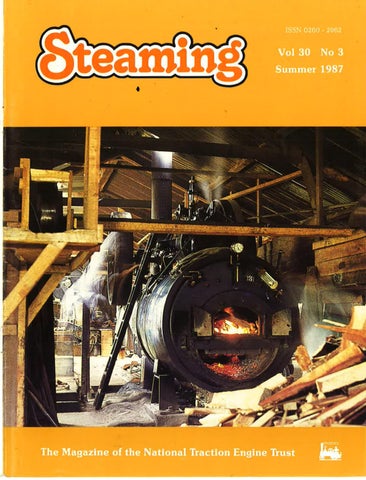
Cover Its the end of the midday break at Chapelton Sawmills Ltd near Barnstaple, Devon, and Marshall S type semi-portable 88105 of 1937 is brought back to full steam pressure by a ghostly crew for its afternoon's work. The 12hp single cylinder piston valve engine was photographed by Roger West in September 1970 and at that time worked every day, being the
sole power for all of the mill's sawbenches via belts and floor level shafts, and burning offcuts in its Britannia type circular firebox. The engine survives in preservation in Somerset. 107
Trust News Rally Organisation Rally sub-committee At the time of writing these notes in June, it is rapidly approaching the height of the summer (although very damp outside) and already past the beginning of the rally season. Let us hops tho ground gets a hit drier and firmer soon, and lasts like that for the next few months. Since slimmer is the time of year mostly given over to practical traction engine activities, my sub-committee tends to be at its quietest. Most of its members are actively engaged in rallies in one capacity or another. There are plenty of events to choose from this year; the list of approved rallies was distributed to all members with the last edition of Steaming and gave details of some eighty-odd events — surely there must be at least one which each member could visit. In addition to approved rallies, there are several other activities at which traction engines are likely to he present; for the most part these events are outside the scope of our approval scheme. Although the main work of my rally sub-committee takes place outside the rally CP acon, a ni umber of vicita aro made by individual committee members to rallies as observers. The practical experience of the rally field and any problems or difficulties which may arise, form the basis for consideration of any possible amendments to our Code of Practice. (Eric Fillmore, chairman, rally sub-committee)
putting forward large rises in their premiums, this year and last, some may claim that the increase should be more, but we are in a situation where it is possible to price ourselves out of the market. At the Conference some organisers stated that due to the large number of owners wishing to exhibit, and the static or falling size of their attendances, they were unable to pay anywhere near the guideline, and many engine owners will already be aware of this fact. My advice to the owner is to negotiate and if you cannot obtain the deal you feel you need — stay at home. Pattern Store
with its intended stock and if anyone has any examples that are cluttering their workshops I would be pleased to hear from them and arrange transfer and housing. Should you wish any royalty to lend them to others, that can be arranged; alternatively if anyone wishes to allow castings to be made from patterns they do not wish to part with, please send information to me of their type. You could be saving someone much time and expense in pattern-making, if you have just the thing under your bench. And from the other side of the problem, if you require patterns — again, contact me with the details. (John Wharton, chairman, engine owners committee)
Our pattern store at Market Harborough is not exactly overflowing
From Alan Martin's Collection
37
Engine Owners Column Remuneration The Spring Conference decided the NTET minimum guideline appearance money for rally appearances should be raised to £45 per engine per day. Though this rise of 2.3% is somewhat under inflation rates it keeps the amount at a round figure and now represents £90 for a two day event. With many insurance companies 108
A finely arranged picture of one of the extensive fleet of road rollers owned by the Essex Steam Rolling Association of Southend-on-Sea. The driver of Aveling & Porter 10 tanner 4848 of 1901 — fleet No21 — strikes a a classic pose on his immacualte single cylinder machine whilst engaged on work near Witham, Essex about 1910. The scarifier is of Morrison manufacture.
Temporary Export Licences The Historic Vehicle Clubs Committee has made representations and had meetings with both the Department of Trade & Industry and the Office of Fine Arts & Libraries over the Export Licence requirements announced early last year. A vehicle over 50 years old and in excess of £16,000 in value required a Temporary Export Licence if taken abroad for a holiday, etc. The HVCC on behalf of the preserved vehicle movement felt this was an unnecessary imposition. We are pleased to say that this requirement for a Temporary Export Licence has now been withdrawn by the Minister for Trade if the vehicle is used temporarily abroad for social, domestic or pleasure purposes, (including attendance or participation in a race, rally or exhibition). When used by other than the actual owner, his personal representative should carry written authorisation permitting usage as described above. However, an Export Licence is still required for permanent export, or if usage does not comply with the above conditions, and an Export Licence is still required if a vehicle is on a trailer or being transported. This latter requirement would therefore seem to indicate that traction engines etc, other than those journeying under their own steam, will still require to travel with the relative Licence. (Anthony S. Heal) Water Carts The amendment to the Construction & Use Regulations 1986, reinstating the exemption of water carts from the number of trailers that can be drawn by steam powered vehicles (referred to on page 59/60 of the last issue), duly became law on the 6th May 1987. (Anthony S. Heal)
NTEC Sales The Trust's sales organisation is still adding new items to its range, so we look forward to seeing many members at one or more of the following rallies at which it is intended to have sales stands. August — St Columb (Keith); Attingham Park (David); Astle Park (David); Nottingham (Keith); Know) Hill (David); Market Bosworth (Ken); St (David); Fairford (Keith); Agnes Kenilworth (Ken); Harewood House (Keith); Bishops Castle (David). September — Stourpaine (Keith and David); Haddenham (Ken); Malpas
(Keith); Capesthorne Hall (David); Roxton (Keith); Lingfield Park (David); Barleylands (Keith). The dates and further details of the above events appeared in the Rally List supplement included in the last issue of the magazine — a list of events being attended by the sales stand in July appeared on page 110 of the same edition. For the four day Stourpaine event, as well as the usual sales marquee, the sales team have arranged and will be staffing a hospitality tent. There will be a display of photographs and you will be able to meet old friends and make new ones. As a further service to members we have arranged to make available pre-paid one day admission tickets for Stourpaine (Thursday 3rd September to Sunday 6th September). They will be available by post from the mail order address or at any of the rally stands at a cost of £3 per adult ticket, £1.50 children or pensioners — this is a 25% discount on gate prices at the rally. If any other rally organisers would like to offer a similar scheme, this year or next, would they please contact (Tracey Shakespeare. Keith Shakespeare) NTET Model Exhibition The first model exhibition organised by the Trust was held at Eddystone Radio Ltd in April and attracted over 1000 visitors, some of whom were members. Those present were able to see a diverse range of models — David Orme's small engineering works; Ken Whyman's traditional English fair; Brian Hobby's Southampton Docks and Marie Hobby's dolls of the world; an eighth scale Fowler SUPREME and gallopers by Ken Rundle; a Burrell scenic by Ron Dawes; Barrie Neville's traction engine and steam wagon; D. Morris's quarter size living van and a rural diorama by Sid Chatham, who unfortunately died in May, although his grand daughter Elizabeth will still be exhibiting. There were also stands by the Fairground Association, the Lifeboat Society and, of course, our own Trust. Outside in steam, Tony Webster's Durham & North Yorkshire traction engine model contrasted well with two full size specimens: Len Crane's Fowler and Jack Wharton's SUPREME. Music was provided by Terry Peters 32 key Dean organ. (Tracey Shakespeare)
The Rally List A further rally should be added to the 1987 Approved Rally List, published in the last issue: — August 16th • 14th to Stoomworking, Vestingdagen Hellevoetsluis, Holland (about 22 engines expected). T. Lageweg, Postbus 13, 3220AA Hellevoetsluis, Holland.
Steam Apprentice Club It is surprising that quite a few Trust members don't know of the Steam Apprentice Club — or thought it folded up some time ago. The SAC is the young persons section of the Trust and is designed for anyone under the age of 21, there being no lower age limit. I hasten to assure all readers that the SAC is far from extinct. Although the club has been through a period of change when regrettably little happened, it is now enjoying a period of growth with membership increased three-fold in the last eighteen months. March this year saw the start of the new 24 page SAC magazine, replacing the old newsletter. There has not been much presence on the rallyfields of late by the club and it is hoped we can rectify that, too, in 1988. It will be necessary however to have some good reliable offers of help in the organisation of suitable events at rallies (volunteers welcome!). One meeting we are planning for our young members this year is a general meeting at the Stourpaine event, commencing at 10am on the Saturday in the Trust's courtesy tent. The SAC's purpose is to give practical help and theoretical knowledge on all aspects of road steam engines. The club has something to offer all young people, whether they have ready access to an engine or not. A great benefit is that many NTET Approved rallies allow SAC members free admission. New blood will always be needed to replace old in the steam world, and practical skills will be lost if they are not passed on to the new generations; this is the most important part of our job. I would be very pleased to forward further information on the SAC to anyone interested in joining, and if any reader of this magazine wants me to pass details to their children or young relations or friends, do let me know, or 109
call at any NTEC sales stand at rallies this summer. (David Duffill, 181 Foden Road, Great Barr, Birmingham B42 2EH)
Steam Heritage Awards A mix of over 200 steam enthusiasts and media persons came together at the Buckinghamshire Railway Centre at Quainton Road Station on 2nd April to witness the distribution of the Steam Heritage Awards for 1987. The scheme, sponsored by British Coal and the Solid Fuel Advisory Service is to recognise outstanding work by companies or organisations in the restoration and preservation of steam transport and machinery from a bygone age. The winners of the awards were: • Premier prize for outstanding technological contribution — £1000 to the 71000 DUKE OF GLOUCESTER Steam Locomotive Trust for their incredible return to working order of British Railways' prototype land only) class 8 4-6-2 express passenger loco — which lacked its outside cylinders, valve gear and many other parts when purchased from Barry scrapyard. • Road category — £500 to W.M.G. Hedges & Sons, boilermakers and restoration engineers of Faversham, for Moir rebuilding of a Ruston Proctor showman's tractor.
NTEC Sales PLEASE NOTE WHEN ORDERING To claim post free for UK, members please enclose current membership card. Non-members please add £1.50 postage per order. Overseas members please add £3.00 postage per order. Postal orders/cheques (in sterling please) to be made payable to: National Traction Engine Club (1984) Ltd. Please allow 28 days for delivery Orders to:
110
Malcolm Edwards, commercial director of British Coal (left), presents the road category award to Bill Hedges. (Steam Heritage)
•
Rail category — £500 to the Buckinghamshire Railway Centre for its rebuilding of Metropolitan Railway 0-4-4 tank loco No1 of 1898. • Special merit award — £500 to the Railway Preservation Society of Ireland for its return to steam of
Great Northern Railway of Ireland compound 4-4-0 loco MERLIN. • Marine category — £500 to Highland Steamboat Holidays in Argyll for its continued use of VIC32 on holiday cruises in Scottish waters. The owners are, of course, long term advertisers in
Prices post free in UK erkeein wnere nerve
NEW BOOKS Steam Traction Engines in Camera !Crawley) Traction Engine Register Steam Heritage Yearbook Review of Steam Tractors (Whitehead)
1 2.95 £ 2.50 £ 1.50 £10.50 (non members)... £11.50 Steam Threshing Engines in the Cotswolds (Thexton) £ 6.26 (non members) .£ 7.50 Traction Engines of Rutland £ 3.75 Trucks in Britain, Vol 6 — Post Office Stores and Telephone Vehicles £ 5.50 Trucks in Britain, Mini series No1, Fairground eight-wheelers £ 4.75 The Farm Tractor £14.95
CLUB ITEMS Gilt members badges — Trust or Club (state which) Fowler cap badges
SWEAT SHIRTS Adults S/M/L XL/XXL Childrens 24/28/32
(non members)
£ 1.25 £ 1.00 £ 1.25
(non members)
(members)
£8.60 £9.00 £6.20
£7.80 £8.25 £5.50
Keith Shakespeare, NTEC Sales, 91 Poplins Way, Kings Norton, Birmingham B30 3NJ.
our magazine. Museum/static category — £500 to Mill Meece Pumping Station Trust for the preservation of the tandem rotative engine near Eccleshall, Staffordshire (see our Spring 1984 issue). British Coal's commercial director Malcolm Edwards presented the awards in the appropriate surroundings of the loco display building at Quainton, partially cleared for the occasion. In a brief introduction to the Awards he assured his listeners of British Coal's and the SFAS's continued support of Steam Heritage. In a fine piece of stage management Metropolitan tank No 1 steamed noisily through the suddenly opened doors and up to the rostrum just as its prize was awarded — to the spontaneous acclaim of the seated audience. Guests of Steam Heritage and representatives of the prize winners had arrived at Quainton by special train, hauled part of the way from Marylebone by FLYING SCOTSMAN. Bill Hedges and his team had the advantage over fellow winners (other than the hosts) by being able to bring along an example of their work for all to see and on exhibition was the Barrows & Carmichael portable featured in our last issue. A disappointment to the Award scheme organisers has been the relatively poor response from road steam engine owners and they are looking forward to a much larger number of entries for the 1988 Awards, details of which will be announced in the next issue. •
into partnership with John North. Together they travelled a small ark behind the old Burrell THE COUNCILLOR. Perhaps it was at this time that his tuition in engineering came into full use for both engine and ride needed fairly constant attention to keep them in running order. The journeys covered much of the West Riding of Yorkshire; parts of the North Riding rarely visited by showmen; areas round Hull and Hedon and occasional visits into the Boston area of Lincolnshire, with longer runs at the close of season to either Liverpool or the West Midlands where they stayed open over the slack time until the next season. The partnership was dissolved in 1939 when the tackle was in Darlaston. Frank then took a job with Wellman, Smith & Owen as a bench fitter for a time, but whilst there heard of a set of threshing tackle that was for sale near his home. He negotiated the sale, left a man in charge of the tackle and round of work, and returned to Darlaston, It was an unsatisfactory arrangement and Frank had to return to Croft to take charge of the business himself. Due to the war, farming was beginning to show a profit again and that fact, together with the dispersal sale of the local threshing contractor, put him in the way of building up a good business. By the end of hostilities he was running several sets of tackle, all of which were maintained by him on his own premises. In
addition he was also running a set of cultivating tackle and there was work for all his equipment. Sadly, steam was going out of fashion in agriculture, and with it both threshing and cultivating. Frank closed the business and sold out while he was able to dispose of things which few people wanted to buy. Today, only one of his engines remains extant, but there was a short period in the 1950s when EX-MAYOR was in his possession, having been sold to him by the Tuby family. This engine was later to be sold out of the area, but Frank's interest in her remained to the end of his life. Frank then turned to farming and this was the trade that took all of his waking hours. And yet he was able to find time to help with organising the early rallies in our county such as Skegness in 1960, Revesby Park and subsequently the long running events at Carrington Park. A long-time member of the NTET, he did not own a preservation engine, but his vast expertise was widely sought by many others, and was always cheerfully given. He was involved with the Museum of Lincolnshire Life and their preservation projects. At other times he might be found driving for owners who were themselves unable to be present at an event. If his spare time allowed, he would visit rallies further afield and usually in company with his wife, Joyce, and one always felt the henefit
Obituaries Frank Cheffins Franklin E. Cheffins, who died in the early months of the year at the age of 77, was one of the most outstanding personalities of our time for he had been a professional in four different trades and known success in all of them. As a young man he had learned steam engineering with Marshalls at Gainsborough, but the depression forced him to find other employment for his capabilities at a time when jobs were hard to find. Harry Tuby of Doncaster took him on as a driver on his Burrell showmans EX-MAYOR and was glad to use his expertise both in driving and repairs. But at that time Frank's ambition was to become a riding master in his own right, and after two seasons with Harry he went
The Stourpaine scene typified: with a background of engines of all sorts and sizes, Garrett 4CD tractor 33278 of 1919 and timber drug stand in the timber sawing area. (Roger Newberyl 111
Maxwell Hemmens Precision Steam Models Steam Replica Specialists and Manufacturers of the largest range of high quality working Models and bolt together Kits in the world.
Our Models range in price from £100— £10,000 and can be seen at our Showroom at Thorganby which is situated only six miles South East from York City centre, or send for our fully illustrated colour Catalogue, priced at £1 (or the equivalent in postage stamps) to the following address.
Maxwell Hemmens Precision Steam Models `The Steam Gallery', Thorganby, York, North Yorkshire YO4 6DA Telephone : 0904 89 331
112
of having met and chatted with them both. Happily, much of Frank's professional life has been recorded, and this was intended as a framework upon which to base more detail when time allowed this work to be done. He will be sadly missed by all who knew him and our kindest thoughts turn to Joyce and family who must surely miss him most of all. (F.S.)
Andrew Sales The death occurred in May 1987 of Andrew Neil Sales, of Blythe Bridge, Stoke on Trent, Staffs aged 23. Andrew was involved in a tragic motor car accident at Mickleover near Derby. He was known mostly on the rally fields around north Staffordshire and Cheshire for his support to the engine LITTLE MAC owned by S.J.A. Dale & Son of Congleton. He had been on the crew for many years, as has his father David. Andrew enjoyed life to the full and always had a pleasant word to say to anyone interested in talking steam. He was hard working and very dedicated, but above all a good friend who will be sadly missed. Our sympathies extend to Dave, Phillis and family. (David Dale)
Frederick Shambrook Steam engine devotees in Devon were saddened to hear of the death of Fred Shambrook just after Christmas. Fred was very knowledgeable in matters relating to steam and vintage transport and machinery, his help was sought by many in the county — help which was freely given, as was advice. He was brought up on steam, his father being a driver for Devon County Council. Fred also drove for them in various jobs, which included steam rollers and paving machines. His stories of the steam wagons and rollers of the County fleet were most interesting. The family were involved in preserving steam very early on, Fred's father owning an Aveling & Porter tractor which attended the early Devon rallies and passed into Fred's ownership on his father's death. Fred also owned a Burrell agricultural engine which has been the subject of a very thorough restoration, the completion of which should have resulted in the appearance of one or both of these engines on the rally fields this year. In between working on his engines, he was also helping other people with problems with their engines or other types of machinery; he was very helpful in this respect, and was responsible for the appearance of
many items at our rallies at the expense of his own engines. Fred was a founder member of the Devon Club, being one of the 35 people who attended the inaugural meeting. He could be relied on to help on the rally field — before during and after the rally — and he served on the committee for many years. If you saw him at a rally he was usually near an engine, and would be able to tell you quite a bit about its history and previous owners. Fred was ably supported in his projects by his wife Sylvia and two sons Raymond and David, who will carry on with the fine work that he started. Fred was thought to be making good recovery after his initial heart attack, and it came as a shattering blow to hear of his passing. He will be sadly missed by all the members of the Devon Club, and his many friends throughout the southwest; he cannot be replaced, for the number of men with his knowledge are few and far between. (Fred Burt)
'The Norwich Town Council is on the point of purchasing a second steam motor wagon; one is at present in use which was constructed by the Yorkshire Patent Steam Wagon Company. It is proposed to expend £565 on the vehicle.' (From The Com28th September mercial Motor, 1905).
OUR MAGAZINE 25 YEARS AGO
Two club officials whose names are still familiar in engine circles sought members attention. Membership secretary Jim Hutchens solicited their subscriptions (then all due on the same date of 1st September) and secretary Eric Fillmore encouraged ladies to attend the forthcoming Dinner, stressing it was not a stag night. At 25s (£1.25) per ticket, however, he regretted that the club 'had run up against the ever present rise in prices'. There were to be 32 rallies that year. Dick Joice advertised the Raynham Day Rally for September, with steam ploughing and threshing and 80 engines. At Aberdeen the Corporation's harbour department were still using their DG6 or S4 Sentinel wagons on stone haulage on the breakwater. A party of committee members, led by vice chairman John Crawley and Eric Fillmore, had paid an unannounced visit to evensong at Woodford Bridge church, and club chairman Rev. Philip Wright 'had been, to put it mildly, surprised.'
This view of Burrell double crank compound 4045 of 1926 gives all the appearance of it being a model — the scene is in fact at the superb Thursford Museum at Fakenham, Norfolk, where the Burrell is part of a fine collection of engines, organs and fairground equipment. (Robin Walker) 113
post-war Sentinel steam wagons Some notes on
John M. Hutchings The last of anything steam always carries a special interest for the enthusiast and for the Sentinel historian the years 1949-1950 saw the final steam wagons constructed at Shrewsbury. The writer has recently pursued the history of these vehicles and sets out his findings below. These are not exhaustive, but intended to promote further correspondence and, hopefully, bring in new information. Construction of the S-type steam wagon ceased at Shrewsbury in 1938 but during the late 1940s the Sentinel company received enquiries from the Argentine Government for steam wagons to haul coal from the state owned mines at Rio Turbio, on the border with Chile, eastwards down the course of the Gallegos river to Rio Gallegos itself where the coal was to be loaded into ships, the coal's final destination being the more populated and industrial areas of Argentina to the north. According to an announcement in The Commercial Motor on 12th November 1948 the Argentine Government had placed an order through Fendrake Trading Co Ltd of London for shaft drive six-wheeled 12-ton capacity steam wagons, although the quantity ordered was not specified. A later issue dated 6th January 1950 gave a detailed report of road tests with one of the Argentine S6 tippers from Shrewsbury to Llangollen and back. Mechanically the wagons were similar to pre-war S6 models, the principle differences being hydraulically operated Lockheed brakes and tipping gear (chosen so as to be compatible with diesel vehicles with which the maker's fitting staff was familiar), left hand drive and 42 x 9 tyres. The boiler was also larger with more tubes to compensate for the poor calorific value of the fuel to be used. The time honoured story of these wagons states they were 100 in number and associates them with Sentinel job (works) numbers 9402-9501. However no authorita114
Two wagons from the Argentine order posed outside the Shrewsbury works for an official photograph. They are fleet numbers 17 and 14, and the wording on the cabside door translates as Natinnal Ministry of Industry and Commerce, CSM being the initials of Combustibles Solidos Minerales. Lettering on the tipper body provides information for dockers and others that it is a 'Sentinel Steam Waggon, Buenos Aires' and gives other shipping detail — weight and overall dimensions etc. (Sentinel Trust Collection, courtesy Thomas Hill Ltd)
Another view of number 14 of the Argentine fleet, with body tipped. The left hand driving position shows clearly. (collection Joe Thomas)
tive proof has been discovered by the writer to confirm 100 wagons were constructed. All the press coverage I have seen merely mentions a 'substantial' order and nowhere is it quantified into 100 wagons, or any quantity at all. Sentinel allocated job number 9401 to a steam shunting loco. There is then a gap of nine apparently blank numbers before 9411-9420 were issued to the power units for ten Sentinel-Cammell steam railcars for the Egyptian State Railways. Intriguingly a gap of a hundred blanks then follows before number 9521 is issued to a narrow gauge loco for export to India. I should perhaps explain that records of the works numbers of railway locos of this period survive because of the continued business in that field; the works numbers of the road vehicles, whilst in the same numerical sequence, were detailed in separate record books, which have long been destroyed. Despite the lack of documentary proof the writer considers the Argentine wagons were allocated the hundred numbers 9421-9520. The railcars were aforementioned contemporary with the Argentine tipper order and employees who worked on the former are emphatic that Sentinel bought up a number of second-hand S-type wagons for the Argentine Ian example being S4 9065). These wagons, said to number up to six S4s and six S6s, were reconditioned at Shrewsbury and sent out as 'training' vehicles, but it is not known if they formed part of the hypothetical 100 wagons or not. The Argentine order was shipped from Newport by the Houlder Brothers & Co Ltd shipping line to Buenos Aires, where they were transhipped to coastal vessels for the final leg of the journey to Rio Gallegos, although subsequent information suggests some were retained for local work in Buenos Aires. The story of difficulties encountered in the operation of these wagons has been recorded elsewhere (see our Spring 1986 issue). Suffice it to say they were purely a stop gap solution until the 750mm gauge railway being built between the Rio Turbio mines and Rio Gallegos was completed. This had been started in 1950 and became operational towards the end of 1951. The completion of the railway did not spell the end for the Sentinels and at least one remained operational until 1967, though used for festivals and celebrations only by that time. When Sentinel announced the Argentine order in the press they made the point that steam wagons were also to be made available for use in the UK,
Two views of one of the Argentine wagons in January 1967 at the Rio Turbio mines, 52° south of the Equator. At the time the wagon was in occasional use around the mines, but was also in much demand for use at festivals and celebrations. (collection John Boucher)
provisionally towards the middle of 1949. A price list dated 24th November 1948 gives details as follows: type S4 flat S4 tipper (end tip only) S6 flat S6 tipper (end tip only)
body length 1 5ft 3in 12ft 61n 18ft Oln 14ft 6in
Tyres were 38in x 8in on all types, and braking was by steam to the rear wheels only.
description chassis and cab only chassis and cab with tipping gear and end tipping sub-frame only chassis and cab only (double axle drive) chassis and cab with tipping gear and end tipping sub-frame only (double axle drive)
Vehicles intended for off-road use in quarries etc were considered a more viable sales proposition and Sentinel considered there was a market for a robust vehicle burning home produced fuel. Shrewsbury therefore constructed a prototype 6-wheel dumper based on components to be used in the Argentine wagons, although (continued on page 119)
price £2400 £2900 £3200
An S6 Road Test The following four pages are a fascimile reproduction of a Road Test which appeared ..r) The Commercial Motor for 6th January 1950. It was later reprinted as a publicity pamphlet. (by courtesy The Commercial Motor) 115
and supplies, through a valve controlled by the driver, a flow of water to the boiler. The boiler is of Sentinel vertical water-tube pattern mounted between the frame side members and placed vertically at the back of the cab. It operates at a working pressure of 255 lb. per sq. in, and incorporates a double superheater. Rectangular water tanks are arranged behind the scats on each side of the boiler, and two bunkers. carrying a total of 6,1 cwt. of coal, are fitted above the tanks. These bunkers are filled through hatches in the cab
()Titivri.0v 01 v
Alter turning in Llangollen, a stop was made at a stream for replenishment of water supplies. The reserve supply was not used in 321 miles of normal operation.
Y teat of tiro Sentinel sixwheelar was my first encounter with a steam wagon, and it convinced me that the steam-engine power characteristics, altording high torque at low 'evolutions, are excellent in road vehicles, for they give rapid and smooth acceleration from rest to maximum speed. The manufacturer gay "The Commercial Motor" the first opportunity of making a compi eliensive road test of a left-handdrive machine weighing 22 toils gross, one of the first of the shaft-driven steamers which arc to be operated in the Argentine. Suspended horizontally in the frame behind the cab, like the present Sentinel oil engine, the fourcylindered single-acting steam engine has the cylinder blocks and heads arranged towards the right of the chassis Pistons connecting-rods and crankshafts of internal-combustion pattern are employed. but because every revolution of the crankshaft gives four power strokes, each pair of crank journals is set at an angle of 90 degrees. Weight has been greatly reduced by using light alloys in the construction of the crank case and sump Developing a maximum of 124 b.h p.. the engine is equipped with poppet valves in a T-hcad formation, and the camshaft is arranged for three cut-off positions and reverse
M A.
The consumption trial was made between the Sentinel works at Shrewsbury and Llangollen, returning over the same course. The test vehicle, loaded to 23/ tons gross, Is seen here after crossing the Welsh border at Gobowen. Road speeds up to 35 m.p.h. were reached during this test. The foot control to the steam valve takes the form of an accelerator pedal, and the camshaft is turned to the cut-off position by a lever close to the driver. Pressure lubrication is provided for the camshaft bearing and, through the connecting-rods, for the gudgeon pins. A weir-type separator attached to the side of the sump ensures that any water reaching the base is automatically drained from the lubi icant. A slow-running double-acting feed pump is incorporated in the engine,
BY — L. J. COTTON M.I.R.T.E
roof, and apertures are provided at their bases for hand firing of the boiler. Coal is fed into the top of the boiler, and rocking fire bars, operated by a lever in the cab, are fitted to assist combustion of lowgrade fuel, such as will be used in the Argentine. A two-speed sliding spur gear is incorporated in an extension to the crankcase, the output shaft being co-axial with the crankshaft. As gear changes are normally made when the vehicle is stationary, there is no clutch or flywheel. but a large oscillation damper is lilted to the output shaft. A short Hardy Spicer coupling shaft conveys the drive to the doubledrive bogie, which has three-quarterfloating axle shafts The final drive
is taken through a double-reduction gear comprising a spiral bevel operating a layshaft which, in turn, drives a double-helical crown wheel. Torque and braking reactions are taken by ball-ended radius rods. The chassis is a conventional channel-section parallel frame with tubular and pressed-steel cross-members bolted in position, and the bogie is attached by long brackets braced by a tube between the trunnions of reverse - camber underslung the springs. These springs, one on each side of the chassis, have trunnion swivel eyes to relieve the leaves of
Tested Over an Undulating Course, the Sentinel Steamer Maintains the Pace of an Internal-combustion-engined Vehicle. Present Models
H ave Shaft-drive to Rear
Wheels and Powerful Hydraulic-servo Braking Systems
(Right) The boiler, flanked bythe water tanks, is at the rear of the cab. The lever in the foreground is provided for rocking the fi rebars.
Under Steam Again • •
,
arrangement for lifting or lowering the carrier. Fuel for the test was bagged and weighed overnight, the water tanks filled and the grate cleaned, in readiness fr,.,.nrly start on the consumption trial. To enable low-grade fuel to be used, the fire bars were spaced at intervals of 1 in., and the surface area of the boiler had been increased, so that I did not expect consumption to be low. Normally, when Welsh steam coal is burned. the firebars are spaced in apart
(Above) When climbing Chirk Hill the boiler safety valve opened for a briel period while low gear was being engaged. The camshaft lever was at the mid cutoff position for most of the climb.
any distortion during articulation. Girling two-leadingshoe brakes are fitted on all wheels, and are operated through a Lockheed hydraulic continuous - flow system with an enginedriven pump and a reservoir. Twin tyres are fitted to the bogie, the standard equipment for all wheels being 42 ins. by 9 ins. The spare wheel is mounted behind the cab and has the Sentinel self-hoisting
(Right) A weir-type
separator, mounted on the side of the engine, drains off any water reaching the lubricating oll.
(Right) Slung horizontally from the frame, the Sentinel steam engine has the cylinders and heads arranged towards the right-hand side of the chassis.
ROAD TEST No. 391.— SENTINEL STEAM WAGON MODEL: Sentinel S-type six-wheeled endtipper. WEIGHTS Tons Cwt. Qrs. Chassis 7 13 3 Body 1 12 1 6 2 14 3 Water (165 gallons) . 13 0 0 Payload .. 5 Driver, mate, observer 0 1 23 12 Distribution Front axle 5 14 0 17 15 1 Bogie „ ENGINE Sentinel totally enc{ofriad fourcyllnelered single-acting non•tondensing steam engine ; bore 5) ins. ; sere*, 6 ins. ; maximum output 114 b.h.p. at 1,000 r.p.m. (at mid-cut-off position); maximum torque in low gear 5,800 Ih..ftBOILER Vertical water-tube type, 34 tubes n1 damerer ; working pressure 7551ht per sq. m. ; superheater raises saturated team to 800 degrees F. ; grate area 3.28 sq. t., heating surface J, 3 sq.
TRANSMISSION Through Hardy Spicer propeller shaft to spiral-bevel and helical double-reduction drive of the threequarter floating centre and rear axles. GEAR RATIOS Engine 2.72 and 1 co 1. Final drive 5 to 1. BRAKES Pedal operates through Lockheed servo system to all wheels ; lever connected through mechanical means to bogie; diameter of drums 16) ins. ; width of shoes, front 34 ins., bogie 6 ins., ; frictional area 992 sq. ins., that is, 42 sq. ins. per ton gross weight as tested. FRAME: Channel-section side members with tubular and channel-section cross-members bolted in position.
220
BHP-MI5 are OFT
ii __--410,, , , ,
120 100
1 78°
40
STEERING: Worm and nut.
200
1109;01.15-1.1e% guiorr
140
s AIrliiiiii je'eatt.
4,
1 4
ikt
7IF
14
i•soct
9
120
FitiP MUM
cer crr
20
ELECTRICAL : Six-volt compensated-voltagecontrol system with 45-amp.-hr. battery.
0 0 200 400 600 800 1000 RPM
EVAPORATION: 0.585 gall. (5.85 lb.) of water per lb. at coal burned.
1600
,:
SUSPENSION: Semi-elliptic springs, single spring at each side of bogie.
,
Woo
trtaixt
1200
STEAM RAISING 125 lb. per sq. in. raised in 43 min., 2 qrs. 7 lb. of coke used. FUEL EMPLOYED Ferndale Welsh steam coal, C3 14s. 10d. per ton. FUEL CONSUMPTION: 7.43 lb of coal per mile at 20,9 m.p.h. average spend, TUN ding halts; 0.315 lb. per groin ton-mila ; 0.572.16. per payload ton•Mila ; 15 mile, per owe, ; 255 gross ton-mllas per test. Fuel sass 2.658 per mile ; 0.1128. per gross can-mile. Coal-bunker capacity 65 Cwt., Carle approx. imately 100 m I lesWATER CONSUMPTION: 4.30 galls. (43.516.) per mils, 0.104 galls. par gross tonrolle, steaming radius on 165-gallon tank 38 miles. ACCELERATION 0-10 m.p.h. 6 secs. ; 0-20 m.p.h. 23 secs. ; 0-30 m.p.h. 71 sets. BRAKING : From 20 m.p.h. 28 ft. (15,5 It. Per sac. per sec.); from 30 m.p.h. 75 It. 113 ft. per sac. par sec.). WEIGHT RATIOS: 0.252 b.h.p. per cwt. gross weight as tested, Payload 55 per cent, of gross load. TURNING CIRCLE Both locks 721t. 6in. MAKER Seismal (Shrewsbury) Ltd., Shrewsbury, Shropshire.
Because the test was conducted with Welsh fuel, a large proportion of partially burned coal was discharged Into the ashpan, and because of the lea' hinging of the pan, the combination of forced draught and widely spaced bars caused fuel to be used at an abnormal rate. To help to control the fire, it was started with coke to form clinker over the bars. A bag of coke weighing 2 cwt. 7 lb. was used to raise steam, and the first pressure was shown on the gauge within 19 minutes of lighting up. The temperature of the feed water in the supply tanks was taken before starting the fire, and the reading of 50 degrees F. was 8 degrees above ambient Preparations for the run By 8.03 were started at 7.20 a.m T1 l25 lb per sq. in of steam had been raised, and we drove on to the weighbridge in readiness for the road. The fire was stoked with coal before leaving the works, and when entering Shrewsbury town, two miles away, the steam pressure was up to 225 lb. per sq. in., a practical working point It required no mean driving skill to make a right-angle turn
under a low, narrow, semi-circular bridge in the town, with a vehicle 8 ft. wide and 9 ft. 11 ins. high. Atter we were clear of the town the Sentinel was speeded up, and although the course along the A5 road was undulating, the speed rarely fell below 25 m.p.h Traffic on the narrow, tortuous route through Whittington caused a stop, but apart from this the run from the outskirts of Shrewsbury to Llangollen was unhindered. The England-Wales border was crossed at the foot of Chirk Hill, where the length and severity of the gradient required a halt to change gear. This was the first occasion which demanded the employment of the low ratio. The Tapley gradient meter was showing 1 in 14. The steam-engine characteristics of high power at low speeds enabled the vehicle to move smoothly and steadily away from rest on this The camshaft lever was gradient. moved to mid cut-off position within 30 yds of this halt, and the steamer climbed at a steady 8 m.p.h. into Chirk.
The driver and stoker worked well as a team, and the boiler pressure was maintained within working limits without blowing the safety valve. This waa sonic achievement, having regard to the air blast formed by the scoop of the ashpan and the wide spacing of the firebars. Our maximum speed along the Vale of Llangollen was in the region of 35 m.p.h., and 8 kilometres (five miles) were covered in 91 minutes. The distance was checked by milestones, and the speedometer was found to be accurate. After turning at Llangollen a halt was made at a stream across the golf course to replenish the water tanks, a distance of 324 miles having been covered on 140 gallons of water. Up to this point the reserve supply had remainded untouched, but this was a convenient point for replenishing It took six minutes to refill the tanks, and the trial was resumed without further delay. I timed the vehicle over the same stretch of road as on the outward journey, and on the second occasion it took 13k minutes to cover five
miles. More power was required on some of the return gradients, and the mid cut-off position of the camshaft lever was employed more extensively. The 624-mile course was completed in 3 hrs. 2 mins., including the stop for water, which corresponds to an average speed of 20.6 m.p.h. A total of 270 gallons of water and 4 cwt. 13 lb. of coal were used, equalling 4.35 gallons of water and 7.43 lb. of coal per mile. The fuel consumption would have been lower had the firebox been designed for the grade of fuel employed and the route less hilly. As Welsh steam coal costs £3 14s. 10d. a ton, supplied at Shrewsbury, the cost of fuel per mile works out at 2.65d. Coal and water supplies were replenished for the short performance and hill-climbing tests. The stoker built up the fire as we approached Harley Hill, known locally as Wenlock Bank, which is a mile climb of 1 in 13 average gradient. Good Hill-climbing Low gear was engaged during the first quarter of a mile and then we steamed steadily up with the cam-
shaft in late cut-off position. Much to the astonishment of its driver, a well-laden 5-tonner was overtaken on the hill. The Sentinel toiled up the hill and appeared to get second wind when climbing over the 1-in-61 section at 4 m.p.h. There was a slight reserve of power on this gradient. Having negotiated the hill without much difficulty, we refilled the water tanks in Much Wenlock, and started the return journey. Low gear was engaged when descending Harley Hill and the pace was kept under control by occasional use of the foot brake. Acceleration and braking tests were made on the outward and return journeys, and average results obtained from the readings. The Lockheed braking system with twoleading-shoe application proved fully effective with a 234-ton load, the stopping distances being 28 ft. from 20 m.p.h. and 75 ft. from 30 m.p.h. Because it is not customary or easy to change gear on the move when driving a steamer, the acceleration tests were made in high ratio, this enabling a speed of 30 m.p.h. to be reached. Six secs. were needed to reach 10 m.p.h. from rest, 23 secs. to
20 m.p.h., and 71 secs. to 30 m.p.h. On level ground the maximum speed was slightly over 30 m.p.h., but, of course, this is easily surpassed on any slight decline. Apart from the size of the vehicle and its left-hand control, the steamer was not difficult to drive. Naturally, to steer a large left-hand-drive machine along country roads called for care, but I made rather more stops than necessary just for the pleasure of observing the smooth getaway. To keep a steady flow of water to the boiler was one of my problems, although the mirror on the dash panel reflecting the boiler side glass was helpful, and an accomplished steamer driver would make a routine check every few minutes. Towards the end of the day, after much hill-climbing, the cab temperature crept up to 87 degrees F., but with fully opening windows at the front and sides of the cab, the temperature can be controlled within reasonable limits. As it was a cold afternoon the " fug " raised by having all windows closed was not entirely unwelcome.
(continued from page 115)
stories that it was built from parts 'left over' from this order can be discounted. Sentinel's sales agents for Yorkshire and Derbyshire, Thomas Hill of Rotherham, circulated a number of likely purchasers for steam dumpers, including the Steetley Company and Stewarts & Lloyds. Positive details of any demonstrations have not so far come to light apart from several inconclusive references. The first is a tantalising mention of a demonstration at the Hoyland Brick Co in July 1952 and the second to a trial at the British Quarrying Company, the actual location not specified but possibly Criggion Quarry in Shropshire. In the absence of any firm orders and following a change of managing director at Shrewsbury the dumper project was abandoned and the prototype was sold in November 1952 to J. Morris for use at Penderyn stone quarries, on the Glamorgan/Brecknock border. It worked here successfuly for over two years before bad coal and the need to take extra precautions against frost at its exposed location made it uneconomic to run, conversion to diesel propulsion being carried out shortly after.
The mysterious Penderyn dumper at work at an unknown location — seemingly a stone quarry, but thought not to be Penderyn. This vehicle was right hand drive. Note the wise provision of an extended cab roof and grilles over the headlights as protection against falling rock — though the machine is still only on trials the front apron is already well marked. (Sentinel Trust Collection, courtesy Thomas Hill Ltd)
119
The 'Penderyn dumper' as it is generally known was thus the final Shrewsbury steam wagon for home use. However, one other wagon
should be mentioned to complete this brief survey. At the time the S6 dumper was constructed at Shrewsbury (or possibly a little earlier) Thomas Hill & Co (Rotherham) Ltd of Rotherham, Yorkshire, assembled, using new or reconditioned parts, an
S4 dumper. The differences between this and the standard S4 were that the chassis frame was of 8in x 3in channel instead of the standard 6in channel, and incorporated various reinforcing members together with a
special body subframe and all-steel box body based on an Euclid dumper body. It was sold to Derbyshire Stone Co for use at their quarries at Cawdor, Matlock. This S4 dumper had a similar life as a steam vehicle to the Penderyn S6, and in June 1954 Derbyshire
Stone enquired of Thomas Hill the possibility of converting it to diesel power using a Gardner 6LW engine. The supply of a suitable gearbox
The Thomas Hill built S4 in chassis form. Photographed at Chaff Lane, Whiston, near Rotherham. (Sentinel Trust Collection, courtesy Thomas Hill Ltd)
caused a long delay and it is not known when the conversion took place, if indeed it was completed. Our
editor, Roger West, can recall seeing the dismantled remains at Matlock in the late 1950s. Thus the curtain finally came down on steam wagon production in the United Kingdom and it is wholly appropriate that Sentinel, who did so much to promote the breed in these
islands, should have had the final say. As stated at the beginning of these notes, they are not exhaustive and any additional information, particularly details of demonstrations carried out with the S6 dumper in 1951-1952 would be most welcome.
In conclusion I would like to acknowledge help received from a number of people in the writing of this article; the late John Marl agan in particular for much obscure information; Peter Briddon of Thomas Hill (Rother-
ham) Ltd; A. Duke; T.A. Hill; John Thorne; the late W. Michael Salmon; Newspaper Library, Hendon and the Road Locomotive Society for information contained in its portfolios.
'Mr J. Crawley, of Bedford, has sent us some interesting particulars of what he has been told is the last agricultural traction engine in Bedfordshire. This engine, at the present time is having new boiler
tubes fitted at the local works of J. & W. Gower. It was built by Ruston Proctor & Co., Lincoln, and bears their 120
The Thomas Hill S4 as completed prior to delivery to Derbyshire Stone Co at Matlock, Derbyshire. It is ambitiously fleet numbered 1. (Sentinel Trust Collection, courtesy the late John MacLaggan)
No.33471. The engine appears to have spent the whole of its time in Bedfordshire and is owned by Mr W. Inskip, Cliftonbury, Shefford, Beds, in whose possession it has been for the past 15 years or so. When its present overhaul has been completed, it should be good for at least another four or five years; that is until such
time as the firebox needs renewal. Then it will most likely be relegated to the scrap-heap.' (from Model Engineer, 31st July 1952. Wally Gower's work enabled the Ruston to survive those few years further into the preservation era and the engine can now be found, actively rallying, in Wiltshire.)
A Buncombe Trio Norman Buncombe kindly sends more pictures of rollers worked by his father's firm W.W. Buncombe of Highbridge, Somerset. That name was very well known over a surprisingly large area of the country, for not only did the rollers spend their time on hire to county and district councils throughout the West Country, they also appeared on hire as far afield as Essex and Derbyshire.
The earliest of the pictures dates from 1920. The Wallis & Steevens 10 ton single cylinder — 2612 of 1904 — is working for the Wantage RDC in Berkshire. The driver was Mercer Lee and the sweeper 'Cookie' Wiltshire; at that time the sweeper was also supplied by Buncombes within the hire charge. The other two men were the Council's road foreman and a labourer.
A few years later, about 1924, a photographer recorded driver Biss with his wife and young child against one of Buncombe's Avelings. Biss appears a reluctant subject, but his family seem willing enough! The R10 class roller is works number 3101 of 1892 (YA 1555), and was at work in the New Forest area of Hampshire. Note the Baker, or similar make, water cart in the background.
Posed across a road in Somerset are the crew using a Wallis & Steevens Oilbath roller on roadworks for the Wellington RDC. The 6 ton compound is 2921 of 1907 (YA3826), a machine which started its working life as a tractor with ploughing gear with W.L. Fen wick near Bourne in Lincolnshire.
STEAM SEARCH in VIENNA Derek Rayner Our family holiday at Easter 1987 took us, among other places, to Vienna. We enquired beforehand, of various enthusiasts knowledgeable on Austria, about steam rollers or the like which we might be able to visit, but there was no information — it looked as if we would be without a road steam element to our stopover. The Technical Museum — one of the first of its kind in the world when it opened in 1919 — looked to be a good substitute but we were disappointed to find the railway section, our main objective, was being renovated in advance of Austria Railways ambitious 150 years celebrations, starting in the summer. Our disillusionment was tempered somewhat by the discovery of two steam cars and some interesting vehicles associated with the postal service. There is a rather simplistic model of a ploughing engine and some photos of Fowler products, including works pictures of 16164 and its pair at Leeds. And to salvage something photographic from our visit, we managed to do some clandestine picture taking, from an upper floor
window, of a dozen or so railway locomotives exhibited around a turntable outside the museum. On the way back to the city centre we found a bookshop with an exceptional transport section including much in English. Idly flicking through Cherished Registration Numbers, I felt a strange sensation on seeing my own name and address alongside the registration CT5012 — my Avoling & Porter roller WHITE ROSE. I've never thought of it carrying a cherished number, but I suppose it must be one! And I first find the reference, quite by chance, 1200 miles from home. The next day was wet and dismal, and not being the sort of day to take a tramp in the Vienna woods (or anyone else for that matter), we set off for Eggenberg where, according to a poster my son had spotted, we would be able to visit another museum and indulge in his interest of cyclemotors and autocycles. The 80km journey north west from Vienna took an hour and a half — a pleasant ride through rolling but ever more remote countryside which did have me wondering if we were heading for the right
The Fowler roller at Eggenberg, Austria. (Dean Rayner) 122
Eggenberg. But as we rolled into a larger than expected town, a tramcar trailer on exhibition, together with a flag displaying the Puch emblem told us we had the right place. And, surprise, the museum provided us with steam. As we turned into the premises, literally two minutes walk from the station platform, we were confronted by a steam roller, not just any roller but a Fowler, and proclaiming this fact with some unusual plates on the front — John Fowler & Co, Wien. Although the machine lacked its cylinder block and motion, there were many other unusual features about it, particularly the bolted construction of the rear wheels. There were unfortunately no plates on the roller to identify it, nor works numbers stamped anywhere. A further exhibit of interest to us was a 1939 motor roller built by Wiener Locomotive Fabrikarten at Floridsdorf, powered by a single cylinder ERA engine. Pleased with our bonus finds we undertook our intended tour of the motorcycles, which included a large collection of Puch products, made in Austria. Though we were accompanied for the whole hour by an attendant, we had little communication for as well as being unable to speak English, we came to the conclusion he couldn't do much better with German — at least he couldn't understand our attempts at the language! Then, on leaving, I spotted at the sales counter a print of a steam roller. Though of a poor quality it was worth acquiring at 5
Austrian schillings (25p) if only to bring into action a superb vintage brass decorated cash till. The print turned out to be not the roller at the museum and the only identification is a painted board attached to the tender Zisterdorf', Aufsicht 'Strassen indicating that it was once part of the road maintenance of the town of Zisterdorf, to the north east of Vienna. We are not sure whether the picture is sold because the roller still exists, or if it is just to illustrate an example. Its appearance was strongly continental but with the front end hinting of Fowler practice. Our Eggenberg trip may have been the end of the traction engine theme to our holiday, but poring over the very comprehensive Vienna city transport map, we spotted a tram stop titled
Shuttleworthstrasse. We had to go there to investigate. And why that name, without Clayton? I could recall the Lincoln firm had some east European connection but, away from my reference books, just where escaped me. So after an evening meal our 3 day All Vienna transport ticket took us, by 31 tram, to the intriguing thoroughfare. Its half-mile length produced housing and a garage on one side but on the other a rather imposing factory and office facade, albeit bereft of ancient inscription we might have hoped for. The present occupiers are Elim-Union, electrical engineers and contractors, and the style of some of the lower, timber roofed factory buildings had us musing if they could have been erecting shops — they looked similar to photos we knew of
Fowlers works at Leeds but we came to the conclusion we were trying to make the facts before us fit our fancy. However, on return home, I could seek out more and sure enough in the RLS Journal for March 1983 was a brief reference to Clayton & Shuttleworth having 'a large establishment in Vienna' where over 200 hands were employed in 1883. Can anyone tell us more on Clayton's and Fowler's businesses in Vienna?
On 17th January 1907 the Newcastle Evening Chronicle reported that John Morrison had appeared at Gateshead County Police Court charged with having caused a traction engine to be driven without the necessary license from the Durham County Council. Morrison's driver, Andrew Harvey, had been stopped by the police on 8th December 1908 when passing through Felling, Co. Durham. He admitted on questioning not to have a permit for the county (the court clerk explained permit was a police and commonplace word, but license was the word in the 1898 Act). Morrison claimed he had previously obtained day permits at 2s 6d (121/2 p) from the Durham council's clerk as and when he required one. He sent 2s 6d for a
permit on 7th December but on the 10th — by which time he had made the journey — he had received a reply to the effect the money could not be accepted, as he did not have a license for Newcastle, the authority on the other side of the Tyne from where he worked the engine. Morrison said he was 'only an emergency haulage contractor' (whatever that meant) and that under the Act it was not necessary for him to have a full £10 license before he could leave Newcastle, and a 2s 6d day permit was satisfactory. The Magistrates clerk agreed with him that the law had been complied with, and the case was promptly dismissed. But Andrew Harvey was additionally charged 'with having a waggon on the highway which
contained a load that was more than nine feet in breadth'. Harvey pleaded guilty and his employer claimed thay had been allowed to carry such loads for the past ten years and had never been challenged until now. A satisfactory understanding with the Durham County clerk had now been arrived at. John Morrison was presumably representing Walter Morrison & Co of Newcastle-on-Tyne. Despite the claim their hauling contracts were only conducted in emergencies they possessed several road locomotives including, at the time of the above incident, two 1900 built B5 class Fowlers 8380 TERTIUS and 8384 QUINTUS. (Acknowledgements to member A.M. Black/Northumberland CC archives and to Alan Duke).
21.,Shuffieworth-1 stralle
WORLD'S FAIR Fib The outdoor entertainment weekly incorporating
7,EFR4,43i, 47,
A
Fe'1237-4isVePs. wa4a1
Rallies, News, News, Reports and Advertising
Place a regular order NOW with your newsagent. Something to sell? An event to promote? For all your advertising requirements there is no better publication.
For advertising and subscription details contact: The World's Fair Ltd., P.O. Box 57, Oldham OL1 4BB. 2 061-624 3687 123
McGiverns Ever Popular Amusements Gerry Doherty and Derek Rayner McGiverns Amusements were well known to those seeking pleasure on the fairgrounds in the Irish Republic counties of Louth, Meath, Cavan and Monaghan -- the four counties in the north east of Eire, adjoining the border. Thomas McGivern started his business before World War 1 and over the years the family travelled gallopers, a bioscope show, chairoplanes, dodgems and children's rides, invariably returning to winter in their premises at their home base at Warrenpoint in Co. Down, Northern Ireland. This article centres on the engines owned and used by the McGiverns. Thomas McGivern had three children: James Kevin, Agatha and Nora. In his day he was a well known footballer for Warrenpoint United. Not all of his children, however, were to have showland in their blood for Nora took up nursing, married, and emigrated to America at the end of World War 2. When Thomas died in 1947, Kevin took over the running of the business, and, helped by his sister Agatha, life continued much the same as before. It was hard work on the fairground in days of steam and Kevin learned to drive engines at an early age, thus fostering his love for steam, which was to remain with him for the rest of his days. In his father's time he travelled all over Ireland but in later years they travelled only locally and in Ulster. A day's run would be 70 or 80 miles, but on one occasion Fowler CARRY ON did 100 miles and this, bear in mind, with a string of trailers on tow — not the regulation two or three of today. The firm owned several engines during the halycon days of road steam, one of the first being Garrett 4CD 124
tractor 77655 IRJ710) It was new to J. Harkness & Co of Belfast in 1909 and McGiverns acquired it shortly afterwards. Fitted with a three quarter cab, the engine was Thomas's pet; Kevin recalled that his father had absolute faith in the Garrett and on the one and only occasion when it failed to do what was asked, Thomas was really put out. The Garrett was scrapped around 1949 or 1950. Another engine was Aveling & Porter 4882 of 1901 (MI1708), a 6hp two or three speed compound road engine known as THE STAR. It was said the machine had been built for the Boer War and actually saw service in South Africa before being shipped back to this country. However, records indicate it was new to J. Sharland & Co of Birchgrove, Glamorgan, the first owner in Ireland
being Billy Grant, a Co. Wcxford showman, although the date when ownership changed is riot known. The dynamo and its platform were fitted in the Great Northern Railway of Ireland workshops at Dundalk around 1938/39, just before the start of World War 2. Another secondhand Garrett tractor was COCK OF THE NORTH, new in 1918. It remained with McGiverns for only three or four years and was sold to Plant & Machinery at Dublin in 1942. Then came the engine which remains synonymous with the name of McGiverns Amusements and with Kevin in particular — Fowler showmans 14425 (DP4418) CARRY ON. This engine was supplied as a road InrnmntivP to the War Department in 1916 and was converted for showland use about 1922 by Charles Openshaw at Reading for Mrs L. Cndnna of Glasgow. Kevin bought the engine in 1945 and sold it at the end of 1953. The engine was, and probably still is, the best known of the McGivern engines. An enormous whistle was fitted and when returning home Kevin would blast away on it while still a couple of miles away to let the family know he was near. By the time he arrived the kettle would just be boiling. Although the Aveling was named THE STAR the engine was known on account of the noise from the gearing as 'THE CHIME OF BELLS'. It had large diameter back wheels and was faster on the road than CARRY ON and that had been timed at 23mph — but the Aveling could leave her behind. THE
The high-wheeled Aveling & Porter 4882 THE STAR in its working days; Kevin McGivern stands second from left. (collection G. Doherty)
1111110INS LieLH el.WUL.Ali Arit-sbt.rit.:14 lit
Another view of 6hp Aveling & Porter THE STAR, by now abandoned out of use. (collection G. Doherty)
STAR however would only go about twelve miles on a tank of water, whereas the Fowler could do fifteen and would catch up when the Aveling stopped for water. The end came for the engine when it was left behind in the yard and thieves stripped all of the brasswork, bearings included, and it was not thought worthwhile to make repairs — a sad end for a fine engine which had run for many years on steel wheels. Kevin told of sparks from the wheels hitting the cab as THE STAR slipped and fought for grip on the hills with a good load behind. Eventually, after slithering down Kingscourt Hill in Co. Cavan for the umpteenth time, Kevin got down from the footplate and told his father he would drive no more unless he promised to put the engine on rubbers. On another journey the Aveling was slipping and clawing its way up a hill and one of the McGiverns' little Garretts on rubbers waltzed up and past with its load to the delight of the local urchins who shouted "Hey mister, your big yoke's no good". Another time Kevin was double highing the Aveling up a hill — it must have been on rubbers by then, his father having been convinced — when the joint blew out of the exhaust pipe and sailed clean out of sight over the nearby house tops. THE STAR was a very powerful engine! The McGiverns' engines had to work hard on the fairground too — generating was not the easy ticking over that we generally see at rallies today. Kevin used to talk of chimneys glowing red — "You could see the sparks going up the inside of the
chimney" he would claim — and when the switch was thrown to start a heavy ride "the governors would stand up straight" as the engine strained away trying to get the roundabout moving. He even spoke of engines working so hard that the torque would lift the front wheels clear of the ground for a moment when starting the ride — and this whilst generating, not hauling! The engines were, however, very well maintained as indeed they needed to be for the duties they had to fulfill.
As with a lot of ventures, the business had its ups and downs and the demise of steam saddened the McGiverns. It was a way of life which had departed but economics were a part of living and they had to look to the future. They were using steam much later than most showland families but Kevin did not as is sometimes stated, use CARRY ON until 1959. The last trip the engine did was to Belfast for a fair at Christmas 1953. They came home in the January and the Fowler passed to John McDowell, a road contractor at Newtonards, being used for driving a stone crusher; it is understood the engine later passed to J. Ellis & Son in Co. Kildare. When Kevin sold CARRY ON, he took from the purchaser a Foster showmans tractor named KING OF THE BELGIANS. This was 14065, built early in 1915 as a showmans tractor and supplied to Newsome, the Darlington showman. It was registered SG2768 in their ownership and last licensed in their name in 1924. When Kevin got the engine it still had belly tanks, but had its showland fittings removed at some stage and lacked dynamo and canopy. Kevin also received a two-speed Fowler road engine, known as THE VIPER. There was also to have been a cash balance from the deal but this never materialised and the two engines were sold for scrap a short time after they were obtained — money was scarce in the 1950s. The business fell even more onto hard times when in 1954 The Forge,
Fowler 10hp showmans 14425 CARRY ON during its days with McGiverns Amusements — note the silver painted smokebox and chimney. (collection G. Doherty) 125
the McGiverns yard in Upper Dromare Road, Warrenpoint, caught fire. It was in this yard that the fairground tackle was stored and repaired, and where in winter the family's magnificent caravan stood. Two items were destroyed as a result of the fire neither of which could ever be replaced to Kevin's satisfaction. One was a set of three abreast gallopers and the other a fairground organ. This loss, so soon after the departure of CARRY ON, was a considerable blow to him and it was to be several years before either Kevin or the business recovered from it. After the departure of the big Fowler and the subsquent disposal of the other engines, fellow showland folk thought that it was the end of steam engines for Kevin for, as has e‘-^nr,mir.s dictated against engines on the fairgrounds by that time. Diesel power reigned supreme. However, steam was not finished elsewhere and Kevin did sometimes drive threshing machines for other owners out of the travelling season. He had a poor opinion of some threshing drivers. "Steam at 401bs" he would say, "and water coming out along the rods. We used to have steam well up and the threshing gangs liked that as they could get on with the job without hindrance." Even that was not to be Kevin's last brush with steam, for although he agreed steam engines were hard work, he couldn't leave them alone! He loved looking at them, talking about them and when rallies started on a big scale in England he travelled across the water, when work permitted, to be with them again. So it was almost inevitable that when Garrett tractor 33899 of 1920 (BJ53331 came up for sale at Davey Anderson's auction in Belfast in the mid 1960s, that Kevin McGivern went along and bought it. The engine was new to Curry-Dodd in Belfast and Kevin immediately set about converting it to showmans specification. Just previously he had been engaged on the restoration of Foster tractor 14605 (YC 7165) owned by Hugh Heatley of Belfast and on completion, had painted the 'McGivern star' on the flywheel. The lining out was done in the same way as he used to do his own engines and, in truth, there was not lining like it elsewhere. It was, indeed, magnificent. Having worked on this Foster, Kevin hankered after an engine of his own so the acquisition and conversion of the Garrett tractor to showmans specification was a natural thing for him to do. Purists on the preservation scene may well have frowned at the conversion but, after all, Kevin was a showman and who more qualified and 126
Foster Wellington tractor 14065, owned by the McGiverns for a while in the 1950s. (collection G. Doherty)
entitled to do this than him? With the assistance of his right hand man Jimmy Murphy the rebuild was completed and the engine duly steamed — McGiverns Amusements had steam once again. The engine was driven down to the Square at Warrenpoint on occasion pulling a trailer, and although it did not see extended use in the traditional way, Jimmy made sure she provided
power briefly on one occasion. The paths of Derek Rayner and Kevin crossed quite by accident. Derek, along with a friend, was in Ireland in 1963 'prospecting' for traction engines. They had seen a Fowler general purpose engine near the railway at Mu!linger on their way west by train to see Fowler showmans 15713 PRIDE OF SHANNON — an engine that stood in derelict condition
Unfortunately only half a photograph, but at least a glimpse of Fowler THE VIPER, standing with Foster 14065, by now robbed of one of its front wheels. (collection G. Doherty)
on Ballina market place. He decided to get off at Mullingar on the return journey to investigate further and having looked at the agricultural (Fowler 11114 which had seen recent use in steaming tar), walked around the town after an evening meal to be drawn to the sounds of a fair nearby. On the front of one of the fairground lorries was an Aveling horse which, on enquiry, was revealed to have come from an Aveling showmans engine. The proprietor of the travelling fair was none other than Kevin McGivern and in that chance meeting, Derek made a good friend who was of much help in later years, both in locating engines in Ireland and also in the restoration of Derek's own roller. On subsequent visits to Warrenpoint in the 1960s, one of which was with Lyndon Shearman, Kevin took Derek on trips around Co. Down and Co. Meath. Many engines were seen, including tractors by Ruston, Garrett, Tasker, Foster and Wallis & Steevens; agriculturals by Wallis and Ransomes and a McLaren convertible (complete with both sets of wheels), plus both Marshall and Fowler rollers. Kevin knew the locations of many engines but was unable to direct his friends to them — he could, however, take them there in person and on one such trip he took Lyndon to the farm to which he had sold THE VIPER. There, in the back of the barn, they found an engine chimney. It was not a very fat chimney which was recognised as belonging to the long scrapped Fowler — but that was all that was left. Derek was there on another occasion when Kevin, assisted by Paddy Mallon, an ex-railway fitter, drove Gerry Doherty's Aveling roller 5312 (J11553) over the border from Newry- to Dundalk. Many were the tales of the old days told during these journeys, or afterwards over a meal. One was of the day in Co. Cavan when Kevin stopped CARRY ON to ask the way. A local pointed out the right road but advised him not to go that way, though he would just not say why. So, in the absence of any real reason to the contrary, off went Kevin along the indicated road. All was well for a while but then the big Fowler dropped through the road surface — the road was completely undermined by rabbit burrows! Heaven knows why the local was so reticent. But most of the roads in Co. Cavan were soft and Kevin recalled actually watching them sink and rise under the weight of the engines as they went along. His knowledge of engines was encyclopaedic. He told of a traction engine which had a new set of motion pins every day — the original pins
Kevin McGivern in the 1950s with 6hp Ransomes 42012 when the engine was working at Annagassan Mills in Co. Louth; Kevin was looking up local engines whilst in the village with his fair. The 6hp compound is now owned by Gerry Doherty. (collection G. Doherty)
were missing, so the driver cut pieces from branches of trees every morning and put them into the holes to get him through the day. He showed Lyndon the ancient Ransomes, Sims & Head engine that is now in England (covered in moss it was at the time), and a Burrell single crank compound traction which had been fitted with Aveling wheels and, with typical Irish ingenuity, a forecarriage head to make it into a roller — this has now gone for scrap. He also pointed out the belly tank from a Burrell chain drive engine, the mortal remains of an engine long gone to the great stackyard in the sky. Kevin told of a showmans engine rolling a road — utilising its winch rope from the top of a hill to pull the steam roller up, letting it down again on the rope, and of the showman who unchallenged ran his engine for years with a Guinness bottle label in the tax disc holder.
It is worth recalling here a letter which appeared in Model Engineer, 7th August 1952. The writer, Hugh Heatley, said he had recently seen CARRY ON, sporting a scarlet boiler, silver smokebox and cream wheels, all beautifully lined out and the cab boards proclaiming 'McGIVERNS EVER POPULAR AMUSEMENTS'. The Fowler was under full steam and pulling eleven wagons on her way to Blackrock for the holiday season. Kevin's tales of huge loads were not fanciful imagination and glorification of the old days — this was fact and the engines actually did pull something approaching a dozen loads! Kevin recalled how he and other fairground drivers used to compete with each other to see whose engine was cleanest. They even used to wash the wheels down before entering a town in his father's day. His father made a living van out of a former tram 127
A goodly loud of showland equipment being trailed by CARRY ON at Newry in June 1953. (Hugh Heatley)
car from the defunct horse tramway from Warrenpoint to Rostrevor and in true McGivern style it was immaculate. Kevin also had an uncle, a marine engineer, who at times came along and drove the centre engine of the gallopers. He was very particular and would put a piece of emery cloth over his thumb and make little circular marks all down the polished steel pump rod to produce a kind of pearling or snailing effect.
Visits to see the family in Northern Ireland diminished as the troubles flared but correspondence and exchange of Christmas cards and Kevin's continued. photographs letters told of engines with huge driving wheels in far off days; of derelict hulks being sold for as little as £8 in order to save the remains from scrap; of his Garrett tractor being retubed over a weekend — just a matter of fact statement, as if it were
CARRY ON in May 1952 — a photograph taken by Hugh Heatley at McGivem's Warrenpoint yard just after the repainting of the engine by Kevin, who is standing on the right. The colours were crimson lined with black and chrome yellow for the boiler, tanks, flywheel etc, with straw yellow wheels, traditionally lined with spoke centres in gold leaf. Note the beautiful decoration to the flywheel in gold and colours. The smokebox, chimney, and cylinder casting were painted in silver for 1952, but then reverted to black. 128
something that happened regularly; of how the business was faring; of how happy he was to have steam back at the Forge; of reminiscences of his travelling days. And then World's Fair reported that Kevin had died at the early age of 53. With his passing in June 1974 went one of the last of Ireland's showmen who had used steam in their business, in this instance with a span of some 45 years of commercial steam with father and son. Agatha died in 1979 and the business subsequently passed to Jimmy Murphy, who continued to run the amusements on the Square at Warrenpoint during the summer for the benefit of the residents and visitors to the seaside resort. Kevin had previously reluctantly reduced his travelling commitments due to increasing costs and legislation. As time progressed Jimmy decided to close down and in 1981 put the remaining equipment up for sale, thus bringing to a close a traditional form of entertainment which had been provided at Warrenpoint since before most folks could remember. Fortunately, CARRY ON lives on in preservation in Hertfordshire, firstly from 1961 in the ownership of the late Sid Statham and now with his son Lance — and she still proudly sports the name of McGiverns Amusements on the canopy sides. There is also one roller in Yorkshire which carries a Guinness label (an Irish version) in its tax disc holder, in memory of Kevin McGivern and the tales he told. He was a good friend, a dedicated engine enthusiast, and someone who is truly missed. Additional material for this article has been provided by Lyndon Shearman and thanks are also due to Alan Duke for checking engine details, where possible. Many engines were re-registered when working in Ireland and, unfortunately, Irish licensing records of the period are now sparse. Confirmation of many of the usual details is therefore not possible.
'Messrs Bretherton & Bryan, the latest manufacturer of steam wagons, have sold their first wagon, within a fortnight of completion, to Messrs H.H. Finch & Co, the well known licensed victuallers, of London.' (From The World's Carriers, 15th April 1905.)
DOROTHY
Peter Love
My three pictures show occasions in the life of Marshall 87087, an example of that makers 7hp compound general purpose engine. It was one of the last traction engines made by Marshalls and went new in 1933 to G. Russbridge of Selsey, Sussex, complete with a set of Marshall threshing tackle. Russbridge used the outfit until just before World War 2, when Penfolds of Arundel purchased it. But the first picture (from my collection) is thought to date from 1934/35 and shows the engine at a moment of disgrace in the ditch near Bognor, West Sussex. Purring past the scene is one of the Southdown bus company's Maidstone-built Tilling Stevens. These vehicles were withdrawn during the mid 1930s, hence the suggested date for incident. Perhaps the steersman momentarily lost his concentration — this Marshall is a very rough riding engine; one you could easily lose false teeth on! Following the war, in 1948, Penfolds sold 87087 to J. Alfry of Pulborough, who used it at a local brickyard. In the early 1950s, the engine ended up in J. Coles' scrapyard but was saved from the torch by Ernest Edney of Horndean, and he completed restoration to a very high standard. DOROTHY (she now bore a name) was at the time one of the smartest engines in Sussex. The second picture (by E.S. Baker) was taken at the first Leigh rally, near Tonbridge, in September 1956, with the Marshall about to disembark from George Ewen's 1952 Dennis Pax/Tasker trailer outfit. Later the engine passed to John Baldock of Hollycombe near Liphook, to be added to his then growing coiiection of engines. There Wdb regular use on the demonstration threshing drum until, early in 1985, the firebox cried "Enough!" At the Baldock sale later that year the Marshall found another new owner in the Ball family from the Isle of Wight. The required boiler work was assigned to the Bicknell brothers at their Hollycombe premises, and in May 1986 DOROTHY made the return journey to Hampshire. The new firebox and other boiler repairs were completed in July by Robert Bicknell and I was able to take the third picture on 87087's first steaming. It was her last trip down the Iron Hill Farm road leading out of Hollycombe. The Ball family later took delivery of the engine on the Isle of Wight, and are now to overhaul the motion and give the engine a repaint. We look forward to seeing this, the youngest Marshall engine in Britain, on the rally fields jyj again. 129
Explosion at East Hanningfield On Monday 8th October 1866 an inquest was held at East Hanningfield on John Saunders, killed when a portable steam engine exploded on the previous Friday afternoon. The jury had gathered at the scene of the accident — Little Clayden's Farm, East Hanningfield, a village some five miles south east of Chelmsford in Essex — and The Chelmsford Chronicle for Friday 12th October recorded that they heard enough from a variety of witnesses to return a verdict of accidental death, though as we shall see, that verdict had an addendum. The accident, which the local press described as 'dreadful ... of a character and extent happily almost unknown in Essex', followed the arrival of the threshing set at the farm about 2pm. The farm's occupier, Jeffery Ambrose, had hired the engine from John Brown of Victoria Road, Chelmsford for the purpose of threshing peas. The equipment arrived with no less than fourteen men in attendance, all under the charge of John Saunders, aged 50, of Rayleigh. The engine was put near the barn, filled with water 'to overflowing' and the fire lit. An hour and a half later there was 451bs pressure, enough to start work — though the jury was told they could have had 801bs — and Saunders put on 'the strap' and started to run the machine. However, the belt almost immediately slipped off; then, just as the engine was started again after replacing it, the boiler exploded. Saunders was hurled 17 yards into a shed, killing him on the spot. Others were shockingly scalded. The engine was thrown four to five yards and the barn set alight. Quite obviously chaos must have reigned, though a police constable passing by with a prisoner stopped to give help. The inquest jury learned Saunders had been with engines 'a long time', though he had merely been employed as a feeder until he was given charge of the engine at the start of the 1866 season. The engine's owner, Brown, told that the portable had been to Messrs Eddington's (of New Street Ironworks, Chelmsford, later to become Eddington & Steevenson) in late July for repair. For the sum of £57 they had put it in thorough working order and the mechanical parts were said to be as good as new, though 130
Brown claimed 'the slides did not work exactly to my satisfaction, but that would have nothing to do with an explosion.' Thomas Mercer, an engineer, gave evidence. He had been employed by Coleman & Morton, ironfounders and millwrights of London Road Ironworks, Chelmsford, for 30 years and considered the exploded boiler was in a decayed state, its iron 'perished'. He thought the engine had probably had one or more replacement fireboxes in the past. The cause of the accident he wouldn't care to state, but thought the corroded crown plate was not strong enough — and he agreed it was something an examination in July should have discovered. The Coroner at that stage regretted that Eddingtons were not represented at the inquest — Brown said he had advised them of the explosion on the Saturday, but could not say why they hadn't sent a representative. Mercer gave further information: the engine was 'from as eminent a manufacturer as can be found in England' but engines wore out and his firm (Colemans) had some in their yard which were standing because they were not worth a new box — he thought Mr Brown's engine should be so classed. (Colemans advertised in contemporary issues of the Chelmsford paper, offering fireboxes and 'several excellent secondhand engines for sale'. They themselves built a small number of portables.) Summing up, the Coroner said he would not adjourn the inquest — Eddingtons should have been present and all the evidence would be published and the firm could write to the press if they wanted. Obviously he felt what had been told was a strong indictment against the firm! The jury returned Accidental Death, also 'expressing their regret that Messrs Eddington had not thought it proper to attend.' Drawn by these comments the following week's newspaper carried a statement by Eddingtons that they had not yet received a report of the cause of the explosion. It was the week after before the firm could publish its defence. By then they had a report by Robert Longridge of the Manchester Steam Boiler Insurance Co attributing the explosion to the weakness of the outer firebox, the plate forming the left
hand side being seriously weakened by a large piece cut out to form a manhole, and moreover it being brittle in quality. The crown plate was not worn, and the firebox stays were properly secured (the latter had been doubted at the inquest). But Longridge carried on: 'Although I do not consider you ought to have condemned the boiler when under repair, I think both you and the original maker of the boiler should have observed that it was seriously weakened by the manhole, which was without any strengthening ring.' He further observed that there had been several similar cases lately. By this time in the narrative the reader will realise the maker of the portable has not been mentioned. Strangely, no record of this appears in the press reports, though of course, the main purpose of the inquest itself was to resolve the cause of death, not to apportion blame as inquiries under later Boiler Explosions Act were to do. Eddingtons, through their belated response to the jury's doubts, clearly felt their diligence had been questioned, and were probably sufficiently satisfied with Longridge's report to let that be published in reply to the jury's remarks, damning though it may have been to their local trade. However, rumours must have spread, for one major engine builder felt their reputation was on the line. On 9th November 1866 the Diss Express published a letter from Ransomes & Sims of Ipswich regarding the Chelmsford explosion. 'An account ... having appeared in several of the local newspapers in this district, and with it a statement that the Engine was made by Ransomes & Sims, we have the fullest authority for contradicting this statement and can positively affirm that the Engine was not of our make, nor have we at any time had anything to do with it. As a false statement of grave importance has thus been made, and widely circulated, to the prejudice of our manufactures, we must request you give this letter due prominence in your next impression. We think it probable that the. error arose from the fact that the threshing machine, which was about to be driven by the engine ... was one of our make; but this, of course, had no influence upon the engine. ... We are happy to state that no boiler of our make, amongst the
many hundreds we have sent out, to the best of our belief, has burst; but at the same time, when we see the careless and ignorant way in which some boilers are made and repaired, as well as the reckless way they are used, our surprise is that there are not many more explosions. We are, yours respectfully, Ransomes & Sims.' Why Ransomes should have felt it imperative to approach a newspaper at Diss, nearly 70 miles north of East Hanningfield, is probably explained by the reference to newspaper accounts in the Diss district. No letter from them
appears in the Chu/ins/bid Chrunide, so maybe the erroneous report only appeared further afield, prompting Ransomes to locally defend their good name. It would be interesting to know just who the eminent manufacturer was that provided firebox side manholes with no strengthening . The above account is taken from the columns of the newspapers quoted, and we thank member E. Waterson of Bungay, Suffolk for drawing our attention to Ransomes' letter which led to the discovery of earlier reports.
Aveling & Porter — the ruler of the road
Leeds friends and myself. At that time, not knowing otherwise, we repainted them in the existing colour — maroon — over the old paintwork. Subsequent investigations have revealed that the levers should be bright red. In taking the low speed gear lever down to bare metal, I was surprised to find underneath the layers of paint, not only the original red colour but certain marks of a regular pattern, scribed or cut onto the top surface of one edge of the lever, along a portion which happens to be straight. Further investigation as the paint stripper did its job revealed a line completely across the lever an inch or so from the handle end and then a further similar line, also right across the lever, exactly twelve inches from the first. Intermediate divisions appeared at quarter inch intervals for three inches and then at half inch intervals to the foot mark, with the inch lines marked more prominently. What I had found was a foot ruler, but why, and for what purpose? Could it have been an original tiochester provision, applied as standard by d
Derek Rayner I have always considered Aveling & Porter rollers to be superior to other makes; maybe other readers (a minority, I'm sure) will beg to differ but one must bear in mind that of some 6155 rollers built for the home market, 3985 or 65% were of Rochester build (figures from Bob Whitehead's excellent book A Century of Steam Rolling). However, these statistics apart, I now have conclusive proof that the Aveling is most definitely the ruler of the road. During the continuing renovation process on my Aveling (8506 of 1915) I recently repinned and rebushed the gear change levers and therefore had occasion to strip the various parts down to metal for a repaint. They were, as far as I can recall, last painted shortly after the roller came into preservation in 1964 in the ownership or Li iu 'Nike Ruse Stearn Traction Co — a group then consisting of two
thoughtful manufacturer, conscious of the lack of such a measuring device in the aver age driver's took kit, or was it put there by the chargehand erector as his trade mark? It may have been added by one of the drivers or fitters of the several subsequent commercial owners of the machine. To be used as a straight edge and measuring stick it had to be removed from its normal position by undoing its securing nuts, so did it have another use? One thing which immediately comes to mind as to its use in situ is for measuring various lengths of gland packings which could be placed along the lever, marked, and cut off to suit, either by pliers or tinsnips — or more likely the hammer and chisel method on the back roll. Alternatively, it could be used for measuring the length of a fresh gauge glass. An interesting and intriguing poser therefore as to the use of this Ruler of the Road. In view of the above I rest my case — my Aveling is most definitely a ruler of the road; proof exists on the low speed gear lever. Has anyone else discovered such markings on his roller, Aveling or not? Further suggestions as to the device's use and origin would be vveluulne.
M G HEDGES &SONS BOILERMAKERS AND STEAM RESTORATION ENGINEERS Boilers of all types built or repaired. Wrought iron boilers a speciality. Coded welding to ASME 9. Tenders, smokeboxes, chimneys, etc built to order. We now offer a full machining and fabrication service, plus cast iron welding. Written enquiries to: 33 Cheney Road, Faversham, Kent or phone: Medway 826555 (day), Faversham 538128 (evenings) • WINNERS OF THE 1987 STEAM HERITAGE AWARD FOR ROAD ENGINES •
131
Steam road engines came together for the first time in South Africa for
A RALLY IN NATAL On Sunday, 8th March 1987, the Sports Car Club of Natal held its twelfth rally, entitled Cars in the Park, at Pietermaritzburg, Natal. For the first time there was a section for steam engines which attracted a small roller, a Colonial traction engine and a rare light steam tractor from the latter days of steam's development. Also present were two miniatures drawing passenger trailers for children and two full size engines on exhibition but not restored or in steam, finally there was a display of 'Lesney Matchbox models adapted and added to, to show farmers engines, rollers, showmans and road haulage engines and their appropriate vans and wagons. The rally attracted an entry of some 700 immaculate and interesting vintage and veteran cars and other vehicles but it was the steam engines which took the limelight at the expense of the internal combustion engine. The attendance figure exceeded 20000; the entrance fee being 2 rands (about £11. It should be remembered that there were never a great number of steam road engines in South Africa. As elsewhere in the world the steam roller tended to be present in the cities and larger towns, and then there was a sprinkling of road haulage engines and steam wagons, especially Sentinels. In and around the gold and diamond mines, haulage and heavy crane engines were much in use and there were also sets of ploughing tackle used for harrowing the blue ground (see our Winter 1984/85 issue). In the vast agricultural areas there were a few more ploughing sets, some direct ploughing engines and traction engines used for threshing, pumping and the like, but the common use for steam in agriculture came in the form of the humble portable — cheap, reliable and easy to use. Steam was displaced early in South Africa. Being a fairly 'new' country, mechanisation and expansion came at the time of the appearance of the ubiquitous petrol farm tractor, and it was only a matter of time before road steam vehicles were forgotten. The railways were not so effected until very recent years and even now some steam operated lines remain. It is not surprising, therefore, that few South Africans, other than the 132
well-travelled and those who are themselves veterans, have ever seen steam in action on the road. It was for these reasons that such interest was displayed at the first ever operative steam gathering in the Republic. Plans are in hand that it will not be the last. Due to understandable general ignorance, anything of this type which has been discovered is described as a steam tractor. Newspapers report 'that a farmer has donated a steam tractor to a local museum' but the accompanying picture will reveal it to be a wood wheeled portable. Similarly the Marshall engine at the rally was floridly exaggerated when mentioned in the press some years ago. Steam rollers are the exception to the lack of understanding; they often feature in children's books and this seems to have the effect that any road roller is called a steam roller, irrespective of its means of propulsion. Although not strictly germane to this subject it may be of interest to British readers to give a short history of Alexandra Park where the event was held. An extensive area of land on the (then) outskirts of the city of Pietermaritzburg in Natal was donated in 1860 by an early resident for the
Nevil Miller
benefit of the burgesses. It was dedicated to public recreation at a lavish ceremony in June 1863, and in honour of the marriage of Albert Edward, Prince of Wales to Princess Alexandra of Denmark, formally named Alexandra Park. The Parks Committee nowadays maintains a nice balance between active and passive pursuits in the parks. Pietermaritzburg is famous for its azaleas and the rally is held in a beautifully surrounded open area. The city is known as 'the last outpost of Empire' and among the names of the roads and avenues in the park we have Prince Charles Drive and the latest — Princess of Wales Drive, to commemorate the wedding of Diana. The engines attending can now be described in more detail. The last issue of our magazine contained an account of Colin Healey's Aveling & Porter roller 4698 of 1901, so there is only a little to add about this tiny machine — its single cylinder is 5in x 9in; boiler pressure 1201bs and the City of Durban paid £345 for it when new. Marshall light traction engine 53048 of 1909 is a Colonial type machine, single cylinder and of 7 tons weight — when the retrieval of the
Marshall 53048 after restoration. Its cylinder is 8 3/1 in x 9in and drive is via an expanding friction clutch inside the flywheel to the rear wheels which are fitted with steel angles as cleats. (South African Transport Services)
engine from a river bed et Culeusu, Natal some years ago was reported in the press it was described as 'a huge steam tractor weighing a hundred tons and thought to have been used for drawing guns in the Boer War' — the latter, of course, had been over seven years before the Marshall arrived in South Africa. After rescue the engine was taken over in its derelict state by the Museums Service and subsequently skillfully restored to working order by South African Railways mechanical workshops at Pietermaritzburg, where for the time being it is kept. The story of the engine's preservation is of considerable interest and it is hoped the tale can be related in the magazine in due course. The third engine in steam was a somewhat rare beast — an example of Foden's Sun steam tractor, 13630 of 1931. It is, in fact, the engine owned by Shaun Potter which woe erroneously described as a Fowler in the last issue (page 94). The Sun tractor was a last ditch stand by Fodens against the internal combustion engine. It is believed only six were ever constructed but three remain; 13630 here in Natal; 13730 built as a road tractor and rallied by Bob Crawford from Frithville in Lincolnshire and lastly one which is to be found in a museum in Russia. The design of the Sun tractor was quite advanced — watertube boiler (96 tubes; 2301bs pressure); twin double acting nylinriprc (sin bore x 7in stroke) with poppet valves; an aluminium crankcase and a motor lorry type rear axle. This example was commissioned in South Africa by Fodens in 1932 and fitted with farm irrstrtiyir wht.pk and nnaumatin shortly after the tunes on the original wheels were shaking the machine to pieces on the hard ground. Shaun Potter (1502 Natalia Court. Stanger Street, Durban 4001, RSA) is trying to trace further details of the type and to learn of the owners since 13630 arrived when new. The working models, both built by members of the Durban Society of Model Engineers were A.G. Frow's quarter full size Burrell agricultural and A.J. McLean's one sixth size Durham traction engine. Also exhibited by the Natal Parks Board from their Village Museum at Midmar were two steamers formerly in the Pioneer Park collection at Johannesburg. Aveling & Porter 10tons compound roller 5804 of 1905 is in seemingly good and complete condition and capable of restoration to working order. No works number can be found on the Sentinel steam tractor, though it is known to have
A back view of Marshall 53048 showing the wood fuel bunkers and baskets at the rear, and the drawbar for direct traction ploughing. (STEAM)
passed through the hands of agents Griffin Engineering Co Ltd of Johannesburg before working for Consolidated Main Reef Mines & Estates until about 1960. The Transvaal registration number is TU4777 and the machine is mounted on solid rubber tyres and very similar in appearance to Sentinel 5644 when it worked at Toignmouth Quay in Devon in the 1950s. South Africa is one of the few large English speaking countries without a club or society for those interested in steam road vehicles. A small body of nth, siests therefor° or to form a group to be known as STFAM, rep-
resenting the initial letters of the title Steam Traction Engine and Allied Machines (clever — why has no one thought of that before? — Editor). A start has been made in Natal with no more than five engines and a list is being compiled of all known suitable machines in South Africa, but distances are vast and making communication is a difficult task. The organisers of STEAM would be grateful if interested persons who would like to join, or who could give assistance, would write in the first instance to the Secretary, STEAM, PO Box 184 Pinotown 3800, Natal, Rem ihlie of Sni rth Africa
Highland Steamboat Holidays Cruise the beautiful seafocks and canals of Scotland in an original coal-fired Clyde Puffer. Good food, comfortable accommodation.
Send large SAE for free 6rochure to Rachel and Nick Walker, The Change House, Cringe Ferry, Lochgaphead, Argyll PAM 8QH (Tel 054 65 232).
133
Steaming Around Compiled from members notes and reports by Derek Rayner
The relatively few pages of notes and news following this short editorial reflect the apparent lack of movement by steam enthusiasts during the winter months. However, though not much happens on the rally fields or elsewhere in the form of live steam, a considerable amount of overhaul work, renovations and repairs are undertaken and it is also, for some, a time for buying and selling in order to achieve their ultimate ambition, be it a glorious showmans engine or a not so humble steam roller. Unfortunately very little news reaches the editorial desk of these out of season activities apart from that which emanates from the dedicated few. Perhaps everyone else is so involved in what they are restoring or rebuilding that they can't find time to tell us of their present projects, be it putting in a new box to an engine that has been familiar on the rally fields for many years, or being on the point of bringing out that BurrellBoydell that nobody yet knows about! Contributions for this issue's notes
BEDFORDSHIRE There are several engines at Maskells boiler works near Bedford, either under repair or ready to go away having been repaired, which haven't been mentioned in these columns previously. One is Pete White's 1910 Burrell single crank traction 3201 (BP59191, from Buckinghamshire. Pete is hoping, with the help of Mick Cherry, whose 1913 Aveling roller 7920 (0H6783) is also undergoing repairs, to get the Burrell ready and in steam for the event being organized at this year's Weeting rally to commemorate the centenary of Burrell's single crank compound patent. 134
have been received from the undermentioned clubs and individuals to whom our grateful thanks are extended. Marked up rally programmes (or copies of same), with details of any unusual happenings would be appreciated for the next issue. Banbury Steam Society, Hollycombe S&WGS, Leeds & District TEC, Scottish TES, Sheffield & District SS, Somerset TEC (Benevolent) Ltd, Southern Counties HVPT, Steam Plough Club, West of England SES and Simon Caudwell, Martin Craig, Alan Crockford, C.H. Denyer, Doughty Engineering, Peter Haywood, Sandy Ross, Chris Smith, Mrs Martha Tynan, E. Waterson, Michael Watts, A.S. Whitcombe, Les Wright and 'Open Road'. Press date for the next issue is the last day of July. Information, news, letters etc by then please to D.A. Rayner, Invicta, 9 Beagle Ridge Drive, Acomb, York YO2 3JH. Press dates for future issues are the ends of October 1987 and January and April 1988.
Another engine ready to leave Maskells is Nigel Turner's 1917 Garrett showmans tractor 32969 (BJ3280) which has had rivets replaced on the barrel and a new firebox, together with a new tender. Ruth Watts' 1924 Foster agricultural 14422 (CT6708) is waiting for a boiler report, whilst Bedford Fire Brigade's Shand Mason engine is in for a complete new boiler. Michael Maskell is pressing on with the barrel, firebox, tender, front plate and smokebox renewal on his 1915 Fowler compound engine 14012 (CE7818). A new engine to come into the area is an acquisition from Scotland —
Foden 6-wheel tractor 13008 of 1928 (SS91911, which the Saunders family have brought from the Ramsay family. The machine used to be a T3 tipping wagon, and was later used as a tar sprayer by Limmer & Trinidad into the 1960s. It had a tanker body put on it by Edward Benton of Worthing during its early preservation days in the 1960s and for many years it carried the registration TU9235. It is, apparently, the first engine which John, Reg and Ted have bought in their long preservation career which they could steam without needing any restoration work, but as a safeguard, they are replacing the tubes before the rally season commences. The family also owns a 3-way Foden tipping trailer, so the two items will complement each other very well. Richard Parrish has also renewed the tubes in his Fowell traction 91 of 1902 (CE7856) whilst Michael Watts is hoping to stay a little drier during the forthcoming season; he has built a half length canopy for his 1902 Marshall tractor conversion 36258 (FU92) and is also hoping to renew the piston rods in this compound machine.
BERKSHIRE A new event took place on the Old Agricultural Showground, Newbury, in early May. The site was excellent and has much potential. There were a lot of long distance travellers to the event which could perhaps have done with a little more support from local engines. Rather amazingly there did not appear to be a programme available but a count of chimneys revealed sixteen engines present; these included three Fowler showmans engines, for two of which, Steve Hardy's 15117 (6E8558) HEADWAY and Duncan Price's 11108 IYA921 DREADNOUGHT, it was the first time they had been that far south. Other engines included the unique Ransomes Sims & Jefferies crane engine 31066 (PU4943) owned by Bicknell brothers, and another unique engine, Jim Hutchens' Garrett Suffolk Punch tractor 33180. Amongst rollers present were Roy Tideswell's 1924 Aveling 10873 (NT4368) from Staffordshire, and Aveling 8489 of 1915 (OK 581, locally owned by Fred Cooper. It has been pointed out that the Shay-engined Aveling roller 7411, mentioned in last issue's notes as being 'one owner from new' could not have been so since the registration XC indicates it to have been first registered in London. In fact the records show it to have been delivered to the London Borough of Fulham. in 1912; it later passed to Buncombes.
course against steam rollers at shows, since they were manufactured concurrently.
DERBYSHIRE On a bitterly cold day in January, Terry Gibson gave his Fowler showmans 15652 of 1920 (CU977) REPULSE a road run — some 25 miles to Cadeby, Leicestershire. Needless to say, Terry and assistant Colin Brothwell will remember the experience for some years to come. A recent addition to the county is the very well restored Garrett tractor 33632 of 1919 (TB3740) which George Stafford has purchased from Brian Dunford of Yorkshire.
DEVON Aveling & Porter 10 ton slide valve roller 8581 of 1915 on an end of season steaming at Trcvingle, near 17edruth in November 190G. (Alan Thomd.$)
CORNWALL Roy Richards once again organised his annual New Year outing to the Halfway House at Rame, near Penrhyn. Both his rollers participated — the newly retubed Aveling 7641 of 1912 (FX6996) and 1937 Marshall S type 88096 (DAF560). Bernard True provided musical entertainment with his fair organ. After the run, preparations were made for the Marshall to be retubed and it is hoped to complete thic work in time for the summer events. A new engine to come into the county caused a flurry of excitement amongst the local enthusiasts; it is some time since a Fowler traction cnginc v,icc rccidont thc county, so it is indeed a weInnme Addition to the
For further details contact
ranks. The engine has come from Norfolk and the ownership of Dick Joice, well known for his East Anglian based television programmes Bygones. Latterly, the engine, Fowler 11594 of 1908 (EW2335), has been exhibited at Holkham Hall where the huge Bygones collection is on display. The new owner is Rex Curtis. Although not steam powered a 6 ton Barford & Perkins motor roller recently purchased by David Theobald of Ponsennoth, is nevertheless of vintage interest. It is one of the tandem design, fitted with a 4-cylinder engine and is believed to have been built prior to 1920, spending most of its working life in Gloucestershire. co. cbtur ed, ii vviii make en interesting exhibit in duo
Tony Yeliand has been carrying out work on his 1911 Marshall compound portable engine 56555. The smokebox l las been !unloved and a new one is being made by Border Engineering together with a new chimney saddle. Work on the tube plate has been started. All parts have now been got together — new oil cups and clack box have been bought, together with a steam pump for the water supply. Somewhat unusually the water gauges and drain taps on the engine are all in cast iron, which suggests that the Marshall may have been an export model. The engine was obtained for preservation from a scrapyard in London several years ago by Mark 3nellyiove, Ate! being used fur suil sterilising in nurseries. Tony bought it from Mark a couple of years later. Another Marshall in the news is Sid Horking's traction 52540 of 1909 (3E7581). It was previously owned by ;'vli R. To! lb of Baal and is now iitivitly a now firobox fitted.
We specialise in the construction and repair of locomotive type boilers. Firebox construction can be of the traditional flanged and rivetted design, or flanged and welded. Construction is to the appropriate British Standard Specification and all welding is by coded welders to BS 4870. Work being done is approved at all stages by an engineering surveyor from your boiler insurance company. Construction of tubeplates, smokeboxes, tenders etc, also undertaken.
Roger Pridham, Hollybank, Chilsworthy Beam, Gunnislake, Cornwall. Telephone Tavistock (0822) 5276 Daytime, 832945 Evenings
135
We have a new volunteer to forward member's snippets of information on engines in Devon through to our Assistant Editor. Fred Britton, Grey Gables, Withleigh, Tiverton, Devon (tel Tiverton 253079) is well known throughout the county and owns McLaren traction 547. He will welcome information which could be passed on for the benefit of all.
EIRE After an absence of almost two years from public appearances, Jim Tynan's 1902 Clayton & Shuttleworth traction 34060 (IP1529) will soon be back on the scene. The engine has been with the Tynan family in Tullow, Co. Carlow for the past 23 years and although many small jobs have been undertaken during that time, the engine's condition reached the stage where much repair was needed. A decision to replace the firebox was taken and at the same time, a new smokebox, tubes and tube plate have been fitted. In addition, gearing has been rebuilt, the crankshaft remetalled and the boiler relagged. All the work has been carried out by Jim and his three sons and last year, they added another engine to their collection, Ransomes portable 27185 of 1917, which it is hoped to have in steam in time for the 1988 rally season.
GLOUCESTERSHIRE A roller which apparently has never been rallied was offered for sale recently by D. West. The asking price for Aveling 7249 of 1910 (PR3371) was over £6,000, and it has been sold to the Buckinghamshire area although the new owner is not yet known.
HAMPSHIRE An engine advertised for sale recently was G. Chiverton's 1918 Ruston Proctor tractor 52329 (DSV153/CT5554). This tractor received a considerable amount of attention some years ago and many items have been replaced or renovated. In consequence, a rather high price of £25,000 was being requested for this good example of a Lincoln Imp tractor. A letter in the last issue of Steaming cleared up a mystery as to the present whereabouts of the 'Titchfield roller', that is, Aveling 10025. However, it is reported that the remains of a second roller are still at Titchfield — although what this is remains a mystery. Perhaps some knowledgeable reader can solve this one for us.
A large crowd turned up at Pearsons auction at Thruxton Circuit near Andover on Saturday 9th May. Over 1000 lots were on offer and for many the most interesting lots came under the hammer in mid afternoon — four steam engines. Single crank compound Burrell 3125 of 1909 had previously been withdrawn from sale but bids on Marshall 7hp traction 441151 rose to £14700 at which price it failed to reach the reserve. The prize lots were the pair of Burrells showmans engines entered in the sale by the showland family Edwards of Swindon. Burrell 3651 of 1915 (HR3964) EARL KITCHENER was well restored by Edwards some years ago and attended occasional rallies and fairs under their banner until 1982. Burrell 3950 of 1924 (M02916) PROGRESS, a 5hp engine, has up to now been seen by few present day enthusiasts, having stood under cover in the owners Swindon premises since before World War 2 — and before that it had only seen five years or so use in showland, being a 1932 conversion by Edwards. 3651 sold for £38000 and the somewhat rusty but very complete 3950, went
Aveling & Barford 6 ton roller AC621 of 1937 — formerly worked by Staines UDC in Middlesex — at Thurlow Rally 1982. (Bob Payne)
Terris Culverwell (INSURANCE BROKERS) LTD. 4 MARKET PLACE DEVIZES WILTSHIRE SN10 1HT TEL. (0380) 2237 AFTER 6PM 71004 Established 1882
IF WE CAN HELP, PLEASE CALL US
for £30000. Both engines were purchased by Keith Emmett of Cosgrove, Northamptonshire, to join his collection of fair organs. An additional entry to the sale was a Barrows & Stewart portable, believed to be 542 at one time on exhibition at Alton Towers, Staffordshire. The small wood-wheeled engine sold for £4600. All the bids carried a further 10% buyers premium.
HERTFORDSHIRE Probably the first steaming of the year in this area was in early April, when Albert Fensom took his 1921 Garrett tractor 33991 (FK1300) PATRICIA to the wedding reception of David Ross held at the Old Palace, Hatfield House. Reg Saunders also presented his Gavioli fair organ to add to the occasion, creatina a most attractive scene within the walled Elizabethan courtyard. Another Fensom engine in the news is 1905 Marshall traction 43560 (BD5414), which during the winter has been repainted in maroon livery, fully lined out. Aveling 8 ton piston valve roller 11493 (MK4299), owned for many years by the Vickery family, has now been sold to Edgar Bolton in Buckinghamshire, where very soon after delivery it was used for rolling work. In the meantime, work continues on rebuilding the Aveling convertible roller 6319 (BP7501) owned by Betty Vickery; this will include a new front tubeplate in addition to a replacement firebox. At the end of January, the boiler of Chris Lavery's 1913 Foden wagon 3510 (M4673) was received back at Redbourn from Hampshire after a major overhaul. The work carried oul included a new firebox and front
We are registered insurance brokers who pride ourselves on giving personal service to all our clients. We arrange insurance for motor vehicles, houses, life, medical cover, liability, etc. Traction Engine insurance inspection and/or comprehensive insurance
tubeplate. Reassemhly of the wagon proceeded quickly and it was expected back on the road for the start of the summer season. This is the wagon which spent many years in the Ford Museum at Detroit, USA. There is better news to hand now concerning Ron Walker's 1927 Burrell tractor 4072 (PH2900). Several years ago, a new boiler and firebox were constructed for this tractor but a persistent leak in the cylinder block could not be overcome. After fruitless attempts to repair the defective item or even exchange it for another, a new cylinder block is now on order. so we
can hopefully look forward to seeing this attractive engine out and about again in due course. Some time ago, the Aveling roller owned by George Rush, 7829 (FX7009), was mentioned in these columns. We now hear that it was to be offered for auction at the Chilford House sale in May, described as being in working order with a current boiler certificate, although it has never appeared at a Hertfordshire event. The roller was new to Eddisons in 1912 as their fleet number 202. The last issue of Steaming included a photograph taken last
Wallis & Steevens 10 ton roller 2357 of 1896, pictured at Knebworth Park in July 1986; one of the few rollers in preservation carrying the once common and early type of 'cotton reel' steering. (Robin Walker) 137
summer of Sandy Ross's Aveling roller 10596 (YA5385) when in steam. However, the current state of the machine is very different to that then shown; at the expiry of the boiler's ten year hydraulic certificate last autumn, Sandy decided that the time had come to rebuild the engine. With the help of the Fensom family, the engine was quickly dismantled and the boiler sent to Bicknells at Liphook, Hampshire. During the winter, a new firebox has been fitted, all remaining stays renewed and other minor repairs carried out. Whilst this work was in hand, the gearing and transmission were overhauled, including the fitting of several replacement bushes. After the engine's twenty years in preservation, Sandy is looking forward to 10596 giving many more years of reliable service. A new arrival to the county is a Marshall traction engine which is now resident near Welwyn. More details will follow in the next issue. An engine back in steam in April was Les King's 1919 Garrett traction 33442 (BL9009). New tubes were fitted last winter and some welding work was undertaken on the boiler to make her fit for more rallying.
ISLE OF WIGHT Fred Hollis has offered his 1931 Ransomes Sims & Jefferies traction engine for sale. This is 42013 (TL1874), a 6hp machine.
KENT Two engines were recently advertised for sale by the Day family. Will Day has sold his 1890 Burrell portable 1475 to John Newton in Berkshire but the other engine, Alfred Day's 1917 Aveling tractor 8809 15G28501 is believed not yet sold.
LANCASHIRE An engine noted for sale in the county is 1913 Burrell roller 3484 (TB3720). The present owner of this ex Isaac Ball machine is John Morris and it was previously to be seen at his Lytham Creek Motive Power Museum at Lytham St. Annes.
LEICESTERSHIRE Barry Johnson has been busy replating the rear rolls of his Wallis Advance roller 7784 of 1923 (XP2338). The firebox and barrel of Foden wagon 10136 of 1920 (MA46911, belonging to Terry Lee, have now been moved back to Leicester after completion at Fred Dockray's yard and Fred is now busy with firebox replacement on Peter Jacob's 1929 Aveling compound roller 12342 (UT4405). 138
Seen at Westridge rally on the Isle of Wight over the 1986 August Bank Holiday were 1918 Fowler BB1 class ploughing engines 15226/15227 — the latter pictured here basking in the sunshine. (Robin Walker)
Richard Vernon hopes to have Fowler ploughing engine 15335 of 1919 (N02044) back in action with its sister at the Claybrook event in June. Both engines have now been completely rebuilt. Newcomers to the Road and Rail event at Quorn were the Howard brothers with Fowler showmans RENOWN and Tarmac Ltd's 1923 Clayton & Shuttleworth roller 48835 (YA7417). Beeby Bros gave an early season outing to their 1874 Fowler ploughing engine 2479 (NR1213) and other engines present were Richard Vernon's Fowler plougher 15334, Fred Dockray's 1923 Marshall S type roller 76116 (YA 5040) and Ken Hubbard's Q type roller 76796 of Lincolnshire (FU 13261 ex 1923 County Council. In addition, Dorman's steam gallopers were in attendance and of course there was plenty of action and interest on the railway tracks — what a fine job has been made of the rebuilding of the main line locos DUKE OF GLOUCESTER and WITHERSLACK HALL.
LINCOLNSHIRE George Turner's 1907 Aveling roller 6343 (6E7814) was one of the items for sale at an auction held at Sleaford. It failed to reach its reserve price and was withdrawn but subsequently sold to D. Stevenson of Skegness. Another engine which has changed hands is Michael Halliday's 1918 Ransomes Sims & Jefferies 27524 (E5123) which has moved to Wiltshire into the ownership of D.K. Plant. A visit to Horace Smith's yard at Old Leake revealed several engines
undergoing repair. These included John Paul's 1912 Ruston Proctor straw burning traction 44180, an acquisition from the Philippines; this has received a new boiler and tubeplate. Also, Horace's own 1906 Marshall agricultural 45689 (BT6525) has had the tender removed, prior to having a new firebox fitted. Ruston Proctor traction engine 46596 of 1913, owned by the Museum of Lincolnshire Life, is to receive a new boiler barrel and general repairs. It is hoped to have the engine finished by the end of the year. Another engine currently under repair is Allchin 1499 of 1910 (AY9494) owned by Mr Taylor. It has received the full treatment and a complete repaint and by the time these notes are published, it will have been rallied.
Auction Sale of
FARM ANTIQUITIES, BYGONES AND VINTAGE MACHINERY ON SATURDAY 15th AUGUST AT TIGBOURNE FARM, WORMLEY, GODALMING, SURREY
ENTRIES ARE INVITED FOR THIS SALE Please contact the Auctioneers: Weller Eggar, The Cattle Market, S/yfield Green, Guildford, Surrey Tel: Guildford 573386
(WeilerEgggi
A recent visit to Rundle's yard at Bolingbroke revealed that work is continuing on the only surviving Brown & May showmans engine 8742 of 1916 (AU4705) GENERAL BULLER. A new firebox has been fitted and a test steaming carried out. General repairs have been undertaken and a new dynamo bracket fitted. It now awaits a complete repaint.
LONDON A tricky haulage job has been successfully accomplished at the Kew Bridge Pumping Station Steam Museum using 1918 McLaren traction 1642 (8E8739) as the prime mover. The engine, owned by Mark Henchoz, pulled a portable boiler from one location in the museum's premises to new position, by a series of intricately planned moves using a towbar, a length of chain and a wire rope. The boiler was manufactured by Marshalls during World War 2 as part of the emergency equipment required by the Metropolitan Water Board. It is currently on loan to the Museum, and needed moving so that it can be steamed as a source of power for a steam launch engine which is to be overhauled for an American customer. It is nice to report such activity which is emulating our predecessors in steam — using an engine as it may have been used during what are usually referred to as 'the working days'.
WHITEMAN FUELS I Diploma Coal Merchants
Suitable for all engines Contact us on Leamington Spa 29947 or 25161 Avenue Road Leamington Spa Warwickshire
A correction is necessary to the Cambridgeshire notes in the last issue — Burrell 3669 NERO has not been acquired by John Middlemiss of Godmanchester, Huntingdon (who has rmintari and ralliari R, mall 1RFF THE
wnnlri ha apprariatori
BUSY BEE for many years),- but by his son John Willem Middlemiss. The engine is being kept and renovated at Loddon in Norfolk. A correspondent who travelled the Norwich to Lowestoft road recently observed a Marshall portable in a layby near Loddon. It was minus cylinder, flywheel and motion — with the boiler plated over where the cylinder once was. The wheels had been painted fairly recently and the whole thing looked to be far from derelict. No serial number could be found to identify the portable; the number 6490 which was found is, of course, that of Marshall's patent of 1910 for their corrugated firebox top. The same layby also harboured a threshing drum, probably also of Marshall manufacture. If any reader can throw any light on the ownership of these items, and their future, we will be pleased to hear from them. Two engines have been noted for
WELSH DRY STEAM COAL Four sizes
sale in the county in recent months. One was Dick Joice's 1908 Fowler class R traction 11594 (EW2335), which has subsequently gone to Cornwall. The other was a Wallis Advance roller in the Kings Lynn area, believed to be 7858 (H06458). Confirmation of this latter number
NORFOLK
We specialise in
NORTHAMPTONSHIRE An engine noted as being for sale at an asking price of £750 was 1893 Marshall portable 22800, a 10hp engine. The reason given by vendor
R. Smith was due to the loss of covered storage accommodation.
NOTTINGHAMSHIRE John Blagg has had the cylinder block of his 1913 McLaren road locomotive 1421 (13E7518) rebored at Slack & Parr Ltd of Kegworth, 1,.i,..torchire. mike x.n.rar,-1 hopes to have his Burrell road loco 3257 of 1911 (AH5317) on rubber tyres for the new season. An engine not seen at a rally for a number of years is 1897 Wallis & Steevens 2394 (3E9345), an agricultural owned by Malcolm
Stanley steamer appearances Further to Alex Joyce's article on Stanley steam cars in the last issue, many will be pleased to hear that Alex has contrived to leave his car in England after the round-Britain tour by pre World War 1 American cars, and to return to take part in two traction engine events. It is intended to steam the model 80 Stanley to the Bishops Castle rally (August Bank holiday), and then on to Stourpaine for the event between 3rd and 6th September, thus allowing interested readers from a
wide area of the country a chance to see a classic American steam car. The main tour of American vintage cars (including two Stanley steamers) will leave Southampton on 9th July and journey via Bath, Shrewsbury (18th), North Wales and the Lake District to the Scottish lowlands, highlands and isles (Inverness on the 28th) before returning down the east side of the country through Edinburgh, York (3rd August), Cambridge and Kent to finish back in Southampton. 139
Reeder; work on firebox replacement is now well under way at West Bridgford.
SHROPSHIRE Burrell traction 3919 of 1922 (BW6030) has recently been purchased by the Walker family who have advertised for sale their 1914 Garrett showmans tractor 32122 (BH8900) THE GREYHOUND.
SOMERSET The early season event at Yeovil, the Abbey Hill Rally, this year attracted some eighteen engines but suffered somewhat cold and showery weather. It was a first time attendance for Robert Crabbe's newly acquired 1927 Fowler roller 17501 (SY3413). Also there were two Garrett tractors — 31193 of 1913 (BJ1659) a showmans example owned by A.G. Fry and sons and Peter Wallis's 33305 of 1918 (HT7112). The latter was used at one time on the showgrounds in full showmans condition but has now reverted to its original standard 4CD tractor appearance. Other rollers included Doug Allen's 1923 Clayton & Shuttleworth 48751 (YA6182), whilst traction engines included Des Penny's 1916 Ransomes 26995 (EW2320)•
STAFFORDSHIRE Les Wright has recently purchased 1915 Aveling roller 8672 (1-1J1732),
owned by H. Beecher of Suffolk not so long ago. It has not been rallied for a number of years. A start has been made on retubing the boiler and Les hopes to have the roller ready for rallying in 1988 after some further tidying up.
etatT8i0
Colour Slides
SUFFOLK Very early season activity centred on Stowmarket when the Road Roller Association held their Annual General Meeting in the town at the beginning of March and also visited the Museum of East Anglian Life. The proceedings were somewhat marred by the tragic events at Zeebrugge which were happening as members assembled at their hotel on the Friday evening for dinner. Prior to the Saturday lunchtime meeting, two rollers paraded outside the Cedars Hotel. One was Ken Frost's 1930 Wallis Simplicity 7981 (0U1789) and the other, driven up from Claydon near Ipswich by courtesy of its makers, was an example of a 1987 Wallis Advance diesel roller — which are now made by BSP International Ltd. The diesel was hydraulic drive and double steer and the age difference of almost 40 years made engineering comparisons — and size — extremely interesting. On the Sunday, the Museum had one of its Burrell ploughing engines in steam and a local roller, Aveling 10190 of 1922 (FX8654) owned by Alan Hines, was
depict steam engines showmans engines traction engines steam tractors steam wagons vintage cars gallopers Try before you buy A first class stamp brings you one sample colour slide, one sample colour print and a comprehensive price list from —
Alex Reid 6 Highcroft Villas Brighton BN1 5PS
also put through its paces for the benefit of members.
SUSSEX
Clayton & Shuttleworth 10 ton roller 46688 of 1914 passes above the reconstructed village at the Black Country Museum, Dudley, during their October 1986 event. (Clive Hollingworth) 140
Neal Herridge continues 10 make good progress on his Aveling tractor 10722 of 1923 (FL3446). This engine, built as a tractor, later spent much of its life as a roller. It is now back in tractor form. A new box was fitted by Edward Langley some time ago and Neal will be restaying it shortly. Another London to Brighton HCVS run has come and gone. There were fewer steam entries this year, with only ten wagons or wagon derived tractors entered (eight Sentinel and two Fodens) plus Peter Stanier's Fowler ploughing engine 13877 of 1917. Only one Foden appeared at Brighton — Robin Greenaway's 1925 wagon 12018 (EU2683), there being no sign at the resort of Stafford's 13476 of 1929 (KX 5003). The Sentinels included Douglas White's immaculate 1934 S4 model 9075 (BEV467) — which took the class award — and an interesting entry from Holland (crewed by our good friends Henny van Duuren and Rob Deventer) of Henny's S4 model 8827, which was at one time on the Isle of Wight and carried registration UJ2225. Others participating were McMullens
Brewery DG4 model 8694 of 1932 (YG746); DG4 8393 from HMS Sultan; Super 8109 entered by P. Austen and J.R. Harrison's Super tractor 6504 plus matching trailer. The ploughing engine did appear on the sea front at Brighton but by that time it was on a low loader, having failed to emulate the full distance performance of Aveling roller TILLY in 1986. How far the Fowler managed before succumbing is not known, but at least they all had a go!
WALES A formerly 'parked-up' roller is now undergoing restoration in Swansea in the hands of Colin Stroud, a technician at the Industrial Maritime Museum. The roller was located in the Bishopston recreation ground for some considerable time, having been made available by previous owners, Eddison Plant Ltd. The roller is Aveling 8370 of 1914 (NK4562). It was originally supplied to J. Graven & Son, Ely and bought from them by Eddisons in 1924, becoming their fleet number E559. The roller has been in the Museum's care for the past eight or nine years but only recently has work been started on it and when this is completed, the roller will be exhibited in the museum, and from time to time it is hoped it will be steamed and perhaps attend local events. There is another Aveling roller in the same area that is still performing as a childrens plaything. It is in the park at Gorseinon, a few miles north west of Swansea, and was owned by a local council. An attempt to purchase the roller by a member some time ago was without success. The platcwork t.-.n it lc ncw O7y p.00r condition and the chimney is filled with concrete. The 8 ton piston valve machine bears no obvious identification marks and does not appear in either Traction Engine Register or the RRA's booklet on parked-up rollers published some time ago. It seems strange that a 'new' engine should appear twenty or more years into our hobby — can anyone identify the roller? (Alan Duke comments that no local authority close to Swansea owned an 8 ton piston valved Aveling, and suggests the mystery roller may be a former Eddison machine. — Hon Ed. At an auction in the Brecon area early in the year, an unrestored Burrell 5 ton Gold Medal tractor was offered for sale. This potentially attractive machine, 3442 of 1913 (AH0119), was sold to Les Searle of Sussex and will undoubtedly be restored to fine condition in the not too far distant future.
A preservation scene from almost a quarter of a century ago — Fowler 14910 parades through Horbury, West Yorkshire, in June 1963 when in the ownership of Jim Massey of Doncaster. The machine, one of 75 'compound hauling and winding engines' built for the Ministry of Munitions in 1917, is now owned in Kent.
YORKSHIRE Four engines attended the April steam weekend at Wortley Top Forge not far from Sheffield. These were a first appearance in public for John Slater's Fowler showmans conversion of roller 16439 of 1925 (SM5121); 1917 Fowler Russian type 14893 (CT688/1) nwned by Irvin Barraclougli, and two other Fowler road locos — Jim Smith's 8712 (DE2439), recently acquired from Paul Scholey, and Paul's 1928 crane engine 17106 (KD2826) DUKE OF YORK. These two engines travzIlad togel.1.61 011 thy !oda Num Paul's yard with Jim's engine towing a large traction wagon on which was loaded the crane jib, and they made a fine sight thundering along the road. Some help was needed from the Forge's elderly Jones crane in order to fit the jib to DUKE OF YORK. The same crane was also used to start rebuilding David Carr and Bernard Mettam's Aveling roller 12467 of 1929 (RF6437) which has recently received a new firebox, smokebox and tubes. During the weekend, the rear axle, tender, crankshaft and third shaft were put back as well as the near-side rear roll. Unfortunately Chris Smith's 1937 Aveling Barford roller AC605 (DTM537), whilst present on site, was not in steam as Chris was part way through renovation work on the rear axle and differential. On the Tuesday after the event, Paul Scholey set off with his Fowler towing a traction wagon and large living van, followed by Jim's engine
also towing a living van. Both engines made a full blooded assault on the dreaded 'Finkle Street', a local hill which is 1 in 8 steepening to 1 in 6 at the top and at a road junction. Traffic was stopped to allow the engines a good run and to enable them to pull out without obstruction. The sight — and St./Lind — of these two engines climbing up out of the valley truly made the heart beat faster. Derek Rayner's 1915 Aveling roller 8506 (CT5012) is steadily diminishing in size prior to firebox replacement. Tile use (11 all A-frame gantry has helped tremendously and the canopy, bunker and other large items have been effectively removed and put to store with ease. An engine for sale is Bill Milner's 1920 Aveling tractor 9183 (KE18) which is reported to be in need of a new firebox.
ROAD ROLLER ASSOCIATION R.R.A. At the Association's AGM at Stowmarket in early March, a new membership secretary was elected — Steve Arrowsmith, 7 Worcester Close, Lichfield, Staffordshire WS 13 7SS. The subscription was raised to £7 per annum to take into a,:count rising costs in the production of the magazine and inflation generally. Rolling demonstrations are planned for Knebworth in early June (where 141
the RRA is giving guidance to the Hertfordshire club), at Stoneleigh, at Harewood House over the August Bank Holiday and at Chatham Dockyard in September. Anyone wishing to participate in these events should contact or write to our chairman, Bernard Bartram, 144 Shardlow Road, Alvaston, Derby, DE2 OJS — or just turn up on the day of the event, suitably dressed with shovel, and barrow at the ready. A tip-off from a friend led RRA archivist Derek Rayner to the Whitwood depot of the City of Wakefield Metropolitan District Council where he found a small Ransomes roller, about 1 ton in weight. Through the good auspices of the Council's Environmental Services Department, the roller has now been donated to the Association. Derek established that it started life as a 40 inch water cooled motor mower in around 1949. The RRA committee decided at a recent meeting in London that it would be appropriate for the roller to return close to Ipswich, its place of origin, and so decided to pass it to the Museum of East Anglian Life at Stowmarket where it can be used as part of planned road making demonstrations with the Museum's own tar boiler and an Aveling roller owned
locally by Alan Hines. Delivery of the roller to Stowmarket is being kindly undertaken by the well known north country haulage firm, Prestons of Potto, whose Burrell showmans engine LIGHTNING II is a regular rally attender at events in all parts of the country. The Association is grateful to the respective parties for their assistance in rescuing this roller which was destined for auction, and possible scrap. It is one of only about three hundred of its marque and as such is worthy of preservation, for few are known to survive.
SENTINEL DRIVERS CLUB The Sentinel Drivers Club has been reformed after a gap of nearly fifty years. The Club was originally formed by the Sentinel Waggon Works of Shrewsbury in 1922 as a club for drivers and operators of their excellent range of steam wagons. The motive for the formation for the original club was amost certainly commercial — to further the popularity and prestige of
the vehicle in the driver's eye — and the main benefit to members was an excellent magazine The Sentinel Drivers News. This contained articles about running and maintaining Sentinels, about new types and also some very erudite pieces that had very little to do with commercial vehicles. Also members of the original club received small gifts at Christmas; a pack of cards in a leather case emblazoned with the Sentinel Knight was one and a pipe and smoker's penknife were others. The new organisation was formed following discussions with fellow enthusiasts after a rally in Yorkshire and particularly at the outing to the Sentinel Works (now Perkins Engines) at Shrewsbury, organised last August by the Salop club. The inaugural meeting was held at McMullens Brewery in Hertford on 7th February 1987 and the response was almost overwhelming. About 130 people attended with the result that the new Club was formed. The name Sentinel Drivers Club was decided upon mainly for nostalgic reasons but also to encourage people to join who are not necessarily owners. The Club has several objectives. The main aim is to further the preservation and use of all products of
IMPORTANT INFORMATION FOR THOSE NEEDING ECONOMICAL REPAIRS ON THEIR TRACTION ENGINES
PINIONS
SPURS
BEVELS
All types and makes of bevel gears, spur pinions, spur wheels, helical gears etc, rebuilt to standard.
B. g C. Reconditioning (Gears) Ltd Unit 7, Lower Ardglen Estate, Evingar Road, Whitchurch, Hampshire RG28 7BB. Telephone: Whitchurch 3701
142
the Sentinel Waggon Works and this includes steam waggons (all lorries were called waggons and the word was always spelt by the company with two g's), diesel waggons and buses, railway locomotives, rail cars and other ancillary equipment (aircraft tugs etc). As an aid to preservation and repair we also want to establish a document and drawings archive, and also a pattern register for castings. Many of the parts on steamers inevitably wear out and need to be replaced on a regular basis, so a
pattern register for them makes good sense. The Sentinel Drivers Club does not intend to organise rallies at this early stage but does hope to co-operate with other clubs to feature Sentinels at their rallies. A good and lively newsletter is another must and the first is about to be published. The other main aim is to enjoy the marque and to have fun and not be too serious all the time. The Sentinel Drivers Club is the first one-make club in the steam and
WEST GERMANY
INDONESIA
It might be worth referring to two preserved engines in West Germany for the benefit of anyone travelling there this summer. Cloth mentions die culled from brief quotes in other magazines: a ploughing engine of the former Ottomeyer firm (possibly a Fowler) is on display outside Cloppenburg Farm Village Museum near Brornor., L_ sr SariOn'y , id a bledlIl roller of unknown make stands in a contractors yard at Kircheim-Bolanden in Rhienland-Pfalz, some thirty miles west of Mannheim. Further informatiuti on either of these machines would be welcome. (Iron Men Album/Vaporising). An engine recently moved to Germany is Fowler showmans 14758 of 1917 IRON DUKE. Leslie Cherrington reports that it is now in the ownership and use of a showman and based at Phantasialand, an amusement park at Bruhl, near Köln. It is driving (or lighting) a German-made galloping horses set — the latter unusual in being arranged in two tiers, the decks connected by ladders on either side of the ride. Engine and ride are both highly decorated and the Fowler is licensed for the public highway. The engine is not a showland pedigree — until 25 years ago it was a nicely scruffy but respectable road loco in the Nottingham area.
John Hall reports on several steam rollers seen in Central Java in October 1986. He was disappointed to find the small French built Albaret (2120 of 1954), which he had seen working at Purwokerto in February 1985, was no longer in service. It will probably be scrapped, which is a pity, for this very
commercial vehicle world and intends to assist Sentinel owners and enthusiasts as much as possible. If anyone requires any further information, contact chairman Mick Tuxworth on Radwinter 555 and he will endeavour to help and inform as much as possible. Membership forms are available from Mrs Wumf Tuxworth, 3 Rayments Bungalows, Wimbish Green, Saffron Walden, Essex (please enclose a stamped addressed envelope with any enquiry). (Mick Tux worth
modern wood-burning roller doesn't look, externally, to have had a hard life. Also, at Purwokerto, in a different yard, are several derelict rollers that have the appearance of being within the:house plant section at Marks & Spencers. No 25 is American built by the Buffalo Steam Roller Co., and an unusual three point machine with twin high pressure cylinders; No 26 is Ruston 50515 of 1915, a conventional single cylinder roller and No 27 is a vertical boilered tandem — probably one of Aveling & Porter's larger models. Ruston & Hornsby 154756 of 1930 is still preserved at Cepu (see our Winter 1983/84 issue). Other locations said to harbour rollers for scrap are Pubalingga (an American Kelly Springfield of 1915); Cilacap (Ruston Proctor of 1913) and Citandy/ Majenang (Ruston & Hornsby of 1919).
Ruston 50515 being taken over by nature in a profusion of green leaves and pink flowers at Purwokerto. (John Hall) 143
SWITZERLAND There are quite a few engines, mostly rollers, hidden away in Switzerland but the number of enthusiasts is not enough to encourage their return to steam in the same way it has here, and in Holland, Belgium etc. Three displayed rollers were visited by your editor last autumn, and their location and brief details may be of interest to holidaymakers this year. A fine twin cylinder piston valved 10 ton machine is preserved by Schnyder Pluss & Cie at Rotzloch, near Stans on Lake Luzern. It is displayed, with a trailed scarifer, in the company's product display area (concrete road blocks, bollards etc) and immaculately painted in dark green and red. The engine has no inscription on it to reveal the manufacturer; a date of 1929 and the name of Hambolt is suggested by the owners but enquiry among various steam engine enthusiasts in this country and abroad has failed to produce any confirmation or further knowledge of this firm. The works complex is best and most picturesquely approached by the Lake Luzern steamers to Rotzloch pier — though the service is somewhat sparse. Also worthy of study here is a motor roller with its petrol engine suspended inside its main roll! The road building firm of Strub Strassenbau have a roller preserved at their depot at Zofingen, situated on the road from there to Olten. The engine is Fowler 9283 and David Phillips kindly supplies details from the makers' registers at the Museum of English Rural Life. It was supplied on the orders of Fowler's Madgeburg, Germany, branch (ultimate customer not noted), being a class N single cylinder 6 tonner. Although built up during the autumn of 1902, it was not despatched until 30th April 1903. Because of the destination it was specified to have 'Madgeburg name on front roller bracket' and 'all usual German boiler fittings'. Also 'the roller must be delivered without rims for hind and front rollers'; we have observed similar practices before in these pages in relation to Wallis & Steevens rollers exported to the continent, and it was probably a way of avoiding trade tariffs. In its present retirement, the roller is very complete and, again, nicely presented in black and green livery. The third roller visited is in complete contrast to the previous pair, being one of the distinctive Swiss Locomotive & Machine Company design, on which the twin high pressure cylinders are placed under and on either side of the loco type boiler, steam distribution being by 144
Walschaerts valve gear (see also Steaming, June 1973). The roller is works number 4, built in 1924, and was presented some years ago by owners Walo Bertschinger to Schoolhouse Buel at Unterengstringen, Schlieren, in the north western suburbs of Zurich. It is well worth the trouble of finding the school premises to study the engine. All three machines present a vastly
different appearance to similarly displayed British examples with their gaudy paintwork, graffito and air of decay; the SLM roller serves young schoolchildren and maintains its dignity.
SWEDEN The Blom family of Gotene continue their splendid restoration on a multitude of steam and oil engines in
•••
An unusual roller built by King & Cie, of Wollishofen, Zurich, their number 39 of 1895. It was photographed in the yard of Jos. Kuppel, road contractor of Buchs, St Gallen, Switzerland in July 1955 — and was possibly the one seen working by the photographer a year before. The lower picture shows a close
up of the left hand side cylinder and the motion. The overall arrangement seems to have been largely perpetuated in the SLM design mentioned in the accompanying Swiss notes. Can anyone tell us more about King & Cie and this interesting roller. (photos courtesy Eric Beauchamp;
their Rubens museum. The Munktells traction engine 5605 (featured in our Autumn 1983 issue) continued its far ranging travels with a visit to the Hellevoetsluis, Holland, rally in 1985 and Munktells H4 class portable 2791 of 1902 is now fully restored for work with the museum's stone crusher. Work on the actual engines eased off during 1986 to enable progress to be made on a huge ten-bay exhibition shed which should offer cover to a good proportion of the collection,
which includes Fowler ploughing engines 1 51 72/1 51 73 acquired at the Paisley sale in 1981. These have been cosmetically restored pending a full restoration at a later date. For visitors to Sweden the private museum offers both Munktells in steam every Sunday in July, and every Tuesday and Thursday evening in July, with many other oil engines also at work. Members can obtain further information from Tore Blom, Lars Olofs Gard 7007, S-533 00 CiErtene, Sweden.
Letters A Personal Tribute I would like to take this opportunity to pay a personal tribute to someone who has given a great deal of time and energy, not only to me, but to both museums I have been involved with. Frank Cheffins, who sadly died on 7th March 1987, spent many years looking after the steam engines at the Museum of Lincolnshire Life, and training the crew of staff and volunteers associated with the museum. I was amongst that crew at Lincoln where Frank and his 'mate' Harry Benton came le sp it I low b with me personally, teaching ma to drive the engines and, more importantly, to understand what I was doing. I do not think I have ever learned so much from one person as I did from Frank and his stories about his life working with engines were always fascinating. I and the rest of the staff at Lincoln knew Frank could always be depended on for help and advice on the engines, and he attended as many rallies with us as he possibly could. As a female engine driver I frequently find men in the steam world regard me with suspicion; some feel the footplate is not a woman's place but others have accepted me readily especially with the knowledge that I have been taught by Frank. In May 1986 I moved, as Curator of Collections, to the Museum of East Anglian Life in Stowmarket, Suffolk where we have three steam engines, all Burrells. One is the EMPRESS OF
BRITAIN; the other two are the now unique pair of ploughing engines, 776 and 777, built in 1879. Those of you who knew Frank will know that he was a 'Burrell Man' and previous owner of EX-MAYOR. Consequently he was delighted to have the opportunity to work on Burrell engines once again. His and Harry's help was invaluable in the preparation of the engines for the cultivating demonstration at Weeting Rally last year when, after more than 50 years, the two engines worked together once more. i for one wiii greatly miss crank at the rallies, but count myself luuky that I have been privileged to have known him for nearly eight years. Frank Cheffins had a lifetime of experience which will be sadly missed by a great many people. Lesley Colsell (Miss)
Stowmarket, Suffolk
Problems for Engines? Dear Mr Editor, I'd like you to publish my letter because I see a problem coming that other engines may want to know about. I don't know how many other engines see this magazine — a copy usually gets left around in our shed that my friends and me manage to see — but I think the owners ought to know in any case. I hear from a local friend of mine, an old Norfolkman of a roller, that his owner has had difficulty in getting
TAIWAN At the end of May the Daily Telegraph reported: 'A line of 20000 pirated video cassettes was crushed by a huge steam roller yesterday as part of Taiwan's official war on the illegal trade.' The description might merely reflect the popular image of all modern road rollers, but who knows — it might have been a steamer!
packings and things like that so that he can be steamed again after a good rebuild. It seems the London firm our keepers have used for years to buy packings from, have closed down their steam section! I could hear my man and his engineer moaning on about it last weekend and although I think they've got a supply for me for a little while yet I wouldn't like to think the problem can't be solved because life at the moment is rather nice for us old engines — a gentle run to the pub and to nice country rally fields, being polished and hardly any work at all. I want it to carry on a long time. My friends and I think the Trust ought to be doing something about this before one springtime all you owners find that all the firms who made gaskets, packings, sealing compounds and the rest have packed up business during the last winter. As I said to my Aveling friend the other Sunday as he went off for his new firebox, it seems it's easier to find someone to give us a complete new boiler than to supply our everyday bits did bobs. Thank you for listening to me, Armstrong roller 10R2 The Shed, Market Harborough, Leics.
A Worcestershire Foden A question was posed in the Spring issue (page 62) regarding the year of manufacture of the Foden wagon registered AB6030 by Worcestershire CC about 1920. I have found, in trying to date Foden wagons of pre World War 1 vintage from photographs that a first clue is the shape of the steam chest covers. As a result, I think, of a fatal accident, Foden's changed the shape of the cover from convex to concave to give the steersman (on the left) a better forward view of his off side. By chance, the same issue of the magazine ties the date of change 145
Oxfordshire threshing
down to 1912 or 1913, for the photo on page 81 of Jolly & Sons' Foden 2926 (M3695) built in March 1912 shows the wagon to have the convex shaped cover, the same as the Worcestershire Foden. But by February 1913 when my own 'Henry Ford' Foden 3510 (M4673) was made, the factory were filth iy concave steam chest covers. So I would say the Worcestershire wagon AB6030, of the works numbers mentioned in the caption, was 2082 of 1910. I am pleased to say my own wagon is now back on the road after having a new firebox and front tube plate — I am also back in action two years after my left leg came into contact with a stack of falling house bricks. Apropos the comment in the caption to the picture of my Foden in the Autumn 1985 issue the wagon is still in its original paintwork condition as I have only carefully washed it down and put on three coats of varnish as protection. Hemel Hempstead, Christopher Hertfordshire Lavery (We apologise to George Lea for our omission in not taking full advantage of the notes he kindly supplied to us for editorial use some years ago, in which he too mentioned the alteration to the cylinder covers on 5 ton Fodens. This, apparently, was at the instigation of the Metropolitan Police Commissioners — can anyone tell us the location and dale of the accident that occasioned the changes. - Hon Editor)
Enlightenment wanted
John Hirons, our Insurance Officer, kindly provides these pictures of his family's threshing engines. The first shows his father Percy Hirons standing by the regulator of a Marshall single cylinder portable about to start work at Shorthampton, near Charlbury, Oxfordshire about 1913. The drum is a 4ft Robinson & Auden 'Simplissima'. An earlier scene shows the same drum, this time belted up to a well groomed 6hp single portable built by P. & H.P. Gibbons of Wantage at an unknown date. John's grandfather, Ernest Hirons, stands at the rear of the drum. The latter was new in 1896 and Ernest died in 1899; the scene is therefore between these dates but the machine looks quite new, so perhaps that was the occasion for the picture. There seems to be little truth in the handed-down story that the cameraman caught Ernest deep in thought on how to invent the engine insurance disc. 146
I have been a member of the Trust for nearly four years now and enjoy Steaming and visiting traction engine rallies very much. I do not own an engine, but am interested in the workings and engineering of steam engines. I may be speaking for a lot of readers when I say that I find some of the articles in the magazine baffling when the writers go into technical details. Scarifiers, injectors and clacks all sound very useful pieces of kit, but if you don't know what they are in the first place it makes some of the articles puzzling and frustrating. I've looked through the mail order book list but there doesn't seem to be anything listed that could help me to understand the intricacy of steam engines. Perhaps in the past you have printed articles that explained the workings of engines. Would it be possible to reprint these for the benefit of what I feel may be a good number of confused readers.
Another question which will probably seem odd to the old timer, but certainly intrigues me; I know Foden are still producing lorries but how many of the other names from the past are still in business? Perhaps a brief article could be produced listing engine manufacturers, when they first started and what became of them. Finally, is there a reason why so many companies started producing traction engines in eastern England? Andy Preston
Hall Green, Birmingham
More details A few comments on items in the last issue of Steaming may be of interest. On page 75 the Twickenham UDC Leyland wagon was works numbers H24 (B2065). It was new in 1906 and ran until 1928 when it was sold to A.C. White of Twickenham. The directory says he was a greengrocer, but he did not licence the wagon and I imagine he was also a scrap dealer. Fowler 14861 (also on page 75) was one of the WD engines assigned to the Forage Department. In February 1920 an agreement was made between the Ministry of Munitons and one Edgar G. Edgar under which the latter agreed to purchase all the surplus engines and machines of the Forage Dept., as they became available. During Maich arid April of that year, Edgar acquired around 170 engines of which 14861 was one. However, Edgar defaulted on the terms of settlement so that after legal action, the War Department appears about LIIC miu ui 1923 to have repossessed all tho engines which remained unsold and to have disposed of them as best they could over the next two or three years. 14861 was lying at St Albans when acquired by Edger in
A mystery single cylinder portable that must have helped in the early development of Australia, perhaps a century ago. (Kaye Woodland)
March 1920; he later moved it with other engines at St Albans to an RAF station at North Weald, Essex and it was from here than the WD repossessed it. No doubt Coulson's bought it in 1925. A note on page 86 records that Marshall 14421 passed its 100th birthday in October. In fact it left Marshalls on 25th November 1886 to go to the Smithfield Show, London, which was held early in December. Regarding the picture of Clayton 40550 on page 61, the Royal Counties Show was held at Southampton in 1908 and I have no record of the event being new at Cnicnester, at least since 1875. There may, of course, have been a locally sponsored show or fair at Chichester in that year.
An aged portable I enclose a photograph of an old portable in the collection of my friend Sam Marshall. We have not been able to find out anything regarding the engine; there are no numbers on it and the only indication of its origin are the words SWALLOWS. ENGINEERS. LIVERPOOL. cast on the firebox door. By the style of the engineering used in its construction, it appears Lo be very old. Can any reader shed any light on this portable's history? The engine is in running order, though the boiler requires major repair. There have been many ingenious repairs done by blacksmiths in the Nast, including patching up a broken eccentric. G. Sinclair
Alan Duke
New Members A sincere welcrimn is extended to the following new members who have joined the Trust during the lost three months. We hope they will all gain much friendship, information and enjoyment from their membership over a period of many years.
London
Lockington, Victoria, Australia
G. Morrell, 12 Wentworth Road, Reddish, Stockport, Cheshire. D.C. Quinlan, 42 Bromwood Gardens, Pilgrims Hatch, Brentwood, Essex. B. Long, 39 Staplehurst Road, Woodhatch, Reigate, Surrey. C. Guerin, 171 Quai du Docteur, Dervaux, 92 600 Asnieres, France. M. Whittle, 37 Saville Close, Hinckley, Leicestershire. Family member — Edna. E. Jones, 15 Sandringham Avenue, Hoylake, Wirral, Merseyside. M.I. Hitchin, 10 Rosewood Close, Alvaston, Derby. T. Chapman, 27 Mowbray Avenue, Byfleet, Surrey. R.J. Spillman, 42 Grinstead Lane, Lancing, West Sussex. G.M. Peach, 9 Sunnyside Lane, Balsall Common, near Coventry, Warwickshire. A.R. Lander, Raymarie, 1 Russell Road, Newbury, Berkshire. Family members — Mary, Graham and Robert. B.J. Roe, Two Hoots, 159A West Road, Shoeburyness, Essex. Family members — Lynda and Marcus. 147
A. Looser, Bruechstrasse 160, CH8706 Meilen, Switzerland. R.J. Barton, St David's Cottage, Codrington, Chipping Sodbury, Bristol. A.R. Jenkins, Cornerways, 185 Hoblands, Haywards Heath, West Sussex. I.S. Meikle, 3 Church Close, Cuddington, Aylesbury, Buckinghamshire. R. Owens, 114 Bek Road, Newton Hall, Durham. K.H. Burvill, 11 Temple Side, Temple Ewell, near Dover, Kent. C.G. Berry, 7 St Giles Way, Balderton, Newark, Nottinghamshire. O.B. Palmer, 31 East View, Yeadon, Leeds. M.V. Makey, 1 Gemel Road, Burton Pidsea, North Humberside. C.G.D. Francis, 8 Southdown Road, Southwick, Brighton, West Sussex. P. Thelwall, Flat 1, Harbour Court, The Esplanade, Minehead, Somerset. J.K. Benton, 4 Bate-Dudley Drive, Bradwell-on-Sea, near Southminster, Essex. Family members — Lesley and Claire. B. Lincoln, 10 Sandling Court, Dene Park, Marton, Middlesbrough, Cleveland. A.E. Mills, 40 Johnstone Walk, Tilehouse Estate, Guildford, Hampshire. R.J.W. Phillips, 4 Baldock Road, Buntingford, Hertfordshire. Family members — Joan and Matthew. C. Taylor, 114 Tarnwood Park, Court Road, Eltham, London. A. Frewer, 113 Bradshaw Way, Irchester, Wellingborough, Northamptonshire. R. Smith, 2 Belle Vue Cottages, Angel Hill, Stonham, Stowmarket, Suffolk. D.M.T. Clothier, 86 Percy Road, Shirley, Southampton, Hampshire. J.C. Price, 46 Fairway, Hemel Hampstead, Hertfordshire. D.J. Scott, Ludley Cottage, Bragenham Lane, Leighton Buzzard, Bedfordshire. R.W. Hartburn, 22 Linton Drive, Boughton, near Newark, Nottinghamshire. R.J. Houghton, 24 Forsythia Drive, Greenways, Cyncoed, Cardiff.
M.J. Smedley, 42A Bingham Road, Radcliffe-on-Trent, Nottinghamshire. B. Feaver, 26 Mount Avenue, Yalding, Kent. Family members — Jennifer and Conrad. R. Godfrey, 5 Lawrence Street, Newark, Nottinghamshire. S. Jorgensen, Esrumvej 47, 3000 Helsingor, Denmark. L. Sabin, 63 Henry Street, Kenilworth, Warwickshire. P.R. Wingate, 23 Blenheim Road, Yapton, Arundel, West Sussex. D.L. Webster, 21 Ritchie Place, Bo'ness, West Lothian. G.D.H. Willson, 40 Grace Gardens, Twyford Park Estate, Bishops Stortford, Hertfordshire. S. Steer, 21 Crabbe Street, Aldeburgh, Suffolk. G.A. Marshall, 56 Burpham Lane, Burpham, Guildford, Surrey. J. Booth, 72 Cunningham Park, Harrow, Middlesex. Family members — Kathleen, Vincent and Carol. A. Rennie, 128 Dumbuie Avenue, Dumbarton, Scotland. H. Purdie, 52 Seward Rise, Halterworth Lane, Romsey, Hampshire. Family members — Ruth. J. Tesik, Cuckrovarnicka 47, Praha 6, 162 00 Czechoslovakia. J.D. Kite, Norton Service Station, Norton, Worcestershire. H.S. Tyler, 12 Dyer Street, Kelmscott, 6111 West Australia. J. Stratton, 55 Trevanie Avenue, Quinton, Birmingham. J. Baines, 51A Tunley Road, Upper Tooting, London. P.T. Bassett, 4 Conifer Drive, Lords Wood, Chatham, Kent. J. Attwood, 17 Orford Way, Malvern, Worcestershire. D.D. Gladwin, 11 Newbourne Hill, Rowney Green, Alvechurch, Birmingham. N. Bloomfield, Shadow Lawn, 4 Priory Lane, Debenham, Stowmarket, Suffolk. V.K. Hardwick, 2 Ruxley Close, West Ewell, Surrey. Family members — John Richard and John Robin.
One of the few really early steam wagons that has survived to grace our rally fields is Thornycroft wagon number 39 of 1900, photographed by Clive Hollingworth at Carrington Park in May 1986.
J. Snider, R.R.4, Stratford, Ontario, Canada. E.H. Knight, 58 Chantrey Gardens, Southwick, Trowbridge, Wiltshire. J.M. Elgram, 3 Linroping Avenue, Canvey Island, Essex. A.W. Jackson, 14 Golcar Road, Meltham, Huddersfield, West Yorkshire. A. Goodchild, 53 Godlings Way, Braintree, Essex. W. Pollington, 1 Marshall Close, Barnham, Bognor Regis, West Sussex. R. Jackson, 27 Queen Street, Uralla, New South Wales 2358, Australia. H. King, The Limes, Colchester Main Road, Alresford, Essex. Family member — J. King. O.L. Manarin, 359 Ware Road, Hertfordshire. R. Maxfield, 196 Hollinsend Road, Gleadless, Sheffield.
Small Adverts Small advertisements for private SALES, WANTS and ANNOUNCEMENTS, and appertaining to steam engines or associated Items, are free of charge to National Traction Engine Trust members. Advertisements should be written clearly and concisely, and to ensure publication must be accompanied by the advertiser's NTET membership number. Non-members' rates for small adverts are 10p per word, with a minimum charge of £1.50, payable in advance. Members wishing to use these columns for trade purposes may do so at Sp per word, minimum charge £1.50, payable in advance. The publishers retain the right to refuse or withdraw advertisements at their discretion and do not accept liability for clerical or winters errors, although every care is taken to avoid mistakes. ALL SMALL ADVERTISEMENTS TO BE SENT TO THE EDITOR. SEE TITLE PAGE OF EACH ISSUE FOR PRESS DATE.
For sale — Sentinel DG and Super chimney cowl, cast in brass, and polished. Approx £50.00 each. — Telephone S.J. Gray 0462 31848. For sale — 4mm scale models made and painted to order. Also conversions done e.g. 136 showmans to crane engine. Pius scratch built threshing machines and bioscopes. — Telephone Rugby 77750. For sale — Garrett spares; main bearing brasses, steering shaft top bracket, injector steam valve, tank water control and boiler clack box, water lift steam valve, gauge frame fittings, slide valve, lifting links, die blocks, valve guide and bush, change speed lever, final drive and wheel retaining collars. Fowler spares; R3 big end brasses, smokebox nameplate, two gears (11in o.d., 5'/sin bore, 12 teeth), diff. star gears and pin (8 teeth), chimney bottom flange 8%in i.d. Believed Foster spares; gauge frame fittings, valve guide bush. Wellington cross head, boiler clack box, displacement lubricator, simpling valve. ALSO smokebox front ring 23%in o.d. (new), chimney bottom flanges 8%in and BY4in bore, wash out pump, mechanical lubricator, %in injector, stay tap set for firebox, crown and side stays 15/isin, two sets big end brasses 3 3/4 in bore, pump ram 1Nin with gland brass, 6in gauge glass protector glass box, various wheel, axle and shaft bronze bushes, various sized boiler stays and rivets, and other spares and fittings. Enquiries welcome. — Telephone 021-559 2883 or 5367.
A.J. Clarke, 62 The Lane, Hauxton, Cambridge. Dr P.W. Glover, Bois House, Deadhearn Lane, Chalfont St Giles, Buckinghamshire. B. Hilton, 18 Bemish Road, Putney, London. P. Helliwell, 30 Matlock Green, Matlock. Derbyshire. P.W. Bradbury, 14 Seascale Crescent, Wigan, Lancashire. N.A. Mayne, 152 Beamhill Road, Burton-on-Trent, Staffordshire. M.C. Keightley, 135 Rushgrove Avenue, Colindale, London. J.W. Gratton, Brooklands Restaurants Ltd, Barnsley Road, Dodworth, Barnsley, South Yorkshire. B. Wheatley, Blind Lane, Oxton, Southwell, Nottinghamshire. D. Orme, 37 Frederick Street, Woodville, Burton-on-Trent, Staffordshire. S.J. Roorda, Populierendreef 123, Voorburg 2272 RC, Netherlands.
Enschede — Briton with two years experience of British standard-gauge steam loco restoration and maintenance seeks local opportunity to work with steam road vehicles. — Hugh Styles, Mate.nweg 26-208, 7522 LH Enschede, Netherlands (tel 053-895253 evenings or 053-892940 day). Paintings — traction engine and fairground limited edition prints available, Commissions accepted. For details r•.ontant Steve Jones, D.A.I Studios, 33 High Street, Caernarfon, Gwynedd, North Wales LL55 1RH. Armstrong Whitworth — I am seeking contact with owners, and others, who require reproduction full colour transfer crests for Armstrong rollers. Size 10in diameter. Price will depend on size of our order. — B. Ward, 11 Wollaston Road, Lowestoft, Suffolk (tcl 0502 516691). For sale — cast steel boiler front (31%in dial complete with dome for Marshall S type roller. — G.L. Reynolds, St Mary's House, Chalford, Stroud, Gloucestershire (tel 0453 8823921. Bolton Steam Museum — visit the Northern Mill Engine Society's collection of textile mill engines. Five engines (inc. beam, vertical, horizontal) working in steam — August holiday Monday 31st and Sunday 11th October and 6th December, 11 am to 4pm. Parties welcome. — The Engine House, Atlas No. 3 Mill, off Chorley Old Road, Bolton (11/2 miles
north west of town centre). For sale — lYain scale showmans engine, constructed in wood, metal and plastic, non-powered, in very good detail, maroon and cream livery. Ideal for office showpiece, lettered Mrs Annie Holland, east London showwoman. — L. Phipps, 39 Gordon House, The Highway, Stepney, London E1 9EB. 5ieem Sued Vehicle Society s first rally. miniatures frnm 14in scale to half full size at ICI Club grounds, Brookworth, Gloucestershire on Sunday, 12th July 1987. Enquiries, telephone 0242 580548. For sale — governor, 90% complete, for 7hp Marshall portable engine. — Briggs, Oak Lea, Moss Lane, Mobberley, Knutsford. Cheshire WA16 7BU (tel 0565-87 31401. For sale — Foden 3 speed compound traction engine, makers number 664, together with a quantity of spares. Engine at present in New Zealand. Particulars from J.H. Boughton, 69 Amersham Road, Little Chalfont, Bucks HP6 6SP (tel 02404
2480). Wanted — seven or eight Chieftan tank idler wheels to finish off my Burrell rear wheels. MUST be new to match existing!
D.A. Prout, Old Forge Garage, Dymock, Glos (tel 053 185 417). Glenruthven Mill, Abbey Road, Auchterarder, near Perth. Tandem compound mill engine in steam 4/5 July, 11112 July. 18/19 July, 1/2 August (Inc model engineering display), 15/16 August, 29/30 August 1987. Museum open daily Whitsun to end September. Gauge glasses — many sizes available. Send for list. — Ray Hooley, 16 Alexandre Avenue, North Hykeham, Lincoln (Tel 0522-682406). Ruston Hornsby transfers — full range of designs and sizes; send for list. Engines dated gratis. Full sets of publications available for most models. — Ray Hooley, 16 Alexandre Avenue, North Hykeham, Lincoln (Tel 0522-6824061.
149
ALL CLASSES OF ENGINE REPAIRS • FIREBOXES • SMOKEBOXES • BARRELS • CHIMNEYS etc • RIVETED WORK PREFERRED
• TENDERS • ASHPANS • TANKS • FITTINGS etc • ENGINE SUNDRIES
New Road, Whaley Bridge, via Stockport, Cheshire. 06633 3544/4521 Churchill Road, Brislington, Bristol 4. 0272 715337
Bronze castings for steam siren (5in x 2in x 'A in steam supply), including drawing with amendments and valve. Price £12 per set inc postage (overseas extra £51. — C.D.G. Francis, 8 Southdown Road, Southwick, West Sussex BN4 4FT. For sale — World's Fair 1952 to date with just a few missing. Offers — J. Crawley, Field House, Turvey, Bedfordshire MK43 8DU (023-063-248). For sale — Steaming, Vols 14 (19701 to 25 (1982). £1.50 per volume inc. p&p. Also selection of traction engine books. SAE for list — M. Gordon, 48 Oole Road, Cleethorpes DN35 8LR. The Olde Machinery Mart — an Australian magazine for collectors and restorers of all types of old machinery and related items. Yearly subscription (6 issues) $A17 (8A29 airmail). Mention Steaming and receive a bonus issue. Available from TOMM, Box 5237 MC, Townsville, Queensland 4810, Australia. Wanted — baby portable 1 to 1 Yzhp; Tuxford, Brown & May, Elston or w.h.y. Also stationary steam engine 2 to 4in bore, up to 6in stroke, open crank, w.h.y.? — J.S. Jones, Bentinck House, Portsmouth Road, Ripley, Surrey GU23 6JA (tel 0483 225132). - Wanted — any information on Aveling & Porter roller 8672 of 1916 (HJ1732). — L. Wright, 232 Stafford Street, Burton on Trent, Staffs DE14 2QS It& 0283 47852). Milling by steam — Mount Pleasant Mill and Railway Museum, Kirton in Lindsey, Lincolnshire. Corn milling powered by Gordon Flear's 1893 Ruston Proctor portable on August 16 and Sept 6, probably the final time. Further details from Alan Turner, telephone 0652 648251. For sale — one brass horse with Invicta plate to suit Aveling roller, £25; one brass Britannia for Marshall headstock, £25; one brass scroll plate for Fowler headstock, £20. — Telephone 0768 65974. Obsolete agricultural, steam and traction engine literature for sale. Please send 3 first class stamps for our list of books, pamphlets and sales brochures. Vintage Motorshop, 500 Bradford Road, Batley, West Yorkshire, WF17 5JY (tel 0924 470773). Open Thursday, Friday, Saturday 11.00 to 5.00. 150
Wanted — for Scammell Pioneer tank transporter: spares for engine, gearbox, winch and rear axle. — C. Smith, 2 Huthwaite View, Cote Lane, Thurgoland, Sheffield S30 7AE (tel 0742 884019). For sale — Aveling & Porter AF type compound roller 14104 of 1931, which has been standing out of use some years. Please contact Svend Jorgensen, Esrumvej 47, 3000 Elsinore, Denmark (tel Denmark 02 21 81 46). For sale — GEC dynamo, 110v, 120amp, 950 revs, 13.2 kva; boiler inspector's test pump and gauges, in case; injector, water tank cocks; Yz in and Vain injectors; various steam gauges, wheel valves; regulator starting bridle; Marshall S type compound weigh bar; various clack valves. — L.J. Lambe, 84 Redditch Road, Stoke Heath, Bromsgrove B60 4JR (tel 0527 313981. For sale — all steel drawbar trailer, 4ft x 8ft plate platform on four good solid rubber wheels, ideal for water tank. — Telephone 077-382 2651 (Derbyshire). Wanted — for my Ransomes 8hp portable: complete motion, crank, flywheel and cylinder block. Also interesting stationary steam engines and steam pumps up to 6 tons weight. Transport no problem. — Alan McEwen, Farling Top, Cowling, Keighley, West Yorkshire (tel 0535 34674). I am trying to establish a small steam museum and therefore urgently require brass maker's plates (originals) from traction and stationary steam engines, locomotives, old boilers etc, also interesting cast-iron notices and brass pressure gauges. — Alan McEwen, address etc as above advert. Wanted — a set of 4ft 6in mouldboards to fit Ransomes RND plough. — Telephone 0765 89633 (North Yorkshire). The National Vintage Tractor and Engine Club — caters for all enthusiasts (3000 members nationwide). 25 local area groups organise meetings with illustrated talks and help for members. Club magazine Vaporising with articles of interest and free ads for members. Basic membership £6.00. Details from Mrs P.E. Sims, 1 Hall Farm Cottages, Church Lane, Swarkestone, Derby DE7 1JB (sae please; sample magazine £1.00 stamps).
Wanted — a small vertical hot air engine, also small steam powered farmyard portable. Details and price required please contact. — J. Calton, 4 Highbury Road, Bury St Edmunds, Suffolk (tel 0284 48761.
Wanted — Vol 1 to 4 of Steaming; old type NTEC enamel car badge; old type members badges — showmans, plough, tractor, general purpose, wagon and roller. — M.A. Poole, 89 Glebelands, Pulborough, West Sussex RH2O 2JH.
For sale — large selection of rare books, catalogues, drawings and photos. Steam cars and wagons, traction engines, tractors, farm machinery, fairground. Fine collection of diesel and gas engine books, most RLS Journals, and bound copies of Steam Car Development from 1934. List £1 refundable. — Russell Jones Books, French Farm, Hurley, Berkshire SL6 5LL.
Wanted — large flywheel not less than 5ft dia, preferably much larger but must be under 4 tons. Also stationary steam engines, any size or condition, even incomplete; steam pumps, lubricators, governors etc and small boiler; early plant or machinery for exhibition that might have been steam driven, direct or by belt — blowers, drills, hammers, stamps etc. Can collect any distance. — Telephone 077687 252.
Eddison living van plates for sale. By special order only — cast plates to original pattern for lower bodyside front corner. Complete your authentic restoration with an RRA replica plate. Suitable for vans restored to post 1948 style with white stripe. Plate supplied unstamped and unpainted. Orders with £5.00 deposit each (final price depends on demand) to D.A. Rayner, 9 Beagle Ridge Drive, Acomb, York Y02 3JH. Road Roller Association for all interested in steam or motor rollers, road making machines, practices and history. Quarterly journal Rolling. Subscription £7.00 per year. — Membership Secretary, S. Arrowsmith, 7 Worcester Close, Lichfield, Staffordshire WS13 7SS. Desperately wanted — for 1894 Fowler 6hp compound convertible number 7129, undergoing total restoration. Taps, water gauge, safety valve, lubricator, blow down valve, large type governor, pressure gauge 13001b51, two rear wheels 5ft Gin dia, all brasswork, inspection cover 10%in x 13in to fit 24in dia barrel, three flat mud hole covers 2% x 3 3/4 , fire door pattern 14'/ in x 11in, plus many more parts as yet unknown. If you have it I may need it. I would also be grateful for any information about engine 7129 as I know little of its history. — David Clark, Kings Head, Gosfield, near Halstead, Essex C09 1TP. For sale — one Foster cylinder lubricator; one smokebox door new; one slide valve new, one governor valve complete new, for Marshall 6hp traction. — W. Widger, 25 Weston Lane, Totnes, South Devon TQ9 5UN (tel Totnes 8634961. For sale — circa 1899 Barrows & Co portable, 6hp, number 2450, motion dismantled, some parts missing. For restoration, £2750. — Telephone 0962 714592 evenings and weekends. For sale — 1938 Foster 54in threshing machine, 75% completely rebuilt, requires painting and finishing touches. — W.T. Morgan, Kineton, Warwick (tel 0926 640088). Spring drawbars wanted to complete the restoration of my two Wallis & Steevens traction wagons. They should be fitted with flat coiled volute springs on the towing eyes. I know they are out there somewhere, but can't find them without your help. — John Sawle, Beacon Cottage Farm, St Agnes, Cornwall lter UtS/ 2b0 Z.34/).
For sale — Crompton Parkinson alternator 400v 3phase a.c. 90kw, complete with control gear and switchboards. Excellent condition, slow speed machine ideal to power workshop by belt from traction engine. Space urgently needed so little more than scrap price — a real bargain at £675. Could deliver, might consider part exchange for suitable sleam equipment or large flywheel — see above advert. — Telephone 077587 252. Wanted — front forks for Aveling & Porter 8 ton roller. Centre of axle to underside of fork dimensions 2ft Oin, overall roll width 4ft Oin. ALSO pair of box-shape oil front lamps to suit roller. — B. Johnson, telephone 0243 682617. Road making in the past — a demonstration of historic roadmaking equipment will take place at Old Mill House Museum, Mill Green, Hatfield, Herts on 30th/31st August, from 2pm to 5pm, admission froo. Juct off At1171 and A1000 between Hatfield and Welwyn Garden City. A steam roller will be present and water mill in operation; also displays of local history. For sale — a tumbler cart by T. Baker & Sons, Compton, (or possibly Barrows & Co, Banbury). Originally horse drawn, now converted for drawbar. Worm and wheel tipping gear; wooden wheels. As used by local authorities. Easily restored as an unusual part of the street scene of 60 years ago. — A.J. Ross, 2 Bassett Close, Redbourn, St Albans, Herts AL3 7JY (tel 058-285 4453 or St Albans 64179). Steam Plough Club — fur all interested in steam cultivation, offering regular newsletter, events, visits, history and technical advice. Subscription £5.00 per year, OAPs £2.00. John Billard, Old Station House, Twyford, Berkshire RG10 9NA. Films — 16mm films on steam cultivation for hire, Ploughing by Steam showing machinery in action — ploughing, cultivating, draining and dredging -- £11 per day; Original Fowler films made in the 1920s/1930s — land clearance, ploughing and cultivating, Gyrotiller prototype — £17.00 per day. Both taken together — £24 per day. — John Billard, Steam Plough Club, Old Station House, Twyford, Reading, Berkshire RG10 9NA.
Paintings — I am In a position to accept a small number of commissions for paintings of your favourite engines, in oils or watercolour. Very reasonable rates (£30 to £90 depending on format); for further details please contact Paul Brook, TDLT, Buller Barracks, Aldershot, I lempshire. Wanted — front right (from footplate) steering chain guide for Aveling 10 ton roller. Can collect. — Paul Brook, address as above advert. Wanted — Volumes 4, 5, 6 and 7 of Steaming — complete or odd issues, also Vol 13 No 4. — M. Dix, 12 Springfield Close, Kettering, Northants (tel 0536 520207). For sale — Wallis & Steevens 6hp Expansion 7411 (AP9261), completely stripped, fitted new firebox, section of barrel, front tubeplate, tubes. New tender and gears built up, new rubbers and extensive repairs to motion. Repainted in original colours. Current boiler certificate; in exhibition order, would suit museum, export or someone who wants an engine ready for the next 50 years. — Telephone 0273 736515 evenings. Yorkshire woollen mill engine SARA, built Cardwell of Dewsbury c1883, steams again. 300hp horizontal tandem compound, 14ft flywheel, Corliss and slide valves. In steam 1pm to 3.30pm on 2nd/3rd May, 21st June, 19/20th Sept and 6th December at Skopos Fabrics, Providence Mill, Syke Lane, Earlsheaton, Dewsbury, West Yorks (3 miles from junction 40 on M1). Mill and showrooms also open.
Another bridge notice — this time an inscribed stone added to an ancient arch over the River lrthing close to the Bridge Inn at Lanercost, Brampton near Carlisle. The span, now spared any vehicular traffic by an adjacent modern replacement, dates from 1686, and had thus provided good service for some two centuries before it was threatened by steam engines. (Maurice Thackrah) 151
110
O
dro5 ffi 49 4, 04
eri
-00 6,0
iv
P,,
4, N, CW0
i1
eflp oL t) 70p.s, 9, 12, 41
.
.21
NI
Investments Tax-planning Budgeting Mortgages & Loa School fees Life assuranc NTET Insurance Scheme Self-administered & insured company pension schemes Personal pension plans Personal insurances Commercial insurances
JOHN SCOTT & PARTNERS LTD Personal Investment & Financial Management Consultants & Brokers
Park Row, Farnham GU9 7JH 0252 725555 and in CITY OF LONDON • KINGSTON-UPON-THAMES • MARLOW