The Magazine of the National Traction Engine Trust
NATIONAL TRACTION ENGINE TRUST Membership of the National Traction Engine Trust is open to those who, whether engine owners or not, have a genuine interest in the preservation of self propelled steam road vehicles, portable engines etc.
President land Technical Services): S.J. Wharton, Southern Down, Minster Lovell, Oxford OX8 5RD. Vice Presidents: P.R. Barker; Anthony S. Heal. Chairman: P.G.C. Barber, Ramridge Dene, Weyhill, Andover, Hampshire SP11 OQP. Vice-Chairmen: J. Crawley, Field House, Turvey, Bedford MK43 8DU. Eric A. Fillmore
The annual subscription is £10.00 for individuals, £12.00 for family membership and £7.50 for pensioners. The Trust's magazine Steaming is sent free to members during the early part of January, April, July and October, and other benefits of membership include advantageous terms for boiler insurance as well as access to advice on technical matters.
General Secretary: D.G. Pugh, 95 Kingsway, Kirkby-in-Ashfield, Nottinghamshire NG17 7EH. Membership Secretary: Mrs Fay Wood, 'Windrush', Hail Weston, Huntingdon, Cambs PE19 4JY. Treasurer: C.J.C. Barber, 6 Merrydown, Downley, High Wycombe, Buckinghamshire HP13 5NQ Chairman, Rally Sub-Committee: E.A. Fillmore, 34 Northwick Park Road, Harrow, Middlesex HA1 2NU. Chairman, Engine Owners Sub-Committee: M. John Wharton, 8b Corn Street, Witney, Oxfordshire OX8 7DH. Chairman, Steam Apprentice Club: Sylvia Dudley, 12 Hillway, Woburn Sands, Buckinghamshire MK17 8UL National Sales Officer: K.D. Shakespeare, 179 Mickleton Close, Oakenshaw, Redditch, Worcestershire B98 7YA Insurance Officer: J.S. Hirons, 98 Hailey Road, Witney, Oxfordshire 0X8 5HQ. Publicity and Press Officer: S.J. Gray, 9 Walnut Way, Ickleford, Hitchin, Hertfordshire SG5 3XT.
Keep it to yourself.. WA
kter.
,
RNING\k.4
BEWAREOF MOV VEHICL I NG ES ON THE RALLY FIELD These 'Warning' and `Caution' posters, very useful for crowd control at rallies and other events, are printed 20in x 131/zin in red and black on white paper and available at 20p each, plus 75p p&p for any reasonable number, from NTEC Sales, 91 Peplins Way, Kings Norton, Birmingham B30 BNJ, or at rally stands.
Do your friends a favour. Don't let them read your copy of Steaming — suggest they ensure their own copy by becoming a member of the Trust. Although our membership grows steadily, an even larger number would mean increased circulation for Steaming, with the attendant prospect of a larger magazine or longer times between subscription rises. The membership secretary (see above panel for address) is always pleased, on request, to send a Trust prospectus/application form to any interested enthusiast. By persuading someone to join the Trust you will help us to grow bigger and stronger — that way everybody benefits.
The Magazine of the National Traction Engine Trust
Volume 30 Number 2
Spring 1987 Editor: Roger West, 14 Charles Street, Market Harborough, Leicestershire LE16 9AB Assistant Editor: Derek Rayner, 'Invicta', 9 Beagle Ridge Drive, Acomb, York YO2 3JH. Display Advertising: to the Editor Small Ads: to the Editor Distribution and Change of Address: Mrs Fay Wood, 'Windrush', Hail Weston, Huntingdon, Cambs PE19 4JY The Editor will be pleased to consider contributions of suitable articles, shorter items or photographs for inclusion in future issues. All material so submitted is voluntary and payment cannot be made for any material published, although expenses incurred may be met. The opinions expressed in the magazine, with the exception of those printed as Trust announcements, are those of the contributors and do not indicate the views of the Trust as a whole. All items are held copyright by the contributors and/or the NTET. Next issue: The press date for any news items, recent photographs and small advertisements is 26th May 1987. ISSN 0260 - 2962 Published by the National Traction Engine Club (1984) Ltd for the National Traction Engine Trust at 14 Charles St, Market Harborough, Leicestershire. Printed by AB Printers Ltd, Leicester.
Keeping an eye on the Law This is the saga of the water cart, nineteen eighties version. In December 1985 the Department of Transport announced its intention of revising the Motor Vehicle Construction and Use Regulations, presenting them in simplified language and arranging them more logically with 'complications in the substance of the requirements, removed where possible'. One hundred and nine new regulations were drafted and the proposed changes were set out in a ten page schedule. Most of them did not affect engine owners adversely, but one of the proposed changes was contained in Regulation 83, '....the provision (in Regulation 137 (2) under which water carrying trailers are disregarded has been omitted as out of date.' The Historic Vehicle Clubs Committee, on which the Trust is represented by our vice president Anthony Heal, was consulted about the proposed changes. Anthony immediately wrote to the Department of Transport, protesting at the omission of the existing provision that 'a trailer does not include a vehicle used solely for carrying water for the purpose of the drawing vehicle.' He pointed out that water supply is a matter of vital importance in the operation of steam engines on the road. Most agricultural engines and steam rollers have only limited water tank capacity, necessitating replenishment every 4 or 5 miles. A water cart therefore can be a necessity for journeys of greater length. This necessity was recognised in earlier regulations and still remains. There was no reason for making a change in 1986. He asked that the clause should not be deleted in the new regulations. After a lengthy correspondence, in the course of which an official questioned whether sixty year old engines should be travelling on the roads in today's traffic, it was agreed to consider an amendment in due course if this could be justified. (continued overleaf)
This issue 60 67 72 74 75 77 80 81 82 93 95 98
Trust News The Stanley steam car Burrells in New Zealand Eastender A Barrows & Carmichael portable Steam on the Canadian Prairies Edmonds on Engines Estimates Free Steaming Around, compiled by Derek Rayner Around the World Letters Books, New Members, Small Adverts
Alex Joyce R.J. Hawkins Colin Tucker John Toy Peter Love
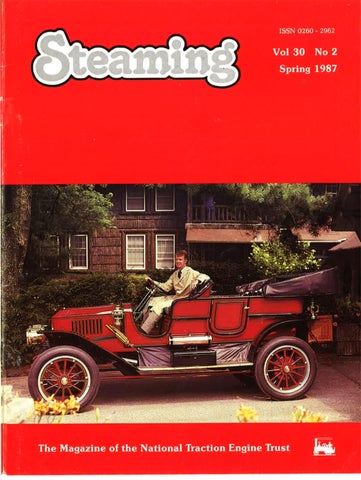
Cover This issue contains an article by Transatlantic member Alex Joyce on the Stanley steam car, published in advance of a British tour with his car during the coming summer months. The 1910 built Model 80 touring car, number 5573, is seen here at Eseeola Lodge in Linville, North Carolina, just back from the paint shop after restoration and with an elated Alex Joyce in the driving seat. The demountable rim wheels have since been replaced by the correct 1910 non-demountable type; the latter were still at the wheelwrights when William Oates took this photograph in 1983. 59
Trust News Rally Organisation Rally sub-committee I suppose most traction engine enthusiasts attend a rally at some time or another during a summer — or perhaps rally season would be a better term, since the earliest events notified for this year are in April, and the latest at the end of September. During this period we have no less than 82 approved events (at the time these notes are being written►. Surely there will he something that every member can attend, wherever they reside, for events are held throughout the length and breadth of the country. Naturally the events themselves vary very considerably in size and scope; we give an indication of the
(continued from previous page)
The Road Vehicles Construction & Use Regulations 1986 came into force in August last year without the amendment we sought, so we enlisted the help of Derek Grossmark, Chairman of the Historic Vehicle Clubs Committee, who wrote to the Department of Transport in support of our argument. From the reply he received it was clear that there was still some misunderstanding concerning water carts and it seemed expedient to arrange a meeting with the officials concerned to discuss our problem. Accordingly, on 13th October, Peter Barber, NTET chairman, Anthony Heal, vice president, and Derek Grossmark, chairman HVCC, met Mr J.T. Clifton and Mr R.W. Shiers of the Department of Transport and after some considerable discussion, Mr Clifton agreed to promote an amendment to Regulation 83, reinstating the clause in the old Regulation 137 (31, just as we had suggested in January 1986. An amendment is to be issued by adding the following words to Regulation 83 — (4) For the purpose of this Regulation, 'trailer' does not include a vehicle which is drawn by 60
number of steam engines that the organiser expects to attend his event. Often the events themselves cater for a wide variety of preserved equipment, but if an event appears on our list, then a substantial proportion of the exhibits should be steam. If any member wishes to check on the actual number of steam engines anticipated, he should contact the organiser direct just before the event is due to take place. Elsewhere in this issue is a full list of approved events for 1987. Incidentally, for a rally to be an 'approved event', it means that the organiser has indicated in general terms that he will follow the guidelines set out in our Code of Practice which my sub-committee produces and
a steam powered vehicle and which is used solely for carrying water for the purpose of the towing vehicle. To many engine owners who habitually use low loaders for moving their engines, or otherwise find they have no need for a water cart, the above account may seem of little importance. We must, however, look deeper at the implications. Our engines are an anachronism on some of today's roads and we must be alert and responsive, sometimes accommodating, to the pressures which may come upon us as we enjoy our rights to use the highway. But equally we must be ready to defend those rights, and the strength and the collective experience of the preserved vehicle movement will assuredly be of use in the future. The water cart saga could merely be a starter. It is imperative that we acknowledge this and build around us the strength and effectiveness to counter any unreasonable opposition to our activities on the public roads. (We thank Anthony Heal for providing notes appertaining to the successful revision of the new Regulations, and which form the bulk of this Editorial.)
maintains. This is designed for 'the better organisation of traction engine events' and is intended to set a standard from both an operational and a safety point of view. Ron Copp does much work in connection with the approval of rallies and compilation of the lists; we are all indebted to him for his valuable contribution to our activities. Our Spring Conference of Rally Organisers and Affiliated Club officials was held on 14th February. The conferences provide an opportunity for all delegates to get together to discuss matters of mutual interest which will, in turn, strengthen the rally movement. This year we had an excellent attendance with delegates coming from all parts of the country, which was most gratifying. The conference was held in two sessions. In the morning matters pertaining to the season ahead were dealt with — subjects covered were the rally programme, insurance matters, rally appearance money and on this occasion the Performing Rights Society. During the latter part of the morning, Jim Newnham, our safety adviser, introduced the Health and Safety Executive Document HSE/G29 — Care and Inspection of Locomotive Boilers, emphasizing the aspects
which might be applicable to the traction engine. This paved the way for the afternoon session which was given over to two talks on safety. The first speaker was Peter Legge, safety officer of the Banbury Rally who spoke on 'Some aspects of rally safety' and the second was Tony Reen (a boiler inspector) who spoke on 'The documentation and legal requirements of boiler inspection' with particular emphasis on how it might affect the rally organiser and safety officer. Both these talks were followed by a lively discussion on the matters dealt with, during the course of which many views were expressed, questions asked and answered, from which delegates will have derived much additional knowledge. (Eric Fillmore, chairman, rally sub-committee)
Engine Owners Column Boiler Test Certificates At the Rally Organisers Conference in February, some time was spent discussing the procedure for boiler testing and we had the benefit of a talk by a company boiler inspector. Under the John Scott & Partners insurance scheme, we have accepted in the past an assurance from clients that a boiler test certificate was in force, and made it a condition of the policy that it would be produced in the event of a claim involving the boiler. We also asked the date of the last boiler test so that we could issue the NTET disc. At the meeting in February, it was pointed out that boiler test certificates are sometimes issued with repair stipulations, and in some cases a time limit for these repairs was incorporated. It has, therefore, been decided that in future members of our insurance scheme will be required to produce copies of both the Thorough Inspection and the Steam Test documents so that we can be absolutely certain that the issue of a disc will mean exactly what it is intended to, i.e. that for the period of the disc there is proper insurance and a satisfactory Boiler Certificate in force. I understand from John Hirons that this has been the practice so far as he is concerned for a number of years and that the NTET Committee prefer us to adopt this new procedure. One other point came to light and that was that a number of people who obtained NTET discs do not, in fact, display them. It was also pointed out that rally organisers, who are not always steam oriented people, much prefer to be shown an NTET disc than several pieces of paper relating to boiler inspection and insurance, so can we please urge members to display these discs whenever possible. If, for some reason they prefer not to have it on the outside of the engine perhaps it could be carried somewhere a safety officer could see it on request. We are always anxious to improve the operation of our insurance scheme for engine owners and I shall be only too pleased to answer any queries at any time. (David Franklin, John Scott & Partners Ltd)
Insurance matters It has been brought to my notice that some engine owning members, who have their boilers inspected and insured through National Vulcan, are under the impression that these NV
documents are all they need to comply with the Trust and the rally organisers' requirements under our Code of Practice. It must be stressed that the NV insurance is for boiler explosion risks only; it does not give any other cover. Therefore, it is necessary to take out other insurance to cover the owner against public liability, Road Traffic Act and any other risks it is wished to guard against. I draw attention to the notes, above, by David Franklin on the slight change in the procedure for obtaining NTET discs from John Scott & Partners. I, of course, also require these documents as detailed (plus the usual proof of both boiler insurance and public liability insurance) before I can issue the NTET disc. (John Hirons, Insurance Officer)
Whither the NTET? Although this item from member John Newton was submitted for publication in our Letters pages, the views expressed are important to all
members and it is appropriate for them to appear here in the Trust News section. The issues raised, whether one supports them or refutes them, are worthy of further thought and discussion and we will be pleased to receive members comments. — Hon Ed. For some considerable time, I have been concerned over the role played by the NTET and its apparent increasing remoteness from the average engine enthusiast. Please do not look upon me as a Philistine for writing thus — the motives are pure, my only concern being the long-term survival of the National body. However, as I see it, if there is to be a future for the National then a major change has to come about. At the time of its formation, the whole preservation movement was in its infancy. The idea of a club covering the country, catering for a growing band of enthusiasts was indeed sound. No one could have envisaged that within years a great number would become interested, to such a degree that many localised clubs would appear. By their formation, it was inevitable that no club purporting
From Alan Martin's Collection
36
My picture this rime depicts a scene once commonplace at agricultural shows up and down the country. This location is the Royal Counties Show at Chichester in 1908 and Carter Bros of Billingshurst, Sussex appear to be preparing their stand, the engine being 6hp Clayton & Shuttleworth traction 40550. Could the bigger boy be telling his father "When I grow up I want to be an engine driver" or maybe asking "Will you buy the engine for us, Daddy?" 61
to be national could hold its appeal in the same way, and so its role was gradually to change. Yet I passionately believe that, today, more than ever before, every enthusiast in the land needs a national club — a body that can speak with one voice and sit-in where decisions are being made; where legislation is being formed, which, at a stroke, could disrupt our Kobby. A body that would know that it was speaking for, and had the backing of, every club nationwide. Decisions made by just such a body would affect everyone, and therefore it would be vital to all to have an interest in the well-being and longterm standing of these decision makers. The role that I propound for this body is that of an authoritative and legislative nature. How can this be achieved? What I have in mind is a group, not having individual members as such but being composed of say one or two members of every NTFT affiliated club. These would be nominated by their own clubs, and would, therefore, be truly representative of the national movement. These nominated persons could, in turn, elect a governing council or committee of say 12-20 from among their number, who would serve as the elected body of the national movement for one year. Officers, with the exception of Secretary and Editor could be elected from within this council to serve various posts on an annual basis, no one member being in a post for more than three years unless by meritorious service. In this manner many persons would have the opportunity of serving a key role in the governing circle, and a changing pattern would be gained. New persons bring new ideas. The valuable work at present undertaken by the NTET committee could therefore continue. Specialist advisers could be co-opted for the expertise, but under my suggested set-up, the tier would have some teeth, for would not every member of every club now be directly involved with the decision making, via their own club representative? Indeed, should they feel that their own man was not doing enough on their behalf, he could ,be replaced. The keenest ones in the movement would work hard to ensure a seat on the council. I believe that through this new structure, every voice in the land would have the opportunity to be heard, and every club would seek to be affiliated, knowing full well that their fellows would be safeguarding their own interests. The Code of Practice could now really be implemented; insurance companies could be asked 62
A Worcestershire Foden Joe Thomas kindly sends yet another steam wagon picture — but this time not of his favourite type — the Sentinel — but of a Foden in Worcestershire. The scene is north of Upton-on-Severn on the road to Powick and Worcester, just by the turn off to Hanley Castle; the group is posed on the wrong side of the road facing Powick. Standing over the front wheel is driver Albert (Pitch) Bailey. The steerer is Charles Canfield (or Gran field) and at the rear is Jack Ames — the latter's name appears on the back of the original picture together with the date '1st May 1924/25' and one wonders what made whoever wrote the words so sure of the date but not of the year. The Foden was owned by R.C. Laird (Jock Laird), proprietor of the Malvern Hill Granite Co at Wyche, Malvern, one of the three acquired by him shortly after World War 1 from Government surplus sales. Foden records detail these wagons as works numbers 2082 of 1910 and 4612 and 5058, both of 1914 — the first pair listed as requisitioned from earlier owners by the War Department in 1914 and the last one as sent new to the Admiralty. All were subsequently given new registrations by Worcestershire County Council for their new life but there is nothing recorded anywhere to connect them with the Foden numbers. Alan Duke found Worcestershire licensed A88164 for Laird at Malvern in August 1920 and AB9724 in May 1921. The third index number, and the one carried by our subject, AB6030, is known only from this photo. Its sequence relative to the others presumably indicates Laird first used the wagon on the highway early in 1920. Can our Foden experts say from A86030's appearance which Foden it is likely to be, or not to be? And what does the inscription SMCR 273 over the registration mean — is it a hangover from the service days (Steam Motor Convoy...?) or something of post-war significance.
to quote for national coverage (which could result in more competitive prices) and boiler inspection criteria could be regularised — many things are possible if numbers are sufficient. No longer would any one club or individual for that matter be negotiating on their own behalf and be dealt with like a voice crying in the wilderness.
"But what of finance?" I hear the cry go up. I submit this could come from increased affiliation fees to all clubs, and also from individuals subscribing to Steaming. This magazine is too precious for us to ever contemplate doing without, and could be made available to individuals on subscription in much the same way as at present, or alternatively could be
purchased en bloc by the affiliated clubs and sold to their members. The profit from the sale of this magazine, together with the NTET sales stands, (which like Steaming are too valuable to disband) could provide sufficient revenue to ensure the long term survival of the National Club. I realise that some of my ideas may need a little more in-depth study to get them right, but I fervently believe this is necessary if we are to have an elected body of persons under the banner of the National Traction Engine Trust — I prefer Club — to take us forward towards the twenty-first century. Let us not forget that we are still less than fifty years away from the commercial life of steam, and it behoves us all to ensure that what started out so well has indeed a future worthy of those beginnings. What I dream of is a healthy, vibrant and forward-looking leadership of this great movement, on which the mantle of National sits easily and which carries with it the undying support of all who, like myself, claim to be traction engine enthusiasts. (John L. Newton, Hunger ford, Berkshire)
Obituaries Geoffrey Hunt The steam engine movement was deeply saddened by the loss during 1986 of one of it's long standing enthusiasts, Geoffrey Hunt of Highcliffe, near Christchurch, Hampshire. Born in March 191 5 at Spire Hill Farm, Stalbridge in Dorset, his family later moved to !ford Farm, near Christchurch. There, at the tender age of nine his appetite for traction engines was wetted. One of my family's sets of threshing tackle regularly visited the farm and it was during those times that a strong friendship was estab-
lished between Geoff and the driver, Billy Ewins. Upon leaving school, not being able to follow a career in engineering at sea as he would have wished, Geoff moved into the world of glass and glazing. He served his apprenticeship with Mr Ward of Southbourne, later moving to James Clark of Winton, but unfortunately during this time (1946) he and a fellow workmate had a serious accident through a fall. It was probably during the long recovery period that seeds for the birth of his own company germinated. Priory Glass was founded in 1953 in the old malthouse in Christchurch, and by 1960 new premises were acquired, and buildings constructed. Then, a desire which had lain dormant since early days at !ford Farm began to come to life. Geoff had said on more than one occasion to Stella his wife, how much he would love to own a traction engine, if only he had a piece of land where he could keep it. Now his dream could become reality, and it wasn't long before a visit to Essex secured Marshall 57304, a three speed compound engine — 'this clanking contraption' as one of his friends described it. At that time, much as today, a traction engine on a lowloader aroused more than a passing glance, but it happened that the Marshall's arrival in Hampshire was spotted by one of Seth Loader's employees, and the question was, where was it heading? Soon the Marshall was tracked down, and so started a long and lasting friendship between Seth and Geoff. The Marshall hardly had time to catch breath, for that coming weekend was Cranbourne Festival and after some gentle persuasion, Geoff allowed CHALLENGER to attend. There, after quite a period of time, an old friendship was re-established, for under the tuition and watchful eye of Billy Ewins, Geoff was finally able to realise that feeling of driving your own traction engine. To be able to put into words the sense of friendship felt by those many people who knew Geoffrey Hunt is unfortunately beyond my powers of literacy. He was a person of great courage, and a source of encouragement to others, always sincere and warm hearted, with a sense of humour and a friendly smile; to say he will be missed is a very great understatement. It was a privilege to have know Geoff. (Mark Loader)
Ernie Speed Joseph Ernest Speed died suddenly on 3rd November, 1986. Ernie was born into a family whose lives were
involved with steam, his father being the driver of the Marshall traction engine owned by Cholmondeley Estate. It was always Ernie's ambition to own an engine and this he achieved in 1976 when he purchased Aveling & Porter road roller 10893. In 1984, he sold the Aveling and acquired Fowler road roller 16665. In addition to rallying his own engine, he also worked hard behind the scenes to ensure the success of the preservation movement. He was a committee member of both the Malpas Vintage Machinery Association and the North Staffs and Cheshire Traction Engine Club. Ernie appreciated that hard work was required by enthusiasts to produce a good rally. He lent his support to the Gredington Park, Hamner Rally and the Queens Park, Crewe Rally — both popular events: Ernie had a steady, quiet and happy personality, nothing was ever too much trouble for him if he could help, it was always a pleasure to spend time in his company. On November 7th, relatives and friends from many walks of life crowded into the small church at Bickley to pay their respects. Ernie's passing leaves a void in the preservation world for he will be greatly missed. He is survived by wife Clare and children, to whom we extend our sympathy. (Peter Millington)
Joe Warren With the death of Joseph Nankervis Warren of Cam Brae Village, Redruth, Cornwall, during February, the West country has lost one of the most wellknown members of the steaming fraternity. Although never involved with steam to earn his living, Joe Warren had a lifetime fascination for the road steam vehicle. During his years in the army, he would take the 63
opportunity wherever he was posted to seek out engines in that particular area. In the early 1950s, he purchased Fowler Tiger tractor 14798, followed by Garrett tractor 33353, and so became one of the first individuals in Cornwall to preserve engines. The Garrett he took to the county's first steam gathering at Coombe in 1955, a direct consequence of which was the formation of the West of England Steam Engine Society, Joe being a founder member. In 1957, a Sentinel DG4 8454 joined the collection. This was steamed down from Hampshire and christened ST. UNY after the parish in which Joe lived. It was followed early in 1958 by Burrell road loco 3455 SEMPER FIDELIS, steamed home to Redruth from North Devon. They were merely tho first of covoral engines to pass through Joe's hands over the years; never content with restoring one engine and sticking to it, he loved the challenge that each restoration prnjer•.t presented, and was as happy riveting stays in a firebox as he was at the regulator. His most ambitious project was undoubtedly the ten-year restoration of Foden C type wagon 11208, purchased in extremely derelict condition at auction in 1971 and rallied extensively in Devon and Cornwall since 1982. At the time of his death he was progressing rapidly towards the complete restoration of Burrell showmans road locomotive QUEEN ALEXANDRA purchased jointly with his son Dennis in 1982. Many enthusiasts sought Joe's advice over the years. If they wanted someone to cast an experienced eye over a possible candidate for purchase, or required assistance when problems arose with their own engine that they were unable to rectify themselves, then Joe would readily make himself available to offer a guiding hand. It was not often that a steam enthusiast could not be found at his Carn Brae Village garage. Many's the time I have arrived home late from work, having first called on Joe 'for a few minutes'l Once in conversation, it was difficult to drag yourself away from a person who had so many interesting experiences to relate. He also liked to listen to others and I always found him eager to hear about my own visits to rallies. Never one to force his opinions on anyone, he nevertheless had principles, one of which was the identity of the steam engine on a rally field. To him, such events were founded on steam and, quite rightfully, the engines should have pride of place, not pushed into some supporting role as has been seen to happen. 64
He was recently elected as vicepresident of the West of England Steam Engine Society, with which he had been actively inolved since those early days. When initially asked to accept, he commented, typically, that there ought to be someone more deserving than himself for the position. All those who had been privileged to know him thought differently. Joe Warren will be remembered as a man of steam in the true sense. A man who earned the respect of the preservation movement and who will be impossible to replace. (Alan Thomas)
together in the two sequences as detailed above. Readers wishing to take advantage of the service should post or otherwise take their copies of the issues concerned (well packed to survive any attempted improper handling in transit!) to AB Printers Ltd, 33 Cannock Street, Leicester LE4 7HR, enclosing their remittance for £9, cheques made payable to AB Printers Ltd. Please ensure the package contains a clear note of your name and address. The magazines must be received at Leicester by 11th May 1987 and will be returned to their owners about six weeks after that date.
New Members It has come to our notice that some members have been receiving mailshots from a member living in the South Coast area, apparently by use of the New Members list which is published in each issue. There is the implication within this unsolicited mail that some of the goods are offered with the approval and on behalf of the NTET, This is not so and we apologise to any recipients who have been offended; the actions have been without our knowledge and the sender has been asked to cease use of our lists for his personal commercial purposes.
Steaming Arrangements have been made with our magazine's printers to again provide a service for readers who wish to have their individual copies of Steaming bound into volumes. The magazines are the 12 issues comprising Volumes 27, 28 and 29, and, as when we last went through the exercise three years ago, readers will find the magazines bind up into a splendid 600 page book. The covers are heavy dark blue cloth boards with the spine lettered in gilt with the Steaming logo, and also the volume numbers and dates. The magazine's colour covers are, of course, retained. The price of binding is £9 and this includes the return postage and packing. The twelve issues of Volumes 24 to 26 can also be bound up at the same rate, but please note it is only possible to bind the magazines
NTEC Sales This coming season the Trust's Sales Stands will additionally be carrying a variety of new items, including button badges, thimbles and boxes of sweets, all decorated with illustrations of engines. If the avid engineman feels such items to be unnecessary it should be remembered that we are trying to present a wide variety of engine-related souvenir goods to all rallygoers, with the aim of promoting traction engines generally as well as the Trust itself. This year's sales team is — • Keith and Tracey Shakespeare • David and Andrea Duffill • Ken and Edith Beeby and they will hopefully be attending the following rallies during the first half of the season. Reference to the Rally List will provide details and full titles, etr•.. April — Road/Rail Steam 87 (Ken) May — Yeovil (Keith); Abbotsfield (David); Stoke Goldington (David); Trentham Gardens (David); Anglesey (Keith); Derbyshire (David); Builth Wells (Keith) June — Knebworth (Ken); Shrewsbury (Keith); Weston Park (Keith); Great Amwell (David); Newbury (David); Lyme Park (Keith); Banbury (David). July — Chiltern (David); Elvaston (Keith); Uckfield (David); Woodcote (Keith); Rempstone (Ken); Weeting (Keith); Cumbria (Keith); Rushmoor (David). We look forward to seeing you at any of the above events, and of course to selling you something from our wide range of books and other traction items — all to aid the Trust funds! (Tracey Shakespeare)
Corrections We apologise for an editorial error in the last issue where Percy Grundy's name was introduced on line sixteen of the first column of page 22; the name should have read Darner. The registration number of Foden 13518, pictured on page 49 was VR3669, not as shown.
of the five strong E class 3 cylinder previously not as machines, suggested. 11796 to 11799 of class E1 followed in 1909 and were similar engines but without the third cylinder — both these classes had 6ft 0in diameter hind wheels. Thanks are due to Les Burberry and the Museum of English Rural Life at Reading University (Fowler collection) for information to make this correction.
Fowler Military Engines Some correction is necessary to errors introduced into the caption to the picture of the Fowler military tractor in the Summer 1986 issue. Information previously published elsewhere on these interesting machines is not entirely accurate; the picture on page 137 is, in fact, one of a number taken by the work's photographer on the occasion of the trials of Fowler E class 3 cylinder tractors 9951 and 10104 on 23rd February 1905. Captain Bagnall-Wild of the Royal Engineers is standing at the rear of 10104 and the driver is one Randall — probably a Fowler employee. The test journey was over the 291/4 miles of the Wetherby route. The engine in our picture, therefore, is 10104, one
OUR MAGAZINE 25 YEARS AGO
Chairman Philip Wright was pleased to disillusion the majority of members who understandably thought steam had had its day from a commercial standpoint. He could report that Robeys of Lincoln had four portables under construction at that time. The machines, destined for export, had
101/2 x 14 single cylinders and disctype wheels. The firm's current catalogue offered singles in four sizes, doubles in four sizes and compounds in three. Willie McConachie and his son had steamed their engine 600 miles from Tarland, Aberdeen to Chester-leStreet, Durham and back. The Chiltern club reported it had gained strength and now had 46 members. Geoff Wheeler was engaged on producing cut away drawings for the Eagle comic magazine: so far a scenic Burrell had been done, and an Aveling roller and a Fowler agricultural were to follow. Arthur Mills had produced a gramophone recording of his fair organ, which was one of the first such offerings. It sold at 37s 6d (£1.871/2 p). Now, there's something which hasn't gone up in price all that much! Notes on some engines lying in a scrap yard at Wellingborough, Northants had been sent in by a young man by the name of Roger West. Despite being so highlighted, the flywheel and crankshaft-less Allchin portable 723 failed to attract anyone before it was subsequently cut up, but still waiting for its luck to change, 25 years later, Aveling roller 6793 remains a resident of the yard.
IMPORTANT INFORMATION FOR THOSE NEEDING ECONOMICAL REPAIRS ON THEIR TRACTION ENGINES
PINIONS
SPURS
BEVELS
All types and makes of bevel gears, spur pinions, spur wheels, helical gears etc, rebuilt to standard.
B. & C. Reconditioning (Gears) Ltd Unit 7, Lower Ardglen Estate, Evingar Road, Whitchurch, Hampshire RG28 7BB. Telephone: Whitchurch 3701
65
Maxwell Hemmens Precision Steam Models Steam Replica Specialists and Manufacturers of the largest range of high quality working Models and bolt together Kits in the world.
Our Models range in price from £100 — £10,000 and can be seen at our Showroom at Thorganby which is situated only six miles South East from York City centre, or send for our fully illustrated colour Catalogue, priced at £1 (or the equivalent in postage stamps) to the following address.
Maxwell Hemmers Precision Steam Models `The Steam Gallery', Thorganby, York, North Yorkshire YO4 6DA Telephone : 0904 89 331
66
The Stanley steam car Steam cars rarely feature in our magazine and this fact reflects that their use and popularity in Britain was somewhat restricted. In the United States, however, matters were different and our member Alex Joyce of Nashville, Tennessee, offers this insight into the well-loved Stanley steam car, in advance of round Britain tour later this year in his 1910 example.
Of the 500 plus Stanley steam cars known to still exist, two in very good mechanical shape will be touring England, Wales and Scotland during July and August 1987. Both are 30hp seven passenger touring cars. The author will be in his 1910 Model 80, accompanied by fellow tourists, Brent Campbell and family, in their 1911 Model 80. After the tour, the author's 1910 steamer will be on display under steam, if it can be arranged, at one or two end of the summer meets. We hope that this will afford British steam enthusiasts an opportunity to see a larger Stanley under steam. This article, following a very brief history of the early years of the company, will be a fairly in-depth look at the power plant employed by Stanleys in their 1910 and 1911 30hp steamers. The Stanley twins, Francis Edgar and Freelan Oscar, usually referred to as F.E. and F.O., were highly successful inventor/entrepreneurs. They were the architects for many notable buildings in the north-eastern United States, were well known as carvers of fine violins, built early X-ray equipment and designed and supervised the pouring of the first insitu concrete structure in Boston, their own factory, as well as the second — the Harvard University sports stadium. F.E. and F.O. in 1886 patented a coating dryplate photographic machine that upped production from 60 plates per hour to 60 per minute. On 7th January 1904 the patent was sold to George Eastman of Kodak fame. In the New England community in which F.E. lived, bicycling was the rage in the 1890s. In 1896 F.E.'s wife Augusta, a very large woman, and never a good cyclist, crashed her bike. It is known that F.E. had been
interested in automobiles; the bicycle incident appears to have prompted him to start working on the first Stanley vehicle so as to allow he and his wife to accompany their friends on bicycle outings. Augusta embarked on a vacation trip to France in April of 1897 with instructions from F.E. to find out what kind of motor power was being used in France. In a letter to Augusta (while she was still in France) F.E. says 'I am out of horses and I intend to see this auto business through if it lasts 10 years.' By spring of 1898 he had completed three steamers. One was sold in September,
one was dismantled after it crashed at Kennebunkport in Maine and one was kept. During these first years F.O. was not interested in automobiles. At the Boston Auto Show of October 1898 the brothers were found measuring and photographing, sketching George Whitney's steamer (they had already hired two of Whitney's former employees). Though not exhibitors at the show, the brothers were asked to demonstrate their steamer at the competitive exhibition of cars to be held at The Charles River Park Velodrome on 8th November. The Stanley lapped all the other cars (beating the mile world record by 22 seconds) and climbed an incline 15° steeper than the nearest competitor. Within two weeks the brothers had firm orders for 100 cars. Upon being offered $250,000 in early 1899, they sold their patents and the company. Within one month, the company was split into two companies, the Locomobile Co and The Mobile Co of America. Both companies failed as steam car manufacturers and the Stanley brothers then bought back the patents, and the work in progress inventory, for $25,000 in May of 1901. They resumed manufacture with significantly improved designs and sold some of the older patents to White for $15,000. 1905 was a transition year from steamers that looked like buggies (lightly constructed and tiller steered
Mr and Mrs F.E. Stanley with relatives in a circa 1908 Model M Stanley steamer. This is an early 30hp 5-passenger touring car and a predecessor of the 1910, and later, Model 80 cars. The scene appears to be near the Stanley Motor Carriage Co factory at Watertown, Massachusetts. (courtesy Stanley Museum, Kingfield, Maine) 67
--
.11 1 1, 1 • 111:II 7
•=1111=4
The Stanley Motor Carriage Co's branch in Denver, Colorado. The three steamers appear to be 1910 models, perhaps of 20hp. (courtesy Stanley Museum, Kingfield, Maine)
with the boiler and engine under the seat) to the familiar Stanley layout of boiler under the 'coffin' bonnet, water tank under the front seat, fuel tank under the rear seat (or deck in the case of roadsters), and the engine directly coupled by spur gearing to the differential. Stanley during this period manufactured steam cars of 10, 20 and 30hp. By extrapolating State of Massachusetts vehicle registration figures for the period 1910 to 1912, one finds that 62% of cars produced were 10hp models, 34% were 20hp models and less than 5% were 30hp models. The 30hp Stanley has a vertical fire-tube boiler 26in diameter and 16in tall. The shell (drum) is of 7/16in steel with %in steel top and bottom tube sheets recessed %in behind the plane of the ends of the drum and welded. Two 5/16in x 1%in steel bands are shrunk and welded (with nine '/ in countersunk plug welds) about the circumference of the drum, one band each so as to be flush with each end of the drum. The circumference of the drum between the bands is wrapped with four layers of 0.037in steel music wire pre68
tensioned to 251bs. As the wire has a lower coefficient of thermal expansion than the shell, a considerable safety margin is gained whilst having a very lightweight boiler (approx 500Ibs1. Note that the original Stanley boiler shells were of lighter material, relying on the wire for safety; to be in compliance with current boiler practice the heavier shell is now used. There are several tube spacing patterns in use, the most common is 990 '/z in tubes, in staggered rows on 47/64in centres. Most early boilers were copper tubed, a transition to steel tubes coming in the post 1914 condensing car era. In the early boilers the copper tubes were swedged with a tapered pounded swedge and ferruled with steel ferrules. Evenly spaced about the edge of the bottom tube plate are four %in stainless steel elbows, each leading radially out to blowdown valves. One is tee-ed into the water glass. Centred in the top tube sheet is a %in elbow leading to the throttle. Three other topside '/4 in fittings accommodate the water glass, whistle, steam automatic, feed water inlet, and safety valve. Boilers are hydro tested to 12001bs at fabrication and usually
hydro retested to 1000lbs each year. Normal working pressure is 550 to 6001bs sq in. There has never been a Stanley boiler explosion. In addition to the safety valve, the copper tubes act with low water as 990 fusible plugs and with excess pressure as safety valves. Snugged up under the boiler is a pressurized vaporizing kerosene (paraffin) burner of the same diameter as the boiler. Fuel under 120 to 150Ibs pressure is fed into a coiled 9 foot steel vaporizing tube 3%in o.d. that lies 1in above the burner grate. The last 10in of the vaporizer is 2in in diameter with the same i.d. and is known as the barrel. The barrel lies directly over the pilot burner. From the barrel, the vaporized fuel exits the burner casing and is split at the branch fork into two short down tubes, each terminating in a nozzle that shoots vaporized fuel through its own 2 to 3in venturi tube into a mixing chamber under the burner grate. The fuel-air mixture then passes up through a slotted cast steel grate where it hopefully burns above the grate. The pilot burner is a miniature of the main burner. It burns a more volatile fuel (rubber solvent or white, unleaded petrol). The pilot serves three functions. It keeps the barrel of the vaporizer hot enough to vaporize that first shot of main fuel as the burner cycles on; it ignites the main burner; and it maintains a head of
steam when the main burner is off and the throttle is closed. It is the pilot that prod ices the faint hissing noise that one is able to hear when the car is at rest. From the poppet valved, unbalanced throttle, the steam is fed into the superheater which is a 3/4.in diameter mild or stainless steel 10 foot coil lying in the firebox immediately on top of the vaporizing coil. Superheat steam exits the fire box at approximately 800°F, is led up into an inverted U bend and then back under the left side of the car to the engine. The U gives the steam line sufficient flexibility to accommodate engine movement and chassis flex. At the apex of the U (or at the steam chest, by restorers preference), steam cylinder oil is induced into the line at a rate of 1 quart (US) per 100 miles. Exhaust steam passes through the feed water heater and then to the atmosphere. The simple, double acting, two cylinder, 30 horse engine has a 41/2 in bore and a 6 1/2 in stroke. Stephenson's link valve motion operates D slide valves within a common box-shaped steam chest between the two cylinders. All bearings are of the ball or
roller type except for double-tapered pin bearings at the crosshead. A single drip valve is threaded into the inspection port at the bottom of the chest. There is one hooked-up position in forward (65%) and none in reverse. The engine, lying horizontal with the block forward, is directly coupled to the differential by straight cut spur gearing. Because of the close proximity of the 90° crank to the differential, there is little room for effective counter-weighting. With 27in wheels, 37 x 5 tyres and a typical gear ratio of 48 to 60, the engine turns 680 revolutions per mile. Both the main burner fuel system and the feed water system operate on the by-pass principle. The pump pit, located under the driver's feet, contains four pumps (forward water, rear water, fuel and cylinder oil) arranged as a capital letter H. Each leg of the H is a plunger and the cross piece is connected by a pump arm to the engine right side crosshead. Main burner fuel (paraffin or clear diesel cut with a more volatile fuel) is drawn from the unpressurized main fuel tank and pumped into a pair of pressure tanks of half-gallon total capacity. To provide a cushion to the
3 tube body
positive displacement pumps (so as not to have the fire pulse with each pump stroke), one of the pressure tanks is half filled with air. Connected to the pressure tanks is the 'fuel automatic', a spring loaded diaphragm valve, which maintains proper fuel pressure by by-passing excess fuel back to the main tank. From the pressure tanks, the fuel passes through a manual main burner valve to the 'steam automatic', another diaphragm valve. Rather than spring loaded as the fuel automatic is, the top face of the diaphragm of the steam automatic is exposed to full boiler pressure. An adjusting spring counterbalances the diaphragm of the valve so as to open the fuel line as steam pressure falls below 5501bs. From the steam automatic, the fuel passes through the 'low water automatic', a thermal expansion rod valve set to kill the fire as the water level falls dangerously low, and on to the vaporizer. The 50 gallon main water tank is fitted with a water lifter with 20 to 30 feet of hose terminating at a screened filter head. Water is drawn from the main tank into two feed water pumps, each of which has its own by-pass
Stanley piping diagram of a post-1914 car. The relative position of the components is fairly accurate. exhaust steam
feed water heater—'' if
throttle 1 rPEE41117,7 =.— .7-7'',.4.
engine
LI
....1C1/11......:-
a
a 7Flr,,,... —,-,77--.,1,i2. r-'.'e- 7 ..•
T ...
'''''Z-Z--.i i ,I..11 -<1 t,Ill •,TT - '= ', ',-.-.-..,,,,,,,,,,,,:n7.:Tru-,--,,,gliir t:L_,
fuel tank
---211.411,11,[eni.0112.66MMIA c.21,,-, -...rin,-,-=:11111iiilitig........ .0114nrnIrealq im ,V,r. —•= ...
water steam tilIMER171
fuel
gasoline burner 69
fire-up valve
to vaporizing coil to steam
to top of boiler
gauge
e••
to buil t feed
4.1t+N. • 'll/ t,st,. AN-,
MI
stand pipe P4-4•4 N 11 1 IN0.1 1\4,11 . try cock .%
fuel filter from pressure tank
to forward • by pass
L.0::,,
e.A
from pumps
to water glass
to bottom of boiler
The Stanley engine; parts numbered 136 make up the crosshead pump drive.
valve. The rear by-pass is usually left open, as the front pump alone is adequate for level terrain driving. From the by-pass valve, water is pumped through a feed water heater and into the boiler. Perhaps the most interesting device on the car is the Stanley Patented 3-Tube Indicator, an indirect reading water glass. This type of indicator can be safely operated at boiler pressures well in excess of 600 lbs because the cockpit side water glass is under no pressure, because there are no moving parts to malfunction, and because the indicator body is made of heavy gauge steel. Reading it is confusing at first for one must remember that low water in the glass means plenty of water in the boiler and vice versa. The indicator body and glass can be seen in the upper left quadrant of the piping diagram. Cool feed water circulates through the left tube, the central tube communicates to the top and bottom of the boiler and hence has a water/ steam interface that fluctuates with boiler water level, and the right tube is filled with water and communicates with the open top water glass visible to the driver. Steam in the middle tube condenses rapidly due to the cool feed water being circulated through the left tube. With a high water level in the boiler, the middle tube is water filled and no heat of condensation is released to the water in the right hand tube. As the water level falls, more space in the middle tube is filled with condensing steam releasing enough heat to cause local boiling of the water in the right tube (remember that at 550 lbs steam condenses at 477°F while at atmospheric pressure water 70
The Stanley Patented 3 Tube Indicator and low water automatic valve, as described in the text.
boils at 212°F). Since water expands upon vaporization, the water level in the indicator glass is pushed up, indicating that the water level is falling. There is a continuous line of braze connecting the left two tubes. The middle (or heat sending) tube and the right (or heat receiving) tube are connected by two distinct braised heat bridges, one 3in above the other. The indicator thus indicates low, normal or high water. Most Stanley owners will not use the 'Ouija Board'. Two or three of us however do use it with a direct leading glass as a back up and two older steam men will use nothing else. Firing up from cold can be forced in 20 minutes as period sales literature indicated was normal practice. However, most now choose to light the pilot, hang around a few minutes to make sure that the pilot is burning strongly and then head off for a cup of coffee, breakfast or to do other needed maintenance. In a half hour or so, the barrel is red hot, the fire box is warmed up and the chill is off the water and flues. After opening the hinged cover to the 'smoke bonnet', the main burner valve is cracked open a turn and then quickly shut off upon hearing fuel first spurt from the nozzles. Give the burner about 30 seconds, until this first dollop of fuel is burning strongly, and then reopen the valve. While firing up, the hand brake is left on, the throttle cracked, and the drip left open so as to allow steam to cool the superheater and warm the engine. As pressure builds, one slowly closes the throttle and then the drip. With the 'fire-up valve', one can light off the burner with more volatile pilot fuel and then change over to main fuel. This is particularly helpful on cold
mornings and when forced to burn diesel. Driving a Stanley is truly a pleasure. The driver has a commanding view of the road and few controls with which to dither. Steering is accurate, the hand throttle is light in operation, the hook-up/reversing pedal can be operated without taking one's eyes from the road and the brakes are not too bad if well maintained. The real test of skill however, is how well your nose and ears communicate the Stanley's signals to your brain, and then how well you process that input, for a Stanley is driven by how it smells and sounds. Unlike the larger solid fuelled steamers, the driving, firing, and water level maintaining are done by the driver alone and commonly at 45mph or more. Also remember that a Stanley has no injector to fall back upon if you have misjudged the terrain or load. Burner problems are quite common, but rarely lead to serious consequences. At the end of a long downgrade only intuition and a very acute sense of smell (particularly if you are following another steamer or a diesel engined vehicle) can tell you whether your pilot has been snuffed out by any one of many causes. Among them are stiff cross or tail winds, burner backfire or the tiniest speck of dust or air bubble in the fuel line. If the pilot is out and goes undetected, the main burner can load up with raw fuel and a spectacular backfire ensue. This past summer on a five mile downgrade, the author must have dumped a gallon of raw fuel into his burner before contact with a remaining hot spot in the burner casting ignited a
A Model 70 5-passenger 20hp Stanley touring car, probably pictured in Massachusetts in 1911 or 1912. Starting in 1910 a model numbering
system was introduced — a leading 6 means 10hp; 7 means 20hp and 8 represents 30hp. A last digit of 0 or 5 indicated a touring car, whilst t equals a close coupled (small) touring car, and 2 or 6 a roadster. The Model 80 is a scaled up 70 having a 127in wheelbase rather than 115in. (collection Alex Joyce)
spectacular fire which burned with a yellow smokey six foot flame out from under the bonnet for an hour. No harm was done except to paintwork and to my pride, as motorist after motorist tried to come to my obviously needed aid. A weak pilot and quick acting steam automatic can have similar results. Water problems lead to far more serious consequences, the feared scorched boiler. The bottom tube sheet of the Stanley boiler is flat with no mud drum. Because the lengths of run of the piping to the water glass are quite long (2 foot waterside and 1 foot steamside) and because the waterside fitting has to come off of the lowest point of the boiler (for the circumference is wirewrapped), the slightest accumulation of sediment can cause irregular readings. Even with frequent
blowdowns, it is a problem. With water down a couple of inches, a sharp bend taken at speed, a panic stop, or an unexpected steep up or downgrade can uncover a portion of the tube sheet, allowing the intense heat of the burner to soften the ferrules. As water and steam come pouring out the burner mixing tubes one can only pull off the road knowing that a long night with the hammer and swedge lie ahead. On the 1986 Steam Car Tour, five out of 25 Stanleys scorched their boilers during the five day tour. The parking lot at tour HQ reverberated with the sound of swedges late into the night as five boilers, totalling close on 4,000 tubes received some 20,000 blows from hammer on swedge! The joys of owning and driving a steamer are myriad, but overcoming a
'Patent Traction Engine — Lee & Co — Engineer & Machinist, Manufacturer of Patent Traction, Portable and Fixed Steam Engines, Double and single blowing Threshing Machine, the Prices of which will be found more moderate than those of any other maker. Works: Church-gate, Leicester.' (An advertisement in the Midland Free Press, 5th April 1862.1
'Mr H.W. Buddicom, Estate Office, Penbedw, Nannerch, Mold to Mann's — 'Ever since you supplied me with the steam cart, in January 1904, it has worked in a most satisfactory manner. I find it most useful about the estate; it does work that would kill horses. It (From The can go anywhere.' Commercial Motor, 16th February 1911.)
problem on the road undoubtedly gives the most satisfaction. There are three in particular that your author can remember. On tour in 1985 the gauge glass cracked. I isolated the glass and steamed 80 miles home by (every five miles or so) carefully running the water level up to mushy pre-prime and then backing off the by-pass a bit (since, and because of then, I have refitted the 'Ouija Board'). On tour in 1982, we ran low on pilot fuel. Once on the open road, the pilot was shut off, and by careful manipulation of the hand fuel valve, steam pressure was kept high enough to run, but low enough to keep the automatic from shutting down the fire. And finally, once when three days from home, my 1914 roadster had a truly spectacular backfire which totally destroyed the smoke bonnet and stack. It was the Saturday evening at the end of our summer Bank Holiday Weekend with no sheet metal shop in sight. I was able to get a handful of stiff wire coathangers, two rolls of kitchen aluminum foil, a box of paper towels (as commonly dispensed in public lavatories), a 10Ib bag of flour and a spool of picture hanging wire. With the coathangars I was able to build up a frame, which was then sheathed in aluminum foil, which was then papermachOd with wetted towels dipped in flour and all was securely bound up in picture wire. It got me home, but the aroma of baking bread wafting over the cowl left me ravenous for the remainder of the journey.
I wish to acknowledge the assistance in the preparation of parts of this article of Susan Davis, director of the Stanley Museum, Kingfield, Maine.
'It is interesting to note that the St. Pancras Iron Works Company Limited of 171 St Pancras Road NW, regularly tests its steam wagons, up and down Highgate...' (From Hill, West Commercial Motor, 6th September 1906. A previous article had noted the hill as being very long, the last 400 yards being at an average of 1 in 14, with a maximum of 1 in 9.1 71
BURRELLS IN NEW ZEALAND Burrells did rather well in selling engines to customers in New Zealand in the early days of the century and the Hawkins family of Clarkville, Kaiapoi, near Christchurch, South Island arc proud to preserve no fewer than four of those engines sent out from the Thetford works. In the picture of the line-up Bob Hawkins is seen with his son John and grandson Sam in front of Burrell 3130, a 10hp three speed double crank compound. Built in September 1910, the engine's sale was handled by Dunedin agents Reid & Gray; it has been in the Hawkins family since 1942 and was in constant use until 1957 for general contracting work, pile driving, log hauling and house moving. Over the past ten years the Burrell has been used to drive their sawmill. Second in line (from the left) is Burrell 3228, another three speed double crank compound but this time of 8hp and built in 1910. It has only recently come into the family's possession but is a well known engine in the Kaiapoi area and was in everyday use until 1965. Next, with the canopy, is Burrell 2532, a two speed single crank compound of 1902. This 8hp 72
engine spent all its working life with one family, faithfully serving three successive generations. Bought by the Hawkins three years ago it is the only
single drive Burrell to survive in New Zealand. Not much is known of the local history of Burrell 3260, on the right hand end of the line-up, but it is in very good order, not having done much work. Now owned for eight years at Clarkville, it is a two speed 8hp single cylinder engine, built in 1910. Grandfather Hawkins went to New Zealand about 1923 from a village near Huntingdon, Cambridgeshire. His first job was on a threshing plant and he then spent 25 years driving traction engines. Bob Hawkins, an NTET member, left school at the age of
thirteen to drive 3130 and has been involved with steam ever since. The close up picture is of 3130, and illustrates proportions which will be somewhat unusual to those familiar with Burrell products which stayed in England. (notes by R.J. Hawkins, photos courtesy G. T. Radcliffe.)
A Threshing Plant: Mr Watson, Messrs Reid and Gray's representative at Timaru, has invited all persons interested in threshing plants, to call at that firm's yard tomorrow, at any time after 11am to inspect a newly landed threshing plant, indented by them for Messrs Winter Bros., Cave. The plant was set running yesterday for a trial. The traction engine is by Burrell and Sons, and is an upstanding compound single crank engine of 8 hp, on springs, and weighing 12% tons empty. It has several improvements upon the ordinary engines. The boiler is Steven's patent, of extra strength, with arched firebox and five stayed tubes. The driving wheels are 61/2 ft in diameter and 18 inches wide; the fore wheels are also wider, and further apart than usual. The engine has been run up to Parr's yard to be fitted with grease lubricators, and yesterday was taken a short turn in the streets, when the value of the springs in reducing vibration on a hard road was clearly perceptible. The drum-side driver is fitted with two driving pins, and the hauling plate has side as well as central drawing holes. A sister engine has been in use at Ashburton for a month, and has given great satisfaction .... Mr Watson hopes to have a good many threshing men call to inspect it to-morrow. He will probably also have on view a 6 hp single cylinder Burrell engine, imported by Reid and Gray for Messrs Saunders and Heuchan, of Pleasant Point, for chaffcutting purposes.' (This fascinating account of the interest and excitement that an export engine aroused when it arrived in a growing agricultural community comes from the columns of the New Zealand newspaper The Timaru Herald, 20th February 1903, courtesy the South Canterbury Traction Engine Club. The 8hp engine was Burrell 2533, dated 26th November 1903 in Ronald Clark's Chronicles of a Country Works and there noted as having a Stephens type boiler. Apart from the points mentioned in the Herald, what were the specific features of a Stephens (or Stevens) patent boiler? The smaller 6hp engine could have been Burrell 2540, dated 12th December 1902.)
Liverpool's Fowler oddity These Steam Plough Works photographs show Fowler 9516, Liverpool Corporation's A4 class crane and roller convertible of 1903, which has featured In the Letters page of the last two issues. The pictures show off well the unusual features of the machine, which proves to be not as massive an engine as the previous illustrations have indicated. Fowlers don't seem to have photographed it in roller form but the rear roll scraper brackets are prominent. The bolted-on plate at the front of the headstock was presumably to enable the entry of the roller fork's shaft without physically lifting the front end of the engine; clearly, the whole headstock could not come off, as was the case when normal convertibles were not being used as rollers. (University of Reading, Museum of English Rural Life)
73
74
Remember that cold winter's day about 1930 when we watched Union Cartage's Foden tractor steam past below the photographer's studio window on the East India Dock Road? In contrast to that picture in our Summer 1985 issue this example of William Whiffen's work captures a bright sunny scene. The viewpoint is exactly the same open window, but this time we look slightly more to the right, directly across the East India Dock Road and down Cotton Street. The latter was the main route to and from the West India and the Millwall Docks. On the extreme left is, again, the premises of the City and West End Laundry Co and the hoarding around the first floor (probably for the Poplar Pavilion a few doors to the left along the main road) announces a film for three days from Thursday 11th June. To the right of the scene is the ornately detailed Eagle Tavern, offering its customers Ruby Port at 2s.6d. (12Y2p) — presumably per bottle. However, this building, and indeed every building we can see, was destroyed in the blitz during World War 2, such that the whole area now represents several traffic lanes across an important road junction. But as with the fifty odd bystanders — old and young alike — lining the kerbside, our interest is centred on the engine. Turning towards the City and drawing a near
50 foot long and heavily riveted steel girder on two four wheel bogies is Fowler road locomotive 14861, owned by Coulson & Co, heavy haulage contractors of Park Royal, London. The engine was new to the War Department in February 1917, the fourth of a batch of fifty 'Little Lion' R3 class engines. Its uses and whereabouts until 1925 are unknown; in May of that year it was registered for Coulsons as MH5876, presumably very soon after acquisition by them. Negotiating the corner on the granite sett road surface was potentially troublesome and whilst the driver looks well at ease, three of the accompanying crew are ready with shovels or handfuls of grit or sand to place beneath the wheels to stop them slipping. Particularly attentive is the figure in the white topped cap, probably an inspector or other employee of the tramway company. Considerable damage could be done to the rails and conduits beneath the surface, for here in east London the electrical pick-up for the tramcars was not overhead but by an arm dropping into the centre slot between the running rails to an energised contact in the conduit under the road. And to regulate other road traffic a constable stands ready in the foreground. The only other vehicle visible to us, probably quite coincidentally, is another steamer. Just inside Cotton
cbsteniett, Street is a Clayton gulley emptier quietly steaming away at its task at the kerbside. Poplar Borough Council — this is virtually the town centre of Poplar — had several Clayton & Shuttle worth wagons secondhand from the War Department after World War 2 and it is highly likely this is one of them. The registration appears to read HM794. No other identification is possible. The Fowler had an active career with Coulsons into the 1930s, wandering as far away from the metropolis as the north of Scotland. It was last licensed for road use in 1934 and passed into the ownership of Allen Knight of Huddersfield in 1946. Once again thanks are due to Alan Duke for engine details and to the Greater London Council's Photographic Library for permission to reproduce William Whiffen's picture. The Library's date for the scene is circa 1927, but about that time the 11th June (as advertised on the hoarding) only occured on a Thursday in the years 1925 or 1931. The former would seem most likely — the engine is quite pristine in condition and could well be in its first few weeks of civilian use. The style of dress and the lack of motor traffic also point to the earlier date, but noting the length of the June shadows it must be a very early morning sunshine gracing the scene, so perhaps only local residents were about to witness the excitement.
'I send you an account of a journey which I recently made on a 5 ton steam lorry. I started from home at 12.55 pm and ran empty to a mill at Nine Elms to pick up a load of about 41/2 tons. I left at 5.50 pm and ran as far as Windlesham [about 25 miles] where I arrived at 10.20 pm after a good journey. The next day at 7.20 am I headed for Basingstoke [20 miles] where I stopped for half an hour to get something to eat and refill my water tanks and coal bunker. I reached Southampton [a further 30 miles] without the slightest hitch of any kind, and the engine pulled well the whole way. My next day's work was a run to Lymington [17 miles]; this distance I covered in 15 hours 5 minutes. The roads all the way were soft and hilly, but we went along at a good pace, and I always felt that after doing a long trip such as this I should not mind taking a steam wagon anywhere...' (From The Commercial Motor, 26th April 1906. The fifteen hours on the second day presumably also covered the driver's return to London.)
'The Twickenham Urban District Council has accepted the tender of the Lancashire Steam Motor Company Limited, for a 5-ton steam wagon fitted with interchangeable dusting body and watering tank, for the sum of £600, for delivery before the end of June. A supplementary water lifter, for filling the street watering tank is to be fitted at an additional charge of £20, whilst the makers have agreed to keep the wagon in order for five years at the rate of £65 per annum.' (From The Commercial Motor, 26th April 1906. Using some price indices supplied recently by members, the cost of the wagon equates to about £19,000 at today's prices, with the maintenance contract coming to just over £2,000. The average sort of refuse vehicle built nowadays with hydraulic compression and taking a six ton load, costs around £33,000.)
A Barrows •Sz Carmichael portable Colin Tucker A steam party at Brompton, Chatham just before Christmas 1986 saw the first public steaming of my rare Barrows & Carmichael portable engine after a thorough rebuilding. The Barrows firm carried out their business over a number of years and under several different names at Banbury, Oxfordshire. Not very much is known about the firm, who constructed a fair number of portables amongst other steam machinery, or, indeed, about my own engine. Its exact date and its works number are unrecorded. Unusually for a portable the cylinder is at the smokebox end of the boiler with the crankshaft and flywheel at the firebox end. The whole of the motion and other topworks are of a very simple design. The question of the engine's age deepens as we try to find out more of the history. Although it is probably of about 1879 vintage, an illustraton of an almost identical machine appears in a catalogue of Williams' Perran Foundry Co, a Cornish engineering firm — this might raise the query of who built for who. The engine must have been
derelict for many years before I acquired It, because the original wheels and the forecarriage had rotted away. However the boiler was rather more of a problem, the plates being a coarse laminated and fibrous wrought iron which ruled out modern welding techniques. So all repairs had to be carried out by traditional means. The tube plate was saved — it was of a better quality, more refined wrought iron and could possibly have been a renewal at some time. Many interesting features came to light during the cpairs. The fircbox door ring was made up of thicknesses of plate sandwiched together to make lip the required dimension. The boiler barrel had originally been constructed in sections, butt-strapped together, which was an advantage to us because the underside section which carried the perch bracket had to be renewed. For the sake of preservation we retained as much of the boiler as possible, bearing in mind current safety requirements. The side wrapper plates of the firebox were renewed and the front wrapper plate and throat plate was saved by cutting off the lower parts adjacent to the skirt ring and joining on new sections with butt
The unusual Barrows & Carmichael portable recently rebuilt at Chatham, Kent. Bill Hedges is seen setting the safety valve for locking during the examination in steam. (C.A.H. Tucker) 76
strap riveting. Smokebox, smokebox door, chimney and chimney base, ash pan, skirt ring, fire hole door ring all had to be renewed. I would like to pay tribute to those who took part in the rebuilding. Work was largely carried out at the Chatham Dockyard workshops of Bill Hedges, boilersmith and marine engineer. Others in the team all had a role to play — George Harris, an ex paddle steamer engineer was 'holding-up man' inside the boiler when it came to riveting; Roger Toft, ex Woolwich Tcchniccl College staff, v-vas involved with the work on the motion and auxiliary fittings (water pump, safety valves, regulator valve all needed attention and had unusual characteristics); Dave Baker produced pleasing paintwork. That the Barrows steamed and ran very smoothly and governed remarkably well after all the rebuilding of the wrought iron boiler and the motion can be regarded as an achievement for all. What I personally found so satisfying was to experience the fellowship and atmosphere of the Chatham workshop and the steam movement generally — it is no doubt one of the finest comradeships in the world. Having finished the restoration a celebration was called for. The event was stage managed by Bill Hedges and turned out to be an enjoyable time. It had been decided to have a ceremonial lighting up at the King George V pub at Brompton, Chatham, so we set off through the historic main gates of the dockyard on a Saturday morning with the Barrows portable hitched up behind Jock Murray's Fowler roller 17496, and followed for company by Terry and Caroline Benn's Fowler roller 18503. The sight and sound of this cavalcade climbing the hill to Brompton must have awakened memories in many of the older residents in the nearby flats, ex-dockyard personnel who would be able to recall when the yard was a thriving complex of technical activity. I was particularly pleased that the two rollers had come together for the occasion for I had owned both of them at one time. Romos and Prudence, hosts of the King George V, laid on a most commendable spread of festive refreshment, enabling the assembled enthusiasts to return after the engines had been put away and indeed encouraging us to hold a repeat performance the following day! A
Steam from the
CANADIAN PRAIRIES
John Toy writes of his visit last year to see steam from Canada's past eras of farming.
Today, the Canadian Prairies are one of the world's most important cereal producing areas, stretching for hundreds of miles across the provinces of Manitoba, Saskatchewan and Alberta. Until the arrival of steam power in the 1860s and 1870s the early settlers had a hard time trying to turn the virgin prairie into arable farmland. With only horses and some primitive farm implements, progress was slow. The first steam engines were portables, imported from the USA, but
it was not long before traction engines began to appear., together with threshing machines, balers and other labour saving devices. By then a number of Canadian firms had begun building portables, traction engines and threshers etc, but their production lines were limited, and the industry could not keep up with the demand for new engines. As the years passed by, engines became larger, more powerful and more economical. The Case 32-110 model (32hp at the draw bar, 110hp from the flywheel) was built in large numbers, winning various Gold Medal awards in the process. Other firms building engines in the same power range included Avery, Geiser and Reeves in America, and Waterous and American-Abell in Canada. These giants were capable of hauling an
Case 25363, a 32-110 single cylinder traction engine, is seen here pulling an 18 bottom plough at Jack Beamish's steam working at Hamiota, Manitoba, in June 1986. (John Toy) 18 or 20 bottom plough. They certainly helped man conquer the prairies, and they reigned supreme until the 1920s. When the petrol and diesel tractor became the norm, many farmers retained their faithful steamers in good condition, using them on occasion for old times sake. These early steam ups were the forerunners of today's Threshermans Reunions, which take place throughout the USA and Canada. After World War 2, Pioneer Villages and agricultural museums 77
At Elkhorn is a motor museum with four traction engines and a number of steam cars, and at Roblin is a museum with two engines. Of the private collections, that of Jack Beamish is worth more than a passing glance. Jack and wife Pat and their family have a large farm located near Hamiota, a three hour drive north west of Winnipeg. Every year Jack has a steam working day, which in 1986 was on 28th June. My wife and I had planned arriving in Winnipeg from England that very day, so on discovering the date we hastily returned to our travel agent for a flight on the 27th, luckily with success. And so it was, that at 9.30 on 28th we
arrived in Hamiota, feeling rather jetlagged. A plume of smoke on the
Engines line up outside their shed at Austin, Manitoba after their day's work during the Musuem's 32nd Reunion in July 1986. Left to right are Case single cylinder 32-110 no.25369; an American-Abell 26-76 of 1926; Nichols & Shepard 20-75 no. 13083 and two Case 25-75s. (John Toy)
began springing up all over Canada, giving visitors the opportunity of seeing how living conditions on the farms had changed over the past century. In the province of Manitoba, the largest agricultural museum is located at Austin, just off Highway 1, west of Winnipeg. Over a period of 35 years, the Museum has acquired forty traction engines, about eighty threshing machines, over a hundred tractors, and dozens of old cars, horse drawn vehicles, farm implements and artifacts relating to farms in general. Steamers on view include fourteen by Canadian builders — Sawyer Massey; Waterloo; American-Abell; George White; Peterson and L.D. Sawyer — whilst US builders are represented by Case; Rumely; Gaar Scott; Nicholls & Shephard and Reeves. An Iroquois steam roller and a Stanley steam car are also on display. Once a year all serviceable engines are inspected by a Manitoba Government boiler inspector. Engines given a clean bill of health are allocated to volunteer engine crews, who will man the engines during the annual Threshermans Reunion, a four day event held towards the end of July. The 32nd Reunion, held in July 1986, found more than half of the Museum's engines in steam, supplemented by four visiting engines. On each day,
78
following a grand parade of everything that moved, the steamers were put to work on threshing machines and balers, sawmills, a shingle mill, a planer, a Baker fan, and also a demonstration of direct ploughing. The site is perfect for photographers; blue nylon ropes, lurid plastic bags of coal and large wooden stakes have fortunately not yet arrived in Canada! In fact, most engines burn wood, and this is placed in neat piles behind each engine. Private cars and caravans are not allowed in the working areas and, thank godness, neither are ico cream vans! Away from the working area, a number of engines will be found just behind the large L shaped engine shed. Next to a selection of stationary engines powering various items of machinery, stands a Peterson return flue boiler traction engine, built about 1880. When the Museum obtained this engine, it was still in its original packing cases — it had never been sold! After the day's events, engines are returned to their L shaped shed, but as evening approaches, the showground comes to life again. Everyone, it seems, is heading for the grandstand to enjoy country and western music followed by a rodeo. There are a few smaller museums in Manitoba containing steam engines.
horizon soon got nearer as we homed in on the town. Three engines were in steam: Case 26289, a 25-75 traction; Case 27697 a 28-80 traction and Case 25363, a 32-110. During the morning all three engines took a turn working a saw mill, reducing enormous logs into neat piles of timber within minutes. Whilst this was going
on, Pat Beamish had been preparing an excellent lunch for the many helpers and guests. A break of about two hours allowed everyone ample time to enjoy lunch and a few beers, and to chat about the morning's proceedings and steam in general. It was a surprise to learn that helpers had come from all over Manitoba, and even from South Dakota some 500 miles away. At about 2.00pm Jack Beamish climbed on to the 110hp Case and signalled to me that something I had travelled a long way to see was about to start. I checked my cameras and film supplies and followed the enormous engine into a nearby field. Lying near the entrance was an 18 bottom plough. It was not long before the engine had the plough in low, plus six helpers who would each operate three 'bottoms'. Once the ploughing area was reached, the helpers did their job in an instant, and the engine burst into an unforgettable, slightly off-beat, symphony of sound, accompanied by a pall of black smoke which went high into an azure sky. Each time the engine passed my vantage point I concentrated on one camera, eventually obtaining good sequences on colourcine sound, slides, colour prints and black and white. This superb display of power lasted about two hours, then peace again...until next year? All too soon it was time to leave, and after thanking everyone, we headed off to the Hamiota Hotel to dream about the days when steam ruled the prairies. Thanks to people
like Jack Beamish we can be taken
Posing for the photographer at Jack Beamish's steam working at Hamiota, Manitoba in June 1986 is a 28-80 model Case — works number 27697 (John Toy)
back seventy years to relive the sights and sounds which were once so commonplace. The next morning we pointed the car in a westerly direction, eventually reaching the Saskatchewan border — yrj but that's another story.
For further details contact
We specialise in the construction and repair of locomotive type boilers. Firebox construction can be of the traditional flanged and rivetted design, or flanged and welded. Construction is to the appropriate British Standard Specification and all welding is by coded welders to BS 4870. Work being done is approved at all stages by an engineering surveyor from your boiler insurance company. Construction of tubeplates, smokeboxes, tenders etc, also undertaken.
Roger Pridham, Hollybank, Chilsworthy Beam, Gunnislake, Cornwall. Telephone Tavistock (0822) 5276 Daytime, 832945 Evenings
1
ell Amw Great TRACTION ENGINE RALLY, near WARE HERTFORDSHIRE 30 engines, vintage and veteran cars, bands, funfair, craft fair, display of heavy horses, etc.
13,14th June 79
EDMONDS on Engines Dissertation by Chris Edmonds
Members will doubtless recall the discussion in these pages, and elsewhere, concerning the advisability of using a flashing amber lamp to warn traffic of the presence of an engine on the road. During last season I conducted my own 'mini poll' on the subject, and the motorists that I asked were 100% in favour of the use of such a device, and all agreed that it was extremely helpful in warning them of a slow moving vehicle. It has, however, come to my notice that the law relating to the use of these lights, or at least the way the law is interpreted, varies in different areas. Apparently some police authorities welcome them, whilst others do not. The other grey area that confronts the engine owner is the use of the hydrant key for obtaining water. With so many ponds and streams now being either filled in or piped underground, the fire hydrant is often our only source of water. No engine owner wishes to act illegally, but needs must when the devil drives and most of us would swop a summons for taking water for a dropped fusible plug. The amount of water stolen each year is so minimal as to be almost unchargeable, and I know of one engine owner who habitually drops two pence into the hydrant in payment ... but that is beside the point. I for one would like to know how one obtains a key legally, and to what authority application is made. In some areas it would appear that the fire service is involved, and in others the local water board. Could not bona fide traction engine owners be licensed as key holders? Is it asking too much of our NTET committee to lobby the various police, and water authorities, on these two subjects and at least obtain the legal position in each area, if not a uniform agreement that road safety is paramount and that there is no conflict of 80
interest? In the same way our committee could lift the burden of guilt from the shoulders of the engine driver, and stop him looking over his shoulder every time he stops for water.
*
*
*
*
Once upon a time a somewhat irate motorist pulled up, got out of his car and said to me, "You have just held me up for ten minutes with this engine — can you give me one good reason why the thing should still be on the road?" "Well now", said I, "supposing you calm down a bit, and come and have half a beer with me, I might begin to tell you". Sitting comfortably in the snug bar I began: "You wouldn't really want to see a part of olde England done away with just because once in a blue moon you get held up in your car would you?" "Well, no I suppose not," replied my friend. "How many engines have held you up this year?" I went on. "Only this one I suppose," he replied, "and the only other ones I have seen have all been in picture books". Warming to my theme as we sat by the roaring log fire I tried a sentimental tack: "Did you know that the steam engine is the boldest attempt by man to create a living thing, and it's much better to let it live and breathe rather than lock it away in dusty museums?" "That's one way of looking at it I suppose" mumbled the motorist, staring into his boor, "where are you taking the thing, anyway?" he went on. 'Well, we're going to a rally," I said. "And what happens when you get there?" "First of all," I said, "we try and get our engines to look as good as they possibly can,
because we're proud of them, and it's nice to take a pride in something, isn't it?" "You mean a bit like polishing my car?" "Er, yes, but I somehow doubt if fifty or so of your motor cars would attract over fifty thousand people as our engines do." "Touché," muttered the motorist glumly. "You said you've only read about engines in books," I ventured, "if you came to a rally you could see history in action, We try to keep a little bit of the past alive by showing people how the corn used to be threshed and how the fields were ploughed, and all the fun of the olde tyme fair, with merry organs to give just the right atmosphere to it all. And when all is said and done we give an awful lot of money away to charity, and surely that must be good?" "Very laudable," said my friend snlpmnly "I suppose you could say we're in the magic business really," I continued, catching the eye of my steersman, who looked as if he was going to be sick. "We can give the toddlers a little bit of fairyland, an awe inspiring sight to the grown ups, and just look at the expression on the faces of the old folks who see their youthful days recreated before their very eyes. Out of that lot," I concluded, "there must be one good reason why that old engine is still on the road today." "I think you have got a point Chris," said the motorist, suddenly becoming more friendly. "By the way," I said, "before you go, can you to►l me the reason why your car is on the road this morning?" "Oh, I was only going to post a letter, but I could leave that — any chance of a ride to the rally?" "Provided you don't mind holding up the odd motorist," I said triumphantly, "hop up here and be my guest."
Highland Steamboat Holidays Cruise the beautiful seafochs and canals of Scotland in an original coal-fired Clyde Puffer. Good food, comfortable accommodation.
=• •
Send large SAE for free brochure to Rachel and Nick Walker, The Change House, Crinan Ferry, LocbgifpftPafl, Argyll PA31 8QH (Tel 054 65 232).
12 and 13 — Haddenham Steam Rally, A1421 Haddenham, Cambridgeshire (about 30 engines expected). Mrs D.M. Young, 13 Cooks Drove, Earith, Cambridgeshire PE17 3DG. 12 and 13 — Malpas Yesteryear Rally, Gredington Park, Hanmer, near Whitchurch, Shropshire (about 30 engines expected). P.M. Millington, Holly Bank, Tybroughton, Whitchurch, Shropshire SY13 3BG. 12 and 13 — Capesthorpe Hall Steam Extravaganza, near Macclesfield, Cheshire (about 20 engines expected). T. Marchington, Barren Clough Farm, Buxworth, Stockport, Cheshire SK12 7NS. 19 and 20 — Roxton Park Rally, A428/A1, near Bedford (about 60 engines expected). P. Worby, 35 Old Hale Way, Hitchin, Hertfordshire. 19 and 20 — Rotherfield Vintage Agricultural Working, East Sussex (about 10 engines expected). A. Urban, 2 Dower Walk, Gossops Green, Crawley, Sussex RH11 8EN. 26 and 27 — The Great Surrey Steam Fair, Lingfield Park, Surrey (about 25 engines expected). P.C.R. Thomas, Fine Show Ltd, The Graftons, Stamford New Road, Altrincham, Cheshire WA14 1DQ. 26 and 27 — Barleylands Steam Rally, Billericay, Essex (about 30 engines expected). Mrs J. Philpot, Barleylands Farm, Billericay, Essex CM11 2UD.
Rallies Approved by the National Traction Engine Trust Approved Rallies The organisers of all these events have undertaken to conduct them in accordance with the recommendations contained in the National Traction Engine Trust's Code of Practice. This code is designed to promote the interests of rally organisers and the public by encouraging high standards of entertainment and organisation, and particularly, furthering all aspects of safety affecting visitors or exhibitors alike.
The List
Additional copies of this list can be obtained from Tony Fookes, Spent Penny Farm, Craigs Lane, Mount Bures, Colchester, Essex C08 5AP on his receipt of your SAE plus 25p in stamps per copy. Further general details of the Club, and membership application forms are available from the General Secretary, David Pugh, 95 Kingsway, Kirkby-in-Ashfield, Nottinghamshire NG17 7EH. (SAE please)
©This list is the property of the National Traction Engine Trust and shall not be reproduced whole or in part, with prior permission.
The title of each event is followed by a brief description of the location or venue and the organiser's address. The number of engines expected to attend is offered for guidance, but must not be taken as a guarantee — rallying vintage steam engines can be fraught with problems. Most events feature other vintage vehicles as well as steam engines. The information is given in good faith and is correct at the time of publication and the NTET cannot be held responsible for subsequent variations. If you are in doubt, it is suggested you confirm arrangements with the organiser concerned. The Approved Rally symbol
-NM
1st April 1987 Published by the National Traction Engine Trust
iktir
23 to 25 — Derbyshire Steam Fair, Hartington Moor, near Ashbourne, Derbyshire (about 20 engines expected). F. Marchington, Barren Clough Farm, Buxworth, Stockport, Cheshire SK12 7NS.
23 to 25 — Thurlow Rally, A604 west of Haverhill, Essex (about 30 engines expected). Mrs M. Tuxworth, 3 Rayments Bungalows, Wimbish Green, Essex CB10 2XL. 24 and 25 — Cricket St. Thomas Steam Engine Rally, Wildlife Park, Cricket St Thomas, Chard, Somerset (about 10 engines expected). J. Jones, 21 Rolle Street, Exmouth, Devon EX8 1HA.
April 18 to 20 — Road/Rail Steam '87, Quorn Station (off A6), Leicestershire (about 15 engines expected). M.W. Bolderston, 21 Wordsworth Road, Loughborough, Leics LE11 OLG.
May
30 and 31 — Welsh National Steam and Agricultural Show, Royal Welsh Showground, Builth Wells (about 20 engines expected). F. Marchington, Barren Clough Farm, Buxworth, Stockport, Cheshire SK12 7NS.
31 and 1 — Upton Cork Steam Rally, Upton, Innishannon (20 min Cork Airport), Cork, Eire (about 18 engines expected). Rev. Fr, C. O'Sullivan, St. Patrick's, Upton, lnnishannon, Cork, Cite.
June
2 to 4 — Abbey Hill Steam Rally, Barwick Park Showground, Yeovil, Somerset (about 20 engines expected). B. W. Taylor, 14 Eastlands, Yetminster, Dorset
6 and 7 — Littlecote Steam Rally, Littlecote, Hungerford, Berkshire (about 20 engines expected). Mrs J.
DT9 6NQ.
Jones, 21 Rolle St, Exmouth, Devon EX8 1HA.
2 to 4 — May Day Steam, Abbotsfield Park, Flixton, Manchester (about 15 engines expected). G. Coles, 18
6 and 7 — Great Shropshire Steam and Country Fair, West Midland Showground, Shrewsbury (about 20 engines expected). F. Marchington, Barren Clough Farm, Buxworth,
Braemar Avenue, Stretford, Manchester M32 9NA.
2 to 4 — Cavalcade '87, Rushden Hall Grounds, Rushden, Northants (about 20 engines expected). R. Woodcock, 30 Griffith Street, Rushden, Northants NN10 ORH.
2 to 4 — Newbury Steam Fantasia, Old Agricultural Showground, Newbury, Berkshire (about 20 engines expected). F. Marchington, Barren Clough Farm, Buxworth, Stockport, Cheshire SK12 7NS.
9 and 10 — Stoke Goldington and Gayhurat Steam Rally, near Newport Pagnell, Buckinghamshire (about 10 engines expected), S. J. Bowdidge, 11a High Street, Stoke Goldington, Newport Pagnell, Buckinghamshire MK16 SNP.
16 and 17 — Trentham Gardens Steam Carnival, Stoke-on-Trent, Staffs (about 15 engines expected). P.C.R. Thomas, Fine Show Ltd, The Graftons, Stamford New Road, Altrincham, Cheshire WA14 1DQ.
16 and 17 — Isle of Anglesey Vintage Rally, Plas Coch, near Llanfair P.G., Anglesey (about 15 engines expected). E.J. Hacker, Tan Dderwen, Siloh, Port Dinorwic, Gwynedd LL56 4JR.
16 and 17 — Staverton Steam and Vintage Show, Staverton Airport, Gloucester (about 14 engines expected). A. Perry, 1 Charlock Close, Robinswood, Gloucestershire GL4 9LL.
Stockport, Cheshire SK12 7NS ,
6 and 7 — Knebworth Park Steam Extravaganza, off A1(M), Stevenage, Hertfordshire (about 50 engines expected). J. Saunders, 6 Carters Way, Arlesey, Bedfordshire.
13 and 14 — Weston Park Traction Engine Rally, Weston-under-Lizard (A5), Shropshire (about 30 engines expected). D. W. Goddard, 29 Nibs Heath, Montford Bridge, Shrewsbury SY4 1HL.
13 and 14 — Steam at Farnsfield, Cotton Mill Farm, Farnsfield, Notts (about 20 engines expected). Mrs F. Cudworth, 56 Garside Avenue, Sutton-in-Ashfield, NG17 1GD.
13 and 14 — Holton Steam Rally, Holton, near Wheatley, Oxfordshire (about 25 engines expected). G.N. Hastie, 21 Beech Road, Wheatley, Oxford OX9 1UP.
13 and 14 — Morecambe Bay Steam Engine Rally, Ashton with Stoddy, A588, Morecambe, Lancashire (about 20 engines expected). Mrs F.M. Carr, 27 Norfolk Ave, Morecambe, Lancashire LA3 1JG.
13 and 14 — Great Amwell Steam Rally, Hoddesdon, Hertfordshire (about 35 engines expected). R. Hale-Sutton, 49-53 Fore St, Hertford, Hertfordshire.
13 and 14 — Parham Steam Rally, Parham Park, A283 Storrington-Pulborough, West Sussex (about 30 engines expected). P. Read, 17 Old Mill Square, Storrington, West
Sussex RH2O 4NQ. 20 and 21 — Newbury Steam Rally, Priors Court Showground, Newbury, Berkshire (about 15 engines expected). P.C.R. Thomas, Fine Show Ltd, The Graftons,
Stamford New Road, Altrincham, Cheshire WA14 1DQ. 20 and 21 — 12th Vintage Rally, High Cross, Claybrooke, Leicestershire (about 10 engines expected).
R.B. Bliss, 'Craig Goch', Whitemoor Road, Stoke Golding, Nuneaton, Warwickshire CV13 6EG. 20 and 21 — Lyme Park Steam Rally, Disley, near Stockport, Cheshire (about 20 engines expected). F.
Marchington, Barren Clough Farm, Buxworth, Stockport, Cheshire SK12 7NS. 20 and 21 — Steam Rally and Country Show, Tynedale Park, Corbridge, Tyne and Wear (about 20 engines expected). Mrs A. Cobb, 18 Aston Square, Sunderland,
Tyne and Wear. 26 and 28 — Almere Steam Festival, Almere-Haven, Holland (about 50 engines expected). George Kwekel, 7
Hermes 3255 TE, Hellevoetsluis, Holland. 27 and 28 — Leaning Tower Steam Rally, Queens Park, Crewe, Cheshire (about 15 engines expected). C. Garbutt,
18 Meridan Road, Clayton Village, Newcastle-under-Lyme, Staffs ST5 4HE. 27 and 28 — Banbury Steam Society Rally, Bloxham, near Banbury, Oxon (about 25 engines expected). B.A.
Wells, 129 Main Road, Middleton Cheney, Banbury, Oxfordshire OX17 2PW. 27 and 28 — Highnam Park Steam and Vintage Working, Highnam, Gloucester (about 10 engines expected). T. Fielding, 1 Gordon Close, Highnam, Glos
4 and 5 — Elvaston Castle Steam Rally, Elvaston, Derby (about 30 engines expected). Mrs E. Renshaw, 21 Windsor
Drive, Spondon, Derby DE2 7DR. 11 and 12 — Southern Counties Vintage Vehicle Spectacular, Blindley Heath, near Lingfield, Surrey (about 25 engines expected). A. Urban, 2 Dower Walk, Gossops Green, Crawley, Sussex RH11 8EN. 11 and 12 — Rempstone Steam and Country Show, Wymeswold, Loughborough, Leicestershire (about 35 engines expected). M.J. Beeby, Rempstone, Lough-
borough, Leicestershire LE12 6RN. 11 and 12 — Woodcote Veteran Transport Rally, near Reading, Berkshire (about 20 engines expected). R. Dorling,
41 Cleeve Down, Goring, Reading, Berkshire RG8 OHA. 11 and 12 — Bristol City Docks Steam Engine Rally, Avon (about 20 engines expected). R.J. Garnett, 11 Oldfield
Avenue, Clevedon, Bristol BS21 6HF. 11 and 12 Steam Owners and Drivers Club Rally, Punch Bowl Meadow, Redbourn Rd (A5183), St Albans, Hertfordshire (about 16 engines expected). J. Wilson, 28
Snatch up, Redbourn, St Albans, Hertfordshire AL3 7HB. 17 and 18 — Ulster Steam Traction Engine Rally, Shanes Castle, Antrim, Co Antrim, Northern Ireland (about 30 engines expected). J.S. Beech, Estate Office, Shanes
Castle BT41 4NE. 17 to 19 — Weeting Traction Engine Rally, Weeting, Brandon, Suffolk (about 50 engines expected). R.N. Parrott,
Fengate Farm, Weeting, Brandon, Suffolk IP27 OQF. 18 and 19 — Alfreton Park Steam Rally, Derbyshire (about 15 engines expected). P.C.R. Thomas, Fine Show
Ltd, The Graftons, Stamford New Road, Altrincham, Cheshire WA14 1DQ.
GL2 8LL.
18 and 19 — Bristol Steam & Country Fair, Ashton Court, Bristol (about 20 engines expected). F. Marchington,
27 and 28 — 3rd Bath Festival of Steam, Lansdown Playing Fields, Bath (about 25 engines expected) T.J.
Barren Clough Farm, Buxworth, Stockport, Cheshire SK12 7NS.
Maple, Bath City Council, Pump Room, Stall Street, Bath RA1 11.7
July 4 and 5 — Heddington and Stockley Steam Rally, near Caine, Wiltshire (about 20 engines expected). G. Hyde, 34
Goatacre, Caine, Wiltshire SN11 9JE. 4 and 5 — The Chiltern Rally, The Hangings, Prestwood, Buckinghamshire (about 40 engines expected).
P.B. Honour, `Cambrar, Lodge Lane, Little Chalfont, Buckinghamshire. 4 and 5 — Bromyard Gala, Stoke Lacy (A456), Bromyard, Herefordshire (about 25 engines expected). J.
Wilkins, Chactonbury, Pencombe Road, Bromyard, Herefordshire HR7 4SS.
18 and 19 — Hampton Court Steam Rally, Molesey Road, Hersham, Surrey (about 15 engines expected). G.
Green, 4 Elm Drive, Sunbury-on-Thames, Middx TW16 5NX. 18 and 19 — Langport Rally, Somerset (about 18 engines expected). 0. Slade, Somerset Traction Engine Club,
Heddon Mills, Braunton, North Devon. 24 to 26 — Netley Marsh Steam Rally, Meadow Farm, Netley Marsh, Southampton (about 30 engines expected).
B.S. Vokes, The Retreat, Pooks Green, Marchwood, Southampton SO4 4WQ. 25 and 26 — Lambeth Country Show, Brockwell Park, Herne Hill, London SE24 (about 15 engines expected).
C.A. Westley, Lambeth Amenity Services, 164 Clapham Park Road, London SW4 7DQ.
15 and 16 — West of England Steam Engine Society's Rally, Tywarnhayle Farm, St Agnes, Cornwall (about 30
25 and 26 — Cumbria Steam Gathering, Cark Airfield, Flookburgh, Cumbria (about 30 engines expected). T.P. Holt, South View, Hutton Roof, via Carnforth, Lancashire LA5 2PF.
engines expected). Mrs K. Hicks, 9 Nicholas Avenue, Four Lanes, Redruth, Cornwall TR16 6QF.
25 and 26 — Rushmoor Steam and Vintage Rally, Rushmoor Arena, Aldershot, Hampshire (about 55 engines expected). J. Quarmby, 31 St James Avenue, Farnham, Surrey GU9 9QF.
22 and 23 — Fairford Traction Engine Rally and Show, Fairford, near Cirencester, Gloucestershire (about 30 engines expected). Mrs J.R. Yells, Ivy Villa, Cirencester Road, Fairford, Glos GL7 4BS.
25 and 26 — Kegworth Carnival and 34th Rally, Hailstone Meadow, Kegworth, Derby (about 30 engines expected). P.G. Haywood, 49 Nottingham Road, Kegworth, Derby DE7 2FH.
22 and 23 — Stoomdagen Maldegem, near Bruges, Belgium (about 20 engines expected). D. Viaene, Kort Sportstraat 15, 88310 St Kruis, Brugge, Belgium.
25 and 26 — Ross-on-Wye Steam Engine Society Rally, Ryalls Court Farm, Upton-on-Severn, Worcestershire (about 45 engines expected). D.A. Prout, Old Forge Garage, Dymock, Gloucestershire GLIB 2AF. 25 and 26 — Warwickshire Steam and Country Fair, Stoneleigh Abbey, Warwickshire (about 20 engines expected). F. Marchington, Barren Clough Farm, Buxworth, Stockport, Cheshire SK12 7NS.
August 1 and 2 — Cornish Traction Preservation Rally, Winnards Perch, St Columb, Cornwall (about 15 engines expected). J. Trethewey, Trewil House, 8 St Stephens Road, Sticker, St Austell, Cornwall PL26 7HA. 1 and 2 — Attingham Park Steam Rally, near Shrewsbury, Shropshire (about 20 engines expected). F. Marchington, Barren Clough Farm, Buxworth, Stockport, Cieshire SK12 7NS. 2 and 3 — Irish Steam Preservation Society Rally, Stradbally Hall, Co. Laois, Eire (about 25 engines expected). Mrs 0. Condell, Main Street, Stradbally Hall, Stradbally, Co. Laois, Eire.
29 and 30 — Egham and Thorpe Royal Show, Runnymede, Egham, Surrey (about 15 engines expected). I.H. Fear, 1 Rowan Avenue, Egham, Surrey TW20 BAN. 29 to 31 — Town and Country Festival, Royal Showground, Stoneleigh, Kenilworth, Warwickshire (about 20 engines expected). Organiser, RASE, NAC, Stoneleigh, Kenilworth, Warks CV8 2LZ. 29 to 31 — Harewood House Rally, Harewood House, near Leeds, Yorkshire (about 30 engines expected). N. Boyes, 1 Brownroyd Walk, Wibsey, Bradford, West Yorkshire BD6 1SB. 29 to 31 — Derbyshire Country Show, Hartington Moor, Ashbourne, Derbyshire (about 20 engines expected). F. Marchington, Barren Clough Farm, Stockport, Cheshire SK12 7NS. 29 and 31 — Liskeard Steam and Vintage Club Rally, Merrymeet, Liskeard, Cornwall (about 25 engines expected). L.C. Baker, 15 Pengover Green, Pengover, Liskeard, Cornwall PL14 3NH. 30 and 31 — Bishop's Castle Traction Engine Rally, Bishop's Castle, Shropshire (about 40 engines expected). D.W. Goddard, 29 Nibs Heath, Montford Bridge, Shrewsbury, Shropshire SY4 1HL. 30 and 31 — Devon Traction Engine and Vintage Car Club Rally, Chappleton Barton, near Barnstaple, Devon
8 and 9 — Astle Park Traction Engine Rally, off A535, Chelford, Cheshire (about 35 engines expected). J.A. Barber, The Cottage, Chelford, Macclesfield, Cheshire SK11 9AP.
(about 15 engines expected). Mrs I. Wright, Sherringham Woodtown, Fairy Cross, Bideford, Devon EX39 SBZ.
8 and 9 — Colchester Steam Rally, Marks Tey Racecourse (Al2), Colchester, Essex (about 25 engines expected). T. Tabberer, 1 Dene Court, Chignall Road, Chelmsford, Essex.
September
8 and 9 — Knowl Hill Steam Rally, A4 near Maidenhead, Berkshire (about 50 engines expected). J. Keeley, Kiln Cottage, Littlewick Green, Maidenhead, Berkshire RG10 9VR.
3 to 6 — The Great Steam Fair, Stourpaine Bushes, Blandford, Dorset (about 75 engines expected). M.F. Oliver, Dairy Mead, Child Okeford, Blandford, Dorset DT11 8HD.
15 and 16 — Nottingham Steam Spectacular, Wollaton Park, Nottingham (about 20 engines expected). D. Hoyles, 81 Westwick Road, Bilborough, Nottingham NG8 4HB.
5 and 6 — Midhurst Steam Rally and Goose Fair, near Chichester, Sussex (about 20 engines expected). F. Marchington, Barren Clough Farm, Buxworth, Stockport, Cheshire SK12 7NS.
15 and 16 — Market Bosworth Steam Rally, Cadeby (A447 north of Hinckley), Leicestershire (about 15 engines expected). Mrs J.A. Boston, Cadeby Rectory, Nuneaton, Warwickshire.
6 and 7 — Brill Steam Rally, location not yet confirmed, Buckinghamshire (about 25 engines expected). T.J. Petty, 1 Southbank Road, Northchurch, Berkhamsted, Hertfordshire HP4 ILL.
Estimates Free
HOME&FO REIGN RESOVAL EXPERTS) dr% IC
. n.8 4". RAotR K.Lif FRAS-1-Th- F-RASERsi
HOu On display within the tractor area of last year's Knebworth Rally was a superb vintage enamel sign showing a Foden furniture removal wagon and trailer. The antique was in excellent condition for its age, and still showed rich colours. After I had my photographs printed and was able to take a more studied look I felt I had seen Frasers name somewhere before, and sure enough, after searching through my steam wagon photographs, I eventually came across a picture from the collection of Bob Pratt. The photograph shows R.D. & J.B. Fraser Ltd of Ipswich engaged on furniture removal. I understand the houses in the background are typical of those of late Victorian construction to be found on the north side of Ipswich, so we can assume that town is indeed the scene. The removal men have paused from their labours to pose on the house steps together with the maid and possibly the owners, but who are the man and woman in front of the Foden? The wagon itself is Foden 2926 of March 1912 (M3695), a 4 tonner sold new to D. Jolly & Sons of Stonham, Suffolk, about a dozen miles north of Ipswich. Frasers did run Fodens of their own (1397 went new to them in 1907, and was replaced in 1919 by 8896), but for some reason — repairs or maybe a temporary excess of work — Jolly's had been used to provide the motive power on the occasion of our picture. According to the side sheets on the wagon the firm were carters, and indeed they had four more Fodens as well as other steam wagons. Foden 2926 worked for Jolly throughout World War 1, probably occasionally doing other jobs for Frasers, before being sold in 1918 to other owners in Kent. (Peter Love)
FRAS CRS'
FURN
111.4.1
CH
VI •
iPSWICYI
• •10f -)
3
VMS
DEPOSIIORILSASIROWMC A rRE EItS
•
IPSWICH
I. (,„
•'4' I
IA
DEPOSITORIES s R STORAGE OF FURNITURE
ESTIMATES f p SW FREE
I C ii FAENLD1XST°WL
R.D&J.B.FRASER U HOUSE FURNISHERS
IPSWICH
R D & J B.FRASER REMOVERS
1P.SWICIWELIL5D3WE .„ • _ nustm — nos
1'4 Frasers' first Foden wagon (1397 of 1907) as depicted in the maker's contemporary catalogue: 'Our motor wagons are now being largely used by Furniture Removers. The conveyance by this method is cheaper than by Horses or Rail.' (collection Welland Valley club)
Jolly & Sons' Foden 2926 at work in Ipswich, sometime between 1912 and 1918. (collection R.G. Pratt) 81
Steaming Around Compiled from members notes and reports by Derek Rayner
It seems, from observation of the asking and selling prices of engines in these pages recently, that figures have tended to be fairly stable for the past two or three years. There is obviously a wide difference between the cost of a common or garden steam roller and that of a much sought-after showmans engine — in the same way as there is a price difference in vintage cars between an Austin Seven and a Rolls Royce. Comment could be made here regarding the prospective values of roller conversions but I will refrain from so doing, perhaps only to say
that surely when all rollers have been converted, this will only serve to reduce the price of pseudo showmans engines and make your Assistant Editor's steam roller very much more valuable than it is now because it will, by that time, be unique! It is interesting to note the prices of some rollers mentioned in these notes; from £3750 being asked for an Aveling, through £5,500 for another Aveling, to £10,000 for an unusual old Fowler convertible and even £12,000 for a Marshall in Wales. It's indeed unusual to find this wide range of
BEDFORDSHIRE
public for many years has now changed hands. This is A9 compound 15466 (PF7364), new in 1920 and previously owned by Steven Bath; the new owner is a Mr Scott. Two showmans tractors have come into the vicinity, both from Northern Ireland. They now reside with Garth Holman. One is 3-speed Foster Wellington tractor 14605 of 1929 (YC7165), reputed to be a very fast machine. It is having the top speed gearing renewed by Jim Rochester. The other is 1920 Garrett 33899 (BJ53331, which now belongs to John Page. This is a little rusty but is in an original and complete condition, having been converted relatively recently, and it is still running on unrubbered wheels. Both engines are waiting to be hydrauliced before further work is carried out. Another engine undergoing Jim Rochester's gearing treatment is Ted Davenport's 1909 Allchin traction 1458 (DD2006), but the flywheel key is proving very stubborn. An engine to come into the area is Fowler traction 9701 of 1903, a
The much looked forward to end of season steam up, organised by the Saunders' family, did not take place last autumn, much to many people's disappointment. The main reason was Ted Saunders unfortunate accident with the split rim of a vehicle wheel; it is hoped that Reg, John and Ted find time this coming October to again organise their popular and enjoyable event. Two Bedford club members who last year crewed Jim Coombes' Fowler road locos ATLAS and DUKE OF YORK have since taken a personal liking to Fowler products. Michael Maskell, the boiler engineer, has bought compound Fowler traction 14012 of 1915 (CE7818) from John Mehew and it is now under repair at his works; Peter Ware, has acquired a pair of 1917 Fowler ploughing engines from Johnny Mayes of Staffordshire. These 14381/14382 class BB are (NM 557/558) and together with accompanying tackle have also gone to Maskell's works for attention. A Fowler traction not seen in 82
prices for such engines — in fact one would perhaps have expected a reasonable price of a steam roller to be in the order of £6,000 and to pay £12,000 for a traction engine. At this stage it is not known what makes the Welsh Marshall so special to command the high asking price; I'm sure readers would be interested to learn. I am grateful to all those who have sent magazines, letters, notes etc for inclusion in this issue. Acknowledgements are due to those noted below. Banbury Steam Society, Hollycombe S&WGS, Leeds & District TEC, North Staffs & Cheshire TEC, Notts & District SVMC, Road Roller Association, Scottish TES, Sheffield & District SS, Somerset TEC, Southern Counties HVPT, Steam Plough Club, Thames Valley TEC, West of England SES and Simon Caudwell, Percy Dabbs, C.H. Denyer, Gerry Doherty, Dorothea Restorations, Mrs E. Finch, Keith Flinton, D.R. Hart, Peter Haywood, David Hodgson, Tyrone James, Nigel Musham, R. Newton, John Reeves, David Robinson, Sandy Ross, Alan Thomas, Michael Watts and 'Smokescreen'. Press date for the next issue is the last day of April. Information, news, letters etc by then please to D.A. Rayner, 'Invicta', 9 Beagle Ridge Drive, Acomb, York YO2 3JH. Press dates for future issues are the ends of July and October 1987 and January 1988.
relatively recent repatriation. It was previously in the Oxfordshire area and did require a lot of restoration work carrying out on it. The new owner is David Venn.
BERKSHIRE A splendid event was organised by John and Anna Carter at their premises near Maidenhead in November. Several engines were present including Jim Hutchens' 1926 Burrell roller 4040 (TT7917) and his 1912 Aveling showmans conversion 7612 (F5218), together with Ted Gale's 1931 Foden tractor 13484 (UX9728) and also his Burrell showmans tractor 3497 (H05993) MAY QUEEN. Many notable fairground and engine personalities attended the event which was enjoyed by all. A unique engine to come into the county, one owner from new, is the Aveling 'Shay engined' roller with the engine mounted vertically on the side of the boiler. Previously owned by Buncombes of Highbridge, Somerset, it is now with Mr Spooner. The engine details are 7411 of 1912 (XP2915).
BUCKINGHAMSHIRE The Chiltern TEC organised their end of season run from Frank Honour's yard at Little Chalfont to the Dumb Bell Inn at Chalfont St Peter. The run took place at the end of October and amongst those present were Phil Honour's 1921 Aveling roller 9314 (HR4399) and Jim Hutchens' 1912 Aveling 7612. Prior to this event, a steam up had been organised to the Red Lion at Coleshill, the participants of which included Bernard Ruff's 1925 Burrell traction 4005 (RL574), Gary Smith's 1924 Burrell roller 3991 (AF9803) and David Eves' Fowler roller 17234 (PP9257). As is usual, the New Year get together at Penn Street near Amersham was attended by two engines, brought out of hibernation for the purpose. One was Edgar and Gareth Bolton's 1910 Clayton & Shuttleworth traction 43200 (6E8003); the other was Geoff Wheeler's 1920 Ruston & Hornsby agricultural 113043 (CE 7977). An engine to change hands is Peter Smart's 1930 Fowler roller 18659 (DG3969), which is now owned by Dave Pond and Alan Garwell. It had a little light exercise around the country lanes before being bedded down for the winter.
CAMBRIDGESHIRE John Middlemiss has acquired another Burrell showmans locomotive to accompany his BUSY BEE, 3555 (A06262). The newcomer is NERO, 3669 of 1915 (G6470), one of the pair of NERO and RAJAH which travelled with Bostock & Wombwell's menagerie and another of the smaller 5hp engines favoured by some showmen for certain types of loads.
15194 (FX6820) should he completed this Spring. Somewhat wisely, perhaps, the Museum's policy was to concentrate on a major mechanical rebuilding including new riveted fireboxes, new backheads, tubeplates, smokeboxes, tenders and ashpans. Most of the bees ii sy brasses have been renewed and new 19mm ropes have been fitted. Rather interestingly (although not original) a second method of boiler feed has been fitted in the interests of safety. Less important work such as attention to toolboxes, the provision of correct spuds etc has been left until a later date. Also for the Science Museum, Foden wagon 6368 of 1916 (M8118) has had its box dropped for the replacement of all the seam rivets, the hearts of which had wasted away very badly. Aveling roller 10399 of 1922 (BH9624) belonging to David Newton is currently receiving a new riveted boiler barrel and a new flanged and welded firebox. The first of Leeds Industrial Museum's 1920 Fowler BB1 ploughing engines, 15429 (D01995), is nearing completion following extensive surgery and it is anticipated that the engine will be finished in the spring of 1987. Minor work carried out on other engines at Dorothea has included new rubber tyres fitted to Derek Webb's 1912 Aveling showmans style tractor 7778 (0S803) and replating the front rolls of Richard Hullah's 1889 Aveling roller 2481 (CE9187). Norman
Parker's Lancashire based Wallis traction 7830 (H06401) (a former roller) has received a new front end including perch bracket, smokebox and chimney. This engine is ex Ireland via Freddie Forrest's yard at Bonnybridge, Scotland and is reported to have Burrell back wheels, a front axle from a Ransomes and a Fowler type chimney. On a rather different note, a four coupled shunting loco built by a local coal-mining company was rebuilt for the Chatterley Whitfield Mining Museum.
CORNWALL An engine to come into the county (and a most welcome addition) is Fowell general purpose 97, built in 1907 ICE7893). It is undoubtedly the first engine of this make eves to lusts a wheel in Cornwall, for the breed did not stray far outside its native East Anglia in working days. The new owner is Glenn Carter, who is in consequence looking for a purchaser for his 1943 Ransomes portable 44126. A road run was staged in early November in which Glenn and the Fowell participated. He was joined by Ian and Wendy Beard with 1948 Aveling-Barford roller AH162 (JXH174), John Sawle's 1913 Marshall agricultural 62121 (TA3624) and Wallis Advance roller 8095 of 1935 (GOU537) owned by Morton Betty. They drove around the St Agnes area and then the following weekend several of these engines
CHESHIRE After the October Holly Bush event, two Burrell rollers, Alan Porter's 3535 (TB2710) and Mark Walker's 4069 (RL9960), had a pleasant run on the Sunday following to Goostrey to the last steam party of the season at the Red Lion inn. They were joined there by six other engines but very little happened on the day of the event, due to the incessant downpour of driving rain. Dorothea Restoration Engineers report progress on the Science Museum's 1918 ploughing engines. The first engine to be tackled, Fowler 15195 (FX6821), was returned to its base at Wroughton, Swindon in time for the Museum's September open day where it put on a ploughing demonstration teamed up with 1870 engine 1368 (AL8468), owned by Andrew Melrose. The other engine of the pair,
The 1986 St Agnes, Cornwall, rally saw the return to the county, for the first time in 46 years of Burrell 6hp single crank compound 2950 of 1907, now owned in Staffordshire. (Alan Thomas) 83
Aveling-Barford 10 ton roller AH162 of 1948 on a late autumn outing in 1986, near Trewirgie, Redruth, the exhaust drifting across the landscape towards Cern Brae Hill and its monument. (Alan Thomas)
assembled with others at Carn Brea village for an end of season road run and barbecue. Work presently being undertaken on various engines includes an overhaul of the motion on Morton Betty's Wallis and Ian Beard has fitted his roller with a specially designed flywheel brake, which can be dismantled if the roller is required for belt work in future. Also in Ian's yard during the close season was Bernard True's 1912 Garrett showmans tractor 30959 (BJ1458) which was receiving attention to the eccentric pins, a new regulator rod and having the safety valves reground and reset. Hedley and Tyrone James' 1900 Marshall traction 34022 (TA2876) is having attention to the eccentrics and firehole door and is having the axle boxes remetalled. An engine which will be off the scene for some time is David Solomon's Clayton & Shuttleworth traction 48279 of 1919 (TA4561) PHOENIX. It requires a new firebox. Work will not start for a year or so because David intends completing his Clayton threshing machine which worked with the engine in Devon many years ago. David has also acquired a Clayton & Shuttleworth chaff-cutter to add to his collection of machinery of this Lincoln manufacturer. Another Clayton engine in the area, 36336 of 1904 (BP5621), owned by John Middleton, is receiving repairs to the tender and differential and hopefully will be rallied later in the year. There was some engine activity around Christmas time when the 84
James's brought their Marshall traction home and then attended the Newquay Chamber of Commerce's steam fair during the festive season. On Boxing Day, the engine powered a Clayton threshing drum outside the Towerside Hotel and the gathering was well supported by the Cornish Traction Preservation Club. The James' Aveling-Barford DX roller also attended this event, arriving in clouds of smoke. The following day, over at Tredinnick, George Hawkins steamed his Fowler THE IRON MAIDEN, it just having had attention in the form of rekeying the flywheel and adjustment of the big end bearings. On New Years Day, whilst most were watching the televised events of 1986 Stourpaine, a good crowd turned out at Reg Morse's Farm Museum at Mawla Well. Visitors from the east of the county and CTPC representatives were Robin Daniel's 1922 Burrell road loco 3937 (SU1212) JANET and THE IRON MAIDEN. Both of these engines travelled the thirty or so miles by road, there and back. Work is progressing well with Dave Godwin's 1909 Burrell showmans 3159 GLADIATOR. Dave has finally dropped the firebox — on 15th December — and everything is now dismantled. Next on the agenda is the fabrication of a new tank and tender and then the firebox and smokebox.
DERBYSHIRE Terry Gibson has purchased 1920 Fowler showmans engine 15652 (CU9771 REPULSE from Peter Startup of Knutsford. The engine was trans-
ported to Butterley by Peter Woods and crew, and Terry later had the engine driving canopy lights at one of the Santa weekends at the Midland Railway Centre, Butterley. With this recent movement both the former John Murphy Fowler 'twins', consecutively numbered and named REPULSE and RENOWN, are now located in the county. RENOWN, 15653, is in the ownership of the Howard brothers. Terry Gibson's other engine, 1911 Garrett traction 29764 (AC9326), is stripped down for firebox and barrel replacement. Regent Motors' two Sentinel wagons have now left the area; Super 1465 of 1916 (rebuilt 1921) (AW3321 I has gone to Ian Ridley in Buckinghamshire, and DG4 8606 of 1931 (VE6492) is now owned by Adrian Hill of London.
DEVON Although the Devon Traction Engine Club lost heavily on its two August rallies, the club is in a sound financial position and with some reserve cash in hand, has been able to bear the losses and still plan for events for 1987. A fresh engine has literally steamed into the county; John Cooper's 1910 Burrell Gold Medal tractor 3245 (AH054). John has moved to Devon from Cheshire and decided to drive the engine to its new home. Around Christmas it was parked up for the night at Blagdon Hill, south of Taunton, and noticed by a keen eyed enthusiast, who wondered whether he was seeing things!
EIRE An engine to leave Ireland is Gerry Doherty's 1918 Ruston Proctor showmans tractor. It has come to England on a temporary import licence for major surgery in Kent, and provided it
is returned before the permit runs out, Gerry will not be liable to pay the British 15% VAT on the repairs — though it transpires the Irish customs may charge their rate of 25%! The makers number of the engine is in some doubt as the plate is missing. There are two registrations to choose from — the English AN5858 and the Irish successor Y12853 — but a number found on the sidesheets (the boiler number) has been translated by Ray Hooley of Lincoln as, probably, 52536. Other numbers are being sought, during the restoration, to confirm this. The above quoted number would place the engine around the period when Ruston Proctor became a constituent of Ruston & Hornsby and it may well be found to be a pit:JUL:i of the latter firm. A new firebox, smokebox and front tube plate are currently being fitted by owner G. King, of Cuunly Louth, to 1914 Clayton & Shuttleworth traction 47134. It is an engine which does not appear in Traction Engine Register.
ESSEX An engine to change hands in the county is Aveling roller 9102 of 1920 (N01226). The new owner is Terry Swann; it was previously with Arthur
Clarke. From reports to hand, a splendid job of restoration is being undertaken. Terry has also bought Wallis traction 7115 of 1910 (H05815) from Nigel Isaac in Hampshire.
GLOUCESTERSHIRE The Price family of Churcham, Gloucester, have purchased Marshall 6hp traction 29944 of 1898 (AL9271) from Lincolnshire. It is hoped that the work to be done on the engine this year will enable the engine to be rallied in 1988.
HAMPSHIRE In response to the Editor's suggestion in the last issue Sean Cullen sends details of engines to be seen in the Hollycombe Steam Collection, near Liphook, Hampshire. Available for use in steam (subject to crews being available) are Burrell Gold Medal tractor 3815; Garrett 4CD showmans tractor 33348; Wallis 3 ton Simplicity roller 8023 and Clayton & Shuttleworth portable 50010. The latter drives a threshing drum and is an unusual engine, being converted by Babcock in the 1920s from a straw burning direct traction ploughing engine. Robey 33810, a massive semiportable, powers a sawmill and a Tidman set of gallopers is driven by a
Tidman centre engine. The one and half mile 2ft Oin gauge Woodland Railway provides work for either the Hunslet or the Barclay loco, whilst on static display are two Aveling & Porter railway locos derived from their traction engine design — 1607, a 3ft gauge tramway loco has gear drive to its large diameter rear wheels, whilst 8800 is a standard gauge shunter, with gear drive to each of its four equal sized wheels. Finally, the compound engines from paddle steamer CALEDONIA are demonstrated on piped steam. The Collection is open every Sunday from 12th April to 4th October plus bank holidays, and every day from 16th to 31st August. Work is progressing behind the scenes at Hollycombe on various other projects — 1921 Aveling roller 10050 (XM4037) is undergoing restoration; the extent of the work required will not be known until the boiler inspector gives his verdict. A new set of tubes and crown stays will definitely be required, and the engine will eventually have a full repaint. Burrell 1876 of 1895 (AH5366), EMPEROR, is being restored to its former showmans condition (but with a full length canopy — not as shown in our Summer 1986 issue — as it will spend much time in the open). The rear wheels
ALL CLASSES OF ENGINE REPAIRS • FIREBOXES • SMOKEBOXES • BARRELS • CHIMNEYS etc • RIVETED WORK PREFERRED
• TENDERS • ASHPANS • TANKS • FITTINGS etc • ENGINE SUNDRIES
New Road, Whaley Bridge, via Stockport, Cheshire. 06633 3544/4521 Churchill Road, Brislington, Bristol 4. 0272 715337
85
Aveling Barford roller AC606 (DTM538). This engine had boiler work carried out a couple of years ago, including replacement of the bottom two rows of stays. It had only been steamed twice since.
LANCASHIRE An 1896 Fowler convertible roller has been offered for sale in Preston by S. Hartley. It is Fowler 7446 (CK3584) and the asking price was over f10,000.
LEICESTERSHIRE
A helping hand for Fowler A5 road locomotive 11111 of 1910, whilst being prepared for fitting with a new firebox, backhead and tube plate, comes from Ransomes 6hp crane engine 31066 of 1920. A scene at the Bicknell brothers' premises at Liphook, Hampshire, on 25th May 1986. (Peter Love)
have had new strakes fitted and the new boiler, we are told, will be finished on Thursday (although our informant did not specify which Thursday!). Marshall second-oldest The traction, 14421 of 1886 (BP9045), passed its hundredth birthday in October. It is, in fact, a convertible and still carries the conversion fitting on the smokebox. The engine is owned by Charlie Russell and had a large amount of boiler work carried out by Bicknells about three years ago. Charlie has sold Burrell roller 3985 of 1925 (RK2907) to the Isle of Wight and has purchased 1926 Foden timber tractor 12370 (TT8659) from John Baldock of Hollycombe. This engine was retubed about twelve months ago.
HERTFORDSHIRE Recently advertised for sale has been 1926 Aveling 8 ton piston valve single roller 11493 (MK4299) owned by the Vickery family. They have owned the roller for some twenty years but recently it has seen little use, their Wallis and Aveling convertible rollers keeping them fully occupied. Current news on repairs to the 1907 built convertible 6319 (BP7501), is that a new firebox has been received and the boiler is ready for its installation. Following on from the notes in the 86
last issue regarding the reboxing of Peter Bartlett's 1920 Aveling tractor 9225 (CJ4160), this attractive little engine was back in steam before the end of the year.
ISLE OF WIGHT Burrell roller 3985 (RK2907) has been purchased by A. and M. Britian and D.C. Lockyer from Charlie Russell. The tube plate has been removed at Bicknells and the boiler was found to be in otherwise good condition. A new smokebox and front tube plate are to be fitted. This roller is fitted with a Burrell-Rutty scarifier. Fred Hollis has sold his 1920 Aveling tractor 9354 (KE1748) to Norman Ball; the engine therefore remains on the island. This welltravelled former roller was previously rallied in Yorkshire as a somewhat untidy tractor before going to Scotland and then the Isle of Wight.
KENT Smudger Smith has purchased chain drive Tasker tractor 1895 of 1922 (SA5861) from Don Culley, and has sold both his 1922 Aveling roller 10271 (ME2103) and Fowler conversion 16044 of 1923 (AF7718). The new owner of the Aveling is Colin Atride, whilst the Fowler now belongs to Mr Groucher — both gentlemen being located in Kent. Clive Milton has sold his 1937
An engine having firebox renewal is the late John Beeby's Clayton & Shuttleworth agricultural 44103 (AL9348). The engine has been off the rally fields for a number of years now. A roller to change hands, yet again, is 1929 Aveling 12342 (UT4405); the new owner is Peter Jacobs. Following the debut of Robin Williamson's 1902 Fowler conversion 9475 (BS8015) during last summer, work is continuing on the engine and it was hoped to have the electrical side in operation for the end of season event at Bill Story's yard at Barrowden. In November the Duke of Gloucester paid a visit, amongst a series of other engagements, to the yard of John Ketteringham at Wymeswold. John is a blacksmith and as well as inspecting his work, the Duke was also able to view John's 1892 Aveling roller 2957 (MA9867). John Wood, who also lives locally, has purchased 1943 Aveling-Barford roller AE998 (DTM540) from Derbyshire. The roller stood for several years in a children's playground, having been presented to the Royal Liverpool Children's Hospital by the previous owners, Eddison Plant. John was hoping to bring his new acquisition home in late December but had already encountered one problem — a seized headstock.
LINCOLNSHIRE The painting of Burrell showmans 3334 of 1911 (GA2168) THE BAILLIE, owned by Don Robinson, is now complete except for the front axle and canopy. It is hoped that by the time these notes appear in print the lining of the engine will be well under way. An end of season event in November was staged at Bardney at which Jack Quincey had his 1923 Ruston & Hornsby traction 1221601E135670) in steam along with the Baines brothers 84620 roller Marshall 1929 (WF2388). Also there was Pat Allen's 1898 Marshall traction 29944 (AL9271 — this latter having been purchased from Reynolds of Tickhill in
WORLD'S FAIR The outdoor entertainment weekly incorporating
Tat374 ,a..
phi
%...
di
A
ESESREFATA.&33
Rallies, News, Reports and Advertising
Place a regular order NOW with your newsagent. Something to sell? An event to promote? For all your advertising requirements there is no better publication_
For advertising and subscription details contact: The World's Fair Ltd., P.O. Box 57, Oldham OL1 4BB. 21 061-624 3687 late summer 1986. Since this event, Pat has acquired from Yorkshire Fowler 7hp compound traction 9271 of 1901 (AJ5819) ALICE which has been in a shed near Middlesbrough for a considerable number of years. The Marshall has, in consequence, been sold to new owners in Gloucestershire. In October, an end of season event was held at the Carrington premises of Fred Coupland. There were five engines present, including the host's 1917 Fowler showmans 14862
(DW2235) EVENING STAR. Glyn MacDonald took along his 1929 Burrell showmans conversion 4073 (VF5265) and three tractors were also in attendance: the two Foster showmans of Rundle and of Epton, and R. Tyler's Fowler Tiger 16365 of
1928 (YC3689) making its first visit to this event. A new attraction present was the ex-Dorman set of gallopers, now owned by Fred Coupland. A host of trade stands and other bygones also added to the success of the event. Engines receiving attention in the
Vintage roadmaking — Aveling & Porter E type 10 tonner 10596 of 1923 pauses from its labours on the road construction set piece at the 1.986 Knebworth event, surrounded by the tools of its trade. The engine's scarifier is a Morrison, for which Avelings had sole manufacturing rights. (Alan Walker)
area include Fowler roller 16433 of 1926 (UM3917) MONTY owned by Ray Dowle. This will be having a new firebox and other general repairs. This roller was one of the last working engines in the county into the 1960s when owned by the late J.W. Kitchen of Saxilby. Another Fowler roller is that which has been owned by Reg Wells for the past three years. During this time, roller 15970 of 1924 (NW6092) has been converted into a tractor and it is expected to be out on the rally fields in this guise later in 1987. John Selby's 1925 Marshall traction 79441 (FU4677) is having a new firebox and is to receive a new smoke box in due course. This work is being undertaken by Gordon Flear, who is also making excellent progress in the reboxing of his father's 1917 Fowler AA ploughing engine 13881 (N0372). Peter Auger is attempting to make a Sentinel S6 wagon from a mixture of pieces acquired from Yorkshire; it is believed at least some parts were of 1934 S6 9084 (FH8870). There have been three newcomers to the county of late, one being Fowler road loco 8715 of 1900 (DE2453), recently purchased by Mr Fussell. Something more than the usual amount of restoration work will apparently be required to put this engine into working condition again, it having been subjected to the ravages of the weather for a number of years in West Wales in the past. The other newcomers are the engines of Michael Matthews, who has moved into the county from Essex, bringing 1924 Wallis agricultural 7801 (PU3378) and Ransomes portable 8318 of 1890, with him.
NORFOLK Annual 23rd Thursford's Christmas party in early December was attended by many organ and steam enthusiasts from throughout the country, such is the reputation which has been built up by this wonderful collection over the years. The event is always something special and 1986 was no exception. There was plenty of variety and one engine was in light steam, 1920 Burrell showmans 3827 (CL4299) VICTORY, to provide the right aroma to the occasion.
NORTHUMBERLAND Mention was made in the last issue of engines working for a living, and we now hear from a correspondent that the proposed steam powered sawmill (page 29) is now almost underway near Hexham. A large Robey portable engine (ex Jack Wakefield) is being set 88
Burrell 7hp traction engine 1244 of 1886 — a fine upstanding old engine at the 1985 Weeting event. (Clive Hollingworth)
up to drive the mill via a generator. The Robey has been in steam for a while now and once the generator is ready to run, she will be usefully employed on a regular basis. The engine is believed to be Robey 49484 of 1942, a 16hp machine. What was almost certainly Northumberland's last working steam roller has recently changed hands and is now undergoing restoration on behalf of the Newcastle-upon-Tyne's Museum of Science and Technology. It has connections with the area, having been built on Tyneside to a Ruston design by Vickers Armstrong in 1947, under sub-contract from number works Aveling-Barford, AH363 (CTL225). The roller was supplied to Terras of East Wemyss, Fife, where it worked until 1963, passing then into the hands of Forrests of Bonnybridge. In 1966 the machine was acquired by Jake Johnson of Coanwood and has been operated by him until quite recently (It would be interesting to know how recently — just for the record — Eds.) The roller has been purchased as a joint effort by the Walker Enterprise Agency and the Museum and will be looked after by a
branch of the Friends of the Museum. The Aveling-Barford is to be housed at the Walker Comprehensive School on permanent loan under the guardianship of the school's Technical Department, to be kept in working order and, it is anticipated, attending local events. Finally, back on the rally fields again this year should be Hubert Nixon's 1904 Burrell showmans engine 2625 (BD5257) LADY PRIDE OF ENGLAND, after an absence of a couple of years for a major refit.
NOTTINGHAMSHIRE Boxing Day 1986 saw the people of Scaftworth on the Nottinghamshire/ Yorkshire border finding more at their local public house, the King William, than they possibly anticipated. Drawn up outside were Jim Smith's 1900 Fowler road loco 8712 (DE2439) until recently owned by Paul Scholey, and Paul's new acquisition, Fowler crane engine 17106 of 1928 (KD2826) DUKE OF YORK. Doug Ragsdale is having a new firebox in his recently acquired 1909 Burrell showmans 3118 (AH5305) DREADNOUGHT whilst the 1908
Aveling tandem roller 6530 owned by Andrew Biglands has received a new smokebox.
OXFORDSHIRE Following hard on the recent news that Tasker's former premises at Andover were being pulled down to make way for redevelopment, we hear that the buildings of the Wantage Engineering Co, constructed soon after the turn of the century by Lord Wantage, are to go the same way. It is believed that on completion they were the finest purpose-built engine manufacturing buildings in the country. Unfortunately they proved much too grand for the amount of business the company could secure; of the limited number of engines produced only two survivc in this country. Regrettably, foul weather played havoc with the family weekend organised by the Banbury Steam Society at Robert Herring's yard, and it turned into (sank to) a veritable mudbath. However, with a good barbecue and plentiful liquid refreshment everyone seemed to enjoy themselves. Most owners didn't get around to unloading their tackle, but Dennis Smith did and his 1899 Fowler traction 8282 (AC9321) powered the resident rack saw bench. A roller on the move around Christmas time was David Cooper's 1915 Aveling 8489 (0K58) which trundled to Newbury to take part in a seasonal event in the town. An organ was also present and a collection taken. The roller was left overnight in the police station car park for safe keeping, prior to it returning to base in daylight on the Sunday. When the crew arrived next morning they were surprised to find an official pink ticket
fluttering from the front number plate: it read 'Sir or Madam, Location: Police Station Car Park, Car No: Steam Roller. The particulars have been taken and reported, alleging no lights, no windscreen wipers, no mudguards, bald tyres, no washer bottle and no seat belts. Will you please report to your nearest police station, bringing with you a bottle of scotch and see the station sergeant. Failure to do so will result in a personal visit from a police officer, signed X, Merry Christmas.' After sharing the joke inside the station, and donating to the collection box, the roller was ready to leave, by when it started to snow! Fortunately there were only a few flakes and the engine got home safely before any problems occurred. Aveliny roller 10126 OT 1922 (FX8651) is being purchased by Mike Berry. By May this year she will have been fully repainted and tested and will be ready to rally.
SCOTLAND The final event of the season took place at New Lanark in mid October and took the form of a barbecue. Unfortunately, after six superb weeks, the weather chose to break on the evening of the event and a heavy downpour somewhat put a damper on the proceedings as well as reducing the turn out. Two engines were present, 1928 Marshall roller 83452 (SY3582) owned by Trevor Rees and Jimmy Wood, with Trevor on the footplate, and Mark Ha!sail's Aveling roller 7857 of 1912 (SH42741. An engine which has not been active for some time, former Ayr CC Fowler roller 21636 of 1938 (CS7859), has been acquired by Archie Rennie. At present, she stands
Knebworth Park The Hertfordshire Steam Preservation Society present another superb Steam Extravaganza, featuring — • • • • • •
in Jimmie Borthwick's yard in a somewhat dilapidated condition, not having been in steam since she returned from a Lanark rally. Engines continue to leave Scotland: Garrett tractor 33219 (BJ6180), which was owned by Bill Cowie and earlier rallied in North Yorkshire, has gone to Shropshire, whilst her stablemate, Fowler roller 16961 of 1927 (AV1159) is apparently still for sale. A Fowler traction engine has left Pencaitland for Yorkshire where the new owner is Jack Gillam. The engine is 15773 (JS3111), a 1927 product known as THE BLACK ISLE, for she was originally owned by Munro, a threshing contractor on the Black Isle, a peninsula just north of Inverness. The Fowler was bought in 1963 by the late Tom Donaldson of Ardrossan for what was, at the time, a fabulously large sum of £600; in 1975 Tom Ramsay acquired the machine and it was one of the engines retained by the family after his sudden Judi!' in 1976. Another of Tom's engines, 1928 Foden 6-wheel tractor 13008 (SS9191) is also for sale.
SHROPSHIRE An engine to come into the county is 1918 Garrett 4CD tractor 33219 (BJ6180) previously in Scotland. The new owner is Robert Griffiths. Another, coming back to the county of its origin, is Sentinel S4 9293 of 1937 (UJ9497), acquired from Jim Hutchens by new owner Geoff Cox.
SOMERSET Further information is to hand on the engines noted under repair near the railway at Yeovil. The premises are those of Ray Loader and his son Pete who own 1919 Garrett showmans
Traction Engine Rally, on the Al(M) at Stevenage, Herts
June 6 and 7
heavy haulage road engines • 100 ton trailer with 60 ton load up to 55 steam engines of all kinds vintage tractors and cars, stationary engines craft tent, fair organs, market stalls, funfair working demonstrations by steam • model tent two foot gauge steam railway around the Park
John Saunders, 6 Carters Way, Arlesey, Bedfordshire (0462-733097)
89
A splendid scene at Honeydon, near Eaton Socon, Bedfordshire, about 1930. Ploughing the land for cropping with Brussels sprouts is W. Reynold's Fowler 15437 of 1920, a 16hp BB1 class double speed ploughing engine (its pair was 15438) with a Fowler anti-balance deep plough fitted with a subsoiler. The crew are, from the left, L. Lea, ploughman; J. Skeet, foreman and F. Ingles, engine driver. (collection H.L. Reynolds)
tractor 33486 (AD8787) QUEEN OF GREAT BRITAIN. They have been repairing other people's engines at the premises for some time now and presently in hand is their own 1919 Fowler ploughing engine 15344 (NM429), one of a pair sold by auction at Longparish some two or three years ago. The engine has been rebuilt to a very high standard and will be a worthy addition to the ranks of preserved ploughing engines when it eventually is rallied. Another engine is Burrell traction (not a Garrett as reported) 2417 (AF4393) BRITANNIA, owned by Roger Phillips from Cornwall. A third machine is Burrell roller 4060 of 1927 (RL5549), still awaiting a start on repair. It belongs to Hedley and Tyrone James, also from Cornwall. Further down the same railway line, at Crewkerne on the way to Exeter, can be seen an Aveling & Porter single cylinder agricultural engine. The details of this are not known as our reporter has not been close enough to be able to identify it further. William Scurlock of Taunton has acquired Ransomes tractor 36220 of 1926 (UE2496) from the estate of the late Gordon Limb of Halesowen. Although renovated some years ago it now requires a thorough going over and work is now in hand towards a new firebox, barrel, smokebox and 90
tender. The boiler is to go to Loaders at Yeovil and the finished engine should be ready for the 1988 rally season. Mr Scurlock's Robinson & Auden portable 1038 of 1893 has been sold to Essen, Germany. Dick Lacey had an end of season steam up on his farm, his 1923 Aveling roller 10590 (BB6961) being joined by Cyril Finch's 1920 roller from the same stable — 9128 of 1920 (E5336) — and Cyril Thomas's 1919 Clayton traction 48225 (6E7639). They all drove down to the farm for a barbecue and to listen to Denis Chappell's fair organ playing in the yard. A good time was had by all during the day although perhaps the best sight of the day was the expression on the faces of the customers sitting at the pub's bar, at the sight of a couple of Aveling rollers reversing down the car park towards the inn, which is at a much lower level.
STAFFORDSHIRE An end of season event took place at the Klondyke Steam Museum premises of the North Staffordshire & Cheshire club near Uttoxeter, at which the resident engines were joined by a number of others, nicely swelling the total numbers on site. Some nine engines were in steam whilst Steve Arrowsmith's 1931 Fowler roller 19049 (TK6488) was undergoing repairs to gearing. Another Fowler
roller, 18507 (SM8832) owned by Jeffs brothers, is having a new firebox fitted. Engines in steam included a surprise visitor in the shape of Andrew Hall's 1912 Aveling roller 7583 (TF395) which had been steamed some 21 miles to attend. Graham Love's 1918 Fowler road loco 15323 (HR3697) and Bernard Bartram's 1922 Aveling roller 10235 (N04558) were present as was Alan Williamson's 1933 Sentinel S4 wagon 8884 (TJ3319) and Geoff Lamb's 1928 Burrell conversion 4083 (RT4058). Just down the road from here, at Steve Durance's Roebuck Inn at Draycott-in-the-Clay, a steam party and barbecue was held extremely late on in the season. Most of the engines which attended were residents of the Klondyke Museum, but additional visitors included Mrs Freda Swingler's Foster engine 14564 (FE8055) — which generated for the Reeder brothers' Gavioli organ — and A.R. Tyler's Fowler tractor 16365
Steam at Cambridge Steaming days for the 1895 Hathorn Davey horizontal tandem compound pumping engine at the Cambridge Museum of Technology during 1987 are April 19/20th, May 24/25th, July 25/26th, August 30/31st and October 17/18th, on each occasion from 11am to 5pm. Steam is raised in a hand fired Babcock & Wilcox water tube boiler and many other interesting artefacts are on display. The pumping station is at Cheddars Lane, off the Newmarket Road — just look for the chimney!
(YC3689), which had steamed some 45 miles from Nottinghamshire to be present. Others included Peter Knight's 1926 Marshall roller 81427 (PY6079) and Bill Gardiner's 1928 Foden wagon 13120 (VM4536). In their first full season out on the road with their 1925 Fowler roller 16392 (MB8144), Chris Garbett and Dave Broughton travelled over 200 miles. The roller is now lettered with the name of the original owners Samuel Jackson, and it revisited its home town of Crewe en route to the Leaning Tower rally earlier in 1986. Many former Jackson employees came to the event and recalled times spent working with the once large fleet of steam engines owned by the firm at their Wistaston premises on the outskirts of the town. A few of these have survived into the preservation era — a sister Jackson roller to 16392 is another T3 class 16395 but it is understood that this unfortunate is about to be reincarnated as a tractor by Southern 'preservationists'. Having enjoyed a rather pleasant weekend at the Leaning Tower event, Chris and Dave travelled on to the Cheshire Steam Fair before returning to their Staffordshire base. Work on their 1902 Fowler traction 9507 (NM141) proceeds well. The boiler is now recertified and work is being undertaken on the motion, bearings and paintwork. Preliminary work on 1925 Foden timber tractor 11788 (T032361 has been concentrated on the removal of the boiler from the chassis to enable a thorough inspection to be made. Two engines to leave the county are the Fowler ploughing engines of John Mayes. These 1917 BB class engines, 14381/14382 (NM557/558) have not been seen on the rally fields since the late 1970s. They have gone to Bedfordshire.
SUSSEX Engines receiving attention at Bicknell's yard near Liphook include Alan Frost's Ransomes agricultural 20760 of 1908 (2891UR), Sandy Ross's 10 ton Aveling piston valve single 10596 of 1923 (YA5385) and Alan Steevens' Marshall traction from the Isle of Man. This latter is said to be 25556 (CMN96), which would date it around 1895. However, close inspection of the engine reveals details (in particular the horn plates) which are indicative of a later build. It is most unlikely that items such as hornplates would be changed during a working life and it would seem a date of 1908 is more likely. Perhaps further evidence may be revealed during the restoration process. A Sentinel type boiler has been completed for our vice
One of the two dozen engines appearing at stoke Goldington rally in May 1986— Fowler 6hp agricultural 10855 of 1906. (Robin Walker)
chairman John Crawley, it is believed for his Super wagon 5407 of 1924 (FA1803); also present has been Phil Honour's 1909 Fowler tractor 11661 (U11421, a T1 type with rather unusual features in the hornplate area, and quite unlike other Tiger tractors .
WALES A steam engine to the rescue of a steam engine was the interesting scene in the Barry Docks scrapyard of Woodham Bros in October 1986, when Iwan Jones' Foden D type tractor 13762 (VN2911) was used to haul an ex-main line 2-10-0 freight engine along specially prepared tracks onto a low loader. The onward transport to Bolton, Lancashire was partly sponsored by Beatties model shops, and owner Keith Bottomley now has to
conquer 21 yea's of deielicliun aiuund the loco to get it back to working order. Engines for sale recently included 1915 Aveling 8601 (0T4239) owned by P.A. Warby in the north of the principality, and 1921 Marshall roller 75015 (DE2929) near Milford Haven, the asking price for this being f12,000.
WEST MIDLANDS Another good show was organised by Len Crane at Dudley's Black Country Museum in October. This was attended by a large selection of engines, not all of which were local. Visitors included engines from Nottinghamshire, Cambridgeshire, Somerset, Wales and Essex, such was the popularity of the event. Steve
Fowler DNB class compound roller 17482 of 1929 pictured at the Rutland Railway Museum in August 1985. (Jim Wade)
YORKSHIRE
Its part in a day's roadmaking done, Aveling & Porter 6 tonner 14150 simmers by the side of its driver's living van in the evening sunshine — or so it seems. In fact, the 1938 compound roller stands in the engine lines at the 1986 Dudley event. (Roger West)
Neville came from Saffron Walden with his Burrell road loco which, together with its Amalgamated Heavy Haulage counterparts, put on a very good display. There was a good including rollers of selection Armstrong Whitworth 10R2 (BD7511) owned by Mick George and 1928 Wallis Simplicity 7940 (0T8512) belonging to Alan Robins, together with David Antell's 1936 Wallis Advance 8100 (BAA432) and Babcock Power Ltd's 1926 Babcock & Wilcox 95/4012 (YB5090). Both
Fodens and Sentinels were represented, the latter by 1933 Sentinel DG tractor 9097 (ARE1951 owned by C.H. James of Shropshire. An end of season event organised by Robert Bate celebrated the 60th birthday of his Aveling roller 11520 (MK 5128). Also present were the Walkers' 1914 Garrett tractor 32122 (BH8900) and Len Crane's 1929 Fowler crane engine 17212 (RF6092), together with a good selection of tractors and other items of transport interest.
The Paddle Steamer Preservation Society announces a wide ranging programme of cruises for its 1987 season. The WAVERLEY, which celebrates its 40th birthday in June this year, makes another extensive tour of our western and southern coasts, operating on the River Clyde and to the Western Isles, in the Bristol Channel, along the Sussex and Kent coasts and in the Thames estuary and
up to London, at various dates from late April until mid October. Sister ship of the PSP fleet, the small river steamer KINGSWEAR CASTLE, operates on the Medway and the Thames from Chatham, Kent from June to September. For Affiliated Clubs within reasonable distance, the cruises offer a splendid opportunity for a club outing in steamy surroundings. Full details of the WAVERLEY's programme are available from David Duncanson, Waverley Terminal, Anderston Quay, Glasgow G3 8HA (tel 041-221-8152) and of the KINGSWEAR CASTLE'S sailings from Kings wear Castle Excursions Ltd, Chatham Historic Dock Yard, Chatham, Kent (tel 0634 827648).
92
An engine to change hands in the north of the county is Bill Robinnon'c 1889 Marshall agricultural 17134 (PY298), which attended several Masham rallies in days gone by and was instantly recognisable by its rather heavy looking canopy. It has seen little use of late and it is hoped that the new owner, C. Robinson, will be able to rally her once again. Mr C. Robinson also owns 1925 Aveling roller 11200 (BT8252). Another engine in hibernation in the same area is John Tennent's 1919 Garrett showmans style tractor 33459 (TC64). It is thought to be some four or five years since it was last steamed. There were great rejoicings at Joe Duckett's Top Farm Museum at the turn of the year when Ian Fearnley finally had steam in his Mann's wagon after its new firebox and other major repairs. The wagon is 881 of about 1913 (TF2598). Having achieved this milestone, Ian says the rest will be easy — although there is still the little matter of the back end to sort out. One engine has come into the county from Scotland and one has left — to distant shores. The newcomer is Fowler traction 15773 of 1927 (JS3111) acquired by Jack Gillam, owner of Fowler showmans 9381 of 1902 (WR6770) LADY BETTY. The departing machine is Sentinel S4 wagon 8992 (TJ41481, lately owned by Bradley and Snowden, which was owned for most of its preservation life by Ernie Liversedge of Doncaster who used it to deliver water to enginemen at rallies. The Sentinel has been sold to Australia. Somewhat coincidentally another of Liversedge's former wagons went abroad, for he exported S4 9031 of 1934 to Canada. Another engine not seen around for a while is Maurice Fearnley's Fowler Tiger tractor 14406 of 1917 ICJ4338) PANDORA. What started as a simple firebox replacement job has progressed into an outer wrapper repair and a new boiler barrel. The engine is nicely tucked away in an old railway box van body — in many bits — and will be reassembled in due course. A roller resident in Yorkshire since new has now left the county after being restored over a long period by Colin Shutt. Aveling & Porter 11467 of 1926 (CP4694) VIATECT was exhibited for the first time at the 1986 Harewood Rally where it was among the prizewinners, but was noted for sale very shortly afterwards. The engine has now gone south to Alan Lloyd of Colwall, Worcester; the former commercial owners in Yorkshire were Mitchell's of Halifax.
ROAD ROLLER ASSOCIATION R.R.A.
The mention of the Laff y moto roller on page 37 of the last issue prompted Sandy Fraser, who was interested in acquiring an unusual roller, to make further enquiries. As a result of his investigations, he is now the proud new owner of the roller. It would appear that the roller came to this country in the 1920s, or before, and could therefore have been one of the original T.C. Aveling imports.
Further details, such as registration number, may help to confirm this. Sandy is now seeking to purchase (or borrow for copying) a brass elephant for the front end. If the person who purchased one of these items at the Paisley sale in 1980 reads this and is prepared to help, would he please contact Sandy Fraser (see Small Ads). And in case anyone is wondering, Laffly was spelt wrongly in the last issue — our present version is correct. There will be a road making demonstration organised by the RRA at Amberley Chalk Pits Museum, near
Around ao*Tillipor the •„ World We gratefully acknowledge receipt of the club newsletter of the Lake Goldsmith Steam Preservation Co-op, and of other items from members and sources as individually credited.
the rim of the wheel is prone to excessive wear due to the action of mud and dust. There is a foot brake working onto the inside of the flywheel, but it is generally only used for parking. Another example of these untypical
Arundel, Sussex on 9th and 10th May. A fifteen foot wide road leading from the lower level to the steam area, some 200 yards long, needs to be prepared, tarred, gritted and rolled. Participants are required, for labouring and providing equipment, and an enjoyable weekend is assured — even for spectators. Offers of help will be gratefully received by Kent committee man John Brice (telephone 030 381 33941.
Fowlers, 10775, is steamable near Wangaratta, Northern Victoria, its configuration being the same as that on page 58 of the above mentioned issue, except that the rear coal box has been replaced by a large lattice cage for carrying wood. Finally, Ian points out that 11717 should have been dated 8th March 1910 (not 1915) in the list of Colonial engines published in the article. The first of Lake Goldsmith club's two rallies for the 1986/87 season took place in October at their Beaufort, Victoria site. Poor weather conditions before and during the show resulted in a very slippery site. Twelve road engines were entered at the rally. Six were of Fowler manufacture — 8hp compound tractions 11314 of 1908, 11724 of 1909 and 16107 of 1924; 9836 of 1903, a class R engine;
AUSTRALIA Ian Ruscoe writes from Frankston, Victoria with news that he has acquired Fowler 11717, a 6hp Colonial Farmers single cylinder engine specially designed, according to the maker's catalogue 'for agricultural purposes in the Colonies'. The unusual type has certain American features in its design, and was described within an article in our Spring 1982 issue. 11717 has spent some time on open air display and renovation is now in progress. Ian comments on the Colonial engines that they were considered to be one of the easiest traction engines to operate as there was no axle above the fire door or gauge glass, and that they had a very small turning circle due to the short wheelbase. However, the machines are very light at the front end and when going up a steep hill are liable to rear up, do a 180° turn and trundle off downhill, which can be disconcerting to the driver and horrifying to following traffic. The final drive onto
Fowler 11717 in 1985, before being removed from its display plinth.
(Ian Ruscoe)
93
replaced by modern industrial valves, owing to current German boiler regulations. This replacement is somewhat ironic — it is believed Salter type valves were mandatory on road engine boilers in Germany until very late in their development, being fitted on Henschel rollers up to the 1950s. Can any of our German members comment on this subject?
SOUTH AFRICA
Aveling & Porter 11149, exported to Australia when new in 1925 for Oakleigh Council, pictured at the October 1986 Lake Goldsmith event, in the ownership of Tom Mulcahy. Note the extra long firebox provided for burning wood fuel and the timber racks over the bunker. (John Norris)
11487 of 1908, a 7hp single and 11565, a class A4 6hp single. Fodens were represented by 7hp single 1144 and 8hp single 2262 of 1908, and Aveling & Porter with 11084 of 1924 (converted from a roller to an engine) and 11149, a D type compound roller of 1925. Also present were an American-built Kelly engine (2062 of 1906) and Robey 42958, a compound roller new in 1924 to Creswick Shire Council. Eleven portable engines by Marshall, Clayton & Shuttleworth and Barrows & Co were also listed in the programme — as well as 163 i.c. engines! (H.H. Bull) The Lake Goldsmith club's large steam shovel, featured in our Winter 1985/86 issue, is now known to be Ruston & Hornsby works number 923, sold from Lincoln on 14th January 1925.
tural Engineers. The engine's first public appearance took place in May 1986 on the 150th anniversary of Eyth's birth. The engine appears in dark green livery with red wheels and other details, and seems to have received a neat, authentic restoration, though unfortunately the original Salter safety valves have had to be
From Pinetown, Durban, member Colin Healey writes with details of his Aveling & Porter roller 4698, a class R4 model very similar to Sandy Ross's machine featured in our Winter 1985/ 86 issue. Over the last few years Colin has restored the 4 ton roller which is now running in the condition shown in the picture. It was imported by Durban Corporation in 1901 and worked in the city until about 1953, later being acquired by the Veteran Car Club of South Africa. It stood at their clubhouse until September 1980 when Colin was able to make a puchase. Work since carried out includes new boiler tubes, renewing part of the smokebox, the tender mainstay, chimney and canopy and, of course, a repaint. After discussing their respective steeds Colin and Sandy Ross agree the rollers can be described as 'frisky'. Also in Durban is a 1930 built Fowler tractor. It was recently purchased for restoration by Shaughn Potter, who hopes to have it steaming in the near future.
WEST GERMANY The association of Max Eyth and Fowlers of Leeds at the latter's Magdeburg works in Germany is well known, so it is particularly pleasing to hear from member Friedrich Busch of Tubingen that Fowler 12137 of 1909, an AA4 class ploughing engine, has been under steam after twenty years of sitting idle on display. Funds for the extensive rebuilding were partly provided by the city of KirchheimTeck, birthplace of Max Eyth, as well as the Max Eyth Society of Agricul94
Aveling R4 roller 4698, now restored in South Africa. (Colin Healey)
Letters A Mystery revealed
Ruston 143152 as 'preserved' in Thailand. The Thais idea of preservation seems rather different to ours. Their religion forbids them to take the life of a living creature and it appears steam engines may have been considered living things, for the country has a plentiful number of railway and road engines standing about on display in similar circumstances — not quite derelict, but only just presentable. (Marc Tournebize)
THAILAND Marc Tournebize, of Clermont Ferrand, France, was touring in Thailand in November 1986 and managed to persuade the puzzled driver of his bus to stop so that he could photograph for us this Ruston & Hornsby roller. It was standing, preserved, neat Bhuddist temples at Chieng-Mai in the north of the country. It bears a copper plate inscribed 143152 and we are grateful to Ray Hooley for further details of the roller of that number. It was one of a batch of six 8 ton SCR rollers, of standard
export type with colonial wood burning firebox, disc type hind wheels and the ironwork only for a long awning (presumably the purchasers provided the timber and the ironwork travelled dismantled, making for easier and more compact shipping). Two rollers were to be ready by mid June 1926, the other four by late August, and they were ordered by United Engineers Ltd, Singapore, but for shipping to agents in Bangkok, the final customer not being quoted. Spares for 143152 were shipped to agents in 1939.
Terris Culverwell (INSURANCE BROKERS) LTD. 4 MARKET PLACE DEVIZES WILTSHIRE SN10 1HT TEL. (0380) 2237 AFTER 6PM 71004 Established 1882
IF WE CAN HELP, PLEASE CALL US
I have just allowed myself a smile after reading, in the Hampshire notes in the last issue of 'the Titchfield roller', alias Aveling 10 ton compound 10025 (R8325). Aftor a dccadc of wanting a steam engine, I can now reveal myself as the new owner. I must say that recent descriptions of the roller did not do it credit. Sitting in the middle of a field, it did look decayed, but a closer look, especially through the rose-tinted spectacles of a romantic preservationist, would have revealed two things. Firstly, the engine was very complete, missing only its pressure gauge and feed pump; secondly the ravages of rust seemed only superficial. In June 1986 I had heard on the grapevine that the roller might be for sale and I began the task of tracing its owner, who was not the landowner, and whose whereabouts was confused by his marriage, a move and a name change! I hasten to add I was not the first to cover this ground. The owner had had countless other enquiries and why he should have decided to sell to me I know not — but after a sane discussion and a couple of pints of Gales finest bitter a deal was struck.
We are registered insurance brokers who pride ourselves on giving personal service to all our clients. We arrange insurance for motor vehicles, houses, life, medical cover, liability, etc. Traction Engine insurance inspection and/or comprehensive insurance
95
10th ANNUAL SPRING AUCTION steam engines • vintage tractors stationary engines • commercial spares and parts • horse drawn manuals, pictures & books bygone farm, trade and domestic
Thruxton Circuit near Andover Saturday 9th May 1987 Catalogues £2.50 (admit two) from
p
EARSONS
Agriculture House, High Street Stockbridge, Hampshire Tel 0264 810702
After removal to Marchwood came the task of discovering the Aveling's decay. This process I can only describe as sweet agony, the disappointment of finding metallurgical disaster being balanced by the joy of finding soundness and function. With the boiler stripped down and descaled, the grime and rust transferred into a washing machine by means of my overalls, I eventually confirmed the initial impression of a fairly sound engine. Required repairs are a new front tubeplate, new tubes and two patches at the firebox sides. Hopefully, these repairs and others will be completed for the 1988 season. In the meantime, if anyone can offer spares, or advice, or the
history of the roller, I would be most grateful to them. Paul Brook
5 Gage Close, March wood, Southampton SO4 4UU
An Unusual Engine I write in the hope that readers of the magazine may be able to help me identify the small stationary steam engine I have acquired and wish to restore. The vendor told me that it 'possibly originated in the West Riding of Yorkshire and was used to power a church organ, probably housed in a lean-to onto the church'. There are no identifying marks or plates on the engine, except that one of the brass fittings is inscribed 'MADE IN ENGLAND W N No 204474'. Any assistance in tracing the maker would be much appreciated, also contact from anyone who may keep a similar type of engine. Mike Cockroft
30 Hartford Road, Darlington, Co Durham DL3 8HE (tel 0325 469957)
More history of hidden treasures I was interested to read Mr Caudwell's article in the last issue. The original owner of Marshall 36093 (page 13) was William (Bill) Sleeman — not as spelt in the article — who ran his two sets of threshing tackle from here, my own village of Gooseham,
Help is required in identifying this engine — see Mike Cockroft's letter. The boiler has a large central flue the length of the barrel.
Morwenstow. I can recall Bill, by that time he no longer had his engines, as a short little man who wore very small leather leggings — I have never seen a pair so small. Sad to say I don't have any photos of his engines when in use, but I was surprised to read of the registration of Marshall 36093 as TA2530 — it certainly has borne the number TA929 in preservation. W. E. Oke
Gooseham, near Bude, Cornwall
I can add to, and also correct, one or two points on the history of some of the engines mentioned in Simon Caudwell's article. After Thurlows bought Marshall 34803 back from the Smithfield Show in 1900, they sold it to Samuel Scott of Felsham, West Suffolk. When Scott had Marshall 52240 new from Thurlows in 1909, 34083 went back to them, presumably in part exchange, and was then resold a week or so later to Frank G. Hole. Somerset County Council had no steam rollers of their own until 1919 when they bought an Aveling from the War Department. The Council relied on contractors for road rolling, but in 1920 they acquired seven Aveling and one Fowler rollers from W.A. Sheppard Ltd of Bath, who had previously held the contract. Thus did Aveling 6905, new to Sheppard in 1909, came into council ownership. Though Aveling 8487 was actually built in 1915 it did not see Devon roads — or anybody else's — for a time. It was despatched new from London Docks to New Zealand, but the ship sank in the Thames. The roller was salvaged and sold three months later to St. Thomas RDC, Exeter. Devon CC took it over in 1921. Marshall 36093, mentioned by Mr Oke (above), received index TA2530 when it was first registered in 1921, and there is no evidence of any official change. TA929 was applied to Marshall 35397; it was then in the ownership of Isaac of Braunton and continued so until at least 1952, but I have no trace after that date; it did not survive to preservation and the number should have died with it. Alan Duke
London
(The caption to the picture of Aveling 6905 on page 15 is in error — it was a Somerset CC machine. One wonders if the St Thomas council members were aware of their 'new' roller's watery adventure at the time they decided to purchase? — Hon. Editor)
Gazing at the horizon Chris Edmonds' amusing article in our last issue provides a useful starting point for me to put forward an explanation of what many might find disconcerting in their steam ploughing friends. He mentions that 'no one ever gets to hold a conversation with a ploughing engine driver, for they always have their backs to you and are in a trance-like state, gazing at the far horizon'. But there is a good reason for this apparent distant manner. As an above-medium-sized bearded former resident of Cornwall who drives ploughing engines from time to time (though alas not my own, which is spread over three counties jutt now), I can explain. A steam plough driver should really at all times be fully aware of what is going on at the other end of the rope, even while the opposite engine is in the first half of its pull. He must be able to relay any signal to stop from the implement driver, by a whistle, to the engine pulling. This leaves only the later part of the away pull to tend the engine and to deal with the business of "How much does it weigh? How old is it? Hello Fred, haven't seen you in years,
To have the opportunity to photograph a driver in something like traditional engineman's clothing is indeed a rare event on the rally fields these days. This chance presented itself at the 1986 Haddenham rally ploughing demonstration. (Bob Payne)
etc." Nowadays, sets are operated by people who do not have years of continuous experience — only a few days each year — and who are surrounded by members of the public who squash easily. These hazards should not be any problem provided they keep their minds on the job. This is perhaps a far cry from the situation enjoyed by, say an organ exhibitor, who once he has set his machine honking away like a box of demented geese, may happily chat with the public. But then again, perhaps he has to listen out for discords and those folded cardboard things full of holes look as though they could play up in more ways than one. He too may have matters which require his attention. So, please do not take distant attention to be a distant manner. Bob Gunn
Dolgellau, Gwynedd
GWR steam rollers I can add a little to the account of the Great Western Railway's steam rollers published in recent issues of the magazine. DIWE (page 44, Winter 1985/86) stood for Docks & Inland Waterways Executive. This body took over the various docks and canals owned by GWR and other railway companies at nationalisation in 1948, and it naturally inherited quite a bit of associated equipment including, presumably, the roller mentioned — Aveling & Porter 8906 of 1918. Rodney Weaver
Kenilworth, Warwickshire
Aveling's tandem For Derek Rayner to make allegations (page 42 of the last issue) about the Norfolk influence in the design of the Aveling 6 ton tandem roller 6530 is sheer fantasy. Or 97
wishful thinking! No self-respecting Norfolk engineer would ever have concocted such a machine and would certainly not have attempted to build one. The truth must surely be that when Avelings were considering building a tandem, the top brass at the Rochester works, unwilling to pay their designers the proper rate for the job, entrusted the layout of this little monster to the apprentice draughtsmen. And, to save even more money, they no doubt then handed the construction to a gang of first year fitters. Seriously, I wonder what the driver at Luton Corporation, the machine's first owners in 1908, thought of his new charge after a few weeks work. As Derek quite rightly says, the locoboilered type tandem roller is a very unstable and uncomfortable machine, whether built by Avelings or any one of the few other manufacturers brave enough to try. I'll bet the Armstrong Whitworth variation was worst of the lot! But there's no getting away from it; Avelings tarnished their reputation with that design. Alan Porter
Altrincham, Cheshire
boiler crown valve. These are all in the 'neck' behind the flange, to which is bolted the steam supply pipe to the injectors etc. In addition, three of the ordinary 'straight through' valves were cracked, again in the neck behind the flange. I urge owners to check their engines; those who have suffered steam burns will need no prompting. F.R. Lees Dorothea Restorations Ltd Whaley Bridge, Stockport
An exiled Garrett From amongst the many friends and correspondents we have in countries across the world seeking information from our Museum, we have received a letter from John Chirtea of 20120 New Hampshire Avenue, Brinklow, Maryland 20862,
USA. He recently imported from Cumbria Garrett 4CD tractor 27342 OF PRIDE named (BJ 668) SCOTLAND. The engine was built in 1908 and sold originally to Charles Hewson for his travelling electric biograph. John is anxious to obtain details of owners of this engine in the intervening years. He would like to hear from previous owners, and is hoping that photographs might be available taken by the owners, or at rallies by enthusiasts. He also seeks to contact any other Garrett owners or enthusiasts in the UK. If any of our members can provide further details then they can either contact John direct or this Museum. A.J. Errington, Long Shop Museum, Main Street, Project Manager Leiston /P16 4ES (tel Leiston 832189)
Books
Ransomes' tractors acquired I November Last Ransomes 4hp tractor 36220 which had previously belonged to the late Gordon Limb of Romsley, West Midlands. I would like to hear from anyone who can clarify the use that these little tractors were designed for. I have heard they were intended for agricultural use rather than road haulage, as was usually the case. My engine is still on strakes, has but two speed gearing and is fitted with a small diameter solid flywheel of 36in diameter and 5in face. The engines have a belly tank and I would have thought that if principally meant for road work they would have had a third speed as well. Perhaps anyone reading this, if they have information, could please contact me, for I would love to know more about these fascinating little 'three-quarter size' machines. William Scurlock
19 Trinity Street, Taunton TA 1 3JG
A warning to Fowler owners I am writing to warn Fowler owners of a disturbing discovery. Four of the five ploughing engines we have had at our works recently have been found to have cracks in the three way 98
LORD WILLOUGHBY'S RAILWAY — The Edenham Branch, by R.E. Pearson and J.G. Ruddock, 120 pages, paperback, 9in x 5 3A in, 68 illustrations, maps or diagrams. Published by the Willoughby Memorial Trust, Grimsthorpe, Bourne, Lincolnshire. Price £4.50,
The title of this excellently produced history accurately describes the subject matter of the book, and thus may be thought out of place in this magazine. However, the activities of Lord Willoughby have been touched upon recently in our pages (Autumn 1985 issue► . His experiments with steam ploughing are much expanded on in the publication under review, the subject being researched from family papers now held in Lincolnshire Archives and from the National Railway Museum collection — the engines were built to Gooch's design at Swindon railway works. In 1854, seeking to provide better communication over the four miles between Grimsthorpe Hall and the newly opened Great Northern Railway, Lord Willoughby made a new road through his estate, intending to make use of the road locomotive OPHIR, again designed by Gooch, but built for him by Coley's Foundry at Bayswater,
London. The failure of the experiment led to the construction of a railway in its stead, on which OPHIR continued to serve in the guise of a rail locomotive. The road steam enthusiast will find much of interest land which has not previously been published) in this well researched book. (Roger West) TRACTION ENGINES (Shire Albums No 143), by Harold Bonnett, 32 pages, paperback, 8%in x 5% in, 40 illustrations. Published by Shire Publications Ltd, Princes Risborough, Aylesbury, Buckinghamshire. Price £1. 25.
From Harold Bonnett's book readers new to traction engines will get a good basic grounding of the breed and its derivatives. Harold is a long standing Trust member and has been interested in the type of engine since his boyhood around the farms in Lincolnshire. He has written other books, has owned two steam rollers and, from his special interest in ploughing engines, was Founder of the Steam Plough Club. This inexpensive little book is split into several sections, dealing firstly with the evolvement of the engine and then, taking each of the different
types, giving a brief description of the salient points of each. The book concludes with sections on the mechanical features of an engine, and on where to see and find out more about the subject. It is on the whole a well written book, keeping the descriptions simple — although the explanation of the method of operation of an injector leaves something to be desired. Gadget is hardly a proper term to describe this interesting fitting and the most important word relating to the use of the properties of steam in an injector — expansion — is not used once! A proofreading error concerns the erstwhile Leeds firm of McLarens — not MacLaren's. Illustrations include some nonBritish engines to show the differences in construction, and several of the other pictures had not previously been published. I particularly liked the 1892 AvelIng roller, seen at work in Austria int 1948; it was converted to a roller there in 1912 utilising parts supplied by the makers, having previously been a crane-fitted traction engine used for hauling Swiss field guns and, later, as a mobile electricity generator for the Kludsky
Circus. So there's nothing new in conversions, but all the above, of course, is part of the engine's history. (Derek Rayner)
BARON MARKS OF WOOLWICH, by Michael R. Lane. 146 pages hard bound, 9 % in x 6 % in, 53 illustrations. Published 1986 by Quiller Press, 50 Albemarle Street, London W1X 4BD. Price f11 .95. Our past chairman, Michael Lane, has produced a splendidly researched book relating to the life and work of a gentleman engineer. Perhaps few of us will have heard of Baron Marks of Woolwich but he was, in his time, closely associated with many engineering firms through his training and his later profession as a consulting engineer and chartered patent agent. Traction engine enthusiasts with a wider interest than just road engines will find that two reterences are interesting — the firm of T. Worsdell who built the Batho type steam roller, and of the use of Fowler's clip-down winding gear arrangement which Marks used as one of the safety devices on a series of cliff railways he designed, and for which he is perhaps
New Members A sincere welcome is extended to the following new members who have joined the Truct during the lost three months. We hope they will all gain much friendship, information and enjoyment from their membership over a period of many years.
D.P. Cotton, 7 Camberley Road, Ipswich, Suffolk. R. Stockley, 38 Fairfield Road, Burgess Hill, West Sussex. R. Allen, 103 Solomon Road, Rainham, Kent. R. Tennant, 85 Charles Gardner Road, Leamington Spa, Warwickshire. C.J. Webber, 38 Shortlands Green, Welwyn Garden City, Hertfordshire. V.J. Stoneman, 14 Slater Road, Pewsey, Wiltshire. Family member — Gillian. D. Nicholson, 3 Longfield Way, Oulton Broad, Lowestoft, Suffolk. B.E. Clifford, 7 West Street, Tetbury, Gloucestershire. D. Cox, 54 St Pancras Court, High Road, East Finchley, London. R. Smithers, 121 Wyndham Court, Southampton, Hampshire. J.W. McLeod, Bridge Cottage, Brue, Stornaway, Isle of Lewis. T. Booth, 22 Harwood Avenue, Branston, Burton-on-Trent, Staffordshire. S. Magnusson, Noravagen S-691, 92 Karlskoga, Sweden.
best known. Few of us will not have travelled on one or other of these railways Aberystwyth, Scarborough, Torquay or Bridgnorth, or on similar installations which take their design from ideas inspired by George Marks. It is to Michael Lane's credit that the book covers not only the engineering side of Marks' activities but also the political and business involvement and it also gives an insight into many of his contemporaries and their work. One incidental item of particular interest to your reviewer, was reference to decimalisation of our coinage. Sir George Marks (as he then was) was a member of the 1918 Royal Commission to look into the introduction of this concept. That this did not achieve fruition until 1971 was no fault of Sir George, but rather of the conservative nature of this country as a whole. The time spent on researching the book must have been considerable and this story complements well Michael Lane's other specific traction engine books on the history of John Fowler, and his now sought-after work on the Burrell showmans road locomotive. (Derek Rayner)
F.J. North, 10 North Close, Tiddington, Oxford. C.J. Chapman, 5 Stratus Place, Willetton 6155, Western Australia. B.M. Spiller, 86 Colemans Moor Road, Woodley, Reading, Berkshire. G. Goodall, Stonleigh, Osmaston, near Ashbourne, Derbyshire. B. Wilson, Tettenhall Horse Sanctuary, Jenny Walker Lane, Wolverhampton, West Midlands. D.J. Mill, 23 Norman Close, Highweek, Newton Abbot, Devon. P. Forder, 59 Hipper Street South, Chesterfield, Derbyshire. D.C. Rice, 7 Rhyd-y-Glyn, Talycoppa, Trallyn, Swansea. M. Dilley, 4 Bowden Drive, Lincoln. K. Robinson, 17 Grantwood Close, Whitebushes, South Earlswood, Rodhill, Surrey. A. Goodwin, 292 Carr Road, Northolt, Middlesex. D.W.L. Barnes, 19 Le May Avenue, Lee, London. D.P. Hammond, 12 Lampington Row, Kangton Green, Tunbridge Wells, Kent. J.E. Puddifoot, 4 Augustus Drive, Roman Park, Basingstoke, Hampshire. P. Harper, 45 Petersfield Road, Midhurst, West Sussex. C. Osborne, 27 Bearwood Road, Barkham, near Wokingham, Berkshire. R. Gow, 15 Albion Hill, Loughton, Essex. I.F. Mackenzie, 18 Stirling Street, Buckland, Portsmouth, Hampshire. M. Young, 28 Water Eaton Road, Bletchley, Milton Keynes, Buckinghamshire. Family members — June, Stephen and Robin. B.T. Hibbitt, 10 Beach Road, Broadfield, Crawley, West Sussex. M.A. Staniforth, Lenreena, Cookham Hill, Borstal, Rochester, Kent. R. Cain, 13 Rosey Bank, Buxworth, via Stockport, Cheshire. E. Dahmen, D'clorfer Landstrasse 75, 4100 Duisburg 28, West Germany. G. Powell, 44 Badgers Close, Hayes, Middlesex. R.J. Pitkin, 22 Tithe Road, Wood End, Kempston, Bedford. Family member — Carroll. R. Barker, Spout House Farm, Washington Lane, Euxton, Chorley, Lancashire.
99
A CELEBRATION In 1986 the Festiniog Railway celebrated its 150th Anniversary with a series of special events held throughout the year. This book is a pictorial record of those celebrations. Compiled and annotated by author and Festiniog Society Magazine editor, Peter Johnson, from
photographs, documents and memorabilia, it presents all the major events in chronological order, as well as the trains in service or on display. This important work will undoubtedly become the historical reference of this important anniversary in years to come
* Over 25 Colour Plates * Over 60 Monochrome Pictures * Commissioned Historic Portraits * Archive and Memorabilia References * Chronological Centenary Coverage * A4 Format, 64pp, Thread sewn. Softback. Orders with cheque/P.O. payable to: AB Publishing Dept. ST Available at £4.95 from all 33 Cannock Street, good bookshops, or direct Leicester LE4 7HR from the publisher. Trade/retail enquiries welcome ISBN 1-869915.01-1
A G. Stafford, 132 Belper Road, Stanley Common, Derbyshire. N. Keane, 5 Moor Lane, Fairford, Gloucestershire. L. Bond, Hillcrest, Higher Coombes, South Chard, Somerset. Family members — Jill and Mark. E.E. Hammond, Woodside, Stubben Edge, Ashover, Chesterfield, Derbyshire. C.P. Gerrard, 16 Woodland Avenue, Boscombe, Bournemouth, Dorset. C.W. Ford, 11 Percy Road, Seven Kings, Ilford, Essex. Family members — Constance and Robert. R.K. Hannant, The Hall, East Ruston, Stalham, Norwich. R.I. Hinde, 34 Wright Avenue, Rudheath, Northwich, Cheshire. D.R. Wootton, 22 Old Eaton Road, Rugeley, Staffordshire. J. Rudd, 13 Church Road, Ketton, near Stamford, Lincolnshire. A.K. Sparkes, Bromley Mount, Stanton Drew, near Bristol. R. Oglesby, 4 Gunner Lane, Woolwich, London. Family members — Ian and Corin. M.D. Berry, 16 Truleigh Road, Beeding, Steyning, West Sussex. S/Sgt I.R. Sparks, 21 Eng Regt Workshop, REME, BFPO 48. P. Thompson, 34 Leigh Beck Lane, Canvey Island, Essex. Family members — Sylvia and Vincent. I.H. Ruscoe, 5 Amberley Crescent, Frankston 3199, Victoria, Australia. Family member — Margaret. B. Wood, 58 Chester Grove, Blyth, Northumberland. Family member — Mavis. S. Castle, 22 Daniel Street, Ryde, Isle of Wight. F.C. Palmer, Supreme, Sandy Lane, Southmoor, Abingdon, Oxfordshire. R. Mountain, R.R. 7 St Mary's, Ontario, Canada. C. Lowndes, Orchard Croft, Church Walk, Parwich, near Ashbourne, Derbyshire. Family members — Ruth, Gary and Christopher. K.N. Wilkins, 2 Shantung Place, Moor Road, Chesham, Buckinghamshire. M. Ashley, 2 Pembroke Avenue, Balby, Doncaster, South Yorkshire. E.P. Farr, Ferndown Industrial Estate, 27 Cobham Road, Wimborne, Dorset. G.J. Read, Shoreditch, Chew Stoke, near Bristol. A.H. Clarke, Honeysuckle Cottage, Lowes Lane, Gawsworth, Macclesfield, Cheshire. 100
C. Folly, Woodlands Lodge, Hawthorns, Drybrook, Gloucestershire. Family member — Rachel. L. Dawson, 202 Burden Road, Beverley, North Humberside. P.A. Heather, 40 Dene Road, Dartford, Kent. J. Rood, 15 Mill View Close, Westham, near Pevensey, West Sussex. B.A. Dennis, 83 St Mary's Crescent, Stanwell, Middlesex. Family members — Mrs V. Dennis. D.E. Newbery, 42 Drayton Road, Lewsey Farm Estate, Luton, Bedfordshire. P.J. Legg, The Sidings, 187 Damers Road, Dorchester, Dorset. P.V. Smith, 63 Sedgemoor Road, Flackwell Heath, Buckinghamshire. P.J. Barrett, 28 Kendal Drive, Flitwick, Bedfordshire. S.A. Maggs, 189 Locks Road, Locksheath, Southampton. R.J. Joyce, 10 Ivor Road, Whitehall, Bristol. J. Germeney, 17 New Road, Littleport, Cambridgeshire. A.A. Green, Thwaite Road, Ditchingham, Bungay, Suffolk. Family member — Angela. A.E. Medlin, 50 Falmouth Road, Redruth, Cornwall. S. Jones, 33 Brynffynnon Road, Port Dinorwig, Gwynedd, North Wales.
Small Adverts Small advertisements for private SALES, WANTS and ANNOUNCEMENTS, and appertaining to steam engines or associated items, are free of charge to National Traction Engine Trust members. Advertisements should be written clearly and concisely, and to ensure publication must be accompanied by the advertiser's NTET membership number. Non-members' rates for small adverts are 10p per word, with a minimum charge of £1.50, payable in advance. Members wishing to use these columns for trade purposes may do so at 5p per word, minimum charge £1.50, payable in advance. The publishers retain the right to refuse or withdraw advertisements at their discretion and do not accept liability for clerical or printers' errors, although every care is taken to avoid mistakes. ALL SMALL ADVERTISEMENTS TO BE SENT TO THE EDITOR. SEE TITLE PAGE OF EACH ISSUE FOR PRESS DATE.
Road Roller Association — for all interested in steam or motor rollers, road making machines, practices and history. Quarterly journal Rolling. Subscription E7.00 per year. — Membership Secretary, P. Knight, 22 Rowditch Avenue, Derby. Wanted — for my Ransomes 8hp portable: complete motion, crank, flywheel and block. Also want interesting stationary steam engines, steam pumps and unusual steam boilers (up to 6 tons weight); makers plates and pressure gauges from all types of steam engines and boilers; old boilermaker's tools etc. Transport no problem. — Alan McEwen, Farling Top Farm, Cowling, near Keighley, North Yorkshire BD22 ONW (tel 0535 34674). Wanted — any information on Laffly rollers. Also whereabouts of a brass elephant trade mark for sale or available for copying. — A.T. Fraser, 10 High Street, Horbling, Sleaford, Lincs tel 0529 2401791. For sale — 1926 Aveling & Porter 8 ton steam roller, No 11493, single cylinder, piston valve, £3750 ono. For further details tel Redbourn or write A. Vickery, 36 Hall, Redbourn, Herts AL3 7JE.
Familiar names in strange places. Both MarshaIls and Fowlers had good trade and extensive business interests on the Indian sub-continent up to the time India and Pakistan gained their independence in 1947. Forty years later the names survive as Indian businesses in their own right. Marshall's Building in Bombay was prominently featured in their catalogues between the wars and the firm's title still appears above the shuttered showroom windows — note too the Britannia trade mark above the second floor pediment. The same building also harbours the ghost of John Fowler in offices on the third floor. (John Boucher)
fj JOHN FO WLEH , INDIA LIMITED 144..4 sm. itt YaI W.0 MOM Iii0.11rgalligiiAme. 000001
,
ar4' ihrthope 414?-1f f4M-.2-g ,43444.* 411Wom
For sale — one set of steering chain carriers for 8 ton Aveling roller — A. Vickery, addres as above advert. Wanted — Steaming Vol 26 No 1 — W. Dowthwaite, 53 Frenchfield Way, Penrith, Cumbria. CA11 8TW.
v S, ''•;V OM 'WON
4.4.4k .44.414
Wanted — for Aveling 8 ton slide valve roller 12400 of 1929 — one chimney, two clack valve bodies, one whistle, one final drive pinion. Also living van, must be good. Telephone Yeovil 79569.
For sale — Steam whistles: one 20in long inc valve, 2%in dia, possibly ex steam boat, £65; one traction engine whistle 8in long, 1in dia, £45; one Andrew Barclay loco whistle, 12in long, 1%in dia without valve, £20; railway loco headlight, believed ex LNER, £35; boiler tubes 2in dia. 30 only, 5ft long, 10 gauge, swaged, C4.80 each; veteran car wooden wheels; Morris 10/4 radiator grille; various steam valves, Telephone 021.559 2883 or 021.559 5367 anytime. For sale — 5in gauge steam garden railway comprised 0.6.0 coal fired tank loco, two bogie riding trucks, two coal trucks, a low-loader, a van, a tank wagon and a Toad brake van — all
Wanted — to assist in renovation of Fowler DN1 roller: headstock, front fork, side cheeks, ashpan, safety valve lever, Fowler displacement lubricator. Any information of whereabouts of above very welcome. — R. Gibson, 1 Cilgwyn, Llandudno Junction, Gwynedd (tel 0492 815311.
stock is metal and substantial. Track comprises approx 70ft straight and parts to assemble a 60ft circle or additional straights. Complete outfit £2100. Telephone 0754 810257 or 2202 (Skeyi less) for details or viewing.
Loco firing shovels, genuine narrow blade type, new manufacture from original mould. Ash handle, traction engine
For sale — McLaren 10hp road loco LIONHEART 1332. Excellent current boiler certificate available. Sale or would consider part exchange steam tractor or road loco requiring major boiler work etc. Tel Stetchworth 8143 (Newmarket, Suffolk). For sale — chimney for Fowler roller, in fair condition; pair of Klinger type reflex water gauges, brass, Tin x 2in approx, with spare glasses. Telephone 0492 81531, ask for Robin Gibson.
Wanted — copy of The Undertype Steam Road Wagon by Kelly. Contact Anthony on 0536-83429. State condition. Wanted — tyre pump as fitted to Sentinel S4. — K. Collins, Station House, near Goole DN14 OQN (tel 0977 661924). For sale — Aveling & Porter steam roller, single cylinder piston valve, No 12081 of 1928, weight 13 ton gross. with diff and scarifier. Retubed 1984. Rallied regularly until autumn 1985, now in need of new smokebox and chimney and some minor motion work. Recent boiler reports available. Sensible offers to B.J. Curl, Four Winds, Durley, Southampton S03 2AA (tel Durley 3311.
Model Exhibition at Salisbury City Hall, Saturday 18th April (10.30-6) and Sunday 19th (10-51. Several full size engines attending on the Sunday.
For sale — %in dia water level gauge fittings and cocks, 3 3/Pin pad, frer hole fitting, two sets. — R. Gibson, address as above advert.
Wanted — for Fowler road loco; lamps as fitted on Fowler road engine. Also catalogues covering the above. Telephone 0673-62487.
length, ideal for serious use, or ornament, £12.50 + £2.50 p&p. — .I.N. Beesley, 19 Swing Gate I one, Rerkhamsted, Harts HP4 2LJ.
Wanted — clean copy of R.H. Clark's Chronic/es of a Country Works 119521. Please state asking price to Burrows, 7 Latham Avenue, Orton Longueville, Peterborough PE2 OAD 010733 2368671.
For sale — two large whistles; one genuine Fowler (ex road loco), approx 7in high x 3in dia, £175; one Austerity type, 15in high x 2Y dia, valve required, £125 — S. Hardy, Engine House, Main Street, Gowdall, Goole DN14 OBY. Wanted — any photographers of Aveling & Porter 10 ton roller 4504 of 1900 (FIH1062) during its working life with (i) City of Carlisle or (ii) McGuffie of Ireby, Cumberland with whom it is believed the engine worked around the Lake District. Please contact present owner — R. Bulley, 30 Kettering Road, Burton Latimer, Kettering, Northants. For sale — Wallis & Steevens 6hp Expansion 7411 (AP9261), completely stripped, fitted new firebox, section of barrel, front tubeplate, tubes. New tender and gears built up, new rubbers and extensive repairs to motion. Repainted in original colours. Current boiler certificate; in exhibition order,
would suit museum, export or someone who wants an engine ready for the next 50 years. — Telephone 0273 736515 evenings. 101
W M G HEDGES & SONS BOILERMAKERS AND STEAM RESTORATION ENGINEERS Boilers of all types built or repaired. Wrought iron boilers a speciality. Coded welding to ASME 9. Tenders, smokeboxes, chimneys, etc built to order. We now offer a full machining and fabrication service, plus cast iron welding. Written enquiries to: 26 Cyprus Road, Faversham, Kent or phone: Medway 826555 (day), Faversham 538128 (evenings)
Gauge glasses — many sizes available. Send for list. — Ray Hooley, 16 Alexandre Avenue, North Hykeham, Lincoln (Tel 0522-6824061. Ruston Hornsby transfers — full range of designs and sizes; send for list. Engines dated gratis. Full sets of publications available for most models. — Ray Hooley, 16 Alexandre Avenue, North Hykeham, Lincoln (Tel 0522-682406). Wanted — 4ft 6in curved spoked flywheel for 6hp Clayton & Shuttleworth. ALSO rear brake screw wheel approx 13in to 14in dia; one small steam siren. — Solomon, 30 Churchview Road, Tuckingmill, Camborne, Cornwall TR14 8R0 (tel Camborne 713169). For sale — three eccentric straps, various sizes. — Solomon, address as above advert. Wanted — for Aveling 10/12 ton compound roller 8547 of 1915 — cylinder block regulator valve, or drawings for same or access to one so that measurements can be taken. Please contact D. Cox, 54 St Pancras Court, High Road, East Finchley, London N2 9AE (tel 01 444-5793). For Sale — Aveling exhaust pipe, casting D245, 8 ton compound?, as new £25; 1 pair Thorneycroft front wheels 720mm x 120mm wide, 33in over rubbers, plate construction, any reasonable offer; two steam stop valves, new, tested to 12001bs, 2in bore, £10 each ono; Garretts of Leiston by Whitehead (1973); rotary pump for front of Fordson tractor, with mounting bracket, £30; 197cc Villiers engine Mk VI/C, 1922, £20; new twist drills for rachet — 1 1/4 in, %in, 17/32in, 13/32in, 3/16in, £2 each; two RLS Journal, May 1972, May 1974, £2 each. — Graeme Thirkell, Britannia House, Eldon Bank Top, Shildon, Co Durham (tel Bishop Auckland 772578 after 6pm). Wanted — 1 compressed air start bottle for Aveling DC roller, 10in or 101/2 in diameter; one Wilcox semi-rotary water pump No 5 size, 11/2 in bsp pipe dia; Steaming Vol 7 No 1, Vol 13 No 2, RLS Journal Oct 1963, Dec 1968; Steam Preservation Autumn 1962, Winter 1962, Summer 1963, Autumn 1963, Summer 1966, Autumn 1966, Winter 1966, No 29, No 33 No 61. — Graeme Thirkell, address as above advert. Wanted — Steaming Vols 1 and 2 complete; Vol 5 Nos 1 and 3; Vol 22 No 4 and Vol 23 No 3. ALSO RLS Journal, complete set. — John Paul, 20 Chatsworth Road, Singapore 1024, Republic of Singapore. For sale — 394 copies of Model Engineer between 17/7/14 and Christmas 1984; not complete set but in good condition. — Mrs U. Sclater, 72 Ringmoor Road, Shaldon, near Teignmouth, South Devon TQ14 OAB (tel Shaldon 2558). For sale — set of six firing tools, £35; six firebars 33Y in, suit Fowler B6 or similar, £25; wood engine toolbox, £25; boiler tube expanders 1 %in to 1 Vein, £35; ditto 17/a in to 2in, £35. — Telephone 076 583 381 (N. Yorkshire)
102
Wanted — Steaming Vol 1 Nos 1 to 4. Old type NTEC enamel car badge, old type NTEC members badges — showmans, plough, tractor, general purpose, wagon and roller. For sale or will exchange rally programmes; SAE for list. — M.A. Poole, 89 Glebelands, Pulborough, West Sussex RH2O 2JH. Wanted — Steaming Vol 7 No 1 Special roller issue; Vol 8 No 1 Special tractor issue. RLS Journal March 1986; Steam Preservation (EATEC) special album Mending the Roads (1965) — P.R. Wood, 5 Dryden Avenue, Balderton, Newark, Notts NG24 3QT. Wanted — copy of Burrell Showmans Road Locomotives (Lane) 1971. Must be in good condition. — Telephone New Milton (Hampshire) 614867. For sale — pair motion covers for Aveling 10 ton roller; three gears believed for Aveling roller; three traction engine jacks; 40 x 8 and 900 x 24 lorry tyres, new; old tar pot — Steve Veal, telephone 0579 70665 (Cornwall). Wanted — any Fowler 10 ton roller spares, inc bottom gear pinion, 11 teeth. — Steve Veal, as above advert. For sale — Atkinson Borderer tractor unit, L reg, sleeper cab, Gardner engine, maroon. Excellent condition, current MOT. — C.P. Timmis, Moor Farm, Baschurch, Shrewsbury, Shropshire. For sale — large hand-turned blacksmiths self-feed cast drill, over 100 years old; stationary oil engines; water cart, hand pushed on steel wheels. — R.W. Cullimare, 3 Portway, Callow, near Hereford HR2 8BX. Wanted — boiler blowdown cock for Aveling & Porter 6 ton piston valve roller, three stud fixing. — A. Black, telephone 0670 511113. For sale — Fowler road roller THE BISHOP, 10714 of 1921, current boiler certificate, in very good working order, ready to rally, £7000. Bryan Richmond-Dodd, tel 01-581 8422 9-6pm. For sale — two pairs Fowler wheels in good order (suitable for roller conversion) £650 each pair. ALSO complete cab for Fowler 6hp road loco (off CITY OF HULL), £350; Richwood displacement lubricators, ideal for all applications up to 250Ibs, £170. Enquiries welcome for organ or chime whistles. — Bryan Richmond-Dodd as above advert. Steam Plough Club — for all interested in steam cultivation, offering regular newsletter, events, visits, history and technical advice. Subscription £5.00 per year, OAPs £2.00. John Billard, Old Station House, Twyford, Berkshire RG10 9NA. Films — 16mm films on steam cultivation for hire, Ploughing by Steam showing machinery in action — ploughing, cultivating, draining and dredging — £11 per day; Original Fowler films made in the 1920s/1930s — land clearance, ploughing and cultivating, Gyrotiller prototype — £17.00 per day. Both taken together — £24 per day. — John Billard, Steam Plough Club, Old Station House, Twyford, Reading, Berkshire RG10 9NA.
For sale — Our Agricultural Heritage by P. Hawke and E. Wood 11971), £5 post free. Rally programmes ex Seling Aerodrome 1955 EATEC first rally) and EATEC Great Beddow 1959. Offers — telephone 0954 30659. For sale — Fowler ploughing engine van, front entrance, sound condition but needs painting, £400. — B.J. Garman, Trippleton Farm, Leintwardine, Craven Arms, Shropshire SY7 OLZ (tel 05473 391). For sale — two 50 ton hydraulic Tangye jacks with toe lift, as new; two 12 ton Armstrong hydraulic jacks as new; two Marshall feed pumps; two Marshall check valves; 4ft 8in, 5ft and 5ft 6in inserted tooth circular saws; two 60ft 6in endless flat belts; one 100ft length 10in belt, can be cut to two 5 inch; two Worthington steam pumps; several steam whistles and Menzel lubricators. — Ron Torr, tel Oakhill 840413. Wanted by collector — old books, catalogues, drawings, prints of stationary steam engines; originals or good photocopies. Particularly want Handbook on the Steam Engine (Raeder & Powles) and A Short History (Dickinson), also anything by Perry, Ripper and D.K. Clark. — Telephone 07758 7252. Wanted — stationary steam engines not less than 6in bore, any condition, even incomplete. Also steam pumps, lubricators. governors, etc, particularly want large vertical open crank or any early unusual steam driven plant. — Telephone 07758 7252. For sale — %in hemp cored wire rope approx 50yds, £20; unused Merryweather B fire pump spoked-wheel transport trolley and lugs for boiler still with manufacturers protection, tib0; cundry other fire pump tools, hoses etc. — David I larding, Fairfield, 34 The Green, Bonehill, Tamworth, Staffs (tel 0827 2874411. For sale — Volume 14, 17, 20, 22, 23, 25 and 26 of Steaming, £3 per volume, in new condition; one stainless steel regulator valve spindle for Aveling piston valve 8ton roller, £4; one slow speed wheel gear cover, £5; one brass bush for water pump gland for Aveling p.v. 8 ton, £3; two oil feeds, £4; one hydrant key, £2; one short coupling chain and two shackles, £4; one 3 ton screw jack, £5; one washout plate suitable model; several spanners and a large pair of stilsons, as new. — J. Proctor, 10 College Street, East Bridgeford, Nottingham. Mechanical repairs or fabrication undertaken. Anything from machining a small bush to complete engine restoration considered. Progress and payment for large projects can be by instalments. — Curl Engineering, Durley 331. Wanted — Volumes 4, 5, 6 and 7 of Steaming — complete or odd issues, also Vol 13 No 4. — M. Dix, 12 Springfield Close, Kettering, Northants (tel 0536 520207).
Wanted — eccentric rod for Fowler D5 roller; must be 17in between foot of rod and cenlie of pill. Alsu Fuwlei displacement lubricator with elbow, and flanged tender drain tap. Telephone Steve on 021 745 4585 or write 135 Solihull Road, Shirley, Solihull, West Midlands B90 3HW. Yorkshire woollen mill engine SARA, built Cardwell of Dewsbury c1883, steams again. 300hp horizontal tandem compound, 14ft flywheel, Corliss and slide valves. In steam 1pm to 3.30pm on 2nd/3rd May, 21st June, 19/20th Sept and 6th December at Skopos Fabrics, Providence Mill, Syke Lane, Earlsheaton, Dewsbury, West Yorks (3 miles from junction 40 on M11. Mill and showrooms also open. For sale — 1909 Burrell compound traction engine 3125 in working order, current boiler certificate, together with Fisher Humphries threshing drum. Would consider separating. £14000 ono. Telephone 0527 73759 (office) or 0527 89 2472 (home). Accommodation — a retirement home is offered to a NTET member by an old North Devon contracting firm, set in glorious Devon countryside, yet within reach of shops, station, local traction engine club etc. Would suit lover of gardens and pets. Please phone 083 783 511 for further particulars. Marshall heavy haulage traction wagon in very good order complete with sides and brakes. ALSO large tar-boiler, paraffin heated 13ft x 7ft x 2ft 6in high with some 800 gallons tar. Will sell separately. Offers — Telephone 03483 7733. For sale — headstock for an Aveling & Porter 10 ton steam roller — I elephone 0993-5242. Wanted — for Aveling & Porter R10: manhole lid 9%in x 6%in, clackbox, brake band drum and injector, near side. — Telephone 0993-5242. Glenruthven Mill, Abbey Road, Auchterarder, near Perth. Tandem compound mill engine in steam 4/5 July, 11/12 July, 18/19 July, 1/2 August line model engineering display), 15/16 August, 29/30 August 1987. Museum open daily Whitsun to end September. Wanted — for Fowler 8hp single cylinder traction: two pinion differential gear, 50 teeth. — B. O'Gorman, Naas, Co Kildare (tel Eire 045-76114). The National Vintage Tractor and Engine Club — caters for all enthusiasts (3000 members nationwide). 25 local area groups organise meetings with illustrated talks and help for members. Club magazine Vaporising with articles of interest and free ads for members. Basic membership £6.00. Details from Mrs P.E. Sims, 1 Hall Farm Cottages, Church Lane, Swarkestone, Derby DE7 1JB (sae please; sample magazine £1.00 stamps).
21st June 1987 — Vintage Exhibition and Bazaar, Chearsley, near Aylesbury, Bucks. Working exhibits of engines etc by Brill Vintage Preservation Society members, opens 1pm. Admission and car park free. More information from Secretary, BVPS, Chapel Cottage, Winchendon Road, Cheersley, Bucks HP1R 00W. For sale — Aveling-Barford DX single 6 ton diesel roller; Bomford & Evershed living van on twin solid rubber tyres all round; 'Yin and %in injectors; steel wire tube brushes; Wallis & Steevens wheels and axle. — L.J. Lambe, 84 Redditch Road, Stoke Heath, Bromsgrove B60 4JR (tel 0527 31398). For sale — two Worthington & Simpson Ltd steam pump, ditto size, No 510399; one Penberthy injector; one steam plough bell whistle, arm missing; open type showmans dynamo. Read & Partners Ltd, London, 100/150 volts, 70 amps, 1350 rpm. Sensible offers only. Telephone 0480 73646 (Cambs). Wanted — photographs of Burrell 7hp single traction 2598 (NM318) once owned by the three following Bedfordshire families: new 1923 to C. King of Keysoe; by 1910 with Ernest Hewing of Riseley and by 1921 with E. Walker of Keysoe Grange. ALSO, working photo of Marshall 7hp single traction 34803 (FX6536) in ownership of F.G. Hole, Winterborne Clenston, near Blandford, Dorset. All expenses reimbursed, please phone 083 783 511. Obsolete agricultural, steam and traction engine literature for sale. Please send 3 first class stamps for our list of books, pamphlets and sales brochures. Vintage Motorshop, 500 Bradford Road, Batley, West Yorkshire, WF17 5JY (tel 0924 470773). Open Thursday, Friday, Saturday 11.00 to 5.00.
WARNING ENGINE DRIVERS MUST ONLY TAKE ONE LOADED TRUCK AT ONE TIME OVER THIS BRIDGE OWNERS AND 11RIVIRS ARE RESPONSIBLE OR SIAM ACES
A salutory warning to engine drivers crossing the bridge
at Henley on Thames, Oxfordshire — a sign still in position and probably still legally binding. (Keith Flinton) 103
offi
to
•
v. /Vete /a,/
the
o 0„t, cr eoes ettoo °rot e
"St
Investments Tax-planning Budgeting Mortgages & Loans School fees I -e NTET Insurance Scheme 4'. . .tired company pension schemes Personal pension plans Personal insurances Commercial insurances
JOHN SCOTT & PARTNERS LTD Personal Investment & Financial Management Consultants & Brokers Park Row, Farnham GU9 7JH 0252 725555 and in CITY OF LONDON • KINGSTON•UPON-THAMES • MARLOW