ISSN 0260 - 2962
Vol 29 No 4 Autumn 1986
The Magazine of the National Traction Engine Trust
wit
Visa'Ional amelIon
rim@ 6il3ro8oic
Membership of the National Traction Engine Trust is open to those who, whether engine owners or not, have a genuine interest in the preservation of self propelled steam road vehicles, portable engines etc.
President land Technical Services): S.J. Wharton, Southern Down, Minster Lovell, Oxford 0X8 5RD. Vice Presidents: P.R. Barker; Anthony S. Heal. Chairman: P.G.C. Barber, 77 Amyand Park Road, Twickenham, Middlesex TW1 3HG. Vice-Chairmen: J. Crawley, Field House, Turvey, Bedford MK43 BDU. Eric A. Fillmore
The annual subscription is £8.00 for individuals, £10.00 for family membership and £5.00 for pensioners. The Trust's magazine Steaming is sent free to members during January, April, July and October, and other benefits of membership include advantageous terms for boiler insurance as well as access to advice on technical matters.
General Secretary: D.G. Pugh, 95 Kingsway, Kirkby-in-Ashfield, Nottinghamshire NG17 7EH. Membership Secretary: Mrs Fay Wood, 'Windrush', Hail Weston, Huntingdon, Cambs PE19 4JY. Treasurer: C.J.C. Barber, 6 Merrydown, Downley, High Wycombe, Buckinghamshire HP13 5NQ k Park rle.irm=n R.0.. c..0._r.mmitt..e: PA Fillmr,re 14 Nnrthwi, Road, Harrow, Middlesex HA 1 2NU. Chairman, Engine Owners Sub-Committee: M. John Wharton, 05 Corn 3trcct, Witncy, Oxfordohirc 0X3 701-1. Chairman, Steam Apprentice Club: Sylvia Dudley, 42 Russell Street, Woburn Sands, Buckinghamshire MK17 8NX. National Sales Officer: K.D. Shakespeare, 179 Mickleton Close, Oakenshaw, Redditch, Worcestershire B98 7YA Insurance Officer: J.S. Hirons, 98 Hailey Road, Witney, Oxfordshire OX8 5HQ. Public Relations Officer: A. Fookes, Spent Penny Farm, Craigs Lane, Mount Bures, Colchester, Essex CO8 5AP. Publicity Officer: S.J. Gray, 9 Walnut Way, Ickleford, Hitchin, Hertfordshire SG5 3XT.
:teammg binder Each binder can take up to twelve copies — that's three year's issues. Produced in royal blue with the magazine title and club motif nicely blocked in gold on the spine — a fine addition to your bookshelves and an excellent way of keeping your magazines in good condition whilst near at hand.
This is the man... who went out and bought a Burrell just as everyone was moving over to Fowlers (or maybe it was the other way round) — who forgot to renew his membership just when hundreds of others were joining up
Price £3.95 IP Available by_post from NTEC Sales, 91 Peplins Way, Kings Norton, Birmingham B30 8NJ, or at rally stands.
Don't let your membership lapse— you'll be missing something
Steaming The Magazine of the National Traction Engine Trust Volume 29 Number 4
Autumn 1986
Editorial
Editor:
With this issue of our club magazine a welcome and significant milestone is reached. For the first time the print run has reached 4000 copies, a figure which your Editors have anxiously anticipated during the past year. It is very satisfying to be at the regulator, so to speak, of a journal which has a healthy and growing impact within the circles of the hobby it serves. This impact is marked not only by the steadily increasing number of members of the Trust, but by the record amount of contact the Editors have with the membership generally, both at out of doors events and via their respective letterboxes. All this is reflected in the varied content of the magazine, for the whole is but the sum of various contributions — written and pictorial — from Trust members. Articles, pictures, letters have merely been brought together land maybe polished or extended a bit) by the Editors. There seems to be a wider than ever friendship around traction engine preservation, as witness the appearance at Stourpaine this year of not only the usual contingent of regular exhibits from the midlands and further north, but a fair-sized group of Scottish engines too. Rallying the rather shorter (though potentially more complicated) distance to the Low Countries is also commonplace, and our quarterly list of new members invariably includes enthusiasts from diverse countries around the whole globe. We trust that the unfortunately inevitable rise in subscription rate, explained by our Chairman in his notes overleaf, will be fully accepted by the membership and that all of you will continue to be part of a friendly, growing worldwide organisation.
Roger West, 14 Charles Street, Market Harborough, Leicestershire LE16 9AB
Assistant Editor: Derek Rayner, 'Invicta', 9 Beagle Ridge Drive, Acomb, York Y02 3J H.
Display Advertising: to the Editor
Small Ads: to the Editor
Distribution and Change of Address: Mrs Fay Wood, 'Windrush', Hail Weston, Huntingdon, Cambs PE19 4JY
The Editor will be pleased to consider contributions of suitable articles, shorter items or photographs for inclusion in future issues. All material so submitted is voluntary and payment cannot be made for any material published, although expenses incurred may be met. The opinions expressed in the magazine, with the exception of those printed as Trust announcements, are those of the contributors and do not indicate the views of the Trust as a whole. All items are held copyright by the contributors and/or the NTET.
Next issue: The press date for any news items, recent photographs and small advertisements is
This issue 152 Trust News 155 Working for Screens 161 The Keystone Skimmer 164 New Faces 166 A Rankin Portable 168 Ploughing Again 170 The New Method 173 Steaming Around, compiled by Derek Rayner 188 Round the World 190 Letters 195 Books New Members, Small Ads 196
Bob Field Tom Downing Bruce Rankin Robert Shorland-Ball
19th November 1986 ISSN 0260 - 2962 Published by the National Traction Engine Club (1984) Ltd for the National Traction Engine Trust at 14 Charles St, Market Harborough, Leicestershire. Printed by AB Printers Ltd, Leicester.
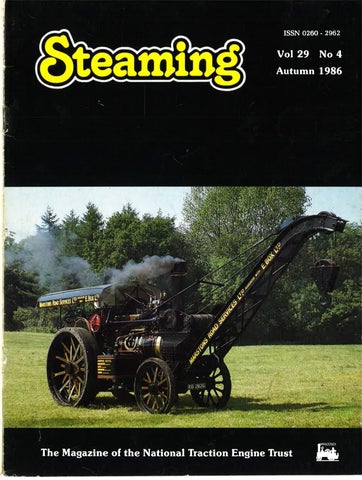
Cover Fowler 17106 of 1928, resplendent in its original co/ours and lettering, has been an extremely impressive newcomer to rally fields this summer, and was kindly posed by the driver Alec lbbott for this photograph by Alan Walker during the Knebworth Park event. The engine's working history was set down in our last issue, and another picture of this noteworthy machine appears on our double page spread. 151
From the Chairman
Engine Owners Column
Included with this edition of Steaming will be found the Notice of Meeting for the 1986 Annual General Meeting of the Trust, which is this year to be held in the Birmingham area. Once again, this meeting will be largely taken up with formal business but we very much hope to see as many members as possible and to hear their views. The meetin❑ will be held at Birmingham University, easily accessible from the City centre and those attending may like to visit the Model Engineering 86 exhibition which will be going on in an adjacent building that weekend. For our 1987 AGM, we hope to organise a weekend convention in the Bristol area with the assistance and co-operation of the Avon Club. It is intended to include both social events and visits to local places of engineering interest,and we look forward to the chance of meeting our west country members who have found it difficult to attend previous meetings. There is one important item which will be put to this years AGM that will affect every member and which I must mention here. Your committee have reluctantly found it necessary to recommend an increase in the Trust subscription rate to take effect at the beginning of our next financial year. The last increase in rates took place just five years ago and we have managed to hold steady the present rate of £8.00 for ordinary membership by careful economies in our management expenses. Much is due to the work put in by various officers and committee members, and to the sterling efforts of Keith Shakespeare and his sales team. Nevertheless postal costs and the general costs of printing Steaming have risen throughout this period and after consideration of the 1985/86 accounts and your Treasurers reports and recommendations thereon, we now feel it prudent to increase the general subscription rate to £10.00 for ordinary membership and £7.50 for old age pensioners. The Committee hope that this increase will be found acceptable bearing in mind the outstanding quality of Steaming itself and the modest rate of annual increase in subscription which this increase reflects. (Peter Barber, Chairman).
Suppliers and Repairers Register
152
Among recent enquiries have been some members seeking spare parts for Menzel lubricators. I have been in touch with Wm. Coulthard & Co Ltd, Durranhill Engineering Works, Carlisle, and engine owners may be interested to learn that quite a number of spares are available for the XD type lubricator, widely fitted to traction engines etc. Spares available include sight glasses and the company has supplied me with a copy of their Spare Parts and Instructions leaflet. I am happy to supply photocopies of this booklet to members on receipt of a SAE. Coulthards are also prepared to overhaul and repair lubricators of their manufacture. For those needing a
complete replacement, a single feed Model A can still be supplied from stock (it is only of slightly larger dimensions than the XD) and there are no plans to phase out this product in the near future. An item constantly the subject of past enquiries is the supply of spark arresters. Joe Kingdom of Sonning Common, near Reading, Berkshire has been making attractive and sturdy domed top spark catchers for some time and I can personally vouch for their excellent quality. Anyone interested in having one made to measure for their engine should telephone Mr Kingdom on Reading 723666. I would add Joe can under= take most types of blacksmith work and also produces fire irons, canopy support rods etc. (Nick Barker, lverwood Farm, Cutting Hill, Hungerford, Berkshire RG17 ORN)
From Alan Martin's Collection
34
Few of the crew have got time to pay attention to the photographer as they near the end of their labours on one stack at Tofts Farm near Pickering, Yorkshire, in 1936 or 1938. The engine is ACME, 6hp Marshall traction engine 31093 of 1899 (AJ6088), one of two of that make owned by R. Yates & Sons Ltd, of Malton, Yorkshire.
Steam Heritage Coal Rebate Scheme I again draw attention to the Steam Heritage Coal Rebate Scheme, which can benefit individual members, affiliated clubs or approved rallies, as well as the Trust itself. I would like to encourage anyone in any of these categories who has used coal for steam road vehicles to write to myself (individuals or clubs) or to Ron Copp (approved rallies) for the necessary application forms. These will need to be returned to us by 30th November 1986 and the completed forms will need to be accompanied by an invoice or a delivery note confirming that the coal supplied was British mined. My address is inside the front cover of this magazine; Ron Copp's is, of course, already known to the organisers of (Peter Barber, approved rallies. chairman).
London Social Meetings The 1985/1986 social meetings in London unfortunately became victim of altered circumstances, with dates changed at short notice and, later, an enforced move from our traditional date of the last Tuesday in the month. We apologise to any members who were inconvenienced by these alterations, largely brought about by a change of tenancy at 'The Cock Tavern'. Now, as the room has been taken into use as a restuarant in the evening and is no longer available for our meetings, we have had to search for a new home. We have been fortunate in finding a new location not far from our previous room. Future London Social Meetings will be held at 'The Horse and Groom', Great Portland Street, London. The premises are some 200 yards further north along Great Portland Street from 'The Cock', but on the opposite side of the street; that is, on the right hand side when coming from Oxford Circus and about quarter of a mile from the Circus. The tube station at Oxford Circus will probably be the most convenient one to use. The meeting room at 'The Horse and Groom' is on the first floor and access is best via the door on the left hand side when facing the building. Meetings will be held on the last Tuesday of each month from October to April (but excluding December), the talks starting at 8.00pm but with the
Inscriptions and decorations on the buildings of the erstwhile Oxfordshire Steam Ploughing Co, taken in 1985 just before the works was closed by its last owners, Groves Cranes. (C. Harold)
room available from 7.30pm for conversation beforehand. All members are welcome, as, in fact, is anyone who is interested in traction engines or the subject of the evening. Members are encouraged to bring along potential new members. Meetings arranged for the remainder of this year are: TUESDAY, 28th October 1986 — Members' slides: the traditional opener of the season and a chance for those attending to take along a few slides taken this summer (or earlier) to entertain the gathering. TUESDAY 25th November 1986 Steve Parrott, owner of a Fowler roller, will give an illustrated presentation on steam rollers. Details of the meetings in 1987 in the next issue. (London meetings organiser - Bill Timmings, 306 Hertford Road, Lower Edmonton, London).
Steam Heritage Awards 1987 The Steam Heritage Awards, introduced in 1986 and reported on in our last issue, are to be repeated in 1987. Prize money to the value of £3000 will be available to encourage the preservation of historic steam engines. The money will be shared by five winners; a Premier prize of £1000 is offered for outstanding technological innovation and additionally there are four category first prizes, each of £500, in the areas of Maritime, Rail, Road and Museum/Static engines. The objectives of Steam Heritage, an organisation sponsored by British Coal and the Solid Fuel Advisory Service and which involves the Transport Trust and the leading enthusiast organisations (including 153
the National Traction Engine Trust), are to preserve the products and promote interest in the achievements of Britain's Industrial Revolution. Entry forms for the 1987 Awards, which must be completed and returned by the end of November 1986, are available from Geoff Ellard, British Coal, Hobart House, Grosvenor Place, London SW1X 7AE.
Obituary Dick Woolley Richard Maxwell Woolley died at 0swestry, Shropshire on 19th July 1986, aged 68, after a lengthy illness. Dick Woolley bought his first set of threshing tackle at the age of 21. He worked the Craven Arms-Welsh Border area, and literally lived in the van, for he used every penny he had to buy the engine, a Robey Express tractor and 60in Marshall drum. He established a base at Bucknell, Shropshire just before World War 2 and expanded the threshing and timber haulage business from there. The business progressed to road rolling and scarifying for the Councils, then, as a logical progression, he built a tar sprayer on an S type Sentinel. This particular work developed to the extent that over seventy men were employed in the last tar spraying season before the business was sold. The Sentinels worked well into the 1960s at spraying tar, and Dick was responsible for many Sentinels and other engines being sold into preservation during this period. After the sale of his business Dick
rid For further details contact
went back to his first love; a pair of Fowler BB1s which he used on dredging contracts. Dick was a man of many interests and a one time master of foxhounds. He possessed an exceedingly dry sense of humour, always seeing the funny side of any problem. An early participant in rallies, Dick went to one of the first Appleford rallies in a Sentinel S4 which he insisted on leaving in the car park as it was one of his current working fleet. He was a founder member of the County of Salop Steam Society and provided endless support to the growing band of engine enthusiasts. He leaves behind two sons, John and Geoffrey, to whom we extend our deepest sympathies. (A.J. Semple)
Future Dates AGM 1986 The Annual General Meeting of the Trust is to be held in Birmingham on Saturday, 8th November 1986 at the Birmingham University, Edgbaston Road, Birmingham at 12 noon. Final details of the venue are not available as this issue goes to press and will be included in the formal notice of meeting, agenda and Report and Accounts which will be distributed with this issue of the magazine. Notes will also be included of how to get to Birmingham University by private and public transport. November 8th is the final day of the Model Engineering '86 exhibition, being staged in the University's nearby Great Hall. Members attending our
AGM may also wish to visit the Exhibition, which is open from 10.30am to 7pm and should feature some full size traction engines/steam wagons as well, of course, as a wide range of models.
OUR MAGAZINE 25 YEARS AGO
The editor reported that attendance at engine rallies had risen substantially and that, surprisingly, fresh engines continued to appear for the first time. Woburn rally attracted 75 engines and a crowd of 37400 but that was only 100 up on the previous year. Four sets of ploughing tackle had been in use in Essex during the autumn of 1961 — Keeling's 18hp AA6s, Jackson's AAs at Toppesfield, Philp's AAs at Castle Hedingham and the BB1s of Taylor Bros at Wimbish. Ernest Edney of Horndean, the Club treasurer, had died — he was generally acknowledged to have played a large part in stopping the Club from being wound up a few years previously by donating for raffle for funds a Wallis engine. Summer observations from members included many working rollers — eight in Somerset alone and another score up and down the country, including a Robey tri-tandem on the still incomplete M1 motorway.
We specialise in the construction and repair of locomotive type boilers. Firebox construction can be of the traditional flanged and flanged and welded. rivetted design, Construction is to the appropriate British Standard Specification and all welding is by coded welders to BS 4870. Work being done is approved at all stages by an engineering surveyor from your boiler insurance company, Construction of tubeplates, smokeboxes, tenders etc, also undertaken.
Roger Pridham, Hollybank, Chilsworthy Beam, Gunnislake, Cornwall. Telephone Tavistock 108221 5276 Daytime, 832945 Evenings
154
WORKING FOR SCREENS In this, the third* of his recollections of a life with steam engines, Bob Field covers the post war years, when there was plenty of work for his Burrell crane engine around the Black Country,
At the beginning of 1946 an advert appeared in our local Black Country newspaper for an engine driver at Screen Bros, Oldbury. I decided to apply for the job and found myself successful in getting the appointment. There were three Screen brothers — Harry, Bert and Bill. Bill had passed away at Christmas 1945; he had been the driver so I had his task. Harry was the gaffer but he did do a bit of driving if I was away ill or on holiday. Bert, the eldest, was the odd-job man. He had driven at one time but had packed it in, so if we were out on a job he was supposed to supervise. The firm's yard was next door to Oldbury gas works; at the back of us was E. Danks' boiler works and their rubbish tip backed onto our yard. We were on the Dudley Road in Oldbury. Just inside the yard gates was the brick-built engine shed, with an inspection pit — you walked down about five steps to get under the engine. We used to put some timbers across the pit to drop the ashpan on, then get the fire pricker in the firebox and lift the middle bar up inside on top of the others, and then back underneath to manoeuvre the remainder out. The office came next; two rooms, general office and private office, and on the walls were photos of yesteryear's endeavours. No rubber tyres in those days, it was all cast steel wheels for loads of all descriptions, the attendant lads wearing hard hats and
*For earlier reminiscences see the Spring 1981 and the Summer 1985 issues of Steaming.
moustaches. Next in the yard came the coalhouse which used to have a railway truck load at a time, with about 12 or 16 tons of Best Welsh Steam for the engine, with also the occasional load of Black Hard coal for the office. We sometimes used the office coal if we ran out of Welsh. That put up a smoke screen, but with the steam coal there was very little smoke. After the coalhouse came the stores, a big place with shelves etc all round and a Tortoise stove in the middle where we used to have our meals. Then came the 'machine shop', a tumble-down, wooden, open-fronted building. But just after I went to Screens, we had a new steel and galvanised sheet open-fronted building put up in replacement. The stanchions
were parts of Bailey bridges welded together. Inside the building was a big old set of shears (which we used for cutting boiler plates), a drilling machine, a saw, lathe and big electric motor and a nine foot set of rolls. The engine I was to drive was 7hp Burrell crane locomotive 3197 (AB8904), a double crank compound which Screen Bros had bought new in May 1910. Screens had other engines at the time. There was also a larger 3 speed crane engine — Burrell 8hp double crank compound 4039 of April 1926 INP8361). This engine had been filled up ready for a boiler inspection when it came a sharp frost, which cracked the cylinder on the low pressure side at the slide bar end. The two back wheels were off, so we pushed it out of the way with 3197 into a corner; it was still there when I left the firm years later. Screens tried everywhere to get another cylinder block but no luck. During the first two or three years of the war 4039 had spent a lot of its time in Brum, pulling down bomb damaged buildings. Another engine we had was Burrell Gold Medal tractor 3315 of 1911 (originally AH068) built for East Anglian Cement Co Ltd. It was with Screens by 1917 and re-registered AB8906 in 1921, but by the time I worked for the firm the engine was worn out and disused, so we eventually broke it up. The brothers also had a colliery at Great Wyrley near Cannock and there was another old Burrell in the yard which they had used at the pit for pumping or winding purposes. It was Burrell 2716, an 8hp road engine built in 1904 and which had started life as the first showmans road locomotive to be acquired by the
Burrell 3197 with a goodly load about 1950, somewhere in the Birmingham area — possibly at Hunt's Foundry, Oldbury. (collection Alan Martin) 155
well known firm of Anderton & Rowland (though invoiced to A. Anderton, Middlesbrough). It was named THE SHOWMAN. After being returned to Burrells it was resold, as an ordinary road loco, to Smith Bros (Millers) of Worksop before being acquired by Screens. That engine, too, we broke up, but saved the motion and the cylinder block (which we unsuccessfully tried on 40391. Screens made some business in removing the pit head gear and boilers from derelict pits around the Black Country, so there was always a good store of pitch pine timbers in the yard and these came in handy for rolling big boilers on and for packing. There were also a lot of old lorry solid tyres which we used for re-tyring the engine, cutting them on the power saw and fastening them to the shed stanchion, pulling them ni it with the anrgina sufficiently straight so that we could get them in our rolls, and curve them out to fit the wheels. We then drilled and bolted the sections to the wheels. Another-old item lying around was an old heat exchanger, a big square box affair with a lot of tubes in it, which I understood Danks made for the British Industries Fair at Wembley in 1926 but turned out to be a failure. The tubes were the same diameter as the Burrell's though some 4 foot longer, so we appropriated some of them for retubing. The outer plates we used for boilers etc. Of course, after World War 2 everything was in short supply and a lot of works were changing from coal to oil, and we were busy getting old Lancashire boilers out of their houses with the Burrell, and withdrawing the flues, plating up the shells and making them suitable for use as oil tanks. Everything was riveted in those days. A lot of works had brick air raid shelters on the premises and several times we had to take the adapted Lancashire boilers and put them on top of the shelters as fuel oil tanks. Screens were also known as Midland Boiler & Tank Works and Heavy Haulage Contractors. There were seven or eight employees — a riveting gang, and four with the Burrell. When we went to and from a job there were two of us on the engine and two rode on one of the trucks with packing, jacks, coal, chains and slings and a fire-bucket for cold days and a piece of tarpaulin to throw over themselves if it was raining. We had a B licence which only allowed us to operate a 25 mile radius, not that we didn't overstep that limit a few times! There was a Ford van with a V8 engine, used to take the riveting gang out and for boiler repairs, machine 156
moving etc. Burrell 3197 worked well for its age, especially as it was nearly always overloaded. The firebox latterly was on its last legs and we had trouble with the stays. A firm from Wolverhampton came and did welding on the boiler with a mobile unit. They would gouge a V out around the offending stay and weld it up. We took out the fusible plug and replaced it with a tapered
plug and welded round it, then drilled another hole where the crown sheet metal was thicker and tapped it out, putting the plug back. All of the tubes had ferrules in their ends and I was very often in the box with expanders. We stocked and cut gauge glasses ourselves, so there wasn't any worry about those and we had plenty of other second hand fittings — the chimney and oil pump came off the
Although this is a rather unflattering view of Burrell crane engine 3197, it is unusual and certainly interesting. It shows the engine, sometime about 1948, having just got back into Screens' yard from a job at Wednesbury. The cab had been taken off to get inside a works there to shift the positions of various machines. Against the huge bulk of Oldbury gasholder, filling the whole of the top part of the picture, can be seen the new shed with the set of plate rolls, to the right of the engine — these are the ones used for rolling out lorry tyres for the Burrell's wheels. (collection Bob Field)
Burrell 3197 on an errand of mercy after a now unrecorded incident. The top half of a double deck electric tram is being placed aboard a traction wagon, presumably the final task in clearing up after the tramcar had overturned. The picture came from Harry Screen's son many years ago after he had moved away to Slough. (collection Bob Field)
older crane engine. The only part we had to buy in my time was a new right hand bearing for the main crankshaft. It came from Garretts at Leiston about 1948. We eased the crankshaft up with a jack to get the old, cracked, one out and just put the replacement in — never scraped it, just put it in as it was and we never had any trouble. But the old bearing had been a headache. We were taking a boiler to a new carpet works on the west side of Kidderminster and going up the hill on Chester Road North, the bearing started smoking, so I had to pour on cylinder oil all the way up. We had the same trouble with a 50 ton hammer block when going up Castle Hill at Dudley. We were never allowed to go through Dudley town, and the police at Brierley Hill, too, were on the mark — there, the injector didn't have to blow back. Of course, we had to have the police as escort for wide loads and on occasions when we were loading up big boilers and machines in the street. I remember one time when we had to take a boiler and machines out of a tannery in Walsall. To get into the works one passed under an archway and over a small weighbridge, probably designed for horse and cart loads, so we couldn't take the Burrell
in. We had a big steel trolley about 8 or 10 feet long with cast steel wheels about a foot wide. This we had to put boilers on in awkward places. To load the boiler we arranged suitably placed timbers and rolled the boiler up them with the rope on the hind axle of the engine. Then we had to load up in the street. We did the same to unload the boilers but used the engine's rope to steady the load as it came off the wagon. Our main wagon was a home-made one, about 20ft long by 7ft 6in wide with four narrow rubber tyred wheels on the back and four wheels on the front. We had an assortment of drawbars; if there was a long load on we had to use a longer bar. This wagon was nearly always overloaded. Another wagon was an old well frame on four wide rubber wheels, and we also had three small wagons. If we had any loads over 30 tons we borrowed an Eagle wagon from Thompsons at Wolverhampton, which would take about 80 tons. Whilst at Thompsons we would see their Fowler crane engine 17212, now well known in preservation in Len Crane's ownership and we also saw KING CARNIVAL II, Fowler 19783, in Cunliffes yard down on Wellington Road, Handsworth in
Birmingham when we travelled in that area. During my first winter, 1946-47, we had the big freeze-up and much snow. We came down in the snow from Midland Tar Distillers at Oldbury one Saturday towards the end of January and didn't go out again with the engine until the first week of March. That journey was to take a Lancashire boiler made into a storage tank down to the HP Sauce factory at Aston. We had trouble with the trams down Villa Road as the snow was still piled along the gutters, three or four feet high. I remember about that time I went up to Marsh, Chambers timber yard at Oldbury and they sawed for me out of sycamore wood some new brake blocks for both the road wheels and the flywheel. We did a lot of work at the different tar works, shifting vessels about to new positions and taking stills off their beds, to enable our gangs to rivet on a new patch. I recall jobs at Midland Tar at Oldbury, Majors at Wolverhampton, Key's at West Bromwich; at Nechells; Greets Green; and at Swan Village gasworks. We used to go to Copper & Alloys (now Delta) at Greets Green to shift heavy machines and change their rotary furnaces of which they had two or three. A rotary furnace is about 10 or 12ft long and 5 or 6ft diameter; Danks used to make the shells. At one end the oil-fired jets blow in and the other end is the feeding end where the scrap copper, brass etc is inserted. When molten the metal is poured out of a 157
hole in the side of the furnace, it being revolved on rollers until the metal is ready for pouring. Screens had the job of changing these furnaces when the firebrick lining got rough. We balanced them up off the rollers by picking up one end with the Burrell's crane, packing under the middle and lowering it down, then the back end would be dealt with similarly. Now we could roll the furnace off on packing, onto our steel bogie, and pull it outside to the big gantry crane. There, in an upright position it was relined with new firebricks.
A lot of jobs were done for Wolverhampton Metals, and for James Bridge Copper at Walsall, now IM I. At Wednesfield there were square brick furnaces and every so often they would knock in the front wall for us to get the scab out of the bottom. This consisted of lead, tin, copper, brass and firebrick and was about 12ft x 24ft weighing up to 20 or 25 tons. We had to jack up the mass and drag it out with the Burrell by blocks and back axle rope, then raise it further to push our wagon underneath and take to James Bridge Copper. Here the load
This view of Burrell 3197 was doubtless welcome to many a Black Country foundryman in years gone by — it heralded power and convenience in an era before the ubiquitous mobile crane. (Bob Payne) 158
was dumped on waste ground for cutting up and remelting. At Wednesfield there was a rotary furnace and by it a 20ft long brick trench, some 5ft wide and 4ft deep containing ingot moulds fixed to an endless chain. The idea was to pour the molten metal into the moving moulds and they would then drop off the other end, but something went wrong and 20 tons of metal ended up in the trench — another job for Screens. Once retrieved the scrap had to be taken to James Bridge. Another time a cast iron foundry adjoining the tar works at Oldbury had 20 tons of metal come out of the furnace onto the floor and we had to go and remove that for them. You might ask if we ever got stuck with these heavy loads. Well, the Burrell would steam on the proverbial fag end. We always had good coal, and the double high valve was used a lot, which of course made it into nearly a twin cylinder machine instead of a compound. We only got stuck once on the road and ended up having to use the winch. That was by the Arboretum at Walsall with the boiler from the tannery mentioned earlier; it was a boiling hot day and the tar was soft and the going heavy. Those narrow tyred wheels didn't make it any better. On the same job when we nearly got into West Bromwich by the Navigation Inn we found contractors had just done a hundred yards of new tarmac and we went ploughing through it, but nothing was said as notices hadn't been put up. We also did two heavy Lancashire boilers from Moor Lane GWR goods yard at Brierley Hill. There is a nasty steep hill up to Brierley Hill which we only just managed and we had to send one of our lads on ahead to see that we could keep on going. We took one of the boilers to a new rolling mill near to Eight Locks and the other to Stourbrldge Refactories, Pensnett. Another part of our equipment was a homemade alternative jib for the Burrell with which we erected the framework and roof trusses of new buildings. It was about 36ft in length. Some places we went to we had to take the engine's cab off, or drop the jib to get into the works. The cab we left suspended from the roof structure of our engine house back at Oldbury and we'd travel without it — not very nice when it rained. I know we were a bit of a headache to other road users when we had to stop to drop the jib and negotiate low bridges. The worst one was in Halesowen Street in Oldbury, where the GWR goods train ran down the short branch from Langley Green to Oldbury goods yard.
Forty years on. Screen Bros' Burrell crane engine 3197, still with its lining and canopy lettering of the 1940s, stands amid the reconstructed village at the Black Country Museum, Dudley, during one of the Autumn events. (Bob Payne)
Getting under there we sometimes used to bring the town to a halt. A lot of ingots were moved by us to Langley Forge, 36 ton ones from Oldbury goods yard and 16 tonners from Langley Green station. The latter's crane was only a 20 ton machine but the ingots were soon moved onto our wagon, so we shifted a fair tonnage. We also did six hammer blocks from Langley Green to a stamping works half way down Powke Lane, a steep hill going out of Blackheath. We used the old well wagon and since the blocks were only about 12 tons we did two at a time. The well wagon was utilised because it was suitably low and we could push the blocks off onto packing with the Burrell. Now the braking system on the wagon was only wooden blocks worked via two screws at the back. Wasn't there a pantomime going down that hill! I had
to do most of the braking with the Burrell, in low gear of course, with both road wheel and flywheel brakes hard on and the reversing gear back. Mercifully it was the only time I used that well wagon. One of the bogies from it was pressed into service to retrieve THE GRIFFIN from Longbridge (see the Summer 1985 issue of Steaming for a picture taken on this occasion). Another hair raising job was at the Birmingham Battery at Selly Oak (we did a lot of jobs there). A big Lancashire boiler in a house on some waste ground on the other side of the canal to the main works needed moving. We were to exchange it with the works' existing boiler which involved crossing a very narrow and hump backed bridge. In the centre you could see the last layer of brickwork to the arch. We did it OK, but that was the only job on which we ever got any danger money.
About 1948 we had a job at Bloxwich Furnaces where there was a row of about six Lancashire boilers, previously fired on the waste heat from the furnaces. Close by was a big beam engine which I think pumped the air for the blast furnaces. We got out two of the best boilers and took them to our yard, then with the flues out made them into oil tanks. When the trams finished running in Birmingham, to be replaced with motor buses, there was a requirement for fuel tanks at the various bus garages. We moved several new 30ft by 10ft welded tanks from Thompsons at Bilston to different garages and installed them. Also shifted were big galvanising vats from Thompsons to different local galvanising firms. Two Cochran vertical boilers went into a trailer works at Stirchley, Birmingham. These had been brought down from Scotland to our Oldbury yard and we took them on and erected them — of course, we had to stand them upright. Another headache was taking a 20ft diameter still from Midland Tar at Oldbury to Ratcliffes at Great Bridge to have a new bottom put in it. We 159
notified the police in Oldbury, and loaded it up in the works yard but on arriving for work next morning we waited in vain for our escort. We ran out to the police station, to be told we should have to manage on our own, so we had no escort. On another occasion we did a wide load from Walsall to our yard with the Walsall police attending us to their boundary with West Bromwich, but here again we were left to finish the trip alone. On less glamorous jobs we have pulled lorries out of tips, and excavators which have got bogged down on building sites. We went to Bromford Lane claypit two or three times to lower their excavator down into the pit on our rope or to assist it coming back up at the end of its stint. We did a lot of work next door to our own yard at Danks Boilers, moving boilers out of the works into the stockyard or taking them out and loading them for the railway company. Danks still had their old Burrell single crank crane engine 1497 of 1890 at that time. I seem to remember it as a straight jib crane, and it had got a good collection of those little county licence plaques on it. Other firms we did work for (a large number of them regrettably now extinct► were Incandescent Heat, Smethwick; Albion Bottle; TI Accles & Pollock; Birmid, Smethwick; Birmetals, Woodgate; Hopes Windows; Mills Foundry, West Bromwich; Thomas Dudley's foundry at Dudley; Sankeys, Bilston; and lots of chain and anchor works at Cradley. We took two Lancashire boilers made into storage tanks across to a stamping works at Foleshill, Coventry and stood them on end, and two more to a pork pie factory at Burton-on-Trent, and Ind Coope's brewery. A couple of boilers put into a hospital at Worcester were delivered by Pickfords, the first bought down by their Fowler JIX. But they used an ex WD Diamond I to bring the second. Screens also purchased a lot of secondhand vertical boilers of 10 or 12 feet in height. These had been condemned by the boiler inspector, but they were repairable and we welded them up, gave them a hydraulic test and sold them to pig farmers for gently steaming swill etc. That was a nice easy job out in the country for the Burrell. To get water in the built-up areas we had a hydrant key; we used to flood the pit and suck the water out of the hole even though it was against rules. We never got caught and kept a sharp eye out for the water company man! Our wages were about £4 per week in 1946, rising to £6.10s in 1950. At some places we did quite well for tips. 160
I think the biggest tip we had was from a scrap dealer in Wednesfield, who bought five transformers from a power station at Wolverhampton. We had to empty out the oil and take them to his scrap yard. Being nearly all copper, I guess he made a bob or two. We had to negotiate our own wages and conditions with Harry Screen. No wet weather clothes were provided in those days and he was a hard taskmaster. One instance I recall was in November 1948 when we did a lot of work for Lench's of Blackheath. They had a new cold heading machine arrived from America in a crate and we had to go up there to lift it from the packing and install it in the works. I went to our yard early and got up steam, but it was poiirinn with rain, so we didn't set off. Harry always came down to work about 9.00am and when he found us sitting round the stove in the stores having a leisurely breakfast he wanted to know what our game was. When we said it was too wet to go up to Blackheath because the crated machine couldn't be opened in the rain, he told us to b— off home. Next day we sat in the stores until Harry arrived and asked him if he was paying us for the previous day when he sent us home. Well, he said, we didn't work, so we wouldn't get paid. So as we knew Lench's had been anxiously phoning him up about us getting on with the job, we told Harry that we would take another day off right now. He soon altered his tone and we did get paid; he never did the same trick again. The rope on the Burrell's crane had to be inspected by the insurance people but the long rope on the winch didn't. When it got into a bad condition, which happened often owing to the rough jobs, we had to go to Danks tip and swop it for one of Danks scrap ones from their overhead cranes. They still had plenty of life for our purposes. We used the old oil lamps a few times which was just about alright with the street lights too, but it was necessary to keep opening the firehole door to see the water gauge. And so in the autumn of 1950 came an opportunity to take a job at Averys, weighing machine manufacturers, driving their steam loco cranes. I nearly doubled the £6.10s wages I was getting at Screens but the work was harder and in some ways it was like being a prisoner after the please youself attitude at Screens. But I can still keep in touch with old times for I visit Len Crane a lot, and see 'my' old Burrell, now in his ownership, as well as Thompsons crane engine. (Thanks are due to Alan Duke for providing additional engine history.)
'Messrs Draycott Bros, Steam Haulage Contractors, of 6 Langley Road, Small Heath, Birmingham, write: 'It may interest you to know the cost of running our first Sentinel wagon (No.243) for the past 12 months — Depreciation at 10 per cent £47. 10s Interest on capital 15. 0 Driver at 34s [£1.701 per week. 88. 8 Stoker at 18s 190p1 per week 46. 16 Rent on shedding 8. 8 License, insurance and water 15. 10 Coke — 62'/ tons at 16s [800 50. 0 Oil 6. 0 Repairs and sundry renewals 15. 10 Total £293. 12
The wagon has, on average, run 40 miles per day, carrying eight ton loads. five days per week for 50 weeks during the yeas. this gives 80000 ton-miles for the year, at the cost of .88d 1.4p] per ton mile. ...this wagon has travelled 60 miles a day with 10 tons for weeks at a stretch. If any of your prospective customers wish for any further information, we shall be only too pleased to supply it. The other two Sentinels we have of yours are also giving excellent results.' (This letter shows how cost per tonmile falls when there are full loads all the time — Ed.).' (From The Commercial Motor, 16th February 1911).
orothea estorations Ltd.
Engine overhauls Tenders Tanks Smokeboxes Flanged Plates Smokebox Rings Chimney Tops Metal Spraying Grit Blasting Polishing Convex beading Wire bound suction hose Brass boiler banding New Road, Whaley Bridge, via Stockport, Cheshire (06633-3544) Also: Churchill Road Bristol 4 i (0272 715337)
Tom Downing
The Keystone Skimmer
A form of steam engined machinery that is relatively familiar to American enthusiasts, and occasionally rallied over here, is the portable steam drilling rig. The concept of the rigs — a four wheeled chassis with a vertical boiler at one end, steam engine and cable winch amidships and the removable drilling derrick at the front end — is, I believe, one that was not used in Britain. However, steam drillers and their derivation, the steam skimmer shovel, are part of the USA's steam history. The recent appearance of an old photo album of pictures of skimmer shovels at work (probably part of a salesman's repertoire of seventy years agol, prompts me to write these notes in the hope they will be of interest to readers. One of the few steam-engined units that is truly native to our locality of west Pennsylvania is the Keystone steam drilling rig, and the later developed skimmer shovel. The rigs were invented and developed by the Downie family at the end of the 1870s. After the initial machine had successfully made a well for the Economite Society at Economy, Pa. (Pennsylvania), a second example was made in April 1879 for sale to a Mr Ross and this was capable of drilling 50ft a day. Robert Downie and his brother John then formed the Keystone Portable Steam Driller Co at Fallstown, Pa. and their product was awarded the highest premium and a medal at the 1881 State Fair. Two machines were built each month by twelve employees and in 1887 a new
Entitled ROAD GRADING WITH THE SKIMMER SCOOP, ROCHESTER N. Y. this picture
is a good shot of the machine in its most usual working situation — shallow grading. Though obviously momentarily posed for the camera it shows the scoop on the beam, the outrigger stabilisers and the horse drawn dump wagon and helpers on the side of the grade. The operator can be seen in silhouette on his platform on the far, front, side of the machine.
Another well posed shot showing the general appearance of a steam skimmer. This one is captioned VARE CONSTRUCTION CO, PHILA, PA. The stabilisers are again prominent and with the scoop and beam over the dump wagon, details of the chains, pulleys and main post and frame at the front end are clearly seen. The driver on his platform, appearing somewhat ill-at-ease, firmly grasps his levers. The trip rope to operate the bottom door of the bucket ends by the stabiliser. At the rear of the machine can be seen the water tanks and, just behind, a wheelbarrow for coal. 161
DITCHING, JAMES M. MURRAY, NEW KENSINGTON, PL. This rather dark scene — a time exposure judging by the smoke — was taken in what is now a far-out eastern suburb of Pittsburgh. It depicts the hard work and hard times that these machines made more productive, if not easier for those who laboured there.
and larger factory was erected in the neighbouring town of Beaver Falls. The firm was latterly entitled Keystone Driller Co. The towns mentioned lie about 25 miles north of Pittsburgh, just north of the big bend in the Ohio River where it stops flowing north and turns west and south, crossing from the state of Pennsylvania into Ohio. We are fortunate to have two well restored drilling rigs at the Northwestern Pennsylvania Steam Engine & Old Equipment show, both owned by Harold Bupp and Wendell Bintrim. One is a portable; the other a traction (self propelled) example which has proved its thorough restoration by drilling a 65ft well at the home of Harold's son. Other rigs appear at the Old Thresherman's show in Somerset County, Pa., and Dean Redd has exhibited drillers and skimmer's at the Tri-State shows in the south west of the state. Dean has used Keystone drillers for many years — and his father and grandfather before him back to 1916 — including forming wells down to 550ft. But to turn to my present subject. The skimmer shovel was developed in the early part of the present century. It is a shallow grading machine, well suited to work in the streets. Its construction and working will be clearly evident from the accompanying photographs. The bucket, with a releasable door on its bottom face, was pulled along a beam (by a chain around pulleys at its extremity) from the skimmer's chain drums.Once the bucket was loaded the beam could be raised and slewed to enable the bucket to be emptied over dump wagons, horse drawn or otherwise moved, standing at a higher level. Improvements over the years included three types of bucket; the claimed invention of the back hoe fitting; a beam riding scoop and on models of the twenties and thirties the progression to gas power and an all steel frame. The pictures are thought to date from 1914 or earlier for they all show the old style skimmer in which the driller base was used with the mast or derrick front replaced by the skimmer unit. Later models used a frame design entirely of their own, and rather different from the drillers. 162
Another ditching and pipe laying scene, this time apparently deep in North Carolina's pine woods with a machine captioned as built for W.G. FRITZ Co, DURHAM, N.C. The somewhat hazy picture shows the application of the backhoe type scoop to the end of the beam — one hopes the rep's potential customers were suitably impressed with the versatility of the Keystone product. Another picture is entitled LOADING PIPE, 2000-2500 LBS — a reference to the additional use of the machine as a lifting crane and just the sort of point that might clinch a sale.
Proof that roadworks have always been the bane of travellers, anywhere! This un-titled scene in a residential setting shows a Keystone skimmer depositing spoil into the third of four dump wagons hauled by a Frick traction engine, notably with a jacketted (lagged) boiler. Tom Downing notes the engine is blowing off at the safety valves and remarks it was probably 'hot for the job' — maybe the photographer was to blame for some delay.
The pictures in the album number over 50 and offer a variety of scenes, all nowadays of much interest. Many of them show difficult or extreme situations, offering illustratons of the machine's working capabilities even in lifting large rocks. These particular pictures are the reason for our conclusion the album was a salesman's device for encouraging potential customers. All of the photographs, of course, show a way of life and labour long gone. Strange to British readers would be the ones in which the skimmers were used in regrading road surfaces. The locations range far and wide including Brooklyn, New York; West Virginia; North Carolina and many more places local to Pennsylvania. I would like to offer my thanks to Garry Guy for his kindness in allowing me to copy these Keystone steamer photographs, to Jerry Stitch for copying them and to Dean Redd for letting me draw on his extensive knowledge of Keystone products.
Dutch threshing We thank Walter van Gulik, one of our Dutch members, for sending this picture and description of a threshing set at work near the village of Vroomshoop, about 1920. The set was owned by a co-operative and the men with white collars are said to be the managers; the man in uniform by the rear wheel of the drum, the chief of the crew. The thresher is most probably a Ruston & Hornsby, and the engine was German built by Badenia. It was fired on peat and brown coal blocks. The engine was last used during World War 2, after the occupying Germans stole a Deutz tractor which had succeeded the steamer in 1934. The Deutz was used to tow fighter aircraft across the Twenthe airfield during 1943/44 and when the co-operative later searched for their tractor they found it with one cylinder broken, but repairable. And so the portable was scrapped. The whole threshing set — baler, thresher, engine and water cart and fuel — was transported from one farm to another on barges along the waterway or canal seen in the foreground of the picture; the canal was also in use to transport peat from the local peat fields.
NEW FACES
Although seen briefly in public some years ago, the appearance of Fowler 17106 DUKE OF YORK, fully restored and in steam on the rally fields, has been eagerly anticipated. Owner John Coombes and crews have taken the Fowler to a good number of events from its Bedfordshire base this summer and it is seen, above, photographed by Eric Sawford at the Knebworth Rally in June. An engine seen up to now by relatively few enthusiasts is Foster 14501 of 1920 VICTORIOUS. Stored on their premises by original owners Pettigroves until last year, present owner Paul Fowler completed restoration of the engine in the remarkably short time of ten months, to enable it to appear at Rushmoor rally in July and be photographed, this page, by Bob Payne.
A RANKIN PORTABLE Bruce Rankin, living in New South Wales, Australia, gets his Steaming a little later than some of us. It was June before he saw the Spring edition, and prompted by the Editorial and the picture of the unidentified portable on page 95, was immediately encouraged to write the following interesting notes.
I believe that the portable engine pictured in the Spring issue, taken in Oxfordshire, could be one manufactured by R. & J. Rankin, Engineers, Union Foundry, Liverpool. The reason I can put this forward is that I own what is thought to be the only extant portable engine from this firm and all the same features which are present on my engine are on the example in the published picture. I might also add that the photograph at first appears to be printed back to front as compared to my own engine. However, the cylinder block on mine can be put on either way, as both ends are bolted in place in exactly the same symmetrical manner, and the catalogue of the Royal Agricultural Society of England's Leeds Show in 1861, where Rankins exhibited six items, states that their 4hp portable had 'the crankshaft made to admit of the flywheel being fixed on either end.' Perhaps, therefore the portables were assembled as the customer wished. (The original of the Oxfordshire photograph did not show, for example, any cast lettering on the engine to prove whether it was printed correctly or not. Most of the crew, however, hold their pitchforks etc in their right hands and have their waistcoats buttoned on the right, so we can assume the print is as the scene really was. — Hon. Editor) The various features which are so familiar to me on the portable are the cylinder block, the crank shaft brackets, the water pump, the large diameter flywheel, the large diameter of the boiler barrel and the short firebox, the single ring method of attaching the barrel to the smokebox, the tall chimney base, the crosshead and slide bar support, and the front wheel location. The picture is very interesting to me in that I can see the shape and 166
construction of the chimney, the type and location of the governor and also the size and type of wheels. All of these items are missing from my engine. I acquired the engine a couple of years ago. In August 1984 someone told me of a rare and interesting engine that was coming up at auction in a couple of weeks time and that I might be interested in it — especially as it was built by a firm named Rankin! i was interested, and complete with cheque book, headed for the small country town of Coleraine in Victoria to attend what was the largest auction of old cars, trucks and steam engines ever held in Australia (see our Winter 1984/1985 issue). A 3.00am Saturday start from Sydney enabled us to reach the sale, 750 miles, by 6 in the evening, including a brief call in at the Lake Goldsmith Society's premises on the way through. The weather had been foul all the way across Victoria but Sunday dawned very sunny, just the right day for securing our prize. There were very spirited bids on all of the engines, a few going for extremely inflated prices, so the atmosphere was
tense. The auctioneer came to Lot F33, a 2 or 3hp portable single cylinder steam engine by R. & J. Rankin of Liverpool, England. And when the hammer fell the old machine was ours. As purchased the engine looked a bit of a handful as far as restoration was concerned. There were many parts missing — connecting rod and straps, governors, regulator operating gear, all timbers, tirehole door, chimney and the original wheels and axles. The boiler also seemed in need of a new firebox inner wrapper plate. Transport to Sydney was effected in late September, the low loader shared with a Ruston, Proctor traction engine and a steam mill engine. With its arrival came a surprise — the majority of the missing pieces were stacked under the engine, so it was now more or less complete (though dismantled) except for whistle, governors, chimney and wheels. Now located in my back yard, restoration will have to wait until I have rebuilt my 1899 Burrell single crank compound road locomotive 2239. The latter engine has a strange history, for it was originally shipped to
The Rankin portable surviving in Australia. The machine stands on temporary wheels and the governor and the chimney support are not original, though traces of their original fitting positions are still evident. (B.J. Rankin)
(left) The firebox end of the Rankin portable. Note that the cylinder block seems capable of being fitted either hand. The regulator lever quadrant comprises a brass plate with the makers name cast into it. (B.J. Rankin)
(right) The pump, mounted vertically on the left side. It has only suction connection in the boiler with a pet cock on the side; there is no recirculating valve fitted into the pump and this makes the owner curious as to how it works. Can anyone shed some light on its operation? (B.J. Rankin)
Cape Town, South Africa and then some time later moved on to Australia. (The same history attaches to Burrell single crank compound 2293 which is still in existence at Tamworth, New South Wales). If any reader has further information on these two engines, I would be pleased to hear from them, especially if it is regarding shipping movements and dates. Reverting to the Rankin portable, I did approach Mrs Briggs, of the Road Locomotive Society, for information early in 1985. At that stage all she could tell me was that my engine was probably of about the 1880s, but also kindly forwarded copies of Rankin's entry for the RASE shows at Canterbury, Kent in 1860 and at Leeds in 1861, The former, where the
exhibitors are given as Richard and John Rankin of Liverpool, lists four mills or screens for agricultural use but no steam engines, but at Leeds the firm showed three mills or screens as well as a 10hp horizontal engine (10in x 24in cylinder) for general use; a 4hp upright engine mounted on a vertical boiler, and the 4hp portable as described earlier in my notes. The latter was 'constructed with firebox all of Low Moor iron; the tubes...arranged with special reference to durability and economy in working, leaving ample space to avoid injury from accumulation of sediment. Price £165.' All the steam engines were stated to be manufactured by the exhibitors. I have been unable to trace any history of my own engine during
its working days. The appearance of the Spring Steaming is the first time I have come across any visual representation of what I feel is another Rankin product and I can barely contain my excitement! I have up to this point never been able to track down an engraving, illustration, photograph or anything of any Rankin portable steam engine and it now seems that one has just happened out of the blue. Maybe some other members of the Trust have illustrations or photographs of Rankin's products and if so I would be very interested in hearing from them. (Bruce J. Rankin, 15 Tall wood Avenue, Eastwood, New South Wales 2122, Australia.)
Without comment
'We regret to state that on Saturday morning a serious accident occurred to Mr T [Thomas] Aveling of the firm of Aveling and Porter, Rochester. At the time of the accident, Mr Aveling was engaged in explaining to a gentleman the principle introduced at the works of heating iron plates by means of the vapour from creosote, when during the time the furnace was being inspected, from some cause which at present seems inexplicable,
an explosion took place, the full effects of which were sustained by Mr Aveling, who was severely injured about the face and neck. Surgical aid was immediately obtained, and we are happy to state that although grave fears were at one time entertained that Mr Aveling would lose his sight, no apprehension on this point is now felt. Mr Aveling suffers much, but his progress is satisfactory.' (from The Engineer,
'One of the Chelsea Borough Council's steam motor wagons recently ran over the hoof of a horse belonging to Mr J. Draper of Battersea. The law committee of the council reported... having settled the claim by payment of f25."Chelsea Borough Council is about to purchase more steam motor wagons for dust collection.' (Two separate paragraphs in the 30th The November 1905 issue of Commercial Motor.)
23rd January 1874.1 167
Visitors to Weeting Rally in July were treated to a sight never before seen on a rally field. The now unique pair of 8hp single cylinder Burrell ploughing engines, 776 and 777 of 1879, were in steam together for the first time in over 50 years and at work with a Fowler light harrow, itself over 100 years old. Despite problems with the rope coiling gear — probably caused by a slightly oversize metric rope — both engines worked throughout the two days of the rally and attracted a great deal of interest. On the Sunday they both made a circuit of the ring in company with the other Victorian Burrell engines at Weeting, led by Richard Parrott's own engine CENTURY (748 of 1877). The ploughing engines were completed in 1879 and sold to R.G. Wilberforce, JP of Woolavington in West Sussex. Their subsequent history has been traced with the help of Alan Duke and a visit to Bill McAlpine's collection to consult the Burrell records. Unfortunately no drawings of these early engines survive. The salient details of the later working life of the pair are — • July 1893 — engines sold (after being returned to Burrell's works) to E.W. Dorkin, Colchester, Essex. • 28th July 1904 — engines sold at auction (after Dorkin went out of 168
business) to Arthur Borley, Colchester, Essex. • 17th October 1905 — 776 photographed, at work, by Major Ind. • 26th June 1906 — 777 photographed, newly painted, by Major Ind. (Both pictures have been published in recent years in publications by the Road Locomotive Society and by John Crawley.) • 16th March 1917 — engines sold through the agency of George Thurlow & Sons, Stowmarket, to W. Morley of Brize Norton, Oxfordshire. The entry in the Thurlow ledger reads 'to 1 set second hand Ploughing Tackle including 2 8HP Burrell Engines, Van, Cultivator, Plough, Watercart, as inspected £300.0.0. Ex A. Borley. To Bampton Station ex Ardleigh £300.0.0. • about 1935 — engines sold for scrap to R. Edwards of Swindon but not broken up. Despite the drive for scrap metal associated with World War 2, the Burrells survived at Edwards yard, along with others, into the preservation era. Many enthusiasts were allowed to see the rusting hulks, covered in brambles, but probably few envisaged them as ever steaming again. However... • 1966 — Engines bought by Tom Paisley of Holywell, Huntingdonshire, and restoration of 777 was
started by Stan Burgess of Haddenham. • 1st October 1980 — Engines bought at auction by Tom Varley, Todber Steam Museum, Lancashire. Work was put in hand on 776 including a new boiler by Rory Woolfe Engineering of Ballymena, Northern Ireland. 777 was completed in time for the 1983 rally season and appeared at Expo Steam, Peterborough. • 4th August 1984 — Both engines were bought at auction at Todber by the Museum of East Anglian Life, Stowmarket. 776 went back to the Long Shop Museum at Leiston, where she was painstakingly put back together. 777, at Stowmarket, was stripped down and re-painted in unlined black and red, similar in appearance to the 1905/1906 Major Ind photographs. The large brass plate on the smoke box front and the addition to the tender put on by Tom Varley were both removed to return the engine to her 1879 appearance. 776 was treated in a similar fashion at Leiston. • June/July 1986 — Final fitting and finishing was carried out at Richard Parrott's farm by Museum staff and Richard Parrott, Gordon Lister and a number of willing (and much appreciated) volunteers. (Robert Shorland-Ball, Director, Museum of East Anglian Life.)
The photographs (by Clive Hollingworth, this page,and Roger West, opposite) show the freshly restored Burrell 776 working at this summer's Weeting Rally.
4.
The New Method The extensive railway eye-tome constructed throughout the British Colonies once provided a good export market for rolling atock manufactuiei in England and Scotland. The delivery of the completed and tested items however was frequently a problem. Locomotives and carriages of different gauge could not be forwarded on rail to a UK port, and the size of cranes at the ultimate destination often dictated that machines were shipped in a
170
knocked down and crated form. The time this took, and the delay, all added up to additional costs. It was with some pride that Cammell Laird & Co Ltd were able to present a brochure to their potential customers in the late 1920s entitled The New Method. The booklet boasted of the company's ability to forward coaching stock from their Nottingham works almost completely assembled. They drew attention to the fact that packing was not a trivial item as it involved much timber and wages, and delayed delivery and commissioning. Further, with steel bodies being introduced for railway carriages, they were no longer readily broken down for packing. The method developed centred around an ordor Cammcll Laird had obtained in 1925 for 160 steel coaches for the Bombay suburban suliewe or rile Bombay, Baroda & Central India Railway. The
broad (5ft 6in) gauge of many of the Indian railways has always enabled coaches to be of generous width, but the new Bombay cars were no less than 12ft wide! A third class motor coach, 68ft long and carrying 120 passengers, weighed 69 tons in working order, but as the bogies and some electrical equipment travelled separately, bulk was a problem more than weight. The Nottingham works were only half a mile from the River Trent and barge transport was used from there to Hull where the coaches were loaded aboard Belships owned by Christen Smith of Oslo — that line by the 1920s had made a speciality of shipping completed locomotives and carriages in motor vessels, and were to take 50 of the Indian coaches per vessel. The half mile journey to the Trent, near Wilford Colliery, is of especial inleresr lu us, fur the motive power was a traction engine. The coach
Fowler 14962 leaving Cammell Laird's Nottingham works with the 12ft wide body of one of the intermediate cars of a Bombay suburban electric train about 1927. The engine despite being nine years old, looks in quite crisp and original condition. This picture has previously been published wrongly captioned as taken in Birkenhead.
bodies were loaded onto two road bogies on solid rubber tyres for their short trip out of the work's gate and across The Meadows, a quarter of the city even then a misnomer for it was covered in housing. There was little traffic to be encountered however and the booklet notes the only two corners were 'negotiated without any trouble whatever'. Cammell Laird must have decided that the 160 coaches warranted investment in their own transport; especially if further orders could be despatched in a similar manner. Thus they came to be owners of Fowler 14962, one of a run of 75 class TE2 compound hauling and winding engines built to the order of the Ministry of Munitions. It had been delivered new to the WD's Forage Department in May 1918. Like many of its batch, 14962 probably saw little action before the Armistice and then, no doubt, just stood around. In March 1920 it was acquired at Wisbech by dealer Edgar G. Edgar, but the engine continued to lay unsold at Wisbech and was repossessed by the WD about 1923/1924, when it was resold to dealers Cole Bros of Sleaford and registered CT6904 in December 1924. In 1925 the engine was adver-
Two views of the scene at Cammell Laird's wharf on the River Trent. One of the third class motor coaches is being lifted off its transport bogies and lowered into the barge, whilst a motor tug manoeuvres on the river. In the lower picture, the Fowler waits in the distance, just to the left of the footbridge over the railway. Wilford Colliery is in the background — presumably some of the men among the women and children in the crowd are night shift miners.
171
tr!loa • • k.7. , ?••.!... " •
M . R. S. Ltd. formerly Marston'. Road Services, LIGHTBODY STREET. LIVERPOOL. Deaots al LONDON BIRMIPOIHAM 1.111,1MI RRRRR I Fang a no Age.1111
At the risk of being accused of giving over-exposure to the engine shown, we add another scene at the Cammell Laird works gates in Nottingham. This time the scene could be in 1929, the load being a Sentinel-Cammell steam rail car (not a Pullman coach as noted) bound for Glasgow Docks, probably one built for a small 5ft 6in gauge railway in Spain. The transport is one of the Marston Road Services' trailers hauled by their Fowler crane engine 17106 of 1928, still looking very new and making the journey without its jib. (collection Roger West)
tised for sale by M. Stanley of Anchor Bettws in Shropshire but was back in eastern parts again (if it ever physically went to Shropshire) about 1927 on acquisition by Cammell Laird from J. Graven & Sons of Ely, dealers. By then, nine years old and seemingly little used, the Fowler must have been raring to get down to some proper
work! Cammell Laird re-registered it locally as T05546. Having brought the coach on its road bogies to the river bank the Fowler took a back seat, leaving the load to be winched up a curved inclined ramp, constructed of steel tracks on concrete blocks, up to and alongside the water's edge. Vertical
side plates on the track directed the road wheels and ensured they stayed on course on the running surface — it was, in fact, like an early railway, or plateway. At the top of the ramp and now alongside one of the barges at the river bank, the coach bodies were hoisted by lifting beams and cables from a 40 ton pair of sheer legs, with an electric winch housed in a small timber cabin providing the power. The same winch provided power via suitable pulleys to haul the load up the ramp and then return the empty bogies down again for re-attachment to the Fowler — and for the next load. The actual transfer into the hold of the steel barge took only a few minutes and once sheeted over the coaches started on their 7000 mile water journey. Three barges (one carriage body per barge) at a time were towed by a river motor tug of the Trent Navigatiorr Co as far as Newark where a sea going tug took over to Hull, the 100 miles taking about two days. After storage at Hull until a sufficient number had accumulated to make up a shipment, the coaches were lifted aboard one of the Belships. The date of the pictures is unknown, but it is believed that delivery of the order was not started until 1927, and presumably it took quite a few months to accomplish. The Fowler was owned by J. Stevenson of Malpas, Cheshire about 1929, so we can assume that despite Cammell Laird's enthusiasm for their 'New Method' of moving exports, it did little, to encourage extensive orders. !hanks are due to Mick George of Loughborough for the loan of the illustrations, and to Alan Duke for providing his usual engine history. yrj
'The L. and N.W. Ry [London & North Western Railway] are developing the use of motor wagons to feed their main line. The latest addition to their plant is a Foden 5 ton vehicle which was put to a most severe test on delivery last week. This consisted of a climb from Holywell Station to the warehouse of Messrs. Edwards and Lloyd in the town of Holywell, a distance of nearly two miles. This hill has a gradient of 'I in 7 for the last quarter mile.' (From The Commercial Motor, 6th April 1905.)
Foden 5 ton tipper, number 1419 of 1907, was new to the Enderby Brick Co Ltd, of Narborough, Leicester and taken for scrap in December 1932 by Leicester merchant Frank Berry. (Welland Valley Club collection) 172
'A steam motor wagon, built by Zappa and Schars, has just completed a run from Bordeaux to Paris, carrying a load of five tons. The distance of 381 miles was covered in 54 hours.' (From Automobile Commercial Vehicle Review, 10th May 1905.)
02TaI2FIMS ffiCIMML Compiled by Derek Rayner One of the heartening things about compiling this column is the way in which each successive year more engines are reported as being new to the rally fields, or at an event for the first time in a new ownership. Obviously, there are more and more people coming along who are prepared to devote time, energy and money to our hobby. There is, inevitably, little or no tangible thanks from the general public for all this, but for the owner the dedication which must go with engine owning is something which in return gives a great deal of personal satisfaction. In some instances the dedication is also rewarded by the lucky
owner coming away from an event bearing a cup for the best engine or whatever, and this is a reminder, at least for a year, of the hard work which has gone into the engine appearing at events. Enthusiasts for the traction engine hobby are becoming more numerous — more and more people are discovering the joys (and heartaches) of engine owning, and although the numbers in our ranks will perhaps never reach those of railway enthusiasts, the gradual increase of those bitten by our type of steam bug is pleasing. Perhaps it will ensure that at some time in the future, all the engines in the country
will be preserved, restored and out attending rallies. But this does maybe beg the question — if and when this does happen, to what shall we next turn our hands to restore, preserve and cherish? Our correspondence columns could well be swelled by your thoughts on this interesting question. My grateful thanks are extended to all those who have sent in letters, photographs, marked up rally programmes etc with information for incorporation in the magazine. Acknowledgements are due to those listed below. Banbury Steam Society, Hollycombe Steam & Woodland Garden Society, Lancashire TEC, Leeds & District TEC, Road Roller Association, Scottish TEC, Sheffield & District SS, Somerset TEC, Southern Counties HVPT, Steam Plough Club, Stoomwalsen Club Nederland, West of England SES and Nick Barker, David Butler, Simon Caudwell, George Coles, Martin Craig, Alan Crockford, C.H. Denyer, Mrs E. Finch, Martin Fletcher, Keith Flinton, Alan Gettings, Andrew Hall, Peter Haywood, W.M. Hawkes, Melanie Herridge, Tyrone James, Peter Jury, Roger Newbery, Steve Parrott, Darryl Rayner, John Reeves, Sandy Moss, Chris Smith, Bernie Ward, Michael Watts, 'Highwayman' and 'Smokescreen'. Press date for the next issue is the last day of October. Information, news and letters by then please to D.A. Rayner, 9 Beagle Ridge Drive, Acomb, York YO2 3JH. Press dates for future issues are the ends of January, July and October 1987.
AVON
1
A very busy Royal Bath & West Show, with over 130,000 visitors this year, had an excellent display in the steam section. As last year, there was Royal patronage, this year's visitor being Princess Anne who was presented, amongst others, to James Gilbey and Paul Antell, respective owners of Burrell showmans PERSEVERANCE II and Robey agricultural 29333. Other engines present included Geoff Fincham's finely restored Fowler agricultural 11814 (M02909) BERKSHIRE TARIFF QUEEN, Des Penny's Ransomes traction 26995 (EW2320) and the Miles family's Burrell showman 3090 FERMOY (OH 50221. A visitor to the Bath Festival of Steam in some very hot weather at the end of June found the £2 entry fee rather much for only sixteen engines — there was a good selection nevertheless and the two Fowler ploughing engines, Andrew Melrose's 1368 of
Thirty years ago, in 1956, Brian Caseley and his father drove Burrell scenic showmans engine 3483 PERSEVERANCE II (which they then owned) to the Taunton rally at Watford Cross. At Langport Rally in July; to commemorate the 30 years, James Gil bey, present owner of PERSERVERANCE, allowed the Caseley family to do a lap of honour of the ring. (John Reeves). 173
1870 (AL8468) and 14256 of 1916 (KE3135) owned by Colin Waite and Graham Thomas, gave a demonstration by pulling a traction engine back and forth across the arena. The rollers included P. Cummings' 1927 Marshall 82389 (U02835), Ian Whitlam's 1924 Aveling 10981 (AF9604) and G. Peacock's Aveling 14125 of 1931 (KJ1871). Another engine present was Des Penny's 1916 Ransomes agricultural.
BEDFORDSHIRE Burrell single crank compound traction 2921 of 1907 (N0440), owned by William Davenport and son David, went under the hammer at a Linton (Cambridgeshire) sale in May and made £15100 (£17365 including 'v'AT). The buyer is understood to live in the Huntingdon area where the engine was based in its working life. I he Davenports are now interested in acquiring a large road locomotive. Coincidentally, Stuart Gray's 1917 Fowler road loco 14910 (CT9092) is for sale at present. Eddie Prior did not have a very good start to the season. Though his 1928 Aveling tractor had passed its hydraulic test in April, it developed tube trouble on the way to the Elstow Rally and was not able to attend. Another engine which failed to attend this event was Simon Bath's 1908 Foster traction 3710 (CJ4222) which at the time of writing is at Maskell's boiler works having the front tube plate renewed. Simon took his sister's 1923 Marshall traction 76751 (BT6447) instead. A river gala held in Bedford in mid May saw a parade of floats through the town centre; several Bedford club engines trundled through the streets and the two Fowler road locomotives of Jim Coomhes, 17105 ATI AS and 17106, looked a splendid sight against the backdrop of the buildings. Also in the parade was Tom Varley's now unique 1887 Howard engine, brought down especially from Gisburn, although it was not in steam. An engine which has not received a mention for some time is Claude Sidaway's 1901 Aveling roller 4877 IYA1975). It has been dismantled for boiler repairs for a number of years with the boiler barrel separated from the box. The ex Buncombes of Highbridge engine is unusual in that its flywheel is inside the hornplates, and it has but a single speed.
BUCKINGHAMSHIRE The Aveling roller noted in the last issue as being for sale in the county was 8547 (CF3352), the very rough 1915 machine Steve Parrott pur174
Aveling & Porter 4877 of 1901, a strange 8ton machine mentioned in the Bedfordshire notes. Photographed here whilst in the ownership of W.W.Buncombe, Highbridge (No 76), and working for Somerest CC's Chard district, the roller's narrow design features a flywheel mounted between the hornplates, resulting in a high crankshaft with the cylinder and motion centre line sloping down to the front. (collection N.D. Buncombe).
chased for spares to renew damaged parts on his Aveling 7583 (TF395). Both have now been sold to Mr Cox of North London who intends to restore 8547 as a roller, but as a long term project. Steve Parrott has now purchased Fowler roller 15813 of 1921 (WR8965) from Jack Gillam in Yorkshire. It is hoped to restore the belly tanks to this ex-tar spraying roller which worked for Skipton UDC in earlier days. A country show at Black Park, Fulmer was supported by a small traction engine rally and display of other vintage exhibits. Engines attending included Boughton's Fowler conversion 17290 (AV1045) and, in new ownership, David Eves Fowler roller 17234 of 1927 (PP9257), until recently owned by Derek and Marion Farrow.
CHESHIRE A visitor to the Cheshire Steam Fair at Grappenhall in mid July found some 37 engines present and felt that the £2 entry fee was a fair price for this standard of show. There were ten engines present from the Lythgoe stable (Is this a record at an event for one owner? — Hon Editor.) whilst
others present included Denis Woodward's Aveling showmans tractor 6093 of 1906 (D2800), Peter Clare's Sentinel Super 5665 (RS5540) and G.E. Jones 1925 Marshall portable 79936. There were three Burrell rollers present, including Philip Cowell's 12 tonner 2642 of 1904 (TB3778); another roller was D. Broughton's 1925 Fowler 16392 (MBR1441. An engine on the move has been John Bourne's Burrell traction 4049 of 1926 (TW5228). This was advertised for sale recently and is now in the ownership of John Cook in Shropshire, who has sold his Aveling roller further south.
CORNWALL Late April saw the first organized event of the year in the county when five engines converged on Camborne for the third annual Trevithick Day. Joining the estimated crowd of 20,000 in the town's main street were David Solomon's 1948 Clayton traction 48279 (TA4561); Ian and Wendy Beard's 1948 Aveling-Barford roller AH 162 (JXH174); Aveling roller 8301 of 1914 (FX7026); 1912 Garrett showmans tractor 30959 (BJ1458) owned by Bernard True, and
Terris Culverwell (INSURANCE BROKERS) LTD.
4 MARKET PLACE DEVIZES WILTSHIRE SN10 1HT TEL. (0380) 2237 AFTER 6PM 71004 Established 1882
IF WE CAN HELP, PLEASE CALL US
Dill Lobb's 1926 Garrett tractor :34/139 (YB7841). Bernard's two engines and the Aveling-Barford made a fine sight as they steamed along the Camborne — Redruth by pass on the Friday afternoon and the two rollers returned via Redruth main street on the Sunday, making some nice 'music' as they ascended the gradient. During the May Day weekend, the Lanreath Steam and Vintage rally was supported by three engines; Richard Sandercock's Burrell road loco CONQUEROR, George Hawkins' Fowler showman THE IRON MAIDEN and Tom Crago's 1915 Marshall traction 69303 (NM340). The following weekend, CONQUEROR made the long journey to attend the Birmingham Science Museum rally whilst THE IRON MAIDEN was later to depart to visit a number of events even further north. During May, Dick Wood used his 1904 Burrell showmans 2651 CHALLENGER to move the rebuilt boiler of Geoff Westlake's 1918 Fowler ploughing engine 14694 (MA5128) to its owners new home where a purpose built shed is to be erected, allowing rebuilding to progress somewhat more conveniently. An event at St Austell in aid of the Ambulance Service was attended by three engines — Bill Lobb's 1914 Aveling showmans style tractor 8432 INM244), and his Garrett tractor and Hedley and Tyrone James's 1900 Marshall traction 34022. Unfortunately the weather was very unkind on the Saturday. Also during May, Ian Beard's Aveling saw some practical use during two days of scarifying and rolling a road at Killiow House near Truro. The roller then went on to participate in St Merryn Vintage Rally over the Spring Bank Holiday
We are registered insurance brokers who pride ourselves on giving personal service to all our clients. We arrange insurance for motor vehicles, houses, life, medical cover, liability, etc.
Traction Engine insurance inspection and/or comprehensive insurance
weekend, joined by, amongst others, George Hawkins' 1930 Fowler roller 18843 (EXX760), the James' Marshall and Dick Wood's Burrell CHALLENGER. On the Bank Holiday Monday, Mabe's annual Shindig took place and was attended by Joe and Dennis Warren's 1924 Foden wagon 11208 (YA7952), Bernard True's Garrett showmans tractor and Roy Richards' 1937 Marshall roller 88096 (DAF560). There have been some small events at which a number of other engines attended. Two engines to change hands recently have been Dingle's Fowler roller 18075 of 1930 (CV1662), which now belongs to Andrew Cloake and Anthony Hooper's Aveling traction 9096 of 1920 (AF6001) which has left the county to a new owner in Hertfordshire. Roger Phillips has sent his Burrell traction 2417 of 1901 (AF4393) to Messrs Loader's at Yeovil for repairs to be carried out. Early on in its preservation life, it was found that the front of the smokebox was wasted and some nine inches were cut off, resulting in the somewhat squat appearence the engine has offered in recent years. During its present rebuild, the front end will be restored to its original length and this will be followed by a complete repaint. Another local engine absent from the rally fields for a number of years, 1922 Aveling roller 10374 INP1721), owned by Chris Oates, is also undergoing the usual restoration work to firebox, tubeplate and tubes, hopefully, she will be be back on the scene again before too long. Other engines to have various repairs have been Len Hosking's 1921 Burrell traction 3902 (MA7503), David Hicks' 1923 Burrell agricultural
39th (F'Ub/8) and Hoy Richards' Aveling roller 7641 of 1912 (FX6996).
DERBYSHIRE An engine to change hands is Alf Baker's 1911 Garrett agricultural 29764 (AC9326). The new owner is Miss S. Gibson. The engine has not been rallied for a number of years and its first appearence in new ownership was at Elvaston Castle in July. Another engine to come into the area is early Burrell traction 1212 (N028), appropriately named WHITEHALL (from the telephone number of London's New Scotland Yard in days gone by). Built in 1886, the engine has never been rallied and has stood for some forty years in a barn. The cylinder block is now at Slack & Parr Ltd, Kegworth for restoring. The new event at Chatsworth in mid July was an excellent show, attracting an extremely varied selection of engines, some 31 in number, and as well as a couple of smaller steam powered vehicles — James Calder's steam bread van, and the remarkable Pelland steam car, hailed as the fastest steam car on earth — 150 mph is claimed. Engines in attendence included Tony Marchington's pair of Fowler ploughing engines 1 51 46/1 51 47 (AL8508/8507), H.A. Palmer's 1915 Ruston Proctor roller 50735 (6E9143), Michael Ward's 1911 Burrell road loco 3257 (AH5317) and Steve Hardy's Fowler showmans HEADWAY. Also there was Peter Wareing's 1934 Sentinel S4 9003 (VE9963) and Bill Gardiner's Foden wagon 13120 (VM4536) of 1928. Perhaps the one grouse about the event was the programme — although it was a respectable 32 pages of 175
reasonable size (8x11 inches) and full of little stories about specific entries, and of adverts, the actual engine and organ details were crammed into a space no bigger than 7x21inches. This could certainly be improved upon — there are events where engine details take up some two or more pages of a tabloid newspaper-style programme!
DEVON A new engine to the area is Aveling roller 9024 of 1919 (NT2019), recently purchased by Peter Spokes. It joins Peter's wooden Garrett threshing machine which he is extensively rebuilding. Coincidentally, the roller used to be stable mate to Cyril Finch's recent acquisition, Aveling roller 9128, when they both resided in the Derbyshire area. Fred Britton has cleaned off his 1896 McLaren traction 547 (BD5448) and has had it repainted and lined out.
DORSET The Alderholt event in early August suffered variable weather; the Saturday was fine and windy but there was a torrential downpour on Sunday. Some 31 engines were present including N. and D. Issac's 1910 Wallis traction 7115 (H058151and R. Corbett's 1916 Burrell agricultural 3728 (N0806). Interesting examples of conversions were 1910 Fowler road loco 12255 (FX170) owned by M.P. and S. Loader, and Nick Baker's Garrett tractor 33278 of 1918 (DP4479). Both of these had, during their working lives, been converted to showmans specification and have now, contrary to certain trends, been restored to their as-built condition of ordinary haulage engines. Rollers present included K Honeybun's 1921 Wallis 7742 (CR6315), Colin Knight's 1928 Aveling 'coffee pot' 12023 11B2854) and 1927 Wallis Advance 7932 (YB9972), owned by T.G. Bailey and R.A. Desmond. Hampshire County Museum's entrants included their 1898 Tasker portable 1228, a 7hp engine.
cast a steel drive sleeve, subsequently machined in his home workshop. At the time of writing, the axle is back in place although assembly has yet to be completed. Arthur has also dropped the firebox — which he says is only half an hours work, provided you have a pit; three quarters of an hour if you haven't. Jack Rhodes has now been able to test his rebuilt 1902 Wallis single roller 2574 (H06045); the work carried out included fitting a new firebox and tender and all, except the actual making of the box, was achieved by Jack and his family in their garden. It is hoped to see the Wallis out at the East Anglian TEC rally at Colchester later in the year. The latter club's first event of the season, at the end of May, was held in some excellent weather at Haverhill and the sun shone for the three days of -the Bank Holiday event. Some thirty engines were present and these included Natal Taylor's 1916 Wallis agricultural 7497 (N04710), George and Kevin Swann's 1918 Garrett tractor 33358 (now re-registered EJ545 in place of 615 CVX) and the Ross brothers' 1911 Aveling roller 7385 (FC4016). Also present were Marshall agriculturals 49725 of 1908 (BW4509), owned by Ernie Eagle, and 43560 (BD5414) owned by Albert Fensom, Burrells included Steve Neville's road loco 3593 (KE3865) and Stan Burgess's 1924 showmans EARL HAIGH.
Work is progressing on W. and G. Keeling's 1906 Burrell traction 2855 (N01463), the engine being partially assembled at the time of writing. Work on this engine is being carried out by Mike Kettle. In mid July, Mike drove Joe Keeling's 1927 Burrell 4063 (VW742) to the Rochford show; it was the first time in some 30 years that this general purpose engine has travelled through Wickford. Also attending this event were David Stacey's 1914 Clayton traction 46823 (KE4173), Ray Osbourne's Wallis agricultural 7683 of 1919 (BL795), Trevor Ellis' 1935 Fowler roller 19546 (SR9484) and 1927 Ransomes compound traction 38088 ID 06883) owned by Martin Broad. Also in mid July, and event staged at Blake Hall, Ongar was attended by fifteen or so engines. It was a pleasant event; those present included Mike Matthews' 1924 Wallis traction 7801 (PU3378). Edna Driscoll's 1921 Aveling tractor 9382 (AP9437), R. Pryor's 1911 Marshall agricultural 57375 (H05581), J. Thompson's 1925 Aveling roller 11236 (NX8887) and John Downs' 1913 Burrell showmans tractor 3453 (AH0117) THE MAY. The crank-up at Saffron Walden took place in very changeable weather, having a considerable amount of rain of the Saturday, but fortunately Sunday turned out to be warm and sunny. Several local engines attended and these included David
ESSEX Early in May, Steve Bullman was seen bringing his Aveling roller 10571 of 1923 (NU1916) through Wickford, en route from Barleylands Farm Museum to home. At Bob Goodey's premises, work is progressing on the rear axle repair necessary on Arthur Bullman's Sentinel standard wagon 1716 (AW3833). Over the last year, Arthur has done a large amount of maintenance on this wagon, including the manufacture of new valve guides. He has also made a pattern and had 176
Fowler 7hp engine 11491 of 1909 raising steam to tackle the sawbench at Fonthill Park vintage working in Wiltshire in June 1986. (Roger Newbery)
Nourse's 1916 Garrett agricultural 32936 (ER603), a second Garrett — LORD GEORGE, the showmans tractor owned by George and Kevin Swann — and John Harrison's 1926 Sentinel Super tractor 6504 (NT8347). Also there was Keith Honour's 1924 Fowler roller 15973 (BW7794) and Steve Neville's Burrell road loco. At Barleylands Farm Museum, curator Jim Munden has dismantled one of the museum's Fowler ploughing engines and removed the firebox pending its replacement. The museum, in conjunction with . the South Essex Traction Engine Owners Group is holding a working steam party at the end of September. Brian Bourne has removed the crankshaft from his 1913 Burrell traction 3474 (SP5348) for attention to the journals, as well as some crown stays. It should not be too long before this touch travelled engine is back on the road. Terry Taberer has recently acquired a steam roller type living van from a school playing field in Chelmsford — it lacks all of its interior fittings, having been used as a shed for rabbit hutches! Terry is hopping, no — hoping to hear of a suitable stove for this van.
Fowler 9393 of 1905 has had it's interesting history well recorded in recent issues of our magazine. The engine's present excellent state of preservation in Goff Radcliffe's ownership is well illustrated in this portrait taken at Knowl Hill rally in August 1984. (Robin Walker)
HAMPSHIRE A visitor to the Andover Vintage Rally in early June found three local Fodens these being present, Hardiman's 10694 (PC9928); David Hirst's 3210 (M4257) and Doug Ranger's 14078 IMJ369). Netley Marsh rally at the end of July had a wet start on the Friday morning but it had dried up somewhat by midday. There were two interesting newcomers to the local rally scene; the first was 1925 Marshall tractor 78953 (TD2652), previously a roller (and apart from Ron Giddings' portable, the only representative of this make among the 34 engines present). The engine is ex-Herbert Gurnhill of Lincoln and was brought south last autumn by new owners Peter and Mary Jury. The radial valve gear caused quite a lot of interest, and there was no shortage of other drivers keen to try the regulator. Two new canopy nameboards were carried, painted by signwriter Andrew Marsh of Salisbury — these were his first essay into engine painting and with work of this quality it is unlikely to be his last. The second newcomer was an Aveling R15 roller — a big one. 6090 of 1906 (13T8883), which had been virtually scrapped in Cheshire and bought as a kit of parts by Don Edwards in 1982, has taken some four
years of hard work to rebuild including the re-manufacture of all the missing bearing brasses. Credit should go too to Don's steersman. for eighteen tons of Aveling is a double handful in the confines of the engine lines, and his arm muscles must have doubled in size over the weekend. Other engines present at the event included M. Inge's 1918 Ruston Proctor tractor 52573 (TF8240); Aveling convertible 5800 (RP6043) owned by Mark and Paul Abbott, Tarmac Roadstone's 1923 Fowler roller 15965 (IA6195) and D. Dorey's 1923 Aveling roller 10564 (EL7790). Also on the last weekend in July, the big rally at Rushmoor Arena, Aldershot, took place — a massive total of 66 engines were there and the weather was fine. An engine to attend Which had never before been to a rally was the newly restored 1920 Foster showmans VICTORIOUS, 14501 (MD983). Her owner Paul Fowler has, in conjunction with the Bicknell brothers, spent much time and effort in refurbishing the engine and many items have had to be replaced, including firebox, smokebox, porch bracket, tube plate and tender as well as a new canopy and other items. Joining this impressive engine in the ranks of first time attendees were
Brian Johnson's Aveling-Barford roller, Mrs Langley's 1895 Fowler traction 7459 (BW4506), H.J. Hoton's Burrell roller 3047 (AH6867), Robert Finbow's 1919 Garrett showmans tractor 33566 (AD9069), Peter Love's 1913 Marshall traction 61880 (FL3942) and Super Sentinel 3-way tipper 6887 (DL5478) owned by B. Rivett. Another Sentinel present was late entrant Peter Bower's 0G4 8454 of 1931 (UX7958), entered in chassis form and still in the course of restoration. (The registration number differs from that noted in Traction Engine Register - Hon. Editor). Marshall road engine 46276 of 1906 (H05556) from the Amberley Chalk Pits Museum got together with Peter Fagg's 1886 Marshall 14242 (H05913) and Mrs Langley's Fowler to perform a pseudo Amalgamated Heavy Haulage job in hauling Jim Lowther's 1919 Fowler ploughing engine 15364 (N01236) on a trailer. The latter was another late entry and was exhibited in a 'work-used' condition.
HEREFORD and WORCESTER The Ross on Wye event was staged at a new venue at Malvern this 177
year and, in good weather, what a excellent rally it turned out to be. In the 41 engines present, there was a fine representative selection and these included Duncan Price's 1909 Fowler showmans 11108 DREADNOUGHT (YA92), Dave Prout's 1904 agricultural 15609 Ransomes (CJ4220) and A.A. Miles' 1903 Wallis Expansion engine 2672 (AF4740). Two engines were reunited which only a few weeks previously had stood side by side at Gerry Proctor's auction in North Yorkshire and been sold to different areas of the country. James Hervey-Bathurst showed his 1911 Fowler road loco 12226 (HL930) whilst Ted Freeman brought Burrell road loco 3395 (FJ 1536) from Oxfordshire. Also in attendance were the rollers of M. Freestone — Fowler 1937 (FF4910); 21698 of A. Wallington's 1928 Aveling 12074 (YV826) and Alan Robbins' 1928 Wallis Simplicity 7940 (0T85121, whilst wagons were represented by J.N. Dyke's 1921 Foden 10530 (TA 1216) amongst others.
HERTFORDSHIRE The first significant steam event of the year was the Hertfordshire Show at Friars Wash, held on 23rd and 24th May. This site has not been visited by engines for many years, and for some
the memory of the Herts Club rally held under exceptionally wet conditions over 15 years ago has not been forgotten. This year all was well and a contingent trundled along from their nearby lair at Albert Fensom's yard to attend. These were David Philpott's Marshall conversion 77876 of 1924 (PU4053), Les King's newly restored Garrett traction engine 33442 (BL9009) and Garth Holman's 1908 Fowler 11357 (NM219). At about this time a visitor passing through the county was Geoff Gilbert's 1936 Advance 8098 (LP0122) en route from Huntingdon to Liphook for boiler repairs. The Great Amwell rally, organised by the local Rotary Club in conjunction with John Saunders, is now an established event. After the quagmire of the previous year 1986 saw a dry site with an estimated attendance of 25,000. Every steam entrant was sponsored by a local business, so ensuring the financial success of the event even before the arrival of the paying public — something worth noting by other rally organisers. Making a fine sight was Albert Fensom's Garrett tractor PATRICIA 33991 (FK1300), possibly now the oldest resident engine in the county, having been purchased by Albert's father back in 1932. A few years ago
this tractor was rebuilt with a new firebox and tubeplate, and now to complement the mechanical excellence, it has a new fully lined out crimson livery. Colin Piggott's recently acquired Burrell 6hp single crank compound 3017 (KE2739), made an early appearance under its new ownership; for some time this fine engine was at Bressingham. A long distance traveller from Derbyshire was the Howard brothers' Fowler showmans RENOWN 15653 (CU978). Some 35 engines were present resulting in a most impressive rally. After a break of a year the Herts Steam Preservation Society returned to Knebworth Park for their annual rally. To make up for the missing year the Society organised an event that was the most spectacular in their history. The weather was (at last) brilliantly fine, and together with an entry of 60 engines there were demonstrations of heavy haulage and road making, The resident narrow gauge steam railway added to the show, frequent steam trains passing the back of the engine line. There were many newcomers to the Hertfordshire rally scene. In the last issue of Steaming we noted the completion of David Philpott's Marshall conversion 77876, and this was present, although minus boiler
IMPORTANT INFORMATION FOR THOSE NEEDING ECONOMICAL REPAIRS ON THEIR TRACTION ENGINES
PINIONS
SPURS
BEVELS
All types and makes of bevel gears, spur pinions, spur wheels, helical gears etc, rebuilt to standard.
B. & C. Reconditioning (Gears) Ltd Unit 7, Lower Ardglen Estate, Evingar Road, Whitchurch, Hampshire RG28 7B8. Telephone: Whitchurch 3701
178
Foster 5hp traction engine making steam beneath the trees at Prestwood Rally in July 1986. (Clive Hollingworthl
lagging. In the tractor line-up an unusual sight was Tasker crane conversion 1833 (MD5864) owned by Ian Bennett, while the Retman brothers' Aveling convertible tractor 9181 (EP1649) was making an appearance under its new ownership. The Amalgamated Heavy Haulage team excelled themselves with not one but two trailers. Jim Coombes' exNorman Box 100-ton dual steer trailer by Crane of Dereham was carrying a heavy caterpillar tractor, while Jim Sarney's steel wheeled bogie carried a two foot gauge Hunslet 0-4-0 tank engine from the Park railway. The slightly soft ground on the lower part of the site provided plenty of opportunity for the heavy haulage engines to make themselves known to the crowds by both sight and sound. Fowler road engines were in the majority, these being Jim Coombe's ATLAS 17105 (VM2110) and DUKE OF YORK 17106 (KD2826), David Gray's haulage and winding engine 14910 (CT9092) and Len Crane's crane engine 17212 (RF6092). In its original Fowler livery was MONTY 19338 (RX8106). Also present were Anthony Heal's McLaren BOADICEA, together with the Burrells of Jim Sarney, LORD ROBERTS and Steve Neville's DUKE OF KENT. The ex Harkness Garrett road engine VERA completed the team. Certainly this was the most impressive heavy haulage demonstration yet seen in the
home counties. Making rather less noise but no less atmospheric was the roadmaking display organised by David Ross. On a stretch of waterbound road by the railway station two classic heavy Aveling rollers, both equipped with Morrison scarifiers, were ripping up the suface and regrading it. These rollers were Nick Allen's 1920 engine 9246 (CE9188) and Sandy Ross's 1923 piston valve version 10596 (YA 5385). The earlier slide valve roller is unusual in having a Pickard Taylor 'Mileometer' fitted to the spoke of the rear wheel — rumour has it that in working days a jack was kept handy to lift the rear wheel at quiet times and so clock up extra piece work payments! Adjacent to the rolling activity was a stone crusher driven by Richard Parrott's Burrell Devonshire traction engine 2626 (TB3717); after crushing, the material was barrowed to the road for rolling in. To complete the recreation of earlier days were two living vans, plus tar boiler, signs and the other paraphernalia of an earlier era. All involved agreed that although the demonstration involved much more effort than tending a stationary roller in a long engine line, the weekend was far more enjoyable. As the sun set on a perfect Saturday the scene was illuminated by the showmans engines, these being the big Fowler twins VALIANT and CARRY ON, the Burrells EX MAYOR
and EARL HAIG. Late June saw the resident Redbourn team taking their engines to the Chequers Carnival in the village. After a parade around the village Messrs Statham, Vickery and Ross enjoyed a relaxing afternoon while their steeds simmered quietly. The Vickery Aveling convertible 6319 (BP7501), a frequent attender at local events, was this year absent. After nearly twenty years of rallying with the family the time has come for firebox renewal, a job which the owners will tackle themselves. It is also planned that the engine should reappear as a tractor, a guise in which it operated for many years. The Aveling GND convertible has a bolted flange at the smokebox saddle which allowed this type to be quickly changed from one version to another. Also missing from the scene this year was Chris Lavery's Foden wagon 3510 (M4673), for despite the air conditioning of Henry Ford's Detroit museum, the home of the wagon for many years, the firebox has reached a stage where replacement is required. Mid July saw the Punch Bowl rally, now held on the same site for nearly twenty years. This year saw only a dozen engines present and the weather and crowds also were not as good as in earlier times. A welcome newcomer was Steve Parrott's Fowler former tar spraying roller 15813 (W118965). Originally a Yorkshire engine, it was driven on this occasion from the Thames valley in one 40 mile hop. Some years ago Steve exhibited his Aveling roller 7583 (TF395) at this 179
rally, this engine now having been replaced by the Fowler. This year also saw a re-appearence at the Punch Bowl of Lance Statham's two engines, Fowler CARRY ON and the elderly Garrett traction 23992 of 1902 (CF3473).
KENT Sellindge rally was held at the end of May in extremely pleasant and hot weather. There were nineteen engines listed in the programme and that was the number present, although on the Sunday, three of those expected were absent but replaced by three others! One of these was Michael List-Brain's 1926 Foden wagon 12228 (WL910) BRITANNIA — which caused quite a bit of interest in its 'Round the World' livery — and another was Michael Hobbs' 1931 Garrett traction 35461 (0U9309). Also there were the Aveling rollers of M. Conroy, 10043 (FX8240), and R. and J. Burgess' 6847 (PC9630), plus John Brice's 1922 Ruston & Hornsby roller 115123 (XM6274). Another steamer to create interest was newly arrived Southern Pacific Rescue Group's West Country main line railway locomotive 34028 EDDYSTONE. This is not a pretty sight in its scrapyard condition but engines in similar condition have been restored to working order. There are other railway locomotives on Les Birch's Sellindge property as well. In July,at the Kent County Show, there was again a steam display and a very creditable twenty three engines attended. The theme was timber, with a saw bench provided and operated by Roland Burgess of Heathfield and a display of log loading onto a timber drag (or drug as they say in Kent!). The saw bench was driven by Michael and Philip Retman's Foden road engine which carried the details 1294 (110JLB) and the Harding family's 1929 Marshall traction 84562 (KP6969). Winching logs onto the saw bench was Retman brothers' 1920 Aveling KND convertible (in tractor form) 9181 (EP1649), a newcomer to the show which had steamed over 170 miles (via Ardingly Rally in Sussex) to get there. Another newcomer was the 1933 Sentinel DG4 timber tractor 8777 OLD BILL (JB1655) owned by J.N. Mortimer; it put on a fine display winching logs. Smudger Smith's 1923 Fowler conversion 16044 (AF7718) won the Whitbread Fremlin's Perpetual Trophy for the best engine overall, with the best roller being Neal Herridge's 1928 Wallis Advance 7979 (0U285) and the best traction engine Terry Maynard's 1925 Aveling tractor 11251 (PE3617). 180
LANCASHIRE In conjunction with the Lancashire TEC's 21st Anniversary celebrations, a road run was organised around Urmston, Flixton and Davyhulme during the May Day Bank Holiday weekend rally held at Abbotsfield Park, Flixton; in the order of twenty engines attended. Those present included Fred Dibnah's 1912 Aveling roller 7632 (DM3079); Hugh Winterbottom's 1934 Sentinel S4 wagon 9086 (SE4013); Walter Fitter's 1910 Foden agricultural 2312 (MA7770) and Fowler roller 16665 of 1926 (UM3918) owned by Ernie Speed. Others in attendance were the Allison family's 1927 Aveling tractor 11839 (SM6448) and Dave McNamee's small Marshall portable, built in the 1940s — both of these being ex John Crowther. At the event, George Coles' Clayton traction suffered a seized differential. The planet wheel casting
rotates on two collars which project from the two bevel gear castings. It had picked up and seized on the inner one which is keyed to the axle. Whilst correcting the problem, George gave considerable thought as to the cause, and is now convinced that the problem stems from when he steam cleaned the engine some time previously. He thinks the degreasing compound in the steam cleaner got into the centre of the differential system and flushed out all the oil and grease. Since this area is difficult to oil it is quite possible that rust appeared here during the winter lay-up period and then, when back on the road, caused the problem. It required a strip down and a hydraulic press, plenty of grease together with a visit to Fred Dibnah's premises and a turn or two on a steam powered face plate thrown in for good measure, to put things to rights. Ransomes traction 25542 of 1913 (AY9456), now owned by John
We thank member N.J. Drane of Deal, Kent for sending this interesting picture of a Wallis & Steevens 7hp traction engine, lent by a workmate whose uncle served with the Royal Engineers in World War 1. The engine was one of three, works numbers 7541 to 7543, supplied to the War Department at respectively Oxford, Somerset and Ba'dock in the spring of 1.917. These destinations possibly indicate the engines were allocated to various forage baling contractors, or similar. Our subject is Wallis 7541. Alan Duke kindly provides details of the engine's further history; by 1919 it was with C.W. Lambert and was later registered KE3213. In 1928 W.H. Hooker of Langley, Kent acquired the machine and, indeed, still owned it in August 1944. However, the photograph, clearly taken on military premises with military personnel in attendance (the Royal Engineers barracks at Maidstone has been suggested as the scene), shows the engine lettered ROYAL ENGINEERS and with a post 1921 type road fund tax disc, just seen over the shoulder of the left hand soldier, which would seem to indicate it was still in military ownership after 1921. Can anyone make comment?
Waterworth, is well on the way to being reboxed although some delays are being incurred as a result of a problem with stays and the insurance company. Two incidents around the Lancaster Rally weekend give food for further thought — when Arthur Bridge was loading his 1925 Burrell roller 4004 (YB2010) onto its transporter to take it to the event, he hit the swan neck and cracked the roller's front forks. It was not a very hard impact but unbeknown to Arthur, there was an old crack part way through the metal. However, by Tuesday he had located and purchased a replacement pair of front forks in Northamptonshire and the roller appeared at the Lancaster event with them fitted and pail-lied. As a recoil of the incident, there will in future be two chocks fitted to the low loader bed to block the rear wheels just before the front roll touches the swan neck. Meanwhile, Harry and Brian Allison, having steamed their Aveling tractor to the event, brought their living van by low loader. As the van was unloaded, it lifted off the forecarriage pin, leaving the turn table and front wheels on the loader whilst the body and rear wheels ran off the vehicle, luckily suffering little damage. After much jacking and packing, the components were re-united and the long pin now has a cotter at its end to ensure the incident doesn't happen again!
LEICESTERSHIRE On returning home from the Stamford rally, Bill Story had the misfortune to be involved in an accident with his Aveling roller 12468 of 1929 (LJ322). A half asleep lorry driver drove into the rear of the water trailer, completely smashing it and causing some damage to the rear of the roller. John Golding has his Aveling roller 10991 of 1924 (BC9483) back in steam after the firebox replacement. One of the roller's first outings was to the opening of a Solid Fuel Advisory shop in Loughborough. This engine also attended Kegworth rally along with other rollers including R. Williamson's 1932 Fowler 19356 (JU12941, Mick George's Armstrong Whitworth 10R2 of 1923 (BD7511) and Brian Johnson's 1923 Wallis Advance 7784 (XP2338). Other engines attending the event included two Fowler ploughing engines visiting for the first time; R. Vernon's 15334 of 1919 (N02045) and the Museum of Lincolnshire Life's 16053 of 1925 (EB5518). Another first time attender was Bruce Ragsdale's Burrell
showmans 3118 DREADNOUGHT, whilst R. Booty's 1927 Robey agricultural 42675 (JU8198) was also present.
LINCOLNSHIRE Peter Auger has acquired the remnants of a derelict Sentinel S6 wagon from Arnold Brook of Yorkshire. It is 9084 of 1934 (FH8870) and was transported to Peter's premises in June. Restoration is expected to take three years or so. The Lincolnshire Museum's Fowler ploughing engine JOHN suffered a rear end collision after an event on the County Showground in June, where it had been on display. A fully laden oil tanker was the culprit and this suffered extensive damage to the front of its tanker unit but the twenty tons or so of ploughing engine escaped relatively unscathed with only the litter hose dented as a result of the impact.
MIDDLESEX A Pagent of Motoring staged at Enfield over the Spring Bank Holiday
attracted a large number of exhibits and plenty of spectators. Although essentially a collection of all types of transport, traction engines have become well represented over the last few years and those attending the 1986 event included the Retman brothers' 1920 Aveling convertible tractor 9181 (EP1649), Trevor Williams' 1921 Burrell showman 3894 (NX947) ST BRANNOCK and Nick Allen's 1920 Aveling roller 9246 (CE9188). An engine to create considerable interest was an unrestored Burrell agricultural 1522 (CF3579), new in 1891. It was not in steam and was shown by its owner, Chris Way, to indicate how much work is required on an engine to bring it to show condition. Jim Hutchens' 1912 Aveling showmans tractor 7612 (F5218) was also there. In the associated auction, Jim's 1937 Sentinel S4 wagon 9293 (UJ9497) was withdrawn when it failed to make reserve price. Another new exhibit to Enfield was Edgar Shone's 1928 Foden tractor 13068 (EU3764).
TRAMS IN BLACKPOOL SPECIAL EDITION ... A NOSTALGIC CENTENARY REVIEW... An illuminating historical documentary
Written and documented by well known author, Peter Johnson, this pictorial historic record of the 1985 Blackpool Centenary, showing trams in service together with those on special display, captures an essential aspect of tram operations in the '80s for collector and enthusiast alike.
* Over 25 colour pictures * Factual notation and account * Full centenary coverage * A4 format, 48 pages at.
ISBN 1-869915-00-3 £3.95 from all good bookshops, or in case of difficulty direct from the publisher at £4.45 including p&p Trade/Retail enquiries welcomed.
Orders with cheque/p.o., payable to AB Publishing AB Publishing (Dept MO) 33 Cannock Street Leicester LE4 7HR
181
Two attractive portables entered at the increasingly popular Rushmoor, Aldershot event at the end of July. On the left is Peter Smart's Ransomes, Sims and Jefferies 15169 of 1903, working a stone crusher; a saw bench provided work for diminutive 1 hp Tux ford engine 1131, built in 1883 and owned by C. Miles. (Robin Walker)
NORFOLK Brian Green has sold his Burrell agricultural 3106 (N0439) to E. Collyer. Another engine to change hands is Aveling compound roller 10079 of 1921 (BJ7116), now at Strumpshaw. One heartening piece of news concerns 1924 Marshall roller 78563 (IW2573), mentioned a couple of issues ago as having come into the area from Scotland. Rumour had it that it was to be made into a traction but the new owner, A.A. Green, has decided he prefers the machine as a roller and intends to restore it a such — and perhaps buy a traction engine later. The roller attended a special 'London Weekend' at the Carlton Colville Museum near Lowestoft when ex London tramcar 1858 returned to following extensive service renovations. A visitor to the Royal Norfolk show in July reports several engines in attendance both in displays by various local societies and on trade stands. In 182
the latter category was V. and H. Bunn's 1891 Burrell traction 1563 (AH7350), whilst one of Ted Mack's Marshall portables was in steam on the Starting Handle Club's stand. On another display, that of the Norfolk Steam Engine Club, Cliff Aldrich's 1918 Garrett showmans tractor 33395 (BJ3398) was present, although not in steam, at the request of the show organisers.
NORTHANTS Spencer Park, Rushden was the venue for a mammoth gathering of historical transport exhibits over the bank holiday in early May. Organised by the local club, some 500 items were on show and these included several steam engines. Out at one of its first events since full restoration was Jim Coombes' Fowler crane engine 17106 (KD2826), supplied new in 1928 to Marston Road Services in Liverpool. Other engines present included Barry Two's tiny
1903 Wallis roller 2660 (CJ4816), Jim Rochester's 1914 Burrell Gold Medal tractor 3626 (AH221) and Allen Eaton's 1930 Fowler roller 18279 (CV1503). An engine present for the first time in new ownership was 1922 Aveling roller 10372 (ME5769) recently purchased by Cyril Viewing.
NORTHERN IRELAND Aveling 10 ton single roller 4505 (A08101), a 1900 machine, was purchased last year from W. Haslett, Co Tyrone, by W.M. Hawkes of Dependable Boiler Services, Newtownards. Mr Hawkes has subsequently repaired the front tube plate and fitted a new set of tubes, along with some tidying up. The roller had her first outing following repairs in early July.
NORTHUMBERLAND Perhaps one of the most interesting engines to appear at the South Tyne TEC'S Corbridge rally was a local machine — Burrell 6hp single crank compound showman 3195 of 1911 (UP2936) COUNTRY GIRL, owned by Henry l'Anson. This engine, which has been in the family for around sixty years, carries a smokebox door ring-plate BURRELL'S IRISH ENGINE 24 BHP; are there any other
engines similarly entitled? The engine has not been out In public for a number of years and it was good to see the Burrell (which does have a showland history) on a rally field once more. Another not-often-seen entrant was Henry Lister's 1906 Clayton & Shuttleworth traction 38742 INL1216). Rollers included two Avelings., M. Renwicks' 10005 of 1921 (BB5023) and Andrew and Linda Black's 10014 of 1922 (NL3701). This latter engine was on the road for the first time since the early 1960s, having been almost completely rebuilt since being purchased from a Morpeth playground in a very poor condition in 1980. Although minus lagging and with several outstanding jobs she steamed the few miles to the rally from her Hexham base. Perhaps the furthest travelled engine was E.R. Muller's 1924 Fowler roller 16235 (AV45) which although no stranger to England, having more recently been owned in both Yorkshire and Berkshire, is now owned back in its native Aberdeen. Also enjoying its first rally appearance this year was B.M. Stafford's 1929 Foden wagon 13476 (KX 5003). A first time attender in new ownership was J. Bainbridge's 1923 Fowler roller 16008 (SG 8149) previously owned by Hubert Nixon, and also present were a couple of
unusual rollers — J. Locker's 1938 Aveling-Barford AD073 (CUP396) and Donald Cook's 1931 Robey Tandem 43747 (VK4540), ex Newcastle Corporation.
NOTTINGHAMSHIRE The rally season in the county opened to better weather than last year with the ONCA event at Thoresby Park. Their thirteenth rally provided some lovely sunny weather on the Bank Holiday Sunday and Monday and among the nineteen engines appearing, first time attenders were Doug Ragsdale's Burrell showmans DREADNOUGHT, Aveling showmans tractor 7778 (0S803), new in 1912, and owned by D. Webb, and S. Barker's 1929 Marshall roller 84620 (WF2388). Making its rally debut in the county since complete restoration and rebuild was Paul Scholey's 1900 Fowler road locomotive 8712 (DE2439). Others present included John Blagg's 1902 Marshall agricultural 36575 (BT3667) and the tandem roller by Aveling & Porter — 6530 (NM291 I. This engine had had a memorable journey to the rally, and set off from Paul Scholey's yard on the previous Saturday afternoon with the chimney from one of Steve Parrott's Avelings fitted, because its own new chimney was in the living van it was
J. Jameson & Son Ltd, Fireclay Works, Corbridge, Northumberland were brick and pipe makers and this early 1920s picture from the Beamish Photographic Archive shows their Mann's undertype steam wagon at Corbridge, loaded with new drainage pipes. Like many a photograph of a Mann's wagon it is now unidentifiable due to the lack of makers records — the index mark X148 indicates a pre 1904 registration.
pulling — allowing the paint to dry! As the boiler wasn't steaming very well, the crew stopped at a local hostelry (ostensibly to let the fire sort itself out), but this successfully accomplished, two nuts holding the slide valve to its spindle came loose. The valve cover had to be removed and the valves reset at the side of the road. Water was taken at Ranby, about half way to the rally site — with less than a bucket of coal left. The roller wasn't steaming at all well so, after much head scratching, the crew decided the chimney must have something to do with the problem. They promptly changed the chimneys,and having made a road side collection of discarded rubber mud flaps, plastic car bumpers, bits of lorry tyres, fencing etc, the Aveling returned to form with a fine smokescreen which made the possiblity of a rear-end collison on the next section of the journey on the fast Great North Road that much less. The new site for the Nottinghamshire & District SVMC's rally was at Farnsfield, between Newark and Mansfield. Paul Scholey and John Blagg were present with their respective engines and amongst others was H. Gurnhill's 1918 Aveling roller 8956 (AY9690) and Chris Smith's 1937 Aveling-Barford roller AC 605 (DTM537). The Club's chairman, Colin Brothwell, attended with his 1922 Ruston & Hornsby agricultural 115100 (D02953), it's first outing since renovation. This engine was exhibited at the Royal Show at Cambridge when new and also at the April Lincoln Fair of the same year. It was sold with a 4ft 6in thresher in July 1922 to A. Herbert Caster of Wisbech, there remaining until the late 1950s when acquired by Eptons of New Bolingbroke. An engine new to the county is Fowler Tiger tractor 16365 (VC3689), a 1928 machine which has come into the area from Yorkshire. Her new owner is Ken Tyler and there is some work to be done on the engine prior to rallying. Mick Farmer's 1930 Wallis Advance roller 8058 (0U4737) has gone to Gloucestershire for a new firebox, boiler, smokebox and tubes. A gathering at the end of June at the Royal Oak public house at Carcolston in conjunction with the Jess Swingler Memorial Fund saw Mrs Freda Swingler's Foster showmans type tractor providing power for the organs whilst making the smoke at the event was 1884 Aveling general purpose engine 1995 (BT3939) owned by Aveling-Barford and under the jurisdiction of John Crane, Pete Hodgkinson and Andy Best. Making an outing about the same time to Kelham 183
Glasgow Transport Museum displayed it for several years. Others attending included another Aveling roller 7857 of 1912 (SI-14274) owned by Mark Halsall. This latter engine also attended the East Kilbride County Fair in Calderglen County Park at the beginning of June along with Archie Rennie's Aveling and 1928 Marshall roller 83452 (SY3582) jointly owned by Trevor Rees and Jimmie Wood. Another tractor at this event was Jimmie Drummond's 1928 Fowler 17260 (ES9796), prevented from attending the New Lanark event by a burst steam pipe. At the end of June, the Bon-Accord Club staged its rally at Aberdeen, this year at the exhibition and conference centre at Bridge of Don. Around twenty engines participated including Aveling conversion 10760 (VN723) new in 1923 as a roller and now owned by Herries McCulloch. The Barrack collection was out in force — 1914 Fowler road loco 13138 (SU884), Fowler roller 16441 of 1925 (SA8733) and 1924 Foden tractor 11444 (VA2519) — whilst another tractor was Bill McConachic's Tasker 1911 of 192,1 (SA6914). A change of ownership has to be reported concerning Bert Ogston's exAngus County Council's Fowler roller 18295 (SR7512), new in 1930; it has now been acquired by Tayside Regional Council who, it is understood, intend to operate her.
SHROPSHIRE CINDERELLA at the Hall. Aveling E type 10 ton roller 10906 of 1924 in a stately pose at Lyme Park. (Jim Stevenson)
Hall at Newark was Bob Beard's 1925 Clayton & Shuttleworth roller 48971 (EP2966).
OXFORDSHIRE A fine and glorious day gave the Banbury Steam Society a rally to remember at Hoperofts Holt at the end of June. Only 21 engines turned up, but these included regular visitor Dan Shorey with his Burrell showmans STARLIGHT, whilst a new Burrell at the event was a road locomotive 3395 (FJ1536) THE DALESMAN, purchased only a fortnight or so previously from Yorkshire by Ted Freeman. Others present included Jack Wharton's pair of showmans engines Fowler SUPREME and Burrell KING GEORGE VI, and another Fowler was roller 15935 (NX3268) owned by P. Best and now sporting the name of Kenilworth Urban District Council, to whom she was new in 1923. Another 184
roller was the Vickery family's 1896 Wallis 2357 (H06139) whilst Burrell showmans tractor 3631 (0R2729), owned by Jack Lawrence, was also present.
SCOTLAND The Spring Bank Holiday was the occasion of celebrations at New Lanark to commemorate the 25th anniversay of the Scottish Traction Engine Society. Attendance at the event was very satisfactory and two showmans conversions appeared, one being Sandy Steele's 1901 Fowler 9177 (AD8930) and the other, from England, Robert Oliver's 1928 Aveling HUNSLET. The event also marked the first public appearance of Archie Rennie's Aveling tractor 5917 (ST3083). When new in 1906 it was a tractor but it was converted during its working life to a roller, in which guise
A rally held at Attingham Park, near Shrewsbury, over the Spring Bank Holiday weekend was staged by the Buxworth Steam Group. Joining the Fowler showmans RENOWN from Derbyshire and IRON MAIDEN from Cornwall was Brian Dunford's 1915 Burrell showmans 3703 (DW2120) LADY MARY,over from Yorkshire. Other engines present among the sixteen or so attending were Alan Tingay's Garrett tractor 33986 of 1920 (BJ5601), G. Minshall's 1914 Clayton & Shuttleworth roller 46688 (EP3137) and John Allwood's 1928 Fowler roller 17470 (PX9047).
SOMERSET Engines present at the Abbey Hill Rally in early May included Bill Scurlock's 1892 Robinson & Auden portable 1038, Nick Baker's 1918 Garrrett tractor 33278 (DP4479) and David Maidment's 1901 Allchin traction 1173 (KE1984). R.K. Bastable's 1905 Aveling roller 5623 (HR3510) was also in attendance. Cyril Finch steamed his 1920 Aveling roller 9128 (E5336) from
Hemyock to the Taunton Cider Co's open day on the May Bank Holiday Monday and spent the day raising money land steam) for charity by allowing visitors to have their photograph taken at the controls for 10 pence. The roller stayed at the factory for two weeks, Cyril doing some rolling work for the company before moving on in mid-May to Bishops Lydeard station on the West Somerest Railway for a small rally of vintage vehicles. 'Dobbin' Warren's Marshall Universal roller 85060 (VX2427) was also present here, as was Bill Scurlock's portable. At the end of May, the Cricket St Thomas Heavy Horse Show, near Chard, also included a steam engine and vintage tractor rally at which some eight engines were present. in addition to the Marshall Universal and Garrett tractor, just mentioned, J. Miles' 1901 Marshall agricultural 36033 (NK2b24) and Sam Hillman's 1905 Burrell traction 2767 (YA1683) attended.
STAFFORDSHIRE A road rail show organised by the Chasewater Light Railway in the early season included two full size engines along with several miniatures. Arthur Henton brought along his 1931 Aveling roller 14129 (WD2760) to keep company with Aveling 12079 of 1928 owned by Barry Littlewood.
Absent for a number of years from the rally fields is 1933 Sentinel DG timber tractor 8777 OLD BILL - seen here making its welcome return at the Parham Rally in June. (Robin Walker)
As mentioned in previous issues, Andrew Hall sold his Ransomes portable 44126 to Cornwall earlier in the year and has now purchased Steve Parrott's Aveling roller 7583 of 1912 (TF395). This had had the wheels and front fork replaced following last year's accident before Andrew purchased it, and it has subsequently received some attention to the boiler
following which a successful hydraulic test was carried out. The tender has been extensively rebuilt and repaired, the next item to receive attention will be the canopy.
SURREY The Central Southern Vintage Agricultural Club held their sixth event at the end of June on the Cranleigh Showground with several extremely interesting exhibits on display. The most unusual machine on the field was 1920 Ransomes crane engine 31066 (PV4943) owned by the Bicknell brothers, an engine not seen on a rally field for a good number of years. It accompanied the aged Ransomes portable 8613 of 1891 owned by Alex Bicknell, and other engines attending included David Horton's 1908 Burrell roller 3047 (AH6867), Bob Smith's Marshall roller 83168 of 1928 (0T7292), Burrell traction 4048 of 1926 (PW8905) owned by Michael Lugg, and Clive Holliday's 1928 Aveling roller 12103 (SM7013), at its first rally in his ownership.
SUSSEX
Reversing the flow of rallying engines to Holland is this 11 ton Ruthemeyer roller 70 of 1907, helpfully posed at the Parham Rally during a trip to southern rallies during the season. We hope its presence at a British event will encourage enthusiasts to take more interest in foreign built machines. Charlie Burrell would certainly have taken a second look at the single crank compound engine — and probably have sought the advice of his solicitor. (Robin Walker)
The second rally at Parham Park near Pulborough proved another unqualified success,and organiser Phil Reed seems to have amassed a considerable amount of loyalty following his first event in 1985. Engines present included J.N. Mortimer's 1933 Sentinel DG4 tractor 8777 (JB1655) — which had not been out foi some time; the engine hauled timber around and gave a demonstration in the ring. Brian Johnson's 1946 Aveling-Barford roller AG 758 (FRM973) and Les Searle's 1922 185
Marshall 7hp traction engine 85620 of 1930 at the June 1986 Brocklesby Park rally. (Clive Hollingworth).
Burrell showmans PRINCE OF WALES, 3887 were also present, as were Goff Radcliff's showmans SIR JOHN FOWLER, and Jim Hutchens' 1912 Aveling conversion 7612 (F5218), once known as MAY QUEEN in the ownership of Bert George of North London. Unusual engines included R. Fright's 1891 Savage electric light engine 537, carrying the name of Aspland's of Boston on the canopy sides; a Dutch owned exhibit — German-built Ruthemyer roller number 70 ZOEF-ZOEF; and the unique Garrett Suffolk Punch tractor 33180 (9J4483) owned by Jim Hutchens.
WEST MIDLANDS The Birmingham Science Museum rally took place in mid May and some twenty steam exhibits included the Walkers' 1914 Garrett showmans tractor 32122 (BH8900) THE GREYHOUND; a long distance visitor from Cornwall in the shape of Richard Sandercock's 1924 Burrell road loco 3996 (E9597) and Neville Melhuish's 1909 Fowler general purpose 11699 (AB9028). Also there were R. Plumridge's Marshall traction 41151 of 1904 (BH7607), Jack Marshall's 1903 Ransomes traction 15012 (N04034) and R. Pearson's 1923 Fowler 15977 (DM2621).
WALES A Victorian Fair held in Llandudno over the May Bank Holiday weekend attracted a considerable number of visitors to the North Wales resort. In the form of a street festival, there were numerous acts, processions and including entertainments, other several fairground organs. Two of these, from the Lythgoe collection, were supported by McLaren showmans engines GOLIATH and Burrell DOLPHIN. 186
WILTSHIRE A steam up at the Crown and Anchor, Ham on Easter Monday marked the arrival into the area of Burrell Gold Medal tractor 3458 of 1913 (A98795) DEFIANCE, owned by Peter Barker and sons. Following his retirement, Peter has moved into the county. In addition to the Burrell, also present were 1914 Wallis showmans tractor 7482 (AA5459), and 1911
Foden wagon 2876 (M3631), owned by Peter Whyatt and Hedges and Byng respectively. The event was organised by John Newton and the engines were joined by Peter's fairground organ and a number of vintage tractors. The occasion was the first outing for DEFIANCE following the fitting of a new firebox by Bicknells of Liphook. On loan to Nick Barker at present is 1913 Fowler traction 13140 (Y9955) owned jointly by our Trust Chairman and Treasurer, Peter and Christopher Barber. Nick has undertaken to carry out an amount of tidying up work on the engine which has been laid up for some time. The engine has subsequently attended a number of local events on the Wiltshire/Berkshire border, causing quite a bit of interest in the locality where the engine once worked. Among the many exhibits on show in early June at Lydiard Country Park was Joe Powell's 1919 Garrett tractor and Mike 33738 (BJ4791) Woodroffe's 1927 Fowler roller 17077 (UW1331). The event was the Swindon Machinery Preservation Society's second annual Nostalgia Weekend. In addition to these engines, also present was a World War I period Merryweather portable fire engine. Also in early June in the beautiful setting of Fonthill Park near Hindon, The South Wilts Agricultural Preservation Society held an event of interest to those who like to see engines work. John Antell's 1909 Fowler agricultural 11491 (AH6486) powered a saw bench, R. Corbett's 1916 Burrell traction 3728 (N0806) drove a stone crusher and Bert Dibben's 1909 Wallis traction 7102 (BH7446) demonstrated threshing; general purpose McLaren 1160 of 1912 (H05570) owned by M. Hilary, was belted to a flour mill. Completing the attractive scene was Arthur Thompson's 1920 Burrell showmans 3847 PRINCESS MARINA driving canopy lights and displaying newly painted red wheels. An engine advertised for sale recently is 1917 Ruston Proctor single traction 51737 (E98164) owned by Philip Buffery. Another engine which may have changed hands is Fowler conversion 21221 of 1937 (CV0734), advertised for sale last year by Ron Giddings in Hampshire; it was noted in a lay-by near Devizes in June.
YORKSHIRE Aveling roller 12467 (RF6437), belonging to John Carr and Bernard Mettam, has been dispatched to the boiler works in Hull for a new firebox. The engine arrived just an hour after Steve Hardy's Fowler showmans
FOR SALE SIR ECHO Wallis & Steevens 6 ton Advance steam roller 7869, built 1926 superb condition
Telephone 0532 843636
HEADWAY had left but the owners were able to inspect other engines present for work to be carried out on them. Another roller requiring similar attention is Derek Rayner's 1915 8ton Aveling 8506 (CT5012). In the south of the county, Ian Lyne and Mick Diprose are making slow but steady progress with the 1922 Buffalo Pitts owned by Taylor brothers — the engine is known to all locally as the Puff and Blown to Bits. Everything seems, presently, to hinge on a favourable boiler report, which is subject to testing of welds made in the course of boiler repairs. Roger Dixon, owner of Fowler road loco 14100 of 1914 (J6673) EMPRESS, which he acquired at Cuthbert's sale in 1984, is finding time for restoration difficult to come by, and is looking around for someone either retired or unemployed, who has some knowledge of the subject, to spend a few hours a week working on the engine. An engine to leave the area, having been for sale for a long time is Bradley and Snowden's Sentinel S4 8992 (T J41481. It is understood to be eventually destined, together with a large quantity of spares, for Australia. The Leeds & District TEC's entry in the Leeds Lord Mayor's Parade this
year was Barry Wood's 1903 Aveling roller 5308 (HD 15731 which completed the 3) mile course from Woodhouse Moor, around the City centre and return, pulling Barry's Eddison living van (decorated gypsy style) without problems. A new event in early July was held at Myrtle Park, Bingley. In addition to four showmans engines from the Lythgoe stable, two road locos were there — Stuart Harrison's Fowler 12899 of 1912 (BX1927) and B.M. Stafford's 1920 Fowler 15649 (CT3940) PROVIDENCE. Brian Kellett's 1929 Sentinel DG4 8009 (YD7509) was among other engines present at the show. Later in the month, steam graced the Leeds club's stand at the Great Yorkshire Show at Harrogate in the shape of Jack Whitwell and family's 1909 McLaren traction 1038 1CT4212) which helped to publicise the club's big event at Harewood at August Bank Holiday. Masham Traction Engine Club staged another fine event in mid July and, almost as usual, managed to pick some good weather for the show. First time attenders included J. Bainbridge's 1923 Fowler roller 16008 (SG8149) and Marshall roller 81119 of 1926 (SF5348), which belongs to
Stan Whitfield. At the event for the first time in new ownership were Philip Ogden's recently acquired 1919 Burrell Gold Medal tractor 3808 (AH570) and the engine he sold, 1925 Burrell agricultural 4032 (PW6287), now owned by John Marshall. Jack Gillam's 1902 Fowler showmans 9381 LADY BETTY was also present, together with the inevitable crop of roller conversions including T. Farrow's former Keighley Corporation machine 19204 (YG4747), in blue livery and now carrying a feast crane bracket, and billed as a Fowler scenic! The very well restored Ruston & Hornsby agricultural 169166 of 1933 ITL34331, owned by Richard Preston, was also in attendance and one of the sights and sounds which will stick in many people's memories was the stack music of Richard's Burrell showmans LIGHTNING II as it climbed Station Bank on the journey home. A fine sunny day saw hundreds flock to remote Ellershaw Farm at Grewelthorpe near Ripon where Cambridge based auctioneers Cheffins Grain & Chalk held another auction of steam engines in mid June. Gerry Proctor had decided to dispose of his collection of engines, tractors, plant and spares — over 600 lots in all. It was mid afternoon before the prime 187
;' r417.4:edIfili;AZ-- . .,e
attractions came under the hammer. Ruston & Hornsby 10hp portable 173761 of 1935 (never rallied) sold for £4500. Gerry's most recent restoration, Fowler class B6 10hp road locomotive 12226 of 1911 (HL910) passed to James Hervey-Bathurst for £30,000. The engine retains its wood block clad hind wheels and cab roof which could be lowered to enable passage under low bridges when in use by its original owners Spurr Inman of Wakefield. Final lot of the auction was Burrell 6hp road locomotive 3395 of 1912 (FJ1536) THE DALESMAN, the engine being sold to Ted Freeman of Banbury for £28,000. Owners of both the road engines have since rallied their acquisitions from their new homes.
ROAD ROLLER ASSOCIATION
I0 R.R.A.
The event of the year has been the emergence onto the rally fields of the chairman's 1922 Aveling roller 10235 (N04558) from its long restoration period. A trial steaming took place at the end of June at Klondyke Mill where the roller was named ELY, and it was later in the week driven the 21 miles to attend the Elvaston Castle rally. At this event the midlands Driver of the Year Competition, sponsored by the RRA, was won by Arthur Bridge. In a 188
Aveling & Porter 8 ton compound roller 14147 of 1932 makes smoke at the Woodlarks event near Guildford in 1981. (Bob Payne)
very close final, he beat Steve Hughes with other previous participants shouting their encouragement. A 2'/2 ton Wallis & Steevens type OG/D diesel roller, recently donated to the Association by Derby Pavings also took an active part in the final, showing how a good roller driver can handle
both steam and internal combustion machines. The Southern Driver of the Year Competition was held at the Rushmoor event at the end of July and some twenty four entries were received. The eventual winner, after some stiff competition, was Dick Martino.
CANADA Most readers will be aware of the Expo 86 events in Vancouver, British Columbia during the summer. Steam engines played a considerable part in the proceedings with a large parade of railway engines (though much less in number than promised in early publicity), and quite a few North American design steam traction engines featured in a steam week in May. Paraded in the Kodak Bowl on Sunday 25th May 1986 were (listed here in order of age, and notable for all dating from a similar period) the following: • Sawyer-Massey 3ton 18hp portable of 1907, built in Hamilton, Ontario, Canada. • a 1910 single cylinder American-
Abell 25/75 engine, built in Toronto, Canada and weighing 14 tons. Straw fired (all the exhibits used straw or wood as fuel), and made for grain threshing. • a 20 ton 32hp Reeves cross compound engine, built 1912 in Columbus, Indiana, USA for sawmill or prairie work. The commentator claimed it 'the grand-daddy of 'em all; the finest engine built' — Henry Holdsworth remarks that he obviously hadn't had the benefit of sight of a Fowler showmans. • a 1913 built 25/75 Gaar Scott single cylinder engine which cost $3000 when new from Richmond, Indiana, USA and was used for breaking heavy prairie at the rate of 4n nrror, pint 1n hn..r dny . • a 40hp Case built engine of 1913, made at Racine, Wisconsin, USA. • an 11 ton Waterloo engine, built in Ontario, Canada in 1914. • an 8 ton Sawyer-Massey 20/60 of 1915. • a 5 ton donkey engine on a sledge by American Hoist & Derrick for pile driving and pulling stumps — recovered for preservation in 1985 by helicopter! Another Case engine hauled a steam pumper (fire engine) around the arena and on Case's own stand, adjacent to the Saskatchewan pavilion, one of the company's latest and largest eight wheel tractors was displayed with one of their earlier products in steam. The standard of preservation was not up to British levels except on the last mentioned
The S-type Marshall immediately after placing outside Kifissia Town Hall in 1984. (D.P. Mantzonnis).
engine. The logging museum at Duncan, on Vancouver Island, still exhibits a Mann's steam tractor, now almost derelict. (Notes based on reports by Henry Holdsworth and Raymond Watson)
GREECE A couple of years ago a firm of Athens architects approached the Trust about the authentic repainting of a Marshall roller to be preserved outside the new town hall they had designed at Kifissia, a suburb of Athens. The machine was seen to be a S-type compound (but unidentifiable as its makers plates were missing) and details were sent of suitable green or maroon Marshall liveries including lining. Subsequent correspondence revealed the roller had originally been painted in green, and that although it had been placed on its prepared plinth in front of the glossy new town hall by late 1984, the local authorities had delayed approving the restoration. Since then nothing has been heard of the project. Perhaps members who may be travelling or holidaymaking in Greece may like to investigate — the roller is unlikely to have been moved on, but it would be nice to know its identity from any hornplate stamped numbers and of its present condition.
NEW ZEALAND
The steam exhibit on the Case stand at Expo 86 in Canada. (Henry worth )
The South Canterbury club's bi-annual Pleasant Point rally, arranged for Easter 1986, was cancelled as the result of rainfall and floods which the club say they hope no British rally is ever likely to experience. Four inches 189
STEAM AND VINTAGE VEHICLE AND MACHINERY RESTORATION SPECIALIST
J.8A. BRICE BOILER MAKERS Grit blasting on site or in our own workshop
37 SWAN LANE, SELLINDGE, near ASHFORD, KENT TN25 6HB telephone Sellindge 3394
of rain on 13th March in the South Canterbury foothills resulted in nearly every river and creek running amok and the entire 1200 population of Pleasant Point township had to be evacuated as floods devastated the area and caused NZ $50 millions worth of damage. Though the club premises and collection was not affected, many members suffered personal loss and because of the terrible mess in the area it would have been impossible to hold the rally six weeks later. Easter 1987 (18-20th April) has been chosen as the date for the next rally and intending visitors to New Zealand about that time will be most welcome (see contact address, Winter 1985/86 issue.) A notable road run of over 100 miles from near Timaru to the slopes of Mount Cook, the country's highest mountain (12349 feet), was undertaken in March 1986 by John Kyle's Burrell 8hp single cylinder traction engine 3255 of 1910 and Arthur Wrigley's steam truck, built around the boiler etc of Ransomes wagon 32039. The five day round trip up to the backbone of the South Island was a fundraiser for a youth hostel project and the three speed spring mounted Burrell, hauling a trailer, a cookshop and a sleeping hut, was probably the first traction engine to approach 190
Mount Cook so closely. The South Canterbury club's premises at Pleasant Point have now been further enhanced with the erection of a large timber-arched museum building. The restoration of Burrell 7hp traction engine 2618 of 1903 nears completion with its acquisition of the necessary boiler ticket. John Kyle having completed restoration of Burrell 8hp traction 3050 of 1908, has started work on McLaren roller 1817, but the club's Newsletter describes it as sad that a conversion job is to be undertaken. The problem seems worldwide!
SOUTH AFRICA We are grateful to railway enthusiast Geoff Sowler of York for providing details of various rollers etc noted in South Africa during the period 1976 to 1981. Most are preserved in the sense that they are placed on display in parks or near civic buildings. At Aliwal North (northern Cape Province) in April 1976, Robey portable 14065 with Clayton & Shuttleworth wheels stood with an unidentified compound roller. At the same time Fowler DN roller 16401 of 1925 was to be found in a park at Queenstown (eastern Cape Province) and Fowler 21630 of 1937 near the Town Hall at Middelburg — the Middelburg in Cape Province. The latter engine was placed there in August 1972, at which time it was, despite its 35 years of working life, nearly in mint condition, though its timber canopy had almost completely succumbed to some species of African weevil. The roller displays 'Reunert & Lenz, Cape Town and Johannesburg' agents plates and its Fowler paintwork and brass were, in the first few weeks of its open air display at least, being diligently polished and cared for. Near Ionia, between Bethlehem and Bloemfontein in Orange Free State, Marshall portable 53976 of 1914 was displayed in 1979 in a field between the main road and railway, and at Messina, on the Transvaal/ Zimbabwe border, Fowler roller 16480 of 1925 was to be seen standing by the town's library and information bureau. At the Crown Mines Museum at Johannesburg in May 1981 two Aveling & Porter 10 ton rollers were displayed — 5776 of 1905 and 5749 (see our Summer 1984 issue, page 139) — as well as two unidentified Sentinel wagons. The rollers, and probably the wagons too, were previously part of the large collection of road steam vehicles at Pioneer Park, Johannesburg.
IT2.QTa5 Great War traction engines The notes by Jan Brinksma in the last issue on the German traction engines of World War 1 and the accompanying illustration have proved of great interest, as a scrapbook in the library of the Road Locomotive Society contains an identical picture, although captioned in English, so presumably from a publication from this country. There is nothing, unfortunately, on our copy to say where it originally appeared, or when. Now that a date has come up from a different source I personally feel our library cutting could be from London Illustrated News or a similar periodical. The English caption points out how difficult it is to hide 'the larger impedimenta of an army' from the observation of hostile airmen. It states that the illustration shows German traction engines and large guns being camouflaged with sheaves and branches. It is reasonably certain that the three nearest engines were built by Heinrich Lanz of Mannheim, the flywheels, smokebox doors and spark arresters being of their standard design. Basically they were of English design being three shaft, doublegeared and either singles with left hand cylinders, or double crank compounds with side slide valves. Hornplates were bolted to the firebox sides and stays fitted between the cylinder block and crank brackets as in portable engine practice. Mr Brinksma's remark that the picture was the first illustration of a traction engine that he ever saw has set me thinking for a similar personal recollection — and drawing a blank. But then I was fortunate; the real thing passed our windows regularly. However, one pictorial memory comes to mind. Am I right in thinking that in the early 1930s, the people of Wales presented our Queen, the Princess Elizabeth, with an extremely large dolls house. The memory seems to show a newspaper bearing a large illustration of the house on fire during its trailer journey to London — and was it a Foden steamer on the front? Tonbridge, Kent Bill Love, librarian, Road Locomotive Society
I would like to comment on Jan Brinksma's article on unidentified World War 1 traction engines in the Summer 1986 issue of our magazine. Two of the engines — the one in the centre and the number 6 — were definitely built by the firm of Heinrich Lanz & Co of Mannheim, Germany (now a subsidiary of John Deere 1. To prove the point I can send you photocopies of pages of the Lanz catalogue of 1912. The engines were available as singles, compunds (these also superheated), or as singles with the Lenz patent drop valve gear. Unfortunately only a small number of traction engines were built in Germany and to my knowledge only a handful are still surviving. When Lanz introduced their 12hp self propelled oil engine in 1921 — I'm the proud owner of one of their first models — the days of steam on the road were numbered Friedrich Busch
Tubingen, West Germany
(The photocopy pages kindly sent by Dr Busch contain a number of interesting illustrations of several traction engines by Lanz. Even though the reproduction will necessarily be poor it is worth including here the sight of a procession of eight identical single cylinder engines leaving the Lanz works — as far as one can judge exactly the same as the war engines in Jan Brinksma's picture. The engine drivers appear to be uniformed with military style caps and it is possible they are soldiers. Could the engines be the same ones depicted in our last issue? Another illustration shows the same type of engine in a threshing scene, the belt drive from the flywheel
being taken backwards to the threshing machine, with the engine facing away from its work. Other scenes show different models with such features as American type box coal bunkers and what appears to be a governor built into the flywheel; one engine is engaged in direct traction ploughing. Although on some the chimney above the spark arrester is hinged to lie back at an angle onto a stirrup over the cylinder block, other engines must have sported a very much lengthier extension which could be completely removed and stored along the top of the motion by threading it through two metal rings, one fixed over the cylinder and the other above the crankshaft. — Hon. Editor.)
Cruise the beautiful secdochs and canals of Scotland in an original coal-fired Clyde Puffer. Good food, comfortable accommodation.
Send large SAE for free brochure to Racket and Nick Walker, The. Change House, Crincm Ferry, Locru3irphead, Argyll PA31 8QH (Tel 054 65 232).
Liverpool hauliers I hnne these fi irther notes will he of interest, following Tam McTaggart's article in the last issue. E.C. Marston, chairman of MRS Ltd, trained as an ecclesiastical architect; following this he was engaged in shipping and insurance, entering road transport about 1918. When elected president of the Road Haulage Association (of which body he was a founder member) he resigned from the board of MRS Ltd and took no further active part in the running of the firm. Marston died in a Birmingham nursing home on 15th April 1934, after suffering a brain tumour. The fire at Lightbody Street, Liverpool happened a few days previously, but Marston was never told about it. In the early days there was a Robey overtype wagon, a Foden overtype and a Sentinel Super among the fleet on local work and at least two DG Sentinels on the LiverpoolBirmingham-London night trunk run. In the early years MRS Ltd took over A.C. Marston of Liverpool, and Frederick and Arthur Marston joined the board. After Marstons went into liquidation the receiver ran the firm for a while before it was sold and reformed as Edward Box Ltd, the chairman being Colonel Hudson, and his son J.W. Hudson was manager at Speke Hall Road. The Hudsons had money in the firm and a Mrs Bedard did too. Hauliers Ltd did not exist at this time, as is implied in the article. The Scammell low loaders were 25 tonners, uprated to 45 tons by means of heavy duty differential etc. 191
One trailer had a 12ft 6in well and the other 14ft Gin; both carried loads in excess of 50 tons. In 1937/1938 two six wheel Scammell Pioneers were brought from Newcastle Electric Supply Co and rebuilt as heavy draw-bar tractors. About this time E.W. Rudd of London had the first 80 ton Pioneer from the works at Watford. Edward Box Ltd had two examples of these from Watford about 1942 with the 140 ton Crane trailer. Hauliers Ltd was formed in 1939 by R. Hindley, an accountant, and the aim was to amalgamate hauliers in a combine divided into five zones. Two early firms to join were Edward Box Ltd and Beresford, Caddy & Pemberton of Stoke-on-Trent. In the first year about six firms entered the combine, but then the war halted further developments. Colonel Hudson and J.W. Hudson were on the board of Hauliers Ltd.
engine had been new in 1884 to J.G. Proctor of Hun ton, North Yorkshire, but there is no record of how, when or why it came into Box's ownership, or who owned it when it became TB7415 in 1921. Lancashire CC vehicle licensing records give it as last registered in 1937 by Gray.)
Neston, South Wirral, Merseyside
Bernard Fielding Crosby, Lancashire
S. Mustill
(A little confusion occurred during the research by Tam McTaggart and Alan Duke for this article, for which they apologise. The resulting reference to Fowler 12248, near the top of the third column on page 129, is therefore a mistake and should be deleted entirely. Marshall 12248 was the second of the two engines sold by Mrs Box, after Edward Box's death in 1925, to Charles Gray of Neston (page 127, first column). This 6hp traction 192
I was interested in Mr McTaggart's article on the Box family and wonder if anyone can comment on the accompanying picture: could the engine shown be what became Box's Fowler 9983? I acquired the picture locally and it is captioned 'Scotland Rd (near to Rotunda) 1904'. The trailer looks to have been built for the purpose of carrying ship propellers. The picture on page 126, of the coastal gun placement, could have been taken about 11/2 miles from my home in Crosby.
(The picture has been heavily retouched by an artist to improve the highlights on what was presumably a rather dull photographic plate. Just what the Fowler purports to be may therefore be rather spurious. Alan Duke doesn't feel confidence in saying the engine is likely to be Fowler 9983. That 8hp B5 was new as a road locomotive to G.A. Watson & Co Ltd of Liverpool but there is no mention in Fowler records of it ever having roller fittings. By 1921 it was
with E. Box & Co and converted for them to a crane. The illustration certainly shows a front end that appears to be a headstock casting with a crane pulley attachment, or similar, between the head and the chimney, though there is no evidence elsewhere of crane jib fitments etc. Has the retouching artist over-used his imagination and created something that never existed? We should be pleased to hear readers' views. — Hon. Editor.)
The Robey's tackle The illustration on page 108 of the last issue of Steaming is of particular interest to me, as a lifelong agricultural machinery enthusiast, since it shows four items of tackle behind the engine arranged in a rather unusual order. These are a wire baler weighing about 4 tons, a thresher of some 4 3/4 to 5 tons; a Hayes pattern elevator weighing 1 Y2 tons and a low wheel straw trusser of about 1/2 ton. The usual and more logical order for such a train would have been thresher, baler, elevator and straw trusser, that is, in descending order of weight. Although the baler is nearly as heavy as the thresher and has a very strong channel iron frame capable of withstanding all traction stresses it carried most of its weight on the hind wheels. The push of the following machines on a downhill could therefore easily slew the front sideways and cause trouble, particularly if a straight course was not
being followed. Many years ago an illustration appeared in Farmer & Stockbreeder of a set on the road arranged with the baler next to the engine and I discussed the matter with the late Edward Morgan who was a threshing contractor operating in the hilly parts of Derbyshire. He agreed that this was asking for trouble and related how when one of his neighbours made an attempt to check speed on a downhill under such circumstances, the baler jack-knifed and was overturned by the weight from behind. Possibly the mishap could have been averted by using the slipper on the thresher but better stability could doubtless have been obtained by having this machine next to the engine. Obviously in flat country the difficulty was less likely to arise and this may have been the case at Long Bennington. If there were indeed no hills in this area it was probably considered a waste of time altering the order of the machines in which it had been convenient to remove them from the previous site of operations, especially if the distance to be covered was short. I would imagine that to put more than four machines behind an engine was rare but can remember seeing Fred Bird, the Mansfield thrashing contractor, managing to hook five items on his Foster single. These were a Ransomes AM54 thresher; a wire baler (I think made by Stephensons); a string baler by Stanley, a Maynard chaffcutter and a Massey straw trusser. Just to make sure the old engine did not break into a gallop, the motorcycle and sidecar on which Fred travelled to and from work was coupled up behind the trusser. A further point about the tackle at Long Bennington is that so far the thresher is the only machine whose make I can identify positively. The diagonal members in the frame and the large diameter pulley on the shoe crank confirm that it is of Clayton manufacture. The thresher is unusual in that it has a curved telescopic sliding roof eliminating the need for sheeting up. While I have seen such a device described in a Foster catalogue and in practice on one of this firm's machines, I have never before seen a Clayton drum so equipped. Geoff Gilbert
Huntingdon, Cambridgeshire
(The village where Robey 28133 ended its days was Claypole, not Claybrooke as printed in the last issue. — Hon. Editor)
Fowler's three cylinder compounds With reference to the photograph of the Fowler engine on page 137 of the last issue, I hope the following will be of interest. The picture is one of the makers official photographs and a print from the same negative plus several others probably taken on the same occasion exist in the Fowler collection at the Museum of English Rural Life at Reading University. It is recorded that the engine depicted is Fowler 9951 (dated 2nd June 19051, and shown on trial for the WD. It was the latter's number 2258, and of Fowler's class E. Another photograph of a similar machine, also on trial, is helieved to show Fowler class E number 10105 (dated 20th June 1905, WD 2483) configured as a steam roller and trailing an independent scarifier. The assumption in last issue's caption that the engine is one of the larger wheeled examples of class E 1 judged by the height of the men, is thus seen to be wrong. But in all the above mentioned pictures, unless the attendant figures are of very short stature, the driving wheels appear to be 6ft Oin in diameter, notwithstanding the 5ft Din dimension quoted in the
works records, I regret that I cannot explain this apparent discrepancy, unless of course the Fowler records are inaccurate. My interest in these engines arises from my suspicion that it was one of the class E that was converted to a railway locomotive at the Royal Aircraft Establishment, Farnborough, Hampshire, about 1916. By the time of the conversion, the third cylinder had been removed. A photo of the engine in this state appears in R.H. Clark's A Traction Engine Miscellany (page 186). From my notes, there were two batches of class E tractors. The first comprised 9951, supplied to the War Office 'for Captain Nugent'; 10104 (dated 5th June 1905, WD 2484), supplied 'for Major Lloyd', and 10105, described as a 'spring tractor and roller', supplied to the War Office (and reputed of have gone to Gibralter). The earlier two were just described as 'spring tractors'. The second batch of two, both .again described as 'spring tractors' and also for the War Office, were 10702 and 10703 (dated 24th April 19061. 10702 is reputed as later sold to E.T. Presley, Thornton Heath. B. Henderson
Egham, Surrey
The formerly three cylindered tractor converted for rail use at Farnborough is believed to have spent only a short time in that guise before being reformed as a road vehicle, this time as a roller. It is so seen, above, at the Royal Aircraft Establishment at an unspecified date. Note the crude manner in which the front forks have been made up, and the tiny fuel bunker. (collection Roger West) 193
Old friends The summer issue of our magazine was, to me, of melancholy interest. First Jack Beeby; his going in April — at 78 and a month younger than I — gives me cause for thought. Could we soon be swapping yarns in the next world? More fortunate than I, he was brought up to steam ploughing rather than to threshing, for I only did one season of ploughing as spare driver with Percy Grundy's No 1 set. Tark Tomkins was fOteman and taught me much. Always to watch your centre when starting and swing your body to the levers and wheel, using either hand for regulator and leaving steering alone until she got going — never easy for those with the car driving habit — and keeping a clean grate. Jack, by the way, was a compulsive clinkerer-out and would often be at it between pulls. Some of his recent years were spent rebuilding a Marshall tractor type roller, and rallying the family's Clayton 7hp single, which has the cast iron chimney off their old Burrell 8hp single crank compound. I had a Rempstone rally drive on it and discovered the truth of what I'd been told of post-Fletcher Claytons; they lift their water at half-a-glass if you aren't very careful! This, Fosters and Marshalls never did. My picture was taken when Jack had brought his engines to the Nottingham Royal Show, and I was having some tuition from him, with his brother at the wheel. It would be pre-rally days as
our Queen, when Princess Elizabeth, was there with her sister Princess Margaret. I am grieved too at the Rev. Teddy Boston's passing. Untrained as a driver he tended to give his Foster too much stick, but one soon overlooked it when he turned round to preach from the footplate. He was, as is said, truly a man of God. Then the Box family. I knew Norman as the senior when I was the youngest executive member of The National Traction Engine Owners & Users Association (and Jack Beeby's father was always there tool. And I was chaffed for deserting the fold when acquiring my first Marshall Model M diesel-tractor-with-winch. But Norman agreed I was right and had 'and Tractor' inserted in the already long title. Then, when we merged with The Agricultural Contractors Association he insisted on 'National' prefixing it. (But as this would have made it NACA we retitled it National Association of Agricultural Contractors, or NAAC!) It was around that time when, with Jack Wharton's co-operation (he the leading figure in it) the Traction Engine Club was formed, to work under our umbrella, so to speak, and so this was prefixed with National too. Soon after the 1952 Appleford 'Race', where I had challenged Arthur Napper with an 8hp single Marshall (which seized up just before the winning post), Norman Box suggested he and I had a timed race backwards
between Boughton and Market Harborough! But he might have brought TITAN down for it, so I did not take him on! Esmond Kimbell
Boughton, Northampton
Rolling in Cardiganshire May I please ask members' assistance with some research which I am currently undertaking. I am seeking information on steam roller operation in my native county of Cardiganshire, as well as photographs of rollers in the county in their working days. I have already been in contact with a number of people and potential sources, but there are still very many gaps in my records. A few photographs have appeared. To help reader's memories, the following authorities operated rollers at various times in their history — Aberystwyth Corporation, and RDC; Aberaeron RDC; Llandysul RDC; Cardiganshire County Council. Rollers were also owned by the following private companies: Smith Bros, Lampeter; W.L. Williams, Llandysul; Bridge End Foundry Co, Cardigan; D.L. Jones, Gwbert on Sea; Morgan & James, Aberystwyth; Thomas Savage, Aberystwyth. I gather that the Box organisation, and Eddison and Richards, Newport, also did some contract work in the county. (Some Cardiganshire rollers have survived: Aveling & Porter 3586, 10272 and 14150; Fowler 22956; Marshall 65650.) If any members can give me any information about the above, or lend me photographs taken before steam road rolling ended in the county in the late sixties, I shall be delighted to hear from them. Postage will be refunded, all material and photographs will be carefully handled, and returned. Photographs will, of course, only be copied with the owner's permission. The Weathervane, John Reeves West Monckton, Taunton, Somerset TA2 8QZ
Campain's Patent Anchor
One of Beebys No4 set of Fowler engines being exhibited to the public eye before rally days. The pair have long since become familiar on Midland rallyfields. (collection E.E. Kimbell) 194
The letter from S.R. Curtis in the Winter 1985/1986 was of great interest to some of us here in Australia. We have one of the patent anchors by Barford & Perkins in our shed together with a Barford & Perkins twin drum windlass, one of their cultivators and some corner anchors. This equipment dates form 1882 and
we purchased it from a farm some two years ago. It seems that it was last used prior to World War 1. Some restoration work has been done on the cultivator but it will be a year or two before we can spend much more time on the equipment as our efforts will be directed to our ploughing engines — Fowler Z7 class 15505 of 1919 (on long term loan to us from the Melbourne Metropolitain Board of Works) and Z6 class 12798 of 1911, still under restoration. I gather the Museum of English Rural Life at Reading University has quite a bit of information on Barford & Perkins roundabout tackle. Bob Butrims
Meredith, Victoria, Australia.
Tractors and TER Your editorial in the last issue (who cares for the steam tractor?), prompts me to mention a number of trailers we have at the Amberley Chalk Pits Museum, near Arundel, Sussex. One of them travelled to the Parham Rally last year behind Derek Kilburn's Marshall tractor 73900 — a furniture van which came to us from a local firm in Bognor Regis and looks an ideal pairing with the tractor. We are also restoring a lighter weight Tasker wagon, which came from the Hollycombe collection. I would also be grateful for the opportunity to mention that John True and myself are just embarking on the next edition of Traction Engine Register, to be published next spring. The Register contains concise details of every road steam engine and portable known to be still extant in Great Britain and Ireland and is a very useful reference for all enthusiasts. I would be pleased to hear from any owners whose engines are incorrectly recorded in the present edition, so that the new one is truly up to date and as accurate as possible. Brian Johnson 2 Ivy Lane, Westergate, Chichester, Sussex. (Both your editors lend their hearty support to this plea - Traction Engine Register is an essential tool to them in their work on this magazine. Obviously the whole point of any such listing as TER is accuracy. For the compilers the proof reading task alone is formidable, but much of the information in the list is only as good as the data that is submitted to them, so if you know of errors in the booklet that affect engines known to you please contact Brian Johnson — Hon. Editor).
A very traditional looking scene at Chosham in April 1986, on the occasion of Jonathan and Lynn Wheeler's marriage. Providing the motive power for the decorated carriage, with its 30 guests on the mile and half journey to the reception, is Geoff Wheeler's (that's dad's) Ruston & Hornsby 6hp agricultural 113043. Jon and Lynn thank all those who helped — /van Fear and Simon Grosser crewing the engine; the Bolton family who provided and decorated the trailer with assistance from Neil Honour (and Messrs Boughton's canteen chairs!), and John Miles who acted as a bicycling Red Flag Man.
PORTABLE STEAM ENGINES (Shire Album No 163), by Lyndon Shearman, 32 pages, paperback, 8 V, in x 5 V, in, 38 illustrations. Published July 1986 by Shire Publications Ltd, Princes Risborough, Aylesbury, Buckinghamshire. Price £1.25. The publication of this latest in a long line of Shire Albums fills a long and unwarranted gap in traction engine literature by giving us a book devoted solely to the portable steam engine - the forerunner of the traction engines that form the centre piece of our hobby today. Lyndon Shearman, himself the owner of a very old Brown & May portable, has produced a very readable text, including much information about the early developments of the portable engine, He rightly points out it's significance in the industrial heritage, not only of this country, but also of many foreign nations. A tremendous amount of technical detail of the many various types of
engine produced over the years is condensed into the pages, and is written in a very understandable way. Your reviewer learned a thing or two from this section! Illustrations, which depict some rare machines, range from period scenes right through to present day rally photos, and span the length and breadth of Great Britian, as well as several overseas countries. The book includes details of where engines can be seen in museums and private collections, as well as suitable sources for further reading. Highly recommended — a welcome addition to the wide range of topics in this inexpensive series of Albums. (Derek Rayner). • Available from NTEC Sales ALSO RECEIVED: The Big Box; Tam McTaggart's history of Norman Box's heavy haulage business, and Font to Footplate; the illustrated history of the Rev. Teddy Boston and his engines. These two books, which will be well received by traction engine enthusiasts, were published as this issue went to press. Full reviews will have to wait until our winter issue, but copies of both books will be stocked for Mail Order by NTEC Sales throughout the autumn and, of course, be available for Christmas reading. 195
June -August 1986
KfPG WanagEDO
I.J. Tepper, 16 Fairmount, Walsden, Todmorden, West Yorkshire. D.T. Woodham, 83 Parkway, Dorking, Surrey. C.L. Penman, 5 The Meadows, Prestatyn, Clwyd. J.S. Tasker, 69 Faraday Road, Wimbledon, London. A.W. Price, 100 Heol-y-Bardd, Bridgend, Mid Glamorgan. D. Fielding, 2 Whinmoor View, Silkstone, Barnsley, Yorkshire. G.W. Mosley, Doe Hill, Lymnbank, Croft, near Wainfleet, Lincolnshire. R.J. Hopes, Tara, Main Street, Hayton, Retford, Nottinghamshire. Dr C. Feyerbend, 62 Culverley Road, Catford, London. R. Bradfield, 7A Palmerston Road, Wood Green, London. E.J. Hopson, 35 Pennsylvania Avenue, Cheltenham, Gloucestershire. Family member — Pearl. V.J. Bowyer, 14 Larkham Close, Matson, Gloucester. M. Brinkworth, 1 Hardy Road, Wareham, Dorset. D.R. Smith, 19 Camley Gardens, Maidenhead, Berkshire. P. Jervis, 2 Ashwood Grove, Horbury, Wakefield. J.C. Saunders, 132 Hunter Drive, Bletchley, Milton Keynes, Buckinghamshire. D. Bray, 32 Sandiacre Drive, Thurmaston, Leicester. F.J. Roe, Leys Farm, Woolley, Huntingdon, Cambridgeshire. Family members — Kevin, Clare, Debby and James. D.B. Gooch, 26 Chapel Close, Acomb, Hexham, Northumberland. Family members — Helen, Paul and Sara. A.T. Fraser, 10 High Street, Horbling, Sleaford, Lincolnshire. E.G. Matthews, Oak Lodge, Shipton-under-Wychwood, Oxford. R. Johnson, 9 Elgin Street, Manselton, Swansea. A.J. Familton, 130 King Street, Beckinham, Christchurch, New Zealand. C.J. Ward, 2 Elmfield Lodge, Bromley Common, Bromley, Kent. R.A. Pritchard, 16 Saxon Close, Roxton, Bedford. K.W. Town, Burnt House, Bedlam Lane, Smarden, Ashford, Kent. D. Crook, 36 Nursery Road, Taplow, Maidenhead, Berkshire. S.C. Lindsey, 47 Arlesey Road, Ickleford, near Hitchin, Hertfordshire. R.B. Sumsion, 195 Chells Way, Stevenage, Hertfordshire. D. Halfacre, 22 Croft Way, Woodcote, Reading, Berkshire. R. Hyland, 47 Lockington Crescent, Stowmarket, Suffolk. T.W. Colledge, 2 Park Lane, Guisborough, Cleveland. B. Owen, 62 Gresham Avenue, Lillington, Leamington Spa. R. Carthew, 39 Elms Close, Solihull, West Midlands. I.J. Hand, The Old House, Royal Agricultural College, Cirencester, Wiltshire. A. Graves, 5 Ash Lea Drive, Donnington, Telford, Shropshire. Family member — Diana. C.F. Saunders, 27 Ermine Street, Huntingdon, Cambridgeshire. A.F. Dakin, 43 Barkby Road, Queniborough, Leicester. R.J. Payne, 53 Park Road, Abingdon, Oxfordshire. Family members — Linda, Andrew, James and David. D.J. Caroline, 82 Hall Road, Rolleston, near Burton-on-Trent, Staffordshire. A.R. Starkey, 37 Highgrove Road, Stoke-on-Trent, Staffordshire. Family members — Jennie and Margaret. R.F. Millard, 35 Mansell Road, Wisbech, Cambridgeshire. A.C. Barnes, Ninebee, Charles Street, Hemel Hempstead, Hertfordshire. K.J. Binns, 15 Brinkley Crescent, Colchester, Essex. Family member — Olive. W.A. Parton, 16 Canford Place, Hednesford Road, Cannock, Staffordshire. W.R. Saunders, 1 Rose Bank, West Street, Epsom, Surrey. Family members — Joan, Hazel and Florence. L.A. Morgan, 5 South Park Villas, South Park Drive, Ilford, Essex. Family members — Winifred, David and Kathleen. 196
W.R. Gocher, Lodge Farm Cottage, Padbrook Lane, Elmstone, near Wingham, Canterbury, Kent. T.J. Hinton, Woodpeckers, Wanburgh Lane, Cranleigh, Surrey. C.G. Bennett, 16 Bernfield Way, Hurst Green, Oxted, Surrey. C. Dorman, c/o 1 Rushcliffe Grove, East Leake, Loughborough, Leicestershire. D. Dow, 50 Dundrennan Road, Langside, Glasgow, W. Barrack, Stobhall, Maryculter, Aberdeen. Family members — Sam, George and Hamish. A. Croxford, 25 Scorguie Gardens, Inverness. G. Winkler, An der Reitbahn 20, D2390 Flensburg, West Germany. M. Mills, Brake!, 7 Common Mead Avenue, Gillingham, Dorset. N.J. Walker, 27 Belvidere Walk, Belvidere, Shrewsbury, Shropshire. S.J. Webster, 59 Uffington Avenue, Hartsholme, Lincoln, S.M. Nichols, 30 Dorington Court, Manor Village, Bussage, Stroud, Gloucestershire. R.G. Burgess, Holms Hill Farm, Back Lane, Cross in Hand, Heathfield, Sussex. M. Peters, Lange Reihe 42, 2803 Weyhe, West Germany. J.S. Jones, Bentinck House, Portsmouth Road, Ripley, Surrey. A.J. Commarford, 7 South Street, Farnborough, Hampshire. Family members — Ann, Paul, and Sarah Jane. G. Edlim, 2 Ashby Road, Donisthorpe, Burton-on-Trent, Staffordshire. E. Unosson, Skedesvagen 23, 33021 Reftele, Sweden. M.C. Green, 35 Bruce Crescent, Ellon, Aberdeen. J. Millington, Hill View, Spaldwick Road, Stow Longa, near Huntingdon, Cambridgeshire. Family members — Roger and Steven. J.D. West, Kempsford, Fairford, Gloucestershire. A.J. Hill, 65 North Road, Portslade, Brighton. J.W. Rowberry, 22a Lakings Road, Blenheim, New Zealand. D.A. Bourdon, 39 Cantle! Street, Stanley Steamer Tours, Woodstock, Vermont, USA. S. Cahill, 28 Slayton Terrace, Woodstock, Vermont, USA. D.W. Shead, 61 Beaumont Road, Worthing, Sussex. C. Smith, 10 Church Street, Crook, Co Durham. C.E. Percival, 3 Whitehall Close, Canterbury, Kent. G.C. Jordan, 2 Bingham Road, Sherwood, Nottingham. T. Smith, 7/45 Harrow Road, Bexley 2207, Australia. J. McFarlane, 116 Dumbarton Road, Bowling, Glasgow. A. Biglands, 160 Warminster Road, Sheffield. P. Wilson, Glebe Farm, Knightcote Road, Bishops Itchington, Leamington Spa, Warwickshire. R. Compton, 34 Hipley Road, Westleigh, Havant, Hampshire. M. Doherty, 242 Chestnut Ave, Eastleigh, Hampshire. G.H. Maw, 15 Aldeburgh Way, Springfield, Chelmsford, Essex. S.C. Mustchin, 49 Beech Grove, Storrington, Pulborough, West Sussex. C.G. Viewing, Lambs Cottage, Souldrop, Bedfordshire. S.N. Harding, 1 Regency House, Newbold Terrace, Leamington Spa, Warwickshire. T. McBurnie, 13B Green End, Rathcoole, Newtonabbey, Northern Island. J.E. Pritchard, The White House, Bedmont, Abbots Langley, Hertfordshire. P.L. Tarrant, 261 Wickham Street, Welling, Kent. A.E. Chamberlain, 22 Lycetts Orchard, Box, Corsham, Wiltshire. J. Konstas, Chr-Helwig-Strasse 15, 6072 Dreieich, West Germany. F.H. Venning, Clunworthy, North Petherwin, Launceston, Cornwall. R.G. Congdon, 115 Princes Avenue, Tolworth, Surrey. D.D. Skinner, 4 Elmhow Grove, Hawkley Hall, Wigan, Lancashire. B. Simpson, 10 Belgrave Drive, Anlaby High Road, Hull, Humberside. D.S. Pond, 33 Winton Crescent, Croxley Green, Rickmansworth, Hertfordshire. I. Ridley, 36 Chorley Road, West Wycombe, Buckinghamshire. Family members — Janet and George. Mrs C. Redman, Little Chippings, 22 Grove Road, Chichester, West Sussex. S.C. Allsop, 55 Mersey Road, Sale, Cheshire. M.R. Frost, Lower Kingsford, Kentisbeare, Cullompton, Devon. A.P. Bennetts, Petamar, Chapel Square, Crowlas, near Penzance, Cornwall. R.J. Martin, 44 Highertown, Truro, Cornwall.
M G HEDGES &SONS BOILERMAKERS AND STEAM RESTORATION ENGINEERS Boilers of all types built or repaired. Wrought iron boilers a speciality. Coded welding to ASME 9. Tenders, smokeboxes, chimneys, etc built to order. We now offer a full machining and fabrication service, plus cast iron welding. Written enquiries to: 26 Cyprus Road, Faversham, Kent or phone: Medway 826555 (day), Faversham 538128 (evenings)
DmfiE Gc,o Small advertisements for private SALES, WANTS and ANNOUNCEMENTS, and appertaining to steam engines or associated items, are free of charge to National Traction Engine Trust members. Advertisements should be written clearly and concisely, and to ensure publication must be accompanied by the advertiser's NTET membership number. Non-members' rates for small adverts are 10p per word, with a minimum charge of £1.50, payable in advance. Members wishing to use these columns for trade purposes may do so at 5p per word, minimum charge £1.50, payable in advance. The publishers retain the right to refuse or withdraw advertisements at their discretion and do not accept liability for clerical or printers' errors, although every care is taken to avoid mistakes ALL SMALL ADVERTISEMENTS TO BE SENT TO THE EDITOR. SEE TITLE PAGE OF EACH ISSUE FOR PRESS DATE.
Road Roller Association — for all interested in steam or motor rollers, road making machines, practices and history. Quarterly journal Rolling. Subscription £5.00 per year. — Membership Secretary, P. Knight, 22 Rowditch Avenue, Derby. For Sale — Sentinel S4 steam wagon, spare engine, spare boiler (for restoration). ALSO Aveling & Porter 8 ton steam roller needs hydraulic test, near rally condition. Offers wanted for either or both — R.G. Honychurch, Springmere, Lyth Hill Road, Bayston Hill, Shrewsbury (tel 0743-72-2476). Garrett 7hp portable for sale. A rare engine in good condition. Satisfactory Nat Vulcan boiler report, 4 stay tubes just replaced, motion completely overhauled 1985; new piston valve, rebored sleeve, rebuilt crosshead, pump, valve gear, governor and main bearings. Engine intended to power steam saw mill but larger portable now acquired. Towable by vintage tractor — offers to Hamish Orr-Ewing, Fox Mill Farm, Purton, Swindon, Wilts SN5 9EF (Tel 0793) 770496, answering machine when out).
For sale — Marshall metal bodied threshing machine no 34012, on rubber tyres, in working order — Tel Sharpthorne (0342) 810343, Wanted — for Fowler T3B roller, boiler blowdown cock, three stud fixing on 3in pcd. Also 141n dla steering wheel, to buy or exchange for 17in wheel. — Hutchinson, telephone Grangemouth 483865. Wanted — front spoked wheels for Foden steam tractor — Contact Colin on 01-697-2988 or 62 Culverley Road, Catford, London SE6. For sale — Bellis & Morcom C type 7in and 11in by 5in stroke compound steam engine, 1953, 50 kVa, exciter, switch year, £600 ono, — F Whitehead, telephone 0248 600896 evenings Wanted — Klinger safety gauge fitting for %in die., complete, in bits or repairable — Telephone 0522-686150. For Sale — Richard Garrett ties, green crossed with narrow red and yellow stripe, RG in oval motif. £5 + 50p post/packing. Cheques to be made out to: Long Shop Project Trust, The Long Shop Museum, Main Street, Leiston, Suffolk IP14 4ES. For sale — three boxes of The World's Fair, 2nd October 1971 to 11th July 1986. Buyer to collect — any good offer. Telephone 0895-444091. For Sale — 130 records, all I P's of pipe organ/Hammond organs. Buyer to collect — any good offer. Telephone 0895-444091. For Sale — One box of steam rally programmes, dated 1968 onwards. Rallies up and down the country. Buyer to collect — any good offer. Telephone 0895-444091. Leyland Steam Wagon — remains of a Leyland Steam wagon wanted; anything, any condition. Also wanted are catalogues, parts lists, brochures on Leyland steam wagons, Lancashire Steam Motor Co and T. Couthard & Co. Preston — Mike Sutcliffe, 19 Woodland Rise, Studham, Bedfordshire LU6 2PF (tel 0582 8732311, Solid tyred wheels — wanted to suit early Leyland petrol lorry. Also solid tyres on bands, sizes 720, 771, 850 and 881. — Mike Sutcliffe, address as above advert. For sale — copies of EATEC Steam Preservation ; Road Locomotive Society Journal; railway and traction engine books and some rally programmes. Send SAE for further details — M.A. Poole, 89 Glebelands, Pulborough, West Sussex RH2O 2J H. Exchange - good Sentinel DG4 exhaust camshaft for DG4 inlet camshaft - Peter Bowers telephone Ascot 21286. For sale - 2'h in pitch chain for Foden etc; also 1 Yain pitch chain for Super Sentinel etc, used but good — Peter Bowers telephone Ascot 21286. 197
Steam Plough Club — for all interested in steam cultivation, offering regular newsletter, events, visits, history and technical advice. Subscription £5.00 per year, OAPs £2.00. John Billard, Old Station House, Twyford, Berkshire RG10 9NA.
The National Vintage Tractor and Engine Club — caters for all enthusiasts (3000 members nationwide). 25 local area groups organise meetings with illustrated talks and help for members. Club magazine Vaporising with articles of interest and free ads for members. Basic membership £6.00. Details from Mrs P.E. Sims, 1 Hall Farm Cottages, Church Lane, Swarkestone, Derby DE7 1JB (sae please; sample magazine £1.00 stamps).
Films — 16mm films on steam cultivation for hire, Ploughing by Steam showing machinery in action — ploughing, cultivating, draining and dredging — £11 per day; Original Fowler films made in the 1920s/1930s — land clearance, ploughing and cultivating, Gyrotiller prototype — £17.00 per day. Both taken together — £24 per day. — John Billard, Steam Plough Club, Old Station House, Twyford, Reading, Berkshire RG10 9NA.
Wanted — steam roller driver to drive 1925 Aveling & Porter compound. Full time position or hours to suit. Would suit retired person in Guildford area — Telephone Byfleet (09323) 53357.
Wanted — Steaming Vol 1 and 2 complete; No 1 issues of each of Vols 3, 5 and 8. I have for exchange Vol 10, 18, 19 amd 20 all complete — Peter Bowers telephone Ascot 21286.
For sale — complete run of Worlds Fair from January 1972 to December 1985, also cuttings from earlier issues — C. Marlow, 116 Asfordby Road, Melton Mowbray, Leics LE13 OHS (tel 0664 63525).
For Sale — Aveling exhaust pipe, believed 8ton compound, casting D245, as new, £25; Marshall roller steering wheel, 15in diameter, £15; pair Thornycroft wagon front wheels, 720mm dia x 120mm wide, 33in over rubber, plate construction, 8 holes in outside face, any reasonable offer; one pair steam stop valves, unused, tested to 1200lbs, 2in bore, £15 each ono; Lister 5hp engine no 60388, 1927, spec 76L in good running order, needs tanks, £80 ono; rotary pump for front of Fordson Major complete with mounting bracket, £70; new twist drills for ratchet brace — 11/4 in dia, %in, 17/32in, 13/32in, 3/16in, £2 each; small Villiers 2 stroke engine, mark Vl/c 147cc, new 1922, £20 ono — Graeme Thirkell, Britannia House, Eldon Bank Top, Shildon, Co Durham (tel Bishop Auckland 772578). Wanted — Copies of Steaming: Vol 5 No1; Vol 6 No 1; Vol 7 Nos 1 and 3; Vol 13 No 2. Also RLS Journal October 1963; December 1968 and October 1969 — Graeme Thirkell, address as above advert. For sale — video tapes, VHS or BETA — Traction '85 Vol 1 Newport Pagnell, Holton and Thurlow; Vol 2 Ardingly, Detling and Brill; Vol 3 Roxton, 30 years of the West (road run 30th anniversary WSES). Tapes £20 each, post and packing inc. All sent recorded delivery UK or overseas equivalent — C. Coombe, 150b Sunningvale Avenue, Biggin Hill, Kent TN16 3TW. Wanted — someone interested in assisting with the running of a steam roller in High Wycombe area. I have just moved here from Lincolnshire and in need of steerer/driver. Could suit Steam Apprentice Club or NTET member. Also required, set of governors suitable for Fowler DN compound roller, 1921, and belly tanks or parts thereof and drawings of same. Would be interested in hearing from owner of Fowler DN with belly tanks who would allow measurements to be taken — S.J. Parrott, 96 Micklefield Road, High Wycombe, Buckinghamshire HP13 7EY. Wanted — water cart or trailer with tank suitable for towing behind a steam roller — S.J Parrott, address as above advert. Wanted — pair of back wheels for Fowler Tiger tractor, other make might be acceptable if very similar. Front axle, spring and perch bracket also required — Baldock, Hollycombe, Liphook, Hampshire GU30 7LP (tel Liphook 723233). For sale — set of six bolt on rubber tyres on steel backing, formerly on 76 in diameter wheels in moderate condition, £500 — Baldock, address as above advert. Wanted — Steaming Vol 1, Nos 1 to 4; old type NTEC enamal car badge, old type NTEC members badges — showmans, plough, tractor, general purpose, wagon and roller. — M.A. Poole, 89 Glebelands, Pulborough, West Sussex RH2O 2JH. Gauge glasses — many sizes available. Send for list. — Ray Hooley, 16 Alexandre Avenue, North Hykeham, Lincoln (Tel 0522-6824061. Ruston Hornsby transfers — full range of designs and sizes; send for list. Engines dated gratis. Full sets of publications available for most models. — Ray Hooley, 16 Alexandre Avenue, North Hykeham, Lincoln (Tel 0522-682406). Bolton Steam Museum — for somewhere a little different, why not visit the Northern Mill Engine Society's museum of textile mill steam engines? Five engines (inc. beam, vertical, horizontal) working in steam — Spring Bank 26th May; August Bank 25th August plus Saturday 11th October and Sunday 7th December, all 11am to 4pm. Parties welcome, free parking. The Engine House, Atlas No 3 Mill, off Charley Old Road, Bolton (1% miles north west Bolton town centre).
198
Wanted — the following copies of Steaming Vol 1 Nos 1,2,3 and 4; Vol 2 Nos 1,2,3, and 4; Vol 3 Nos 1; Vol 5 No 2; Vol 6 No 4. — Marlow — address as above advert. For sale — Steam tractor and steam wagon original makers catalogues; Burrell, Garrett, Foden and Tasker. Reynold, 15 Hartshill, Bedford MK41 9AL (tel 0234 53703). For sale — original Official report, World Agricultural Tractor Trials 1930; World ploughing contest 1956 — Reynolds, address as above advert. For sale — Priestman land drainage dredgers and excavator, original makers catalogues and photographs — Reynolds, address as above advert. For sale — two Fowler slide valve spindles; 2in safety valve; 1%in back pressure valve; block of metal for bearing surfaces — Reynolds, address as above advert. For sale — Fowler DNB single cylinder 12 ton roller, no 18659, built 1930. Good boiler report July 1986. Rally condition. £5500 — P. Smart, telephone 04023 2018. Wanted — Steaming Vol 2 No2 April 1958. Copies of Sentinel Transpot News. — P Smart, telephone as above. Wanted — steam roller or similar for restoration project in N.E. of England. Anything reasonable considered. Living van and water tender also required as part of package, or seperate transaction. Contact — Paul Hilditch, 22 The Gardens, Monkseaton, Whitley Bay, Tyne and Wear (tel 091 253 2830). For sale — 72 no 10 gauge seamless steel boiler tubes, 10ft 7%in long, 1%in o.d., £430 — RHIWNANT Fund, 126 Drubbery Lane, Blurton, Longton, Stoke-on-Trent ST3 4BT. Wanted — Marshall mechanical lubricator and Marshall 15-30 tractor, any condition. Telephone Alnwick 711137. Road and Stationary Steam Books — rare and out of print. New list now available. Please send £1.00 plus sae to: Ray Roberts (Booksellers), Whiston Hall, Stafford ST19 5HQ. For sale — Foden tractor unit, 180 Gardner, first reg. 1-1-1973, sleeper S60 cab, MOT Feb 1987, £700 — Telephone 0258 52790. For Sale — Class 1 %hp Stuart Turner side lever exhaust and inlet valve, carburettor, governor, magneto etc; Barford 24in dia x 5ft 6in high boiler, new and unused, all mounts never fitted, cross tubes; Barford 24in dia x 4ft high boiler; Severn Lamb vertical cross tube, complete set of fittings, injector; Hindley, Dorset mill engine, 6in x 8in, c1900; Walker, Stroud mill engine, 6in x 8in, c1900; Bellis & Morcom vertical twin tandem compound, tachometer; Robey vertical piston valve, about 4in bore, enclosed; Merryweather boiler fitted with donkey feed pump. Merryweather steam pump; Weir steam pump, about 4in bore; Table engine, about 4in bore, needs further restoration; World War 2 generating set, in fitted box, as used behind enemy lines; ditto with Stuart Turner 'Sirius' Twin 1 in x 1in; Several other small engines; 4%in Burrell traction engine, test certificate; 20ton Lake & Elliott hydraulic jack, as new; many boiler fittings etc, etc. Serious enquiries (viewing by appointment only), — G.H. Creed, 39 Pickersleigh Road, Malvern, Worcs WR14 2RP (telephone 068 45 41501. Unique book stock — as an enthusiast I have built up the best stock I know of in Europe. Free copy of very latest additions now available to Trust members. Tractors, engines, earthmovers, and company history. Best prices paid for single books or collections in top condition — Russell Jones, French Farm, Hurley, Berkshire (tel 062 882 4237(.
WORLD'S FAIR The outdoor entertainment weekly incorporating
WititTR,
;oak
dek
arr i, ilwIRS.32tIV.R.734"0,33
Rallies, News, Reports and Advertising
Place a regular order NOW with your newsagent. Something to sell? An event to promote? For all your advertising requirements there is no better publication_
For advertising and subscription details contact: The World's Fair Ltd., P.O. Box 57, Oldham OL1 4BB. ET 061-624 3687 J1.1•-•••.
For sale — 4 wheel water trailer on pneumatic tyres with aood 300 aallon tank, also space for 6 cwt of coal. Telephone Andover 65934 evenings.
Spring drawbars wanted for a pair of traction wagons to prevent their being damaged by a heavy handed driver. Please phone John Sawle, 087 255 2347.
Lonely traction engine owner would like to meet sincere and genuine outgoing lady with interests in rallies, preservation etc, and social life, for friendship and maybe marriage. Age around 30-40, 5ft 5in tall, slim medium build. Genuine replies only please to Box 108, Steaming, 14 Charles Street, Market Harborough, Leicester LE 1 6 9AB.
For sale — Aveling & Porter roller 11999 of 1928. Piston valve compound complete with diff, canopy, scarifier. Rallied regularly during 1960s with good boiler report, unused since. Well shod but requires retubing. £5750. Contact John Blagg telephone 0909-720358 to view in Nottinghamshire.
For Sale — back numbers of Steaming from Vol 13 (1969) to Vol 28 (1985) — as new. Also rally programmes, 50 number, no reasonable offer refused if buyer collects — A. Woodley, 'Kielder', Station Road, Brae Norton, Oxford 0X8 3PR (tel Carterton 843598). George's Tools — The bad news is we've been forced to leave our base of some four years. The good news is we're trading more or less as normal from cramped but more friendly premises. This situation will get better as the weeks go by. Special offer whilst stocks last: 5 speed bench drill, £65; 'bhp 6 in bench grinder, £38. All enquiries to 8 Vicarage Lane, Banks, Southport (tel Southport 214584). Video wanted — a continental member is anxious to acquire a video of the film THE IRON MAIDEN. Can anyone help or suggest a supplier? Please contact Derek Rayner, 9 Beagle Ridge Drive, Acomb, York YO2 3JH. Sentinel Drivers Club — suggestions are sought from interested parties for the reforming of the Sentinel Drivers Club — or something similar — with the aim of furthering the preservation and running of Sentinels, and the locating of or making of patterns, parts, etc; and collection and spreading of information and literature. Those interested please contact (SAE please) — D. Parkin, 100 Aketon Road, Cutsyke, Castleford, West Yorkshire WF10 5DU or N. Underwood, 5 Dawes Close, Writtel, near Chelmsford, Essex. For sale — 50 bronze assorted steam valves, ',4in bsp to 3in bsp, some flanged to Table D; 105ft of 2in steel tubing; 40 assorted Kee Clamp fittings; 100 assorted welding sockets bsp; boiler makers tools. — Congdon, 115 Princes Ave, Tolworth, Surrey (tel 01 397 5062). For sale — shackles, 25 ton swl, galvanised, new condition, £12 each — telephone New Milton 619884. Wanted — Marshall 3A diesel tractor. — Telephone New Milton 619884. For Sale — 1931 Aveling & Porter type AC roller. — Telephone 04536-6973. Wanted — 4 foot dia. wood rear Clayton & Shuttleworth threshing machine wheel; hydraulic boiler test pump. Telephone 0209 713169.
Wanted — copper chimney top to suit Burrell road locomotive. — Telephone 029 578 756. Wanted — clean copies of Steaming Vol 24 No 2, Vol 25 No 2, Vol 26 No 3. Also some copies pre Vol 18, and Kelly's Undertype Steam Road Wagon, published by Goose & Co 1975. — R. Mileham, 15 Magdalen Crescent, Byfleet, Weybridge, Surrey KT14 7SR. For sale — Aveling & Porter piston valve compound road roller, 8 ton. First class rally condition, complete in all details with excellent boiler report and current certificate. Price and particulars on application. — Telephone 0663 42711. Wanted — for Wallis & Steevens Advance roller; union nut and bend (part 592); half coupling with nut (596); half coupling without nut (597); strainer (598). Or complete water lifting assembly. — F. Titmarsh, 96 Field Road, Forest Gate. London E7 9DL (tel 01 555 4247). For sale — Fowler 10ton steam roller, 1937, no 22596, in immaculate condition. For further details telephone Seifton 228. For sale — a number of back issues of Steaming, all in very good condition. Offers wanted. Details from F.J. Earl, 3 The Ridgeway, Nettlebed, near Henley-on-Thames, Oxon RG9 5AN (telephone Nettlebed 641558).
Male Chauvinism on the Rally Fields! Overheard at Netley Marsh Rally in July were these remarks by a middle aged coach driver: "I actually saw a woman driving one of those engines this morning/ It's degrading for the engine to have a woman driving; they never drove them in their working days." The comment was mode with such aciduated seriousness that our reporter had to move away for fear of not being able to keep a straight face. The reaction of his steerer, who is also his wife, was equally incredulous. Any comments from other ladies of steam? (PHJ) 199
Investments Tax-planning Budgeting Mortgages & Loans School fees Life assurance NTET Insurance Scheme Self-administered & insured company pension schemes Personal pension plans Personal insurances Commercial insurances
JOHN SCOTT & PARTNERS LTD Personal Investment & Financial Management Consultants & Brokers
Park Row, Farnham GU9 7JH 0252 725555 and in CITY OF LONDON • KINGSTON-UPON-THAMES • MARLOW