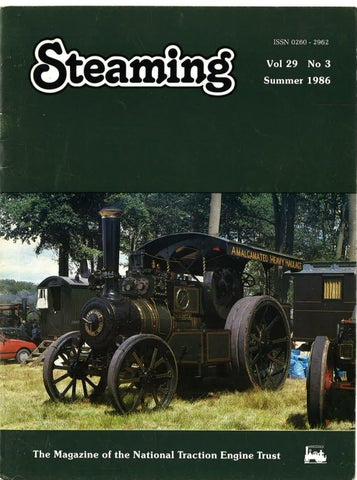
The Magazine of the National Traction Engine Trust
al "ae,siYacAon
nme UTTioa
Membership of the National Traction Engine Trust is open to those who, whether engine owners or not, have a genuine interest in the preservation of self propelled steam road vehicles, portable engines etc.
President (and Technical Services): S.J. Wharton, Southern Down, Minster Lovell, Oxford 0X8 5RD. Vice Presidents: P.R. Barker; Anthony S. Heal. Chairman: P.G.C. Barber, 77 Amyand Park Road, Twickenham, Middlesex TW1 3HG. Vice-Chairmen: J. Crawley, Field House, Turvey, Bedford MK43 8DU. Eric A. Fillmore
The annual subscription is £8.00 for individuals, £10.00 for family membership and £5.00 for pensioners. The Trust's magazine Steaming is sent free to members during January, April, July and October, and other benefits of membership include advantageous terms for boiler insurance as well as access to advice on technical matters.
General Secretary: D.G. Pugh, 95 Kingsway, Kirkby-in-Ashfield, Nottinghamshire NG17 7EH. Membership Secretary: Mrs Fay Wood, 'Windrush', Hail Weston, Huntingdon, Cambs PE19 4JY. Treasurer: C.J.C. Barber, 6 Merrydown, Downley, High Wycombe, Buckinghamshire HP13 5NQ Chairman, Rally Sub-Committee: E.A. Fillmore, 34 Northwick Park Road, Harrow, Middlesex HA1 2NU. Chairman, Engine Owners Sub-Committee: M. John Wharton, 85 Corn Street, Witney, Oxfordshire OX8 7DH. Chairman, Steam Apprentice Club: Sylvia Dudley, 42 Russell Street, Woburn Sands, Buckinghamshire MK17 8NX. National Sales Officer: K.D. Shakespeare, 179 Mickleton Close, Oakenshaw, Redditch, Worcestershire B98 7YA Insurance Officer: J.S. Hirons, 98 Hailey Road, Witney, Oxfordshire OX8 5HQ. Public Relations Officer: A. Fookes, Spent Penny Farm, Craigs Lane, Mount Bures, Colchester, Essex CO8 5AP. Publicity Officer: S.J. Gray, 9 Walnut Way, Ickleford, Hitchin, Hertfordshire SG5 3XT.
VW,Cg OmExo
The latest in the `In Focus' series of
A selection of our new or most popular lines
quality photographic albums
NEW BOOKS • Preserved Steam Traction (Sawford) • A Wager for Ale (Edmonds) • Ford and Fordson (Williams) • The Fred Dibnah Album (Nicholson) • Steam Rollers in Focus (Crawley)
£6.95 f4.95 £9.95 £3.45 £9.95
BINDERS FOR STEAMING • Vol 24 on (takes 12 issues) • Vol 19-23 (takes 8 issues) • Vol 18 and earlier (takes 8 issues)
£3.05 £3.50 £3.50
SWEAT SHIRTS Grey with small red logo • Adults S/M/L
£7.80
If showmans engines are the most admired, there's no doubt that steam rollers are the most loved of steam engines. John Crawley's latest album is already proving the most popular to date
(non members) £8.60
• Adults XL/XXL
£8.25 (non members) £9.00
• Childrens 24/28/32in
Price £9.95
£5.50 (non members) £6.20
POs/cheques (in Sterling) payable to National Traction Engine Club (1984) Ltd
Orders to
NTEC Sales, 91 Poplins Way Kings Norton, Birmingham B30 3NJ
Available from NTEC Sales (see address opposite) or NTEC Rally Stands
The Magazine of the National Traction Engine Trust Volume 29 Number 3
Summer 1986
Editorial
Editor:
A new facet of traction engine rallies in the last few years has been the flowering of the road locomotive exhibits. The breed has always been popular with enthusiasts but perhaps, until more recent times, the small number to be actually seen on the rally fields has tended to obscure that fact. But things have changed, Amalgamated Heavy Haulage is with us, and seemingly spreading its spurious tentacles to all corners of the country. There are those who scoff at what they consider to be the antics of a grown-up playgroup. It strikes us, however, that one very worthwhile effect has come out of this spotlight on the road locomotive. Over the past couple of years several examples have come up for sale, both by private treaty and at auction. Not so long ago the assumption would have been that the potential owners or bidders were bent on something sinister — conversion of the new acquisition to a mock showmans engine. Now the road locomotive can relax, for it is being seen for what it is — an important representative in the history of steam engines on the highway, and one which, anyhow, has been numerically greater than the showmans engine over the years. Prices recently demanded by road locos will probably put a stop to conversions among the heavyweights, for when the cost of several hundredweights of polished brass is added, who will subsequently wish to pay top price for something lacking in showland pedigree. We feel that Len Crane, Jim Sarney and the rest of the AHH Playgroup can take a great deal of credit for giving us appreciation of the road loco's proper role. The Road Roller Association is similarly engaged in sponsoring that other potential convertee, the steam roller. Who will come along and speak up for the road steam tractor and its trailers and its loads?
Roger West, 14 Charles Street, Market Harborough, Leicestershire LE16 9AB
Assistant Editor: Derek Rayner, 'Invicta', 9 Beagle Ridge Drive, Acomb, York YO2 3J H.
Display Advertising: to the Editor
Small Ads: to the Editor
Distribution and Change of Address: Mrs Fay Wood, 'Windrush', Hail Weston, Huntingdon, Cambs PE19 4JY
The Editor will be pleased to consider contributions of suitable articles, shorter items or photographs for inclusion in future issues. All material so submitted is voluntary and payment cannot be made for any material published, although expenses incurred may be met. The opinions expressed in the magazine, with the exception of those printed as Trust announcements, are those of the contributors and do not indicate the views of the Trust as a whole. All items are held copyright by the contributors and/or the NTET.
Next issue: The press date for any news items, recent photographs and small advertisements is 26th August 1986
This issue 108 111 115 116 121 122 124 126 131 132 141 142 144
Trust News 'Get your Dad to buy one' What do you think of this? The Strange Tale of a Savage Steam Brew Spring Events in Somerset Stoom without Frontiers Some notes on the Box Family Wivenhoe Sandpits Steaming Around, compiled by Derek Rayner Round the World Letters Books, New Members, Small Ads
Norman Bash ford Jan Brinksma Roger West Geoff Hallam John Reeves Derek Rayner Tam Mc Taggart
ISSN 0260 - 2962 Published by the National Traction Engine Club 11984) Ltd for the National Traction Engine Trust at 14 Charles St, Market Harborough, Leicestershire. Printed by AB Printers Ltd, Leicester.
Cover A much photographed and popular rally entrant is 1919 McLaren road locomotive 1652 BOADICEA, photographed at the 1985 Rushmoor event. (Robin Walker) 107
UM= Kfi=0 Engine Owners Column Export of Goods (Control) Order 1985 Each year more and more members are taking their traction engines or steam wagons to rallies on the continent. They should be warned that this perfectly innocent and friendly, pleasurable pastime could in future lead to them encountering unexpected problems at Customs — the result of affects which recent legislation veteran and vintage vehicles. The secretary of the Vintage Sports Car Cliih raised with Sir Henry Monroe, MP, the subject of the Export of Goods (Control) Order 1985 and its effects on owners taking abroad vintage vehicles for use on holidays or at rallies. Sir Hector wrote to Mr Paul Channon, the Minister for Trade, who said in his reply: 'Under the Export of Goods (Control) Order 1985 any work of art, antique or collector's item, including a vehicle valued at
From Alan Martin's Collection 33
£16,000 or more, and more than 50 years old, requires a specific export licence, whether for permanent export or temporary export. One purpose of the Order is to control the export of goods of particular importance to the national heritage. As many vintage vehicles are taken abroad by owners for use on holidays or rallies, we are seeking in consultation with our export advisers, a method of simplifying the export licensing requirement. In the meantime we are able to offer a short term solution by issuing an open individual licence, colloquially termed a season ticket, which allows a vehicle to be exported any number of times during a twelve month period, after which the licence may be renewed for a further period of twelve month.
The system is dependent on vehicles being returned to this country as agreed and if it is the intention of applicants to sell the
goods covered by the licence overseas, they must apply to the Export Licensing Branch at the earliest opportunity.' Applications for an 'open individual licence' should be made to: The Export Licensing Branch, Department of Trade and Industry, Millbank Tower, London SW1. If your vehicle is valued at less than £16,000 it might be wise to have a certificate to that effect to avoid argument and delay at Customs. (Anthony Heal)
Steam Heritage Awards The winners of the 1986 Steam Heritage Awards were recently announced by sponsors British Coal — details of the scheme were set down in nur Autumn 1985 issue. The winners, selected from over 60 entries, were: • Road steam engines — the prize of £500 to the Museum of East
A latter day picture of a threshing set ready for the road. Robey 28133 was new in 1909, a 7hp single for John Scott & Son at Beckingham, Kesteven, Lincolnshire. This photograph, said to be taken in 1947 at Long Bennington, Grantham probably shows the engine in its last season for it has been registered for the last time (CT4240) in 1946 by A. Summerfield of Claybrooke, Kesteven.
Hightatta Steamboat Horidays Cruise the beautiful sealochs and canals of Scotland in an original coal-fired Clyde Puffer. Good food, ss\ comfortable accommodation.
•
Send large SAE for free brochure to Rachel and Nick Walker, The. Change House, Crinan Ferry, Lochgdphead, Argyll PA31 8QH (Tel 054 65 232).
Anglian Life, Stowmarket for the final restoration and return to steam of the only surviving pair of Burrell ploughing engines, 776 and 777 of 1879. Other entries included showmans engines, traction engines, fire engines and scale models. • Railway engines — £500 to the Vintage Carriages Trust at Haworth, Yorkshire for the return to working order of 0-6-0 well tank BELLEROPHON, built by Haydock Foundry in 1874 for use in their own collieries. • Museum award — £500 to the Exeter Maritime Museum for their installation of a coal burning steam engine into the launch LADY BETTY. • Marine section — £500 to the Paddle Steamer Preservation Society for the restoration of former River Dart paddle steamer KINGSWEAR CASTLE. • Premier award — The Special £1000 Award for outstanding technological innovation was made to the Ravenglass & Eskdale Railway in Cumbria for their conversion of the 15 inch gauge 2-8-2 railway loco RIVER ESK to burn coal by the gas producer combustion system. The system reduces running costs by burning small sized fuel more efficiently, widening the range of solid fuels that can be burned and minimising emission of smoke. The presentation of the awards and certificates was made on 5th June 1986 by Malcolm Edwards, CBE, commercial director of British Coal, on board the KINGSWEAR CASTLE as it left Chatham Historical Dockyard, Kent, for a two hour cruise on the River Medway with representatives of
the winning organisations and the press. Mr Edwards humorously welcomed 'the gathering of eccentric people' and spoke of the willingness of British Coal and the Solid Fuel Advisory Service to encourage, through the scheme, preservation and interest in the achievements of the British industrial revolution. In reply David Morgan, chairman of the Transport Trust, thanked their hosts of the day, the Paddle Steamer Preservation Society for such a splendid venue for the presentation, and mentioned the work of Arthur Cutts in running the scheme. It is intended that the Museum of East Anglian Life's Burrell engines will make their first appearance for 50 years or more, as a pair in working order, at the Weeting Rally on 19th and 20th July 1986.
Obituaries John Beeby It is with great regret and deep sadness that I report the passing in April of John Tindale Beeby, who was known to many of his friends as Jack. Jack was a very early member of the National Traction Engine Club, and was past Vice President, and of course he was the face behind the very well known Rempstone Rally. The Fowler singles were Jack's love, and the look on his face when he was on the footplate, and the engine was barking on a heavy pull, was a sight to behold. Jack's connection with steam cultivation and ploughing was of very
long standing. His father bought the firm Angrave & Burrows of East Leake, in Leicestershire Loughborough, 1907, and then traded as Beeby Bros. After leaving school at seventeen years old, Jack worked for the firm, by then owning eleven sets of cabletackle and three threshing sets. Jack once told me that he worked from 3.30am until 8.30pm when they were short of staff, and then after that would have to ride his bicycle 10 or 20 miles home. He was one of the great men of steam, and always ready to pass on to anyone the benefit of his vast experience with steam engines. He was a very early rally organiser and the present Rempstone is a fine memorial to him. When steam was being replaced by diesel power, and many of the Beeby engines and equipment were sold, Jack retained one pair of single cylinder engines (NR1212 and NR1213), and one pair of diesel cable engines. Jack's singles have taken up duties on the rally fields since 1954. Jack was liked by all who knew him; his passing has left a gap in the engine movement which will not be filled. We of the National Traction Engine Trust extend our deepest sympathy to his wife Mary, and to his son Michael. (Jack Wharton)
Rev. Teddy Boston The Reverend Edwin (Teddy) Boston, without exaggeration a figure well known to most steam enthusiasts, died at Leicester on 1st April 1986, aged 61. Teddy was born in Solihull, Birmingham, and educated in Norfolk and at Jesus College, Cambridge before taking theological training at Lincoln College. He was ordained to a curacy at Wisbech in the 1950s, later moving to Leicestershire and then, in 1960, to become Rector of Cadeby and Vicar of Sutton Cheney. Cadeby, a tiny west Leicestershire village, was from that time never quite the same, being turned almost overnight from a quiet country hamlet into what almost amounted to a steam village. The Rectory became a steam enthusiast's mecca, and Teddy had a warm welcome for visitors from all over the country and overseas, and from all walks of life. For everyone's delight at his monthly open house were Foster 14593 and Aveling roller 5163, as well as Ted's pride and joy, the two foot gauge Bagnall railway locomotive PIXIE, running on his Cadeby Light Railway which all but circled the Rectory gardens. Teddy was a man of God and truly a good man. He was an excellent friend to so many, and I and a good 109
many more will miss him very much. We offer our sincere condolences to Audrey, Ted's widow. Market Bosworth rally, his yearly fund raising event, will continue this year and form a very fitting memorial to a kind and gentle man who would go anywhere and do anything he could fnr his friends in steam. (Ted Sansome)
NTEC Sales I send our apologies to members who have experienced delay and disappointment in the late despatch by us of their Mail Order items — our own work has been rather hectic during the last few months. Delay was also inevitable for those who ordered binders for the magazine — fresh supplies have at last arrived and those who received examples with. incorrect stringing should shortly be hearing direct from the manufacturers: If you
don't, or if any problems arise, please contact me (address inside front cover) or see us at rallies. New this year is the facility to pay by Visa, so we look forward to seeing you at some of the following events: August — Bristol Harbour (Keith); Astle Park (David); Colchester (Michael); Knowl Hill (Keith); Hellevoetsluis, Holland (Keith); Fairford (David); Haydock Park (Keith); Harewood House (Michael); Bishops Castle (David); Stourpaine (Keith); Brill (Michael). September — Haddenham (Michael); Malpas (David); Roxton (Keith); Capesthorne Hall (David); Buxworth (David).
Dates and further details of the above rallies were, of course, in the Rally List supplement in the last issue. Will members please note the Mail Order address has reverted to the Peplins Way address, which should make for a speedier service in some instances. (Tracey Shakespeare)
Corrections The editor can offer no excuses for the errors which appeared in a number of photograph captions in the last issue — especially as some of the pictures were of his own taking! The ploughing engine gracing the Dorset landscape on page 81 is, as owner Charles Daniel points out, his McLaren 1552 HERO. The location of the pictures on page 92 was, in fact, the Leeds & District club's Harewood House rally. Sentinel 8843, pictured on page 64, is not the vehicle sold to Australia in 1979 and is a regular attender at rallies across the southern part of the country in timber tractor form and the ownership of the Goold brothers. Apologies to fans of Aveling roller 8116 if they searched too long for the phantom article on this engine mentioned on page 83; though elbowed out of the last issue at the last minute, it is included this time.
OUR MAGAZINE 25 YEARS AGO
Widely travelled and an attender at many rallies in the south east of the country is this fine and stocky Foden engine, an import from Australia some years ago and of uncertain vintage and history. The works number on the brass plate on the cylinder — 1294 — is that of a Foden road loco believed broken up in Lincolnshire about 1951. (Robin Walker) 110
Another elderly Aveling roller had been pensioned off as a celebrity — 1760 of 1882, new to Reading Corporation and latterly used on the construction of the M1 motorway, had been acquired from Aliens of Oxford by Aveling-Barford and exhibited at the Crystal Palace Construction Exhibition in June 1961. The Club's rally at Appleford featured steam ploughing and cultivatin❑ (with commentary by Harold Bonnett); the event was considered to be a success and the traction engine movement as a whale to have come a long way since Arthur Napper and Miles Chetwynd-Stapleton raced engines in the summer of 1950. Jim Hutchens was gratefully noted as doing so much prior to the rally with his Scammell low loader — it seems the same could be said 25 years later! Low loading of engines was becoming more common and Michael Salmon wrote an article of several pages length on the art of getting engines safely on and off. An engine sale at Emley in Yorkshire had seen three engines sold for between £255 and £70 (dismantled) and three rollers for £105 down to £92.
'Get your Dad Norman „ash,„,, to buy one It was a foggy November morning in the late 60's that it all began again for me. Steam was almost extinct for commercial purposes, except for a few County Council rollers. We lived well off the beaten track, down nearly a mile of our own lane opening onto a little used (at that time) by-road which eventually joins the main road some three miles away. I heard the 'chuff-chuff' of a single cylinder engine working on the byroad at the bottom of the hill by the stream. We could have seen if from the field in front of the house, except for the mistiness of the morning. But then the children would have watched it from a distance, and I wouldn't have been involved — and there would have been no story to tell. Anyway, they wanted to know what it was and worried me to take them down. I wouldn't let them go on their own in the fog; it hadn't really occurred to me that they had never seen a roller actually working on the road, although we had been to one or two rallies, not quite the same thing. So I took the three eldest children across the fields by a short-cut and there, by the bridge, was an 8ton Aveling taking water from the stream. I had seen the driver once or twice before but only off duty at the market, and knew him only as Tommy. My two boys were only too ready to jump up in the coal box to have a ride. The small gang working with the roller were patching, and were gradually working away from the farm but before we finally parted Tommy said to my eldest boy, impressed by his obviously experience, "Get Dad to buy one; there's one scrapped back at the yard." The County Council yard was on the other side of the small market town which we used for most of our requirements and I didn't know where it was. Some time after, I thought about Tommy's suggestion and made an effort to find the place. Sure enough, at the far end of the yard, pushed bunker first up on the ash
heap, minus its front rolls and several other bits and pieces, including the drawbar, was an old R10 model of very early vintage. I could only guess, because the maker's patent plate was missing — 'borrowed' I was told afterwards! I thought something could be done with her, so I enquired at the office and was told that she was indeed scrapped, and the thing to do was contact Divisional Office in Exeter. I subsequently received a reply to the effect that if I cared to make an offer the committee would consider it. By the next post, literally, another letter arrived saying that two other gentlemen had made a similar enquiry and therefore unfortunately the whole thing would have to wait until what was known as the 'obsolete plant tenders' were published in about twelve month's time!
In fact it was almost four years before that engine came up for tender. In the meantime, I had become very friendly with the staff at that small depot. They were most helpful and tolerant of my periodic visits to look at something I could only hope would be mine, but to make matters worse there was always a little bit more missing each time I called. However, when the Kentish horse and nameplate brasses disappeared it was too much! I mentioned it to the office staff and yard foreman, who could have told me to mind my own business, but instead very kindly said that they would see that nothing further was taken. Incidentally the two 'gentlemen' who scotched my intended offer were never heard of again; at least, they didn't again look at the engine to anybody's knowledge. Eventually the tender forms arrived and there were two other rollers on offer, but I was only interested in the front-rollerless, neglected old girl on the ash-heap. That was until one day I ran into Bill who drove a council lorry. I had known him for some time, but didn't know that he once drove a roller. He had apparently been the youngest in his time, locally, to have been in charge of a roller at the age of 21. It transpired that the very engine that he fondly called 'my old engine' was one of the three up for tender. He asked if I was going to bid for this one too. It turned out to be another single cylinder R10, but a dozen or so years =
Aveling 4932, one of the two rollers featured in this article, pictured at an event at Chivenor in 1970 (A. V.K. Thomas) 111
younger than the ash-heap reject, and Aveling & Porter's number 8116 of 1913. I could only afford one, and doubted if I would be a successful tenderer even with that. Anyway, Bill inveigled me to go and look at his engine, which was still at work but with another driver. I found her sheeted down in a layby some miles away. On climbing up inside the curtains I could see she was a totally different design to the older one and what's more had a winch axle, which I understand is unusual for rollers. The idea was to lower themselves down steep hills from a dead man's anchor as a precaution against slipping away. Again, the roller was an Aveling single, delivered to Barnstaple depot in 1914 and immediately requisitioned by the War Department to go to France where she spent the whole of World War 1, eventually returning to Barnstaple with quite a bit of damage about her, particularly the rear wheels. I had visions of pulling tree stumps on the farm, and all kinds of wonderful and practical ideas presented themselves. Needless to say, I tendered for both, but expected nothing to come of it all. Yes, you've guessed it, the County Council Highways Department were 'pleased to inform' me that my tenders were successful. I was now the proud owner of two steam rollers. My wife had been on about a deep freeze for months — and I had bought two old boilers! To say there was an atmosphere for a few days would be an understatement. But there was one highly delighted individual — Bill! He couldn't wait to light her up and drive the engine home, and nor could I for that matter. Bill had a field day that Saturday! We went along in the van with the necessary wood and oil etc. He was on the road within the hour, and by the time I'd collected up the odds and ends and overtaken him it was still only 8.30 am. Bill assured me he would be alright and didn't need me to follow. He had a tank full o f water, would top up at Fred Somebody's place, and if anything happened he would ring up. So, home I went and got on with the farm work; 2 o'clock came and went, no engine — not even a sound in the distance. I was tempted to go looking for him, but in the event was glad I didn't, it would have spoilt his day for he eventually rumbled down the lane just as darkness fell, I must say it is quite impressive to see a steam roller coming towards you in the darkness. However, Bill had had a wonderful day, and he said as much. Calling on all his old mates along the eight or nine mile journey, he was almost out of coal; if he'd drunk as 112
A 12ton compound Aveling, 5683 of 1905, at St Issey rally in 1972. (A.V.K. Thomas)
much beer as he had tea I doubt if he would have got back at all. But that's unkind, for I was much indebted to him for bringing the roller home, and the fact that he had enjoyed it was a bonus. My original choice, still in the Council yard, was a different proposition altogether. No lighting her up and driving home... She actually turned out to be an ex Eddison & de Mattos machine, class R10, delivered new to them in September 1901, works number 4932. The two speed gearing is totally different to the later engine, being a trunk double pinion, on a fixed shaft, and much more robust. I didn't realise until I started to work on her that sometime in the early 50s she'd had a new firebox fitted — which was a stroke of luck — and had done very little work since; and for a very good reason I was to discover to my shame. My friend Bill had no knowledge of this engine, but what little I could glean from the drivers and a fitter called Jacko, who turned out to be a great help to me over the months, was that she was a good steamer, though heavy and awkward, having no differential. And nobody seemed to like her, but didn't really know why. The answer to that is for a later part of my story. When I look back I realise I must have been keen, or mad. Somehow between farm work I found time, not always a whole day, to work on her.
The first and about the only question the staff at the depot asked was how was I going to get it home? "Drive it" was all I could say, more out of bravado than conviction. Their parting looks spoke words enough. I should have explained there was a spare pair of rolls I was told went with the engine; they were unplated and pretty thin. It turned out they had come off another roller, for which my roller's own rolls had been requisitioned. The explanation of this worn-out pair going spare was that instead of going to the expense of replating them, the rolls from my engine being better were substituted and the worn-uut pail lert uii one side. However, on casually measuring them I was aghast to find they were two inches too wide to 4:3:32's forks! I briefly wondered if they were even Aveling rolls, so I measured the ones at home on 8116 and found they were the same width. It appears the old R10 design went through quite a few changes over the years. Incidentally, I discovered afterwards that the machine on which the rolls of the 1901 engine had been fitted then left two ridges in the tarmac, simply because the path of the rear wheels didn't overlap the narrower rolls by one inch each side. I never did see this hybrid roller. So, problem number one — a pair of rolls which didn't fit. Fortunately, the axle was the same. The nearest
lathe that could swing the rolls to turn the inch off each edge was in the Dockyard at Plymouth. I didn't even get as far as asking if they would condescend to do them, as the cheapest form of carriage was going to cost £40 each way to get them there. I made a few enquiries and sought suggestions, and found the nearest example to my problem was an occasion that Dingles foreman at Stokeclimsland had had some years ago, when they had some new rolls for an engine that came too wide by about % inch; they simply set to and chipped right round and then filed up afterwards. I thought long and hard! It happened that I had a 14 inch centre Dean Smith & Grace lathe which I'd purchased a year or two before, but had not had time to fix up. The tool rest and cross slide I thought were heavy enough to mount on a rig somehow and part the two inches off the rolls in situ. For any reader who might conceivably find himself in the same situation, I'll briefly explain what I did. Fortunately the crankshaft protruded outside the flywheel by six or seven inches, which was a terrific stroke of luck; I certainly would not have been able to attempt an in situ machining otherwise. On the crankshaft extension I bored and fitted a ten inch rim pulley. Then I mounted one of the rolls on its axle between the forks, locating it with two collars locked on the axle, having of course
-
••••
••
first supported the forks above the ground each side so that the roll revolved freely. A four inch belt was then put round the roll and twisted once to give more grip, and coupled over the crankshaft pulley. When we steamed up we found the system worked quite satisfactorily; the main problem was going to be keeping the revs down sufficiently, because the circumferential speed of a 4 foot diameter flywheel is quite fast at only four or five revolutions a minute, and cast iron is not noted for fast cutting. Anyway it looked as if we were in business. The rest was fairly simple — with a ten inch channel bolted from the back wheel scraper brackets on the firebox across to the forks, we were able to mount the toolrest base, and with its cross slide on the channel and with a heavy tool bar and stylite parting tool, we were ready. I suppose it was a bit much to expect to go ahead and steam away. We'd hardly started when a tube blew: we shut down for that day and made up a few tube plugs and bars for the next time. Unfortunately it wasn't to be, the old girl kept blowing tubes and the only thing to do was to retube completely. It took about a fortnight to get a set from George Thurlow at Stowmarket, incidentally £33 for a set of twenty eight 3/4 inch tubes at that time! We set to and retubed her. Up until now, it had always been 'we', my
. •• • •
°kir
Another of the numerous Devon rollers to survive into preservation is 6ton Aveling 7024 of 1910, seen here at Stourpaine in 1972, still bearing its council paintwork and name on the motion covers. (A. V.K. Thomas)
son of twelve being home from school to give valuable help. Unfortunately by the time we were really ready to restart machining, he had had to return to boarding school. How I could have done with him on the regulator! With no governors, it was difficult to keep steady revolutions, and at such low revs, she would either speed up or stall. However, after a lot of patient jumping up and down the job was successful and I managed to make a passable job of turning an inch off the boss and the rim of each roller. After that it was fairly plain sailing. Having reassembled the rolls and made up a new drawbar (what the original was robbed for, I can't think), she looked more like a steam roller. All this had been going on intermitently for nine or ten months, and now came the great day. I was advised to keep both pins in for driving and I was assured you could negotiate corners well enough if you took a big enough sweep. That may have been alright in the old days on soft macadam roads, with only horse traffic about, but you have to keep to your own side of the road these days or you are soon in trouble. I quickly found that it requires an arc of about 40 or 50 feet to turn without a shunt or two, if the front rolls weren't to dig in and rear up. After much trial and error we managed to drive the old Aveling the six miles or so back to the farm. We had yet to learn that a road engine does not take kindly to wood firing and that the vibration shakes the fire through into the ashpan. Several other things were yet to show us what a world of difference there is between building up an engine and driving it, but that would make another story! To finish, I must explain how I discovered why one or two of the drivers that had operated 4932 were so reluctant to say why they didn't like her. While having a steam up the farm lane one day, to my horror I dropped the lead plug. I had seen the water was down a bit, but there were still 2 inches in the glass on the level. Of course, I couldn't tell anybody, or ask advice — I knew it was a disgrace! I just couldn't understand it and it was quite by accident I discovered the roller's secret. Fortunately we were able to push her back into the shed with the front rolls up on two wooden slabs, which of course tipped her slightly up at the front as well as preventing the rolls rusting or freezing to the ground — frost, incidentally, will hold an engine and make her spin if it's really frozen at the front, as we discovered once to our cost. Having taken the firebars out, I thought I'd put the water 113
hose in and be filling up while I went for the spare plug in the workshop, there being plenty of time to then insert the plug before the water came over the crown. It so happened that something delayed me, and several minutes elapsed before I got back. I looked at the glass as I passed and noticed almost 2 inches of water showing, and I hadn't yet put the plug in! I was most relieved to know that it wasn't altogether my bad enginemanship that had caused the lead plug to blow in the first place. Somehow in the post-war reboxing, someone had drilled the water glass holes too low and 2 inches showing more accurately represented an empty glass. From then on not less than three quarters of a full glass was the order of the day; on the move of course it was fairly safe to be lower, because the slopping about would keep the crown covered. Anyway that was her guilty secret I had discovered. When I surreptitiously questioned the drivers at the depot, not of course admitting that I had done the unthinkable of dropping the lead plug, none of them ever let on whether they had any experience with that engine — they apparently just kept away from her if they could. To close I must add tribute to Charlie Porter who for many years was in charge of all steam plant for Devon County Council in North Devon. Although by the time my story took place he was retired, he gave me valuable help and advice in the working of the old rollers, not least in the operation of the old type Madox injector! (Thanks are due to Alan Thomas for providing pictures of ex Devon Council rollers to illustrate this article.)
For further details contact
The giant trees of Lyme Park, Stockport, dwarf Burrell 10 ton roller 3535 and its living van as it leaves the park after the 1985 steam event. A 1986 Photographic Competition entry. (Jim Stevenson)
We specialise in the construction and repair of locomotive type boilers. Firebox construction can be of the traditional flanged and rivetted design, or flanged and welded. Construction is to the appropriate British Standard Specification and all welding is by coded welders to BS 4870. Work being done is approved at all stages by an engineering surveyor from your boiler insurance company. Construction of tubeplates, smokeboxes, tenders etc, also undertaken.
Roger Pridham, Hollybank, Chilsworthy Beam, Gunnislake, Cornwall. Telephone Tavistock (0822) 5276 Daytime, 832945 Evenings
114
Jan Brinskma
I first saw this picture when I was a boy and it was the very first picture I ever saw of a traction engine. Such a machine was new to me and the picture was the cause of my interest ever since in traction engines. Later I saw the movie 'The Iron Maiden' and this strengthened my curiosity. News of engines reached me from Ge van der Pol, chairman of our Dutch Stoom-
walsenclub, and it was all very exciting for me — I never dreamed I would own an engine one day. However, back to the picture. It comes from a 1915 copy of De Prins, a Dutch weekly magazine which
at that time, naturally, reported happenings in the Great War. I think it must be quite rare, for although I later saw other pictures showing British
engines used in the war, these are being used by the Germans and never have I seen this again. The engines are
as it is of utmost importance that the guns, playing a headrole in modern warfare, arrive at their destiny in time, and in the correct manner.' There is little detail information in that text for the present day engine enthusiast, so I will describe the scene from what I can see on the original. At the left is one of the engines with the strange flywheel, then two German lancers and the gun being hauled by the engine. Beyond the officer on
horseback is another engine with a number on the smokebox door; then two more standing officers and three more engines of a different size and appearance. The sixth engine in the centre right foreground bears the number 6 on its smokebox door (the latter of the American cast variety), and looks to be the same as the two left hand ones, certainly not like English built machines. Number 6 is camouflaged under tree branches and
twigs! On the extreme right is a very heavy mortar.
of unknown make to me and some have strange flywheels with the face dished inwards, and spark arrestors in
All the uniforms are typically German, except for the officer's on the right — could he be Austro-Hungarian?
their long chimneys. The picture was made in 1914 and the caption tells us 'haulage of heavy mortars at the Western Front by traction engine. Before there were railways all artillery had to be hauled by horses, other animals or even men, from the garrisons to the battlefields. Later on artillery was transported by railways and from the stations by horses. Nowadays heavy artillery is hauled by lorries or traction engines,
The description Western Front would indicate the scene to be in Belgium or France. I would be interested to hear what other readers have to say about what has always been to me a most interesting picture. (Does the number 6 engine bear characteristics of machines built by Hofherr-Schrantz of Budapest, Hungary — a Clayton & Shuttle worth subsidiary company? — Hon Editor.)
orothea estorations Ltd. Engine overhauls Tenders Tanks Smokeboxes Flanged Plates Smokebox Rings Chimney Tops Metal Spraying Grit Blasting Polishing Convex beading Wire bound suction hose Brass boiler banding New Road, Whaley Bridge, via Stockport, Cheshire (06633-3544) Also: Churchill Road
Bristol 4 (0272 715337)
'Five-ton Straker steam wagon for sale, can be seen working. G. Horn, Ltd, Kempston Mills, Bedford.' (An advertisement in The Commercial Motor, 13th January 1910.)
115
THE STRANGE TALE OF A SAVAGE
To pose for the photographer with your workmates in front of the threshing set was no doubt a proud and exciting moment for the Victorian or Edwardian farmworkers, but it was not that unusual an occasion — after all it was the heyday of formai photography of the individual or the group. Whatever the thoughts of the assembled company as they stood for our heading picture however, they probably little realised just how remarkable the traction engine was. Apart from knowing the engine was somewhat aged, they may have known little else about its history — and that is what makes the photograph so interesting to us. The engine is a Savage, one of an 8hp pair built for showmen at their St. Nicholas Works at Kings Lynn in 1880/ 1881. They were unique in Savage's production of traction engines in 116
Roger West
having duplex cylinders with the valves arranged inside, between the bores. That apart, their design and superficial appearance was very similar to the maker's contemporary single cylinder engines. Our splendid picture shows one of these engines in Norfolk, about 1912, in the ownership of George Smart. We are grateful to Herbert (or 'Digger') Lister for sending us the photograph of his grandfather's engine, for an intriguing history has unfolded from trying to find out more about the machine. George Smart was the engineman in charge of a Fenland pumping station on the north bank of the Old Bedford River about a mile and a half south
west of the village of Welney, midway between Ely and Wisbech. This pump drained the fens around Welney and Manea, most of the land concerned lying below sea level. The water pumped from the dykes and drains of the fen went into the Old Bedford River via a paddle wheel driven by a beam engine erected about 1840, and this old steam engine remained working until the early 1920s. It was then replaced by two Petter semidiesel engines, each coupled to 36 inch diameter Gwynnes centrifugal pumps. Alas, the old beam engine and paddle wheel were scrapped soon after the diesels were commissioned, but the engine-house remained for many years — it may still survive. A similar fen engine is preserved in situ at Streatham Fen, near Ely. At the turn of the century Smart also ran a set of threshing tackle
around the Welney area. At first he used a Ruston, Proctor portable engine to drive the thresher and chaff cutter and Digger Lister can just recall, as a lad, the old portable standing derelict alongside the wall of the coalyard at the pumping station — the engine unused for many a year. Just when grandfather Smart acquired the Savage is unknown but it was certainly before World War 1, for the man who is driving the engine in the picture (behind the figure at the steering wheel) is Bert Smart, George's youngest son, and he was killed during the war in France where he had been driving a steam wagon. The location for the picture is Colony Farm, alongside the Old Bedford River's north bank between the pumping station and Welney. Affixed to the toolbox can be seen the registration plate of the Isle of Ely County Council (No 208) and no doubt the engine also carried elsewhere a similar Norfolk plate for Welney village is in Norfolk, though the pumping station was within that part of Cambridgeshire administered as the Isle of Ely. Smart possessed two other traction engines, but none of the trio is precisely identified, though circumstantial evidence offers a fair degree of certainty in the case of the Savage, as we shall see. Alan Duke's lists reveal (from county licensing records) that in 1921 Smart registered an Aveling & Porter and a Savage with the Isle of Ely; his address was Glenn House, Welney and whilst the latter village is in Norfolk, his house was evidently in the Isle. He quoted no maker's numbers in the original declarations, and was allocated the Ely index numbers EB2800, for the Aveling, and EB2801, for the Savage. Both had earlier Locomotive Act registrations — EB2800 had been Ely No 44 and Norfolk No 1054; EB2801 had been Ely 208 and Norfolk 453, the dual Smart's reflecting registrations travelling area astride the county border. The Ely number 208, known to be issued about 1909, might indicate the date Smart acquired the Savage. His third engine was an 8hp Garrett but there is no known record of an engine of that make under Smart's name in registration records. It is likely that the Savage and the Aveling, at least, went for scrap at the sale after his death. So much for the later history of the main subject of thiS article, but in trying to resolve its earlier life an unusual tale unfolds. The two duplex cylindered tractions built by Savage were their works numbers 228 and 229. The first was supplied to William
Sanger (elder brother of George Sanger of circus fame) under works order 1681 in August 1880, and the second went to George Twigdon under order 1688 in January 1881. Perhaps Twigdon, a well known showman at the time, took delivery of his engine at the Lynn Mart of that year; both showmen had done previous business with Savages by purchasing rides and engines. The maker's records detail 228 as having 'extra long boiler' and being 'first showmans road locomotive'. There is no further known record of 229, but 228 is almost certainly identified on surviving Savage drawings in the collection of Bill McAlpine. A drawing was prepared for work carried out by Savages to an engine before sale to W. Beach (sic) and is dated July 1899 and further noted up with the inscription 'was W. Sangers' and 'inside valves'; that is, it refers to work being done on Savage 228.
The merriment on the fairground at Alexandra Palace in North London on the Saturday of the 1901 August bank holiday was rudely shattered by the explosion of the firebox of a Savage traction engine owned by John Beach. Although the Report of the subsequent formal investigation by the Board of Trade makes no mention of a works
number for the culprit there can be no doubt from the evidence presented that the engine was Savage 228. The report fills in the earlier history very nicely but before putting down those facts let us set the scene from contemporary press reports. The fair was in the north east corner of the Palace grounds and offered the usual swings, roundabouts and a switchback railway. About 8 o'clock on the Saturday evening when the fair was in full swing there was 'a deafening explosion, followed by loud shrieks and cries for help'. According to the North Middlesex Standard & Tottenham and Wood Green Echo it was found that 'the boiler of a portable engine used for driving the electric light dynamo attached to the roundabout had burst, blowing the whole front of the engine out and hurling fragments of metal in all directions'. Many riders on the roundabout were injured as well as others on the adjacent switchback. In the case of the latter the 'heavy foreplate' of the engine — surely its smokebox door? — was driven right into the ride, accompanied by volumes of steam and scalding water. The engine sank a yard into a hole, made by the force of the outrush of steam in scouring away the earth. The noise was heard over a large area and hundreds crowded into the grounds, greatly impeding the aiders. The engine driver, 35 year old George
Another of George Smart's engines, pictured whilst at work on top of the Old Bedford River bank at Welney, just off the present day A1101 road from Ely to Wisbech. The 8hp Garrett came secondhand from dealer James Graven of Ely, sometime in the 1920s and possessed right hand steering. Unusually, further indentity of the engine is not forthcoming from Alan Duke's lists. (collection H.S. Lister) 117
Musk of New Southgate, escaped with lacerations and fractured fingers — he was taken to Wood Green Hospital. Several children were hurt and ladies had their dresses set alight by flying cinders — these also set fire to the canvas tilt of the roundabout. The one fatality was a pony which was strangled when it reared in the rope halter around its neck. One of the eye witnesses seems to have been something of an engine or fairground enthusiast — he told the North London Mercury and Crouch End Observer he was about to go to watch the 'dynamo engine' which was
attached (he said) to the Sea-on-Land ride but fortuitously stopped to view the switchback, just before the explosion occurred. He experienced a downpour of live coal and hot water. The press, probably understandably, were somewhat confused as to the proper desciiption of tlw engine and just what it was doing and for which ride. The Observer reported the roundabout being driven was the property of A. Beach of Uxbridge,
Middlesex and even faithfully recorded the traditionally boastful legend which would, no doubt, have been copied from the rounding board — 'GRAND STEAM GONDOLA FROM THE VENICE EXHIBITION THE GREAT INVENTION OF THE NINETEENTH CENTURY PATRONISED BY ALL THE CROWNED HEADS OF EUROPE'. That machine had an engine at its centre which also worked an 'Orchestraphone' whilst the 10 ton traction engine was used to work the
The development of the firebox plating of Savage 228's boiler, as published in the Board of Trade Report and showing the broken stays.
0 0 0 0 0 0 00 00 0 0 0 0 0 0 0 0 0
0 0 0 0
0
0
0
0
0
0
0 0 0 0 0 0 0 0 0 0 0 0
0
0
0
0
0
0
0
0
0
O
0
0
0 0 0 0 0
0 0 n 0 0 0 0 0 0 0 0 0 0 0 0 0 0 0 0 0 , 0 0 0 0 000 00000 00000 000.0 0 0 0 0 0 0
o
0
O
o
o
0
o
0
o
0
0
0
0
0
0
o
o
0 0 0
o
o
o O
o
O
o
o
o
•
o
0
o
O0
0
n
0
n
O 0 0
0
0
0. - Fudibld _Plug 0
0
0
0 0 0 0
0
0
0
0
o
0
0
0
0
0
0
0
•
•
4-
•
4-
•
4-
4
1(
•
X
)8(
0
o 0 O 0 0
0 0 0 0 0 0 0 0 0 0
•
0
if
0
O
0
• 00000000000000 (7)00 000000a0000000000 :0
•
lir
0
0
0
Stays skean, Mad frattettect Lire Eaplesiad
0
O
0
O
O 0
eltavere thyddegh plated
O
O
0
SCALE 11E - I FOOT.
0
O
0
O
0
O
0 0 0 0 0
0 0
0 O
O
0 0 0 0 0
O
O
0 0 0 0 0
O O
0 O 0
0 0 0 0 0 0 0 0 0 0 0 0 0 0 0 0
118
O
)4. 0
0 00 0 0 0 0 0 0 0 0 0
O 0
0
dynamo to generate current for the electric lamps. The Echo concluded its report: 'in an incredibly short time the tumult had so effectively subsided that another roundabout not far away was being patronised by crowds of holidaymakers' and the incident obviously had no adverse effect on pleasure seekers on the following Monday for the general manager of the park claimed crowds of 200,000. But keen sightseers after the event arrived to no avail — by the Sunday caravans had been drawn around the engine and 'many persons with cameras were disappointed'. An interesting comment was taken from H. Sutton, an engineer, who had said a fortnight before that the engine was unsafe, and he had prophetically left its presence again shortly before the explosion, declaring "It's not safe to be here". As was usual with Board of Trade investigations under the 1882 and 1890 Boiler Explosion Acts the inspector wanted to know the previous history of the boiler, and from the proceedings at the Royal Courts of Justice in London on 25th and 26th October 1901, we learn more of Savage 228. The boiler barrel was 7ft 6in long and 2ft 8in in diameter, made of Staffordshire BBB iron, as was the outer firebox. The inner firebox was of Low Moor iron. The boiler had been made by Savages at Kings Lynn in 1880, intended for 1201bs working pressure and tested hydraulically to 2001bs. The whole engine was supplied by the makers on a hire purchase system for 'supplying steam to the machinery which drove a roundabout'. The customer is not named in the Report but it is recorded that he failed in the following year, 1881, when the engine was returned to Savages. It was then sent abroad, and after having been used for a period of some four years in France and Germany,* was again returned to King's Lynn, presumably at the end of some leasing arrangement. There it was overhauled and tested and then used by Savages from their own works 'for driving and hauling purposes' until July 1899, when they prepared it for further sale. Henry Crowe, the boiler maker, was instructed by Affleck, the works manager, to effect all necessary repairs. The description of Crowe's subsequent work indicates a perfunctory examination — he only used a hammer test on the stays and didn't even carry out a hydraulic test, let alone withdraw any stays to ascertain their condition. In July 1899, John Beach, des-
cribed as a roundabout proprietor, required another engine for use in his business and 'knowing that Savages dealt largely in these boilers (which fact has been admitted by Mr William Savage, their secretary, from whom it appears that the firm has almost a monopoly in the trade), Mr Beach applied for one adapted to hauling vans and working the electric light in connection with his steam roundabout entertainment.' It was this purchase, of course, which prompted the execution of the previously mentioned drawing now in the McAlpine collection. On a visit to the St Nicholas Works at Lynn, Beach was shown 228 and the deal was agreed on the hire purchase system for the sum of £550. He didn't have the boiler examined by any independent person acting on his behalf, but chose to rely on Savages reputation. The engine was subsequently used for three seasons at various places in the Thames Valley such as Slough and Maidenhead, generally working at 901b to 110Ibs pressure, though the valves would begin to lift at 100lbs. Then, later in the summer of 1901 Beach took his equipment to Alexandra Palace by arrangement with John Fulcher, lessee of a portion of the fairground, and erected his ride on paying the latter 30 per cent of his gross takings. Musk, the driver at the time of the explosion, gave evidence that he had been engaged by Beach just three days before the accident on 3rd August; he had cleaned out the firebox and prepared the boiler that morning and his employer lit the fire about 6pm — presumably they didn't bother to make light for the rides until dusk approached. When Musk looked at the pressure just before 8pm it registered 105Ibs; shortly after there was an explosion. The right hand side of the inner sheet of the firebox gave way, tearing off the stays. Fifteen stays were broken and nineteen had the plate pushed off them. The fracture then ran across the top of the box at the front end and about eight inches into the side plate on the opposite side. More stays had been broken on that side and the force drew the tube plate off the ends of ten tubes. By the time of the inquiry poor driver Musk had lost two of his fingers; seven other people were listed as injured and a Mrs Morgan and a Mrs Walsh 'were returned as faint'. The investigators turned to what was wrong with the boiler. Its plates were in very fair condition having wasted barely 'As inch, certainly not much for the engine's age and well travelled history. The upper rows of
stays, however, were entirely corroded and furthermore had been like it through wear and tear for some time, not suddenly or recently. Mr Seaton, a Board of Trade consultant, considered the breakages occurred because the expansion of the firebox under steam caused the 'protective scale' on the upper stays to be thrown off, thus exposing fresh metallic surfaces to corrosive action, gradually reducing the stay section. The surveyors considered many of the stays to have been broken in 1899 and that the boiler was then, as at the time of the explosion, not fit for work. Further, the valves were found to be loaded to 131Ibs per square inch. It was thought that Savages had not taken proper measures to ascertain the condition of the boiler. Crowe was considered to have made a doubtful examination by hammer test and later Beach should have had the boiler tested during the eighteen months he had it (presumably they meant the eighteen months during which he actually worked the engine; he seemed to have possessed it just on two years). However Beach was justified in working the boiler as Savages suggested, for they were a responsible firm of manufacturers, well known to the fairground trade, and it was not a case of buying a boiler from a metal broker or a secondhand dealer. The commissioners were cautious in being too outspoken in condemnation of Savage's sale of an engine in poor condition, and they did not hold them responsible for the negligence of their employees and directed only that the firm pay £50 towards the cost of the investigation — seemingly their greatest censure. It might be as well to comment here on the apparent confliction in the names of the Beachs in the various sources: the Board of Trade Report refers to John Beach owning the engine; press reports quote A. Beach as owning the roundabout and Savages wrote W. Beach on their drawing at the time of 228's sale. George, John and William Beach were three brothers who came to England from Ireland about 1890. Though they pursued independent careers it would seem they retained close, and for showmen, traditional family links.
*Many of the names in the list of Savage's customers of the 1880-1900 period seem French or German, indicating that the firm was doing good business with Continental showmen in both engines and rides. 119
Originally captioned 'Samson and Goliath, this picture appeared in the issue of Industrial Motor Review for 26th December 1906. The photograph was taken after arrival at Savage's Kings Lynn works. The traction engine lacks its safety valves and its steering chains hang around the lagging, the machine having been towed On an A-har. Apart from the dynamo bracket and the
bracket and canopy supports — were still on the engine when he bought her. But whether Savages told him about the boiler explosion is another matter!
Iby permission of the British Library)
For supplying information for use in building up this story, thanks are due to Herbert Lister, F.R. Howling and Alan Duke, and of course, the anonymous reporters of the contemporary press reports quoted throughout the article.
wheels positioned under the smokebox, both features which could have been cheaply altered in repairing the engine for agricultural use, the machine appears to be identical with the one in our main picture. This illustration could, therefore, show the showmans engine in its collapsed box condition.
Exactly what happened to Savage 228 after the accident at London in 1901 is unknown. One might assume, perhaps expect, that the scrapman should have been called in. In the circumstances Beach's hire purchase liability was doubtless cancelled and the wreck presumably became Savage's burden. But in Industrial Motor Review for 26th December 1906, there appears an intriguing illustration of Savage Bros. Ltd's prototype 'Little Sall.SU!!' steam tractor engaged in hauling a rather woebegone example of one of their two duplex cylindered traction engines. The caption gives few clues on the latter save to state 'the feat of hauling a 10 ton traction engine a long distance is unique.' Had Savages sent their new tractor lit had first appeared in 1905, a year earlier and the picture could have been taken early in 1906 — the Motor Review often used pictures rather belatedly) on the 200 mile round trip to London to retrieve their showmans engine which had been left there, abandoned, for four years or so? Did 120
they think they could sell number 228 yet again? Despite the explosion and the destruction of the firebox, the Report describes no other serious damage, so maybe the engine could have been redeemable as a working tool by reboxing it. And since it had been their works engine for eighteen years (the great majority of its life) Savages would have known leil lei it basically was a machine worth putting to rights. If 228 did rise Phoenix-like atter the Alexandra Park fair accident, as seems likely, and was the duplex engine sold to George Smart, it was a remarkable coup on Savage's part. As Alan Duke remarks, they must have had splendid salesmen! In 1899 they persuaded Beach to pay £550 for a twenty year old engine of archaic design and then, having meanwhile suffered censure by the Board of Trade regarding their supervision of the safety of the engine, managed to sell it years later to Smart for threshing. Smart knew his engine had previously been owned by a showman and the remains of several fittings — dynamo
A New Steam Engine Purchasing a new steam engine for everyday industrial use is a distinct rarity nowadays. Chartered Mechanical Engineer reports the recent delivery to a Sheffield coke works of a brand new three cylinder steam engine by Peter Brotherhood Ltd. it is fur use in opening and closing large doors on the coke ovens at the Smithywood Coking works of National Smokeless Fuels Ltd, and replaces a similar one delivered in 1960. Because of the latter's success, the works decided to stay with steam rather than replace it by an electric motor. Brotherhoods approached the project as just another contract for custom built machinery, using old drawings from the firm's records — the single acting radial engine is based on a 113 year old design. But though it would have cost under £40 in those days, the figure today is nearer £5000!
Steam 13reW Geoff Hallam
A feature of the bank holiday steam events at the Bass Museum at Burton-on-Trent is the 'Special Brew' of beer, on sale during the event in the Burton Bar. The beers, Celebration Ale in the spring and Harvest Ale in the autumn, are brewed in the museum's own model brewery — a five barrel (180 gallon) plant originally installed in 1908 at Mitchells & Butlers brewery at Birmingham for experimental brews and the like. It was moved to Burton a few years ago. During the winter of 1984/85 a demolition team clearing space for a car park knocked down and carted away an overhead steam pipe and its supports — later we realised it to be the feed from the main Bass brewery to the model brewery, and also the museum's stationary steam engine display. It soon became apparent that if the Special Brews were to continue to be offered some alternative arrangements had to be made. One of the stationary steam exhibits was a hybrid Ruston portable boiler (conjured up from a 12hp boiler and some suitable wheels) which had at times been used for the steam supply to the 1902 Robey engine, and is well known for its ability to make smoke even when the fire is out. We knew the Ruston boiler could provide steam in quantity but it was a matter of just what the brewer's maximum demand for steam would be and for how long. We retired to the sample stores — a place for resolving all problems between engineers and brewers. It was finally arranged that it would be a two day job — and two long days at that. Came the time for action and we were ready, including lighting the fire the evening before to warm up everything and dry out. The days went something like this.
Day 1 Up early to sweep the tubes and light up by 6am. Then light the fire in the stove and put our own kettle on.
Oil up. By 8am we could open the main valve and use steam to pump with the Buxton & Thornley engine, one of the adjacent exhibits (formerly a feed pump at Burton's Clay Mills sewage works and originally built in Burton-onTrent by a firm of brewery engineers). By 9am we could put steam to the liquor tanks and provide hot water for cleaning the brewery vessels. So far so good — brass being polished on the engines and smokebox blacked in odd moments during the day. Steam maintained at 601bs and a full glass of water; ashpan shut with the chimney damper half closed. At 6pm the Buxton engine shut down. Swept tubes and made fresh fire at 7pm. More time spent just keeping a supply of steam, then 10pm and valves shut and dampers closed. Fill boiler up to top nut and cover remains of fire with 1/2 cwt of slack and 1/2 cwt of washed smalls.
Day 2 Up even earlier — rake through the fire and light up at 4.50am. Second priority is lighting stove. Put kettle on again and wash up yesterday's pots. By Gam steam available for the brewer. Oil up Buxton engine; 6.10am, the brewers arrive and drink all our teal And then the beer brew is mashed with steam provided by our Ruston. Pressure kept at 751bs to 851bs, two thirds of a glass and ashpan cracked open. The steam needed by the brewers fluctuates and at times of low demand we regulate the steam by running the Robey tandem compound engine to use our surplus. 4.30pm and we build up the fire and fill the boiler. An interested visitor appears and we run the Hughes engine (18961 and the Green engine (1937) for him. Stove fire goes out. Steam valves to the liquor tanks cracked open. Pressure well up to the red line, and we are ready to supply the copper. Shut down the Robey — pressure is falling and fire going dead. Open blower; pressure recovers. Will the Ruston's boiler cope with the maximum demand? We open the Robey's stop valve again and it runs with no drop on our gauge — a good sign. Time to sit down and just watch. Then the demand begins to beat the injector. But the brewer shouts "That's it!" and we only need to keep the copper warm for a bit more. It's 6.30pm. Fill up the boiler, shut down, clean the firebox out. Is the sample room open? Subsequently this activity has been repeated with ease. All this with what was a scrap boiler! The Ruston had its foundation ring, stays, mud
doors and inspection door supplied and fitted by Warren Bros of Newhall. The tubes were 'found' nearby and fitted by Warren Bros; other fittings such as safety valves and boiler fittings were provided by George Manders, former engineer at Clay Mills sewage pumping station, and the smokebox by Dorothea Restoration Engineers. The crew for the steam brew were museum volunteers Geoff and Dave Hallam and Little Bill (supported by Rose Hallam and her jug for refreshments) with the brewer coming across from the main Bass brewery.
Need an excuse for a drink? 'Sir — I am very anxious to learn what is the best plan to black engine chimneys. I like my engines to look nice and clean, and am constantly putting black varnish on them but it lasts no time; the heat makes it peel off, and they are as bad as ever in a few days — Yours etc J. Harman, St Neots, Feb 28, 1885.' 'In answer to our correspondent, J. Harman, it is quite correct what he states that black varnish will not remain on engine chimneys when they are subjected to the heat of escaping gases and steam. Where only single chimneys are used, as is invariably the case with traction and portable engines, no composition will remain on long. The simplest plan is found to be to mix a little of the fine soot from the smokebox with some oil in the coal shovel and smear the chimney and smoke box with a piece of dirty waste. Of course the rust (if any) must be rubbed off first. — W.S., who also replies to J. Harman's enquiry, says: Nothing will stop on a long time owing to the great heat. The great thing is to put on a very thin coat of drop black, and have a very smooth surface to paint on , or if a glossy appearance isn't cared for, a mixture of old beer and black lead is about the best application.' (Another excellent excuse for enginemen seen coming out of the pub, this time culled from the columns of The Steam Agriculturalist for March and April 1885. This monthly magazine, published from Fleet Street at a cost of 3d (just over 1p), only lasted the five issues from January to May 1885. Its contents centred on agricultural trends and statistics and matters legal — the engine makers scarcely got a mention. It is remarkable that the traction engine world generally never did support its own periodical.) 121
photographs and commentary by
John Reeves
A vintage rally at Bishops Lydeard station on the enthusiast-run West Somerset Railway on 16th and 17th May promised visitors the sight of two consecutively numbered Clayton & Shuttle worth traction engines standing together. It also gave local residents the rare sight
(for the Taunton area) of engines actually steaming on the highway. Action on the road started on the
Spring events in Somerset
Friday, in gloriously sunny weather. Maurice Lewis and Tony Newberry (left, top) drove Cyril Thomas' Clayton 48225 (BE7639) to the event along the A38 from West Buckland. It was the engine's first outing for some years.
Ronald and Robert Sams decided to take their Clayton 48224 (8H7651) to Bishops Lydeard on the Saturday morning, starting from
Bathpool near Taunton at 7.30. The weather was appalling — in complete contrast to the previous afternoon, with driving rain and barely enough light to move the camera's exposure meter needle. I did get some pictures but the weather was far more suitable when the engine set off towards home on the Sunday afternoon (left, centre).
At the event the 7hp Clayton & Shuttle worth twins were standing together (left, bottom). It was, probably, an historic occasion, for it could have been the first time they
had been together since being built at the Stamp End Works at Lincoln
in 1919. 48224, on the right, came to Somerset from Norfolk only last year.
Earlier in the month, at the Abbey Hill rally at Yeovil over the May Day weekend, visitors were confronted with the sight (right, top) of one and a half Allchins. David Maidment's 6hp traction 1173 of 1901 (KE1984) was posed with Bob Stone's 1985-built half size replica of a similar model.
The Spring Bank holiday at the end of May offered steam enthusiasts a third chance within a month to savour steam, this time at a new event put on at Cricket St. Thomas, near Chard. One of the best restored rollers in the area is Dave Allen's 1923 Clayton & Shuttleworth 10 tonner 48751 (YA6182), seen here (right, centre) taking a wide swing into the gateway to the rally field.
Engines down the Apples and Pears What do Taylor Walker, Thomas Wethered and traction engines have in common? Familiar enough names to some perhaps but in this context they, together with Arkells and Ind Coope, are carried by the clips on the handpumps serving real ale to customers at The Apples and Pears buffet bar beneath the steps (or stairs — hence the Cockney rhyming slang) opposite platform 17 at London's Liverpool Street station. The connection with our interest lies in the decoration of the ceramic handles of the beer pumps — each has a transfer picture of an
engine. Those represented are Burrell showmans QUO VADIS, Burrell showmans tractor PETER PAN, an Aveling roller in a dazzling shade of red, a Wantage road engine, Foster traction engine AQUITANIA and Fowler road loco SIMON. The range of transfers has been used frequently over the years for decorating souvenir items of a household nature (ashtrays, drinking glasses, etc) but this is the first time they have been spotted in this situation, dispensing the engineman's favourite lubricant. (DAR)
Commenting on Burrell's stand at the Royal Agricultural Society's Park Royal Exhibition in June 1904, the Automobile Commercial Vehicle Review recorded 'the exhibits of this firm included specimens of each class of engine for road work manufactured by them, and in use all over the world, one even being furthest north in distressed Finland. No owner of a Burrell engine will admit that anything will beat it on equal terms, their single and double crank compound being marvels for hauling power and working economy.' 123
STOOM WITHOUT FRONTIERS Derek Rayner An invitation to northern Holland to finish of the son-et-lumiere display. had a plate reading 'Importe visit steam enthusiast Jan Brinksma The Aveling has Salter safety valves d'Angleterre'. It was about 10 or 12hp provided my family and I with a and extra wide rear rolls. The museum and very complete. The other engine, welcome Easter break this year. It also has another French portable, similarly sized, was an unidentified allowed us to see some engines, somewhat derelict, built by Merlin et Ruston Proctor with a plate 'Henri although not in steam, and also Cie, Vierzon. Serre, Ingenieur, 51 Rue de Tanger, enabled indulgence in other allied On the way back to 's HertogenParis'. Both came from France. interests such as steam boats, bosch, at Nieuwkuijk, I glimpsed From this most interesting place cyclemotors, trams and trolleybuses. another steam roller parked up in what we went on to Ommen where a roller Our first visit was to the premises appeared to be a contractors yard. is to be seen displayed on a plinth. of Scania-Vabis Frienden at Meppel This, I later ascertained, was RutheAgain it is very complete, and is where Henny van Duuren's 1933 meyer 720 of 1930 which had worked Aveling & Porter 10494 of 1923 Sentinel S4 wagon 8827 (previously for the owners, Vissers Wegenbouw, (FX9985) formerly Eddison No 449 UJ2225) is normally kept. This has before being laid up. and one of two sold to Holland some been restored to a very high standard A tour of places of interest to us in thirty years ago — the other is and had just had its boiler passed for northern Holland on Easter Monday presently unaccounted for and may 2551bs — Henny is a boiler maker and took us first to Teun Drost's yard at have been scrapped. 10494 now also owns and operates a steam tug Koekange where he has a truly wonbelongs to By C.G. Tholen, Nijmegen MAARTEN on the inland waterways of derful collection of mainly agricultural and is a piston valve single, fitted with Holland. items, including tractors (most of two injectors and a Bomford & Jan Brinksma owns 1921 Marshall which are very restorable), cars, motor Evershed 3-tine scarifier. I understand traction engine 74489 (FX8005) THE rollers, threshing machines, living the firm have another Aveling at WELSH LADY, a relatively recent vans and a couple of unrestored portVaassen — 6111 of 1906. import now in splendid condition. ables. There were also two electric At this time we briefly left Holland During our visit the engine returned portables — something perhaps and headed for Twist in Germany, from Hellevoetsluis where it had been unheard of in our country. They comwhere at Emsland-Moormuseum, on exhibition in recent months. prise a large electric motor, mounted Gross Hesepe, we found the largest The Saturday evening saw a very in a covered wooden wheeled cart, pair of ploughing engines I have ever pleasant gathering of steam people at which can be connected to overhead seen. They featured in Steaming Jan Brinksma's home and an power lines and by means of a large some years ago (Vol 15 Nos 2 and 4), impromptu steam slide and film show drive pulley, used out in the country to recording a 1972 visit by an NTEC was given — joining the party were power a threshing machine. The steam party when they were still at work on Henny van Duuren and Rob van engines were Marshall 72484 which land reclamation in the area. Deventer and their wives. Rob owns another recent import — Marshall conversion 77479 (AF8674), built as a roller in 1924 and now a traction. Most of the surviving steam engines in Holland are either rollers or portables, so it is beneficial for the engine rallies to be able to present different types owned by Dutchmen. We also visited an exhibition entitled Autotron at Drunen near 's Hertogenbosch. Here a small steam display includes a couple of ears lone a Stanley), a horizontal mill engine and a small French portable, the plate on which proclaimed 'Millot, Constr.& Gray, Hte Sa6ne.' This display was contained in a darkened building and a son-et-lumiere presentation with appropriate lighting explained the development of the steam engine with particular reference to road vehicles. Outside, to draw attention to the presentation, was Aveling & Porter single cylinder roller 4732 of 1901. A small air pipe, connected through a solenoid valve, blew the roller's whistle from time to Aveling 10 ton roller 4732 on display at Drunen, northern Holland in March time, synchronised to the start and 1986. (Dean Rayner) 124
Marshall portable 72484 awaiting restoration at Koekange, Holland. A Ruston Proctor stands in the background. (Dean Rayner)
They are now exhibited along with turf cutting machines and peat railway items at this fairly new museum. When in use there were two pairs of engines at each side of the area being worked, both pulling. The whole outfit was crewed by twelve men. The balance plough, specially built in 1952, originally worked to a depth of around 1.8 metres (6 feet). In 1959 it was altered to become the biggest plough in the world lit was named MAMMUT) and then went to a depth of 8 feet. It weighs 30 tons and is fitted with a diesel engine to provide the hydraulic power for steering. The furrow wheel is 12 feet diameter. The two ploughing engines, named THURINGEN and MAGDEBURG, weigh 25 tons and were built specifically for this job by Ottomeyer in 1953. They have welded fireboxes, the boilers being pressed to 300Ibs and fitted with superheaters. The twin cylinders, tied to the hornplates by plate girders, take steam direct from the boiler. With a balanced crank, there is no flywheel — giving the facility of quick reverse (very similar to a Wallis Advance). The valve gear is unusual — a radial type — but in general appearance the engines look Fowler. When working, wheel extensions were fitted in order to spread the weight on the very soft peaty ground, making the engines some 20ft wide overall. The details displayed at the engines indicated they used 6000 litres (1300 gallons) of water and 3 tons of coal (compressed coal dust bricks) per day and during that time they could plough 3 hectares (7.4 acres) of the virgin peatland. The rope length is 600 metres (1968 feet).
Unsightly machine The Northampton Mercury for 9th March 1878 reported 'a shocking accident' two days previously. A young man was driving a funeral party to the Cemetery when the horse took fright at a steam roller which was being used in the Billing Road, Northampton. When the horse pulled up suddenly, the man was pitched off his box and suffered a fractured thigh as the result of his fall. He had probably already left the local infirmary when the following week the paper published a letter, over the nom-de-plume of Caution, an eye
The set last worked in 1972 at Hesepe Sud. After gazing for some time in wonderment we moved on, looking in on some narrow gauge peat carrying railways still very much in operation (not steam), and then back into Holland and to 't Aote Compas, our final port of call on our quick tour. It was too early in their season to expect their steam fleet to be working at this well publicised peat museum at Barger Compascuum but we were able to enjoy a cold journey on their diesel hauled peat railway for a mile and a half, to ride in a horse drawn barge and to inspect various dwellings of differing ages, before looking at the two portables in the workshop and store. These were a German built Floether 8634 of 1924 and Garrett 32736 of 1915, which we understood to be on loan to the museum from its owner NV Veenderij in Turfstrooiselfabriek, Kalzienaveen, their No 10. The latter engine had a single eccentric, fitted with a large spring; both are usually coupled to their own small peat harvesting conveyor and are regularly demonstrated during the summer season. After a day of absorbing visits, time precluded a journey to a further roller owned by the manager of a museum at Assen. This French built Chataignier machine of 1913 will have to wait until another time. On another day our train passed a collection of rollers and other engines at the Construction Training School at Ede, between Utrecht and Arnhem. None were specifically recognised due to the ill-timed appearance of the ticket collector but located here are a Garrett and an Aveling steam roller, a
In conclusion, I thank our Dutch hosts most sincerely for their hospitality and for the opportunity of seeing many engines. Maybe not in steam, but one did blow its whistle for us, even though by remote control!
witness to the accident. The writer felt precautions were necessary to ensure safety from such incidents and after mentioning the fines that could be imposed on thrashing machine or ploughing engine owners for operating within so many yards of the road went on to evince surprise that 'this unsightly machine is worked in our very streets with little or no regard to the safety of life or limb'. He suggested the roads should be completely barricaded off, as when culverting took place. Remarkably, it seems steam rollers have always escaped the more
cringing legislation applied to their fellow road steamers working on or near the public highway, and especially those constrictions that had to be suffered in the final years of the nineteenth century. But most steam rollers, of course, were owned by local or county authorities! The 'unsightly machine' is most likely to have been the one delivered to the Northampton Sanitary Authority some eighteen months earlier. Aveling 1210, a single cylinder 15 tonner, had been new in July 1876, and was no doubt built to a design we should judge nowadays to be very handsome.
Ransomes portable and several motor rollers. The final engine we saw at a classic car exhibition and autojumble at the Rijnal at Arnhem — here, in a collection of farming equipment was Breloux portable 1595 of 1926, built at Nevers, France, present owners unknown. It was running, driven by an electric motor and belt, and believed to be a recent import into Holland.
125
Some notes on the Box family and heavy haulage from Liverpool Tam McTaggart's history of the exploits of Norman Box, to be published shortly, will be welcomed by anyone interested in heavy haulage or steam engines on the road. As an introduction to the Box story, Tam offers here some notes on early happenings in the Liverpool area. Whilst researching the history of Norman E. Box Ltd, inquiry into the family's Liverpool connections was necessary and I decided to attempt to sort those out first. Working in conjunction with Stephen Mustill, an ex Edward Box employee, and assisted by John Mayes (who drove a Fowler for Pickfords) and Alan Duke (who supplied engine identities), I hope an interesting tale has resulted. Numerous Sentinel wagons and a Robey example were involved in the story but no numbers are known for them. E.C. Marston operated so many companies that it is difficult to find the vehicles appearing in any records — he may have had them on the books of a company not commonly known as his. I have endeavoured to unravel a complicated tale into as simple a form as possible — it was not an easy task. I gratefully acknowledge the help with photographs or information of Alan Duke, John Mayes, Mark Morgan, and the Road Locomotive Society.
pool, where he set up as a brick maker in company with his two younger brothers, Edward and Alfred (the second Box son) they having followed him north. Edward had been accompanied by his wife and son, Norman Edward. There was also his second cousin, Samuel Rumble, a traction engine driver later to become Edward's foreman. In 1884 Edward purchased an 8hp single cylinder traction by Burrell, number 1061. Also in 1884 William junior ordered Box patent Fowell traction engine number 30 and another, 41, two years later. Road locomotive licenses are known to have been issued to Edward and Alfred for
these engines in 1884 and 1886. William junior took out a patent in 1884 to improve the road grip on traction engine wheels. This was to bind coils of old rope around the wheels. Early in 1885 Edward purchased his first Fowler (3628 or 36291, a single cylinder traction engine with Church valves and 7ft 6in driving wheels, and subsequently acquired 6hp single McLaren 217. He also moved to new premises in Brazenose Road, Bootle, trading as Edward Box & Co. Edward Box & Co. Edward Box was the first heavy haulier in Lancashire using traction engines for general contracting and the delivery of bricks. He built his own trailers to go with the engines. William junior was in charge of the brickworks the family had established, with Edward part-time at these works and other times concentrating on his business at Brazenose Road. Alfred departed abroad not long before his father, William senior, died in 1894 after being run over by a traction engine. Edward Box's main work was moving Lancashire and other types of boilers to the docks for boilermakers and shifting machinery of all types and sizes. In 1907, after his son Norman had returned from a sojourn in South Africa as 09e111. for John Fowler, Edward decided to open a branch in Manchester (at 13 Arch Hyde Road)
The Box Family William Box, born in 1820, had four sons from his marriage at Market Lavington in Wiltshire — William, Alfred, Herbert and Edward. He owned village. William junior followed in his father's footsteps and started a brickworks at Uffington in Berkshire, where he developed and patented the application of a jackshaft drive to the traction engine. Five of these Box jackshaft machines were built by Fowell in Huntingdonshire, and two by Rohey, the first Fowell being exhibited at the Royal Agricultural Society of England's show at Liverpool in 1877. Younger sons Herbert and Edward also worked for a few years with their father, and Edward acted as band master of the local brass band. By 1884 William junior resided at Hall Lane House, Aintree near Liver126
Edward Box supervising the wire roping into position of guns for coastal defence in 1914. (Road Locomotive Society)
and to offer a partnership in the business to his son.
Edward Box & Son Opening in 1907 Edward hoped his son would take on the job of manager of the branch, using the nearly new 1906 built Fowler B6 class road loco 10325, named TITAN, and two bogies. The moving and seating on site of Lancashire boilers was to be undertaken around Manchester and Lancashire. Unfortunately Norman would have nothing to do with the proposition; he wanted the engine transferred to his own name. This was eventually agreed. It is recorded that for at least a year TITAN hauled lime, two bogies at a time, to a tannery in Warrington. In 1909 a second engine passed to Norman — McLaren 1053, an 8hp engine named MAGIC (much later to be registered NC20271, along with appropriate trailers.
1
Edward Box & Co, Bootle Edward continued with heavy haulage around Liverpool. His Fowler worked for the Government setting up guns for coastal defence near the mouth of the Mersey. About this time — 1914 — he purchased two Liberty lorries and also operated a Ford model T van and a Vulcan car. He contracted to move for Harland & Wolf around the Liverpool docks portable engines and compressors mounted on top of a locomotive type boiler; this job lasted more than 25 years. In 1921 two secondhand Fowlers were purchased: 7963, an 8hp B4 class registered EM1174, and 9983, an 8hp B5 fitted with a crane (EM1175). Edward Box died in 1925. His widow asked her son Norman to take over the firm but he ignored her, and in 192G Mrs Box had the firm valued by Chas. Gray of Neston, Wirral, who then purchased Fowler 7963 and a Ms.rsh.a!!. Few!er 9983 ‘2V2S t.0 J. Routledge of Liverpool, and the remainder — the Box name and goodwill, various trailers and Aveling & Porter KND tractor 8927 INC20291 — were purchased by local heavy haulage contractor E.C. Marston, operating as Marston Road Services Ltd. Norman Box had not thought that Marston could buy his father's business but unknown to him Hauliers Ltd were financing Marston in the enterprise. Norman reckoned that the business was undervalued and the episode ended with a family dispute. But Norman Box's future activities are not part of this story.
views of Fowler 10325,- TITAN and its loads after running away at Two views Finsley Gate, Burnley in September 1907, whilst hauling a Lancashire boiler. (Road Locomotive Society)
Marston Road Services Ltd (MRS Ltd) Lightbody Street, Liverpool MRS operated two Fowler steam engines — B6 crane road loco 17106 of 1928 (KD2826) and DN class 5hp Hercules tractor 17293 of 1928
(UA2464), as well as a few Sentinels, a Robey overtype wagon and about forty petrol wagons — mainly Scammell 15 and 25 tonners and some AECs. Also in 1928 Marston ordered a 100 ton vehicle from Scammell Lorries Ltd of Watford. 127
Nothing like this had been attempted before; to appreciate the impact of this order the reader must realise that the 45 tonner had not long been on the market and that had come relatively soon after the 25 tonner and the 15 tonner, all articulated. There is also the fact that Scammell Lorries only started manufacturing in 1920, and but eight years later they were constructing the world's largest lorry. In November 1929 the vehicle
(registered KD9168) was delivered at Liverpool. It was fitted with an 80bhp petrol engine; Scammell's other smaller articulateds and rigid six wheelers were driven by the same engine. This example on the 100 tonner was geared down to a transfer box at the backend which had a speed change gear in front of the sprocket wheels that formed the final drive to the rear wheels of the tractor. Two speeds were provided, one for pulling
Fowler crane loco 17106 with load about 1929. The cab is lettered MARSTONS ROAD SERVICES LTD, Associated with E. BOX LTD, but the motion cover sheets put the names in the opposite order. (Road Locomotive Society)
Marstons in action at Newbury, Berkshire. Fowler 17106 hauls an 80 ton marine boiler mounted on a 50 ton Eagle trailer, en route from Sunderland to Southampton. At the rear is Aveling tractor 8927 in charge of the tackle wagon and living van. (Road Locomotive Society) 128
a load and one for empty running. There were four axles in line of the oscillating type, with chain drive to each wheel. The normal amount of petrol consumed on a hard, fairly level road was one gallon per mile, but on a heavy road it was two or three gallons per mile. Two trailers arrived with the prime mover, both with swan necks. Under the swan neck was a turntable that was superimposed on another turntable at the rear of the tractor. This, of course, made it an articulated vehicle but just before road fund taxing came into being Marston had two jockey wheels fitted inside the main beams of the trailer, this making it into a normal trailer that could be pulled without coupling up to the turntable. By this ploy MRS could licence the tractor of the outfit as a heavy haulage locomotive at about a third of the cost of an articulated's licence. One of the two trailers had rails set into the trailer bed to suit the loading of narrow gauge railway locomotives built for export by Vulcan Foundry and other locomotive manufacturers around Manchester, and their transport to the docks for shipment. At the rear the trailers had two rows of four double wheels on oscillating axles. The wheels were fitted with brakes and the rear axle was steered by a ships-type wheel in a small cabin mounted behind the axles. A telephone link was provided to advise the back steersman what was required of him. The second trailer was much shorter but had the same amount of wheels. Both had hydraulic swan necks that could be raised or lowered to suit bridges etc. Originally operated by hand pump, a single cylinder petrol engine (secondhand from a threewheeled van) was later used to power the pump. A second 100 ton Scammell was built at the same time. Registered BLH21 it was for a tin mining company in Cornwall and Garretts of Leiston built the crusher and screen mounted on its trailer. This tractor later turned up at Pickfords Manchester depot when run by Norman Box, being used as a drawbar tractor with a 30 ton Eagle trailer. It was on hire from Scammells until the patent ran out that Marston held on the trailer. Pickfords then had Crane build a trailer to suit the unit but without jockey wheels, so that feature cost them three times as much in road fund tax, it being an articulated vehicle. In 1931 a Gardner engine was fitted in the MRS 100 tonner, giving a much higher return per gallon of fuel. E.C. Marston, although only
having one leg, spent a lot of time travelling about the country to see both old and prospective customers. He operated under the titles of E.G. Marston Ltd and of MRS Ltd. Most of the vehicles were Scammells or AECs on hire purchase, with a few Sentinels, the Fowler steamers and the Robey wagon. By 1933 both of the firms were in a bad way financially owing to overcommitment and taking on cheap traffic for the sugar industry. It may have seemed an act of providence therefore when the Lightbody Street depot in Liverpool went on fire, burning all the AECs and other loss making vehicles but saving the 100 tonner, Fowler 17106 (its rear tyres were burnt off) and a Ford service van. Of course, being a long distance firm, a few Scammells were not at home at the time.
Edward Box & Co Ltd (the second time around), Speke Hall Road, Liverpool 19. The Marston business was reformed as Edward Box Ltd under Colonel Hudson of Hauliers Ltd, who had earlier financed E.C. Marston. One of the conditions imposed was that Marston should retire from the firm. A brand new depot was opened at Speke Hall Road. The few 25 ton Scammells left were fitted with 45 ton backends and 6LW Gardner diesel engines. Shortly after this the Edward Box title re-appeared on the roads on the Fowler and the Scammells. Pickfords of Manchester then served a writ against the use of the Box name, but they were unsuccessful despite a
battle in the courts. The new Edward Box firm moved forward in leaps and bounds, adding vehicles for work in London — including a Garrett undertype tipper — and shunting vehicles. A Scammell ran from Bradford to London on night trunk runs, a service called the London Textile Express. Bedford and Morris 5 tonners ran fish from Milford Haven to London's Billingsgate market. About 50 lorries were in service in 1937 mostly Scammells. The firm also had a depot in Birmingham. The 100 tonner with its new diesel engine was now producing a one to three hundred percent increase in mileage over the petrol engine. On occasion it was 5 miles per gallon, but usually 2 or 3 — and of course the fuel was much cheaper than petrol. In prewar days the firm's heavy haulage fleet at Liverpool was
From 1938 onwards there were added a new Scammell 45 ton unit with home made trailer to carry 60 tons; one 15 ton Scammell artic and two rigid six wheelers with Gardner 4LW engines. We now come to the World War 2 period. In 1940 a second hand Fowler arrived in the shape of 10318 (WR6790), a 1905 built B6 class from showman W.H. Marshall of Bradford. Two years later another Fowler joined the firm — 6hp traction 12248 (TB7415). (Stephen Mustill has no recollection of this engine, but Alan Duke states it appears in licensing records.) Later, a pair of six wheel Scammell Pioneer army tractors were purchased and rebuilt as heavy haulage tractors. Two more followed plus a four wheel Scammell drawbar tractor, an AEC Major eight wheeler, an ERF artic and
• Fowler 17106 (KD2826) with crane, class B6
• • • • • •
Fowler 17793 (UA2464) class DN, 5hp Scammell artic low loader, 24ft 6in well, 45 ton max load Scammell artic low loader, 12ft Sin well, 67 ton max load Scammell artic 6 wheel cable float, 12 tons, petrol two Scammell drawbar tractors, Gardner 6LW, no winch Scammell drawbar tractor, petrol engine, no winch
and the trailers • double crank framed low loader (bogies off Eagle 50 tonner) to carry 100 tuts • Eagle 50 ton trailer (fitted with Sentinel DG solid tyred bogies) to carry 80 tons • 40 foot pole wagon (Sentinel DG bogie at rear. Scammell rear wheels at front), to carry 40 tons • Scammell drop frame, four in line front and rear on solids, to carry 4-0 tons • Scammell drop flame, four in line at rear on solids, ex bulk tanker, to carry 25 tons • scotch bogie, four wheels on solids, to carry 20 tons • Sentinel 10 tons platform on solids, ex Mifie & Co, sugar refiners, Liverpool • Carrimore 10 tons platform on solids, had been shown at Commercial Motor Show, Olympia • coal trailer on solids for engine • living van, broken up in 1936/1937
One method of trying to descend a hill in Glasgow that the local drivers kept away from. A photograph taken by the late George Mathers of Road Engines & Kerr, and Pickfords. (collection T. McTaggart)
a secondhand Sentinel DG8 on solids, ex Baxters of Newcastle on Tyne. All went well for the company immediately after the war with industry being rebuilt for peacetime purpococ. But from 1940 came Government nationalisation of the transport industries. The railway compai wmti- i:alled In In the first instance, then the general road haulage companies. Heavy haulage firms were exempt, but strange to relate the nationalised concern ended up with more heavy haulage equipment than those who stayed out. The reason was that the railway companies had actually owned three heavy hauliers — Pickfords, Currie & Co of Newcastle and Doncaster, and Road Engines & Kerr (Haulage) Ltd. Under the Pickfords banner came other well known names such as E.W. Rudd and Coulson & Co, to name but a couple. Further, most firms that did heavy haulage were in general haulage too, and one part of the business 129
f.AP
No fun in Timber Hauling
EDWARD BOX & Co. ltd. 4 I. lilIVANk. I I, ntl ION. SMUT II,. AY.
SPEKE LIVERPOOL al LONDON BIRMI.26..11 MIRNIG.LST ER SNEFFtElD I CLAS
The Marston companies produced advertising cards showing their vehicles and capabilities — this one depicts Scammell 100 tonner taking a 14ft diameter 60 ton paper drying cylinder from Bury to Aylesford, Kent in the early 1930s. (collection T. McTaggart)
wouldn't run without the other; they were both nationalised. Pickfords having depots all over England, and hundreds of trailers as well as power units, it was decided to keep the name for the nationalised heavy haulage operation — it would save repainting much equipment! In hindsight this was a bad move because the other firm's drivers and men did not want to work under Pickford's name. This included Edward Box's staff; there was almost open warfare between them. It was so bad that E. Box's name was kept up on their vehicles for years after nationalisation. The 100 tonner had been rebuilt in the 1940s with a new cab and it continued to carry its 100 ton loads in Glasgow until the mid 1960s. The vehicle that had changed heavy haulage history and once carried 167 tons in one load is still in existence in preservation at the Commercial Vehicle Museum at Leyland, Lancashire. In 1946 the firm's four Fowlers were sold off — 17106 to S. Mustill of Neston, Wirral; tractor 17293 to J. Puddifer of Liverpool; 10318 to Walter Denton of Hyde in Cheshire and 12248 to C. Gray of Neston. Incidentally, although Puddifer was a scrap merchant the engine survived in his yard until recent years and has now passed to preservation at Hincaster, 1114 Cumbria.
130
'From a return made in the year 1880 it appears that the number of steam rollers working on the roads was as follows: — One 25ton roller, one 21ton; one 17ton; thirty three 15ton; one 141/2 ton; six 10ton, and one 9 Y2 ton, or only 44 steam rollers in all whereas now there must be many thousands of mechanical rollers at work on our roads.' (From Roads and November Roads Construction, 1923.)
Firefly THE ONLY STEAM POWERED NARROWBOAT for SELF DRIVE HIRE for details contact K.E. JONES, 12 Charles Street, Market Harborough, Leics. telephone 0858 63561
Way back in the 1930s I started work in timber haulage at my uncle's business — H. Judd & Son of Reading. I worked a team of horses for some twelve months, then joined the heavy stuff, the Sentinel steamers and the Latil petrol tractors and (later) the Unipowers. But the Sentinels were for us a great improvement over the Burrell tractors and tractions in use earlier. They had electric lighting and pneumatic tyres; even wind-up side windows on one of them — what luxury! We crews were grateful for these refinements because we used to spend some nights as well as days in the vehicle cabs. Judds had two Sentinels and I worked for a period on 8777 from the Duke of Norfolk's estates in Sussex to a sawmills at a Princes Risborough chair factory. We ran day and night, with two crews, for about twelve months. My uncle, Harold Judd, then bought secondhand Sentinel 8706, which had solid rubber tyred wheels on the back and was a bit faster then the other one because the rear wheels were bigger. We had a chap from the Welsh valleys come to drive this tractor, and I was asked to swap engines as he didn't know his way around our area. One run for this machine was from Shottesbrooke Park in Berkshire (where the Great Steam Fair was held in 19641 to sawmills owned by C. Miles at Stamford in Lincolnshire. We took large elm trees which were close to the big house, and after loading would leave late in the afternoon and travel via Slough, Watford, Hatfield and then onto the Great North Road, calling at Jack's Hill cafe for a cup of tea and a break. The cafe was an old bus body at this time. It had some long cushions down the sides which were very inviting and I nodded off on one occasion. One of the girIS who worked there was also a little tired or otherwise inclined, and she joined me on the cushions. But my mate was becoming impatient to get going, so we had to be off to Stamford. That was the way for steam timbermen — all work and sleep, but no fun! (Wally Dell)
WIVENHOE SANDPITS
Two splendid scenes at the works of the Wivenhoe Sand, Stone & Gravel Co, near Colchester, Essex. The top picture shows a Goodwin Barsby washing plant surrounded by the equipment necessary prepare the sand and gravel for sale. The plant itself appears to be belt driven by internal combustion or electric power — certainly the shed at the right exhibits no portable steam engine chimney. The raw material has been brought from the pits by the two foot gauge railway and the horse is drawing one of the metal V bodied tippers away from the unloading chute under the crusher. At the left stands Foden 6 ton wagon 12020.
Despite the firm's lengthy title they only aspired to this one steam vehicle, though to be fair maybe they owned petrol lorries too. The Foden was new in November 1925, registered TW505, and although it is suggested the picture is circa 1932 the apparent newness of the Foden points to it being early in 1926. The tyres are virtually unmarked and nothing on it is work-worn. Perhaps the whole set up is in its early days; just the reason for a photographer to be asked to record the scene. The second picture shows another part of the Wivenhoe company's premises — the tarmac plant. The same Foden, now looking
slightly more used, joins two other steamers — a vertical hollered steam grab crane by Smith of Rodley, Leeds and under the open shed a single cylinder Marshall(?) portable hard at work running the plant. In the hazy background the output of the quarry or pit is being removed by a narrow gauge railway system operated by V tippers and a small petrol locomotive.
Thanks are due to Mr G.M. Davison of Tilbury Group p/c, latter day successors to the Wivenhoe firm, for providing the pictures for our use.
Mmntnoll TomoDI Compiled by Derek Rayner
Despite a recent (and welcome) increase in the number of engine reports received from members, there are still some areas of the country which suffer from very sparse reporting. Only you, the reader, can help in this respect, but it has occurred to us that one possible reason for reluctance in writing to us may be the fact that some do not want to see their name in print — or be 'blamed' by others for telling of some maybe embarrassing situation. Although we are most definitely not prepared to accept anonymous contributions, we can offer anonimity, via the use of a pen name, or no acknowledgement at all, to members who specifically request
that bona fide information is not credited to them by name in the summary of contributors. Having said that, the blue pencil will always be at hand for anything we consider to be beyond the bounds of fair reporting. So, please come forward with details of engines and engine movements from hitherto unrecorded areas. There have been instances recently of contributors storing up information and submitting almost a whole season's activities at once. Whilst such contributions remain of interest to the editorial desk, by the time some of the items could appear in print, they would be extremely dated and consequently are omitted from our
columns. In each issue we try to report on items which have occurred during the three or four months prior to the press date (always detailed at the end of this opening column) and only occasionally can we afford the space to break this rule. Another request to contributors then — please send reports in promptly, and you don't even have to wait for press day! I am grateful to all those who have sent magazines, letters etc for inclusion in this issue. For the next edition, marked up rally programmes (that is, ones with non-attenders etc noted) will be especially welcomed. Acknowledgements are due to those noted below. Banbury Steam Society, East Anglian TEC, Hollycombe Steam & Woodland Garden Society, Lancashire TEC, Notts & District SVMC, Old Steamers TEC, Road Roller Association, Scottish TES, Sheffield & District SS, Southern Counties HVPT, Steam Plough Club, West of England SES, South Canterbury TEC and Stoomwalsenclub Nederland, and Simon Caudwell, George Coles, Martin Craig, Alan Crockford, R.C. Doran, Keith Flinton, Steve Hayes, Peter Haywood, Tyrone James, Roger Newbery, Ken Page, Tony Porter, John Reeves, John Rhead, Sandy Ross, Alan Thomas and Michael Watts. Press date for the next issue is the last day of July, information, news and letters, by then please to D.A. Rayner, 'Invicta', 9 Beagle Ridge Drive, Acomb, York YO2 3JH. Press dates for the future issues are the end of October 1986 and January and April 1987.
BEDFORDSHIRE In the last issue, we managed to transport Stotfold into the county of Hertfordshire. Our apologies — it is, of course, in Bedfordshire. Tony Warwick had some trouble last season with his 1923 Fowler Tiger tractor 15632 (SP8063(. The crankshaft and big ends seemed to be the root of this and Tony has now had the crankshaft ground and the big ends white metalled. The eccentric straps were similarly treated; another job tackled was the renewal of the smokebox. Two of the Saunders family engines are having some work done on them: Wallis & Steevens 7666 of 1919 (131_8289) is receiving a new set of tubes and the sliding gear pinions on the crankshaft are having attention. Reg Saunders' 1929 Fowler roller 17560 (TM4782) has also received a new set of tubes. Reg has owned this engine for nearly thirty years and it has the same firebox in as when he bought 132
It was a dismal start to the season for the few events held over the Easter holiday. Here, in the rain soaked grounds of Leicester's Museum of Science and Technology at Abbey Meadows Pumping Station, are the Museum's two road steamers -- Marshall 5hp tractor 68823 of 1915 and ex-Eddison 10ton Aveling 3319 of 1894. (Peter Johnson)
it. The inspector has recently pronounced the box still in good condition.
BUCKINGHAMSHIRE A 1915 Aveling compound roller, very rough and incomplete, has recently been advertised in the county for sale at £1,100. Further details would be appreciated.
CAMBRIDGESHIRE Two engines have been for sale in the county. One was on the market previously, the Middlemiss's Foster, 14418 of 1920 (LVN891). The asking price for the engine, reboxed in 1981, was £13,000. The other engine was 1935 Wallis Advance 8096 (ACG 760).
CHESHIRE An engine to come into the area is Marshall roller 40047 (6E8186), built in 1904. It is now owned by a new enthusiast and was acquired from the Andover area. During January, another roller on the move was Alan Wilkinson's partly restored 1923 Aveling 10486 (FX9966), which moved from the yard at Ashley to his new home, and is now very much easier to work on. At the end of February, in extremely inclement weather of howling east winds and sub-zero temperatures, Arthur and Richard Bridge steamed their 1925 Burrell roller 4004 (Y62010) to roll a portion of their yard to allow the low loader to be got out, and also so that the roller could be loaded for presentation at the Road Roller Association's AGM. The roller was in steam again at the end of March and driven some six miles to Daresbury to attend the now traditional Easter Monday gathering at the Ring 0' Bells public house. It was the only steamer to make it and brighten up an otherwise cold and showery day.
CORNWALL The turn of the year attracted several enthusiasts and engines to Reg Morse's Farm Museum at Mawla Well. There were four engines in steam: Bernard True's 1914 Aveling roller 8301 (FX7026) and Garrett showmans tractor 30959 (BJ 14581; Ian Beard's 1948 Aveling-Barford roller AH162 (JXH174) OMEGA and 1935 Wallis Advance roller 8095 (GOU537) owned by Mike Leath. This latter went for a trundle around the local lanes. Musical entertainment was provided by Bernard's Dean organ. Sunday was to have been the occasion of Roy Richards' annual outing to the Halfway House at Rame, but overnight snow
Aveling 6 ton roller 7024 of 1910 takes water from a stream adjacent to Salisbury's main car park whilst attending a model exhibition in the city in April. (Roger Newbery)
and icy roads unfortunately resulted in the cancellation of this event. Bernard True's Aveling roller is now being looked after by Donald Thomas and following her Mawla Well appearance, was driven back to Ian Beard's yard where she is currently stablemate for OMEGA. Various small jobs are being carried out on her, including repairs to the firehole door. Ransomes portable 44126 mentioned in last issue's notes is, in fact, believed to have been built in the 1920s but was one of the last sold by this firm, leaving the works to go to Yorkshire in 1943. Her new owner in Cornwall is Glenn Carter and since she is the only portable in the county (apart from the ill-fated Penwith Pleasure Park engines which are due to leave the area shortly), she will be a welcome exhibit at local events and a suitable contender for driving saw benches etc wherever she appears. Hedley and Tyrone James are fitting a new regulator rod to their 1900 Marshall agricultural 34022 (ASV936/TA2876) and also new steam uptakes from the safety valves, and new cab stays whilst the cab itself is receiving a repaint. In addition, new baffles are being made for the smokebox and smokebox door. Owing to business commitments, the rebuilt boiler of their Aveling roller 10445 (FX9806) is still away at Yeovil, but should be brought home in the near future when re-assembling will commence. Burrell showmans 3159
GLADIATOR is looking somewhat different to how many of us remember her. New owner Dave Goodwin has taken off the canopy and brass supports and removed both the smokebox and belly tanks. By the time this issue appears in print, it is probable that the engine will be down to the bare bones, pending firebox replacement which Dave is contemplating attempting himself. Bob Dyke's 1934 Sentinel S6 wagon, 8928 (UJT333) has received a complete boiler overhaul at Roger Pridham's works; this included the removal of the firebox. The engine is now back home. An engine for sale in the north-east of the county is James Armstrong-Evans' 8 ton 1925 Aveling roller 11216 (TT4018). The need to renew the firebox on the family's 1925 Garrett tractor 34684 (PU6591) has necessitated the sale. The long boilered Burrell general purpose 3816 (AF3518), built in 1919 and now owned by Mark Syms, has a new firebox in position after the long awaited completion of boiler barrel repairs. Riveting is commencing soon. Finally, an engine noted for sale is Anthony Hooper's Aveling traction 9096 of 1920 (AF6001) JUBILEE.
CUMBRIA A visitor to the Ravenglass & Eskdale Railway in February found a Wallis & Steevens Advance roller parked behind the engine shed at Ravenglass. This turned out to be 7974 of 1928 (0T8678), owned by 133
M. Delaney who has engineering connections with this very popular narrow gauge railway.
DEVON At Holcombe Rogus, Gerald Redwood has been getting the firebox out of his 1934 Sentinel S4 9074 (BEV466) for the boiler inspector. He hopes to have the boiler reassembled and to be out and about this summer, assuming all goes well. Simon Caudwell has sold his 1909 Clayton traction 41601 (MN9014) to Martin Farmer, who is himself selling a 7hp Marshall portable in need of some repair. Simon has bought 1912 Wallis & Steevens oilbath tractor 7289 (AA5014) from Aubrey Sanders. The boiler of this engine has now been retubed and has passed its hydraulic and steam tests, so a few local outings are planned. Cyril Finch and his helper Mr Morris both took driving tests for a roller in early April on Cyril's 1920 Aveling roller 9128 1E5336), recently acquired from Derbyshire. Both succeeded — the roller itself had passed its own investigation, a boiler inspection, only that morning. Cyril keeps his roller at a nearby farm belonging to Dick Lacey who moved to the area last August from Liphook, bringing his 1923
Aveling piston valve roller 10590 (BB6961) with him. In the north of the county, Owen Slade has fitted a new chimney to his 1916 Marshall traction 68955 (TA212) and tidied up some of the paint work. Owen also advises that Fred Shambrook, owner of 1915 Aveling tractor 8624 IKT6137), has recently suffered a heart attack and has to have three months rest, so we all wish him a speedy recovery. A roller to change hands is 1924 Marshall 78100 (NR5098), now owned by Peter Wright near Bideford. The machine has had a number of prospective preservation owners since it was rescued in poor condition from Hardwick's scrapyard at Ewell. It is in a very sorry state and restoration will certainly be a long term project.
DURHAM A recent addition to the area is a roller bought from Derbyshire by Ken Harburn. This is 1903 Aveling 10 ton compound 5347 IGA78321, originally new to Aberdeen. Ken took the roller straight to Henry I'Anson's yard where
various repairs were carried out. After boiler inspection and other attention, the roller was steamed to Ken's farm near Bishop Auckland.
ESSEX Easter Sunday saw the first steam up of the season at Michael Matthews' premises near Harlow and although the weather was not good, it did not deter several engine owners from getting to grips with the new season. Those present included Nigel Underwood with Edgar Shone's S8 Sentinel 9105 (UJ3652) and Roger Pryor's 1911 Marshall traction 57375 (H05581). Others participating were Steve Neville's 1914 Burrell road engine 3593 IKE38651, Steve Bullman's 1923 Aveling roller 10571 (NU1916) and new engine owner Francis Titmarsh with his 1927 Wallis Advance 7920 (OT4606). Michael's own charges, a Wallis Expansion traction and a Ransomes portable were also present. An engine to come into the county is 1920 Aveling tractor 9181 IEP16491, purchased by Mike Retman.
John Fowler, 2 points; Charles Burrell, nil. Burrell showmans road loco 4000 EX-MAYOR takes a tow from a Fowler crawler tractor at a wet Hoperoft Holt rally in 1985. A 1986 Photographic Competition entry. (C. Harold)
Mike is presently rebuilding the tender of this engine.
HAMPSHIRE A visitor to the farm of Hampshire Museum Services on Easter Monday afternoon found three of their Taskers in steam — semi-portable 111, traction 1352 of 1905 (H05600) and roller 1933 (0T8201), the last of the line, new in 1926. Harbridge Farm, on the western flank of the New Forest was the delightful setting for a mid-April event organised by Tom Sampson and his family. Steam powered support was less than in recent years but Foden 3384 (SN16461 driven by Arthur Thomson and John Porte was belted to a thrashing drum, whilst 1908 Shand Mason fire appliance ST GILES in the care of Cyril New demonstrated its considerable power. Derek Marder had one of his occasional steam ups early in May at his yard where several engines are in various states of restoration. There were around ten engines in steam and several of them went for a short road run. Those present included five rollers: D.F. Cooper's 1915 Aveling 8489 (OK 58); Eric and Ian Best's 1923 Wallis Advance 7779 (H06260); Bill Simpkin's Aveling 9260 of 1920 (FX7077); Sandra Marder's 1931 Fowler 19194 (PJ8763) and Derek's own Wallis Advance 8086 of 1933 (CG4543)• An engine noted as being for sale is Doug Ranger's 1932 Foden D type tractor 14078 (MJ369) MIGHTY ATOM.
HEREFORD and WORCESTER Ian Sparks has now steamed his 1933 Foden tractor 14084 (AMB300). She didn't sound too bad and was steam — and water — tight. It is hoped to have her on the road again in the autumn. The steaming is believed to be only the second since the 1950s when Cliff James abandoned her; the last time was one instance in 1977, when Derek Trice steamed her for the Queen's Silver Jubilee. An engine noted for sale is the very old Marshall portable 8839 of 1881, owned by Derek Hackett.
HERTFORDSHIRE With the active part of the steam year about to commence at the time of writing these notes, a few final reports are available on engine changes in the county. Colin Pigott has recently acquired 1908 Burrell 6hp single crank traction 3017 (KE2739), for many years owned by the Driscoll family of Essex
An evocative atmosphere at the May Day steam earlier this year at Derek Marder's Ox Drove premises near Andover. In the foreground is Robey portable 40892; the roller is Aveling 10 tonner 9260. (Roger Newbery) and more recently displayed at Bressingham. The appearance of this engine in steam is expected shortly. An engine which is believed to have been in the county for some months now is 1926 Aveling piston valve tractor 11486 (KM7100) but this engine has not been seen in public and the new owner is presently unknown. At Friars Wash, there is progress to report with many of the lame ducks. David Philpott's 1924 Marshall conversion 77876 (PU4053) was steamed some months ago and should be appearing on rally fields or the like this summer. Bernie Emerton is
making good progress with the installation of a now firebox in his 1926 Aveling compound piston valve roller 11542 (RP2925) while Ken Drew is still dismantling his smaller 8 ton single 11347 of 1925 (PP4996) with a view to reboilering. Over the hills from Berkhamsted comes the news that Terry Petty has purchased his adopted engine, 1913 Marshall agricultural 61970 (BJ5934). For many years Terry was steersman for Stan Hatfield but after Stan's untimely death, Terry took over the running of the engine, although ownership had passed to Brian
w STEAM RALLY, and 5th STEAM ROAD RUN, QUEX PARK, BIRCHINGTON EAST KENT, 23rd-25th AUGUST Steam engines, v and v cars, stationary engines, tractors and models etc. Road run starts from the Park 10.30am on 23rd, to Margate and return. Steam Events Organisers — Tim Keenan on 0843-34419 or Barry McCabe on 0843-43687
135
Hatfield. We are pleased to hear that after all those years of cosseting, the engine is now Terry's.
KENT An American owned Foden wagon has recently had some extensive work carried out on it in Ealing. The 1928 machine, 13138 (AN9568), is owned by Al Henry of Indian Wells, California; he also owns 1926 Aveling tractor 11705 (PP7142), normally resident in London. The Foden has been repainted in the livery of Fuller, Smith & Turner, brewers, of Chiswick, London. She will continue to be looked after by Fred Tilbury in Kent. An engine to leave the county is 1927 Wallis Advance roller 7920 (0T4606), which has gone to a new owner in Essex from Jock Murray.
LANCASHIRE The tiny 1903 Tasker tractor 1296 (BY160), rallied in recent years by Jack Johnson of Banks, is presently stripped down in his workshop. The
boiler has been sent away to Jones Bros at Preston to have a new firebox fitted. Philip Cowell and sons from near Preston have acquired the remains of a very early single crank compound Burrell traction from Freddie Forrest's yard in Scotland. Further details are not available at present but Philip is now looking for suitable parts to rebuild the engine. George Coles' Clayton traction 46059 (CE7943) is receiving winter months attention. George has been filing and scraping the slide valve face to try and improve the valve events, but he seems to have been addressing the problem for an interminable time! However, he felt better recently when he read that on the Manchester Ship Canal railway system some years ago, a skilled fitter was allowed three weeks on piecework to reface the slide valves on their locos. George has also recently collected a new smokebox door pressing from Abbott's boiler works at Newark (famous for their
Its black paint gleaming, neatly restored Ruston & Proctor compound roller 50735 of 1915 is seen here at the 1985 Elvaston Castle rally. (Alan Walker)
production of Sentinel locomotive and wagon boilers).
LEICESTERSHIRE The Hinckley Steam Appreciation Society have been told that firebox replacement is required on their 1929 Aveling roller 12342 (UT4405). As a result of this news, the F type roller has been sold to Steve Hayes who will be commencing the necessary work in the near future. The roller is to retain its working appearance. Steve took the roller home to its new resting place with the help of Ted Sansome driving Mrs Elsa Sansome's 1911 Fowler traction 12761 (397TRO). The Fowler pushed the roller the couple of miles or so along the road. The new firebox of John Golding's 1924 Aveling roller 10991 (BC9483) has been made and fitted at Fred Dockray's premises. A hydraulic test is now pending with a view to rebuilding and steaming the roller. John has high hopes of being ready for the Rempstone or Kegworth rallies. One of the first events of the 1986 season was held at Quorn and Woodhouse station on the Great Central Railway at Easter. Unfortunately, the weather seemed like a continuation of last year's and on the Sunday morning
enthusiasm was subdued by a covering of snow, even if this did disappear under a torrent of heavy rain. Several railway engines were present at the event, including new arrival 35025 BROCKLEBANK LINE. an ex Southern Railway Merchant Navy Pacific, illustrating the mighty task ahead to reverse its Barry, South Wales scrapyard condition. On the road steam side, three entries were new to this venue; one, Paul Scholey's 1900 Fowler road locomotive 8712 (DE2439), was having its first public airing. The other two were Richard Vernon's 1919 Fowler ploughing engine 15335 (N02044) and Jack Epton's Foster showmans tractor 14639 of 1939 (BWV338). Regulars included Froggett's Mike 1 f=115 Marshall traction 69269 (D096), Peter Wood's 1925 Marshall roller 78572 (NR 6296) and Barry Johnson's 1923 Wallis 6 ton Advance 7784 (XP2338). Also present was Barry Littlewood with Aveling roller 12079 of 1928 (PH9633). LINCOLNSHIRE Ruston Proctor traction 46596 (SFE519L) is in need of major boiler work. This 1913 engine, which was sent to France in its early years and worked there for a considerable time, was repatriated in the early 1970s through the efforts of Ray Hooley. SYLVIE is now located at the Museum of Lincolnshire Life and has been rallied quite extensively in the county in recent years. In order to raise money
Can anyone make comment on, or positively identify, this picture which has recently come to light at Spotborough, Yorkshire? It shows one of Fowler's 3 cylinder compound tractors of Class E or El, hauling a loaded traction wagon branded HM WAR OFFICE, STEAM ROAD TRANSPORT ALDERSHOT. As the engine looks pristine it could well be on acceptance trials for the Army. Fowlers 11796 to 11799 were delivered new in 1908/1909 to the Army Service Corps, numbers 60 to 63, and classified El. They ware distinguished from the seven strong E class by having their hind wheels one foot larger in diameter at 6ft Oin, giving eighteen inches ground clearance. This picture seems to show a machine of these dimensions. All the 3 cylinder tractors had cylinders of the same dimensions: 4in and 4in and 7in by 8in. (Ken Plant) for work to be carried out on the engine, a series of fund raising activities is being planned for the summer, including the publication of a booklet containing pictures of Lincolnshire built engines at work. An auction held near Sloaford in early April featured the late G.H. Thorlby's 1910 Allchin agricultural 1499 (AY9494). together with some Fowler ploughing tackle. The new owner of the Allchin is Mr Taylor, who also bought the farm.
engines were steamed up (some powering machinery), on which the young people could help and, in so
LONDON An engine noted for sale is 1912 Wallis & Steevens conventional three point roller 7333 (H06241), together with a water cart. The owner is, or was, B. Clifford.
Thruxton Circuit near Andover Saturday 4th October 1986
NORFOLK Bad weather caused an unfortunate curtailment of the activities planned for the Steam Apprentice Club's weekend at Richard Parrott's Weeting premises. A number of
Autumn Vintage
AUCTION SALE 'teem engines - vintage tractors • stationary engines • spares and parts • manuals and books • bygone miscellanea
FURTHER ENTRIES ACCEPTED
1 EARSONS Agriculture House, High Street Stockbridge, Hampshire Tel 0264 810702
137
Fowler DNB class 10 ton roller 18664 at work in December 1985 — the occasion was described on page 89 of our last issue. (Sandy Garden)
doing, learn about handling engines. Engines present included Richard's collection of Burrells, SPITFIRE, DREADNOUGHT and CENTURY, Barry included visitors whilst Freeman's 1930 agricultural 4088 (VF9646) ROSEMARIE and P.W. Wright's 1924 Burrell roller 3994 (PW3993), looked after by Keith Grimsay. Fowler ploughing engines 15453/15454 of 1925 (TW1803/ 1802), owned by C.H. Coles & Sons of Tilbury and on loan to Richard
Parrott, were also present and and inspection for available instruction.
NOTTINGHAMSHIRE Steam returned to the Fair at Retford in March when Doug Ragsdale took along his 1909 Burrell showmans 3118 (AH5305) DREADNOUGHT to power the rides. The last time steam appeared at Retford, the fair was located on the town square but since pedestrianisation of the latter, the
iWORLD'S FAIR
present venue is one of the large car parks. It seems possible that one day, we may be able to see Doug pulling some of the fairground loads onto the mart! The Burrell was active again at the end of April when it attended Mansfield Leisure Centre and provided power for Don Robinson's Bruder Organ. The Notts Steam Club chairman, Colin Brothwell, is making good progress with his 1922 Ruston traction 115100 (D02953). Colin is hoping to attend some rallies this season, the first being his own Club rally on 14th/15th June. An engine on the move in the county is one of the rare Armstrong Whitworth rollers, 10R50 of 1926 INF40981. This has moved from Grantham into the ownership of Notts Club member E. Snowden. There is some work to be done on the roller but it is hoped to make at least some events this year. Steve Parrott has moved his Aveling roller 7583 (TF3951 from Paul Scholey's yard. This machine was extensively damaged in an accident in mid 1985, and has been repaired. It is believed now to have been sold.
SCOTLAND The rare Fowler crane engine 8920 (SG4713), built 1901 and owned by Messrs Wilkinson of Leith has been repainted, although it is not yet restored to working order. It should be pointed out that this engine is most definitely not for sale. An engine noted for sale is 1920 Aveling showmans style tractor 9354 (KE1748) owned by Sandy Steele, on the market at £12,000.
40,
6 11. The outdoor entertainment weekly incorporating
41
w.211
-44VOL7
trrk) mwe
Rallies, News, Reports and Advertising
Place a regular order NOW with your newsagent. Something to sell? An event to promote? n. ng requirements there is no better publicatio advertisi your For all For advertising and subscription details contact: 061-624 3687 The World's Fair Ltd., P.O. Box 57, Oldham OL1 4BB.
138
SHROPSHIRE A ready-to-rally roller was recently available (at £6000) at Shrewsbury. This was Aveling single 9024 of 1919 (NT2019), owned by J. Cook.
SOMERSET The event at Yeovil over May Day Bank Holiday weekend provided an early opener to the season. Rain was not ordered, but it came all the same. There was a good selection of showmans entries and also a couple of interesting portables. One of these was Bill Scurlock's 1893 Robinson & Auden 1038, a 7hp engine which was not yet fully restored and awaited a boiler certificate. In consequence it was not in steam but merely standing on display. The other was Ron Bond's large 12hp Marshall 88105 of 1937. Also present were two not so common rollers: M.H. Warren's 1929 Marshall Universal 85060 (VX2427) and Dave Allen's 1923 Clayton & Shuttleworth 48751 (YA6182). At an auction at a sawmill at Leighon-Mendip, one of the lots was twin cylinder Marshall portable 30952, bought by Dobbin Warren. It is an engine hitherto unreported and one which has not made the pages of Traction Engine Register. By its
DRAGON, Burrell 8hp showmans road loco 3912 of 1921, at last year's Stamford Rally. (Clive Hollingworth)
maker's number it should be about 1898 vintage.
Bayley Steels, Sheffield) 1488 (AW3407), presented in Bass colours.
STAFFORDSHIRE
SUSSEX
We recently mused as to what the industrious pair Chris Garbutt and Dave Broughton will be up to next. Before Gordon Limb died recently, Chris was discussing with him the possible purchase of Gordon's 1925 Foden tractor 11788 (TD3236). The sale is now complete and MATILDA is now in the county for Chris to commence work. A new firebox will probably be the first job tackled. Bass Museum's Easter Parade at Burton-on-Trent, which was originally planned as a one day event under the title of 'Getting Up Steam', turned out to be a highly successful weekend's steam with visitors not only on the Monday but also on the preceding two days and on the Tuesday as well. It was a first time appearance there for Doug Ragsdale's 1909 Burrell showman's DREADNOUGHT which powered Arthur and Malcolm Reeder's recently acquired Gavioli organ. This has been obtained from Bill Sykes. Also there was John Bosworth's 1920 Foster agricultural 14410 (UP64811 and another traction, 1907 Davey Paxman 13073 (NK967) owned by Jack Aldrich, but being tended on this occasion by the Museum's Geoff Hallam and colleagues. The other steam exhibits were the Museum's own Robey horizontal engine and Ruston portable together with 1917 Sentinel Standard wagon (ex Brown
At Hollycombe, the resident Society's intention is to restore 1895 Burrell road loco 1876 (AH5366) EMPEROR to its original showmans condition. However, an inspection of the outer firebox resulted in condemnation which means that the engine will require a completely new boiler when finances permit. The cylinder block has been rebored and the wheels are having new strakes fitted. It could be quite a while before completion, especially with this new discovery, but the Burrell should be a most impressive engine when finished. Another engine in the collection which has had its firebox condemned is • 1925 Fowler roller 16395 (MB8481); it will therefore not be working for some time to come. The other Hollycombe engines continue to work during the summer for the benefit of the many visitors to the site. A new arrival in the county is 1918 Garrett tractor 33284 (DX3099), which Bob Bicknell has bought from John Hutchens. An interesting variation in the participants of the HCVS's LondonBrighton run on the first Sunday in May was the official inclusion of a steam roller. Aveling & Porter 14147 of 1932 (YD4740), owned by Dick Martino and Bob Bean, left Battersea at 9.30pm on the Saturday night on a schedule conveniently arranged to
allow running under urban street lighting until dawn, and arrived in Brighton (some 50 miles distant) shortly after midday on the Sunday. The efforts of both machine and half dozen strong crew merited the award of First Prize in the Class P (steam road locomotives). Another entrant, from East Anglia, was P. Wright's 1928 Aveling tractor 11997 (K 06739). Quite an achievement for each of these engines; Bob Bean is reported to be claiming entry into the Guinness Book of Records with their 14 hours 50 minutes time on a steam roller over 52 miles. Wasn't there something in our columns on this sort of subject cast year? As usual the class for steam wagons and tractor derivations was well supported on the run. Oldest entrant was Tony Byng's and Gordon Hedges' 1911 Foden 4 ton wagon 2876, supported by five others of the Sandbach marque — John Crawley's C type 12364; James Bathurst's tractor 12770; Derek Trice's tractor 13090; Al Henry's C type wagon 13138 and B.M. Stafford's tractor 13536 of 1930 (RY9259). The last two regrettably didn't make Brighton, 13138 being involved in a very unfortunate accident with a schoolboy cyclist. Sentinels were the only other make of steam wagon represented — three Supers and three of the DG4 model kept company with the S8 and Doug White's S4 9075 of 1934 (BEV4671. This finely presented wagon took the first prize in the steam wagon class. A surprising entry in the bus section was a 12 seat Stanley Mountain Wagon, entered by its Dutch owner Nanne Bekkema of Epe. Looking like an old charabanc, the vehicle was making its first appearance in the UK and was beautifully presented.
(PW6287) which has been in the family for many years. Two engines noted for sale — both Fowlers — have been the late John Conner's 1928 Fowler Tiger tractor 16365 (YC3689) and 1921 roller 15813 (WR8965) which was only recently acquired by Jack Gillam. A conversion to find a new home in the north of the county is former Fowler roller 16289 of 1924 (NL8292), previously owned by Tom Tate of County Durham. The new owner is D. Webster near Ripon.
ROAD ROLLER ASSOCIATION R.R.A.
The Association's AGM took place at Chester early in March. Coupled with a weekend convention, including an informal dinner and a visit to the Ellesmere Port Boat Museum, it provided a very relaxing and enjoyable weekend break in the rally close season. The Association is very grateful to Arthur and Richard Bridge who brought along their Burrell roller 4004 to stand outside the Oaklands Hotel whilst the meeting took place; almost true to the form of previous years, it brought sunshine and relatively pleasant, if cold, weather for a short while. The Association's finances were shown to be in good shape and Chairman Bernard Bartram reported that various items of equipment had been donated to the Association for
use during road making displays. Members were urged to recruit more members to the Association from within the general roller owning enthusiasts who attend rallies, in order that further improvements to the Association can be financed. Three new Committee members were elected to replace those who had retired for various reasons. The RRA trophy for 1986 was presented to Peter Lorimer, one of the retiring committee members, in recognition of the considerable work undertaken by him on the Association's behalf over the recent years. It was received in Peter's absence by Lyndon Shearman, the President. One interesting development was reported on, for which plans were currently being drawn up and discussed. It was as a result of a suggestion from a member that the Association should organise a training course for roller drivers who knew the basic skills of how to drive a roller at a rally or from place to place, but were unable to use it as a road construction tool, ie, the purpose for which it was originally built. During the forthcoming year, various suggestions are being evaluated and costed and a Committee decision as to whether to proceed with this idea will be made later. The Association is pleased to have been given two small Wallis & Steevens diesel rollers of early 1950s vintage for restoration and use at displays as required.
WILTSHIRE Before low loading to the Harbridge event (reported in the Hampshire notes), Foden traction 3384 called briefly at a model exhibition at City Hall, Salisbury. Ron Hood drove his 1910 Aveling roller 7024 (TA2657) complete with water bowser, the twelve miles to the show before taking part in an afternoon parade around the City Centre.
YORKSHIRE An engine to journey from across the Pennines is George Howard's 1919 Burrell tractor 3808 (AH570) FORESTER. This engine has been purchased by Philip Ogden in the north of the county. Phil is the owner of 1925 Burrell agricultural engine 4032 140
Marshall S type 80887 at a low ebb — can anyone help with replacement parts? Pictured 'as found' at Oamaru, New Zealand in 1981. (Allan Familton)
The engine was one of over sixty exported to the Hawaiian islands for use on sugar plantations and this particular example worked at the Honokaa Sugar Co until 1935. It was used as a stationary boiler for steaming molasses prior to shipment until 1967 after which it was donated by Theo. H. Davies to the Bishop Museum, who put it on open air display. It is now under cover at the Grove Farm Museum who have a good reputation for restoration of steam equipment, having successfully renovated to working order three railway locomotives. The ploughing engine, however, will be a costly and long term project. (courtesy Steam Plough Club)
NEW ZEALAND
HAWAII Fowler ploughing engine 11232, a type AA2 of 1907 has been placed in the Grove Farm Homestead Museum on the Pacific island of Kauai, Hawaii.
STEAM AND VINTAGE VEHICLE AND MACHINERY RESTORATION SPECIALIST
Major rebuilding work is in prospect on Marshall S type 10 ton roller 80887 of 1926, owned by Allan Familton of Christchurch. The piston valved compound was new to Oamaru Borough Council — one of the very few of the type imported into New Zealand, though Allan owns a second unidentified example, also now but a skeleton. Both rollers had their topworks replaced in the 1940s by Fordson tractor engines on the boiler, chain driving onto the crankshaft. 80887 was last used about 1953. Its boiler, not surprisingly, is nearly perfect, but even with the discarded cylinders off the second roller Allan still has a pressing problem because of
the complete lack of the Marshall radial valve gear etc. Anyone who can help may like to contact him — see his request and address in the Small Ads.
PORTUGAL David Phillips kindly offers from the Fowler records at Reading University further information on Fowler roller 16946 (illustrated in the last issue), now preserved on Madeira. It was despatched in June 1927 to Monterio Gomes, who were probably Fowler's agents for Portugal; it is not known whether the roller has spent its whole life out on the Atlantic island or first went to the mainland.
SWITZERLAND The second Technorama-Dampfwoche (Technical Steamweek) was held in October 1985 at Winterthur. A full week's programme was featured with talks, slide shows and films on all manner of steam powered items, both model and full size. One item featured was a 1907 Fowler compound steam roller, fitted with Salter balance safety valves (apparently these fittings were a standard requirement in Germany). The roller has cast iron inserts fitted in the outside edges of both front and back rolls to increase the weight.
WEST GERMANY Standing on display outside the plant contractors premises of August Quakernack at Brackwede near Bielefeld, Westfalen, is a single crank
LOA. BRICE BOILER MAKERS Grit blasting on site or in our own workshop
37 SWAN LANE, SELLINDGE, near ASHFORD, KENT TN25 6HB telephone Sellindge 3394 The Ruthemeyer roller exhibited at Bielefeld, West Germany in February 1986. (Anthony Gambier-Parry) 141
compound Ruthemeyer steam roller of about 10 tons weight. Bernard Mattimore found no evidence on the machine of date or works number; it stands unprotected but is well (and probably recently) repainted in mid blue with red wheels and appears in good and complete condition. There seem to be more than a few steam rollers and ploughing engines in similar circumstances in West Germany and it is surprising that local interest has not yet prompted their restoration, for preservation of steam railways is well established in the country.
g2y2C000
The Oxford Conversion I can provide a few more details of Aveling roller 4770 as dieselised by the City of Oxford (letters page in the last issue). I remember the machine well in its original form as a steamer as well as its later arrangement. The driver was Mr C. Kitchen, and he lived further down the street from us when we lived in Great Clarendon Street during the 1920s. I can't give details of the make of engine used. The starting was by swinging a large crank handle,
standing on the folding platform shown in Mr Love's photo. A lighted fuse was first screwed into the cylinder. The exhaust sound from the chimney was like a Field Marshall tractor — I suppose it must have worked on the two stroke cycle. The tank seen on the photo at the back of the cab was the diesel fuel tank, and the box affair near the flywheel part of the water cooling system worked by a belt driven pump. There was also a flywheel on the opposite side of the engine. When first converted the green painted boiler cleating sheets and brass bands were retained, but they were later removed. Charlie Kitchen started the engine with the butt end of a cigarette! The roller could be seen about Oxford for some fifteen years, working from the Nelson Street depot, under the shadow of St Barnabas' church tower, whose walls bounded the yard. The late Blossom Trinder once told me of his passing Charlie on his Tasker tractor as the roller was working in St Clements East, soon after rebuilding. "How's your water, Charlie!"Blossom shouted, and Charlie instinctively looked down to where his water glass used to be before returning a sheepish smile. I have happy memories of the Council's rollers passing our house in my childhood days; Tuckwell's steam wagons too, delivering gravel to the yard. But I hope my letter doesn't promote a wave of conversions on steam rollers in need of new fireboxes. Viv Kirk
Oxford
I read Peter Love's letter in the last issue with interest; the following further information may be welcome.
All the Allen conversions of this type were fitted with Marshall single cylinder two-stroke engines with twin flywheels. Two folding footboards were fitted, one each side, to enable two starting handles to be used. The drive was taken through a forward or reverse clutch, as required, and operated by the former steam reversing lever. The throttle_laveLwas_ in the position of the old steam regulator lever. Much of the old gearing was used to transmit the drive to the road wheels. A foot brake lever operated a band brake on the second or third shaft. The boiler and firebox were used for cooling water pumped up to the engine cylinder water jacket by a
An Aveling & Porter roller as rebuilt by Aliens, parked up for the weekend from its job of tarspraying at Hook Norton about 1938. The engine is unidentified; its registration, J07861, was presumably allocated at the time it was rebuilt. (N.A. C. Melhuish)
M G HEDGES & SONS BOILERMAKERS AND STEAM RESTORATION ENGINEERS Boilers of all types built or repaired. Wrought iron boilers a speciality. Coded welding to ASME 9. Tenders, smokeboxes, chimneys, etc built to order. We now offer a full machining and fabrication service, plus cast iron welding. Written enquiries to: 26 Cyprus Road, Faversham, Kent or phone: Medway 826555 (day), Faversham 538128 (evenings)
142
pump mounted on the side of the firebox, driven by a belt, as seen in the photograph. The water tank was made into a diesel bunkering tank, the fuel being pumped by hand pump to a small tank in the roof of the cab, there to gravity feed the engine. I notice from the picture that the boiler lagging was not refitted. My photograph of an Aveling & Porter conversion belonging to John Allen's hire fleet shows the lagging refitted. I was told only the first conversion was so treated. An old driver who operated a conversion for some time before the last war told me they performed rolling and scarifying very well and could compete against a steam roller. The last time I saw Oxford's No2 at work was in Oxford at the Plain, engaged on scarifying in the late 1940s or early 1950s. Incidentally, I purchased the other Oxford City roller Aveling 2169 of 1886 (FC4017) and sold it to Jesse Vines some years later. Neville Melhuish Stratford-on-Avon, Warks.
The oldest showmans Derek Rayner remarks in the last issue of our magazine that superlative claims are always open to being corrected, so I hope I may challenge the caption to the editor's photograph of
Burrell 2072 THE MASTERPIECE on page 80 stating it is the oldest showmans engine to survive. In fact, the oldest showmans engine is Burrell 1876 EMPEROR. It was supplied new in September 1895 to George Twigdon of Dunton Bassett, Lutterworth, Leicestershire as a showmans road locomotive. It was later taken
back by Burrells and converted to a crane engine for use around their own yard and neighbourhood. Later, in the 1940s it was used by Mornement & Ray of East Harling, Norfolk and then, via scrap dealer R. Palmer of West Dereham, the late Tom Paisley purchased the engine for preservation. John Baldock bought EMPEROR at the Paisley sale in 1980 and it is currently undergoing restoration, which includes a new boiler, at Hollycombe, near Liphook, Hampshire. It is intended to return the engine to its original specification. Sean Cullen Hollycombe Steam and Woodland Garden Society, Liphook (Sean Cullen is, of course, correct with his point about Burrell 1876. The editor did think of that engine when preparing the caption for THE MASTERPIECE, but opted out of a mention bearing in mind that EMPEROR had not been a showmans engine for maybe eighty years, and, until recently dismantled, had only existed in crane locomotive form.
However, that argument is probably pedantic — we shall look forward to seeing 1876 restored to health and appearing as she did in the final years of the last century; we will then happily publish another superlative claim on her (or his) behalf!)
A Rochester Pioneer With regard to the article in the Winter 1985/86 issue 'Some Rochester Pioneers', readers may be interested to know that according to a copy I have of The Works Managers Handbook 1890 a Dutch mile is equal
to 8101 yards. To cover this distance in 66 minutes in 1863 does not seem a bad performance — it works out at about 4.2 miles an hour average. As the German newspaper reported the engine could have made the run in shorter time with less crowds present,
one wonders what was the full speed of the engine. Michael Walters
Towcester, Northamptonshire
Burrell 1876 of 1895, EMPEROR, a 10hp single crank compound, pictured with a massive train of nine switchback loads and a water cart at Longton, Staffordshire. The illustration appeared in the makers 1901 catalogue captioned 'Messrs G. Twigdon & Son's traction engine en route hauling nine vans and over forty tons.' 1876 was one of a number of 10hp shownians engines built by Burrell (they were similar in specification to the contractors
model of the time), sporting short cabs and spectacle plates. It was the third
to have a dynamo platform provided in front of the chimney, a feature which Burrells had registered as Patent 5531 of 1894, though it seems several makers quickly copied the idea without penalty. The patent number appeared on a small cast plate affixed to the platform. One puzzling aspect of the Longton picture is the lack of a dynamo on EMPEROR. The photograph is said to be dated 1897 — had Twigdon by then removed the generator for
some reason or is the picture actually of an earlier date, say just after delivery and before the apparatus was properly fixed up? (collection Welland Valley club)
143
West Bucks Vintage Engines
Third Steam Working and Vintage Vehicle Rally
70 acre site at WORMINGHALL, near THAME, BUCKS on 2nd and 3rd August 1986 on a new
STEAM ROLLERS IN FOCUS, by John Crawley. 128 pages, casebound, 10in x 7%2 in, 4275 illustrations. Published May 1986 by John Crawley Ltd, Turvey, Bedfordshire. Price £9.95. In the fifth of his series of 'In Focus' books on various types of steam road vehicles, John Crawley has assembled a wonderful collection of steam roller photographs, keenly epitomising the road making methods employed in the earlier years of this century, and beyond. The new book certainly comes up to the high standards set by previous volumes in this splendid series. In addition to the collection of 270 photographs, several engravings from contemporary catalogues are included and these add much to the flavour of the volume. Of the pictures in general there are, naturally, more Aveling & Porter products featured than any other manufacturer but this is, of course, only in line with the quantity of Rochester built rollers produced for the home market compared with those of other makers. As well as many conventional rollers from well known builders, including early products dating back to 1869, there are also pictured several unusual types — some from makers who made but a few rollers or who were better known for other breeds of road steamers, rather than rollers: Clayton Wagons of Lincoln; Mann's Patent Steam Cart & Wagon Co, Leeds and Ransomes, Sims & Jefferies of Ipswich who
Steam Ploughing Threshing Commercial Vehicles Fun Fair
Timber Loading Vintage Tractors at Work Heavy Working Horses Licensed Bar
Live Country & Western on Saturday evening plenty of caravan space to let for weekend — tel lckford 283 or 224 evenings
DON'T FORGET — 2nd and 3rd AUGUST for a GREAT WEEKEND inexplicably otherwise declined the roller market. The earliest roller depicted is the 1865 machine built by Leeds railway loco building firm Manning Wardle, and destined for export to France. Even the highly original products of the more well known roller makers are pictured: the Aveling & Porter Shay engined machine; an immense 22 ton double cylinder machine with groovedrolls built in 1887 by the same firm for South Africa, and the Marshall vertical boilered embankment rollers with huge 10 to 12 foot diameter rolls, together with Clayton & Shuttleworth's cranefitted roller and a Burrell conversion — a roller utilising much of a former steam wagon. Within the book there is a plethora of views of road gangs, some working, many proudly posed for the photographer. The road making tackle is not forgotten — the living vans, scarifiers, water-tanks, signs, flags — all are often featured within the
Kev,7 Wan]. moo
March -May 1986
B. Short, 25 Cathkin Close, Leicester. D. Richmond, Flat B, 28 St German Road, Forest Hill, London. C.R. Lamb, 126 Salisbury Road, Grays, Essex. R.R. Hogben, 73 Hazel Close, Whitton, Twickenham, Middlesex. 144
Stone Crushing Rack Benches Rural Crafts Stationary Engines
photographs. All of these paint a very successful picture of what it was like in the earlier years of this century when the rollers shown were at work. Not a few accidents are also featured. Your reviewer noted a few typographical or proof reading omissions together with a rogue caption and would mention two small points of criticism. Although various makes of scarifier are reasonably well covered elsewhere, the excellent view of a Burrell roller depicting a Hosack or a Rutty scarifier makes no mention of this device, an interesting fitting if only because there seems to be little recorded on the differences between the two types. Further, was it necessary to include two most similar works views of Burrell rollers (three works numbers apart), when one of the few visual variations is the different make and size of scarifier — again, a point that doesn't merit mention. (Derek Rayner) • Available from NTEC Sales
D.P. Rayner, 50 Floriston Avenue, Hillingdon, Middlesex. D.J. Stainthorpe, 46 Wanderdown Road, Ovingdean, Brighton, Sussex. J.B.L. Playfoot, Fieldside, Guildford Road, Eggingham, Surrey. D. Nugent, 30 Spenser Way West, Clacton-on-Sea, Essex. R. Thompson, 45 St Marys Road. Watford, Hertfordshire. J. Brittain, 18 Aries Close, Chell, Stoke-on-Tram, Staffordshire. A.F. Titmarsh, 96 Field Road, Forest Gate, London. Family member — Elsie. D.S. Scales, 134 Moor Lane, Newby, Scarborough, North Yorkshire. M. Johnson, 42 Coverdale, Whitwick, Leicestershire. R.J. Gall, Spinney Cottage, Sandhills, Walsall Wood, West Midlands. P. Shuttleworth, 4 Castle View Terrace, Skipton, North Yorkshire. G. Bottomley, 22 Castle View Terrace, Skipton, North Yorkshire. M.J. Green, 16 Andrew Close, Blandford Forum, Dorset. B. Park, 130 St Georges Avenue, Northampton. K.A.M. Mhyr, Vaekeroveien 92, 0383 Oslo. Norway.
R. Deventer, De Scherper 16, 1616 R H Hoogkarspel, Holland. G. Milton, 12 Milton Grove, New Southgate, London. B.W. Cottrill, 471 Stradbroke Road, Woodhouse, Sheffield. A.G,Sibley, 10 Grove Road, Easton, Portland, Dorset. P.R. Tanner, Wainfelin, Ginge Road, West Hendred, near Wantage, Oxfordshire. G. Ayers, 4 Chapel Close, Warmely, Bristol. D.C. Wright, Broadlands, St Georges Close, Great Bromley, Colchester, Essex. J.A. Coates, 92 Mansfield Avenue, North Finchley, London. W.A. Brown, 87 Beech Road, Chorlton, Manchester. B. Buckels, 10 Laurel Court, Shildon, Co Durham. G.L. Miller, 48 St Augustines Road, Camden Square, London. P. Watton, Maple Cottage, Dark Lane, Higher Whitley, Cheshire. A.W. Wilkinson, Meadows, Meadow Lane, Comberbach, Cheshire. M.H. Russell, 36 Brookdale Avenue, Upminster, Essex. D. Robertson, 10 The Lawns, Towerhill Estate, Corby, Northamptonshire. S. Hills, 7 Broughton Court, Broughton Road, Ealing, London. J.R. Middleditch, 90 Ardrossan Road, Seamill, West Kilbride, Ayrshire. C. Knight, Green Rollestone Copse, Fawley, Hampshire. D. Blunden, James Gilbert & Son, 129 The Vale, Acton, London W.J.J. Marshall, 47 Noreuil Road, Petersfield, Hampshire. J,R. Williams, Manor Farm Cottage, Astwich, near Pilsley, Chesterfield, Derbyshire. W.H. Rhodes, 142 Leeds Road, Glasshoughton, Castleford, West Yorkshire. J.H.M. Garrett, 205 Alfreton Road, Blackwell, Derbyshire. Family members — Maureen and Niel. C. Hiscock, 24 Bideford Court, Bideford Green, Linslade, Leighton Buzzard, Bedfordshire. Family member — Suzanne. D. Huxell, 15 The Glebe, The Manor Beeches, Dunnington, York. J.D. Thomas, 6 The Rise, Trefonen Estate, Llandrindod Wells, Powys. T. Gibson, 96 Draycott Road, Breaston, Derby. Family member — Mrs V. Gibson. D. Price, Coach House, Portsmouth Road, Fishers Pond, Eastleigh, Hampshire. M.J. Smith, 80 Howbridge Road, Witham, Essex. A.W. Wallington, Walk Cottage, Chipping Norton, Oxfordshire. E. Sayer, 50 Alfred Road, Dover, Kent. G.H. Hawes, 131 Wycombe Lane, Wooburn Green, High Wycombe, Buckinghamshire. D. Waters, 9 Wimbledon Place, Bradwell Common, Milton Keynes, Buckinghamshire. J.E.T. Stirland, Cape of Good Hope Farm, Bretton Fleming, Barnstaple, North Devon. P. Haining, 37 The Rough, Newick, East Sussex. G. Brockhurst, 20 Highcroft Crescent, Heathfield, East Sussex. S.J. Porter, Galatea, 36 Masefield Close, Lichfield, Staffordshire. R.F. Pilling, 51 Gunthorpe Drive, Sherwood, Nottingham. K. Hooper, 85 West End, Street, Somerset. K. Howard, 242 Fair Oak Road, Bishopstoke, Eastleigh, Hampshire. D. Brothwell, 242 Thorne Road, Doncaster, South Yorkshire. D. Buckland, 7 Maybury Avenue, Dartford, Kent. K.G. Gray. 17 Bateman Road. Drightlinusea, Eshek. R. Deaney, Brambles, 48 Carrington Road, High Wycombe, Buckinghamshire. Family members — Mrs J. Deaney and Neil. D.N. Vernon, 65 Himley Crescent, Goldthorn Park, Wolverhampton, West Midlands. F. Bull, 52 Orchard Road, Kirkheaton, Huddersfield, West Yorkshire. M.H. Bowen, Twin Banks, Station Road, Andoversford, Cheltenham, Gloucestershire. J.T. Huntbatch, 10 Hewitt Crescent, Werrington, Stoke-on Trent, Staffordshire. G. Hall, 2 Hardings Lane, Penge, London. A.P. Oldroyd, 6A Beech Road, Shafton, near Barnsley, Yorkshire. P.B. Bourke, 11 Church Road, Pool, Redruth, Cornwall. D.C. Nash, Ashley, Spurlands End, Great Kingshill, High Wycombe, Buckinghamshire. Family member — Martin A.L. Pearcey, 74 Nursery Avenue, Bexleyheath, Kent. B. Hardwick, 9 Birksland Moor, Birkenshaw, Bradford, West Yorkshire. C. Moore, 38 Dunkerry Rued, Bedminster, Bristol.
J.A. Hollows, 5 Chiltern Close, Flitwick, Bedfordshire. A.M. Hawes, 21 Mayfield Road, Wooburn Green, near High Wycombe, Buckinghamshire. S. Lloyd, 20 Water Lane, Wootton, Northampton. B. Simson, Meadowfield Farm, Firby Road, Bedele, North Yorkshire. B. Spencer, 7 Osborne Road, Town Moor, Doncaster, South Yorkshire, Family members — Elsie, Susan and Christine. C.E.C. Ross, 37 Glebe Crescent, Washington Villas, Washington, Tyne and Wear. P.L. Newman, 32 Flaxland Avenue, Heath, Cardiff. M.R. Beesle, 19 Penhill Road, Bexley, Kent. D. Clennell, 26 Clifton Bank, Rotherham, Yorkshire. J. Woolcock, 2 Leghorn Cottage, Moorland Road, Indian Queens, Cornwall. C. Rees, Dudwell, Haverfordwest, Pembrokeshire. B. Davey, Arcadia, Riverside, Shepperton, Middlesex. Family members — Geraldine, Katherine and Christopher. S. Peters, 43 Tresce Gardens, Seven Kings, Ilford, Essex. A. Risehnroligh, Burgh Hall, Flegghoroligh, Great Yarmouth, Norfolk.
,ctalmfill
(d3o
Small advertisements for private SALES, WANTS and ANNOUNCEMENTS, and appertaining to steam engines or associated items, are free of charge to National Traction Engine Trust members. Advertisements should be written clearly and concisely, and to ensure pubiication must be accompanied by the advertiser's NTET membership number. Non-members' rates for small adverts are 10p per word, with a minimum charge of £1.50, payable in advance. Members wishing to use these columns for trade purposes may do so at 5p per word, minimum charge £1.50, payable in advance. The publishers retain the right to refuse or withdraw advertisements at their discretion and do not accept liability for clerical or printers' errors, although every care is taken to avoid mistakes. ALL SMALL ADVERTISEMENTS TO BE SENT TO THE EDITOR. SEE TITLE PAGE OF EACH ISSUE FOR PRESS DATE.
For saie — Menzel XD racket steam lubricator, unused. Three-chime whistle, 2in diameter x 10in high. Telephone Silloth 31949. For salo a rare and early living van made by Dovcy Paxman of Colchester on good iron shod wheels (rear 4ft 6in, front 3ft 2in) in fair condition with good undercarriage but requires new outer matchboarding, £375. ALSO Dyson draw-bar trailer, Ackerman steered on 900 x 20 tyres, good chassis and steering but new body required — the ideal trailer when restored to go behind a late steam wagon, £300. Please ring Goff Radcliffe, 01 654 3044 day or 0323 833295 evenings. Wanted — for restoration of Sentinel S4 no.8980: feed pump cylinder and piston. — D. Wedgwood, 1 Bella Vista, David Avenue, Pontcsbury, Shropshire SY5 OQB (tel 0743 790376). Wanted — iron wheels, with flat section spokes in cast hub, and axles to fit Marshall threshing machine, early 1900, wheel diameter 32in front and 48in rear. — Telephone 0962 880801. Wanted — for 1926 10 ton S type Marshall compound roller: all valve gear (Marshall radial), reversing lever and quadrant, all backhead fittings, or drawings/photos/measurements to enable manufacture of these and many other small parts. Please write to Allan Familton, 130 King St, Beckinham, Christchurch 2, New Zealand. 145
IMPORTANT INFORMATION FOR THOSE NEEDING ECONOMICAL REPAIRS ON THEIR TRACTION ENGINES
PINIONS
SPURS ) BEVELS
All types and makes of bevel gears, spur pinions, spur wheels, helical gears etc, rebuilt to standard.
B. & C. Reconditioning (Gears) Ltd Unit 7, Lower Ardglen Estate, Evingar Road, Whitchurch, Hampshire RG28 7BB. Telephone: Whitchurch 3701
For sale — Stanley steam car engine, 10hp; diff and case, 10hp; burner and many other parts. Wanted, MG TF. — Brook, 155 Sunnybank Road, Mirfield, West Yorkshire WF14 OJG. For sale — very old traction engine lamps, two front and one rear, £185. One brand new Fowler pattern whistle, 9in high, £195. Aveling & Porter F type second shaft top gear pinion, £50. — S. Hayes, 4 Workhouse Lane, Burbage, Leics (tel 0455 39229). Wanted — for 1929 Aveling & Porter F type roller — front forks and good water pump body. — S. Hayes, address etc as above advert. For sale — new, out of print and rare books. 500 titles in stock — traction engines, tractors, etc. Also series of videos on tractors and earthmovers. Please send SAE and £1 (refundable) to Russell Jones Books, French Farm, Hurley, Berkshire SL6 SLL. For sale — pair of twin tyred rear wheels 2ft 61/4 in dia, possibly steam wagon, but make unknown, £100 ono. ALSO pair Y spoke solid tyred wheels and axle, ex Dyson trailer, £75 ono. Two traction engine oil side lamps both off side, £40 and £50 each. — B.R. Weatherhead, Haverfield, Aspley Heath, Woburn Sands, Milton Keynes, Bucks (tel 0908 582221). Wanted — for restoration of 1920 Sentinel Standard: Whites type injector, water lifter, rear axle sprocket and diff, ashpan lifting handle and quadrant, steering bellcrank. Sentinel type greasers and any other mechanical parts. — B.R. Weatherhead, address as above advert. Bolton Steam Museum — for somewhere a little different, why not visit the Northern Mill Engine Society's museum of textile mill steam engines? Five engines (inc. beam, vertical, horizontal) working in steam — Spring Bank 26th May; August Bank 25th August plus Saturday 11th October and Sunday 7th December, all 11am to 4pm. Parties welcome, free parking. The Engine House, Atlas No 3 Mill, off Chorley Old Road, Bolton (1 Y: miles north west Bolton town centre). 146
Steam Plough Club — for all interested in steam cultivation, offering regular newsletter, events, visits, history and technical advice. Subscription £5.00 per year, OAPs £2.00. John Billard, Old Station House, Twyford, Berkshire RG10 9NA. For sale — Penberthy injectors, 'A in and %in right hand, one %in right or left hand. Various wheel valves, non-return valves and steam gauges, Fowler and Unipower nameplates, old street cast iron lamp posts with or without copper lanterns and time switches, ideal for yard or drive use. Offers wanted for Fowler traction and Garrett tractor spares books. — L.J. Lambe, 84 Redditch Road, Stoke Heath, Bromsgrove B60 4JR (tel 0527 31398) Wanted — Unipower and Foden diesel timber tractor catalogues or instruction books, originals or photostats, reasonable price paid. — L.J. Lambe, address as above advert. For sale — original illustrated manufacturers catalogues: T. Coulthard & Co, Preston (1901); Straker Steam Vehicles, covers missing (1904); Lancashire Steam Motor Co (Leyland), Cordingley Show (1906); Ransomes R.A.S.E. visit (1934); Commercial Motor Vol VI No144 (12th Dec 1907); Mechanical Haulage for Millers (extract Commercial Motor 6th June 19051; Steaming Vol 15 Not through to Vol 22 No1. Best offer, individual items or collectively, secures. Write — P.R. Wallis, 16 Lower March Road, Warminster, Wilts BA12 9PB. Road Roller Association — for all interested in steam or motor rollers, road making machines, practices and history. Quarterly journal Rolling. Subscription £5.00 per year. — Membership Secretary, P. Knight, 22 Rowditch Avenue, Derby. Gauge glasses — many sizes available. Send for list. — Ray Hooley, 16 Alexandre Avenue, North Hykeham, Lincoln (Tel 0522-682406). Ruston Hornsby transfers — full range of designs and sizes; send for list. Engines dated gratis. Full sets of publications available for most models. — Ray Hooley, 16 Alexandre Avenue, North Hykeham, Lincoln (Tel 0522-6824061.
For sale — Latil timber tractor, 1952 diesel. Would part exchange for small portable steam engine or modern tractor. — V. Greenaway, The Glen, Hill Bottom, Whitchurch Hill, Reading RG8 7PY. Wanted — undertype steam wagon parts to help with restoration of 1926 Garrett wagon; will swap for Foden 5ton wagon parts. — M.J. Walters, 42 Jenkinson Road, Towcester, Northants NN12 7AW (tel Towcester 51613). Wanted — Garrett wagon injector; have Yorkshire steam wagon injector to exchange. — Walters, address as above advert. Required — copies of Steaming: Vol 18 No.2; Vol 15 Nos 1 and 3; Vol 14 Nos 1 and 4; Vol 13 No4; Vol 7 Nos 2 and 3; Vol 6 Nos 2, 3 and 4; Vols 5 and 4 all issues; Vol 3 Nos 1, 2 and 4; Vols 2 and 1 all issues. — R.A. Walker, 1 Sandringham Close, Alton, Hampshire GU34 1QF. For sale or exchange — copies of Steaming: Vol 20 No2; Vol 18 No4; Vol 17 No2; Vol 16 Nos 2 and 4; Vol 14 Nos 2 and 3; Vol 13 Nos 1, 2 and 3; Vol 12 and 11 all issues, Vol 10 Nos 2, 3 and 4; Vol 9 No4. All in good condition. — R,A. Walker, address as above advert. For sale — the last remaining Buncombe Aveling & Porter Shay geared tandem steam roller. SAE please for details — N.D. Buncombe, 12 Woodland Road, Weston-super-Mare, Avon BS23 4HF. For sale — set of four living van wheels. Need some attention. Rear 35in dia; front 29in dia; boss length 814in to take axle 1%in dia. Legend cast in hubs 'W. Smith & Sons Ltd, Barnard Castle.' — D.A. Rayner, 9 Beagle Ridge Drive, Acomb, York. For sale — three solid rubber tyres on steel bands, 26in diameter, 3in x 6in section. — Telephone Hitchin 813543. Books for sale — Traction Engines in Retirement by G.J. Romanes 11961), size 17% x 14in inc 10 colour plates. Also Vols 1 to 5 of Steam Scene by R.J. Blenkinsop. Offers to Hunt, 8 Winchfield Close, Kenton, Middlesex HA3 ODT. For sale — a large box of World's Fair, also some Model Engineers. Offers to W. Dell, telephone Reading 873116. Stationary engine collector seeks interesting items in any condition, complete or parts. Particularly small steam hammer and medium size open crank inverted vertical, horizontal compound, undertypes and early beam, steeple or table engine. Pumps, fans, blowers that were once steam driven. Anything considered, large or small. Also nameplates, lubricators, governors, spare oil and grease cups. Old books, illustrations, drawings and catalogues (original or photocopies). — Telephone 07758 7252. Good home wanted for Bellis & Morcon steam generating plant in running order, Twin cylinder compound with in-line alternator and exciter, 75kva, 380/440, volts 3 phase. Only very nominal price to cover transport expenses (less than scrap value), therefore buyer to give undertaking to preserve and not to scrap. Telephone 07758 7252. For sale — wire ropes, good serviceable condition, 13mm dia x 200ft long, £12 each, — Telephone New Milton 619884. Waiited — nyvviluei Fur Field Marshall series 1/2. Also Model M tractor in any condition. — Telephone New Milton 619884. Wanted — large whistle valve (1in bsp); USA 5 note chime whistle(s) to buy or perhaps swop for Gresley A4 whistle; lowloading trailer Ito put a car on) about 1 5ft x 6ft plus water cart. — Stockdale, 9 Gardener's Road, Halstead, Essex (tel 0787 473358). Films — 16mm films on steam cultivation for hire, Ploughing by Steam showing machinery in action — ploughing, cultivating, draining and dredging — £11 per day; Original Fowler films made in the 1920s/1930s — land clearance, ploughing and cultivating, Gyrotiller prototype — £17.00 per day. Both taken together — £24 per day. — John Billard, Steam Plough Club, Old Station House, Twyford, Reading, Berkshire RG10 9NA. Glenruthven Mill — steam and weaving museum. Open daily 25th May to end September 1986. Mill engine in steam 4th/5th May, 17th/18th May, 4th to 6th July, 26th/27th July, 24th/25th August, 14th/15th September. Abbey Road, Auchterarder, near Perth (tel 07646 2079).
Wanted — solid flywheel, 3ft diameter. — Telephone 0782 627445. For sale — Wallis & Steevens 6hp agricultural expansion No 7411 (AP9261). Completely stripped, fitted new firebox, new section of barrel, new front tubeplate and tubes; new tender and gearing built up. New rubber tyres and extensive repairs to motion. Repainted in original colour; current boiler certificate. In exhibition order, would suit museum or someone who wants an engine ready for use. — Telephone 0273 73651 5 evenings.
The Boilerman Cometh (with apologies to Flanders and Swann)
It was on a Monday morning the boilerman came round, To test our little boiler with his ultrasonic sound, He checked the thing all over, And then he gave a shout — "The firebox is too thin; it'll have to come right out!" Oh it all makes work for the engineman to do. It was on the Tuesday morning the crane driver came to the yard, With a 100 ton mobile it shouldn't be too hard, He lifted up the engine, Until it was so high, We had to get a ladder to reach up in the sky. Oh it all makes work for the engineman to do. It was on the Wednesday morning the cutting torch arrived, The most terrible invention man has ever contrived, The rivet heads were burnt off, And so were all the stays, We'd better get a move on; we've only got four days. Oh it all makes work for the engineman to do. It was on the Thursday morning the welder man came here, With his helmet and his overalls, he filled us all with fear, He glued up our new box, But dropped it on the floor, So he had to grind it nut again and weld a little more. Oh it all makes work for an engineman to do. It was on the Friday morning the riveter came to town, His van was full of gear, the suspension was right down, He cooked up all the rivets. And then he put them in, But as he hammered them over it made a frightful din. Oh it all makes work for the engineman to do. It was on the Saturday morning we came to fill her up, We didn't have a hose, we had to use a cup, The yard it got quite flooded, As the water it leaked down, I hadn't put the stays in, Oh what a b clown. Oh it all makes work for the engineman to do. It was on the Sunday morning the engineer did call, With his stay bar and his ratchet, he managed to do them all, But then he said "Your tubeplate's gone, It makes a creaking sound", So it was on the Monday morning the boilerman came round! (Ian Taylor) 147
to 0 1 4e ft/ Hotcttei, . roll__ Not., Iv
i/o,.. Clio; ,8, 460 me% ).,
Investments Tax-planning Budgeting Mortgages & Loans School fees Life assurance NTET Insurance Scheme Self-administered & insured company pension schemes Personal pension plans Personal insurances Commercial insurances
JOHN SCOTT & PARTNERS LTD Personal Investment & Financial Management Consultants & Brokers Park Row, Farnham GU9 7JH 0252 725555 and in CITY OF LONDON • KINGSTON-UPON-THAMES • MARLOW