The Magazine of the National Traction Engine Trust
al Uifal@inon I3D6cAmT &TT= Membership of the National Traction Engine Tiust is open to those who, whether engine owners or not, have a genuine interest in the preservation of self propelled steam road vehicles, portable engines etc.
President (and Technical Services): S.J. Wharton, Southern Down, Minster Lovell, Oxford OX8 5RD. Vice Presidents: P.R. Barker; Anthony S. Heal. Chairman: P.G.C. Barber, 77 Amyand Park Road, Twickenham, Middlesex TW1 3HG. Vice-Chairmen: J. Crawley, Field House, Turvey, Bedford MK43 8DU. Eric A. Fillmore
The annual subscription is £8.00 for individuals, £10.00 for family membership and £5.00 for pensioners. The Trust's magazine Steaming is sent free to members during January, April, July and October, and other benefits of membership include advantageous terms for boiler insurance as well as access to advice on technical matters.
General Secretary: George Beck, 127 Greensted Road, Loughton, Essex IG10 3DJ. Membership Secretary: Mrs Fay Wood, 'Windrush', Hail Weston, Huntingdon, Cambs PE19 4JY., Treasurer: C.J.C. Barber, 6 Merrydown, Downley, High Wycombe, Buckinghamshire HP13 5NQ Chairman, Rally Sub-Committee: E.A. Fillmore, 34 Northwick Park Hoad, Harrow, Middlesex HA1 2NU. Chairman, Engine Owners Sub-Committee: M. John Wharton, 85 Corn Street, Witney, Oxfordshire OX8 7DH. Chairman, Steam Apprentice Club: Sylvia Dudley, 42 Russell Street, Woburn Sands, Buckinghamshire MK17 8NX. National Sales Officer: K.D. Shakespeare, 91 Peplins Way, Kings Norton, Birmingham B30 3NJ. Insurance Officer: J.S. Hirons, 98 Hailey Road, Witney, Oxfordshire OX8 5HQ. Public Relations Officer: A. Fookes, Spent Penny Farm, Craigs Lane, Mount Bures, Colchester, Essex CO8 5AP. Publicity Officer: S.J. Gray, 9 Walnut Way, Ickleford, Hitchin, Hertfordshire SG5 3XT.
Be one up on Charlie ....
New from NTEC Sales JIGSAW PUZZLES John Hancox's fine water colour prints of Fowler engines are now available as 345 piece wooden jigsaw puzzles. Pictured here is the puzzle depicting the ploughing engines — the road loco print is also available (see Summer 1982 issue). Price £7.50 to members (use the mail order slip)
Charles Burrell had to find out about traction engines the difficult way, in the harsh commercial world of the nineteenth century. He'd have appreciated a magazine totally devoted to current goings on in traction engine circles. Nowadays it's easy ... a subscription to
Steaming. Don't let your membership lapse — you'll be missing something.
The Magazine of the National Traction Engine Trust Volume 28 Number 4
Autumn 1985 Editor: Roger West, 14 Charles Street, Market Harborough, Leicestershire LE16 9AB Assistant Editor: Derek Rayner, 'Invicta', 9 Beagle Ridge Drive, Acomb, York YO2 3JH. Display Advertising: to the Editor Small Ads: to the Editor Distribution and Change of Address: Mrs Fay Wood, 'Windrush', Hail Weston, Huntingdon, Cambs PE19 4JY
The Editor will be pleased to consider contributions of suitable articles, shorter items or photographs for inclusion in future issues. All material so submitted is voluntary and payment cannot be made for any material published, although expenses incurred may be met. The opinions expressed in the magazine, with the exception of those printed as Trust announcements, are those of the contributors and do not indicate the views of the Trust as a whole. All items are held copyright by the contributors and/or the NTET. Next issue: The press date for any news items, recent photographs and small advertisements is 22nd November 1985 ISSN 0260 - 2962 Published by the National Traction Engine Club (1984) Ltd for the National Traction Engine Trust at 14 Charles St, Market Harborough, Leicestershire. Printed by AB Printers Ltd, Leicester.
Editorial The attitudes of press editorials to the goings on in life can be varied: moralising, demanding, damning — sometimes even supportive. We maybe need little of that sort of thing in our magazine, but one subject has come up this summer which is hard to ignore, and important not so to do. There have been many road accidents involving steam engines. We find it difficult to know how to comment. We don't want to act like the media generally seem to: to report one somewhat serious story, and then find another one each day for the rest of the month, which would never have otherwise merited attention. But this season does seem to have left us with a long list of incidents, as Derek Rayner records in his columns. All engine crews should be concerned. Many will be able to look at the unfortunate happenings of others and think 'There but for the grace of the Lord, go I', for none of the incidents appear the result of irresponsibility on the engineman's part. The fact remains however that they have happened, and members and readers should be aware of the details, so that repetition can be avoided, and well before our engines become considered by others as unwelcome vehicles on the highway, We echo the suggestions in Steaming Around that the subject is discussed, and not metaphorically swept out with the ashes. That way we all may benefit from experience gathered the hard way.
This issue 152 155 163 166 171 172 174 188 189 193 194
Club News Road Steam Engines of the GWR The Dingle Centenary Rally Lessons with Murphy A Nominal Sum McLaren 1552 Steaming Around, compiled by Derek Rayner Round the World Letters Books New Members, Small Ads
Alan Thomas Ron Maddison
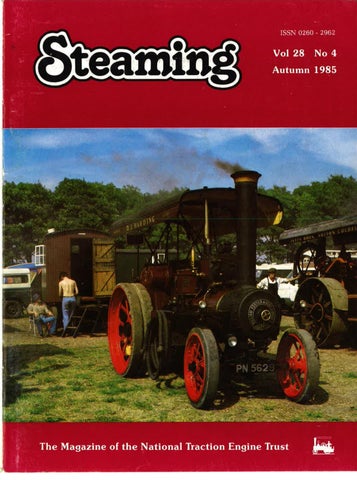
Cover Foster 'Wellington' tractor 14608 of 1930 awaits its public at the 1984 rally at Elvaston Castle, Derbyshire. (Tony Porter) 151
Engine Owners Column Iron wheels and the law A member has recently drawn my attention to information in the agricultural press which contained what appeared to be, for engine owners, somewhat alarming statements. The subject was tyres on agricultural vehicles and I am grateful to Anthony Heal for his assistance in setting down here what I believe is the correct position as far as traction engines etc are concerned. The member was uneasy about new strakes he is fitting to the wheels of his traction engine; I do not think he need worry as long as they conform to the dimensions laid down in the regulations. Statutory Instruments 1984
No 1809, Road Traffic, Motor Vehicles (Construction & Use) Amendment (No7) Regulations 1984 came into force on 1st March 1985. In the section dealing with 'Agricultural Motor Vehicles', the new definition covering traction engines, the regulations dealing with tyres — 79D(3) — states that Paragraph 1, which requires the fitting of pneumatic tyres or tyres of soft or elastic material, does not apply to an agricultural motor vehicle if: a) the tyre of every steering wheel is smooth soled end not less than 60mm wide. b) the tyre of every driving wheel, in the case of vehicles exceeding 3050kg, is not less than 150mm wide and is (i) smooth soled, and
From Alan Martin's Collection
30
Another nicely posed picture in my collection is this print of one of Aldershot & District Traction Co's 5ton Fodens. Their fleet number 309 was Foden wagon 3846 of 1913 (MA5248). I don't know the location but the photograph is said to be dated about 1916 and the load could be timber for war use in the trenches in France. Certainly the wagon has been patriotically named QUEEN MARY in three different places — on the cab front, on the front of the cylinder block casing and on the toolboxes in the cab. 152
(ii) shod with diagonal cross bars not less than 76mm in width nor more than 20mm in thickness and so arranged that the space between adjacent cross bars is not more than 76mm. The strakes must extend over the whole width of the tyre. I also think that our member's iron wheeled threshing machine is quite legal. In the Construction & Use Regulations 1978, paragraph 78 (tyres) 3(c) does not apply to any trailer 'when drawn by a heavy motor car every wheel of which is not required to be fitted with a pneumatic tyre.' (David Tew, Hon Solicitor)
Steam Heritage Awards Steam Heritage, an organisation formed two years ago by the National Coal Board, the Solid Fuel Advisory Service and the leading steam enthusiasts' organisations, announces a £3,000 Award Scheme to recognise achievements in the preservation of steam engineering. The Award consists of four prizes, each of £500, to be presented to the project judged to he the most deserving in each of the four main areas of steam usage — marine, rail, road and museums. A further Premium Award, worth £1,000, will be made for the outstanding technical achievement involving the use of coal or its derivative solid fuels in steam reclamation, restoration or conversion (to coal) project. Steam Heritage works to preserve and promote interest in the great heritage of Britain's first industrial revolution and to help to ensure that the nation is well placed for the coming of the second age of coal. Leading organisations involved in Steam Heritage include the Transport Trust, the Association of Railway Preservation Societies, the National Traction Engine Club and the Windermere Nautical Trust. Among the benefits of Steam Heritage are that members of participating organisations may be eligible for a rebate from the NCB on coal used for steam raising. Entry forms are available from Geoff Ellard at the Solid Fuel Advisory Service, Hobart House, Grosvenor
Place, London SW1X 7AE. Submissions for consideration for an Award are required by November 30th 1985.
The National Traction Engine Trust presents
An Evening at The Engineerium The British Engineerium, off Nevil Road, Hove, East Sussex
Obituary Ken Wood We regret to record the death in June of Ken Wood of Hail Weston, Huntingdon. Ken studied electrical engineering before serving in the Army for a number of years after World War 2, notably in Berlin in charge of parts of the airlift. After his military service he was an apprentice at the well known firm of Lister at Dursley, Gloucestershire, and later became chief engineer of a paper mill at St. Neots, Huntingdonshire. In more recent years Ken has travelled widely to many rallies with the De Cap organ LILI owned by his wife Fay, our membership secretary and magazine despatcher. His engineering expertise was being put to good use in an extensive rebuild of Burrell showmans engine 3878 ISLAND CHIEF, though the nearcompleted project had unfortunately slowed down recently due to ill-health. Ken was also very active with many local charitable organisations. Our sincere sympathies go to Fay, and to her son Chris and daughter Cathy, in their sad loss. (ISLAND CHIEF has now been purchased by Tarrants, steeplejacks of Horsham, Sussex. Ken Wood's family would like to wish Adrian, Bob and Pauline every success and enjoyment in the completion of this restoration project and look forward to seeing the engine in her full glory on the rally fields in due course.)
Affiliated Clubs Steam Plough Club The Steam Plough Club report the rescue and transfer to the Institute of Agricultural History and Museum of English Rural Life, Reading University of a quantity of drawings of steam engines from the archives of John Allen & Sons of Cowley, Oxford, more recently owned by Groves Cranes. They have been saved through the efforts of Mr L.N. Carter, a member of
on Saturday, 23rd November 1985 from 7.00pm Some tickets are still available for our Autumn Social Event at Brighton in November. Full details of the occasion are set out on page 105 of our last issue and to encourage you to look again at the attractions on what promises to be a very enjoyable evening we mention — • The beautifully restored museum engines, in steam for us • Full hot buffet supper served in the museum surroundings • Engine owning member Fred Dibnah as guest speaker • Licensed bar to enable you to continue tales unfinished in the rally beer tents • A 28 piece Silver Band providing musical accompaniment Tickets for members and their friends are obtainable from Stuart J. Gray, 9 Walnut Way, Ickleford, Hitchin, Hertfordshire SG5 3XT. Please enclose a cheque or postal order for £15.00 per person (make payable to National Traction Engine Trust).
Overnight Accommodation We apologise for an error in the details of the accommodation arranged at the St. Catherine Lodge Hotel, Hove. The rate of £12.00 per person (single or double) was for rooms without private bathroom. Rooms with bathroom are available at £15.00 per person (single or double). The prices include full English breakfast and VAT, and are available for extra nights. Make your bookings (mentioning NTET weekend) direct with St. Catherines Lodge Hotel, Kingsway, Hove, East Sussex BN3 2RZ 010273 778181).
AL the firm's engineering staff who had looked after them for many years. Owing to pressure of work at Reading, the drawings are still to be sorted but details will be available in due course. (Bill Smith, SPC)
London Area Social Meetings Meetings of club members and friends are held in London on the last Tuesday of each month from October to April inclusive (but excluding December). The venue is the upstairs room in 'The Cock Tavern', Great Portland Street, London (corner of Margaret Street and adjacent to Oxford Circus). Meetings start at 8.00pm and all are welcome. The dates and subjects for the meetings to be held during the remaining months of this year are as
A follows. TUESDAY, 29th OCTOBER 1985 Members slides. As usual the opening meeting of the season is the chance for members generally to take along a few slides of their own — old or new — to entertain the meeting. TUESDAY, 26th NOVEMBER 1985 Terry Darby will give a talk on a subject very close to the most popular of road steam engines — Old Time Fairground Equipment. Details of meetings in 1986 will be set out in the next issue. (London Meetings organiser — Bill Timmings. 306 Hertford Road, Lower Edmontob, London.)
Corrections The building date of Clayton & Shuttleworth 38742 (page 130, last issue) should have read 1906, not 1926. 153
4 we. marren 344
natiermenans
MAN 144 COLCH1STElk 2P1C,
1r BROWN & SON 1.1 CREINSfOlt
INCORPORATING NRAY
CHELMSFORD
OUR MAGAZINE 25 YEARS AGO
S 4
pp SO LID own a 443 VAM..
EIP. C:!)N
SON LTD.. L
t,Evo
!;HELMSrOK;
A 11 imtu
Al* A \r"
Now and then Another excellently restored steam wagon returned to the rally fields after some five years this summer — Sentinel 9075 of 1934 is seen (upper) at Parham Rally in June resplendent in its original green livery and the lettering of its first owners, Brown & Son Ltd of Chelmsford, Essex. Browns took a pair of the S4 model into their fleet in 1934 — Sentinels 9074 and 9075 — and the maker's official photograph (lower) of the former shows how well owner Douglas White of Portsmouth (helped by Bill Burrows) has carried out his aim to rebuild and present the wagon as near as possible in its as-built form. (photographs courtesy Robin Walker and Road Locomotive Society) 154
The rally season had included another large gathering organised by John Crawley at Woburn. A crowd of 35000 had gathered in front of 66 engines — earlier plans had centred on 100 engines but that became impossible and John was to have to wait a good few years more before being the first (and only) to claim that record. Demonstrations of working engines were beginning to appear at rallies — threshing, and mole draining at Woburn and Wimbish. However, it was noted that Ran Hawthorn's Fowler 14674 had been the first ever roller to appear at Appleford. The Committee decided that Steaming would in future be available only to members, and non-members then paying 9s. 145p) for the year's magazines would now have to pay out 15s (75p) to join the club. Reports of more sales by former contractors recorded steam rollers in working order fetching about £125; an already preserved and restored 8hp compound Ransome, repainted and in first class condition was on offer at £275.
Road Steam Engines of the
GWR This year, as surely all readers south of Birmingham and west of London will have realised, has seen the celebration of the 150th anniversary of the former Great Western Railway. During the course of the year practically every aspect of that much heralded railway company has come under review in books and magazines for the railway enthusiast — its locomotives and rolling stock, its engineering, its publicity and public relations, its shipping, even its airplane services. We now make a further contribution to the celebration by filling in on one subject not yet covered — the road steam vehicles operated by the GWR.
Daniel Gooch's agricultural engine The first part of the account may be considered to be cheating a little for the machines were not used by the Great Western Railway — but they were built in the company's famous workshops at Swindon. Lord Willoughby d'Eresby (17921865) of Grimsthorpe Castle, near Bourne in Lincolnshire, was one of the earliest British pioneers of ploughing by steam, contributing much through his personal interest and money to the development of single and double engine sets. His friendship with Daniel (later Sir Daniel) Gooch, the celebrated
Gooch's Side and front elevations of CALIFORNIA, built at Swindon to Daniel design in 1850. These drawings have been prepared from copies of engravings held at the Patent Office, which are somewhat sparse on an mechanical details. A fuller account of the ploughing methods and (Bonnett,1965). illustration of the plough appear in Saga of the Steam Plough
engineer to the GWR from 1837 to 1864, resulted in the engine part of his ploughing tackle being constructed at the Swindon locomotive works of the railway company. In November 1849 Gooch sought permission from his directors at Paddington to build 'a small engine at Swindon for Lord Willoughby, the cost exclusive of wheels, which he can supply us with on better terms than we can make them, to be £305.' The completed agricultural engine was named CALIFORNIA and is recorded as weighing 31/2 tons and developing 26 horse power. After delivery to Lincolnshire in May 1850, Lord Willoughby and Gooch went there to see it tested at a saw bench and a corn mill. It turned out to be not as powerful as they were expecting and blame was put on the flywheel being too small (a larger one was later fitted); however, the agent to the Estate professed it the most beautiful
155
piece of workmanship he had ever seen. The design was not a self moving engine and the machine was essentially a portable. When engaged at ploughing the engine stood on wooden rafts fitted with steel angle irons which guided the road wheels of the engine on a straight course. Pinch bars were used to lever the engine along the raft and sections were progressively carried from the rear round to the front of the engine as the assemblage moved on, thus forming a 'portable railway', as it was known on the Estate. Behind the engine was trailed a two wheel tender for conveying coke or coal. The engine itself had a locomotive type boiler with a pair of cylinders over the smokebox and the crankshaft over the firebox with link motion between them. Under the boiler were chain drums, driven from the crankshaft by bevel gears. The haulage chains, wound one and a half turns round each drum to give the driving grip, ran out 150 yards on either side of the engine to chain carriages or anchor carts at either side of the field, the engine being positioned on and progressing along the centre line of the field. Horses pulled the empty (out of the ground) ploughs outwards to these carriages, the engine pulling them inwards under load towards itself. Experiments were to continue at Grimsthorpe for the next five years during which time three other engines were built, most probably also at Swindon and to the same design as 156
A picture full of interest, showing the Gum! Wesltrin Railway's first steam roller, Aveling 3684 of 1896, aboard its bogie wagon 41000, recorded as constructed in 1897. They were no doubt posed for this official photograp h — the background was whited out in the photographer's studio — as soon as the latter was completed at the Swindon workshops. Much thought had been given to the securing of the roller against, particularly, shunting shocks. Generously sized shaped timber blocks, with rings for handling, are placed fore and aft of the front and hind rollers (they were possibly located onto some sort of sockets or fixings on the floor as well) and chained to the side structural members of the wagon. Larger chains, tightened by turnbuckle s, pass through the front and rear rolls from side to side, pulling the roller tight in bulb directions. The water cart's horse shafts rest on heavy sacking on the roller's forks and its wheels are restrained by further large timber chocks the full width of the wagon and secured by pins to the side plating — these timbers are branded GWR and 47000 to ensure they didn't go missing! Note also on top of the cart, placed astride the horseman's seat, notice boards which most likely warned BEWARE — STEAM ROLLER AT WORK or similar. (OPC/Railprint)
CALIFORNIA. The latter, accompanied by its pair named JUBA, was exhibited at the Great Exhibition at Hyde Park in 1851, and in 1855 OASIS and AUSTRALIA were sent for display at the Paris Exhibition. The single engine method, with its time consuming return of the plough by horse traction, must have quickly led to Lord Willoughby's development of two engines, operating one on either side of the field — such an arrangement no doubt existed by the time of the 1851 Exhibition and certainly by June 1852 when it was depicted in the London Illustrated News. There is no record that the ploughs or carriages were constructed at Swindon; more likely they would have been built elsewhere, and the Perth Ironworks in Scotland has been suggested.
Lord Willoughby's steam ploughing attained a certain amount of success, for an announcement in The Times during March 1854 invited interested gentlemen to view the tackle in operation and offered that 'any use that may be desired' could be made of the invention; in May the next year the Grimsthorpe agent recorded steam ploughing that day and that they were getting on very well. But by then, presumably, contact with the far off Great Western Railway was long forgotten.
Rolling the roads The GWR purchased its first steam roller in 1896 and throughout the remainder of its independent existence maintained a not inconsiderable fleet
of them. Surrounding the stations and goods yards owned by the railway there were of course roadways, probably cobbled in urban areas but elsewhere consisting of the then commonplace waterbound macadam surface. Although contractors could have been used to do the inevitable maintenance work, the GWR, always a company to provide its own facilities rather than rely on outsiders, must have decided by 1896 to set up their own repair operations within the Three Department. Engineering Aveling & Porter 12ton single cylinder rollers were acquired during that year and either at the time of purchase or very soon after it was decided to build railway wagons to enable the rollers to be efficiently and quickly moved from place to place. It was a very sensible arrangement — most of the station yard jobs would have been of small extent compared 1912, seen aboard its GWR roller number 9, Aveling 12 Conner 7671 of with a length of county or even local before it was scrapped. years four 7948, in nham railway wagon at Chippe road. The costs to hire machines for y, no doubt so arranged to clear the railway loading chimne hinged the Notice many s perhap with such small jobs and rear — both similar to gauge limits, and also the generous toolboxes side miles to the next on the list would tenders of the company's locomotives, and tes footpla the on d provide those s station have been high. Even lesser the horse drawn water and doubtless from the same source. Even in 1948 had end loading bays for railway by that time its function may though roller the panied accom still can er sprinkl wagons, so with bogie vehicles with a for carrying water for have been limited to supplying the roller rather than dropped well in the centre a steam t) Bonnet (H. . surface road water-binding the roller could be taken by rail to the required location, quickly unloaded and thus put to work quite economically. The Aveling rollers were of the maker's standard designs and the GWR no doubt knew well enough not to interfere with a tried and trusted format — though it is tempting to wonder if that very individual railway did consider building its own steam rollers and what they might have looked like! The railway wagons, however, were purpose made and for quite a number of years, permanently assigned to a particular roller and lettered with legends to that effect. They were 40foot long bogie wagons, some 15ft in the well, massively built up with riveted plates and designed to carry 25 tons. Once in its appointed place the roller was very strongly chained to the wagon from its front and rear rolls to keep it secure against shunting shocks. The water sprinkler cart which was the principal essential item to accompany the roller on its travels sat over one of the bogies, the cart's horse shafts resting on the front forks of the roller and tightly chained down onto the forks. With a few other tools and necessities loaded aboard the assemblage would have been a self-contained road repair outfit, and, dump at Swindon End of the road for Marshall 76555 pictured at the scrap attached to various local goods trains, been roughly having of canopy its on signs g showin 1952, Works in March suitable for operating over quite a wide a rail wagon by crane. (John H. Meredith) from ed unload road ing consum time little with area 157
travel. of the staff; one of the boiler shop conditions though, some addition was The first two Aveling 12ton singles foremen told Harold Bonnett that he necessary and three secondhand were attached to the London Division often had to do the boiler work on the examples appeared briefly in the list. Engineer's Depot at Reading, and they rollers himself, for his men declined to When the hostilities were over and and the third example were provided work in such small spaces. They were conditions began to return to normal it with railway wagons in 1897. More used to much more generously sized is surprising that the railway ordered rollers were purchased from Aveling in fireboxes! three more new rollers, though they 1899, 1901, 1904 and 1906 and Scrapping of the early acquired were not delivered until 1948, after further wagons are either recorded as rollers began in the 1930s and five the company had been nationalised built at approximately similar dates, or probably went before World War 2 — and became the Western Region of there appear gaps in the number tarmacadam surfacing and the demise, British Railways. Three of the single sequence )the wagons were numbered even then, of the country station cylindered piston valved Ruston in descending order from 41000) from probably lessened the need for such a design roller arrived from Avelingwhich we might assume one did exist. large fleet. With the arrival of wartime Barford — the last of their type to be By the time of World War 1 the GWR had a fleet of ten rollers and probably nine wagons for their transport. As well as being attached to Reading, rollers were also allocated to the Engineer's Depots at Wolverhampton, Shrewsbury, Worcester, Gloucester and Taunton and possibly other places. Several railway companies in Suuth Wales were grouped with the GWR in 1922 and it was probably to allow coverage of the enlarged territory that two Q class Marshall 12ton single cylinder rollers were purchased in August 1923. Bob Field — a club member who has written of his experiences with steam on two occasions in our magazine (Spring 1981 and Summer 1985 issues) — drove one of these Marshalls for five years during World War 2. Most of the time he spent working in bomb damaged yards in the Birmingham area. Here, in an area well provided with GWR lines and property, Transportation of a GWR roller in British Railway s days in 1957. Avelingover some of the shorter distances he Barford W type AH160 photographed aboard bogie well wagon 40994, drove the Marshall from job to job originally built for roller number 7. The wagon is lettered 'ENGINEERING very awkward on the stone setts in the DEPARTMENT, To carry No 7 Steam roller and watercar t, return to Reading, London Black Country. The longest distance Division'. (collection A.J. Martin) was a more rural journey from Worcester to Evesham — a mere fifteen miles or so. The engine had the round GWR emblem in brass on the motion side plates. and was in good conditiuri though noisy on the gears. The railway wagon normally stayed In the sidings at the station or yard being worked at, together with a truck with scarifier tines, stores, etc. The tines needed sharpening quite often with the large amounts of scarifying work being done — they were put on a passenger train to the nearest GWR blacksmith, usually at the next locomotive shed. When the engine and cart were loaded up on the well wagon, it all had to be checked and passed by an inspector before it could be moved away. About six months before Bob took over the roller it had had a rough shunt at Wolverhampton and suffered a broken saddle — it took a couple of months to get a new one. The rollers would have been maintained at the various GWR Close up of Aveling-Barford AH160 showing the method of attaching the loco workshops where they must have chains to the rear roll rims. The boiler cladding shows signs of misguided been viewed with misgivings by some attempts to use crane slings under the-barrel. (collect ion A.J. Martin) 158
delivered to an English customer. They had scarifiers and one side coal bunker on the left of the walk-up footplate, constant mesh gears and long fireboxes intended to burn the inferior fuel of the post war period. The surviving rollers ceased to be used during the 1950s and were scrapped, many of them gravitating to Swindon Works to spend time languishing in the scrapyard before being cut up. Aveling-Barford AH160 was stored in The Barn at Swindon in 1955, but was later photographed on a well wagon, so perhaps it did work again. One of the fleet, AvelingBarford AH162, survived through another ownership into preservation and is now in Cornwall (see Steaming June 19801, having been rallied this year. The Great Western Railway was unusual among its contemporaries in utilising such a sizeable fleet of steam rollers to maintain its properties — more in number, in fact, than all the other railway companies put together.
GWR omnibus number 36, built by Clarksons in 1904 and pictured here in use on a Wolverhampton to Bridgnorth feeder service. (OPC/Railprint)
Steam Buses and Steam Tractors We must now return to the early years of the century to record other types of road steam vehicles owned by the GWR. In 1904 Clarkson of Chelmsford delivered three 20hp steam buses. The single deck bodied vehicles were intended to provide feeder services to or between company railway stations and saw use in Shropshire and later in Somerset. The boilers proved troublesome and the buses were replaced by others of the internal combustion engined variety — a not untypical demise for steam buses of the period. Considering the new methods in mechanical transport available in 1902 the GWR chose to borrow for evaluation one of the new-fangled steam wagons. For some time in May of that year they had from the Lancashire & Yorkshire Railway a Thornycroft wagon for trials in the Hockley area of Birmingham. How the results were judged is not known and it was to be some three years before a steam wagon was purchased — and then for a very rural area. It could be that the heavier loads offering in the highly industrialised Black Country were more suited to the steam tractor and trailer for in November 1904 three tractors were acquired — one Wallis & Steevens 3ton motor, one Wallis & Steevens 4%ton motor and one Aveling & Porter 3 tonner. All are thought to have worked from Bilston, Staffordshire, though probably not for very long — certainly the Aveling was
The GWR had relatively few areas of heavy industry but large castings did need moving from foundry to goods yard siding in the Black Country around Birmingham. Here, Wallis & Steevens 2800, a 41/e ton steam motor, tackles a large casting on a not over substantial wood-wheeled dray at Bilston, Staffordshire. (collection A.J. Martin)
sold locally in 1906, but further details of this excursion by the GWR into steam haulage are now shrouded in mystery.
Steam Wagons In 1905 the powers-that-were at head office in Paddington decided on the use of steam wagon haulage and purchased a Yorkshire 5ton machine to operate a newly introduced feeder service in the Tame Valley in Worcestershire. The service ran to Henwick, a small station just outside the city of Worcester on the east side of the River Severn, and on the branch line to Leominster. It brought agricul-
tural produce from Stanford Bridge, some twelve miles away, and other nearby points. In September 1905 Commercial Motor quoted the secretary of the Agricultural Organisation Society that the service had only just been put into actual working (Yorkshire delivered the compound cylindered wagon in July 19051 but already in its first month it could not cope with the traffic offered. A representative of the more local Teme Organisation Agricultural Valley Society confirmed the first quote, but the initial promise probably soon faded for there seems no evidence of any other recorded mention of the Yorkshire at Henwick and certainly no 159
The GWR's 'steam motor wagon and trailer as used for collecting and delivering goods at Henwick'. The Yorkshire 5 tonner was delivered in July 1905. (collection A.J. Martin)
A fine reflective portrait of Foden 13296 on a foul day, well illustrating the skill of the commercial photographer, who just had to cope with the prevailing conditions once certain arrangements had been made. The picture is believed taken in Exeter in December 1929, some nine months after the wagon was delivered; certainly all the mudguards have lost their newness. Note the wind movement of the trees in the background. (OPC/Railprint)
160
additional wagons were acquired. The wagon was advertised for sale from Bilston in February 1913; conceivably it could have been worked from there after its sojourn in rural Worcestershire and its ultimate fate is unknown. Amost twenty five years after the commencement of the Teme Valley service the GWR surprisingly placed further orders for steam wagons. This time the company went to Fodens — for a pair of six wheel long platform dropside wagons and a pair of six wheel three way tippers, all delivered in the early months of 1929. It is not known precisely what purpose the long platform wagons were acquired for — the second of the two was officially photographed by the GWR in December 1929 at Exeter in Devon. well loaded with large sacks of grain (or maybe of wool?). The role of the tippers is a little more obvious. At the time the railway company was jointly exploiting sand and gravel deposits at Theale in Berkshire and, as joint partners in the Theale & Great
Steam road vehicles of the G.W.R.
18 2037 Aveling-Barford AH161
2.1948
HYN639
10ton single, W type. Location and disposal unknown.
19 2038 Aveling-Barford AH162
1. Steamrollers fleet PWM" number number
1 2
3 4 5
6 7 8 9 10 11 12 13
new to GWR
12 Aveling 3684
3.1896
16 Aveling 3776
9.1896
18 Aveling 3832
12.1896
14 Aveling 4431
11.1899
15 Aveling 4773
5.1901
DW2525?
12ton single, new to Reading depot. Paired with wagon 41000, built 1897.
DA 5586?
12ton single, new to Reading depot. Probably paired new with wagon 40999, built in 1897. Later at Wolverhampton; scrapped 1938.
C04412
12ton single. Probably paired new with wagon 40998, built in 1897. Scrapped 1948.
HT4472
12ton single. Probably paired new with wagon 40997, built at an unknown date. Location unknown; scrapped 1935.
FH2526
12ton single. Probably paired new with wagon 40996, built in 1901. Worked from Wolverhampton and Gloucester (in 1921). Scrapped 1933.
13 Aveling 5521
6.1904 4.1906
2. Steam buses
5.1911
20 Aveling 7671
5.1912
ME186 AW9531
5.1913
3. Steam tractors 54 55 56
DP3997
12ton single. Worked from Reading; scrapped 1952.
8.1923
X07892
8.1923
81
X07891
12ton single, 0 type. Location unknown; at Swindon scrap dump 1959.
Ruston Proctor 45763 -
S18
N0955
123Ston single, new 1912. Purchased from H. Eccles Tinsley by 1940?; by 1942 to ? Maberley Parker, Taffs Well, South Wales.
16 2148 Aveling 17 2036 Aveling-Barford AH160
S17
HR3756
10ton single, new 1879. Purchased from Barnes Bros. Trowbridge. Location and disposal unknown.
-
Wallis & Steevens 2785 11.1904 01761 3ton steam motor, single cylinder. Worked from Bilston; disposal unknown.
Aveling & Porter 5163
11.1904 ?
3ton steam motor, single cylinder. Location unknown but sold 1906 to T. Perry & Sons, Bilston.
4. Steam wagons
12tan single, 0 type. Location unknown; scrapped 1952.
26 Marshall 76556
Wallis & Steevens 2800 11.1904 01774 4V ton steam motor, single cylinder. Worked from Bilston; disposal unknown.
XR568
24 Aveling 5026
- from Cardiff Railway. 10ton single, new 1302. Purchased Sold for scrap 1950. 25 Marshall 76555
DA80 DA81 DA82
All 20hp single deck, new to GWR; allocated to Wolverhampton.
HT4473
12ton single. Location unknown; scrapped 1952.
23 Aveling 7981
built 1904 built 1904 built 1904
Clarkson Clarkson Clarkson
34 35 36
12ton single. Worked from Shrewsbury; scrapped 1950.
14 1685 Aveling 1579
-
* Permanent Way Machine number § number allocated in 1921, or when new if built after that date. All engines had slide valves, except those by Aveling-Barford which has piston valves. Wagons appear to have been constructed for pairing with rollers up to fleet number 7. Further known wagons were 40993 (built 1913) and 40992 (built 1904?, rebuilt 1913). By the 1950s/1960s it is believed the surviving wagons were renumbered - eg 80999, 80895(?).
12ton single. Paired with wagon 40994, built an an unknown date. Worked from Worcester• scrapped 1935.
17 Aveling 7369
JXH174
YA2237
12ton single. Probably paired with wagon 40995, built in 1903. Worked from Taunton; scrapped 1952.
19 Aveling 5946
2.1948
10ton single W type. Location unknown. Sold to Cole, Bristol; now in preservation in Cornwall.
registration
S19 S20
2.1948
HYN638
10ton single, W type. Location and disposal unknown.
Western Sand & Ballast Co, provided a large fleet of suitable transport at Theale station. A number of Thornycroft four and six wheel petrol lorries made up the backbone of the fleet whilst trailers hauled by International tractors and Foden 13276 land possibly 13278 as well) provided additional service. 13276 was last licensed in 1936, presumably indicating its demise. Early in 1933 Foden 13216 was rebuilt from its long platform state into
Yorkshire 104
7.1905 U308
5ton compound undertype wagon. Worked from Hen wick, Worcester when new; advertised for sale from Bilston 2.1913.
Foden 13216
2.1929 UL4361
Six wheel wagon. Location unknown, rebuilt to winch tractor about March 1933; last licensed 1936.
Foden 13296
3.1929 UL4362
Six wheel wagon. Location unknown (photographed Exeter 12. 1929); disposal unknown.
Foden 13276
2.1929 UL4363
Six wheel tipper. Worked at Theale (photographed there); last licensed 1936.
Foden 13278
2.1929 UL4364
Six wheel tipper. Probably worked at Theale; disposal unknown,
the form of a winch tractor, its chassis being shortened some six feet or so and a large twin cylinder steam winch mounted over the rear axle. The wagon's water tank, previously within the wheelbase under the body and cab, was replaced with a new welded one in front of the winch, and the whole machine was repainted and neatly lined out in a rather more ornate GWR style than its original painting. The official photograph after the wagon's alteration shows well scuffed
and worn rear rubber tyres, so it would seem the machine earlier did its share of work in wagon form. Just what job or purpose the Foden performed as a winch tractor is not known, but the vehicle was last licensed in 1936, after a mere three years of its new life, and we can again assume it was then scrapped. To conclude this survey of road steam engines used by the Great Western Railway mention must be made of the fleet run by Thomas 161
Bantock & Co at Wolverhampton. Bantock had an arrangement for cartage in the area and their vehicles bore the legend GREAT WESTERN RAILWAY CO.along the platform body sides as well as their own name, and the word AGENTS on the side sheets. From early in 1916 Bantocks rapidly built up a fleet of Foden 5 tonners — eleven by the end of World War 1, followed by nine 6 tonners between 1923 and 1929. They sported a light coloured livery with dark edging panels (see illustration of Foden 10896 of 1923 in the Winter 1980/81 issue). In 1930 Foden delivered one of their Speed 6 undertype models but the last two steamers purchased by the firm in 1933/34 were Sentinels. By the mid 1930s the older wagons were being solo, presumably replaced by petrol or diesel lorries but some were worked through World War 2 — Bob Field recalls Lwu of the Fodens (stationed at Oldbury) and one of the Sentinels lout of Great Bridge), by then in tractor form, hauling steel billets to and from Black Country goods yards. The Great Western Railway's involvement with steam wagons was by no means as strong as other railway companies. From the early years of the century the London & North Western Railway, the Lancashire & Yorkshire, the North Eastern Railway and even the relatively small Great North of Scotland Railway all had quite large numbers of wagons to aid their traffic and many, if not most, railways dabbled with steam road traction in an attempt to find transport cheaper than the then ubiquitous horse. The GWR's association in 1905 was minor, and in 1929, somewhat late.
This article is the result of generous response by a number of
Two views of Foden 13216 in March 1933, immediately after conversion to a winch tractor at Swindon works. (OPC/Railprint) Theale Station yard, presumably about 1930. Paden three way tipper 13276 hides in the shadows of the station building whilst the rest of the fleet, all lettered GWR, stands idle — probably a Saturday afternoon. (M. W. Carley/National Railway Museum)
individuals to the editor's suggestion that the Great Western Railway's road steamers be featured in our magazine during 1985. Especial thanks are due to Harold Bonnett; Alan Duke; Bob Field; Alan Martin; National Railway Museum, York; Oxford Publishing CompanylRailprint (GWR official photographs); W.E. Peto (Great Western Society, Historical Research Officer) and Derek Rayner. But for the fact that to be topical and properly celebratory our account had to appear in 1985, further research would have doubtless revealed more information about the GWR's road steam vehicles. We would be pleased to feature any additional information or pictures that members may have, or know of, in future issues.
The Robey Trust There is progress on the restoration of ex Devon County Council Robey 8ton tandem roller 42693 of 1925, now in the care of the Robey Trust after spending twenty years in a Tavistock children's playground. Dismantling has taken place at a Plymouth college, the boiler has been restored by Robeys at Lincoln and after all parts have been shotblasted and painted, reassembly is taking place at the premises of Tavistock Hire Centre, where progress may be inspected most Saturday afternoons. The Trust has also acquired other Robey products (a single stationary drop-valved cylinder engine, and a duplex colliery winder with 18in x 33in cylinders) and is anxious to collate further information on any aspect of the company's history or output. Offers of such information, and of catalogues, literature etc, should be addressed to D.A. Davies, 9 Churchill Road, Whitchurch, Tavistock, Devon PL19 9BU, who as chairman will also be pleased to give details of the Trust's activities.
Highways County 'Notts Committee reports that the living van which is used with one of the County Council steam rollers is practically worn out and quite unfit for the driver of the roller to occupy, and the Council has therefore accepted a tender of Messrs Benton & Co, of Nottingham, amounting to £118.10s for the provision of a new living van.' (From Roads and Road Construction, December 1923.1
The Dingle Centenary Rally Alan Thomas Every once in a while, an event takes place which is later remembered with nostalgia. Who can forget their first-ever visit to Stourpaine, for example, even though future events at the same venue were bigger and maybe better? Visiting perhaps more than my fair share of rallies over the years, I have fond memories of many — my first sight of the grand parade at Bishops Castle; the long haul to Aberdeen to savour Bon Accord's 'choochin billies', and the splendour of Sudbury Mammoth Olde Tyme Rallye at Melford Hall are just a few of the reminders which come under mental review every now and again. During the last weekend of June 1985, however, something took place that was unique in the realm of rallies. It is a somewhat daunting task to try and put on an event at which every engine attending was once owned by one particular firm. However, this is
Sandercock Richard something recently accomplished when he was instrumental in staging an event to celebrate the 100 years' association with steam of his company — R. Dingle & Sons Ltd, the well-known firm of contractors which has made the small village of Stoke Climsland immortal in the minds of road steam preservationists throughout the country. Richard mentioned some years ago that he would like to organise something special for this occasion and as the anniversary drew nearer, every owner of a surviving Dingle engine was approached to ascertain interest in participating in such an event. Support was good, entries being promised not only from all parts of the West Country, but also far beyond: Derbyshire, Northamptonshire, West Wales, Buckinghamshire and Sussex to name a few. Rather than organise the event
Bound for the rally field, Fowler 10ton roller 18075 sets off from Dingle's yard at Venterdon with living van and water cart, re-enacting a scene from years past. (A. V.K. Thomas) 163
Marshall S types 88096 (left) and 88097 pose for the camera at Stoke Climsland; although they may have stood together at Gainshornugh, their wandering working lives probably gave few further opportunities for close proximity. (A.V.K. Thomas) along the lines of a fully fledged commercial rally, Richard decided to go for an enthusiasts' show, which, if attempted on an annual basis, like most rallies, would be uneconomical, but for this one-off event, proved ideal. We all love to think back to the early days of preservation when rallies were staged by enthusiasts for enthusiasts, and there was little or no need for regard to finance. For one all too short weekend, Home Farm, Stoke Climsland, took us back to those halcyon days of the 1950s where just about everyone present was able to rub shoulders with someone who was there for a particular reason — a love of steam combined with the revival of memories of one particular firm with which this subject has long been associated. Of the forty or so ex-Dingle engines still in existence, Richard had managed to secure an attendance of 24 for this special event, pretty good considering the majority of the nonattenders were in no condition to be moved anyway. Notwithstanding this, as many 'dead' engines as were economically possible to move were hauled to the site for display purposes. Rollers dominated the scene, of course, there being far more survivors of this class than any other. This made a fine change; quite often they are overshadowed by their more glamourous counterparts. The weather could have been a little more kind, especially on the Saturday when there were a number of showers. For much of the time it remained overcast, but there was a fair amount of hazy sunshine on the 164
Sunday, which made for a very pleasant afternoon. The site at Home Farm was superb, edged by an avenue of trees along one side and the rolling countryside of east Cornwall with a panoramic view of Kitt Hill extending into the distance. Regarding the exhibits, the emphasis was naturally on the exDingle steam engines, which ranged in age from 1901 to 1937, several different manufacturers being represented. Usually the listing of engines attending a particular event ends up a somewhat stereotyped affair, but this being a unique occasion, each exhibit warrants
individual mention. Although the majority were rollers, three of the firm's former traction engines attended, these being Roger Phillips' 1901 6hp Burrell single crank compound 2417, purchased second-hand by the firm and resold in 1925; Anthony Hooper's 1920 Aveling compound 9096, also a second-hand purchase by the company but retained into preservation days until sold to the present owner in 1963; and Tom Crago's 8hp Marshall single 69303 of 1915, purchased by Dingles from Anderson Bros of Torrington and used mainly to drive quarry plant, and then sold in 1960, after becoming derelict, for preservation. The sole entry of the tractor type was Bernard Broad's Garrett 33353, the only survivor of six once operated by the firm, being purchased new in 1918. Portable engines once owned were represented by Hamish Orr-Ewing's Garrett 34193, a single cylinder piston valve machine, new in 1924 to Cornwall County Council, and brought down from Wiltshire to attend. All the remaining entries were rollers, the most rare example being Armstrong Whitworth 1OR 19, a 10ton piston valve compound, new in 1923 to Exeter Corporation. It left Cornwall only last year for a new home in Kent, but was brought back for the celebrations by her new owner, Alan White. Avelings were four in number, comprising Bernard True's 12ton single 8301, new to Eddison's in 1913; Messrs Dingle's 10ton compound 8547, new in 1915 to Newmarket UDC and retrieved a few years ago from a playground at Saltash lin unrestored condition — she
Fowler 18279 of 1930, swopping its Northamptonshire surroundings for the more barren slopes of Cornwall. (A. V.K. Thomas)
is now for sale); Ian Whitlam's 12ton G type piston valve single 10981 PENARE, down from the Bristol area, and Roger Pridham's roller of the same model, 11220, this pair being supplied new in 1924 and 1925 respectively. There were a similar number of Burrells, all 10ton A type singles, and all but one being supplied new to Dingles. Sam Payne's 3986 of 1924 was brought in from Devon; Gary Smith's 3991 down from Buckinghamshire (being new in 1924 to Sidney Carlyon of St Dayl; Brian Sanders' 3999, built the same year; and Jack Meaker's 4069 of 1929, the engine to have travelled furthest to attend, from Derbyshire. Her appearance was something of a cliffhanger, as problems with the mudhole doors almost made her an absentee — some last minute work in the Stoke Climsland yard soon rectified the trouble! Fowlers were more widely represented than any other make. There were five 10ton singles, all of which had been supplied new to the firm; Geier Jones with 16003, built 1923, all the way from Cardigan, West Wales; John Boughton with 17483 from the well known Amersham stable; Messrs Dingle's own 1930 preserved example, 18075; Raymond Hosken's 19205, new in 1932, and Alan Bennet's 19570 1934 down from Torquay. An 8ton single 18279, new in 1930, was brought from Northampton by Allen Eaton, whilst from Forest Row in Sussex there was Jonathan Vartan's 10ton compound 21833 of 1936, one of the last few Fowlers supplied and worked by Dingles up until 1960 in West Cornwall. Representing Marshall were two 1937 12ton S type compounds with consecutive numbers: 88096 of Roy Richards, and 88097 of Messrs Dingle, the latter now in the final stages of a very thorough restoration. It was the last roller to have lain derelict at Stoke Climsland. Last but not least was the firm's only surviving Wallis & Steevens, Mike Leath's 10ton Advance 8095, new to the War Department in 1935 and purchased by the firm in 1950 after having been rebuilt by the makers. Also assembled were several items of plant, machinery and transport used by Dingles, both past and present, and the Liskeard Steam & Vintage Club put on a display along one side of the field. Richard included Exhibits Sandercock's own Burrell road loco 3996 and Steve Veal's Fowler roller 18070. Messrs True and Broad also entertained with their fairground organs. On the Saturday the opening cere-
Taking part in the informal road run is Fowler compound roller 21833, seen at Venterdon. (A. V.K. Thomas)
mony was performed by one of the firm's former drivers, 88 year old Alf Harper, who went on to present plaques to engine owners as they paraded their steeds. On Sunday, Mr Sandercock senior carried out similar duties and related a potted history of the firm. An unscheduled event was the presentation of gifts to the Sandercock family, a joint gesture on behalf of all the exhibitors, in appreciation to Richard and his family for all they had done in organising the weekend. The Aveling-Barford company also sent a representative all the way from Grantham in order that a specially inscribed shield featuring the well known prancing horse and Invicta trade mark be presented to the firm on the occasion of their centenary. All too often these days personal touches have been forgotten, and it was certainly well received that a company such as this should go to much trouble to remember one of their customers on such an occasion. Apart from the daily parades, there were no organised events as such. The engines went for a chuff about the field as and when they desired, and there was an informal road run on the Saturday evening when nine rollers trundled home to Stoke for the first time in many years. The weekend all too soon drew to a close, the engines being loaded in readiness for the long journey home or steamed to their temporary accommodation to await transport to points west. In his editorial Richard programme apologised for a possible lack of finesse when comparing this event with the average rally. Such an apology was totally unnecessary. This event will be remembered in the years
ahead as one which was particularly special, by all who attended.
(A history of the Dingle firm appeared in the March 1974 issue of Steaming. Copies of the 20 page illustrated programme for the Centenary Rally are still available, price 75p including postage, from R.J. Sandercock, R. Dingle & Sons, Stoke Climsland, Callington, Cornwall PL 17 8PE. As well as a list of engines present, in the usual rally programme style, the booklet contains one or two reproductions of old letters, adverts or photographs; a brief review of the firm's more recent years and a full list of the 120 or so machines owned by the firm over the years since 1885.)
W Al G HEDGES SONS Boilermakers and Steam Restoration Engineers
Faversham, Kent telephone 0795 538128
165
Lessons with Murphy Ron Maddison describes a couple of breakdowns on the road and offers lessons to be learned from roading vintage machinery.
After the 'Great Paisley Sale' of 1980 one of the engines that was auctioned ended up in the workshops of Park-Holland Ltd, boilermakers, of Hanley, Staffordshire. Marshall traction engine 49222 of 1908 IBE7797), unusual and now unique in possessing a boiler-length water preheater, had been taken on by the company as a project of restoration and was a sorry sight clearly bearing witness to thirty years of inactivity. There were no vestiges of it's original colour — just the decaying layers of rust one associates with the scrap heap. The firebox wasn't even lighttight, let alone steam tight, and a lot of hard work was needed to put the boiler right before any sort of cosmetic work could even be contemplated. Nevertheless some eighteen months later, and after many hours of hard graft, resurrection was well on the way and the engine had a first class steam system; Jim Holland had made full use of the company's skills and facilities. It had also been cleaned, primed and painted. Although little attention had been given to gearing and motion work, the first stage had been completed and anxious to see the old lady back on the road, it was decided to get her ready for her rally debut. All the moving parts worked well — if a little noisily. But the engine was safe and would certainly see out this first season before returning to the workshops for some more detailed attention. And so it was low-loaded to Donington Park for it's first rally. The weekend went really well. The engine was very easy to fire, as you would expect for a 7hp machine mounted on an 8hp boiler, but the gears announced their presence like a full peal of bells and it was obvious that something would have to be done 166
about them before long. The one good thing about the circumstance was that there was absolutely no danger of taking anyone by surprise and successfully creeping up behind them. The whistle seemed redundant. I had taken over as driver with Ted Greasley as steersman. It didn't take us long to learn the characteristics of the old Marshall and come to grips with its peculiar personality. It had an irritating preference for starting in reverse rather than forward and it took a little time to get the upper hand over its tendency to rear up like a stallion on gently cracking the regulator. I think it was at about this time that we gained
a little insight into why Jim was so reluctant to take the reins himself, preferring as he did to take photographs and admire the spectacle. We roaded the six and half miles from Donington to Elvaston Castle and it didn't take us long to learn where the water level should be to prevent priming. This particular lesson came on the steep drop down into Castle Donington village and was, of course, accompanied by great clouds of steam and hot water. I had accidentally shut off the drain cocks as I had leaned over to take a closer look at the end of the third shaft. My concentration had wavered slightly when I had noticed an unusual knocking sound, and I could see that the big pinion on the Anri of this shaft had ctartod to slide. gradually outwards and had already come into contact with the gear cover. It's funny how unexpected things always seem to happen together in the most delicate situations (in physics and engineering it is the well known principle of Murphy's, or Sod's Law), but we were able to pull in safely to find out what had happened. The pinion is held onto the shaft by two keys and one of them had come out — the other was very loose. We found the missing shaft key about a hundred and fifty yards behind us in the middle of the road, and were able to reset the gear and move off. Jim told me later that they had tried everything they knew to move that pinion — including a twenty ton pull — and they couldn't shift it. All that was required was a
Marshall 49222 at its first rally — Donington Park, Leicestershire in 1982. Ron Maddison and Ted Greasley (seated) form the crew, whilst owner Jim Holland stands by the rear wheel. The feed heater runs the full length of the boiler side with a footboard on top of it. (R. Maddison)
couple of miles of roading! As usual the Elvaston weekend was superb and everything went as anticipated. There was good weather, crowds of people, plenty of engines and a friendly and relaxed atmosphere. Our next rally was to be on the following weekend at Rempstone, some eighteen miles to the east, and we set aside a full day for the trip. It was on this day that we were to have our first breakdown and experience a most remarkable coincidence. We were proceeding in an orderly manner down the A6 and had already covered some four or five miles without stopping. It was one of those beautiful days when you could see for miles to a clear horizon and the view around was wide open from our vantage point on the footplate. The regular beat of the engine was lovely to hear and our confidence was high. We were at that point near Shardlow where the road narrows towards the bridge over the River Trent, when I suddenly felt a violent shaking somewhere at the far end of the connecting rod, up near the little end. I could see some unusual movement up in the crosshead trunking. Sensing that the odd sound I could hear had all the qualities of the ringing of cash registers, I immediately shut down and we brought the engine to a stop as close to the edge of the road as we could in the time available. We were still about eighteen inches from the kerb on the approach to the bridge, and the road had already narrowed considerably, but we did not seem to be a hazard to normal traffic and we made sure that everyone could get around us. We found that one of the shoe adjuster bolts on the crosshead had sheared so that the whole thing had worked loose and there was at least half an inch of slap between the moving parts. The weather deteriorated noticeably and clouds began to form. We collected our tools and started to remove the various pieces and, as if to encourage us, the rain started. Unseen round a bend behind us, and coming inexorably towards us with its police escort, was what you might modestly have called an extra-wide load. We saw it when it was a few hundred yards away and it seemed to fill the road completely. Murphy was at it again. There was no way we could move the engine at that moment and we had visions of a road block building up for many miles. We expected to be blasted heavily by police and crew, but they were totally sympathetic and took the whole thing as if it happened every day. With the
police holding both lanes of traffic the driver very skillfully manoeuvred the hugh load slowly up the far kerb, gently squeezing past the lamp standards and skirting the engine with just inches to spare, back down the kerb and across into the left hand lane. It was an amazing performance and, as a result, no one was delayed by more than a few minutes. As we got back to the job in hand we noticed that the man who had been walking his dog along the pavement when we had had the breakdown had stopped and was still there watching the whole episode with considerable interest. We exchanged greetings and he said 'You know its very strange, the same thing happened to me with my Marshall a while ago — would you like a hand?' You can imagine our surprise. To have met another Marshall owner on the open road would have been most unlikely but to meet under these circumstances and with such a similar story to tell seemed like coming up on the pools. It was Brian Greenfield who runs a Marshall roller in the Kegworth area and we were very glad of his help at that time. I hope his dog is also a steam freak because for the next half an hour it found itself tethered to the roadside fence on a rather short leash while his master clambered about on top of the engine. After a while we managed to extricate the broken pieces and could see that the bolt had broken as a fatigue fracture with the first part of the crack thoroughly rusted inside. It has probably been like that for the last thirty years and might well have been detectable if that section had been dismantled and examined. There was a garage on the other side of the bridge and Jim took the pieces and was able to beg the use of their welding equipment. Within a few minutes we had the fully repaired bolt installed and with Brian's help it was soon fitted and adjusted. By this time, of course, it had stopped raining. The rest of the day was uneventful by comparison and we arrived at knackered, utterly Rempstone retching from the remorseless clangour of the gears and the unremitting oppressive heat of that summer day — but we had enjoyed ourselves thoroughly and, after sheeting down and finding our way home, we slept well that night. That first season in 1982 was most enjoyable and we logged up over two hundred and fifty miles of roading with the old Marshall. During the following winter we kept the engine near my home at Keele in Staffordshire. We were able to do some refurbishing of the bearings and
motion, and we replaced a pair of the smaller gears, but the major jobs had to be postponed until better space and facilities became available. A second rally season was undertaken in 1983 and we added another two hundred and fifty miles to the score during that summer. It was towards the end of this second season that we ran into what you might call 'a direct encounter of the first kind'. We had been attending the Gredington Park Rally in Shropshire — usually a magnificent weekend — but on this occasion it was almost obliterated by continuous rain. Small groups of people could be glimpsed through the gloom sheltering under awnings or in caravans, and you could see through the steamed up windows of the parked cars damp bodies trying to keep warm. Very few people were looking at the exhibits. All the engines were literally in steam, each being surrounded by its own cloud of evaporating rain. The ring events had all been cancelled because of the extra soft ground and the whole spectacle was one of dejection and misery. Four or five engines down the line from the Marshall was a beautiful 1928 Ransomes 5 ton tractor. It was number 39088, belonging to Robin Gibson of Llandudno Junction and originally put into preservation by George Main of Cogenhoe near Northampton. The machine was in excellent operational condition and had been given a new firebox in 1981. Its paintwork was perhaps a little rough, the rear rubbers were in a rather bad state with one section broken off, and it lacked a canopy, but the overall impression was that it looked unnaturally small — perhaps even a little tired. And it was a very attractive prospect for adoption. The most attractive feature of all was that it was for sale. In fact the notice had appeared for the first time in that weekend's World's Fair. After hasty discussions my wife Margaret and I agreed that it was exactly what we had been looking for, so I made a bid and was able to get first refusal for a few days while I sorted out the finances. This entailed twisting the arm of the local bank manager who finally acquiesced when it emerged that his second in command had deep sympathies for steam preservation. That is how, after the rally, the Marshall and this little Ransomes lay sheeted up together in Peter Millington's yard at Tybroughton, some five miles away from the park. The nights were already beginning to draw in as the deal was completed and we were faced with the problem 167
Ransomes 39088 at Gredington Park Rally in September 1983, quietly secreting its near-fractured bolt. (R. Maddison)
of getting both engines the twentyfour miles back to Keele. Perhaps I am a little over cautious in these matters. I felt strongly that since I did not yet know the personal quirks of the tractor it would be unwise of me to drive the 24 miles without first checking the machine to my own satisfaction. We were short of time, so why not save on this and economise on coal — and use the Marshall to tow the Ransomes as a dead load? We carefully considered all the alternatives that were available to us. Undoubtedly the best method would have been to make an A frame that would bolt on to the front axle of the Ransomes so that, with the steering chains uncoupled, it would effectively have become a trailer with swiveling front wheels. It would have been knocked out of gear and there would then be no need for a steersman on the dead engine. Braking would not present a problem because the Marshall is over twelve tons and the load would be a mere six tons. As it happened we didn't have an A frame, but there was a good strong 4 inch diameter towing pole that had been made for use with the Marshall and that had been used during the summer to rescue a roller in distress. We also had three eager steersmen who were anxious to come along on the job. For a short journey on good clear country roads we would normally have pushed the Ransomes with the Marshall, as we had done with the 168
roller that had broken down. On this trip we knew that we would have to negotiate the sharp turns and narrow, busy streets of Whitchurch and Audlem, and if we had pushed the driver at the rear would have had an impossible task reacting to the sort of traffic emergency that often happens under these conditions. It would have been quite impossible for him to assess the situation at cross-roads and we would have needed some sort of efficient direct communication system which would work above the noise of the Marshall. On balance we felt that it was wiser to tow the Ransomes behind the Marshall. There was but one all-important rule — the dead engine must closely follow the wheel tracks of the towing engine so that the bar was kept as symmetrical as possible between the two engines. If the towed engine were to get off-axis, particularly when going down hill, there would be a disturbing tendency for it to try to overtake the one in front — which would be more than a little embarrassing. Fully appreciating the problems and difficulties we were likely to run into we decided to go ahead. It was a decision that was eventually to cause us to feature in the Letters page of Steaming (Spring 1984 issue► . The arrangement was that I would be driving the Marshall with Jack Low as steersman. Jack had retired a few years ago from a career that had involved many years driving Foden steam wagons, and he had also been one of the regular drivers of the
Mann's tractor TINY TIM seen at Midland rallies a few years ago. He had steered the Marshall during the summer and was eager to come on a full day's drive. Margaret and Ted would take it in turns on the Ransomes, since this would need more than the usual amount of concentration. Jim, as usual, would be driving the back-up van with extra coal, sandwiches etc, and would be able to help at difficult crossings and some of the more hazardous parts of the route. We arrived at Peter Millington's yard early on the chosen morning and it took us about an hour and a half to oil up and generate a good head of steam. It was a beautiful clear, crisp mornino and WP muct have made an impressive sight as we turned out of the yard on the narrow country lane that made up the first couple of miles. Jack, tall and bulky, was wearing a bright khaki slop coat and green woollen beret. To protect himself from the excruciating gear noise he had acquired a pair of giant ear protectors which, together with his unusually large glasses, made him look more like a visiting alien from another planet than a serious minded steam engineman. We soon found that the system worked very well and before we reached the main A525 we had developed various tactics to ensure good progress. I found it useful to look as often to the rear as I did forwards, and I could easily keep an eye on everything that was happening. It has always been my policy to maintain the best possible relationships with other road users and I would slow down and draw in whenever necessary to let other drivers pass. And so we made splendid progress without any difficulty for the first four miles or so until we reached the outskirts of Whitchurch. There are two routes through the town. One passes directly through the middle between the shops; it is steep and narrow with cars parked along each side of the road. The other is a broad bypass that takes most of the heavy traffic, but it includes a couple of right angle bends at T junctions about a hundred yards apart. These junctions are narrow with high buildings all around so that the view of the road ahead is partially obscured. We opted for the bypass. There was comparatively little traffic, we had everything well under control, and plenty of steam with the safety valve just feathering. Jim and Margaret had gone on ahead to find the next most convenient resting place and some much needed toilets. We rounded the first
left hand bend without even having to come to a stop, and began to position ourselves for the second more difficult right hand bend into the narrowest part of the by-pass — a short hill down to the junction with the A41. In the next couple of minutes it was as if all hell had broken loose and so many unexpected things happened all together that it is difficult to recollect the exact sequence of events. Murphy seemed to have remembered us with a vengeance! We were still about 50 yards from the corner when a mini with a learner driver lurched into view at the junction ahead and stopped in the middle of the road. He was clearly planning to turn right in front of us, but the sight of the Marshall must have put the fear of God into him, and he was obviously paralysed with fright and indecision. From my point of view the mini was restricting my right hand turn so I stopped and beckoned the driver to come forward. From the commotion that seemed to be going on inside the car it appeared that he must have lost his nerve and we waited patiently for some time while he came to grips with the situation. Eventually a somewhat exasperated instructor waved us on to move in front of him and complete our turn so I gently opened the regulator and we began to move in the widest arc that we could make. Within seconds the learner driver suddenly unfroze and found first gear. He shot out across our bows and although he missed us by several feet I swear that I could taste the adrenalin as I snapped the reverse lever back and shut the regulator. Jack was also more than a little shaken and had not fully completed the turn. We had to back up a few feet before we could lock over to avoid the corner kerb. The emergency seemed to be over as we safely negotiated the corner and began to straighten up. All at once, as the tension began to lessen I caught sight of an impatient young motorcyclist on an overpowerful machine who had been threading his way between the cars behind us and then passed my off-side hind wheel so closely that I expected to hit him. My front wheels were still turning to the right and I once more had to throw down all the anchors to ensure missing him. As he passed the front wheel he may have touched it — he was so near — and I'm sure that if I had still been moving we would have had a serious accident. By this time several cars were waiting to come out of the junction and had moved well over to their left to give us room to manoeuvre. It took us a further few seconds to regain our composure and shortly after we had
straightened up I could hear Ted's voice from the Ransomes behind us shouting above the gear noise. I turned and saw him gesticulating wildly as the Ransomes veered right across the narrow road and headed straight towards a Y registered Ambassador. The tow bar had pulled sideways as the Ransomes tried to come alongside. Once again the emergency procedure was put into action as quickly as possible, but I shall never forget how the look of fascinated interest on the driver's face suddenly changed to one of horror as the engine came directly towards him. If the tow bar had not come up against the nearside front wheel of the Ransomes and deflected it to the left the collision might well have been very much worse. As it was the off-side wheel severely modified the shape of the Ambassador and both doors were badly twisted out of shape. Ted had lost all control of the steering through no fault of his own and had been totally helpless as the front axle failed to respond to his efforts at the wheel. It turned out that the long bolt fixing the steering chain to the nearside end of the front axle had sheared. On later examination we found that this was another classic fatigue fracture that must have been developing for several years. The bolt was rusted more than half way through and the clear crystalline metal was no more than a quarter of an inch thick. It took only a few minutes for us to
chock the dead engine, release the towbar, clear the traffic and move the Marshall to a safe place before we could start to sort out some of our problems. Jim and Margaret had seen what had happened from the bottom of the hill and returned as soon as they could. As might have been expected Ted was severely shaken by the episode and had temporarily lost his bottle. I had to calm down the Marshall which was by now healthily blowing off at the top of its voice with the damper still open and, of course, just then the ubiquitous policeman turned up to see what was going on. In fact it did not take long to get the whole mess sorted out. The driver and passenger of the Ambassador were fortunately not hurt and the inevitable insurance business was transacted very quickly. The car was a company car and the driver worked for British Leyland. Jim took the broken bolt away to find a welder and managed to repair it within about a quarter of an hour, and I managed to quieten the Marshall and began to explain to the policeman what had happened. It had been a bizarre set of circumstances culminating from the result of a fracture that could have happened at any time. There had been no sudden shock to the steering of the Ransomes and the bolt had just parted as soon as the crack had reached the critical length. It was ironical that one of the reasons for not steaming the engine was that I was cautious about not
En route to Keele on an eventful day's journey, Marshall 49222 hauls the Ransomes tractor along the A525. (R. Maddison) 169
having examined it thoroughly — but if I had examined it I could not have guaranteed that I would have found this particular weakness. The policeman really seemed rather amused that all this should have happened on his patch and while he had his radio to hand he thought it would be a good chance to check up on his mates back at the station. He called them up. "Hey George, I've just come across a breakdown here; will you check up on this registration for me — BE7797?" There was a pause of no more than fifteen seconds and back came the reply. "You're not going to believe this — someone's having you on — its registered as a steam engine!" Shortly afterwards, with the holt refitted and reinforced with an old car seat belt we coupled up and resumed our journey. We were now an hour behind with our schedule but we set off optimistic that we could still complete the journey in the day. The rest of the journey was mercifully uneventful. We safely negotiated the narrow streets in the centre of Audlem and the steep descent down the notorious Bar Hill outside Madeley but by this time it was approaching darkness and we still
had a couple of miles to go. We trundled on and ten minutes later the sun set and night was upon us. We were reluctant to call it a day because we had less than a mile to go and we were running out of coal. There was sufficient Stearn and fire to make It home but lighting up again would have been a problem. We tried the oil lamps but they were dry and we had no fuel for them. All we could muster was Jim's van and a fairly powerful hand torch. Jim stayed close in front of us with his headlights on and Margaret stood in the now empty tender of the Ransomes and flashed the torch over the rear number plate and the back of the engine making sure that any foiinvving traffic WAS well aware of our presence. It is difficult to imagine how anyone could have missed us. We must have made a weird sight from behind with the clouds of steam and our bodies lit up by the fierce yellow light escaping past the gaps in the firehole doors. The excitement of driving that last mile more than made up for the shortcomings of the rest of the day and we made it safely back to Keele. The lessons to be learned from the experiences I have described are
obvious. We should never assume that old bolts that are subjected to varying forces and tensions will remain unchanged by time. Fatigue fractures are to be expected on old machinery and structurally important items should be examined every few years. Geoff Hayes wrote to our magazine las noted earlier in the article) and set down the techniques of towing a dead engine, and I must say that I wholeheartedly agree with the comments made. What happened to us was a combination of circumstances, each of which was alarming, but the most serious was the fracture of the steering chain bolt. As driver I accept some responsibility for what happened but would point out that if the Ransomes had been moved under its own steam for a further five miles after the Gredington Rally the bolt would most likely have fractured at speed on the road and might well have caused a much more serious accident. For the record I must add that the first job undertaken after our ill-fated journey was the complete overhaul of all the chains and cuuplings on both engines! lljj
IMPORTANT INFORMATION FOR THOSE NEEDING ECONOMICAL REPAIRS ON THEIR TRACTION ENGINES
PINIONS
SPURS
BEVELS
All types and makes of bevel gears, spur pinions, spur wheels, helical gears etc, rebuilt to standard.
B. 8, C. Reconditioning (Gears) Ltd Unit 7, Lower Ardglen Estate, Evingar Road, Whitchurch, Hampshire RG28 7BB. Telephone: Whitchurch 3701
170
A Nominal Sum Many visitors to rallies in the home counties will be familiar with Foden 5 ton wagon 3510 of 1913 (M4673), and have been impressed with its carefully original condition and maintained and mellow paintwork, made possible by its snug sojourn in the Ford Museum in America from 1928 until the late 1970s. Present owner Christopher Lavery visited the United States last year and called in at the Museum, where they kindly searched their old records. An interesting letter to Henry Ford's personal secretary from Mr M. Vincent of Ford Motor Company (England) Ltd at Trafford Park, Manchester and dated 26th July 1928 reads: 'We have procured a Foden Steam Wagon, as seen and desired by Mr Ford, and this is a typical specimen of the type he frequently saw running about the English cities. It is in reasonably good mechanical condition, and the appearance and condition of the paint work and body work is quite nice, as it has been very well kept. We purchased it at a very nominal second hand value, and are enclosing literature generally descriptive of its type.' And that, of course, leaves the tantalising question as to just what was the 'very nominal second hand value'. Chris, being of Irish descent, claims he thinks the price he paid in 1979 was the same price that Mr Ford paid in 1928 except that the difference was the 1979 price had three noughts on the end ...I
Foden 3510 has now spent nearly four times as long being a museum piece as it ever did working for a living. The nicely mellowed wagon, still in its 1920 paintwork admired by Mr Vincent, is seen here at the 1984 Holton event. (Robin Walker)
Steam on Cigarette Cards A couple of years ago we were able to feature a number of small articles on steam engines which have appeared on postage stamps around the world. On a related theme John Morley now kindly provides from his collection two cigarette cards. Not so many readers will now be able to claim remembering these cards in their heyday, some fifty years ago. Nevertheless many of the cards survive as collectors items. The pair reproduced here were to be found within packets of Wills's cigarettes and came from their series 'Overseas Dominions (CanadaY. The top example (No 6) is entitled Threshing Wheat and the notes on the reverse
merely record the farmer 'out West' sows in April and harvests in August with the wheat often being left until ripe enough to thresh immediately after reaping. A steam harvesting set could thresh and sack 130 acres of wheat in a day. Later in the series No 46 featured Ploughing the Prairie. The picture was stated to be 'one of the smaller forms of the tractor ploughs, an immense plough, or rather series of ploughs, hauled by a traction engine operated by steam or gasolene.' We'll start the ball rolling again — does anyone know if engines at home featured on cigarette cards? Perhaps they were too mundane a subject.
171
McLaren 1552 The number of ploughing engines built by J. & H. McLaren Ltd of Midland Engine Works, Leeds was very small in comparison with their near neighbour at the Steam Plough Works. McLarens were late on the scene with this breed of engine and accordingly their designs were close to what had come to be accepted as the usual steam ploughing engine; indeed yew similar to Fowlers. However, by 1909 McLarens could claim in their sales catalogues that their cultivation equipment had been delivered to no less than sixteen countries around the world, and that their first set, supplied to the Brigg Cultivation Co in Lincolnshire, was still in use after thirty years of toil. Few examples survive in preservation, but number 1552 is well known by regular attenders to the Stourpaine event for its yearly appearances on the Dorset slopes. Here we couple two pictures with a snippet of the engine's likely earlier history. '59149 — 1919 set McLaren's 16hp compound steam cultivating engines, 6/7 furrow anti-balance plough and improved turning (heavy pattern) cultivator. The above tackle has been very little used and is practically new, reason for selling, Estate being sold. Inspection by appointment — £5500 Os Od.' This advert appeared in Phillips Monthly Machinery Register for June 1921. Quite where the tackle was at that time is not known. Phillips had large amounts of machinery in his yards at Newport, Gloucester and London (they were noted as to their location in the Register) which were available for inspection and bought in from many sources, but much of what was advertised was on an agency basis. Some was brand new, or not even then manufactured. Alan Duke feels that the most likely candidates for the advert are McLaren 1552 and 1553, a pair new in March 1909 to T. Roddis Ltd of Roade, Northants. They were registered BD5504/5505 in January 1921, and 172
•—
•
.
•... : - .
-
'
,. •
. .'" r- , .--_„t .
-'" e
ittle
_
' - -- -':...'. - ,.71/ ...k =:c. - : . • .) . '117-1/7-;"4-,•00-\ :*-. .-.-. -..',.... : 1 ' .i ..-e "..1 , 4. !, 4..'1,X u.- .7.'• -. _ • . - -7 - . „.L.t.-.-.,,,, -....rip .7,, . •• -.i.ir;
•i r . 44 ''....r .ii.7 ,--• - ...... • - ."‘ ;:'.4. -
lqicit!.....T '
s• ,
.0$
'
rwt.
40017.• ).
40. tt. ,, -`:•a l '.(1.7 ' '
-
later in the year were in the ownership of Bomford Bros at Pitchill, Evesham with their 2 speed gear removed. Roddis was a steam plough contractor, so the claim in the advert about an estate being sold may be less than honest — perhaps it was intended to imply that they were not contractor's machines. The later history of the pair is detailed in our Spring 1981 issue, 1553 was scrapped about 1958, whilst 1552 is owned by Charles Daniel and Bob Gunn in Cornwall.
(opposite) — Almost lost to the rolling Dorset landscape, McLaren 1552 starts the cultivator on another journey down the hill at Stourpaine in 1983. (Roger West) (above) — A fine close-up study of HERO, McLaren 1552, with a full head of steam whilst working at Stourpaine, this time in 1981. Driver Charles Daniel studies what is happening at the top of the hillside. (Tony Dyer)
A scene from McLaren's 1909 general catalogue, showing what appear to be 16hp engines. (Welland Valley club collection) 173
MMO011nM6 00)7_10 Compiled by Derek Rayner
The reports of correspondents for this issue have been dominated by the many instances where our Great British summer has played havoc with organiser's rally arrangements, causing widespread disruption in the timescales of both arena events and homeward going visitors. Unfortunate as this may have been — and there is perhaps nothing more disheartening for an exhibitor to go to a rally with an engine and then not be able to even get onto the field — there have been instances where a great deal of entertainment has been afforded to spectators by the sight and sound of engines working hard winching others off the rally site. It has not all been total disaster,
however, for at least at one location — Masham — the sun shone on their 21st anniversary on both afternoons, even though rain did come outside public attendance hours. The bad weather may have meant that several organisers will have had to dip into that fund set aside from previous events; it is wise to have such a fund available, for without it future events could be put in jeopardy. One recalls one well established event, and indeed traction engine club, which made several donations to charity and then suffered two or three successive wet events; neither the rally nor the club now exist. Unfortunately we have to report three road accidents in this issue, all
involving steam rollers and two of which, at least, were through no fault of the owner or driver. It would appear that even seemingly more than adequate signs on the rear of one's outfit does not stop engines being run into from the rear by faster traffic. Our slow speed relative to other traffic is obviously a problem and any suggestions as to how this can best be conveyed to other road users would be welcomed for our letters column. My grateful thanks are extended to all contributors to this issue. Various club publications and marked up rally programmes and/or photocopies of same have also been received, but as always more would be welcome. Banbury Steam Society, Lake Goldsmith Steam Preservation Coop Ltd (Australia), Lancashire TEC, Leeds & District TEC, Notts & District SVMC, Road Roller Association, Scottish TES, Sheffield & District SS, Southern Counties HVP I , Steam Plough Club, Stoomwalsen Club Nederland, West of England SES and Ron Acock, William Coates, George Coles, Martin Craig, Alan Crockford, Stephen Daws, Steve Durance, Martin Fletcher, Keith Flinton (and Mrs Flinton), Peter Gull, Melanie Herridge, Tyrone James, Peter Jury, Tim Keenan, H.S. Lister, Sandy Ross, William Scurlock, Lyndon Shearman, Chris Smith, Bernie Ward, Michael Watts and Peter Wyeld. Press date for the next issue is the last day of October. Information, news and letters by then please to D.A. Rayner, 9 Beagle Ridge Drive, Acomb, York YO2 3JH. Press dates for future issues are the ends of January, July and October, 1986.
AVON
Burrell showmans tractor 3192 of 1910 ST BERNARD shows off new paintwork in the sunshine at the Bath Rally in June 1985. (Robin Walker) 174
The Bath & West Show attracted some 135,000 visitors this year, including HM The Queen. Her Majesty did not visit the engine section and consequently missed many of the regular engine attenders engaged on working activities. A newcomer to the sawing demonstration was Len Crane's Fowler crane engine 17212, put to good use handling the large baulks of timber being cut by the saw driven by Paul Antell's Robey traction 29333 (AD9899) or Des Penny's Ransomes engine 26995 IEW23201. Burrell showmans engines owned by Ted Gale, James Gilbey and Jack Miles were all in attendance as was John Crawley's 1926 Foden wagon 12364 now nicely attired in new livery. A very wet week prior to an event at Bath at the end of June meant that engines couldn't move on the Satur-
day but all made the grand parade on the Sunday. The event, held at Lansdown, was organised by Bath City Council in conjunction with the Somerset club. Entitled 'Festival of Steam', it attracted several local engines and even a roller from the London area. This was Chris Way's 1931 Aveling 14113 (TM8871), and it joined Phil Cummings' Marshall 82389 (U02835) and Mike Warren's 1929 Marshall Universal 85060 (VX2427). Andrew Melrose's 1870 Fowler ploughing engine 1368 (AL8468), Pete Loader's Garrett showmans tractor 33486 (AD8787) and Dicon Pridie's 1884 Aveling roller 2018 (NR13) were also present. The attendance was not as good as had been hoped for but next year should be better; given the right weather. Quite a pleasant event for a first rally. A fortnight after, two events clashed, with the Avon Steam Rally being staged on the same weekend as the Bristol Docks event. At the former were only five engines, including Bob Whitfield's 1921 Marshall tractor 74962 (YA2197), P. Cummings' Marshall roller 82389 and wan Jones' 1931 Foden tractor 13762 (VN2911). This event was more like a country fair than a steam rally but the other event was much grander, despite the onset of the rain. There were several long distance travellers at the show and an interesting selection of engines. These included John Wharton's Burrell showmans 3489 (PB9624) KING GEORGE VI, J. Darch's 1914 Aveling tractor 8376 (KT2828) and Brian Casely's 1919 Burrell road loco 3824 (YA366). Also present was Colin Waite with his 1916 Fowler ploughing engine 14256 (KE3135) and Nick Baker's 1918 Garrett tractor 33278 (DP4479),
BEDFORDSHIRE A small first time rally was held at the end of May in aid of Elstow Abbey restoration appeal, being organised by Mrs Kate Parrish of Shefford. Some eleven traction engines were sponsored by local firms but like so many events during this so-called summer, it suffered badly from the weather. A steam roller undergoing restoration is 1930-built Ruston & Hornsby 158623 (UR5657). This is a 'new' engine, not appearing in Traction Engine Register. It belongs to the Case brothers and was the last of four bought new from Rustons in 1934 by A.T. Oliver of Wandon End, Luton. During its working life, it was almost on permanent hire to Powdrill's, contractors, and her driver was Percy Gaddesden. The roller
Deep in rural Shropshire, Tasker class C 5hp engine 1718 of 1916 enjoys a quiet steaming in the autumn sunshine of 1982. (Bob Payne)
stood for many years in their yard, sheltered by a large shed. Case's have repaired the tender and remade the canopy; the firebox is still serviceable but the smokebox needs some attention and the tubes require replacing. Jim Coombes is starting where Norman Box left off by acquiring a sixteen wheel, 100 ton lowloader for his B6 Fowler road loco 17106 (KD2826) DUKE OF YORK.
owned by the late Arthur Hall has been sold to Ge van der Pol in Holland, owner of the Burrell showmans engine STOKOMOLIEF, so presumably will be joining this worthy Burrell in the Netherlands in due course. It's departure has been balanced by the sale, by Derek Hackett of Ross on Wye, of the 1881 vintage Marshall portable 8839 into the Reading area, although the new owner is not yet known.
BERKSHIRE
BUCKINGHAMSHIRE
A very nice setting at Pinkneys Green — even the name conjures up an olde worlde location — was the venue for a superb collection of old time rides and shows organised by John Carter. There were the overboats of John Bach and John Carter's Excelsior steam yachts, powered by Savage engine 793 of 1901, and his Tidman engined steam gallopers. Another Savage engine was also present — Brian Oram's lighting engine 537 of 1891. Traction engines were present in the form of Jim Hutchens' 1918 Garrett tractor 33284 (DX3099); his other Garrett, Suffolk Punch tractor 33180, and his 1926 Burrell roller 4040 (TT7917). Marshall portable 71123 of 1918
There was a cold wind at the Stoke Goldington rally in early May but fortunately, the weather stayed dry. Tasker tractor 1902 of 1923 (KL9885) was new to the event, in the ownership of J. Gilbert. This was for sale at Stourpaine a couple or so years ago. Allan Young's recently acquired Aveling roller 10126 (FX8651) was attending a rally, if not for the first time, certainly the first for a long time. Also present were Pete Coulson's 1936 McLaren tractor 1837 (AAM801), John Crawley's 1921 Sentinel wagon 3899 (ET1969), Chris Lavery's 1913 Foden wagon 3510 (M4673) and Fensom's 1927 Burrell traction 4055 (VF1273). Another roller in attendance was Fowler 18279 175
of 1930 (CV1503), owned by Allen Eaton. The Chiltern club's rally held near Amersham in early July featured, as well as a very hot day, David Wren Davis' newly acquired Burrell showmans engine 2668 (NM257) BRITANNIA among the 43 engines present. Others included Andy Barr's 1946 Aveling-Barford roller AG785 (MRF245), Peter Williams' Aveling tractor 9225 (CJ4160), Alan Frost's 1908 Ransomes agricultural 20760 (2891UR), Boughton's 1930 Fowler roller 17483 (CV1454), Bernard Ruff's 1925 Burrell agricultural 4005 (RL574) and 1898 Fowler convertible 7769 (HC2431) owned by Robert Green. Still under restoration was Les King's 1919 Garrett traction 33442 (BL9009).
CHESHIRE The North Staffs club put on an early season steam party at Swettenham Mill in early June and it was treated to some excellent weather. Engines on display were the Millingtons' 1914 Aveling engine 8420 (BT8884), built for East Riding C.C. as a roller; 1928 Wallis Advance 7967 (0T7256) owned by Alan Painter; Dale's Burrell agricultural 2950 and Bill Briggs' Foden wagon 1742 (M2128). A pleasant event in very attractive surroundings.
Andy Prior decided to drive Wallis tractor 7479 (AA5413), now owned by the Wigan Metropolitan Borough Council, back to Wigan from Abbotsfield Park as some difficulty had been experienced with the low-loader. The 1914 tractor has not done much road work in recent years and within a mile, the flywheel had worked loose; this was fixed with the assistance of George Howard. However, the following day, near Wigan, the flywheel came loose again and fell from the end of the crankshaft, lodging between the hornplate and the rear wheel. Andy had to enlist the help of a passing cyclist and a jogger to help him lift it back on. Another engine owner to have an unfortunate experience on the road with his machine is Mike Johnson. After a lot of hard work with smokebox repairs and retubing, he set off for Poynton Rally with his 1924 Aveling roller 10893 (NX6283) but near Northwich, an inconsiderate lorry driver cut in front of him and stopped dead at traffic lights. Mike had to throw the engine in reverse to avoid hitting the lorry and the result was that the piston gland was blown out in five
pieces. He managed to get the engine off the road and is now having a new gland cast and machined. The unfortunate thing about this incident is that it is highly likely that the offending driver of the lorry roared off without realising his folly. A Burrell roller has changed hands and has come into the county. Andy Wicks, who regularly crews for Alan Porter with his Burrell roller, has developed the same affliction — sorry, affection — and has bought from Jack Meaker of Derbyshire 4069 of 1929 (RL9960), a 10 ton single. This exDingle roller was to make a trip to Cornwall prior to delivery to Andy (see article in this issue). A rally at Crewe, in the Queens Park, was unfortunately marred by the weather, for the previous week in June had been very wet and it was necessary to curtail engine movements to prevent damage to the grass. An entry of around ten engines included Mark Morgan's recently acquired Armstrong Whitworth roller 10R35 (NE2271), Ernie Speed's 1926 Fowler roller 16665 (UM3918) and Frank Lythgoe's Burrell showmans (AY9682) engine 3093
Attracting attention as it passes the Holly Bush Mn at Little Leigh, Cheshire in October 1984 is Burrell road loco 3098 of 1909. (Jim Stevenson)
DREADNOUGHT. One of Frank's other showmans engines, Burrell THE DOLPHIN, was also in attendance, and each of them was adjacent to an old time ride — on the one hand being the rodeo switchback and on the other, Jock Schofield's ex-Ashley gallopers. Other engines attending included the Millington brothers' Aveling 8420 and Bill Briggs' Foden wagon, The first-time event at Lyme Park, organised by Tony Marchington and the Buxworth Steam Group would have been an even greater success had it not been for the weather. The last weekend of June was plagued with downpours almost nationwide and even though many engines, some of which had travelled Iona distances to attend, and several tens of thousands of people came to the event, there was difficulty in getting away afterwards. The most notable attender, from Cornwall, was former film star THE IRON MAIDEN (or KITCHENER), Fowler showmans 15657 (FX6661), owned by W.G. Hawkins. Fred Dibnah was there with his 1912 Aveling roller 7632 (DM3079) and also present were Ron Maddison's 1928 Ransomes tractor 39088 (UD2296), 1908 Marshall agricultural owned by Park Holland Ltd, 49222 (3E7797), and the very nicely restored 1924 Aveling roller 10753 (NU3041), owned by Frank Hardman and Norris Lawton.
CORNWALL A very impressive engine has recently been added to the local ranks, this being 1921 Burrell traction 3902 (MA7503), purchased by Len Hosking, and which now qualifies as the most westerly preserved engine in the country, since it is kept near Sennen. It has come from Derek Taylor of Essex who purchased it in a somewhat sorry state in the 1970s and did an extremely thorough job of restoration. A great local favourite, Burrell showmans 3159 THE GLADIATOR, has recently changed hands. She became in need of heavy repairs to the boiler at the end of last season and her owners for many years, The Gladiator Club of Redruth, decided after much debate that they were not in a position to finance the necessary work themselves, and reluctantly must sell the engine, preference to be given to a Cornish buyer. A number of tenders were submitted and the new owner is David Goodwin to whom the engine was delivered in some style, being towed to its new home by Dick Wood's Burrell showmans 2651 (AY9840) CHALLENGER. The sight of
Cruise the beautiful seafachs and canals of Scotland in an original coal-fired Clyde Puffer. Good food, comfortable accommodation.
Send large SAE for free brochure o Kuehn'. urui Nick Walker, The Change House, Conan Ferry, Lochgilphead, Argyll PA31 8QH (Tel 054 65 232).
two similar engines in convoy was quite spectacular, even though one of them was running dead. The Gladiator Club having also sold their Gavioli organ to a buyer in Bedfordshire, the changes mark Lhe end of an era of preservation in Cornwall. The future of the club as a group has yet to be decided. An engine well on the way to complete restoration is 1919 Burrell traction 3816 (AF3518) CORNISH MAID. Owned by Mark Syms, the engine has recently been fitted with a new firebox. Boiler work is also being carried out on Armstrong Evans' 1925 Garrett tractor 34684 (PU6591) and in view of the latter's incapacity it was hoped to rally 1925 Aveling roller 11216 (TT4018) later in the year. In mid-April, the second Trevithick Day at Camborne saw a parade through the streets in which three engines took part, these being David Solomon's 1919 Clayton agricultural 48279 ITA4561) and the Garrett tractors of Bernard True and Bill Lobb, 30959 (BJ1458) and 34789 (YB7841 I respectively. Bernard's fair organ was also in attendance. During May, both the engine and organ were in action on two occasions at St Agnes, firstly to help celebrate VE Day anniversary at the Railway Inn and secondly at the annual Victorian Fair over the Spring Bank Holiday weekend, where they were joined by Bernard's Aveling roller 8301 (FX7026), a 1914 engine. On the same day, the Mabe Shindig took place near Treluswell and was attended by three rollers and Joe and Dennis Warren's Foden wagon 11208 (YA7952). The rollers were Brian Sanders' 1924 Burrell 3999 (RL74) and Roy Richards' pair: Aveling 7641
(FX6996) and Marshall 88096 (DAF560). In the north of the county, the St Merryn Rally near Padstow was supported by Dick Wood's Burrell showmans CHALLENGER and George Hawkins' Fowler showmans 15657 THE IRON MAIDEN. Hedley and Tyrone James took along their recently restored Aveling Barford DX type motor roller AF730 since their 1900 Marshall traction 34022 (TA2876) was still away at Yeovil where the paintwork was being lined out in readiness for local rallies later in the season. During June, the Royal Cornwall Show at Wadebridge had its 'Steam Fair' as one of the attractions as usual. This was attended by George Hawkins' Fowler THE IRON MAIDEN, Bill Lobb's 1914 Aveling showman style tractor 8432 (NM244), Anthony Hooper's 1920 Aveling traction 9096 (AF6001), Richard Sandercock's Burrell road loco CONQUEROR, Tom Crago's 1915 Marshall traction 69303 (NM340), Russell Gillbard's 1902 Marshall agricultural 38024 (TA629) — subsequently offered for sale by tender — and Steve Veale's 1930 Fowler roller 18070 (YC8375).
CUMBRIA There was very heavy rain the Friday before the Kendal rally during the last weekend of July, but fortunately the Saturday saw only a few showers. Most of the engines made the grand parade. James Gilbey's Burrell tractor ST BERNARD was on show here, a long way from home in Somerset, Kendal being the second of the northern rallies visited during its extended stay in the north. Also present were two consecutively 177
event due to the dreaded firebox rust moth taking an extra big bite out of the crown of the firebox, and as Steve points out, fluid bed combustion does not work too well when the fluid is water. Another local roller suffering the same problem is Fowler 16979 (WW1442), a 1927 machine owned by John Pattinson.
DORSET A new engine in the county is 1911 Wallis traction 7227 (HR3577) previously owned by Tim Bevan of Surrey. It has now passed to Messrs Coles and Pocock.
ESSEX
Foden 6ton wagon 11892 of 1925 leans to the turn as she makes her exit from the Windermere Steamboat Museum in July 1985. (Tony Porter)
numbered Sentinel S4 wagons, Keith Collins' 9308 (DDC838) and the Walkers' 9307 (DYY134) both built in 1937. It was interesting to compare the detail differences in these wagons. Others in attendance were Stuart Harrison's 1930 Aveling roller 14070 (VN2094), Jack Whitwell's McLaren traction 1038 (CT4212) and the Levens Hall Fowler showmans 15116 (C63062) BERTHA. There were around thirty engines in total at this popular event. A visitor to the Steam Museum at Penrith in June found, in addition to the engines listed in our previous report, two more: Garrett tractor 33953 of 1920 (BJ5522) ANNIE is exW.C. Sutton & Sons, Beckermet but a Marshall portable in the yard, which was covered up, was unidentified. Also on display was a No 3 Savage organ engine but the number was not reported.
DERBYSHIRE Elvaston Castle rally had several newcomers to the event this year. It was billed as the Steam 'n Transport Festival as steam has now become only a small part of the whole show and many other exhibits vied with tlw 178
traction engines for the attention of the public. The event took place on the first weekend in July and one of the newcomers was Walkers' 1937 Sentinel S4 wagon 9307 (DYY134), whilst others were Arthur and Richard Bridge's 1925 Burrell roller 4004 (Y62010) and Peter Baker's 1922 Aveling roller 10073 (RF7918), this latter making its rally debut, and an excellent piece of restoration work it is. Other engines present included Mrs F. Swingler's 1910 Foster 12509 (UX6727) which arrived late on the Saturday evening — it's first appearance since rebuild, Paul Scholey's 1908 Aveling tandem roller 6530 (NM291) and T. Hammond's 1874 Fowler ploughing engine 2267 (AL8344). This rarely seen engine has recently had a new firebox and boiler barrel fitted and a magnificent sound came from the chimney during a winching demonstration. For a not too sizeable rally, the appearance of eight different makes of roller was remarkable with Clayton & Shuttleworth, Ruston and Armstrong Whitworth joining the more common Aveling,
Burrell, Fowler, Marshall and Wallis. Steve Durance's Marshall roller 57168 (NN950) did not appear at the
The second event at Blake Hall near Ongar was very successful; Mrs Edna Driscoll taking charge of the steam section. There were several visitors from south of the Thames, including the Pierce brothers from Kent with their 1920 Fowler road loco 14754 (N0459) ENDEAVOUR and Terry Maynard's 1925 built Aveling 11251 (PE3617), whilst others present included John Dillon's 1913 Aveling roller 8036 (XN4688) and a Wallis agricultural engine which is owned by Valentine Dunnatt. This 1918 engine, 7628 (N0296), has stood for some 25 years in a garden at Blackheath but has more recently been returned to steamable condition and is to be renovated by John Dillon. Two other Aveling rollers were present, these being Sandy Ross's little 4 tonner 7385 of 1911 (FC4016) and Allan Young's recently acquired ex Eddison 10126 (FX8651), built in 1922. Also there were B. Nevard's 1924 Garrett tractor 34539 (CF5488) and Garth Holman's 1908 Fowler traction 11357 (NM219) whilst the Retman brothers showed their Foden engine 1294 (now carrying 110,1LB) and 1930 Aveling roller 14064 (VF9350). An engine to leave Essex is John Ockenden's 1908 Marshall traction 49725 (BW4509) which was previously rallied in Yorkshire. It has been sold to Eagle brothers of Suffolk.
HAMPSHIRE One of the last remaining showmans engines still with a showland family was Foster 14501 (MD983)
VICTORIOUS, in the ownership of Pettigroves. It was located at Princes Risborough and was mentioned in these columns one or two issues ago as being for sale. VICTORIOUS has been kept in a complete condition for some forty years and has now passed
to a new owner, Paul Fowler, who intends to restore it, complete with the Pettigrove name on the side boards.
A wet and somewhat miserable event took place near Liphook at the end of June — through no fault of the organisers, the Central Southern Vintage Agricultural Club — who were let down by the weather. They had arranged a good selection of exhibits and these included two Tasker tractors owned by J.M. Leadbetter, 1726 (SR1294) new in 1917, and 1625 of 1914 (BP5833). Also there was Charlie Russell's Sentinel DG4 5104, (CA6395) and his 1926 Marshall roller 81095 (RF1834). Another roller was that of Chris Way, Aveling 14113 of 1931 (TM8871), which had come all the way from Hertfordshire. An engine noted as being for sale is 1920 'Vv'aiiis oiibath tractor 7641 (BW4668), owned by Jack Field.
HEREFORD and WORCESTER Among the engines which attended the somewhat wet rally at Much Marcie at the end of July were regular attenders from the Wharton stable, SUPREME and KING GEORGE VI, whilst another showmans was
Price's 1909 Fowler 11108 (YA921 DREADNOUGHT. Others present included Billy Griffith's 1919 Ruston & Hornsby tractor 52766 (AW4996), A. Wallington's 1928 Aveling roller 12074 (YV826) and Burrell traction 4093 of 1931 (DV9252) owned by Arthur Napper. The Garrett showmans tractor referred to in the last issue as being auctioned near Kidderminster was 32969 of 1917 (BJ3280) and it realised £17,000; the new owner is not known at present. The roller also featured in the auction was not sold.
HERTFORDSHIRE Steam activities in Hertfordshire for this year seem to have reached an all time low level. Last year there were five steam rallies in the county but three of these did not take place in 1985. The main rally of the year, the Hertfordshire Steam Preservation Society event, was cancelled owing to the lack of a suitable site. Roy Lipscombe who has for some years promoted the Elstree Hill rally, has sold up and moved from the district, and Jack Evans, who organised several
A rare, and older, survivor of the assorted mixture of tandem rollers produced over the years at Rochester by Aveling & Porter; 6530 of 1908 poses in the sunshine at Elvaston Castle rally in June 1985. (Alan Walker)
rallies in the Hemel Hampstead area, has retired. For low loader owners this has meant more journeys out of the county, but for the diminishing number of owners who steam to rallies the result has been a much smaller selection of activities to attend. First of all, some general engine news. We hear that an Aveling & Porter piston valve steam tractor has recently come into the county, but we are unable at present to confirm the details. However, this gain is offset by the loss of Roy Lipscomb's Fowler K7 ploughing engine 16646, which was auctioned in June; the engine did not reach its reserve, so Roy will take it with him to his new home in East Anglia. Also in steam in July for the first time in its new ownership was Les King's 1919 Garrett traction 33442 (BL9009). This was purchased in a dismantled state and Les has extensively rebuilt the firebox and tender and fitted a new rear axle. Although there is some finishing off work still required this was a tremendous effort by Les to get the engine back on the road so quickly. An engine back in steam is Sandy and David Ross's unusual 4ton Aveling roller 7385 of 1911 (FC4016) which has undergone a transmission rebuild.
The first local rally of the year was the Amwell event, the engines organised by John Saunders on behalf of the Hoddesdon Rotary Club. Although 36 engines were listed, the rally came after a period of torrential rain and in fact a decision was taken on the day before the rally to cancel the show, a decision which was only rescinded hours before the show and probably resulted in the non appearance of several engines. This rally now attracts a wide selection of engines, and a widely travelled entry noted this year was Garth Holman's 1908 Fowler 11357 (NM219). The Retmans' unusual Foden road engine 1294 was present; this engine was built for the export market and contrasted with the more typical road locomotives of Steve Neville (Burrell 3593) and Stuart Gray (Fowler 14910). Not far from its Hertford base was McMullen's Sentinel DG4, now beautifully kept in the livery of its brewery owners. The Saunders family road train comprising Burrell showmans EX MAYOR, their newly acquired Gavioli trumpet organ and showmans trailer — amounting to an overall length of around 100ft — made a very impressive sight. The Vickery family attended the Chequers Carnival at Redbourn, bringing along their 8ton 1926 Aveling roller 11493 (MK4299) which has not been out for some time. Lance Statham's Fowler showmans CARRY ON 14425 (DP4418) also had only a few hundred yards to steam from its home base. In July the Steam Owners & Drivers Club from Redbourn promoted their usual Punch Bowl rally, held in the meadows by the River Ver between Redbourn and St Albans. This well established but traditionally low key event was attended by some fourteen engines including a couple of newcomers, these being the Aveling conversion 5293 (IB1726) of Robin Pentelow and Peter Skinner, an overhead slide valve compound machine of 1903, and also James Gilbert's Tasker Little Giant tractor number 1902 (KL9885) from Leighton Buzzard. The latter spent many years at Andover in the Tasker museum, dressed as a roller, before being released in 1969. On the Saturday evening some of the faster tractors headed for the attractive surroundings of Kingsmill in St Albans, where a pub is to be found on every corner. A new event this year was the Fire Fayre show at Standalone Farm, Letchworth, on 20th and 21st July. Although not a steam rally, it was an opportunity for two Shand Mason horse drawn steam pumps to steal the limelight; these were Derek Wheeler's 180
1876 single cylinder machine and Hertfordshire Fire Brigade's 1896 model. Both are normally kept locally, Derek's pump being a resident at the farm along with Stuart Gray's Fowler road loco 14910 (CT9092).
KENT Early May saw a new venture in the shape of a joint rail/road show organised by John Brice at the New Romney station of the Romney, Hythe & Dymchurch 15 inch gauge railway line. There were a lot of commercial vehicles present and in addition, several of the local rollermen turned out to bring along their charges. These included Tony Slingsby with Fowler 17496 of 1931 (GN8299), Jonathon Price with Aveling 14039 of 1930 (JG999) and John Brice on his own 115123 Hornsby & Ruston (XM6274). Jonathon's mid July journey to the Kent County Showground at Detling with his Aveling and living van ended suddenly when a lorry ran into the back of the outfit, reducing the living van almost to matchwood and pushing the roller off the road, at the same time seriously damaging the canopy. What other damage was caused to the roller is not presently apparent. Our Spring 1985 issue illustrated a 1930 accident to this unfortunate machine — self inflicted that time. The Detling show itself in mid July included a display of some 27 engines, the star turn of the parade being Colin Knight's 1928 Aveling coffee pot roller, 12023 (162854). This was driven by experienced Dutch roller driver Willem Soesbergen who had travelled across the North Sea especially for the occasion. Other newcomers to the show included Wallis expansion 7293 of 1913 (BH6808), also owned by Colin Knight, Allan White's 1923 Armstrong Whitworth roller 10R19 (FJ2795), the Barrington brothers' 1931 Fowler roller 18503 (G05298), 1913 Marshall traction 61880 (FL3942) owned by Peter Love and the Monday family's 1926 Aveling roller 11648 (RT2474) which previously spent some years at the East Anglian Transport Museum at Carlton Colville, Lowestoft — the original owners of Lowestoft being roller the Corporation. A couple of wagons present were 1927 Foden tractor 12770 (FN9060) owned by J. Hervey-Bathurst, and it was nice to see John Butler's 1914 Yorkshire wagon 652 (U2749) out in steam once again. As part of the road making theme, to supplement Colin Knight's roller, Les Birch brought his stone crusher
which happily hammered its way through a pile of brick hardcore supplied by Whitbread-Fremlins, and the Weald of Kent Traction Engine Society's towable scarifier made its public debut. Two engines noted for sale have been Will Day's 1931 Aveling roller 14090 (NG564) and Burrell roller 4044 of 1926 (YB7730), a 10ton machine owned by Kevin Town. The Aveling has subsequently been sold to A. Tarrant.
LANCASHIRE A visitor to the British Commercial Vehicle Museum at Leyland near Preston in July found a fine selection of exhibits which included some eight steam items. The museum sets out to show the story of commercial road transport since 1896 and many of the vehicles on show are displayed in realistic settings. The strong steam presence was headed by two Thornycrofts — the 1896 steam van and the 1902 wagon 115 (EL3908). Other exhibits were the 1918 Leyland wagon; Yorkshire wagon 940 of 1917 (U4245); 1922 Foden 6 tonner 10788 (AU6695); Burrell 5ton tractor 3808 of 1919 (AH570) and 1905 Fowler showmans 10318 (WR6790) SUNNY BOY No2. The machines are owned by sponsors from the vehicle industry or loaned by private individuals. This is a very well laid out museum and a visit is to be recommended to anyone who has an interest in British commercial vehicles. One other item of interest is a replica of the 1894 Leyland steam lawnmower. At the beginning of May, the May Day steam event at Flixton, organised by the Lancashire TEC and the local model engineering society, attracted around fifteen engines. These included Stuart Harrison's 1912 Fowler road locomotive 12899 (BX1927), George Lea's 1928 D type Foden tractor 13222 (FK3925) and the Allison family with their 1927 Aveling tractor 11839 (SM6448). Also present was Fred Dibnah and his Aveling single 7632 plus Jim Stevenson and Roy Tideswell with their 1924 Aveling compounds, 10906 (MB5846) and 10873 (NT4368) respectively. The first weekend in June was blessed with glorious weather and those who paid a visit to the small annual gathering at Slaidburn were well rewarded for their trouble. The Hark to Bounty Inn was the venue and the engines present were Tom Varley's Yorkshire 117 of 1905 (CA170), Dave McNamee's late Marshall portable and another portable, that of Lyndon Shearman, the c1868 Brown & May. It was nice
1459
J
ERFIELIW
'AiEsT a urfoi-t.o
TOW L 74 1
The Church Army took the Gospel to remoter corners of the country, both rural and industrial, with their representatives travelling in these fine horsedrawn caravans, the front platforms of which served as pulpits. The Durham mining villages were the target of this caravan, shown here coupled up by local wags (allegedly as a joke) to Foden wagon 10658 of 1922. The wagon was one of the fleet of G.L. Butterfield & Co of West Butfield, Tow Law, Co Durham and was posed outside The Black Horse Inn at Old Cornsay. (Beamish: North of England Open Air Museum)
to see Rufus Carr's 6ton Wallis Advance roller 7773 (X04975) in
bottom's 1934 Sentinel S4 9086 (SE4013).
steam again and the final engine was George Coles' 1913 Clayton traction 46059 (CE7943), on the way to
LINCOLNSHIRE
Lancaster by a round about route, having steamed some 40 miles to Slaidburn for starters It should be remembered that this trip includes at least one hill whose steepest gradient is 1 in 5 and that certainly makes the Clayton work hard. The Morecambe Bay TEC's rally this year had a very good attendance of both exhibits and the public. Over twenty engines were present including several rollers. Among the latter were Peter Hunter's 1889 Aveling 2481 (CE9187); Granville Oldroyd's Aveling 10915 of 1924 (WT6640); Michael Armer's Aveling 5636 of 1906 (CWB285); Phillip Cowell's 1904 Burrell 2642 (TB3778) and John and Shirley Lea's Garrett 34084 (BJ7045). Two tractors were George Howard's 1919 Burrell 3808 and the Allisons' 1927 Aveling, whilst wagons were represented by John Lea's Foden 5078 (M7124) and Hughie Winter-
Carrington Park rally suffered its second rainy weekend in two years but this did not deter the organisers at the end of May from staging a first class event. A multitude of engines was present including several unusual types. R. Crawford & Sons exhibited an interesting trio: 1931 Foden Sun tractor 13730 (OFU567), 1919 Clayton wagon 48347 (FE2931) and Burrell crane engine 4074 of 1927 (CF7951) THE LARK. Foster showmans included tractor 13149 of 1914 (FE1216) VENTURE owned by J.H. Rundle & Sons, Dawson's tractor 14066 of 1915 (FE1589) ENDEAVOUR and Don Robinson's road loco 14502 of 1920 (XC9862) VICTORY. Also there were C.R. Beard's 1925 Clayton roller 48971 (EP2966) and Richard Booty's Robey traction 42675 of 1927 (JU8198). John Quincey exhibited his 1923 Ruston traction 122160 1E135670) and two Aveling
rollers in attendance were those of G. Turner — 6343 of 1907 (3E7814) — and H. Somerscales — 11496 (RM2588), a 1926 built machine. The 22nd annual Stamford rally was held at the end of June and some seventeen engines attended. Leading these was 1921 Burrell scenic of Mrs Chamberlain, 3912 (C04485) DRAGON. Also there were Doug Williamson's Garrett tractor 33782 (BL5337), Arthur Waling with his 1927 Foster showmans tractor 14589 (UT2109) LORD OF THE ISLES and F.B. Gibbons' Robey three speed traction 29330 (CT4101). Other exhihits included the Coulson family's tractors — McLaren 1837 (AAM801) and Garrott showmans 33380 SAPPHIRE. An engine which has somewhat surprisingly changed hands is the hundred year old Aveling & Porter 2107 (BT3938), which was in an unrestored condition and owned by Aveling-Barford at Grantham. The new owner is S. Burtt, so hopefully we will see the engine in rally condition in the not too distant future.
LONDON Engines on the streets in London are something of a rarity in the mid 80s but Derek Kilburn's Marshall tractor 73900 (AH823) travelled from Spitalfields Market to the Guildhall in April to be present at a special one day exhibition entitled 'Heritage at Work — The New Museums'. The tractor was on show on behalf of the Amberley 181
Chalk Pits Museum, where it is normally housed. By coincidence, it was exhibited when new in 1920 at the London Smithfield Show by its makers, prior to delivery to first owners Norfolk County Council. A visitor to the exhibition was H.R.H. Princess Michael of Kent, whose husband, Prince Michael of Kent is president of Amberley Museum. Princess Michael praised the high standard of restoration of the Marshall. The 1985 Historic Commercial Vehicle Society's rally at Battersea Park in early May and the run to Brighton were sponsored by the Wincanton Transport Group in their Diamond Jubilee year. They have also sponsored a new commercial vehicle gallery in the National Motor Museum at Beaulieu (Hampshire). Engines taking part in the rally included John Crawley's 1926 Foden wagon 12364 (TW4207), Jim Hutchens' Garrett Suffolk Punch tractor 33180 and Brian Hatfield's 1913 Marshall traction 61970 (BJ5934). Steam vehicles which took part in the run included Marshall traction engine 14242 (H05913) owned by Peter Fagg. This 99 year old engine set off from Battersea at Saturday midnight and arrived in Brighton at 10am on Sunday, having
STEAM AND VINTAGE VEHICLE AND MACHINERY RESTORATION SPECIALIST
LaA. BRICE BOILER MAKERS 37 SWAN LANE, SELLINDGE, near ASHFORD, KENT TN25 6HB telephone Sellindge 3394
182
71111 • 1111
le"
Foden 6ton wagon 12364 of 1926 at the 1985 Kegworth rally. (Richard Nelson)
had no problem at all during the night hours run — a very commendable effort on the part of the owner and his crew. Some twelve steam wagons took part, including Derek Trice's Foden tractor 13090 of 1928 ILG67811, Arnold Brook's DG4 Sentinel 6327 of 1925 (NE4770) from Yorkshire, and Goff Radcliffe's Foden HH type 13848 of 1931 (RB3525) together with HMS Sultan's DG4 Sentinel 8393 of 1930 (DX9048). An increased steam entry featured in the Spring Bank Holiday event at Enfield, organised by the Enfield & District Veteran Vehicle Trust, the profits from which are to go to their appeal to turn a former pumping station into a Museum of Transport. Mark Money attended with his 1933 Sentinel wagon 8784 (YD6587) and Chris Lavery's 1913 Foden wagon 3510 (M46731 was also present, with Bernard Emerton at the controls. The Saunders family presented their immaculate Burrell showmans engine EX MAYOR whilst other showmans present were Lance Statham's Fowler 14425 (DP4418) CARRY ON and the Garrett tractor 33987 (BJ5597) owned by Phil Ives.
NORFOLK There were only a couple of rollers at this year's Strumpshaw rally just outside Norwich. One was 1935 Marshall 87618 (JL2172) owned by P. and T. Randall of Skeyton, whilst the other, Aldrich and Sons' Aveling-
Barford DX motor roller, provided amusement by being highly embellished with green and yellow decorations in tribute to Norwich City Football Club. Two Aveling rollers in the possession of Mr Mayes of Yaxham are 11315 (MK61), a 1925 6ton single, and 8439 of 1914 (KE2043) an 8ton convertible. A visitor to Alan Bloom's Bressingham Museum in July found 1919 Mann's tractor 1343 (U4891) belted to the threshing drum set piece instead of the more usual Burrell traction 3112 (CF3440). It is believed the small engine performed the duty throughout the season; it is one of the few conventional type steam tractors built by this maker, but even so features several interesting design deviations and repays careful study. Engines attending the Martham Carnival in early July were the Norfolk Steam Engine Club's 1910 Marshall traction 54486 (AH7349), Burrell agricultural 2513 of 1902 (TB2847) owned by A. Smith and E.E. Green's 1913 Fowell general purpose engine 103 (AH5456). The aforementioned three engines were joined at a steam up at Sutton Staithe near Statham by Brian Green's 1909 Burrell traction 3106 (N0439) and Bill Bird's 1922 Wallis agricultural 7690 (BJ8765). Noted as being for sale near Norwich is a 1921 Marshall 7hp traction plus thresher, straw pitcher, wire baler and a chaff cutter.
Richard Parrott is continuing his liking for old Burrell engines. Having sold his 1903 Aveling roller 5161 (CT6902) to J. Roe in Cambridgeshire, he has now acquired 1899 Burrell traction 2159 (BW4424), an engine from Wessex Museum.
NORTHAMPTONSHIRE The Rushden Historical Transport Society organised the seventh Grand Transport Cavalcade in the grounds of Knuston Hall and they were well satisfied with the attendance over the May Day bank holiday, of both visitors and exhibitors. Engines present included Jim Rochester's Burrell tractor 3626 of 1914 (AH221), Phil Ives' 1920 Gerrctt uovo (BJ5597), the Vickery family's 1896 Wallis roller 2357 (H06139) and a couple of other rollers — John Ablitt's 1923 Aveling 10718 (NM3825) and Allen Eaton's Fowler 18279 of 1930 (CV1503).
also in attendance. Peter Thompson took his 1901 Marshall engine 35978 (TA2434) to The Pastures near Alnwick Castle during July. The event was one staged by the local round table and a round trip of some sixteen miles was a pleasurable experience. The engine worked when new in Scotland and was taken over by the army in World War 1, being later purchased by Devon County Council and converted to a
roller. It is now back in its original traction form.
NOTTINGHAMSHIRE Apologies to Peter Gull for our wrong description in the last issue of the work being done on his Fowler roller 15688 — in fact a new firebox and backplate have been fitted to the boiler and work now continues on the rest of the machine. Pete's 1928 Aveling roller 12079 (PH9633) has
NORTHERN IRELAND Steam vehicles attending this year's mid July rally at Shanes Castle had plenty to do serving ring events and working demonstrations. The lesser number of other attractions present allowed steam to regain a degree of prominence not held for several years. Nineteen engines and rollers attended, including the furthest travelled exhibit, Gerry Crosse's 1905 Allchin agricultural 1311 (HR5059) which was a long way from Tipperary. For the first time in many years, there were no engines attending from England or Scotland but Tom Varley instead brought his magnificent Verbeeck Centenary organ. This huge instrument entertained the crowds during both days, and well into the night as well. Good radio publicity and a welcome break in the atrocious summer weather combined to yield an attendance of eleven thousand visitors, a good increase compared with previous years.
NORTHUMBERLAND Engines present at Corbridge rally in June included a Foden tractor at it's first ever rally — Henry Wakefield's D type 13536 of 1930 (RY9259). Also there were a considerable number of ex-rollers in various guises and Stafford's Fowler road loco 15649 of 1920 (CT3940), Jack Whitwell's 1909 McLaren agricultural 1038 (CT4212), Robinson & Auden traction 1376 (AD8889) of Harry Lyon, whilst Peter Corbett showed his 1924 Aveling roller 10921 (PT3779). Beamish Museum's Fowler roller 16615 (UM3296), built in 1925, was
An open day in June 1985 at Castle Donington power station in Leicestershire — where the station's pair of saddle tank locomotives were steamed for the event — provided a very suitable venue for Marshall S type roller 78572 to celebrate her sixty years, for she was delivered new locally in 1925 to Castle Donington RDC. (Jim Wade) 183
recently been sold and he can now start on the restoration of the Marshall tractor 62387 which has been sheeted up in his yard since it arrived a year or so ago. Pete's attempts to regain its original registration 13E1877 came to naught; the intractable DVLC were unwilling to do so and have issued a new number, SL9940. The Marshall therefore will have had an English, Irish and now a Scottish style registration during it's life. It was registered JZ6160 during its period of activity in Ireland where it was a roller. A pleasant early May steam up to open the season was held at Gringleyon-the-Hill (the location of some of the early rallies in the 1960s); some five engines were present. They included Wilf Payne's nice Aveling tractor 9228 of 1920 (CJ4159), which doesn't stray far these days, and Paul Scholey's 1903 Foster traction 2775 (FW3333). Pete Gull's Aveling roller was there as well as Aveling single 7583 of 1912 (TF395) belonging to the Parrott brothers. The other engine was Henry Marshall's Marshall traction 45415 of 1906 (6E7798). The Parrotts' Aveling roller has more recently run away downhill at Beighton en route to the Sheffield rally at Oakes Park and sustained most extensive damage to its front end and rear rolls, as well as the destruction of its accompanying living van. The first rally of the season in the county was the ONCA event at Thoresby Park. The weather turned wet on the Sunday of the May bank holiday and carried on into Monday. Making a return to the rally scene was Burrell road loco 3257 (AH5317), a 1911 engine owned by Mick Ward. It was nice to see CLINKER alongside the Fowler road locos owned by regular attenders Irvin Barraclough and Graham Love. Two rollers present were C. Smith's 1937 Aveling-Barford AC605 (DTM537) and the unusual Aveling 1908 tandem roller 6530 (NM291) owned by Paul Scholey. This roller had a longer than intended journey to the rally, being driven by expert Aveling man John Carr with a navigator who didn't know the way — they finished up detouring out of their way via Retford. When they eventually met up with Paul and his Foster traction engine at Ranby, they didn't like to admit they'd got lost so they told him they'd been shopping in Retford! Other engines present included the two Fowler ploughing engines owned by G. and E. Flear, Bruce Ragsdale's 1910 Garrett agricultural 28249 (FX8223) and Brian Dunford's Garrett tractor 33632 of 1919 (TB3740). Another agricultural was Ransomes 27548 184
Repatriated from Australia some years ago and now visiting East Anglian rallies is McLaren 10hp traction engine 1332, pictured here at Thur/ow rally in June 1985. (Clive Hollingworth)
(NL2563) owned by T. Hewitt, another 1919 engine. The Nottinghamshire club cancelled their Ashfield Rally this year because of difficulties in finding a suitable site, but have now located a venue for next year at Farnsfield between Newark and Mansfield.
OXFORDSHIRE A road run organised by the Thames Valley club in May replaced the Stoke Row rally. A circular route was followed from Stoke Row via the various lanes, and a distance of some ten miles was covered. Lunch was taken at The Fox at Cane End and the run was not restricted solely to engines — tractors, a lorry and several cars also took part. The engines included Roy and Peter Green's 1899 Fowler traction 7942 (TA626), Noel Greenaway's 1921 Burrell agricultural 3917 (TA2374) together with Vic Greenaway's 1910 Garrett engine 28410 (N011861. Making it a family affair was Robin Greenaway with his little 1905 Wallis motor 2811 (AD 74601, whilst others included Roger and Heather Page with their newly acquired Aveling roller 14001 of 1929 (KR478) and Graham and Stephanie Waite with their 1937
roller AC601 Aveling-Barford (CPT233). It was a wet Holton rally in June for the visit of Fred Dibnah who opened the event. The weather made it possible for only a few engines to move. One engine new to the event was 1920 Aveling tractor 9225 (CJ4160) owned by P. Williams, and a new roller was the Aveling-Barford owned by Graham and Stephanie Waite. Regular attenders included Noel Greenaway with his 1921 Burrell, 1915 Burrell showmans tractor 3631 (OR27291 KATHLEEN owned by Jack Lawrence and Bob Markham's now unique 1889 Hornsby agricultural engine 6557 (FL2598). R.W. Curryer's 1924 Marshall roller 77550 (H06292) was also present.
SCOTLAND An event was held in early April at the New Lanark village where in changeable weather, the Scottish club welcomed Robert Oliver from County Durham with his Clayton & Shuttleworth showmans style engine 48656 (AF3573) together with more local exhibits in the form of Marshall roller 83452 (SY3582) jointly owned by Trevor Rees and Jimmie Wood and Jim Drummond's 1927 Fowler tractor 17260 (ES9796). The premises are to
become a base for the activities of the Scottish club who hope to make a museum of steam in one of the weaving sheds. Several stationary engines including mill engines are to be installed there and road engines will be kept on the premises. The other notable show in Scotland, the Hazlehead Park rally at Aberdeen in mid June, was a very wet affair. (Are readers getting as fed up reading about wet rallies as we are editing the phrase? Just pity the organisers and exhibitors! — Editors.) Regrettably getting everything off the park at the end of the event proved to be one of the most interesting spectacles for the visitors. There were, as usual, several English engines among those prir,Cent And theca included Brian Dunford's 1915 Burrell showman 3703 (DW2120) LADY MARY from Yorkshire which joined Hubert Nixon's Burrell showmans 2625 (BD5257) LADY PRIDE OF ENGLAND and Harry Lyon's 1900 Robinson & Auden agricultural 1376. More local engines included a first time attender at a rally, Alexander Steele's Fowler showmans 9177 of 1901 (AD8930) DAWN OF THE CENTURY, an engine converted from a road locomotive which stood
for around 60 years in a poor condition. The Barrack family put on a grand show with seven of their engines on show. These included 1925 Fowler ploughing engine 15405 (SU1827), Fowler roller 16441 of 1925 (SA8733), and Fowler road loco 13138 (SU884) FINELLA. Others present included Tom Middlemass's 1914 Aveling tractor 8288 (KT2192), George Strathdee's 1899 Robey traction 19435 (A08122) and Mike Muller's 1924 Fowler roller 16235 (AV45). A late Aveling roller, 8ton single cylinder 14181 of 1935 (TL4427), owned by George Kerr, is in the process of being converted into tractor form. it an cx Kings & Cc, engine and bears an Aveling-Barford of Grantham worksplate. Another engine in the news is one which has just arrived from England and is to become resident in Scotland in the ownership of Jim McAuley. Burrell single crank compound traction 2505 of 1902 (CF3354) was acquired from Oxfordshire and becomes only the second complete engine of ilia marque, peculiar to Burrells, to be preserved in Scotland. A boiler with a
Burrell 6hp road locomotive 3703 of 1915 first saw use with Robert Wynn at Newport, Monmouthshire, in World War 1. Later purchased by Chipping Sodbury showman George Rogers, it was changed to showmans specification in the 1920s. LADY MARY, resplendent in preservation, is seen here at the Hare wood House rally in 1984. (long Porter)
single crank compound block awaits reconstruction in Freddie Forrest's yard but the rest of this engine was scrapped some time ago.
SHROPSHIRE Aveling tractor 9181 of 1920 (EP1649) has been noted for sale; the owner is Mrs M. Smith.
SOMERSET The Abbey Mill Group staged another rally at Yeovil at Easter but the weather was far from kind. Ron Bond showed his big 1937 built 12hp Marshall portable 88105; it has a Britannia type circular firebox and towered over a lot of the other engines on the field. Also there was Ian OCilnetts 1921 Tasicui Li du WI conversion 1833 (MD5864), a long way from home; Martin Farmer's 1888 Ruston Proctor portable 13606 and 1900 Marshall traction 34022 (TA 2876) owned by Hedley and Tyrone James, the latter fresh from receiving attention from Loader's in the form of a new tender and some new paint. One Interesting feature of the event was the collecting together of several engines once owned by C.J. Casely, who was amongst one of the first to buy engines for preservation. Brian Casely showed Burrell road engine LORD FISHER OF LAMBETH and another Burrell present was James Gilbey's PERSEVERANCE II. A long distance traveller was 1917 Fowler
(DW2235) 14862 showmans EVENING STAR, now owned by Fred Coupland in Lincolnshire — this was the first engine which Mr Casely bought. This gathering was an interesting variation on the normal theme of engines at rallies. Also present was Robin Daniel's Burrell road loco 3937 of 1922 (SU1212) making its first West Country appearance. After many years of watching and admiring, William Scurlock of Taunton has purchased 7hp Robinson & Auden portable 1038 of 1893. The engine previously belonged to R. Markham of Charlton-on-Otmoor, Oxford. It has been extensively overhauled and should be on the rally fields next year. A point of interest is that the engine has been acquired with, reputably, the original firing tools, and also its original bill of sale. The cost new of £160 nicely reflects today's cost of going to fetch it from Oxford with a truck!
SUFFOLK Unfortunately it is likely that the 1985 engine and organ event at the Museum of East Anglian Rural Life at Stowmarket will be the last for the time being — finances playing a big part in this decision. Nevertheless, more than a dozen engines and some half dozen organs were present at this year's event. The oldest surviving Burrell engine, Richard Parrott's 1877 traction 748 (CF3667) was present and not far away, the Museum's own Burrell ploughing engine 777 THE EARL was on static display (its twin, 776 is away undergoing rebuilding and restoration at the Long Shop museum at Leiston). Other engines present were Robert Finbow's Garrett showmans tractor 33566 (AD9069) LITTLE BILLY and Kath Barrett's Burrell showmans tractor 3433 (AH0108) PETER PAN, whilst the big Burrell showmans QUO VADIS, owned by Paul Rackham was also on display. Keith Grimsay drove J. Wright's Burrell roller 3993 of 1924 (CF59161 on a road making job for the museum during the weekend. Another engine was Terry Young's 1913 Garrett tractor 31633 (BJ1696). One of the reasons for the Burrell ploughing engine 777 not being in steam was that it was stripped down for adjustments after a trial steaming. The museum have also decided, despite the splendour of Tom Varley's gold lined paintwork, that the engines should appear in a more simple livery and therefore both engines will eventually be turned out in unlined black with red wheels and motion work. 186
The museum are currently looking lightweight suitable for some ploughing tackle to accompany these engines. They have acquired a living van but the Director at the museum would like to hear from anyone who can help with suitable implements (telephone 0449-6122291. The East Anglian club's Thurlow rally near Haverhill changed its date this year but nevertheless did not escape the attentions of the Rain God. One notable attender at the event was the huge 10hp McLaren road locomotive 1332, brought back from Australia some time ago and thought to be built about 1912. It is now owned by Michael Nibble. Others present included Simon Webb with his 1898 Foster 2127 (D02003), previously on exhibition at Bressingham, George and Kevin Swann with their 1918 Garrett 4CD tractor 33358 (615CVX) LORD GEORGE and Cyril Philp's 1899 Clayton & Shuttleworth traction 32900 (HK9836). Another attender was John Harrison's 1926 6504 tractor Sentinel Super (NT8347), complete with matching trailer.
SUSSEX For a first event, the new rally at Parham Park near Storrington in midJune was a great success. There were some small niggles perhaps — the quality of the programme compared with the price charged for it and the vastness of area available, but the setting was exceptional and there was a very friendly attitude overall which contributed much towards the enjoyment of all concerned. Some two dozen engines attended including Les Searle's Burrell showmans PRINCE OF WALES and the 1923 Burrell showmans PRINCESS MARY owned by D. and J. Hedgeman. Others there were Vic Wheele's 1930 Aveling roller 14000 (KR477), Ted Allen's 1906 Marshall traction 46276 (H05556), Bob Langley's 1895 Fowler agricultural 7459 (BW4506) and Brian Johnson's Aveling-Barford roller AG758 (FRM973), new in 1946. One engine a long way from home was Howard brothers' Fowler showmans engine RENOWN. Another interesting exhibit was Douglas White's 1934 Sentinel S4 9075 (BEV467) making its first rally appearance for a couple of years, following much work and a very nice repaint. It now sports its original owners colours and, incidentally, took an award at the Southsea Spectacular of the Vintage Transport Association the week previous to the Parham event. After the parade of engines, they all went on a short tour through the beautiful parkland — a chance for
the visitors land there were plenty) to see engines in action and the exhibitors to exercise their charges. Engines attending the Southern Counties HVPT event at Ardingly Burrell Searle's Les included showmans PRINCE OF WALES and Goff Radcliffe's Fowler showmans SIR JOHN FOWLER. Rollers included J. Varten's 1936 Fowler 21833 (CRL110), R. and J. Burgess's 1909 Aveling 6847 (PC9630) and Burrell 3047 of 1908 (AH6867) owned by D.J. Horton. Others there included W. Rivett's 1927 Sentinel wagon 6887 (DL5478) and Terry Maynard's 1925 Aveling tractor 11251 (PE3617).
WALES The Anglesey rally at Plas Coch in mid May again attracted a number of engines from the mainland including the pair of Fowler showmans engines originally in the ownership of John Murphy of Gateshead. REPULSE and RENOWN, 15652 and 15653, are now owned by Peter Startup and the respectively. brothers Howard Another showmans engine present was Frank Lythgoe's big McLaren 1623 (DH2482) GOLIATH. Hughie Winterbottom exhibited his 1934 Sentinel wagon 9086 (SE4013), another S4 wagon was 9003 (VE9963) owned by P.J. Wareing. Tractors included the island's resident Mann's 1325 of 1918 (U4748) now owned by J. Phillips, the Allison family's Aveling 11839 and George Howard's Burrell 3808 of 1919 (AH570). S.J.A. Dale showed Burrell agricultural 2950 (AF3532), a 1907 single crank compound, and up from Somerset was James Gilbey's prototype Wallis Simplicity roller 7832 of 1926 (H06472). An auction in mid June at Kilgetty, Dyfed included 1921 Marshall roller 75015 (DE2929) owned by the late Mr T.G. James; it is not known whether the engine actually changed hands.
WEST MIDLANDS The annual rally in the streets outside Birmingham Museum of Science & Industry took place in mid May and brought several new engines to the location. These included R.H. Plumridge's 1904 Marshall traction 41151 (BH7607), Steve Hill's 1923 Fowler roller 15902 (KR8728), John Lea's 1914 Foden wagon 5078 (M7124) and 1914 Garrett tractor 32122 (BH8900) THE GREYHOUND, owned by David Walker. Others present included Peter Heugh's Aveling roller 14062 (HV861); another Aveling 11520 (MK5128), now owned by R.C. Bate, and 1897
This is not a very nice picture. It shows the aftermath of the accident to Aveling 10ton roller 7583 owned by the Parrott family of Maltby, Yorkshire. Upsetting as it will be to them, Steve Parrott says he hopes its publication here will act as a warning and a lesson for others — always use every means you can to secure your engine, however unnecessary it may seem, or however short a time you think you'll be doing some task or other. The roller had been stopped on a clear road, apparently level, to work the pump. A substantial tapered chock was correctly placed under the roll, but the hand brake was not put on, and the motion of pumping gradually worked the chock along the new smooth road surface and away from the wheel with these terrible results. No one was hurt in the accident and no other vehicle involved. (courtesy Sheffield Newspapers Ltd)
Burrell agricultural 2051 (CF3638) of A.R. Robins, recently acquired from Kent. iii the museum, Ruston portable 18188 of 1894 and 1892 Aveling roller 2992 (AB9331) were both in steam. There was also Foden wagon 848 of 1904 (DD4894) and a c1898 Shand Mason steam fire engine.
WILTSHIRE Aveling & Porter tractor 11969 (VB1107), built as a roller in 1927, recently renovated by Dorothea Restorations, is now owned by C.G. Escott and P.A. Steele of Melksham.
YORKSHIRE Following the disastrous fire at the Bradford City Football Ground, a collection was organised around the streets of the city for victims of the disaster. Stuart Harrison's 1930 Aveling roller 14070 (VN2094) was driven by John Knapton who, together with friends, raised some €300 for the appeal both in cash on the day and in pledges. Mention has been made in these columns of an Aveling showmans tractor recently arrived in the south of
the county. The engine is 7778 of 1912 (OS803), an import from Kent by new owner Derek Webb. The canopy sides sport the legend 'Wednesbury Tube Company' in recognition of the help given by that firm to Derek in the supply of unusual (for today's commercial suppliers) sized soft copper pipes which he needed to complete the restoration of the tractor in order that it could take part in the Rotherham Vintage Rally. A carnival parade held in Tadcaster at the end of June found Derek Rayner's 1915 Aveling roller 8506 (CT5012) towing his Eddison living van and newly restored Baker water cart, also ex-Eddison, shown as a typical road mender's outfit from the past. The following weekend saw this same outfit appearing at the Murton Tractor Rally organised by the East Yorkshire branch of the National Vintage Tractor & Engine Club. Another engine attending this latter event was Bill Hawkeswell's 1929 Garrett tractor 35225 (0U3239). Later in July, there were several engines new to the Northern rally scene attending the special 21st
Anniversary rally at Masham. Perhaps the most noticeable was the appearance of Gerry Proctor's 1911 Fowler 8hp road loco 12226 (HL930). It was the first time this engine had been to a rally and it was perhaps fitting that this special engine should appear at this special event. The engine is unique in that it is the only one with wooden blocks in place of rubber on the wheels. When employed by the Wakefield firm of Spurr Inman, wooden block wheels were utilised to give a better grip on the cobbled streets in the Heavy Woollen District when delivering the firm's principal product — boilers. Gerry is to be commended for persevering and using timber again, and preserving the originality instead of taking the easy way out and fitting rubbers. Another unusual feature is the capability for lowering the chimney and the canopy. I he latter pivots down to just above flywheel level to enable the engine to negotiate low bridges and archways. Gerry has named the engine TITAN, which confused a number of spectators who were heard to associate the name with ATLAS and other similar engines of the well known Norman E. Box firm; 12226 was never a Box engine. Other new engines at the event were Ian Howell's 1926 Marshall Universal roller 80224 (M07201); Donald Cook's 1931 Robey tandem roller 437/17 (VK4540), cx Jack Wakefield and in part restored condition; Fowler 16615 (UM3296) from Beamish Museum which astonished everyone by blowing off for most of the rally, and James Gilbey with his Burrell showmans tractor ST. BERNARD, at the start of his extended tour of the north. At least one engine hes attended all the Masham events — Richard Preston's Burrell showmans LIGHTNING II — whilst the Parkin family have exhibited at all the rallies, but not with the same wagon. It was good to see the return after a six year absence of Derek Rayner's Aveling roller, which also journeyed to the first event back in 1965. In all, some 32 engines were present including Preston's 1908 Foster lighting engine 3643 and seven conversions. We are pleased to see that the organisers have been taking lessons and at least managed to spell some of the more common engine manufacturer's names correctly in the programme this time, even though one exhibitor's name was wrong. As a further part of the Masham anniversary celebrations, a Saturday evening run up into the Market Square by about a dozen engines (which 187
LAKE GOLDSMITH STEAM & GENERAL ENGINEERING R.M.B. 364, BEAUFORT 3373, VICTORIA, AUSTRALIA Phone 053 49 5566 or 053 49 8223 (after hours also)
Specialists in steam engine restoration and boiler repairs. New tubeplates, fireboxes, barrels, smokeboxes, fittings, acid cleaning, etc, riveting, re-staying, retubing; boiler stays, studs, replacement fittings and missing parts, castings made and supplied, tube supplies — all sizes. Motion repairs and replacement. Welded (DLI) or riveted boiler construction. ALL WORK CARRIED OUT STRICTLY TO DLI SPECIFICATION Also light railway rolling stock.
Guaranteed workmanship and parts. Full machine shop and boiler repair facilities.
Shearman's Lyndon included venerable Brown & May portable being towed by Derek Rayner's Aveling roller) was a pleasant change from the normal rally activities. The gathering was unfortunately marred by a very heavy downpour just as things were getting interesting. Overall the event was a success with more sunshine than showers during the days and a very good crowd as a result.
sJ&DitiaA
ROAD ROLLER ASSOCIATION R.R.A. At an RRA committee meeting earlier in the year it was agreed that a sum of money would be set aside annually for the purchase of archive material and as a result of this, some interesting additions have been made from time to time to the Association's library including a certain colour glossy procured from a newsagents top shelf with photos of rollers posing on the bare hills in Dorset. The Association has also acquired a Coleman's tar boiler of around 1955 vintage in extremely good condition, complete with spraying gear. There are some items missing from it but the manufacturers, who are still in existence in Derby, have been very helpful and some spares may be acquired. It will certainly be used in road making demonstrations in the future. Should anyone know of any road making equipment, signs, etc which would be of use to the Association in the furtherance of these demonstrations, the Membership Secretary (address in small adverts) would be grateful for any information, etc. 188
NETHERLANDS The second steam rally of Medemblik was held on 21st-23rd June this year. The event was opened by our HRH Princess Margaret, and in the daily press you could see a picture of her together with Colin Knight's Wallis & Steevens traction engine 7293 PANDORA. This shows the great British influence on continental steam rallies and indeed besides PANDORA, the Dutch people were glad to welcome from Albion, Len Crane's immaculate Fowler crane engine. Len and his crew were busy transporting and lifting heavy trees from a railway wagon to a saw bench where Beano Hill and his comrade Bert sawed the huge lumps into more handsome pieces. Further on you could see
John Antell's Fowler traction DREADNOUGHT, Doc Romanes' Wallis steam motor GOLIATH! and J.S. Calder's steam bakers delivery van which was at work delivering from a local baker to customers, who were amused by this strange and unexpected service. Shining and gleaming in the sunshine there was John Lea's Foden 5 ton wagon. A very charming presence was the attendance of Mrs Kathy Barrett's Burrell Gold Medal showmans tractor PETER PAN. From the Dutch entrants Willem Leerar's half size showmans engine took many spectators, as did Nanne Bekkema's Garrett 4CD showmans tractor NANNE and Ge van der Pol's Burrell STOKOMOLIEF. The always popular Wallis Advance DUKE OF ELLINGTON of Ropp Kuhlmann took a great part of the spectators' attention — Ropp is always doing something with his roller and people like to see a moving machine rather than a static one. The well known and very experienced steamrollerman Willem Soesbergen was all around and anyone who needed help was grateful for his assistance (Willem later joined Colin Knight's Aveling coffeepot roller at the Royal Kent Show in England). Besides the traction engines there is at Medemblik (some 50kms north of Amsterdam) a very interesting working steam train/tram with seasonal services to Hoorn, and a steam pumping station of 1869, together with some stationary steam engines, at Oosterdijk 4. (Jan Brinksma)
SINGAPORE John Paul writes to say he has now recovered a 1912 built Ruston Proctor
Class SHA colonial engine from the island of Negros in the Phillipines. The removal of the engine from the sugar plantation where it has lain derelict for forty years, and its transhipment to Manila via rickety bridges and even more rickety inter-island vessels, was something of a nightmare and only accomplished with considerable help from Michael Blackburn of the Caleb Brett Group in Manila (Michael, incidentally, has discovered a steam driven, self propelled percussion drilling rig lying derelict on Negros). The Ruston, which is a single cylinder agricultural engine with a flywheel and clutch on the right hand side, is number 44180. The number was only found by a search of the Ru sto in coin my thanks to Ray Hooley — as all numbers are missing on the engine except the boiler number 36586. The engine is in a poor state and now being stripped down; a new boiler and possibly a new firebox will be needed, as will most of the fittings which have been damaged or stolen. Any visitors to Singapore will be welcome to inspect the engine arid should contact C. John Paul, 158 Mount Pleasant Road, Singapore (tel 250-0218). Do any readers know anything about the two Fowler Z7s which allegedly went from Cherryhinton cement works in Cambridgeshire in the 1950s to Malaysia?
SUDAN A correspondent writing in The
Fireboxes and Fosters Having seen the cover of the last issue I now know why our Editor and old Eric Best spent so much time at Rushmoor rally last year posing around with camera and Wallis roller! Seriously though, I much enjoyed the article and can only raise my hat to both Eric and Ian. There ought to be a medal for those who do a backyard firebox job. I maintain that anyone can put in a new box — its getting the old one out that's the struggle; that, and
74,1 k1
•
• 1.
V's2.1.''..Q;
Burrell 5hp showmans engine 3926 of 1922 — previously MARGARET when in the ownership of Thurstons — at the Medemblik event in June. (Jan Brinksma)
ZAMBIA
Newcomen Bulletin reports Robey semi-portable overtype 37052 (of about 1918) at a riverside Forestry Department sawmill and woodworking factory at Juba, Sudan. The duplex cylindered engine ran until about a year ago, when a broken or seized piston caused its demise and replacement by a tractor.
A visitor to the Steam Plough Club's display at the Great Western Society's GW150 exhibition at Didcot earlier this year imparted the information that he and a colleague had acquired some Borsig ploughing engines and were in the process of setting up a museum.
making up your mind to do the job yourself. If my son Jon hadn't started undoing things on my Ruston engine to make a start I think I would still be sitting there, head-in-hands, lamenting the fact that OLIVER's firebox had gone. More recently, Jon has fixed the firebox in his Ruston portable by managing to find a way of re-riveting the front of the crown and down the sides of the box without removing it — and getting a 'ticket' so he could steam it for the first time at the 1985 Chiltern rally. Now — that photograph of MARVELLOUS on page 142. For some reason, this engine was always known as MARVELLOUS. Anyhow, that's the way the Irvins always pronounced it. They had a sister engine MARVEL (Foster 12499 of 19101, and I can remember seeing both at Penn Fair in prewar days, though MARVEL was much more in evidence as it came with Irvins gallopers.
I'll stake a fiver that the family alongside the engine in the picture is the Stevens, the boy being Will Stevens and the girl (now) Mrs Hawkes. Will's dad — he with the moustache — drove for Irvins for years and Will eventually joined up with Beachs (William, then Sally Beach, then Eileen Ayers) and drove the Burrells 3497 CONQUEROR and 3694 LORD FISHER, as well as 2894 which after the war became Beach's second LORD FISHER when the original was scrapped. Will also drove the well known set of (now) Ayers gallopers as far back as I can recall, except for the war years when he was a Desert Rat. Will Stevens has been a valued friend for years and is a mine of information especially about engines. He has no regret at the passing of steam, for you could move off straight away in the morning with a diesel but nevertheless he is still willing to talk about steam. Fosters were to him the 189
Rolls Royce of them all. Burrells were alright; the Aveling RISING SUN was hopeless, but Fosters...that's when Will gets going. You have only to mention the word and he's away! At one time, I believe MARVELLOUS was on rubber strakes — strips fitted between the existing strakes. Whether or not they were a success seems unrecorded, but it is the sort of thing I might try on my Ruston. By the way, I think Mrs Bird's Foster VICTORY carries some of MARVEL's twisted brass, rescued when the engine was scrapped. Geoff Wheeler
High Wycombe, Buckinghamshire
with group posed The MARVELLOUS is the Stevens family — Bill Stevens by the back wheel, his son Bill (who is, I believe, currently the manager of the set of gallopers formerly owned by 'Aunt' Sal Beach and now owned by her niece►, his daughter and Mrs Stevens. The man on the left of the picture was a casual. Bob Whitehead
Tonbridge, Kent
Tying them on It's so nice to find response in our columns from someone in the haulage industry, even one so forthright as Mr Johnson. But in our industry, more than in most, a little knowledge can sometimes be very dangerous. Unfortunately I omitted to point out to our Editor that a mistake had been made in my original letter in the Winter 1984/85 issue. Eight feet high should have been eight feet wide. (Apologies for allowing this error — Editor.) This alters the context of the statement, although in theory Mr Johnson could be right with the law of gravity. In practice it is different. Mr Johnson, should you have a friend with a roller or an engine, it matters not, have a ride on the footplate whilst it is on a single axle trailer on a normal road (not a motorway). You will then understand what I am talking about. Rollers should be loaded with the tender to the swan-neck for two reasons. One is that in the event of an accident when the vehicle stops quickly, the tender is more able to stand a sharp blow than the fore end. The second is that the further back a machine is loaded, the more drag produced. This is more noticeable on a lighter unit around the 20ton gross mark and may save a few gallons of fuel over a long journey. The 32ton 190
and 38tonners would never notice a roller on behind them, such is their power today. Strange as it may seem engine owners move their machines on some old tackle, some nearly as old as the engines. They do not all have new Volvos with hydraulic swan necked trailers as you should know if you go around rallies. Some of those trailers are of the oscillating axle type, some have four-in-line wheels that are sprung to the knock out frame, and some have double wheels only on the outermost ends of the removable axle. They have one thing common to them all; they are 'swingy'. This is where a little knowledge is dangerous, as Mr Johnson states that I was out of order by not pointing out to the driver that he had lifted the fore end of his engine off its springs. As the rear of the engine was held by wires and rigging screws, it would not shift; the front, although balanced on a winch wire, would not move sideways either and the engine would travel safely. 'Never, never, NEVER chain underneath a low loader body' says Mr Johnson. What a load of tripe) He states that before using the ring bolts one has to check them for rust, wear or fatigue. Now it is simple to see rust or wear, but fatigue — no one to my knowledge has ever known when a piece of metal is about to be attacked by fatigue. If the driver finds all his rings are worn where is he going to tie to if he is not to go under the trailer? In 1946 James Bernie and I with a 50ton Foden low loader having a 22 feet well moved a crusher of over 30tons from Erith, Kent to Loch Sloy, about 50 miles north of Glasgow. On chaining a heavy load like this, one did not depend on ring bolts to hold it in position on the trailer. No! the chain went under the body not once but about four times along the load. The trams were running in London as well as Glasgow with high rails and cambers on roads to consider. Travelling up the A 1 to Scotch Corner, then over the A66 with hazards like Many Corners about two miles south of Brough village and fifteen narrow bridges with slight humps on the A74, the chains never touched ground once. It has been suggested by Mr Johnson that I should drive a flat with fifteen or sixteen feet high loads. I have done that in the days gone by, having worked as a driver with a few famous hauliers and with BRS; in fact I still hold an HGV class 1 licence. I did not mean to infer that chaining under the low body of a trailer was to be done on a regular basis; only until
the ring bolts could be replaced. Although most low loader drivers are skilled in this field some may not be. Now Mr Johnson, where do the myths, half truths and dangerous advice come in? It would seem you require further tuition on the lowloading side of the haulage industry. May I take this opportunity to introduce you to my book Pioneers of Heavy Haulage (see the last issue of Steaming), where you may learn a few more facts. Tam Mc Taggart
Hamilton, Lanarkshire
Rollers for the Continent I have followed recent correspondence in the magazine on the subject of Theo Ohl with interest. He took two Wallis & Steevens rollers, virtually standard 10ton singles numbers 2442 and 2998 — the latter having spring balance safety valves, although it was supplied without rolls. 2442 went to Diez a.d. Lahn and 2998 to Limberg a.d. Lahn. The largest buyers of Wallis rollers in Germany was Strassenwalzen Betrieb of Niederlahnstein — they also had some rollers supplied without rolls. Perhaps it was to overcome import restrictions or tariffs in force at the time? Les Burberry Aldershot, Hampshire
Clayton & Shuttleworth 38742 The caption to the picture in the last issue of my engine Clayton 38742, should have given the building date as 1906, not 1926. (Apologies for this proof-reading error. — Editor) Perhaps readers may like a little of the engine's interesting history. It was delivered new to the Marquis of Zetland for use on his estate near Richmond, Yorkshire on 23rd July 1906, and worked there until about 1915 when purchased by the Ashington Coal Co, of Ashington, Northumberland, who were to use the 5hp engine on their farms and on timber hauling (for pit props) around Ashington. The Ashington company driver, with a fitter as mate, fetched her from the estate and drove her back to the new owners. About 1921 the engine was converted to a roller and used by the coal company's road and drainage department. The National Coal Board took over in 1947 and they withdrew the machine for scrap in
1951. During its early working days in Northumberland the engine was registered by the county council as number 295, and I still have the plate which was valid until the registration NL1216 was allocated in 1921. I acquired 38742 in 1971, in rather bad state. She was still more of a traction engine than roller — spoked flywheel, governors, differential and left hand steering. The original strake fixing holes had been fitted with taper plugs for roller use but unfortunately the original front wheels were sent for scrap during World War 2. The cylinder size is 8in x 10in. W H.S. Lister Morpeth, Northumberland
Boiler Inspections
One of Armstrong Whitworth 's smaller rollers is seen here working in Castle Street, Ruthin in the 1930s, believed to be on hire to the local council. Eight ton roller number 8R18, built in 1924 (A106821), was used when new by the hire department set up by Armstrong's to utilise their products ; it was sold about 1930 to Samuel Jackson & Sons of Wistaston, Crewe. (collection Mike Jones)
For the house to house delivery side of their retail coal business , Southampton Co-operative Society Ltd acquired Wallis & Steevens 5ton steam wagon 7400 (AA5356). It was new to them from Basingst oke in August 1914 and seems to have survived being commandeered for war service, to be sold, in 1923, to H. Carter of Bassett, Southam pton. The picture was probably taken in the war period. (courtesy Bitterne Local History Society)
I am becoming increasingly concerned about the sometimes doubtful standard of inspection by the various surveyors employed by the insurance companies providing cover against boiler explosion. There is a surprising lack of knowledge by some of these inspectors concerning the principles of locomotive boiler construction, such that often much is made of minor shortcomings while more serious defects are missed completely. There is also variation in opinion; boilers regarded as unacceptable by one company's surveyor can well be described as satisfactory by another. I have observed the following incidents either with the inspection of my own or other engines with which I have been connected. They would appear not as untypical as they should be. • The surveyor was surprised to see a brass safety valve on an engine and said he hart never seen one like it before. He was rather taken aback when the owner explained it was the whistle. • For the hydraulic test a blanking plate replaced the Ramsbottom safety valves which were placed on the ground beside the engine. The surveyor carefully examined the valves and then tried — unsuccessfully — to move the easing lever with his bare hands. He pronounced the valves to be seized and found it hatd to believe when told that for a working pressure of 160Ibs per square inch the spring tension for two valves each 1 3/4 inch diameter would be over 700Ibs. • A famous company's surveyor's report was satisfactory and made absolutely no mention of badly necked crown stays which a more experienced surveyor from another company subsequently detected. The 191
need are ten or a dozen Tasker engines bought and maintained (if that is the right word) by the Hampshire County Council. If there is one person denied a hospital bed, or one elderly person denied proper care and attention in
Hampshire then the continued ownership of these engines becomes nothing short of a disgrace. The records of old firms and other priceless documents should be in museum care and it could be argued that one example of an engine made in the county might be justified, but not an entire collection of them with an annual expenditure to the ratepayer running into thousands. As for proper care of the engines, 'one engine — one man' is the right maxim, and the machine benefits from the care and devotion of the man that actually owns it. It is a scandal that should be exposed and rectified.
Fowler BB class ploughing engine 14712 of 1917 at the 1983 Netley Marsh Rally. (Robin Walker)
engine in question had been purchased largely on the findings of the initial report. • A surveyor felt that new tubes were necessary and, when the old ones were removed, declined an invitation to re-inspect with the improved facilities thereby obtained. He could have obtained the tubeplate thickness by direct measurement and made a visual examination of the inside of the barrel, longitudinal stays, rivet heads along the seam etc. Such an opportunity would not come again until the next re-tubing. The acceptance by a surveyor of a replacement firebox fitted in early preservation days and whose crown stays were not nutted was finally ended when it was discovered that the plate was barely Ain thick. With crown stays having 10 threads per inch there was just over one thread engaging the plate which up until then had carried the full working pressure of 200lbs per square inch. There are, it appears, surveyors who accept continued leakage from stay heads, rivets, seams etc after the fitting of a new firebox. Instances of these defects are not unknown on rally fields and sometimes what was leaking last year still leaks this year. Except for the older surveyors, experience of locomotive boilers has for some time been obtainable only with preserved engines and it is unfortunately quite possible to have inspection by a younger man who has neither seen one before, nor apparently encountered one in his 192
technical studies. I feel the chief engineers of the insurance companies should educate their surveyors especially to deal with this particular aspect of their work since neither they nor their clients are receiving value for money in every case. For example it is not unknown for an engine regularly inspected over a considerable number of years to have never bean seen in steam by any of the surveyors concerned during that period. Assuming that the pressure gauge is correct (which it may not be), there is no official confirmation for insurance purposes that the safety valves lift at the stipulated pressure. It is, of course, not the first time in history that safety valves have been set to a defective pressure gauge. It should be possible to stand against any engine in steam with
complete confidence, either on the road or on the rally field, but reflecting on the aforementioned, I am not now really quite sure. G.F.A. Gilbert
Huntingdon, Cambridgeshire
Chris Edmonds
Haddenham, Buckinghamshire
A Robey identified I noted in Traction Engine Register an unidentified Robey portable listed as being in the Scunthorpe area and not knowing of such an engine in my area I made further enquiries. John True, compiler of TER, had the machine recorded as owned by P. Screeton at Scawby, Brigg, near Scunthorpe and as having stood in a brickyard for 18 years. It has no signs of identification on it. Scawby is quite a small village and the electoral roll at the post office produced no Screetons, but the telephone directory did enable me to contact a brother of the late Percy Screeton at Scawsby near Doncaster. He confirmed that Percy had owned the Robey engine and it was sold to John Baldock at Hollycombe and subsequently to the Age of Steam at Crowlas near Penzance (where I believe I saw the portable installed in the cakewalk ride a couple of years ago). Thus all the evidence points to the being Robey unidentified engine 37958, as detailed within the Robey list in TER. Barton upon Stather, Scunthorpe, Lincs
Museum engines
Neil Smith
feel I must protest at your advocacy of museum owned steam engines in your Editorial in the Summer 1985 issue. Public money is public money and should be spent for the good of all. We all need roads, schools, hospitals and amenity services. What we do not
Wallis & Steevens 7779
I
I read with interest the article in the Summer 1984 issue by Eric and Ian Best on their Wallis roller and
compliment them on an excellent restoration job. I would like, if I may, to add a little information regarding the early preservation history of the engine, and hope it will be of interest. The engine was in fact purchased by Messrs Pegden Bros in 1968 and was largely restored by them during that year. At that time the boiler, firebox and indeed all platework were found to be in good condition, although the boiler did need, and received, a retube. The engine was painted chocolate brown, without lining. The roller appeared at Elham Rally at the Spring Bank Holiday in 1969, this being its first rally field appearance. I don't know precisely when Pegdens sold the roller, but do think it was towards the end of 1969, as mentioned in the article. R.N. Weston
Chinnor, Oxford
The picture on the cover of the last issue, of Wallis 7779, prompts me to send a photograph of one of my late father's Wallis & Steevens rollers. It was number 7070, a 10ton single cylinder machine new to W.W. Buncombe at Highbridge, Somerset in January 1909 and the picture was taken during that year whilst the roller
was working for Burnham UDC. My grandfather is driving it. The earliest Wallis roller owned by us was 10ton single 2248 of 1892, unfortunately scrapped many years ago. N.D. Buncombe Weston-super-Mare, Avon (Eric Best points out one or two errors which crept into the article. A.J. Ward acquired the roller (second paragraph) in 1933, not 1923; the owner at Eastbourne (end of second paragraph) was Geo Mills, not Miller, and when 7779 moved to Andover it didn't change hands until the time the Bests purchased it.)
A Recommendation During what was to me a very terrible winter I read in our magazine of a forthcoming traction rally at Medemblik, Holland. More recently I found Sealink advertising 'day' trips to Amsterdam, and sn, putting together my love of steam engines and of Holland, I decided to visit Medemblik in June. From Amsterdam the efficient Dutch railways took me to Hoorn and then I was able to take a ride on the
Wallis 7070 acting as the centrepiece for a nicely posed scene soon after it was new. Note the water cart hitched up for travelling; underneath is slung the noticeboard for display at the roadside — 'Steam Roller Working'. (collection N.D. Buncombe)
veranda of the front carriage of the preserved steam train onwards to Medemblik. Not a large rally by British standards but everything was working and there were steam tug trips out on the Ijsselmeer. As the result of one short paragraph in Steaming I enjoyed an excellent weekend. Raymond Watson
Whittlesey, Peterborough
Engine values I write in response to your invitation for members views regarding the valuation of engines requiring major repairs. Surely any engine requiring a new box or similar extensive repairs should have its saleable value suitably depressed to take account of any impending work a new owner will have to face, rather than purchasing at an inflated price on top of which he has to face up to additional expenditure. It makes sense to me; where I disagree with your figures is that a relatively common type of roller requiring a new box for instance cannot be worth £5000. I would put the figure, however distasteful for the owner, at nearer half that price in order to allow for a new owner having to spend in the order of £2500 to bring the roller up to standard. Now to your second point. When is an engine not an engine. Whether we like it or not, in this world nothing is forever. Everything eventually will need replacing, that is just the way of things. That is unless one prefers to consider the possibility of encapsulating a rare engine in some form of time warp where the ravages of time have no authority. Do I hear cries of nonsense? Alright then, we must accept the inevitable that in 200 years hence even less of our beloved engines will be original. However, I do not subscribe to the view that this will make them any less appealing or less valuable. Let us draw a parallel with Brunel's ship the S.S. GREAT BRITAIN salvaged just fifteen years ago and brought back home as nothing more than a rusting, rotting hulk representing no more than 5% of the original ship. I for one at the time seriously doubted the wisdom of salvage, even less the possibility of restoration. Would it not have been easier to start from scratch and build a new ship, I asked myself. I think not; when one looks today at the magnificent efforts of all concerned land there is still a long way to go before completion) it is 193
a wonderous sight and it would be a brave man indeed who dared to suggest that this was not Brunet's ship — not the S.S. GREAT BRITAIN. So what does it all amount to? Obviously there must be something of the original — an acceptable percentage, however small, just to give it a kind of respectability. We must however face up to reality and accept that in time, albeit perhaps several hundred years, nothing of the original will survive. But does it matter when one weighs against it all the tens of thousands of spectators and owners who have derived inestimable pleasure at the spectacle along the way? Finally, I do not think anyone can subscribe to the few engines simmering under false or otherwise incorrect makers identification plates. It achieves nothing in my view and impresses very few, but I would like to be fair about it and consider the possibility that an owner finding himself without a works plate may find the barren fixing studs quite unacceptable and subscribe to the view that any identification is better than none! I sincerely trust that I have not added too much fuel to the fire, but rather just a little food for thought. Ron Acock
Weston-super-Mare, Avon
B3CDOPZO Video films are now well on the way to acceptance as everyday entertainment, and the interests of steam enthusiasts are now being catered for by various small studios. We intend in future to review some of these offerings centred on traction engines as an extension of our Books column. DAWN OF THE CENTURY. Video film, running time 55 minutes, available VHS or Betamax, price 19.50 post free. Published by A&M Video Productions and available from A. Steele, 93 Main Street, Cairneyhill, near Dunfermline, Fife KY12 80U. The subject of this film is a large and impressive Fowler road locomotive and the story records the very 194
We thank Mr F.J. Finn for sending this picture of Burrell Gold Medal tractor 3361. New from the Thetford works in February 1912, named THE TEDDY BEAR and registered AH076, the engine went to East Kent soon after World War 1 in the ownership of H. & S. Baldock, haulage contractors of Dover. Mr Finn's father drove the engine and is seen on the left of the engine. They had just been loading bricks at Weimer brickworks when the picture was taken, sometime in 1923 or 24. The photograph itself survived bombs and shells when the Finn's house in Dover was destroyed in the last war.
final stages of its restoration to steamable condition, and its first road journey. Fowler 9177 was built in 1901 — hence the title of the film — and ended up in very poor condition and minus many parts in Edwards' dump of scrap engines at Fairford gravel pits in Gloucestershire. Alexander Steel from Dunfermline, Fife acquired the engine a couple of years ago and earlier this summer had completed the rebuilding, in showmans engine form, sufficient to plan a journey to Aberdeen rally. The composition of the film forms a nice blend between detail for the avid and knowledgeable steam enthusiast, and of general entertainment for the purchaser's mildly interested friends, relatives or the rest of his family. It commences with a brief introduction to the engine and some stills of its 'as found' appearance, and then settles down to the last minute arrangements for the inaugural journey. The trip towards Aberdeen proved to be eventful and it is to the credit of Sandy Steele that the trials and tribulations of that first, perhaps
premature, excursion are revealed as and when they happen, for they make very natural viewing. Filming takes place from the roadside with long shots of the engine approaching and going away and sometimes, less successfully, from the trailer behind the engine. Later scenes at the rally remind of the awful weather they suffered. The soundtrack consists of voiceover commentary in the form of a dialogue between owner Sandy Steel and someone taking the part of an interested observer. This very successful method — sensible, manin-the-street questions are asked, or points remarked on, and Sandy's soft Scottish voice replies in a well balanced manner — not too patronising for the layman; not talking down for enginemen. Mr Steele is wonderfully stoical in adversity. The sounds of the Fowler also play their part; the noise of steam does however seem a trifle exaggerated at times. It was pleasing to find there was no background music involved other than during the introductory and closing
moments of the film. Your reviewer has to admit to not being conversant with the technical qualities possible in video films and their compatibility with the TV set being used for viewing. It would therefore he unfair to comment on the quality of the colour and definition of the film. (Roger West)
Also received: The Art of Welding by W.A. Vause (Workshop Practice Series No7), 96 pages, price £5.50; Sheet Metal Work by R.E. Wakeford 152 pages, price £5.95; (No8), Soldering and Brazing by Tuba/ Cain (No9), 136 pages, price £5.95. All 8 1/sin x 6in, softbound, published by Argus Books Ltd, London W1.
June-August 1985
L. Munn, 111 Richmond Road, Roath. Cardiff. R. Habisreutinger, Alte Lindauerstrasse 15, CH 8309 Nurensdorf, Switzerland, K. Bolton, 79 Hazel Crescent, Kidlington, Oxford, G. Howard, 48 Yew Tree Road, Ormskirk, Lancashire. A.S. Filson, 34 Aspen Way. Branksome, Poole. Dorset. G. Lamb, West Dane, Stoney Lane. Trowell, Nottingham. Family members — Colin, Janet and Karen. D.P. Fearey, 15 Glebe Road, Warlingham, Surrey. Family membership. M.L. Siddall, 18 Wyeveme Road, Cathays, Cardiff. J.M. Hayes, 34 Weardele Gardens. Enfield. Middlesex. M.J. Eynon, Oriel House, Angle, Pembroke, Dyfed. T. Rhymes, 7 Phoenix Place, Fore Street, Kingsbridge, Devon. R. Sams, The Forge, Bridgwater Rnad, Bathpool, Taunton, Somerset. W.V. Skevington, 70 Greenbank Drive, Ashgate, Chesterfield, Derbyshire. J. Barrington, Tillings Cottage, Brasted, near Westerham, Kent. J. Gaunt, 22 North Street, Rawdon, Leeds, West Yorkshire. S.J. Williams, SLO Paderborn JSLO, BFPO 16. J. Chorley, 8 Hereford Road, Buxton, Derbyshire. M.S.J. Poppott, 36 Adorn Court, New Penkridge Road, Cannock, Staffordshire. J.E. Cripps, Longholm, West Heath, Baughurot, near Basingstoke, Hampshire. P.S.B. White, 17 Lake Road, London SW19. M. Dibb, 82 Yoxall Road, Shirley, Solihull, West Midlands. S.A. Rooke, 90 Metchley Drive. Harborne, Birmingham. J.F. Healey, 28 Milvvain Drive, Heaton Chapel, Stockport, Cheshire. Family members — Susan, Matthew and Christopher. G. Abraham, 8 Anchor Road, Tiptree, Colchester, Essex. E.N.C. Sampson, Northwood House, North Gorley, Fordingbridge, Hampshire. P. Guthrie, 21 Pittulie, Fraserburgh, Aberdeenshire. P. Tanner, 71 Dodsworth Avenue, York, North Yorkshire. J.A. Rourke, Model House, Matfen, Newcastle-upon-Tyne, Tyne and Wear. A.J. Cameron, 5 Hill Rise, Rickmansworth, Hertfordshire. A.B. Watts, 18 Rock Place, Holloway Hill, Godalming, Surrey. K.E. Farthing, 47 Clockhouse Way, Braintree, Essex. F.A. Trickett, 17 Kirk Cross Crescent, Royston, Barnsley, South Yorkshire. R. Johnson, 144 Coombes Lane, Northfield, Birmingham. H.T. Smith, 8 Hillside, Newhaven, East Sussex. R.P. Startup, Tabley House, Knutsford, Cheshire. W.M. Crowther, 533 Halifax Road, Liversedge, West Yorkshire. G. Mitchell, 24 Ashgrove Road West, Aberdeen.
These three volumes of Argus Books' Workshop Practice Series are now available. Similar in format to an earlier volume reviewed in these columns (Spring 1985), the books form useful references for several of the skills that ore necessary in engine restoration, maintenance or modelling.
G.C. Williams, 9 Ashdale Rise, Westbury Park, Clayton, Newcastle, Staffordshire. N.J. Goddard, Nonsuch Nurseries, Bromham, near Chippenham, Wiltshire. J. Smith, 84 Everest Road, High Wycombe, Buckinghamshire. Family members — Mary. Sylvia and Mary. R.C. Gentry, 3 Lane Wood Close, Amersham Common, AIIICIOhC1111, Famiiy member — Meryi. A.T. Vince, 47 Ellsworth Road, High Wycombe, Buckinghamshire. N.C. Coldwell, 18 Heards Close, Kilby Fields, Wigston Harcourt, Leicestershire. S.J. Taylor, 4 Manor Close, Irchester, Northamptonshire. M.W. Shepherd, Cinder Lane, Louth, Lincolnshire. T. Dickinson, Coningsby Moorside, Mareham-le-Fen, Boston, Lincolnshire. C. Chambers, Charity Farm, Maldon Road, Goldhanger, Essex. C. Thompson, 32 Woodhurst, Letchworth, Hertfordshire. J. Day, 43 Horsopool, Bromhom, Chippenham, Wiltshire. G.W. Coombs, 32 Vermont Road, Sutton, Surrey. P.E. Meanwell, 59 Georges Hill, Widmer End, High Wycombe, Buckinghamshire. M.F. Blick, 44 Deerings Road, Hillmorton, Rugby, Warwickshire. V. Bennici, 81 Warwick Road, Stratford, London. A.J. Parker, 13 Bucknell Road, Bicester, Oxfordshire. P.E. Moore, 67 Lanercost Road, Tulse Hill, London. S. Brennan, 62 Stanley Avenue, Gidea Park, Romford, Essex. C. Dore, 4 Barnsmill Road, Springfield, Chelmsford, Essex. D.A. Davies, 9 Chuichill Rued, Whitchurch, Tavistock, Devon. B.A.E. Handy, 7 Wimmerfield Avenue, Killay, Swansea, Glamorgan. J.J. Schrider, PO Box 171, Leeton, New South Wales 2705, Australia. J. Garnett, 78 Wrose Road, Shipley, West Yorkshire. R.I. Hay, 41 Willmer Road, Birkenhead, Wirral, Merseyside. R.W. Crow, 24 Springfield, Ovington, Northumberland. J.F. Link, Stone-Hill, Sellindge, near Ashford, Kent. R.J. Wilson, 34A Cooch's Lane, Lower Harleston, Northampton. J. Cox, Osborne Villa, New Road, Churchill, Bristol. B.W. Ellis, 14 Seaforth Avenue, Southend-on-Sea, Essex. T.J. Loositor, 3 Barrington Villas, Constitution flise, Plumstead, London. Family members June, Lesley and Nicole. A. Tarrant, 3 Prospect Villas, High Street, Partridge Green, Horsham, Sussex. Family member — Pauline. D.B. Dore, 36 Anson Road, Goring by Sea, Sussex. D. Plumb, 10 Coxes Road, Selsey, Sussex. C.W. Watt, 24 Morningside Road, Inverurie, Aberdeenshire. J. Brady, 102 Station Road, Lochgelly, Fife. E. Muller, 6 Deeside Park, Aberdeen. M.R. Muller, 19 Redmoss Avenue, near Nigg, Aberdeen. Family members — Austin, Jackie and Linda. S.G. Tresidder, 59 Faulkner Street, Gloucester. A. Rathbone, 1 Holmes Chapel Road, Davenport, Cheshire. W.F. Goldstraw, 19 Meadowside, Knypersley, Stoke on Trent, Staffordshire. S.P.L. Harvey, c/o Llywernog Silver-Lead Mine, Ponterwyd, Aberystwyth, Cardigan. M. Steam, Gildemeister Project, PO Box 10030, Jubail Industrial City, Saudi Arabia 31961. D.V. Greensmith, 21 Ashfields, The Drive, Thorpe Road, Peterborough. T.M.H. Pettman, Street End House, Ash, Canterbury, Kent. A.J. Joyce, Radnor Log House, 1105 Otter Creek Road, Nashville, Tennessee 37220, USA. 195
R. Bell, 14 Pinewood Grove, Huntington, Yorkshire. Family members — Christine and David. C.B. Cranshaw, 3 Instow Road, Earley, Reading, Berkshire. Family members — Gillian and Mark. K. Eyre, 1 Ford Lane, Willington, near Derby. A.J. Creber, Springfield House, Mark, near Highbridge, Somerset. J.D. Wheeler, 22 Tedder Road, Tunbridge Wells, Kent. P. Jay, 8 Penistone Avenue, Rochdale, Lancashire. S.A. Pye, 109 Paper Mill Lane, Bramford, Ipswich, Suffolk. C.G. Beevis, 11 Graces Acre, Newport, Saffron Walden, Essex. P. Cheney, 1 Chestnut Drive, West Heath, Congleton, Cheshire. T. Scanlon, 12 Blagreaves Avenue, Littleover, Derby. B. Train, 66 Mountcastle Crescent, Edinburgh. R.E. Taylor, 99 West Heath Road, Farnborough, Hampshire. B. White, 50 Summerleaze Road, Maidenhead, Berkshire. C. Holliday, 11 Rusham Road, Egham, Surrey. R. Simons, 1 Ravenstone Gardens, Sutton-in-Craven, near Keighley, Yorkshire. K. Coles, 21 Windermere Road, Streatham, London. G. Spenceley, 168 Robin Hood Lane, Walderslade, Chatham, Kent. B.W. Basson, 179 Wollaston Road, Irchester, Wellingborough, Northamptonshire. M. Sutcliffe, 19 Woodland Rise, Oakway, Studham, Bedfordshire. E. Tatham, 50 Bleasdale Road, Lytham, Lancashire. K.R, Upson, 5 Holly Bank, Entwistle, Turton, Bolton, Lancashire. B.M. Barber, 65 Dale Road, Shirley, Southampton. I.G. Ridley, 19 Curson Rise, Valley Drive, Kendal, Cumbria. G. Victor, 41 Mayberry Road, Baglan, Port Talbot, West Glamorgan. B.E. Adams, 205 Swithland Lane, Rothley, Leicester. Family members — Pauline and Cheryl. C.P. Fowler, 13 Minden Close, Chineham, Basingstoke, Hampshire. J. Bushell, 12 Spruisty Road, Harrogate, North Yorkshire. E.E. Eagle, St Clare, Hadleigh Road, Holton St Mary, Colchester, Essex.
A.G. Wood, 12 Marlborough Avenue, Warton, Preston, Lancashire. J. Slater, 17 Mill Hill, Denby Dale, Huddersfield, Yorkshire. A.R. Mann, 52 Trevor Drive, Maidstone, Kent. R.W. Watkin, 20 Fourth Avenue, Worthing, Sussex. J. Scott, 61 Wood Street, Brompton, Gillingham, Kent. N.D. Burfield, 24 Gillian Avenue, Aldershot, Hampshire. S. Gaut, 22 Albert Street, Lithgow, New South Wales, Australia. D. Evans, 62 Woodland Road, Halesowen, West Midlands. T. Gaut, PO Wyong, New South Wales, Australia. G. Pollard, Clarence Street, Dinnington, Sheffield. S. White, 65 Barton Road, Torquay, South Devon. B.A. Dinnage, 11 Wychwood Drive, Langley, Southampton. C.E. Johnson, 26 Craigmore Tower, Guildford Road, Waking, Surrey. R. Logan, 1300 Sunset Strip, Sunrise, Florida, USA. F.W. Busch, Jurastrasse 27, 7400 Tubingen, West Germany. J.R. Farlow, 204 Gordon Place, Bechanic Station, New Jersey, USA. T. Carter, Ashtree Cottage, Grangewood, Netherseal, Burton-onTrent, Staffordshire. B.J. Nash, 3 Selva Court, Kendrick Road, Reading, Berkshire. J.E. Speed, 3 Chorley Green, Nantwich, Cheshire. M.G. Morgan, 48 Brereton Drive, Nantwich, Cheshire. G.T. Krofft, 13042 Church Street, Mount Perry, Ohio, USA. L.F. Dayton, 37 Main Street, Broughton Astley, Leicestershire. E.J. Steward, Hope House, Cockfield, Bury St Edmunds, Suffolk. K.A.L. Styles, 20 Park Road, Stanstead, Essex. J.R.H. Rees, 27 Gilling Way, Covingham, Swindon, Wiltshire. Family member — Sebastian.
Always immaculate in it's dark brown paintwork is Robey three speed compound 29330 of 1910, seen here at the Stamford event in June 1984. (Clive Hollingworth)
To keep up to date with weekly news of the Preservation movement you need
WORLD'S Incorporating The World of Preservation
Order NOW from your local newsagent. In case of difficulty (or for a free specimen copy) write to:
THE WORLD'S FAIR LTD, 2 Daitry Street, Oldham, Lancashire 011 4BB
Wanted — for 7hp 'Russian' Fowler: gunmetal piston rod gland (low pressure side) or pattern; water tank sound pipe (dipstick) casting for same and pump eccentric rod and strap. — S.J. Gray, 9 Walnut Way, ickleford, Hitchin, Herts SG5 3XT (tel 0462 318481. For sale — Steaming, Vol 19 No 2 February 1976 to Vol 28 No 3 Summer 1985 inclusive in 3 binders. All mint condition. Offers — telephone 0223 (Cambridge) 207821.
Small advertisements for private SALES, WANTS and ANNOUNCEMENTS, and appertaining to steam engines or associated items, are free of charge to National Traction Engine Trust members. Advertisements should be written clearly and concisely, and to ensure publication must be accompanied by the advertiser's NTET membership number. Non-members' rates for small adverts are 10p per word, with a minimum charge of £1.50, payable in advance. Members wishing to use these columns for trade purposes may do so at 5p per word, minimum charge £1.50, payable in advance. The publishers retain the right to refuse or withdraw advertisements at their discretion and do not accept liability for clerical or printers' errors, although every care is taken to avoid mistakes. ALL SMALL ADVERTISEMENTS TO BE SENT TO THE EDITOR. SEE TITLE PAGE OF EACH ISSUE FOR PRESS DATE.
Road Roller Association — for all interested in steam or motor rollers, road making machines, practices and history. Quarterly journal Rolling. Subscription £5.00 per year. — Membership Secretary, P. Knight, 22 Rowditch Avenue, Derby. Road and Stationary Steam Books — rare and out of print. Five page list, 100 books now available, please send 50p plus SAE to Ray Roberts (Booksellers), Whiston Hall, Stafford ST19 5QH. Wanted — programmes for Quexpo Steam rallies, held at Quex Park, Birchington, East Kent from 1969 to date. Early ones especially wanted. — T. Keenan, 8 Mutrix Road, Margate, Kent Itel 0843 34419 evenings).
Wanted — for 1911 Burrell 7hp dcc 3 speed engine: boiler feed pump with fittings and eccentric straps, also flywheel brake. — M. Ward, Hartswell Farm, Greaves Lane, Edingley, Notts (tel 0623-8828561. For sale — pair rear roll scrapers, spring loaded, ex Fowler, 18in wide, £30. — R. Wells, telephone 0522 (Lincoln) 686150. Wanted — small portable forge with or without motor. — R. Wells, as above advert. For sale — 1894 Aveling & Porter traction engine 8hp, works number 3387, BIG BEN; new barrel, firebox, tube plate; excellent condition. 1917 Fowler showmans engine (conversion) 7hp, works number 14923, three speed, MONARCH OF THE ROAD; new firebox, tubeplate, belly tank, tender, roof canopy and rubber tyres; identical to IRON MAIDEN, rallied considerably during 1985, current boiler certificate. 1904 Fowler showmans engine, 5hp, works number 9971, CANDYFLOSS, three speed; new tyres fitted, current boiler certificate. Offers — no timewasters please. Telephone 0202-885019. Wanted — Ransome threshing machine, medium or heavy, class AM54in drum and Massey Harris trusser. — Rensley, telephone Medway (06341 30321. For sale — new copper top made for Burrell showmans loco; Wallis & Steevens trailer wheels and axle, ideal for conversion job; %in and %in injectors; old cast iron street lamp posts, ideal for yard or drive and car park illumination. — L.J. Lambe, 84 Redditch Road, Stoke Heath, Bromsgrove (tel 0527 313981. Steam Plough Club — for all interested in steam cultivation, offering regular newsletter, events, visits, history and technical advice. Subscription £5.00 per year, OAPs £2.00. John Bi!lard, Old Station House, Twyford, Berkshire RG10 9NA. For sale — Wallis & Steevens 2%ton diesel roller; various volt and amp meters; Enfield flat twin-cooled diesel generator, 230 volt, 6.25 kva, mounted on frame; traction engine steam gauge, %in and %in wheel valves. — L.J. Lambe, 84 Redditch Road, Stoke Heath, Bromsgrove (tel 0527 31398). 197
0
0
•
For further details contact
We specialise in the construction and repair of locomotive type boilers. Firebox construction can be of the traditional flanged and rivetted design, or flanged and welded. Construction is to the appropriate British Standard Specification and all welding is by coded welders to BS 4870. Work being done is approved at all stages by an engineering surveyor from your boiler insurance company. Construction of tubeplates, smokeboxes, tenders etc, also undertaken.
Roger Pridham, Hollybank, Chilsworthy Beam, Gunnislake, Cornwall. Telephone Tavistock (0822) 5276 Daytime, 832945 Evenings'
For sale — dynamo, showmans engine type, 110 volts, 100 amps, 700 revs, with flat belt pulley; has brass plate with name 'Flather & Co, Leeds', £150, ALSO Worthington horizontal twin steam pump. immaculate condition, well brassed, painted and lined, ideal for indoor showpiece, £150. Organ pipe type steam whistle, 12in x 1%in approx, £35. Garrett tractor change speed lever assembly. Barford vertical boiler fittings, all types, also steam valves all sizes, cheap. Millward, telephone 021 (Birmingham) 559-2883. Wanted — Foster showmans engine original nameplates; smokebox door makers ring with or without tank; motion cover star and rings around back head; engine number plate; big end lubricators. Anything Foster: what have you? — Millward, telephone 021 (Birmingham) 559-2883. Steevens & Struthers — size 1 syren (3%in dia drum) offered in exchange for size 0 12%in dia drum). ALSO two note organ whistle required. Several three and five note chime whistles plus one Fowler top lever for sale or exchange. — R.W. Dean, 18 Ardenconnel Way, Rhu, Helensburgh G84 8RZ. For sale — spare copies of Steaming Vols 5 to 20. ALSO Traction Engines in Retirement (Romanes); Early Commercial Vehicles; a long run of Engineering 1905-1965. — Gilkes, 42 The Green, Southwick, Sussex BN4 4FR. Wanted — Steaming, Vols 1, 2, 3 (Nos 2 and 41 and 4 INos 1 and 3), or possibly photocopies, to complete set. — Gilkes, address as above advert. Wanted two pistons and engine sump to fit Sentinel S4 type steam wagon. — Telephone 0977 514521. Bronze castings for steam siren ( 1/4 inch supply) including drawings available, £10 per set from C. Francis, 8 Southdown Road, Southwick, Sussex BN4 4FT. Wanted — for restoration of 1920 Sentinel Standard: infector, water lifter, reversing lever, diff. unit, valve gear for water pump, useable firebox, rear water tank and any other associated Sentinel parts. — B.R. Weatherhead, Haverfield, Aspley Heath, Woburn Sands, Milton Keynes. Bucks (tel 0908 5822211. Wanted — issues Nos 1 to 4 of Volume 1 Steaming; East Anglian TEC's Steam Preservation and copies of Road Locomotive Society Journal. — M.A. Poole, 89 Glebelands, Pulborough, West Sussex RH2O 2JH. Wanted — any information concerning 8hp McLarens built in the early 1880s, either general purpose or agricultural. Telephone Stoke-on-Trent 10782) 395217. Wanted — to complete my set of Steaming — Vols 1 to 3 complete; Vol 4, Nos 1, 2 and 3; Vol 5 Nos 1 and 2; Vol 6 Nos 1 and 4; Vol 7 Nos 1 and 3; Vol 8 Nos 1, 2 and 4; Vol 9 Nos 1, 3 and 4; Vol 10 complete; Vol 12 Nos 3 and 4. — T. Edwards, 1 Eckford Park, Wem, Shropshire SY4 5HL (telephone Wem 33932).
198
Wanted — traction engine wagon in good order or reasonable condition, preferably Marshall to go with 6hp engine, but would consider any make. ALSO main wheel driving pin for Marshall 6hp single cylinder; for Ransomes 8hp portable of 1940 — complete motion ie, cylinder, crank, flywheel, rods etc, would consider other make motion that could be modified. — Telephone Croesgoch 733 (Pembrokeshire, South Wales) For sale — Marshall 5hp compound traction of 1920, number 72390 (8E9747), convertible, on rubbers, good order and current boiler certificate. ALSO Marshall illustrated wearing parts book, original, good condition, £25. — Telephone Croesgoch 733 (Pembrokeshire, South Wales) Leyland undertype steam wagon wanted, preferably complete and in any condition, or any parts for Leylands however incomplete. — Mike Sutcliffe, 19 Woodland Rise, Oakway, Studham, Bedfordshire LU6 2PF (tel Whipsnade 10582) 873231). Solid tyred wheels required for restoration of early Leyland petrol lorry. Also needed are solid tyres on bands in good condition, sizes 120 for 720; 140 for 720; 120 (or wider) for 771; 160 or 180 for 850 and 120/140 or 10in for 881. — Mike Sutcliffe, address as above advert. Leyland sales catalogues relating to steam and petrol vehicles, or any other literature manuals etc, wanted. Good price paid, or if you do not want to part with items, would it be possible for me to obtain photocopies? — Mike Sutcliffe, address as above advert. For sale — Electric Construction Company motor and generator; DC motor is 110 volts and 25 amps and generator is 36 volts/50 amps at 1450 rpm. Probably dates from 1920s. £30 the pair, buyer collects. B. Job, 52 Moorland Avenue, Werrington, Stoke-on-Trent (tel Ash Bank 3190). Wanted — one set of steering chain carriers, or individuals, for Aveling 10ton roller, casting number 228. — Steve Parrott, 6 Church Road, Stow, Lincoln LN1 2DE. Loan — pattern available for Marshall 7hp single blast pipe, hire charge to be agreed. — Steve Parrott, address as above advert. Wanted — set of spring mounted oil lamps for traction engine. ALSO portable steam engine, traction engine or steam tractor, any condition; Unipower diesel timber tractor, also catalogues of same. — L.J. Lambe, 84 Redditch Road, Stoke Heath, Bromsgrove 1tel 0527 31398). Gauge gl many sizes available. Send for list. — Ray Hooley, 16 Alexandre Avenue, North Hykeham, Lincoln (Tel 0522-682406). Ruston Hornsby transfers — full range of designs and sizes; send for list. Engines dated gratis. Full sets of publications available for most models. — Ray Hooley, 16 Alexandre Avenue, North Hykeham, Lincoln (Tel 0522-682406).
For sale — Fowler steam plough living van, partially restored, with new roof covering, ventilators, door, windows and outside boarding. Most of the original internal and under fittings are still present. Further details from or offers to Brian Chapman, telephone 022 023 4695. For sale — traction wagon by Wallis & Steevens. — Brian Chapman, address as above advert. For sale — Fowler RR1 cylinder block, gond faces and hnres (ex 15144). — Brian Chapman, address as above advert. For sale — traction engine living van on iron wheels, make unknown; requires restoration of outside woodwork, £300 ono. Water cart on iron wheels with pump, requires painting, unknown make, £100 ono; Barford Demon boiler, working pressure 50Ibs, £100 ono. — Stuart Barnes, 1 Brick Cottages, Polsham, Wells, Somerset tel 0749 78639). Wanted — Foden D type tractor for restoring, or the remains of a Foden. — Stuart Barnes, address as above advert. For sale — four new steam whistles, flat top bell type, 3in diameter, 12in high including valve, %in bsp fitting, complete with valve and lever. Telephone 0844 291330. Wanted — Dumfries County Council owners plate for the restoration of my Aveling & Porter tractor 12766. — Robin Cakebread, 22 Salisbury Gardens, Salisbury Road, Wimbledon SW19 4HA. For sale — large heavy sawbench, Ruston Proctor c1885. 3ft 9in blade 4 speed, winch feed; fairly good condition but needs some work. Ideal working exhibit, reasonable offers. — E. Hughes, Colwyn Bay; telephone 0492-517846 late evenings. For sale — Latil timber tractor, 1952, diesel in good rally condition or would part exchange modern tractor. — Telephone Pangbourne 2639. For sale — 7hp Garrett traction engine, new firebox, wrapper plate, stays and tubes, new smokebox in 1983 by J.O. Lugg & Son. Billingshurst. — Telephone Pangbourne 2639. Video tapes of Fowler 9177 on its first journey after languishing in scrapyards for 65 years — going to Aberdeen rally including scenes at rally and mishaps on journey. 55 minutes of good entertainment. Professionally made. £19.50 each, please state VHS or Betamax. Overseas add £1.00 post and packing. Cheque or PO with order. See review in Books column in this issue. — Alexander Steele, 93 Main Street, Cairneyhill, near Dunfermline, Fife KY12 8QU. For sale, or exchange for fair organ — Aveling & Porter 4hp tractor (showmans) number 9354, ex Irish showman, Completely overhauled five years ago inc. new tubes, full boiler repairs, new back axle and bushes, canopy etc. On rubbers. — Alexander Steele, 93 Main Street, Carneyhill, near Dunfermline, Fife KY12 8QU (tel 0383 880 380).
Boiler tubes — large sWecTinn, new. Contact Aubrey Scott, c/o Thurlow Nunn, Stowinerket (Tel 0449 613185). George's Tools — Engine canopy, craftsman made for Burrell Gold Medal FORESTER, rare opportunity to find one second hand, £245; vintage living van, genuine article, some restoration required, new axles, wheels, steering and supporting members, £540; engine road tender, single axle trailer, very solid with canvas cover, water barrels, hydrant key etc £120; Harrison 5in centre lathe, single phase with a lot of extras; Melhuish hand morticer with a full set of chisels; Robinson sheet cutting saw; Elliott Junior horizontal milling machine; Jones surface grinder; lathes by Boxford, Drummond, Pultra, Myford etc; Rotary convertor 12v-300v; dc motor 36 amp 36 volt; PLUS thousands of good used tools and sundries. Warehouse open for trucking and trading most Wednesdays and Saturdays 1st Oct until Easter. — Rear of 34 Vicarage Lane, Banks, Southport, Lancashire (tel Southport 214584 and 213218). For sale — two Fowler slide valve spindles. — Reynolds, 15 Hartshill, Bedford MK41 9AL (tel 0234 53703). For sale — 1%in back pressure valve, ditto right angle; 2y in safety valve. — Reynolds, address as above advert. For sale — Dewrance metal for bearing surfaces. wheel brand. — Reynolds, address as above advert. For sale — brand new set of Pickering governers, 12in high, mounted on %in bronze valve, complete with anti belt snap device; would suit stationary steam engine, or steam tractor/ roller etc, £200 ono. ALSO 7%in gauge (narrow gauge) USA two truck Shay logging loco, part-built but a lot of work done including flash steam boiler, castings for 2 cylinder vertical engine included. SAE for photo, £250 ono. ALSO set of five matched brass pressure gauges from engine room of THV ARGUS, mounted on mahogany board, a superb decorative piece £150 ono. ALSO 25 issues of Steaming Autumn 1965 to February 1977 (not complete) including specials on Portables, Showmans Engines and Traction Engines. SAE or phone for full details. Offers R. Parkinson, 6 Okeford Ridge, Crediton, Devon EX17 2EG (telephone Crediton 5118). Films — 16mm films on steam cultivation for hire, Ploughing by Steam showing machinery in action — ploughing, cultivating, draining and dredging — £11 per day; Original Fowler films made in the 1920s/1930s — land clearance, ploughing and cultivating, Gyrotiller prototype — £17.00 per day. Both taken together — £24 per day. — John Billard, Steam Plough Club, Old Station House, Twyford, Reading, Berkshire RG10 9NA.
For sale — Allchin 11906) coal fired traction engine 1/16 kit by Michael Holden Ltd, in original packages, wheels fully assembled, illustrated instructions, £475. ALSO two complete bound volumes History of Railways; one complete bound volume Great Trains in excellent condition. — MacLeon, 'Morenish', Sledgate Lane, Wickersley, Rotherham (tel 0109 542195). Wanted — pair of rear rolls for Fowler T3 roller — please phone Witney 10993) 3375 or 73088. Wanted — a set of wheels for a Bomford & Evershed living van, and stove. ALSO a 'lain Penberthy injector for Aveling E type roller (to operate up to 1501b5). — B.G. Bertram, 144 Shardlow Road, Alvaston, Derby (tel 0332-72390 after 6.00pm). Eddison living vans — do you need a stamped aluminium EDDISON plate for the side of your van? I am having some new ones made and a bulk order will result in lower costs. Exact price unknown but probably about £8 per pair, excluding postage. Will be supplied unpainted. Send £5 deposit per pair by 31st October 1985 to D.A. Rayner, 9 Beagle Ridge Drive, Acomb, York Y02 3JH. Delivery by Christmas. Burrell's 1910 catalogue of Steam Tractors and Steam Wagons — reprint full of interesting photographs and information £2.70 inc post from M.J. Engineering, 63B Southampton Road, Ringwood, Hampshire BH24 1HE. Stuck for that part? We can offer a pattern making service, and castings too if required. Send a sketch or the damaged part for a quote. — M.J. Engineering, 63B Southampton Road, Ringwood, Hampshire BH24 1HE.
Evidence that tolerance and humour do exist within authority comes with registration mark allocated to Ron Acock's recently completed Burrell single cylinder miniature, seen here at an event in June, near Cheddar, Somerset. The taxation officer felt that the number B222YHU was suitably appropriate, as it would be close to the sound the engine makes — choo, choo, choo. (T.R. Acock) 199
Investments Tax-planning Budgeting Mortgages & School fees NTEC Insurance Scheme ,-;c1 company pension schemes Personal pension plans Personal insurances Commercial insurances
JOHN SCOTT & PARTNERS LTD inanciai Managem & Brokers Park Row, Farnham GU9 7JH 0252 725555 and in CITY OF LONDON KINGSTON UPON THAMES MARLOW READING