8tearning
Vol 28 No 3 Summer 1985
The Magazine of the National Traction Engine Club
000®n Vi•m`{looD. Magnm Uffuun Membership of the National Traction Engine Trust is open to those who, whether engine owners or not, have a genuine interest in the preservation of self propelled steam road vehicles, portable engines etc.
President (and Technical Services): S.J. Wharton, Southern Down, Minster Lovell, Oxford OX8 5RD. Vice Presidents: P.R. Barker; Anthony S. Heal. Chairman: P.G.C, Barber, 77 Amyand Paik Road, Twickenham, Middlesex TW1 3HG. Vice-Chairmen: J. Crawley, Field House, Turvey, Bedford MK43 800. Eric A. Fillmore
The annual subscription is £8.00 for individuals, £10.00 for family membership and £5.00 for pensioners. The Trust's magazine Steaming is sent free to members during January, April, July and October, and other benefits of membership include advantageous terms for boiler insurance as well as access to advice on technical matters.
General Secretary: George Beck, 127 Greensted Road, Loughton, Essex !GI() 3DJ. Membership Secretary: Mrs Fay Wood, 'Windrush', Hail Weston, Huntingdon, Cambs PE19 4JY. Treasurer: C.J.C. Barber, 6 Merrydown. Downley. Hiah Wycombe, Buckinghamshire HP13 5NQ Chairman, Rally Sub-Committee: E.A. Fillmore, 34 Northwick Park Road, Harrow, Middlesex HA1 2NU. Chairman, Engine Owners Sub-Committee: M. John Wharton, Southern Down, Minster Lovell, Oxford OX8 5Rn Chairman, Steam Apprentice Club: Sylvia Dudley, 42 Russell Street, Woburn Sands, Buckinghamshire MK17 8NX. National Sales Officer: K.D. Shakespeare, 91 Peplins Way, Kings Norton, Birmingham B30 3NJ. Insurance Officer: J.S. Hirons, 98 Hailey Road, Witney, Oxfordshire OX8 5HQ. Public Relations Officer: A. Fookes, Spent Penny Farm, Craigs Lane, Mount Bures, Colchester, Essex C08 5AP. Publicity Officer: S.J. Gray, 9 Walnut Way, Ickleford, Hitchin, Hertfordshire SG5 3XT.
UNg clm,IlcQo P1 FA.SF NOTF WHFN ORIVRING To claim post free for UK, members please enclose current membership card. Non-members please add £1.50 postage per order. Overseas members please add £3.00 postage per order. Postal orders/cheques (in sterling please) to be made payable to: National Traction Engine Club (1984) Ltd.
Please allow 28 days for delivery Orders to:
NEW BOOKS Ploughing Engines in Focus (Crawley) Pioneers of Heavy Haulage (McTaggart) Little and Often (Edmonds) Fred Steams On (Dibnah ) Vintage Steam Owners and Operators of the Colne Valley Area (Harding) 1985/86 Steam Heritage Yearbook Stories of Round Timber Haulage (Sanders)
Prices post free in UK except where noted
£9.95 £4.95 £4.95 £4.95 £2.75 £1.2b £8.95
Most other books from our recent Mail Order inserts in the magazine are also available. TRUST ITEMS (all with trust logo/lettering) T-shirts, white with red/black logo Adult sizes: S/M/L (non-members) Childrens sizes: 28in/30in (non-members) NEW Fowler cap badge (non-members)
£2.50 £2.95 £2.20 £2.50 £1.00 £1.25
MODELS 4mm scale white metal kits by W and T B11 Fowler showmans road loco B12 Burrell 5ton showmans tractor, 1925
£10.00 £8.30
Steaming binder (takes issue of Vol 24 onwards) Steaming binder (takes issues of Vols 19 to 23 only)
£3.60 £3.00
Keith Shakespeare, NTEC Sales, 91 Peplins Way, Kings Norton, Birmingham B30 3NJ.
Steaming The Magazine of the National Traction Engine Trust Volume 28 Number 3
Summer 1985
Editorial
Editor:
The columns of our magazine have in recent times shown a growing trend for engines to be acquired by museums — not just the private or semi-commercial type but, more significantly, the publicly funded ones. Time was when public musuems and art galleries were stuffy places, centred around ancient or elegant items which were probably not quite the thing for the average man and his family. But times have changed and many enlightened curators are now offering establishments of a vastly different kind. Steam engines are purchased to portray past local industries or to add, literally, to the scene in rural and industrial museums. Even the Science Museum has been actively enlarging its previously somewhat sparse representation of road steam vehicles. It is nice to see that the engines are not just destined for static display, for many are still rallied by staff or support groups, as well as being steamed on their home premises. Finance for such ventures may not be such a problem, for despite today's widespread depleted monetary resources and cut-backs, the price of purchase and even professional repair may be much more acceptable land popular) than the price of an antiquarian vase, or a minor old master. The ordinary private owner rarely finds himself with a set annual allocation of money to devote to his engine! We look forward to seeing this new avenue in owning and running steam engines becoming an accepted and useful part of our hobby.
Roger West, 14 Charles Street, Market Harborough, Leicestershire LEIS 9AB
Assistant Editor: Derek Rayner, 'Invicta', 9 Beagle Ridge Drive, Acomb, York YO2 3JH.
Display Advertising: to the Editor
Small Ads: to the Editor
Distribution and Change of Address: Mrs Fay Wood, 'Windrush', Hail Weston, Huntingdon, Cambs PE19 4JY
The Editor will be pleased to consider contributions of suitable articles, shorter items or photographs for inclusion in future issues. All material so submitted is voluntary and payment cannot be made for any material published, although expenses incurred may be met. The opinions expressed in the magazine, with the exception of those printed as Trust announcements, are those of the contributors and do not indicate the views of the Trust as a whole. All items are held copyright by the contributors and/or the NTET.
This issue
ISSN 0260 - 2962
104 108 113 114 117 118 120 121 124 125 126 128 129 130 138 140 143
Published by the National Traction Engine Club 119841 Ltd for the National Traction Engine Trust at 14 Charles St, Market Harborough, Leicestershire. Printed by AB Printers Ltd, Leicester.
Wallis & Steevens 10 ton roller 7779, featured in an article in this issue. (Roger West)
Next issue: The press date for any news items, recent photographs and small advertisements is
23rd August 1985
Trust News Wallis & Steevens 7779 The Oldest ? Working with Steam Index Marks The Grahamstown traction engine again Memories of Ashley's Amusements On Sentinels — points from the last issue Moving house Atmosphere Accident at Sandbach New Zealand Report Three Generations Steaming Around, compiled by Derek Rayner Round the World Letters Books, New Members, Small Ads
Eric and Ian Best Derek Rayner Bob Field
S.W.G. Clarke
Roger West
Derek Rayner
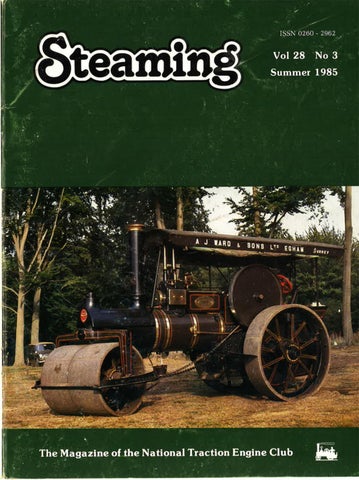
Cover
103
From the Chairman Since my last notes were published the Rally sub-committee has been active both in producing and circulating the latest edition of the Trust's Code of Practice for Rally Organisation, and in selling the rally scene to tour operators and others through the medium of the Tourist Boards' tour operator's workshop. At this event over 250 packs of publicity information concerning the rally scene were handed to interested enquirers, and It Is to be hoped that the efforts of the Committee will be rewarded by increased attendances on the rally fields generally. The publication of a new edition of our Code of Practice is opportune since the Health and Safety Secretariat have begun to take an increased interest in steam engine rallies. In fact, several of their inspectors descended on a well known southern rally during last season. It is vitally necessary for all those connected with rally organisation to adhere to the spirit and intentions of the Code when organising their events if unwanted official interference land perhaps even further legislation affecting our interests) is to be avoided in the future. Following the general plans for suture Annual General rvieelinys and winter social events, your Committee have arranged a social event, which we hope will be well supported by members, to take place in November 1985. Notices concerning this event and the formal AGM for 1985, in August, appear elsewhere in this issue. Various preservation projects have been discussed by the Committee following the news that the Hornsby steam crawler is now to be preserved in Canada near its final working site. A number of interesting suggestions have been received from members which are receiving detailed examination by the Committee and a further announcement will be made when a decision has been reached. George Beck, our long serving General Secretary has indicated his wish to retire towards the end of this year. We have been fortunate in securing the services of David Pugh to take over this key post. David will be 104
well known to many members through his association for many years with the Great Central Railway and their Road/Rail Steam annual event at Quorn Station. He has already taken over as company secretary of the Trust's trading subsidiary, National Traction Engine Club (1984) Ltd, and is at present assisting George as assistant secretary of the Trust. (Peter Barber)
Rally Sub Committee Generally speaking, summertime is the season for outdoor activity and this is certainly true of the traction engine world. The spring issue of Steaming contained a list of 73 events at which traction engines will be present, each one of which has been submitted and approved under our 'approvals scheme'. These events range from April through to the end of September and are held in many different parts of the country; no British member should be unable to reach a rally and to enjoy the sight, smell and sound of steam this summer. The size of the list gives some idea 01 the ;awe dICIUU1 IL Ur vvurk involved and great credit is due to Ron Copp for the many hours he puts in, not to II len lion the diplomacy often involved when difficulties arise. My subcommittee is mainly active during the winter, but members do make many visits to rallies as observers and it is from their observations, and the practical experience of rally organisers, that amendments and alterations to the Code of Practice and to our procedures are made. (Eric Fillmore, chairman, rally sub-committee).
Engine Owners Column Low-loading on Trade Plates The subject of the use of trade plates on low-loaders moving engines has been raised at a Trust committee meeting, and I have been asked to
provide some cornrnen t. I think these notes on the correct use of trade plates may be useful. Trade plates are used (a) by a motor trader to cover 'vehicles temporarily in his possession' and 'recovery vehicles kept by him for dealing with disabled vehicles', (b) by a vehicle tester to cover vehicles while being tested, and (c) by manufacturers to cover vehicles used in research and development. In the case of a motor trader (the only case likely to concern readers of Steaming) he can only use trade plates for the purposes set out in the Road Vehicles (Registration and Licensing) Regulations 1971, S.I. 1971 No 450, which include, in the case of a recovery vehicle, (a) for going to or returning from a place where assistance is to be or has been rendered to a disabled vehicle (b) for going to or returning from a place where it is to be or has been held available for rendering assistance to a disabled vehicle (c) for carrying a disabled vehicle or for towing such a vehicle (whether with the assistance of a trailer or not) from the place where it has broken down or from such other place where it is parked to a place for repair or storage or breaking up. Ti ICI d di d also tight leshictions (.111 whom may be carried on a vehiclo used under trade plates — no passengers, but per suns in a disabled vehicle being towed or carried are all right. I have come across two legal decisions which are worth mentioning. Firstly, in Scott v Gutteridge Plant Hire Ltd (19741 (the legal reference is RTR 292) the Court held that an articulated low-loader fitted with a winch and carrying a defective tracked shovel was not a recovery vehicle, as the tracked shovel had been driven onto the low loader under its own power, Secondly, Robertson v Crew (1977) (RTR 141) decided that a new vehicle was not legally a disabled vehicle merely because the rotor arm was missing. These decisions suggest that the Courts can be expected to interpret the Regulations strictly. The loan of trade plates to a friend, unless the friend drives the vehicle and it is being used for the trade licence
The National Traction Engine Trust presents
An Evening at The Engineerium The British Engineerium, off Nevil Road, Hove, East Sussex on Saturday, 23 November 1985
Arrangements for the Autumn Social Event, mentioned in the last issue, are now complete. It is hoped they will provide an entertaining and enjoyable occasion for all those attending and members are invited to bring their families or friends.
The Venue The British Engineerium at Hove is housed in a splendid Victorian water pumping station with ornate chimney, cooling ponds and gardens; now, as a museum, it contains many hundreds of models and full size exhibits as well as the Woolf compound beam engine in use on the site from 1876 to 1952. The workshops have in the last few years restored many items from the museum collection and also several traction engines, some now part of the display.
The Social The first part of the proceedings will be an Engine Owners Conference starting at 2.30 pm in a private hall at the Museum. This will be open to all Trust members whether attending the evening event or not. The main exhibition hall is the magnificent setting for the evening event which will commence at 7.00pm. The hall has as its centrepiece a Corliss horizontal steam engine which gained first prize at the Paris International Exhibition of 1889, and which will be in steam and running for us throughout the evening. The remainder of the museum will also be open for inspection. A full hot buffet supper will be served in the hall at 8.00pm and other features to ensure a superb evening
by the prohibited holder, is regulations. There are other permitted uses of trade plates where they are actually fixed to the vehicle, but these notes are only intended to cover their use with low-loaders. (David Tew, Hon.
Solicitor) Dunlop Solid Rubber Tyres Solid rubber tyres will continue to be available from the new Dunlop/BTR organisation and will now be supplied through Richard Peskett. For sizes where moulds are no longer available,
include a fully licensed bar, a silver band and last, but not least, guest speaker Fred Dibnah, one of our members who seems to be quite well known for some reason beyond our traction engine circles! The bar will be open until 11.00pm. Tickets for the evening social are now available at 0 5.00 per person. Sadly, the exhibition hall will only accommodate a certain number, so early application for tickets is advisable. To obtain your ticket please write to Stuart J. Gray, 9 Walnut Way, Ickleford, Hitchin, Hertfordshire SG5 3XT, and enclose a cheque or postal order for £15.00 per person (make payable to National Traction Engine Trust).
Overnight Accommodation For those wishing to stay overnight in the Brighton or Hove area, an attractive package has been arranged at St. Catherine's Lodge Hotel, a three star establishment in close proximity to the British Engineerium. An advantageous rate of £12.00 per person for rooms (single or double) with private bathroom is offered to Trust members. The price includes full English breakfast and VAT and the special arrangement — almost a 60% reduction on the hotel's standard rate — is available to members wishing to extend their stay over the weekend. Bookings should be made direct (mentioning that you are attending the NTET social event) to St. Catherine's Lodge Hotel, Kingsway, Hove, East Sussex BN3 2RZ (tel 0273 778181).
in some instances it may be possible to mould onto existing bands. A free of charge consultancy service is now available, the object being to provide a better service to enthusiasts who may require Dunlop solid tyres for their engines, wagons etc; it is hoped this will eliminate some of the problems that have arisen over non-standard sizes and fitting. For further information on availability and prices please contact Richard Peskett, 'Treloweth', Whitmoor Vale, G rayshott, Hindhead, Surrey GU 26 6LU, telephone Hindhead (042-873) 4862.
NTEC Sales The NTEC Sales stands are planned to be at the following events in the second half of the rally season. Take advantage of their appearance to purchase books and other items! August — Alderholt (Keith), Astle Park (Sue), Colchester (Michael), Knowl Hill (Keith), Vestingdagen, Holland (Keith), Fairford (David), Quexpo (Keith), Harewood House (David), (Sue), Bishops Castle Stourpaine (Keith). September — Malpas (Sue), Liskeard 105
I V TRACTION ENGINES ri;i:E"c A new craze has started on the rally fields with these car window stickers produced by NTEC Sales. They are priced at a modest 25 pence, and available from the rally stands or from mail order — but in the latter case only when purchased with other items, not on their own.
(Keith), Hinckley (David), Haddenham (Michael), Roxton Park (Michael). Reference to the Rally List 1985 supplement in the last issue will provide dates and full titles etc. (Tracey Shakuapuare)
The Rally List 1985 The following addition should be made to the list of NTEC Approved Rallies published within the last issue. 20th/21st July — Poole North Lytchett Scout Group Rally, Matravers, Poole, Dorset (about 24 engines expected). B.R. Wilcox, .99
From Alan Martin's Collection 29
106
Wimborne Road, Corfe Mullen, Wimborne, Dorset. In addition, the event at Burton Constable on 26th/27th May was added to the list after the publication of the Spring issue. We apologise to the organisers and visitors at Elvaston Castle Rally (6th/7th July) at Derby, for allowing the error in the Rally List which gave their rally as being near Bath.
Affiliated Clubs Banbury Steam Society The Society is holding its Working
Weekend Event at Hempton, near Deddington on the A423 BanburyOxford road on 7th/8th September. There will be steam cultivation on both days and a vintage tractor ploughing match on the Sunday. A vintage auction on the 7th has already attracted interesting entries — further enquiries or entries contact Tony Robinson, 1 East Street, Fritwell, Bicester, Oxfordshire.
Obituary Zeke Myers it is with the deepest regret that i record the untimely passing, on 27th February 1985 at the early age of 61, of one of Cumbria's most prominent and respected traction engine and organ enthusiasts, Ezekiel (Zeke) Myers. Formerly of Langdale, recently retiring to Lowick Green, near Ulverston, Zeke owned and restored McLaren 787 LOUGHRIGG to an outstandingly high standard, as rallygoers in the North of England and Scotland will remember. Another remarkable achievement, was the restoration of
Disaster on 1st April 1908 at Mr Caswell's farm near Osboumby, Lincolnshire. Four stacks — one wheat, one barley, one fodder and one straw — had caught fire. And seeing the position that J.W. Robinson & Son's 1891 Burrell single cylinder 7hp traction engine 1527 has got itself into, that engine could very well have been the culprit, managing to set the ricks on fire whilst trying to extricate itself — such things did happen from time to time!
his 89 key Gavioli fair organ, which was transformed by Zeke and the late John Gregory from Sheffield, from virtually a trailer load of decaying and rotten timber to the magnificent instrument that now travels the Northern and Scottish rally circuits and has given so much pleasure to countless thousands of people over the past thirteen years or so. Indeed, he was in the process of perfecting this instrument at the time of his passing. Zeke was also progressing with major surgery on his Fowler Tiger tractor 14805, all this as well as building an entire new workshop and adapting other outbuildings to suit his needs as an engineer and craftsman. The steam engine and organ fraternity has surely become much the poorer, with the loss of a man who has toiled with his family, to bring so much pleasure to others and a wealth of help and advice to people, like myself, who have ventured into our hobby of preservation. He certainly was the inspiration behind my purchasing and restoring Marshall 10 ton roller 65822, for which I am eternally grateful. Zeke was a character not only in steam preservation, but also in the world of motor cycle scrambling. There he will be remembered as the people's hero during the late 1940s and early fifties. His skill as a natural rider was regularly rewarded by wins achieved by breathtaking performances providing spectators with a real value for money afternoon's entertainment. In those days, of course, riders travelled to and from events on the machines they raced — sponsorship and bike transport were unheard of. He was also involved in road haulage, commencing with the transportation of livestock and building up to a sizeable fleet of tippers, all smartly presented and maintained to Zeke's recognised high standard. To quote a certain Ministry vehicle examiner — 'we never have to worry about Zeke's fleet'. To the followers of the Leeds & District club rallies, Zeke's big McLaren engine is the one featured for many years on the front of their rally programme. The original sketch bore the legend 'Zeke on LOUGHRIGG'. No one can erase the many happy memories I have of steaming, travelling and socialising with Zeke and his family. To Jean, his wife, and Michael and Christopher, his two sons, we extend our deepest sympathy at their very sad loss. In this beautiful corner of England — the Lake District — many names of celebrated folk have become legends: Beatrix Potter, Wordsworth, Ruskin,
A welcome return to steam and action at Hollycombe for the wierd and wonderful Ransomes, Sims & Jefferies crane engine 31066 of 1920, in May this year. (Roger Newbery)
John Peel, Norman Buckley, Donald Campbell, Arthur Ransome and many more. Of one thing we can be sure for engine enthusiasts and many others the name of Zeke Myers will be added to the list and he will always be remembered as a true enthusiast in many fields, and as a family man, a friend, a gentleman. (Richard Ransome)
Future dates AGM 1985 The Annual General Meeting of the Trust is to be held at 7.30pm on Wednesday, 7th August 1985 at the Royal Hotel, Western Great Paddington, London. Formal notice, agenda, etc is distributed with this issue of the magazine.
Corrections Aveling 10 ton roller 14039, featured on page 75 of our last issue is, in fact, a compound cylindered machine; Sentinel 9142, discussed on page 80, is, of course, one of the maker's S6 models.
OUR MAGAZINE 25 YEARS AGO
The Editorial made early reference to the necessity for the planning and control of the rally calendar, to avoid disappointed customers. The pony gymkhana was then waning in popularity, but the engine fraternity should not be persuaded to join these events — there was enough in engines alone to attract the public. The sale of Patten's ploughing engines had taken place in June — eight engines came under the hammer and prices per engine ranged from £170 to £320; all stayed as pairs. A rally in New Zealand was reported and listed 21 engines present — much the same as events at home. The Club's own rally at Bridge Farm, Appleford in June had suffered from 'a poor weather forecast that morning' and with the gathering not continuing on the Sunday to add to the attendance, there were only 2500-3000 to see the 22 engines. 107
Wallis & Steevens 10 toil single cylinder roller 7779 was built in 1923. It was sold for £818 5s Od to E. Parry & Co, contractors, of Sefton Street, Putney, London, on an order placed on 22nd August 1923, the engine being registered HO 6260 on 15th November 1923. One of Wallis's own two tine scarifiers was fitted to the left hand side of the tend er and the 5ft 6in diameter hind rolls were of extra width at 18 inches. All the pipework was copper and false brass covers were fitted to the front cylinder covers and lo [lie valve elies1; it was, indeed, finished off to show standard, for Wallis took the opportunity to display it in London at the Public Works and Roads and Transport Congress, held at the Agricultural Hall, Islington from 22nd to 29th November. Also displayed on Wallis's stand was an 8ton compound machine, and one of their then newly introduced Advance rollers. 7779 stood against a display board featuring pictures of the newcomer and although Commercial Motor did illustrate the 10 tonner in their review, the press reports generally centred on the Advance. Parry's numbered their new acquisition 6 in their fleet and used it until 1923 when it was purchased from them by A.J.Ward of Egham, Surrey. Little is known of the machine's lah -uui uveu 1h yew a, 'WA-. during World War 2 the roller was driven to Bath, Somerset to work on a contract involving building an underground storage depot. We were told this by the driver who made the journey. It was one Saturday morning in 1950 that I first saw 7779, heading north on the Winchester by-pass, but unfortunately I did not have a camera in those days. A photograph of the engine standing on Hampton Court Green appeared in Model Engineer dated 19th January 1956; the picture was credited to Peter Anderson of East Molesey. Does anyone know of the whereabouts of Mr Anderson or the original photo — we would dearly like a copy. 7779 remained with Wards until 1960 when it was sold at auction along with three other rollers. Our subject, alone among the quartet, was not in steam. It fetched £100 (£25 less than each of the others) and passed into the ownership of Hardwicks of Ewell, as indeed did the 108
Wallis & Steevens 7779 Eric and Ian Best other three. The October 1960 issue of Steaming recorded all this but erroneously described 7779 as an Advance, registered MO 6269. The roller was to stand in Hardwick's scrap yard for nine years, complete with all its brass plates and fittings. It was eventually purchased (rum ureic liy Pegden Bios, or Kent and was taxed by them on 18th November 1969, but just one week later, on 25th November it was recorded as owned by L. Machell of Littlehampton, Sussex. A little over a year later, in December 1970, George Miller of Eastbourne, Sussex had it. By now the engine was being rallied and I saw it at Polegate in July 1972, there being told it was available for purchase. At that time nothing was further from my mind for I had been part owner of a 7hp Burrell single crank compound and, being a model
maker, had vowed I'd never again get involved with twelve inches to the foot. Little did I know what was to happen iii a few years time. Owing to ill health Mr Miller had to sell what had now become known as SIR LANCELOT, and it passed to J. and M. Alder at Horsham, Sussex in July 1973, and in their ownership attended quite a few rallies in Sussex, Kent and Surrey. Changing hands yet again, the roller moved to pastures new near Andover, and our paths were to cross again. Fate had a hand in it this time because by October 1980 my son Ian and I had bought Wallis 7779. The first thing to do was to get a fresh boiler report. This merely confirmed our opinion that a new firebox was necessary. I had already tested it with a two pound hammer and the only sounds I heard were dull thuds — no healthy metallic rings. And
Wallis 7779 of 1923 at work in Sutton, Surrey in May 1936, whilst in the ownership of A.J. Ward of Egham. (B.D. Stoyel)
so the box was condemned in the middle of February 1981. Over the next eight months we stripped down the engine at Derek Marder's yard near Andover. April saw the start with us taking off the canopy and removing the crankshaft. The end of May saw the engine largely in pieces and us concentrating on the boiler itself. We were knocking off the rivet and stay heads and removing the foundation ring rivets. A large space in my diary from mid-June probably indicates other pursuits, and it is not until mid-October 1981 that the entry appears 'firebox and tubeplate removed'. Once the box was out its sad state could be contemplated. In an idle moment I knocked at the scale with a hammer and a hole appeared in the crown behind the tubeplate rivets. What metal there was could best described as of cigarette paper thickness. A thing that had surprised us was the ease with which the foundation rivets came out. The firehole ring rivets were a different matter, however, and the corner copper studs became a real problem. What I did not record in my diary was the removal of the smokebox, which is an extension of the boiler barrel plate. Once the steering head had been removed we discovered the smokebox was very thin. It had to come off, but of course with its removal it was so much easier to deal with the front tubeplate. We had decided to make our own new firebox and tubeplate. It would be a new experience for us for we had not had occasion to tread this path before. It was to be of all welded construction and built with true square corners, whereas, of course, the original one was flanged. The outside of the foundation ring was quite true and still had the machining marks on it; the inside was such as to be best described as lozenge shape. Both ends were out of true by % inch. To overcome this problem we had the inside of the ring machined all round to render it true (and by doing this the grate length was increased by % inch — a pattern was made for new firebars to suit the new length). The new box, incidentally, eventually proved a good tight fit. The old box was removed by placing a small hydraulic jack on the top of the crown and pumping against the inside of the outer wrapper, plus a fourteen pound hammer striking a punch held on top of the foundation ring, reached through the mud holes. After an hour of this treatment the old box was out on the floor. The boiler was then lifted with a crane and the
Wallis 7779 is steamed for the first time in Eric and Ian Best's ownership in November 1980. The motion covers are painted in London Brighton & South Coast Railway livery. (Eric Best)
old box pulled aside. The barrel tubeplate could then be easily knocked out from inside. Scale was removed from inside the boiler shell and local pitting was built up with weld. To fit the new tubeplate the barrel had to be jacked out in both directions to enable a good fit. I'm pleased to say that it was a very good fit. The tubeplate was then clamped into position and all the holes were drilled by a hand rachet drill, as we were to do with all the stayholes and firehole ring. We had diverted from the original design of the box in doing away with the hanging crown stays and were to have bridge crown stays welded onto the box. This was done with the blessing of the boiler inspector. As the foundation ring was fitted to the new box, the rivet holes in the new plate were drilled on a machine using the foundation ring holes as a guide. The fitting of the new box consisted of the boiler shell being lifted, the new box slid underneath on packing and the boiler then being lowered. The new box was then jacked up into position. Long 34 inch bolts in the foundation ring holes held the assembly in place for the drilling of the stay holes. The stays were originally % inch, but the new ones are one inch. A drilling post was clamped to different positions, so that all the stay holes and the firehole rivet holes could be formed. There are 98 stays in a
Wallis 10 ton roller firebox. Hornplates, backplate, throatplate and inner firebox were all drilled in position, so the stayholes had got to line up. Once drilled the stayholes were tapped and the stays duly fitted. The latter are out of EN2B and came in 10 foot lengths. For these we went to a firm in Basingstoke. The bars were brought back to Andover in our Cortina Estate, front ends jammed under the dash, tail ends sticking out of the back with a bit of (dirty) white rag wrapped around them and the tailgate strapped down onto them. And holding the bars over on the passenger seat so that I could change gear was my long suffering wife! The Basingstoke firm supplying the bars was not, unfortunately, Wallis & Steevens. We used railway practice for caulking our stays. The method is as follows — the plate around the stay was caulked, the head is then formed and this is also caulked. Under hydraulic test to 200lbs not one leaked. I had seen this method used when I worked at Eastleigh railway shops, but never thought that I should one day use the same method. Rivet holes were reamed as is generally advised, and the necessary equipment was borrowed to enable us to do the job. Seeing that this was our first attempt for real, we were highly pleased when the inspector later remarked on our tidy riveting. Now that the new firebox and 109
tubeplate were fitted, all that was needed to complete the boiler was the inserting of the tubes. These had already been cut to length and were fitted by Ian in September 1983. While the boiler work was going on various other jobs were being attended to. All the boiler mountings were overhauled. New motion pins were made, slide bars were machined and reset in their place. New small end brasses were needed as the old ones were badly cracked and a new crosshead pin was made and fitted. The badly wasted valve spindle, regulator spindle and piston rods were all replaced by new ones, also a new weight shaft for the motion, the original being worn. All the badly worn glands and the valve guide had to be rebushed. The crankshaft bearings had seen much better days, so we had replacements made for them. The tender was quite tidy ieally. It did need a new manstand and coal plates, however. Then, along with the main gearcase it was shot blasted to remove years of muck and rust, and that made the next step so much easier. The right hand side front and rear wheel scrapers were replaced. The rear one was broken into two pieces; these were married up and cast iron welded together. The front one is part of the steering barrel and of cast iron. It had fallen to pieces when
The method of drilling holes for rivets in the tubeplate flange. All the stay holes in the flanges were formed in this manner; Ian Best provides the power. (Eric Best) 110
The Picket Piece Puffers Steam Apprentices get the practical training needed to become useful members of the traction engine movement in November 1981. (Eric Best)
being taken off the engine. A new cast one was out of the question so a fabricated mild steel replacement was built to the original drawing. It doesn't look out of place at all and works very well. The steering barrel, being made of cast iron, doesn't bind in the plain steel bearing. We now tackled the new smokebcx. !t `."12S ro!!ed. to SiZe, CUt tC ChCpC at the front as near as possible and then welded to the existing barrel. With the weld ground down so that you can't see the join the front was then properly back to its original shape. The smokebox door was made up and refitted to the original Wallis drawing — what had come with the engine was a real home-made job! On 8th November 1983 our handiwork passed its hydraulic test. At that time we knew the worst was history. Now we could commence building up the roller. Before we could fit the left hand side hind axle box a new bronze bush had to be made. As the engine had had a scarifier fitted to the left hand side, it had played havoc with that particular bearing, squeezing the material out of the housing just like butter. The right hand side was hardly touched. Seeing that this was the only damage we could blame on the scarifier, we feel we got away lightly. The tender had been painted and
lined during the course of the summer whilst it was standing on end (fore end to the ground). Then we put it on blocks in its more normal disposition to replace the relevant fittings. The tender went back early in December 1983. The steering head or front perch had been fitted a couple of months before. When we got the engine it had no blower; it had been blanked off. One had been fitted when the engine was new, as can be seen in the photograph taken at the London Show. But when I went to refit the pipework there was no hole in the chimney base to receive it. So, was it a new or exchange headstock, and if so, what tale attaches to its replacement? Christmas 1983 saw much activity around SIR LANCELOT. Keys were fitted to shafts — all were new as the old ones were so sloppy it was too silly for words. The steering gear was replaced, also the second pinion and the brake drum onto the hind axle. Come the first weekend of the New Year, a lot of bumping took place with an old railway sleeper, persuading the final drive gear up to the keys on the axle to get a good fit. According to my notes we were successful as they record 'final drive gearcase fitted'. The large and heavy cast iron gear guard to the second shaft next went
on — this had been taken home and painted, lined and varnished in our outhouse, along with the final drive gear guard. At one time there was an awful lot of bits of Wallis roller scattered around our house. At the end of January we stripped down the front rolls to aid the cleaning of them. We then discovered that the front axle had started to shear. We promptly decided on a new one. As there was a lot of slop in the centre pin in the forks it was also decided to have the forks bored and a new pin fitted. This was done at Eastleigh Technical College. The method was to remove the toolstock from the lathe, clamp the forks to the toolstock carrier and then the boring bar was driven by the headstock end and the forks travelled up the bed of the lathe. It was a big job done on a small lathe, and was used as a demonstration to students of how to do outsized tasks with small equipment. Another job which would be in need of attention before we ventured out on the road was the left hand side steering frame. The right hand side was of a later, modified (and stronger) pattern and was not damaged. That's more than could be said about its opposite number. It had been welded and received riveted plates and all in all was a positive hazard. Enquiries were made to discover the possibilities of having it made good with proper cast welding, as we had done with some smaller broken cast iron pieces. This proved to be far too expensive, and as the component was of the older pattern it still wouldn't have matched the perfectly satisfactory one. We decided on fabrication in mild steel as the answer. A drawing was prepared and the steel profile cut. The upright piece was rolled to the correct radius and all of the other pieces assembled and tacked together. After being offered up to the forks only very slight alteration enabled us to make it up in one piece, carry out minimal cleaning of the weld and fit it in position. A coat of black paint and it was a good match for the offside one of the pair. During the cold dry spring a lot of time was spent cleaning much muck and old paint from the roller's wheels. The task seemed endless but it was one that had to be done. A problem arose when we started painting — it was nice and dry but the wind would whip up a fine dust and as our 'workshop' was open to the skies it seemed that our wet paint attracted every particle of that dust. We overcame the problem by covering the wheels with a large plastic sheet and working inside the cover provided. The roller's hind rolls are not the
original ones for they are only 16 inches wide, not 18 inches. But they are of Wallis & Steevens manufacture. We reasoned that the lining we found on the spokes would not necessarily have bearing on what the original colours of 7779 were. The wheels went back on early in April whilst the engine was still jacked up at the rear end, for it would make life a lot easier when lining the spokes to be able to revolve the rolls. By the end of the month we had finished that task and lining the tender; we varnished it all and lowered the rear end to the ground. By early May the front rolls were similarly completed and 7779 'stood on its own feet' for the first time since April 1981 — a fraction over two years. It looked something like our engine again. The boiler was lagged in Southern Railway (or London & South Western Railway) practice. A crinoline framework was made up and fitted around the boiler; this was a permanent fixture. The lagging sheets were then screwed to this and the brass bands replaced as normal. The space between the boiler barrel and the lagging sheets is fitted with fibre glass; we don't want any impromptu fires under our lagging! After this, two coats of top coat paint preceded the lining out. Mid-June saw the steering chains replaced. On 17th June we lit up the engine for its first serious steam trials. Quite a
bit of adjustment was needed — not surprising considering what had been done to the engine. Following these odd jobs we tried again on 22nd June — my diary records 'a lot better'. And so the following day, minus canopy, we went out on the road for the first time in rebuilt form. We then discovered the gears on the crankshaft were too deep in mesh. As the new crankshaft bearings had been fitted, the old shims were not a lot of use. However, new shims were fitted under the bearings to raise the crankshaft and on a steaming two days later all seemed well. The next weekend, the last in June 1984, we took the engine 'round the block' a couple of times, a total of nine miles. We were nearly ready for steaming to our rally debut at Rushmoor at the end of July. In the circumstances we did not have time to do much to the canopy. The side boards had been rubbed down and repainted and as we intended later taking the engine to the Egham Show we felt it appropriate to put the name of A.J. Ward back on the canopy side. For future seasons we intend to replace this with our own name, but before that a new canopy will have to be constructed, for the timbers are showing signs of age. However, the wood has done quite well seeing that it is 61 years old! Our first run of any length was from Andover to Rushmoor Arena at Aldershot, a distance of some 36
The new smokebox was clamped to the barrel to get the correct marking lines for the bolts — we were determined to get the engine all properly in line with no droopy, or nose in the air, appearance. At this moment we were contemplating conversion to a scenic showmans. (Eric Best)
111
miles, which we did iii 12 I 'um s — consuming six hundredweight of coal in the process and suffering no trouble with the engine. From our first venture onto the highway on 30th June until our eventual return on 10th September 1984, we covered 219 miles — not bad for our first season, especially as we had no real problems to worry about. Reflecting on the three and half years it took us to strip down and rebuild our roller it was not quite the daunting undertaking we first envisaged. In fact it really is the only way to get to know your engine! It might be interesting to conclude with a few notes on some of the more superficial aspects of our rebuilding. The left hand side motion cover plate bears a large oval brass maker's plate. When the roller was built this was fitted, Wallis style, to the coal cage of the tender. Who moved it we don't know, but we prefer tho motion cover position, so there it stays. The engine never had a name in its working days; again we don't know who christened it, but is it coincidental that there was in the same area another Wallis roller — an Advance — also named SIR LANCELOT, with a nameplate very similar in type to ours? We did not like the style, however, and I designed and made another, to fit the same bolt holes. It was based on the design applied by the Southern Railway to their engines on the Isle of Wight and to a certain extent the King Arthur class locomotives. One of the latter was named SIR LAUNCELOT but I retained the spelling without the 'U', as originally given to our roller. Our original thought on livery for 7779 was to base the scheme on that !marl by Farb,. March fnr th? I nncion Brighton & South Coast Railway. The colours were used to good effect on that railway's 10 ton Wallis roller, which was similar to ours. We did, at an early stage, try the motion covers in this style and felt it looked quite smart. All our plans changed, however, when we cleaned down the various parts of the engine and uncovered the machine's original livery. This was a dark maroon-brown, a very rich colour edged in black with red and yellow lining. I hope we have faithfully reproduced the original style of decoration. Whilst making the new nameplate I also made up two brass registration plates to replace the modern style plates that came with the engine. They are based on a style once used in Kent. I have been told that the original chimney fell off in the middle of Brighton. The replacement one is from Thurlows of Stowmarket, the copper top being very like that of Ruston112
On the rally field again Wallis 7779 of 1923 poses in the evening sunlight at the Rushmoor Arena event in July 1984. (Roger West)
Hornsby. If anyone reading this knows of the whereabouts of the original chimney top I would be grateful if they could contact me, as it was one of the later Wallis designs of which no drawing exists nowadays. On the subject of drawings, our engine did tie up very well with the Wallis drawings which are now deposited at Reading University, the only missing detail being the aforementioned chimney drawing. We had presented to us an odd pair of lamps for the front forks — odd in as much as they were both the same hand! However, with help of a certain ipii7arri in A nrinvor tho prnh!am L. solved and we are now the proud owners of a left hand and a right hand lamp. To round off our resume of the recent life of Wallis 7779, I can record that on 25th March 1985 she provided the means for Ian and myself to pass our driving test on a roller. The test took place on an estate off Vigo Road, Andover and it was in a field just off the same road that the first Andover traction engine rally was held way back in 1953. And to match that day years ago the weather was very similar — cold and damp to say the least. We cannot finish without recording our thanks in print to all those people, knowingly or unknowingly, who have helped us restore Wallis 7779 to full health, especially Derek Marder, without whose help we would still be struggling. Now we can start work in earnest on our 1913 A veling & Porter four ton traction wagon. kr.
According to a shareholder's prospectus issued in October 1923 by Hodgson Road Contractors Ltd of Manchester, one of the companies to be acquired was the transport business of Messrs Wort & Way of Castle Street, Salisbury, Wiltshire. These 'well known Government Contractors' claimed valuable connections with local authorities in Wiltshire, Gloucestershire, Durham and Lincoln and their transport plant, which included 45 5/6ton steam wagons, 5 6ton tractors, 25 trailers and 28 men's living vans, was valued at £29,152. (K. P, Plant)
CLWYD COUNTY COUNCIL Highways Department
Disposal of Surplus Equipment Offers are invited for the purchase and removal from site of 4 no. steam roller living vans. The vans are of timber construction on iron wheels and the approx dimensions are 12ft x 7ft x 6ft 6in Forms of tender may be obtained on application to the County Surveyor, Shire Hall, Mold, Clwyd CH7 6NR Applications must be made by 7th August 1985, and completed tenders returned to the County Surveyor by no later than 14th August 1985.
it difficult to see very far inside the firebox but firebars are still present. The engine appears complete even to a pressure gauge — this perhaps a later addition. The lined dark brown paintwork could possibly be the original. The engine at the 'front' is totally enclosed, the crankshaft being overhead and the flywheel outside and overhanging the casing. A most interesting feature is the pair of doors giving access to the engine compartment. These are a very ornate casting split in two down the centre to hinge open, the whole sporting a large royal crest surrounded by the legend BY HER
Derek Rayner
MAJESTY'S ROYAL LETTERS PATENT TUXFORD & SONS BOSTON LINCOLNSHIRE. It appears to be lockable through a keyhole in the centre of the design. Again, it isn't possible to investigate inside to see if the engine itself is complete. Other steam vehicles in the museum are an 1885 steam powered tricycle by de Dion-Bouton; a Serpollet steam car; fire engines; and, not least, L'OBEISSANTE, one of Amedee BoIlee's steam wagonettes, an intriguing and attractive vehicle of 1873. The museum is open 13.00 to 17.30 (closed Mondays) with a 10 franc entry fee (about £1), whilst on Sunday the hours are 10.00 to 17.15 with free admission. There are many other road vehicles on show as well as items relating to railways, aeroplanes, farming etc.
An engraving of the type of Tuxford portable shown at Hyde Park in 1851.
What is generally regarded as the world's first steam propelled vehicle was designed and built some 215 years ago by Frenchman Nicholas Joseph Cugnot, long before any steam power was applied to the railway. Cugnot demonstrated his first primitive vehicle in Paris in 1769 and in the following year built an improved machine latter This version. overturned during trials; Cugnot was imprisoned as a result, but after the engine had been locked away for some thirty years someone had the foresight to keep it intact. It is still preserved for us to see today in the National Technical Museum in Paris, in the imposing if gloomy surroundings of the former church of St Martin de Champs (St Martin in the Fields). The building is now an exhibition hall, part of the Conservatorie National des Arts et Métiers on Rue St Martin. The strange
three wheel vehicle with its kettle-like boiler and engine slung ahead of the leading wheel, can be considered the origin of the steam road vehicles on which our hobby is based and although it is a well known survival, few seem to have visited the museum and remarked on the venerable British built engine which stands alongside. This exhibit is a Tuxford portable engine, built at Boston, Lincolnshire in 1850. As such it probably merits the title of the oldest engine in existence that largely takes the form now considered to be conventional. The portable is of the type exhibited by Tuxfords at the Great Exhibition in Hyde Park, London in 1851. It is on wooden wheels and has a vertical engine mounted at the turntable end of the boiler. The latter is of the return flue type with the chimney base (the chimney itself is missing) above the firebox; the dim light available makes
Editors note: With engines as aged as these, any claim to be the oldest may lack substantiating evidence. Traction Engine Register lists two contenders — Humphries portable (No 2191, located in the Kidderminster area and dated, as the Paris engine, 1850. An unidentified engine with a return flue boiler was observed at Stonehouse rally in 1980, and allegedly dated circa 1840. In addition to these a tiny quarter horsepower engine, supposedly built 1823, is housed (but not on public view) at the Royal Engineers premises at Chatham. But perhaps its very size would disqualify this machine, it hardly being of conventional type.
'For sale — 8hp Road Loco by Ransomes, mounted on springs, 2 tanks, compensating gear, winding drum, awning over, complete engine, practically new, price £450. — Parry & Co, Furniture Removers, Hereford.' (From Industrial Motor Review, 19th July 1905.) 113
WORKING WITH STEAM Memories recalled by Bob Field of engines he worked with in Warwickshire some fifty years ago
I was born and bred at Ufton, a village four and a half miles south east of Leamington Spa in Warwickshire. About the time I left school in 1928 steam was still supreme for many tasks on the farm and on the road, and within a ten to twelve mile radius there were quite a few engine owners I can recall. In our own village, at Hill Farm, Reg Johnson had bought new in 1926 Ransomes 5 ton tractor 36220 (UE2496) and drum, and with them he did contract threshing. Gordon Limb of Romsley near Bromsgrove has now got the engine, after rescuing it from a farm near Rugby. The Home Farm at Ufton was worked by J. Reed and he kept about twenty horses for his 350 acres, and also a portable engine with drum and trusser, and a set of roundabout ploughing tackle. It used to take days to set this up in a field with the portable and windlass placed in the corners. My great uncle Harry Stanley was the engine's regular driver at these tasks land driving barn machinery) until about 1931 when Mr Reed purchased a French made Austin tractor. The portable was only used for the farm's own work. At Whitnash there were two chaps who owned threshing tackle which travelled: Steve Thornton and George Owen — the latter a Robey engine with drum. Between there and Rugby were the Bucknells of Marton — they travelled three sets powered by Burrell engines — and close to them was the Long Itchington timber yard of Cooper Bros who owned a Garrett tractor for timber hauling. They also had an old portable in the yard for driving a saw bench. Then, from Stratford-on-Avon, there was Ball & Horton who travelled ploughing tackle. When their single cylinder Fowlers were tearing up grass fields you could hear them miles away! Some lads from Wolvey and Pailton had ploughing engines and travelled around the Rugby district fairly close to us at Ufton. Ern Johnson (the brother of Reg in our village) has several engines at Offchurch, near Leamington, and I travelled with him for some time. He 114
had a pair of Fowler B4 side drum engines, on which I learnt to drive at the ace of 16, as well as two Ransomes tractions, a big Marshall drum, three Hornsby trussers with six foot diameter wheels and a saw bench. The Ransomes were 15740 of 1904 (AB8949), a 7hp single, and an unidentified one. In the summer of 1928 he bought at the Royal Show at Leamington a brand new 5 ton Ransomes tractor 39149 (UE7213) and a Ruston tractor drum — and I was to move around with this for the next five years, but more of that in a minute. Also near Ufton — two miles away at Chesterton — was a man, name of Gamble, who had a Burrell tractor for sawing wood; his son used to come to our village with a horse and cart selling the logs at 9d (4p) a bag. I last saw this engine in their yard, close to the bungalow they had built, sitting down on its water tank and driving the saw
bench. It still has its brass plate on it — PRIDE OF WARWICKSHIRE. Then there were the local steam wagons. Warwickshire County Council had several Fodens, and Sentinels were operated by Thornleys of Radford Hall Brewery — Dick Blenkinsop, former editor of our magazine, lives in the house their old driver once had; I believe his name was Mustaugh or something like that. Keyes Cement Works at Southern (now Rugby Portland Cement) had three Garrett wagons with trailers and also steam navvies (diggers) and locomotives within the quarries. At Harbury Cement Works, owned by Greaves, Bull & Lakin (later Red Triangle Cement, and then Blue Circle Cement) it was a similar scene, except that the road wagons were a large fleet of Sentinels, and the narrow gauge quarry railway too had some Sentinel locos. I left school at Christmas 1928 at a
Reg Johnson with his Ransomes tractor 36220, probably taken in the Harbury district about 1930. He is running the engine with the motion side plates removed — note the cylinder oil can between the wheel and the firebox to keep it warm and less treacle-like. (W. D. E. Field)
time when there were not many jobs about. Ern Johnson's Ransome tractor and it's drum, new from the Royal Show that summer, was being driven by our neighbour Tom Allcock, so I went along with him as casual labour — chiefly bond cutting, but any other task as well — or did any other spare work I could find when we weren't threshing. In those days a farm labourer's weekly wage was 28 to 30 shillings (£1.40-£1.501. A threshing driver got about 42s (£2.10) and his mate the feeder about 36s. Casual threshing labour money was 9d an hour and if the machine wasn't working (in wet weather, or whilst moving to the next jobl, you didn't get paid at all. When the machine was working the driver and mate had 2 shillings each per day, board money they called it, but some of the farmers got their money back by getting the driver doing odd jobs. With a big engine the driver could leave it for ten minutes or more, but not so with the 5 ton tractors, which ran faster and had a smaller boiler. Some of the coal the farmers got for the engines was only rubbish — specially got out of their own cellars! The owner of the tackle charged 6s 6d an hour when the straw trusser was used — if the straw was not tied it was only 6s. The straw trusser is the machine which made boltens of straw with two bands, and the farmer supplied the string, along with the coal and water for the engine. By the time I was sixteen I was spare mate on Ern Johnson's threshing tackle, and also cook and spare man with the B4 ploughing engines. We did more cultivating than ploughing, and a bit of mole draining. We tried lifting sugar beet with a cultivator drag, but that made the fields too soft for the horse carts to draw the beet to the roadside. The cultivator had nine tines and was pulled in low gear the first time over and then a second, with two more tines to make it wider, with the engine in top gear. In those days the owners of tackle worked on a shoe string. Our boss took 40 acres of derelict allotments rent free at Southam. We had the engines there in our spare time and pulled down fruit trees and pig stys and burnt them, then ripped the ground up and sowed winter wheat. He had a bumper crop and threshed half of it without stacking, as the cash was needed. I was spare driver before I was seventeen. Some farmers had got a drum but no engine, because their old portable had worn out, so they then borrowed one of our Ransomes and driver — such a job I am doing in one of the accompanying pictures. Sometime in 1932 one of our
The little Ransomes hard at work. (W.D.E. Field)
mates, Eric Warner, had four fingers cut off in the circular saw. Of course, insurance and the like wasn't so strict as it is today, and our boss, Mr Johnson, hadn't got the money for compensation, so when he died of cancer the following year, Eric had to have the two B4 engines and tackle, the sawbench, and the two old Ransomes engines with the Marshall drum and trusser, together with other bits and pieces. The little Ransomes tractor 39149 and Ruston drum and trusser, only five years old, went to someone up Leicester way; I think it still exists (39149 went to Barwell, near Hinckley and is now owned in preservation near Stamford, Lincs — Hon. Editor.) I perhaps might mention here a few more details of the two B4 side drum engines. They were built for Germany but the outbreak of World War 1 prevented their despatch, so they were sold to someone in the Midlands. I think Johnson bought them from a farmer at Stockton, Warwickshire. They had been left for five years in the field they last worked and the hedge and some small trees had to be cut down before the engines could be moved. They had nameplates in front of their chimneys — INVINCIBLE and INFLEXIBLE, and the left hand engine was a far better machine than the right. The engines were Fowlers 14639, 14640 of 1915 (AC9187 and AC91881, 14hp compounds. The price Johnson charged for ploughing was 22s an acre or £1 for cultivating both roads. For sawing or loaning the engine out for threshing or hedge pulling, £2 10s Od per day was
charged. Dredging was contract work, as after we had dredged the pond or lake we had to level the spoil for there were no bulldozers in those days. Johnson had an old Humber open top car and if we were working miles away he would give us a lift home at night, our bikes held tightly on the running board each side! So, in July 1933 we had Eric Warner for our boss, and we got stuck in to help him onto his feet. At the end of the first week, ploughing at Long ltchington, we took the engines down to the brook to wash out. We placed them side by side, and we kept one engine in steam to wash the other out. Berry, the other driver, thought the steam had gone out of the dead engine and undid the big taper plug on the corner of the firebox. The engine was far from dead; he didn't get out of the way fast enough and finished up with scalded legs and was away from work for five weeks, during which time I had to take over his engine. Then towards the end of the season one engine cracked its perch bracket casting and Fowlers had to send us a new one. The engine was driven to the village blacksmith at Little Kineton where we cut off by hand the old rivets, hand drilled the holes in the new casting and bolted it on to the engine. In the summer of 1934 — on the 7th July, for I well remember the date — we were bringing the ploughing tackle back to our yard, which was now located at Harbury since Eric Warner became boss. Eric was driving the leading engine and I the other with Bill Fell (who worked for Reg Johnson during the threshing season) as my 115
One of Ernie Johnson's Ransomes engines just managing to get into a working position in a Warwickshire farm gateway. The engine is unidentified; its apparent registration NX780 was not noted by Alan Dukes in Warwickshire licensing records as being a steam engine. (W. D. E. Field)
Screen Bros' Burrell crane engine 3197 of 1910 on a rescue mission in June 1.950. Pat Collins' Burrell THE GRIFFIN had come to grief with a broken rear axle outside the Austin motor works in Bristol Road, Longbridge, south of Birmingham. Bob Field recalls 'we lifted up the rear offside, of THE GRIFFIN with the crane and pushed it, on its three remaining wheels, about a quarter of a mile along the Bristol Road to the car park at the Danilo cinema. Then, two or three weeks later, we returned to complete the rescue. We took a solid tyred bogie off one of our old well wagons and having removed THE GRIFFIN's remaining near side rear wheel, put it under the tender and anchored it firmly. We then loaded the wheels on one of the wagons, arranged the crippled engine tender first in front of them and coupled up to the lot and proceeded to Hunt Bros at Oldbury. One of Collins' drivers, named Studt, steered THE GRIFFIN whilst it was coupled on the back of me. In this picture, taken near the Dear) cinema, that's me by the front wheel.' (collection Alan Martin) 116
mate, when the village copper had both me and Bill for having no driving license, no insurance and being under age. The case was heard at Southam; I pleaded ignorance and got away under the Probation of Offenders but Eric was fined £5. Thus I was stopped from driving until I was 21, and that was over a year away in September 1935. Berry, my previous mate who had got scalded, had gone off and bought a new rubber tyred International tractor with plough and a secondhand Foster drum, so we had very bad competition, and I had to teach another mate to drive. He was A. Hunt, brother to Len Hunt, the chief dredaina toreman for Bomford & Evershed — indeed it was still a case of people I knew for Len previously drove for Ern Johnson before he went to Bomford & Evershed. In September 1934 Hunt and I were threshing at Hill Wootton near Kenilworth with Ransomes 15740 when the firebox, which I suppose had dune its bit since being 'node ill 1904, showed a good bulge to its crown. We had to throw the belt off and run the engine back out of the stockyard into the field behind us. Now the snag was our spare Ransomes, the one without a cab, was at a little engineering place at Eathorpe Mill, having some welding and stays attended to. Although it was finished the owner of the firm wouldn't let us take it as our boss couldn't pay the bill. We had to drive one of the ploughing engines over and leave that in lieu of the repaired Ransomes, so we could finish our threshing programme! The other, ailing, Ransomes? Well, she stayed in the field exactly where we backed her off the drum, until she was cut up years after. I worked two years for Eric Warner. We used to borrow the local merchant's lorry, a Chevrolet, and go to the farmer at Pailton near Rugby, who had a pair of BB1 Fowlers and borrow his dredging scoop. Thus we did quite a bit of work on ponds and small lakes — I think a farmer got cheaper insurance if there was a good water supply at hand, for there was no water or electricity laid on in those days. We had to rely on pump water or duck pond water for the engines. The least said about the latter, the better. Towards Christmas 1934 my mate Hunt left us as his brother Len had got him a job driving for Bomfords. Then in January 1935 they wrote to me and asked me too to go and drive for them. I knew I couldn't drive on the road until I was 21, but they could employ me driving on contracts where the engines didn't have to go on the road, and that's how I began to work for
Bomford & Evershed. My two years with the Salford Priors firm, I described in the Spring 1981 issue of Steaming. Then, having left steam engines to work on track gangs on the railway, the declaration of war found me employed by the Great Western Railway. That company had got a dozen or so rollers and used them within their six districts, rolling goods yards, bridges and station approach roads etc. One was stationed at GWR premises at Stafford Road, Wolverhampton, covering the GWR properties in the Midlands. Its driver was in the Territorial Army, and when war broke out and he went off to France, I was seconded to go and drive the machine. It was a single cylinder Marshall, one of a pair delivered new to the GWR in 1923. That is how I returned to steam engines — I kept with the roller to the end of World War 2 and travelled within the area Shrewsbury, Worcester, Oxford and Princes Risborough. I had my own low loading railway wagon for travelling the longer distances. It was supposed to be a lodging out job but this was impossible during the war so I travelled by train morning and night. I spent a lot of my time during the first two years of the war in the Birmingham area on bomb damage repair work for the Gerry was over pretty regularly and no sooner had we got our roadway open than he would come and shake things up again. The roller was kept in good order and if trouble arose I had to report to the nearest locomotive shed on the railway, but that didn't happen very often. In January 1946 I left the GWR and went to work for Screen Bros at Oldbury, driving their 1910 Burrell 7hp crane loco 3197 on heavy haulage. I was driving it when Pat Collins' show engine THE GRIFFIN broke its rear axle outside the Austin motor works; we brought it back to Hunt Bros foundry at Oldbury where a new axle was fitted. Whenever we had any jobs over 25 tons we went over to Thompson's boiler works at Wolverhampton and borrowed their big Eagle wagon. And there, of course, at work in the boiler yard, we used to see the big Fowler crane loco which my friend Len Crane now owns. He also has the Burrell from Screens and no doubt will make that look like a new one sometime. I drove the Burrell for nearly five years and then with the work dropping off, the boss was running the engine on a shoestring and we only had the rough old jobs nobody else wanted. So, in September 1950 when Avery's the weighing machine people at Soho Foundry, Smethwick advertised for a loco crane driver, I went
along and saw them. They gave me the job; there were three steam locomotive cranes — a Taylor Hubbard from Leicester and a Grafton from Bedford (both of which were largely worn out, but workable) and a modern Coles of Derby example, only six years old. We worked these for six years until the firm built a new foundry at Walsall and closed the Soho works. Cox & Danks, metal merchants,
Index Marks One of the more visually obvious of the superficial, non-mechanical items on a road steam vehicle is its registration number. All present day motorists will be well acquainted with the necessity for such numbers but the early use of these index marks is quite complex and makes an interesting study in itself. These notes, however, concern the requirements laid down in the Motor Car Act 1903 for the provision of numberplates, and for the size of the letters and figures, and they may be of use to present day restorers. The incorrect appearance of numberplates on our engines today can do much to spoil the finished appearance — poorly formed or badly spaced lettering, and modern plastic or pressed aluminium plates can mar a superb job of restoration. The following details come from an article on the then new Act in Automobile Commercial Vehicle Review for December 1903. At that time registration in the now familiar manner was only required for Motor Cars and this limited its application, on steam vehicles, to machines under 5 tons, and capable of operation by one man; that is, steam tractors and steam wagons. Road engines, traction arid ploughing engines and steam rollers continued to be controlled under the earlier licenbe system until 1921 when they joined the existing registration system — hence the large number of agricultural engines and rollers that received numerically similar marks at that time.
AB 246
bought the cranes, breaking the two older ones up for scrap but taking the newer one away on a low loader. Avery's found me a job in the heavy machine shop for a few more years, and I retired at 65 in 1979 — I was pleased in a way, for the weighbridge trade had hit a bad patch with two and three day working weeks and redundancies.
The letters and figures were to be 31/2 inches high, every part to be % inch broad. The total width of space of every letter or figure (except 1) was to be 2 1/2 inches, with a space between adjoining letters of 1/2 inch. Between the letters and the figures there was to be a space of 1 Y2 inches if they were arranged on one line; if on two the space between the upper and lower lines was to be 'A inch. All around the index mark a margin of 1/2 inch was specified. The plates were to be fixed on the front and back of the vehicle in an upright position and a duplicate had to be carried on any trailer. At the time of these early registration plates paint was the method of application, though county licence plates for engines had been (and continued) in various materials — cast iron, cast brass, pressed brass, stove enamelling, etc. Paint continued to be the medium through virtually the whole of the era of steam engines in commercial use on the road. The identification marks were to be in white on a black background (and remember in those days white paint was not like the modern brilliant white either on application or after covering in coats of varnish). No mention is made of the style of the lettering although only non-serif characters were used. A certain amount of latitude was therefore available to the signwriter. The plates themselves could under the Act be supplied by the Council with whom the vehicle was registered, or the owner — in practice most of the steam vehicles so adorned seem to have been provided with the plates by the makers from their county authority, presumably including the registration fees within the cost of the machine. For this reason steam wagons built by Fodens at Sandbach, Cheshire, for example, between 1904 and 1921 were originally registered in Cheshire ( after 1921 registration generally took place in the county of the new owner), and most makers followed a similar procedure. 117
The Grahamstown traction engine again Several readers have been able to point to the identity of the road engine at Grahamstown, South Africa, pictured in our Summer 1984 issue. Derek Hattam identified the machine as one designed by Fletcher for Clayton & Shuttleworth during his period with the Lincoln firm, 1897 to 1906. He feels it could be a G or 10hp version. A noteworthy feature is the Joy valve year actuating the valves on top of the cylinder block. The engine would have had two speeds, 6'/2 in and 10in x 12in cylinders (if 8hp) with the high pressure on the offside, 1601bs pressure, trunk guides, inside gearing and have weighed about 15 tons. The high chimney base taking the exhaust pipe direct from the cylinder block is another feature making the design clearly identifiable. Graeme Thirkell mentions much of the above and adds more: that the design was the maker's patent compound road locomotive, and, judging from the men standing by the wheels, of 8hp size — the wheels would be 6ft 6in diameter on the latter, whilst a 10hp engine would have had 7ft 0in
ones. The design was held patented in August 1899 by A. Shuttleworth and William Fletcher and incorporated Joy's patent radial valve motion. Graeme further draws attention to the original Clayton half cab, a set of high speed cross arm governors and a steam driven boiler feed pump on the belly tank. William Fletcher himself, through his book Steam Carriages and Traction Engines, first published in 1904, leaves us further details of the design. He describes it as 'a large compound road locomotive mounted on springs intended for colonial purposes... hauling heavy loads for long distances without frequent stoppages for taking in water and fuel.' With the radial valve gear 'eccentrics are dispensed with for working the slide valves; the two speed first motion gearing can be placed inside the box brackets in a four shaft compound engine without crowding. The same gearing can be used throughout as for a single cylinder traction engine... economy of space on the crank shaft is effected which permits the introduction of
llu ee speed yew ii iy when desired.'
Fletcher claimed 'a considerable number' of the engines had been shipped to Australia, South Africa, New Zealand, Egypt, France, Spain, Portugal etc, and several used for direct ploughing in Africa and Europe. An 8hp Russian export had been fitted with oil burning apparatus and hauled 27 ton loads up 1 in 9 inclines. David Phillips has kindly looked at Clayton & Shuttleworth records in his keeping at Reading University. He remarks that Clayton's despatches to South Africa (as to many other countries) were booked out to addresses in London or Liverpool. This makes analysis of their export trade difficult, to say the least. The 'Terry & Co of Port Elizabeth' as mentioned in the original article could wet be the 'Tarry & Co, London' entered in Clayton's records as the initial customer for 34981, a 10hp compound road locomotive (5th November 1902) and 35000, an 8hp example (16th December 1902). There is no other clear candidate in the records, either in the time to 1906 during which the design is believed to have remained current, or just before 1913 when the Grahamstown engine was sold to the City Council. Thus it could be that the engine in the picture is Clayton 35000 — but what had it been doing between early 1903 and April 1913; surely not idle with agents Terry (or Tarry), awaiting a purchaser? It must have been back in their hands and sold secondhand to the City. By coincidence the February 1984 Newsletter of the South Canterbury Traction Engine & Vintage Steam Club in New Zealand reprints a reference to rola of theca Flotcher rincignori rrion
Fletcher's design of patent compound road locomotive for Clayton & Shuttleworth. Compare this engraving with the picture on page 131 of our Summer 1984 issue. 118
engines in New Zealand. The Timaru Herald newspaper for 27th January 1904 reported: 'A new traction engine is now being erected in the railway yards, imported by the Canterbury Farmers' Co-operative Association to the order of Messrs Talbot and Lyon, of Temuka. It is an eight horse power compound engine by Clayton & Shuttleworth, and presents some striking features. The engine is large and massive, and is hung fore and aft on springs, laminated in the forecarriage and spiral at the rear wheels. A very prominent feature is the valve gear, which is of the Joy type of radial gear. This gear has been used very successfully on locomotives, marine and other types. It is quite a novelty on a traction engine as far as Timaru is concerned. The valves are actuated by levers from the connecting rods, and there are no eccentrics at all. The working of this valve gear will be watched with considerable interest by
The Joy radial valve gear fitted to the Fletcher road locos.
persons interested in traction engines. The slide valves are above the cylinders, and the arrangement makes the engine a good deal narrower than most compound engines. The crankshaft, which has square webs, is a fine piece of machinery, and looks strange to those accustomed to the ordinary type with four eccentrics. The whole engine is remarkable for the excellence of the finish of its various parts; and the materials used are of the best. An engine owner of many years' experience saw the engine yesterday, and commented very favourably upon it, and was particularly struck with the fine workmanship put into it.' Again, thanks to David Phillips for information from the Clayton records: The Canterbury Farmers Co-operative Association placed orders at Lincoln for several traction engines during 1903-1905. Engines despatched to the Co-operative (all just described as 'tractions') in the latter part of 1903 were: 35752 35960 35962 35963 35964 35975
21. 9.03 23.10.03 6.11.03 20.11.03 23.12.03 30.12.03
8hp single 8hp not given 8hp compound 6hp compound 8hp compound 8hp compound
Bearing in mind the time their sea passage to New Zealand would take, only the second or third listed engines would seem likely to be the machine being erected at Timaru at the end of January 1904.
'Yesterday [19th September 1904] the Canterbury Farmers' Co-operative Association's Machinery Department untrucked a somewhat unusual parcel of machinery in the shape of a 16 horse power Aveling and Porter portable engine. Portables of any size are uncommon now, but for various reasons the buyer of this engine chose that type. It is a most modern engine, compound, and with all the latest improvements, such as are being fitted to traction engines. The big cylinders have a very curious top-heavy appearance at one end of the boiler. The engine is a very large one, and weighs about nine tons stripped — a good deal more than the railway crane could manage. The truck had therefore to be unloaded and the engine pulled back to the siding by a traction engine. The erection is being done by Mr F. Batchelor, under Mr Gale's supervision.' 'A Big Portable Engine. A considerable number of people were given an opportunity on Saturday of inspecting, in the yard of the Canterbury Farmers'
STEAM RALLY, and 4th STEAM ROAD RUN, QUEX PARK, BIRCHINGTON EAST KENT, 24-26th AUGUST Steam engines, v and v cars, stationary engines, tractors and models etc. Road run starts from the Park 10.30am on 24th, to Margate and return. Steam Events Organisers — Tim Keenan on 0843-34419 or Barry McCabe on 0843-43687 Rally Co-ordinator — T Wood, 95 Alpha Road, Birchington, Kent (0843-41520).
Co-operative Association, off Beswick Street, a portable engine that was somewhat of a novelty on account of its size. This is a 16 horse power compound engine by Clayton and Shuttleworth, imported by the Association for Messrs H & J Dawes, Flaxmillers, Makikihi. The engine attracted the attention of people passing along the street, by the unusual size, besides which the engine was running, and that is attraction enough to many people. Mr J. Gale was in charge and explained the points of the engine to inquirers. A feature of the construction of the engine is the large size of the fire-box, which is made large to permit of burning wood or any waste material; and at the flax mill there will be more or less waste that can be utilised as fuel. The engines are strongly made, and look all their 16 horse power. Conspicuous features of them are a new kind of governor, automatic expansion gear, and force-pump lubricator for the cylinder; and there are several ingenious arrangements for saving labour and oversight. The boiler is fitted with pump and injector and the feed water can be heated by exhaust steam. Messrs Dawes are putting in a new flax mill plant, which will enable them to deal with all the flax they can reasonably expect to obtain. They are also obtaining a binder-twine and ropemaking plant, and hope to be able to supply a good deal of the binder-twine that will be required for the next harvest in South Canterbury.' (Two extracts — respectively, 20th September and 26th September 1904 — from the Timaru Herald, courtesy the Newsletter of our affiliated South Canterbury club in New Zealand. If portable engines were by then as uncommon as the reporter makes out, perhaps he had made a mistake with the maker's name in one of the reports, and the engines were, in fact, one and the same.) 119
Memories of Ashley's Amusements S.W.G. Clarke These three pictures from my collection may be of interest to members, although none of them show the engine concerned in a particularly favourable light. They show ROYAL DON, .617hp Foster showmans engine owned by Ashley Brothers, amusement caterers of Nottingham. it was works number 12964 of 1912, and the family acquired it in 1916, later being allocated the registration AL8759. The first picture shows the engine with a broken back axle on Castle Boulevard, Nottingham on its way to the Goose Fair in 1936. The two snapshots date from the early 1950s, and depict graphically what 'breaking up an engine' meant before the days of the widespread use of oxy-acetylene. The engine was being reduced to scrap at the family's yard at Dunkirk, Nottingham and although I gather it was ROYAL DON, the registration number NN4843 is that of Ashley's other Foster, 14384 ELECTRIC. Perhaps a case of swopping numbers! I can recall both these engines as a boy, for they used to visit, each year, the feast in my native village of Cropwell Bishop, near Nottingham. The feast was hold en the field opposite our house, and was one nf the highlights of the village year — something to save some of your weekly threepenny (old money)
120
spending money for. The two road trains stretched the whole length of the village street, before the engines roped up each of the trailers and vans onto the field. Each train was about six wagons or vans each, as in those days the family travelled a set of gallopers and a cakewalk. The cakewalk WEIS IOSt in the bombing of Nottingham in the war. Ashleys moved to new quarters in Dunkirk, and later Cropwell Bishop, hence my interest in the firm. They travelled most towns and villages
around Nottinghamshire and, of course, the Goose Fair each year. It is said the gallopers were steam driven the whole of the 86 years or so they attended Goose Fair. I saw the set electrically driven at Kingston Agricultural Show one year — probably the centre engine was broken down or under repair but it was steaming again by Goose Fair the same year. i know i am not alone in saying I am pleased to see the ride back again at steam rallies in the ownership of Jack Schofield.
POINTS CONTINUED FROM THE LAST ISSUE
On Sentinels John and Vince Goold It was with interest I read the article by Joe Thomas in the last issue on Sentinel S6 number 9142, exported when new to America. Perhaps I can fill in on its recent history, and bring it up to date. I will first take the story from where the wagon was last recorded, in Steamtown's museum at Bellow Falls, Vermont. The Sentinel was bought from Steamtown in late 1982 by Paul Bourdon of Woodstock, Vermont. He is a well known Stanley steam car collector and operator, and had in view restoring the wagon back to running order. In January 1983 my brother Vince and I received a letter from Mr Bourdon asking if we would be prepared to go to Vermont USA to get the S6 into running order. After some thought we decided we would take up the challenge, despite not knowing what might lay ahead. We had only photographs of the wagon taken at Steamtown whilst partly covered in snow, and in America there was no one the owner could find who knew anything about Sentinels to give any sort of internal examination of the boiler, engine, etc and so forewarn us. We decided to air freight ahead approximately one hundredweight of small spares, engine bearings, gears, gaskets, boiler nuts, studs and BSF screwing tackle — of course, the latter does not exist in the USA. All the small items were parcelled and packed into a chimney stack provided with two wooden ends and a long draw bolt put through the middle. In June we duly turned up as passengers at Heathrow, only to have our bearing scrapers confiscated by security officers, who classed them as offensive weapons! We did have them returned on landing; goodness knows what would have been made of the suitcases which were full of clothes, boots, overalls and Sentinel spares — even a Whitworth socket set. The Jumbo flew us into Boston on 4th June 1983. We then took a bus to White River Junction and were picked up by car by Mr Bourdon. By the time we arrived at Woodstock it was getting dusk and raining, and as we climbed the dirt road into the hills, we had our first glimpse of the S6, parked under the trees and in the mud — just like home!
The Pocahontas S6 again
Work started first thing the next morning. It was decided to remove the high sided coal body and leave it where it was, and then move the cab and chassis to a hard stand outside the wagon's new partly built garage. It was a fantastic site we had to work on, with nothing but trees all around us and no one within ear shot to upset. As a bonus we had a line of four Stanley steam cars to peer at and fathom out how they worked. With the S6 positioned by a small bulldozer (which was to act as our 'station pilot'), a detailed survey began. Under the layers of grease and coal dust things didn't look too bad. It wasn't long before we found many things different from other S types we know but she was complete apart from one or two items. The most interesting point was that the boiler was mechanically stoked, with an auger screw across the top of the boiler, driven from the engine with a rachet device, and coal fed from a V shaped bunker above. Automatic water levelling was fitted to take care of water, and heater elements were fitted in the water tanks. A heater was also provided across the cab floor to combat the very cold frosty weather.
Another big difference to home market models was that the wagon was fitted with Westinghouse air brakes, with four air cylinders on the rear axle. The compressor and air tank were both missing. The engine was dropped and stripped. Apart from being stuck fast in the bores, and having a small hole eaten through the elektron metal crankcase, the engine was in good shape. So it was cleaned and reassembled, and refitted to the chassis. The water pump was overhauled and a new plunger and rods fitted from our spares. A big hole was dug in the garden with the bulldozer and into it the firebox was dropped. We decided to renew the fourteen plain tubes, but leave the stay tubes which were in fair shape. So out had to go an SOS for boiler tube expanders. A new steam collection pipe had to be made; this was achieved by a local ski-lift manufacturing firm. The superheater coils were hydraulically tested and found to be full of pin holes, but when we welded each hole, six more would appear! This was a sad day and all faces dropped, for we had but two weeks left of our initial four weeks,
An interesting view of Sentinel 9142 with its cab roof and coal bunkers removed, showing the auger of the automatic boiler stoker. (John and Vince Goold) 121
The S6 in steam in Vermont USA after mechanical restoration by the Goold brothers. (John and Vince Goold)
and no hope of getting a new set made in the US. But we did have a new set 4000 miles away at home, so I rang my wife and asked her to get them boxed up and sent to Heathrow Airport. This was done with the aid of some very good friends, and the coils duly arrived in Boston four days later. We were in business again; by this time the mechanical stoker had been and a visit LU a truck scrapyard fitted us up with a compressor and air tank, so we had brakes again. A new chimney base had to be forged out In the garden, from scrap steel, and was duly fitted to the new stack we had taken over there with us. Many long hours were spent at work with the temperature in the eighties but after three weeks 9142 was ready to receive a fire in her again. When everybody had gone to work and we were both on our own we lit up and raised steam. All went well, and the boiler began to blow off at the valves after an hour and a quarter. A little bit of throttle and the engine ran over as if it had only run the day before. Since July 1983 Paul Bourdon and his sons have been doing the cosmetic restoration of the wagon in their spare time, as well as looking after some ten or eleven Stanleys. We are due to return to Woodstock this August to 122
change the head gaskets for proper copper asbestos ones, and we aim to perform with the S6 in the annual steam car meet, providing some good coal can be found. The meet should attract some forty steam cars, nearly all Stanleys, so the Sentinel should make quite a change — especially if it behaves itself! The eoiror apologises for the mistake in the original article whale the Sentinel was headlined as an S4 — he does know the difference really and that it's not just a matter of counting how many tyres the wagon is wearing. John and Vince Goold have also sent an extract from Smokeless Days by Stanley W. Ellis, which gives an insight into the working days of the Pocahontas Sentinel. The book was published in 1971 and centres on the author's Stanley steam cars. Ellis was corresponding with 'a man from California' and eventually received a request from him. 'There was rumoured to be a large coal-fired steam truck of English manufacture hiding somewhere in New Bedford, Massachusetts. Would I snoop around and locate it? I already knew all about that truck and had seen it in actual operation on the road. The first time was about 1940 on the road
from Taunton. Ahead was a large lorry, as our British friends like to call it. Very large, with six wheels. It looked a little like a locomotive that had decided to leave the rails and take to the highway with a stubby smokestack projecting through the cab. It was drawn up beside a stream, and the driver and his mate were sprawled on the grass in repose while a large hose sucked up water into the tank. Later I found she took 150 gallons. I drew over and waited until the siphoning was over and then followed along for several miles. The big truck ran very silently at excellent speed with a little wisp of steam out the stack now and then. For a coal burning affair it was certainly good combustion. Later I went over to the Pocahontas Coal Co and looked it over. By then it was out of use and jacked up. It was an English Sentinel of about 1935 or so. Perhaps one or two more have been brought to the USA, but where, I do not know. Pocahontas naturally ran it on their own coal, which was cheap and not a bad advertisement. All went well for a number of years and it steadily performed its duties in the New Bedford area. Then there was a misunderstanding with the Registry of Motor Vehicles in Boston. Some sort of argument about taxation which ended unfavourably for Pocahontas, and a warning from the Registry that this vehicle was committing a smoke nuisance on the road. (I hadn't seen any.) Shades of smog to come! At any rate it was taken off the road and my Californian contact wanted it. It could be bought for about $600 as I recollect. How to get it to California? Easy, said he. I was to di ive it across the continent to San Diego. Fun and games and lots of worthwhile experience. I thought of piles of coal spotted all along the way, of ponds drained dry, of desert country where water isn't, and most of all of shovelling. I wasn't interested, but I was touched by the offer. In its way I suppose it was a tribute to my supposed prowess from a man I never did meet. If anyone wants to know what finally did happen to that immense steam lorry, he can apply to the Pocahontas Coal Co in New Bedford. I think they are still in business. The truck has vanished.' From what we have recently recorded in our columns it seems the S6 did go to California, probably in the late 1940s. The wagon's successful survival through five ownerships in a country where steam wagons have always been a distinct rarity is
very remarkable. We look forward to further news and pictures of the finished restoration.
Developments at Shrewsbury J.A. Williams I was pleased to see in the last issue of our magazine that you were able to report the arrival in this country of the Sentinel railcar from the Egyptian Railways. Although I believe some of the earlier variety still survive in Sri Lanka, we thought until last year that all of these later types (which had been sent to many corners of the world) had been scrapped. These modern steam railcars have a Woolnough three drum water tube boiler (instead of the more familiar Sentinel vertical boiler) to provide steam for two Sentinel built six cylinder engines. Perhaps I can set down some more detail from my days at Shrewsbury which may interest readers. The railcar engine in principle, is very like the single acting poppet valve engine fitted to the S series wagons but with six cylinders instead of four. It is fitted on its side underneath the main frame of the coach and the power taken away by a cardan shaft drive to the bogie. The railcar version of the design is thus very similar to the road vehicle version. This six cylinder engine has all the thermal efficiency advantages of single acting poppet valve cylinders plus the excellent feature of the separation of the crankcase by piston like crossheads, so there is little chance of drops of condensed steam getting past the piston and causing emulsion (churned by the big ends and crankshaft). It was to try and obviate this problem that Sentinels fitted the bolt-on separator under the crankcases for the S4 engines. I have noticed at rallies that emulsion seems to be more or less present from the crankcase, viewed through the sight glass of the separator, on most of the S4s I have seen. A great deal of this can be stopped by the right choice of oil — Morris's of Shrewsbury can help. But I digress... When I was doing my practical training as an apprentice at Sentinels in 1933 and 1934, the buzz in the erecting shop was that there was an improved engine being designed for the S4. It was forecast that it would be a six cylinder engine because of the
smoother running due to better balancing, coupled with more constant torque (six pulses per revolution instead of four). Since the six cylinder engines were being erected for the railcars alongside the four cylinder engines for wagons, this seemed logical. But nothing new appeared, and everybody wondered why! In fact the only development occuring was the use of a magnesium elektron light alloy crankcase instead of the normal aluminium one for the S engine. I believe in spite of its lightness, it caused a lot of trouble in use. I was present when one caught fire as it was being machined in the shops — it was like a very small atom bomb. At this stage a potentially dangerous situation was hushed up, then degenerated into pure farce. Allow me another digression. The machinist was facing and boring one of the magnesium crankcases on a very valuable Kearns boring machine. He was on piecework and sought to make extra money — started taking heavy cuts, one of which caught fire. This spread to the crankcase itself which then engulfed the whole machine with a brilliant light — brighter than a thousand suns! It was immediately followed by clouds of dense white smoke through which members of the machine shop were trying to grope their way out. When we all came back the valuable boring machine looked terrible, like something one nowadays says is from outer space. Where the crankcase had been was a crater in the concrete floor with a red hot pool of molten remains slowly bubbling away. They didn't dare put anything on it — it was just left to cool. When people speak of an atomic pile running away and having a melt down, I always think of this occurrence at Sentinels. I think I know what it looks like! A roll call of everybody in the machine shop was taken; nobody was hurt or missing, except for one man — he on the boring machine! He was so terrified of what he had done he ran away. The police of several counties were eventually searching for him but to no avail. His wife was quite certain he had been consumed in the conflagration and that Sentinels were keeping the fact from her. Apparently there were distressing scenes at the gatehouse, and she remained unconvinced he was still alive, in spite of several of his workmates coming forward and saying they had seen him and spoken to him as he left the works in a hurry. We did hear a long time after that he was supposed to have turned up in South Wales; what ultimately happened I don't know — or whether
the works got any damages from the unfortunate man. This is one of the legends of Sentinels — like another about erecting shop fitter Walter Thomas and his swearing, ably described by actor Kenneth More (also a Sentinel apprentice) in his autobiography More or Less. My great friend at Sentinels was Pat Wanklyn. His family, like mine, lived at Charlton Kings, Cheltenham, so we knew one another for quite some time. Pat had been doing his period of practical training longer than I in the erecting shop, repair shop, machine shop, etc and had now been promoted to the drawing office. We used to meet during the lunch hour in the works yard and exchange the latest information on what was going on. As a junior in the office, Pat was employed on drawing up small parts or altering details for customers. So usually I had more to tell him about the goings on in the works. But one lunchtime Pat met me with great excitement. He had been told by the chief draughtsman to go through all the drawing files, shelves, cupboards, etc, and collect up — against a series of job numbers — all drawings and information relating to a proposed design for a six cylinder single acting engine to power the S4. He said he soon realised there were two major designs — not one. The first was virtually a Chinese copy of the six cylinder railcar engine but of about two-thirds size. It was shown sketched in the position normally occupied by the S engine. The feed water heater was moved and other rearrangements pencilled in, so Pat told me, to accommodate what was potentially a larger engine. Since it had been fitted with the low gear in a similar position to the four cylinder engine on the end of the crankcase it certainly needed some fitting in. The second engine design was in pencil outline sketches only, and scarcely detailed. But it was a six cylinder engine based on the above design with — believe it or not — an overhead camshaft! Both Pat and I agreed it would never work. Pat said there was a colossal box on top of the cylinders to hold all the gear. Probably one of the designers was doing a bit of sketching out of his thoughts and following the latest developments in the 1930s of internal combustion engines to have overhead camshafts. We thought the only possible reason one could offer in its favour was that it removed one set of poppet valves (the exhaust) from facing the road and thus the likelihood of contamination from road dust getting onto the cam followers and guides, which happened 123
however well fitting the provided cover ought to have been. Pat duly tied up all the drawings and papers in a bundle, and gave them to the chief draughtsman as instructed. I wonder what became of them? Did they ultimately go to the company strong room, by rumour reputed to be behind the stone figure of the Sentinel that stood guard (and does so even now) over the main entrance to the works. This •1 feel, is hearsay; more likely they went to the boiler furnace at the power house — and so lost for ever. But anybody who is interested in Sentinels and their design and development of modern steam power might find it worthwhile to go to Quainton Road and see the Egyptian railcar, and conjecture what might have taken place with the S type steam wagons developed to the present day — no problem in reaching 70 mph. Joe Thomas has rightly pointed out that this period had great potential for steam. But then it suddenly all collapsed.
The Commercial Motor for 10th May 1906 published a letter from Jesse Ellis, Junior, of St Peter Street, Maidstone in Kent, describing a 'novel trip' for one of the firm's motor wagons. They had been approached by a gentleman from nearby Harrietsham who bred trout, he desiring Ellis's to take these live fish to Lurgashall near Petworth in Sussex. Although usually despatched by rail it was found a great percentage of the trout were eying owing to the long time in transit. A five ton steam wagon — presumably one of Ellis's own make — tackled the job and they started from Harrietsham 'at 8 pm with 40 cans (30 on the wagon and 10 on its trailer) each containing 25 live trout eight inches long. A keeper was sent with them to look after their welfare, and they arrived at Lurgashall between 3 and 4, having lost only 14 altogether during the entire distance of 80 miles. Had it not been the driver was directed to the wrong route they would have reached their destination 4 or 5 hours earlier, but as it was, still less than the railway.' Ellis's were expecting to do another similar journey soon. If the overnight journey could have been done in about fifteen hours, as suggested by Ellis, the average speed would have been some 5 1/2 mph including any water stops and rest periods. 124
Moving house Two interpretations of the phrase moving house are illustrated by this pair of pictures. To move house in the first two decades of this century invariably involved use of the pantechnicon van — and for those with the largest abodes, possibly the services of a contractor who used a steam tractor or a steam wagon. Wallis & Steevens 4 3/4 ton oil-bath tractors were particularly popular for this kind of work, and the vans within their charge were often of the formerly horse drawn variety, with characteristic large rear wheels, a dropped floor between the cranked rear axle and the erstwhile drivers seat still in place across the front of the body. The top picture from one of Wallis's catalogues shows their number 7480, delivered new in December 1914 to
Isiah Gadd & Co Ltd of Wokingham, Berkshire. Gadd was still working his old pantechnicon but was also using a more modern lift van on a trailer. In many of the former Colonial countries the words moving house may have been taken a little more literally. Houses completely built of timber on raised foundations were moveable en masse, and relocating one's house was a common enough occurrence when the necessity arose. David Gray took the bottom picture in July 1954 in McAuley Avenue, Christchurch, New Zealand. The engine is Fowler 12921, probably a class A7 6hp compound. It was owned by R.M. Gibbs of Marshland (one of Christchurch's northern suburbs) and he even advertised himself on the motion side sheets for 'House Removals'. yrj
At first glance our picture doesn't look so much of a gem. But it has more atmosphere than many a threshing scene photographed on one of those soft autumn days of yesteryear. And for all its technical shortcomings its one of my favourite pictures, for there is a wealth of detail within the shadows of the original print. Just imagine yourself at a first floor window above Poplar's East India Dock Road in the East End of London. Its early on a cold and snowy winter morning, some time about 1930, and as yet there are few pedestrians in the street; no one at the tram stop awaiting a City bound car. The City & West End Shirt and Collar Dressing Co's agency still has its blinds drawn, so too George Kent's hairdressing salon. Snow on, the doorstep of Samuel Berenstein (tobacconist, herbalist and Sarsaparilla store) is untrampled by customers in search of tonic. Then comes the muffled sound of the wheel rattle of a parcels van, its horses treading warily on the snowy, slippery cobbles, but with their ears laid back at the noise of something of concern to them. Chuntering into the scene comes an object worthy of record, even on such a dismal morning, to the man with the camera at our upstairs window, for it is William Whiffen's photographic studio in which we stand. Urgently travelling along in its own flurry of smoke and steam there passes the dark shape of one of the Union Cartage Company's Foden
Roger West
tractors, bent on finding another container-laden trailer to haul from dock to warehouse, or warehouse to dock. And so the picture is caught, frozen in time, from that first floor window. What would we give to be able to stand and experience it for real? The picture is reproduced by courtesy of the Greater London Council Photographic Library, and comes from their Whiffen Collection, a fine photographic record of East End life in general. The scene can be dated to about 1930 by the premises appearing behind the parcels van, offering light refreshments. Ivan Willock, its proprietor, is only entered in the 1930 edition of Kelly's Directory. Two years earlier the shop was a milliners; two years later a boot and shoe repairers. All these shops suffered badly during the blitz in World War 2. They barely survive today as single storey furniture showrooms but the Poplar Pavilion, behind the Foden's smoke, still manages to entertain, albeit with bingo. The Foden steamer was one of the very large fleet that was rapidly built up by Union Cartage in east
London in the early 1920s. The firm started about 1919, taking over two Foden wagons from G. Wiseman & Son of Bow Common Lane, London. Ten new Fodens were bought in 1919 and 1920, and then some secondhand acquisitions from Bauley's of Bow, and Garlick, Burrell & Edwards of Liverpool took the fleet numbers up to 27. Union's numbers 28 to 39 and 41 to 53 were all new machines between 1922 and 1926. 40 came from Garlick, Burrell & Edwards. All these were wagons, and the policy of using tractors, which could haul away one trailer whilst another was being loaded, started in 1926 with the conversion of some of the existing Fodens. Identification of individual tractors then became very difficult because the makers plates were removed and registration numbers were swopped about. Another ten or eleven Fodens were acquired after 1926 and these were either converted or used as spares. The last tractor came off the road in 1946. We are grateful to Alan Duke for providing from his records this summary of the Union Cartage Co's fleet. 125
Accident at Sandbach Mr H. Hackney kindly sends an interesting cutting from the Crewe Chronicle for 7th March 1931. It reports a fatal accident to a man the Hackney family knew very well, and illustrates a somewhat rare occasion when the general press went into some technical detail on traction engines — probably prompted by the fact that the engine was built within the area. No less than thirty column inches were devoted to the report, the inquest and the funeral. The accident happened at Bradwell, near Sandbach, on the first Saturday in March 1931, when Ernest Wright, aged 31, the only son of Ernest Wright, threshing machine proprietor of Sandbach, was steering a Foden engine drawing a threshing box. The back axle of the engine snapped and the left hand hind wheel fell inwards pinning Wright's leg against the hornplates, dragging it off below
the knee. At the same time the road wheel came into contact with the revolving flywheel, smashing the latter to pieces. One section struck the hapless Wright on the head, fracturing his skull, the force of the impact hurling him out of the engine and under one of the front wheels of the box, which came to rest on his back, causing further injuries. A ghastly description of a horrible accident. The inquest on the following Monday was told by the deceased's father that the engine and box had left his yard at 6.30am for Dooley's Farm, Kinderton. His son steered and John Griffin was the driver. He heard of the occurrence at 7.30 and on going to the spot found his son was dead. Wright stated he purchased the engine from Fodens in 1904, at which time it had been in use for two years. The Coroner asked if he had tested the axle; "No, sir". Probably having vague knowledge of practises indulged in at the great railway centre of nearby Crewe, the Coroner persisted: "You don't ... tap the wheels to see if they are sound?" Wright explained the axle was loose within the wheel hub, and anyhow had end caps fitted. Subsequently questions and answers revealed the engine had had no specific axle examination since new, that it went to Fodens in 1929 for a new crankshaft, and that the driver (30 years experience) was a careful man who did not need checking for exceeding the five miles an hour speed limit. Driver Griffin of Sandbach, giving
Foden 6hp compound traction engine, as illustrated in what was possibly their 1905 catalogue. Numbered 455 and built in 1900 it was a near contemporary of Wright's engine and probably very similar. (collection Welland Valley Club) 126
evidence, said their speed was three to four miles an hour, although the Coroner tried to persuade him it might have been faster. Witness went on to say that the engine was running well when suddenly it crashed, and the main axle broke. The Coroner, by now making it obvious he was not well acquainted with traction engines, asked "How did you know?" — "Because the wheel came off the axle ... The wheel fell inwards." Pieces of the broken flywheel hit the steering wheel and glanced off Griffin's hip, as well as striking Wright. After determining the road was smooth and unrutted the Coroner returned to his questions about inspecting the axle. Had they done so before setting out? "No." He was still surprised to hear it could not be seen, and pressed the point and queried whether axles ought to have means of being examined. Sergeant Foley of Middlewich described what he saw when he examined the locomotive. He found a flaw an inch deep round the axle, then another fresh break in the axle, and that was three inches wide. The axle was 5% inches diameter. The condition of the metal was quite white — there was no rust. The near side rear big wheel was leaning inwards, and the flywheel smashed to pieces — one piece was found 68 yards in front of the accident. The next witness was Frederick Williamson of Elworth, a foreman at Fodens. He described how the axle had broken off at the head of the bearing and that the engine had come to rest on its firebox. The Coroner asked for help in his self-confessed ignorance — "Why didnt the wheel fall outwards?" Williamson's reply is not very clearly reported but it was presumably a matter of precisely how and where the fracture occured in the axle. Williamson thought the engine would move only a foot after the breakage, and that the initial fracture had taken place some time ago — it was a progressive fracture and only 3 inches of the 51/4 had been carrying the weight. At this stage he said "the engine was built 32 years ago". Asked if Fodens should have been requested to examine the axle in 1929, their foreman replied it was doubtful if the flaw would have been found. The Coroner then returned to his railway-orientated misunderstood wheel tapping theories. Williamson declined to agree that the axle could have been tested for flaws by such methods. In his 34 years experience he had never known such an occurrence as had happened with Wright's engine, and although they
had means of making such tests in 1929, they might not have found the fracture, it being too fine at this time. The Coroner congratulated the Foden firm on the longevity and hard wearing of the component parts of their machines when it was remarked on by their foreman. The jury returned a verdict 'that the deceased died from a fractured skull caused (indirectly) by the breaking of the axle of a locomotive as a result of a progressive fracture', adding 'Accidental Causes'. Ernest Wright, senior, was 'widely known and esteemed' in south Cheshire and his colleagues sympathised with him in the loss of his only son, who was a valued assistant in a business of long standing and repute. Wright himself thanked the police for their kindness in their handling of the accident and the funeral of Ernest Wright, junior, took place on the Wednesday with a large attendance. Thanks are due to Alan Duke for further details of the Foden, and of Wright's business. The engine was a 6hp compound, number 433, built in 1899 and supplied new to Garbutt Bros of Seamer, North Yorkshire. It was called THE LONDESBROUGH. Fodens later had the machine back (probably about 1901 judging from Wright's statement to the Coroner of 'in use for two years') and in 1904 sold it to Wright. Registered MA5562 in 1921 the engine remained in use with Wright until 1946 when sold to Alfred Beech of Sandbach, who did not licence it further. Wright had one
other engine — Foden 361, an 8hp single cylinder, ultimately registered MA7911. It had been new in 1896 and came from or through Bason & Condliffe of Manchester to Wright in 1927; he last licensed it in 1943.
A Fowler Exhibition at Leeds To coincide with the repatriation from India of a narrow gauge railway locomotive built at Fowler's Steam Plough Works in 1923, an exhibition is currently being staged at Armley Mills Industrial Museum. It will remain open until 29th September 1985. Railway locos were not Fowler's mainstream of business, of course, but they did construct a large number over the years and to very varied designs and gauges. Not many went to British customers and none of these survive. The homecoming loco is a two foot gauge six wheel well tank named CHEETAL, number 15991 and one of a pair supplied to Karachi Port Trust when new. After working on a barrage project it passed in the late 1940s to sugar mills at Khatuli, northern India, its recent home. Fowlers developed a distinctly European design of light contractors type loco in the 1920s to try to beat the Germans to the few available orders, and 15991 is one of these. The small engine arrived to a civic reception on 28th March when the Lord Mayor of Leeds and invited
Fowler ploughing engine 15163 of 1918 approaching the rally site at St Agnes, Cornwall in August 1984, trailing a Fowler living van and cultivator. (A.V.K. Thomas)
guests, including some who worked at Fowlers and representatives from the traction engine world, welcomed CHEETAL home after sixty years abroad. The exhibition has sections dealing with all aspects of Fowler's products, from the very early developments of ploughing activities through to the last products — crawler tractors built under the Track-Marshall name. There are over thirty photographs of steam road vehicles and these and many others are mounted very effectively on panels made to look like boiler plate, complete with false rivets. Much of the display material comes from the Fowler archives now in the care of Reading University. Models on show include one of a BB ploughing engine, various implements and a slanting shaft engine (belonging to Ipswich Museum). The latter model was produced by Fowlers themselves, tieing a one-tenth model of the 14hp engines despatched in the 1860s to Halim Pasha in Egypt. Other items on display directly linked to John Fowler himself are a copy of the plaque at Silsoe, Bedfordshire to commemorate his death in 1864. There is a fine marble bust of Fowler, carried out some three years after his death by the sculptor Woolmer. A second item commissioned at the same time, a silver table centrepiece (see Steaming June 1973), is unfortunately not on display. Depicting an allegorical group of child figures, one with a sickle, others drawing a rustic miniature cart bearing the harvest home, it is at Leeds City Art Gallery's Lotherton Hall — insurance and security problems prevented its exhibition at Armley Most other aspects of Fowler's products are covered — light railways; internal combustion engined products; electricity generators; colliery winding engines etc. A model of the works in Hunslet as it was in its heyday complements many interior photographs. Several of the medals awarded to the firm by the Royal Agricultural Society and others are displayed, as well as Fowler catalogues, including one from their Magdeburg Works in Germany. Armley Museum is situated between the A65 and A647 roads about 11/2 miles west of Leeds city centre. The rapidly developing museum houses a good selection of locally built products (though their pair of Fowler ploughing engines is currently undergoing restoration and unavailable for display). The 18 inch gauge Hunslet Engine Co built railway loco JACK is to be steamed on 27th/28th July, 24th/25th August and 28/29th September. 127
New Zealand Report
•
ff*Ja47" •=i
Though this report of the 1984 Pleasant Point Steam Rally in New Zealand is over a year late in appearing in Steaming, it is, perhaps, still valid, for the South Canterbury club's event is bi-annual. Reading the club's Newsletter report of their rally reveals how similar the event is to UK rallies despite being half a world away — about 30 steam engines plus a wide variety of tractors, stationary engines, vintage vehicles and craft stalls etc. Working demonstrations of threshing, chaff-cutting and sawmilling are also emphasised, though it comes a bit odd for us to realise the oats were being harvested in mid-February. 10,000 people attended the three day event over the Easter holiday.
One big difference from British rallies, however, is the variety of the engines — apart from a Ransomes steam truck (the original boiler and engine built into a more modern lorry chassis), the engines were all agriculturals, though most are three speed machines presumably compound intended for extensive road use. Fifteen Burrell engines formed virtually half the field (nurithers 2602, 2636, 2696, 2886, 3050, 3051, 3130, 3148, 3227, 3229, 3255, 3259, 3975) whilst 3348, 3529 and McLarens numbered seven (227, 919, 1240, 1242, 1266, 1718 and 1835), Fowlers four (8270, 12810, 12921 and 13597) and Marshalls three (38513, 39914 and 52609). Robey 28957 was a lonely exhibit.
Burrell 8hp single cylinder traction engine 3148 of 1909 at Pleasant Point. (South Canterbury Club) 128
The Sunday line up at Pleasant Point rally, some 120 miles south east of Christchurch on South Island, New Zealand in April 1984. Twenty eight of the thirty one engines form a very neat line up. (South Canterbury Club)
eft
tr-r Robey 28957 of 1912, an 8hp three speed compound engine attending Pleasant Point rally. (South Canterbury Club)
Three Generations Derek A. Rayner These photographs depict rollers built by Aveling & Porter at Rochester at three distinct periods. The first shows CINDERELLA, an old and heavy single cylinder example with the straight-bottomed, highfronted saddle or fore carriage head and, although not readily apparent, bobbin type steering. Unfortunately no record of the number or age of this venerable machine was kept by Hampshire Brothers at Ravensthorpe, Yorkshire who owned it when the photograph was taken. It was not with them for long as it was commandeered during World War 1 for service overseas, although it is believed the boat was sunk en route and the roller lost. The nicely posed scene is in an unidentified railway goods yard, believed to be in Yorkshire's Heavy Woollen District. Aveling 5920 of 1906 (centre) is a typical heavy roller of its period, with slide valves to the compound block on the sides in contrast to the overhead types used on some machines around the same time. It has a cast iron rimmed chimney and a vertically mounted pump on the firebox side below the flywheel. This arrangement did not last long because of troubles experienced with putting cold water into the confined hot space between the firebox plates. The roller was owned by Edward J. Edwards of Norwich when photographed by Bch. Pratt after working at Cliff Quay on Ipswich Docks, in February 1936. The final picture, by Bill Oswald, was taken more recently in July 1952 but already has a remarkably period flavour with the cobbled street surface, the highly decorated lamp standard and the homely appearance of Mrs Kellock's shop in the background. The well groomed engine is resting from its work in Kinghorn, Fife, on the shores of the Firth of Forth. Owned by the Kirkcaldy District Committee of Fife County Council, the roller is one of Aveling's 8 ton single cylinder piston valve examples 112045 of 1928) from the period when the supremacy of steam as a power for road rolling was already being usurped by the ever increasing number of combustion internal engined machines. My thanks are due to Hampshire Bros, R.G. Pratt and W. Oswald for the pictures. fh 129
TarilmE I0' EooariA Compiled by Derek Rayner
Almost every quarter mention is made in these notes of this engine being reboxed, or that engine having a new front tube plate — and in some instances, a new boiler barrel. Engineering jobs of this nature are now considered almost standard practice, whereas twenty years or more ago engines were being cut up with problems needing much less attention to bring them back to working order. Major surgery of the types described above is obviously necessary to prolong the active life of an engine but it does raise two questions. One — is there an increased value obtainable as a result of, for example, a firebox job? Perhaps on an engine with rarity value, that fact alone demands that a job of
this nature be carried out and it is possible that the engine's value would be increased by so doing. On the other hand, if a relatively common type of steam roller was worth in the order of £5,000, would a new box costing, say, £2,500, be justified? With current market prices, it would be unlikely to find a buyer at £7,500 afterwards. The second aspect of this topic concerns originality. There were many arguments in days gone by from railway enthusiasts visiting a main repair works as to what constituted a locomotive after it had been stripped down for repair. Invariably the sight of an engine's frame, albeit minus its boiler and firebox, motion and wheels,
was adjudged sufficient to claim to have seen the engine. It was standard practice to have more boilers for a particular class of locomotive than there were frames and if a heavy repair was necessitated, boilers did get swapped between frames. In our traction engine situation, if a new boiler is provided, since there is no mainframe as such, is the engine the same engine, or does it become a new one? Members views on this subject would be appreciated — what does identify an engine in this context, bearing in mind that several are exhibited at events today with incorrect makers works numbers. I should like to express my thanks to all those who have contributed to this issue, as set out below. Some club publications have also been received, but more would be welcomed. Banbury Steam Society; Lancashire TEC; Notts & District S&VMC; Road Roller Association; Scottish TES; Sheffield & District SES; Southern Counties HVPT; Steam Plough Club; West of England SES; and Simon Caudwell, Martin Craig, Alan Crockford, Frank Dean, Keith Flinton, Mike Jones, J. Morley, Sandy Ross, Lyndon Shearman, Alan Thomas, Ron Walker and Michael Watts. Apologies to anyone who has been missed for this issue. Press date for the next issue is the last day of July. Information, news, letters and marked up programmes by then please to D.A. Rayner, 9 Beagle Ridge Drive, Acomb, York YO2 3J H. Press dates for future issues are the ends of October 1985 and January and April 1986.
BEDFORDSHIRE Maskell's of Wilstead have a number of engines in their works for boiler repairs, and also a long term restoration project in the shape of Jim Coombe's Fowler crane engine 17106 (KD2826) DUKE OF YORK. This 10hp three speed B6 road locomotive was new to Edward Box in 1928 and fitted with a swan necked crane by Smith's of Rodley, Leeds, the latter replaced by a straight jib sometime during the engine's working life. The engine is being meticulously restored down to the last detail by Michael Maskell for Jim, even to the extent of having an original design swan necked jib made by Roger Pridham. An engine in for a short stay was William Davenport's 1909 Allchin compound engine 1458 (DD2006) which has received a new front tubeplate. Paul Jennings' 1904 Aveling roller 5598 (XD8052) needs a new firebox and parts of the lower 130
Clayton & Shuttleworth single cylinder traction 38742 of 1.926 pictured at Pegswood, Northumberland in October 1984. (Tony Porter)
hornplates replacing, it having lain semi derelict for many years. A further engine present is Clayton & Shuttleworth 48232 (MN9036), new in 1919, and, as the registration suggests, from the Isle of Man. This engine belongs to Boughton's of Amersham and is having a new boiler barrel, tube plate and firebox. Not far away, Michael Watts' 1902 Marshall tractor conversion 36258 (FU92) is still undergoing restoration, having had a new firebox and tubeplate fitted over at Maskell's last year. A roller has left the district; Jack King has sold his 1922 Aveling compound 10346 (N05892) to the Macclesfield area, although the new owner is not known at present. BUCKINGHAMSHIRE A new rally took place at Colnbrook in April, organised by the Burnham Steam & Historic Machinery Club, and although the weather was not too kind there was much to interest the enthusiast and a fair crowd turned out to see the various exhibits. Over a dozen steam engines were on parade and many of these were rollers. It was a first time appearance at a rally in the area for what is perhaps the last of the Aveling Barford rollers built to the Aveling design, this being 14187 of 1937 (FPH122), now owned by Michael and Rosa Collier. It was purchased from Essex in late 1984 as noted in the lest issue. Durrell rollers included Jim Hutchens' 1926 single 4040 (TT7917), and 3991 (AF9803) owned by Gary Smith. This 1924 machine was attending its first event in new ownership, having chongod hanc13 Oc.tobor IJVY. Other anginas attending included Geoff Wheeler's 1920 Ruston & Hornsby agricultural 113043 (CE7977) and 1926 Foden C type tractor 12300/13484 (LG8784) owned by Ted Gale. Quainton Road railway preservation site was the venue for a Road/Rail rally at Easter when several Sentinel rail products were the centre of attraction (see last issue). Road engines attending included Jack Beale's 1918 Garrett tractor 33296 (BJ5510), John Boughton's 1916 Tasker tractor 1697 (SR1516) and Robert Green's 1898 Fowler convertible traction 7769 (HC2431I. Rollers present were Alan Vickery's 1896 Wallis & Steevens 2357 (H06139) and Ralph Turner's 1915 Fowler 14342 (AX3512). An engine noted as being for sale is 1933 Foster agricultural 14638 (VL4777) owned by Pentus Brown, whilst a new arrival in the county is
Highland Steamboat Holidays Cruise the beautiful sedochs and canals of Scotland in an original coal-fired Cfyde Puffer. Good food, comfortable accommodation. •
Send large SAE for free brochure to Rachel and Nick Walker, The Change House, Crirtan Ferry, Locligilphead, Argyll PA31 8QH (Tel 05f 65 232).
1924 Sentinel Super 5256 (SF1345). It carries the maker's plate of 5778 and is now owned by Barry Weatherhead who purchased it from John Baldock in Sussex. CHESHIRE An unfortunate incident, which could have had more serious consequences, occurred on the Tom Barlow Boxing Day run reported in the last issue. At the Swan with Two Nicks pub, Frank Lythgoe's Burrell tractor 3397 COCK 0' THE NORTH had the regulator handle snap off at the pin joint, fortunately not when the valve was open and the engine in a confined space between spectators and parked vehicles, which could have been the case. Frank struggled to get the engine home III :OW 9001 uoio 19 a 10190 adjustable spanner to work the regulator. For the first time for many years, Peter Walton was unable to take one of his engines to the Ring o' Bells at Daresbury on Easter Monday. His Burrell roller is awaiting heavy firebox repairs (or renewal) and his Aveling roller requires repairs to the front tubeplate and retubing. Burrell showmans engine 2879 (N0698) PRINCESS ROYAL which Peter has steamed for the last couple of years is stripped down for replacement of several firebox stays and boiler fitting studs. And so, this year, Walter Fitter's 1910 Foden traction 2312 (MA7770) ELIZABETH was the only steam vehicle to make the run. Peter Froud steamed his DG4 Sentinel 8714, but discovered that the superheater was blowing and had to turn out in his Leyland Lioness bus instead. (Perhaps the Sentinel shouldn't have shown off with so
much black smoke to ensure a placing in our recent Photographic Competition — Editors.) The steam roller presented by Eddison Plant to the Royal Children's Hospital near Neston on the Wirral some years ago is understood to have been sold to an enthusiast in the Matlock area, following closure of the hospital. The roller is Aveling Barford AE998 of 1943 (DTM540), but the identity of the new owner is not yet known. CORNWALL At the end of December, a steam up was held at Tredinnick. Engines present were George Hawkins' two Fowlers, showmans 15657 (FX6661) THE IRON MAIDEN and roller 18843 l.330 (EXX 700), and, making its preservation debut, Hedley and Tyrone James' Aveling-Barford DX diesel roller works number AF730. Having completed work on this roller, their 1923 8 ton piston valved Aveling 10445 (FX9806) has been stripped down and the boiler sent away to Yeovil for attention. It is receiving new crown stays, new barrel, tubes and a tubeplate. Work continues on the remainder of the ex-Eddison engine whilst the boiler is away. John Sawle is progressing with his 1913 Marshall traction 62121 (TA3624) THE WHALE. The boiler has been relagged and the gearing built up using a new 'Teflon' type of material. John has also used a new man made material for the bearings but says there is no truth to the rumour that the engine is about to be renamed 'The Tupperware Express'. Following the death of owner Alex Roberts, a long dormant engine has changed hands. Wallis traction 7614 131
of 1919 (AF3456) had not turned a wheel since she returned from a local rally in 1957. Despite considerable local interest, the engine has been purchased by John Porte of Wiltshire; a large amount of restoration will be required to bring the engine back into working order. Unfortunately, poor weather hit the midwinter steam run to the Halfway House at Rame at the turn of the year. Three engines arrived in the fog and were greeted by Bernard Broad's new organ which played well in the damp conditions. Roy Richards' two rollers took part, these being Marshall 88096 (DAF560) and A,veling 7641 (FX6996), and they were joined on this occasion by Joe and Dennis Warren's 1924 Foden wagon 11208 (YA7952).
DERBYSHIRE An engine noted for sale is 1921 Burrell showmans engine 3894 (NX947) ST BRANNOCK, owned by Walker Bros.
DEVON Fred Britton's 1896 McLaren traction 547 (BD5448) was at Coldharbour Mill Woollen Museum at Uffculme in mid April for the Road Locomotive Society's spring visit. The museum's big Pollit & Wigzell mill engine was in steam for the occasion, and it was the first time that many of the onlookers had seen a Lancashire boiler in action.
George Moore's 1903 Fowler agricultural 9698 (HR4732) has passed all its boiler tests and George has fitted a new chimney in preparation for the summer. Devon County Council Aveling roller 4873 (TA6120), now in the custody of Coldharbour Mill, has had its boiler inspection and requires a few stays replacing before it can be steamed. Restoration on Simon Caudwell's Clayton & Shuttleworth traction 41601 (MN9014), a 1909 engine, is progressing slowly. Simon has had a new tender built by Peter Loader of Yeovil and boiler repairs continue as time allows. (The engine has more recently been offered for sale.) Two engines seen out very rarely are 1913 Burrell 3455 (TA615) SEMPER FIDELIS and ex-Eddison Aveling roller 10388 of 1922 (FX9640). Both engines have been in store on the owner's farm since a few appearances in the early days of rallying. They are still in good condition and are well cared for in a dry locked barn. Another engine not seen in steam for some years is Allchin traction 1268 (NK864). The owner is apparently hoping to restore this 1903 engine in his retirement. Sam Payne's 1900 Fowler agricultural 8781 INK 5309) has passed all its boiler tests and has been painted to Sam's high standard. He hopes to steam the engine and try a few local road runs to bed in all the
I
' vri. E: Nrikl't11(.0 :mcifiE,T64 amiAikil ...____ _ ....... _.. ,...,
new bearings and check it over generally prior to making any public appearances.
ESSEX The pair of Fowler ploughing engines referred to in the Hampshire notes in the last issue, 14728/14729 (D01918/D01919), are now at the Barleylands Farm Museum between Billericay and Wickford. A large collection of other interesting farm exhibits are also on display at this new museum and a relatively large amount of restoration work will be required on these two 1918 engines before they can be used again as intended. For those interested in transport and haulage of engines around the country, it is of interest to note that these type AA engines which weigh in the order of 20 tons were both transported on the same lowloader whilst the tackle, including a balance plough and a cultivator, accompanied them on another trailer. organised Michael Matthews another very successful event at his premises at Easter for friends and enthusiasts. In addition to his own engines, a Wallis agricultural and a 1890 Ransomes portable, visitors included Martin Broad who exhibited 1927 Ransomes agricultural 38088 (D06883), Roger Pryor with his 1911 Marshall traction 57375 (H05581) and another general purpose, that of Dave Skittrall — Foster 2163 ID 01945) MASTER FRED. There were no less than three Sentinel wagons present — Edgar Shone's S8 9105 (UJ3652), Mark Money's DG4P 8784 of 1933 (YD6587) and Super tractor 6504 (NT8347) owned by John Harrison. Altogether some thirteen engines were present — almost a minirally — and a good time was had by all.
HEREFORD and WORCESTER
A neatly finished example of Garrett's popular 4CD tractor — Bill Lobb's 34789 of 1926 at Cubert Rally, Cornwall last year. (A. V.K. Thomas) 132
Alan Robins, referred to in the previous issue, has again changed his having of engines, collection purchased Burrell traction 2051 (CF3638) from Will Day in Kent. This 1897 engine joins Alan's collection of rollers and in return, 1931 Aveling 14090 ING564) has gone to Kent.
An auction was held recently at Keen's Sawmill near Kidderminster. Available for sale were two of Duncan Price's engines — Garrett showmans tractor 32969 (BJ3280), new in 1917, and the unusual 5 ton 1896 Aveling roller 3781 (AX5645), a single speed model with the flywheel between the hornplates. The new owners will be reported when known.
HERTFORDSHIRE Once again there is little to report from the county at this time of year. The Easter holiday period brought a handful of engines out of hibernation to events outside the county but there have been few local activities so far. A couple of engines went to Quainton Road railway centre, an event being reported elsewhere in these notes and John Crawley took his 1926 Foden wagon 12364 (TW4207) to Whipsnade; this was an easy jaunt from its normal base. Last year, this wagon returned to steam after a major rebuild of both the body arid boiler components. It can now proclaim the virtues of solid fuel on its sign written body with rather more conviction than last year.
KENT The major steam event of the early season in Kent took place at the National Carriers Fleetcare Centre in Tunbridge in late April. Organized under the auspices of the Southern Counties HVPT as their winter meeting by Peter Love and many helpers, a vast array of tractors, commercial vehicles, stationary engines and models were joined by several steam enaines including Peter's 1913 Marshall agricultural 61880 (FL3942) and Marshall traction 84562 of 1929
LEQ For further details contact
(KP6969), owned by the Harding family. Four rollers were present, including 1931 Fowler 18503 (G05298) owned by the Barrington brothers and Roland Burgess's 1909 Aveling 6847 (PC9630); another Rochester built machine was 1925 tractor 11251 (PE3617) owned by Terry Maynard. Burrell showmans tractor 3868 (AH0824) ISLAND PRINCE is unlikely to be seen again in the forseeable future. Mrs Clark, whose husband Jack died a couple of years ago has taken the decision to put the 1920 built engine into store following the death of regular driver, Wally May. Burrell scenic showmans 3888 (N02379) GENERAL GOUGH is understood to have returned to Kent and her previous owner, Michael List-Brain. She was previously rallied in Yorkshire in the ownership of John Harrison. Work continues on several rollers. Aveling Barford AC606 (DTM538) owned by Clive Milton has had half the boiler barrel replaced for the full length, and the bottom two rows of stays renewed, by boilermaker Norman Smith. Clive has resprayed the whole engine and has recently had it in steam. The other roller, 1923 Armstrong Whitworth 1 OR 19 (FJ2795), is owned by Peter Denham, and has had the crankshaft reground and refitting is well underway. A new gear cover has been fabricated (from aluminium!) and this is also being fitted. A further roller will be out for the first time for many years later on in the season; the Monday family have reboxed and retubed 1926 Aveling 11648 (RT2474) which was in East Anglia during its working life. Another conversion job is almost completed. Alan Jones is converting
his 1929 Aveling roller 12427 (P0616) into traction engine form and has made one or two trips out with it. Alan has sold Ransomes 6hp portable 26871 of 1915 to Ron Armstrong in North Kent; it was in steam recently at the latter's premises.
LANCASHIRE Wigan Leisure Services Department are to purchase 1914 Wallis & Steevens tractor 7479 (AA5413) from Rufus Carr. To be based at the Trencherfield Mill, Wigan, where a large mill engine is on display, it is intended that the engine will attend events from time to time. Delivery was to be delayed until Rufus had got everything 'just right' before the engine wa s handed over. We ha v e nil admired the high standard to which Rufus has maintained his engines.
LEICESTERSHIRE The Easter event at Quorn on the Great Central Railway premises attracted some ten engines which included two of the showmans type, two traction engines and six rollers. The latter included P.P. Wood's 1925 Marshall 78572 (NR6296) and Fred Dockray's 1923 Marshall 76116 (YA 5040). Engines present were Mrs Swingler's 1926 Foster conversion 14564 (FE8055), Rev Teddy Boston's 1927 Foster agricultural 14593 (FE9179) and the 1911 Fowler traction 12761 (397TR0) of Mrs Sansome.
LINCOLNSHIRE An engine noted as being for sale in the county is 1925 Marshall tractor 78953 (TD2652). The owner of this engine, built as a roller, is Henry Gurnhill.
We specialise in the construction and repair of locomotive type boilers. Firebox construction can be of the traditional flanged and rivetted design, or flanged and welded. Construction is to the appropriate British Standard Specification and all welding is by coded welders to BS 4870. Work being done is approved at all stages by an engineering surveyor from your boiler insurance company. Construction of tubeplates, smokeboxes, tenders etc, also undertaken.
Roger Pridham, Hollybank, Chilsworthy Beam, Gunnislake, Cornwall. Telephone Tavistock (0822) 5276 Daytime, 832945 Evenings
133
CARRIERS
STARERS
LONDON
MANCHESTER
• =-11110.:4,417
NORFOLK An early season steam up took place at Geoff Reed's museum premises at Downham Market. In addition to Geoff's 1920 Tasker showmans tractor 1822 (H02930), not in steam on this occasion, there was the Stubley's 1911 Allchin agricultural 1527 (CF3650) in the care of Neville Playford and the Playford's own 1912 Burrell roller 3388 (TB3718). The other engines which complemented this turn out were the steam tractors belonging to Kath Barrett — Burrell showmans 3433 (AH0108) PETER PAN and Clayton & Shuttleworth 49008 (VJ5861), which was new around 1924 but not sold until some ten years later. The above mentioned Burrell is of the Gold Medal type and featured in the parade of such, tractors two years ago (see Autumn 1983 issue). Another example of this type of tractor has recently been 'discovered' — or at least realised — by Ron Walker at the Thursford Museum, in the course of recent researches he has been carrying out for his lecture on the subject at one of the NTET's winter meetings. Burrell 3850 (AH0775) was apparently built as a Gold Medal tractor in 1920 and was converted during its working days to a roller. It seems to be the only tractor of this type on public view, which has been converted in this way. It is unworkable 134
Foden 13848 of 1931 has been a rallied engine for some years, but now it reappears in a new guise, immaculately turned out as a box wagon. Though not restored to an appearance it ever ran in, the wagon's appropriate and sensitively carried out lettering and decoration must surely endear it to the most fastidious purist. What a chance many steam wagon owners are missing out on. The Foden is seen here in full cry on its way to Brighton, entered in the Historic Commercial Vehicle Society's run over the May Day weekend. (Bob Payne)
at present but its location at the museum suggests it may be restored one day — perhaps even back to its original tractor form.
NORTHUMBERLAND Hubert Nixon has again advertised some of his engines for sale. These were the 1904 Burrell showmans 2625 (BD5257) LADY PRIDE OF ENGLAND, Foster agricultural 13111 — or 12438 — of 1909 (AH5496) and Fowler roller 16008 (SG8149), new in 1923.
NOTTINGHAMSHIRE Work continues on Paul Scholey's Fowler road locomotive 8712 (DE2439). This 1900 engine has had the wheels rubbered and it is hoped to have it back together and in steam later in the year. Another Fowler receiving attention is Pete Gull's 1921 roller 15688 (AD9802) which has had the back plate in the outer box and the inner firebox built up. This year's Ashfield rally has had
to be cancelled because the organizers were unable to find an alternative site in the time available. This has caused considerable disappointment and renewed efforts are being made to find a suitable venue for the 1986 event. Paul Scholey helped the local cub scouts during National Job Week by letting them clean his 1908 Aveling tandem roller 6530 (NM291). It is possible that this engine may again be out on the rally circuit this year.
OXFORDSHIRE Jeff and Ann Shackell have sold their Marshall traction and in its place (as indicated in the last issue) they have obtained a small Fowler roller. This is 15490 (CA6328), a 1920 model previously in Dorset which has had two or three owners in preservation so far.
SCOTLAND After a ten month fund raising campaign the Grampian Transport Museum at Alford, Aberdeenshire
succeeded in March in the purchase of the steam tricycle built locally in 1895 by postman Andrew Lawson. The vertical boilered machine went south some twenty-five years ago (its rebuilding featured in Steaming Vo114 No3) and later took part in some rally events, but it is fitting that it has now returned to the area of its construction. It will be steamed on occasions from the Museum. (See also the Books column.) SURREY At an auction sale at Haslemere in April, Wallis & Steevens traction engine 7227 of 1911 (HR3577) was on offer for Mr P. Podger. Just outside Farnham, a very derelict Marshall portable has been discovered. It is really only a skeleton, and identification is unlikely; the owner, Barry Smith, lives near Runfold. SUSSEX Burrell tractor 4071 of 1927 (PH1:392) EMPRESS OF BRITAIN, owned by Lugg's at Billingshurst, has
had new front rubbers fitted and hopefully will be steamed later on in the year — for the first time for over twenty years. Burrell drawings and some spares are obtainable from Lugg's at Billingshurst. Michael Lugg has nearly finished cataloguing all the available spares and the list should soon be ready. He also has some patterns for Burrell parts, as have Dorothea Restorations, frequent advertisers in this magazine. WARWICKSHIRE Roger Hickman has advertised his 1934 S4 Sentinel 9074 (BEV466) at an asking price of £15,000. WALES Former Anglesey CC Aveling roller 2439 of 1889 (EY1382) — previously standing preserved at the Council's Llangefni depot — continues to reside at E. Lloyd Jones yard under restoration. The rear tank and bunker have been removed from the engine for renewal. It was only from a recent
A fine restoration job on a rare engine — Lloyd Jackson's side drum Fowler ploughing engine 4223 of 1884 basks in the sunshine at Tamworth rally in May 1985. (Bob Payne)
orothea estorations Ltd.
Engine overhauls Tenders Tanks Smokeboxes Flanged Plates Smokebox Rings Chimney Tops Metal Spraying Grit Blasting Polishing Convex beading Wire bound suction hose Brass boiler banding New Road, Whaley Bridge, via Stockport, Cheshire (06633-3544) Also: Churchill Road Bristol 4 (0272 715337(
135
publication that the owners learned that the engine was originally with Buncombes of Highbridge, Somerset, being hired to Anglesey County Council in 1922 and subsequently purchased by them. Whilst the boiler of Mike Jones' 1915 Marshall convertible is away for attention, he has started making a new smokebox, and the turntable is in an engineering shop for remedial work. A new backhead should have been fitted to the boiler by the end of the summer. A very attractive location within the high walls of Cardiff Castle formed the venue for a new event at the Spring Bank Holiday. Unfortunately the wet weather failed to do justice to the surroundings or the excellent selection of a score of engines arranged by organiser John Bush. With few engines available for rallying in the South Wales area there was a large contingent of long distance travellers; owners and engines from afar included Mike Davies' Fowler BB1 15182 of 1918; Jim Sarney's Burrell LORD ROBERTS; Boughton's Fowler agricultural BLACK JACK; Bernard Ruff's Burrell traction 4005 SANTON; Jack Beale's Garrett 4CD tractor 33296; George Fensome's Burrell 4055; Gordon Heeps' Fowler conversion 17287; Ted Davenport's Al!chin 1458; Jim Hutchens' Suffolk Punch tractor and Edgar Shone's Sentinel S8. Other exhibits came from less distant places. The local half dozen comprised Garrett 6hp road loco 27946 of 1909 VERA (owned by John Bush, Ron Smith and Mike Wright); Gwyn Jones' Fowler conversion 14758 IRON DUKE; Fowler class A9 road loco 15463 (DW2121) owned by the Wynn family and now in the care of Newport Corporation museum, plus three rollers — Aveling & Porter 10 tonner 8906 of 1918 (DW5880) owned by Mog Thomas; Aveling Barford AH412 of 1948 (ECT352), from the Welsh Industrial and Maritime Museum in Cardiff and Fowler 21698 of 1937 (FF4910) owned by Malcolm Freestone in Bedfordshire, but presently resident in South Wales in the care of Bob Underwood. A similar event next year would deserve better weather and, hopefully, persuade a few more local engine owners to prepare their engines for rallying in an area not particularly well served with suitable events in the past. WEST MIDLANDS Steve Hills, who has been looking for a big Fowler roller for some time now has recently purchased Fowler 15902 of 1923 (KR8728) from Dave 136
ALL IN A DAY'S TRAVELLING A few issues ago, in 'Steaming Around', we invited members to stake their claims to fame for the furthest distance travelled with an engine in a day. The few replies which have been forthcoming have all been from northern engine owners,' do we conclude our southern crews have never achieved anything of merit, or is it that they don't wish it all to be known? More claims to fame will be welcomed from readers for inclusion in the magazine in due course — correspondence to Derek Rayner.
David Mitchell from Guiseley, West Yorkshire, with Fowler Tiger tractor 15625 of 1920 (U7148) and a one ton trailer. From Chester-le-Street, Co Durham to Skipton, North Yorkshire on 15th June 1958 — 92 miles including a few small deviations for water. The route was south along the A l to the A61 Ripon turn off and thence on the A61 to Harrogate and the A59 from there to Skipton. Water was taken at Rushyford, Barton, Catterick, Ripon (where the crew reduced from three to two), Harrogate and Bolton Abbey. The fire was lit at 3 in the morning and Chester-le-Street left at 5.15; arrival at Skipton at 5.45pm gave an average speed of 5.6 mph. Incidentally the mileage travelled by this engine in preservation will this season pass the 4000 mark. Stuart Harrison of Denholme, West Yorkshire, with Aveling & Porter compound AD roller 14070 of 1930 (VN2094) plus a water/coal trailer. From Twiss Green near Culcheth, Lancashire to Denholme on 26th July 1976 — 55 miles. The route was the A574 and then A580 towards Manchester via Prestwich, Middleton and Rochdale and then the A58 to Littleborough, A6023 to Todmorden, A646 to Hebden Bridge and Halifax and A629 to Denholme. The roller had been at a rally at Lower Whitley the previous weekend and driven some 14 miles the day before. The fire was lit at 4am, departure was at 5.30 and arrival at Denholme at 10.1 5pm — just at dusk! The total time of 16% hours gives an average speed 3.3mph including stops for meals, water, etc. One hundred gallons of water were carried on the trailer together with half a ton of coal; twelve hundredweights were used, additional supplies being collected en route at Middleton. The crew was Stuart Harrison, Brian Appleyard, John Knapton and ... Dorothy. Andrew Craske of Askrigg, Leyburn,.North Yorkshire with Fowler single roller 15589 of 1920 (U8709) and a living van. From Cover Bridge near Middleham, North Yorkshire to Sedbergh, Cumbria in July 1979 — 38 miles. The route taken involved some very hilly and narrow roads through the heart of the Pennines. The journey was just after Masham Rally and the roller had been driven eight miles from there to Cover Bridge, near Middleham on the Sunday evening. From Cover Bridge the route was by the A6108 to Middleham, then by-roads on the north side of the River Ure to Askrigg, Hardraw and A684 to Garsdale and on to Sedbergh. And then for crew Andrew Craske and Graham Taylor it was up the following day at 5am, ashpan off, firebars out and some leaking tubes expanded. After putting things back and having breakfast, Kendal, a further 14 miles, was reached at lunchtime.
Hallam of Hampshire. Steve's unusual Marshall Universal roller has passed on to a new enthusiast in Leeds, Ian Howitt. The engine is 80224 of 1926 (M07201)
WILTSHIRE
Fowler Tiger tractor 15625 was new to Westmorland County Council. It is seen here at Hare wood House Rally in 1970. (courtesy Leeds & District club)
A Sentinel wagon has been acquired by the Science Museum — one owned by Brown Bayley Steels of Sheffield and new to them as the last of a batch of three purchased in 1917. Works number 1718 (AW3835) will join the Museum's extensive collection at Wroughton Airfield near Swindon, where it will be on display later in the year. The wagon is a Standard model and was until recently owned by Peter Brandt of Suffolk, who acquired if from Brown Bayley's in the late 1960s. A visit paid to Edwards' yard at Swindon in late March revealed much of Interest to the fairground transport enthusiast. Apart from modern equipment which was, at the time, receiving attention prior to the start of the new season, attention focused on a set of gallopers which had remained unused since the 1930s, included with which was a 1917 FWD lorry which is (or was!) part of the transport for the set. Steam items noted included the centre engine for these gallopers and also two Burrell showmans engines. One, 3651 (HR3964) EARL KITCHENER, is fairly well known for it is sometimes steamed alongside the Edwards' fair at rallies and other locations as an additional attraction; the other is 3950 of 1924 (M02916) PROGRESS, stored under cover for many years and still complete. W1 111/ 11 . •O unrbv-
■
This very pleasantly posed scene is of Ogwen RDC's road repair gang, near
Bethesda, North Wales, sometime in the mid or late 1920s. The wagon is Aveling & Porter 5 ton tipper 9273, new in April 1921 and one of a dozen assembled at Garrett's Leiston works during the AGE period. The roller, Aveling 10042, also of 1921, was one of the maker's F type 10 ton compounds. The wagon was registered CC3003 and painted green when new, but if the roller went to Ogwen as soon as it was built it somehow evaded recognition by the county licensing authority until November 1923 when it received the mark CC4259. Both machines passed to Caernarvonshire CC ownership on 1st April 1930. Like most iron wheeled overtypes, the tipper had a short life, being scrapped in 1933; the F type served for another 20 years, being sold in April 1953 to R. W. Hughes of Conway, probably a scrap merchant. (courtesy Gwynedd Archive Service)
Inc A road run from near Snaith to the Anchor Inn at Burn, Selby at Easter was scheduled to have a couple of steam participants. Unfortunately, owing to a last minute boiler problem with Steve Hardy's Fowler showmans HEADWAY, this fine engine was unable to participate, leaving Keith Bygrave's 1932 Fowler roller 19353 (YG914) as the sole steam participant. Keith was, however, accompanied by Malcolm Burr's 1936 Wallis & Steevens Advance diesel roller and despite the disappointment of the showmans not appearing, people who did turn up enjoyed the proceedings and the accompaniment by John Harrison's Verbeeck organ which was also at Burn. Also at Easter, in the south of the county, Wortley Top Forge, near Sheffield, held a small event which was attended by three engines: Chris Smith's 1937 Aveling Barford roller AC605 (DTM537), Lyndon 137
Shearman's venerable Brown & May portable and Doug Ragsdale's 1929 Burrell conversion 4073 (VF5265) NELL GWYNN. The Fowler K5 ploughing engine referred to in the last issue, 12366 (BP5599), was offered by auction on 2nd May at Haigh, near Barnsley. The new owner is not presently known. A roller to come into the Harrogate area is now owned by Ian and Graham Jackson, who also have 1901 Marshall traction 35554 (N0261. The newcomer has recently had a new firebox fitted and is Fowler 15851 (NX3974) which was new in 1923. Ian Howitt's newly acquired Marshall Universal roller 80224 had a grate experience when being driven to Roundhay Park, Leeds around Spring Bank Holiday. The event was in aid of a local hospice.
ROAD ROLLER ASSOCIATION R . R . A.
The Association's Annual Genera Meeting took place in Brighton in early March in conjunction with a social weekend and a visit to the British Engineerium at Hove. As a result of the meeting, the chairmanship passed to Bernard Bartram and consequently the secretary is Mike Deering, 32 Grampian Road, Little Sandhurst, Camberley, Surrey and the membership secretary is Peter Knight, 22, Rowditch Avenue, Derby. After the
meeting, Brian Johnson gave a slide show on engines in Sussex and members and friends were also entertained by a film, shot for television in the 1970s, of Phil THE Aveling roller Honour's HIGHWAYMAN preparing for and visiting a local rally. Although the steam roller which had been arranged to appear outside the hotel on the seafront at Brighton could not do so at the last minute, a road making demonstration of sorts did take place in the adjacent side street. By coincidence during the Saturday's buffet luncheon, some contractors to the council were completing a small trenching job using a vibratory roller and all this was much to the amusement of members; the workmen however just couldn't understand the mirth and desire to participate! An Association committee meeting has subsequently been held at Aveling Barford's Grantham works when, following a tour of the factory to see current production, the RRA Trophy was presented by the chairman to Tony Olive, Aveling's keeper of records and the man who answers all the various enthusiast queries. The presentation was in appreciation of all the good work he has done for the Association, and is, indeed, continuing to do for all enthusiasts. It was gratefully received. A recent advertisement from Norfolk caught the eye. Included was a French-built Laffly motor roller, said
to have been converted from a steam roller, and believed the only remaining vintage example by this manufacturer in Britain. To date it has not been established whether this ususual roller has been sold and if so, who the new owner is. The advertisement was coupled with that for another rare roller, a British built Pattison articulated machine of the 1930s.
cLAcioml
211@ Msolld AUSTRALIA
Fowler compound roller 16243 of 1924 at the Melbourne club's rally, March 1985. It was originally owned by Northcote City Council — a district of Melbourne. (Derek Moore) 138
The seventeenth rally of the Melbourne Steam Traction Engine Club was held at the three day Moomba holiday period in March. It was a quite successful event marred only by hot weather on the Monday when the hoped for crowd probably went to the beach instead — something some of our own West Country rallies also suffer from! Twelve traction and other road engines were present. They included all of the entrants listed in our Summer 1984 issue (except the Mann's wagon) with the addition of Ruston Proctor class PSG 21/2 hp portable 44292 of 1912, last used in a New South Wales sheep shearing shed and still undergoing restoration. The Club's rally ground and museum at Wantirna also displays a score or so small stationary steam engines and pumps of many differing types. Dave Mickle has been making many after better progress, mechanical problems, with his Yorkshire WF model shaft drive steam wagon. Boiler work is now completed,
LAKE GOLDSMITH STEAM & GENERAL ENGINEERING R.M.B. 364, BEAUFORT 3373, VICTORIA, AUSTRALIA Phone 053 49 5512 or 053 49 8223 (after hours also)
Specialists in steam engine restoration and boiler repairs. New tubeplates, fireboxes, barrels, smokeboxes, fittings, acid cleaning, etc, riveting, re-staying, retubing; boiler stays, studs, replacement fittings and missing parts, castings made and supplied, tube supplies — all sizes. Motion repairs and replacement. Welded (DLI) or riveted boiler construction. ALL WORK CARRIED OUT STRICTLY TO DLI SPECIFICATION Also light railway rolling stock. Guaranteed workmanship and parts. Full machine shop and boiler repair facilities.
though only 1501bs pressure 1215Ibs when new) is allowed by the authorities. Proper replacements for the missing original wheels have not been found and 24in pneumatics have been fitted — even these were difficult to find. The distinctive hooded cab of the WF was in place for the first time in December 1984 and by January a first steam test enabled a successful short run on a private drive. The 45th rally of the Lake Goldsmith Preservation Society, Victoria, was another success with 7500 people through the gates. Fowler 8hp compound 16107 unfortunately disgraced itself and blew a couple of tubes and had to be
withdrawn from exhibition on the Saturday. New ones haVe since been obtained and the ermine. oriainally sold to the Hampden Shire Council in 1924 via Melbourne agents Welch Perrin, will be steaming again for the next Lake Goldsmith event on 26th/27th October 1985. Robey roller 42958 is on loan to the Society after twenty or so years displayed in a park. Several missing parts have been returned or made, and a new canopy fitted; a new set of tubes and welding to the front tubeplate will enable a return to steam. The three shaft compound roller was built in 1924 and new to Creswick Shire Council. Regrettably from the Society's
standpoint the rally was marred by theft which seems to be an increasing spate in Victoria. George Mulcahy, society founder, had the worksplate stolen from his Fowler traction. It is of the oval type, 8841. Naturally, George is anxious for its return. A whistle was stolen off another Fowler between events on the rally grounds. The Australian winter enables John Norris and John Wolverson to keep busy on engines in their Lake Goldsmith workshops (see advert in this issue). Presently in for attention from various owners are three portables — a Garrett, a Ruston Proctor and a Davey Paxman, and two Foden tractions. Work also continues on their own Clayton & Shuttleworth wagon 47838, including restoration of the teed pump.
MOROCCO We can update our note of some eighteen months ago on two Thomas Green rollers dumped at the roadside in Morocco. In January this year they were still there. For anyone interested in a rescue attempt the machines are on Route P28 near Chefchaoune, 60 miles south of Tangier but from photographic evidence its a pretty barren, mountainous area and the rollers look rather pathetic.
SWITZERLAND
Yorkshire WF model owned by Dave Mickle of Dandenong, Victoria in January this year. (Dave Mickle)
Cartier the famous Swiss watchmakers have again been using a steamroller for publicity purposes in their war against counterfeiting. In May the magazine Retail Jeweller pictured eight thousand fake Cartier watches being crushed by a roller at La Chaux de Fonds, where the genuine 139
timepieces are made, before the media in Switzerland for the Basle Fair. A large placard across the front of the headstock precludes indentification of the machine, but it appears of continental manufacture. We would be interested to know who has a workable engine in Switzerland — we are presuming the engine was actually in steam and not merely pushed about! (acknowledgements to Richard Polehampton/Rev Philip Wright).
E0G121@soo Aveling 7177 travelling between jobs; can anyone recognise the location by the bridge parapet? (collection N.A.C. Melhuish)
A Mysterious Business This article in the last issue was of especial interest to me. Whilst I am unable to give information as to the final chapter of Rudkin & Smith, I can say that the Burrell wagon shown in their advert (top picture, page 78) was number 3362 (AH080) photographed at Thetford when new in February 1912. No doubt Burrells supplied a picture for the advert of a wagon similar to the one on order from them. 3362 was delivered new to A. Adams & Son of St Albans, Hertfordshire, and a picture of it, shortly after delivery, appears on one of the last pages of John Crawley's book Traction Engines in Focus. Alan Martin
Ruislip, Middlesex
HEDGES fi 111111;13 Boilermakers and Steam Restoration Engineers Sellindge Kent Phone 0795 538128
140
or
Phone 030-381 3394
Aveling 7177 I read with interest Kevin Lockyer's letter in our last issue (page 93). The following information may be of use. Aveling & Porter RC10 roller 7177, having the registration number OT4239 was purchased by my late father in 1946. After using it for several years it was sold to Jesse Vines of Gloucester. The roller was eventually broken up, but, apparently, the number plate lives on. Neville A.C. Melhuish Stratford-on-Avon
In his letter in the last issue Kevin Lockyer asks about the Aveling roller now carrying the registration number OT4239. This number was, as he says, originally allotted to Aveling & Porter roller 7177 owned by Petersfield RDC; the roller passed to Hampshire County Council in 1930 as part of the general administrative reorganisations of local government at that time. Hampshire sold the machine after the war and it thereafter passed through several hands without being earmarked for preservation; as far as I am aware the roller was broken up. The registration was transferred to 8601 (not 8610 as printed in Steaming) about this time and has remained with it. Kevin also mentions the Garrett undertype once owned by Esmond Kimbell. This was indeed 35170 (RT5312). The wagon was completed in 1929 and used by Garretts as their demonstration wagon No.2. As Kevin
says it was sold to W.J. Nightingale of the Petersfield Brick and Tile Works in March 1931. Alan Duke
London
Tying them on Tam McTaggart's article 'Was it tied on?' in the Winter 1984/85 issue of our magazine came as a pleasant surprise to me at first glance, for road haulage has, on and off, been my working occupation for over twenty years and I thought that here was an article of particular interest to me. However my pleasure turned to horror as I read on and realised the extent of the myths, half truths and, to put it bluntly, dangerous advice being expounded by the author of the article. Firstly Mr McTaggart demonstrates his failure to grasp Isaac Newton's law of gravity (or at least his ability to convey it to the reader in everyday terms) and also shows his lack of knowledge of low loader construction in respect of four in line trailers. The centre of gravity of a body is 'a point in a body about which the weight of the body appears to act'. It can therefore be neither 8ft high nor 4ft 6in wide as he describes; by 8ft high I assume he means at a point 8 feet above the road surface, but when he talks of a centre of gravity 4ft 6in wide he completely loses me — it is impossible! Perhaps he means the effective track of the vehicle. However, that is still wrong as the type of four in line trailer he describes,
To keep up to date with weekly news of the Preservation movement you need
WORLD'S 11,1b Incorporating The World of Preservation
Order NOW from your local newsagent. In case of difficulty (or for a free specimen copy) write to:
THE WORLD'S FAIR LTD, 2 Daltry Street, Oldham, Lancashire 011 4BB
that is, a low loader, does not have the oscillating axles he mentions but has two double ended stub axles which are detachable with the wheels as a unit during loading, a form which many of our readers will be aware of. The only oscillation is in the suspension, which is common to all sprung vehicles. Maybe Mr McTaggart is confused with the name of Four in Line by the British Trailer Co. These trailers did have oscillating axles as he describes and they were absolute beasts to work with, and now thankfully no longer available. If one assumes the centre of gravity of a roller to be in the region of the fusible plug, say four feet above yi UUI IU level, dl lU tl icit of d il/VV lucid of either type (there is little or no difference) with tractor unit attached to be two feel above ground level, then the combined centre of gravity when the roller is securely loaded will be approximately five feet above the ground and about six to eight feet behind the goose neck. Given the effective track of the outfit to be 7 feet (centre of outside tyre to centre of outside tyre) and the centre of gravity to be central longitudinally, then the outfit would need to be tilted some 40° to 45° before it fell onto it's side or turned over, thus making it one of the safer vehicles on the road. Why the fifth wheel is mentioned in this context I just do not know, for it has little or no bearing on the matter under discussion. The trailer is connected to the tractor unit, or isn't — full stop. Another thing which mystifies me is the term 'swingy' which Mr McTaggart uses; it is one I have never
come across in connection with road haulage, in print or elsewhere. It was at one time the catch-phrase of a popular show presenter...but I digress! Perhaps he means the trailer is tender or stiff, that is returns slowly or quickly to the vertical, as the case may be, when tilted to one side; if he thinks a low loader is swingy he should try driving a 40 feet platform trailer loaded with timber to fifteen or sixteen feet height. No, if a roller is on right, a low loader is as safe as houses. I have not much to fall out with in the third paragraph, except why oh why say nothing when one sees a dangerous practice occurring 'because I did not know the driver'. Under the Redid! dm' SdieLy di. Al/1 k ALL Ul Id could be as guilty as the driver if an accident happened. Surely far better to proffer a little diplomatic advice in an attempt to educate those less knowledgeable, and risk being told to 'go forth' by ungrateful recipients, than to let them continue in ignorance. In paragraph four of the article the use of ringbolts on the trailer side is denigrated. Take no notice. Go right ahead and use them, though first check for rust, wear or fatigue. If there is any doubt on that score, renew them but never never, NEVER chain underneath a low loader body. What may have been good practice for horse drawn carts years ago is no good today. The ground clearance under a low loader when loaded is nine inches or a foot. When a chain is passed below this there is a good chance the chain will catch any obstruction the vehicle may pass over on the road — a kerb, any rough ground, a lump of steel or, worst of all, a hump backed
bridge — the low loader driver's nightmare. The chain may also slacken slightly en route, and could hang down and wear through from contact with the road surface. Mr McTaggart has it about right in his fifth paragraph. I would only add that rollers with front hitches should be chained down through the front rolls and not over the swan-neck as I have witnessed on occasion. Also, when loading , use a few pieces of rubber conveyor belting instead of three inch timbers, get your chains on tight and away you go. Mike Johnson Little Leigh, Cheshire
From earlier issues Mention in recent Steamings of steam rollers built by Theodore Ohl prompts me to make further comment on this manufacturer and on another point from a recent issue. I see reference to Ohl importing Garretts from England, but not mentioned is the fact that Ohl also imported Burrells. Note the great likeness of the pictured engine (Summer 1984 issue) to a Burrell, even to the cast chimney! There are several notable differences though, such as the (sensible) manhole in the boiler barrel, the safety valve and the apparent modifications of the Burrell like cylinder block, probably to utilise a piston valve. Another German firm, I believe Ruthemeyer, also built some Burrell lookalike rollers, so the Thetford product was evidently well thought of in Germany. My comments on the interesting 141
article An Unusual Fowler, published in the Winter 1983/84 issue, concern Fowler regulators, and having owned four Fowlers both single and compound cylindered, perhaps I can make further observation. All the older Fowlers had rather fierce regulators, but obviously this is far more marked on a single than on a compound. The 1930 single cylinder roller that I had for some time had, however, the toggle arrangement so much admired on the ploughing engines, and this gave beautiful control of the engine even at full pressure. It is possible therefore that 20066 may also have had this latter day improvement; however I'm afraid we shall probably never know for sure now. What a pity this magnificent machine was not saved — who amongst us wouldn't be proud to drive it onto the rally field? Richard Willcox
Stonehouse, Gloucestershire (Theodore Ohl's name also appears in connection with Wallis & Steevens rollers — see the Winter 1981/82 issue of Steaming. — Hon. Ed.)
Information wanted I am trying to track down a steam engine which once belonged to a 142
The Irvin family have for long been a well known name on the fairgrounds to the south west of London. George Mattimore kindly sends this photograph, given to him by the late George Irvin many years ago. It shows a family group posed in front of MARVELLOUS, possibly in the mid 1920s. The well burnished engine was Foster 14057, one of the makers 'light 8hp' type and new in December 1914 to William Irvin, then of Fleet in Hampshire. An interesting feature is the gearing on the dynamo drive. The engine was sold by the lrvins in 1949 to Hardwicks of Ewell and scrapped by them.
member of my family, but so far all enquiries have drawn a blank. My great grandfather was a sawyer by trade and he owned an engine, a threshing machine and a sawbench. He is mentioned in the trade section of Kellys Directory for Birmingham from 1900 to 1913 as Daniel Guest, Thrashing Machine Proprietor, Carters Lane, Quinton (near Birmingham). He was the only person offering this service in the directory. I understood that he parted with the engine to Lord Cobham for use on his estate at Hagley Hall, near Stourbridge, but the estate records were burned in a serious fire in 1924. The family once had a photograph of the threshing outfit but it is now unfortunately lost. I cannot remember whether it was a traction engine or a portable engine. I suppose it ended up as scrap, but does anyone today own
an engine they know came from Quinton or Hagley Hall? Any information would be greatly appreciated. A.C. Guest 32 Addenbrooke Road, Warley, West Midlands B67 6HT (Alan Duke cannot trace Daniel Guest as having owned a traction engine, so the mystery engine would either be an elderly agricultural which did not long survive the early years of the century, or more likely, a portable.)
Salter balance valves I was interested to read the letter from Lyndon Shearman concerning the safety ferrule on Salter safety valves. If the ferrule is fitted in the manner described by Mr Shearman then it
would be a source of danger, but if fitted in the correct manner it cannot cause locking of the lever. My 21/2 hp Clayton & Shuttleworth portable has a Salter valve and is ferruled to limit the maximum pressure to the original working pressure of 100lbs. However, there is one subtle but important difference between this ferrule and the one of Mr Shearman's description — it passes through the eye of the lever with a large clearance and is thus pinched between the knurled nut and the top of the spring casing, leaving the lever perfectly free to pivot. Some levers have a 'knife edge' formed across the top side of the eye, so that there is only a line contact between the lever and the underside of the nut, thus providing even greater treedom of movement. A ferrule of this type is far superior to a lock nut, since it prevents increase of pressure beyond a pre-determined point but still allows the valve to be eased quickly if necessary. A ferrule is also easier to make, being simply a piece of brass tube cut to length, whereas a lock nut would have to be specially made to fit the square thread which is invariably used on Salter valves. If a locknut were to be fitted, it would need to go on top of the knurled nut, and definitely not on the underside of the lever. John Davis Schofield's, New South Wales, Australia
cnrcd'ffc_d THE CRAIGIEVAR EXPRESS. 16 pages including card cover, 8 Y4in x 6in, 20 photographs or sketch illustrations. Published 1985 by Grampian Transport Museum, Alford, Aberdeenshire, price 40p inc. postage. This small booklet is published by the Grampian Transport Museum to co-incide with its acquisition of the famous steam tricycle built by postman Andrew Lawson in 1895 (see Steaming Around). Postie Lawson was a man of invention and industry, and built his primitive road vehicle from bits and pieces, new or secondhand — the single cylinder engine from a neighbouring sawmill and the vertical
boiler via the pages of Exchange & Mart! The exceedingly economically priced booklet briefly but adequately describes Lawson's life, continues with what has been recorded of how he built the machine, and finishes with its more recent history. (Roger West)
PLOUGHING ENGINES IN FOCUS by John Crawley. 128 pages, casehound, 10in x 7Y2 in, 270 illustrations. Published in May 1985 by John Crawley Ltd, Turvey, Bedfordshire. Price £9.95. The fourth in the series of 'In Focus' honks takes the same format as earlier volumes and is euridinly up b..) the same high standard previously set by John Crawley. He relies heavily for his sources in this instance on the Major Ind collection in the custody of the Road Locomotive Society and these (some of which have been published before), together with prints from his own collection, constitute over half the illustrations in the book. As one would expect from a volume on this topic, well over half of the illustrations relate to products from the well known Steam Plough works of John Fowler, whilst a quarter cover the other big producers: McLaren, Aveling and Burrell, representatives of which firms are all extant today. Also pictured are engines from lesser known builders, such as Kitson & Hewitson, Yarrow & Hilditch, Howards of Bedford and Savory, all of whom made large scale engines. In addition, also featured are rebuilds by the Oxford Steam Plough Company, John Allen of Oxford and Henry Goode of Einition, Essex. Direct ploughing proponontc aro not forgotten and these include representatives from Wallis & Steevens, Garrett and Summerscales and a unique example of a Mann's / Parmi ter, together with the unusual Darby digger mounted on the rear of a Ransomes traction engine. The omission, however, of a Mann's patent tractor engaged in this task is a little puzzling. A useful touch to complete this well painted picture of a now abandoned way of life is the inclusion of various photos of the necessary tackle involved — the anchors, ploughs, cultivators, windlasses and even the ploughman's sleeping van and water cart. The reproduction quality of the book is good. The photographs, some of which are very early prints dating back to the 1860s, come out well and some excellent engravings complement these. There are, in
addition to the misspelling of the Leeds firm of J. & H. McLaren (Maclaren on occasion in the book), one or two typographical errors in the captions which, on the whole, are very worthy of the subjects being described. Mention must also be made of the obviously large amount of assistance rendered by Alan Duke in providing the details of owners etc of the various engines. The Foreword is appropriately by David Scott, chairman of the technical committee of the Royal Agricultural Society of England, a body who were very much in the forefront, some 125 years ago, in recognising developments of the steam plough. This book is a very worthy addition to the enthusiast's bookshelf and one which should be widely available at rallies during the summer. (Derek Rayner) • Available from NTEC Sales
PIONEERS OF HEAVY HAULAGE by T. McTaggart. 100 pages with full colour card cover, 10in x 7 Y2in, 148 illustrations. Published by Alloway Publishing Ltd, Ayr, 1985. Price £4.95. Most readers of Steaming will be familiar with Tam McTaggart's writings on heavy haulage and his involvement with the final days of steam usage on Clydeside some forty years ago. Tam now sets down in book form the history of the 'big lifts' around Glasgow and the rest of Scotland. The story runs from the years when, astonishingly, manpower was used; through the infancy and heyday of the steam road ioco and nonsteering bogie, and then oovoro tho ora of the Scammell, the Foden and the war surplus tractors up to the present day. Rather over half of the book is devoted to steam, but the remainder will be of avid interest to many members judging by what powers many lowloaders seen on the rally fields. The author covers the ground well in his economical style and has obviously carried out much research into the history of the relatively few firms involved with moving the huge boilers, castings or finished engines. The names behind the company titles are explored and it is notable how a few of those seem to run practically the length of the book. The engines are fairly well covered but some readers could be expecting more technical detail. Between the historical account, the author is able at times to intersperse paragraphs of personal reminisences of jobs where he was 143
present. The big feature of this book is its illustrations — a fine selection of fascinating views old and new, mostly half page size. It therefore comes as a disappointment to record, for such an important collection, that their quality of reproduction is not of the best. To be fair this criticism could be levelled at a disappointingly large number of publications nowadays, but nevertheless black and white illustrations should, and can, be crisp with deep blacks, bright highlights and full detail in between. At £4.95 the book is good value, but your reviewer would have preferred better quality even at the inevitably higher price. When the time travel machine has been invented and becomes available to all, Glasgow will doubtless be a popular destination for the steam enthusiast — what better than to be able to see a huge and glistening steam railway loco, fresh from building, being taken to the docks aboard an archaic bogie by two or three straining road engines past the grey walls of tenament housing? Until such times, this scene, arguably the
best of all road steam scenes, is encapsulated in Tam McTaggart's book. (Roger West) • Available from NTEC Sales.
VINTAGE STEAM OWNERS AND OPERATORS OF THE COLNE VALLEY AREA by Robin A. Harding. 112 pages with card cover, 84in x 6in, 90 illustrations. Published by the Halstead and District Local History Society, 1985. Price [2.75. Hiding behind this somewhat stern and daunting title lies the history of road steam engines in a fairly typical English setting. The author has long had enthusiasm for engines and presently acts as Records Officer for the East Anglian club. His book sets down the owners and engines within a dozen miles or so of Halstead in the county of Essex. Some forty owners are recorded, mostly of threshing engines (half the book), but also users of ploughing engines, steam tractors and rollers etc. Brief introductory paragraphs to each section explain general engine history and their tasks for the layman,
and then each owner has his own machines described in chronological order, some in considerable detail where the author has been able to find people old enough to remember; others, inevitably, just as numerical facts from maker's records etc. The work shows that much research has been undertaken by the author and it forms a good piece of local history as well as an excellent account for the engine enthusiast anywhere — a sketch map of the Halstead district would, however, have been useful for those who are not locals. A very varied selection of pictures show a surprisingly high percentage of the engines mentioned. There are a few proof reading errors, plus a couple of suspect captions (the tanks over the smokeboxes on some early Wallis tractors were water ballast tanks to keep the front end down, not indicative of a superheater), but the work nevertheless forms an interesting and useful addition to the traction engine history bookshelf, and at a modest price. (Roger West) • Available from NTEC Sales
Burrell double crank compound 4037 of 1926 at work threshing at the Home Farm Museum, Tatton Park, Cheshire in September 1984. (Jim Stevenson)
March-May 1985
KT7:7 WOM1 TEO
J.C. Sproule, c/o 193 St James Road, West Croydon, Surrey. I.G. Maclean, 25 Chaytor Road, Polesworth, Tamworth, Staffordshire. R.A.T. Jones, French Farm, Hurley, Berkshire. G. Taylor, 49 Birch Tree Drive, Emsworth, Hampshire. P.M. Whelan, 21 College Gardens, Edmonton, London. F.R. Pockett, 1 Burleigh Croft, Hucclecote, Gloucester. B.J. Warboys, 148 Buckingham Drive, Loughborough, Leicestershire. M. Urwin, 174 Bennetts Road South, Coventry, West Midlands, C.B.W. Smith, 324 Halesowen Road, Cradley Heath, Warley, West Midlands. G.N. Hastie, 21 Beech Road, Wheatley, Oxford. K. Holroyd, 1/13 Church Hill, Northfield, Birmingham. C. Cawley, 307 Chorley New Road, Horwich, Bolton, Lancashire. R.P. Lew, 146 Iffley Road, Hammersmith, London!''Family members — Mary and Helen. B.A. Sullivan, 123 Fronks Road, Dovercourt, Harwich, Essex. 144
P.G, Haywood, 49 Nottingham Road, Kegworth, near Derby,. N. Hall, 22 Oakdene Drive, Tolworth, Surbiton, Surrey. G. Ingle, 98 Arkley Road, Walthamstow, London. Family membership. R. Page, 88 Freeman Road, Didcot, Oxfordshire.. K. Birchall, 1 Pennine Grove, Ashton-under-Lyne, Lancashire. E. Hughes, 426 Stockport Road, Denton, Manchester. E. Bennett, 121 Moorhey Street, Cranberry Estate, Oldham, Lancashire. J. Tack, 7 Sandpit Heath, Fairlands Estate, Guildford, Surrey. J. Rimington, 27 Whitethorn Drive, Brighton, East Sussex. W.J. Shepherd, 35 Chapel Street, Hemel Hempstead, Hertfordshire. Family members — Barbara, Caroline and Jenny. P.J. Gaskin, 9 Knutsford Close, Ipswich, Suffolk. J. Welch, Appledore, Frithwood Lane, Billericay, Essex_ Family member — Jeremy. J.J. Reed, Hamilton House, Denver Hill, Downham Market, Norfolk. R. Huller, 15 Rose Grove, Rothwell, near Leeds, Yorkshire. M. Dix. 12 Springfield Close, Kettering, Northants. I.D. Fearnley, 5 Harefield Road, Willow Park, Pontefract, West Yorkshire. A.S. Caldow, 214 Willow Road, Enfield, Middlesex. R.H. Mileham, 15 Magdalen Crescent, Weybridge, Surrey. M.J. Delahooke, Prospect House, Newport Road, Emberton, near Olney, Buckinghamshire. G.G. Watkins, 55 Pensham, Pershore, Worcestershire. P.H.C. Brown, 94 Colwell Drive, Witney Oxfordshire. D.R. Timms, 94 Colwell Drive, Witney, Oxfordshire. D. Overstyy, 5 BCOUVI I VieVY, GI ariyy, Kendal, Cumbria. B, Tomkinson, 245 Coppice Road, Poynton, Stockport, Cheshire. F. Titmarsh, 96 Field Road, Forest Gate, London. M.R.T. Roberts, 49 St Giles Crescent, Wrexham, Clwyd. W.R M. Padwick, 88 Lyminster Road, Littlehampton, West Sussex. Family members — Vivien and Caroline. R.C. Doran, 87 Silken Way, Newton Aycliffe, County Durham. J. Wade, 6 Oakley Road, Corby, Northamptonshire.
F. Lawrence, 15 The Crescent, New Malden, Surrey. K.A. Jones, 197 Pilton Vale, Malpas, Newport, Gwent. Family member — Pam. M.R. Wareing, 41 The Street, Galleywood, Chelmsford, Essex. H.B, Dietz, Dampfmodellbau, Im Attich 25 P.F. 85, D-6094 Bischpfsheim, West Germany. J.M. Houghton, 22 Erica Road, St Ives, Cambridgeshire. Family members — Carol and Cerys. R. Allen, 25 Preston Road, Yeovil, Somerset. K. Everard, Grey Squirrels, Victoria Road, Southwick, Sussex. H. Heath, Lanrecies, Ramsey Road, Ramsey, I larwich, Essex. Family members — Janet, Amanda and Kevin. C.F. Edwards, 18 Nightingales, Cranleigh, Surrey. D.E. Newman, 31 Church Road, Hayes, Middlesex. D. Lordan, 'Elga', Killrogan Hill, Bandon, County Cork, Eire. P.H. Fleming, Downhill, Lispopple Cross, Swords, County Dublin, Eire. A.J. Walker, 83 Field Lane, Teddington, Middlesex. S. Naisbitt, 107 Lawson Road, Seaton Carew, Hartlepool, Cleveland. P D I affnrri‘3 Ct lames Auormn , lAhnllachn“rnn , Wnrknoirle G.J. Owen, 47 Arle Avenue, Cheltenham, Gloucestershire. A Gettings, Dunelm Cottage, Musbury, Axminster, Devon. L. Stewart, 95 Ruspidge Road, Cinderfurd, Gloucestershire. H.L. Booth, 76 Queenshill Drive, Moortown, Leeds. A.P. Birdsall, 'Gyhll Field', Bent Lane, Sutton-in-Craven, Keighley, West Yorkshire. D.W. Wilkes, 19 Dulverton Ave, Westcliff-on-Sea, Essex. G.S. Potter, 108 Ampthill Road, Shefford, Bedfordshire. D.J. Revell, Jungaburra, Narrabra, New South Wales, Australia 2390. D. Spinks, White Cottage, Chapel Road, Dilham, North Walsham, Norfolk. J. Currie, 5 Eastlea Avenue, Bishop Auckland, County Durham. R.C. Jackson, 65 Lemsford Lane, Welwyn Garden City, Hertfordshire. K. Harburn, Low Wham Farm, Butterknowle, Bishop Auckland, County Durham.
IMPORTANT INFORMATION FOR THOSE NEEDING ECONOMICAL REPAIRS ON THEIR TRACTION ENGINES
PINIONS
SPURS
BEVELS
All types and makes of bevel gears, spur pinions, spur wheels, helical gears etc, rebuilt to standard.
B.
C. Reconditioning (Gears) Ltd Unit 7, Lower Ardglen Estate, Evingar Road, Whitchurch, Hampshire RG28 7BB. Telephone: Whitchurch 3701
145
Onnmfill
Gauge glasses — many sizes available. Send for list. — Ray Hooley, 16 Alexandre Avenue, North Hykeham, Lincoln (Tel 0522-682406). Ruston Hornsby transfers — full range of designs and sizes; send for list. Engines dated gratis. Full sets of publications available for most models. — Ray Hooley, 16 Alexandre Avenue, North Hykenham, Lincoln (Tel 0522-682406). For sale — Steaming 1974-1980 plus a few earlier copies, also some old rally programmes. — Mrs V. Bourn, 'Walldin', Cuckfield Road, Hurstpierpoint, Hassocks BN6 9RU.
Small advertisements for private SALES, WANTS and ANNOUNCEMENTS, and appertaining to steam engines or associated items, are free of charge to National Traction Engine Trust members. Advertisements should be written clearly and concisely, and to ensure publication must be accompanied by the advertiser's NTET membership number. Non-members' rates for small adverts are 10p per word, with a minimum charge of £1.50, payable in advance. Members wishing to use these columns for trade purposes may do so at 5p per word, minimum charge £1.50, payable in advance. The publishers retain the right to refuse or withdraw advertisements at their discretion and do not accept liability for clerical or printers' errors, although every care is taken to avoid mistakes. ALL SMALL ADVERTISEMENTS TO BE SENT TO THE EDITOR. SEE TITLE PAGE OF EACH ISSUE FOR PRESS DATE.
For sale — 1939 AEC Matador 4x4 chassis cab. Excellent mechanical condition, good tyres all round, full air brakes, power steering, spares available. First reasonable offer secures. Tel Leamington Spa 22706 evenings. For sale — copies of Steaming: Vol 3 (Nos 2, 3, 4 only), Vol 4 (Nos 1, 2, 3 only), Vol 5 (Nos 2, 3, 4 only), Vols 6 to 11 (complete), Vols 12 and 16 (Nos 1, 2 and 3 only), Vols 13 to 15, 17 to 18, 20 to 22, 24 and 26 (complete), Vol 19 (Nos 1, 3 only), Vol 23 (Nos 2, 3, 4 only). Vol 25 (No 1 only) and Vol 27 (No 2 only). Price £1.00 per copy (except Vol 10, No 1 and Vol 13 No 1, £3.00 each) plus 4p copy postage. — J. Younger, 1 North Road East, Wingate, Co Durham (Tel: 0429 838502). For sale — Aveling & Porter 9ton p.v. compound roller, number 11448. — N.A.C. Melhuish, telephone Stratford-on-Avon 205579. Wanted — Steaming Vol 8 No 1; Vol 10 Nos 1 to 4; Vol 11 No 1 — R.J. Nelson, telephone 0509-230531. Wanted — a pair of matching '/.in bsp packed gunmetal steam cocks for steam at 200Ibs, preferably Aveling & Porter pattern. A.J. Ross, 2 Bassett Close, Redbourn, St Albans, Herts AL3 7JY (tel 058-285-4453). For sale — Aveling & Porter front fork chain carrier, offside, 8/10 ton roller casting 229 BBD; offers. — Peter Bowers, telephone Ascot 21286. For sale — Fowler, pair of leads and cast top bracket and riveted towing bracket, cast water pocket (cracked); offers — Peter Bowers, as above advert. Wanted — Sentinel water filter complete, four stud fixing; water tank manhole door with Sentinel name cast in; any Sentinel drivers handbooks, spare part lists, spares catalogues etc. — Peter Bowers, as above advert. Wanted — back issues of Steaming, Vol 1 No 1 to Vol 10 No 1 inclusive — Peter Bowers, as above advert.
Wanted copies of Welford Rally (Northants) programmes — H.E. Downes, 13 Chapple Park, Launceston, Cornwall PL15 7DQ. Looking for colour post card views of traction engines, steam wagons, road locomotives and tractors, also colour and black and white photos of steam powered road rollers, face shovels, draglines, tipper wagons, and road haulage vehicles. Will pay for these items. Please contact John Sproule, c/o 193 St James Road, West Croydon, Surrey CRO 2BZ (will reimburse postage in my reply). For sale — one Marshall roller steering wheel, cast iron 15in dia, £15; one set crossarm governors from Marshall 8hp traction or portable, offers; engraved alloy plate 5Y2in x 3% in from Marshall p.v. portable 'Before starting engine open whistle...', £5; Aveling & Porter exhaust pipe, casting D245, believed 8 ton compound, £25; 4in dia diaphragm pressure gauge marked Ransomes, Sims & Jefferies (cracked glass), £10; two brand new steam stop valves, 2in bore, tested to 12001bs, £15 each; Lister vertical 5hp, 1927, No 60388 spec 76L, 450 rpm, in good condition order but needs tanks, £100; 1922 Villiers 2 stroke mark V1/C, £20; one York displacement lubricator, gunmetal, 'A pint, £10; one Simplex improved sight feed lubricator, gunmetal, 'A pint, £25; brand new square shank twist drills for engineers in, G. Thirkell, rachet brace, 11in dia, fin, *bin, Britannia House, Eldon Bank Top, Shildon, Co Durham. Wanted — hand operated boiler hydraulic test pump, possibly one in need of repair. — Telephone Ascot 21286. Wanted — standard Aveling & Porter steel canopy, 12ft long x 5ft wide (excluding gutter); Aveling firebars 29in long; Price Resilient scarifier makers plate size 7Yzin x 4in; two tines 1 %in square section; ALSO the loan of photos of Aveling Barford roller FPH 122 taken at Paddock Wood rally in late 1950s in Arnold & Nathan's ownership; glass water gauge protectors 1%in o.d„ 1in i.d. — Details to M.J. Collier, telephone 01 897 3436. For sale — a good selection of rare and difficult to find books on traction engines, tractors, farm machinery, earthmovers, railways and steam. Please send large SAE for detailed list — Russell Jones, French Farm, Hurley, Berkshire SL6 5LL. For Sale — my latest small book Caterpillar at Work is now available signed and post free £3.75, about 90 rare photos; also available Ben Holt — The Story of the Caterpillar tractor, excellent high quality limited edition, £15 post free — Russell Jones, French Farm, Hurley, Berkshire SL6 5LL. For sale — one pair of veteran car wheels, wooden, in sound condition, early 1900s, twelve spokes, 30 inch diameter, £85. ALSO one traction engine chimney, 60in x 11in x 9in, new, suit roller or steam tractor, £15 — Tel: 021-559-2883 (Birmingham) anytime. For sale — Fowler ploughing engine rear wheel hub and spokes, single pin, good condition; Marshall chimney base and cladding for smokebox; Stanley Carriage Co steam gauge, as new. Tel Farnham Common (02814) 4701.
Boiler tubes — large selection, new. Contact Aubrey Scott, c/o Thurlow Nunn, Stowmarket (Tel 0449 613185).
For sale — Marshall 5hp convertible compound traction on rubbers, 1920; Ransomes 8hp portable, 1940, used for soil sterilising and engine etc missing, boiler in good condition, needs retubing; Holmes single cylinder steam engine fitted in Nuffield tractor with controlled flame gas boiler; new and second hand slide valves No 13696, probably for Fowler. — Telephone Croesgoch 733 (Pembrokeshire).
Glenruthen Mill, Auchterarder, near Perth — steam and weaving museum. Open daily 31 March to end September. Tandem compound mill engine c1873 and Cornish boiler in steam 7/8 April, 26/27 May, 6/7/8 July, 3/4/5 August, 7/8 September. Phone Auchterarder 2079.
Wanted — Marshall circular nameplate, brass, as fitted to motion plate of engines. Must be original. I can pay cash or swap for other original makers plate. Is required to complete restoration of Marshall traction 62121. Please phone John Sawle, St Agnes (087255) 2347.
Steam Plough Club — for all interested in steam cultivation, offering regular newsletter, events, visits, history and technical advice. Subscription £5.00 per year, OAPs £2.00. John Billard, Old Station House, Twyford, Berkshire RG10 9NA.
146
For sale — Foden pressure gauge, 2301bs working pressure, cast iron body, brass front, original cut glass, all in good order, £50. — John Sawle, as above advert. Traction wagon wanted — any condition. — John Sawle, as above adverts. Wanted — 1 inch Penberthy injector for Fowler road loco 200Ibs, left hand fixing. — John Coombes, 85 West Hill, Aspley Guise, Milton Keynes MK17 8DU (tel 0908 5842361. For sale complete threshing set: 54in Ransomes threshing machine 1950; Powell stationary baler; Series 2 Field Marshall; Massey Harris binder; Bamford mowing machine; three scarifiers; 3 cwt farm scales; driving belts. All restored — R. Weller, Fairview, Ewhurst Green, Surrey (tel Cranleigh 275470). Wanted — would the person who borrowed the front perch bracket patterns from Fred Dibnah, please contact the address below, or Mr Dibnah, as I need them to restore my Aveling tractor. — N. Herridge, Brae Cottage, Telham, Battle, Sussex TN33 OTP (tel Battle 4130). For sale — brass rings and stars for showmans engines; steam gauges; %in and Yzin injectors; displacement lubricators for railway loco; %in and %in wheel valves; cab end and side cotton sheets; Enfield flat twin diesel 240 volt generator; 1%in and 2in petrol driven water pumps; water lift; Merryweather boiler; various year wheels; volt arid amp meters. — L.J. Lambe, 84 Redditch Road, Stoke Heath, Bromsgrove B60 4,18 Itel 0527-31398). For sale — Stuart Turner S type enclosed single cylinder steam engine, 2%in x 2Y in, excellent condition, together with reversing prop-shaft and control and control gear, suit steam launch; offers. ALSO several interesting steam whistles including Crosby 3 note chime and steamboat types. SAE or phone for details — R. Parkinson, 12 Shobrooke Village, Crediton, Devon EX17 1AU (tel Crediton 5118). For sale — genuine Burrell showmans road loco 3878 ISLAND CHIEF. Unique opportunity to complete this restoration project, This engine has been dismantled, cleaned down to base metal, sand blasted and red oxided, with the exception of wheels. New firebox and tubes have been fitted, this work being passed by boiler inspector, now ready for hydraulic test (paper work available). Drive gears professionally built up and recut; cylinder block rebored; new piston rings and stainless piston rods, all parts overhauled to high standard. Illness unfortunately forces heartbreaking sale. Realistic offers invited. Telephone Huntingdon (0480) 72513. George's Tools — centre lathe, new and unused, Myford ML7 imported copy, complete chuck steady, faceplate, motor, rev. switch, stand, wheels, hardened bed etc etc £850; %hp single phase motors. English Electric. new and unused. £45 each; 4in angle grinder metal cutting discs, 70p each; Lister diesel generator, unused, on rubbers, £300; welders bottle trolley, unused, £18; 5hp single phase motor and switch £80; one or two oxy-acetylene cutters £10 each; Robinson plywood/sheet material cutting saw bench, £100; upright piano complete, very cheap to collectors; Holts spray paint (red, yellow, green) 50p per can; large millers cutters, £2 each; lots of cheap engineers and fitters tools. — 8 Vicarage Lane, Banks, Southport (te1 Southport 214584). Warehouse open Wednesdays until 8.00. Tool stall at a rally each weekend until October.
For sale — McLaren cast iron chimney top, 11 %in dia — Michael Watts, telephone Hitchin 813543. For sale — 1920 Wallis & Steevens 'Oilbath' tractor, completely restored. Best offer. Telephone Andover 65934 evenings after 5.30pm. Wanted — to complete my set of Steaming: Vol 1 Nos 1 to 4; Vol 2 Nos 1 to 3; Vol 7 No 3. I am prepared to pay £3.00 each for these copies in good condition. Brian Mansergh, 10 Carlton Avenue, Barrow-in-Furness, Cumbria LA13 9AU (tel 0229 31809 after 5pm), Road Roller Association — for all interested in steam- or motor rollers, road making machines, practices and history. Quarterly journal Rolling. Subscription £5.00 per year. — Membership Secretary, P. Knight, 22 Rowditch Avenue, Derby. Wanted — for 1906 Garrett 54 inch threshing machine: offside rear wheel 48in x 6in tread; two rear and one front hub nose caps; a parts instruction or sales manual or literature; transfers; 2% cwt sacks by West of England Sack Co. ALSO anyone with same model who could assist me with measurements. — Peter Stokes, PO Box 46, Exeter, Devon (Tel 0392 34622 day, 0392 216252 evening). For sale — solid rubber tyre sections; mud rings; gauge glasses and rubber seals; belting up to 8 inches wide; gasket material. — S.J. Wharton, Minster Lovell, Oxford OX8 5RD (tel Whitnoy 3336). For sale — unique signed original Weston oil paintings featuring (a) Aveling steam roller 2957 (MA9867) at typical roadside situation, (b) Foster traction engine in yard being repaired, registration FG7467. Sound investment, £1500 each painting. — B. Herbert, 13 Sutton Road, Howden, East Yorks (tel evenings 0430 30713). New parts for old engines. FOWLER: screwed cylinder cocks, £38; 1 inch conical washers, £3.10; %in ditto, £2.80; brass chimney rims £82; large flanged oilers, large and small screwed oilers, springs, stoppers, caps for same. FODEN: 3Y in reflex gauge glasses £9.00. Prices exclude VAT. — Dorothea Restorations Ltd, New Road, Whaley Bridge, via Stockport, Cheshire (tel 06633-3544/4521). Morriss steam car engine. Twin 3in x 4in, Stephenson reverse, 10hp, runs nicely. Unique, £750. — 175 Windmill Street, Macclesfield, Cheshire (tel 0625 6127431. For sale — wooden tool box for Fowler roller, fastens onto rear canopy stanchions, 2bin x 41in x 10in, believed original Fowler. Fair condition, £10. — Barraclough, telephone Rotherham 850346. Wanted — Fowler displacement lubricator. — Barraclough, telephone Rotherham 850346.
Films — 16mm films on steam cultivation for hire, Ploughing by Steam showing machinery in action — ploughing, cultivating, draining and dredging — £11 per day; Original Fowler films made in the 1920s/1930s — land clearance, ploughing and cultivating, Gyrotiller prototype — £17.00 per day. Both taken together — £24 per day. — John Billard, Steam Plough Club, Old Station House, Twyford, Reading, Berkshire RG10 9NA. Wanted — period photographs of Burrell 7hp single crank traction engine (NM3181 in the ownership of Walkers of Bedford. Also Yorkshire 285 (U1212) 4 ton wagon in the ownership of Hodgson of Goldthorpe, Yorkshire. — Please phone 0392-77477 (after 9pm(. For sale — Chronicles of a Country Works by R.H.Clark (being the history of C. Burrell & Sons Ltdl; Burrell 7hp clack valve (2 stud flange); set of drop weight governors 13 inches high, annular base 5%in o.d., belt pulley 2%in x 1%in, suitable for steam tractor or portable; a few Sentinel S type spares. — Telephone 0392 77477, after 9pm please.
'Sty, gov'nor, let's know if yer finds me stick o' liquorice.' (A cartoon originally published in The Commercial Motor, 8th March 1932.) 147
r` 4\
Investments Tax-planning Budgeting Mortgages & Loans School fees Life ar NTEC Insurance Scheme Seiggiciummibueruu cc c;ompany pension schei 'ersonal pension- plans )ersonal 'wt_'" rya rrkzi. riff
JOHN SCOTT & PARTNERS LTD Park Row, Farnham GU9 7JH 0252 725555 and in CITY OF LONDON • KINGSTON•UPONTHAMES • MARLOW • READING