ISSN 0260 - 2962
Vol 28 No 1 Winter 1984/85
Mr The Magazine of the National Traction Engine Club
VfEencpmal GllteincAcx61 M
glias119
Membership of the National Traction Engine Club is open to those who, whether engine owners or not, have a genuine interest in the preservation of self propelled steam road vehicles, portable engines etc.
President (and Technical Services): S.J. Wharton, Southern Down, Minster Lovell, Oxford OX8 5RD. Vice Presidents: P.R. Barker; Anthony S. Heal. Chairman: P.G.C. Barber, 77 Amyand Park Road, Twickenham, Middlesex TW1 3HG. Vice-Chairmen: J. Crawley, Field House, Turvey, Bedford MK43 8DU. Eric A. Fillmore
The annual subscription is £8.00 for individuals, £10.00 for family membership and £5.00 for pensioners. The Club's magazine Steaming is sent free to members during January, April, July and October, and other benefits of membership include advantageous terms for boiler insurance as well as access to advice on technical matters.
General Secretary: George Beck, 127 Greensted Road, Loughton, Essex IG 10 3DJ. Membership Secretary: Mrs Fay Wood, 'Windrush', Hail Weston, Huntingdon, Cambs PE19 4JY. Treasurer: C.J.C. Barber, 77 Amyand Park Road, Twickenham, Middlesex TW1 3HG. Chairman, Rally Snh-Cnmmitten• E.A. Nort.h,,,,i, fr Park Road, Harrow, Middlesex HA1 2NU. Chairman, Engine Owners Sub-Committee: M. John Wharton, Southern Down, Minster Lovell, Oxford OX8 519D, Chairman, Steam Apprentice Club: Sylvia Dudley, 42 Russell Street, Woburn Sands, Buckinghamshire MK 17 8NX. National Sales Officer: K.D. Shakespeare, 91 Peplins Way, Kings Norton, Birmingham B30 3NJ. Insurance Officer: J.S. Hirons, 98 Hailey Road, Witney, Oxfordshire OX8 5HQ. Public Relations Officer: A. Fookes, Spent Penny Farm, Craigs Lane, Mount Bures, Colchester, Essex CO8 5AP. Publicity Officer: S.J. Gray, 9 Walnut Way, Ickleford, Hitchin, Hertfordshire SG5 3XT.
John wouldn't be amused ....
0
IIMMai@TO
Back numbers of this magazine are available, by post, as listed below. Newer members will be able to find a wealth of reading and pictures in these earlier issues — and members of longer standing may be able fu find missing issues to fill gaps in their collections. Vo 20 Vo 21 Vo 22 Vo 24 Vo 25 Vo 26 Vo 27
John Fowler's knowledge and experience of Victorian steam engineering was built up by difficult personal endeavour. He couldn't pick up one magazine and read all about the traction engine happenings of the day. Nowadays it's easy .... a subscription to
Steaming. Don t let your membership lapse — you II be missing something.
Nos 2 and 4 (1977) Nos 2 and 3 (1978) Nos 2 and 3 (1979) Nos 1 to 4 (1981) Nos 1 and 3 (1982) Nos 2 and 4 (1983) Nos 1 to 4 (1984)
25p per copy 25p per copy 25p per copy £1.00 per copy £1.50 per copy £2.00 per copy £2.50 per copy
To claim post-free for UK, members please enclose current membership card. Overseas members please enclose (in Sterling please) £1.00 postage per order. Cheques/PO's should be made payable to NATIONAL TRACTION ENGINE CLUB. Orders to be sent to: NTEC Sales, 91 Peplins Way, Kings Norton, Birmingham, B30 3NJ.
The Magazine of the National Traction Engine Club Volume 28 Number 1
Winter 1984/85 Editor: Roger West, 14 Charles Street, Market Harborough, Leicestershire LEIS 9AB Assistant Editor: Derek Rayner, 'Invicta', 9 Beagle Ridge Drive, Acomb, York YO2 3JH. Display Advertising: to the Editor Small Ads: to the Editor Distribution and Change of Address: Mrs Fay Wood, 'Windrush', Hail Weston, Huntingdon, Cambs PE19 4JY
The Editor will be pleased to consider contributions of suitable articles, shorter items or photographs for inclusion in future issues. All material so submitted is voluntary and payment cannot be may for any material published, although expenses incurred may be met. The opinions expressed in the magazine, with the exception of those printed as Club annoucements, are those of the contributors and do not indicate the views of the Club as a whole. All items are held copyright by the contributors and/or the NTEC. Next issue: The latest date for any news items, recent photographs and all small advertisements is 23rd February 1985
Editorial It is pleasing to see, within this issue, Derek Rayner recording a recent upturn also in the number of members providing information for 'Steaming Around', and a larger than usual Letters column, continuing points first raised in earlier issues. That our magazine should reflect the doings, the discoveries and the Club. deliberations of the membership must be in the best interests of the we However from the contents of a few letters received in recent months produced wonder if some members appreciate that this is a Club magazine, team almost entirely from members contributions by a very small editorial working on an honorary basis, strictly in their spare time. It is often hard for individual members spread throughout the country themselves as (indeed, the world) and never meeting one another, to consider be possible. part of a club — but through the medium of the magazine, it can in Readers should therefore remember that their contributions for the magazine the shape of articles, news and discussion on items already publisl ied are always nature, welcome. (We would again reiterate the plea for articles of a technical so popular with many readers and so difficult for us to procure.) Having said all that, we must apologise to those contributors whose material at has had to be left until the next issue! Covering the increased engine activity issue Winter the for content the in results usually season each of end back the coming to more than our maximum 52 pages can cope with. Most of the unused items will be held for publication in future issues.
This issue 4 9 12 16 17 20 22 24 25 40 43 46 48
Club News Home from Stourpaine Kimbell's Rollers Engine Gossip Harrowing for Diamonds Vintage Auction Australian Reports Was it tied on? Steaming Around, compiled by Derek Rayner Round the World Letters Books New Members, Small Ads
Giles Romanes Esmond Kimbell Nevil Miller
Tam McTaggart
ISSN 0260 - 2962 Published by the National Traction Engine Club Ltd at 14 Charles St, Market Harborough, Leicestershire. Printed by AB Printers Ltd, Leicester.
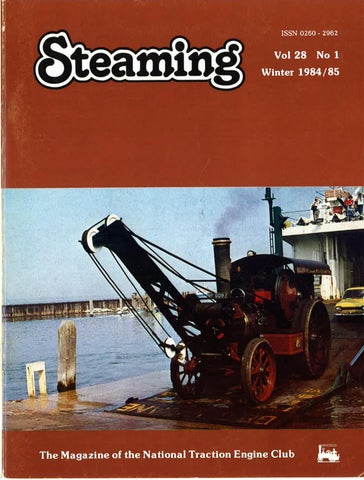
Cover Isle Len Crane's Fowler crane loco 17212 gingerly descends the ramp of the of Wight ferry, during a visit to the island in 1981. (John Toy) 3
From the Chairman In early November, the Club held an Extraordinary General Meeting, notice for which was included in the last issue of Steaming. At this meeting three resolutions were unanimously approved that should finally enable the Cliih to acquire the charity status that we have sought for so long. In view of the formal nature of this meeting, your Committee was gratified by the number of the general membership that attended, and since the EGM was over in a very short time, we invited them to attend (but not vote at) the subsequent meeting of the General Committee. I hope all of you that attended enjoyed the afternoon, we certainly enjoyed having you and taking part in the lively discussions that followed. This year our sales organisation expect to have a very successful year and much of the success is due to the unremitting efforts of our Sales Officer, Keith Shakespeare. This success is likely to increase the Club's profits on sales for the year and make ever more likely an eltenipl by the Inland Revenue to assess the Club for Corporation Tax on these profits — for this reason in particular the attainment of charity status will be particularly welcome. During 1005, for 'easel's connected with the formation of tho now trading company and the Trust, it will be necessary for us to hold our Annual General Meeting during the summer, in August. This meeting will be a purely formal affair which it is necessary for us to hold to comply with the conditions of the Companies' Act. I know that many members have not been satisfied with the recent Annual General Meetings which have often had to be held at inconvenient times during the late Spring due to the necessity of holding Annual General Meetings within a fixed period of the previous meeting, under the terms of our Articles. We are arranging the trading year of the Trust and the trading company so that in future years we shall again be able to hold AGMs in the late autumn when we were able to successfully combine them with social functions, as in years past. In 1985 however, following the clearly expressed wishes of the 4
membership, it is intended to organise a social function separate from the AGM and this will be held in October or November. During next year the rally sub committee intend to continue and expand their activities in publicising the traction engine preservation movement and steam engine rallies by attending tourist trade shows organised by the English and Regional Tourist Boards. Earlier this year, the first of these was attended on an experimental basis and the interest shown in our stand makes us feel that this effort should be pursued. Participating rallies share the financial responsibilities involved in publicising steam engine preservation in general and the participating rallies in particular. Since my last notes, we have heard that local Canadian industrial archaeologists have recovered the Hornsby steam crawler from the forest site in northern Vancouver Island on which it has stood for so long. We understand that it is now to be preserved and restored, and we are of course glad that thls unique machine is to he saved. As members will know, this machine was identified by your Committee as a traction engine of outstanding importance that we would like to have returned to the country of its manufacture for restoration. We have been setting aside funds lot some such suitable objective for some time past. We must now keep our eyes open for another suitable and worthwhile engine or traction engine connected objective. Your ideas would be welcomed. (Peter Barber)
Engine Owners Column Remuneration At the autumn 1984 Rally Organisers Conference the minimum guideline for rally appearance money was agreed to be raised from £40 to £42 per engine per day. This would become effective for the 1985 rally season.
Coal It was also noted at the Conference that many rallies in 1984
had supplied less than the expected and normal 5 cwts of coal per day to each engine, and that the quality was frequently below that of steam coal. The prolonged coal strike had probably been the reason, and hopefully the situation would improve in the current year.
Pattern Store The Club can now boast its own secure storage accommodation, intended for the purposes of a pattern store. It is located on an affiliated club's premises at Market Harborough, Leicestershire, a position of easy access and geographically fairly near the centre of the country. If you have patterns suitable for the casting
of steam engine components, you may be able to save another steam engine owner time and money. Please contact me, John Wharton, at the address below. Those patterns donated or placed on long term loan can now be registered and stored at the NTEC store. The Club will administer contacts between lenders, the store and borrowers. All material will be insured. Should owners wish to participate in the scheme but keep the patterns in their possession, the details can be placed on a confidential register. If you can, please help your fellow engine owner.
Repairers and suppliers list Engine owners are reminded that lists of repairers of steam engines and suppliers of steam engine parts are held by Nicholas Barker (Homestead Farm House, Lee Road, Saunderton, Lee, near Aylesbury, Buckinghamshire), and are encouraged to add to the lists with details of suitable names and addresses. Providers of such services are equally reminded that they could earn business by their inclusion; please contact Nick.
Water treatment Over the years many letters have been received by me concerning boiler water treatment. (I apologise to one member, whose letter received about a year ago, has been misplaced and remains unanswered.) Having studied both the British Standard and a book by the Ministry of Defence on the subject of water treatment, I have become confused, for one contradicts
27
I believe this is the first time I have featured a ploughing engine in this series of photographs. The particularly attractive scene is at Orpington Pond in Kent, about 1903. The engine is an early 14hp Fowler ploughing engine — 2976 of 1876 — belonging to Thomas Wood of Crockenhill, Kent and the outfit was probably venturing slowly through the water to wash off the mud from its wheels.
the other on certain issues. From within the traction engine world I have received, informally, good reports of various forms of treatment — from the proprietary DM method through washing soda to using nothing! I now invite engine owners and crews to write to me on the subject of any water treatment in boilers that they have been using — its advantages or disadvantages, merits or failures. I will publish a summary of the findings in a future issue of Steaming. Again, please help your fellow engine owner. (M.. John Wharton, Southerndown, Minster Lovell, Oxford 0X8 5RD)
Elizabeth. Keith has also been kept busy with visits etc, but things should be back to normal now we are both back home and looking forward to the forthcoming rally season — with our potential new helper (or hindrance!). The sales organisation sends its thanks to Roger and Mary Newbury, who with their daughters Joanna and Emma, have for the past few years been our southern area representatives. We are sorry to lose them from our midst but hope they will continue to enjoy themselves as spectators at rallies, and wish them the best for the future. (Tracey Shakespeare, NTEC Sales)
NTEC Sales
Many members will have missed Ken and Edie Beeby's presence on midland and eastern rally fields in the latter part of the 1984 season. Edie was taken ill at the Kegworth event in July and was later a patient in Kettering Hospital where she suffered a heart attack. Ken Beeby writes; 'It gives me great pleasure to let all our friends on the rally fields know that
From Alan Martin's Collection
I would like to convey my apologies to members for any delays they may have experienced in the processing of their Mail Order forms sent in recent months. This has been mainly due to my being in hospital for six weeks prior to the birth of our baby daughter
Edie is now getting along fine after her illness. She left hospital after a few weeks, has lost much weight — and has to lose more! In the circumstances (and with much regret after 13 years) we have decided to give up our sales stand — for one year at least, and we shall see after that. Finally, I must thank Roger and Celia West and my young lady friend Sam for their help at Expo. It enabled me to provide an NTEC stand there, something I could not have done on my own at the time Edie was in hosiptal.'
Important notice During the 1984 rally season I received various reports of an apparently badly conducted NTEC Sales stand. Please note that all the official NTEC stands at rallies display the Club banner; if anyone sees a stand purporting to be a Club stand but without the banner could they please contact me with details. (Keith Shakespeare, National Sales Officer, 91 Peplins Way, Kings Norton, Birmingham 838 8TN). 5
self-addressed envelope plus 15p per list (in stamps). Please note the lists will not be ready until near the publication date of Steaming in early April.
For rally organisers We would draw the attention of event organisers to the intended disposal of rally equipment from the erstwhile Bristol Steam event, advertised in our Smalls Ads columns. This is a good opportunity to become self-sufficient in this line at reasonable cost.
Our affiliated club Stoomwalsenclub Nederland have for some years produced New Year cards featuring delightful humourous sketches of steam rollers. Their magazine editor Hob Ciebhard kindly provides us with a rush copy of this year's example with which to exchange greetings between all Dutch and British steam enthusiasts. For those who have not yet ventured across to Holland for one of their events, principal steam rallies for 1985 are at Medemblik (north-east of Amsterdam) on 21st-23rd June and Hellevoetsluis (south of Rotterdam) on 16th-18th August.
Rally Organisation Early Rallies The 1985 Rally List will be published as a supplement in the Spring issue. In the meantime we give full details of those events which will be held before that issue reaches members, or in the weekends soon after. 6th to 0th April — Road/Rail Steam '85, Quorn Station (6591), Leicestershire (about 12 engines expected). Contact — M.W. Bolderston, 146 Sharpley Road, Loughborough, Leicestershire. 7th and 8th April — Quainton Road/Rail Rally, Quainton Railway Steam Centre, near Aylesbury, Buckinghamshire (about 10 engines expected). Mrs A. Hanscombe, 65 Bois Lane, Amersham, Buckinghamshire HP6 6BZ, 4th to 6th May — May Day Steam, Abbotsfield Park, Chassen Road, Flixton, Manchester (about 15 engines expected). George Coles, 18 Braemar Avenue, Stretford, Manchester M32 9NA. 4th to 6th May — Historic Commercial Vehicle Society Rally, Battersea Park, London. John Crawley, Field House, Turvey, Bedfordshire MK43 8DU (steam enquiries only). 6
5th and 6th May — Bass Museum Steam Fair, Horninglow Street, Burton-on-Trent, Staffordshire (about 10 engines expected). J.A. Crowson, c/o Bass Museum, Horninglow Street, Burton-on-Trent, Staffordshire. 11th and 12th May — Isle of Anglesey Vintage Rally, Plas Coch, near Llanfair PG, Anglesey (about 20 engines expected). E.J. Hacker, Tan Dthevven, Silull, Purl Dinerwic Gwynedd. 18th and 19th May — Tamworth Anker Rotary Club Rally, Priory Farm, Stoneydelph, Tamworth, Staffordshire (about 20 engines expected). L. Jackson, Glascote Cottage, Dumolos Lane, Glascote, Tamworth, Staffordshire.
Affiliated Clubs Part of my duty involves the preparation of the List of Affiliated Clubs, which carries the name and address of their respective secretaries. Production of a new updated list is now overdue, but I am aware that there are instances of changes of secretaries, or addresses, where I have not been notified of the change. It would be wrong for me to distribute an incorrect list — indeed the dissemination of out of date information can discredit both the NTEC and the Affiliated Clubs. I therefore ask the secretaries, or other committee members of any Affiliated Club that has changed officers in recent times to please contact me with their up to date list of officers. If you think your club has not been receiving notices of meetings, Steaming, or other correspondence from the NTEC recently, an out of date address could be the reason. I often receive letters from engine enthusiasts asking me for a contact with their nearest local club, so an accurate list is essential for everybody's benefit. Please inform as soon as possible of any changes. (George Beck, General Secretary, 127 Greensted Road, Loughton, Essex IG10 30J.)
Steam Apprentice Club Rally List 1985 The Rally List 1985 will be, as mentioned above, published as a supplement to the Spring issue of Steaming. Additional copies will be available from the Club's Public Relations Officer (A. Fookes, Spent Penny Farm, Craigs Lane, Mount Bures, Colchester, Essex CO8 5AP) in due course and readers requiring further copies should send a stamped
We have now begun to use Apprentice members to do some of the SAC duties, and have a young editor for our Newsletter, but this means we are in need of articles and reports. Items should be aimed at readers up to 21 years of age and could cover a multitude of subjects — makes, types, specific engines or components, journeys, restoration sagas, visits, museum reports, memories are just a
few of the topics which come to mind, although I am sure there are others. A few black and white photographs or drawings can be used. This is a way in which any NTEC member can help to encourage the Any crews. engine future contributions to me please. (Sylvia Dudley, 42 Russell Street, Woburn Sands, Buckinghamshire MK17 8NX.)
Obituaries Robert H. Crawford Robert Henry Crawford died at his home in Frithville, Lincolnshire in October 1984, aged 83. Born at Freiston Scrane End, Mr Crawford was an apprentice blacksmith at Frithville at the age of 17. When he was just 20 he started his company, now Robert H. Crawford & Son Ltd, and built it up into one of the biggest originally one man engineering concerns in the East Midlands. In 1976 a Royal Warrant was granted — Suppliers of Agricultural Machinery to H.M. the Queen. Robert Crawford's great hobby — he even called it his weakness — was that of traction engines and he formed a large and varied collection, well known to enthusiasts for some rare or unique specimens. He leaves a son, Robert E. Crawford.
Frank Lobb It can't be said that Frank Lobb worked in steam all his life — he was a full time policeman — but perhaps on
his retirement he had an injection of steam oil which turned him into something of a fanatic.' It was after his retirement that he moved to Warwick and purchased his first engine, Burrell single crank compound SPARKIE, which he travelled quite extensively especially to early Banbury Club rallies at Cropredy. and Bloxham. However, Frank will be remembered by us best for his second engine, Burrell showmans LADY, PRIDE OF ENGLAND, which was seen over a wide area up to 1982 when, due to failing health, it had to be reluctantly parted with. Frank Lobb, steam stalwart, died after a brief illness on 10th July 1984. (Peter Shadbolt)
Bill Oswald The tragic and untimely death of Bill Oswald of Kirkcaldy, President of the Scottish Traction Engine Society during 1981/82 occurred at the end of July. Bill was a merchant seaman by profession, and was killed in a container accident at Lerwick while performing his duties. It was as an authority on showmans engines that Bill was best known to us, and it is doubtful whether anyone was more knowledgeable on the subject than he. Brought up within sight and sound of the celebrated Links Fair at Kirkcaldy, Bill knew personally many of the showmen and drivers about whom he was later to write and talk. He had an encyclopaedic knowledge of the showmans engine down to the minutest details and many will remember the talks he gave and which for a number of years
had become an annual feature of the winter meetings of the Scottish Society. He was a prolific photographer and was in process of gathering material for a book on the showmans engines. It is hoped that this is well enough advanced to be eventually published. As editor of the STES newsletter, I often had occasion to write to Bill asking for material and it was typical of the generosity and enthusiasm of the man that this was invariably supplied. Bill was scathing in his criticism of those he considered to be charlatans, either writers or owners of engines. He had very definite ideas about how a showmans engine should look and was not backward in pointing out what he thought to be shortcomings in an engine. For this reason not a few owners were less than anxious to encounter Bill on the rally field! Bill was a member of a rapidly dwindling band of enthusiasts whose knowledge of steam extended well back into working days. He will be sadly missed and we convey our sympathy to his family. (T. Rees/Scottish TE Society)
Gordon Turner The death of Gordon R. Turner of Matlock occurred in September 1984. His letters to our magazine and other contemporary periodicals over the years often sparked off controversy but also opened up new avenues of research for a man who was a prolific letter writer in the cause of the traction engine. Gordon was an ex-railwayman, completing almost 50 years
To keep up to date with weekly news of the Preservation movement you need
WORLD'S FAIR 411•111
Incorporating The World of Preservation
Order NOW from your local newsagent. In case of difficulty (or for a free specimen copy) write to:
THE WORLD'S FAIR LTD, 2 Daltry Street, Oldham, Lancashire OL1 4BB 7
service with the LMS and BR. Since his retirement his interest in steam was centred almost entirely on the road engine. I shall miss his regular phone calls, letters and visits, and expect others will do likewise.
(Alan Crock ford) John Weaver The death of John Weaver, 62, occurred in May1984 and I hope I have not left it too late for a tribute to my old pal. He had not been well for some years, following a stroke which somewhat curtailed his favourite pastime — visiting rallies. I shall miss his calls on me for a chat at various times during the summer months. During a call at Easter 1984 he was pleased to see progress on my Burrell QUEEN MARY which together we used to take to Appleford rallies in the early 1960s. John will be remembered for probably being the first to buy a showmans engine for preservation — Burrell 3896 EARL BEATTY — which he acquired in 1948 or 1949. Both his engine and mine were one-time owned by Anderton & Rowland. But I first met John some 34 years ago at the time I had my Burrell from Mrs Flo Symonds. He put me in touch with Jesse Vines who towed QUEEN MARY back from Shaftesbury to Radley for me. John was like many of us a fairground
enthusiast; I was struck on looking through his scrapbook of pre-war days how close our interests were. We took the same cuttings from World's Fair in the 1930s, and had seen the same engines owned by Studts, he at Cinderford, I at Oxford. Happy days indeed — so long old pal. (Viv Kirk)
Valley club developed its own premises. TUESDAY, 30th APRIL 1985 Speaker and subject to be announced in the Spring issue.
(London Meetings organiser — Bill Timmings, 308 Hertford Road, Lower Edmonton, London.)
Future dates London Area Social Meetings Meetings ate held on the last Tuesday in each month until April in the upstairs room at 'The Cock Tavern', Great Pot tland Street, London (corner of Margaret Street and adjacent to Oxford Circus). They start at about 8.00pm and all are welcome. TUESDAY, 29th JANUARY 1985 An interesting evening with Sandy Ross, talking about Steam Rollers. TUESDAY, 26th FEBRUARY 1985 Burrell Gold Medal tractors is the subject — introduced by Ron Walker, owner of one of these popular engines. TUESDAY, 26th MARCH 1985 'Charity began at Home' — an illustrated slide talk by Roger West on how the NTEC affiliated Welland
Rally Organisers Conference The above Conference for Spring 1985 will take place at the Great Western Royal Hotel, Paddington, London on Saturday 16th February 1985 at 11arn. Formal notices and invitations will be sent to Affiliated Clubs and Rally Organisers in the usual way.
Correction We thank Bill Love for pointing out that the illustration on page 188 of the last issue was not, of course, a Mann's steam cart, but an example of that maker's agricultural tractor, or light agricultural tractor — depending upon which of their catalogues you study.
OUR MAGAZINE 25 YEARS AGO
The January 1960 magazine was the first of what was to become a series of Special Numbers. Editor John Crawley chose showmans engines as the subject to fill a record sized 36 page issue — but years later he was to have to produce a second much larger mark 2 version. Another innovation had been a combination of the AGM and a Dinner at the end of 1959, when 109 sat down to the latter. The area notes were growing in volume and coverage; some half dozen regular correspondents sent contributions to the feature which has ever since featured strongly in the magazine. Still available for tracking down and reporting were commercially active ploughing engines and not a few steam rollers. A Davey-Paxman 3hp portable was advertised at £75. 8
44.
This is Foden wagon 10860, one time owned by A. Butler, Coal Merchant and Haulage Contractor, of Henley-on-Thames. It was new to him, registered 8W6240, in 1923 and this scene with driver Ernest Jones standing, left, by the cab, was fairly soon after, if we judge by the generally spruce condition of the painiwork, tyres etc. Butler must have liked to keep his fleet up to date for in 1929 number 10860 went back to Fodens (and was there later broken up) in part exchange for new wagon 13510.
Home from Stourpainj Giles Romanes relates the story of the 35 mile journey home from Stourpaine, with his Wallis & Steevens 3hp steam motor GOLIATH! hauling a thresher. 0 The Great Working at Stourpaine was over for 1984, and had probably provided a disappointment for some of those who habitually attend. There had been no mud, so no use for wellies, and no heart-stirring sight of engines helping one another along in difficult conditions; but it had been a huge success! This article is to describe our return home to Portesham, not far from the coast near Weymouth, and show that the saga of steam on the roads still continues. It starts on the Monday after the conclusion of the Working. During that day we packed up the thresher, letting the sideboards down, and stowing the support bars, ladder, push-pole, prongs, blocks, jack, engine tools, cloth, grease and gun, storm gear, etc. We put the cloth on and drew the thresher out towards the road, filled
up the engine with coal and water, then sheeted it down. I arrived next morning and had a fire going by 7.15, after nearly thirty minutes of concentrated preparation. We were ready to move by 8.45. We, the crew, had never been regular steam drivers. I had once earned my keep as a steam driver on the threshing set belonging to the late Stan Haslam of Stebbing, Essex, in the autumn of 1940. It was at the rate of 1s 1d an hour 151/2 pl, but probably equivalent to about £1 11984); I was able to buy my autocycle at the huge cost of £16 after a number of weeks work. Experience gained at that time gave me the ability to run my set at Stourpaine despite such a long gap. The other member of the crew was William Renton, who had only seen a traction engine through the eyes of a
Giles Romanes and crew with GOLIATH!, Stourpaine bound. The 3hp steam motor was built about 1904, but its proper identity and early history is unknown. (Roger Newbury)
motorist, or perhaps in a text-book when reading engineering at Cambridge some forty years ago. I briefed him to keep the front wheel parallel to the kerb and about eighteen inches away from it. This is possible on the Wallis engine because the steering wheel is on the near side. I warned him not to let his attention wander, and to sit with his feet on the step, to give enough room for firing when needed. Further, I told him about the use of a block when gear changing, and the need for him to operate the brake on the thresher when going down a steep hill. We set off, as planned, in low wheel on the soft field and its bordering track. On reaching the drive, we changed up into top wheel, fired up, and set course for Stourpaine village. We reverted to low wheel for the last descent, about 1 in 7 grade, and operated the thresher brake. There was no trouble, and we could even see the water in the glass all the time. On the flat again, the boiler was so full that the top of the water could not be seen. This is no problem in my Wallis in the ordinary way. On this occasion, however, she started to prime — just when the first tailback of traffic started, on a curving road and up a slope. Any pause here would have caused drivers behind to try to overtake in frustration, and cause a two-way snarl up, so I opened the side taps and went on. Presently, the priming stopped and all was well again. We continued towards Child Okeford to avoid the main road and its heavy traffic. The sun came out, and we could enjoy the first tints of autumn on the trees below Hod Hill. We reached the Seymour Arms at Shillingstone uneventfully. There, we took water etc, and surveyed the bunker with early apprehension. The soft coal from the Working was going down fast. However, we pressed on to Okeford Fitzpaine and avoided priming again. This would never do in a locality where there are still so many active engines! We had lunch at the Round Oak at Okeford. Fortunately, we saw Mrs Field on entering the village; I say fortunately because by now I realised that we couldn't reach Pulham with our present coal supply, unless we were to be both lucky and very anxious all the time. So I 'borrowed' a hundredweight from Mrs Field. What a letdown to my powers of planning! We nearly committed the classical error by emerging from lunch and finding the fire out. However, there was just enough to rekindle the borrowed coal, to save me from a red face. We took more water, and set off 9
up the long drag of two miles to rise about 200 feet — in fine style. On one occasion we had a touch of priming again. This was due, I expect, to the fact that GOLIATH! had already steamed for a full fourteen days in the season. When the steaming is done in little lots of a day or two, the total soon adds up, almost unnoticed. Since most, but not all, of the feed water had been clean, I planned to change the boiler water at the next opportunity, rather than wash out properly. We went down to Fiddleford, and took water out of the ford, overlooked by a medieval packhorse bridge. The present day was forced upon us by the smell of the brook. Most of the water seemed to have already been used for cleaning dairies, and there was a suspicious froth on the surface. We had to use low gear on both the descent to the ford and when climbing out. When we got back into top gear again, there was a long rise of a mile or more to Kingston. I noticed that the feed pump was on the whole of the time on that slope, and the water level in the boiler didn't alter. So a pump 1 inch bore and 2 inch stroke just fed the boiler at the same rate as a 5%in x 9in engine could use steam at 1251bs, without knocking the pressure down. A nice equilibrium, appreciated by both of us. We went down Silly Hill, 1 in 6, in low gear and with thresher brake on. We gained the flat road towards King's Stag, when we changed into top gear to head on the last leg of the day. After King's Stag it came on to rain, needing a stop to get our storm gear out of the cave of the thresher. We fired up for the last time, and pulled into the yard of rhe Halsay Arms at about 4.45, thanks to the generosity of Mr and Mrs Veall, the landlords. After sheeting down for a few days stay, we were well satisfied with the engine performance and our first day's progress. During the interval, I bought three hundredweight of coal for the remainder of the journey. I was advised to have South African anthracite, which had been satisfactory in Aga cookers and in a miniature railway locomotive. GOLIATH! has never had any trouble steaming, provided there is no clinker whatever and no soot in the tubes. I also did some mechanical adjustments to align the crankshaft, and to take up some wear in the big end. At the same time I replaced a mudlid joint and changed the water in both the boiler and the tank. I greased the wheels of the thresher. The next Saturday — the second of our three day trek — was showery to begin with, and the wind lay behind the engine, which was the explanation 10
Another view taken on the outward journey. (Roger Newbury)
I thought for the fact that we took a full two hours before we could move. This time I was glad to play the secondary role, because the other crew member was now none other than Jimmer Marsh, well known in the traction engine world. He has a rapidly increasing experience of engines, and is one of the most capable and versatile drivers in the game. We set off and noticed that the steam was showing at the chimney top, in spite of the fact that the damper was open. We could only just keep the pressure up with the use of the blower. Even then, there was no hope of keeping the water level up. So we had to stop and cook up; it was evident that the fire just wasn't burning. We were lent a bucket of Esse anthracite by a man outside of whose house we paused to prepare for the rise through Buckland Newton up to Alton Pancras. Jimmer coaxed the engine up the hill and just got over the pass with only 801bs on the clock. We drifted down without pleasure to the Piddle stream and a telephone. While taking water, we disturbed a probable water rat and noticed dead eels in the stream. The water looked clean, but the smell was foul. We were an hour over the process before the boiler was full enough to go on with safety, During that time, at 11am, I telephoned my coal merchant, John Restorick in Weymouth, some fifteen miles away, to ask him to send out some burnable coal, without which we would become benighted. I didn't relish the idea of
leaving the set on the roadside as we used to do years ago. John Restorick came up trumps, because he brought out a sack of bituminous coal, also from abroad — Polish, I believe. He had just returned from Germany where he had been viewing supplies and receiving lavish hospitality. We reached The Thimble at Piddlehinton by 1.30, so lunched there, and cleaned out the fire. The box was full of unburnt dust, which we gladly threw out. We replaced the fire and raised steam without difficulty on the new coal. We went on to cross the Piddle, out of which we took water. Jimmer gave the engine her head up the hill towards Charminster. We sailed rip in top gear, and arrived at the top with a full glass of water too, having had real music all the way up, which must have echoed off the hills. We arrived at Charminster at 4.30 to stay with Jack Miles till I was able to raise another crew. We were grateful to Jack and his brother Harold, and for taking us back to our cars. It is possible that the hard coal was satisfactory, but if it had no caking properties, it would seem that combustion could only take place with a very thin fire. If so land this is pure speculation), we mismanaged things. All we can say is that accurate distribution of coal for a thin fire from a small footplate would be a very difficult piece of firing, and one hardly appropriate to the circumstances. I spent the rest of the day distributing caches of coal, which was proper
stuff I knew, for the remaining ten miles back to base. For this, our third leg, I "recruited Peter Ware. He has constructed many small traction engines, has rebuilt gas engines, and had a lifetime in engineering. In the Navy he was on liberty ships with triple expansion engines in the 1940s. Since then, he designed the Hillman Imp car for Rootes. He jumped at the idea of coming along. After I had been to light up, grease up and pack up the sheets and tools, we played the 'car game' of getting a vehicle at each end of the day's run. We came out of the Miles' yard in fine style,and up a little nap of about 1 in 6, which contained a bend in the road. I found that there was so little weight on the front wheels when the engine was pulling, and when the tender was full of water, that positive steering was questionable. However, the gradient lessened and we regained full control, We had an uninterruped run to Bradford Peverell, without trouble from the boiler or anything else. We took water out of the Frome, fired up, and went up through the village with the thatched roofs without qualm, because there had been rain during the night. Everybody was at work, so nobody saw the rare oldworld sight so common fifty years ago. Over the brow of the hill I unearthed a cache of coal from Maurice Bliss's yard, and pinched a couple of his scrumptious Worcester Permaines. Presently we spied a car behind. It was Jack Miles, who and come out to see us up to the old Wireless Station, halfway to Winterbourne St Martin, and to listen to the engine
climbing. He kindly saw us across the Dorchester-Bridport main road, which was a great help. We went on down into the village, where was situated the first agricultural contractors in the world, Eddisons, when they started just over 100 years ago. Almost holy ground, albeit hallowed by Fowler's and Aveling's engines. The atmosphere of the place is maintained by the landlord of The Brewers Arms, who keeps the finest draught Guinness in the area. We had to stop to clean the fire after about three hours steaming, because we had ahead a climb of at least 500 feet in some two miles. Also, we took water and oiled up. Having made up the fire right to the door, we set off. Mindful of Jimmer's achievement out of Piddlehinton, I resolved to do all but the last 200 yards in top wheel. It was magnificent; just feathering at the safety valve all the way, often with the pump on when she threatened to blow off. We had to stop a time or two because the Guinness had worked down, so I had an opportunity to fill any holes in the fire when putting on more coal. The last stretch is up 'I in 6, but largely straight, so we stormed up there to the Hardy monument without anxiety about steerage. The rest of the way was down into Portesham, and presented no problem. The fire was down and the water up, so we only had to change wheel at the top of the hill, 1 in 6 for about a quarter of a mile. We went down not far from the bank, just in case, with the thresher brake on and the engine wheels threatening to slip all the time. Where the gradient eased towards the bottom, we
GOLIATH! passing through Child Okeford on the way to the 1984 Stourpaine event. (Roger Newbury)
changed into top wheel. It was a grimy engine which entered the home village, and shunted the thresher into place in Ron Doble's farm. This was not surprising, seeing that it had been at work for the full three days at Stourpaine, and had covered over thirty miles on three separate days since then on the homeward journey. There will now be time to clean up, because there seems little need for any adjustments. This experience could only have happened with the excuse of Stourpaine. At the show, there is a responsibility to the public to provide some working during all the advertised hours. The journey to Stourpaine is enjoyable anticipation of a pleasure to come, and I've done it many times. However, there is a sense of achievement in coming home, especially after a successful show, and when GOLIATH! has performed to such a high standard. Its designers and constructors would never have thought that it could acquit itself so well. I commend such an experience to all those drivers and owners who have never waded an engine with a proper payload for long distances.
'Fodens Ltd, of Elworth Works, Sandbach, as might be expected in the home of its largest trade, will show one of its latest-pattern patented sidetipping wagons. This wagon has been sold to Mr. Thomas Jackson, brickmaker, of Longsight [Manchester], and the body will carry a five-ton load. There will also be on the stand a threeton rubber tired machine, fitted with heavy section Polack tires, and this vehicle, it is interesting to note, is destined for immediate dispatch to Paris when the show is over. Yorkshire. One of the latest-type Yorkshire six-ton steam wagons, fitted with a van body, will be on view. This vehicle is a repeat sale to a Spanish customer, and will have wheels of exceptional width, the Yorkshire company's Colonial-type model boiler, and an engine of increased power. It is painted red, with lettering in gold leaf, and upon each side and the front of the wagon will be found the inscription: Hijos de Mirat, Salamanca.' (From The Commercial Motor, 17th February 1910, reporting the imminent Manchester Motor Show at the City Exhibition Hall, Deansgate. The Foden was works number 2036 (M2566); it can have done precious little work for Jacksons for it was sold in 1911 to East Cheshire Transport Co at Bollington Cross, and eventually scrapped in other ownership in 1931.) 11
Very many present day enthusiasts will claim rollers as the first steam road vehicles they knew. Your editor certainly does. But whilst there is a good chance a lot would then go on to recall a well polished brass horse decorating the roller's front, his childhood memory is of a shiny brass bell shape, inscribed with the word KIM — and curiously, it seemed that most of the other rollers on tar spraying work in Northamptonshire had this same name....
Kimbell% rollers Esmond Kimbell
Our editor has suggested that I write something for our magazine on rollers I have owned. I am a little reluctant, for while a man is still alive, too much writing of his activities is unseemly and probably better read later. Of course, this article may well be posthumous, because of various editorial delays and checking for inaccuracies, libel, and spelling as well as waiting for a place in the queue of articles to be published. As a child I was thought not quite the thing, because of my passion for engines. These were plenty of them about, and perchance I would follow one for miles. What particularly affected me was the distant bell-like sounds from a set of ploughing tackle on the road. First one engine, then, as it died 01 III e huiluvv ur behind trees, the other would tako up the carillon 'Clang, clong, tinckle-tanckle, bong, dong, dung' — oh, those pre-1914 Fowler gear wheels! Later, BB1s and AAs had almost lost it to just a spudjangling rattle. With only a van and drag behind, exhausts were rarely heard from these large engines. There was not enough strain to show up, except a single's 'banta, banta, banta' when starting up a hill. Fate, however did not put ploughing engines much my way, apart from a summer as third man with B1s when I was twenty. Threshing was my real job, mating in my teens with the two sets father had, and much more preferable to working on our Northamptonshire farm. Then I drove when I was twenty-one, and took over four sets at twenty-four, building these up to six when twentynine. When tractors reared their ugly heads in the threshing world, economics dictated a gradual change 12
to these. And really, those early Marshall model M diesels with built in winch and anchor were better on soft going than a slithering spudded-up traction engine was, and their pneumatics gave plenty of adhesion on the road. Further, you didn't have to stand a set when a prima-donna steam driver had a cold, because the mate could take over. And customers preferred them — no coal and water getting, and kinder to their yards. The bane of threshing, which generally lasted a football season, was what to do in cricketing time. Repairing, painting and tubing any remaining
tractions was not enough to hold a team together in the early 1940s, so we would provide drivers for T.T. Boughton at Amersham or John Allen (Oxford) Ltd, whose steam rollers followed the annual tar spraying. Knowing the former were tiring of the price war in this field, and on our foreman George Wright's suggestion that we should not waste our steam know-how, I went to see the late Thomas Boughton, who asked me in to lunch — which ended with a Giving of Thanks. We then had a deal with his Aveling & Porter 8 ton compound convertible (tractor/roller) 8662,
One of the secondhand Allchins that were acquired for Kimbell's roller fleet — compound 10 tonner 3859 stands by the roadside, day's work done and regulator valve leaking by, at an unknown date and location. (collection A.J. Martin)
differing from most Avelings by being a three shaft with left hand steering. John Boughton, Thomas's younger son, drove it half way to Northampton, where I met him. Phoning him that evening on its poor steaming, though tubes had been swept and grate cleaned, the reply was "you don't know how to fire on Welsh coal, you don't!" The next day, following the hints, I got through. The roller was just right for behind a tar sprayer, having belly tanks and a very high top gear. Well, we soon wanted another roller — so back to Boughton's again. This time the deal was with young John and the machine — ex Eddison Wallis & Steevens single 2323 — was rather rough, with wheels sloppy on the axle, so that sometimes the near one would rub against the flywheel. "Ideal for narrow roads" said this super salesman, "they'll shape to the camber better." Boughton's were to drive it over to us, which took a day and a half, with two
Kimbell rollers
Aveling 10 tonners 9164 (nearest camera) and 8826, both acquired from the Bedfordshire County fleet, at another unrecorded contract. (R. G. Pratt)
My own records of the rollers used by us long ago went into limbo, and this list is based on information provided by Alan Duke, together with one or two notes made by the late George Wright on our block purchase of Bedfordshire rollers. Aveling 11910 needed a new firebox and was soon scrapped; Aveling 8826 broke its axle on the first job we gave it, Hardwicks taking it from where it stood.
maker/works number Aveling 8662 Wallis 2323 Aveling 4033 Aveling 2693 Allchin 1222 Allchin 2120 Allchin 3858 Aveling 4795 Aveling 5510 Aveling 5688 Burrell 2145 Wallis 7745
built 1915 1895 1897 1890 1902 1922 1931 1901 1904 1905 1898 1923
registration ABH527 FX6946 BH8411 BNV873 BD5617 BD6561 NV100 BD5335 EB3680 KM510 BD5618 ME8584
type 8 ton compound GND 10 ton single 10 ton single 10 ton single 10 ton single 10 ton compound 10 ton compound 10 ton single 10 ton compound 12 ton compound 10 ton single crank cpd 8 ton single
Allchin 3859 Aveling 7530 Aveling 8182 Burrell 1653 Aveling 7196 Aveling 7995 Aveling 8826 Aveling 9164 Aveling 9337 Aveling 11910 Aveling 6669 Aveling 8978 Aveling 8103 Aveling 8241
1931 1911 1914 1892 1910 1913 1917 1920 1920 1927 1909 1919 1913 1914
NV101 NM1366 PC9715 VE5796
10 ton compound 10 ton single 10 ton single 10 ton single crank cpd 10 ton single 10 ton single 10 ton single 10 ton single 10 ton single
Aveling 10220
1921
PC9716
8 ton compound, pv
Aveling 10984 Marshall 78667 Aveling Barford AC605
1924 1925 1937
NK8311 H06360 DTM537
8 ton compound, pv 10 ton single, pv 10 ton single, pv
NM975 NM973 NM976 NM977 TM1381 NN1486 MD5453 BH7169 BH7170
10 ton single, pv
12 ton compound 10 ton compound 8 ton single 8 ton single
purchased from/disposal Boughton/later to Belfast Boughton, 1941 Boughton, 1942 Berridge, Atherstone/originally Camberwell Corp Martin, 1943 Martin, 1943 Martin, 1943 Martin, 1943 Martin, 1943/later to Nightingale, Derbyshire Martin, 1943 Martin, 1943 Heston & Isleworth UDC via W&S/later to A.M. Cole Franklin 1946, Daventry
Biggleswade UDC Boughton Pamplin's, Whittlesford Boughton 1950/later to Germany Bedfordshire CC, 1951 Bedfordshire CC, 1951/later to Hardwick Bedfordshire CC, 1951 Bedfordshire CC, 1951/later to Germany Bedfordshire CC, 1951 7/later to Hardwick Southgate Corporation/later to Hardwick Boughton/later to Germany Buckinghamshire CC/later to Rundle, New Bolingbroke Boughton/later to Redden, scrap merchants, Wellingborough Gill & Dudman, Hemel Hempstead Wright, Alton, Hampshire Eddison Plant
13
Marshall S-type 78667 pauses from rolling chippings on a job at Cottenham, Cambridgeshire in August 1962. Note the bell insignia on the headstock, the latter lacks its distinctive domed top cover. (A.J. Martin)
elderly brothers aboard. "We knew the water holes, and where we could get a bit of coal and grub. Never had no trouble." "But where did you sleep?" "Me brother squatted down on the footplate, while I just walked around." The third roller was also from Amersham — Aveling single 4033 with the earlier slipper bar crosshead, which I think George Wright drove through (low loaders weren't around then). And the roller did us good
service, The fourth, Aveling 2693, we re-registered to BNV873 to disguise its age from customers, for it steered from sticking out chain rollers on either side! Then in 1943 came Martin's sale. J.J. Martin of Piddington, near Northampton had long built up a fleet of rollers, and had a threshing business too. There, compound Allchin roller 3858 was knocked down to me. (This engine had stood with its sister 3859, unsold in Allchin's works for 10 years.
The last roller to carry the Kimbell insignia was Ruston designed Aveling Barford AC605. Purchased in the 1960s for rallying it stands here on display outside the firm's later premises at Brix worth, Northants. (collection E.E. Kimbell) 14
3859 was later backed into a lean-toshed, and with Pickering governors added had run the machine shop for the last few months of the firm's existence, its belt narrowly missing the late Harry Matthews' ear when he got up to fire it! Much coal was thought to have been saved by closing down the large boiler and stationary engine. Two years later 3859, too, came my way.) But to get back to Martin's sale. The other compound Allchin I took was 2121, and also single 1222. The compounds were three shafts with left hand steering and valves outside — Allchin compound tractions had valves on top, fowler fashion. The single cylinder roller, a fourshaft with right hand steering, was one of only four made and differed little from a 6hp traction. These Allchins, by the way, made a poor job on smooth tarmac as their front rolls left a ridge when turning) Others bought at the auction were more Avelings: 4795 with cylindrical trunk guides — a good one this, and compounds 5510 and 5688, with the maker's earlier valves on the top — which we liked less. There was also single crank compound Burrell 2145. The Allchins had shapely copper chimney tops, the Burrell a cast iron chimney, and the Avelings their own version of a stovepipe top, a sort of double ring. The idea of going so heavy at Martin's sale was to extend hires to an adjoining district where Martin rollers had long been 'in'. And also to get some experienced men. Our ex Pamplin Burrell 1653 was unusual for that make in being a fourshaft with early Aveling-type gear change steering on the right and a large brass G In front. Aveling 7530, thought a 12 tonner, was fairly early sold; I forget where. Another maybe 12 tonner was the Marshall single with piston valves and radial reversing gear — the last steamer we ran. This went to a local farmer, who formed it into a sort of traction engine for rallying. Wallis 7745 was a tractor type I bought in pieces on the Basingstoke works shop floor and which we put together ourselves. It was sold almost immediately to Arthur Cole of Sleaford, a well known engine dealer. Aveling-Barford AC605 we had only for rallying, and teaching my youngest son to drive, in his school holidays. The style of management? Well, George Wright and I had our anxious moments with learners, and very often tubes leaked and plugs dripped. We felt plow.] when we'd taught a keen man to use his hands alright. But few, George claimed, could ever have managed a threshing set. An ex-
threshing driver, by the way, seldom needed anything spent on his roller. Others could cost us more than they'd earn! So there were always a few rollers in the yard. A good standing one could fill a breakdown's gap, while less good ones loaned their parts — even wheels, for plates soon thinned with the long distance travelling and the abrasive action of pressing hard granite chips into tar. Before quite leaving threshing, which finally ended when combine harvesters came in everywhere, we tried steam heating tar tanks behind a Sentinel Super (ex Whitworth's flour mills at Wellingborough) and a Garrett six wheeler (previously with a Petersfield brick and tile company). These only had to be in range for the sprayers, so little travelling was involved. They had proved hardly slow enough for direct spraying, nor able to make enough steam then. Foden tractor 12684, taken off threshing, with a trailer for the tanks, was better. So four more were added from Amersham — two tractors cut down from six-wheelers and two wagons proper, one with right hand flywheel and steering. When these went out of fashion there was quite a flurry of making up wheel-around units for greenhouse soil sterilizing from their boilers. A sad task, this, but again, economics dictated. As with threshing (but not so soon off the mark) we found diesel rollers better both for the driver and customer, and eventually could not hire out a steamer at all, even with the
Aveling 8 ton compound 10220 was one of Kimbell's later purchases. It lacked the distinctive brass insignia and a somewhat prosaic enamel plate on the engine side sheets declared the engine's owner. Seen here at the side of the A45 at Upper Heyford, Northants in September 1952. (G.H. Starmer)
best of drivers, and despite him keeping our brass bell insignia with KIM in the middle in a well polished state! I am often amazed at my own lack of foresight. With all those rollers to
hand now, what a super sale there would be. Or would there? John Allen and Eddison must have scrapped hundreds, and latter day prices may be because of rarity. It is now thirty years since I entered the third Appleford rally or 'race' as it was then, with a bought-in Bhp Marshall single traction — our own even then gone, and most of the steam rollers too. This is where a Traction Engine Club was first proposed, and that soon proved I was not alone in not being quite the thing for a love of engines. Because of being in the trade we kept on with diesel rollers, then added vibrating rollers. So as not to conflict with the Kimbell name in other activities, the roller side was changed to MVRH (Midland Vibrating Roller Hire). So if you see these initials on a horrid looking and sounding machine, try and forgive us — it has steam ancestry, and one still with the firm who spent many Sunday mornings washing out boilers.
Parked on the A43 roadside near Stanion, Northants in September 1952 is Kimbell's 10 ton single crank compound Burrell 2145. (G.H. Simmer) 15
Engine Gossip There I was standing by the front wheel of that big brown Fowler crane engine, which used to work for John Thompson at Wolverhampton. And she spoke to me! "I wondered if you would come over and see how I was." Well! If you said I was a bit taken aback it would be an understatement. I was flabbergasted that a Fowler should speak to me — you know how I feel about Fowlers, though I admit I have only known two particularly well, and one of those was nearly a Burrell. The Old Lady chattered away. She only had a number, no name, and she was quite cut up about that, for even that Burrell over there had a name CONQUEROR. An impossible name she said — "what could that conquer?" It was different with her friend LORD ROBERTS, especially now he was back down on earth instead of being in the clouds as Lord God, Help Us. "Funny how all these Burrells have to be Lords or royalty or something not common like me" the great engine went on; she was getting into her stride now, gossiping away. "I was quite perturbed the other day when Lenny took my jib off. He left it with my other friend at home, the Burrell crane engine. I worry about him, Lenny never takes him out. When my jib came off I thought it was going to be Ilke the old days, perhaps a run down to Southampton or Bristol or even London with a boiler. Maybe with KING CARNIVAL in front — it would be just like a holiday — cavorting along the highway smiling at the rollers and traction engines. But it wasn't to be, that horrible Volvo came round and shunted me to the low loader. It is a come-down for me — I wondered; where we were going this time?" She said that earlier in the year Lenny had taken her down to the seaside. Was she going there again? "We went down the motorway that's not a place for road locos on their own — but then we turned up here at Stourpaine. It could have been worse, 'cos at least here I meet some old friends." "We parked up by LORD ROBERTS. I told him I'd been to the seaside but he wasn't impressed. You can never tell with Burrells — they're such an uppity lot, though sometimes
16
Revelations of wild and unlikely happenings at a certain southern event in September, diligently gleaned by Tam, our north of the border correspondent, in his less sober moments.
big Jim and Lenny swop engines and we both agree that they caress rather than drive us. Lenny went away all day yesterday and came back late with that fast youngster SUPREME. She's not in my class, though she's supposed to have pulled boilers and railway engines about. But she lives in a yard with some royalty — it's bound to spoil her." "I have to smile at him over there — LORD FISHER OF LAMBETH. I ask you, what a name to give to an engine, you might know its a Burrell again! Poor soul, though, he hod his perch bracket broken and they called in that nice little Sentinel crane (he always makes eyes at me) to lift LORD FISHER'S head up as he went onto the low loader." "We've been charging round the field towing a trailer load of logs — I could have handled it alone but they put LORD ROBERTS and CONQUEROR on to trace! And up a 1 in 6 bit they even had the audacity to put a roller on the front — one of those silly little Wallis & Steevens Advance things. Oh, I will never live it down; I treated him with contempt, of course. It's an Antell that owns it — I suppose he thinks its a road loco and the mite never gets any rolling, its awfully sad." "Did you hear about the other one, the other Antell I mean; Paul, him with
Road Roller RRA
4 motor roller? Do you wan( to learn more about the history and practices of road making, and to help in giving demonstrations of road making at rallies and other events? Send a stamped addressed envelope to:
Membership Secretary, 32 Grampian Road, Little Sandhurst, Camberley, Sul ley.
(And if you only half believe all that nonsense, the talking enaine, behaving perfectly and not saying a word, is pictured on our front cover)
MELBOURNE CATERING SERVICES
Association
Do you own a steam roller or a
that smart high-stepping Robey. Normally it drives the sawbench but last night he tried to drive the gallopers by running VICTORIA's dynamo with his belt. Poor VICTORIA, she was in tears. The upstart tried to raise 300 amps — a single that stops at the end of each stroke! How could he — the poor little Foster. Peace returned when the thing was taken away with red chimney and smokebox. Its a good job the other Ante!l wasn't here — he'd have probably had his nice Fowler sliding down the helter-skelter." The old lady paused horn her gossip. "Haven't we met before — I mean a long time ago?" "Yes" I replied, "I used to call into John Thompson's to see you when you were working." "I thought so, well I see Lenny is away taking that SUPREME home and big Jim is off with the Burrell. I refuse to call him by his name — its so silly. We shall go home tomorrow then I can have my jib back — I do miss it. Cheerio!" And when I went back to pour another nightcap, I found the whisky bottle was empty!
Melbourne House, Churchgate,
Whaplode, Spalding, Lincs Tel 0406-370040 —— TO RALLY ORGANISERS Why not book our mobile French pancake machine and our original German sausages, all cooked in front of the customer Both these items can only enhance your show
Something different for your public We travel anywhere Member NTEC
HARROWING for DIAMONDS Nevil Miller During an all-too-short visit to the famous diamond town of Kimberley in South Africa's Cape Province I went round De Beers Mine Museum adjacent to the Big Hole, which I suppose everyone has heard of though they may not know much about it. In fact it is the largest man-made hole in the world. It started with a lucky find in 1871 of three diamonds on a hillock known as Coleberg Kopje. Before long several hundred claims were pegged out on the kopje and at times as many as 30,000 men were working on individual claims. The hole or diamond 'pipe' became deeper and deeper, and with the proliferation of haulage ropes and other devices for lifting out the diamond bearing earth, or 'kimberlite', utter chaos reigned by the time a depth of some 160 yards had been
reached. Amalgamation of claims became necessary and eventually, from amongst the scrambling, two personalities arose — Barney Barnato and Cecil Rhodes. In 1888 Barnato was bought out for £5,338,650 by Rhodes whose company, De Beers Consolidated Mines Ltd, ended up virtually running Kimberley. Open cast digging ceased the following year when a maximum depth of some 175 yards had been reached. Thereafter De Beers continued with a shaft and haulage gear until the considerable depth of about 865 yards had been achieved. 25 million tons of ground were excavated to produce 141/2 million carats of diamonds (about 3 tons) before the Big
Hole was closed in 1914. The hole covers 38 acres, and has a top diameter of some 500 yards. The Museum is an open-air reproduction of the beginnings of old Kimberley which grew up to serve the winning of diamonds and the thousands of fortune seekers who flocked there. Not only have the original buildings been re-erected or faithfully recreated but they are supplied, furnished and stocked just as they were 100 years ago. It is greatly to the credit of De Beers that part of their winnings are being ploughed back into creating a living scene from history for the benefit of posterity. In a compound at the museum adjacent to the winding gear, to which the public is not admitted, I observed Fowler ploughing engine number 12095 standing forlorn and waiting to be restored and suitably sited in the Museum complex. Time was short and the Curator not available so I called at the Archives of De Beers Consolidated Mines another day and requested information concerning this engine and its uses in the diamond winning process. I am grateful to Doctor M.H. Buys, the Archivist, for research carried out and for kindly supplying some of the excellent pictures accompanying this article. It appears that Gardner F. Williams, an American who was General Manager of De Beers Consolidated Mines Ltd from its inception in 1888 until his retirement in 1905, soon considered the use of mechanical
An unidentified Fowler compound ploughing engine at work in South Africa, probably one of the earlier 12hp AA class engines delivered to De Beers. The picture was originally captioned 'Depositing Floor — Steam Harrowing'. (De Beers Consolidated Mines Ltd)
power for breaking up the excavated 'blue ground'. In 1890 a representative was despatched to England "to see the second-hand engines offered to us by Jno. Fowler & Co." No time was lost because on 17th November the same year Gardner Williams was reporting that "the Fowler harrowing machines are working all right and will be of great assistance to us on the floors". Members and readers may like to know the significance of the term floors by reading the following extract from the General Manager's Report for 1905, reproduced by kind permission of De Beers Consolidated Mines Ltd and by the courtesy of Dr M.H. Buys. 'DEPOSITING FLOORS — As fast as the blue ground is dumped automatically from the skips into the ore bins, it is carried away in trucks by an endless wire rope haulage, driven by steam or electricity, to the depositing floors. These floors are made by removing the bush and grass from fairly level stretches of ground. After clearing the surface of the ground, it is hardened and smoothed with heavy rollers until it is fit for use. 'When the trucks reach the floors, they are drawn by horses or mules over portable tramlines laid at right angles to the main haulage line to any desired point. A full truck contains about 20 cubic feet of blue ground, weighing 2,000 Ibs, approximately; but it has been found more convenient to retain the old unit of measurement, 16 cubic feet, and therefore the automatic counters are so geared that every time four 20 cubic feet trucks pass them, five loads are registered. On the depositing ground a truck load is spread out to cover about 21 square feet. 'After the blue ground has been spread out, it is necessary to wait until the sun and the rain have contributed their service in disintegrating the breccia. The effect of the exposure of this curious compound to heat and moisture is very remarkable. Large pieces of blue, which are as hard as sandstone when freshly taken from the mine, soon begin to crumble on the depositing floors. To hasten the disintegration, the blue is harrowed to turn up the bigger lumps and expose fresh faces to the sun. Mules were originally used to drag the light harrows but steam traction engines are now employed to 18
draw wheeled harrows with huge teeth to and fro across the floors... A certain percentage of the blue ground, owing to its hardness, is not affected by exposure on the floors. This hard blue is removed from the floors and crushed in rock breakers, and rolls, and the diamonds then extracted in the same manner as from disintegrated blue ground.'
We are indebted to David Phillips for yet more details from the Fowler records at University of Reading. David finds eighteen 12hp or AA2 ploughing compound engines delivered to three diamond mining concerns in South Africa — presumably all for the same purpose of breaking down the blue ground. De Beers Consolidated Mines Ltd led the way in 1891 with an order for three, a fourth to make two pairs being added within months, as can be seen from
Fowler official photos of 12094, an AA2 compound booked out with 12095 to Koffyfontein Mines in September 1909. The Leeds works must have considered them rather special to have gone to the trouble of taking photographs, for the AA class were the most popular of their exported ploughing engines — 915 out of the 2312 sent abroad between 1900 and 1914. (Institute of Agricultural History and Museum of English Rural Life, University of Reading)
The unidentified Fowler 12hp ploughing engine at Kimberley Museum in 1972; it could be any one from the accompanying list but does not appear to be 12095's pair. (Roger West)
the accompanying list. Michael Lane in The Story of the Steam Plough Works (1980) states that 6509-6512 were the first Fowler ploughing engines to go to South Africa and worked along the Vaal River at Veereniging — that was the location of Fowler's own estate in the country. De Beers also took Fowler built narrow gauge railway stock, and Koffyfontein and New Jagersfontein had Fowler road locomotives — some with crane attachment. Esmond Kimbell wrote in the Road for Journal Locomotive Society February 1965 that he had seen 12095 at Kimberley and noted (as well as the engine's broken back axle) a brass plate on its boiler '30109 1912 1601bs'; another similar unidentified engine there bore '40142 30.6.13 1401bs, 751bs' and appeared to have been used as a stationary boiler. These plates are those affixed by the relevant state authority responsible for working boilers (see Steaming, Spring 1982 page 61). Since the date quoted for 12095 is later than its known construction date, could it indicate the time at which the engine changed hands and moved into another state, thus requiring new documentation? De Beers Kimberley activities are in,Cape Province (just), but Koffyfontein and New Jagersfontein are both in Orange Free State, respectively some 50 and 80 miles south east of Kimberley. It would be interesting to further unravel the history of these engines.
'Mr J. Hollins, of Wye Stores, Church Street, Chepstow, Mon., is one of the strongest believers in Mann steam wagons, and he has put these machines to some highly-novel and severe tests. He had an old-pattern Mann wagon seven years ago but he appreciates the greater capacity of his new six-tonner. Chatting with Mr Hollins on the occasion when we last met him, we were not surprised to learn, having regard to the excellent qualities of the boiler which is fitted to these vehicles, that he had found it a most economical steamer.' (From The Commercial Motor, 20th January 1910.)
Fowler 12095 at the Kimberley Museum in 1972 — it was in the same place and similar condition ten years later. The engine retains its original cab and sheeting over the motion and road gears, albeit now somewhat battered. (Roger West) De Beers Consolidated Mines Ltd 12hp compound ploughing engines 8 Dec 1891 6509-6510 12hp compound ploughing engine 16 Dec 1891 6511 12hp compound ploughing engine 10 Feb 1892 6581 compound ploughing engines AA2 8 Dec 1896 7840-7841 AA2 compound ploughing engines 5 Oct 1901 9249-9250 AA2 compound ploughing engines 30 Nov 1901 9251-9252 AA2 compound ploughing engines 10768-10769 17 May 1906 duplicate boilers for 6in x 10in railway locomotives 12053-12056 17 May 1909 Koffyfontein Mines Ltd 19 Dec 1896 7908 9 Jan 1897 7909 30 Nov 1901 9095-9096 Sep 1902 15 9403 3 Sep 1909 12094-12095
10hp special compound road loco 10hp special compound road loco AA2 compound ploughing engines/traction engines B5 compound road locomotive with jib crane AA2 compound ploughing engines
New Jagersfontein Mines 25 May 1901 9034-9035 14 Sep 1901 9132 8 Oct 1901 9133 24 Feb 1902 9267-9268 13 Nov 1902 9523 3 Dec 1902 9524
AA2 compound ploughing engines/traction engines B5 compound road locomotive B5 compound road locomotive AA2 compound ploughing engines/traction engines B5 compound road locomotive B5 compound road locomotive with jib crane
checked from Fowler engine register for numbers between 4900 and 12500 19
Vintage Auction
Once upon a time, we read, there used to be sales of old threshing engines with theii di Ul I lb dliU elevators. For sale day they would bo lined up in the farmer's or contractor's meadow, preferably put into steam and at the appointed hour surrounded by eager buyers — or the merely curious. And, of course, it was probably only a few hundred pounds that changed hands in total by the time some of the more healthy specimens chuffed away to their new homes. Nowadays, as we know, any engines which get sold at auction are likely to be part of a collection, or an assembled lot, painted brightly and well restored and surrounded by the contemporary scene. It was a vintage occasion therefore that happened at Grenoside, near Sheffield, on a damp and grey day in November last year. The clock seemed turned back forty years or more as a pair of well kept, mellowed old threshing engines were put under the auctioneer's hammer by their reluctant owner. 20
John Willie Cuthbert, born in 1882, started a threshing business how Gliiieyieen I !COI SI le I flUld Inc year before the turn of the contury. Later, joined by his sons Tom and Joe, he moved to Tankersley arid then to Whitley, Grenoside. By 1921 he had two Fowler engines, one of which — 7232 of 1894 — he had probably acquired in August 1919 from engine dealer T. Nash & Son of Wolverhampton. Those engines must have sufficed to work his threshing round in the hilly district north and west of Sheffield until the latter part of World War 2. In 1944 a Fowler 7hp class A8 three speed compound road engine arrived — 14100 (J6673) had been new in 1914 to a Durham owner. One might wonder at the suitability of such a large engine for contract threshing work in a hilly area with small farms and cramped invariably sloping stack-
yards. However, the Cuthberts must have been well satisfied for the ruilowing year they acquired another near identical A8 from G. Thurlow & Sons of Stowmarket, Fowler 13141 of 1913 (H05677). This had been new to H.M. Thorp of Mapledurwell in Hampshire and had been taken in by Thurlows from auction — possibly Hampshire War Agricultural Executive surplus — in November 1942. Later, Cuthberts also owned Fowler 15322, an 8hp road loco which is said to have been scrapped in the 1950s and parts used for 15323 by Reynolds of Tickhill. The two A8s, at least, were altered by the removal of their belly tanks, otherwise their noble outline remained for all to admire. The engines, and 7232, continued in use until the mid 1 960s, their activities surprisingly only known to local enthusiasts. And
Fowler 13141 (left) and 14100 being viewed by prospective purchasers — and enthusiasts — at Grenoside on 14th November. (Roger West)
when the time came for the combine harvester to take over completely, the engines continued to be well looked after, being carefully maintained, greased and sheeted and occasionally steamed in a field opposite the family house. But they were never taken to a rally. Mr Cuthbert senior passed away some years ago, and when brother Tom died recently the time had come for Joe to dispose of the larger engines and various items, though the old Fowler 7232 is to be kept for his lifetime. Wednesday, 14th November was a dull, overcast day on which the rain only just held off. The stark early winter Pennine countryside and grey stone walled buildings did nothing to brighten the occasion. But the engines did. They had been arranged next to the field gate and were simmering in light steam for the morning viewing. A crowd of fifty or so were present by midday to see this apparent time warp — two engines, having served their masters well for many a year, awaiting their fate at the fall of the hammer. The condition of them was surprising all those present. No decayed hulks these, not a mass of rust like the few 'unpreserved' engines that do still exist, but engines in good order, generally steam tight, mechanically adequate and with a fine aroma of hot oil and steam to them. The paintwork was nicely ragged over and obviously redone over the years in a copy of Fowler's style but with red wheels. Joe Cuthbert carefully tended them all day, posing at times at the behest of
local TV and press reporters. The auctioneers, T. Saxton & Company of Sheffield, had prepared a very fully detailed catalogue. The twenty or so lots before the engines covered various items — an Amanco oil engine, cylinder oil, drive belts, blacksmith's tools etc, two Hornsby trussers, a chaff cutter and an 1890s Marshall drum. By a blast on Fowler 13141's whistle at 2.30pm prompt the assembled throng of some 500 was silenced and the early lots were clearly and efficiently disposed of by auctioneer Paul Proctor. He then came to Lot 23 — Fowler 14100, named
Fowler A8 class road loco 13141 — the brackets holding the steering gear give clues as to the missing belly tank. (courtesy T. Saxton & Company)
Joe Cuthbert builds up the fire for the last time on Fowler 14100. (Roger West)
EMPRESS. Bidding commenced at £5000 and rose quickly and steadily before the machine changed hands at £22000, sold to a Derby enthusiast. Lot 24, Fowler 13141 started at the same figure as her companion and finished at £18000 into the ownership of Ted Freeman of Deddington near Banbury. The excitement was over and the crowd — it had contained a goodly number of elderly locals — drifted homeward. But for those who stayed to chat with friends and acquaintances a further treat was in store, for Ted Freeman had prudently come with lowloader. After cadging some further coal from Joe Cuthbert he built up the fire in his new possession preparatory to trundling down the lane to the village and onto the waiting transport. And so it was in the gathering gloom that the old time scene of a just-sold engine steaming away from the auction field took place. Joe had found the rusty top plate of the long removed belly tank in, the hedge and that too went on the trailer, for Ted intends to restore 13141 to its original road engine condition, with belly tank, high bunker and cab. Many of those present felt that the engines would almost certainly end up as showmans conversions, and we look forward to seeing Ted's engine on the rally field as a road loco. We hope too, that Joe Cuthbert will be able to keep contact with the engines he and his family have nurtured so carefully, out of the public eye, all these years. 21
Australian Reports Z7s plough again After a gap of more than thirty years two of the Murrumbidgee Fowler Z7 ploughing engines were brought together again in September 1984 for some ploughing. Six Fowler Z7 compound ploughing engines were imported into Australia by the Water Conservation & Irrigation Commission of New South Wales in 1920. They were numbered 15499, 15500, 15503, 15504, 15505 and 15506 and came together with four furrow balance ploughs. Each pair of engines and a plough cost £10,000 and were intended for work on the Murrumbidgee irrigation area. The engines varied from standard in that the rear wheels were 2ft 7in wide (by 7ft Oin dial with forty-four 3 inch strakes set at 10°. The front wheels were 1ft 4in wide (by 5ft 6in dia) and whilst the fireboxes were standard, the engines were and still are wood fired. After approximately six years work for the Irrigation Commission on the Murrumbidgee in New South Wales the engines and ploughs were sold and split up. Of the six engines, four have been preserved — 15499 SUSIE JANE by Sam Marshall of Lockington,
Victoria; 15500 by Melbourne Steam Traction Engine Club; 15504 by Doug Wallis of Sydney, and 15505 by the Melbourne & Metropolitan Board of Works (MMBW(. 15503 and 15506 were scrapped, and Sam Marshall has the only balance plough left. In September 1984 15505 had been restored by Bob Butrins and Bruce Roberts at the MMBW sewerage farm at Werribee (20 miles outside Melbourne), where it had worked from 1926 to 1950. Sam Marshall then took 15499 and his balance plough the 140 miles down to Werribee to join 15505. Not far but difficult and expensive when your engine alone is 25ft Oin long, over 10ft Oin wide, nearly 14ft Oin high and weighs well over 20 tons! Now they were together as a pair, they could indulge in four days of ploughing practice, ready for a public display this year as part of Victoria's 150th anniversary celebrations. This was the first real steam ploughing in Australia since the early 1950s; a small demonstration had taken place with 15499 and another Z7 (14661) at Pioneer Settlement, Swan Hill, Victoria, last year, but this was very limited due to lack of space. The first two days were spent ironing out gremlins, mainly in the
Fowler Z7s 15499 (right) and 15505, ready to give the first sight of steam ploughing in Australia for over 30 years. (Phil Wyndham) 22
cable coiling gear, but quite a bit of ploughing was done. On the third day, things really moved and about six hours ploughing took place covering more than twice as much ground as the first two days. The furrows weren't too straight and the changeover at the end of each pull was slow, but this was what the practice was all about,making sure the gear worked and getting used to working it, because none of the operators had any real experience. The ploughing was supervised by John Hanna, who served his apprenticeship on the steam ploughing engines at Werribee before the war and worked on them again for a while after the war. Altogether he worked on the farm at Werribee for forty-five years before retiring. The enthusiasts operating the engines and plough had travelled from Queensland, New South Wales, ACT and Victoria, and I travelled from Perth, West Australia, for the last two days — a 5000 mile round trip, but one well worthwhile to see these two magnificent machines doing, once again, what they were built to do — ploughing. (Phil Wyndham)
Bids up down under Interest from all parts of the world was evident when one of the largest collections of steam engines in the southern hemisphere went under the auctioneer's hammer on 18th August 1984. At 74 years of age Keith Brown of Coleraine, Victoria, Australia decided to "have a bit of a clean up" of his lifetime collection of traction engines, portable and threshers. The little Western District town 1 50 miles from Melbourne saw an overnight population explosion as many hundreds of potential buyers descended upon it in the hope of a bargain. Most were disappointed, as prices were high by Australian standards. The first engine offered was a 1923 Aveling & Porter roller, a compound model with slide valves and in running order. Bidding was completed at $8000 (£4,300) and this set the pace for the rest of the sale. A Burrell single crank compound of the Devonshire pattern (incorrectly numbered 3010) in running order, but very noisy in the gears, changed hands at $20,000 (£10,750), and the same figure was realised for Foden double crank compound traction number 573. A semi-restored Buffalo Pitts engine, twin cylinder, found a new home at
$2700 (£1450). The engines that were in running order, by the way, did not carry current Dept of Labour boiler certificates. Some more sample prices. Garrett twin cylinder, 40hp portable 26502 was passed in and sold privately later, figure undisclosed; Ruston Proctor 8hp traction, number unknown, restored, $15750 (£8500); Fowler B7 class compound road loco 12608, 10hp and three speed with faulty firebox but complete, passed in at $14000 and later sold privately for $20000 (£107501. A 10hp single crank compound Burrell three speed road loco, number unknown, 70% complete but in a generally derelict condition, went to the NSW Government Museum in Sydney after $20000 was handed over (£10750). Marshall twin cylinder portable, about 14hp with suspect firebox (corrugated crown) but complete fetched $4750 (£2360); Barrows portable of about 5hp, 90% restored — $6000 (£3230); an unusual and rare 2hp portable by Rankine (Union incomplete, Liverpool), Foundry, generally rough and with a diseased firebox, is on the way to Sydney, $700 (£376). An Australian make thresher by Robinson of Melbourne, circa 1898, was purchased by the Victorian Science Museum for $4600 (£2500), whilst a rare Austral thresher made in
Though quite unkempt this unidentified 10hp Burrell road loco still maintains a proud outline. It fetched £10750 at auction in Australia last August. (John Wolverson)
Ballarat and the only survivor out of seven was bought by the Sovereign Hill Historical Park for $500 (£269). Over 100 vintage and veteran cars and parts were also auctioned with the weekends takings being round $400,000 (£215,400). The previous
highest price paid for a traction engine appears to be $15000 (£8000), so Coleraine saw record prices here in Aussie. It would appear that the days of cheap engines in the Colonies are over! (John Norris, Lake Goldsmith
club, Australia)
'Foden's Limited has sold seventy 5 ton steam wagons to the Jones Haulage Syndicate of Hampton-inArden. This is the largest order yet placed for any make of motor wagon.' (From The Commercial Motor, 26th
October 1905). 'The London County Council have in service five Foden steam wagons... Three wagons are employed in distributing stores from ... the tramway depot in Old Kent Road to the various depots on the system. The fourth is engaged in carrying sand ... to Poplar and the Kingsway subway. The delivery of stores comprises oil in 40 gallon barrels, grease, brake blocks etc, while even complete [tram) cars have been loaded up on the wagons for transfer from the south to the north side of the river via Tower Bridge. One wagon is kept as a stand-by. In a month the four vehicles do about 3200 miles and carry about 690 tons...' (From a report in Engineering during
January 1908).
' 111 - • •
$604 .4ws. lore
A goodly load of dog biscuits for Aveling 5 ton wagon 7241 (D5833), new in December 1910 to Spillers & Bakers Ltd at their Cardiff mill. (Welland Valley Club collection) 23
Was it tied on? Tam McTaggart MCIT During the 1984 season we had a spate of rollers parting company with their low-loaders whilst in motion. One would think that having spent maybe a few thousand pounds rebuilding these machines, greater care would be taken in transporting them. Strange to relate, traction engines that might be no better considered than the rollers when being loaded, do not part company to the same extent. This could be because they are nowadays often shod with rubber. Low-loaders come in two forms, those with four-in-line wheels across the rear of the trailer, and the others with tandem double axles at the rear. The latter are much steadier, with the centre of gravity being about 8 feet high. On the four-in-line we have oscillating axles pivoting from two points approximately 4 feet 6 inches apart, giving a centre of gravity of that distance. Now consider the fifth wheel on the unit with a diameter of approximately 3 feet; this with a low centre of gravity gives a very swingy trailer, as the least change of road camber is much accentuated. Tying on the loads to these swingy trailers has to be done with great care. It must he rarnamharari that th,? has to be tied down, not up, as some part-time low-loader drivers insist on doing. Watching a traction engine being loaded after a certain large and popular southern event near the back end of last season I was amazed to see an 'expert' do just that. Not knowing the driver I said nothing, deciding this short article might do the trick. Two wires were being coupled to the rear drawbar by the centre draw pin and tightened up with rigging screws, which was fair enough. Then the winch rope from up on the swan neck was attached to the engine's front end coupling and tightened, actually lifting the front end of the engine off the axle. So instead of sitting on the two wheels, the front end was now balanced on a wire! I am not a great believer in chains, preferring wires or the new bands, but a certified chain is safe, as long as it has been tested within three years. Do not use rings on the trailer sides to 24
anchor your chains or wires to — instead they should go under the trailer beam. The rings may have been alright 30 years ago when the trailer was new, but not now. At one time all lorry drivers and carters carried chains to secure loads. No one ever saw a carter use a hook or ring at the cape of his cart to anchor his chain; no, it went under the cart body to make the load and body one unit when racked up. This is how your engine and trailer should be as one for travelling. High winches should only be used in conjunction with a snatchblock anchored on the trailer deck with the wire going up to the front coupling,
pulling the engine down on its front axle. When loading a roller it should be run on to 3 in thick timbers under both the front and rear rolls and scotched up both front and back, using at least two chains, wires or bands, one at the front and one at the rear and tying it down to each corner, or right under the trailer. Run a few miles, and then stop and walk around the trailer examining the fasteners lu make sure they are doing their job. Bearing these points in mind we may manage through a season or two without losing any more expensive machines. Iry
Mr S.W.G. Clarke of Nottingham kindly allows us to reproduce this fine old picture from his collection. It is a printed post cord, presumably used for the trade purpose of advertising the threshing set, for the caption in the bottom corner states PROPCRTY or MR I ICNIiY SMITH. CROPWFI I BUTLER . The engine bears a plate carrying that name and the more precise address Cropwell Grove. The card was sent on 7th October 1970 from Cropwell Grove to one James Smith at The Fields — barely a mile away — reminding him 'to call for parcel tomorrow !Saturday) morning'. Such was the usefulness of the halfpenny postal service in those days before universal telephones and cars. But the engine is our main interest for it shows one of Clayton & Shuttleworth's double cylinder traction engines, designed by J.J. Tyrell soon after his arrival at the Stamp End Works in 1865 and built from 1867. lt was the first design to have the refinement of a differential and an example was sent to the Paris Exhibition of 1867. Cylinder dimensions were 7Wn x 12in and the flywheel was 5 feet in diameter; the wheel spokes appear to be oval in cross section. The contemporary press illustrated the design by engravings and present day enthusiasts will find these reproduced in R.H. Clark's Development of the English Traction Engine. Alan Duke quotes two of this 10hp double cylinder type delivered new Iu Smith; Clayton 8864 was new in 1868 and 9338 in 1869. The engines would have been pretty long in the tooth to have been in regular use by 1910, so maybe Henry Smith was using up his old cards for sending messages to relatives!
MMO2DrEll EDOIIEM Compiled by Derek Rayner
r
One of the joys at Christmas time is to see the faces of the youngsters — either your own children or those of relatives or friends — when they have been given something new, especially when one is the giver. The looks on young faces when they find out what is in a mysteriously wrapped parcel or when realising how the toy works is something which is a joy to behold. I felt rather like Father Christmas in this respect in September when, appearing with my steam roller WHITE ROSE at British Rail Engineering Ltd's York Carriage Works Open Day to celebrate 125 years of coach building, I offered visitors the chance to blow the engine's whistle — 'Ten pence for Two Toots!' In view of the large number of people present and the limited space available, there was little to do other than have the roller ticking over. However, I thought I would try and raise money for local charities by selling whistles and very popular it turned out to be; and not just with children, but adults too! One lady confessed that something she had always wanted to do was to pull a steam engine's whistle, so I had helped to realise one of her lifetime's ambitions. But to revert to the many children involved. Their looks of surprise and pleasure as they grasped the whistle chain and pulled — somewhere up above them, this large hot green monster was letting out an almighty shriek with a simultaneous cloud of steam — these looks really had to be seen to be believed. Then when they realised they could do it again and perhaps continue, they did so with a great deal of enthusiasm. Some just
didn't want to know of course; it frightened them, but others would have stayed there all day, just blowing and blowing, had they been allowed. I also had a galvanised bucket with a steam pipe going into it, by which stood a notice 'The Proverbial — a bucket of steam, 20 pence (bring your own bucket)'. I had no takers but a lot of people went away nudging each other, pointing and laughing. At the end of the day, I'd raised over £30, equated to well over 600 whistles. It's a wonder those householders nearby didn't complain. Why not try it at your next year's event — but perhaps it would be wise to get your neighbour's permission first! My grateful thanks are extended to below, all contributors noted especially those who have not written before. There has been a welcome increase this time — please keep it up. Various club publications and marked up rally programmes have also been received. Banbury Steam Society, Lancashire TEC, Notts & District S&VMC, Road Roller Association, Scottish TES, Sheffield & District SS, Southern Counties HVPT, West of England SES and B.G. Bertram, A.I. Bowman, P. Cherry, A.R. Craske, A. Crockford, S.W. Daws, S.K. Durance, Mrs E. Finch, M.S. Fletcher, K. Flinton, T.G. James, M.C. Jones, J. Morley, S. Parrott, D.T. Plummer, J.T. Rhead, M. Riggall, A.J. Ross, H, Stenning, A.V.K. Thomas and M. Watts. Press date for the next issue is the last day of January. Information, news and letters by then please to D.A. Rayner, 9 Beagle Ridge Drive, Acomb, York YO2 3JH. Press dates for future issues are the ends of April, July and October. Happy New Year.
AVON An event gaining reputation in the West Country is the rally organised in conjunction with the World Wine Fair and Bristol City Docks Festival. It is held on the docks, close by the Industrial Museum and the SS GREAT BRITAIN. Some 30 engines attended, the majority taking part in a road run to the Wine Fair. Those present included the Daniel brothers' McLaren ploughing engine 1552 (BD5504), Brian Casely's Burrell 3824 (YA366), James Gilbey's Burrell showmans KING GEORGE VI and Alec Powell's Aveling tractor 8376 (KT2828). The National Vintage Tractor & Engine Club (Sodbury Vale Group) organised a mid September vintage working at Pucklechurch close by the M4 near Bristol, where the accent was most definitely on ploughing. It was not inappropriate that steam should be represented by a couple of Fowler K7 ploughing engines — Colin White's 14256 of 1916 (KE3135) and Graham Thomas's 15278 of 1919 (FA1301). Also there were Colin Hawkins' 1930 Aveling roller 14089 (YD973), Paul Cumming's Marshall roller 82389 of 1927 (U02835) and Bob Whitfield's 1921 Marshall tractor 74962 (YA2197).
BEDFORDSHIRE Among a superb array of commercial vehicles at the Classic Commercial Motor Show at Cranfield was the Saunders family's Burrell scenic engine EX-MAYOR 4000 of 1925. This engine was engaged in helping to demonstrate the whys and wherefores of vehicle recovery, after an accident, by use of its winch rope and John Saunders was quite delighted to receive a prize at the end of the show. A collection of over 60 engines at a rally is rare ;these days but 1984's Roxton Park — a no gimmick event — again acheived this in early September and proved to be an excellent show. Among this large quantity of engines were several of the showmans variety — VALIANT, CARRY ON, EX MAYOR, DRAGON and EARL HAIGH — together with the more mundane types. The unusual Armstrong Whitworth roller 10R2 (BD7511) belonging to Mick George looked very smart, and an engine still in the process of being restored was Michael Watts 1902 Marshall conversion 36258 (FU92). Also attending were a couple of engines still in the same family's ownership from new; the Story's Allchin 2146 of 1922 (FP1259) and Messrs Gibbons three-speed Robey traction 29330 of 1910 (CT4101). John Antell's Fowler 11491 (AH6486) came up from Dorset and 25
Burrell 6hp road locomotive 3098 of 1909 climbs out of the Weaver valley with a traction wagon and living van, Easter 1983. (J. G. Stevenson)
Keith Honour displayed Fowler 1924 T3 roller 15973 (BW7794).
BERKSHIRE A further chapter in the history of the well established Knowl Hill rally was written in August. In glorious weather, many thousands of visitors came to an event very highly regarded by southern enthusiasts. Among engines which attended were the two showmans of Jack Wharton, SUPREME and KING GEORGE VI, and Goff Radcliffe's 1905 Fowler 9393 IYA441, SIR JOHN FOWLER. Another Fowler was John Boughton's exScottish roller 21653 of 1937 IDSV2631. From the north of England a Burrell showmans came as a surprise first appearance at the event — Richard Preston's ex-Emerson & Hazard LIGHTNING II. A serious accident befell John Newton's 1927 Burrell road locomotive 4066 (VF589) JOHN OF GAUNT when a car carrying seven men came round a corner at excessive speed and crashed into the front of the engine which, at the time of impact, 26
was almost stationary, John realising what was about to happen. The damage was such that the perch bracket and front axle were sheared off and forced up under the belly tank, which was severely buckled. Only the car (which was a write off) being wedged under the tank prevented the boiler from dropping down at the front end and causing more serious consequences. A court case is pending, but since the driver was uninsured, it is more than likely that John will have to stand a large repair bill himself — through no fault of his own. The annual Jealotts Hill end of season Steam Up in mid October was another enjoyable affair. When many of the local enthusiast organisations combined to raise yet more money for worthy charities. The event was host to a number of visitors from the Children's Hospital at Bonfield Park and, although handicapped, they thoroughly enjoyed their visit. Some dozen engines were there, some taking part in the almost obligatory road run and these included John Boughton's 1916 Tasker tractor 1697
ISR1516), Martin Fagg's 1921 Aveling roller 10048 (FX8307) and Ted Gale's 1926 Foden tractor 13484/12300 ILG8784). Also in attendance was Arthur Hall, back in harness again with his newly acquired 1915 Avelino roller 8489 (0K58). Arthur had to give up his Fowler roller for health reasons some four or five years ago and it is pleasing to know he is now well enough to return to the fray. Two wagons at Jealott's Hill were Jim Hutchens' 1937 Sentinel S4 9293 (UJ9497) and John Keeley's 1926 Sentinel Super 6722/8109 (VC7914).
BUCKINGHAMSHIRE Boughton's 1923 Fowler 16044 (AF7718), originally a DH class roller, was advertised for sale at the end of September and found a new home, in Kent, where it is now in the hands of Smudger Smith. Keeping the engine numbers in the county at the same level, however, is 1924 Burrell roller 3991 (AF9803), arrived from Derek Isaacs' ownership in Hampshire. The new owner is not yet known.
CAMBRIDGESHIRE A road run from Enfield to Cambridge organised as part of the annual Cambridge Festival fortnight had one
steam entry among the couple of hundred participants. It was Sentinel DG4 wagon 8694 (YG746) featured on the cover of the last issue of Steaming, resplendent in the dark blue livery of its owners, McMullen & Sons Ltd of The Hertford Brewery. There seemed to be fewer engines at the 1984 Expo event at Peterborough and also there were differences in the layout to previous years. However, it was an enjoyable event and among engines present were Peter Coulson's McLaren tractor 1837 (AAM801), Albert Fensom's 1905 Marshall agricultural 43560 (BD5414) and Richard Parrott's 1903 Burrell traction 2626 (TB3717). There was also a quartet of Burrell showmans engines — DRAGON, EX-MAYOR, EARL HAIGH and LIGHTNING II along with the Fowler CARRY ON, owned by Lance Statham. A couple of weekends later, in early September, three newcomers graced the Haddenham rally field and these included an engine which had not previously been to a rally, despite having been in preservation since the 1960s — Nicholas Allen's Aveling roller 9246 of 1920 (CE9188) which was owned in its working life by Cambridge Corporation. Another newcomer was Keith Honour's 1924 Fowler roller 15973 (BW7794) whilst the third was Geoff Gilbert's 1936 Wallis Advance roller 8098 (LP0122). Other engines present included George Swann's 1918 Garrett tractor 33358 (615CVX), Teddy Cushing's Burrell showmans PRINCESS MARY, 3933 and Peter Wright's 1908 Ruston Proctor traction 35501 (3E7438). An event entitled 'Ploughing for Pleasure and Country Show' was held at Wicken near Cambridge in September and although the weather at one time threatened to spoil it, it did keep fine. The two engines which attended entertained the public with a threshing demonstration, which saw Barry Peacock's 1920 Ransomes traction 31298 (SA4253) in use and also, to the amusement of everyone, Ken Pumfrey's Ruston Proctor agricultural 50278 of 1914 (CE7949) participated in a tug of war against some Landrovers; who won the match is debatable. One of the enthusiastic Landrover owners was even persuaded to take part in the ploughing match, along with the many vintage tractors — this certainly was different. Rail travellers through the county on the main East Coast railway line can see one or two engines from the line, Geoff Gilbert's 1936 Wallis roller at Wood Walton being fairly easy to
spot. However, an engine in somewhat rusty condition is visible to keen eyed travellers not far away from Geoff's. It is quite close to the line but one has to be quick to spot it for the speed of the trains past this location is usually in excess of 100 mph. Dr Teverson has sold his 1925 Aveling roller 11240 (R0641) to D. Harper, who lives near Cambridge.
CHESHIRE An event which featured steam engines in quantity for the first time in 1984 was the Cheadle Festival held in July. It incorporated a steam and vintage vehicle rally into the well established event. Amongst engines attending were John Mayes' 1882 McLaren traction 127 (H05618), Walker's Burrell showmans 3894 ST BRANNOCK, Steve Arrowsmith's Fowler roller 19049 of 1931 (TK6488) and another Fowler-George Trubshaw's magnificent road loco 17105 (VM2110), ATLAS, attending one of its first rally events. Another successful show was staged at Grappenhall in mid July with some seven showmans engines present. It is perhaps one of the largest and impressive gatherings of such engines in the north; they included Frank Lythgoe's various engines and two visitors, Hardy's 1920 Fowler 15117 HEADWAY and Peter Walton's Burrell 2879 of 1907 PRINCESS
ROYAL. Others in attendance included E. Marshall's 1924 Ransomes traction 35247 (PU4391), Howard's Burrell tractor 3808 of 1919 (AH570), Mike Johnson's Aveling roller 10893 (NX6283) attending for the first time in his ownership, Denis Priestner's Fowler roller 16007 of 1923 (NW4058) and J.E. Jones' 1925 Marshall portable 79936. A month or so after this event, the Astle Park rally took place. This continues to be an attractive event. The star of the show was the newly restored Burrell scenic engine 4000 EX MAYOR, owned by the Saunders family from Hertfordshire, whilst other engines present included Garrett road loco 27946 (016818), A.&R. Bridges' Burrell roller 4004 (YB2010), A.E. Painter's 1928 Wallis Advance 7967 (0T7256), H.E. Allison's 1927 Aveling tractor 11839 (SM6448) and Foden traction 2654 )E5684) KING GEORGE V owned by Greg Barlow. This latter engine was making a re-appearance after a break of a few years during which time an appreciable amount of work has been carried out. Some engine news now and Andy Corfield's 1918 Aveling roller 8920 (FX7058) which had been lying at the Holly Bush Inn for a number of years has now been sold to Phil Helliwell. Andy bought the roller at Hirst's sale at Andover in 1972 but has never
.0-•sele
A neat and authentic restoration of Richard Wilcox's Fowler 02 class road locomotive 12902 of 1913, photographed in its debut year of rallying at the 1984 Fairford rally. (Robin Walker) 27
really had the time to carry out the extensive renovation which this engine requires. Redressing the balance, an engine to come into the county has been Fowler 10 ton roller 16665 (UM 39181, an ex-Norman Box engine, purchased by Ernie Speed from Staffordshire. Peter Walton has started on the re-tubing of his 1903 Aveling roller 5199 (NX369). This roller has seen little use in recent years and on the last occasion, Easter 1983, on a journey to Daresbury, it blew a tube and had to be pushed home. After removing the tubes it was found that some work is needed on the tubeplate as well. Burrell traction 4037 of 1926 (EW4904) owned by Rhoda Adamson, Russ Bolger and Steve Allsop satisfactorily completed a full day's threshing at Home Farm, Tatton where it is now based. This was part of a vintage farm weekend and it seems rather a shame that the event was not more widely advertised. The Yesteryear Rally at Gredington Park organised by the Malpas Vintage Machinery Association was another event which maintained a high standard in 1984. Held in early September, it produced something of a bonanza for the connoisseur of Rochester products. Apart from two different 5-ton tractors and the Millington family's big Aveling 8420 (BT8884), once a roller with the East Riding County Council, there were four different sorts of roller. Most senior was Peter Warby's 191 5 RC 10 class 8601 10T4239), then came Jim Cook's 1919 R10 class 9024 (NT2019), Steve Miln's 1922 convertible 9264 (EJ966) and Mike Johnson's 1924 piston valve compound 10893. Also there was P. Timmis with 1917 Garrett showmans tractor 33074 (BJ3451) and R. Griffiths' 1911 Clayton & Shuttleworth portable 44140 new to Portugal and recently repatriated.
CORNWALL The West of England SES rally at St Agnes in mid August saw a slight reduction in engine numbers from 1983 although exhibits generally were increased in quantity. A vatied cross section of types was presented, including some newcomers, two of which came down from the Somerset area. Bob Whitfield's blue liveried 1921 Marshall tractor 74962 (YA 2197) drove a stone crusher during the weekend; it travelled back to Bristol under its own steam after the event. In addition to this, the 1884 Aveling roller 2018 (NR13) owned by Dicon Pridie was also present. This is the second oldest roller in the county 28
One of the few 7 1/, ton Burrell tractors — close but larger relatives of the well known Gold Medal variety. 3951 (booked out from Thetford as 4028 in 1925) is pictured here at the 1984 St Agnes Rally in Cornwall. (A. V. K . Thomas)
and the oldest in working order. A third newcomer was to have joined the county's engine ranks, Aveling overhead slide valve compound 5092 of 1902 (YA2216) was exhibited by David Hicks, who had intended purchasing her. However, the deal did not materialise and the engine has returned to the Worcestershire area. This had been its sole rally appearance to date. From out of the county came Bert Dibben's 1909 Wallis & Steevens traction 7102 (BH7446) and Peter Wright's Burrell 7 1/4 ton tractor 3951/ 4028 of 1923 (RL1978). Some local engines reappearing following several years away from the scene included George Hawkins' 1920 Fowler showmans 15657 (FX6661) THE IRON MAIDEN and two Marshall engines, Hedley and Tyrone James' 34022 (TA2876), a 1900 machine, and 62121 of 1913 owned by John Sawle; they had last appeared in 1965 and 1979 respectively. This latter engine caused tremendous interest as it appeared in steam, but in a partially assembled condition — minus its tender and tank! Around two dozen engines attended the Liskeard Steam & Vintage Club's annual event. Among them were Alan Bennett's 1932 Fowler roller 19205 (AAF130) and Wallis Advance 8065 of 1930 IOU 5979) driven by Alan Wheelhouse. Also there were the Gladiator Club's 1909 Burrell showmans engine 3159 (C03823) GLADIATOR, soon to have major work carried out on the boiler. A recent new arrival in the county is
1923 Burrell traction 3918 (PU578), purchased by David Hicks from Yorkshire. Another engine to change hands is Mark Garrett's Aveling roller 10445 (FX9806); the new owners of this roller are Hedley and Tyrone James and it is to go to Yeovil shortly for a new tubeplate, tubes and smokebox. The roller was purchased in October in a completely stripped down state and whilst the boiler is away, the remainder of the components are being cleaned, repaired and painted. The new owners hope to have her rallying in the coming season. 10445 was originally numbered 430 in Eddison's fleet when new in January 1923 and was later disposed of by them to Beaufort Castle Estate, Hexham, Northumberland. The boiler of Joe and Dennis Warren's Burrell road loco 3103 QUEEN ALEXANDRA should by now be back from Yeovil with all the repairs completed, and re-assembly commenced. At the other end of the county, John Dyke has had the new firebox fitted to his Burrell showmans 3423 STAR and she should be steam tested shortly. Other recent arrivals at Roger Pridham's works are 1931 Aveling roller 14090 (NG 564) and 1929 Fowler roller 17480 (ex-Portugal) now owned by Charles Moore. Both of these have come from the Midlands. Another engine there is Ransome's portable 20539 of 1908 from Herefordshire, whilst expected shortly is Burrell traction 2819 of 1906 (BP5913) from Kent.
CUMBRIA Early August saw another gathering at Kendal on the County Showground. Fine weather brought crowds aplenty and a rally debut in all her excellence for 1909 Garrett tractor 27342 (BJ668) now superbly restored. The present owners, Highgate Antiques of Kendal, bought the engine some twelve months previously and much of the work has been done in the Lancashire area. Now resplendent in a dark livery the engine was originally supplied to Hewson, a showman based in Glasgow. Others present at the event were Bill Briggs' 1897 Burrell traction 2003 NA 509); Harry Lyon's Robinson & Auden engine 1376 of 1900, Tarmac Roadstone's Clayton & Shuttleworth roller 48835 (YA7417) and the Aveling tractor of John Hesslewood, 9081 (KN5785). Across from Yorkshire were Brian Dunford's 1919 Garrett tractor 33632 (TB3740) and ex-Australian Fowler road loco 9544 of 1903 (DS6584) owned by John Smith.
DERBYSHIRE Brian Dunford's Garrett 4CD tractor 33632 attended the Cromford rally in August along with a couple of road locos — Graham Love's Fowler
NTFC member
Nationwide distance no
ubjea, Spacialicto in catering for outdoor and indoor shows, promotions, weddings, discos & parties
MELBOURNE CATERING SERVICES Melbourne House, Churchgate, Whaplode, Spalding, Lincs Tel 0406-370040 ANYTHING • ANYWHERE ANYTIME
You couldn't be better sewed
15323 (HR 3697) and Brian Hardy's McLaren 1332 of around 1912 (an import from Australia). Other engines there included Paul Antell's 1910 Robey agricultural 29333 (AD9899) from Dorset, Sentinel Standard 1465 (AW 3321) of Regent Motors and Alan Tingay's 1920 Garrett tractor 33986 (BJ5601). Rollers included Fred Dockray's 1923 Marshall 76116 (VA 5040), John Pattinson's 1927 Fowler 16979 (WW1442) and Marchington's 1905 Fowler 10386 (MA8203). On the subject of Fowler rollers, 1930 DNA type 18651 (VF9312) has been advertised for sale. It was purchased not long ago by Denis Waters (who has been in poor health recently) from the Reeder brothers of Nottingham. The event at Crich at the Late Summer Holiday saw some sweat being generated by Road Roller Association members, preparing a section of new road from first principles. Brian Wright's 1917 Wallis roller 7539 (BE9360), driven by his son Steve, rolled in the limestone base dressing whilst Tony Marchington's Fowler and Peter Baker's 1925 Aveling 11308 (PU9964) proved invaluable when rolling the top dressing of chippings and emulsion since they are still fitted with water spray gear to the rolls. The rollers of Steve Durance and Mick Baines also took part in the demonstration. The event at Kirk Hallam in September 1984 had to put up with some unsettled weather, but it was nowhere near as bad as the previous year. The exhibitors nevertheless enjoyed themselves and somewhere around 20 engines were present. These included Savage centre engine 600 of 1007, to be found in the middle of Dorman's gallopers; others were Bill Gardiner's Foden wagon 13120 (VM4536), Steve Durance's 1911 Marshall roller 57168 (NN950), John Bosworth's Foster agricultural 14410 (UP6481) and the Foster Wellington tractor owned by Pat Parker, 13031 of 1913. Ruston Proctor tractor 52329 of 1918 (C15554) owned by J. Stubbs for a number of years was sold to the Hampshire/Dorset area last year. Peter Knight's 1926 Marshall S type roller 81427 (PY 6079) has been missing from the local rally scene recently awaiting replacement of tube-plate flange rivets and a re-tube. These repairs are now finished and the roller will be out again in 1985. Also inactive in 1984 was Colin Savage's 1922 Aveling roller 10237 (FX8715) having boiler repairs carried out. Another engine due to return to the rally fields is Mike Ward's 1911 Burrell road loco
3257 (AH5317), the engine having been retubed etc. Stabled near the latter is McLaren road loco 1421 of 1913 (6E7518) owned by John Blagg. John has started dismantling the engine prior to firebox replacement.
DEVON Some 14 engines attended the third Torbay event in early August along with other exhibits to suit all tastes. Those present included Alec Powell's 1914 Aveling showman's style tractor 8376 (KT2828), originally used by Kent County Council, and the late-build Wallis & Steevens agricultural 8052 of 1936 (0U7435), owned by Jim Snell. At the end of August the Bank Holiday weekend saw the Devon Club's 21st anniversary being celebrated with a three day rally at Chapleton Barton instead of the more usual two day event. What a pleasant difference it made for over twenty engines turned up, probably the largest attendance ever. They included Bob Whitfield's Marshall tractor 74962, the Miles family's Burrell 3090 (OH 5022) FERMOY, and Tony Yelland's 1910 Aveling roller 7095 ITA2661).
DORSET Alderholt rally in early August had some 30 engines in attendance of which perhaps the most unusual was Colin Knight's 1928 Aveling vertical boilered tandem roller 12023 (182854). There were around a dozen other rollers present including Alan White's 1924 Fowler 16134 (U9493), C&K Contractors Aveling 8832 of 1918 (HR4386) and 1931 Marshall 86104 belonging to Whiteparish ngineenng. In addition to these, K. Sampson's 1910 Iluston Proctor portable 38982/34389, Bert Dibben's 1909 Wallis traction 7102 (BH7446) and Burrell agricultural 4053 (TD8047) owned by the Breamore Countryside Museum, were also in attendance. Another tremendous show was held at Stourpaine in mid September. Your reporter ran out of superlatives when describing this event some considerable time ago and in 1984, when the weather — for a change — was good, it surpassed itself. Around 65 engines were present, no fewer than 19 of which were of the showmans type. There may have been more in days gone by, but nevertheless, the display is still a good one. SUPREME was there, and a plethora of PRINCESSES — MARY (more than one), ROYAL and MARINA. Also present were several road locos apparently owned, according to their cabsides, by Amalgamated Heavy 29
Haulage (Southern Division), for which one had to have a 50 ton haulage Richard reality capacity. In Sandercock, Len Crane and Jim Sarney created a worthwhile spectacle with their trio of well known engines, especially when all three were pulling the loaded timber truck.
DURHAM A steam weekend in September at the Open Air Museum at Beamish saw some of the museum's own steam exhibits being put through their paces at the Beamish Commercial Vehicle Trials, which also attracted quite a sizeable outside entry. There were quite a number of the museum's railway locos in steam as well as their 1925 Fowler roller 16615 (UM3296), recently overhauled and now in black livery instead of maroon as it was before. In the works yard, the large 1894 Aveling 15 ton roller 3315 (NL1309) was not in steam although some work was evidently being undertaken since the canopy was off and red oxide paint had been liberally applied. Others there were Mann's tractor 1747 of 1926 (MUP662), owned by and on long term loan from K. ('Anson, together with Henry Thompson's 1928 Foden tractor 13218 (BUP71), ex-Newcastle Corporation Aveling roller 10005 of 1921 (BB5023), and Robert Oliver's Clayton & Shuttleworth showmans conversion 48656.
Two engine chimneys visible from the railway line near Darlington turned out, on investigation, to be John I'Anson's 1926 Aveling roller 11558 (RM2950) and Marshall roller 81119 ISF53481, another 1926 engine owned by Stan Whitfield. John's engine was rallied quite frequently up to a few years ago, but recently it has only been out locally. The Marshall has never been to a rally and was at Barton until relatively recently. Both engines are sheeted over, and somewhat more lucky than three other engines in the vicinity, for only some ten miles away are three traction engines, including a Wallis and a Fowler compound, which are apparently unsheeted in the open, and standing so for some time.
ESSEX August Bank Holiday is a popular time for events, and the sixth annual show was staged by the local council in Hornchurch's Harrow Lodge Park. In conjunction with this, the South Essex Traction Engine Owners Group put on a rally at which some sixteen engines appeared. These included Dave Dale's 1908 Fowler agriculiural 11554 (CJ5366), John Ockendon's 1908 Marshall traction 49725 (BW4509) and Dave Skittrall's Foster traction 2163 of 1896 (D01945). Others there were the Aveling rollers of Mike Retman — 14064 (VF9350) — and Jim Thompson — 11236 (NX 8887) — and Foster show-
mans tractor 13036 of 1913 PRIDE OF ESSEX, owned by Wally Hicks. In the north of the county, on the Cambridgeshire border, the Meldreth Vintage Rally Group staged their annual event at Chrishall Grange near Royston. This was a new site and of the rollers which attended, Wallis Advance 8096 (ACG760) owned by David Piggott, took some time off from the rally to roll a farmer's drive. Others present included David Nourse's 1916 Garrett traction 32936 (ER603) and 1928 Foden tractor 13068 (EU3764) driven by Roy Swain. Garrett showmans tractor 33358 of 1918 (615CVX) LORD GEORGE was also there, presently minus its canopy and dynamo. This engine has seen a considerable amount of work on it in recent years and George and Kevin Swann have been having a season of rallying before finishing off the work over these winter months. Engines present at the end of season event at the Spread Eagle pub at Ford End near Chelmsford in October included Trevor Ellis's 1935 Fowler roller 19546 (SR9484) and the late Charlie Brown's Aveling Bai ford roller AC621 of 1937 (GMK939), in charge of his grandson. Michael Matthews attended with his 1924 Wallis agricultural engine 7801 (PU3378), and C. Philp's 1899 Clayton & Shuttleworth traction 32900 (HK9836) was in the care of John Garwood.
HAMPSHIRE A heavy haulage trio bask in the evening sun on the Dorset slopes at Stourpaine in September 1984. Burrell 3996 heads Burrell 3057 and the temporarily craneless Fowler 17212. (Roger West)
Engines which took part in the Rushmoor event at Aldershot included Doug Ranger's 1932 Foden timber tractor 14078 (MJ369), Peter Smart's
1930 Fowler roller 18659 IDG3969) — ex-Portugal and repatriated in 1974 — and one of the last Marshall steam rollers made, 89549 of 1944 (FRX129), owned by W.A.C. Mitchell. The latter was driven at the rally by Ewen and Carole Davis. Also present were Burrell Gold Medal tractor 3545 of 1914 (AH0173), owned by Arthur Mills and Ernie Summerhayes and 1891 Ransomes portable 8693 owned by Alec Bicknell, a small 3hp engine from Ireland and attending its first rally.
HEREFORD AND WORCESTERSHIRE The Bromyard Gala rally in July 1984 included a number of showmans engines among which were Frank Lythgoe's McLaren 1623 (DH2482) GOLIATH and Bill Hunt's 1921 Foster 14446 THE LEADER. Both of these engines were at one time owned by well known West Midlands showman Pat Collins. Other showmans engines were David Walker's 1914 Garrett tractor 32122 (BH8900) THE GREYHOUND and James Gilbey's 1913 Burrell scenic PERSEVERENCE II. Showmans engines dominated the Much Marcie event near Ross-on-Wye where no less than nine examples were on show, headed by the Wharton pair, SUPREME and KING GEORGE VI. However, perhaps the two which caused the most interest were Duncan Price's Fowler DREADNOUGHT, 11108 of 1909 IYA921, not seen on a rally field for many a year, and Gwyn Jones' Fowler 14758 (WY480) IRON
DUKE. The latter engine, a preservation conversion, has had a number of owners in the last few years and has since been noted as being for sale yet again. Another Fowler engine present at Much Marcie was 1899 agricultural 8282 (AC9321), owned by Dennis Smith. An annual rally which has not previously been reported in these pages was staged for the third time in early August at a sawmill west of Bewdley. The Keens Sawmill Rally saw eight engines in attendance together with stationary engines, tractors and cars. It was quite well attended by local people who perhaps would never think of travelling to one of the larger rallies. Among engines present were Michael Trowman's Fowler agricultural 11246 of 1907 (BL4831) driving a threshing machine, R.D. Griffiths 1911 Clayton portable 44140 driving a crusher and the Ruston & Hornsby tractor 52766 (AW4996) owned by Billy Griffiths. This latter 1919 built engine was belted to the sawmill machinery. The Clayton is unusual in having a large water cooled spark arrester at the base of the chimney, it having been built for burning wood. All three engines are rarely seen in public. Others present were George Minshall's 1914 Clayton roller 46688 (EP3137), Marshall portable 62409 of 1913 belonging to T.H. Ellis, and Burrell tractor 3786 of 1918 (PB9610) SUNNY SOUTH, now owned by Bob Griffiths; it was previously with Mrs Wheeler of Church Stretton. The venerable 1887 Aveling
Tbe 1985 Steaming Pbotoqrapbic Competition Following the success of the last two Steaming Photographic Competitions, we are pleased to announce a further competition for this year. Some excellent photographs have been submitted in the past and we look forward to receiving a further good and varied selection from members. Especially welcome will be pictures from those photographers who have not entered before. The closing date for receipt of
entries is 16th February 1985. Entries — black and white prints only — should reach the Editorial address (Steaming Photographic Competition, 14 Charles Street, Market Herborough, Leicestershire LE16 9AB) by that date. There is no limit to the number of entries per person, but each print should have the photographers name and address on the rear. Please ensure that your entries are adequately packed to survive the
traction engine 2317 (BW4825), which for a number of years has stood adjacent to the main road at Harvington, near Kidderminster, has moved. It was owned by Aliens of Oxford during its working days and later spent some time at the late Frank Middleton's yard at Hartlebury. The engine is believed to have gone for rebuilding but whether it has changed hands of not is unknown.
HERTFORDSHIRE Late August saw the fifth Elstree Hill steam rally run by Roy and Diane Lipscomb in aid of local charities. Several newcomers were among the nineteen engines present — John Boughton's recently purchased Fowler roller 21635 of 1937 (DSV263); newly rebuilt Foden wagon 12364 (TW4207) owned by John Crawley; Chris Way's 1931 Aveling roller 14113 (TM8871) and David Harrower's 1908 Foster traction 3682 (CT3896). Also present were Doug Williamson's Garrett tractor 33782 (BJ5337) and Fowler conversion 17287 of 1927 owned by Gordon Heeps. The fine weather resulted in an enjoyable weekend for all but despite this, and good crowds, Roy feels that the risks associated with running such an event privately are too high, so unless a sponsor can be found for this year, 1984 will have seen the last Elstree event. Roy, of course, is the owner of K7 Fowler ploughing engine 16646 (RD4520) and also has an extensive collection of Marshall and Turner agricultural tractors. An event on a new site at Hemel
postal journey unscathed. Prints will be returned, but only if the return postage in stamps is remitted, and suitable or reusable packing included for the return journey. Judging will take place in March and the winning prints and a selection of entries together with the judges appraisal will be published in the Spring number of Steaming. The prints submitted can be any size but 10in x 8in format is popular for competitions. Brief details of the subject (which need not have been taken during the last year) should accompany the entry. There will be no entry fees. Apart from possible usage within Steaming, the copyright remains with the photographer and we reserve no other rights over the entries. The prizes are: 1st prize £25.00; 2nd prize £15.00 and 3rd prize £10.00 with further commendation prizes of NTEC sales vouchers. 31
part exchange for his tiny Wallis roller. A week after the Redbourn by-pass adventure, further bewilderment in the area was caused by the sight of Garrett tractors 33991 IFK 1300) and 33782 (BL5337) travelling north west on the old Watling Street, double heading Albert Fensom's low loader, apparently en route for Holyhead with a heavy export load Some further information is to hand concerning the derelict Garrett tractor recently purchased by the Saunders' family. The engine was sold by Albert Fensom many years ago to the late Keith Edwards of Wood Walton near Huntingdon, where it stood deteriorating. It was just visible to travellers on the nearby railway line and some keen eyed members may have spotted it. Later it moved to the ownership of J.R. Davies of Uffington, Oxfordshire, but no restoration work took place. At present it has not been possible to positively identify the engine — it is either 33488 or 32682. Perhaps a Garrett expert can provide guidance as to where the wire brush should he wielded to reveal a stamped builder's number. (Information to DAR
please.)
A strong heat haze appears above the chimney of 1926 Wallis Advance 7909 as it climbs out of an underpass beneath road and railway at Assen, Netherlands in 1982. (✓. Brinksma) Hempstead took over from the well established Dacorum show held at Bovingdon Airfield until 1983's disastrously wet event. A smaller than usual engine attendance was evident — Peter Williams and Peter Bartlett brought their 1920 Aveling tractor 9225 (CJ4160) and 1910 Marshall traction 55437 1E628731 was exhibited by David Evershed-Martin. Two other agriculturals were Alan Frost's 1908 Ransomes 20760 (2891UR) and Peter Bartlett's Foster MATILDA 14568 of 1925 (NT7184). October saw the usual end of season events in the county. The Steam Owners & Drivers road run from Friars Wash featured a highly unofficial journey along the then unopened Redbourn by-pass before 32
the mid-day stop at the Saracens Head. As well as the Redbourn and Flamstead local engines, Terry Petty and Ted Dyer brought the latter's 1901 Burrell agricultural 2386 (N0394) over the hills from Berkhamstead; this engine is not seen out very often. In the north, the traditional steam up at Stotfold differed in that the evening activities were centred at the Tudor Oaks motel on the A 1 road, which made a change from the usual autumnal mud of the Saunders' yard. The day started with a run around the Stotfold pubs, ending with a Country and Western evening. A newcomer was Michael Watts' Marshall compound conversion 36258 of 1902 (FU92), acquired earlier in the year as
For more then ten years, Sid Brightman has looked after and driven T.T. Boughton's Fowler roller 17502 of 1928 lAV1632). This compound machine, with full length canopy, was purchased from Aberdeen County Council in 1967 and has been based at Tring whilst under the care of Sid. Unfortunately, firebox problems have resulted in the roller being off the road during the last rally season and its immediate future is uncertain. A roller in the same area confidently expected to be back in steam for the forthcoming season is Don Harding's Aveling 9008 of 1919 (BH7167). This ex-Bucks C.C. roller has been reboxed by Don during the last few years and is now reassembled and ready for steam. For some years, ex-Eddison Aveling E type roller 10126 (FX8651) has rested at Friars Wash since removal from its native South Wales. The roller was for many years owned by J. Hall and the late Stan Hatfield, but has never been restored and has certainly not been steamed for many years. We now hear that the roller has been sold and is shortly to move north into Bedfordshire. An engine not previously mentioned in these pages is Wallis & Steevens traction 7658 INK 1079), resident in the east of the county. This 1918 engine was used for soil sterilisation for many years until the firebox gave out; it even now remains piped up for this job. Although not
used on the road for at least 30 years, the engine is complete and looked after.
KENT Waldshere Park near Dover was the setting for the Dover Transport Museum's vintage weekend which included among its steam exhibits Tony Slingsby's Fowler roller 17496 of 1931 IGN8299) and Garrett traction 35461 (0U9309) ROB ROY, owned by the Hobbs family. As part of its pre-rally publicity, a gentle trundle was organised from the Quexpo site at Birchington at the end of August to the sea at Margate, where engines had a road run along the seafront. A break for ice cream was taken at the harbour and then it was back the seven or so miles to the rally site. Engines taking part included Brian Hope's 1902 Aveling roller 5156 (TU874), 1920 Fowler road loco 14754 (N0459) owned by the Pierce brothers and Smudger Smith's Aveling roller 10271 (ME2103) of 1922. One of the engines from Tom Varley's sale has come into the county. Some twenty years ago Michael List Brain was working for the publicity department of Atkinson Vehicles Ltd at Preston and expended a considerable amount of time and money in trying to track down a steam driven Atkinson wagon for the firm. He
now owns the example brought back to this country by Tom Varley. Although it is said to be 72 of 1918, it is thought that the number should be much higher. An engine to leave the county is Ted Manton's Aveling showmans tractor 7778 (0S803); the 1912 engine is reported as having gone to the South Yorkshire area. Other engine changes include Aveling rolling 10043 (FX8240), now owned by Martin Conroy, and Fowler K7 ploughing engine 13830 of 1913 (FN5021 I which now belongs to Julian Hopfield. This latter engine had a new firebox made by Tom Caseley some time ago and it is now to be fitted by Julian. together with a new tender. An Armstrong Whitworth roller has come into the county from Cornwall — 10R19 of 1923 (FJ2795) is now owned by Alan White and during the winter months is to be returned to its original Exeter Council livery prior to being rallied in the area in 1985 by Peter Denham. There are now two of this breed of roller close to each other — the other being Peter Love's 10R35 (NE2271). Another roller to come into the county is 1931 Fowler 18503 (G05298) which is now owned by Richard and James Barrington; it was previously in the Hampshire area. Early in September, the Summer Steam Spectacular was held at Tenter-
HEDGES BRICE Boilermakers and Steam Restoration Engineers Sellindge Kent Phone 0795
or
538128
Phone 030-301 3394
den in conjunction with the Kent & East Sussex Railway. There were steam crane lifting demonstrations and also visitors were shown how shunting should be done. Listed in the programme were four engines — Smudger Smith's Aveling roller, Terry Maynard's Aveling tractor 11251 of 1925 1PE3617), Derek Harding's 1929 Marshall agricultural 84562 (KP6969) and 1932 Sentinel DG4 tar sprayer 8666 (0D1572) owned by W.&.J. Glossop. At the end of the month, one of the attractions at the preview opening of the Dover Transport Museum's premises in the old Connaught Pumping Station at Dover was .1ohn Ullman's 1930 Wallis Advance roller 8064 (0U 59781. The museum features the station's original Worthington Simpson triple expansion .pumping engine in addition to many other items of transport interest. The museum opens proper next Easter.
LANCASHIRE
In 1903 Allchins of Northampton delivered their number 1261 to A. Kenton of Twycross, Leicestershire. Eighty odd years later it was still with the Henton family and had never travelled more than 20 miles away! Last year was the Allchin's first taste of rallying and the nicely restored engine is pictured here at Hinckley in September 1984. (Robin Walker)
A rally in the streets, a type of event pioneered so well in Birmingham, was held in mid-September in Manchester by the Museum of Science and Industry as part of the Castlefield Carnival. Very many other varied activities took place as part of this show. The engines which participated included John Hesslewood's Aveling tractor 9081 of 1919 1KN5785), Dennis Priestner's 1909 Marshall agricultural 53176 (KE4681) and the Burrell rollers of Arthur Bridges — 4004 (Y62010) — and Alan Porter — 3535 1TB2710). A roller to change hands recently is Aveling 2481 of 1889 (CE9187) now moved into the north of the county in the ownership of Mr Hunter. It was 33
Those present included the Abbey Hill Group's 1905 Aveling 5623, Edgar Shone's 1934 Sentinel S8 wagon 9105 and Ian Bennett's two engines, 1915 Robey tractor 33957 (FE5043) and newly overhauled 1921 Tasker tractor conversion 1833 (MD5864).
NORFOLK
One of the more unusual new faces of 1984 was Aveling & Porter 12023 of 1928, presently the only vertical boilered tandem roller to be seen on our rally fields. Owner Colin Knight of Southampton exhibited it frequently in the south of England,and twice in Holland. Seen here driving the machine at Stourpaine is Wilhelm Soesbergen, who worked similar rollers in Holland many years ago. This experience enables him to be an artist on the tricky steam steering fitted to the engine. (Robin Walker)
owned in Yorkshire a few years ago by the late Tony Myers.
LINCOLNSHIRE Among the many engines which took part in the Lincolnshire Steam Spectacular in mid-August were Pete Gull's 1928 Aveling roller 12079 (PH9633) and 1939 Foster showmans tractor 14639 (ErOVV338) owned by Herbert Epton. Jack Quincey was also present with Ruston Hornsby agricultural 122160 of 1923 (EB5670). John Crowther of Skipton, Yorkshire, now retired from the ranks of engine owners, has recently handed over his 1898 7hp Marshall portable engine 30169 to the Museum of Lincolnshire Life. It was received by Councillor Ted Bramley, who also accepted a nameplate HARRIET at the same time. The World Ploughing Championships took place in September near Wispington among some very unsettled weather conditions. However, that apart, there was a carnival atmosphere to the proceedings. Several engines were in attendance and these included Ray Booty's 1927 Robey traction 42675 (JU81981 and J.C. Brook's 1926 Clayton agricultural 48759 (CT8263). The Lincolnshire Museum's Ruston 34
Proctor traction 46596 SYLVIE drove a venerable Foster threshing drum, also owned by the Museum. A farm near Market Rasen provided a good location for Ray Booty to run a newly acquired Foster drum with his Robey_traction. Also at this small event organised by the Lincolnshire Oil Engine Club, was Don Robinson's Foster showmans engine 14502 VICTORY, to power his Gavioli Organ. The latter combination also visited the centre of Lincoln and played in the High Street precinct for the benefit of the local Guide Dogs for the- Blind society. A five year on and off restoration of the 1923 Marshall class Q roller 76797 (FU 1327) has included boiler work, tender plating etc and a full repaint, and this was finished just in time for owner Mark Riggall to attend Carrington Park rally last year. In August, the roller performed unusual duty when, driven by Roy Wallhead, it transported Mark and his bride Judy, from Willoughby Church to their reception.
LONDON Brockwell Park was the setting at the end of July for the annual Lambeth County Show which was attended by some eight engines, plus those within the fairground rides of John Carter.
The 1984 rally at Weeting was not run, as in previous years, by the East Anglian TEC but was staged as an independent event by a local committee chaired by the rally field's owner, Richard Parrott. The mid July date was the height of the excellent summer exceptional an weather and attendance resulted. Working displays are a feature of this event and along with threshing, sawing and timber loading, there was also staged a road making demonstration utilising Keith Grimsay's stone crusher. Richard Parrott's Burrell agricultural 2626 (TB3717), a 1903 machine, was one of the working engines. An unusual engine at the event was French built Pecard ploughing engine, now owned by Richard Marriott from Lincolnshire. It was built in 1907 and is now registered DFP481. Two Fowler ploughing engines can now be found in this area — BB1 engines 15453/15454 of 1925 which were (TW1803/1802) previously at West Tilbury. The new owner is not known at present. A couple of steam engines Park Hillington the attended Spectacular and Country Show just outside Kings Lynn in August. The show was organised by the Anglia Vintage Machinery Enthusiasts Club and as well as the engines — Jeff Reed's 1920 Tasker showmans tractor 1822 (H02930) and George Venni's 1886 Burrell 1244 — there were many other exhibits. A visitor to Alan Bloom's museum at Bressingham in August found both the additional items mentioned in the last issue; the Mann's tractor 1343 (U4891) was in steam and the American built Case engine was in the museum hall. Also in steam was the 1909 Burrell traction 3112 (CF3440). Is this assortment of eighteen road engines the largest collection in this country under one roof? (Perhaps members may care to comment on this — DAR). A small event and open day was held late in the season at Strumpshaw engine museum just outside Norwich. In steam were 1931 Foden wagon 13802 (VN2912) and Burrell conversion 3789 of 1918 (SW742), both of which belong to the museum. As well as the other engines in the collection,
visitors present were 1910 Marshall traction 54486 (AH7349) belonging to the Norfolk Steam Engine Club and 1902 Burrell agricultural 2513 (TB2847) owned by Albert Smith.
NOTTINGHAMSHIRE Marshall convertible tractor 62387, mentioned in the last issue, is now housed in owner Pete Gull's yard but he has had no luck in getting back the original number through DVLC, Swansea. Being an English engine which went to Ireland, it will now apparently finish up in preservation with a Scottish registration number! And this despite both its previous index numbers being clearly known, All the work put into the Bilborough rally by Dave Hoyles came to nought when the week prior to the event in September proved to be one of the wettest of the year. The venue was a stubble field and this was soon cuL up and muddy, arid of the seventeen engines, only three were on show on the field itself. These were the Nottingham Museum's 1929 Fowler ploughing engine 17756 (V08988), Aveling & Porter traction 1995 of 1884 (BT3939), and Savage centre engine 422 of 1887 in Jack Schofield's gallopers. The rest of the engines were on hard standing in a yard on the opposite side of the road. Four showmans engines attended, including the Howard brothers Fowler RENOWN, Mike Dawson's 1915 Foster tractor 14066 (FE1589) and Walker brothers Burrell 3894 ST BRANNOCK. Others present included Harry Palmer's Ruston Proctor portable 29011 of 1904, Paul Scholey's 1903 Foster traction 2775 IFW:1:1:11) and 1926 Babcock & Wilcox roller
r—Th
For further details contact
95/4009 (YD7976) in the hands of Bob Parrott. A fresh engine to attend was Burrell tractor conversion 4083 of 1928 (RT4058), now owned by J. Lambe. It has come from the Buckinghamshire area. There were visitors from far and wide to the Black Lion public house at Ratcliffe on Trent for the second Jess Swingler memorial event, and again, a good selection of exhibits had been gathered. In addition to the Aveling centenarian 1995, Dawson's Foster and J. Lambe's Burrell tractor mentioned above, Mrs Swingler's 1926 Foster 14564 showmans type attended this event. It was held in midOctober and these engines, together with miniature steam, vintage vehicles and various organs, enabled the sum of £424 to be given to the British Heart Foundation. On the same Saturday, in the north of the county, another gathering at the Cross Keys Hotel, Gringley on the Hill, was held to mark the end of the season. It included several trips around the surrounding villages and was intended specifically for those owners who road their engines to events. Present were Paul Scholey's Foster traction, Pete Gull's 1928 Aveling roller, 1912 Aveling roller 7583 (TF395) owned by the Parrott brothers and Major Henry Marshall's 1906 Marshall agricultural 4541 5 (RF7798). The success of this event organised by Steve Parrott, prompted plans to be made for a repeat, perhaps early in the 1985 season and it may become a regular event in the Nottinghamshire calendar of steam.
OXFORDSHIRE Woodcote rally celebrated its coming of age in mid July 1984 and a special effort was made to have engines present which attended the first event back in 1963. One of these was A. and R. Hawthorne's 1922 Fowler roller 14674 (BW9937), whilst others were Les Palmer's 1919 Wallis traction 7664 (13L1331) and Jack Lawrence's Burrell showmans tractor 3631 KATHLEEN. Exhibits new to the show in 1984 were E. and G. Bolton's Clayton & Shuttleworth 43200 of 1910 (3E8003) and 1920 Ruston & Hornsby traction 113043 (CE7977), owned by Geoff Wheeler. A selection of engines was present at a new event held at Wallingford at the end of July in conjunction with the Cholsey & Wallingford Railway Preservation Society, whose aim it is to reopen the line between those two locations. They are hoping steam trains will run again on at least part of the line in 1985. There were other clubs and societies involved but the Thames Valley TEC put on an impressive display featuring members engines and helped in raising some £1,000 towards the Society's aims. Noel Greenaway was presented with his 1921 Burrell road loco 3917 ITA23741, whilst Vic Greenaway brought along 1910 Garrett traction 28410 (N011861. This engine was at one time called JOLLY but has now been renamed MERCURY, the title of a roller once resident at the Greenaway's yard. Another exhibitor was Maurice Bennett who owns 1929 Aveling roller 14001 (KR478), whilst Richard Hawthorne showed 1927 \A/epic tvivanro rnl!or 7943 IfTgnn7l. A Wallis showmans tractor was
We specialise in the construction and repair of locomotive type boilers. Firebox construction can be of the traditional flanged and rivetted design, or flanged and welded. Construction is to the appropriate British Standard Specification and all welding is by coded welders to BS 4870. Work being done is approved at all stages by an engineering surveyor from your boiler insurance company. Construction of tubeplates, smokeboxes, tenders etc, also undertaken.
Roger Pridham, Hollybank, Chilsworthy Beam, Gunnislake, Cornwall. Telephone Tavistock (0822) 5276 Daytime, 832945 Evenings
35
among other engines present — 7482 of 1914 (AA5459) ROYAL STAR, owned by Peter Whyatt. A rally with a difference and going back, it was claimed, to first principles, with no arena, no commentary and no parade and also with none of the usual peripheral entertainments, was held near Thame at Waterstock in mid August. It was a working event and that meant that every engine which attended had an allotted task and these were well performed. Some two acres of wheat was harvested using a Sunshine binder and then thrashed using M. Tompson's Marshall threshing drum powered by Pete White's 1910 Burrell traction 3201 (BP5919), which was relieved by Terry Petty with Marshall agricultural 61970 of 1913 (BJ5934). A rack saw was driven by Noel Greenaway's Burrell 3917, whilst Vic Greenaway's Garrett was used on a baler. Steam rollers present were Phil Cherry's Aveling Barford 14184 (LS3967), a 1937 machine, and brother Mick's Aveling & Porter 7920 of 1913 (0H6783). Coal and water was distributed by David Last's 1915 Tasker Little Giant tractor 1666 (AA5639). A second working weekend was organised by the Banbury Steam Society at Hempton near Deddington in September. As well as many vintage tractors involved in the ploughing, also showing this activity were a pair of 1918 Fowler ploughing engines Michael Davies' 15182 (H05869) and Bob Griffin's 15183 (H05868). Also in September, the Brill Vintage and Working Steam Rally took place on top of the Hill. Jim Sarney's 1908 Burrell road loco 3057 (3E7217), attended, as did 1897 Fowler convertible 7769 (HC2431) owned by Bob Green. Others present included the already mentioned engines of Vic Greenaway, Pete White, Terry Petty and the rollers of Mick and Phil Cherry together with Martin Fagg's 1921 Aveling roller 10048 (FX8307) and John Keeley's Sentinel Super wagon 6722/8109 (YC7914). It was a first time appearance at this event for Betty little 1907 Aveling Vickery's convertible roller 6319 (BP7501) from Hertfordshire. From that area, too, came the pair of engines owned by the Fensom's, George's Burrell 4055 of 1927 (YF 1273) and Albert's Marshall 43560 of 1905 (BD5414).
The Woodlarks Ploughing Match at Seale in Surrey has a large entry of tractors and horse ploughs, and also encourages those steam tractors present to try their hand. Derek Trice's 1917 Mann's light tractor is seen at the September 1984 event. (Robin Walker)
Marshall roller 83452 (SY3582). The engine took part in the Uddingston Gala in early June and then attended the Bo'ness & Kinneil Railway's Steam Gala at the end of the month. Aveling tractor 8288 of 1914 (KT2192) owned by Tom Middlemass also attended this event. The following weekend, Clyde Fair took place in Strathclyde Park and Tom Varley's Burrell scenic 3444 HIS LORDSHIP was present, although not in steam — in fact it sat on a trailer for the whole of the weekend. Early November 1984 saw a disposal sale of engines collected by the late Alex Cowie at Woodend, Aberdeen. Marshall traction 78312 of 1924 (SW1686), an ex Kirkcudbright CC machine, passed to J.G. Barrack of Aberdeen for £11,500. Four rollers were on offer — Fowlers 16235 of 1924 (AV45) and 16961 of 1927 (AV1159), both ex Aberdeen CC; Marshall 75653 of 1922 (SR3182), ex Angus CC and Aveling & Porter 10919 of 1924 (JS2044), originally with Ross & Cromarty CC. Three of the rollers changed hands for a combined total of £15000; it is believed the Cowie family retained the fourth.
SCOTLAND Engines which were out and about in mid Scotland in the summer of 1984 included Rees and Wood's 1928 36
SHROPSHIRE The Bishop's Castle event at August Bank Holiday had an increased
attendance in 1984 which certainly satisfied the organisers. Some 22,000 people came along to the event and were delighted to see, with the usual Bishop's Castle finesse, the grand parade, led by no less than three pairs of showmans engines of which four different makes were represented. The largest engine ever to attend the rally was present, this being David Adkin's ex-Mozambique Fowler Z7 ploughing engine 1 5670; this giant dwarfed one of the other exhibits, Alan Robins 1928 Wallis Simplicity roller 7940 (0T8512). Another newcomer was 1907 Burrell traction 2950 (AF3532) owned by S.J.A. Dale, an engine which has seen a large amount of restoration work carried out on it in recent years.
SOMERSET A new event in 1984 was organised by the Western Counties Fair Organ Club at Bleadon, not far from Weston-super-Mare. It was a very good first effort and a tour of Weston by a couple of engines did much to help the publicity. Engines present included Bob Gunn's Wallis Advance roller 8030 of 1929 (0U3787), Brian Wilkins 1918 Ruston Proctor agricultural 5266 (CJ4178), Pete Loader's Garrett 33486 (AD8787) QUEEN OF GREAT BRITAIN, Gerald Peacock's
1931 Aveling roller 14125 (KJ1871) and 1870 Fowler ploughing engine 1368 (AL8468) MARGARET owned by M. Hammond. A noticeable feature of the Langport event staged by the Somerset TEC is the showing of engines which worked locally in their commercial days, and which now reside many miles away in other parts of the country. This year Arthur Bridges brought his 1925 Burrell roller 4004 (YA2010) formerly with Kings of Bishop Lydeard, whilst also from Cheshire, Bill Briggs brought his 1908 Foden wagon 1742 (M2128), new to the Tiverton brewery of Starkey, Knight & Ford. Arthur's roller made a pleasant sight parked next to its stable mate — Wa!rand, Higgins end Adfern's Foden wagon 13752 (MW8324) RELIANCE, also once owned by W.J. King. Other engines present included Martin Farmer's 1888 Ruston portable 13606, David Maidment's 1901 Allchin agricultural 1173 (KE1984), Dave Walker's Garrett showmans tractor 32122 (BH8900) and James Gilbey's Burrell showmans tractor ST BERNARD. In September, a well attended event took place at the Royal Bath & West Showground at Shepton Mallet organised by the South Somerset Agricultural Preservation Club under the title Yesterday's Farming. It featured not only steam engines but also vintage tractors and other farming
equipment. Steam was represented by Ransomes agricultural 26995 of 1916 (EW2320) owned by Des Penny, D. Warren's 1929 Marshall Universal roller 85060 (VX2427), Alec Powell's Aveling showmans tractor 8376 (KT2828) and Adlem, Walrand and Higgins' Foden wagon 13752.
STAFFORDSHIRE Hallam's rally at Tutbury Castle attracted a good turnout of engines — some fourteen were present and these included Alan Williamson's 1933 Sentinel S4 8884 ITJ3319), the Jeffs brothers' Fowler roller 18507 of 1931 (SM8832) and the Aveling roller of Roy Tideswell, 10873 (NT4368) of 1924. Also there were Graham Love's 1918 Fowier load loco 15323 (HR3697) and 1930 Foster tractor 14608 (PN5629) owned by D.J. Harding. A vintage weekend in September was held at the Knott Inn, Rushton Spencer near Leek and was attended by some five engines as well as other exhibits. Phil Swindlehurst's Burrell showmans 3509 of 1913 RAJAH was present, as was S.J.A. Dale's 1907 Burrell traction 2950. Alan Williamson
brought along his Sentinel S4 wagon 8884 and there were two rollers — Alan Painter's 1928 Wallis Advance 7967 (0T7256) and Roy Tideswell's Aveling 10873.
SUFFOLK Eye Show was held over the August Bank Holiday. It was a very well attended event and in the good weather, some 30,000 people came to see not only engines but also a host of other activities and exhibits. Engines included Robert Finbow's Garrett showmans tractor 33566 (AD9069) LITTLE BILLY and a couple more Garrett tractors, Aldrich Engineering's 33395 (BJ3398) and George King's 33141 of 1918 (BJ7721). The latter hauled guns during World War 1 before being repatriated. Also there was the Vickery family's 1896 Wallis & Steevens roller 2357 (H06139). A short while after this event, a group of enthusiasts at Onehouse near Stowmarket put on a show which, although it has only started in a small way, has the makings of a good event. A fine collection of exhibits was brought together and although the
An imposing and varied line up of Leeds Steam Plough Works' products lined up for the photographer on the Sunday morning of Elvaston Castle rally 1984, From the left — DNB class compound roller 18507; 6hp single cylinder
traction 9230; 8hp B6 class crane locomotive 17212; 8hp B6 road locomotive 17105; 7hp A9 class road loco 15323; 8hp R3 Class showmans engine 15653 and BB ploughing engine 14375. (Roger West)
37
attendance was not great, a good time was certainly had by all. Engines present were Garrett tractor LITTLE BILLY, normally to be found at the Cotton Mechanical Music Museum, and 1916 Ransomes, Sims & Jefferies agricultural 27000 (EW2321) owned by Robert Brooker. There were doubts as to whether the Henham rally would take place again after the death of the Earl of Stradbroke on whose land it was held. However, with the ambitious plans for expansion of the park's activities, the new Earl has assured the rally organisers that the event's future is assured and an increased turn out of spectators was the result. Engines attending included such newcomers as Albert Smith's 1902 Burrell traction 2513 (TB2847) GENERAL BULLER, Sentinel wagon 8784 (YD6587) owned by Mark Money and the Retman brothers' 1909 Foden engine 1294 (TB3792). Others there were Jim Green's 1913 Fowell traction 103 (AH5456) and Burrell showmans QUO VADIS, exhibited by Edward Steward. An unexpected, if temporary, addition to the ranks of engines in the county is one of the now unique pair of Burrell ploughing engines. Following Tom Varley's sale in August, Burrell 776 of 1879 is now resident in the Long Shop Museum at Leiston for renovation and repair.
SURREY Peter Lyons, who owns Aveling roller 12103 of 1928 ISM7013) has bought from Ross Anderson Fowler traction 11698 of 1909 (NK 925), a 6hp engine.
SUSSEX Horsham Historics decided to change the date of their 1984 show from May to August and in so doing they were rewarded by a huge turn out, both of exhibits and also, more importantly, of spectators. Engines included David Horton with his 1908 Burrell roller 3047 (AH6867), Derek Harding's 1929 Marshall traction 84562 (KP6969), Bill Rivett's 1927 Sentinel Super wagon 6887 (DL5478) and James Searle's 1931 Fowler showmans conversion 19050 (CV5630) PRINCESS ROYAL, built as a roller. Also present was 1932 Aveling roller 1414b (SM9415) owned by Jim Taylor. An interesting entry was a Marshall 8hp portable of 1912 which was driving a threshing drum; the engine was purchased in France in 1979. Dave Mileham's railway at Isfield was the scene of a small engine gathering during the summer. Dave 38
FERMOY, Burrell 6hp showmans engine 3090 of 1909, at Much Marcle rally in July 1984. (Robin Walker)
has bought about 21/2 miles of the Lewes-Uckfield line, and is hoping to extend towards Barcombe Mills as time etc permits. Barry Partridge attended with his roller and Goff Radcliffe's Fowler showmans engine 9393 of 1905 SIR JOHN FOWLER was also there although perforce remaining on the low loader as the donkey engine couldn't be started to drop the trailer. SIR JOHN nevertheless generated, the trailer bouncing up and down somewhat during the process. A gala at Steyning at August Bank Holiday on behalf of the NSPCC was attended by three engines, two of which were built close by at Basingstoke. These were Wallis Expansion engine 7155 of 1910 (M02015) owned by John Taylor and Advance roller 7972 of 1928 (0T9586) of Michael Davis. The third engine was Peter Fagg's nicely restored 1886 Marshall traction 14242 (H05913), an engine which featured in the Sewards of Petersfield article in our last issue.
WALES Robin Gibson's 1927 Fowler roller 17077 (UW1331) has been advertised for sale. This was once well known in the home counties when in the ownership of Harold Bonnett. It is understood to have gone to the Midlands but confirmation is awaited. The boiler from Mike Jones' Marshall tractor 68754 of 1915 (CH2462) continues to reside in Woodbine's yard in Derbyshire. When the firebox and
tubes were removed, it was found that the throat plate also required renewing as well as the backhead. Ultimately, when further investigations are completed, it may be the boiler barrel will also require replacement. The owner is reported as looking, for his next restoration project, for a restorable machine able to print £50 notes.
WILTSHIRE The last issue carried a report and some details of the Brown & May Gathering at Devizes. As well as this worthy contingent of engines, the Heddington & Stockley rally also included Ray Loader's Garrett showmans tractor QUEEN OF GREAT BRITAIN, Dave Plant's Allchin general purpose 1546 of 1 912 (AP9079) and Aveling tractor 11728 of 1927 (TW6713) owned by Richman's Removals. Another portable which joined the various Brown & May engines was 11/2 hp Tuxford engine of the 1880s owned by Chris Miles. An engine noted as being for sale in the county was 1923 Aveling roller 10762 (MF4008) owned by a Mr Haggard. A visitor to the Science Museum's Open Day at their Wroughton premises just outside Swindon in early September found surprisingly more steam than he anticipated. On arrival, first into view was the 1838 railway locomotive LION — built by the Leeds firm of Kitson, Thompson & Hewitson long before they built John Fowler's early slanting shaft ploughing engines.
It was giving free rides on a short section of track. Two ploughing engines were at work — a pair of Fowler K7s; 14256 (KE3135) owned by Colin Waite and 15278 (FA1301) owned by Graham Thomas. In the area of the Club stands were Ted Haggard's Burrell traction 2426 (BL4843), a 1901 engine, together with Aveling tractor 11728; this was newly restored by Dorothea Steam Engineering and looked in very good fettle. Outside the 'agricultural hangar' was the Museum's own Hornsby portable 1851 of 1867 (or 1871?) powering a 1882 Tasker threshing machine and inside in darkness was one of the Museum's 1918 Fowler ploughing engines. In the transport section Foden road loco 1174 of 1906 (SN1609) and Foden 5 ton wagon 6368 of 1916 (M8118) were present. These engines formed part of the collection built up by Foden's some twenty five years ago and have now been donated to the Science Museum along with Foden's first-built diesel lorry.
YORKSHIRE The 21st rally of the Leeds & District TEC last year returned to its old and well liked venue of Harwood House, where it apparently is now to stay for at least the next four years. There were a couple of engines attending a rally for the first time. Brian Dunford's finely restored Burrell showmans engine 3703 of 1915 (DW2120) LADY MARY was one of the last to remain in showland ownership and looked resplendent; Sentinel Super wagon 7591 (WE3236) owned by Harry Bell was exhibited in partially restored form. It was new in 1928 to a Sheffield brewery but finished its working life in the late 1960s with Brown Bayley Steels, also in Sheffield, as the only Super in their fleet of many Standards. 7591 appeared at the rally in skeleton form, showing how much work has already been done, and indeed how much still remains to be done, and creating much interest to enthusiasts and public alike. It was towed around the arena by David Parkin's 1934 Sentinel S4 8942 (ATN320). Working exhibits included road machinery, featuring Derek Rayner with his Aveling roller 8506 (CT5012) rolling in stone crushed by the power of Lyndon Shearman's Brown & May portable of 1860's vintage. In addition, Irvin Barraclough's 1917 Fowler road loco 14893 (CT6888) drove a saw bench Other engines present included David Mitchell's Fowler Tiger tractor 15625 of 1920 (U7148), John Lea's
Garrett roller 34084 (BJ7045) and 1909 McLaren agricultural 1038 (CT4212) out again following a re-box major overhaul and repaint. The quality of the coal obtained for this event — Polish anthracite — was very dubious. It was certainly smokeless but those who tried to steam home on it were somewhat unenthusiastic about its properties at the end of their (slower than usual) journeys. It was nevertheless a tribute to the Club that the engines did remain smokeless, despite the miner's strike; the public certainly benefited by this. An engine for sale for some time has now changed hands. Ten horsepower McLaren road loco 1332 had come from Australia in recent years and was thus unregistered in Britain. It has been advertised by Brian Hardy on and off for a number of months and has now gone to M. Kibble in Cambridgeshire. Also advertised for sale is Sentinel S4 wagon 8992 (TJ4148), a 1934 model owned by Jack Bradley and Howard Snowden. They have collected a large number of spares for Sentinels over the years and these are also open to offers. To close the season, a steam weekend was held at the Murton based Yorkshire Farming Museum just on the outskirts of the city. Alison Raley's Wallis Expansion engine 7774 (CT6081) provided power for the drum on a very inclement weekend at the end of September, whilst a rolling and tar spraying demonstration was carried out by Derek Rayner's 1915
Aveling roller 8506. The following weekend, on his way home, Derek called at the Gliding Club at Rufforth to consolidate a new entrance road. He had been offered a trip in a glider, but it was rather too windy for flying that weekend. Derek suggested the roller should also have a trip — after all, if they took big vehicles to Arnhem in gliders, why not a steam roller in the skies over York. But officials unfortunately looked down their noses at the suggestion! (Can't think why — Ed.)
Andrew Craske took his 1920 Fowler roller 15589 (U8709) together with his living van and tar boiler along to an early September working weekend at Dalton, near Thirsk. It was a journey for him of around 46 miles and although it was only a small event, it was a very friendly affair with several North Yorkshire engines being put to the belt. The conversions of Colin West and and Ben Farrow (Marshall 76890 and Fowler 18875 respectively) drove a sawbench and a stone crusher, whilst Philip Ogden's Burrell agricultural 4032 of 1925 (PW6287) powered a flour mill. As well as Andrew's roller, Malcolm Stirk's 1929 Fowler 17585 (UA8178) and Mick Gaines-Burrill's Aveling compound 12088 of 1928 (WK5769) also helped with the road making. On the way home from this event, Andrew travelled the last five miles with no gauge glass due to it fracturing. Also one of the living van tyres had Quite a large balloon like
A very tidily maintained 6hp Ruston & Hornsby, 161250 of 1930, pictured at Stamford Rally. June 1.984 HnIlingintnrth)
object protruding from it for a while until it burst with a spectacular bang. The spare was quickly put on and the outfit proceeded. They took the scenic route back along Wensleydale, on the south side of the River Ure as far as Bainbridge and then crossed over the river, retracing their steps to the roller's normal resting place. There are some quite interesting hills on this route — 1 in 5, both up and down. Some 34 miles with a single cylinder Fowler, towing both a large van and a tar boiler is not bad going in this hilly country.
211@ cpsolld,
ROAD ROLLER ASSOCIATION R.R.A. The Association's tenth anniver sary was celebrated in style with no less than four working demonstrations in the autumn at widely spaced locations. It is very fitting that this milestone in the life of the Association should be marked in this way since it shows that its objectives are being fulfilled and it is just not a Club for roller owners who are solely interested in the rollers and nothing else. The displays took place at Harewood House, Leeds; at Crich, Derbyshire at August Bank Holiday; at Murton near York in September and at Dudley in October. Sponsorship was obtained from Chapman Ryan for the Leeds event, and for Murton from W & J Glossop and Ridings Construction Ltd of York, and A & S Newton, a local coal merchant. The Crich event was staged with the co-operation of the Tramway Museum who also provided the stone. Members equipment was also used at an event at Dalton, North Yorkshire in September. The second decade starts with the Annual General Meeting and Convention which, in line with the policy of taking the event to the members, will be held in Brighton during the first weekend in March. This promises to be to the usual high standard we have come to expect and will include visits to Amberley Chalk Pits Museum (optional), the British Engineerium, a film show and talk and the all important socialising, meeting other members and sharing experiences. It is hoped to have at least one roller in steam at Brighton during the weekend. Members and friends are welcome at the event which takes place on 2nd and 3rd March 1985. Further details can be obtained from the Association secretary — B.G. Bartram, 144 Shardlow Road, Alvaston, Derby (tel 0332-72390). Early booking is advisable at this popular event. 40
BELGIUM A newly opened steam museum is to be found at Maldegem, Belgium, between the tourist centres of Bruges and Ghent, some ten miles from the latter and not far from the Dutch border. Stoom Centrum, Maldegem, is situated within the crane and plant hire premises of NV Sobemai of 168 Boogardestraat. It is run by a group of enthusiasts called De Blauwe Wimpel (The Blue Riband — referring to a streamlined Belgian steam loco), with the help of the firm's owner, E. De Lille, who has over a number of years collected a large number of items of engineering interest. Road steam interest centres
around a couple of steam rollers, and three portables, one of which is steamable. In addition a threshing machine and other agricultural equipment is present plus a host of steam spares — injectors, valves and other fittings. One roller is a Fowler with an extremely tall (obviously not original) stovepipe chimney and no canopy roof. Its plate reads 8554, dating it to around 1899. A most unusual lubricator is fitted and Salter safety valves. The front rolls are of the disc type, smaller than they should be and again, not original. The second roller, named ALBERT, is a German single cylinder machine built in 1919 by A, Henniger of Darmstadt, works number 1984. Although a token gesture has been made on restoration — some forecarriage head bolts removed and the lagging sheets painted — much remains to be done. The bunker is well corroded, the coal space disintegrated and the tank full of rust. However, both engines are essentially complete and very restorable. Of the portables, one is a Pecard, built in Nevers, France and fitted with a feed water heater and wooden front axle and forecarriage. Another is a German engine, in poor state, made by Th. Floether, 8231 of 1899; it has a large firebox, presumably for burning low grade fuel and, perhaps to accord with German economy of the time was fitted with a steel whistle, understandably now very rusty. The steamable example, by Merlin & Cie, Vierzon (62 of 1923) is in pristine condition. To the roller enthusiast, a couple of tandem motor rollers take the eye. One is fitted with a Belgian two cylinder vertical engine, mounted off centre
r-
The German built Henniger roller at Maldegem, August 1984. (Derek Rayner)
The grey painted tandem roller at Tasik Madu, and a close up of its vertical boiler and 2 cylinder engine, August 1984. (D. H. Ballantyne)
and to the shrewd visitor is recognisable as an Aveling & Porter vertical boilered tandem roller, dieselised when the boiler was beyond economical repair. Mr De Lille, in fact, still has the original boiler and engine, now in very poor condition. The second tandem is Ruston & Hornshy 157686, a mark D, type COR machine built about 1929. It is of some 6 or 8 tons wih a single cylinder horizontal oil engine. Both these rollers are quite restorable too. but their rarity %/AII1P would seem eclipsed by a magnificent self-propelled stone crusher. The rotating cylindrical screen at the rear is driven by a large engine mounted amidships, but the latter was unidentifiable, being with a locked compartment. A series of belts, pulleys, gears and chains drive traction engine type straked rear wheels whilst steering wheel, brake, and driver's seat are at the front. A curiosity if ever there was one. Items of railway interest include some Belgian built vertical boilered locos (one of them the only loco steamablel, Belgian and German built industrial shuntcrs and Bristol-built Avonside 0-4-0 saddle tank 1908 of 1925 — owned by two Englishmen and shipped to Belgium in 1981 for restoration. The museum, open at weekends and on Belgian bank holidays, is within the possibility of a day trip across the Channel and can be reached by bus from Bruges or Ghent. (Derek Rayner)
INDONESIA Hugh Ballantyne sends pictures of a further steam roller discovered in Indonesia in August 1984. Stored under cover in a building at Tasik Madu state sugar factory, near Surakarta, central Java is this vertical hnilered tandem roller. No makers plates or ready means of identity appear on the machine but it seems an Aveling & Porter product of the late 1920s. Interestingly, the roller still seems thought of as a working tool — all fittingq are intPnt, the toolbox securely locked against deprivations and nothing is piled around it. Surely, no nation on earth fails to use some thing abandoned as fair game for dumping on, or against.
NETHERLANDS The annual event at Hellevoetsluis again attracted a large group of engines from England, including two rollers from Kent, via the Vlissingen ferry, under their own steam — Brian Smith's E type Aveling 10271 of 1921 and John Brice's 10 ton Ruston & Hornsby 115123. New British invaders this year were Peter Fagg's 1886 Marshall 14242; Colin Knight's 6 ton Aveling roller 8832 and Aveling tandem 12023 of 1928 (the latter had also been over to an earlier event at Medemblik), and John and Lynn Nudd's Sentinel 3976. Stoomwalsenclub members presented a somewhat different selection of their rollers from that displayed the
previous year; the other Dutch owned exhibits were Garrett showmans tractor 33505 of 1919 and Fowler BB1 ploughing engines 15202/15203 of 1918, all three owned by Nanne Beekema of Epe, and Burrell showmans road loco 3926 of 1922 STOKOMOLIEF (formerly MARGARET and ex-Thurston's) out for the first time following a very thorough six year restoration by Ge v.d. Pol and family from Huizcn. A large number of British enthusiasts were noted visiting Hellevoetsluis over the weekend, many having travelled in club or group organised parties. I t,,. Brink:3177a a n tithe FS )
NEW ZEALAND Mr J. Stratford of Southsea reports that his visit 1979 to New Zealand, courtesy the Royal Navy, enabled him a brief visit to the Museum of Transport and Technology in Auckland. One engine, two steam and one diesel rollers and an unidentified Marshall portable (devoid of cylinder and crankshaft) form the Museum's collection. One of the rollers is a side valved compound Ruston & Hornsby of perhaps 8 tons size. It possesses no readily evident identification, but is perhaps of their SCR class (advises Ray Hooley). Its present condition leaves much to be desired as regards authenticity stainless — steel chimney, alloy boiler cladding, red painted rolls and lime green elsewhere. Aveling & Porter 11645 is a compression ignition oil-engined roller and newest of the bunch is Wallis & Steevens Advance 8006 of 1929 — a 41
10 ton example supplied new to R. Saunders of Auckland. This engine seems unmutilated and in working order. The most amazing exhibit however is the traction engine, McLaren 1428 built 1916 or 1917 and a compound three-speed machine. It was imported by W.A. McLaren, agents, Christchurch according to a brass plate on the engine. When it was found to have a badly cracked boiler shell over the firebox, one of the museum's engineers devised a 'bolt on' boiler to keep the engine on the road. The device comprises a water heating coil inside the original boiler shell, a steam separating vessel, a water circulating pump (made from bits and pieces), a diesel fuel pump and burner, a blower to provide air for combustion and a petrol engine)') to drive the pumps and blower. For those who wonder how it works — water is pumped continuously through the heated coil into a steam separator, which it enters through restricting nozzles at a temperature land pressure) higher than those in the separator. The result is that a portion of the very hot water that issues from the nozzles evaporates as steam, which is then led away to drive the engine. The rest, now cooler, having given up its heat as steam, is pumped back to the heating coil. What an odd conversion for a museum of technology to do. It is to be hoped that in the long term, proper boiler repairs can be effected — surely it would be simpler.
The oddly adapted McLaren 1428. (J.C. Stratford)
WEST GERMANY The idea of road steam engines as a public attraction seems to be growing fast in certain areas of Europe, despite the paucity of local exhibits. One week after the Hellevoetsluis event in Holland, several engines journeyed further into Europe to a transport gathering organised by Dr Peter Borstel at Bad Laer, West Germany. In an attractive area of wooded slopes on the Blomberg mountains the Germans were intro-
duced to the delights of the Howard brothers Fowler showmans RENOWN, John Lea's Foden wagon 5078, Ge v.d. Pol's Burrell showmans 3926 and Wallis & Steevens Advance 7909 owned by Ropp Kuhlmann from Amsterdam. From the organiser's collection was a 1901 built portable by Petermann & Co, and 1925 Ruthmeyer single crank compound. (Jan Brinksmal
PORTUGAL Another steam roller has been found in Lisbon to add to the one mentioned in the Autumn 1984 issue. Martin Rijgersberg from Rhenen kindly sends pictures (via Rob Gebhard) of a Marshall S type compound roller — probably a 10 tonner — parked near the yard of the transport firm of Jose Ribeiro. According to local sources it was the first Marshall imported and used in Portugal. Unfortunately all the engine's number plates are missing; it appears to be 'preserved' on a plinth, painted all over in a dull pink undercoat.
SOUTH AFRICA Two portables were sighted by Brian Tupman between De Aar and Bloemfontein. Ruston Proctor 35626 of 1909 is on display in the town of Ladybrand, quite nicely painted up. Another, but unidentified British example can be seen in a field some 25km east of Ficksburg. 42
Steam rallies come to Germany — at an event at Bad Laer, organiser Peter Borstel of Dissen brought together entries from England and Holland to join his own 1925 Ruthmeyer roller PETRA . (Jan Brinksmal
Hi91tfand Steamboat Holidays
Answer to Steam Search 1 printed on page 199 of the Autumn 1984 issue.
Cruise the beautiful so-docfts and canals of Scotland in an original coal-fired Clyde Puffer. Good food, comfortable accommodation.
Send large SAE for free brochure to Rachel and Nick Walker, The Change House, CrilUM Ferry, Loclujilphead, Argyll PA31 8QH (Tel 054 65 232).
In the pit I was interested to read Mr Davenport's article in the Autumn issue, with the photograph of Fowler 12741. He may like to know that I came across this engine on 30th January 1949, at that time with William Snowden a threshing contractor from near Middleton, Lancashire. The lettering 'W. Holland, Salford' was on the tank and I gathered from Mr Snowden that he had the engine on hire. I believe it was scrapped in 1951 by Calderbanks of Wigan — a firm who demolished quite a few traction engines, and some industrial railway locos, about that period. B. Roberts
Barrowford, via Nelson, Lancashire
Tuxford portable I am wondering if any readers can help a fellow enthusiast in Australia. I have a Tuxford & Sons, Boston, portable engine 1273. It had wooden wheels and undercarriage, the firebox outer shell is eliptical 39 inches high x 32 inches wide. It was quite small and ornate, but is now missing its con-rod; the woodwork has rotted and it requires a complete new boiler;
smokebox and stack were missing when I got it. It also needs a new flywheel but I have the pieces for a pattern. The only thing going for the engine was that it was acquired free! It must be very old and rare, and a beautiful little machine when new — or restored. I would like to hear from any members with information, photos or the whereabouts of information that could be of help to me in restoring this Tuxford, and would be grateful for any replies.
Wammonnmammaumw EiNgavElPoulWIEWFU r farfAIIIMMID: A K am s hg aBrouwimmrialovmEn ornamiwompormYm mmaistiNmRaLmsffAs padususmumpvcra vammmmuNriNnGslis somunsvig%usimaAll mApwanommmiNizi mumsommummmmqv auJvciAcalauumwil timuusunumumunmio mommummmouATeeto prnmumnimmuttuN
they survive. if not, then 169167 may well be the youngest survivor of Ruston's tractions. Ray Hooley North Hykeham, Lincoln (Ray Hooley kindly encloses photocopies of Ruston's brochure on the Class SLB — unfortunately not suitable for further reproduction. The engine was offered for the colonial market and featured a piston valved cylinder block and a bulbous chimneybase spark arrester. Water was carried in belly tanks with the coal supply in fuel boxes either side of the rear entry driver's platform. — Hon. Editor)
Brian Knauerhase
Box 144, Bnnlprnn Cpntrp South Australia 5482, Australia
Ruston's last traction In the Autumn 1984 issue of Steaming the Leicestershire notes on page 185 refer to Ruston & Hornsby 169167 as the last traction engine built by that firm, in 1933. This statement tempted me to check my records. I find 169167 was indeed built in 1933 — it was sold to Arthur M. Cole, Roxholme, Lines on 19th July 1933. A further search, however, yielded information on two later traction engines, albeit for export. No 170216, a 17bhp class SLB, was sold on 9th December 1933 to Herrn Woldemar, Major; No 170565, another of the same type, was sold on 5th February 1934 to Keymer, Son & Co, presumably agents. These were probably the last traction engines to be built by Rustons — it would be interesting to know it
'The Sentinel Register' During the last thirty years I have attempted to build up a worldwide list of all the known surviving Sentinel steam wagons or tractors, together with a photograph of each of them, either in its working life or in preservation. The survivors number 129, but sadly, a lot of those I have seen abroad will never run again. I have been able to obtain additional details from Alan Duke, but I have a few queries on the present whereabouts of some Sentinels that passed into preservation, and hope that readers will be able to help me re-locate the following wagons. • Super 6959 (UE4787) — with Peter Gibson, Guildford, Surrey in the late 1960s. • S4 9002 (8G2097) — with A.J. Leah Coaches, Hucclecote, Nottingham in 1981 (There is no place named Hucclecote near Nottingham — Hon Ed.) • S4 9257 (YS9380) — with 43
'cut off' in front of the rear axle and cleverly placed in front of the bus with the fireman(?) covering the joint and a 'left hand driver' put in the window. The cab roof has also been mutilated from its proper original shape; this may have happened when the picture was cut out for use in our magazine but it could be another result of the S4 being put onto the bus body. Chris Wedgwood
We are grateful to Mr F. Underhill of Reigate, Surrey for the chance to reproduce this photograph of an early Sentinel wagon owned by Wonham Flour Mills at Redhill, Surrey. The original comes from a trade card of the mills — owned by E.W. & E.M. Boyer (trading as H. & A. Trower) — acknowledging a customer's order for 2 cwt of offal; it is dated 8th October 1918. Mr Underhill's father worked at the mills for 37 years, Alan Duke kindly identifies the wagon as Sentinel 255, a 6 tonner built in Glasgow in 1909 (registration V829), and disposed of by Trowers in 1916, presumably on their purchase of further Sentinels 1157 and 1284, a 4 tonner and a 6 tonner respectively. These in turn were replaced by two 6 ton Supers 5346 and 5946 in 1924/25, but the mills closed in the late 1920s, unable to compete with the big flour millers, and these wagons were sold around 1930. A brief glimpse of Sentinel 255's working life survives in a paragraph published in The Commercial Motor for 16th February 1911. The owner stated that the wagon worked 5i days a week and averaged about 18 miles a day. It carried 2750 tons away from the mill in the year, and brought 3250 tons in. The motor was practically always loaded, its consumption of coke cost £1 is Od (£1.05) per week and oil 5s (25p).
Poole, Dorset
(High marks Chris for his very perceptive examination of the mystery picture. The background behind the vehicle has, by now, twice been blanked out, firstly on one of the original negatives (which adds credence to Chris's reasoning, above, if it was done to mask out the background of two disparate locations), and secondly to make Joe Thomas's print suitable for us to publish. The true outline around the cab roof and steering will inevitably have suffered slightly on both occasions. Now that it has been pointed out to us, the front end of the unit is at a peculiar angle. The making up of pictures in this manner is, of course, nothing unusual, but this one's component parts are a rather odd combination. The circumstances of how this came to be perpetrated in Turkey, and the print of the resulting picture sent back to Shrewsbury are intriguing — Hon Ed.)
Sentinel tractors
Staffords, Houghton-le-Spring, Co Durham in the 1950s. ■ S4 9347 (FGC930) — last reported with J. Mulley, lxworth, Suffolk; I am most interested in this one, as it is said now to be in Miami, Florida, USA. I would be most grateful if anyone can help bring my register up-to-date. Joe Thomas
Rush wick, Worcester
The Sentinel Bus I would like to comment on the Sentinel bus pictured on page 163 of the Autumn issue of Steaming. I am only fifteen and no doubt will be pointing out things which my elders have already noticed, however... Firstly, look at the S4's front axle. You will see it is in true side view, the wheel on the far side appearing directly behind the near one. But at the rear of the chassis the far-side wheel is 44
visible between the two figures — nearly a three-quarters view. Has this S4 bent its chassis? The colour of the rear tyres is not the same as the front S4 tyres, but identical to those on the rear of the bus trailer; also, the wagon's rear axle hub is not an S4 hub for it is domed out, it seems, four or five inches from the stud ring. Next look at the cab. The window to the door has been blanked or whited out and a driver's face put in the rear side window. It is impossible to seat anyone there without first removing the coal bunkers and water tank. If the wagon is really left hand drive, as might be implied by the face in the window, I think the drop arm and drag link of the steering would be visible with the wheels in this position. Perhaps the photo has had the S4 added on to a picture of the bus body. I think it is a right hand drive machine
I have had some spare time just lately, and have been reading again the articles in Steaming on Sentinel tractors. I worked with two of them — 8706 and 8777, both owned at one time by Harold Judd of Spencers Wood, near Reading. We hauled round timber from the woods to the mill, all over southern England, including many of the dockyards and Woolwich Arsenal. Judd operated a mixed fleet and had Latil tractors (four wheel drive and steering) for the short runs. On some sites we might have a Latil to help the steamers a bit, for they would get about in the wood better. But if it was a big tree down in a dingle then the Sentinel was the right tool. On one or two occasions the same method was used as when we had horses — rolling the timber out, not dragging or tushing, just passing the winch rope over the tree and back to a safe anchorage or dead man, as we would say. I travelled some thousands of miles on each of Judd's engines in turn, and
hauled some thousands of cubic feet of timber. This was mainly on pneumatic tyres which were a great help — until a valve got knocked off late at night! One point I would make clear is regarding the statement in the articles that the back axle was disconnected for winching. This is not so. The winch could also be used while the vehicle was traversing the ground, at such times as when there was slack rope out. Incidentally, the picture of 8777 at Maidenhead (Winter 1983/84 issue) was originally from my collection — and the log was seven feet across, not fivc feet. Wally Dell
Reading, Berkshire
Marshall Meeting It was good to receive another fine issue of Steaming and the cheery note among the regional reports, concerning our Marshall Meeting last June. Unfortunately, your correspondent did our supporters less than justice in mentioning only seven Marshall steamers present — in fact we had no fewer than sixteen! The full list was: 14242 of 1886, traction engine, owned Peter Fagg 40047 of 1904, road roller, owned Ken Hicks
46276 of 1906, traction engine, owned Ted Allen 49725 of 1908, traction engine, owned John Ockendon 57304 of 1911, road locomotive, owned Geoffrey Hunt 61970 of 1913, traction engine, owned T.J. Petty 73900 of 1920, tractor, owned Derek -Kilburn 74871 of 1921, tractor, owned Les Birch 76913 of 1923, road roller, owned Barry Partridge 79669 of 1925, road roller, owned West Sussex County Council 81095 of 1926, road roller, owned C.C. Russell 83168 of 1928, road roller, owned Roh Smith 84562 of 1929, traction engine, owned Derek Harding 86104 of 1931, road roller, owned Martin Clarke 86161 of 1931, portable, owned Ivan Fear 87866 of 1935, portable, owned Jim Hampshire There were also Jim Taylor's Marshall threshing drum and the Museum's saw bench as well as six Marshall diesel tractors. I would like to express my grateful thanks to all these good folk who made such splendid efforts of be with us, and to Major Henry Marshall who also made the long journey down from
Lincolnshire. To those who ask "when is the next one?", the answer is that the event was only ever intended as a oneoff, and that was part of its appeal. Sorry, but we really do feel that it would be a mistake to try and repeat itl Howard Stenning Arundel, Assistant Director West Sussex Amberley Chalk Pits Museum P.S. The Aveling Barford appears to be recovering from its identity crisis...
Important Sale was very interested to read the item in the last issue on the sale of ploughing tackle at Southminster, Essex some years ago. I well remember as a boy during World War 1 watching these very machines at work, and talking to the drivers; they seemed to prefer the Fowler engines to the Aveling & Porters. The latter were the only ones of that make I saw while living near Southminster. In a field near Tillingham (if I remember correctly) stood several very old Fowler engines and one of them had two winding drums which puzzled me at the time, for I had not heard about the single-engine roundabout ploughing which was John Fowler's original invention. This very engine is mentioned in the article. On one of the local farms was a very old Ransomes portable engine, mounted on wooden wheels and having Salters spring balance safety valve still in good working order at that time. Many of the farms had fine traction engines, mostly made by famous East Anglian Films suuli es Burrells, Garretts or Ransomes. During the last war there was a single engine ploughing tackle still in use down on the Romney Marsh, Kent, powered by an old McLaren engine. R. Polehampton
Folkestone, Kent
Sinsheim ploughing engine
Marshall 7hp traction engine 49725 of 1908 and tractor 74871, at ease during the Marshall Meeting at Amberley Chalk Pits Museum, Sussex in June 1984. (Roger Newbury)
The article on pages 122/123 of our Summer issue, describing a visit to Sinsheim Museum in West Germany, illustrates one of the pair of ploughing engines on exhibition, and states that while the maker's name is not known the original owner was J. Kemna of Breslau. I would suggest that the maker should in fact be quoted as Julius Kemna, as the engine displays typical Kemna features such as the long steering shaft with worm, wheel and chain barrel in front of the winding drum, and the single slide-bars below 45
the crossheads. It also shows evidence of modifications, such as angle cleats for extra wide wheel extensions and balanced crankshaft with no flywheel, as carried out by Ottomeyers on their ploughing engines, employed until fairly recent years on the very heavy land reclamation work scheme in Germany. The firm of J. Kemna was founded in 1894 and although compound ploughing engines were built in the early years, after 1909 the firm concentrated on double high pressure superheated engines, using Schmidt superheaters, a policy which brought them into direct conflict land competitive trials) with Fowlers, who were firm advocates of unsuperheated compound engines. In 1912 Kemna turned out some engines of 230/312 indicated horse power, reputedly the largest built at that period. The influence of Fowler's Magdeburg works was very evident in the design of several German ploughing engines, most notably in the magnificently well designed Rheinmetall engines and implements, and to a rather less degree in the Kemna and Wolf engines. John Haining
Usk, Gwent
Salter balance valves My small Brown & May portable is one of a minority of engines remaining equipped with the Salter spring balance safety valve. The Salter valve is a simple reliable device. In the early days of engines it also doubled as a pressure gauge, since the driver could judge the steam pressure by the feel of the lever. It did, however, suffer the defect that it could be screwed down to obtain greater steam pressure than that intended, and this screwing down undoubtedly caused a number of boiler explosions. I was interested, therefore, to read in Locomotive Boiler Explosions by Hewitson (a former boiler inspector), that railway companies often fitted a ferrule onto the thread below the lever to prevent excessive screwing down of the nut. I decided to fit such a ferrule to my engine, not that I would dream of screwing down the nut, but rather for the sake of completeness. I happened to mention this to Philip Carter while at Wortley Top Forge last September, and he said his inspector had insisted on him fitting a lock nut, for exactly the purpose mentioned above, beneath the lever of the Salter valve on his tiny Clarke portable. It was, therefore, with some surprise and apprehension that I realised later that either a ferrule or a 46
locking nut, far from being a safety precaution, could actually be a source of danger! Let me explain. For the valve to operate freely and correctly the lever has to be free to lift as the steam presses on the underside of the valve. If, however, the knurled adjusting nut is screwed down to the ferrule or locknut, then the end of the lever can be pinched between the two, so that the lever cannot pivot about its other end. The lever can only lift by tilting, i.e. by pivoting about its fixed end, and if ft cannot tilt then it cannot lift, and the whole safety valve is locked solid. Only a tiny fraction of a turn on the adjusting nut makes the difference between the lever being free and it being locked solid. The consequences of a locked safety valve scarcely bear thinking about. I cannot help but wonder if any of the boiler explosions of the early days may even have been due to the well-meant fitting of a ferrule or locknut. Indeed Hewitson's book explains how a London & North Western locomotive boiler exploded with great violence at Buxton in 1921, simply because the safety valves (not, however, of the balance type) were a tight fit in their bushes, so we can see the absolute necessity for having safety valves working freely. I hope this letter will provide readers with food for thought; maybe the engine owners committee could give it some consideration. I shall be grateful for any comments anyone has. Lyndon Shearman
Halifax, West Yorkshire
As a postcript to Lyndon Shearman's article in the lest issue, a photograph here of some of the Brown & May portables at last July's Heddington Rally. Left to right are 868 of 1872, 4561 of 1890 and 8262. (A. V.K. Thomas)
A LITTLE AND OFTEN by Chris Edmonds. 72 pages, softbound, 8 14in x 6in, 26 photographic illustrations or cartoon sketches. Published November 1984 by Corinthian Publishers, Burnham, Buckinghamshire. Price £4.95. Many claim the halcyon days of rallying occurred before the early 1960s. They say things nowadays are too regulated, too formal, too predictable and that a 'different sort' of enthusiast has emerged. Chris Edmonds' book — which he subtitles 'Anecdotes of a Life in Steam' despite only just having reached the age where traditionally life is supposed to begin — brings back those days of twenty-five years ago. After his close affinity with steam engines during a precocious childhood, any lengthy teenage aspirations were cut short by Chris' aquisition, at
the grand old age of fourteen, of Burrell traction engine 2426. After a time there followed Fowler roller 15973, with which he tried to earn a living, and then Burrell showmans 2879 PRINCESS ROYAL. With the latter Chris covered large areas of East Anglia and southern England. In the late sixties the Burrell was sold, but the narrative continues in a very similar vein with the author's Marenghi and Gaudin fair organs as the centre subjects for amusing and unlikely tales. Inevitably woven into all the stories, related in easy style, are the names of many who are now generally thought of as old and respectable! For those who can't, for example, remember the Woburn events of a quarter of a century ago, the exposures are to be recommended. A Little and Often is a very readable book, nicely produced and easy not to put down. Steve Neville confirms in his foreword the events as true (except where it concerns him) and many readers will recognise the rallies described as an affectionate look back. The book is well recommended; it is faithfully recording part of the modern folklore of engine enthusiasm. Presumably (hopefully) happenings such as Chris describes are still occurring. Maybe it will take another twenty years before they become able to be viewed with nostalgia, but if today's events don't eventually mature with age then the early 1960s will indeed be the halcyon days of rallying. (Roger West)
FRED DIBNAH STEAMS ON by l-red Dibnah with Peter Nicholson. 96 pages, 8%in x 6in, casebound with laminated cover, 62 illustrations plus one drawing. Published December 1984 by Line One Publishing Ltd, Cheltenham. Price £4.95. Published hard en the heels of Chris Edmonds' book comes this second offering from Fred Dibnah, a sequel to Steeplejack which appeared late in 1983. If the A Little and Often review, above, starts to question whether the fun and humour has gone out of today's traction engine enthusiasm, this book gives the answer. Concentrating much more on Fred's engine doings than his chimneys, this volume is mainly aimed at the man-in-the-street with whom Fred has a popular image following his now thrice repeated series of TV programmes. That doesn't stop him going into engine detail, however, and one might wonder if the average person will fully appreciate just what he has
achieved with his primitive homemade workshop. The book starts with Fred's acquisition of his Aveling roller in 1966 — at £175 surely one of the last cheapies — and continues briefly through its fourteen year rebuild and to its rally debut, shortly after which the firebox gave out. A good slice of narrative then concerns Fred's subsequent jockeyings with insurance companies as he endeavours to make his own new rivetted boiler. He is one of nature's triers, seemingly quite able to competently complete any job that he fancies doing, and overcoming in the meantime any small matters such as lack of experience or previous knowledge. Tales follow on his living van, his incredible steam powered workshop, and the start he has made on his second engine, an Aveling convertible. Half way through the book come some of Fred's recent chimney escapades that surely everyone will have briefly caught in news bulletins — the cat up the chimney, the stack that vandals brought down the night before, and various other candid musings about his television fame, the family's publicity outings and steam in the Lancashire mills. The book is in Fred Dibnah's own inimitable style. We are all so used to TV land Fred's style must have been a gift to producers), it is maybe unfair to expect the dry Lancashire humour to fully come over in the printed word. However, the book can provide all steam enthusiasts with another enjoyable and amusing read — and largely demolishes any worries that we are losing nut nn fun nnwariays (Roger West)
VINTAGE ROADSCENE. Quarterly magazine, 11 Y4in x 8 % in, published by Ian Allan Ltd, Terminal House, Shepperton, Middlesex. Price £1.25 per copy; £6.00 per yearly subscription. Another magazine aimed at the vintage commercial fraternity appeared recently, this time from well known railway and transport publisher Ian Allan Ltd. The format and content of the nicely titled Vintage Roadscene is similar to that tried several times over the years but which, to date, has yet to find lasting and commercial success, despite apparent widespread interest in the subject in general. The December 1984- February 1985 issue runs to 40 pages and contains nine main articles or features covering Carter Paterson's parcel fleet; London trolloybucoc; a 50 years ago photo feature; the Scammell 100 tonner; reminiscences of driving; modelling and collecting (three of these) and six pages devoted exclusively to steam. The latter, predictably for a first issue, concerns the fairground engine, and its last twenty years of commercial use, written by Philip Bradley and with over a dozen working photographs from his own camera, taken between 1938 and 1958. The design and layout of the magazine is to the publishers' usual very high standard, many of the pictures coming from their extensive library. Copies should be available from larger bookstalls but some enthusiasts living in more rural areas may need to take advantage of the pi ihlichare el iherriptinn corwinn
(Roger West)
A LITTLE AND OFTEN An amusing book by Chris Edmonds From his early experiences with the Owlswick Flyer, a mobile dustbin, through love affairs with a Burrell traction engine, a Fowler roller, a Burrell showman's engine and fairground organs. Many incredible incidents, with laughs galore! Obtainable from booksellers or from Corinthian Publishers. £4 .95 + 40p. P. & P. Cheques & P.O.'s made payable to Corinthian Publishers.
Corinthian Publishers, 6 Gore Road, Burnham, Bucks, SL1 8AE. 47
IMPORTANT INFORMATION FOR THOSE NEEDING ECONOMICAL REPAIRS ON THEIR TRACTION ENGINES
PINIONS
SPURS
BEVELS
All types and makes of bevel gears, spur pinions, spur wheels, helical gears etc, rebuilt to standard.
B. & C. Reconditioning (Gears) Ltd Unit 7, Lower Ardglen Estate, Evingar Road, Whitchurch, Hampshire RG28 7BB. Telephone: Whitchurch 3701
SeptemberNovember 1984
A.S. Robins, 4 Sandhurst Road, Yeovil, Somerset. H.E. Pickering, 10 Bolds Court, Rogers Lane, Stoke Poges, Slough, Buckinghamshire. M.P. Kerchey, 35 Wyke Avenue, Ash, near Aldershot, Hampshire. Mrs E. Good, 38 Dicksons Drive, Newton, Chester. A.W. Hall, c/o Railway Cottages, Waterhouses, Stoke-on-Trent, Staffordshire. S. Jackson, 4 Grasmere Avenue, Congleton, Cheshire. V. Asker, 33 Salisbury Avenue, Colchester, Essex, C.F. Westrope, 73 Sackville Crescent, Harold Wood, Essex. W.•Haine, Croft Cottage, Rock Road, Storrington, Sussex. A.F. Warren, Tudor Cottage, Wield, near Alresford, Hampshire. C.V. Stoker, 20 Cross Road, Mawneys, Romford, Essex. H. Stenning, Steam Section Organiser, Amberley Chalk Pits Museum, Houghton Bridge, Amberley, Arundel, West Sussex. K. Brain, 25 Pencefnard Road, Penyrheol, Gorseinon, Swansea, West Glamorgan. D. Jones, 9 Coppice Close, Hasland, Chesterfield, Derbyshire. A.H. Peake, 3 The Square, East Buckland, Barnstaple, Devon, T.W. Day, 41 Alleyne Place, Uttoxeter, Staffordshire, D. Murch, Ashtons, Little Torrington, Devon. R_ Weller, Fairview, Ewhurst Green, Surrey. Rayner, Holly Cottage, Smithy Lane, Lower Kingswood, Surrey. 48
J.H, Brown, Corbetts Hill Farm, Taylors Ride, Leighton Buzzard, Bedfordshire. F.G. Taylor, 91 Dewsbury Road, Rastrick, Brighouse, West Yorkshire. M.A. Taylor, 75 Moor View Road, Woodseats, Sheffield. K.J. Walker, Hole in the Wall Cottages, Moor End, Bradley, near Ashbourne, Derbyshire. J. Coxon, 2 West Farm, Craster, Alnwick, Northumberland. Dr G. Williams, Greystones, 262 High Street, Boston Spa, Wetherby, West Yorkshire_ M.K. Dodgson, 35 Fens Crescent, Hartlepool, Cleveland. N. Ackroyd, 88 Clough Lane, Halifax, West Yorkshire. C. Rhodes, 60 Camden Road, Airedale, Castleford, West Yorkshire. Family members — Harry, Joan, Ann and Lee. J.A. Pickles, 2 Mitford Road, Armley, Leeds. Bygrave, 44 Westerdale Road, Scawsby, Doncaster, South K. Yorkshire. W. Scurlock, 19 Trinity Street, Taunton, Devon. G.W. Zeale, The Cottage, Westacott, near Goodleigh, Barnstaple, Devon. E. Snowdon, Meadow Farm, Elston, near Newark, Nottinghamshire. Mrs T. Groves, Willaway, 16 South Hills, Brill, Buckinghamshire. J,M. Mills, 104 Primrose Hill, Woodloes Park, Warwick. R.S. Bigwood, 23 Tudor Way, North Hillingdon, Middlesex. M. Smith, 3 Wands Cross, Hurst, Reading, Berkshire. T.C. Prosser, 109 London Road, Apsley, Hemel Hempstead, Hertfordshire. F.D. Whiting, 84 Oaklands Lane, Smallford, St Albans, Hertfordshire. H. Nagel, Hanesestrasse 30, 2160 Stade, West Germany. D.R. Kirton, 41 Chestnut Grove, Thornaby, Stockton-on-Tees, Cleveland. I. Whatmore, 78 New Villas, Warsop, Vale, Mansfield, Nottinghamshire. G.G. Smith, 35 Beechfield Way, Hazelmere, High Wycombe, Buckinghamshire. F. Macham, 23 Leas Road, Great Hale, Sleaford, Lincolnshire.
P.C. Bales, Anchor Drove, Brandon Bank, Southery, Downham Market, Norfolk. C.J. Stephens, 18 Newtown Lane, Tewkesbury, Gloucestershire.
J.B. Budd, 19 Stockbury Close, Earley, Reading, Berkshire. P. Keates, 38 Magdalene Road, Upton, Torquay. Devon. R. Moore, 4 Hill Road. Ardstraw, Omagh. Co Tyrone, Northern Ireland_ B. Wood. 24 Tennecott Heights. Bideford, Devon. P.J. Hutchings, 11 Mallanby Close. Birchington, Kent. K.W. Quarman, 60 St Albans Road. Hemel Hempstead, Hertfordshire. B. Littlewood, 2 Scropton Road. Hatton. Derbyshire. N.H. Taylor, 25 Brook Street, Heage, Derby. G.R. Clark. 6 Shepherds Hill, Bracknell, Berkshire. 1.0. Howitt, 15 Gledhow Avenue, Leeds. P.M. Collings, 37 Salters Road, St Loyes, Exeter, Devon. Family
member — Doreen. D. Marsh, 86 Avenue Road, Rugby, Warwickshire. L. Smith, 34A Cockerell Close, Merley, Wimborne, Dorset. T. Wynne, Tullyoran, MohIII, Co Leitrim, Eire. Family member — Anne. E.G, Heaysman, 82 Granville Road, Limpsfield, Oxted, Surrey. Family members — Veronica, Anna and Sarah.
J. O'Shaughnessy, Ahare, Castletown, Gorey, Co Wexford, Eire. J. Riley, Low Kirklands, I hormanby, Easingwold, York. P. Smyth, 411 South Street, Ballarat, Victoria 3350. Australia. J. Clayton. 27 Cleveland Avenue, Hampton. Middlesex. U. Held, Bleichstrobe 37, D-6050 Offenbach/Main, West Germany. N. Bates, 73 Furze Way, Wolverton, Milton Keynes, Buckinghamshire. J.E. Knight, 7 Chidley Crescent, Metford, New South Wales 2323,
Australia. K.J. Randall, 56 Leonards Court, East Sheen, London. R. Borland. 26 South Dean Road, Kilmarnock, Ayrshire, Scotland. M. Jewell. Sunnymead, Long Lane, Bovingdon, Hertfordshire.
G. Ball, 83 Dowbridge, Kirkham. Preston, Lancashire. A.J. Webster, 21 Pikemere Road, Alsager, Cheshire. B.J. Dodd. Beech House, Thormanby, York. Family member — Frances. F. Williams, 68 Dig Lane, Wybunbury, Nantwich, Cheshire.
B. Horton, Monks Hall Cottage, Mill Lane, Hankelow, Crewe.
smc-6111E
(f)9
Small advertisements for bona fide SALES and WANTS, and appertaining to steam engines or associated items, are free of charge to National Traction Engine Club members. Advertisements should be in block capitals or typed. and to ensure publication must be accompanied by the advertisers NTEC membership number. Nonmembers rates for small adverts are 5p per word, with a minimum charge of £1.00, payable in advance. The publishers retain the right to refuse or withdraw advertisements at their discretion and do not accept liability for clerical or printers errors although every care is taken to avoid inislakes. ALL SMALL ADVERTISEMENTS TO BE SENT TO THE EDITOR. SEE TITLE PAGE FOR PRESS DATE.
NOTICE TO ADVERTISERS. The Business Advertisements (Disclosure) Order 1977 is now in force. This states that persons seeking to sell goods in the course of a business should indicate this clearly in the advertisement.
J. Ayton, Garden Cottage, Bystock, St. John's Road, Exmouth, Devon. A.F. Porter, 16 Hawthorn Way, Darras Hall, Ponteland, Newcastleupon-Tyne. B. Perks, 52 Roman Way. Bedhampton, Havant, Hampshire. C.L. Ryall, 2 Humber Place, Brockworth, Gloucester.
S.R. Curtis, Stable Flat, Simonsbath, Minehead, Somerset. N.R. Evans, 143 Elgin Crescent. London. J.B. Bates, Smithfield Farm, Ewell Minnis, Dover, Kent. S.R. Smith, 12 Croft 11111 Coui I, Slough, Buckinghamshire. J.D. Waynham, 14 Framefield Drive. Solihull, West Midlands. W. Gregory Tansley House, Church Street, Tansley, Matlock, Derbyshire. K.S. Morris, 29 Grosvenor Road, Bassaleg, Newport, Gwent. A. King, Bramson House, Butt Lane, Snaith, near Goole, Humberside.
L. Clarke, 11 Arthur Road, Motspur Park, Surrey. W.R. Dean, 18 Ardenconnel Way, Rhu, Helensburgh, Scotland. G.E. Jones, 30 Church Road, Catshill, Bromsgrove, Worcestershire, M.C. Hatton, Hazelmere, Hazelwood Hill, Hazelwood, near Duffield, Derbyshire. P. Salter, 5 Byion Close, Fareham, Hampshire.
J.M. Dines, 12 Downs Road, Maldon, Essex. V,M. Narramore, 14 Manor Drive, tvybridge, South Devon. P. Cayenne, 26 Winstone Avenue, Torquay. Devon. L. Whitworth, 23 The Knoll, Tansley, Matlock, Derbyshire. 8. Edwards, 60 Teal Road. Whittlesey, Cambridgeshire. P. Smart, 44 Llanon Road. Llanishen, Cardiff. D.G. Pugh, 11 Winterburn Way, Loughborough, Leicestershire. G.C. Escott, 21 Forest Road, Melksham, Wiltshire. L.F. Brown, 134 Mottingham Road, Eltham, London. J. Bird, 53 Garland Way, Westfield, Halfway, Sheffield. Family members — Phoebe, Anthony, Pamela and Sharon.
K.R. Hopper, 138 High Street, Newington, Sittingbourne, Kent. D.R. Crapper, Glebe Cottage, The Green. Everton, Doncaster, South Yorkshire. M.J. Hibble, 5 Quy Waters, Teversham, Cambridge. D.W. Harper, 154 Woodland Road, Sawston, Cambridgeshire. P.H. Nunn, Spinneymead. Kennett, Newmarket, Suffolk. R.E.T. Mills, 18 Brickhill Road, Sandy, Bedfordshire.
For sale — Standard model N Fordson agricultural tractor c1945, on rubbers good all round clear; cursdition, £300 or good offer — G.P. Hedges. Little Reddings, Whelptey Hill, Chesham, Bucks HP3 3RL. Wanted — flywheel 3ft 9in straight spokes for 3hp Marshall portable, also crankshaft, governors and vertical pump for same. — J. & D. Walker, tel 074383 364. For sale Traction '84 video tapes, approx 3 hours, Ardingly, Aldershot, West of England 1984 season. VHS or Beta, £20 inc p.and p. Also still available Traction Engine Extravaganza, West of England 1982/83, Ardingly 1983, £20 inc p. and p. — C.L. Coombe, 1508 Sunningvale Avenue, Biggin Hill, Kent. Wanted — for Ransome 4/5hp compound. All compatible parts required including cylinder head and crankshaft. Any other model considered. — J. O'Shaughnessy, Ahare, Castletown, Gorey, Co Wexford, Eire (tel 0402 7108). Wanted — Information and operating instructions for Robey 3 Vain x Sin single cylinder, open type vertical steam engine number 37035, 1918. Also required, suitable boiler for the same. — J. Rayner, Holly Cottage, Smithy Lane, Lower Kingswood, Surrey (Tel Mogador 83351).
Steam Plough Club — for all interested in steam cultivation, offering regular newsletter, events, visits, history and technical advice. Subscription £5.00 per year, OAPs E2.00. John Billard, Old Station House. Twyford, Berkshire RG10 9NA. Films — 16mm films on steam cultivation for hire. Ploughing by Steam showing machinery in action — ploughing. cultivating, draining and dredging — £9 per day; Original Fowler films made in the 1920s/1930s — land r•.learance, ploughing and cultivating, Gyrotiller prototype — £15.00 per day. Both taken together — £22 per day. — John Billard, Steam Plough Club. Old Station House, Twyford, Reading, Berkshire RG10 9NA. 49
Steam car wanted by enthusiast. Interested in any type, any condition, although preference for Stanley 10hp. Complete car or replica considered. Please telephone Selby 704778. Gauge glasses — many sizes available. Send for list. — Ray Hooley, 16 Alexandre Avenue, North Hykeham, Lincoln (Tel 0522-682406). Ruston Hornsby transfers — full range of designs and sizes; send for list. Engines dated gratis. Full sets of publications available for most models. — Ray Hooley, 16 Alexandre Avenue, North Hykenham, Lincoln (Tel 0522-682406). All wooden, %in scale DG8 Sentinel 8 wheeler, not powered but good display model. Painted grey/black, lettered to well known Dudley Haulage firm. £25. Tel 01-488 1891 evenings only. Good price paid for back numbers Steaming. I want Vols 1 to 6 all issues, Vol 7 Nos 1-3, Vol 9 Nos 2 and 4, Vol 11 Nos 1 and 2, Vol 13 No 3, Vol 15 No 3. Alternatively would like offer of complete set Vols 1 to 15 inc. Write to C.J. Paul, 158 Mount Pleasant Road, Singapore 1129. For sale — new 17ft length of 21e pitch roller chain, E200; used 17 tooth sprocket for same, £10; pair of Garrett cast wheels with pressed on rubber tyres and axle, would suit tractor or overtype wagon £45; McLaren boiler wash out pump, £10; reciprocating steam water pump, £10 — D. Cook, 24 Caedmon Crescent, Darlington, Co Durham (Tel Darlington 849171. Wanted — rear axle for 3 ton Robey steam wagon, Foden would do, — D. Cook, address as above advert. For sale — two steam pumps. One twin vertical about 3ft
By the way Signs of the times. Adjacent to 1984 necessities on the A50 just north of Leicester is one sign from earlier times. The county authorities still maintain the board, at the behest of a former surveyor, even though supply from the stream is less than adequate — not to mention the hazard of stopping at the roadside nowadays. (Roger West)
Wanted — serviceable Broom & Wade sleeve valve air compressor unit, type SV 7B, circa 1958-1961 as coupled to early Standard/Leyland diesel engine. Prefer compressor unit only, but consider purchase whole machine. Would take any spare parts available, particularly bearing shells, rings etc. — Trevor R. Dew, Hockley Heath Steam Association (Tel 056-42 2022). For sale — one set cross arm governors for 8hp Marshall traction or portable, £60; two new steam stop valves tested to 12001bs, 2in bore, £20; Aveling exhaust pipe casting D245, £25; front wheels and axle off clOhp Ransomes portable 42in dia x 8in tread; Lister stationary engine, 5hp vertical, tank cooled, new 1927 no.60388 spec 76L, 450 rpm, in good restored condition with cast iron sawbench to take 24in blade, rise and fall table, tilting fence, can be sold separately. — Tel Bishop Auckland 772578. Wanted — A Century of Engineering by R.H. Clark, also back numbers of Steaming — Vols 1 and 2 complete, Vol 4 No 3 and Vol 8 No 2, Good price paid for clean copies. — Tel Earby (0282) 842887 evenings. Wanted — water pump for Aveling 8 ton roller, inc eccentric and strap if possible; large diameter brass or copper pipe suitable for steam escape (through canopy) of safety valves. For Burrell roller steering chain runner on side of front roll (left). — Tyrone James, 6 Fernhill Road, Newquay, Cornwall (Tel 063 73 3258/3268 after 5.30pm).
50
high, 31/2 in bore, bearing brass plate 'Thomas Lamont, Paisley, Scotland', ex steam ship, £40; also Weir pump, vertical single about 3ft high. 3Yrin bore. £40; ALSO water gauge fittings and Klinger glasses for steam boiler, fittings 18in apart. glassos 10 1/2 in long, £75. Tel 021-559-2883. Wanted — disc flywheel 32in to 36in across x 4in to 5in wide. — R.N. Greenaway, Tel Checkendon 680585. Wanted — by member — traction engine or steam wagon. Confidential cash sale if required. B.J. Dodd, Beech House, Thormanby, York Y06 3NN (Tel Thirsk (0845) 401459 evenings). Rack saw wanted for permanent installation in a sawmill to be driven by a 7hp portable. — Hamish Orr-Ewing, Fox Mill Farm, Purton, near Swindon, Wiltshire (Tel 0793 770496). For sale/exchange — large number of rally programmes from 1960s/1970s. SAE for list. — D.L. Roseaman, 10 Grimshaw Close, North Road, London N6 4BH.
For sale — Burrell 8hp traction engine No2051. Very good
order; new box by Lugg, rebuilt gears, new tender etc, good rubbers. £14,500 ono. Part exchange good ploughing engine or roller possible. — Tel Headcorn 890211. For sale — stationary baler, make unknown. Built 1930s, painted and complete, ex museum, £250. Tel Bickleigh 255 (Devon).
Wanted — details, photos etc, or whereabouts of any Nash tractors or dumpers, or spare parts for these machines. — J.E. Brice, 37 Swan Lane, Sellindge. near Ashford, Kent (Tel Sellindge 3394). Wanted — entries for our next Collective Auction Sale to be held on Saturday 11th May at Thruxton Circuit, near Andover, Hampshire. Steam Engines. Vintage Tractors, Horse Drawn, Stationary Engines, Bygone Domestic and Farming Equipment, Spares. Literature etc. Further information from Pearsons. Agriculture House. High Street, Stockbridge. Hampshire lTel
Andover (0264) 810702). For sale — differential bevel wheel for Foster Wellington tractor; new gain Penberthy injectors; %in injectors, steam gauges; Fowler nameplate; old cast iron street lamp posts with electric lamp, ideal for yard or drive illumination; two Wallis & Steevens 2t' ton diesel rollers. — L.J. Lambe, 84 Redditch Road, Stoke Heath, Bromsgrove B60 4JR (tel 0527-31398). Wanted — Unipower or Foden diesel timber tractor. — L.J. Lambe, address as above advert. Wanted — Small multi•power vertical steam boiler with capacity to steam 3%in bore x 4/in stroke single cylinder engine, Merryweather type B or similar. — Ian Smith, Ravenglass &
Eskdale Railway Co, Ravonglass, Cumbria, CA18 15W (Tel 065-77-227).
For sale - Fowler 8hp showmans road loco HEADWAY. Excellent current boiler certificate available. Restored to highest standards inc. satin chrome motion, gold leaf lining etc. Sale, or would consider large fair organ or steam tractor in part exchange. - S. Hardy, Tel 0405 861119. Wanted - any photographs of Wallis & Steevens 8hp traction 2333 and Tasker B2 tractor 1726 during their working days. Photographs sent will be returned and postage will be refunded. K. Lockyer, 4 Shottersfield Terrace, Liss, Hampshire (Tel Liss 893600). Wanted - I would like to hear from the present owners of the engines listed here, to aid with the production of a future book: Burrell roller 2896; Garrett traction 35461; Marshall traction 40101; Wallis roller 2394; Wallis roller 7247. - K, Lockyer, 4 Shottersfield Terrace, Liss, Hampshire (Tel Liss 893600). Wanted - steam turbo generator suitable for use on a steam tractor. - J.K. Leadbetter, 82 Headley Road, Liphook, Hampshire (Tel Liphook 723037). Brill Vintage Preservation Society - for all interested in preservation (stationary engines, tractors, steam etc). A friendly club with regular newsletters, monthly social evenings, coach trips etc; has own badge, pens, diaries etc. Subscription £2.b0 per 12 months (under 14s £1.00) - Tina Groves, Willaway, 16 South Hills, Brill, Bucks HP18 9TQ. Wanted urgently largo Fowler steam roller, might consider Marshall S type or Ruston & Hornsby. Cash waiting for right machine. Phone after 6pm 021-745-4585 or write Steve Hill, 135 Solihull Road, Shirley, Solihull B90 3HW. Wanted - threshing machine cast makers plates; also any Field Marshall spares, used or new. - Tim Claridge, telephone New Milton 619884. Wanted - for steam power plant, WWII, Model 814, 12 volt 24 watts - manual guide or description (or a copy). Please contact F.B. Hennecke, Wilhelmstrasse 23 D-351 Hann, Muenden, or phone Germany 5541-1092. Wanted - flywheel for Fowler BB1 ploughing engine. Richard Vernon, Hall Farm, Cotesbach, Lutterworth, Leics (tel 04555 2811). Wanted - Development of the English Traction Engine by R.H. Clark and / Worked with Traction Engines by Jack Hampshire. Telephone Bickloigh 266 or write with details to Simon Couldwell, Old Mill Farm, Butterleigh, Cullompton, Devon. Rally equipment for sale - about miles of rope; 225 metal stakes; about 20 water and dry powder fire extinguishers, hose pipes and fittings; NTEC warning and directional signs about 75, glued to hardboard and varnished over; competitors entry numbers - again glued and varnished; arm bands for stewards; fluorescent jackets; money belts; polythene buckets and footbolla and various other bits and pieces. All above should make the average rally completely self sufficient and save expensive hiring fees. It all weighs over one tonne and ow costings indicate that to buy new would cost about £1200. We will accept £250 including delivery costs. Potential purchasers contact Brian Lewis, Fosse Cottage, Fosse Lane, Nailsea, Bristol BS19 2AR - telephone day or night 0272 852027.
For sale - Stone's turbo electric generator, 24 volt, offers G.R. Hawthorne, 69 West Chiltern, Woodcote, Reading RG8 OSG (tel 0491-680484). George's Tools - Colchester lathe £250; Honda 3.5hp engine. new £90; Electra sawbench TCT blade £60; pantograph drawing board and stand £60; pillar drill (rough) £20; Hilmor pipe bender and formers £48; transformer and wire wrap 240v to 55v and 75v £10; Pratt 5in 3 jaw chuck £30; IXL centre lathe single phase £150; charging set, petrol 12v to 15v £20; 140 amp arc welder unused £48; Drummond lathe single phase £140; PLUS usual thousands of good used tool bargains. Buyers, sellers, rooters. Warehouse open every Saturday until Easter, other times as convenient - George Howard, 8 Vicarage Lane, Banks, Southport (tel Southport 2145841. Wanted - copies of Road Locomotive Society Journal - M.A. Poole 89 Glebelands, Pulborough, West Sussex RH2O 2JH. For sale - railway and traction engine books. Send SAE for list to M.A. Poole, address as above advert. Wanted - to complete my set of Steaming: Vol 1, Nos 1 to 4; Vol 2, Nos 1 to 3; Vol 5, No 2; Vol 7, No 3. I am prepared to pay £3.00 each for these copies in good condition. - Brian Mansergh, 10 Carlton Avenue, Barrow in Furness, Cumbria LA13 9AU (tel 0229 31809 after 5pm). For sale - 31 various issues of Steaming 1958-1970, also quantity of idle hat:lion engine buuks. Telephone 0742 745693. Wanted - information about Humphries of Pershore. In particular concerning their threshing drums to help restoration of model no. 12203. Drawings, dates, histories? - P. Best, 22 Chapel Road, Stamford-in-the-Vale, Oxfordshire SN7 8LE. Wanted - steam siren with 2%in diameter body, also Smith Harmony whistle or similar. - R.W. Dean, 18 Ardenconnel Way, Rhu, Helensburgh G84 8RZ (tel 041-339 3953). Wanted - for restoration of Fowler K7 ploughing engine 13830 of 1913 - all parts, chimney base, third motion gear and information to help with restoration. K.R. Hopper, 138 High Street, Newington, near Sittingbourne, Kent ME9 7JH (tel 0795 842824). Wanted - A Century of Steam Rolling by R.A. Whitehead, ALSO rally programmes - L. Wickens, Flat 6, 21 Dulman Close, Reading RG3 4YN. For sale - in good condition, set of gears to suit 8/10 tons Aveling E type roller, minus low speed pinion - offers; complete set of showmans brasses to suit steam tractor, new - offer; dynamo 110 volt 45 amp compound wound 900 rpm, suit steam tractor - £75; toolbox suit Aveling roller - f15; set iron wheels ex Clayton & Shuttleworth thresher, approx 39in dia x 6in wide. Enquiries to I.D.G. Bennett, tel 07373 58728.
Boiler tubes - large selection, new. Contact Aubrey Scott, c/o Thurlow Nunn, Stowmarket (Tel 0449 613185). For sale - collection of approx 84 steam engine and agricultural catalogues, also some old books on petrol engines beginning this century. £180 or near offer - Tel 0446 734959. For sale - 76 copies of Steaming 1961-1983 offers. Also 118 rally programmes 1955-1983 - offers. - Tel 0446 734959. Marshall circular nameplate wanted, brass, as fitted to motion plates of engines. Must be original. I can pay cash or swap for other original makers plates. This is required to complete restoration of Marshall traction 62121. Please phone John Sawle, St Agnes (0872551 2347. For sale - Aveling, Foden and Fowler makers catalogues, also duplicate parts catalogues. Reynolds, 15 Hartshill, Bedford MK41 9AL (tel 0234 53703). For sale - makers catalogues by Allchin, Clayton, Robey, Savage - Reynolds, 15 Hartshill, Bedford MK41 9AL (tel 0234 53703). For sale - %in and tin injectors; 3in safety valve. Reynolds, 15 Hartshill, Bedford MK41 9AL (tel 0234 53703).
It is nice to see the trend for engine owners to restore some of the various optional extras often supplied with engines to their original owners. The road rolling firm of Eddison are believed to have provided cab-top tin baths on many of their fleet - at the driver's request - and here we are able to show Martin Fagg, owner of Aveling roller 10048, clearly demonstrating his interesting restoration, and also benefiting from a much needed dip. Ilan Taylor) 51
Investments Tax-planning Budgeting Mortgages & Loans School fees Life assurance NTEC Insurance Scheme Self-administered & insured company pension schemes 4ersonal pension plans 7'ersonal insurances Commercial insurances
JOHN SCOTT & PARTNERS LTD Personal Investment & Financial Management Consultants & Brokers
Park Row, Farnham GU9 7JH 0252 725555 and in CITY OF LONDON • KINGSTON•UPONTHAMES • MARLOW • READING