The Magazine of the National Traction Engine Club
K:sTft'e)
Umo'Cnon Mongons Musl'3
Membership of the National Traction Engine Club is open to those who, whether engine owners or not, have a genuine interest in the preservation of self propelled steam road vehicles, portable engines etc.
President land Technical Services): S.J. Wharton, Southern Down, Minster Lovell, Oxford 0X8 5RD. Vice Presidents: P.R. Barker; Anthony S. Heal. Chairman: P.G.C. Barber, 77 Amyand Park Road, Twickenham, Middlesex TW1 3HG. Vice-Chairmen: J. Crawley, Field House, Turvey, Bedford MK43 8DU. Eric A. Fillmore
The annual subscription is £8.00 for individuals, £10.00 for family membership and £5.00 for pensioners. The Club's magazine Steaming is sent free to members during January, April, July and October, and other benefits of membership include advantageous terms for boiler insurance as well as access to advice on technical matters.
General Secretary: George Beck, 127 Greensted Road, Loughton, Essex IG10 3DJ. Membership Secretary: Mrs Fay Wood, 'Windrush', Hail Weston, Huntingdon, Cambs PE19 4JY. Treasurer: C.J.C. Barber, 77 Amyand Park Road, Twickenham, Middlesex TW1 3HG. Chairman, Raiiy Sub-Committee: E.A. Fillmore, 34 Northwick Park Road, Harrow, Middlesex HA1 2NU. Chairman, Engine Owners Sub-Committee: M. John Wharton, Southern Down, Minster Lovell, Oxford OX8 5RD. Chairman, Steam Apprentice Club: Sylvia Dudley, 42 Russell Street, Woburn Sands, Buckinghamshire MK17 8NX National Sales Officer: K.D. Shakespeare, 91 Peplins Way, Kings Norton, Birmingham B30 3NJ. Insurance Officer: J.S. Hirons, 98 Halley Road, Witney, Oxfordshire OX8 5HQ. Public Relations Officer: A. Fookes, Spent Penny Farm, Craigs Lane, Mount Bures, Colchester, Fssex C08 5AP. Publicity Officer: S.J. Gray, 9 Walnut Way, Ickleford, Hitchin, Hertfordshire SG5 3XT.
KUNO 11190 PLEASE NOTE WHEN ORDERING (NTEC members only) To claim the post free prices on club items members must enclose with their order their current membership card, which will be returned. Payment should be by cheque or postal order, made payable to NATIONAL TRACTION ENGINE CLUB. OVERSEAS ORDERS - add an extra £3.00 to each order for post. (All cheques to be in sterling please).
Please allow 28 days for delivery Orders to:
BOOKS NEW Steam Wagons in Focus (Crawley) NEW Burrell tractor catalogue 1911 NEW Fred Dibnah Steeplejack Showmans Road Locomotives Steam Plough Works (Lane) Traction Engines in Focus (Crawley) Fairground Engines in Focus (Crawley)
Prices post tree in UK except where tiered
9.95 2.40 4.95 4.75 15.50 7.95 9.95
CLUB ITEMS (all with NTFC Ingn and/or lettering) T-shirts, white with red/black logo Adult sizes: S/M/L/XL XXL Childrens sizes: 24in/28in/30in Sweat-shirts, grey with small red logo Adult sizes: L/XL only Ties, white logo, Navy blue/maroon/dark brown Car badge Windscreen stickers (SAE with order), Circular Square - member Cloth badge (SAE with order) 'Save Oil - Use Steam' Gilt Lapel Badges, Circular Circular + 'member' Leather key fob Brass plaque suitable for engines
5.35 2.85 3.65 20p 40p 60p 1.00 1.25 1.30 3.65
Steaming binder (takes issue of Vol 24 onwards) Steaming binder (takes issues of Vols 19 to 23 only)
3.60 3.00
2.50 3.00 2.20
Keith Shakespeare, NTEC Sales, 91 Peplins Way, Kings Norton, Birmingham B30 3NJ.
The Magazine of the National Traction Engine Club Volume 27 Number 3
Summer 1984
Editorial
Editor: Roger West, 14 Charles Street, Market Harborough, Leicestershire LE 1 6 9AB
Are traction engines as generally popular as we think? Our machines are never short of admiring looks from the public at rallies, or when attending carnivals or just simmering outside the local pub. Possibly half a million people choose to come into fairly close contact with a road steam engine during the course of a summer. But the membership of our club — a national one — stands only at about 3500, and the 300 or so who joined in the last year have to be set against a not much lesser number who have left our ranks for one reason or another. Compare this with mass enthusiasm for railways. Of the hundreds of thousands who flock to travel behind steam at the dozens of preserved railways, a large number prove their allegiance by joining clubs to support these enterprises. The prestigious Severn Valley Railway (arguably the best, but still an operation in just one locality) has nearly 12000 members, and over 700 have joined one small venture in Lincolnshire that currently boasts little but high hopes. Perhaps the answer lies in how familiar our minds are with a particular subject. Recently, we entertained a party of Scouts at our local Club's yard. Having given what we thought was a lucid commentary on the collection of engines and other items, and the work going on, a parting question came as a surprise. Had we put new road wheels on the Foster traction engine. No, why. Well, how did it previously stay on the rails. Do most of those admiring looks at rallies hide similar bemusement? It maybe matters not, but it perhaps proves the wisdom of a wide range of different attractions at rallies (however unnecessary they may be to the purist), lest the public loses all understanding of our engines, which few of them can recall in everyday use.
Assistant Editor: Derek Rayner, 'Invicta', 9 Beagle Ridge Drive, Acomb, York YO2 3JH. Display Advertising: to the Editor Small Ads: to the Editor Distribution and Change of Address: Mrs Fay Wood, 'Windrush', Hail Weston, Huntingdon, Cambs PE19 4JY
The Editor will be pleased to consider contributions of suitable articles, shorter items or photographs for inclusion in future issues. All material so submitted is voluntary and payment cannot be may for any material published, although expenses incurred may be met. The opinions expressed in the magazine, with the exception of those printed as Club annoucements, are those of the contributors and do not indicate the views of the Club as a whole. All items are held copyright by the contributors and/or the NTEC. Next issue: The press date for any news items, recent photographs and small advertisements is 18th August 1984 ISSN 0260 - 2962 Published by the National Traction Engine Club Ltd at 14 Charles St, Market Harborough, Leicestershire. Printed by AB Printers Ltd, Leicester.
This issue 108 111 113 114 118 120 122 124 126 127 128 130 131 132 139 140 144
Club News Working for Fowlers A Giraffe Arrives Steam Road Haulage in Sweden Rambling on about Showmans Engines A Wasted Legacy Sinsheim Museum The Second Time In Steam Again Gleanings Rift Valley Ransome Iberian Exiles Grahamstown Traction Engine Steaming Around, compiled by Derek Rayner Round the World Letters New Members, Small Ads
Fred Dunbar Tim Keenan Tore Blom John Wharton Derek Rayner John Mayes Jim Stevenson
Nevil Miller
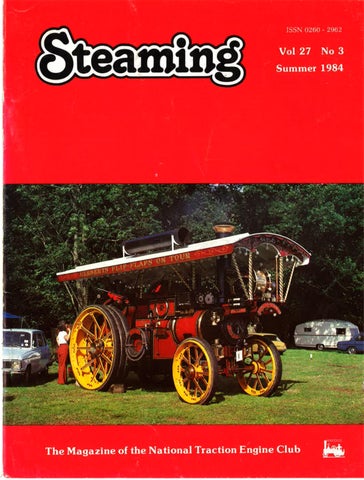
Cover Burrell showmans MAJESTIC (3890 of 1922) basking in the sunshine at Netley Marsh rally. (Robin Walker) 107
gllml YsIT'7/70, From the Chairman Our General Secretary, George Beck, who has now served the Club so well for 16 years, tells me that age is beginning to take its toll. He is now 79. His recent hip operation has been most successful, but has impressed on him the need to provide for a successor. We shall, if it becomes necessary, advertise for a volunteer to take his place. However George feels that he can carry on for some time; long enough for him to give instruction and practical experience to his new successor. The work does tend to be complicated, and the new incumbent would benefit greatly from working with George for a period. The idea is for him to be Assistant Secretary, with expenses paid, during this period. He would need to be in close contact and have his own transport.
George lives in Loughton which is near Epping, north east London. He would be pleased to discuss the matter with any interested member — his phone number is 01-508 4963. The post would be most suitable for a member who is just retiring or has taken early retirement, and carries a remuneration, which could be a helpful supplement to a pension. (Peter Barber, chairman)
NTEC Sales The Club's sales stands will be attending the following events in the second half of the season. Take advantage of their appearance to purchase books and other items. July (second two weekends) —
Netley Marsh (Roger), Hallam's (David), Kegworth (Ken), Ross on Wye (Chris), Cumbria (Sue), Rushmoor (Keith). August — Alderholt (Roger), Knowl Hill (Ken), Astle Park (Keith), Fairford (David), Somerset (Roger), Harewood (Sue), Expo '84 (Ken), Town & Country (David), Bishops Castle (Keith). September — Hinckley (Ken), Brill (Keith), Malpas (Chris), I laddenham (Keith), Stourpaine (Roger and Keith), Roxton (Ken). Reference to the Rally List supplement in the last issue will provide dates and full titles etc.
The Rally List 1984 The following rallies have now made known their dates, and should be added to the list of NTEC Approved Rallies published within the last issue.
From Alan Martin's Collection
25
This fine scene is in Spite! Street, Dartford, Kent in 1900, and delivering beer for the Dartford Brewery Co Ltd is Fowler road locomotive INVINCIBLE belonging to W. Lancefield & Son of Sellindge, Kent. The engine, number 6936, was a single cylinder class B3, new in 1893. 108
7th/8th July — Knebworth Park Steam Rally, Hertfordshire (about 40 engines expected). ✓. Saunders, 6 Carters Way, Arlesey, Bedfordshire. 4th/5th August — Torbay Steam Rally, Brixham ring road (A3022), Paignton, Devon (about 10 engines expectarl). M.R. Stabb, 12 Sun Valley Close, Brixham, Devon. 25th-27th August — Palmer Moor Vintage Weekend, Palmer Mnnr Farm (A50), Doveridge, Derby (about 10 engines expected). D. Hallam, The Firs, Draycott-in-the-Clay, Sudbury, DE6 5GX. 25th-27th August — Steam and Vintage Anniversary Rally, Chappleton Barton, Umberleigh, Devon ( about 15 engines expected). M.R. Stabb, 12 Sun Valley Close, Brixham, Devon. 25th-27 August — Expo 84, East of England Showground, Peterborough, Cambridgeshire (about 40 engines expected). P. Worbey, 35 Old Hale Way, Hitchin, Hertfordshire. 15th/16th September — Roxton Park Rally, Roxton, near Bedford (about 50 engines expected). P. Worbey, 35 Old Hale Way, Hitchin, Hertfordshire. In addition, the undermentioned
events which have already taken place were added to the Approved List after press date for the Spring issue : HCVS Battersea Park Rally and Brighton Run (5th-7th May); Burton Constable Rally, near Hull (27-28th May); South Tyne Rally, Corbridge 9/10th June) and Ashton-with-Stoddy Rally, Lancaster (16/17th June).
Club Trophies 1984 The Annual General Meeting recently held in Birmingham provided an occasion for the presentation of the Club trophies. The awards and citations were as follows J.T. Beeby Trophy Richard Froggatt of Loughborough A new trophy on its first presentation and specifically reserved for a young person, the presentation goes to Richard for his loyal and staunch support of the Steam Apprentice Club. Eric Middleton Cup Colin Waite and Grahame Thomas of Bristol For their very considerable efforts in preserving ploughing engines and their assistance to other owners and support of rallies and working events. Connie Hutchens Memorial Bowl Fay Wood of Huntingdon Specially reserved for a lady connected with the movement, the bowl goes to Fay Wood for her untiring efforts as our membership secretary and magazine distributor. Dacre Lacy Cup Ian and Gary Howard of Derby For their work in preserving and rallying the show engine RENOWN. Golden Film Shield Jack Marshall of Hockley Heath For his work in running steam events, in restoring and operating his engine Ransome traction COUNTRYMAN, and not least for his encouragement to others with provision of facilities and stabling for their engines. Percy Hirons Bowl Reverend Teddy Boston of Market Bosworth In recognition of his work in the preservation of steam both railed and non-railed, but particularly his traction engine activities. E.W. Edney Shield Nigel Heath of Finstock, Oxfordshire In recognition of his sterling work on his Aveling & Porter roller. Arthur Napper Cup for tractors Ted Sansome of Hinckley For the preservation of his Fowler single cylinder traction engine.
Spit and polish before the spectators as the Froggatt family groom their 1915 Marshall 69269 at the Quorn road rail event at Easter 19.83. (Clive Hollingworth)
Baker Toc H Cup David Walker of Shropshire For his preservation of the Garrett showmans tractor GREYHOUND and his support of rallies with this engine and his earlier engine PRINCESS MARINA. John Crawley Bowl Keith Shakespeare of Redditch For his considerable efforts on behalf of the Club as National Sales Officer
FSTEAMING pa OUR MAGAZINE 25 YEARS AGO
Evidence of the growth of enthusiasm for traction engines in the summer of 1959 was shown by news of forthcoming books by the Rev. Phillip Wright, by W.J. Hughes and by R.H. Clark. Prices ranged from 21s (£1.05) upwards. Also making an appearance
The Curtis Trophy John Hirons of Witney In recognition of his work as our insurance officer and also of his excellent work as a commentator. Jack Holloway Bowl John Bosworth of Smalley, Derby For his preservation and rallying of the Foster traction engine SPRIG, and his other engine interests, not forgetting the Smalley Preservation Group.
were models of engines by Lesney •— for 'authentically designed enthusiasts'. For 4s 11d (241/2 p) one could secure a Fowler showmans whilst the Aveling roller or the Allchin traction engine were 2s 9d 114p). Survivors are now 'collectors pieces', and priced accordingly! Engine news continued to feature machines newly purchased for preservation; East Suffolk C.C. had asked for tenders for the disposal of four rollers (two Burrells, a Garrett and a Ruston). Three still survive today but the Ruston, 'out of service' in 1959, seems to have suffered the ultimate fate at the hands of the scrapman. 109
Investments Tax-planning Budgeting Mortgages & Loans School fees Life assurance NTEC Insurance Scheme Self-administered & insured company pension schemes Personal pension plans Personal insurances Commercial insurances
JOHN SCOTT & PARTNERS LTD Personal Investment & Financial Management Consultants & Brokers
Park Row, Farnham GU9 7JH 0252 725555 and in CITY OF LONDON • KINGSTON-UPON-THAMES • MARLOW • READING
110
Working for Fowler5 Your readers may like to hear of my memories of the years I spent in the erecting shop at Fowlers. I was born in August 1900, leaving school in 1913 and starting work at Fowlers straight from school, although I had worked part-time as a lather boy at two barbers. The hours were 6.0am to 5.30pm with one-and-a-half hours for meals; Saturday hours from 6.0am till midday. My wages were five shillings per week. We used to work in small gangs of about three or four men and three apprentices, each gang would have three boilers to build up from and would work on the engine which was most urgent. The machine men of those days were tradesmen, the only tools they had personally were a rule and a pair of inside and outside calipers. The cutting tools they would make from an old square file which would be ground to suit the job in hand. On receiving the bare boiler each man would have his own part to work on. The man doing the motion part was called a top man because he worked on the top of the boiler, while the men doing the gearing end were
called the arse men. One of the first jobs was lining up the crankshaft bracket — that was where you had to be able to use a hammer and chisel. That done, you bedded the cylinder to the boiler, lining it up with the crankshaft and when happy about it got the foreman to pass your work. There was a wonderful spirit amongst the men, despite the fact that there was no canteen and no smoking 'during working hours — or tea breaks. There were two Fowlers in the business at that time, Charles and Bobs, and when they were around you had to keep your head down to the job. Before World War 1 Fowlers had two factories in Germany, but when the war started the Germans took them over, interning the Leeds men who had been working there. After the war, Fowlers tried to get compensation but there was no money in Germany, and they were paid in German-built MAN diesel engines. This opened up a new life for me, for a few of us were picked out to do a course on what we called i.c. engines. I gained a lot of experience, but my love of steam was very strong, and
Fowlers workshops, about 1912_
Fred Dunbar
still is. I spent some time 'working out', repairing all kinds of steam engines for Fowlers. Later the firm fitted a diesel engine into the cut-away boiler shell of a ploughing engine, and I did a season ploughing from our depot at Sutton Bridge; we had three furrowed ploughs ploughing 2ft 6in deep and sub-soiling 12in deep. The work was very hard and cold. You had a bath about every three months when (if you were lucky) you went home, but morning and night you washed out of a bucket. We lived in a caravan, five of us together, and towed the van behind the engine as we moved from one farm to another. There was no weekend leave, but we had a full time job anyhow, keeping the diesel plough going! We had our reward I suppose, because we were working a six day week whilst those in the works were working a three day fortnight. No DHSS in those days! We broke several crankshafts, and changing engines in the middle of a ploughed field with a 'three legs' and chain block is not a very nice job in winter. I went back to working out on 111
steam; the biggest job was fitting a new fire box. I used to strip the engine
The working out allowance was
driver's seat on one cylinder and his mate's on the other. I think the best customer was a firm at Newport in South Wales — I remember bringing a wagon back to Leeds for retubing. The men said I would never reach home, but I had a bag of oatmeal and every
three shillings per day 11 5p), sometimes the man you were going to work
few miles I put a shovelful in the water tank and kept the pump working all the
for would fix you up with a place to
way.
keep expenses down, otherwise you would have to go knocking on doors looking for digs. In my later time at
I was sent up to D. Wood at Yeadon several times, for with Fowler's help they were trying to fix
down and then turn the boiler upside
down, send for a boiler maker from Leeds and I had to help him to get the old firebox out and fit a new one.
Fowlers I used to go out doing jobs on
up sweeping and tar spraying gear on
my own, such as new big end, piston rings or slide valves, or retubing a
steam rollers. The tar was put into a tank fitted under the boiler barrel and
boiler, over a weekend. I would tell the customer beforehand the length,
was heated by steam coil; later they tried to fix a flame to melt the old tar
diameter and number of tubes and give
on the road.
him the address of a firm in Cardiff. When he got the tubes I would ask for a forge, a big box of lime and would
In 1931 I was sent to Devon to start up three of this type of roller. It
was only a small place but the money was very good, so after talking things
A workshop snapshot. (collection F. Dunbar)
the £2 I had earned over the weekend.
over with my wife, I took the job they had offered and moved my family to Devon, where we stayed for 14 years. On my journeys abroad if ever I saw a Fowler engine or a crane made by
Fowlers could not see the i.c. engine had come to stay and would
engines, for my days at Fowlers were the happiest days of my life, and I still
Smiths of Rodley, near Leeds, it used to make me feel very homesick.
not change; they tried a steam wagon with a v-shaped engine with the
I hope you all spend many happy hours cleaning and maintaining your
soften the ends of the tubes and then put them in. After arranging for the
visit of the insurance man and checking the water test on the Monday morning, I went away with
LAMPS
get a kick, when looking back, at that wonderful feeling you got after building an engine and seeing the flywheel turning for the first time.
manufacturing specialists TRACTION ENGINE REAR LAMP Height 91/2in approx, Width 41/2 1n approx.
Hand made the traditional way in our own workshops and finished to a high standard. These are functional lamps as well as adding trot fiiiishiteg touch to your engine. finished in semi gloss Black and stuved fur a durable finish. The front bezel is made trom solid brass. Fitted with a Sin diameter real coloured through rubyired glass. Side panels are inset with clear glass aspects 33/4 in x 2in. Rear fixing bracket only as per the original method.
Price £21.30 each inc. VAT. Name Plate — Your engine's name stamped onto Brass Plate and fixed on the bottom of the front door, under the brass bezel. Cost per lamp £1.65 each. Add £3.04 for packing and postages — for U.K. Overseas customers please ask for firm quotation, and state whether Air or Surface Mail is required. All orders and enquiries acknowledged same day.
REPAIRS Lamps of all types — Carriage, Traction Railway, Street and Ornamental etc.
SPARES Try us for that elusive part. the chances are that we can help. From Wicks to Bulls Eyes etc.
SPECIALS Our manufacturing facilities can cater for the 'One Off' from that missing Brass Bezel to the Brass or Copper chimney cowl. Parts spun or pressed in our own workshops. Capacity from thimble size to 48in in diameter.
Parts can be made in Brass, Copper, Aluminium, Tin Plate or Steel. Polishing and stove enamelling service is also available. Quotations given Free of Charge and with no obligation.
J.H. HETHERINGTON & CO. LTD. P.O. Box No. 234, 109 Sydenham Road, Sparkbrook, Birmingham, West Midlands B11 1DB Tel 021-772 1745
112
r-6
A Giraffe Arrives
'
„ •-• Tim Keenan For the last dozen years or so steam has been a feature on the Quex Park Estate at Birchington-on-Sea in East Kent, in the form of the Quexpo Steam Rally. But this is no new phenomenon for the park's owners — the Powell-Cotton family — used steam extensively from the late 1880s, and indeed right up to the end of World War 2, in the shape of Aveling & Porter rollers. The present owner's father, Major Percy Powell-Cotton, was a great naturalist and travelled widely in Africa and India in search of animal specimens for his natural history museum which he built in 1896 adjacent to his mansion in the grounds of the estate. During the first few years of this century the collection was growing apace, with all manner of animals being shipped to this country to Ward & Co, the then well-known London taxidermists. In 1907 it was decided to purchase a steam wagon to collect such items from the local railway station as well as for general use on the estate. The Maidstone firm of Jesse Ellis & Co was contacted and at the time, as chance would have it, they had a 5 ton wagon in stock which had been completed in the previous year. It would appear that Jesse Ellis could not find a ready buyer when the machine was completed and so used it themselves for some months. This particular wagon, featured in the photograph, is thought to be the last of its type built by the company. It was fitted with the firm's standard vertically-mounted Ellis-Balmforth boiler of the fire tube pattern, the
•
-
engine being a compound with slide horizontally underslung valves, between the chassis and driving a gear train to the rear axle. The water tank doubled as the driver's seat and the cab was semi-enclosed by a glass windscreen. The usually horse-drawn trailer at the rear, on which the sheet-draped giraffe is loaded, belonged to the wellknown Thanet firm of hauliers, F.L. Pettman Ltd of Margate. They are now in their 101st year of business. It was in 1910 that this firm purchased their first steam wagon — but that's another story. The Ellis wagon, registered D2672, was retained by Quex Park Estate until 1915, when it was
i'. gtdri TIV, • -...frrtIMAr •• 4 ... ' 4' gik
purchased by Basingstoke Gas Co in Hampshire. An interesting point to note here is that when Bob Whitehead was compiling his history of Wallis & Steevens of Basingstoke he came across a reference, in the workshop daybook, to this wagon as being in the works for repairs. One of the directors of the gasworks had family connections with Wallis & Steevens. The picture shows the Ellis wagon on its arrival at Quex Park sometime in 1910, hauling Pettman's trailer loaded with the stuffed giraffe from Wards, the taxidermists. I would like to thank those who have kindly provided information: Mr C. Powell-Cotton, Mr A. Duke and Mr R.A. Whitehead.
STEAM RALLY, and 3rd STEAM ROAD RUN, QUEX PARK, BIRCHINGTON EAST KENT, 25-27th AUGUST Steam engines, v and v cars, stationary engines, tractors and models etc. Road run starts from the Park 10.30am on 25th, to Margate and return. Steam Events Organisers — Tim Keenan on 0843-34419 or Barry McCabe on 0843-343687 Rally Co-ordinator — T. Wood, 95 Alpha Road, Birchington, Kent 10843-41520).
113
Steam Road Haulage in Sweden Road steam haulage has not been used very much in Sweden. Only a few attempts are known of, and they all seem to have been carried out to investigate an alternative to building a railway line. Thus they were intended to use the same route, to and fro, and not to be used for journeying to different works and destinations. Regrettably we have to leave the few Swedish built engines outside this article due to the very scanty information available, and instead look to some interesting English-built engines. The last known attempt at steam road haulage was first carried out about the mid 1880s and seems to have been the only successful one, for at least one Howard 'Farmers Engine' was used regularly until the turn of the century. A second similar engine almost certainly worked here as well. The engine was used at a foundry named Haddebo Bruk to transport iron products from Haddebo to the railway station at Palsboda, where a storehouse was also located. As early as 1886 the owner of the works, Mr A.V. Schedin, was awarded a prize for a J. & F. Howard road engine he was exhibiting at the Stockholm Induatrial and Agricultural Exhibition. A road locomotive was still used at Haddebo this century when the premises were sold and taken over by a new owner. The foundry and all the buildings belonging to it were entirely destroyed by fire in 1918, and nothing is recorded about the engines.
In 1871, about 15 years before Haddebo Bruk first used road engines, some very serious trials were undertaken to learn about the advantage of using a Thompson road steamer for haulage. At least two Thompson steamers are on record as having been imported and tried out. One of these (an 8nhp) was shown at the great Agricultural Exhibition in Gothenburg in 1871 by
114
the maker's Scandinavian agent, Mr F.B. Beskow, who was advertising these engines in late 1870 and during 1871. Although not absolutely cleat, this seems to have been the one used at Wallakra coal mines, in the very south of Sweden. The other was tested at Dannemora ironstone mines, Ostby Bruk, about 100km north of Stockholm. These Swedish experiments were very much a result of the good publicity similar trials in England had received. Of special interest was the report on the advantage of using Kautschuch tyres, as these were claimed not to slip on ice, or other slippery ground. They would therefore have been very useful in the wintertime.
Tore Blom Despite good reports, when imported the engines proved not to be in accordance. When working they came close to financial forecasts, but due to poor quality workmanship there were often breakages. These were usually easily repaired, but it seems to have been a very large problem. To give credit to Swedish industry of the time, it was generally thought that if they had been built by one of the Swedish engine builders, they would have probably better suited the circumstances they had to work under. What the results of either trial were is not clear, nor the engine's further duties. There was a large interest in this type of engine, resulting in some invitations for shares in transport companies intent on the use of road locomotives. Why they never became more common or regularly used is hard to say, but no doubt there was a resistance, in some cases resulting in prohibitions from the authorities, as with the engine used at Wallakra, which for some time was not allowed to use public roads. Regrettably no photographs have been
discovered of Thompson road steamers in Sweden.
Going further back in years, one decade before the trial of the Thompson steamers, a Tuxford road locomotive had been imported. The large steel company Uddeholm AB purchased it in 1861 to improve the transportation of iron ores between the mines and the smelting houses. At that time transport was done on sleighs and boats, and plans were being made for a railway. When the firm learned about the use of road locomotives in England a man was sent to investigate the possibilities. At the Royal Agricultural Society show at Leeds that year a suitable engine was on show and it is likely that it was from there he wrote his enthusiastic report, resulting in an agreement 'with one of the largest engine makers in England, Tuxford & Sons at Boston'. This agreement said that a 10nhp road locomotive should be delivered to the Hull Docks by the end of September. Working pressure was to be 80 Ibs, and the price was £475. When the engine arrived in 3weden in Nuvembet, a little bit late, the winter was already there, and so its first road test was not commenced before early spring in 1862. It must have been a terrible shock to the company directors, who had put so much hope into introducing such an engine, when it almost immediately entered a ditch and overturned. The result of the accident was at least a broken front wheel and probably more than this, and the trials were once again delayed. It is hard to know the reason for the incident, especially as a special locomotive driver had been employed, but one suggestion was that he was not familiar with managing road engines and found it difficult to steer on the poor road surface, even though it had some improvements. However, the engine was again tested during the summers of 1863 and 1864 but was unsatis-
factory, because the road was not hard enough to take the weight of such engines. The engine was, however, worked stationary at driving a coal crane until the end of the 1920s when it was moved to the company's museum for its historical interest. It is probably now the oldest traction engine in the world as well as being the only survivor of the famous Tuxford traction engines. It was stored in Stjarnforsens Museum until 1945, when it was taken out and generally overhauled to take part in a film recording about the Uddeholm history. It seems at that time to have had another new front wheel as well as a replacement rear roller wheel. In its present state some parts of the motion are missing from the engine and it is uncertain whether these were dismounted before, during, or after the filming, but it is likely to have been
The Howard 'Farmer's Engine' road engine used at Haddebo Bruk, drawing a train of heavy wagons containing iron — not much of a load to look at but undoubtedly very heavy. The photograph is a rare view of a Howard engine that is seemingly built for use only as a haulage engine, and not equipped for ploughing. (collection T Blom) Close scrutiny of these two undated pictures reveals some interesting points. We might guess that the upper illustration depicts the newer of the two engines for the wagons look an advance on the old pair in the lower picture, and experience may have dictated two variations on the owner's second example — the canopy and the additional firehole door on the left side of the firebox. Was the latter to facilitate lighting up from ground level? It must have been quite an effort to clamber up into the engine-filled tender of a Howard engine; one of our members in Lancashire and his crew may be able to comment on this. Another difference is to be seen in the wheel hubs, and the large centres on the canopied engine could probably be a local repair of loose spokes — making a large casting around a damaged wheel centre would presumably be easy for an iron foundry. The other Howard engine, assumed to have been used at Haddebo Bruk, because although the picture was found in the archives of an unrelated firm, the station in the background is confirmed as Hjortqvarn railway station, near Haddebo. (courtesy Torps Mekaniska Werstad Moheda)
i; .ps 1411
- .4ZVIANK4ATA._ 1 •
• ---.00b.+64%.4-41002011••I'
slightly different. The steering al I anyemerii. is (lie most noticeable, as it is not at the very front as on the pictures, but located at the left side of the firebox. This must make the steersman stand awkwardly. The safety valves on the dome are like the engine in fig 130 of Development — this latter view, incidentally, gives a very good idea of the engine and boiler arrangement. An unusual feature on the engine is the clutch, which consists of three wheels with V grooves. The first is on the crankshaft, and the third is fitted on the rear axle stub, and driven by the second wheel which is mounted on a movable fork, which is linked from the footplate. The fork is then moved up or down, making the clutch wheel in or out of gear. However, it is a bit doubtful if this clutch is an original arrangement as the bearings for an intermediate axle are also present. Although Swedish steam road haulage was not either very frequent or successful, it is so much more remarkable that this wonderful old engine has survived. If any readers visiting Sweden wish to have a look at the Tuxford, it is located in the old smelting house named Motjarnshyttan, about 500 km north of Gothenburg. We would be pleased to try to help visitors with advice.
General views of the 7861 Tuxford engine in the museum at Motjarnshyttan, Sweden. The machine's somewhat cramped and gloomy quarters make adequate photography very difficult, and a good side view impossible, but reference to Ronald Clark's The Development of the English Traction Engine (fig. 130), will make clear the design of the boiler and engine, even if the wheels shown there are different. (Tore Blom)
before, because the engine was unable to move under its own steam during the filming. It was slowly rolled downhill with some men pushing behind! Other parts missing are the coalbox at the front of the engine, and the tank underneath the boiler; other116
wise it looks to be in a remarkably complete and good order. Comparison of the engine with illustrations published in A Century of Traction Engines (Hughes), fig. 43, and The Development of the English Traction Engine (Clark), figs 129 and 130, shows the Swedish example is
The elegant dome and spring balance safety valves of the Tux ford. (Tore Blom)
Lincoln Steam Day Readers of Steaming magazine and members of the National Traction Engine Club are invited to attend a Steam Day at the Museum of Lincolnshire Life, Burton Road, Lincoln. The event, to be held on 2nd September 1984, is intended to show a wide variety of engines, from oil to stationary and steam, both traction and portable, all of which have been made in Lincolnshire. The Museum has many examples of locally made engines such as a Ruston Proctor traction engine of 1913, Robey stationary engines and many others. It is hoped that the local oil engine club will take part in the event. The highlight of the day will be to see one of the Museum's most recent acquisitions in steam. The Ruston Proctor steam navvy was made in Lincoln in 1909 and has a fully documented history. It is said to now be the largest working navvy of its kind in the country, and spent its working life as a face shovel in a quarry at Arlesey, Bedfordshire. When the quarry closed in 1931 it was left in the pit which subsequently flooded. Ray Hooley of Lincoln spent three years arranging for the recovery and restoration of the machine, which was put on display at the Museum of Lincolnshire Life in 1981 in full working order. The machine is steamed infrequently and readers are invited to take this opportunity of seeing this 42 ton machine in operation. Front view of the Tux ford showing the stub axle and steering arrangement to the front wheels. The removal of the coal box enables us to see the firehole door, and above it the smokebox door of the return flue boiler. (Tore Blom)
PART DISPERSAL
Tom Varley's rare and unique collection of traction engines, steam wagons, steam car etc.
at Todber Steam Museum, Gisburn, Lancs on Saturday 4th August 1984 • Foden Colonial steam wagon • Aveling traction engine, c 1862 • Aveling 5ton steam wagon • Pair of Burrell ploughing engines • Marshall steam tractor ■ 20hp Stanley steam car • Yorkshire wagon (scale model) • Aveling showman SAMSON • two Yorkshire WG type steam wagons
Details from Robin Addyman on Clitheroe (0200) 27059 Limited entry of smaller items invited for inclusion in the sale
'Owing to the great success of the Leyland steam motorvans in the service of the Chelsea Borough Council, it has been decided to invite tenders for the sale of 18 of the Council's horsed water vans, for which there will be no further use. Only six horsed vans will be retained, for the present, for use in cases of emergency or exceptional pressure.' (From The Commercial Motor, 31st January 1907.) 'Mr J.E. Parsons had doubts about a steam roller living for ten years.' (From the Kettering Leader, 5th July 1912, reporting a Wellingborough Rural District Council meeting considering a new roller. Although Aveling & Porter 9188 was not delivered to them until 1920, the machine proved Councillor Parsons very wrong, surviving in the Northants County Council fleet until 1959, by then one of their last steamers.) 11 7
John Wharton
rambling on about showmans engines It is very pleasing to be able to note that a number of showmans road locomotives are now, again, able to carry out the main task that they were built for — to generate electricity. The reader must excuse me for making continual ieferences in these notes to the three showmans road locomotives owned by my family, namely, 6hp Burrell 3489 of 1913, KING GEORGE VI (ex Bolesworth and also Andrews); 8 hp scenic Burrell 3896 of 1921, EARL BEATTY (ex Anderton & Rowland) and 10hp Fowler Super Lion 20223, SUPREME (ex Deakin). When showmans engines were working for a living they did not have lamps all around the canopy. All the energy produced was reserved for the rides. EARL BEATTY is still languishing in our shed awaiting restoration, it's canopy leaning against the wall. You can see the original dozen or so lamp holders along the centreline of the underside of the canopy. This was not for adornment, but to help the driver see what he was driving. To my knowledge the first engine ever to have a plethora of lamps was, in fact, our KING GEORGE VI in the early 1950s, and the fashion is now almost universal. The reason was not vanity, as some would have it, but the desirability of supplying an electrical load. However, I must say that the Stourpaine line-up of showmans engines by night is a lovely sight! The size of dynamo to suit the size of engine is debatable. KING GEORGE VI has a Mather & Platt dynamo, thought to be a P6C rated at 220 amperes (110 volt). I personally think that it is about the right size for this 6hp engine. Originally the dynamo was fitted to W. Nicholls' PRINCESS MARY — an 8hp Burrell. EARL BEATTY, being an 8hp scenic, was equipped with a Mather & Platt P8C of 725 amperes, with a Mather & Platt P3C as an exciter. The original P8C from EARL BEATTY is now on QUO VADIS. We have been fortunate in purchasing in replacement the P8C that was fitted to SIMPLICITY, the last Burrell showmans built, and the stable mate of SUPREME. We have yet to 118
secure a P3C. SUPREME was originally equipped with a Maudsley 350 ampere dynamo, with the off-side belly tank left clear for the possible addition of an exciter (which was never fitted). Just before the engine's premature exit from showland, a Maudsley 400 ampere dynamo was fitted. This latter dynamo is now back on SUPREME. We all know the enormous power of steam, and it might be suggested that showmans engines can all take a larger dynamo. The limiting factor is the power that can be transferred via the flat belt from the engine's flywheel. For example, KING GEORGE VI is a converted road locomotive and only has a six inch wide flywheel, as opposed to EARL BEATTY's eight inch and SUPREME's eight and a half wide surfaces — on engines built for showmans use. Belt slip is a problem. There are compounds to overcome the problem, but when you need it on a good supple belt, you know that you
have bitten off a bit more than you can chew. Obviously if a load is phased in, rather than knifed in, one has a better chance of success. When an engine is seen with a dynamo that its too small, the visual appearance is wrong. A showmans tractor (very often converted) with a dynamo that resembles a washing machine motor makes me wonder what a showmans engine was built for. Another practice that has caught my eye is the extension of the armature shaft. This is not necessary, for there is no need, nor ruling, for the main body of the dynamo to be centrally placed on the dynamo plate. Further, the dynamo is normally designed to accommodate the pulley on the armature shaft near to the main body, so If the shaft is extended then an outrigging bearing should be adopted (preferably as an integral part of the dynamo). All dynamos and steam engines have a correct working speed. I have witnessed showmans engines with dynamo pulleys that are too small, and in consequence to get the correct speed on the dynamo the engine is running slowly. With a light load this is fine, some might even comment on what a quiet engine it is! However, if a decent electrical load was put on, the engine would not be able to produce enough power (as speed is a factor in the formulation of brake horse power), and some of that power would be lost through belt slip on the dynamo pulley. The size of a dynamo pulley is in fact
EARL BEATTY, Burrell 3896, uses its car crane at Penzance Fair 1921, whilst in Anderton & Rowland's ownership. (courtesy W.H. McAlpine/Fairground Society)
David Walker's PRINCESS MARINA, Burrell 3847 of 1920, working Harry Wigfield's Coronation Speedway at Stourpaine in September 1981. (Roger West) precisely calculated (or should be). For example if the working speed of the engine is 160 rpm, the dynamo speed 750 rpm and the flywheel diameter 54 inches, the pulley size can be found using the following equation: FLYWHEEL DIAMETER (INCHES) x DYNAMO SPEED (RPM)
At the end of our three days the showman bought us a drink; he had saved a sizeable tank of diesel and we went home with an empty coal bunker and no paint on the chimney. I felt the showman was laughing at us. If we
= DYNAMO PULLEY DIAMETER (INCHES)
ENGINE SPEED (RPM)
For our example, then; 54 x 160 = 111/2 , 750 so the dynamo pulley diameter would be 111/2 inches. Some dynamos are unsuitable for steam engines, simply because their designed speed is too fast. To run a fast dynamo at its correct speed would mean either running the engine faster than its own working speed, or having too small a pulley on the dynamo. On generating large loads, I must admit that I was 'once bitten' years ago, and this has made me 'twice shy'. With SUPREME we generated for three full days for a showman a load of 300 amperes. Anybody who has done this will know it is fairly hard work for the crew — and no time for chattering to bystanders if you are on your own.
had done that every time we went out, SUPREME would not look like it does today (14 years after restoration) and we would be a good deal poorer, unless sponsored by an increased coal allowance at rallies and other events. However, we can do the job, we have proved it and we will probably do it again and again. Despite my experiences, the rally scene is much better when showmans engines are working rather than just 'showing'. One man, with his family, have been a monument to this. Over a long period David Walker has continually sought electrical loads. Due to ill health he has had more recently to part with his Burrell PRINCESS MARINA, the engine he made famous. However David now has the ex Beach Garrett showmans tractor THE GREYHOUND. I am convinced he will not be content until
he has got 300 amps out of it. In recognition of his work and service to the steam engine movement, especially in connection with the showmans road locomotive, David was awarded the Club's Baker Toc H cup following the recent AGM. David is an example for all showmans engine owners to follow, and it is pleasing to see the youthful Ian and Gary Howard tread the same path with their Fowler RENOWN. They too were recognised by the Club by being presented the Dacre Lacy Cup.
Now available
Charles Burrell & Sons Ltd
Steam Tractors and Steam Wagons A facsimile reprint of Burrell's 191 I catalogue of Gold Medal tractors. Also includes new introduction and identification of the 35 plus pictures. Price £2.40 plus 30p postage, from
M.J. Engineering, Manor Hatch, 63B Southampton Road, Ringwood, Hampshire BH24 I HE.
119
A Wasted Legacy D.A. Rayner A unique steam wagon was once owned by Yorkshireman Sammy Ledgard. In his time he became as famous as Harry Ramsden, and having started in business in the early days of the century, Ledgard's buses were still running between Leeds, Bradford and the surrounding areas in the mid 1960s. The wagon in question was a Coulthard, built in Preston, Lancashire in 1906 and originally owned by Burnley Corporation, hence the registration CW142. But to start at the beginning. Samuel Ledgard was born In 1874, being brought up at the Nelson Hotel, Armley, Leeds, the family home. He later took over the running of the public house and, seeking to expand his business, saw some potential in outside catering at agricultural shows and race meetings. He therefore purchased a horse and cart which he used initially for transporting food and drink, and eventually for general haulage. The catering business expanded to include tents, tables and other equipment and very soon horses and carts were unable to cover the distances involved or the sheer quanitity of goods. Samuel wanted to attend race meetings at places like Lincoln, Nottingham, Newcastle and Redcar, and so he decided to purchase a steam wagon. The Coulthard was the first, being acquired in 1908, reputedly for £50. The first outing in its new ownership was to York races; Samuel travelled with the wagon on this journey and he was somewhat disappointed with its performance, for it was only a two speed machine. He had thought about improvements which could be made and consequently gave an order to Mann's Patent Steam Cart & Wagon Co across the river in Leeds for a similar machine fitted with three speed gearing. This later became a standard fitment on their wagons. The new machine must have pleased for Samuel subsequently purchased two more Mann's wagons when his business further expanded, and then one from Yorkshire, the firm next door to Mann's in Pepper Road. With these wagons he carried much roadstone, sometimes pulling trailers, and he also obtained a contract from Tetley's brewery in Leeds for delivering beer. During World War 1, . he bought a 120
The unique Coulthard/Mann hybrid steam wagon in Butler's scrap yard in Bowling Back Lane, Bradford on 4th February 1953. (J.S. Cockshott)
SAMMY LEDGARD'S STEAM FLEET maker
number date
Coulthard
registration weight last licensed
1906 CW142
New to Burnley Corporation; to Ledgard 1908.
Mann's
544
1909
U1071
5 ton
October 1926
277
1910
U1175
6 ton
June 1928
Believed new to Ledgard.
Yorkshire
New to Charles Green's Sons, Rotherham; then Mickley Coal Co, Dronfield, Yorks; then Ledgard.
Mann's
576
1910
U1243
5 ton
June 1927
Believed new to Ledgaid; rebuilt from flat wagon to tipper, 1923.
Mann's
989
1915
U3151
5 ton
47123 1917
FE1017
5 ton
May 1928
Believed new to Ledgard.
Clayton & Shuttleworth
Built 1913 as number 45554 and new to Priddy, Stanley & Co Ltd, Oughtibridge, Yorks. Given new number when sold to Ledgard (via makers?) in 1917.
a . 114i nin; STAMM I IrsolfXJ, Miler OUGHT1BMOCE •
The Clayton latterly owned by Sammy Ledgard photographed when in the livery of its first owners. (collection P. Smart)
second hand Clayton & Shuttleworth wagon to supplement his fleet of petrol lorries and charabancs which were then somewhat depleted by Government requisitions for military service in France. The Coulthard, however, being his first steam wagon, was obviously highly thought of by Sammy. Wilf Cole recalls that it came into the repair shop at Mann's in Pepper Road, Leeds around 1914/15 and he worked on it there. Some new piston valves were made in the machine shop and Joe Singleton was the fitter who did the job. The latter was a good tradesman who, Wilf thought, served his time at Tommy Green's on the other side of Leeds. At some time, the Coulthard was rebuilt and became a hybrid. It acquired the boiler, wheels, canopy and bunkers from a Mann's wagon but retained the Coulthard features of the chassis, engine gears, chain drive and piston valves. Mann's, in fact, never made an undertype wagon with a chain drive. As far as is known no photographs have survived of any of the wagons in their working days, which extended up to the 1920s, although as another of Sam's enterprises were some nearby quarries it is possible that they may have ended their days there, hauling sand and gravel. In the early days, Sam had several good drivers; two are recalled — Jack Heap and Billy Carr. Billy would sometimes do a run or two up to Newcastle on a similar job to that which the Coles had before World War 1 but their main job was associated with outside catering at first and latterly on roadstone carrying duties. That the Coulthard survived for some 25 years after withdrawal from useful service was a quirk of eccentricity of the late lamented Samuel. His garage at Armley, Leeds, at the back of the Nelson Hotel, was built into the side of a hill and this allowed vehicles to be driven up a slope at the side of the depot and onto the specially strengthened roof. For some reasons best known to himself, Sam Ledgard rarely sold his vehicles and when he died in 1952, he had amassed the remarkable quantity of 44 defunct motors, of which some 42 were prewar, some even pre World War 1 and dating from 1906. They included Caledon and Karrier charabancs. The unique Coulthard/Mann's was, therefore, after his death consigned to the scrapyard along with the rest of this remarkable collection and despite the chalked legend which appeared on the side of the wagon, 'DO NOT CUT UP', it is believed it met its end some short time later, just at the time when traction engine rallies were starting in
The Bedfordshire Steam Preservation Society present their 16th Annual Rally at
on 15th-16th September 1984 at Roxton, near Bedford (A1/A45) approx 50 engines
Fair organs Craft tent Vintage Tractors Model Engineering Working Demonstrations
Rally Secretary: Paul Worbey, 35 Old Hale Way, Hitchin, Herts
the north. It is a pity that its location was not sufficiently widely known for it to have been purchased by an enthusiast or indeed that Coles, who did know about it, had too much on with their business and other interests at that time to be able to preserve it. An unfortunate end to a wagon which deserved to survive, having lasted for so long in 'suspended animation'. Acknowledgements are due to Keith Jenkinson for permission to use information from his book Ledgard Way, published by Autobus Review Publications Ltd, and also Wilf Cole, Don Bate and Alan Duke who also iw supplied details.
Wellington of sales 'Recent tractors have included outside sprung machines for Mr H.F. Bowker, of Hartwood Road, Southport, Mr Thomas Bowman, of 15 Aldwark, York, and Mr J.E. Heath, of Cecil Street, Nottingham. Mr Tritton's patented springing appears to appeal to both new and old users, and the business of Wm. Foster and Co. Ltd., is benefitting accordingly.' (From The Commercial Motor, 13th January 1910.)
'GW (Sunderland) writes — I think the following incident will prove interesting as showing how a difficulty was overcome by the roadside without proper tools or materials. Some time ago I was driving a steam tractor, with a single cylinder, and drawing a wagon. When about 12 miles from home, the bottom or reversing eccentric seized on the sheave without the slightest warning, and broke the eccentric rod into two pieces before I could stop the engine. I did not at first know what to do, but, after thinking out the matter, I disconnected the broken rod and hunted around for a long bolt. This I placed in the bottom hole of the slot link, and lashed its ends firmly to the drag links. I was now without a reverse, and so could not move backwards should the occasion arise. I had difficulty in starting up the engine, as the gear had to be put in the neutral position and the flywheel turned round until the crank was on centre, after which the gear was put in and steam turned on. My greatest difficulty was that, when I had to stop for any traffic, I had to go through the process of turning the flywheel round again. However, I managed to get home without further mishap.' (From the Drivers Column in Commercial Motor, 29th June 1905.1 121
Zinshim drumlin Our paragraph (p95, Spring 1983) mentioning Sinsheim museum in West Germany came just in time for member Robin Walker who by chance was planning a touring holiday in May to Austria, Switzerland and the Black Forest. Duly forearmed, Robin was able to spend a considerable time looking round the superb Auto and Tecknik Museum (40 miles north west of Stuttgart) with its hundreds of transport exhibits of cars, buses, lorries, steam rood vehicles and stationary engines plus hundreds of other related items — well worth a visit for anyone interested in transport. It has excellent car parking facilities and restaurant, and the nearby Hotel Klostermuhle is recommended (Dm 132, or £33, for three for overnight accommodation and dinner!). But to things steam... The museum collection is more extensive than our report suggested — one roller on a plinth outside plus, within the museum proper, two ploughing engines, nine steam rollers, one portable and one stationary engine. Details are given in the captions; we hope to continue Robin's pictures in a future issue. A large compound roller on a plinth outside Sinsheim museum, West Germany. No details towards identification were obtainable but Fowler influence is detectable and it could be a product of their Leeds or Magdeburg (Germany) works. A single cylindered roller built in 1926 by Theodor Ohl of Diez, Limburg (near Frankfurt), number 186. It was used in the fleet of Ludwig Nickel & Seitz of Mannheim; two more of their engines are also at Sinsheim. Aveling & Porter 5784, a 1905 product from the Rochester works. Compared with many of the exhibits on view (and with other preserved engines on the continent), the Aveling appears very original and 'clean, with few patched castings, although it does bear evidence of loose spokes on the rear wheel. 122
WIC
Roller built by Heinrich Lanz AG of Mannheim (27473 of 1918). The hind wheels are raised off the floor enabling an electric motor belted to the flywheel to turn over the engine and wheels etc. Note the clutch arrangement in the flywheel. This 25 ton 1912 built ploughing engine was latterly owned by contractors Wilhelm Ottomeyer of Pyrmont, Hannover. The builder of the engine is not clear — the original owner is stated to be J. Kemna of Breslau (now Wroclaw, Poland) and the machine bears a plate 'Gronemeyer & Banck No 4970', and is also marked 'Typ Kustrin'. Another engine displayed adjacently — they together presumably formed a working pair — is very similar, but referred to as 'Typ Magdeburg 18'.
The other steam rollers in the collection (some not properly photographable) are a large unidentifiable but Fowlerish machine, now with a diesel (?) engine mounted on the boiler top in place of cylinders and motion; a Ruthemeyer single crank compound roller of 1937; Ruthemeyer 18 ton roller 426 (?) of 1902; Heilbronn 16 ton roller 368 of 1898; Ruthemeyer single crank compound roller 256 of 1914 and Garrett compound roller 27564 of 1909, the latter pair both from the fleet of Ludwig Nickel & Seitz of Mannheim. Also displayed is a 1915 single cylinder portable by Hofherr & Schrantz, Austria (which also bears Clayton & Shuttleworth 56049 plate on its firebox) and Lanz compound semi-portable engine 35703 of 1914.
A Near Miss
'Last Whit Tuesday I left Greetland with a 20ft by 8ft Lancashire boiler for Halifax. All went well till we got to the bottom of Salterhebble Hill, a very steep and dangerous gradient outside Halifax. I had a 20 ton boiler on a 9 ton trolley. I took it up the hill as far as I could with the engine coupled up to the draw-bar, till we came to the middle of the hill. This is paved with setts from top to bottom; the road men had been repairing and resetting the hill, and the setts were wholly covered with tar and pitch. When I got all the wheels on to the tar the driving wheels began to slip, as they had no grip whatever on the tar. I
told the men to uncouple the load and I would haul it up to the top with the wire rope. We always have two trailing scotches arranged behind the back wheels of the boiler wagon 18in by 12in by 6in, so as to lock the wheels if anything should happen. When we got uncoupled I happened to turn round and was horrified to see the boiler wagon gradually sliding backwards, the wheels not revolving but simply sliding on the tar. I went to the assistance of my two mates, who were trying to stop the runaway by jamming on the brakes. The boiler had got a good speed on down the hill, so I attempted to steer it as well as I could with the draw-bar. It was making for a row of houses at the bottom, and I knew if it got anywhere there it meant death and destruction
to the inhabitants. I grabbed hold of a piece of wood which was handy and put it under the front wheel; this changed its course, altered the lock of the wagon, and took it straight across the street. It pulled all the kerbing and footpath up, cut clean through a wall and dropped on to a tip about five feet down, the boiler still remaining on the wagon and in the same positon as when we left the boiler yard. Men, women, and children were screaming as it pursued its mad career down the hill. Happily no one was hurt, but the boiler wagon was badly damaged. We set to and had it up the hill again inside two hours.' ('AK' of Linthwaite, Yorkshire, relating this experiences in the Driver's Column of Commercial Motor, 13th April 1905.) 123
The Second Time John Mayes I well remember one brute of a stackyard at Swanton Morley, near East Dereham in Norfolk. Time and again I had watched various engine drivers performing at that entrance and had decided in my own tiny mind exactly how it should be done. Ultimately, of course, my turn came. Full of confidence, with a good head of steam, I drew well into the nearside opposite the entrance gates with the front of the engine slightly beyond the gateway. Whilst the straw pitcher was being uncoupled I engaged little wheel and turned the steering into full right hand lock. Then, being given the 'all clear' I opened up. Proud as a turkey cock I felt — now to show 'ern! With the exhaust barking fiercely up the chimney the engine shot across the road, through the gateway and landed me right in it. The speed had left me insufficient time to get the lock off, resulting in the drum knocking down the right hand gatepost. I had proved to myself that despite my mental workings out, -the onlooker does not see all, neither does it pay to try to show off! Twice I got a telling off for that remarkable manoeuvre, once by the farmer who grumbled incessantly for the next hour whilst we got set up, then again by my grandfather who raved and shouted until he was hoarse, finally ending in a paroxism of coughing and rage.
Some months later I was again ordered to Swanton Morley, but no mention was made of my previous disaster, much to my surpriSe. It was a pig of a day and rain hurtled down stinging our cheeks; the sacks draped across our shoulders were sopping wet and we were absolutely perished. I drew up in exactly the same position as before to uncouple the straw pitcher. The gateway was a morass, water lay everywhere. Having dropped the pitcher, I very gently eased the engine across the road in little wheel, straightening the lock as the front passed between the gateposts, and immediately the back wheels of the engine began to leave the hard road I stopped. Better to fit the spuds now, rather than have to paddle around in all that deep mud. The drum stood right across the road but fortunately nothing came along. With all spuds fitted I began to ease the engine along, watching the drum come slowly through the gateway, well clear of both posts and rocking slightly as each steel shod wheel sank that little bit deeper into the muddy ground where the spuds had bitten. Eyeing along the ends of the two rows of stacks which lay parallel with the road I tried to gauge how far out to steer before turning in between them. With the engine still proceeding slowly I pulled a bit away from the ends of the stacks,
A Ransomes compound engine photographed for its maker's catalogue whilst threshing at an unrecorded location. (collection John Mayes) 124
then turned smartly in. The next minute one wheel lost its grip and the spuds began to dig a grave. My steersman fortunately anticipated this. He was by the nearside back wheel in readiness and as it spun it deftly slammed the locking pin into the compensating gear which was situated inside the winding drum. With a lurch she climbed up and out as a spud on each wheel bit simultaneously, then, with no steering we slowly chuffed our way down the middle between the two rows of stacks. With my steersman watching the spirit levels on the drum I proceeded to the end of the stacks, praying she would hold a straight course, for to have to stop and fiddle about to withdraw the locking pin would prove disastrous on that ground. "Whoa!" the steersman hollared. Boards two inches thick were laid in front of the off-side wheels of the drum. "Steady now", chuff-chuff, "Whoa! yew 'II due!" Chocks were hammered in, the drum was uncoupled, I eased forward gently, stopped, just touched on the reverse to relieve the weight on the gears, then the locking pin was slid out. We were miserably cold and wet — the rain dripped off the soaking wet sacks onto our trousers; rivulets ran down our arms, our hands were like rounds of raw beef and our fingers resembled sausages. Now was not the time to go and get the engine stuck fast! Plenty of steam, a good fire, water ok, so very gently with the regulator now, chuffchuff, we were underway — just keep her moving. I willed the frozen fingers of my left hand to grip the steering wheel handle and turn it. Ice cold water ran down the inside of my collar and I opened my shoulders to force the steering round in that soft muck. Steadily the engine proceeded, just a whisp of steam, round the end of the stacks, straightening the steering up, along the full length of the stacks, round the other end and down in between. The drum sheet had been untied on the nearside and lifted slightly to give me a sighting line. This had to be a 'one shot only' effort. I wouldn't be able to shunt her from side to side on that soft ground and the ruts from the trip down with the drum were already level full of water. The steersman had got his measuring line for the driving belt length fixed in readiness as I forced my numb brain to work. Squinting along the top left hand corners of the back and front plates I steered bringing them into line with the nearside of the drum. "Whoa!" shouted the steers-
man just short of the required spot, so that by the time the engine stopped it was just right. The last time, when I had made a proper mess of things, the farmer was there watching every move. Today, when I achieved a master-stroke he was nowhere to be seen! Meantime a cart horse had been harnessed to the straw pitcher and was drawing it down along the other side of the stacks — round the end they came and up to the drum. Having taken the horse out we struggled vainly to manhandle the pitcher back the last few yards to the drum but we just could not shift it in that bog. Out with the winding rope, take it under the front axle of the engine, right along and underneath the drum to the pitcher, then wind in very slowly until its in position before unhitching and winding in the rope. We capped the chimney, removed the wicks from the oilers and sheeted the engine. We fastened the sheet back down on the side of the drum with freezing fingers, and getting on our bicycles set off homewards, soaked to the skin and frozen nearly stiff. Oh, the joys of engine driving!
Armstrong-Whitworth 10R22, the former Ipswich Dock Commissioners 10 ton roller, now based at the East Anglia Transport Museum near Lowestoft. Compare this picture with those taken in its working days, published in our Winter 1981/82 issue. (B. Ward)
Between 1938 and the spring of 1946 the Swiss constructed a road over the Sustern Pass — 46 miles long. A booklet published to commemorate the completion contained these two advertisements by construction companies involved in the making of the road. Losinger & Co Ag, a firm of contractors with depots in several Swiss towns, posed their (unidentified) roller number 3 against a superb Alpine background to illustrate their advert, whilst A. Kappeli's Sohne, of Altsdorf, lined up seven steam rollers to provide their illustration; again indentification is not possible. The work generally gave employment for 3000, cost 34 million Swiss francs and had an average gradient of 8% (1 in 12 1/2 ) in clearing the summit of 2224 metres. Our thanks to member Jan Brinksma of Meppel, Holland, for loaning the material.
A. Kappeli's Sohne, Altdorf
.5 usfii h rune ,on
FE, pier II-Pal:11M,
tind Stralienbautep
Walearbeiten
StralenbeINge
,
ItAggerarheiten i'ibc bah rumen
\l'afren I 1,IS 1.6 -1-on nen
LOSINGER &CO.AG. Bautinternehinung fa nugnr
110.4(164f INI6mens
ZInCeh Olte-r•
V.PiArreg
Wohlen Steinerherg Chur Wallenstadt Srlps!.
L *411 : Ginik
imirbond.
S4.1..11.1
cS:?ailr
125
IN STEAM AGAIN Jim Stevenson
The May Day Steam event at Flixton near Manchester earlier this year saw the late Tom Barlow's Foden compound agricultural 2654 of 1911 KING GEORGE V back on the road after a prolonged rebuilding exercise at High Legh, Cheshire. Work began as far back as March 1981, the Foden having taken part in our 1980 Boxing Day run from the Jolly Thresher in the care (following Tom Barlow's death in October 1980) of Greg Barlow and myself. A new firebox was fitted by Goldstraws of Stoke-on-Trent, all road wheels were re-rubbered by Johnsons at Banks and a new flywheel was cast and machined by Dales at Congleton, the latter following an unfortunate accident to the original. The writer remachined the three piece crankshaft bearings, made new differential wheel pins and bushed the planet gears. A new stainless steel regulator valve rod was made, the remaining low pressure cylinder piston rod not so far treated was re-ground to remove slight scoring, and the gland brasses were bushed. The special Foden double high, single high pressure plug valve was in poor condition and had been so for many years, so a new bottom half plug was machined from close grained cast iron and mated to the original operating spindle — the result is very satisfactory. Greg Barlow carried out a good deal of replating on the tender water tank and most of the general reassembly work. The third shaft (a dead spindle) on which the heavy double gear rotates was built up and remachined. It is this cast steel double gear which gives Fodens their very characteristic ringing note when travelling. One other awkward job was the renovation of the White injector in which the cones had been very eroded during their long working life. Tom always used the feed pump in preference to the injector which would not pick up and work properly. In the end, after very careful lathe-work involving taper turning and boring, I made new steam and combining cones which restored the instrument to full working order. Painting was entrusted to Alan Dixon, who deals with the 126
Foden 2654 receives attention at the roadside during its journey to Flixton in May. (Rachel Stevenson)
Barlow's large fleet of road maintenance vehicles and who has produced a most pleasing finished product. The first journey after completion was to Abbotsfield Park, Flixton on Saturday, 5th May and was briefly interrupted by the overheating and partial seizure of the low pressure ahead eccentric strap, which took us by surprise and bent the rod. The engine was dismantled at the roadside and the rod taken back to High Legh. With some care in the straightening land not a little good luck) the expansion link pin fitted perfectly at the first attempt, and our journey was resumed, after some 90 minutes delay, without further problems. To our joy the Foden took the cup for best agricultural engine at the three day event. yrj
'When will the idea die that the red flag Act was not abolished until the year 1896?... This requirement, which was instituted by the Locomotives Act of 1865, was abolished by the Highways and Locomotives (Amendment) Act of 1878.' (From The Commercial Motor, 25th April 1907.)
'An enthusiast in Kent, having noticed a squirrel going up and down the chimney of his Foden tractor during the winter, went to steam it in the spring. He found the engine would hardly turn over and the exhaust note sounded most wheezy. A subsequent examination revealed the exhaust pipe was full of cooked nuts!' (From the April 1958 issue of Steaming.)
HEDGES BRICE Boilermakers and Steam Restoration Engineers Sellindge Kent Phone 0795 538128
or
Phone 030-381 3394
•
ni pic tured
ow the past
These three pictures from the collection of George Swann show ploughing engines operated by Pamplin Bros of Cherryhinton, Cambridge. The firm also had branches at Bishops Stortford, Herts and Stanstead, Essex, and in 1921 ran 15 sets of ploughing tackle, eight threshing sets and a dozen rollers.
The heading picture shows an old single cylinder Fowler in a superbly posed scene at Elsenham Hall, near Saffron Walden in 1900. The job was that of dredging a lake for the owner Sir Walter Gilbey. The double high cylindered Fowler on the second photograph is number 1265, one of a 14hp pair (1265/1266) built in 1869. They were new to R. Burton of Lambome, Essex, later passing to Pamplins; here the registration number NK1257 can just be seen, indicating the picture was taken after 1921.
Finally we see one of the pair of McLaren 16hp compound ploughing engines 1518/1519, new to Pamplins in 1917, and caught by the camera in 1927 or 1928. Iry
Rift Volley Ransom
We are grateful to Douglas Parker for sending pictures of what seems to be a very unusual engine seen in Kenya, East Africa. On a business trip there in 1982 he found, at Naivasha in the Rift Valley, Ransomes, Sims & Jefferies traction engine 35231. It is owned by Marula Estates and according to the general manager was possibly bought new for Marula Estates and had worked until 'fairly recently'. It now stands, preserved, on a concrete plinth and is given a coat of paint every so often, though interested visitors are kept from too close an inspection by a large bees nest in the firebox. David Phillips has kindly added more details from the Ransome records held at the University of Reading. The engine was one of the maker's 'Type RCT Special Light Agricultural Traction Engines', although as we shall see, this example was one of the heavier of its type. They were designed in 1908/09 for the export market and according to Ransomes' 1922 catalogue were intended 'to supply the place of a Portable Steam Engine for driving any appliances such as a Stone Breaker, Threshing Machines... which it is required at intervals to move from place to place. It has not been designed to compete with our heavier and stronger Traction Engines for continuous haulage work, but it is an extremely useful Engine for light haulage under special conditions... Several of these engines were used on the Western Front during the late war...' The design was available in five sizes, from 15bhp to 35bhp, equal respectively to portable engines 128
35231 preserved on a concrete square at Naivasha, Kenya. The plough attachment can be seen at the rear; one of the fuel boxes is now missing. (Douglas Parker)
A Ransomes catalogue engraving of their Type RCT depicting one of the smaller sizes. (Institute of Agricultural History and Museum of English Rural Life, University of Reading)
between 5nhp and 12nhp. No 35231 was of the 35bhp size (which was 'very suitable for direct ploughing') and would have a 8in diameter x 9in stroke cylinder and a weight of 10% tons in working order. Ransomes records show it was supplied in September 1924 on the order of
McDonald Scales & Co, London, agents for Africa. The Colonial firebox had a wood burning grate; there was an awning over the tender, an extra large front tank, wire drum with 50 yards of rope, extra strong steering, ploughing attachments, extensions for hind wheels and waved cleats on the
hind wheels. Working pressure was 180Ibs. It would seem from the above specification that the engine was originally used in Kenya for direct traction ploughing, although unlikely to have been used thus in more recent years. The broken remains of a cast plate on the smokebox door read ...ROBERTS ....ROM indicating the involvement at some stage of a firm including that name in Nairnhi. Probably the most unusual thing about this rare engine, however, is that it has been constructed 'mirror image', with its flywheel and gearing on the right side, and steam cylinder left handed. The reason for this is not clear land, incidentally, the picture has not been printed backwards!) Contrary to home market practice, the gearing was driven through a friction clutch arrangement inside the flywheel rim. Two other engines were seen by Mt Parker in Kenya. Aveling & Porter toilet 9197 is preserved by Gordon Eccles, a haulage contractor from Rongai, and was being retubed in November 1982. At the Nakuru cheese factory of Kenya Milk Products, process steam was daily provided by Marshall portable 87774, and another engine had just been located at a farm in the Molo Highlands area to join it.
A World Apart
'DRIVER (29) requires situation; abstainer; Straker or Foden wagons preferred; most repairs. H. Perkin, 109 Edith Road, West Kensington.' (From the Situations Wanted column in Commercial Motor, 22nd January 1905.)
Road Roller RRA
Association
-4
Do you own a steam roller or a motor roller? Do you want to learn more about
the history and practices of road making, and to help in giving demonstrations of road making at rallies and other events? Send a stamped addressed envelope to: Membership Secretary,
32 Grampian Road, Little Sandhurst, Camberley, Surrey.
In contrast to various other pictures in this issue of British made engines in other parts of the world, this pair show a now widely travelled American built example — firstly when it was in Australia, and now, as it is, in England. The upper photograph was taken in July 1962 by John Norris (whilst on a tour of the River Murray in his steam launch) at Cal Lal in New South Wales. Along with a 10hp McLaren, this 22hp Buffalo Pitts engine stood on the banks of the Murray in a derelict state, having been dynamited by scrapmen in their quest for brass. Note the winding drums mounted on the side of the boiler. Some years later the two engines were found, still abandoned, by a Sheffield enthusiast and brought back to England. And so the Buffalo Pitts is again seen (lower) in Derek Rayner's photograph at Oakes Park Rally near Sheffield in July 1983. The twin cylindered engine's exact age is unknown, but is I believed to be of 1910-1920 vintage. 129
Iberian Exiles We are grateful to Frank Jones for sending these three pictures of Britishbuilt rollers taken by him in the summer of 1958. The first shows a Robey compound tandem roller standing in a typical Spanish avenida in Barcelona. The youthful locals are probably more interested by the machine's attractiveness to the photographer than the technicality of the roller itself. Fleet numbered 216, the Robey was owned by FOC, a seemingly countrywide private public works and construction firm. This latter firm also owned the Aveling & Porter in the next picture. A vertical boilered, 'quick-reverse' tandem roller, fleet number 5, it is probably a 6 ton model dating from the 1930s. The roller was working in Madrid. The final picture shows a weird sight on a street corner on Bilbao. Owned by Obras Publicas (Public Works Department) of the Vizcaya province, their number 4, the roller's crew obviously had their home comforts at heart, though quite what it must have been like in the cab in summer begs a question. The maker of the machine is T. Green; the roller is a compound and displays that Leeds firm's characteristic headstock and 3 shaft layout. The more precise identity of all three of these rollers is unknown and any further details — works numbers, owners and the engine's fates — would be gratefully received by the Editor.
130
dike'''.
The Grahamstown Traction Engine Nevil Miller Grahamstown is some 75 miles to the north east of Port Elizabeth and about 500 miles east of Cape Town. Situated in farming country it is a town of great charm, and is variously known as the 'City of Saints' because it has 40 places of worship, 'Sleepy Hollow' because of its geographical location, 'City of Schools' because of the concentration of such establishments including the famous Rhodes University and the 'Settler City' because of its history. Created in 1806 when the British occupied the Cape for the second time it was immediately attacked by the warlike Xhosas. Fullscale war broke out in 1811 so a chain of forts was created on sites chosen by Colonel John Graham, after whom Grahamstown was named. After another fierce attack in 1819 it was reinforced with British soldiers and settlers. It then became a prosperous trading centre, at that time the second largest town in Southern Africa. The City Council had a traction engine, and in 1912 a Special Investigation Committee recommended that it should be sold because it was 'practically useless' and had cost £276 in repairs the previous year. It was resolved to acquire a new engine in replacement. In April 1913 the Board of Works was authorised to purchase from Messrs Terry & Co, of Port Elizabeth, an 8 horsepower
A•P
;
traction engine complete with four 8-ton wagons at a combined cost of £785. This was regarded as 'a bargain' and delivery was taken on 14th June 1913 in spite of the recommendation that a new engine be purchased. Presumably this is the engine shown in the accompanying old photograph that I discovered during a visit to the Albany Museum. The engine is posed with two wagons outside the Cathedral in Grahamstown in 1914 or 1915, and is on hire to Mr R.J. Westway of Devon Ironworks, conveying a redundant boiler from Port England to a brickworks on the western side of the town. Gratitude is expressed to Rhodes University Library for the photograph and for other particulars to Nicholas Southey of the Cory Library for Historical Research. (Alan Duke does not keep owner lists from outside the UK and Ireland and, for once, is unable to further identify the engine. It could be a Foster or a Robey, but he cannot trace a road locomotive (for such the engine appears to be) from either maker, that went to South Africa before 1913. It is not clear from the few surviving details whether the engine was new or secondhand in 1913. If Terry & Co were agents the engine could have been in their hands for some time, or it could have been in use elsewhere. And in many makers' lists agents for overseas customers, particularly if with a London or Liverpool address, are not necessarily distinguishable from home customers. Can any reader add more?)
'The London County Council has lost a smoke prosecution, before Mr Chapman at the Tower Bridge Policecourt. The summons was taken out against Mr Robert Cunningham of Messrs Cunningham, Forbes and Co of Fleet, Hants, for allowing a motor to be on the road which did not, as far as practicable, consume its own smoke. A police constable swore that dense black smoke was issuing from the funnel of the tractor for a space of ten minutes, and that he could see it as far away as half a mile along the Old Kent Road. Mr Staples Firth, who defended, obtained the admission that the Tasker's tractor in question was a light locomotive within the meaning of the 1896 and 1903 Acts. Thereupon he pointed out that the summons had been taken out under section 30 of part 11 of the Locomotives Act of 1878, which section did not apply. Expert evidence as to the construction of the tractor, and on the subject of visible vapour having been given by Mr Douglas Mackenzie, the summons was dismissed.' (From The Commercial Motor, 15th June 1905.)
'For sale — 5 ton Foden motor wagon, in excellent running order, £350; 5 ton Mann tipping motor wagon, in excellent running order, £225; 3 ton trailer almost new, £20, completion of work. The Snaith Plaster and Cement Co Ltd, Cropwell Bishop, near Nottingham.' (From The Commercial Motor, 10th January 1907.)
1"fr'
131
Lowther. It is in poor condition and is 15257 (BW4637), new in 1918.
012TMMIn
CHESHIRE
Compiled by Derek Rayner
Without wishing to appear morbid, may I draw attention to the note in which a correspondent refers to a court action regarding the disposal of a traction engine, following the untimely death of the owner who died without leaving a will. It is maybe worth pondering what could happen in your own circumstances after such a situation, if suitable provision has not been made by the drawing up of a will. Perhaps if this is something which you, the reader, have not done, you may be persuaded after reading this to seriously consider and act in the appropriate manner before it is too late. A local solicitor can assist in this not too onerous task and it will undoubtedly give you peace of mind now and help in the future, should anything untoward occur. May I take this opportunity of thanking those members, regular contributors and new ones, who have sent information for this issue. Club journals etc are also gratefully acknowledged. Further contributions from others would be welcomed. Banbury SS, Lancashire Traction Engine Club, North Staffs and Cheshire TEC, Notts & District SVMC, Road Roller Association, Scottish TES, Sheffield & District SES, Southern Counties HVPT, Steam Plough Club, West of England SES and A. Crockford, S.W. Daws, M.S. Fletcher, K.J. Flinton, A.W. Hawkeswell, D.B. Hodgson, T.J.M. Keenan, C.J. Kilgour, P.J. Love, A.J. Ross, A.V.K. Thomas and E. Waterson. Press date for the next issue is the last day of July 1984. Information, news and letters by then please to D.A. Rayner, 'Invicta', 9 Beagle Drive, Acomb, York YO2 3JH. Press dates for future issues are the ends of October 1984 and January and April 1985. 132
BERKSHIRE All roads in early April led to White Waltham, near Maidenhead, where John Carter's newly restored Excelsior steam yachts were unveiled to the public for the first time following extensive restoration. The ride, originally supplied by Savages of Kings Lynn to Joe Ling in 1921 and first opened in Yorkshire, at Pudsey Feast, was discovered in store in Glasgow by John in 1974. When Harry Lee, owner of the only other pair of yachts still capable of being steamed agreed to sell John one of his Savage centre engines, renovation of the ex-Ling's machine was commenced. Harry, somewhat fittingly, was at the controls of the 'new' yachts, named COLUMBIA and BRITANNIA, for the inaugural run; he has contributed much expertise during the period of extensive refurbishment.
BUCKINGHAMSHIRE 1910 Clayton & Shuttleworth agricultural 43200 (BE 8003) which Edgar Bolton and his son Gareth bought at the Paisley sale has now had its first steam test following a large amount of renovation work. This has included new tender, canopy, fire and smoke box, tubes and axle bearings. The engine has been painted dark green, lined out red and cream, and the family are looking forward to the coming rally season with some enthusiasm. One of the few surviving Foster showmans engines has been noted as being for sale — 1920 engine 14501 (MD983) VICTORIOUS is owned by Pettigroves and was to be found at Princes Risborough. J. May has purchased one of a pair of Fowler ploughing engines from Jim
A whole host of engines were advertised for sale in late March by Frank Lythgoe, ranging from two Burrell showmans engines and three agriculturals of various makes, to a Burrell tractor and a set of gallopers. An engine to come into this vicinity is the smart little 1927 Aveling tractor 11839 (SM6448) OBERON, latterly owned by John Crowther of Hellifield for a number of years. It is now with Brian Allison on the Wirral. Dorothea Restoration Engineers report progress made on 1920 Fowler ploughing engine 15429 (D01995), which they are restoring on behalf of the Leeds City Museum. The engine had had a new firebox and a full length patch fitted on the lower half of the barrel; the tender overhauled and a new smokebox fitted. It is hoped that the engine will be in steam within the next few months following this major surgery, following which sister engine, 15428 (D01994) will be entering their works for overhaul. Another ploughing engine brought into their works for overhaul during the latter part of 1983 was the Science Museum's Fowler BB1 15194 of 1918. However, on stripping down it was found, actually, to be 15195 (FX6821). The boiler on this engine is being very extensively repaired, involving a new flanged and riveted firebox, new tubeplate, new firehole plate, new crown plate and new lower sections to both hornplates in addition to the lower half of the barrel. A new smokebox and tender are also being manufactured. On the mechanical side, the hind axle was found to be both bent and badly worn and is therefore being renewed along with the third shaft land new bearings on all shafts) and big ends. The opportunity is also being taken to prepare similar parts, where necessary, for 15195's sister engine presently in store at the Science Museum's outpost at Wroughton, Wiltshire. Yet another ploughing engine receiving attention is 1929 Fowler K7 class 17756 (V08988), owned by Nottingham Musuem. Some new third shaft bearings are being fitted along with other minor repairs, such as new cylinder cocks, these having been dismantled and re-assembled by the Museum's volunteers, The Arkwright Society. Once this engine is back together, it is anticipated that sister engine 17757 (V08987) will be receiving similar attention. The most recent arrival in the Dorothea workshops has been 1927
DOROTHEA
Some recent additions to the Dorothea Casting and Pattern Service:
Engine overhauls Tenders Tanks Smokeboxes Flanged Plates Smokebox Rings Chimney Tops Metal Spraying Grit Blasting Polishing
Marshall clack box Aveling clack box Fowler screwed cylinder cock Fowler flanged tank cock Fowler auxiliary steam valve Fowler water level plate Conical washers Screwed boiler plugs Burrell large blowdown Burrell steering worm Burrell spring indicator Burrell crosshead guide BB1 upright shaft brasses BB1 exhaust nozzle BB1 front axle bushes BB1 3rd shaft brasses K7 3rd shaft brasses Fowler DH slide valve Fowler T3 hp piston
RESTORATION ENGINEERS LIMITED
New Road, Whaley Bridge, via Stockport, Cheshire SK12 7.112 Tel 06633-3544
Aveling convertible 11728 (TW6713), owned by Hamish Orr-Ewing, which is in for cosmetic and light mechanical overhaul. It was anticipated that, by now, the engine would have made its first appearance at an event for some time. A non-engine project currently underway which may be of interest to some members is a plan to construct a three drum water tube boiler for a steam launch. The pattern service which is advertised by Dorothea in these pages some time ago as a service to members has had a very encouraging response. Some parts have been supplied literally 'off the shelf', and the firm are able to satisfy increasing numbers of enquiries for flanged plates for tenders, tool boxes and smoke boxes along with spinnings for chimney tops. A ploughing engine to change hands is Fowler 15139 IHR3399) THE MASTER new in 1918, and now in the ownership of R. Metcalf.
CORNWALL John Sawle has had a successful hydraulic test on his 1913 Marshall agricultural 62121 (TA3624) THE WHALE and reassembly is now underway to enable her to make an appearance at the West of England Society's rally in August. Whilst cleaning the
engine down for repainting, John found much evidence to show that maroon, the colour he had chosen for the engine, was indeed her original colour. George Hawkins has received
the reboxed boiler of his Fowler showmans engine 15657 (FX6661) THE IRON MAIDEN back from the boiler works and reassembly is to commence. At Mawla Well, Mike Leath is fitting a new smokebox to his Wallis & Stevens Advance roller 8095 (GOU537), a 1935 model. This particular task is not an easy one on this type of roller, but even so she should be ready for late summer events. The Burrell showmans engine which recently arrived in the county, 3423 (CJ4152) STAR, has been stripped down by new owner John Dyke and attention is to be given to the boiler at Roger Pridham's works. Although the external appearance of the engine was poor, the general condition of the boiler as a whole was better than at first thought. Another Burrell also recently arrived, Joe and Dennis Warrens' 1909 road loco 3103 (TA945) QUEEN ALEXANDRA, has had the old firebox and foundation ring completely removed, together with the front tube plate. The remains of the old stays were being burnt out on a recent visit. Marshall S-type roller 88096 of 1937 (DAF560) is receiving attention by her owner Roy Richards; he is replacing a section of the firebox above the firehole door. Up on the north coast, Hedley James' 1927 Burrell single cylinder roller 4060 IRL5549) is no longer offered for sale and will be going to Ray Loader's
We thank member Jan Brinksma of Meppel, Holland for this picture taken from the 10th March 1915 edition of De Prins, a now defunct Dutch weekly magazine. Reporting events of the Great War, the paper captioned the photograph 'the Germans make roads for the transport of heavy artillery in north and north-east Belgium. The roads are rolled in with stones and bricks from damaged houses. A steam roller makes the road suitable for moving heavy guns.' It is difficult to judge the identity of the roller's makers — it could be a (then) not-too-old Burrell or Aveling, but both those makers seem to have had their designs copied by continental builders. 133
works at Yeovil to receive the necessary repairs to put it back into working order. This is following Hedley's Marshall engine, referred to in the last issue; the roller has not been active for some years. An engine noted as being for sale is the Robey tractor 41493 (MF3946) owned by Derek Hattam. The 5 ton engine was built in 1924.
DEVON The Devon TEC has had Devon County Council's 1917 Green roller 1968 (TA 2431) on loan for a number of years, but following expiry of the current agreement, it has been returned to the owners as it was felt that heavy repairs may become necessary during a further loan period. The Club, under the terms of the contract, would become liable for these. Perhaps the County Council will be successful in finding a new custodian for this rare roller in due course.
COUNTY DURHAM At Bildershaw, near West Auckland, Henry and Jim ('Anson long their family's continue association with steam. Clayton & Shuttleworth compound 10 ton roller 48793 of 1921 (J9695) was worked commercially by the family for about 10 years. It had been new to Lanchester RDC before being taken over by Durham CC. After lying out of use for a period when the l'Anson's had ceased to regularly work it, the roller was retubed and restayed, and painted for attending its first rally at Masham in 1978. Another of their engines is Burrell 3195 of 1911 (UP2936), a 5hp single crank compound, and one of the maker's products intended for use in Ireland — BURRELL'S IRISH ENGINE 24 B.H.P. proclaims the smokebox door ring. New to Palmers, showmen from Rowlands Gill, Co. Durham, it travelled the north of England and Scotland. The l'Ansons' father bought the engine from Consett in 1926 and used it for threshing, baling and sawing for some 20 years. When rallies started the dynamo was put back on and a few northern events attended. More recently the Burrell, named COUNTRY GIRL, has had a new smokebox, tubes and canopy plus a thorough repaint done by Henry. A third engine owned by the l'Ansons is a small 2hp Blackstone vertical barn engine and boiler (exact age not known but over 100 years), which drove a lineshaft in the family's former works at South Church, Bishop Auckland. 134
Fowler 9381, LADY BETTY, seen here in early May 1984 during its conversion back to a showmans engine as travelled by Chris Johnson & Sons of Wakefield from 1922 to 1938. The B5 8hp 2-speed engine was new in April 1902, and is now owned by Barry Herbert of Howden, Yorkshire.
LUBRICATORS Er OILERS For quality, choice and service, come to the specialists: oil hole covers, sight windows and level gauges; spring lid oil cups; constant level oilers; sight gravity feed oilers; sight flow and drip fittings plus many more.
Adams LUBRICATION SPECIALISTS — COMPONENTS & COMPLETE SYSTEMS
G. E. Adams & Co. Limited Broad Lane, Coventry CV5 7AZ. Telephone: 0203 467941 Telex. 311808
HAMPSHIRE
ISLE OF WIGHT
Vic Mitchell continues to make news with his use of ploughing engines for commercial work. Having sold his own Fowlers 15226/15227 to a new owner in the Isle of Wight, he borrowed Peter Stanier's Fowler AA6 13877 and Richard Pierce's BB 14213 for further jobs and Alan Pronger and his son Michael were working them at Emsworth, near Havant in April. The engines could he seen in the middle of a marshy field at Little Deep, Thorney Road, dredging a new lake for wildlife. It was found to be impossible to use modern equipment for the job due to the swamp like nature of the land, for anything modern would just have sunk, whereas the ploughing engines did not need to be close to the site of the new lake but merely hauled the scoop to and fro. Don Culley has purchased a Tasker tractor from the Cambridgeshire area; previously with Sam Alper it is 1895 (SA5861), new in 1922.
A lately built 6hp agricultural made by Ransomes Sims & Jefferies and owned by Fred Hollis has been offered for sale — works number 42013 of 1931 (TL1874).
HEREFORD and WORCESTERSHIRE An 8 ton Fowler Tiger steam roller has been advertised for sale by Les Lambe at Bromsgrove. Unfortunately the details of the engine are not known.
HERTFORDSHIRE The last issue of Steaming reported Les King's sale of his Aveling roller, but he was not steamless for long. From Oxfordshire he has purchased 1919 Garrett traction engine 33442 (BL9009), previously owned by Barry Halford. It was delivered in a partly dismantled state and work is required to the tender and rear axle, while the boiler requires staying Bearing in mind the expertise of Les in rebuilding his Aveling roller, it should not be too long before the Garrett is on the road. Ron Walker's Burrell tractor 4072 of 1927 (PH2900) TINKERBELL has now been extensively rebuilt, but during the hydraulic testing of the rebuilt boiler, a leak was found in the cylinder block. Investigations are now taking place as to the best means of overcoming the problem. Finally, news of some Aveling rollers. Ken Drew's 11347 of 1925 (PP4996) is now fully stripped down ready for boiler repairs, as is Bernard Emerton's 10 ton compound 11542 (RP2925). Bernie's roller started to show certain weakness in the firebox last year and on investigation, it became clear that a replacement was the only solution to the problem. A 1922 Aveling has been offered for sale in the area.
KENT More news is to hand regarding the future of the erstwhile Aveling & Porter works at Strood. It will be recalled that the office block fronting High Street had been purchased by the local council, and work is in hand to alter the premises into a new headquarters for the authority. Another part of the site, that off Commercial Road, Strood and from where the Aveling engines set off to Rochester on the occasion of the Road Roller Association's Thomas Aveling Centenary Road Run in 1982, has been acquired by a do-it-yourself store chain and they, together with three other retail outlets, will shortly commence rebuilding operations with a view to being open in time for Christmas 1 984. An engine to come into the locality is Aveling-Barford roller AC606 (DTM538), now with Clive Milton of Tunbridge Wells and formerly owned by our vice chairman John Crawley. A recent edition of The Automobile reported the find, in Ireland, of various parts of a Foden Speed Six wagon including the boiler which had been used for boiling pigswill. The new owners of these valuable finds are Will
Day and Rabby Jardine and, to add to their luck, a chassis has been located in Edwards' yard at Swindon.
LANCASHIRE Garrett tractor, 27342 (BJ668) PRIDE OF SCOTLAND, new in 1909 and sold at the Stewart sale at Aberdeen in 1975, is reported as being under repair at Johnson's of Banks, Lancashire. Its last recorded owner is Rrarlshaw
LEICESTERSHIRE At Leicester a pile of rusty and rotted components, and a badly corroded chassis, bely the large amount of constructive work that has been carried out by Terry Lee on the rebuilding of 1920 Foden wagon 10136 (MA4691). The recent completion of a special workshop will enable new chassis members to be set up and re-assembly of the 5 tonner commenced; Terry has located many new parts and castings, had others made and generally done an immense amount of careful preparatory work on the restoration of this very derelict machine.
LINCOLNSHIRE As well as 10hp Foster portable engine 14661 of 1942, R.E. Dale of Wold Newton has also advertised for sale a pair of Fowler BB1 ploughing engines. These are 15412 and 15413 (CT8726/8727) new in 1919.
The German maker Zettelmeyer used single crank compounding on some of their rollers built at Trier; 553 of 1930 is at the Polegate Rally in July 1972. (Robin Walker) 135
IMPORTANT INFORMATION FOR THOSE NEEDING ECONOMICAL REPAIRS ON THEIR TRACTION ENGINES
PINIONS
SPURS
BEVELS
All types and makes of bevel gears, spur pinions, spur wheels, helical gears etc, rebuilt to standard.
B. & C. Reconditioning (Gears) Ltd Unit 7, Lower Ardglen Estate, Evingar Road, Whitchurch, Hampshire RG28 7BB. Telephone: Whitchurch 3701
NORFOLK An unusual exhibit will be seen in steam, subject to boiler inspector's approval, at Bressingham Gardens this summer — a 1904 Case traction engine, made in Racine, Wisconsin, USA, and recently acquired by Alan Bloom. Visitors to this splendid steam museum will be interested to compare the apparently thin and spindly lines of this typical machine from across the Atlantic with its more substantial and workmanlike cousins built in this country. Another new and unusual exhibit at Bressingham will be a Mann's tractor of conventional appearance (rather than the steam cart derivative). One of only two of this type left in this country it was built in 1919, numbered 1343 (U4891), and comes to Bressingham on loan for a period from Gloucestershire and the ownership of John Knight. A rare opportunity was presented earlier in the year when two Burrell showmans engines were advertised for sale by Benjamin Brock of Dereham. These engines have not been seen in public for over twenty years and are both in excellent condition. 3871 of 1921 (DX3076) WESTERN PIONEER (originally named TERESA) was new to Sidney Stocks of 136
Ipswich and has apparently never been to a rally, the other, 2877 of 1907 (HT3163) HIS MAJESTY was originally supplied to Charles Heal & Sons of Glastonbury and was rallied some in the 1960s. The small steam threshing event was once again held at Cliff Aldrich's farm near Aslaction at Easter. Connected to the Ransomes drum was Cliff's 1919 Clayton & Shuttleworth agricultural 48224 (BH7651), whilst other engines present were Ken Frost's 1930 Wallis & Steevens Simplicity roller 7981 10U17891 and his 1911 Burrell showmans 3343 (DX3441) PRINCESS MARY; Brian Green's Burrell agricultural 3106 of 1909 (N0439); 1910 Marshall 54486 (AH7349), an agricultural owned by the Norfolk Steam Engine Club; Cliff Aldrich's 1918 Garrett tractor 33395 (BJ3398) and the rare 1907 Davey Paxman 13073 INK9671, owned by Jack Aldrich. Cliff has advertised an amount of tackle for sale, including a threshing machine, string buncher, chaff cutter and water carrier, as well as a traction engine.
NORTHUMBERLAND The small Fowler DD type plough-
ing engine 13910 (AB9987) MY DELIGHT should be out and about again this year. This 1914 engine, owned by Hubert Nixon, has been off the road for a year or two whilst a new firebox has been fitted. The various plans which Hubert had for renovations to his 1904 Burrell showmans engine 2625 LADY PRIDE OF ENGLAND during the winter months have, for various reasons, not totally come to fruition, but some work has been carried out and Hubert is looking forward to getting out and about with the engine again.
NOTTINGHAMSHIRE Pete Gull has started work on Fowler roller 15688 of 1921 (AD9802) having removed the firebox and acquired the formers for the new tender. At Fledborough, John Gray has had his 1898 Aveling & Porter roller 4232 (CA4520) in steam; he has also had the good news that the firebox on his other engine, 1916 Robey traction 35548 (D02046) is largely satisfactory, though some work will be required on the back plate. John is hopeful that he will be attending some rallies in the coming season. Paul Scholey has reassembled the front wheels and perch bracket of
years, including a couple of near derelict I esker chain driven tractors from which one emerged onto the rally fields as B2 type 1697 of 1916 (SR1516). It is understood that the roller is to be kept as a such and it will retain its name SCOTLAND YET.
STAFFORDSHIRE Fowler roller 16392 of 1925 (MB8144), a T3 class, has been low loaded by I en Crane from Nantwich to Burntwood where she has been steamed by Chris Garbett and Dave Broughton. It is intended that an overhaul of this roller will be undertaken when the rebuild of 1902 Fowler (NM141) 9507 agricultural MARLBOROUGH is complete.
SUFFOLK
Off to Holland Still growing in popularity among British engine owners is the August event at Hellevoetsluis in Holland, and among this year's group to cross the North Sea by arrangement with Townsend Thoreson will be John and Lynn Nudd's 1921 Sentinel 3976, in the livery of Crosswells Brewery, Cardiff. Last year 120,000 visited the historic Dutch harbour town of Hellevoetsluis (20 miles west of Rotterdam) and this year Secretary George Kwekel promises 45 assorted steam engines and over 250 other vintage vehicles. As well as the double-figured contingent from Britain, steam is represented by rollers from Stoomwalsenclub Nederland giving early roadhardening demonstrations, ten steam tugs offering passenger trips on the Haringvliet, fire engines from the firefighters museum and the locomotives on the nearby preserved steam tramway — a remnant of the once extensive system of rural lines south of Rotterdam. There will be many other attractions put on throughout this ancient and modern town during the three day event on 17th to 19th August — further details, including camping and hotel facilities, can be obtained from Vestingdagen Rally Secretary, George Kwekel, Hermes 7, 32251 E Hellevoetsluis, Netherlands.
his Fowler road loco 8712 (DE2439) and has nearly completed the rebuild of the rear wheels.
OXFORDSHIRE Alan Stevens has sold his nice little 1916 Aveling roller 8752 (TA2662), on which has has spent many happy hours, and has purchased in its place a rather rusty and somewhat derelict 6hp Marshall traction engine from Devon. This is 25556 of 1895 (CMN96) and was originally owned by J. Radcliffe of St. Marks on the Isle of Man. Brought back to this country a few years ago, Alan estimates that the engine will require some two or three years work before it will be present-
able again it will require a new firebox and tubes and replacement of most of the brass work, just for starters. It is anticipated that the engine will be on display at the Banbury Steam Society's rally to give the public an idea of how much hard work has to go into restoration of engines these days.
SCOTLAND Fowler roller 21635 of 1937 (CS7852) recently advertised for sale has now left Scotland and travelled south into the ownership of John Boughton of Buckinghamshire. Several former Scottish engines have been bought by Boughton's over the
Two Fowler ploughing engines arrived in Ditchingham near Bungay around Easter time. They were parked on the grass verge adjacent to the Bungay-Norwich road near Ditchingham Hall which has a large lake in the grounds; it is presumed that they will be used on contract dredging. The engines are Jim Lowther's Fowler AA class 15364/15365 (N01236/1235) WINDSOR and SANDRINGHAM. An event of interest to many enthusiasts took place at Leiston at the end of April with the opening to the public of the Long Shop Museum, originally part of Garrett's works. Lord Lieutenant of Suffolk, Sir Joshua Rowley performed the ceremony. The enormous building was completed in 1853 by Richard Garrett who used it to take a production line for Garrett portable engines, an idea far in advance of its time. In addition to the regular exhibits 01 the museum (the late Billy Jeanes neat Garrett /CD tractor 329/1, 1; the ex-Spanish roller 34265 rescued by the Transport Trust; an Aveling roller and some portable engines), there were several visitors to the event. These included Robert Finbow's 1919 4CD showmans 33566, and two other 4CD tractors — Albert Fensom's 33991 of 1921 and Doug Willicamson's 1920 example 33782. Perhaps the most admired Garrett product was the superbly restored 1931 QL wagon 35465 (CV5166) now owned by Richard and Moyra restoration only Sadler; was completed shortly before driving it to the event.
SUSSEX An engine to come into the county is Fowler 11111 (13E7988), new in 1910. Previously in Yorkshire and Dorset, it is now in the ownership of Edward Langley of Shoreham. 137
t
fl
MEM 11111111
i~1
,
1 a
Two more steam rollers were photographed in China by member E.A. Elias in October. In steam and taking water at Datong (the town where the railway workshops still build steam locomotives in quantity) was — above — an unidentified single cylinder slide valved roller. It is of the type previously illustrated in our magazine, believed to be of Chinese build in the 1950s. Also seen parked by the roadside — below — was a single cylindered Aveling & Porter roller of remarkably original appearance considering its age; it seems to be an 8 tanner of the design built about 1900 to 1910.
A small item spotted in a daily paper in February referred to 1915 Burrell agricultural 3665 (BP6141), owned by the late Edgar Beck of Barnham. This engine appeared at Horsham Rally in 1971 when it was said to have been attending its first event. But subsequent to the death of Edgar in 1970, the engine has recently become the subject of a court action among relatives as no will was left.
WALES A visitor to the agricultural museum at Duffryn Ardudwy, in the Harlech/Barmouth area was surprised to find a couple of Burrell engines there. There were previously in the North Yorkshire area when owned by 138
Mr Walker. The engines are 1913 built six ton roller 3456 (WR9084) — unusually fitted with a very tall, slim chimney which protrudes a considerable distance above the canopy top — 3895 agricultural 1921 and (WR7246). Both were at one time owned by Haigh's at Emley, West Yorkshire and went to the North Riding following Haigh's disposal sale.
YORKSHIRE An engine advertised for sale, much to everyone's surprise, has been 1921 Burrell showmans engine 3888 (N02379) GENERAL GOUGH, owned by John Harrison.
A newcomer to the county is 1929 Garrett 4CD tractor 35225 (0U3239), lately in Lancashire, where it was owned by the late Nigel Moore. It has recently been purchased by A.W. Hawkeswell from near York. A visit to the north of the county at Easter found Andrew Craske cleaning down his 1920 Fowler roller 15589 (U8709) and repainting his living van. Not far away, Tom Kearton keeps his immaculately restored 1933 Wallis & Steevens 10ton Advance roller 8089 (CG4674) nicely garaged alongside his car adjacent to his home. Although the canopy has to be removed to allow the engine entry to his ideal engine house,
that is of little consequence for an engine which is not exhibited very often. Another occupant of the garage is a model of a Wallis Simplicity.
ROAD ROLLER ASSOCIATION
11:0 R.R.A.
The Association's AGM and weekend convention was held in Lincolnshire In early March, and was another example of the Association's policy of visiting various parts of the country and at the same time, organising a full weekend's activities for members and friends. Around 50 attended the AGM itself, held at Track Marshall's Social Club, Gainsborough. It followed an excellent buffet lunch provided by the firm and a morning visit to the works premises to see their current products being produced — in some of the buildings which in days gone by produced numerous steam engines. Whilst the morning's visit was taking place, Pete Gull's 1928 Aveling roller 12079 stood simmering in the yard, and was later driven to the Social Club to carry on the tradition of having a roller in steam during the meeting. (Is this the first time an Aveling roller has entered Marshall's premises and escaped unscathed? — DAR). Saturday events were concluded by an excellent film show by Ray Hooley on Ruston products, and the Sunday morning was spent visiting the Museum of Lincolnshire Life, and a tour around the various surviving buildings and sites of engine manufacturers. Next year's meeting will be on or near the south coast, probably in Sussex.
C Fireworks For displays by our team, or self-fire packs for your event telephone 0279 504112 and speak to Cliff, or write to: 4 Belgrave House, Bishops Stortford, Hertfordshire CM23 5A0.
Two pictures from South Africa — the roller is Aveling & Porter 5749, a 10 ton compound roller now preserved at the Gold Mines Museum, Johannesburg. It was imported into that country, new, in 1905, probably by agents Blane & Co Ltd. Latter day owners Consolidated Main Reef Mines & Estates Ltd presented the roller to the museum. The single cylinder portable is Garrett 35228 of 1929, fitted with the makers patent governors. A plate on the machine 'Malcomess Ltd, East London,. Durban, Johannesburg, Port Elizabeth' is again presumably an importer's or agent's attachment. The engine is outside the offices of the Rustenburg Co-op & Packhouse Co at Rustenburg, Transvaal and now mounted on Marshall wheels, which accounts for its considerable disregard for the horizontal. (Richard Temple; Bob Sawyer) 139
AUSTRALIA An impressive outdoor museum in Northern Victoria has several traction engines and portables on exhibition. Pioneer Settlement on the River Murray at Swan Hill gives an excellent idea of the life and times of Australia's inland settlers. The machine shop is set up both as an exhibit and a practical workshop where restoration can be undertaken on the museum's own collection, and on limited outside works. The shop is driven by a single cylinder horizontal engine of unknown make, and currently undergoing boiler repair and retubing is Clayton & Shuttleworth portable 39480. Melbourne Steam Traction Engine Club held a successful 1984 rally in March at their museum premises at Wantirna, Victoria. A wide variety of exhibits — a very similar range to that found on most British rally fields — included a dozen steam engines. Portables were represented by four single cylinder examples — Garrett 34384 of 1923, and Marshalls 44122 of c1902, 49817 of 1908 and 55738 of 1911. The three engines present were all Fowlers — 10hp single traction 9703 of 1903 (owned by Derek Moore and sons); 7hp single traction 9055 of 1901 (owned by Bill McKinnon) MSTE Club's own 7hp compound ploughing engine 15500 of 1920, new to New South Wales Water Conservation and Irrigation Commission for dredging and scooping work. The Club also exhibited Buffalo Springfield compound roller 10669 alongside two other compound rollers — Dave Mickle's Fowler 16243 of 1924 and A. Reynold's Australian built Cowley 12 of 1928, new to Ballarat City Council. The final steam class of wagons had two entries, Sentinel 6232 of 1924, owned by Des Lang, and Mann's 1673, a 4 ton overtype new to Brisbane C.C. in 1927 as a tar sprayer and now owned by the Whitworth family.
gog2iCGoo Relative Values Much as I enjoy my copies of Steaming, it does irritate me to see prices from the steam age related to current decimal coinage; for example on page 79 of the last issue — 2s 6d [121/2 p] and 5s [25p]. I was born in 1923 and can relate to these early values, but how many of your younger readers get a true perspective of the figures '2s 6d [12 1/2 p]', which most likely equates with 'one bag of coal [one lump of coal]'. Perhaps you could find a better way of expressing £ .s.d to decimal 'worthless' money, or with each reference merely mention a relative value for each historical price quoted? I'm sure the amounts people had to pay out or were fined would then make more sense to the younger generation. Skegness, Lincolnshire K.L. Gibson (Mr Gibson is maybe confusing value with monetary equivalent, and forgetting that these vintage prices nowadays really require a two part translation. It is only the first we are attempting to solve by detailing
decimal conversion. We should remember there are, already, adult readers who have always dealt with decimal coinage, and to some of our teenage readers (and future readers), shillings and pence will be as mysterious as the groat. It is for this reason we provide the decimal conversion. However, we agree that this does absolutely nothing to offer a relative value, and that a second translation is desirable to illustrate the difference between a turn of the century price and how that figure might relate to today's earning capability. We would like to make occasional indications of this and if any reader can supply our reference shelf with an authentic year by year prices table, a conversion factor or some other printed source which takes the inflationary spiral into account, we would gratefully receive it. Regarding 'worthless decimal currency' we suspect that, based on how long an average man has to work to earn any given sum, the amounts turn of the century drivers were fined, for example, would relate surprisingly closely with that for a comparable transgression nowadays. And does today's cost and commitment for an owner-driver setting himself up with a 32 ton tractor unit and refrigerated box trailer similarly relate to the financial burden of acquiring, say, a Foster compound tractor and two tipping trailers in 1910? — Hon Editor.)
A• • -
RI) Voct •'
MOM. -41 • atailitMASMI
•
.`..a
•
HAWAII A non steam minded friend of member Kevin Hall has spotted a steam roller in the Pearl City area of Honolulu. Can anyone supply further details of its maker, age etc. Incidentally, most engines, even when derelict or 'preserved' on display plinths etc, carry some inscription or clue to identification, and readers are asked to suggest to their non-steam relatives or friends travelling to out of the way places around the world that they may like to briefly picture and record for us any road steam they come across. 140
The rally scene twenty years ago — Burrell showmans 2879 of 1907 PRINCESS ROYAL with Screeton's gallopers and Harry Lee's steam yachts at Carrington Park in 1964. (John F. Clay)
Highland Steamboat Holidays Cruise the beautiful seafocks and canals of Scotland in an original coal-fired Clyde Puffer. Good food, comfortable accommodation.
_
...— Send large SAE for free brochure to Nick and Rachel Walker, VIC 32, Crinan, Lochgdphead, Argyll PAM 8SR. (Tel 054-683 240)
Henry Lewis In answer to your query on Henry Lewis on page 83 of the last issue, I can add a little more information. Henry Lewis Senior moved from Brimpton, Berkshire to Reading in 1891. He set up business at the Northern Wharf, Caversham, Reading. The firm of Henry Lewis & Sons was started by Henry Lewis Senior and his two sons, Harry and Frank; they were at the Thames Bank Ironworks, Reading. The two firms operated separately. Henry Lewis Senior appears to have closed down in 1923, when there was a sale. Henry Lewis & Sons probably closed down a year or two later — there is positive record of an engine being resold by them in 1924. Fur many years a photograph of Henry Lewis appeared above his standing advertisement iii Machinery Market. Alan Duke
London
A Fowler in Malawi The Fowler compound ploughing engine minus rope pictured in our Spring issue, I saw when in that country some twelve years ago. With the lagging off one would not expect to find a number, but in a subsequent discussion with the late Rev Stebbing, we thought it could be in the 9000 number series — early this century. Inside the museum was a description of it as a haulage engine used to bring materials across rough country for a new Lake Malawi dock. I left a correcting note saying the haulage was done by a Fowler road locomotive (of which I then had some
details) and that this was one of a pair used for cable ploughing. It was bigger than a 'modern' AA, with yard wide undiffed rear wheels and, as the chimney indicates, a straw burner, with a large flat platform for a footplate. New, to me, was a clutch on the flywheel end of the crankshaft to put the vertical shaft in or out, rather than sliding the bevel — 'top change' — as was usual on singles. Odd this, as the alternative clutch on the vertical shaft had long been in occasional use and became standard on later compounds. Another singles feature was the road gear; had there been a running board on the offside, the top gear crankshaft pinion would have been seen resting on if for a heave-ho change. E.E. Kimbell Boughton, Northampton
Points from the last issue May I say that I felt the Spring issue one of the best so far — and therefore add a few comments and make a couple of appeals? As I dabble in painting engines (as an artist!) myself I found Ron Chalmers' article of exceptional interest. His warnings about copying from photographs were timely, but as I do not intend to exhibit my work in the local art gallery, I need not be too worried by his comments about being barred for lack of originality. However, the laws of Copyright hold good. Many railway artists are forced to copy from photographs, and the easiest way out is to change the identity of the engine. With a traction engine or steam wagon one could change the registration number. As to technique, I do not directly copy a picture; I make a
tracing, mark it up in, say, one inch squares, and increase the size proportionally on the cartridge paper. I then know that my engine will look right, and I can draw a background scenery of my own choice. When I lived in Ealing, as a very young child, I watched what I now know to be Foden wagons delivering barrels to the local pubs. Some were magnificent in orange livery, and belonged to Fullers of Chiswick. However there were some in two shades of dark green — could these have been owned by Isleworth Breweries? I would be interested to know if any still survive in preservation. As to Fullers' wagons, could some kind reader supply me with a fleet list, showing registration numbers. I recall MT902 (which was bought by E.E. Kimbell of Northampton and converted to a tar sprayer) and HX1959. Some of this fleet have survived, notably Foden 13138 (AN9568) once rallied by Boughtons' and later J.W. Hardwick; others were converted to tractors perhaps. It would be marvellous to see one restored to Fullers' superb colours and stacked with barrels. David Goddard has already set the scene with his DG4 masquerading as 'Morris Oils'. Most of my trips abroad have involved steam on rails, but there have been the odd occasions when other varieties have appeared, usually when one was in no position to photograph them, or the film had run out! On a 1957 tour of the Reseau Breton narrow gauge railway system, in Brittany, France, a lunch stop was made at Loudeac. In a yard at the back of the inn were half a dozen rusting portables with haycock type fireboxes; one bore a plate 'Maison Alvarez' but no date. From the windows of a bus when passing through Linz, Austria, in 1958, a vertical-boilered roller was seen standing in a newly surfaced car park. It was painted a rather unsuitable shade of lime green with red wheels. At Zell-am-See (still in Austria) stood a smallish roller, which carried a plate 'Technischer Oberwachungverein, Wien No 6154'. Several visits were made to Spain and Portugal in the sixties. In view of the number of antidiluvian railway engines prevalent until the late 1960s — and there were some pretty ancient lorries and buses around too — steam road engines were surprisingly low in number. On one excursion I was not one of those lucky enough to see the Aveling coffeepot in Madrid and the only active roller I saw at Ponferrada; 15 tons or more, it was built by Maquinista de Terrestria y Maritima, 141
Barcelona 158 of 1923. In the yard of the locomotive sheds at Valladolid stood a vertical firebox portable built by Oullins of Lyon (France) in 1860, unfortunately covered by a heavy metal sheet, securely wired on which defied the efforts of helpful staff to remove for photography. It has apparently been used at one time to power the bellows of an outdoor forge. Another old portable, Marshall 11158, was still in use powering the workshops in the locomotive shed at Guadix in October 1965. More recently, in June 1980, a roller of British outline (but the Spanish were great copyists!) was seen parked up on a traffic island where the road from Salou joins the motorway to Barcelona. Again, it was seen from a bus, and I earmarked it for a shot on the return journey, but the driver chose an alternative route. In southern Portugal a giant Marshall portable, 25095, was being prepared for a steam test at the works at the Sao Domingos mines of Mason & Barry Ltd. It had not apparently been used for many years previously. This was in May 1964 and a few days later at the narrow gauge railway workshops at Sernada da Vouga in northern Portugal, a Lanz stationary engine was in very active use. Three stuffed and mounted specimens were seen in Switzerland in 1974. Garrett roller 29763, probably still steamable, was seen at Lucerne Transport Museum. Beside the motorway between Basle and Lucerne in the forecourt of a cafe near Zofingen and surrounded by rose pergolas stood a roller of Fowler outline. A much larger specimen could be seen from the Lucerne lake-steamer mounted on a platform in either a works on council highway yard near the landing stage at Rotzloch (opposite Alpnachstadl. Some of our members reading these notes may have seen these continental engines and could perhaps give more details. John Champion
38 Larkham Close, Matson Lane, Gloucester GL4 9EN
Stout Transport With regard to this article in the Spring 1984 issue, I can say that the Isleworth Brewery's fleet of Foden wagons were painted a dark olive green and edged in black and thinly lined in red. They were always kept in an immaculate condition, for Cave & Co, coachpainters and vehicle repairers, also at Isleworth, Middlesex, were used by the brewery company to 142
The rollers at Zell-am-See, Austria (above), and Ponferrada, Spain (below). (John Champion)
carry out any necessary repainting. I well remember the wagons, having been born in, and spent the 1920s at, Isleworth, no more than two miles from the brewery. They often passed my home and it was a red letter day if a wagon passed hauling a trailer, as generally they ran solo. The firm had at least three trailers supplied by Foden. Alan Martin
Ruislip, Middlesex
A survivor I took the accompanying photograph in 1953 at Honey Street Wharf on the Kennet & Avon Canal. The engine is Fowler 11814 with the name BERKSHIRE TARIFF QUEEN. It appeared to be the last of a large collection of engines assembled at the wharf by the Forestry Commission during World War 2. I recall seeing the large dump around 1948 before I had a camera. Can any reader give any
string trusser were also included in the sale. It will be seen from the above details, listed as in the catalogue, that EDNA was of 7hp and numbered 2073, not 2076 as mentioned at the end of the article. J.A. Smith
more information on which engines were there and how they were disposed of? And does 11814 survive? Peter Howell
8 Traquair Park East, Corstorphine, Edinburgh EH12 7AW (According to Traction Engine Register, Fowler 11814, a 6hp class R compound of 1909, survives at Blandford, Dorset. It would be interesting, too, to know the derivation of the engine's name — Hon Editor,)
On Boiler Repair I read Mike Mason's reply to my letter (Winter 1983/84 issue) with interest. I must, however, put a few points straight. I did not say that on the Southern Region we built up leaking rivets or stays — the ones concerned had been wasted by fire action, It is quite common for stay and rivet heads to become reduced in this way, with oil and gas burners. Mr Mason insists that a good weld cannot be achieved from one side only, but on speaking to a welder from the Isle of Grain Power Station, he told me that there they regularly weld pipe carrying 2000Ibs pressure from one side only. This is done in situ and involves downhand, vertical and overhead. There was also the assumption that the boilers I mentioned are old locomotive boilers working at reduced pressure. This is not the case; the boilers mentioned are for heating and process steam but all are purpose built, ranging in type from loco to three-pass Economics, and in pressure from 501bs to 2001bs. All are working at their full working pressure. Bill Hedges
Faversham, Kent
More about Edna On leading the article Gentle Edna in the Spring 1984 issue, the thought came to me I that would be able to fill in details of the sale, for from the late 1920s up to 1950 I collected some 30 sales catalogues of threshing and rolling tackle from all over the country including Scotland. On looking through these I found one of the sale where Mr Hollis's father purchased the Dodman. The details are as follows: Sutton Bridge (Main Bridge Road) Lincolnshire. To be sold by Auction by Mix & Son, by direction of Messrs G. Portass & Sons, on Wednesday 30th June 1943 Three Complete Sets of Traction Threshing Tackle, Baler, Chaff Cutter, Elevators etc. 7hp Dodman traction engine No2073 with pump, injector. Registered 002119. 4ft 6in threshing drum by Clayton & Shuttleworth, No37373, ring oilers to main bearings; 30ft elevator by Cooke, Yaxley. 7hp traction engine by Fowell No1906 with pump and injector. Registered D02059. 4ft 6in threshing drum by Clayton & Shuttleworth, No32920, ring oilers to main bearings; 30ft Paragon elevator by Cooke, Yaxley. 8hp Davey Paxman traction engine No15476 with pump and injector. Registered D02060. 4ft 6in threshing drum by Clayton & Shuttleworth, No28100; 30ft elevator by Cooke, Yaxley 7hp traction engine by Wallis & Stephens (sic) No2870 with 2 injectors. Registered BE 7292 A further elevator, 5 knife chaff cutter, Howard baling press and Hornsby 2
Robertto wn, Liversedge, West Yorkshire
Reading about EDNA the Dodman brought back memories for me of when I was a young lad, for the engine was owned by my family. William Portass of Sutton sold the engine to his brother George Portass of Sutton Bridge and the latter was my grandfather. My father — William Pnrtacc was the eldest of six sons, all in the business, which was run under the name of George Portass & Sons, Sutton Bridge. John Portass (a cousin to my father) was of Lutton Bank, not Sutton Bank, and ran about four or five Clayton engines. As well as the Clayton drum EDNA had also a Foley elevator but when she came to us it was in bad repair, so after fitting with a new top tray my uncle took it, and the Dodman had a Cooke elevator. We already had one Dodman in the fleet when EDNA arrived. Incidentally, James Munson of Gedney Dike also ran a Dodman engine, but he only had one set; Munson Bros. at the Old Mill, Gedney Dike ran about five Ransomes engines, one an 8hp compound — a very good engine. I hope all this is of interest. Spalding, Lincolnshire (Alan Duke comments on Mr Smith's letter: 'The sale information was interesting and some of it was new to me. I can add a little more and also correct printer's or auctioneer's errors in the original catalogue. 2073 is a mistake for the Dodman. It was noted off the engine, as 2076 before World War 2 by one of the early members of the Road Locomotive Society, and the Holland C.C. vehicle licensing records give 2076 as a 'chassis number' for D02119. The Fowell was number 96 of 1906. As to the engine's purchasers from the auction — the Fowell went to S. Adams of Timberland, the Davey Paxman to C. Deans of Sutton St. James, and the Wallis & Steevens to B.C. Warley of Upwell, Norfolk. The sale was not the end of the Portass firm; I saw eight engines in their yard in June 1949. They were sold soon after to R. Palmer & Sons, scrap merchants of West Dereham, Norfolk')
R. Sisson
143
STEAM WAGONS IN FOCUS by John Crawley. 128 pages, casebound, 10in x 7%2 in, 268 illustrations. Published by John Crawley Ltd, Turvey, Bedfordshire. Price £9.95. The third in the series of 'In Focus' books by John Crawley deals with the load-bearing version of the traction engine genus — the steam wagon. In his latest book, John has assembled over 260 pictures of wagons in their working days — a sure recipe for success — and has carefully chosen his subjects to include not only the well-known makers such as Sentinel, Foden, Wallis & Steevens and Aveling & Porter but also many hitherto unpublished photos of other somewhat rare makes, and even oneoffs. Of the firms which made but few wagons, perhaps the least known are the Ridealgh wagon from Bradford, the Berry wagon from Colchester, the Carter from Rochdale and the Hora
from London. There are even illustrated some Foden wagons which look remarkably like Sentinels (the Foden E and N types). One firm with whom your reviewer feels some affinity is the Standard Steam Lorry & Omnibus Co. of Rayleigh, Essex, for this firm later changed its name to T. J. Rayner & Sons. One of my great grandfathers hailed from this part of Essex, but I know not whether there is a family connection. It was particularly pleasing to see so many pictures of steam lorries in the livery of the pre-grouping railway companies — sure proof that these organisations did not lag behind the times in giving better service to their customers. The foreword to the book is by J.E. Foden who describes his and his brother's antics in their early years at the family's Sandbach Works, and these start the book off on an amusing note. In the many detailed captions to the various photos, John has put together an interesting sociological comment on the period involved, with much of the information on the works numbers, dates, previous and subsequent owners coming from the records of Alan Duke. Your reviewer was pleased to see very few obvious typographical errors; one noted
K6w' Marolimoo
March — May 1984
E. & Mrs M. Hutchinson, Flat 4, 21 Mountpark Road, Ealing, London. D. Milner, 12 Avens Close, Carleton Glen, Pontefract, West Yorkshire. K. Crossley, 8 Lincoln Close, Great Woodley, Romsey, Hampshire. R.J. Mattless, 9 West Drove North, Walpole St. Peter, Wisbech, Cambridgeshire. B. O'Gorman, John O'Gorman & Sons Ltd, Dublin Road, Naas, Co Kildare, Eire. I. Reid, 7 Mullaghbrack Road, Hamiltonsbawn, Armagh, Northern Ireland. D.M. Jackson, 6 Balk Close, Leven, near Beverley, Humberside. F.J. Marriner, Bromsden Farm Cottages, Bix, Henley-on-Thames, Oxfordshire. D. Milholland, 157 Yokeko Drive, Anacortes, Washington, USA. M.J. Cherry, 50 The Avenue, Worminghall, near Aylesbury, Buckinghamshire. A.J. Lee, 309 French Terrace, Langwith, Mansfield, Nottinghamshire. Family members — Julie, Matthew and Emma.
144
creates a hitherto unknown WM model of Yorkshire steam wagon (it should be WH model). Photograhic reproduction, as in the previous still-inprint companion volumes, is very good. The book can be heartily recommended to all enthusiasts, and is one to be sought out from NTEC rally stands during the rest of the season. (Derek Rayner)
STILL AVAILABLE — The Lyalldale Waltz, by the late Isaac M. Thompson. This book from New Zealand, sub titled 'A light hearted look at rural life in South Canterbury over the past seventy years' was first reviewed in our May 1976 issue. Its 220 pages contain reminiscences of a man who obviously led a very full life and one whose greatest interest was traction engines. Of the 283 photographs, a goodly proportion are of engines or scenes of interest to enginemen and examples appear of Burrells, Fowlers, McLarens, Marshalls and Fodens. A long and entertaining read for £7.50, including surface postage, from R.I. Thompson, Bourndale Road, Hunter, No.1 RD, Timaru, New Zealand. (Payment is most easily made to New Zealand by normal British Postal Orders.)
J.K. Erwin, Wm. Teacher & Sons Ltd, 14 St Enoch Square, Glasgow. C. Tatton, Glan-yr-Afon, Cywwyl Elfed, Carmarthen, Dyfed. J.D. Wheeler, 16 Eskdale Ave, Chesham, Buckinghamshire. J.J. Ivory, 16 St Aldmas Drive, Pucklechurch, Bristol, Avon. F.B. Matheson, 240 San Lorenzo, Coral Gables, Florida, USA. P.E. Scarratt, 54 Birkholme Drive, Meir Heath, Stoke on Trent, Staffordshire. Family members — Margaret, Andrew, Heather and Jason. J. Calton, 4 Highbury Road, Bury St Edmunds, Suffolk. H.J. Redknap, 100 Meadlands Drive, Petersham, Richmond, Surrey. Family members — Doris, Richard, Wendy and Linda. M.H. Lovett, 6 Spinneyside, Groby, Leicester. A.L. Lewis, 153 Ringwood Road, Totton, Southampton, Hampshire. A.T. Arnott, Maritime Industrial Museum, Museum Square, Maritime Quarter, Swansea. P. Rousell, 31 Fir Tree Walk, Enfield, Middlesex. Family member — Maureen. P. Cummins, Corvus Bungalow, Station Road, Badminton, Avon. R.D. Thompson, Meadowside, Beckford, near Tewesbury, Gloucestershire. M. St. John Gilbert, 31 Sandringham Road, Swindon, Wiltshire. D.D. Prout, Cawmear Bungalow, Oxford Road, Hay-on-Wye, Powys. C. Aramino, Via IV Novembre No 36, Strambino, Torino, Italy. J.C. Gray, 15 Chelmer Drive, Hutton, Brentwood, Essex. M.J. Roberts, 52 Park Road, Hampton Wick, Kilkstow, Surrey. Family members — Maureen and Simon. W.F. Robinson, 19 Field View, off Rowan Avenue, Pooley Green Road, Egham, Surrey. A.A. Brown, Rawreth Hall, Rawreth Lane, Wickford, Essex. J.P. Darch, Little Aldon, Dorchester Road, Yeovil, Somerset. A.C. Tippman, 29 Hawkeshead Road, Cheetham, Manchester.
0
For further details contact
We specialise in the construction and repair of locomotive type boilers. Firebox construction can be of the traditional flanged and rivetted design, or flanged and welded. Construction is to the appropriate British Standard Specification and all welding is by coded welders to BS 4870. Work being done is approved at all stages by an engineering surveyor from your boiler insurance company. Construction of tubeplates, smokeboxes, tenders etc, also undertaken.
Roger Pridham, Hollybank, Chilsworthy Beam, Gunnislake, Cornwall. Telephone Tavistock (0822) 5276 Daytime, 832945 Evenings
J. Durrant, Greensides, Hemsby Pit Road, near Great Yarmouth, Norfolk. A.S. Whitcombe, Newlite Windows, Unit 50, Penclawdd Industrial Estate, Penclawdd, Swansea. R.D. Jennings, 27 Towning Close, Deeping St. James, Peterborough, Cambridgeshire. M.I. Doggett, Keepers Cottage, Church Lane, Kirton, near Ipswich, Sul folk. T.G. James, 6 Fernhill Road, Newquay. Cornwall. D.G. Swain, Dishley Grange, Measham Road, Swepstone, Leicestershire. Family member — Carol. K.D. Moore, 56 The Fleet, Belper, Derbyshire. S. Pirie, 11 Moir Drive, Aberdeen. A.E. Baker, 48 Rugeley Road, Armitage, Rugeley, Staffordshire. P. Woods, 32 St Brides Road, Egremont, Wallasey, Merseyside. R. Dowle, 26 Scarle Lane, Eagle, Lincoln. R. Tibbs, 46 Blackwater Lane, Pound Hill, Crawley, West Sussex. F.W. Allen, 54 Carlton Avenue, Feltham, Middlesex. Mrs S. Rosser, 33 Essex Close, Walthamstow, London. P.J. Stratford, 136 Windley Road, Leicester. Family members — Cynthia, James and Verity. A.J. Hines, 4 Lockington Walk, Stowmarket, Suffolk. B.G. Smith, 14 Holt Close, Sinehurst Estate, Farnborough, Hampshire. M. Vickers, 17 Grayson Drive, I nwestoft, Suffolk. H.E. Monk, 3 Boxhill Way, Strood Green, Betchworth, Surrey. J.R. Oakley, 20 Little Gaddesden, Berkhamsted, Hertfordshire. J.T. Wilkins, 18 Renton Road, West Bridgford, Nottingham. K.R. Weeks, Caradon, Elm Lane, Calbourne, near Newport, Isle of Wight. A.R. Robins, Green Roofs, The Compa, Kinver, near Stourbridge, West Midlands. P. Richardson, Grey Gables, Barnwell, Peterborough, Cambridgeshire. J. Evans, 55 Cemetery Road, Danesmoor, near Chesterfield, Derbyshire. J.F. Jones, Glan Merin, High Street, Timsbury, Bath. C.M. Hall, 135 Waterfall Road, Southgate, London. R. Pearse, 158 Northumberland Avenue, Hornchurch, Essex. H. Holmes, Leashaw, Holloway, near Matlock, Derbyshire. P.E. Sumner, One Ash Farm, Alder Lane, Cronton, near Widnes, Cheshire. A.R. Cotton, 80 Trinity Close, Kesgrave, Ipswich, Suffolk. G. Dudley, 18 May Avenue, May Bank, Newcastle, Staffordshire. L.N. Thomas, Millfields, John de Bois Hill, Harwich Road, Ardleigh, Essex. A. Croxford, Westhill, 16 The Mount, Balmullo, Fife. R.H. Robinson, 43 Rowlands Road, South Yardley, Birmingham. K. Grinter, 120 Beacon Road, Great Barr. Birmingham. D. Bigley, 15 Hampton Lane, Solihull, West Midlands, A.C. Dobbs, 27 Raglan Way, Bulwark, Chepstow, Gwent. R.H. Robinson, Tui Ridge Farm, Ngongotaha, New Zealand.
clomailll Small advertisements for bona fide SALES and WANTS, and appertaining to steam engines or associated items, are free of charge to National Traction Engine Club members. Advertisements should be in block capitals or typed, and to ensure publication must be accompanied by the advertisers NTEC membership number. Non-members rates for small adverts are 5p per word, with a minimum charge of £1.00, payable in advance. The publishers retain the right to refuse or withdraw advertisements at their discretion and do not accept liability for clerical or printers errors although every care is taken to avoid mistakes. ALL SMALL ADVERTISEMENTS TO BE SENT TO THE EDITOR. SEE TITLE PAGE FOR PRESS DATE.
NOTICE TO ADVERTISERS. The Business Advertisements (Disclosure) Order 1977 is now in force This states that persons seeking to sell gum's in the course of a business should indicate this clearly in the advertisement.
Sissons steam engine , vertical compound. Comprises two vertical engines (high and low pressure). each about 3ft 10in high, mounted on a steel fabricated bed with a 36in dia flywheel between. The bore sizes are about 4in and 5in, the engine can be run as a compound, or as two individual single cylinder engines. Built for a college and used for educational purposes only. It is in near perfect condition, and the price is £295 ono. — Tel 021-559-2883. The Gladiator Club, Redruth. For sale — 1875 87 key Gavioli trumpet fairground organ with approximately 30 books of music. Sound condition, genuine reason for sale, offers. — Tel (daytime) Redruth 215541, (evenings) Redruth 213291. For sale — one pair of front wheels and axle off 10hp Ransomes portable, 42in dia x 8in tread; one Aveling exhaust pipe, casting no. D245; two brand new steam stop valves tested to 1200 lbs, 2 in bore; cross arm governors for Bhp Marshall traction; one reconditioned Foster mechanical lubricator. — Graeme Thirkell, tel Bishop Auckland 772578.
145
£4800 for our 1926 Armstrong Whitworth roller. New firebox, good working order; only needs paint. Accommodation available for travellers from afar. — Mike Vernon, Kenegie Manor, Penzance, Cornwall (Tel Penzance 66671). For Sale — Aveling & Porter single cylinder slide valve roller no. 8920, reg. no. FX7058, about 8 tons, built 1918. New to Bomford & Evershed and sold to Eddison 1919. It is very rusty but complete except for some brass boiler fittings. Ideal for renovation. Best offer £1000 plus secures. ALSO Viceroy 16ft touring caravan, 1974, v.good condition, fridge, flued heater, gas/12v dc lighting, full cooker, shower compartment, fully carpeted, £1050 ono. Still good for many touring seasons and would make ideal accommodation during roller restoration and rallying. Unfortunate injury prompts reluctant sale of both. — Telephone A. Corfield, 0782 635299 evenings 6.00 to 10.00 and weekends, or write 27 Melvyn Crescent, Porthill, Newcastle, Staffs ST5 8QU. For sale — eleven early catlogues of engines, steam ploughs, threshers etc. Tuxford & Son 1866; Willsher & Co 1873; Ransomes & Sims 1868; Ransomes, Sims & Head 1869, 1871, 1873 (No 1000), 1873 (No 970E in English, German and French); Ruston Proctor 1859, 1867, 1969, 1872. Bound in leather and cloth, gold blocked Agricultural Catalogues Collection, Vol IV. Ex Patent Office Library. — G.R. Hawthorne, 19 Bridle Path, Woodcote, Reading RG8 OSF (Tel 0491-680484). Gauge glasses — many sizes available. Send for list. — Ray Hooley, 16 Alexandre Avenue, North Hykeham, Lincoln (Tel 0522-6824061. Ruston Hornsby transfers — full range of designs and sizes; send for list. Engines dated gratis. Full sets of publications available for most models. — Ray Hooley, 16 Alexandre Avenue, North Hykenham, Lincoln (Tel 0522-6824061. For sale — 1 inch scale steam traction engine in vgc; spirit fired, red and black, 2 years old and only five times in steam; living van and water trailer for same. Tel (evenings) 01-488-1891 (London) and ask for Len Phipps. For sale — 1911 Marshall portable steam engine No 52735 for restoration. Tel Peatling Magna 307. For sale — Stanley steam car engine, duplex, approx 3in x 51n, complete and in excellent condition, believed 1913 — offers. Brand new flash steam generator to suit above engine, coil all welded etc, needs assembling into case and fitting up etc — offers. Mumford single cylinder high speed steam fan/blower engine, approx 3M x 3%in, unrestored but complete — £200 ono. Brand new all welded vertical water tube steam boiler, complete with all fittings etc, 32in x 15in approx, no test certificate, so only £300 ono. Photos available on SAE. Quantity of ex GWR and miscellaneous boiler fittings, phone for details. Still a good selection of brass, original steam whistles available. — R. Parkinson, 12 Shobrooke Village, Crediton, Devon EX17 1AU (Tel Crediton 5118). For sale — Petter/Reavell model AV2C combined water cooled diesel air compressor, one power cylinder, one compressor cylinder mounted side by side on common crank case. Output 15 cu ft per min, 100 lbs pressure. Two receivers, mounted on wheeled trolley. Buyer collects, £240 ono. — J. MacLagan, Sledgate Lane, Wickersley, Rotherham, South Yorks (Tel 0709-542195). For sale — portable engine chimney; injector feed water cock, %in, '/.in and tin injectors; tubes for Fowler Tiger; Fowler name plate; heavy gauge copper pipe, wheel valves, heavy gunmetal boiler valves; Fowler safety valve; Fowler BB1 smokebox doors, front and rear toolboxes; Garrett drain tap control knobs; firing tools; 25 litres cylinder oil; steam packing; Sentinel superheater coil spacers; Sentinel DG and Foden name plates. — L.J. Lambe, Avelings, 84 Redditch Road, Stoke Heath, Bromsgrove (tel 0527 31398). For sale — 42 various rally programmes, £10 inc postage — Roger Desouches, 32 St Johns Road, London E17 4JQ. For sale — very rare Fordson New Major with tvo engine, new big ends fitted, heavy duty battery, handbook and 40 galls of tvo. Suitable for restoration, £200. 1% ton block and tackle, £10. — Tel Medway 363799. Wanted — a pair of Marshall circular nameplates, as fitted to the motion plates of engines. Must be original. Will pay cash or swap for other original makers plates. — John Sawle, telephone St Agnes (087255) 2347. 146
Fowler A9 class road loco 15649 of 1920 stands at the Kendal Showground during the 1982 Cumbria Steam Gathering. (Jim Stevenson)
Wanted — back numbers of Steaming : Vols 1 and 2, all issues; Vol 3, Nos 1 and 2; Vol 4, Nos 2 and 3; Vol 5, Nos 1 to 3; Vol 6, No 4; Vol 7, Nos 2 and 3; Vol 8, No 3; Vol 11, No 2; Vol 12, No 1; Vol 13, No 1. — Brian Mansergh, 10 Carlton Avenue, Barrow-in-Furness, Cumbria LA13 9AU (Tel 0229-31809 after 5pm). For sale — surplus copies of Steaming. SAE for list. — Brian Mansergh, address as above advert. For sale — selection of over 100 rally programmes back to 1953 and over 30 Steamings — offers; brand new '/ in Penberthy injectors — £40.00; selection of books, including Foster catalogue 1908, also Foden Speed 6 catalogue — SAE for list; late 1930s timber tug on pneumatics. — Tel Tonbridge (07321 353308 day, 356328 after 9pm. For sale — Z7 ploughing engine, 1922, complete with all parts but in need of restoration. One of only six in the UK. — Michael Davies, Hill Farm, Avon Dassett, Leamington Spa, Warwickshire (Tel Fenny Compton 217). For sale — Bumsted & Chandler stationary steam engines, choice of two. Twin cylinder vertical compound, enclosed crankshaft and motion, brass 5%in and 9%in, stroke 6in. In working order when removed from waterworks, complete with brass fittings. Offers to — J.B. Curl, Four Winds, Durley, Southampton SO3 2NA (Tel Durley 331). For sale — ROBEY brass smokebox nameplates (cast brass originals as used as patterns for moulding brass or aluminium production plates). One sot large size for tractions, one set smaller for steam tractor. Lettered ROBEY & CO LIMITED and LINCOLN ENGLAND. Condition virtually as new. Offers — Tel 0522 685414 (evenings).
For sale — Marshall 6 ton roller for restoration, rear axle fitted with springs, possibly a converted tractor; with Marshall valve gear. — Terence Redburn, Tel 01-804 2023. For sale — a vintage low loader for the discerning owner; Scammell 46 ton tractor unit, chain drive with power winch, fifth wheel coupling to Scammell trailer with 7ft 6in x 20ft well, knock out rear axle, air brakes, plated for 24 ton gross, a splendid outfit in first class order. — Procter, Kirby Malzeard 381 (Yorkshire area). For sale — various items for preservation, inc. straw elevator as used with threshing machine; Marshall rack saw bench; circular saw bench; Yorkshire boiler, suit steam wagon or boat; C.P. compressor on 4 wheel trailer with jack hammers and riveting tools; 3 wheel petrol driven runabout with tipping body 3ft x 5ft; traction front wheels, 44in dia; quantity of solid rubber tyres, various sizes. — Procter, Kirby Malzeard 381 (Yorkshire areal. For sale — vertical 12 tube boiler, 45 in high x 24in diameter, first used as coastal vessel's heating boiler, subsequently retubed prior to limited use in boatyard some years ago. — Tel 0983-63266. Wanted — tor restoration, the whereabouts of any Walsh & Clark type agricultural tractor; condition unimportant as long as it is complete and engine not seized. This is the type built like traction ploughing engines with twin cylinder diesel engines mounted on top of the 'boiler'. — C.J. Tatton, Glan-yr-afon, Cynwyl Elfed, Carmarthen, Dyfed. Ardingly 1983. Set of twenty 35mm colour slides of steam engines with descriptive fact shoot, £4.00 each with order, or send SAE for complete list and sample slide to — Alex Reid, 6 Highcroft Villas, Brighton BN1 5PS. George's Tools — lathes: Pultra precision with stand, collets etc, private use only £645; Drummond f150; IXL £165; Union £130; Southbend £140; Unimat £140; Cowells £185; Myford 7 £280; Dexion racking units of 9 shelves 36in x 24in each, 10ft high £18 each unit; 4 wheel bogie trucks, pneumatics and steering bar f50 each, Hil Mor pipe bender on stand £18; Record pipe vice and stand £20; anvil, 2 horn £48; rotary machine table approx 15in £25; large machine vice £20; large quantity of vices, electric motors, pulleys, belts, pumps, 110v drills/transformers, MT drills and reamers etc. PLUS craftsman built canopy for Burrell Gold Medal tractor, oak and pine, alloy covered, ex FORESTER £195. SAE for details and photo if required. — 8 Vicarage Lane, Banks, Southport (Tel Southport 214584). Wanted — any parts to assist in rebuild of Sentinel Standard wagon, especially need all boiler fittings. Would also consider purchase of complete Standard or Super wagon in near steamable condition. — B.R. Weatherhead, Haverfield, Aspley Heath, Woburn Sands, Milton Keynes, Bucks (Tel 0908-582221).
Films — 16mm films on steam cultivation for hire. Ploughing by Steam showing machinery in action — ploughing, cultivating, draining and dredging — £9 per day; Original Fowler films made in the 1920s/1930s — land clearance, ploughing and cultivating, Gyrotiller prototype — £15.00 per day. Both taken together — £22 per day. — John Billard, Steam Plough Club, Old Station House, Twyford, Reading, Berkshire RG10 9NA. Wanted — for 1906 Aveling & Porter R15 compound roller — low speed pinion, 14 teeth 1 3/4 i n pitch; injector and feed pump (left side mounted); clack valves; gauge glass fittings. — D.B. Edwards, 1 Saxon Road, Blackfield, near Southampton, Hants SO4 1WY (Tel 0703 8948031. Wanted — spring drawbar for traction wagon, details to John Sawle, tel St Agnes (087255) 2347. For sale — surplus copies of Steaming. SAE for list. — M.A. Poole, 89 Glebelands, Pulborough, West Sussex RH2O 2JH. Road Roller Association — for all interested in steam or motor rollers, road making machines, practices and history. Quarterly journal Rolling. Subscription £5.00 per year. — Membership Secretary, M. Deering, 32 Grampian Road, Little Sandhurst, Camberley, Surrey. For sale — Eddison steam roller van, end door, on steel wheels, needs repair. Four wheel trailer on pneumatics. Two wheel water cart on pneumatics. £400 the three; would separate. — Tel 023-064 248. For sale — seven 40 x 8 tyres, worn but usable. — Tel 023-064 248. Burrell showmans engines — WESTERN PIONEER No 3871 and HIS MAJESTY No 2877. III health necessitates the sale of these superb engines. Realistic offers for quick sale. Genuine enquiries only. Telephone 036-287 204. Steam car wanted by enthusiast. Interested in any type, any condition, although preference for Stanley 10hp. Complete car or replica considered. Please telephone Selby 704778. For sale — steam stationary engine eccentric straps and rods, cylinder block complete with slide valve, piston etc, approx 4in bore, unknown make; one Pickering governor, incomplete; one No 2 Beccles steam donkey pump; Fowler plougher flywheel cap; one stationary (gas or oil) ball weight governors. — 30 Churchview Road, Tuckingmill, Camborne, Cornwall (Tel Camborne 713169 evenings). Lake District Holiday — living van equipped for two persons, private elevated position. For details tel 0229-85630. Steam Plough Club — for all interested in steam cultivation, offering regular newsletter, events, visits, history and technical advice. Subscription £5.00 per year, OAPs £2.00, John Billard, Old Station House, Twyford, Berkshire RG10 9NA.
To keep up to date with weekly news of the Preservation movement you need
gORLITS FAIR Incorporating The World of Preservation
Order NOW from your local newsagent. In case of difficulty (or for a free specimen copy) write to:
THE WORLD'S FAIR LTD, 2 Daltry Street, Oldham, Lancashire OL1 4BB
147
Expo 84
Over 40 engines expected
Steam, Transport, Folk & Country Fair SOUTHERN SKIRMISH ASSOCIATION—BATTLE OF THE ALAMO STEVE STREET'S BEDFORD FALL GUYS (Sun & Mon) HERCULES THE BEAR (Sun & Mon) STEAM RALLY VINTAGE VEHICLES FOLK FESTIVAL MODEL EXHIBITION FALCONS FREE FALL TEAM (Mon) GYMKHANA GUNDOG DISPLAY
OLD TIME FAIR CARNIVAL BAND CONTEST (Sun) VILLAGE SCENE CRAFTSMENS MARKET BATTLE OF BRITAIN FLIGHT (Mon) SHOWJUMPING SQUARE DANCING
EAST OF ENGLAND SHOWGROUND PETERBOROUGH
August 25-26-27 BANK HOLIDAY WEEKEND
ONE-DAY FAMILY TICKETS BOUGHT IN ADVANCE £9.00 (2 Adults and up to 4 children) Available from: East of England Agricultural Society, East of England Showground, Peterborough (details of Caravan Camping on site also available). Coach Party details available from Promotions Department, Evening Telegraph, Oundle Road, Woodston, Peterborough.
CAR PARK FREE Expo 84 is promoted by the Evening Telegraph and East of England Agricultural Society