The Magazine of the National Traction Engine Club
1) )6.1
L Etn@'acAun amEnsa2 gilufl
Membership of the National Traction Engine Club is open to those who, whether engine owners or not, have a genuine interest in the preservation of self propelled steam road vehicles, portable engines etc.
President land Technical Services): S.J. Wharton, Southern Down, Minster Lovell, Oxford OX8 5RD. Vice Presidents: P.R. Barker; Anthony S. Heal. Chairman: P.G.C. Barber, 77 Amyand Palk Road, Twickenham, Middlesex TW1 3HG. Vice-Chairmen: J. Crawley, Field House, Turvey, Bedford MK43 8DU. Eric A. Fillmore
The annual subscription is £8.00 for individuals, £10.00 for family membership and £5.00 for pensioners. The Club's magazine Steaming is sent free to members during January, April, July and October, and other benefits of membership include advantageous terms for boiler insurance as well as access to advice on technical matters.
General Secretary: George Beck, 127 Greensted Road, Loughton, Essex IG10 3DJ. Membership Secretary: Mrs Fay Wood, 'Windrush', Hail Weston, Huntingdon, Cambs PE19 4JY. Treasurer: C.J.C. Barber, /7 Amyand Park Road, Twickenham, Middlesex TW1 3HG. Chairman, Rally Sub-Committee: E.A. Fillmore, 34 Nlorthwirk Park Road, Harrow, Middlesex HA1 2NU. Chairman, Engine Owners Sub-Committee: M. John Wharton, Sniithern Down, Minster Lovell, Oxford OX8 5RD. Chairman, Sales and Publications Sub-Committee: S.J. Gray, 9 Walnut Way, Ickleford, Hitchin, Herts SG5 3XT. Chairman, Steam Apprentice Club: Sylvia Dudley, 42 Russell Street, Woburn Sands, Buckinghamshire MK17 8NX National Sales Officer: K.D. Shakespeare, 91 Peplins Way, Kings Norton, Birmingham B30 3NJ. Insurance Officer: J.S. Hirons, 98 Hailey Road, Witney, Oxfordshire 0X8 5HQ. Public Relations Officer: A. Fookes, Spent Penny Farm, Craigs Lane, Mount Bures, Colchester, Essex C08 5AP.
Be one up on Charlie ....
New from NTEC Sales W & T have produced two white metal model kits for NTEC Sales. The first is an Allchin single cylinder traction engine (with handed wheels) and it builds up into a fine 4mm scale model as shown in the picture, ready to paint up in your own livery. Available from Club sales stands, or by mail order at a price of £2.25 to members and £3.00 to non-members. Secondly, a living van and water cart suitable for W & T's roller, are available at £6.95 to members, £7.50 to non-members.
Charles Burrell had to find out about traction engines the difficult way, in the harsh commercial world of the nineteenth century. He'd have appreciated a magazine totally devoted to current goings on in traction engine circles. Nowadays it's easy ... a subscription to
Steaming. Don't let your membership lapse — you'll be missing something.
The Magazine of the National Traction Engine Club Volume 27 Number 2
Spring 1984 Editor: Roger West, 14 Charles Street, Market Harborough, Leicestershire LE16 9AB
Assistant Editor: Derek Rayner, 'Invicta', 9 Beagle Ridge Drive, Acomb, York YO2 3JH.
Display Advertising: to the Editor
Small Ads: to the Editor
Distribution and Change of Address: Mrs Fay Wood, 'Windrush', Hail Weston, Huntingdon, Cambs PE19 4JY
The Editor will be pleased to consider contributions of suitable articles, shorter items or photographs for inclusion in future issues. All material so submitted is voluntary and payment cannot be may for any material published, although expenses incurred may be met. The opinions expressed in the magazine, with the exception of those printed as Club annoucements, are those of the contributors and do not indicate the views of the Club as a whole. All items are held copyright by the contributors and/or the NTEC.
Next issue: The press date for any news items, recent photographs and small advertisements is
19th May 1984
Editorial A change, for some engine owners, in their insurance and boiler inspection arrangements has caused much concern in recent months. Few of us, of course, would deny for one moment the necessity for such arrangements in the cause of safety, but nevertheless they remain for most engine owners irksome requirements that have to be part of keeping engines in steam fifty years beyond their time. The large number of letters, phone calls etc that have been received by committee members since the announcement of our insurance broker's dictum has indicated the extent to which owners appreciate guidance on insurance matters and how schemes devised by the Club some years ago have been considered well worthwhile. The centre of the concern for most was the fact that one could not now continue with the boiler inspector of one's choice — something dear to the heart of the engine owner for many years past, and indeed generally a sensible practice enabling a good working relationship over
successive years. Nowadays the testing and insurance of locomotive type boilers is more or less entirely at the behest of the preservationist, and as time goes on and we get further away, in time, from the practices of the everyday use of steam boilers we should remember that insurance and inspection problems won't be getting smaller. That engine owners should get together and discuss common problems, and that the Club should respond to these and work to gain considerations from insurance engineers can only be to the advantage of all.
This issue 56 58 60 64 68 70 74 76 79 80 82 84 86 88 99 100
Club News Insurance and Boiler Inspection The 1984 Steaming Photographic Competition Freddie Hollis Gentle Edna Barry Job and Neil Trevithick Other's Preservation Projects Joe Thomas On Sentinels — The Steam Tractors Ron Chalmers Painting Engines John Toy The Greatest Steam Show on Earth Half a crown a day More on an Australian Garrett No way to treat an engine Stout Transport Affiliated Clubs Diary Steaming Around, compiled by Derek Rayner Around the World, Letters New Members, Small Ads
ISSN 0260 - 2962 Published by the National Traction Engine Club Ltd at 14 Charles St, Market Harborough, Leicestershire. Printed by AB Printers Ltd, Leicester.
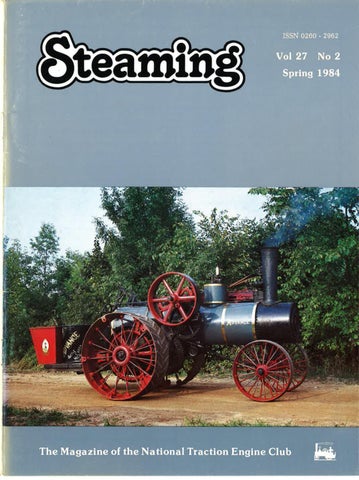
Cover Elsewhere in this issue John Toy takes us on a trip to USA's Midwest Old Settlers & Threshers Show,' here he has pictured Advance Threshing Co single cylinder engine 11495, built about 1910, at the Ithaca Show, Michigan in August 1983. Owner Dave Kemler, unusually in America, believes in lagging the boilers of his engines.
55
Rally Sub Committee As the name of this sub committee indicates, it is concerned with traction engine rallies and other events of a like nature at which traction engines will be present. Publicity for the many events being held throughout the country is one of our main concerns, so that we can bring notice of these events to as wide a section of the public as possible. To this end the Club produces a list of rallies each year. All events shown on our lists are Approved Rallies, which means the organisers have agreed to comply with the recommendations and to meet the basic safety requirements as set out in our Code of Practice. Already, this year, over seventy events have been notified and the list will be found elsewhere in this issue in The Rally List 1.984 supplement. Thus members will have early advice of the majority of rallies being held this year. Other approved rallies will be added and will be mentioned in the sun ii issue of Steaming. This year I am pleased to note that owing to cooperation between Ron Copp, rally approval official, Roger West our editor, and Tony Fookes our Public Relations Officer, a most attractive list has been printed which will serve all purposes — both in Steaming and as a hand out and postai item. Few members will realise that Tony Fookes despatches many hundreds of approved rally lists to Tourist Boards and the like each year, as indeed did George Beck before him. On the subject of rally dates may I appeal to organisers to advise us their dates at the earliest possible time. The first lists have to be in the hands of the printers by the end of November each year to get the full Tourist Board publicity. Even our own list demands a press date of early February. A telephone call will enable us to send an approval application form if you do not already have one. Whilst on the subject of publicity, I am pleased to report we attended our first Day-out Excursion Workshop organised by five Tourist Boards covering southern and eastern England, and held in London in January. A special rally list was prepared giving details of 22 events in 56
the area covered by those Boards sponsoring the Workshop. A presentation pack was prepared and handed out to the very many interested enquirers at our stand. It is probably not possible to assess the value of an appearance at an event of this type, but since very many travel journalists were present we should get some publicity from this source. All of this activity is aimed at putting our traction engine rallies on the national and even international travel and leisure scene. In February we held the Spring Rally Organisers Conference which attracted a higher than usual attendance, which is most gratifying. Delegates take part in the discussions and may interesting and valuable points are raised, several of which form the subject of discussions at future conferences. This time electrical standards and safety on the rally
field emerged as a concern of several organisers; consequently we shall look more fully into this with the assistance of technical advisers. In the afternoon we continued our series of discussions on rally organisation with an excellent paper from Derek Burdle of the Netley Marsh rally on rally field layout. Such was the interest shown that discussions went on until the late afternoon. (Eric Fillmore, chairman, Rally Sub Committee)
NTEC Sales The Club's sales stand operators will be making their usual large number of rally visits this summer, and we urge members to take full advantage
From Alan Martin's Collection
24
Many engines were either requisitioned or put into Army use in World War 1. Henry Rurden Junior & Co Ltd of Poole, Dorset, steamship owners and wharfingers, owned Burrell 8hp road locomotive 2437 of 1901, and it is pictured here about 1916 in the New Forest near Lyndhurst, Hampshire, with civilian crew and service workforce, hauling cut limber probably destined for use in the trenches in France. Obviously, from the lack of paint on the bottom part of the chimney, the engine had been worked very hard.
of their presence for buying books and other items and also, where appropriate, for renewing their membership (and introducing potential new members!). The time and effort put into the sales stands by our team benefits Club finances to a very great amount, and we take this opportunity of introducing names to put to probably familiar faces, together with, roughly, the areas generally covered. • Keith and Tracey Shakespeare (Midlands) • Sue and David Wood (North) • Ken and Edith Beeby (Midlands/ East) • Roger and Mary Newbury (South) • Chris and Mary Tatton (South West) • David Duffill and Andrea Wallace (Midlands/North) The following lists the rallies at which it is planned to have NTEC Sales stands. Reference to the rally list will provide dates and full titles and locations. April — Quorn (Ken); Abbey Hill (Roger); Quainton (Keith); Cogges (David). May — Abbotsfield (Sue); Castle Combe (Chris); Staverton (Chris); Tamworth (Keith); Frocester (David); Thurlow (Keith); Carrington (Sue); Stoke Row (Roger). June — Holton (Keith); Kettering Claybrook (Ken); Ashfield (Sue); (David); Banbury (David); Stamford (Ken). July (first two weekends) — Heading(Roger); Chiltern (David); ton A rdingley (Keith); Bromyard (Chris); Rempstone (Ken); Woodcote (Roger); Weeting (Keith); Cheadle (David); Bristol (Chris). Appearances at rallies during the remainder of the season will be published in the next issue. Whilst attending the above rallies look at the new items available on NTEC Stands this year. NTEC white metal model kits are illustrated inside this issue's front cover, and many other new goods will be available as (Tracey well as old faithfuls. Shakespeare, NTEC Sales).
wr.r.co
WARNING\V`j BEWARE OF MOVING VEHICLES ON THE RALLY FIELD
These 'Warning' and 'Caution' posters, very useful for crowd control at rallies and other events, are printed 20in x 13Y2in in red and black on white paper and available from the National Sales Officer (see address inside front cover) at 20p each, plus 75p packing and postage for any reasonable number.
Steam Apprentice Club We now have quite a number of Apprentices who are part of a regular engine crew, and we would like to extend this by asking if any engine owners would be willing to include one of our members (after a trial period) in their permanent crew, to assist with cleaning and maintenance throughout the year. Anyone interested should let me have details of where the engine is based, and who to contact so that the information can be included in our for a local Steam Newsletter Apprentice to be aware. We would also be interested to hear from any member of an Affiliated Club who would be prepared to take an active interest in a small 14-21 year old group in his/her district. Please contact me if you (and your Club) are willing. Both these methods would enable us to cover a much wider area of the British Isles than is at present possible. Contributions for inclusion in our Newsletter on any aspect of steam would be gratefully received — don't forget that apprentices traditionally learned from those practising their skills! We remind readers that our Mark Membership Secretary is Waltham, 37 Overgate Road, Swayfield, near Grantham, Lincolnshire. My own address is now Mrs Sylvia Dudley, 42 Russell Street, Woburn Sands, Buckinghamshire MK17 8NX.
Engine Owners Column Insurance and Boiler Inspection Details of important revised and alternative insurance and boiler inspection for engine owning members are covered in some depth on page 58 of this issue.
Steaming Arrangements have been made with our printers to provide a service for readers who wish to have their
copies of Steaming bound into volumes. The magazines concerned are the first three years of the larger size — Vol 24, Nos 1 to 4; Vol 25, Nos 1 to 4 and Vol 26, Nos 1 to 4. A sample binding of these twelve issues has produced a handsome book containing 600 pages, nearly as many pictures and scores of articles well worth keeping conveniently on your best bookshelf. The covers are heavy dark blue cloth boards with the spine lettered in gold with the Steaming logo and volume numbers and dates. The magazine's colour covers are, of course, retained. The price of binding the above issues is £8.00 and this includes the return postage and packing. Readers wishing to take advantage of the service should post or otherwise forward their copies of the issues detailed above (well packed to survive improper handling during transit!) to AB Printers Ltd, 33 Cannock Street, Leicester LE4 7HR, enclosing their remittance for £8.00. Please make sure the package contains a clear note of your name and address. The magazines must be received at Leicester by 21st May 1984 and will be returned to their owners about six weeks after that date.
Obituaries Walter Chilvers The Leeds & District TE Club president, Walter Chilvers, passed away at the end of January, aged 86. Walter had been associated with that Club for some 20 years, becoming president in 1970, an office which he carried out with great dignity and enthusiasm — greeting and entertaining many celebrities at the Leeds Club rallies and generally assisting to 57
advance the aims of the Club. A resident of Hambleton, near Selby, Walter was a corn and feed stuff mill owner until his retirement, and had considerable experience with the use of steam, both on road engines and on stationary plant. He was a keen sportsman and had many other interests. Because of his advancing years, he sold his well known 1902 Fowler road loco 9381 LADY BETTY a few years ago. The engine had been extensively rallied in and around Yorkshire, more lately by his friends Gordon Smith and Percy Dabbs (see Steaming, Spring 19831. In his passing, yet another link with the days gone by is lost. He will be missed by his many friends throughout the movement, hut his name and his contribution to traction engine preservation will remain with us. Our sympathy is extended to Mrs Chilvers and family. (A.O.H.)
Robert W. Seward It is with deep regret that I record the death of R.W. Seward. Known by all his friends as Bob, he died at the age of 79 on Monday, 9th January 1984. Bob was the last of the line of Sewards who lived and worked with steam. He joined his grandfather's firm of W. Seward & Son at Petersfield in 1919, and was driving engines at the age of 16 on his father's licence! Most of his time was spent driving Wallis & Steevens oilbath tractor 7258 KING OF THE ROAD, but he drove many of the firm's other engines. One of his earliest memories was sitting in the tender of their Burrell 6hp road loco 3211 THE DREADNOUGHT, outside a pub in a local village. Bob spent wally hours driving various showmans engines in the area including PRIDE OF PORTSMOUTH (Burrell 2593) and INDEPENDENCE (Fowler 9273), both belonging to Walls and, his favourite engine of all, Fowler 9393 SIR JOHN FOWLER, for James Noyce. He spent three months driving Walls Burrell tractor LITTLE SAMPSON all over the South of England. After the closure of the Sewards' business in 1938 Bob had numerous other jobs including coach driver, tending industrial boilers, projectionist at the local cinema and painter and decorator, but all through this time he never lost his great love of steam. I have spent many happy hours in his front room talking about the old days, such as his trips to London, and when he drove a railway engine in the 1926 General Strike. Together we wrote an article on SIR JOHN FOWLER which was published in Steaming 58
several issues back. A history of the firm of Sewards will hopefully be published at a later date. Many memories returned when Bob saw SIR JOHN in steam for the first time in many years at the Hollycombe Steam Fair a few years ago. Bob's advice and tales about his adventures on the road will be sadly missed by all who knew him, and our sympathies go to his wife and family. (Kevin Lockyer)
Future dates AGM 1984 The Annual General Meeting of the Club is to be held at 11.00am on Saturday, 12th May 1984, at the Midland Hotel, New Street, Birmingham. Formal notices, etc, will be distributed with this issue of the magazine.
Corrections
London Area Social Meetings The final meeting of the 1983/84 season will take place at 8.00pm on TUESDAY, 24th April 1984, at 'The Cock Tavern', Great Portland Street, London (corner of Margaret Street and adjacent to Oxford Circus). A representative of the Leighton Buzzard Light Railway Society will give an illustrated talk on their two foot gauge railway in Bedfordshire. Monthly meetings will resume in the autumn. (Bill Timmings)
We regret the editorial introduction of an error into John Trounson's article on Fowler 20066 in the last issue. The engine is described (page 8, column 2) as being a balanced crankshaft, but this was not so and in common with most single cylinder Fowlers the crankshaft was unbalanced. The editorial notes under Mr Frank Penfold's letter in the last issue erred in stating that Fowlers 1 51 66/1 51 67 were new to T. Roddis in 1919. They were, in fact, new to Charles Pickering of Pitsford, Northampton in May 1918 and sold to Roddis in 1919. We thank Esmond Kimbell for making this correction for us.
Insurance and Boiler Inspection John H irons, Insurance Officer Many engine owning members will already be aware that Tennant Budd Ltd have announced re-organisation of their arrangements for Insurance and Boiler Inspection. Their decision has caused much confusion and debate since it was first announced late last year (well beyond the press date for the Winter issue of Steaming), but we are now able to set down the facts and some alternatives for members consideration. One aspect of Tennant Budd's change which is causing a great deal of concern amongst members is that the owner can no longer choose his boiler inspector — he must have National Vulcan to do the inspection. There has been so much dissatisfaction expressed over these
new arrangements that the Club decided to seek an alternative scheme to offer to members. After studying several proposals that were put to us, we have decided to recommend the package put together by David Franklin of John Scott & Partners. Details of this scheme are appended. David Franklin is a member of the NTEC, and has sat on the Rally subcommittee for some years. He is very familiar with all the aspects of insuring of vintage equipment, as his company already handle a great deal of veteran and vintage cars, motor cycles, historic commercials and tractors and also steam engines. Their policy differs from Tennant Budd's inasmuch that an engine owner can arrange his own inspection then pass the certificate on to John Scott. They will then issue an insurance
which will be one policy and one premium. It is hoped that David will be at the forthcoming Club AGM to answer any queries that members may have. If you are interested in this alternative please contact David Franklin at John Scott & Partners, The Oast House, Park Row, Farnham, Hampshire GU9 7JH. It will be up to the engine owner to make up his own mind, which policy suits him best from either a service or financial point of view.
1. Notice to members by Tennant Budd Ltd - NTEC Insurance and Boiler Inspection Scheme Tennant Budd have to announce important changes to the Insurance and Inspection arrangements for Club members. Due to increased costs, staff changes and computerisation they find it necessary to streamline the system for the NTEC Scheme, therefore arrangements with Scottish Boiler, Ajax and New Zealand Insurance Companies have been discontinued. Prior to renewal of the Dominion NTEC Policy, each member in the Scheme will receive circulars from Tennant Budd. They will be requested to remit the sum due direct to the Dominion's Tonbridge Office, from which address all future documents and renewal reminders will be processed. Those members already inspections/insurance having arrangements with National Vulcan Engineering will similarly receive instructions to remit direct to the National Vulcan. All boiler reports will then be issued direct from the Company to the member. However, initially the position will be slightly more complicated for those members not at present with National Vulcan. The Tennant Budd circular will request members to transfer to the National Vulcan. It clearly points out that the National Vulcan includes Third Party Boiler Explosion Indemnity up to £500,000 with all automatically normal Inspections, under one annual Policy Contract. The National Vulcan have agreed to hold covered in respect of Third Party Boiler Explosion Indemnity, where a member has an existing current report from another source. This is on the inspection understanding that arrangements will be made with the National Vulcan on expiry of that current report.
The member should contact David Ramsbottom at National Vulcan (telephone 01-606 91911 giving full details of the current inspection report and advise when National Vulcan Inspection will be required. The local surveyor will then contact the member at the appropriate time. Should individuals not wish to transfer to the National Vulcan, they are asked to make their own arrangements. It is, of course, essential that any such arrangements include the requisite Third Party Boiler Explosion Indemnity. The Dominion Policy still carries the warranty that there is in force a current Boiler Inspection Report and Third Party Explosion Indemnity on each engine. It should be noted, however, that on confirmation that the Dominion and National Vulcan Policies have been renewed and the date of the current inspection report, Tennant Budd will still issue the NTEC discs thereby making sure that members are properly protected. Tennant Budd have every confidence that given time the new system that they have devised will prove to be of benefit to NTEC members. During January they have already received reports back from members praising the new procedures. (Tennant Budd Ltd)
2. Prospectus of arrangements by John Scott & Partners Ltd - NTEC Insurance and Boiler Inspection Scheme We have been specialist insurers for old vehicles for the last 20 years having run many schemes for various one make car clubs etc. With the increase in demand for this type of insurance we are supplying a simple basis of rating for steam vehicles purchased for preservation and used for pleasure purposes only. Cover meets the requirements of the NTEC Code of Practice in all respects. Cover can be Comprehensive, Third Party Fire & Theft, or Third Party Only as required. All policies will include the boiler explosion risk provided a current inspection certificate is held. Members are free to select their own boiler inspection company. Thus it will be possible to make use of the services of whichever boiler inspector is most sympathetic to members needs in each area of the country but we can arrange Boiler Inspection Contracts if necessary.
COVER COMPREHENSIVE - THIRD PARTY PARTY FIRE & THEFT - THIRD PARTY ONLY Cover excludes drivers under 21 years of age; steersmen under 21 will only be covered if accompanied by a driver who is at least 21. Only those persons entitled by the relevant law must be permitted to drive or steer the insured vehicle. Members of the Steam Apprentice Club may drive on rally fields or private ground only provided they are accompanied by a qualified driver who is at least 21 years old. The Cover meets the requirements of the NTEC Code of Practice and includes:(a) Use in traction engine rallies and road runs including static demonstrations (b) Third Party Personal Injury cover, unlimited in amount (c) Third Party Boiler Explosion unlimited in amount, subject to there being in force a current boiler inspection certificate. (d) Third Party Property Damage including Sparks and Ashes with a limit of £500,000 any one claim. le) Including towing trailers as permitted by law. (f) Including damage to roads, bridges and underground pipes up to a maximum of £2000 any one claim. If comprehensive cover is required there will be an excess of £50.00 in respect of damage to the insured vehicle up to £10,000 value and £100 for those over £10,000. Agreed values are available subject to production of either a valuation or a recent photograph of the vehicle. There is no return premium allowed on cancellation or when the vehicle is laid up during the policy year. Vehicles under long-term restoration can be covered for Fire & Theft Only at a rate of 50p per £100 value. RATES Value not Compre- Third Party Third Party exceeding £ hensive Fire & Theft only
2000 3000 5000 7000 10000 12500 15000 20000 25000 30000 35000 40000
40.00 45.00 55.00 65.00 75.00 80.00 90.00 110.00 125.00 150.00 175.00 200.00
28.00 31.50 38.50 45.50 52.50 56.00 63.00 77.00 87.50 105.00 122.50 140.00
25.00
Trailers cost £1.00 per £100 value when added to Comp or TPF&T Policy.
ISM 59
This year's Steaming Photographic Competition, detailed in recent issues of our magazine, brought forward an increased number of entries over last year. Both the total number of photographs — some 120 — and the photographers entering — 19 — were 50% up on our last competition. Judging took place in February and we are now pleased to present the winning prints and also those commended by the judges, together with comments. The judges were Alec Riddett, ARPS, head of the Department of Photography and Graphics at Loughborough College; Alan Martin, keen collector of long standing of old road steam pictures; and Dick Blenkinsop, the erstwhile editor of our magazine who has several traction engine publications to is credit. Our grateful thanks to them for their time and efforts, and also to those members who entered into the spirit of the competition by submitting prints.
1984 Steaming PWto@rapbic
First Prize
•
C niminot tinin %—/1.11 r TULA Ultirl-
60
I
Bill Love of Tonbridge, Kent
Fowler road locomotive 14754 near Headcorn, Kent in June 1982 Judges comments. The theme for the competition was 'The Spirit of the Traction Engine' and this picture is full of the atmosphere of a bygone era. It has a 1920s flavour and we can almost hear the engine's noisy approach. The vintage car is a very positive addition to the scene. I he largely blank space between the engine and the cottage is a weak point and the print perhaps could have been trimmed to square format to omit the building.
Second Prize
Jim Sarney of Flack well Heath, Buckinghamshire
Getting up steam on a wet day — Burrell road locos at Dudley, West Midlands on 15th October 1983. Judges comments. Another nicely set up reproduction of a 1920s scene. The paint and brasswork glistens superbly in the wet and smoky conditions, and proves that it is possible to make fine pictures on such dull and nasty days.
Third Prize
Jim Stevenson of Sale, Cheshire
A veling & Porter roller 5199 struggles up Daresby Hill with a leaking boiler tube at Easter 1983. Judges comments. The picture well fits the brief, with good composition and an interesting S bend to the road. However, the engine appears rather too small in the overall picture — trimming may have improved the overall impact.
Judges comments on the entries The judges were impressed by the increased appeal of the competition, reflected in the number of entries and of entrants, and also by the much higher standard of those entries compared with the last time they met. Many of the photographers had showed a lot of imagination in the composition of their pictures. That some of these had not quite come off to competition standard should not dissuade them from persevering in the coming season and trying competitions in the future. It becomes apparent that in the quest for photogenic scenes, the demonstration of ploughing engines and ei igii les of all types journeying on the road in rural areas are the most easily solved problems, both subjects giving fairly ready answers (with some pre-arrangement and thought) to the competition brief. Many of the entries featured these two subjects. More difficult to capture on film, and only thinly represented in the submissions, were threshing scenes and rally scenes; this is probably not surprising as human figures form so much more a part of these pictures, and are, of course, difficult to control and arrange in natural ways. Although the judges acknowledged these latter problems, they regretted that many of the prints entered lacked life through the absence of appropriate or natural figures in suitable places. The three judges again felt that their afternoon had been enjoyable and well spent, and hoped to meet again in
Commended
Tony Dyer of Stroud, Gloucestershire
KING CARNIVAL II by night Fowler 19783 at Stourpainc 1978. Judges comments. Although the balance is not quite right, it is a good sharp result from a difficult type of shot.
a year's time. They felt a second section for colour work could well be considered for future competitions. It is hoped it will be possible to display all the entries at the forthcoming AGM in Birmingham on 12th May 1984. Entries will be returned to their owners very soon after that date, but if any reader requires his prints returned before then, would he please contact the Editor.
Commended Clive Hollingworth of Bourne, Lincs Fowler ploughing engine 15356 pulling hard at Redhill, Notts in October 1983. Judges comments. Though technically fine and sharp, the trees in the background confuse the outline of the engine, and the relationship of the smoke to the trees is not good.
Commended Clive Hollingworth of Bourne, Lincs Ruston Proctor 35501 speeds back from Braybrooke, Northants after a lunchtime pint, October 1983. Judges comments. An aesthetically pleasing picture, which cries out for some visible exhaust from the chimney to give it life, and could have been trimmed to advantage on the right.
Bob Payne of Commended Geddington, Northants Armstrong Whitworth 10R2 climbs through the village of Wilbarston, Northants. Judges comments. A pleasant picture, carefully thought out and composed before the engine arrived. A case where the pattern formed by the overhead power lines adds rather than detracts.
R. Chalmers of Commended Little Neston, South Wirral Engines waiting to move from Whitchurch in September 1983 with the A veling roller ready to depart. Judges comments. Typical of a yard scene of years ago, with good natural looking human interest to give a focal point, though not quite sharp and a bit grainy. 63
Freddie Hollis remembers his early steam days
It was in the early 1940s that my father, already owning one threshing set, decided to purchase another to cope with the increased wartime work. From our home in the Isle of Wight he travelled one June or July to Lincolnshire, where a sale of threshing tackle was to take place. I went with him, and recall we made the journey to the advertised place by train, arriving about midday. The sale field was only some ten minutes walk from the station, and when we arrived we saw about half a dozen complete sets lined up, with the engines in steam. Looking back, I only remember two engines; one was a Dodman 6hp which my father was to purchase, and the other a Fowell three speed, which I had hoped he would buy. As well as the Dodman engine, father purchased a Clayton & Shuttleworth threshing machine to go with her. When the business was concluded we again repaired to the station for our return journey, getting as far as London that evening and spending the night there, it being impossible to finish the journey to the Isle of Wight that day. As a young man I was all agog to see the engine and drum arrive on the farm, and when some weeks later a message came through that the machinery had been landed at Cowes, my excitement reached peak proportions. An experienced driver was 64
co-opted, and he and I were taken to the quay where the engine stood, complete with her threshing machine. When we arrived we found the chimney laid beside her and the boiler empty. The chimney was soon replaced and we filled the boiler with a length of hosepipe we had taken for the purpose, connected to a nearby tap in a helpful lady's house. The engine steamed quickly and when the spear on the gauge had left its perch, the driver with me announced "we will move her ma-et just as zoon as she has enough steam to git 'er rond. Be-en a strange injun like, we do-ant want to git 'er assbackards in the water". Beautifully, and in a very docile manner she was manoeuvred round and hitched up to the drum. A merchant delivered some coal and the bunker was filled; all was ready for the 14 mile journey home. All went well until we approached Newport — then all the packing blew out of the valve gland. Fortunately we were not far from a local firm of agricultural engineers, who in those days kept things like gland packing on their shelves. A fitter came out with a coil of the stuff in his hand, and while
we drew water from a neighbouring stream he replaced the missing packing and off we went. Good progress was made until we came to a steep hill which had to be negotiated before we could reach home. The steam gauge was only showing 501bs yet we were chuffing along quite nicely. "Better hold on a bit ma-et", said the old driver to me on the wheel, "doant know as the wold dooman will git up there wi' only 50 pound showen". We needn't have worried however, as I was to find subsequently that the gauge was about 501bs slow. Also the safety valves had been wrongly adjusted and blew off at about 50 pounds too high! In those days things like that happened. At sunset we steamed into the rickyard at my father's farm, and pulled alongside a rick that was ready for threshing. It was harvest time and a rick had been erected purposely for the trial run of the threshing set. The old driver was supposed to come the next day to give me tuition but I was to light up early. However, when the next morning came and I had raised steam, he failed to appear so I had to put on the driving belt (she had been set the evening before) and get on with it. As I have mentioned before, the Dodman was an easy engine to
Freddie Hollis with Dodman 2076, hard at work at the Hollis' Limerston Farm, Isle of Wight, sometime about 1943. (collection F. Hollis)
steam, and I performed my duties on this first day without any troubles. Perhaps I should add that I was not quite new to it, having helped on other engines before, and also having kept steam on the Burrell showmans tractor ISLAND QUEEN at a local fair when they were short-handed during those wartime days. But I had never moved an engine under steam, and next day after the rick was threshed out I had to commence the round which was booked up to me during the autumn and winter. Cautiously I engaged gear and moved the engine. I found it simpler than I thought. I took my time and connected up to the drum. With the man who was to go 'mate' with me we moved down through the rickyard and out on the highway. I was under 21, but there was a war on. Nobody was going to question my inexperience, or my age. Get on with production was the cry, and farmers were, in those days, held in high esteem. After all, were they not the men who were going to feed the nation and frustrate Hitler's U-boat tactics? Successfully, we moved to the first farm on the list, and threshed out their immediate requirements. Soon I was able to gain much experience, and could handle the tackle with something like the finesse demanded. As winter approached conditions deteriorated. Instead of hard dry ground we encountered soft slippery slopes. At this time, the ricks, with the wartime production, were not all situated on hard ground, and were built in all sorts of inaccessible places. Farmers were also instructed by the Ministry of Agriculture to spread out their stacks so as not to make such a fire risk if there were enemy bombs. All this was bad news for the steam engines. Our old Dodman had about six spuds all told on her rack. The best that could be done was to put three on each wheel. She would then slide on one wheel until the first spud hit the ground. Then that wheel would stop, awaiting the compensating gear to bring the other wheel to the same position. A bark or two would then issue forth (which was glorious to hear) and the front wheels would rise about two feet off the ground. The engine would then jump ahead about two yards until the engaging spuds had left the ground — a further slipping until the next pair of spuds bit, and off again for another couple of yards. By this means we could get the engine to the position, run out the wire and work the drum up to the rick. It was then the real fun would begin, to get the engine lined up and
level. By this time farmers had their own tractors at many farms. They used to say to me "we will haul the machine to the site and when in place, we could put the tractor on to drive. It will save you the difficulty of setting the engine". This of course meant the loss of half the revenue as far as my father was concerned, and he didn't take kindly to such talk. To me it meant disgrace for steam, and I never took kindly to that either. But it was the beginning of the writing on the wall for steam. On some farms they had American Caterpillar tractors — these could of course get the threshing machine almost anywhere, and they made the steam engine appear very obsolete. We soldiered on, however, for a year or two more, finding all sorts of troubles and also doing some grand work. Coal could become a problem. Good Welsh steam coal was not always available. We could arrive at a farm and find the farmer had been delivered anthracite. To steam on this was impossible. The gauge would creep back and finally one had to stop. This happened on one farm where a farmer of a particularly 'crusty' nature reigned. He was really a dairy farmer and very successful at that enterprise he had been, but the war had forced him to plough some meadows and subsequently he had ricks to thresh. The coal he had got in was useless; what to do I knew not. I got through the first day by judiciously mixing his coal with what I had in the tender from the place before. The second morning disaster occurred and by 10am I was stopped. The crusty old gentleman came on the site. "What's the meaning of this?" he demanded of me. "Why are you stopped, you're wasting all the men's time, and mine as well". "I cannot steam on the coal you have provided" I replied. "There's nothing wrong with the coal, it's the engine, the old thing is worn out", he said. To hear my beloved Dodman criticised in this manner cut me to the quick. I knew that there was nothing wrong with her. On the farm preceding this one she had run beautifully. We had threshed two bays of a Dutch barn with not the slightest hint of trouble. My heart rebelled; I knew that both the engine and I were being unjustly accused. The whole thing was most unfair. My tormentor looked at me with impatience. "Well, what are you going to do". he asked, "either you get on, or you get out". I took a hard look at the farmer. He was a man who, all his life, had expected, and made, men to jump
when he shouted. By now I had reached that point in life when I was as smart as I was going to get. I knew it was pointless to try to reason with him. But here was one who would not jump at his command, this time at least. "You leave me no option" I announced. "I get out as soon as I have steam to go". Without waiting for an answer I slipped the belt off, rolled it up, and began knocking the chocks out round the machine. After a little while I moved the machine out onto the highroad. Later on I was able to creep back home, leaving half a rick of wheat unthreshed. It was the only place I ever had a word out of square with any of the farmers I worked for, in all the eight years I had on the road with the tackle. Looking back now, I see where we were wrong. The custom was for each customer to provide coal for the engine. They had no idea in many cases what steam coal was. My father should have supplied the coal and charged for it. He could have become a coal merchant in a small way as well as a threshing contractor. Along with a small profit on the coal he would have avoided the aggravation of lost time. The internal combustion engined tractor was by then well established and they suffered nothing, even in those dark war days, by inferior fuel. The farmers saw the tractor's advantage — they need no minding, no water carting and their fuel was readily available on every farm where tractors were in use. Steam was definitely at a disadvantage. It was all the steam engine could to hold her own without the troubles with fuel. One other, now amusing, incident comes to my mind, although it was far from amusing at the time. My mate and I were descending a hill quite close to Parkhurst Prison. Before I go any further I must explain that the Dodman was a three shaft engine — her gears were engaged at the end of the crankshaft like a Burrell, the two levers were kept in place by a small pin on each one. We were not too far, as it turned out, from the bottom of the hill when one of the small pins must have jumped out, for the gear slid along the shaft and we were out of cog. Away we went, gaining speed in a manner I would never have thought possible. Fortunately for us a clear road was ahead and a slow rise in front. On meeting this we gradually came to a halt, and when we did, quickly jumped down and put a chock under the wheel. It was a scare, and it could have been worse. There was no traffic near at the time, and as far as I can remember, no-one saw the incident. 65
My mate, a man much older than I, and of a rather nervous disposition, was clearly shaken. 'Better tie that bloody pin in in the future" he announced, "or else we shall be worse ott than that lot o' b... in there" — nodding his head towards the prison, where presumably he referred to those guests of His Majesty who resided there. I needed no second bidding. The awful consequences of what might have been, had the pin come out as we were descending a hill into the town of Newport, half a mile on, were enough to scare the pants off the most unshakeable driver. I'm pleased to say no such incident ever happened again, but to this day I remember the affair and when driving a strange engine always check if it is possible for the gears, somehow or other, to disengage themselves. Before concluding this little account of these early experiences, perhaps I should say a few words about the Dodman engine, seeing they were one of the lesser known makes, and only a few were built. As far as I know there is not one left today. They were built by A. Dodman & Co. of Kings Lynn, Norfolk. As mentioned, the one we had was a three shaft engine, and had a single cylinder of 6nhp. The compensating gear was on the second motion shaft, and Llre drive was Laken to the axle by two large spur wheels, one on either side. Alfred Dodman put plenty of brass on his engines, and as well as brass hubs she had a beautiful solid brass pump which was situated at the side of the footplate. On her safety valves was a long brass cowtail extending back quite a distance. It was easy to give this a tap with one's hand if the valves failed to stop blowing, as they sometimes did. She was an excellent steamer and the quickest engine I have ever put a fire in to raise steam. On a summer's morning, if she had been in steam the day before it was possible to turn her over in twenty minutes from lighting the fire. She was a slow engine on the road and would break no records in that respect; but a very quiet and excellent runner. On her front axle was painted the name EDNA, and that is all I remember concerning her identification. Her number etc. I have long since forgotten, but we had an idea she was built in 1912. What became of her? Well, it is a sad story. After a few years, her tithes started to leak. A local firm of engineers was asked to give an estimate to retubc her. The answer came back — £40. Father looked at the estimate. "Ah" he said, "I'm 66
The same occasion at Limerston, with the Dodman forming an appropriate backdrop for the threshing gang, including one land girl and two dogs. Mr Hollis, senior, is standing left wearing the white collar. Of the twelve people pictured, only four are alive today — even the rookery and the elm trees in the background have succumbed to Dutch elm disease. (collection F. Hollis)
afraid steam is finished, it will never pay to spend all that money on her". So the old lady stood in the rickyard for another year. One day my father came out of the house and said to me "I'm going to make you a present of that old engine. You were her driver, you can do what you like with her". I accepted gladly and I looked at her for several months. I contemplated having the tubes put in myseif, but then, what tor, I asked myself. What would she do if I did? There was no preservation movement in those days. I was a young man trying to make my way in the world. Engines were being sold as scrap for about £25 apiece. I decided to dismantle her, so I took her to pieces, carefully putting all the brass aside. Then I cut up the boiler. The sum total I received for the lot was £40. When my father purchased her at Sutton Bridge he gave £45 for her, so I felt I had done well. Only a few more years were to pass before the Appleford race occurred which set the ball rolling. My mistake soon became known to me. There was not another Dodman left in the country. Mine would have been unique. What would she have been worth? The immensity of my crime came back home to me. I have never forgotten the foul deed. To the reader I appeal for forgiveness, I hope he will
try to see those far off days. When I received that £40 forty years ago I had the sum of about 16 weeks wages for a farm worker. In today's currency that represents a sum of £1280. To a young man with no money it was an opportunity to be grasped. There is only one thing I can say to myself in comfort. In the Isle of Wight only one engine is left which did her work here. All the others are cut up and gone. Now we have 12 engines steamable on our island, and eleven of these have been 'imported' from England by our enthusiasts. So it can be seen the spirit of steam lives on in our little island. To make restitution for my sacrilege I can say that I have restored three engines from derelict condition, and paved the way for some other enthusiasts to do two others. All the same I shall never forget the Dodman. She was my first engine and the best. Kindness and gentleness were her attributes, and she was a beautiful steamer. I have often wondered why Alfred Dodman made so few. If all the others he made were as good as EDNA he should have distributed them all over England. It was a very small family firm, and since those wartime days I have visited their works in Kings Lynn, but I could not gain a lot of information. Today, it has closed. Perhaps the
Dodmans put that special hand-made workmanship into their engines and had no wish to expand, much as there are small specialised car makers today. I don't know; all I do know is I would have liked to have my time over again, and then I would have preserved poor old EDNA and today have been pleased to place her beside the best of the Burrells or the Fowlers — she could have beaten them all. Should any reader have information concerning the Alfred Dodman history, or their engines, I should be delighted to hear about it, as would, I am sure, any other enthusiast. (Yet again we are grateful to Alan Duke for providing from his records, engine details long forgotten by a machine's former owner. EDNA was Alfred Dodman's number 2076, but since none of the firm's records have survived, the date of building cannot be confirmed. At the time the engine was required to be registered for road use in the early twenties, the mark D02119 was allocated. John Portass of Sutton Bank, Lincolnshire, owned the engine about that time but by January 1942 the license was held by George Portass of Sutton Bridge — presumably a son or relative. According to some surviving
insurance records of the National Traction Engine Owners & Users Association the latter insured the Dodman in January 1942 and again a year later, but then surrendered the policy for a refund in February 1943, presumably having ceased to use the engine. County licensing records show the engine was last taxed by F.F. Horns of Limerston Farm, Brightstone, near Newport, Isle of Wight in December 1944.)
'A Nineteen-ton Load. I have been driving a five-ton Foden wagon for eight months. I was in Antwerp and Ostend, also in Locarne, Kanel and Ypres. The machine I had charge of has had frequently as much as 19 tons to haul, When I write 19 tons, I expect you will hardly believe so great a weight, but this is quite true. It has been pulling a six-in. gun, the total weight of which is 14 tons, and my wagon has also had five tons of shell on board.' (From 'Despatches', a Service driver's column in Commercial Motor, 6th January 1916.1
Steamship Appeal Early next year one of the country's last steamships will be withdrawn from service. Royal Maritime Auxiliary Ship ST. MARGARETS is a cable laying/repair ship of some 1200 tons, with a 30 ton lifting capacity. Built of riveted construction in 1944 on Tyneside by Swan Hunter, the ship is completely steam powered, having two main triple expansion engines of 700hp each by Bellis & Morcom, with Babcock oil-fired boilers. All the auxiliaries are steam powered; the fittings and controls are all copper and brass and the whole ship bristles with quality hardwood fittings and finishes. The number of screw driven, reciprocating engined ships of any size remaining in service around the British Isles is very small and Paul Johnson believes it would be tragic to see the ship scrapped. He asks that any reader who feels able to do anything positive to try to save ST MARGARETS from the scrapman, and to assist him in establishing a group for its preservation should contact him — Paul F. Johnson, 12 Merrivale Road, Honicknowle, Plymouth, Devon PL5 3SH (Tel 0548-6305 (day) or 0752-779580 (evenings).
IMPORTANT INFORMATION FOR THOSE NEEDING ECONOMICAL REPAIRS ON THEIR TRACTION ENGINES
PINIONS
SPURS 4) BEVELS
All types and makes of bevel gears, spur pinions, spur wheels, helical gears etc, rebuilt to standard.
B. 8, C. Reconditioning (Gears) Ltd Unit 7, Lower Ardglen Estate, Evingar Road, Whitchurch, Hampshire RG28 7BB. Telephone: Whitchurch 3701
67
Other's Preservation Projects The two recently started preservation projects described here will make interesting ports of call for travellers during the coming summer, and, for engine owners, display a nice contrast in problems of restoration and operation The governor to the Mill Meece Ashton Frost engine. (Barry Job)
1. Water for the Potteries
Barry Job Outbreaks of cholera and typhoid were common during the first half of the last century. Appreciating the importance of wholesome drinking water the Royal Commission of 1844 urged local authorities 'to procure sufficient supplies of water for all domestic, public and sanitary purposes'. The following year the Staffordshire Potteries Water Doard was formed to supply the rapidly expanding pottery towns. They obtained supplies throughout the area but could hardly meet the demand and in 1910 trial boreholes were put down at Mill Meece, near Stafford. They were fortunate; a geological fault brought the waterbearing Bunter Pebble Beds and Sandstones close to the surface. Two years later construction began on a pumping station which would eventually raise three million gallons of water per day. An attractive brick built engine house was designed for two horizontal tandem compound steam engines. The first, supplied by Ashton Frost of Blackburn, was not commissioned until 1919 because of World War 1. By 1926 the second engine was required, but as Ashton Frost had gone out of business the contract went out to tender, and was won by Hathorn, Davey of Leeds. Both 68
engines are very similar except for the second having slightly larger cylinders. On full load they burnt 35 tons of rough slack per week. From four boreholes they raised water 120 feet to receiver tanks beneath each engine. Double acting ram pumps forced the water from the tanks to a reservoir on the nearby Hanchurch Hills from where it gravitated down to the local towns. In 1937 the borehole pumps of the Ashton Frost engine were replaced by electrically driven centrifugal pumps although the engine remained in place and continued to be supplied with steam. During 1978 it was decided to replace all the existing borehole pumps vviLli multi stage submersible pumps thus rendering the Hathorn Davey engine obsolete. A preservation society was formed to take over when the engines were finally taken out of commission. The Severn Trent Water Authority, who had superceded the old Potteries Water Board, were very keen to see their engines preserved and gave the society every encouragement. Two years later the society was transformed into a Preservation Trust and they now lease the site from the Authority. Dimensional details of the engines are: Cylinders: 26in high pressure + 49in low pressure bore x 60in stroke (Ashton Frost engine). 27in high pressure + 52in low pressure bore x 60in stroke (Hathorn, Davey engine). Working speed: 17rpm Fly wheels: 19ft 6in diameter, 311/2 tons weight Valve gear: Corliss single port
Boilers: three Lancashires, one by Galloway, Manchester and two by Danks, Dudley. Further details from David Baddeley, 10 Avon Close, Stafford. (Tel: Stafford 53734). The site is open to the public every Sunday afternoon, with the engines in steam once a month from April to October. The pumping station is sited between the Stafford to Crewe railway line and the A519 road between Eccleshall and Newcastle-under-Lyme (Grid ref SJ83133.9).
2. Worsted Spinning in East Devon
Neil Trevithick Coldharbour Mill is situated at Uffculme, a village in the Culm Valley, midway between Exeter and Taunton. In 1797 Thomas Fox, a Quaker woollen manufacturer, purchased the mill and developed the production of serge, flannel and, later, worsted yarn. This business lasted until 1981 when the effects of the present recession caused the closure of the factory. The mill and its contents had altered little during this century and its potential as a working museum were readily recognised; thus plans were formed which are now gradually coming to fruition. Large sections of the spinning and weaving floors with their historic machines and processes on view were opened to the public in
The Ashton Frost horizontal tandem compound pumping engine at Mill Meece. (Barry Job)
July 1982, and just before Christmas 1983 came another milestone — after eight months of work by a small team funded by a grant from the Manpower Services Commission and local volunteers, the steaming of the mill's 1910 built mill engine, which worked the lineshafting on five floors by a rope drive from its flywheel. Friday, 16th December, saw frenzied early morning activity — the day was to be the climax of the work on restoring and re-certification of the Lancashire boiler, and stripping and preparing the 300hp horizontal cross
compound engine built by Pollit & Wigzell of Sowerby Bridge in West Yorkshire. Over 70 guests were to witness the first official steaming since the museum was formed, with Rev Michael Pollit, a direct descendant of the engine's maker, opening the main stop valve to set the mill in motion. The Galloway built boiler — 30ft long by 8ft diameter and holding 4500 gallons — is fired on a mixture of coal and wood. To attain working pressure by 10.00am we had fired all the previous day, banking down at
General view of the Pollit & Wigzell cross compound engine at Coldharbour Mill, showing the cotton rope drive from the flywheel to the mill floors above. (Spex)
6.00pm with 301bs on the gauge; by morning it was back to zero but pressure quickly rises as the water is still almost boiling. Warming up engines the size of ours is vital and we open all drains and blow through for at least 15 minutes before attempting to start. At the rear of the engine is a small barring engine which can be engaged with the main flywheel, so turning over the cranks to the correct position for starting. Due to friction imposed by the rope race drive from the flywheel to the lineshafting, a relatively high pressure of 401bs is needed to start, but once running the engine will keep turning down to about 8lbs! Our guests were trustees and friends of the mill, steam volunteers and, happily, some of the men who ran the engine before Fox Bros closed the mill. At 11.00am, after a short speech, Rev Pollit opened the steam valve and the engine came alive, the rope race began to move and a spontaneous cheer went up from the assembled group. The engine was run for the whole of the following week until Christmas and the total fuel consumption ran to 10 tons of wood and 3 tons of coal. There are still problems to be sorted out — not least the governor valve timing, which due to the engine being run at a much lower speed requires considerable adjustment. Dimensional details of the engines are: Cylinders: 14 in in high pressure + 271n low pressure bore x 42in stroke. Working speed: 90rpm at 100lbs pressure 1300hp); now 30rpm at 40Ibs. Flywheel: 13ft diameter with thirteen 1 Ain diameter cotton ropes to drive mill. Valve gear: drop valves actuated by eccentrics driven by skew gearing off crankshaft. (The last drop valve engine built by Pollit & Wigzell) Cost when new: £1810 Boilers: two Lancashire types by Galloway, 1889 and 1910; the latter cost £523.5s.3d. Coldharbour Mill steams on the third Sunday afternoon of each month during the winter period. During the summer steamings will be more frequent and should include Bank Holidays, but to avoid disappointment, please ring before travelling — telephone Craddock 40960. Uffculme is five minutes from the M5 motorway, junction 27. A number of other steam engines and pumps are on view, as well, of course, as the Museum itself for all the family's interest. Currently on loan from Fred Britton is McLaren traction engine 548 Mil of 1894. 69
Joe Thomas
On Sentinels THE STEAM TRACTORS Part 4 (continued from page 19 of the Winter 1983/1984 issue)
Having discussed in the last part the various Sentinel timber tractors that were built up to the end of the steam era, we must now return to the tractor intended largely for use in road haulage. I can now add some further detail (from Sentinel trade literature of the 1920s) of the early single speed example produced for the Teignmouth Quay Co Ltd. This was a large rear wheeled Super model, delivered in Autumn 1924 for the purpose of shunting railway wagons between the Great Western Railway and the various harbour quays. It replaced a petrol driven tractor and was found to be capable of doing more work in two hours than the latter could do in a whole day. The comparative saving in fuel and oil more than covered its cost of £1,030 within 18 months. The engine was used on the same duties into the 1960s and is now, happily, preserved. Several local authorities took examples of the earlier models, and the road surveyor to Deeside District Committee of the Aberdeen County Council recommended that the committee's 43 year old traction engine be scrapped (it had cost over £300 in repairs the previous year) and that it and its heavy traction wagons be replaced by a Sentinel tractor with either two, or preferably four, Sentinel three-way tipping trailers. The advice was accepted and Sentinel 6634 was duly delivered — a single geared Super on solids with large rear wheels.
Road haulage tractors In March 1925 the Shrewsbury works delivered to R. Silcock of Liverpool a new design of tractor intended solely for road haulage. 70
Numbered 6008 the machine was a single geared Super and was provided with three Sentinel built trailers. It started a familiar Liverpool practice of using Sentinel tractors shuttling between dockside and warehouse with a set of trailers, which was to last until the early 1960s. The tractor had smaller rubber-tyred iron wheels than those built for general purpose work up to then and had a neat casing over the rear of the chassis as well as the current cab with windscreens and doors. Silcocks used 6008 on a short haul of 1 1/2 miles from the docks to their mills or warehouses. Three trailers were used — one loading, one unloading and one in transit, and sometimes there were two trailers in each of these situations. Some 750,000 tons of
cattle food passed through the mills of J. Bibby & Sons, Criddle & Co, and R. Silcock & Sons every year, so one can imagine the amount of haulage done in a relatively small dock area. In 1927 the price of a Sentinel road tractor was quoted as £795; its weight with coal and water, 7 1/2 tons. The popularity of the trailer system in Liverpool was some years in the future, as will be described, and it was some two years before a further road haulage tractor was built in March 1927 — 6842 for Simmons Hunt & Montgomery at Liverpool. The machine served its original owners until the 1950s and then carried on in other ownership into the sixties before, appropriately, being acquired for preservation by Merseyside County Museums. At this time Sentinel appear to have started calling these road tractors 'Special 10/12 tonners'. 6917 was announced in Sentinel Transport News in June 1927 as 'a new high speed model' but I cannot trace what mechanical differences, if any, it had from 6008 or 6842,' By early 1928 when the next Specials were delivered the DG engine and boiler was standard in the Sentinel wagon, and three examples (7332/7333/7334) were so equipped when delivered to a Suirey firm of lightermen and haulage contractors.
Sentinel 6008 of 1925 was the first of the Special 10/12 tun models intended for use with a number of trailers, one or more being loaded/ unloaded whilst another was being moved. This picture shows the tractor at Sentinel's depot in Liverpool atter overhaul and repainting for new owners Simmonds, Hunt & Montgomery, to be used on further Liverpool dock work. (collection J.L. Thomas)
They were, however, still single geared, presumably reflecting a fairly local use and short distance hauls. It would be interesting to know the exact job on which the long Sentinel built trailers were used. The final example of the half dozen or so known 10/12 tonners was 7527, taken in August 1928 by a Middlesex firm. The 1932 Salter report on road transport found heavily against the then existing trends in road haulage. The report's recommendations resulted in the 1933 Road & Rail Traffic Act incorporating huge increases in road fund tax for heavier commercial vehicles, and this resulted in many steam wagons throughout the country being taken off the road, especially those with solid tyres. Many owners found it worthwhile to equip their older steam vehicles with pneumatic tyres, thus avoiding the highest of the taxes in the new Act. All of the 10/12 tonners had been built with solid tyred wheels and three, 6008, 6842 and 7527, ended up reshod with pneumatics on Liverpool dock work (7332 and 7334 also acquired pneumatics). Many DG type wagons worked around that city on similar duties until the 1960s, having had their chassis shortened by varying amounts to make them into tractors.
The S4 Models The previous parts of these articles have described a wide variety of Sentinel tractors but they all had two things in common — they were chain driven and had two cylinder high pressure engines. I now describe the S4 models in which a 4 cylinder engine drove the rear axle with a shaft drive, nowadays of course accepted as the conventional means on diesel lorries, but which in 1933 was an innovation. A single-acting engine was adopted for the new model 'S' steam wagons in preference to the two cylinder double-acting type previously employed. It was simpler, better balanced and ran more smoothly and quietly over a very much greater range of speed. As an instance of the capabilities of a wagon so fitted, the writer drove in 1977 one of these 'S' model 6 ton wagons from Bristol to Shropshire for its owner. The latter
The final 10/12 tonner, 7527 of 1928, at Tate & Lyles in July 1950 — rebuilt with pneumatics, and then owned by Geo Davies & Son Ltd and still with ten more years use left in her. She survives in preservation. (C.A. Appleton)
A typical dock road scene in Liverpool taken in June 1950. Be/ow the girders of the overhead railway, a horse cautiously eyes the photographers attention to Sentinel 6842 of 1927 and its trailer, owned at the time by Simmonds, Hunt & Montgomery of the Albion Coke Mills. (C.A. Appleton)
C
ima m . am ion I
' 7110 4,,
..
um. re SKIP ': !;4:1, itl Nes
\_ •••••
it IIIMMSN 1 27
a Siliktg 41:;* . _ _Ix ___ .1, .' A,
0
w.BEr
i........... . e
II t ,s...-i„i, _
Sentinel 7332 was delivered in March 1928 to C.W. Beckett, lighterman of Kingston-on-Thames, together with the large steel trailer. (collection J.L. Thomas)
was following behind in his car and said the vehicle was cruising for mile after mile at 40 mph, in fact touched 50 mph in places; we were carrying a good load of coal and 200 gallons of extra water in a tank. The advanced design of the new engine enabled it to produce 120 bhp, yet it was of iemaikably light weight and gave an extremely even torque with a steam consumption of only 14 Ihs per hour. The accessibility too was quite unique, the whole 'line of parts' could be quickly withdrawn and replaced. The four cylinder single acting engine was a glandless one, 5 1/2 in bore x 6in stroke with a trunk type of piston in place of the usual (in those days) piston, piston rod and crosshead; and it elimiiia Led the use of glands and piston rod packing. The engine was disposed axially in the frame with an accurately balanced crankshaft; it was pressure lubricated to the main crankshaft journals and through hollow connecting rods to the gudgeon pins. The trunk type pistons were provided with four pressure rings and a special oil scraper ring on the skirt. Ports were provided in the lower wall of each cylinder and were connected to a pipe to carry off any condensate which may have passed the rings and which otherwise would have entered the crankcase and
Sentinel S4 tractor 9039 pictured before delivery to Salisbury, Rhodesia. (collection J.L. Thomas) 72
Another 1950 dock road picture, this time of Simmonds, Hunt & Montgomery's Sentinel 5558 of 1924 (PD 1854), a tractor cut down from a Super wagon. It is now in preservation. (C.A. Appleton)
diluted the lubricating oil. Transmission was through a carden shaft of large diameter to the rear axle. The three quarter floating rear axle consisted of a single forging of the pot type with double reduction gear comprising a spiral bevel drive to layshaft and thence to differential by double helical gears. Detachable and interchangeable wheels identical to those in use on the
S model wagons wore used with the same 38in x 8in tyres, twin at the rear and single in front. Two independent sets of brake shoes of ample bearing surface were fitted, one set applied by hand through a ratchet lever, the other, the steam power brakes, being controlled by a pedal placed conveniently to the driver's foot. The boiler was the well-known
Sentinel economy type with fewer and larger water tubes than before and double superheater coils which provided a uniform degree of superheat both at high and low outputs whilst the larger water tubes rendered this boiler much less liable to formation of scale. A comfortable roomy cab of the saloon type was fitted with safety glass windows and windscreen with electric wiper, and ample ventilation was provided. The feed water tanks were situated one on each side of the boiler which was at the rear of the cab; they were behind the driver's and mate's seats and had a total capacity of 165 gallons, sufficient for a normal run of 40 to 60 miles. The coal bunkers were filled through hatches in the cab roof with apertures conveniently placed at their lower ends far hand firing the boiler. They were fitted above the water tanks and had a combined capacity of
OUR MAGAZINE 25 YEARS AGO
The April 1959 issue announced NTEC run rallies at Appleford and Crystal Palace, London (free admission to members) and a jointly held one at North Weald, Essex. The Hon Sec expressed his worries on engine attendances at rallies resulting from the new boiler inspection rules, but
Another illustration of 9039 at work in Rhodesia in 1935. Even if the sacks are only filled with peanuts, the weight of the six loaded trailers would have been quite something for the engine to tackle on the poor roads. (collection J.L. Thomas)
61/2 cwts, sufficient for 150 to 180 miles running. The throttle was foot operated and had a shut down valve on the steam chest. The brake lever, gear change and camshaft control levers together with the sump by-pass lever, were placed conveniently to the driver, whose bucket seat was placed forward of the boiler and in a position to give an absolutely uninterrupted view of the road. The first S4 tractor was number 8956. It was exported to France in February 1934 to the order of Monsieur Charvet of Lyons (possibly an agent). Its eventual owner and purpose are not known but an illustration in Sentinel Transport News for May 1934 shows the vehicle with
various shipping instructions on the cabside, including the name and address of a Paris customs agent and the legend 'via Harwich Train ferry, for Lyons Show'. The cab is a double length crew cab with two doors each side and the short sided body overhangs the rear mudguards by two or three feet. It would be interesting to know more of the tractor's history. The second example 9039 went to George Elcombe Ltd in Salisbury, Rhodesia in May 1934. There it was used for haulage of ground nuts or peanuts in a number of trailers behind the drawbar. Three final examples went out to South Africa in March and April 1937, to an unrecorded customer.
three other organizations had decided to apply the same rules. Advertised for sale were Burrell 5hp traction engine 4055, in excellent mechanical condition, at £175 and a Clayton & Shuttleworth single, in fair working order at £40. Charles Gregory, in Cornwall, reported his Burrell 2662 had developed firebox trouble — it was 51 years old and thought not advisable to consider repair — but he emphasised the engine would not be cut up or robbed for spares for other engines. Mr Gregory made no comment as to whether he secretly hoped the time would come when new fireboxes would be considered by preservationists.
'Traction engines have lately been attracting considerable notice in London. The London County Council have not yet promulgated any byelaws affecting them and therefore the whole of the County of London ... is open to traction engine traffic. This is of great assistance to the construction of the tube railways who largely use traction engines for the disposal of the excavated soil. One engaged on this work has, however, been the cause of three accidents. Traction engine owners should endeavour to use their engines at such times and on such roads as would cause the least inconvenience to other traffic.' (From The Machinery Users Journal, April 1903.) 73
.4.‘
Nts/ r‘ Pite"
oTainting engines Ron Chalmers Compared with the attention given to steam railway engines, traction engines are virtually ignored by artists. Railway engines, of course, can't stray from well defined routes and they run to timetables — traction engines are more elusive beasts, and so a major part of the artist's task is simply that of finding suitable traction engines to paint. They can be found in copious quantities at steam rallies, but this is not their natural habitat. Road locomotives and rollers belong on roads; tractors and ploughing engines are best set against an agricultural background. A moving engine does not allow an artist time to produce anything other than a vague sketch, and since steam enthusiasts are very particular about technical details, it is usually more convenient to work from photographic material in the studio, rather than drawing or painting nn site Dick Blenkinsop's article 'Photographing the Traction Engine' (Steaming, Summer 1983) is therefore a useful starting point for anyone who fancies him or herself as a steam engine artist. Finding engines in the right place, as Dick suggests, is a combination of luck, local knowledge and contact with the owners. Owners are
The author at work in his studio, which is nothing more than a dining room table. The painting is an illustration of a Wallis, using gouache. This is an opaque watercolour particularly suitable for highly detailed paintings. This style of painting, however, lacks atmosphere. The magnifying glass is used to pick out small details from the photograph, and to aid the painting of fine details. 74
Invariably helpful, although they can be a bit vague as to exact times of a journey) I have got used to long waits at the roadside and in farmyards. The increasing tendency to transport engines to rallies on low-loaders does not help the photographer or the artist. I find it best that pictures are not painted from colour photographs, it is much better to work from black and white. However, a duplicate colour photograph is helpful as a record of the engine's livery. I carry two small 35mm automatic cameras — one loaded with colour film, the other with black and white. Artists should only work from their own photographs, particularly if they are planning to exhibit their work, otherwise the picture is not strictly original. Most art societies have this
An oil by the author of a Burrell tractor, produced from photographs taken at a rally. Steam rallies are not the best places to gather photographic material for paintings, because the finished picture tends to look unnatural. Figures in paintings are important, for they allow the viewer to subconsciously judge the size of a machine. Smoke and slearri are not easy to paint the smoke in this painting is too heavy.
written into their exhibition rules. Watercolour is the simplest and cheapest medium for the beginner, and all the necessary materials can be found in large stationery shops, such as W.H. Smiths; namely a pad of watercolour paper, soft pencils, a rubber, two brushes (large and small), plastic palette, and a few tubes of paint. A common mistake made by amateurs is to use too wide a range of colour, so try to restrict yourself to say just three tubes of paint, for example: burnt sienna, ultramarine blue and yellow ochre. Mixing the sienna with blue will give a blue-grey for smoke boxes and chimneys, blue and ochre gives a soft green, and the sienna is red enough for the familiar red paintwork on an engine. Before starting to paint, it is essential to have a reasonable drawing. You may have been told at school not to use a ruler for art work, but forget that old-fashioned bit of advice, there are just too many straight edges in traction engines for most people to manage freehand. Once you are satisfied with your drawing, the sky and background can be washed in with fairly dilute paint. For the engine itself colour washes can be used, but I generally prefer to put the paint on fairly thickly to give a better impression of solidity. Comparing your efforts with other artists is a helpful exercise, but since there are few professionals working with traction engines, it is not easy to find examples to look at. However, I can recommend David Weston's book
Beware of Trains (your library may have a copy, or it will get it for you for a small reservation fee). Although this book contains no traction engines, David Weston's railway paintings demonstrate how dramatic atmospheres may be achieved by a careful choice of colours. He is also an expert at capturing the emphemeral qualities of smoke and steam. Finally, don't expect your first effort to be a steam Mona Lisa. Practice makes perfect.
A watercolour of a Burrell road locomotive, nearing completion. The original photograph was taken at a rally, just after the Burrell had left the line of stationary engines to take part in a parade. By substituting a new background a convincing picture of a Burrell on the road has been achieved. Note the small amount of equipment that is being used; the sheet of paper to the right of the painting is for testing colour mixes before applying them to the picture.
Great Amwell TRACTION ENGINE RALLY, near WARE HERTFORDSHIRE 30 engines; vintage and veteran cars, bands, funfair, craft fair etc.
10th,11th June 75
The racing of traction engines at Nettlebed in the early 1950s is usually accepted as the time when the future of our engines generally turned from being just museum pieces or potential scrap kept by a few, into centrepieces of a whole new hobby. It is fact, however, that on the other side of the Atlantic similar happenings had been established a few years previously. Here John Toy introduces us to Mount Pleasant, a very steamy enterprise in the Midwest of America.
Greatest Steam Show on Earth In south east Iowa, thirty miles west of the mighty Mississippi River, lies the sleepy town of Mount Pleasant. It was here, way back in 1950, that a group of traction engine enthusiasts got together to discuss the possibilities of holding a steam show. At this time a number of local farmers still did a spot of threshing or sawing with their engines, whilst others had engines hidden away in barns, where they had managed to avoid being cut-up for the war effoitl All known engine owners were approached, and in the months leading up to the big day engines were extracted from their barns, repaired, and got ready. On the day, a total of 15 engines gathered in Mount Pleasant, plus a number of threshing machines. Threshing demonstrations were given during the two days, and so successful were they, that three days and a larger site was planned for the 1951 event. By 1953 it had become a four day event over the Labor Day weekend, attracting almost 30 engines and over 60,000 spectators from all over the USA. The Show, which had become known as 'The Mid West Old Settlers & Threshers Reunion' grew with each passing year and was advertised as The Greatest Steam Show on Earth. So large had the site become that a 3 foot gauge railway was constructed round the site in 1960, and a wood burning Baldwin 2-6-0 and carriages were purchased to run a service between the museum area and a newly reconstructed Pioneer Village — a circular route of just over a mile. In later years a Lima Shay logging locomotive and a couple of Henschel built 76
tank engines were purchased, and an engine shed and large workshops were built. Then a standard gauge electric tramway was constructed around the extensive camping grounds to the south of the showground. To operate this, trams were brought from a number of Iowan systems (which have since closed), whilst from further afield trams from Rio de Janeiro and Toronto were purchased. On a purpose built site in MacMillan Par k, several museums were built to house the large number of farming implements, tractors, cars, bicycles and steam engines. During Show time the museums are used to demonstrate various crafts.
My wife and I decided to spend our 1983 holidays in the USA, and a route was planned that would include as many steam shows and steam railways as possible, with the whole five weeks worked around the Mount Pleasant dates (Sept 1st - 5th). We flew into Detroit Airport on August 23rd, and picked up our hire car which was to take us 5,600 miles right across America to San Francisco. During the first week we visited the Henry Ford Museum, the Huckleberry Railroad, a steam show at Ithaca, and several museums and traction engine collections in the states of Michigan, Indiana and Illinois. At 9.00am on August 31st we crossed the Mississippi River and entered the state of Iowa. Less than an hour later we were passing through downtown Mount Pleasant and soon reached the Showground. We paid our S5 — less than £3.50 — which
covered admission on all preparation days and the five days of the Show; excellent value! In no time we had found the secretary's office, and introduced ourselves to Mrs Billie Turley, who had kindly arranged our accommodation with a family nearby. She gave us press badges, which allowed us to park each day on the Showground, and generally made us feel very welcome. We left her office at about 11.00am, by which time the temperature had reached the 90s. I gathered my cameras and some spare films from the car, and we made our way to the engine lines, passing on the way the locomotive shed, museums, and what seemed like hundreds of tractors! The engine lines presented an unbelievable sight, with 59 full size engines, five home-made rebuilds on rubbers, and 30 models, all in steam and waiting to be photographed. The full size engines ranged from small 6hp tractors to such giants as a 110hp Case and a 120hp Avery, with no less than 21 manufacturers represented. Well to the fore were products of the famous Case company with nine examples, including the only portable and steam roller at the show. Also well represented were the firms of Advance Rumely (seven), Nichols & Shepard (six), Russell (six) and Avery (four). On view were three engines each by Port Huron, Reeves, and Woods; two each by Gear Scott, Aultman Taylor, M. Rumely, Huber and Advance Thresher Co.; and one example of the firms of Harrison, Baker, Kitten, Westinghouse, New Giant, Colean, Minneapolis and
Stevens. Visually, the American traction engine is a strange looking beast to English eyes! Wheels usually have dozens of thin spokes, giving a spidery effect, boilers are generally unlagged and longer, and cylinders and motion work can be found mounted in all manner of locations. At Mount Pleasant undermount, topmount, rearmount and sidemount versions were seen. To reach the footplate of an American engine you simply step on from the rear. On one side of the footplate will be found a water tank, whilst a similar 'tank' on the other side is used for keeping coal or wood. Most engines at Mount Pleasant were burning wood. Some engines also have a water tank placed at the front end, in front of the chimney. When I first saw a return-flue engine I wondered which way it was supposed to go. These usually have a water tank at the front, but have the chimney at the rear — right in front of where the luckless driver has to stand! No doubt the photographs appearing with this article will show peculiarities not mentioned. I spent a pleasant couple of hours making notes and photographing those engines which were right for the sun. It was a pleasure not having to
contend with wooden stakes, colourful bags of coal, and white caravans whilst taking pictures — the photographic horrors of the English rallyfield. At about 2pm we went to one of the many refreshment tents for dinner, and a welcome cool drink. An hour later we were outside the Showground, and soon found a nice location where we could see and photograph the 'Harvest Parade', which was to leave downtown Mount Pleasant at 3.30pm. We watched various bands pass by, followed by veteran cars, tractors, horse drawn vehicles, etc. At last came the steam engines, and this rare chance of seeing American engines on the road. I was particularly pleased to see and photograph a Huber return flue engine making good progress, closely followed by the Case roller already mentioned. A total of eight engines took part in the parade. The next two days we were on the Showground from 8.00am until
10.00pm. We walked miles in order to try and see everything; we rode and photographed the electric tramway and steam railway, saw numerous demonstrations of crafts, walked round the various museums, saw a country and western show, and thoroughly enjoyed ourselves. My wife particularly liked the souvenir shops! The main attractions for me were the steam working areas, where I was able to see, for the first time, engines belted up to a Prony Brake and a Baker Fan. Both devices are extremely popular at American steam shows. In years gone by, the horse power of new engines was computed with similar devices. Today, engine owners like to see what their engines are capable of, so at steam shows they put their steeds through a vigorous series of tests. I wished I had had a tape recorder with me, for the sound effects were tremendous. During the two days, several engines were seen
Line up of engines at Mount Pleasant, August 1983. Nearest the camera are two Wood Bros. engines, both single cylinder and rated 22-65hp. Next to these, with their distinctive flared chimneys, are three engines built by Reeves — the nearest a 32hp compound, and the other two 16hp double cylindered (not compounds). (John Toy)
77
under test, but I will never forget the sight and sound of a certain single cylinder Advance Rumely, which was thrashed to the absolute limit! Another Advance Rumely was operating a sawmill. This was a coalburner — the only one noted — and again, the sound and smoke effects were superb. Other working engines included an 1899 Nichols & Shepard on a single mill, and a 1916 Aultman Taylor on a veneer mill. There were threshing demonstrations throughout each day, and the engines were changed from time to time. Engines noted working included the only Kitten on the Showground, an undermount Avery twin cylinder engine of 1912, a 40hp Case of 1916, a 20hp Jumbo of 1917, a 16hp Russell of 1925, and an Advance Threshing Co. 16hp engine of 1904. Horse threshing was also to be seen, using seven or eight pairs of heavy horses on the roundabout system. The thirty model engines had their own working area, and attracted considerable. interest. Here one could see a beautiful scale model of a 110hp Case working a sawmill. The ease at which logs were converted into neat piles of timber had to be seen to be believed. Alongside, four or five other engines were similarly employed. I was lucky enough to take a cine film sequence of one of these models towing a vertical boilercd Westinghouse traction engine, which had disgraced itself by breaking down during the grand parade. The models were also to be seen on a Baker Fan, and like their big brothers they were thrashed to the limit with resultant superb sound and smoke effects. On our last day at Mount Pleasant, we went to a country and western show in the evening, which finished at 10pm. I returned to the engine lines at this late hour and with the aid of floodlights, supplemented by our car's headlights, I photographed some very pleasant night shots. All too soon it was time to leave Mount Pleasant, and at 8.00am next day we were again on the road — heading for another steam show, of course!
Midwest Old Settlers Annual Reunion at Mount Pleasant, Iowa, is always held the five days each year ending Labor Day (ie 4th September). For more information contact Informational Services Secretary, Mrs L. Turley, Rural Route 1, Mount Pleasant, Iowa 52641, USA. 78
This enormous engine is a Case 110hp, numbered 24150 of 1910. It is owned by the Mid West Old Settlers & Threshers Association. When steam ruled the prairies, these engines pulled 14-furrow ploughs with ease. (John Toy)
The Avery Co of Peoria, Illinois, built large numbers of undermount engines during the second decade of this century, for ploughing and heavy haulage. This one is 4856 of 1913, rated 40-120 and owned by the Association. (John Toy)
15
lk.
pence
Rallies Approved by the National Traction Engine Club Approved Rallies The organisers of all these events have undertaken to conduct them in accordance with the recommendations contained in the National Traction Engine Club's Code of Practice. This code is designed to promote the interests of rally organisers and the public by encouraging high standards of entertainment and organisation, and particularly, furthering all aspects of safety affecting visitors or exhibitors alike.
The List The title of each event is followed by a brief description of the location or venue and the organiser's address. The number of engines expected to attend is offered for guidance, but must not be taken as a guarantee — rallying vintage steam engines can be fraught with problems. Most events feature other vintage vehicles as well as steam engines. The information is given in good faith and is correct at the time of publication and the NTEC cannot be held responsible for subsequent variations. If you are in doubt, it is suggested you confirm arrangements with the organiser concerned.
Additional copies of this list can be obtained from Tony Fookes, Spent Penny Farm, Craigs Lane, Mount Bures, Colchester, Essex CO8 5AP on his receipt of your SAE plus 15p in stamps per copy. Further general details of the Club, and membership application forms are available from the General Secretary, George Beck, 127 Greensted Road, Loughton, Essex IG10 3DJ. (SAE please)
©This list is the property of the National Traction Engine Club and shall not be reproduced whole or in part, without prior permission.
The Approved Rally symbol
11th February 1984 Published by the National Traction Engine Club ...dj
A....
19 and 20 — Tamworth Anker Steam Rally, Priory Farm, Stonydelph, Tamworth, Staffordshire (about 20 engines expected). M.H. Hatton, 90 Comberford Road, Tamworth, Staffordshire.
26 to 28 — Stoke Goldington and Gayhurst Steam Rally, Stoke Goldington, Buckinghamshire (about 20 engines expected). N. Cheetham, 25 Malting Close, Stoke Goldington, Buckinghamshire.
26 to 28 — Frocester Manor Steam and Vintage Rally, Frocester, near Stonehouse, Gloucester (about 10 engines expected). T. Fielding, 1 Gordon Close, Highnam, Gloucester.
26 to 28 — Thurlow Rally, Thurlow, Essex (about 35 engines expected). M.E. Tuxworth, 7 The Green, Burrell showmans road locomotive
April 21 to 23 — Road /Rail Steam '84, Quorn Station, Leicestershire . (about 12 engines expected). D.G. Pugh, Great Central Railway, PO Box 33, Loughborough, Leicestershire LE11 1SS.
21 to 23 — Abbey Hill Steam Rally, Barwick Park, Yeovil, Somerset (about 25 engines expected). B. Taylor,
Widdingtnn, Snlfron Marlyn, Fccor
27 and 28 — Carrington Park Rally, near Boston, Lincolnshire (about 34 engines expected). G.I. Moore, Corbiere, Upland Close, Horncastle, Lincolnshire.
27 and 28 — Stoke Row Steam Rally, Stoke Row, near Henley-on-Thames, Oxfordshire (about 60 engines expected). G.M. Hobbs. Wellarove, Stoke Row, near Henley, Oxfordshire.
June
14 Eastlands, Yetminster, Sherborne, Dorset.
3 and 4 — Upton Steam Rally, Saint Patrick's, Upton, Innishannon, Cork, Eire (about 18 engines expected). J.
22 and 23 — Quainton Road/Rail '84, Quainton Railway Station, Aylesbury, Buckinghamshire (about 8 engines expected). Mrs A. Hanscombe, 65 Bois Lane, Amersham,
Flynn, Saint Patrick's, Upton, Innishannon, Cork, Eire.
Buckinghamshire HP6 6BZ.
9 and 10 — Rotary Club of Hoddesdon Rally, Hillside Farm, Great Amwell, Hertfordshire (about 30 engines
22 and 23 — Cogges Steam-Up, Church Lane, Cogges, Witney, Oxfordshire (about 6 engines expected). C. Page, Cogges Farm Museum, Witney, Oxfordshire OX8 6LA.
expected). B. Edgerton, 73 Taylors Avenue, Hoddesdon, Hertfordshire.
May
9 and 10 — Holton Working Steam Rally, Windmill Farm, Holton, Oxford (about 30 engines expected). G.N. Hastie, 21 Beech Road, Wheatley, Oxford OX9 1UF.
5 to 7 — May Day Steam, Abbotsfield Park, Chassen Park, Flixton, near Manchester (about 15 engines expected).
16 and 17 — Kettering Steam Rally, Kettering, Northants (about 15 engines expected). R.L. Watts, 188 Windmill
G. Coles, 18 Braemar Avenue, Stretford, Manchester.
Avenue, Kettering, Northants.
6 and 7 — The Bass Heritage May Fair, Bass Museum, Horninglow Street, Burton-on-Trent, Staffordshire (about 10 engines expected). A.J. Crowson, Bass Museum, Horning-
16 and 17 — Ashfield Steam Rally, Derby Road, Kirbyin-Ashfield, Nottinghamshire (about 25 engines expected). Mrs L.M. Wright, 133 Dale Lane, Blidworth, Mansfield,
low Street, Burton-on-Trent, Staffordshire.
Nottinghamshire NG21 OSY.
12 and 13 — Castle Combe Steam Rally, near Chipping Sodbury, Gloucestershire (about 12 engines expected). B.
16 and 17 — NVTEC 9th Vintage Rally, High Cross, Claybrooke, Leicestershire (about 10 engines expected).
Dando, The Cottage, Wapley, Chipping Sodbury, near Bristol.
R.B. Bliss, 13 Whitemoors Road, Stoke Golding, near Hinckley, Leicestershire.
19 and 20 — Staverton Airport Steam and Vintage Show, Gloucester (about 15 engines expected). D.C. Roberts, 17 Charlecote Avenue, Tuffley, Gloucester-
23 and 24 — Banbury Steam Society Rally, Hoperofts Holt, Middle Barton, Oxford (about 20 engines expected).
shire GL4 0TH.
19 and 20 — Isle of Anglesey Vintage Rally, Plas Goch, near Llanfair P.G., Anglesey (about 15 engines expected). E.J. Hacker, Tan Dderwen, Siloh, Port Dinorwic, Gwynedd.
R.T. Herring, Bellacourt, Blacklocks Hill, Banbury, Oxfordshire.
23 and 24 — Stamford Steam Engine Rally, Burleigh Park, Stamford, Lincolnshire (about 20 engines expected). L. Beard, 1 Lyndon Way, Stamford, Lincolnshire.
July
14 and 15 — 8th Festival Steam and Vintage Vehicle Rally, Brookhouses, Cheadle, Stoke-on-Trent, Stafford-
Goatacre, Caine, Wiltshire.
shire (about 6 engines expected). R.J. Wormington, 50 Marlow Road, Sandford, Longton, Stoke-on-Trent, Staffordshire ST3 SDT.
7 and 8 — The Chiltern Rally, Coleshill, near Amersham, Buckinghamshire (about 40 engines expected).
14 and 15 — Bristol City Docks Festival, Bristol (about 25 engines expected). R.J. Garnett, 11 OldviIle Avenue,
P.B. Honour, Cambrai, Lodge Lane, Little Chalfont, Chalfont St. Giles, Buckinghamshire.
Clevedon, near Bristol.
7 and 8 — Headington and Stockley Steam Rally, near Caine, Wiltshire (about 15 engines expected). G. Hyde, 34
7 and 8 — &dingly Historical Transport Spectacular, South of England Showground, Ardingly, Sussex (about 25 engines expected). D. Warwick, 35 Annetts Hall, Borough Green, Kent.
7 and 8 — Elvaston Castle Steam Rally, Elvaston Castle Country Park, near Derby (about 30 engines expected).
20 and 21 — Ulster Steam Traction Engine Rally, Shanes Castle, Antrim Co. Antrim, Northern Ireland (about 30 engines expected) . J.S. Beach, Estate Office, Shanes Castle, Co Antrim, Northern Ireland. 20 to 22 — Netley Marsh Steam and Vintage Rally, Ringwood Road, A336, Netley Marsh, Southampton (about 30 engines expected). D. Burdle, Fernbank Cottage,
Mrs E. Renshaw, 21 Windsor Drive, Spondon, Derby.
Ringwood Road, Netley Marsh, Southampton SO4 2GX.
7 and 8 — Bromyard Gala, Bromyard, Herefordshire (about 20 engines expected). J. Wilkins, Chactonbury,
21 and 22 — Lambeth Country Show, Brockwell Park, Herne Hill, London SE24 (about 16 engines expected). N.
Pencombe Road, Bromyard, Herefordshire.
12 to 14 — Kent County Show, County Showground, Detling, Maidstone, Kent (about 25 engines expected). Mrs M. Herridge, Brae Cottage, Telham, Battle, East Sussex TN33 OTP.
14 and 15 — Steam Owners and Drivers Club Rally, Punch Bowl Meadow, Redbourn, St. Albans, Hertfordshire (about 20 engines expected). J. Wilson, 34 Snatchup,
Hawker, Lambeth Amenity Services, 164 Clapham Park Road, London SW4.
21 and 22 — Hallam's Annual Steam Rally, Tutbury Castle, Burton-on-Trent, Staffordshire (about 12 engines expected). D. Hallam, The Firs, Draycott-in-the-Clay, Sudbury, Derby DE6 5GX.
21 and 22 — CTPC Rally, Cubert, near Newquay, Cornwall (about 15 engines expected). W.D. Jeffery, 4 Beacon
Redbourn, St. Albans, Hertfordshire AL3 7HB.
View, Penhallow, Truro TR4 9LS.
14 and 15 — Rempstone Steam and Country Show, Wymeswold, near Loughborough, Leicestershire (about 30 engines expected). M.J. Beeby, Rempstone, Lough-
28 and 29 — Kegworth Carnival and 31st Rally, Hailstone Meadow, Kegworth, Derby (about 30 engines expected). P.G. Haywood, 49 Nottingham Road,
borough, Leicestershire.
Kegworth, Derby DE7 2PH.
14 and 15 — Woodcote Veteran Transport Rally, Woodcote, near Reading, Berkshire (about 20 engines expected). R. Dorling, 41 Cleeve Down, Goring, Reading RG8 OHA.
28 and 29 — Ross-on-Wye Steam Rally, Rye Meadows, Much Marcle, near Ledbury (about 40 engines expected). D.A. Prout, Old Forge Garage, Dymoke, Gloucestershire.
14 and 15 — Weeting Steam Engine Rally, Fengate Farm, Weeting, Brandon, Suffolk (about 50 engines expected). R.N. Parrott, Fengate Farm, Weeting, Brandon, Suffolk.
T.P. Holt, South View, Hutton Roof, via Carnforth, Lancashire.
Allchin steam roller
28 and 29 — Cumbria Steam Gathering, County Showficld, Kendal, Cumbria (about 50 engines expected).
28 and 29 — Rushmoor Steam and Vintage Rally, Rushmoor Arena, Aldershot, Hampshire (about 52 engines expected). A.C. Weller, Four Winds, Clandon Road, Burntcommon, Send, Surrey GU23 7LD.
August 4 and 5 — Alderholt Steam Rally, Plumley Farm, Somerley, near Ringwood, Hampshire (about 30 engines expected). R.C. Hood, Fernlea, Camel Green, Alderholt, Fordingbridge, Hampshire.
5 and 6 — Irish Steam Preservation Society Rally, Stradbally Hall, Laois, Eire (about 25 engines expected). Mrs 0. Condell, Stradbally Hall, Laois, Eire. rve
25 to 27 — Quexpo '84 Steam Rally, Quex Park, Birchington-on-Sea, Kent (about 15 engines expected).
A.L. Wood, 95 Alpha Road, Birchington-on-Sea, Kent.
J.LY ON S & Co LT.°
26 and 27 — County of Salop Steam Engine Society Rally, Bishops Castle, Shropshire (about 40 engines expected). D. W. Goddard, 29 Nibs Heath, Montford Bridge, Shrewsbury, Shropshire SY4 1HL. 26 and 27 — Havering Bank Holiday Show and Rally, Harrow Lodge Park, Hornchurch, Essex (about 20 engines expected). M. Money, Weir Cottage, 2 Laindon Road,
Billericay, Essex. Sentinel DG6 steam wagon 11 and 12 — Knowl Hill Steam Rally, Bath Road A40, near Maidenhead, Berkshire (about 50 engines expected).
J. Keeley, Kiln Cottage, Littlewick Green, near Maidenhead, Berkshire. 11 and 12 — Astle Park Traction Engine Rally, off A535, Chelford, Cheshire (about 35 engines expected).
J.A. Barber, The Cottage, Chelford, Macclesfield, Cheshire. 17 to 19 — Vestingdagen Steam Working, Zuid Front, Hellevoetsluis, The Netherlands (about 40 engines expected). G. Kwekel, 7 Hermes, 3225TE Hellevoetsluis, The Netherlands. 18 and 19 — Medstead Traction Engine Rally, Hattingley Farm, Medstead, Alton, Hampshire (about 30 engines expected). D. Lacy, Hillside, Goatacre Road,
September 1 and 2 — Hinckley Steam Engine Display, Sapcote Road, Hinckley, Leicestershire (about 25 engines expected).
I. Collidge, 8 Winchester Drive, Burbage, Hinckley, Leicestershire. 1 and 2 — Liskeard Steam and Vintage Rally, Merrymeet, Liskeard, Cornwall (about 25 engines expected). L.C. Baker, 15 Pengover Green, Pengover,
Liskeard, Cornwall PL14 3NH. 1 and 2 — Brill Steam Rally, Temple Farm, Brill, Aylesbury, Buckinghamshire (about 22 engines expected).
T.J. Petty, Valley View, Southbank Road, Northchurch, Berkhamsted, Hertfordshire.
Medstead, Alton, Hampshire GU34 5PU.
8 — Hempton Working Event, College Farm, Hempton, Oxfordshire (about 10 engines expected). R.T. Herring,
18 and 19 — West of England Steam Engine Society 29th Rally, Silverwell Farm, near St. Agnes, Cornwall (about 35 engines expected). W.L.F. Carn, 87 Roskear Road, Camborne, Cornwall.
8 and 9 — Malpas Yesteryear Rally, Gredington Park, Hanmer, near Whitchurch, Cheshire (about 25 engines expected). C. Whitehurst, 1 Council Houses, Kidnal,
18 and 19 — Fairford Steam Rally and Show, Top Market Square, Fairford, A417, Gloucestershire (about 35 engines expected). A.J.R. New, 9 The Plies, Fairford,
Gloucestershire. 18 and 19 — Somerset Traction Engine Club Rally, Langport, Somerset (about 20 engines expected).
E.F. Alford, Elmlea, Post Office Lane, Broad Hinton, Swindon, Wiltshire SN4 9PB. 25 and 26 — Egham and Thorpe Royal Show, Runnymede, Egham, Surrey (about 15 engines expected).
I.H. Fear, 1 Rowan Avenue, Egham, Surrey TW30 8AN. 25 to 27 — Harewood House Traction Engine Rally, Harewood, near Leeds (about 30 engines expected).
N. Boyes, 1 Brownroyd Walk, Wibsey, Bradford BD6 1SB. 25 to 27 — Town and Country Festival, Royal Showground, Kenilworth, Warwickshire (about 35 engines expected). J. Perrott, RASE, National Agricultural Centre,
Kenilworth, Warwickshire CV8 2LZ. 25 to 27 — Steam Rally and Fair, Westridge Centre, Brading Road, Ryde, Isle of Wight (about 20 engines expected). R.J. Ball, Westridge Leisure Centre, Brading
Road, Ryde, Isle of Wight.
Bellacourt, Blacklocks Hill, Banbury, Oxfordshire.
Malpas, Cheshire SY14 7DH. 8 and 9 — Haddenham Steam Rally, Haddenham, Cambridgeshire (about 35 engines expected). Mrs D.M. Young,
13 Cooks Drive, Earith, Cambridgeshire. 8 and 9 — Tonbridge Steam and Country Fair, Hall Place, Leigh, Tonbridge (about 15 engines expected).
D. Knight, 9 Half Moon Lane, Hildenborough, Tonbridge, Kent. 15 and 16 — Kirk Hallam Steam Gala, Ladywood Road, Kirk Hallam, Ilkeston, Derbyshire (about 20 engines expected). Mrs E. Elston, 21 Eliot Drive, Kirk Hallam,
Ilkeston, Derbyshire. 22 and 23 — Bilborough Portland Steam Rally, Westwick Road, Bilborough, Nottinghamshire (about 10 engines expected). D. Hoyles, 81 Westwick Road, Bilborough,
Nottinghamshire NG8 4HB.
November 5 — Beaulieu Firework Fair, National Motor Museum, Beaulieu, Hampshire (about 5 engines expected). M. Ware, National Motor Museum, Beaulieu, Hampshire.
Half a crown a day Peter Love kindly sends these two postcard photographs which almost certainly show Fowler 9393 of 1905, featured in 'Engine Profile' in our Summer 1983 issue. Owners Lalonde Bros & Parham (not Barham as misprinted in the article) were well known as early proponents of long distance furniture removing by road. The picture of the train of three wagons about to move someone to pastures new is a superb scene; just where it was taken is unfortunately not recorded, although the postmark is Weston-super-Mare, May 1908. More unusual is the picture of the crew having a roadside fry-up — again, no historical details, but a fine portrait with fascinating detail. A further interesting reference to Lalonde Bros & Parham's use of road locomotives is found in the July 1903 issue of The Machinery Users Journal, which claimed to be the recognised organ of the National Traction Engine Owners & Users Association. (The latter's meetings, incidentally, were about that time attended by Charles Burrell, Tom [sic] Aveling, Jesse Ellis, Bamford and de Mattos.) Contemporary problems on long distance
hauling by steam are highlighted by the following extract: 'One of the greatest troubles traction engine owners have under the new Act [The Mntnr Car Act, 1903] is that of obtaining daily permits for hauling in counties away from home. The section of the Act is loosely worded, and it is not clear in directing how the half-a-crown [121/2p] fee for a daily permit is to be paid. County authorities take a reasonable view of the Act, and some of them allow engine-owners whom they know to specify the dates on which their engines had been used and pay the fees afterwards. 'Messrs Lalonde Bros & Parham, of Weston-super-Mare, have perhaps had more trouble than any other engine owners in this respect. This firm travel with their engines in 20 or 30 counties, moving furniture. They have a very large number of annual licenses, but have to supplement these by daily permits. They are allowed by the authority of Berkshire, Buckinghamshire, Middlesex, London, Worcester and other counties, to specify certain dates on which their
engine is likely to be within the particular county. This is not the case in the County of Warwick. Last July Messrs Lalonde & Co were summoned by the Warwickshire County Council for travelling in their county without having paid the fee of 2s 6d [12 1/2 0 for the day on which it was so used. In this instance, Messrs Lalonde had applied to the County Council for permission to use the engine on three days between the 10th and 17th July 1902. Permits were sent for the 10th, 11th and 12th. The engine did not travel on the county on these three days, but on later days and Messrs Lalonde were summoned. The Bench dismissed the summons, and refused to state a case.
'Not content with this defeat, the Warwickshire County Council, again summoned Messrs Lalonde for travelling on July 2 1903 without paying a fee of 2s 6d. It was proved and admitted that 5s [25p] was sent on June 29 for two permits for two days' travelling between the 1st and 12th July to permit two journeys, going through and returning through the county. Again the Warwickshire magistrates dismissed the summons. So for a second time, the Warwickshire County Council have suffered a defeat. 'Thanks of all traction engine owners are due to Messrs Lalonde for the energetic stand they have taken in this matter.' 79
More on an Australian Garrett
The Winter 1982/83 issue of our magazine featured pictures and a brief report on Garrett traction engine 29788, under restoration at the Queensland Museum, Brisbane, Australia. The museum's Senior Curator, History and Technology, Dr D.J. Robinson, has since kindly provided further information and photographs. The engine was built at Leiston to Specification No 110, dated 30th September 1911, to Order 342M of Queensland agents Clark & Fauset. In 1914, the Garrett was sold, together with a Mason rock crusher, for the sum of £1220 to Normanby Shire Council, to be based on Harrisville some 40 miles south west of Brisbane. Shortly afterwards the Council purchased two wagons to work with the plant. It would appear the engine was used in the construction and maintenance of the roads in Normanby Shire district — the special drawbar mentioned in our earlier description could have been used with formerly horse drawn harrows, ploughs, graders or scoops to make new or regraded surfaces. This ploughing out of the ruts in the roads, followed by grading and rolling (a trailed roll, not a steam roller) would probably last a year before repeat work was necessary. By the 1930s the rock crusher was regarded as uneconomical to repair, and the Garrett passed to the Hines family who used it to drive a sawmill at Wilsons Plains. On 15th June 1942 they sold it for £250 to Mr L.J. Boon of Esk, and the engine drove Boon's Chasewater sawmill for some years. In the late 1940s C. Wakerling of 80
In this 1920s scene Garrett 29788 is shown standing outside the Normanby Shire Council's office at Harrisville, Queensland, coupled to the Mason rock crusher and two traction wagons. Note the straked wheel rims to the latter, with the strakes angled in different directions on the front and the rear wheels. (S. Jensen/Harrisville & District History Society)
Ravensbourne, on the edge of the Darling Downs, purchased the engine and used it until the mid 1950s for winching and snigging logs for milling, and for clearing scrub. It was retired to the main street of Crows Nest in 1960 under the ownership of local stock and station agent I. MacDiarmid. The Queensland Museum collected it from
there in 1979 and began the painstaking, though interesting, task of recording information, collecting details of original paintwork, collecting missing parts from the Wakerlings, and then carrying out the restoration to achieve a result as close as possible to the original. The restoration was completed in
The Garrett at Crows Nest in March 1979. The fittings on the back of the tender were used for pushing down scrub, and were a local 'bush modification'. (Queensland Museum)
Garrett 29788, resplendent in its restored condition, on its first public steaming, May 1982. (Queensland Museum)
April 1982, when a steam ticket for 100lbs was obtained, and the first public steaming followed on 8th May — International Museum Day. Since then the engine has been operated at a number of working engine displays in south east Queensland. Between displays it is stored in the museum workshop area because of lack of space in the main building, but intending visitors are welcome to contact Dr Robinson at Fortitude Valley to arrange to view.
Down in the mud S.J.A. Dale & Sons Ltd of Conyleiun write: We thought readers might be interested in an account of a very uncompromising position our Burrell single crank compound 2950 LITTLE MAC got into last October. We were journeying to the Macclesfield & District Vintage Machinery Rally with threshing box, baler and water cart and had to negotiate a sharp bend at the rear of Congleton Cattle Market.
As usual several people were telling us which way to turn and we didn't notice soft ground where the hard standing ended. The rear nearside wheel steadily sank in the mud until we were axle deep — and this in the first season complete after restoration. Despite the fact that the heavens had opened on us, it wasn't long before we had a large crowd around us interested in our misfortune. We tried digging ourselves a slope to steam out — it didn't work. More water was put in the boiler to accommodate the increasing list. Some of the other exhibitors tried towing us out with thoir lorrioc, but to no avail — only a broken chain. Even
using the engine's own wire rope onto the scotched lorries failed, as we just dragged them towards us. By that time we were sitting on the ashpan and tender, and the offside wheel was clear of the ground. Eventually Malcolm Sample and his Scammell tractor came to the rescue and hauled us back onto firm ground. Damage to the engine's peintwork wasn't too bad, and we smartened her up for the Rally and relit the fire, later lining up the tackle and doing a little threshing — enjoyable relief. Our thanks must be recorded to all those who helped us in our misfortune, in spite of such wet conditions.
C 91 Fireworks For displays by our team, or self-fire packs for your event telephone 0279 504112 and speak to Cliff, or write to: 4 Belgrave House, Bishops Stortford, Hertfordshire CM23 5AQ. 81
No way to treat an engine This story of Aveling 2153 is a strange tale — of changing from owner to owner, then lying idle for many years awaiting repair or sale, before being literally worked to destruction in one short summer's use. The five day inquiry at Cheltenham Town Hall into the engine's explosion in September 1910 at nearby Cdlesbourne Park, gives an interesting insight into traction engine working seventy years ago. Henry Lewis & Sons of Thames Bank Ironworks, Reading were engineers, and merchants and dealers in secondhand traction and other engines — over the years they must have had hundreds through their yards. On 31st July 1899 they purchased Aveling & Porter single cylinder road locomotive 21 53 from a Mr A.A. Padley of Westgate, Kent for the princely sum of £75. The single cylinder 8hp engine had been delivered new from Rochester in April 1886 to J.J. Hickmott, a brickmaker, of Longfield, Kent, and he had sold it to Padley. Lewis's hydraulically tested the boiler, seemingly found it sound and at the end of October 1899, sold it on hire purchase to W.T. Ward — for £425 plus 5% interest! Ward at first used it on brick haulage but then found that for other purposes it was too big and so, on the 15th August 1900, he returned the Aveling to Lewis. At that time the Reading firm must have decided the boiler was in need of attention, and the engine was to spend the next ten years out of use 'under a sheet', presumably awaiting the time when repairs could be completed, or a sale be effected. In October and November 1900 the original Low Moor iron firebox was removed and a new steel one supplied, although probably not fitted, as the report records that in the spring of 1905 a new outer firebox casing was made, a firebox fitted and new tubes provided. It would seem the Aveling had lain dismantled in the interim, the work in suspension. Other 82
A horrifying sight — the Aveling as illustrated in the Report after the accident.
minor repairs done in 1905 included a new ashpan and bearing brasses — and at this the engine hibernated under its sheet for a few years more. In 1909 Lewis's seem to have decided to have their engines inspected by an insurance company and in October of that year the Ocean Accident & Guarantee Corporation Ltd offered to thoroughly examine the boilers and witness hydraulic tests at the rate of 10s. (50p) per boiler provided about 60 in total were done (Lewis's current stock?) and not less than four were available for test per visit. Their fee would include provision of a certificate of insurance. In November Ocean were asked to report on Aveling 2153 and on the 16th their Mr Drew inspected the boiler — somewhat superficially it seems, for he did not insist on the removal of the lagging, but relied largely on the memory of Gradden, Lewis's foreman at the 1905 repairs, when assessing the condition of the barrel. Following an hydraulic test to 2301bs Ocean agreed to a working pressure of 150Ibs. Henry Lewis issued a price list of available machinery in February 1910, and on page five appeared our subject — 2 speeds, spring mounted, 9in x 12in cylinder, 7ft hind wheels, two tanks and 'overhauled and fitted with new firebox and tubes...Price £220'. The introduction to the list drew attention to the fact that Ocean had examined all boilers and would issue
policies 'at very moderate rates ...without further examination'. Into the story in May 1910 comes Mr T. Smith of Wolvey, Warwickshire, who had apparently secured a timber contract in Gloucestershire. Advised by Lewis's of nine 'excellent' road haulage engines available at Reading, Smith made his choice and on the 30th signed a hire purchase agreement for 2153 plus a heavy timber carriage — price, £310 paid in instalments until February 1912. On the same day, Smith (who was said to have had little experience with engines) and two others, steamed the engine away, bound for Colesbourne, some eight miles south of Cheltenham, where amongst other jobs, he was to use the engine for hauling timber out of a dingle adjacent to Colesbourne Park. On Monday 12th September 1910, having left the engine over their dinner hour, Smith and his workman returned to find a mere 401bs on the gauge. They stoked up, and left to visit a blacksmith for a chain repair job. On their return at 3pm, the boiler exploded. The explosion was a violent one — 'with a loud noise like a cannon'. The front ring of the boiler shell ruptured longitudinally just below the centre line of the barrel on the left side of the engine. The rupture tore right through the circumferential seam to the back ring and the plates opened outwards. The front tubeplate buckled and one tube was drawn out of the tubeplate, and a piece later found 70
yards away in a turnip field. The valve gear jammed through the reversing motion saddle being broken. Mercifully, no-one was injured.
The Board of Trade investigation found several disturbing features and also conflicting evidence. Excessive boiler pressure — probably 2001bs — was judged the reason for the explosion. The boiler plates in the front ring were found to be considerably laminated and expanded — such that a knife could be worked into the plate. There was some dispute as to whether the barrel plates were iron or steel — Aveling's draughtsman averred they had used Cammell Laird 'Cyclops B' steel plates, but Cammells said that they didn't make steel plates in 1 8 8 6. Two Board of Trade inspectors thought the material was iron when an initial inspection was made after the explosion, but later investigation was impossible — Smith, having received £50 insurance money from Ocean in October to repair the damage, had promptly sold the wreck for £18 to a Mr Lock of Cheltenham. The latter passed his bargain on to Mr Small of
LAMPS
Gloucester, a scrap iron merchant — and the whole lot disappeared! Lewis's and Ocean were criticised for respectively suggesting and allowing a pressure of 1 50Ibs — whilst the new inner and outer fireboxes were doubtless capable of that pressure, no account seems to have been taken of the twenty-three year old barrel originally designed for 110Ibs. Further, Ocean's inspector was admonished for approving the state of the front plates largely, as mentioned earlier, on the word of Lewis's foreman. The condition of the safety valves and of the pressure gauge also provided doubt and difference of opinion; the former was said to have had washers added to gain working pressure, but nobody admitted to placing them. A new steam gauge had been provided in 1901 but was replaced (as it was faulty) immediately
prior to the sale in 1910. This replacement did not have a red line on its face, and although two witnesses were sure a gauge of this type was on the engine during the days immediately following the explosion, a completely different type was removed for evidence a week later! Despite all the foregoing Smith
accident by the inquiry. On his own admission the front wheels of the engine sometimes reared up six inches and came down with a thump on the hard high road, and they were constantly striking the locking plates on the front ring of the boiler barrel. The Board of Trade found the locking plates 'severely dealt with' — no wonder the old iron plates were in poor condition! Smith was ordered to pay costs of £100 for the investigation but that was probably to no avail — he had filed his petition in bankruptcy in May 1911.
(Most of the details are taken from Board of Trade Boiler Explosion Report No. 2067, dated 22nd December 1911. Alan Duke kindly added a little further information on the Aveling and its various owners. Can readers tell us more about the Lewis' business at Reading? Henry Lewis, senior started trading at Brimpton, Berks moving in the 1890s to Northern Wharf, Gayersham Road, Reading. At an unknown date the firm presumably became Henry Lewis & Sons and they occupied Thames Bank Ironworks.)
was to receive the major blame for the
manufacturing specialists TRACTION ENGINE LAMP
Height 12in approx, Width 6in approx. Hand made the traditional way in our own workshops and finished to a high standard. These are functional lamps as well as adding that finishing touch to your engine.
Finished in semi gloss Black and stoved for a durable finish. The hoot bevel inside is finished in Silver/Grey for reflectivity. Fitted with a 41n dia. Bulls Eye dear lens and a clear glass inset in the side door. Left and Right hand fitting available. Price £27.00 each inc. VAT. If a Solid Brass bezel is preferred to the Silver/Black pattern, then just add £2.50 per lamp to cover. Name Plate — Your engine's name stamped onto Brass Plate and fixed on the bottom flue over side door. Cost per lamp £1.65 each. Add £3.50 for packing and postagcs for U.K. Overseas customers please ask for firm quotation, and state whether Air or Surface Mail is required. All orders and enquiries acknowledged same day.
REPAIRS Lamps of all types — Carriage, Traction Railway, Street and Ornamental etc.
SPARES
Try us for that elusive part, the chances are that we can help. From Wicks to Bulls Eyes etc.
SPECIALS Our manufacturing facilities can cater for the 'One Off' from that missing Brass Bezel to the Brass or Copper chimney cowl. Parts spun or pressed in our own workshops. Capacity from thimble size to 391n in diameter.
Parts can be made in Brass, Copper, Aluminium, Tin Plate or Steel. Polishing and stove enamelling service is also available. Quotations given Free of Charge and with no obligation.
J.H. HETHERINGTON & CO. LTD. P.O. Box No. 234, 109 Sydenham Road, Sparkbrook, Birmingham, West Midlands B11 1DB Tel 021-772 1745
83
Stout Transport
It can probably be claimed that most breweries active during the first quarter of this century owned a steam wagon for delivery purposes at some time or other — certainly it would be a very local business that relied entirely on the horse and dray before the petrol wagon came into its own. Few companies, however, can have bothered, or have been able to organize such a spectacular as this, photographed at the Isleworth Brewery sometime in the 1920s. The Isleworth Brewery Co at St John's Road, Isleworth in London was formed in 1886, possibly from an earlier smaller concern. Their first steam wagon was a Coulthard, followed by a Foden 5 tonner in 1904. A second example in 1911 started a faithful allegiance to the Sandbach firm only ending in 1920 — a total purchase of 21 steamers including five secondhand examples. All except three were 5 tonners and, not surprisingly, they were not all in service at the same time — some were requisitioned for World War 1. The wagons' work would have been delivery of draught beer in barrels and bottled beer in crates to local hostelries, but four of them were equipped with insulated tanks in place of the usual brewers body and used for delivering beer in bulk, which, the brewery claimed, effected great savings in transport costs. Precursors, perhaps, of the beer tankers we see speeding up and down the Ml. 84
The large illustration (courtesy A.J. Martin) shows seventeen Fodens of the fleet lined up in a paddock by the brewery. As anyone who has helped at rallies and organized line-ups in the ring will know, such a task is not an easy one — and at Isleworth it would also have been a matter of making sure all the wagons and crews could assemble without too much inconvenience at a given time.
Possibly Saturday midday? Close study of the original reveals a white line to aid lining up, but even so the parade is remarkably well disciplined. Most of the safety valves are feathering. Although not arranged in any particular order, the oldest examples do appear to be on the far end of the line, including one with wooden wheels and others with the earlier convex cylinder top covers.
Fleet number 4, Foden 8880 of 1919, was a 3 tonner, seen here when new at the makers. The original 4 was requisitioned by the WD in World War 1; this one lasted until the end of 1936. (collection R. Painter)
Many of the bodies include the once familiar sign board over the back of the cab. The liveries show considerable variation in style and lettering, but the colour is, of course, not apparent. The photograph was also provided for Fodens to use in their 1923 catalogue. There, the accompanying testimonial mentioned that Isleworth had 18 wagons at that time and that while they had 'no record of any unique performance' to put before the makers, they found them thoroughly reliable and efficient in every way. As Isleworth claimed in their letter, dated June 1922, to have four bulk tankers the photograph was probably taken a short time earlier.
The Isleworth Brewery was taken over by Watney, Combe and Reid Ltd in 1924, and the brewery closed sometime after 1946. The steam wagons lasted en masse until 1931, but from then on they were taken off the road at irregular intervals until the last ones in 1937/1938.
Fleet number 11, Foden 9660 (MA2667) was new 1920, and this photograph of the 5 tonner, taken in Grainger Road near the Brewery, would seem to show it when nearly new, well loaded with crates of pint sized ale. The unknown body colour of the paint work is lined out and then edged in black, but the water tank is edged in a lighter, possibly orange nr yellow shade. This wagon is the nearest one in the line up in the heading picture, so within two years of buildiny it had been rebuilt with the tank body. (collection A.J. Martini
Man Crushed to Death by Traction Engine
hind wheel passed over him. He was immediately picked up, but expired in a few seconds. Robert Deighton, a farm labourer in charge of the engine, produced the rules which stated that the deceased should have been walking 20 yards in front of the engine. Mr Hood, surgeon, said that he had examined the body; 'the right ankle was crushed and dislocated, there was a severe contusion of the right hip, and the forehead was driven upon the brain, which had caused his Immediate death.' The Coroner cautioned driver Robert Deighton to be very particular in future to follow the regulations as to driving locomotives on the road. The verdict was Accidental Death.
On Friday 19th January 1883 the
Yorkshire Evening Post told of a fatal accident earlier in the day, near York. 'This morning a traction engine drawing a thrashing machine was proceeding on the high road from Skelton towards Clifton, when the fireman, named Herbert Frazer, of Skelton, who was on the engine, was accidentally killed. His foot was caught in the engine wheel, and he was dragged to the ground, the large wheel of the engine and the wheels of the thrashing machine passing over his body. When he was picked up life was found to be extinct, his body being severely crushed. An inquest will be held tomorrow afternoon.' That inquest, reported in the following Monday's edition, revealed that at about eight o'clock on the Friday morning, the deceased, Frazer, was walking a little in front of the engine and thrashing machine. They were proceeding from Skelton to Rawcliffe, at the rate of about 2 1/2 miles an hour. The deceased appeared to slip off the footpath on which he was walking; one of the wheels caught his foot, threw him to the ground and the
'Sir, It seems strange that while motor lorries are coming so much to the fore, makers have not taken up a matter on which a very considerable business ought to be done, namely in [steam] motor threshers. I have spent several thousands on traction engines, and to me it seems sheer folly in spending anything from four to six hundred pounds on a traction engine to drive a thresher worth when new from £140 to £150, which stands idle
more than half the year. What we want is a motor lorry carrying and driving a 4 feet 6 inch finishing thresher and capable of moving it from place to place. When the threshing season is over, one should be able to remove the thresher and use the lorry for other carrying purposes as may be desired. We are large users of threshing machinery and should like to know if any makers arc going into this matter. Yours truly, Alfred Hall and Son, Ringstead, Kings Lynn, March 18, 1907.' (This later, from The Commercial Motor of 21st March 1907, not surprisingly caused much subsequent correspondence in the magazine. It was the opinion of William Tritton of William Fosters at Lincoln that the idea was 'beyond the realms of realisation'. He wrote further that 'the traction engine and its true descendant the steam tractor will never be ousted by the steam wagon... we can only advise correspondents to stick to traction engines and their complement steam tractors, and studiously avoid steam wagons.' Foster had built one wagon in 1905, but were presumably then unimpressed by its performance; having missed out on the requirements for large numbers of steam wagons during World War 1, they belatedly entered the market in 1919 with a competent overtype design.) 85
NEfinVia igto, DnalEow affiliated club
usual night in month
Members are invited to participate in meetings of Affiliated Clubs. The information provided here has necessarily to be in brief form but regular meetings usually consist of lectures, slide shows etc; many clubs cater for associated interests and are not exclusively steam based. There are generally no charges but fund raising raffles may take place. Intending visitors should note that arrangements often change near holiday times and during summer months, and are therefore strongly advised to check before travelling any distance. The following information is offered in good faith for the benefit of all readers but whilst we endeavour to be accurate, no responsibility can be accepted by the Editor, the NTEC or the relevant Affiliated Clubs for erroneous information, or changed circumstances,
venue
contact
NORTH Cumbria Steam & Vintage Vehicle Society
2nd Mon 7.30pm
varies
E.H. Hulbert, New Rose Cottage, West Causewayhead, Silloth, Carlisle (096 531 168)
Lancashire Traction Engine Club
1st Sun 8.00pm Inot May, Aug)
Pack Horse Hotel, Church Lane, Culcheth, Warrington
A.R. Porter, 96 Greenway Road, Timperley, Altrincham, Ches. 1061-973-5852)
Leeds & District Traction Engine Club
3rd Tue 7.30pm (Oct-Apr inc.)
Canning W.M.C., Dewsbury Rd, Leeds
N, Boyes, 1 Brownroyd Walk, Bradford BD6 1SB (0274-676227)
Morecambe Bay Traction Engine Club
3rd Thu (Sep-June inc.)
Park Hotel, Bowerham Road. Lancaster
Mrs F.M. Carr, 27 Norfolk Ave, Morecambe, Lancs (0524-411956)
varies 8.00pm (Oct-April)
check contact
F. Strange, 7 Kennedy Close, Brigg, S. Humberside DN20 8DG (0652-54890)
Three Tuns, Bishops Castle, Shropshire
A. Semple, Brookfield, Waterwheel, Minsterley, Shropshire (074-374-479)
EAST Lincolnshire Steam Engine Preservation Society
WEST County of Salop Steam Engine Society
last Fri. 7.30pm
MIDLANDS Bedford Steam Engine Preservation Society
1st Mon
Mowsbury Golf Club, Kimbolton Road, Bedford
Mrs. L. Worbey, 35 Old Hale Way, Hitchin, Harts SG5 1XJ 10462-32107)
National Vintage Tractor and Engine Club
last Thur 8.00pm
Somers Arms, Leigh Linton, Worcester
J.L. Thomas, 5 Minett Ave, Rushwick, Worcester (0905-421252)
Notts & District Steam and Vintage Machinery Club
3rd Wed 8.00pm
Forest Folk, Blidworth, Notts
(A4103 to Hereford)
"
nnentorth House
j_j
Steam Extravaganza and Classic Car Show
Saturday and Sunday 7th/8th July 1984
45 Engines, 8 organs, 2000 classic cars, Steam ploughing, two foot gauge steam railway, Fun fair, refreshments, licensed bar Signposted Knebworth House off Al(M) Stevenage, Herts. Contact John Saunders, 6 Carters Way, Arlesey, Beds (Tel 0462-733097).
86
B. and L.M. Wright, 133 Dale Lane, Blidworth, Mansfield, Notts (06234-794338)
Marshall Meeting
Amberley Chalk Pits Museum in West Sussex will be the venue of a 'Marshall Meeting' on Sunday, 24th June 1984. The idea came from Derek Kilburn, owner of 1920 Marshall 4hp tractor 73900; his engine will be accompanied by others from, and beyond, the south east of England, including Marshall 14272, the oldest known traction. Gainsborough built agricultural machinery and tractors will also feature, with the display brought up to date by modern equipment presented by the present Marshall company. The Museum of Lincolnshire Life will be showing photographic and archive material on the history of the firm, and Major Henry Marshall hopes to be in attendance. For further details (and enquiries on attendance from interested Marshall owners) contact Howard Stenning, Amberley Chalk Pits Museum, Houghton Bridge, Amberley, Arundel, West Sussex BN18 9LT.
West Sussex CC 8 ton Marshall roller 79669 in steam at the Chalk Pits Museum at Amberley, West Sussex. (Chalk Pits Museum)
Warwickshire Steam Engine Society
1st Wed 7.30pm (Sep-May inc.)
Warwickshire C.C. staff restaurant, T.H. Charman, 7 Highland Road, Northgate House, Northgate, Warwick Lillington, Leamington Spa (0926-38041)
Welland Valley Vintage Traction Club
3rd Wed 8.00pm
Old Swan, Kibworth, Leicestershire
D. Wing, Oakleigh, West St, Welford, Northampton (0858-81-306)
Fairford & District Steam Club
2nd Tue
Hertfordshire Steam Preservation Society
3rd Mon
Commodore Club Whelford Road, Fairford, Glos Flamstead Football Club, Friendless I ane, Flamstead, Herts
Old Steamers Traction Engine Club
3rd Thur 7.30pm Cowley Community Centre, (Sep-June inc.) Cowley, Oxford
Thames Valley Traction Engine Club
2nd Mon
Englefield Social Club, Englefield, Reading, Berks.
Three Counties Steam Preservation Society
3rd Tue 8.00pm
The Maftings, Farnham, Surrey
Mrs J. Yells, Ivy Villa, Cirencester Rd, Fairlord, Glos. (0285-712232) Mrs J.C. Emerton, 55 Moat Lane, Limbury, Luton 10582-581355) Peter Baker, 53 Bagley Close, Kennington, Oxford OX1 5LT 10865-7358871 J. Newton, Oak Lodge, Salisbury Road, Hungerford, Berkshire, RG17 OLH. P.G. Smart, Longdene, Sleaford, near Bordon, Hampshire GU35 OPG
Lake Goldsmith Steam Preservation Co-op, Australia
rallies about April and Oct
Lake Goldsmith, via Beaufort, Victoria 1100 miles Melbourne)
John Norris, RMB 384, Beaufort, Victurid 3373 (053-495512) (for overseas visitors anytime)
Melbourne Steam Traction Engine Club, Australia
1st Wed (annual rally early Mar)
Knoxfield (18 miles Melbourne)
Steam Traction Society New Zealand
3rd Sun
Maewa, Feilding, New Zealand
D.N. Moore, 31 Sunbeam Ave, Ringwood East, Victoria 3135 (870-5184 home; 669-8568 work) (for overseas visitors anytime) Mike Barnes, Monmouth St, Fielding, NZ (063-34869 (for overseas visitors anytime)
SOUTH
OVERSEAS
USA (north eastern and rnidwestern states)
unofficial contact for traction engine information for overseas visitors
Tom Downing, RD1, Box 149A, Ellwood City, PA16117, USA.
Canada (southern Ontario only)
unofficial contact for traction engine information for overseas visitors
Neil Macleod, 600 Brunswick Street, Stratford, Ontario N5A 3N6, Canada 87
02TMOMn2ll TOUE011 Compiled by Derek Rayner
It was pleasant to receive a contribution for this issue from the wife of one of our engine owning members. Although this is certainly not the first time this has happened, it does raise the question as to how many engine owners would let their good ladies assist us in this way, if indeed 'let' is the correct word to use in this instance. In many circumstances, the female of our species is better at putting things down on paper than the oilyhanded man of the family, so why not
encourage this trend? As I know from past experience, some people grumble because they don't see a report of their favourite event in these pages. The blame in this respect falls only on themselves, since if they aren't prepared to write and tell me about it, why should anyone else — and how, therefore, can I know? Unfortunately time and other considerations preclude my attending every event throughout the year so I have to rely on correspondents and other sources for information for these
BERKSHIRE
ion is perhaps something of a novelty in the engine world but such an event is regularly organized at Twyford in connection with a charity collection which, in 1983, raised some £3000 for the Intensive Care Baby Unit at the Royal Berkshire Hospital. Several floats with Carnival Queens and a band were accompanied by four steam vehicles, adding that extra sparkle to the procession. The engines taking part were Jim Hutchens' Garrett PRINCESS MAUD; Mike Deering's 1935 Fowler roller 19481 (MAN57); Jim Hutchens' 1926 Burrell roller 4040 (TT7917) and Derek and Marion Farrow's Fowler roller 17234 (PP9257). V. Mitchell & Co Ltd of Midhurst have recently been dredging a nine acre lake near Newbury, using Fowler ploughing engines 15226 and 15227 (NR77 and NR76), TINY TIM and OLD JUMBO. They took some four months to complete the job.
Some 14 engines attended the annual end of season event at the New Leathern Bottle at Jeallotts Hill near Bracknell in October, and around half a dozen of these participated in a road run from Maidenhead to the event which helped with publicity and exercised the crews as well. Jim Sarney's big 1908 Burrell road loco 3057 (BE 7217) was present, as was Ted Gale's 1926 Foden tractor 12300 /13484 (LG8784) whilst Garrett tractors were presented by Jim Hutchens with PRINCESS MAUD, 33284 of 1918 (DX3099), and by Jack Beale with 33296 (BJ5510). A couple of Aveling rollers were in attendance, these being Martin Fagg's 10048 of 1921 (FX8307) and 9314 (HR4399), THE HIGHWAYMAN owned by Phil Honour. Jumbo Palmer's 1924 Wallis roller (conventional three point) 7799 (H06354) was also there. Taking part in a torchlight process88
pages. There must be many shorthand typists or secretaries who are 'traction engine widows'. As well as letting them make cakes for the local club socials or type newsletters, why don't you roller owners, at least, press (if you'll pardon the expression) the ladies into service and get them to drop me a line. I can't guarantee to use the information, but unless I get completely snowed under you should get to see your name in print in these pages as well. I am grateful to those who have provided details for inclusion in this issue. The following have responded to my various requests for information; further contributions would be welcomed from others. Lancashire Traction Engine Club, Leeds & District TEC, Notts & District SVMC, Road Roller Association, Scottish TES, Sheffield & District SES, Southern Counties HVPT, Steam Plough Club, West of England SES and J. Bush, S. Caudwell, A,R. Craske, C. Daniel, K.J. Flinton, T.J.M. Keenan, R. Meanley, J.C.V. Mitchell, A.J. Ross, Mrs A Shackell, L.R. Shearman, A.V.K. Thomas, B. Ward, and E.W. Wood.
Press date for the next issue is the last day of April 1984. Information, news and letters by then please to D.A. Rayner, 'Invicta', 9 Beagle Drive, Acomb, York YO2 3JH. Press dates for future issues are the ends of July and October 1984, and January 1985.
BUCKINGHAMSHIRE A road run at the back end of 1983 from Honour's yard at Little Chalfont to Chenies took several engines through some pleasant country lanes. One new owner, Ray Lewis, was pleased to have his first outing with Fowler conversion 16044 of 1923 (AF7718) recently purchased from John Boughton. The latter firm had two engines participating, one being the Fowler BLACK JACK, the other 1916 Tasker tractor 1697 (SR1516), whilst others taking part included Honour's Aveling roller THE HIGHWAYMAN and Bernard Ruff's Burrell agricultural 4005 (RL574). The engines lined up outside the Red Lion pub at Chenies whilst lunch was taken, and the return journey of some five miles was completed during the afternoon with no problems. Midwinter steam ups are somewhat rare but given a fine day and the prospect of an outing to a local hostelry, the work involved in refilling
a drained off boiler and then draining it down again afterwards is well worthwhile for the enjoyment obtained. So it was that Archie Bolton took his 1927 Aveling roller 11810 (R06933) to the Squirrel public house at Penn Street at the turn of the year and met up with
DOROTHEA
RESTORATION ENGINEERS LTD Engine overhauls Tenders rebuilt Smokeboxes Hot riveting Polishing Blasting Metal Spraying News from the DOROTHEA CASTING AND PATTERN SERVICE — some of the castings now available Chimney bases Fowler No 15 (hinged) BB1, B4 etc for 2ft 111/2 in smokebox Fowler No1 for 2ft 314 in smbx Burrell Gold Medal Hornsby D type portable
Chimney tops
several other items of vintage transport interest, such as lorries, cars — and Geoff Wheeler's Ruston & Hornsby agricultural 113043 of 1920 ICE7977).
CHESHIRE Extemely poor weather conditions did not dampen the enthusiasm of those who took part in the end of season event traditionally held in October at The Holly Bush Inn at Little Leigh. Resident engines at the inn were joined by several visitors, including Arthur and Richard Bridges' newly restored 1925 Burrell roller 4004 (Y62010), Peter Walton and Alan Wilkinson with 1907 Burrell showmans 2879 (N0698) PRINCESS ROYAL, and Foden agricultural 2312 of 1910 (MA7770) owned by Walter Fitter. Engines took part in the circular route along the various roads in the vicinity to occasionally get their owners from the attractions of the pub, and also visits were made to Acton Bridge to see, and for some lucky people to ride, on the steam boats to be found there. In addition to KERNE, a steam tug resident there, exRiver Clyde puffer BASUTO and preserved steam dredger MA NNIN 2 were also present on this occasion.
A couple of weeks after this event, Bill Dakin's steam party took place at Goostrey, this to mark the end of British Summer Time. On view on this occasion was Bill's Davey Paxman 16849 of 1911 (AF3373), fairly recently acquired from Kent; this traction engine requires a considerable amount of work carrying out before it can steam again. Also here were George Cole's Clayton & Shuttleworth engine and Alan Porter's Burrell roller, which were joined by the Dale's 1907 Burrell agricultural 2950 (recently restored), 1918 Fowler BB ploughing engine 15139 (HR3399) owned by the Metcalfs, and Aveling & Porter engine 8420 of 1914 (BT8884) owned by the Millington family. En route trom the Holly Bush to Goostrey, Alan Porter's Burrell had a narrow escape whilst ascending a short hill near Davenham. The crew, Bill Chorlton and Alan Dagnall, realised the roller's wheels were still going forwards — but. (he engine was slowly moving backwards! Luckily this motion was stopped by the living van jack-knifing with the resultant damage of two boards on this worthy vehicle. (This somewhat unnerving experience has happened a couple of times to me; both times when it was wet or damp
RSJ 6hp traction Suitable for portables — 10in dia flaring to 18in dia.
Differential bushes Fowler B4 road loco Fowler DN1 roller
T►ycocks BSP (finished) Water gauge fittings 1/2 in bsp (finished)
Miscellaneous Chimney bottom ring (Fowler Not) Firehole doors (Aveling 123' and 10 tons) Step (most engines) Brake bracket (RSJ 6hp) 6cet mounting (110J Olip) Regulates buckle (Fowler 12in stroke cmpd) Large clackbox (Fowler) ex foundry or machined Large steam whistle (Fowler) ex foundry or machined Hose carrier — side or rear mounting (Fowler) Tool box (Fowler BB1 etc) Many firebars Gland nuts, valve rod guide bushes, plain and flanged bushes BB1 big end brasses BB1 3rd motion shaft gear (cast wheel) Burrell Gold Medal canon bracket — rear axle (cast steel) Motion bracket (Fowler B5) Exhaust nozzle (BS 1 ) Just arrived — 2 tons of assorted McLaren patterns
Preformed flanged plates Tender backplates for Fowler B boiler and for D boiler Tender bottom plate for Fowler B boiler Smokebox flanged rings
10% royalty on all patterns used Please send riptaits of patterns you wish to enter in our Register or your requirements to us at: New Road, Whaley Bridge, via Stockport, Cheshire (Tel 06633-3544)
Over the last few years Joe and Dennis Warren's Foden 5 ton wagon (11208 of 19241 has had many of the Cornish paragraphs in 'Steaming Around' devoted to its ployiesb tuwerds full restoration, and we are pleased to be able now to illustrate the workmanlike finished job. Alan Thomas' photograph shows the Foden performing a pleasant task. Several times in December 1983 it was steamed to provide appropriate, if over-heavy, transport for cheques being delivered to the five charities which benefited, by a total of (1000, from the profits of the West of England Society's St Agnes rally. 89
The Complete Restoration Service Machine/Fabrication boiler shops with craneage up to 12 tons. Boiler work/pressure vessels in stainless or carbon steel. Fireboxes and tubeplates manufactured and fitted. Flywheels cast and machined. Breakdown and repair work a speciality. Coded welders to BS 4870 and Asme 9.
S.J.A. Dale & Son Limited Eaton Bank Industrial Estate, Congleton, Cheshire. Tel 026-02-5252 (4 lines)
and there was only one pin in — so it's not just confined to Burrells — DAR.) The end of October saw a threshing demonstration staged at Tatton Park near Knutsford where an agricultural museum is being established at the Home Farm at Tatton Dale. Jointly owned Burrell agricultural 4037 of 1926 (EW4904), belonging to Bolger, Allsop and Adamson provided the power for the machine and visitors to the museum were somewhat surprised at this added attraction which was not advertised. It is likely, however, to be the forerunner of other similar demonstrations, for the Burrell is to be resident at Tatton Park for some time. Peter Froud's 1909 Burrell road loco 3098 (MA5657), was in steam for the Holly Bush bonfire on 5th November, and another late steaming engine was the Barlow's 1911 Foden agricultural 2654 (E 5684) which, after a quite successful steam test (apart from a gauge glass blowing) now requires the boiler relagging to complete the job.
CORNWALL A pre-Christmas steam up took place in conjunction with an enjoyable meal at the Halfway House Inn at Rame, midway between Helston and Falmouth. In addition to Joe and 90
Dennis Warren's Foden wagon, organiser Roy Richards had his two rollers in attendance — Marshall 88096 of 1937 (DAF560) and 1912 Aveling 7641 (FX6996). Besides getting up steam on the Foden, Joe and Dennis have also been busy with their latest acquisition, 1909 Burrell road loco 3103 (TA945). Having completely dismantled the engine, including removal of the cylinder block, the boiler has been moved to their workshop where the old firebox and tubeplate are being removed to await the final examination of the barrel by the inspector. Meanwhile, the gearing has received attention, with new final drive spur rings and pinions having been cut. In the North East of the county, that other Burrell to have recently arrived, John Dyke's very derelict showmans road loco 3423 STAR has been stripped down ready to be taken to Roger Pridham's works for the necessary boiler repairs. It is understood that John's Wallis & Steevens traction 2672 is still available for sale. In the meantime, John is being kept busy with the rebuilding of Dr Bob Dyke's Foden wagon 10530 of 1921 (TA1216), which it is hoped will be out later in the year. Several other engines are currently
under repair at Roger Pridham's. The Walker centre engine from the steam chairs formerly at the Penwith Pleasure Park, Crowlas, has just had the engine seating rebuilt by welding and several stays replaced, following which it has been successfully hydraulically tested. The other engines from this collection will also be repaired in their turn. Foster 5hp single traction 14568 (NT7184), from Hertfordshire, has been fitted with a new flanged and riveted firebox and a new tubeplate. The lower portion of the backhead has been renewed and the original firebox Z ring replaced by a traditional foundation ring. 1900 Marshall portable 32415 belonging to Norman Bashford, of Devon, is undergoing major repairs to the barrel and firebox casing plates and also being fitted with new firebox, and tubeplate. Incidentally, this is the second replacement firebox which this engine has been fitted with during its life. Fowler crane engine 17106 (KD2826) owned by Dr John Coombes of Bedfordshire, has been equipped with a new belly tank and tender, whilst David Hicks' Fowler BB1 ploughing engine 15529 has had a new bottom half to the boiler barrel and a new front tubeplate. A new firebox for 10-ton 1917 Aveling roller 881 5 (RF2731), ex Staffs C.C., is being made for fitting by its owner, John Hopkinson of Leicestershire, whilst the firebox from the boiler of Sentinel DG4 8571, owned by David Goddard of Shropshire, is being built up where necessary and new tubes fitted. Later, the boiler of the same owner's Burrell 'Devonshire' type traction 2512 of 1902, is to replace the Sentinel boiler in the workshop. The boiler of a Merryweather fire engine, owned by Mr Clatworthy of Bridgwater, is having many new components made, the original parts having to be replaced through wear. Sets of dies and formers have been made to flange the new parts for this boiler. Wallis & Steevens Oilbath tractor 7638 (H02621) owned by Dave Parker of Hampshire, has been fitted with new barrel, firebox and tubeplate supplied by the owner. Major parts of the throatplate and backhead have been renewed, along with a new smokebox, door and flanged front ring. Both Avelings of Mike Hynd, Gloucestershire, are also to receive heavy repairs in the months ahead; 1899 convertible traction 4255 (TA 1063) is to have a new firebox, new tubeplate and a major portion of the backhead and one side of the outer firebox replaced, whilst 1901 roller 4765 (ME2353) is to have the backhead and front tube plate replaced and the tender rebuilt.
We are grateful to Beamish: North of England Open Air Museum at Stanley, Co Durham for allowing us to reproduce what will be a series of pictures from their Photographic Archive. The Archive consists of nearly 24,000 old photographs illustrating all aspects of life in the North of England and, naturally, road steam engines make occasional appearances in the files. The collection is open to researchers, by appointment, on weekdays. the first scene we feature was taken in Park Wood, Stanhope, Co Durham, and shows an old Aveling & Porter traction engine belted to a small saw bench. Further details are unknown and we solicit readers' help in identifying the engine, the owner, or the date; the men's dress seems to indicate pre 1900 and the Aveling's chimney base is of the older, square based design.
These two engines, named QUEEN VICTORIA and PRINCE ALBERT respectively, are both of the overhead slide valve type. Finally, Hedley James' 1000 Marshall traction 34022 (TA2876) has now left Lamerton and gone to Ray Loader's works in Yeovil for finishing off.
DEVON Sam Payne, well known for his immaculate restoration of Burrell roller 3986 of 1924 (AF9293), has nearly completed a similar painstaking thirteen year rebuild of his Fowler compound traction engine in Newton Abbot. Fowler 8781 (NK5309) is an A4 6hp engine with rear springing and three speeds. Built in 1900, it was originally supplied to C.B. Hill of Ware, Hertfordshire, and by 1907 it had passed to E.S. Hambury of the same county. It was with Geo' ye Taylur of Redbourn by 1923 and then passed to Briggs & Rickards of Fairford, Glos and eventually, as scrap, to R. Edwards of Swindon. Sam bought the engine from Cliff Aldrich of Bunwell, Norfolk in
1971. The rebuild has included a new firebox, backhead, tube plate, smokebox, chimney base. tender, gear covers, spud pan, all brass bushes, valve rods, piston rods and guide bars. All the gear teeth have been rebuilt and shaft splines restored, also the wheels have been rubbered. A boiler inspection has been carried out and the engine steamed on five occasions. Sam now intends to carry out a few road trials and then strip her down for a full repaint during the forthcoming summer months. We look forward keenly to seeing this engine out and about. It is understood that the specification of the Fowler is such that it was probably built for the War Department, possibly for use in the Boer War, but then sold off as a firm order was not forthcoming — or the war had finished. Would any reader be able to offer any comment on this, please? (Any replies to DAR please). agricultural Marshall 25556 detailed in the last issue has subequently been offered for sale.
Brown & May Gathering Following reference in our Summer 1983 issue to plans for a Brown & May gathering, we hear from organiser Lyndon Shearman that this will be linked with the rally at Headington and Stockley, near Caine in Wiltshire on 7th and 8th July 1984. As well as portable engines, it is hoped also to have a Brown & May oil engine at the rally. On the Saturday morning, Lyndon is taking his own portable engine (of unknown date and number — but believed to be about 1870) into Devizes where it will be on display at the Kennett and Avon Canal wharf. In addition to the engine, it is hoped to have a display of relics such as works drawings etc in a nearby room. The exhibition will help focus attention both on the rally and on the firm of Brown & May. Their North Wiltshire Foundry closed down in 1912, and since the company specialised in portable engines and exported heavily, there are few of their engines surviving in this country. In fact, some eighteen examples recorded as extant in Australia against about ten in this country. Because of their age few are steamable and the event at Headington could be the first and last time that several Brown & May engines appear together at a rally. Further information can be obtained from Lyndon Shearman, 1 The Cloisters, King Cross, Halifax, West Yorkshire (Tel: 0422 55463). 91
HAMPSHIRE Derek Marder's annual steam up took place at the end of October at his Andover yard and a large number of people turned up to see over 20 engines. Several portables were driving machinery and two visitors were 6 ton 1923 Aveling roller 10564 (EL7790) owned by Dan Dovey and 1923 Foden tractor 10694 (PC9928) belonging to Nobby Hardiman. Phil Johnson's 1915 Clayton & Shuttleworth road loco 47216 (CT4817) was in steam in honour of the special nature of the day, having now had a new firebox and tube plate fitted and a lot of work on the motion carried out. An additional feature of the event was a road run, with several miniatures, which helped to draw people to the yard. 1914 Wallis & Steevens Expansion engine 7248 (HR3555) has changed hands; her new owner is Colin Sampson of Fordingbridge.
HERTFORDSHIRE We have a serious defection from the Hertfordshire steam rolling fraternity to report — Les King has sold his 10 ton E type Aveling 10372 (ME5769) and is now looking for a traction engine in replacement. The roller was new in 1922 to Enfield UDC and has been owned by Les since 1974; two years ago it was extensively overhauled and a new firebox fitted, resulting in one of the sweetest running piston valve rollers to be seen anywhere. It is understood that the roller has gone to the Bedfordshire/ Northants area. In compensation we hear that a 1920 slide valve 10 ton Aveling roller will shortly be moving into the east of the county which will, at least, redress
the balance of the Aveling population. In the Autumn 1982 issue it was reported that Chris Way of Bowes Park had purchased Aveling roller 14113 from a Hertfordshire consortium. It is understood that the elderly Burrell 8hp traction which used to share a lodging with the Aveling has also been acquired by Chris, this being number 1522 (CF3579), new in 1891. Although this engine was steamed in the late sixties, it is now reported to be in extremely poor condition and an early return to steam is not expected. Ron Walker's Burrell tractor 4072 TINKERBELL missed the 1983 Burrell Gold Medal event, and so far its boiler has still not been returned from Liphook where a new barrel, front tube plate, smokebox and firebox are being fitted. The rebuild will also incorporate new rear axleboxes in cast steel and built up and re-profiled spur wheels and pinions. The little Aveling 4 ton roller belonging to the Ross family will hopefully be back on the road in 1984 after a mechanical overhaul. The work has included re-tyring the rear rolls, building up and re-profiling all the gearing, a new intermediate shaft and re-bushing one of the rear wheels. The excessively light flywheel inside the hornplates results in a very jerky power delivery, which has probably accentuated the wear on these components. With the tender removed, the opportunity has been taken to restore the original 1911 livery, incorporating double panelled lining out in red and yellow. With a lesser amount of steaming of engines on the road nowadays, the traditional paraphernalia of living van and water cart which used to accompany many engines is seen less
THE
tEMIAL qE1111%10 MAGAZINE
- the unique new magazine for all lovers of historic commercial vehicles 92
often. It was therefore pleasant to hear that Bernard Emerton has rescued a four man Aveling & Porter living van; for many years this was covered with corrugated iron which provided a protective coating, but now major repairs are required. It is expected to arrive shortly at the Friars Wash Rest Home for Old Vans. David Philpott's rebuilding of Marshall 77876 (PU4053) as a traction engine has previously been reported in these notes. Progress has been made and the motion and gearing is refitted, together with a new winding drum and a Marshall type smokebox. No date is promised for the appearance of this engine but meanwhile, David's 1918 Clayton & Shuttleworth agricultural 48154 (NM1161) waits its turn for attention after the completion of the Marshall. The year end brought the sad news of the death of Derek Petty of Berkhamsted, one of the earliest members of the Hertfordshire SPS. Derek had been ill for several years but whenever his health allowed it, he would be found amongst the steam engines. He purchased his first engine in 1962 — Aveling C type 11347 (PP4996), which had been new in 1925 to Thorn & Bates of Slough. It was later sold to Ken Drew of Luton in whose ownership it remains. In 1964, Derek purchased an identical roller, 10677 of 1923 (PD6410), and he rallied this for several years before selling it to David Harrower. Derek was a kindly person and will be sadly missed by many.
KENT Bonfire night in Sittingbourne was celebrated first of all at the Fountain Inn (in the Thomas Aveling bar — where else?) and then, in the company
Fully illustrated, with approximately 48 pages of high quality articles and photographs every issue. The Mntage Commercial Vehicle Magazine brings you the whole spectrum of commercial road transport - lorries, vans, steam wagons, tractions and rollers, PSVs, military and specialist vehicles. Plus rally news and views, transport pageants and museums, scale models, archive and historical material - and much more besides. Features planned for early issues include: 1936 P.O. Albion - driving ERF No. 1 - Hants & Dorset 1950 Bedford OB- Sentinel DG4 in service Normandy '44 with a Bedford QL - filming with Nick Baldwin's Caledon. Annual subscription (four issues) U.K. £7.50 (overseas rates on application) including postage and packing, from The Vintage Magazine Co., Tavener House, Axbridge, Somerset BS26 2NN
Highland Steamboat Holidays Cruise the beautiful secdochs and canals of Scotland in an original coal-fired Clyde Puffer. Good food, contforiable accommodation.
— 59763, new in August 1912. It was previously owned by the late Jack Peirson, and Peter is carrying out more work on the engine so that he can make up a working demonstration with a saw bench. (What about a stone crusher — then the Armstrong Whitworth can work as well — DAR)
LANCASHIRE Dave McNamee of Slaidburn, owner of Aveling roller 11837 (EP3696), has purchased a late Marshall portable from John Crowther. The number of the engine is not known, but it is believed to have been built early in World War 2, around 1940.
Send large SAL for free brochure to Nick and Rachel Walker, VIC 32, Ciinan,
LINCOLNSHIRE
Lochgifpfiend, Argyll PA31 8SR. (Tel 054-683 240)
A somewhat novel use for a steam engine will be seen by visitors to the Kirton-in-Lindsey Railway Museum and Mill on April 21, 23 and May 13, when Flear's 1893 Ruston Proctor portable engine 17589 will be used to power the windmill, grinding corn. The Museum (on the B1398 road) houses a fine collection of railway memorabilia, mostly connected with the GNR/LNER, and is well worth a visit. Unfortunately, the mill lost its sails sometime ago but the machinery is still intact and can be driven externally, hence the use of the portable engine on these special openings. It is understood that Marshall roller 84620 (WF2388), originally with
of three steam engines, by fireworks and a bonfire outside. Those that mattered came by steam — Smudger Smith's 1922 Aveling roller 10271 and Jonathon Price's Aveling roller 14039 of 1930 were present as was Malcolm Hobbs' 1931 Garrett agricultural 35461 (0U93091. In addition to the crews of these engines, many other local enthusiasts came to celebrate on a night which turned out to be one to remember. Perhaps there will be another next year? John Brice made some practical use of his 1922 Ruston & Hornsby roller 115123 (XM6274) in the autumn when he carried out some rolling at a new car park being constructed by the Romney, Hythe & Dymchurch Light Railway at Hythe. Just over a couple of days were spent consolidating the car park which will be a boon to motorists visiting this popular little line during the 1984 season. There have apparently been unexpected hold-ups in the work being carried out to convert the former Winget factory at Strood into centralised offices for Rochesterupon-Medway City Council. The offices were expected to be ready by this autumn but opening has now been delayed until June 1985. At least £4 million is being spent by the City Council on buying and developing these premises which were built and developed by Aveling & Porter Ltd prior to the merger and move to Grantham in 1934. The Road Roller Association's plaque was erected on the office wall in 1982 to mark the centenary of Thomas Aveling's death. In East Kent, Wallis & Steevens Oilbath roller 7487 (ME6356), new in 1915, is being converted back into a
tractor by Tom Casey and his men at Dover. This engine has not been out for a good many years. Work is continuing on Peter Stanier's AA 5 Fowler ploughing engine 13877 of 1917 (NO5). The other engine of this pair went across the Atlantic some time ago.13877 has had a new firebox fitted in the Midlands as well as a new tender, and over this winter period Peter was hoping to fit a new chimney and relag the boiler. Peter Love has recently purchased a small 3hp Marshall portable engine
On their own little island and oblivious of the sea of mud around them, Frank HoII and friend natter away on the footplate of MONTY, his 1932 Fowler 5hp road loco 19338 during the 1981 Stourpaine event. (Roger West) 93
Haltemprice UDC near Hull, is now owned by a triumvirate in the county — Messrs Allen, Tickwell and Baines. Peter Auger's 1936 Wallis Advance, noted as being for sale in the last issue, has now passed to Geoff Gilbert in Cambridgeshire and Peter has purchased 1918 Aveling roller 8956 (AY9690) from the Beeby stable.
LONDON A Victorian Sunday in Hyde Park at the end of October was an unexpected bonus for many enginemen whose season is usually finished by then. Many overseas visitors were among the spectators at this event which included a lakeside parade by the Serpentine. Some participants were dressed in Victorian costume and they included several engine owner's wives. The engines were drawn from the home counties and included Doug Williamson's 1920 Garrett tractor 33782 (BL5337), Garth Holman's Fowler traction engine 11357 of 1908 INM2191, Boughton's 1897 Fowler agricultural 7788 BLACK JACK and John Crawley's Sentinel Standard 3899 (ET19691. In addition to the steam exhibits, several horse drawn vehicles participated including buses, pantechnicons and delivery vans. A mid winter show at which a full sized engine or two are usually present is the annual Model Engineering Exhibition held over the New Year at the Wembley Conference Centre. This year, two engines were there. One was 1926 Aveling tractor 11705 (PP7142), recently overhauled at Kew Bridge Museum's premises for its American owner, A. Henry. The tractor was previously known as NIPPY but in view of its present owner's origins, it is now called SITTING BULL. The other engine in attendance was Ivan Fear's 1931 Marshall portable 86161 which was on show outside the complex's main entrance. The exhibition features models of all shapes and sizes, including many traction engines, steam rollers and steam wagons which had kept their constructors busy over many months or even years previously in achieving the fine standards one comes to expect at this national show.
NORFOLK The annual Thursford Christmas party in early December saw only one engine in steam for the enthusiasts who flocked to the event in their hundreds to hear the various organs playing. Ex-Thurston Burrell showmans engine 3827 of 1920 (CL4299) 94
Awaiting its turn to enter the arena at last year's Astle Park rally in Cheshire is Allchin 1458 of 1909, a fair distance from its home near Sandy, Bedfordshire. (Robin Walker)
VICTORY gave out that wonderful smell of steam and hot oil, and enabled many to savour the warmth of her fire whilst they listened to the organs and inspected the other engines which are to be found in the museum.
NOTTINGHAMSHIRE First, our apologies to Mrs Anne Russon for getting her name wrong in the last issue in the report of the Radcliffe-on-Trent event. The annual 'end of year' steam up at Retford took place at the end of October, at its usual location of Pete Barlow's farm. Five local enthusiasts respective their brought along charges; the rollers of Mick and Les Baines and Pete Gull, together with Doug Ragsdale's Burrell conversion 4073 (VF 5265) and 1920 Aveling & Porter tractor 9228 (CJ41591 belonging to Wilf Payne. It is some considerable time since this latter engine has been seen in public and its appearance was very pleasing. Finally, Paul Scholey attended with his 1903 Foster agricultural 2775 (FW3333). Two miniatures also brought along were the 6in scale Allchin owned by Bruce Ragsdale and a steam lorry belonging to the Shemalds family. Although the weather was chilly, local enthusiasts gathered around the engines for warmth and most had a ride on Jack Schofield's gallopers whose lights and organ received
power from the Burrell. The following weekend, the site was opened to the public and the same engines noted above were well looked over and enjoyed. Bruce Ragsdale demonstrated the power of his half size engine by putting on a winching display, pulling his Land Rover. One face that it was nice to see around the engines again was that of Doug Creasey. Doug was for many years involved in the organisation of Rempstone Rally, and was out and about again following a recent illness — when asked what it was, he replied 'Dutch Elm Disease'. To engine news now; Paul Scholey has sent the firebox and boiler of his 1900 Fowler road loco 8712 (DE2439) to Stuart Woodbine's for mating up. A visit paid to Mrs Freda Swingler's in November revealed the amount of work which is being carried out on Foster conversion 12509 (UX6727), new as a tractor in 1910. A new firebox and front tube plate are included, and larger front wheels are to be fitted. From the south of the county comes news of a railway locomotive which a farmer uses on his farm. More on this in the near future, but whilst on the rail theme, Pip Rollins of Leverton has started the long job of restoring his ex-BR Class 4 76084 and has acquired more of the parts which are required to replace those which disappeared
whilst the engine was at the Barry scrapyard in South Wales.
OXFORDSHIRE At the end of October, the Witney Steam Group had their last steam up of the year in the form of a road run from Jack Wharton's yard into the Cogges Farm Museum at Witney. A convenient stop was made at the Windrush Inn for a pint or two and a collection was made for the George Beck Appeal Fund (which is still open for contributions from all readers — the Treasurer will be pleased to receive any donation). Taking part in the run were Jack Wharton's two engines, Fowler SUPREME and Burrell KING GEORGE VI together with Tim Tomlin's 1000 Burrell agricultural 3121 (N013101. Jeff Shackell was present with his ex-Wharton 1904 Marshall traction 41151 (BH7607) whilst the Aveling compound roller he formerly owned, 3430 of 1894, was also in attendance in the hands of her new owner, Peter Smith. Nigel Heath was participating with his newly restored 1901 Aveling roller 4872 (BW6965) — this also had been owned by Jack Wharton at one time. The engines remained at the museum on the Sunday, and John Keeley's 89-key Limonaire organ played for the many visitors who came to see the engines and visit the museum. The engines steamed home before dark and about £60 was collected for the George Beck appeal. A bonfire held at a Western centre at Testworth was enlivened by the appearance of Jack Lawrence's 1915 Burrell showmans tractor 3631, which steamed from Jack's home to attend.
KATHLEEN lit the whole area adjacent to the main A40 road whilst the bonfire and fireworks added their contribution. The engine's return journey was made on the Sunday morning after an enjoyable evening. In November, Fowler 20223 SUPREME powered John Keeley's organ again for a long recital in the centre of Witney, when a considerable amount was collected for charity. There is much activity in the yard at Minster Lovell, where the Aveling rollers and the Marshall agricultural mentioned above are kept, along with Jack Wharton's impressive collection. Of these, work continues on the unique Fowler-Allen roller 8111 (BW4798) new in 1898, and also, at rothcr a gcnticr pace, 1921 Burrell special scenic engine 3896 (C04052) EARL BEATTY, owned by John Wharton is also receiving attention. Marshall traction 1 5391 (BW 52491, also owned by John, is soon to see the light of day again. It is some years since this beautiful engine, constructed well before the turn of the century — in 1887 — was steamed, and local enthusiasts eagerly await the day when this engine of perfect proportions can be seen in action again.
SCOTLAND The engine and threshing machine on the Channel 4 programme Another Time, Another Place in November were filmed in Scotland in 1982. The location was near Cromarty, in the north east and the engine was William Nicol's 1914 Clayton & Shuttleworth 47048 ICE76851 driven by Alexander Gray. For this occasion, the engine
was specially loaded from Aberdeen and paired with Brian McGregor's 1887 Marshall mill. The Scottish Traction Engine Club's annual bonfire party was held on November 12th at Robert Craig's yard near Carluke. 1925 Wallis Advance roller 7833 (H06397) of Carluke Carriers steamed away merrily under a large floodlight, whilst Elza Craig's little organ was in fine voice. A small roundabout was set up in one of the sheds and this and other attractions, as well as good food, made a worthwhile evening for everyone. On the engine front, work continues on a number of engines which should see their inaugural steamings fairly soon. Work is progressing steadily on 1906 Aveling convertible roller 5917 IST30831; this machine, ex Baird Bros of Port Glasgow, has had its boiler prepared for hydraulic test, the rear rolls rebushed and re-fitted, and a new smokebox is in the course of manufacture. Another roller nearing completion is Jock Mackay's 1925 Fowler 16437 (ES7547). This requires the front forks and rolls painting following a re-tubing exercise, new differential pins and bushes and other work. Jock has owned the Fowler since the early 1960s, and also has 1907 Marshall agricultural 47731 (MS30811. The Royal Scottish Museum, Edinburgh, has acquired a Ruston steam excavator from Messrs Murdoch & Quarry, Castlehill Mackenzie's Carluke. It is without a boiler at present, and has been out of use for many years.
To keep up to date with weekly news of the Preservation movement you need
gown nib Incorporating The World of Preservation
Order NOW from your local newsagent. In case of difficulty (or for a free specimen copy) write to:
THE WORLD'S FAIR LTD, 2 Daltry Street, Oldham, Lancashire OL1 4BB 95
7th & 8th JULY Approx. 35 ENGINES
COUNTY SHOWGROUND ELVASTON CASTLE COUNTRY PARK
Admission £1.50 Child &O.A.P. 50p Free Car Park
5 Miles South East of DERBY
Weekend Caravans & Camping Welcome - Tel. Derby (0332) 367637 7:7777
.
ti tOVAZ4S:
'WZ7-14i
The new owner of Glenruthuen Mill, Auchterarder is apparently very keen to preserve the stationary engine and boiler house located at the mill. Moves are afoot to set up some appropriate organisation to achieve this.
STAFFORDSHIRE A new visitor to the end of season steam party at the North Staffs & Cheshire Club's Klondyke Steam Museum premises was D.J. Harding's 1930 Foster tractor 14608 (PN56291. The weather was not too good for the event, especially for the Saturday, but Sunday turned out somewhat better and the exhibitors were rewarded by a reasonable turn out of visitors. Also present were 1931 Fowler rollers 19049 (TK6488) owned by Steve Arrowsmith, and the Jeffs brothers 18507 ISM88321, as well as another pair of Fowler rollers and Marshalls 81427 (PY6079) owned by Peter Knight and 57168 (NN950) of Steve Durance.
Fowler 19049, a DNA class 8 ton single roller built in 1931 — seen here at the Elvaston rally in 1983. (Keith Flinton) 96
The boiler of Bernard Bartram's Aveling roller 10235 of 1922 (N045581 has now left Klondyke for Kent, where the old firebox is to be removed and an inspection made prior to planning the next stage in restoration. The opportunity will be taken whilst the boiler etc is away to renovate and paint many other of the remaining items. An engine to come into the county is the big 1943 Ransomes Sims &
Jefferies portable engine 44126, which has been purchased by Andrew Hall from Eric Wood in Yorkshire. Andrew has had the engine in steam since taking delivery and is said to be quite pleased with his new acquisition. We gather that the problems referred to in the last issue regarding Andrew Jackson's finely restored Fowler ploughing engine 4223 were only of a minor nature. A couple of broken stays were found during a
boiler washout and these cannot be construed as major as inferred in the last issue. We apologise for any embarrassment caused.
SUFFOLK The East Anglian Transport Museum's 1923 built Armstrong Whitworth roller 10R22 (DX4602) was steamed on over 30 occasions in 1983, mostly at the Museum at weekends. Her regular driver, Bernie Ward, passed his group G driving test during the summer, but because the examiner chose to conduct the test within the Museum complex on it's unmade roads, Bernie had quite a tough time with the steering being on the heavy side. Bernie would like to contact other Armstrong Whitworth owners in order to build up a technical library associated with this rare breed of roller. He can he reached c/n FATM, Carlton Colville, Lowestoft, Suffolk. Work at the Museum site continues with plans being drawn up for a building to house the roller and kindred acquisitions, such as a Bomford living van and a White & Colne water cart (ex the late Billy Jeanes). Another engine which may prove to be a casual visitor from time to time is 1916 Ransomes agricultural 27000 (EW2321), now owned by Robert Brookes.
SURREY V. Mitchell & Co I td of Midhurst have recently been dredging a mill pond at Ripley, near Guildford, using Fowler BB1 engines 15226 and 15227 (NR77 and NR76). G. Whittaker of Haslemere has purchased 1890 Wallis traction 2149 (BP9469) from Nigel Bowman of Cornwall and has sold 1924 Aveling roller 10994 (WT6042), new owner not known.
SUSSEX 1915 Wallis agricultural 7411 (AP9261), owned by B.W. Gorringe and at one time said to be going to USA, is still apparently on the market. It was first advertised some three years ago.
WALES Garrett road locomotive 27946 (016818) VERA, referred to in the last issue, is owned by John Bush jointly with three newcomers to the steam world, Ron Smith, Mike Wright and Norman Mason. Having had boiler repairs carried out at Lugg's of Billingshurst, the engine now resides near Cardiff in company with ex-Merioneth C.C. Fowler 10 ton roller 21698 (FF4910). This roller is onI luny term loan for restoration from its owners in Bedfordshire.
ACtiOE111 co ti l'occISDir4 HILL 1.1cH Zr<h 191v
a
This picture shows Foden wagon 2952 (M3697) after running away on Portsdown Hill, Hampshire. The 'serious accident', reported in The Evening News & Southern Daily News, happened on the evening of 23rd March 1914 when driver Henry Simpson, of Edmonton, London, was taking the 1912 built wagon, loaded with a furniture container and drawing a trailer, down the hill. As it was passing the back of the Alexandra Military Hospital, 'the man appeared to lose control of it, and, dashing into the bank the engine turned completely over'. Simpson was thrown out and taken to the Royal Portsmouth Hospital in a critical condition suffering from fractures of the skull and an arm. It is notable that the newspaper referred to the steam wagon and trailer/pantechnicon as a traction engine. A goodly group of interested folk were there the following morning when the photographer arrived, including an inevitable local constable and the night watchman still tending his brazier. The Foden was owned by Western Haulage Co of Hammersmith, London from new until 1920 when it passed to a succession of owners in Somerset, Hampshire and Sussex. Thanks are due to member D. Bird for sending the picture (from the collection of W. Greer) and to Les Burberry and The Evening News for information and the press report respectively.
Jim Lowther has secured a contract from the Welsh Water Authority for work near Newport with his Fowler ploughing engines 15364/ 15365 (N01236/N01235) WINDSOR and SANDRINGHAM. These 1919 engines will be moved from Cheshire, where they have also seen recent use. A visit to the Lloyd Jones yard at Llanfair D.C. near Ruthin last year found their 1929 Sentinel tar sprayer 8122 (0F5783) out on its rally visits but work was proceeding on an aged Aveling roller and their own exMerioneth C.C. Fowler roller 21628 (FF4912), a 1937 machine. Rhymney Valley District Council have decided to dispose of several road rollers which have been parked up in children's playgrounds. Seven examples were within the council's jurisdiction — at Tir-y-berth, Trethomas, New Tredegar, Maescwmmer, Gelligaer, Bargoed and Caer-
philly. Because of a gradual deterioration over the past few years, through lack of maintenance, those at the first four locations are to be removed, whilst the remainder are to be made safe and repainted. Only one of them, in Aneurin Park, Caerphilly, is a steam roller — Aveling & Porter 11207 of 1925 (DW42181 — and the council are hoping that the local steam society will be interested in its refurbishment.
YORKSHIRE Andrew Craske, owner of former Wood's of Yeadon 1920 Fowler roller 15589 (U8709), which has appeared at the recent Lightwater Valley events near Ripon complete with an exWood's living van and a Coleman's flapper tar spraying machine, is anxious to replace the tar spraying equipment once mounted on the roller in the typical Woods' manner. This equipment, marketed as the Fowler97
Wood tar spraying gear, comprised a belly tank mounted pump driven by a chain from a crankshaft extension and a spray bar mounted on the rear of the tender (see illustrations in the Winter 1982/83 issue). Andrew wishes to restore the roller as near as possible to its original working condition and would be most grateful for any information leading to the location of spraying equipment — contact him on 09693-408. An engine to leave the North Yorkshire area is Ben Farrow's little Aveling conversion 10563 (DD2068). It has gone to the Elgin area in Scotland, and Ben has replaced it with another conversion, this one the somewhat larger ex Fowler roller 18875 of 1931 (TY8176), obtained from Wakefield's yard in Co. Durham. In East Yorkshire, now that Eric Wood has sold both his Aveling roller and Ransomes portable, he has purchased 1910 Burrell agricultural 3218 (TB3959) from Frank Pennett. This ex-Isaac Ball engine retains its traditional Ball type canopy which is a hallmark of the engines of this former Lancashire contractor. An engine noted for sale recently is
1930 Marshall traction 85620 (TF2954) belonging to Bill Milner. It has not been seen around much but is in fair mechanical condition, though the paintwork is well faded and in need of attention. After an extremely successful 1983 rally at Bramham Park, the Leeds and District club were amazed to learn that the site at Bramham would not necessarily be available for their 21st Birthday rally in 1984. The club have consequently made arrangements with the estate at Harewood, and this special year for the club will see the rally held under the title of 'Harewood Revisited', quite fittingly, for their first rally was held there in 1963. It is a first class rally site in a beautiful setting with good amenities. (Apart from one year when an event wasn't held, and one rally staged at Pudsey, all the Leeds club rallies took place at Harewood up to 1977, when the move was made to Bramham.) The admission price will be a special bargain as it will include entry to House, Park and Bird Garden as well as the Rally; the dates remain the same — August Bank Holiday 25th to 27th August.
ROAD ROLLER ASSOCIATION
10 R.R.A.
Following the take over of Aveling Barford by American interests, the firm is now no longer part of British Leyland. Because of the change of ownership, the Association was concerned that the change could reflect on the safety of the important records and archive collection presently in safe keeping at Grantham.
BUFFALO INJECTORS Please send for particulars
Green Et Boulding Ltd
Class C Injector
tel 01-254 1033
162a Dalston Lane, London E8 1NG
98
Some time ago it was understood that these were to be deposited at the Institute of Agricultural History and Museum of English Rural Life at Reading University but with a new owner, it was felt necessary to establish some degree of priority in the minds of the new management. In consequence, Road Roller Association President Lyndon Shearman and committee member Peter Lorimer obtained an interview with one of the senior management to stress the importance and usefulness of the records in rebuilding engines or researching historical detail. An assurance was given by Aveling Barford of their continuing care of the collection and Tony Olive, a well known name to previous enquirers of the firm, will still be able to deal with enthusiasts questions. The reporting of a Hamm diesel roller (see Round the World notes in the last issue), raises the question as to how many foreign manufacturers of rollers there were, and indeed, how many of a vintage variety are represented in Great Britain. A French-built Laffely is known of in Norfolk and a Zettlemeyer was reported in Eire some time ago. The Association would welcome news of others. (Details to DAR please.)
A single-fleet rally? Steam enthusiasts throughout the country know the name of R. Dingle & Sons of Stoke Climsland in Cornwall, and recall their large fleet of steam rollers and engines which survived to relatively recent years — such that some 43 ex-Dingle machines are still around to grace our rally fields. The earliest purchased engine the firm can now accurately trace is Fowler traction engine 4914, bought in 1885, and in celebration of this centenary, Dingles are hoping to hold a gathering of as many of their old machines as possible at Stoke Climsland in June 1985. Owners of any Dingle machines prepared to attend are invited to write to R.J. Sandercock at the firm's address (R. Dingle & Sons Ltd, Stoke Climsland, Callington, Cornwall PL17 8PE), for further details. There will be precious few firms who have supplied the preservation era with sufficient steam engines to put on a rally of their own, let alone one still in business!
This Fowler ploughing engine, unfortunately minus some of its more important fittings, is to be found on display at a new museum in Blantyre, Malawi, East Africa. No further Information is available and additional details would be welcome. (Roy England)
WEST GERMANY A Fowler ploughing engine of indeterminate age stands at the entrance to the Westfalisches Folk Museum at Detmold, between Paderborn and Bielefeld in the north of the country. Unfortunately it is not in very good condition; when seen last summer it had a wasp nest within It.
goilD2moo
SWITZERLAND Before too many readers make lengthy diversions to try to view Aveling roller 3302 mentioned in the last issue, we hasten to correct the name of the village concerned — Jan Brinksma tells us it is Wadenswil, not as stated. ,Ian also gives further details of the roller at Liestal. It is standing on a plinth outside the entrance to road construction contractors legler AG, and is Fowler 8244 — built at Leeds (about 1898) but supplied through their Magdeburg works, for it bears brass plates FOWLER and MAGDEBURG on its headstock. Although there is no fencing around the machine and anyone can climb on it, nothing much appears to be missing. Despite being rusty it would seem usable. G.R. Foster similarly identifies the roller for us and adds it is a compound and probably a class A, whilst Garth Holman writes to say he saw it in 1971, at that time probably not long placed on the plinth as the dark green paint and red lining looked fresh and the brass shone. It is probably an 8 ton convertible with Salter type safety valves mounted on the front of the cylinder block, and the tender has what looks like a coupling for a scarifier.
Two of a kind Regarding the pictures and caption under the above title in the Winter 1983/84 issue, it is a curious fact that both the rollers were built by Ransomes, Sims & Jefferies, not by the manufacturers named on the respective machines! To the order and design of Ruston & Hornsby, Ransomes built 12 rollers in 1921/22 and a further 137 in the period between 1928 and 1932. They all carried Ruston plates and works numbers, and appear to have been despatched from Ransomes' Ipswich works direct to the customers. All were exported except one; Ruston 157574 was supplied new in October 1929 to Franks, Harris Bros Ltd of Guildford, registered PG3342 and last licensed in 1953. Ransomes similarly constructed the first 26 Aveling-Barford rollers, which were numbered AC600 to AC625 in Aveling-Barford's records. Alan Duke
London N3
The perils of towing I was horrified to read in the Staffordshire notes in the Winter
1983/84 issue of Steaming, of the mishap which befell a steam tractor being towed by another engine. Without having the full details of what actually happened it is a little difficult to pass comment, but it would appear that the dead engine was being towed by means of a rigid bar on a public highway. On many occasions over the years I have been involved in the movement of dead engines on the road, and on every occasion have remembered the advice given to me many years ago by the late Tom Bridson; that one always pushed a dead engine when travelling on the road and indeed anywhere else if it was poq9ihln. A dead engine being towed by a bar and out of gear is virtually uncontrollable and this applies uphill, downhill and on the level. Had the engine in the Staffordshire incident been pushed, the breakage of a steering chain would have been most uncomfortable — but not catastrophic. The exercise of reasonable vigilance by both crews would have resulted in the whole outfit being brought to a stop quite quickly. The disadvantage of pushing is that it needs constant attention to steering by both crews, and in particular by the crew of the pushing engine. If the distance to be travelled is long, and the steering a strain, a special towing arrangement should be made. This would involve the use of a rigid bar between the engines but with an A-bar fixed to the front axle of the towed engine with an eye through which the towbar is passed. The steerage chains should be dis99
in the banning of such movements on public highways, or indeed the movement of any engine at all. The accident which happened to Derek Rayner (also mentioned in the last issue) is a case in point. Derek had taken every possible safety precaution but he was still run into. Not everyone is a friend of the steam engine and an accident in which the engine driver was to blame could very easily raise a clamour for the banning of engines as a hazard to modern traffic. The NTEC has done a tremendous job in keeping our engines exempt from legislation which would put us off the road. Let us not throw these efforts away by thoughtless actions.
Geoff Hayes Auchtermuchty, Cupar, Fife
Problem solved The annual 'Tom Barlow Run' on Boxing Day 1983 provided a good opportunity for Andrew Whitehead to try out his new camera. The resulting picture shows George Coles' 1913 Clayton & Shuttle worth traction 46059 outside the Swan with the Two Nicks public house at Dunham, Cheshire, where a goodly crowd enjoyed the sight of winter steam and the BoIlin Morris Men.
connected on the towed engine. With this arrangement the bar takes the strain of towing or retarding whilst any angular movement is transmitted without strain through the A-bar to the front axle of the towed engine. Whatever method of moving a dead engine is adopted the negotiation of steep down gradients should be
given careful attention. If possible the motion of the dead engine should be put into gear to assist with braking. My experience with engines on road and rail has shown me time and again that stopping requires far more consideration than starting. A serious accident with a dead engine on the road could easily result
December 1983 February 1984
I have for some time been plagued with injector trouble on my Barford Demon boiler. Although having purchased a new injector, I still had little success, even after phone calls to the maker. Looking back through last Winter's Steaming, I saw the advert of Green & Boulding. On the suggestion and advice of Mr Boulding I purchased one of their No 5 injectors ex stock, and on fitting found it worked perfectly. I would like to thank the company for the excellent service I received and recommend them to anyone experiencing similar difficulties to my own.
A.A. Boote
Banbury, Oxfordshire
I.E. Evans, 27 Meadow Road, Pickering, North Yorkshire. A.W.J. Brooks, 33 Penpethy Road, Brixham, Devon. A.J.S. Jackson, 52 Buckingham Road, Penn, Wolverhampton, West Midlands. Family members — Dorothy, Sarah and
Victoria. Elizabeth Tippman, 29 Hawkeshead Road, Cheetham, Manchester. T.E.J. Aldrich, The Thatched House, Chart Sutton, Maidstone, Kent. M. Hawkins, 15 Eden Close, Aylesbury, Buckinghamshire.
P.W. Jennings, 7 Freston, Paston, Peterborough, Cambridgeshire A.J. Mountfield, 105 Manor Way, Wallasey, Wirral, Merseyside J. Storer, 93 Willow Road, Solihull, West Midlands B. Johns, Wheal Busy Farm, Chacewater, Truro, Cornwall. P.A. Kohut, 1 Mill Lane, Cuddington, near Northwich, Cheshire. D. Sale, Ingledene, Weddington Road, Caldecote, near Nuneaton, Warwickshire. Family members. T.J. Mann, 2 Strathmore Road, Thurso, Caithness. R.J. Tudor, 67 Huntingdon Road, Leicester R. Smith, 29 Wenallt Road, Rhiwbina, Cardiff
100
C.T. Mitchell, 167 Maidstone Road, Sidcup, Kent. A.J.W. Reid, 6 Highcroft Villas, Brighton, East Sussex. J.B. Lowther, c/o 77 Amyand Park Road, Twickenham, Middlesex. J.L. Semple, 43 Larup Avenue, Canvey Island, Essex. E. Nagle, 54 Empress Road, Wallasey, Merseyside. J. Gowen, 86 Arkwright Road, Irchester, Northamptonshire. Family
members — Carolyn and Ricky. J.R. Street, 108 Belvedere Road, Burton on Trent, Staffordshire. Family members — Maureen and Melanie. J.W. Davies, 108 Walker Street, Hessle Road, Hull. G. Love, 2 Tor View, Snowdrop Valley, The Common, Crich, Derbyshire. D.G. Bayley, 48 Walker Road, Maidenhead, Berkshire. D.S. Carrington, 13 Longlands Avenue, Denholme, Bradford, West Yorkshire.
K. Vincent, Cotswold Cottage, Teddington, Tewkesbury, Gloucestershire. P.J. Davies, 14 Oakham Drive. Aintree, Merseyside. R. Humphries. 10 Elizabeth Road, Sutton Coldfield. West Midlands. B.P. Smith, 67 Pye Green Road, Cannock, Staffordshire. T. Blom, Rubens Maskinhistonska Samlinger, Lars Olofs Gard 7007, S-533 00. Unarm, Sweden. K.A. Keys, 1 Monksdown Road, Coggleshall, Colchester, Essex, Family members — Dorothy. C. Corbett, 5 Shrewsbury Drive, Chesterton, near Newcastleunder-Lyme, Staffordshire. G.W. Glover, 8 Hope Road, Exeter, Devon. H.J. Holland, 152 Old Woolwich Road, Greenwich, London. J. Beesley, 19 Swing Gate Lane, Berkhamsted, Hertfordshire_
P.K. Smith, 5 Shilton Road, Burford, Oxfordshire. G.A. Castle, 20 Lampington Row, Langton Green, Tunbridge Wells, Kent. J.I. Wallace, 71 Antrim Road, Newtownabbey, Co Antrim, Northern Ireland. C.R. Gilbert, 20 Wantage Close, Wing, near Leighton Buzzard, Bedfordshire. M. Johnson, Dane House, Runcorn Road, Little Leigh, Northwich, Cheshire. Family members — Janet and Mark. R.M.M. Williams, Hazelhurst Farm, Strood Green, Wisborough Green, West Sussex. Family members — Jennifer and Sarah. D.W. Sharpe, 65 Ightenhill Park Lane, Burnley, Lancashire. A. Riggs, 31 Greenclose, Charlton Marshall, Blandford, Dorset. J.C. Sproston, 15 Westfield Crescent, Runcorn, Cheshire.
Wanted — postcard photographs of Garrett undertype wagons and Fowler showmans engines. — Bailey, 27 The Bines, Clehonger, Hereford HR2 9RA.
Small advertisements for bona fide SALES and WANTS, and appertaining to steam engines or associated items, are free of charge to National Traction Engine Club members. Advertisements should be in block capitals or typed, and to ensure publication must be accompanied by the advertisers NTCC membership number. Non-members rates tor small adverts are 5p per word, with a minimum charge of £1.00. payable in advance. The publishers ietain the 'VII to refuse or withdraw advertisements at their discretion and do not accept liability for clerical or printers errors although every care is taken to avoid mistakes. ALL SMALL ADVERTISEMENTS TO BE SENT TO THE EDITOR. SEE TITLE PAGE FOR PRESS DATE.
NOTICE TO ADVERTISERS. The Business Advertisements (Disclosure) Order 1977 is now in force. This states that persons seeking to sell goods in the course of a business should indicate this clearly in the advertisement.
rTh
For further details contact
Wanted — pair of 5ft diameter x 12in wide rear road wheels for Fowler T3 convertible; also rubbers new or good secondhand for same. — R.W. Wells, Tel 0522-686150. For sale — 22 firebars, 311n long, 1'/sin thick, recessed to %sin thick £50. — R.W. Wells, Tel 0522-686150. Wanted — photos foi copying of Garrett road loco 27946 1016818) VERA, either at work in Belfast for J. Harkness & Sons, or in preservation (L. Lambe. E.H. Franks; P. Rhodes). Photos returned speedily. — John Bush, 53 Fidlas Avenue,- Llanishen, Cardiff. For sale — over 70 copies of Steaming since 1964, plus other traction engine books, all in good condition, £30.00. — Execs of W.J. Derry, c/o Box Tree Cottage, 22 Sea Lane, Rustington, Sussex BN16 2RE. For sale — Field Marshall tractor, series 1. Complete, will run, for restoration, registered Swansea GDG477, offers over £650. — Tel Swindon 771 722. Wanted — sound radiator tor EZ/N I-ordson Major tractor. Also turntable/front axle assembly for 54in threshing machine, preferably Foster but any make considered, — W.T. Morgan, 2 Fighting Close, Kineton, Warwick. (Tel 0926 6400881. Wanted — Clayton & Shuttleworth 5 knife chaff cutter in reasonable working order. — F.E. Cheffins, Croft, Skegness (Tel 0753-2921). Piston rings — Ratty-Clupet double-coil piston rings are ideal for your engine. From stock or made to order. Contact Ravenglass & Eckdolo Rnilwny On I tri, rim/tingles., Cumbria CA10 153W (Tel 06577-226).
We specialise in the construction and repair of locomotive type boilers. Firebox construction can be of the traditional flanged and rivetted design, or flanged and welded. Construction is to the appropriate British Standard Specification and all welding is by coded welders to BS 4870. Work being done is approved at all stages by an engineering surveyor from your boiler insurance company. Construction of tubeplates, smokeboxes, tenders etc, also undertaken.
Roger Pridham, Hollybank, Chilsworthy Beam, Gunnislake, Cornwall. Telephone Tavistock (0822) 5276 Daytime, 832945 Evenings
101
Steam Plough Club — for all interested in steam cultivation, offering regular newsletter, events, visits, history and technical advice. Subscription £5.00 per year, OAPs £2.00. John Billard, Old Station House, Twyford, Berkshire RG 10 9NA. Wanted — Entries for our next Vintage Auction Sale to be held at Thruxton Circuit, Andover on Sat 12th May, 1984. Steam engines, spares, tractors, stationary engines, accessories, manuals and books, bygone farm and domestic equipment. Details from — Pearsons, Agriculture House, High Street, Stockbridge, Hampshire. Wanted — scarifier to fit Aveling & Porter 10ton 1912 roller no 7583 — S.J. Parrott, Whiteways, 6 Church Road, Stow, Lincoln. LN I 2DE (Tel Gainsborough 788020). Enthusiasts required — an opportunity exists for one or two enthusiasts to join a small team, on a voluntary basis, to maintain and rally a small collection of steam equipment, including traction and portable engines, which are based mainly in the Kidderminster area of Worcestershire. Family men particularly welcome. Apply to John Selway, 16 Summer Lane, Pelsall, Walsall, West Midlands (Tel Pelsall (0922) 683748). For sale — 50hp 110 volt electric motor 550 rpm. This motor is quite old and could be used as a generator. Made by Bruce Peebles at the Central Electrical Engineering Works of Newman & Co, Yate, Bristol, no 2993. Best offer for quick sale — John Selway, 16 Summer Lane, Pelsall, Walsall, West Midlands (Tel Pelsall (0922) 683748). 2in tubes — 10g, clean and greased, 65p per foot, plus £1.00 per tube for swaging inc VAT. Also 11/2 in, 9g, 50p per foot. Sorry, no 1%in size. — F.R. Millward, 75 Woburn Drive, Halesowen, West Midlands B62 8TQ (Tel 021-559-5367 or 2883). For sale — Traction Engine Extravaganza, Video tapes approx 11/2 hours, West of England 1982/83, Ardingly 1983, VHS or Beta still available, £20 inc p. and p. — C.L. Coombe, 150b Sunningvale Avenue, Biggin Hill, Kent (Tel Biggin Hill 753331. Wanted — Steaming back issues: Vols 1 to 13 all issues; Vol 14, Nos 1 and 4; Vols 15 to 17 all issues; Vol 18, Nos 2 and 3; Vol 19, Nos 2 and 3; Vol 20, No 1; Vol 21, No 1; Vol 22, No 4; Vol 23, Noa 1 and 3; Vol 25, Nos 2 and 4; Vol 26, Nos 1 and 2. Would consider buying a complete set. — B. Mansergh, 10 Carlton Ave, Barrow-in-Furness, Cumbria LA13 9AU. Wanted — for Field Marshall series IIIA, front axle and right hand stub axle, dynamo. — Kevin Hall, 8 Main Street, Lockington, Derbyshire (Tel Kegworth 3862). For sale — parts for Standard Fordson tractor; front axle complete, down swept exhaust. — Kevin Hall, address as above advert. Back numbers available of Steaming magazine. — P.R. Barker, 18 Reigate Drive, Derby DE3 4EN (Tel 0332 41075). For sale — showmans living van in excellent condition. Photo on request. Price and particulars — tel Hancock, Leicester 363132. Wanted — Wallis 'Advance' scarifier for 8/10 ton 'Advance' roller. — G.F.A. Gilbert, 23 Breville, Woodwalton, Huntingdon, Cambs (Tel 04873-429). For sale — Working Steam, a film video of Stourpaine Bushes 1981; Beta, £10 plus postage. — Tel Bristol (0272) 634379. Wanted — photographs of Garrett showmans tractors, restored or in working days. — S.W. Daws, 49 Kirkley Run, Lowestoft, Suffolk NR33 OHN. For sale — 1937 2 foot gauge diesel loco by Motor Rail of Bedford, fitted new big ends and small ends etc; four skip wagons and one open passenger wagon. Need space for my roller; offers. — Peter Ingram, 17 Cannon Grove, Fetcham, Surrey (Tel Leatherhead 372160). Wanted — for Aveling roller, one 4 stud fixing water pump side fill, or loan of pattern. — Peter Ingram, address as above advert. For sale — Grafton steam crane no.2628. Standard rail gauge, weight approx 40 tons, capacity 7 tons. Boiler and jib at present removed to permit transport by road. Tel evenings Romsey, Hants (07941 390697. For sale — Wallis & Steevens traction wagon, c1895, in sound original condition. Painted and regularly used. Suitable for the larger engine. £550 — G. Olverson, tel Southampton 897887. 102
Wanted — parts for restoration of 1926 Garrett undertype steam Wagon — engine parts, or any undertype wagon engine with twin chain drive to rear axle; solid rubber tyres size 180 x 720 and 160 x 850; roller chain 2in pitch and any other Garrett undertype wagon parts. — Michael Walters, 42 Jenkinson Road, Towcester, Northants NN12 7AW (Tel 0327-51613). How about a painting of your engine in action? Prices from £50. Also cards and notelets with a pen and ink drawing of your engine at 50 for £6 or 100 for £10. — Ken Vincent, Cotswold Cottage Graphics, Cotswold Cottage, Teddington, Tewkesbury, Glos GL20 8LA. For sale — Sentinel S4 wagon No 9074 BEV466, £17,000. — Hickman, 6 Ash Drive, Kenilworth, Warwickshire (Tel Kenilworth 593281. Steam Enthusiast, 60, wishes to meet companion, with transport, to attend rallies and steam events of all kinds, share expenses. — Mr S.C. Williamson, 26 Byron Street, Kingsley, Northampton NN2 7JD. For sale — Garrett portable steam engine, 7hp, 1924, recent hydraulic and current boiler insurance certificate. Good working order. Part exchange for small roller/traction engine considered. Enquiries (evenings) telephone 084 44 3223. Wanted — clean and complete copies of the following books — Chronicles of a Country Works, Some Interesting Burrell Engines, Early Engines of the Eastern Counties, Staunches of the Little Ouse River, A Century of Engineering, Development of the English Traction Engine — all by Ronald H. Clark, Prices please to A. Rogers, 2 Marton Hall Cottage, West Marton, Skipton, North Yorkshire, For sale — one copy only of The Steam Engine by Daniel Kinnear Clark, half volume 3, good condition, offers to A. Rogers, address as above advert. Wanted — for Foden 5ton steam wagon, rear axle box tops with brake shoe brackets attached; also interested in other items to complete restoration including Foden publications. — Terry Lee, 26 Marston Road, Leicester (Tel 0533-762289 or 767067). For sale — windscreen and petrol tank to fit c1912 Leyland lorry — Terry Lee, address as above advert. Wanted — Fowler-Wood tar spraying gear, eg belly tank mounted pump, spray bar, or any helpful information of the whereabouts of any suitable tackle. — A.R. Craske, Woodhall, Askrigg, Leyburn, North Yorkshire OL8 3LB (Tel 09693-408). For sale — 1935 Aveling Barford 'Pioneer' motor roller, 2 tons 3 cwt. Needs repair to differential bevel gear otherwise in good condition. Also crankshaft with gears, eccentrics and straps to suit Ruston & Hornsby 5/6hp steam engine. Would swap for roller living van. Tel lckford (Bucks) 224 evenings. For sale — two strong 7 foot tow chains and shackles, £10; one Valor paraffin stove, £4; one pair of large Stilsons as new, £12; one three glass road danger lamp. £5: one hydrant key and coupling pin, E5; one brass washout plate suitable for model, size f3; early copies of Steaming — Vol 3, Nos 3 and 4; 4'hin x Vol 4, Nos 1 to 4; Vol 6. Nos 1, 2. 3; Vol 7, Nos 1, 2, 4; Vol 8 Nos 1, 2, 4; Vol 11, Nos 3 and 4. — J. Proctor, 11 College Street, East Bridgeford, Nottingham. Greetings Cards — two designs; Fowler road loco or Wallis. Sepia drawings on quality vellum card with matching envelopes. Plain for your own message, or can be used as notelets, also suitable for framing as small prints. 4 cards £1.27, 10 cards E2.87. Cheques to R.J. Chalmers, 61 Greenfields Drive, Little Neston, South Wirral! L64 OUL. Situation vacant — We are seeking a further person to join our team in Whaley Bridge engaged in a wide variety of restoration, but particularly steam engines and heavier road vehicles. A good working knowledge of steam machinery is essential along with the ability to work to financial and time targets in a commercial atmosphere. Please apply with brief details of experience, qualifications etc to: Dorothea Restoration Engineers Ltd, Mevril Spring Works, New Road, Whaley Bridge. via Stockport, Cheshire. Road Roller Association — for all those interested in steam and motor rollers, road making machines, practices and history. Quarterly journal Rolling. Subscription £4.50 per year. Note new membership secretary and address — M. Deering, 32 Grampian Road, Little Sandhurst, Camberley, Surrey.
Wanted — scarifier suitable for 10 ton Aveling roller (piston valved single 1922); lamps (front and rear) and stove suitable for living van. Also any photos or information on Aveling & Porter roller 10237, registration FX8715, previous to 1960. — Colin Savage, 12 Langley Road, Spondon, Derby DE2 7HY (Tel 0332-661563), Marshall 6hp single cylinder traction engine for sale to highest bidder. This engine needs restoration and is missing some parts; for sale due to ill health. Please — no more time wasters. Tel Bickleigh 255. Wanted — four condensor rubber valve discs 7%in o.d., 1'Ain diameter centre hole, thickness %in. ALSO, small steam pump, Banjo type, about 4 galls per minute cold. — G. Hayes, 7 Bow Road, Auchtermuchty, Cupar, Fife KY14 7AG (Tel 03372-8826). Model Engineering & Hobbies Exhibition, City Hall, Fisherton St, Salisbury on 14/15th April 1984, 10.30 to 6.00 both days. Model Road Run through city streets on Sunday, also full size engines. NTEC Sales Stand, trade stands etc. For sale — dynamo, 1921, Hunt, 40 amps plus pulley, 1000 revs, removed from showmans tractor. — Tel 0939-260921. George's Tools — set of three 2%in Whit taps unused, £25; Coventry die heads ?rain and Ain, £50 each; %hp single phase motor, new, with epicyclie reduction box £40 each; 30 cwt block and tackle as new; Wolf drill stand and drill; 10hp 3 phase motor, unused; steam model (vertical) circa 1890; model of Suffolk 3 wheel tractor, 1900 vintage, believed only one of its kind; scale water cart to go with either; about 200 wooden antique joiners planes; Spiers dovetailed jack plane; 500 metres roll instrument cable, pvc coated, 30 strand. — 8 Vicarage Lane, Banks, Southport, Lancs (Tel Southport 214584). For sale, or exchange — Wallis & Steevens 7hp single traction engine, excellent condition, No7227 INVINCIBLE (as seen in Worlds Fair). Fitted makers half canopy and recently complete repaint. Would exchange for Oilbath tractor, Marshall, Fowler or similar engine, veteran or vintage vehicles etc — w.h.y., cash either way. — Tel 0428-53315 after 6pm or weekends. Films — 16mm films on steam cultivation for hire. Ploughing by Steam showing machinery in action — ploughing, cultivating, draining and dredging — £10.00 per day; Original Fowler films made in the 1920s and 1930s — land clearance, ploughing and cultivating; Gyrotiller prototype — £20.00 per day. John Billard, Steam Plough Club, Old Station House, Twyford, Reading, Berkshire RG10 9NA. For sale — single cylinder horizontal stationary steam engine by Scotts, Engineers, London. — G. Doherty, Lough Village, Dundalk, Co Louth, Ireland. For sale — vertical 12 tube boiler, 45in high x 24in diameter, first used as coastal vessel's heating boiler, subsequently retubed prior to limited use in boatyard some years ago. — Tel 0983 63266. For sale — Marshall chimney top, 14in bore, £35; Dewrance gauge frame, 9in glass guard, £10; gauge frame top fitting, £20; 1/2 in and %in injector water controls, £10 each; gauge frame blow down valve, £15; Menzel lubricator in need of attention, £10; 1/2 , Ain, %in gauge glasses, £1 each; Klinger glass only, various sizes £1 each; 2001bs and 250Ibs traction gauges, £25 each; Garrett tractor parts — change speed lever and cast bracket £20; pistons and rods, £15 each; valve guide bush, £10; final drive gear, £15; lubricator brass lids, £3 each; drain tap, £20; dye block, £5; injector copper feed pipe fittings. Traction engine chimney 60in x 11 in x 9in, £15; winch ropes %in and %in, 40 yards, £10 each; dynamo pulley 7 1/2 in dia, 6%in wide, 2in bore, £20; very ornate brass ammeter, large, 140 amps, £40; Barford boiler fittings, everything except boiler shell; 1 in Spirax water tap, £15; %in ditto, £5; steam valves, all sizes, £3 to £5 each; blacksmiths leg vice, vgc, £15. — R. Milward, Lodgefield Farm, Lodgefield Road, Halesowen, West Midlands (Tel 021-559-2883). For sale — Marshall 'Universal' steam roller. A unique chance to purchase a very rare roller. Excellent boiler and firebox, retubed, recent hydraulic test. Just repainted, lined out and varnished ready to rally in 1984 This 10 tnn engine is very quick on the road, easily manned by one driver and is the prototype of the series. Sensible offers or would consider exchange for large 10 ton plus Fowler, Marshall or Aveling roller or anything steam. Phone 021-745-4585 after 6pm or write S.P. Hill, 135 Solihull Road, Shirley, Solihull, West Midlands B90 3HW.
For sale — Ruston & ProcLoi clover huller no.24216, £300; new ploughing engine drum stud and bush (BB), £80. — W. Ruff & Son, Chequers Hill, Wilden, Bedfordshire (Tel 0234-771236). Wanted — vertical cross-tube (small) or Dairy-type boiler suitable for 30psi, in reasonable condition. Not to exceed 23 inches diameter — G. Hayes, 7 Bow Road, Auchtermuchty, Cupar, Fife KY14 7AG (Tel 03372-8826). For sale — surplus copies of Steaming. S.A.E. For list. — M.A. Poole, 89 Glebelands, Pulboraugh, West Sussex RH2O 2JH. Wanted — traction engine model, 4in or 4.5in scale or bigger, compound or single cylinder, in good condition. Please contact — F.B. Hennecke, Wilhemstrasse 23, D-3510 Hann, MOnden, West Germany (Tel 05541-1092 evenings and weekends). J. Younger, Worlds Fair from 1960 to 1984. Offers please 1 North Road East, Wingate, Co Durham (Tel 0429 838502). Wanted — a pair of Marshall circular nameplates, as fitted to the motion plates of engines. Must be original. Will pay cash or swap for other original makers plates. — John Sawle, telephone St Agnes (087255) 2347. Wanted — living van wanted in good original condition. Preferably sited in West Country. Price and particulars please to Julio 3dvvle, pl wile as above advert. 1934 Crossley horizontal diesel engine, 55bhp at 270rpm, 7ft die flywheel. Complete with air starting engine and air rtnAttiVid/ • water cooling pump, spanner hnarri, and Innis, handrails, original electric lights and a comprehensive selection of spare parts. This complete vintage set up is for sale, complete and in working order. — John Sawle. telephone St Agnes (087255) 2347.
YOUR EDITOR, ever mindful of the burning popular question as to when he will stop messing about cosily making magazines at home, and get on with the more important business of eradicating the firebox weevil in his Aveling roller, is pleased to announce progress, and show Graham Allen's picture of the new assistant appointed in January and about to start work that day. It is to be hoped the newcumet's enthusiasm won't melt away too quickly, but we wonder. Rear cover — an advert by Fodens Ltd in the 27th July 1925 issue of Motor Transport. 103
. •.) firo "Ire ogiouppiT11111111111111rniiimm,i1.”.......
s ell
oo .............
mar 11111
T I1 1111111111111111111 1111111111111 1111111111111111111.1 11111 1111111111111416„.
?NNW/HM(114
6
u.
.
.
1111111111111111111111111 11111 111111111111111 11,11111111111 1211 111. . . .......
IMO I 111110111111,1111111111,611..
41111)
,11 '..,i!uittlp11111111 11,
I
it
11114
4
"Our Haulage Department had never paid its way until we introduced Steam."
H
Cook Street, Wednesbury. Dear Sirs, We have pleasure in giving herewith a typical day's work of one of our 6-ton Foden three-way Tipping Wagons. - - 72 Total mileage covered 5 Total number of Loads - Number of Bricks - - 9000 Weight carried 33 tons 15 cwts. Prior to our having these Steam Wagons we were Petrol Wagon users. Our Haulage Department had never paid its way until we introduced Steam. Incidentally the two 6-ton wagons in question are now doing the work of three 4-ton petrol wagons. We are in every way satisfied with the two Fodens in use and have never once been held up with them. We can also prove that the Foden will pay for itself in twelve months. Yours faithfully, (Signed) S. J. SMITH.
ERE a steam and petrol user tells you, in the plainest possible terms, that his Foden 6-tonners have put his haulage department on a profitable basis. He concludes his letter :—
"We can also prove that the Foden will pay for itself in twelve months." Year for year of service the " Foden " will show a margin of profit over any other wagon—petrol or steam. The "F o d en" is consistently economical. Paiticulars of the various Foden models sent immediately on request.
—the Economical Wagon.
The Wednesbury Fire & Red Brick CO.
I
I IIIIIV 11 II I III 11111
t 11th VIII l l I II1111111u 1 11 1.111 III I II illlllll111Cs',