ISSN 0260 - 2962
Steaming
Vol 27 No 1 Winter 1983/84
' t
II.
11111
SAND. STONE fiv Wonem416:4144/
ek„-71, :9Aark/,
--=--
..wi
!allo
1.1
_ _________--------. . I,. ;1 i .. .i 1 1,
„,..,_, .21•
.".
ja
i Tir ,;4 1t 1ptu 7Y :::,. kc7 1)4 4. o ,Il /
.
/... i ak,
rtrii;
;'''5. . ,:r,! e, ii ff. 1 I
'TAT
The Magazine of the National Traction Engine Club
"I kir
,r041111L- -Si itiwr
nom gala
al Unamienlott Membership of the National Traction Engine Club is open to those who, whether engine owners or not, have a genuine interest in the preservation of self propelled steam road vehicles, portable engines etc.
President land Technical Services): S.J. Wharton, Southern Down, Minster Lovell, Oxford OX8 5RD. Vice Presidents: P.R. Barker; Anthony S. Heal. Chairman: P.G.C. Barber, 77 Amyand Park Road, Twickenham, Middlesex TW1 3HG. Vice-Chairmen: J. Crawley. Field House, Turvey, Bedford MK43 BDU. Eric A. Fillmore
The annual subscription is £8.00 fur individuals, £10.00 fur family membership and £5.00 for pensioners. The Club's magazine Steaming is sent free to members during January, April, July and October, and other benefits of membership include advantageous terms for boiler insurance as well as access to advice on technical matters.
General Secretary: George Beck, 127 Greensted Road, Loughton, Essex IG10 3DJ. Membership Secretary: Mrs Fay Wood, 'Windrush', Hail Weston, Huntingdon, Cambs PE19 4JY. Treasurer: C.J.C. Barber, 77 Amyand Park Road, Twickenham, Middlesex TW1 3HG. Chairman, Rally Sub-Committee: E.A. Fillmore, 34 Northwick Park Road, Harrow, Middlesex HA i 2NU. Chairman, Engine Owners Sub-Committee: M. John Wharton, Southern Down, Minster Lovell, Oxford 0X8 5RD. Chairman, Sales and Publications Sub-C S.J. Gray, 9 Walnut Way, Ickleford, Hitchin, Herts SG5 3XT. Chairman, Steam Apprentice Club: Sylvia Dudley, 104d Station Road, Woburn Sands, Buckinghamshire MK17 8SB. National Sales Officer: K.D. Shakespeare, 91 Peplins Way, Kings Norton, Birmingham B30 3NJ. Insurance Officer: J.S. Hirons, 98 Halley Road, Witney, Oxfordshire OX8 5HQ. Public Relations Officer: A. Fookes, Spent Penny Farm, Craigs Lane, Mount Bures, Colchester, Essex CO8 5AP.
teaming binder Each binder can take up to twelve copies — that's three year's issues. Produced in royal blue with the magazine title and club motif nicely blocked in gold on the spine — a fine addition to your bookshelves an an excellent way of keeping your magazines in good condition whilSt near at hand.
---44111111111L
le.icgr..Prr_ANYS.%
Jg3m@llz nainilGoo Back numbers of this magazine are available, by post, as listed below. Newer members will be able to find a wealth of reading and pictures in these earlier issues — and members of longer standing may be able to find missing icci1PC to fill gapc in their rnllectinng Vo Vo Vo Vo Vo Vo Vo Vo Vo Vo
14 18 19 20 21 22 23 24 25 26
Nos 2 and 3 (1970/71) 25p per copy Nos 1 to 4 (1974/75) 25p per copy Nos 1 and 4 (19/b/76) 25p per copy Nos 2 to 4 (1977) 25p per copy Nos 1 to 4 (1978) 25p per copy Nos 1 to 3 (1979) 25p per copy Nos 2 to 4 (1980) 25p per copy Nos 1 to 4 (1981) £1.00 per copy Nos 1 and 3 (1982) £1.50 per copy No 4 (1983) £2.00 per copy
To claim post-free for UK, members please enclose current membership card. Overseas members please enclose £1.00 postage per order. Cheques/PO's should be made payable to NATIONAL TRACTION ENGINE CLUB.
Price £ Available by_p_pst from NTEC Sales, 91 Peplins Way, Kings Norton, Birmingham B30 3NJ, or at rally stands.
Orders to be sent to: NTEC Sales, 91 Poplins Way, Kings Norton, Birmingham, B30 3NJ.
The Magazine of the National Traction Engine Club Volume 27 Number 1
Winter 1983/1984
Editorial
Editor: Roger West, 14 Charles Street, Market Harborough, Leicestershire LE16 9AB
At the turn of the year, and the start of a new volume, we would like to take the opportunity to record our grateful thanks to the wide variety of readers who express their appreciation, in letters or when we meet, of the contents of our magazine. It is of course a club magazine and thus very much depends on the support of you, the membership. We, in turn, are grateful to all those who contribute towards filling these pages, whether it be by providing a series of articles or by just sending small snippets of news or one old photograph — all come together to form a seemingly much appreciated magazine, and indeed one well respected outside our own circle. We would particularly like to instance those who might be termed our regular 'back room informants' — and without mentioning specific names, to record our sincere thanks to those, specialists in their respective fields, who we know we can approach for readily provided authentic historical information. Their willing help enhances every issue. Having said all the above, we like to think that the magazine content is close to what members require, so if you feel we could be covering some aspects presently neglected, please let us know. We can't promise to conjure up everything, but knowledge of aspects thought to be missing from these pages will enable us to try.
Assistant Editor: Derek Rayner, 'Invicta', 9 Beagle Ridge Drive, Acomb, York Y02 3JH. Display Advertising: to the Editor Small Ads: to the Editor Distribution and Change of Address: Mrs Fay Wood, 'Windrush', Hail Weston, Huntingdon, Cambs PE19 4JY
This issue The Editor will be pleased to consider contributions of suitable articles, shorter items or photographs for inclusion in future issues. All material so submitted is voluntary and payment cannot be may for any material published, although expenses incurred may be met. The opinions expressed in the magazine, with the exception of those printed as Club annoucements, are those of the contributors and do not indicate the views of the Club as a whole. All items are held copyright by the contributors and/or the NTEC. Next issue: The press date for any news items, recent photographs and small advertisements is 18th February 1984 ISSN 0260 - 2962 Published by the National Traction Engine Club Ltd at 14 Charles St, Market Harborough, Leicestershire. Printed by AB Printers Ltd, Leicester.
4 8 11 12 16 19 20 22 24 25 26 27 42 43 46 48 50
Club News An Unusual Fowler Gleanings Black Country Impressions On Sentinels — The Steam Tractors The 1984 Photographic Competition Bishops Castle The Downfall of Barming Bridge The Miracle of Stourpaine Bushes On Boiler Construction and Repair Two of a kind Steaming Around, compiled by Derek Rayner Around the World Letters Books New Members Small Ads
John Trounson George Swann Bob Payne Joe Thomas
Christopher Laming Tam McTaggert Michael Mason
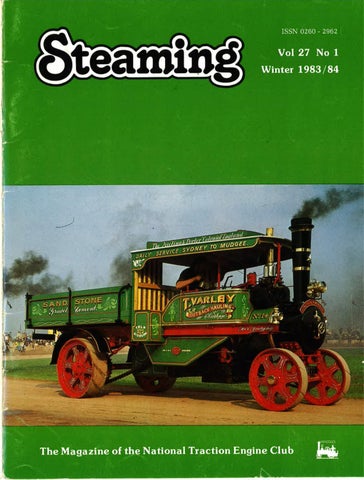
Cover Aveling & Porter 5 ton FGP type wagon 9282 was the last of twelve examples built up in 1922 at Garrett's Leiston works from parts supplied from Rochester, during the two firms' involvement with the AGE combine. The wagon was exported to Australia and worked for municipal councils near Sydney, and later carried gold ore to a crushing plant, being last steamed about 1948. This picture shows the Aveling on its inaugural appearance after repatriation and restoration by Tom Varley at the 1978 event at Peterborough. (Roger West) 3
gala Rally Sub Committee The Rally Sub-Committee is most active during the winter months. It meets regularly and deals with any items that might have arisen from the previous rally season, but mainly with forward arrangements for the following year. Our Autumn Conference on 15th October 1983 dealt with much business. At our Conference many delegates speak to give their views — it is largely from this that our future policy is formulated. Early publicity fur sallies and similar events on both a national and international scale has always been an aim of the sub-committee. To this end we have been fortunate to secure a stand at the Excursion Workshop of the various Tourist Boards covering the South Eastern part of England on 10th January 1984. Representatives of the travel and tourist industry attend these 'Workshops' in large numbers, so we should be able to give plenty of publicity to the approved rallies being held in the areas of the country that are covered by this Workshop. The successful outcome of our negotiations with the English Tourist Board is largely due to the work of the subcommittee member Derek Burdle; the matter was first reported in the Spring 1983 edition of Steaming. Much of our time and energies over the past few years have been devoted to a revision of our Code of Practice. After much discussion and consultation amongst ourselves, with our insurers and, above all, with representatives of the Health and Safety at Work Executive, we have been able to produce a fully updated edition of the Code which should be in the hands of organisers for the 1984 rally season. Many of the new and revised portions have been discussed at Conferences over the last few editions and the decisions at them have been incorporated in this new edition. David Franklin of the sub-committee submitted the revised draft to the delegates at the October meeting, dealing with it page by page. A number of comments were made and a note taken of the views expressed. It is of interest that our Code has been the basis of similar documents that other preservation bodies have prepared. 4
The afternoon session of the Conference continued our series of papers submitted by well-known and experienced rally organisers on various aspects of organising. At this Conference, Brian Johnson of the Southern Counties Historic Vehicles Preservation Trust addressed the delegates on 'Rally Publicity'. He drew on his long experience and illustrated his talk with many examples of both good and bad publicity. As well as printed material, both radio and television publicity were examined. As with all our Conferences, delegate participation formed an important part of the proceedings. (Eric Fillmore, chairman, Rally Sub Committee)
Capital Transfer Tax (CTT)
Engine Owners Column
Capital Transfer Tax is a tax on 'transfers of value' — broadly on any assets which one gives away during one's life, and on the estate which one leaves at one's death. The first £60,000 of what one gives away or leaves at one's death is free of tax and after that the rates of tax increase by 'slices'. This means that on amounts between £80,000 arid £80,000 the rate of tax on that slice is 15% on a lifetime gift or 30% at death; between C80,000 and C110,000 the rate of tax on that slice is 17 1/2 % on a lifetime gift or 35% at death, and so on upwards. The rates of tax are liable to change in the Budget each year, so that the above figures may not apply after April 1984. To deal with gifts during one's lifetime, in one's income tax return
I have been pleased to hear from a number of individuals and companies who are able to offer repairservices or supply steam engine goods. The most notable contribution has been submitled by a company from Victoria, Australia, who are able to offer extensive services including boiler work — it will be useful to our Australian members, but perhaps, too, someone will start shipping engines over to Australia for a rebuild! The task the Engine Owners Subcommittee is endeavouring to undertake is enormous arid its success very much depends upon contributions from the membership. Probably most engine owners will know of someone in their locality who may be able to provide some form of service or goods, so lets be hearing about them, or better still, directly from them. For example, a number of members have enquired regarding the purchase of spark arrestors. The roller headstock register has received a number of wants, but as yet no offers of redundant items. The requests include requirements for both Aveling and Burrell products. If any member is able to offer items or provide information as to the whereabouts of unused headstocks, rolls or forks, please write to me and I will pass on the details. (N.P. Barker, Homestead Farm, Lee Road, Saunderton Lee, Buckinghamshire).
Our pipe smoking president Jack Wharton, owner of one of the largest showman's engines, is pictured here at Knowl Hill rally having been presented with the world's largest pipe. It is understood that when not in use the pipe may be mounted on the roof of SUPREME alongside the extension chimney.
23
From Alan Martin's Collection
M-
The surveyor of Surbiton UDC in Surrey had one of the light patching rollers built by Mann's Patent Steam Cart & Wagon Co in his fleet of road making machinery. My picture shows the roller, 663 of 1911, posed with its crew (and possibly the surveyor himself on the left?). The tank over the rear roll held water for ballast, or for spraying water bound roads in the summer.
one is expected to declare any gifts of any appreciable value each year, and the amounts declared are added up by the Inspector of Taxes, and when the total reaches the basic figure for paying tax any further gift has to pay tax at the appropriate rate. There is now a time limit on this, so that after ten years any gift made more than ten years before become free of liability for tax and drops out of the cumulation. There are however certain gifts which are exempt from CTT, and the most important exemption is that there is no CTT between husband and wife (unless the recipient is domiciled overseas) either during life or at death. Secondly, one is permitted to give away gifts to the value of £3,000 in any year without incurring any liability to CTT in that year: furthermore, if this allowance is not used in one year it can be carried forward and added to the following year's £3,000, but not further. If a son or daughter gets married a parent can give him or her £5,000 without incurring CTT liability and grandparents and others can give lesser amounts. Provided one lives for a year after the gift, gifts to charities are exempt as are gifts to the National Trust and many museums and to Universities.
There are other exemptions but the above are the most important. On one's death, as I have explained, the rates of CTT are higher than on lifetime gifts and there is no CTT on the first £60,000 of one's estate unless one has accumulated a liability to CTT during one's lifetime. For example, if one had given away a total of £30,000 during one's lifetime which was not covered by any exemption, this would be taken into account in calculating the CTT due on one's estate and if any CTT had been paid on a lifetime gift within three years of death, additional CTT would be payable on that gift. Gifts to charities in one's Will are only exempt up to £250,000 unless the gift is to the National Trust, national museums, local authority museums and universities, when there is no limit to the exemption. The value of an item given during one's lifetime or at one's death is considered to be, broadly speaking, what it would fetch in the open market if sold without reserve, and in addition certain agricultural land and plant forming part of a business, and an interest in a business, enjoy allowances off the CTT valuation either in a lifetime gift or at death. The amount on which tax is charged is the
'loss to the donor' so that if the donor pays the CTT, the donor pays on the 'grossed up' figure which is higher than the actual gift. Most people find this a very difficult idea to grasp. Applying what has been said above to one's traction engine or other steam vehicle, and assuming that one has a traction engine of a fairly common type and one knows of a recent sale of a similar vehicle for £3,000 or less, then one can make a lifetime gift of it without incurring CTT liability, taking advantage of the annual allowance of £3,000. If on the other hand it is likely to be valued at £6,000 then provided one can use last year's £3,000 and add it on to the current year's £3,000, one can still avoid liability to CTT. If the vehicle is likely to be valued above £6,000 and one has not made a gift in the previous year there is a liability to CTT on the excess over £6,000, but as has been explained until the cumulative total of gifts exceeds £60,000 no tax is payable. On death, one's traction engine will be valued as part of one's estate and if the total of all one's cash and possessions, after deduction of any exemptions and payment of any debts and funeral expenses, exceeds £60,000, then CTT will be payable. If one's traction engine is left specifically to someone in one's Will it is as well to specify that the legacy is free of CTT otherwise the recipient may have to pay CTT on the legacy. From what I have said in this very brief sketch it will be plain that CTT is a very complicated subject and if one is likely to have to incur it, it is wise to get professional advice. The Inland Revenue issue a free booklet, CTT1 (obtainable on request from the Capital Taxes Office, Minford House, Rockley Road, London W14 ODF), which explains the tax as simply as is possible. The important thing is not to allow CTT to become an obsession. It is said that only two things in this world are inevitable, death and taxes; that being so, one has to make the best of taxes and there are perfectly honourable ways of minimising their impact. This applies to CTT as well as to the other taxes which we are afflicted with. (David Tew, Honorary Solicitor)
Obituaries John Armer Members of the Morecambe Bay Traction Engine Club were saddened by the sudden death, at the age of 56,
5
The Rally List 1984
The list of NTEC Approved Rallies for the coming season will be published as usual as a supplement to the Spring edition of our magazine. Many organizers have already decided the dates for their 1984 event and we are publishing now a list of those notified to, and approved by, the Rally Sub Committee up to the 28th November 1983. For reasons of saving space the details of the events are necessarily brief, often using only their colloquial title rather than a full description, but the rallies should be readily identifiable by readers, and we hope this advance information will enable notes to be made in diaries etc, at a conveniently early date. The further details and addresses of the organizers will be in the next issue.
of founder member John Armer of Cockerham, Lancashire. He was a lifelong steam enthusiast, being introduced to steam road engines very early in life, as his father was a driver for John Ball of Forton, and for Lancashire County Council. John bought his first engine in the early sixties, this being Aveling & Porter 6 ton roller 5636, which he rescued from a coal yard in Poulton-leFylde. After a very slow and difficult journey he managed to steam it home, only to be told by his father that he could have carried it quicker! Unfortunately — in one sense — the engine needed a new box, so John called in help. In the other sense this created the basis for a lasting friendship with other enthusiasts and the eventual founding of the Morecambe 6
April 21 to 23 — Quorn Road/Rail, Leics 22/23 — Quainton Road/Rail, Bucks May 6/7 — Bass Museum, Burton-on-Trent 12/13 — Castle Coombe, Bristol 19/20 — Staverton Airport, Glos; Isle of Anglesey, N. Wales; Tamworth Anker, Staffs 26 to 28 — Goldington and Gayhurst, Bucks; Frocester Manor, Glos; Thurlow, Essex 27/28 — Carrington Park, Lincs; Stoke Row, Henley, Oxon. June 3/4 — Upton, Cork, Eire 9/10 — Hoddesdon, Herts; Holton, Oxford 16/17 — Kettering, Northants; Ashfield, Notts; Claybrooke, Leics 23/24 — Banbury, Oxon; Stamford, Lincs July 7/8 — Headington and Stockley, Colne, Wilts; Redbourn, Herts; Chiltern, Amersham, Bucks; Ardingly, E. Sussex 12 to 14 — Kent Show, Maidstone 14/15 — Rempstone, Leics; Woodcote, Reading, Berks; Weeting, Brandon, Suffolk 20 to 22 — Netley Marsh, Southampton 21/22 — Lambeth, London SE24; Hallam's, Tutbury, Staffs; Newquay, Cornwall 28/29 — Kegworth, near Derby; Much Marcie, Herefords; Cumbria, Kendal August 4/5 — Alderholt, Ringwood, Hants 11/12 — Knowl Hill, Berks; Astle Park, Chelford, Cheshire 17 to 19 — Vestingdagen Hellevoetsluis, Holland 18/19 — Medstead, Alton, Hants; St Agnes, Cornwall 25 to 27 — Town & Country, Stoneleigh, Warks; Quexpo, Birchington, Kent 26/27 — Bishops Castle, Sa/op September 1/2 — Hinckley, Leics 8/9 — Malpas, Whitchurch, Cheshire; Haddenham, Cambs; Tonbridge, Kent 15/16 — Kirk Hallam, Ilkeston, Derbys 22/23 — Bilborough, Notts November 5 — Beaulieu Fireworks, Hants
Bay Club with John's premises as the main 'depot'. Wallis & Steevens Advance 7867 and Burrell single crank compound traction 2626 were restored by John and helpers, many north country miles being covered by the latter engine. Just prior to his death John had bought the part-coverted 1923 Marshall tractor 76831, and he was busy with the completion of this engine, assisted by his son Michael, when he died. He will always be remembered for his generosity, his dry wit, and his gentle persuasive manner when wanting assistance or advice. Cockerham and the local rallies will never by quite the same again; he will be sorely missed. (H. Carr)
John Dennett It is with deep regret I report the sad loss to the steam world of John Dennett, on Friday 19th August, at the age of 91. Born at Longwood, near Winchester, Hampshire, John saw steam at its peak in agriculture. After an apprenticeship with Thnrneycrofts at Woolston, and time in the Royal and Merchant Navies, he went timber hauling using a Garrett tractor. Time was then spent with Wallis & Steevens and Wrights of Alton before World War 2 when John rejoined Thorneycrofts. John had three engines of his own in preservation, a Garrett tractor, an Advance roller, and later on a Burrell traction, as well as helping many young owners with older engines.
'Penquite' was an open house to engine owners and those who enjoyed recollections of a past era. John's advice and help will be sadly missed. Our deepest sympathy is extended to Mrs Dennett. (R.L. Corbett)
Future Dates Early Rallies Elsewhere in this issue is an abbreviated list of rallies so far announced for 1984, pending publication of the Rally List supplement in the Spring issue. We give below, however, fuller details of those early season events which will be held before, or soon after, the publication of the Spring issue. 21st to 23rd April — Road/Rail Steam 84, Quorn Station (B591), Leicestershire (about 12 engines expected). Contact — D.G. Pugh, Great Central Railway, PO Box 33, Loughborough, Leicestershire LE11 1SS. 22nd and 23rd April — Road/Rail '84, Quainton Railway Station, Aylesbury, Buckinghamshire (about 8 engines expected). Mrs A. Hanscombe, 65 Bois Lane, Amersham, Buckinghamshire HP6 6BZ. 5th to 7th May — May Day Steam, Abbotsfield Park, Chassen Road, Flixton, Manchester (about 15 engines expected). G. Co/es, 18 Stretford, Avenue, Braemar Manchester. 6th and 7th May — The Bass Heritage May Fair, Horninglow Street, Burton-on-Trent, Staffordshire (about 10 engines expected). A.J. Crowson, The Bass Museum, Horninglow Street, Burton-on-Trent, Staffordshire. 12th and 13th May — Castle Coombe Steam Rally, near Chipping Sodbury, Gloucestershire. B. Dando, The Cottage, Wapley, Chipping Sodbury, near Brisol. Annual General Meeting Advance notice is given that the Annual General Meeting of the NTEC will take place in Birmingham on Saturday, 12th May 1983. Formal notice and further details of the AGM and other activities will be contained within the Spring issue of Steaming. Members wishing to submit Resolutions are advised that the procedure is defined by Article 16 of our Articles of Association. This requires that the Notice of Motion shall be in the hands of the General Secretary not less than 42 clear days
before the date of the AGM. The names and membership numbers of the Proposer and Seconder must accompany the Notice of Motion. Affiliated Clubs and Rally Organizers Conferences The above Conference for Spring 1984 will take place at the Great Western Royal Hotel, London on Saturday, 11th February 1984 at 11 am. Formal notices and invitations will be sent to Affiliated Clubs and Rally Organizers in the usual way.
Affiliated Clubs Three Counties Steam Preservation Society The Secretary of the above society is now Mrs C. Evans, 82 Albany Road, Hersham, Walton-on-Thames, Surrey KT12 5QQ. Anglesey Vintage Equipment Society Mr E.J. Hacker, 'Tan Dderwen', Siloh, Port Dinorwic, Gwynedd is now the secretary of this club.
London Area Social Meetings Meetings are held on the last Tuesday of each month until April in the upstairs room at 'The Cock Tavern', Great Portland Street,
London (corner of Margaret Street and adjacent to Oxford Circus). They start at about 8.O0pm and all are welcome. TUESDAY, 31st JANUARY 1984 An evening of films presented by Mr A.F.W. Smith of the Steam Plough Club. TUESDAY, 29th FEBRUARY 1984 Mr Peter Smart, chairman of the Road Locomotive Society, will give a talk on the engine building firm of Wallis & Steevens. TUESDAY, 27th MARCH 1984 'Twenty five years of rally slides' will be presented by Richard Horsey. TUESDAY, 24th APRIL 1984 An illustrated talk by the Leighton Buzzard Light Railway Society on their two foot gauge railway in (London meetings Bedfordshire. organizer — Bill Timmings, 308 Hertford Road, Lower Edmonton, London).
Apologies We apologise to readers, and especially to photographer Robin Walker, for the 'chopped chimney' on his picture of the Ransomes traction on page 198 of the last issue. This was entirely the editor's fault; we hasten to add there is no intention that the magazine is about to indulge in the latest fad of cutting off wheels, tenders or chimneys — everything except the crews' faces. Some old pictures, already well trimmed, are a problem, but we endeavour to include the absolute maximum of the subject that is on the original. Apologies are also due to Clive Hollingsworth for omitting to credit his name after his photograph of the French built Pecard engine on page 189.
Highland Steamboat Horidays Cruise the beautiful seafochs and canals of Scotland in an original. coal-fired Clyde Puffer. Good food, tomfortabte accommodation.
• .. Send large SAE for free brochure to Nick and Rachel Walker, VIC 32, Crinan, Lochgdphead, Argyll PA31 8SR. (Tel 054-683 240)
7
AN UNUSUAL FOWLER John H. Trounson
The 'Steaming Past' feature in our Summer 1982 issue briefly mentioned an advertisement which had appeared 25 years before. When originally published it read: 'For sale, Fowler No 22120, 16ton U.L.W., single cylinder, governors, drum and wire rope intact, firebox good, solid rubber tyres like new; kept outdoors, but otherwise in quut.1 order. Offer above £140. Enquiries to James White & Sons, Scrap Merchants, St David's, Inverkeithing, Fife.' The advertisement had caught my eye the first time round in July 1957, and as I have always been interested in unusual engines, I then wrote to a Scottish friend, Ian W. Muir. It transpired he had seen this engine on Coronation Day in 1953 and had taken a photograph by leaning over the fence of the yard in which she was standing. He was able to tell me more — its actual works number was 20066, not 22120 as advertised. She was new in 1933 and was exhibited at the Dundee Show and then went to the Roxburgh County Council Roads Dept but apparently only worked for that Authority for about three years before being laid off.
She was a truly massive engine, single cylinder, two-speed and with a balanced crankshaft. Press on rubber tyres were fitted fore and aft and the footsteps up the side of the tender looked as though no one had ever set foot on them. The registration number was KS 5863 and her name QUEEN OF THE BORDER. As Ian Muir's photograph shows, the englne had belly tanks and, when examined under a glass, it can be seen that she had rim brakes. Presumably, she wds fully sprung. Being protected by her long cab and sheltered by a wall on one side, she appeared to be in first-class order; only the chimney had fallen in. Apart from the fact that she was a single with only two speeds the engine seems to have been virtually a large road locomotive of similar proportions to the lately built Fowler showmen such as SUPREME. Unfortunately, it appears that this unique great engine was subsequently cut up for, when two of Muir's friends
later saw the yard where she had stood, only her massive press on tyres remained which, I believe, were subsequently purchased by Jack Wharton. I also wrote about that time to the late Alf Pepper of Fowlers. He confirmed that it was B6 class single cylinder, number 20066, turned out in June 1933 and sent to the Roxburgh County Council. He commented 'The B6 compound engines (like SUPREME) were frequently described as 10hp and it may be that 20066 has been considered as such, although it had the 9 inch cylinder of an 8hp engine'. In a further letter on the same subject he added: '9 inch cylinders were standard for B6 single engines working at 140 lbs per square inch. Max ihp was 90 to 102, and for short periods 105 to 110 ihp'. Alf Pepper also mentioned the interesting fact that, from the surviving Fowler records, the largest traction they built was number 4760 in February 1884,
Fowler 20066 when on display at the Highland Show at Dundee in the summer of 1933, in company with a Fowler motor roller and road making equipment and street furniture. (collection Alan Martin)
for the Essex Water Company. This had cylinders 8in and 14in by 16in stroke and 7 foot driving wheels. Being interested to discover all that I could about the subsequent history of 20066, I wrote to the Roxburgh County Council. They replied that they sold the engine to Muirhead & Sons Ltd of Grangemouth, Stirling in August 1940. They said that when she was in the possession of the County Council she was principally used for driving stone crushing plant in one of the quarries operated by their County Roads Department. Following that reply I then wrote to Muirhead & Sons Ltd; they answered that the engine was in their premises during 1940/1945 and was resold to a Mr Gordon of Old Town, Grangemouth, but the firm was by that date defunct through the death of Mr Gordon and they were consequently unable to give me any further information as to its later history. All the foregoing I discussed with the late H.L. Drewitt and, writing to me in November 1969, he told me that about the same time that the advertisement for the sale of the engine appeared in Steaming, a similar one was in the agricultural press, though he thought the price was slightly lower. Subsequently the tyres were advertised, together with another set of smaller dimensions. He further said 'The following comments are only my own theory, but they may possibly throw some light on the reason for this rather unusual engine. What Roxburgh County Council needed when the engine was ordered, was power to drive a crusher, and ability to haul the crusher and itself from quarry to quarry. The only reason for the rubbers was that all engines, other than purely agricultural ones, had to be on pneumatics or solids by this date. It was a road locomotive because Fowlers had no rubber-tyred wheels to suit an A type general purpose engine'. 'Most crushers were powered by the portable steam engine, and no one would have dreamed of specifying a compound portable for the job. After all, coal was cheap and plentiful in that area, not too far from the pit-head, and a 9in x 12in cylinder would furnish more power than could be transmitted by any belt which would run on that engine's flywheel. The cylinder block would have presented no problems to Fowlers who had single cylinders up to a 12in x 12in (possibly even larger), which were used on the 16hp single ploughing engines (up to and including BB1 size, the blocks were interchangeable between general purpose, road
Whilst many of the population were busy watching television for the first time, Coronation Day saw Ian Muir engaged in photographically recording the last days of Fowler 20066. The obviously difficult 'over the wall' shot shows the engine had probably seen use on the belt (note the rather flimsy belt guards) in the position it stands in. (Ian Muir)
locomotive and ploughing engines). The governors would seem to be Pickering rather than the more usual standard Fowler type.' Mr Drewitt concluded, 'Much of the foregoing is based on my recollection of a conversation I had with the late Alf Pepper about this engine a year after the advertisement appeared'. In view of the beautifully light and smooth working regulator of the Fowler ploughing engines (operated by a toggle leverage) it is surprising that the same builder's single cylinder engines were turned out with such a hard and awkward regulator. The late Eric Middleton told the writer that the regulator on his 6hp Fowler single was so hard and rash in action that he had to fit a screw adjusted stop to the lever to limit its initial opening when shunting or coupling up to a wagon. It therefore makes one wonder what this big single 20066 was like in that respect; if it was as proportionately difficult to control as the 6hp singles she could have been a bit of a brute to handle! However, apart from possibly heavy coal consumption, this unique great engine would have been an object of much interest today and it is sad that it was cut up because at that time nobody was interested enough to pay £140 for it — shades of today's engine prices! Since John Trounson gleaned the above information, the Fowler records that are still existing have been deposited at the Institute of Agricul-
tural History and Museum of English Rural Life at Reading University. Their archivist David Phillips has kindly referred to the records for information on 20066, and is able to add, not everything regarding its history,but enough to indicate what an unusual start in life the engine had. Also included in his notes is an interesting paragraph on the way the Steam Plough Works arranged their boiler building and works number sequences. David Phillips writes: Fowler 20066 was registered by the firm as a class B6 single cylinder traction engine (not a road locomotive), with a long firebox and on rubber tyres, supplied to Roxburgh County Council on either 16th June or 24th June 1933 (different engine registers give both these dates). Fowlers had received the Roxburgh order on 1st May 1933. The engine specification which would have given a detailed description, a list of drawings used, the livery and its outfit, was missing from the respective shop book when it was deposited at Reading. It appears to have been ripped out and is probably a sad reflection of what happened in the days prior to the availability of cheap and readily obtainable photocopying. However, the engine registers do give one significant piece of information. 20066 was the plate number only and the engine was actually built up under number 17103. This practice happened with a number of late Fowler B6 engines, presumably 9
to ensure that the plate number was not disparate with the other engines being sent out at the same time — that is, it didn't appear old stock. For instance, B6 Super Lion showmans engines 19782, 19783 and 19989 were actually built up under numbers 18049 to 18051. Fowlers, in common with many manufacturers of course, built certain components for stock, including boilers. Fowler boilers received a serial number which then became the works number by which customers indentified their machines for spares etc — and by which we often refer to them today. At the start of 1933, Fowlers had only three B6 boilers left in stock — 17103 and 17104 with short fireboxes and 18051 with a long box. The former had been ordered to be built in July 1926 and the latter in July 1928. On 24th January 1933 an order was received for a B6 Super Lion long box engine and boiler 18051 was duly used, the engine being sent out on 8th April 1933 as number 19989. The Roxburgh order came, as previously mentioned, on 1st May 1933, and with only two short box boilers left in stock, on the very same day the firm decided to convert these to long box, using 17103 for what was to become 20066. It was probably the cheapest thing to do not having any long box boilers in stock, and demand being virtually negligible for such engines in the early 1930s. The Fowler drawing registers have been checked and no new main series drawings were produced for 17103/
OUR MAGAZINE 25 YEARS AGO
Having expanded the Club's newsletter into a well received small magazine, editor Giles Romanes handed over Volume 3 at the beginning of 1959 to The Rev. R.C. Stebbing, although in the event the edition was produced by John Crawley at a printer local to him, and he officially took over as editor from the next issue. The AGM passed a motion, with but one dissentient, that engines would not in future be accepted at 10
20066. In other words, the engine was built to existing designs, though it might be argued that their overall combination was somewhat original. However, there were five hand sketches specifically made for 17103: HS40/327 and 335-338. These cover the hind axle, alterations to the brake gear, the toolbox and awning pillars, alterations to the road gear covers and the balance weight for the flywheel. The firm, unfortunately, did not bother to photograph the engine. It seems therefore that the engine was something of a 'one-off', built to the though customer's requirements, using existing design features.
Some notes on the further history of the other boiler converted from short box to long box may be of interest. The next B6 order came on 9th September 1933, for another Super Lion long box engine, so the rebuilt 17104 was used and sent out on 12th March 1934 as 20223, a certain now well known engine named SUPREME. Fowler's stock of B6 boilers was now exhausted and despite having altered two existing boilers as an expediency in May 1933, the firm optimistically decided to order a batch of six B6 long box boilers to be built, assigning them numbers 20428 to 20433, on 21st March 1934. They even went to the trouble of having a new B6 boiler drawing made, no. 72305, completed 23rd May, of which we hold a tracing. The boilers
rallies organised by the club without a current and satisfactory boiler inspectors certificate. The Hon. Secretary, H. Bonnett, reviewed the new arrangements for accepting seperately formed clubs as Affiliated Clubs, and explained the reasons for the Committee not favouring that any such associations should be a local group of the NTEC. It was felt there would be difficulty in keeping proper contact with a potentially large number of local groups and the possibility of financial liability following. Over half the issue of the magazine consisted of a 'List of Members 1959' which probably makes more interesting reading today than it did on publication! One of the News Flashes was that 'a North of England enthusiast has just acquired a Fowler wagon and a Yorkshire wagon for preservation'.
were never used and presumably were cut up for scrap, or perhaps sold out for a similar purpose. It might be useful to record how Fowler built their boilers for stock, to be used up as orders for particular types of engine came in. They were usually in batches of 12, 10 or 6 (i.e. based on multiples of two). The two most common types were 'ploughing' and 'traction' setting aside less numerically extensive products such as railway locomotives, portable and stationary steam engines, which also needed boilers. The term 'traction' covered traction engines, road locomotives, road rollers, and eventually steam tractors and steam wagons. A batch of 'traction' boilers might therefore end up on a variety of engines. For instance in the batch 14145 to 14150 (six D2 long box boilers), four were sent out as road rollers and two as road locomotives. Even more confusing was the fact that A and R class engines usually employed the same boilers, the main differences being in cylinder sizes. Therefore a batch of twelve A4 boilers, numbers 8326-8337, were sent out as two A4 compound tractions, two A4 single cylinder tractions, four A4 compound rollers, three R single cylinder tractions and one R compound road locomotive. (We would be pleased to hear of any other photographs or information on Fowler 20066, and, indeed of the whereabouts of the missing shop hook page — surely it must have been removed in good faith for an enthusiast? — Hon. Editor.)
'An ... enquiry was held at Dudley on the bye-laws proposed by Dudley Corporation ... There is a steep hill in Dudley and it has been customary to get heavy boilers up and down this hill by the use of a wire cable attached to a traction engine acting as a stationary engine at the top of the hill. If this was not allowed several large and wellknown boiler works would have to close.' (From The Machinery Users Journal, April 1903.1
'The Co-operative Wholesale Society of Newcastle-on-Tyne are employing steam wagons in certain of the districts they cover, and have after an extended trial, placed a substantial order for Londonderry vehicles, which will be turned out from the Seaham Harbour Engine Works.' fi-rom Commercial Motor, 27th April 1905)
6ant, S •
pictured from tbe past
Three more pictures from member George Swann show steam wagons once used in the Royston area of Hertfordshire. Little can be found out about the early Mann's wagon, one of the undertype engined examples produced by the Leeds firm in the early years of this century. The registration number 0600 was issued in 1907, but the small makers works number plate on the top half of the smokebox door is infuriatingly just illegible — it may be one hundred and something, which would date it to 1901 or 1902. Who the well loaded wagon and crew were working for is equally uncertain, but the photograph is believed to have been taken by Lofts Hall, Elmdon, near Saffron Walden. Although the meagre information to be gleaned from the picture is chronologically irreconcilable it is worth recording here that H. T. Drage of Chrishall, Royston purchased Mann's wagon 126 new at an unknown date. H. T. Drage later decided Fodens suited his business requirements. This 5 ton tipper (3684 of 1913) was the first of nine various wagons of that make to be purchased (all secondhand) and is seen here with driver G. Cranwell. It was last licensed in 1931. The Foden's replacement was Sentinel 8488 of 1931 (EV1745), a DG6 tipper, and the first of three delivered to the firm, by now under the name of Drage & Kent. The DG6's driver was Ray Cranwell, son of the Foden driver, and he worked it for over 40,000 miles until high taxation caused the wagon to be taken of the road. During its first six months at work some 6000 cubic yards of sand and gravel were taken from a pit at Newport, Essex. The wagon was last recorded in the Birmingham yard of T. Cunliffe in 1945.
ORAL
11
Black Couary Impressions •
ti
-7 -
dp
. .
;A:ft,.
The event in October at Dudley's Black Country Museum, arranged at short notice by Len Crane, turned out to be something of a vintage occasion. Bob Payne sets the scene...
Tipton railway station; almost journey's end. Outside in the street a trio of eight year olds was having a great time splashing about in the puddles, quite oblivious. The route leading the mile or so to the steam event at the Black Country Museum was deserted as the rain lashed down in cold, westerly gusts. Half soaked, my arrival at the Museum was met with grins from the Market Harborough gang. They were sheltering under the canopy of the free-steaming ex Borough of Kettering Armstrong-Whitworth roller 10R2, owned by Mick George, which was parked by the entrance gate. Further on, several engines were in steam, scattered about the 26 acre split level site. In a few years time, on completion, an industrial village will have been re-created on this one time sewage works. At present, with construction work under way it has the character of a film set. 12
Surprisingly with the exception of Foster single traction 14410, Tom Varley's Burrell plougher, and a Fowler K7 ploughing engine, the engines gathered together by organizer Len Crane were road going machines, and harmonized well with their urban surroundings. Perhaps, more unusually, no Rochester-built machines were in sight. A short conversation revealed the place to be however was at Len's yard, nearby. After a five minute car ride we were there. It was easy enough to find, as the recently restored ex St Asaph Council Fowler compound roller 15977 stood outside ready for the short run to the museum. Simmering in the yard stood much travelled Wallis Advance 8100 owned by Dave Antell from Shillingstone, Dorset. Alongside was the neat three speed Burrell 3996 CONQUEROR, new to John R. Henton of Hopwas and now with Richard Sandercock of Stoke Climsland, Cornwall. Close by was Burrell road loco 3057, LORD ROBERTS, owned by Jim Sarney. This masterful restoration is now fitted with a crisply lettered half-length canopy and is fully equipped, as in working days, with pulley blocks, chocks, chains, shackles and hurricane lamps. It was the recently lit up rubber
Fowler 17212 eases the Lancashire boiler forwards. (Roger West)
tyred 7hp Burrell crane engine 3197, belonging to Len, I had really come to see and so had the other familiar faces gathered around this superb machine. Still in its original special order paintwork of lined crimson lake and yellow wheels, faded now but well ragged over, it looked the part. Its eight ton capacity jib hod probably poked its way into every Black Country factory yard over the years. The legend on the canopy sides said it all — SCREEN BROS LTD, OLDBURY, BIRMINGHAM,
Presently the engines moved off towards the Museum. They steamed past rows of sooted black houses with glistening slate roofs, set against a rain soaked backdrop of foundries, factories, warehouses, cooling lowers and gas holders which loomed out of the shades of grey. At 1/60th of a second at f2.4 on Kodak Tri-X film it was an almost unphotographable, yet very evocative sight; a glimpse of how things might have been. A torrential downpour coincided with the engine arrival on site. I took cover until it eased, and then, with another hour to go before closing time I headed for the bar of the reconstructed Bottle and Glass pub.
True to form, the rest of the Harborough gang were already standing round the coal fire drying out and supping Holden's bitter. I joined them. Our conversation was lively enough and it mingled with the other West Country, Home Counties and Brummie accents of the enginemen who were packed into this small room. Through the lightly steamed up windows could be seen the brightly coloured wet weather gear of those heroes who had forsaken a cosy afternoon in front of the TV to soak up the sight of the many engines now parked up in the street outside. All the talk inside the pub had come round to the 'boiler job', and after time had been called the same people gathered around the spot where the single flue horizontal boiler lay. In time this boiler will provide steam to power the Nasmyth type steam hammer. Now, after positioning check to see if all was well, it needed removing from its sunken position on rough ground onto a trailer for despatch to the local boiler works of Messrs Danks and Co for repairs. The failing light deferred the start of the job, which would see LORD ROBERTS, CONQUEROR and Fowler B6 crane engine 17212 in action, until the following day.
About this time, up on the higher level in the fairground the Foster showmans road loco THE LEADER was providing power for a couple of spins of the Coronation Speedway. It was an impressive sight, but there were few takers. Patronage picked up when this was repeated for a couple of hours at night, though I missed this. I left for the station at five. A cloudy dawn ushered in the following day, Sunday October 16th. By midday the sun had broken through but the wind stayed cold and penetrating. Up at the Museum the 'boiler job' was about to begin. Burrells LORD ROBERTS and CONQUEROR, with safety valves feathering, were about to depart for Northfield Road, Netherton to pick up a solid tyred draw bar trailer. An hour on and heads turned as the engines, now coupled in tandem with trailer in tow, paced across the Black Country heartland. On arrival back on site the engines uncoupled and began manoeuvring the trailer with drawbar and winch rope around the winding, zig-zag road
which ran to the lower level where the boiler lay. Simultaneously, Len Crane's ex John Thomson Fowler crane engine had been positioned on the rough ground with the crane hook directly above one end of the boiler. The idea was to lift and pack one end, and then the other, up to ground level for a start. This was quite quickly accomplished. The old gaffers looking on with knowing eyes approved. If they had not done it before themselves, they had probably seen it. During the time needed for this operation, Jim Sarney and Richard Sandercock had made a good job of steering the trailer round the twisting roads and now their engines and trailer stood nearby. For the final manoeuvre the trailer draw bar was attached to the front draw eye of LORD ROBERTS. Then this combination ran in reverse past the Fowler to be in a position to propel the trailer under the boiler when the final lift was made. CONQUEROR and crew stood off opposite LORD ROBERTS where they would be in a
Burrell 3057 LORD ROBERTS waiting to descend the hill to the reconstructed village. (Bob Payne)
13
•
•
(• tit?
1;0.
position to assist with winch rope during the loading operations. Next, Len turned the Fowler round, the winch rope was paid out and lashed round the centre of the boiler. Presently the boiler rolled over on its outside diameter to a position, where, after another skillful, canalside three point turn Len could get a good lift on firmer ground to drop the boiler onto the trailer. So far, so good. By this time the crowds had grown in number around the job though many more were clustered around Fowler RENOWN and the Wonderland organ, which was belting out some stirring stuff. Then, all of a sudden, the organ was drowned out by a fantastic roar of sheer engine power. The crowds became excited and rushed to catch sight of the final burst of Dave Antell's Wallis Advance performing a full regulator hill climb on a steep, ballasted roadway near the pub. The enthusiasts have seen Dave in action before, and could note that the valves were still set OK after the recent overhaul. To some of the crowd it was probably to be the memory of the weekend. But now for the tricky bit with the boiler. As usual, on jobs such as this, things do not always go to plan. The boiler was really just a fraction too large to drop neatly into the well of the trailer and the lift therefore could have been a little higher. In true fashion, the next hour or so would see the problem solved by a combination of all the skills the loading gang could muster. With winching, packing, shunting and sheer persistence the gang, as we knew all along, managed by dusk to persuade the boiler to rest on the trailer. The operation for once saw road engines at home in their own environment doing the job they were designed for. More than a few heartstrings had been touched at this afternoon. On departure, as on arrival, we saw the Burrells standing outside the gate, now with lamps up and lit ready There come a few events within any interest which, for various reasons, tower above the general run of things. By nightfall on Sunday night traction engine enthusiasts knew that this was one of them.
for a quick run back to Len's yard. It was the perfect finish to an excellent weekend.
Fowler 17212 ready to winch the boiler forwards. (Bob Payne)
15
Burrell 3197 — a portrait which could have been taken 50 years ago in the engine's working heyday. (Bob Payne)
Joe Thomas
On Sentinels
THE STEAM TRACTORS
Part 3 (continued from page 171 of the Autumn 1983 issue)
The large wheeled DG timber tractors We have seen in Part 1 of the article (Summer 1983 issue) how the first major improvement to the simple 1923 single geared Super tractor was the introduction of a second gear to give the double geared Super. Whether the model had rear wheels or the Roadless Company's crawler track unit fitted it still bore that title. The later development to the tractors was the application of the then new smaller cylindered DG engine with a differential gear on the end of the crankshaft, together with an improved chassis, and this was known as the DG steam tractor. The model was specially designed for timber work and had a winch, tool box, spare wheel etc. enclosed in neatly panelled bodywork over the rear wheels. The comfortable cab with windscreens was very similar to the DG wagon. The rear wheels were of the cast spoke type, some 4ft 6in in diameter and equipped with solid rubber tyres; the front wheels were pneumatic tyred and the same size as the DG wagon for normal road use. The first example of the new model was works number 8216, sent from the works in July 1930 to R.T. & J. Hewitt of Morpeth, Northumberland. Just how many of this particular model were produced is now uncertain, probably only half a dozen. I have described before how Sentinel's records were burnt when the works was taken over by Rolls Royce in 1952. Our knowledge today of individual works numbers and histories largely results from the observations and efforts of certain members of the Road Locomotive Society co-ordinated and summarised into an invaluable list by their Records Officer. These efforts have included many hours searching through the records of licencing authorities. The licence details, of course, didn't record 16
exactly what model the vehicle was, and it is not now possible to say how many of the tractors had bodieslike the Hewitt example, and how many looked just like the double geared Super tractor but had, in fact, the DG engine fitted. From the lists and available photographs I would say that there were six large wheeled DG tractors 8216, 8650 and 8706 with solid rear wheels and pneumatic fronts; 8247 with solids all round and 8337 and 8392 with a type of front wheel unknown to me. R.M. Woolley, one time owner of 8247, told me that the engine was originally a two speed Super, and it could well be a factory rebuild. Although not made in large numbers the machines were very popular with their users, and did a lot of hard work over many years. None
survive in preservation. Sentinels also built at that period an all metal timbe r jinker with a four wheel bogie at the rear and all wheels shod with extra reinforced 40in x 8in single tyres. The wheels were interchangeable with those on a Sentinel steam wagon. The main spar was an extendable metal tube of some considerable length and diameter. Internal expanding brakes were fitted, operable from the towing unit or from the rear of the carriage by screw gear (see illustration in Part 11.
The small wheeled DG timber tractors To succeed the large wheeled tractors Sentinels marketed a version mechanically similar but with pneumatic tyres all round, the twin rear
Works photograph of the first DG engined Sentinel timber tractor — number 8216, new in July 1930 to R. T. & J. Hewitt of Morpeth, Northumberland (registration TY 7501). It was destroyed by enemy action in 1940 when in the ownership of Jos. II. Prior of Birtley, Co. Durham. (collection ✓.L. Thomas)
Sentinel 8537, one of the two DG tractors build for use in Russia. (collection J.L. Thomas)
wheels being the same size as the front. It would appear eight of these machines were sent out from the Shrewsbury works up to October 1936, the last one appropriately enough to R.T. & J. Hewitt of Morpeth who purchased the first large wheeled model. The 1936 machines were almost certainly the last steam haulage tractors made and sold in England. The eight tractors were 8756, 8771, 8777, 9097, 9236 and 9260 with pneumatics all round, and 8518 and 8537 (built for export to Russia) with steel wheels with strakes at the rear. Despite the last built of these being constructed in the days of the shaft drive S models, they were not equipped with an S model cab, but retained the DG type front. No less than four of these machines survive — 8756 at Alan Bloom's collection at Bressingham, Norfolk; 8777 has had numerous owners in preservation and is now located in Surrey; whilst 9097 and 9236 are to be found in Shropshire. Some typical work for timber tractors Before we leave the subject of Sentinel timber tractors and revert to discussing tractors specifically for road use, it may be interesting to add some notes on the former's work and abilities. I am able to take information from contemporary issues of Sentinel Transport News. The haulage capabilities of the single-geared Super were summarized in Part 1. For the double geared Super tractor those figures could be doubled. For timber pulling work this double geared tractor with undertype winding drum was an ideal tool, and for the task the 18 to 99 low gear and 31 to 86 high gear ratios were used as standard, together with the 11 to 24 chain sprockets. This works out at ratios between crankshaft and axle of 12 and 6 to 1 respectively. Similarly the ratios between crankshaft and winch drum were 5.5 and 2.8 to 1.
Sentinel 8777 was one of the small rear wheeled tractors, new early in 1933 to H. Judd & Son, timber hauliers, of Spencers Wood, near Reading, Berkshire (registration JB 1655). This picture was taken at Maidenhead Station in 1933, with an 18ft x 5ft oak log for a load — Mr Judd is standing by the front wheel. (collection A.J. Martin)
Rear view of Sentinel 8756, a DG engined machine built with pneumatics all round. The engine is now in the collection of Alan Bloom at Bressingham Gardens, Norfolk. (collection J.L. Thomas) 17
Geared thus the normal low and high speeds were quoted as 314 and 6 1/4 mph with 'maximum recommended speeds' of 6 1/4 and 13 mph. The rope speed in low gear and 100 rpm was 60ft/min and in high gear almost double, allowing for three coils of two inch cable on the drum. In full working order the tractor weighed about 9 tons. An example of using a double geared Super machine to win timber in an otherwise inaccessible position was described in Sentinel Transport News for September 1926. The timber in question was mountain ash, at that time in good demand in long straight lengths for aeroplane manufacture. As the name implies, the tree frequently grows on mountainous hillsides and the amount of labour involved often rendered felling unprofitable. The case cited was in Dovedale on the Derbyshire/Staffordshire borders; nowadays the area is part of the Peak National Park and the spoilation about to be described would not be permitted. However in 1926 it was a normal commercial operation and the problem was to make it pay. At the location involved the Dove Valley was 500ft deep with slopes up to 75 degrees on which the trees grew plentifully. Although the River Dove there has a habit of running underground at times, the dry bed was too treacherous to bear heavy traffic and die only way to lift the timber out was up the valley sides and then down into the next valley where wheeled vehicles could reach it. Access to the summit was gained by a rough road with gradients of up to 1 in 31/4 and vicious hairpin bends. The track ended at a farm and from there it was boulder strewn mountaineering. 1 he timber company had made a careful survey of every type of tractor on the market before even buying the timber and their choice would have to be capable of lifting trees weighing up to 41/2 tons up the steep slopes. No steam tractor with a loco-type boiler could venture on such terrain for long, and after much deliberation they chose the Sentinel double geared Super tractor, and works number 6189 was duly delivered. Because 6189 was often stationed on ground at a slope of 1 in 4 it was fitted with an anchor or hold fast capable of being sunk in a narrow transverse channel to prevent the machine being pulled over the edge. The rope would then be paid out to 150 yards to rear•.h the fallen trunk. These butts often weighed up to 4% tons but to quote the report: 'because of obstructions during the pull the strain on the rope often exceeded the 18
Sentinel tractors 1927-1937 works registration number number model 6985
Rhino
7023 7025 7102 7103 7104
7
7105
6.1927
Rhino Rhino Rhino
8.1927 8.1927 10.1927 10.1927 10.1927
Rhino
10.1927
7
-
date
7106
Rhino
10.1927
7107
Rhino
10.1927 10.1927 10.1927 11.1927 11.1927 11.1927 11.1927 11.1927 11.1927 11.1927 11.1927 12.1927
7117 7118 7167 7168 7211 7217 7218 7219 7234 7242 7244
TY3943
T4 DG T4 DG T4 DG T4 DG T4 DG T4 DG T4 DG T4 DG T4 DG T4 DG T4 DG
7271 7300 7332
PH8120
T4 DG T4 DG T4 10/12 ton
1.1928 2. 1928 3.1928
7333
PH9583
T4 10/12 ton
5.1928
7334
PK2031
T4 10/12 ton
6.1928
T4 T4 DG
5.1928 5.1928
T4 DG T4 10/12 ton
6.1928 8.1928 9.1928 8.1929 8.1929 5.1930 7.1930
-
7366 7393 7394
5.1928
7456 7527
MP5939
7559
UP672
7942 7943 8108 8216
TY7501
double geared Super T4 DG T4 DG Rhino DG T4
8247
VN1542
DG T4
5.1930
8337 8392 8518 8537 8650
UP6514
DG T4 DG T4 DG T4 DG T4 DG T4
8.1930 12.1930 4.1931 9.1931 13.1932
8706 8756
WP2169 VN4294
DG T4 DG T4
13.1932 1.1933
8771
XJ5505
DG T4
2.1933
8777
JB1655
DG T4
7.1933
8956 9039 9097
ARE195
S4 P S4 P DG T4
2.1934 5.1934 10.1933
9236
AAM483
DG T4
4.1936
9260
VR6342
DG T4
10.1936
9288 9289 9290
-
S4 P P S4 P
3.1937 3.1937 3.1937
-
original purchaser or destination demonstrator for Kenya - L.R. Bomford, Sentinel Waggon Works South Africa South Africa London Asiatic Co (export) South Africa Glaezner and Perrand, Paris (agents) Griffin Engineering Co. South Africa (agents) Griffin Engineering Co. South Africa (agents) Griffin Engineering Co. South Africa (agents) Poland Poland Nizams State Railway, India Nizams State Railway, India South Africa South Africa South Africa South Africa South Africa South Africa Chillingham Estates Ltd, Northumberland South Africa South Africa C.W. Beckett, Hampton Wick, Surrey C.W. Beckett, Hampton Wick, Surrey C.W. Beckett, Hampton Wick, Surrey South Africa Graham Rowe (exporter), Nyasaland could have been second of above order South Africa Hunt Kennard & Co, Harrow, Middlesex Thubron, Son & Kirkup, Sedgefield, Co Durham South Africa South Africa South Africa R.T. & J. Hewitt, Morpeth, Northumberland T. Place & Sons Ltd, Northallerton, Yorkshire Polish Government Wallace Bros, Dublin Arcos Ltd, for Russia Arcos Ltd, for Russia F. Hubron Son & Kirkup, Sedgefield, Co Durham L. Bullen & Son, Kidderminster T. Place & Sons Ltd, Northallerton, Yorkshire The Calico Printers Association Ltd, Buckton Vale H. Judd & Sons, Spencers Wood, Berkshire France Rhodesia A. Wootton & Sons Ltd, Cannock, Staffordshire Mickleover Transport Co. Ltd, Chard, Somerset R.T.& J. I lewitt, Northumberland South Africa South Africa South Africa
figure by 50%.' The two speed winding was invaluable with fast speed for smaller trees and extra power for the heavier ones. Nor did the Super tractor have any difficulty in reaching the tops of the hills, though on one occasion 'the gradient was so steep that the machine fell back upon the tail of the chassis.' The double geared tractor was also suitable for direct ploughing and at 2 mph could pull 12 furrows in light to medium land, and 8 furrows in medium to heavy land. In the former case the acreage per day was 18; and the latter 15. The ploughing capabilities of the tractor were summarized by Mr D.R. Bomford of Pitchill, Evesham (many Sentinel tractor tests had taken place on his premises) in his presidential address to the Institution of British Agricultural Engineers in 1955: 'In the 1920s the Sentinel Waggon Works produced a prototype direct traction steam tractor which astonished steam cable ploughing enthusiasts by hauling eight 14 inch wide furrows in heavy West Midlands Clay. There was no evidence of excessive soil packing by the wheels and it compared favourably in fuel and water comsumption with compound steam cable ploughing engines. It was operated by one man and there was no material in it that would have prevented it being made in 1890 except the roller (to be continued) chain.'
*1984 Steaming PWtoq-rapic Competition We are pleased to hear through the grapevine of steam photographers furtively putting their best black and white prints to one side for submission to our 1984 Photographic Competition. The theme of the Competition was set down on page 184 of the last issue and we can now add further details. The judges will again be two club members having a vast experience with photographs of engines, Dick Blenkinsop is well known for his own photographic skill through his Steam Scene albums, and Alan Martin has an extremely keen appreciation of vintage scenes. These judges will be supported by a third; someone from outside the steam engine world but with a good photographic ability. The closing date is 13th February 1984. Entries — remember black and white prints only — should reach the Editorial address (Steaming Photographic Competition, 14 Charles Street, Market Harborough, Leicestershire LE16 9AB) by that date. There is no limit to the number of entries per person, but each print should have the photographers name and address on the rear. Please ensure that your
entries are adequately packed to survive the postal journey unscathed. Prints will be returned, but only if the return postage in stamps is remitted, and suitable or reusable packing included for the return journey. Judging will take place in March, and the winning prints and a selection of entries together with the judges appraisal, will be published in the Spring number of Steaming. It is hoped to be able to arrange for all the entries to be displayed for viewing at the Club's AGM in May; if this proves possible the entries will be returned to their respective owners very soon after that date. The prints submitted can be any size but 10in x 8in format is popular for competitions. Brief details of the subject (which need not have been taken during the last year) should accompany the entry. There will be no entry fees. Apart from possible usage within Steaming, the copyright remains with the photographer and we reserve no other rights over the entries. The prizes are: 1st prize £25.00; 2nd prize £15.00 and 3rd prize £10.00 with further commendation prizes of NTEC sales vouchers.
The rear view of the Sentinel DG tractor. The engine was placed well above the frame — to disconnect the rear axle drive a lever operated a massive dog clutch on the countershaft. The winch, developing 45bhp, was driven by a 2Y2 inch chain from a 12 tooth sprocket on the countershaft. (collection J.L. Thomas)
BREACH OF THE LOCOMOTIVE ACT 1865. As auctioneer John Robinson and his daughter were riding on horseback from Kettering to Broughton in January 1882 they came across two engines almost blocking the road at Broughton bridge. On passing the second one — they were presumably a pair of ploughing engines with tackle — Robinson's horse reared up because of the steam which was escaping from the engine, and he had to throw himself off. Later, before the local magistrates, owner Thomas Amos of Castlethorpe, pleaded the offence was quite accidental. The engines had been going to Brigstock and 'a pipe connected with the boiler got broken' so that the men had to stop to repair it. The bench thought there had been 'some carelessness' and fined Amos 10s (50p) and 19s2d (96p) expenses — 'which were paid at once'. (From Wellingborough & Kettering News, 11th February 1882.) 19
Bishops Castle
Steaming visits one of Britain's more highly regarded rallies Some rallies, more than others, seem to have an aura about them, and there is no doubt the County of Salop club's annual Bishops Castle Rally at the late summer holiday is held in high regard by engine enthusiasts far beyond its own area. It's hard to put a finger on any one reason for this; suffice it to say that Bishops Castle is a good solid, traditional traction engine rally — friendly to regulars and strangers alike. And while the engines are very definitely the reason for the event taking place the excellent accompanying selection of agricultural tractors, vintage commercials and the like reveals a strong bond between all local enthusiasts. Bishops Castle is well known for its yearly gathering of Sentinel wagons, but in 1983 that meet was overshadowed by a fine display of showmans road locomotives. The afternoon engine parade offered those spectators clustered around the far end of the arena a magnificent sight as nine showmans engines proudly steamed, two abreast, towards them in the usual Bishops Castle fashion. Precision ring stewarding and thoughtful commentary gives a highly impressive ring display. 20
Leading the parade were two engines probably not seen together for nearly 30 years — Bill Hunt's Foster 14446 THE LEADER and Frank Lythyoe'sLille!' 1623 GOLIATH both saw use until the mid 1950s with Pat Collins Amusements. What other engines caught the
eye? George Bowkley's workmanlike rebuild of Burrell traction 3812 deserves mention. This 6hp compound became very derelict during the years of abandonment at Castle Caereinion station but now takes on an extremely neat and mellow appearance. Several other Burrells
EARL HA/G, Burrell 3812 of 1919, earned most marks and took the club's Supreme Award for 1983.
Little changed from its working days but neatly presented is Fowler 12 ton roller 14333.
presented a similar impression but a newcomer to the area was 6hp single crank compound 3937, a road locomotive new to the Aberdeen Water Company in 1922 and now owned by Robin Daniel of Dolgellau. Engines exhibited whilst still being restored always attract interest and Clayton & Shuttleworth 10hp portable 21112 deserved its outing, for it was exactly 100 years ago, on the Sunday of the rally, that the engine was new to its first owner at Cheltenham. The engine had earlier been on display at the RASE 1883 show at York; does this fact explain the superb finish and fine present condition of the boiler and firebox platework etc? The furthest travelled engine to attend was Peter Wright's 5hp Aveling tractor 11997, steamed from Essex during a three day journey. The engine parade on the Monday concluded with prize giving which took place in a genuine club atmosphere.
Steam Cruising
•••.ffl;
•
Burrell 6hp road locomotive 3937
An advance of Sentinels
If your wife yearns to go on a cruise, but you can't drag yourself away from your steam engine, a reasonable compromise could be a week or more's holiday in Scotland on board a Clyde Puffer. These distinctive steam boats were for years used for supplying the remote islands off the west coast of Scotland with coal and a wide variety of other necessary stores from the mainland. The now preserved VIC32 is a wartime Admiralty version of the traditional design and has a vertical boiler at the rear providing steam to a vertical compound engine with 101/2 and 22 inch by 14 inch cylinders. Two double and four 2-berth cabins, and a saloon and galley fill the erstwhile cargo space and thus equipped for comfortable living and good eating VIC32 leaves Tarbert on Kintyre, Argyllshire throughout the summer on six day cruises. Four different itineraries are run, visiting various lochs, islands and villages around the highlands and islands, with late summer cruises including the Caledonian Canal. Passengers are encouraged to help if so inclined, and this is one holiday when it may be fortuitous to pack your engine overalls. A brochure can be obtained from Highland Steamboat Holidays Ltd; their advertisement can be found elsewhere in this issue. 21
The Downfall of Barming Bridge Christopher Laming
One of the greatest crowd-pulling attractions Maidstone has ever known was the aftermath of an accident. Not surprising really. For centuries people have gone out of their way to ogle the misfortune of others. And so it was on Tuesday, 28th April 1914, when the residents of the county town trouped en masse the two miles to nearby Barming where, upside down in the River Medway, was a 10 ton traction engine. That, In itself, doesn't sound too dramatic. But this particular traction engine demolished Barming's wooden bridge in the process of attempting a closer look at aquatic life. Among the first on the scene were the Kent Messenger's newshounds, eager to piece together the events which led to the first span of the bridge snapping like matchwood. They soon discovered that four men, who were with the engine and its two trailers when it began its precipitation into the green and slimey, were all safe and sound. But they had a narrow and lucky escape. The driver was Jack Silverson of Station Road, Borough Green. and his steersman Frederick Waller of Rock Road, Borough Green. They had two mates with them, one of whom was Albert Pullen of Sunnyside, Ditton. The other poor unfortunate managed to evade the press, probably by beating a hasty retreat to a local hostelry to calm his nerves. The men had been to Staplehurst with a load of gravel, and having unloaded this, were returning to Barming. Driver Silverson said: "We left Aylesford at four o'clock with two trucks of gravel for Marden Road, Staplehurst and we had instructions, after unloading this, to proceed to Mr Vinson's at Barming to get two trucks of hard stone. "We got to West Farleigh parish soon after 11 o'clock and enquired the way to Barming. A person told us to take the first turning to the right and first to the left, which would take us straight to Barming. 22
"We arrived at the lane, but saw no notices posted up saying that engines could not go that way, and we thought that was our right road. "We got to the bottom of the lane all right and Waller was then acting as steersman while I was doing something to the engine. There are some trees just at that spot and they prevented us from seeing the bridge. Had I seen that it was a wooden one I should not, of course, have attempted to go over." The Kent Messenger, in wonderfully verbose terms of the time, reported: 'His mind was soon brought to the realities of the situation, however, by the creaking of the bridge, and then the sudden plunge of the traction engine into the water.' The masonried buttresses by which the bridge was supported had stood the strain, but immediately the first wooden span received the weight of the engine it gave way. The engine went heed first, with one trailer following — the other was suspended on the bank. Massive understatement by the Messenger reporter described what happened next: 'It may be imagined that the men were placed in circumstances of great danger,' he
wrote. You could say that. In fact the two men on the rear of the engine had time to jump clear but the driver and steersman went down with their engine. After some thrashing about they both managed to reach the Farleigh bank but Waller had in fact been trapped by his leg for some seconds. He was rescued by the two mates who had jumped clear. In a statement, Waller said: "The engine seemed to sink down immediately it touched the old bridge and I was thrown to the right not far from the bank where the water was not more than three feet deep. The truck struck me and pressed me right under the water. But I know that one of my legs stuck up. I thought it was all up with me, but I remember being dragged from under the truck by my two mates. I was then gasping for breath and thought I should never recover. My mouth was full of water and I was nearly choked. It was a case of touch and go, I can tell you." The engine lay on the bed of the river until the following day when, watched by a large crowd, many of whom had walked to Barming from Maidstone, it was hauled out of the
immediately at the end of the Kent Messenger's story. It read, in three lines: If you are not insured against accidents consult E.J. Parker, Insurance Broker etc., 18 High Street, Maidstone.' He, at least, may have gained something from a most unfortunate incident.
river by a large cultivator engine. This, apparently, was not without its problems as the cable parted several times during the operation. It seems little damage was sustained by the engine except for the fact its funnel was knocked off and various levers and springs were twisted. It was owned by Messrs Chittenden and Simmonds, of Mailing and Maidstone, and was
subsequently towed to their repair yard at New Hythe. Barming Bridge was originally erected in about 1740 by the Upper Medway Navigation Company who had revived an Act of Parliament obtained in the reign of Charles I. The last word in this tale must go to a shrewd businessman who made sure his advertisement appeared
Museum of Army Transport
wagons together with Burrell and other steam tractors were used during World War 1 and many steam rollers were commandeered for war work, building runways, during World War 2. Unfortunately, Museum Director Lt Col C.E. Penn does not have the resources for the acquisition of suitable road steam exhibits at present but if anyone is looking for a home for an engine, or wishes to arrange a long term loan of perhaps a non-steamable item which could be in keeping with the museum's theme, the Director would be pleased to discuss the matter. (Tel 0482-860445 or 0401-51198)
The newly opened Museum of Army Transport at Beverley, Humberside, has sections devoted to railways, transport by sea and also by air. Various exhibits have been brought together at the new premises from widely spread locations including several which have previously been on view at RAF Leconfield, and the National Railway Museum, York. Steam and diesel locomotives, jeeps, tanks, boats and an aeroplane are all on display but the museum is lacking in one vital field — that of appropriate road steam vehicles. The Army's association with steam on the roads goes back to Thomas Aveling, who loaned ploughing engines to help in the Easter Volunteer Review at Dover in 1869, where they impressively hauled a battery of guns up Castle Hill. Aveling & Porter subsequently supplied Steam Sapper tractors and other types of engines to the Army; Fowlers built armoured tracks hauled by road locomotives for the Boer War; Foden
A Golden Opportunity A unique road run is being planned for next year by the Merseyside County Museum in conjunction with the Lancashire Traction Engine Club and the county Engineers Department. The Queensway Tunnel running under the Mersey, linking Liverpool and Birkenhead, is celebrating its Golden
(The above account fills in details of an accident which was first mentioned in our columns some six years ago, when Mr S.E. Vousden of Sandwich, Kent sent pictures and asked for further information. Although the photographs were reproduced in our December 1977 issue, many members who have joined us since will not have seen them, and we feel sure they are worth repeating. Subsequent correspondence in the March 1978 edition gave details which were substantially correct, although the contemporary references cited here make it clear the accident was not, after all, attended by any fatalities. The engine was probably an Aveling & Porter. It seems strange that the crew of a road engine claimed not to known the roads of the district — the driver and steersman lived less than 10 miles away and worked for a firm with premises but two and six miles from Barming.)
Jubilee on 18th July, 1984 and as part of its 50th anniversary celebrations, the Tunnel will be closed to normal traffic to allow an Anniversary Road Run to take place, which will include steam engines. The normal byelaws with regard to steam engines and smoke control will be waived for this particular day (on a Saturday close to the actual date, but not yet fixed) and although black smoke is not permitted, anthracite and/or Lady Windsor will be allowed to be burnt. Entries will be rigidly restricted to vehicles older than the tunnel itself and strakes are banned but apart from that, anything that moves on wheels is welcome. Coal will be provided but probably no appearance money. Heavy recovery vehicles will be on hand for anyone getting into difficulties while they are 'down the hole'. This could be the chance of a lifetime for anyone who has fancied taking his roller, showmans engine or steam wagon beneath the Mersey. Further details will be available in due course from the Merseyside County Museums, William Brown Street, Liverpool. 23
ibef Miracle of
Stourpaine Britded
Pt
Tam McTaggart Man, it was magnificent! It happened at Stourpaine on the Saturday. Had it been staged by the professional stage manager, it could not have been better. A huge pall of thick black smoke hung between the ploughing area and the ring for the horses. With the shouting of engines pulling hard and through the rising smoke, out ahead of the reek came a roller panting as only a double simple can. Eight ton Wallis Advance 8100, owned and driven by Davie Antell, was being followed by Richard Sandercock's 5hp Burrell road locomotive 3996. They were both in the big wheel as they ran chained to LORD ROBERTS, the eight horse Burrell mad locomotive owned by the 'stage manager' Jim Sarney. And there was more to come — coupled by a bar was 10hp Fowler road locomotive with owner Len Crane on the throttle, hitched to a pole timber carriage with three big tree trunks — about eight tons. The crowd loved it; they swarmed out of the various display areas, the refreshment tents and their caravans. What a sight! Something most people will never have seen before, and may never again. It brought a tear to the eye of many of the beholders who had lived with sights of engines working coupled together — and the tears weren't caused by the acrid smoke from old inner tubes in the engines' fires. Uncoupling the roller, which had been hard put to keep clear of the road locos, and borrowing another push 24
Dress rehearsal: Jim Sarney's Burrell and Len Crane's Fowler (sans crane) take an assisting rope out of the Stourpaine bottom after the Friday evening's shower. (Bob Payne)
pole, the three road locos continued to run on another three occasions without the smoke. Thousands of viewers lined the route and that evening the show organiser, Michael Oliver, was bombarded with telephone calls asking for more. This was promised weather permitting, but it was not to be. It all came about because the tree trunk loading foreman could not come to the show. Jim Sarney took over that job, with his steerer, Derek, taking over driving LORD ROBERTS. On the Friday afternoon the last tree refused to stay on the trailer because of a branch not fitting in as desired. The crane Fowler loaded it; then, after a discussion, the jib was dismantled onto three forty gallon drums and left behind. Coupling on to the pole trailer with LORD ROBERTS tracing, the pair disappeared over the hill and down into the ploughing area just as the early evening rain came down. They would still have been there had it not been for McLaren ploughing engine 1552 which wire roped them up the steepest part, then traced them over the top. Saturday night's weather changed to a gale with rain that stranded the big engines on the Sunday, but those present on the first two days witnessed a fine and memorable spectacle.
'For sale, 5-ton Foden steam wagon, in excellent condition nn steel wheels, boiler insured National Boiler Insurance Co, engine No 3044, flat platform body, lamps, etc. Apply, Chivers and Sons Ltd, Histon, Cambs.' (A small advertisement in Commercial Motor, 5th July 1927. Despite Chivers' glowing appraisal of the wagon's condition, no further owners are recorded and the purchaser was probably the scrapman.)
C Fireworks For displays by our team, or self-fire packs for your event telephone 0279 504112 and speak to Cliff, or write to: 4 Belgrave House, Bishops Stortford, Hertfordshire CM23 5A0.
ON B011,ER-I CONSTRUCTION AND REPAIR
Before moving on to the fifth part of Michael Mason's article, we pause to record his comments in reply to a letter from a member professionally involved with boiler making. Bill Hedges writes: I have been reading the article by Michael Mason with interest. Whilst I agree with much of what he says I feel I must comment on a couple of points. I was interested to read that he considers building up of rivet and stay heads, and also building up of large areas of wastage with welding, as being 'not recommended'. All three of these practices are common on the Southern Region of British Rail, who are my employers. Our boiler inspectors are perfectly happy with these repairs and they are men who have worked with locomotive boilers all their lives. Some of our older steel fireboxes have had the stay and rivet heads built up, not once, but several times without cracking occuring between rivets and stay holes. As to inserts of patches, this is also mentioned by Mr Mason as 'not recommended'. Again, it is standard practice on the Southern Region of BR. If I was to tell one of our boiler welders that he could not get proper penetration through %in or 1/2 in plate from one side only, I'm sure he would give me a very short, very sharp, one word answer. These men have to prove in regular tests that they can do just this, downhand, vertical and overhead. I have recently fitted a new crown sheet to a friend's roller, and the boiler inspector was very pleased with it (he recommended it in the first place). I had a power station welder do the welding. To scrap an otherwise good firebox because of a limited area of wastage round the lead plug is in my opinion economic madness. Such a box might give another twenty years service with a new crown. Michael Mason replies: Mr Hedges makes a number of interesting comments, but I cannot
agree to the practice of building up, by electric arc welding, rivets or stay heads that have been leaking. The fact that leakage has occurred could indicate looseness and steam or water penetration may well have caused stay thread or rivet shank corrosion. These defects should always be carefully investigated and the stays or rivets renewed. Covering up the defect will not rectify the problem of structural weakness. To infer that a 'qualified welder' can produce joints to pressure vessel Class 1 standard, by welding from one side only, in the vertical or overhead position, is misleading. Very few welders can produce top quality work under these conditions, particularly when working in the confined spaces of a traction engine firebox. Whilst full penetration can be achieved, it would almost certainly be at the expense of satisfactory weld profile on the water side of the plate. No welder, however well qualified, can completely control the pool of molten weld metal under the influence of gravity. It is for this reason that the recognised procedure for butt welds in plate on pressure vessels includes 'back chipping' and welding from the second side (see figs. 41 and 42, Summer 1983 issue). I have personally removed a Fowler firebox with a patch welded into the wrapper plate; severe cracking, present in the weld metal, had been initiated by the profile defects and subsequent corrosion on the water side. With regard to approval testing of welders, I would point out that there are two closely linked British Standards. BS4871 relates to the testing of the operator, and BS 4870 covers the approval testing of the welding procedure. If the procedure is defined as a butt weld from one side only, then the operator must have completed the test pieces for approval under the same conditions, ie, vertical up, overhead etc. The fact that he may be able to produce excellent work meeting all test requirements, in other welding positions, or using a different procedure does not qualify him for welding in patchplates. I am always mystified when Insurance Companies insist upon welder qualification to BS 4871 and then allow the use of substandard joint details and different welding procedures to those listed in the approval certificate. The comparison between repair procedures suggested in the last article and those currently employed by BR Southern Region is misleading. Mr Hedges is presumably referring to the repair of locomotive boilers now in use for other purposes. In the absence of specific details, I can only assume
that these boilers are working at well below design pressure, supplying heating or process steam. It is also possible that some form of feed water treatment would be used in these situations. In terms of heat transfer, steam generation rate, vibration and mechanical loading, the duty cycle imposed on locomotive boilers under these conditions is comparatively light. BR Boiler Inspectors, unlike their Insurance Company colleagues, would no doubt be in possession of the complete boiler history records, giving details of general and intermediate repairs carried out when the locomotive was sent into main works. The duties imposed on preserved road locomotive boilers can often approach and in some cases exceed original design requirements. Most are operated at or near original design pressures and despite all good advice to the contrary, some are raced at high speeds on rally fields. I am not aware of any owners who use treated feed water as a regular precaution against scaling. Furthermore, the road locomotive boiler, in addition to being a pressure vessel, serves as the engine base plate and vehicle chassis. It is therefore subjected to dynamic, shock and drawbar loading. Whilst all of the foregoing comparisons may not be true for every case, I would emphasise that factors of age, duty and expected service life, must influence the quality and extent of repairs carried out. I note Mr Hedges' last sentence with mixed feelings and wonder how many engines with suspect boilers are going to be withdrawn from service for major repair or boiler renewal within the next few years. This raises the interesting question which must concern all of us in steam preservation. What is the reasonable expected safe service life of a locomotive boiler subject to preservation use only? How can it be determined as a function of hours in steam and more importantly, how can it be monitored? My main concern with poor quality repairs and questionable inspection standards is that sooner or later an accident caused by one 'rogue' boiler will have disastrous Yrjj consequences for us all.
25
Two of a Kind There are engines still about which have a near double somewhere else, but it must be rare to be able to print two pictures like this, so similar, but taken so far apart and of a design with an unusual lineage. In 1929 Ruston & Hornsby redesigned their range of steam rollers to accord with the declining market. They were simpler machines, piston valved, with round top fireboxes, built 'for the lowest possible price' and largely aimed at the still worthwhile colonial trade. Few were built for home use and none of these now survive. The top picture shows works number 154756, and, dating from 1930, it must be one of the earliest examples. It is a wood burning 6 ton SR type, mark R1. In August 1983 this little Lincoln-built roller stood in a highways yard at the village of Cepu in central Java, Indonesia, out of use but probably not permanently. The demise of Aveling & Porter in the crash of the Agricultural & General Engineers combine in February 1932 was followed by the birth of Aveling-Barford Ltd at Grantham — made possible with capital put up by Ruston & Hornsby. Thus it was, when a rationalised range of roller designs appeared from the new firm, that steam was represented by the Ruston SR models rather than types from Rochester. The 1937 machines built at Grantham bore the well known Invicta prancing horse, but were otherwise basically unaltered from the Lincoln originals. The second picture, of AvelingBarford type R 6 tonner AC621 of 1937, illustrates this well; wider rear rolls for asphalt work and a nearside mounted coal box contrast with the 12 inch rolls for the exported Ruston with its wood fuel racks. Later examples from Aveling-Barford were equipped with plate steel water ballast rolls and survivors of the 6, 8 and 10 ton weights can all be seen on today's rally fields. Robin Walker took the picture of the Aveling-Barford at the Epping rally, 1983; we thank Hugh Ballantyne for pausing from leading a railway photography tour of Indonesia to record the Ruston for us. 26
'AK writes — Some three years ago I left Monkwearmouth Station [Sunderland] with a 30-ton boiler for West Bourdon pumping station of the Sunderland and South Shields Water Company. I was second man on an 8hp McLaren engine. Most of the road being paved with granite setts, and the wheels being iron tyres, the grip was bad but the driver kept tugging and pulling at it with stops and starts. As he could not get away he thought he would try a short piece of wire rope, about 6tt long, as a coupling between the engine and the trailer draw-bar. So we men connected it up for him with shackles and pins, but
without putting split cotters in the shackle pins to keep them from working out. The jerking threw out one of the pins, and the truck began to run backwards down the street. The driver of an electric tramcar which was close behind just managed to reverse his motor and get clear in time with his load of terrified passengers. The accident happened in a very busy street, and the miracle is that no lives were lost and not a pennyworth of damage done. Advice to drivers: Never couple up your load without seeing the split cotters are in and opened.' (From the 'Hints to Drivers' column in Commercial Motor, 4th May 1905.
02mmoToPmE 20ouncKL Compiled by Derek Rayner
I have often mentioned in these columns the necessity for adequate rear protection on the backs of engines or living vans travelling on the highway, in the form of flashing lights, 'long vehicle' or 'slow' signs and reflective notices. Even with all these things, I have now found out, to my cost, that no one is totally safe with an engine on the road. There is always the other driver, in my case a lady, who "didn't see it" and drove straight into the back of my outfit — see further mention in the Yorkshire notes. I can only follow this with the warning that no one is safe — even if the greatest of care is taken when travelling on the road — and leave the engine owning reader to be thankful that as yet, it hasn't happened to him. Our thanks are extended to the following Clubs, Societies and individuals who have provided information which has been included in this issue. Further contributions would be welcomed from others. Road Roller Association, Sheffield & District SES, Notts & District SVMC, West of England SES, Southern Counties HVPT, Lancashire TEC, Lake Goldsmith Steam Pres. Co-op Ltd, North Staffs & Cheshire TEC, Scottish TEC, Steam Plough Club and P.C.J. Ames, R.W.H. Bulley, J. Carr, S. Caudwell, G. Coles, A. Crockford, G. Doherty, S.K. Durance, M.S. Fletcher, K. Flinton, M.C. Jones, C.J. Kilgour, T. Keenan, J. Lawrence, A.J. Ross, C. Smith, W.J. Targett and A.V.K. Thomas. Press date for the next issue is the last day of January 1984. Information, news and letters by then please to D.A. Rayner, 'Invicta', 9 Beagle Ridge Drive, Acomb, York YO2 3JH. Press dates for future issues are the end of the months of April, July and October, 1984.
streets was an added feature and most engines took part in this. Other engines present included the agriculturals of Des Penny — Ransomes 26995 (EW2320) and Mike Lawrence's 1919 Wallis 7685 (H05587). The oldest engine present was 1870 Fowler ploughing engine 1368 (AL8468) owned by M. Hammond whilst another Fowler was roller 15941 of 1923 owned by Frank Scrase. Brian Barton's 1 890 Brown & May portable 4561 was also in attendance.
BEDFORDSHIRE
AVON A strange mix of wine and steam formed the basis of a well supported event at Bristol in July. As part of the World Wine Fair, the local Junior Chamber of Commerce, with the assistance of the Avon Valley Steam Club, organised a traction engine rally in Bristol's dockland area, with some two dozen engines present. As a guarantee of the good fortunes of the event, there were present two engines named TALISMAN; Ted Gale's 1930 Foden C type tractor 13484 ILG8784) and Bob Whitfield's Aveling Barford roller AC 601 (CPT233). Unfortunately despite their names, both developed mechanical troubles during the event! A road run through the
The Bedford SEPS's rally at Roxton Park had a good engine attendance but on the Sunday had to contend with bad weather. Perhaps the most unusual engine at the rally was Tom Varley's Howard traction engine, illustrated in our last issue; the engine was also taken on a pilgramage to it's makers premises, the Britannia Ironworks in Bedford. Other engines present at the rally included Steve Neville's 1914 Burrell road loco 3593, Bill Davenport's 1909 Allchin agricultural 1458 (DD2006) and Lance Statham's Fowler showman's CARRY ON. Michael Watts was present with his diminutive 1903 Wallis & Steevens roller 2660 (CJ4816); Peter Coulson with his 1918 Garrett tractor 33380 and Derek Rule with hie Sentinel S/1 wagon 9213 (UJ5862).
BERKSHIRE Superb weather contributed much to the success of the 14th Knowl Hill rally at Bottle Meadow in mid August. Perhaps the engine exhibits were
This happened with the rear of the living van equipped with large lettered signs and a flashing light. We make no further comment. (Derek Rayner) 27
That's blown it
After twelve months of planning, not a thing left to chance For the rally weekend up on Brill, The big day had come and the engines arrived At the site on the top of the hill It seems that the weather had not been informed Of the part it was hoped it would play, And the wind rose from gale force the evening before, To reach hurricane strength on the day
1918-built Garrett 4CD tractor 33284 was one of the entrants at the Fairford Rally in August 1982. (Robin Walker)
down in number at this event compared to previous ones but there were, nevertheless, some interesting exhibits for the visitors to see. Newly restored engines included Jim Hutchens' 1926 Burrell roller 4040 (TT7917) and his 1919 now unique Garrett Suffolk Punch tractor 33180 (BJ4483), the latter engine having received a completely new boiler. A first time attender was newly restored Foden wagon 2876 of 1911 (M3631), owned by Gordon Hedges and Tony Byng, and also there was 1935 Fowler roller 19481 owned by Mike and Lynn Deering, who were married in July (congratulations!) Mike has recently completed a filming contract with his roller, so perhaps we shall see it on TV once more in the not too distant future, advertising something which sounds as though it should come out of the boiler. Another roller to come into the area is Aveling 8489 10K58). This 1915 machine was previously in the midlands with Doug Smith; the new owner is Arthur Hall.
BUCKINGHAMSHIRE Some exceptional weather almost wrecked months of planning by members of Brill Steam Society in early September, and the rally came close to a disaster. Tents were blown down and hasty re-arrangements had to be made to accommodate those visitors who were displaced. Unfortunately it was not possible to fully re28
locate everyone and it was to the organisers' credit that a show was actually staged at all. The event was notable for the first appearance, after many years hard work, of Nigel Heath's 1901 Aveling roller 4872 (BW6965). The remains of this roller stood in Hardwick's scrap yard at Ewell for many years next to a similar machine, 4463 of 1900 (BY2196). The latter is now owned by Peter Symes, and was also at the rally in an unfinished condition, and pushpoled around the arena by Steve Neville's Burrell road loco 3593. There has been something of an unofficial race by these two friends to see who could get his engine to a rally first and it would appear that Nigel has turned out the winner, although it must be said that Peter's job has, in recent years, made it impossible to work on the roller for long periods. Other engines attending this windswept hilltop event were first timers Vic Greenaway with his Garrett, and Noel Greenaway with his Burrell. Also there for the first time was Ted Saunders' 1919 Wallis agricultural 7666 (BL8289) and John Crawley's 1921 Sentinel wagon. Regular attenders included Jim Hutchens' Garrett Suffolk Punch tractor and Boughton's 1897 Fowler agricultural 7788 (BH6971) BLACK JACK. Jack Lawrence was also present with his Burrell tractor KATHLEEN 3631 (0R2729), which has not missed this event in 10 years.
Well, they made valiant efforts to tie the things down, But the beer tent just wouldn't stay put. And it took off t'wards London, so did one of the staff, When a guide-rope got hooked round his foot. Because of the danger of sparks in the wind, All the engines were told to shut down. Then the Field Safety Officer knocked out his pipe, And a marquee was burnt to the ground. Despite these few setbacks, they went on as planned, And prepared for the flying display. Well the steam-powered hang-glider took off at noon. And it was shot down in Russia next day. Also Biggles O'Dwyer was due there at three, With his great free-fall parachute act, Where he jumped from a plane at ten thousand feet high, With a steam roller strapped on his back. But despite these attractions, the crowd drifted home, And the afternoon finally went sour, When the portable loos were blown up in the air, And the field had a sharp, sudden shower! (Steve Neville noted this poem on the wall of a local pub (as we might expect). We are grateful to its author, Colin East of Ludgershall, Aylesbury, for allowing us to reproduce it here.)
A country fair at Hampden Hall, Stoke Mandeville, saw the second appearance at a rally of David Newton's 1902 Clayton & Shuttleworth roller 34980 (XC9578). David's other roller, 1922 Aveling 10399 (BH9624) was also present as was another of similar make — 6319 (BP7501), built in 1907 and owned by Mrs Betty Vickery. A large stack of wheat was threshed by David Wren Davis using his 1914 Burrell Gold Medal tractor 3554 (AH 01811 and his Marshall drum. Also at the event was Robert Green with his 1898 Fowler traction 7769 (HC24311.
CAMBRIDGESHIRE The little village of Brampton, just outside Huntingdon was the venue for gathering the Brampton Rally and Country Fayre in July. Although the Saturday weather was not too good, Sunday was magnificent and plenty of people turned up. Among engines present were Peter Coulson's nippy little 1936 McLaren tractor 1837 (AAM801) and his Garrett showmans tractor SAPPHIRE, together with locally owned Burrell showmans BUSY BEE, in the hands of Dr John Middlemiss, and his son Lody's 1920 Foster agricultural 14418 (LVN891). These engines also went on to Buckden Towers, where they joined forces with other attractions, such as cars, army vehicles, stationary engines, tractors and miniatures and two other engines at another small event. These additions were the agriculturals of Bill Davenport — Burrell 2921 of 1907 (N0440), and Phil Ives' 1909 Marshall 52367 (NM182). It was yet another first for that dedicated rebuilder of engines Tom
0
For further details contact
Varley when he showed his Howard traction engine at the Expo event at Peterborough over the August Bank Holiday. Tom's name always seems to be linked with the rare, unusual or unique and this engine is no exception, the only other known example of the make being in the USA. That Howard 201 of 1872 appeared in such a fine condition at the event is a tribute to the dedication of Tom (and his helpers), and all enthusiasts should be grateful to him for the amount of work which is put into seeking out and renovating these unusual engines. In addition to the Howard, Tom also presented his Yorkshire wagon 117 (CA170), in the charge of son David and 1879 Burrell ploughing engine 777. Another similarly aged Burrell 74A, an agricult..ral owned by Richard Parrott. Other general purpose engines included F. Gibbons' 1910 Robey 29330 (CT4101) and Jack Aldrich's 1907 Davey Paxman 13073 (NK967). The enthusiast found far less engines at the 1983 Expo event than has normally been the case; this was as a result of a restricted budget but nevertheless the engines assembled were an interesting selection and included five showmans engines, one of which was the Burrell LIGHTNING II down from North Yorkshire. Another event held at Brampton near Huntingdon was a police gala on the racecourse. This was supported by several of the local engines which appeared at the earlier mentioned event. These included the Middlemiss engines and the Coulson tractors in addition to which, Eddie Prior was there with his 1928 Aveling tractor 12152 and Tony Warwick with his 1923 Fowler Tiger tractor 15632
(SP8063). Poor weather in early September dealt the organisers of the Haddenham rally a cruel blow. The East Anglian TEC have been very lucky over the years with this event but they had to abandon any pretence of trying to run the show part way through the Sunday afternoon and concentrate on getting exhibitors and the public off the field and away home. Nevertheless, some 30 engines were in attendance and those who did brave the elements certainly had some variety to look at. Those present included Kath Salmon's Clayton & Shuttleworth tractor 49008 (VJ5861) now minus its canopy, Macdonald's Fowler roller 18867 (AFW301) and 1933 Sentinel DG4 8784 CALLOW ROCK owned by distance visitor Mark Moneys A Wally Cleal with the Abbey Hill roller 5623 Group's Aveling (HR3510). Another roller of this make in the county, Aveling 8842 of 1917 (R02590) owned by G. Wright, has been noted as being for sale.
CHESHIRE Astle Park rally in early August was the scene of a re-union which had been planned for some time. Fowler showmans engines 15652 REPULSE and 15653 RENOWN were both previously owned by north east showman John Murphy, to whom they were supplied new in 1920. It is a matter of conjecture as to how long It is since they last stood together but they were both brought to Astle Park by their respective owners, Peter Startup and the Howard brothers. Another showmans engine attending this event for the first time was Burrell GENERAL GOUGH, owned by John Harrison from Yorkshire, who also brought
We specialise in the construction and repair of locomotive type boilers. Firebox construction can be of the traditional flanged and rivetted design, or flanged and welded. Construction is to the appropriate British Standard Specification and all welding is by coded welders to BS 4870. Work being done is approved at all stages by an engineering surveyor from your boiler insurance company. Construction of tubeplates, smokeboxes, tenders etc, also undertaken.
Roger Pridham, Hollybank, Chilsworthy Beam, Gunnislake, Cornwall. Telephone Tavistock (0822) 5276 Daytime, 832945 Evenings
29
The Astle Park event last year featured the reunion of Fowler 8hp showmans road locomotives 15652 REPULSE (foreground) and 15653 RENOWN, both one time in the ownership of Newcastle showman John Murphy. They were both noted for their lack of adornment. (Robin Walker)
along his showmans living van to the event. Other engines present at this well-attended show included 1931 Sentinel DG4P 8571 (KF6482) owned by David Goddard and David Webster's Sentinel S6 8821 (BRF200), these being painted in the commercial liveries of Morris's and Tarmac respectively. The previous year's event had seen the appearance on the back of a lorry in a dismantled state of S.J.A. Dale & Son's 1907 Burrell agricultural 2950 (AF3532). In 1983 it was completely rebuilt and in steam, a tribute to the hard work put into the engine by its owners, and, gluttons for punishment, their lorry paraded the boiler of 1928 Wallis Advance roller 7967 10T72561 to show what they are going to do during this winter. A further Sentinel, owned by Hughes, Clark and Harrop, was Super tractor 5558 of 1924 (PD 18541 and shown in a partly restored state. Robin Gibson also attended the event, this time in charge of 1928 Ransomes Simms & Jefferies tractor 39088 (UD2296), a relatively recent replacement for his Fowler roller. There was a very good engine attendance at the Malpas Vintage Machinery Association's event in September at Gredington Park. 30
Included in these were two very similar Ruston & Hornsby tractors — W. Griffiths' 52766 (AW4996), new in 1919 and Andrew Semple's 52607 (HP2201), a year younger. Another tractor was 1917 Garrett showmans 33074 (BJ3451) owned by C.P. Timmis, whilst Sentinel wagons were presented by David Goddard and David Webster. The only surviving Foden showmans engine, 2104 (WR6985) PROSPECTOR, was exhibited by Frank Lythgoe. A 1925 Fowler roller, 16392 (MB8144), has been noted for sale by Wooten Bros. It is complete with its original living van and water cart.
CORNWALL John Dyke is at present busy rebuilding his father's 1921 Foden wagon 10530 (TA 12161. He has now taken delivery of Burrell showmans STAR 3423 of 1912 (CJ4152) from its north London location, referred to in these pages an issue or two ago. The engine has stood exposed to the elements since 1939 and that time has certainly taken its toll. It takes a lot of courage to tackle a restoration job of this size as it will require a new boiler and many other components, and we wish John well in his task. John's Wallis & Steevens agricultural 2672
(AF4740) is now on the market. Work is also evident on a number of other engines in the area. George Hawkins has the boiler of his Fowler showmans 15657 THE IRON MAIDEN away in Sussex for a new firebox, whilst Bernard True's Garrett showmans tractor 30959 has gone to Bill Lobb's works for some improvements such as re-sleeving the flywheel and rebuilding the pump. Dick Wood has recently retubed his Burrell showmans 2651 CHALLENGER. Some four newcomers lined up at the West of England SE Society's rally at Silverwell Farm, St Agnes in mid August. These were Dave Corbin's 1917 Fowler Russian 14934 1E66276) now in showmans guise; Ransomes Sims & Jefferies agricultural 42035 of 1935 (ANG194), owned by John Vernon; David Maidment's 1901 Allchin agricultural 1173 (KE1984) and 1912 Garrett showmans tractor 30959 owned by Bernard True. Other engines present included Peter Wright's 1925 Burrell tractor 3951/4028 (RL1978) and the tiny Aveling roller 5541 (PP581) owned by Mrs P. Pettit. Another Aveling roller present was William Danning's 1901 model, 4747 (NX371). Early September saw the Liskeard Vintage Club staging their event, and despite poor weather, some 30 engines attended and the event was still relatively successful. David Maidment's Al!chin attended this event also, perhaps being the first time
an engine of this make has been in this area. Other engines included the Burrell showmans THE GLADIATOR which powered the Gavioli trumpet organ, Bernard Broad's Garrett tractor 33353 of 1919 (BJ4236) also driving an organ, and Richard Sandercock's 1924 Burrell road locomotive 3996 1E9597).
CUMBRIA
THE BASS MUSEUM OF BREWING HISTORY PRESENT
The
A roller noted for sale in the area was Maurice Cain's Aveling 8788 (A06579), new in 1916.
DERBYSHIRE The Cromford Meadow site was the scene of another excellent event in early August at which a good selection of engines attended. From the Black Country, Len Crane was present wiih his Fowler crane engine 17212; another Fowler was Teddy Eansworth's 1902 agricultural engine 9230 (NP3049). Teddy's Burrell showmans 2894 (FK1463) PRIDE OF WORCESTER was also there and the wagon section Included Bill Gardiner's Foden and A. Williamson's 1933 S4 Sentinel 8884 (TJ3319). Other agriculturals included Paul Scholey's 1903 Foster 2775 and Robey 29333 owned by Paul Antell, a long way from its home in Dorset. A road and rail steam event was staged at Butterley by the Midland Railway Trust under the banner of 'Railex '83'. Jubilee class railway locomotive LEANDER was probably the star performer but was supported by various visiting road engines — Bosworth's Foster traction 14410 of 1920, the Carr brothers Ransomes 27596 of 1919 and Teddy Eansworth's Fowler. Another Fowler was Nottingham Museum's 1929 ploughing engine 17757 (V08987); rollers included Brian Wright's 1917 Wallis & Steevens 7539 (6E9360). An engine which has been absent from the rally fields for a while is Ernie Bull's 1920 Aveling roller 9103 (N01218). Ernie has been working overseas but he is now home again and hopefully the roller will be out again next season. Two Sentinel wagons have come into the county from Yorkshire, having been purchased from John Ward. One is the ex-Fearnley Super rebuild 1465 (AW3321) which was due to be steamed down to Derby; the other DG4 8606 (VE6492). The new owners are Mick Harris and Barry Biffen.
DEVON A second event was staged near Torquay at Windy Corner and was as successful as the first in 1982. The
Heritage May Fair Attractions include ■ Fair Organs ■ Side Shows ■ Children Rides and Entertainments ■ Steam Lorry • Special Brew ■ Licensed Bar • Food and Refreshments • Showmans Engines • Galloping Horses • Can-Can Dancers
SUNDAY 6th MAY MONDAY 7th MAY 1984 11.00A.M. to 5.00P.M. Two days full of the Heritage of Steam. Admission includes free entry to the Bass Museum and Shire Horse Stables Admission 1 Adults 50p Children & 0.A .P. 'S
MUSEUM OF BREWING
organisers, the Devon TE & VVC and Brixham Round Table, chose the first weekend in August, and some dozen engines lined up with an assortment of other exhibits. Engines present included Bill Lobb's 4CD Garrett tractor 34789 (YB7841) built in 1926; A. Powell's 1914 Aveling showmans style tractor 8376 (KT2828) and Bernard Broad's 1919 Garrett tractor 33353. Fowler roller '19570 of 1934 (AAF704) owned by A. Bennett and Fred Britton's 1896 McLaren agricultural 547 (BD5448) were also in attendance. At the end of August, the Chapleton Barton event organised by the Devon club near Barnstaple was blessed with record attendances, much to the delight of the organisers. Some 15 engines attended and these included a first at this event in the shape of Bernard True's 1912 Garrett showmans style tractor. Another interesting exhibit was Joe and Dennis Warren's 1924 Foden C type wagon 11208 (YA7952), formerly with King's of Bishops Lydeard. The future of the Robey tandem roller which has been deteriorating in a playground in Tavistock is now assured. The 1925 machine number 42693 (FE /4901, has been 'parkedup' for some time. Now a public trust
The Bass Museum Horninglow Street Burton Upon Trent. Staffs. Tel: 0283 45301
has been formed by four local enthusiasts who plan to restore and preserve the roller in the Tavistock area. Restoration will take place at the College of St Mark and St John, Plymouth where it is hoped the Robey will provide valuable project work for degree students and youngsters from the Youth Training Scheme. The Rohey Trust would welcome correspondence from other tandem owners, or from anyone with information on Robeys. Please contact D.A. Davies, Department of Creative Design and Technology at the College, Derriford Road, Plymouth PL6 8BH. Gerald Redwood's Marshall agricultural, brought back from the Isle of Man, has been identified by Marshalls as 25556 of 1895 (CMN96), a 6hp engine sold new to J. Radcliffe of St Marks on the island. The boiler appears to be in steamable order but the motion has suffered some damage and part robbing. Local collector Jack Gilbert is convinced that he saw the Marshall some 30 years ago in a woodland clearing just after the damage had been done. Jack was touring the island on a motorbike during the TT races with his wife on the pillion; she says she can't remember it — Jack was always finding engines in unexpected places! 31
DORSET In an attempt to secure better weather, the organisers of the Stourpaine event decided to change the 1983 date — and what happened? On what would have been the usual weekend, the weather was superb, and on the previous weekend (the actual event), there was the usual mud from rain that fell in the night! However, the conditions were not as liquid as regulars have become accustomed to. Perhaps the most interesting thing, next to the magnificent two dozen strong line up of showmans engines at the end of Saturday's activities, was the line up of Wallis & Steevens Simplicity rollers. Of the fourteen built to this unique design, six remain in preservation in this country and all were present at Stourpaine. The display was largely due to the efforts of James Gilbey who now owns the prototype. It was extremely interesting to compare the differences between the lined-up machines — riveted belly tanks on the earlier models and welded ones on the later, and different designs of headstocks and front forks. Further, all six had varying chimney tops. The six rollers were: 7832 (H06472), James Gilbey, Somerset; 7936 (0T5187), Mike Salt, Shropshire; 7939 (0T6514), Frank Smith, Lincs; 7940 (0T8512), Dudley Machine Tools, Birmingham; 7981 (OU 1789), Ken Frost, Norfolk and 8023 (CG571) John Baldock, Hollycombe, W. Sussex. An awesome sight was the unrestored and derelict showmans engine, Burrell 3423 STAR (CJ4152) now owned by John Dyke. It was on a low loader en route from north London to its new owner in Cornwall. Altogether there were around 80 steam engines present, plus, from Yorkshire, Harry Lee's set of steam yachts SHAMROCK and COLUMBIA, powered by their Savage engine. Not very far away from Stourpaine, a rally staged as part of the Cranbourne Festival saw several engines attending, including John Porte's 6 ton Fowler roller 15490 of 1920 (CA6328); Don Cully's Fowell 97 (CE7893) and Burrell 3746 (MA5733) and Doug Ranger's Foden D type tractor 14078 (MJ369). Mark Loader showed Fowler road loco 12255 (FX7170) PRINCESS, previously a showmans.
CO DURHAM Beamish Museum's 1925 Fowler roller 16615 (UM3296) is currently undergoing a refit under an arrangement with ICI Wilton, on Teeside. Meanwhile, 1899 Aveling roller 4307 (NL2561) continues to slumber among 32
1923 built Marshall 8 ton roller 76116 at the Quorn Road Rail event in April 1983. (Richard Nelson)
the nettles in a corner of their workshop yard for want of a new saddle; this was broken some time ago when the driver attempted to change gear on a steep incline. The roller has some unusual features such as a foot operated flywheel brake, facilities for a wire rope and the gear wheel casing protruding onto the manstand in a manner not seen on later Avelings. In Darlington, Donald Cook, who last season kept his hand in by assisting with Harrison's Burrell showmans GENERAL GOUGH, is still collecting the bits and pieces necessary to convert his 1931 Robey tandem roller 43747 (VK4540) into a wagon. Burrell showmans 2625 LADY PRIDE OF ENGLAND, now owned by Hubert Nixon, was out and about quite extensively during the summer and a thorough overhaul and tidy up is planned for this winter. Plans include removing the canopy for repainting; cleaning or replacing the brasses; retyring the front wheels; rebuilding of the nearside belly tank to original dimensions (it was cut down for belt work) and checking of the low speed gearing which has a tendency to be noisy. After all that and if time permits, a repaint may be undertaken. An engine noted as for sale was Aveling roller 10575 of 1923 (PR280) owned by W. Marriot. This roller spent some time in North Yorkshire, having been presented by Eddison's to a school on the North York Moors, before going to the York area when a considerable amount of restoration work was carried out.
EIRE The Irish Steam Preservation Society's 19th annual rally was held at Stradbally at the end of July/beginning of August. The weather was excellent and large crowds attended on both days. A new arrival this year was 1917 McLaren showmans conversion 1713 (NH3998) owned by Lord O'Neill of Co Antrim, whilst another showmans was Osmond Bennett's 1911 Burrell 3295 (1C1240) ERIN'S PRIDE. Glynn's of Carlow had their 1917 Burrell compound engine 3771 (MI1207) present, and another agricultural was Ransomes 19494 of 1907 (M15466) owned by J. White of Co Wexford. Three rollers were present, including, for the first time, Fowler compound 17068 of 1927 (IN1993), purchased in a scrap condition in 1970 from Kerry County Council and owned by D.O. Mahoney, Co Cork. The other engines present were largely as the 1982 report. A large single cylinder Fowler traction engine which has lain derelict for many years in the yard of Cormac Murray of Kilmessan, Co Meath has been purchased by Paddy King from Navan, Co Meath. The registration was known, (1135747), but as the maker's plate was missing its works number was not known until recent researches established it as 8635 dating the engine around 1899. The machine is now stripped and under repair.
ESSEX A new event was staged in late summer by the East Anglian TEC at Epping Green, although not without some misgivings in certain quarters, it must be said. That all turned out well is a tribute to the organisers and the weather, and there was a big attendance on both days. Some two dozen engines came to the show, including Mark Money's 1933 Light Super Sentinel 8784 (YD6587) and David Nourse's 1916 Garrett agricultural 32936 (ER603). Stephen Bullman was present with his 1923 Aveling roller 10571 (NU1916), and another roller was Trevor Ellis's 1935 Fowler 19546 (SR9484). Superbly restored Fowler showmans 14424 (DH2545), VALIANT owned by Jack Joyce dominated the engine entries, whilst another engine in fine form was Michael Matthews 192/1 Wallis general purpose 7801 (PU3378). An engine noted for sale at Brentwood is understood to be R. Cox's 1923 Aveling roller 10651 (KK 5265).
GLOUCESTER The organisers of the Fairford rally were well pleased with their event which took place in Mid-August, despite the previous good weather turning to showers at a most inappropriate time. A Friday night steam up at the Eight Bells pub was a feature during which Jack Wharton's Fowler showmans SUPREME generated for John Keeley's organ; Bob Whitfield's 1921 Marshall tractor 74962 (YA2197) was also in attendance. 'New ownership' engines to the 1983 event included Derek Farrow's 1927 Fowler roller 17234 (PP9257), Byng and Hedges 1911 Foden wagon 2876 (M3631) and 1912 Allchin agricultural 1546 (AP9079) owned by D.K. Plant. An engine of special note was Marshall general purpose 73901 (N01213) PRINCESS MARY owned by Hamish Orr-Ewing. This last attended a rally — at Appleford — some 18 years ago and has seen extensive work carried out on it recently. Others in attendance included John Slade's 1931 Aveling roller 14102 (4132DG), John Keeley's 1929 Sentinel Super 6722/8109 (YC7914) and 1930 Wallis tractor 7872 (0U5247) owned by Dr Cam.
HAMPSHIRE A record number of 36 engines attended the 13th Netley Marsh Steam Rally at the end of July. Some 14 different makes were represented and these included a pair of Babcock & Wilcox rollers with consecutive numbers, Andy Selwood's 95/4013
(YB5089) and Ray Meader's 95/4014 (YB5088) both of which were built in 1926. Three other rollers made their first appearances at Netley Marsh; Dave Hallam's 1923 Fowler 15902 (KR8728), Aveling 12081 of 1929 (RF5715), owned by Chris Harnett, and Bill Targett's 1912 Aveling 7771 (PC9014), which won the 'Boxer' Old Memorial Cup for effort after rebuilding the roller, purchased in a very dilapidated condition. One tractor steamed a considerable distance to attend the event — J.K. Leadbetter's 1917 Tasker chain drive 1726 (SR1294) travelled 50 miles. A couple of Fowler ploughing engines gave added interest, these being Charles Reeves' 14hp 14712 (N04630), a 1917 engine and the other, 1918 built 15183 (H05868) owned by Mike Davies. The usual friendly gathering of enthusiasts met early in October at Bert Dibben's yard at Martin for 1983s 'Lion Spectacular'. In addition to Bert's two engines, Wallis & Stoevens 7102 (BH7446) and ex-Army Wallis Advance roller 8105 of 1936 (SOR490G) — it still bears its Army number — eight visitors were welcomed. E. Lucas's Fowler showmans 19782 THE LION is not really a visitor of course — more like a lodger — but genuine visitors included Wallis Advance 7932 (Y139972) now in the ownership of T. Bailey and R. Desmond, and another roller in new ownership, Fowler 15490, owned by J.M. Porte. Charles Reeves' Fowler ploughing engine WILBUR called in, making a stop over on the way home from Stourpaine and another first time visitor was Arthur Thompson's Burrell showman 3847 PRINCESS MARINA, a recent swap for Garrett showmans tractor 32122 THE GREYHOUND with David Walker from Shropshire.
HEREFORD and WORCESTER Ross on Wye Steam Engine Society's annual rally at Much Marcie in August had more than its fair share of sunshine. Jack Wharton made his regular visit to the area with both of his showmans engines; also present was Burrell showmans PRINCESS MARINA, then owned by David Walker. The Society's chairman, Dave Prout, showed Ransomes agricultural 15609 (CJ4220) and another Ransomes was exhibited by F.J. Williams — 26952 of 1916 (AY9704); the latter also showed their 1919 Burrell engine 3794 (TA2130). Others present included Eastnor Castle Estate's 1930 Aveling roller 14077 (VC6120) and the 1905 Aveling roller
owned by George Vines, 5697 (DD 6064(.
HERTFORDSHIRE The end of the rally season usually brings a flurry of engine activity before the winter draws in and 1983 was no exception. Another successful Elstree Hill rally was organised by Roy Lipscombe and his wife Diane at the end of August, although the competing rally in the Epping area, also on the northern perimeter of London, possibly resulted in some regular attenders to this event defecting to the east. The 1983 rally was staged in support of the SOS Society (Mental After Care) and other local charities. Naturally Roy's own engine, 1926 Fowler ploughing engine 16646 (RD4520) was present and other engines by this manufacturer were Lance Statham's showmans CARRY ON and Boughton's agricultural 7788 (BH6971). Aveling rollers included the Vickery's 11493 of 1926 (MK 4299) and a 1922 model owned by Les King, 10372 (ME 5769) which has recently undergone heavy repairs. The chairman of the Steam Owners & Drivers Club, Chris Lavery, had his 1913 Foden wagon, 3510 (M4673), in attendance, having had its box van body authentically lettered in the style of the 1920s. The last full scale rally of the year was held at Dovingdon, organised by Jack Evans. This show coincided with one of September's torrentially wet weekends and only the use of the concrete runways of this ex-wartime airfield avoided total disaster. Engines which attended included the Marshall agriculturals 55437 of 1910 (EB2873) owned by David Evershed Martin and 61970 of 1913 (BJ5934) which belonged to the late Stan Hatfield and
HEDGES fi BRUM Boilermakers and Steam Restoration Engineers Sellindge Kent Phone 0795 538128
or
Phone 030-381 3394
33
which was entered by Terry Petty. Other agriculturals included Ted Dyer's 1901 Burrell 2386 (N0394) and Ransomes 20760 (2891 UR), new in 1908 and owned by Alan Frost. With the decline in road travel of engines between events in favour of low loading, support for local road runs has increased. The major event of this type is the Saunders' road run and steam up et Stotfold, which, last year, co-incided with Reg Saunders' 65th birthday party on October 15th. It was said by a noted authority on such matters — Steve Neville — to be the best of the end of season gatherings; Steve's Burrell road loco 3593 DUKE OF KENT was amongst at least 20 engines present, ranging in size from Lance Statham's CARRY ON to Michael Watts' diminutive Wallis roller 2660 (CJ48161. The other centre of local steam activity is in the Redbourn/Friars Wash area; on the same weekend as the Stotfold steam up, the annual Friars Wash Mountaineering Expedition set out to conquer fresh hills in the vicinity, led by Albert Fensom. The end of the Chiltern range of hills includes some short but steep country lanes which provide an excellent test of whether man and machinery are in perfect harmony, to quote from the Ford Sierra advertising. A week later, the same team, guided by Chris Lavery with his Foden this time found yet more hills in the area before everyone retreated from the rain to have lunch at the Saracen's Head in Redbourn. The last engine to arrive was Roy Lipscombe's ploughing engine, Fowler 16646, which on its way had been busy widening the lanes to more modern proportions. So, with tubes and blast pipes well blown out, most engines went home for their winter's rest, although a few had a final outing to the Victorian Day in Hyde Park, London, later in October. Finally, news of Garrett road locomotive 27946 of 1909 (016818) reported in the last issue as having arrived in Hertfordshire from the north. This engine has been sold to John Bush of Cardiff, first stop after leaving this area was reported to be an engineering shop in Sussex for repairs.
ISLE OF MAN A report of a traction engine on a low loader being taken over the mountain road to Ramsey roused the curiosity of your reporter, who was on holiday from the mainland. Investigations revealed it to be single cylinder Burrell 3391 of 1912 (N0404), from the Banbury area. The new owner is Billy Neal, proprietor of Booth Kelly's Shipyard and Engineers, at Ramsey. It 34
Green roller 2054 of 1927, a three shaft single cylinder 10 tonner, standing by the roadside at Rushton Spencer in August 1962 when owned by Staffordshire County Council. (Geoff Hayes)
was in charge of Harold Faragher, an ex IOM Highways Board roller driver, who was later to steam her from Ramsey to Douglas for the Royal Manx Agricultural Show; it is presumably some considerable time since a steam engine was on display at this show. The Isle of Man Steam Packet Company's float in the Douglas Carnival on Sunday August 21st turned out to be Peter Froud's 1932 Sentinel DG4 8714 (KG11231, which was shipped across to the island on the company's vessel PEVRIL and was booked also to do the TT course, sponsored by the Lions Club, on the previous Saturday. The wagon returned to England the following day.
ISLE OF WIGHT August Bank Holiday weekend saw the annual rally being staged by the Isle of Wight Railway Steam Centre at Havenstreet, near Ryde. On the railway could be seen the 1891 built 0-4-4 tank loco CALBOURNE, which formerly earned its keep on the island lines and now pulls trains of holidaymakers in its gentle retirement. A number of road engines Were present, some of which had come over from the mainland specially for the occasion. Those present included John Attrill's 1898 Aveling agricultural 4157 (MA5525), unusual in having the overhead slide valve arrangement; Doug Ranger's 1932 Foden D Type tractor; John Antell's 1909 Fowler agricultural 11491
(AH6486) and Arthur Thompson's 1912 Foden traction engine 3384 ISN1646). The native 1909 Marshall agricultural 52121 IDL2108) owned by Bob Stay was also on show; this engine was specially built by the Gainsborough firm with a very short wheelbase for negotiating the narrow roads on the island.
KENT An impressive turn out of engines was a feature of the County Show staged at the Kent County Showground at Detling in mid July. As with the majority of other events at this time, the weather conditions were somewhat hot and perhaps it was, with devilish cunning, that the organisers arranged the overall prize winner of the traction engines should be appropriately, that hot tip, OLD NICK, Marshall 49725 of 1908 (BW4509), owned by John Ockenden. Others present included Les Birch with his 1921 Marshall road loco 74871 (6E9002); another Marshall, 56125 (NT595), a 1911 agricultural owned by Bill Munday and 1925 Aveling tractor 11251 (PE3617) of Terry Maynard. Steam played only a minor part in the overall concept of the show and an attendance of 21 engines was therefore very satisfactory from the organisers point of view. Another show where steam is only a minor part is the massive Quexpo event held at Birchington near Margate over the August Bank Holiday period.
Nevertheless, plenty of attention is given to this side of the show and a good variety of engines is always assured. A number of new engines not generally seen in the south east attended, some having travelled fair distances under their own power to be there. For the first time in a number of years, Sentinels were seen in East Kent, these being Mark Money's 8784 of 1933 and Richard Lonsdale's 1937 S4, 9277; both of these had journeyed several scores of miles to be at Quexpo. Other engines with equally gruelling journeys were the rollers of Tony Slingsby — Fowler 17496 (GN8299); Smudger Smith — Aveling 10271 (ME2103) and Jonathan Price's 1930 Aveling 14039 (JG999), which three steamed over 30 miles in convoy to attend. A newcomer to the rally scene in the south east, Chris Way's Aveling roller 14113 of 1931 (TM8871) was also present, as well as Peter Love's 1923 Armstrong Whitworth roller 10R35 (NE2271), here for the first time after a three year rebuild. Another engine off the rally fields for a few years appeared following extensive renovation, this being R. Hobbs 1931 Garrett agricultural 35461 (0U93091. This engine has had its cylinder rebored and some boiler work done, together with a full repaint. In excess of ten engines look part in a road run to Margate on the Saturday morning of Quexpo and a lot of interest was shown by the general public along the 'golden mile' when the engines traversed it. Another event held in the county at August Bank Holiday was that at Rochester Airport. First staged in 1982 under the unusual title of 'Steam and Diesel', this event was again held in 1983 when the two modes of transport combined to pull in the crowds. It was an enjoyable show for the participants and as well as some huge trucks, there were several rollers and traction engines present. These included John Brice's 1922 Ruston & Hornsby roller 115123 (XM6274); Ian Bennett's 1915 Robey tractor 33957 (FE5043); Bill Munday's Marshall and Alan Jones' 1914 Fowler agricultural 13600 (NO 1449). Chris Jones' well travelled Aveling roller 10043 of 1921 (FX8240) was also on show, as was John Naylor's 1915 Burrell agricultural 3655 (FU 8221.
LANCASHIRE Burrell Li dutiui I engine 2513 of 1902 (TB2847) GENERAL BULLER owned by Helical Springs of Lytham (John Morris), has been advertised for sale and it is understood to have been
sold to a Mr Smith at Lowestoft, Suffolk. Following a somewhat damp and wet rally at Gredington Park, George Coles and his crew suffered similar conditions on the journey back home on his Clayton engine 46059 ICE79431, when one of the pipe fittings to the pump developed a crack and so continually pumped water over their boots for a considerable distance. Bill Dakin's Humphries portable 1663 of 1886 was sold by auction at the Chelford Rally for £4,300. It was purchased by J. Rimmer who lives near Manchester. Merseyside County Museum's ex Limmer & Trinidad Wallis Advance 7815 (H06380) has been moved from Croxteth Hall to its new home at the Maritime Museum complex in Liverpool Docks. John Armer has bought 1923 Marshall convertible roller 76831 (SW1404) from Norman Preston. Norman had bought the engine from Geoff I ley to convert it to a tractor, but never found the time. John is now finishing the job so it will eventually be a roller no more. At Tom Varley's early October steam-up, the following engines were in steam: Burrell showmans HIS LORDSHIP, Aveling showmans SAMSON (as yet without canopy and unpainted), the Howard traction engine BRITANNIA and a couple of the Yorkshire wagons. Also present, but not yet painted although complete and steamable was his second Burrell ploughing engine, 776. No doubt this one will join its brother/sister engine for the 1984 season's rallies. he 1914 Foster steam wagon had been almost completely stripped for refurbishing and the firebox proudly bore a newly cast maker's plate showing the number 14470. The rust moth has attacked this vehicle very severely and a great deal of work will be required to get this ex-Australian engine into rally order.
LEICESTERSHIRE In general with other events during early September, the rally at Hinckley was beset by strong winds and rain but despite these adverse conditions, the organisers staged a very worthwhile show. Included in the engine line up were Fowler roller 19049 of 1931 (TK6488) owned by Steve Arrowsmith and 1920 Fowler showmans engine HEADWAY, owned by the Hardy family. An unusual make of roller present was Mick George's 1923 Armstrong Whitworth 10R2 (BD751 1) whilst another somewhat rare breed was represented by Clayton & Shuttleworth roller 48835
(YA7417) also built in 1923 and now owned by Tarmac Roadstone. Among the agricultural engines in attendance was Peter Wright's 1908 Ruston Proctor 35501 (6E7438), John Mayes 1882 McLaren 127 (H05618) and 1911 Fowler 12761 (397TR0) owned by Mrs Sansome. Late September saw the Pageant of Transport staged by the Transport Trust at Donington Park motor race track. A potentially good traction engine display was let down by the non appearance of one or two exhibits, but a working display of road making was organised by the Road Roller Association. The whole event was somewhat disjointed, being staged at both ends of the race track, with a bus service (or long walk) in between. The traction engines were lined up on hard standing and these included Tom Varley's 1879 Burrell ploughing engine 777, Pat Parker's 1913 Foster tractor 13031 (FE1456) and Ted Freeman with 1914 Wallis agricultural 7370 (BL4707). Taking part in the RRA display were Steve Arrowsmith's Fowler railer and 1911 Marshall roller 57168 (NN950) owned by Steve Durance.
LINCOLNSHIRE An engine noted as being for sale is Pete Auger's 1936 Wallis & Steevens Advance roller 8098 (LPO 122).
NORFOLK The Weeting rally in mid-July had the added attraction of Burrell Gold Medal tractors, fully covered in the last issue. These boosted the engine attendance at the event to a total of more than 60 and these basked in sunny weather, really too hot for comfort. The heat caused variouc problems and one incident worth reporting was the use of some steam rollers to put out a fire in the car park when a vehicle caught fire and the flames threatened to spread along the ground to some nearby caravans. A relatively large number of working displays had been set up and included timber-sawing, threshing and road rolling, all of which were observed with interest by the crowds present. Engines in attendance included Gordon Heeps' 1927 Fowler conversion 17287 (UW13291, and the newly restored Wallis Advance 8096 of 1935 (ACG760) which is owned by the Piggott family, both here for the first time. Dave Dale's 1907 Clayton & Shuttleworth agricultural looked the part in hauling around a heavily loaded trailer during the weekend. This engine is 39400 (CF3365). Another Dave, Dave Skitrell, showed 1896 Foster general purpose 2163 (D01945). The 35
LAMPS
manufacturing specialists TRACTION ENGINE LAMP
Height 12in approx, Width 6in approx.
Hand made the traditional way in our own workshops and finished to a high standard. These are functional lamps as well as adding that finishing touch to your engine. Finished in semi gloss Black and stoved for a durable finish. The front bezel inside is finished in Silver/Grey for reflectivity. Fitted with a itin dia. Bulls Eye clear lens and a
clear glass inset in the side door. Left and Right hand fitting available.
Price £27.00 each inc. VAT. If a Solid Brass bezel is preferred to the Silver/Black pattern, then just add £2.50 per lamp to cover.
Name Plate — Your engine's name
stamped onto Brass Plate and fixed on the bottom flue over side door. Cost per lamp £1.65 each. Add £3.50 for packing and postages — for U.K. Overseas customers please ask for firm quotation, and state whether Air or Surface Mail is required. All orders and enquiries acknowledged same day.
REPAIRS
Lamps of all types — Carriage, Traction Railway, Street and Ornamental etc.
SPARES
Try us for that elusive part, the chances are that we can help. From Wicks to Bulls Eyes etc.
SPECIALS
Our manufacturing facilities can cater for the 'One Off' from that missing
Brass Bezel to the Brass or Copper chimney cowl. Parts spun or pressed in our own workshops. Capacity from thimble size to 39in in diameter. Parts can be made in Brass, Copper, Aluminium, Tin Plate or Steel. Polishing and stove enamelling service is also available. Quotations given Free of Charge and with no obligation.
J.H. HETHERINGTON & CO. LTD. P.O. Box No. 234, 109 Sydenham Road, Sparkbrook, Birmingham, West Midlands B11 1DB Tel 021-772 1745
Burrell scenic QUO VADIS owned by Paul Rackham was also here for the first time. Extensions to the Bressingham Gardens complex in connection with new nursery development have led to Alan Bloom pressing into service again Burrell roller 3962 of 1923 (PW1714), last used on the roads in the area some 30 years ago. This roller has been part of the museum collection for a number of years now and some new roadways in the nursery area were rolled by the Burrell, enabling Alan to save the cost of hiring a modern machine. The early September event on the Norfolk Showground just outside Norwich was somewhat spread out and disjointed, as the show was not really big enough to allow all the area to be used beneficially. A steam engine display was only a part of the Town and Country weekend, as the event was billed. Among the various engines present were Kath Salmon's Burrell tractor 3433 PETER PAN, and two more Burrells, somewhat more venerable, these being the agriculturals of Richard Parrott, 748 of 1877 and George Venni's 1244 of 1886 (AH5494). Another showmans tractor was that of Arthur Waling, Foster 14589 (UT2109) LORD OF THE ISLES. Driving a sawbench was G. 36
Dann's Marshall 75077 (BJ7640) new in 1922. This engine is normally to be found in a woodyard, a few miles up the road from the showground, and rarely visits events.
NORTHAMPTONSHIRE Kettering Carnival and Rally in mid August had the benefit of good weather, and incorporated a road run for some four miles along the busy A6 road from Burton Latimer. About half a dozen engines took part including Peter Davis' 1917 Fowler ploughing engine 14383 (NM1284), Russell Bulley's 1930 Wallis Advance 8047 (0U6002) and Allen Eaton's 1930 Fowler roller 18279 (CV1503). At the last minute, Jim Rochester turned up with his 1914 Burrell tractor 3626 (AH221), complete with showmans wagon, to join the run which was complete with police motorbike escort. A large number of people turned out and crowds of photographers were to be seen at several picturesque places en route. On reaching the Harlequin pub for the start of the carnival, the engines were joined by others, including Phil Ives' 1909 Marshall traction 52367 (NM 182) and Garth Holman's 1908 Fowler general purpose 11357 (NM219). After lunch, the engines followed at the rear of the
parade. It is thought that this was the first time that a ploughing engine has graced the streets of Kettering since Percy Grundy, ploughing contractor in Sackville Street, closed up in the late 1930s. The Sunday brought another fine day which started well with John Ablitt's 1923 Aveling roller 10718 (NM3825) making a surprise visit from its home some 12 miles distant. John, although ill, had been persuaded to allow Doug Corvin to light up about 4am and Doug was reported as being on the road by 5.30. His first long distance run concluded with a loud whistle welcome from all the engines around 11.30. Following Jim Rochester's Burrell and Tony Warwick's 1923 Fowler Tiger tractor 15632 (SP80631 to the Beeswing pub at lunchtime Allen Eaton on his Fowler roller had the misfortune to misjudge the turn outside the rally field and hit the kerb, breaking the front forks. The boiler barrel rode up over the front roll and thus the roller blocked the road. While Garth Holman's Fowler and a vintage timber lorry removed the front roll back into the rally field, a conveniently handy Territorial Army team hooked up the front end of the roller to a large Scammell recovery unit and towed the
roller to the municipal car park. A spare set of forks was borrowed from another local enthusiast and fitted that evening; the roller steamed back to Burton Latimer two days later. An early bonfire steam up was held at the end of October at Phil Ives' Olney farm at which Russell Bulley's Wallis Advance roller arrived by low loader from the London area where some five weekends had been spent rolling Pete Davis' drive and engine parking space at Bromley, Kent. Several of the engines which took part in the Kettering event were at Olney, as was George Care's 1906 Fowler agricultural 10855 (NK911) and 1903 Aveling traction 5293 (161726) owned by Peter Skinner. After a day of wood sawing and rolling, a good evening was had by all, with a large bonfire and good food provided by Mrs Ives and company. An interesting development seen by most enginemen at this event was Jim Rochester's electronic revolution counter fitted to his Burrell. It is battery powered and is part of a large project which Jim is undertaking to measure accurately the power produced by the engine in conjunction with a steam indicator and a Prony flywheel brake, currently being made. The rev counter enables Jim to know the exact speed of the engine whilst on the road 1368rpm = 9mph), Allen Eaton moved his 1917 Russian type Fowler 14888 (H064201 from Northampton to Creaton recent-
ly, towing it with his Fowler roller. The Russian is still under restoration and although problems were not unexpected on the trip, everything went according to plan. It is now intended to start work in earnest on the engine. A new smokebox and retubing by Phil Foreman at his yard at Brixworth has enabled the return to steam of Brown & May 10hp portable 6226 of 1899; it will shortly return to its owner's premises at Towcester.
NORTHUMBERLAND A case of mistaken identity crept into the notes in the last issue. The portable engine which left Jack Wakefield's yard at Hetton to go into the sawmill at Sloley was Robey 49484 of 1942, not a Marshall as stated. This Robey was brought nut of a sawmill at Alnwick a few years ago and towed to Hetton by Jack with 1912 Burrell tractor 3397 (AH095) COCK 0' THE NORTH.
NOTTINGHAMSHIRE The county at last appears to be having more steam events — we have progressed from Ashfield rally being the sole event of this nature to four shows in 1983. Two have already been reported and this issue has reports on the other two. Firstly, at Weston, near Retford, a steam working was organised and resulted in the appearance of engines not seen on a rally site for a number of years. Out for the first time at a
Sole survivor of Richard Hornsby's Grantham built traction engines is 8hp number 6557, seen here at Holton Rally in June 1982. (Robin Walker)
Nottinghamshire event was John Gray's 1898 Aveling roller 4232 (CA4520), ex Denbigh County Council and which came into the county when John moved here from Yorkshire some four years ago. The other first time attender was 1925 Clayton & Shuttleworth roller 48971 (EP2966) now owned by Bob Beard. This was previously well known in the area in the ownership of P. and J. Waite from Retford. Two agriculturals were in attendance; SYLVIE, the Ruston Proctor from the Museum of Lincolnshire Life and 1927 Robey 42675 (JU8198) owned by Ray Booty. Moving down the county, to the outskirts of Nottingham, a new event was staged at the Portland School, Bilborough. Without doubt, this could become a very good ev,Nit and some seven engines were assembled here for the first one. These included 1884 Aveling & Porter traction 1995 (BT3939) owned by Aveling-Barford and rallied by Jim Crane and Andy Best, another Aveling, 1930 roller 14083 (DG 1372) of R. Fairwood, and Bartrop brothers Ransomes agricultural 26994 (WT1271). Walker brothers Burrell showmans ST BRANNOCK provided power for their Marenghi organ. A fortnight after the Bilborough event, some four engines and a couple of organs gathered at the Black I ion public house at Radcliffe on Trent for the Jesse Swingler Memorial steam event. This was the idea of Mrs Anne Brown who, with some help from her friends, organised the show as a tribute to Jesse who died a couple of years ago. Those present included Mrs Swingler's Foster showmans style tractor 14564 (FE8055), and Phil Ives' Garrett 33987 (BJ5597) both of which powered organs, plus the agriculturals of Aveling-Barford and John Bosworth (Aveling and Foster respectively). Some miniature engines were present at the event, which went really well and raised £370 for the British Heart Foundation. Other engine news is a little sparse as most have been out on the rally circuit during the summer months. One engine to leave the county is 1915 Fowler roller 14342 (AX35I 2), departed to the Quainton area. Pete Gull has got the ex Hull playground 1921 Fowler roller 15688 (AD9802) home from where it was stored in Jack Schofield's yard, and is now starting the job of stripping it down prior to rebuilding. Mick Hammond has had his Fowler single ploughing engine 2267 (AL8344), an 1874 machine, at work ripping up the Nottinghamshire soil. 37
The engine has recently had a new firebox etc fitted at Stuart Woodbine's works at Chesterfield.
OXFORDSHIRE An event held in September near Deddington to commemorate Banbury Steam Society's past president Dick Izzard took the form of a working event where four engines were ploughing and two driving threshing drums. They included Fowler ploughing engines ACHILLES and AJAX 1 51 82/1 51 83 owned by Bob Griffin and Mike Davis, together with Bill McAlpine's 1918 McLaren 1 541 (H05832). Denis Smith's Fowler general purpose 8282 (AC9321) was on a threshing drum whilst Bill Faulkener's Wallis traction 7370 (BL4707) was also present together with Alan Stevens' 1916 Aveling roller 8752 (TA2662). Coal delivery was executed by Roger Hickman's Sentinel S4 wagon 9074 (BEV466) driven by Ted Proctor. Bob Staunton has purchased Aveling roller 8116 (TA2435) from a farm sale in Devon. The roller, new in 1913, is unrestored and requires new tubes and stays to be fitted before she will be fit for the road. Restoration is being undertaken in Derek Marder's yard in Hampshire. Another roller in the news is Aveling 3430 of 1894 owned by Jeff Shackell, which has been advertised for sale.
SCOTLAND The last weekend in June saw what has become the largest steam engine event in Scotland take place at Hazlehead Park, Aberdeen. The 14th rally organised by the Bon Accord Steam Engine Club was attended by some three dozen engines, including eight from England and six from central and southern Scotland. Heading the visitors were Tom Varley's Burrell showmans HIS LORDSHIP and John Harrison's GENERAL GOUGH. Also present were converted rollers in the shape of W. Barrack's 1923 Fowler 16006 (SA6370) and R. Carswell's Marshall 82506 of 1927 (SW2847), both now in traction engine form. Aveling tractor 8288 of 1914 (KT2192) owned by T. Middlemas was a relatively long distance visitor from the Lothians and Jack Johnson brought from Lancashire two tractors — 1921 Burrell 3862 (MA8472) and the small Tasker 1296 (BY 1601. From closer at hand, it was a first time attendance at a rally by Donald MacGillivray with his ex Perth County Council 1925 Fowler roller 16400 (ES7419). This must rank as one of the most northerly owned 38
engines in Britain as Donald is from Inverness. Another Fowler roller was the immaculate example still owned by the Grampian Regional Council — 19457 of 1931 (AV4778). The late Willie McLeod's 1937 Fowler roller 21635 (C57852) attended the 3rd Bo'ness Festival of Transport in early July in charge of Alex Barr. Russell Kingain is progressing with his reconstruction of a Foden wagon from parts largely acquired from Mark Halsall. A cylinder block which was dredged out of Ayr harbour (what was it doing there — Ed?) and acquired from Eddie Thornton has been machined and bored and mounted on the boiler. Progress has been slow but the winter months will hopefully make a big difference. John Patterson is re-staying the firebox in his 1919 Marshall portable 71725. An event staged by the Dumbarton District Model Aircraft Club at Havoc Park, Dumbarton was attended by the Fowler conversion 21222 (C55409) in charge of Davie Howatson and Bremner Graham, and in early September, Robert Craig's 1925 Wallis Advance roller 7833 (H06397) visited the Victorian Gala at New Lanark. The Wallis is one of the very few engines which has been in operation in the west of Scotland in 1 983.
SOMERSET Several engines came to the Langport rally of the Somerset TEC for the first time in 1983. These included a couple of rollers, Wallis Simplicity 7832 of 1926 (H06472) owned by James Gilbey and 1923 Clayton & Shuttleworth 48751 (YA6182) belonging to Dave Allen. Two Garrett tractors were also new to the event — Steve Pettifer's 33373 (BH8009), new in 1918 and PRINCESS MARY, 33278 recently acquired by V. and N. Baker in Dorset. One wagon was in attendance, Foden 13752 (MW8324) owned by Walrand, Higgins and Adlem, whilst the lone ploughing engine was Fowler 15278 of 1919 (FA1301) now belonging to Graham Thomas. Another sole representative of its type was 1888 Ruston portable 13606 owned by Martin Farmer and recently acquired from Steve Pettifer. Another event in the •county, staged by the South Somerset Agricultural Preservation Society in the form of a working show, suffered from poor weather. However, the location of the September event on the showground at Shepton Mallett helped considerably with covered accommodation, even though it was expensive. With the event's title of 'Yesterday's
Farming', it was not unnatural that steam should play only a minor part in the exhibits and there were, in consequence, only a few engines present. They included Des Penny's 1916 Ransomes agricultural 26995 (EW2320); Sam Hillman's 1905 Burrell engine 2767 (YA1683) and Ruston Proctor traction 52266 (CJ4178) owned by Brian Wilkins. All these were driving machines, whilst two showmans tractors powered lights — Alec Powell's Aveling PRINCESS VICTORIA and Ray Loader's Garrett QUEEN OF GREAT BRITAIN.
STAFFORDSHIRE A new location was found for the 1983 Hallam's Rally and the grounds of ruined Tutbury Castle proved a fine venue. There were a dozen engines present, ranging from a showmans down to a portable. The Howard brothers Fowler RENOWN stood in the shadow of the castle walls, powering an organ, with the owners' vintage living van close at hand. The Lincolnshire Museum's Ruston Proctor agricultural had steamed over from the county of its origin and joined Fowler 12761 (397TRO), a 1911 agricultural owned by Mrs Sansome, and Steve Arrowsmith's 1931 Fowler roller. Others present included Bill Gardiner's Foden wagon, and H. Palmer's 1904 Ruston Proctor portable 29011, driving a sawbench. A family having a name synonymous with steam in North Staffordshire, the Wedgwoods, have recently re-entered steam wagon ownership. Phil and Dennis Wedgwood have acquired 1934 Sentinel S4 8980 (TJ4651) from Alan Williamson. The wagon is an ex-G. Davis stablemate of Alan's other S4, 8884; both these wagons were rescued by Alan in the late 1950s. A lot of work is required to enable the wagon to steam again and it has been moved to Phil's home in Shropshire to allow a start to be made. The boiler of Alan's Sentinel DG4 6695 of 1926 (EX 1638) is being fitted into its re-built chassis; steaming is probable in mid 1984. Fowler B6 road loco ATLAS 17105 of 1928 (VM2110) is out and about again following a long rebuild. Ted Trubshaw has completed the work single handed in his workshop outside Cheadle. A season's events for newly restored 1884 Fowler ploughing engine 4223 (AC9061) has given more than Lloyd Jackson and his crew a good shakedown. The firebox sides have been subject to a careful scrutiny and as a result, some repairs may be required. Due to these problems, the engine missed the late season Black
It is pleasing to record appearances on the 1983 rally fields of Tasker engines from the former collection at Taskei's works, now in the care of Hampshire County Museum Service at Winchester. At Alderholt rally in August, Robin Walker photographed 10 ton roller 1933 of 1926, nicely restored to the livery of original owners Watson & Haig Ltd. Four horsepower semi-portable 111 of 1872 has been placed on a suitable transport carriage and attended the Rushmoor event in July, pictured here by Roger West. Country Museum's event. Aveling roller 10873 of 1924 (NT4368) is currently being fitted with a new firebox at owner Roy Tideswell's premises. This work is being undertaken by boilermaker A. Goldstraw & Sons; Roy purchased the engine from Peter Millington of Whitchurch earlier in the year. Ransomes tractor 39088 IUD2296) advertised for sale by Robin Gibson in the last issue has been purchased by Dr Ron Maddison. The tractor was lowed back to Staffordshire using Marshall traction 49222 of 1908
(3E7797) owned by Jim Holland. During the journey, the steering chains on the Ransomes snapped and the tractor endeavoured to overtake the Marshall. This tricky manoeuvre was thwarted by a car travelling in the opposite direction; the car may yet be repairable. Chris Garbett and his crew are progressing with reboxing 1902 Fowler traction 9507 (NM141).
SUFFOLK The steam section at the Eye show at August Bank Holiday continues to
increase in number and in variety. Several new exhibits were present in 1983, one of which was Russell Coe's 1921 Marshall roller 74399 (NR1801 driven by Cyril Baker and making its rally debut. Another was Brian Green's recently acquired Burrell traction 3106 (N0439), a 1909 engine. The 1916 Ransomes agricultural which Brian previously owned, 27000 (EW2321), was also present in the hands of its new owner Robert Brooker. Colin Piggott from Hertfordshire brought his 1922 Aveling roller 10190 (FX8654), whilst another from the same area was George Fensom's 1927 Burrell traction 4055 (VF1273). Colin's brother David exhibited 1935 Wallis Advance 8096 and from closer at hand came the Cotton Music Museum's Garrett showmans tractor LITTLE BILLY (AD9069). Brian Green also took his Burrell to the Henham Rally in mid-September, where other engines present included Russell Hannant's 1914 Aveling tractor 8384 (KT2937) and the East Anglian Transport Museum's 1923 Armstrong Whitworth roller 10R22 (DX4602). Garrett tractor 33141 (BJ7721) owned by George King was in attendance, as was 1916 Garrett tractor 32944 (BJ3206) formerly owned by the late Billy Jeanes. After the rally, the latter was to be towed by Jimmy Atkin's 1914 Ruston Pioctoi engine 49804 (EB3554) to the Long Shop Museum at Garrett's old works at Leiston where Billy had decreed it should go. There it will stand as a fitting tribute to both its builders and to Billy himself. A long distance visitor was C. Beard's 1925 Clayton & Shuttleworth roller 48971 from Nottinghamshire. RI well general purpose engine 3399 (AH5446), new in 1912, has been acquired by the Museum of East Anglian Life at Stowmarket. The engine was supplied to its first Norfolk owners by Thurlows, the well-known East Anglian engineering firm who were agents for Burrells and it was fitting therefore that they should be again involved, in a special ceremony, in supplying the engine again to a new customer — the Museum. The engine's previous owner was Tom Gascoigne of Oxfordshire.
SURREY Southern Shows organised the Lingfield Festival at the racecourse of the same name and an arena was set aside for a steam engine rally. This included a display by some half dozen engines and these consisted of Mike Retman's two, Aveling roller 14064 (VI-9350) and ex Australian Foden 1294 of 1909 (TB3792); Brian Luck's 39
1917 Wallis showmans style tractor 7572 (H02035); Dave Harding's 1929 Marshall general purpose 84562 (KP6969) and Thomas Wood's 1934 Aveling-Barford diesel roller.
SUSSEX A grand fete organised in connection with the Royal Alexandra Hospital for Sick Children at Brighton was attended by Les Searle's fine Burrell scenic engine 3887, PRINCE OF WALES — an appropriate co-incidence of names for the event was held at the Royal Pavilion, created by an earlier Prince of Wales. The Weald & Downland Open Air Museum at Singleton was the scene of an Autumn Activities weekend in late October at which two Foden tractions were put to work next to each other. Arthur Thompson's WATT I E POLLOCK, 3384 of 1912 (SN1646) was threshing, and ROB ROY 9052 of 1920 (SN1607) owned by C. Russell was powering a baler, under the direction of Bert Dibben. A number of shire horses were engaged on ploughing whilst in competition with these were the vintage tractors and Derek Trice's 1917 Mann steam tractor 1260 (U4298) and plough.
WALES Robin Gibson, who has now sold his Ransomes 5 ton tractor to the Staffordshire area, has purchased a Foden wagon which has lain in a dismantled state for some time at the Midland Rolling premises at Birmingham. Details of this wagon are not known at present. Another Foden in the news, or at least its boiler, is 12788 of 1927 (TW7084). The wagon was new to Evans of Gobowen, near Oswestry and was purchased by a timber contractor, Rennie of Llandegla near Ruthin, in 1938. After being towed home by a Garrett traction, she was subsequently dismantled and used as a semi-portable to drive the sawmill. The engine was eventually finished with but since oxygen for cutting up purposes was difficult to obtain during the war, the boiler was pushed into the mill tip to be out of the owner's way. It was unearthed late in 1982 and subsequently sold to David Hirst in Hampshire. David was pleased to find that the boiler was good enough, when all the mud etc was cleaned off, to be used in a rebuild and it seems he requires only a rear wheel and a roller bearing crankshaft to complete the parts required.
WEST MIDLANDS Marshall Universal roller 84144 of about 1928 vintage has come into the 40
Coventry area. It has been repatriated from Thailand by Tony Gilbert of Sussex and will make an interesting addition to the ranks of local engines when overhauled and restored. Doug Smith has sold his 1915 Aveling roller 8489 (0K58) and purchased 1909 Burrell agricultural 3068 (AH5978) from Bert Allibone. A derelict Burrell roller, 4061 of 1927 (U0945) has arrived at Wolverhampton for restoration by Tarmac Ltd. They obtained the roller along with a Devon quarry recently purchased from W.J. King of Bishops Lydeard; at the bottom of the quarry, solid with rust and overgrown with brambles, was the Burrell compound roller!
YORKSHIRE A change in venue from Castle Howard to Driffield Showground for the early August event organised by the Great Yorkshire TEC led to a drastic reduction in attendances due, it was said, to there being insufficient publicity for the rally on the new site. There were plenty of advantages in the new location and it is quite possible that now, having moved, the organisers can improve on things for the future. There were around twenty engines present and although the crowds were thin, there was plenty to see. Martin Jones 1907 Allchin agricultural 1406 (KE1985) was present, as was another rare engine, Harry Lyon's 1900 Robinson & Auden 1376. Rollers included Malcolm Stirk's Fowler 17585 of 1929 (UA8178), driven at times by Fred Dibnah; Mick Gaines-Burrill's 1928 Aveling 12088 (WK5769) and the Ellerkers' Marshall 84620 (WF2388). This latter roller has subsequently been sold into Lincolnshire. From further north came Henry Thompson's 1928 Foden tractor 13218 (BUP71 1 and 1904 Burrell showmans LADY PRIDE OF ENGLAND, owned by Hubert Nixon, whose Verbeeck organ this engine powered. The surprise of the decade (so far!) was the reappearance at the Leeds club's August Bank Holiday event at Bramham Park of Harry Lee's steam yachts. As reported in our Spring 1983 issue, Harry had intimated that the popular ride would come back onto the rally fields if the right man could be found. The right man was John Harrison, and it was his Burrell scenic engine GENERAL GOUGH, on its first appearance at Bramham, that was in close attendance to the ride. The yachts, built in 1901, are now powered by Savage engine 867 of 1915, one of three that Harry Lee owned. The ride last appeared on a
COUNCitt REG15 TEAR
4 1?)t
1i
DOROTHEA
RESTORATION ENGINEERS LTD Engine overhauls Tenders rebuilt Smokeboxes Hot riveting Polishing Blasting Metal Spraying
News from the DOROTHEA CASTING AND PATTERN SERVICE — some of the castings now available Chimney bases Fowler No 15 (hinged) BB1, B4 etc for 2ft 11'Ain smokebox Fowler No1 for 2ft 3 N in smbx Burrell Gold Medal Hornsby D type portable
Chimney tops RSJ 6hp traction Suitable for portables — 10in dia flaring to 18in dia.
Differential bushes Fowler B4 road loco Fowler DN1 roller
Trycocks Kin BSP (finished) Water gauge fittings Kin bsp (finished)
Miscellaneous Chimney bottom ring (Fowler Noll Firehole doors (Aveling 12% and 10 tons) Step (most engines) Brake bracket (RSJ 6hp) Seat Mounting (RSJ 6hp1 Regulator buckle IBB1) Large clackbox IBB11 ex foundry or machined Large steam whistle (Fowler) ex foundry or machined Hose carrier — side or rear mounting (Fowler) Tool box (Fowler BB1 etc) Various firebars Gland nuts, valve rod guide bushes, plain and flanged bushes BB1 big end brasses BB1 3rd motion shaft gear (cast steel) rear Burrell Gold Medal canon bracket axle (cast steel) Motion bracket (Fowler B5)
10% royalty on all patterns used Please send details of patterns you wish to enter in our Register or your requirements to us at:
New Road, Whaley Bridge, via Stockport, Cheshire (Tel 06633-3544)
fairground in 1977 at Hull Fair — and the yachts, in addition to the Ayers' gallopers, lighthouse slip and the big wheel gave an added meaning to the Leeds club's conscious effort to provide an old style fair. The only other new engine to appear at the event was Mike Middlewood's Burrell 3048 (BD5468), an agricultural engine of 1908. Making a welcome return to the West Yorkshire rally fields was Derek Rayner's 1915 Aveling roller 8506 (CT5012), having spent a two year 'holiday' in Norfolk whilst the Assistant Editor was working there. WHITE ROSE spent most of the rally engaged in road making activities, in support of the Road Roller Association demonstration. Another roller present was the somewhat unusual Garrett 34084 (BJ7045), new in 1922 and now owned by John and Shirley Lea. To the south of the county — and a correction to the notes in the last issue on Aveling-Barford roller AC605. This late build roller is now owned by Christopher Smith and is kept at Wortley Top Forge, but not owned by them. Chris and John Carr drove the roller from Teddy Eansworth's during the last weekend in August. An engine to leave the vicinity is one of the ex Australian Fowlers (number not known) owned by Brian Hardy and now sold to a Mr Williams of Okehampton. It was due to leave Yorkshire in early October. Another steam working was held on two successive Sundays in September at Lightwater Valley, just north of Ripon. There were some 22 engines present on the first weekend in fine sunny weather although the second Sunday was beset with high winds and rain. On the rolling gang were Malcolm Stirk with his 1929 Fowler roller and Andrew Craske with his 1920 Fowler 15589 (U8709), complete with tar boiler and original living van. The stone crusher was powered by Colin West's Marshall conversion 76890 of 1923 (PY272). One of the threshing machines was driven by John Smith's 1903 Fowler 9544, whilst Arnold Brook's Sentinel Super 6327 (NE4770) acted as a general carrier. In the log sawing and timber loading area was Chris Rockliff's 1934 Marshall general purpose 87003 (TL3612) on a rack saw bench, and Tom Tate's 1924 Fowler conversion 16289 (NL8292) was lifting logs onto the pole wagon. This latter engine was the only one resident at Lightwater Valley at that time; the last of many engines which have been kept there over the last few years. The sheds used by the engines have been given
Foden wagon 13120 out for the first time in its new livery of bright green with gold leaf lettering at the Quorn event in April 1983. (Clive Hollingworth
over to other activities and by now, it is possible that the Fowler will also have moved elsewhere. One occurence at a damp and dismal county fair at Wistow brought a little light into Derek Rayner's life whilst there with his Aveling roller. He was asked to tow start a De Dion Bouton of 1903 vintage — older than the roller — and this was achieved without any problem. On the way home to York from the above event a motorist drove her car somewhat forcibly into the har•.k of Derek's road train — comprising roller, water trailer and living van. It was on a dual carriageway, in the middle of the afternoon, and despite huge signs on the back of the van with flashing amber lights, the driver claimed afterwards that she didn't see the back of the van. Severe damage was caused to the van and the driver and her family were in hospital for almost a week after the accident. Fortunately the roller was nut damaged and was able to continue its journey even though the final few miles were in the dark and without the aid of proper lighting, as this had been damaged in the collision. The van was towed away on its front wheels by a breakdown truck and the rear wheels, torn off by the impact, had to be left at the side of the road for collection later. A protracted series of negotiations is now in hand with the driver's insurance company. At the end of September, a work-
ing event was held at the Yorkshire Farming Museum at Murton, just outside York. This was smaller than the previous year's event but nevertheless a number of interested spectactors watched threshing and baling being performed by Alison Rayley's 1923 Wallis Expansion engine 7774 (CT6081) and Martin Jones' Allchin agricultural.
ROAD ROLLER ASSOCIATION
I0 R.R.A.
An intensive road making demonstration at the Leeds Club rally at Bramham Park at the end of August featured stone crushing, powered by RRA President's Brown & May portable, with tar heated in the Leeds Club's Bristowe's tar boiler, crewed by the sons of RRA chairman Derek Rayner. The latter's Aveling roller 8506 was gainfully employed, rolling in the crushed stone. Motor rollers owned by Malcolm Burr and Peter Lorimer also took turns on the roadway and a satisfactory result was eventually achieved. Pathways in front of the house were also rolled for her Ladyship by Alan Cobb and Peter using Alan's useful small, but unidentified roller. The Association was praised for its demonstration at the Transport Trust event at Donington Park, Leicester41
IMPORTANT INFORMATION FOR THOSE NEEDING ECONOMICAL REPAIRS ON THEIR TRACTION ENGINES
PINIONS
SPURS
) BEVELS
All types and makes of bevel gears, spur pinions, spur wheels, helical gears etc, rebuilt to standard.
B. C. Reconditioning (Gears) Ltd shire in September where the tar boiler mentioned above was used (courtesy of Leeds & District TEC) with Peter Lorimer and David Keatley's motor rollers and the Marshall and Fowler steam rollers of Steve Durance and Steve Arrowsmith respectively. Jim Proctor, a retired roller driver who used to work for Dickensons at Doncaster and who drove the Marshall for a living at one time, came to the event and met the Transport Trust's patron, Prince Michael of Kent, who seemed most impressed with the whole operation. Some 20 tons of stone were rolled in over the weekend; Len Crane's Fowler crane engine was pressed into service on the Sunday evening to load the tar boiler onto transport for return to Leeds. Plans are in hand for the Association's 1984 AGM at Marshall's, Gainsborough. Hotel accommodation is being arranged in Lincoln and the weekend's activities will include a film show at Gainsborough and a visit to the Museum of Lincolnshire Life on the Sunday morning with, it is hoped, a Lincoln built roller in steam. This all happens during the first weekend in March and further details can be obtained from the address in the RRA advert in the Small Ads section of this magazine. 42
Unit 7, Lower Ardglen Estate, Evingar Road, Whitchurch, Hampshire RG28 7BB. Telephone: Whitchurch 3701
\kpui.onco
crushing mills and of miles of narrow gauge railways worked by a fantastic variety of Dutch, German and American built steam locos. Most interesting to our readers will be Ruston & Hornsby compound roller 113669 of 1920, preserved on a plinth of stones at Kediri. Although the engine has the usual British type of coal bunker, it has been adapted for local conditions and wood firing with the addition of a huge wood basket cantilevered from the rear of the tender. Also seen was Ruston 154756 featured elsewhere in this issue. Hugh Ballantyne passed the roadside spot in Purwokerto where Marshall roller 84633 has been standing for some years, only to find the machine stripped down to a mere boiler shell — possibly taken apart for scrap until they got down to the only thing too heavy to move by multiple manpower!
INDONESIA
MOROCCO
Two recent reports feature rollers on the island of Java in Indonesia. Lancashire member J. Mercer tells us of sugar factories using Dutch stationary steam engines to drive the
The Continental Railway Journal reports 'two rusty steam rollers' built by Thomas Green standing at Chaouen (Chechaouen), some 60 miles south of Tangier
NETHERLANDS Gordon Barnes reports three portable engines at rural museum locations in the Netherlands. At the reconstructed village 't Aole Compas near Emmen in the north east of the country, a single cylinder portable powers working displays. It bears a plate Akt Gesth Flother 8634 of 1924 — assumed the maker's plate. Further west at Koekange, near Meppel, two English built portables stand awaiting restoration in an agricultural museum. Marshall 72484 of 1920 is a small single cylinder engine imported via France according to an attached brass plate; the second is a Ruston single with chimney-base spark arrestor, and supplied via a Paris agent.
SWITZERLAND Jan Brinksma of Meppel, Holland writes of an interesting discovery at Thalwil, Switzerland. In a yard behind a motorway police station (Werkhof No 3 Autobahn) can be found Aveling single cylinder roller 3302 of 1893 and also a 1926 motor roller 11015, apparently made by Hamm. The origins of this latter machine are unclear — perhaps some reader can tell us more? The Aveling, probably originally from the town of St. Gallen, appears to be complete and has an additional towing attachment fitted to the leading three bolts on each side of the forecarriage head; was this necessary because of the hilly nature of the area in which the roller worked? It is also fitted with what appears to be a sandbox, railway loco style, on the offside rear scraper in front of the roller — presumably to aid adhesion on hills when required. A further roller in Switzerland is located in the town of Liestal, approx 15 miles south of Basel, on show at the entrance to a road construction company's yard. Further details would be welcomed.
WEST GERMANY Further preserved engines reported in Steam Plough Times include Fowler ploughing engine 12137 believed to be on display at the Max Eyth school, Kirkheim-unter-Tech (30 miles from Stuttgart). The local Kornhaus Museum contains material and displays devoted to that well known steam engineer. At the Landwirtshaft Museum at Hohenheim University in the south west suburbs of Stuttgart stand two ploughing engines by Henke: 288 of 1911 and 460, supposedly built as late as 1962.
Ruston & Hornsby compound wood burning roller 113669 at rest in retirement on the island of Java, Indonesia. (J. Mercer)
Laying up for winter Regarding the article 'I eying up an engine for winter' (Autumn 1983 issue), I would make the following observations and additions: 1. Never use old engine oil to protect the inner firebox plates from damp. Old engine oil is contaminated with all sorts of harmful chemicals, including sulphuric acid, as a result of internal combustion, and there is nothing that this highly corrosive agent likes better than a piece of boiler plate. Only clean, plain lubricating oil should be used, not even clean motor engine oil as this contains all sorts of additives. 2. The inside of the smokebox should also be treated with clean lubricating oil to prevent corrosion. 3. Having washed the boiler out, rake out the resultant rust and scale deposits from the foundation ring, particularly at the back. 4. Drain off the displacement and mechanical lubricators; there could be water lying about at the base.
5. Where steam rollers are laid up in the open on soft ground (rough earth, grass or cinders), put a hard surface such as a concrete flagstone between the rolls and the ground. It might not stop the rust entirely hut it will slow down the reaction. Of course, the rolls could be oiled, with clean oil, and by the time spring arrives there won't be much trace of the oil left, so no slipping when you move off. 6. Check the blast pipe for build up of carhnn in the no771e, and remove if necessary. Also check for water deposit. 7. Having cleaned out the bunker and footplate, coat the surfaces with bitumen or other water resistant material. 8. Leave all valves and cocks open. 9. Remove the pressure gauge steam pipe and empty the residual water. 10. Don't sheet the engine or roller too well, there's nothing like a mummified engine for attracting and retaining condensation, which can create more havoc than rainwater. A large tarpaulin down to axle height is ideal as it allows air to circulate round, up and into the engine. As the article suggests, and these additions confirm, there is more to laying up an engine properly than draining the boiler. Alan Porter
Timperley, Altrincham, Cheshire 43
Atkinson steamers I am compiling a book on the history of Atkinson vehicles, and would be very pleased and interested if anyone could write to me forwarding historical, technical and photographic information on Atkinson steam vehicles. Michael J. Kent 38 Chestnut Drive, Elm Park, Wellington, Telford, Shropshire TF1 3NJ
by H.J. Thompson. The figure whose identity you muse over is not James Penfold — he had been dead for 11 years then. However, I think it likely that the figure in that same picture, on the right, smoking a pipe and pointing downwards, is probably Percy Penfold, his son. The driver is almost certainly the man in all three pictures with the peaked cap, leggings and oilskin coat; unfortunately I cannot name him.
The other article which caught my attention is on page 180 where Nevil Miller refers to seeing Fowler ploughing engines up country in Nigeria. These were quite likely some of ours, as we sold two pairs of Fowler 16hp BB's to the Colonial Development Corporation in 1950/1. We fully overhauled them at our Tortington Iron Works, Arundel before shipping them to Nigeria for use in a resettlement project. The engines, which had seen
Roller in a hole I refer to the interesting photos of one of James Penfold's rollers on page 178 of the last issue. I think the Wallis & Steevens in the predicament is 2324, built in 1895. That roller had a 'Hullands peck' (scarifier) fitted in November 1903, and the operating screw can be seen over the rear wheel in the top photograph. The engine 2292, three months older, was not fitted with a scarifier until April 1925. Wallis 2524 can be discounted as it has the later pattern 'worm and barrel' steering; the older 'cotton reel' form seems to have been discontinued with the new design of 10 ton roller commencing with 2369. Les Burberry Aldershot, Hampshire I was interested in the Autumn issue of Steaming which you kindly sent to me. I can comment on the picture of one of our rollers and, indeed, on one of the other articles. Concerning the picture of the Wallis on page 178, I enclose yet another picture, which was also taken
We have already published two pictures of this incident — why not a third? Pen fold's Wallis 2324 in Howard Road, Littlehampton in 1914. (courtesy James Penfold Ltd)
To keep up to date with weekly news of the Preservation movement you need
WORLD'S FAIR Incorporating The World of Preservation
Order NOW from your local newsagent. In case of difficulty (or for a free specimen copy) write to:
THE WORLD'S FAIR LTD, 2 Daltry Street, Oldham, Lancashire OL1 4BB
44
use during World War 2 on the PLUTO pipe line project between England and France, were referred to by Harold Bennett in his book Saga of the Steam Plough, but I cannot add anything about their eventual fate. I enclose some photos of the engines after overhaul and shortly before despatch. You will note the first pair were fitted with cast iron chimneys whereas the second had new steel ones, apparently made in two pieces — probably because the smith's rolls were not long enough! Frank Pen fold
James Pen fold Ltd, Agricultural Engineers, Tortington Iron Works, Arundel, Sussex (An interesting booklet, Penfolds of Arundel, was published by the firm recently to celebrate their 150 years of service to agriculture, and to act as a catalogue fur a photographic exhibition in Arundel last summer. Copies are available from the firm at a cost of £1. 00, plus 20p postage. It is hoped that exhibition will be mounted at the Chalk Pits Museum at Amberley, West Sussex, next spring. The engines that Penfolds sent to Nigeria were (in 1950) Fowlers 15166/ 15167, new in 1918 to T. Roddis of Roade, Northants and acquired by Penfolds in 1922, and (in 1951) Fowlers 15220/15221, new in 1918 to Penfolds.)
One of the first pair of Fowlers to go to Nigeria in 1950, posed with Pen fold employees 'Punch' Wakefield and 'Shucks' Arnold. (James Pen fold Ltd)
S
Memories of earlier days Your Autumn number has just reached me; many congratulations once more on a finely produced magazine with super colouring on the cover. It seems a far cry from the original, tiny Steaming to which I often contributed. I see, for instance, on page 199 of this current issue that I had written about the importance of the raffle of the fine Wallis & Steevens engine presented by Ernest Edney. There is no doubt that his gesture saved the Club from bankruptcy and extinction. My first job as Chairman was, in fact, to deal with a motion 'that the club be wound up...' At that time the £100 we asked for the Wallis was a fair price. Now, what a change, and many folk have made a great deal of money out of the movement which leads me to make further comment. On page 156 the Chairman refers to the small number of those who responded to the George Beck appeal and I feel sure that many of those who have made big profits on the sale of an engine could do better and send a donation. Your obituary notices make sad
'Punch' Wakefield makes final adjustments to one of the second pair of Nigerian exports, seen here freshly overhauled and in glossy paint outside the workshop at Tortington Iron Works. Note the chimney welded up from two lengths. (James Pen fold Ltd)
but glorious reading; these men were the salt of the earth and I am proud to have known so many of them. Now on page 165 Bernard Bertram gives excellent advice on laying up an engine for winter. He advises 'the water tank should be emptied'. Many years ago Spencer Debenham, who did our threshing in Suffolk, told us that Charles Burrell himself advised leaving the tank half full for winter. He had told Debenham and the advice was passed on to customers of die Burrell agents, George Thurlow &
Sons, Stowmarket. I am just recovered from a very bad illness, but at 75 I have much for which to thank God. I am doing stopgap duty in many local parishes when incumbents are away or ill or leaving. My autobiography Country Padre is still available as noted in the small ads in the Summer edition. I am now working on a book of short minisermons, one for each day of the year. God bless you all. Rev. Philip Wright Greensted, Essex 45
the highway to assist horses and carriages to pass. Since the Road Traffic Act 1930, all agricultural engines are exempt from the restriction in the 1835 Act, nor does a man have to be stationed on the road to assist horses!
Steam Postage
David Tew
Oakham, Leicestershire
A Tidman engine The articles on Steam Postage are most interesting. I have a thematic collection of stamps covering agriculture with both mechanical and animal powered machinery. But it included, before the Zambia issue, only one illustration of a steam engine, and this is one you have not illustrated in Steaming and is considerably older than the others, depicting a contemporary scene. It is the 75c value of the United States Parcel Post series issued in December 1912; entitled 'Harvesting' it shows a typical and engine traction American threshing set with a horse drawn wheat wagon in attendance. H. Reynolds
came across a small portable of the same make. It was situated at the side of the road in a small hamlet about 15km south of Perigord, the capital of the region. Its early history was unknown, but it had worked in its then owner's wood yard for over 20 years and had ceased being used about eight years before. The machine appeared complete and in good order. Its single cylinder and slide valve was fitted at the smokebox end of the engine and the curved spoke flywheel was about 4ft 6in diameter. A plate on the steam chest identified the engine as the makers No 10, built in 1911. Although I took photographs the amount of overgrown brambles present make the view unsuitable for reproduction. Tim Keenan
g
Margate, Kent
3coolho
Bedford
More, please May I congratulate Kevin Lockyer on his article in the Summer issue concerning Fowler 9393 SIR JOHN FOWLER. It reminds me of the late Jack Wilkinson's articles, which made such enjoyable reading. Can more members of our fraternity be persuaded to submit articles in similar vein? Gordon Turner Matlock, Derbyshire (We have also heard similar remarks from other readers; this type of article is very popular. Many owners have extensively researched the history of their engines — any write up by them or their friends would be gratefully received for publication — Editor)
Unlawful threshing machines Referring to your gleaning from the Wellingborough & Kettering News (page 175 of the last issue) Walter Coles was prosecuted for his erection of a threshing machine under the provisions of the Highways Act of 1835, way back in William IV's time. If Mr Coles had cared to wait until 1894 the provisions of the Locomotive Threshing Engines Act of that year would have enabled him to carry on within 25 yards of the public highway, provided that he stationed a man on 46
I have recently obtained a small steam organ engine built by Robert Tidman & Sons of Norwich which has in the past been damaged, probably by priming, as the cylinder cover is broken. I would very much like to completely restore this interesting engine, but need the following parts — piston, piston rod, crosshead, and connecting rod and big end assembly. The engine is the type with a three bearing crankshaft, and with its governers mounted quite low down. So far I have been unable to find anyone with a similar model that I could measure up from to make replacement parts. If any member has one I would be very grateful if they would contact me (all expenses reimbursed, of course). Richard Parkinson 12 Shobrooke Village, Crediton, Devon (Tel Crediton 51 18)
Another Pecard engine I was most interested in seeing the photographs of the Pecard Freres traction engine on page 189 of the last issue of Steaming. Several years ago, while on holiday in the Dordogne, south-west France, I
THE TRACTION ENGINE COMPANION, compiled by Peter Haining. 264 pages, casebound with dust jacket, 9in x 6in, 95 illustrations. Published by Robert Hale Ltd, London. Price £9.95. Peter Haining is a professional author with an obvious affection for the traction engine. His book is largely aimed at the latent enthusiast — perhaps those who visit the occasional rally and seek further enlightenment on the lore of the road steam engine. The book is in three parts, two of them compiled from essays by various writers, some well known names in the traction engine world. The first part covers the history and development of engines in a series of contemporary accounts dating from 1857 and later in the nineteenth century (some not readily available to the present day enthusiast until now), down to more recent writings. One of the latter seems a stray from the third part, which features the traction engine in fiction. A nice selection of extracts came from a Victorian magazines and novels with, again, some present day stories. All the above can make pleasant reading for the enthusiast and layman alike, but the centre section, Traction Engines Today, contains a 38 page
'Who's who of manufacturers' into which Peter Haining has introduced so many errors as to make it a practically worthless historical reference. The paragraph on Armstrong-Whitworth for instance is especially poor with almost an error a line, recording them as a Rochester based company (a Freudian slip that would have doubtless intrigued Avelings) and claiming their traction engines to be 'extremely rare' (they never actually built any). There can be no excuse for such errors — the facts are recorded elsewhere — and it is a pity to find such slipshod writing in an otherwise nicely produced book, (Roger West) INTRODUCING MODELTRACTION CONSTRUCTION, by John Haining. 112 pages, softbound, 8%in x 5%in, 21 photograpic illustrations and 62 line diagrams. Published by Argus Books Ltd, Hemel Hempstead, Hertfordshire. Price £4.95. Although this book has been written for the model engineer, it will be of great interest to all lovers of the steam engine. The bright coloured picture on the front cover compels one to peer inside, and on doing so nine absorbing chapters are to be found. Descriptions are given of many processes used in making and assembling scale models. The author first covers a brief history of the traction engine and the fascination of the full sized engines when in their working life, whether a showmans type generating on the fairground, a pair of ploughing engines, the big heavy haulage engine with a large load towed behind, or the local council roller being driven up and down a new road surface. The mechanical construction of the prototype is very well covered in the space available, technical terms being clearly explained for those who have succumbed to the love of steam. The next chapter helps to decide the type of engine — a single cylinder or a compound, a block engine (no rear springs) or a fully sprung engine with compensating gear and differential with one, two or three road speeds. After your mind is made up the next step is to choose the scale; this of course depends on the capacity of the machine tools available and whether the model is for serious passenger hauling or the satisfaction of building a detailed working model. One's skill and experience is the next step considered, by choosing the order of construction. To make the boiler first is recommended, so as to form a chassis to assemble the rest of the parts onto as they are manufactured. Several types of boiler are
North Star prints by Geoffrey Wheeler Oliver
Beautiful coloured prints of RUSTON & HORNSBY T.E. 'OLIVER' (green/red) and BURRELL S.R.L. 'EX MAYOR' (blue), 25" x 17". Normally £4 each, offered to N.T.E.C. members for f3 each plus 65p post & pack (L1.50 airmail outside Europe), singly or pair. Otter valid until 31st Dec., 1984.
—.,a
Ex Mayor
GEOFFREY WHEELER (SG),
84 Hazelmere Road, Penn, High Wycombe, Bucks HP10 8AG. Telephone PENN (049 481) 2017 S.A.E. all enquiries please, also for list of Traction Engine and Locomotive prints.
described in the book, in both steel and copper. Five more chapters cover cylinder and valve design, compensating gears, tenders and steerage, before coming to the construction of the rolls or wheels. These are covered by very good line drawings showing the correct shape of the spokes and hubs, It also covers the steel straked agricultural wheels and the rubber tyred rood locomotives. The final chapter gives good hints on painting and lining your finished model and then how to operate and control your finished engine. Also how to light the fire for the first time and see your patience and workmanship come to life. The book is well illustrated and contains 21 photographs of both models and full sized engines, numerous line drawings, all supplemented by a good text in all the chapters. I would like to take the opportunity, as both modeller and engine owner, to add a few points of my own. When a model is to be exhibited in competition with others, the results can sometimes be very disappointing after all the hours of labour involved. The fault is not always because of bad
Trade welcome.
workmanship, for the builder may not have done enough prior research into his prototype or could have been misled by poor drawings. Chimney tops are all different and together with the cylinder block identify the manufacturer and type of model it is to represent. Canopies can vary in length, radius and materials. Wheel spokes should be bent close to the hub and rim, not like a figure S as seen on many models. Hub shapes can vary from one side of the engine to the other. One of the big disappointments to me is to see a lovely showmans engine in which the modeller has completely ignored the rear springing and compensating gear. A crane turret and exciter dynamo were not fitted to all full size engines but seem to pop up on all sorts of models. I find it very pleasing to see a builder attempt to copy the correct boiler fittings, especially those featured on the outside of the engine — clack valves, drain cocks, blow down valves and proper flanged and studded glands instead of hexagon nuts. John Haining's book will be found useful and helpful to anyone contemplating venturing into a fascinating, if time consuming, hobby. (Len Crane) 47
CORNISH LAND STEAM in and around Perran Parish, by Derek Hattam. 96 pages, softbound, 8%in x 6in, 20 illustrations plus 2 maps. Published by Dyllansow Truran, Redruth, Cornwall. Price £3.25. To contemplate writing a book on the history of traction engines and the like in just one rural parish is a fairly demanding task — even if the parish is a largish one and the book modestly sized. Derek Hattam however has been diligent enough in his research to fill ninety odd pages with a detailed story of 80 years of road steam in the parish of Perranzabuloe, located midway along the north Cornish coast. Within the parish, some six miles long and four miles broad, were at various times a dozen owners and about 15 or so engines — mostly traction engines but also a sprinkling of ploughing engines, road locomotives and portables and visiting rollers. Chapters varying from two to
twelve pages record the engine histories and working practices of the threshing contractors, the mine owners and others who used steam in the course of their business. It is obvious there has been much keen research by the author, both of those still living who could give first hand reminiscences, and of newspaper and documents in Record Offices. The book is a fine example of what such research can reveal of a way of business and work now past. (Roger West) Also received: YESTERYEAR HERITAGE — a 32 page quarterly magazine. The popular subject of industrial archaeology seems to be largely catered for by local groups and societies, with little national organization. This economically produced illustrated magazine, published by a group of enthusiasts, covers the whole country with its subjects of
SeptemberNovember 1983
Ki@w7 1- 11@in ilgoo
A. Craske, Dolland House, Woodhall, Askrigg, Leyburn, North Yorkshire. Family members — Hilda, Jeremy, Robert and Adam. W.S. Perkins, 4 Ashdown Close, Broomfield, Herne Bay, Kent. Family Members — Beryl and Edgar. N.M. Palmer, 38 Frensham, Cheshunt, Waltham Cross, Hertfordshire. Family member — Helen. J.W. Dawkins, 25 Prentice Place, Potter Street, Harlow, Essex. Family member — June. G. Jackson, Sun Valley, Houghwood Lane, Stockton Brook, Stokeon-Trent, Staffordshire. Family members — 4. P.E. Seagrave, 30 Newstead Road, Shipley View, Ilkeston, Derbyshire. Family members — Susan, James, Bruce and Rachael. R.A. Francis, Keswick House, Magpie Green, Wortham, Diss, Norfolk. Family members — Jennifer, Philip, Sarah and Paul. J.E. Collins, 14 Learn Drive, Burntwood, Walsall, West Midlands. Family member — Carolyn. T. Davies, 1 Sunny Bank, Fellows Lane, Caergwrle, near Wrexham, Clwyd. Family member — Cynthia. T.A. Desborough, 9 Northfield Road, Horninglow, Burton-on-Trent, Staffordshire. Family member — Carol. D. Jackson, 13541 62nd Ave, Surrey, British Columbia, Canada. Family members — Heather and Jocy. A.W. Edrich, 40 Howland Garth, St Albans, Hertfordshire. Family members — John and Joan Younger. P. Britchford, 5 Frinton Close, Rushden, Northamptonshire. Family members — Alison, Emma and Daniel. M.A. Ovenden, 28 Britten Road, Lowestoft, Suffolk. Family members — Linda, Neill and Claire. P.D. Shergold, 63 Midlands Estate, West End, Southampton, Hampshire.
48
water power, rail, road and water transport, mining, textiles and steam power. It usually includes a good selection of book reviews, and usefully mentions the smaller and less publicized museums, collections and open days. Available on postal subscription £3.20 for four issues) from Yesteryear Heritage, c/o Yorkshire Dales Railway, Embsay Station, Skipton, North Yorkshire BD23 6AX. COLOURED PRINT by Geoffrey Wheeler. Geoff Wheeler has published several examples of his superb artistry over the years, both in the form of coloured side elevation prints, and black and white cut away drawings, all extremely diligently produced. The latest colour print depicts his own Ruston & Hornsby traction engine OLIVER, and Geoff's skill with the air brush gives as realistic an appearance as a two dimensional reproduction is ever likely to be.
P.C. Blackmore, 3 Halfway Cottages, Bath Road, Newbury, Berkshire. H.J. Crees, Keeble, Shalbourne, Marlborough, Wiltshire. S. Hammond, 4 Shoreham Drive, Rotherham, South Yorkshire. C. Bayley, Thorntree Farm, Lower Withington, Macclesfield, Cheshire. P.D. Knights, 8 Uplands Way, Diss, Norfolk. H.M. Glanville, East Llenteg, Llenteg, Narberth, Pembrokeshire. R.J. Willis, 117 Brookwood Road, Millbrook Estate, Southampton. J. Sawle, Beacon Cottage Farm, St Agnes, Cornwall. K. Tysze, Struytse Hoeck 188, Hellvoetsluis 3224 HB, The Netherlands. P.W. Stocker, 2 Sunnyside, Awliscombe, Honiton, Devon. T. Drost, Dorpsstraat 56, Koekange 7958 RR Drente, The Netherlands. B. Drewe, 7 Church Court, Harberton, Totnes, South Devon. Valerie Scouller, Old Vicarage, Morden, Wareham, Dorset. R. Hungerford, 47 Clinton Ave, Westport, Connecticut, USA. A. Newman, 7 Heathfield Gardens, Midhurst, Sussex. R.W. Bourne, 48 Grovehill Road, Redhill, Surrey. P.C.J. Ames, Woodpeckers, Iron Mine Lane, Dousland, Yelverton, Devon. H.G.P. Brown, The Cedars, Grovebury Turn, Little Billington, Leighton Buzzard, Bedfordshire. R. Rees, Parc Bach, Llanrhian, Haverfordwest, Pembrokeshire. J.A. Moore, Arch Cottage, Ruddlemoor, St Austell, Cornwall. P.A. Ransley, 47 Wakeley Road, Rainham, Gillingham, Kent. J. Price, Bryncarnau Farm, Llwydcoed, Aberdare, Glamorgan. W.S. Bell, 150 Casuarina Drive, Nightcliff, Darwin, Northern Territory, Australia. N.P. Braund, 115 Hatford Road, Southcote, Reading, Berkshire. S.P. Ward, 79 Station Road, Killamarsh, Sheffield, South Yorkshire. P. Brown, 184 High Street, Wickham Market, Suffolk. J.L. Bloxham, 15 Windmill Road, Breachwood Green, Hitchin, Hertfordshire. A.M. Rontree, 22 The Fairway, Northallerton, North Yorkshire. M.N. Parham, Bramleys, Old Loose Hill, Loose, Maidstone, Kent. M.J. Kent, 38 Chestnut Drive, Elm Park, Wellington, Telford, Shropshire. J.R. Middleton, Erewhon, Plantation Lane, Hayle, Cornwall. R. Harfull, Kennady Drive, Mil-Lel 5291, Mount Gambier, South Australia. Mrs A. Van Oord, Berermerstraat 8, 303G R A, Rotterdam, The Netherlands. F. Green, 40 Moor Street, Congleton, Cheshire.
J. Baldwin, 7 Kirkby Drive, Sale, Cheshire. A.T. Crosby, 119 Lloyd Street, Heaton Norris, Stockport, Cheshire. M. Smith, 19 EdgeII Street, Kettering, Northamptonshire. L.N. Wright, 3 Lime Tree Road, Matlock, Derbyshire. D.C. Lockyer, 39 West Street, Newport, Isle of Wight. F.A. King, Woodlands, Walters Green, Penshurst, Tonbridge, Kent. P.B. Howard, 8 Vicarage Lane, Banks, near Southport, Lancashire. A. Hambleton, Towngate, Bradwell, via Sheffield, South Yorkshire. R. Pearson, 36 Moorlands Road, Mount, Outlane, Huddersfield, West Yorkshire. D.N. Wood, 2 Parkside Walk, Farsley, Pudsey, West Yorkshire. J. Peate, 219 Bloxwich Road, Walsall, West Midlands. Family members — Joyce, David and Jackie. B.D. Ward, c/o Transport Museum, Carlton Colville, near Lowestoft, Suffolk, E.R. Sheppard, Amiri Flight, PO Box 3320, Doha, State of Qatar. Family members — Shirley, Linda and Andrea. A.K. Wicks, Rowanbank, Northwich Road, Cranage, near Crewe, Cheshire. L.G. Marston, 24 Highfield Road, Nixon, near Stafford. J.E. Gower, 6 Blackthorn Close, Woodside, Garston, Watford, Hertfordshire, D.J. Palmer, 143a Cambridge Road, Seven Kings, Ilford, Essex. D. Parker, 6 Rectory Hill, Cranford, near Kettering, Northamptonshire. J.M. Hutchings, 6 Chipperficld Road, Kingo Langley, Hortfordohiro. T.P. Fleming, 117 Bonchurch Avenue, Leigh-on-Sea, Essex. N. Bazeley, 40 Burnt Barn Road, Bulwark, Chepstow, Gwent. K.H. Smith, 2 Huthwaite View, Cote Lane, Thurgoland, Sheffield, South Yorkshire. Family members — Marjorie and Christopher. Susan Lewis, 98 Harp Road, Hanwell, London W7. Family member — Bernard. D. Anderson, 122 Main Street, Coaltown of Balgonie, Glenrothes, Fife. B. Swindell, Wrights Lane, Burtonwood, Warrington, Cheshire. B. Thirlwall, Pier View, 46 East Street, Weymouth, Dorset. E. Hoare, '163 Storeton Road, Birkenhead, Merseyside. P.M. Flint, Coldred Place, Church Road, Coldred, near Dover, Kent.
1
IMW.
L.A. Miles, Cwm Farm, Newchurch Kington, Herefordshire. B.W. Thain, 939 East 9th Street, Brooklyn, New York, USA Mrs G.M. South, 13 Colliery Street, Clayton, Manchester. P. Miller, Cowley Farm, Highfield, Lymington, Hampshire. E.J. Riseborough, 86 Riderhaggard Road, Norwich. Family members — Linda, Melissa and Edward. K. Foreman, Chapel Works, Braishfield, Romsey, Hampshire. B.G. Barnett, 94 Bloxwich Road North, Short Heath, Willenhall, West Midlands. A.P.D. Nicholas, 35 Thomas Street, Glascote, Tamworth, Staffordshire. Family member — Sharon. L.K.K. Harfull, Mil Lel, South Australia 5291, Australia. F.B. Tipler, 7 Station Road, Upper Brynamman, Ammanford, Dyfed. Family members — Marion and Alun. M.S. Belcher, 5 Pytenry Close, Abingdon, Oxfordshire. G.K.G. Bell, Haddon House, Trotton, Petersfield, Hampshire. J.S. Hinchliffe, 21 Regent Road, Kirkheaton, Huddersfield, West Yorkshire. M. Tingay, 35 Engineer Regiment, REME Workshop, BFPO 31. S. Baines, Witham Bank Farm, Bardney, Lincoln. R.W. Wells, 39 Buttery Close, off Doddington Rd, Lincoln. D. Barnfather, 58 Cardinal Grove, Fairfield Park, Stockton-on-Tees, Teesside. Family members — Gillian, Alan, Peter and Julie. G.L. Symonds, Trehowell, Mathry, Pembrokeshire. M. Hemmens, 30 Breighton Road, Bubwith, Selby, North Yorkshire. Family members — Janet, Joanne, Philip and Martyn. J.L. Sisam, Sundene, 65 Claremont Road, Leamington Spa, Warwickshire. W.M.N. Puddephatt, 3 Winton Crescent, Croxley Green, Rickmansworth, Hertfordshire. R.D. Pritchard, Tyffos, Hendomen, Montgomery, Powys. N.W. Chapman, Lyndhurst, Lowestwood Lane, Wellhouse, Geiser, West Yorkshire. G. Burns, North View, Littlebampton, near Wigton, Cumbria. S.W. Welham, 23 Ladysmith Ave, Brightlingsea, Colchester, Essex, D.J. Knowles, 72 Rye Road, Hoddesdon, Hertfordshire. Family members — Rebecca and Barnaby.
AS
Mortgage Interest Relief at Source
For full information on this year's new tax treatment of your mortgage, contact TENNANT BUDD at Tonbridge. Revision of your mortgage financing could well prove advantageous. For further details contact the Life Department
TENNANT BUDD (LIFE AND PENSIONS BROKERS) LTD., HILDENBROOK HOUSE, THE SLADE, TONBRIDGE,KENT TN9 1HY. Telephone Tonbridge (0732) 357011, 49
Onom 11 Lo
Wanted - photographs of Fowler DNA class roller 18882 when owned by Perthshire County Council (Highland Division, Aberfeldy). Also to complete authentic repaint in original purple brown livery - precise details of colour for underside of canopy. Please write R. Payne, 31 Newton Road, Geddington, near Kettering, Northants or telephone Great Oakley 743469. For sale - Aveling Barford steam roller, single W type, built 1937. Good paint, retubed June 1981. - John Crawley, Turvey, Bedford (Tel 023-064 248).
Small advertisements for bona fide SALES and WANTS, and appertaining to steam engines or associated items, are free of charge to National Traction Engine Club members. Advertisements should be in block capitals or typed, and to ensure publication must be accompanied by the advertisers NTEC membership number_ Non-members rates for small adverts are 5p per word, with a minimum charge of E1.00, payable in advance. The publishers retain the right to refuse or withdraw advertisements at their discretion and do not accept liability for clerical or printers errors although every care is taken to avoid mistakes.
ALL SMALL ADVERTISEMENTS TO BE SENT TO THE EDITOR. SEE TITLE PAGE FOR PRESS DATE.
NOTICE TO ADVERTISERS. The Business Advertisements (Disclosure) Order 1977 is now in force, This states that persons seeking to sell goods in the course of a business should indicate this clearly in the advertisement.
For sale - brand new vertical water tube coal fired steam boiler, complete with all fittings etc, 15in dia x 33in high (exc funnel), £350.00 ono. ALSO brand new 'modified Clarkson' type flash steam boiler, with all fittings, oil fired by Selectos pressurejet burner, approx 36in dia x 48in high (exc funnel), £400 ono. ALSO various orginial steam whistles and traction engine makers and name-plates, SAE for list. - R. Parkinson, 12 Shobrooke Village, Crediton, Devon EX17 1AU (Tel Crediton 5118).
Member resident in Singapore wishes to obtain information on whereabouts of any traction engines/ploughing engines that might have been seen in Indonesia, Malaysia, Philippines or Taiwan. Also requires complete set of Steaming. - C.J. Paul, 158 Mount Pleasant Road, Singapore 1129 (Tel Singapore 250 0218). For sale - four approx 7ft lengths internally armoured leather suction hose, copper rivetted along longitudinal seam, with gunmetal end fittings. Original purpose not known but would be ideal for Merryweather fire engine or similar. Offers to Jim Newnham, Good Easter (024-531) 283, George's Tools - in response to many requests, my stores will be OPEN for sales most Saturdays throughout the winter, hours 9.00 - 6.00. Good lines in used engineers, builders and joiners tools and equipment. SAE for special offer list. - George Howard, 8 Vicarage Lane, Banks, Southport PR9 8ES (Tel Southport 214584). Stores address - rear of 34 Vicarage Lane, Banks. For sale - Marshall 'Universal' steam roller. A unique chance to purchase a very rare roller. Excellent boiler and firebox, retubed, recent hydraulic test. Just repainted, lined out and varnished ready to rally in 1984. This 10 ton engine is very quick on the road, easily manned by one driver and is the prototype of the series. Sensible offers or would consider exchange for large 10 ton plus Fowler, Marshall or Aveling roller or anything steam. Phone 021-745-4585 after 6pm or write S.P. Hill, 135 Solihull Road, Shirley, Solihull, West Midlands B90 3HW.
Wanted - semi-portable, undertype or portable engine. - Tel 091-274-2002 evenings, Wanted - pair of rear wheels for Fowler 6hp, 5ft 9in to 6ft Oin diameter; also Pickering governor valve for Fowler D5 traction engine. Tel 0484-863432. Steam Plough Club - for all interested in steam cultivation, offering regular newsletter, events, visits, history and technical advice. Subscription £5.00 per year, OAPs £2.00. John Billard, Old Station House, Twyford, Berkshire RG10 9NA. 50
Attention all steam type persons; treat the engine in your life to one of my new steam whistles: Size 1, 2 1/2 in x 1in bell, Yin bsp steam tapping, 5%in overall height - £30.00 plus £1.00 p&p. Size 2, 3%in x 1%in bell, %in bsp tapping, 7%in overall height - £35.00 plus £2.00 p&p. Size 3, 7in x 1%in bell, %in bsp tapping, 11 /in overall height - £50.00 plus £4.00 p&p. All are organ type with valves, single or two note chime and steam tested. ALSO new Fowler type whistle, exact copies of the original traction engine type - £98.00 plus £5.00 p&p. ALSO ships wheels in finely polished gunmetal, fully machined in overall diameters of 8%in and 11in at £42.00 and £47.00 respectively plus £3.00 p&p. Complete with mounting bracket spindle and sprocket £66.00 plus £4.00 p&p, AND small mechanical lubricators 1 %in sq x 2in high - £25.00 plus £2.00 p&p, %in bsp check valves and water glass fittings. Engraved brass plates made to order, standard letter size to %in. Feed water hand pumps %in fittings, %in ram, 3/in stroke - £58.00 plus £4.00 p&p. Richard J. King, Greenways, Suffield, Norwich, NR11 7EP. For sale - Marshall compound convertible 5hp traction engine 73290 of 1920. Very good condition, current boiler insurance, new tubes, smokebox and rubbers all round, also Pickering governors and original canopy. - Tel Croesgoch 733 (Pembrokeshire) Wanted - single or bound copies of Motor Transport; Commercial Motor; Coachbuilders, Wheelwrights & Motor Car Manufacturers Art Journal; Motor Traction or Industrial Motor Review. - John Crawley, Turvey, Bedford (Tel 023-064 248). For sale - one set of brass rings and stars; 1/2 in, %in and tin Penberthy injectors; %in Craven lifting injector; two 3 ton Wallis & Steevens diesel rollers; solid rubber tyred wheels, new, 26in inside diameter, 6in base, 5in tread; two wheels pressed on rubbers, 36in dia, 4in wide with axle suitable for living van or trailer. - Les J. Lambe, 84 Redditch Road, Stoke Heath, Bromsgrove (Tel 0527-31398) For sale - Marshall blow down valve, pair of matching front engine lamps; reproduction Britannia in brass for Marshall roller by GMS (£10); smokebox for roller 25in inside dia x %in thick, new (£10); Peckett locomotive whistle. - P.J. Auger, Glenvale, Whisby Moor, Lincoln (Tel 0522-681611). Wanted - threshing machine nameplates. Good price paid. T. Claridge, 16 Kings Road, Ashley, New Milton, Hampshire BH25 5AY (Tel New Milton 619884). For sale - five firebars 25in long. Offers to Doug Smith, 25 Wellands Road, Lyndhurst, Hampshire SO4 7AB (Tel Lyndhurst 3392). For sale - Guy GS bus, 1953. Recently repainted, good running order. - B.A. Sockett, 39 Mill Street, Wem, Shropshire SY4 SEX. Fo■ sale - Fowler showmans road locomotive, compound, 3 speed, 1904 5hp CANDYFLOSS.. Fowler road locomotive, compound, 2 speed, 1910, 6hp CITY OF HULL. Both engines hold current boiler certificates. Also 92 key Mortier dance band organ. Please telephone Dave Corbin, Wimborne, Dorset (0202) 885019. Only genuine enquiries - please. Wanted - precision built working model traction engine, showman or road haulage, maximum length 13 inches. Smithers, 74 Tressall Road, Coalville, Leicestershire LE6 3QD. For sale - Traction Engine Extravaganza video tapes approx 1 1/2 hours, West of England 1982/3, Ardingly 1983, VHS or Beta, £20 inc p&p. - C.L. Coombe, 150b Sunningvale Avenue, Biggin Hill, Kent (Tel Biggin Hill 75333). For sale - the following are available to save them from being scrapped. Two scarifiers - one Wallis Advance scarifier to suit Advance roller; one Wallis & Steevens scarifier for conventional Wallis roller, not complete. Also one turntable for old Scammell artic unit and some gearbox spares for Scammell. - Tel 0202 291147.
Wanted — information and previous history regarding Wallis & Steevens roller 7284, registration XD8048, built 1912 and sold to E. Parry & Co of Putney, London, in September 1912. Sold at Shire Hill Farm, Saffron Walden, Essex on 12th July 1980 at that time belonging to Taylor Bros. Wimbish, fleet number 32. The roller has two injectors but no water pump — it may have had one when new? Roller now in Aberdeen area. Any information or photo of any kind would be welcomed by — A. Gray, Collonach, Huntly, Scotland. For sale — Dyson low loader trailer, 16 ton gross, knock out axle, winch, excellent condition, refloored, re-lined brakes, 14ft x 7ft 6in. Ideal small portable or steam tractor. Enquiries to Mrs J.S. Briggs, Oak Lea, Moss Lane, Mobberly, Knutsford, Cheshire. For sale — Wallis & Steevens, 6hp Expansion engine. New firebox, tender and new bearings for crankshaft, gears, wheels etc. J.N. Dyke, Petherwin Water, South Petherwin, Launceston, Cornwall (Tel Launceston 2100). Piston rings — Ratty-Clupet double-coil piston rings are ideal for your engine. From stock or made to order., Contact Ravenglass & Eskdale Railway Co Ltd, Ravenglass, Cumbria CA18 1SW (Tel 06577-226). For sale — set of oil lamps; 2 front, 1 rear, Lucas 74, black and brass all complete and in excellent condition. Suit traction engine or steam wagon. £100 plus carriage — D. Brook, 155 Sunnybank Road, Mirfiold, Woct Yorkshire WF14 OJG (Tel Mirfiold 492526). Wanted — tyres for Wallis Oilbath compound tractor, hind wheels 5ft x 1ft, front wheels 3ft x 6in. D.F. Roberts (Southampton) 0703-776688. Wanted to help restore very derelict 7hp single Wallis 7103: front wheels, perch bracket, chimney top, blast pipe, motion, crosshead, crankshaft gears, pump, water lifter, steering wheel, brake wheel, brass fittings and plates. Contact Barry or Don Tidbury, Tel 0483-892500 (Guildford, Surrey) Wanted — set of Pickering type governors for 7hp general purpose Fowler. — J.E. Sansome, Appletree Cottage, Sketchley Village, near Hinckley, Leicestershire LE10 3HT. Wanted — a pair of Marshall circular nameplates, as fitted to the motion plates of engines. Must be original, Will pay cash or swap for other original makers plates. — John Sawle, telephone St Agnes (087255) 2347. Wanted — living van wanted in good original condition. Preferably sited in West Country. Price and particulars please to John Sawle, phone as above advert. 1934 Crossley horizontal diesel engine, 55bhp at 270rpm, 7ft die flywheel. Complete with air starting engine and air receiver, water cooling pump, spanner board, and tools, handrails, original electric lights and a comprehensive selection of spare parts. This complete vintage set up is for sale, complete and in working order. — John Sawle, telephone St Agnes (087255) 2347. For sale — original makers catalogues — Savage traction engine and portable engines, agricultural machinery etc; Foden steam wagon, also price list of spare parts. Marshall traction engine and road rollers; Marshall threshing machines, portable steam engines and other machinery; Duplicate parts Marshall portable steam engines and boilers etc. — Reynolds, 15 Hartshill, Bedford MK41 9AL (Tel 0234-53703). Christopher R. Lord, the miniature road loco specialist. Complete models or parts etc, made to order. Also restoration, repair up to 6in scale. Why not build a 3in scale 7hp Marshall to my drawings, castings etc. Castings also available to build 6in Foden C type. Send two 16p stamps for casting lists — Upton Manor Farmhouse, Uploders, Bridport, Dorset DT6 4PQ or tel 030-885-220 For Sale — surplus copies of Steaming. — M.A. Poole, 89 Glebelands, Pulborough, West Sussex RH2O 2JH. For Sale — Fowler 8/10 ton roller 21635 of 1938 SCOTLAND YET. This engine is in first class mechanical condition and has recently had new tubes fitted and a current boiler certificate is held. Offers invited — Mrs H. MoLeod, 8 Preston Terrace, Linlithgow, West Lothian. Road Roller Association — for all those interested in steam and motor rollers, road making machines, practices and history. Quarterly journal Rolling. Subscription £4.50 per year. Note new membership secretary and address — M. Deering, 32 Grampian Road, Little Sandhurst, Camberley, Surrey.
Wanted — set of spuds (16) with holts, to fit wheels 16in wide. — R. Bartrop, tel 0602 (Nottingham) 258691. Situation vacant — We are seeking a further person to join our team in Whaley Bridge engaged in a wide variety of restoration, but particularly steam engines and heavier road vehicles. A good working knowledge of steam machinery is essential along with the ability to work to financial and time targets in a commercial atmosphere. Please apply with brief details of experience, qualifications etc to: Dorothea Restoration Engineers Ltd, Mevril Spring Works, New Road, Whaley Bridge, via Stockport, Cheshire. For Sale — 1925 10 ton Fowler roller IRON LADY. Good report and all round condition — the one you have seen in World's Fair so many times can now be yours. Also 1967 ERF tractor, 150 Gardner, good condition with Tasker low loader (16ft well), with all the tackle to load roller. Telephone Sid Vale on Northill 592 — no time wasters please. Wanted — to complete my run of Steaming — the very old issues for January 1957, October 1957, January 1958 and July 1958. I am prepared to pay a good price for these four copies — please contact Roger West, 14 Charles Street, Market Harborough, Leics LEIS 9AB (Tel 0858-67326). For Sale — Avelino-Balton:I 1936 10 ion, ac, pv steam roller. Sound condition, driven to all rallies; genuine reason for sale. Engine offered on its own, or as a set with the following two items. — Tel 01-674 1772 or 0272 560641. For Sale — threshing/steam roller living van by Barnes Bros of Southwick, Trowbridge, Wilts. Completely restored, inc coal range. Barnes' vans are probably the soundest constructed, and this one is a good example. It has travelled with the above roller over a wide area. ALSO water cart by Reeves of Bratton, ex W.W. Buncombe fitted with wheels by Baker of Compton. In sound condition, restored eight years ago, complete with pump in working order, this is the original and rarely seen nowadays. All the above have had only two users since new. Tel 01-674 1772 or 0272 56041 or write to 53 Kingsmead Road, Tulse Hill, London SW2. For Sale — pair of traction type front wheels, not threshing drum wheels, Taskers of Andover, complete with axle, also spare axle. Address etc as above advert.
CONGRATULATIONS to Steve Neville on his success in being named 'Evil Man of the Year 1983'. This picture shows his winning action in front of the judges, and their citation records that he gleefully and deliberately exposed the discreetly covered up mistakes of others who had worked far into the night to get a certain engine ready for a special deadline. 51
Insurance for steam vehicles and traction engine rallies As Insurance Brokers to the National Traction Engine Club for many years, we have arranged insurances especially suited to owners of steam vehicles or engines, and to organisers of steam rallies. Wide cover and competitive terms are available with special terms for club members. For any further information you may require please do not hesitate to contact the following:— Tonbridge Office Non-Marine General Department, Hildenbrook House, The Slade, Tonbridge, Kent, TN9 1HY Telephone: 0732 357011
If this happens, are you covered?
'Tennant Budd Ltd fly wArritin
4153121 Member of The British Insurance Brokers' Association • SSOCIATION