i
The Magazine of the National Traction Engine Club
Kmil`ft®
'OsomcgEon
Emag gaol
Membership of the National Traction Engine Club is open to those who, whether engine owners or not, have a genuine interest in the preservation of self propelled steam road vehicles, portable engines etc.
President (and Technical Services): S.J. Wharton, Southern Down, Minster Lovell, Oxford OX8 5RD. Vice Presidents: P.R. Barker; Anthony S. Heal. Chairman: P.G.C. Barber, 77 Amyand Park Road, Twickenham, Middlesex TW1 3HG. Vice-Chairmen: J. Crawley, Field House, Turvey, Bedford MK43 8DU. Eric A. Fillmore
The annual subscription is £8.00 for individuals, £ 10.00 for family membership and £5.00 for pensioners. The Club's magazine Steaming is sent free to members during January, April, July and October, and other benefits of membership include advantageous terms for boiler insurance as well as access to advice on technical matters
General Secretary: George Beck, 127 Greensted Road, Loughton, Essex IG10 3DJ. Membership Secretary: Mrs Fay Wood, 'Windrush', Hail Weston, Huntingdon, Cambs PE19 4JY. Treasurer: C.J.C. Barber, 77 Amyand Park Road, Twickenham, Middlesex TW1 3HG. Chairman, Rally Sub-Committee: E.A. Fillmore, 34 Nortliwick Park Road, Harrow, Middlesex HA1 2NU. Chairman, Engine Owners Sub-Committee: M. John Wharton, Southern Down, Minster Lovell, Oxford 0X8 5RD. Chairman, Sales and Publications Sub-Committee: S.J. Gray, 9 Walnut Way, Ickleford, Hitchin, Herts SG5 3XT. Chairman, Steam Apprentice Club: Sylvia Dudley, 104d Station Road, Woburn Sands, Buckinghamshire MK17 8SB Insurance Officer: J.S. Hirons, 98 Hailey Road, Witney, Oxfordshire OX8 5HQ. Public Relations Officer: A. Fookes, Spent Penny Farm, Craigs Lane, Mount Bures, Colchester, Essex CO8 5AP.
For a full selection of publications available send SAE NTEC PUBLICATIONS Showmans Road Locomotives . Steam Road Vehicles Traction Engines and the Law PLEASE NOTE WHEN ORDERING (NTEC members only) To claim the post free prices on club items members must enclose with their order their current membership card, which will be returned. Payment should be by cheque or postal order, made payable to NATIONAL TRACTION ENGINE CLUB. OVERSEAS ORDERS - add an extra £1.00 to each order for post and packing. Please allow 28 days for delivery Orders to:
K.D. Shakespeare, National Sales Officer, 91 Peplins Way, Kings Norton, Birmingham B30 3NJ
Prices post free in UK except where noted 4.75 special offer 3.95 1.35
OTHER BOOKS New Fairground Engines in Focus (Crawley) 9.95 + 75p post New Wallis & Steevens - a History (Whitehead) . 8.00 + 75p post New 1983./84 Steam Yearbook ,1.00 + 20p post Traction Engine Register 1982 1.70 + 20p post CLUB ITEMS (all with NTEC logo and/or lettering) T-shirts, white with red/black logo Adult sizes: S/M/L/XL 2.75 XXL size 3.00 Childrens sizes: 24in/28in/30in 2.20 Sweat-shirts, grey with small red logo Adult sizes: L/XL only 5.35 Ties, white logo, Navy blue/maroon/dark brown 2.85 Car badge 3.65 Windscreen stickers (SAE with order), Circular .20p Square - member 40p Cloth badge (SAE with order) 'Save Oil - Use Steam' .60p Gilt Lapel Badges, Circular 1.00 Circular + 'member' .... 1.25 Leather key fob 1.30 Brass plaque suitable fur engines 3.65 Steaming binder (Vol 24 on) 3.20 'Warning' or 'Caution' rally safety posters (see Spring 1983 issue) 20p + 75p post
Steaming The Magazine of the National Traction Engine Club Volume 26 Number 4
Autumn 1983 Editor: Roger West, 14 Charles Street, Market Harborough, Leicestershire LE16 9AB Assistant Editor: Derek Rayner, 'Invicta', 9 Beagle Ridge Drive, Acomb, York YO2 3JH. Display Advertising: to the Editor Small Ads: to the Editor Distribution and Change of Address: Mrs Fay Wood, 'Windrush', Hail Weston, Huntingdon, Cambs PE19 4JY
The Editor will be pleased to consider contributions of suitable articles, shorter items or photographs for inclusion in future issues, All material so submitted is voluntary and payment cannot be made for any material published, although expenses incurred may be met. The opinions expressed in the magazine, with the exception of those printed as Club announcements, are those of the contributors and do not indicate the views of the Club as a whole. All items are held copyright by the contributors and/or the NTEC. Next Issue: Press date for news items, recent photographs and small advertisements is 21st November 1983 ISSN 0260 - 2962 Published by the National Traction Engine Club Ltd at 14 Charles St, Market Harborough, Leicestershire. Printed by AB Printers Ltd, Leicester.
Editorial This year appears to have been an odd one for the fortunes of traction engine rallies. The first one we went to at Easter included snow and from then on it seemed to be gloomy, wet for at best damp) weekends and reports of speedy rearrangements away from waterlogged fields or cancellations altogether. Presumably the crowds were disappointed, and, as far as the organizers were concerned, disappointing — and the revenues likewise. We can't recall such a vicious start to the rally season, Then, in June, our infamous English climate changed for the better and there followed ten weeks or so of dry hot and sunny weather when everyone seemed to get used to being out of doors, and quite prepared to attend any number of rallies. Certainly the events we visited in July and August appeared to have good attendances and were presumably financially successful. But as we write these words wet and cold weekends have returned — will back end rallies suffer like the early ones? Over the years there has been much talk and suggestion that traction engine rallies may be doomed to extinction by falling public support. There is little firm evidence of this, and from year to year not much of a constant to base conclusions on; the weather varies, local economic and employment prospects fluctuate, counter attractions come and go and, lets face it, the quality and attractiveness of individual rallies can wax and wane. Neither can it be proved it's just good ordinary traction engine only rallies in rural areas that end successfully — steam spectacular-cum-Sunday-market-with-all-girl-ring-attractions held on city fringes can end up just as well. And both can approach financial disaster. Perhaps we shouldn't worry which is best, or about the weather, so long as those who take their engines, and those who go only to see them, can claim to have enjoyed their day.
This issue 156 Club News 161 Munktells 5605 166 Back to Burrells 170 On Sentinels — The Steam Tractors 172 Gleanings 174 New Zealand Reports 176 Trouble at Bridges 178 A Steam Roller in a Hole 182 My First Love was a Steam Roller (Part 4) 183 Affiliated Clubs Diary 184 Even More Steam Postage 184 The 1984 Steaming Photographic Competition 185 Steaming Around, compiled by Derek Rayner 199 Around the World 200 Books, New Members 202 Small Ads
Tore Blom Ron Walker Joe Thomas George Swann John Rhead Ne vii Miller
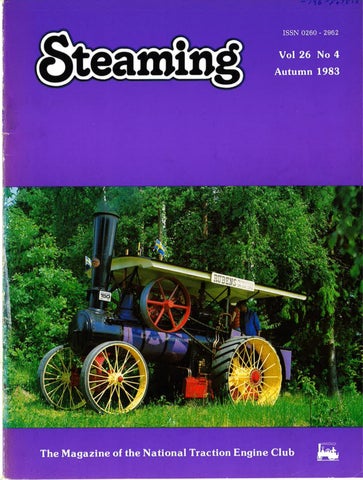
Cover Much praise is due to the Blom family at Geltene in Sweden for the painstaking restoration and partial remanufacture of this Munktells traction engine. The full story appears elsewhere in this issue. The colourful livery of the engine is that which the makers used as standard, as far as could be judged from the remains of original paintwork on this and other Munktells machines. (Tore Blom) 155
CgFrom the Chairman
Engine Owners Column
The George Beck Appeal I am sure that all members will be pleased to hear that our General Secretary George Beck is well on the road to complete recovery following a successful operation to replace an arthritic hip joint, and a note from George himself appears below. Following myI for donations in your last copy of Steaming, and a subsequent decision of the General Committee endorsed by this year's Annual General Meeting, the necessary funds for immediate treatment were advanced from the Club's general funds and it is intended to recover the sum so advanced from the proceeds of the Appeal. Unfortunately, initial minor complications prolonged the stay necessary in hospital, and this has substantially increased the amount of money required to be found. To date, those members who have replied to the Appeal have been extremely generous In the individual sums donated, hut at the time of writing less than 20% of our membership has responded. May I therefore again appeal to all those who have not yet replied to send their donation, however small, to the Treasurer (cheques should be made pavehle to National Engine Club, George Reck Appeal) or hand them to a general committee member or the Clubs sales stands for onwards transmission. Many thanks to you all. (Peter Barber)
George Beck writes: I should like to thank all the friends who have cared so much, and so generously helped me in time of need. You saved me from two years of suffering while I waited for an operation under the NHS. I am overwhelmed by your kindness and generosity; Indeed I feel very humble. No words could ever adequately express my gratitude, but I shall continue to serve the Club for as long as I am able and, thereby, strive to express my appreciation. As I have said, no words can be adequate to express all I feel, but I know you will understand if I just say: Thank you and God Bless. 156
Vehicle Registration Marks The Depaitment of Transport has announced a final date for the recording of all existing vehicles on their central record at DVLC Swansea. Owners of vehicles not registered for road use since 1974 will lose their elaidurrient to tile machine's original number unless they take action before 30th November 1983. This applies to vehicles still recorded on the old style green log book; those wishing to retain their original registration marks will need to replace the log book with the current computer produced blue registration document. Closing of the register will ensure that an accurate central record exists at DVLC for all vehicles in the country. After 30th November DVLC will no longer accept applications to record these vehicles under their original mark. Old vehicles will still be able to
be registered but they will be given different marks, usually of a type appropriate to their age. Claims to register original registration marks should be sent as soon as possible to DVLC, Longview Road, Swansea, SA6 7JG, enclosing old log book, tax disc etc. These documents will he returned if requested. Registration is free. Capital Gains Tax Owners of vintage agricultural machinery will be encouraged by the withdrawal by HM Inspector of Taxes of a claim for Capital Gains Tax on the sale by an enthusiast of a Girotiller. The decision would seem to indicate acceptance that such machines should be exempt under Section 127 (5) of the 1978 Capital Gains Tax Act and that there is no reason why agricultural machinery should be treated differently from traction engines or any other 'tangible moveable plant with a predictable life of less than 50 years'. (Anthony Heal)
From Alan Martin's Collection
Some traction engines might have been destined to work their whole lives without appearing in front of the camera — until, that is, they were pressed into service for the village outing. A picture was then a must — here from Oriffield, Yorkshire, G. & W. Woods' 7hp Foster number 2665 new in October 1902, poses before moving off with its train of two traction wagons and (at least) two carts.
Boiler Transfers The finishing touch to many a well restored engine is the makers transfer mounted on the boiler cladding sheets. Many traction engine manufacturers used these transfers, often advertising the many medals and diplomas their products had won at shows over the years. The designs were sometimes extremely elaborate — much too elaborate in many cases for handpainted reproduction. Stephen Hubbock announces a new service to engine owners land enthusiast collectors) with the manufacture and supply of boiler transfers for most makes of engine. The transfers are new, authentically reproduced from the few original copies now surviving, and are made from the same materials and by the same printing processes as in years gone by. There is no modern method which produces any better quality. Available at a later date will be transfers for agricultural machines, (threshing machinery boilers etc), stationary engines and tractors. Depending on demand, miniature transfers for scale models may also be available. Stephen would also welcome information on the history of manufacturers of transfers, including dates of medals and the shows where these were won. Members requiring further details of costs and availability etc, should contact Stephen Hubbock, Drove Cottage, Okeford Fitzpane, Blandford, Dorset DT11 ORR.
International Rallying For some years now a number of engine owners have been taking their engines to the Netherlands to join Dutch enthusiasts at their steam engine events. This year Vestingdagen Hellevoetsluis, held some 20 miles south of Rotterdam, became the first overseas rally to appear on the Club's Approved Rally List and, another first, became the inaugural overseas rally at which the NTEC Sales Stand was presented. Ken and Edie Beeby, our longest serving stand operators, joined various Dutch preservation societies in a large marquee erected in the steam engine area of the event — and, incidentally, enjoyed a fine sea view from the rear of the tent. On behalf of himself, his wife and the Club, Ken asks us to record his grateful thanks to the organizers for
the opportunity of being at Hellevoetsluis, and also sends best wishes to all those members of Stoomwalsenclub Netherlands who helped them during a very enjoyable weekend. One of the rallies 'down under' next, Ken?
Obituaries Harry Bushell The passing of a man whose name was so closely linked with Thursford has deprived East Anglia of another of its steam preservationists and experts in the field of engine restoration. Harry Bushell's home and workshops, just across the road from the famous collection of George Cushing, have been the scene of much activity over the years and several engines from the Thursford collection were restored there. Harry was 85 and had worked with agricultural implements all his life. The threshing and other machines which bore the family name had been made at the nearby and quaintly named village of Great Snoring for well over a century and half. But what Harry loved in later years was to sit in his chair by the stove (lit in season) and yarn away the hours with anyone who cared to stay and chat. The conversation would inevitably be steam engine orientated and although the writer did tarry awhile on one or two occasions, that while was regrettably never long enough to soak up the wealth of information which Harry was willing to impart to a good listener. His death creates a void at Thursford which can never be filled. (Derek Rayner)
Wilf Cole Wilf Cole, whose knowledge of steam extended well beyond the traction engine and steam wagon and who had been involved in this sphere since 1905, has died. Many members will have read his reminiscences in these pages, unfortunately curtailed because of his ill health. Primarily a wagon man, Wilf preferred Garretts to Sentinels but had a soft spot for Mann's, with whom he served his time. He and his brothers were also interested in steam cars and owned a White and a Hupmobile with a Jowett engine, suitably modified. Both of
these were a feature of several tug of wars at West Riding rallies in the 1960s. Although he was not a big man and suffered from a crippling disability as a result of a childhood illness, Wilf could make his presence felt and many people have been amused and embarrassed over the years when caught up in the somewhat heated arguments which sometimes took place between him, seated on his beloved Mann's tractor, and his late brother Len on the stage in front of their fairground organ. Characters they were both, and we miss them. It is fortunate for us all that Wilf was sufficiently interested to take time to co-operate in the preparation of his long running series of articles for Steaming and we all owe him a great deal for passing on to us some of his vast experience. These memoirs can be looked back on and re-read by future generations and they make a very fitting epitaph to one whose life totally revolved around the power of steam. (Derek Rayner)
Jack Hedges The steam world has lost yet another great enthusiast and character with the recent passing of Jack Hedges of Weymouth and Portland, Dorset. The traction engine preservation movement owes much to him, especially in its earlier days — the early fifties — when his professional boiler-making expertise and services were placed at the disposal of the late Mike Salmon and the writer. We accepted Jack's judgement of firebox and boiler conditions as the ultimate, and it is fair to say that Fowler showmans 15319 QUEEN MARY and Burrell showmans 3483 PERSEVERANCE II and 3938 QUO VADIS would never have been purchased by myself had not Jack given his enthusiastic yet 157
objoctivo approval. Ile similarly advised Mike over the latter's purchase of the Burrell tractor PETER PAN, to say nothing of his examination before purchase of a series of Sentinel wagons, Aveling, Wallis and Fowler rollers for the writer. He was always ready and willing to help get an engine home, no matter time of year nor distance, and was always a tower of strength and know-how if one encountered leaky tubes or stays en route, which was usually the case. Professionally, Jack served his apprenticeship at Swindon with the Great Western Railway and became chief boiler inspector at Weymouth shortly after railway nationalisation. He championed Churchward locomotives, but was also unstinting in his praise of other good boilers, notably Bulleid's; this was typical of him, a generous man in nature and outlook. As_Jack witnessed the-end-of regular steam on British Rail, he earned promotion to become the principle authority for all boiler inspections and conditions for his region. Many enthusiasts may not realize it, but much of preserved steam now running
by John Crawley
on BR metals is due to Jack's decisions. Rail, as well as traction enthusiasts therefore are indebted to him for keeping steam alive in a largely hostile and anti-steam world. In due course he became the proud owner of Burrell showmans tractor 3192 ST BERNARD, and later a large single-cylinder Clayton roller. He was well acquainted with the showland fraternity, and for some time had the custody of the Garrett LITTLE BILLY belonging to Percy Cole. There were few tobers where Jack was not welcomed, having cultivated an interest since childhood, especially in the engines and tackle of Jacob Studt, and Edwards of Swindon. His interests and abilities were not merely confined to 12 inches to the foot scale — live steam locos in 2/2i11 and 3Y2in gauge, as well as a tin scale steam roller occupied his limited leisure-time, to-say-nothing-of-his-tine film activities of all things steam. Not only was Jack Hedges a real engine man who championed steam, but he was friend to all and a real gentleman. He will be missed at Stourpaine this year, and indeed much further afield.
Fairground ENGINES IN FOCUS John Crawley 91/2 " x 71/4 " casebound 128pp high quality art
OVER XSO PHOTOGRAPHS Of SHOWMANY ENGINES TAXI], IMMO INFER WORKING DAYS
£9.95 (aprilrp7a5ctipngaft post ISBN: 0 9508046 1 4
A collection of 268 photographs of showmans engines, taken in their true working environment and when the showman relied on his engine to earn him a living — and before the paint and the glory of the preservation came into being. Published by John Crawley Limited Available from NTEC Sales Stands at most rallies or by post from NTEC Sales, 91 Peplins Way, Kings Norton, Birmingham B30 3NJ. 158
He leaves a wife, children, and grandchildren; Joan, Bill (a Club member living in Kent), Shirley, and their families. To them all we extend our sincere condolences in their great loss... Si momentum requiris, circumspice. (Ken Coombe)
Arthur Jackson It is with great regret that I record the death in June of Arthur Jackson of Sawtry, aged 92 years. Arthur's father was a miller and farmer from Garthorpe, near Melton Mowbray and the family moved to Sawtry in 1911. They had also farmed for a period at Orton Longueville near Peterborough, owning at that time two sets of Fowler ploughing tackle which were used on their own land and also for contract work in the area. On-leaving-school Arthur served an apprenticeship with Blackstones of Stamford and the engineering knowledge so gained caused him to be in demand when their neighbour, Beavers of Coppingford, were in difficulties with their old set of roundabout ploughing tackle. In 1915 the Jacksons ordered from Fowlers a new set of BBS ploughing engines, arrangements being made for Arthur to spend time in the Leeds works to witness the completion and testing. He was thus able to understand the working of the superheater and the piston valves with Firth's valve gear which were fitted to this class. During his stay at Leeds Arthur met both Alf Pepper and his father. The engines, numbered 13976 and 13977, ..vcrc initially deli-y.ed by idil to Nottingham for exhibition at the RASE Show. After the show they were steamed to Sawtry, Fowler's drivers being in attendance. These men were however nut very skillful at handling the superheater piston valve engines and during a stop on the road, allowed water to collect in the cylinder such that when a restart was made damage occurred on one of the engines. Three days were lost in obtaining replacements from Leeds and fitting them. Arthur was very enthusiastic about the BBS design which he regarded as a great improvement over the saturated engines. He said that if you were looking for them at work they were hard to find, since they were exceptionally quiet and made little smoke. The Fowlers were used on contract work in the Sawtry area over a radius of some 15 to 20 miles but by 1930 demand had fallen away and the tackle was sold. Arthur then left farming as such
and went on to become a dealer in agricultural machinery, and also an agent for the supply of new equipment from some of the leading makers. He was agent for William Foster of Lincoln, Innes, Son and King of Hitchin, William Cooke of Yaxley, Ogle of Ripley and Maynards of Whittlesford. His activities in this business enabled him to gather an enormous knowledge of engines and machines and their owners over a very wide area. He also achieved a great reputation for fair trading and complete honesty among the farming community. Arthur always maintained his interest in the great days of steam and shortly before his retirement in 1968 he was taken to Wilby Pastures, near Grantham to watch Warner's Fowlers ploughing. He was invited to drive engine 15155 for a few pulls, which he did — thoroughly enjoying himself and causing much favourable comment from the owner at his performance. Arthur Jackson was a great talker who knew his subject thoroughly and could hold his listener spellbound for hours on end. His passing leaves a gap which is impossible to fill. We have lost a very dear friend and our sympathies go to his son in law and grand daughter at their tragic loss. (George Storer)
Billy Jeanes
The rapidly diminishing ranks of those whose life's work has been connected with steam have been further decreased by the death in Suffolk at the beginning of June of Billy Jeanes, one of East Anglia's pioneer preservationists. His lifetime with steam began when he was 11 years old, watching a set of Dawson's single cylinder Fowler
'wrought iron' ploughing engines arriving to do mole draining at his home village of Helmington. His first employment was as cook-boy for William Wilson's Fowler ploughing set and the following year he commenced employment with Dawsons of Rushmere where he began as drivers mate, assisting first of all on a big Marshall compound roller and then with Ruston & Hornsby roller 122282, which he was to drive for the rest of his life. He deputised first before World War 2 at the age of 18, and became the regular driver in 1940 until the firm finished with the engine just thirty years later, the last commercially worked steam roller in Suffolk. The late Harold Whipps, who bought the roller from Dawsons was told but for Billy and the way he looked after the roller, it would have been cut up long ago. Billy became involved in preservation in the early 1950s and bought his own tractor, Garrett 32944 (BJ3206) in 1953. This and many other engines, including Burrell showmans 3933 PRINCESS MARY were restored at Woodton and Billy's interest extended to other areas and to Thursford where he worked on the maintenance and restoration of many of the well known engines on display there, latterly driving the narrow gauge railway loco CACKLER. If any man deserves to be known as a craftsman in steam engine driving and maintenance, he was the man. He was quiet and shy but with a huge knowledge and vast experience of engines. He knew the detailed history of most local engines and many more besides. He is sadly missed and to his wife who supported him in his preservation activities, we extend our sympathies. Over 150 people attended his funeral — a measure of his popularity — and he is buried under a little oak tree in the corner of Wrentham churchyard. A final tribute from Mrs Maureen Cushing at his graveside, "Billy always had time for everyone interested in engines" was a fitting comment. (E. W./J.D.)
London Area Social Meetings Meetings are held on the last Tuesday of each month from October to April inclusive (no meeting in December) in the upstairs room at 'The Cock Tavern', Great Portland Street, London (corner of Margaret Street and adjacent to Oxford Circus). They start at about 8.00pm and all are welcome. It has been poSsible to arrange most of the 1983/84 Winter programme and details are given below for members to make note of in their diaries. TUESDAY, 25th OCTOBER 1983 The opening meeting of the 1983/84 season will be, as usual, members slides. Bring along some from your collection — old or new. TUESDAY, 29th NOVEMBER 1983 A talk by Mr Dorrington on the restoration of a 1908 Renault car and its participation in the Anniversary Paris-Vienna road run. (Postponed from last season.) TUESDAY, 31st JANUARY 1984 An evening of films presented by Mr A.F.W. Smith of the Steam Plough Club. TUESDAY, 29th FEBRUARY 1984 Mr Peter Smart will give a talk on the engine building firm of Wallis & Steevens. TUESDAY, 27th MARCH 1984 'Twenty five years of rally slides' will be presented by Richard Horsey. TUESDAY, 24th APRIL 1983 To be arranged — details in Winter 1983/84 edition. (London meetings organiser — Bill Timmings, 308 Hertford Road, Lower Edmonton, London.)
'Driver wanted, who has had experience in driving steam lorries built by the Yorkshire Patent Steam Wagon Co.; wages 45s weekly; must do own running repairs; referee required. The Scottish Farmers Dairy Co., Cardonald, near Glasgow.' (From Commercial Motor, 20th April 1905).
Future Dates Rally Organizers Conference The above Conference will take place at the Great Western Royal Hotel, London on Saturday, 15th October 1983 at 11.00am. Formal notice and invitations will be sent to Rally Organizers in the usual way. 159
WANTED
Area Sales Representatives
On 22nd May the Steam Apprentice Club held their spring meeting — an extremely wet day with Fowler ploughing engine 15183 at Hill Farm, Avon Dassett, Warwickshire, by invitation of Mike Davies. Dick Blenkinsop's photograph of the group shows Mike and his wife Jennifer (centre), after the presentation of flowers. SAC chairman Sylvia Dudley, responsible for the organisation, is second left.
Vounteers are required to run NTEC Sales Stands at rallies etc in various areas. It will be necessary to have your own car and caravan/tent, and travelling expenses etc will be paid. This interesting and worthwhile job offers the chance to meet other enthusiasts in steam surroundings over a wide area. If you are interested please seek further details from the National Sales Officer — Keith Shakespeare, 91 Peplins Way, Kings Norton, Birmingham B30 3NJ (Tel 0527-45683)
M1RAS Mortgage Interest Relief at Source
For full information on this year's new tax treatment of your mortgage, contact TENNANT BUDD at Tonbridge. Revision of your mortgage financing could well prove advantageous. For further details contact the Life Department
TENNANT BUDD (LIFE AND PENSIONS BROKERS) LTD., IIILDENBROOK HOUSE, THE SLADE, TONBRIDGE,KENT TN9 1HY. Telephone Tonbridge (0732) 357011. 160
Munktells 5605 Tore Blom .. not so weak as the American traction engines, but not so heavy as the English built engines'
These words well describe the middle course that the Swedish firm of Munktells Mekaniska Werkstad tried to take when they constructed their first traction engine in the late 1890s. It was also a thesis which was followed in 1911 when Munktells introduced the new line of traction engine, classified as SK, based on and developed from their class K portables. Typical for all K based engines was the use of piston valves, trunkguides, and shaft governors, located on the crankshaft, working directly on the piston valve. When the first series of ten SK traction engines was ready during summer 1911, it was a somewhat unusual design introduced to customers. The single cylindered engine with piston valve was built on the portable principle with cylinder block on the top of the firebox and the crankshaft in front. It was a three shaft design, fully sprung both front and rear, and normally single geared at a speed about 3.3 km/hour — which makes about 2 mph. The front carriage was of unusual construction for a traction engine, as it was of the automobile type with king pins and tie rods. It was lacking chains, with the steering gear located on the front carriage, and connected with the steering wheel by a long rod. The working pressure was 12Kg/cm2 (701bs) and its feed apparatus consisted of a mechanical feed pump and injector. In front of the crankshaft
was a steam dome, from which an outside pipe connected to the cylinder jacket. Transmission from the crankshaft to the driving wheels was by way of chain over a wood-blocked clutch inside the left side flywheel, to an intermediate shaft and then through differential gearing reaching the rear wheels. The first series of SK engines was
(photographs by the author)
rated 8hp and identified as class SK4. During 1912 the line was completed with both a smaller version of 6hp and a larger of 10hp, known as SK2 and SK6 respectively. (Initially an even larger engine was prospected but dropped quite early). Of the largest SK6 engines only eighteen were made, and one of the last built and sold was works number 5605, one of a batch of six made in 1914. In
A photograph from about 1925 showing Munktells 5605 at work, belted to a new saw bench under its first owner. 161
The engine during restoration work, when the tender was under construction. The boiler has received new tubes and is just having its smokebox rep/aced. Note the blind cog wheel on the crankshaft to enable us to measure the length of the chain. January 1979.
contrast to the small and middle sized versions, the SK6 proved to be hard to sell and 5605 did not in fact leave the works until 1919, when sold to the north of Sweden. Its first owner, Mr P.E. Andersson, was a local contractor in the sawing and Ihreshing business. The engine replaced an earlier and smaller type, and no doubt this must have been quite a difference to the owner as the new engine represented three times the effectual output of the older one. Engine 5605 produced 30 brake horsepower on the belt, and at delivery was equipped with an extra high gee' so that the engine could go at 5.6 km/hour (approximately 3.5 mph). Not very much is known today about its working life under the first owner, but some photographs have survived. In 1936 it was sold down to a district near the town of Kelmer on the east coast, after being out of use for some years due to electric power being available in the former area. Its new task was actually the same as before, for it was bought by a threshing association, one of many in this part of the country at the time. The engine was used mainly for threshing until 1954 when it was sold to a nearby sawmill. During delivery to that sawmill it was on the road for the last time, because it then became semi-fixed and concreted on a sawdust oven. For this the rear part of the engine — the hind wheels and the complete tender — was stripped off and dumped outside, together with the front wheels. This was all finally 162
sold to scrap in the sixties. At this time the preservationist was a generally unknown concept in Sweden, although my father had been collecting engines, and kept a few portables as a hobby. This interest brought us in contact with the engine 5605 during a family journey to the area, when father made enquiries for engines. The area was thought to be the most prolific, regarding steam engines, of anywhere in Sweden at the time. This proved to
be true, as there were a lot of engines around, and no less than 26 portables in our collection, together with other stationary engines, are from this area in the south east. When we first found the traction engine in about 1967 it was still doing its regular work and not available as a collector's item. In those days we did not know very much about traction engines in Sweden and some statements were floating around about a 'lokomobiler' which was able to move itself, and which could be steered and driven. We also saw pictures and articles of English rallies, but that was too far away to be a reality; it was more like fiction to us! Any Swedish built tractions we had never met before; I think not even in pictures, and that is why the discovery of 5605 was most interesting and meant a lot to our collecting mission. As time passed by we learnt more about traction engines in Sweden and when our researches to find an available example came to nothing we were more and more interested in the 'half' traction engine we had found three years before. We discovered 5605 to be one of three traction engines remaining, and we were eventually able to buy it and secure it for our collection in 1970. This was done on the agreement that the present owner was free to keep it and use it as long as he wanted. After another two years we were at last able to collect the engine and we brought it home, together with a Marshall portable we bought close by.
My brother Tage and father Ruben at the milling machine, boring holes in the differential main wheel. Made from a pattern in cast steel.
A view of the tender attachment to the boiler. January 1979.
We would now be forced to produce all the missing parts, as there was no chance to find any spares. The work was started in a very easy way during summer 1972. To do all the missing parts without any drawings would have been too hard, and that is why we decided to make drawings from one of the other existing engines. We were kindly allowed to dismantle and measure one of the engines, which later proved to be medium size SK4. We had then to size up and adjust all the measurements to fit our engine. From this exercise the first patterns were made, for the clutch arm and steering wheel, together with replacements of studs and brackets attached to the boiler. Later in the year of 1973 we were fortunate to purchase the third existing traction engine we knew of. Unfortunately this was not any big help, as it proved to be an example of the even smaller size, SK2, of 18 bhp. The forthcoming restoration could be done in winter month evenings only, and went on slowly. Father made all the patterns so castings could be made. There was the casting of front and rear wheel hubs, chain and gearwheels, differential gearings, etc. Some of the wheels were done in cast steel. Beside this, some work was carried out on the drawbar, upon
A rear view showing the tender work when the engine was being reassembled. Both gearwheels on the right are the gears outside the differential. The small one is the extra high gear, unusually fitted to this engine.
Father and myself assembling a front wheel, for which we had made all the parts — wheel rim, spokes, the hub and also the nuts as they were out of modern standards. December 1976.
which the tender was built. It all turned out to be much more burdensome and slow than thought at the beginning. When, at last, in 1981 we started to re-assemble the engine, we found
ourselves in possession of new rear wheels, new rear shafts, and new chain and gear wheels, including the differential works. Also new were the coalboxes and water tanks which hung underneath the footplate. In 163
A rear view when tender was completed. On top of the cylinder, the cylinder lubricator.
front there were new wheels to fit the completely renovated front carriage. The crankshaft had been turned and fitted with new bearings, and all links had been rebushed and fitted with new pins. Also the piston rod had had to be replaced. The boiler was in receipt of new tubes, and new smokebox and chimney base. All the boiler fittings had been overhauled and were in like-new condition. The engine was to be covered by a three-quarter canopy, in accordance with the fashion on delivery when new. Finally a careful polishing of all the hrasswork did much to secure the engine a better appearance; there was just painting and assembling work left! In early May 1982 it was our great day to take the engine out, moving on its own wheels, after being without for 28 years. The last thing to be done before it could be pronounced finished was the boiler inspector's driving test. Not surprisingly he found the engine good enough to work with its original pressure, even after 60 years from delivery, of which 50 had been at work. In June the engine was introduced to the press, and it made more impression than we ever expected, resulting in full page articles, and the engine's first television appearance on the news. The summer was fully booked up as the engine took part in Volvo-BM's 150th anniversary, and in between was the main attraction in our yard. In the Volvo-BM product cavalcade it was of course the main exhibit, and was highly praised, even by His Majesty King Carl-Gustay. His interest was obvious as he asked to try the steering wheel; is Munktell's traction engine 5605 one of the very few, if not the only one, to have been steered by a King? A note on the firm of Munktells and their successors.
This picture well illustrates a lot of characteristics of Munktells class SK traction engines. Unusual is the shaft governor — underneath the pipe between the crank and the left wheel. Inside the latter is visible the clutch. Beyond the crank shaft is the steam dome, connected to the cylinder jacket by way of an outside pipe. 164
Munktells Mekaniska Werkstad, Eskilstune, Sweden, was established in 1832 by the founder J.T.Munktell. The firm soon became one of Sweden's most important and leading industries, and a leader in the case of steam. Sweden's very first rail locomotive was completed by Munktells in 1853, the same year as they built their first portable engine. It was the production of portables, with accompanying threshers, which made the firm so famous and
A close up view of a rear wheel hub. The letters were machined out by my brother and 'adjusted' by my father.
respected all over Northern Europe. Traction engines were built from 1900, and amounted to a total of about 320, including some thirty steam rollers. Altogether — portables, rollers and traction engines — the production figure reached over 6500 engines before production was stopped in 1921 in favour of oil tractors. This output makes Munktells the largest maker of steam engines in Scandinavia, and although most were sold on the home market, large numbers were exported to other Scandinavian countries, and to Russia. In 1932 Munktells was brought together with the famous firm of Bolinders in Stockholm, and received the new name Bolinder-Munktell —BM for short. Volvo bought BM in 1950, and concentrated production on farm tractors, which has been switched over to excavators and dumpers from 1983.
The forecarriage in close up. The front springs are found in the fork bolted to the smokebox.
Another view of Munktells 5605, a remarkable feat of restoration.
Laying up an engine for the winter The winter will soon be upon us, and with the rally season finished, now is the time to get the engine ready for the hardest winter imaginable — at least that is the way to look at it. First priority is to drain the boiler of water — not just opening the blow down valve but by knocking in all mudlids and giving the boiler a good washing out. The mudlids should be marked so that they can be put back in the correct place and the correct way round; this saves a lot of bother next season. Ensure all the gauge frame cocks are open, and a piece of wire pushed through the stalk is a good idea to make sure they are not blocked. The ashpan and firebars may also be dropped and the inside of the firebox given a good de-scaling and a coating of old engine oil — don't forget to leave the smokebox door slightly open to allow circulation of air and coat the front tubeplate with oil also. It is also a good idea to dip an old tube brush in the oil and pass it through each tube. The chimney can now be covered to stop rain coming into the smokebox, or may even be taken off to clean out all the soot. On to the motion and brassware now, and first of all remove all brassware that can easily be removed and store inside for safe keeping. The
remainder and all motion brightwork should be given a good coat of grease (not oil) or a proprietary rust preventer which can be sprayed or painted on. The things like reversing lever handles and regulator can also be protected by wrapping a piece of oil soaked rag around after greasing. The tender and footplate should be thoroughly cleaned out and swept — nothing corrodes metal more than rain water and coal dust. The water tank should also be emptied and the manhole cover left off to allow circulation. When the tender has dried out, a good coat of red oxide (not bituminous) paint is in order. Any paint that flakes will get into and block the injector next season. The next job often gets overlooked and can be annoying to carry out but saves a lot of expense if frost damage should occur. All clacks should be lifted and left on the seat at an angle so they don't get lost. This can save a cracked pump casting which would be very expensive to replace or repair. While you are at it all feed pipes from the injector and pump should be removed. If anything is going to suffer from damage, these will. Having done all this you will be thoroughly dirty, wet and fed up but at least your engine will be safe until next summer — but don't forget to sheet it down well. If anyone has variations on this theme, they would be gratefully received by the Editor. (Bernard Bertram) 165
q3ack to (Burn& 0
Our Autumn 1982 issue contained the story of the Gold Medal that Burrells won in the 1907 RAC Trials. Only a little late to celebrate the ensuing 75 years, Ron Walker was able, together with the organisers of Weeting Rally, to bring together some Gold Medal tractors for an interesting weekend at their birthplace. Here he describes what went on. Photographs by Roger West
On Thursday 14th July six Burrell Gold Medal tractors stood in their speciai area at the coming weekend's Weeting Rally. The owners and crews collected together for a briefing on the next day's road run to the Burrell works; this was followed by a drive over the eight mile route through Thetford Forest to Thetford. On arrival they viewed the old works and then retired to 'The President' restaurant to check over arrangements for the following day. The party later returned to Weeting where a cheese and wine reception was held, enabling owners, crews and friends to get to know one another. On Friday crows started early, with all the engines in steam well before the first one departed for Thetford at 10 am. The road run was led by three shnwmans tractors; James Gilbey with 3192 ST BERNARD from Yeovil in Somerset, followed by local owner Kathleen Salmon's 3433 PETER PAN displaying its new paintwork, and then 166
Brian Bourn and family driving John Downs' 3453 THE MAY from Essex. I hen came three standard versions — Peter Barker from Berkshire driving 3458 DEFIANCE, Jim Rochester from Finedon, Northants with 3626, and about 10.30 the last engine, 3862 HARVESTER owned by John Johnson of Southport, Lancashire, completed the procession. The tractors travelled with police escort at front and rear and on the outskirts of Thetford were collected together outside the old golf club house, before being closely escorted across the busy Al 1 main road and through the narrow streets of the town centre to Minstergate, where they arrived at about 11.30, there to line up nose to tail outside 'The President' restaurant. There, as well as a large crowd of onlookers, proprietors Pat and Manfrod Stotcr were waiting with glasses of sparkling wine for the visitors. Kathleen Salmon's fair organ was playing suitable music for the occasion, and
the six engines looked an extremely fine sight lined up in the bright sunshine. The press covered the event extremely well, including our own magazine's editor and his wife Celia, Michael Gates from The Worlds Fair and representatives of the Road Locomotive Society, the East Anglian Daily News, BBC Radio and TV's Look East programme, Anglia TV's About Anglia, and Radio Saxon, the new local independent station for the area, whose reporter had travelled on THE MAY. After a while the engines reversed around the corner to the Burrell finishing shop in Minstergate Street, where the doors had been specially opened with the co-operation of the
Where is it? Throughout Ron Walker's researches into Burrells Gold Medal award at the 1907 RAC Trials, he has discovered no leads as to what might have happened to the Medal itself — or to the silver medals the crews received. One would have thought they were of too much intrInIslc and actual value to have just got lost — surely someone still keeps them safe. Does anyone have a clue?
Jim Rochester's 3626 of 1914 scurries through Thetford Forest on its way back to Burrells.
Richard Parrott and Anglia TV presenter Christine Webber pose with local owner Kathleen Salmon, and other owners, with the tractors parked in the opened doorways of the old Burrell paintshop. It seems very doubtful if even Burrells ever had six Gold Medal tractors at the works at one time. Mr and Mrs James Gilbey admire the commemorative brass plaque.
present owners, the Keymarkets supermarket chain, so that each engine was allocated an open doorway. This was the building against which Burrells took many of their 'official' photographs. Under the control of Keith Grimsey the engines were positioned to suit the large gathering of photographers. First the engines alone were photographed and then with their drivers at the front wheels. Braving the by now scorching heat, Richard Parrott and Anglia TV presenter Christine Webber, presented each of the owners with a beautiful six inch diameter brass plaque on which is depicted the RAC Trials Gold Medal surrounded by the words Weeting Rally 1983 and the names of the presenters — Bysteam — plus the various sponsors who had put money up to make this whole weekend possible, especially the transport costs of collecting the tractors together. After the photographs had been taken the engines returned to their line in St Nicholas Street. Now, the clean crews, members of the press, together with the Mayor and Mayoress of Thetford and other guests, joined together on the tree shaded lawn of 'The President' for a superb buffet, washed down with Greene King bitter or wine. The restaurant is the old Burrell family home, and many pictures of Burrell engines appropriately decorate the walls of the various rooms.
The commemorative brass plaque recording the event and its sponsors.
167
The gathering of owners and friends outside the front entrance of the old Burrell family home — now 'The President' restaurant.
John Downs' 3453 of 1913 poses against one of the less maintained parts of the old Burrell workshops.
At about 2.30 the crews returned to their engines and again they were reversed back to the works buildings for individual photographs in front of the still existing St Nicholas Works wall stone. The police then escorted the group through the town again and back to the rally field at Weeting. One minor casualty on the return journey was the injector on one of the engines, which suffered from tl- e extreme heat of the day. Cooler water from the accompanying preserved fire tender — mainly in attendance to guard against fires on the route through the forest — soon solved the problem. From the large number of compliments I received during the day, all concerned felt this wold go down as one of those special days in everyone's life. We were particularly pleased to welcome from New Zealand, Bob Hawkins and his wite, who had retimed their planned journey to England to take in the weekend. Bob had worked with Burrell products for much of his early farming life in New Zealand and is associated with two speed single cylinder survivor 3510. Saturday morning saw us preparing for a fairly ordinary rally weekend, though learning that Om iHiliperaturP had reached 94° on the previous day at a nearby airfield, it was obviously going to be another hot day. The six Gold Medals were in their special enclosure with boards on the posts in front of them giving details of each engine, and a display board at each end of the line giving details of the Gold Medal tractors, the 1907 RAC Trials and the complete list of survivors. The engines entered the grand parade on Saturday and on Sunday a special parade was arranged — each day the commentary was undertaken by Steve Neville.
Peter Barker's 3458 of 1913 poses below the St Nicholas Works namestone. Rumours that grown men were to be seen peering into the old works yard with tears in their eyes are not true. 168
The tractors preparing to leave Minstergate Street on the return run — and a skyline probably little altered from the first time they steamed away from the works.
With the successful outcome of the weekend, the general concensus of opinion was that Burrell tractor owners should try another similar event if I can persuade the organiser of a rally elsewhere in the country to work with us. I would like to thank all those who took part, and especially the committee at Weeting for having the foresight to encourage me to organise such an event. (The above account, by Ron Walker, is largely taken from Burrell Gold Medal News No 7, a newsletter which Ron sends as an occasional edition to all Burrell Gold Medal owners. All the owners at Thetford agreed the event was very useful in enabling them to meet fellow owners, and to discuss common topics or problems. Ron's enterprise in running the informal group, as well as the gathering, could be an excellent model for other similarly useful groups in the engine owning fraternity.)
The Gold Medal line up at Weeting rally field — the placenames on the canopies illustrating the widely spread distances the engines had come from to attend.
On Sentinels THE STEAM WI A PrIVITIke lila) 1 UIRJ Joe Thomas The Rhinoceros Tractor This last effort to utilise steam propulsion as a means for direct ploughing was indeed a very well built, solid and reliable piece of machinery. At Pitchill, near Evesham in Worcestershire, Benjamin Bomford was, in the early 1860s, one of the pioneers of power farming, and sixty years later his grandsons, Douglas and Ernest, brothers of Leslie R. Bomford (already mentioned in the previous part of this article), were still prominent in that field. They had well equipped engineering workshops at Pitchill, where not only did they repair their own equipment, but built or adapted much from other machinery. A typical example was building light tractors for use on the vast horticultural expanses of the Vale of Evesham. These were made from old Morris Cowley car chassis, reconditioned and fitted with wheels incorporating feathering strakes, adjustable for depth, by means of an eccentric working on Bray's principle of 1856. In 1927 a new type of steam ploughing engine, much lighter in weight than the orthodox type, was built at Pitchill by combining part of a secondhand Sentinel steam wagon with other material from a scrapped Fowler ploughing engine. There seems hale doubt that the Bomford brothers, Douglas and Ernest, were inspired to build this lightweight ploughing engine by the successful trials of the Sentinel Rhinoceros tractor carried out on their 170
land by their brother Leslie in 1926 and 1927. Following the introduction of the Roadless tractor, Sentinels had pressed on with Rhinoceros, and Leslie Bomford had a large part in the design of it. He had returned to England after a six month stay in Kenya. 'The Rhino', as it was popularly called, had Ito quote Mr Bomford) "good big driving wheels, a larger boiler, and although I say it myself, it was a very fine steam tractor indeed. But it cost £1,800 which was a lot of money in 1927, and at a time when the small internal combustion tractors were coming into use, the advantage of using local fuels was not sufficient to compensate for the high cost of water and fuel hauling etc." The driving wheels were actually 6ft 6in in diameter and 18in wide; the front wheels were 4ft 7in. Extension rims could be fitted to bring the width of the rear wheels up to 24in and the front ones to 10in. The wheelbase was 9ft 9in and overall the length 16ft 6in; the width 8ft 4in and height 12ft. As has been said, the boiler was larger than that of the then current wagon in production (the Sentinel Super) and the previous tractors; it was almost identical to the boiler used on the 100hp rail shunting locomotive. This was similar in general design to that of the Super but twin funnels side by side were fitted to get rid of the products of combustion. The engine on the Rhinoceros was mounted horizontally above the frames at the front; it had no differential in the crankshaft, but had a belt pulley as standard on the left hand end, and a chain sprocket on the other. The pulley was 30in in diameter by 7in wide, and at 250 and 300 rpm it gave hHli spHi:Kls iif 19f13 Hful 22ER fl/min respectively. Bore and stroke of the double acting twin cylinders were still 6%in x 9in, in fact the engine was almost the standard Super engine, but the extra working pressure of 275 lbs allowed it to be rated at 86bhp, for which the design was amply strong. In fact it could develop well over 100 bhp when called upon to do so. It carried the ordinary water pump, of course, but a Weir steam pump was fitted as an auxiliary on the footplate, to the right of the engine cylinders. A Pickering governor was standard and a mechanical oil pump was mounted on a bracket attached low down to the canopy support. Beneath the engine and between the frames was suspended a cast steel oil-bath gearbox, fitted with nickel chrome spur gearing, which gave two engine to road wheel ratios of 13.17 to 1, and 30.6 to 1. Its primary shaft, which was
mounted on roller bearings, was driven by a 2'/tin pitch roller chain from the sprocket on the crankshaft. It had pinions of 47 and 19 teeth and a thrust bearing on the nearside. The secondary shaft carried a bevel type four pinion differential gear with two toothed rings having 85 and 80 teeth respectively. It, too, was fitted on roller bearings but with thrust bearings at both ends. Both shafts were of nickel steel. Both spur pinions on the primary shaft could be slid endways on splines to engage with their respective toothed rings on the differential centre. Each was moved by a fork attached to a sliding spindle with a handle at its lower end, and to prevent both gears being engaged at once, a simple floating peg was fitted between the spindles. A dog clutch was fitted between the two parts of the secondary shaft by which the differential could be locked. Each end of this shaft carried an 11-tooth chain sprocket. The nickel steel rear axle was dead, or non-rotating; it passed through two slots cut in the sides of the frames supporting the latter on two stiff six-leaf springs 3in wide and 2ft 2in span. From the 11 tooth chain sprockets the drive was taken to the large chain wheels by 2Y2in pitch roller chains each of 86 pitches in length. The rear wheels were mounted on the axle outside the chain wheel bosses and held on by external collars. They were driven from the bosses in traction engine style by pins pushed through the holes in the hubs parallel with the axle, and into corresponding holes in the bOsses. Their journals were 14 3/a in wide by 4'/Bin diameter. The whonln were fniirk'ntAel In mild steel having the spokes electrically welded to the bosses. The Rhino would turn in a 25 foot diameter circle. A form fitting seat was pressed from sheet steel to provide for both the driver and his stoker. Behind the driver a wooden bunker to hold 10 cwt of coal was fitted, but extended bunker space could be arranged for wood firing. As an alternative oil firing could be specified, but it is doubtful if any Rhino was so equipped. A powerful handbrake could be fitted as an extra which worked on two shoes, one on the inside of the inside tee-ring of each rear wheel and of course there was that invaluable fitting, the foot release valve, to enable the engine to be used in braking or manoeuvring, just as in the first Standard of 1906, twenty years before. The winding drum was of 30in diameter by 3%in wide, and would take 130 yards of %in wire rope.
a
and rail locomotives of the same make. During this time Rhodesia and South Africa were both having much trouble with heavy steam wagons on
solid rubber tyres, as Bomford put it, "cutting the roads to blazes". The South African Government passed a law severely penalising solid tyred vehicles as to loads, and on his return
to England Bomford pointed out to the Sentinel board that wagons for South Africa would have to go on pneumatic tyres if they were to sell. There was a board meeting to discuss both pneumatic tyres and diesel engines.
Stephen Alley was dead against both; they were turned down, and Bayley and Bomford left the firm. This rejection Bomford considered a great pity, for the author believes the diesel tractor he had drawn out would
have been a winner. It was an Alley who had started the firm in 1875, and if Stephen Alley had been as far sighted in the late twenties as his predecessor had been fifty years earlier, the company might well have
survived and grown greater still into Sentinel Rhinoceros tractor 6985. (collection ✓.L. Thomas)
The maximum pull in low gear was about 13,500 lbs (6,124 kg) so it was eminently suitable for timber hauling or stump pulling, in clearing forests or bush land. The rope could be lead off either forward or backwards, with a fair lead at the rear end, and one right at the front. Two drawbars were fitted at the rear, one placed low for ploughing and one at normal height for pulling trailers. The drawbar pull at starting was 22,400 lbs and at 2 mph was 9,000 lbs. In full working order the tractor weighed some 27,000 lbs but the pressure on the ground with 1 in of sinkage was only about 25 lbs per square inch. For soft ground wedge shaped spuds were provided and for road work bolt-on rubber segments could be purchased. On level dry hard earth and including the weight of trailers, the load possible was quoted at 75 tons, or on wet clay using spuds, 25 tons. Ploughing on strong virgin soil with eight discs or six mouldboards, the acreage per day is quoted at 16 and 12 respectively (with discs 10in x 6in and mouldboards 14in x 6in). On light sandy soil the acreage with 15 discs or 12 mouldboards is quoted at 30 and 24 respectively. After extensive trials in England, Leslie Bomford took the first of the Rhinos (number 6985) to Kenya early in 1927 and assembled it at Soy
Station with the help of native assistants, who "had never seen a spanner before". The first job to do on completion was to rope the engine through a deep rocky river, as the only bridge was quite inadequate. The tractor ploughed a lot of ground on various estates and Bomford demonstrated it on various low grade fuels, on which he still found it a little under-boilered. For the
South African coal used, he had to fit a rocking grate, which was obtainable as an extra. After a few months in Kenya, Bomford returned to the Sentinel works at Shrewsbury where it is interesting to note that for a short time he worked under Mr Bayley, joint managing director, with Stephen Alley, as one of a design team for a diesel agricultural tractor to use the McLaren-Benz two cylinder engine. In late 1927 Leslie Bomford went out to Sentinel's agents in South Africa, the Griffin Engineering Co Ltd, again with Rhino tractors and McLaren
ploughs. Griffins had imported Rhinos numbered 7103, 7105, 7106 and 7107. 7104 went to Glaenzer & Perrand, the Paris agents, for export to a French colony, but just which colony is not recorded. Griffins were very active on Sentinels (and their own) behalf, and
sold literally dozens of Sentinel steam wagons and tractors, portable engines
present times, as did their biggest rivals, Fodens Ltd. But Stephen Alley remained a steam man in his thinking
to the end of his days, and when he died in Norfolk on July 30th 1954 in his eighty-third year, his occupation was given on the death certificate as Steam Wagon Engineer. The Rhino tractor was without a
doubt one of the better and most versatile steam tractors ever built, if not the finest. But in the late 1920s the writing was on the wall, and as Bomford said, the Rhino could not compete economically with the much cheaper internal combustion engined
tractors then coming on to the market. So only eight Rhinos were sold; in previously six the to addition mentioned, 7192 was exported to somewhere in Asia, and 8108, the last
example built, was sent out to Griffins in South Africa, as late as December 1929.
(to be continued)
Black Country Museum event Fifteen or so engines are due at a working steam event, organised by Len Crane and the Black Country Museum near Dudley, West Midlands, on 15th/16th October from midday until 8.00pm (Sat). The museum features a rebuilt Black Country village with houses, shops and a pub — all
gas light in the evening. Also in attendance will be steam narrow boat PRESIDENT. 171
9
•
61n1 S octured
from the paot
We are grateful to George Swann of Saffron Walden, Essex, a member since the mid 1950s, for loaning a number of photographs from his collection for reproduction in our magazine. The first three, in this issue, show a variety of types of engine. The first is a superb portrait of a Fowler D2 convertible engine and two traction wagons in Station Road, Saffron Walden. The engine was works number 11094, and had been delivered new in 1907 to Sir James L. Mackay of Chesterford Park, Essex and this inscription appears un brass plate on the motion cover sheets. The estate was some two miles north of Saffron Walden but the use to which the heavy wagons 172
were being put is unknown — certainly the outfit had been out in the mud. The date is unknown — Sir James became Lord lnchcape in 1911 and one might assume he would have the brass plate changed soon after. Mr Swann remarks that the houses in the background are virtually the same today, and washing is still hung out. The Fowler was by 1921 registered CF3996 and owned by J.D. Sayer of Lack ford, near Bury St Edmunds, a move of only 25 miles or so. Still owned by Sayer in 1941, and last used at Barton Mills on the A 11, it reposed in Duce's scrap yard at Cambridge in 1953/54 and, never a widely travelled engine, presumably was there cut up. The engine engaged on cable ploughing is a 'Russian' type Fowler, pictured in the ownership of J. W. Eagle of Walton-on-the-Naze, Essex. He used a pair — 14939 and 14940 — as ploughing engines, they having been built for the War Department in 1917, and purchased by Eagle in 1926 from E.R. Cole of London. The pair were later owned by Boughtons and subsequently went to Ireland, finishing up in County Mayo.
The third picture was taken in Taylor Bros 'old' yard at Wimbish, Essex in 1926. Mr Swann sits at the wheel of Garrett overtype wagon 30826, a 3 tonner new in 1912 (BJ1366), to a firm in Bungay. It acquired a dynamo platform, extended canopy and twisted brass in the ownership of showman R. Gray of Ipswich and came to Taylor Bros in 1926. The old single cylinder Aveling roller saw service with owners in Suffolk, Monmouthshire and Essex before purchase by Taylor Bros in 1926. It then lasted until scrapping in 1947; it was number 3834 of 1897. We thank Alan Duke for once again providing history details of the frw engines.
'5-ton Robertson steam wagon, with detachable sides, tank capacity 270 gallons; inspection by appointment. Bacon Factory, Harrow-on-theHill.' (An advertisement in The Commercial Motor, 17th February 1910.)
'About three months ago I was driving a Thornycroft 3-ton wagon and while going up a narrow road one wheel sunk in a drain. On looking round I found that the back axle had moved along the spring, the %in stud that holds the strap round the spring having broken. The road wheel had moved right up to, and jammed against the flywheel. The engine would not run out of gear, because the road wheel was acting as a brake. I lifted the wagon with a jack and got the loan of a 9ft plank, which I used as a battering ram against the road wheel to force the axle box back to its proper position. I had a %in chain (sling), which I always carry on the wagon, and I put this round the axle box and then round the frame. Then I passed a small iron bar through the chain, twitched it up tight, and managed to get away again. When I arrived home I tapped for a %in stud, and put one in the strap instead of only %in. Have had no bother since. The wagon had steel wheels with iron tyres.' (A letter, from driver W.A. Weighton, which took the weekly 5s (25p) prize in the 'Hints for Drivers' column in Commercial Motor, 4th May 1905. The driver was employed by Messrs C. Vaux & Sons, The Brewery, Sunderland.)
THE DEMAND FOR
ROTTINK PISTON RINGS IS INCREASING ALL THE TIME
A our ,..„,
RODu"QOA Y cr Fo„Lir
We have been manufacturing quality piston rings for over fifty years. Types: Compression rings Oil scrape rings Bayonet rings Gastight rings Conical rings Double seal rings Inward springing rings Measurements: diameters ranging from 1/4 -1 1 0 inch
Rottink specialise in reconditioning of: Diesel engines Steam engines Cylinder heads Cylinder liners Bearings Engine valves Pistons etc.
Materials: Pearlitic iron Nodular iron Bronze Cromsteel Teflon and Ebonite Inconell Stellit Chromplated
Write or Ring us now for further information.
ROTT1NK B.V. P.O. Box 11, 7490 AA Delden, The Netherlands Telephone: 050407-2018, Telex: 44210
Can be used for:' Diesel engines Petrol engines Compressors (gas-cooled-ethane) Steam engines Steam pumps Oil Pumps Ballast pumps Exhaust gas pipes valves (special ROTTINK patent) Diesel pile-driving machines (Robet-DelmagHera) Steam pile-driving machines Delivery times: 24 hours, 3 days, 10-14 days
EVERT c,..„LfND iN OF
THE
ezir
Repair Service: 24 hours production for over size piston rings
173
News of engine happenings from two clubs in New Zealand
New Zealand Reports
The NTEC affiliated Steam Traction Society (Inc) is centred on Feilding, some hundred miles north of Wellington on North Island. There the club has a large shed housing some twenty engines, rollers and portables — the most in any one location in New Zealand. With a smaller population density and poorer economic times it is not worth while holding a rally, but each year in late February, early March (their summer, of course► the Society have an open day. They are fortunate in being allowed on local roads on steel wheels, unlike in some New Zealand provinces. Any NTEC members visiting the country are welcome to look over the collection, and generally it is possible to steam an engine or two with a little prior notice. Society members Mike Barnes, Alan Bellamy and Graham Radcliffe are working on a New Zealand Traction Engine Register. About 1200 traction engines and rollers were imported; predominant were Fowlers (2281, Avolingo (2221, Burrells (2171, McLarens (169) and Marshalls (155). A small number of Garretts, Robeys, Fodens, Ransomes, Rustons and Claytons also arrived, plus one Allchin and one Foster. There were also large numbers of portables. Today, only about 250 tractions and rollers remain, the majority in South Island, but well scattered. Virtually all are in the hands of enthusiasts and export from NZ is now banned by the Antiquities Act. One engine did get away before this — Burrell 3131, an 8hp double crank compound of 1909, now in England and sometimes referred to here as 'the Australian engine'. In fact, it spent its working life in Southland, NZ; was sold to Queensland, Australia in 1958 and has now attended Thames Valley rallies in the ownership of Martin Saunders. We thank Graham Radcliffe for the above information. 174
McLaren 7hp convertible roller 917 attracts onlookers as it takes water from a stream. The welding and plating to the headstock and fork bears witness to a hard life. Note also the position of the steering chain guides and the 'cotton-reel' steering. (Graham Radcliffe)
Burrell 2500 of 1902, a 6hp single crank compound, pauses for water in suburban Feilding, whilst towing Robey 6hp portable 24917. (Graham Radcliffe)
Engines at the Steam Traction Society's shed at Maewa, Fei!ding, New Zealand. 1. Steamable engines Burrell 2500 6hp single crank compound traction owned by Bert Perfect of Wanganui Garrett 29777 4hp compound tractor owned by Mike Barnes of Feilding McLaren 916 7hp compound traction engine leased to the Society McLaren 917 7hp compound convertible roller owned by the Society Marshall 55620 5hp compound roller owned by Bert Perfect and Stephen McClune Ransomes 12747 6hp single traction engine owned by Mike Barnes of Feuding Robey 2491 7 6hp single portable owned by the Society
2. Engines being restored Burrell 2773 6hp single traction engine Brown & May 7669 3hp single portable McLaren 514 6hp single traction engine 14 shaft) McLaren 1704 5hp compound roller Marshall 48351 single traction engine Marshall 50670 6hp compound traction engine Ruston Proctor 33885 5hp single traction engine
3. Engines awaiting restoration Burrell 2538 6hp single crank compound engine Fowler 6729 6hp single traction engine Marshall 16809 6hp single traction engine Marshall 18727 6hp single traction engine Ransomes 15157 12hp compound portable
Pressing barley straw at Maewa, NZ, Mc Laren 8hp road locomotive 1425 in the foreground; 8hp Fowler single 9167 is on the press. (Graham Radcliffe)
Another engine arrives at the Steam Traction Society's shed at Maewa, Feilding. Ransome 6hp single traction 12747 of 1899 tows in McLaren compound roller 1704. (Graham Radcliffe)
The South Canterbury Traction Engine & Vintage Steam Club (Inc) is based at Timaru, situated in Canterbury province and on the east coast of South Island just over a hundred miles south of Christchurch. This club recently moved to new premises and are currently erecting an 80 feet x 45 feet five-bay building for storage and restoration purposes. Several engines owned by club members travelled the 100 miles or so from Timaru to the Pebbleton rally at Christchurch (billed as the biggest machinery rally in NZ, if not in the southern hemisphere) in March. Twenty-four steam engines attended, those from the South Canterbury club being George Winter's 3 speed 8hp compound Burrell 3529 of 1913, hauling his McLaren 1242 and a trailer; Burrell 3348 of 1911 (another 3 speed 8hp compound) owned by Jock Blackmore and Jim Kelynack; Marshall 57913 owned by Arthur Wigley, and John Kyle's Burrell 3255 of 1910 (this 3 speed 8hp, a single). A rally at McLeans Island two weeks later had to be cancelled at the last moment due to severe drought conditions in the Canterbury region. Arthur Wigley is concentrating on restoration of the only Ransomes, Sims & Jefferies wagon imported into New Zealand. It was purchased (works number 32039 of March 1921) by New Zealand Express Co of Dunedin and used between Dunedin and Palmerston. It is not a complete machine, having lost some parts — especially wanted is the roller chain between the back axle and the second shaft, 26 feet long x 1%in wide x 2%in pitch. (Information to A. Wigley, Willowbank, No 8 RD, Timaru, New Zealand.) The above notes are courtesy the of the South May Newsletter Canterbury club.
The Wellingborough & Kettering News for 25th March 1882 reported that Walter Coles, a farmer of Cottingham, Northants, had been fined 10/)50p) and 10/9 154p) expenses for 'unlawfully erecting a threshing machine within 25 yards of the public highway' at Cottingham on 9th March 1882. In the previous December Charles Walker, 'engine proprietor of Burton Latimer', Northants had been before the bench for 'erecting a steam engine' in a similar manner. Does this law still exist? Some rally organisers and engine owners may need to keep measuring tapes handy! Working ploughing engines were affected by the same legislation. 175
TROUBLE AT BRIDGES Looking through 1907 issues of the Wolverhampton Chronicle recently, John Rhead noted the two items reproduced below. Both relate to the hauling of boilers over bridges, though with different results.
Thrown from Traction Engine Walsall Man Injured at Birmingham An accident happened in Dartmouth Street, Birmingham on Monday night, as the result of which Thomas Burnham (33) of Countess Street, Walsall, in the employ of a Walsall firm of engineers, was injured. A traction engine drawing a boiler was proceeding along Dartmouth Street at about 11.00 pm when the engine, while crossing the bridge, got beyond control. Burnham, who was acting as steerer, was thrown heavily from the engine to the ground and received injuries to his feet and legs. He was removed to the General Hospital and was detained, but was brought to his home in Walsall on Tuesday morning, and appears to be going on satisfactorily. (From the Wolverhampton Chronicle, Wednesday 18th September 1907.)
Bromley Battle How the GWR Defended the Bridge and Instituted Litigation At the Dudley County Court on Monday, before his Honour Judge Howard Smith, the Great Western Railway Company sought to recover from the Netherton Boilerworks Limited £4.13s I£4.651, the cost of propping a bridge. Mr Cave (instructed by Evers) appeared for the plaintiffs, and Mr Joy (instructed by Messrs Hooper and Fairbairn) appeared for the defence. Mr Cave stated that in the early part of the year defendants 176
desired to place a couple of boilers into Messrs Parsons' works, their traction engines weighing twelve tons, and one boiler and trucks nineteen tons. Having received notice, the plaintiffs propped the bridge over the Kingswinford branch railway, and another bridge nearer the works. The boilers were duly delivered and while Messrs Parsons had paid the cost of propping the bridge nearest the works, Messrs Danks refused to pay for the rest of the work. Before this propping took place defendants tried to pass their engine and trucks over the bridge, but were prevented by the company's men. The latter placed baulks of timber in such a position that, although the ordinary traffic could pass over this Bromley Bridge, it would be impossible for the defendants' vehicles to Q0 over. Mr Danks tried to force the passage, but the company's men with further supplies of baulks, effectively blocked the way. His Honour: Any other weapons? Mr Cave: There was no artillery, except verbal artillery. Mr Danks, I understand was a particularly high explosive. After the battle he wrote complaining of blackguardly conduct, and claiming damages for delay and injury to his engine. He subsequently offered to pay for any necessary propping if a court of competent jurisdiction decided that they were liable. Mr Cave argued that unless with the authority of the Board of Trade to whom they had no right to appeal, defendants were not entitled to use the bridge without the company's permission and were to pay for whatever propping was necessary. Mr Dawson (divisional engineer), for the plaintiffs, said that notices
were posted on the bridge stating that it was insufficent to carry anything beyond the ordinary traffic of the district. He advised Mr Danks as to his liability in the matter. Mr Joy argued that the defendants' business provided part of the ordinary traffic of the district. Mr Cave, after luncheon, stated that the defendant had agreed to withdraw his counter claim of £36 and to pay the amount claimed by the plaintiffs. This the latter would accept without costs. (From the Wolverhampton Chronicle, Wednesday, 9th October 1907.)
On the congested roads of the 1980s, when cutbacks in expenditure on highway maintenance lead to poorer surfaces and potholes, it is all too easy to look back with envious eyes towards the days of commercial steam. However, a little knowledge of the period shows that the conditions endured by the drivers of commercial haulage were far from ideal, and reveals problems unknown today. The September item relates to the unfortunate Mr Burnham falling off the engine he was steering. If we look at what we know of the locality and contemporary conditions, perhaps we can understand the facts a little better. The Birmingham-Fazeley Canal passed beneath Dartmouth Street near its junction with Lichfield Road; it is still authorities there. Certain local prohibited the use of 'road locomotives' from certain streets at any time, or at certain times. The result was that they could only pass through particular localities during the hours of darkness, and street lighting was, at best, nominal. Badly laid or sunken cobbles could cause an engine to skid, or so snatch the steering as to pitch the luckless steersman right off his feet. So, what happened? It seems that, drawing a boiler behind it, the engine approached Birmingham along Walsall Road then turned left toward Dartmouth Street. Having crossed Lichfield Street, the engine passed over the canal. The engine either swerved or skidded on the cobbles. Due to the darkness Mr Burnham failed to see the danger. Fortunately, he seems not to have been too badly hurt. The second mentioned incident, at Bromley Bridge, reminds us of a different problem concerning bridges encountered by steam hauliers. The old Canal and Railway Acts required the promotors of the latter enterprises to construct bridges where their
channels or lines were to pass beneath existing highways. These bridges were to be suitable to carry the 'ordinary traffic' of the area. This was when 'ordinary traffic' was horsedrawn, the use of steam on the roads was 'extraordinary'. Cast iron plates were affixed to the bridges, or signs erected on the approaches, proclaiming by reference to the Locomotive Acts the limited strength of the bridges and warning that those who took locomotives across had to pay for the damage caused. Some of the signs
are still there. Nor by the time road steam engines became commonplace, was there any incentive to strengthen bridges — why spend money to assist rival carriers? And, as Danks of Netherton knew only too well, having several bridges of this nature in an area could mean that delivery to certain factories or customers was almost impossible except by permission of the canal companies or the GWR. Thus, for the delivery in question, two bridges needed propping. Both were propped, the client payed for the
one, Mr Danks refused to pay for the other — hence the claim in Dudley County Court by the GWR. Having owned traction engines for many years (Fowler 5477 since 1892, and Fowler 8055 since February 1898) he suggested that road locomotives were now — Dudley being the heart of an industrial area where they had become a common sight — 'ordinary traffic'. When the judge did not accept this contention there was no point in defending the claim further.
Chrome glistening, Fowler 20223 SUPREME stands aloof high on the hill at Brill Rally 1981. (Bob Payne) 177
A Steam Roller in Hole — Strange Spectacle in Littlehampton
About twenty minutes past seven on Thursday morning the front part of a steam roller, which was being used for the repair of Howard Road, at Littlehampton, suddenly began to sink, and, steadily falling, it was soon in a large hole deep enough to comfortably enclose the front roller. The news quickly spread, and from eight until well into the afternoon Howard Road had more visitors than it ever had at one time before. Numberless theories as to the best way to raise the roller were advanced, and at length, the head of the firm owning the roller, Messrs Pen fold & Co., arrived with two cartloads of sleepers, and some jacks. The work of rescue then began. A hydraulic jack was placed between some sleepers and the boiler, but the sleepers began to split and break; fresh sleepers and additional jacks were got, and gradually the front part of the roller was raised, and the hole filled up again. It was then an easy matter to get up steam, and to move away from the place of danger. It is thought that the previous day the roller burst the water main, and that the escaping water washed the surrounding subsoil into the cavity. Hence the hollow that caused the fall.' That is how the Littlehampton Observer, Arundel News emu itv'et Sussex Recorder later described the fate which befell one of James Penfold's Wallis & Steevens rollers on 8th January 1914. Penfold, from nearby Arundel, had owned four or five Wallis rollers prior to that period but by the time of the incident Alan Duke can only verify 2324 and 2524, and possibly 2292, were still with him. It being before the age of registration marks for steam rollers, our subject therefore is unidentifiable, but it does have 'cotton reel' steering, perhaps indicating one of the more elderly of the above examples. (2524 still exists in preservation.) The roller would, no doubt, have been on hire to the local council, and 'Littlehampton UDC' can be seen, on the original of the front view, painted on the cart in the background. The top picture is by courtesy of J.H.F. Thompson, and we are grateful 178
to member R. Whitehead of Beeding, Sussex for sending it for research and publication. The picture must have been taken soon after the plunge and among the photographer's eager group can be seen the suddenly idle roadmen, butcher or baker's roundsmen and schoolchildren — hut not a single housewife! The other local contemporary newspaper reveals it was 'well nigh_ dusk that the roller was once more on the level road again' and Alan Martin kindly supplies a further view taken about that time, showing the roller in a horizontal plane once more, with workmen reconnecting the steering chains. Is it James Penfold, with brimmed hat, standing near the hind wheel?
'Aveling & Porter 8hp compound traction engine for sale, complete with winding drum and wire rope. Just thoroughly overhauled and in perfect running condition. Boiler fully insured. Tubes as new. Can be seen under steam at Watford; also 5 ton Tasker trailer, splendid condition, iron wheels, rubber-tyred. £285 the lot or would sell separately. Highways Haulage Co Ltd, 6 Gt. Marlborough St, W1.' (An advertisement in Commercial Motor, 5th July 1927.)
'The District Council of St. Faith's, Norfolk Lane, let out their steam road roller to a private hirer at 30s. 1£1.501 per day.' (From The Machinery Users Journal, July 1903.)
Nevil Miller
My first love was a Steam Roller Part 4 (continued from page 135 of the Summer 1983 issue)
The War Years My first posting was Fiobertsbridge in Sussex, and I remember one evening early in September 1939, about eleven o'clock, a rubber-tyred steam tractor (probably an Aveling), belonging to the County Council, rushing down the main road towards Hastings and towing two living vans at about 1 5mph as though the whole war effort depended on it. The next day a beautiful SuperSentinel on pneumatics arrived at our Company HQ with a load of coke, a gift from the Gas Light & Coke Co, from which firm many of our officers and men were recruited. I was most impressed by the way it entered the field where we were encamped, tipped up its load by the cookhouse, and was away within 10 minutes with no sound more than the hissing of steam. I had no further significant contact vvilh sLedin wih I I aiiived Indian sub-continent (in the C R E Sind District) as a mid-east casualty in 1943. After recovery I was appointed Garrison Engineer, Karachi, India (now Pakistan) and had what I should imagine was the unique experience of 'finding' a steam roller in the desert! The incident was recorded by me in our June 1972 issue and may be summarized as follows. My Indian Sub-Divisional Officer reported that "a steam roller has been standing in the desert since long" at Malir near Karachi, where a large camp had been built. No one seemed to claim it, the contractors having moved away. I had a notice posted on the roller, and advertised in the local press to no avail. It was therefore towed into the G E's Yard and put into working order for the large sum of 200 rupees (£15). Two weeks later it was at work helping to win the War, having been taken on the strength by means of a Certificate Receipt Voucher, Army Form G1033, the source of supply being entered as 'found'. I wonder if there is another instance of a working roller being legitimately found as distinct from 'scrounged' which did sometimes happen in the Sappers!
My next posting was to Peshawar at the foot of the famous Khyber Pass as O.C. Engineer Stores Park, where steam was enjoyed in the form of the enormous 5ft 6in gauge locomotive which brought in the daily freight train; its beautiful condition can be appreciated from the photograph. When I had the time a donation of one rupee (one and sixpence) to the driver's private charity fund would enable me (under supervision) to drive it to the end of the Park and back, about half-a-mile in all. The time came when I needed roller for some road work in the Park but I was informed — not available. Little did I know that at Quetta, my next and last posting, there were at least 15! Try counting them on the rather poor picture taken in the yard of the Garrison Engineer (Plant and Stores). An interesting operation in Quetta — located not far from the Afghanistan border — was moving coal from the railway goods yard to the Military Hospital and the Barracks. Trucks had to be emptied within 24 hours to avoid heavy demurrage. No lorries were available so a steam tractor (twelfth from the left on the photograph) was employed with three wagons on the relay system. There was plenty of civilian labour so with one wagon loading, one en route and one unloading 60 or more tons a day could be transported. Quetta is a very cold place in the winter — icy winds exported free of charge from Russia. My main job as G.E, Quetta was the reconstruction of part of the Bolan
Engineer Park at Peshawar in North West Frontier province, India. The locomotive is an SGC class 0-6-0 tender engine built by Vulcan Foundry, Lancashire for the East Punjab Railway — some of its contemporaries are still in use today. The author remarks that the actual crew had more sense than he; they didn't risk posing in front of the locomotive! (Newt Miller)
15 rollers, one ploughing engine and a steam The Quetta stable on parade tractor. (photographer unknown) 179
Quetta stable. What looks like driven snow in the background is, in fact, reflection from the intense sunlight (the camera was no more than a tenshilling Kodak box Brownie). In the driver's eyes the roller belonged to him; he kept it in first-class condition and went with it wherever it was required without question. The teeth on the drive pinions were worn down to a razor's edge yet it worked on steep gradients. If it had run away there would have been a terrible disaster. I left Quetta in late 1945 on a five day train journey to Bombay, and celebrated 'DE' Day on board the Dutch ship SIBIJAC broken-down in the middle of the Indian Ocean.
•
Back in England The unidentified E type Aveling & Porter roller, MES 147, in the Bolan Pass. The Arabic inscription on the canopy front read KISMET, meaning luck. (Nevi) Miller)
After the War, in 1946, I returned to Barking but only for a short time before transferring to Southampton as a planning officer. There was therefore no direct contact with rollers but I do recall with pleasure that the Corporation still maintained with great pride several magnificent Shire horses which often took prizes at surrounding agricultural and horse shows. Steam shunting locos were still in use in the docks and I witnessed wartime debris being removed from a basin in the old docks by means of drag-line equipment worked by a solo Fowler ploughing engine. And one could still enjoy riding on the trams when I departed for Nigeria in 1948.
Lagos, Nigeria
Preparing to recut the shelf on the collapsed roadway in the Bolan Pass in Baluchistan, north west India (now Pakistan). (John Phillips)
Pass leading up to the Plains of Quetta where torrential rains had caused the road on a shelf cut into the cliff face to collapse. The re-cutting of the shelf was done mainly by hand by a tribe which specialised in this kind of work in the dry-weather time when the heat was unbearable. The photograph shows an Aveling & Porter from the
Making the roadway on the re-cut rock shelf on the Bolan Pass. (John Phillips)
The only steam I encountered in Lagos apart from the 100% steamoperated government railway was an Aveling & Porter roller shipped out by the contractors who built the new Iddo Terminal station. I regret that I didn't get a chance to take particulars or to ascertain what happened to it after its duties were over, but I don't remember seeing it around Lagos. The whole time I was there, on the roadside between Ebute Metta and Apapa, was a Lambert patent steered scarifier. Because of its weight it was virtually unstealable and knowing Lagos as I do it may well still be there. On a journey up to Jos I saw a pair of Fowler ploughing engines standing idle at Minna. They had been brought out by the Department of Agriculture, but deep ploughing was a failure as there are but a few inches of arable soil and all they had achieved was turning up the underlying non-fertile red laterite. Such are the ways of government advisers. Though it is rail and not road it may be opportune to mention here the unique locomotives which operated on
The fascinating motive power of the Lagos Steam Tramway — the three locomotives-cum-coach dated from September 1901. (drawing by Nevil Miller)
A single cylinder steam roller of unknown make taking water in Bonn, West Germany 1958. (Nevil Miller)
the 2ft 6in gauge Lagos Steam Tramway from 1901 to 1933. Reference to the illustration shows that the motive power is a small outside cylindered locomotive, the main frame of which was swept down at the back to accommodate the front portion of a bogie coach, but with one bogie only, the cut-down front end being articulated with the engine by bending the 1J -section frame members into the form of a yoke which embraced the fire-box. Extensive enquiries from the Nigerian Railways, the builders Hunslet Engine Company of Leeds and the Crown Agents never elicited the exact purpose for this extraordinary design. The most likely explanation seems to be that in the days when there were no wheeled road vehicles in Lagos it served to convey H E the Governor and senior personnel from the town to the railway station either running solo or with its passenger cars, in which travelled as many Nigerians as could cram themselves in. Nu iluubl wails, parcels, valuable stores and coinage were carried in the box-van when required between the Post Office, PWD Stores and the Treasury in conditions of security. Lagos, Nigeria, had the distinction of being the one town in the world possessing a tramway on which passengers and niqhtsoil (sewage collected from houses) were conveyed over the same tracks — though not at the same time! Full details are given in my book The Lagos Steam Tramway. When travelling by sea on leave to England in 1958 I saw another Aveling roller working in the docks at Las Palmas but could not photograph it. As the Spanish never throw away anything substantial it may possibly still be there! However passing through West Germany I was able to take a nice picture of a roller having a drink in a car park in Bonn, near the River Rhein.
Herefordshire County Council's slide valved compound Aveling 9166 of 1920, engaged on highway reconstruction between Ross and Hereford in 1962. (Nevi) Miller) 181
Second return to England I arrived back in England in July 1961 and obtained an appointment as a government town planning inspector which entailed much travelling by road and rail. Steam was then getting scarce, but I was just in time to enjoy being steam hauled in main line trains before diesels took over completely, and also to traverse several branches which later fell under the Beeching axe. I remember the Mechanical Tar-
Spraying & Grouting Company of Reading, in which town I had gone to live, still employed steam rollers on some contracts and used extensively a tar-spraying tank mounted on a Foden for many years; I believe it has survived in preservation. On a road journey about 1965 I was fortunate to obtain some good pictures of another Aveling this time belonging to Hereford County Council, on a road job between Ross and Hereford. I made some enquiries of the
An Old Burrell
County Surveyor who replied that he was going to keep it at work as long as he could as it was much better for rolling road foundations than was the diesel variety of roller. Living in Reading I was able to join the Thames Valley Traction Engine Club and spent many happy hours at their meetings in the Market Canteen and at rallies at Appleford, Woodcote, Knowl Hill, Henley and other places before departing for Pietermaritzburg, Natal, in April 1971.
The Steam Roller Did you see that Roller? It was propelled by steam It passed right through our village and parked close by a stream Just out of school the news spread fast With fleet of foot I down there dashed.
At Sunday school they talked of heaven But this was it. I now was seven There I stood my eyes fixed on it With fine black chimney and brass bonnet.
It had a coat of shining green and lines of red and yellow If you gave it too much steam it would cough and bellow To me it looked streamlined not coarse And on the front a shining horse.
Mr C. G. W. Hicks of Feltwell, Thetford sends some interesting sketches he has made of an engine he was familiar with soon after the turn of the century. The drawings (unfortunately in colour and not therefore possible to reproduce) show Nathan lmpey's double chain drive Burrell, purchased secondhand from the makers about 1890. The engine had been converted to steering from the manstand at the rear from its former place in front of the smokebox, but some controls remained at the front end. lmpey used it with a 54in Marshall drum for his threshing business from Foxton, Cambs and Mr Hicks worked for him from the early 1900s (lmpey was his uncle), finding the old engine easy to handle; "to put it into gear, one had to climb up the crankshaft, unbuckle a small leather strap and push the spur (cog) wheel along the crankshaft to match with the larger spur (cog) wheel• there were two gears, one on each side of the engine's (twin) chain drive, with a clutch on each gear; the lever that rested on the smokebox on each side of the engine put the clutch in or out as needed". He drove the chain drive Burrell occasionally when Mr lmpey was away on business but the old engine's last season was 1911/12 and it was then taken by Thurlow Bros. of Stowmarket for scrap in part exchange for a secondhand 7hp single cylinder Burrell — the latter reconditioned and repainted. Mr lmpey died in 1925 and Mr Hicks took over the business keeping the 'newer' Burrell going, and adding a Clayton & Shuttleworth drum in 1927. The threshing business kept on until 1940. The accompanying animated scene shows the later Burrell threshing at Foxton, Cambs about 1915. (We regret to record the death of Mr Hicks in July at the age of 89.)
182
On its chest a fine brass plate With numbers on it meant its date Its burning oil I heard it hissing The driver stood his pipe not missing.
Parked close by a living van On the steps a water can There I saw a lady. She looked prim and proper On that coal stove what a kettle. You could say a whopper.
The table cloth was black and white It was the Echo from last night Their meal it smelled like onion stews And as they ate they read the news.
The water cart was standing there Its shafts were asking for a mare All those scenes now out of date So goodbye lady and your mate. (H.H. Gurnhill)
mnamaTI, gnuE amou. affiliated club
usual night in month
Members are invited to participate in meetings of Affiliated Clubs. The information provided here has necessarily to be in brief form but regular meetings usually consist of lectures, slide shows etc; many clubs cater for associated interests and are not exclusively steam based. There are generally no charges but fund raising raffles may take place, Intending visitors should note that arrangements often change near holiday times and during summer months, and are therefore strongly advised to check before travelling any distance. The following information is offered in good faith for the benefit of all readers but whilst we endeavour to be accurate, no responsibility can be accepted by the Editor, the NTEC or the relevant Affiliated Clubs for erroneous information, or changed circumstances.
venue
contact
NORTH Cumbria Steam & Vintage Vehicle Society
2nd Mon 7.30pm
varies
E.H. Hulbert, New Rose Cottage, West Causewayhead, Silloth, Carlisle (096 531 168)
Lancashire Traction Engine Club
1st Sun 8.00pm (not May, Aug)
Pack Horse Hotel, Church Lane, Culcheth, Warrington
A.R. Porter, 96 Greenway Road, Timperley, Altricham, Ches. (061-973-5852)
Leeds & District Traction Engine Club
3rd Tue 7.30pm (Oct-Apr inc.)
Canning W.M.C., Dewsbury Rd, Leeds
N. Boyes, 1 Brownroyd Walk, Bradford BD6 1SB (0274-676227)
Morecambe Bay Traction Engine Club
3rd Thu (Sep-June inc.)
Park Hotel, Bowerham Road, Lancaster
Mrs F.M. Carr, 27 Norfolk Ave, Morecambe, Lancs (0524-411956)
Ulster Traction Engine Club
last Wed 8.30pm Granagh House, New Street (not July, Dec) Randalstown, Co. Antrim
Geo. Little, Lismore, Lisdoart, Ballygawley, Co. Tyrone. NI (066-253-235)
varies 8.00pm (Oct-April)
The Turnor Arms Hotel, Wragby, Lincs
F. Strange, 7 Kennedy Close, S. Humberside DN20 8DG (0652-54890)
last Fri. 7.30p111
Three Tuns, Bishops Castle, Shropshire
A. Semple, Brookfield, Waterwheel, Minsterley, Shropshire (074-3/4-4/9)
Bedford Steam Engine Preservation Society
1st Mon
Mowsbury Golf Club, Kimbolton Road, Bedford
Mrs. L. Worbey, 35 Old Hale Way, Hitchin, Herts SG5 1XJ (0462-32107)
National Vintage Tractor and Engine Club
last Thur 8.00pm
Somers Arms, Leigh Linton, Worcester (A4103 to Hereford)
J.L. Thomas, 5 Minett Ave, Rushwick, Worcester (0905-421252)
Notts & District Steam and Vintage Machinery Club
3rd Wed 8.00pm
Forest Folk, Blidworth, Notts
B. and L.M. Wright, 133 Dale Lane, Blidworth, Mansfield, Notts (06234-4338)
Road Roller Association
varies 8pm (Oct-May)
varies — check contact
Bernard Bertram, 144 Shardlow Rd, Alvaston, Derby (0332-72390)
Warwickshire Steam Engine Society
1st Wed 7.30pm (Sep-May inc.)
Warwickshire C.C. staff restaurant, Northgate House, Northgate, Warwick
T,H. Charman, 7 Highland Road, Lillington, Leamington Spa (0926-38041)
Welland Valley Vintage Traction Club
last Fri 8.00pm
check contact
D. Wing, Oakleigh, West St, Welford, Northampton (0858-81-306)
Chiltern Traction Engine Club
1st Fri 7.30pm
Hazlemere Community Centre, Rose Ave, Hazlemere
Phil Honour, Cambrai, Lodge Lane, Little Chalfont, Bucks.
Hertfordshire Steam Preservation Society
3rd Mon
Flamstead Football Club, Friendless Lane, Flamstead, Herts
Mrs J.C. Emerton, 55 Moat Lane, Limbury, Luton (0582-581355)
Old Steamers Traction Engine Club
3rd Thur 7.30pm Cowley Community Centre, (Sep-June inc.) Cowley, Oxford
Peter Baker, 53 Bagley Close, Kennington, Oxford OX1 5LT (0865-735887)
Thames Valley Traction Engine Club
2nd Mon
C.F. Dixon, 16 Covey Way, Alresford, Hants (096-273-3226)
EAST Lincolnshire Steam Engine Preservation Society
WEST County of Salop Steam Engine Society
MIDLANDS
SOUTH
Englefield Social Club, Englefield, Reading, Berks.
183
OVERSEAS Lake Goldsmith Steam Preservation Co-op, Australia
rallies about April and Oct
Lake Goldsmith, via Beaufort, Victoria (100 miles Melbourne)
John Norris, RMB 364, Beaufort, Victoria 3373 (053-495512)
Melbourne Steam Traction Engine Club, Australia
1st Wed (annual rally early Mar)
Knoxfield (18 miles Melbourne)
D.N. Moore, 31 Sunbeam Ave, Ringwood East, Victoria 3135 (870-5184 home; 669-8568 work) (for overseas visitors
Steam Traction Society New Zealand
3rd Sun
Maewa, Feilding, New Zealand
(for overseas visitors anytime)
anytime)
Mike Barnes, Monmouth St, Fielding, NZ (063-34869 (for overseas visitors anytime)
Canada
(southern Ontario only)
Even More Steam Postage Close behind our suggestion that the Post Office should consider a series of stamps depicting traction engines (but not, of course, as a result of it) comes a small first appearance in the 'British Fairs' issue, to go on sale on 5th October. Designed by Andrew Restall, who has already produced 9 sets for the Post Office, the stamps are issued to coincide with the 850th anniversary of London's St. Bartholomew's Fair. Early fairs and markets are shown on the 31 p value, whilst the 28p depicts various side stuff. The two lower values, illustrated here, will be of most interest to members. The 16p stamp details a set of gallopers, whilst the 201/2 p, against a varied background of rides and showfront, carries a small illustration of a showmans road locomotive of the scenic type. Given the subject, it is perhaps unnecessary to record the set is an extremely colourful one, but regrettably, the outline of the steam engine is not quite what it should be; the machine is lacking a tender. The publication date of our magazine unfortunately just precludes us being able to advise of the first day of issue facilities in time. From the Philatelic Bureau in Edinburgh stamps were cancelled with a handstamp depicting what appears to be Fowler 10693 THE SUN — a somewhat untypical choice in that the engine was fitted with pivoting twisted brass front canopy 'supports' which enabled the dynamo to be lowered to the ground forward of the front wheels. The handstamp shows the supports in the half dropped position — no doubt copied from the well known Fowler 184
unofficial contact for traction engie information for overseas visitors
Neil Macleod, 600 Brunswick Street, Stratford, Ontario N5A 3N6, Canada
official photograph. At Nottingham first day handstamps co-incided with the Goose Fair and depicted a set of Chairoplanes. Presentation packs and postcards of the stamps are available from most post offices.
*1984 Steaming P otograpbic Competition Last year's Photographic Competition was more successful than was initially expected — the number of entries was gratifyingly good and competitors seemed to find it a useful experience. It is therefore intended to run the Competition again. The schedule will be put back three months, and it is hoped this will enable us to exhibit all the entries, after judging, at the Club's AGM. The theme will again be 'The Spirit of the Traction Engine'. Photographers will be expected to portray in their entries the steam road vehicle in a suitable setting — either to give the flavour of working days gone by, or
the rally scene of today. Good technical quality will be expected. Reference back to the Winter issue of the magazine, and the judges remarks on last year's competition, will probably prove useful. Again, it will only be possible to accept black and white prints. The prizes are to be modestly increased — 1st prize £25.00; 2nd prize £15.00 and 3rd £10.00, with further commendation prizes of NTEC sales vouchers. Closing date will be 1st February 1984, and further details of the competition, and where to send your entries will be published in the next issue of Steaming.
MTMSDilnal Tal{rE
in his ownership. Others attending the event were Brian Wilkins' 1918 Ruston Proctor agricultural 52266 (CJ4178); Paul Antell's 1910 Robey traction 29333 and Arthur Field's 1930 Fowler roller 18652 (1K4285). Another Fowler was 1919 ploughing engine 15278 (FA1301), exhibited by Colin Waite and Graham Thomas.
BERKSHIRE
Compiled by Derek Rayner Mention is made in these notes of engines in use for the purpose for which they were intended — specifically, showmans engines which have seen planned use on fairs or have been pressed into service as a result of breakdown of the usual form of nonsteam power. An even more unusual event which comes in the same category was when LORD NELSON, the Burrell at the National Motor Museum at Beaulieu, was used to power the stately home's monorail system when the usual power supply failed. Today's monorail can be likened to yesterday's scenic railway; in those days the engines could cope with that load satisfactorily and so LORD NELSON kept today's wheels turning, much to the relief of the museum's staff at a busy time of year. Photographs of such occurrences would be welcomed at the editorial desk for possible future
AVON The traction engine section of the Royal Bath & West Show in June this year was sponsored by two firms, one of which specialises in industrial boilers and calorifiers. The Burrell showmans engines of Jack Miles — FERMOY — and James Gilbey — PERSEVERANCE II — took the eye, whilst at the other end of the scale, some good natured leg pulling surrounded the appearance of James Gilbey's other exhibit, Wallis & Steevens Simplicity roller 7832 of 1926 (H06472), out for the first time
Burrell roller 4040 of 1926 (TT7917), owned by Jim Hutchens, has received some considerable attention of late and, the work finished, what better way of spending a pleasant May afternoon than to go along to the local fair at Pinkney's Green at which a fine collection of vintage rides were set out. This included John Carter's steam gallopers, his wife Anna's chairoplanes, and numerous other supporting attractions.
BUCKINGHAMSHIRE Following an event at the Quainton Railway Centre at Easter, Andy Barr's 1946 Aveling Barford roller AG785 was homeward bound when it was hit by an out of control car driven by an 18 year old, in consequence, the roller was quite badly damaged. Fortunately, there were no personal injuries but the roller's other booked engage ments had to be cancelled. Several engines attending the
Use.
The following Clubs, Societies and individuals have provided information which has been included in this issue. Our thanks are extended to them for their assistance. Further contributions would be welcomed from others. Lancashire TEC, Leeds & District TEC, Notts & District SVMC, Road Roller Association, Sheffield & District SES, Southern Counties HVPT, Steam Plough Club, West of England SES, and R. Bulley, S. Caudwell, P. Cherry, A.R. Craske, J. Dean, K.J. Flinton, M.S. Fletcher, S. Gray, J.C. Gurney, G. Hallam, A.S. Heal, B. Herbert, C.J. Kilgour, J. Morley, A.J. Ross, I.P. Taylor, A.V.K. Thomas and B. Ward. Press date for the next issue is the last day of October 1983. Information, news and letters by then please to D.A. Rayner, 'Invicta', 9 Beagle Ridge Drive, Acomb, York Y02 3J H. Press dates for future issues are the end of the months of January, April and July, 1984.
The Rushmoor Arena event provided a brief opportunity for a good view of the brand new boiler on Jim Hutchens' 1919 Garrett Suffolk Punch 33180. Sufficiently reassembled during the previous week to be in steam and running its engine, the tractor was not mobile as it lacked drive chains. Is this the first nnmplPtely new boiler provided for an engine in preservation? Everything is new — inner firebox, outer wrapper, throat plate, back plate, barrel, tubeplate and smokebox. (Roger West) 185
popular event at Stoke Goldington did so in new ownership. As this is one of the early rallies in this part of the country, engines worked on during the winter months were also given their first airing of the 1983 season. 1928 Aveling tractor 12152 (SC1577) was here in the new ownership of Eddie Prior, just purchased from John Crawley. Another first appearance in new ownership was Peter Davis' 1917 Fowler ploughing engine 14383 (NM1284). Three engines which have undergone extensive restoration were George Care's 1906 Fowler agricultural 10855 (NK911), J.H. Brown's Ruston & Hornsby 169167 (TL5452), new in 1933, and Tony Warwick's 1923 Fowler Tiger tractor 15632 (SP8063). The Chiltern TEC again had a splendid rally at Coleshill in July. John Crawley's Sentinel wagon attended here for the first time, and Dick Martino's two days of steaming from Hampshire to attend with his 1932 Aveling roller 14147 was very commendable. Another Aveling was Martin Fagg's 1921 piston valve 10048 (FX8307). Geoff Wheeler's 1920 Ruston & Hornsby general purpose 113043 towed a partly restored traction engine to the rally for exhibition — Clayton & Shuttleworth 43200
of 1910 (BE8003), purchased by E. and G. Bolton from the Paisley sale in 1980. Another engine from this latter Lincoln builder was Dave Newton's 1902 roller 34980 (XC9578), restored over a ten year period, having been owned by Wards at Egham for many years in the past.
CORNWALL Steam events in the locality commenced during the Spring Bank Holiday weekend. On the Monday, there was the annual Shindig at Mabe, Penryn, which once again included a steam section. Engines participating were Roy Richards' 1912 Aveling roller 7641 (FX6996), Bill Lobb's 1914 Aveling showmans style tractor 8432 and 1924 Burrell roller 3999 (RL74), owned by Brian Sanders. On the same day, Bernard True took his 1912 Garrett showmans tractor 30959 (BJ1458) to its first event in his ownership, the annual Victorian Fayre at St. Agnes, where she stood adjacent to a juvenile ride. Bernard's other engine, 1914 Aveling roller 8301 (FX7026) was also present and this has recently been repainted and fitted with a new set of firebars. In the north of the county during the same weekend, a first time event was a steam and vintage vehicle rally
held on the Launceston rugby ground. Engines present at this event included Bob Dyke's 1934 S6 Sentinel wagon 8928 (UJT333), John Dyke's 1903 Wallis traction 2672 (AF4740), Daniel brothers Fowler BB1 ploughing engine 15163 (WR7151) and 1915 Marshall agricultural 69303 owned by Tom Grego. This turned out to be a well supported event, even though the weather on the Monday left much to be desired; it is hoped it will be repeated next year, During June, the Royal Cornwall Show took place at Wadebridge with a representative selection of engines as in previous years. Included in these were Tom Crago's Marshall and Bill Lobb's Aveling, together with Bernard Broad's Garrett showmans tractor 33353 (BJ4236) and Burrell road loco 3996 of 1924 owned by Richard Sandercock. Bill Lobb is progressing satisfactorily with his 1926 Garrett tractor 34789 (Y67841), likely to be renamed CORNISH STAR as a fitting companion to his Aveling MORNING STAR. The new canopy is in course of completion, following which she should be ready for the road later this season. The Daniel brothers 1919 McLaren ploughing engine 1552 has found a job of work hauling a mole plough at
IMPORTANT INFORMATION FOR THOSE NEEDING ECONOMICAL REPAIRS ON THEIR TRACTION ENGINES
PINIONS
SPURS
BEVELS
All types and makes of bevel gears, spur pinions, spur wheels, helical gears etc, rebuilt to standard.
B. & C. Reconditioning (Gears) Ltd
6 Bear Court, Daneshill East Trading Estate. Basingstoke, Hampshire. Telephone: Basingstoke 58779
186
Promoting the Solid Fuel Advisory Service on rally fields around the country this summer has been Sentinel Standard 3899, owned by our vice-chairman John Crawley, and seen here fresh from the paintshop in its scarlet, gold and black livery. (Solid Fuel Advisory Service) Dick Wood's farm at Little Petherick — a task possibly not carried out before in the county utilising steam power. One of the non-traction engine events attended by Anthony Hooper %.,v1th his Aveling traction was the Liskeard Lions carnival. He brought up the rear of the parade with his engine which was previously with R. Dingle & Sons of Stoke Clirnsland. It was built in 1920 and is 9096 (AF6001). At Redruth, Burrell showmans THE GLADIATOR has had its canopy nameboards relettered and these now read ANDERTON & ROWLAND'S VENETIAN GONDOLAS on one side and THE GLADIATOR CLUB, REDRUTH on the other. At Cam-
borne, David Solomon is also having the canopy of his 1919 Clayton & Shuttleworth traction 48279 (TA4561) re-lettered and has been busy overhauling the topworks in readiness for this season's events. Mike Leath, at Mawla Well, has been busy on his Wallis Advance 8095 of 1935 (GOU537), including some boring out of components and fitting new final drive pinions. Work continues on the 1921 Fowler ploughing engine 15529
(EJW510) owned by David Hicks and the engine is now at Roger Pridham's Lamerton works for the fitting of a new bottom half to the boiler barrel, new tubeplate, smokebox and tubes, to be followed by a complete new Lank and tender. Unfortunately David's 1915 Aveling roller 8585 (FH2253) failed its boiler test recently and has since been sold into new ownership, being purchased by Nick and Jim May of Penryn, so she stays in the same area. She will receive a new firebox in due course. The vintage fairground rides at the Penrith Pleasure Park, Crowlas, have been dismantled and it is understood that they are to undergo a programme of restoration work prior to disposal. There is a possibility that they will be sold abroad which would be a tragedy. Two rollers have been noted as being for sale in the area, one being Vic Carveth's 1948 Aveling Barford AH162 (JXH174) and the other 1923 unrestored and dismantled 8 ton Aveling piston valve roller 10445 (FX9806) belonging to Mark Garrett. Another rally in the county was held at Yelverton, on the fringe of
Dartmoor where those present included Messrs Armstrong-Evans' 1925 Aveling C type roller 11216 (TT4018), having its first outing in ten years; John Woodley's 1930 Robey tritandem roller 45655 (VL2773) and three Fowler rollers, one of which was the 1934 DNB type 19570 (AAF704) owned by Alan Bennett. The 'mystery steaming' mentioned in the last notes turns out to be Mike Vernon snit John Gurney's Armstrong Whitworth roller 10R19, on its way from Hayle to Kenegie Manor, Gulval, where it has been on view this summer along with John Vernon's Ransomes 42035 (also see last issue►. The ex Exeter City Council roller was new in December 1923, cost £812 17s 6d and has been in Cornwall since 1948.
CUMBRIA There were over 30 engines present at the Kendal rally held on the County showground at the end of July. The event is staged by the Cumbria Steam and Vintage Vehicle Society and is assured of a good attendance. Engines attending included R.S. Stainton's 1922 Marshall roller 75332 (A07452), Rufus Carr's 1914 Wallis tractor 7479 (AA5413), Mike Salt's 1930 Wallis Simplicity roller 7936 (0T5187) and 1920 Ruston & Hornsby agricultural 113143 (A06340) owned by G. 187
Burns. From Derbyshire came Walker's 1921 Burrell showmans 3894 (NX947) ST. BRANNOCK, and from Nottinghamshire Doug Ragsdale's Burrell conversion NELL GWYN. Others appearing from far afield were D. Webster's 1933 Sentinel S6 8821 and two S4 wagons from Yorkshire, Keith Collins' 9308 (DDC838), and 8942 (ATN320) owned by H. and E. Parkin and son.
DERBYSHIRE Perhaps the most notable engine to attend the Elvaston Castle rally in early July was Jack Wharton's Fowler showmans SUPREME; she again met the earlier built, locally owned RENOWN new from Fowlers in 1920. It is probably some thirteen years since these two engine shared the same rally field, at Leeds, and it was good to see them together once more. In contrast to these huge engine was the tiny 11/2 hp portable made by Clarke of Canterbury, shown by Philip Carter. Among the agriculturals present were 1908 Marshall 49222 (13E7797) owned by Park-Holland Ltd and 1916 Ransomes Sims & Jefferies of C., D. and R. Bartop, 26994 (WT12711. As usual for an area with a large number of local rollers these appeared in fair quantity, including P.P. Wood's 1925 Marshall 78572 (NR6296), P. Baker's 1925 Aveling 11308, 1930 Fowler 18651 (VF9312) owned by Denis Waters, and Brian Wright's Wallis 7539 113E9360), new in 1917. A most unusual exhibit was an 1885 Richard Hornsby mill engine with a 9 foot diameter flywheel. It was new to a Dartmoor quarry and sold to work in a Plymouth timberyard in
1900; the boiler which now powers it is a 1937 Robey vertical type. J. Boucher and family showed this fascinating exhibit which drew quite a lot of attention from the crowd. An engine to change hands is 1920 Aveling roller 9128 MAJOR, sold by Roy Sealey to Tommy Titterton of Turnditch.
DEVON A recent visitor to Tavistock's Meadow Park playground found 1925 Robey tandem roller 42693 (FE7490) deteriorating somewhat. Some years ago the local council decided to invite tenders with a view to its disposal but nothing transpired beyond a fresh coat of paint. Unfortunately, further fittings have since been removed and the drive chain is broken in two places. Perhaps the council needs lobbying again on a more suitable fate for the roller. Burrell compound roller 4061 (U0945), which has languished in a quarry at Holcombe Regis overgrown with brambles for many a year, has now changed hands. The quarry has been purchased by Tarmac Ltd together with all the machinery, and the 8ton roller was due to be removed by them after the remaining plant had been scrapped. Mr King, the previous owner, had turned down many local offers for the roller over the years. 1929 Foden wagon 13316 (UU 1283) owned by the Horrell brothers has had the inside of the cab and roof repainted and they have since taken it to a show at Tiverton and village country fair in Silverton where she stood alongside Fred Britton's 1896 McLaren 547.
DORSET A showmans engine performing the task for which she was built was a rare sight at the May Fair in the small Purbeck village of Wool. David Hedgeman, who bought 1923 Burrell engine 3949 (N08287) PRINCESS MARY from the steam collection at Crowlas in Cornwall last year, set the engine to work powering Townsend's Noah's Ark and made an extremely good job of it. Some five hours heavy work were performed on the Saturday night and many people's memories stretched back to the time when steam reigned supreme on the fairgrounds. The ark was last powered by steam some 35 years ago. Another showmans engine to come into the county is Burrell 3884 (XH5728) GLADIATOR purchased by Dave Corbin from Hardwicks at Ewell. This 1921 engine was originally called WONDER and supplied to Fred Gray at Hampstead, London. Two Fowler road locos owned by Dave, 9971 of 1904 (H05655), and CITY OF HULL 11111 of 1910 (3E7988) have been advertised for sale. Another engine in the area on offer was Tasker Little Giant tractor 1902 of 1923 (KL9885) owned by Stephen Hubbuck, and now sold to the Leighton Buzzard area.
DURHAM A road run for commercial vehicles from Middlesbrough to South Shields — from the Tees to the Tyne — included B.M. Stafford's 1920 Fowler road loco 15649 (CT3940) PROVIDENCE which joined the run at Chester-le-Street and continued to its conclusion at the Gypsies Green Stadium, the route having first gone
To keep up to date with weekly news of the Preservation movement you need
gIORLITS FAILij Incorporating The World of Preservation
Order NOW from your local newsagent. In case of difficulty (or for a free specimen copy) write to:
THE WORLD'S FAIR LTD, 2 Daltry Street, Oldham, Lancashire OL1 4BB
188
over the Tyne into Newcastle before recrossing to the south side of the river to end up in South Shields.
ESSEX Saffron Walden's Crank Up is now organised by the local Round Table, although the event is still held on Paul Engelmann's premises lit was he who started the show some years ago). Among engine present were Terry Young's 1913 Garrett tractor 31633 (BJ1696); Ted Saunders agricultural Wallis 7666 IBL8289), David Nourse's Garrett traction 32936 of 1916 (ER603) and 1905 Fowler general purpose 10373 of David Gowlctt. Two engines in the hands of new owners which were here for the first time were Fddie Prior's Aveling tractor 12152 and Trevor Ellis's 1935 Fowler roller 19546 ISR94841. Among the very many attractions at the Dagenham Town Show was a traction engine rally, staged by the South Essex T.E. Owners Group. Although only a part of the show, some 20 engines were present but they were not, for various reasons, shown off to their best advantage to the many visitors to the event. Those present included Mike Retman's 1909 Foden agricultural 1294 (TB3792), Steve and Arthur Bullman's Sentinel wagon and Aveling roller 10571 of 1923 INU1916) and the two engines rallied by Mrs Edna Driscoll — 1914 Marshall roller 65650 (6E2227) and 1921 Aveling tractor 9382 (AP9437). An engine noted as being for sale in the area was the 1909 Burrell agricultural 3106 (N0439) owned by Harry Parris of Bovinger, near Chelmsford.
GLOUCESTERSHIRE Rain was a somewhat unwelcome guest at the Staverton Steam and Vintage Show in May, although as the event was staged on an old airfield, the engines present were able to be kept on hard standing and able to perform their allotted tasks reasonably satisfactorily. Two Burrell agriculturals came to the show — LADY BURRELL, 2147 of 1898 owned by Joe Thomas, and Ted Freeman's 3391 (N0404) built in 1912. Colin Waite's 1919 Fowler ploughing engine was the biggest engine present, this is number 15278. The several rollers in attendance included George Vines' 1906 Aveling 5697 (DD6064); Nigel Partridge's Aveling 11880 of 1927 (DW5598) and a repatriated 1931 Rochester product, 14102 (4132DG) owned by John Slade; this roller previously worked in Portugal.
Seen out for the first time at Carrington Park Rally in May, was this French built traction engine built by Pecard Freres of Neves in 1907. The cable drum is for cultivating vineyards via a roundabout tackle system.
Dave Prout's 1903 Aveling roller 5347 (GA7832), a compound machine, has been advertised for sale at an asking price of £3,500.
HAMPSHIRE A twenty first birthday was celebrated at Derek Marder's yard in a typical steam man's manner around Easter. The young enthusiast honoured by the steam up was Ian Best and in addition to Derek's own charges, 1924 Fowler roller 15969 (NW6093) and 1892 5hp Robinson & Auden portable 1003, were Doug Ranger's 1932 Foden D type tractor MIGHTY ATOM, 14078; Martin Fagg's 1921 Aveling roller 10048 (FX8307) and Marshall roller 89549 (FRX129) of Alistair Mitchell, new in 1944 and consequently one of the last steamers turned out by the Gainsborough firm for this country. A cloud of smoke rising from behind the museum building at Beaulieu alerted visitors early in July to the fact the Burrell showmans LORD NELSON was in steam. Investigation revealed the engine working hard generating power to operate the monorail trains which take visitors around the museum and grounds — the mains electric supply had failed and the Burrell had effectively stepped into the breach.
HEREFORD and WORCESTER Rollers attending the Bromyard Gala in July included Mike Salt's tiny Wallis Simplicity 7936 of 1930 and Tarmac's 1923 Clayton & Shuttleworth 48835 (YA74171. Two Ransomes agriculturals were present — F.J. Williams & Sons 26952 (AY9704), new in 1916 and Dave Prout's 1904 example, 15609 (C14220). Ted Leighton's Aveling showmans style engine 10084 (RF5076) was there, as were a couple of showmans engines which perhaps got more than they bargained for. J. and D. Walker's 1920 Burrell 3847 PRINCESS MARINA was put to work on the fairground with Bill Hunt's 1921 Foster 14446 THE LEADER as relief, when Wigfield's Harry Scammell Showtrac, which usually runs his Speedway, broke down. The steamers coped very well with the heavy load of this big ride proving that, as always, steam can come to the rescue when required. Duncan Price has advertised a couple of engines for sale, these being 1917 Garrett conversion 32969 (BJ3280) and a small 1896 built Aveling roller with the flywheel inside the hornplates, originally supplied to the Rolls family at Monmouth. The latter is 3781 (AX 5645), a 6 ton machine. 189
HERTFORDSHIRE For most Hertfordshire engine owners, the rally season started late this year since the early June Weston Park rally was cancelled because of the waterlogged site. A road run was staged, however, in early May by the Steam Owners & Drivers Club from the Saracen's Head at Redbourn to the Crown & Sceptre at Gaddesden Row. On the run were four engines and they included John Crawley's then newly acquired 1921 Sentinel 3899 CETI 969), now in the livery of the Solid Fuel Advisory Service, for use in publicising and promoting the product which the wagon burns. It was crewed on this occasion by Albert Fensom and Pat Burbury. Another wagon taking part was local club chairman Chris Lavery's 1913 Foden 3510 )M4673) which spent some considerable time in the Ford Museum in the States. The Garrett tractors of Doug Williamson and Albert Fensom also took part, as did some vintage tractors. The first time out for many engines was the Great Amwell rally held near Ware in early June. For a first time event, organised by the local Rotary Club in conjunction with John Saunders of Stotfold, this was an outstanding rally on an excellent site. There were some 30 engines present and the event was favoured with good weather. First time rally appearances in Hertfordshire were made by two Sentinel wagons, one being John Crawley's, the other, Mark Money's 1933 DG4 8784 (YD6587) CALLOW ROCK. Both of these wagons were recently purchased from northern owners. In the big league were the road locos of Len Crane — Fowler crane engine 17212 — and Steve Neville's 1914 Burrell 3593 (KE3865) which has now been extensively rebuilt and now sports a half length canopy. Among the roller brigade was the welcome return to steam of Aveling AC type 8 tonner 14113 of 1931 (TM8871), now owned by Chris Way. At the end of its working life in Bedford, this roller was purchased by J. Davies and partners and made a few rally appearances in Hertfordshire in 1967-68 but went into hibernation throughout the 1970s. The last issue of Steaming noted the purchase by Colin Piggott of exEddison Aveling roller 10190 and this also made a first appearance at the Amwell rally. For some years, the Piggott family have also owned Wallis Advance 8096 of 1935 (ACG760) originally owned by Bristowes Tarvia of Grantham. This roller has been extensively restored and repainted and 190
made an interesting contrast to the conventional rollers. In steam was Derek Wheeler's Shand Mason steam fire pump, now completely rebuilt. Derek's Merryweather pump which has so often been seen locally has been sold away from the area. Two engines were to be found at the second annual National Leisure Festival, staged in June at Knebworth House near Stevenage. Many other attractions were there but the two tractors, of similar size, found plenty of admirers among the crowd. The engines were Tony Warwick's 1923 Fowler Tiger 15632 (SP8063) and Eddie Prior's 1928 Aveling GND 12152 (SC1577). Another event staged by the Steam Owners & Drivers Club was the Punch Bowl rally near Redbourn in early July. This rally can somehow be relied on to provide excellent weather plus a relaxed style of show. For several of the enginemen, the highlight of the first day's activities was a road run into St Albans to the Kingsbury water mill (and adjacent pubs). As dark was falling, the procession returned at a rather faster rate, led by Chris Lavery's Foden wagon. In addition to the local engines, several came from some distance to attend and a complete stranger was 1912 Aveling R 10 roller 7583 (TF395) which had been recently purchased by the Parrott brothers who live near Rotherham, and of whom Steve is temporarily living in nearby Luton. This roller has wider rear wheels than most Avelings. From Leighton Buzzard, came the Ruston & Hornsby single traction of J.H. Brown. This is 169167 (TL5452) and believed to be the last Ruston traction engine sold in 1933. For the initiated, this rally offered the unusual sight of almost every generation of Aveling roller extant, from the old slide valve type such as 7583, through several 1920s piston valve E and F types, the early 1930 reversion to slide valves (14113) and the final Aveling Barford/Ruston type (AC606). What was missing was an old overhead slide valve compound type. And so to the Herts Steam Preservation Society's own rally staged at Knebworth Park in late July. The last major rally held on this site was organised by Northern Steam some ten years ago — this block buster was held over two weekends and many recall the free beer, free food and high appearance money paid on this occasion. Not surprisingly, however, others recall the thumping loss made by the organisers which possibly has discouraged any similar promotions on
this site during the ensuing years. This year's event was run on more modest lines and the attractive grounds, with all the advantages of permanent facilities, ensured a successful rally. To ensure a balanced show, engines came from some distance, notably the Burrell scenic GENERAL GOUGH owned by John Harrison from Yorkshire. Other showmans engines included the consecutively numbered Fowlers 14424 VALIANT, of Jack Joyce, and 14425 CARRY ON of Lance Statham. Burrells included, 3979 of 1924 EARL HAIG (YA9138)
Dorothea Restoration Engineers Ltd Engine overhauls Tenders rebuilt Smokeboxes Hot riveting Polishing Blasting Metal Spraying News from the DOROTHEA CASTING AND PATTERN SERVICE — some of the castings now available Chimney bases Fowler No 15 (hinged) BB1, B4 etc for 2ft 11%in smokebox Fowler No1 for 2ft 3%in smbx Burrell Gold Medal Hornsby D type portable
Chimney tops RSJ 6hp traction suitable for portables — 10in dia flaring to 18in dia.
Differential bushes Fowler B4 road loco Fowler DN1 roller Trycocks 'Ain BSP (finished,
Water gauge fittings %in bsp (finished)
Miscellaneous Chimney bottom ring (Fowler Not)
Firehole doors (Aveling 12% and 10 tons) Step (most engines) Brake bracket (RSJ 6hp) Seat mounting IRSJ 6hp) Regulator buckle (BB1) Large clackbox (BB1) ex foundry or machined Large steam whistle (Fowler) ex foundry or machined Hose carrier — side or rear mounting (Fowler) Tool box (Fowler BB1 etc) Various firebars Gland nuts, valve rod guide bushes, plain and flanged bushes Please send details of patterns you wish to enter in our Register or an SAE for list of castings available
10% royalty on all patterns used New Road, Whaley Bridge, via Stockport, Cheshire (Tel 06633-3544)
owned by Stan Burgess and 2668 of 1904 BRITANNIA (NM257) owned by Sam Alper. She is currently in the care of the Saunders family, and has more recently been advertised for sale. One of the ploughing engines present was 1917 Fowler 16hp 14383, now owned by Peter Davis; for many years this engine was well known locally while in the ownership of R.W. Ruff of Wilden, Beds. Amongst the traction engines, Garth Holman's 1908 Fowler 11357 (NM219) has not been seen this far south for some time and we were glad to see the late Stan Hatfield's Marshall 61970 still out and about under the control of Terry Petty. A newcomer in the tractor section was Tasker chain drive model 1741 (H02040) driven by H. and G.P. Brown. This engine 'escaped' from the Tasker collection in 1969 and went to I lardwick's of Ewell. Il was purchased from them some time ago in a partly rebuilt state, and this was its first appearance in steam in recent years. It now sports a mauve and yellow livery, although your scribe is not qualified to comment on it's authenticity! Finally, some news of engines which have not been rallied this year and hence not previously mentioned. A visitor to Friars Wash has been the ex-Harkness' of Belfast Garrett road loco 27946 of 1909 (016818), VERA. This impressive machine has been brought south from Yorkshire and is now for sale. It has not been rallied for some time but has recently been inspected by the boilerman in preparation for steaming. The purchase of the late Ted Ashton's DG4 Sentinel wagon 8694 (YG7461 by McMullen's Brewery of Hertford was fully reported in the last issue of Steaming. So far the wagon has not been seen locally. To conclude, bad news for Ken Drew and Aveling roller 11347 of 1925 (PP4996). For many years, Ken has rolled his way around the country, usually with his van in tow and steadfastly refusing to use a low loader. Unfortunately, a leak from the boiler barrel has brought these journeys to a halt and a decision is now awaited as to the remedial action required.
ISLE OF WIGHT Two ploughing engines have arrived on the island. They were previously in the ownership of Vic Mitchell of Midhurst who intended to use them commercially but this venture has obviously not come to pass as they have now passed on to Norman Ball of Ryde. The engines are TINY TIM and JUMBO, Fowlers 15226 and 15227 (NR77 and NR76).
One of the most unorthodox and interesting newcomers to the rally fields for many years appeared at the Peterborough Expo event in August in the shape of Tom Varley's 1872 Howard traction engine. Brought back earlier this year from Aramac, Queensland, Australia, where it had stood unused since 1908, Tom has since done one of his efficiently swift restoration projects nn tha engine. It well repays an enthusiasts serious study of its design and construction compared with a normal traction engine. The single cylinder is located at the rear right side of the tender driving onto the crankshaft across the back of the firebox; the exhaust steam pipe runs through the tender water space and ashpan on its way to beneath the smokebox. (Roger West) 191
KENT Some 28 engines attended the Sellindge Rally near Folkestone at Spring Bank Holiday. One, Wallis & Steevens roller 8064 of 1930 (0U59781, owned by the Dover Demolition Co was at its first ever rally and is still undergoing restoration. Two unusual engines were Tony Brett's 1908 Wantage agricultural 1522 (BW4415) PIONEER and the Birch's 1930 German built Zettlemeyer roller 553 brought back from France by Les Birch some 10 years ago. Another roller was J. Brice's locally owned 1922 Ruston & Hornsby 115123 (XM6274), and probably the most admired engine was Don Eastwood's Burrell scenic engine 3285 (AH5304) KING GEORGE V. A fortnight after Sellindge, the local enthusiasts attention was focussed on Wrotham Classic, held this year in a new field adjacent to the A20, a much more prominent position. This led to a quite startling up turn in attendances from previous years and the event was voted the best yet. Several of the engines came from Sellindge to attend this event and these included Brian Luck's showmans style Wallis tractor 7572 of 1917 (H02035); Brian Hope's 1902 Aveling roller 5156 (TU874) and 1906 Burrell traction 2819 (BP5913) owned by John Bailey.
LANCASHIRE Poor weather kept attendances down at the Lancashire Club's event at Abbotsfield Park over the May Day Bank Holiday but there was a good turn out of engines. A tractor had to be used to pull many of the engines out of the park at the conclusion of the activities and this, in itself, provided a spectacle which many of the visitors found quite fascinating. Engines present included Roy Tideswell's 1924 Aveling roller 10873 (NT4368), Rufus Carr's 1923 Wallis Advance 7773 (X04975); George Lea's 1928 Foden tractor 13222 (FK 3925) and 1926 Burrell traction 4037 (EW4904) owned by Steve Allsop and Russ Bolger. Other agriculturals present at Abbotsfield were Denis Priestner's 1909 Marshall 53176 (KE4681) and Walter Fitter's Foden 2312 of 1910 ELIZABETH. Visitors to the Morecambe Bay Club rally at Stodday in mid June included Robert Oliver's 1920 Clayton & Shuttleworth 48656 OLD ENGLAND. This engine appeared here for the first time as did Arthur and Richard Bridge's 1925 Burrell roller 4004 (Y132010), which was acquired by them some time ago from Tom Varley 192
and is out this year after a tremendous restoration job. An engine travelling a fair distance to attend but which, in the event, was thwarted at the last hurdle, was Brian Kellett's 1915 Burrell agricultural 3686 (AH6208). The engine spent the period of the rally marooned on its low loader because of a failure of the hydraulic swan neck arrangement. The best laid plans... A further intriguing addition to Tom Varley's splendid collection of rarities at Todber is Foster 5 ton wagon 14470, brought back from Australia, where he has found many of his engines. The wagon was new in March 1921 and exported through a Liverpool agent. It would almost certainly seem to be the sole survivor of its breed (there were only about 60 built) and we look forward to seeing it in steam on the rally field, although it may be a little while yet, for Tom reckons of this one: "its bad!" An engine which has been undergoing restoration for some years is that owned by Jake Tomlinson. He has been working on Burrell roller 3929 (TC1678) for some twelve years and the seemingly endless task is now nearing completion. This, like many other surviving Lancashire engines, stood in Isaac Ball's yard at Wharles in the Fylde for many years, having been new to them in 1921. An informal event took place at Slaidburn near Clitheroe (in the hilly in June when David country) McNamee and George Coles met up with their engines outside the Hark to Bounty Inn. David, who is now resident in the area, had his 1927 Aveling roller 11837 (EP3696) there, whilst George drove his 1913 Clayton & 46059 agricultural Shuttleworth ICE7943).
Jack Golding's piston valved Aveling 10991 (BC9483). Recent years have seen a considerable amount of work being carried out on this latter roller by John, John Ketteringham, John Beeby and others. This has included a new tender, front tube plate repairs, retubing and a top works overhaul. Other newcomers included K. Wooley's 1929 Fowler roller 17482 (XCE948) and John Crawley's Sentinel Standard, although this wagon attended Rempstone previously when in the ownership of John Pattinson. Regular attenders included Mrs Sansome's Fowler agricultural 12761 (397TR0) and K. Hubbard's 1923 Marshall roller 76796 (FU1326). On the working side of the event, Harry Palmer had his 1904 Ruston Proctor portable 29011 belted up to a saw bench whilst in the same display area was John Bosworth's 1920 Foster, driving a racksaw. A.R. Storey's 1922 Allchin traction 2146 also had a spell on this duty. The 30th Kegworth rally had a mixed batch of weather, rain falling on both days — unfortunately at the same time each day, just when the engines were going into the arena for the grand parade. Engines appearing for the first time were 1903 Foster agricultural 2775 (FW3333) of Paul Scholey; John roller; John Golding's Aveling Crawley's Sentinel and the Howard brothers Fowler showmans 15653 RENOWN. The latter and Mrs Swingler's 1926 Foster showmans conversion 14564 shared the weekend providing power for Dorothy Robinson's 89 Key Gavioli organ and the 98 key Marenghi owned by Bill Hunt.
LEICESTERSHIRE
The Carrington Park event at Spring Bank Holiday was beset by problems with wet weather, but nevertheless a good collection of engines were present. One very unusual attender was a French-built Pecard ploughing engine, constructed in 1907 and owned by R. Marriott. More conventional engines of this nature — to our eyes — were the Coupland, Fred of Fowlers 15441/15442 (CT4177 and CT4178) and those of G. Flear and E.Flear. Also present was Fred Coupland's 1917 Fowler showmans 14862 (DW2235) EVENING STAR; 1914 Foster showmans tractor 13149 VENTURE owned by John Rundle, and Herbert Epton's 1939 Foster showmans tractor 14639. Steam engines were featured at the Lincolnshire County Show this year, held on the County Showground
Our regular correspondent, Doug Creasey has been in hospital and we wish him well in his recovery. Rempstone rally at Wymeswold in mid July now includes a horse show and a gymkhana and it is therefore perhaps appropriate that at least one of the engines present sported a prancing horse on its smokebox door — this being the old Aveling agricultural of Aveling-Barford, 1995 (B13939). Built in 1884, it was at one time resident in Yorkshire. Some other new attenders were also present this year, these being Lloyd Jackson's 1884 Fowler ploughing engine 4223 (AC9061), Tom Varley's 1927 Yorkshire steam wagon 2128 (which called in on the Sunday during a southbound promotional run from Scotland, advertising Queen Anne Whisky); D. Corbett's 1912 Aveling roller 7798 (R74971 and
LINCOLNSHIRE
0
For further details contact
We specialise in the construction and repair of locomotive type boilers. Firebox construction can be of the traditional flanged and rivetted design, or flanged and welded. Construction is to the appropriate British Standard Specification and all welding is by coded welders to BS 4870. Work being done is approved at all stages by an engineering surveyor from your boiler insurance company. Construction of tubeplates, smokeboxes, tenders etc, also undertaken.
Roger Pridham, Hollybank, Chilsworthy Beam, Gunnislake, Cornwall. Telephone Tavistock (0822) 5276 Daytime, 5;' 9 °//
just outside Lincoln. This year marked the one hundreth event and on this special occasion, a display of engines was staged which included the 1925 Fowler ploughing engine 16053 (EB5518) JOHN, owned by the Museum of Lincolnshire Life, although not in steam. One of the Museum's other charges, Ruston Proctor 1913 agricultural engine SYLVIE was belted up to a threshing machine whilst one of the small Tuxford portable engines was also present. On another stand, among the farm machinery, was John Rundle's Foster showmans tractor VENTURE, looking very spruce — almost as it might have been on Foster's stand in 1914 when it was new. Another event in the rni inty w as the show staged by the Gosherton and District F'reservation Group which had its accent on vintage machinery and vehicles but three traction engines were prCSCIIL db well. These were J. Cooke's recently renovated Ransomes Sims & Jefferies engine 27461 of 1918 (FI11761, another Ransomes, 30004 of 1919 (R6968) owned by R. Pratt together with one of Fred Coupland's ploughing engines. The Aveling & Porter 8 ton roller (10392 of 1922) in a children's playground at Wyndham Park, Grantham, has recently drawn comment in the local newspaper because of allegations by parents that its condition is dangerous to youngsters. Owners South Kesteven District Council — the roller was donated by former users Eddison Plant Ltd — have now repair ed items and repainted the engine; they intend to keep and maintain it in the forseeable future as it 'gives enjoyment to many young children' but assure us that if the occasion did arise
for disposal it would be offered for preservation rather than scrap.
LONDON At the open day at British Rail's depot at Stratford, East London early in July was Aveling roller 8242 of 1914 (BH71711, in steam, but not in action. The annual Merton rally staged for some ten years by the local council was to be called off this year because of cut backs in expenditure but the fairground lessee stepped in and organised a similar event with a reduced number of exhibits. Steam engines on show comprised Denis Brandt's 1892 McLaren agricultural 435 (FI 5); Ian Bennett's two engines, A veling rolle r RUcKiNrx and Rebey trartnr VII I AGF OUFFN; Wood's Burrell tractor 3931 (WY 1563) built in 1921 and previously a roller, together with Robin Cakebread's 1910 Aveling conversion 7056 (MD4517).
NORFOLK The pleasant little rally organised by the Norfolk Steam Engine Club was staged at Strumpshaw Hall again at the end of May. The weather was kind on this occasion and several of the Strumpshaw Steam Museum exhibits were on show again in the fresh air, despite predictions some time ago that once they were inside the shed, there they would stay. IL was good to see the ex-North Riding County Council 1931 Foden wagon 13802 (VN2912) out on the grass again in company with the recently acquired 1929 Marshall roller 83270 (VH1261). Another engine from within the museum was Burrell 3789 of 1918 (SW742), now in showmans guise. An engine new to Strumpshaw
Evenings
was Randell brothers Marshall roller 87618 of 1935 (JL2172). Two exhibits which have been off the rally fields for a few years appeared here following extensive restoration — Bill Bird's 1922 Wallis agricultural 7690 (BJ8765) which he bought at a Henham Rally sale some years ago and Ted Mack's 1898 Fowler traction 8334 (9314PW). Cliff Aldrich, topical as ever, bearing in mind the than impending general election, exhibited an Aveling-Barford motor roller, thinly disguised as a steamer, with the legend M. THATCHER — OPPOSITION ROLLED AT A STROKE on the canopy and temporarily named IRON LADY. Cliff has advertised several engines for sale recently — a couple of f.digic cylinder traction engines and two rollers. Individual details of these are not known. A new engine to come into the area has arrived at Bressingham Steam Museum. Alan Bloom now has an American built Case engine on display to complement his extensive collection of English built products. Further details are awaited.
NORTHAMPTONSHIRE Peter MacCormick attended a May Day celebration at Cranford school with his Marshall 76963 (YA8855). This 1923 engine was converted from a roller whilst in the North of England; originally in the ownership of Buncombes of Highbridge, she was bought from there by Harry Walker of Darlington in about 1963. Petc Skinner hod been experiencing valve trouble on his 1903 compound Aveling conversion 5293 and after stripping them down, found the valve settings to be incorrect. The fault was rectified and those who 193
subsequently heard the engine at Stoke Goldington when she was stuck in the mud now claim it sounds much better. After a boggy rally at this venue, John Ablitt with his 1923 Aveling roller 10718 (NM3825) made local headlines after losing a tyre off his Eddison living van in Rushden High Street. The offending article was repaired the next day by a local mobile welder enabling John to remove himself off the double yellow lines — but not before he posed for the local press cameraman. But more about this infamous living van later... An engine with a FOR SALE sign on it at the above rally has now changed hands — Allen Eaton's 1918 Garrett 4CD tractor 33278 (DP4479) has now gone to Dorset in exchange for Fowler single roller 18279 of 1930. Another roller to change hands is Harry and Bill Newcombe's 6 ton Aveling 7080 (E5346). This 1911 roller made local headlines when it was reported as being sold in a local machinery auction for £8,500. According to the new owner, D. Corvin of Wellingborough, his neighbours now think that he has more money than sense, for the actual price was, in fact, much lower (this roller has had a new firebox and major works etc) than reported. Several local engines have taken part in carnivals in the vicinity: Stanwick, Rushden, Raunds and at Finedon, Jim Rochester had the dubious duty of leading the parade with his 1914 Burrell tractor 3626 to hand out change. Rumour has it that Jim was asked to do this job to test his new set of gears, trying to stay in front of everyone else. In early July John Ablitt travelled under steam with his Aveling roller from Raunds to Oundle to attend a boat rally at the Marina. The organisers had arranged for John to scarify and relay a dirt road on the Saturday, a good opportunity for John to use the scarifier only refitted last winter. After some difficulty in keeping the tines in the correct place, a good job was done with the site owners well pleased. On the way back from Oundle, John's living van (mentioned before), on tow behind a lorry, hit a manhole cover and broke a segment out of the front wheel in Thrapston's High Street at a busy set of traffic lights — chaos reigned for a period while a spare wheel was fetched and fitted. The journey was recommenced in the dark with a Panda car escorting the recalcitrant vehicle — but all was not yet finished, for four miles further on at Ringstead, the other front wheel broke and the van was left on the side of the road until the following morning. Russ Bulley has now stripped
194
An Atkinson tipper tf
These two photographs present Atkinson 6 ton 3 way ripper number 492 (NP68691. The first shows it proudly posed when new in 1925, either ready for delivery or recently delivered to William Holmes, haulage contractor, of Rubery, Birmingham, his fleet number 2. It was used mainly on stone haulage in the district and had an all steel body. A less proud moment in the wagon's career is depicted in the second view. It broke through Bromsgrove town's 10 ton weighbridge sometime about 1929, a fact which no doubt caused some recrimination, but ultimately benefitted Bromsgrove with a 20 ton replacement. We thank Les Lambe of Bromsgrove for the pictures and the information.
down his 1900 Aveling roller 4504 (HH1062) in preparation for a new tender and front tube plate. Some welding repairs are being carried out on his Wallis Advance roller 8047 — a few leaking stays — and next time out, a new set of bearings should be in use.
NORTHUMBERLAND A wet start was a somewhat disturbing feature of a new event held at Felton over the Spring Bank Holiday. The show was only a small affair, to test the local reaction and despite the weather, the organisers were suffici-
ently encouraged to talk of it becoming an annual event. Engines present included Harry Lyon's 1900 Robinson & Auden traction 1376 and Mickey Glenn's 1928 Aveling showmans style tractor 12115 (VW5172) which developed plug trouble and became hors de combat for the remainder of the show. Two of the nine scheduled engines failed to appear — Thompson's Foden 13218 (BUP71) was still undergoing surgery, but the absence of the rarely seen 1906 Clayton & Shuttleworth traction 38742 (NL1216) owned by H. Lister remained a mystery to the organizers. Undoubtedly the star of the show was 1904 Burrell showmans engine 2625 (BD5257) LADY PRIDE OF ENGLAND, recently acquired by Hubert Nixon and appearing at its first rally in his ownership. Most of the engines present at this event went onto the South Tyne club's rally at Hermitage Park, Hexham in mid June where others present included the magnificent Burrell showmans GENERAL GOUGH of John Harrison, Tom Ramsey's 1928 Foden 6 wheeler 13008 (SS91911 and Thompson's Foden which was originally the same type as Ramsey's but was cut down to a 4-wheeler some time ago. Peter Corbett inadvertently primed his 1924 Aveling piston valve single at the rally when coming down a slope. The consequence was a bent wedge in the crosshead but knowing Peter's skill, this small matter will be corrected quickly. Fortunately, the cylinder cocks were open or the results could have been much more costly. The engine is 10921 (PT3779). in a remarkable transfer from Jack Wake fitilti's yaol in County Durham, El large 16hp Marshall portable has gone into Maurice Henderson's newly built sawmill near Hexham. The deal was completed some time ago but delays with the new building, plus retubing the engine have slowed up the move. It is nice to hear of an engine, in 1983, about to work for a living once more. We are grateful to Hubert Nixon of Haydon Bridge for correcting our notes in the last issue on his current engine collection. Burrell showmans 2625 (mentioned above) was obtained earlier this year from Frank Lobb of Stratford-upon-Avon and has already attended events at Felton, Hexham, Aberdeen, Newcastle and Driffield. At the latter the evening was spent generating light and power for his 65 key Verbeeck organ and together with Robert Oliver's Clayton showmans conversion, was a popular attraction. Of Mr Nixon's other engines Foster 13111 of 1909 (AH5496) has been
steamed a couple of times this year but not rallied; Fowler compound roller 16008 of 1923 (SG8149) has not been used for a couple of years but is scheduled for steaming next year, and 1914 Fowler 8hp ploughing engine 13910 (AB9987) has been out of commission some 3 years, enjoying the fitting of a new firebox, tubeplate, half barrel and tubes. Now successfully steamed with no leaks, she will be ready for rallying again next season. Burrell 3937 of 1922 (SU1212), a single crank compound road locomotive, in May passed from Mr Nixon's ownership to that of Robin Daniel of Dolgellau, Gwynedd.
FOR SALE Three steam rollers
Fowler No. 17251 Fowler No, 16948 Marshall No. 53755
NOTTINGHAMSHIRE Paul Scholey was the victim of an unfortunate theft when someone broke into the isolated building in which he is rebuilding his 1900 Fowler road locomotive 8712 and stole bearings, clack valves and other brass items which are likely to cost Paul a lot of time and effort to replace. If anyone can assist in replacing these items or loaning similar for patterns, could they please ring Retford 817449. This theft was particularly upsetting to Paul as he has almost got the firebox ready for mating with the boiler. An engine to change hands after many years off the rally field and journey over the border into Leicestershire is Foster showmans tractor 14431 IFE3217), built in 1920. It has been sold by Mrs Stubbins to Fred Dockray of Loughborough. There is quite a bit of work to be done on the engine and it will therefore be a year or two before it is back on the rally circuit. A change in venue of the old Ciowne rally to the picturesque setting or Thoresby Park could not stop the rain from returning to the tenth O.N.C.A. rally. It seems that every two years the rain turns this very good rally into a 'Stourpaine of the North'. Four steamers came to attend for the first time; Howard brothers' Fowler RENOWN, Brian Dunford's 1919 Garrett tractor 33632 (TB3740), Pete Gull's 1928 Aveling roller 12079 (PH96331 and 1926 Babcock & Wilcox roller 95/4009 (Y679761 being shown by R. Siddall. This was the Nottinghamshire rally debut of the ex-Ashley gallopers, now owned by Jack Schofield. The power for the organ and lights was provided by Doug Ragsdale's 1929 Burrell conversion 4073. In charge of the centre of the gallopers was Pete Barlow, owner of the 48 Keyless Chiappa organ. On Sunday, the ground conditions were very muddy and all the engines had trouble getting off the field but as usual, the tractor
Steam rollers con be inspected at Factory Premises at Newry Road, Warrenpoint, Co. Down, Northern Ireland, W.J. Farrell & Co. Ltd. Tel: Warrenpoint 2668
lads rendered valuable assistance in getting everyone out. The weather improved for the Notts Club's Ashfield rally a fortnight later. The Fowler and Babcock & Wilcox were first time attenders here, along with Aveling & Porter traction 1995 of 1884 owned by AvelingBarford and rallied by Jim Crane and Andy Best. Again this year, Harry Palmer's 1904 Ruston Proctor portable was belted up to the saw bench. The prize for the best steam exhibit was won by Paul Scholey with his 1903 Foster agricultural 2775 (FW3333). Another event at Thoresby Hall later in the season was staged by the NVTEC and had five steamers plus Jack Schofield's gallopers in attendance. Engines were D. Ragsdale's Burrell, R. Siddall's Babcock & Wilcox roller, two engines from the Teddy Eansworth collection — Fowler agricultural 9230 (NP3049) new in 1902 and 1937 Aveling Barford roller AC605 — together with Wallis & Steevens roller 2524 of 1900 (BP8585) belonging to Mick and Les Baines.
OXFORDSHIRE A display of agricultural equipment of a vintage nature was a feature of the County Show and Rally organised 195
by the Bicester Young Farmers Club. The display included barn engines and tractors, these driving suitable equipment and in addition, two larger items were also on display. Ted Freeman's general purpose Burrell 3391 of 1912 drove a saw bench and 1899 Fowler 8282 (AC9321) owned by Denis Smith was belted to a threshing drum. The Banbury Steam Society's rally was this year held at Middle Barton and saw a large number of engines attending, including a long distance Derbyshire, John visitor from Bosworth's 1920 Foster agricultural engine 14410 (UP6481). Showmans present were Dan Shorey's 1920 Burrell STARLIGHT and Jack Wharton's two engines, Fowler SUPREME and Burrell KING GEORGE V. A roller to travel a commendable 50 miles to the event was David Plant's Fowler 15935 of 1923 (NX3268); another of the same make was Derek Farrow's 1927 6 tonner 17234 (PP9257). Yet another Fowler roller was 17951 of 1931 (EGP359), owned by E. Harris, whilst Bill Faulkener showed his 1918 Garrett showmans tractor 33091 (BP6077). Engines attending Holton rally included the late Stan Hatfield's 1913 Marshall agricultural 61970 and D. Last's Tasker Little Giant tractor 1666 of 1915 (AA5639). A new attender was Phil Cherry with his newly acquired 1937 Aveling-Barford roller 14184 (L53967) which, unusually for a roller, is fitted with a winding drum. Phil hopes to repaint the engine during the forthcoming winter season and also fit a full length canopy. He has changed the name from HIGHLAND LASS to JOSEPHINE, after his wife. Two Burrell Gold Medal tractors at the Holton event were David Wren Davis' 1914 example 3554 (AH0181) and Peter Barker's 3458 DEFIANCE, a year older. Another rally in the area was that held at Woodcote in July and fine weather saw the organisers in good form with several Fowler engines appearing in new ownership this year. Roy and Peter Green attended with their 1899 Fowler traction 7942 and also Derek Farrow steamed his 1927 roller to the event. Members of the Greenaway family were also here for the first time with their new charges — Vic now has that well travelled and many-named 1910 Garrett agricultural 28410 (N011861. At one time in Yorkshire and called JOLLY PIRATE, it is now renamed MERCURY. Noel Greenaway showed 1921 Burrell road loco 3917 (TA2374) TRIUMPH. Arthur Napper was present with two engines, 1931 Burrell road loco 4093 (DV9252) and well known 1902 196
Garrett roller 34084 of 1921 at Bramham Park Rally, Leeds in August 1981. The Leiston firm's salesman would doubtless have been delighted to have sold one so near to Leeds in working days. (Clive Hollingworthl
Marshall OLD TIMER, 37690 with which he began traction engine gatherings back in the early 1 950s. An engine which took one of the prizes was another Marshall, portable 71123 of 1918, owned by Messrs Hall and previously used in Northern Ireland.
SCOTLAND Shortly after the Aberdeen rally in June, Tom Varley's Yorkshire 2128 (UA1788) set off from Edinburgh to London on a whisky advertising run, being driven by Andrew Craske from North Yorkshire. Andrew has been in the Borders region with his Fowler 15589 of 1920 (U8709) in connection with filming taking place at Floors Castle, Kelso. The roller and his Coleman's tar sprayer were used in background shots together with Harry Lyon's Robinson & Auden traction 1376 powering a sawbench. The film is to be titled 'Greystoke, the legend of Tarzan' and a very pleasant ten days were spent on the project by the engine crews concerned.
STAFFORDSHIRE The sight of Howard brothers Fowler showmans RENOWN making the return journey to Derbyshire along the A38 will long remain a pleasant memory to your reporter who followed her a short way along the road at a 'fair speed'! Uncertain weather at the
Bass Museum's Festival of Transport on the first weekend in May reduced the crowd but a good turn up of engines, including RENOWN, ensured those who did attend had plenty to see. In addition to the engines, including Colin Savage's newly acquired Aveling roller 10237 of 1922 (FX8715) and Mrs Sansome's 1911 Fowler agricultural 12761, there were a selection of historic commercial vehicles, many of which were in the livery of breweries old and new. A selection of steam brewers drays in various companies' colours were Bill Briggs' 1908 Foden 1742; Bill Gardiner/Colin Savage's 1928 Foden 13120; Derek Rule's 1936 Sentinel S4 9213 (steamed from Essex in 5 hours); John Nudd's 1921 Sentinel Standard (NY344) and the similar 1917 wagon 1488 (AW3407) owned by Bass themselves. A fortnight or so after this event, Colin Savage's roller was steamed, together with Alan Williamson's 1933 Sentinel S4 wagon 8884 (TJ3319) and John Bradbury and Jim Seer's reproduction Savage chain drive engine 905, for the Spring Steam Party at Klondyke Mill. The roller sounded a little out of sorts at this event and 'Doctor' Bernard Bartram assisted the owner in diagnosing the patient's condition as being worn piston valve rings. Bernard owns 1922
Aveling roller 10235 (N04558), just two numbers away from Colin's engine. This is kept at Kloridyke, and we wonder how many years it is since these engines were last together — perhaps not since leaving the erecting shop at Rochester? The return to life of Fowler double drum ploughing engine 4223 of 1884 has been eagerly awaited, and it made its debut after some twelve years restoration by owner Lloyd Jackson and friends at Tamworth rally in late May. A comprehensive list of the work carried out would be too long to include here but some 4000 man hours have been put into the project. The engine was previously owned by Bomford & Evershed who had it rebuilt by the Oxford Steam Plough Co in 1921 and fitted with side drum for single engine dredging. The engine retains it's 'coffee pot' safety valve cover and Salter spring safety valves. Lloyd is looking for a suitable living van to accompany the engine on its travels.
SUFFOLK There were many regrets expressed when it was learned the traditional early June event in the village of Cotton, not far from Stowmarket, was not to be held this year. The organ museum there is now open every Sunday until autumn and is well worth a visit. With no event, it gave the opportunity to the Museum of East Anglian Life, under it's director Rob Shorland-Ball, to step in and fill the gap. This was very adequately done and the museum's premises had plenty of engines for the public to enjoy. Natal Taylor's 1916 Wallis agricultural 7497 (N04710) was present as were three showmans tractors — Cliff Aldrich's Garrett QUEEN OF THE SOUTH; Robert Finbow's same make LITTLE BILLY and Kath Salmon's Burrell 3433 PETER PAN. However, perhaps the most spectacular sight was the showmans engine of Paul Rackham, standing near the gate adjacent to John Down's Gallopers; Burrell QUO VADIS, 3938 of 1922 is a superb newcomer to East Anglia and hopefully will be seen about extensively during the season. The quadrennial event held at Long Melford Hall near Sudbury had a feast of showmans engines present. Over 60 engines were in attendance and names of the twisted brass assembly included PRINCESS MARY, CARRY ON, DRAGON, VALIANT, QUO VADIS, PRINCESS MARY and EARL HAIG and the smaller versions; PETER PAN, THE MAY, LITTLE BILLY and PRIDE OF ESSEX. An interesting sight was the thoughfully staged line up of
three Sentinel Standard wagons, those of Peter Brandt, 1718 of 1917; John Crawley, 3899 of 1921 and Arthur Bullman, 1716 of 1917. They looked distinctly more presentable than when last together in the Sheffield steelworks of Brown Bayley Steels from whence, about 1969, they dispersed after a hard working life on steel ingot haulage. The steaming capabilities of 1923 Amrstromg Whitworth roller 10R22 (DX4602) have been improved recently by the group associated with the roller's home at the East Anglia Transport Museum at Carlton Colville near Lowestoft. A new tapered blast pipe has been fabricated which, when fitted, will make the journey to Henham rally in September a much better proposition. Other work has included the removal of the canopy to reduce it's length to that shown on early photographs. A new member of the group owns a Ransomes traction engine to be kept at the Museum.
A revival of the steam fairs held at Stratford-on-Avon in the late 1960s was staged in early June by Harry Wigfield, although it cannot be considered to have been a resounding success. A large amount of vintage fairground equipment was assembled and gallopers, organs, speedway and cakewalk were complemented by Jack Wharton's Fowler showmans SUPREME, making something of a pilgrimage to Stratford. It was here she was delivered new in 1934 to Mrs Deakin, and many memories were evoked by seeing her back in Stratford after so many years.
SUSSEX
WEST MIDLANDS
There have been one or two interesting additions to the exhibits at the Chalk Pits Museum at Amberley recently. Marshall roller 79669 of 1925 (PX2690) complete with living van, has arrived, the set being owned by West Sussex County Council. Arrangements have been made for a long term loan; it is reputed to be the last commercially operated steam roller in the country still with its original owner. A further addition is an Aveling & Porter single cylinder oil engined roller owned by Charles Hudson which has joined the ranks of several rollers and other steam exhibits present at this interesting museum site. Described as a unique engine and advertised recently as the final chance to buy it before it goes to the USA was Wallis & Steevens expansion engine 7411 of 1915 (AP9261).
Heavy rain did little to affect the engines and public attending the Birmingham Museum's rally in May, held as it is, on the surrounding streets. A fresh attraction this year was steam narrowboat PRESIDENT on the adjacent canal. Some twenty engines were in attendance including John Collins 1918 Fuvvlet BB1 pluuyluing engine 15142 (BP6125), thick with grease and grime, but looking every bit how an engine did when in regular use. Jack Marshall drove his 1903 Ransomes agricultural in from the city boundaries; this is 15012 (N04034) and another locally based engine was 1907 Tasker tractor 1396 (AA2254) owned by Richard Snodin. Another Fowler with well-weathered but original paintwork was Neville Melhuish's traction 11699 (AB9028) of 1909 vintage. Surprisingly enough, no Aveling rollers were present outside (there is one in the museum) and Fowlers predominated, with those of Steve Arrowsmith (19049 of 1931); the Jeffs brothers (18507 of 1931) and Pearson brothers (15977 of 1923), ex Flintshire County Council.
WALES The May rally at Plas Coch, Anglesey attracted two entries from far afield in the shape Burrell showmans 3888 GENERAL GOUGH from John Harrison of Yorkshire, and Burrell tractor 3192 ST BERNARD owned by James Gilbey. An engine from closer at hand was the now unique 1918 Mann's tractor 1325 (U4748) owned by John Phillips of Holyhead. Around a dozen more engines attended. Aveling roller 6544 of 1908, mentioned in the last issue's Lancashire notes as sold to the North Wales area, is in fact owned solely by Paul Taylor of Penrhyndeudraeth, Porthmadog, a Festiniog Railway worker. Paul tells us
he had to unload the roller some two miles from home and the rest of the journey involved some ups and a steep 1in7 down (tackled in reverse) including a cattle grid to be passed over on rubber belting. Since then some boiler and motion work has been carried out, and a current certificate obatained.
WARWICKSHIRE
WILTSHIRE One of the features of a model exhibition held at Salisbury were the large number of models of showmans engines and a number of miniature engines took part in road runs in the vicinity of the City Hall to publicise the event. They were led by two full size engines; Brian Snelgar's 1928 Aveling roller 12172 (UR1881) and Arthur Thompson's 1912 Foden WATTIE POLLOCK, 3384. 197
Ransomes, Head and Jefferies were the partners at Ipswich in 1876 when number 5137 was built. It is seen here in 1974 aged 98, at a Basingstoke rally. (Robin Walker)
YORKSHIRE An engine to come into the county but hitherto not reported is 1913 Marshall roller 61307 (BE7805), previously in Cambridgeshire. It is now owned by Ken Peach in East Yorkshire. Several engines attended the Rotherham motoring weekend on the last weekend in June. They included Irvin Barraclough's Fowler Russian type 14893 of 1918 (CT6888); W. Kitchen's 1918 Ransomes agricultural 27512 (R6244) and the Carr brothers Ransome 27596 of 1919. Two Burrells completed the line up; Doug Ragsdale's showmans conversion and the general purpose of Brian Kellett, 3686 of 1915. A couple of weekends later, the East Yorkshire branch of the NVTEC staged their annual rally at the Livestock Centre at Murton, just outside York. One steam engine present on the Saturday was Derek Rayner's 1915 Aveling roller 8506 (CT5012), out for the first time since its return from Norfolk which was joined on the Sunday by Charlie Byass' Foster showmans engine. The Sheffield and District club's rally at Oakes Park, Sheffield took place in early July. Perhaps the most unusual steam exhibit was Taylor brothers' American-built Buffalo Pitts traction engine. Brought to this country a few years ago by a local enthusiast, unfortunately few of its historical details are known. It is now named NIAGARA. Other engines present at this small event were Irvin Barraclough's Fowler, Carr brothers Ransomes and Ragsdale's Burrell, all noted above, and 198
joined, on this occasion by (amongst others) Teddy Eansworth's 1937 Aveling-Barford roller AC605 — subsequently reported to have been sold to Wortley Forge museum — Arnold Brook's 1925 Sentinel DG4 6327 (NE4770) and 1919 Garrett tractor 33632 (TB3740) owned by Brian Dunford. A new firebox, boiler, smokebox and perch bracket have been fitted to Barry Herbert's 1902 Fowler road loco 9381 (WR6770). The work was carried out in Northern Ireland and the engine is now back in Yorkshire for the remainder of the work of reconverting it to a showmans engine, to be carried out. A new dynamo bracket and tender extension have been fitted and work has commenced on the replacement of the chimney, found to be badly corroded. A request from Barry is for information on the colours showman Chris Johnson used on the engine when in his ownership in the earlier years of this century. (Letters sent via Derek Rayner will be forwarded). The Lord Mayor's Parade in Leeds saw two engines entered by the Leeds & District club. They were Barry Wood's 1903 Aveling roller 5308 and Lyndon Shearman's venerable Brown & May portable, in steam on the back of a lorry, suitably decorated for the occasion and carrying empty beer barrels. As pre-publicity for their Bramham Park rally, it was an excellent float and many rally leaflets were distributed. With the parade's theme being 'Sing a Song for Leeds', the discerning observer may have queried why empty beer barrels should have been a part of the display. Unfortun-
ately, the only thing club members could think of to sing was 'Roller out the Barrel' — which was what they did. Masham rally in mid July had six roller conversions present, including the ex-Keighley machine now fitted with an extra dynamo behind the chimney and lettered as a 'Fowler scenic showmans road locomotive.' The 1933 machine, shown in the programme in the roller class, is 19204 (YG4747) and is now owned by T.H. Farrow of Eaglescliffe. Another Fowler 'showmans' previously a roller is Maurice Jackson's 16236 of 1924 (EC5521), whilst 1923 Marshall roller 76890 (PY272), owned by Colin West has a pair of front wheels in place of the rolls it carried last year. Garrett tractor 33295 of 1918 (NH5567) PRINCESS ROYAL was exhibited by the Frank brothers and it was good to see Gerry Procter back on the rally fields again with his 1912 Burrell road loco 3395 (FJ1536) THE DALESMAN. It was a first-time appearance for John Harrison's Burrell scenic GENERAL GOUGH whilst another Burrell showmans present was Richard Preston's LIGHTNING II. There were two Aveling piston valve rollers present; 12088 of 1928 (WK 5769), owned by Mick GainesBurrill, and Eric Wood's 11200 of 1925 (BT8252). This latter has now been sold to C.T. Robinson of Yarm. Another engine to change hands is unrestored 1934 Sentinel S4 8970 (WJ8985) one time used as a brewers dray. The new owner is Mr Colwill of Thorne. An engine not seen in public for a considerable time is Harry Denton's 1927 Fowler 16854 (UA1684). It was built as a roller and saw service with West Riding County Council until sold in the early 1960s. It languished in Barnsley for some time until Harry bought it and he is now on the way to realising his ambition of owning an engine — the front rolls have been exchanged for a pair of wheels and work is to commence around the back end to make that look more appropriate than at present.
ROAD ROLLER ASSOCIATION A steam roller driving competition was staged at Elvaston Castle Rally by the Association in July and on this occasion, the Driver of the Year, 1983, who had to negotiate a somewhat tricky course, was Steve Arrowsmith on his 1931 Fowler. An annual cup is awarded for this competition and at Elvaston it was presented by NTEC President, Jack
Wharton. The Association would like to hear from any other rally organisers who may be interested in staging a similar event under RRA auspices at their rally. The first RRA gathering took place at Joe Duckitt's Top Farm Museum near Pontefract, Yorks, in August and some seven motor rollers and the resident 1925 Fowler steam roller owned by Martin Robinson took part. A hard roadway was laid into a field adjoining the rally site to improve access for caravans and other vehicles for future events to be held at the museum. It is hoped to stage a similar roller gathering at the same location next year where more useful work will take place.
OUR MAGAZINE 25 YEARS AGO
By October 1958 the future of the Club seemed more assured and the Chairman reported a turn from near bankruptcy to a stable financial position, largely due to the donation for raffling by Mr W Edney of a Wallis engine. The winner was 'a boy of tender years', not much interested in the engine (the ticket had been a present). Having let him have a sum of money in lieu, the Committee then offered the engine for disposal at not less than > IOU. The Editor remarked that it had not been difficult to fill the magazine during the year (no change 1983! — Ed.) and it might be necessary to have more trequent issues and mole illustrations. Readers were asked to solicit display advertising matter for the magazine to help defray costs of printing (another aspect we can mirror in 1983.) Philip Wright reported a 'decent crowd' attended Minstergate Street,
We thank Richard Albanese of London for sending photographs of a roller he discovered in April 1983 at Monte Verde, Rome, Italy. Preserved on a roadside plinth in pleasant wooded surroundings by the works of Genghini, who acquired the machine in March 1950 (that date is stamped on the firebox), it was built 'in the 1920s' by Ernesto Breda of Milan, Italy, number 10556. A certain amount of resemblance to the contemporary products of Aveling & Porter is notable in the heavy piston valved compound roller, although some features are quite different — the front rolls and the nonflanged tender plates fur example. The words BREDA are cast into the front forks. Can any reader comment if there was any tie-up between Aveling and Breda in the production of steam rollers — one might wonder, for example, if the works numbers were in the Rochester series if it was a question of being built under licence.
Thetford in July for the unveiling of a bronze plaque commemorating Burrells' works. Former employees attended and the works' bell was rung for the last time. The money had been raised by public subscription. The 1958 Woburn Rally attracted a 28,000 crowd and 65 engines. A steering contest between the Marquis of Bath and the Duke of Bedford was won by the latter, but the Marquis lodged a protest on grounds of prior practising.
The cylinder haring operation on Clayton & Shuttle worth wagon 47838, referred to in 'Around the World' in the last issue. Providing the power by an attachment on its flywheel is wood burning Fowler 9836. (John Wolverson) 199
:g3CD®.2M
binder Each binder can take up to twelve copies — that's three year's Issues. Produced in royal blue with the magazine title and club mold nicely blocked in gold on the spine — a fine addition to your bookshelves and an excellent way of keeping your magazines In good condition whilst near at hand.
STEAM ON CANALS, by C.P. Weaver and C.R. Weaver. 96 pages, casebound with laminated board covers, 10%in x 6%in, 119 illustrations or diagrams. Published by David & Charles, Newton Abbot, price f 6. 95. Many of our readers have an interest in steam propulsion as applied to other than road engines. This title will be welcomed for it covers a subject not before detailed in one book. The authors have deemed the title to include, as well as canals, river navigations, lakes and other inland waterways. Thus there is an exceptionally wide variation of craft depicted in the book. Eight chapters cover an historical introduction to steam power on water (predating, incidentally, steam on roads or rails); narrow and wide canal boats, river and passenger craft and inspection launches and maintenance boats. Each chapter consists of a summary text followed by an excellent selection of illustrations, all generously captioned. Many of the craft are extremely elegant. It is also pleasing to
M77
Available from: NTEC Sales, — by post from address inside front cover, or at rally stands.
find a good number of photographs of the engines and boilers that powered the boats — items often not readily viewable; indeed some of the pictures were taken before assembly into vessels. (REW)
June -August 1983
C_bs2DIro B.R. Hatfield, Half-Acre Cottage, Lower Woodend, near Marlow, Buckinghamshire. E.J.H. Woodward, Kingston Lodge, 35 Spring Lane, Littlemore, Oxfordshire. T. Beaven, 34 Camelsdale Road, Haslemere, Surrey. E.R. Reynolds, 10 Caldbeck Drive, Woodley, Berkshire. G.W. Ackland, Arpona, Eastfield Lane, Whitchurch, Pangborne, Berkshire. M.J. Smith, 2 Burses Way, Hutton, Brentwood, Essex. A.A. Copeland, 82 Swanland Road, Hessle, Humberside. S.J. Hardy, Ladyfinger Close, Main Street, Gowdall, near Goole, Humberside. M. Barrell, 8 The Avenue, Billericay, Essex. E. Holland, Old Stainton Hall, Stainton, Barrow-in-Furness, Cumbria.
200
'For sale, 5 ton Thornycroft steam wagon, latest type, in excellent condition, price £275. Miskin & Rise, 110 St. Martin's Lane, W.C.' (An advertisement in The Commercial Motor, 6th January 1910.)
Dr. R. Maddison, 2 Church Plantation, University of Keele, Staffordshire. H.H. Bull, 179 Sylvan Beach Esplanade, Bribie Island, Queensland, Australia. Mrs V.E. Roberts, 40 Ozonia Ave, Wickford, Essex. Family membership. A.M. Esall, Soar, Sarnau, Llandyssel, Dyfed. A.K. Vickery, 19 King John Road, North Warnborough, near Basingstoke, Hampshire. R.J. Ashley, 44 Carr View Avenue, Balby, Doncaster, S. Yorks. S.J. Parrott, 93 Moulton Rise, Luton, Bedfordshire. J.A. Cooke, 9 Buttery Close, Doddington Road, Lincoln. Family members — Gordon and Marjorie. D. Colvin, 42 Senwick Road, Wellingborough, Northamptonshire. Family membership. R.P. Drake, 7 Somerville Way, Aylesbury, Buckinghamshire. Family members — Ann, Joanna and Andrew. P.A. Smith, 31 Rowallan Drive. Bedford. D.K. Morris, 9 Birmingham Road, Stoneleigh, Coventry, West Midlands. M. Griffin, 218 Broad Street, Crewe, Cheshire_ J.J. Mansi, 20 Shrublands Avenue, Berkhamsted, Hertfordshire. R.J. Brown, 22 Drew Street, Rodbourne, Swindon, Wiltshire. Family member — Erica. G. Allen, 6 Gardiner Street, Market Harborough, Leicestershire. D.J. Phillips, 27 Birdwood Grove, Downend, Fareham, Hampshire. R.A. Turner, 29 Russell Street, The Gardens. Stony Stratford. Buckinghamshire. Family members — Dorothy and Helen. P.J. Coppenhall, 64 Thorpe Street, Raunds, Northamptonshire. G. Burbery, 185 Alwyn road, Baton. Rugby, Warwickshire.
A.E. Dixon, 9 Fort Avenue, Ribchester, Preston, Lancashire. Family member — Patricia.
D.J. Jones, Broad Oak, Underbarrow, near Kendal, Cumbria. M.J. Sumner, 47 Trent Road, Shaw. Oldham, Lancashire. F. Smith, 23 Blackwood Road, Streetley. Staffordshire. I. Edwards, The Glebe Workshop, 130 Wednesbury Road, Walsall, West Midlands. P.J. Wyndham, 1 Parian Place, Rossmoyne, West Australia. D.N. Preston, 28 Broomfield Road. Surbiton, Surrey. R. Carthew, 39 Elms Close, Solihull, West Midlands. W.H. Bailey, 36 Middlegreen Road, Langley, near Slough, Buckinghamshire. M.W.A. Reid, 10 Hosker Close, Sandhills, Oxford. W. Stevens, The Garage, Pond Uproach, Holmer Green, High Wycombe, Buckinghamshire. W.J. White, Whitakers, West Lane, Bledlow, Aylesbury, Buckinghamshire. G. Bolton, High Barn Farm, Woodrow, near Amersham, Buckinghamshire. R.C. Uolling. 5 Bellingdon Road. Chesham, Buckinghamshire. L. Florey, 6A Falling Lane, Viewsley, Middlesex. G.E. Lloyd. 4 Gatehouse. Thorpe Lane, Trimley St. Martin, Ipswich, Suffolk. H.N. Claughton, 90 Hungerdown Lane. Lairford, Manningtree, Essex. T.C. Berwick, 6 Nell Ball, Plaistow, Billingshurst, Sussex. Family members — Patricia, Clarke and Cara. N.D. Allen, 16 Ruskin Close, Cheshunt, Hertfordshire. Family member — Wendy. R. Gulliver, 139 Teston Road, West Mailing, Kent. Family member
— Laurence.
D. Clark, The Kings Head, Gosfield, near Halstead, Essex. Family member — Georgie.
E.H. Knight, 45 Bradley Road, Trowbridge, Wiltshire. P. Helliwell, 30 Matlock Green. Matlock, Derbyshire.
I.G. Savage, 18 Sheraton Drive, Kidderminster, Worcestershire. D.H. King, Greenways, Suffield, Norwich. Family members — Valerie and Richard.
C.J. Battye, 145 Roman Road, Leagrave, Luton, Bedfordshire. L.E. Nelson, 5 Moorside Road, Honley, Huddersfield, Yorkshire. G. Allen, 72 South View, South Woodford, London. P.D. Cherry, Tower Lodge, Boarstall, near Brill, Aylesbury, Buckinghamshire. D.J. Bowen, 9 Netherton Grove, London SW10. B.J. Dwyer, The First House, Abney Drive, Appleby Meadows, Measham, Family member — June.
A.J. Simpson, 100 Lowmoor Road, Kirkby-in-Ashfield, Nottinghamshire. K.H. Hubbard, 39 Swallow Walk, Hathern, Loughborough, Leicestershire. H.G. Cook, 109 North Street, Oldland Common, Bristol. R. Busbey, 53 Three Firs Way, Burghfield Common, near Reading, Berkshire.
T. Titterton, Field View, Turnditch, Derby. Torfaen Museum, Park Buildings, Pontypool, Gwent. L.G. Frost, 11 Somerville Park, Willand, near Cullompton, Devon. L. Hebden, 39 Heyheck Lane, Wnodkirk, Dewsbury, West Yorkshire. J.G. Skeldon, 19 Tranent Road, Elphinstone, Lothian. N. Parker, 103 Mcrscy Street, Longridg, D.J. Harrison, 6 Edmunds Tower, Harlow, Essex. N.A. Cook, 14 Gloucester Road, Boscombe, Dorset. R.S. Howard, Hope Lodge, Fareham Park Road, Fareham, Hampshire. P.A. Canneaux, 144 Coverts Road, Claygate, Esher, Surrey. Family members — Susan, Michelle, James and Philip. E.R. Strickland, 46 Chamberlain Road, Highfield, Southampton. P.K. Boyden, 51 Leinster Avenue, London SW14. A. Wynne-Davies, Morfa, Cwybr Farm, Rhyl, Clywd.
How many traction engines with tackle have passed this fine old East Anglian cottage over the years? Cyril Philp's 1899 Clayton & Shuttleworth 32900 adds to the tally on its way to the 1982 Thurlow rally. (Bob Payne)
.1•1•0••••
Iona
[MIM -7774 r-4 1:tt Trr
•11.01= Ajitt
-
—4111111111111rit.
s.a• orievaio
it. • • -0.1
•
C.E. Moore, Glen Lea, Sulby, Isle of Man. V. Batchelor, 7 Royal Walk, Wallington, Surrey. Family members — Susan, Tina, Petra and Ashley. C. Coombe, 1508 Sunningvale Avenue, Biggin Hill, Kent. Family members — Margaret, Pamela, Peter and Lily. R.O. Barrett, 2 Yew Tree, Village Road, Thorpe, Egham, Surrey. H. Lyons, Little Willows, Patrick Brompton, Bedele, North Yorkshire. B. Bowles, 70 Bierley House Avenue, Bierley, West Yorkshire. Family members — Doreen, Jenny and Brian. D. Broughton, 146 Watling Street, Grendon, Atherstone, Warwickshire. F. Bowmer, Coach House, Abotts Bank, Friargate, Penrith, Cumbria. A.M. Brown, 14 Station Road, Harpenden, Hertfordshire. R.D. Stock, 25 Parkway, Houghton Regis, Bedfordshire. Family members — Jacqueline, Nicole and Gareth. G. Woolley, 88 Hastings Road, Kempston, Bedford. P.T.N. Arnett, 40 Clarendon Road, Portsmouth, Hampshire. J.W. Lewis, Beacon View, Bentley Lane, Maxstoke, near Coleshill, West Midlands. Family members — Joan, Katie and Lucy. A.D. Preston, 36 Tetley Road, Hall Green, Birmingham. R.A. Read, 44 Alexandra Road, Farnborough, Hampshire. Family members — Veronica, Simon and Susan. G.A. Lee, 16 Phoenix Chase, North Shields, Tyne & Wear. Family member — Shirley. G. Eddy, 371 Gledhow Lane, Leeds. Family members — Raymond and Melvyn. T.K. Benn, 21 Huntsmans Close, Rochester, Kent. Family member — Caroline. B. Mansergh, 10 Carlton Avenue, Barrow-in-Furness, Cumbria. Family member — David.
Small advertisements for bona fide SALES and WANTS, and appertaining to steam engines or associated items, are free of charge to National Traction Engine Club members. Advertisements should be in block capitals or typed, and to ensure publication must be accompanied by the advertisers NTEC membership number. Non-members rates for small adverts are 5p per word, with a minimum charge of £1.00, payable in advance. The publishers retain the right to refuse or withdraw advertisements at their discretion and do not accept liability for clerical or printers errors although every care is taken to avoid mistakes.
ALL SMALL ADVERTISEMENTS TO BE SENT TO THE EDITOR. SEE TITLE PAGE FOR PRESS DATE.
NOTICE TO ADVERTISERS. The Business Advertisements
(Disclosure) Order 1977 is now in force. This states that persons seeking to sell goods in the course of a business should indicate this clearly in the advertisement.
For sale — living van 12ft x 6ft 9in, sound but no internal fittings or drawbar, iron wheels. Offers invited, Tel 023376 247 (Egerton, Kent). Road Roller Association — for all those interested in steam and motor rollers, road making machines, practices and history. Quarterly journal Rolling. Subscription £4.50 per year. Note new membership secretary and address — M. Deering, 32 Grampian Road, Little Sandhurst, Camberley, Surrey. 202
J. Still, 63 Burney Drive, Loughton, Essex. F. Storr, 25 The Dene, Nettleham, Lincoln. B.J. Sims, Church Lane, Swarkestone, Derby. Family members — Mrs P.E. Sims, Masters A.J. and C.R. Sims. D.A. Lewis, Dolithon, Penybont, Llandridod Wells, Powys. Family members — Susan, Christina, Ann and David. W.W.G. Rodney, 144 Caversham Road, Reading, Berkshire. A. White, 39 Elizabeth Gardens, Ascot, Berkshire. A. Deacon, 128 Maclean Road, West Howe, Bournemouth, Dorset.
Family member — Anne. K.J. Spencer, 1A Hollywood Gardens, Hayes, Middlesex_
G. Howard, 8 Vicarage Lane, Banks. Southport, Lancashire. C. Stonestreet, 4 Belgrave House, Stortford Hall Park, Bishops Stortford, Hertfordshire. S.V. Goodman, 28 Wordsworth Street, Penrith, Cumbria. A. Brown, 58 Sunny Bank Road, Bolton-le-Sands, Carnforth, Lancashire. R.J. Garnett, 11 Oldville, Clevedon, Avon. A. Hurley, Andina, 2 Reaburn Close, Charlton Kings, Cheltenham, Gloucestershire. Family membership. D.T. Langley, 55 Belle Vue Road, Old Basing, Basingstoke, Hampshire. K.B. Lewis, 49 Melford Way, Cavendish Park, Felixstowe, Suffolk. A.E. Ellis, 142 Narborough Road South, Leicester. E. Mooten, Abelstraat 57, 2565 XM Denhaag, Netherlands. J.E. Silcock, 1A Junction Lane, Burscough, near Ormskirk, Lancashire. Family member — Estelle. L.F. Winter, 53 Elmore Road. Horfield, Bristol. Family members — Beatrice and Pamela. G.R. Wright, Mere Farm, Mildenhall, Marlborough. Wiltshire. I.J. Stewart, 35 McKillop Street, Belgian Gardens, Townsville, 4810 Queensland, Australia.
Steam Plough Club — for all interested in steam cultivation, offering regular newsletter, events, visits, history and technical advice. Subscription £5.00 per year, OAPs (2.00. John Billard, Old Station House, Twyford, Berkshire RG10 9NA. Christopher R. Lord, the miniature road loco specialist. Complete models or parts etc, made to order. Also restoration, repair up to 6in scale. Why not build a 3in scale 7hp Marshall to my drawings, castings etc. Castings also available to build 6in Foden C type. Send two 16p stamps for casting lists — Upton Manor Farmhouse, Uptoders, &Aeon, Dorset DT6 4PQ or tel 030-855-220. Attention all steam-type persons. Treat the engine in your life to one of my new steam whistles! SIZE 1, 2% by tin bell, 1/21n bsp steam tapping, 5%in overall height, £30 plus £1 post. SIZE 2, 3%in by 1 1/2 in bell, %in bsp tapping, 7%in overall height, £35 plus £2 post. SIZE 3, 7in x 1%in bell, %in bsp tapping, 111/2 in overall height, £50 plus (4 post. All are organ type with valves, single or two note and steam tested. ALSO new Fowler type whistle, exact copy of original, £98 plus (5 post; original Fowler whistle, one only, overhauled and steam tested, £64 plus (5 post. AND small mechanical lubricators 1% sq by 2in high, £25 plus E2 post. %in bsp check valves and water glass fittings. — Richard King, Greenways, Suffield, Norwich NR11 7EP (Tel North Walsham (0692) 403047), For sale — one pair oil lamps by Wakefields of Birmingham, and one pair by C. Eastgate & Son. Both pairs have side mounting fittings and brass lens rim. Lamps are ex Low Moor Railway and in good condition. £20 per pair plus postage. — D. Gray, Arden House, North Bar Without, Beverley. East Yorkshire HU17 7AG (Tel 0482-8602341. Wanted — boiler feed pump for Aveling Barford 6 ton steam roller AC621, — C.J. Brown, Sunnyfield, Dunmow Road, Rayne, Braintree, Essex. Wanted — back issues of Steaming, Vols 1 to 5 all issues, Vol 8 Nos 1 and 2; Vol 10 No 1; Vol 12 No 1; Vol 13 No 3. Also Rolling, Issues 2 to 7; RLS Journal March and June 1979, August 1973 and all before August 1972; Steam Preservation 54 and all
before Spring 1962. Wanted any old rally programmes — K. Flinton, 16 Chestnut Avenue. Ordsall, Retford, Notts DN22 7RN. For steam enthusiasts — detailed drawings of Simpson Strickland beautiful Size 'AA quadruple expansion steam launch engine, 10ihp, built 1903. £6.50 to members. — 23 Blackwood Road, Streetly, Staffs B74 3PH.
For sale — 1939 Dennis two axle rigid body flat lorry. — Mrs .1.M. Thomas, 1 Tai I lanbedr, Peterson-s-Ely, Cardiff, South Glamorgan CF5 6LN. For sale — showmans living van, c1920, structurally rebulit including replacement of all external wood panelling, new craftsman-built doors and windows throughout, new roof including mouldings. Extensively rebuilt front carriage and storage cupboards, mirrors resilvered, new stove, complete with straw packing, found and installed, Stored under cover since rebuild; external and internal redecoration needed to complete. Must be one of the most sound, no rot, showmans vans available. £1300 — S.J. Gray, 9 Walnut Way, Ickleford, Hitchin, Herts (Tel 0462 31848). For sale — dynamo 110v, 160amp, 16in diameter, 22Y in wide, £150; Burrell blow down cock, 3 stud flange fitting, offers wanted; connecting rod with big end assembly and governor steam housing casting for 1890 4hp vertical Marshall steam stationary engine. D. Solomon, 30 Churchnew Road, Tuckingmill, Camborne, Cornwall TR14 8RY (Tel Camborne 713169 evenings). For sale — Ransomes 5ton tractor, new firebox 1981, current certificate, excellent mechanical condition, rare engine.. Would exchange for steam wagon; might part exchange for Foden STGS timber tractor. For details please phone 0492-81093 or write R. Gibson, 2 Roosevelt lerrace, Llandudno Junction, Gwynedd LL31 9EA. Wanted — steam siren for a portable engine (second hand or new). Offers to Ing. G. de Boer, Baverstraat 1 "', 6813 KX Arnhem, Netherlands. For sale — Petter/Reavell model AV2C combined water cooled diesel air compressor, one power cylinder, one compressor cylinder mounted side by side on common crank case. Output 15 cu ft per min, 100 lbs pressure. Two receivers, mounted on wheeled trolley. Buyer collect — £400 ono. MacLagan, Sledgate Lane, Wickersley, Rotherham, South Yorks (Tel 0709-542195): Wanted — twin cylinder horizontal double acting high performance steam engine suitable for fitting into a car. Also — steam turbine, again suitable for a car — T Jones, Green Lyn, Gorsedd, near Holywell, Clwyd (Tel Holywell 710013 before 9.30 am). Wanted — 2in o.d. boiler tubes, 48 1/2 in long, belled or plain, longer off cuts would suit. Back numbers of Steaming for sale. — G.R Hawthorne, 19 Dridle Path, Woodcote, Deeding nao 085 (Tel 0491-680484) John Crowther — has had to give up his traction engine activities and has a large quantity of special tools and lifting gear for disposal, too many to list here as they have accumulated over the last 30 years. Please write stating your needs and enclose sae. Hydralite jacks for sale little used and in perfect order. 15ton, 12in lift, £100; 25ton, 6in lift — £80. Buyer collects — J.M. Crowther, Riddings, Long Preston, Skipton, North Yorkshire (Tel 072-94-231). For sale — mechanical cylinder lubricator, excellent condition, ex Robey stationary engine. Offers to Mr E.G. Russell, 8 Canford Cliffs Road, Poole, Dorset. Wanted — to complete restoration of Tasker B2 Little Giant tractor. Loan or purchase of patterns or parts for the boiler feed pump assembly (main casting, gears etc): Phone Liss (Hampshire) 3600 evenings or write to Kevin Lockyer, 4 Shotterfield Terrace, Liss, Hampshire GU33 7DY. Wanted — Steaming Vols 1 to 3 complete and Vol 4 Nos 1, 3 and 4. — J. Parkinson, 124 London Road, Long Sutton, Lincolnshire PE12 9EE (Tel 0406-362388), Wanted — pair of black steam tractor oil lamps — any make considered — C.P: Timmis, The Moorlands, Baschurch, Shropshire (Tel 0939-260-291 or 0939-260-261). Wanted — boiler feed pump or casting only, boiler mounted, 6 stud fitting for 1919 Aveling & Porter 10 ton roller. Contact Jim Cook, Shrewsbury 860410. For sale — Fowler roller, 1925, 8 ton, 2 speed Tiger class compound; also living van and water cart. Sold as a set due to being together from 1925, Two owners, full history, offers invited. — Jim Wootton, telephone 0270 (Nantwich) 74340. For sale — steam roller living van by Barnes. 1930s, steel wheels, woodwork in excellent condition, £425. Tel Witney (0993) 3375 day or 73088 evenings. For sale — Aveling & Porter 5hp 10 ton steam roller. 1894, compound. Fully restored to excellent condition, full boiler insurance, oldest surviving compound steam rooler. £5,500 ono. Tel above Witney numbers.
For sale — rare 1939 International F-20 petrol/paraffin tractor seeks good home. — A..1. Ross, 2 Bassett Close, Redbourn, St Albans, Herts (Tel Redbourn 4453 or St Albans 64179). For sale — steam whistles, good selection of reasonably priced brass whistles, organ and chime types, ex railway locos, sae for list. Also engraved brass nameplate PRINCESS ALICE from 1920 Tasker, polished/mounted, superb, £40. Also Aveling & Porter brass makers plate 'By Royal Letters Patent' etc No 7967, £20. Also TA in gauge GNR Ivatt Atlantic, 90% completed, little work left to make a fine loco, £1200 ono, or would consider exchanges for w.h.y.? Photo available on sae. — R. Parkinson, 12 Shobrooke Village, Crediton, Devon EX17 1AU (Tel Crediton 5118). Information wanted for tracing copies or originals of boilerside transfers for the following makes of engine — Burrell, Clayton & Shuttleworth, Davey Paxman, Foster, Greens, Yorkshire. The above are required to complete my range of transfers, for reproduction and sale to collectors etc. Please telephone 0258-860131 or write to Stephen Hubbock, Drove Cottage, Okeford Fitzpaine, Blandford, Dorset DT11 ORR. Wanted — steam roller living van, small to medium size, Eddison type preferred. Details to Don Wing, Oakleigh, West Street, Welford, Northampton (Tel 0858 81 306). For sale — 40 boiler tubes, 4tt 2 1/2 in long x 1 3/4 in dia. used one season only and some new. £50. Contact Don Wing, address as above advert. Wanted — brass/copper chimney top for Aveling roller — 11in diameter. Also lamps to suit above roller. — S.J. Parrott, 13 Anston Avenue, Worksop, Notts. Wanted — following copies of Steaming in good condition — Vols 1-13 complete; Vol 14, Nos 1 and 4; Vol 15 and 16; Vol 17, Nos 1, 2 and 4; Vol 18, No 2; Vol 19, No 2; Vol 20, No 1; Vol 21, No 1 — KA. Poole, 89 Glebelands, Pulborough, West Sussex RH2O 2JH.
Foul deeds. A previously unknown survivor was unexpectedly launched upon the rally scene at the Rushmoor Arena event in July. It is the only known example of a Barrows portable generating set and apparently left the works of Walker Barrows in June 1898, supplied new to W. W. Hammonds Lemonade Works. It stayed with them until 1925, then passed to W. Shufflebotham from Newton-le-Willows, who found it absolutely useless. Sold in 1945 to a haggis farmer in the Outer Hebrides, the present owner Elijah ihribb rescued it from there in a sorry state and has taken seven years to restore it to the pristine condition and perfection seen here. Steaming regrets that even this insignificant and miserable engine has been subjected to conversion and hopes that those with their backs to the camera will successfully remain unrecognisable.
203
Insurance for steam vehicles and traction engine rallies As Insurance Brokers to the National Traction Engine Club for many years, we have arranged insurances especially suited to owners of steam vehicles or engines, and to organisers of steam rallies. Wide cover and competitive terms are available with special terms for club members. For any further information you may require please do not hesitate to contact the following:— Tonbridge Office Non-Marine General Department, Hildenbrook House, The Slade, Tonbridge, Kent, TN9 1HY Telephone: 0732 357011
If this happens, are you covered?
Tennant Budd lid IKE Eh.? LS..
CBS) Member of The British Insurance Brokers' Association ASSOCIATION