ISSN 0260 - 2962
Vol 26 No 3 Summer 1983
The Magazine of the National Traction Engine Club
al Uomeancon )g,tearg gadii Membership of the National Traction Engine Club is open to those who, whether engine owners or not, have a genuine interest in the preservation of self propelled steam road vehicles, portable engines etc.
President (and Technical Services): S.J. Wharton, Southern Down, Minster Lovell, Oxford OX8 5RD.
Vice Presidents: P.R. Barker; Anthony S. Heal. Chairman: P.G.C. Barber, 77 Amyand Park Road, Twickenham, Middlesex TW1 3HG.
Vice-Chairmen: J. Crawley, Field House, Turvey, Bedford MK43 8DU. Eric A. Fillmore
General Secretary: George Beck, 127 Greensted Road, Loughton, Essex IG10 3DJ.
Membership Secretary: Mrs Fay Wood, 'Windrush', Hail Weston, Huntingdon, Cambs PE19 4JY.
Treasurer: C.J.C. Barber, 77 Amyand Park Road, Twickenham, Middlesex TW1 3HG.
Chairman, Rally Sub-Committee: E.A. Fillmore, 34 Northwick Park Road, Harrow. Middlesex HA1 2NU. The annual subscription is £8.00 for individuals, £10.00 for family Chairman, Engine Owners Sub-Committee: M. John Wharton, rnenibrship and £5.00 for Southern Down, Minster Lovell, Oxford OX8 5RD. pensioners. The Club's magazine Chairman, Sales and Publications Sub-Committee: S.J. Gray, Steaming is sent free to members 9 Walnut Way, lckleford, Hitchin, Herts SG5 3XT. during January, April, July and Chairman, Steam Apprentice Club: Sylvia Dudley, October, and other benefits of 104d Station Road, Woburn Sands, Buckinghamshire MK17 8SB membership include advantageous Insurance Officer: J.S. Hirons, 98 Halley Road, Witney, terms for boiler insurance as well as Oxfordshire OX8 5HQ. Public Relations Office►: A. Fookes, 10 Tall Trees, Colchester, Essex access to advice on technical matters C04 5DU.
For a full selection of publications available send SAE NTEC PUBLICATIONS Showmans Road Locomotives Steam Road Vehicles Traction Engines and the Law PLEASE NOTE WHEN ORDERING (NTEC members only) To claim the post free prices on club items members must enclose with their order their current membership card, which will be returned. Payment should be by cheque or postal order, made payable to NATIONAL TRACTION ENGINE CLUB. OVERSEAS ORDERS - add an extra £1.00 to each order for post and packing.
Please allow 28 days for delivery Orders to:
K.D. Shakespeare, National Sales Officer, 91 Peplins Way, Kings Norton, Birmingham B30 3NJ
Prices post free in UK except where noted 4.75
special offer 3.95 1.35
OTHER BOOKS New Fairground Engines in Focus (Crawley) . . 9.95 + 75p post New Wallis & Steevens - a History (Whitehead) . 8.00 + /bp post New 1983/84 Steam Yearbook 1 00 + 20p post Traction Engine Register 1982 1.70 + 20p post CLUB ITEMS (all with NTEC logo and/or lettering) T-shirts, white with red/black logo Adult sizes: S/M/L/XL 2.75 XXL size 3.00 Childrens sizes: 24in/28in/30in 2.20 Sweat-shirts, grey with small red logo Adult sizes: L/XL only . 5.35 Ties, white logo, Navy blue/maroon/dark brown 2.85 Car badge 3.65 Windscreen stickers (SAE with order), Circular .20p Square - member .40p Cloth badge (SAE with order) 'Save Oil - Use Steam' 60p Gilt Lapel Badges, Circular 1.00 Circular + 'member' 1.25 Leather key fob 1.30 Brass plaque suitable for engines 3.65 Steaming binder (Vol 24 on) . 3.20 'Warning' or 'Caution' rally safety posters (see Spring 1983 issue) 20p + 75p post
The Magazine of the National Traction Engine Club Volume 26 Number 3
Summer 1983
George Beck
Editor: Roger West, 14 Charles Street, Market Harborough, Leicestershire LE16 9AB
Many of you will know George Beck, our General Secretary, personally, and many more will have corresponded with him at some time about Rally lists or some other Club matter. He has been our Secretary for the past fourteen years and all those who have been associated with him will know of his tireless efforts and devotion to the Club. Recently George has been afflicted with a rapidly deteriorating arthritic hip which has made it difficult for him to move about and has caused him much pain. He has carried on cheerfully with his duties but it has been clear to those of us working with him how much effort and sheer determination this has required. George was clearly, to use engine parlance, in need of 'major workshop repairs'. Unfortunately there is a waiting list of two years for those seeking the necessary operation under the National Health scheme, a serious matter for George who was rapidly losing his mobility. The cost of immediate private treatment was totally beyond George's private means. Your General Committee felt that members would wish to make it possible for this operation to be carried out quickly and therefore decided to mount an Appeal to the membership to contribute towards the costs, which are expected to amount to between two thousand and two thousand five hundred pounds. This total represents less than 75 pence per head of the membership and we are sure that all members will wish to be associated with this cause which may in some measure show our appreciation to George for his efforts on all our behalves over the past years. Please send your donations, however small, to the Club Treasurer at the address given on the Appeal Leaflet enclosed with this issue, or hand them to any Club Officer or Committee member. Our rally stands will also be pleased to receive donations for the Appeal. (Peter Barber, chairman)
Assistant Editor: Derek Rayner, 'Invicta', 9 Beagle Ridge Drive, Acomb, York YO2 3JH. Display Advertising: to the Editor Small Ads: to the Editor Distribution and Change of Address: Mrs Fay Wood, 'Windrush', Hail Weston, Huntingdon, Cambs PE19 4JY
The Editor will be pleased to consider contributions of suitable articles, shorter items or photographs for inclusion in future issues. All material so submitted is voluntary and payment cannot be made for any material published, although expenses incurred may be met. The opinions expressed in the magazine, with the exception of those printed as Club announcements, are those of the contributors and do not indicate the views of the Club as a whole. All items are held copyright by the contributors and/or the NTEC.
This issue Club News On Sentinels — The Steam Tractors Mary Lea's Diary Fowler 9393 The Night the Circus Left Town Photographing the Traction Engine On Boiler Construction and Repair More Steam Postage My First Love was a Steam Roller (Part 3) Steaming Around, compiled by Derek Rayner Round the World Letters Books New Members Small Ads
ISSN 0260 - 2962
108 112 117 120 122 125 129 132 133 136 145 146 147 149 150
Published by the National Traction Engine Club Ltd at 14 Charles St, Market Harborough, Leicestershire. Printed by AB Printers Ltd, Leicester.
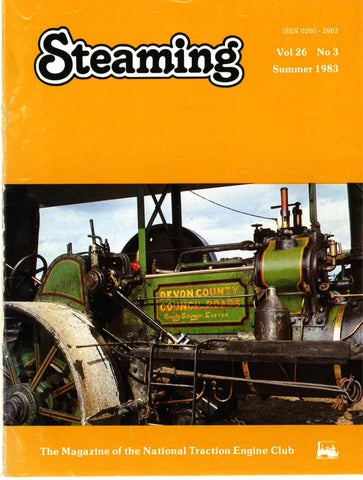
Cover The beautifully mellowed appearance of everyday paintwork of the 1960s, carefully nurtured nearly twenty years later by R.C. Hood from Hampshire on his 6 ton Aveling & Porter roller 7024 of 1910. (Roger West)
Next Issue: Press date for news items, recent photographs and small advertisements is 22nd August 1983
✓oe Thomas Mary Lea Kevin Lockyer Viv Kirk Dick Blenkinsop Michael Mason Nevil Miller
107
g 1E1 K;2770 Engine Owners Column The Ei iyir le Owners Committee has gone into its summer recess. When the rally season is in full swing it is difficult to organise a meeting convenient to each of the committee as all have rally commitments — either exhibiting or organising. However all engine owners correspondence will be dealt with. Following the announcement in the last edition of Steaming of Nicholas Barker administering a 'Roller Headstock Register' and a 'Repairers and Suppliers Register', he has been busy with many enquiries. Nick invites even more; please write to him at Homestead Farm House, Lee Road, Saunderton, Lee, near Aylesbury, Bucks (SAE, pleasel. The Technical Services department has also been kept busy. Jack Wharton (President, and Technical Services Officer) and myself are pleased to deal with your problems. Please write to S.J. Wharton or M.J.
From Alan Martin's Collection 21
Wharton at Southerndown, Minster Lovell, Oxford 0X8 5RD (SAE, pleasel. If you have already written to a member of the Engine Owners Committee and have not yet received a reply please understand that steam engines are a hobby to all the members of this committee, that no monetary recompense is received for the work carried out and work comes before hobbies, well, most of the time! If it is known straight away that an enquiry will take three months to answer, then an acknowledgement will be sent. When we expect to answer an enquiry immediately no acknowledgement is sent (this saves postage); However we do not everytime get to the root of a problem as soon as expected. It is pleasing for me to see the NTEC membership using the Engine Owners Committee at last. We are here to serve, and we will do our best. Pattern Store and Register For many years the Club has been
investigating the formation of a pattern register. The response from the membership to inform us of any patterns available on loan for casting was not every encouraging. The Club committee was sent into a panic about a year ago when a substantial quantity of patterns were made available But we had nowhere to put them. It now appears suitable accommodation for a pattern store is available. After these patterns have been housed and catalogued, I will be asking you again to tell me of patterns available for loan; if you require the pattern to be kept in the Club's pattern store, this can also be arranged. Please note that this service will also be open for formers for flanging etc. (M. John Wharton, chairman Engine Owners Committee)
Obituaries Frank Upton It is always sad to record the passing of a friend of many years standing and none more so than that of Frank George Upton, who died on Easter day, in his 73rd year, after
This must have been a stirring sight to any bystander four Fowler road locomotives from the Sheffield depot of Pick fords Ltd hauling a 124 ton casting from Sheffield to Manchester in 1941. They are parked at the Flouch Inn high up on the moors above Stocksbridge, Yorkshire, and at the junction of the A616 from Sheffield and the A628 on to Manchester. The engines from left to right are:— Fowlers 19989 (XG2010) ONWARD (coupled to the 120 ton Dyson trailer); 17105 (VM2110) ATLAS,' 14844 (NC2022) VULCAN and 16263 (NE28341 TALISMAN.
some months of ill health, characteristically bravely borne. Frank will be remembered by many of our earlier members for his service on the Club's Committee for a number of years. He was always willing and able to help in so many ways, and was for several years the Club's Sales Officer. He will be remembered too for the many years he rallied his 7hp Wallis & Steevens 'Expansion' engine 7683 EILEEN, THE ERRING. During his long working life in road transport, Frank remained with the same company from 1923, when he began as a steam driver's mate, rising over the years to become transport manager and in 1973 being appointed a director of the company. He retired in 1981. During his long working life Frank gave 42 years of voluntary and distinguished service to the St John Ambulance Brigade during which time he was awarded several Orders, Insignia and Certificates for his bravery and long service. To his wife and two sons we extend the sympathy of the very many of us who knew Frank with affection. The steam preservation movement will be much the poorer for his passing. (Alan Martin)
Jack Hardy
It is with deep regret that I report the death on 31st March of John Hardy. Jack, as he was known to all his friends, had become well known to both engine men and enthusiasts over the years for his vast knowledge of the steam engine and its workings. Putting this knowledge to use, he had expertly restored and rallied many engines including an Aveling road loco and two Aveling tractors, a Fowler roller and a Garrett traction — ably assisted as he grew up, by his son Steve. Jack also owned and used in the course of his business, a McLaren ploughing engine (see Steaming Vol 21, No 2) It was not only with steam that Jack was at home, for he was also
responsible for the restoration of several items of vintage farm machinery. But it was the 1970s which brought the name of Jack Hardy to the attention of all in the preservation world. This was the time that Jack purchased the Fowler showmans engine 15117 HEADWAY. It was no stranger to the Hardy family as Jack had been associated with her in the very early steam preservation days. What many people who see the engine today don't know, is that most of the restoration was carried out by Jack and his family in an open yard at Church Fenton, near York. The writer was invited to witness the full restoration of the engine and many were the days that a journey was made to Fenton in the pouring rain with camera at the ready, but thinking that they would have stopped work, only to find on arrival that Jack had been hard at it since the early hours. The look on Jack's face will long be remembered when the day finally came for HEADWAY to move under her own power — the first time in over a decade. Without her canopy, minus lagging and with only the water which was in the boiler, she eased out of the yard and onto the road for a photocall. Jack wryly commented, "Well, she works." It was at Nostell Priory rally that Jack proved to the writer the type of man he was. He and the family were to be found on the Saturday morning, cleaning and polishing HEADWAY, ready for the days proceedings. Returning again on the Sunday, the same circumstances apertained. Jack was questioned about the necessity of cleaning the engine twice in one weekend. He was quick to point out that should he miss cleaning once, it would soon spread to other jobs involved in the engine's maintenance as before too long; she would need major attention. Such was Jack's philosophy — "If a job's worth doing, it's worth doing right". Jack will be remembered as a dear friend who was always ready to help with details and information for reports. The rally scene will miss him for his vast knowledge and his humour. To his wife and family, we offer our sincere condolences. (Malcolm Slator)
Sam Breedon Former showland driver and model engineer Sam Breedon died in March, just a fortnight after his 85th birthday. He started repairing steam engines in 1914 and drove from 1916 to 1970, some 54 years. Sam drove all manner of road vehicles — Savage, Yorkshire,
Allchin, to say nothing of more commonplace types or the 9 different Foster, 10 Burrell or 12 Fowler showmans engines, the latter owned by nearly as many different showmen! Sam's greatest pride was Fowler 19989 ONWARD, which he drove brand new out of Fowlers in 1933 for owner S. Ingham. The engine was so well made and had such fine regulator control that he claimed he could gently push a needle into a cork with it. Unfortunately the engine was cut up in Sheffield but 12 years later, as was another, earlier, engine he drove brand new — 1920 Foster 14403 JAMES WALTER. Small in stature, Sam was a great person to talk to and knew his subject well. He started making models in the 1930s when, as now, there was a trade slump. He made several model traction engines and railway locomotives, and then at one time owned a full size Garrett tractor. He renovated and drove for its owner, Fowler 15657 KITCHENER, which later became a star in the film The Iron Maiden. Sam leaves a wife, and had no family of his own. (KB)
Stan Hatfield
It was with the greatest shock and sadness that I received the news that Stan Hatfield, my partner in steam, had died. It appeared that Stan, 54 died of a heart attack only moments after the death of his dear father 'Bob' Hatfield. Stan and I just met on the rallyfield at Appleford in 1963. In a rain squall we both headed for the cover and warmth of the same engine, and started chatting about steam. A firm friendship was struck up and we soon found that we both eagerly sought an engine of our own. Being working men we didn't have the sort of money needed to buy an engine, even at the now seemingly give away prices of those 109
days. We pooled our resources and scoured the country for a 'good' engine. Stan always fancied a Burrell, but we eventually plumped for a derelict rusty Marshall 61970 of 1913 at the yard of John Evans in Hertfordshire. Later this was followed by Aveling & Porter 10 ton roller 10126 from Brecon, Wales. Stan, who never married, led a very full and interesting life. On leaving school he worked for one of the few remaining small businesses still making and wheeling wooden farm wagons and carts. In the course of this he became an expert carpenter and very knowledgeable on wooden cart construction. Later he joined the Royal Navy getting involved in 'Asdic' detection and torpedo systems. On leaving he took up employ as a vehicle body builder and worked for various specialist firms in this line up until his death. If a vehicle had a wooden frame with panelling Stan would be in his element. Other interests besides steam included campanology and Stan was in charge of the bells and on the team at St Marys, Beaconsfield for some time. He was also a very good shot, his home was adorned with many fine trophies won at small-bore rifle competitions. Messing about in boats was another of Stan's interests, and he could handle a sailing dinghy very well. Holidays away from steam usually found Stan on the Broads or meandering along a canal. Stan supported many clubs and societies including our own, the Road Locomotive Society, Herts Steam Preservation Society, East Anglian Traction Engine Club, Banbury Steam Society, Bedford Steam Engine Preservation Society, Kennet and Avon Canal Trust, and Great Western Society. The latter reflected Stan's interest in Swindon locomotives. But it was the Marshall traction engine that Stan loved most of all. He lavished virtually every spare moment he had on maintaining and running it. It was a rare occasion to see the Marshall low-loaded anywhere. Stan always insisting and enjoying taking her everywhere under steam, and last year he and faithful crewman Terry Petty covered in excess of 600 miles on the road. When having a rest from the Marshall Stan could often be found crewing for others and in recent years often assisted on Anthony Heal's McLaren BOADICEA. Stan had only just spent his early holiday re-rubbering the front wheels on his engine, and on the very morning of his death he was just about to leave home for rail trip to the Severn Valley Railway. The funeral of Stan and his father 110
was held at St Marys Church, Beaconsfield, followed by cremation at Amersham crematorium. We express our deepest condolances to Stan's stepmother Grace, his brother and all members of his family. A true gentleman, a fine engineman and a very dear friend, the cheerful smile of Stan Hatfield will be sadly missed from our rallyfields. (D.J. Hall)
WANTED
Area Sales Representatives George Eves I was very saddened to learn of the passing of George W. Eves. Back in November 1966, following a notice placed in Banbury Guardian by Jimmy Russell, a group of local steam enthusiasts met in the White Lion Hotel, Banbury, to form what was to become the Banbury Steam Society. Among those present was one G.W. Eves who agreed to be the honorary secretary during the Society's formative days. He also undertook to produce a monthly newsletter which he called The Yardsheet, the title being derived from the daily notice pinned on the gates of the yard where George worked during his steam days. On this sheet of paper were details of the work to be carried out and to whom it had been entrusted. It was at this inaugural meeting I first met the man whose friendship has never faltered during the intervening years, and during the decade that I edited the newsletter he founded, gave me all the support and encouragement I could have wanted. When circumstances dictated that George and his wife Betty moved south from Banbury to take up residence in Alton and later in Milborn St. Andrew, the Banbury Steam Society made George a life member as a mark of the esteem in which he was held. George never lost his enthusiasm for the club he helped to found and letters from him were always enquiring after the well-being of 'his' club. The Banbury Steam Society have lost a valued member. I have lost a very good friend. (Ted Sutton)
The Rally List 1983 The following rallies have now made known their dates, and should be added to the list of NTEC Approved Rallies published in the Spring 1983 issue of the magazine. 9th/10th July — Bristol City Docks Festival, 1983 (at least 15
Vounteers are required to run NTEC Sales Stands at rallies etc in various areas. It will be necessary to have your own car and caravan/tent, and travelling expenses etc will be paid. This interesting and worthwhile job offers the chance to meet other enthusiasts in steam surroundings over a wide area. If you are interested please seek further details from the National Sales Officer — Keith Shakespeare, 91 Peplins Way, Kings Norton, Birmingham B30 3N..1 (Tel 0527-45683)
engines expected). N.M. Hobson, 32a Alma Vale Road, Bristol. 23rd/24th July — Cornish Traction Engine Preservation Club Rally, Treslaske Farm, Cubert, Newquay (at least 16 engines expected). W.D. Jeffery, 4 Beacon View, Penhallow, Truro, Cornwall. 30th/31st July — Hallam's Steam Rally, Tutbury Castle, Burtonon-Trent (at least 10 engines expected). D. Hallam, The Firs, Draycott-in-the-Clay, Sudbury, Derbyshire. 13th/14th August — Knowl Hill Steam Rally, A4 between Maidenhead and Reading, Berkshire (at least 50 engines expected"). J. Keeley, c/o Keeley Bros., Knowl Hill, near Reading, Berkshire. 20th/21st August — Epping Steam Show, off 8181, Epping, Essex (at least 30 engines expected). T.A. Young, 115 Cambridge Road, Stanstead, Essex. 3rd/4th September — Hinckley Steam Engine Display, Sapcote Road, Hinckley, Leicestershire (at least 25 engines expected). I. Collidge, 8 Winchester Drive, Hinckley, Leicestershire. 16th to 18th September — Great Working of Steam Engines, Stourpaine Bushes, Dorset. (at least
50 engines expected*). M.F. Oliver, Dairy Mead, Chide Okeford, Blandford, Dorset. The Rotary Club Steam Engine Rally at Great Amwell, Hertfordshire on 11th/12th June was also an approved event.
Affiliated Clubs South Essex Traction Engine Owners Group The secretary of the above group is now Arthur Bullman, 44 Lindon Road, Wickford, Essex.
Banbury Steam Society The secretary of this society is now Mr A.A. Tanner, 9 Horton Road, Banbury, Cheney, Middleton Oxfordhsire 0X17 2LE.
Open Day The Science Museum will hold an Open Day at its reserve collection at Wroughton Airfield, near Swindon, on Sunday 11th September 1983. As well as giving a chance to see stored material not normally on view to the public, the Open Day also features working demonstrations.
'Everything perfect' We often wonder if the old extracts, adverts and other short quotations which we use to fill odd corners of Steaming are as interesting to readers as they are useful to us in compiling the magazine. It was with particular pleasure therefore, we received this fine picture in response to the Brown & May catalogue extract on page 26 of the Winter 1981/82 issue. The photograph was taken at Ferns in Co. Wexford during 1910 and member Thomas O'Sullivan of Vicarstown, Co. Cork, who kindly sent it in, thinks the single cylinder engine and drum is the set purchased by P. Doyle. Illustrations of Brown & May traction engines seem rare and this one shows the machine to have a solid flywheel, built-up angle iron tender and a canopy noticeably lacking in cross bracing to the supports. The photography seems to have fetched out the villagers in force — the animated scene shows no less than 28 men, women and children plus at least one dog.
A Brown & Mayday Gathering Lyndon Shearman's Brown & May portable engine appeared at the May Day Celebrations at Shibden Hall Folk Museum, Halifax. The engine's details are somewhat obscure but it is thought to have been built about 1868. About 1,800 people visited the Hall and saw various attractions such as maypole dancing, mumming plays, spinning, rug-making, smithing and horse-shoeing, as well as the usual features of the Museum. An idea on which Lyndon is presently working is a Brown & May Weekend to be held at Devizes, Wiltshire, probably on May Day weekend 1984. A small committee has been formed to pursue this idea which may also involve the provision of a commemorative plaque on the former Brown & May works site, now occupied by W.E. Chivers, a well known user of steam wagons in days
gone by, and who are in agreement with the proposals. It is hoped to have as many as possible of the ten or so Brown & May engines which now exist in this country on display at the former works, and all English owners will be contacted with an invitation to attend. Lyndon is intending taking his engine on the 200 mile pilgrimage from Halifax to its birthplace and anyone else interested can contact him for further information at 1 The Cloisters, King Cross, Halifax (Tel 0422-55463).
'Langport Rural District Council. To Steam Roller Owners. The above Council invite Tenders for the hire — at per day of eight hours — of from TWO to FIVE STEAM-ROLLERS during the ensuing season ... Joseph J. Goode, Surveyor.' (From The Contractor, 7th September 1901.) 111
Joe Thomas
On Sentinels
THE STEAM TRACTORS
The First Models
As far back as 1905 Alley and MacLellan Ltd of Polmadie, Glasgow, makers of the well known Sentinel steam wagon, produced a drawing of a long distance road haulage steam tractor. The drawing appeared in their 1905 catalogue, but as far as is known the unlikely looking vehicle remained a proposal. It was not until 1923, when the big selling Standard model wagon had been replaced by the Super Sentinel that we find an actual tractor built and tested. The machine was a revolutionary type of steam tractor — revolutionary compared with the normal traction engine type, that is — and the tractor's layout was patented in April 1923 (Pat No 9166) in the name of S.E. Alley. All the major parts were identical with those of the wagon, except of course the wheels. The boiler was placed well behind the line of the front axle. The rear axle was moved forward so as to shorten the wheelbase considerably from that on the normal chassis to 8ft 1134in. The cylinders were now placed above the axle with the clank case behind and the chains driving forward to the road wheels. The differential was in the crankshaft, since the engine was an ordinary model Super Sentinel, and the rear axle was dead, it also being standard. As with the previous model Sentinel wagon, the engine was a two one, fitted cylinder 50/60hp horizontally, the two camshafts being enclosed in the crank case for better lubrication and with the valves at the front of the cylinders where they were accessible for regrinding. A full length canopy covered the vehicle and a 200 gallon water tank situated behind the driver's seat is bound to have given added adhesion to the straked rear wheels. The first of the new Super Sentinel wagons left the Shrewsbury works in June 1923, works number 5001. The first new Super Sentinel tractor was number 5122 and went on trials in 112
LONG OISTANCH TRACTOR
Alley & MacLellan's 1905 catalogue promised the future production of this racy looking 'long distance tractor'. (collection J.L. Thomas)
Sentinel 5122, the first steam tractor built, on one of its trial runs from the Shrewsbury works in 1923. (collection A.J. Martin)
A draughtsman's impression of the Sentinel tractor with smaller rubber tyred wheels. (collection J.L. Thomas)
sae www YI the L.• 1orw,k.iitul" rmenr.
October 1923. Subsequently several similar models were produced, the only difference being that they had smaller rubber tyred wheels similar to the wagons but with different spokes. About fifty of these tractors were built over the next four years, and of that number all but fourteen were sent for export. In 1923 the straked wheel off-theroad model sold for £800 and the small wheeled rubber tyred model for £780. Of the tractors sold in this country timber hauliers, county councils and corporations were the main purchasers. To mention a few customers — Llanelly Corporation, who had a crew body fitted behind the driver's position; Teignmouth Quay Co who used theirs for shunting railway trucks on the quayside, and Ross and Cromarty County Council (Easter Ross District) who had two which they used for hauling two heavy tipping trailers carrying stone from their own quarries to various roads being built at the time. Of those exported the majority went to South Africa, though other destinations such as Brazil, Czechoslovakia, India and Poland appear on the list. In 1976 I saw the remains of a 1923 straked wheel model in New South Wales, Australia, number unknown.
The Double-Geared Supers The Easter Ross District of Ross & Cromarty County Council purchased Sentinel steam tractor 5736 (registration J52163), complete with two tipping trailers, in May 1924. Seen here posed for its 'official' photograph at Shrewsbury 5736 was joined by 6128 (JS2453) in August 1925, no doubt accompanied by further trailers. (collection J.L. Thomas)
The early models, just described, were all single geared and permanently in that gear, just like all the early 19051923 wagons. The driver turned the steam on and the engines went; he shut it off and they stopped. The double geared Supers not only had the improved Sentinel engine, but had two speeds as well. They were fitted with solid rubber tyres, had big diameter rear wheels, were fitted with a winch and a large wide pulley for driving a rack saw bench or other bench machinery. There was a full length canopy
THE ELEPHANT — a once well-known sight to holidaymakers and crews on coastal vessels visiting Teignmouth quayside in South Devon. Sentinel 5644 served its owners well from being delivered new in 1924 until it ceased work in the 1960s. (collection J.L. Thomas) 113
except for over the winch, and the usual generous water tank. The latter and the engine both being over the rear axle gave ample adhesion on rough ground or road. The tractors were mainly used by timber merchants both at home and abroad — one of the more exotic sounding customers being the Nizam of Hyderabad's State Railway which had two wood burning examples. T4 DGs as they were soon known (to differentiate them from the later DG engined models we will deal with in another section), seem to have first appeared around December 1926 with number 6740, new to Alf. E. Gates of Pilgrims Hatch, Essex. When Rolls Royce Ltd took over the Sentinel works at Shrewsbury all records were burnt, but from what I have gathered over the last twelve years from various sources, there would appear to have been twenty-six of these machines built up to 1932. Sentinel Super tractor 6816, new in March 1927 (PP7510), was delivered to Later, about seven of these very Thos. Wright & Sons Ltd of Chesham, Bucks. (collection H. Hearn) solidly built and efficient tractors were turned out with the new Sentinel DG engine fitted in them making them even more efficient. The original single geared tractors referred to in the first section would pull thirty tons up a gradient of 1 in 20 or six tons up a gradient of 1 in 5. With the double geared Super model the haulage capacity was more than doubled. The single gear tractor would use 225 gallons of water every 30 to 35 miles, but consumption on the double geared model depended upon which gear was used. Coal consumption was between 10 and 15 miles per cwt depending of course on whether the trailer was loaded or empty. Dudley Timher & Sawmills I td of Station Road, Tutbury, Staffordshire A Sentinel-built timber trailer — 40in x 8in extra reinforced single tyres, on March 23rd 1927 recorded the weight 4% tons, internal expanding brakes on rear bogie. The trailer lay at Eric geared Super Sentinel tractor Middleton's premises at Hartlebury, Worcestershire until fairly recent years. equipped with winding winch for (collection J.L. Thomas) timber work as follows: 'The timber was retrieved from precipitous valleys and had been The Roadless Models considered inaccessible before the Super Sentinel tractor was purchased. This rough country and heavy work should be taken into account when using the figures We have seen that the Sentinel total cube of wood mileage daily costs tractor with small rear wheels was Monday 166.6 24 E2 . 3 . 0 [£2.15] quickly followed by the large rear Tuesday 132.2 24 £2 3 . 0 [£2,15] wheeled model which was obtainable Wednesday 132.7 24 £2 8 . 0 [E2.40] either with rubber tyred or all steel Thursday 138.4 24 £2 . 3 . 0 E£2.151 wheels. Friday 166.2 24 £2 . 3 . 0 E£2.151 Alternatively the latter could be Saturday cleaning engine, etc. fitted with convertible wheels to take weekly total 736.1 120 £11 . 0 . 0 [£11.00] either rubber or steel tyres. Almost average per day 147.2 24 £2 . 4 . 0 [£2.20] simultaneously with these machines Taking the weight of timber at 25 cubic feet per ton this works out at an agricultural version was introduced, 291/2 tons for £11 . 0 . 0 or 7/5d [371/2 p] per ton. designed principally for direct ploughCost per cube 3.6 [old] pence [1'/2 p] ing. This design had been suggested to Cost per mile 1/10d [9p] Stephen Alley by Kyrle W. Willans and Cost per ton mile 3.75 [old] pence [11/2 0 Stephen Alley promptly took up the Cost per cube mile 0.15 [old] pence .' idea, the major alteration in design 114
No details are known of this Sentinel Roadless tractor and trailer, except that it was taken by or for Sentinel's Managing Director, Reg Woodvine; it is presumably on trials, somewhere in this country. (collection J.L. Thomas)
being to gear down the tractor both to reduce its speed and to give it sufficient power for direct ploughing. This was done simply by adding a dead countershaft placed behind the crankshaft and carrying at either end a double chain wheel. The Sentinel Roadless tractor was developed from this model just described. Most of the weight of the vehicle was taken on the two tracked bogies which were universally mounted in brackets supported by a substantial axle attached to the semielliptic springs which took the weight of the vehicle. Each track was carried on four cast steel rollers all fitted with rubber tyres. The tracks were made by, and were the patent of, Roadless Traction Ltd and incorporated the benefit of much experience gained in operating tanks in World War 1. The price of the machine was quoted at £1,250 in this country. It was shown to the press in November 1924 when it was driven first without load through boggy ground with a morass of mud and ponds two to three feet deep with sunken tree stumps. It surmounted baulks of timber and boulders; it climbed gradients of 1 in 1 and negotiated the sides of a trench seven feet deep. With no trouble at all the Sentinel hauled a 31/2 ton log over rough ground and a film was shown of it taking 71/2 tons of timber on a trailer through a very soft track of country. In another demonstration it was used to start and haul 58 tons of 'derelicts' on a slight gradient — which it did without difficulty, It was stated by Commercial Motor in its issue for 18th November 1924: 'The claim for the use of steam in conjunction with the creeper track is that it sustains its torque, which actually increases in inverse ratio to the speed of the machine and consequently the steam engine has a very great degree of elasticity, and a machine utilising this source of power is able to surmount obstacles which would most probably stall a less flexible engine.'
An unidentified Sentinel Roadless tractor showing off its capabilities — probably a publicity shot. (collection J.L. Thomas)
February 1925 saw this double geared Super Sentinel Roadless tractor 5794, sent off to South Africa. It was later returned to England, owned firstly by Sir Malcolm Campbell, and then John Allen of Oxford who had it registered J01552. In 1930 Surrey County Council purchased it, numbering it (general purpose) GP 62; it is seen here on some sort of civil engineering works. (D. Stoyel)
Sentinel tractors 1923-1927 works registration number number model
date
original purchaser or destination
T4 T4 T4 T4
10.1923 2.1924 2.1924 4.1924
5398 5457 5530 5543 5585 5603 5643 5644
T4 T4 T4 T4 T4 T4 T4 T4
4.1924 .1924 6.1924 6.1924 9.1924 10.1924 9.1924 9.1924
5645 5658 5794
T4 T4 Roadless T4
2.1925 12.1924 2.1925
5878 5884 5885 5937 6008
T4 T4 T4 Roadless T4 T4 10/12 ton
12.1924 12.1924 12.1924 4.1925 3.1925 3.1925 3.1925 4.1925 5.1925 5.1925 5.1925 6.1925 7.1925 8.1925
10.1925
stock - Sentinel Waggon Works Ltd. Durban, South Africa. Durban, South Africa. Ross and Cromarty County Council, No.1. Brazil. Griffin (exporter), South Africa. Henry Kendall. Nyasaland, East Africa India. Portugal. Jock's, Calcutta, India. Teignmouth Quay Co Ltd, Devon. THE ELEPHANT. Sentinel Waggon Works Ltd. Skoda, Czechoslovakia. South Africa; returned to England for Sir Malcolm Campbell. Swift, Rutherford. Skoda, Czechoslovakia. Skoda, Czechoslovakia. Adams, Australia. R. Silcock & Sons Ltd, Liverpool (new model). T. Mossop. India. Adams, Australia. South Africa. India. Pearson. Mitchell. South Africa. Ross and Cromarty County Council No.2 (Easter Ross District Committee). Dudley Timber & Sawmills Ltd, Tutbury, Staffs. India. Gilliatt & Co. Adams, Australia. India. South Africa. Jno. McAdam & Sons Ltd, Aberdeen. South Africa. India. India.
5122 5213 5214 5376
JS2163
6032 6035 6093 6121 6142 6143 6168 6180 6182
WW5127
JS2453
T4 DG T4 Roadless T4 T4 Roadless T4 Roadless T4 T4 Roadless T4 T4 10/12 ton
6189
NU7706
T4 DG
T4 6271 Roadless T4 6295 T4 6426 T4 6428 T4 6451 T4 10/12 ton RS7728 6521 Roadless T4 6540 Roadless T4 6612 Roadless T4 6613 (6614 to 6625 Sentinel trailers). T4 10/12 ton SA9790 6634
1.1926 2.1926 3.1926 3.1926 3.1926 5.1926 6.1926 6.1926 6.1926 7.1926
TH1456 ML2267
T4 Roadless T4 Roadless T4 Roadless T4 T4 T4
7.1926 7.1926 7.1926 7.1926 3.1931? 2.1927
6703 6709 6712
UD497
Roadless T4 T4 T4
9.1926 11.1926 11.1926
6740 6793 6794 6816
TW6621 DP8425 OT3478 PP7610
T4 DG T4 DG T4 DG T4 DG
12.1926 3.1927 1.1927 3.1927
6842
KA6147
T4 10/12 ton
3.1927
6641 6649 6657 6658 6665 6689
6878
RS8468
T4 10/12 ton
4.1927
6917 6933 6937
DP8391 W0323
T4 DG T4 T4 DG
3.1927 4.1927 5.1927
Aberdeen County Council (D000ido Dictriot Committee) No.1. South Africa. South Africa. South Africa. presumably South Africa with 6657. Llanelly Corporation (rubber tyres). E.J. Mylon, Hayes, Middlesex (rubber tyres). Gilliatt. South Africa. Alf. Groves & Son, Milton-underWychwood, Oxfordshire. Alf. E. Gates, Pilgrims Hatch, Essex. George Lucas, Reading. Shenstone. Thos. Wright & Sons Ltd, Chesham, Bucks. Simmons, Hunt & Montgomery Ltd, Liverpool, No.5. Jno. McAdam & Sons Ltd, Aberdeen, No.2. S. & E. Collier, Reading. South Africa. Williams Bros, Abergavenny,
note - 5899-5904 may have been tractors. The author would be pleased to hear of any additional information for the above list. 116
Without doubt this is a fair summation of one of the chief advantages of the steam engine in almost any circumstances. Despite these encouraging facts and words, however, less than twenty of the Roadless tractors were built (fifteen are recorded) and most of these went either to South Africa or East Africa. Of these number 5794 was returned to England and became the property of Captain (later Sir) Malcolm Campbell, nine times holder of the world land speed record. Leslie R. Bomford, one of the four well known brothers who were agricultural engineers, farmers, and agricultural innovators at Pitchill, Evesham, Worcestershire had been sent out to Kenya by Sentinels as a trouble shooter. He told me that although the tracks were oil-sealed, grit used to get into the joints 'with inevitable-results'. The tracks also tended to fill up inside with mud, tighten beyond the limit of the spring and then break. Further: 'the other main trouble with all these tractors was that the boiler was too small for the low calorific fuels in Kenya and all one could do was to increase the draught and push the boilers in spite of a certain amount of back pressure.' Subsequently other methods were tried and the metal tracks were changed for a rubber jointed variety, but with this type it was possible under extreme conditions to compress the rubber joints in the tracks until the driving sprocket slipped - 'that finished this track before it even went abroad'. Despite these and other defects which the African conditions brought out, much satisfactory ploughing was done when the engines were working properly, with either 1 b discs or with two four-furrow ploughs by McLarens of Leeds. Mr Bomford recommended the latter for best results. Twenty or more acres a day was quite common. The fuels used - all with low calorific values - were South African coal (which gave a lot of ash) or hardwood such as olive, wattle or gum, but the latter would burn well only when thoroughly dry. Dry maize cobs gave plenty of heat but burnt so fast that bunker space was a problem; charcoal also gave ample steam but was not economical because of the large amount burnt. In the next article I will discuss at some length Sentinel's last attempt to compete with its ever increasing number of imported and British built internal combustion engined tractors that were coming onto the market in the mid 1920s. (to be continued)
I From Mary Lea's Diary
Vestingdagen Hellevoetsluis
Mary Lea continues the record of her family's visit to Holland — started on page 68 of our Spring 1983 issue.
Friday 20th August Jane and Liz asked me to go shopping with them in Rotterdam but I decided to stay behind and explore locally. We brewed up and had something to eat, then lounged around for a while; it was supposed to be an easy day. As we could not find a letter box, we went into the information office and were horrified to find out the nearest posting point was over a mile away. Queen Victoria should have brought one of her ubiquitous letter boxes across with her! After that we rested under a pine tree on the quayside where we saw two wedding parties at the Prinsenhuis, so called because it was from here that Prince William of Orange embarked for Brixham to become our King William. Later on, one of the bridal parties appeared in front of the Foden and one of the organisers asked if we minded taking the sheet off so that the bride, in a beautiful dress, and the groom could have their photographs taken. We complied with their wishes and also put on the lamps. George performed the old English custom of presenting the bride with a piece of coal (washed under the injector! for luck and the warmth of love for the rest of her life. He did not have the audacity, though, of demanding a token kiss in payment! One thing which struck us was the number of cannon barrels lying around; they even use them for traffic bollards! It must be an inheritance from the days when this used to be a Dutch naval port. Hellevoetsluis still has its own grain windmill, a large one with all its milling machinery intact and maintained in working order. It is now cared for by a man who is also a goldsmith. There is also a thriving boatyard where small craft are made in the traditional manner, and also with fibreglass hulls if required. After our evening meal, we all sat talking for a long time and when we went back to site we saw that a Ransomes portable and a barn
Steam tugs VOLHARDING 1 and LAUERZEE (nearest camera) moored alongside the 'rally field' at the 1982 Vestingdagen. (G. Kwekel)
thresher had arrived. The steam tugs had also arrived that evening from Rotterdam and had brought the 250 tons floating steam crane with them. Saturday 21st August This is the commencement of the Festival proper; 'Vestingdagen Hellevoetsluis, which means 'the days in Vesting', this being the old, original part of the area with the slice of water where the old ships used to dock. Vesting means 'the fortified place'. Actually, we were only a part of a festival far too immense to try and catalogue. Very, very early exhibits had rolled in; in our section a set of threshing tackle comprising a 10hp Ransomes portable built as late as 1948 (a Ruston designed machine built by Ransomes and very Ransomised) and a locally made baler. These were to give a threshing demonstration along with
the previously mentioned set. Rollers appeared; an 8ton Marshall, 10ton Aveling, 10ton Burrell compound — which looked very un-English with plate wheels — and a couple of Ruthmeyer single crank compounds having trunk guides instead of slide-bars, perhaps to prevent them pretending they were exact copies of Burrells. The Brandweer Museum had their Merryweather fire engine on the water's edge, as also were the five steam tugs ranging from the WOLTMAN of 268ihp built in 1904 to the DOCKYARD of 600ihp built in 1941. It was noticed early that the windmill had cloths on two of its sails and was turning over. It was a wonderful day: thousands of people were pouring in. Before it got too crowded, George and I went down to the proper market as the local clog maker has a stall there — most of the 117
farmers still wear the traditional poplar wood Dutch clogs when working on the land and so I was able to obtain two pairs of small, decorated ones to fit the two grand-children. When we arrived back, John had bought a Lucas bulb-horn from the automobile section. The man had accepted British money as he intended going to Beaulieu next year. The windmill now had cloths on all four sails and was turning merrily. It was of course open for public viewing. George went to have a look round the floating crane as it was in steam; came back and said the donkey engines were clonking just like British steam dock cranes always did. The Dutch were quite intrigued by the little Foden as most had not seen a British steam wagon before; during the transitional period, they had gone direct from horses to petrol. One viewer was a marine boiler inspector from Rotterdam, closely connected with the rail preservation society there. He was very interesting to talk to, both on steam and general subjects. One family were just gazing and the woman finally stuttered, "Is that our Chelford? Haven't you been to the Rally?" We were able to assure that it was 'our' Chelford and that we had been to the rally prior to coming over. They came from the next village to us and were returning home the following week after having two years in Holland with the Shell company. Many more were the unrecorded conversations of the day. After the evening meal, all the English engines lined up in single file and were then escorted round the outskirts to stand in the Market Square, all the stalls now having been dismantled arid removed. The two showmans were generating for lights, the Oompha! band was playing and we stood by to watch a procession of small craft come in, all decorated arid illuminated with coloured lights in their rigging. It formed a very picturesque scene, indeed. This was to celebrate the close of a safe sailing season and a prelude to the winter laying up. A craft decorated as a swan, with its dinghy in tow as a cygnet, received the first prize. The density of the crowd was terrific. At the beginning, Jane, John and I wandered up to Len's engine standing on higher ground by the bridge, to get a good view, leaving George in charge of the Foden. When John tried to get back, he just gave up the tussle, the wagon was so tightly thronged with people asking questions. George was at it solidly, giving answers from 8.30 until 11.0 pm. (They were mostly intelligent ques118
tions, too — working pressure; what is that in kg/sq cm: temperature of steam delivered to valve chest; grate area; number and size of tubes; fuel consumption per kilometre, etc. It kept the grey matter working giving the right answers, converted to metric. None of the routine British "How fast, what did it cost, what is it worth?" One spectator was a German engineer and with a mixture of English, French and German, we managed quite a conversation. Most of the Dutch people, of course, speak very good English. John complimented one spectator on his English; he came from Cambridge! — George) It was around 11.30 when we finally made our way back to the caravan. Altogether, 60,000 tickets had been sold for that day and the organisers had to get another batch of tickets and programmes printed, overnight, in readiness for the Sunday. It was quite good value for the spectators at 5 guildern, roughly equal to £1.10, and 3 guildern for children, which entitled them to site entrance, to the Firefighter Museum, which is absolutely packed with fire engines and old vehicles, and also to a trip of about half hour duration on a steam tug. Sunday 22nd August Another very busy day for the ticket collectors. Several people from Britain came talking to us; one man we had seen at Astle Park and another
who was going to Bishops Castle. Often, we were asked if the engines were the property of a museum. Before the crowds were too intense, we had a trip on the steam tug, DOCKYARD. This includes a visit into the engine-room where it was intriguing to watch the little steerage engine respond to the slightest touch from the wheel-house. The propulsive unit was a vertical double compound delivering 600ihp, working so silently and vibration free, receiving steam from an oil-fired, return-flue, Scotch 'ketel' as the Dutch terms it. All the other tugs, being older, were coal fired, of course. On our return we stood a while to watch the Merryweather fire pump at work, full-bore. It was throwing a jet out to sea and was literally dancing up and down. What the coal consumption was, is perhaps, another thing, judging by the amount of cinders they had made! At about 4.45 pm we started to pack away the lamps and sorted out the unrequired clothing for John to pack away on the back of the Foden. It was then all engines away to go over the water, via the lift bridge, to re-load them onto the trailers in readiness for next morning. Knowing George and John, they had to divert to watch the preserved rail locomotive, with three period coaches running on narrow gauge track. Naturally, they exchanged greetings on their whistles.
A Hellevoetsluis steam tramway engine and coaches — preserved survivors of the 1067mm gauge system of the Rotterdamsche Tramweg Maatschappij which worked over 200km of routes in the area between 1898 and 1966. The six coupled tank locomotive was built in Germany by Orenstein & Koppel in 1920. (A. C. van der Giessen)
After washing and changing, we sat in the van talking to the Beaulieu men. When the cars arrived, we split up, Liz, George, John and I going with Marta's husband, Johann, to be taken to a better class restaurant in the newer part, for a final meal. Run by Chinese who could not speak English, and the menu printed in Dutch, we had to resort to Marta's good offices to interpret for us. We really had a first class meal and then sat and talked and chaffed each other until 11.00pm. It was just one big happy family and most enjoyable. Monday 23rd August Awake at 7.0am and out of bed straight away; we had a hurried breakfast then packed the remainder of our things on John's wagon. It was raining heavily, but soon cleared. Liz put my flowers in her cab, then all our Dutch friends came along to bade their adieus, in their traditional manner, "until we meet again". George and John climbed into the cab of Liz's Atkinson, whilst I packed in with Len, Jane and Alan — a good job it has a big sleeper cab — to go to the docks. After all was secured on the transit deck, we climbed up the hard way via the companionway. We had cast off and were under way at 10.55 BST. It was a cold wind and we were glad of anoraks. Returning to the lounge, everyone was stretched out, asleep. After lunch, by courtesy of the chief engineer, the men were invited down into the usually forbidden area of the engine-room. (Being a vessel of Japanese origin, the motive units were Daihatsu diesels. The auxiliary engines, for use in port for generating, pumping etc, were a couple of six cylinder units with direct mounted generators. Each engine was more than large enough to power any artic outfit. The propulsion units were a couple of V-12 diesels, one driving the port screw and the other the starboard. These each had a generator directly mounted on the tail shaft, outside the casing of the reduction gearing through which the drive is transferred to the screw shafting. As they run on heavy black oil, this has to be pre-heated via a heat exchanger. Everything seemed to be coated by the black stuff. We noticed there were spare pistons, almost as big as dustbins, and sets of rings standing around as they experience quite a bit of piston trouble and ring sticking, caused by the fuel they use. Each cylinder had each its own individual head. The noise level was terrific and would be unbearable for engine-room men without ear muffs. Controls were computerised and revs, output,
temperatures etc were being logged religiously. — George) Later George sat with me whilst John went up on the bridge where he was able to see the automatic pilot in operation and how uncanny it was to see the ship respond to it, to remain on course. However, when the radar denoted another vessel on a converging course, correction had to be made manually. It was seen that those diesels, although noisy, were pushing us through the water at 17 knots. When George and I were sitting in a sheltered part of the lifeboat deck, John Antell came along and had quite a long conversation with us, until we went in for tea.
We docked around 6.30 pm; the vehicles had to go through the customs shed, then had to wait outside to get full and final clearance. Steve, from Walford Shipping, took George to pick up his car. After saying our goodbyes, we all went our separate ways, Liz to take the Foden to Salop in readiness for Bishops Castle, where, of course, we were to see her again on her usual engine, and also we were to meet Len and Jane there, again. But that was another rally... If our little group, by going over to the Netherlands, has engendered the smallest spark of goodwill, then long may international steam rallying continue.
This year...
Arm I
"WA!' Irw
Vestingdagen Hellevoetsluis takes place from midday on Friday 19th August to Sunday 21st August 1983 on the Zuidfront in Hellevoetsluis, about twenty miles west of Rotterdam. Some thirty six steam engines (two dozen engines and twelve other types) are expected in addition to the other attractions mentioned in Mary Lea's article. Among those visiting from England for the first time should be John Antell's Fowler traction DREADNOUGHT, Giles Romanes' Wallis tractor GOLIATH, Andrew Semple's Ruston Proctor tractor, Howard brothers Fowler showmans RENOWN and two or three rollers from Kent The rollers should be steaming to the event from the ferry at Flushing; the others, on 18th August with a road run, from Europoort. Dutch entrants will be eight steam rollers from members of our bffiliated Stoomwalsenclub Nederland and from The Hague road making company of NBM, and Ger van de Pol's Burrell showmans 3926 MARGARET (if finished in time) and Jan Brinksma's Marshall 74489, recently purchased from Staffordshire. Further details are available from the rally secretary, George Kwekel, 7 Hermes, 3225 TE Hellevoetsluis, Holland. European Ferries, sponsoring the transfer of English entries to the freight only Europoort, sends us the following suggested arrangements for intending visitors. An economical way of getting to the Vestingdagen at Hellevoetsluis is by taking advantage of Townsend Thoresen's half-price 60-hour return fare. Available on the company's routes from Dover to Calais and Zeebrugge, or from Felixstowe to Zeebrugge — all ideal for an easy drive to Holland, — the 60-hour return trips give ample time to attend the weekend rally as they allow a full two and a half days from arrival on the Continent. Sixty-hour return fares for two adults travelling by car start at only £41 on Townsend Thoresen's 75-minute 'Blue Riband' Dover-Calais service; £50 on the four and a half hour Dover-Zeebrugge route, or £65 on FelixstoweZeebrugge crossings_ For those interested in extending the weekend, Townsend Thoresen also offers 25 per cent discoUnts on its normal car ferry fares for trips of five days. Journey-time by car from Calais to Hellevoetsluis is approximately three and a half hours, or from Zeebrugge in Belgium, one hour less. Bookings can be made at any ABTA travel agent or by contacting Townsend Thoresen direct: 1 Camden Crescent, Dover CT16 1QB (Tel 0304 203388).
119
Fowler 9393 Kevin Lockyer The oldest Fowler showmans road locomotive in existence today is works number 9393 of 1905, named SIR JOHN FOWLER. Like many a showmans engine, however, she did not start life in this guise, for 9393 was originally built as a 6hp class R1 road locomotive, sold new on 14th March 1905 to Lalonde Bros. & Barham of Weston-super-Mare, Somerset — well known long-distance furniture removers. There, in 1921, she received the Somerset registration number YA44. The engine passed into the ownership of Gilbert Anderton and Betty Haslam during 1921 and, converted for showland usage, was used by Anderton & Rowland of Bristol — but without the familiar twisted brass roof supports. Not often used, and subsequently laid up, Anderton & Rowland offered her for sale in 1926, and this news travelled around the fairgrounds amongst showmen until it reached the Noyce family of Petersfield, Hampshire. Nelson Noyce and his sons Jim and Tom had one engine which was named THE VICTORY and was a showmans conversion of Fowler 11799 of 1909. The engine was a three cylinder tractor, new to the War Department for desert use. Two of these tractors were bought by Nelson Noyce in 1919 and one good one was built from the two. VICTORY had, unusually, Walschaerts valve gear, and a copper fire box and brass tubes which made her a very good steamer. In fact, her drivers believed that you only had to show her the coal shovel and the pressure would go up 5 pounds! However, VICTORY was a 5hp tractor, and Jim wanted a 120
SIR JOHN FOWLER during her working life with Noyce's. The canopy-side lettering reads 'Nelson Noyce & Sons, Leading Amusements' and the crew are, left to right — Tom Noyce, Ted Young, — , Jim Noyce. (collection Bob Seward)
larger engine to haul his loads. He was, therefore, very interested in SIR JOHN FOWLER and he approached his great friend James Seward, who had a fairly large steam engine business. After lengthy discussions, Jim Seward agreed to buy the engine and let Jim Noyce use it. Two hundred pounds in cash was withdrawn from the bank and Jim, together with his brother Tom Noyce and Jim Seward, set off to Bristol to collect the Fowler. The journey was uneventful until they reached Bramdean, a small village near Petersfield. By then it was dark and they pulled over to the roadside to enahle a Foden wagon to pass. Unfortunately they went a bit too far and the engine started to list heavily as it began to slide into a ditch. Jim Noyce hurried back to Sewards and relayed what had happened. Luckily enough, the engine was fairly secure and was unlikely to fall over, so the recovery was left until the next day. The following morning, the men, accompanied by the works engineer, George Colewell, and equipped with jacks and timber, set off in their Morris lorry to extricate SIR JOHN from the ditch. She was slowly jacked up and packed with timber until level enough to be driven away. When at last at her new home in Petersfield, she was driven into Sewards workshop there to be inspected more closely. It was discovered that a small amount of work
was needed to be done on her before she could be worked hard. For a start, a 10inch square patch needed to be welded in at one place in the fire box. As Sewards had no welding equipment, Fodens of Sandbach, who had a workshop at Waterlooville, were hired to come and fix the patch in place. Other repairs included new tubes, new slide valves and a plate welded into the rear of the tender. Sewards also changed the injector feed from the side of the fire hox to the boiler barrel. The dynamo was overhauled and taken to Reading to have new segments fitted to the commutator. The Noyce family re-painted the engine in crimson lake (including the wheels) with gold lines, and then, looking resplendent in the new paintwork, the engine was ready to start her working life on the fairgrounds of Hampshire. The first fair that SIR JOHN FOWLER attended with the Noyce family was in the spring of 1927, at Portsdown Hill near Portsmouth. She arrived there from Petersfield, pulling Jim's shooting gallery loads, a living van and a water cart. Her job would be to generate electricity for lighting and powering the shooter. The next few years were pretty uneventful with the exception of one occasion when Jim Noyce over-worked SIR JOHN and reduced the dynamo to a ball of flame. A replacement dynamo was quickly found, and Sewards went to South-
ampton to pick it up. In 1931 Noyce's were to appear at Wickham's street fair, but unfortunately, as they were coupling up the loads, Jim's arm was caught by a draw bar and the flesh was removed right down to the bone. As he was unable to drive due to his injury, Jim Seward senior took over driving to the fair during the day and in the evening, his son Bob Seward took over, driving the lights. Everything went all right that evening until Jim Noyce came up to see how Bob was doing. "She seems to be working very hard; I always seem to be putting coal in!" said Bob. "Right" replied Jim, "I know what's happening — when I wave, shut her off!" Bob did as he was told and shut off SIR JOHN on Jim's signal. To everyone's surprise, nearly all the lights on the sideshows went out! It turned out that the power lines had been tapped and the Fowler was powering most of the lights in the fair. Later the same year, SIR JOHN was on route from another Porchester fair to Worthing along what used to be known as the Coast Road when Jim Seward, who was still driving her for Mr Noyce, decided to stop for water from a nearby stream. The hose was laid out and the replenishment of the tanks was begun. Jim built up the fire to keep a good head of steam, but when they tried to turn the waterlift off, nothing happened! The water was gushing from the tanks and the steam pressure was rapidly increasing. The washer on the lift tap had worn away so that it could not shut off. For a while after, the air was blue with every swear word and curse the men could think of raining down upon the unfortunate engine. The fire had to be raked out and the men had to wait for the pressure to lessen before attempting to fix the tap; a lot of time was wasted that day. When SIR JOHN was next in the workshop, Jim Seward put another tap higher up on the lifting pipe so that it would not happen again. The engine regularly attended the annual Taro fair at Petersfield with Noyce's shooter and one year she attended Petersfield Carnival. She drove down to the site towing her stable mate THE VICTORY who was also in steam, but was not licensed for the road. It is interesting to note here that the Fowler tractor was a very good engine on soft ground and rarely got stuck, so whenever she arrived on the fairground, all the other showmen wanted her help building up, as their bigger engines were too heavy. Jim Noyce worked SIR JOHN continuously until he bought a Tilling Steevens petrol-electric bus to replace
her. The engine was then laid up in Seward's sand pit in 1941. She had now begun to show her age and one tube had gone and was blanked off. Later, during the war, with petrol becoming increasingly harder to obtain, Jim Noyce decided to use the steamer again and fired her up. Just as he was ready to pull out, several more tubes started to leak, so she was left. It was the end of her working life. Shortly before the end of the war, Sewards decided to put her in their workshop instead of just letting her rust away, so she was towed from the sand pit into the workshop in Chapel Street, Petersfield by George Ewen's 7hp Wallis and Steevens traction engine, 7985 of 1919. SIR JOHN FOWLER stood in the workshop along with Fowler 6hp compound agricultural 7453 of 1896, Marshall 6hp single agricultural 14242 of 1886 and Savage centre engine 772 of 1900. SIR JOHN and her companions were lovingly cared for by their owner and driver Jim Seward senior, until his death at the age of 91 in 1969. Several months later all four were sold into preservation. At the time of writing SIR JOHN is at the Brighton Engineerium, being re-boxed for yet another lease of life. I would like to acknowledge the assistance given to me by Keith Leadbeater and Bob Seward, with the research and production of this article.
Driver's view from the footplate of SIR JOHN FOWLER. Note the unusual wheel operated gear change system, and the single bulb to fight the motion when working at night. (collection Bob Seward)
SIR JOHN in Seward's workshop during her retirement. The two taps on the waterlift can be seen, as can the plate welded into the rear of the tender. The lever under the steering wheel is the differential lock. (collection Bob Seward) 121
The night that the circus left town People around Botley in Oxford still talk of 'Old Blossom' Trinder, his Tasker 'Little Giant' chain drive tractor, and the numerous feats he performed with this engine — mainly pulling or felling trees. Mrs Wiley, landlady of the Seacourt Bridge Inn was very concerned one day to see Blossom's engine with its front wheels off the ground whilst pulling out a tree stump on a building site across the road. The ground was being cleared to make room for shops being built in the mid 193Us, and Blossom, after he had the front wheels back down, crossed over to the pub for a quick pint. Mrs Wiley remarked she was worried when she saw the engine's front wheels come off the ground, but Blossom replied there was no need to worry — they often did that when on a hard pull. Old Blossom, to me, was the ideal traction engine driver. His old thatched cottage was filled with mementoes of his engine driving days — old photographs of engines, some depicting accidents with one lying half over on its side, brass number plates off some early Taskers — all of which seemed right and in character. Blossom, when sitting in his high-backed wooden chair in front of an open fire, his pipe well alight, seemed part of the steam era he lived and worked through. He was a marl set in his ways, and strong willed enough to sometimes have differences of opinion with his boss, John Curtis — though Blossom usually seemed to come out best! For instance; the case of the reflex gauge glass. Blossom preferred these and once, having broken an unprotected glass whilst firing up (with a piece of glass narrowly missing his eye), he asked for a reflex type as a replacement. John Curtis said he would have to manage with a glass column as they could not get hold of reflex glasses. Blossom craftily put his boot through the new one whilst outside old John's yard office. With all the hiss and noise of escaping steam — Blossom was in no hurry to close the cocks — the boss got into a bit of a twirl, but it took another similar episode, which used up all the spares, and two or three days running with no glass at all before old John found a 122
reflex somewhere at the end of the week. Blossom told me how he was able to run without a glass:. "I knew after being on the engine all those years almost by instinct how much she had in the boiler. After using the injector I would leave the steam lead valve open, closing the water lead. If water came out instead of steam, I knew I had a boiler full. Whether John Curtis realised this I never did find out." On another occasion, arriving back at the yard late one afternoon with a loaded timber carriage he said to Old John, "I've had the pump on all the way from Worminghall — five miles." Old John replied, "Never, Blossom, I won't believe that!" What Blossom did not tell him was that he drew the water hot when filling the engine tanks at Worminghall. The pump would manage warm water feed, enabling him to have the pressure gauge needle just short of the mark. "I always liked plenty of steam, you could not do your work running on water." Curtis were a fair firm, by all accounts, with many employees like Blossom having been employed there all their working lives. Blossom went long past his retirement age driving a Unipower diesel timber tractor on more or less the same type of work he'd done a decade before with his Tasker. Some years have now gone since Blossom's passing at the age of eighty-four. When I hear the song 'Keep Right on to the End of the Road' I am reminded of him — he used to sing it often — and of my late father. They were of the generation who had survived the Great War of 1914-18, and amongst whom I had grown up. They were remarkable people, happy with their lot, tending their allotments after their day's work, with a pint on the way home. Those that lived in my part of Oxford, the Walton Street area, all seemed to have little trucks made out of wooden Tate & Lyle sugar boxes, a pair of pram wheels and wooden handles. They would push these down to the Port Meadow allotments with their garden tools, to return later with freshly cut vegetables and other garden products.
Viv Kirk
Blossom's thatched stone cottage, an old grocer's shop, was opposite Curtis's yard and but a stone's throw from these hostelries; the 'Carpenters Arms', the 'George' and the 'Black Horse'. Also near was the chapel where his mother, a grand old lady, was organist until the age of ninetythree. Blossom had some quaint phrases: 'a pitch' he always used when talking of a hill or rise. 'A night out with Mrs Greenfield' was sleeping in the open during the summer months. 'On the ear hole' — meaning on the scrounge or cadge, and I have heard this expression used by cockneys; I expect Blossom picked it up when in London with George Ellis and the Burrell. It is hard to imagine when in the Botley area today that so much took place at Curtis's during the steam era of the first thirty years or so of this century. Where Blossom's Tasker and the Burrell once stood is now all built on, the saw mill long since disappeared to make room for modern storage warehouses which occupy most of the former yard. The low stone wall at the front entrance to the yard is very much the same, with the stream nearby where the engines used to pick up water. Except on Monday, that is, when a lot of soapy water would get into the stream from nearby houses where the women were doing their weekly washing. One avoided picking up water from there on that day at all costs, and always from duck ponds as the engine would prime badly. Right up to the early 1960s Curtis's yard still had that something about it — perhaps it was the one or two old type sheds which survived up to that time — one would not have been surprised to see a puff of smoke drifting across from where the Tasker used to stand, or hear the sound of Blossom running the motion over before moving off, even though you knew this could not be so, for the poor old Tasker had gone, like so many other fine engines, for scrap some fourteen years before. The yard to me will always be associated with Blossom and his Tasker, and of all the good stories told over the years that I
was privileged to have known him, one in particular stands out in my mind. This was the night he pulled Bertram Mills' Circus out of a waterlogged field at Botley, where they had been open for a week. It was during early summer one year just before the World War 2. At that time the Circus travelled by rail, using Fordson industrial tractors to haul the various wagons and living vans to and from the nearest station or goods yard and transfer them onto flat railway wagons. Blossom's account of the memorable evening started with recalling the previous day when he arrived back at the yard with the Tasker and a timber carriage load of elm trees. John Curtis was talking outside his office to a stranger. On seeing Blossom get off the engine, John Curtis called him over — "Blossom, this is Mr Mills from the circus down the road. He wants a pull out of that waterlogged field tomorrow night". However, it seemed Mr Mills was doubtful as to the capability of the Tasker, for he told them they'd had one like it some time ago which was not man enough to pull them out of conditions not as bad. So he decided to leave it for the time being and get in touch the next day by noon. Perhaps Mr Mills was going to try John Allen at Cowley. When Blossom got back to the yard after the following morning's work — 11.30 finish on the Saturday half day — John Curtis was waiting with Mr Mills. "Blossom, Mr Mills would like to have a word with you about pulling the circus out tonight — we were just saying if we load the wagons lightly your engine would manage". The reply was "you needn't load your wagons any less". Old John, with a smile, joined in — "you will have to watch what you say Mr Mills, Blossom is a bit of a showman". Blossom mentioned several showmen whose loads he had helped move with the Tasker, amongst them Bobby Edwards and Billy Nicholls. "I will leave it with you then" said John Curtis. It was arranged to get down to the circus field with the Tasker just after nine that evening. Blossom knew what the conditions were like there and that he would not be able to get onto the ground itself. The engine would therefore have to position as near to the entrance gate as possible, leaving room for the wagons to get clear onto the roadway at the end of the pull. Whilst he still had steam Blossom ran off the lin wire rope. This was some seventy-five yards long and ample for most of his day to day work, but would not be long enough for the
roping out that night, as the furthest wagons were something like a hundred yards from where the engine would stand at the entrance gate. Having removed it, he ran on a lin rope of some hundred and twenty yards, which would be ample in length, and strong enough. He had estimated the weight of most of the wagons and trucks would be something like three tons, and all of them under five tons. The wire rope had at one time been on the drum of a Priestman navvy digger, working at the gravel pit. Next the engine's tanks were filled with water from the stream near the yard entrance. There was tap water, but the running water from the stream was preferred; the latter was fed from springs and flowed down from the hills a few miles away. Around six Blossom returned, cleaned the fire out and relit. There was plenty of time to get everything ready for nine o'clock, time indeed whilst the engine was getting steam for a couple of pints and a game of darts at the 'Carpenters Arms' with his old mate Sonner Kitchin and other regulars. Mate on the Tasker at the time was George Wheeler, better known locally as Skaff. 'One of the best mates on the engine I ever had". reckoned Blossom, "and good on the other end of the cross cut saw." Eventually it was off to the circus field, Skaff steering. The conditions there after a week of rain on and off, were, to put it mildly, appalling. The
circus had laid bundles of faggots from the gateway right up to the entrance to the big top tent for the convenience of the patrons; either side of this was a sea of mud! Skaff had come prepared, wearing fisherman's rubber waders fitting up to his waist. He was the one who would have to get out amongst the mud when they got started, pulling the wire rope to hook onto the wagons whilst the rope was run off the engine drum. By the time they got the engine positioned near the gateway it was getting dark, and soon after, the law came on the scene — Sergeant Webb, one of the local police officers. At first it looked as if he was going to make them move, saying they were obstructing the path. The engine's front wheels were over it only a little, for besides the pathway there was a wide grass verge, allowing plenty of room for people to get by. Blossom pointed this out, knowing that if the policeman prevented the Tasker from standing just clear of the entrance gates, they would have a lot of trouble getting the wagons out. He knew also you should not argue with the law but he had to watch Skaff, who could easily lose his temper on such occasions. But after casting a glance over the whole scene, the sergeant strode over to where he had left his bicycle and with a warning about mud on the road he set off, perhaps to return later to see how they had got on. They could now get on with roping
_la Blossom's engine. Tasker chain drive tractor 1679 of 1915 (AA5743) pauses on the southern by-pass, Oxford in the summer of 1939, whilst hauling a load of reinforcing rods. (collection V. Kirk) 123
the circus out; the Tasker's safety valve was on the whimper, the circusgoers were leaving for home (although some lingered to watch) and Skaff commenced to wade out in the quagmire, pulling the steel hawser behind him. The first load was one of the lion beast-wagons. Looping the rope's large eye over the drawbar and securing with a short steel bar, Skaff then gave one of his whistles that he could do so well, by blowing between his teeth and finger. The sound was loud enough for Blossom to hear above all the noise! He then eased up the slack rope, then started the pull, drawing the wagon right up through the gateway and just leaving room for the circus's Fordson tractor to couple up. After hosing the wheels with water from a hydrant that had been laid on all the week for circus use, the tractor and wagon set off for the railway station-goods yard. Meanwhile, Skaff had set to wading out again to hook onto the next wagon; another pull followed and this set the pattern for the rest of the night. Sometime around eleven John Curtis turned up to see how they were getting on, and ask if they needed anything from the yard before he turned in for the night. Mr Mills appeared as well, and both gentlemen watched as Blossom finished winching a wagon out, past the gateway, right up to the Tasker's rope guide rollers. He could see his boss watching, thinking perhaps of a difference of opinion they'd had earlier in the week over some job. Blossom had everything well under control, however, knowing the Tasker's possible tricks after all the years, and his boss's only comment was "You were cutting it a hit fine, Blossom". Mr Mills joined in, saying he expected the engine had got about as much as she could manage. "Whati" said Blossom, "She has not had a pull yet, and I don't think she will this night, judging by what wagons you have here. When she lifts her front wheels off the ground, you can then say she has got a pull." After this little exchange Mr Curtis and Mr Mills left, the latter enquiring if everything was alright with the beer — he had arranged a supply of bottles to be brought up by wheelbarrow from the 'Carpenters Arms' by one of the regulars! Blossom, Skaff and the man with the barrow had soon finished off a dozen bottles; perhaps the boss had told Mr Mills they liked a drop of ale. The supply was kept up right until the last wagon came out, two crates appearing just before closing time in order they would have plenty. 124
Blossom Trinder putting the governers to rights on Dick Jolly's Wallis Oilbath tractor 7872 in 1953. (R. Jolly)
By midnight more than half the wagons were out. The engine's rope reached even to the farthest wagon with some to spare. Blossom had brought along an extra length of fifty yards, just in case. Roping out in the darkness could have been very awkward had Skaff not been able to whistle as he did, for at times this was the only way the driver had of knowing when to start winching. There were only a few lights in use by the circus workers pulling down, and the street lamps along the Botley Road giving a bit of light round the Tasker. After Blossom and Skaff had roped the last wagon out at 1.30 am Mr Mills came over and thanked them for doing such a good job, commenting that the pull-out had been the quickest he had known under such appalling conditions, and promising that when he settled up with Mr Curtis there would be some extra bonus for the pair. When Friday payday came along Mr Mills had been true to his word and there was a nice extra amount of cash with their pay packets. Skaff used the hydrant hose pipe to wash some of the mud off himself, and as there were still two bottles of beer left they drank one last bottle each before setting off for the yard. Blossom and his engine were to soldier on through the war not many months away, and right up to 1947 when the need of a new firebox meant the Tasker's days were over. The replacement, an ex-Army Guy gun tractor, stood in the yard for some
months, Blossom still going out to do his work on the Tasker. Hubert Curtis, now the boss of the firm, would ask when he was going out on the motor, and Blossom would reply he would keep with the Tasker until the tax ran out, and this was how it was left. Apart from some brass plates off the Tasker which Blossom transferred to the Guy tractor, and later to his Unipower timber tractor, there was little left for the people of Botley to associate with Blossom's earlier steed. He spoke well of the Unipower, the only fault he could find was the tractor should have been fitted with twin wheels on the back. There was little to interest people in motor tractors, and Blossom became just another road user. The people of Botley remember beet the 'Little Giant' and I know, when next I call in at the 'Seacourt Bridge Inn' someone during the evening is sure to say "what about Blossom and the Little Giant?" Sitting in the corner, which the landlord used to call the steam corner, Blossom would talk of those days of the steam era, and sometimes give us a song, a cockney one or 'I belong to Glasgow.' Here to I am reminded, during his Autumn days, he would comment on his pension. "You know, I have never had so much money for doing nothing. More than I ever earned on the Burrell or the Tasker. I must have been born too soon.' I wonder a little over this; I don't think you were Blossom.
Dick Blenkinsop
Photographing the Traction Engine
Many of us carry a camera during the rally season these days, and perhaps a few hints might be of interest to members so that we can get the best results for sending in entries to the next Club competition. But firstly, remember that whatever picture you take it is for your enjoyment; should it also please other people, well that is just a bonus. However, being restless creatures we humans are never satisfied with our efforts and we always strive for better results, and above all else new ideas. I do not know which pictures our
Editor will choose to use from the selection I have submitted*, but each one has some kind of message and may give you ideas as to the kind of shot you may like to try this year. Within the limitations of the kind of camera you use it is amazing the quality that can be obtained. The technical operation of the camera today is getting more and more automatic, requiring less knowledge on the part of the user. I shall therefore direct my comments more to what you look at, than how to work the controls. However, it must be mentioned at
I am very pleased with this picture, taken into the sun and from above. It is complete with a rural scene and steam leaking, together with just enough exhaust to show all is working. *Dick has submitted some two dozen excellent pictures, each with an instructive or critical caption. I much regret that it will only be possible to include, perhaps, ten, and that even they will be reproduced at a small size which does them less than justice. — Editor. 125
Cruising at 60 mph down the Fosse Way with a requested smoke effect. If you know of engine movements to an event — chat up the driver and see what can be arranged. Watch for poles and wires; they did not help this picture. Focus on a spot where the shutter will be fired when the engine passes over. A country event in the Isle of Wight before the crowds arrive, showing the rack saw bench in operation. Rally pictures are full of problems with the background and in many cases there is little you can do about it. Whilst here the background helps to provide a rally scene, it does not make the bench and the engine stand out as they should.
the start that traction engines tend to move faster than you think and also that your camera gets movement from you, so I always tend to go for a faster shutter speed where possible (depending on the light). 1/250 and 1/500 of a second are quite normal for all shots if you have those speeds on your camera. Most of you will be taking colour, probably colour prints, and the traction engine is ideal for this with its wonderful colour scheme. If you can wait for the sun, so much the better; colour on a dull day can be a disaster. Most pictures are taken at a rally, probably during the grand parade or in the engine line. People are all over the place — you must be patient and do not get too close. Chimneys cut off at the top in photos are legion and all the time look at the background. At a rally the background is usually terrible; see if you can get there early or stay late when there are few people about and one or two engines may be moving round the showground in less cluttered locations. Try all kinds of shots — from behind, in front, side-on as well as the more usual front-three-quarter. Get in
If you like the static shot and particularly if your camera is of a more simple kind this is the one to go for. By lowering the viewpoint trees and buildings can often be removed and a clear sky then sets off the engine. It would have been better if the front axle had been moved slightly so that the wheels were looking more at the camera — but you cannot have everything.
Going away pictures are satisfying, and here we have a very wet and dull day. The sun is not always required and the poles help to produce a picture. Perhaps more applicable to black and white photography.
close and look at the details such as the valve motion, gearing, clacks and all the bright work and paint. The working part of the rally is sometimes the best place to go. Keep your eye on the direction of the sun though, for colour films like to have the sun behind your back, so avoiding nasty shadows. Threshing or wood sawing is an active operation with people hard at work. Get as much in your viewfinder as you can, not just the engine. Include the sawbench and the people working with the sawdust flying in all directions. But the real place to be with your camera is down the road as the engines arrive or depart, and here local knowledge of what is likely to be coming land when) is always very useful as it saves a lot of waiting about. Don't let the engine get too close — plan the picture well before you take it. Decide exactly when you are going to release the shutter, hoping of course that some wretched car does not come along just at the wrong moment. Most of us have some local engines and if you are keen on your photography it is worth your while to get to know the owners and record the comings and goings and also take pictures all the year round even when the engines are laid up for the winter with snow lying on the tarpaulin. Also, if you know of an engine under restoration why not take a series of pictures as the rebuilding progresses, and you could even give a talk to your local steam society. The camera is also of great use to the engine owner. Close up pictures of
Rather a muddled picture but as time goes by it will be interesting to note the price of petrol in 1982, and that is why I stood in the forecourt of the garage. This steam wagon came round the corner without any warning and shows that you must always be ready at a moment's notice. Keep the film wound on, and the shutter cocked.
Friends and characters in the steam world can often help to make a good picture. Here Bob Griffin holds the tape recorder while listening to the Fowler beat.
parts being taken to pieces often make the rebuilding process that much easier. I know, as just the record of which way round nuts and bolts are fitted between horn plates and tender can be most useful! And so to the Competition this Autumn, for which you may be taking your pictures in the next few months. The judges are looking for something different from the normal front-threequartor view that you take in the engine line. Human interest is often of great use, and an engine at work or on the road, as last years winner showed, is also a possibility. The standard requires a good technical print which is sharp where it matters and has a full range of tones. Framing the picture with trees or archways can be considered and remember the steam engine is really a very dirty beast and this can be included in your thinking. Coal, dirty hands, filling up with water, oiling up, cleaning, emptying the smokebox and ashpan — all this kind of activity is a must for a competition. I hope these few notes together with some illustrations will stir your minds into original thinking. With a little thought, and the wonders of today's cameras, any of you are capable of taking photographs of which you will be proud and capable of winning the competition.
The details of another Steaming Photographic Competition will appear in the Autumn issue. Due to difficulties with reproduction in the magazine it will again have to be restricted to black and white prints.
This is commercial work in earnest and you have to make the most of what is in front of the camera. Here the scoop is at the end of the drag and therefore the picture contains all the working elements. Whilst the engine often is the focus point, now the scoop is perhaps the more important part of the picture.
DOROTHEA RESTORATION 1:L ENGINEERS LIMITED
Traditional Services from Specialists for Engine Owners and Men of Steam CASTINGS — PLATEWORK — OVERHAULS NEW — CASTING & PATTERN SERVICE Works:- New Road, Whaley Bridge, Via Stockport, Cheshire (06633 - 3544) Also at Churchill Road, Brislington, Bristol (0272 - 715337)
Iron Castings FIREBARS Normally cast as single bars (1" or 11/2" wide) or double bars (2" wide). Treble for side bars. Typical bars: 24" x 1" £8.62 Single inc VAT 24" x 2" £14.37 Double inc VAT All bars cast to individual order and requirements.
CHIMNEY BASES Castings available ex-works or to order. Illustrated is base for Fowler Class D Roller. Price: £60.95 inc VAT
Advertisement
FOWLER TOOL BOX The distinctive Fowler Cast Tool Box complete with lid finished in primer Price: £56.35 inc VAT
Pre-Formed Plates We can supply plates formed to your specification, including double curvature, for either welding or riveting in. Supplied in primer. Illustrated is a tender back plate for a Fowler T3 roller. Price: £120.00 inc VAT Other plates to order for tanks, smokeboxes etc.
Bronze and Brass Castings We supply non-ferrous castings either from clients' patterns, stock or new patterns,for bushes, half brasses, gauge fittings, valves, whistles etc. Available either machined or ex-foundry.
Fabrications Tanks, spud boxes, tenders, smoke boxes etc. supplied either hot riveted or welded and built new or refurbish existing.
Wrought Iron We use wrought iron where appropriate and/or historically accurate and a variety of sections and plates are available. (We believe we are now the only suppliers of wrought in the country).
Metal Spraying Platework grit blasted and zinc sprayed to give lasting protection from corrosion. This treatment is as effective as hot-dip galvanising and forms an excellent key for primer coats.
Overhauls General or part rebuilds, retubing, coach painting etc. Free estimates and prompt attention.
Advertisement
Dorothea Castings and Pattern Service The most expensive part of a one-off casting is invariably the pattern, and at one time or another most engines will require the occasional casting. Some castings will possibly be unique to a particular engine but many will be common to a class or even a make of engine and many engine owners now possess patterns which will see little, if any, further use. On the other hand, there are owners who are unable to proceed as a result of the often prohibitive expense of pattern equipment. To co-ordinate these different needs we have, therefore, established a Pattern Register and a Casting and Pattern Service whereby the owner of a pattern will receive a royalty on the use of his pattern and the engine owner looking for a casting will benefit from the use of a pattern at a fraction of the cost of new pattern equipment.
The advantages of this Service may be summarized: Ensures minimum cost to the engine owner II Offers the pattern owner a royalty of 10% of the casting price each time his pattern is used. El Ensures keenest prices since the Company already sells over 10 tons of castings each week. El Offers the pattern owner free insured storage if he so wishes. II Avoids wasteful duplication of patterns. III Where new patterns are required these can be provided at very competitive rates and to the highest standards. In The establishment of a National Pattern Register. II Dorothea also have over 500 patterns other than for engine castings, such as firebars for vertical boilers, plain and roller bearings, pulleys, waterwheel shrouds, shafts etc.
Advertisement
If you feel this Service will be of interest or use to you, please complete the form below (or a copy) and send to our Whaley Bridge Workshops. Name Address
Phone
Details of castings required or patterns available for inclusion in the Register. (Make, date, class of engine. Pattern details, e.g. drawing or drawing reference number, condition and type of pattern etc.).
The Company has three separate workshops in Whaley Bridge, Bristol and Buxton and a central adminsitrative office in Buxton. Each workshop has its own specializations: Whaley Bridge:
- road, rail, marine, stationary Steam Motor vehicles Museum exhibits
Bristol:
Waterpower - waterwheels, turbines, alternators, controls - millstones dressed and supplied Millwork - millbills, thrifts, proof staffs, hurstings Museum exhibits and cast iron restoration
Buxton:
Architectural - canopies, arcades, bandstands Ironwork - balconies, kiosks, cast windows - bollards, fence posts, columns, street nameplates.
DOROTHEA . RESTORATION ENGINEERS 1 LIMITED New Road, Whaley Bridge, Via Stockport, Cheshire (06633 - 3544)
Advertisement
0 OILER 'I CONSTRUCTION AND REPAIR Continued from page 17 of the Winter 1982/83 issue
Michael Mason (drawings by the author)
Welded Fabrication — Design and Repair It has been common practice in the past few years to fabricate new fireboxes and repair existing platework by welding. The main reason for this trend is the reduction in fabrication cost. Traditional fabrication using rivets and flanged plates, when these are available, is labour intensive and, as previously mentioned, requires special skills and equipment.
Welding iepaiis to existing platework should be carried out with care. The first principle to bear in mind is that welding should never be used to cover a riveted joint or connection. Seal welding of leaking seams, stay and rivet heads was carried out by many owners in the past, sometimes with disastrous consequences (Fig 39). The Author has observed a firebox where severe stay cracking from the screwed stay holes has been caused by welding over leaking stay heads. The 'building up' of large areas of corroded plate, particularly the more highly stressed sections of the barrel, by electric arc welding is another dubious practice. Problems caused by 'building up' are diagrammatically illustrated in Fig 40. The weld metal on cooling will contract hut the parent metal will not be raised to the same temperature and
previous heavy caulking following severe wastage leakage with possible cracking of of rivet head original plate and/or weld metal
will not behave in the same way when cooling. The effect of this will be to restrain the weld metal at the point of fusion. In some cases this will cause distortion of the plate which may need subsequent treatment to rectify the condition. The stress induced by welding under these conditions on such sections as barrels, firebox casing and tube plates cannot easily be relieved or reduced by local heating. Furthermore, it is not practical to subject the whole boiler to furnace heat treatment. As a general guide, therefore, it is advisable to limit the use of this procedure to areas of deep pitting or locations where further deterioration may occur, i.e the water side of firebox casing plates or inside of the barrel when the firebox has been removed. Caulking marks or damage in the area of riveted seams can often be removed by grinding, thus avoiding the need for welding. Where 'building up' is necessary, the largest convenient size of elechude should be used. The increased heat input from the larger electrode will ensure a slower rate of cooling, thus minimising any risk of cracking in the weld area. On completion, the weld material should be ground flush and examined to ensure that no defects are present. Well meaning enthusiasts with a small, single phase welding set working from a domestic electricity supply should not be allowed to carry out welding repairs on boilers. This type of equipment can rarely sustain a continuous welding current of more than 80-100 amps, restricting the size of electrode and producing welds of poor quality due to inadequate penetration. When small gauge electrodes are used, it is necessary to deposit the metal in a number of runs or passes this increasing the pnssihility of weld defects Welding on pressure vessels should
weld metal will contract on cooling
-r
any restraint imposed by adjacent connections may minimise distortion, but stresses could be increased previous joint movement and corrosion due to leakage
extent of previous wastage unknown
Fig 39 — defects hidden by welding over riveted joints
Fig 40 — building up by arc welding: distortion and stress 129
new plate
EP-
EP,
q>
0 water space
fire , side
CP'
0 0 0 0 0 0 0 0 0 0 restraint imposed by firebox structure is diagram matically shown by arrows
original plate
alignment of new plate difficult; unsatisfactory root profile with probable subsequent corrosion; arc control difficult in cramped conditions
Fig 41 — patch repairs to fireboxes
only be carried out by experienced operators who are preferably suitably qualified, holding a certificate under one of the recognised welding Codes of Practice. However, it must be emphasised that joint design, preparation and adherence to recognised welding procedures are equally important to the completion of a satisfactory repair or new fabrication. A form of repair often seen is the welded patch or insert. This method of repair was used for the lower section of firebox wrapper plates to replace plate damaged as a result of the build up of sludge and scale at foundation ring level. On some fireboxes, sections of the crown have been renewed by welding new plate in this area. This procedure of replacing sections of defective plate by welding from one side only is not recommended. It is virtually impossible to achieve full penetration and satisfactory profile on the water side of the plate, particularly as these repairs are completed in situ, necessitating welding in difficult positions. Furthermore, the stress effect previously described is made worse by the restraint imposed by the rest of the firebox, foundation ring etc (Fig 41). Where it becomes necessary to replace a complete section of plate, the repair should be designed to:(i) allow access to the plate edge for joint preparation. This should preferably be the 'double vee' preparation which will allow welding to be completed from both sides thus minimising distortion (Fig 42). (ii) allow for movement due to contraction. This will often mean that the foundation and/or firehole ring
130
Thickness
Can
5 rrtrn to 10 mm
16 mm , 5 mm
Mw
RM To,.
onk.
60' 15 mm
3 mm 0 1011611
MITI
3 mm
Fig 42 — from BS2790; Part 1, 1969. Plate preparation for butt welded longitudinal and circumferential seams
and adjacent riveted connections will have to be released. RI wherever possible, ensure that all welding operations can be completed in the 'downhand' or horizontal position. If the above conditions are met it will be necessary in most cases to strip the boiler of all other attachments — tender, shafts, wheels, motion etc. — to allow for rotation as the work proceeds. It is therefore usually more cost effective to renew the complete firebox and attend to firebox casing, barrel and front tubeplate repairs at the same time. This is invariably expensive and will mean that the engine is out of service for a long time. Owners who may well have paid dearly to purchase a 'painted engine' in the inflated market of recent years often resist the work and expense necessary to out the boiler into sound condition. The result can be a sub-
standard repair completed with the emphasis on speed, price and minimum disturbance of highly finished components and damage to paint work. On boilers produced prior to say 1900, precautions should be taken to ensure that the material is of a composition suitable for welding. Boiler plate used prior to this period, particularly by the smaller manufacturers, may have a high sulphur content and contain laminar inclusions or other impurities. The Author has experienced these conditions on a portable engine boiler manufactured in 1884. It was not possible to weld the material satisfactorily and as an alternative repair procedure, a patch plate was riveted to the barrel. Where welding of original plate on very old boilers is contemplated, it is advisable to have a sample analysed.
Table A — Comparison of Boiler Plate Analysis
ELEMENT
Carbon Silicon Manganese Sulphur Phosphorous
1889 BURRELL ENGINE % 0.13 0.24 0.68 0.043 0.033
MODERN BOILER PLATE as listed for BS
typical analysis
1501-151-28A %
BSC 1978 %
0.25 max 0.10 max 0.55 to 1.20 0.050 max 0.050 max
0.15 0.27 0.89 0.012 0.016
From Table A it wi I be seen that the vintage boiler plate is low in carbon with relatively higher levels of sulphur and phosphorous when compared with a typical analysis for modern plate. In this case, the report from the insurance
company metallurgist indicated that the plate could be repaired by arc welding.
The most common use of welding is in the fabrication of replacement fireboxes and all owners and repairers should give proper consideration to the correct design before work commences. Time and again one hears of disputes between owner, repairer and Insurance Company after the work has started. I would recommend from experience that the Insurers are fully informed by means of engineering drawings and written specification detailing the proposed method of fabrication. Having been somewhat critical of Insurance Companies in previous articles, I must say in their defence that it is not reasonable to expect them to take the insurance risk on vintage boilers unless they are completely satisfied with regard to the design and standard of repair work. In general, most Insurers will refer to BS 931 and BS2790* when checking proposed repair work. Whilst these standards are now withdrawn, they are relevant to locomotive type boilers. It should also be emphasised that the procedures for welding outlined in BS 2790 are complimentary to the necessary tests to establish the competence of the welder. It is unlikely, therefore, that the Insurers will approve repairs unless these requirements are met. Whilst welded fireboxes are briefly mentioned in BS 931, it is the later publication which contains the data for welding design and procedure. A number of factors will influence design of a replacement welded firebox, namely: (i) Size and shape of the original box with particular reference to special crown form or other features. Oil Method and locations of support, I.e. girder stays, crown stays, stay tubes and pitch of screwed stays. OW Plate thickness. (iv) Joint design and welding procedures. (v) Heat treatment. The shape of the original firebox will largely determine the design of the replacement. On rare occasions, in
"BS 931: 1951. Loco-Type Multitubular Boilers of Riveted Construction BS 2790: Part I: 1969. Shell Boilers of Welded Construction. These Standards are now withdrawn. The Author gratefully acknowledges permission from British Standards Institution to extract the relevant information from these documents.
wrapper plate
S = points of support T = plate thickness R = inside radius of flange firehole plate riveted box BS931 for accurate determination of S2 see clause 37 (equation 8)
welded box BS2790 distance between points of support should be checked by reference to clauses 3.6.3.3 and 3.6.3.4 (equation 15)
Fig 43 — pitch of stays at firebox corners order to reduce fabrication costs or overcome original design weaknesses, it may be desirable to modify the dimensions. If this is done, due regard should be given to any alteration of design stress and re-calculation of plate thicknesses etc. Replacement of a riveted firebox with a welded fabrication can produce design problems. The pitch of the screwed stays in the outer casing is predetermined. When designing traditional riveted fireboxes, some support for the flat plate areas is attributed to the curved flange of the end plate and the double thicknesses at the corner joint. In welded fireboxes designed in accordance with BS 2790, the point of support is taken as the point where the two plates meet at the corner angle. This effectively lengthens the stay pitch at the corners and may influence thickness calculations. The comparison between riveted and welded boxes is diagrammatically illustrated in Fig 43. The scale of the problem varies with different makes of engine. Most Insurers are reasonable in their acceptance of small pitch variations, bearing in mind that the strength of the replacement boiler plate is considerably greater that that of the original and that the formulae in BS 2790 include generous safety factors. Nevertheless, the author has heard of one case where Insurers requested the fitting of an additional row of screwed stays for a welded box. (to be continued)
Some points from previous parts of this series A correction — the first part of this series, published in the Winter 1981/82 issue, contains a typesetting error. On page 26, in 'paragraph 27'
the explanation of a lshould read '.... having rivets in double shear', and of a, should read '.... having rivets in single shear.' Charles Daniels of Bodmin, Cornwall, asks for the author's comments on the quotations used from BS931 in the last part of this series, where it is recommended that threads shall not be finer than 12tpi, nor coarser than 9tpi. Mr Daniels writes — 'I have encountered many boilers with 8tpi stays, notably crown stays in Aveling & Porter boilers; likewise all the Fowler boilers that I have worked on have 14tpi throughout the boiler. One Fowler boiler that I know has 14tpi on all stays and all the studs, regardless of size, that are screwed into the boiler. Are these boilers that have stays not conforming to BS931 any less safe or reliable than those that do? I do not think they are.' Michael Mason r eplies — 'Mi Daniel is correct in stating that Fowler 14tpi and Aveling 8tpi screwed stays are as safe as those produced to BS931. The recommendations in this standard were no doubt decided following submissions from manufacturers and professional associations concerned with locomotive boilers in 1951. Traction engines were, of course, produced many years prior to this date and certainly stood the test of time. It may well be that the limits of thread pitch were determined with possible reference to copper fireboxes in railway locomotives. With softer materials it is an advantage to use a reasonably coarse thread with proportionally increased depth of engagement. The standardisation of 14tpi by Fowler is an indication of the firm's progressive approach to design in order to minimise the cost of tooling.' 131
More Stearn Posta3e We are grateful to several members who have responded to our quest in the last issue for postage stamps showing road steam engines. John Morley kindly sends us four examples from his collection. The oldest is a 2 ley Bulgarian issue of 1951 (the East European one alluded to in the last issue) which shows, in grey-green colour, what Mr F.S. Birch tells us purports to be the first Bulgarian-built roller. It has 'disc' wheels, geared steering via the headstock and is part of a series depicting 'National Occupations' — but even just after the ravages of World War 2 were steam roller drivers so numerous a group as to merit inclusion in a three stamp set? Perhaps it represented engineering albeit of an outdated form. The same design may have appeared in another larger set. Another of John's stamps is an issue from Venezuela in 1974 celebrating the centenary of the Ministry of Public Works. The exotically shaped stamp shows, above a picture of a motorway junction complex, a scene entitled 'road preparation 1905'. Probably from an old photo it depicts what could well be an Aveling & Porter 10 tonner. The third stamp was issued in 1975 by South West Africa (now Namibia). The 9 cent subject — grey coloured against a sand background and blue sky — is MARTIN LUTHER, a traction engine preserved on a plinth at Swakopmund. Stamp Monthly for September 1975 claimed the engine is a relic from early 1896, when the German colonial authorities imported it from Hamburg to assist in the transport of goods from Swakopmund to the interior, after hundreds of oxen had perished at the task. The innovation was not a success and after many setbacks the engine stuck in the sand; it was nicknamed MARTIN LUTHER after the reformer's historic declaration "Here I stand, may God help me, I cannot do otherwise." In 1973 the engine was 'restored' with its three trailers and became a national monument. Mr Birch points out the missing motion, safety valves and tender! Can anyone say if this preserved engine still exists; Namibia must be rarely visited by steam enthusiasts but there would seem to be a rare engine to investigate. John Morley's final stamp offers a puzzle. Issued by Rhodesia in 1968 as 132
part of a four stamp set for the World Ploughing Contest, the 1s 6d value depicts a large three-wheeled tractor trailing three multi-furrow ploughs. Mr Walker of Portsmouth points out its chimney at the rear of what could be a vertical boiler, and the two flywheels, but although stamp catalogues entitle it as 'Steam tractor with ploughs' its true identity could well be an early American built oil-engined tractor. All the above three correspondents advised us of the remaining item illustrated here — a New Zealand 9 cent stamp, one of a 1976 series of six styled 'Vintage Farm Transport'. The nicely drawn rear view shows a large engine with belly tanks, two sets of cable rollers and a nice wisp of steam at the valves. From the rather 'flat' angle of the strakes it could well represent a McLaren engine, a common enough make in New Zealand. Our thanks go to Messrs Morley, Birch and Walker for scouring stamp catalogues in abortive attempts to find more than the above subjects. It now remains for the Post Office to be persuaded that Great Britain, in the past the world's largest user and builder of road steam engines, should have a set of stamps, issued on a suitable occasion, to mark that association. A colourful and interesting series it would be.
Steam from Industry Most members will be aware land even involved in) the world of preserved steam railways beyond our own interests. The Rutland Railway Museum is run by a group of enthusiasts devoted to the working preservation of industrial locomotives and rolling stock on a section of former ironstone quarry line at Cottesmore near Oakham, Leicestershire. Engines are in steam on Bank Holiday weekends in 1983, but on Saturday/Sunday, 13th/14th August 1983, a special weekend's activity, including visiting traction engines and vintage vehicles, is planned to celebrate the 100th anniversary of the ex-Midland Railway branch to the Cottesmore ironstone quarries.
My first love was a Steam Roller Nevil Miller Part 3 (continued from page 79 of the Spring 1983 issue) My time at Swindon After leaving Penrith Council I commenced my duties as an engineering assistant with the Borough of Swindon in February 1930 under the direction of that very fine gentleman, J.B.L. Thompson MC, Engineer and Surveyor. My duties confined me to surveying, levelling and drawing office activities therefore I had no direct contact with the Highways Department and do not remember what make of rollers they had. I was fortunate in being diverted to overlook the contract for the removal of the tram tracks in the Borough land me a tram lover), together with the resurfacing of the roads by the Limmer & Trinidad Lake Asphalt Co. A very happy situation developed by mutual trust and co-operation and I came to know the agent and the works team very well. The driver of the Robey quickreverse steam roller was quite an artiste and loved playing to the crowds who stood in admiration on the footpath to witness his expert high-speed diagonal rolling with his front roll swinging round to within an inch of the kerb as he compressed the hot asphalt. I have no note of his name but the roller's registration was B06024. This driver had won the first prize several times in Limmer & Trinidad Lake's annual competition for the best maintained roller in their fleet. The chief engineering assistant under whom I had the pleasure to work was one Frank Coleby. I remember him telling me that when he was a Sergeant in the Royal Engineers during the great March Retreat in 1918 he was riding a motor-cycle just ahead of the German advance. When passing through a French village he
Two views of Robey 40671, owned by The Western Trinidad Lake Asphalt Company Ltd, and engaged on the hot asphalt surfacing contract in Swindon in 1932. The tandem quick-reverse compound roller was new in 1923. Note the perfect rolling up to the kerb edge on the short radius corners; Fred, the foreman, stands with the rake. (Nevi) Miller)
saw a steam roller in charge of a Lance Corporal, RE. The roller was nearly out of coal and water but they quickly put in some water from the village pump with a bucket and by luck Frank found some coal in the cellar of a house. He last saw the roller under fire, bumping its way over the pave at full speed, and later heard that the driver was awarded the Military Medal for gallantry in saving his roller in the face of the enemy. By September 1931 what was
known as the 'great depression' had set in and four engineering assistants, of which I was one, were advised to seek other employment. Coulsdon & Purley I was fortunate and secured an appointment with Coulsdon & Purley UDC — adjacent to Croydon, Surrey — as a private street works assistant. This was a 'stop-gap' sort of job but it did lead eventually to conversion to a 133
An unidentified Robey tandem working with Fred in 1932 at the Empire junction, Swindon. The roller is thought to be owned by the associated company of Limmer & Trinidad Lake Asphalt; it has a shorter, curved front canopy. (Nevi) Miller)
town planning officer. In those difficult times even Doctors of Science were reduced to accepting salaries as low as £150 a year! Though a part of greater. London where one expected things to be modern, Gilbert A. Ballard, the Council's Engineer was still steam-minded and in 1931 was using an old Clayton & Shuttleworth steam wagon with solid rubbers on wooden wheels. There were two Aveling rollers — a D type number 11999, ordered in 1928, and an 0-type number 12621 ordered as late as 1930, but the star performer in my eyes was AM-type Aveling steam tractor 12186, registered PK2684 and mounted on solid rubber tyres. It was new to Coulsdon & Purley UDC in 1928, a beautiful little engine to behold, and easy to handle. It could do about 10 miles an hour on the good roads of our district and was a willing work-horse assigned to many duties. In the summer it teamed up with our tar spraying tank and gritter, but unlike the early efforts of William Cannan described in Part I of this series it was very efficient and truly a 'continuous' sprayer and gritter before the more sophisticated outfits were introduced .
The Borough of Barking In September 1933 I transferred my affections to the noble Borough of Barking in Essex, so never heard of the fate of my favourite tractor at Purley. I wonder if it is still alive? I hope it didn't fall a victim to the executioner's torch! In Barking I was elevated to the rank of a town planning officer so had nothing to do with the works side. I do recall that our roller was a very nice brown one, always kept in first-class condition, perhaps a Marshall but I can't remember after 50 years. Barking's central area streets were paved with wood blocks as was the
Aveling tractor 12186 and the Coulsdon & Purley tar spraying/gritting outfit at work in 1932. A Lister petrol engine drives the spra"er's pump. Note the tractor was a slide valved example. (Nevi) Miller) 134
custom in the London area in those days, and after one of those rare spells of hot dry weather there was a thunder storm which caused the blocks to swell and rise up in huge blisters. The Highways superintendent, Roy Allen, was on the ball and sent out the steam roller to push the blisters down again which it did with success provided they weren't too extensive. One further happening I recall was a huge transformer en route from Weybridge to Barking Power Station. It reached River Road in the Borough, which was built over marshy ground, in charge of a diesel tractor owned by Pickfords. The small wheels of the low-loader broke through the road surface, only a few inches, but the diesel lacked the flexibility and reserve power of steam and just couldn't move it. The load was there all night while Pickfords sounded panic stations and rapidly licensed a Fowler road loco at their east-end depot. The next day this magnificent engine got the load moving again without much difficulty and delivered it safely to the power station.
Sale of the Sentinel There was a somewhat sad occasion to be witnessed in late April at Brotherton, near Knottingley, Yorkshire, at the auction of the contents of the late Ted Ashton's Great North Road Garage and his 1932 Sentinel DG4 wagon 8694 (YG746), formerly worked by Sugdens of Brighouse. Many of Ted's friends, associates and helpers came, in a way, to pay their last respects to him by attending the auction of what was, a lifetime's accumulation of garage equipment and spares, much of which was associated with the Shrewsbury firm's products. The events which led to Ted's untimely death have already been reported in these pages (Summer 1981 issue) and after the wagon had been rallied for around two years by Bill Strong, Mrs Ashton decided to sell the wagon and associated equipment. Miscellaneous small items went for as little as 10p and the first lot to make a three figure sum was a former railway larged faced clock at £112. When the Sentinel spares proper were put on the table, competition was fierce — a regulator was purchased for £72; a box of boiler fittings for over £200 and a stainless steel superheater coil for £230 — more, it was said later,
Alan Duke kindly identifies some of the engines mentioned. In addition to the Robey detailed in the captions, Western Trinidad ran three others — 40661, 40692 and 41594. Coulsdon & Purley's Clayton wagon was 48547 of 1920, which was transferred to stationary work in 1934. The rollers worked there until 1952, 11999 then passing to T.T. Boughton (it now fives in Nottinghamshire), and 12621 to Lammas Motors of Wandsworth, scrap merchants. The Aveling tractor was sold in 1953 to Chris Lambert, and does, as Nevil Miller hopes, still survive — excellently groomed and on display in George Cushing's collection at Thursford, Norfolk. The Borough of Barking's steam roller in the 1930s was, in fact, Aveling 11728 (TW6713), a 6hp B type compound purchased new in 1927 and sold off in 1946. It is now owned by Hamish Orr-Ewing in the form of a tractor.
When in Penrith in 1929 I had been commissioned into the Border Regiment (there being no Sapper unit in that town), but on arriving in Purley in 1930 I transferred to the Royal Engin-
eers TA in Croydon. I said good-bye to the Borough of Barking on being called-up on 24th August 1939 prior to the outbreak of war in September. (to be concluded)
than this item cost to manufacture. Many of the items could only be indentified by experienced Sentinel owners and the auctioneers had to be guided through the technical descriptions from time to time. Wagon owners from as far afield as Shrewsbury, Hampshire, Berkshire and Lancashire were present as well as several from Yorkshire. Various machine tools went for under £100 each and then the large items of wagon spares were dealt with: a boiler outer shell, an internal firebox and a spare DG engine which had previously been used on 8694 — these made £60, £520 and £1700 respectively. All the minor items having been dealt with, attention then turned to the DG4 which had been simmering gently since early morning. In the midday sun, the auctioneer, Mr Lockwood, announced that in the tradition of livestock sales with which he was more usually associated, this, the main item, would be given a run out for the benefit of prospective purchasers, just to prove that she could go through her paces satisfactorily. There was a brief lull in the proceedings therefore, whilst the wagon went off down the road and then returned in fine style, much to the amazement of lorry drivers bringing their modern charges into a nearby cafe car park for a break.
The auction was then conducted using the wagon's back as a rostrum. After some brisk bidding, it was knocked down to McMullen & Sons, brewers, of Hertford for £16,750. In its new ownership, it will be used as a publicity vehicle and will follow a tradition of steam ownership by this firm who operated Mann's, Sentinel, Garrett and Yorkshire wagons in the earlier years of this century. Although northern enthusiasts are sorry to see this well travelled ex-flour miller's wagon go, it is nevertheless pleasing to know it will be exhibited and well cared for in its new role as a brewer's dray. (Derek I-?ayner)
We wish to dispel rumours said to be circulating in traction engine circles that the Club have recently paid 12s 6d in old money to the German magazine Dampflug for the sole British rights to publish in Steaming the recently discovered 'Magdeburg Diaries'. These purport to reveal how an industrial spy by the name of Charles Burrell sought on the spot information on how a certain John Fowler could reach European markets others desired. The diaries are believed to be recent forgeries by a group of people known as Fowler enthusiasts seeking to discredit a former Thetford firm. 135
02TmamnonE I LOOamll Compiled by Derek Rayner
One of the more pleasant aspects of preparing this column is the wide variety of correspondence which drops through the letter box in the morning. I often wonder, as I breakfast, what the postman will bring that day and whether I will start the day on a high note or whether it will be just bills. (Thinks — how lucky Assistant Ed is to have a nice before-going-towork post delivery, or does he not go to work until late? — Ed). On occasions, interesting looking letters with highly coloured foreign stamps
appear, the contents of which usually fill our 'Round the World' feature. On a more mundane but interesting note, I was particularly pleased by a letter from J. Houston of Airdrie mentioning a thoroughfare in Hainault, Essex named Fowler Road. This was after my query in the last issue on highways named after road steam engine pioneers or builders. Mr Houston feels it more than a coincidence, for some of John Fowler's early demonstrations and development work on steam ploughing took place at Hainault
Forest when he obtained a drainage and reclamation contract there in the late 1850s. Can the connection be confirmed? A report in the Yorkshire notes in this issue of another engine slipping from a low loader brings me back to an issue that was raised some time ago. Utmost care must be taken when our engines are being moved, be it by low loader or being driven. With all things mechanical it is only to be expected that failures of equipment or components will occur from time to time and in this respect, safe working practices must be uppermost in everyones minds. I am indebted to the following Clubs, Societies and individuals for information included in this issue. Further contributions will be welcomed. Sheffield & District SS, Road Roller Association, West of England SES, Southern Counties HVPT, Lancashire TEC, Steam Plough Club, Notts & District Club and the Scottish TES, and D. Creasey, S.K. Durance, M.S. Fletcher, P.J. Love, R. Preston, A.J. Ross, A.V.K. Thomas and J. Whitwell, Press date for the next issue is the last day of July 1983. Information, news and letters etc by then to D.A. Rayner, 'Invicta', 9 Beagle Ridge Drive, Acomb, York, YO2 3J H. Press dates for future issues are the end of the months of October, January and April.
BERKSHIRE Fowler 6 ton roller 17234 of 1927 (PP9257) has been purchased by D.I. and M.P. Farrow of Caversham from Robin Greenaway and so has not left the area.
BUCKINGHAMSHIRE
ffe.,17,-,e/M
FLOC KTON
Early stirrings in the season came in the shape of Geoff Wheeler's 1920 Ruston & Hornsby engine 113043, in steam in February to tow another engine from one location to another in the county. Geoff's engine met Archie Bolton's 1927 Aveling roller 11810 (R06933) at the Squirrel public house at Penn, near Amersham. This engine was also in steam and the two enthusiasts enjoyed a spot of refreshment along with their friends and helpers at the hostelry before moving off again.
A neat restoration job has been done on DG4 Sentinel 8009, seen here on its first outing at Bramham Park rally in August 1982. (Derek Rayner)
CAMBRIDGESHIRE David Plumb's post war Aveling Barford roller AG760 (BTL810) has been sold to a new enthusiast, Mr Jackson from Ely. The roller was built in 1946 and has not been seen around of late.
CHESHIRE An engine recently advertised for sale is the 1886 Humphries portable 1663, owned by Bill Dakin. It is not known at this juncture whether it has been sold or not. Bill has purchased unrestored 1911 Davey Paxman traction engine 16849 (AF3373) from Will Day in Kent and this will be a welcomo and different addition to the ranks of engines in this part of the country when it has been refurbished. Aveling roller 5199 INX3691, belonging to Peter Walton, disgraced itself at the Easter get together at Ring O'Bells Inn, Daresbury. The 1903 engine blew a tube and had to be helped home with a push pole by Peter's Burrell showmans 2879 (N0698) PRINCESS ROYAL. Another Burrell attending the gathering was Peter Freud's 1909 road locomotive 3098 (MA5657), which steamed from Little Leigh via Ellesmere Port to collect Peter's traction wagon from the Boat Museum where it had been stored. Alan Wilkinson's 1923 Aveling roller 10486 (FX9966) is now more like a jigsaw puzzle, having been dis-
En route along the Ashbourne to Lichfield road, and on its way to the 1982 Klondyke Mill Spring Steam-up is Aveling & Porter 10 ton roller 9128 of 1920. (Clive Hollingworth)
mantled into several pieces. It is intended that a new smokebox be fitted; the motion is to receive an overhaul and the tender will he repaired before it is repainted. Another roller receiving a great deal of attention is Alan Porter's 1913 Burrell 3535 which has now been regeared.
CORNWALL A recent addition of note in the county has been the arrival of 6hp compound Ransomes, Sims & Jefferies traction 42035 of 1935 (ANG 194), the last but one traction of its make to be supplied for use in this country. She is owned by John Vernon of Leicestershire where she has been rallied for several years, and is now in the custody of John's son Mike living at St. Ives and co-owner of Armstrong Whitworth roller 10R19. This roller has been undergoing repairs, and will eventually be going on show at Kenegie Manor at Gulval near Penzance. There is to be a new lease of life for an engine which has lain dormant in the county for some ten years. Marshall traction 34022 of 1900 ITA2876), owned by Hedley James, is currently under heavy repair at Roger Pridham's works. A new firebox has
been fitted; and a new front tubeplate and tubes are to follow as well as repairs to the tender and a general overhaul. It will be good to see this engine back on the rally fields again as it attended several local rallies in the early '60s before going to ground. It is hoped that Hedley's other engine, 1927 Burrell roller 4060 (RL5549) will receive similar treatment in due course. Bill Lobb's Garrett tractor 34789 (YB7841), new in 1926, has returned from Lamerton following completion of boiler repairs — this included replacing the firebox, boiler barrel, tube plate, smokebox and tubes. Bill has rebuilt the tender and belly tanks and is fitting new bearings, overhauling the topworks and constructing a complete new canopy. It is hoped to have her out during the early part of the season at which time she will virtually be a brand new engine. Another Garrett recently arrived in the West Country is 30959 (BJ1458), new in 1912 and now with Bernard True. It is having modifications done to the dynamo bracket, making it look more attractive; the chimney has been shortened and extra brass work is being added to this converted tractor. Joe and Dennis Warren's recent 137
DACORUM fTEAM and fHOW COLMTRY
6ovingdon Airfield On the 84505 twixt Chesham, Bucks — Hemel Hempstead, Herts
Sat 10th — Sun 11th September 1983 from 10.00am both days Heavy Horse Parade Fairground Organs Can-Can Girls Craft Marquee Clowns
Veteran & Vintage Cars Old Bicycles Pony & Traps Shire Horses
Models
Stiltwalkers Showmens Engines Antique & Collectors Fair
Demonstrations Barn Engines
Ploughing Engines Mini Motor Bikes
Sat Evening Show Trade Stands
Mini Train Rides Fair
Many Arena Events
Bands
Helicopter Rides Morris Dancers
acquisition, Burrell road loco 3103 (TA945), has been fully dismantled and a new shed constructed to house the boiler during the rebuilding operation. Unfortunately, Joe and Dennis's newly restored Foden wagon 11208 (YA7952) fell victim to vandalism during the winter when attacked with an aerosol paint spray. However, the damage was easily rectified and the wagon is now under lock and key. Another engine of which little has been heard of in recent years is compound Burrell traction 3816 of 1919 (AF3518) owned by Mark Sims, This was another of the regular rally attenders back in the early days and the firebox has now been cut out so a re-box is imminent. This particular engine was built to the special order of the late Charles Parsons of St. Columb,
and has a longer boiler and connecting rods than is usual. In its working days, this engine was used to assist with the fairground loads of Anderton & Rowland when they were touring the area. On to Fowlers now, and George Hawkins has had his 1920 showmans engine 15657 (FX6661) THE IRON MAIDEN/KITCHENER dismantled, and here again, it is hoped the necessary surgery will be carried out to put it back on the road to recovery before too long. Geoff Westlake has been working on the slide valves of his K7 Fowler ploughing engine 14694 (MA5128). Geoff has also had George
Moore's 1903 Fowler agricultural 9698 (HR4732) in steam recently to drive a sawbench to cut the wood for the lagging of his own engine.
George's engine has been in Cornwall since 1977 but will probably be returning to her Devon home in the near future. David Hicks' ploughing engine has now had the cylinder block removed as well as the smokebox. This 1921 BB 1 engine, 15529, is in course of being descaled of rust so the exact nature of the necessary repair work
can be ascertained. A new smokebox door has recently been obtained. Now on to a mystery. A roller was seen in January steaming towards
Refreshments — Licensed Bars — Free Car Park
Penzance from Canonstown and although several enthusiasts witnessed
CARAVAN & CAMPING FACILITIES
this occurrence, no one, as yet, has been able to confirm which roller it was. It's an unusual time of the year to be on the road with an engine and if anyone can provide any further information, it would be appreciated. (letters to DAR will be passed on). An event at Easter is always a gamble with regard to the weather; the Lanreath Working Vintage Rally organisers took their chances but unfortunately lost on the Sunday night
Free 'Ronsway' bus service from Hemel Hempstead Bus Station & H.H. Railway Station from 12 noon Sat, from 10am Sun. ALL FOR ONLY ADULTS £1.50 CHILD & OAP 50p INCLUDING SAT EVENING
JOIN THE MANY THOUSANDS THAT ENJOY THIS SHOW YEAR AFTER YEAR COME EARLY • HAVE A HAPPY DAY
Organiser: Jack Evans, 222 Lawn Lane, Hemel Hempstead, Herts HP3 9JF Tel : (0442) 51361
when heavy rain turned the car park
138
into a quagmire and many next-day customers were lost as there was nowhere to park. Nevertheless, a profit was made and one engine which attended this early season event was Dingle's 1930 Fowler roller 18075 (CV1662) with octogenarian Alf Harper in charge as usual. The roller was joined on this occasion by Tommy Crago's 1915 Marshall agricultural 69303 (NM340), its first public appearance in Tommy's ownership. She was previously with Rex Curtis.
DERBYSHIRE The Howard brothers of Kirk Ireton have been out with their 1920 Fowler showmans engine 15653 (CU978) RENOWN and the engine now looks magnificent after the tremendous amount of work put in by the owners. Gary Howard married Deborah Hadfield in early March at Wirksworth. Many local steam enthusiasts attended the reception. An engine which has never been on a rally field is Wallis & Steevens agricultural 2459 (AL9335). Built in 1889, she is owned by Lionel Fryer of Dale Abbey and recently passed her boiler test; she may therefore be out towards the end of the season. That well known Burrell fancier Graham Love of Crich (page 74, last issue), is making good progress with his 1918 Fowler road loco 15323 (HR3697). The boiler is at Stuart Woodbine's yard at Sutton Springwood and re-assembly is likely to commence shortly; so far it has had a new tubeplate, firebox, barrel and throat plate. Steve Durance's 1911 Marshall roller will in fact be out and about again this season, despite the report which appeared in the last issue. The boiler inspector has passed it for further service without any pressure reduction and retubing is now in progress. An engine advertised for sale was 1919 Fowler showman style tractor FIREFLY, 14798 (U5313), for many years in the ownership of Wilf Payne and more recently with Ted Eansworth.
DEVON One of two ex-Devon C.C. Aveling rollers owned by N.E. Bashford was recently sold by auction and has found a new owner — R. Dunsford — in Hampshire. The roller in question is 1913 single 8116 (TA2435); 4932 remains with Mr Bashford.
1924-built Fowler compound roller 16175, photographed at Cromford, Derbyshire in May 1958 whilst in use with its owners Derbyshire County Council. The 10-ton machine survives in preservation and is rallied from Bedfordshire. (Geoff Hayes)
Corbin. They have now been split up 15354 (CE7690) to Jim Bracey in Berkshire, and 15355 (CE7689) to Bill Simpkins in Wiltshire, the latter better known for his exploits with his Aveling roller.
ESSEX Three engines were in steam at Moreton near Harlow at Easter to welcome into the rallying fraternity newly roctorod 1890 Ransomos, Sims & Jefferies portable 8318, owned by Michael Matthews. They were Michael's own 1924 Wallis & Steevens traction 7801 (PU3378); C.J. Pryor's 1911 Marshall agricultural 57375 (H05581) and Foster engine 2163 of 1896 (D01945) is owned by Dave Skittrell. Quite a number of enthusiasts and locals enjoyed a pleasant afternoon and a chat and were also pleased to see a half size Wallis traction engine which was based on Michael's full size machine. This well made miniature has been built and was exhibited by Les Smith. A 1925 6 ton Aveling piston valve roller has been advertised for sale in the county at the somewhat low price of £1,650.
DORSET Two engines to leave the county are the pair of 1919 Fowler ploughing engines previously owned by Dave
HAMPSHIRE One of the last rollers in the Aveling & Porter number series has been
advertised for sale in the county. Owned by Ted Stevens, it is 14184 of 1937 (LS3967), and is of Scottish origins. (The last numbered roller which still exists in the 'Rochester' series is 14187 and the first in the Aveling-Barford range is AC601 of 1937.) Included with the roller, which had been recently retubed, was a water tank.
HEREFORD and WORCESTERSHIRE 10 ton Wallis & Steevens Advance roller 7933 (0T5326), new in 1927 and latterly owned by the Bishop brothers is now with M.G. Richards of Stourbridge.
HERTFORDSHIRE With the arrival of spring, sales of Brasso in Hertfordshire are reported to have reached record levels, for we are pleased to be able to report the return to steam of two local engines after rebuilding and to confirm the new owners of two further engines. Steaming has already reported the dismantling of Les King's 10 ton Aveling E type roller 10372 (ME5769) and the Fensom's 1905 Marshall agricultural 43560 (BD5414). New fireboxes were supplied for both of these engines from Liphook but all fitting, rivetting, staying and assembly 139
was carried out at Friars Wash. Painting and mechanical repairs have also been carried out as necessary. Both are expected to be seen in steam shortly. John Crawley's L type Aveling tractor 12152 (SC 15771 has been for sale for some time now and the attractive little engine has now found a new local owner — Eddy Prior. The tractor moved from Friars Wash to Stotfold and has already been steamed by its new operator. John Crawley's Aveling Barford roller AC606 (DTM538) remains at Friars Wash, and is still for sale. The last issue briefly reported that Colin Pigott of Stevenage had purchased an Aveling roller. We now have full details — it is C type 8 ton piston valve single 10190 (FX8654), new in 1922 to Eddison's Newton Abbot depot (fleet No.361). Sold into preservation in 1959, it has had a number of owners in Devon and Cornwall before being purchased by Colin last November from the Taunton area. The roller is in working order and will be seen in action this summer.
KENT What was intended to be a relatively small event, the naming of Peter Love's 1923 Armstrong Whitworth roller 10R35 (NE2271), mushroomed into a full scale show with many vintage vehicles, barn engines and motorcycles on display at the National in workshop Fleetcare Carriers Tonbridge in mid-April. Noted author Bob Whitehead performed the ceremony of naming the roller WILLIAM SCOTT after Peter's father. Several presentations were made after speeches and the last item was a surprise, even to Peter. Dave and Margaret Leeves gave him a specially made cake with a steam roller on it. Other engines at the event were Glossop's 1932 Sentinel wagon 8666 (or 6400) 10D15721, J. Bailey's 1906 Burrell agricultural 2819 (BP5913), Neal and Melanie Herridge's 1928 Wallis Advance 7979 10U2851 and three Aveling rollers — Brian Hope's 1902 overhead slide valve compound 5156 (TU874); R. Burgess' 1909 single 6847 (PC9630) and 1922 piston valve single 10393 (FX9641) owned by Les Warren.
LANCASHIRE Michael Webber of Bolton advertised his 1908 Aveling roller 6544 (HD1572) LITTLE WONDER for sale recently. This roller was owned for a number of years by Alan Porter, and by Lyndon Shearman before him. The roller has been purchased by a group of Festiniog Railway employees and 140
Awaiting its naming ceremony later in the day Peter Love's newly restored Armstrong Whitworth roller 10R35 basks in the sunshine at Tonbridge in April 1983. The livery is Armstrong's standard colour which they described in their catalogue (issued before they had built any of the rollers!) as 'rich light umber' — a sort of yellowy brown. (Bob Payne)
departed for Porthmadog by low loader during early April. As usual with rollers equipped with scarifiers, there was some difficulty in loading the engine for the journey to N. Wales and the roller also slipped in the wet on the ramp. Over the winter months George Coles decided to investigate the poor performance of his 1913 Clayton & Shuttleworth traction 46059 (CE7943) which became apparent towards the end of last season. He discovered that the valve and the valve face were badly worn and so judicious filing and scraping was undertaken as remedy. George also took out the crankshaft to fit new keys to the high speed gear wheel and was hoping to be back in steam for early May. Another Aveling in the news is 10 ton single 7673 of 1912 (JH 27391, formerly owned by Alec Stewart, near Preston. It was last seen in 1977 and has recently been acquired by Mr Smith of the same locality. Since its acquisition, he has steamed her and after a clean and repaint, the engine should be out later in the season.
LEICESTERSHIRE The number of engines and rollers which appeared at the Great Central Railway's Road-Rail '83 combined
steam event at Quorn at Easter was down on previous years; maybe Easter being early this year was a contributory factor. However, despite some snow, plenty of people turned up and were able to savour the delights of steam trains, being hauled on this occasion by Great Central Railway 4-4-0 locomotive 506 BUTLER HENDERSON and Great Northern Railway 0-6-2T tank 4744. On the road section, the rollers of Barry Johnson, Wallis Advance 7784 (XP2338); Fred Dockray, 1923 Marshall 76116 (YA5040) and Peter Wood, 1925 Marshall 78572 (NR6296) were present. Others were Mick and Pat Froggatt's 1915 Marshall agricultural 69269 (D096), 1928 Foden wagon 13120 (VM4536) of Gardiner and Savage (now sporting a newly acquired Ind Coope brewery livery), 1926 Foster conversion 14564 (FE8055) of Mrs Swingler and exhibited by Anthony Thompson and Mrs E. Sansome's 1911 Fowler agricultural 12761 (397TRO). engines Fowler ploughing 15334/15335 of 1919 (N02045/ 2044) are now owned by Richard Vernon of Cotesbach, Lutterworth and are undergoing restoration. 15335 is having a new firebox, boiler barrel and wheel strakes and could be back in
steam by the autumn. It is possible that if funds permit, work on the other engine may start in 1984. This pair of engines was once owned in Norfolk by George Cushing who exchanged them some time ago for his now unique pair of Aveling & Porter ploughing engines.
LONDON In February, a steam roller was seen puffing across our television screens during the Jim'll Fix It show. Ken Brown's 1921 Aveling 10159 (N03867) was helping to 'Fix It' for a soldier's mother who had always wanted to drive a steam roller. That she was only holding the steering wheel and not actually operating the regulator is perhaps too fine a point to dwell on here.
NORFOLK A small Easter event always well attended is that staged by Cliff Aldrich at his farm near Aslacton. This year, 1919 Clayton & Shuttleworth agricultural 48224 (BH7651) provided power for a Ransomes threshing machine and a fair number of spectators watched this yearly re-creation of an old stack-yard scene. A couple of other engines could be seen on the premises, one being Cliff's 1918 Garrett showmans tractor 33395 now
known as QUEEN OF THE SOUTH and ex-Peter Jacques of Essex; the other, Davey Paxman 13073 of 1907 INK967). It is with regret that we report the death of Roger Wyeld, a quiet and dedicated man who did much for the traction engine movement in Norfolk. Roger was one of the founders of Bysteam, a club in the Norwich area, and it was he who rescued a little Brown & May portable engine of uncertain number and age from somewhere in the Welsh hills. His fine piece of restoration of this engine is a tribute to him; it can now be seen in the North of England in the ownership of Lyndon Shearman of Halifax. Another engine with which Roger was involved was 1908 Ruston Proctor 34987 (AH5654). He will certainly be missed by enthusiasts in this part of the world and our sympathies are extended to his family.
NORTHERN IRELAND M. Glover of Moneymore, Co. Londonderry has offered a 1909 Aveling & Porter 8hp traction engine for sale. It is 6890 (IW3565), a single cylinder machine.
NORTHUMBERLAND The three engines belonging to
J.H. Nixon of Haydon Bridge have been offered for sale to realise funds for the purchase of a showmans engine to accompany his recently acquired Verbeeck organ. The engines are Foster agricultural 13111 (12438) (AH5496) new in 1909, 1922 Burrell road loco 3937 (SU1212) and 1923 Fowler roller 16008 (SG8149).
NOTTINGHAMSHIRE In the shadow of High Marnham power station, John Gray has finished building a shed for his two engines, 1898 Aveling roller 4232 (CA4520) and Robey compound traction 35548 of 1916 (D02046). John is hoping to rejuvenate the Robey when time allows and this could include reboxing. At Ranskill, Paul Scholey has finished staying the box on his 1900 Fowler road loco 8712 (DE2439) and is now to start rebuilding. He is also getting his 1903 Foster agricultural 2775 (FW3333) ready for the coming season. Paul has put his 1908 Aveling tandem roller 6530 (NM291) up for sale. An engine reported to have been sold is 1915 Fowler roller 14342 (AX3512) formerly owned by Arthur Reeder. It is understood to have gone south although its destination is not yet known.
111RAS Mortgage Interest Relief at Source
For full information on this year's new tax treatment of your mortgage, contact TENNANT BUDD at Tonbridge. Revision of your mortgage financing could well prove advantageous. For further details contact the Life Department
TENNANT BUDD (LIFE AND PENSIONS BROKERS) LTD., HILDENBROOK HOUSE, THE SLADE, TONBRIDGE,KENT TN9 1HY, Telephone Tonbridge (0732) 357011. 141
made it's debut on the rally fields late last season — Clayton & Shuttleworth 48751 of 1923 (YA6182), now owned by Dave Allen in Dorset.
SUFFOLK 1914 Burrell agricultural engine 3607 (RT126) has been noted as being offered for sale by Robert Finbow at Bacton, near Stowmarket.
;TARKEY. KNIGHT & FORD.
SUSSEX
Early morning spit and polish at the 1982 Bishops Castle Rally. (J. G. Stevenson)
On his twenty first birthday, steam enthusiast Andrew Taylor had Mrs Swingler's Foster conversion 14564 (FE8055) and Pete Trueman's Carousel organ plus Mr Roper's miniature at the Black Lion public house at Radcliffe on Trent. It is hoped to have a steam gathering there in October.
SHROPSHIRE The Road Roller Association held it's Annual General Meeting at Ironbridge in early March; Steve Milns took his 1922 Aveling convertible 9264 (EJ966) to the Blists Hill museum where members enjoyed a leisurely wander round the industrial archaeological sites in the early spring sunshine. Another roller at this location is Bob Honeychurch's 1921 Aveling 10056 (N07962) which didn't look as though it hed been steamed for some time. An unexpected surprise was the discovery of a Coleman's tar boiler, originally fitted with a flapper attachment, but now missing. This piece of equipment will require a good deal of work before it can be used again but it may be returned to service one day to help in making more roads on the site.
SOMERSET An event held in early April at Barwick Park, Yeovil was sponsored by the Abbey Hill Group. Although most rally organisers perhaps would shy at promoting an event so early in the season, this second effort was a 142
resounding success and attracted entries from a wide area. From far afield came Burrell traction 3931 (WY1563), originally a roller in Yorkshire and now owned by Woods in Kent, and Ian Bennett's 1915 Robey tractor 33957 (FE5043) from Surrey. Other engines to appear included Paul Antell's 1910 Robey agricultural 29333 (AD9899), Dave Antell's 1936 Wallis Advance roller 8100 (BAA432) and Mark and Paul Abbott's 1905 Aveling convertible 5800 (BP6043). Doug Ranger's tractor MIGHTY ATOM, 14078 (MJ369) represented the Foden marque along with Jess Walrand's 5 ton wagon 13752 (MW8324). Also present was the Abbey Hill Group's own 1905 Aveling roller 5623 (HR3510), driven on this occasion by Colin Hembury rather than the regular driver, Wally Cleal. Aveling 10 ton single 5124 of 1902 (N07541 is now owned by Ford Bros, a tar paving firm at Cheddar who are progressively well with its restoration. This roller spent much of its working life with the contracting firm of W.W. Buncombe of Highbridge. This latter firm still has two other Avelings in its possession — 1898 single 4214 (YA1556), and the now unique Shay-geared tandem roller 7411 of 1912 (XP2915). The tandem has the two cylinder engine mounted vertically at the side of the slightly offset boiler and the back wheels are driven through a bevel gear. Another roller previously owned by this firm
A unique event was staged at the Brighton Centre in mid April to mark the 21st anniversary of the NTEC's affiliated club, the Southern Counties Historic Vehicles Preservation Trust. Scores of cars, cycles, stationary engines and commercial vehicles were exhibited along with many Club stands including that of the NTEC. The traction engine movement was represented by Peter Fagg's 1886 Marshall traction 14242 (H05913) which had been restored at the nearby British Engineerium, together with 1905 Fowler showmans engine SIR JOHN FOWLER, on its first outing since full scale renovation at the same location. In a similar vein, but more in keeping with the various commercial vehicles on view was 1937 Sentinel S4 wagon 9277 (DKN689) owned by Richard Lonsdale.
WILTSHIRE Fowler roller 15490 (CA6328), previously in the Hereford and Worcester area and mentioned in the notes of the last issue as going into the Salisbury area, is now with J.M. Porte of Broadchalk.
Steam Mill Readers travelling towards rallies or holidays in the West Country will find an interesting place to stop off at in the Working Wool Museum at Uffculme, Cullompton in East Devon — midway between Taunton and Exeter and but two miles from junction 27 on the M5. Closed for worsted spinning in 1981, the Coldharbour Mill has now reopened as a working museum and whilst some members of the family will find interest in the manufacture of cloth and knitting wool (the products can be purchased at the shop), steam enthusiasts will head for the 1910 built 300hp Pollit & Wigzell drop valve compound engine which powered the mill until closure. It is planned to run the engine under steam this summer, and we hope to feature it in a forthcoming issue of Steaming.
YORKSHIRE An engine to change hands is 1933 Ruston & Hornsby traction 169166 (TL3433) QUEEN BESS. It has been kept in recent years in immaculate condition by John Crowther in the west of the county, although not often seen by the enthusiast. The engine is now with Richard Preston and joins the various Burrell engines in Richard's collection near Northallei ton. Hitherto not reported as being in the county is 1925 Marshall conversion 78667 (H06360). This was previously an S type roller but when it came into the county a year or two ago, it had a Burrell front end and wheels and was named COBBLER, a title bestowed by its previous owner Philip Dickens, in the shoe-making Northampton area. The engine's new owner, Austin Bell, is looking for some equipment for the front end which is more in keeping with the rest of the engine. The Burrell front end has been removed and the engine is being retubed. A spoked flywheel is also being sought. In almost the same area, Jack Whitwell's 1909 McLaren agricultural 1038 (CT4212) is in bits and having a new box fitted; it is hoped to be rallying again later in the season. Another engine similarly afflicted is 1899 Marshall general purpose 32092 (PY 5827) BLACK BESS, owned by the Harrison brothers, for which the new box is being made and fitted by Snowdens of Hull. Another of the county's 'twilight engines' came out into the open at Easter with the first public appearance at an event of Mike Middlewood's recently acquired Burrell. It was last used some 20 years ago and has only iecenlly been purchased and renovat-
For further details contact
ed by Mike who is well known in East Yorkshire for his ploughing engine activities. The engine is 3048 (BD5468), new in 1908 into the Bedfordshire area. Her debut event was at the horse-worked farm of Geoff Morton at Holme-on-Spalding Moor. Here shire horses perform all the daily tasks and in this instance, the Burrell was set to work driving a threshing drum. Renovation work carried out has included a new smokebox, new tubes and a new tender whilst tractor type rubbers have been fitted to the rear wheels to improve the ride. Also in the East of the county, Eric Wood's pair of engines, a Ransomes portable and a 1925 Aveling roller are still for sale. Venerable 1889 Burrell general purpose 1426 (AJ6705) is still housed near Boroughbridge by its owner Peter Rhodes, whilst it's erstwhile companion, 1909 Garrett road loco 27946 (016818) VERA rejoined it in January, having been brought back from Lightwater Valley, where it was reported recently as being in a somewhat uncared for condition. The Garrett has subsequently been offered for sale by Mrs J. Rhodes from the Leicestershire area. Mention of Boroughbridge brings to mind the other engine in the locality, Fowler road loco 14948 of 1918 (EB4999), now a showmans style engine. It is now in the ownership of the Alderson family who rallied the fine 1925 Burrell showmans DOLPHIN, 4030 (FA2316) in the early 1960s. Unfortunately this engine deteriorated in the open at Staveley, near Knaresborough for many years before going to Frank Lythgoe at Warrington. The Fowler now stands at Boroughbridge looking somewhat forlorn and It Is doubtful if she will be
tuui FIELD SNOW
LINGFIELD PARK RACECOURSE just off A22 LINGFIELD SURREY
Sat /Sun 30th/31st JULY featuring
STEAM DISPLAY and HISTORIC TRANSPORT All entries welcome A. SHARP, EAGLE HOUSE, CRANLEIGH CLOSE, SANDERSTEAD, SURREY Tel (day) 01 651 5122 ,(eyes)Tadworth 2989
rallied again this year; it is about three years since she last attended Bramham Park rally. A very wet rally was attended by some seven showmans engines at Nostell Priory at the beginning of May. They included John Harrison's 1921 Burrell GENERAL GOUGH, 3888 (N02379), out for the first time at a Yorkshire rally, two exhibits from across the Pennines, DOLPHIN and the McLaren GOLIATH, and the recent conversions of Robert Oliver, Jack Whitwell and Doug Ragsdale. In the traction engine and tractor class, Lyon and Farrow's Robinson & Auden general purpose and Aveling & Porter ex-roller conversion (pictured in the last issue) were there and a surprise in the shape of Cohn West's exNorth Riding CC 1923 Marshall roller 76890 (PY272), now fitted with front wheels instead of rolls. Joe Duckett's
We specialise in the construction and repair of locomotive type boilers. Firebox construction can be of the traditional flanged and rivetted design, or flanged and welded. Construction is to the appropriate British Standard Specification and all welding is by coded welders to BS 4870. Work being done is approved at all stages by an engineering surveyor from your boiler insurance company. Construction of tubeplates, smokeboxes, tenders etc, also undertaken.
Roger Pridham, Hollybank, Chilsworthy Beam, Gunnislake, Cornwall. Telephone Tavistock (0822) 5276 Daytime, 832945 Evenings
143
A Straker Wagon
1911 Clayton & Shuttleworth agricultural 43187 drove a Foster drum and a Jones baler. Fittingly, Fowler rollers were in preponderance in the county of their origin, those attending including Malcolm Stirk's 17585 (UA8178) of 1929, Martin Robinson's 16436 (SA8439) of 1925 and the example of Keith Bygrave's, whilst the brass horse brigade were represented by Barry Wood's overhead slide valve compound 5308 (HD1573) and M. Gaines-Burrill's 1928 piston valve 12088 (WK5769). David Parkin's 1934 S4 Sentinel wagon 8942 (ATN320) was also present. Following this event, on the Monday evening, the lowloader carrying the Robinson & Auden and the Aveling tractor (chimney to chimney) was noted by the roadside near Ferrybridge with at least one front wheel of the Robinson & Auden on the road, having presumably slipped from the low loader, the engine leaning drunkenly sideways. What damage occurred to the engine is not known but to put it back on the lowloader from the position in which it was observed would have been an interesting exercise in itself. The Aveling was the one which finished up on its side following a loading accident at Kendal just two years ago!
ROAD ROLLER ASSOCIATION
■'0 R.R.A.
Two fine views (courtesy of Mr W. Boddyl of a Straker steam wagon in the ownership of Dorman, Long & Co Ltd, the well known Middlesbrough steel manufacturers. The wagon was employed from their Nine Elms Lane depot in south west London. The wagon is Straker number 47, new in 1903 and registered A2346. One of the pictures appeared in The Commerical Motor in March 1910, and from there we learn the wagon would, by the following May, have seen 'seven years of heavy service in the steel trade. It is shown taking out an extraordinary load on its platform, and the magnitude of the burden may be easily gauged by comparing the section of the rear end of the girder with the youth standing on the kerb. The destination of the load was said to be the Japan British exhibition which is in preparation for the coming season.' The method of chaining the load to the vehicle is interesting as is the detail of the cradling. 144
We were pleased to receive information from Tim Keenan on the fate of the former Aveling & Porter works at Strood, until recently belonging to the Winget firm. The RRA's plaque was unveiled there in March 1982 on the centenary of Thomas Aveling's death. At that time, Winget's had announced that they were re-establishing their production elsewhere, so the press cutting announcing that the City Council of Rochester-upon-Medway were to take over the buildings and site for a Civic Centre was greeted by the RRA Committee with some relief. It will mean, at least, a suitable safeguard for the plaque which will now find itself on the Council Office wall. At the recent AGM at lronbridge, the Association was delighted to award it's annual trophy to Aveling roller owner Jim Stevenson who has done so much for the roller fraternity with his travels with his Aveling CINDERELLA and the publication of his book describing one of his journeys. It was agreed that the next year's meeting would be held at Gainsborough, at the invitation of Track Marshall Ltd,
with the social side of the proceedings being based at Lincoln, where, of course, other roller manufactories were to be found. At a committee meeting held at Peterborough, plans were discussed for an event for all types of rollers to be held at Joe Duckett's Top Farm museum near Pontefract during the weekend of 13th/14th August. Various circumstances were against this event when originally planned for May as noted in the last issue; any interested parties for the new date should contact Peter Lorimer on Mirfield (09241 494630.
;111 V\TOTE6, AUSTRALIA
Others in steam were Brown & May portable 7382 of 1910, used every rally to demonstrate shearing using steam. Marshall portables were in strength, as they were throughout Australia — 52650 (16hp); 59980 (8hp of 1913); 60831 (5hp); another 8hp of about 1910; 4hp 55527 and 6hp 52220. Clayton & Shuttleworth portables were also around, a 5hp example driving an 8.5kva Westinghouse DC generator. In steam also was a Case portable of around 1923; emergency welding repairs were made to a mud door by myself on the Saturday morning. It had corroded away around the outer edge of the flange, resulting in blown gaskets. Self moving engines present, but not operational, were single cylinder Foden traction engine 1144; Aveling & Porter roller 11149 of 1926; a Fowler 8hp single traction; Kelly traction engine 2061 of 1906 and an Aveling and Porter tandem roller. Parading were Fowler traction 16107; Fowler traction 11314; compound Fowler traction 11724; Fowler 7hp compound 9836; Marshall compound 58389; Fowler single 11565 and Fowler 11267, a class B5 with a B6 boiler. Also present were Foden 8hp compound traction 1138, and Aveling & Porter roller convert 11084 of 1926. When restored this engine was converted to a traction due to missing roller. Also parading was 1916 Clayton & Shuttleworth 5ton steam wagon 47838, belonging to John Norris, society president, end myself. This is the oldest Clayton wagon known of. Unfortunately temporarily on pneumatic tyres at the front, we would be glad if anybody can give us any details of this model. In particular we are missing the smokebox door CLAYTON &
SHUTTLEWORTH ring. The cab is yet to be
built from drawings obtained from the late Tom Paisley, and the cylinder block has undergone complete rebore in both the hp and Ip bores. For this we used Fowler 9836 with a home-made boring attachment driven off the flywheel. The boiler has received a new barrel and now has a current ticket for 120 lbs. A new water tank was built, as well as 12in wooden tray top body. A unique feature about this compound wagon is that it has a winding drum built on to the rear axle. When it originally came out from England to Australia it was dropped by the crane on the wharf in Sydney. This resulted in a bent chassis and the fractured joist was patched up with a plate bolted to the frame around the crack! It has two speeds of 2 and 5 mph. It is used during rally afternoons for the 'lolly scramble' for the children. If anyone has any information relating to the wagon we would be pleased to receive it at RMB 364, BEAUFORT 3373, Victoria, Australia. (John Wolverson)
BURMA Another country to yield up existing steam is rarely-visited Burma. We are grateful to Hugh Ballantyne for risking the health of his camera by poking it through the wire fencing of a compound to take the accompanying photograph of one of the fairly familiar Aveling-Barford/Ruston. rollers. The interesting point, however, is that this roller, unlike all but one of the survivors of the marque in this country, is of the compound type. It is probably of just post World War 2 vintage, and was standing out of use in February 1983 at a depot on the north side of Rangoon.
The Lake Goldsmith Steam Engine Preservation Co-operative's 41st rally (two a year, remember!) went off with the usual degree of smoothness, despite wet weather on the Sunday. Held on April 30th/May 1st, a good crowd on both the Saturday and Sunday saw the usual array of steam and oil engines performing around the grounds as well as individual displays. Portable engines in steam were Clayton & Shuttleworth 40725 driving a gold battery and mining display; Marshall 55022, which was the power source for various steam exhibits, and a Marshall 'Britannia' which was imported second-hand from England around the turn of the century. It is of 8hp with a ticket of 501bs, the number unknown. Clayton & Shuttleworth portable 31390, built in 1898, is still awaiting restoration by its owner. 145
To keep up to date with weekly news of the Preservation movement you need
gORLE'S FAlb incorporating Preservation News
Order NOW from your local newsagent. In case of difficulty (or for a free specimen copy) write to:
THE WORLD'S FAIR LTD, 2 Daltry Street, Oldham, Lancashire OL1 4BB
ITALY
EZCQQE°0
Seen last summer in a restaurant car park next to a large traffic roundabout on the main road out of Trieste (north eastern Italy) towards Yugoslavia, was a steam roller of about 10 tons. Its works plate revealed it was built by Ernesto Breda of Milan, number 10322 and a further plate on the tender — Impresa Ing. F. Faccanoni, Trieste — probably records the roller's owner or former owner. It was in quite good order. (Tim Keenan)
OLD ERNIE With reference to the Cheshire area notes in the last issue of Steaming, I would point out that the Editors appear, once again, to have got their facts wrong. Might one also
NGVill
1 11111111 11 111 ... .
h.
•
a0
'
venture to say that the derisory comment made about Burrell roller 3535 is directly linked to the 'Steaming Around' compiler being an envious Aveling owner? To put the record straight, my Thetford Thoroughbred, a Burrell 10 ton compound, has been called OLD ERNIE since October 1977. The phrase 'the heap' was irreverently used during a brief period prior to the naming when considerable trouble with the motion was experienced. It may be, of course, that I have jokingly and unwittingly been heard to use the phrase from time to time at various rallies and steam events, but I cannot be sure as to where or when, if ever, it was used. One thing is certain, Burrell 3535 is no heap, but a first class example of a working steam roller. A.R. Porter
4stior
'
dllluu
Altrincham, Cheshire
(Being editors of a club magazine, we don't necessarily edit out of reports sent in by our various correspondents, all of what we assume to be friendly banter — even if the remarks may be somewhat puzzling to all but the locals. After all, our mutual interest is a hobby, and such banter surely plays a part in our friendships. Occasionally then, it seems we err. Sorry if we have offended, Alan.)
GLADIATOR
Foden 1144 at Lake Goldsmith, Australia. (J. Wolverson) 146
I was most interested to read the references to the Burrell showmans GLADIATOR in the article on Art Pethick in the last issue.
From 1915 to 1919 I went through the Market Square at Newton Abbot on my way to school, and always made time to admire GLADIATOR at the September Onion Fair. She was usually accompanied by LORD NELSON and they were a really magnificent pair. They invariably hauled the Venetian gondolas of Anderton & Rowland. I read about GLADIATOR'S rescue from an Exeter scrap yard and the epic journey to Redruth in the Western Morning News when I was on holiday in Paignton about that time. Alfred Maidwell
I am compiling a book entitled Steam on Sussex Farms, to be published later this year by Middleton Press, and I would be pleased to hear from anyone who has photographs of steam engines in use on or around local farms. They can be copied without being taken away. Please ring me on Midhurst 4976 if you are able to help bring back memories of the bygone steam age In this way. Allen Pronger 11 Mill Lane, Trotton, Peters field, Hampshire
Potters Bar, Herts
The Conversion Debate I hope I may be allowed to reply to Mr Ragsdale's letter in the last issue of our magazine, where he accuses me of biased reporting and being against conversions. The Editor has already remarked that he cannot see any bias in my Nottinghamshire paragraphs. On conversions, my opinion is the same as the NTEC, for I believe that engines should be kept as near as they can be to their working day livery and fittings, but also that nobody can tell an owner what he or she can do with an engine. I feel that owners (as yet I have not the means to buy, but hope for the future) are the guardians of the engines for future generations. The questionnaire that is alleged to confirm my bias was prepared by me for the Notts & District club's magazine of which I am Editor. There were eleven other varied questions on opinions about rallies and engines, besides the one the Ragsdales consider insulting. Nearly 50 copies went out to members plus a dozen to non-members — nobody else has said they were insulted. The inference of my criticising others, being jealous and lacking ability is puzzling to me; Mr Ragsdale admits in the next p'aragraph that John Newton was entitled to give his views on conversions 'for we still live in a free society'. Apparently I do not qualify for such freedom of speech. Finally, I must say to Mr Ragsdale that because I am against conversions of engines from their original state, this does not stop me being friends with owners of conversions, as he well knows. And if he thinks his engines are not getting reported enough in Steaming all he has to do is put pen to paper and send a note to Derek Rayner. Keith Flinton
An appeal
Retford, Notts.
STEAMING past OUR MAGAZINE 25 YEARS AGO
The Editorial in the July 1958 Steaming gave an early example of the Club lobbying on behalf of engine owners — there was news that Government, as the result of our representations in the House via another association, was giving provisional exemption to traction engines for the proposed tests on brakes and steering. An article on boiler insurance showed up anomalies that were becoming apparent in the changeover from commercial use to preservation use. New, maybe inexperienced, owners were taking advantage of insurance normally arranged for professional operators who could be expected to judge the soundness of their own engine. Attention was drawn to the fact that this insurance was conditional (the 'Due Diligence' clause) on owners taking reasonable care to see that their boilers were sound. (The Boiler Explosion Act of 1882 and 1890 put various obligations on boiler owners and users.) Any member in doubt was encouraged to have a proper survey done — £4 10s. Od. (£4.50), less 20% discount to NTEC members. There were still few full length articles although notes on working engines seen continued and your present Editor is pleased to note his own engine reported in a news paragraph ; 'Aveling & Porter roller No 10647 (Corporation of Guildford) was observed at Newlands Common, Guildford'. The winner of the Prize Draw for the engine was Christopher Ranford of Grayford near Andover; the final cash figures were awaited.
g310CDEZO FAIRGROUND ENGINES IN FOCUS, by John Crawley. 128 pages, casebound, 10in x 7 1/2 in, 268 illustrations. Published May 1983 by John Crawley Ltd, Turvey, Bedfordshire. Price £9.95. It is just a year since we favourably reviewed John Crawley's Traction tngines in Focus. Now, for that excellent selection of collected photographs of engines in their working days, comes a worthy and somewhat larger companion volume, focusing this time on road engines used on the fairgrounds. The format of the new book is much the same as the earlier one. Pictures are two or three to each leaf, usually portrayed in adequate size land without evidence of the edges of any of them being further lost in size by cropping or 'bleeding' off the edges of the page) and arranged alphabetically by maker, and in date order. The list of plates at the front forms a useful index to the engines featured — some, interestingly, are depicted more than once at different locations, times or ownerships. As might be expected, Burrell or Fowler engines form the bulk (two thirds) of the chosen pictures but eleven other makes are represented. The illustrations come from many sources and photographers — a few are official makers prints, but mostly they are scenes on the fairground, with engines at work before or during the fair, or on the highway with loads. In many cases nice background details or other surroundings appear. John Crawley's adequate captions give the usual details of each engine plus a brief outline of it's showland career, including in some cases nice homely snippets on the owners, or details of what rides the engine travelled with, the latter an oft neglected topic. The symbol • is used throughout to usefully denote an engine still in existence. Those expecting all the pictures to show engines in rally condition, paintwork immaculate and brasswork plentiful and gleaming, will be disappointed. The working showmans engine was a proud tool, but it did get dirty and unkempt, particularly in the 1930s. Many of the illustrated engines lack much or any of the now regulation 147
:1111alas'ID lafglaz FOCU • 1+1; iota' cr+wroy,
Fairground ENGINES IN FOCUS John Crawley 91/2 " x 71/4 " casebound 128pp high quality art
OVER YBU PHOTOGRAPHS Of ADOWNIARIS ENGINES TAKEN DURING THEIR %WRUNG DAYS
£9.95 ISBN: 0 9508046 1 4
A collection of 268 photographs of showmans engines, taken in their true working environment and when the showman relied on his engine to earn him a living — and before the paint and the glory of the preservation came into being. Published by John Crawley Limited Available from NTEC Sales Stands at most rallies or by post from NTEC Sales, 91 Peplins Way, Kings Norton, Birmingham B30 3NJ.
Aveling & Porter 8 ton compound roller 12467 of 1929 pictured at Cromford Rally in 1979. (Bob Payne) 148
twisted brass, and, of course, there is no sign at all of any lighting along the canopy sides. A surprising amount carry none of the usual 'showland fittings' at all, being showmans engine by usage and not by style. In congratulating our Vice Chairman on another excellent and recommended publication we should also record our gratitude to all those who thought to record the everyday scenes, to pose for them and to save and hand them down for our eventual delight. (Roger West)
LOCOMOTIVE BOILER EXPLOSIONS, by C.H. Hewison. 144 pages, casebound with laminated board covers, 8Y2in x 514 in, 27 illustrations or diagrams. Published by David & Charles, Newton Abbot. Price £6.95. Traction engine enthusiasts may be forgiven for expecting here a book covering locomotive type boilers. The late C.H. Hewison's work, however, focuses on boiler explosions of railway locomotives, from the earliest recorded incident in 1815 to the end of the steam era some 150 years later. The road engine enthusiast should not be put off by this concentration on railways, however, for constructionally, of course, locomotive type boilers are all fairly similar in principle. The author draws heavily for his historical information on the records of the Railway Inspectorate, which demanded details of incidents having fatalities from the 1840s. After a useful opening chapter describing locomotive boilers, earlier forms of design and construction which proved to be poor practice, and then later developments, we are taken through the years, having most reported explosions set down in detail. Early accident reports reveal Government appointed inspectors, often ex-military engineers, had only a minimal grasp of the problems — mismanagement of the boiler by the crew (usually deceased by then) was often cited as the cause, whereas it was more likely to be poor maintenance. The phenomena of pitting of boiler steel was not mentioned in reports until 1855; the author's explanation in lay terms of how pitting is caused is well worth reading even if he admits there iE little chance of prevention even today. Other intriguing revelations are that locomotives ran in the 1860s without pressure gauges; that, incredibly, boilers were designed and built with the roof girders bearing on the wrapper plate edges rather than the vertical tubeplates and doorplates, and that hydraulic testing was not advocated until the 1860s, and then not
accepted until much later. Lt. Col. Rich, inspector, even suggested steam testing to twice the working pressure, a test which he opined could be undertaken quite safely between special earth banks or solid masonry walls! The frequency of railway explosion investigations drops sharply after 1885, by which time science was providing answers for many aspects previously solved by trial and error. But whilst most railway companies were reasonably profitable and responsible in Victorian times, and therefore happy to provide fair maintenance, boilers in factories and on road engines etc, depended more on the individual owner's integrity and 1800 investigations had been undertaken by the Board of Trade by 1909, that figure being largely made up from these sectors. Hewison points out that railway loco crews never had provided any mark or instruction as to where their boiler water level should be in the glass. Most road engines however, had some indication — did this reflect the expectation of a less professional driver on the latter, or an acknowledgement of the more difficult task of looking after a boiler on a hilly road journey? All engine owners and crews with a healthy interest in their boilers
should find interest in this very readable book. (Roger West)
WALLIS & STEEVENS — A history, by R.A. Whitehead. 130 pages, casebound, 11 3/4 in x in, 87 illustrations. Published by the Road Locomotive Society, March 1983. Price £8.00 plus f1.00 post and packing from P.G. Sinai I, 9 Vine Lille, Farnham, Surrey GU10 4TD. As one would expect from the pen of Mr Whitehead, this is a very readable book, interweaving the details of families, personalities and products of the North Hants iron works. Everyone who has a leaning for the traction engine and roller products of Wallis & Steevens will get a great deal of pleasure out of the book, not just after the first read, but again and again as it is laid out in such a way that the reader is not thwarted in his reading by masses of numbers and dimensions. The complete works number list, compiled with Mr Duke's aid, will be mulled over and over by Wallis students looking for that lost engine. The narration of William Fletcher's time at Basingstoke will come as a surprise to some no doubt. The way the tale is written is no doubt more truthful
Kmw. Rgaullgav
March-May 1983
B.J. Cox, 87 Sherborne Road, Chichester, West Sussex. M.D. King, 4 Shapwick Road, Hamworthy, Poole, Dorset. Family members — Ruth, Beverley and Peter. B.P. Holman, 17 Warren Avenue, Knutsford, Cheshire. P. Harrison, 54 Sunny Bank Road, Bolton-le-Sands, near Carnforth, Lancashire. Family Members — Barbara, Stuart and Richard. A.I. Bowman, 42 Blanchland Ave, Woodlands Park, Wideopen, Newcastle-upon-Tyne. E.D.P. Caws, 1 Easton Lane, Bozeat, Wellingborough, Northants. D.J. Titheridge, Dimensions, Bourne Road, Merstham, Surrey. Family members — Dorothy and David. P.I. Taylor, Bwlch-glas, Penrhyndeudraeth, Gwynedd. A.P. Cowell, Rose Villa, Whittingham Lane, Grimsargh, Preston, Lancashire. Family member — Philip. J. Golding, 101 Atherstone Road, Loughborough, Leicestershire. P.A. Glover, 124 Anson Road, Shepshed, near Loughborough, Leicestershire. S. Tomlinson, 18 Burnham Rise, Nuneaton, Warwickshire. G.D. Sims, Station Farm, Ashby Magna, Lutterworth, Leicestershire. R. Delaney, Glenour, Adamstown, Co. Wexford, Eire.
than we have been lead to believe in the past. If it had not been for the foresight to retain historical data during the move of the works in the late sixties, it is doubtful if such a full account of the company's activities could ever have been written by the author, to quote — 'and practically everything not of prime importance to a historical study had to be abandoned.' The selected photographs are mostly unknown ones and reproduced at such size that there is no need for an eyeglass to view them. Let us hope Mr Whitehead and the RLS can be enticed to compile a companion volume of drawings (the early coloured ones are superb) and photographs, even if known from elsewhere, to compliment the selection in this book. (A. Lamberton)
Also received: STATIONARY STEAM ENGINES (Shire A/bum 42), by Geoffrey Hayes. The second edition of this well illustrated and useful 32 page booklet (first reviewed in our September 1980 issue) includes an updated list of engines reasonably accessible for public viewing, and there is a welcome increase of some twenty additional locations. At 95p, still excellent value.
K. Tulloch, A. Tulloch & Sons (Plant) Ltd, Corrie Lodge, Millburn Road, Iverness. R.A. Winner, RD1, Rai Valley, Marlborough, New Zealand. D.A. English, 48 Rush Green Road, Romford, Essex. P. Lorimer, 62 Shillbank Lane, Mirfield, West Yorkshire. A.A. Tanner, 9 Horton Road, Middleton Cheney, Banbury, Oxfordshire. Family members — Sandra, Tracy and Lindsey. M.J. Sage, 168 Torbay Road, Rayners Lane, Harrow, Middlesex. C.S. Harnett, 15 Trent Way, West End, Southampton, Hampshire. Family members Stephanie, Rebecca and ithiannon. M. Edwards, 79 Witton Street, Stourbridge, West Midlands. K. Bailey, 27 The Bines, Clehonger, Hereford. C.M.G. Kennedy, Brooklando Cottage, Philpot Lane, Chobhom, Woking, Surrey. M.W. Whitmarsh, 18 Barleycroft Road, Corby Glen, Grantham, Lincolnshire. Family member — Eileen, A.V. Petterson, The Science Museum, Exhibition Road, London. G.J. Martin, Flat 3, 14 All Saints Road, Sutton, Surrey. M. Sherman, 35 Stanhope Grove, Acklam, Middlesbrough, Teeside. N.W. Murray, 18 Russett Way, Swanley, Kent. D. MacGillivray, 92 Dell Road, Inverness. R.E. Bray, 2 Factory Cottage, Godolphin Road, Helston, Cornwall. T. Chichester, Wiscombe Park, Southleigh, near Colyton, Devon. R.D. Hodges, Cozenton, 2A Arthur Road, Rainham, Gillingham, Kent. J. Laarakkers, Stalenberg 20, Sambeek (Boxmeer), Holland. P. Knight, 22 Rowditch Ave, Derby. D. Brook, Capella, 155 Sunnybank Road, Mirfield, West Yorkshire. P. Ambler, Manor End, Angle Lane, Shepreth, Royston, Hertfordshire. Family members — Carol, Miles and Matthew. P.D. Tree, 21 Covet Crescent, Chessington, Surrey. C. Savage, 35 The Broadway, Hastings, East Sussex. R. Mosley, 115 Ledbury Road, Peterborough, Cambridgeshire. R. Schuster, Unit 5, 44 The Esplanade, Burleigh Heads, Queensland, Australia 4220.
149
H.J. Kinsman, 8 The Green, Paulerspury, Towcester, Northamptonshire. A.J. Skipper, The Bell House, Castle Street, Saffron Walden, Essex. - Family membership. R.B. Crawford, Beech Tree Cottage, 126 Marlow Bottom, Marlow, Buckinghamshire. Family members - Barbara, Frank, Kathryn. C. Shutt, 55 Outwood Lane, Horsforth, Leeds, West Yorkshire. H.J. Griffiths, 1 Ewe-Pens Cottages, Cirencester Park, Cirencester, Gloucestershire. S.C. Williamson, 26 Byron Street, Northampton.
Ocainllll. Small advertisements for bona fide SALES and WANTS, and appertaining to steam engines or associated items, are free of charge to National Traction Engine Club members. Advertisements should be in block capitals or typed, and to ensure publication must be accompanied by the advertisers NTEC membership number. Non-members rates for small adverts are 5p per word, with a minimum charge of £1.00, payable in advance. The publishers retain the right to refuse or withdraw advertisements at their discretion and do not accept liability for clerical or printers errors although every care is taken to avoid mistakes.
ALL SMALL ADVERTISEMENTS TO BE SENT TO THE EDITOR. SEE TITLE PAGE FOR PRESS DATE.
NOTICE TO ADVERTISERS. The Business Advertisements (Disclosure) Order 1977 is now in force. This states that persons seeking to sell goods in the course of a business should indicate this clearly in the advertisement,
For sale - parts for Aveling & Porter L type tractor - 2 spur pinions (brand new); set of diff. gears and pinions (part worn); original Aveling bottle jack. £50 the lot. - J.M. Crowther, Riddings, Long Preston, Skipton, North Yorkshire (Tel 072-94-2311. John Crowther has had to give up his traction engine activities and has a large quantity of special tools and equipment for disposal, too many to list here as they have accumulated over the last 30 years. Please write stating your needs and enclose SAE. Address as above advert. For sale - 1942 Marshall medium thresher, all wood on pneumatic tyres with all steel forecarriage, Ransomes rotary self feeder and Hornsby two-string straw trusser, fully restored in first class order, needs belts to finish. Also pair of front wheels and axle off Ransomes portable, 42in dia x 8in tread. Also sectional cast iron sawbench, rise and fall table 23in x 43in to take 24in blade. Also Lucas magneto model SR4; Aveling exhaust pipe casting No D245; JP 500cc motorcycle engine ohv No KOZF SC57300, 1928 - contact Graeme Thirkell, Britannia House, Eldon Bank Top, Shildon, Co Durham (Tel Bishop Auckland 7725781. For sale - seven years copies of World's Fair, 1973-1979, £40 buyer collects - Peter Hough, tel Bloxwich 76748 after 6pm. For sale - 27 number 4ft 1in x 1 %in boiler tubes, used, £1.00 each - Peter Hough, address as above advert. Need a new tender? General and heavy fabrication work of all types undertaken - tenders, belly tanks, smokeboxes, chimneys etc. Authentic shaping and accurate workmanship assured; competitive prices. Testimonials available. - W.&W. Engineering, Alan Walker, 19 Heygate Street, Market Harborough, Leics (Tel 0858-67160 evenings). 150
Vintage and Specialist Rally for Leukaemia Research Fund, Gwent branch, at Tredegar House Country Park, Newport, Gwent on Sunday 18th Sept. 1983. Cars, commercial vehicles, motor cycles, stationary engines etc; 250 entries last year. For entry forms please phone 0633 895145. For sale - Foster traction engine 12394 of 1909, OLD SMOKEY. Needs new smokebox and retubing, engine working well 3 years ago. Also Foster threshing machine, 54in drum, self feeder and Massey Harris trusser; all in excellent condition. Offers for set, or separately to G. Miles, Caerhys Farm, Berea, St David's, Haverfordwest, Pembrokeshire SA62 6DX (Tel Croesgoch 244). For sale - 65 rally programmes from 1955 to 1982, in good condition, £7 plus postage, or buyer collects. - J.T. Clewley, 17 Beverley Rise, Brixham, Devon TQ5 9NQ. For sale - steam pressure gauges for traction engine and Sentinel wagon, also Sentinel spares; brass rings and stars for showmans engine; high pressure %in and %in wheel valves. L,J,-Lambe, Avelings, 84 Redditch Road, Stoke Heath, Bromsgrove, Worcs (Tel. 3398). New steam whistles in three sizes, all with brass tubular bells integral with gunmental valves. All with single or two note chimes. SIZE 1 - 2%in x tin bell, Ya bsp steam tapping, overall height 5%in, price on application. SIZE 2 - 3%in x 1%in bell, % bsp steam tapping, overall height 7%in, steam tested single or chime note £35.00 plus £2.00 p&p. SIZE 3 - 7in x 1%in bell, % bsp steam tapping, overall height 11 %in, steam tested single or chime note, £50.00 plus £5.00 p&p. Also - Ships' wheels in finely polished gunmetal, fully machined in overall diameters of 8%in and 11in at £42.00 and £47.00 respec., plus £3.00 p&p. And - small mechnical lubricators 1%sq x 2in high, £25.00 plus £2.00 p&p. Richard King, 'Greenways', Suffield, Norwich, Norfolk NR11 7EP (Tel. North Walsham (06921 403047). For sale - Mather & Platt P8C dynamo, ex Burrell scenic 3887 PRINCE OF WALES, all field windings missing but casing, armature and brushgear intact, £200 ono. Also one only front lamp for Straker steam wagon, good condition, £50 ono. Also original 'Trusty' lubricator for McLaren engine, £50 ono - S.W. Neville, 8A The Glebe, Saffron Walden, Essex CB11 5BQ (Tel 0799-23281 or office 0223-8802481. Wanted - pair square bezel road loco lamps - S,W. Neville, address etc as above advert. For sale - Barnes 1930s living van, steel wheels, all woodwork in excellent condition, ready to rally. Offers - Witney (09931 3375/73088. For sale - One Budenberg pressure gauge, 30Ibs; one Budenberg ditto (as new), 2001bs - graduation 360Ibs; one Test pressure gauge (as new) 300Ibs; Spare Parts List for Sentinel steam wagon (List No 5000B). Offers to B. Adnams, Tel Wokingham 787343. For sale - Steam Plough Works (Lane), £12; Burrell Showmans Road Locomotives (Lane) £5. Also many British and American railway books and magazines. - SAE for price list. Bailey, 27 The Bines, Clehonger, Hereford (Tel Golden Valley 2510121. For sale - 60 copies of Steaming, 1970 to present 1983. Also 43 rally programmes, mostly South Midlands. Best offer secures; buyer collects. - A. Woodley, 'Kielder', Station Road, Brize Norton, Oxford OX8 3PR. Wanted - pair of oil front lamps for steam tractor. Brass or part-brass construction, preferably Eli Griffiths or similar make. Please phone 0303-66914. For sale - Ruston clover huller - £200; two front wheels, cast steel, 8 spokes, 36in diameter - £50; chimney, cast iron, base 15%in diameter - £50. Tel 0277-225462 (Essex). Wanted for 1895 Marshall 6hp single slide valve traction cylinder head, cross head guide, slide valve and cover, safety valves/top cover, steering worm, feed pump valves housing and cross arm governor parts. Does anyone have any relevant patterns for loan or hire? If you can help please ring Bickleigh 255 or write to Simon Caudwell, Old Mill Farm, Butterleigh, Cullompton, Devon. For sale - immaculate Marshall single cylinder horizontal stationary steam engine, ex hospital laundry engine, 8'/ in x 12in, weight about 15cwt. Dismantled for ease of transport; best offer secures. Also small Harbilt electric truck about 4ft wide by 10ft long, 2 ton, hydraulic tipper built 1961, no motor or battery, ideal for conversion to small steam wagon - £50. Also two top gauge frame fittings screw-in type - £10 each; one displacement lubricator with sight feed - £25; one mechanical lubricator with spares - £30. Ring 0795 538128 (Kent) and ask for Bill.
Wanted — for restoration of 1885 Marshall single 10hp portable. To purchase or loan for pattern or copying: pump (vertical) with all fittings and eccentrics; valve eccentric; blow off and cylinder cocks; cylinder and displacement lubricator; lever safety valve and weight; test cocks; water gauge complete; whistle; steam gauge with syphon; stop valve front plate; lock-up valve complete; fire door with flame plate; fire bars; maker's plate 'Britannia' for boiler; working instructions, manual etc. Any information regarding fittings, the engine, photographs etc gratefully received. Please write or. phone (evenings) — Ron Smith, 'Gables', 100 Avenue Road, Rushden, Northants (0933 3120961. Offers required for assorted secondhand stay taps (many sizes 8 to 14 tpi); drills and reamers, either as individual pieces or by the box; assortment of large and small files; many plug rings and packing; caulking tools and hand hammers; square and round dies; drill bits (from 1in down) and chuck; a few gauge glasses. Can be seen at Wally Dell's, 14 Morpeth Close, Reading RG2 7UH (Tel Reading 873116). For sale — 7 no 36inch firebars suitable for traction engine, unused, and two new 4 ft 3 in x 1%in boiler tubes. Offers — G.A. Fincham, Shillingstone, Dorset (Tel 0258 860044). Wanted urgently for Fowler 7hp traction engine, two boiler clackboxes, valve cluster for boiler feed pump. Please contact G.A. Fincham, address as above advert. Wanted — Klinger gauge glass for Wallis Advance 10ton roller. Telephone Leath, Penzance 795181 evenings. Steam Plough Club — fur all interested in steam activities; offering regular newsletter, events, visits, history and technical advice. Subscription £5.00 per year, OAPs £2.00. — John Billard, 38 Culham Drive, Maidenhead, Berkshire SL6 7PW, Films — 16mm films on steam cultivation, for hire. Ploughing by Steam showing machinery in action — ploughing, cultivating, draining and dredging — £7.00 per day; Original Fowler films made in the 1920s and 1930s — land clearance overseas, ploughing and cultivating; Gyrotiller prototype — £15.00 per day or both at f20.00. — John Billard, Steam Plough Club, address as above. For sale — Steaming back numbers from 1971 onwards to current issue. P.R. Barker, 18 Reigate Drive, Derby DE3 4EN. Country Padre — an illustrated autobiography by Rev. Philip Wright, the Club's first President — see our Spring 1981 issue. Autographed copies still available at £5.50 post paid from the author at Queen Anne Cottage, Greensted, near Ongar, Essex. Wanted — boiler water feed pump, plus associated gear, eccentric strap etc, to fit 1923 Aveling & Porter 6 ton roller. Contact Les or Christine Cowley, tel 021-472-1990 (evenings and weekends). For sale — spoked flywheel, 4ft 8in diameter, 9in face, 4in diameter shaft, 1in keyway. Also smokebox door with back and front rings, 27in diameter boiler, as good as new. Telephone Alnwick (Northumberland) 711137 after 8pm. For sale — one self-acting, sliding, surfacing and screw cutting lathe. 19ft overall length, 10 1/2 in centre height, 13ft 6in between centres, 42in x 17in gap, full set of 22 change wheels, 18in 4-jaw chuck, 12in 3-jaw chuck, 18in face plate, 5 speed cone drive for 3 1/2 in wide belt complete with overhead countershaft and fast and loose pulleys and bearings and striking gear. Weight about 3'/z tons. The machine is about 1880 vintage but in virtually unused condition. Would be an ideal tool for an engine restorer as these old machines are far more adaptable and useful than modern tools. No room for it here, otherwise it would not be for sale. Particulars and price — Iwan Jones, Y Bwthyn, Tyr Winch Road, St. Mellons, Cardiff (Tel 0222-791689). For sale — 10no firebars, 271/2 in long x 2in wide approx, almost new. Buyer collects. Apply Percy Dabbs, Kimberley Villas, Newton-le-Willows, Bedale, North Yorkshire or ring 0677-50489. Road Roller Association — for all those interested in steam and motor rollers, road making machines, practices and history. Quarterly journal Rolling, Subscription £4.50 per year. Note new membership secretary and address — M. Deering, 32 Grampian Road, Little Sandhurst, Camberley, Surrey. Wanted — left hand Penberthy injector 1%in fitting) in good order to work in 100-200Ibs/sq in range. — A.R. Porter, 96 Greenway Road, Timperley, Altrincham, Gtr Manchester (Tel 061-973-5852). For sale — reprint Operator's Manuals, Parts Books and Sales Catalogues for most American made tractors, steam engines and gas engines. Send for list — Robert Campbell, Route 1, Box 348, Newberry, Michigan, USA 49868.
Wanted — back issues of Steaming, Vols 1 to 5 all issues; Vol 8 issues 1 and 2; Vol 10 issue 1; Vol 12 issue 1; Vol 13 issue 3. Also Rolling, issues 2 to 7 inc and 32. Also RLS Journals, March and June 1979, August 1973 and all before August 1972. Also Steam Preservation, issues 41, 43, 44, 45, 54 and all preSpring 1962. Also old rally programmes. — K.J. Flinton, 16 Chestnut Avenue, Ordsall, Retford, Nottinghamshire DN22 7RN. For sale — two Aveling makers plates; one Aveling works number plate, Royal Letters Patent; 2 Aveling & Porter owners plates, £20 the two. One coal stove with doors, good condition, suitable for living van, £15. Smoke box door handle and rear lamp bracket, £5. One piston valve for Aveling 10 ton roller and brass bush for pump gland, £5. One gear guard cover for slow speed pinion for 8 ton piston valve Aveling roller, £5. One fusible plug (less inner cone) and brass drain tap for water tank, £5. — J. Procter, 10 College Street, East Bridgford, Nottinghamshire. For sale — large brass acetylene headlamp, 10in long x 10in diameter. 'The Rushmore Lens Mirror Searchlight' made by Rushmore Dynamo Works, New Jersey, USA. Was carried on Foden steam wagon in 1920s, would suit showmans road loco or tractor, or a wagon; easily converted to electricity by replacing a screwed in plate. A superb lamp, sensibly priced at £75.00. — R. Parkinson, 12 Shobrooke Village, Crediton, Devon EX17 1AU (Tel Crediton 51181. For sale — Stuart Turner No 5A steam launch engine, single 2%in x 2in cylinder, brand new. With brand new vertical water tube boiler to suit. Complete with all tittings. The pair would power a 16ft launch. £800 ono, or exchange for w.h.y. — R. Parkinson, address as above. For sale — good selection of genuine original ex-steam locomotive whistles, not modern copies. SAE for list — R. Parkinson, address as above. For sale — one brand new Penberthy type BB21 %in injector, £40,00; good selection of new Penberthy spares, cones, jets etc — offers. — R. Parkinson, address as above. Wanted — parts for restoration of Fowler 9177; gears for crankshaft and second shaft, water pump, boiler clacks, chimney top, brake wheel and rod and bracket which bolts latter to tender, also complete brake shaft which goes through tender. This is the B5 engine which lay in Edward's yard Swindon/Fairford and many parts were taken to rebuild Wynn's of Newport's Fowler. Any information would be of great assistance. Also wanted — water pump for Aveling GND tractor; gear driven type next flywheel. — Alexander Steele, 93 Main Street, Cairneyhill, Fife (Tel 0382 880343 evenings). Have your favourite steam tractor in a 3D horological collage picture, incorporating a quartz battery clock in the rear driving wheel. Original work, as seen on BBC Nationwide and in Sunday Express Magazine. Boxed in 2 inch deep velvet, glassed picture case. Engraved plates inserted to clients instructions. Send SAE for prices and photo samples. — Sid Evans, 18 Sandy Way, Shirley, Croydon, Surrey CRO 8QT.
Fowler T3 compound tractor 15293. (Roger West) 151
Insurance for steam vehicles and traction engine rallies As Insurance Brokers to the National Traction Engine Club for many years, we have arranged insurances especially suited to owners of steam vehicles or engines, and to organisers of steam rallies. Wide cover and competitive terms are available with special terms for club members. For any further information you may require please do not hesitate to contact the following:— Tonbridge Office Non-Marine General Department, Hildenbrook House, The Slade, Tonbridge, Kent, TN9 1HY Telephone: 0732 357011
If this happens, are you covered?
Tennant Budd lid 11110.U.
12E34 Member of The British Insurance Brokers' Association ASSOCI”ION