The Magazine of the National Traction Engine Club
al (Aomacprin 4- 2nem@ gE-0-11 Membership of the National Traction Engine Club is open to those who, whether engine owners or not, have a genuine interest in the preservation of self propelled steam road vehicles, portable engines etc.
President land Technical Services): S.J. Wharton, Southern Down, Minster Lovell, Oxford 0X8 5RD. Vice Presidents: P.R. Barker; Anthony S. Heal. Chairman: P.G.C. Barber, 77 Amyand Park Road, Twickenham, Middlesex TW1 3HG. Vice-Chairmen: J. Crawley, Field House, Turvey, Bedford MK43 8DU. Eric A. Fillmore
The annual subscription is £ 8.00 for individuals, £10.00 for family membership and £5.00 for pensioners. The Club's magazine Steaming is sent free to members during January, April, July and October, and other benefits of membership include advantageous terms for boiler insurance as well as access to advice on technical matters
General Secretary: George Beck, 127 Greensted Road, Loughton, Essex IG10 3DJ. Membership Secretary: Mrs Fay Wood, 'Windrush', Hail Weston, Huntingdon, Cambs PE19 4.1Y. Treasurer: C.J.C. Barber, 77 Amyand Park Road, Twickenham, Middlesex TW1 3HG. Chairman, Rally Sub-Committee: E.A. Fillmore, 34 Northwick Park Road, Harrow, Middlesex HA1 2NU. Chairman, Engine Owners Sub-Committee: M. John Wharton, Southern Down, Minster Lovell, Oxford 0X8 5RD. Chairman, Sales and Publications Sub-Committee: S.J. Gray, 9 Walnut Way, Ickleford, Hitchin, Herts SG5 3XT. Secretary, Steam Apprentice Club: Sylvia Dudley, 104d Station Road, Woburn Sands, Beds MK17 8SB. Insurance Officer: J.S. Hirons, 98 Hailey Road, Witney, Oxfordshire OX8 SHQ. Public Relations Officer: A. Fookes, 10 Tall Trees, Colchester, Essex C04 5DU.
Kci'ag Lgo
For a full selection of publications available send SAE
PI FASF NOTF WHEN OROFRING (NTEC members only) To claim the post free prices on club items members must enclose with their order their current membership card, which will be returned. Payment should be by cheque or postal order, made payable to NATIONAL TRACTION ENGINE CLUB.
OTHER BOOKS Steam at Thursford (Cushing/Starsmore) Traction Engines in Focus (Crawley) Traction Engine Register 1982
OVERSEAS ORDERS - add an extra £1.00 to each order for post and packing. Please allow 28 days for delivery Orders to:
K.D. Shakespeare, National Sales Officer, 91 Peplins Way, Kings Norton, Birmingham B30 3NJ
NTEC PUBLICATIONS Showmans Road Locomotives Steam Road Vehicles Traction Engines and the Law
CLUB ITEMS (all with NTEC logo and/or lettering) T-shirts, white with red/hlank logo Adult sizes: S/M/L/XL Childrens sizes: 24in/28in/30in Sweat-shirts, grey with small red logo Adult sizes: L/XL only . . . Ties, white logo, Navy blue/maroon/dark brown Car badge Windscreen stickers (SAE with orderl, Circular Square - member Cloth badge (SAE with orderl 'Save Oil - Use Steam' Gilt Lapel Badges, Circular Circular + 'member' Leather key fob Brass plaque suitable for engines Steaming binder (Vol 24 on)
Prices post free in UK except where noted 4.75 special offer 3.95 1.35 7.95 + 75p post 6.9b + 75p post 1.70 + 20p post
2.75 2.20 5.35 2.85 3.65 .20p .40p .60p 1.00 1.25 1.30 3.65 3.20
JOHN HANCOX FINE ART PRINTS (price includes card postal tube) Fowler road locomotive 2.65 Pair of Fowler ploughing engines 2.65
The Magazine of the National Traction Engine Club Volume 26 Number 2
Spring 1983
Editorial
Editor:
As we write, this issue doesn't seem to be going at all well. Everything appears to have become late, and the printer's deadline day is far too near for comfort. Secretary George Beck rightly points out that the magazine must be strictly on time, for the accompanying formal AGM notice has to be with members by a certain date. It must all be to do with the fact that this is the present Editor's thirteenth issue — though we're not normally superstitious! All these thoughts or anxieties should not be concerning you the reader,of course, but a few words on the production of the Club magazine may not come amiss, for all the Editorial work is done in our spare time and getting each issue out on time can be like walking a quarterly tightrope. There have been requests for a later press date, and admittedly on occasions when an issue is late — like the last one when Christmas holidays plus our printer moving his premises conspired to cause inevitable delay — there is precious little time between a member receiving his copy and the deadline for the next issue. We have this time extended the press date for Small Ads etc, but it does seem impractical to put back any further the date for 'Steaming Around', for this section, to ensure accuracy, demands much checking — and that involves despatching proofs back and forth across the country. Whilst on the subject of our magazine, we would apologise to those authors who may feel they are waiting too long for their articles to appear in print. Not unnaturally we sometimes receive articles of a similar flavour or subject at the same time — one unfortunately has to wait a turn. Then, some articles have a more current theme or are 'newsy' and thus merit jumping the queue before they date. In trying to produce a magazine each quarter with a varied content we hope we are not offending anybody by delaying their contributions (articles or photographs) too much; they are all very welcome and are an encouraging sign of a healthy club magazine.
Roger West, 14 Charles Street, Market Harborough, Leicestershire LE16 9AB
Assistant Editor: Derek Rayner, 'Invicta', 9 Beagle Ridge Drive, Acomb, York Y02 3JH.
Display Advertising: to the Editor
Small Ads: to the Editor
Distribution and Change of Address: Mrs Fay Wood, 'Windrush', Hail Weston, Huntingdon, Cambs PE19 4JY
The Editor will be pleased to consider contributions of suitable articles, shorter items or photographs for inclusion in future issues. All material so submitted is voluntary and payment cannot be made for any material published, although expenses incurred may be met. The opinions expressed in the magazine, with the exception of those printed as Club announcements, are those of the contributors and do not indicate the views of the Club as a whole. All items are held copyright by the contributors and/or the NTEC.
This Issue
ISSN 0260 - 2962
56 64 65 68 69 73 74 77 80 84 85 94 95 100 101 102
Published by the National Traction Engine Club Ltd at 14 Charles St, Market Harborough, Leicestershire. Printed by AB Printers Ltd, Leicester.
We are fortunate that the passage of time has allowed the preservation of a few examples of the earliest steam wagon designs — here 1902 Thornycroft wagon number 115, part of British Leyland's collection, poses at the Peterborough Expo event in August 1982. ID. Milton)
Next Issue: Press date for news items, recent photographs and small advertisements is 23rd May 1983.
Club News Steam Postage Mary Lea's Diary Island Holiday Art Pethick What do you think of this? Coming home on Fred's Burrell My first First Love was a Steam Roller? (Part 2) Tar Spraying and other tales (Part 8) Snapshots Steaming Around compiled by Derek Raynor Round the World Letters Books, New Members Affiliated Clubs Diary Small Ads
Mary Lea Bernard Bertram John H. Trounson Ray Hooley Graham Love Ne vil Miller Percy Dabbs M. Ash
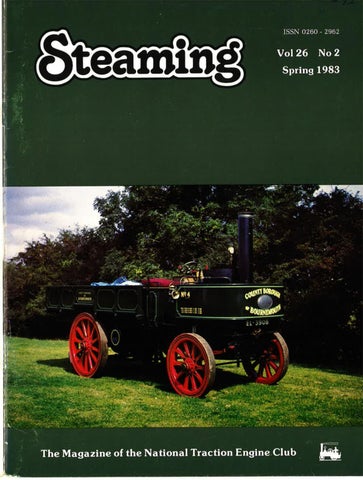
Cover
55
From the Chairman
Rally Sub Committee
A more detailed report of the Club's work during the last year will be found in my annual report included with the formal notice of the Annual General Meeting which is sent to members with this issue of the magazine, so I will mention here only the more important happei During 1982, our club sales section had a very successful year, due to the efforts of all our volunteer sales staff under Stuart Gray's direction. A number of experiments were tried, both in the type of merchandise offered and in the operation of the sales stands, and much useful experience was gained. All of the membership owe a debt to our sales team for their efforts and I am sure you would wish me to congratulate the team on your behalf. In the coming year, we hope to do even better and the section has been further reorganised. Keith Shakespeare will now be National Sales Officer and Tony Fookes has been appointed our Public Relations Officer. Together with Stuart Gray as chairman, they will form the newly reconstituted Sales and Publications Sub Committee who will direct overall sales policy, and Stuart will be particularly concerned with the production of new Club sales items. During 1983, we hope to achieve charity status for the Club, a goal we have sought for so long. The Charity Commissioners have indicated that a renewed application should receive their approval. One of our objectives will then be the acquisition and restoration of some unusual steam artifact. We have already set aside some reserves towards this aim and have hopes of raising additional funds for this purpose as time progresses. First and foremost however, we must find a worthy objective for our efforts, preferably an unique object which might perhaps be uneconomic, difficult to display readily or for some other reason unlikely to attract the attentions of the private collector. Your Committee is looking for ideas and is ready to consider any suggestions from members. We hope that you will let us have your ideas. (Peter Barber)
The Rally Sub Committee meet mainly throughout the winter and our activities are, to a large extent, forward looking to the next rally season, although items and topics that were raised at the Autumn conference and requiring action are also dealt with. no represenOr uSpring Cnferece o fr tatives of rally organisers and affiliated clubs was held on 12th February; some of the topics were:The approved rally list as prepared by Ron Copp; a schedule up-to-date at the time of the conference was submitted and this forms the 1983 Rally List supplement within this issue. Other approved rallies will be added and details appear in the summer issue of Steaming. Safety on the rally field has always been a major item in our Code of Practice as many potential danger areas exist on a rally field. The general public admitted to our rallies are well behaved and make every endeavour to observe the obvious rules of safety. To aid in this the club has produced warning notices that organisers can display at various places on the rally field. Two new posters have been prepared and produced this winter and these were available at the Conference, and are illustrated in this edition of Steaming. All approved rallies have a Safety Officer. One of his duties is to ensure that all engines attending are properly and adequately insured. In order to assist safety officers, the Club operates an insurance disc system. An engine displaying a current disc indicates that insurance cover is held. Some alterations to the disc procedure have been made and to the cover it indicates is in force. The disc has been re-designed and examples were displayed of the new disc which will come into use during 1983. (See also Engine Owners Column.) A maximum of publicity for approved rallies is aimed at by the Rally Sub-Committee. In this connection we have been considering
56
whether the 'excursion workshops' of the English Tourist Board would prove a suitable outlet for publicity with a view to encouraging coach operators to include traction engine rallies in their intineraries. Two sub-committee officials had been able to attend as observers an Excursion Event of the South East England Tourist Board, from which it seemed likely that a stand at future events of this nature would he heneficial. Negotiations continue and participation in a similar event in the Southern Tourist Board area will he the next step. Derek Burdle of the Netley Marsh rally is taking a stand at which Club officials will be present. Derek is a member of the rally sub-comrnittee. At the close of the morning session was an illustrated talk by Mr Peter Wilkins of the National Coal Board which dealt with a wide variety of aspects of the use of coal fired boilers. Much information was given and an interesting and informative hand-out pack was available to delegates attending. The afternoon session of the Conference was devoted to a paper 'Rally Organisation, Promotion and Publicity' delivered by John Crawley, the Club Vice-chairman. This dealt with all aspects of the subjects in a most comprehensive way. A discussion and question session followed the talk and many organisers and potential organisers present cannot
WARNING BEWARE OF MOVING VEHICLES ON THE RALLY FIELD 0
.
N T. EC
CAUTION \'v, DO NOT ENTER THIS ENCLOSURE
These new 'Warning' and 'Caution' posters, very useful for crowd control at rallies and other events, are printed 20in x 13Y2in in red and black on white paper and available from the National Sales Officer (see address inside front cover) at 20p each, plus 75p packing and postage for any reasonable number.
have failed to note points which would be of interest and assistance to them. John was supported by Tony Vile of AV Sound, specialists in public address and events communication systems; an important subject which will be dealt with more fully at a future conference. (Eric Fillmore, chairman Rally Sub-Committee)
Engine Owners Column Trailer Laws I wish to draw the attention of engine owners to the 'Motor Vehicles (Construction and Use)(Amendment No.4) Regulations 1981' the details of which affecting the steam engine fraternity were published in Steaming Volume 25, No.2 (page 541 for Spring 1982. The major change, now law, is that all unbraked trailers should have their maximum gross lie laden) weight in kilograms marked on the outside of the trailer on the left or near side. I would be grateful to anyone who can advise me of a calculation for maximum gross weight on a trailer!
From Alan Martin's Collection
20
In the Autumn 1982 issue of our magazine we read of Burrell's competitors in the 1907 RAC trials. My picture this time shows Tasker compound tractor 1365 (AA2200), the machine which Taskers, seemingly, were allowed to use as a shadow for their official entry. This photograph was taken in Anna , Valley, near the makers works.
List of steam repairers and suppliers Some years ago Ran Hawthorne was responsible for compiling the Steam Directory, listing services for steam engines. The only trouble was (without any criticism towards the author) that as soon as it was published by the NTEC it inevitably became out of date. Some companies ceased trading; other companies claim that they wished to be in the directory, but were omitted. A revision to the Steam Directory has been requested many times. We did however not wish to fall in the same trap by publishing a list that can in theory be revised every day. As a result of our deliberations Nicholas Barker has come to the rescue by offering his services to keep a register of repairers of steam engines and suppliers of steam engine goods. So, for example, if you want to know where you can get a new firebox fitted to your engine you can contact Nick and he will give you the addresses of all the companies or persons carrying out that class of work that are on his lists. The Club cannot however be held responsible for the quality of work carried out, or of goods received. The NTEC merely gives you an address, hopefully saving you a lot of time. The first step is to invite companies or individuals (members or
not) who repair steam engines or supply steam engine goods to write to Nick. We shall need full names and addresses and details of the services provided; also the name and address of a referee lie someone for whom work has been done or goods supplied and who would be willing to vouch for the applicant). So do not delay: please write to N.P. Barker, Homestead Farm House, Lee Road, Saunderton, Lee, near Aylesbury, Bucks.
Aveling roller headstocks There are more Aveling rollers existing than any other type of steam engine. This probably proves they were good workhorses and well made. However, there is one component on an Aveling roller that invariably does not stand the test of time; the headstock. Over recent years I have spoken to many Aveling roller owners whose headstocks are cracked. Repairing the fault by plating or welding can be ugly and still leaves the owner with that wary feeling the repair may be only temporary. Casting a new headstock would be very expensive. Obviously the acquisition of another uncracked headstock would be the answer. There have been quite
a few conversions of Aveling rollers into tractors and traction engines etc, the morals of which I do not wish to here discuss. The headstocks from these conversions can be presumed to be surplus to requirements, but how does the man wanting to buy a headstock find the man who has one languishing in his back yard. The Engine Owners Committee has hopefully come up with an answer, a 'Headstock Register'. Nicholas Barker has agreed to administer it. If you want to acquire or wish to dispose of a headstock (and/or a front fork or front rolls) write to Nick giving the weight of the engine, the year it was built, and any important dimensions of the respective component. For example if you want a headstock the information that would be relevant is: (i) year built — 1923 (ii) engine type — E (iii) engine weight — 10 tons (iv) boiler diameter — 23in (v) special features — 6 fixing holes per side. As the list of people wanting these items may be long it must be carried out in a priority order, in other words first on the list has the first opportunity of acquiring or disposing. Please write to Nick Barker — address as in the 57
previous paragraph. Please note that the NTEC will not negotiate the price; that must be carried out between the respective parties. Neither can the club be held responsible for the condition of any components purchased. (M. John Wharton, chairman Engine Owners Committee)
Insurance Disc Scheme Could I remind all member engine owners who are not insured through our brokers, Tennant Budd Ltd, that I will issue an insurance disc on receipt of the necessary information, which is as follows: • Proof of satisfactory boiler inspection, ie, sight of boiler report or copy, showing date of inspection. • Documentation showing that the boiler insurance is paid up, with the expiry date. • Also, I now require proof of public liability cover, again with expiry date. It is often much more convenient to get your insurance company to issue a letter giving the above details; so long as it is signed by an authorised person, this is acceptable. The additional proof of public liability cover on this disc is new, and has been implemented at the request of both Rally Organisers and Engine Owner Conferences. It is, therefore, essential that I receive the necessary proof of this cover otherwise this section will be deleted on the disc. Engine owners will find that the majority of rally safety officers will insist on proof of this cover so it is far easier to have the disc than carry the necessary papers around. As mentioned below, Tennant Budd will automatically send the completed disc to those insured through the club's insurance, to those who have road traffic act insurance. Most of these policies do cover public liability off the highway, ie, rally field, but it is as well to get them to confirm this in writing. I would also mention that boiler reports are treated with great confidence — the details are not recorded or passed on to any other person. All documents will be returned with the disc. A stamped addressed envelope would be appreciated. (John S. Hirons, Insurance Officer)
It has been pointed out by Tennant Budd Ltd. that the newly worded 1983-84 NTEC disc may require members to supply additional information to them. In cases where members either via Tennant Budd, or on a direct basis, arrange an annual inspection and 58
Boiler Insurance Contract with the National Vulcan, or any other engineering insurance company, the expiry date of that contract will not be the same as that for the Public Liability Insurance under the NTEC Policy. Therefore, when such members approach Tennant Budd Ltd. or Mr Hirons for a new NTEC disc, in addition to forwarding a copy of the current Boiler Report, they will need to advise, particularly for the next twelve months, the date of the expiry of the annual Insurance Contract. (Tennant Budd Ltd)
Sales and Publicity Sub Committee Following a year of tremendous and successful effort by all the NTEC Sales Stands — for which I personally wish to express my thanks — the Executive Committee has approved the formation of the Sales and Publications Sub Committee. This will be chaired by myself; however, we are
pleased to welcome to the Committee Keith Shakespeare, who takes over as National Sales Officer, and assumes responsibility for all matters concerned with rally stands and mail order. I will continue to contribute towards Sales Policy (which will be discussed at sub committee meetings on a regular basis), Club sales and Club rally stands, and all matters concerned with publicity for the Club. Tony Fookes has been appointed to the Club executive committee as Public Relations Officer, and although his executive duties are not part of the responsibilities of Sales Sub Committee, he will sit on that committee as a serving member. We snail continue to attend the majority of NTEC approved rallies with sales stands, supported by comprehensive stocks of publications, models, badges etc. Where this is not possible, Club membership stands will hopefully be present, and all NTEC Club sales items are available from these stands. Any secretary or committee of a NTEC approved event wishing support from a NTEC Sales Stand should contact Keith Shakespeare — address inside front cover. (Stuart J. Gray, chairman, Sales and Publications Sub Committee)
OFFICIAL SUPPLIERS of garments to the
NTEC
Let us supply your Club with pullovers embroidered with your club name and motif We also supply sweatshirts/tee shirts embroidered or printed to your Club requirements
Lambswool pullovers £13.50 Acrylic pullovers £7.50 post and packing extra
Colours — navy, maroon, or sand Sizes — 35in to 48in
Gambit Enterprises Ltd The Mount, Burnmill Road, Market Harborough, Leics Tel (0858) 32660
Club Publicity Two display advertisements have been produced by the Club suitable for either one full page, or half page landscape, of a standard A5 size rally programme. Organisers of approved rallies who feel able to offer the NTEC space in their programme should contact Stuart Gray — address inside front cover.
Steam Apprentice Club Having seen little activity in the past few months due to staff difficulties, the Steam Apprentice Club is now preparing for the new season. Editor Graham Gratwick of 61 Willow Walk, Crediton, Devon EX17 1 DD will be pleased to receive contributions from young and old for the SAC Newsletter. We are pleased to welcome Mark Waltham as our new Membership Secretary and subscriptions from the under 21's at the new rate of £2.00 plus SAE should be sent to him at 37 Overgate Road, Swayfield, near Grantham, Lincs. We shall be attending rallies around the country again to arrange tuition for our members. Our special training day this year is on Sunday 22nd May, and the location Hill Farm, Avon Dassett, near Leamington Spa, Warks — the home of the Fowler Z7 ploughing engines. For this occasion we hope to have about 10 engines of a wide variety in steam for our use, and a representative from the National Coal Board will be present to provide tuition and talk about coal types. A slide/film session is also part of the programme and contributions will be welcome. Any queries on the event should be sent to me at my new address, 104d Station Road, Woburn Sands, Beds MK17 8SB — it is also, of course, inside the front cover of every issue of this magazine. (Sylvia Dudley)
Traction Engines and the Law Value Added Tax The subject of Value Added Tax (VAT) was not covered by my book Traction Engines and the Law. However, those who buy and sell
traction engines may well encounter the dreaded VAT and I have been asked to outline the possible impact of that tax on steam vehicles generally. VAT is a tax chargeable in principle on 'all taxable supplies of goods and services made in the United Kingdom', and is payable by any person registered for VAT. Registration for VAT is compulsory for any person whose taxable turnover exceeds £17000 in a year. (See VAT leaflet No 700/1/79 Should I be Registered for VAT?) If a trader (or a company) who is registered for VAT, having a turnover exceeding £17000 per annum, sells a traction engine he is liable to charge VAT on the entire selling price to the purchaser, to issue a VAT invoice, and to account to the Customs & Excise for the VAT along with his other sales. If he is not registered for VAT (and is not liable to register) he will not have to charge VAT on the sale. If however he makes a habit of buying and selling traction engines, and at present day prices he would not need to sell more than two or three a year to exceed a turnover of £17000, he may find that the Customs & Excise are no longer prepared to accept that he is merely engaging in a pleasant hobby but they may take the view that he should be registered for VAT. Still, the case of a steam vehicle may be affected by one of the special schemes for traders which have been devised for certain transactions whereby the trader keeps a special register of items bought and sold and sells items with a VAT inclusive price (provided that 'input' tax was not deductible on the purchase of the item► ; he does not issue a VAT invoice (to prevent the purchaser working out his margin of profit) and pays VAT only on the difference between the buying and selling prices of the item. Three of these schemes might conceivably affect steam vehicles: 1. The sale of second hand motor cars is covered by the scheme described in VAT notice No 711 Second hand cars. This scheme applies to 'any used motor vehicle of a kind normally used on public roads which has three or more wheels and (a) is constructed or adapted solely or mainly for the carriage of passengers or (b) has to the rear of the driver's seat roofed accommodation which is fitted with side windows or which is constructed or adapted for the fitting of side windows'. There is a list of vehicles not covered by the scheme — vehicles which can only accommodate one person, vehicles which are suitable for carrying 12 or more people, vehicles of not less than 3
tonnes unladen weight, caravans, ambulances, London taxis and special purpose vehicles such as tower wagons or hearses. It seems to me that apart from steam cars it would be difficult to claim that this scheme included the vast majority of steam vehicles. 2. Notice 713 is a similar scheme to the foregoing which covers caravans, motor cycles, motor cycle and sidecar combinations and three wheelers which only accommodate one person. 3. The remaining scheme which might enable one to claim that VAT was chargeable on the margin of profit only is that covered by notice No 712: Second hand works of art, antiques and scientific collections. It may seem strange to claim that one's traction engine is an antique but although the examples given in Appendix A to Notice No 712 of items covered (or not covered) by the scheme do not include machinery, I think it would not be unreasonable to claim that a steam vehicle comes under section 5 of the Notice; 'collections and collectors' pieces of zoological, anatomical, historical, archaeological, palaeontological or ethnographic interest'. Ignoring the parts of this definition which only affect such items as Tasmanian skulls or Zulu assegais, one could surely claim that most if not all steam vehicles are now of (industrial) archaeological interest and this is surely supported by the fact that the auctioneers who specialise in selling them are the fine art auctioneers, Christies or Sothebys for example. I note that Christies recently tried to sell a main line diesel locomotive by auction, and the fact that it had to be bought in does not affect the principle. If your steam vehicle happened to have 'a direct association with a historical person or event' then it almost certainly would fall under section 5 as this category is specifically mentioned. Finally, the decision in the case of C.R. Pilkington v Customs & Excise (1980) VATTR 93 demonstrated that an artefact less than 100 years old could be treated under section 5, but if your steam vehicle happens to be over 100 years old then you could claim benefit of the scheme under section 4 of the Notice: 'Antiques of an age exceeding 100 years old'. ('repair or restoration does not debar an article from inclusion provided that it retains its original character'). I have been notified of two recent decisions by the Customs & Excise which may be of assistance to members. Firstly, in considering the 59
sale of a particular traction engine which is considered to be of an unique type, the Customs & Excise accepted that it was 'a collector's piece of historical & archaeological interest' though they went on to say that each case must be considered on its merits. Secondly, one of the officers of the Society informs me that although he is registered for VAT in his capacity as a professional consultant, when he sold an engine he did not add any VAT to the sale price nor did he include the sale in his VAT return, as he considered the engine to be a private possession and he was not in the habit of trading in engines. At a later date he was asked by the Customs & Excise why he had not added VAT to the sale price of the engine. On his explaining that the engine was a private possession and nothing to do with his VATable activities the Customs & Excise confirmed that it was in order not to add VAT. No doubt this situation would change if he made a habit of buying and selling engines. Like all forms of Government tax, VAT is. a complex matter and if you fear that VAT might affect a transaction it would be wise to seek advice from your accountant before committing yourself. The VAT notices and leaflets which I have mentioned are available from any Customs & Excise VAT office free, on request, and they will post them to you if necessary. I am indebted to Anthony Heal for his advice on the matter of VAT. (David Tew)
Louth. In both cases the work took several months to be completed and the results were excellent. Jack, and his team, rallied the engines quite often in Lincolnshire, but as time went on they were to be seen much further away, and eventually it was more convenient for Jack to keep them nearer to his home. However both Jack and Mrs Hancock continued their visits to the area, the last occasion being at the Annual Dinner and Dance in November last. A quiet man by nature who had worked hard all his life, he was liked by all those who knew him and his passing leaves a gap in the ranks of engine owners that will not be filled. We should like to extend sympathy to Mrs Hancock and family In their tragic loss. (Lincolnshire S t P Society)
James Harris With the death of James Harris, we have lost a sincere friend and a gentleman of outstanding virtue. It was with much sadness that after several weeks of illness in the latter part of last year, he passed away at the age of 84. James was born the son of a builder in the Southbourne area of Bournemouth, and through his father's business activities, the seeds of his engineering interests were planted. At a tender age they were aroused by the installation of a Crossley gas engine generating set in a sanatorium being constructed by his father. He started working for the Poole Gas Works in 1912, a company then responsible not
Obituaries Jack Hancock It is with a deep sense of regret that we have to report the death of Jack Hancock of Anstey, near Leicester. Although Jack was not a local man he visited our county on many ncnasions in his spare time to attend rallies, and eventually joined the Society. His interest in steam matters went back many years, but pressure of work and business had caused him to set his hobby on one side for much of his life until the time became available. In 1973 the chance came and he bought a pair of Fowler K7 ploughing engines, 15516/7, from Mr Roads of Caxton. A great deal of work was required on both engines and the first one was taken to Eric Riggall's home at Mawthorpe. The second engine was restored at Macdonald's works in 60
James Harris (in overalls)
only for their own engineering requirements, but giving a service to many other local industries. James was called up in 1914 and served with the Navy, concentrating on motor torpedo boat engines. After demob he started his own business in the Poole area, assisting the Gas Works and undertaking work from more diverse sources, including installing new machinery at Witchampton Paper Mills. He earned a very high reputation for his gear cutting capabilities, since few people within the area were able to offer this facility. Soon the business was well established and work from the dairy industry was forthcoming, with the development of cheese factories on the Lady Bailey estate. During World War 2 came an involvement with VickersArmstrong at Woolston, near Southampton, which was to last for several years. Jim was concerned with one-off development work of various types, as well as designing toolmaking jigs and fixtures. When Vickers combined with J. Arthur Rank it brought involvement in developing and building mobile equipment for the film industry; rotary tables, special platforms and stages. In 1971 James sold his business and retired, though he still spent a great part of his time in his well equipped home workshop repairing and machining a wide variety of items, but in particular items for traction engine owners from all over the country. His involvement with steam engines was deepened in the 1950s when he purchased Fowler Tiger tractor 14412 (U4662). Over a period of years this little engine was rebuilt to a standard that put many of today's restoration projects to shame. He developed a long standing friendship with the late Alf Pepper and Seth Loader, and I have youthful memories of their long and interesting conversations. The number of people and engines he assisted over the years was immense, such was Jim's reputation as an engineer. In recent years he spent many hours helping with the machining of various items for my engine, giving me hints and tips on techniques, or the use of his lathe or other machinery. Quite often he'd relate some tale of his earlier days and, with his dry sense of humour, turn time into treasured moments. It is with fond memories that I write these words, though I feel unworthy, for in a few lines it is immensely difficult to sum up someone whose personality and whole way of life is so sadly lacking in the ordinary and the steam world of today.
He really will be missed. James Harris viewed the impossible as the possible, humbleness above arrogance, and friendship and sincerity as the way of life. May God keep these qualities close in our hearts, minds and actions. Mark A. Loader)
James Hebden
Jim Hebden was the last man in East Lincolnshire to run a set of steam threshing tackle, and to earn a living thereby. Even when his Clayton & Shuttleworth engine was retired in 1959 he still carried on with his work using a tractor for a few more years. His engine was one of the first in the area to go into preservation and he was one of the first rally attenders. Within a few years he was well known far outside the county, for he was a regular attender at Rempstone and Kegworth, and in those days always travelled under his own steam. Later on, and after he retired from full time work, he was able to go even further from home. In that way he visited Expo, Haddenham and Roxton Park, but by then he had resorted to using low loaders for convenience. On the rally field he was a great contestant and most of his opponents would agree that he was a hard man to beat in almost any competition. The sight of Jim and his Clayton engine passing at speed through the barrels in a steering competition is something not easily forgotten. For most of his life, the whole of his spare time had been devoted to athletics and he did not retire from the active side of this sport until the mid 1950s, but he retained a very close interest in it for the rest of his life and could speak with authority on the subject.
As an athlete he was known over a wider area than he was as an engineman, and probably for an even longer time. His record of triumphs is very long indeed and many honours were bestowed on him for his achievements on the running tracks. If asked what his greatest honour was he could possibly have replied that it was competing at the Edinburgh Powderhall, not once, but several times. Few people however were privileged to hear him speak of his athletic interests at any great length. Jim was a genuine friend to those who got to know him dnd he was always interested in young people who had athletic or engine leanings. Since the death of his wife eleven years ago Jim had lived alone. He will be missed by very many friends and especially by those who knew him intimately. (FS) (Jim's engine was used to draw the trailer carrying his body on the half mile journey from his home at Little Steeping to the village church.)
R.A. Izard After a short illness in Warneford Hospital, Leamington Spa, Dick Izard of Lower Quinton, President of the Banbury Steam Society, died on 24th February 1983. He was an agricultural contractor by trade but would turn his hand to most things to be of help to people. His father ran a threshing business with three engines; one, a Clayton & Shuttleworth named SURPRISE, was purchased from the Oxfordshire showland family of Hatwells. One of Dick's proudest moments was when he went upon the footplate of another of his father's former engines at Tom Paisley's sale. This was Robinson & Auden traction 1376 LITTLE BUTTERCUP. He still had the original documents for the engine at home and I believe he later posted them to the purchaser. Dick and his father built their own threshing machine, and during World War 2 had a party of land army girls attached to them. Dick would travel long distances to rallies and loved to see engines working. He took a keen interest in tractors and stationary vintage engines and was also interested in county cricket and a follower of the local hunt. Dick was not married and lived with his mother until her death two years ago. He was a member of the Fairford & District Steam Club and the Warwick Tractor Club at MoretonMorrell. Although he had not owned an engine for some years he was always
willing to help and give advice to others. Dick will be much missed in the south midlands and particularly at Banbury of which he thought so much. (P. Shadbo/t)
Charlie Pocock I first met Charlie when I was a 14 year old. He came to my father's farm to make two rough old ploughs into one usable plough. My father had just taken over the farm, and had to make the most of the equipment that was there, and Charlie was sent to do the job by Holloway Hinsons, the local agricultural engineers. We quickly realised what a very clever and able engineer Charlie was, and the plough worked a treat. Charlie was brought up in West Ashling, near Chichester in Hampshire, where his parents ran the village shop. He was born in 1909 and at the age of 15 left home to join the fun fair of Alfred James Bartlett of Fordingbridge, Hampshire. Later, he went to work for Wall Brothers of Petersfield, and became a gaff lad, subsequently being put in charge of and driving the steam powered Savage three abreast roundabout. When the owner's son took over the roundabout Charlie became the driver of the Burrell showmans road locomotive PRIDE OF PORTSMOUTH, working along the South Coast at all the •well known fairs, including Sloe Fair. When he fell in love with and married Ellen Castle, a showman's daughter, they decided to settle down. Charlie went to work for the famous Chichester Gravel Co (John Heaver Ltd), and he moved his caravan into Quarry Lane, where he tended a large Marshall portable steam engine that drove the processing plant. Eventually, he graduated to become a steam excavator driver, and he stayed with Heavers until February 1942, when the steam excavators were phased out in favour of diesel and electric types. Charlie then went to work for the well known local agricultural engineers, Holloway Hinson & Co Ltd, and stayed there for the rest of his working life. In the early 1950s Charlie demonstrated the then new Ferguson System to great effect, coming 3rd in an AllEngland Ferguson Ploughing Match. His' last years at Holloways were spent in the stores where his vast experience of all types of machinery was greatly appreciated. When I first started work at Holloway Hinsons, Charlie was a man I greatly respected and admired. Later in life, when I eventually joined the preservation and steam engine owning 61
At almost any weekend during the rally season, Arthur, in company with his wife and son Roy, could be found at an event, and very often far from Wakefield. Although Arthur did not own an engine he was an excellent helper to anyone in need, and his kindly advice was always welcomed by those who sought it. He was a cheerful man from the old school of enginemen and it was a great pleasure to meet up with him. Even in late life when his health was far from good he was never known to complain. He will be much missed by all of us who knew him and we take this opportunity to express our regrets to Mrs Wallhead and Roy in their loss.
fraternity, Charlie was right there with me, back with his old and first love of steam engines. Also in retirement he made models of fairground engines and organs; he exhibited at local rallies as well as accompanying us to Stourpaine and other rallies throughout the South of England. Charlie died on Friday, 17th December 1982. I am sure everyone who knew him in the agricultural, fairground and preservation worlds will greatly miss this most knowledgeable, humorous and wonderful man, and will join me in offering our sincere sympathies to his family. (R. Lonsda/e)
locomotive that has powered organs, lights and rides at many a rally. Jesse provided that engine and an organ for performances at the Great Central Railway, Loughborough — valuable and kindly assistance at a time when the railway was in financial difficulty. To his wife Freda, daughter Wendy and son-in-law Anthony we offer our sincere condolences — Anthony had for some time been his right-hand man and will be continuing Jesse's work and business on local enthusiasts' engines. (Doug Creasey)
Arthur Wellhead Jesse Swingler It came as a shock to traction engine enthusiasts, especially in the Midlands, to hear of the sudden death of Jesse Swingler, 57, of West Bridgford, Nottingham at the end of December 1982. Hundreds attended the crematorium at Nottingham, and many agreed it was one of the largest groups of mourners the area had seen. Speaking personally Jesse had been a true friend to me in time of need; he would accept no repayment and was typical of the various good deeds he did for many. He was a good employer in the civil engineering business and all of this was illustrated by the number who paid their last respects. Jesse's introduction to steam engine ownership was when he purchased Ruston Proctor 115100 from Epton's of Bolingbroke. Later acquiring Foster 12509, a roller which had started life as a tractor, Jesse proceeded to spend a considerable amount of time and expertise making it into a showmans tractor. Then from Foster traction engine 14564 was superbly engineered a showmans road 62
Arthur Wallhead was born to steam work and at an early age became a professional in the trade. In the early days he drove steam wagons, usually hauling roadstone for various county councils, but when the demise of this form of road transport came about, he turned to driving road rollers. He was a contractor's man in the real sense of the term and spent many years of his life with Dickinson's of Doncaster, when he travelled very widely. Like so many roller drivers he had a vast knowledge of parish, town and county boundaries and could give precise details about such matters when asked to do 30. His working knowledge of steam vehicles was even more abundant for he was a man who was well able to drive and care for a roller over long periods away from the home base. As time passed, Arthur joined Prestwich's of Dronfield and eventually was obliged to turn to driving diesel machines. When the Tarmac Group took his firm over he continued in employment with them, and still with Tarmac he moved to their Wakefield depot where he was to stay until his retirement several years ago.
Harold Whipps The traction engine movement has lost one of the pioneers of preservation in East Anglia with the death at the end of January of Harold Whipps. He was buying engines in the area when the only other people interested were the scrapmen. At one local rally he was heard to reflect that most of the engines there had passed through his hands — and it was not that he was a dealer, for he would only part with an engine to someone whom he considered to be a true enthusiast. In 1955, he had his Ruston Proctor and a trailer giving children's rides at a fete at Woodton and the following year was one of the organisers of the first Woodton Rally, attended by six engines, including his own Ruston Proctor and his wife's Garrett. Soon after, Harold acquired Burrell showmans 3933, PRINCESS MARY in derelict condition. This, like his other engines, he restored to immaculate condition, both mechanically and in paintwork; it is now owned and rallied by Teddy Cushing. Despite Harold's craftsmanship shown in the wonderful restoration of his engines, one remembers best his kindly invitations when he steamed his engines for the benefit of his friends, and also the wonderful days when he took an engine, ably assisted by his friend the late Harry Webb, for a day's threshing at a local farm. After retiring from his garage business, he turned his attention to restoring barn engines. These he recovered from chicken runs and all manner of places — many were in deplorable condition but they all ended up looking as they did when they were new. His passing, which will be mourned by all who knew him, leaves a great gap in our ranks. (EW)
The Thomas Aveling Centenary In response to a request last year from the Road Roller Association for donations towards the cost of erection of a commemorative plaque and other events in connection with the centenary of the death of Thomas Aveling (see Steaming, Summer 1982), the NTEC committee agreed to cover any sums outstanding after the closure of the appeal fund. Later in 1982 a sum of £378 was forwarded to the RRA in accordance with that promise. The Association have asked that their acknowledgement, sent to our chairman, be published in the magazine. 'Dear Sir, I would like to take this opportunity to thank you, on behalf of The Road Roller Association, for the substantial donation to cover our losses incurred during the Thomas Aveling Centenary. I find it very gratifying to think that a relatively small Association such as ours, can undertake tasks which can only benefit the traction engine movement in the eyes of the general public, and with the full backing of the NTEC. As you probably know, a plaque to mark the Aveling centenary has been erected on the site of his former works in Rochester, and will be regularly checked and maintained by the City of Rochester council; let us hope that at least part of the original works will be preserved for many more years. Yours faithfully, Bernard Bertram, secretary RRA'.
As a postscript to the mention of the commemorative plaque Tim Keenan advises us that the property on which it is mounted, comprising Aveling & Porter's old works and offices, recently vacated by Messrs Winget, has been acquired by Rochester-upon-Medway City Council for conversion into a £4 million centralised city council offices for the area. Thus the historic buildings will have a further phase of use, and appropriate use too for Thomas founder, the works' Aveling, represented the citizens of Rochester as a councillor for many years.
Future Dates AGM 1983 The Annual General Meeting of the Club is to be held at 11.00am on Saturday, 14th May 1983 at the Great Western Royal Hotel, Paddington, London. Please note the change of date from that notified in the last issue of the magazine. Formal notices etc, are distributed with this edition.
London Area Social Meetings The final meeting of the 1982/ 83 season will take place at 8.00pm on TUESDAY, 26th APRIL 1983, at 'The
Cock Tavern', Great Portland Street, London (corner of Margaret Street and adjacent to Oxford Circus). Michael Mason will present a talk, illustrated by 35mm slides, 'Traction Engine Restoration — past, present and future'. (Please note the alteration of title.) Monthly meetings will resume in the autumn. (Bill Timmings)
Photographic Competition Following the success of the recent Photographic Competition it is intended to have another in the early part of 1984, such that the entries can be displayed at the AGM in the spring. Full details will appear in the Autumn issue of the magazine, but photographers working in black and white may welcome this advance notice before the coming rally season.
Reluctant Heroes 'We have noticed lately a trend in car stickers along the lines of ... 'Windsurfers do it standing up' ... and ... 'Divers do it under water' ... etc. It has suggested that ... 'Old Steamers do it under pressure' ...' (Too good to miss a wider audience, we acknowledge this item to The Smokebox, the journal of our affiliated Old Steamers Traction Engine Club at Oxford.)
To keep up to date with weekly news of the Preservation movement you need
gORLD'S incorporating Preservation News
Order NOW from your local newsagent. In case of difficulty (or for a free specimen copy) write to:
THE WORLD'S FAIR LTD, 2 Daltry Street, Oldham, Lancashire OL1 4BB
63
Steam Postage Many and varied are the subjects depicted on postage stamps throughout the world, but it would seem traction engines and the like have rarely been featured. We are pleased therefore to be advised by the Crown Agents Stamp Bureau of the issue by Zambia in January of a set of four stamps entitled 'Early Steam Engines,' three of which are road steam engines. Designed by Mrs G. Ellison and printed by H a rrison R Sons of High Wycombe, the 28mm x 40mm stamps corfie iii four values. The On stamp 'Drilling Rig 1926' shows a continental looking portable, built within a four wheel drilling rig. The 18n issue 'John Fowler Class B6 compound road locomotive 1910' depicts an exotic purple liveried engine against typical African bush country, but Steam Plough Works employees might have needed to take a second look to recognise it as one of their make. More African background, but no implement, is shown on the 28n stamp 'Borsig Ploughing Engine 1925'; the distinctive small solid flywheel with large apertures
shows up well on this green liveried German built engine. The highest value stamp — 32n — pictures a railway locomotive; the British built 7th class 4-8-0 were for many years the backbone of the Rhodesian Railway fleet. Stamp collecting and engine preservation are pastimes which probably do not often mix but those interested in all things to do with
traction engines should be able to obtain this colourful and unusual set of stamps, at fairly modest cost, from most dealers. Can anyone tell us of any other examples of stamps depicting road steam? The only other we know of is at least 25 years old, probably from an east European country and showing a modern steam roller.
PI1RAS Mortgage Interest Relief at Source
For full information on this year's new tax treatment of your mortgage, contact TENNANT BUDD at Tonbridge. Revision of your mortgage financing could well prove advantageous. For further details contact the Life Department
TENNANT BUDD (LIFE AND PENSIONS BROKERS) LTD., HILDENBROOK HOUSE, THE SLADE, TONBRIDGE,KENT TN9 1HY. Telephone Tonbridge (0732) 357011. 64
From Mary Lea's Diary The Lea family from near Macclesfield, Cheshire, are well known for their travels to rallies with their Foden steamers. We last peeped into Mary Lea's diary in 19 79 at the time when her husband George's Foden tractor was having a new firebox fitted in Lancashire. This time the entries concern son John's 5 ton Foden wagon 5078 and a trip overseas...
Vestingdagen Hellevoetsluis '...and gentlemen abed in England yet, will wish they had been there.' — The Immortal Bard.
The first inkling we had of an impending journey was when Len Crane approached John during the Anglesey Rally to ask him if he would. be interested in a trip over to Holland with his 1914 Foden 5 tonner, as the Dutch fraternity at Hellevoetsluis were anxious to have an authentic Foden at their forthcoming festival in August. This was followed up in June when a Dutch contingent of three, headed by George Kwekel, the Rally Secretary, came over to the Castle Donington Rally as Len's guests. PRIDE OF BURLEY entirely met with their approval and arrangements were left in Len's hands (in conjunction with John Antell, of Shillingstone, Dorset) to cover the shipping arrangements from this side, as they have been across before. Phone calls intermingling, the final arrangement was that Len would take his Fowler Super Lion crane engine on his own low-loader; John Antell was to take the Montague Museum's Burrell showmans LORD NELSON (the Montague Marenghi was self sufficient in its own Bedford organ truck); Jess Swingler had his own low-loader for his Foster; Richard Sandercock had his low-loader for his Burrell road loco; whilst Liz Mason, the roller owner from Newport, Salop was enlisted to take our Foden. Sickness and accident cover for ourselves and our Green Card international road insurance were dealt with by a phone call to our insurers,
and National Health and passports were dealt with at our local office, so that we were all in readiness on the Sunday evening at the termination of our local Astle Park Rally, to load up for travelling to Felixstowe the following day. After some chasing about everything was finally stowed away and lashed down so Liz could travel to Newport in readiness for her journey to
Felixstowe on the following day — George, John and myself going by car for us all to meet up again at the docks. Monday 16th August The day began dull but fine; just right for travelling. We were away at 10.15, picking up petrol just through Macclesfield. Our next stop was at Desborough in Northants with a leaking petrol pipe! It was whilst the men were rectifying this that I thought how helpful and co-operative Len Crane had been right from the start. At Spaldwick, we stopped again at the garage to purchase a piece of plastic tube in case we had further trouble but it was never required. After diverting to renew acquaintance with the centre of Cambridge, we finally reached the Routemaster Motel, adjoining Felixstowe Docks around five o'clock. Had something to eat, then went to the sea front but did not stop long and were soon ensconced in the lounge where we had a natter with Richard Sandercock and Steve Veal, to be soon joined by Liz, Jane and Len Crane, and Alan Baker. It was here we met Steve from the Shipping Company who took our car away for safe keeping. John and the other male members of the gang went for a stroll before turning in. Tuesday 17th August We had a 7 o'clock call; George went to John's room and, rather to our
Is the earnest conversation around John Lea centring on his forthcoming trip to Holland? The Foden stands at Swettenham Mill, Cheshire, in June 1982. (Barry Job) 65
surprise, he was awake. We joined Liz, Len and Jane for breakfast in the restaurant. It was now time to go with the vehicles to the actual terminal point where we now saw for the first time the vessel which was to carry us across to Europoort. It was immense; named SYRIA, it was on charter from the Greek Hellas Line to Townsend Thoresen for one which had been requisitioned for the Falklands episode. After taking a couple of colour shots, minor disaster struck when the focusing device on the camera gave up the ghost. We had to wait until all ordinary commercial vehicles and trailers were aboard, then our turn came to reverse into position. All was secured by chains and sylvesters to points purposely made on the steel decking. Jane, Liz, George, John and I made the first move to go up in the lift to the accommodation deck. They had cast off and we were on our way. It was then we heard that the remainder of our party — Len, Alan, Richard and Steve were stuck in the lift! Oh dear, giggles, but also apprehension. It was at least an hour before they appeared but they had to come through the escape hatch, sized for Orientals not large Europeans, and climb 40 feet up the lift shaft. As the lift was of Taiwan manufacture, the instructions were in Chinese which had not helped one little bit. It was a relief to see them, even in their bedraggled condition, but they immediately had to go below again, this time via the companionway, to be de-greased and laundered. Then up again to join us at lunch — soup, steak, mushrooms, tomatoes, peas, carrots, chipped potatoes, then yateau arid Lea or coffee. 1.30 pm — now stretched out, sunning ourselves on the top afterdeck, the weather perfect, as we watch the wake, straighter than any engine driver's wheel marks could aspire to, creaming away from the stern. Looking into the after-deck well, there was Liz taking all the ultra violet she could, in a bikini. As we are now crossing other shipping lanes, the ship's engines alter their rhythm slightly, now and again. We got into conversation with one of Wincanton Transport's drivers. He was going to Utrecht with a tanker of Burton beer, a very easy number he said. He informed us that all trailers, and containers with dangerous loads such as lethal chemicals, have to be stowed on the topmost foredeck. If it is a rough passage and one of the securing chains breaks, the other chains are released to allow that container to go overboard. On average 66
.11
Merryweather type steam fire engine outside the Dutch National Firefighters Museum. (courtesy G. Kwekel)
they lose two or three outfits every winter. As we sighted land and approached the Maas Estuary, he was able to point out to us how the Dutch are reclaiming land from the sea by forming a dyke of concrete blocks and pumping silt into the entrapped space. A complete oil tank farm was now standing on what was virgin land last year. The Dutch never cease in their remorseless battle against the encroachments of the sea. A Russian grain carrier was coming into port on a parallel course and police launches were buzzing round it like a swarm of wasps to prevent defectors from quitting the ship. We docked at 7.30 pm — Dutch time, as we had lost an hour by travelling east of Greenwich. Being the last vehicles to come aboard, we were now first off and our vehicles were driven to the parking area after being greeted by the Dutch when we drove ashore. Our sleepii ig bags, etc were unloaded from the back of the Foden, and Len unhitched his tractor unit whilst we three piled into George Kwekel's car — all to converge on George's house for coffee and cakes, followed by a video of last year's rally. Around midnight we were taken to our caravans, almost on the water's edge, next to where the engines were to stand. Several Dutch came along on bicycles to greet us and made us feel most welcome. I had a shower in the adjoining
toilet block, then Jane brought ham, bread, cornflakes, butter etc which the Dutch had thoughtfully provided in readiness for us. Then she took an allocation of the pottery ware and cutlery which had been placed in our van. It was a rather long day. Wednesday 18th August Awake early, up and dressed by 7.15 am; I went for a stroll round. What a lovely place it is — everything so clean, neat and tidy. Most of the roads are lined with trees and the houses have lace curtains at the windows. Everything seems so well cared for and there is no litter lying around whatsoever. Steve Veal and Richard Sandercock, the two Cornishmen, had previously asked if it would be possible to see the annular compound pumping engine at Haarlem, as this had been made and erected during the mid1840s by Har vey's of Hayle, Cornwall, and Steve's great grandfather had been involved with its manufacture. Two cars rolled up, Marta Smit took one load, her stepson John took we three, whilst Len drove George Kwekel's car he had the loan of. Travelling along, it was pleasing to see that most of the Dutch windmills are in a good state of preservation. Most of the pumping mills are in a bank of three as it usually took this number to lift the water, in three stages, from one level to another. Going through Rotterdam, it was noticed that rail steam is in
active preservation as we saw ten locomotives on the sidings in various stages of rebuilding. Reaching Haarlem, we bobbed into the next door cafe for a quick cup of tea before going into the pumping station, now preserved and on view to the public. The engine is certainly an impressive structure, an annular compound, the larger cylinder being 12 feet in diameter with four piston rods reaching up to the multi-crosshead. This latter activates 8 rocking beams which are coupled to the 8 pump rods outside the building. It was erected in 1843 to drain Haarlem Meer, to reclaim the land. After the initial pumping, it was found that seven pumps could cope with the drainage water so one pump was uncoupled to stand by if ever needed. A single paragraph cannot deal with this assembly adequately — it is worthy of more from somebody fully knowledgeable, for it stands a tribute to the craftsmen of the last century. No wonder Steve Veal appeared to have a lump in his throat. When the officials discovered that we were a British steam party, they put on a film, with commentary in English, of the flood disaster of 1953 when the sea, driven by high winds and tides, broached the sea dykes. All the Zeeland and North and South Holland provinces of the Netherlands were inundated and 1700 people, and much livestock, were drowned, and over 7,000 were homeless. As all this area is below nominal sea level, one can understand why the Dutch are so active in their fight against the sea. Returning via the Hague, as we were stopped at traffic lights, we were fortunate to see one of the trams, complete with two trailer trams, come round the corner and proceed in front of us. I believe the whole system is now being cared for in preservation. Arriving back at Hellevoetsluis around 6.0 pm, we all went to the local bistro for our evening meal. Afterwards, John joined the rest of the party in going back to the docks to meet the remainder of the British contingent; Jess Swingler and his crew and the Montague crew, headed by John Antell. They were all late in coming as the ferry ran two hours behind time due to the extremely rough seas. The lounge, bar, restaurant and customs bonded shop had been wrecked. One of the securing chains holding down Jess's trailer had broken and the trailer had swung round but thankfully had stopped without damaging the organ truck. It was the worst crossing most of the ship's crew had ever experienced. All in such sharp contrast
to our blissful crossing. Thursday 19th August We awakened to sunshine, and the wind had dropped a little. After breakfast, we all piled into a fire engine from the Brandweer (Firefighters') Museum to be conveyed to the Europoort Terminal again, to unload the engines and steam them the 15km back to Hellevoetsluis. Bags of coal had arrived; Polish coal as Holland does not have any suitable native coal. After raising steam, cleaning and polishing brass, we all lined up to have official photographs taken. These formalities over, Jane and I climbed onto the rear of John's Foden where he had made a couple of — well, fairly comfortable — seats for us to sit in amongst all the clutter which everyone had thrown on the back; wagons do have their uses! It was fantastic to see the crowds, people on foot, on cycles, in cars, lining the roads and streets. Royalty itself could not have been treated more regally. The nearest simile one can think of can only be more like the Lord Mayor's Show and the London to Brighton rolled into one. Our first stop was in the village of Oostvoorne, both the new part and the old, the latter terminating with the preserved village grain windmill. Our
convoy was escorted by police and firemen both to front and rear. They did a marvellous job, the rear one pulling out to prevent traffic overtaking in dodgy spots. To our rear, in the middle of the convoy, there was a bus with public address system giving a commentary and — continental like — music while you work! Also tins of shandy for thirsty enginemen! The road now led us along the top of a dyke, very reminiscent of one of our pre-war fenland roads, ultimately bringing us to the most beautiful village of Rockanje whose streets were laid with new pave. (George said, "When I had to negotiate farm drives in the proper days of steam usage, I never thought I would steer a steam vehicle over continental pave — and lined with cheering people, too. In those days, people were usually glad to see us go!") Whilst the engines were filling up from a hydrant opened up by the firemen — our hydrant equipment would not have fitted anyway — Jane and I went to buy bread, post cards and stamps. They were waiting for us when we got back. We hurriedly climbed on and away we went to stop outside the Town Hall at Hellevoetsluis for a Civic Reception from the Lord Mayor — the Burgemeester — who gave us a welcoming address,
Burrell roller 3351 at the Hellevoetsluis event. The list in R.H. Clark's Chronicles of a Country Works gives the engine as new to Belgium in December 1911 as a sprung 6hp convertible tractor. Our Dutch friends refer to it as built in 1924 — maybe that is its conversion date to a roller. Can they elaborate on what is obviously an interesting history? (courtesy G. Kwekell 67
followed by liquid refreshment, and small talk. It was back to the caravans again for a hurried wash and change, then down to the bistro for our evening meal. Back to the engines again and re-don overalls to proceed to the Leisure Centre where we formed up as part of a torchlit procession led by the Oompah bands and with decorated floats to the front and rear of us. We accommodated as many children as was safe, on the back; there was no shortage of volunteers! One little lad,
Island
4.... .1131171 AILS (Sy Bernard Bartram Whilst on holiday in the Channel Islands last year I visited Guernsey to try to solve the identity of the roller 'parked up' in Cambridge Park, St Peter Port. But despite scraping red, blue and yellow paint from every location where works numbers are usually stamped on Aveling rollers, I was unsuccessful, only confirming to everyone watching I was totally mad. A local library was nearby and so my wife and I ventured forth and made the acquaintance of the Chief Librarian Mr John Hayes. He was an elderly gentleman who happened to have a passionate love of steam road engines, and a local historian to boot. He assured me the roller — an E-type single cylinder piston valve machine — was works number 11849, and Guernsey fleet No 8. It was in fact steamed to the site when the decision was made to 'go for diesel'. Mr Hayes also told me of a motor roller parked in nearby Delancey Park. A quick visit
who shall not be named, tried to emulate one of the fountains of Bruges, rather unsuccessfully, and John had to wash down the sideboard with a bucket of water from the injector. The children's patience was growing thin but we were finally away, the bandsmen setting themselves a cracking pace, really stepping it out. At half-time we stopped to allow the bandsmen to get their breath back although, so far, none had run out of puff, despite their rapid pace;
they Ger 'Airily earned their lager. Round more of the outlying area we went, finally finishing at 11.30 pm. Even then they wanted us to stop and receive a Civic Thankyou, but Len wanted to get away as his tractor unit was back at the docks. However, George Kwekel turned up later, bringing bouquets for the ladies and parcels of locally made cake, by courtesy of the Dutch Tourist Board.
showed the roller to be a Wallis & qt..v.ns M-type 4 Speed 1960 vintage, no cab but with all fiuirlys Jii;1 IIIIGGL. AppaI ellily beVCI di enthusiasts have tried to purchase these rollers but the Guernsey authorities do not share their enthusiasm for preservation in working order and insist the rollers are kept as children's play equipment. As I was staying in Jersey, Mr Hayes suggested I contact Lyndon Pallot who has a private collection of engines. A phone call resulted in a cordial invitation to visit him in a few days time. On arrival we found in an exceptionally large building one of the most extensive collections of engines, vintage tractors, barn engines and stationary steam I have seen — all in various stages of preservation. Two steam rollers were there, both Marshalls. The larger was 78539 a 12ton S-type compound which previously worked for the Parish of St. Saviours. The other was an 8ton compound; no maker's number could he found, the only clue to identity was a plate on the tender which recorded it was supplied to the Parish of St Helier from T.H. Flamwell of Worksop, Notts obviously on agent. Allen scarifier No 897 was fitted, which dates the roller to about 1926.
Next in line was Ransomes, Sims & Jefferies agricultural 15740 which was rescued from St Brelades about 15 years ago, after being brought from Kent and used for soil purification. The engine has just received a new firebox and backhead and was in the process of being re-assembled. The most interesting exhibit was a very rare French portable of about 6hp, manu-' factured by Merlin of Ville Vierzon. The boiler and firebox were both of tubular construction, the firebox being vertical and the boiler horizontal, as normal — an interesting combination. The front axle was wooden and I also noticed the governors were permanently connected, driven by a shaft and bevel gears from the crankshaft. Apparently she worked for a local threshing contractor during the German occupation and was eventually sold for scrap rather than to Mr Pallot's father who was a competitor. Undaunted Mr Pallot senior went to the scrap merchant and saved the engine from an untimely end, but not before the sledge hammer had already heen used, smashing several components. Lyndon hopes to steam this unusual engine again one day. Also on view were two immense steam generators used by a local daii y and the gas works for generating their own electricity. l hey were manufactured respectively by Bellis & Morcom of Birmingham, and Sissons of Gloucester and dated about 1930. In a corner stood a Marshall boiler of about 8hp, works number 88636 and used for soil sterilization, and a Tangye horizontal steam engine No 2658. I was interested also to see two cinema organs preserved, built into a special room, purpose-built to house all the pipes and equipment. It was an interesting visit all round, and my grateful thanks go to Lyndon Pallot and John Hayes for their help and hospitality during my holiday. yrj
(to be continued)
Part of Mr Pallot's collection. (B. Bertram)
Art Pethick John H. Trounson The recent death in his 92nd year of Arthur Pethick, 'Art' as he was affectionately known to his friends, deprived our fraternity of one of the most outstanding enginemen of the steam era that Cornwall ever produced. He was probably the last of that great breed of men in the West country whose experience of steam on the roads, both in civilian life and in the Army during World War 1, was vast. In Art's youth his father was threshing with a large Wallis & Steevens road engine, which was really too big for the job, and the young Pethick served a hard apprenticeship under him. The father was a heavy drinker and at last the son could stand him no longer and pulled out and went on another threshing job where he met the little single crank compound 'Devonshire' Burrell on which he learnt to drive. He ever since had a great affection for those little engines which
were ideal for travelling in narrow lanes and over soft ground in small farm yards, for they were light yet powerful. In 1906 the firm of S. & T. Trounson Ltd of Redruth, merchants, millers and grain importers, had bought their first 5 ton Foden steam wagon, maker's number 1166. Arthur Pethick's elder brother, Will, was driving this, but as the firm was about to buy another Foden it was arranged that he should drive the new one and, on his recommendation, his younger brother was engaged to take over his wagon, No. 1. The first photograph
shows Art, then 18 years of age, standing by the front wheel of his engine outside a country shop at Wendron-Carnkie. The new wagon, number 1726, which became No. 2, was purchased in 1908. Art, still a young man with little experience of long distance travel, was sent off by rail to help bring down the new wagon from Sandbach. Foden's delivery driver who was in charge was a surly and unpleasant man who refused to take notice of anything that his young mate said. When about half the long journey to Cornwall had been completed, the Foden man decided to pull into a pub yard where they could be put up for the night. It was an awkward shunt getting into the yard and the driver would not accept any advice from his mate; the result was that the engine hit a wall and smashed the perch bracket! They had to telephone to the Foden works and another man was sent down next day with a new perch. He proved to be a very pleasant fellow and after the repairs had been done, completed the journey with Art. Mean-
Arthur Pethick, then about 18 years old, standing by the front wheel of S. & T. Trounson's No. 1 Foden wagon (maker's number 11661. This photograph, of September or October 1908, was taken outside the Wendron-Carnkie Stores. It was at this place that the gooey road locomotive slid once into the side of the road, and the crew had to spend the night huddled on the footplate. (collection J.H. Trounsonl
69
while, the other man had to return to Sandbach and explain his actions to his employers. After this, Art settled down to driving No. 1 and doing the maintenance and any repairs needed. Amongst the notable improvements which he made to this wagon was one to reverse the ashpan so that the damper faced rearwards. Where the engines stood in their shed and were lit up in the morning the draught was usually from the rear, and by having the damper facing that way they would steam far faster. Another advantage was that the ashpan then became selfcleaning for with the vibration of the engine the ashes spilled out on to the road which, in those days of rough water-bound loads, went unnoticed and nobody complained. Another improvement was to alter the maker's arrangements for double high pressure steam for the low pressure cylinder. As the lubricator was on the high pressure steam chest, when working 'double high' the low pressure had no oil. An external pipe connecting high and low pressure steam chests was therefore fitted, complete with an auxiliary throttle valve — similar to the Aveling engines. The low pressure cylinder then
received its quota of oil and, incidentally, the use of this auxiliary throttle made shunting much easier. A foot-operated flywheel brake was also added as this is the quicker brake to act in traffic. When a firecrack developed in the box of No. 1 a knowledgeable old boiler inspector showed Art how to 'stitch' it with overlapping small copper studs, the crack then being shielded from the fire by lining the box with firebricks. However, the boiler would not steam with the bricks in place and eventually the wagon was sent back to Foden's for a new box and general overhaul, including the fitting of a larger tank. Nevertheless, this experience of stitching a box served Art in good stead when he was In the Army. On its return from Sandbach the engine, then in splendid condition, was fitted with a new box body as the old one was leaking in heavy rain and the groceries were being damaged. The sides of the new body were made of very wide mahogany planks, the joints being sealed by half-round beading. At the same time, the short cab was extended to the back of the chimney and polished brass uptakes for the safety valves fitted. The bodywork was painted a rich dark brown with the
On the 10th April 1971 the bi-centenary of the birth of Richard Trevithick, inventor of the steam locomotive, was celebrated in Camborne. The photo shows Arthur Pethick (left) and his son Donald, who drove the Burrell showman THE GLADIATOR at the head of the procession of 24 engines which paraded the streets of the town. (collection J.H. Trounson)
RICHARD TREVITHICK 1771-1833
70
owner's name in bold gold leaf lettering, shaded black. The underside and back of the cab were painted in cream and varnished, the wheels and usual Foden chassis parts in red, with appropriate lining, and the copper chimney top highly burnished. Being kept very clean, this turnout was an absolute picture of steam at its best. One of my own early memories was being allowed to stand on the footplate while the wagon was being loaded. Art, in clean overalls, was oiling the motion of his engine as it turned over very slowly, steadied by a light application of the flywheel brake, with absolutely even gentle puffs from the chimney — a beautiful piece of machinery in superb condition, which gladdened my young heart! In passing, it was on this wagon that I was allowed to steer (when there was no policeman about) although I was so small that my legs were not long enough to reach the steersman's foot rest. Indeed, it was due to Arthur Pethick and this wagon that, still at a tender age, I became incurably addicted to steam. S. & T. Trounson's next and unfortunate venture in steam transport was the purchase, second-hand, of the notorious Robey road locomotive, LORD ROBERTS, maker's number 27894, which has been much discussed in steam circles from time to time. With anything more than a light road this was a very poor steamer and the cylinders would beat the boiler every time. As Arthur Pethick seemed to be the only man who could get any effective work out of this engine, he was taken off his beloved Foden to drive LORD ROBERTS and had some lurid pretty experiences in consequence. That engine only weighed 11% tons and her drag box was far too high. Consequently, when coming down a hill with a load, the tow bar of the leading wagon pushed up against the drag box and tended to lift her back wheels off the ground. On one occasion they were coming home from Falmouth with a good load and when on the stoop hill running down into Ponsanooth the load took charge, the .engine slewed around and the whole outfit jack-knifed, the engine nearly turned over and was pushed down into a sloping side road off the main one. The crew had such a scare that they left her there for the night and walked home to Redruth, a distance of about six miles. Then there was the time when there was a severe frost and snow, and the steel-shod Foden wagons could not venture out. There was an urgent need to deliver goods to the
'RN(
country shops in the Stithians area which is on high ground to the south of Redruth. My father asked the resourceful Art whether he thought it would be possible to do this job with the Robey if pulling only one truck. Arthur was prepared to try anything once, so the engine set off with the one truck and four men. All went well until dusk was falling when the engine slid into the side of the road on ice and could not be moved. Fortunately, a telephone was at hand and they rang the firm's office to say that they were stranded. I can remember my father coming home and collecting all the travelling rugs etc in the house and, with flasks of hot drinks, he and another employee set off on a horse-drawn vehicle with the horses' hoofs tied up in sacking, and finally reached the stranded men. Father authorised them to take any sugar or anything else that they needed from the groceries and the firm would make it right with the shops. Throughout that bitter night the men huddled together on the footplate, keeping the fire going to retain some warmth, though the water dripping from the injector overflow froze to form a stalagmite on the road! Fortunately, the following day dawned bright and sunny and by mid-day the ice had thawed sufficiently to be able to move the engine. It was then
Arthur Pethick photographed by the rear wheel of THE GLADIATOR on Redruth fairfield, 26th June 1965. (collection Richard Angove)
Sunday, but they were able to complete the delivery of the goods before turning homewards. Before doing so, however, they stopped at Wendron pub for a much needed 'warm'. This was so effective that they belted the engine home in gay abandon with sparks flying from the chimney in all directions! A whole book could be written about Art's experiences with that engine, but in 1916 he volunteered for the Army. At that time he was not very robust and the Army doctor who examined him nearly turned him down. But when the authorities learned that he was a steam driver and one capable of doing his own maintenance, he was promptly accepted and put on transport work for the duration of the War. He became a Staff Sergeant and was later recommended for promotion to Sergeant Major but, being demobilised in 1919, that promotion never took effect. He has often told me of his experiences while in uniform and a book could be written about them, but at this juncture a few must suffice. An old Bhp single cylinder twospeed general purpose Fowler, which had belly tanks, had been standing out of use in the country for a considerable while and was known to be in need of re-tubing. This was commandeered for work on Kidbrooke Aerodrome and somebody went down and expanded the tubes and it was then thought to be capable of steaming to its destination. Art drove to the place with another man in a small motor vehicle who then followed the engine on the road while Art drove and steered by himself. Now, this was a dead or unsprung engine and consequently rode roughly. Approaching Sunningdale railway crossing where there was a double line of track, Art closed the fire door, which had been open for a long while, and started over the crossing when, because of the jolting of the engine on the rails, a tube cracked off at the firebox end and immediately Art was surrounded with steam and smoke and could not see where he was going. However, he stuck to the engine as he had to get clear of the railway lines and he managed to steer her on to a sloping bit of ground before leaving her. Had the fire door not been closed just before the tube went he would probably have been severely scalded or killed. This was a near thing! On another occasion he had to go to Reading for an 8hp Burrell road loco,
which had been commandeered, and bring it back to Woolwich Arsenal. her civilian driver said that she was a good engine apart from the fact that she would not steam. On the way back to Woolwich Art found this to be true and, try as he would, he could not get her to steam. At Woolwich she was put in the hands of a good driver but he too had to admit that he could not steam her. One day Art was going out of one of the gates of the Arsenal on an old motorbike and sidecar when the engine was approaching the gate up a slight slope and the driver fired her at that moment. Art noticed that the smoke was going up one side of the chimney and instantly he realised what was wrong. He obtained permission to have the engine out of steam on the following day and then plumbed the blast nozzle from the top of the chimney and found, as he had thought, that it was out of line and therefore the blast was not filling the chimney and creating a vacuum on the fire. Possibly the stud holes in the flange of the blast pipe had not been drilled where they should have been, but, whatever the reason, the nozzle was out of line with the chimney. Art therefore dismantled the blast pipe and took it down in his sidecar to Barrimar's who, at that time, were the only people who could weld cast iron. They burnt out a V of metal, heated the casting with their burners and twisted the pipe around to bring the nozzle perpendicular, and then finished off the job by gas welding. When the pipe was put back on the engine she proved to be one of the best they had to steam and pull — which goes to show the importance of small things! An interesting experience that Art had was to bring an LR class Foster road loco down from the Manchester area to Bulford Camp in Wiltshire. Though only a two-speed engine, and running light, he found it in every way a fine engine. The steaming and riding was good, the regulator and reversing lever light to handle and he was much impressed by the width of the bearings and the gears. Later, he brought down two other Foster road locos from the north. They were also very good engines and he especially liked the single lever three-speed gear change of the Fosters which enabled one to slip from middle to top gears while on the move on level ground. Apart from having charge of the workshops at Wycombe Lane, Arthur 71
Pethlck had the experience of driving a great many engines and steam wagons. He never saw a Burrell wagon in Government service and, having driven one after he came out of the Army, was not surprised! He admitted that they were strong but, having small tubes, were poor steamers. In the case of the double chain ones they were terribly hot to drive as the footplate was virtually a pit between the two big chain cases. He regarded them as slow and clumsy things and a Foden would run their wheels off for speed. At one time he had several Fodens in his charge including some of the little 3 tonners, one of which had been owned by Boots the Chemists. The Government had this one at Woolwich which used to load up with bread at the central bakery they had there and then distribute the loaves to all the Army camps around. For this sort of work they were excellent as they were very fast, but they were no good with a load of any weight. As previously mentioned, Art was demobilised in 1919 and resumed his employment with S. & T. Trounson Ltd but the day of steam on the roads was nearing its end, with ex-Government petrol driven lorries freely available, firms were going over to the new form of transport and Trounsons were no exception as they began to invest in Thornycroft lorries. Art had also had much experience of them in the Army and he was therefore put in charge of Trounsons' maintenance workshop. However, the firm had not yet quite finished with steam for shortly after the War ended they purchased a smaller grocery and bakery business in Helston, and with this they came into possession of one of the little 3 ton, rubber tyred Foden wagons, number 5538, built in 1915. Like the rest of those small Fodens, it was fast but of insufficient power for the Cornish hills. In common with the older 5 tonners it was not long before it was sold. All three of them had their box bodies cut down to low sided open ones and lasted for a while with various haulage contractors in the county. Thereafter, Art's work for Trounsons was maintenance of the lorries and vehicles and other machinery belonging to the firm, but he was also engaged in two other interesting tasks after leaving the Army. The first was to help in the reconstruction of a car to make the first motor ambulance for the Redruth district and then in 1920 to convert a horse-drawn Merryweather steam fire engine to a motor propelled one. A light Star petrol lorry owned by Trounsons, which was becoming too light for their purposes, was cleverly 72
altered so as to carry the boiler, engine and pump etc. of the Merryweather at its rear end. Arthur then became the Engineer of the Redruth Volunteer Fire Brigade and on the outbreak of World War 2, and the formation of the National Fire Service, he was appointed Fire Transport Officer for the whole of Cornwall. However, steam was still in his blood for one day on his way to an important meeting he noticed an engine threshing in the distance — it was the little 'Devonshire' Burrell on which he had learnt to drive many years before! History does not record whether he was late for his meeting, but he simply had to walk across the field to see his old engine at work before continuing his journey. After the War ended he was overtaken by serious illness and was invalided out of the Fire Service. The doctors thought that he would not live more than 3 years but he recovered and did not die until he was in his 92nd year! In 1949 Art set up in business on his own account by opening a repair garage, though steam ever remained his interest. Consequently, when, in 1953, a small group of men decided to buy the 7hp Burrell showmans road loco 3159, our friend Art was immediately involved. This engine had been built for Anderton & Rowland in 1909 and was regarded as the 'flagship' of their fine fleet of engines, but many years later it was sold to T. Whitelegg & Sons. When purchased by what became The Gladiator Club of Redruth, the engine had been standing in the open at Exeter for 12 years and consequently was in roughish condition. Art volunteered to drive her down to Redruth and, with brakes etc in poor order, had a somewhat hair-raising journey home. One of the difficulties was water supplies which were no longer plentiful as in olden days. An amusing incident occurred when they were not far from Exeter and were in urgent need of water. As an old Fire Service Officer, Art knew the ropes and he telephoned to the local Fire Service office and asked for a water tender to give him a supply. The girl who answered the phone could not understand what a showmans engine was, so Arthur asked her if she had ever been to a fair, to which she said "Yes". He then asked if she had seen one of those steam engines with lots of twisted brass rods, and she admitted that she had. "Well," he remarked, "I have got one of them here now and if I don't get 200 gallons of water within five minutes there is going to be a hell of an explosion."
"Oh!" exclaimed the startled voice over the 'phone, and the water was there within a few minutes! For many years Art continued to drive that now famous engine and to look after her with loving care as if it were his own child. Together with a local mechanical genius, Gordon Richards, the engine had been got into splendid condition and together with its accompanying organ continues to give pleasure to many people and to raise funds for charities. It was only because of increasing age that Art had to step down from the footplate. In 1956 the writer purchased a somewhat unusual 7 hp single cylinder Marshall traction engine from the Devon County Council. On the final stage of the journey home to Redruth the crew were surprised to see the doors of a car positively burst open and, amongst others, out jumped Arthui Pethick, full of enthusiasm at the sight of a strange engine on its way to join other local preserved ones. He proceeded to walk around the engine with a critical eye and then remarked "Not a bad looking thing!" Asked if he would like to try her, he was on the footplate in the twinkling of an eye — and continued to drive until we reached Redruth! That engine too was in a run-down state and much had to be done to get her back into good condition. For advice and much help in doing this I shall for ever be grateful to my old friend, Art. When he was asked recently which he thought was the finest make of engine, he is reported as having replied "There are only two makes — Fowlers, and the others!" Notwithstanding his very high opinion of Fowlers he admitted to having a great liking for Fosters, which he regarded as being very good engines indeed. His favourite steam wagon was the 5 ton Foden though he did not like the high footplate of the later 6 ton Ackermann steering model, remarking "I don't call that driving a steam wagon at all, perched up like that above the firehole." Neither did he like a Sentinel which he regarded as driving 'a hot chip van'. On the subject of tractors, he had a very good opinion of the Ruston Proctor 'Lincoln Imp'. Incidentally, to see Art shunting a big engine in a restricted space was an education in itself. As an onlooker was heard to remark, "He can handle that like a perambulator."
Arthur Pethick was, indeed, one of the outstanding men of the steam era and, even in the last few months of his long life, was as interesting to talk to as ever. yrj
What do you think of this
It was obviously a special occasion that prompted Ruston, Proctor & Co to neatly pose three of their products before the photographer. We asked Ray Hooley, with his good knowledge of Rustons and other Lincoln history what he thought of the scene....
'The photograph was taken on the Cornhill at Lincoln. The only explanation that I can trace concerns a large order for Ruston steam rollers from Bulgaria. On 6th July 1909 the Ministere des Travaux Publico (Ministry of Public Works) in Sofia, Bulgaria placed a single order for eighteen rollers with Ruston, Proctor & Co. The order comprised ten 121/2 ton single cylinder and eight 8 ton single cylinder machines. The working weight of the 121/2 ton examples was 14 tons, and of the 8 tonners, •11 tons. This was by far the largest order for rollers that Rustons had ever received. I feel sure that the photograph shows a public display to celebrate that order, though in fact only one of the three machines on display was part of the order — the one on the far right. The machines in the picture are as follows. The left hand roller is a 6 ton single cylinder, built for working on narrow roads where larger rollers
could not be taken. The centre machine appears to be a 121/2 ton compound roller, reputed 'to be very silent in working, and economical on fuel'. At the right hand side is a 12% ton single cylinder roller. The left hand and centre machines are both adorned with the Lincoln coat of arms on the headstock, whereas the right hand machine has a colourful Bulgarian insignia — a rampant lion surmounted by a crown is flanked by two flags, the left hand one apparently the Union Jack. Beneath, there are initials from the Cyrillic alphabet probably indicating the owner, and the fleet number 9. The 18 machines of the export order were prominently numbered 1 to 18. Their sizes, machine numbers and delivery dates were as follows:121/2 ton 36826 17.8.1909 36838 17.8.1909 36873 18.8.1909 36899 6.9.1909 7.9.1909 8 ton 36953 36995 11.9.1909 121/2 ton 37016 14.9.1909 37252 14.9.1909 8 ton 121/2 ton 37256 15.9.1909 37257 8 ton 16.9.1909 37264 17.9.1909 121/2 ton 37274 18.9.1909 37297 20.9.1909 8 ton 121/2 37301 20.9.1909
8 ton 121/2 ton
37319 24.9.1909 37370 27.9.1909 37377 28.9.1909 8 ton 37382 29.9.1909 Thus the roller numbered 9 in the photo is 121/2 tonner, works number 37370 and we might assume the photo was taken during the last few days of September 1909. The complete order was delivered/dispatched in a little over 6 weeks, indeed 15 were completed for delivery in 24 days. The latter, at least, would presumably be shipped off to the customer as a group. The left hand and centre machines have been given a special finish for the occasion, but unfortunately I have not been able to trace their identity or machine numbers. The drivers against the two larger machines appear by their dress to be Bulgarians, but the third man may be a Ruston employee. I cannot see a single female in the crowd — this suggests that the workforce was encouraged to attend! The shops and other buildings in the background also make fascinating study.'
We thank Ray Hooley for providing the above comments, and also Mrs B. Lewis of Lincoln for loaning the print for reproduction. 73
Coming home with Fred's Burrell A story of happenings on a typical road journey in earlier rally days. cast
engine Fred driver publican narrator
CLINKER, Burrell 3257 of 1911 (AH5317), a 7hp 3 speed double crank compound Fred Jackson, owner Graham Love Jack Sammons Graham Love
1963. I remember it as if it was yesterday. Fred Jackson, an old friend of mine, had taken his Burrell road loco CLINKER to North Hykeham rally and then in July moved it on to Rempstone. At the latter event I had been driving John Reynolds' Fowler (which I now own, incidentally), but I was quite familiar with Fred's engine too, and about 5.00 on the Sunday Fred asked me if I would help him home with his engine the following weekend. Olive, his wife, cook, organiser, mechanic, engine cleaner, coal humper, etc was going away to her sister's. I readily agreed. Early the following Sunday morning, Fred picked me up in his old Jowett van, full of coal, oil and snap for the journey back to Bawtry, about 55 miles. On arrival at Beeby's yard at Rempstone about 6.30am we were in high spirits, looking forward to a nice journey home in the warm sunshine. Getting steam up on the Burrell was a slow job, even though the weather was right. Mind you, Burrells never did steam well, inferior engines all round, as everyone knows. Anyhow, we had steam up for about eight thirty to nine. I don't know if any of our members can remember Fred's engine when he used to travel on the road, but for those who can't, he always towed an old broken-down two-wheeled trailer on which he used to winch the Jowett van, coal, water-tanks, tools, etc. Now the trailer had seen better days, even in Victorian times Sothebys had been interested in its antiquity! 74
Having got steam up, Fred took the engine to fill up with water while I tried to winch the van on the trailer. Unfortunately, the skids which had countless times held the weight of Fred's van had also seen different times, and one of them broke in half as I had the van halfway up. There was a nasty sickening crunch and the van reeled over, nearly on its side. Fred surveyed the sorry sight and said "Ah, 'ad me suspicions about that plank, it's one as me dad used afore War on drums, tha' knows". Eventually we got Mike Beeby to help us out and soon had things right again, and at 10 o'clock we were on our way through the village heading for Nottingham. Fred took the regulator and I steered for a while, then when Fred wanted a smoke at his pipe, we changed over. Our journey into Nottingham was a pleasant trip with no snags. We stopped for water on the outskirts of the city. Even though CLINKER was a three-speed engine, we could only cover 12 to 14 miles on the back tanks; Fred hadn't got round to refitting the belly tanks. Having got through the city, we set out north towards Doncaster and, by this time, it was almost 1.30 so we decided to have our roadside lunch. We stopped on a wide piece of road in a 'residential' part. Unfortunately, there was a cross wind which Fred and I hadn't noticed until we stopped. I don't know whether Fred had planned the next event or whether it just happened, but the house opposite the
engine had got a lovely row of dazzling white bed sheets — when we stopped, that is. Now Fred always, but always kept a thick fire in CLINKER and as soon as the regulator was shut a huge cloud of smoke drifted on to the poor lady's washing. I had noticed this and suggested to Fred we move the engine further on to be fair to the good lady. Fred's reply was a mumble, something about "Ha, ha, ha, it's only soot, good stuff too. It'll wesh off again". The heartless beast, I thought. Anyway, having had our snack we set off, but I noticed a definite change of colour in those sheets! Having put a few miles behind us we were going well. I was at the regulator, Fred on his perch steering. At this staae I noticed that the coal was getting low, and suggested to Fred that we fill up from the trailer. There were about three bags left, hardly enough, I thought, to see us home, but not to worry I concluded, Fred knows what she takes. While I was filling up the bunker, Fred had been oiling round a bit and managed to lose the cork out of one of the big ends. Of course, being Fred, he hadn't got a spare, so he stuffed a bit of rag in the top. Again we set off. I offered Fred the driving for a while but he declined, said he "liked sitting down steering, no need to worry about the fire and water, ha, ha,". I called him an "idle b " and pressed on. The real reason for Fred not wanting to drive became obvious to me as we got going uphill, for having set the revs up a bit to get a run at it, the bit of rag shot out of the big end and covered my face with hot oil and some went in my eyes. I slammed the regulator shut, groping for a cloth to wipe my eyes. The engine started to roll back down the hill. Fred shouted, "Hold her, hold the b ". I did the obvious thing. I yanked the regulator wide open in full gear and managed to stop her downward trend, but not before she had jack-knifed the trailer and bent the draw-bar. "Right" I said, "I don't want that bloody caper again. We'll do something about that big end before we set off." Fred's 'tool box' was nothing more than a few spanners scattered about the footplate with odd nuts and washers and bolts. After a quick search I found nothing, then I noticed the whistle chain was held by a nice new nut and bolt with broad washers either side of the spectacle plate. I 'borrowed' this, screwed it though the big end cap and tied the whistle chain on with string. Having filled the big end again, we got under way with 200Ibs on the clock and in third gear, uphill,
regulator wide and the 'button' in you could, to put it mildly, hear us for miles around. From then on our journey went beautifully with Fred still steering and me firing and driving. She was a lovely engine to drive and being sprung it was a smooth ride and in top gear with the crank turning over, she would run at about 15mph. We had had such good run the last few miles that we thought our luck had changed for the better, but no, fate was still being unkind to us, as we found out when we got to the White Post Inn, about five miles south of 011erton. It was here that the question of water again arose. Fred said he thought there was a fire hydrant about halfway up the hill from the roundabout opposite the Inn, so having negotiated the roundabout, I drew the engine up at the spot where Fred thought it was, and after a few minutes searching, we found it. You could see that it hadn't been used for a while. The lid was rusted in places and grown over with weeds. Fred got busy with the hydrant lever while I uncoiled the lifter pipe, which in itself must have been a museum piece — the canvas had long since lost its natural qualities and had to be soaked in water before it became airtight. Meanwhile, Fred had managed to take the lid off the hydrant, but the key would not turn the valve open at all; it seemed solid with corrosion. Fred suggested that I should pull on one end of the bar and he should push. This we did with all our strength until there was a sharp 'crack' and the valve spun open with such force that the water shot straight up in the air like a fountain 15-20 feet high and about 3 inches bore. Suddenly there was all hell let loose. We were soaked to the skin in seconds and, try as we could, we couldn't get the key back on the square again to shut the thing off. The force of the water knocked the key and us out of the way time after time as we fought to control it. After many, many attempts we finally got it shut down but not before we had flooded the grass verge, which had in turn flooded the road, which had all run down the hill and flooded the roundabout. I said "For heaven's sake, let's get filled up off. We'll get ten years if the and b coppers see us". So as quick as we could we filled her up and, by the way, I needn't have worried about how I was going to soak the lifter pipe to make it suck — the thing was under three inches of water. By the time we got away again, it was late afternoon. I was feeling a bit sick after that lot, especially being wet
through as well. By half-past six we had got to 011erton and took the Bawtry-Doncaster road. At this point I was having difficulty in keeping steam up as the coal was getting down to not much more than slack. CLINKER was OK whilst you had 200 on but at much less than 180 she struggled and at 150 she was useless. So, unable to maintain the pressure any longer, I pulled her up to see what I could do with the fire. Fred said "What's up?" in a surprised sort of way. I think I must have woken him up. I said, "We're out of coal, that's what's up." Fred mumbled something about "thowt we'd 'ad enough" but I wasn't listening. I saw something much more interesting down the road. The Forestry Commission had been clearing a bit of woodland and left what was surplus to their requirements (or so I thought, whether it was the case or notl. I also decided that the 2 foot lengths of wood neatly stacked would fit inside CLINKERS firebox and also in the back of the engine and anywhere else that would take a 2 foot log. Ten minutes, no more, saw the bunker full, the van full and under the trailer's wheels where there was a toolbox full. Fred had never worked so hard for a long while. Luckily on-one saw us pinching this newly sawn wood or another ten years would have been added to our jail sentence. So, with a full head of steam again after chucking our new fuel on, we started out and this time I managed to
get Fred to do a bit of work at the regulator. As we rumbled past the Normanton Inn, I shouted to Fred that there was the river in the next dip where we could fill her up. Without much trouble we managed to take on water. "This should see us nearly home, I reckon," I said to Fred as we set off again. Fred had assumed his old job and left me to do the driving. By the time we got to Ranby roundabout, the daylight was beginning to fade a bit; I reckoned it was about 8.30. Fred suddenly said "Fancy a pint, then?! said "Ar, but we haven't time now, soon be dark, you know." "Just a quick 'un, an' we can tak' water on from the canal which gus alongside t'car park." "All right, but don't be long." "I don't know what you're worried for — I got lights, you know." said Fred. This I didn't know, so I thought OK, good. We ground our way down through the village of Ranby to the Chequers Inn, where indeed the Chesterfield canal did run alongside the pub yard, and where also, a few days earlier, some new tarmac had been laid. Having seen what iron-shod engines did to well-metalled roads, I knew what a 14 ton iron-shod Burrell would do to some new tarmac, so I stopped her on the road. I said "We can't go on there, we'll ruin it," only to get the retort, "We've got to have some water. Shunt her on, only steady."
CLINKER pictured at a rally some years ago. (M. Farmer)
75
"It's your engine," I said, "and your pigeon, here goes." There was no mistaking it, the engine really sank in; the strakes were full depth into the surface and shunting about to get to the water's edge, involved a six-point turn, so you can imagine the mess the car park was in. Then, having taken water on, we went in for a pint, where we were greeted by a smiling, unsuspecting publican, who served us without ado. The usual thing happened. One pint seems to develop into about two or three. I don't know if any of our members notice it ur nut? By the time we came out again it was nearly dark. "Right, better get them lamps out, hadn't we?" I said to Fred. "They're under the seat. You get them — I'll mend the fire." I searched every square inch of that old van and I didn't find a smell of them. "They're not here," I said. "Got to be here. Olive put 'em in this morning, sure she did." He looked too hut no avail. "Well, I'll go to hell, she must have forgotten. I'll thrash her when we get home for this." That would be worth watching, I thought, Olive was six foot two and as strong as any two men, quite capable of throwing Fred over her shoulder — and he wasn't small. Anyway, we had no option but to carry on without lights, so off we went through the village, over the canal bridge (which, incidentally, had a 2 ton limit) and as we went over it I'm sure some of the brickwork fell into the water. It was dark now so I daren't drive as fast as before because Fred kept losing the road, and once or twice we were cutting the grass verge or smashing the cats' eyes. We were back on the Bawtry road now and heading for the 13lyth roundabout; a hellish journey, the last stretch in the dark and to make it worse some heavy storm clouds had built up from the north, making the night blacker than ever. Soon I felt a wind getting up and the spots of rain in my face told me that a storm would soon break. We were just approaching the roundabout at Blyth hilltop when the first crash of thunder could be heard above the rattle of the engine, which seemed to me to be getting louder every mile or so. Soon after, the thunder began and the rain came raging down in torrents. We were in for the second soaking of that day! It was here that Fred decided to make for John Reynolds' place for the night, which cut about three miles off our journey and also got us off the main road. We were now heading for Harworth, and once there about a mile-and-a-half would see us at John's
76
yard Ry this time the rain was slower than of late and my wood, on which she had steamed so well for the last 15 miles or so, was getting soggy. Difficulty with the fire and steam occurred again, but I managed to keep about 180-190Ibs on the clock. While we were jogging along I noticed a bump-bump on the engine from time to time so I began peering into the spinning, grinding, sizzling darkness ahead of me, but the trouble wasn't the engine, it was the trailer. the draw-bar pin had sheared, allowing the trailer to swing on the safety chain, which was about tell yards luny, su, as the trailer slowed down the chain tightened rapidly, than as the engine left it, it would suddenly jerk it forward and then crash it into the back of the engine. So, yet again, we drew up at the roadside, soaking wet in the pouring rain and in inky blackness you could cut with a knife, to consider our situation. Luckily, the Jowett had been firmly anchored to the trailer or it would have come off. Fred had no spare draw-bar pin so I said "Let's put a nut and bolt in, if we can find one." After groping about in the corners of the footplate, a bolt that would do was somehow found. Lifting the trailer up on to the engine draw-bar was the hardest thing with the weight of the
.7,
111; •-• 11
van on it. At this stage, the long day was beginning to leave its mark. By now I had a thumping headache and not a shred of dry clothing. Fred's pipe, seldom out of his mouth, had long since gone out, I noticed. It was now late on, about 10.30 I thought. We had just got going again, up to Harworth pit, over the railway bridge and into Harworth village, when I threw the last three logs on the fire together with the last shovel of soggy slack. The steam had been holding just steady from Blyth, but now the wood was really wet it took longer to get a hold so, of course, I was gradually losing a few pounds of steam every time I used the injector. We were just coming up to Tickhill Spital when the driver of a car flagged us down. have you two "Where the been while now?" John Reynolds' voice shouted, full of anxiety, "We've been looking all over. Have you been broken down?" I said "No, we just had a slight technical hitch or two, that's all." With just 150Ibs 'on the clock' and a spark of fire in her belly, the engine was coaxed into the yard at High Common Farm, still in her top gear, regulator wide open and button in, and, as always, with CLINKER.
•
Aveling & Porter 5 ton compound tractor 5964 of 1906, owned by Broughton, Cox & Co Ltd, contractors, of Clarendon Park, Leicester, hauls a good load of bricks in a substantial wagon. (Welland Valley Club collection)
Nevil Miller
My first love was a Steam Roller Part 2 (continued from page 186 of the Autumn 1982 issue)
My Early Working Days In 1925 I was articled to John Denton, Engineer and Surveyor to the Tettenhall Urban District Council, Staffordshire. My choice of profession, as stated earlier, was influenced by my love for steam rollers. had Council Tettenhall The previously hired rollers when required but in October 1924 they purchased a 10 ton Aveling & Porter compound F type, works number 11070. It was registered E 9807. Who should be the driver engaged but George Powell. We soon became friendly and I would try when the roller was working nearby to visit the job late afternoon before it would be returning to the Council premises for the night. Eventually George taught me to drive it back Ion a 5/- 125p1 motor-cycle driving licence) and I became quite expert at steering into the yard between a pair of brick pillars from the narrow road without causing any demolition! Being a small authority we were always looking for work for the roller in winter time. We made use of it for pulling out tree-stumps on road widenings, for clearing fallen trees and for sawing wood. I found a heavy-duty two horse flat-wagon in the yard and was very proud of myself when John Denton allowed me to design an 'all purpose, self-contained' wagon for road patching and all light repair work. On the front quarter of it I had constructed a covered lock up tool compartment so that the wagon could be left on the roadside at night when convenient. On the remainder our very good blacksmith, Tom Reynolds, fashioned drop-sides to enable stone, tar-macadam and the like to be carried. At the rear there was a coupling so that a small tar boiler could be attached but later a barrel of bitumen emulsion was carried which was always ready for use and obviated firing up the tar boiler. Also the emulsion could be applied when the road was damp. In bad weather the roller was often employed, with this wagon, hauling stone and chippings around the district
Two classic scenes of road works in the late 1920s. Above, Tettenhall UDC's Aveling compound roller 11070 is seen making good the main Shrewsbury road (now A41) at Upper Green, Tettenhall in July 1927 after removal of the tram tracks near their outer terminus. The lower illustration shows tar painting in progress on the Wolverhampton to Bridgnorth road (A454) using a horsedrawn Johnston double furnace tar boiler and two Waithman patent brooms. The latter are connected by flexible hose to the tar pump. Stout footwear — surely unusable anywhere else — is the order of the day. The width of road in the foreground has been freshly spread with chippings. (N. S. Miller) 77
Tettenhall UDC's maid of all work — Sentinel tip wagon 3315 of 1920. Not much was spent on advertising the Council's identity — Sentinel's gilt lettering of TETTENHALL URBAN DISTRICT COUNCIL STAFFS on the apron sheet is largely worn away. (N. S. Miller)
Improving the blind corner at the 'Mermaid Inn' at Wightwick (A454). Tettenhall's Aveling 11070 and (left) the Sentinel wagon are in attendance. (N. S. Miller)
to roadside dumps for use later, when required. This practice was illegal because a roller with its 5/- (25p1 a year licence was not supposed to be busy for haulage work, but the local police never complained. In the summer the Aveling was very busy with major road repairs and rolling chippings after tar-painting. We had a horse-drawn Johnston doublefurnace tar boiler fitted with Waithman brooms (see illustration). While this method was slow It produced good results on the roads of those days. The broom men used to allow a pool of tar to run into pot-holes, hollows and broken surfaces. One man with a barrow of 1 Yl inch gauge slag filled up the pools before the chippings were spread and rolled. We carried out several major (for a small authority) road widenings, and also maintained the main Holyhead Road, A41, for the Staffordshire County Council and the Ministry of Transport under the Annual Grant system. This included yearly tarring and chipping with granite. Our transport consisted of a standard Sentinel tip-wagon works number 3315 and registered AW7747, a Model T Ford one-tonner, two horses and various carts. The Sentinel, which had been built in 1920, was used for a variety of purposes including two or 78
three days a week on refuse collection. The men entering this duty on their time sheets as 'refuge shiftin'. We found it to be a very useful and reliable vehicle but somewhat 'front heavy' on the refuse tip, where it often got stuck. One day I observed the mate holding down the safety valve with a long file to increase the boiler pressure while the wagon struggled to get out of a soft spot. It says something for Sentinel boilers that it never blew up, as I gathered this was a regular (or irregular) practice! When Wolverhampton Corporation abandoned their Tettenhall tram route in July 1927 we made good and
resurfaced the roadway, under contract, after the removal of the tram tracks within our District. Trolley buses took over in January 1928 after the doubling of the overhead wires. The new service was much appreciated but it may not be generally known that traction engines came to the rescue as late as 1946 when on 22 May a trolley bus, inward bound and nearing Newbridge, for no obvious reason veered left, crashed through the fence and ran down a steep embankment, where it sat, upright, but nose down at nearly 45°, its rear platform high above the pavement. With commendable enterprise Pat
We are again grateful to Alan Duke for providing further details of the engines described by Nevil Miller. The Tettenhall roller served its UDC for many years, but by 1958 had been sold to steelmakers Stewarts & Lloyds Ltd; it was used around their Bilston works. The UDC Sentinel, works number 3315, was new in 1920 and last licensed for 1932, after which it probably went for scrap. Penrith's roller was Fowler 7172, new to the UDC in 1895. Later registered A06197 it served them well, being licensed (and therefore presumably used) until 1945.
15
pence
April 2 to 4 — Road/Rail Steam '83, Quorn Station, Leicestershire. (at least 15 engines expected) D. G. Pugh, Great Central Railway, PO Box 33, Loughborough, Leicestershire LE11 1SS.
3 and 4 — Quainton Road/Rail '83, Quainton Railway Station, Aylesbury, Buckinghamshire. (at least 12 engines expected) Mrs A. Hanscombe, 65 Bois Lane. Amersham, Buckinghamshire.
Rallies Approved by the National Traction Engine Club Approved Rallies The organisers of all these events have undertaken to conduct them in accordance with the recommendations contained in the National Traction Engine Club's Code of Practice. This code is designed to promote the interests of rally organisers and the public by encouraging high standards of entertainment and organisation, and particularly, furthering all aspects of safety affecting visitors or exhibitors alike. The List The title of each event is followed by a brief description of the location or venue and the organiser's address. The number of engines expected to attend is offered for guidance, but must not be taken as a guarantee — rallying vintage steam engines can be fraught with problems. Events marked" thus feature other vintage vehicles as well as steam engines. The information is given in good faith and is correct at the time of publication and the NTEC cannot be held responsible for subsequent variations. If you are in doubt, it is suggested you confirm arrangements with the organiser concerned.
30 April to 2 May — May Day Steam Rally, Abbotsford Park, Flixton, Manchester. (at least 20 engines expected) G. Coles, 18 Braemar Avenue, Stretford, Manchester. 2 — Festival of Brewery Transport, Bass Museum, Burton-onTrent, Staffordshire. (at least 15 engines expected') Curator, Bass Museum, Burton-on-Trent, Staffordshire.
14 and 15 — Gayhurst and Stoke Goldington Steam Rally, Stoke Goldington, Newport Pagnell, Buckinghamshire. (at least 25 engines expected). P.S. Lever, The Bungalow, Dag Lane, Stoke Goldington, Newport Pagnell, Buckinghamshire.
14 and 15 — Staverton Airport Steam and Vintage Show, Staverton, Gloucestershire. (at least 12 engines expected') D. Roberts, 21 Cherrywood Gardens, Tuffley, Gloucester GL4 OAL.
21 and 22 — Tamworth Anker Steam Rally, Priory Farm (A5000), Tamworth, Staffordshire. (at least 12 engines expected) V.J. Margrath, 68 Caledonia, Glascote Heath, Tamworth, Staffordshire.
21 and 22 — Isle of Anglesey Vintage Rally, Plas Coch, near Llanfair PG, Anglesey. (at least 15 engines expected') G.
The Approved Rally symbol
©This list is the property of the National Traction Engine Club and shall not be reproduced whole, or in part, without prior permission.
May
Morgan, Gwyndy Farm, Bethel, near Caernarvon, Gwynedd.
March 1983
Published by the National Traction Engine Club Ltd.
28 to 30 — Come to the Picnic Again!, Showground, Stoneleigh, Kenilworth, Warwickshire. (at least 12 engines expected') R.J. Blenkinsop, The Hill Cottage, Radford Semele, Leamington Spa, Warwickshire.
28 to 30 — Thurlow Rally, near Great Bradley, Haverhill, Suffolk. (at least 35 engines expected) Mrs. W. Tuxworth, 7 The Green, Widdington, Saffron Walden, Essex.
28 to 30 — Highnam Park Steam and Vintage Working, approx. 2 miles west of Gloucester. (at least 6 engines expected') T. Fielding, 1 Gordon Close, Highnam, Gloucester.
18 and 19 — 8th Vintage Rally, Victoria Farm, Claybrooke, Leicestershire. (at least 8 engines expected') R.B. Bliss, 13 Whitenor Road, Stoke Golding, near Nuneaton, Leicestershire.
18 and 19 — Yelverton '83, Axetown Farm, Yelverton, near Plymouth, Devon (at least 15 engines expected') M.R. Stabb, 12 Sun Valley Close, Brixham, Devon.
25 and 26 — Stamford Traction Engine Rally, Burleigh Park, Stamford, Lincolnshire. (at least 20 engines expected') J. Crawley, Field House, Turvey, Bedford MK43 8DU.
25 and 26 — Bon-Accord Steam Engine Rally, Hazlehead Park, Aberdeen. (at least 36 engines expected)Wm McConachie, 18 Airyhall Avenue, Aberdeen.
25 and 26 — Banbury Steam Society Rally, Hoperofts Holt, Middle Barton (A423), Oxfordshire. (at least 20 engines expected') R.T. Herring, 'Bellacourt', Blacklocks Hill, Banbury, Oxfordshire OX16 8SZ.
R_..ell ehcr•Tnans ...ad locome"ve
25 and 26 — Sudbury Old Tyme Rally, Sudbury, Suffolk (at least 50 engines expected') N.J. Underwood, 5 Daws Close, Writtle, Chelmsford, Essex.
29 and 30 — Carrington Park Rally, near Boston, Lincolnshire. (at least 30 engines expected) G.I. Moore, 'Corbiere',
July
Uplund Close, Horncastle, Lincolnshire
29 and 30 — Rally Round the Well, Stoke Row, near Henleyon-Thames, Oxfordshire. (at least 14 engines expected) Mrs J. Greenaway, 'The Beeches', Stoke Row, Henley-on-Thames, Oxfordshire.
29 and 30 — Burton Constable Rally, near Hull, North Humberside. (at least 26 engines expected') J.R. ChichesterConstable, Burton Constable, Hull, near Hull, North Humberside.
2 and 3 — The Chiltern Rally, Magpie Lane, Coleshill, near Amersham, Buckinghamshire. (at least 40 engines expected') P.B. Honour, Cambrai, Lodge Lane, Little Chalfont, Chalfont St Giles, Buckinghamshire.
2 and 3 — Headington and Stockley Steam Rally, near Caine, Wiltshire. (at least 15 engines expected) G. Hyde, 34 Goatacre, Caine, Wiltshire.
June 4 and 5 — Weston Park Rally, near Letchworth, Hertfordshire. (at least 40 engines expected) J. Saunders, 6 Carters Way, Arlesley, Bedfordshire. 4 and 5 — HMS Sultan Steam Rally and Country Show, Gosport, Hampshire. (at least 15 engines expected') Lt. Cmdr. T.C. Emms, HMS Sultan, Gosport, Hampshire.
5 and 6 — Upton Steam Rally, Saint Patrick's, Upton, Innishannon, Co Cork, Eire. (at least 20 engines expected) J. Flynn, Saint Patrick's, Upton, Innishannon, Co Cork, Eire.
11 and 12 — Ashfield Steam Engine Rally, Derby Road, Kirkby-in-Ashfield, Nottinghamshire. (at least 25 engines expected) Mrs. L.M. Wright, 133 Dale Lane, Blidworth, Mansfield, Nottinghamshire NG21 OSU.
11 and 12 — Holton Working Steam Rally, Wheatley, Oxford. (at least 30 engines expected) G.N. Hastie, 21 Beech Road, Wheatley, Oxford OX9 1UP. 11 and 12 — Steam Engine Rally and Country Show, Hermitage Park, Hexham. (at least 10 engines expected) Mrs E. Jopling, 8 Kings Drive, Greenside, Ryton, Tyne and Wear. 18 and 19 — Morecambe Bay Rally and Country Show, Waterside Farm, Ashton-with-Stoddy, Lancashire. (at least 15 engines expected) Mrs F.M. Carr, 27 Norfolk Avenue, Morecambe, Lancashire.
2 and 3 — Elvaston Castle Steam Rally, near Derby. (at least 35 engines expected) Mrs E. Renshaw, 21 Windsor Drive, Spondon, Derbyshire.
2 and 3 — Bromyard Gala, Mintridge Farm, Stoke Lacey, Bromyard, Herefordshire. (at least 20 engines expected) J. Wilkins, 'Chanctonbury', Pencombe Road, Bromyard, Herefordshire HR7 4SS.
Ransomes traction engine
9 and 10 — Ardingly Historical Transport Spectacular, Ardingly Showground, Sussex. (at least 30 engines expected') B.
Johnson, 2 Ivy Lane, Westergate, Chichester, Sussex. 9 and 10 — Rempstone Steam and Vintage Rally, Wymeswold, Loughborough, Leicestershire. (at least 30 engines
expected) M.J. Beeby, Rempstone, Loughborough, Leicestershire. 9 and 10 — Woodcote Veteran Transport Rally, Wards Farm, Woodcote, near Reading, Berkshire. (at least 20 engines
expected') R.J. Dorling, 41 Cleeve Down, Goring, Reading, Berkshire RG8 OHA. 9 and 10 — Poole North Scout Group Rally, Poole, Dorset. (at least 24 engines expected) B.R. Wilcox, 99 Wimborne Road,
Corte Mullen, Wimborne, Dorset. 15 and 16 — Ulster Steam Traction Engine Rally, Shanes Castle; Antrim; Co Antrim, Northern Ireland. (at least 30 engines
expected) J.S. Beach, Estate Office, Shanes Castle, Antrim, Co Aritr iiir, Nor
16 and 17 — Weeting Steam Engine Rally, Weeting, Brandon, Suffolk. (at least 50 engines expected') Miss S
Dodson, 34 St Johns Way, Feltwell, Thetford, Suffolk. 22 to 24 — Netley Marsh Steam and Vintage Rally, Meadow Farm, Ringwood Road (A336), Southampton. (at least 30 engines expected) D. Burdle, Fernbank Cottage, Ringwood
Road, Netley Marsh, Southampton SO4 2GK. 23 and 24 — Lambeth Country Show, Brockwell Park, Herne Hill, London SE24 (at least 16 engines expected') P. Griffiths,
'Peale- road locomotive
30 and 31 — Rushmoor Steam and Vintage Rally, Rushrnoor Arena, Aldershot, Hampshire. (at least 40 engines expected') P.
Lyons, 2 Greyswood Drive, Mytchett, Camberley, Surrey.
August
Lambeth Amenity Services, 164 Clapham Park Road, London SW4.
6 and 7 — Alderholt Steam Rally, Plumley Farm, Somerley, near Ringwood, Hampshire. (at least 30 engines expected) R.C.
23 and 24 — Kegworth Carnival and Traction Engine Rally, Hailstone Meadow, Kegworth, near Derby. (at least 30 engines expected') P.G. Haywood, 49 Nottingham Road, Kegworth,
Hood, 'Fernlea', Camel Green, Alderholt, Fordingbridge, Hampshire.
near Derby. 23 and 24 — Cumbria Steam Gathering, Kendal Showfield, Cumbria. (at least 35 engines expected') T.P. Holt, South View,
Hutton Roof, Kirby Lonsdale, Carnforth, Lancashire. 30 and 31 — Ross-on-Wye Steam Engine Rally, Rye Meadows, Much Marcle, Ledbury, Herefordshire (at least 30 engines expected) D.A. Prout, Old Forge Garage. Dymock,
Gloucestershire.
6 and 7 — Torbay Steam Rally, Windy Corner, Ring Road, Paignton, Devon (at least 10 engines expected') M. R. Stabb, 12
Sun Valley Close, Brixham, Devon. 13 and 14 — Astle Park Traction Engine Rally, (off A535) Chelford, Cheshire. (at least 35 engines expected) J.A. Barber,
The Cottage, Chelford, Macclesfield, Cheshire. 20 and 21 — Market Bosworth Traction Engine Rally, Sutton Lane, Cadeby, Market Bosworth, Leicestershire.(at least 35 engines expected) Rev. E.R. Boston, Cadeby Rectory, Nuneaton, Warwickshire.
Allchin steam roller
20 and 21 — West of England Steam Engine Society Rally, Silverwell Farm, St. Agnes, Cornwall. (at least 30 engines expected') W.L.F. Came, 87 Roskear Road, Camborne,
Cornwall TR14 8BX. 20 and 21 — Fairford Traction Engine Rally and Show, Fairford Park, Fairford, Gloucestershire. (at least 40 engines expected') A.J.R. New, 9 The Plies, Fairford, Gloucestershire. 20 and 21 — Elstree Hill Steam Rally, Elstree Hill South (A5183/A41 junction), Hertfordshire. (at least 20 engines expected) R.A. Lipscomb, Edgwarebury House Farm, Elstree Hill
South, Hertfordshire. 20 and 21 — Somerset Traction Engine Rally — Langport, Somerset. (at least 20 engines expected) E.F. Alford, Elmlea,
Broad Hinton, near Swindon, Wiltshire. 20 and 21 — Vestingdays Steamworking, Zuidfront, Hellevoetsluis, Netherlands. (at least 35 engines expected) G.
Kwekel, Hermes 7, 3225 TE, Hellevoetsluis, Netherlands.
10 and 11 — Haddenham Steam Rally, Haddenham, Cambridgeshire. (at least 35 engines expected) Mrs D,M. Young, 13 Cooks Drove, Earith, Cambridgeshire. 10 and 11 — Dacorum Steam and Country Show, Bovingdon Airfield (B4505), Hemel Hepmstead, Hertfordshire, (at least 30 engines expected') W.J. Evans, 222 Lawn Lane, Hemel Hempstead, Hertfordshire HP3 9JF, 10 and 11 — Malpas Yesteryear Rally, Gredington Park, Hanmer, near Whitchurch, Salop (at least 20 engines expected') C_ Whitehurst, 1 Council Houses, Kidnal, Malpas, Cheshire SY14 7DH. 17 and 18 — 15th Roxton Park Rally, Roxton, near Bedford. (at least 60 engines expected) P. Worby, 35 Old Hale Way, Hitchin, Hertfordshire. Sentinel DG6 steam wagon
17 and 18 — Kirk Hallam Steam Gala, Ladywood Road, Kirk Hallam, Ilkeston, Derbyshire, (at least 20 engines expected) D. Castor, 205 Wirksworth Road, Kirk Hallam, Ilkeston, Derbyshire.
26 to 28 — Quexpo '83 Steam Rally and Show, Quex Park, Birchington, Kent. (at least 15 engines expected `) A.L. Wood, 95 Alpha Road, Birchington-on-Sea, Kent. 27 and 28 — Egham and Thorpe Royal Show, Runnymede, Egham, Surrey. (at least 10 engines expected') I.H. Fear, 1 Rowan Avenue, Egham, Surrey. 27 to 29 — Town and Country Festival, Showground, Stoneleigh, Kenilworth, Warwickshire. (at least 35 engines expected') J. Perrott, General Manager, RASE, NAC, Kenilworth, Warwickshire CV8 2LZ. 27 to 29 — Bramham Park Steam Rally and Working, Bramham, near Leeds, West Yorkshire. (at least 35 engines expected') N. Boyes, 1 Brownroyd Walk, Wibsey, Bradford BD6 1SB. 27 to 29 — Expo '83, East of England Showground, Peterborough, Cambridgeshire. (at least 25 engines expected') J. Crawley, Field House, Turuey, Bedford MK43 8DU. 27 to 29 — Heritage Exhibition and Rally, Ryde, Isle of Wight, (at least 12 engines expected') R. Ball, Little Swaylands, Bullen Road, Ryde, Isle of Wight. 28 and 29 — Bishops Castle Traction Engine Rally, Bishops Castle, Salop (at least 40 engines expected) D.W. Goddard, 29 Nibs Heath, Montford Bridge, Shrewsbury, Salop. 28 and 29 — Steam and Vintage Rally, Chapleton Barton, near Barnstaple, Devon. (at least 10 engines expected') M.R. Stabb, 12 Sun Valley Close, Brixham, Devon.
September 3 and 4 — Liskeard Steam and Vintage Club Rally, Merrymeet, Liskeard, Cornwall (at least 30 engines expected') L.C. Baker, 15 Pengover Green, Pengcwer, Liskeard, Cornwall, 3 and 4 — Brill Vintage and Working Rally, Temple Farm, Brill, Buckinghamshire. (at least 20 engines expected) T. Petty, Valley VieW, South Bank Road, Northchurch, Berkhamstead, Hertfordshire. 10 and 11 — Tonbridge Steam and County Fair, Leigh, near Tonbridge, Kent (at least 20 engines expected') N. Sturgeon, 61 Willow Lea, Tonbridge, Kent.
5
Further details of the Club and membership application forms are available from the General Secretary, Mr G.F. Beck, 127 Greensted Road, Loughton, Essex. (SAE please)
Collins was contacted at Walsall and two of his showmans engines were at Newbridge the very next day to haul the trolley bus back on the road. Though a difficult operation it was skilfully accomplished with very little damage to the errant vehicle.
With the Penrith Council By November 1928 I had completed my Articles at Tettenhall, and having obtained my professional qualifications, flew the nest to start a new life at Penrith in Cumberland, some 18 miles south of Carlisle and 25 miles from the Scottish border. The Urban District Engineer and Surveyor was Thomas H. Longstaff, later County Surveyor to Rutland. We had a Fowler roller but the only contact I had with it was when rolling the new roads on the West Lane housing scheme of which I was in charge. Somehow, being black, it never looked as nice as the apple-green Aveling at Tettenhall. The 58 houses (pairs and fours) cost £21,000 or an average of £362 each — 'middle' houses £278 each! Roads and sewers were £21 per house, all hardly believable in these days. I lived at the Castle Temperance Hotel next to Jonathan Stalker's traction engine repair works. He was very friendly and welcomed me having a look round, but I now wish I had taken more advantage of this, another lost opportunity.
Penrith UDC's Fowler roller 7172 of 1895 making the roads on the West Lane housing estate, Penrith, in 1929. The young man with the level is William Kilvington, later to become engineer to the Borough of Morecambe and Heysham, Lancashire. (N. S. Miller)
In February 1930 I increased my salary of £156 per annum to a princely £200 by obtaining an appointment in the more hospitable south as an Engineering Assistant in the Borough of Swindon, Wiltshire. (to be continued)
Ready for action at Weston Park Rally 1982, are 1914-built Fowler K7 ploughing engines 14248 and 14247. (Clive Hollingworth)
Tar Spraying and other tales PART 8 — concluded from page 21 of the Winter 1982/83 issue.
Percy Dabbs The job of targrouting which I had this particular winter was the forerunner of tarmac as we know it today. It was done by spraying a coat of tar on the existing road, on top of which was put a layer of biggish stones, well rolled down. This was followed by another coat of tar and another layer of smaller stones, rolled down — then a final coat of tar and a layer of much smaller stones, well rolled in, which completed the job. Dennis, the driver of the Tommy Green roller was with me that winter, more a case of giving him something to do as he was in the gang not driving. At the end of this job, which was about the end of April 1949, I rolled a narrow road from the Tanfield to Masham Road, through a small place called Binsoe, which consisted only of a farm or two and two or three cottages, and on to the Nosterfield to Masham road. This road had previously been covered with a shaley sort of material. I never did find out what sort of a job it turned out to be, but it looked alright when I left it.
Fowler-Wood patent tar spraying apparatus as illustrated in Fowler's 1922 leaflet. (collection Welland Valley Club)
80
When I completed this job, Tim took over the whole of the outfit, including the tar boiler, and went up Wenslydale tarspraying. He had, as always, Joe Alexander as foreman and a chap in the living van, who was usually known as 'Shadow'. His proper name was Joel. He was a very well known character in the Dales although he actually came from away up in the North of England, or even the Scottish borders. He seemed to turn up every spraying season to help Tim, vanishing just as quickly at the end — hence his name! He would be very useful to them as he was always there to get steam up; Tim and Joe very seldom stopped in the van at nights. Tim had a saying of his own which was that he didn't care how far the firm sent him from home, as long as he could still see Aysgarth School tower. This, incidentally, is a prep school upwards of 150 boys, all borders, built about 1877, which is within half a mile of my home at Newton-le-Willows, but is on much higher ground.
Tim used to say also that one had to be very careful when spraying tar with a roller, especially when ascending hills. If the rear rolls happened to hit a cobble, or a large stone, one hadn't much chance before they were in the tar, slipping,, and then both the driver and the roller would be off down the slope — out of control. I think this is how the Fowler roller came to turn over near Aysgarth in the early 1950s. The tarspraying gear which I have described was developed as a joint venture between Fowlers at Leeds and Woods, and was known as the FowlerWoods system. It was reputed to be far superior to other makes, such as Ashurst etc, as it gave a much more equal spray. It was said however, that its one fault was that if the engine primed, it was possible to get a boiler full of tar, although it never happened to anyone I knew, and I'm not sure how it could, from what I can remember of the layout of the system. I talked to someone at a recent Masham Rally and they said that they thought the Fowler-Woods gear was still used by someone in Wales — perhaps Lloyd Jones at Ruthin. When Tim Brown took over from me before I went back to Yeadon, he told one tale about when a driving test was arranged for all the roller drivers there at a particular time. The examiner, a very proper and white collared gentleman arrived by car from Leeds on the appointed morning. Unbeknown to at least most of the people present one of the younger drivers who had got the roller ready on which the tests were to be taken had filled it up with water almost to the safety valves. The first man to go on to start his test opened it up. It primed and
"The reversing lever broke!" — the explanation of the predicament of one of Woods' Fowlers. Tim Brown was the driver and it happened in the 1950s near Aysgarth, Wensleydale. (collection A.R. Craske)
covered the examiner and his spotless car with dirty black spots of water. He said 'B---- yer, you've all passed', and beat a hasty and undignified retreat back to Leeds. I was soon away with the Yorkshire wagon for another season's spraying in the East Riding again. All went very well and we had a good and enjoyable season, but it turned out to be my last. This time we had East Riding County Council rollers with us. Dennis had left Woods at the end of the rolling spell in the North Riding. Once again, my wife and family came to me during the school holidays and they really enjoyed themselves. The children were growing up by then, Derek was about 16, Cliff about 12, and Dorothy between 7 and 8. I perhaps should have mentioned previously that these machines which we used for spraying were sometimes SI ihjent to catching fire, hut fortunately only very occasionally. I can remember having only four fires over the years. These were more likely to occur with the engines and tanks than with the old steam wagons, as the engine or roller ashpan was always dry, whereas the steam wagon ones were kept damp with a small pipe. The ashpans were regularly cleaned out every morning to try and prevent this sort of thing happening, but nevertheless it did happen, and usually without warning. There just seemed to be a huge 'whoof' and the machine was a
"What do we do now?" — the same accident. Note the spray pump drive from the flywheel extension. (collection A.R. Craske)
mass of flames and a big cloud of black smoke rose into the sky. Everyone usually kept calm and the chipper lads were there, throwing chippings or soil at the base of the fire which was put out very sharply, but even so by then it had burnt all the old tar and the canvas of the cover of the sprayer bar. These shields to which the canvas was attached often got a bit buckled when turning the outfit round in narrow roads, so it was a good time to straighten them out whilst they were good to work with, as they were clean. We had, of course, to renew the canvas flaps afterwards and that made them look like new for a time. I remember such an incident as we were entering Middleton Tyas. That year I had my brother-in-law as sprayman. He was an ex-miner and I didn't see him for an hour or two after it happened — he had flown, scared stiff, immediately. The worst fire I had was with the Yorkshire wagon between Patrington and Easington, over Hull way, just outside the village of Welwick. It was so bad for a few seconds that I jumped out of my wagon as I feared the whole lot would go up, and the sprayman, who was a Council worker — we never saw him any more that day! He certainly wasn't going to stay and lend a hand, and when he eventually came back, he would not be persuaded to get on the wagon again. I soon saw the whole road was ablaze and so I got back into the cab and drove the wagon clear of the burning tar in the road. There was quite a bit of damage done before we got it out — it even burnt a bit of the
Yorkshire's solid rubber tyre, but apart from that I was able to repair all the other damage when I got back to our stand where we parked up for the night. We hadn't much tar left in the tank, only about one length I should think. Clifford was with me and he worked the machine at the back to get it empty. I think we lost the following day doing repairs. As it happened, this was towards the end of our programme for the year. We had started at Marfleet on the east side of Hull and worked through Hedon, Thorngumbald, Otteringham, Keyingham, Patrington and on to Easington. Here we finished on a Thursday afternoon about three o'clock and had a drink of tea. We coupled the van and car behind the Yorkshire and set off to join up with Alf Hardy at Hessle on the west side of Hull. He had one day's work to finish off and I had to stop and help him as there was a bit of doubt as to whether he had plenty of tar or not, and I had two or three hundred gallons left. There was a large three cornered piece of ground where he was, so there was plenty of parking space. I only had Cliff with me; I think Derek would be working at Crompton Parkinson's at Guiseley at that time as an apprentice. Over the wall from where we were parked at Hessle was a large limestone quarry and a very big steam navvy. We went and had a look at it as at that time it was still working — it turned out to be a Ruston and I rather think that it is the one that is now at Beamish Open Air Museum, in County Durham. 81
Back to tar spraying and come Friday morning, it had rained during the night and this delayed us a while. Part of the road was under some large trees, and consequently it was slow drying. We got finished eventually and all the tools gathered up, ready to set off for Yeadon on the Saturday morning. Alf then came up with a great suggestion — he says "We'll tak thy wagon in int' morning, then I'll get a day off on Monday to come for mine." "Right" says I — certainly willing, for either way, it was all in a day's work. Sure enough though when we got to Yeadon on the Saturday Alf got a shock. He was detailed to go on a roller to somewhere near Easingwold and I had to go for the Sentinel on the Monday. I think Arthur Thompson would go with me. I know someone took us as we had none of our own transport to bother about. I rather enjoyed driving this Sentinel — as far as I have been told, this wagon was the only one which was actually built by Sentinels as a tar sprayer. There were, of course, many conversions, but this was the only one actually so constructed by the firm. It was a pity that it should have been burnt out, as it suffered this fate near Thirsk in about 1958, presumably after an incident similar to those I have described happening to me on the Yorkshire. This final episode is drawing to a close, but there is one last thing — I had a very friendly relationship with all and everyone I came in contact with, including the Council Surveyors. I also
The day's work over in Wensleydale and the proud driver poses with an unidentified roller owned by D. Wood. (collection A.R. Craske)
came into contact with the yard foreman at Beverley Council Depot about the first year I was in the East Riding. He was a man getting on in years and he told me he was retiring at the end of 1949, so I happened to say to him that I wouldn't mind a job like his. He said he thought it would just suit me and it rested like that until the following summer when I mentioned it to one of the Surveyors. He said "You're
Driver Thompson with Yorkshire 2189 near Mile House, Bedele, in 1935. (collection A.R. Craske) 82
kidding, Percy." "No", I replied, "I meant it." "Just the man for it," says he, "see the Head Surveyor sometime." It rested at that until the summer of 1949 when one day, both this man and the Head Surveyor came out to us, not necessarily to see me but I did manage to get a word with the Head about this job..He said he would have to advertise it when it came up and advised me to look out for it in the papers. It was duly advertised sometime before the end of 1949 and a roller driver friend of mine sent me the cutting and I applied for the job. In due course I went for an interview — naturally there were a few others as well. I had purposely kept this quiet from Woods, or so I thought, knowing there was a sort of unwritten law between Woods and the North Riding County Council, whereby Woods did not take the NR men and vice versa. I had another interview in early December when I was one of the last three, and I thought I was in with a chance but I didn't get the job. I always blamed Woods for this, but later on, I mentioned it to Mr Rawlings and he then said that if I had told him at the time he would have helped me. I kept it quiet thinking he would not want me to leave! I was very vexed about the outcome of the application and gave my notice in and left straight away. I got a job immediately with a firm of millwrights in Yeadon, but the mill job was starting to deteriorate at that time and this firm had gone in for maintaining
contractors' plant such as tractors, diggers, bulldozers, excavators and even a steam crane. I was at this job up to the end of March 1950 and enjoyed it very much. Early in March, there was an advert in the Darlington & Stockton Times for a boilerman — maintenance engineer at Aysgarth School, which is at Newton-le-Willows, near Bedele. This is the one mentioned previously by Tim Brown. I asked my wife if she would like to go back to that area as we had both lived around there before we were married and had lots of friends there. She was quite willing to go, so I applied for the job, had an interview with the Headmaster and all was settled up. We moved on 2nd April 1950. I still work at the School doing a little bit of maintenance, also a bit of bus driving at each end of the day. I should have retired about four and a half years ago as I am now 79 years old. My family have all grown up, married, and live away from Yorkshire. The eldest, Derek, is in the Metropolitan Police at Cheshunt. Clifford and family have their own business in Australia (Victoria). With their help we were able to visit them in 1977 for about ten weeks and we saw several engines down under. We really enjoyed it and had a marvellous time. Last, but not least, our daughter Dorothy is married to a man in the Fire Service, and they live near Salisbury. On reflection, I suppose I didn't do
right,leaving Woods as I did, but I put my notice in on the spur of the moment in a fit of pique. I reckon I could have looked forward to several more years on the steamers on the roads, both tar spraying and roller driving. I certainly would have enjoyed it, but had I done that I would probably riot have got the job at Aysgarth School. This I have been very lucky with as it has enabled me to continue my interest in engines when the rallies started at Masham in 1965. Since then I have made several new friends and have been able to help many old ones with their engines over the years, the late Dick Preston, the late Bob Walker and John Henderson included. I have also driven the big Fowler LADY BETTY when owned by Club President Walter Chilvers at several Leeds and District TE Club Rallies in recent years, and now help a the Lightwater Valley. There is one thing I must do before I close, and that is to thank Derek Rayner for all his valuable assistance whilst I have been writing this series of articles, both in the preparation of the manuscript and also for the photos which he managed to acquire from various sources. Even I will never know the extent to which he has gone for this. Thank you very much, Derek. My thanks are also due to D.B. Stoyel, A.R. Craske, the late J. Peirson, R.G. Pratt, J.L. Thomas, Alan Duke, the late R. Preston, and F.W. Wormald for additional information or photographs.
Wensleydale in 1952, and Woods' Foden 12412 pauses from work in a sylvan setting. (F.J. Charlton)
(The various parts of Percy Dabbs' story were published in the following issues of Steaming — June 1980, September 1980, Winter 1980/1981, Autumn 1981, Spring 1982, Summer 1982, and Winter 1982/1983.)
Wilf Cole
Percy Dabbs, the author (left), and G. Smith pose in front of W. Chilvers' LADY BETTY, Fowler 9381 of 1902 (W86770), at Harewood House rally in 1968. (Leeds & District TE Club)
With the end of the serialisation of Percy Dabbs' article, above, some readers may be wondering about the conclusion of another, longer, tale appearing in parts in our pages since 1974 — Wilf Cole's 'Reminisences of a Yorkshire Steam Haulier'. It had been hoped to continue that story from its most recent part in the Summer 1981 issue to cover the post war years and the sale of the firm in the 1950s. Unfortunately Wilf, following a fall some 18 months ago, has not enjoyed the best of health. He has also suffered the loss of two of his former partners — his eldest brother Len and nephew Doug. He now lives in sheltered housing in Hunslet, not far from the site of Mann's works where he served his apprenticeship. Whilst regretting Wilf's inability to finish his story for us, we hope he will enjoy visiting rallies for some time to come. 83
How many people, nowadays, have their photographs taken at work? Not many, we suggest, but fifty years ago it was quite the normal thing, and in the background of these old snapshots we may have the only pictures ever taken of some steam engines or wagons.
Our first example shows Fred Scohle, Frank Trigger and (in the foreground) 'Ginger' Tucker briefly sunning themselves at Devon County Councils' Eastern Division yard at Topsham. Behind is Foden 11846 (TT4413); the wagon was new in June 1925 and since it appears to be in pristine condition, the picture was probably taken soon after that date. In June 1934 however it was licensed for the last time. Driver Fred Scohle appears again posing by Garrett superheated overtype 33114, new in August 1917 to the War Department and acquired by Devon CC for their Northern Division in 1919, registered T6938. It must have been with the Eastern Division by the early 1920s, for this photo was taken then at Starcross whilst Fred and the wagon were leading
roadstone from the railway station goods yard. The Garrett was put out of use in 1929. Lastly we have an agricultural scene of about 1930, at Sampford Courtenay, on the northern edge of Dartmoor. Will Ching, father-in-law of Fred Scohle mentioned above, is the driver in charge of 8hp Aveling & Porter traction 2580 of 1889 (TA406) whilst engaged at a rack bench in the yard of owners Arscott & Paddon, threshing contractors. The engine must have been in one of its last years work for it was not licensed after 1931. We thank Mr M. Ash of Belstone, Okehampton, Devon (a relative of Fred Scohle) for sending the pictures, and Alan Duke for providing additional indentification.
OUR MAGAZINE 25 YEARS AGO The April 1958 issue of the magazine seemed to mark a temporary low ebb in the Club's fortunes. Membership stood at 570, but there appeared to be little positive to record. There were few reports of any length and no articles in the rather economical twelve page magazine — perhaps as well in the circumstances. Members were being pressed to purchase tickets for the Prize Draw and a chance of winning the 7hp Wallis Expansion engine donated by Mr W. Edney. Fourteen rallies were listed for the coming season but a warning was sounded with mention of a boiler explosion in Cambridgeshire in 1904 — owners were urged to have boilers inspected regularly. 84
migmainnme, I EeexEmd, Compiled by Derek Rayner
A report appears in the Kent notes of a bar in a public house being named after Thomas Aveling. We wonder how many similar licenced premises are named after persons or items associated with our hobby. One can recall the pubs associated with Foster and Sentinel products at Kegworth and Shrewsbury respectively, but are there others? Please write and tell us if you know of any. There are many similar railway-associated places but few linked with traction engines. There are even roads named after railway engine builders but what about the road steam pioneers and their engines — why are these not similarly commemorated. There seems to be a good case for Affiliated Clubs or individuals contacting their local councils in an attempt to redress this imbalance. I am pleased to note that the number of magazines etc from which a lot of the information for these notes has been taken, is increasing. Please can Affiliated Club secretaries and others ensure that this trend -continues. Journals etc have been received from West of England SES; Sheffield & District SS; Road Roller Association; Notts & District Club; Scottish TES; Southern Counties HVPT; Leeds & District TEC; Banbury SS; Steam Plough Club; Old Steamers TEC and the Lancashire TEC.
Press date for the next issue is the last day of April 1983. Information, news and letters etc by then to D.A. Rayner, 'Invicta', 9, Beagle Ridge Drive, Acomb, York YO2 3J H. Press dates for future issues are the end of the months of July, October and January.
Richard and Derek Parrish's Fowell agricultural 92 (CE7857) is also nearly ready for the coming season. This 1903 engine has a new firebox, front half of boiler and tube plate, and this work was also done at Maskells. Richard has re-built the tender and is also doing the paint job. When completed, this engine will make a fine mate to their other 1902 Fowell 91 (CE7856). J.H. Brown of Leighton Buzzard is currently retubing his 1933 Ruston & Hornsby agricultural 169167 (TL5452). He hupes to be able to sally the engine this year.
BERKSHIRE
BEDFORDSHIRE To mark the end of his first rally season with his own Garrett tractor, 33782 (BL5337), Doug Williamson organised a steam up at his premises near Dunstable and was joined for the occasion by another five engines including similar 4CD tractor 33991 of 1921 owned by Albert Fensom, Albert's brother George's 1927 Burrell general purpose 4055 (VF1273); Bernard Emerton's Aveling roller 11542 (RP2925); Gordon Heeps' 1927 Fowler tractor conversion 17287 (UW1329) and 1918 Clayton & Shuttleworth 48154 agricultural owned by David Philpot. During the autumn and winter months several engines have undergone extensive repairs and should be out and about again for this coming season. One exception is likely to be Russell Bulley's newly acquired 10 ton 1900 Aveling roller 4504 (HH1062) which requires an extensive renovation job. Russell would like any information about the roller which was new to Carlisle Borough Council. Peter Coulson's 1936 McLaren tractor 1837 (AAM801) has received major surgery since last year's Roxton rally. A new firebox, front tube plate and smokebox have been fitted at Maskells of Wilstead and should be completed ready for the coming season. Jim Rochester has been making new gears for his Burrell Gold Medal tractor 3626 (AH221), a job not too difficult for him as gear cutting is his line of business. Steve Neville's Burrell is also nearing completion after having much work done, including new horn plates, piston rods, valve rods, main and differential bearings and a new tender. This 1914 road loco is 3593 (KE3865).
The area's 1982 rally season ended with the annual Jealott's Hill steam up at the New Leathern Bottle; it resulted in a substantial donation to a local charity. A road run was a feature of the event, the journey being to another local hostelry, the Cider House at Maidenhead. Engines which took part in the steam up included John Keeley's 1929 Super Sentinel 6722/8109 (YC7914); Jumbo Palmer's 1924 Wallis & Steevens roller 7799 (H06354); 1925 Burrell traction engine 4005 (RL574) owned by Bernard Ruff, and Jim Hutchens' Garrett tractor 33284 (DX3099) PRINCESS MAUD. The ex-Isle of Man Fowler roller 19481 of 1935 (MAN57) owned by Mike Deering was also present. The timber yard on the Englefield Estate near Reading, with its two horizontal steam engines still in working order, provided the venue in late October for a steam up. In addition to the engines in question, a Clayton & Shuttleworth and a Ransomes, Sims & Jefferies, there were some visiting road engines, including the Greenaways' 1899 Fowler 7942 (which has been advertised for sale), John Keeley's Sentinel wagon and Martin Fagg's 1921 Aveling & Porter roller 10048 (FX8307). Unusually, a further visitor was another ex-sawmill engine, this made by Robey, which together with a Robey boiler, is mounted on a trailer and owned by Jim Bracey. Members of the Steam Plough Club also attended this event, following a visit to the Museum of English Rural Life at Reading in the morning.
BUCKINGHAMSHIRE End of the rally year events dominate reports of engine activities at this stage in the enthusiasts year, and this area is no exception. The usual venue of Honour's yard at Little Chalfont, was the scene of much activity in late October when some sixteen engines were on show in addition 85
to others undergoing or awaiting restoration. In this latter category were Arthur Grover's 1920 Aveling tractor 9170 (KN9352); Jim Hutchens' Burrell roller 4040 of 1926 (TT7917) and one of Boughtons' Tasker tractors. Several engines from the Boughton concern were present at the event and these included the venerable 1897 Fowler 7788 (8H6971) and two conversions — 1923 Fowler 16044 (AF7718) and 17290 (AV1045), the latter now a showmans style engine, Boughtons' penchant for the Leeds firm's products was further shown by the presence of their 1930 roller 17483 (CV1454) busy rolling hard standage for engines which were to winter at the premises. There were a couple of newcomers to the event; a first appearance after restoration for Jonathan Wheeler's 1931 Ruston & Hornsby portable 163864, towed there by Jonathan's father's 1920 Ruston & Hornsby agricultural 113043 (CE7977), and then a roller new to the area in the ownership of Archie Bolton, who purchased it (fully certified) from the Stourpaine sale for the relatively low price of £2,650. Previously with Paul Haylock in East Anglia, it is Aveling 11810 of 1927 (R06933).
CHESHIRE An event concluding the season's activities was staged towards the end of October at Goostrey, near the radio telescope at Jodrell Bank. Will Dakin's steam party at the Red Lion has become a traditional event in the area and in 1982 attracted some eleven engines, all fairly well known rally attenders in the vicinity. Agriculturals included George Cole's 1913 Clayton & Shuttleworth 46059 (CE7943) and the Millingtons' Aveling 8420 (BT8884) built in 1914 and previously in service as a roller. A couple of showmans engines were present — Peter Startup's 1920 Fowler 15652 (CU977) REPULSE and Phil Swindlehurst's 1913 Burrell RAJAH, 3509 (G6469). Other engines in attendance were Will Dakin's 1886 Humphries portable 1663 and the well travelled Aveling roller CINDERELLA, 10906 (MB5846). It is of particular interest to note that in 1979 a plaque was attached to this roller commemorating 1000 road miles since restoration in July, 1977. At this event, her second thousand road miles were recorded — a very commendable steaming achievement on the part of her owner Jim Stevenson. The oldest known surviving Wallis & Steevens traction engine, T169 of 1883, mentioned in the Lancashire 86
All sorts and sizes — a nice line up at Holton Rally in June 1982 shows from the left, Fowler compound traction 7769 of 1898; Fowler 7942 of 1899, an engine built for direct traction ploughing and Wallis & Steevens single cylinder 3hp tractor 2811 of 1905. (Robin Walker)
notes in the last issue of Steaming is now owned by Bill Briggs. The engine was delivered from the Isle of Man on Peter Millington's low-loader towards the end of October. The engine has many parts missing and requires extensive boiler repairs; it is evident that it is a long term project. The gears for Alan Porter's 1913 Burrell roller 3535 1T827101 have been delivered and work is in hand in refitting them to the roller, proper name OLD ERNIE but for some unknown (?) reason always referred to as THE HEAP. A new flywheel is being manufacturerd by a firm in Congleton for Greg Barlow's 1911 Foden traction engine 2654. The old flywheel was broken in unfortunate circumstances An engine new to the last year. area is 1936 Sentinel timber tractor 9236 (AAM483) now owned by the Hackney family of Sandbach. (It is thought that this tractor is the one which a correspondent referred to in the Staffordshire notes in the last issue as being on tow in the Kidsgrove area.) The previous owner was C.H. James in Shropshire who still retains another Sentinel tractor, 9097 of 1933 (ARE195). At the Christmas holiday time, local enthusiasts look forward to the Tom Barlow Boxing Day Run and this duly took place on 27th December in somewhat better weather than the previous year. It began as usual at the Jolly Thresher Inn at Broomedge and called at two other hostelries. Taking part were Jim Stevenson's Aveling roller, George Cole's Clayton traction,
Frank Lythgoe's 1912 Burrell tractor 3397 (AH 095) and Peter Froud with 1932 Sentinel DG4P 8714 (KG1123).
CORNWALL A welcome addition to the engine ranks in the county has taken up residence in the area. Bernard True has purchased from the Reading area 1912 Garrett showmans style tractor 30959 (BJ1458). This, the fourth oldest surviving CD4 type tractor, was supplied to B. Sheldrake of Wymondham, Norfolk, and later owned by Tom Alberts of Bolton who converted it to it's present form. Tom Varley later substantially rebuilt the engine, fitting it with a full complement of twisted brass and renaming it PENDLE PRINCESS II — this after his sale of a similar engine to Japan, where it formed the prototype for the wellknown Bandai model kit. After carrying out some work on 30959, Bernard has decided to rename it when a suitable name can be decided upon. John Sawle has received the reboxed boiler of his 1913 Marshall traction 62121 (TA3624) back from Roger Pridham's workshops, and reassembly work proceeds. Another firebox job started is that of Willy Alford's Fowler road loco, 12693 of 1911 (FJ 1850). An engine to leave Mawla Well during the autumn was David Solomon's 1919 Clayton & Shuttleworth traction 48279 (TA4561), now housed under cover at her owner's home. Still at Mawla Well are Jed Cox's 1915 Aveling roller 8581 (DW2166) and another two rollers,
Paul Richards' 1923 Marshall 75826 (AF6015) and 1935 Wallis 'Advance' 8095 (GOU537) owned by Mike Leath. Roy Richards took his two rollers, 1912 Aveling 7641 (FX6996) and 1937 Marshall 88096 (DAF560), to the Halfway House at Rame during December for a last run out before draining off for the remainder of the winter months. In the same area, Brian Sanders has recommenced work on his 1903 built Burrell traction 2575 ITA14891; he is intending to fit a new firebox. David Hicks has also progressed further with his Fowler BB1 ploughing engine 15529 (EJW510), the front end now being completely dismantled. David is still looking for a good home for his 1915 Aveling roller 13b85 (FH2253), should any one be interested in becoming an engine owner.
DERBYSHIRE A roller likely to be absent from the 1983 rally scene is Steve Durance's 1911 Marshall 57168 (NN950). Steve suspects a new firebox is required; up to now the boiler tubes have been removed pending further investigations by the boiler inspector. At Smalley, the Marshall roller of John Bosworth and Cliff Rodgers, 82842 (WW3643), is being re-painted and receiving a mechanical overhaul and replated rolls. Another roller receiving attention is the as yet unrallied 1925 Aveling 11171 (PU6775) of Ted Eansworth. She is now being put back together and repainted after major surgery at Sutton Spring Wood. An engine to leave the area is the ex-Brown Bayley Sentinel Standard wagon 3899 of 1921 (E11969). John
Pattinson has sold it to John Crawley in Bedfordshire; it was earlier with the late Les Mellor of Buxton. Back on the first weekend in October, a number of engines converged on the Navigation Inn, Buxworth for the annual steam party organised by the Marchington family. As well as the home based Fowler engines, there were visitors in the form of Jack Hardman's 1915 Aveling agricultural 8597 15W757); John Cooper's 1910 Burrell tractor 3245 (AH 0541; Phil Swindlehurst's Burrell showmans RAJAH, 3509 and 1924 Aveling roller 10753 (NU3041) owned by Lawton and Hardman.
DEVON Gerald Redwood has sold his 1923 Aveling roller 10460 (H06161) to a lady owner, Mrs Christine Cowley from Birmingham; it is wintering at Gerald's until suitable accommodation can be provided further north. To replace the roller, Gerald has bought a derelict 6hp Marshall single cylinder traction engine. This engine, details of which are not known, was obtained from the Isle of Man via Simon Caudwell, through contacts made when Simon bought his Clayton engine. At the time of writing the Marshall had not yet reached Devon. Another new engine for the county is a Ruston Proctor portable, bought by Tim Chichester for use on a rack saw bench. Tim has steamed a couple of times since he got it home and apparently all is well. The portable was last rallied about five years ago and was built by the Lincoln firm in May 1903, number 26902. It is understood to have been in a malt factory in Lincoln before going via a dealer to Mr I larris at Pencombe near Bromyard,
Dorothea Restoration Engineers Limited Specialists in the restoration of exhibits and machinery of all types, on site or at our workshops in Buxton or Bristol. Steam vehicles a particular speciality. Contractors to most major national and local museums. Please contact in the first instance our Head Office —
Pearl Assurance House, Hardwick Street, Buxton, Derbyshire. (0298 - 3438 or 77115)
Worcs who has owned it for the last 20 years. If anyone can throw more light on this engine's history, Tom would be pleased to hear from them (Letters to DAR will be passed on).
DORSET Fowler BB1 ploughing engines, 15426/15427 (WR7181/7182), built in 1920 and lately up north are now owned by David Allen; they have come into the county via Dowlmans of Sloothby, Lincs, and were previously with Clive Dabell of Gotham, Notts.
DURHAM Donald Cook's 1923 Aveling roller 10707 (PT1585), for sale for some time, has now gone to a new owner in the Coventry area. In turn, Donald has bought another roller, Robey tandem 43747 of 1931 (VK4540), from Jack Wakefield. It is understood that this is likely to be converted to a wagon in due course. Robeys virtually did this sort of thing themselves in days gone by, for when steam wagon demand dropped, they were left with several surplus pistol-type boilers on their hands and, in order to sell them, they made them into rollers and found ready buyers. Whether this type of rebuild is necessary today when there are only around ten of this none too plentiful type left in existence in this country is questionable. Other contributors or correspondents may have differing views on the matter. The North of England Open Air Museum's 1925 Fowler DN1 roller 16615 (UM3296) is currently undergoing major mechanical and boiler repairs, and should hopefully be out in public at their Beamish site next year.
ESSEX A traditional end to the 1982 rally season was organised at the Spread Eagle at Ford End near Chelmsford. Although the weather was somewhat indifferent, enthusiasts and visitors sheltered where they could and enjoyed a last lingering glance and smell of steam engines before the winter closedown. Engines present included C. Philps' 1899 Clayton & Shuttleworth agricultural 32900 11-1K9836); Arthur Bullman's 1917 Sentinel Standard 1716 (AW3833); 1930 Burrell general purpose 4088 of L. Bartrupt, and C. Brown's 1937 Aveling Barford roller AC621 (GMK939). John Downs' 1913 Burrell Gold Medal tractor 3453 (AH 0117) THE MAY was also there. Mark Money has advertised his 1923 Wallis & Steevens conventional type roller for sale at an asking price of £4,500. This is 7745 (ME8584) and was ex-Tatan's of Wakes Colne. Mark has bought 1933 Sentinel DG4 wagon 87
Ted Freeman checks the belt before a session on the rack saw with his 7hp Burrell agricultural 3391 of 1912. Photographed at the Banbury Club's Wroxton Rally 1979. (Bob Payne)
8784 (YD6587) from Hubert Nixon of Northumberland — an interesting change for rallies in this part of the country.
HAMPSHIRE Barry Halford has advertised 1919 Garrett 33442 (BL9009) for sale at £14,500. The 7hp engine was at the time dismantled. Dave Hirst entertained the Hardimans with their 1923 Foden tractor 10694 (PC9928) on the occasion of its first public steaming. Unfortunately poor weather resulted in a small attendance on the day but those who did attend enjoyed their visit. Also in attendance was a small Tidman portable. Another engine for sale in the county, and also in a dismantled state, was 1918 Fowler 7hp showmans 15319 (FX7850) QUEEN MARY, owned by K.W.F. Cook.
HEREFORD & WORCESTER Two rollers were noted for sale under a Bromsgrove telephone 88
number, the holder of which was presumably acting as agent for the engine owners, respectively C.W. Holmes and Cole Brothers, both of Rubery. The rollers were 1920 Fowler 15490 (CA6328), which has apparently gone to the Salisbury area, and 1902 Aveling 5092 (YA2216). It is not known whether the latter has yet changed hands. Another roller sold is 1932 Aveling 14150 (DW7867), lately with J. Griffiths and now owned by S.E. Davies of Worcester.
HERTFORDSHIRE A number of engines are reported off the road for the next year or so. Dave Howarth's Fowler ploughing engine 15336 of 1919 (D01927) is undergoing mechanical overhaul including bearings, wheel strakes and tender repairs. Although extensive boiler work was carried out in the 1970s, Dave considered many of the mechanical parts now to leave much to be desired. David Philpott's much rallied 1918 Clayton agricultural 48154 (NM1161) has steamed for the
last time with it's present firebox. David is hard at work re-assembling his 1924 Marshall 77876 (PU4053) so it may be some time before the Clayton is seen out again. Ron and Judy Walker's Burrell Gold Medal tractor 4072 (PH2900) has been dismantled for reboxing; the boiler has been sent away and rapid progress is anticipated. The little Aveling roller belonging to the Ross family is in pieces again. After four years back in steam since reboilering, the condition of the gearing and wheelplates was giving cause for concern, so the tender has been removed and repairs are in hand. The unusual 1911 4ton roller is 7385 (FC4016) and has a single road speed and flywheel inside the hornplates. A noticeable milestone for the Vickery family has been the water testing of their 1896 Wallis & Steevens roller 2357 (H06139). This elderly engine was rallied in the early 1970s but a new firebox became necessary, the one now fitted by Alan and his sons. The roller is interesting in that it was fitted when new with Wallis' patent variable expansion gear. On a roller, this was operated by a hand expansion lever, rather than by governors as on an expansion traction engine. As often happened with such additional features, most of the parts
have lung since been removed. (For the benefit of those who are not too technically minded, perhaps someone could write a short article, maybe with sketches, to say how the Wallis expansion gear works. — DAR) A new addition to the county is an 8 ton Aveling piston valve roller which has been purchased by Colin Pigott of Stevenage. Our sleuths have not so far obtained the works number but a further report is promised. An engine — or more correctly, fire pump — which can be expected to re-appear soon is the Shand Mason belonging to Derek Wheeler of Hitchin. The boiler has been repaired by Maskells of Bedford and is ready for re-uniting with already rebuilt mechanical and chassis components. The engine number is unknown but it dates from the 1370s.
KENT The now unique Mann's light patching roller 1145 (KM514) owned by Michael List-Brain has been offered for sale. This engine was built in 1916 and the asking price is £6,000. A similar Mann's engine existed in Yorkshire in the ownership of the Cole brothers some time ago but it is believed to have been a conversion from one of their unconventional carts. It was subsequently sold to another Yorkshire engine owner and it's present state is unknown. An interesting and unusual dedication took place in Sittingbourne in early November when a bar in the Fountain Inn, opposite the Station and used regularly by many of the steam men in the area, was named after Thomas Aveling. It was essentially a roller man's event at which the Avelings of Les Birch 14072 of 1930 (DV7077), Jonathon Price 14039 of 1930 (JG999), Chris Jones 10043 of 1921 (FX8240), and Smudge/ Smith 10271 of 1922 (ME2103) were present together with Bill Munday's 1911 Marshall agricultural 56125 (NT595). To avoid the lane' feeling embarrassed in such company it was fitted with a replica Aveling horse. Bill's own Aveling roller is still under repair. The occasion was attended by the local Mayor and the Area Manager of Aveling-Barford, who presented landlord Ron Hammond with a traditionally mounted Aveling plaque for the newly dedicated bar. The previous weekend, Les Birch had taken part, with his roller and the family's 1921 Marshall road loco 74871 (BE9002), in the eightieth birth-
Burrell 5hp compound traction engine 3902 of 1921 poses at the 1982 Weeting Rally. (Clive Hollingworth
day party of Kent veteran of steam Joe Bull. A massive gathering of enthusiasts and friends took place at the Duke's Head, Sellindge to celebrate Joe's big occasion — and Halloween. Peter Love's 1923 Armstrong Whitworth roller 10R35 INE2271) steamed for the first time in 18 years in December 1982. All went well apart from a leaking regulator and the safety valves blowing off early. Work is continuing on the rebuilding with the replacing of the lagging and renovating the canopy. It is hoped to have the roller present at an event to be staged on 16th April at the National Carriers Fleetcare garage in Tonbridge at which some 5 other engines arc booked to appear along with a selection of vintage vehicles, cars and other historic transport items.
LANCASHIRE Of particular interest is another recent acquisition from 'down under' by Tom Varley. He has acquired a very old example of a traction engine by the Bedford firm of J. & F. Howard. Tom now requires suitable parts to rebuild the engine — a 4ft 4in diameter flywheel, eccentrics, crosshead, connecting rod, crankshaft bearings, boiler clacks as well as any useful information or relevant catalogues. It is open to conjecture as to how many other engines by this not too well known manufacturer are still in existence — the example reported in these pages not too long ago as being at the Dearborn Museum in America is one, but can there be others? Work on the second of Tom's Burrell ploughing engines, 776 of
1879, continues with a new boiler being made at Rory Woolf's works in Northern Ireland. An Aveling boiler (ex traction engine 5382) has been advertised for sale complete with a good sprung front end and rubbers.
LINCOLNSHIRE The event which concluded the 1982 rally season in the county was held at Fred Coupland's premises at Carrington on October 19th. As well as the three-a-breast gallopers operating tinder cover and several fairground organs, there was much to interest the engine enthusiast. An unusual exhibit was Burrell crane engine 4074 (CF7951). Built in 1927 and named THE LARK, it is owned by Hobert urawtord. John Hundle showed a couple of items; 1914 Foster showmans tractor 13149 IFE1216) and a Savage centre engine. Fred's magnificent pair of 1920 Fowler ploughing engines, 15441/15442 (CT4177/4178) were present, also Fowler showmans engine 14862 of 1917 EVENING STAR, previously in Norfolk. Yet another Fowler was McDonald's 1930 roller 18867 (AFW301 I, whilst agricultural engines in attendance included H. Smith's Marshall 51025 (D02056) of 1908. In order to clear up misunderstandings which may have arisen from the notes in the last Steaming regarding the Riby Park rally, we emphasise that this was not a direct substitute for the Hawerby Park event held previously but another event in the same area; Clayton & Shuttleworth agricultural 48759 ICT8263) is owned by J. Brookes and not by the late Jim
Hebden as stated. We apologise for this error. Maddison brothers 1914 Ransomes general purpose 26475 (E5122) also powered the sawbench. The 1983 Riby Park event will be on the 11th/12th June, organised by the same North Lincs Vintage Steam Rally committee, comprising mainly of chairman Mike Halliday and secretary S.A. Wood. Towards the end of 1982, the agricultural press gathered at the Track Marshall works at Gainsborough on the occasion of renaming the Leyland tractor the Marshall tractor. Henry Marshall's two tractions (Marshall 45415 of 1906 and 78085 of 1924) and the works' 6 ton single cylinder roller (88314 of 1937) were steamed up for the day and created a good deal of interest to the many invited visitors.
LONDON Burrell showmans road loco STAR, 3423 of 1912 (CJ4152), which has lain derelict in property belonging to Pettigroves in North London for many years is likely to be sold; considerable legal problems have had to be dealt with in an attempt to settle the estate of Mrs Elizabeth Petigrove who died in 1942. Part of these concerned the disposal of some land on which the
unfortunate engine had stood. It is one of the last of its type to remain in showland ownership. The removal from his premises of Brian Tolworthy's 1909 Burrell road loco 3103 QUEEN ALEXANDRA, formerly a showmans engine, was something of a saga. As reported in the last issue, the engine is now in Cornwall in the ownership of Joe and Dennis Warren. The engine was inconveniently located for access and some preparation work was necessary. This was carried out one weekend in pouring rain. It was too wet to move the engine across the lawn on a push pole so the recovery vehicle which came to take it away was brought into action and by judicious use of it's winch, the team was able to position the engine ready for loading. As the steering chains were excessively slack, there were a few anxious moments as the engine ascended the low loader's ramp. Because the smokebox and perch bracket had only been temporarily secured the previous weekend it was not possible to fasten the low loader winch rope onto the front end. It was, instead, secured around the cylinder block. To compensate for the departure of the Burrell, Brian Tolworthy has purchased from Len Crane in the West
Midlands, Marshall S-type single cylinder piston valve roller 80608 (FG1191), a 12 ton machine built in 1926 (This engine is not in Traction Engine Register and its previous history is unknown)
NORFOLK As usual, the annual Christmas Party at George Cushing's Engine and Organ Museum at Thursford on 11th December attracted a considerable number of enthusiasts and they were delighted to be able to hear the big 98 key Gavioli organ playing after a lengthy period of renovation. For the steam engine enthusiast, the museum's 1920 Burrell showmans 3827 (CL4299) VICTORY was in light steam, whilst another engine attracting a great deal of attention was a visitor for the winter season, Arthur Beales' recently restored Burrell showmans 3865 (DH2507), the famous Pat Collins No.1, new in 1920. The weather was much kinder than the previous year when many people spent an enforced night at Thursford due to heavy snowfall. In consequence, the crowd this year was much larger.
NOTTINGHAMSHIRE The annual bonfire night ceie-
IMPORTANT INFORMATION FOR THOSE NEEDING ECONOMICAL REPAIRS ON THEIR TRACTION ENGINES
PINIONS
SPURS
BEVELS
All types and makes of bevel gears, spur pinions, spur wheels, helical gears etc, rebuilt to standard.
B. it C. Reconditioning (Gears) Ltd 90
6 Bear Court, Daneshill East Trading Estate, Basingstoke, Hampshire. Telephone: Basingstoke 58779
Waterproof cladding for engines and spectators alike at Stourpaine 1983. The engines are 6hp Burrell 3847 PRINCESS MARINA (left) and 10hp Foster 14446 THE LEADER. (Roger West)
brations at the Crown public house at Beeston this year were a bit light on the engine front as there were only two engines in attendance — Jesse Swingler's Foster conversion 14564 (FE8055) and John Bosworth's 1920 Foster agricultural 14410 (UP6481). The organs of Howard brothers and Pete Truman provided the music. Mick Farmer at Worksop is getting ready to start the work of drilling out the stay holes in his new firebox for 1930 Wallis & Steevens Advance roller 8058 (0U4737) A gentleman living at the Tithe House at Clarborough struck lucky when he spotted Pete Gull's Aveling roller 12079 (PH9633) out on a test run. The outcome was a job of rolling in some 40 to 50 tons of limestone at his property, so he soon had a beautifully flat drive, and was well satisfied. Still in the north of the county, Pip Rollins, owner of 1905 exAustralian Foden engine 1012 has at last got his ex British Railways railway locomotive home from the famous Barry scrapyard. In the 2-6-0's working days its home was at Lower Darwen shed in Lancashire and it was withdrawn from service around 19667. The road at South Leverton was blocked for over an hour whilst number 76084 was manoeuvred into
position at Pip's home; he now has enough work to keep him busy for a number of years to come. Ruston & Hornsby agricultural 115100 (D02953) built in 1922 has been purchased by Colin Brothwell from Judd Stubbs land it was the first engine of the late Jesse Swinglerl. Colin has, for some years, been one of the crew on Fairwoods' 1930 Aveling roller 14083 IDG13721. The roller recently had its back rolls and axle removed fnr attention, if necessary, to the main differential bearing arid thrust plate; in fact, the axle bearing surfaces were in very good condition. It was believed to have been the first time the axle had been out since the engine entered preservation in 1965. Brian Wright's 1917 Wallis roller 7539 (3E9360) is to have her front roll removed so that new bearings can be fitted. Another Wallis roller, 83 year old 2524 (BP8585), owned by Mick and Les Baines, is scheduled for a hydraulic test so all the boiler lagging will have to be removed. John Beeby has sold his 1918 Aveling & Porter single cylinder roller 8956 (AY9690) to a Lincolnshire enthusiast; the ex Loughborough Corporation machine is said to have served in France after World War 1.
OXFORDSHIRE Garrett agricultural 28410 of 1910 (N011861 has been purchased by Vic Greenaway from Bob Amesbury of Hampshire. Another recent addition to the same area is 1921 Burrell traction 3917 (TA2374) which was in Christies' British Engineerium sale at Brighton. This is now with Robin and Noel Greenaway. At the end of the season, Ran Hawthorne's 1922 Fowler roller 14674 (BW9937) paid a visit to Checkendon to lead a procession to the church prior to a confirmation service. The vicar later preached on power. At the Church the roller was met by the assembled clergy, including the Bishop, who blessed the roller by giving thanks for all the work she had done on local roads in days gone by and the pleasure she now gives to many in preservation. Almost as soon as the party of clerical dignitaries went into the church, the gauge glass started to spit and run. As Ran set off for home a gauge glass rubber blew out and he had to shut both cocks and travel home 'blind'. Ran is still trying to work out whether there is any deep significance in this series of events. (Incidentally — has anyone else ever had his roller blessed by a Bishop?) The other roller in the Hawthorne family, son Dick's 1927 Wallis Advance 7943 (UT6007), has been steamed on four or five occasions in the autumn. A number of new stays have been fitted and these steamings 91
have been used 'to bed them in' prior to the hydraulic test required in the spring.
SCOTLAND The repainting of 1925 Fowler roller 16437 (ES7547) owned by Jock McKay is almost complete. The roller has been restored to 'Fowler brown' and when finished will certainly be a credit to Jock and his helpers. Archie Rennie is making good progress with his 1906 Aveling roller 5917 (ST3083), ex Baird Bros of Port Glasgow. Archie is restoring this engine to its original tractor form, it having been converted at some stage during its life into a more usable steam roller. A pair of front wheels was acquired from Hampshire and transported north and Archie is now looking for some good 5ft diameter rear wheels.
SHROPSHIRE At the end of the season, it is always nice to attend an informal steam party after the more regimented events of the summer and the County of Salop Steam Engine Society's members are no exception. Les Bishop's yard at Burley was their venue and the resident two rollers, 1927 Wallis 7933 (0T5326) and 1937 Fowler 22596 (EJ5535) were joined by Aveling roller 3586 of 1895 (MA7890) of Minshall and Foxall; C. Timmis' Garrett tractor; Foden tractor 13762 of 1931 (VN2911) of lwan
Jones and S. Philips' Burrell agricultural 3794 (TA2130), new in 1919. New to the county and now in the ownership of Jim Rowson, is 1925 Burrell roller 4012 IRL12541, previously with Peter Young of Cirencester.
SOMERSET Ruston Proctor portable 13606, of 1888 vintage, has recently changed hands. Previously owned by Stephen Pettifer of Dorset, the new owner is M. Farmer.
STAFFORDHSIRE An end of season steam party was held at the Klondyke Steam Museum premises of the North Staffs & Cheshire TEC near Draycott-in-theClay. Fowler rollers were to the fore in the shape of Denis Waters' 18651 (VF9312) built in 1930, Sear and Bradbury's 16665 of 1926 (UM3918) and Steve Arrowsmith's 19049 (TK6488) new in 1931. Other engines on the premises were the Club's 1904 Burrell agricultural 2706 (TB2845); Bernard Bartram's 1922 Aveling roller 10235 (N045581 and 1926 Marshall roller 81427 (PY6079) owned by Peter Knight. The Club's other engine, 1914 Aveling roller 8316 1E5335) was also present, whilst Sear and Bradbury's Savage 1975 built replica 905 (0AH14P) drove a Marshall threshing drum. A further Fowler roller has now
Dave Sidwells oils up the motion on Aveling 10 ton roller 10237 of 1922 whilst foreman Geoff Hallam 'supervises' Bass Museum staff laying stone at their Burton-on-Trent car park in November 1982. (courtesy Bass Museum)
found its way to Klondyke: 18507 I5M88321, an ex Dumfries County Council roller of 1931 which spent some time in Yorkshire before coming into the ownership of Millward brothers of Halesowen from whom it has recently been purchased by Phil and Jim Jeffs. Geoff Hallam, who was mentioned in the last issue as being the new owner of Aveling roller 10237 (FX8715) decided that 5th November was a good day for a fire and lit one — in the firebox of his roller. The Bass Museum's overspill carpark had developed puddles and the museum obtained a load of stone; two of the staff spread it and the roller was put to good use rolling the stone into the holes. Just before Christmas, Rose and Geoff Hallam joined Mike Ward, the museum's conservator, to steam their Sentinel Standard 1488 (AW3407) and a suitable sign was affixed to the back of the wagon wishing people the seasons greetings etc. After several runs through the town of Burton they decided to visit the Chief Engineer at Marston's Brewery. Both the crew and the wagon were well received and were surprised to be shown in one of the garages at the brewery, evidence of the two DG6 Sentinel wagons which Marston operated at one time. A notice in the garage read 'Engine Washout Water' and the site of the now-filled in pit for dropping fireboxes could also be seen. The most interesting item, however, was a works driver's report of a return run to Southampton with a Sentinel. An invitation was made to the Marston's people to a steam up in the Robey House at the Bass Museum as a token of appreciation for the steam hospitality received. Finally, a note of an engine leaving the area. Marshall traction 74489 of 1921 (FX8007) owned for some time by the late Jim Cotton of Uttoxeter has apparently gone to Holland; she had not been rallied for some time.
SUFFOLK An indoor event is always welcome during the winter months, so it was very pleasant to be able to visit Robert Finbow's Mechanical Music Museum at Cotton, near Stowmarket, for the Christmas Concert and to hear the organs inside the building being played, together with several of the mechanical organs playing outside. 1919 Garrett showmans tractor 33566 (AD9069) was generating, keeping warm those people who stood in the courtyard to hear the music. 30164 traction Marshall (MA7510), built in 1898, has been
KINGFIELD SNOW LINGFIELD PARK RACECOURSE just off A22 LINGFIELD SURREY
Sat /Sun 30th/31st JULY featuring
STEAM DISPLAY and HISTORIC TRANSPORT All entries welcome A .SHARP, EAGLE HOUSE. CRANLEIGH CLOSE, SANDERSTEAD, SURREY Tel (day) 01 651 5122 ,(eves)Tadworth 29891
purchased by W. Flint; it was previously in Worcestershire.
SURREY Fowler roller 18659 of 1930 IDG3969) has been sold by Richard Willcox of Gloucestershire to Peter Smart at Farnham.
SUSSEX Christies' sale at the British Engineerium at Brighton at the end of October attracted a lot of interest from preservationists but few bids were made when the engines on offer came under the hammer. Of the various engines on offer only one actually changed hands, although some were sold subsequent to the sale. The reported top bids for the engines were: • £1,600 for 10 ton Wallis & S Leevei is roller 7932 (YB9972) owned by Jenny Knowles-Leak of Camberley. (subsequently sold to T. Bailey, Hampshire.) ■ £3,200 for 1929 Aveling roller 12081 (RF5715) owned by Lodge Plant. • £5,000 for Bill McAlpine's 1975 replica Savage chain engine 904 (OBW886P) ■ £8,000 for Bill McAlpine's 1931 Aveling tractor 12766 (SM9983). • £20,000 for Goff Radcliff's 1921 Burrell road loco 3917 (TA2374). (subsequently sold to R. and N. Greenaway, Oxfordshire) • £19,000 for Goff Radcliff's 1910 Fowler road loco 11111 (8E7988), (later sold to Dave Corbin of Dorset.) • £12,000 for Ron Gidding's 1937 Fowler conversion showmans tractor 21221 (CV0734) • £25,000 for Glyn Jones' 1920 Fowler showmans (ex road loco) 14758 (WY480)
Of these, only the Savage replica was sold at the auction (to G. Hardwick) — perhaps an indication that the recession is having an effect on the money available for luxury items, or that the vendors were expecting more for their engines than purchasers were prepared to pay and had put, in some cases, high reserve prices on the engines. Still at the Engineerium, recent work being carried out has included a rebuild of a Walker centre engine for Goff Radcliff, necessitating a new smokebox and firebox with attention also having to be given to the cylinders. In addition, Goff's 1905 Fowler showmans engine 9393 (YA44) SIR JOHN FOWLER, has been stripped to its bare bones and rebuilding has included similar work to that carried out on the Walker, with attention also being given to the bearings, gears and lagging. The complete outfit, when finished, will be really worth seeing as the centre engine is destined for a set of gallopers and this, together with Goff's Gavioli organ, should be a big attraction on the rally fields in the south. A typographical error of some proportion has resulted in the registration number of Brian Johnson's newly acquired Aveling Barford roller AG758 being given incorrectly in the last issue. It seems when the engine was first restored about 1976, Bob Tarrant, who did the work, stuck on some plastic numbers in a hurry and managed to get them in the wrong order. It was some time before anyone realised and several photographs were taken with the roller incorrectly numbered. The correct number is FRM973; this appears in the log book now in Brian's possession.
WEST MIDLANDS The usual end of season steam up took place during the weekend of 22/23 October at Birmingham Museum of Science & Industry. Their venerable Aveling roller 2992 (AB9331), new in 1892, was under steam in the middle of the museum — the smoke and steam is ducted outside. The extensive collection of small engines was also run.
YORKSHIRE A roller which has remained out of use in the yard of J.W. Mitchell & Son at Halifax for a considerable number of years has recently been moved. It had been owned since new in 1926 by the firm and was purchased for preservation about a year ago by Colin Shutt. Colin had to put a new smokebox on it before he could arrange for it's move, by lowloader, to nearer his
Leeds home for further restoration. The roller is an Aveling with an unusual name, VIATECT, works number 11467 (CP4694). A bonfire steam party was held in November near Pontefract at which two showmans engines appeared. These were GENERAL GOUGH, Burrell 3888 (N02379), recently acquired by John Harrison, and Jack Hardy's 1920 Fowler HEADWAY, 15117 (13E8558). The latter has been advertised for sale. Sentinel wagons have been in the news of late with the 'For Sale' notice going onto four of them — John Ward's pair at Penistone which were first advertised about twelve months ago, these being a Super and a DG4; the 1934 built S4 8970 (WJ8985), now in partnership between Frank Hall and Ian Fearnley, and finally John Harrison's DG6, 8562 (FD6603). The last weekend of November saw the annual county ploughing match, organised by the Humberside Federation of Young Farmers Clubs, being held at Riplingham Grange, near Hull. As well as the ninety or so entries, a demonstration was staged by Mike Middlewood of ploughing by steam, utilising his 1918 Fowler BB1 engine 15154 (FX6823) and John Stephenson's 1925 BB type 15452 (SD9377). The two engines were also used by Mike to plough a field on his farm near Driffield which had become too wet to be touched by the now conventional methods. Still in the same area, Charlie Byass' farm at Little Weighton was the scene of a post Christmas steam-up. Charlie's Foster showmans SUCCESS, 14632 (AAU370), powered his organ and Fowler roller 16031 of 1924 (NW7277) was also on display, although nut in steam. The Foster was a little lopsided, having lost a front tyre during the Christmas carol concert rounds which Charlie does prior to the festive season, but things should be put right before the start of the new rally season. It was hoped to have had another engine in attendance at the event, for Eric Wood's Aveling roller 11200 (0T8252) was steamed up and act off, but problems with a badly seated mud hole ring led to the journey being abandoned after only a short distance. Prior to Christmas, Eric advertised the roller and his 1943 Ransomes portable 44126 for sale as he was considering the purchase of something a little faster. In South Yorkshire, an attack of the rust moths has resulted in the withdrawal from service, after some 17 faithful years of rally appearances, of Carr brothers and Mettam's 1929 Aveling roller 12467 (RF6437). 93
member who best furthers the interests of the Association. The first award will be made at the AGM. A roller rally, primarily for motor rollers, is planned for May in the Mirfield area of Yorkshire. Interested parties should contact Peter Lorimer, 62 Shillbank Lane, Mirfield, West Yorkshire (Tel 0924-4946301.
2llng MollaZ To publicise the opening of the Harlequin Bar at the Queens Hotel, Leeds, in November 1982, noted northern brewers Theakston of Masham engaged the services of Ben Farrow for some publicity shots. Hauling a trailer load of beer barrels, Ben's Aveling tractor 10563 — built in 1923 as a roller and now named OLD PECULIER after Theakston's famous potent brew — paraded in the centre of Leeds before arriving at the hotel. Ben is seen here assisted by Harry Lyon, giving their interpretation of roll out the barrel. (courtesy Jack Hickes Photographers Ltd)
Thinning of the firebox wrapper and pitting, especially of the crown plate, has reduced the permissible working pressure to 1601bs. This may be alright for a single, but for a compound roller such as this, which always travels under her own power from rally to rally, this reduction would have rendered her under-powered and grossly uneconomic in fuel and water whilst on the road. Investigations are being made for a re-boxing exercise but meanwhile, attention is being given to David and John's 1919 27596 agricultural Ransomes (WR6553). Finally, to end on a sad note, the death occured in February of Bob Walker at the age of 81. Bob lived near Northallerton in the north of the county and had been a steam man all his life. He owned and rallied 1929 Marshall agricultural 84679 (WF2657) until quite recently when his health began to fail. He will certainly be missed in the area and our sincere condolences are extended to his family. 94
ROAD ROLLER ASSOCIATION
Committee meetings have been held at the Museum -of English Rural Life at Reading and the Derby Silk Mill Industrial Museum. At Reading, the opportunity was taken to inspect the exhibits and also participate in a tour of the archives under the guidance of David Philips, the Archivist. The impending AGM and conference to be held at Ironbridge in early March have been the main topic under discussion — apart from the handsome donation received from the NTEC towards the Thomas Aveling Centenary Appeal, for which grateful thanks have been expressed. A commemorative shield presented to the Association by AvelingBarford at Rochester on the occasion of the centenary of Aveling's death has been turned into an annual trophy to be awarded to an Association
AUSTRALIA The fortieth rally organised by our affiliate Lake Goldsmith Club was held at their rally grounds near Beaufort, Victoria in late October (remember that is spring in Australia). Engines present were Aveling & Porter traction 11084, built as a roller in 1924 and now owned by Max Rodgers; Aveling roller 11149 of 1925 belonging to Tom Mulcahy; half a dozen Fowler traction engines — J. Kirkpatrick's 16107 of 1924, George Mulcahy's 8841 of 1900, Cam Watson's 11314 of 1909, John Norris' 9836 of 1903, T.K. Brown's 11724 of 1909 and Bob Campbell's 11565 of 1908. Other tractions were Keith Brown's 1912 Marshall 58389 and a 1906 American export, Kelly 2061 owned by the late Jim McNicol. Not all engines were complete, for the rally grounds are also restoration premises for the club; being so treated was 1916 Clayton & Shuttleworth wagon 47838 owned by John Norris and John Wolverson. Portable engines on display included six Marshalls, three Clayton & Shuttleworths, 1910 Brown & May 7382, and another American engine — a Case of 1923. Both the latter are owned by John Kirkpatrick. The other Australian club affiliated
Aveling & Porter 11016 of 1924 ROETHAAN, an 8 ton C-type owned in Holland by G. Meenink. (Jan Brinksma)
to the NTEC is the Melbourne Steam Traction Engine Club and they held their autumn rally in March of last year at Wantirna, Three Fowler traction engines were present at the event: Derek Moore and Son's 1903 10hp single 9709; 1901 single 9055 owned by Bill McKinnon, and Cyril Bloom's 1924 8hp 16105. Another Fowler was 20hp Class Z ploughing engine 15500 of 1920, owned by the club. There was more variety with the rollers — club owned American-built Buffalo Springfield 10669; Dave Mickle's Fowler 16243 of 1924 and Australian-built Cowley number 12 of 1928. Steam wagons were Ken Whitworth's 1927(?) Mann's 1673; Des Lang's Super Sentinel 6232 of 1925; and Ransomes, Sims & Jefferies 34036 owned by Andrew Reynolds.
AUSTRIA Member Martin Brown tells us of a steam roller in a children's play area in Vienna, about half a mile north of the famous Ferris Wheel, or Wiener Riesenrad. The only identification on it is a plate attached to the firebox which reads 'Henschel & Sohn, Nr 1005, 1924'. On summer Sunday afternoons you can visit the area by restored vintage tramcar. The tour runs from Karlsplatz, and Mr Brown recommends it to any members visiting the city.
Calling travellers Engines worthy of further investigation are mentioned in Steam Plough Times (by SPC member Owen Easy). Any reader on holiday or business in Hungary might like to visit the Georkikonmajor Museum, Kesthely, at the southern end of Lake Balaton where there are preserved a pair of Fowler ploughing engines.
SRI LANKA Tim Keenan kindly sends information on steam rollers seen in this country in mid 1982 by a friend working there. Four engines stand out of use (though substantially complete) in a Government yard at Anuradhapura in the northern part of the country. All appear to be about 8 tonners. They are:— a Marshall S type single, fleet numbered 87; Aveling & Porter 12275, a 1929 piston valve compound; Aveling & Porter AB14024 of 1930, also compound but this time of the later slide valve design with inside gearing and the more angular forecarriage head; and finally another unidentified compound roller, numbered 192 and probably one of the Aveling Barford/Ruston design marketed in the 1930/40s. Tim's friend also reports the continued regular working of the Robey wagons (see our Autumn 1981 issue), and the existence of Sentinel steam railcars on the narrow gauge railway system.
Rubbering hind wheels I read with interest John Mayes' letter in the last issue on rubbering rear wheels. I have now carried out a similar operation on our Ruston Proctor 'Lincoln Imp' tractor. I used a different method to John Mayes and it, too, may be of interest to Paul Nicholson and other members.
Between Heidelberg and Stuttgart in Germany lies Sinsheim where the Auto and Technik Museum houses a pair of Ottomeyer ploughing engines and four other steam engines. Further details or good photographs of these engines would be appreciated — and that goes for any road steam engines members may see or hear of whilst they or friends are abroad.
I looked at several engines which have been fitted with tractor tyres and did not like the large bolts to secure the tyres through the spud holes. They always move a little, making it impossible to maintain a good paint finish on the wheels. I decided to secure our tyres by drilling and tapping holes in the wheel to take '/ in high-tensile bolts. Nearly all the holes are unseen on the inside of the wheel as they come up between the angle rings of the wheels (see diagram) except where there are joints in the tyres. The wheel was drilled and tapped through the strakes, the hole chalked around and the tyre offered up to mark the spot where it should be pierced. Progress is slow as the wheel is hard to drill — work hardened I presume — and the hefty lump of tyre
angle ring
wheel stroke
4
spoke, bolts - -
joint bolt layout on tread
ruhher tyre section through rim
95
has to be folded back and forth as each hole is drilled. Extra bolts were inserted at the joints. After fitting the bolt and washer tightly, I cut around the washer and removed the circle of rubber underneath to the canvas of the tyre, this 'countersinks' the bolt head and allows the bolt to be tightened well down, for the canvas does not give like the rubber. Other points to consider are: 1. Don't use a tyre with too much depth of lug as it will fold over when the weight of the engine is on it. 2. Try to obtain enough tyres of the same make and level of wear; the end result is much neater. 3. If the tyre is wider than the wheel it can be trimmed off after fitting using a carving knife (use it when your wife is out!) The knife should have a small jet of water played on it to prevent binding in the rubber when cutting. 4. I did not fill the gaps between the strakes as the 'bite' on the back of the tyre helps to put the power of the engine onto the ground as well as the bolts. Like John Mayes, I also found the ride much improved. The grip is excellent and low loaders complete with engine have been hauled off rally fields by my engine with comparative ease. With a 4hp engine power is usually the limiting factor, not loss of grip. If anyone would like further help, they are welcome to contact me. Andrew Semple Brookfield, Waterwheel, Minsterley, Salop S Y 5 OHY, (Tel 0743 74 479)
Burrell Gold Medal Tractors As owner of Burrell Gold Medal tractor 3435, I would like to correct some of the facts set down about it in the Autumn issue of Steaming. It is, in fact, a compound, not a single cylinder example; my name is not as printed and it is Palmerston North — there is also a Palmerston in South Island. I have now owned the engine for 26 years, having bought it for scrap metal price when I was 20. I recall that at the time it caused a lot of family upset as it was not fashionable to have a dirty old engine parked outside the bedroom window. Opinions have changed a lot since then! Over the years we have had a lot of fun with the 'Little Burrell' as we call it. As you can see from the photograph it has extra wide hind wheels. These were fitted originally and 96
ordered by the first owner who sometimes used it on soft ground. We never have any trouble in wet paddocks etc. The engine is very original, having the makers' paint lines still showing, except on the boiler lagging sheets which I have repainted. It is still on 200 lbs pressure and mechanically in very good condition. I still have the motion cover sheets but do not have them fitted to the engine. Can anyone tell me if it would be possible to fit the third speed gear to my engine? Brian T. Rankine Kelvin Grove Road, RD 10, Palmerston North, New Zealand.
What's in a name? With reference to David Milton's quest for collective nouns may I offer the following — a militia of Marshalls a clan of McLarens an island of Manns an oxide of Rustons a hijack of Ransomes and a ransome of Robeys. Jim Stevenson
Sale, Cheshire
... I suggest a multitude of McLarens and a rank of Marshalls. C.F. Daniel
Bodmin, Cornwall
Sentinels to the fore Ever wishful of seeing Sentinels to the forefront I found it good to see that a photograph of the world's last known working Sentinel won the Club's photographic competition. Congratulations to Bob Payne on an excellent job. Joe Thomas
Rush wick, Worcester
More on Iroquois rollers The correspondence about Iroquois rollers in the last issue of Steaming (page 481 prompted me to write notes which summarise my information on these vertical boilered tandem rollers. Since there are no official records of the American-built rollers, it is quite possible that W. Shepherd & Sons had one of which we know nothing. Just after World War 1 some American-built tandem rollers were imported into the UK. Those of which I have record were made either by the Buffalo Springfield Roller Co, or the Iroquois Iron Co. Constable Hart & Co
Ltd had three or four of the Buffalo type. One was illustrated in The Commercial Motor on the 7th June 1921; it was stated that the concessionaires were Millars' Timber & Trading Co Ltd, of Pinners Hall, London EC2. This firm themselves registered for the road two Buffalo rollers, probably to use as demonstrators, and which were later sold abroad. The Limmer & Trinidad Lake Asphalt Co Ltd had at least two Iroquois tandem rollers, one of which was a familiar sight on the Embankment in London until the late 1930s. This was Iroquois number 86 (0H8393), and it had been new to the Val de Travers Asphalte Co Ltd and originally worked in Birmingham. The Millar-Marshall roller was made by Marshalls at Gainsborough to the designs of Millers' Timber & Trading. According to Marshall's records eighteen were built for the home market between 1923 and 1933. The most effective reply to the attempts of the American builders to get a foot in the door came from Aveling & Porter. They made both for home and overseas a total of about 200 vertical boilered tandem rollers between 1922 and 1930. Both the Aveling and the Marshall designs had a pair of high pressure cylinders with piston valves; they were not compounds. Whilst writing, I might say that the roller purchased by Derbyshire County Council in 1903 (paragraph on page 21, last issue) was Clayton & Shuttleworth 35555, a 10 ton machine. It worked in the Derby district, but was not a success. References in the minutes of the Council show that the plating on the wheels wore out much more quickly than that of the Aveling or Green rollers which the Council also owned; they sold it in 1913. It was with the Wigton RDC when registered
A06216 in 1921, and later became Cumberland CC Noll, last licensed in 1953. Perhaps they were better at plating wheels in Cumberland! A. Duke
London
Can you help? In November last year I purchased Aveling & Porter P type tandem steam roller number 12023, originally despatched on 19th January 1928 to John Smith of Ballyfodron Quarries, Portadown, Co Armagh (this information was kindly given by Mr E.A. Olive of Aveling & Barford, Grantham). i am hoping to get this 'coffee pot' vertical boilered engine back on the road again this year and to rallies, and wonder if readers can throw any light on the roller, because I am missing quite a few details, for example pipework from the injector, the rear brake assembly and the ashpan. Information on these parts, either from photographs or other examples would be most welcome.
conversion where the subject continues in commercial work and is giving a performance that is satisfying and indeed astonishing. Built in 1900 by Kerr Stuart of Stoke-on-Trent to the design of the noted locomotive engineer Dugald Drummond and for the 2ft Oin gauge lines at the Dundee Corporation Gas Department, it has been rebuilt at Ravenglass for, it is hoped, long and continued service on the 1ft 3in gauge of the Ravenglass & Eskdale Railway in Cumbria. The photograph may be of interest as this is the locomotive that in its unconverted form has been seen by many readers in my Palace of Engineering at Arbroath, where it was for many years stable companion to Marshall 5ton tractor JINGLING GEORDIE, now in the East Midlands Museum of Technology at Abbey Meadows, Leicester.
The locomotive, BONNIE DUNDEE, will have to earn its corn on the R&ER with the boiler steaming to maximum capacity on heavy trains seven miles into the Lakeland hills. There has been no vandalism here. This is history in the making, and the performance will continue after I have gone. Added historic interest has been given by incorporation of the perfectly good galvanised side tanks off the 1881 Heywood-designed 0-6-0 tank ELLA from the Duffield Bank Railway, a locomotive scrapped in the mid 1920s. A Drummond gas works locomotive (also from Dundee) is presently preserved in the Tal-y-llyn narrow gauge museum at Towyn, Mid Wales. So nothing has been lost but much has indeed been gained, and is not BONNIE DUNDEE a little beauty? Ian N. Fraser
Arbroath, Angus
Colin Knight The Gables, Kings Copse Road, B la c k f ie Id, Southampton, Hampshire SO4 1XF.
Steam on the Emerald Isle Regarding the unidentified Foster showmans tractor named HELPMATE (last issue, page 261, I have checked my list of Foster showmans engines and have found two likely entries. Foster 14202 of 1916 HELPMATE, was a converted tractor, one time owned by Henry Chipperfield of Staines, Middlesex and Fleet, Hampshire. Foster 14347 of 1919 LITTLE HELPMATE, was another converted tractor, owned by F.C. Hands of Nottingham at one time. I regret I have no further details of these engines' history. Bernard Fielding
Crosby, Liverpool
Preservation and Conversion I have read with interest the editorial in the Winter 1982/83 Steaming, on the subject of engine conversions. The accompanying photograph is not of a road locomotive, but it is of a locomotive and the engine steams! It is an unusual, but very happy form of
BONNIE DUNDEE in its new guise as an 0-4-2 side tank at Ravenglass in July 1982, driven by Ian Fraser. (H. D. Bowtell) Taken at the Dundee gas works in 1952, this photograph shows the engine now preserved at Towyn. The tiny 0-4-0 well tank locomotives were used for drawing wagons from under the retorts. (F. Jones)
Some more comments on rallies I read with interest the letter from Colin Nessfield and Bill Gardiner on rallies (last issue) and would like to put a few points to them. Firstly, I had the privilege of serving my steam apprenticeship with a gentleman who taught me the only way to drive an engine — with safety in mind at all times. As a lad I often felt that a small but vociferous number of old enginemen were free with their comments, because (I suspect) they resented young drivers taking over their skills. So on that point I do sympathise with Messrs Nessfield and Gardiner. Second point, I have yet to go to a rally and be asked to pay entry for any of my crew. Many rallies Stipulate two persons per engine, but common sense usually prevails; remember rally organisers have to consider a vintage bus entry with potential for a crew of 70! We. never leave the engine totally unattended; a word with the crew next door will usually ensure that a watchful eye is kept on things in your absence. Thirdly, appearance money — surely our two friends must realise that running a rally is like any other business and you have to pay for what you want, and if you want a row of showmans engines you will have to pay accordingly. Showmans engines are expensive to run, you need a bigger crew just to keep it clean and polished. Consider, as one example of extra cost, the replacement of a belt capable of providing 250-300 amps for hours at a time. Finally on this point, enthusiasts may prefer a rare breed of portable engine to a 10hp scenic showman, but the public might see the choice differently. I agree rallies should pay NTEC guidelines, but if you cannot get that much stay at home, or maybe, like us, go to somewhere for next to nothing because you enjoy the event. Low loading is almost as emotive a subject as conversions, but there are other aspects to consider besides the purist's approach of 'I go everywhere by steam'. In our own case we simply do not have the time to drive to many places, indeed without engine transport some most enjoyable events would never muster enough engines to bring in a crowd. Some engine owners have done all the road work they want — they have felt guilty about the quarter mile queues they have caused on a busy road; they have come within a hair's breadth of being rammed by an inattentive truck driver; they have been 'cut up' at traffic lights and had 98
to reverse the engine to stop in time. No gentlemen, you carry on driving on the road and I wish you safe journey, but remember to other motorists you are a mobile road block! Final point — most rally organisers I know try very hard to accommodate engine crews' needs; ask yourself why have they laid out the field in a manner which does not suit your requirements. You might find the siting of the beer tent and toilets has more to do with available water supplies than engine crews' abilities to undertake a quarter mile hike. It might just be that it has been done for the benefit of the public who provide the appearance money we love to argue about. As enginemen we must remember that whilst we are an important part of a rally we are rarely the reason for holding the event. Andrew Semple
Minsterley, Salop
Against conversion? Some readers of our magazine will have seen the extensive correspondence published in our contemporary World's Fair on the subject of the NTEC, Steaming and conversions. It started after that paper published a report of this Club's Autumn 1982 Rally Organisers Conference; the report detailed discussion that took place after a question had been asked from the floor regarding the future acceptance at rallies of converted engines, and if the Club would be prepared to ask organisers to ban conversions. To go through all the points of the correspondence again in these columns would be inappropriate but this brief introduction is necessary to explain the reason for the following letter to us from member Bruce Ragsdale. It follows his wife's claim in Worlds Fair that the family's engines were never mentioned in the Nottinghamshire notes in our magazine because one was a conversion, and that engine men were 'in real danger of undertaking a conversion themselves.' Now read on.... I would like to clear up any misunderstanding with regard to my wife's letter which appeared in World's Fair on 4th December 1982. It was not intended as a criticism of the Editors of Steaming over the number of times our engines, have been mentioned in its pages, but of the biased reporting in the Nottinghamshire notes. Mr Flinton, the Notts correspondent, is against conversions and his bias is born out by a questionnaire drawn up by him and given to my
son at a rally last year. One question I quote; 'Do you think that showmans conversions will soon not be accepted at rallies when original showmans engines are in the area?' My son has been steam engine mad since he was 10 years old and after saving hard bought Burrell roller 4073 in 1977. He contacted rally organisers in the area and received one entry form. As the engine was in a poor state he stripped it down, and after doing boiler, motion and other repairs, decided to convert the engine to a showmans tractor. Following many hours hard work, thought and expense we completed the job — with help and advice from my good friend the late Jesse Swingler, the owner of two Foster showmans conversions which in my opinion were a great credit to him. I consider it a gross insult to my son, who spent 31/2 years and much money on the engine, for Mr Flinton to hand him such a questionnaire. But in my experience people who criticise others' achievements are motivated by jealousy, or haven't the ability to do the job themselves. Judging by the number of entry forms my son now receives from a wide area, the rally organisers are not biased against conversions. When I bought my first steam engine some 15 years ago and joined the NTEC I was under the impression I was joining a club for engine owners and steam enthusiasts that was representative of the views of all of its members, and certainly not an anticonversion club. After reading another letter in World's Fair (25th December 1982) fom John Newton, I feel I must be wrong. He gave his views on conversions, as he is perfectly entitled to do, for we still live in a free society. But he says: 'I am educated enough to recognise that all we (the anti-conversionists, and the NTEC) can do is to try and point out to those opposed to our views, the error of their ways.' I wonder if our Editor will be kind enough to tell us whether Mr Newton does in fact represent the views and policy of the NTEC? Is the club preparing to tell rally organisers seeking approval of their events that they should not invite converted engines? If this is indeed so, and as Mr Newton implies, that people who convert engines are unenlightened and uneducated, then I am happy to remain an unenlightened and uneducated pig farmer. I am not prepared to remain a member of the NTEC if Mr Newton's remarks do, in fact, represent the policy of the Club. Bruce Ragsdale
Ret ford, Notts
We are grateful to member Gordon Turner of Matlock for sending this 1915 photograph of E. Cauldwell's steam wagon. Foden 1360 (M1604) was delivered to thew new in June 1907 and is seen here delivering flour to Derby — note how the accompanying trailer has been uncoupled and backed up to, to make the picture more compact. The wagon served Cauldwells for a number of years but by 1921 was with Walsall millers Smith Bros; by 1926 Pat Collins owned it, but he is believed not to have used it.
The Editor comments: A cursory glance through back numbers of Steaming will of course reveal that the Ragsdales' engines are far from strangers to our Nottinghamshire columns. Despite several re-readings of Keith Flinton's notes we still cannot recognise any bias; indeed we should not deliberately incorporate the notes of any c:uriespundent who appeared to us to be being offensive towards fellow members or enthusiasts. As regards Mr Newton's letter to World's Fair his personal views cannot represent any 'policy' of the NTEC. He is not a committee member or elected officer and therefore cannot claim to speak for the Club, as Mr Ragsdale's quote from his letter might imply. The comments on conversions at the Autumn conference were a very small part of the day's proceedings. The Chairman was at pains to point out that the Rally sub-Committee could
not he expected to order rally organisers to decline entry of conversions to their rallies any more than the Club itself could tell its members what to do or not to do with their own engines. The Club recommends the restoration of engines to their original condition but at the same time acknowledges that owners have the perfect right to do as they wish with their property. It is not our policy to instruct the owner, in this sphere, in any way. If further evidence is required that we have no antipathy towards the Ragsdale family or their engines, we would recall Bruce's receipt of the Dacre Lacy Cup at last year's AGM, the citation of which reads, 'A major preservation award given in recognition of the excellence of the engines he takes to rallies.'
A Not-the-conversion-saga, or Dreadful-rally-otganisers letter As I sit here a young Filipino is 'mowing' the plastic carpet-type lawn with a hand sweeper. I have just watched the local TV news in English and seen snow blocked roads back in UK. Writing this in short sleeves on a very warm February afternoon, homesickness clutches at my very vitals, even though I'm only here for three weeks on a film location. One consolation — I remembered to bring out my current copy of Steaming. It will be difficult for you, no doubt, to imagine the sheer bliss of my reading of 'Tar Spraying Tales', 'Steam Apprenticeship' and of who did what, where and to whom during last season's events, whilst I am here in this dusty heat. Oh! to be in England at any time of the year. Bernard Mattimore Dhahran, Saudi Arabia (Thank you, Mr Mattimore. Glad to know the magazine reaches senses other experiences cannot calm. And here are the rest of us arguing about conversions and allegedly poor rallies .... Ed.) 99
)B3®ollzo AUSTRIAN STEAM LOCOMOTIVES 1837-1981, by R.A. Whitehead. 160 pages, casebound, 7 3 /4 in x 6% in, 130 illustrations and map. Published by R.A. Whitehead & Partners at 172a High Street, Tonbridge, Kent. Price £10.50 plus £1.25 post/packing. This well produced book is a labour of love and must become the standard reference volume on this subject in
this country. It is printed on high quality paper, the only major criticism being that the mass of reading matter is concentrated in the first half, with all the photographs in the second portion of the book and unfortunately there are no cross references to these in the text. Photos interspersed with text may have made a more attractive presentation but there is possibly a technical reason why this was not done. The photographs are mainly record shots, postcard size, two to a page, which makes for a standardised layout but loses in visual impact. There are certainly some fine looking machines displayed — some very weird and wonderful machines too. The first chapter, which sets the
December 1982 February 1983
Km7:7 MAn1Tro
C.J Fagan, Maes-y-Mor, Parcllyn, Cardigan, Dyfed. S.P. Jay, 1 Parley Beams Cottage, Earls Colne, Colchester, Essex. J.F. Warner, 2 Bowlers Mead, Buntingford, Hertfordshire. D. Chalk, 1 Wellesley Close, Broadstairs, Kent. E.J.H.P. Ingram, 17 Cannon Grove, Fetcham, Surrey. W. May, 50 Montgomery Avenue, Chatham, Kent, P. Harris, 31 Longstone Avenue, Southways, Plymouth, Devon. J.T. Fowler, RFD 2 Box 375L, Winthrop, Maine, USA. J.G. Bowen, 33 Loddon Close, Abingdon, Oxfordshire. P. Heath, 116 Beckley Road, Broxtowe Estate, Nottingham. Family members — Denise, Lisa and Calum. R.H. Bungard, 143 Hangleton Valley Drive, Hove, East Sussex. D.C. Collard, 105 Byron Avenue, Margate, Kent. A.W.M. Fergusson, Lammas Close, The Green, Thrussington, Leicestershire. J.M. Page, 20 Windsor Close, St Ives, Cambridgeshire. K. Carradice, 9 Gladstone Terrace, Trawden, Colne, Lancashire. M.J. Llewellyn, 5 Harley Road, Condover, Shrewsbury, Shropshire. G. Bennett, 5 St Mawes Close, Allestree, Derby. G.D. Woolford, 33 Barrow Close, Marlborough, Wiltshire. C. Tuckwood, Lodge Farm, Narrow Lane, Wymeswold, Leicestershire. G.P. Foster, Burwens, Kirkby Thore, Penrith, Cumbria. G. Horlock, 6 Hare Lane, Farncombe, Godalming, Surrey. R'.G.F. Nelson, Bank House, Bank Road, Pilning, Bristol. B. McCabe, 50 Norrie Road, Birchington, Kent. P. Bowers, Station Lodge, Priory Road, Sunningdale, Berkshire. P.J.F. Gammon, 29 Wentworth Close, Ridley, Woking, Surrey. I.L. Fletcher, 22 Queens Road, Wootton Bassett, Swindon, Wiltshire. Family members — Kathrine, Keith and Mark. J.R. Coleman, 70 Manor Road, Dorchester, Dorset. I.C. Logan, No 1 The Old School House, Church Lane, Martley, Worcestershire F.A. Orr; 1617 32nd Street, Anacortes, Washington, P0221, USA. J. Tynan, Rathbawn, Tullow, Co Carlow, Eire. R.S. Stopford, 49 The Street, Uley, Dursley, Gloucestershire.
100
background of events surrounding the developments of the railways, is a brief political history of Austria in the 18th and 19th centuries and is a fascinating gem in its own right. All in all, Mr Whitehead must be congratulated for the production of this fine work which, as must be expected for a small print run, has to retail at a relatively high sum of money. (BEC)
'Wanted, situation as steam motor driver, tractor preferred, first class references. John Garrett, 69 Church (An Beds.' Luton, Street, advertisement in The Commercial Motor, 13th January 1910.)
Mrs S. Skey, 34 Dalbury Road, Hall Green, Birmingham. F.H. Jenner, 26 Milehouse Lane, St Albans, Hertfordshire. R.A. Desmond, 14 Links Road, Parkstone, Poole, Dorset. R.K. Goodall, 35 New Road, Appleby Magna, Burton-on-Trent, Staffordshire. K. Plakman, Festival Historich Vervoer, 't Voorend 9, 1751 PG, Schagerbrug, Nederlands. K.R. Mander, 97 Potton Road, Biggleswade, Bedfordshire. R.J. Adams, School House, Winsford, Minehead, Somerset. Family member — Sylvia. J.G. Foulkes-Arnold, 3 St Peters Walk, Yaxley, Peterborough, Cambridgeshire. A.J. Williams, 17 Avebury Close, Tuffley, Gloucester. Family r:nembers — Frances and Florence. E.A. Morgan, 74 Gloucester Road, Stratton, Cirencester, Gloucestershire. I. Jackson, The Elms, High Bond End, Knaresborough, North Yorkshire. Family members — Sandra, Yvonne, Garry and Lee. R.J. McLean, 21 Hitchin Lane, Clifton, Shefford, Bedfordshire. W.F. Lobb, Trelawn Farm, Chapel Hill, Sticker, St Austell, Cornwall. V. Nyssen, House of Broomfield, Faw Court, Longcross, near Chertsey, Surrey. E. Parkes, 16 Addison Drive, Middleton, Manchester. M. Element, 9 Longbridge Close, Shrewbury, Shropshire. D.A. Amos, 53 Byron Road, Annesley, Kirkby-in-Ashfield, Notts. W. Bucher, unt. Bahnhofstrasse 1, 8932 Mettmenstetten, Zurich, Switzerland. J.R. Bolton, Preston Farm, Lingerfield, Knaresborough, North Yorkshire. Family members — Anne, Sally and Helen. S.P. Hill, 135 Solihull Road, Shirley, West Midlands. M. de P. Ashmore, 165 Shaw Lane, Markfield, Leicester. R.J. Ball, Cothey Bottom Heritage Centre, Little Swaylands, Bullen Road, Ryde, Isle of Wight. T.J. Varley, Steam Museum, Gisburn, near Clitheroe, Lancashire. Family members — Thomas and Terence. A. Howe, Flat 2, 47 Brunswick Square, Hove, East Sussex. A.V.E. Manton, 28 North Road, Hythe, Kent. P.A. Neilson, 9 Tadworth Road, Kennington, Ashford, Kent. J. Johnson, Wolf Hills Cottage, Coanwood, Carlisle, Cumbria. M. Ward, Grampian Transport Museum, Alford, Aberdeenshire. H. Cathie, Travel Scotland Ltd, 10 Rutland Square, Edinburgh. J.W. Hardie, 335 Bacup Road, C/oughfoot, Todmorden, Lancashire. R.J. Chalmers. 61 Greenfields Drive. Little Neston, South Wirral, Cheshire. R.T. Poulton, 17 Shepherds Way. Cirencester, Gloucestershire. A. Bright, 5242 Plainsburgh Road, Legrand, California 95333, USA. C.A. Jones, 12 Kingswall, Malmesbury, Wiltshire. A.G. Walker, 19 Heygate Street, Market Harborough, Leicestershire. Family Member — David Walker. D.C. Wilkins, 46 Stepstairs Lane, Watermoor, Cirencester, ' Gloucestershire. M.A. Poole, 89 Glebelands, Pulborough, West Sussex.
Mr-BZsaGil)
The following information is offered in good faith for the benefit of all readers but whilst we endeavour to be accurate, no responsibility can be accepted by the Editor, the NTEC or the relevant Affiliated Clubs for erroneous information, or changed circumstances.
gmceu affiliated club
usual night in month
Members are invited to participate in meetings of Affiliated Clubs. The information provided here has necessarily to be in brief form but regular meetings usually consist of lectures, slide shows etc; many clubs cater for associated interests and are not exclusively steam based. There are generally no charges but fund raising raffles may take place. Intending visitors should note that arrangements often change near holiday times and during summer months, and are therefore strongly advised to check before travelling any distance.
venue
contact
NORTH Cumbria Steam & Vintage Vehicle Society
2nd Mon 7.30pm
varies
E.H. Hulbert, New Rose Cottage, West Causewayhead, Silloth, Carlisle (096 531 168)
Lancashire Traction Engine Club
1st Sun 8.00pm
Pack Horse Hotel, Church Lane, Culcheth, Warrington
A.R. Porter, 96 Greenway Road, Timperley, Altrincham, Ches. (061-973-5852)
Canning W.M.C., Dewsbury Rd, Leeds
N. Boyes, 1 Brownroyd Walk, Bradford BD6 1SB 10274-876227/
(not May, Aug) Leeds & District Traction Engine Club
3rd Tue 7.30pm (Oct-Apr inc.)
Morecambe Bay Traction Engine Club
3rd Thu Park Hotel, Bowerham Road, (Sep-June inc) Lancaster
Mrs F.M. Carr, 27 Norfolk Ave, Morecambe, Lancs (0524-411956)
Ulster Traction Engine Club
last Wed 8.30pm Clanmore Arms Hotel, Randalstown, (not July, Dec) Co. Antrim
Geo. Little, Lismore, Lisdoart, Ballygawley, Co. Tyrone, NI (066-253-235)
varies 8.00pm (Oct-April)
The Tumor Arms Hotel, Wragby, Lincs
F. Strange, 7 Kennedy Close, Brigg, S. Humberside DN20 BDG (0652-548901
Ross on Wye Steam Society
3rd Tue
The Welwyn Arms, Much Marcie, Ledbury, Herefordshire
Mrs E.A. Powell, Wallwyn Court, Much Marcie, Ledbury, Herefordshire 1053-184-662)
County of Salop Steam Engine Society
last Fri 7.30pm
Three Tuns, Bishops Castle, Shropshire
A. Semple, Brookfield, Waterwheel, Minsterley, Shropshire 1074-374-479/
Bedford Steam Engine Preservation Society
1st Mon
Mowsbury Golf Club, Klmbolton Road, Bedford
Mrs L. Worbey, 35 Old Hale Way, Hitchin, Herts SG5 1XJ 10462-2107)
National Vintage Tractor and Engine Club
last Thur 8.00pm
Somers Arms, Leigh Linton, Worcester (A4103 to Hereford)
J.L. Thomas, 5 Minett Ave, Rushwick, Worcester 10905-4212521
Notts & District Steam and Vintage Machinery Club
3rd Wed 8.00pm
Forest Folk, Blidworth, Notts
X. and L.M. Wright, 133 Dale Lane, Blidworth, Mansfield, Notts (06234-43381
Road Roller Association
varies 8pm (Oct-May)
varies — check contact
Bernard Bartram, 144 Shardlow Rd, Alvaston, Derby (0332-723901
Welland Valley Vintage Traction Club
last Fri 8.00pm
White Lion, North Kilworth, Market Harborough, Leics
D. Wing, Oakleigh, West St, Welford, Northampton (0858-81-306)
Fairford & District Steam Club
2nd Tue
Bull Hotel, Market Place Fairford, Gloucestershire
Mrs J. Yells, Ivy Villa, Cirencester Rd, Fairford, Glos. (0285-7122321
Hertfordshire Steam Preservation Society
3rd Mon
Flamstead Football Club, Friendless Lane, Flamstead, Herts
Mrs J.C. Emerton, 55 Moat Lane, Limbury, Luton (0582-5813551
Horsham Historics
3rd Thur (winter only)
Queens Head, Queens St, Horsham
Audrey Frampton, 32 Brownleaf Rd, Woodingdean, Brighton, Sussex (0273-368171
EAST Lincolnshire Steam Engine Preservation Society
WEST
MIDLANDS
SOUTH
101
Peter Baker, 53 Bagley Close, Kennington, Oxford OX1 5LT (0865-7358871
Old Steamers Traction Engine Club
3rd Thur 7. 30pm Cowley Community Centre, (Sep-June inc) Cowley, Oxford
Thames Valley Traction Engine Club
2nd Mon
Englefield Social Club, Englefield, Reading, Berks.
C.F. Dixon, 16 Covey Way, Alresford, Hants (096-273-32261
Lake Goldsmith Steam Preservation Co-op
rallies about April and Oct
Lake Goldsmith, via Beaufort, Victoria (100 miles Melbourne)
George Mulcahy, Wayside Mail, Beaufort, Victoria 3373 (053-495512) (for overseas visitors anytime)
Melbourne Steam Traction Engine Club
1st Wed (annual rally early Mar)
Knoxfield (18 miles Melbourne)
D.N. Moore, 31 Sunbeam Ave, Ringwood East, Victoria 3135 (870-5184 home; 669-8568 work) (for overseas visitors anytime)
unofficial contact for traction engine information for overseas visitors
Neil Macleod, 600 Brunswick Street, Stratford, Ontario N5A 3N6, Canada
OVERSEAS
Canada (southern Ontario only)
Small advertisements for bona fide SALES and WANTS, and appertaining to steam engines or associated items, are free of charge to National Traction Engine Club members. Advertisements should be in block capitals or typed, and to ensure publication must be accompanied by the advertisers NTEC membership number. Non-members rates for small adverts are 5p per word, with a minimum charge of £1.00, payable in advance. The publishers retain the right to refuse or withdraw advertisements at their discretion and do not accept liability for clerical or printers errors although every care is taken to avoid mistakes. ALL SMALL ADVERTISEMENTS TO BE SENT TO THE EDITOR. SEE TITLE PAGE FOR PRESS DATE.
NOTICE TO ADVERTISERS. The Business Advertisements (Disclosure) Order 1977 is now in force. This states that persons seeking to sell goods in the course of a business should indicate this clearly in the advertisement.
Ransomes Medium AM54 threshing drum For sale (No54228) and Cooks National straw trusser. — King Edwards Farm, Harrold Bridge, Gorefield, Wisbech. Wanted — A pair of endless solid rubber tyres in good or new condition, size 970mm x 160mm, to fit wheel o.d. 771mm. Please phone 0202-291147. For sale — set of 4 cylinder drain cocks for Robey tractor, % in bsp un-used, £20; one Aveling & Porter regulator valve carrier, 2%in inside diameter, tapped %in Whit for rod, £2; one bell type whistle complete with valve, 12in high, ex LMS. £70; 17 boiler tubes 2in diameter x 8 swg, approx 4ft 10in long, £2 each; one ratchet drill £2; drive belting, brand new Goodyear Thor and Dawson super tensile, widths available — 7in, 3%in, 3in, 2'/ in, 2in, 1 %in. B. Wright, 133 Dale Lane, Blidworth, Mansfield, Notts (Tel Blidworth 4338). For sale — castings such as firebars, chimney bases etc; platework, preformed/flanged for tenders, toolboxes, guards etc. — Dorothea Restoration Engineers Ltd, Pearl Assurance House, Hardwick St, Buxton, Derbyshire SK17 6DH. (Tel 0298-3438 or 77115). Road Roller Association — For all those interested in steam and motor rollers, road making machines, practices and history. Quarterly journal Rolling — Subscription £4.50 per year. Please note new address — Mrs M. Knight, 22 Rowditch Ave, Derby.
102
Wanted — a steam siren for a portable engine. Details please to G. de Boer, Bauerstraat 1 11', 6813 KX Arnhem, The Netherlands. For sale — Marshall portable steam engine 59763, built in 1912, with purpose built trailer. Current boiler insurance certificate following recent extensive repairs. £3500 ono, Inspect under steam at Hetton-le-Hole, Co Durham. Enquiries to Dixon, Chelmsford 58241. For sale — new steam whistles, single or two note chime, 3%in by 1%in brass tubular bell on gunmetal valve, in bsp steam tapping, overall height 7iin. Complete whistle, steam tested, with single or two note chime £35 plus £2 p&p. Other sizes to order. — Richard King, Greenaways, Suffield, Norwich NR11 7EP (Tel North Walsham 403047). Frustrated preservationist seeks overworked engine owner in Guildford area! Object — partnership. I am an enthusiastic 20 year old with 3% years mechanical engineering experience, including toolroom, jig and tool design and welding work. I have access to shot-blasting, jig-boring, heavy machinery, heat treatment etc, I have sound knowledge of steam engine construction and practices. If you feel you could use my help please phone Steve on Guildford 35148. For sale — Latil diesel timber tractor, type H11-TL10, 1952, painted and in good running order and rally condition. Telephone Pangbourne 2639. Wanted — Ransomes brass displacement lubricator, %in bsp. — R.N. Dodd, 4 Halifax Road, Scapegoat Hill, Huddersfield HD7 4NS. For sale — din o.d. winch cable, approx 50 yards long, ideal for winding drum — Price £50 — Tel Maidstone (0622) 814055. For sale — Collectors items: rally programmes, Steaming and EATEC magazines, rally photos etc. Send SAE for list to — G. Amos, 10 Cotton Road, Potters Bar, Hertfordshire EN6 5JG. For sale — 65 copies of Steaming 1957-1977 plus some early newsletters, programmes etc. £30 collected. Tel 0584-810961 (Worcestershire) Wanted — rear roll scraper for Aveling & Porter roller, 2Y in hole centres preferable but can modify mountings with different hole centres — Tel Maidstone (0622) 814055. Need a new tender? General and heavy fabrication work of all types undertaken — tenders, belly tanks, smokeboxes, chimneys etc. Authentic shaping and accurate workmanship assured; competitive prices. Testimonials available. — W.&W. Engineering, Alan Walker, 19 Heygate Street, Market Harborough, Leics (Tel 0858-67160 evenings). Wanted — pair of steam tractor front lamps (oil). Smaller size in brass or part-brass, with left and right hand fitting. — E. Manton, 28 North Road, Hythe, Kent (Tel 0303-66914). Wanted — threshing machine nameplates. Good price paid. — T.D. Claridge, 16 Kings Road, Ashley, New Milton, Hampshire (Tel New Milton 619884) For sale — force feed oiler by Empire Engineering of Salford; two steam whistles (one ex-Burrell); various steam pressure gauges etc; three threshing machine lifting jacks. Full details from Bevans, Brynffynnon, Wolfs Castle, Haverfordwest, Pembrokeshire. For sale — Aveling Barford steam roller, single cylinder W type, built 1937. Good paint, retubed June 1981. — John Crawley, Turvey, Bedford (Tel 023-064 2481.
For sale - 2 brass rings and 2 brass stars fui shovvirians engine; Sentinel DG4 brass plate; Super Sentinel apron no. plates; Penberthy 1/2 in, 'Ain and tin injectors; 1/2 in Buffalo injectors; 25 litres of steam cylinder oil; 2in Alcon centrifugal water pump with suction hoses, Briggs & Stratton engine. - L.J. Lambe, 84 Avelings Road, Stoke Heath, Bromsgrove, B60 4JR (Tel 052731398) Wanted - Wallis & Steevens Expansion traction engine with good firebox. - L.J. Lambe, address as above advert. Wanted to complete my run of issues for binding - copies of Steaming for January 1957, October 1957, January 1958 and July 1958. I am prepared to pay a good price for these copies - please contact Roger West, 14 Charles Street, Market Harborough, Leics LE16 9AB (Tel 0858 67326). Have your favourite steam tractor in a 3D horological collage picture, incorporating a quartz battery clock in the rear driving wheel. Original work, as seen on BBC Nationwide and in Sunday Express Magazine. Boxed in 2 inch deep velvet, glassed picture case. Engraved plates inserted to clients instructions. Send SAE for prices and photo samples. - Sid Evans, 18 Sandy Way, Shirley, Croydon, Surrey CR0 8QT, For sale - BS pipe screwing tackle, Presto Minor 151 - 1 set in metal rase rnmpricino ratchet hanrile (rewercihle) anri die heard for +in, }in, +in, iin, 1in and 11-in BSP threads; ground thread HSS chasers. Price £95.00 ono (price new £127.00). Also Whitworth 22 piece Warrior brand taps (taper, 2nd and bottoming) and dies (2+ dial for Ain, iln, +in and 1 in dia threads; HSS ground thread, together with die stock and tap wrench in wood fitted case. Price £180.00 ono (price new £212.60). Both sets for £250 - they are new and unused. - Stansfield, 26 Monks' Way, PeopleLon, Pershore, Worcs WR10 2EH (Tel Worcester 0905-840673 evenings). For sale - Fowler showmans road locomotive HEADWAY, No 15117, Class R3, built 1920. Immaculate condition, tested and passed for full pressure. Part exchange considered for genuine showmans steam tractor. Serious enquiries to J. Hardy & Son, 2 Wolsey Gardens, Sherburn-in-Elmet, Leeds, or telephone 0977 682682, or 0405 861119. For sale - Boiler tubes, 21/2 in outside diameter by approx 20ft long at £10.00 each. Enquiries to M.F. Matthews, telephone 027 783 385 (Essex). For sale - 1942 Standard model N Fnrdson agricultural tractor. Very good rally condition. New Lucas marine type magneto (plus spare), new mudguards, king pins and bushes, track rod pins and bushes. £500 or good offer. Contact - G.P. Hedges, Little Reddings, Whelpley Hill, Chesham, Bucks HP5 3RL. For sale - brass hub cap, 5iin dia, screwed 5-lin x 11tpi; small paraffin lamps, one front, one rear; approx. 10ft of *in square gland packing; cast brass strainer bulb for water lift pipe; 1i/liin tube expander; 1- 2F/11in tube expander - Tel Saffron Walden 27114. Wanted - The Steam Portable Engine by W.D. Wansborough; harm Implements and Machinery by J.R. Bond, or similar books Write to C.J. Allen, 3 Recreation Ground Road, Stamford, Lines PE9 1EN. For sale - 1942 Austin K-type fire engine with pump. Drive anywhere. £550 ono. - John Crawley, Tuivey, Bedford (Tel 023064-248). Wanted - Nipper NoG living van stove in good order, or perhaps you have spares for same? Or can they still be obtained if so from where? - R. Wilcox, Ravenna Cottage, Stanley Downton, Stonehouse, Glos. For sale - Babcock & Willcox lie Clayton type) steam roller, 10 ton, single cylinder. In working order with recent excellent boiler report. £4850 - R. Willcox, address as above advert. For sale - Unique Fowler 5hp traction engine, complete new boiler 7 years ago, excellent condition. Also 6 ton Fowler roller, good condition boiler etc. The above open to offers or part exchange. Telephone 0491-680580. For sale - Small boilers for stationary use. VFT and HFT steel drums and copper tubes. Also water tube boilers for launches etc. Apply - Thames Steam Launch Co, 12 Spring Grove, Chiswick, London (Tel 01-994-6389). For sale (or exchange/part exchange for traction engine or vintage car) - 1900 Aveling roller. Telephone Clogher (Co. Tyrone) 06625 48285. For sale - The Engineer, 23 bound volumes, 1923-1935; Engineering, 98 volumes, mostly bound, 1905-1965; Model Railway News/Model Railways, 1925-1981. - M. Gilkes, 42 The Green, Southwick, Sussex.
Wanted - to aid restoration of Sentinel DG4 8454 - complete front/rear axle (Super will do), any boiler fittings etc, steering wheel. Also any books, catalogues etc on Sentinels. - P. Bowers, telephone Ascot 21286. Wheels wanted - to complete restoration of Tasker B2 geardrive tractor. Any make considered but peferably Tasker or Garrett of 5ft in diameter, either a single wheel or a pair. Please telephone Williams, 0299-270431. For sale - 1911 6 ton Aveling & Porter roller - new firebox and tube plate fitted 1982. For further details - telephone Wellingborough 664389. Wanted - feeding web for 5 knife Maynard chaff cutter, 9iin between spockets, link 2iin pitch, Also cast iron rear wheel for same. - F.E. Cheffins, Croft, Skegness, Lines PE24 4RZ (Tel 07542921). Wanted - Pair of head lamps suitable for a 5ton Burrell tractor. Preferably Eli Griffiths but not essential. Good price paid for good lamps. Telephone 0933 680432 evenings.: Wanted urgently - for restoration purposes. Foden steam wagon parts. Slide valves for 5 ton and 6 ton; genuine Foden pressure gauge; right hand steering box (6 ton); pair of expansion links; rear axle drive sprocket; large middle and large low gears (6 ton); pistons (5 and 6 ton); four solid tyres, 160 or 180 x 850mm; coat of arms; driver's instruction handbook; any catalogues. John S. Lea, Silver Birches, Snelson, Chelford, Macclesfield, Cheshire SK11 9BN (Tel 0625-861674). For sale - Early Westinghouse steam trumpet horn; Lancashire & Yorkshire locomotive whistle; L&Y pattern Ross pop safety valve. All items in gunmetal; offers invited, Also complete turntable assembly and rear axle, both with good springs and hubs with pressed wheels for living van. Compressor, motor and air tank suitable for making paint sprayer. Small round living van stove. Early horse drawn single turnip sower. Set of wooden seed harrows. Stand pipe. Offers. - J.S. Lea, address as above advert. Photographs of engines, wagons etc taken at rallies in the Seuth,Black and white - 15p each. - D.A. Moth, 9 Burford Road, Camberley, Surrey GU15 3AS. Wanted - Information on Aveling & Porter roller 14084, reg. no. KX5922, Photos, spares, manual, water pump, drive pins, fire bars, injector and clack, etc. - E:J,H.P. Ingram, 17 Cannon Grove, Fetcham,Surrey (Tel Leatherhead 372160). For sale - several interesting steam whistles suitable for engines, including organ and chime types. Also steam models, Stuart Turner steam launch engine, and part completed 5inch gauge loco. SAE for list, or phone R. Parkinson, 12 Shobrooke Village, Crediton, Devon EX17 1AU (Tel Crediton 5118). For sale - New boiler tubes, surplus to requirements. BS3059: 1968 Part 1 steel 33 CDS 10 gauge, nin diameter reduced to 2in at one end, expanded to 21-in other end, 13.41 ft long. Test certificate available. Available for inspection on site at Bridgnorth Station. Contact - Mr J.A. Rees, Chief Engineer, Severn Valley Railway Co Ltd, Bridgnorth Station, Salop WV16 5DT (07462-4361). For sale - new Foden copper chimney tops, correct Foden shape. Other makes of traction engine tops made to order. State requirements. - John Crawley, Turvey, Bedford (Tel 023-064-248). For sale - Ex WD portable electrical steam generator set, complete boiler feed pump, separate wood burning boiler complete with Klinger gauge and all connecting pipes. Single spanner assembly. In original packing case. Built for jungle operation. £400 ono. Buyer collects - J.F.G. MacLagan, 'Morenish', Sledgate Lane, Wickersley, Rotherham, South Yorkshire (Tel 0709-542195) For sale - partly built Burrell 2 inch scale live steam showmans scenic engine. Many parts, including boiler and cylinder block, finished. Some machined. Also castings. SAE for complete list and price - Mr A. McMillan, 9 Blaen-y-Fro, Pencoed, Bridgend, Glamorgan CF35 6RY. For sale - boiler ex Marshall 3hp portable 6158, made in 1878. Shot blasted and primed to preserve, but apart from cylinder only a few fittings remain. Quite fair condition; lying in Kent. Offers around £250 - Bernard Parris, Tel 0732-851247. Wanted - to buy or borrow for copying, photos or any information on Aveling & Porter 8727, 8 ton compound roller, reg. no. TC 2173, when working for Morecambe Council, William Ball of Forton or Walton-le-Dale Council. Contact A. Rogers, 2 Marton Hall Cottage, West Marton, Skipton, North Yorkshire. Steam Plough Club - For all interested in steam cultivation; offering regular newsletter, events, visits, history and club film. subscription £2.00 per year. - John Billard, 38 Culham Drive, Maidenhead, Barks SL6 7PW. 103
Insurance for steam vehicles and traction engine rallies As Insurance Brokers to the National Traction Engine Club for many years, we have arranged insurances especially suited to owners of steam vehicles or engines, and to organisers of steam rallies. Wide cover and competitive terms are available with special terms for club members. For any further information you may require please do not hesitate to contact the following:— Tonbridge Office Non-Marine General Department, Hildenbrook House, The Slade, Tonbridge, Kent, TN9 1HY Telephone: 0732 357011 If this happens, are you covered?
Tennant Budd ltd earMa Member of The British Insurance Brokers' Association • SSOCIAT,ON