The Magazine of the National Traction Engine Club
Li*
KMAcisnmL (fteaM'Aonn) n nnm ©Iunt Membership of the National Traction Engine Club is open to those who, whether engine owners or not, have a genuine interest in the preservation of self propelled steam road vehicles, portable engines etc.
President (and Technical Services): S.J. Wharton, Southern Down, Minster Lovell, Oxford. Vice Presidents: John T. Beeby; Anthony S. Heal. Chairman: P.G.C. Barber, 77 Amyand Park Road, Twickenham, Middlesex TW1 3HG. Vice-Chairmen: J. Crawley, Field House, Turvey, Bedford MK43 8DU. Eric A. Fillmore
The annual subscription is £8.00 for individuals, £10.00 for fomily membership and £5.00 for pensioners. The Club's magazine Steaming is sent free to members during January, April, July and October, and other benefits of membership include advantageous terms for boiler insurance as well as access to advice on technical matters
General Secretary: George Beck, 127 Greensted Road, Loughton, Essex IG10 3DJ. Membership Secretary: Mrs Fay Wood, 'Windrush', Hail Weston, Huntingdon, Cambs PE19 4JY. Barber, 77 Am ,and Park Rn.H, Twickenham, Treasurer: Middlesex TW1 3HG. Chairman, Rally Sub-Committee: C.A. Fillmore, 34 Northwick Park Road, Harrow, Middlesex HA1 2NU. Chairman, Engine Owners Sub-Committee: M.J. Wharton, Southern Down, Minster Lovell, Oxford. Secretary, Steam Apprentice Club: Sylvia Berth-Jones, 101 Mill Lane, Sawston, Cambridge CB2 4HY Insurance Officer: J,S. Hirons, 98 Halley Road, Witney, Oxfordshire OX8 5HQ. National Sales Officer: S.J. Gray, 60 Harbour Avenue, Comberton, Cambridge CB3 7DD.
KINCg 05-allgo
For a full selection of publications available send SAE
PLEASE NOTE WHEN ORDERING eNrrc r: y) To claim the post free prices on club items members must enclose with their order their current membership card, which will be re turned. Payment should be by cheque or postal order, made payable to NATIONAL TRACTION ENGINE CLUB.
OTHER BOOKS New Steam at Thursford (Cushing/Starsmore) New I raction Engines in Focus (Crawley) New Traction Engine Register 1982
OVERSEAS ORDERS — add an extra £1.00 to each order for post and packing. Please allow 28 days for delivery Orders to:
Tony Fookes, NTEC Sales, 10 Tall Trees, Colchester Essex C04 5DU
Prices post free in UK except where noted
NTEC PUBLICATIONS Showmans Road Locomotives 4.75 Steam Road Vehicles special offer 3.95 Traction Engines and the Law 1.35
CLUB ITEMS (all with NTEC logo and/or lettering) T-shirts, white with red/black logo Adult sizes: S/M/L/XL Childrens sizes: 24in/28in/30in . Sweat-shirts, grey with small red logo Adult sizes: L/XL only Ties, white logo, Navy blue/maroon/dark brown Car badge Windscreen stickers (SAE with order), Circular Square — member Cloth badge (SAE with order) 'Save Oil — Use Steam' Gilt Lapel Badges, Circular Circular + 'member' Leather key fob Brass plaque suitable for engines Steaming binder (Vol 24 on) ..
7.95 + 75p post 6 95 + /bp post 1.70 + 20p post
2.75 2.20 5.35 2.85 3.65 20p 40p 60p 1.00 1.25 1.30 3.65 3.20
JOHN HANCOX FINE ART PRINTS (price includes card postal tube) 2.65 Fowler road locomotive Pair of Fowler ploughing engines 2.65
The Magazine of the National Traction Engine Club Volume 26 Number 1
Winter 1982/1983
Editorial
Editor: Roger West, 14 Charles Street, Market Harborough, Leiceste-shire LE16 9AB
At the Affiliated Clubs and Rally Organisers Conference in London last October the subject of conversions was raised, and engendered lively debate. Since then correspondence in our contemporary Worlds Fair has again included the hoary old accusation of this Club dictating to engineowners on the subject. It seems hardly worth refuting the charge, for the only evidence seems to be that healthy discussion on conversions took place at a conference attended by many preservationists and held under the Club's auspices. Traction engine preservation in this country takes the form of ownership by the individual, and that individual has the perfect liberty to do what he likes with his property. The NTEC acknowledges this and has no intention of attempting to dictate that he should do, or not do, this, that or the other with the appearance or form of his engine — it would anyhow be impossible to carry out any dictum. However, that acknowledgement of the individual's liberty should not be expected to preclude the NTEC, its committee or any of its members as individuals from commenting on conversions. It occurs to us that those most offended by the comments may have slightly guilty feelings. Most of us would accept that our engines are kept for historical reasons; as such we should question whether they are really ours to alter at will. Each of our engines has its history, and whether glorious or mundane that history cannot be changed. Surely we should respect it and not presume to make artificial alterations to satisfy a personal whim. In many other avenues of preservation and conservation the world over it is considered grossly wrong to alter and misrepresent historic artefacts — buildings of architectural importance, veteran cars, antique furniture, archaeological sites and works of art are all avidly protected by their proponents from alteration and abuse. Why should it be wrong of some of us to feel similarly towards traction engines? Our best wishes for 1983 go to all members, together with sincere thanks to all those who have assisted with material for the magazine during the past year.
Assistant Editor: Derek Rayner, 'Invicta', 9 Beagle Ridge Drive, Acomb, York YO2 3JH. Display Advertising: to the Editor Small Ads: to the Editor Distribution and Change of Address: Mrs Fay Wood, 'Windrush', Hail Weston, Huntingdon, Cambs PE19 4JY
The Editor will be pleased to consider contributions of suitable articles, shorter items or photographs for inclusion in future issues. All material so submitted is voluntary and payment cannot be made for any material published, although expenses incurred may be met. The opinions expressed in the magazine, with the exception of those printed as Club announcements, are those of the contributors and do not indicate the views of the Club as a whole. All items are held copyright by the contributors and/or the NTEC. Next Issue: Press date for news items, recent photographs and small advertisements 7th February 1983. ISSN 0260 - 2962 Published by the National Traction Engine Club Ltd at 14 Charles St, Market Harborough, Leicestershire. Printed by AB Printers Ltd, Leicester.
This issue 4 8 11 12 18 22 23 24 27 30 45 46 50 51
Club News The Steaming Photographic Competition What's in a name? On Boiler Construction and Repair Tar Spraying and other tales (Part 7) Faktorimuseet So, you want to be a Rally Stand Operator? Steam on the Emerald Isle Early Apprenticeship (continued) Steaming Around, compiled by Derek Rayner Round the World Letters Books New Members, Small Ads etc
Michael Mason Percy Dabbs Tore Blom John B. Toy Esmond Kimbell
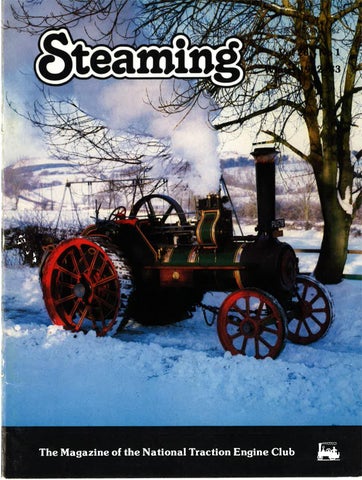
Cover Out and in steam at Skip ton, North Yorkshire, during the coldest spell of last winter's weather is Ken Ellwood's 5hp Burrell DEBORAH, number 3918 of 1923. (Ken Ellwood) 3
Rally Sub Committee As most members will know the rally committee holds a conference for representatives of Affiliated Clubs and independent Rally Organizers twice a year. On Saturday, 16th October the Autumn Conference for 1982 was held. The Autumn event is partly used to review the season just completed, and also to make forward arrangements for the following year. The morning meeting took the form of the Safety Officers Seminar. Our Code of Practice requires a Safety Officer to be appointed for each rally and a report is made by that officer after the event has been held. These reports are of considerable assistance to the Rally committee in that they bring to our notice problems, difficulties and potential risks to the public, the organiser and the engine owner. The continuing updating of the Code of Practice is based to a large extent on information provided in these reports. Incidentally, the Club 'Safety Notices' for rallies are being reprinted. These revised notices should be seen at rallies in 1983. The afternoon dealt with the production of a preliminary rally list to endeavour to get even earlier publicity of rallies. Arrangements have to be made many months in advance to put on a rally and organisers do not always have the details of their events until the early part of the year. However, about 45 events have been notified already and brief details appear elsewhere in this issue so that club members can have the benefit of this preliminary list — which is produced primarily for the British Tourist Authority and other bodies as outlined in the notes in the Autumn 1982 issue of Steaming. Some discussion also took place at the Conference on the subjects to be covered in future by invited speakers. Organisers have special problems and we are hoping to cover some of these within the next few meetings, such as publicity and promotion of rallies, financial aspects, coal supplies and safety measures. Fortunately it is only occasionally that an organiser gets involved in litigation, but one such case has occurred recently which involved the Somerset Traction Engine Club, The judge ruled in favour of the Club and we are glad they were successfully 4
acquitted. Full details were given to the Conference by David Milton of that Club and these details highlight the value of the Conferences which enable organisers to exchange views and, in this case, to bring to the notice of others a possible situation which might arise elsewhere in the country. (Eric Fillmore, Chairman, Rally Sub Committee)
Annual General Meeting Advance notice is given of the Annual General Meeting of the NTEC which will take place at the Great Western Royal Hotel, London on Saturday, 30th April 1982. Formal notice and further details of the AGM will be distributed with the Spring issue of Steaming.
Approved Rallies The details in the last issue of how the 'List of Approved Rallies' is distributed by George Beck to tourist authorities etc, may have been taken to imply that the list was actually compiled from the organisers by George. We therefore hasten to make it clear that the actual compilation of the list is the work of the Rally subcommittee, and in particular of Ron Copp, who does virtually all of the work involved.
Affiliated Clubs and Rally Organisers Conference The above Conference for Spring 1983 will take place at the Great Western Royal Hotel, London on Saturday, 12th February 1983 at 11am. Formal notices and invitations will be sent to Affiliated Clubs and Rally Organisers in the usual way.
Traction Engines and the Law Future Dates Early Rallies At press date there was only one rally on the approved list due to be held before the next issue of Steaming, with its fully detailed Rally List. Details of that event are — 2nd to 4th April — Road Rail Steam '83, Quorn Station 1B591), Leicestershire. Contact — D.G. Pugh, Great Central Railway, PO Box 33, Loughborough, Leicestershire LE11 1SS.
Amendment Notes 3 Page 25. Vehicle Licensing. I have recently heard of a project to convert a lorry into a steam tractor, and the question of how this should be licensed has arisen. As other steam tractors are licensed as agricultural machines, I presume that one should claim this machine should be licensed similarly. I have been reminded that the late Mr J.R. Harding converted a Jowett van to steam propulsion, and it is believed the authorities licensed this as a private car, but a tractor is somewhat different from a steam van.
A Membership Secretary is urgently needed for the
Steam Apprentice Club Duties will cover enrolments, renewals, dispatch of the quarterly newsletter. It is desirable that applicants should have had some experience with the 14-21 age group, and have an interest in the steam movement. An ability to type is desirable, but not essential. Applinations should he made to the Chairman, Steam Apprentice Club, 104D Station Road, Woburn Sands, Milton Keynes MK17 8SB.
From Alan Martin's Collection 19
This fine scene is not at a poorly advertised rally you missing during the last summer, but from a photograph taken at the Parade of Mechanical Vehicles at Manchester in July 1921. The Fowler engines are (left to right) — tractor 11024 (NC2028); B6 road locomotive 14844 VULCAN (NC2022) and B6 road locomotive 14843 TITAN (NC2021) all owned by Norman E. Box. The Garrett 4CD tractor on the extreme right is 33745 (BA3018) and belonged to The Bleachers Association.
Page 29. Capital Gains Tax. The Finance Act 1982 exempts the first £5000 of gains in any one year from the tax, and introduces indexation of the exempt amount for future years. But in any case there now seems little doubt that the Inland Revenue accept that under the Capital Gains Act 1979 s. 37(c), it is mandatory for plant and machinery to be regarded in every case as having a predictable life of less than 50 years, so that an item which is indisputably plant or machinery is automatically classified as a wasting asset no matter what the circumstances, and no matter whether the item has been used for trading purposes or not; this being so, as a wasting asset, the item is exempt from C.G.T. Page 30. Capital Transfer Tax. The 'threshold' for the tax has been raised to £55,000 and in future will rise each year in accordance with any increase in the cost of living. The Finance Act 1981 raised the amount which might be given away without attracting
Capital Transfer Tax in any one year to £3,000. (David Tew, Hon Solicitor. Copies of this useful book are still available from the Sales Department — see inside front cover.)
London Area Social Meetings Meetings are held on the last Tuesday of each month from October to April inclusive (no meeting in December) in the upstairs room at 'The Cock Tavern', Great Portland Street, London (corner of Margaret Street and adjacent to Oxford Circus). They start at about 8.00pm and all are welcome. TUESDAY, 25th JANUARY 1983 Tony Gooding and Dave Rollins present 'A Mixed Bag' — traction engines and rollers at home, and steam railways abroad.
TUESDAY, 22nd FEBRUARY 1983 Mr Dorrington will talk about the rebuilding of a 1906 Renault car and taking it on the Paris-Vienna Anniversary Road Run. TUESDAY, 29th MARCH 1983 Bill and Peter Love will talk on 'Armstrong-Whitworth — the firm and it's road rollers'. TUESDAY, 26th APRIL 1983 Michael Mason will complement his excellent articles on boilers in our magazine with a talk on the rebuilding of a traction engine. (London meetings organiser — Bill Timmings, 308 Hertford Road, Lower Edmonton, London)
Obituaries R.G. Adnams With the passing of Bob Adnams, his local Thames Valley club and the 5
The Rally List 1983
The list of NTEC Approved Rallies for the coming season will be published as usual as a supplement to the Spring edition of our magazine. However, as many organisers have already decided the dates for their next year's event, we are publishing now a list of those notified to, and approved by, the Rally sub Committee up to the 28th November 1982. For reasons of saving space the details of the events are necessarily brief, often using only their colloquial title rather than a full description, but the rallies should be readily identifiable by readers, and we hope this advance information will enable notes to be made in diaries etc, at a conveniently earlier date than in previous years. The further details and addresses of the organizers will be in the next issue.
steam preservation movement generally have lost one of their most stalwart supporters. Just a few days before he died he was plannIng to attend the monthly meeting of the local club he helped to shape, but it was not to be; Bob was cremated on the day of the meeting. Many steam men were present to say farewell to him and give thanks for his life, to bring a small measure of comfort to those he left behind and to show the great respect in which he was held. Bob was introduced to steam as an infant. His father drove a Foden, and eventually in 1961 Bob had one of his own. He restored it and dedicated it to the memory of his father. Bob and Betty had a fish and chip shop in Reading, not the easiest of businesses to fit in with rallying, but Bob did rally his Foden. His shop was a mecca for steam men, its notice board liberally plastered with rally bills throughout the season. Such was his enthusiasm — his friendly smile will be long remembered. The club was represented at the 6
April 2 to 4 — Quorn Road Rail, Leics May 2 — Bass Museum, Burton-on-Trent 14/15 — Gayhurst and Goldington, Bucks/Staverton Airport, Glos 28 to 30 — Come to the Picnic Again! Stoneleigh Showground, Warks (Cancer charity event)/Thurlow, Suffo/k/Highnam Park, Glos 29/30 — Carrington Park, Lincs June 4/ 5 — Weston Park, Herts 5/6 — Upton Park, Cork, Eire 11/12 — Kirkby-in-Ashfield, Notts/Holton, Oxford/Hexham, South Tyne/Merton, London SW19 18/ 19 — Morecambe Bay, Lancs 25/26 — Stamford, Lincs/Bon Accord, Aberdeen/Banbury, Middle Barton, Oxon July 2/3 — Chiltern, Amersham, Bucks/Headington and Stockley, Caine, Wilts/Elvaston Castle, Derbys/Bromyard Gala, Herefords 9/10 — Ardingly, Sussex/Rempstone, Leics 15/16 — Ulster, Antrim, Northern Ireland 16/17 — Weeting, Suffolk 22 to 24 — Netley Marsh, Southampton 23/24 — Lambeth, London SE24/Kegworth, near Derby 30/31 — Cumbria, Kendal/Much Marcie, Herefords/Rushmoor Arena, Aldershot, Hants August 6/7 — Alderholt, Ringwood, Hants 13/14 — Astle Park, Cheshire 20/21 — Langport, Somerset/Fairford, Glos/St Agnes, Cornwall 27 to 29 — Bramham Park, Leeds/Town & Country, Stoneleigh, Warks 28/29 — Bishops Castle, Salop September 3/4 — Liskeard, Cornwall 10/11 — Dacorum, Hemel Hempstead, Herts/Malpas, Whitchurch, Sa/op/Haddenham, Cambs 17/18 — Roxton, Bedford
cremation. On behalf of all members we send deepest sympathy to Betty and the family. (Han Hawthorne)
John Edgar Conner After a long illness, John Conner died at Fowler Bungalow, Boynton, North Yorks, on 17th October 1982, aged 63. He had lived at Charleston
Farm, Grindale, Bridlington, from the age of two until retiring to his bungalow about four years ago. John fwmPri Charleston and also started a threshing business before the last war, acquiring a single cylinder Marshall engine at first, and then later running a Fowler single, followed by a three-speed Aveling compound. This latter engine was replaced by a Fowler three-speed compound which, as most people who knew John would realise was his favourite make of engine. He also owned a Foster compound for a short time, but was without an engine after World War 2 until he bought three speed Fowler A9 compound 15462 (AD9126) BELLE OF THE WOLDS, formerly ELY, at Turner's sale at Lazonby, near Middlesbrough, in 1958. This he drove home to Charleston. The following year he bought a Garrett tractor, PRINCESS ALEXANDRA, in Norfolk. These two engines subsequently travelled many hundreds of miles to northern rallies,
as well as further afield to Rempstone and North Hykeham, the Fowler usually towing a four wheel trailer, the Garrett tractor and living van — frequently at great speed. John's ambition to own all Fowler engines was taking shape when he purchased a Fowler Tiger 16365 (YC3689) in 1966, subsequently selling the Garrett. A Fowler compound convertible roller (ex East Riding C.C.) had by this time been added to the collection; it attended the odd local rally and did some contract work but was then sold out of the district. John found his ambition fulfilled when he purchased Fowler B6 Super Lion 19783 KING CARNIVAL II from John Thompson's of Wolverhampton in 1968. He roaded the engine home from Bedford and attended the Pickering rally with it as a road locomotive. A start was then made to restore it to its original form as a showmans engine and this work was completed in 1976, by which time John had started suffering with ill health. He bore this adversity with his typical stoicism and good humour and people not knowing him well would never have realised how ill he really was. He lived for his engines and was always at home, or up and down the country, exchanging yarns with enginemen — particularly if they liked a Fowler! John will be much missed in the north, particularly by the engine owning fraternity and will always be remembered for his generosity to others and his ability to make everybody so welcome to enjoy his engines with him. He is survived by his wife Betty, son and daughter in law, daughter and grandchildren to whom we extend our condolences. (MHM)
Failures of the 1982 season ... Although stoutly claiming to be cleaning out the ashpan Jim Callen is, in fact, seen here making yet another mess of his attempts to limbo dance under Jim Hutchens'
Garrett No4 tractor (33284 of 1918) at the 1982 Quainton Road/Rail event. And not content with earlier losing to a C type Foden tractor, Paul Worbey, a driver with Pete Coulson's McLaren Steam Racing team, is pictured biting off far more than he can chew by challenging Derek Rule with his S4 Sentinel at the Weeting rally. (photos Roger West)
The 1982 Steaming Photographic Competition, announced in the last two issues of our magazine, attracted over 80 entries, and the judging took place in November. We are pleased to reproduce here the winning prints, together with the judges' comments on those pictures and the entries generally. The judges were Dick Blenkinsop, former editor of Steaming and a well known traction engine photographer; Alan Martin, avid collector of historic traction engine pictures; and Alec Ridden ARPS head of the Depaitment of Photography and Graphics at Loughborough College. Our grateful thanks go to them for their cooperation, and to the photographers who entered into the spirit of the competition by submitting prints.
8
Tbe steaming
Pbotoorapic Competition First Prize
Bob Payne of Geddington, Northants
Sentinel DG4 tar sprayer 8122 by the Long Myndd on the road run celebrating the Salop society's 21st anniversary it; August 1982. Judges comments. Superb — the picture has all the atmosphere of a working engine, with nn modern trappings to detract. It is of good composition, and from just the right viewpoint. We cannot fault the technical quality, although the sky could have been printed in to advantage. A picture we would be quite happy to have on our wall.
Judges' comments on the entries generally Many of the entries were thought to show little regard to the brief published for the competition, and hopefully the publication of the winning print and these comments may help for a future competition. The technical and artistic quality of many of the prints left something to be desired, but the judges were pleasantly surprised by the response, and the fact that our friends in Holland sent entries. In many cases not enough thought had been given to the composure of the picture — improvement would undoubtedly mean getting to know the crews better to request slightly different positionings, to conjure up smoking chimneys and have figures attending to the engines in suitable positions. Few photographers had gone to much trouble to avoid visually offensive modern cars and pylons, or unnecessary people. The beginning and end of the steam season are better times for photography with more atmospheric lighting conditions and more chance of steam showing up than in the brighter, warm, mid-summer months. Many of the prints were on unsuitable lustre or textured paper — most traction engine prints really need a glossy or plain matt finish. The three judges were unanimous in the choice of the first three prints, and felt that their afternoon's judging of the entries had been a pleasant task. It is hoped that the competition can be repeated next year.
Second prize
Clive Hollingworth of Bourne, Lincs.
Fowler AA ploughing engine 15363 TIGER at Castle Hedingham, 1982. Judges comments. The engine is nicely situated within the picture and the scene is brought to life by the steam, and the modern tractor in the rear. The confusing background actually helps make the picture, the subject standing out from it. The print, however, was not critically sharp and a more obvious figure on the footplate would have helped interest.
Third prize
R. Kirk of Guildford, Surrey
Fowler 10hp Super Lion showmans locomotive 19783 KING CARNIVAL II at Stourpaine rally 1981. Judges comments. The 'contre jour' effect makes this a dramatic photograph. It has a nice quality of light and shade, and the angles and composition are good. The printed in sky is effective.
Commended Chris Garbett of Burntwood, Staffs
Fowler AA ploughing engine 15364 WINDSOR at Astle Park rally, August 1982. Judges comments. This sepia print has faults and is a little gimmicky, but it shows an original approach and credit is due for attempting to follow the competition brief.
Commended Brian Sharp of Hitchin, Herts
Marshall 7hp traction engine 69254 at Strumpshaw Hall, May 1972. Judges comments. A modern version of a traditional style of engine portrait. The pleasant background and the figure bring the picture to life; a better, enlarged, presentation would have helped further. 10
Whats in a name?
Commended
Clive Hollingworth of Bourne, Lincs
Fowler single cylinder ploughing engine 2013 at Chadshunt rally, July 1981. Judges comments. This print is technically good but the water cart half in, half out of the picture disturbs the composition.
It all started at Roxton Park rally several years ago. Together with my two colleagues, I wandered around the field photographing any well placed engines and noting details of others. Standing together were two beautifully turned out Fowell traction engines. We couldn't resist this stroke of good luck and took a number of photographs of them. Turning away with the feeling of a job well done, one of my colleagues remarked that surely two Fowells should be termed 'a brace'. During our journey home to Somerset we talked over the various points of our day's outing and we came back to our 'brace of Fowells'. This raised the point that we ought to be able to think up collective nouns for other makes of engine, and one or two sprang to mind — a bevy of Burrells, a gaggle of Garretts, a tribe of Savages and a trickle of Taskers. Subsequent journeys to other rallies gave us time to reconsider the question. Others arrived at were: an aggregate of Avelings, a cluster of Claytons, a flurry of Fodens, a furrow of Fowlers, a squad of Sentinels. For other makes of engine we have not been able to decide on suitable collective nouns. We have considered, but not accepted, an acclamation of Allchins and a welter of Wallis's. So far some makes have defied our efforts, notably the Ms — Marshall, McLaren, Mann's; and the Rs — Ruston, Robey, Ransome. And this, dear reader, is where you come in. This winter, whilst sitting comfortably in front of your roaring fire, a glass of good ale to hand, give a little thought to this weighty problem so that we — the National Traction Engine Club — can collate the definitive dictionary of collective nouns. (David Milton)
An attractive old model
Commended
Bob Payne of Geddington, Northants
Fowler BB ploughing engine 14383, Roxton Park rally in September 1982. Judges comments. The subject is confusing as a picture but again the print shows an original approach and is technically well executed.
To celebrate the launch of the new Ford Sierra motor car in October 1982, the main Ford dealer in Hagley Road, Stourbridge, had the ex Pat Collins Foster showmans road loco THE LEADER on their forecourt on the relevant evening, powering the Marenghi organ. My brother who saw the spectacle told me that though the showroom was packed with people looking at the new car, he wasn't so sure there weren't more outside in the dark watching THE LEADER! (J.T. Rhead) 11
Michael Mason (drawings and photographs are by the author)
Flat Plate Areas — Repair and Renewal of Stays A feature of locomotive boiler design is the use of bar, screwed or girder stays to give support to flat areas. These include most of the firebox, firebox casing plates and front tube plate. In some designs, these areas are stiffened by the addition of riveted, angle or T sections. Certain manufaoturorc patented designs features, special incorporating whereby end plates or firebox crown plates were preformed by hot pressing. The corrugated or convex form produced increased strength and rigidity, thus eliminating the need for bar or girder stays. Heavy gauge tubes screwed at both ends were also used by some makers to give additional support to tube plates. Examples of typical construction details are shown in Figs 25, 26 and 27.
ON BOILER CONSTRUCTION AND ROAM Continued from page 119 of the Summer 1982 issue
Firebox sides are usually supported by means of screwed stays which are riveted over on the outside of the casing plate. This method was used almost universally by traction engine manufacturers, although in later designs of railway locomotive the stay ends were fitted with nuts. Bar or
Fig 25 — New crown stays being fitted to a welded firebox on a Ruston engine. Nuts were fitted on top of the crown to give additional support when caulking the plate from the fire side. Note the method of strengthening the firehole casing plate and the 'double plate' riveted to the casing.
Fig 26 — Girder stays supporting a Fowler firebox crown. End plate support is by means of forged knuckle ended bar stays pinned to T brackets.
Fig 27 — Corrugated self supporting crown on a Garrett firebox. Longitudinal bar stays are screwed with nuts on both sides, see Fig 30. 12
screwed stays will need to be removed whenever major repairs are carried out. The removal of firebox screwed stays is one of the more difficult and tedious jobs. If the firebox is to be replaced, then the stays can be cut in the water space after sufficient plate has been cut clear from inside. The
hand stay tap with pilot reamer
original diameter
new diameter
water space
firebox plate
original diameter
casing plate
new diameter
machine stay tap following reamed holes
stay ends remaining in the casing plates can then be drilled and cut out after the firebox, foundation ring and firehole ring have been removed. If the work is confined to renewal of stays only, then they will need to be cut out from both ends, taking great care to minimise the damage to the threads in the plates. When replacing screwed stays, it is good practice to increase the size of the new stay in order that the threads can be 'cleaned up' to eliminate any minor damage, etc. Therefore a if in diameter x 11 tpi (threads per inch) stay hole would be tapped out to take a fl ins x 11 tpi new stay. In railway workshops it was common to use the same thread pitch from I in to 1/ in diameter stays. Stay taps are specially made with a pilot reamer on the leading end which removes sufficient material from the old thread on the inner plate — fig 28. The taper tap, being aligned by the pilot, enters the casing plate following the old thread and tapping out to the next size. A second tap is then inserted through the new thread in the casing plate and this taps out the hole in the firebox wrapper or end plate, the extended thread ensuring correct pitch and alignment. If this procedure is followed, then the importance of removing the old stay with minimum thread damage cannot be over emphasised. If damage occurs, it may not be possible to clean up the threads and it will then be necessary to increase the new stay size yet again. It is possible on traction engines to
increase stay sizes up to 11 in dia. Riveting the ends over is, however, more difficult as the size increases. If stay taps of the same thread rate are not available for the new work, then it is necessary to ream out the holes to the correct tapping size. It is, however, important to choose a diameter which will ensure complete removal of the old threads. It should be remembered that the load and thermal stress on screwed stays is considerable and they should be made and fitted with care. The relevant clause from BS 931' is reproduced below. Screwed stays '16. Screwed Stays and the holes for these shall be screwed with a continuous thread. 'The screw threads on the stays shall be clean, free from checks or imperfections of full depth, of correct form and a good fit in the holes. The middle portion shall, preferably, be turned down to a diameter equal to that of the bottom of the thread. The stays shall be screwed with a fine thread in accordance with BS 84 or BS 1580 as may be preferred. In no case, however, shall the thread be finer than 12 tpi nor coarser than 9 tpi. Crown stays shall be screwed through both plates and be fitted with nuts on the fire side; alternatively, they may be fitted with solid forged heads on the fire side. The outer ends of crown stays and the ends of all other screw stays shall be fitted with nuts, or riveted over to form substantial heads, or
Fig 28 — stay tapping
the projecting ends fillet welded..' From the evidence observed at rallies, it would seem that many boiler repairers fail to appreciate the importance of this recommendation. Recently re-boxed engines are all too often seen with steam and water leaking from stay heads. These conditions inevitably raise doubts about the qualification of the repairer and of the engineer surveyor who approved the work. It should be remembered that it is the screw thread which transmits the load due to pressure. The riveted end or seal weld is produced as a pressure seal only. Badly fitted stays can allow movement of firebox plates every time steam is raised and it may only be a matter of time before an accident is caused by poor quality work of this nature. The author has found by experience that the best way to achieve good thread form in the plates is to use stay taps which are in good condition. Chipped or worn cutting faces will cause torn threads or will cut over size. Tapping stay holes is a tedious job and there is always a temptation to increase the speed or load on the tap and this can result in
I BS 931, 1951 — 'Loco-Type Multitubular Boilers of Riveted Construction'. This Standard is now withdrawn. Extracts reproduced by permission of British Standards Institution. 13
Fig 29 — Machine and hand stay taps.
poor threads or occasionally broken taps. It is recommended that a good tapping lubricant is used and that when excessive load is required, the tap is eased by unscrewing slightly to prevent binding and damage. Good results can usually be obtained by using a soluble cutting oil in undiluted form. Traces of oil remaining in the water space will then be washed out when the boiler is filled for the first time. Where long taper taps are available — Fig 29 — they can be used at higher speeds and may be powered using a low speed hand drill. Where difficult material is encountered, it is however advisable to use a hand ratchet — Fig 30. When a new firebox hos been fitted, it is necessary to drill the stay holes in the new plate. Some repairers pre-drill the box before fitting. This demands very accurate marking out and can create problems of alignment,
particularly where the existing holes in the casing plates are not square to the plate surface. This condition is frequently encountered and can result in the stay tap cutting on one side only and producing an unsatisfactory thread in the casing plate — Fig 31. The author has overcome this problem by using a pilot bush screwed on the outside to suit the existing thread. A long drill is used to locate the position of the inner plate — Fig 32. The hole is then reamed out to the correct tapping size, the stay tap following the original alignment. The material for screwed stays should be selected with reference to: (a) the strength required, (b) the treatment of the ends, i.e. riveting or welding and (c) machining qualities. BS 931 clause 46 states: Screwed firebox stays 'It is recommended that firebox stays be screwed with a fine thread in accordance with BS 84 or BS 1580. The diameter of the stay shall not be less than I in. The permissible stress allowed on
Fig 30 — Tapping stay holes using a hand rachet. Note the doubling plates and longitudinal stay nuts.
Fig 31 — typical defects caused by badly fitting screwed stays firebox plate
water space
casing plate
load due to pressure
poor thread form causing corrosion trap 14
undersize stay or misalignment allowing plate movement
Fig 32 — Use of pilot bush and long drill to locate stay hole positions in the firebox firehole plate.
Fig 33 — Fitting screwed stays using a 'stay driver'
screwed stays shall in no case exceed 9,000 lbs/sq in on the area at the bottom of the thread...' If the stays are to be welded after fitting, then the material must be compatible with the shell and firebox plates and suitable for welding. However, on the majority of traction enginb boilers, both ends of the stay are usually riveted over. Where this method of construction is used, it is advisable to choose a material which is relatively malleable but at the same time can be screwed easily. When engines were manufactured, stays were usually made from 'Lowmoor
Iron' or a similar material, which could easily be riveted in the cold condition. On railway locomotives with copper fireboxes, stays were made from copper which is very malleable and presents no riveting problems. It is no longer possible to obtain steel or a modern equivalent material with such excellent cold riveting properties. Many repairers have solved this problem by heating the end of the stay and riveting in the hot condition. Where this procedure is adopted, it is important to heat only the projecting end of the stay. If excessive heat is applied and the stay material in the plate becomes red hot, then with will occur deformation consequent loosening of the thread. There is also some risk of heat damage to casing and firebox plates. The author has used En 2 grade, Cold Forming Steel' with success. The machining properties of this material are, however, not as good as the free cutting range of steels and it is difficult to obtain in small quantities. Good riveting properties have been produced by repairers using a good quality mild steel and annealing the finished stays in a furnace before fitting and riveting. En 1A grade material' is, however, readily available, in metric or imperial sizes and can be easily machined. A size can therefore be selected to ensure that a full thread can be produced by a precision die head in a lathe, capstan or screwing machine. By using 'bright drawn' bar stock it is possible to avoid the unacceptable eccentricity and variation in thread form so often present when stays are machined from 'black' mild steel bars. It is essential that screwed stays are accurately machined to the correct tolerance. The threads of boiler fitting studs and screwed stays
Fig 34 — New crown stays on the Ruston boiler shown in Fig 25. The middle section of thread is removed to facilitate fitting.
used in railway locomotive works, were made to a special gauge, which was slightly larger in diameter than threads used for ordinary bolts and other fittings. Screwed stays should be a tight fit, requiring a ratchet or spanner to be used when screwing in. This is done using a 'stay driver' — Fig 33 — or by leaving a plane or unscrewed end adapted to take some form of driving socket — Fig 34. Some repairers use pipe grips when fitting, the excess length being removed prior to riveting. There is, however, a temptation when using stays made with a plain end, to leave the threads loose and then screw in as hard as possible up to the plain portion. This is a very bad practice and may well lead to leakage in service — Fig 31. There is a common misconception that if the thread is not a good fit, it can be rectified during riveting which will somehow swell out the stay to fill the hole. This is nonsense; a badly fitting stay cannot be improved by any amount of riveting and is very likely to leak in service. With care, stays can be riveted in the cold condition, using pneumatic equipment. This can be achieved by using specially adapted snaps in a two stage operation — Fig 35. It is essential to 'back up' the other end of the stay with a heavy block of metal, preferably held hard in contact by a pneumatic holder-on. This will react to the hammer blow and prevent loosening of the threads. The projecting length to be riveted over should be the minimum necessary to form the head, otherwise the material may split at the edges.
2 BS 970: 1955(En series)
Fig 35 — Staying riveting using pneumatic equipment. Note the use of a 'reaction block' on the opposite end.
15
Fig 36 — Caulking crown stays from the fire side using a tubular stud caulking tool.
The renewal of screwed crown stays can be a more difficult problem, particularly when the old stay ends are removed from the crown and casing plates. In order to ensure sufficient thread engagement, the casing plates of traction engines were usually reinforced with an additional plate riveted on the inside. The outer rows of stays pass through this plate at an angle and removal of the old stay material can he difficult. These stays can be up to 15 ins in length and long stay taps are therefore required. Again, the stay should he a tight fit in both plates, if subsequent leakage is to be avoided. Sufficient additional length should be provided to ensure ease of fitting in the limited space available in the crank pit. The outer ends are usually riveted over and this operation is not always easy due to the proximity of the horn plate. After fitting, the immediate area of the firebox crown plate around the projecting end of the stay should be caulked using hand or pneumatic tools use of taper washer where crown stay passes through crown plate at an angle
stud caulking tool used to caulk crown plate around girder stay stud, prior to fitting the nut
Fig 37 — firebox crown stays and girder stay studs 16
— Figs 36 and 37. Nuts should then be fitted and the face of the nut should be hard in contact with the surface of the crown plate. If this is not possible due to the angle of the stay, suitable taper washers should be fitted. Studs for girder stays should be fitted and caulked using the same procedure as for crown stays. Girder stays should be carefully examined after removal. In particular, the toes or ends of the stay should be checked for distortion or wastage and should be repaired or renewed. It is essential that each end is bedded carefully to the curved outer flange of firebox tube plate and firehole plate in order that the load on the firebox crown is correctly transferred — Fig 26. It is usual, however, for riveted fireboxes to he replaced by all welded fabrications and new girder stays may be welded to the crown plate. Welded fireboxes will form the subject of a future article in this series. Longitudinal stays giving end support to the [runt Lubeplate are
either screwed and fitted with nuts or have forged knuckles which are pinned to brackets or angles. Knuckle ended bar stay pins can usually be released when access is possible through the manhole opening. The stays can then be released when the tubeplate is removed. A point to bear in mind is that it is usually necessary to release both ends of the stay to allow it to be withdrawn towards the firebox end, after the new tubeplate is fitted. If this is not done, the projecting stay end and nuts would prevent the use of normal holding up equipment or a hydraulic riveting machine — Fig 38. The use of screwed stay tubes in traction engine boilers was, as far as the author is aware, confined to engines of Garrett and Aveling manufacture. This method of support was in common use on 'Scotch' type marine and various horizontal shell boilers. The stay tube holes are machined to the tapping sizes. As with plain tubes, the sizes at front and firebox ends differ usually by I in and are screwed 'continuous thread' in the same manner as for firebox stays. A special 'marine stay tap' is used to tap both tubeplates at once — Fig 38. After screwing in, the heavy gauge tubes are expanded using standard equipment. The practices outlined in this article apply to repair work where renewal of
Fig 38 — Tapping screwed stay tube ho/es using a 'marine' type stay tube tap. Six stay holes are fitted.
defective or wasted components is on a direct replacement basis. When it is intended to modify the boiler, other factors may influence the design in relation to the support of flat plate areas. Incredible tales of insurance company requirements for welded
fabrications are often heard. Nevertheless, when a welded firebox is fitted in place of a riveted fabrication, the repairer will need to give careful consideration to the requirements of BS 2790, 'Shell Boilers of Welded Ito be continued) Construction'.
IMPORTANT INFORMATION FOR THOSE NEEDING ECONOMICAL REPAIRS ON THEIR TRACTION ENGINES
PINIONS
SPURS
BEVELS
All types and makes of bevel gears, spur pinions, spur wheels, helical gears etc, rebuilt to standard.
B. & C. Reconditioning (Gears) Ltd
6 Bear Court, Daneshill East Trading Estate, Basingstoke, Hampshire. Telephone: Basingstoke 58779 17
Tar Spraying and other tales PART 7 - continued from page 131 of the Summer 1982 issue.
Percy Dabbs At the end of that winter in the workshops we were all well tuned up for another tar spraying season, again in the East Riding. We had the same arrangements as the previous year with three of us in different areas. Quite often I had to take Arthur to work, which meant quite a detour. We generally set off about three o'clock on the Monday morning and even then it was late enough by the time I got to my wagon. This was in 1947 and this time we had a gang of Council men with us and also a Council man as sprayman or tap man. That summer I worked a lot in the Bridlington, Skipsea, and Hornsea areas and when the family came to join me during the school holidays they brought one of their friends from over the wall at home, Sheila Maule, and what a royal time they had together. The two boys often went to the seaside first thing in the morning and we did not see them any more until teatime. Sometimes we would move on three or four miles after tea so that I was not too far from the van at dinner time. Either Derek or Cliff would be in the wagon with me when we moved and they would steer whilst I fired up. While doing this, I would cut down the steam pressure with the main wheel valve. I certainly dare not have done that today owing to the present restrictions — maybe it was illegal in those days as well, but no one bothered. Dennis Hutchinson was our roller marl again and we also had an ERCC roller with us driven by Tommy Jackson from Skirlaugh. He was a grand chap and we became very friendly with both him and his wife, who was also very nice. We met them both at Leeds & District Traction Engine Club Rallies at Harewood House on two or three occasions in recent years, but I am sorry to say that he is no longer with us. There is another East Hiding Council roller driver who was with us sometimes, a 18
The author stands by the door of his wagon — Yorkshire 2188 — whilst tar spraying in the East Riding. (P. Dabbs/
very nice chap, but I cannot remember his name. I have also seen him at rallies helping with an engine. The school holidays came to an end and also the tar spraying in due course. We returned to Yeadon and our first job for this winter season was at Helmsley for two or three weeks, resurfacing the road to the Earl of Feversham's sawmill. The gang consisted of Joe Alexander as foreman, Berty Brown as roller drivor, Arthur Thompoon and I. The mill was driven by a portable steam engine, and just prior to us going there, they had had a dutch firebox built into it so they could burn all the waste wood and sawdust. Close by here was another big sawmill belonging to Pollard & Frank. This was driven by a big Robey twin, a lovely engine. I would think it was well above its work. Going back to the road job, when we got up in the morning one of us would poke the roller fire up and Berty would come wandering out of his living van after he had his breakfast about half past eight, sometimes after, without a care in the world, boots unlaced, and I don't think he bothered to wash unless he was going out! When he did he would catch a bus to York about half past four and come rolling back anytime the next morning. What his mission was we never knew; we could only guess. If Arthur or I
wanted to be away a bit sooner, which was very rare, we couldn't as there was always something which wanted finishing off. It always amazed me how untidy a lot of these engine men were in a van and Berty was no exception. The ashes from the stove met you in the doorway, which was only one instance! As for his trips to York, I would not say they were boozing expeditions, although he was tho landlord of a pub at Thrintoft ncor Northallerton. His wife was a spotless, clean person as were the homes of the majority of the untidy van men whose places I have been to at one time or another. When this job finished we went back to the yard at Yeadon and helped with the maintenance of the tar sprayers and a roller which was undergoing a thorough overhaul. I faced up the slide valve and also repaired a stop valve. Arthur retubed it and Archie Light, who was foreman, made a new water tank and coal bunker. All went very well and these jobs were eventually completed. Sometime in April 1948, Glossops of Hipperholme near Halifax wanted to borrow a roller and driver for a couple of days work on a railway bridge near Panne!, Harrogate, rather than bring one of their rollers the much longer journey from Hipperholme. I was sent with this newly overhauled roller to this job, and I must say that she went
very well indeed. After this, I went back to the yard and did a few more odd jobs and we were soon off tar spraying in the East Riding again. We moved out to the Sledmere area this time and Dennis Hutchinson was fireman for me. The Yorkshire was going very nicely from Wetherby towards York, when nearing Ruf forth, one of the piston gland nuts unscrewed itself and blew the gland and packing out. This was not a serious problem in itself but rather an awkward job as there was not a lot of room to work in, and everything was very hot. The reason for this happening was that the in stud at the back of the guide had not been turned into position and the lock nut tightened correctly to prevent the circular gland nut unscrewing itself. These nuts were ribbed so the stud held them where required. I did the job; we were soon on our way again and arrived at our destination without further trouble, parked the wagon and set off home again. We had the car with us, an Austin 7 Ruby saloon, as I had fixed up to tow it behind the wagon and we were to take the roller and living van out the next day. We did not bother with a water cart. Dennis was to drive the roller, so I thought I would be steersman. We did not get away as early as I wanted to owing to something needing doing before we could go. However, we eventually set off but by the time we got to Spacey Houses, near Harrogate, I was getting worried about
Woods' driver Jim Marshall surveys the scene at Mills Corner, Tollerton, York in 1937. The wheelchock obscures the number plate and thus identification of the Fowler is not possible. (collection A.R. Craskel
the water gauge glass reading, which did not appear to be quite right. The boiler was supposed to have been washed out within the previous two or three days, and I kept nattering at Dennis to put some water into her. We continued along, him putting water in
The Thirsk depot gang considerately pose to one side and allow us to view the detail at the back of the tar tank on Yorkshire 2189. Photographed at the Hopgrove Inn, near York, in 1939. (collection A.R. Craske)
when he seemd to think it necessary. Before we got to Boroughbridge, the ratchet on the oil pump failed to do its work and sure enough, between Boroughbridge and Milby, the plug went, just in a narrow bit of road. As luck would have it, there, not far in front of us was a wide gateway and in the corner of the field was a large galvanised trough with a ball tap. I thought we were certainly lucky here. Dennis chocked the van wheels and uncoupled as sharp as he could, and I just got off the road within three or four yards of the water before it was too late and all the pressure had gone. The van fire was on and I told Dennis to make it up and make some tea whilst I ran into Boroughbridge with the oil pump ratchet to see what the blacksmith could do for me, as we had the car with us. He put a bit of welding on the pawl, dressed it up on the emery wheel and it was as good as new. I paid for it, thanked him very much and returned to our heap of trouble. Dennis had the ashpan loosened ready to drop off by that time, and I wasn't long in getting the firebars out and also the plug. Fortunately this came out without too much persuasion having to be applied. There was a nice bright fire in the van by this time, and so I found some lead and an old tin which looked as though it might have been used for the same purpose at some previous date. We soon got 19
the plug filled and back into the firebox again, bars in, ashpan on and water well over the plug. An old fencing rail or two came in very useful to get the fire going again and we could then relax for a few minutes. We had our cup of tea in peace and eventually got steam up, oiled round and went out into the road again, coupled up and all ready for going. There was not a lot of other traffic about and so the van parked in the road didn't present any problems, even though it was a narrow road at that point. I knew we had lost a lot of valuable time and we still had a good distance to travel, so I thought I had better take charge. This I did, and we duly arrived at our destination just before dark without further incident. This was the start of the 1948 spraying seasun and drier lids little episode, all went really well. Near Sledmere we found a small copse, or plantation, with a numbei of cherry trees in it apparently growing wild. I have never seen so much fruit on trees growing wild, either before or since. It must have been during school holidays as my lads kept me supplied with cherries whilst I was spraying and the chipper lads all got quite a lot during their dinner hour in the small sandbags that we used in the wartime. Another thing that happened around this time was after I had just parked up in a gateway leading into a small paddock belonging to the Railway company near Sledmere and Fimber Station. I has asked permission at the station and that was granted. Just behind me was a crossroads. Cliff was with me and I was damping down for the night when we heard a crash, and on looking round, saw an oldish looking van and a rather modern car had hit one another. I don't know whose fault it was, but the car had to be towed away and we helped push the van into a gateway on the corner. Next morning we were still in the gateway when the van driver, along with someone else, arrived in a car. I don't know if their intention was to tow the van to Wetwang or not, but he gave the van a couple of turns on the starting handle and it went. There was one thing very obvious though, the impact had dislodged a lot of dirt from somewhere underneath and it would certainly be much lighter and he would save petrol from then onwards! They do say however, that it is an ill wind that blows nobody any good. The next year when we were in the same area again we saw the same man, but this time with a very nice van indeed — he was a fish-monger by trade and we bought some from him from time to time as he passed. It made a change in diet. All went nicely for a few days and 20
What it's all about — the tar being sprayed onto the road by one of Woods' Fowler rollers at Spriget Ledge, near Leyburn, North Riding, in 1934. (collection A.R. Craske)
then the Yorkshire developed universal joint trouble. These were discs of six or eight inches in diameter, made of several layers of canvas compressed together, with four bolt holes through. They were reinforced with a metal plate at each side of each bolt hole and the plates were rivetted together, right through the canvas. I had reported this before it got too bad, and that I required a new one but before the replacement arrived, the existing one failed just as I finished the day's work. If I had needed to pull onto the stand, I would not have been able to do so, but
fortunately it was falling ground arid I just made it by coasting on. After tea, I had to find something that would do the job. I just don't remember what it was — perhaps a piece of old conveyor belt which one could often pick up in a coal yard — but I did find something and I made a temporary joint. This did me the next day and the new one came that same day, so I had to set to again and fit the new one, which was not a really difficult job, but twice in two days was getting a bit too regular. All went well after this and soon
Fowler roller 15589 of 1920 (U8709) as depicted in the maker's Road Making Machinery catalogue of the 1920s. New to D. Wood of Yeadon this engine is now the only survivor of the large fleet of rollers which this firm once owned, and is now owned by Andrew Craske, (collection Welland Valley Club)
came the end of the tar spraying for 1948, and we went back into the yard at Yeadon. This time I got a change of programme for I was sent with a Fowler roller, living van and water cart to work all the winter of 1948/9 on the Tanfield — Bedale road, starting at Tanfield. This work was what is called targrouting. The belly tank of the roller was used as a tar tank and was fitted with coils for heating the tar. There was also a pump driven by a chain and sprocket fixed to the end of the crankshaft at the flywheel side. This pump was used for both spraying the tar and for pumping the tar out of barrels, or should I say, out of the portable boiler by the roadside after the tar had been run out of the barrels into the boiler. This boiler was heated by means of a coal fire and was tended by one of the gang. The roller which I had on this job was the one which was driven for a number of years by a very good friend of mine, the late Tim Brown, who lived at Newton-le-Willows. Unfortunately, I never kept a note of the number, but I often wonder whether this is the same roller that Andrew Craske of Askrigg now owns. This is Fowler 15589 of 1920 (U8709) and is the only one of the many which Woods had which seems to have survived. It appears that this roller was out at Kirby Moorside in around 1962 when there were some five or six of Woods' Fowlers standing out of use in Harmby Quarry, near Leyburn, along with their Foden wagon 12364 of 1926 (TW4207) which is now owned by Harry Parkin of Castleford. The rollers were cut up shortly afterwards and it is fortunate that somehow 15589 was
'The Derbyshire County Council have purchased a steam roller, sleeping van and water cart for £518.' (From The Machinery Users Journal, July 1903.) 'Payne & Halliday, Midland Iron Works, Kettering ... New Fire Boxes for Portable Engines put in complete and guaranteed for 6hp £18, 7hp £20, 8hp £22, and 10hp £24 ...' (From an advertisement in Wellingborough & Kettering News, 17th December 1881. And if you want to spend some time thinking about the relative value of those prices, the same issue contained adverts for tea at 1/617Y2p1 per lb, Nunneleys No2 Burton ale at 1/6 per gallon (Old Ales for farm use 9d f4p1 a gallon), Scotch whisky at 16/- 180p1 a gallon, and an emigrant fare to America of £6.)
0• .1.
,4-4•••••-;:—. —i0:.-- -vs
Z..' 7.‘„; :
4
„4
10
Woods' Foden 12412 of 1926 (WU8959) near Hawes, Wensleydale on 30th May 1958. (collection of A.R. Craske)
missed — presumably because, by that time, it was parked up somewhere else. Andrew Craske tried to buy that one when he was only 13 years old, unbeknown to his mother, and it was not until she received a mysterious phone call from the Quarry Manager, that she found out. It then took him another ten years to actually buy it! Woods had two quarries in Wensleydale for their road stone, the one at Harmby and the other at Leyburn — Black Quarry — now owned by Hargreaves. They had, during their heyday, the main con-
tracts for re-surfacing work on nearly all the roads in the North Riding of Yorkshire, stretching from Pickering over the Pennines nearly to Kirkby Stephen and Garsdale in the North, as well as the roads in the East Riding which I was on. In addition to the Foden noted above, Woods also bought 12412 of 1926 (WU8959) from W. Jolliffee, Cleckheaton, in 1945 and this saw extensive use as a tar sprayer in North Yorkshire. (to be concluded)
STEAM
BUFFALO INJECTORS
10 11.4.1,1
FsuPFAirli
ALITOMAI I C
ME-
Please send for particulars
Green Et Boulding Ltd
SVC i iON
fk:
OVERFLO
Class C Injector
tel 01-254 1033
162a Dalston Lane, London E8 1NG
21
Faktorimuseet
- A REMARKABLE STEAM MUSEUM IN SWEDEN
Tore Blom In the centre of the Swedish town of Eskilstuna since 1979 there is located an interesting museum entitled Faktorimuseet. This museum is unusual for Sweden in several aspects, but most because all of the steam engines on exhibition are regularly steamed for the public. Eskilstuna, among all Swedish towns, is known throughout the world as the centre of steel manufacturing. Its history in steel is dating back to the 1650s, when forges and workshops were first built. In the early nineteenth century a small arms factory was established, and it is in these actual buildings we today find the museum. From the accompanying pictures readers will get an inside view of the engine hall, and it is the engines I wish to describe. There are, of course, a lot of other types of mechanical arts typical of the town; thus there is a small arms department and reconstructed workshops, etc. In the engine hall there are about ten steam engines, of which the seven stationary and fixed engines are all connected to the central steam supply consisting of a scotch type ship boiler. The boiler was procured from a dredging boat, together with three of the steam engines exhibited, and all were made by Munktells Mekaniska Werkstad. Munktells was once the largest maker of steam engines in Scandinavia (their plant was nearby, across the river) and they are in the majority of the engines exhibited. The largest of their engines exhibited is a semifixed 'locomotive' type of rating 100bhp. The engine is double cylindered, mounted on the boiler, with trunkguides. This unit is resting on a brick fire-place, to increase its grate area. The sawdust and similar light fuel was burnt in front and underneath, the gases passing through the tubes before going up the chimney. Because the engine is now connected to the steam supply its own boiler is not used. This type is a typical sawmill installation, very popular early in the century, but nowadays only a few remain. Beside this exhibit is a stationary compound engine dating back to 1889; it is a horizontal type, very much used in factories, and it is likewise made by Munktells. The main exhibit is without doubt a large compound engine rated at 22
The Bolinder cross compound engine at Faktorimuseet, Eskilstuna, Sweden. (Rolf Bergstrom)
500bhp, and unusual in shape and construction. It was made by Bolinders Mekaniska Werkstad, Stockholm, in 1910 and was used until 1970, making it one of the last engines of the type used commercially. Originally it was used by the famous file maker of Eskilstuna, C.O. Oberg & Co, where from it was sold up north to a large sawmill, and then brought back to the town as a museum exhibit. Thus the engine has from the beginning a connection with Eskilstuna, but also because of the reason that Bolinders in 1932 were incorporated with Munktells due to financial difficulties. This was the beginning of the firm AB BolinderMunktell, which today forms the last two letters in its successor Volvo-BM, still located in the town. The engine itself is composed of two separate engines, operated as a compound, working on each end of the crankshaft [cross-compound]. Between the two engines is located the large flywheel, powering a large generator by way of manila hemp ropes. The steam supply to the cylinders is made by drop inlet valves, controlled by eccentrics on a vertical shaft geared from the mainshaft. To ensure a true atmosphere around this magnificent engine, the original floor
High pressure cylinder, valve gear, governor and rope drive of the Bolinder engine. (Rolf Bergstrom)
consisting of patterned tiles was moved with the engine. A most creditable work, making it very authentic. Some of the other steam engines are on wheels and there is a Munktells portable engine of 10nhp of the common class H. Another exhibit is an old railway locomotive made by Sharp Stewart & Co of Manchester, England in 1874. It is the sole survivor of a batch of seven. The loco is nicely restored to its original shape by its original purchaser and presented to the museum as a gift in 1977. Also there is a steam fire engine, made by Ludwiksbergs Mekaniska Werkstad, Stockholm, in 1896 and this is accompanied by the first fire fighting truck for Sweden, although not steam powered. This electrical engined truck was made by J.C. Braun, Nurnberg in 1902, and both machines have served the fire brigade in Eskilstuna. Any reader visiting Sweden will find this Museum most worthwhile to visit, and as it is on the main road between Gothenburg and Stockholm it is easy to get there. Engines are steamed every Sunday.
So, you want to be a Rally Stand Operator... Ken Beeby spills the beans
Let's start by considering the outfit. You will need a reliable car or van, and a large caravan (with awning) to go behind it — both of them the bigger the better. And then to man this unit, two hard working people. You won't get paid but petrol expenses etc. will be covered by the Club. March comes along and you and all your co stand operators are invited to a meeting to work out who does which rally for the coming season. Back home its up to you to contact the organisers on your list for final permissions and car passes. Now we need to sort out some stock ready for an outing — doesn't look much in hand, so you write to the National Sales Officer about three weeks before, telling him you are ready to start. Home from work one evening you'll find your front doorway blocked with boxes — and more in the hallway and front room probably. Where are you going to put it all — there seems to be a ton of it — books,
A typical product of Sharp, Stewart's Atlas Works at Manchester (works number 2428 of 1874), now preserved at Eskilstuna. (Rolf Bergstrom)
badges, T shirts, ties etc, etc. And before putting them away they need pricing — at least we have selfadhesive stickers nowadays which make that job easier. Later, having spent a whole evening packing up the car and caravan, we're ready for the off next morning. When you get to the rally site there won't be anyone on the gate — never is, but in you go. Nobody has seen the organiser or secretary just lately; always "somewhere over there" or "was here five minutes ago". Never mind, you'll find your place eventually, but mind it is the right one! Having got the stand set up, the stock humped about, you can at last open up for business. Your first customers will all be muttering "about time too" — your first black mark. Next — "have you got so and so's book? You don't stock it? Why?" Now another kind of black mark coming — here's one of the enginemen, straight to the stand from coaling up — "Please don't touch the books with hands like that!" And so it goes on until evening — when you can go off and enjoy yourself with a jar or two in the beer tent. Sunday morning; they'll all lie in a bit, you think. No so, whatever time you open someone will have come earlier. More black marks. Half way
through the day you find out you're charging too much, or not enough for something. Not your fault, must be something the National Sales Officer and the magazine Editor have between them got wrong. So, with luck, Sunday evening shouldn't seem too long coming round, and if the weather has been kind to you, you should have had a very nice weekend. If it has not then that's not so good — for as you probably know most rally fields have only one gateway in or out. When it looks like getting into a churned-up mass. of mud don't panic but pile everything into the car or van and depart as quickly as you can. There could be a friendly tractor driver to drag you through, but bear in mind he might pull your car to pieces! To end on a personal note, I would like it to be on record that I couldn't have run my club stand all these years without the help of my wife Edie. My grateful thanks too, to all the good people in the rally movement. A happy New Year to all of you; we shall be out first time at the Easter event at Quorn, Leicestershire.
(The Editor detects a sense of wry humour in the above tale. Surely it can't be that bad Ken, you've been doing the job as long as we can recall, and with as heavy a diary as most.) 23
John B. Toy
"You must come down to Upton next year" we were told on numerous occasions whilst visiting Stradbally Rally in August 1981. Enthusiasts and engine owners alike, all spoke highly of Upton, and we decided there and then to pencil in Upton (some 12 miles south west of Cork) for the first weekend of June 1982. Preparations began during the winter months with the writing of letters to all known engine owners in the area we were to travel, and to the secretary of the Rally, the Rev James Flynn, whose help was to prove invaluable. Gradually the replies began to arrive, and without exception permission to visit engines was granted. And so, on the first Friday in June, armed with d6zens of letters, maps, old programmes and photographic equipment, five very tired enthusiasts disembarked from the overnight Fishguard boat at Rosslare about 7.30, drove along the quayside, through the 'Green Channel', and out on the main road — and months of finely planned details were about to become reality. First call was to see the collection of Walter Neville at the small village of Ballymitty, Co Wexford. In cramped conditions, we inspected his restored 1908 Marshall single traction 4986b (IF5943) and his Aveling roller 10954 of 1924 (MI1700). Alongside stood Fowler single traction 6771 of 1892 in 'as found' condition, whilst in another building we were shown 1883 MacLaren single traction 163 (MI2833) bearing the nameplate INVINCIBLE which nnee helonged to Fowler 6771. From Ballymitty we headed for Taghmon, where we had been told we would come across a traction engine at the side of the road. Sure enough, on the outskirts of the village, we found Ransomes single 19494 of about 1907 (M15466) in the process of being repainted. It was duly photographed, and we were soon on the road again, heading for New Ross. Here, crossing the River Barrow and climbing the steep hill to Mile Bush, we soon found the residence of Mr Brien, owner of Burrell single crank compound 3763 of 1917, named THE MODEL. The engine stands in Mr Brien's garden and, after unsheeting, was photographed — with a wary eye being kept on several bee hives close by! We were told by Mr Brien that THE MODEL did two days threshing last year — and photos were produced for us to see. 24
Steam on the Emerald Isle By now we had crossed into Co Waterford, and our next visit was to see the roller owned by the Marquis of Waterford at his home set in huge grounds close to Curraghmore. The Marquis was out, but Lady Waterford was expecting us, and in no time a gentleman of the house was taking us to the place where single cylinder Aveling 8488 of 1915 is kept. On the road again, with great difficulty we found the farm of Jerry Crowley at Ballycraddock. We had previously met Jerry and his wife at Stradbally, and they recognised us immediately, taking us to a barn where compound Fowler traction 15659 of 1921 (1120851 LEESIDE ROVER II was in steam, being prepared for low loading down to Cork that evening. Alongside stood Ruston Hornsby tractor 125663 of 1925 (IF5410) THE LEESIDE ROVER which Jerry rebuilt in the early 70s as a direct ploughing engine, utilising parts from a Ruston Hornsby, a Marshall roller, and wheels from non-steam vehicles! This engine is described in the book Steam Power in Agriculture. Also owned by Jerry is Garrett 34574 of 1924 once a portable, but now taking shape as another direct plougher. Our final visit of the day was to the small village of Shanagarry, near the coastal town of Ballycotton, where the Rev B. Troy keeps his immaculate 1915 Ransomes single traction 26727 (C1943). He had kindly arranged to steam the engine for us, and as we homed in on a gentle plume of smoke in the village, an unforgettable sight met our eyes. There stood the Ransomes, gently ticking over in probably the most scenic background for miles around. It was an otherwise empty car park with the remains of a castle on one side and a view across Ballycotton Bay as a backcloth. The engine was placed in the best possible position to get the full effects of a late afternoon sun. The Reverend gentleman must have been amused by our
antics! After much film had been taken, we then photographed the engine on the road returning to its shed, and the Rev Troy then entertained us with sandwiches, cakes, and gallons of tea, ending a most memorable day. By the time we reached Upton it was dark, and at St Patrick's we were soon introduced to the Rev James Flynn, who had kindly arranged our accommodation nearby, and Donal Murphy from the Cork Examiner newspaper who is the Rally PRO. Between them they answered every question put to them, including full details of departure points and times of the first ever organised road run in Southern Ireland, which was to take place the following day, Saturday 5th June. The road run was organised to advertise the Rally, and six engines took part. With the exception of the one roller, each engine covered a different route of about 18 miles, with the roller doing half the distance, and all engines were supposed to leave their starting point at exactly 10.00. Details of routes and the engines taking part were as follows: — Ransomes single traction 13865 of 1901, owned by Billy Mason of Tralcc, Co Kerry, starting at Macroom, north west of Upton and steaming through some magnificent scenery via Crookstown. Fowler traction 21626 of 1937 (IP3320) ST PATRICK, owned by Denis O'Mahoney of Enniskean, starting in its home town, west of Upton and steaming along the Bandon road and then unclassified roads to the main Clonakilty to Bandon Road, through Bandon, and on to Upton via a very scenic gorge and Inishannon. The engine was hauling a Ransomes thresher. Clayton & Shuttleworth showmans conversion, ex-traction 43173 of 1910 (HC1129) CARBERRY QUEEN, owned by Sean Lordan of Bandon, starting from Clonakilty, south west of
Upton and travelling via its home town and the more northerly route on to Upton. Fowler compound traction 15659 of 1921 (F12085), owned by Jerry Crowley of Ballycraddock, and 1909 Fowell 98 (CE7858) owned by G. and A. Crosse of Donaskeigh, Tipperary, both steaming from Cork city centre, but via different routes. Finally, Fowler compound roller 16971 of 1928 (IN1970), owned by Jim Walsh of Killumney, steaming from Killumney to Upton through some very narrow, twisting lanes. The road run was a huge success, and the crews entered into the spirit of things. Some excellent photographic opportunities arose on this mainly sunny day, and the crews did their utmost to give us some good smoke effects. Next morning, Sunday 6th June, was the first day of the rally, and at first we had some heavy rain, but by 9.00 the sun was shining and it remained that way for most of the day. Besides the six engines that took part in the road run, the following twelve were at the Rally:— Aveling single roller 3482 of 1895 (333XIF) owned by J. Desmond, Inishannon, and formerly 'parked up' at Cheltenham. Aveling compound tandem roller (vertical boiler) 11363 of 1926 (11F), owned by Mr O'Callaghan of Ovens, Co Cork — an exceedingly rare engine.
Two compound Fowlers at Upton Rally 1982 — roller 16971 of 1928 and traction 15659 of 1921. (J.B. Toy)
Marshall single traction, 33199 of 1900 (C1929) COLLEEN BAWN, owned by Tommy Fleming of Athy, Kildare. Marshall single traction, 47690 of 1907 (IF6011) VICTOR, owned by Mr O'Regan of Mallow. Marshall compound traction 65944 of 1914 (1F6101), owned by E. Foley of Gortroe, near Youghal.
Ransome 26727 of 1915 with Ballycotton Bay in the background. (J.B. Toy)
Marshall single portable 70081 of 1916 ROBFIAN, owned by Tim Nagle of Kinsale. Marshall single portable 83953 of 1928 (IH2530), owned by Sean Lordan of Bandon. Fowler compound traction 21649 of 1937 (K11973), owned by Irish Society, Preservation Steam Stradbally. Fowler compound roller 17068 of 1926 (IN1993), owned by Denis O'Mahony, Enniskean. Ransomes single traction 11412 of 1896 (F11407) LILY, owned by Mr Glynn, near Carlow. Ransomes single traction 19609 of 1907, owned by John Grant, Slieveroe, Co Kilkenny. Ransomes single traction 43014 of 1934 (IC1892), owned by Mr Murphy, Carlow. Three engines were working — Marshall 70081 on a saw bench, Fowler 21626 on a Ransomes thresher and Powell baler, and Fowler 15659 was operating a Baxter stone crusher. All the engines were photographed from every angle, with special attention being paid to the verticalboilered Aveling roller. My three friends from Cheltenham were particularly pleased to see an old friend, for as already noted, Aveling 3482 spent many years in a Cheltenham park. Before describing engines seen on the return to Rosslare, several other engines were seen in the area west of Cork. During the road run, a quick visit was made to Enniskean to see Denis 25
Fowler 15659 of 1921 powering a 16in x 9in Baxter crusher at Upton Rally 1982. (J. B. Toy)
O'Mahony's other two engines, both under repair. These arc Ransomes single traction 44013 of 1936 (ZB965) one of the last traction engines built, and 1917 McLaren compound traction 1534 (N11754). In the picturesque
OUR MAGAZINE 25 YEARS AGO
The running of the Club still dominated the January 1958 issue. The 100 members present at the October AGM stood in silence in memory of the late Norman E. Box. There was much discussion on the Club's poor financial state — brought about mainly through poor profitability of past Club-organised rallies. Mr Edney, the treasurer, had donated a 7hp Wallis Expansion engine for a prize draw — the 5s [25p] tickets would be drawn at the 1958 Appleford Rally. The subscription was to be 15s [75p] per annum and Rev. Philip Wright was elected Chairman (in succession to E.R. Deemer) and John Crawley Vice26
town of Kinsale, Mr Murphy showed us his 1907 Fowler compound traction 11031 11F6559) QUEEN OF STEAM, and just down the road we witnessed the daunting task facing Tim Nagle as he completely rebuilds McLaren single traction 60 of 1879. Finally, at Riverstick, Mr McSweeney showed us his Aveling conversion — once a proud roller, but now in showmans tractor guise. All too soon it was time to leave Upton, and after thanking as many people as possible for making our few days so enjoyable, we set off for Cork and for Mallow railway stations to see one preserved steam loco at each location. Just outside Mallow, at Killavulen, Mr O'Regan's Fowler roller 14332 of 1916 was seen and photographed. From here we made for Kells, and soon found the residence of Mr Hurley, for his Marshall single portable 54719 of 1910 was standing unsheeted in his garden. Not so easy to find was Mr Dooley in Thomastown, but eventually we were rewarded with the sight of his 1909 Aveling convertible — in traction engine guise — 6795 (1037961. A short distance away, at the sawmill close to Inistioge, Mr Kelly keeps his immaculate Fowler compound traction of 21483 of 1937 (M140361, named THE SHAMROCK. This very late engine was a real picture with the sunshine filtering through into the barn where the engine is kept. Shortly afterwards we again crossed the river at New Ross, and re-entered Co Wexford to see a few engines not seen on the outward trip. Firstly, we went to Raheenvarren, to see Mr Tector and Fowler compound traction of 15786 of
1923 (M12229), which was photographed just as a herd of cows for milking crossed his yard. A few miles further on, and back on the narrow twisting lanes, we reached the village of Cleristown, where two engines reside. At a farm on the road from Waddingtown, we found Mr O'Connor who was very pleased to show us his immaculately kept Burrell single crank compound traction 3774 of 1917 QUEEN OF HEARTS. At another farm, Newtown Farm, we met Mr Rochford and his elderly Marshall single traction 17287 of 1889 (M11954) aptly named THE FARMERS FRIEND. Our very last call was to see Mr Kehoe at Ballycogley, owner of an unidentified Foster showmans tractor named HELPMATE. We were shown photographs of the derelict engine as found, and were truly amazed at the wonderful restoration job that has been done by Mr Kehoe. With just two hours to go before sailing time, we left Ballycogley and headed for Rosslare, just in time for a very late dinner before boarding the 21.40 sailing to Fishguard.
Chairman — a position he still holds today, of course. Criticism was made of the Club insignia and there was feeling that the 'present caricature' should be replaced by a more accurate outline; by the 1980s, however, both the offending motif and the title Steaming have become well known throughout the traction engine world. SUPREME had been spotted — 'at Hardwick's yard at Ewell there is a Fowler road locomotive .... [it had] a great many parts chromium plated and must have had a beautiful appearance in the past.' A brief glance at the list of 43 engines that appeared at Woburn Rally on the August Bank Holiday 1957 ('the Rally of Rallies') reveals less than 20 that still turn out at today's events, and perhaps but five or so that remain in the same ownership.
'Steam Road-Rollers, various weights, and Powerful Traction Engines and Wagons for hauling (distance no object). — Apply to C. Noyce and Son Limited, Chandlersford, Hants.' (From The Contractor, 13th April 1901.1
In conclusion I would like to thank the Rev B. Troy and all the engine owners we met, and the Upton Rally committee, especially the Rev James Flynn and Donal Murphy for their invaluable help, and to Tim Nagle, Jerry Crowley and others too numerous to mention, who helped to make the visit so enjoyable. We will be back!
'I have just brought the engine home and am thoroughly well pleased with it. I have driven all makes of engines, and it is the best I ever saw — by far the best, everything perfect. Everyone that's come to see it says it is the finest engine that was ever seen here, and we have hundreds of them about... I honestly believe I have the best threshing set... it cannot be beaten by any other make.' (The gushing testimonial of P. Doyle of Ferns, Wexford, Eire in Biuwn & Mays catalogue circa 1910.1
Eemend K mbe" Early Apprenticeship continued from page 172 of the Autumn 1982 issue.
I had grown up in Northamptonshire with steam ploughing around me — Charles Pickering's 8hp compound Avelings and his Fowler B4 set with two speeds on the rope drums (which were afterwards Capt. Drummond's and then Percy Grundy's No 5 set) and occasionally Roddis's old singles. Here was romance — a whistle in the early morning; the distant engine away over the field, its rope jerking the plough or scuffle away from the huge engine against which you stood; the black smoke puthering up across the sky; the 'clut-clutting' from the paying-out rope drum; and too, the talk of men. The circumstances which found me steam ploughing the next summer were not entirely happy though. Things had not been going too well at home, dilutiny the anticipatory joy. And the actuality lessened it still further. I was spare driver, or third man, driving the foreman's engine — here the right-hand one — in the field, and steering it on the road. The driver, or second man, had his engine on his own, the foreman replacing him at meal times. Foreman 'Tark' Tomkins had started on this set — Percy Grundy's No 1 Fowler B4s with one rope-drum gear of low ratio, so the motions often whizzed round. They were known as 'the little compounds' to distinguish them from the AA sets 3 and 4 — 'the big uns'. From being cook Tark had worked his way up. I doubt if he had ever set an engine to a drum, but he certainly knew how to set about a field, with coming in, crossways working (when cultivating) and going out all in mind, each leaving the minimum of tracks. He was master of his trade, handling an engine to perfection and able to splice a rope, having the motion free from knocking or 'hotting' and keeping his men in form — though not without some swearing. Stout (as were many foremen), dark, with shiny white teeth and a humorous expression, to some of us he was elderly — knocking on for forty!
"Not so much leverin' there" he soon said to me. "Press y' compound when a centre's not right" (here indicating a short handle next to the regulator). Early on I remember him on the cultivator (scuffle, or drag) signalling me to pull faster. The next bout he came back with the dragman (fourth man) alongside, getting off as it turned to go away again. Then up with me. "We're losing acreage money with you slow pullin' and I could see you'll never have enough steam with that yellow smoke." Beckoning me aside he got hold of the long shovel and threw a barrow-full of glowing coals, ash and clinker onto the ground. "Keep them bars clean so some air ran get through. Now, I'll show you how to drive a ploughing engine." Stroll the smoke was black, and as he began to pull a vibrating hum came through the whole engine. Quickly
then, a little more coal to add to the first light spreading and the needle crept up so we could go hell-forleather, motion flying round like a steam wagon's. At the end of the pull came a roar from the safety valves, and then it was out with rope drum clutch, on with injector, in with road gear and a jerk forward for the next pull, all seemingly at once. "Now have her" and as he walked away, "don't let that injector sing you to sleep!" I still had to learn not to stop too suddenly and 'drop' the other man's rope. A rope drum can run round under its own momentum at the end of a fast pull and the coils 'drop into a heap' so that any winding done then would distort them. When this happened, Joe, over on the other engine would sometimes pull up short and drop mine. Barring the coils back into place was no easy task, and Tark could get very angry indeed at such times. On one occasion Joe was better placed for going first on the road, so our engine coupled up to the van. "You drive", said Tark, "and cook'll steer while I doss down in the van." We went along very well, the gears ringing out their melodious chimes, as those older Fowlers did. But an hour's self-satisfaction was lowered by Tark's sudden appearance as we breasted a hill. "Never", he shouted "use the injector going up hill!" I'd had a feeling that it should have
End of the road for anothet Not thamptonshite Fowler B4 ploughing ettyine — 9900 of 1904 awaits the scrapman at Piddington in 1952. (G.H. Starmer) 27
Kimbells' 7hp single Fowler 8333, photographed in 1933. Note the Kimbell rebus on the chimney — a brass bell shape with the cut-out letters K / M. (collection E. E. Kimbell)
been before we got to the rise — but I didn't think he'd see the dribbling mark on the road! Living in the van with four others was rough. Washing was difficult; sleep intermittent and meals haphazard, with plenty of Lancashire Clanger — a big pasty with meat one end and jam the other, tackled which ever way you liked. Sometimes, though, there'd be rabbit, and I remember pheasant and hare. The foreman and the cook were good poachers, which doubtless aided Tark in getting a keeper's job in later years. The third man's chore of getting out, seemingly in the middle of the night, to take off the chimney tops and get pokers well down on the bars with often a long walk across a field to the distant engine, did not seem romantic, even if his sleep could be completed when the others had started. Percy Grundy might have been seventy. Ardent 'chapel', he neither drank nor smoked, and oddly, few of his top men did either. His walk was dignified, his voice high pitched and authoratitive, tinged with a certain 'refeen-ness'. "Goes shootin, with land-ownin' 28
toffs", said Tark, "so 'as to be like 'em. Good for trade!" Once when the rope was stutteringly paying out, that voice jerked me up into the correct stance of looking fixedly across the field. "Ah, umph, er, driver, Ai think you need a little more hoil on thet vertical shaft bearing." Often blamed for too much oiling, I turned for a quick look down at it. And there was Tark with his face screwed into a good imitation of the great man!
At home a third threshing set had long been in mind. So when it was learned one was for sale with a round of customers, fourteen miles away, a deal was made. And to that outpost I went, in humble lodgings, though a palace compared with the van. Tark and I had parted with what I felt was mutual regret, although he could not avoid remarking, "you'll never make a real steam ploughman, for you didn't start as cook. But spare drivers come and go, and we just 'ave to put up with 'em!" The third set comprised an early
type 6hp single-crank Burrell with a cast iron bell-topped chimney minus its coping, slightly set-back front wheels, small narrow rears, coil springs on the back axle and unfamiliar awning. The drum was a large Clayton and elevator a folding-type Roberts. The first season only partly saw me out of 'apprenticeship'. Some farmers who had had the set visit them before, and because of its state must have been getting fed up with it, went elsewhere rather than risk an amateur with it. It was said that although I could handle the engine, I couldn't the mate, and I didn't make a clean enough job of threshing nor dress the corn properly. The mate, elderly and awkward, had been with the set previously, and then, I heard, been kept well under the thumb. With me, he took liberties, often letting sheaves go through unopened, and although he could not drive, he had his own ideas of getting the tackle into place, so that often we would argue. When relieved from the drum and keeping steam on the engine, he would hang the sheets down from the awning and sit in the warm smoking his pipe, neglecting to go round the drum to see if a belt was slipping, or seeking any blockages. Once, when I was swinging round in a large farmyard, with tackle just uncoupled, there came a cr-crack under my offside wheel. Getting down I discovered a broken drain grid which had been hidden under dust and chaff. "I knowed that were there", volunteered the mate, "thought you'd soon do some damage, careerin' about like you do". I got off, obliterated the approaching-and-leaving wheel marks with the shovel and had nearly finished drawing out new ones going round it when a shadow darkened my artistry. Looking up, there was the stout and gruff white-bearded old farmer himself! "Umph", then pointiing with his stick, "the cost of that and the putting of it in will be knocked off your bill!" "A fair ole bit is wrong with that ingin" the local knowalls said, and they were right, so when back at home they became short of work and the Marshall driver was ill, I had his engine to complete the season with. It gave me great joy. The following season, with the Burrell now in better order and awning gone (it was liable to be pushed sideways whenever the engine leaned against a dutch barn upright in the soft margin of ground there), I set on an ertswhile follower as mate, despite local headshakes. He was soon in form — and stayed for four more seasons. The engine was yet to give a kick, however.
When going down a long hill, drum and elevator behind, I was holding back with the lever in the usual way, aided by the brake (here on the counter-shaft; more effective than a hind axle onel. Suddenly with a clackclack-clack, we surged ahead, despite the motion being brought to a standstill and brake locked tight. I grabbed the wheel from the startled mate and kept on a fairly even course. I don't suppose the wind whistled past our ears, but for a threshing set, we went awful' fast! Luckily, there was not much traffic in those days, and when, with my heart thumping, we came to rest at the bottom of the hill, I tried the regulator, and surprisingly could go ahead. She was pulling herself into gear-mesh again. So on we went, up the next hill, turned into our gateway and alongside the rick in the field, uncoupling the drum (the elevator being left for a horse to bring in) and round the rick to line up. But it was clack-clack-clack when I tried to back that bit for the belt to fit. So I had to do another go-round to get where I nearly was before; then the belt length came about right and we could start to thresh. What had happened was that the short connecting bar keeping counter-shaft and back-axle pinions in mesh had come adrift, its top holding pin, kept in place by a stud, was jostling outwards. So we jostled it inwards and screwed in a new stud, which did not take long. (Spring mounted engines have a device to keep their gear mesh constant. This version was not particularly good and was doubtless improved on later by Burrells). But ever afterwards I had my eye on it when travelling. A threshing season was hard at it from harvest to Christmas. Sometimes ninety days could be got in then, depending on weather and demand. (Charges were by the day or hour, not counting moving between stacks). Then it was less busy up to around Easter. Cold, wet, wind — which could stop threshing — and hard-to-move-in snow, all had to be put up with. Getting paid was another anxiety. A long time was to pass before all but a few farmers became prosperous — and when some of these would buy a drum of their own to work with their tractor. But rubber tyres on tractors were yet to come, so a farmer's thresher seldom went on the road to other's farms. Adventures and incidents were fewer after that second season, perhaps because I was less of a beginner. Engine driving had no passing-out ceremony or papers to indicate apprenticeship was over. You had to guess when it was. Anyway,
Engines awaiting the 1930 threshing season at Kimbells' yard, Boughton, Northampton. Left to right are Foster 14423 of 1924, a 7hp single; Marshall /bb12 of 1922, a 6hp single, and the unidentified Burrell 6hp single crank compound. (collection E.E. Kimbell)
after five years with that Burrell, I assumed it. There followed two with a not-so-good Fowler and two more with a rather better Al!chin (second-hands were always a risk). Then a while before steam became out of date I had to give up regular driving for other things, keeping my hand in with roller driving instruction, washing
out boilers on Sundays and seeing to tubes and stays and things, until, like agricultural steam, steam rolling went out on the roads too. There was a little come back for me in the early rallies, though hampered by pressure of business. Now; well, time — in the anno domini sense — takes its toll!
Aveling & Porter 4hp tractor 6021 of 1906 wears a definite expression. The spectacle plate and motion cover were no doubt a requirement of the engineer to the Rickmansworth & Uxbridge Valley Water Board, its original owners. Photographed in June 1975 at an event at Kidlington, Oxford. (Robin Walker) 29
MmEraflo, oomitd, Compiled by Derek Rayner
The number of clubs, etc associated with our hobby continues to grow. Interest in the preservation of vintage machinery is increasing and new events are frequently mentioned in these pages. Engines are receiving attention which only a few years ago would have been considered impractical, impossible or not financially viable. However, with modern techniques available in engineering, it is now possible to repair machinery which would, in the past,
AVON An annual rally combined with a ploughing match was staged by the North Somerset group of the NVTEC near Bristol in September. The steam section of the show was fronted by a couple of Fowler ploughing engines — Andrew Melrose's veteran 1870 single 1368 MARGARET and James Hodgson's 1918 BB 15206. Other engines present were Ian Whitlam's 1924 Aveling roller 10981 (AF9604) ex-Mike Parsonage, and Marshall convertible tractor 74962 (YA2197) owned by Bob Whitfield. Burrell showmans engine 3703 of 1915 (DW2120) LADY MARY was offered for sale in the Bristol area recently, and it has been purchased by Brian Dunford in Yorkshire, owner of 1919 Garrett tractor 33632.
BEDFORDSHIRE The Bedford club's Roxton Park rally in mid-September was another superb show with almost 60 engines attending. It was good to see three Burrell showmans; the appearance of Sam Alper's BRITTANIA, 2668 of 30
have been scrapped. Over recent years, the amount of money spent on restoration must have reached tremendous proportions and up to now, engine prices have been continually rising. At various auctions held in the autumn, however, many engines in the sales failed to reach their reserve prices — indicative perhaps that the days of rising prices are over; that vendors are expecting too much or that the recession is restricting the money available for
1904 (NM257), was especially noteable as the engine has not been rallied often. It is presently in the care of the Saunders family. The others were Arthur Beales' ex-Pat Collins No 1, 3865 of 1920 (DH2507) and Mrs Chamberlain's DRAGON, 3912 of 1921 (C044851. Another newcomer was Wallis & Steevens 6 ton Advance roller 8047 of 1930 (0U6002), owned by Russell Bulley. Regulars among the others present included diminutive 1903 Wallis roller 2660 (CJ4816) owned by Michael Watts and Sandy Ross's small 1911 Aveling roller 7385 IFC40161. The traditional end of season steam up held at the Saunders' premises at Stotfold in October attracted around 20 engines — more than some rallies! In 1982, the evening festivities were 'ticket only' and the usual chicken and chips supper was followed by dancing. During the day however, poor weather made problems for several engines, some of which, quite sensibly, were left on their low loaders. Among those present were Derek Rule's 1936
such 'luxuries'. It will be interesting to see how the trend will go in the next year or two. I take this opportunity of wishing all contributors, regular or infrequent, a Happy New Year. Thank you all for your support — your contributions are much appreciated. May I make an appeal to readers who have not yet put pen to paper. Contributions are needed from most areas in order to improve the coverage of our reporting; I would especially appreciate regular correspondents in the North East, East Anglia, Kent, Warwickshire, Wales and Scotland as these are, in the main, areas poorly represented in these notes. Journals etc have been received from Lake Goldsmith Steam Engine Preservation Co-op Ltd (Australia); Sheffield & District SS; Leeds & District TEC; Notts & District Club; Scottish TES; Steam Plough Club; Old Steamers TEC; Lancashire TEC; Southern Counties HVPT; West of England SES and the Road Roller Association. Press date for the next issue is the last day of January 1983. Information, news, letters etc by then to D.A. Rayner, 'Invicta', 9 Beagle Ridge Drive, Acomb, York YO2 3JH. Press dates for future issues are the end of the months of April, July and October.
Sentinel S4 wagon 9213 (UJ5862); Lance Statham's Fowler showmans CARRY ON, David Gray's 1917 Fowler road loco 14910 (CT9092) (which has been offered for sale) and 1926 Foden wagon 12364 owned by John Crawley. The Saunders' own Wallis & Steevens agricultural 7666 and Fowler roller 17560 were also in steam.
BERKSHIRE What can one say about last August's Knowl Hill rally other than — 'fantastic'? With something like 50,000 people in attendance, the event has obviously become so well known that people are attracted from many miles around. Among the large number of engines at the event, noteable were Peter Wyatt's Wallis showmans tractor 7482 (AA54591 and Martin Saunders' 1898 Burrell showmans 2072 (AD8785) THE MASTERPIECE, attending its first rally in the home counties. It was nice to welcome back WILDFIRE, Palmer's Wallis agricultural 7664 of 1919, after a period of absence. Two Garrett tractors appeared — Albert Fensom's
33991 (FK1300) PATRICIA and 33284 of 1918 belonging to Jim Hutchens. A roller present was Derek Marder's Fowler 15969 of 1924, ex-Mechanical Tar Spraying & Grouting of Reading. Space at the Newbury Show in September was given over to the Thames Valley TEC to stage a replica display in the form of an engine manufacturers sales stand, such as could be seen at a similar event in the earlier years of this century. An excellent concept this. 'Potential customers' had the choice of Peter Wyatt's Wallis showmans tractor, Derek Marder's Fowler roller, Robin Greenaway's 1905 Wallis tractor 2811 and John Newton's 1927 Burrell road loco 4066. Agriculturals were Arthur Napper's 1902 Marshall 37690 and Robey 28094 of 1908 owned by Brian Wallington, whilst out for the first time following restoration was the 1911 Foden wagon of Hedges and Byng, 2876 (M3631).
BUCKINGHAMSHIRE The beginning of July saw another excellent rally by the Chiltern club near Amersham. Roy Lipscomb's 1926 Fowler K7 ploughing 16646 appeared after some four years of heavy rebuilding from a collection of bits. Geoff Wheeler's 1920 Ruston & Hornsby traction 113043 was back on the rally fields after a two yeas absence for a new firebox. Another engine relieved of similar tummy trouble is David Harrower's 1908 Foster agricultural 3682. Other engines present included David Wren Davis' Wallis & Steevens Advance roller 7922 of 1927 (PP8588) and Alan Frost's 1908 Ransomes agricultural 20760 (2891 UR). Jim Sarney's Burrell road loco LORD ROBERTS caught many people's eye as he had in tow, on a correct Burrell bogie, an attractive looking load. This engine has recently been fitted with a new half cab to the original Burrell drawings. A considerable crowd turned up at Brill Rally in early September when over 15 engines were exhibited in extremely good weather.Some of the engines steamed either to or from the event, indeed high mileages were registered by one or two. Fowler tractor 15293 of 1919 (BN27881, owned by Hon Peter Lindsey, came to the event from Bishop's Castle, Peter Fagg's 1886 Marshall traction 14242 (H05913) was roaded from Stoneleigh, and after the event Jim Sarney took LORD ROBERTS to Stourpaine, a distance of over a hundred miles. Local engines present included Simon Newell's Aveling tractor 12020 (KX73), new in 1928 as a road roller, Boughton's 1927 Fowler conversion
17290 (AV1045) and Jack Lawrence's 1915 Burrell showmans tractor 3631 (OR2729) KATHLEEN. Jack Wharton's showmans engines, Fowler SUPREME and Burrell KING GEORGE VI were also in attendance, as was the 1915 Tasker tractor 1666 (AA5639) owned by D. Last.
CAMBRIDGESHIRE Some four or five years of hard work went into the overhaul of Burrell showmans engine 3912 (C04485) DRAGON, owned by Mrs E. Chamberlain, prior to its appearance at the East of England Show at Peterborough in July. The engine, a special scenic, was built in 1921 for Anderton & Rowland, the west country showmen. At the show, the engine powered the Robinson's Gavioli organ and provided good publicity for the later Expo show. At Expo, at the end of August, there was a big contingent from the north to celebrate the show's 10th anniversary. These exhibits, some of which had forsaken the more local event at Bramham Park, Leeds, to attend, included several of the wagons belonging to Tom Varley, . J. and S. Harrison's 1931 DG6 Sentinel 8562, 1934 S4 Sentinel 8942 (ATN320) of H. and E. Parkin and son, Jack Hardy's Fowler showmans HEADWAY (subsequently advertised for sale), and Richard Preston's pair of Burrell engines, the tractor THE SCOUT and showmans LIGHTNING II. Creating quite a considerable amount of
interest were Mrs Chamberlain's Burrell DRAGON and Arthur Beales' Burrell 3865 of 1920 — the famous Pat Collins No 1 on its inaugural outing in preservation. Another newcomer was Peter Auger's 1936 Wallis Advance roller 8098. Almost 40 engines attended the East Anglian club's rally at Hadden, ham in September; two Burrell showmans engines took pride of place — Arthur Beales' No 1 which has been restored by Stan Burgess and Stan's own 1924 engine. EARL HAIG, 3979. Other entries were the Fowler rollers of Sid Vale, 16485 of 1925 and the once Scottish machine of Dennis Gallyer, 19546 of 1935 (SN 94841,
Burrell Gold Medal Tractors We thank readers for putting right one or two inaccuracies in the article on Burrell Gold Medal ti actors in our last issue. Gordon Crook points out that FORESTER 3808, far from presently being converted back to tractor form has been thus rebuilt since 1975 at least, and he sends the accompanying photo he took at Astle Park in 1978. Apologies are due to the owner of tractors 3458 and 3545 — the former is now owned by Peter Barker alone, and the latter is owned jointly by Arthur Mills and Ernie Summerhayes.
31
subsequently sold to Trevor Ellis of Chelmsford. Arthur Bullman's 1917 Standard Sentinel 1716 (AW3833) was being looked after by son Stephen, following Arthur's serious road accident which occurred whilst he was out with the wagon. The Garrett showmans tractor 33566 (AD9069) owned by Robert Finbow was also present and a long distance visitor was Aveling roller 5623 (HR3510) owned by the Abbey Hill Group from Somerset. A working event was held at HarIton near Cambridge in September in support of a local Spastics School. Although the weather was not too kind, there was a reasonable attendance and the spectators were able to see a wide cross section of activities. The steam section included Sid Vale's 1925 Fowler roller; Fowler Tiger tractor 15629 of 1920 (U7290) owned by Roy Drage; Terry Young's 1913 Garrett tractor 31633, Bill Davenport's 1909 Allchin 1458 and the 1916 Garrett agricultural 32936 (ER603) belonging to David Nourse.
CHESHIRE The Astle Park rally in early August almost suffered from the weather but fortunately that rain which did come down, did so at night and therefore did not prevent the crowds attending. The main talking point, for the enthusiasts, was the non-appearance of engines from the Lythgoe collection but even so, around 40 engines were present.Two visitors to Astle Park were actually engaged in commercial work during the weekend, dredging a lake in the grounds for the local angling club. They were James Lowther's pair of Fowler AA's 15364 and 15365, WINDSOR and SANDRINGHAM. Aveling engines present included Alan Barber's 1906 tractor 6093 (D2800) and Jim Stevenson's well travelled roller 10906 of 1924 CINDERELLA. Another tractor was Ruston 52607 built in 1918, owned by Andrew Semple. Five showmans engines were on display — Bill Hunt's Foster 14446 THE LEADER which, together with Jess Swingler's Foster conversion 14564 were appearing for the first time, along with long distance visitor Burrell 3483 PERSEVERANCE II owned by James Gilbey of Somerset, and local engines Fowler 15652 of 1920 (CU977) REPULSE and Burrell 3509 of 1913 (G6469) RAJAH. A rally held at Gredington Park near Whitchurch was organised by the Machinery Vintage Malpas Association and an interesting selection of engines attended. Two Sentinel wagons were those of David Goddard, DG4 8571 of 1931, and the 32
Lloyd Jones' DG4, this one a tar sprayer, 8122 of 1929. Bridson's 1919 Fowler road loco 15376 (MA5656) was there, also Bill Briggs' 1908 Foden wagon 1742 (M2128). In the showmans class was C. Timmis' 1917 Garrett 33074 (BJ3451) and ST. BRANNOCK, a 1921 Burrell owned by D. Walker. The Holly Bush Inn near Little Leigh was the venue in early October of a very pleasant end of season steam party. There were in the order of a dozen engines, including Bill Briggs' QUEEN MARY and Jim Stevenson's CINDERELLA. Two Burrells were roller 3535 of 1913 owned by Alan Porter and Peter Walton's 1907 showmans 2879 PRINCESS ROYAL which recently has not been out very often. It was rumoured that the remains of the 1918 Aveling roller, at the Holly Bush for some considerable time now, may be for sale. The engine is very derelict and will need a considerable amount of work to make roadworthy: it is works number 8920 (FX7058). Finally one person's misfortune — the flywheel of Barlow's Foden agricultural 2654 of 1911 was being removed and lowered to the ground, when the driver of the loader decided to stop and put some wood beneath it to prevent it being damaged. Unfortunately in so doing he caught his sleeve on the hydraulic lever, thus lowering the flywheel rather too quickly — and it fractured. Greg Barlow is now looking for a replacement flywheel.
CORNWALL New exhibits at the St Agnes Rally in mid August included Burrell showmans engine PRINCESS MARY (then part of the Penwith Pleasure Park collection), the Warren's Foden wagon 11208 and another Foden, 13752 (MW8324) built in 1930 and now owned by Adlem, Higgins and Waldron. The two Fodens both previously belonged to W.J. King & Sons of Bishops Lydeyard, Somerset and perhaps, therefore, had shared the same patch of ground before, back in the 1930s. There were two Garrett tractors, both in showmans form; Arthur Thompson's 32122 (BH8900) THE GREYHOUND was built in 1914 and the 1919 model, THE CHOUGH, 33353 was owned by Bernard Broad. Steam ploughing was demonstrated by the Daniel brothers engines, Fowler 15163 and McLaren 1552. Rollers present included William Danning's 1901 Aveling 4747 (NX371) and 1915 Aveling 8581 (DW2166) DOUGAL owned by Jed Cox, together with Alf Harper in charge of Messrs Dingle's 1930 Fowler 18075 (CV1662).
The Liskeard Steam and Vintage Club staged a successful rally at Merrymeet during September, the first one under the new banner. Some 20 engines were in attendance and the weather was favourable. Richard Sandercock, president of this new club, took his Burrell road loco CONQUEROR (3996 of 1924) to Holland for a rally during August and this was back in time for Merrymeet. Others present included the Foden wagon of Joe and Dennis Warren, Bernard Broad's Garrett tractor and the 1930 Fowler roller 18070 (YC83751 owned by Steve Veal. As a result of a somewhat disastrous season at the Penwith Pleasure Park, the collection of vintage fairground rides has again been put on the market. The Burrell showmans PRINCESS MARY found a ready sale and has moved to Dorset, acquired by David Hedgeman. Other changes of ownership have included Brian Tolworthy's 1909 Burrell road loco 3103 ITA9451, purchased by Joe and Dennis Warren, who in turn have sold their 1926 Garrett tractor 34789 (Y87841) to Bill Lobb of St Austell, owner of the Aveling conversion MENDIP STAR. Restoration on a number of engines in the area continues. At Roger Pridham's, the new firebox has been fitted to John Sawle's 1913 Marshall traction 62121 THE WHALE. John intends to go up in the near future and fit the tubes, and is hopeful of having her reassembled in time for the 1983 season. At Little Petherick, Geoff Westlake has fitted the front wheels, axle and perch bracket to his 1918 Fowler K7 ploughing engine 14694. Brian Sanders hopes to resume work on 1903 Burrell traction 2575 (TA1489) during the winter months; work will include the fitting of a new firebox and tubeplate. Another new firebox is that being fitted to Willy Alford's 1911 Fowler road loco 12693 (FJ1850). William Danning's Aveling roller 4747 had a new set of tubes in the early part of 1982 and Steve Veal's Fowler roller now sports a new canopy — so she is now as original when supplied to W.J. King & Sons. Dr Dyke progresses well with the rebuilding of his 1921 Foden wagon 10530 (TA1216) PRIDE OF THE WEST and is hopeful of having her out in the summer.
CUMBRIA There were about 40 engines at the Kendal Rally of the Cumbria Steam & Vintage Vehicle Society at the end of July and these included the Fowlers of Harrison and Appleyard, 12899 of
DEVON
An unusual Aveling & Porter roller which failed to secure preservation Derbyshire County Council's 6Y ton single cylinder slide valve Class AV 14152 photographed at Whaley Bridge in August 1955. (Geoff Hayes)
1912 (BX1927) WESTERN STAR, appearing for the first time and R M Stafford's 1920 road loco 15649 (CT3940) PROVIDENCE. Garretts present were Brian Dunford's 1919 tractor 33632 (TB3740) and the 1922 roller 34084 owned by John and Shirley Lea. The local Fowler showmans engine from Levens Hall, 15116 (CB3062) BERTHA, was also in attendance whilst from Cheshire came Jim Stevenson's Aveling roller CINDERELLA (10906 of 1924) which steamed to the event and was awarded a tiophy foi so doing, a distance of some 90 miles — quite an achievement with a roller.
DERBYSHIRE Cromford rally in early August was once again a memorable affair although the weather was not up to its usual standard. Twenty-six engines attended the event, including the two Fowler's owned by Marchington's; their 1918 ploughing engine 15147 (AL8507) and their 1905 roller 10386 (MA8203). Agricultural engines present included that of the Carr brothers — 1919 Ransomes 27596 (WR6553) — and Paul Scholey's Foster 2775 (FW3333) new in 1903. There were, as usual, a lot of rollers and the familiar names MAJOR, DOROTHY, BLODWEN and EVELYN
were noted, all regular attenders. One unusual engine was that owned by Philip Carter — a tiny 1'Y2 hp Clarke portable, made in Canterbury, and very nicely restored. Although it has no number, it is believed to be over a hundred years old and is one of only six or so built by this firm. The organizers of the Scouts Steam Gala at Kirk Hallam last .`-3cptember were v,forrleci in case thIe weather again turned against them, but their fears were unfounded. For many the weekend was highlighted by the appearance of the Howard brothers' 1920 Fowler showmans engine 15653 RENOWN, undergoing a thorough overhaul. Another Fowler was Lionel Fryer's 1918 ploughing engine 15207 (CE7899) whilst from just down the road, John Bosworth's 1920 Foster agricultural 14410 attended. Rollers present included Fairwood's 1930 Aveling 14083 (DG1372); Eansworth's 1937 Aveling Barford AC 605 (DTM537); Peter Knight's 1926 Marshall 81427 (PY6079) and the 1917 Wallis & Steevens 7539 (8E9360) owned by Brian Wright. Also present was a long distance visitor — the Abbey Hill Group's 1905 Aveling roller 5623, crewed by Wally Cleal, came up from Somerset.
The Devon TEC has organized two rallies this year; the first, a new show at a new venue was staged in July with the help of the local Round Table at Windy Corner on the Brixham ring road. Well supported by both public and exhibitors alike, the engines included Bill Lobb's 1914 Aveling showmans conversion 8432 MENDIP STAR, and Alec Powell's similar type, 8376 (KT2828) also new in 1914, both of these engines appearing in Devon for the first time. Another newcomer was the Warren's Foden wagon 11208 (YA7952) and also present were B. Camp's 1908 Burrell single crank agricultural 3034 (AF3580) and Horrell brothers Foden wagon 13316 built in 1929. The Devon club's annual rally at Chapelton Barton was held over the August Bank Holiday. The total number of entries this year exceeded 350 which is a record for this show. Seventeen steamers appeared and making its first appearance in the area was Colin Waite's 1916 Fowler ploughing engine 14256 (KE 3135), a K7 type. Back on the rally field again was Dave Dicker's 1912 Wallis Expansion engine 7294 (H05601). It was particularly unfortunate that Peter Wright's 1924 Burrell 71/4 ton tractor 3951 (RL1978) SUPREME failed to make IL Lu the sally db d lot of hdid work has gone into the rebuild of this engine recently. This engine came out of Burrell's as number 4028, but carries the plate as above. Peter, however, did drive an engine — Fred Britton's 1896 McLaren agricultural 547 (BD5448). Another engine back in harness after rebuilding was Gerald Lynch's 1929 Foden timber tractor. This was owned by T.T. Boughton at Amersham at one time, and is 13454 (KX3340). Up to his death last year, Eric Simms had charge of Devon County Council's 1926 Wallis Advance roller. The custodianship has since transferred to Tony Guest who had charge of the roller 7904 (0T3167) at the rally this year. Three showmans tractors were in attendance and these included Bernard Broad's 4CD Garrett tractor 33353 (BJ4236) built as a conventional tractor in 1919, which powered his Marenghi organ. With this record number of entries, it proved yet again that Chapelton Rally is very popular and most of all, a friendly event. Another summer event in the county was that at Bicton Gardens in mid July. Knowing that the organizer was John Crawley, the show could be attended with the knowledge that it 33
would live up to expectations and it certainly was up to John's usual standard — excellent. He was able to bring together a fine collection of engines, some unique, to give the public and enthusiasts the opportunity of viewing engines they would otherwise be unable to see in this part of the country. The Varley family, for example, exhibited not only the two small Yorkshire wagons, 117 (CA170) built in 1905 and 940 (U4245) built in 1917, but also the Fowler and Atkinson wagons; Tom also showed 1879 Burrell ploughing engine 777 which, when compared with two other ploughing engines present, was quite a remarkable scene. These other two were Andrew Melrose's 1870 Fowler 1368 (AL8468) and the huge Fowler Z7 (ex-Mozambique) 15670 of 1922, owned by D. Adkins. Varley's Burrell showmans HIS LORDSHIP was also in attendance at the show. Other long distance travellers were the Fensom brothers who showed their Garrett tractor PATRICIA and the Burrell agricultural CRIMSON LADY whilst from nearer at hand came E.J. Snell's 1936 Wallis agricultural 8052 (0U7435), and the Devon County Council's 1917 Green roller 1968 (TA2431), driven by Charlie Porter. In mid-September, the South Hams Vintage vehicle club held its working rally near Kingsbridge. Engines appearing were Bert Camp's Burrell 3034 driving Bill Widger's Ransomes thresher; Bernard Broad's Garrett tractor, John Woodley's 1930 Robey tri-tandem roller 45655 (VL2773) and Richard Cumming's 1924 Fowler roller 16157 (DO 5490). These engines together with a fine selection of tractors and an impressive line up of Shire horses at work, made what is becoming a very popular event, which, with its working theme, can make some of our larger rallies look rather tame.
DORSET Pond Park on the Cranbourne Estate was the setting for an event which is now part of the Cranbourne Festival. Rallies were held here about 20 years ago but there has been a considerable gap in the events as the initial fund raising requirements were fulfilled. At this 1982 event, Arthur Thompson was present with his 1912 Foden agricultural 3384 WATTIE POLLOCK, and other similar types of engines were Paul Antell's 1910 Robey 29333, Garrett 28758 of 1910 (FX7239) and Don Cully's 1907 Fowell 97 ICE7893), — all rare engines. Another unusual exhibit was Andy Selwood's 1926 Babcock & 34
Wilcox roller 95/4013 IYA5089), exBuncombe's of Highbridge. Surprisingly enough there was mud at Stourpaine again in late September, despite which yet another excellent show was staged by the hard working organisers led by Mr Stourpaine himself, Michael Oliver, A 'new' showmans engine to appear was Teddy Cushing's 1922 Burrell 3933 (FJ2041) PRINCESS MARY, from Norfolk, whilst from the next county of Suffolk came Robert Finbow's Garrett showmans tractor 33566 (AD9069) LITTLE BILLY. This engine, together with Ray Loader's similar QUEEN OF GREAT BRITAIN, Garrett 33486 (AD8787), also present, were previously owned by the Cole family, West of England showmen. Other engines to make the long journey to 'the Bushes' were John Conner's 1932 Fowler showmans 19783 KING CARNIVAL II from Yorkshire and from Scotland, Alec Steele's Aveling showmans conversion 9354 (KE1748) THE SCOTSMAN. (This engine was previously rallied in Yorkshire by Fred Bainbridge when registered KM53641. Among the many other engines present were Owen Slade's 1916 Marshall general purpose 68955 (TA212); Marshall roller 86104 of 1931 (FW2355) owned by Clarke and Jury and Dave Allen's 1923 Clayton & Shuttleworth roller 48751 (YA6182) — first time out.
EIRE On the first weekend in August, the Irish Steam Preservation Society held its eighteenth annual rally in the grounds of Stradbally Hall, Co. Laois. Turf of good quality was used to steam all the engines and as the weather was good, large crowds attended on both days. As is customary, a full list of entries is given here, since information from this area is scarce. A new entrant this year was Ransomes single 13865 of 1902 which has had a new firebox fitted by its owner, Billy Mason of Tralee. Benny O'Gorman showed two engines, a Ransomes single 31100 (IP711), new in 1920, and his 1916 Foden wagon 6350 (M8681). From Cork came D. O'Mahoney's 1936 Fowler compound traction 21626 (IP3320), ex Kilkenny Co. Council, whilst also from Cork S. Lordan & Sons showed their Clayton & Shuttleworth traction 43173 (HCI129) now converted to showmans style. Another showmans was the 1911 Burrell 3295 (IC1240) ERIN'S PRIDE, owned by Osmond Bennett, Jerry Crowley had his 1926 Fowler compound traction 15659 (F12085), ex-Tipperary C.C. present, whilst John
T. Grant exhibited two Ransomes singles, neither bearing registrations — 18277 of 1906 and 19609 of 1907. Fowell agricultural 98 of 1909 (CE7858) was shown by G. and A Cross of Donaskeigh, Co. Tipperary whilst from Co. Wexford, J. Rochford was present with 1889 Marshall 17287 (MI1954), a single cylindered traction engine. The Murphy family of Carlow exhibited 1936 Ransomes agricultural 43014 (IC1892) and a Clayton agricultural was shown by J. Tynan, Co Carlow, this being 34060 (IP1529) built in 1902. There were two Aveling rollers present — Kenneth Graham of Stradbally with 8563 of 1915 (IY1682), ex-Louth C.C., and Flemings (Co Laois) 8088 of 1914 (ZA1454)• Fleming's also showed their 1900 Marshall single traction 33199 (C1929). The ISPS's own engines were present — Fowler compound agricultural 21649 (K11973) built in 1936, and the 1917 Mann. s tractor 1216 (U4249) which was driven by Jack Tynan. Jim White of Taghmon, Co Wexford was there with his Ransomes single agricultural 19494 (M15466) new in 1907, and finally in the line up came the Fox family of Kilternan, Co Dublin who have owned their Robey general purpose single 33348 (Z200) since 1914.
FOR SALE Three steam rollers
Fowler No. 17251 Fowler No. 16948 Marshall No. 53755
Steam rollers can be inspected at Factory Premises at Newry Road, Warrenpoint, Co. Down, Northern Ireland. W.J. Farrell & Co. Ltd. Tel: Warrenpoint 2668
ESSEX
HAMPSHIRE
About a dozen engines attended the Shire Hill 'Crank Up' in midsummer and it proved to be one of the best events yet held at this location near Saffron Walden. Those present included Terry Young's 1913 Garrett tractor 31633, C. Philps 1899 Clayton & Shuttleworth engine 32900 (HK9836), David Gowlett's 1905 Fowler agricultural 10373 (CE7922) and the 1936 S4 Sentinel wagon 9213 owned by Derek Rule. Reg Saunders 1929 Fowler 17560 and Dr Teverson's Aveling 11240 of 1925 (R0641) were two of the rollers present.
The 12th Netley Marsh rally, held at the end of July 1982, enjoyed fine and sunny weather and was judged another success. 34 of the 36 booked engines duly appeared, and an unexpected addition was Fowler BB ploughing engine 14712 (N04630) owned by C. Reeves. With Davies and Griffin's BB1 15182 it made a pair, and in the absence of a suitable implement, D. Cully's Burrell traction 3746 was shackled up between the ropes for a simulated pull in the arena. Several engines made first appearances at Netley; Doug Ranger presented Foden timber tractor 14078 of 1932 (MJ369) an engine well remembered in Gordon Howell's ownership at early Andover rallies, but laid up since 1966. Purchased by Doug in October 1981 it now has a new firebox. D. Maidment of Charlton Marshall, Dorset, had Allchin agricultural 1173 of 1901 (KE1984) and was awarded the Boxer Old trophy for the best maintained engine to appear. Among the rollers were two erstwhile stable mates from W.W. Buncombe's fleet — Babcock & Wilcox 95/4013 (Y135089) and 95/4014 (Y135088), respectively owned by A. SeIlwood and S. Phillips of Calmore, Southampton, and by R. Meader of Romsey. Fowler 8 ton roller 15854 (WT15681 was another newcomer, new in 1923 to Spon
GLOUCESTERSHIRE The 1982 Fairford and District Steam Club Rally was held in the lovely old park in Fairford, right on the town centre's door step, in late August. The event started on the Friday evening with engines and organs outside the Bull Hotel in the market place. It was a first time attendance for Bill Faulkener's 1918 Garrett showmans tractor 33091 (BP6077) MARGARET and for Andrew Melrose's 1870 Fowler ploughing engine 1368, also named MARGARET. Another first timer was Jim Hutchens' 1918 Garrett tractor 33284 (DX3099). In the agricultural engine section, the top award went to Peter Fagg's 1886 Marshall 14242 (H05913) VICTORIA, believed to be now the oldest engine by this manufacturer. A local engine was Mike Thexton's 1907 Ruston Proctor 33471 (EW2691), which only just made it to the rally after having major firebox repairs carried out. It was well tested by driving Peter Nicholls' old rack saw bench. Other engines present included Ken Hicks' 1904 Marshall roller 40047 (3E8186), Doug Ranger's Foden tractor MIGHTY ATOM, 14078 (MJ369), a very early rally attender and Allen Stevens with his 1916 Aveling roller 8752 (TA2662). Two late entries were Peter Richman's 1927 Aveling roller 11969 (VB11071 and Ransomes tractor 39088 of 1928 (UD2296), owned by George Main. Peter Nicholls of Northleach is rebuilding his ex-Portugese Fowler roller 19354 of 1933 into a tractor. Work is going well and it is hoped that the engine will be in steam in 1983. It was at the Northleach rally, but not in steam. A roller noted for sale is Richard Willcox's 1926 Babcock & Wilcox 95/4012 (YB5090), one of the batch built by Clayton & Shuttleworth after they had heen taken over by Babcock & Wilcox and therefore sold with the latter's plates affixed.
borough Council in Yorkshire, but now with B. and J. Curl of Durley, Hampshire. Also attending was Whiteparish Engineering's Marshall S-type roller 86104, used in Lincolnshire until 1963. As it was maritime year land nearby Southampton is a major port) an open invitation was extended to families of the Task Force, and Junior Field Gun crews from HMS Sultan and other Navy depots gave displays, along with HMS Sultan's own steam entrant — Sentinel DG4 wagon 8393. An engine to come into the area is Fowler roller 15902 of 1923, a D5 type (KR8728) which has been purchased by David Hallam from Jack Colvill in Cambridgeshire.
HEREFORDSHIRE and WORCESTERSHIRE Bromyard Gala in July attracted a number of fresh engines including Dennis Smith's 1899 Fowler agricultural 8282 (AC9321) BERKSWELL. Another Fowler present was Len Crane's crane engine 17212. Showmans engines included Bill Hunt's Foster THE LEADER and James Gilbey's Burrell tractor 3192 ST BERNARD. Also present was Andrew Semple's 1918 Ruston Proctor tractor 52607 (HP2201). Several engines travelled long distances to attend the rally at Much
Welcome hack to the rally fields for 1.932 Foden D type tractor 1407R after 'resting' since 1966. Now owned by Doug Ranger, it is seen here at HMS Sultan rally in June 1982. (Robin Walker) 35
Marcie staged by the Ross-on-Wye SES in August. Jack Wharton exhibited both his showmans engines, SUPREME and Burrell KING GEORGE VI, whilst from further east came Denis Brandt's 1929 Foden wagon 13488 (R06330) and Robin Greenaway's 1905 Wallis tractor 2811. Three more exhibits were 1908 Marshall portable 50595 owned by Ron Bond, P. Millington's large 1914 Aveling agricultural engine 8420 (BT8884) and Mann's tractor 1343 (U4891) new in 1919, owned by Jack Knight. Burrell single cylinder traction 2147 of 1898 (BL4716) attended both the above events as well as, among Abergavenny, Frocester, others Worcester and Stonehouse. Owned by Sentinel expert Joe Thomas she was driven on the road — on strakes — to two of the events, and in her new paint and lining out commanded a great deal of attention.
HERTFORDSHIRE In mid July, some 17 engines attended the Steam Owners and Drivers Club rally at Redbourn near St Albans. Newcomers present included Roy Lipscomb's 1926 Fowler ploughing engine 16646, Doug Williamson's 1920 Garrett tractor 33782 (BL5337) and John Crawley's 1937 Aveling Barford roller AC 606 — the latter probably a last timer too for it has been for sale for some time. Most enginemen present at the rally took the opportunity of a trial run — only to become totally stuck on a dead centre with the single cylinder engine with no drain cocks. Regulars included the Fensom brothers with their Burrell agricultural and Garrett tractor, and Lance Statham's 1916 Fowler showmans engine CARRY ON which was last used in showland in Northern Ireland by the late Kevin McGivern. For the initiated, the high point of this particular weekend is the return run on the Sunday evening through Redbourn village to Friars Wash. Ignore the cars and the scene can be briefly transformed back 50 years into history. For the third year running, Roy Lipscomb promoted the Elstree Hill rally at the end of August; this rally now attracts engines from a wide area. It was the first time Roy's own engine, a K7 Fowler ploughing engine, has been able to participate, restoration having been finished earlier in the season. From the east came John Dillon with his 8 ton 1913 Aveling compound roller 8036 (XN4688) which travels extensively on a drawbar low loader hauled by a 36
much modified Fordson Major tractor. From the north, also by loader, came Sid Vale with his 1925 Fowler roller 16485. Always impressive is Boughton's large 1928 Fowler roller, driven to and from the event by Sid Brightman of Tring; it is 17502 (AV1632). Making one of its last appearances before reboxing was Ron Walker's Burrell 'Gold Medal' tractor 4072 TINKERBELL. This event is located in a rural setting but is close enough to London to ensure a good attendance by the public; the weather was good on both days. However, Lance Statham was seen around 8 o'clock on the Sunday evening on the unprotected footplate of his Garrett traction engine KELLY, plodding homeward through a heavy shower, two living vans in tow. The event organised by John Mayes at Totternhoe at August Bank Holiday had a couple of fresh engines in the steam section of the programme. These were the Fowler traction 11357 (NM219) new in 1908, and owned by Holman and Dowland; and Ruston & Hornsby traction 169167 of 1933 (TL5452) entered by Truck Link of Leighton Buzzard. An annual event which always attracts a few steam exhibits is the Welwyn Garden City Water Carnival. This year's show in mid- September took place in glorious sunshine and was attended by Jack Joyce's 1916 Fowler showmans 14424 (DH2545) VALIANT and Sandy Ross's 1923 Aveling roller 10596 (YA5385). The previous weekend to the Welwyn event, the Dacorum Steam Rally, took place on the old airfield at Bovingdon near Hemel Hempstead. This was once again a fine show with gallopers and chairoplanes powered directly and indirectly by steam. John Carter's Tidman Gallopers were driven by the centre engine ANNA and the other ride had Lance Statham's Fowler CARRY ON supplying the necessary power. Engines present included Alan Frost's 1908 Ransomes agricultural 20760 (2891UR) and David Williamson's Garrett tractor which came to this event for the first time, together with Ted Dyer's 1901 Burrell general purpose 2386 (N03941. Two rollers there were A. Barr's 1946 Aveling Barford AG 785 (MRF245), and Wallis Advance 7922 of 1927 (PP8588) owned by David Wren Davis. The 1907 Burrell showmans 2876 (PB9615) RELIANCE, owned by Eric Choake was also in attendance.
ISLE OF WIGHT The several engines normally resident on the Island had a splendid
visitor in the shape of David Walker's 1920 Burrell showmans 3847 PRINCESS MARINA for this year's rally over the August Bank Holiday. Holiday-makers who were at Yarmouth and caught a glimpse of the engine coming off the ferry were treated to a most unusual sight. Other engines present at the event held at Havenstreet (in conjunction with the island's steam railway) were the Westridge Construction Co's 1929 Aveling roller 12502 (MW5825); Fred Winter's 1907 Allchin general purpose 1415 (AP9071) and the 1909 Marshall agricultural 52121 (DL2108), owned by Bob Stay.
KENT An event held over the August Bank Holiday weekend at Rochester was called 'Steam and Diesel' and brought to mind the events held up to about 1975 in the Medway towns. This show, as its name implied, had a big turn-out of recovery trucks, tankers and continental type heavy lorries as well as the steam exhibits. Because of other events, there was not a large selection of engines present but nevertheless, there were representatives of rollers, traction engines and wagons present — Ian Bennett's 1924 Aveling roller 11093 RUCKINGE; Thomas Wood's two Burrells TAM of 1914 and MOLLIE of 1921; Aveling convertible tractor 6943 of 1909 (D4889) belonging to Dave Rushton, and Foden C type tractor 12770 of 1927 of J. Hervey Bathurst. It was unusual to see diesel rollers at an event in this part of the country — Woods also showed two Avelings and a Marshall, illustrating the transition from steam to diesel. Neal and Melanie Herridge have recently purchased Terry Frisken's 1923 Aveling convertible roller 10722 (FL3446). The engine has been standing in Les Birch's yard for some years, supported by some telegraph poles. The engine was supplied new as a tractor to Peterborough and eventually found its way to Hardwick's scrapyard at Ewell. Terry purchased it from H.J. Scott of Tilford, Surrey and it was rallied some ten years ago before being laid up with firebox trouble: Terry stripped the engine down for the replacement but never got round to it. In the same area, 1922 Ruston & Hornsby roller 115123 (XM6274) is having a new firebox crown and some stays fitted by Bill Hedges and Chris Jones. It was hoped this ex-Henry Woodham engine would be back in steam by the end of 1982. Unfortunately, the other similar roller in Kent, 115023 of 1922, (XM6373)
languishes under a pile of dust near Tonbridge. Bill Hedges is, in fact, making good progress with reboxing his ex-Walter Smith's Aveling roller 11206 of 1925 (PE2458). At Sittingbourne, in Smudger Smith's yard, Jock West has started work on Vic Roberts' 1927 Wallis Advance roller 7920 (0T4606); the tube plate has to be refitted and a strap welded on the front of the boiler.
LANCASHIRE Many enthusiasts — and others — will have seen the BBC2 series 'FRED' last autumn. This very well presented series did much to enhance the popularity of the steam roller in rally circles. Fred's co-star, incidentally, was Aveling 7632 of 1912 (DM3079), named ALISON after his wife. His character came over very well although at times some of his antics and tales left a little to be desired, as far as being on the right side of the law was concerned. He nevertheless was portrayed as a likeable 'rogue' who knocked down chimneys and had a strange hobby — a considerable boost for the traction engine movement as a whole. George Cole's 1913 Clayton agricultural 46059 successfully
completed the journey to Lancaster Rally and back again, though not without incident. As usual, the living van had an argument with John Armer's gatepost and on the way home it was discovered that the large gear wheel on the third shaft was held on by only one key instead of two. Repairs had to be effected. An engine to come into the county from across the other side of the Pennines is 1914 Wallis tractor 7479 (AA5413). Now owned by Rufus Carr it was previously with John Harrison. Two more 'new' engines; one is Alan Wilkinson's newly acquired Aveling roller 10486 (FX9966) of 1923 which came from a Southall playground, having been 'parked up' there. It was advertised in World's Fair for £800 and there were some bits missing. The roller was pulled out of the playground by Ian Bennett and his crew. It was previously Eddison fleet No. 445. The second engine is a rarity — the oldest surviving Wallis traction engine, T169 of 1883. It was recovered from a farm in the middle of the Isle of Man some four years ago by a couple of enthusiasts there. The engine requires some very extensive repairs and has several parts missing, so it has been sold, although the new
Rally Plaques our speciality
owner is not yet known. Back to Fred Dibnah — his roller performed a job of work earlier in the summer, although probably not one which the makers intended. He had been demolishing a chimney, brick by brick, and used ALISON with a pushpole on the rear drawbar to loosen up the brickwork on the base, and then the final job was undertaken by the roller pulling on a wire rope. An interesting selection of engines and other equipment for sale at Tom Varley's Gisburn premises in early October attracted a fair crowd, but little money. Engines being offered included the Aveling showmans 4885 of 1901 (ex-Paisley sale), a 1911 Marshall traction 56187 (TA2438) and an early and unidentified Aveling traction (believed 1871) from Australia — all from the Varley collection — together with Peter Brooks' K5 Fowler ploughing engine 12366 of 1910 (BP5599), Sid Hartley's 1889 Aveling roller 2481 ICE91871 and an Aveling tractor conversion owned by Treloar brothers — 12366 of 1929 (MT3064) Of these, only the Marshall was sold, although it is understood that the Aveling showmans changed hands afterwards and is believed to have gone to a new owner further north.
Name Plates
FERROUS AND NON-FERROUS CASTINGS Ornamental and Engineering
Polished brass castings Aveling & Porter — 9in Horse and Invicta £17.70, Rear axle horse shoe both 9in and 7.3/41n inside dia. £27.50 pair, Oval Rochester plate £11.00 (with own no. £13.20). John Fowler — Owls £18.15, Fowler plate with Leeds inset £17.60, Oval with number engraved £16.50, Fowler scroll £12.50, Smokebox door ring £13.75. Marshall — Britannia (4 different fittings) £20.62, Smoke box ring £10.78, Valve cover plate £19.80 Sentinel — Knight £6.05, number plate with Knight £13.20. Foden — Diesel £19.00 per set, Foden by Royal Letters Patent £30.80, Foden Diesel chassis plate £2.75, Foden smokebox door wheel £12.10, Six tonner plate £22.00. Burrell — Works plate £9.35, Burrell scroll £18.70, Dynamo bracket plate £30.80, and Burrell star. Field Marshall — Diesel radiator plate £3.85, Field Marshall concave radiator plate £3.85, Field Marshall baton £7.15. Water Level £2.86, Thomeycroft £2.20, Mammoth £4.40, Oil Engine £3.00, Gardner £3.30, Gardner 120 and 150 £4.18, Gardner 180 and 240 £5.33, Tax disc holder £5.22, Albion small £7.50, large with sunrays £20.35, Garrett Ring. Blackstone — Oil Engine £3.13, Patent Plate £2.20. Foden, Fowler and Sentinel Fire Bars. Many more plates on request
YID
G.M.S. (Wirksworth) Ltd, Yokecliffe House, West End, Wirksworth, VAT included but add postage and packing — on items up to Derbyshire DE4 4EG. £10.00 add £1.50, £10-£20 add £1.95 and over £20.00 add £2.50. Tel: 062-982-2805 Engineering work from your patterns, or we can produce patterns from your drawings 37
A steam up was held on the Sunday following and among engines be be found in steam were the Varley's three Yorkshire wagons, the Atkinson, Fowler and Aveling wagons, the Burrell ploughing engine and showmans HIS LORDSHIP, and Andrew Craske's visiting 1920 Fowler roller 15589 (U8709). It was noted that the early Aveling had already received a new smokebox, chimney and tender. The boiler had quite a lot of welding on the shell. A wooden front axle was fitted and an extension had been made at some time to the top of the coal bunker with the rear end forming a drop down door.
LEICESTERSHIRE Enthusiasts who visited the event at Hinckley on the first weekend in September had to suffer a wetting, but that did not seem to deter them from enjoying the event. A fine selection of engines attended, including Rev Teddy Boston with his 1927 Foster agriculDon (FE9179), 14593 tural Eastwood's Allchin general purpose 1105 (FP1024) and Jack Hardy's Fowler showmans 15117 HEADWAY. Unusually there were two portables — Harry Palmer's 1904 Ruston Proctor 29011, and 1925 Marshall 79936 owned by G.E. Jones of Shrewsbury. One member of the heavy gang was present in the shape of Fowler K7 ploughing engine 15516 of 1920 (CT4051) owned by Jack Hancock, but the star of the show was John Mayes' McLaren agricultural 127 (H05618) which, in 1982, was celebrating its centenary.
LINCOLNSHIRE An unusual duty fell to E.R. Carnaby's 1927 Aveling roller 11793 (YT1265) in late May when the Mayor of Scunthorpe opened a miniature railway track at Normanby Hall. The roller carried the Mayor from the car park to the track site to perform the opening ceremony. During the winter months, the Lincolnshire SEPS was deeply saddened by the loss of two of its members, Raymond Drakes of Humberstone and Jack Taylor of Sleaford. Raymond owned ex-Lindsey CC 1929 Fowler roller 16967 of (FU9970). It was bought primarily as a preservation engine but quite often was found a job in connection with his business interests. Jack Taylor will be remembered as the man who did so much hard work on the restoration of the 1910 Allchin agricultural 1499 (AY9494). It was the only engine of this make left in the county and first appeared in preserved condition in 1964. We take this opportunity of 38
Engineman of the future? Bob Adam and young Graham Hatfield caught in the process of preparing Fowler LITTLE JOHN (21647 of 1934) at the Cheshire Steam Fair 1981. (Jim Stevenson)
offering our sincere condolences to both families. Another death was that of Arthur Cole, formerly of Cole Bros, steam ploughing and threshing contractors of Roxholme, Sleaford, who died in June, aged 94. During the first half of this century, Cole Bros were well known in South Lincolnshire and apart from contracting, they sometimes undertook heavy overhauls of engines and ploughing equipment. No rally was held at Hawerby Park in 1982, but to substitute for this, a similar event was organised by S.A. Wood at Riby. This was attended by many local engines and featured working demonstrations. The Clayton & Shuttleworth agriculturals of Jim Hebden — 48759 of 1926 (CT8263) — and R.T. Haxby — 46817 of 1914 (YA2095) — were driving a threshing machine and chaff cutter respectively. The saw bench was powered by Mike Halliday's 1918 Ransomes general purpose 275241E51231, and not Frank Strange's 1913 Marshall 61880 (FL3942), as planned, due to a broken governor belt. Steam Lincolnshire The Spectacular in late August was unfortunately plagued by bad weather and this saw some changes in the ususal engine ranks. A feature this time was that the event had to be held on the County showground car park as the showground proper had been damaged by rain when the county show was held earlier in the year. Ruston & Hornsby agricultural 122160
of 1923 (EB5670), owned by J. Quincey, was a first timer this year after a complete rebuild in new ownership. Peter Auger was to be seen with his new partly restored 1936 Wallis & Steevens Advance roller 8098 (LP0122). Marshall traction 78953 (TD2652), built in 1925 as a road roller and owned by H.H. Gurnhill was present, and is understood to be for sale. An engine unable to be present was Marshall's of Gainsborough own 1924 traction 78085 (E9624) as it is having major firebox work carried out by H. Smith at his Old Leake works. A steam engine which once powered machinery in the rubber spreading house of belt manufacturers James Dawson & Sons of Lincoln has been presented to the Museum of Lincolnshire Life. Ruston & Hornsby Mark R, class XS, single cylinder horizontal engine was built in 1932 and worked in the firm's Beevor Street plant for about 30 years. It has been restored by apprentices of the Lincoln crane makers Ruston-Bucyrus before being presented to the Museum.
LONDON A show staged by the London Borough of Lambeth in Brockwell Park, Herne Hill at the end of July was attended by some 13 engines. Ian Bennett's Robey tractor and Aveling roller were present, together with Brian Luck's Wallis tractor and Aveling roller. The Wallis, 7572 (H02035) was supplied new in 1917 as a tractor with parts to make it into a road roller, thus
it is very much a convertible engine. A long distance visitor came from Somerset in the form of Ray Loader's 1919 Garrett showmans tractor QUEEN OF GREAT BRITAIN, 33486 (AD8787), whilst from closer at hand, one of Edgar Shone's wagons, Sentinel DG6 8213 of 1930 (GF8655) was also present. Sid Vale came down from Hertfordshire with 1925 Fowler roller 16485 (WU2071).
NORFOLK East Walton Park near Kings Lynn was the scene of a new event by a new club in mid August. The Anglian Vintage Machinery Enthusiasts Club were the originators of this show, which naturally attracted a large number of stationary engines, vintage tractors and veteran vehicles. Steam interest was generated by 1920 Tasker showmans tractor 1822 (H02930) owned by Geoff Reed, together with the Playford family's 1912 Burrell roller 3388 (TB3718) which worked in Lancashire and still retains the distinctive Isaac Ball canopy. Also present was the miniature of a Marshall traction engine owned by Dick Joice.
NORTHUMBERLAND Readers will perhaps recall the fascinating article on the Mealie Sheller which was constructed around a I-owler Class BAA traction engine (Steaming, Spring 1982). A 1907 example of this latter type, 10776, has returned to these shores and was noted by a correspondent as being stripped down for heavy repairs when he passed by, and then called in, a works not far from Haltwhistle. Detailed drawings had been obtained to enable this work to proceed and the engine will make an interesting and most unusual type when it is eventually completed and rallied.
repainted and canopied his 1908 Aveling tandem roller 6530 (NM291) and exhibited it at Peterborough Expo in August. Paul now has the new firebox and foundation ring back in his Fowler road loco 8712 and has the fascinating job of rivetting and staying to keep him busy during these winter months. Delivery of the horses for Jack Schofield's set of gallopers took place in time for them to star at the fourth steam up by Retford enthusiasts held in October. Much work has gone into the various parts which Jack was able to acquire from the late Bill Ashley's Gallopers, and at this event the machine was driven by its own engine although the lights were powered by Doug Ragsdale's Burrell NELL GWYNN. Two other engines were present — Paul Scholey's Foster agricultural 2775 and Wallis roller 2524 of 1900 (BP8585), owned by Mick and Les Baines.
OXFORDSHIRE There were three or four engines new to the Woodcote Rally in midJuly, one of which was attending its first ever show. The latter was 1918 Marshall portable 71123 owned by Arthur Hall, and was put to work on a sawbench. Also new there was Dennis Smith's 1899 Fowler traction engine 8282 (AC9321) and Robin Green-
away's tiny 1905 Wallis & Steevens tractor 2811. Regular attenders included A. and R. Hawthorne's locally used 1922 Fowler roller 14674 (BW9937); Jim Hutchens' 1926 Burrell roller 4040 )TT7917), and 1915 Burrell showmans tractor 3631 KATHLEEN, owned by Jack Lawrence. Others present were Jim Sarney's Burrell road loco LORD ROBERTS, and 1910 Marshall traction 54587 (AJ5781) PRIDE OF THE ROAD which was owned some 20 years ago by Aldersons of Staveley, Yorkshire, and now belongs to Jim Darnell.
SCOTLAND In the north of Scotland engines have to travel long distances to events At the end of Septemher 1982 Sandy Gray took William Nicol's 1914 Clayton & Shuttloworth compound traction 47048 the 115 miles from Aberdeen to Inverness, by low loader, to attend a vintage tractor working at Balloan Farm. The engine collected Brian McGregor's 54in Marshall mill, dating from 1886, and hauled it through Inverness to the event. It was the first time the mill had been outside for many years and part of a building had to be knocked down to get it out. The threshing displays were watched by a large crowd. During the ensuing week the Clayton and mill travelled further north
NOTTINGHAMSHIRE With most of the engines in the area out on the rally circuit, little news is to hand on restoration topics. Pete Gull's 1928 Aveling roller 12079 is now nearly completed and has been out around the Clarborough area on road tests. In Retford, the 1910 Garrett agricultural 28249 (FX8223) owned by Bruce Ragsdale is being reboxed. Bruce's son, Douglas, has been out with his other engine, Burrell conversion 4073 NELL GWYN built as a roller in 1929, for most of the rally season. Over at Worksop, Mick Farmer is continuing with restoration on his 1930 Wallis Advance roller 8058 (0U4737). At Scrooby, Paul Scholey has
A very nicely restored Tasker B2 tractor 1666 of 1915 UNE OF KITCHENERS BOYS, pictured here in June 1982 at Holton rally. (Robin Walker) 39
and, crewed by Sandy Gray and Hugh McDonald, of Inverness, were filmed at work for part of a TV programme 'Another Time, Another Place', to be shown on Channel 4 during the coming summer. The programme will show the sowing of the crop, its cutting with an old binder, as well as the threshing. The engine and mill were low loaded on the Monday from Inverness to near Cromarty, with the final distance to Eathie Farm overlooking Moray Firth being covered with the engine hauling the machine, the road being too steep and narrow for the low loader. Heavy overnight rain prevented any action the following day and trouble was experienced on the Wednesday morning getting the set into the field and to the stacks — a tractor had to assist, but once into the field the mill was set without any trouble. There followed two days of threshing for many very short periods for the filming, before packing up and returning to Aberdeen, again by low loader — and without any problems at all with the engine!
SHROPSHIRE A road run from Church Stretton to -Bishops Castle was the outstanding feature of the 21st anniversary event staged by the County of Salop SES. Some twenty-three engines took part. The route was from the location of the Society's early rallies to the present site. Two engines unfortunately failed to complete the run — Mike Salt's tiny Wallis Simplicity roller 7936 of 1930 — a type not really designed for a 15 mile steam — and Dave Prout's 1904 Ransomes agricultural 15609 which finished being towed in by Frank Lythgoe's Foster general purpose 12539. The rally itself attracted the largest number of engines seen at the event — some 46 were present, including 10
Mr N.D. Buncombe, of Highbridge, Somerset, kindly sends this photograph of a rare survivor — a portable scarifier. This Thackray 2 time portable scarifier was purchased new many years ago by his father, the late W.W. Buncome. The machine originally had tiller steering but was later converted by the firm to worm and segment operation. After being sold to Devon County Council, it was later repurchased, in November 1967, and is still in Mr Buncombe's possession stored with his collection of steam rollers. 40
Sentinel wagons. Among those attending were Peter Millington's 1914 Aveling agricultural 8420, Peter Clare's Super Sentinel 5665 of 1924 (RS5540), 1918 Ruston Proctor tractor 52607 owned by Andrew Semple, B.J. Gorman's 1919 Fowler BB ploughing engine 15333 (AL9855) and Tom Henderson's 1901 Fowler traction 9225 (CF3795). Three engines were present which attended the first rally in 1961. Dave Prout's Ransomes (then owned by G. Leel, S. Miln's Aveling roller 9264 of 1922 (EJ966) and B. Wilkins' 1918 Ruston Proctor agricultural 52266 (CJ4178), then owned by Denis Smith.
SOMERSET An Air Day held at the RAF base at Yeovilton in August was host to several steam engines as one of the supporting attractions for the event held to raise money for the Falklands Fund. Engines included Ken Miles' 1909 Burrell showmans 3090 FERMOY, Ray Loader's Garrett showmans tractor QUEEN OF GREAT BRITAIN and the 1910 Robey agricultural 29333 owned by Paul Antell. Rollers included Arthur Field's Fowler 18652 (TK4285) and the 1905 Aveling 5623 owned by the Abbey Hill Group. The Somerset club's annual rally at Langport towards the end of August had an unusual visitor in the shape of Will Dakin's 1886 Humphries portable from Cheshire. It was pleasing to see such regulars as James Gilbey's Burrell tractor ST BERNARD and Sam Hillman's 1905 Burrell agricultural 2767 (YA1683) KING SEDGEMOOR being joined this year by two newcomers, the Abbey Hill Group's Aveling roller and Paul Antell's Robey traction. Two more agriculturals present were John Caseley's 1919 Burrell 3824 (YA366) and the 1901
Allchin 1173 (KE1984) AQUARIUS which originally came from Folkestone and is now owned relatively locally by David Maidment.
STAFFORDSHIRE Some thirteen engines visited David Hallam's Beam Hill rally near Burton on Trent in mid-July. The Bass Museum's 1917 Standard Sentinel wagon 1488 (AW3407), came from the Museum at Burton and joined a collection of rollers of different marques. Steve Arrowsmith was present with his recently acquired 1931 Fowler 19049 (TK6488) whilst Roadstone (Southern) Tarmac presented their Clayton & Shuttleworth 48835 of 1923 (YA7417). Roy Sealey was among the other roller owners present with his 1920 Aveling 9128 1E5336) MAJOR. Agriculturals included Park Holland Ltd's 1908 Marshall 49222 (6E7797) and Millington's Aveling 8420 at one time a roller with the East Riding County Council. 1921 Burrell David Walker's showmans ST BRANNOCK was also in attendance. An engine to move into the county is 1922 Aveling roller 10237 (FX8715), purchased by Geoff Hallam from the Grimsby area. It was last used in 1979 and after only slight attention was steamed for the boiler inspector in September. She is now stabled at the Bass Museum in Burton where she has been steamed for several museum events. Alan Williamson's 1933 S4 Sentinel 8884 (TJ3319) joined the rally round late this year due to stay tube replacement and other boiler work. In consequence this work has held up the rebuilding of his other Sentinel Super model 6695 of 1926 ( EX 16381. Chris Garbett and Dave Broughton are proceeding well with the reboxing
of 1902 Fowler traction 9507 (NM141). The box and front tube plate have been removed and new ones collected from Roger Pridham's works in Devon. Following some welding in the barrel and replacement of the can refitting plug, washout commence. The centenary of John Mayes' McLaren traction engine 127 was celebrated in style at the premises of the Chasewater Railway Preservation Society. Joining the 'Mac' were Roy Sealey's Aveling roller MAJOR, Peter Hough's 1930 Aveling roller 14062 (HV861), Steve Arrowsmith's Fowler, the Tarmac Roadstone's Clayton roller and an S4 Sentinel wagon. In September, the North Staffs & Cheshire TEC joined with the North Staffordshire Railway Co (1978) Ltd to present Cheddleton Steam '87. The railway's Austerity 0-6-0 saddle tank JOSIAH WEDGWOOD was joined by Phil Swindlehurst's 1913 Burrell showmans RAJAH. David Walker's ST BRANNOCK, Alan Williamson's S4 Sentinel, the Park Holland Ltd Marshall agricultural and Will Dakin's 1886 Humphries portable 1663. A Sentinel wagon/tractor has been reported 'On Tow' in the Kidsgrove area of Stoke-on-Trent. To date enquiries have not identified the vehicle or its destination. Further information would be welcomed. (Replies to DAR please).
SUFFOLK An event staged at Eye over the August Bank Holiday attracted a very good crowd and the 1982 steam entry was up on the previous year's. Some nine engines attended and these included Natal Taylor's 1916 Wallis & n Steevens agricultural 74!)7 (No4o); George King's 1918 Garrett tractor 33141, Brian Green's 1916 Ransomes traction 27000 (EW2321) and Billy Jeanes' Garrett tractor 32944 (BJ3206) also of 1916 vintage. Betty Vickery's little 1907 Aveling roller 6319 (BP7501) was also present. Several rare engines were shown at the Henham rally, held near Blythburgh in late September. Armstrong Whitworth roller 10R22 of 1923 (DX4602) was driven to the event by Bernie Ward from it's usual home at the East Anglian Transport Museum at Carlton Colville, whilst the only Turner portable, believed to have been built in 1874, was exhibited by L. Moore, and was driving a threshing machine. Another roller present which has been little seen by enthusiasts in this country, was the repatriated Garrett, in the care of the Long Shop Group associated with the former Garrett works at Leiston. The roller
was brought back from Spain under the auspicies of the Transport Trust and is 34265, built in 1923. It requires some considerable restoration work on it before it can be steamed. Other engines present included Jack Aldrich's 1907 Davey Paxman agricultural 13073, Wesley Key's 1931 Foden wagon 13802 (VN2912) now part of the Strumpshaw Steam Museum's Collection and John Down's 1913 Burrell showmans tractor 3453 (AH0117) THE MAY. J. Bunn's 1891 Burrell traction 1563 (AH7350) was also in attendance. The Armstrong Whitworth roller mentioned above had quite an eventful journey to the rally. Bernie had to make a three mile detour due to a collapsed culvert — not, one should add, caused and the 13 mile journey by the roller took him 9 hours, As this was his first run, the 'practice run' improved matters for the return journey which was accomplished in 5 hours. This breed of roller is very low geared and therefore cannot travel fast, but even this has it's compensations as they almost won the tortoise race at the rally. Another steam roller may join the Transport Museum in due course, which will help to even out the public appearances — the Armstrong was in steam for almost 300 hours during the 1982 season! A noteable engine to come into the county is Burrell showmans engine QUO VADIS, 3938 of 1922 (XL9086), new to showman William Wilson of Peckham, London. She has more recently been in Bamford's ownership in Staffordshire, and was subject to several rumours of having been sold out of the country. Her new owner is P. Rackham.
SURREY An event held at Lingfield Park racecourse in July attracted a small gathering of engines. Although it was mainly an antique fair, several organs and veteran vehicles were also present; the steam exhibits included J. Taylor's 1932 Aveling roller 14149 (SM9415), Dave Harding's 1929 Marshall general purpose 84562 (KP6969) and the 1930 Aveling roller 14064 (VF9350) owned by Mike Retman. Mike's 1909 Foden agricultural 1294 (TB3792) was also present. A small steam section was again a feature of the Egham Royal Show at August Bank Holiday. There were around a dozen engines present including the rollers of Dick Martino — Aveling 14147 of 1932 (YD4740), Martin Fagg — Aveling 10048 of 1921 (FX8307) and the 1935 Fowler 19481 (MAN57) owned by Mike Deering. Another Fowler was the 1918 hauling
and winding engine 14950 (VF2984), one time part of the collection of the late T.B. Paisley and now owned by B. Richmond-Dodd. Charles Russell's 1920 Foden traction engine 9052 (SN16071 was also in attendance. Ian Bennett has recently purchased 1921 Tasker 8 ton roller 1833 (MD5864) from Hardwick's collection. The roller was new to the Borough of Hornsey and became part of the Tasker collection before being bought by Hardwick's at the dispersal sale in 1969. Ian has recently advertised his 1924 Aveling roller RUCKINGE for sale. A further engine to leave Hardwick's is another Tasker; 1917 compound tractor 1741 (H02040) has been sold into the Amersham area. These chain drive Tasker tractors were very highly thought of during their working lives.
SUSSEX An engine under heavy repair at the Brighton Engineerium is Goff Radcliff's 1905 Fowler showmans engine 9393 (YA44) SIR JOHN FOWLER. Goff's two other engines, 3-speed Burrell 3917 of 1921 (TA2374) and 1910 Fowler road loco 11111 (3E7988) CITY OF HULL were both entered for the Christie auction held at the Engineerium in October 1982. John Naylor has recently purchased 1915 Burrell traction 3655 (FU822) ENGLISH HERO from the Essex area. On the way back from Ardingly rally to Brighton, the engine's water tank split and therefore the journey took considerably longer than anticipated as the crew had to stop every mile or so to fill up with water. The problem has been solved by welding a new bottom into the tank! In West Cilecav there ig a new arrival at the Amberley Chalk Pits Museum in the form of 1946 Aveling Barford roller AG 758 (FRM379). The engine has been purchased by Brian Johnson, the secretary of the Southern Counties HVPT and it is intended to use it on the museum premises from time to time. New to Cumberland County Council (their No 2) and purchased by John Crawley in 1963, the roller was subsequently sold to Edward Benton & Co for use at their Hurstmonceux Works. Pat Westgate has eventually decided to retire from the steam scene. His engine, Ruston Proctor agricultural 36828 of 1909 (KE4991), has been a regular rally attender in the East Sussex area for a number of years and Pat has now sold it. We hope, nevertheless, to see Pat around at the rallies for some time to come.
41
Two Sentinels owned by Allan McDougall & Sons of Kilmarnock, seen transporting castings from Glen field & Kennedy's foundry in the same town. The first wagon, registered AG1198, is probably one of the works number 6797 or 6798 — both these were delivered new to McDougalIs about December 1926. (collection A.B. Graham)
WALES The 1922 Aveling roller 10190 (FX8654), purchased by Brian Manning of Chepstow in 1981 from D. Warren of Redruth has been offered for sale. The engine was based at the Newton Abbot depot of Eddison Plant Ltd during its working life, and was rallied in Devon and Cornwall by its owner during 1982.
WEST MIDLANDS An interesting historical, industrial and transport venture was host to a number of traction engines when the Black Country Museum Transport Group put on their fourth transport rally at their site on Tipton Road, Dudley. A tramway is already in operation utilising an ex-Dudley & Stourbridge car, a trolley bus route is planned, and the site has access to the Dudley canal on which boat trips are available. Engines present at the rally were John Bosworth's newly restored 1920 Foster agricultural 14410 (UP6481), Len Crane's Fowler crane engine and Gordon Limb's 1925 Foden timber tractor 11788 (TD3236).
WILTSHIRE Chippenham Carnival had two engines taking part at the end of June — Paul Weaver's 1927 Aveling roller (which he subequently sold to Paul 42
Richman) and Graham Clark's 1911 Garrett traction 29027 (HR3924). Joe Powell had an open day at Ashton Keynes at the end of July. In steam were his 1919 Garrett 4CD tractor 33738 (BJ4791) LORD RAGLAN and three locos on his 101/4 inch gauge miniature railway. Visiting was David Plant's Fowler roller 15935 of 1923 INX32681. Joe also has 1872 Brown & May portable 868, Marshall portable 85954 of 1930, and LADY RAGLAN, another 4CD Garrett, 32048 of 1914 (BJ1969) the latter having a complete rebuild including a new firebox and front tube plate. The major old machinery event in the county was the Science Museum's Open Day at their reserve collection at Wroughton airfield in early September. There was an attendance of over 30,000 people able to see many items not normally on show to the public. Of interest to enthusiasts was the recently arrived ex-Foden collection including the 1906 Foden road loco 1174 (SN1609) PRIDE OF LEVEN and 1916 Foden wagon 6368 (M8118) PRIDE OF EDWIN. There were also a pair of Fowler ploughing engines awaiting restoration, believed to be 15194/15195 of (FX6820/6821) 1918. Around these was the ex-Frank Smith collection of rare and old farm tractors. Visiting engines in steam were Jack Wharton's Fowler
showmans SUPREME; the Daniel brothers' two ploughing engines from Cornwall; McLaren 1552 and Fowler 15163 — pulling the museum's own Fowler anti-balance plough; the 1875 Grenville steam carriage and Peter Richman's 1927 Aveling roller 11969 (VB11071 which he had recently bought from Paul Weaver, along with his old water cart. On the following weekend, the Wiltshire Folk Life Society held a village festival at Urchfont, near Devizes, using the whole village. As part of the agricultural display, two locally made engines were working. Brian Barton's 1890 built Brown & May portable 4561 was driving a drum, and Jonathan Lucas's 1837 Cambridge beam engine powered a water pump. Also present was Usher's 1937 S4 Sentinel 9307 (DXY134). In early October, the Chippenham and District Preservation Society held a vintage working party at Paul Weaver's farm near Lacock. The resident steam sawmill was fully operational with 1917 Ransomes wood burning portable 27132 driving rack and push saw benches and supplying steam to a Pearn's stationary engine which drove, via line shafting, other equipment. The steam hauled narrow gauge logging railway was also working. Visiting engines were the 1890 Brown & May portable driving a saw bench and Peter Richman's 1927 Aveling roller, which has a strong homing instinct! There was also a large heap of bits and pieces which, when assembled, will be Paul's 1913 Garrett 4CD tractor 31210. It has had a new firebox, boiler barrel etc and was acquired last May from Ray Loader of Yeovil. This is a 'new' engine, which spent some time in Ireland in the past but further details are not yet known. Another end of season steam up took place at David Plant's place near Oaksey towards the end of October. Michael Thexton's 1907 Ruston Proctor traction 33471 came and did a bit of sawing. John Wharton drove Burrell showman's KING GEORGE VI over from Witney with living van in tow, a distance of some 30 miles in only four hours, and generated some light for the evening barbecue. David Plant's own Fowler roller was in steam, but his 1922 Burrell agricultural 3919 (BW6030) is having a complete rebuild. Ivor Gibbs has now sold his 8 ton 1914 Aveling roller 8361 (PC9151), obtained from Bolton, but the new owner is not yet known. David Davies is slowly rebuilding his 1903 exAustralian Fowler road loco 9701, and he also has a 1915 Garrett 4CD tractor
to rebuild, this is 32682 (NM179). Bill Simpkins has had his 1920 Aveling roller 9260 (FX7077) out during the season and is still working on his other Aveling roller which came from a scrapyard and has not yet been identified. Progress is slow on this engine and it is doubtful whether it will be ready for the 1983 season. Burrell traction 2426 of 1901 (BL4843) is now out again after a new firebox and boiler rebuild, its owner is Ted Haggard and the engine worked for some 40 years with Wilders of Wallingford, Oxfordshire. Finally, it is understood that, for reasons of health, Paul Richman is selling Aveling 11969.
YORKSHIRE Two engines attended the Broughton Hall Country Fair near Skipton in the west of the county in June — Alwyn Rogers' Aveling roller 8727 of 1916 (TC2173), and 1923 Burrell traction 3918 (PU578) owned by Ken Ellwood. The Burrell threshed a load of oats using Ken's Foster drum. Everyone now knows Castle Howard as Brideshead, following the recent television serial, part of which was filmed there. However, it was the steam fair in early August which attracted many visitors to the grounds in tine weather to see the selection of engines and other exhibits. Outstanding in the field were the four large the Burrells of showmans engines Richard Preston, LIGHTNING II, and Tom Varley, HIS LORDSHIP, together with the Foster SUCCESS of Charlie Byass and John Conner's KING CARNIVAL II. Tom Varley also brought Burrell ploughing engine THE EARL but the engines which h:4(1 not heed Nmeri Icy many of the local enthusiasts and one which was making its debut at Castle Howard, was Martin Jones' 1907 Allchin agricultural 1406 (KE1985) which was powering a baler in the working area. Chris Rockliff's 1934 Marshall general purpose 87003 (TL3612) was sawing wood and Alison Rayley's 1923 Wallis & Steevens engine 7774 (CT6081) drove a stone crusher. Another agricultural there was Fowler 12170 of 1910 (WY5321) built in 1910 and owned by John Machin. Rollers included the little 1923 prototype Wallis Advance 7773 (X049751 owned by Rufus Carr and Colin West's similarly dated Marshall 76890 (PY272), which was a familiar sight for a number of years to passers by on the railway at Northallerton, where she stood in Sunter's yard. Also in early August, the TransPennine commercial vehicle run from
Manchester to Harrogate was joined towards its conclusion by Tony Hunt's 1921 Burrell showmans 3849 MARSHAL FOCH, whilst another steam engine to be seen at Harrogate was B. Kellett's 1915 Burrell agricultural 3686 (AH6208). On two successive Sundays in mid-August, a ploughing demonstration was held at Joe Duckett's Tup Farm Museum at West Hardwick, near Wakefield. These were staged by the two Fowler engines owned by E. Flear, AA6 type 13881 (N0372) built in 1917 and J. Stephenson, BB type 15452 (SD9377) DREADNOUGHT, new in 1925. These two engines went on to the Bramham Park rally organised by the Leeds & District TEC at the end of August where, for the first time at a Leeds Club rally, steam ploughing took place. The two Fowlers undertook the demonstration which ran into early difficulties due to the inordinate number of large stones not too far below the surface in the field put at the club's disposal. Unfortunately several plough shares were broken during the first two pulls, but as there was a blacksmith on site giving farriery demonstrations, these were able to be repaired, and with the engines in a slightly different location, somewhat more successful pulls took place. It was a rally debut for Brian Dunford's 1929 DG4 Sentinel 8009 (YD7509), one time used as a tar sprayer by Glossops of Hipperholme. Stuart Harrison and Brian Appleyard presented their 1912 Fowler road loco 12899 here for the first time and another inaugural appearance was that of 1923 Aveling roller 10629 (CA6016), owned by Jack Taffinder qnri which has only rpci-mtly come In t o the county from Sussex. The roller was previously in Norfolk and started its working life in Denbighshire. Another demonstration of note was the road mending gang organised by the Road Roller Association which used a 1943 Bristowes tar boiler to heat the tar, and a 1911 Barford & Perkins motor roller owned by Peter Lorimer to lay hand mixed tarmac — for the first time at a rally. Other engines present included John Conner's Fowler showmans KING CARNIVAL II, and John and Shirley Lea's unusual Garrett roller 34084 of 1922 (BJ7045). The following weekend, two events were held in the county. One was at Haworth where the Keighley & Worth Valley Light Railway staged their annual Gala Weekend. Three engines took part in this event, these being the Garrett roller 34084, Fowler road loco 12899 and B. Kellett's
Burrell agricultural. A Sunday only event, at Lightwater Valley Amusement Park, was held on this, and also the following weekend. This was a great success, the weather was kind and every engine had a task to perform. The owners, many of them dressed in period costume, really set off the working exhibits. One engine which appeared was ft surprise to many enthusiasts. Ian Jackson's 1901 Marshall agricultural 35554 (N026), a relative newcomer to the area from Cheshire was driving a threshing machine very competently, as was John Smith's 1903 Fowler engine 9544. Log haulage and loading was undertaken with Tom Tate's Fowler conversion 16289 (NL8292), driven on this occasion by Percy Dabbs. Also present was Philip Ogden's 1925 Burrell general purpose 4032 (PW6287). Lyndon Shearman's old Brown & May portable drove a corn grinding mill whilst road rolling was carried out by Colin West's 1923 Marshall roller 76890. An innovation was Andrew Craske's tar spraying machine which he hauled behind his 1920 Fowler roller 15589 (U8709). After the chippings were put down, they were rolled by Peter Lorimer's Barford & Perkins motor roller. A rare engine to be seen at this location was Peter Rhodes' 1909 Garrett road loco 27946 1016818) VERA, at one time owned by Harkness's in Belfast. She was not in steam, and remained in the shed gathering dust and looking very sorry for herself. So much corn was available at the event that it was not all threshed during the two weekends' activities and Ian Jackson's engine was steamed the following weekend lu finish off the job. At the end of September, a steam engine gathering took place at the newly opened Yorkshire Museum of Farming at Murton on the outskirts of York, adjacent to the Auction Market. The museum is expanding and already its purpose built 'Four Seasons Building' houses a fine collection of items, both old and new, which illustrate the traditional seasonal activities on the land. There were seven engines present, all of which were associated with farming in one way or another. They included Alison Rayley's Wallis, the Fowlers of John Machin and John Smith and Mike Middlewood's ploughing engine, Fowler BB 15154 of 1918 (FX6823). Eric Wood's Ransomes portable 44126, built in 1943, hod been at the museum for a couple of weekends prior to the event and on this occasion it was driving a threshing machine. The windy day blew the chaff about somewhat and 43
the proceedings came to a premature end when a heavy downpour had spectators hurrying for cover. Two engines have left the county, both of which have been kept by their owners fairly well to themselves, and neither has,been rallied. The first was the 1932 DG4 Sentinel tarsprayer 8666 — it carries 6400 — (0D1572) owned by W.J. Glossop at Hipperholme. Restoration of this wagon has been completed and it has now departed to Kent where it has been rallied. Apart from one instance when the wagon was taken outside for a photographic session, it has never been seen on the roads of the county where it worked, by local enthusiasts — which is a pity. It is understood that it is now based at Glossop's head office at Tonbridge, and so Kentish enthusiasts will benefit where Yorkshire ones have not. The other departure concerns Savage 793, a steam yacht engine of 1901 owned by Harry Lee. This was originally in the ex-Waddington yachts which Harry travelled until recently, and was taken out of service about 30 years ago and replaced by another similar engine. The engine has been sold to John Carter who is to rebuild a set of yachts which were originally Joe Ling's; when these are completed, they will be the only set of steam yachts travelling. Harry Lee has, however, said that the SHAMROCK and COLUMBIA, now in storage in his yard may yet return to the fairground and if this does happen, very many enthusiasts will be delighted. During October, the big Fowler B5 road loco 9381 LADY BETTY, was sold by Tom Varley to Barry Herbert of Howden. This engine was built in 1902 as a short wheelbase engine for John Smith's Magnet Brewery at Tadcaster, and was later converted to full showmans specification by Fowlers and used by Chris Johnson of Wakefield. In 1938 she was reconverted by Bakers of Kellington for war work and was used on threshing and other agricultural duties. Walter Chilvers bought her in 1963 and she was sold to Tom Varley in the late 1970s. The engine is going to Ireland for a new firebox and tubes and on return to Yorkshire is to be rebuilt as a showmans engine. A photograph of the engine in Johnson's ownership shows it with a Foster style dynamo bracket, not Fowler type and the former will be incorporated in the rebuild. It is good to see this engine returning to its old stamping ground. Two other showmans engines have come into the county, both Burrells. John Harrison has purchased GENERAL GOUGH 3888 of 1921 44
A vintage road works scene re-enacted at Bramham Park — the 1911 motor roller is by Barford & Perkins. (Derek Rayner)
(N02379), which was previously with Michael List-Brain in Kent. The other is LADY MARY, which has been obtained by Brian Dunford from the Rogers family at Chipping Sodbury; 3703 of 1915 (DW2120) was one of the last engines of this type still to remain in showland ownership although, of course, it has not been used for some considerable time.
ROAD ROLLER ASSOCIATION R.R.A.
The objects of the Association were well to the fore with the organisation of a road mending demonstration at Bramham Park rally in conjunction with the Leeds & District TEC in August. Earlier in the year, a Bristowes tar boiler was purchased by the Leeds Club, and this was put to good use at the rally where members, some dressed in old time costume, assisted with the demonstration. Unfortunately a stone crusher was not available, but the time honoured (convict) method was used to break up large chunks of limestone which were then crushed to a suitable size under a roller wheel for convenience before finally being mixed, by hand, with tar to make tarmac. Various holes in the park drives and damage caused by ploughing engine strakes were patched. Such was the success of this venture — believed a first in the history of rallying — that the organiser
Lyndon Shearman mixes tarmac by hand at the demonstration staged at Bramham Park rally in August 1982. (Derek Rayner)
of the Lightwater Valley event hurriedly organised tar and a machine so that a similar demonstration could be staged at this show. This was of tarspraying and chippings, rather than of repairing pot holes as was done at Bramham.
1TaomirA 2JaD 'TrigPllcip", AUSTRALIA Joe Thomas sends photographs of Garrett 6hp compound 29788, presently being restored by a five man team at Brisbane Museum, Queensland, Australia. As with the Leiston built machine pictured in the last issue (page 198) it was shipped to Brisbane agents Clark & Fauset, and used with a rock crusher which the museum own as well. The obviously high standard of restoration includes new motion work and flywheel. We are grateful (again) to Bob Whitehead for the following further details of the Garrett. The engine is a two speed Colonial tiautiui engine (1 lot a toad locomotive despite the belly tanks) and was
despatched new on 16th December 1911. Special features noted were: double drawbar, extra wide to 'stand out from side of tender in line with back road wheels'; New Zealand type gearing (as on engines supplied to McAlister in New Zealand), heavier differential, wider main spur ring and pinion; wire grate spark arrester in smokebox as well as a wire top to funnel; bolt-on angle steerage rings to front wheels (the holes in the T rings can be seen on the photos); awning over tender, with largest possible wood rack on tender; Pickering governors. The double drawbar and New Zealand gears — extra strong and with low bottom speed — suggest that the engine was meant for ploughing by direct traction and the rock crusher inay have been a secondary task for the engine.
Dorothea Restoration Engineers Limited Specialists in the restoration of exhibits and machinery of all types, on site or at our workshops in Buxton or Bristol. Steam vehicles a particular speciality. Contractors to most major national and local museums. Please contact in the first instance our Head Office —
Pearl Assurance House, Hardwick Street, Buxton, Derbyshire. (0298 - 3438 or 77115)
ICELAND We acknowledge a photograph taken by Miss W.G. Hooker, daughter of the late Charles Hooker of Maidstone, of the Aveling & Porter preserved at Reykjavik, Iceland. Although not suitable for reproduction here the picture seems to show the single cylinder six tonner (works number 7752) as being recently repainted and perhaps under repair. It has certainly moved from its former position in a folkpark, but still in the open. As well as its chimney, the canopy roof is missing, just the iron supports remaining. 45
INDONESIA Two of the rollers mentioned on page 148 of our Summer 1982 issue were still in evidence when Hugh Ballantyne visited Indonesia in August 1982. The Ruston was still at Cepu, and wood burning Marshall 84633, and S type single, named RUHAAK, was now out of use by the roadside at Purwokerto.
NETHERLANDS On August 21st and 22nd a steam rally was held in the Dutch coastal town of Hellevoetsluis. A good selection of road and maritime steam exhibits attended, some of these visiting from the UK. To be seen were rollers built by Aveling & Porter, Marshall, , Burrell and Ruthemeyer, a Ransomes, Sims & Jeffries portable and a Bikkers steam fire engine, all based in the Netherlands. From the UK we welcomed Len Crane's Fowler road loco, Beaulieu Museum's Burrell showman LORD NELSON, Richard Sandercock's Burrell road loco 3996 CONQUEROR, Jess Swingler's Foster showmans conversion, and Foden 5 ton wagon 5078 owned by John Lea. The maritime section comprised the steam tugs FURIE (1916), FINLAND (19211, DOCKYARD V 119411, VOLHARDING I 11930) and LAUERZEE 11890s), supplemented by the 300 tonnes capacity floating sheerlegs AJAX. (A. C. van der Giessen)
POLAND Member Martin Saunders reports his sighting of a portable engine near Tczen in northern Poland, whilst he was helping in the delivery of relief
The
Museum of Brewing presents A FESTIVAL OF BREWERY TRANSPORT Monday, May 2nd 1983 A spectrum of Brewery Delivery vehicles from steam lorries to the present day. Attractions Include Early Petrol and Diesel Lorries * Brewery Steam Wagons Steam Haulage vehicles * Showmans Engines * Fairground organs Children's rides and Entertainment * Food and Refreshments Selection of Stalls T Music and Dancing SPECIAL BREW FOR THE DAY * Licensed bar applied for Ticket includes FREE entry to the Museum and Shire Horse Stables THE BASS MUSEUM OF BREWING HORNINGLOW STREET BURTON UPON TRENT, STAFFORDSHIRE (0283 42031)
goods. The engine, seemingly in recent use, was a single cylinder machine built by Heinrich Lanz of Mannheim (Germany), 28516 of 1911. The group were offered a 1939 Mercedes car for £20 — infuriating, because export would have been illegal, and they had an empty 40 foot container lorry. It must be worth noting here that
Admission £1 Adults 50p Children & OAPs
Lanz 28511, quite possibly erected in company with the above Polish engine, was pictured in the last issue, still at work at the other end of the world in Chile. We wonder if road engines survive in Poland. Your editor glimpsed steam rollers at a distance on a visit some seven years ago, and the firm of H. Cegielski of Poznan built steam tractors in the 1920s.
Rubbering hind wheels (The May 1977 issue of Steaming contained an article by John Mayes on the fitting of rubbers to the hind wheels of his McLaren engine. We recently passed on to John a letter from reader Paul Nicholson, who is restoring Aveling 2766 fo 1891 and wished to know of John's experiences with the track grip tractor tyre rubbers during the last five years of rallying. We are grateful to John Mayes for sending us a copy of his reply as an update for the benefit of all interested 46
readers. Reference to the original article will prove useful.) I am interested to note you are restoring Aveling traction 2766; presumably this is a block engine like my McLaren. You ask firstly if I have had any problems with the rubbers coming adrift — I have had no such problems. As regards wear, there was, as I said in the original article, no perceptible wear after 200 miles. This year I have re-rubbered the offside wheel but must admit I did not make such a good job of this one in the first place as I was in a hurry. It took me three weeks to do the near side including learning how to do it but only three days the second wheel, and that presumably speaks for itself. Until last year I had been driving the engine some four or five hundred miles a year, but due to anno domini (me, not the engine) I have cut this down to about two hundred and have low loaded quite a bit. Concerning your query on the relative reduction of vibration between track grip rubbers and smooth rubbers, I cannot give an opinion, as the only experience I have of endless smooth rubbers (I mean real experience over a considerable number of years) has been on Fowler B6 road locomotives, which are sprung all round as you will know. I drove a Burrell showmans fitted with rubbers, presumably extank idler wheels, to and from various rallies and as you rightly point out, I could easily have been in difficulties in the wet. Never yet have I been stuck with my McLaren and have, on occasions, pulled my ploughing engines out because I was too damned idle to fit the spuds to them. Whilst I admit having driven my McLaren — and the ploughs too come to that, despite their steel strakes — as if they were road locomotives, there is no comparison at all with a B6. I feel perfectly safe on the track grips. Obviously, I go round the bolts from time to time; loose ones usually give themselves away by squeaking at regular intervals as the wheel revolves, so are easy to trace. I spoke this year to an engine owner over from New Zealand. He has a McLaren and has even fitted track grips to the front wheels, mainly because New Zealand law prohibits steel wheels on the roads. I have not made up my mind about doing this. Finally, I haven't changed my methods of fitting since the first attempt, and I did not have to replace any of the wood segments between the strakes when re-rubbering the offside wheel. John Mayes
Eccleshall, Stafford
More South American engines The pictures of engines in the article 'South Atlantic Report' (Summer 1982 issue of Steaming) reminded me that I had photographs of two traction engines taken in Chile. They were used on a large sheep farm called Espuerta d'Ora, about 40 miles from Punta Arenas. That name originated from El Dorado, for at the time the place was considered to be as wealthy as a gold mine. The first picture is of a McLaren, a two speed compound road engine, new in 19'10 to Espuerta d'Ora. The number is not known. It is an older machine than the one now preserved at Punta Arenas, having safety valves arranged along the centre line of the
boiler, rather than transversely, as on late examples. The other engine is a two speed Aveling & Porter road engine. It is thought to have been new in 1910 and was shown on the British stand at the Buenos Aires Exhibition of that year. Again, no works number is known. Aveling-Barford records show 4hp compound Colonial tractor number 7008 was supplied to L.D. Forgues in Buenos Aires in March 1910 through their Paris sales office, but the pictured Aveling looks more like 6hp and certainly a road engine. The driver standing alongside the Aveling is the late George May of Chatham, who worked there from 1910 to 1914. He recalled there were at one time about 40,000 sheep on the 47
and still based in Rochdale. The roller driver's slightly pained expression suggests that then, as now, the rollerman will be the first to get the blame, usually undeserved, for anything that is not quite right with the work: "Well, it must be your fault — you were the last one to touch the job!" President, Lyndon Shearman Road Roller Association. (A/an Duke's records for William Shepherd do not include an Iroquois, but the firm did purchase a MillarMarshall tandem roller (Marshall 77073) in 1923. Can anyone tell us more? Were Millar-Marshall tandems actually built at Gainsborough (even under licence) or were some of them American built imports? — Ed.)
Not a Sentinel
farm, and wool was compressed into bales, loaded on to trailers and hauled by the engines a distance of some 40 miles to Punta Arenas, the nearest port. Both the engines were woodburning; although coal was available from nearby mines, it was not of very good quality. F.J. Ballard
Gillingham, Kent
Wanted — some recent history We are trying to obtain information on our Burrell roller, purchased by us a couple of years ago and presently undergoing restoration. The engine is Burrell 3973 of 1924 (BJ9516), new to S.H. Carter of Wrentham, Suffolk and later owned by the East Suffolk County Council at Leiston — that must have been a thorn in Garrett's flesh! We know that the roller left Leiston about 1960 and there is reputed to be a photograph (which we have not seen) of it standing on a railway truck in Temple Mills marshalling yards, London, with its front swan-neck broken. The scars are there to this day. We also know the Burrell appeared at one or two rallies in the early 1960s. If any readers could fill in the gaps or provide photographs, we would be pleased to hear from them. We hope to have the roller back on the road in a year or two. Riders way, Brian Bourn Postman's Lane, Little Baddow, Chelmsford, Essex CM3 4SF 48
Iroquois rollers Your assumption on the maker's name of the tandem roller in Rio de Janeiro, Brazil (page 179 of the Autumn issue) is correct. The Iroquois Iron Co of Buffalo, New York, manufactured a range of tandem rollers in sizes 21/2 , 3, 5, 6, 8 and 10 tons as well as a conventional three point roller of 12 tons weight, but unusually fitted with a vertical boiler. They also made motor rollers. The firm's badge, usually carried on the water tank of the steamers, was of an American Indian. The name Iroquois derives from that given by the French in the 16th century to a political confederacy of six North American Indian tribes which had extensive territories in the north east — the vicinity where the rollers were built. In the late 1920s the rollers were marketed by the Barber Asphalt Co, Philadelphia. The larger tandem rollers had the name IROQUOIS cast into the cylinder cover, and the accompanying photograph from the Road Roller (courtesy collection Association Hampshire Bros.) is apparently of a small version of the make imported into this country and used by the firm of William Shepherd & Sons, Milkstone, Rochdale, Lancs. The roller is very similar in all details to machines bearing the Iroquois name but in view of the absence of the latter it may be that the roller is a copy by a British maker or perhaps even one built under licence. Messrs Shepherd are, happily, still in business as surfacing contractors,
Referring back to the article 'Steam around Northampton' in the Spring 1982 issue of our magazine, the author mentions being unable to identify the Cement Marketing Co's 'Sentinel', fleet No 40. I now realise why I could not find it in my Sentinel register — according to the official Atkinson works list I now have, No 40 was Atkinson 491, a wagon new to CMC in July 1925 and registered YK7937. But it had been scrapped by January 1934 by J. Dawley of Astley, Shropshire, so Mr Champion's number 40 must be a missighting or another vehicle re-numbered but presently unidentified. J. L. Thomas
Rush wick, Worcester
Armstrong Whitworth tandem rollers Following the contribution of Messrs Hayes and Love on the above subject, readers may be interested in some of my observations. I saw the Wilson & Wilkinson roller BA9263 several times during the period 1949-1954. On 23rd November 1954 I came across it proceeding south at Crawshawbooth (near Rawtenstall) presumably returning from the Burnley area to Manchester — so her travels were apparently fairly wide. The driver said she was at the Wembley Exhibition and was one of a few built for overseas but the order was cancelled. He also said the roller was capable of 10 mph. I think the roller was eventually scrapped by a firm in Bolton. The Gerrard roller ND8131 was an 8 ton machine and was in their yard in May 1949 and again in February 1953
when I was told it had been disused for 8 years. I have no record of her going to Bituminous Surfacing. There was another of these tandem rollers in Lancashire, this being ND7290, the Lancashire Road Roller Co's No 102. I saw it in their yard at Haydock on 19th April 1952; the last licence was 1949. The accompanying photograph shows the tandem on that occasion, together with three Aveling rollers. There was no obvious builders plate on any of these Armstrongs. B. Roberts
Nelson, Lancashire
(If BA9263 was al the 1924(?) Wembley Exhibition, the 1930 'new' date, mentioned in the last issue, was presumably the date sold. ND8131 was with the Bituminous Surfacing before acquisition by Gerrards. — Ed.)
I
Some comments on rallies We write to complain about certain practices on and around our rally fields which we feel are legitimate criticisms, and should be aired in print. The first refers to the interference of an elderly ex-engineman in a Steam Apprentice event at Rempstone rally this year. Seeing an apprentice stopping an engine, centring the reversing lever, putting the brake on and taking the engine out of gear, he gave the apprentice a telling-off, advising him that it was sufficient to leave the engine with the reverser in forward position with the cylinder draincocks open. The gentleman concerned is a well-known and prominent person, and will recognise himself when reading this letter. His practice may well have been common and reasonably safe during working days,
but nowadays is a completely unsafe act. Secondly, as many enginemen know, quite a few rallies only allow entrance to two persons per engine; even more neglect to provide meals, and position the toilets half a mile across the rally field. All this means that quite long periods of the day are spent by one half of the crew in cooking and washing up etc and the other half has to go later. Engines are thus left alone for many minutes at rallies, with no supervision. The problem arises when, as frequently happens, a member of the general public invites him or herself onto the engine. It does not require the person to fiddle or interfere, merely to lean on the wrong article, and the engine will race away with no control whatsoever. As the crew have not given permission for this person to drive, the engine-owner's insurance would be void. Thus any accident or injury (possibly death) would have the blame placed onto the organisers of the event. This might have serious and farreaching consequences. On this point we would invite comment from a safety officer. Our next complaint is with regard to the amount of money being paid to owners of showmans engines, and engines being low-loaded to rallies. Firstly, showmans engines (whether original, conversions or whatever) are just engines, and should not be paid up to three or four times as much as other engines. How many rallies even pay ordinary engines the full figure recommended in NTEC guidelines? We agree that showmans should be given a bit
To keep up to date with weekly news of the Preservation movement you need
g
ORLD'S FAILj incorporating Preservation News
Order NOW from your local newsagent. In case of difficulty (or for a free specimen copy) write to:
THE WORLD'S FAIR LTD, 2 Daltry Street, Oldham, Lancashire OL1 4BB
49
more coal and possibly a larger fee for generating, but for those who low-load their showmans, this should be the opposite. If the owner, or crew, is capable of driving the engine (which we sometimes doubt), they should road it. If not roaded, the engine should not have its full coal ration. We're sure complaints will rain down about the extra work necessary to present a showmans engine in good condition, but if the owners feel this way, they should not have chosen that sort of engine in the first place. The owners should not expect to have more money for extra work that they voluntarily brought upon themselves. Further, more money encourages conversion to showmans. The final complaint is regarding the lack of foresight of rally organisers who neglect to leave enough room to park entrants' living vans, and then quite a few who do remember, but give a place some quarter of a mile distant from the engine spot, thereby encouraging engines to be left unattended. We often wonder if the NTEC code of practice for rallies requires the toilets to be the opposite side of the field from the engine line, and the opposite corner from the beer tent. Colin Ness field (Steam Apprentice Belper, Club), and Bill Gardiner Derbyshire
RAILWAYS — PAST, PRESENT AND FUTURE, by G. Freeman Allen. 304 pages, casebound, 11%2 in x 9 in, 120 colour illustrations and diagrams, 220 black and white illustrations. Published by Orbis Publishing Ltd, London, October 1982. Price £'12.50. Some may wonder at a book on railways being reviewed in a magazine devoted to road steam vehicles, but many of our members have an interest in railway steam locomotives, and this new volume would be an excellent introduction to the story of railways at home and abroad. It is essentially an international history of railways, starting at the earliest horse-drawn waggonways and ending with the presently troublesome Advanced Passenger Train. In seventeen chapters all aspects of railway travel and engineering are covered, and the author's long connections with the railway industry press have enabled him to select an excellent array of world wide illustrations, including some attractive nineteenth century
September — November 1982
)-AgW7' WQMD. GTO
A.C. Hall, 71a Nutley Lane, Reigate, Surrey. D.J. Fraser, 6 Fraser Road, Bracknell, Berkshire. E. Rothman, Bakken 70, DK4370, St. Merlose, Denmark. F.W. Weeks, Bridge View, Canworthy Water, Launceston, Cornwall. S. Hewitt, 31 Wayside Drive, Thurmaston, Leicester. R.A. Martin, 12 Weald Close, !stead Rise, near Meopham, Kent. D. Hedgeman, Nether Mynton House, Hethfelton, East Stoke, Wareham, Hampshire. Family member — J. Hedgeman. H.R. Thompson, 35 Rivershill, Watton at Stone, Hertfordshire. P. Young, 11 Overhill Road, Purley, Surrey. Family members — Enid and Christine P. Vaughan, Ballycush Lane, Broadway, Co. Wexford, Eire. J.C. Fryer, 37 St. Georges Road, Cheltenham, Gloucestershire, D.C.P. Buckle, 7 Shepherds Grove Park, Stanton, near Bury St. Edmunds, Suffolk. R.E. Millington, PO Box 174, St. Leonards 2065, Australia. R.P. Giles, 21 Albert Street, Ryde, Isle of Wight.
50
coloured prints. The book's standard of reproduction is first class — and regrettably it is printed in Italy. This large format book is not specifically for the railway romanticist or the lover of steam — although they will find much to delight them — but is an erudite tome on the development of the world's railway systems. Unfortunately Mr Allen's enthusiastic blandishments of the role of the modern railway will seem somewhat hollow to many readers who use our own problematical railways. (REW)
'5ton compound Foden steam wagon, makers' No 896. Three speeds, forced feed lubricator, trunk guides, balanced crankshaft, chain drive, fitted with two injectors, water lift and blower, canopy over driver, boiler will insure for 2001bs working pressure, size of body 11'6" long, 6'10" wide, two brakes, and extra coal bunker fitted at back, water lift and hose — £600.' (A wagon for sale in Phillips Monthly Machinery Register, June 1921. The Foden, registered M762, was new in April 1.905 to Phillips & Sons Ltd of Newport, Monmouth. From the price it would appear to have been in good condition, but it was not registered in 1921 or in subsequent years, and any further history is unknown.)
M.G. Filer, 8 Salem Road, Shanklin, Isle of Wight. R. Hobbs, Glenthorne, Upper Langford, Avon. A.M. Dawe, 66 Fairfield Avenue, South Oxhey, Watford, Hertfordshire. G. Redwood, Thatches, Holcombe Rogus, Tiverton, Devon. W. Bowes-Tyson, 15 Grune Point Close, Skinburness, Silloth, Carlisle, Cumbria. C. Grosse, Clonmane, Donaskeigh, Tipperary Town, Ireland. Family members — Eileen, Declan and Gerard. C. Tigwell, 2 Vernon Close, Bishops Waltham, near Southampton. Family members — Evelyn and Barrie. J.J. Willingham, Franchalee, Sunningvale Avenue, Biggin Hill, Kent. D.H. Delderfield, 60 Eight Acres, Tring, Hertfordshire. D. Rice, Orchard House, 545 Harlestone Road, New Duston, Northampton. J.S, Christmas, 98 Imperial Avenue, Southampton. T.D. Clarke, Refail, Bontddu, Dolgellau, Gwynedd. K. Markham, 121 Blenheim Avenue, Chatham, Kent. A. Boyd, 17 Pine Street, Bastwell, Blackburn, Lancashire. A.H. Newman, 10 Crawford Close, Lillington, Leamington Spa, Works. R.F. Dawe, 48 Arthur Road, Rainham, Kent. A.G. Mildren, Wynfield, Trewall Farm, near Downderry, Torpoint, Cornwall. P. Cronin, Dundullerick, Leamlara, Co Cork, Ireland. P. Mort, 14 Devon Close, Little Lever, Bolton, Lancs. W.G. Kneale, Langeghyn, 19 Brookfield Ave, Ramsey, Isle of Man. S. Naylor, Glyndwr, 25 Queens Drive West, Ramsey, Isle of Man_ Family members — Andrea, Jonathan and Edith. M, Hearn, 'Fox Farm House, Great Bradley, Newmarket, Suffolk. D.E. Warren, 38 Adelaide Road, Redruth, Cornwall. J. Cavanagh, Foundry, Roscrea Road, Birr, Co. Offaly, Ireland. Princess Elizabeth Galtzine, Cherry Court, North Moreton, Oxfordshire.
M. Comley, 5th-Mo-Lea, Hocks Lane, Guestling, near Hastings, Sussex. C.F, Williams, c/o 8 High Street, Prestwood, Great Missenden, Bucks. J.S. Huggins, Exeter Farm, Cassington Road, Yarnton, Oxford. P.R. Thompson, 159 Baginton Road, Styvechal, Coventry, West Midlands. Family members — Audrey, Robert and Michael. R. Earnshaw-Brown, Punch Bowl Farm, Whatlington Road, Battle, Sussex. Family membership. J. Yeomans, Ashtree Cottage, Wall Ash, Mayfield, near Ashbourne, Derby. L.H. Henderson, Wayside, Stargate Lane, Ryton, Tyne & Wear. I. Paterson, 2 Dell Close, Broadstone, Dorset. J.M. Porte, Dunmore, Fifield Bavant, Broadchalke, Salisbury, Wilts. Family member — Jane. K.D. Gamlen, 16 Selworthy Gdns, Nailsea, Bristol.
clinzomEll aLo
Steam Plough Club — For all interested in steam cultivation; offering regular newsletter, events, visits, history and club film. subscription £2.00 per year. — John Billard, 38 Culham Drive, Maidenhead, Berks SL6 7PW. For sale — Pickering governors for Fowler traction; 200ft of new 1 in wire rope; 1 in, 1 in and 1 in Penberthy injectors; mechanical lubricator; Wallis & Steevens 2/3 ton diesel rollers, one fitted BMC engine, electric starter. — L.J. Lambe, 84 Redditch Road, Stoke Heath, Bromsgrove (0527-31398). For sale — set of Fowler cross arm governors; 1 pair Foster wheels, angle iron rims and pressed on rubbers with trailer axle; Fowler twin petrol engine; Scammell tractor, ex showmans, 150 Gardner; Foster tractor bevel wheel, Fowler steam whistle, new. — L.J, Lambe, adress as above advert. For sale — beautiful museum centrepiece for your collection. Triple expansion marine engine, built 1929 in Holland. Very rare valve gear arrangement; complete with condenser and pumps for vacuum, bilge and boiler feed. Cylinders approx 7 in, 13 in and 23 in x 12 in. Overall size approx 7ft cube. Featured in 'Onedin Line' on BBC TV. Price around £2,250. Please write — Evans, 2 Roundhill Cottages, Lawhitton, Launceston or phone Coeds Green 205 (evenings). For sale — unique Tasker B2 tractor, built 1923, registration KL9885, makers no 1902. Two speed gear drive with slide valves. New firebox, boiler section, tubes and complete overhaul and repaint/lined out, finished September 1982, Current boiler report and insurance. Mounted on solid rubber tyres. Full history available. Sensible offers for this rare tractor to S.W. Hubbock, Drove Cottage, Okeford Fitzpaine, Blandford, Dorset (Tel 0258-8601311.
Small advertisements for bona fide SALES and WANTS, and appertaining to steam engines or associated items, are free of charge to National Traction Engine Club members. Advertisements should be in block capitals or typed, and to ensure publication must be accompanied by the advertisers NTEC membership number. Non-members rates for small adverts are 5p per word, with a minimum charge of £1.00, payable in advance. The publishers retain the right to refuse or withdraw advertisements at their discretion and do not accept liability for clerical or printers errors although every care is taken to avoid mistakes. ALL SMALL ADVERTISEMENTS TO BE SENT TO THE EDITOR. SEE TITLE PAGE FOR PRESS DATE.
NOTICE TO ADVERTISERS. The Business Advertisements (Disclosure) Order 1977 is now in force. This states that persons seeking to sell goods in the course of a business should indicate this clearly in the advertisement. A
Wanted — Member presently abroad urgently requires Fowler AA or BB ploughing engine, left or right hand. Please write — Mr R.H. Metcalfe, c/o Yew Tree Farm, Hocker Lane, Over Alderley, Cheshire SK10 45B. Steaming — complete set of all copies — clean and in good condition. Offers invited, buyer to collect. — Crowther, Riddings, Long Preston, near Skipton, North Yorks. For sale — for Aveling & Porter L type tractor, 2 new spur pinions. Also pair of differential bevels and the three pinions, slightly worn. Offers to Crowther, address as above advert. Real photographs — Engines, rollers etc. Postcard size 20p each plus postage. Send SAE for first list. — John Clarkson, 20 Crossfield, Hutton, Preston PR4 5EH.
For sale — new steam whistles, single or two note chime. 31 in x 11 in brass tubular bell on gunmetal valve, fr in bsp steam tapping, overall height 71 in, Complete whistle, steam tested (single or two note chime) £35 plus £2 post & packing. Other sizes to order. — Richard King, Greenways, Suffield, Norwich NR11 7EP (Tel North Walsham 403047). For sale — pair of Fowler BB1 ploughing engines in full working order and fine condition. Tel 073 081 2235 for full details. Wanted — Marshall circular nameplates. A pair of these, as fitted to motion plates, are required to fit a Marshall traction. These must be original! Will pay cash ui swap fur utile' or iyinal makers plates. — John Swale (Tel St Agnes 23471. Sentinel Transport News — wanted to purchase — Volumes 4 and 5, and any after' Vol 12. Your price paid — J.L. Thomas, 5 Minett Avenue, Rushwick, Worcester WR2 5TQ (Tel Worcester 421252). Wanted — a Ruston-Hornsby car mascot, 'The Lincoln Imp' — Tim Keenan, 8 Mutrix Road, Westbrook, Margate, Kent (Tel 0843344 i 9 evenings). Wanted — ,080 piston for Marshall single cylinder diesel tractor. Correspondence welcomed with fellow enthusiasts, home or overseas. Also required for my collection — threshing machine nameplates, good prices paid. — Tim Claridge, 16 Kings Road, Ashley, New Milton, Hampshire, UK (Tel New Milton 619864). For sale — 1925 Aveling & Porter 8 ton compound roller, new firebox 1976, gearing replaced or rebuilt 1981. All rolls in good condition; original canopy and scarifier. Offers to — I.G. Bennett, (Tel 07373-58728). Roller wanted — Fowler or Marshall preferred, but any make or condition considered. — Jackson, 2 Falcon Mews, Ely, Cambs CB6 3BE (Tel 0353-3049). Wanted — Chronic/es of a Country Works (Clark); Steaming prior to Vol 24; rally programmes. — L. Wickens, Flat 6, 21 Dulnan Close, Tilehurst, Reading RG3 4YN.
For sale — 1922 Marshall threshing drum, complete but in need of restoration. Very cheap to good home and preservationist. At present lying Isle of Wight. Details from Doug Smith, 25 Wetlands Road, Lyndhurst, Hants SO4 7AB (Tel Lyndhurst 3392).
For sale — Steaming magazines, Vol 14 No 2, Vols 15 to 24 inclusive. — P. Barker, 18 Reigate Drive, Derby DE3 4EN (0332-41075).
Wanted — safety valve bonnet and chimney to suit Aveling & Porter 8 ton compound roller; also dust cover for low gear pinion. — A. Rogers, 2 Marton Hall Cottage, West Marton, Skipton, North Yur ks.
For sale — new Pickering governors with valve box; new 6 in wide 5- and 6-ply endless belts, 60ft and 72ft; set of firebars, 261 in by 18 tpi sparking plugs; new Dobbie McInnes indicator. — R. Ton, Ashley, Gurney Slarle, Rath RA3 4TF (Tel Oakhill 840413),
Wanted — following copies of Steaming in good condition: Vols 1 to 8 complete; Vol 9 Nos 2, 3, 4; Vol 10 No 2; Vol 16 No 1; Vol 17 No 4, Details of prices to A. Rogers, address as above advert.
Road Roller Association — For all those interested in steam and motor rollers, mad making machines, practices and history. Quarterly journal Rolling — Subscription £4.50 per year. Please note new address — Mrs M. Knight, 22 Rowditch Ave, Derby. 51
Insurance for steam vehicles and traction engine rallies As Insurance Brokers to the National Traction Engine Club for many years, we have arranged insurances especially suited to owners of steam vehicles or engines, and to organisers of steam rallies. Wide cover and competitive terms are available with special terms for club members. For any further information you may require please do not hesitate to contact the following:— Tonbridge Office Non-Marine General Department, Hildenbrook House, The Slade, Tonbridge, Kent, TN9 1HY Telephone: 0732 357011
If this happens, are you covered?
Tennant Budo ttik HE PRI
INSURANCE SMOKERS' RSILICIALFWAI
Member of The British Insurance Brokers' Association