The Magazine of the National Traction Engine Club
Kmatbon Tiels(Acro, `naim Membership of the National Traction Engine Club is open to those who, whether engine owners or not, have a genuine interest in the preservation of self propelled steam road vehicles, portable engines etc.
President (and Technical Services): S.J. Wharton, Southern Down, Minster Lovell, Oxford. Vice Presidents: John T. Beeby; Anthony S. Heal. Chairman: P.G.C. Barber, 77 Amyand Park Road, Twickenham, Middlesex TW1 3HG. Vice-Chairmen: J. Crawley, Field House, Turvey, Bedford MK43 BDU. Eric A. Fillmore
The annual subscription is £8.00 for individuals r 1 11nn tnr family membership and £5.00 for pensioners. The Club's magazine Steaming is sent free to members during January, April, July and October, and other benefits of membership include advantageous terms for boiler insurance as well as access to advice on technical matters
General Secretary: George Beck, 127 Greensted Road, Loughton, Essex IG10 3DJ. Membership Secretary: Mrs Fay Wood, 'Windrush', Hail Weston, Huntingdon, Cambs PE19 4JY. Treasurer: C.J.C. Barber, 77 Amyand Park Road, Twickenham, Middlesex TW1 3HG. Chairman Ran.. Sub-Committee: EA Fillmore 34 r,Jorthwick Park Road, Harrow, Middlesex HA1 2NU. Chairman, Engine Owners Sub-Committee: M.J. Wharton, Southern Down, Minster Lovell, Oxford. Secretary, Steam Apprentice Club: Sylvia Berth-Jones, 101 Mill Lane, Sawston, Cambridge CB2 4HY Insurance Officer: J.S. Hirons, 98 Hailey Road, Witney, Oxfordshire OX8 5HQ. National Sales Officer: S.J. Gray, 60 Harbour Avenue, Comberton, Cambridge CB3 7DD.
R7Ng OMITo
For a full selection of publications available send SAE
PLEASE NOTE WHEN ORDERING ("V TE's only) To claim the post free prices on club items members must enclose with their order their current membership card, which will be returned. Payment should be by cheque or postal order, made payable to NATIONAL TRACTION ENGINE CLUB.
OTHER BOOKS New Steam at Thursrora iCusning/Starsmorei New Traction Engines in Focus (Crawley) New Traction Engine Register 1982
OVERSEAS ORDERS — add an extra £1.00 to each order for post and packing. Please allow 28 days for delivery Orders to:
Tony Fookes, NTEC Sales, 10 Tall Trees, Colchester Essex C04 5DU
NTEC PUBLICATIONS Showmans Road Locomotives .............. Steam Road Vehicles Traction Engines and the Law
Prices post free in UK except where noted •,
4.75 special offer 3.95 1.35
CLUB ITEMS (all with NTEC logo and/or lettering) T-shirts, white with red/black logo Adult sizes: S/M/L/XL Childrens sizes: 24in/28in/30in Sweat-shirts, grey with small red logo Adult sizes: L/XL only Ties, white logo, Navy blue/maroon/dark brown Car badge Windscreen stickers (SAE with order), Circular Square — member Cloth badge (SAE with order) 'Save Oil — Use Steam' Gilt Lapel Badges, Circular Circular + 'member' Leather key fob Brass plaque suitable for engines Steaming binder (Vol 24 on) ..
i.a5 + 15p post 6.95 + 75p post 1.70 + 20p post
2.75 2.20 5.35 2.85 3.65 20p 40p 60p 1.00 1.25 1.30 3.65 3.20
JOHN HANCOX FINE ART PRINTS (price includes card postal tube) 2.65 Fowler road locomotive 2.65 Pair of Fowler ploughing engines
Steaming The Magazine of the National Traction Engine Club Volume 25 Number 4
Autumn 1982 Editor: Roger West, 14 Charles Street, Market Harborough, Leicestershire LE16 9AB Assistant Editor: Derek Rayner, 'Invicta', 9 Beagle Ridge Drive, Acomb, York Y02 3JH. Display Advertising: to the Editor Small Ads: to the Editor Distribution and Change of Address: Mrs Fay Wood, 'Windrush', Hail Weston, Huntingdon, Cambs PE19 4JY
The Editor will be pleased to consider contributions of suitable articles, shorter items or photographs for inclusion in future issues. All material so submitted is voluntary and payment cannot be made for any material published, although expenses incurred may be met. The opinions expressed in the magazine, with the exception of those printed as Club announcements, are those of the contributors and do not indicate the views of the Club as a whole. All items are held copyright by the contributors and/or the NTEC. Next Issue: Press date for news items, recent photographs and small advertisements 15thNovember1982
Editorial With this issue of Steaming our club's magazine reaches the magic number of 100. An excuse therefore to talk about what is to many readers the most essential part of their membership. When Giles Romanes edited the first edition he was, no doubt, too preoccupied to think what the magazine and road steam interest itself would be like in 25 years time. But each has prospered, and despite doubts in some quarters, rallies seem to be as popular as ever with exhibitors and public alike. Our magazine reflects this and, naturally, with a much greater membership of the club, is now able to give much more reading. Subsequent editors John Crawley, Ran Hawthorne and Dick Blenkinsop were each able to expand and better the magazine, and we look forward to being able to continue that trend through a numerically strong membership. Incidentally, the one hundred Steamings collectively contain one of the largest sources of reading on traction engines. Few enthusiasts, surely, can browse through back numbers without finding themselves re-reading an article here or there. Newer members might like to tap this wealth of information, for back numbers are available from NTEC Sales for quite modest sums — try.some for your winter evening reading. It had been intended to mark this 100th issue with some appropriate articles, and probably a spread of colour photographs in the centre pages. However, this proved impossible, largely because it would have been unfair to delay any longer a number of articles in preparation or held in stock for some time. So this issue, instead, is of a few extra pages.
This issue 156 Club News 159 Burrells' Gold Medal 169 Early Apprenticeship 172 Affiliated Clubs Diary 174 The Bon Accord Rally 177 South Atlantic Report 2 180 The Rosyth Pumps 181 A Regal Roller 182 Some Swedish Portables 184 My First Love was a Steam Roller 186 The Steaming Photographic Competition 187 An American Miscellany 189 Steaming Around, compiled by Derek Rayner 198 Round the World 199 Letters 200 Books, New Members 202 Small Ads
Esmond Kimbell
Geoff Hayes Tore Blom Nevil Miller
ISSN 0260 - 2962 Published by the National Traction Engine Club Ltd at 14 Charles St, Market Harborough, Leicestershire. Printed by AB Printers Ltd, Leicester.
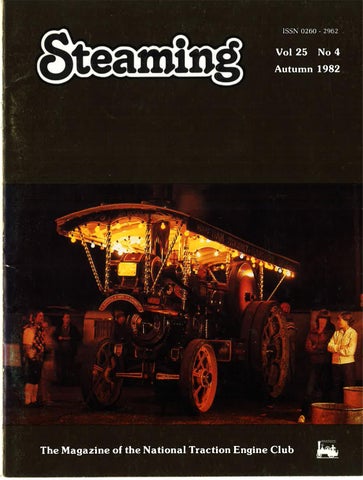
Cover "It may not be the best painted engine around, but it can still do the work it was intended for" says Dan Shorey of STARLIGHT, his 1920 6hp Burrell showman road loco 3836. This scene by Andy Potter shows the engine hard at work providing power for Noyces' gallopers on the Sunday evening of the 1981 Expo event at Peterborough. 155
From the Chairman Summer is the time when all our members are actively engaged in the more practical side of our interests, whether it be driving and rallying an engine, or attending, running or assisting at one of the many rallies that are being held around the country. Meetings of your Club's committees are more widely spaced at this time of the year but none the less continued progress has been made. V.,... Rally sub Committee have completed a further revision of the Rally Code of Practice which will be presented at the October Rally Organisers Conference, and they have for 1982 approved a large number of rallies. Reports suggest that rallies this year have been well attended, no doubt in some measure due to the better summer that we have experienced. One of the lesser known services of your Club, which arises out of the Club's Approved Rally List is the world-wide publicity given to the list by the indefatigable activities of our Secretary — George Beck. Through his efforts, this list reaches in excess of 4000 outlets, being circulated through the British Tourist Authority overseas; the various English Tourist Boards nationally and regionally in the UK; the motoring organisations; local authorities through libraries and various information centres, and last
responsibility for an international section. Earlier this year we reluctantly accepted the resignation of Yvonne Hanmore from her post of Hon. Treasurer to the Club. Yvonne had been treasurer since early 1978, and had seen a vast increase in the annual turnover of our finances, with all its attendant problems and time consuming work. We thank Yvonne for her past services in this demanding but often unappreciated job and wish her well for the future. The vacant post has been taken by my son Chris, and we trust that he will find it interesting and satisfying work Finally, I am sure that all our members would like to join me in congratulating our Vice Chairman, John Crawley, in completing his quarter century as an official of the Club. John's activities and services to the movement are almost too numerous to mention, amongst others he has organised and continues to organise a number of our largest and most successful rallies, he has edited Steaming for us, and has arranged the very successful York conventions which have been enjoyed by many of our members. Lately he has found time to compile a book amongst all his other activities. We owe him a great debt for his services to the Club. Many thanks, John, from us all. (Peter Barber)
on 1st October 1982. With the assistance of Vice-President Anthony Heal the Engine Owners Committee is investigating the implications of trailers towed behind steam engines. As in the case of most legislation, the regulations are written in the now accepted gobbledegook that nine out of ten of us have trouble in understanding. It is hoped time will be found to translate the regulations into English for the next edition of Steaming. /AA /nhn Wharton f .7hirmAn rngino OvMers Committee) Technical Articles Technical artirlac in o ur magazine are inavariably well received by engine owning readers • but their popularity seems to be in inverse proportion to their availability; indeed there is a distinct shortage of instructive writings. We appeal to those members who do have a more than usually detailed knowledge of skills needed on and around steam road engines to consider putting pen to paper, and enlightening those less knowledgeable than themsleves. One reader has suggested this useful list of subjects which could be covered: • Painting an engine • Lagging boilers • Laying up for the winter • Retubing an engine • Fitting rubber tyres
hut rartainly not (Pact thrni inh •nmr.
•
500 to 600 individual applications that George receives annually, many from overseas. This operation gives great publicity to these events, not only for the benefit of our members but also to all the affiliated clubs and rally organisers associated with them. It is perhaps not generally realised how many overseas members we have in our Club and how many readers see our journal Steaming, even if they are not personally members. Recently, it was my pleasure to meet Bill Skinner, on a visit from New Zealand, and to show him round one of our larger rallies including a visit to the Club stand, where he became a member. I am sure that he thoroughly enjoyed his visit and will be taking happy memories of our steam rallies back with him to 'down under'. Your committee want to encourage our overseas membership and are at present considering the appointment of a committee member with special
• Fitting new bearings or remetalling • Reseating safety valves or injectors • Maintaining water pumps • Making a cab • Care and repair of wire ropes including splicing a ploughing engine rope • Maintaining dynamos • Mechanical lubricators • Packing glands • Setting slide valves • Adjustment of governors With many of the subjects you don't necessarily need to be an expert to write some notes — your experiences of a job satisfactorily completed will doubtless be gratefully shared. The list is, of course, not extensive and anyone who feels spurred to burst forth on another sub ject is equally welcome to contribute. The Editor will be pleased to consider any technical articles, although in view of this 'open appeal' it may well be
156
Engine Owners Column Engine Owners Committee Summer is the peak of the steam engine rally season and like Parliament, the Engine Owners Committee have a summer recess. All of the committee are heavily committed with rallies; exhibiting, commentating, organising etc. However whilst so mixing with engine owners at rallies one discovers many more problems that require attention from the committee. All correspondence is of course dealt with. Trailer braking New trailer laws came into effect
cattinn i in mntinn wand.,
From Alan Martin's Collection
18
This time, another engine from one of our less prolific manufacturers. Brown & May of Devizes built tractor number 8439 in 1911, and when photographed somewhere in west Cornwall in 1913 it was owned by Thomas 8irchall & Son, of St Austell, named LAURA. Note the lighting along the edge of the canopy.
best to briefly contact us before actually writing the article, to avoid possible duplication of effort. The number of words written is up to the contributor, and editorial assistance is available with diagrams etc.
The Rally List 1982 Our quarterly publication dates mean that we are unable to announce late season additions to the Rally List. For the record the events at Newquay (in August), and at Liskeard and Stourpaine (in September) were added to the list of Approved Rallies.
Approved Rallies National Publicity for Rallies I have been asked to set down details of the circulation of the 'List of Approved Rallies' which I prepare and distribute each year to tourist authorities, tourist boards, and other bodies and individuals with a likely interest in spreading information on traction engine rallies to the general
public. In 1968 a small 'Roneoed' rally list was circulated. In the 14 years since then it has grown into a large publicity operation that brings inestimable benefits not merely to the NTEC but to all affiliated clubs and rally organisers — the movement as a whole. The distribution of the copies is —: 250 British Tourist Authority 1150 English Tourist Boards 500 Automobile Association 1050 Royal Automobile Club 500 local authorities 550 applications by individuals total
4000
To expand a little on these figures — the BTA requires a list in December and it is obvious that at this relatively early date this cannot be complete. However the fact should serve to remind organisers that for maximum publicity they should decide and advise their dates at the earliest possible time. The tourist board copies are further distributed as working copies to their local information centres — many of these subsequently ask for extras. The AA and RAC distribute theirs to control and service centres — another good source for spreading information to tourists and holidaymakers. Individual enquiries come from a variety of sources. They should enclose stamps or a SAE and usually do — in practice
very little expense falls on the Club from this section. Many individual requests come from overseas — Europe, USA, Australia, even Israel and Thailand. In addition to the above outlets the rally publicity also extends to the readership of Worlds Fair, the publishers of which are allowed to reproduce the list in the interests of maximum coverage. The events are also published in the Spring issue of our own magazine Steaming. 1500 extra copies of the latter list are sold from NTEC Sales stands during the summer months. Certain affiliated clubs reproduce, with permission, parts of the list of local interest. Thus it will be seen that the Club is doing a very considerable amount on behalf of rally organisers in the sphere of distributing national publicity. The NTEC has become internationally synonymous with traction engines, whether it be going to a rally, initial advice on buying or selling an engine or spares, the need for technical information or the purchase of literature. A constantly recurring phrase in letters received is 'When I asked where traction engine rallies were held I was told .... just write to Mr Beck of the NTEC and he will send you a full and complete list.' The corner-stone of the success of this publicity operation is the words 'full and complete'. It will benefit everyone that the Approved Rally List is as complete as is possible, and at the earliest date. (George Beck, General Secretary)
Future• Dates Affiliated Clubs and Rally Organisers Conference The above Conference will take place at the Great Western Royal Hotel, London on Saturday, 16th October 1982 at 11.00am. Formal notice and invitations will be sent to Affiliated Clubs and Rally Organisers in the usual way.
Affiliated Clubs As the winter evenings come closer the social activities of the Affiliated Clubs come more to the fore. The bi-annual Diary of club meetings appears again in this, issue and we would urge all readers to give support 157
to these local gatherings — NTEC members are welcomed and it is a good opportunity to meet other enthusiasts and become involved with area events. All Affiliated Clubs were circulated for details of their meetings some time ago and those responding are regularly requested to check or update the information to keep it accurate. Sadly many organisations have 'dropped by the way'; if your local club is not represented ask the secretary to let us know the details.
Obituaries Kenneth More
Kenneth must have loved Sentinels. In his autobiography More or Less he meets a character in the erecting shop, one Walter Thomas, and his vocabulary. Also, when serving in the Navy, in the blackout during a raid in Liverpool, he walked into an unexploded German land mine. Imagine the puzzlement of the senior Officer when Kenneth reported "It's like a Sentinel boiler!" One of his finest roles was in 'North West Frontier' where he took command of a refugee train fleeing from the rebels. Observe him in the locomotive cab — he is no stranger to steam. Similarly he was gifted in portraying men involved with machines — with cars in 'Genevieve', with planes in 'Reach for the Sky', and there were others. It is the loss of this ability to humourously portray rapprochement with machines that will be most keenly felt in years to come. Nobody can quite fill his place. This tribute comes from one who was a contemporary apprentice at Sentinels. (J.A.
Edward Morgan
The death of Kenneth More at the comparatively early age of 67 means the loss of an actor famous for 40 years on stage, screen and television. But he was also a 'steam man' — a former apprentice of the Sentinel Waggon Works at Shrewsbury. Kenneth's father was overseas representative for Sentinels, so his own apprenticeship followed (see page 253 of The Sentinel (Volume 1) by Hughes and Thomas). Kenneth was not alone among those at Sentinels in the early 1930s who achieved great things in other spheres. There was also L.T.C. Rolt, the famous author on engineering history and the writer's friend Pat Wanklyn, a posthumously decorated Battle of Britain pilot. Before graduating into the sales office, Kenneth had been in the erecting and machine shops; unusually for an apprentice he had also been in the repair shop. He once told me his fitter and he took out repaired wagons on trials around Shrewsbury — and Kenneth drove! 158
It is with regret that I have to record the recent death of the well known Derbyshire engineman Edward Morgan in his 89th year. Ted's father, John Mui gall of Barlow, near Chesterfield, owned a family threshing business and each of foul suns including Ted, drove a set of tackle. Ted's engine was an old Fowler 6 hp single which began to prove unequal to the task of hauling the full set of tackle up the steep hills. and in 1924 it was decided that a new engine was required. The choice of make was left to Ted, who had always fancied an engine from Thetford; the result was that the business acquired brand new Burrell 7hp single cylinder traction engine number 3984 DOLLY. Upon the death of his father Ted inherited his tackle which he continued to use almost to the end of the threshing era. During the busy period of World War 2 Ted bought a Russian Fowler and additional thresher to form a second set which was driven during the season by Frank Oadley, the Derbyshire showman. Ted's tackle was well kept and produced a good sample, such that he was held in high regard by the farmers in the area. His threshing round extended into the hilly Peak District and some of his customers were farmers on the great estates of Haddon and Chatsworth. Those readers who know the area will
appreciate the skill required in travelling with heavy tackle in an area which abounds with steep hills and narrow lanes and small awkward farm yards. After a short period of threshing with a diesel tractor, Ted gave up the business altogether and took a post attending to the boilers at Chesterfield Hospital. His great enthusiasm for engines, threshing machinery and the countryside around his native Barlow was evident to his last days. Ted was a great engineman and his loss will be felt by all who were fortunate enough to know him. Our sympathy goes to his family in their bereavement. (G.F.A. Gilbert)
London Area Social Meetings Meetings are held on the last Tuesday of each month from October to April inclusive (no meeting in December) in the upstairs room at 'The Cock Tavern', Great Portland Street, London (corner of Margaret Street and adjacent to Oxford Circus). They start at about 8.00pm and all are welcome. It has been possible to arrange the complete 1982/83 Winter programme and details are given below for members to make note of In their diaries. TUESDAY, 26th OCTOBER 1982 The opening meeting of the 1982/ 83 season and, as usual, it will be members slides; bring along some of your own favourites. TtiFcnck v, 'loth rkylvpmi:mp. 19 2 Keith Catchpole will talk about his experiences on Military Railways, and on the Festiniog Railway. TUESDAY, 25th JANUARY 1983 Tony Gooding and Dove Rollins present 'A Mixed Bag' — traction engines and rollers at home, and steam railways abroad. TUESDAY, 22nd FEBRUARY 1983 Mr Dorrington will talk about the rebuilding of a 1906 Renault car and taking it on the Paris-Vienna Anniversary Road Run. TUESDAY, 29th MARCH 1983 Bill and Peter Love will talk on 'Armstrong-Whitworth — the firm and it's road rollers'. TUESDAY, 26th APRIL 1983 Michael Mason will complement his excellent articles on boilers in our magazine with a talk on the rebuilding of a traction engine. (London meetings organiser — Bill Timmings, 308 Hertford Road, Lower Edmonton, London)
c§old "Tedal This month, just seventy five years ago, a cavalcade of motor transport arrived back in London, having spent a month competing in the Royal Automobile Club's Commercial Vehicle Ltd Trials. The 5 ton tractor entered by Charles Burrell and Son of story the traces article this and class its in won a Gold Medal the award.
The Heavy Motor Car Act of 1903 promised new horizons for traction engine manufacturers, enabling them to more effectively design and build small road engines for a new class of business. In contrast to the heavy locomotive, encumbered by tight, restrictions on speed and the necessity for a large crew, the new machine could legally be operated at 5 mph by one man — but only if it weighed under 5 tons! An earlier Act in 1896 had similar aims of permitting more speedy and convenient mechanical haulage on the roads but the allowable weight was under 3 tons — an impractical figure that made mockery of the relaxation. Several established builders tried their hand at marketable 3 ton engines but only Tasker, and Wallis & Steevens had limited success — perhaps, compared with those makers with large agricultural and roller sales, they needed to presevere more for the additional business. The 1903 Act, however, made possible a more reasonable workaday engine and most of the well known makers entered the steam tractor market sooner or later. Charles Burrell & Sons Ltd, of Thetford, seemed in no desperate haste to take the opportunity of the fresh business and it was 1905 before their first steam tractor of conventional type took shape. Perhaps the time taken on design was well spent for although not the all-time best seller Burrell's tractor continued in good demand in largely unaltered form until the firm ceased to trade in 1930, and many survived late enough to be acquired for preservation. The first Burrell 5 ton tractor, numbered 2787, had two speeds and a Single cylinder of 61/2 inch diameter by 81/2 inch stroke, and appeared late
in 1905, apparently having trials from the works and with potential customers. It remained in Burrells' hands for over three years before being renumbered 2805 early in 1909 and sold. The first production engine was 2797, finished in January 1906. It was also a single cylinder example, and this engine too seems to have been retained at Thetford for some time, being exhibited at the Royal Agricultural Society's show at Derby in July 1906. The Engineer noted the design in the August, under the heading 'Light Steam Tractor', as a useful
engine. The rear wheels were quoted as 5ft diameter with a 9in tread; the front wheels 3ft; the 175 lbs pressure boiler had 25 tubes of 1 %in; the weight was 4 tons 17 '/2 cwt. Steering was different from usual practice on steam tractors — a worm on the end of the steering shaft operated a worm wheel on a vertical shaft at the left side of the smokebox. At its lower end this shaft carried a pinion which geared with a spur wheel attached to the front axle. This arrangement couldn't have been completely successful because only a few engines were so fitted before more normal chain steerage was reverted to. Burrells' next tractors, works numbers 2802 and 2803' of March 1906, were provided with a compound engine (cylinders 4in and 71/2 in x 81/2 inl. By August, The Engineer, although using single cylinder 2787 as an illustration, referred to the design as having compound cylinders and presumably Burrells were by that time convinced of their ability to build thus safely within the 5 ton legal limit. The Royal Automobile Club, at that period interested in promoting the use of all kinds of motor vehicles on the
' 2803 was illustrated on page 74 of the Spring 1982 issue of Steaming and was fitted with the direct steering as described above.
is Depicting the Gold Medal Tractor in Burrells' 1911 Descriptive Catalogue works number 2904, built in 1907 — before the Trials took place! (collection Welland Valley Club) 159
One of the earlier 5 ton tractors — 2847 of August 1906. It was new to C. & G Yeoman, haulage contractor of Canterbury and is seen here hauling a bulsier wagon loaded with some intriguing timber framework. (collection Welland Valley Club)
road, announced that they would be conducting Commercial Motor Vehicle Trials in September and October 1907. The object of the trials was 'to demonstrate in a convincing manner the advantage of mechanical haulage over horse haulage for the transport of freight, and to show the great progress which had boon mode in the construction of commercial motor vehicles, particularly in matters of efficiency, economy of working, and reliability.' Entrants eventually consisted of many types of road vehicle in seven classes, ranging from 10 cwt vans, through 20 and 30 cwt lorries. drays and pantechnicons to 5 ton steam lorries and 5 ton steam tractors with trailers. The lighter vehicles were variously fuelled by petrol/paraffin and the heavier by similar fuels as well as coal or coke. The 56 entries that set out were built in Great Britain, France, Germany or Italy, with two thirds the outcome of home industry. The distances to be covered in the daily sections varied, with the lighter motors doing much higher mileages by more roundabout routes hetween the overnight stops. Despite entries of steam wagons by Savage, StrakerSquire, St Pancras, and Yorkshire in 'Class F — load 100 cwt' our interest here is confined to 'Class H — load 120 cwt including trailer'. This last class attracted entries from three manufacturers; Burrells of
Thetford; Fosters of Lincoln — sending one of their 'Wellington' tractors, and Taskers of Andover, with a 'Little Giant' engine. Burrells entry was one of the compound 5 ton tractors, specially prepared (as no doubt were the competitors). The entrant, works number 2932 completed in August 1907, ieyistratiun number AH017, was a 3 speed machine' and had the whole of the motion and valve gear covered by dirt and dust covers (but not enclosed in an oilbath as often suggested). The rear wheels were of peculiar construction; steel spokes were cast in one with the huh nr nave, and a cast steel rim, rivetted onto the ends of the spokes, had wrought iron rings containing hardwood blocks set endwise to the grain, thus giving a annri grip. Larger than usual holly tanks were fitted, giving a total capacity of 150 gallons. Tasker and Foster managed to conjure up even more capacity on their entries, by fitting pannier tanks alongside the cylinders, having respectively 170 and 240 gallons. Other dimensions for the
'The details of the Burrell's competitors — both two speed machines — were: Foster 3633 (FE368) and Tasker 1382 (AA2199). Taskers also had a second machine in attendance, 1365 (A/12200)
This front view shows the worm gear steering on 2831 when new in 1906. (collection A.J. Martin) 160
Burrell were cylinders 41/2 in and 71/2 in diameter x 8 1/2 in stroke (by now standard), weight 4 ton 19 cwts and pressure 200lbs (again, now standard). The quoted price of £536 was more expensive than the other two tractors (E490 for the Foster; £517 for the Tasker), but considerably less than the German and Italian petrol lorries at around CE100, and a Wolseley-BTH petrol electric 3 tonner at £1294. Accompanying the tractor as trailer on the trials was Burrells' work hack, a traction wagon fitted with a timber and sheeting canopy at the front half, doubtless containing permitted spares and supplies, as well as the required load, in this case iron blocks. More interestingly, a Lacre box van contained tea in chests as a load; a Halley van, biscuits and a Siddeley brewers dray, beer in barrels. In charge of the Burrell wag the St. Nicholas Works' regular demonstration driver Harry Parlett, with Harry Clarke and Frank Miller assisting. The trials, the largest organised up to then, started on Monday, 9th September 1907, and finished five weeks later on Saturday October 12th 1907, running three, four or five days a week but never on Sundays. Starting from Thornycrofts' Chiswick works the route took in Bristol, Birmingham, Liverpool, Leeds and the Midlands
The Trials route of Class H.
before ending at the Vanguard bus garage in Dalston, North London. The mileage for Class H totalled 686 miles, about 30 miles on each of the 22 running days. The awards were to be in the form of medals, with a full official appraisal of the trials being published in due course. An award of £5 and a silver medal was offered to the driver of each class for punctuality. Each entered vehicle carried an observer, the rules allowing 2 cwt for his weight, and that of his seat and luggage! Burrells nominated one Thomas Cobbald. At this stage it must be emphasized that the trials were overwhelmingly directed at, and supported by, the relatively new-fangled internal combustion engined vehicles and steam took only a minor part at the heavier end of the list. Further, our attention must now be focused on entrant H58, the Burrell tractor, with comparative references to the two other entries in its class. Details of the day to day running of the trials appeared in various contemporary journals. The morning starts were at 7.30am for Class H and with one hour compulsory lunch stop the day's distance had to be completed by 5.00pm. Full details of stoppages on the road were recorded as well as preparation times in the morning (no mention is made of how time raising steam was considered) and all other times attributable to the running and maintenance of the machine. There are few mentions of the Burrell in reports, although after the first week The Commercial Motor commented on the steamers in general: 'so far one of the, most interesting features is the placid manner in which all the steam-
propelled vehicles perform their work. The drivers seem to be free from all cares, and to wear that air of confidence which is so common amongst traction-engine men. The makers of the three tractors, too, are having an easy time of it, for one and all would have willingly hauled eight tons instead of the regulation six tons to which they are limited according to the RAC's conditions.' There seemed generally, however, to be no lack of incidents to remark on, and the rival Tasker 'Little Giant' provided one of the first on Thursday, 12th September, when on a hill at Bathford, near Bath, in trying to avoid the vehicle in front of him the driver put his engine in the ditch, buckling the driving wheel and bending the front axle. It was possible to effect repairs very promptly by borrowing parts from the second machine Taskers had at hand; it would be interesting to know the circumstances surrounding this 'spare' for the rules make no mention of it. Driver Charles Downs eventually received a Silver Medal 'for bringing his vehicle into Bristol after a serious accident', so we can assume he did not take the blame for causing the incident. The Burrell secured non-stop runs on all five days in the first week, although obviously it did make water stops as we shall see later. From day to day various tests took place — stopping and starting powers, fuel and water consumption, steering, hill climbing, manoeuvring and surprise weighing tests (to see the tea and
biscuit loads weren't being tasted too assiduously?). At Aston Villa football ground and seven other locations there were one-day public exhibitions of the assembled entries. The end of the Trials saw all exhibits being dismantled for inspection — and re-assembled in the space of three and a half days! The appendix to the judges report of the Trials contains very detailed reports of troubles and stoppages. The Burrell tractor recorded little 'depot trouble' — 18 minutes for replacing a cock at Leeds was ,the only time so booked, although the trailer needed attention to it's brakes whilst in the Potteries and this latter defect was also the cause of the booked 10 minutes of 'road mechanical trouble'. Many of the lighter petrol vehicles recorded little lost time at all, indeed the Lacre and the Halley vans were among five vehicles with nil losses. The Burrell would have been in tenth place overall had not the water stops been added to its Time Lost account. The daily 'filled up with water (once)' entry amounted to 188 minutes (over eight minutes each time) and, added to 12 minutes delay due to wheelslip, put the tractor into 23rd place of the .42 entrants recorded in the finishing table, 228 minutes being noted against it. Fosters and Taskers had obviously thought of the water problem, and by fitting the pannier tanks alongside the cylinders and motion largely solved the problem, although seeing what happened to the Tasker near Bath, the resultant high centre of gravity must have been a risky price to pay. The Wellington tractor took water during running on but 4 days (37 minutes►;
2876 of 1907 — the oldest survivor of the Burrell tractors — posed with a load of bricks in its first ownership. (collection Welland Valley Club) 161
the little Giant on 16 days. Perhaps Burrells considered potential customers would accept 'water time' — certainly additional water tanks never took on in general usage, although Fosters advertised them in their catalogues and most makers, including Burrell later on, had a dabble with the iriea Coal consumption figures varied by about 12%. The Burrell used 56% cwts (9.2 lbs per mile), the Tasker 63 cwts (10.31 and the Foster 66 cwts (10.8). In comparing the cost of fuel and lubricant per mile the three came quite close — 1.27d ( 1/2 p) for the Burrell and 1.34d and 1.40d for the Foster and Tasker respectively. This was much cheaper than the 3 ton petrol vehicles (some 2.50d per mile); the ton/mile figures were not quoted for the steam tractors but must have been greatly superior to contemporary petrol wagons of 2 and 3 tons in their cost effectiveness. Other performance figures recorded were the brake tests down Bunny Hill, in Nottinghamshire. The Foster brought its load to a stop in 43 feet, the Burrell in 32, both overage figures, but it would have been interesting to see how the Tasker managed to halt in just 5 feet! Burrells composite wheels paid off, 162
The tractor entered in the RAC Trials. 2932 is seen here posed at Thetford. Note the dust covers over the motion and cylinder block, and the cylinder drain cocks discharging into the smokebox. (collection A.J. Martin)
2932 passing through Maidenhead, Berkshire on 9th September 1907, during the RAC Trials. (collection A.J. Martin)
for both competitors lost much time by slipping in urban streets. The Foster spent 53 minutes struggling in Suffolk Street, Birmingham, eventually winching its trailer up and then having to have the jammed rope drum freed by hammer and chisel; it took 114 minutes climbing a hill in Barnsley, and then in Sheffield it had to be sent back and taken by a different route (59 minutes). The Tasker had similar problems, presumably at the same locations, and the crew used wood, sacks and sand bags, losing a collective total of 308 minutes. The Commercial Motor thought well of Burrells' wheels, for during the second week of the Trials they observed 'The wooden treads upon the Burrell tractor are picking up a nice collection of oddments, and they should be well consolidated into a matte by the time they reach the stone setts of Lancashire and Yorkshire, with a view to the effects of which they were, we surmise, fitted in this instance', and a week later 'The rubber tyred vehicles have scored over those with steel tyres up to the present, and the same may be said of the wood-tyred Burrell.... the treads .... seem good for at least 1500 miles, which distance, having regard to their first cost, will bring them well within the range of practical, commercial and everyday use.' As to the rivals' mechanical troubles the Foster's crew and two men spent 5 hours or so at Bedford fitting a new crankshaft bearing bracket and pump bracket and had trouble with the injector. Tasker's men spent 8 hours putting their engine to rights at Bristol after the Bath incident — straightening the side of the water tank, painting the canopy irons and refurbishing the trailer and its hood. Their trailer needed further attention to its brakes at Birmingham, but apart from the accident damage there was no mechanical trouble booked at all to the Andover engine. That attribute did not stop it being last of all the competitors when its hill climbing and accident repair times were added up! The judges' report makes the general points that for loads exceeding 3 tons the tractor was most economical for general haulage, bdt where speeds of a higher nature (above 5mph remember!) were required, a rubber tyred internal combustion lorry became a necessity; they could go along at 12 mph up to 3 tons. It was regretted that an internal combustion engined tractor had not been entered and the drawback of steam vehicles having to water every 20 to 30 miles was remarked on — a condenser fitted machine was
It had 3119 on Burrells' stand at the Royal Show, Newcastle in July 1908. and been built as 2913 in 1907 and sold to Devon, returning to Thetford October eventually being sold again to Pyx Granite Co at Malvern, Worcs, in 1909. (collection A.J. Martin) suggested for the developing mechanical transport in the Colonies. Other comments from the judges were that drawbars should have bearing right round the rear axle hornblocks and not bear on the back axle itself, and they were concerned that a better spring suspension be provided, with properly compensated drive to allow free movement on the springs. The
legal tare weight limit was perhaps to blame for lack of improvement in this direction and use of higher class, weight saving material was advocated. In remarking that 'for commercial purpose a fine finish on other than working parts is unnecessary, and adds to the cost of production... the amount of brass work and number of parts to be kept
Later it 3192 was built in 1910 as a crane engine for the War Department. other was owned by J. Herbert of Southampton and fitted with dynamo and by showland fittings. Pictured here with the Herbert family it is now owned Gilbey) J. (collection Yeovil. of Gilbey James 163
3510 of 1913 — a single cylinder example exported to New Zealand and now rallied in that country. (R. Pester)
polished were in some cases excessive....' one wonders if the judges were pointing the finger at Burrells. No mention was made of the time spent raising steam and we should perhaps keep in mind the lack of self starters on the early, large internal combustion engines. The Engineer drew attention to this diff:culty, anc,' timu could be lost in starting recalcitrant engines. The Burrell was highly recommended in the following ten categories — accessibility; adequacy of platform space and convenience of loading; adhesion; brakes; condition after trial; finish and workmanship; freedom from smoke; general appearance; hill climbing; quiet running; and steering gear. It was commended for cleanliness of the vehicle in service and absence of oil leaks. Just how much we should make of these remarks is debatable — the Foster was also highly commended for its adhesion and hill climbing despite losing 114 minutes on one hill at Barnsley and a total of 146 minutes on eight other occasions! Foster collected eight highly commendeds and Taskers six. Close up of the cylinder block of 3510. (B. Pester) 164
As a final word on the steam entrants, a last extract from The Commercial Motor is of interest. Summing up on 24th October, atter the trials, they enthused 'The 5 ton steamers, and the tractors, hardly needed advertisements, their reliability and practical qualities having been proven and appreciated long ago: their drivers in the trials wore self-confident
smiles, from the day they left Chiswick, to the day they ambled into Dalston, none the worse for their little jaunt, or their side-slipping experiences on the setts in the north.' For their efforts Burrells were awarded a Gold Medal and soon afterwards their 5 ton tractors became known as Gold Medal Tractors in their advertising brochures. Fosters' Wellington took a Silver Medal, and all three steam tractor drivers received £5 and a silver medal for punctuality — only six other drivers received this accolade. It is difficult to determine how much the Gold Medal was deserved. Clearly the Burrell had the advantage over its two rivals in the trials, but it was only a three horse race and one wonders why other well known steam tractor manufacturers did not participate in the RAC Trials. Incidentally, our Trials hero 2932 was sold by Burrells in February 1908 to Clements, Knowling & Co of Brentford, London. It is also difficult at this distance to judge the effect over the years that the Medal had on further sales of Burrell tractors. Some 22 further examples were sold before 1910 and 89 more in the years to World War 1. A total of 215 were built, works number 4084 being the last in 1927. Like many other designs built over a number of years there were various alterations to components and appearance. Early examples had light, narrow back wheels with a single T-ring but most later models had double rings. The route of the exhaust from the cylinder block varied — on some examples from below the valve chest on the near side via a cast pipe which entered the smokebox on the side and then formed a transverse
3639 was purchased new in January 1915 by Stemp & Weller of Cranleigh, Surrey, for timber haulage, registered AH0231 and named KING OF THE ROAD. It was re-registered P89636 in 1921 and is seen here near Granleigh in the 1930s. (collection R. Walker)
work they had a longer usage, and in leading stone with two sets of wagons they had an advantage over an ordinary steam wagon - but not over a tipper!
heavy loads (every hill meant the lower gears) but it did enable fast returns with empty wagons etc. Priced at just over £500 in December 1912, Gold Medal Tractors were not cheap engines — a 7hp agricultural could be purchased for £450. The single cylinder engine was offered at £440, with extras for either version at £25 for the third speed, £10 for governors, and £3 for a full length awning rather than the half length. Of the total of 215 5 ton tractors built some 33 are known to survive today. Nine were built new with full showmans equipment (2 of these survive) and to emphasise their popularity on the fairground it is worth recording that 62 of the total were owned by showmen at one time or another — although not necessarily used on the fairground. The heyday of the steam tractor as a breed was short. They were useful and reliable until displaced on road haulage, especially over larger distances, firstly before World War 1 by steam wagons, and after by internal combustion engined vehicles. In the fairground and on timber hauling
This account of how the Burrell Gold Medal tractor earned it's name owes much to the kind help of Ron Walker and Alan Martin. Ron Walker, whose splendid idea of marking the 75th anniversary of the Trials with a meeting of surviving tractors came to naught because of the present economic climate, provided, by courtesy of Mr Catt, librarian to the RAC, a copy of the Official Programme of the Trials and the Judges Report, as contemporary other as well references. Alan Martin offered photographs (far too many to include herel), identified others and provided notes and advice. Other sources of information were produced by Mr EasonGibson of the RAC Motor Sports Association; Mr J.G. Thurlow of Thurlow Nunn & Son Ltd, Stowmarket, and last, but by no means least, The Road Locomotive Society. The latter's Portfolio Burrell Gold Medal Tractors gave information on early examples, and contains much more for those who might wish to make further study of the subject.
blast pipe in the smokebox. Such tractors usually had the base of the chimney flanged directly to the smokebox. Other engines had the blast pipe running from the front of the cylinder block and then by the route described above; yet others went direct into the back of a cast chimney base in the more conventional manner, the chimney itself having a bottom flanged ring for bolting to the cast base. Most purchasers took the option of the third speed, such that it virtually became standard — a rarity amongst for most tractors, steam manufacturers provided but two speeds. Burrells emphasised as a 'distinctive feature' the double gear drive to the hind axle, and a differential lock, operated from the footplate, was fitted — one of the few tractors thus equipped as standard, The firebox grate area of 3 square feet was small, relative to the comparatively large cylinders and it is said good coal and competent firing was necessary to get the best out of these essentially one man machines. Their top, third, speed was too high for
165
crhe 8urvivors This list of surviving Burrell Gold Medal tractors has been compiled through the efforts of Ron Walker, who attempted contact with all known owners, initially in the hope of a re-union of engines, but more recently as a means of owners keeping in touch to their mutual benefit. Naturally enough, the earlier 5 ton tractors are not well represented among the examples remaining today, but the demand for Gold Medal engines in the 1920s for timber hauling shows up well, as does a popularity on the fairground for secondhand examples — the survivors as a group owe much to these two trades. 2876 This engine was the fourteenth 5 ton tractor to be built, new on 31st January 1907 to Thos. Mitchell's brick, tile and pottery works at Guildford, Surrey registered P3093, later PB9615. Now owned by C.H.E. Choake of Leighton Buzzard, Beds in showmans form, and rallied occasionally. 3191 New on 28th April 1910 to the War Department, numbered ASC77. It was originally fitted with a crane. By November 1922 it was demobilised and registered PD5003 into the ownership of G.A. Whittle and Sons of Woking, Surrey, named FUHIOUS. Now owned by C. Rowan in Buckinghamshire; rallied 1982. 3192 A sister WD crane engine to the above, this one was numbered ASC78, new on 1st June 1910. By August 1921 it lied entered a showland career with J.H. Herbert of Southampton (CR6229). Owned since 1958 by James Gilbey of South Cadbury, Somerset it is extensively rallied, still with its showmans fittings. 3225 A survivor- of the 2 speed, single cylinder examples. Exported when new in July 1910 to New Zealand and now preserved by Harry Haggitt of Otago, N.Z. and occasionally used for wood sawing. 3245 Purchased by C. & G. Yeomans of Canterbury, Kent, on 26th September 1910 for use in general haulage, registered AH 054. Now owned by John Cooper of Stockport and rallied in 1981; still on steel strakes. 166
3626 of 1914 with sartorially elegant owner Jim Rochester on the footplate. (Roger West)
3355 New in January 1912 to Geo. Plummer of Statham, Norfolk for general haulage, registered AH 075, later AH5240. Presently owned by A. Price in Berkshire, but now only steamed on owner's premises to run a sawbench. 3397 New on 10th July 1912 to J.H. Hett of Piercebridge, Co Durham for general haulage duties, registered AH 095. More recently owned by Jack Wakefield of Hetton (erroneously AB 095 for a time), who once journied it from John o'Groats to Lands End. Now with Frank Lythgoe of Warburton Grange, Cheshire. 3433 New from the December 1912 Smithfield Show to George Kemp & Co of Aldershot (AH 0108) for timber hauling. Later in showland use for Coles, named PETER PAN. Now owned by Mrs W.M. Salmon in Norfolk and currently rallied in East Anglia, still in showmans guise. 3435 Another 2 speed, single cylinder export machine, sent to New Zealand in 1912. Now owned by Bruce Rankine, Palmerston, New Zealand and rallied there in 1981/82. 3442 Purchased new by S.M. Price of Craven Arms, Herefordshire in March 1913 for haulage, registered AH 0119. The engine is still in the same family ownership, derelict but complete, in Herefordshire, 3453 Delivered on 11th March 1913 (AH 0117) to W. Sedgwick's
menagerie at Oldham, Lancs in showland form for hauling their strangely named 'American Jungle', and named THE MAY. In the 1950s purchased by John Downs of Witham, Essex for use with his set of galloping horses, a task it now performs again at rallies etc. 3458 New on 8th April 1913 to Charles Jones of Tetbury, Glos, for general haulage, named KING EDWARD and registered AH 0122. It was re-registered AB 8795 when working for owners in Worcestershire and later had a varied showland career. Owned since 1956 by G. Shipman and Peter Barker of Berkshire, it is a familiar sight at rallies and events in the home counties. 3497 Haulage contractor T.A. Everton Junior of Droitwich, Worcs, took this engine new on 29th July 1913, naming it MAY QUEEN. It was probably requisitioned during World War 1 (see Steaming, Spring 1981 page 63) and carried registration HO 5993 subsequently. After a career in showland, pneumatic front tyres being fitted in 1949, the engine is now in preservation with Ted Gale of Berkshire, and in the final stages of re-boxing. 3510 This is another single cylinder, 2 speed engine. It was built in September 1913 and, again, sent to New Zealand, and used for threshing. Now owned by B. Pester
of North Canterbury, N.Z., it took part in the World Ploughing Championship match at Lincoln, N.Z. in 1981. 3540 New on 22nd January 1914 to William Oakes of Hollington, Staffs (see Steaming, winter 1980/81, page 31) and named GLADSTONE (AH 0171). Acquired by Boston Museum of Transportation, USA in 1959. Last steamed there in 1971, the engine now requires a new firebox. 3545 Purchased new on 28th January 1914 by I.L. Stent of Midhurst, Kent, for general haulage IAH 0173). Now owned and rallied in the southern home counties by Arthur Mills of Guildford, Surrey. 3554 Registered AH 0181, this example was delivered in March 1914 to E.J. Barnes & Sons Ltd, Swindon, Wilts, for use on timber hauling etc. Now owned by D.W. Davies of Great Missenden, Bucks, and presently rallied and used for working demonstrations. 3618 This engine was new to transport contractor Richard Pool of Fleet, Hants registered AH 0213, on 3rd October 1914. It was probably used on Army contracts and later requisitioned, being later re-registered TD 4276 and owned by Isaac Ball in Lancashire. Presently owned by Richard Preston of Northallerton, North Yorks, and currently rallied. 3626 New in October 1914 to H. Hickman & Son, Princes Risborough, Bucks (AH 0221) and taken over by the War Department in 1916. After a varied career including showland, it is now rallied in the south midlands by Jim Rochester of Finedon, Northants. 3631 Exhibited at the Smithfield
Show late in 1914, this engine was sold to W. Gritt of Romsey, Hampshire (see Steaming, June 1980, page 133). Again probably requistioned, it was later reregistered OR 2729 from its original AH 0225. Now owned by Jack Lawrence of Great Milton, Oxon, and rallied in the area in showmans guise. 3689 Named SUNRISE, the engine was purchased new by showman A.E. Johnson of Pulborough, Sussex on 27th September 1915 IAH 0265), but it is not thought to have been used on the fairgrounds. Reregistered BP5927 from 1921, it is now in the collection of C.J. Lee at Sandy Bay Holiday Camp, Exmouth, Devon. 3718 Delivered new in May 1916 to F. Oakley of Broseley, Shropshire as AH 0297. It is presently owned by W. Paxton of Beeding, Sussex in showmans form. 3786 New on 11th June 1918 to E. Longhurst & Sons Ltd, of Epsom, Surrey, named TIGER (PB 96101. Used in showland from 1935 and now owned by Mrs Wheeler of Craven Arms, Shropshire and reported steamed for the first time in 31 years in late 1978. 3807 The British Cyanide Co Ltd of Oldbury, Worcs, purchased this engine new in June 1919 IAH 0563). It was fitted with a crane and only 2 speeds. Now owned by David Fowler in Hampshire, but stored pending repairs. 3808 New on 20th June 1919 to Southwell & Co, Downham Market, Norfolk IAN 05701. Later acquired by Isaac Ball in Lancashire and converted to a roller. Presently
thought to be being rebuilt to tractor form at Southport, Lancs. 3815 Purchased for timber haulage on 25th August 1919 by A.E. Johnson of Pulborough, Sussex, named SUNSET No.2 (AN 0581) — a sister engine for 3689 above. Later re-registered BP 5757. Now owned by John Baldock of Hollycombe, Hants and currently being fitted with a new firebox. 3846 Purchased new by Winchcombe Rural District Council, Glos in July 1920, registered AD7782. Now owned by Bill
Details of a Burrell Gold Medal Tractor — works number 3626. (Roger West)
167
1927 Aug. 9 Stemp & Weller Threshing Contractors Alford Road, Cranleigh, Surrey. To 1 Burrell New 5 ton Steam TRACTOR NO. 4072 fitted with 3rd speed, awning up to Chimney, & Curtains for same, Wheels fitted with second hand Rubber Tyres. 2 Penberthy Injectors, Extra large front Tank, long case-hardened Guide Rollers, Manzell and Displacement Lubricator, Toolbox on side of Coal Rack, Flywheel Brake, own governors fitted, Winding Drum & 75 yards Wire Rope, waterlifter & 30' Hosepipe, & Tools & outfit. £736.00 BY ALLOWANCE for 1 Garrett Secondhand Tractor No. 32739 £126.00 C/Fd Cranleigh Stn. £610.00
3846 of 1920 at the NTEC 21st Anniversary Rally at Apple ford on 12th July 1975. (Robin Walker)
McAlpine of Fawley, Bei ks and named POUS-NOUK-NOUK; still on strakes but not rallied in recent years. 3851 New to Dorking Rural District Council on 3rd September 1920 (PB 93591 and later with Surrey County Council. Owned since 1938 by Claude Jessett of Uckfield, Sussex; stored out of use since 1978 due to death of regular driver. 3862 Purchased by J. & G.H. Austin of Malpas, Cheshire in May 1921 (MA84721. Sold later to Isaac Ball and converted to a roller, it is now owned by Jack Johnson of Southport, Lancs, rebuilt to tractor form and rallied 3868 Another Smithfield Show exhibit, this time in late 1920, registered AH 0824. Purchased by showman Geo. Baker & Sons of Southampton, fitted when new for showland use and named THE RUSSELL BABY. Later it continued in showland with Arnold Bros of Cowes, Isle of Wight, who appropriately rechristened it ISLAND PRINCE. Now owned by Mrs J. Clark in Kent and rallied locally. Pictures of 3868 appeared on page 117 of the Summer 1981 Steaming. 4071 Built as works number 3876, but renumbered when sold in June 1927 to Dorking Rural District Council, Surrey (PH 13921. Now owned by J.O. Lugg in Sussex, and under restoration. 168
4072 New on 9th August 1927 to Stemp & Weller of Cranleigh, Surrey for timber haulage (PH 29001. Now owned and rallied by Ron Walker of Stanmore, Middx. 4084 Purchased new by S. Darke & Sons of Worcester for timber
George Thurlow & Sons of Stowmarket acted as agent in the supply of 4072 in 1927, one of the last new steam engines through their hands. This is a copy of the bill of sale for the engine, now owned by Ron Walker of Stanmore, Middlesex. (courtesy G. Thurlow & Sons)
haulage in November 1927 (FK 35641. Later worked around the same area by Frank Holl and retained by him in preservation until presented to Birmingham Museum of Science and Industry in 1961, where it is now on display.
4072 of 1927 — one of the later Gold Medal tractors, here on exhibition on the Thurlow Nunn stand at the Suffolk Show 1981. (collection Ron Walker)
EarlyApprenticeship Esmond Kimbell, in more of his entertaining writing, tells of days of apprenticeship to steam, in and around his native Northamptonshire.
Remember those calendar pictures of snow in January, rain in February and windswept trees in March? With me, the mental picture for June was not one of flowers but of an Allchin engine — although I didn't know about makes in the days I am speaking of. With gleaming chimney top it came into our village bringing a truck behind it. I can hear the rattle and clang now, the scent of coal and hot oil; and the engine didn't stand in silence, there were little hisses and rumbles showing it was as alive as a horse at rest with its flicking tail and champing bit! On the truck was the saw bench with racks alongside, and soon the engine was uncoupled and shunting round so that the truck could be hitched to its front end. Then slowly, backwards, it went into grandfather's wood yard, with rapid turns of the steering wheel, and pulling up when adjacent to the sawdust pit. Here two of his men helped the enginemen bar and slew the bench, with many a heave and shove, onto skids for sliding down over the pit. An enormous circlesaw, high as a man, then went in its middle and the two long rack bearers either side. Wooden rollers were dropped into their slots on the bearers, to carry the long steel-topped planks under which were the racks, these latter meshing into pinions on the handle-shaft; and a little pit was hollowed out for the man to stand in who turned the handle. The engine went back a bit more and soon the belt was on and the saw whamming round, shimmering and hungry for wood, with the little spinning-top under a brass
knob, high up on the engine, swelling out and going almost too fast to see. Then a stop whilst the first treetrunk was rolled up the skids onto the platform and wedged; a restart, a slow turn of the handle and then as teeth met wood there was a sound like the tearing of paper. But it was a hundred times as loud and with the engine's chug-chug rising to great chaff-chaffs, one just a little more than the other, the cage thing which had been put on the chimney filled with little glow worms, and every now and then was lifting up. With the first 'siding' off, there was a brief stop whilst the handle was wound back and the trunk bar-levered sideways to be up flat against a gauge, ready for a plank. Then off things went once more. It wasn't long before I was helping the driver by throwing up yard lengths of wood into his bunker, which every now and then the men at the saw tossed along from a siding they'd swung round and cross-cut. And soon helping further by putting them onto the fire myself while he wiped down the boiler. By the next day I knew how the pump was driven from the crankshaft, how it drew up water from the tank underneath the footplate and returned it in another pipe with a taphandle above it, and that when that handle was moved a little, it stopped some of the water from going back to the tank and sent it into another pipe which ran out and alongside the boiler to the brass clack box. Here it forced itself into the boiler past a non-return device (a brass ball on a machined seat, they said) which prevented steam from the boiler blowing through the fitting. The idea was to adjust the tap so that water was sent into the boiler at about the same rate that it was being used up as steam. The day after that I knew how much wood should be put on at a time to keep the steam gauge needle fairly steady. If it rose too much, more water could go into the boiler to prevent surplus steam rushing out noisily through the safety valves. But too much in and water would get into the cylinder; 'bad driving', this. Worse — and dangerous — was to have no water showing in the glass at all! From
this knowledge I progressed to stopping and starting the engine, pulling the flywheel round sometimes to get the crank in the correct top or bottom position. But I was never supposed to touch the lever, kept one notch from full back. I was told that when threshing the lever was the other way and that starting had to be done very carefully or else the belt would come off, as a threshing machine had many spindles to turn while a saw-bench only had one.
I was a bit more grown up when father had a new Marshall threshing set with a 6hp single engine, and two years later a Foster set with a 7hp single engine. I would go with one or the other as mate, feeding the drum by hand or fork — that took some learning. Anxiously, as a mealtime approached, I would watch the chimney for the white smoke which meant the driver had dropped his ashpan lid to quieten down the fire. He, of course, did his spell of feeding the drum and I was early complimented on keeping a level head of steam when down below; it wasn't too difficult with coal and regular going, but the smoke didn't smell as nice as it did from wood, and it was black instead of grey. On the road the mate steered, not easy at first with perhaps one or two slack turns of the wheel, depending on how tight the chains were. Bolts would be pushed in between some links for a long journey but slack chains were better for rough ground, or in a farm-yard. You learned to steer by the chimney rather than by the front wheels, and so avoiding many turns and a wavy track. The mate always got off when arriving at the farm. There was plenty for him to do on the ground, coupling and handling the chains. One of these, with the two hooks which had a link or two between, hung on the bunker. The hooks were to straighten the drawbar for coupling up, and for keeping the bar parallel when pulling from a side eye on the drum's turntable. When the threshing machine (drum for short) 169
threshing was not going to start immediately they arrived on site. It could stay packed away and when wanted, would go on and be just right, even if he was head-down (further away) or head-up (nearer).
The author in his 'apprenticeship days' standing by the drum in the farmyard at ,Boughton, Northampton in 1925. The engine is Foster 14423 of 1924, the driver Dick Leak and the steersman George Brown (collection E.E. Kimbell)
was headed in with the push pole, the mate, sometimes with help, tugged on the heavy drawbar to steer it, with lock chains hooked to prevent a hollow or a stone that might be in the way swinging it round too far. The elevator would often be drawn in off the road by horse roughly into position and then when opened out its light end could be hand-slewed into place. Or it could be drawn back to the drum with the engine's wire rope. The drum usually needed levelling by dropping one wheel into a shallow depression or running another onto some flat wood. Final touches were done by the leverlifting chocks up against the rear wheels, and these held the drum steady when working. Whilst the driver was getting his engine into line, the mate would unroll the driving belt from one end on the drum pulley, pulling it back. If on level ground, he shouted "stop" when the rear wheel hub of the engine came level with him, and then put the other end onto the flywheel hub. The driver, with taps open and lever forward would then lean over the side, or often stand on the wheel, to lift the top of the belt onto his flywheel, sometimes temporarily strapping it there. Then he'd pull and the mate push the flywheel round, taking the strap off as it reached bottom. If found too tight or too slack, the winding jack, it's end against a spud-bolt fixed to the wheel tread, would move the rear wheel around enough. It would then be left there to keep the engine from rocking at the threshing speed of 160 revs or so. Some drivers could 'steam-tighten' 170
with a jerk of the regulator whilst in reverse. The belt would sigh as it slipped and the drum started to revolve. Quickly then would the gear lever be slammed across into mesh — if often wouldn't go all the way, but with the pinions just turning, and the drum barely going round, kinetic energy would ease the engine back that bit. That sort of driver, by the way, seldom needed the belt pulling out to judge his length when the
After rather more than an introduction to threshing, there followed for me a period in William Foster's Wellington Foundry at Lincoln, which had the legend 'Welcome to the Birthplace of the Tanks' over the entrance as a reminder of its World War 1 activities. For a good bit of the time I was in the boiler shop — first as a rivet boy, where I helped make boiler and wheels for an 8hp Clayton & Shuttleworth traction, which then went to that company's Stamp End Works for erecting and fitting. It was the first I knew of firms taking in each other's washing! Marvellous it was to see how quick and deft were the boiler makers. With chisel or caulking tool in one hand and hammer in the other, they'd toss both up at the end of a run, catching them with crossed hands for swapping over to go the other way. 'Hambedexterousness' had its place in driving an engine too, as squareframed, deliberate, George Harrod would tell. George and Walter Rose — he with the big moustache — were Foster's drivers. You would nearly always see one or the other at an agricultural show, their engine just moving over on the belt so that every going-round and to-
This newly built but unidentified 5 ton Foster wagon was probably ready to be off to an agricultural show or similar when the photograph was taken. In the centre of the group is George Harrod, one of Foster's works drivers, and standing left is Spencer Gauge, who drove Henry Thurston's Foster MED/NA. (collection E.E. Kimbell)
and-fro part of the threshing machine could be closely watched. Sometimes a Wellington steam tractor, ablaze with paint and polish would be idly watching, FOSTER in letters down the front of its chimney. Walter took out most of the threshing sets and lone drums; George the showmen and tractors, but they did change over. George loved fairground life and would sometimes be away weeks if a customer was short handed or had a man to be trained, and stirring were the tales he could tell on his return! Later on I joined them in the testing shed, where, When things were slack, they would sit behind a slowly steaming Foster wagon and talk for long periods. Then we'd amble round to the field with it "to make certain adjustments" There would be more conversation and some sparrow shooting in a large shed full of new and second hand engines and threshers. The latter were 'bought' by a dealer whom we guessed was not exactly independent, but part-exchange was against manufacturers' rules! When busy, a new engine would be belted onto the brake and foreman Charlie Maughan tinkered with calipers and various instruments, all a bit above my head. "And ours an' all", George would say. "We're only working men. Charlie's been a ship's engineer and 'as qualifications." "Don't talk so much" Charlie would snap back from the running board. "Now start her up astern and lets see if that bottom strap don't want a shim next its eccentric." One day we steamed an early fourshaft which had been in for repair. It was a lot like ours at home, but with set back front wheels, slide-bars instead of trunk cross-head guide and an iron-rimmed chimney. "Git on 'er, young mon, an' goo round t'field thysen. We'll ride in the wagon." Joyfully I was up and soon rattling out, through the familiar streets, a short length of lane, and into the field, driving and steering. "Na lad, show us what thee can do. Backards for a start. My! You mek a queer showing of it, looking over shoulder! An' took yer long enough to git centre reight for movin'. Show 'im how he should stand, Walt, while I do the hollerin'." I handed over, and Walt stood, bolt upright, one hand on the regulator, the other on the reversing lever. "Forward, Walt", and to me — "watch him close. See, he don't touch the steering wheel till she's properly going." Walt, with a little regulator push, put his lever in the middle and with a
Joe and his Allchin It was Mallards of Brixworth who ran the Al/chins which feature so clearly in Esmond Kimbell's earliest memories. They had quite a few of these locally built engines — Northampton was only half a dozen miles away — and their last purchase in 1914 was works number 1579, a four shaft engine with Pickering governors and left hand steering. The driver of 'the New Un' from 1918 was Joe Cook. He was so proud of his new command and in the next 20 years thought and spoke of little else. Engine drivers were jealous men, but all acknowledged Joey as the best around. He never needed the belt stretching for length when setting, knowing exactly when to stop, whether head-up or head-down, and the belt would always go on, just in tension and alignment. He never hastened on the road, and never stopped for shortage of steam, or for beer, but always kept going. When manoeuvring he was slow, but exact. Bearings were kept rather on the loose side as he could not bear 'ottin'. He never primed or had leaky tubes or dropped a plug. He was kind to mates, had the right degree of respect to customers and was pleasant to everybody, Whether he went to church is not remembered, but he was certainly a Christian Gentleman. Joey was born in 1875 and died in his early 80s. The photographs show Joe Cook standing on the footplate of his charge, about 1926, whilst working at a farm on the Brixworth to Spratton road and, below, a more general view of the same occasion with Frank Goldsworthy, the mate, on the engine. (Reminisence by E.E. Kimbell, photograph courtesy of Phil Foreman)
short move either side of it, coaxed the crank right for starting, then with lever forward gave enough regulator to turn over — 'ker-chuff, ker-chuff, kerchuff' (as a Foster will gol. Next, with a demonstrating lift, both hands came off the levers, and with a swing of body left, they returned, this time right hand on regulator and left on steering wheel handle. "Let her goo hersen," shouted George; Walter opened up a little more and then stood back from the regulator, resting that hand on the wheel. "Ready for a bit of rough ground, you see? Both hands could be needed then, not one playing with regulator." "Backwards now, Walt." The idle hand went back to the regulator iust to show it. a to-the-right swing to put it on the reverse lever for the pull-back, while the left, now on the regulator again, encouraged a little more speed. Then a full turn left brought right hand on wheel with left idle.
"He can see where he's going like this, with just a head-turn, and by a glance the other way at the turntable, where the lock could take him. A very good position for a short distance." Walt, with a further half-turn, then faced backwards, idle hand coming onto the reverse lever and after a short distance centering it for a quick 'emergency' stop, turning then to close the regulator. With Walt beside me I began to learn the art, after some hand-banging-down and body-swinging with engine at rest. Then came crankcoaxing with the lever and little or no regulator, once some steam was in the chest. Our own drivers would have known this, but less precisely. Doing a thing often enough can also teach, yet lead to' non-beneficial differences in style. Few men like to show others — "too many knowing how and you'll be wanted less!" But it was part of George's and Walt's job to teach, though human nature being what it is, not everyone would have welcomed
mnllnam (d fiu,s1,0 )DxffirT affiliated club
usual night in month
the lessons. "M'mm", said Walt next day when they tried me at setting to a threshing machine we'd pulled out of the shed. "Y'keep squintin' along the top of the flywheel. No need to get the drum pulley in aim like a target. Just line up all that inside-of-flywheel space with the outside of the drum chassis, then a bit further out because of blower pulley between 'em. But if you're on slippy ground don't chew it up worse to get perfect; the cambers on the flywheel and drum pulley'll keep belt on, even a foqt out of line. When a farmer's got all his men ready to thresh he don't like time wasted going back'ards and for'ards!" They both held that knowing how to set a drum gave a control seldom arrviirpri by those who only drove rollers, or perhaps even ploughing engines — although I was to discover later that these men too had their special skills. (to be continued)
Members are invited to participate in meetings of Affiliated
Clubs. The information provided here has necessarily to be in hrief form but regular meetings usually consist of lectures, slide shows etc; many clubs cater for associated interests and are not exclusively steam based. There are generally no charges but fund raising raffles may take place. Intending visitors should note that arrangements often change near holiday times and during summer months, and are therefore strongly advised to check before travelling any distance. The following information is offered in good faith for the benefit of all readers but whilst we endeavour to be accurate, no responsibility can be accepted by the Editor, the NTEC or the relevant Affiliated Clubs for erroneous information, or changed circurnst.ences.
venue
contact
NORTH Cumbria Steam & Vintage Vehicle Society
2nd Mon 7.30pm
varies
Mrs Mary Cragg, The Lodge, Temple Sowerby, Penrith, Cumbria 1093-06-480 or 3771
Lancashire Traction Engine Club
1st Sun 8.00pm (not May,June)
White Horse Hotel, Railway Road, Leigh, Lancs
G.A. Ludford, 8 Barwell Rd, Sale, Manchester (061-973-9308)
Leeds & District Traction Engine Club
3rd Tue 7.30pm (Oct-Apr inc.)
Canning W.M.C., Dewsbury Rd, Leeds
N. Boyes, 1 Brownroyd Walk, Bradford (0274-676227)
Morecambe Bay Traction Engine Club
3rd Thu (Sep-June inc)
Trades & Labour Club, King St, Lancaster
Mrs F.M. Carr, 27 Norfolk Ave, Morecambe, Lancs (0524-411956)
Ulster Traction Engine Club
(not July, Dec) Co Antrim
Geo. Little, Lismore, Lisdoart, Ballygawley, Co. Tyrone, NI (066 253 2351
varies 8.00pin (Oct-April)
F. Strange, 1 New Street, Brigg, S. Humberside DN20 8HL (0652-54890)
last Wed 8.30pm Clanmore Arms Hotel, Randalstown,
EAST Lincolnshire Steam Engine Preservation Society
172
Adam & Eve Hotel, Wragby, Lincs
WEST Anglesey Vintage Equipment 1st Wed 8.00pm Society 3rd Tue Ross on Wye Steam Society County of Salop Steam Engine Society
Plas Coch, Llanedwen, nr Llanf air PG, Anglesey The Welwyn Arms, Much Marcie, Ledbury, Herefordshire
last Fri 7.30pm
Three Tuns, Bishops Castle, Shropshire
1st Mon
Mowsbury Golf Club, Kimbolton Road, Bedford Somers Arms, Leigh Linton, Worcester (A4103 to Hereford) Forest Folk, Blidworth, Notts
MIDLANDS Bedford Steam Engine Preservation Society National Vintage Tractor and Engine Club Notts & District Steam and Vintage Machinery Club Road Roller Association Welland Valley Vintage Traction Club
last Thur 8.00pm 3rd Wed 8.00pm varies 8pm (Oct-May) last Fri 8.00pm
Royal Oak, Ockbrook, Derby White Lion, North Kilworth, Market Harborough, Leics
SOUTH Fairford & District Steam Club Hertfordshire Steam Preservation Society Horsham Historics
Old Steamers Traction Engine Club Thames Valley Traction Engine Club
2nd Tue 3rd Mon 3rd Thur (winter only)
Bull Hotel, Market Place Fairford, Gloucestershire Flamstead Football Club, Friendless Lane, Flamstead, Herts Queens Head, Queens St, Horsham
3rdThur7.30pm Cowley Community Centre, (Sep-June inc) Cowley, Oxford Englefield Social Club, Englefield, 2nd Mon Reading, Berks.
OVERSEAS Lake Goldsmith Steam Preservation Co-op
rallies about April and Oct
Lake Goldsmith, via Beaufort, Victoria (100 miles Melbourne)
Melbourne Steam Traction Engine Club
1st Wed (annual rally early Mar)
Knoxfield (18 miles Melbourne)
Canada (southern Ontario only)
unofficial contact for traction engine information for overseas visitors
J.A. Phillips, Caer Sais, Rhoscolyn, Holyhead, Anglesey (0407-860259) Mrs E.A. Powell, Wallwyn Court, Much Marcie, Ledbury, Herefordshire (053-184-662) A. Semple, Brookfield, Waterwheel, Minsterley, Shropshire (074-374-479)
Mrs L. Worbey, 35 Old Hale Way, Hitchin, Herts SG5 1XJ (0462-2107) J.L. Thomas, 5 Minett Ave, Rushwick, Worcester (0905-421252), B. and L.M. Wright, 133 Dale Lane, Blidworth, Mansfield, Notts (06234-4338) Bernard Bartram, 144 Shardlow Rd, Alvaston, Derby (0332-72390) D. Wing, Oakleigh, West St, Welford, Northampton (0858-81-306)
Mrs J. Yells, Ivy Villa, Cirencester Rd. Fairford, Glos. (0285-712232) Mrs J.C. Emerton, 55 Moat Lane, Limbury, Luton (0582-581355) Audrey Frampton, 32 Brownleaf Rd, Woodingdean, Brighton, Sussex (0273-36817) Peter Baker, 53 Bagley Close, Kennington, Oxford OX1 5LT 10865-735887) C.F. Dixon, 16 Covey Way, Alresford, Hants 1096-273-3226)
George Mulcahy, Wayside Mail, Beaufort, Victoria 3373 (053-495512) (for overseas visitors anytime) D.N. Moore, 31 Sunbeam Ave, Ringwood East, Victoria 3135 (870-5184 home; 669-8568 work) (for overseas visitors anytime) Neil Macleod, 600 Brunswick Street, Stratford, Ontario N5A 3N6, Canada
Driver James Morrison (right) and mate in a 1925 pose with Foden wagon 8212 (M9731). Then owned by R. Howie & Sons, grain and timber merchants of Dunlop, Ayrshire, the 5tonner had been bought by them in 1922 from J. Charlton of Dumfries and delivered new in August 1918 to the Engineering Timber Co; it was sold for scrap by Howies in 1928. (collection A.B. Graham)
'Scammells have a large selection of Sentinel wagons, 6-ton models, standards and tippers, in excellent order, and many reconditioned wagons, prices from £150. Large stock of new and slightly used spares 20 per cent. to 75 per cent discount. G. Scammell and Nephew Ltd, Spitalfields, El.' (An advertisement in Commercial Motor, 5th July 1927.) 173
Pt PPPThe Bon Accord Rally Steaming visits Britain's most northerly rally
Bill Barrack maintains an older tradition of the north-east of Scotland — that of keeping bright the edges of platework around the smokebox and perch bracket. The road locomotive is FINELLA, Fowler 13138 of 1914. (Roger West)
Of the many rallies held up and down the country each year, some, inevitably, are more written about and recorded than others which are no less successful or well known in their own area. The Bon Accord Rally at Aberdeen comes into the latter category and not probably surprisingly, being separated from even the midlands of England by some 174
350 miles. Many of the most avid rally going enthusiasts therefore need to make considerable efforts to see what happens at Britain's most northerly full scale rally. This year was the Bon Accord Steam Engine Club's thirteenth rally at Hazlehead Park, Aberdeen. The superstitious will blame that number for the unfortunate weather over the week-
end of 26/27th June, for although the previous rallies have invariably enjoyed fine dry weather, 1982 brought grey skies, mist and much heavy rain. But it didn't seem to deter either helpers or engine owners, and the public supported the event in what appeared to us to be larger numbers than similar conditions further south would have produced. A crowd of some 12,000 turned up over the two days and although less than usual, the organising committee were well pleased. Chairman William McConachie commented that the rally cleared itself financially, although the annual accounts will show a loss — only the second time since the formation of the Club. There are only two regular engine rallies in Scotland of any size (though smaller events often centre round village fetes etc.), so preserved machines north of the border get little chance to gather and then only by travelling long distances. It surprised us to learn the mileage some engines had covered, some in steam, some by loader, to attend perhaps their only event of the season — 40 miles by road, or 100 miles by loader was not unusual. The 33 engines at Hazelhead Park were from as little as two miles down the road, to entries from Dunbar, south of Edinburgh and eight from northern England — and although the Sassenachs were welcomed with good Scottish hospitality, no chances were taken that these wild men might disappear back across the border with the Club trophies for good — only Scottish entries were included in the judging! Hazleheod Park itself, on the western side of the city, is owned by the City of Aberdeen. It has gardens, trees and walks, as well as the playing fields on which the rally is held. This
In good rally tradition the polishing and grooming goes on despite the mist and drizzle. Garrett tractor 33219 and Marshall roller 75653 are in the foreground. (Roger West)
obviously well drained ground stood up remarkably well to the engines and a full parade, including all the other more modern transport> exhibits, took place in pouring rain on the Saturday. Even rollers and the heavier engines were still running about happily on the Sunday afternoon despite more overnight rain. The just understandable (to editorial ears) commentator, Robbie Shepherd, seemed to suffer the most — bemoaning the fact that the weather had made his 'notes inta pulp'. Much of the labour of laying out the rally is undertaken by Aberdeen Council staff, paid by the Club, and the city buses run to within 20 yards of the pay gates. Space precludes mention of each and every engine at Hazlehead, so perhaps the dozen that took our eye for one reason or another will suffice, taken in programme order. • Bill Barrack of Kingswells, Aberdeen entered seven engines. Your editor recalls being most impressed with FINELLA, 7hp Fowler compound road engine (13138 of 1914, SU 884) when in Scotland 15 years or so ago. The paintwork is now nicely mature, with Bill and his crew keeping alive a tradition of enginemen in north east Scotland by maintaining the edges of metalwork around the smokebox and perch bracket, in a shining condition. Loco drivers on the old Great Northern of Scotland Railway decorated their engines similarly. FINELLA paraded the ring trailing a nice old Aveling traction wagon and a typical Scottish bothy (living van). • Another engine from Kingswells — Foden 9580 of 1920 1MA2645) was in undercoat and only three quarters restored, but much work has been done on this neat 5 ton wagon and it must be one of the more original examples to be seen on the rally field today. • TAM O'SHANTER, Aveling 5065 of 1902 (SA4835) was purchased by Barracks at Donald Stewart's sale some years back, having been
Fowler 10 ton roller 17273 has been immaculately restored by Willie Smith. (Roger West)
Neatly maintained is this compound Clayton & Shuttle worth traction engine (47048) of William Nicol of Aberdeen. Most surviving Clayton agriculturals are singles. /Roger West)
Aveling 8hp traction 11137 of 1925 — for the Rochester works, a large and late machine. (Roger West)
Early morning spruce-up for FINELLA at this year's Aberdeen Rally. (Roger West) restored by Sandy Law (Sandy was fully engrossed with the large scale models this year). The old Aveling is a 7hp convertible traction engine, still retaining the distinctive smokebox casting for bolting on the roller headstock, and carrying one of its maker's 'wrong handed' single cylinder blocks. • The Cowie family also entered a fleet of engines, the most recently and very neatly restored being Marshall 12 ton single roller 75653 of 1922 (SR3182). It worked for the Forfar District of Angus County Council. • Another Marshall from the Cowie collection was 78312, a 7hp single cylinder traction engine of 1924 (SW1686) with a solid flywheel and road locomotive-like appearance. 176
Another engine from Donald Stewart's Bridge of Don yard, it earlier worked with Kirkudbrightshire. • Bill Cowie's entry was Garrett 4CD tractor 33219 of 1918 (BJ6180), prudently bearing the rally number 13'/z. This former East Suffolk County Council engine is a more recent inhabitant of Scotland, having been weaned on rallies in the Midlands and East Anglia. • Grampian Regional Council, successors to Aberdeen City Council, still retain ownership of Fowler roller 19457 of 1931 (AV4778) and, commendably, allow it to be rallied. This compound 10 tonner carries belly tanks and a neat black livery. Although the fluorescent safety slogans on its canopy might offend the enthusiast's eye, no doubt they
do their job as far as the man in the street is concerned. • Clayton & Shuttleworth 6hp agricultural 47048 (CE7685) has been owned by William Nicol of Aberdeen since its arrival from eastern England in 1972; Sandy Gray of Huntly looks after it and keeps it a very workmanlike machine, visiting quite a few events in a year often trailing a mill Ithroching drum). • Another ex Angus County Council roller was Fowler 17273 of 1928 (5R68491 'up from Kirriemuir' with Willie Smith, who has, after many years work, got the 10 ton compound engine into a most fine and neat condition. It will be interesting in due course to see the Fowler road locomotive that Willie is now working on. • Bon Accord Club chairman and rally organiser, Bill McConachie, entered three engines, bringing them the 35 or so miles from Tarland by road, the Aveling traction hauling a Fowler traction and a Taskor tractor. The Aveling — or 'Averlillg' clb ille locals pronounce it (with a short A) — is a most unusual engine, being rather late for a Rochester traction engine, 11137 of 1925 (S02128). The 8hp compound engine bears close family resemblance to the piston valve Belpaire fireboxed rollers of the 1920s and is an impressive machine still running on strakes; it formerly pulled a crusher for Morayshire County Highways Department. • A long journey to Aberdeen for Fowler 15773 of 1927 (JS31 111, owned by Mrs. Ramsay of Pencaitland, Edinburgh. A single cylinder 7hp engine of typicial high built Fowler appearance, its brown livery had a nice, well polished look. • A last minute entry was Wallis & Steevens 7833 of 1925 (H06397), a 6 ton Advance roller, only recently completely restored by Robert Craig of Carluke, although unfortunately it has lost its typical corrugated iron canopy. Advance rollers must have been relatively rare in Scotland, and if this one accompanies Robert on his widespread travels, it will see much of the country. Overall impressions of the weekend were the friendliness of the local engine owners and crews, and the generally good standard of restoration of engines, although some perhaps were rather too overdecorated for this pair of English eyes. If you have ever thought Aberdeen Rally was just that bit too far, consider it again — its well worth a long weekend. If it doesn't rain! ryj
South Atlantic Report 2
The large amount of material in the last issue on steam engines overseas concerned your Editor a little. However, judging by the response from readers, details of these largely British-built machines are not unwelcome. We therefore thank the many who have written to enable us to file this second report from the South Atlantic area — even it if is a bit of a misnomer now, having crept round to the South Pacific as well!,
The Falklands roller
friends and contacts can resume a more normal life on the islands. Finally, The Daily Telegraph, reporting early in July on a campaign by the Falkland Islands Office to promote the island, mentions the proposed introduction of, of all things, a peat-fired railway system!
Our suggestion that the iced-up Marshall roller illustrated on page 133 of the last issue could have been taken on the Falklands Islands received speedy rebuffs from many members. Some were able to enlighten us with the information that the picture first appeared in the issue of Picture Post for 22nd March 1947 (and subsequently in a 1970 reprint of selections from past Picture Posts). The original caption was 'A Symbol of British Industry Today? Steam roller on a coal site after one of. winter's many snowstorms', and the picture acted as a reminder of the frozen-up state — financially as well as climatically — of British industry in that very severe winter. The Marshall's registration number on the bunker can be partly deciphered and Alan Duke suggests its identification as Marshall 81100, a 6 ton S-type compound, new in 1926 to Sir R. McAlpine & Sons and originally used on one of their West African contracts. It was later returned to Britain and registered LG5786 in December 1930. In May 1941 it was sold to someone named Watters at an unknown address. As the roller was last licensed in December 1940 it presumably subsequently worked on private property. Now — can anyone enlighten us as to who Watters was, and where the 1947 picture is likely to have been taken? We thank Messrs Grant, Love, Maddams, Parsons and Stark for pointing out the original picture source. John Forshaw writes with other information. After pointing out that the climate in Port Stanley itself is unlikely to have provided such an icy picture, he confirms that a steam roller was used on the streets of the town. The airfields were, of course, all grass strips until quite recent years. The roller was used about the town in the 1930s in connection with schemes to alleviate unemployment. John hopes to be able to give a fuller story when
Chilean portables Chile appears to be a good place to go for viewing portable steam engines — working examples as well if you're not too fussy about your physical well being. Member Arthur Wilding from Groot-Drakenstein, Cape Town, South Africa, took part in the 5th South Atlantic race from Cape Town to Uruguay in March 1982, and before
skippering the boat back spent a few weeks trying to nose out steam engines — hopefully one of the large British built straw burners in Argentina. Arthur didn't manage that, but did find quite a few portables in Chile, on the Pacific coast of South America. A large unidentified Marshall portable stands as a brightly painted children's plaything in Puerto Montt (that's about halfway down Chile, a long 'thin' country) and some 40kms further south was a disused Garrett duplex of 10hp, without works plates, but supplied by agent Juan Clark of Valpariso. The German owner of the latter also had a 4hp German-built Wolf semi-portable 25308 of 1936 in a nearby shed. At adjacent sawmills was another German portable, Lanz (Manheim) 28521 of 1911; the engine was very grimy and the rear end stood
Lanz 28521 at a sawmill near Puerto Montt in Chile. Note the lack of guarding to the drive belts. (A. Wilding) 177
Marshall portable 22719 in full cry at a sawmill near Tambor, Chile in March 1982 (A. Wilding)
on blocks, the wheels dumped nearby. Bulges were apparent on its firebox side, with severe wastage on the wrapper plate, especially round weeping stays; where some had broken, new ones had been fitted alongside! The engine's water supply came from a bucket and well equipment some six feet away. Across the road at a derelict mill lay Ransomes single portable 22882 of about 7hp and still in the same vicinity was Ransomes duplex portable 18008 in good condition, belted to the saw, but not in use that day. Travelling to Calbuco a sawmill at Tambor revealed Marshall single portable 22719, a machine of about 10hp and dating from the 1890s. Arthur arrived there at 12.15 just as siesta started. By sign language he learnt the safety valves were set at 120 lbs but the engine usually ran on 100 lbs. Maintenance was again very poor with the pump plunger so dry and tight that flecks of brass were being worn off. At 2pm the firebox was crammed with off cuts and 20 minutes later a toot on the whistle heralded the opening of the regulator. Steam hissed and whistled from the poorly packed cylinder gland, soon to be 'silenced by the bark of the exhaust as the saw cut into a 36 inch log. The engine was supplied by Morison & Ca, Valpariso. There was no ashpan used on the engine, and the lower halves of the wrapper plates had been cut out and new pieces welded in. An unidentified Ruston was also present. Other portables and tall chimnied sheds were glimpsed in the same region, and a steam roller in Valdivia.
Three preserved rollers We are grateful to John Morley for passing on to us photographs taken by Trevor Rowe in South America during December 1981. The two conventional rollers were found in Chile. The side view of the canopied single cylinder machine was taken in the town of Victoria, and shows evidence of British or European influence in the design; the roller was seemingly built by Fundicion Libertad (Freedom Foundry) at Cantuaco, Chile in 1921. The other roller is also single cylinder and out to grass in a public 178
Shropshire Threshing
open area. According to the plate on the headstock it was built in 1922 by Soc. Maestranzas y Galvanizacion at Caleta-Abarca, their works number 7. This firm would appear to have been a shipyard, heavy possibly at Concepcion, Chile. Note the roller has been fitted with a governor, and has a sheeted-in flywheel. The habit of putting steam rollers into parks as playthings seems to be worldwide! The small vertical boilered tandem machine is exhibited at an asphalt works in Rio de Janieru, Brazil. The name Iroouios. just discernable on the twin vertical cylinders, is vaguely recalled as an American make by your Editor, but books in his library offer no clues.
'A perfect disgrace' is the general observation by persons witnessing the manner in which the latest portion of the Egham main road is being made up. For upwards of a fortnight have the Council's workmen been at this spot with the steam rollers and their din constantly plying to and fro. Goodness knows what the bill will amount to at the finish • for this particular portion of the road, but it must result in a large item when it is remembered the cost of one steam roller alone is about 22s 1E1.101 per day.' (Thanks to Mike Deering for sending this item from the Staines & Egham News of 8th September 1906.1
These two scenes — kindly sent by Mr T. Williams of Cleobury Mortimer — show the equipment of W. Griffiths, a once well-known threshing contractor in the Cleobury Mortimer area. The first is taken about 1905 and shows a single cylinder portable engine and threshing box, both by Edward Humphries. The engine dates from about 1900,• Mr Griffiths stands in the foreground. The second shows his Foster traction engine 12462, which was new in 1908, on its second time out at Overwood Farm, Neen Savage, Cleobury Mortimer. It is driving the same Humphries box and Mr Griffiths is this time on the footplate, and perhaps encouraging his young nephew. 179
THE ROIYTH PUMPS During World War 1 there was a rapid changeover from coal to heavy oil as a fuel for His Majesty's warships. Oil fuel had many advantages. It gave the ships longer range, bunkering was quicker and cleaner, boiler room staff could be reduced and there was the bonus of sustained output from the boilers without the fear of dirty fires. To deal with the new fuel, large scale bunkering facilities were needed and these were provided during 19171918 at such places as Lyness (Ornkey), Torpoint (Cornwall), and Rosyth and Old Kilpatrick in Scotland. The basic facilities were a large tank 'farm', a set of pumps to pump the oil on board ship and a boiler plant, the latter to provide steam for the pumps and also to heat the tanks in order to keep the oil fluid enough for pumping. At all the above mentioned bunkering stations, Worthington duplex horizontal direct acting pumps were installed to pump the oil from the tanks to the ship's bunkers. Readers will probably be familiar with the small duplex pumps used for boiler feed, with their rather ingenious valve gear, whereby the slide valve on one cylinder is operated by linkage from the piston rod of the other. The HM Dockyard pumps can be regarded as very much grown up versions of the boiler feed pumps and the set of four pumps at Rosyth have a total pumping capacity of 1000 tons per hour. To obtain maximum economy, a triple expansion layout was adopted, each side of the engine having a complete set of three cylinders in tandem which made six cylinders for the whole unit. At the front of the engine is the duplex double acting oil pump, 12'/tin diameter x 24in stroke, the rams of which are directly connected to the high pressure piston rods. Behind the high pressure cylinders are the intermediate pressure cylinders but there is a space between them. The low pressure cylinders however abut onto the ip cylinders and the rear cover of the ip is common with the front cover of the 1p. A piston 180
Geoff Hayes describes the steam pumps at the fuel oil depot at Rosyth Dockyard on the Firth of Forth
rod connecting the ip and 1p pistons passes through a neck gland in the common cover. The effort developed by the ip and 1p cylinders is transmitted by two further piston rods fixed to the 1p pistons which passing through the front cover of the 1p cylinder straddle the ip cylinder and are coupled to a yoke on the high pressure piston rod, between the hp cylinder and the pump. The 1p pistons thus have three piston rods. As in a small boiler feed pump, the valves on one side are driven by a linkage from the piston rod of the other. Unlike a small pump, the valves are semi-rotary — rather similar to Corliss valves — but performing the dual function of admission and exhaust. Additionally, the high pressure cylinders have two lone for each end) Corliss type cut off or expansion valves. These are operated by a separate and adjustable linkage so that the cut off may be varied. Completed in 1917 by the Worthington Pump Company, of London and Newark-on-Trent, the four engines are numbered 2996-9. As built they were fitted with condensers but as the use of the pumps has declined these have now been removed and the exhaust is discharged to atmosphere. The
steam maker's guaranteed consumption was 19.1751bs per hour per ihp at 1251bs per square inch, but there appear to have been some problems with the valve settings and the actual steam consumption on a four hour test was 20•191Ibs per hour ihp per hour. Some very odd indicator diagrams were taken during this period. In an alcove of the pump house are three inverted vertical single cylinder simplex direct acting pumps. The purpose of these is to pump water, which has drained from the tank farm, from a collecting sump to a set of oil separators. Here oil is removed before the water is discharged into the Forth. Two of the pumps are original here, made by A.G. Mumford & Co., Colchester, whilst the third is a more recent addition installed second hand. This latter pump was made by G.&J. Weir, Cathcart, in 1913 and bears the legend 'HMS WARSPITE MIDDLE BOILER ROOM'. To deal with small bunkering requirements, for example, filling road tankers, a very large Weir simplex pump is housed in a small pumphouse a short distance away from the main building. When the depot was built, four Lancashire boilers were installed to
Worthington triple expansion pump number 2998, showing the double acting oil pump at the far end. (Geoff Hayes)
The pump end of the engine 2996. (Geoff Hayes)
'I have now my instructions respecting the Queen's return to London. She is to be here on Monday 27th inst. so you can see we ought to have Friday and Saturday for working the steam roller and be in readiness for Her Majesty...' So, in a letter dated 18th April 1874, did Thomas Green receive intimation from the Royal Gardens, Windsor, of royal interest in his steam roller. The letter and engraving were reproduced from an early catalogue in a leaflet of more recent times extolling the firm's petrol and diesel rollers. The royal note does not unfortunately detail whether Queen Victoria was to witness the roller at work or if it was merely a case of making the Windsor roads tidy before she appeared. Either way, Thomas Green was undoubtedly proud, for supplying a roller to HM The Queen took pride of place in his catalogue over 28 other listed purchasers throughout the country land Calcutta). Despite Green's royal patronage, however, the last laugh must have gone to Thomas Aveling, for it was his basic format which paved the way for the most common of road roller designs — vertical boilers were a specialist application. Thanks are due to Adrian Booth for loaning the leaflet from his collection.
provide steam and in best Navy tradition these were always hand fired with Welsh steam coal specially brought up from South Wales. It should be added that Rosyth is on the doorstep of the Fife coalfield! All this ceased, however, in 1953 when a new boiler house was built having two oil fired 'dry-back' Economic boilers made by Foster, Yates & Thom of Blackburn. I hese have two turnace tubes which are fitted with Associated British Combustion oil burning equipment. Each boiler is capable of evaporating 130001bs of water per hour. Boiler plant auxiliaries comprise two Weir simplex fuel oil pumps and two inverted vertical single cylinder high speed enclosed engines, driving induced draught fans. These fan engines were made by Header of Nottingham. It will be noted that apart from general lighting, the whole plant is completely independent of any external power supply. The Rosyth fuel oil depot comes under the general jurisdiction of the Port Admiral, but in charge of the depot itself is Engineer Len Johnson. Mr Johnson is ex-Royal Navy and as can well be imagined, the whole of the plant is kept in immaculate condition.
A Regal Roller
181
SOME SWEDISH PORTABLES Tore Blom My photographs show portable steam engines which are in our collection at Gotene, and which were built in Sweden. The first picture shows a portable by Munktells of Eskilstuna, about 10hp. It was built in 1874 and is believed to be the next to oldest Munktells now in existence. The works number is today unknown. The engine was one of the last made by the firm with a Watt type governor and with forged connecting rods — they became turned from about this time. The boiler pressure is 4Y2 atmospheres 1651b51. The engraving shows a large portable by Kristinehamns Mekaniska Werksted. The firm made 92 engines between 1878 and 1893, and we have two which are the only ones known to remain. They are constructed with Farcot's expansion valves and boilers of the Belpaire type. The next two pictures show one of our engines of this make. We don't have the maker's number of this one yet but it is thought to be made in 1892. It is unusual with sloping firebars and U-section wheelrims. The close-up print shows details of the crankshaft and governor, which is worked from the crank-axle by way of a worm-gear. Our other Kristinehamns portable is number 49 of 1886, and 7 or 8hp. The last two illustrations are of Munktells engine number 5338. It was built in 1915 and is of 6hp or 19bhp, Klass H. This class was made in number approximately 4,000 between 1897 and 1921. It was a most common engine and of those surviving today nearly 90% are Klass H. Portables in Sweden were used for agricultural duties — threshers etc and in the 1920s and early 30s were substituted by oil engines and electricity. It was in small sawmills that they worked for a much longer time, even until the 1960s. Then they were usually semifixed on brick sawdust ovens with the wheels dumped outside — sometimes found hundreds of metres away with trees growing through them. Until after the war another use was on the peat moors. 182
Munktells, built 1874
Kristinehamns
Kristinehamns, built about 1892
Kristinehamns, built about 1892
OUR MAGAZINE 25 YEARS AGO
The magazine for October 1957 contained little engine news or articles, for the Club was going through a period of severe financial crisis, and committee meeting reports loomed large in the contents. The treasurer reported the Club 'virtually bankrupt'. One member proposed the subscription be raised to 15s [75p1, or alternatively consideration be given to the Club being wound up; this was to be put to the AGM later in the month. The treasuer, Mr Edney, then suggested the Club should run a prize draw for an engine and, despite some thoughts that 'those keen on ownership would already have an engine' I!) and 'the majority of members were only on the fringe of interest', arrangements were to be made for the draw to take place. Mr Edney offered to buy the engine for the draw and donate it. The rally at Woburn had been a success — over 20,000 had paid admission and another 5,000 had been admitted free at police insistence to ease traffic queues. 43 engines had attended and £115 had come to the Club by way of donation.
Munktells 5338 of 1915
Munktells 5338 of 1915
'An Irish correspondent advises us that the Cork County Council has ordered six compound-engined tractors from Clayton & Shuttleworth, Ltd., of Lincoln.' (A note in The Commercial Motor, 6th January 7970.)
Steaming binder Each binder can take up to twelve copies — that's three year's issues. Produced in royal blue with the magazine title and club motif nicely blocked in gold on the spine — a fine addition to your bookshelves and an excellent way of keeping your magazines in good condition whilst near at hand.
-444411146.
A Video Tape of the 1982
Knowl Hill Rally has been produced by
Centreline Video Productions and shows all the engines in steaming glory plus interviews with some of the drivers Running time approx 114 hrs All formats — f35 + p&p, VAT
Phone 0734-585410 or 54255
Price £3.20 Available from: NTEC Sales, — by post from address inside front cover, or at rally stands.
183
Nevil Miller
Early Memories I fell in love early in life — long before I started to take an interest in girls. The object of my affection was an Aveling & Porter steam roller. Born in 1906 near to St Phillips Church, Pennfields, Wolverhampton, I continued to live in the same house for the next 22 years. Adjacent to our garden was a triangular piece of ground called waste land in those days but known to my friends and I as 'the patch'. This ground was rented by the Seisdon Rural District Council in whose area Pennfields then came and part of the land was used for a highway depOt. The Council had erected a sizeable lock-up shed and in the open were stored bricks, timber, manhole covers and drain pipes and the like. This made a wonderful playground for us boys and I hesitate to say how many glazedstoneware pipes were broken over the years! Every now and again I would go nearly mad with delight when a strange procession would arrive in Church Road. It consisted of the Aveling & Porter roller, with its green paint and gleaming brasswork, towing a separate heavy scarifier with funny little front wheels and behind that, completely overshadowing it in size, a living van with curious Gothic windows. Next came a watercart with big wheels and finally, attached by a chain a lift and force pump on a trolley with tiny iron wheels. This looked like the baby because it had a small head on its body and one arm sticking up. Then came the exciting manoeuvre of getting this cavalcade into the depot between narrow gateposts. First came the roller with the scarifier, the remainder being left sitting in the road. The roller would then return and by means of a chain and manual steering by the crew would inch the living van and the rest through the gate without doing too much damage! Should this operation have taken place during the school holidays there would be present by this time an appreciative audience of boys to applaud the skill displayed by the driver and his mates. While the roller was working in the district I would have the household steps propped up against our closeboarded fence to enable me to witness it's return in the evening and the magic ritual which preceded the engine being put to bed for the night. There was 184
My first love was a Steam Roller Seisdon is a small village just west of Wolverhampton; small, that is, to have once given name to a rural district council, but such was the way of Victorian administrators when arranging maintenance of county roads. Nevil Miller's associations with steam engines span a remarkable 70 years, and begin here with childhood memories of the district's steam roller.
two men while the driver squirted the water through the boiler tubes. I'm sure that it was all this which eventually induced me to enter the profession of Municipal Engineer.
much blowing of steam and turningover of the motion (delight of delights), then raking out the clinkers, backingup the fire, putting on its bed-clothes (it was a poor unfortunate roller and had no canopy). The grand finale was when the driver climbed up and placed over the top of the chimney a halfslate held down by a brick. The driver was a nice man; George Powell by name but I only found this out when I was associated with him many years later. I would remain at the fence until chased to bed by my father and even then I could smell the delightful aroma of the smoke drifting idly over from the damped-out fire. Every other Saturday morning there was a special treat when the ceremony of 'washing-out' the boiler and firebox was undertaken. The lift and force pump, connected to the watercart, was operated vigorously by
William Cannan and his Engines The Surveyor to the UDC was one named Cannan. He used to arrive at a road repair job on a 4 cylinder FN shaftdrive motorcycle with his peaked cap turned back-to-front and wearing a pair of 'aviators' goggles. Cannan by name and cannon by nature — his voice could be heard from what we then innocently referred to as 2 miles away, but what we now know to be 3.2186 kilometres. His method of water-bound road making was very successful. He used cold-blast slag which was freely available from iron-foundries in or near
•The author's father once took glass negatives of the Seisdon roller and its cavalcade but unfortunately they got thrown away in a clear up during the last war. To make good the deficiency the author has made models, using the familiar 'Matchbox' series as a basis. Represented here, about 1913, is the roller, the independent scarifier, the living van, the water cart and finally the lift and force pump on its small trolley. IN. S. Miller)
to his District. On the prepared base the 21/2 in gauge road metal would be wet-rolled with a sprinkling of clayeyearth, and then blinded with green slag dust and again wet rolled (hence the watercart hauled around in the procession, for the operation of which a horse and man would be hired). The result was a smooth homogenous surface which, if tarred and chipped within a reasonable period, would last for years. The narrow Coalway Road at Pennfields, repaired in this manner, carried a trolley-bus service for many years after incorporation into the Borough of Wolverhampton, with nothing more than patching and annual tar-spraying. The road material was hauled around the RDC by an uncanopied Mershaii traction engine and two 8/1U ton wagons. I loved these outfits and would follow them for miles; if ever missing from home the maid would say to my mother "don't worry, master Nevil will be away some time — I heard the traction engine in Merry Hill". Those were properous days when we had a maid from Bilston who must have been paid as much as tenshillings a week with uniform and 'living-in'!
The Tar Spraying Campaign During the dark days of World War 1, say about 1916, my mother dreaded the tar spraying season. Mr Cannan had produced a home-made continuous tar spraying and chipping outfit drawn by a traction engine. It consisted of a huge rectangular tank (steam heated by the engine) mounted on a traction wagon with an oscillating pump on top to spray the tar. Coupled to itas a..othe, vvayon full of slay chippings and somehow, squeezed in between, a strange two wheel chipping spreader. The outfit never seemed to go more than two or three hundred yards without needing adjustment to the tar jets, while up-hill the heavy load plus the supply of heating steam would make the engine out of breath and there were stops for steam raising. In a built-up area all this was the housewifes terror because if the outfit halted nearby her house was soon filled with black smoke, dust and bad language from the crew. If this wasn't enough there was another engine 'in attendance' whose duty it was to bring up full wagons of chippings and take the empties away. This involved complicated shunting operations and even more smoke! Complaints about un-rolled chippings led to even further smoke, when the innocent steam roller was induced to join the fracas! There was, however, a welcome lull in the
Another set piece by the author — this time William Cannan's home made tar spraying outfit about 1916. The engine is followed by the tar tank, the grit spreader and the wagon, the latter pair both attached to the rear of the tank (N. S. Miller)
proceedings when the tar tank had to he taken up to Tarmac at Ettingshall for re-filling. For two or three hours smoke and dust-free peace reigned in the operations area and the crew enjoyed a well earned 'cease-fire' with cups of tea donated by the grateful inhabitants. Worse than all this, however, was the near silent preparation which preceded the mechanised onslaught. A group of women war workers dressed in blue gowns and mob-caps would utivauce up the road armed witn wine soft-haired brooms to sweep up the dust. On perceiving the dust-cloud my mother, warned also by the dulcet feminine voices, would scream with terror, run round shutting all the windows and covering up the furniture in the front room with newspaper. I may say that I was, secretly, on the side of the tarsprayers.
The Unsolved Mysteries There were two mysteries I never solved as a young boy. One was presented by the legend carried by the living van and wagons which stated simply:Wm. Cannan Surveyor Seisdon R D C I couldn't make out what 'Wm' was. The other was INVICTA on the front of the roller; I never had the initiative to ask what it meant and accepted it as some sort of magic name.
More Engines William Cannan was a great traction engine man and so far as I am aware never employed steam wagons. In 1919 he tried ex War Department FWD petrol-engined wagons with a trailer, but they were not a success.
Alan Duke kindly supplies further details of the engines mentioned in the story. Seisdon UDC's roller was delivered to them new in 1900, Aveling's works number 4574. It was eventually registered E5615, and passed to the Staffordshire County Council fleet in 1930. Seisdon's Marshall was a 7hp compound road engine, 55236, purchased new by them in 1910. Later registered E5166, it was seemingly not wanted by the County and sold in 1930 to E.E. Bowkley of Brierley Hill, Staffs.
185
His men had to be spartan because these were cabless — neither did any of his engines have a canopy. During the War years I saw two things which I will always remember. One was a Seisdon RDC steam roller hauling three traction wagons of coal from Wolverhampton railway yards back to its depot. On a hill of about 1 in 10 on the town outskirts, because of wheelspin, it had to take the wagons up one at a time and join them up again at the top. How long the journey of about 10 miles took I can't say. The other sight was a big McLaren road engine heading no less than seven empty farm carts in Penn Road, outwards bound. It had been to the station yard with hay and on return could not avoid descending a steep gradient from the town centre, or by another route the gradient was less but right-angle turns were involved. How was this long train of unbraked wagons kept in control by the two men in attendance through the busy town streets? I also recall a hay-baling set bearing the legend Wt D, with the crew in khaki uniform. I watched it pull in to Chadwick's Farm one winter evening and well remember the driver saying "Now I'm in the Army I'm doing the same job as in civvy street for 2 bob [10p1 a bloody day." General Sir Douglas Haig maintained a considerable cavalry force during World War 1, so large quantities of hay were required in France. Looking back over the years (I am now 76) I bitterly regret the opportunities I lost — I could have ridden my bicycle into town and watched oat Collins Fair being built up or dismantled on the Market Place ... but I never did. Mother didn't encourage me to go out alone, but I was permitted to go on the 'horses' and 'the motors' in due course and later on Pat Collins Dragons with the wonderful organ and the waterfall. All this under the watchful eye of 'My Daddy' as I knew him then. I could also have gone on long tram rides in the Black Country but its all too late now, alas. (to be continued)
'For sale, 5-ton Clayton steam wagon, in good condition, rubber tyres, boiler insured National Boiler Insurance Co., platform body with hinged sides, engine No. 48050. Apply, Chivers and Sons Ltd, Histon, Cambs.' (A small advertisement in Commercial Motor, 5th July 1927. A purchaser for the 1918 wagon was found in Mrs E. Cole of Bury St Edmunds.) 186
Tbe Steaming Pbotograpbic Competition We hope the time since the Steaming Photographic Competition was announced in the last issue has seen many readers putting their cameras to gobd use. Details of the Competition can be found on page 119 of the Summer issue; they need not be repeated here but if you are entering please look through them again. The final details are as follows. The panel of judges will be: Dick Blenkinsop, well known to Club members as past editor of this magazine, and for his many publications — photographic albums of traction engines and railway locomotives and trains. Alan J. Martin, again well known for his extensive collection of historic engine pictures and as one with a good eye for a nicely posed period photograph. a ARPS, Riddett, Alec professional photographer of many years experience, and presently Head
of the Department of Photography and Graphics at Loughborough College. The closing date is 1st November 1982. Entries — remember black and white prints only — should reach the Editorial address (Steaming Photographic Competition, 14 Charles Street, Market Harborough, Leicestershire, LE16 9AB) by that date. There is no limit to the number of entries per person, but each print should have the photographers name and address on the rear. Please ensure that your entries are adequately packed to survive the postal journey undamaged. Remember prints can be returned, but you must include return postage in stamps, and suitable or reusable packing for the return journey. Judging will take place during November and winners will be notified in due course. The winning prints and a selection of entries, together with the judges' appraisal will be published in the Winter 1982/83 issue.
An Australian Sentinel Joe Thomas writes:— One day I am sure I will find a publisher who will take on the second part of my Sentinel book. In the meantime, to keep up the interest of you all in the Shrewsbury wagons, here is an example in Australia. Super Sentinel 5322 was new in March 1924, a 3-way tipper. It is now owned by Doug Wallis of Kogarah, Sydney, New South Wales who kindly gave me this photograph which shows the wagon with a goodly load of sacks sometime in its working days.
An American Miscellany Tom Downing of Ellwood City, Pennsylvania, USA sends these photographs in response to our appeal to overseas members in the Winter 1981/82 issue.
The old photograph shows an outfit on the road — waiting for the water wagon. It was taken in 1911. The engine is a Frick single cylinder and the thresher a Case. Walt McQuiston is by the thresher, John McQuiston on the engine and John Wilson up on the canopy. The sidewalk in the foreground leads from the Wilsons' farmhouse and the maple trees behind are still there — I drive by this spot every day going to work. Walt and John were probably the best known threshermen in our township; Walt lived to be 95 and told me many tales of those days and gave me several pictures which I value highly — perhaps more later. The second picture shows a 16hp Frick — one of the most common hereabouts as they were built in Waynesborough, Penn. This one came out in 1911. They were good solid engines, easily fired and driven and the last ones were built in the late 1920s — portables wars shipr.,ed uut until 1944. The Frick company still build sawmills and other machinery. This engine is owned by the W.J. Blinn family of Princetown, Penn., and the picture was shot at the Portersville Showgrounds of the Northwestern Pennsylvania Steam Engine and Old Equipment Association at their 1981 show. Behind the Frick is a Rumley Oil-Pull 15.27hp model G tractor, built in Indiana in 1922. They burn the heavier oil fuels — even crude out of the well if not too thick. The two cylinder horizontal engines have heads to the rear, the exhaust pulls cooling air up through the vertical radiator like steam engine exhaust. It uses oil for a cooling medium too. The steam roller is a 12 ton three speed Buffalo-Springfield built in Soo ingfield, Ohio in 1922. Now owned by Keith Blaho in Enon Valley. Penn., it is also pictured at Portersville. Note the necessary house in the background. 187
On the 25th of October our range of steam traction engines will start moving.
The Burrell 7 nhp compound 3 speed road locomotive.
CHRISTIE'S AT THE BRITISH ENGINEERIUM. Our sales at the British Engineerium in Hove are recognised as among the top auctions in the world for the buying and selling of truly fine models and engines. And our sale of full size steam traction engines, stationary engines and related material on October 25th promises to considerably enhance that reputation. OVER 50 SEPARATE LOTS. On offer will be a total of more than 50 Lots including a full size showman's engine and tractor, road locomotives, centre engine and road rollers, a living van, threshing drum, a selection of stationary engines and four steam boats? But the auction offers more than just the opportunity to acquire a fine engine. Our resident specialists will be on hand to discuss any aspect of engines and model collecting and will be more than pleased to give any help or advice you may need.
. 444,44%.
ILLUSTRATED CATALOGUE. Each engine that will be on sale at The Engineerium is listed in our comprehensive catalogue. Entry to the sale will be by catalogue only. For your copy please send a cheque for £3.75 or postal order (post paid) made payable to "Christies" to Robert Brooks, Christies Model Dept 85 Old Brompton Road, LONDON SW7'3JS Tel: 01581 2231 Catalogues can also be purchased at The British Engineerium, Nevill Road, Hove, SUSSEX Tel; (0273) 559583 So that we can be sure to include every single property on offer at The Engineerium, we will post your catalogue a little nearer to October 25th. By which time it may well have become a collector's piece in its own right. *Sold subject to survey
Christie's Model Department
188
iCTffisWAIE, ocpusJA
(CE7898) and the old 1870 example 1368 (AL 8468) MARGARET, owned by A. Melrose. Rollers present included M. Warren's 1929 Marshall Universal 85060 (VX2427); I. Underwood's 1924 Aveling 11085 (DL37821 and the 1923 Fowler 15941 (NW5265) owned by F. Scrace.
BERKSHIRE
Compiled by Derek Rayner It is regretted that Steaming Around in this issue is not as long as usual. A recent unfortunate period of illness has reduced the amount of time I was able to spend on gathering material. I hope that the next issue will find us back to the usual standard. My illness has meant that little work has been carried out on my own engine this summer; the two rallies I was intending to visit this year with WHITE ROSE have had to be missed, much to my disappointment. I should like to thank those individual members who have written to me with news and comments and would like still more to do similarly as this improves the content of the following pages tremendously. Incidentally, if a reply is required at any stage please send a stamped addressed envelope. Acknowledgements are made to the following clubs and organisations for the receipt of their magazines and newsletters: Notts & District Club; Southern Counties HVPT; Lancashire TEC; Leeds & District TEC; Sheffield & District Steam Society; Road Roller Association; Scottish TES and West of England SES.
AVON Some two dozen engines took part in the 1982 Camerton rally in mid June. This year, the rally had a working arena with two saw benches, a stone crusher, threshing box, flour mill and a corn mill all taking it in turn to entertain the visitors. The engines present included a noteable first — the inaugural public appearance since restoration of Martin Saunders 1898 Burrell showman's engine 2072 (AD8785) THE MASTERPIECE, which had been restored locally. Also to be found at the event were three dissimilar Fowler ploughing engines, Colin Wait's 1916 K7 type 14256 (KE3135); J. Hodgson's 1918 BB1 15206
Information is to hand about Nick Barker's 1922 Garrett portable 34193, normally to be found at Hurst, Berkshire, although Nick lives in Buckinghamshire. He acquired the engine from Duncan Price of Pershore in the spring of 1981. It is a single cylinder piston valve machine, type WSII, not sold from the makers until 1924 whan it went to Cornwall County Council for driving a tarmacadam machine. Later acquired by R. Dingle & Sons, Stoke Climsland (although believed never actually used by them), the engine went into preservation in about 1969 with E.P. Hillyer of St. Hilary, Penzance and was later acquired by Duncan Price. Although basically in working order, there are a number of tidying-up jobs which need doing to the engine and earlier in the year, she was successfully hydraulically tested. It was hoped to show the engine at Knowl Hill rally in August and to rise it for sawing up logs on the family farm later in the year.
BUCKINGHAMSHIRE Reference was made in the last issue to a request for an R10 Aveling
THE CHART CARRYING C9 BRASTED. KENT
Press date for the next issue is the last day of October 1982. Information, news, letters, rally reports and programmes etc by then to D.A. Rayner, 'Invicta', 9 Beagle Ridge Drive, Acomb, York YO2 3JH. Press dates for future issues are the end of the months of January, April and July 1983.
A very workmanlike restoration job is 1914 Yorkshire 6 ton wagon number 652, seen here at the NTEC 21st Anniversary event at Apple ford, July 1975. (Robin Walker)
:•(.11,1,.. 4 ••• ••L
189
•
roller saddle. Phil Honour's 1921 roller THE HIGHWAYMAN has apparently had a cracked forecarriage head for some time now and recently the crack started opening out. It was felt the only course was to replace the offending item and fortunately a 'new' saddle was located in the yard of Hampshire Brothers, Ravensthorpe, Yorkshire and collected from there with all speed. (It is good to know that such items as spare saddles can still be found up and down the country, if required. It would not be an easy job to have one made now we would imagine — perhaps one of our members knowledgeable in foundry practice would care to comment? — DAR)
CHESHIRE Phil Priestner's 1916 Aveling roller 8754 (VN2370) now sports a three quarter length canopy which has been fitted by Peter Walton. The engine has not been out much in recent years and it was perhaps in the nature of a celebration therefore that a trip was made to the 'Ring o' Bells' at Daresbury after the canopy had been completed. Work continues on the restoration of 1925 Burrell roller 4004 (Y132010) by Arthur Bridge and his son Richard. Richard has completed the painting of the second rear roll to gloss finish and is to start on the front rolls, while Arthur, having machined new boiler fittings such as pump and injector. clacks from rough castings, is to commence on the overhaul of the motion work. Contract work currently being carried out by Dorothea Restoration Engineers, who are frequent advertisers in this magazine, includes work on a circa 1878 Hornsby portable engine, property of the Science Museum, London. A new smokebox and chimney are to be rolled up in wrought iron to replace the replica 'tin' ones currently fitted. For the benefit of enthusiasts who may be interested, Dorothea are making available wrought iron in certain sizes and sections and this is almost certainly the only wrought iron commercially available in this country, if not the world. The firm are also investigating the feasibility of steaming the Hornsby and carrying out repairs to the wooden wheels and shafts, as well as replacing some of the missing castings. When the boiler was opened, some 2 cwts of dry scale was removed — the boiler had presumably been somewhat neglected by some previous owner in days gone by! In contrast, Dorothea are also involved in the restoration of the pair of Fowler BB1 ploughing engines owned by the Leeds Industrial 190
The long awaited appearance on the rally field of ex Pat Collins No. f, scenic Burrell 3865 of 4620, took place at this year's Expo event at Peterborough. Despite having only just been completed — indeed the lettering on the canopy was still to be finished — owner Arthur Beales of Wisbech was brave enough to take it into the fairground on the Sunday night and hook up to Noyces' gallopers. (Roger West)
Museum. These engines were mentioned in the last issue's notes and so far work has been concentrated on what is believed to be the worst engine, 15429 (D01995). The restoration has involved a new firebox, extensive repairs to the firebox wrapper, welding-in of a lower half of the boiler barrel and a new smokebox, in addition to the necessary general overhaul. Completion is expected in the summer of 1983 when it is hoped to start work on the other of the pair, 15428 (D01994).
CORNWALL As mentioned in the last issue, the Road Locomotive Society's spring visit this year was to Penryn. Brian Sanders' yard was the venue and in addition to his own three engines — 1925 Burrell roller 3999 (RL74) in steam, 1905 Aveling roller 5683 (TA2433) on display awaiting boiler repairs, and 1903 Burrell traction 2575 (TA1489) part dismantled with the old firebox cut out, — visitors in steam were Roy Richards' 1937 Marshall roller 88096 (DAF560), Bill Lobb's 1914 Aveling showmans conversion 8432 (NM244) MENDIP STAR, running lights inside the yard entrance and and David Hicks' 1915 Aveling
roller 8585 (FH2253). Visitors were also pleased to see David's other engine, Fowler 1920 BB1 ploughing engine 15529 (EJW510), on which he has just commenced restoration. A disappointment, however, was in the non appearance of Joe and Dennis Warren's newly restored Foden wagon 11208 (YA7952). It set off from Redruth to steam to Penryn but because of poor coal the engine was unable to complete the journey. The annual Mabe Shindig, held on Spring Bank Holiday Monday, this year incorporated the former Ponsanooth Steam-Up and attracted a good number of exhibits and visitors. All the engines which were in steam at the RLS Spring visit the previous weekend also attended this event and were joined by 1909 Burrell Showmans engine 3159 (C03823) GLADIATOR, together with the Gavioli organ and the Warren's Foden wagon — which had a more trouble free journey this time! This wagon now looks very smart in its brown livery, being newly lined out and lettered with her owners' name and address. The floor has been fitted to the butt and new sides are awaiting fitting. It is hoped to complete these details in time for the local rally in August. GLADIATOR also has
had some work carried out on her since last season — the offside rear wheel being re-rubbered, which means she now has a new set of 'boots' all round. On the same day as the Mabe event Bernard True had his 1914 Aveling roller 8301 (FX7026) in steam at the Annual Victorian Fair at St. Agnes. During June, GLADIATOR has enhanced the attractions at Penwith Pleasure Park where she has been in steam. generating for the Organ at weekends. Her trip down to Crowlas on the first Sunday in June was somewhat nostalgic as Anderton & Rowland and T. Whitelegg & Sons, her former owners in showland, were also on the road enroute to the Corpus Christi Fair at Penzance. Although there have been complaints noted elsewhere regarding rides at Crowlas being run on air power rather than steam, it is pleasing to note that the 1900 Brown & May portable 6691 which powers the Steam Swings has now been seen working under its own steam. Maintenance on each machine is being carried out as time permits to keep up the standard of restoration. Other rides will be returned to steam in due course. The Armstrong Whitworth roller which has been at Crowlas for sometime and reported in last issue's notes, 10R19 of 1923 (FJ2795), has in fact, been registered in the name of Rowe the Printers, St. Ives. It is owned by Michael Vernon and J.C. Gurney, Mike is no stranger to steam as his father owns and rallies a late Compound Ransomes traction engine in the Leicestershire area. An engine which was previously on display at the Age of StPAM Phyllis Pertitt'a riirnirrstivo
1904 Aveling roller 5541 (PP5811 BO PEEP, has moved to Bird Paradise at Hayle where she will be on show during the summer months. Dick Wood's Burrell showmans engine 2651 (AY9840) CHALLENGER, built in 1904, was in steam recently at Little Petherick on the occasion of his parent's wedding anniversary. Unfortunately, Dick will be unable to bring her out this year, owing to pressure of work, but hopefully we shall see her in action again during 1983. At the same location, work on Geoff Westlake's Fowler K7 ploughing engine 14694 (MA5128) of 1917 continues to make progress, the tender being the next item to receive attention. When completed, this engine will undoubtedly be one of the most thorough examples of restoration in the area. Yet another Fowler ploughing engine to see some attention recently is David Hicks' BB1 15529 which has had the smokebox rivets burnt out, prior to removal of the old smokebox. At the time of going to press, some late news is that Foden wagon 11208 is now complete, having the new side boards fitted and the paint work finished. The smokebox door now carries a new nameplate — LORNA DOONE. The owners were apparently perusing some old photographs of the wagon whilst in the ownership of W.J. King and it was discovered that this was it's original name.
DERBYSHIRE The second Doninpton Park rally in early July had organiser Peter Golder bringing together a fine collection of steam engines at this home of the renowned racing car collection. Undoubtedly thc r.,tcr of the show
albeit not an engine — was Richard Preston's huge 112 key Gavioli organ, restored by the late George Flynn and playing here for the first time. The Saturday night entertainment with this organ and the showmans engines of Ted Eansworth and Richard Preston (Burrell), Fred Coupland (Fowler) and Aldrich Engineering (Garrett tractor) was the highlight of the show for many. From Lancashire, Jack Johnson brought 1920 Burrell tractor 3862 (MA8472) HARVESTER and the tiny 1903 Tasker tractor 1296 (BY160) THE HORSE'S FRIEND. From nearer to hand came Mick George with his 1923 Armstrong Whitworth roller 10R2 (BD7511), and making it's rally debut after renovation, the ex-Paisley 1908 Marshall agricultural 49222 (6E7797) fitted with a feed water heater, now owned by Park Holland Ltd. Other engines included John Harrison's 1931 Sentinel DG6 8562 (FD6603); Len Crane's 1929 Fowler crane engine 17212 (RF6092); Hugh Winterbottom's 1934 S4 Sentinel 9086 (5E4013); John Ketteringham's old 1892 Aveling roller 2957 (MA9867) and John Lea's 1914 Foden wagon 5078 (M7124) from Cheshire. A small event at Stretton, in the north of the county, was held again this year. A Yesteryear Rally included two steam engines in the ranks of other types of vehicles present. Both were owned by Ted Eansworth; 1907 Burrell showmans engine 2894 (FK14631 PRIDE OF WORCESTER and Fowler general purpose 9230 INP30491, new in 1902. Fairground rides in attendance were Bishton's Gallopers and Cakewalk.
Tennant Budd Ltd
LIFE AND PENSIONS
are pleased to offer the special arrangements that have been made whereby Members of NTEC can obtain special discounted rates of premium for — PRIVATE HOSPITAL TREATMENT — a plan has been negotiated with the Western Provident Association, giving Members the benefit of a 25% discount on the normal subscription rates. PROLONGED DISABILITY INSURANCE — this plan gives a weekly benefit in the event of disability caused by accident or illness and has been arranged with a leading Company In this field at specially discounted rates. Forfurther details contact the manager — MR R.C. HARRIS — at
TENNANT BUDD (LIFE & PENSIONS BROKERS) LTD., HILDENBROOK HOUSE, THE SLADE, TONBRIDGE, KENT TN9 1HY. Telephone Tonbridge (0732) 357011.
191
Len Crane's B6 Fowler crane loco 17212 of 1929 stands by after doing the heavy work in setting up the rack saw at the Bristol Steam '80 event, whilst the bench crew make final adjustments. Ransomes traction engine 26995 of 1916, MENDIP LADY, is on the belt. (Bob Payne)
HEREFORD AND WORCESTER The Marshall portable noted as being with Les Lambe in the last issue was seen by a member at their Bromsgrove yard in February 1981. The number was then noted as being 98270 (not 98276 as stated in the last issue). It was built in 1936, a 6hp Britannia model with circular firebox. The engine was in working order, with a then current inspection certificate, and an asking price of £3,500. (This number or this date do not correspond with the generally accepted Marshall list. A 98xxx should be after World War 2 — or a 1936 build should be 88xxx. The new edition of Traction Engine Register deatils this engine as 88270 of 1937 — the stamped number 9 or 8 can look very similar on a Marshall plate. This information should solve the 'mystery'. — DAR) 192
HERTFORDSHIRE The annual rally of the Herts Steam Preservation Society was again held in the attractive grounds of Weston Park, near Letchworth. Unfortunately, for the second year running, the weather was poor; the rain did hold off on the Sunday but by then the ground was very sticky and engine movement was limited. However, the show was well organised and there was enough 'non-engine' entertainment in the ring to keep the crowd interested. A total of 43 engines attended, making this event one of the largest gatherings in the south. There was also a full supporting cast of veteran tractors, other and engines stationary paraphernalia. Among engines making first time appearances at Weston were the following: Gordon Heeps' Fowler conversion 17287 of 1928 (UW1329); the 1920 Garrett 4CD tractor 33782
(9L5337) owned by D. Williamson; John Crawley's 1926 Foden wagon 12364 (TW4207) and Bill Davenport's 1909 Allchin traction engine 1458 (DD2006). All the above changes in ownership have been reported in recent issues of Steaming. Our last issue reported briefly on
the purchase by E. Moss of Fowler K7 ploughing engine 13831 (FN5021). This was shown at Weston Park in it's as found condition after some 25 years of disuse in Kent. Clearly it will be a tender/firebox/smokebox repair job but the engine was remarkably complete down to the bristleless tube brush, hanging from the running board. The engine is one of a pair, 13830 still being extant. A pair of more active K7s were the 14247/14248 of pair 1914 which were (Y81269/YB1268)
ploughing in an adjacent field. These belong to the Case brothers and it is believed that this was the first time they have actually ploughed together since restoration in the early 1970's. For real Fowler fans, the event offered the unusual sight of no fewer than five Fowler ploughing engine living vans, all restored to a high standard. Another exhibit of an unusual
nature was Derek Wheeler's Merryweather steam pump number 9425 which had a for sale sign attached, The January 1982 issue of Steaming noted Derek's recently acquired Shand Mason pump; the boiler of this machine has recently been rebuilt, so the Merryweather has to go to make way for it. Still at Weston, Chris Lavery showed his 1913 Foden wagon 3510 (M4673). For many years it was part of the Henry Ford Museum collection at Dearborn, USA, but was brought back in 1980 by Tom Varley. This year the Foden has acquired a box container which cunningly serves as accommodation for the" crew. (The Foden may now be in good hands, but who is going to rescue the Howard ploughing engine from its present slow deterioration in the open air section of the Henry Ford Museum? — DAR) For the many Aveling experts present, the rally offered the unusual sight of three Aveling tractors, all of different types. The oldest was Peter Bartlett's Colonial type slide valve engine 9225 (CJ4160) built in 1920. Then came Peter Wright's 1928 slide valve AM type 11997 (K06739); this was purchased by Peter from the estate of the late Ben Taylor and has recently seen extensive renovation in the form of a new firebox. Les King once again drove John Crawley's L type 4hp tractor 12152 (SC1577) built in 1928; a newer engine than Peter Wright's, this one is equipped with piston valves. The difference in size between the 4hp and 5hp versions could be clearly seen. Also present was Betty Vickery's 1907 convertible GND type, in roller form. This is yet another of ti ti iy Nr tor construction, being 6319 (BP7501). A new engine to the area is the 7hp 1901 Burrell engine 2386 (N0394) which has been purchased by E. Dyer of Berkhampstead from a consortium of owners in the Woking area. It is understood that this engine is in good condition and has recently been fitted with a new firebox. Finally, to end on a sad note, we have to report the death of one of the older members of the Herts Society — Wally Lisles of Hitchin. For many years Wally drove 1930 Robey Tri-tandem roller 45655 (VL2773) for Wirksworth Quarries; when the engine was retired, he purchased it and entered several of the Pirton rallies. Although Wally sold the engine a few years ago, he continued to take a close interest in the rally scene. An error crept into the last issue's notes. The registration number of the Garrett steam wagon 34841, previously worked from Welwyn Garden
City, should have read (RT1940).
LANCASHIRE A series of misfortunes befell various engine owners who intended appearing at the Abbotsfield Park event of the Lancashire Club near Urmston in early May. The Sentinel tractor belonging to Merseyside County Museum, 6842 of 1927 (KA6147) had a lubrication problem which resulted in strange sounds emanating from the engine at the start of its journey. It eventually arrived behind the Museum's Seddon lorry. Later, a boiler feed problem resulted in the fire being thrown out. Another Sentinel in trouble was Peter Froud's 1932 model 8714 (KG1123). At the commencement of it's journey, the rear springs came off the hangers, allowing the rear axle to move forward and the drive chains to become slack. An hour's hard work was necessary to solve this problem but the wagon did eventually arrive all in one piece.
Peter Walton steamed his 1927 Burrell roller 4067 (WW1556) from his home to Warburton Park, intending to go on to the club's rally the following day. However, on leaving on the Saturday morning, there was a sudden roar of steam up the chimney, indicative perhaps of a failed tube. Later investigations with cold water, when the engine had cooled down, revealed a hole in the firebox, so Peter will have to consider the possibility of fitting a new firebox. Perhaps the most unusual reason for absence at the event was given for the Burrell engine owned by the triumvirate of Adamson, Allsop and Bolger. This 1925 engine, 4037 (EW4904) was awaiting the arrival of a new set of tubes and in the time between removing the old set and the delivery of new, a robin was discovered nesting in the boiler. The retubing work had therefore to be delayed until the young birds had flown. An engine which changed hands in
Young Graham Hatfield receives instruction from Bob Adam, chief engineer of the preserved Mersey steam tug KERNE, on the lubrication reqUirements of Frank Lythgoe's 1937 Fowler 21647, LITTLE JOHN, at the Cheshire Steam Fair in July 1981. (Jim Stevenson)
early May was the Burrell Gold Medal tractor 3397 (AH 095) COCK OF THE NORTH. This engine, built in 1912, is well known for its John o'Groats — Lands End run some years ago, whilst owned by Jack Wakefield. Owen Francis, the previous owner has sold her to Frank Lythgoe, on whose premises in fact the engine has been kept for the last couple of years. In the north of the county, 1926 Wallis Advance roller 7851 (H06459) FRIEND RICHARD is now owned by Allen Atkinson. This roller was owned at one time by Ron Kitchen and is named after Allen's late brother who assisted Ron in its restoration. At present, a new firebox is being fitted by Johnsons of Banks. Another engine in the north is that owned by Harry Carr — the pre 1900 Marshall agricultural engine 23885 (TB2843) which was new to Isaac Ball at Wharles. This engine has its gears outside the hornplates in the Burrell manner (beloved by Isaac) and is unusual for a Marshall in this respect. The engine is a long term repair job and is currently stripped down to a basic boiler. Mention of Wharles brings to mind a report from a recent visitor to the yard that it appears to be in the process of being cleared and among interesting items seen were a Burrell forecarriage head and some forks. Should anyone be in need of such items — as spares or to replace cracked items presently in use — a visit would seem indicated to prevent these potentially useful items being scrapped.
LEICESTERSHIRE July saw some 45 engines attending the 1982 Rempstone Rally at Turnpost Farm, Wymeswold. It was hot and humid weather and the coal being used caused very smoky conditions to be the order of the day, in fact, at times, the sun was almost blotted out, such was the intensity of the dark vapours being expelled from the engine chimneys. The Howard brothers staged the surprise of the year by bringing along their 1921 Fowler showmans engine 15653 (CU978) RENOWN for the Sunday parade. Much restoration work has been carried out on the engine which was still minus its canopy, and in recognition of all the help given to them by John Beeby, the brothers invited him to re-christen RENOWN by breaking a bottle of champagne on the smokebox. Among traction engines present at the event were Aveling Barford's own 1884 model 1995 (13T3939) entered by J.R. Crane, Bill Story's 1922 Allchin 194
Dorothea Restoration Engineers Limited Specialists in the restoration of exhibits and machinery of all types, on site or at our workshops in Buxton or Bristol. Steam vehicles a particular speciality. Contractors to most major national and local museums. Please contact in the first instance our Head Office —
Pearl Assurance House, Hardwick Street, (0298 - 3438 or 77115) Buxton, Derbyshire.
2146 (FP1259) and the 1917 Fowler 14600 (H05590) owned by Bill Ford. Steam rollers included the 1929 Fowler of K. Woolity, 17482 (XCE948); M. George's 1923 10R2 Whitworth Armstrong (B07511); Steve Hayes Aveling 11520 (MK5128) SATAN built in 1926 and Marshall 76796 of 1923 (FU13261 belonging to K. Hubbard. There was only one showmans present — Foster 14564 (FE8055) built as a traction in 1922 and now owned by Jess Swingler. Later in the month, the Kegworth event was held with 32 engines gracing the grand parade. Many of the engines attending the earlier show at Rempstone were present here but one newcomer and welcome addition was the 1922 Burrell showmans engine from Norfolk, 3933 (FJ2041) PRINCESS MARY, entered by Teddy Cushing. Another Burrell present was John Robins' 1909 single crank compound 3126 (BJ7155). Frank Knight steamed his Fowler 18155 (AV9387) built in 1929 both ways to attend the event. An unusual breed of engine came in the shape of 1907 Davey Paxman 13073 (NK967) owned by Jack Aldrich, whilst another purchased at the Paisley sale was Barry Johnson's 1923 Wallis Advance 7784 (XP2338). An engine entered at the first Kegworth Rally in 1954 was Ransomes, Sims & Jefferies agricultural 42036 of 1932 (TL2366). It was then owned by Tim Sage of Leicester, and since his death a couple of years ago, has been rallied by Keith Kirby, his son-in-law, and family. Another Kegworth regular was Mrs Pat Parker's 1913 Foster Wellington tractor 13031 (FE1456), now complete with a Foster trailer in tow.
The latter has been reconstructed with new wood using original wheels and ironwork. Rollers present included John Pattinson's 1926 Fowler 16979 (WW1442); Steve Durance's 1911 Marshall 57168 (NN950) and Fowler 19346 of 1932 (JU1294) belonging to Robin Williamson.
LONDON The Borough of Wandsworth included a 'Steam Arena' in their Wandsworth Weekend event in mid July. The arena was organised by Ron Walker of Stanmore and the budget permitted twelve engines, three tractors and six barn engines to be present. Steam exhibits included Brian Luck's 1917 Wallis & Steevens tractor (ex roller) 7572 (H02035) and, from the same owner, 1929 Aveling roller 12396 (VB5736). Making it's first outing of the season was Ken Drew's Aveling roller 11347 (PP4996) which had steamed from Redbourn, via Stanmore, across London to the event. From Kent, Thomas Wood came with two Burrell engines — 3586 (BP5921) TAM and 3931 (WY1563) MOLLIE, having steamed them from their last event at Ardingly. Also from here came Ian Bennett's Robey tractor 33957 (FE5043) VILLAGE QUEEN and 1925 Aveling roller 11093 (BT7935). Doug Williamson from Studham, Bedfordshire brought along his newly
acquired 1920 Garrett 4CD tractor 33782 (BL5337), and amongst other exhibits were engines from the Kew Bridge Museum. A barbecue was held on the Saturday evening for all the crews who stayed at the park and the good weather contributed much to the success of the evening's entertainment.
NORFOLK The 1921 Aveling roller 10121 (ES4162) owned by the Wolferton Station Museum (the former Royal Station close to Sandringham and now part restored and open to the public) has been retubed and had a new smokebox fitted. Work is continuing in replacing the headstock and front forks and following on from that, the gearing and top works will be renovated. Hopes are high that she will be in steam by next summer. Another roller which has not been seen in public of late is David Plumb's 1946 Aveling Barford AG 760 IBTL8101, located not very far away from the roller at Wolferton. David spends a lot of time building large scale models and keeps the roller indoors and in nice order, although he lacks the spare time to take an active part in many events. After two weeks of heavy thunderstorms, the twelfth Weeting Rally was held on a bright and sunny weekend in mid-July. As in previous years, working demonstrations were the main attractions. A new exhibit for this year was a stone crusher owned by Keith Grimsay of Wicken. This was at work on both days, crushing old kerbstones, powered by Mrs Kath Salmon's 1924 Clayton & Shuttleworth tractor 49008 (VJ5861) APO! I 0. A now unique sight together were three Burrell traction engines built prior to 1900. CENTURY, hiiilt in 1877,
number 748 (CF3667) owned by R. Parrott; MARINA, 1244 of 1886 (AH5494) owned by G. Venni and J. and H. Bunn's 1563 of 1891 (AH7350) led the Grand Parade each day. Newcomers to the event included D. Dale's 1907 Clayton & Shuttleworth agricultural 39400 (CF3365); W Davenport's 1409 Allchin engine, 1458 (DD2006); 1898 Foster 2163 (D01945) of D. Skittrell and R. Finbow's 1919 Garrett showmans tractor 33566 (AD9069). Making a welcome return after repairs was K. and R. Pumfrey's 1914 Ruston Proctor agricultural 50278 (CE7949) SUCCESS. There was a total of 52 full size engines, 10 models and El organs at the show and many hundred other exhibits.
NORTHERN IRELAND Shane's Castle Rally, Haar Antrim, is a well established event held in mid July, and now in its fourteenth year. In common with rallies elsewhere, there has been the continuing problem of generating new ideas and, to date, this challenge has been successfully met. A factor of great importance at Shane's Castle has been the policy of bringing outstanding exhibits from outside our own area. At this year's rally, the visitors were from Dorset. Giles Romanes brought his 1904 Wallis & Steevens 3hp tractor GOLIATH (GRX400); they were kept
John Rundle's Foster 'Wellington' tractor 13149 of 1913, in showmans guise, poses at Fred Coupland's autumn 1981 event at Carrington, Lincolnshire. (Clive Hollingworth)
extremely busy for both days of the rally, taking part both in arena events and in driving machinery in the working area. The other visitor was Paul Antell, who brought his 1910 Robey engine 29333 (AD9899). Paul and his engine were also kept very busy, mostly in the working area. As always, the transport arrangements were greatly aided by Townsend Thorensen, who provided space on their ferries at a very busy time of year. There were two local newcomers. In 1979, Rory Woolf's Stanley steam car arrived at Liverpool from Pennsylvania in derelict condition on a container flat. This year it appeared in showroom condition and provided a useful taxi service to some fortunate rally nffirink. Nick Watson's family have owned the 1919 McLaren tractor 1663 (U2689) PAMIR for the past twenty years. Kept busy with his many other engines, this was the first time that Nick had brought PAMIR to Shane's Castle. It may be recalled that the tractor featured in one of the later episodes of the TV series 'Doctor Finlay's Casebook'. Adjacent to the rally field is the 154 square mile expanse of Lough Neagh, but until now the lough has played no part in the rally. This year, however, the exhibits included a steam-powered dinghy, built last year in Norfolk. Visitors were able to watch from the Castle terrace whilst the vessel was demonstrated on the lough. Making a welcome return to Shane's Castle after a break of eleven years was 7hp Foster traction engine 14636 of 1936 (J17021). This engine is still owned by William Patterson of Burndennett, Strabane, who has been its only owner since it was new. How many other single-owner engines are there elsewhere in the country? No doubt readers will write to let us know.
NOTTINGHAMSHIRE Pete Gull has now nearly completed the rebuild of his 1928 Aveling roller 12079 (PH9633) and is only awaiting ,the return of the engine's pistons and valves to complete the job. Paul Scholey is hoping to attend Expo at Peterborough with his 1908 Aveling & Porter tandem roller 6530 (NM291) complete with canopy. At Ashfield, the S4 Sentinel now owned by Leahs Coaches is in the final stages of restoration. 9002 of 1934 (BG2097) was sold by Tom Varley into the Blackburn area from whence Tom repurchased it and then sold it again to Leahs. It had previously been a tat sprayer and was at one time owned by the Gas Light and Coke Co and their 195
successors North Thames Gas Board. Some confusion seems to exist regarding the identity of this wagon. The above number is that obtained from The Sentinel Register. 9198, the number given by our correspondent, is no longer in existence. Work which Leahs have undertaken is a complete strip down of the engine which has been rebuilt with new rings, minor work on the firebox and attention to the electrics, seats and coal bunkers. On 24th July, "Pilsey" Pete Shaw, who crews with Tiny Flinton on Paul Scholey's 1903 Foster engine 2775 (FW3333) JANE, married Michelle Stevens at Pilsey church. Our congratulations to the happy couple. Last year, reference was made to the fact that Clowne rally, at the start of the season, seemed to becoming known as the 'Stourpaine of the North', such was the quantity of mud generated there. This year, however, circumstances changed and the sun shone on both days. Engines attending the rally for the first time included Fred Jackson's 1900 Wallis & Steevens agricultural 2489 (AD8906), and, out after a major rebuild, including new firebox, tubes, tube plate, smokebox and bearings on the front axle and third shaft was John Bosworth's 1920 Foster engine 14410 (UP6481). The latter engine took the prize for the best engine. A first time appearance at any rally was Brian Hardy's ex-Australian McLaren 1332 of 1912. This large engine was brought home sometime ago and needed a new cylinder block as someone had dynamited the original one whilst the engine was 'down-under'. Unable to find a block of the same size (14 hp?), Brian has used a new, slightly smaller block (12 hp?) without any detriment and the engine looks in really good shape. Carr brothers have repainted their 1918 Ransomes traction 27596 (WR6553) in what the owners describe as Ransomes' show colours and the engine has now picked up the unlikely nickname of the 'Peppermint Humbug.'. Ashfield rally in June didn't fare too well with the weather, having a thunderstorm to contend with on the Saturday and being rather overcast on the Sunday. New engines to appear at this venue included John Bosworth's Foster, which, as at Clowne took the prize for the best traction; Harry Palmer with his 1905 Ruston Proctor portable 29011 which was belted to a saw bench and caused quite a lot of interest; J. Calder with his 1973 steam van which has a Hovis body and a Locomobile engine, both some 70 years old. The prize for the best engine 196
Foster 14406 THE LEADER prepares to leave the shadows of the multi-storey car parks and high rise office buildings after the Birmingham Museum event on 16th May 1982. (Roger West)
on the field went to J. Jones of Shrewsbury who showed his 1925 in 79936 portable Marshall immaculate condition, 1930 Fowler roller 18651 (VF9312) appeared under the new ownership of Denis Waters, a recent purchase from Dave Reeder. Again, the miniature exhibits were here in force, some 17 entries being in attendance and the prize for best miniature steam engine was carried off by D. Woodward of Macclesfield. The Bothamsall rally, usually held in October, moved to a new venue and was this year held earlier in the season in mid-July. The location was Thoresby Park, only a mile or two down the road and this new site welcomed a couple of engines to the small event, these being 1900 Wallis & Steevens roller 2524 (BP8585) CAROLINE owned by Mick and Les Baines and 1937 Aveling-Barford roller AC 605 (DTM537) owned by Ted Eansworth. Pete and Janet Waite were also in attendance with their 46 key Pell organ.
1913 Burrell showmans engine 3483 (WR9110) PERSEVERANCE II. This engine was entered under the auspices of Frank Lythgoe who brought it up from Yeovil a week or so before the rally by arrangement with the owner. Readers will recall that repairs to the engine following an accident were carried out at Mr Lythgoe's Warburton Park premises. Another long distance visitor to this event was John Lea who, single-handed, drove his 1914 Foden wagon 5078 (M7124) along the North Wales coast from Cheshire to attend. John has recently fitted new tyres to the wagon and this long journey certainly ran them in. On the way back, he encountered steaming problems with the wagon and, stopping, discovered that the smokebox door was wide open! The dart had broken in half and fallen out in the road some time previously. Temporary repairs with a coach-bolt allowed the door to be kept closed for the rest of the journey home.
WALES
A small event at Bentley, Doncaster at the Spring Bank Holiday in aid of a local church attracted a
A surprise visitor to the Anglesey rally in late May was J.N. Gilbey's
YORKSHIRE
couple of engines, both rollers. Keith Bygraves' 1932 Fowler 19353 (YG914) was present along with Barry Wood's 1903 Aveling overhead slide valve 5308 (HD1573) WITHERNSEA. The following weekend, the rally at Nostell Priory was host to over two dozen engines, including the above two. Showmans engines were well in evidence including J.N. Gilbey's 1913 Burrell 3483 (W R9110) PERSEVERANCE II brought by Frank Lythgoe and close to it's 'home territory' when in commercial use. Also from Warburton Park came two more of the impressive Lythgoe stable — Burrell 4030 of 1925 (FA2316) DOLPHIN and the big 1918 McLaren 1623 (DH2482) GOLIATH. Other showmans were Jack Hardy's Fowler 15117 IRFARFR) HEAD NAY and the two Clayton & Shuttleworth conversions — Jack Whitwell's 48385 (BP5463) WOLD RANGER, built in 1921 and Robert Oliver's 48656 (AF3573) OLD ENGLAND, built in 1922. Traction engines present included Joe Duckett's 1910 Clayton & Shuttleworth 43187 (AH5473) and 1915 Burrell 3686 (AH6208) owned by B. Kellett, both of which had spent some time in Norfolk in the past, being first registered there. Brian Dunford's 1919 Garrett tractor 33632 (TB3740) was also here, resplendent in new maroon livery. During it's previous ownership with Philip Carter, this engine had been painted blue. The latter engine also attended the Sheffield & District Steam Society's Rally at Waleswood, Sheffield in early July. The weather on the Saturday was overcast but dry and on Sunday, the sun even deigned to shine a little.
Despite reasonable publicity, the attendance figures were poor at this, the Society's second event at this location which is close to quite large densely populated areas. Perhaps the people of Sheffield do not want an event on their own doorstep but would prefer to travel somewhere more exotic like leafy Derbyshire? Among other engines present were Brian Hardy's large ex-Australian McLaren 1332, built in 1912, attending for the first time; Irvin Barraclough's 1917 Fowler road loco 14893 ICT68881 MIDNIGHT; Fred Jackson's 1900 Wallis agricultural engine 2489 (AD8906); Doug Ragsdale's 1927 Burrell showman's style tractor 4073 (VF5265) NELL GWYNN and Parkin's 1934 Sentinel S4 wagon 6942 (ATN320). The Croft Autodrome, near Darlington, scene of several rallies a few years ago, was the venue for an event staged by the South Durham and North Yorkshire Traction Engine Club in early July. There were some seven engines present along with a host of veteran vehicles of many forms. The most amazing engine was T. Farrow's recent conversion of a 1932 Fowler roller to full showman's guise. The ex-Keighley Corporation machine 19204 (Y04747) is now named YORKSHIRE ROSE and has an apparently non-Fowler canopy, plenty of chromium and some of the canopy stays painted yellow. Another conversion was M. Jackson's 1924 Fowler 16236 (EC5521) LADY MARY. Rollers present included Donald Cook's 1923 Aveling 10707 (PT1585) PEGASUS, carrying a 'For Sale' notice
and Robert Craig's 1926 Wallis & Steevens Advance 7833 (H06397), returning for the first time since restoration to the area in which it worked for many years. Many of the engines at the above event went onto Masham Rally the following weekend. Some 38 engines were present and the event was held this year in glorious weather at this very pretty spot in the Yorkshire Dales. It was a first time appearance here, and indeed the first time at a rally, for Stuart Harrison and Brian Appleyard's 1912 Fowler D2 road loco 12899 (BX1937). This design is more squat in nature than the larger, more conventional road locos and hence makes an unusual and interesting exhibit. Another unusual item was the Foster electric light engine 3643 built in 1908 and now part of the Richard Preston collection. Since it's acquisition by Richard's late father, it has had a small organ mounted on its front end so that it is now a selfcontained music maker. It certainly proved popular with the crowds which thronged this event. Among other engines present at the show were Denis Bainbridge's recent Fowler conversion 19456 of 1931 ISE35631, now in tractor form; David Mitchell's 1920 Fowler Tiger tractor 15625 (U7148); John Ward's 1917 Sentinel 1465 (AW3321); Alison Rayley's 1923 Wallis & Steevens agricultural 7774 (CT6081) ANNE and Andrew Craske's 1920 Fowler roller 15589 (U8709) now repainted in lined out black and looking very smart.
To keep up-to-date with weekly news of the Preservation movement you need
gORLD'S incorporating Preservation News
ONLY 22p PER WEEK Order NOW from your local newsagent. In case of difficulty (or for a free specimen copy) write to: THE WORLD'S FAIR LTD, 2 Daltry Street, Oldham, Lancashire OL1 4BB
197
Corrections
ei&Dglial s
The description of Burrell 4093 (on page 142 of the Summer 1982 issue) as a traction engine was wrong; not only does it look like a road locomotive, owner Arthur Napper tells us it is a road locomotive. Delivered in May 1931, the 5hp three speed spring mounted double crank compound was the last but one machine to bear the Burrell name (albeit built by Garretts at Leiston), and had a full length canopy. The nameplate DOROTHY was ordered by the original owner, it being his daughter's name. The works number of the No.5 Yorkshire (page 132 of the Summer 1982 issue) should read 1496, not 1469. The price of the excellent John Hancox watercolour prints from NTEC Club Stands (page 110, Summer 1982 issue) is £1.85, not £1.65. Our apologies for this error to the stand operators — hope you didn't have to do too rriuch fast talking! Page 55 of our Spring 1982 issue made mention of the late Dick McDonald rallying Sentinel S4 9374. Before our works number sleuths set off to scour the country in search of this wagon, we must admit this was an error for number 9347.
identifies the traction engine as one a pair of Garrett single cylinder No 5 Colonial machines, works numbers 28387 and 28388, sent out to Clark & Fauset on 19th August 1910. The latter company were Garrett's agents in Queensland and had their own name put on the engines they shipped; the head office was in Brisbane. Originally the engine would have had a wood rack on the tender but only a few bolts now remain. From Australian member Dave Mickle comes news of an exciting discovery there — the remains of a Straker solid tyred steam wagon chassis and part of its vertical boiler. The works number is 155 and Dave is anxious to get in touch with anyone in the UK who can help with information and/or records which will enable his group to rebuild this now unique wagon. (Letters routed via Derek Rayner will be passed on.)
AUSTRALIA John Charlesworth sends pictures of an interesting survivor in Queensland, Australia. Whilst on holiday in March this year he came across an engine standing abandoned near Gayndah railway station, some 250 miles north west of Brisbane. It carried a curved plate on the smokebox door, lettered 'Clark and Fauset'. A portable engine dumped nearby also bore this name. Bob Whitehead kindly
CHANNEL ISLANDS Photographs have come to hand of the Aveling & Porter roller standing in Guernsey's Cambridge Park. The previously quoted number 2188 definitely appertains to the scarifier. The roller itself is one of the familiar 10 ton piston valved single E types. Alan Duke tells us there were two of this type in the States of Guernsey roller fleet — 11477 of March 1926 and 11849 of May 1927, fleet numbers 2 and 8 respectively. As the photographs show the roller still carries a metal figure 8 on the forecarriage head it seems highly likely that this survivor is Aveling 11849.
NETHERLANDS
Member Jan Brinksma sends a report of the second annual steam rally at Assan in Holland. Eight engines attended the event on 29th — 31st May 1982, most of them steam rollers. The rally was held in front of the Automuseum at Assan and on the
The Garrett No 5 Colonial engine at Gayndah. The flywheel bears the remains of a wooden rim bolted on to increase its diameter. (J. H. Charles worth) 198
Wallis & Steevens Advance 7909 (left) and Ruthemeyer 572 (right), both pictured passing neat Dutch urban houses on the Assan road run in May 1982. (Jan Brinksma)
second day thousands of spectators watched a road run, over an 18 kms route, in beautiful weather. There were three stops to give the public a clear view of the engines. Engines present were: DELLO, Chataignier 12 ton roller 141 of 1913, owned by J. van Nimweegen
(0c22G3 occ9
NANNE, Garrett showmans engine 33805 of 1919, owned by N. Bekkema ROETHAAN, Aveling & Porter roller 11016 of 1924, owned by G.H.C. Meenink DOLLE MINA, Wallis & Steevens roller 7909 of 1926, owned by J. Brinksma
of my knowledge since 1915. Perhaps they were changed when the thresher was removed; possibly earlier, by the Fowler agent at Vereeniging, to facilitate turning, as the turning circle must have been very wide with the thresher on. Peter Mostert
Knysna, Cape, Republic of South Africa
The Mealie Sheller With regard to Mr E.E. Kimbell's letter on the Mealie Sheller in the Summer issue maybe I can draw his attention to the following. I knew and occasionally worked with 10777 from 1939 to 1951 and can assure him that if the wheels were changed the gears would certainly not marry very well, as that is how the wheels have always been, to the best
Armstrong Whitworth tandem rollers Regarding the letter from Mr Hayes in the last issue on Armstrong Whitworth tandem rollers, as I have taken a fatherly interest in the products of this company, the following may he worth recording. Full descriptions and illustrations appear in Ronald Clark's
D'OUWE JAN, Ruthemeyer 9 ton roller 572 of 1927, owned by R. Kuhlmann GERUISCHLOOZE, Ruthemeyer roller 775 of 1935, owned by G. Ooms LEENDERT, Ruthemeyer roller 823 of 1941, owned by Gruno GOMPIE, Aveling & Porter roller of 1925, owned by J. van Nimweegen The last engine stayed at the museum_ First prize for the best performance on the run went to Mr G. Meenink's roller ROETHAAN.
Development of the English Traction Engine and Bob Whitehead's A Century of Steam Rolling. There were eight known examples of these odd looking machines and as the writer surmises the stability was very poor. The Wilson & Wilkinson example, registered BA9263, spent its working life in the Salford area and may have been new to that firm. Gerard's roller, registration ND8131, joined the Armstrong hire fleet in 1924, passing in 1931 to the Lancashire Road Rolling Co. In 1946 it was sold to Bituminous Surfacing Co, who could have retained it only for a short period. W.S. Love
Tonbridge, Kent
(The Openshaw, Manchester, works of Armstrong Whitworth were distinctly coy about the works 199
numbers they gave their road rollers. There were no brass works plates as usual with other makers, the serial numbers merely being stamped on certain components, out of easy view. Many known Armstrong machines are therefore unidentified in this respect, including the two mentioned by Bill Love. ND8131 was new in 1924, BA9263 in 1930.)
Ridiculous engine prices Surely 'ridiculous engine prices' are all a question of supply and demand. It is perhaps a subject which has got out of balance at present. It did so similarly, but in the opposite direction, in 1946 with equally ridiculous effect: the owner of Burrell showmans HER MAJESTY tried to sell for 10/- (50p) but the purchaser beat him down to 7/6 (371/2 pl! Similarly Mr Farrar offered to give his Fowler showmans 14845 RELIANCE to anybody who would provide the engine with a good home and not cut it up, but there were no takers. What 'ridiculous prices' would they fetch today? Bernard Fielding
Crosby, Liverpool
ENGINE TRACTION THE REGISTER. Compiled by John B. True, edited by Brian Johnson. 72 x 6in plus card cover, 13 pages, 8 illustration. Published by Southern Counties Historical Vehicles Preservation Trust, July 1982. Price £1.70 (available from NTEC Sales — see inside front cover.) The fourth edition of this useful listing of all known extant traction engines etc has made its welcome appearance. The format, as usual, consists of the engines being under their respective makers in works number order, with details of registration number, date, name, type (including cylinder arrangement, class, weight or horsepower) and location. For this fourth edition there are just over 400 new items included, plus a great deal of extra information from manufacturers records, making a much more complete picture than previously possible. Engines' locations are now recorded as the nearest sizeable town (rather than the county as before) resulting in a more precise
record but one which still maintains a degree of security for the owner, in some cases understandably preferred or necessary. Another innovation is a list of museums housing steam road engines. The illustrations portray a good cross section of types in preservation, plus one or two vintage scenes. It is surprising to be able to add up a total of nearly 2400 road engines in the list, plus another 350 portables, all from 37 different manufacturers. A sample check on the accuracy of various entries well known to this reviewer revealed a few errors but mainly in matters of weight (a variable or contentious subject, especially on a roller) and location, and the list generally appears quite accurate .... it does contain over 20,000 facts! For those who feel this booklet will only be of use to numbertakers or the like, we would recommend they obtain a copy. There can be few true engine enthusiasts who do not at some time query the date of this engine, or argue the class or horsepower of that one, or wonder where so-and-so's old Burrell is now. The Traction Engine Register answers all this — and can settle beer tent doubts about how many Avelings are left, or if there is a later Garrett tractor than Fred's over there. (Roger West)
June -August 1982
Wma]lcgoo
Sentinel DG6 wagon (8351 of 1930) photographed in 1957 when employed at Aberdeen harbour. Large granite blocks for the breakwater were transported from the quarry on the flat steel bed of the wagon. (F. Cope/and) 200
G.W.H. Frank, 20 Horsham Close, Brandlesholme, Bury, Lancashire. (transfer of membership from late father, E.H. Frank.) R.A. Barker, 19 Ayton Road, Longwood, Huddersfield, West Yorkshire. K. Warren, Skiddaw, Belmont Rise, Baildon, West Yorkshire. C. Bann, 104 Pikes Lane, Glossop, Derbyshire. T. Fleet, 138 Little Lullaway, Lee Chapel North, Basildon, Essex. P.J. James, Grange Farm, Puxton, Newish, Weston-super-Mare, Somerset. H.G. Schuerings, Breite Broecken Ring 56, 216 Stade, West Germany. Liskeard Steam and Vintage Club, A.T. Hooper, The Saw Mill, Trececca, Cornwall. D. Jacques, 175 Bvd Gallieni, 92390 Villeneuve, La Garenne, France, S.P. Chapman, Mill House, Riversdale, Ware Park, Ware, Hertfordshire. K. Thomas, 27 Richmond Road, Coulsdon, Surrey. C. Medley, Nettlefield, Heyford Lane, Stowe Hill, Weedon, Northamptonshire.
E.B. Chatfield, 45 Bridge Road, Epsom, Surrey. C. Black, Box 78190, Sandton 2146, Transvaal, Republic of South Africa. L. Mead, 19 Parkmead, Loughton, Essex. Family members — Elsie Mead, Ann and Wayne Newton. G.J. Millward, 18 Lea Road, Lea Bridge, Matlock, Derbyshire. Family members — Ian and Josephine Millward. T. Robins, 38 Shooters Hill Close, Sholing, Southampton, Hampshire. S.J. Bowdidge, 7 Castlethorpe Road, Hanslope, Milton Keynes, Buckinghamshire. E.F. Bristow, 32 Parkhurst Road, Torquay, Devon. R.T. Nutt, 27 King William Street, Bristol. M.J. Marsh, 9 Shaftesbury Road, Oldfield Park, Bristol. H.J. Stratford, 86 Illawarra Road, Hawthorn, Victoria 3122, Australia. D.A. Duffill, 30 Heston Ave, Great Barr, Birmingham. J. Harvey, 33 Marlborough Road, Castle Bromwich, Birmingham. D.G. Merchant, Sunnymeade, Sparrow Hill Way, Upper Weare, Axbridge, Somerset. M.A. Pitson, 17 Woodley Road, Ware, Hertfordshire. P.D. Read, 87 Brookfield Crescent, Mill Hill, London. Shirley Jennings, 87 South Meadow, Crowthorne, Berkshire. Ann Shackell, Flat 2, The Hermitage, 5 Church Green, Witney, Oxfordshire. Family membership. J.J. Mallows, 238 Uxbridge Road, Slough, Berkshire, C. Healey, PO Box 194, Pinetown 3600, Republic of South Africa. Lynn Kirkman 16 Kingsley A., Heaton Norris Stockport, Cheshire. Susan Nichols, Flat 11, Groveside, Drayton, Belbroughton, West Midlands. R.B. Bosley, 50 Northcroft Lane, Newbury, Berkshire. C.R. Garner, 82 Hervey Street, Ipswich, Suffolk. T.D. Claridge, 16 Kings Road, Ashley, New Milton, Hampshire. W.W.G. Whitelock, 9 Roman Way, Bourne End, Buckinghamshire. R.F. Whitelock, 12 Wabourne Road, Bourne End, Buckinghamshire. A.W. Bolton, 3 Cross Path Cottages, Magpie Lane, Coleshill, Buckinghamshire. N.G. Goldsmith, 53 Station Crescent, Tottenham, London. A. Evans, 95 Quainton Road, Waddesdon, Aylesbury, Buckinghamshire. H.F.G. Cox, 2 Buckgrove, St. Giles, Torrington, Devon. C.J. Hutt, Savoleyres, 22 Marl Road, Radcliffe-on-Trent, Nottinghamshire. A. Berth-Jones, 101 Mill Lane, Sawston, Cambridge. J. Galliford, 35 Busfield Street, East Bowling, Bradford, West Yorkshire. A.J. Potter, 12 Barnard Gdns, Market Harborough, Leicestershire. M.R. Waltham, 37 Overgate Rd, Swayfield, near Grantham, Lincolnshire.
Tennant Budd Ltd
J. Holland, 141 Etruria, Hanley, Stoke-on-Trent. B. Holmes, 200 Farlaund, Belper, Derbyshire. B. Binskin, Dominion Insurance Co, 133 High St, Tonbridge, Kent, A.M. Gilbert, c/o Mrs M. Gilbert, 98 High Street, Lewes, Sussex. D.A. Snell, 7 Lower Road, Southfield, Burnley, Lancashire. S.J. Lumbard, 35 Guildford Park Avenue, Guildford, Surrey, R. Jones, 1 School Cottages, Montford, Shrewsbury, Salop. K.F. Spooner, 50 Pembroke Place, Chelmsford, Essex. M.A. Fearnley, 11 Frensham Drive, Townville, Castleford, South Yorkshire. Jill Leader, 99 Swaynes Lane, Comberton, Cambridgeshire. K. Handy, 6 Parkside, Beck Row, Bury St. Edmunds, Suffolk. Family member — L. Handy. E.E. Veal, 168 Albert Road, Parkstone, Poole, Dorset. Family member — Betty Veal. D. Eberton, 3 Queens Drive, Malvern, Worcestershire. Christine Moore, 5 Ribble Close, Chandlers Ford, Eastleigh, Hampshire. P. Richards, 4 New Houses, New Road, Brea, Camborne, Cornwall. C.J. Bennett, Cleave Farm, Northam, Bideford, North Devon. R,G. Ruison. 16 High Street, Market I .vington, Devizes, Wiltshire. Family members — Irene, Claire, Kathryn and Sarah. R .1. Wakeman, 11 Mill I ane, Alphjngton, Exeter, Devon, K.A. Willmore, Muffins Muddle, 148 Aylesbury Road, Bierton, Buckinghamshire. M.A. Sharp, 5 Millstead Close, Tadworth, Surrey. R.C. Luck, 57 Pound Road, East Peckham near Tonbridge, Kent. M, Eglington, 15 Magnolia Ct, Grange Road, Sutton, Surrey. Family member — Christine. J.M. Clifford, 49 Toneham Road, Heron Wood Estate, Aldershot, Hampshire. T.M. Midmore, Old Farm Cottages, Lambcrhurst, Tunbridge Wells, Kent. P.S. Boulter, 118 Kingsley Road, Horley, Redhill, Surrey. J.W. Richardson, Alberta, Stelling Minnis, Canterbury, Kent. D. Tyrrell, 1 Tea Caddy Cottages, West Grinstead, Horsham, Sussex. P.J. Holah, 31 Hopgarden Road, Tunbridge, Kent. R.G. Crisp, The Birches, Spring Gardens, Chappel, Colchester, Essex. R. Merry, 46 Godstow Road, Wolvercote, Oxford. D..I Hallam, 18 Sepley I ane, Overton, Rasingstokp, Hampshire Family members — Barbara, Mandy, Malcolm and Russell. S.J. Salter, 48R Kenilworth Road, Balsall Common, Coventry. D.J. Burch, 3 Abbots Hall Road, Stowmarket, Suffolk. R.J. Eaton, 22 Cliff Drive, Radcliffe-on-Trent, Nottinghamshire. J.H. Smout, 44 Wynn Road, Penn, Wolverhampton. S.P. Evans, 18 Sandy Way, Shirley, Croydon, Surrey. G.W. Lowe, 16 Beechwood Street, Stanningley, Pudsey, Leeds. Family Members — Joan, Paul, Jayne and Linda.
NOWT PRIVATE CAR INSURANCE AT REDUCED RATES FOR NT EC MEMBERS
A 15% discount is offered to N.T.E.C. members under a new scheme arranged with Lloyd's underwriters. Your no claims bonus may be transferred to the new policy.
TENNANT BUDD LTD., Motor Department HILDENBROOK HOUSE, THE SLADE, TONBRIDGE, KENT TN9 1HY. Telephone Tonbridge (0732) 357011.
201
G. Williams, 31 Heathfield Pound Mill, Crawley, West Sussex. H. Johnson, 27 Fennels Farm Road, Flackwell Heath, High Wycombe, Buckinghamshire R. Holmes, Flat 5, 45 Ditchling Rise, Brighton, East Sussex. Family member — Molly. J.W. Saunders, 11 Fieldside, Upton Didcot, Oxfordshire. Family members — Marion, Tracey, Darren and Jacky. J.W. Sims, Fernside, 15 Ashcroft Gardens, Cirencester, Gloucestershire. D.P. Baker, 144 Star Road, Peterborough, Cambridgeshire. R.A. Lee, 19 Perrysfield Road, Cheshunt, Hertfordshire. Family members — Carol, Kevin and Andrew. G. Nagger, 2 Long Lane, Aston End, Stevenage, Hertfordshire. S.C. Kerrison, 6 Pearl Road, Ipswich, Suffolk. D. Webb, 1 Hollins Lane, Ravensfield, Rotherham, South Yorkshire. P. Gednet, 5 St. Matthews Drive, Sutton Bridge, Lincolnshire. F.D. Greenwood, 160 Broom Terrace, Oakworth, Keighley, West Yorkshire. J. Woodcock, 11 Roundcroft, Romiley, Stockport, Cheshire. Family membership. N.T. Williams, Lees Farm, Willington, Malpas, Cheshire. W. Ormrod, 18 Carr Lane, Hambleton, Blackpool, Lancashire. P.R. Johnson, 102 Newearth Road, Walkden, Manchester. D. Letchworth, 56 Coniston Avenue, St Annes, Lytham, Lancashire. E. Hornby, Homeview, Out Rawcliffe, Preston, Lancashire. S.C. Cullen, 93 Cheltenham Road, Pauldgrove, Portsmouth, Hampshire. C. Evans, 27 Meadow Road, Pickering, North Yorkshire. P.W. Lowe, 1 Herbert Road, Seven Kings, Ilford, Essex. R.H. Metcalfe, Yew Tree, Hocker Lane, Over Alderley, Macclesfield, Cheshire.
A. Blundy, 138 Brookfield Road, Aldershot, Hampshire. N.E. Jeames, 19 The Crescent, North Wembley, Middlesex. P.G. Davis, 3 Harcourt House, Grasmore Road, Bromley, Kent. N. Baker, Quarry Field, Madjeston, Gillingham, Dorset. M.A. Pronger, 11 Mill Lane, Trotton, Petersfield. Hampshire. D.H.A. Harris, 22 Greenlaw Court, Haven Green, Ealing, London. W. Nattriss, 36 Westfield Cres, Tadcaster, North Yorkshire. B. Cress, 15 Astley Close, Pewsey, Wiltshire. P. Richman, 2 Broadacres, Broadtown, Swindon, Wiltshire. M.J. Graces, 121 Glebe Road, Letchworth, Hertfordshire. J.M. Strachan, 17 Lowther Drive, Garforth, Leeds. B.M. Randall, 24 Queens Avenue, Andover, Hampshire. W.J. Skinner, 8 Weihi Terrace, Geraldine, New Zealand. D.K. Anns, 102 Redhatch Drive, Earley, Reading, Berkshire. M.R. Belcher, Victoria Cottage, Stokerow, Henley-on-Thames, Oxfordshire. D.I. Farrow, 38 Rotherfield Way, Caversham, Reading, Berkshire. E. Mahoney, 4 Kaye Close, Kingswinford, West Midlands. J.H. Vartan, Lewes Park Cottage, Wych Cross, Forest Row, East Sussex. E. Langley, 42 Gordon Road, Shoreham-by-Sea, Sussex. G.D. Winsall, 46 Regent Street, Finedon, Wellingborough, Northamptonshire. T. Prosser, 109 London Road, Apsley, Hemel Hempstead, Hertfordshire. K. Hartley, 1 Fairway Drive, Nibsey, Bradford, West Yorkshire. I. Allerton, 9 Cockgarth, Settrington, Melton, North Yorkshire. G. Whittaker, 5 Chase Plain Cottage. Bramshott Chase, Hindhead, Surrey. V. Garland, 33 Manor Court, Church Road, Netherton, Dudley, West Midlands.
Omalll11
Wanted — Collector seeks locomotive builders and works plates, British or overseas. — W. Jones, 109 Portobello Road, London W11 (Tel 01-229-61 57).
Small advertisements for bona fide SALES and WANTS, and appertaining to steam engines or associated items, are free of charge to National Traction Engine Club members. Advertisements should be in block capitals or typed, and to ensure publication must be accompanied by the advertisers NTEC membership number. Non-members rates for small adverts are 5p per word, with a minimum charge of £1.00, payable in advance. The publishers retain the right to refuse or withdraw advertisements at their discretion and do not accept liability for clerical or printers errors although every care is taken to avoid mistakes. ALL SMALL ADVERTISEMENTS TO BE SENT TO THE EDITOR. SEE TITLE PAGE FOR PRESS DATE.
NOTICE TO ADVERTISERS. The Business Advertisements (Disclosure) Order 1977 is now in force. This states that persons seeking to sell goods in the course of a business should indicate this clearly in the advertisement.
Road Roller Association — For all those interested in steam and motor rollers, road making machines, practices and history. Quarterly journal Rolling — Subscription £4.50 per year. Please note new address — Mrs M. Knight, 22 RoWditch Ave, Derby. Wanted — Any photograph of Paramors Ltd, Eaton Road, Margate, Kent, Burrell 5 ton, 1911, Reg AH 061. By 1915 with R.E. Hodgman of Margate, then G.H. Read of Chagford, Devon and registered TA542. Last owner W.H. Denham of Chagford, last licensed 1927. — Tim Keenan, 8 Mutrix Road, Westbrook, Margate, Kent (Tel 0843-34419 evenings).
202
For sale — Chronic/es of a Country Works (Clark); The Development of the English Traction Engine (Clark); A Century of Traction Engines (Hughes); A Century of Service (Whitehead). All first editions. Offers to — M. Greenham, 3 Crane Cottages, Cranmore, Shepton Mallet, Somerset. For sale — Pickering governors complete with valves for Garrett tractor; Wakefield mechanical lubricator; Craven %in and %in lifting injectors, new; Penberthy 1in and %in injectors; BTH dynamo 2/2.8kW, 40 amps, 850 revs, with slide rails; pneumatic tyred water and coal trailers; Wallis & Steevens 3 ton diesel roller; Foden steam wagon drivers instruction book. Also loco type steam whistle; %in and %in wheel valves; %in and %i non-return valves; Fowler safety valve complete with plate and bottom half of brass blow-off bonnet; Fowler rear wheel drive pin; steam pressure gauges; railway loco displacement lubricators; Buffalo 1/2 in water injectors, new; boiler test cocks, new. — L.J. Lambe, 84 Redditch Road, Stoke Heath, Bromsgrove, Worcestershire (Tel 0527-313981. For sale — 1912 showmans 4hp Garrett tractor, new firebox end of 1979, or would exchange for good agricultural engine or a steam wagon. Tel. Pangbourne 2639. For sale — Books — / Worked with Traction Engines (Hampshire); Modern Manual for Drivers of Steam Road Vehicles (Salmon); Steaming Vols 8 to 25; Assorted programmes 19591982. Offers to W.D. Field, 93 Old Chapel Road, Smethwick, Warley, W. Midlands (Tel 021-429-7587). Model Traction Engines, balers and threshers. High quality, low cost. — Pearse Models, Beech Lawn, Midtaphouse, Liskeard, Cornwall (Tel Dobwalls 20200). For sale — 1923 6 ton Aveling & Porter roller, new boiler certificate, extensively overhauled — new smokebox, tubeplate, tubes, repaint etc. £5500 or offers — Telephone Bickleigh 255 or Greenham 672249. Wanted — Six spoke flywheel for Foden compound traction engine, outer diameter 4ft 6in x 7in width, boss size 5%in wide to fit 3%in shaft. — Telephone G. Barlow, Lymm (Cheshire) 2165. Steam Plough Club — For all interested in steam cultivation; offering regular newsletter, events, visits, history and club film. subscription £2.00 per year. — John Billard, 38 Culham Drive, Maidenhead, Berks SL6 7PW.
For sale — Marshall portable steam engine 59763 (19121, with purpose-built trailer. Current boiler insurance certificate following recent extensive repairs. £4000 ono. Inspect under steam at Hetton-le-Hole, Co Durham, but enquiries to Dixon, Chelmsford 58421. Wanted — Price's 3 tine scarifier suitable for 10 ton Burrell roller. — Don Wing, Oakleigh, West Street, Welford, Northampton (Tel Welford 306). Petter Handyman open crank engine for sale. A rare opportunity arises to purchase a 1915 Petter Handyman blowlampstart engine, No.22286. This engine is of uncommon size, 21/4 hp, and is restored painted and lined out. A new authentic replica trolley has been made, new steel water tank rolled and fitted. All new plumbing, new hot tube steel flame cover etc. Engine run and tested by owner of another, similar engine. Price £1,000 or highest offer. — J.L. Thomas, 5 Minett Avenue, Rushwick, Worcester WR2 5TQ. ITel Worcester 421252) For sale — 1950 Crossley side-loading transporter. Electrically operated ramps and turntable. Purpose built to carry steam tractor. a unique vehicle seen and admired at many rallies. Offers to Castletord 552527 (working hours). Real photographs — Engines, rollers etc. Post card size 20p each plus postage. Send s.a.e. for full list. — John Clarkson, 20 Crossfield, Hutton, Preston PR4 5EH. For sale — Castings such as firebars, chimney bases etc; platework preformed/flanged for tenders, toolboxes, guards etc. — Dorothea Restoration Engineers Ltd, Pearl Assurance House, Hardwick St, Buxton, Derbyshire SK17 6DH (Tel. 0298-3438 or 77115). Wanted — A copy of operating instructions for L. Gardner & Sons No 0 hot tube town gas engine or oil engine — horizontal open crank. If anyone has a copy and doesn't wish to part with it I would pay for photocopy etc. — Tim Keenan, 8 Matrix Road, Westbrook, Margate, Kent (0843-34419). For sale — Two showmans engine dynamos with dials, ready for use. £500 the lot. — Mr Ogston, Freshfield, Strathview, Kirriemuir (Tel 2437). Road Roller Association booklets. Parked up Rollers — 50p inc postage. On a Road Roller (reprint of Aveling's paper to I Mech F in 1870) And Thnmes Aveling 1R24-1RR2 — His life and work, by D.A. Rayner — £1.80 each inc postage (20p reduction to NTEC members — quote membership number). — I.K. Hutchinson, 2 The Limes, Stony Stratford, Milton Keynes, Bucks MK11 1ET.
A rose between two thorns? This unusual view of three rollers, all without canopies, was taken at the Lancashire Hcyd,-;c1; avea ia 77-wy 1v,-e eus;yire, Denis Priestner's 1923 Fowler 16007, the photographer's Aveling & Porter 10906 of 1924, and Bob Adam with 1933 Fowler 20122. (Jim Stevenson)
For sale, or exchange/part exchange for Sentinel wagon or tractor, running or in need of restoration — 18 foot modern steam launch, new fibreglass hull with Cuddy oil-fired boiler (new 19781, rare 1902 Des Vignes 3in x 3in duplex engine completely rebuilt, vacuum pump, keel condenser, etc. Fully fitted out and with own boat trailer, ready to drive away. Offers around £5500; would prefer to exchange for Sentinel as above. Also 2in x 2in single cylinder vertical steam launch engine by Clarksons of York, fitted with reversing gear and in brand new and unused condition; would power 12 foot steam dinghy etc, £285 ono. Also selection of steam whistles — SAE or phone for details. — R. Parkinson, 12 Shobrooke Village, Crediton, Devon EX17 1AU (Tel Crediton 5118). Wanted — Information on Aveling & Porter'roller 12886, type DC, fitted with 19bhp spring injector, Blackstone engine. New to Westmorland CC June 1932. Photos, spares, manuals and the registration number are needed. Please contact Graeme Thirkell, Britannia House, Eldon Bank Top, Shildon, Co Durham (Tel Bishop Auckland 772578). For sale — One pair of front wheels off 8 or 10hp Ransomes portable, complete with axle, 42in die x 8in tread. Also exhaust pipe off Aveling casting number D245. Also 1942 Marshall medium thrashing machine, all-wood frame with steel fore carriage and pneumatic tyres, fitted with Ilansomes rotary self-feed and Hornsby two string trusser; fully restored in first class order. Contact Graeme Thirkell, address and tel number as above. For sale — Fowler road locomotive, built 1917, 7nhp, no.14910 RISING STAR. In excellent mechanical condition. Full boiler report, good rubber tyres. Fitted with steam turbo generator and electric lighting. Recently painted and lined out (see page 110 of last issue -- water colour of this engine illustrated). Serious enquiries to — Stuart Gray, 60 Harbour Avenue, Comberton, Cambridge, CB3 7DD (Tel 022-026-36621. Postcard Photographs — Traction engines, railways, buses, trams — 13p each. For an approval selection please state traction engine makes required or send 25p for list of approved sets. — R.H.G. Simpson (photographer), 147 Upper Road, Kennington, Oxford. For sale — Low loader outfit (drawbar type), comprising Atkinson unit with Gardner engine, and Carrimore trailer 21 foot well. Also Foden tractor unit, 32 tonner, with Leyland engine and 12 speed gearbox. — David Parkin, 65 Leeds Road, Cutsyke, West Yorkshire (Tel 0977-55871 11. Wanted — Oil pump drive gear, injector, engine sump. Twin pump cylinder lubricator unit. Any engine parts to suit S4 Sentinel. — David Parkin, address as above. Who would like to be the 3rd person to own Ransomes, Sims & Jefferies 5 ton tractor — new firebox just fitted, engine requires complete repaint. Five figure offers please — 42 Station Road, Cogenhc•e, 1,1c,the•rptc^. For sale — 1/2 in water gauge fittings (plain or asbestos packed): Ys in try cocks; plain square clack boxes, all unused stock — Phone Macclesfield (0625) 612743.
Insurance for steam vehicles and traction engine rallies As Insurance Brokers to the National Traction Engine Club for many years, we have arranged insurances especially suited to owners of steam vehicles or engines, and to organisers of steam rallies. Wide cover and competitive terms are available with special terms for club members. For any further information you may require please do not hesitate to contact any of the following:Tonbridge Office Non-Marine General Department, Hildenbrook House, The Slade, Tonbridge, Kent Telephone: 0732 357011 Head Office 9 Harp Lane, Lower Thames Street, London EC3R 6DT Telephone: 01-626 9721
If this happens, are you covered?
Tennant Budd Ltd