ISSN 0260 - 2962
Vol 25 No 3 Summer 1982
A
The Magazine of the National Traction Engine Club
Km.anainalril m&e, loneng CgLua Membership of the National Traction Engine Club is open to those who, whether engine owners or not, have a genuine interest in the preservation of self propelled steam road vehicles, portable engines etc.
President land Technical Services): S.J. Wharton, Southern Down, Minster Lovell, Oxford. Vice Presidents: John T. Beeby; Anthony S. Heal. Chairman: P.G.C. Barber, 77 Amyand Park Road, Twickenham, Middlesex TW1 3HG. Vice-Chairmen: J. Crawley, Field House, Turvey, Bedford MK43 8DU. Eric A. Fillmore
The annual subscription is £8.00 for individuais, £10.00 for family membership and £5.00 for pensioners. The Club's magazine Steaming is sent free to members during January, April, July and October, and other benefits of membership include advantageous terms for boiler insurance as well as access to advice on technical matters
General Secretary: George Beck, 127 Greensted Road, Loughton, Essex IG10 3DJ. Membership Secretary: Mrs Fay Wood, 'Windrush', Hail Weston, Huntingdon, Cambs PE19 4JY. Treasurer: Mrs Y. Hanmore, 'Woodcote' Wannock Road, Polegate, East Sussex BN26 5EA. Chairman, Raiiy Sub-Committee: E.A. Fillmore, 34 Northwick Park Road, Harrow, Middlesex HA1 2NU. Chairman, Engine Owners Sub-Committee: M.J. Wharton, Southern Down, Minster Lovell, Oxford. Secretary, Steam Apprentice Club: Sylvia Berth-Jones, 101 Mill Lane, Sawston, Cambridge CB2 4HY Insurance Officer: J.S. Hirons, 98 Hailey Road, Witney, Oxfordshire OX8 5HQ. National Sales Officer: S.J. Gray, 60 Harbour Avenue, Comberton, Cambridge CB3 7DD.
KUMCgOmEw
For a full selection of publications available send SAE
PLEASE NOTE WHEN ORDERING (NTEC members only) To claim the post free prices on club items members must enclose with their order their current membership card, which will be returned. Payment should be by cheque or postal order, made payable to NATIONAL TRACTION ENGINE CLUB.
OTHER NEW BOOKS Steam at Thursford (Cushing/Starsmore) Traction Engines in Focus (Crawley) Traction Engine Register 1982 1982/3 Steam Yearbook
OVERSEAS ORDERS — add an extra £1.00 to each order for post and packing. Please allow 28 days for delivery Orders to:
Tony Fookes, NTEC Sales, 10 Tall Trees, Colchester Essex C04 5DU
NTEC PUBLICATIONS Showmans Road Locomotives Steam Road Vehicles . Traction Engines and the Law
Prices post free in UK except where noted 4.75 special offer 3.95 1.35
CLUB ITEMS (all with NTEC logo and/or lettering) T-shirts, white with red/black logo Adult sizes: S/M/L/XL Childrens sizes: 24in/28in/30in Sweat-shirts, grey with small red logo Adult sizes: L/XL only Ties, white logo, Navy blue/maroon/dark brown Car badge Windscreen stickers (SAE with order), Circular Square — member Cloth badge (SAE with order) 'Save Oil — Use Steam' Gilt Lapel Badges, Circular Circular + 'member' Leather key fob . Brass plaque suitable for engines Steaming binder (Vol 24 on) JOHN HANCOX FINE ART PRINTS Fowler road locomotive Pair of Fowler ploughing engines
7.95 + 75p post 6.95 + 75p post 1.70 + 20p post .95p + 20p post
2.75 2.20 5.35 2.85 3.65 .20p 40p 60p 1.00 1.25 1.30 3.65 3.20 2.65 2.65
Steaming The Magazine of the National Traction Engine Club Volume 25 Number 3
Summer 1982
Editorial
Editor: Roger West, 14 Charles Street, Market Harborough, Leicestershire LE16 9AB
Our sales officer Stuart Gray is able to introduce in this issue several new lines that we hope will appeal to club members and potential members alike. Many of you will already have seen and purchased at the early rallies this season. To some members a few of the items may smack of unnecessary commercialism. However, quite apart from the fact that many are showing their appreciation of the wares by reaching for their wallets or purses, it is essential that any Club does promote itself, both to retain its existing membership and to attract new enrolments. We live in a world affected by commercial pressures, and running a club at national level is much more expensive than operating at a local level. More members means more funds which means better service. Or if the latter is considered sufficiently good it means a lesser subscription. To quote an example — our magazine is generally well received by readers. But by normal commercial publishing standards it has a relatively low print run, and despite keen prices by our printer and a certain amount of do-it-yourself, the cost per copy is high. Another thousand members would enable a few more pages in Steaming, more comprehensive services generally and a lower subscription — well, the treasurer might only accept a reduction if they all joined overnight! Seriously though, a steady increase in our numbers would stave off a subscription increase that even modest national inflation will make inevitable sooner or later. The message should be clear — do as much as you can to promote the Club, both directly to friends and other likely individuals, and indirectly by wearing the unmistakable Club T-shirts, or the more subtle sweat shirts or lapel badges. And if you are in the habit of lending your Steaming to a friend, how about doing yourself and everyone a good turn by persuading him to start his own collection by joining the NTEC?
Assistant Editor: Derek Rayner, 'Invicta', 9 Beagle Ridge Drive, Acomb, York YO2 3JH. Display Advertising: to the Editor Small Ads: to the Editor Distribution and Change of Address: Mrs Fay Wood, 'Windrush', Hail Weston, Huntingdon, Cambs PE19 4JY
The Editor will be pleased to consider contributions of suitable articles, shorter items or photographs for inclusion in future issues. All material so submitted is voluntary and payment cannot be made for any material published, although expenses incurred may be met. The opinions expressed in the magazine, with the exception of those printed as Club announcements, are those of the contributors and do not indicate the views of the Club as a whole. All items are held copyright by the contributors and/or the NTEC. Next Issue: Press date for news items, recent photographs and small advertisements is 16th August 1982 ISSN 0260 - 2962 Published by the National Traction Engine Club Ltd at 14 Charles St, Market Harborough, Leicestershire. Printed by AB Printers Ltd, Leicester.
This issue 104 111 115 119 120 123 125 126 128 131 132 133 136 137 144 150
Club News Rochester Pilgrimage On Boiler Construction and Repair The Steaming Photographic Competition Alive and Kicking Steam in New Zealand By the way Brief Encounter Tar Spraying and other tales (Part 6) Born too late Yorkshire Yorkshires South Atlantic Report The Dominion Policy Steaming Around, compiled by Derek Rayner Letters, Books New Members, Small Ads.
Michael Mason Roger West Steve Durance Bob Payne Percy Dabbs Derek Rayner
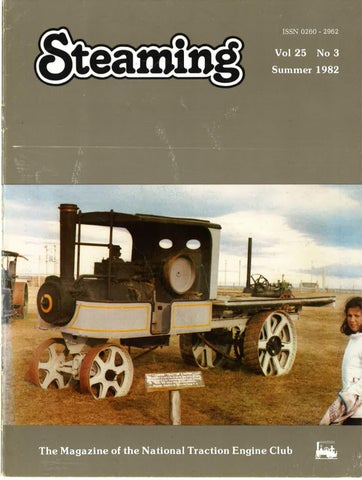
Cover A Mann's Steam Cart and Wagon Co Ltd steam wagon in preservation at Punta Arenas, southern Chile. Some further details are within the article on page 133 of this issue. (G. R. Bazuin) 103
Maul 'Ll2w7o Engine Owners Column Dominion NTEC Policy For the benefit of engine owning members we are detailing at some length elsewhere in this issue, courtesy of Messrs Tennant Budd Ltd, full details of the above policy.
Engine Owners Committee The Engine Owners Meeting advertised in the last edition of Steaming was duly held on 24th April 1982, at the Royal Station Hotel, York. I was supported by three other members of the Engine Owners Committee — Nicholas Barker, John Hirons and Jack Wharton — along with Anthony Heal (vice President) and Sylvia Berth- Jones (minutes). Forty-six engine owners from all over the British Isles attended. I was pleased I was not the only one doing the talking, for many questions were asked from the floor; some were answered immediately but others will be cleared in due course through these pages. The only direct complaint received was that the meeting was too short. It was pleasant to meet engine owners I would not meet at rallies I usually go to.
Coal As promised in previous issues of Steaming, we can now list local steam Coals, by courtesy of R.J. Siddal of the NCB's North Nottinghamshire Area. These coals have been chosen, after consultation with other National Coal Board regions, for their hardness, their size and free steaming qualities. area/quality
size
group
MIDLAND Shirebrook cobbles 100 x 50 2 Thoresby Hard cobbles 125 x 50 2 Linby cobbles 2 150 x 50 Daw Mill large cobbles 200 x 13 2 Coventry large cobbles 200 x 13 2 YORKSHIRE Fryston large cobbles + 75 2 Markham Main cobbles 100 x 63 2 104
Brodsworth large cobbles 200 x 100 2 NORTH WEST Leahall large cobbles 150 x 75 2 Littleton trebles 100 x 38 2 NORTH EAST Ashington cobbles 150 x 100 2 Lynemouth cobbles 150 x 90 2 Bates cobbles 2 150 x 90 SOUTH WALES Lady Windsor cobbles 150 x 69 1 Onllwyn Dry Steam 125 x 83 — SCOTLAND Comrie cobbles 150 x 50 3 Bilston large cobbles 175 x 75 2 Mr Siddal points out there are some other unlisted coals that may be as good. For further information interested parties should contact the Area Marketing Manager at their local National Coal Board Area.
Tachometers Although not directly to do with steam engines, many engine owners have enquired whether they need tachometers in the cabs of tractor units solely used for low-loading the owner's steam engine. I can only give my unqualified interpretation of the law (albeit concurred with by my local police and vehicle testing station) and must cover myself by advising a check with your local sources. According to investigations, one is exempt from having a tachometer in a lorry used for the above mentioned purpose. The application form for plating should be accompanied by another entitled 'Tachometers — declaration of exemption'. There are two exemptions; (i) privately owned and used vehicles, and (ii) vehicles used in connection with cultural events. The latter is the exemption used for horseboxes; if a horse is cultural, then so is a steam engine! Quite rightly, but strangely enough, all the police and Department of Transport contacts I spoke with agreed with this interpretation.
Living wagon and living van insurance I am thankful to Colin Brothwell for raising a problem that may affect many engine owners who tow living accommodation behind an engine.
Colin insured his living van with Dominion through Tennant Budd Ltd, on an 'all-in caravan policy'. Although disliking terminology such as 'caravan' and 'motor car' his main concern was a clause under the contents section which stated if the van was left unoccupied for more than 24 hours off the insured's permanent residence or a supervised caravan site, the cover was suspended until the van was occupied again. Like many owners Colin does not have room to park at his home, so he tried a supervised caravan site with a full time warden. The answer was quite plain — no! There is a world of difference between a caravan and a living van and the weight of the latter would, understandably, not be tolerated. The van is normally kept at a farm but under the terms of the policy the contents would not be insured while so parked, nor whilst it was left on a rally field before or after an event. Mr K.E. Barker (joint manager, Non-Marine Dept of Tenant Budd Ltd) has been helpful in categorically stating in writing 'if any fixtures etc were damaged or removed from the living van, then such matters would be dealt with by a claim under the insurance with Dominion'. He does state however that if there were additional contents which would be regarded of any value, insurance cover should be provided under a householders comprehensive (contents) insurance, or a separate all risks insurance (for anywhere in the UK). So to summarise: if you are in the habit of keeping in your van brass road lamps, brass plates or your Crown Derby china, an all-in caravan policy with Dominion does not cover these items. If in doubt contact Mr K.E. Barker at Tenant Budd Ltd, Tonbridge (see rear cover). Whilst on this subject Mr Barker pointed out there are fire regulations concerning the presence of coal burning stoves in living vans and similar living accommodation. He has suggested that it would be very advisable for those with such stoves to contact their local Fire Officer (at the local Fire Station), who would be helpful in suggesting useful and inexpensive ideas to prevent fire. Dominion Insurance are preparing an endorsement for living wagons/vans to permit the use of a coal fire, but will insist in future that the presence of a
coal burning stove would be on the understanding it complied with the sensible precautions recommended by the local Fire Officer. (M. John Wharton, chairman Engine Owners Committee)
Club Trophies 1982 The Dinner on Saturday evening at the recent York Convention provided an ideal occasion for presentation of the Club's trophies. The awards and citations were as follows. Arthur Napper Cup for traction engines David Hirst of Andover In recognition of his work in connection with the renovation of traction engines and taking them to rallies. Dacre Lacy Cup Bruce Ragsdale of Retford A major preservation award given to the recipient in recognition of the excellence of the engines he takes to rallies. Choisy and Simpson Cup Derek Rayner of York Often awarded for services to the movement or some specific aspect of it — as is the case this year. Derek is Chairman of the Road Roller Association and, of course, Assistant Editor of Steaming. Golden Film Shield George Beck of Loughton A major award usually given for long and faithful work for the movement. This year we take the opportunity of honouring a man who is still in office, but whose industry and devotion have done so much to secure the smooth running of our Club. Percy Hirons Bowl Howard Snowden of Morley and Jack Bradley Awarded in recognition of considerable work in restoring and presenting their Sentinel wagon. Jack Holloway Bowl Lyndon Shearman of Halifax When Jack Holloway of Seend gave this trophy he asked that it be awarded to the owner of a portable engine if this were possible. This year it is so, but we also recognise the long association with road rolling of Mr. Shearman. Eric Middleton Cup John Beeby of Rempstone The man commemorated by this trophy was a legend from the earliest days of steam preservation. So also is
the man receiving the award this year. We are pleased to be able to honour our retiring Vice-President whose name and fame is known throughout the entire preservation movement. Arthur Napper Cup for tractors Joe Duckitt of Pontefract In recognition of the restoration of his Clayton & Shuttleworth engine and his small museum which is of such interest. Curtis Bowl Mrs Dick Preston, Senior We must not forget the ladies and in awarding this trophy to Mrs Preston Senior we would like to thank her for the part she played in supporting her late husband and the help she gave to all members who visited or came into contact with them both. E.W. Edney Trophy Michael Clark of Leeds Often awarded, as it is this year, for services to the movement not necessarily as an engine owner. Michael Clark did much for the Fowler Works Memorial and was also a very successful rally stand operator for the Club.
Baker TocH Cup Tony Hunt of Harrogate Awarded to the Chairman of our host Affiliated Club whose efforts have done so much to make our York Convention a success. Tony Hunt carries on a great tradition of owners of showmans type engines with his support of all aspects of the movement. In awarding the trophy we also remember his wife Enid and mother Ivy.
NTEC Sales During the past year the executive committee has reviewed the club's sales activities. As members will know, we attend many rallies with a sales stand and offer a comprehensive range of publications and club items. We also maintain a mail order service to members. Major changes have taken place in
From Alan Martin's Collection
17
The photograph, taken in Great Yarmouth, shows Foden 5 tonner number 5380, new in 1915 to the War Department. It was probably requisitioned whilst building and it's crew also seem conscripts — with due respect to them they have little military bearing! The wagon has been registered LP9287 in London (somewhat irregularly displayed on the motion covers). After demobilisation it was with Universal Haulage Co at Tranmere, Birkenhead by 1921 and then from 1924 in showland use by John Ryan of Moreton, Cheshire. 105
The new membership form is being designed with similar ends in mind; again, supplies will available at all NTEC rally stands and members are urged to take a few and persuade friends or acquaintances to join the N I EC. (Stuart Gray — National Sales Officer)
The Rally List 1982
The NTEC Boutique range. Ties in navy blue, maroon or dark brown; white T-shirts with red logo and black lettering; sweat shirts in grey with red logo. For sizes and prices, see inside front cover.
the past three months, aimed at promoting the club and increasing public awareness of the NTEC. Firstly, we will continue to operate an NTEC sales stand, offering a very wide range of publications, etc. This sales stand is aimed at being larger than any before and will hopefully attend at least ten major events around the UK this year. A further six-club stands are operating this year, promoting mainly club items, and membership. We are hopeful of attending the majority of rallies in the UK this year. A large number of new club items are now available to members. A new T-shirt has been produced with the NTEC engine logo printed in red across the front. Most sizes are catered for, including childrens. Club sweatshirts have been produced in adult sizes, and a long awaited tie is now available in three colours. Just for fun we have produced a cloth badge for
The new brass plaque. The production batch include the 'smoke' from the chimney, as usual on the Club logo. 106
overalls/jackets etc., which features the club engine logo and the words 'Save Oil — Use Steam'. Other new items include two new members badges, a key fob, and a heavy brass plaque, of suitable appearance to adorn an engine. Full details of all items are mentioned on the inside front cover. I have now been able to look closely at the cost of postage and feel that some items will unfortunately continue to require a contribution toward cost. However, most club items can be offered post free, except where stated. Finally we will very shortly be producing some new publicity material for the Club — a display poster in colour and a revamped membership application form. The poster is intended to promote the Club where potential members are likely to gather — rally fields, steam railway centres, industrial museums etc. We shall be relying on our membership in general to help find suitable places for these posters and if you know of any likely sites, please take posters from any NTEC rally stand, or contact me at 60 Harbour Avenue, Comberton, Cambridge CB3 7DD. I must emphasise that colour posters are relatively expensive, so they must be used carefully for definite sites and have a reasonable life expectancy. Don't put them up or leave them if you suspect they will be removed the next day, or let them go as souvenir decorations. The aim is to increase membership and so increase services to members and push any increase in subscription well into the future.
The following rallies have now made known their dates, and should be added to the list of NTEC Approved Rallies published in the Spring 1982 issue of the magazine. 17th/18th July — Masham Steam Engine and Fair Organ Rally, Low Burton, Masham, Yorkshire (30-45 engines expected"). W.A. Wise, 8 Leyburn Road, Masham, North Yorkshire. 17th/18th July — Hallam's Steam Traction Engine Rally, Burton-on-Trent, Staffs (up to 15 engines expected"). D. Hallam, The Firs, Draycott-in-the-Clay, Sudbury, Derbyshire. 7th/8th August — Alderholt Steam Rally, Plumley Farm, Somerley, near Ringwood, Hampshire (15-29 engines expected). R. C. Hood, Camel Green, Alderholt, Fordingbridge, Hampshire. 14th/15th August — Southwark Heritage Fayre, Peckham Rye Common, London SE15 (up to 15 engines expected"). R. Blanchard, 46 Clifton Crescent, Peckham, London SE15. 14th/15th August — Tyne & Wear Steam Engine Rally, Churchill Playing Fields, Whitley Bay (up to 15 engines expected"). Tyne & Wear County Council, Blandford House, Newcastle-on-Tyne.
Steaming Photographic Competition The attention of camera enthusiasts is drawn to the Steaming 1982 Photographic Competition, the initial details of which are set out elsewhere in this issue. We hope many readers will consider entering this competition.
Affiliated Clubs Liskeard Steam & Vintage Club We welcome into affiliation with the NTEC the above newly-formed Club. There are some 80 members. The chairman is Mr A.T. Hooper and the secretary Mr L.C. Baker, 15 Pengover Green, Pengover, Liskeard, Cornwall PL14 3NH, from whom details of local meetings can doubtless be obtained.
Obituaries Victor Richard Garrett Victor Garrett, the eleventh child of Frank and Mary Garrett of Carlton Hall, Saxmundham, Suffolk, was born on 21st October 1887. After education at a private preparatory school at Felixstowe and at Rugby he took is College, Pembroke at degree Cambridge. Initially intent upon a career in the Army he suffered a major illness which ended his incipient career as an officer and sent him to South Africa to recuperate. On the voyage out he met is future wife, Gladys Fisher, a South African girl returning from a visit to Britain. After some years in Johannesburg, mostly with the importing firm of Hanson & Schrader, he returned to England, married and took the post of manager of the firm of Cardinal & Harper, the Bond Street (London) carpet importers. During the 1914 war he joined the East Anglian Purchasing Commission of the Ministry of Munitions and on the death of his brother Stephen in 1916 returned to Leiston as a director of the family business, a connection continued until 1932. In 1926, at the suggestion of his elder brother Col. Frank Garrett, he was asked to undertake the task of salvaging the near bankrupt Eddison Steam Rolling Company. He expected this to be a short term appointment but in fact he spent the rest of his working life there, retiring in 1947, when Eddison was bought by Edward Barford, his cousin. He represented Garretts on the Society of Motor Manufacturers & Traders and, more importantly, was a joint founder and, for several years, chairman of the Road Roller Owners Association. Victor was a very forceful, and sometimes stern man; wise and
extremely witty. As a young man he was a good amateur boxer and excellent rugby player, narrowly missing his blue at Cambridge. He was also a good shot with a sporting gun but laid aside the pursuit because of his interest in ornithology. He was the last Garrett to have any connection, as a director of the firm, with traction engine building and had a considerable, though unsentimental interest in steam. In the early days of Agricultural & General Engineers (to which Garretts was joined in 1919) he was head of its central buying office but he soon condemned the idea as unworkable. He was, very sceptical throughout of the value and intentions of AGE and distrusted its last chairman Gwilym Rowlands. His death on 30th October 1980 removed one of the last direct links with the famous traction engine building families. He was perhaps the last man left who had by reason of his great age and family connections, known, on equal terms the men we now look upon as the giants of an increasingly distant past. He gave much help and practical support to me during the writing of my two books on Garretts and those dealing with the road rolling trade, providing me with introductions to people and places which otherwise would have remained unapproachable. Fate decreed that most of his life was to be spent away from Suffolk but he never lost his affection for the place or the people. He was, indeed, a very notable man and his passing is a great loss. (P.A. Whitehead)
J.W. (Jack) Hampshire
The ever-thinning ranks of steam men who bridged the gap between professional operation and the preservation movement was further depleted at the end of April with the death of our member Jack Hampshire. To the present generation of engine owners and enthusiasts, Jack is best known for his factual and humorous writings on the steam experiences of his early years. Yet he did not start writing until late in life, being one of those gifted and likeable people with a wide range of talents outside his technical expertise. Jack was born in 1899 at Cowes, Isle of Wight. He was first 'bitten by the steam bug' as he would have expressed it, at the (tender 7) age of three — when he was given a ride in the tender of a steamroller. His father bought a portable steam engine and sawbench while Jack was only seven; a situation said to have been brought about by Father scratching his nose at a critical point in an auction sale! The family home then moved to Alfold in West Sussex where a flourishing sawmill and haulage contracting business was built up, ultimately employing 175 men. As soon as he was old enough, Jack was sent to a neighbouring engineering concern, Carter Brothers of New Pound, near Billingshurst, to serve his apprenticeship. His days here and the wild pranks in which he always seemed to play a leading part were vividly brought to life in his first two books published during the 1960s, / Worked with Traction Engines and Apprenticeship in Steam. However Jack had a second love, the sea, and at the age of 17 enlisted in the Royal Navy. His first break with traction engines was short, for two years later when hostilities ceased he joined the family business. His brother Cyril, ten years his senior and another true man of steam, assumed charge but a decline set in and in 1929 the firm closed down. Jack returned to the sea as an engineer in the Merchant Navy, but not before tie had enjoyed a brief spell on the footplate of a railway locomotive during the general strike. In 1940 he came home to work of national importance, erecting sawmills in Kent and Sussex for the Home Grown Timber Commission. He then moved to Arundel where he was in charge of preparing the Fowler ploughing engines of James Penfold for use in 'Operation Pluto'. Here he met his wife, Peggy Phillips. After the War they both went to sea — Jack in the engineroom of a steam tug and Mrs Hampshire as a stewardess on the famous Cunarders. When Jack 107
retired they moved to the Isle of Wight, living for a time on a steam yacht and later in a bungalow overlooking the sea. Jack's entry into the preservation movement began with a chance invitation to drive a Fowler ploughing engine on a cultivating job, bringing him back into a world which he thought he had left behind. The heartsearching this produced is well described in the unpublished MSS of his last book Memories of Steam Rallying which he was working on up to the time of his death. The account of his first rally as mate on the 5hp compound Burrell traction engine BRITANNIA is hilarious. It was this engine which gave rise to his many friendships in Cornwall when he accompanied it on a 300-mile journey to attend a Camborne Rally. How this trip was bedevilled by leaking tubes such that when the rally field was reached BRITANNIA could scarcely move is one of the most hair-raising engine stories of all time! But Jack was never beaten. While the owner was at his wits end about getting the engine home, Jack calmly decided to arrange a spot of leave from his tug, retube the engine where it stood and drive her home himself — which he did! Jack could not resist the challenge of restoring a rusty hulk himself. Learning of a 5-ton Foden tipper in an East Anglian scrapyard he bought it and then carried out a characteristically thorough and painstaking restoration, working almost entirely single-handed. About the only job not done on the wagon was re-boxing, but this job became necessary after a few years of rallying. Again Jack carried out the job himself, though by now well past 70, with the aid of a friendly engineering works who allowed — nay encouraged — him to use their facilities. Named PEG O'MY HEART after his wife and 'steersperson', the wagon will continue to attend rallies and local events in the Arundel area as a tribute to Jack's skill and devotion. To know Jack, as I was privileged to do so for only a few years, was to be constantly amazed at the variety of his talents and the wide circle of friends gained through his writings. He was an accomplished guitar player and entertainer in a concert party group; and he could also paint. He once executed a mural, if that is the right word, inside the dome of the control tower at Shoreham Airport depicting planes flying overhead. It was a really tricky task getting the perspectives right on a concave surface but Jack had them just right. Through gaining penfriends all over 108
Burrell showmans engine MAJESTIC (3890 of 1921) basks in a few moments of sunshine and reflects on the weekend's weather conditions at Stourpaine 1981. (Roger West)
the world, Jack was elected to life membership of the Traction Engine Vintage Club of Timaru, New Zealand, and of the International Brotherhood of Live Steamers in the USA. He was also an honorary member of the Canterbury Steam Engine Club in New Zealand — a place he always wanted to visit. Being a perfectionist himself, Jack did not 'suffer fools gladly'. His last book, which it is hoped to publish in due course, contains amusing references to the antics of novice
steersmen he took on his wagon, but never derogatory. He was an outspoken critic of many industrial practices of today, in particular the activities of certain trade unionists and politicians. In recent years Jack and Peggy lived at Cross Bush near Arundel. Being on the main A27 south coast road their house became a favourite stopping place for steam enthusiasts from a wide area — with or without their engines. My memory of Jack will
always be of him seated in his favourite arm-chair, with a blaze of engine brasswork over the fireplace, telling with twinkling eye some of those racy stories which somehow never seemed to find their way into any of the books. Ask him any question relating to steam, and you would find yourself dealing with a oneman Brain's Trust! Jack's engineering expertise combined with a rare ability to communicate have become a legend. He is irreplaceable.
(Kenneth Brown)
William Frank Jeanes It is with sorrow and regret that I
write of the death of William Frank Jeanes, known to all as Jed. He passed away peacefully on 17th April 1982, aged 74 years. It was not known until the last weeks of his life that he had cancer. All his life was rallied around steam; as a boy he ran away from school to join a ploughing engine team and from then on he was either ploughing or threshing with his beloved engines. Until modern tractors took over, his ambition was to have a steamer of his own and this dream became reality when he acquired 76116 roller steam Marshall (YA5040), which he named MAID MARION. Unfortunately he later had to sell her due to space problems. In 1973 he acquired his beloved AvelingBarford roller 14184 ILS3967), this to be christened HEILAN LASSIE. She was his pride and joy. Jed also made fame with his bee skep making on the 'Down your Way' radio programme and on television. He will be missed by all his friends, and deeply so by his daughter, his son-inlaw and grandchildren and his wife Joyce. (Mrs F. Stevens)
Arthur Pethick
One of the outstanding enginemen of the Cornish steam traction and road locomotive era, Arthur Pethick of Redruth, has died aged 91. Born at Sticker, he was introduced to steam when he worked with his father on threshing, and he drove his first traction engine in 1903. He joined S. & T. Trounson Ltd, of Redruth, who ran Foden steam wagons, and soon gathered considerable practical knowledge about steam. Mr Pethick volunteered for the Army in 1916. Turned down on medical grounds, he was afterwards quickly accepted when his capabilities as an engineman were known, and for 18 months he prepared a wide range of steam engines for war service.
He became a staff sergeant and a sergeant major, and ran the Woolwich workshop with about 1,000 vehicles. When, in 1919, he returned to Trounsons, where diesel and petrol lorries were replacing steam, he was placed in charge of the garage and machinery. He helped rebuild a vehicle as Redruth's first motor ambulance, and to convert a horse-drawn Merryweather steam fire engine into a motor-propelled one. Mr Pethick became the Redruth Volunteer Fire Brigade engineer. With World War 2 he was appointed fire transport officer for West Cornwall. He later suffered ill-health, but in 1949 set up his own garage at Plain-anGwarry, Redruth, with his son, who now runs it. Steam was still his interest. In 1953 'Art', as he was known, took the controls of GLADIATOR, the 1909 Burrell showmans road locomotive bought by local enthusiasts, and drove it from Exeter to Redruth. He played a major part in the restoration of the outstanding engine and drove it for years. Arthur Pethick was mar►ied for 60 years. His wife died in 1971. A funeral service at Redruth Methodist Church was attended by many people actively associated with (Barrie Bennetts) the 'steam world'.
John Arnott-Brown We regret to record the death in early June of John Arnott-Brown, at the early age of 36, the result of a road accident. John has been a leading member of the Rally sub-Committee for some years, being initially elected to represent the Rally Organisers. He has done much hard and valuable work for the Committee behind the scenes, including visiting many approved rallies during their events and offering advice on safety and various other matters in an understanding and professional way. John was involved with the organisation of many rallies some ten years ago, firstly in the north around his native Newcastle, and later in southern England too. The experience so gained enabled him to speak with authority, often on the theme of public relations, at many Rally Organisers Conferences. His flamboyant and articulate speeches were not always totally agreed with by those present, but few would deny they were pertinent and soundly based. John's good work and good humour will be sorely missed. We send our sincere condolences to his widow and young family.
Bramham Park Traction Engine Rally 28th, 29th and 30th August 1982 near Wetherby, Leeds OVER 30 ENGINES
Working demonstrations including for the first time on a rally field, tar spraying and rolling (pro visional). For the rally weekend stay at the
ladbroke Mercury Hotel Leeds Road, Wetherby
(5 minutes from rally) This attractive well appointed hotel is ideally situated for an overnight stay when visiting Bramham Park. For this weekend only, a special rate of £10 per person per night (inc VAT and breakfast) is offered for guests sharing a twin bedroom with colour TV and private bath. Telephone 0937-63881 requesting 'Rally Weekend Rates' when making your reservation Organised by the Leeds & District Traction Engine Club
109
fine
b Orin%
from watercolours by John Hancox
The National Traction Engine Club has commissioned two watercolours by the highly acclaimed traction engine artist John Hancox — his first published watercolours. The prints are produced on Fine Art Paper and measure 455mm x 340mm (18in x 131/21n). Each print comes in it's own protective cover, and if sent by post is packed in a card postal tube. One print is of a Fowler road locomotive and the second is of a pair of Fowler ploughing engines. They are available from NTEC Club Stands at rallies at £1.65 each, or by post at £2.65 from NTEC Sales (see inside front cover).
110
Rochester Pilgrimage
The incidence this year of the 100th anniversary of the death of traction engine pioneer Thomas Aveling provided an excellent occasion for the belated recognition in the town of Rochester, Kent, of his work. With Aveling's early work on the development of mechanical road rolling, and his firm's pre-eminence through many years in the building of road rollers, it was entirely fitting that the various events held early in March should be arranged by our sister organisation the Road Roller Association. And a very well organised and comprehensive weekend it turned out to be. This is not the place to chronicle, even briefly, Aveling's work — that, indeed, is adequately covered elsewhere including two booklets recently by the Road Roller published Association to co-incide with their Rochester commemoration.* The idea behind the celebration of the anniversary was the erection of a permanent plaque in memory of Thomas Aveling and his works, which in the past must have been so much a part of the lives of the Rochester and Strood townsfolk. No real indication of the historic nature of the Invicta works had previously existed to the passer by. Further, it was intended to echo Aveling's funeral cortege from his Rochester home to the church at Hoo
St. Werburgh (the nearby village he had come to from Cambridgeshire at the age of 12) with a road run of
typical Aveling engines. Other events planned included a walk round the city viewing items of Aveling association, a small exhibition in the local museum, the previously mentioned publications
'...Our streets, like those of the Metropolis and of no end of large towns and cities, resound with the clatter of these steam rollers which if noisily, still effectually accomplish such a great deal in the improvement of public roads.' An affectionate tribute to Aveling's steam rollers in the Rochester and Chatham Journal following their makers death in March 1882. The 10 ton roller illustrated dates from 1875 and shows the infamous conical front rollers which proceeded with a semiskidding motion.
recording Aveling's death. The loss was not merely that of a fellow
councillor but of a highly regarded citizen; '...he was a man who in the highest degree showed his earnest desire to be occupied in the furtherance of all good and useful enterprises' and '...as founder of a large
and, finally, the AGM of the
business carried on in 'the City and
Association at the erstwhile Invicta works. Thomas Aveling died on 7th March 1882 and the 1982 calendar obliged very conveniently, the events taking place on the weekend of 6th and 7th March, with the run to Hoo on the Sunday. The organised proceedings started on the Saturday morning when a group of two dozen or so enthusiasts left their weekend base at the historic Royal Victoria and Bull Hotel to visit the Guildhall Museum opposite, where two showcases displayed a selection of items appertaining to Thomas Aveling and the Strood works — models, photographs, catalogues, bills etc. There has, apparantly, been no previous display to mark this industry in the town and it is to be hoped that some at least of the items can be retained on permanent display amongst the strong maritime and Dickens representations. The Council minute book on display had been opened at the pages
now possessing a world wide reputation he was distinguished by his energy and capacity and the same qualities were conspicuous in his faithful discharge of the various public engagements which in addition to these heavy responsibilities he most generously and devotedly undertook.' Local„papers were similarly eloquent and they chronicled Aveling's passing with 'profoundest regret' and the sad loss was 'felt not alone by the family circle and social coterie; it falls on the whole community.' Thomas Aveling had died at the early age of 57 on contracting pleurisy after a sailing trip. He was a keen yachtsman and sailing barge race enthusiast. After the museum visit, there followed a walk around Rochester — 'The Aveling Trail'. RRA chairman Derek Rayner, noting that the strong
*See our feature Books, and also Small Ads.
111
111111411, Play Avei
SE-even The. Steo.vn roller A man walled Thomas Had dreo.kr, 0.loomt o. 9t tat Iron PoWeVti bij it Fro.tteitivii towns and made 5o.ved tkt Wohifit Fhttn hat frail d tiol .1/4 e. cr. tot e et 0;itv the 1104 chi to w41 L;o paid the Ply Wheel w;11 0-round
T h0maS
Crcul
connections between Charles Dickens and the town had resulted in a Dickens Trail for tourists, felt enthusiasts should be similarly enlightened. A short walk to the Esplanade revealed the erstwhile works of Aveling & Porter Ltd across the River Medway at Strood. Then, passing through the Castle Gardens, there were two stones inscribed with Aveling's name to be seen. He had been Mayor of the City in 1869 arid it was during this term of office that the Gardens came to be laid out and opened to the townsfolk. Unfortunately, the statue of him, proposed immediately after his death, did nol come to pass. Another short walk brought the growing group to Boley Hill House, Aveling's home for many years and the place where he died. The present owners, Mr and Mrs Halpern, were kind enough to allow access to the reception rooms. The rooms have been beautifully maintained in their contemporary style of furnishing and decoration, and it was a rare treat to be able to stand and visualise the Victorian engineer at ease in his family surroundings. Other places of interest were the house once owned by Stephen Aveling, a cousin of Thomas and also in the firm; the site of the Mathematical School where two Aveling
The flag flies at half mast on Rochester Castle as Aveling 14072 makes its way to the start of the commemorative run. The gardens of Boley Hill House border the pavement on the left. (Roger West) 112
,,L4.
Pupils of Hoo St. Werburgh County Primary School had lessons on Thomas Aveling and steam rollers in the weeks before the RRA event. Here we have Craig's commendable illustration of Aveling's early efforts and Steven's tribute to his invention.
I
scholarships were founded in 1883 in his memory, and the New Corn Exchange, another town development which he was instrumental in arranging during his period on the City Council. The present owners of the former Aveling & Porter works are Winget Ltd (manufacturers of concrete mixers and construction plant) and the firm were extremely accommodating in allowing the Association's AGM in their works canteen on the Saturday afternoon, and indeed, in encouraging the whole weekend's events. Secure overnight parking was available for engines taking part in the next day's run, and a brief impromptu tour of the old Aveling buildings was made after the meeting. This revealed the former erecting shops — now empty and derelict — and the former service pit where the engines stood after their steam and road tests. Also seen was the only piece of machinery dating from Aveling days; a large belt driven face plate lathe originally used for turning rolls. It was built by Butler of Halifax, allegedly about 1890, and having stood idle since Avelings ceased business at Rochester in 1932 (Wingets moved in from Warwickshire two years later), it was moved some years ago to a newly built part of the premises and adapted for turning large concrete mixer drums. The expansion in recent years of Winget's works, across several creeks of the River Medway, some now filled in, brought home to the visitors the large reserve of land that Avelings had had the foresight to build up over the years for future expansion. A very large framed plan of the works and the land owned, drawn by Avelings about 1923, was presented by representatives of Winget into the care of the RRA. Bob Whitehead, well known road steam author and historian, regaled many members and friends with an excellent illustrated talk in the Hotel on the Saturday evening and, as usual, made those present think of the engines depicted on refreshingly different lines.
RRA chairman Derek Rayner contributing a few words at the plaque unveiling. The pedestrian steps from the Medway bridge appeared in the background of many later 'official' photographs of engines and would have daily resounded to the footsteps of arriving and departing workers. (Roger West)
Aveling's old house and turn down Boley Hill, an impressive scene with the Castle on one side and Rochester Cathedral on the other. At Aveling's funeral in March 1882 two hundred of his employees had lined this route from his house and other bystanders had crowded the rest of the town — 'never before has a citizen of Rochester had the power to
draw such large crowds...' the local newspaper reported. The cortege passing the closed shops consisted of 37 carriages and by the time it reached Hoo for the church service it had grown to 54, but Aveling's loyal workforce, perforce on foot, couldn't keep up with the carriages on the five mile journey and missed the service, only arriving in time for the interment.
HANG
THC.1m.
— ra rjr FUIN ME:J.0E11AL '044`i
TUC RoAr)
F.
AtisociAtioNt. N.
OTHER f;TLAM CNI1411SIANT UN Ifir NEATN OE T.NOMAS
AVELINI;. iii;61N4
NA -•
FUNtri.
AYELINri ANP
The Sunday proved a bright sunny day, albeit rather cool. Engines invited for the run asembled in Minor Cannon Row, a stones throw from Boley Hill House, ready for an 11.30 start. As it had on the day of Aveling's funeral, the flag on the Castle Keep flew at half mast. A considerable crowd of locals and visitors watched the procession of eight engines pass the gates of
I'Nv EiLEN 1.11114: kIND .i'Ffikfc:;11.W" W, Nm:?
‘.1
CooNciLog. F.
Iliq;ursTER UFOS 1Y11'1?,NAI% MANE,
The memorial plaque unveiled at Strood in 7th March 1982 and now affixed to the old Aveling premises. (Roger West) 113
Aveling 6hp convertible 5800 against the background of Aveling & Porter's offices which it had probably never seen before — they were erected in 1906, the year after the engine. The public house previously on the site features in works photographs of earlier engines. (Roger West)
A half mile run over the Medway bridge brought the 1982 cavalcade to the works where the engines lined up in bright sunshine alongside the 1906 office buildings. The plaque is now permanently positioned on these buildings (with provision for its continued safety in the event of redevelopment) but for the unveiling it was mounted in a timber stand set against a background of the 1914 bridge over the river, a background which appeared in
many later Aveling 'official' works photographs. Councillor Reginald Cox, Mayor of the City of Rochester-uponMedway, performed the unveiling ceremony and Miss Elizabeth Aveling, one of the last remaining descendants hearing the family name, presented to each of the engine entrants a commemorative shield donated by Aveling-Barford Ltd. After a lunchtime break the engines were whistled on their way to
Engines on the Centenary Run Aveling 1760 of 1882, 10 ton single roller owned by Aveling-Barford Ltd, Grantham, Lincs. (low-loaded and not in steam) Aveling 51 56 of 1902, 10 ton compound roller owned by B. Hope of Maidstone, Kent. Aveling 5800 of 1905, 6hp compound convertible traction owned by M. & P. Abbott of Hampshire. Aveling 8809 of 1917, 4hp GND compound tractor owned by A. Day of Maidstone, Kent. Aveling 10043 of 1921, 10 ton single roller, E type owned by C. Jones of Sittingbourne, Kent. Aveling 10271 of 1922, 10 ton single roller, E type owned by B. Smith of Sittingbourne, Kent. Aveling 11093 of 1925, 8 ton compound roller, D type owned by I. Bennett of Tadworth, Surrey.
Avelino 14039 of 1930, 10 ton compound roller. AD type owned by J. Price of Tonbridge, Kent.
Aveling 14072 of 1930, 10 ton compound roller, AD type owned by L. Birch of Sellindge, Kent. Aveling-Barford Master Pavior roller of 1982 exhibited by Aveling-Bar ford Ltd. 114
Hoo St. Werburgh by RRA president Lyndon Shearman. Leaving the riverside the engines tackled the long climb up Frindsbury Hill; it was here that new engines were often sent from the works on test. Much of the remaining four 'Idles of the run was through somewhat uninspired environment — the 1882 mourners would have been hard pressed to recognise the 1982 suburbia and a countryside of by passes, roundabouts and dual carriageways. Thomas's spirit, however, would doubtless have appreciated the good roads, and the rollers passed at road works on Four Elms Hill — the latter were still to his basic three point conception, even though powered by internal combustion. The Isle of Grain, towards which we were now heading, supports vast oil terminals and a huge power station, and Hoo St. Werburgh is a modern sprawling village, but its Church Street ends in much the same tranquil way that it must have done for centuries. Here the engines came gently to a halt in the shadow of the churchyard trees and were surrounded by what seemed to be the whole population of the village. Hundreds clustered around and watched as Lyndon Shearman laid a wreath — carried by the 1882 roller — on Thomas Aveling's newly restored gravestone, and the vicar said a suitable prayer. Tea and cakes in the church brought the proceedings to an end.
This very different kind of steam weekend was much enjoyed by all present, and no doubt introduced the preservation of steam engines to many who hadn't cared before. All in all a fitting tribute to Thomas Aveling.
ON 13011ER CONSTRUCTION AND REPAIR Fig 13 — New firebox for a Garrett tractor. The wrapper plate is thinned and bent to fit the foundation ring at the corner positions.
Continued from page 27 of the Winter 1981/82 issue.
Michael Mason (drawings and photographs are by the author)
Riveting repairs — Practical considerations Where a damaged or badly corroded section of boiler plate is to be replaced the first job is to remove the existing rivets. This should be done carefully to avoid damage to rivet holes in the section being retained. Rivets can be removed by drilling and punching, but drilling and gas cutting can prove less tedious. The rivet head, or what remains of the head, is first removed by cutting and grinding flush with the plate. This determines the position of the shank. Steam engine manufacturers did not always produce rivet heads which were concentric with the shank! After drilling a pilot hole through the shank careful use of the gas cutting torch will enable the removal of the rivet material. The technique involves heating the side of the pilot hole to cutting temperature and using the cutting oxygen to blow the molten metal clear of the hole, working outwards from the centre. Once the remaining rivet material becomes red hot it is usually possible to punch this clear, Fig 12. If punching is not possible then the remaining metal may be removed by working with the gas nozzle further away from the rivet once cutting has commenced and moving from side to side to 'wash out' the material in contact with the side of the hole. With practice this
technique can be used on foundation rings without drilling a pilot hole since it is only necessary initially to remove that part of the rivet passing through the casing plate. The method described above should only be used by competent operators since overheating or damage to boiler plates can easily be caused. The plate section remaining should be lightly ground to remove scale, surface defects and work hardened material on the caulking edges, Fig 23. The area about the rivet holes should be carefully examined and if necessary
A — cut off head and grind flush
Fig 12 — removing old rivets
crack tested using dye penetrant or magnetic fluid. Any repairs or minor building up can then be carried out after consultation with the insurance surveyor. The importance of fitting new platework cannot be over emphasised. Accurate fabrication is particularly important at foundation ring level to ensure a snug fit at the corners (Figs 13 and 21). Where flanged plates are fitted, eg a front tubeplate, they should be a 'knock in' fit and should be clamped in position before marking and drilling. New rivet holes must be
B — drill through shank
C — cut out shank
D — punch out 115
Fig 14 — Firebox and foundation ring bolted in position for riveting.
Fig 15 — Straight and spiral flute bridge reamers and countersink bits.
Fig 16 — Final reaming of rivet hole.
Fig 17 — Placing rivet with tongs.
Fig 18 — Rivet being closed by hydraulic machine.
Fig 19 — Final de-scaling of rivet before placement.
116
the from located accurately corresponding holes in the existing plates and should be drilled well undersize to allow for final reaming in in diameter rivets the position. For in holes should be 44 in to take diameter temporary bolts. Holes can be marked in position by various methods. The author uses a bush with a pilot hole through the centre. This is used to guide a hand drill to mark the centre position. The new plate can then be removed and holes drilled on a machine. Alternatively the holes may be drilled in position using a heavy duty electric hand drill but this can be exhausting. When the new section is bolted up for riveting enough bolts should be used to ensure that the plates are hard in contact — Fig 14. Final reaming and de-burring of holes should be carried out using a boilermakers or bridge reamer and countersink — Figs 15 and 16. Considerable compressive forces are involved when a rivet cools from red heat to normal temperature. Temporary bolts should therefore be really tight and the holes reamed as riveting proceeds to minimise the effects of 'creepage'. The latter will only cause real problems if the initial fitting of plates is poor. Under normal conditions any slight misalignment of the undersize hole is easily corrected by reaming, although bolts next to the rivet will become loose due to contraction. A tool much mis-used by riveters in the past was the taper drift. As previously mentioned this can badly distort the holes and over-stress the plates. With careful fitting, marking out and drilling the use of drifts should be confined to alignment of holes prior to bolting up. The author has found that most riveting operations can best be completed in the horizontal position. The hot rivet can be placed using tongs and will remain in position until the holderon or squeeze riveter is operated, Figs 17 and 18. In other positions it will be necessary for the riveter to trap the hot rivet in position until the holder-on snap makes contact with the head. This is time consuming and can be hazardous for the person operating the holder-on if the hot rivet falls in his lap in a confined space. The riveter will find some difficulty in using a heavy No. 80 or 90 size pneumatic hammer in any position other than horizontal or 'downhand'. Rivet heating can be done by coke, gas or electric furnace or by direct electric heating. The latter method was much favoured in boiler shops and shipyards. With electric heating the rivet is held between copper jaws and a high current is passed through it at
Fig 20 — Method of holding-up foundation ring rivets. Holder-on is set at an angle using a 'shallow' snap.
in diameter x 34 in low voltage. A rivet will take approximately three minutes to reach white heat. The great advantage of this method is that the temperature colour can be accurately observed and the rivet de-scaled easily before it is removed from the heating machine, see Fig 19, and also Fig 2 in Part 1. The disadvantages of air-blown furnaces are (a) heavy scaling will occur on the rivet, making temperature judgement more difficult; (b) the highly oxidising conditions can easily cause burning damage to the rivets; (c) temperature control is difficult, and (d) much heat energy is wasted.
stud rivet heated in position
When using pneumatic equipment it is necessary to have a solid structure behind the holder-on. This can be the opposite side of the firebox, barrel or tubeplate flange, (Fig 201. In certain external positions it may be necessary to rig some form of framework fo,r this purpose (see Fig 10 in Part 1). For normal rivets the snap used in the holder-on is the cup head 'deep' type. In corner or other difficult positions it is not always possible to thrust directly in line due to lack of side clearance or the angle of rivet. Under these conditions a 'deep' snap would mark the plate before the rivet head is in
'shallow' snap used in this position
special snap for corner rivet
Fig 21 — firebox foundation ring corner — typital arrangement 117
contact all round. The remedy is to use a 'shallow' snap which will allow the head to spread slightly without the edge of the snap coming into contact with the plate, Fig 21. Corner rivets on firebox foundation rings can cause problems. The final shape of the head on the inside of the box is often a compromise between a countersunk and raised head. Good results can be achieved by using a 'shallow' snap specially ground to fit the 'V' shape of the box corner, Fig 21. A countersunk head rivet is placed in position and the head end only is heated using a gas torch. The holderon and special snap are then used to pre-form the head. The rivet is then re-heated, carefully placed to locate the pre-formed head and riveted over in the normal manner. The corner stud rivet is another design feature used by most manufacturers to overcome the problem of spacing at the corner of the firebox casing — Fig 21. The foundation ring is tapped to take a plain stud which is screwed tightly into the 'blind' hole. The projecting end of the stud is then heated using a gas torch and riveted over to form a head. The problem with this operation is that there is rapid heat transfer to the foundation ring. In practice however if the head is not completely formed in the first operation it is possible to reapply the torch for a few seconds to
bring the head back to red heat and rerivet. The secret of good riveting lies in the speed of operation. The shank of the rivet will only expand to fill the hole if it is at the correct temperature. In practical terms this means that a white hot rivet should be placed and closed within 10-12 seconds. When using a pneumatic hammer the formed rivet head should be in a dull red condition as the hammer is withdrawn. With hydraulic machines the same criteria apply, as the rivet material must be in a plastic condition during the application of the load, Fig 18. The results obtained using a hydraulic riveting machine are shown in Fig 22. The sections illustrated were cut from 4- in thick test plates riveted together with I in diameter rivets placed in 44 in diameter holes. The movement of the snap was completed in 0.5 second with an applied load of 30 tons. The length of rivet needed to fill the hole and form the head will depend upon hole size and length. A general guide for diameter rivets placed in 44 in diameter holes is given in the following table:total component or projecting plate length total length thickness of shank under head in 1+ ins 1+-111-ins 3+ ins
1i —1196 ins
4i 5j'g ins
Fig 22 — Top left and centre: sections cut from test plates riveted by hydraulic machine. Top right: section through cold rivet and reamed hole. 118
Due to rapid cooling it is not possible to completely fill a long hole in a foundation or firehole ring. As a general rule therefore it is advisable to ream the holes no larger than -3-2- in above the nominal diameter of the rivet. When the riveting has been completed the final operation is to make the joint steam tight by 'upsetting' the plate edges to close the small gap along the joint line. This is known as 'fullering' or 'caulking', and is achieved by means of special punches used in conjunction with hand or light pneumatic hammers. Prior to riveting the plate edges should be ground to an angle of 80°. The stages in caulking a seam are illustrated in Figs 23 and 24. If a good fit of components has been achieved then caulking will not be difficult. However, if large gaps are to be closed then there is a danger that over caulking and work hardening of the plate edge will cause subsequent cracking from the rivet hole and failure in service. Rivets properly closed should not leak and only very light caulking around the heads should be, necessary to seal the heads to the plate. Particular attention should be given to rivets exposed to flame contact. On no account should welding be used as substitute for caulking on a riveted joint. This practice of masking inherent joint defects by electric al e welding on riveted seams can be extremely dangerous and lead to sudden rupture. Some insurers do however allow seal welding on foundation rings and firehole rings. In the author's opinion this should not be necessary and in one case where a repairer attempted to use this procedure it was found that the firehole ring was a casting and could not be welded.
In conclusion I would say that of all repairs carried out on traction engines in the last 20 years, riveting has consistently presented difficulties both to amateur enthusiasts and to 'professionals'. Insurance company engineers never cease to amaze me by insisting on the highest standards of competence when welding is used during major repairs, but on the other hand rarely bother to inspect platework before and during riveting operations. With respect to the younger Surveyors it is doubtful whether they appreciate some of the points explained in this article. Nevertheless we must all surely be concerned that sub-standard work is being carried out, often disguised and then subsequently 'approved' by Insurance Companies.
first stage using flat faced tool
final finishing with light application of narrow faced tool
Fig 23 — caulking riveted seams
The Steaming PWtograpbic Competition The reason why Despite the large numbers of camera carrying enthusiasts seen at rallies and around engines appearing on the road, and the photogenic nature of their prey, few of the presumably acceptable results seem to filter through to Steaming for appreciation by a wider audience. It is of course black and white work we are talking of and, perhaps understandably, colour slide and colour prints are the medium most of our readers now use — and with such vividly coloured machines, why not? But black and white photography still has a place and the mood and spirit of steam is very often better caught in monochrome. We feel this spirit of steam engines
is rather lacking in today's pictures — a technically good portrait taken in optimum lighting conditions has its place of course, but we would like to encourage studies of a more atmospheric kind by means of our Photographic Competition.
The Theme The theme of the Competition will be 'The Spirit of the Traction Engine' and the brief is for photographers to capture that spirit in the steam road vehicle of today — perhaps to reproduce a scene of old, to rekindle the sight of yesterday's working engine or maybe to reflect its task today as part of our heritage and leisure interests. The subjects can be traction engines, rollers, wagons or showmans engines. Besides technically good quality in the negatives and the prints, the judges will be looking for authenticity in the surroundings and the engines — and human interest. These pictures may require the co-operation of owners and crews in their making, almost certainly skill and, probably, luck.
Entering The competition is open both to Club members and non-members. The winners will be selected by a panel of judges representing amateur and professional photography and traction engine historians. The competition is for black and white photography only — partly because it is not presently
Fig 24 — Caulking firebox seam using light pneumatic hammer and 'fullering' tool.
possible to reproduce colour within the magazine for reasons of cost. Details of judges, and of where to send entries, will be published in the next issue of Steaming, and the closing date will be 1st November 1982, well beyond the end of the rally season. Prints can be any size but 10in x 8in format is popular for competitions and it is likely to give the judges a good impression of your work. Brief details of the entry (which need not have been taken this year) and your name and address should be on the rear of each print: There will be no entry fees, but those wishing for their photographs to be returned to them should ensure they provide us with packing suitable for the prints' safe return, and the return postage. It is intended to publish the winning photographs and a selection of the judges with together entries comments and appraisal in the Winter 1982/83 issue of our magazine. Apart from this usage, the copyright of material remains with the photographer, and we reserve no other rights over entries. There will be cash prizes of £20.00 for 1st prize, £12.50 for second prize and £7.50 for third. There will also be three commendation prizes of NTEC Sales vouchers. As previously mentioned, the remaining details of entering the competition will be published in the next issue, but in the meantime you have the remainder of the rally and steaming season for getting some suitable pictures to use for your entry. 119
Roger West
Alive and kicking Its not quite true to claim that steam rolling is alive and well and living in India, but at least its alive and kicking.
Marshall 85946 out of use at Sasaram, northern India. Note the charpny (Indian wood-framed four legged cot or bed) slung under the front of the canopy — someone's sleeping quarters. The roller was new in 1930 and delivered through Calcutta Municipality. (Roger West) Aveling-Barford 6 ton roller 759 at work in a suburb of Howrah, Calcutta, in November 1982. (Bob Whetham)
Last Autumn I fulfilled a long desire to travel to India and see something of the country and its railways. The famous hill railway up to Darjeeling in the lower ranges of the Himalayas was of course a must; other steam railway visits were easy enough to fit in with any intinerary which we might have planned, but whether we would find road steam was a bit of an unknown factor. And although in the past India has imported steam tractors, road locomotives, wagons and road rollers it was almost certain that only the latter were still likely to exist in 1981. Many hundreds of miles of road travel by tourist coach seemed to be revealing no sign of steam rollers but plenty of diesel ones, including many made by Jessop of Calcutta, apparently to the well known post war Aveling-Barford design. But after some ten days journeying the reason for one of our lurches onto the soft margin of the highway turned out to be an Aveling & Porter roller. It was very abandoned at one side of the main road into Gwalior, near Agra, and causing motor traffic to steer off the central tarred strip. The roller was opposite a works department tarmac plant, had been dumped and robbed for some time, and bore no immediate sign of identity but was a slide valve compound 10 tonner of probably circa 1910-1915 vintage. A few days later, bumping along the Grand Trunk Road, my frantic noises announced further steam rollers to others in the party and the driver. This time two dumped in the garden of the Public Works Department bungalow at Sasaram, not too far from Patna in northern India and then, guided by the bewildered staff, two more behind other buildings. Two were Marshalls — 6 ton compound S type 85946 with water ballast rolls, and an unidentified 6 ton single S type with the familiar cast steel wheels. An Aveling-Barford 6 ton piston valve single bore a metal-plate fleet number 780 (which undoubtedly is also its works number; it was probably built in 19461. This roller too would have been quite at home on an English rally field as several of these water ballast rolled type are preserved in the UK. The fourth engine was built in India by Tata Engineering to Marshall design and probably from some Gainsborough built components, certainly the boiler and engine. Again probably a 6
Aveling-Barford 759 again; this photograph shows its roll sprinkler system to advantage. (Bob Whetham)
Marshall 62374 of 1913 standing out of use in Convent Road, Calcutta. Parked behind is an inevitable Ambassador, the India built Morris Cowley design which forms virtually half the country's motor car output. (Mick Dix)
tonner, the single cylinder machine with water ballast rolls looked very much a Marshall product, even to the design of its timber canopy, but the front roll was mounted in the cradle framing used on modern diesel rollers. All very interesting but still no sign of working steam — this quartet was firmly out of use — indeed one of them had a bed slung under its canopy and presumably has grown
to accept itself as someone's home. Opting out of an excursion to more railway loco sheds on Friday, 13th November proved, maybe predictably, unlucky. Whilst Celia and I were investigating the delights of central Calcutta, others found their way barred in the Howrah suburb of Bandel by road works complete with in steam Aveling-Barford 759 in attendance. Another of the Ruston design 6 ton water ballast roll type,
this post war engine represented the sole item of mechanical plant available. All the tarred stone was being moved in baskets and the local populace thronged the scene, weaving in and out of the male and female workforce on bicycles, by rickshaw or on foot, the womenfolk in very brightly coloured saris. Levelling the surface on Indian road works consists of the time honoured method of wiping a long string line across a sector from a fixed point and filling in or reducing the revealed hollows or humps. And with no limit on available labour this must be a most economical manner. Aveling 759 seemed healthy enough but it has to be recorded its roll sprinkler system was defunct, now replaced by a pair of young boys and upturned water buckets, closely following the wheels as they progressed over the sticky tarmac! This was our final day in India but fate had not finished with me. Onto our last tourist bus for the airport, and on a short cut within half a mile or so of the city centre hotel we had been in for two days, the headlights picked up steam rollers parked by the side of the road. More strangulated cries. Darkness precluded much investigation but three very oily Marshalls of elderly vintage were apparent, parked outside what turned out to be the Entally Workshops of Calcutta Public Works Department. Brief enquiry of the incredulous gatekeepers failed to reveal much more information and in the circumstances, that had to be that. Fortuitously friends were making a similar visit to India in January. A long and grovelling letter (and a copy of Steaming) was sent to the Engineer introducing Mick George and Mick Dix — not that it sufficed because on their arrival all office staff denied knowledge, but a carbon copy worked wonders with higher authorities and after the inevitable tea had been taken the freedom of the workshops was given. Here was revealed a yardful of semiabandoned rollers; some dumped, some under protracted repair. The third street-dweller of November was now, apparently, out working. A rickshaw ride to the suburb of Tangra found this unidentifiable single cylinder Marshall fleet number All standing at some road works, unfortunately out of use on Saturday morning. Not far away was A15, a Fowler single roller of the bolt on smokebox variety, dumped out of use. Several other rollers were glimpsed from trains elsewhere in India including one at work. 121
OUR MAGAZINE 25 YEARS AGO
Aveling 9122 standing in the yard at Calcutta Public Works Department's Entally workshops in January 1982. (Mick Dix) Henry Mr. of Marshall Gainsborough kindly comments on these observations. Marshall Sons & Co Ltd had a very strong presence in India, with a subsidiary company in Calcutta with offices and workshops, and branches in other large cities. Foremost in their production sent to India was tea plantation machinery • — only Davidsons of Belfast were competitors in this field — hut steam rollers obviously figured well in their exports. In the early 1950s Marshalls supplied 750 steam roller boilers, and the same
number of sets of parts, to the Tata company for assembly in India — locally called Tata-Marshall rollers. It can't be claimed that the rollers still extant in India are in good condition for mechanical things in India aren't like that, but some steam rollers do appear to be still doing the job they were built for and with some of the Marshalls coming up for their seventyth birthday they all reflect well on the British steam engine builders of yesteryear as well as their present owners.
Corporation of Calcutta, Public Works Department, Entally Workshops Al Aveling 9122 of probably 1920 Almost complete, some small parts missing A2 Marshall 62618 of 1914 One rear roll missing B4 Marshall 62009 of 1913 Tender missing — said to be under repair A10 Marshall — Front rolls off Al2 Marshall 52763 of 1909 Complete A20 Marshall — All rolls off A21 Marshall 62375 of 1913 Parked in street; complete A22 Marshall — Complete A23 Marshall 62374 of 1913 Parked in street complete A25 Aveling Complete
Single 10 ton compound 10 ton single Compound 10 ton single Single, about 8 tons 10 ton single Single 10 ton single Compound, AD slide valve series
We are grateful to Mr H. Marshall for details of the weight and year of indentifiable engines. They -were ordered from Gainsborough by Marshall's Calcutta branch for delivery to Calcutta Municipality and all painted green lined yellow lines. 122
The content of the July 1957 issue concentrated on rallying. The list of rallies to be held from July onwards numbered twelve and it is remarkable now that of all the names, only Kegworth survives — and that one is still held on exactly the same site! Rally reports indicate that flat racing was now frowned upon as dangerous, but tug of war between engines was still practised. Entrance to the forthcoming event at Woburn was to cost the princely sum of 2/6 (121/2 p). In the rear cover adverts Jas. White of Inverkeithing, Scotland offered Fowler single cylinder 22120 (what type?) for £140. But despite its 'firebox good — rubber tyres like new' the machine has not survived to present times. The required price of two rollers at £120 or £150 probably reflected that they still had value for commercial use.
'7hp compound road locomotive by John Fowler & Co, makor's No 11122, three speeds, in splendid condition, just fitted with two new road wheels, hind axle, crankshaft, flywheel, piston and rings, fitted with winding drum and new -1-" wire rope, pump, injector and water lift, all equal to new — £1550. 0. 0.' (An engine for sale in Phillips Monthly Machinery Register, June 1921. This A5 engine was supplied new through Phillips to F.E. Day of Coddenham, Suffolk in July 1908. It was later with Walters Bros of Blackwood, Monmouthshire.)
STEAM IN NEW ZEALAND •
Steve Durance
During the six months from December 1978 I was fortunate to be' able to spend six months in New Zealand studying their agriculture. Naturally the modern day farming scene took up most of my time, but I did take the odd day or two to sample the agricultural scene of yesteryear. The first steam engine I saw was a Garrett portable displayed at the Otamata Kauri and Pioneer Museum; it was reasonably complete and thought to be of 1906 vintage. The machine lacked any number plates etc, but stamped on the crankshaft was 29793 (If this is the works number it would put the date at 1912 — Ed). During January 1979, I travelled to the South Island and one Saturday afternoon my host took me to the Plains Museum, Tinwald Domain, Ashburton. Here all manner of interesting pieces of machinery could be observed — railway locomotives, traction engines, old tractors and vintage farm machinery. Being the owner of Marshall roller 57168, I was pleased to see single cylinder Marshall agricultural 59534. Also there was a smart Marshall
A line up of three very similar compound Robeys at a rally in New Zealand some years ago. They are, from the left, 28295 of 1909; 29857 of 1912 and 32701 of 1914. (collection Roger West)
portable (number 4483x, possibly a twin cylinder), Burrell compound road locos 2886 and 3165, Fowler agricultural 10590, McLaren compound road loco 839, Fowler agricultural 8270 and finally the boiler of McLaren roller 1679. In a nearby scrapyard were a pair of Clayton & Shuttleworth traction engine rear wheels, but alas, the rest was nowhere to be seen. On three other occasions I saw traction engine rear wheels mounted four on one axle to form jumbo sized heavy land rollers — one use for otherwise outmoded equipment. A couple of weeks later, I was taken to see Don Clarke's engines mentioned by Brian Berry in the Winter 1980/81 issue of Steaming. Returning from there I saw a very derelict Marshall single agricultural 58069 — she was, however, complete including the whistle and must have had a very hard working life judging by the condition of the gearing. I saw another similar engine, 56720, a few days later at Queenstown together with the remains of a very large Garrett portable. This had no flywheel or crank-
shaft and the number 2443 was stamped on the block. Whether this was the engine number or not I do not know. A few miles from Queenstown is Arrow Town and in the museum yard there, surrounded by other bits of interesting machinery, was a very early Robey portable, alas with no visible numbers for identification. During March, I returned to the North Island and went to see Mr Miles at Takapu — he owns single cylinder Marshall traction engine 38906 of about 1906. We had stood for a while in his farmyard, chatting about engines when he asked if I would like to see his other engine. I naturally said I would and we went a short distance down the road to a large timber built shed. Inside this was a splendid Davey Paxman portable (20428 of 1922) which drove the saw mill inside the shed. The compound engine was mounted on a rolled steel joist frame, to allow separation of the engine from the boiler. My next engine sighting was at Mr T.G. Telford's Pioneer Museum near Dannevirke; this was 1905 McLaren 123
Two engines at the Plains Museum, Tinwald — McLaren road locomotive 839 (on the left) and Fowler compound agricultural 10590. (Steve Durance)
compound traction engine 819. A week or two later, a visit was paid to the Museum of Transport and Technology in the suburbs of Auckland where a very extensive collection of vehicles, locomotives, trams, aeroplanes etc was to be seen. Road steamers included a smart Wallis & Steevens Advance roller 8006, McLaren compound road loco 1428, which had sadly been altered to oil firing due to firebox problems, a late type Aveling & Porter roller and a circular fireboxed Marshall portable 50276, the latter unfortunately minus cylinder block and motion. Two more portables were found at the Paeroa Maritime Park, the first being circular fireboxed Ruston Proctor 23494, the second a very derelict Marshall twin cylinder engine with the number 971 stamped above the firehole door. The Tokomaru Steam Engine Museum proved to be a fascinating place to visit because they not only had road steamers, rail steamers, steam cars and a Shand Mason fire pump, but also twenty odd stationary steam engines of all shapes and sizes.Colin Stevenson, the owner of the museum, showed me round. The road engines were 1929 Marshall tandem roller 85055, Aveling & Porter compound roller 8109, Fowler road loco 9890, an Aveling & Porter portable and a Garrett wagon chassis with boiler but no engine. At the beginning of May I went 124
back to the South Island to stay with Cam and Iris Quigley at their home in Hawarden, North Canterbury. Cam will be no stranger to readers of Steaming for over the years he has contributed several articles on the New Zealand steam scene. During the next week, Cam took me on a number of engine viewing trips. Our first was up to Logan Quigley's farm where we saw Cam's own engines — McLaren single traction 853 of 1907 and Foden compound traction 656 of 1903. Logan's engines were also to be found here, these being Marshall compound road loco 52609 and McLaren compound road loco 957, the latter engine is, unusually, fitted with rack steering. Next day saw Cam and I off to the West Melton rally, on the way to which we called at Sandy Caulder's yard. In steam there were McLaren compound road loco 1241, a Marshall compound road loco, the number of which I have lost my note of, McLaren single traction 1108 and lastly Marshall single traction 61323. Having inspected these four engines we travelled on to West Melton; it reminded me of many an English rally field — large pools of water and copious quantities of mud! A quick look around the field revealed a good line up of engines by Marshall, McLaren, Burrell, Robey and Foden but in view of the conditions, we then did what any sensible enthusiasts would do... adjourned to the beer tent to discuss steam matters. After the day at the rally, our next outing was to the Youldhurst Museum to view McLaren compound roller 1835 (converted to tractor form) and a Burrell single agricultural 2331. We carried on from the museum to call on Fred McIntosh who owns a very large
The boiler of McLaren roller 1679 awaiting attention at Tinwald. The saddle casting and stub axle behind the cylinder block are the remains of the roller's Hosack's patent scarifier. (Steve Durance)
Burrell compound road loco 3328. He also has an Anderson five foot threshing drum (or as they are known in NZ — threshing mill) which apparently is a New Zealand built copy of a Clayton & Shuttleworth drum. The last stop of the day was at Pearsons' saw mill to see their compound McLaren road loco 1719. Logan Quigley accompanied Cam and I on our next outing to Frank Heron's yard at Fernside. We saw a Marshall single agricultural 38513 FRANZ JOSEF, named after the river from which it was rescued, McLaren single traction 227 which is an odd three shaft engine (as mentioned by Ian Tibbles in the winter 1980(81 issue of Steaming) and another Marshall single, 39914. A further engine in the yard which particularly attracted my attention was a Fowler compound agricultural thought to be 4719 of, possibly, 1881. If this is correct, it would make the engine one of the oldest compounds in existence. Only recently arrived at Frank's yard after spending some forty years buried in a river bed, it was, considering the experience, in a surprisingly good condition — complete even to the Salter safety valves on top of the cylinder block. Another engine requiring major work was a Foster tractor, believed to be a quite early model, 3456 of 1906. Frank's yard was full of bits and pieces of engines including a Burrell boiler, a Yorkshire wagon boiler
M
Circular fireboxed Ruston Proctor portable 23494 standing at Paeroa Maritime Park. (Steve Durance) and numerous stationary engines. On our return homewards from this fascinating collection, we called at Bob Hawkins' yard to have a look at Burrell single traction 3237. On our last day together, Cam, Logan and I headed for Ashburton, a few miles from which we left the main road to call at Clarry Long's yard to see his collection of engines. These were a couple of Fowlers — agricultural single
6649 of 1892 and compound road loco 12812 VICTORY — and also another Leeds built product, McLaren compound roller 1834 of 1925. From this location we carried on to Ashburton to visit Hugh Rainey who soon had his four inch scale Burrell miniature running round the yard. The last stop was a return visit to the Tinwald Plains Museum. The following day saw me returning to Wellington on the North Island to join the ship which was to bring me home. The voyage left me with time to reflect on my stay in New Zealand: to say the least it was a marvellous
This early Fowler compound which survives in New Zealand is thought to be number 4719. (Steve Durance)
experience. The enthusiasm, the number of engines and especially the large quantity of those by certain manufacturers surprised me. The hospitality and kindness shown to me by everyone was of the highest order and I shall always retain very special memories of my all too short stay with Cam and Iris Quigley. To all friends I met in New Zealand who may read this article, may I extend my grateful thanks. yrj
By the way
For many years the subject of contention between developers and conservationists, this now neglected but attractive group of buildings at Kettering, Northants, is of considerable interest to any steam enthusiast passing on the busy A6. The original 1880 cattle market keeper's accommodation and settling rooms (on the left) were added to in 1886 by the erection of a house for the Kettering Local Board's 10 ton Aveling steam roller purchased the previous year. No expense seems to have been spared in making the building handsome, the golden brown local ironstone walls being set off by Weldon limestone quoins and other decoration. Although replaced by new accommodation in the 1920s and since used for other purposes, the smoke vents in the roof, the inspection pit in the floor
and a workbench are still in evidence. Oddly enough, two other sheds used in working days by road steamers survive in the Kettering area — are there any others up and down the country that are known to readers?
(Roger West)
'There are no prouder looking Engines obtainable, but in designing
our Tractors we have never allowed appearance to take precedence over strength and rigidity.' (The lordly boast of Brown & May Ltd, of Devizes, in their catalogue of about 1910.) 125
Brief Eqcoulers
Bob Payne Sunday, 17th August 1981. In three months time the drone of the 3000hp 'Deltic' locomotives pounding along British Rail's East Coast mainline would be just a memory — the legendary diesels scrapped and replaced by the new High Speed Trains. Wood Walton, Cambridgeshire, wasn't too bad a spot to photograph these machines, especially in the southbound direction, and from this location you can see the trains chasing each other across the brickfield flatlands south of Peterborough. By midafternoon, hours of continuous sun had made the air soporific. The quiet-
ness intensified and all you could hear was corn popping in the sun. Then, unexpectedly, a background noise developed; not the familiar railway sounds from the nearby track, but that of iron wheels rolling over a hard road. Looking to the sound I could see a trail of smoke above the cluster of trees at the village green, set in the middle distance. I tugged the cameras off the fence and sped across two fields to the road — the idea was to photograph whatever steam machine it was bursting out of the tunnel-like bridge under the railway. Within seconds that familiar Burrell outline eased round the curve and under the bridge. Immediately elation turned to deflation, as a cloud in an otherwise cloudless sky knocked the edge off the light at the vital moment. Then the engine stopped abruptly and reversed into a gateway. A chat with owner Geoff Gilbert revealed that DOLLY, Burrell 3984, was not rally bound but out for a local run for friends. My spirits rose and the short return run was soon under way. The race was on. I was running backwards, bobbing up and down, one eye on the engine, one eye on the sun; anything to secure the best results. And amid the hectic shooting of moving machinery against an ever changing background, the fumbled lens-changes and guessed exposures, all the ingredients for success were there. In five minutes it was all over.
..27 •
mistrIto a
11111%
1111rni.11111111116.1
ire.=limimftwaimaraummonsiami
itilm-A11100.)
•. ;
Hampshire County Museum Service present their
Harvest Steam Up on October 2nd and 3rd 1982 A FASCINATING DAY OUT FOR ALL THE FAMILY Steam Engines Fair Organs Waggon Rides Refreshments Stationary Engines Farm Tractors Model Display Working Farm Machines Free Parking TASKER COLLECTION Gates open from 10.00am each day
Admission — Adults £1.00, OAPs and children 50p
at Chilcomb House Chilcomb Lane, Bar End, WINCHESTER, Hants S023 8RD.
A sharp piece of work 'Some 12 months ago I was driving a Leyland six-ton [steam] lorry for Baumann Freres, flour millers, of Strasburg (Alsace). Whilst coming home from Hagnaeu, 50 kilometres away, I had got to the outskirts of Shiltighiem (the Burton of Germany), when in trying to avoid a brewers' dray I was forced on the tram lines; these stood up above road level about 4in. My back axle broke just inside the wheel hub. I procured from a brewery close by a small four-wheeled bogie, jacked wagon up and placed broken end of axle on it, and with a little help pushed wagon into an adjoining yard, only delaying the tram service 32 minutes. I then took down axle and went with it in a cart to the Locomotive Fabrique, Grafenstaden, where they made me a new axle. I put this up,- the whole time occupied being 42 hours. Considering I could not speak one word of German, I think this was a piece of sharp work.' (A driver relating his experience in the Driver's Column in Commercial Motor, 13th April 1905.) 127
Tar Spraying and other tales PART 6 - continued from page 65 of the Spring 1982 issue Percy Dabbs
At the end of the threshing season, the other lads went off to their tar spraying jobs again and owing to the extra ploughing out, I was left with a good few days threshing during the summer and various repairs to do, when I had any spare time. There was always something to do to keep things running well, and really, I was enjoying every minute of it. I was occasionally grumbled at by my wife for always working, but nevertheless, I kept going on. By now the children were growing up; Derek would be ten years old and on the point of going to school at Barnard Castle as well as becoming very useful at home with me. Clifford would be about six years old — they both loved to be with me and help me in their own ways. Our daughter, Dorothy, we adopted at a very early age. She was born in late December 1941, and has turned out to be a lovely girl. We had a bit of a flap on the day we were going for her to Darlington early in January 1942. It was a Sunday; there was snow on the ground and it was also snowing fast. We set off in the Singer and it was then that the cracked distributor cap let us down. We hadn't gone more than two or three hundred yards before I realised that the job was a bad one, so we had to call upon some friends who lived quite close by to help us out. All turned out well in the end, I'm pleased to say, and we got Dorothy home safe and sound. The biggest job I had for 1943 (summer time) apart from the ordinary routine was putting the Ransomes drum on rubber wheels. Clifford and I went to a sale at H.D. Wards, Wolsingham, with the Austin Seven and trailer. I bought a pair of wheels and axle which had come off a Latil tractor and a pair of smaller ones for the front. This was a very heavy load for a little car and we had to make a detour or two to miss the hills. It turned out that I had to have some four inches welded into the centre of the axle to make the rubbers fit. This I got done at the 128
Weardale Iron Works which were close to Garden House. This was a branch of Weardale Steel, Coal & Coke Co, and they were prepared to help me any time. Also during the summer of 1943, J.D. Ord of Darlington asked me if I wanted to buy a Marshall threshing machine which he had bought at McNeil Farm, Witton-leWear, Co Durham. He subsequently found out that he didn't want it and couldn't re-sell it. He said I could have it for the same price he had given for it, namely £40 and also he would give me a set of wheels and axles for it and deliver them to the farm. This machine was another old one, similar to the one which I had, arid I thought it would do for spares, if nothing else. It had been
under cover all its life and had been built into the building on a brick wall, or pillar, at each end. I had quite a bit of jacking to do before I could take the brick supports out. After that it was no trouble placing the axle and wheels in position. It maybe took us two or three days to get it out. I had a man with me during this time and to complete the job, when it was on its wheels, we took the little Ransomes engine and brought it home. Looking at some old record books which I still have of when I was threshing (the earliest being 1941/2) the price per day was ft and £3 for half a day. By 1943 it had gone up to five guineas per day with no alteration for half days. By now, time had worked round to the threshing season again. One set started on the 10th September 1943 and the other on the 25th September. We seemed to have had a very good season. The first set did about 173 days and the second threshed 225 days, including half days, actually 198 days altogether. This second set was the one I was driving which finished on 30th August 1944. There were quite a number of days done in May and June, but only seven in July and August. After the middle or latter end of April, I worked both areas myself as the other men had gone off tar spraying again. I actually worked the two sets alter-
Driver W. Thompson and Yorkshire 2189 pause near the Spitalbeck Hotel, Barton, York in 1938. The Yorkshires were with Bradford Corporation prior to being acquired by Woods. (collection A.R. Craske)
nately as the areas were some way apart and it therefore saved a good bit of travelling. The first set mentioned here, which was George Robinson's, did the last day and a half on the 4th and 5th July, which gave me the other half day to get home. This arrangement did not give me such a lot of time for repairs this particular year, but fortunately there were no big jobs which required doing at that time. Over the years, I had taken the whole of the inside out of the Ransomes threshing machine, drum, shakers, the lot, and relined it throughout with sheet iron. I also fitted new shaker bearings and crankshafts, so it was in good shape by the time I finished. By now, time had got round to the 1944/5 threshing season and this time I started on 16th September with two half days only, a few yards from home at Garden House. This was a good trial for the start of a new season. George started on the 27th September with a day at East Howie which was near home as a try out. All was OK. By now the price had gone up to £5 10s Od per day. But the season 1944/5 was a bad one — there was a lot of wet weather to contend with and also I tried running another set with the Fowler engine which I had and using the old Marshall machine which came from Mr Westgarth's at McNeil Farm via Mr Ord at Darlington. To do this, I had to bring the Howard tyer, which was on wheels, into commission again, so I did it up and took this set myself. For one thing, I had not tried it before, and for another, I liked the Fowler very much. By doing this, of course, I was in need of another driver, so knowing that Woods of Yeadon, near Leeds, were likely to have a spare driver or two during the winter, I asked through Mr Rawlings, who had become a sort of Area Manager for tar spraying for them, if he could help me. This he did and although they were roller drivers I was lucky because the first one he sent me was George Hicks, from Osmotherley, near Northallerton. He had done a bit of threshing before, but not much. This was at the beginning of November. After Christmas he sent me Tom Kirkbride from East Cowton, a village between Northallerton and Darlington, just off the main road. He was a man getting on in years and had done very little of this sort of work. He was alright on a roller, wandering backwards and forwards on a bit of hard road, but on threshing, he was a bit lost. These drivers lodged with us at Garden House. George was a cigarette smoker, no worse for that as I liked a smoke at that time, and indeed for a long time afterwards. Tom, however, was a pipe smoker and what annoyed
my wife was that he would sit anywhere and at any angle in the living room and spit directly into the fireplace. An exceptional achievement in its way, but he did a lot of sitting around on account of the bad weather and as he was no use at anything else, it really did aggravate my wife. On the other hand, whilst he was sitting, I could always find something to do. The man I really wanted from Woods was Tim Brown, an old mate of mine, from Newton-le-Willows, but Mr Rawlings would never send him. I knew he'd had a fair bit of experience of threshing with contractors called Armisteads of Leyburn. I did about fifty days with the Fowler set and the tyer went surprisingly well. For all that, the total number of days work up to the end of March 1945 was down on the previous year, and I had consequently paid a lot of wages and running costs out for nothing. Since giving up tar spraying at the end of the 1939 season, Mr and Mrs Rawlings had visited us occasionally and each time he finished up by asking if I would go back to the tar spraying, or saying that if I wished to at any time, there was a job open for me. I suppose one really has to take the good with the bad and make the most of it. By this time steam engines were fast going out but I believed that internal combustion tractors would never be able to do the job. Time proved me wrong, however, and they did not run long before the combines took over and that did away with threshing machines. I have said to my wife on a few occasions that I wished steam threshing had lasted another twenty or thirty years, as I really loved the steam engines. If things had gone as I would have liked, my boys Derek and Cliff would have joined me, as they were quite interested at an early age and still are. Another thing, my wife thought the job too dirty for them, so after weighing things up, we decided to sell up and go back to tar spraying. After advertising the arrangements in the local paper and thanking the customers for their kind patronage, we finished at the end of March 1945 and held our sale in early April. This did not turn out as well as expected — things in general didn't seem to be going so good just then, towards the end of the war, but that is how it goes. After getting everything squared up, I went back to tar spraying. I thought I had kept the records of the sale but I have been unable to find them. I was hoping to be able to say something more in detail of this, but I think most of the engines would end
up being sold to Bell, the scrap dealer at Stanley, Co Durham, who I have mentioned before. One machine I think went to Theckray's of Brawby, near Melton. George Robinson had a fancy for buying one set but eventually didn't, arid that is about all I earl remember. Going back to tar spraying meant a bit more travelling. I started at Black Banks, Darlington, about the middle of April, and got the Foden wagon ready again. I can't just remember how this came about as when I finished in 1940, I was on the Yorkshire wagon belonging to Woods of Yeadon; whereas the Foden was Taroads'. This time I had a gang of Italian prisoners of war from Thirkleby Camp near Thirsk. I started in that area and these lads turned out to be a gang of very good workers. The sprayman that year was provided by the North Riding County Council and as he went home each night I was able to have my son Cliff with me during the school holidays; this he thoroughly enjoyed. I only had the Italian gang for about a fortnight or so and then I was transferred to the Al between Leeming Bar and Boroughbridge. The gang was taken over by Alf Hardy who came from Sowerby near Thirsk. He had a Sentinel wagon which belonged to Woods of Yeadon and had been working for that firm for a few years. I was supplied with another gang from the labour exchange at Guisborough, and believe me, what a change — they weren't worth paying with washers as the saying goes. Come the 9th May, which was VE Day, my wife and children happened to be holidaying at Redcar, so I went and joined them for the day. The celebrations had come as a big surprise to me as I did not know anything about it until the morning of the 9th, in fact I had steamed up and got the tar hot and all ready for a start. I can't remember how I got to know or who told me as I didn't have a wireless with me. I suppose one could have been useful as a bit of company if nothing else, as I was usually left by myself from five o'clock until starting time the next morning which would be about eight o'clock. Even the roller driver, being a Council man, went home. The day's holiday came as a very welcome break and it was nice to see the family during the week. The gang, although usually workshy could do the work if they wanted to as was proved on the Saturday mornings when, even with a man or two missing, we could get away home in good time. All went reasonably well to the end of the season and arrangements had to be made for one of 129
The crew of Woods' 10 ton Green roller 1422 pose in front of their charge somewhere in the East Riding. Acquired from Wetherby RDC in 1925 it was one of the few rollers owned by Woods that possessed a canopy. (P. Dabbs)
Taroads drivers from London to come and collect the Foden and van. I think this would be the last season they operated in North Yorkshire with the Fodens. I had parked on the grass verge alongside the Al at the Burneston road end overnight after finishing spraying, rather than going back the 20 miles to Black Banks, and I handed over to him the next morning, all steamed up and ready for him to go. I was now working for Woods of Yeadon and as this was towards the end of the week, I went home to Spennymoor until the Monday morning when I went off to Yeadon to spend the winter months in their workshop. Also there that winter were Arthur Thompson, a grand mate, who formerly came from Kildale in North Yorkshire, Bill Atkinson who belonged to Yeadon — he was a joiner, a young apprentice by the name of Eric, and foreman Archie Light, not forgetting Mrs Ada Crabtree who was Mr Isaac Wood's sister. She was in the office as well as her husband Jack who seemed to do all the running about. In the shop were the two Yorkshire tar spraying wagons which Woods had bought from Bradford Corporation — 2188 of 1931 (KY1281) and 2189 of 1932 IKY23781, a Super Sentinel — 8547 of 1931 ILG69191, also a tar sprayer which Woods bought in 1944 from Box Spraying & Grouting Ltd, Altrinchem. They all had to be serviced ready for the next season. There was also a small steam roller as each winter they had one roller in for a thorough overhaul even to making and fitting a 130
new water tank, bunker and ashpan, besides new stays and retubing. They got a thorough job made of them, but with some 12 rollers, the majority of them Fowlers, they took some keeping up. Sometimes there would be a roller driver in the shop for a day or two but this only happened occasionally as there were normally four or five rollers at work all through the winter. I travelled to Spennymoor for a few weekends and then we eventually bought a house in Leslie Avenue, Yeadon, where I was within easy walking distance of work. We were soon settled in and made lots of new friends, epecially over the low wall at the back of our house to the one in Hawthorne Avenue, where Mr and Mrs Maule lived with their family. Arthur Thompson and his family lived in the same street as us, nearly opposite. There is a saying that one has to live in Yeadon for twenty five years before one is accepted as one of them, but that did not affect us as far as I was aware. My son Derek was at Barnard Castle School at this time and only home for the holidays. While we Were at Spennymoor we had a sort of rota system by which he was home each weekend along with two other boys of some friends who lived close to us. We had a good winter at work and I quite enjoyed being in the workshop. When it came round to the tar spraying season again, I got the same Yorkshire wagon which I had used for a short spell in 1940. This was number 2188. This time I had a change of scenery and went into the East Riding
as did Arthur Thompson with the other Yorkshire, and Alf Hardy with the Sentinel. We were, of course, all in different areas. Since working each area with only one engine each driver was in full charge with regard to ordering tar or extra chippings as required. Here we were supplied with a gang of German prisoners of war from a camp near Ripon. This was 1946 and they did not do so bad but they made a habit of ranging around the fields and going into the hen houses 'after the eggs. However, the farmer became aware of this and one day chased them with a gun. He fired this up into the air and scared them a bit. This happened near North Grimston on the road between Melton and Wetwang. I had one of Woods' rollers working with me at that time, Leeds made Tommy Green 1422 of 1895 (WR7310), which Woods had bought from Wetherby Rural Council in 1925, and driven by a chap who had worked for me at Spennymoor, called Dennis Hutchinson and who now lives at West Hartlepool. Another little incident which occurred this same summer happened on the Friday night of August Bank Holiday weekend. We had just moved from near Sledmere to about half a mile or so out of Garton-on-the Wolds with all the tackle — the Yorkshire wagon, living van and car which I had fixed up for towing behind the van. Dennis had also travelled with us with the roller and his living van and water cart. We had just got parked up in a sort of wide green lane and were stood talking when a lady on a bicycle- was passed by a car, both of them coming from the Driffield direction. The car just got nicely past the cyclist when the driver pulled up, opened his door and the lady cyclist, not expecting anything of the sort to happen, hit the car door and was thrown off her bicycle into the road. At this same moment an army jeep came over a sharp little rise near the lane end at a good speed. He braked very hard for a few seconds and turned very sharply into the lane. Fortunately, the lady wasn't badly hurt but the jeep's driver avoided what could have been a fatal accident. At this time I had my wife and three children with me as it was the school holidays. It was nice having meals ready to sit down to at the end of the day instead of having to get them ready myself. We had a pleasant summer together, and when the school holidays ended, they went back home and I was left to carry on as before. When we were all together, we did not bother to go back to Yeadon for the weekend. We even-
tually came to the end of the season and returned to the yard at Yeadon for the winter of 1946/7. This was the exceptionally bad winter of the snowstorm which lasted for several weeks. Quite a few of us in Leslie Avenue dug our street out several times so that the coalmen and others could get along but the following morning it was usually filled in again. Eventually the thaw came and relieved the situation for everybody, but it was a hard winter and difficult to get around. It was sometime in April when I was sent with the Austin wagon to about a mile beyond the Moorcock Inn which is between Hawes and Kirkby Stephen in North Yorkshire to do some repairs on a roller for Berty Brown. One job was to put a patch on the bottom of the water tank which had developed a crack along a line of several rivets. These I had to drill out by hand. I saw Berty when I first got there and he told me what wanted doing, but instead of getting any help from him, that was the last I saw of him until I called at his van, which was about a mile down the road from the roller, to tell him the jobs were done. I don't know whether he considered that roller drivers shouldn't be repair men as well or not, but I did think he could have helped. My wife went with me on that trip and, of course, we wanted some tea making for our dinner, so she went to a farm a little way up the road from the roller and they very willingly made some for us. Whilst she was there, the people told her about the terrible snow storm and how they had snow up to their bedroom windows. They'd had to tunnel their way out to the farm buildings to milk the cows and attend to the other stock. I imagine they, at least, were very glad when it was all gone. (to be continued)
Navvy Steaming For those interested in the alternative products of traction engine makers, the Museum of Lincolnshire Life advise of the steaming of the Ruston, Proctor & Co steam navvy at their Museum in Lincoln on Sunday, 15th August 1982. The story of owner Ray Hooley's rescue of this 1909 built digger from the long abandoned and flooded chalk pit at Arlesey, Bedfordshire in 1977 was told in the December 1977 issue of Steaming.
Apology We apologise to Mr Hubert Curtis for getting his name wrong at the head of the article Our Men in the Winter 1981/2 issue.
Born too late
ASHFORD 34
SANO 41BALLAST SUPPLIE!
Fodens appeared to produce a fine vehicle when they introduced their 0 type in 1928 — better known as the Speed 6 and Speed 12 series from the respective carrying capacity of the four and six wheelers. Time, unfortunately, was not on the side of steam — by the mid-thirties Fodens had become wedded to the diesel engine, and steam wagons generally were unwelcome and unprofitable on the roads. So the full potential of the 0 type was never realised. It certainly never became as popular as the Sentinel S series, but then there was less of a contrast if you had been operating the latter's DG types; the loyal customers of the Foden overtype must have needed more convincing on this latest and vastly different Sandbach product! Our pictures have been kindly sent in by Mr R. Painter of Stoke on Trent. The first shows twelve Conner 13900, delivered new in March 1931 to Viney Bros, haulage contractors of Bruton in Somerset (registered VD1771). This Speed 12's very short life — the last licence was issued in 1933 — may indicate it was not a particularly merry one. Foden 14028, our other subject, was a Speed 6. Built in September 1931 it was sent to Albert Chapman of Ashford, Kent (KJ3035) and probably fared little better than 13900, for apart from her subsequent sale to a nearby brick and tile works, no further history is recorded. Thanks are due to Alan Duke for some of the above details. 131
Yorkshire Yorkshires Derek Rayner The Tuberculous Ex-Servicemen's Society Ltd, Public Works Contractors, The Pithills, York Road, Leeds is a strange title and address for a firm operating steam wagons, but it was one, no doubt, resulting from the unfortunate circumstances following World War 1. The illustration shows the Society's fleet of wagons posed during work at Leeds — the York Road widening scheme — and is taken from Ruston & Hornsby's 1925 catalogue of No 6 Steam Navvies. A crawler mounted example of the latter — Ruston's smallest standard machine — stands behind the wagons. The exact location is difficult to determine as the background is somewhat anonymous but it may well have been on the section between Torre Road and the The Shaftesbury where an old colliery was located. If so, it is appropriate that this dual carriageway part of the York Road, constructed with the help of steam machinery, should have been in 1979 the first section' of the route of the John Fowler Works memorial run. 132
The wagons were identical, and built at Pepper Road, Leeds by the Yorkshire Patent Steam Wagon Co. They were all new to the Society in July 1924 and records identify them thus — No 1 Yorkshire 1492 NW7809 No 2 Yorkshire 1493 NW7810 No 3 Yorkshire 1494 NW7811 No 4 Yorkshire 1495 NW7812 No 5 Yorkshire 1469 NW7808 Subsequent disposals were No 1 to Haulage Ltd, Leeds; Nos 2 and 4 to H. Lund, Otley, Yorks; No 3 to Leeds Corporation and No 5 to Blackford Bros, Leeds. Not much other information appears to have survived in local memories or records; the firm ceased operating in 1927 and the Chairman or Secretary was George W. Allen. An appeal in a local paper revealed little of interest — a pity for there can have been few steam wagon operating concerns with a name as long or longer than this. Thanks are due to Alan Duke for assistance with record details. a postscript 'Four Yorkshire patent steam 6-ton tipping wagons for sole, purchased new July 1924, cost £875 each, can be seen working, reason for sale completion of contract, price £350 each. Box 7644.' (An advertisement in Commercial Motor, 5th July 1927. Although we have little chance of finding proof fifty four years later, it would seem quite likely that these wagons were four of those used by the Tuberculous Ex-Serviceman's Society on the Leeds contract.)
'Proposed by Mr Gregson and seconded by Mr Berry that it be a recommendation to the Council that a new 10 ton compound steam roller, fitted with Van Puttens water sprayer to all rollers, two speeds to road gear, water lifter and 26 feet of armoured hose, awning full length of engine up to chimney, cast Menzel pump lubricator to cylinder and special drawbar attachments at back and front for trailing scarifier ... [be purchased] from Messrs Charles Burrell & Sons Ltd of Thetford for the sum of £477 7s Od nett'. (Minute dated 25th September 1913 in the records of the former Leyland Urban District Council (Lancashire). The roller was delivered in December 1913, works number 3535, and is now a familiar sight on the rally fields of Lancashire and Cheshire, owned by Alan Porter, editor of the Journal of the Road Locomotive Society.)
KESTEVEN COUNTY COUNCIL RECISTEREDIlt347
4KESTEVEN 1.. COUNTY. cotructi LICENSE N2114,:, 11 A T £
VIM L
aVE f1.137 Cr .
South Atlantic Report Our magazine rarely needs to be concerned with domestic current affairs, less still worldwide matters. Recent events in the South Atlantic however have undoubtedly given us all a better knowledge of the geography of that part of the world, and we take this opportunity to bring together in one article some notes and current reports of steam road engines in those far away countries which modern communications bring, so vividly and fleetingly, into our homes.
A Falkland Islands roller? Even after several months of news coverage it is difficult to keep in mind the relative size of the community on the Falkland Islands. The capital of Port Stanley has a population less than many English villages and the need for municipal enterprises is obviously limited. However it is thought that a steam roller existed there in recent years. The accompanying illustration of an apparently ice-clad roller originally appeared in Steaming in
December 1974, with the caption 8 ton Marshall roller; then Editor Ran Hawthorne recalls no other information was available. But it has been suggested the engine was photographed on the Falkland Islands, and that further details were recorded about the same time 119741 in one of the vintage tractor publications. The S-type Marshall bears what might be a UK registration number on its bunker, but this could merely be a relic of its use in this country before
being shipped out during World War 2 for use in making an airstrip — a task which similarly befell many rollers between 1939 and 1945. National press correspondents have recently reported 'pieces of original engineering construction plant ... today rusting near the tarmac' at Port Stanley airfield. Could these include a derelict Marshall? Much of the above is hearsay or speculation and we would be pleased to receive comments from readers. Who knows, when less anxious times return to the unfortunate islands, maybe someone with the Task Force will return with a report of a 'discovery'.
A Chilean Collection
A Marshall 8 ton steam roller — it is ice-coated in the Falklands or less interestingly heavily covered in cement dust somewhere in England?
We are grateful to Rob Gebhard from Holland for introducing his engineer colleague G.R. Bazuin who, when visiting Patagonia in autumn 1981, took photographs of a remarkable collection of engines standing near Punta Arenas, Chile. One steam wagon, a traction engine, a steam roller, several portables and a few trailers stand around in a circle, apparpntly preserved as historic relics. Although unprotected, the cold dry has climate ensured good preservation. Punta Arenas is where a British military helicopter landed in intriguing and diplomatically embarrassing circumstances in May, and Chile and Argentina are still in dispute over the possession of three tiny islands in the nearby Beagle Channel. This part of Patagonia and the adjacent island of Tierra del Fuego to the east has an interesting history of settlement from the 1860s by British and German sheepfarmers; it is a desolate and windswept outpost at the very tip of South America. 133
Lanz single cylinder portable of 1915. This was used in sawmills in the area of the Rubens river until 1961 and presented by Senor A. Zbindon. The history, ownership or motivation behind the display at Punta Arenas is not known. Mr Bazuin's taxi driver told him that portable steam engines are still in use in the area at sawmills and in agriculture.
Argentine Sentinels
The McLaren traction engine at Punta Arenas. 1G. R. Bazuin)
The most surprising of the preserved engines is the overtype Mann's steam wagon, our cover picture. According to the weatherworn notice board it was used from 1895 to 1920 to carry loads of wool, by the company for the exploitation of Tierra del Fuego and was donated for display by Stockbreeding of Tierra del Fuego Co Ltd. In fact, 1895 is too early a date for the Leeds built wagon, and Bob Whitehead considers it nearer 1910. Comparison with contemporary British examples shows considerable
The small portable sold via Moore & Tudor. (G.R. Bazuin)
differences — for example the export machine is understandably very much higher-built land notice it has sunk in the turf four inches or so). With Mann's records long destroyed further identification or dating would be difficult. The curved plate over the smokebqx front appears to be an owners name-plate in Spanish. Nearly as interesting in the group is the McLaren compound traction engine. The display board this time is virtually illegible, and unfortunately the works number cast on the valve covers was not noted. On close scrutiny of the photograph it appears to read 1746 but this number is not recorded in McLaren lists. 17xx does seem fairly clear and that number range would indicate a 1920s building date. Anthony Heal points out a long boiler barrel on McLarens often indicates a 10 hp model, but maybe a larger boiler and firebox, with 8hp cylinders, was necessary from this apparent straw burner. The engine's livery is black, with red lined yellow wheels. The roller appearing behind the Mann's wagon looks to be a slide valve compound Aveling & Porter. Three portables complete the collection. A grey painted singlecylinder example exhibits a very British appearance and on its smokebox door carries an agents plate 'Moore & Tudor, Buenos Ayres .... A 1906 Ruston, Proctor duplex, the biggest of the trio, is described as being used for various agricultural and forestry purposes in the area until 1960-1965, whilst most modern is a German-built
That a large number of Sentinel steam wagons were exported to Argentina just over 30 years ago is well known, and many brief references have appeared in traction engine literature in recent years — it would be nice to think that one day a full history of this late attempt at steam haulage should be recorded in detail, though undeniably, on-the-spot investigation is out at the moment. Meanwhile, Paul Scholey of Retford is able to produce some more threads to the story, albeit with no tangible discoveries. Paul visited Argentinian Patagonia last autumn in search of railway steam, visiting the isolated 750rnm gauge line between the port of Rio Gallegos and the coal mine at Rio Turbio — 165 miles away to the west. Geographically this railway is on the same latitude as the Falkland Islands. The hundred six-wheel Sentinels were used to open up the Rio Turbio mines at the end of rough roads, pending completion of the above railway line in 1951. It was a task
Also at Punta Arenas — a Germanbuilt Lanz portable. (G.R. Bazuin)
The preserved Sentinel at Rio Turbid. Mechanically the wagon looked complete, but the cab is suffering from the elements. A painted plaque on the bodyside translates as 'Steam tipper wagon, Sentinel, 1951-1961.' (P. Scholey)
which must have played havoc with their mechanical condition, but apparantly not so badly as with their replacement diesel lorries. The steamers alleged vociferous appetite may have been the fault of the quality of coal rather than a reflection on Sentinels! Enquiries by Paul last year brought forth information from a person who had been at the mine since about 1960. Some 20 wagons were left working locally when he started — half at the docks and half at the mine. They finished by the mid-1960s and were all gathered at Rio Gallegos port and sold at public auction conducted by a bank. Although purchased by a scrap merchant some are said to have been resold. Paul made fairly thorough and fruitless searches for wagons in the immediate areas at port and mine, but nevertheless some machines could still exist — a dump at a nearby cement works was mentioned. There were also tales of the other 80 or so wagons being shipped off much earlier to sugar mills in the north, although some say that the whole of the original batch never even reached Rio Gallegos. Apart from the preserved example the sole remains of this intriguing late phase of the Sentinel story are boiler shells used as braziers around workshops, and dumped wagon bodies. Paul did make one more discovery further north in Latin America. At a sugar mill near Campos, Brazil, a small portable engine was found under extensive repair. It had come in for the
The regulator quadrant plate on the 'Lidgerwood' portable — did that firm really build it?
The 6hp portable under quite extensive repair at Campos, Brazil. (P. Scholey)
work to be done from a jam factory, and was presumably to return there for further use. The 6hp machine bore a plate naming W.V.V. Lidgerwood of Speethkell Iron Works, Whifflet, Coatbridge, [Lanarkshire,] number 4884. Information from the Scottish TEC indicates the engine being built prior to 1914. Lidgerwood's were taken over by William Beardmore & Co in 1926. They are not a name associated with portable engine manufacture, and it is possible they acted as agents for this engine — it could well be a standard product from a well known maker — providing the machine along with other engineering or mill work of their own make.
The Glebe Centre The Glebe Centre at Walsall, West Midlands, write to us offering their manufacturing facilities. A trainee engineering workshop will be in operation by September, specialising in producing steam locomotive spare parts and in the process teaching young people a trade. Because the Centre is under the auspices of the Manpower Services Commission all items will be done at cost. Interested engine owners should contact the centre direct — Ian Edwards, The Glebe Centre, Wednesbury Road, Walsall, West Midlands WS1 3RU (Tel 0922-33863). 135
The Dominion Policy Following revisions to the Dominion Insurance Policy, members holding that policy will no doubt be interested to have this upto-date information, supplied by Tennant Budd Ltd.
Section A — Public Liability 1. Accidental Bodily Injury (fatal or non-fatal to Third Parties — unlimited Liability) 2. Accidental Damage to Property or Animals of Third Parties — £500,000 any one accident (sparks and ashes limited to £75,000) Including towing of Trailers up to but not exceeding the number permitted by Law, and Liability in respect of boiler explosion to meet the requirements of the Road Traffic Act. This Section includes Law Costs where any claim is contested and Cost of representation at any Coroner's Inquest or Fatal Inquiry; Legal defence in the event of proceedings under Section One of the Road Traffic Act 1960 (Manslaughter) up to £1,000. Emergency treatment in respect of injuries caused by or arising out of the use of the insured Vehicle. Indemnity to legal personal representatives (in the event of the death of any person entitled to Indemnity under the Policy, the Company will in respect of the Liability incurred by such person personal his Legal indemnify representatives in the terms of the Policy). Further, this Section covers Cost of Damage or Loss caused by vibration or weight of the insured Vehicle to roads, bridges or underground pipes etc. up to £750.00. Section B — Accidental Damage The Cost of repairing or replacing any part of the insured Vehicle necessitated by Accidental Damage resulting from Impact and malicious Damage (excluding Malicious Damage when caused by a person in the Insured's service or a Member of the Insured's Family) up to £500.00 any one accident or series of accidents arising out of one occurrence. The Cost of specially making any part or the painting thereof is included up to £500.00. The Cost of repair or replacement of any parts damaged by Fire, 136
Lightning, Explosion or Theft whilst the insured Vehicle is laid up and out of use and in use under Steam up to but not exceeding the value stated in the Policy Schedule. Excluding any part which is detached from the insured Vehicle at the time of Loss or Damage. Excluding Damage to defective roads or road shock. Section C — Theft Loss by Theft of Brass and Copper attachments to the insured Vehicle up any Excluding £500.00. to attachments which are detached from the insured Vehicle at the time of loss. Section D — Recovery The Cost of recovering the insured Vehicle from the scene of an accident or breakage and conveying to the nearest competent repairer following an accident to the said insured Vehicle or breakage thereof. For the purpose of this Section 'breakage' shall be deemed to mean breakage of steering chains, wheels and/or axles only. Liability not exceeding £500.00 in all during one year of Insurance. Section E — Accidents to Driver and/or Steersman In the event of Driver and/or Steersman sustaining bodily injury caused by violent accidental external and visible means, whilst mounting into or dismounting from or travelling in the insured Vehicle the Company will pay to such person or their Legal personal representatives the specified compensation provided that such injury shall solely and independently of any other cause within 3 calendar months of the accident resulting in:£1,000 1. Death 2. Loss of (a) Sight in Both Eyes or (b) Two Limbs or (c) Sight in one Eye and £1,000 Loss of one Limb 3. Loss of (a) Sight of one Eye or (b) £ 500 One Limb 4. Total Disablement from engaging in profession or occupation — £10 per week up to 52 weeks from commencement of Disablement. Excluding any person who has attained the age of 75 years. Section F — Towing Disabled Vehicles
Whilst the insured Vehicle is being used for the pupose of towing any one propelled mechanically disabled Vehicle, provided that such Vehicle is not towed for reward. Excluding Liability in respect of claims arising out of Loss of or Damage to the towed Vehicle or to Property being conveyed by such Vehicle.
Tennant Budd confi►m that Engines are insured whilst in use for private pleasure purposes, ie. attending local Village Fetes, Town Shows etc, and whilst attending Steam Engine Rallies and similar functions organized by the NTEC and/or other recognized Clubs. Road Rolling by the Policyholder in person and Agricultural use are also included. Any duly authorized person may drive the Engine, provided that the person holds a licence or has held and is not disqualified from holding such a licence. Persons under the age of 21 years are excluded from driving, unless the Policyholder has arranged for the 'special Young Drivers Extensions' on their Policy at an additional £5.00 per annum. This Extension is subject to the following:1. Drivers under the age of 17 to be excluded. 2. Drivers between the ages of 17 and 21 to be named on individual Policies. 3. Driving by young persons to be limited to sites only, ie. Rally Fields etc. Driving by young persons on the Public Highway will not be covered. 4. It is warranted that all young drivers be accompanied by the Insured or any other experienced Engine Driver. Finally, the Dominion NTEC Policy contains the following Warranties:1. That during the currency of the Policy there is in force an Insurance covering the Risk of Explosion of the Boiler of the insured Vehicle. 2. That during the currency of the Policy there should be in force a Boiler Inspection Certificate on the insured Vehicle. 3. That to the best of the Policy holder's knowledge and belief the insured Vehicle is and will be maintained in sound mechanical condition. 4. That at no time will the insured Vehicle be left unattended other than whilst such Vehicle is on supervised site or parked on premises owned or rented by the Insured. Unless Policyholders have a National Vulcan or similar Engineering Contract which covers Boiler Inspection and Third Party Boiler Explosion Indemnity, the said Third Party Boiler Explosion Risk is insured with the New Zealand at an annual premium of £5.00 per Engine, Indemnity £500,000 in respect of Death or Personal injury or damage to Property of Third Parties. Details of extensions to the New Zealand Insurance, if required, were given in the Winter 1981/82 Steaming. (Mrs V. Jessup, Tennant Budd Ltd.)
) OtaMVis
TOM 11 Compiled by Derek Rayner
It was pleasing to see the account of the rescue of the 'parked-up' roller in Pimlico in the last issue of our magazine. The difficulties which had to be overcome in its removal were great but not, as it turned out, insurmountable. There have been over a dozen steam rollers 'rescued' in this way from parks and playgrounds since the Road Roller Association published
it's small booklet Parked-Up Rollers (a second, updated edition is now available from the RRA Sales Officer — see Small Ads.) This is one source of engines still available to potential preservationists — all that is needed is persuasion and then plenty of patience, time and money. I should like to make my annual plea for more information. This issue's
BEDFORDSHIRE There will be a few changes in the rally line-ups in the Home Counties this year: gone is Saunders' 1910 Clayton & Shuttleworth agricultural 43130 (BD5494), sold to Billy Hammond in the Norfolk area. This engine was rebuilt at Stotfold from a derelict state — some readers may recall the engine being exhibited at the Peterborough Expo in 1974 in it's before restoration condition. The Clayton has gone to make way for the appearance of the Burrell showmans engine EX MAYOR which is now in the Saunders' ownership and undergoing extensive renovation work. The new firebox is now fitted and work is in progress on the stays. The Allchin engine 1458 mentioned in the last notes, and now owned by David and Ted Davenport, has been used for threshing and is to be rallied this year following a tube plate inspection and a general tidy up of the paint work. Charles Roads has sold 1916 Fowler ploughing engine 14378 (FX6738), obtained from the Paisley sale, to John Newton of Berkshire. John owns Burrell road locomotive 4066 of 1927 (VF589) and the Aveling roller from the Pimlico playground des-
cribed in the last issue. The Fowler was formerly with Blue Circle Cement at Sundon, Beds. Another Fowler in the news is 1928 tractor 17287 (UW1329) which has come into the area from Fred Hollis on the Isle of Wight; the new owner is Colin Heeps. This engine is believed to be a conversion from a roller. Interested parties should note that the number does end with 7, not 5 as shown in Traction Engine Register. It is hoped that sufficient progress has been made on Richard Parrish's ex-Paisley 1903 Fowell 92 (CE7857) to allow it to attend rallies later on in the season. The engine was previously owned by Richard's grandfather and it is therefore fitting that it should return to the family and join up once more with the other Fowell — 91 (CE7856) of the previous year — which is also in the ownership of the Parrish family. Following his acquisition of the Parkins' 1926 Foden wagon 12364 (TW4207) John Crawley has advertised both his 1937 Aveling Barford roller AC606 (DTM538) and his 1928 Aveling tractor 12152 (SC1577) for sale. The Foden was due to appear in the HCVC Brighton Run early in May.
notes are a little sparse, due mainly to the report covering the winter season but even so, much activity is still going on which does not get reported. Our correspondents cannot get everywhere and if you want to see notes about your area in print, please don't hesitate to write to me about restoration jobs, village fetes, rallies (a marked up programme is excellent) or any other thing which you feel would be of interest to your fellow members. More magazines, journals and newsletters would be appreciated; as usual, extracts have been used from various group's offerings and we are extremely grateful to the following:Southern Counties HVPT; Notts & District Club; West of England SES; Scottish TES; Lancashire TEC; Leeds & District TEC; East Anglian Transport Museum; Bedford SEPS; Sheffield & District Steam Society and the Road Roller Association. Press date for the next issue is the last day of July, 1982. Information, news, letters etc by then to D.A. Rayner, 'Invicta', 9 Beagle Ridge Drive, Acomb, York YO2 3JH. Press dates for future issues are the end of the month of October 1982, and January and April 1983.
BUCKINGHAMSHIRE Another of the annual Road/Rail shows took place at the Quainton Road preservation site at Easter and some 12 road steam engines joined the resident rail exhibits for a well supported event. Three Garretts were present, all built in 1918 — the 4CD tractors of Jack Beale, 33296 (BJ5510) PRIDE OF PENN, and Jim Hutchen's 33284 (DX3099) PRINCESS MAUD, and Jim's unique Suffolk Punch tractor, 33180 (BJ4483) . Dwarfing these was Anthony Heal's 1919 McLaren road loco 1652 (WF1864) BOADICEA; another engine in attendance was Stan Hatfield's 1913 Marshall agricultural 61970 (BJ5934). An interesting story may possibly be gleaned from a recent plea from within the county for an R10 Aveling roller saddle. Phil Honour has the 1921 Aveling roller 9314 (HR4399) THE HIGHWAYMAN, understood to be an R10. Can anyone elaborate on the matter, please?
CAMBRIDGESHIRE What is thought to be the earliest extant Garrett 4CD tractor, 27342 (BJ668) PRIDE OF SCOTLAND of 1908 vintage, has been advertised for 137
Mann's tractor 1425 of 1920 working a stone crusher at last year's Kendal Rally. (Roger West)
sale by Geoff Bradshaw. Its boiler is repair in under presently Northamptonshire.
CHESHIRE Working steam is always an attraction and a lake at Astle Park, the scene of so many wonderful rallies, has been taken over by an angling club. Part of the re-development work involves dredging the lake and what better method than to use a pair of Fowler ploughing engines. Jim Lowther's pair of AA7 class engines and 15365 15364 (N01236/N01235), WINDSOR and SANDRINGHAM, have been engaged to do the job. It will be recalled that a similar task was undertaken a year or two ago in North Yorkshire. A ploughing engine in the news is Roger Murray's. Even in the depths of last winter his 1918 Fowler BB1 15139 (1-1R3399) was noted in steam one day at Prestbury Sewage Works. Apparently Roger had brought it back from Warburton Park where it had been reassembled and had been out for a celebratory run. However, the engine developed a very bad regulator blow-through which made it extremely difficult to control; as darkness was falling it was decided to abandon the trip and leave the engine at the sewage works. It was being steamed the following day on low pressure to get home. Roger's previous problems with leaking stays seem to have been solved. Although the engine had just been fitted with a new firebox when 138
he purchased it, nearly every stay was leaking; it apears that the stay ends had been rivetted over with a pneumatic hammer and had not been properly caulked. Another engine in trouble is Bob Adam's 1'933 Fowler roller 20122 (TJ2626). It was hoped that it would still be in steam this year, prior to fitting a new firebox next winter; however, a-recent boiler test revealed a hole in the top corner of the firebox which means that the engine will not be out at all in 1982. Another engine in the Prestbury area has been sold — to the Southampton area — pending the emigration of its owner R. Wakefield. It is the big 1906 Aveling roller 6090 (BT8883), which he bought from Mike Johnson about a couple of years ago. Some parts of this 15 ton roller are still missing but the boiler is sound. The engine had been in the Cheshire area, either awaiting or under restoration for the last seventeen years!
CORNWALL The West of England Steam Engine Roy Vice-Chairman, Society's Richards, has purchased 1937 Marshall roller 88096 (DAF560) from John Pengelly. It's first public outing in new ownership will probably be the Road Locomotive Society's spring visit to Penryn at the end of May. Roy is keeping his 1912 Aveling roller 7641 (FX6996) EVENING STAR, so will have two charges at local events this summer.
The new steam display at the Age of Steam Pleasure Park, Crowlas, opened on time on 4th April. Tom Lagar (not Langar as in the last issue; our apologies — Ed) has brought the fairground exhibits to life again in a fitting location for such a superb collection. In addition to the rides mentioned in the last Steaming, a wooden lighthouse slip, never erected at Hollycombe, will be another attraction, bringing the number of old-tyme rides at the new site to seven. A wooden showman's caravan, beautifully restored and decorated, was also purchased as part of the collection. More recently, the original front to the Ron Taylor boxing and wrestling booth (which has appeared at Stourpaine) has been purchased for display purposes. Burrell showmans road locomotive 3949 PRINCESS MARY has been seen on the roads in the 'far west' on a number of occasions. She was taken to Willy Alford's farm at St. Just for winter storage on arrival in the county and shortly after, steamed to Crowlas where the BBC put the assembling of the collection on film. The Burrell was in steam on the opening day, which did not enjoy very good weather, along with Paul Richard's 1922 Marshall roller 75826 (AF6015) JUMBO as an added attraction. During February, 1922 Foden 11208 (YA7952) owned by Joe and Dennis Warren made her long-awaited debut on the road, following a 10-year restoration. Still in chassis and cab form at present, she took to the road one Sunday morning, travelling from her base at Cam Brea Village, along the old Redruth bypass, and out to Scorrier and back. She ran very smoothly, requiring only a few minor adjustments en route. The weather was perfect, at a time of year when conditions are usually a bit uninviting and her owners were well-pleased with her performance. Those who remember the rusty heap of metal which came to Cornwall back in 1971 (with the remains of a trees embedded in the cab) look upon this transformation as a considerable achievement. The finished product will undoubtedly be a tribute to her owners' perserverance. Geoff Westlake continues to make progress on his 1917 Fowler K7 ploughing engine 14694 (MA5128). During November of last year, steam was raised for the first time in the rebuilt boiler, exactly three years to the day since the engine came to Cornwall. Following this, all the minor leaks were caulked and in January she
passed her 2801bs hydraulic test. Work is now in hand on the front end, with a new smokebox and perch bracket. John Dyke's 1903 Wallis & Steevens 'Expansion' traction engine 2672 (AF4740) has been undergoing repairs at Plymouth during the winter months and should be ready for a full season of events this summer. John Sawle of St. Agnes has had dies cast for the pressing of new crownplates for Marshall fireboxes of 6, 7 and 8 hp. John's own 1913 Marshall agricultural 62121 (TA3624) THE WHALE is currently at Roger Pridham's for a new firebox, which can now be made to the same pattern as the original. Roger's workshops will also have exclusive use of these dies for the pressing of further Marshalltype crownplates. One engine owner change to report in the county is that Mike Vernon has now become the owner of 1923 Armstrong Whitworth roller 10R19 IFJ2795), previously owned by Tom Lagar.
DEVON The winter has been spent by many owners in the county, when the weather has allowed, on maintenance and repairs. The Horrell brothers at Stoke Canon have commenced on a purpose built engine shed to house their 1929 Foden wagon 13316 (UU1283) and showmans living van. Roy West also keeps his Wallis Advance roller 7962 of 1928 (0T81171 and the Devon County Council's 1901 Aveling roller 4873 ITA61201 at John Horrell's, so most weekends through the winter months have seen some activity there.
For further details contact
Tony Yeland has purchased from Mark Snellgrove a large Marshall compound portable engine (believed a 12hp) 56555 of 1910. This engine came from a scrapyard in North London about two years ago and is now completely dismantled; it needs a new smokebox, saddle, chimney, forecarriage, tubes, piston rods and a lot of small repairs. The boiler has been inspected and pronounced fit. Tony has also replaced the valve and regulator rods on his 1910 Aveling roller 7095 ITA2661). At Braunton, Owen Slade is having the motion overhauled on his 1916 Marshall traction engine 68955 ITA212). Fred Shambrook at Tavistock is fitting a new firebox and rphi !chine' thP front wheels on his 1915 Aveling tractor 8624 (KT6137). This engine was originally with Whiteley's estates in South Devon. George Tribe has had a new firebox fitted to his ex-Baukwills 1907 Aveling traction 6407 (TA2759) and has started on the re-assembly of the engine. The ex-Boughton's 1929 Foden timber tractor 13454 (KX3340) owned by Gerald Lynch of Newton Tracey, has been re-tubed and new pins fitted in the reversing gear. Peter Wright's 1925 Burrell tractor 3951 (RL1978) has had a new firebox, reconditioned gears and countershafts fitted. Peter, from Bideford, hopes to be rallying this summer. Also in North Devon is Brian Manning's 1922 Aveling roller 10190 (FX8654), which was purchased from Joe Warren in 1981. This was an exEddison's machine and Brian had been plating the front forks. Fred Manning at Barnstaple has the care of the rare 1914 Greens roller 1968 (TA2431)
owned by the Devon County Council. He has fitted new brake blocks and repaired the canopy. The Devon Traction Engine Club is planning a new venture at the end of July at Torbay — in conjunction with Brixham Round Table, they are staging a rally at Windy Corner on the Torquay ringroad. Later in the season, the Club's own rally will take place at Chapleton Barton, near Barnstaple. A small informal club has reappeared in South Devon and meetings are held at Kennford at the Seven Stars on the second Wednesday of the month. The group had a steam up at the Ten Tors Inn in Kingsteignton in early April with five local engines present. The sun actually came out and the smell of steam, coal and beer returned after the long winter wait.
CO DURHAM As Jack Wakefield's Fowler showmans engine GIRLIE, 13922 of 1914 (H05630) is not yet ready for the rally fields, it is anticipated that Jack will be seen at the footplate again later this season on the 1920 Aveling tractor 9183 (KE18) THE PIRATE. It will be a change to see Jack back 'in the driving seat' instead of his usual role of late as spectator and judge. The 30 or so miles from Hetton-le-Hole to Hexham rally will be just like a stroll along the street compared with the long journey he undertook some years ago from John o' Groats to Lands End on the Burrell tractor COCK 0' THE NORTH.
ESSEX Two engines have been offered for sale in the county; the first S. Tatan's 1922 Wallis roller 7745 IME8584), the
We specialise in the construction and repair of locomotive type boilers. Firebox construction can be of the traditional flanged and rivetted design, or flanged and welded. Construction is to the appropriate British Standard Specification and all welding is by coded welders to BS 4870. Work being done is approved at all stages by an engineering surveyor from your boiler insurance company. Construction of tubeplates, smokeboxes, tenders etc, also undertaken.
Roger Pridham, Hollybank, Chilsworthy Beam, Gunnislake, Cornwall. Telephone Tavistock (0822) 5276 Daytime, 832945 Evenings
139
second G. Bartrupt's 1915 Burrell agricultural 3655 (FU822) ENGLISH HERO.
HEREFORD and WORCESTER The Marshall portable mentioned in the Sussex notes some time ago and at that time unidentified, has been sold to Les Lambe at Bromsgrove. It is believed to be 98276, a very late model which could, in fact, be a cancelled export model. If any reader can give any additional information on this, the Assistant Editor would be pleased to hear from them.
HERTFORDSHIRE An engine to come into the county from Kent is K7 Fowler ploughing engine 13831 (FN5021) built in 1913 and now owned by E. Moss. It is understood that Traction Engine Register has transposed the registration number with that of 13830 — FN5021 is correct. This engine has been out of use for some 25 years and more news will be given when known. An Aveling & Porter 'Colonial' tractor purchased in 1980 by Peter Bartlett of Chipperfield and Peter Williams has not previously been mentioned in these area notes. It is 9225 ICJ41601, new in 1920 to the Herefordshire County Council, remaining in that area until its recent move east. An engine which will definitely not appear in public this year is Fensome's 1905 Marshall agricultural 43560 (BD5414) WINIFRED. After the successful re-boxing of Garrett tractor PATRICIA, the Marshall has been dismantled for similar treatment. Already the box is out and manufacture of a replacement is expected to start soon; surprisingly, the previous box dated only from 1941. Has anyone lost a steam winch? Not long ago a two-cylinder, 2 speed winch by Atlaswerke-AG of Bremen (Germany) fell off a lorry at Cole Green on the A414. Nothing was known about it and no attempt was made to claim it from the police, who were taking an interest in it as an unsafe load! So Albert Fensome obtained it from the police and it has been added to the Friars Wash collection. Ken Drew has been at work this winter replacing crown stays in the Belpaire firebox on his Aveling 8 ton roller 11347 IPP4996). Necking of these stays seems to be an inherent problem with this type of firebox. As mentioned in last issue's editorial, 1982 sees the 75th anniversary of the RAC trials which resulted in the award of the Gold Medal for steam tractors to Charles Burrell & Co of Thetford. 140
John Sansome drives his 7hp Fowler traction 12761 of 1911 at the Quorn and Woodhouse Station Road/Rail Rally at Easter 1982. Why the grim expression John? (Robin Walker)
The organiser of the proposed anniversary celebrations and owner of the 1927 Gold Medal tractor 4072 (PH2900) TINKERBELL is Ron Walker. His rally season last year was beset by firebox problems but repairs have been carried out during the winter and the engine will be out again this year. Extensive repair works have also been carried out to the gearing and bearings — at some time in her life, TINKERBELL was used for timber hauling, which inevitably resulted in heavy transmission wear. Welwyn Garden City may seem an unlikely centre for commercial steam haulage but in the 1920s, during the initial construction of the town, Herts Gravel & Brickworks Ltd used Garrett undertype wagons. C.W. Packard of Welwyn Garden City worked Garrett 34841 (RT940) under contract on this work. The subsequent history of the wagon remains unknown, but Michael Walters of Towcester, Northants, now owns the chassis, having purchased it from a market garden in Essex where it was used for moving a large steam sterilizing boiler. The original engine and boiler were scrapped years ago, but although another boiler has been found, the problem of a replacement engine remains. As a final item, Roy Lipscomb's Fowler K7 ploughing engine 16646 of 1926 has been successfully steamed and will appear at the Elstree Hill rally at the end of August. Further details of the engine were given in the last issue of Steaming.
KENT 10 ton single cylinder piston valve roller 12427 of 1929 (P06161 owned by Alan Jones is apparently being converted into a traction engine. It was owned by the late Malcolm Rostron in the early 1960s — he bought it just before he died and it stood at Hildenborough for a good many years. Steam came early to the roads of the county this year when the Road Roller Association organised the centenary event to commemorate Thomas Aveling's death on 7th March, 1882. A full report on the event will be found elsewhere in this issue.
LANCASHIRE Marshall tractor 56187 of 1910 (TA2438), ex N.P. Lee of Exmouth, Devon, reported in the Winter 1980/81 Steaming at Tom Varley's, has been advertised for sale. The engine was a roller at one time. Also on the market recently were a couple of Lancashire stalwarts, both Burrells and both originally owned by Isaac Ball & Sons. They are 1902 traction engine 2513 (TB2847) GENERAL BULLER and 1913 roller 3484 (TB3720) LANCASHIRE WITCH. Their preservation owner was J. Morris of the Lytham Creek Motive Power Museum near Blackpool. Both engines retain their typical Ball type canopy. A new home has recently been found for A. Rogers' 1916 Aveling & Porter roller 8727 (TC2173) PENDLE WITCH. After spending a couple of
years living outside, she has been moved to the newly opened Bancroft Mill Steam Museum at Barnoldswick, a venture started when the mill itself was closed and demolished. The mill engine has been preserved in situ and this fine piece of local engineering, now steamed occasionally and open for viewing each weekend from 1 to 5pm, is a 600ihp cross compound, built in 1922 by William Roberts & Sons of Nelson, Lancashire.
Museum Keeper, Mrs Cathleen Wilson is reported as having advised the Lincolnshire Association of Local Councils that SYLVIE can arrive at Council sponsored events under her own steam and drive round the village or area for publicity purposes, even towing a trailer if a suitable one could be provided.
LONDON A new resident of the Live Steam Museum at Kew Bridge is 1918 McLaren agricultural engine which has not been seen in public for some time. She is 1642 (BE8739) a compound engine is owned by D. Henchoz of London and will make an interesting companion for other engines stabled
LEICESTERSHIRE The rally season in the Midlands was started in fine style again at Easter at the Great Central Railway's Quorn & Woodhouse station near Loughborough. An hourly train service WAS run between Loughborough sodl Rothley hauled by some of their main line locomotives whilst for road steam enthusiasts, a new attraction was John Crawley's newly acquired 1926 Foden wagon 12364 (ex Parkins of Castlefordl, although it didn't stay for the full duration. John's Aveling tractor was also at the event, as was Denis Waters' 1930 Fowler roller 18651 (VF9312), Fred Dockray's 1922 Marshall roller 76116 (YA5040) and the 1911 Fowler agricultural 12761 (397TRO) owned by Mrs E. Sansome. Another first time exhibit was 1915 Marshall tractor 68823 (6E3044) owned by Ian Fraser of Arbroath which was en route to the Leicester Museum of Technology to join their nicely restored 1893 Aveling roller 3319 (HR6013) and other steamy exhibits. Other railway exhibits were a large 45 ton ex-British Rail steam breakdown crane, giving displays of its lifting capabilities, whilst BOSCASTLE, a 'rebuilt West Country' Pacific, built in 1946 was shown in the course of restoration. An engine noted as being for sale is Burrell single crank compound of 1912, 3385 (5G6600) DANDIE DINMONT, owned by Frank Knight of Burrough-on-the-Hill, Leics. The asking price was £12,500.
LINCOLNSHIRE The Ruston Proctor traction engine SYLVIE 46596 (SFE519L), normally resident at the Museum of Lincolnshire Life has been shown at rallies all over the East Midlands since she was repatriated from France some years ago. It is hoped, in future, that the 1913 built engine will be seen out and about more in her home county (rather than outside the county boundary), so that more Lincolnshire people can have the opportunity of viewing a 'home produced' product. The
cErand port
EAST OF ENGLAND SHOWGROUND, PETERBOROUGH 10 miles south of Stamford off Al, 5 miles west of Peterborough off A605
Saturday, Sunday, Monday August 28th, 29th and 30th 1982 SIXTY-PLUS TRACTION ENGINES, SHOWMANS ENGINES, PLOUGHING ENGINES AND STEAM WAGONS. Steam Ploughing Veteran & Vintage Cars (Sun and Mon) Steam Wood Sawing Model Passenger Hauling Railway Steam Threshing Old tractors Vintage Fire Engines Vintage cycles Narrow Gauge Railway Fair Organs World War II Military Vehicles Fairground PLUS Three-day Gymkhana, Hot Air Balloons, Carnival Band Contest (Sun), Vixen Two Air Display (Sun/Mon), Auto Angles, All Girl Motor Cycle Display and Stunt Team (Sun/Mon), Jonny Barber's Florida Shark Show (Sat/Sun/Mon), Two American Marching Bands (one Sat, one Sun), Shahid Malik, escapologist (Sun/Mon) PLUS MANY OTHER ATTRACTIONS. REMEMBER!
AUGUST 28th, 29th and 30th — EXPO STEAM 82 for posters (when ready) send large sae to: John Crawley, Expo Steam Secretary, Field House, Turvey, Bedford MK43 8DU, Tel Turvey 023-064 248 The above programme will be subject to alteration without notice
141
there, especially Denis Brandt's 1892 McLaren 435.
NORTHAMPTONSHIRE PRINCESS MARY, the 1918 Garrett 4CD tractor 33278 (DP4479) has been advertised for sale by Allen Eaton.
NOTTINGHAMSHIRE At Retford, Paul Scholey has the girder stays in on his 1900 Fowler road loco 8712 (DE2439) and is now starting the job of drilling over a hundred holes for the new stays in the firebox. He has also managed to get the cylinder block cleaned up and ready. Over at Clarborough, Pete Gull has got the tender and front roll assembly refitted to his Aveling roller SPIT and has lined out the tender and boiler barrel. The Notts Club had social evening entertainment from Derek Rayner and Bernard Bartram of the Road Roller Association and their slide
Our winter 1981/2 issue (page 37) carried news of a restaurant recently opened in the former home of Robert Burrell . The engines seen here lined up for the official opening at 'The President' licensed restaurant in St Nicholas Street, Thetford are, left to right: Burrell 'Devonshire' traction 2626 SPITFIRE, still retaining its typical Isaac Ball canopy; Burrell 4088, the last engine turned out at Thetford in 1930 (after the works had been officially closed), and CENTURY, Burrell 748, built in 1877 — an engine which has spent its entire life within one day's steaming of Thetford. (courtesy Studio Five)
shows were enjoyed by everyone present. Near Clarborough Jack Schofield makes very good progress with restoration work on the ex-Ashley gallopers; the centre track is very nearly finished and Jack has most of the boardings restored or in the throes of restoration. It is hoped that work will be sufficiently advanced to allow this wonderful machine to be presented to the public again at the Ashfield Rally on 12th and 13th June.
OXFORDSHIRE An engine has come into the county from Gloucestershire — the very late (1931) Burrell 4093 (DV9252) DOROTHY purchased from Bert Canton by Arthur Napper. It is a three speed compound traction, looking almost like a road locomotive and was one of the last batch of engines of this marque, actually assembled at the Leiston works of Messrs Garrett. Dennis Smith's 1899 Fowler traction engine 8282 (AC9321) BERKSWELL was an added attraction outside the Spiceball Hall at Banbury where the Banbury Modellers Association was holding its annual show. Inside, many models of various types, styles and sizes were exhibited whilst a breath of steam and 'that smell' outside attracted quite an attentive crowd, despite the relatively cold day. Despite a previous report to the contrary, the Fowler traction engine now owned by J. Davies is 9701, an A4 type dating from 1903. It was rumoured to have come from Yorkshire and consequently some confusion has arisen and the engine has been mistaken for the Fowler engine owned by Turners at Lazenby which is
9271 of about 1901 vintage. It has now been confirmed that Turners' engine, named ALICE, is still in its shed and the exact location from where 9701 has come is still not known. It could be assumed to have been a relatively recent arrival from overseas, and may be one of the engines which has been reported as being for sale in the Sheffield area in these pages a year or two ago.
SCOTLAND D. Jamieson's 1928 Aveling roller 12174 (KS4086) has been noted as advertised for sale. Another roller to change hands recently is Aveling 7857 (SH4274) built in 1913, owned by Russell Kingain; this has been exchanged for the incomplete Foden wagon 13156 of M. Halsall and Russell is proceeding with the rebuilding of the wagon. A new axle is being delivered from the south to allow restoration to continue.
SOMERSET Armstrong Whitworth roller 10R17 of 1923 (CA7184) formerly owned by Keith Vigus has been sold and is now in the ownership of M. Wines of Barton St David.
SUFFOLK The Long Shop Steam & Industrial Museum continue to hold their public open days at Garrett's old works in Leiston on the second Sunday in each month. Usually to be found on display are two steam rollers — an Aveling, and Garrett 34265 of 1923 which came back to this country some years ago under the auspices of the Transport Trust. The latter awaits a sizeable sum of money being found for extensive restoration work before it can be
Armstrong Whitworth roller 10R2 receiving attention to its top works in the Welland Valley club's workshops at Market Harborough. Has anyone an Allen 3-tine scarifier suitable for this engine? (see Small Ads). (Bob Payne)
steamed. Also available for public view is a steam fire engine, as well as other steam exhibits awaiting restoration. Another museum in this area is the East Anglian Transport Museum at Carlton Colville near Lowestoft. Their 1923 Armstrong Whitworth roller 10R22 (DX4602) was in use at Easter and enabled Bernie Ward, the custodian of the roller, to have his first run on the road, albeit with L plates on. The Museum has recently acquired an ex Cambridgeshire County Council living van — a donation from the Council — as a very fitting partner for the Armstrong Whitworth. The van had been out of use for some years at Mildenhall and was minus towbar but one is being fabricated and the van will make a fine sight, when painted, standing with the roller at the museum. Members who appreciate other forms of vintage transport and who have not visited the EATM's site may be surprised to learn that as well as a narrow gauge railway, they also feature operating trams and trolley buses and have been running trams for ten years!
SURREY 1909 Wallis & Steevens traction engine 7103 (M0526) owned by Nigel Bowman and reported in the last issue as probably destined for Cornwall due to her owner having moved there, has, in fact, been sold to Barry Tidbury of Guildford.
SUSSEX Plans are in hand for West Sussex County Council's 1925 Marshall roller
79669 (PX2690) JOAN to join the ranks of engines on display at the Chalk Pits Museum at Amberley. Although this pleasant little roller has not been used recently other than for display purposes, it has remained on the active plant list and has been kept immaculate. It will thus be the last of the rollers in the south-east to retire. An unusual use of road steam was seen in connection with the Bluebell Railway's centenary celebrations which started in April at their Sheffield Park headquarters. A small locomotive used by contractor Joseph Firbank during the construction of the line in 1882 was borrowed for the occasion and arrived on a low loader trailer hauled by the Pierce brothers 1917 Fowler road locomotive 14754 (N0459) ENDEAVOUR. Only the pneumatic tyres on the trailer detracted from what might have been a typical Edwardian scene of a contractor's locomotive being delivered to a railway construction site.
WILTSHIRE A 1927 7 ton Aveling roller has been advertised for sale for £5,500; the owner, from near Chippenham, is not known.
YORKSHIRE A relatively recent addition to the few ploughing engines found in the county has been advertised for sale by the Brook brothers near Wakefield. The engine, the only Fowler K5 known to exist, is 12366 of 1910 (BP5599) OLD GUARD, previously with Taylor brothers at Wimbish, Essex but more recently from the Peterborough area. It
was exhibited at Denby Dale at the end of June last year Main talking point among local enthusiasts is the recent purchase by the Leeds City Museum's Industrial branch at Armley Mill of a pair of Fowler ploughing engines. These are BB1's, built in 1919 and believed to have come from the Treloar brothers in Northumberland, being 15428/15429 (D01994/1995). They are somewhat rough in appearance and will require some renovation work before they can be satisfactorily displayed. It is very appropriate that a pair of these engines should have returned to the city of their birth; the Industrial Musuem at Leeds has been somewhat slow at getting off the ground due to various financial and other pressures, and it has long been felt that the road engine aspect of the city's engineering heritage was not sufficiently covered in the Museum's collection. This balance will be more than adequately tipped the correct way when this pair of engines is restored to working order. An Aveling roller will, in the not too far distant future, come nearer to Leeds when Colin Shutt gets the preparatory work finished on his recently acquired engine 11467 of 1926 (CP4694) VIATECT. The roller has laid in the yard of J.W. Mitchell & Sons at Halifax for a good number of years with little or no attention being paid to her well being. Before being moved a new smokebox was found to be an essential requirement. The old one was removed and work is in hand to fit a new one, after which she will be safe enough to transport away for further work to be carried out in more amenable surroundings. Another engine which has not seen the light of day for some time is still to be found on Teeside, this being Fowler road locomotive 9271, owned by Turners. Despite reports that she had been sold into Oxfordshire, ALICE remains firmly ensconced in her shed. Denis Bainbridge was mentioned in the last issue of Steaming as working on a Fowler roller. It is 1931 model 19456 (5E3563) HIGHLAND LASS, previously owned by George Byerley. It is booked to appear at the Hexham rally in June as, unfortunately, a road locomotive. The NTEC convention in late April once more brought steam to the grounds of the Royal Station Hotel in York, in the shape of Richard Preston's immaculate 1913 Burrell showmans engine 3526 (A06302) LIGHTNING II. The event is reported elsewhere in this issue but in addition to the meetings and Saturday evening jollifications, the Sunday morning visit to the National 143
Railway Museum's annexe revealed a hidden treasure in Sentinel Standard wagon 1960 of 1918 (AW4131), an ex Brown Bayley Steels wagon, owned by John Richardson. It is to be repainted for display in Lancashire & Yorkshire Railway livery. It would be nice to think that this wagon could eventually appear at north country rallies, in steam, to advertise the National Railway Museum. To end on a sad note, we record the death of Mr Barraclough, Senior, who greatly assisted his son Irvin firstly with his 1898 Marshall agricultural engine 29944 (AL9271) and latterly with Fowler road locomotive 14893 (CT6888) built in 1917. He was truly a gentleman and had an absolute wealth of information on matters of steam, particularly on steam submarines on which he worked at Barrow in the early 1920s. He was always willing to share information, particularly with the younger enthusiasts and there are many 'young' engine owners in South Yorkshire today who have learned a great deal from this great enthusiast and helper. Our sympathies are extended to the Barraclough family at this time.
ROAD ROLLER ASSOCIATION
I0 R.R.A.
As a result of the firm of C. & F. Construction Ltd, Wakefield, going into liquidation, the Association has been able to acquire several steam roller logbooks for it's library, along with other literature. Although little of steam interest was still to be found at
A Dutch weekend
The organisers of Vestingdagen Hellevoetsluis send us further details of the steam engines visiting their event on 21st/22nd August (see last issue, page 931. English 'guests of honour' will be Burrell showmans LORD NELSON, Len Crane's Fowler, Jess Swingler's Foster showmans, Richard Sandercocks Burrell road loco from Falmouth and a Foden wagon. Special Townsend Thorensen package trips can be arranged from anywhere in England for 'a very nice price' — write to George Kwekel, Hermes 7, 3225 TE Hellevoetsluis, Holland giving full details of what you want: number of persons, cabins and times you wish to depart and arrive back home.
A Merryweather fire engine from the Dutch National Firefighting Museum being prepared for action at Hellevoetsluis.
the firm's premises, they did have a venerable 1929 Fowler diesel roller and several other interesting and old motor rollers by Green, and Marshall. The other item of particular interest was a Bristowes tar boiler which the Leeds & District Traction Engine Club has purchased. It is hoped that the Association will utilise.this, as part of a road making demonstration, including crushing (by steam), mixing and laying tarmac and/or chippings to be held at the Bramham Park Rally at the end of August.
Dorothea Restoration Engineers Limited Specialists in the restoration of exhibits and machinery of all types, on site or at our wo,kshops in Buxton or Bristol. Steam vehicles a particular speciality. Contractors to most major national and local museums. Please contact in the first instance our Head Office —
Pearl Assurance House, Hardwick Street, (0298 - 3438 or 77115) Buxton, Derbyshire. 144
Armstrong Whitworth Rollers There appears to be a continuing interest in the rollers built by Armstrong-Whitworth. However, I have never seen any reference in Steaming to the tandem rollers the firm built. I have little information about these machines myself, but I do Armstrongtwo seeing recall Whitworth tandems, both in the Manchester area. Unfortunately I did not make either photographic record or a note of their numbers. The rollers presented a rather odd appearance as the front roll was mounted on a perch bracket fitted under the boiler barrel behind the smokebox. The whole machine gave the impression of height and one can only wonder at the action if any rough ground was encountered. The engine itself was twin cylinder high pressure with piston valves. The roller I saw on a couple, of
occasions belonged to Wilson & Wilkinson of Salford, and if memory serves me right this would he in 1948/49. The other roller of my recollection was owned by Messrs Gerard, a Swinton firm, although their yard was at Agecroft. I visited the premises in 1949 and discovered the ArmstrongWhitworth tandem which did not appear to have been used for some time. I should add that both this roller and the Wilson & Wilkinson one were without canopies. Incidentally, other occupants of Gerard's yard at the time of my visit were a Wallis & Steevens oil-bath compound roller and two conventional Armstrong-Whitworth rollers. Perhaps someone could come up with information on the ArmstrongWhitworth tandems and, who knows, someone may even have a photograph.
Back in steam after many years off the road is Marshall tractor 68823 of 1915 — heroine of Ian Fraser's famous 1950 entanglement with Arbroath's planning authorities over an engine shed at his home. The engine has now boon placed in the care of Leicester Museum of Technology by Mr Fraser and is seen here at Quorn and Woodhouse Station Rally at Easter 1982, fresh from the ministrations of Dorothea Restoration Engineers. (Clive Hollingworth)
comments on page 88 of the last issue made about Al Henry's engine, the Aveling tractor 11705 which we bought at Ben Taylor's sale in 1980. The objection is to the statement that the engine is going to California when restored. This is not correct, because the intention is to leave it firmly in this country, probably at Kew where it can relieve my Foster as general yard engine! I hope this letter will put the record straight. Denis 6irandt
A Neglected Maker I am an ex-Gainsbronian, the Lincolnshire town that is, of course, the home of Marshall's Britannia Works, with whom I maintain an interest. But despite the fact that 'Steaming Around' mentions many Marshall engines in preservation, there is an apparent dearth of articles and illustrations in our magazine on that marque — are Marshall owners loath to put pen to paper? Burrell, Fowler, Aveling etc are all Well covered. Any suggestions?
London SW1 Robert Walker
Geoff Hayes
Cupar, Fife
Not for export Its always nice to be mentioned in our excellent magazine but I do wish people would check out facts a little more thoroughly before offering information for print. I'm referring to the
(We apologise to those concerned for any embarrassment, particularly as it was on the emotive subject of sending engines abroad. The lesson, of course, is that our correspondents must be sure of their facts; there are probably many hundreds of these facts in each 'Steaming Around' and it would be quite impossible for every one to be checked Editorially. We do value your news, but please ensure accuracy. — Ed.)
Howwood, Renfrewshire
(Well... Mr Walker may seem to be putting himself in line for the job! Seriously though, a look through recent issues proves the point, although we do have news of interesting Gainsborough survivals in this issue. Perhaps Marshall owners are too busy enjoying the excellence and longevity of their engines? There is, of course, no deliberate 145
To keep up-to-date with weekly news of the Preservation movement you need
g
ORLDIS
lab
incorporating Preservation News
ONLY 22p PER WEEK Order NOW from your local newsagent. In case of difficulty (or for a free specimen copy) write to: THE WORLD'S FAIR LTD, 2 Daltry Street, Oldham, Lancashire OL1 4BB
policy of excluding any one maker or type of engine and the content of our magazine is very much a case of using what is available from you, the readers, and what comes together to make . a balanced issue. We occasionally have a backlog of the 'reminiscent' type of article, but all subjects are gratefully received on the editorial desk. Personally, we would like to be able to publish more articles on the full history of a particular engine, or a particular breed — so how about, say, the Marshall S types? — Ed.)
The Mealie Sheller This most interesting account of an unusual Fowler design (in the Spring issue of - the magazine) illustrates 10777 as built, and then again in latter years and as restored at Heidelberg, South Africa — now with the wheel strakes 'wrong way'. To look just right the wheels need changing over; and perhaps too to sound just right, for the gears would not run very pleasantly after marrying in on the other side. Some engines though, came out with strakes that way — all Fowells, a few single ploughing engines and a Burrell here and there. E.E. Kimbell Boughton, Northampton
The article on the Fowler Colonial model BAA traction engines (how appropriate to be built for Australia, a sheep raising country) was most 146
interesting, as I have just seen one. One of the places I stayed at on my visit 'down under' was Robin and Margaret Gibb's at Malawa, Victoria. Amongst Robin's large collection of engines is Fowler BAA number 10775. Incidentally, the remainder include an 1899 Robey, a Fowler road loco, a Ruston Hornsby traction, a Hindley portable — and a dozen others, an Aveling roller, a Foden wagon engine and boiler, a Yorkshire chassis and a Super Sentinel and an Aveling wagon — the latter two rallied. The Fowler Colonial is complete and steamable and will be restored as soon as Robin gets his Yorkshire on the road. Joe Thomas
Rush wick, Worcester.
Boiler Explosions Readers will have noticed that Tennant Budd Ltd have started using in their advertisement on the back page of Steaming, an illustration of a boiler explosion to what appears to be a ploughing engine. It closely resembles a photograph published in Philip Wright's Traction Engines some twenty years ago, of the 1904 accident at Cantley Park, Linton, Cambridgeshire — Fowler 3616 was involved. Are these illustrations of the same incident? The late Blossom Trinder told me some thirty years ago of the Cantley Park explosion and of him being told by a boiler inspector that the feed water in the Isle of Sheppey think) was so
bad that engines working there suffered exceptional wastage to their boiler barrells. Viv Kirk
Oxford
(The illustration referred to is indeed of the Catley (not Cantley) Park explosion. It is intended to feature the incident in a future edition of our magazine, based on the contemporary Board of Trade formal investigation. — Ed.)
Dictators? I have had the loan of the Spring 1982 issue of Steaming and note that the dictators are still at it. I am amazed at how, when elected officers of the NTEC by the members, some people turn into dictators, and imagine whilst sitting holding a pen that they have the power and the right to tell others what they should do regarding converting or rebuilding their engines. Or are most members like sheep and quite happy to be led by their ears? I refer also to the the statement in the Hampshire notes about Wallis' sale that the bids were 'editorially considered to be ridiculous prices'. This could not have been the thought of the bidders or purchasers; surely it is better for an engine to be called an asset. The scribe's remark about 'plastic kits' did not impress me, it is possible my grandson would have liked it, or if it was meant as a joke, why not have a joke page in Steaming, it would be good to sde a
bit more sociability and a lot less dictating. So many officials do too much talking and advising instead of being positive; if someone had been positive over the rescue of the steam crawler in the Yukon instead of talking in the press, it is possible it could have been back in the UK. It now looks like the Howard ploughing engine may go the same way. I would like to suggest that the person or persons who so dedicatedly dictate about conversions goes out and buys or collects all the roller headstocks, front rolls etc., then when all the conversionists have been converted they will be able to sell them back to their previous owners at larger profit. Tom Varley
Gisburn, Lancashire.
The Editor replies — Hmm...! I've never thought of myself as an NTEC official. Sounds horribly grand — plush offices, free uniform and car, generous nationwide travelling expenses and highly paid secretaries? Not so! But on the contentious subject of conversions it does happen that your present Editor, editorially and personally, sits on the 'anti' side of the lobby, fence or what have you, and it so happens that past editors have thought similarly — but I think this is purely coincidence. I don't recall being asked my views before being pressed to take over, and I suspect had someone equally suitable volunteered before me, who was for conversions, then he would now have been as busy editing as I presently find myself. It would be a poor magazine whose Editor or assistants had no opinions. I am assuming Tom is not personally aggrieved about remarks on conversion and is stoutly defending the right of those so terribly tarnished in our columns. Fair comment, and I would wholeheartedly agree that they have the right to do just whatever they like with their property. Equally, those who do convert (and their supporters, and potential converters) must surely accept comment or persuasion? After all they are to some extent altering the truth, rewriting history — something dictators are often accused of. Regarding the 'ridiculous prices' — alright, maybe you don't agree Tom. Some will join you, some will side with us, but does one have to agree with everything a newspaper or magazine says to enjoy it? I'm more perturbed by the personal accusation of not being positive. There must be several thousand road steam
engine enthusiasts about and sume 3500 of them take Steaming (others only borrow it ). A handful of those spend a fair bit of time putting the magazine together for the benefit of all — and enjoy doing it. Bringing together a good percentage of all enthusiasts is, I would suggest, fairly positive. And we too own engines, work on them (and others), run rallies and help at other's rallies, as you well know, Tom. The engine world isn't all that big and I would have thought we could all live side by side sociably enough, even if we don't exactly agree with what our neighbour in the rally line-up has done to his engine, or someone has said or written. Incidentally, the places in the world where there ate 'eat dictators don't seem to have a steam engine hobby. Anyone else unhappy?
Showland Freaks Referring to the illustration of Burrell 3291 EMPEROR on page 74 of our Spring 1982 magazine, the chain drive from the flywheel to the dynamo was specified by Savages in an attempt to overcome the problems of the starting load encountered whilst powering scenic railways. Prior to the adoption of twin-dynamo drive, the conventional drive belt usually responded to the increased load by slipping off, or snapping. This chain drive arrangement was obviously not successful — we see no evidence of its large scale use — but if it had been so it would have been a much cheaper way of solving the problem than the fitting of a secondary exciter dynamo. Interestingly, 3291 was built with 6ft 2in boiler tubes, and 4ft centre connecting rods, and examination of the photograph will show enough space behind the chimney to accommodate an exciter dynamo. This could not have been foreseen when the design of 3291 was being drawn up, as the engine was new in May 1911, and the Hackett & Whatham twin-dynamo patent dates from December 1911. B. Henderson
London, SW19
Around the World In response to your appeal for information gathered on engines seen whilst travelling abroad, you may be
interested in my various discoveries. The main reason for my worldwide travels has been to see and photograph railway locomotives but I have had an interest in traction engines for the last ten years or so During June 1971 I was in Canada and travelled from Montreal to Vancouver via the Canadian Pacific Railway. Whilst in the west I visited Cowicher Forestry Museum and saw a log hauler by the Waterloo Engine Co., and two British built engines — Mann's Patent steam wagon number 751 and a Ruston Proctor steam roller. A later visit in August 1972 revealed a further exhibit — A.B. Farquhar engine number 1971. In May 1973 a trip to Switzerland included a visit to Zurich where at the premises of J.H. Heusser I discovered two rollers — Zettelmeyer 2038 and Fowler 10150. I was advised to go to Wanterng Stringen, a local park, and here was a roller built by SLM (Swiss Locomotive and Machine Works) in 1924, their works number 4. September 1973 found me visiting South Africa, and on the long journey between Victoria Falls, Rhodesia and Port Elizabeth, we stopped off at Kimberley, and at my insistence visited the 'Big Hole' diamond mining museum. To my surprise exhibited there were two Fowler ploughing engines. In October 1975 I visited Indonesia (Java) and whilst at Padang railway workshops found Ransome Sims & Jefferies portable 11776. The following year several countries in South America were on my itinerary. At the railway workshop at Sapucai in Paraguay was Robey portable 47463 in dismantled condition. After a circuitous trip via Patagonia we crossed into Chile and at Longuimay was a twin cylinder Marshall portable — derelict and upturned. Moving to Brazil, a Ruston Proctor portable was found at Imbituba Dock. Back in Indonesia in July 1977 we started our tour at Bandung and here, on a plinth outside the town hall, was Ruston & Hornsby woodburning roller 112634, named LINDETEVES. We subsequently glimpsed a number of steam rollers during the tour but as I was the only one interested in them, the party would not wait whilst I investigated them (Philistines! — Ed.). A July 1978 trip to California enabled me a day trip from Los Angeles to Knotts Berry Farm at Buena Park and here was an unidentifiable roller, very nicely restored. A further visit was made to Indonesia in August 1979, and in Banjar I found a steam roller thought to 147
TRACTION ENGINES IN FOCUS John Crawley 91/2"x 71/4" casebound 96pp high quality art £6.95
(plug, i5!, part post and pa ing)
0 9508046 0 6
A collection of over 200 photographs of steam rollers, agricultural, ploughing and showmans engines, plus wagons, tractors and road engines, taken. in the days when such machines played an important role in everyday life.
Published by John Crawley Limited Field House, Turvey, Bedfordshire MK43 8DU be a Ruston & Hornsby — a close inspection *as not possible as it was surrounded by a very large number of oil drums. In Perwerkerjo I found a steamer actually working; Marshall 84633 of 1929 was a wood burning roller, rolling the streets. Later, another wood burner was seen at Cepu, this being Ruston & Hornsby 54756, named BIMA. Finally in California (again) in September 1981, a visit to the
Brian Tupman
STEAM AT THURSFORD, George Cushing and Ian Starsmore. 174 pages casebound, 8 Y2in x 6in, 42 illustrations (10 in colour). Published April 1982 by David & Charles Ltd, Newton Abbott, Devon, price £7.95. There exist today several private collections of steam road engines and associated bygones, many regularly on view to the public. Of these
probably none is better known than George Cushing's engine and organ museum at Thursford in Norfolk. The popularity of the museum was well evidenced at an early April preview of the 1982 attractions, when several hundred invited guests connected with the East Anglian tourist and holiday trade were treated to typical Thursford entertainment, and their impressions will doubtless encourage thousands of holidaymakers to sample George's remarkable memoir. For according to George's biography, ably set down by fairground enthusiast Ian Starsmore in David & Charles' latest road steam publication, the Thursford Collection itself reflects his early memories, and
148
Ponderosa Ranch — home of TV's 'Bonanza' — produced a Rumeley agricultural of 1908 and a steam driven stage coach belonging to the Rockefeller collection. I would be very grateful if any readers can help me with further indentification of these engines — for example dates built and original customers. Twickenham, Surrey
his formative years and working days. It is one man's indulgence in history — history of a modest kind maybe, but not unimportant for all that. The book nicely covers in seven chapters George Cushing's childhood in pre Great War rural Norfolk; his labours with the local Council road making gang and later with his own steam rollers and wagons; his thoughts and his actions for his native landscape, and then separate sections on the machines that make up the collection — the stories of how and why he came to acquire the dozens of engines, the organs and the 1896 Gondola switchback, with a descriptive catalogue as a final chapter. The selection of old black and white illustrations is both personal and typical; the colour pictures portray the present day Thursford scene. The narration is an unashamed walk down memory lane. "Even now I never get fed up with going in there" says George of his museum. He is a man who loved his work and his surroundings, and who through his habit of not dispensing with the tools of his trade when they became redundant, and of taking other's 'scrap' for old times sake, can now indulge himself and all of us in his memories, both through Thursford museum and now, this excellent and (Roger West) very readable book.
TRACTION ENGINES IN FOCUS, by John Crawley. 96 pages, casebound, 10in x 7in, 207 illustrations. Published 1982 by John Crawley Ltd, Turvey, Bedfordshire, price £6.95. It is my experience that a strong demand for the older photographs of engines is now very much in evidence, and the Club's senior Vice-Chairman is to be congratulated for publishing such a fine collection within the compass of a stiff-backed book. No fewer than 207 first class photos taken between the late 1870s and the early 1930s have been included, representing sixteen makers. To possibly emphasize the aptness of this book's title Mr Crawley has included 75 works photos, i.e. taken by the makers when the engine portrayed was new, but readers should not take the title too literally for other photos included depict showmans engines when on the tobers, rollers scarifying, tractors furniture removing, as well as many tractions threshing and steam wagons at work on general haulage duties. Particularly interesting are the
sections of the book devoted to large showmans engines and to ploughing engines. In the former are two opposing pages featuring in detail the four. Fowler 'Super Lions' built in the early 1930s, whilst the Burrell 'Universal' and Howard 'Farmers Engine' are also specially featured. This book will undoubtedly give hours of pleasure to its readers for it can be studied so easily for either brief or prolonged periods. Every photo herein has been chosen and included by the Author to give the reader much visual detail on each engine portrayed. The handy size of the book — 10in x 7'/tin — means that it will fit comfortably into any bookcase and therefore a book members and nonmembers alike should hasten to order, for they will be delighted to have so many fine engine photos within the confines of these handy sized stiff covers. All in all, a first class production at a most modest price. (Alan J. Martin)
A GUIDE TO STATIONARY STEAM ENGINES, by Geoff Hayes. 160 pages, 8% in x 6in, 182 illustrations and 12 diagrams. Published 1981 by Moorland Publishing Co Ltd, price £7.50 (hardbound) and £4.95 (softbound). Club member Geoff Hayes is an enthusiastic recorder of the stationary steam engine, with several articles and booklets already published. His latest work is a splendid guide to engines available for public inspection. Some 150 locations are covered; many, especially museums, have several and various examples on display. A brief technical introduction to stationary engine types, and a useful glossary of terms which would possibly be strange to 'traction engine types' precedes the main part of the book. This consists of alphabetical listings of locations, each having a brief but good description of the engine(s) concerned. Here comments are not confined to the items exhibited, but also informatively incorporate general stationary engine history practice and usage, A wide selection of illustrations includes practically all the more important engines. The listings are grouped into several sections depending on whether the site is regularly accessible for viewing, or only on open days, etc. The book will form a useful reference for anyone seeking to further his or her knowledge of the fascinating variety of stationary steam engines that still exists, and would make an excellent travelling
companion. However, it is somewhat difficult to track down vaguely known examples in the book at times, despite four pages of index — a geographical arrangement may have helped here. ( Roger West)
THOMAS AVELING 1824-1882, His life and work, by Derek Rayner, C.Eng., M.I.Mech.E. 24 pages, card cover, 8%in x 6in, 15 illustrations. Published by the Road Roller Association, March 1982. Price £1.60 (20p reduction for NTEC members — see Small Ads.) Thomas Aveling died 100 years ago and there must be a limit to what is on record about this great man. However, this has not deterred Mr. Rayner from researching through contemporary newspapers and proceedings of learned societies, as well as calling on authors from the current era. In so doing, he has produced a detailed and readable account of this doyen of traction engine manufacturers. Thomas Aveling's many achievements in the development of steam power for agriculture and road rolling are described and the illustrations, many quite understandably well known, depict this progress. Aveling is, of course, principally known for his work on self propelled engines, road rollers and engine 'traction locomotives', and he is perhaps not quite so well known for his classic invention of horn plates to carry gearing and crankshaft bearings for which he was granted a patent in 1870. However, this and other features are adequately recorded. The booklet also describes Thomas Aveling's life outside his professional interests and concludes with an account of his funeral, the centenary of which is the reason for the timely publication of this work. (J. H. Meredith)
ON A STEAM ROAD ROLLER, by W.F. Batho of Birmingham and T. Aveling of Rochester. 24 pages, card cover, 8'/.in x 6in, 10 illustrations or diagrams. Published by the RoaiRoller Association, March 1982 (reprinted from the Proceedings of the Institution of Mechanical Engineers 1870). Price £1.60 (20p reduction for NTEC members — see Small Ads.) The subject of this booklet is a paper presented in Birmingham on 28th April 1870, and the transcript of a subsequent two part discussion, the first part immediately following the
presentation of the paper (when Mr Batho responded) and the second part at a meeting at Nottingham in August, when Mr Aveling spoke at some length. The scene is set with an introduction by Derek Rayner, chairman of the Road Roller Association on the life of Thomas Aveling. However, much of this is already widely known but nothing is said about his partner, Mr Batho. The paper itself is very illuminating but it would have been helpful if a few footnotes on dates' could have been added. Apart from technical details, much of the paper and discussion is taken up with setting out the advantages of road rolling by steam and its cost in comparison with horse drawn rollers. The theory behind water bound macadam roads comes out clearly and much play is made of the practice of night time rolling to avoid daytime disruption! Perhaps most interesting is an obvious divergence of opinion between the two speakers, which is discernable from the two parts of the discussion, whilst Thomas Aveling neatly dodges answering a question concerning the grinding action caused by the unequal speed b'etween the inside and outside of coned rolls. All-in-all, the paper gives an interesting insight into the earliest days of steam rolling when still machinery unconventional reigned, as its presentation proceeded Aveling's patent of his revolutionary front roll steerage by just one year. (J. H. Meredith)
TALES OF A THRESHERMAN, by A.R. Porter. 48 pages, 8% in x 6in plus card cover, 21 illustrations. Published April 1982 by the author at 96 Timperley, Road, Green way Altrincham, Cheshire WA 15 6BL and available from that address at £1.60 plus .25p postage. This book recalls the working life of the late Tom Barlow, and in setting it down Alan Porter has done good service to the memory of a typical but locally respected Cheshire thresherman. Tom would probably have never on his own committed his story to paper, and the author presents the book as a series of conversations between Torn and himself. Your reviewer was somewhat wary of this format at first but soon found it comes over very well and makes an attractive dialogue. The Barlow family's life with traction engines and threshing dates from the early years of the century and 149
Tom's own involvement reached from the days of World War 1 until his recent death, for Foden 2654, his favourite machine, lasted into preservation days and is still retained by the family. Although this is essentially a story book, the varied illustrations, as in
Miv,7 WTonn
most traction engine literature, form an important part of it. It is disappointing, therefore, to record their indifferent reproduction; and not, to be sure, because of any deficiency in the originals. Poor quality printing of pictures is not unavoidable, even in the less expensive end of the market.
February — May 1982
A. McMillan, 9 Blaen-y-fro, Pencoed, Bridgend, Glamorgan. W.B. Barton, St. David's Cottage, Codrington, Chipping Sodbury, Avon. Family members — Mrs A.M. Barton, Richard and John. T.J. Petty, Valley View, Southbank Road, Northchurch, Berkhamsted, Hertfordshire. D.J. Hardiman, 8 Wadwick Lane, St. Mary Bourne, Andover, Hampshire. R. Finbow,'Station Road, Bacton, near Stowmarket, Suffolk. K. Morton, 19 Cross Lane, East Bridgford, Nottingham. E. Moss, 50 Tolmers Road, Cuffley, Hertfordshire.. F.K. Plackett, 237 Castle Road, Salisbury, Wiltshire. T. Guest, Sherwood, 61 Abbotsbury Road, Newton Abbot, Devon. C.G. Finn, 18 Edmund Road, St. Mary Cray, Orpington, Kent. J.R. Wilkins, Chanctonbury, Pencombe Road, Bromyard, Herefordshire. R.H.G. Stone., 127 Main Street, Walton, near Street, Somerset. Family members — Lillian, William and Margaret. R.C. Atkinson, 49 Netherley Road, Hinckley, Leicestershire. F.W. Smith, 38 Abbey Park, Beeston Regis, Sheringham, Norfolk. G.M. Cooper, 2 Five Acres, Harlow, Essex. D.R. Beeby, 66 Bromleys Ave, Coalville, Leicestershire. Family members — Christine and Craig. F. Gilding, 6 Essex Gardens, Wollaston, Stourbridge, West Midlands. D.R. Parsons, 35 Coombe Gardens, New Malden, Surrey. Family member — Gyda Branum. M.E. Green, 44 Evans Road, Bilton, Rugby, Warwickshire. R. Little, 291 Valence Ave, Dagenham, Essex. R.A. Bond, Chard Elms, Crewkerne Road, Chard, Somerset. The Museum of East Anglian Life, Stowmarket, Suffolk. J. Doyle, Kilcowan, Duncormick, Co. Wexford, Eire. J. Morris, 2 Grange Crescent, Lincoln. D. Willamson, 40 Byslips Road, Studham, near Dunstable, Bedfordshire. A.W.T. Fielding, 1 Gordon Close, Highnam, Gloucester. H. l'Anson, Highland Laddie, Bildershaw, West Auckland, Co. Durham. Family members — James, Harry and Edward. M.. Broad, Benningtons, Hatfield Broad Oak, Bishops Stortford, Hertfordhsire. Family members — Anne, Richard and Philippa. P.M, Dye, 65 Park Lane, Bedhampton, Havant, Hampshire. Family members — Mrs C.M. Dye, Peter J. Graham. T.W. Middlemass, Markle Mains, East Linton, East Lothian, Scotland. J. Taffinder, 93 Becketts Park Drive, Leeds 6. Family member — Mrs Taffinder. H.J. Curtis, J Curtis & Sons Ltd, Radley, Abingdon, Oxfordshire. B.A. Jaeger, 8 West Crescent, Hurstville Grove, Sydney, Australia. J. Ullner, PO Box 346, Echuca, Victoria, Australia. A. Dearing, Flat 1, 32 Crabtree Lane, Sheffield. K.R. Patrick, 'Trafalgar', 44 Corfe Way, Broadstone, Dorset. D. Parker, 56 Harbour Avenue, Comberton, Cambridgeshire. C.C. Miller, 23 Lon Penllyn, Rhiwbina, Cardiff. J.A. Nayler, 58 Peel Street, Maidstone, Kent.
150
However, this is not to detract from the pleasant tales. The author is to be congratulated on publishing the book himself and it is nice to find the memories of a well known thresherman being set down by one of his friends — an engineman of a different (Roger West) era.
W.R. Wilson, 5 Highview Close, Potters Bar, Hertfordshire. S. Logan, 54 Bunbury Road, Northfield, Birmingham. I, Whitlam, 23 Yeomeads, Long Ashton, Bristol. M. van der Zwan, Postbox 1026, 2260 BA Leidschendam, Holland. N.J. Hopkinson, Meadowcroft, Chapel Lane, Tugby, Leicester. W.J. Gerry, 1 Longstone, St. Mabyn, Bodmin, Cornwall. Family member — Phyllis Gerry. L.H. Wacey, 8 Priest Close, Nettlebed, Oxfordshire. C.R. Plant, 62 Lanswood Ave, Wordsley, Stourbridge, W. Midlands. C.P. Sharp, 145A Clophill Road, Maulden, Bedfordshire. Family members — Joan and Michael Sharp. N. Bekkema, Oenerweg 5, 8161 PN Epe, Holland. S.P. Thompson, 25 Brett Green, Upper Layham, Hadleigh, Suffolk. B.D. Hutchins, 37 Welch Ave, Stapleford, Nottingham. C.A.G. Heeps, 83 Leighton Road, Stanbridge, Leighton Buzzard, Bedfordshire. I.E. Symonds, 22 Cathedral Road, Cardiff. C. Sales, 184 Lower Morden Lane, Morden, Surrey. G. Kwekwl, Hermes 7, 3225 TE Hellevoetsluis, Holland: Change of address Richard and Barbara Courtney — to 24 park Road, Hampton Wick, Kingston on Thames, Surrey.
aonffillil Small advertisements for bona fide SALES and WANTS,,and appertaining to steam engines or associated items, are free of charge to National Traction Engine Club members.. Advertisements should be in block capitals or typed, and to ensure publication must be accompanied by the advertisers NTEC membership number. Non-members rates for small adverts are 5p per word, with a minimum charge of £1.00, payable in advance. The publishers retain the right to refuse or withdraw advertisements at their discretion and do not accept liability for clerical or printers errors although every care is taken to avoid mistakes. ALL SMALL ADVERTISEMENTS TO BE SENT TO THE EDITOR. SEE TITLE PAGE FOR PRESS DATE.
NOTICE TO ADVERTISERS. The Business Advertisements (Disclosure) Order 1977 is now in force. This states that persons seeking to sell goods in the course of a business should indicate this clearly in the advertisement.
For sale — 70 rally programmes, mainly from 1950s and 1960s, all different. Most in mint condition. £7.00 post free. — Box No 107, c/o The Editor. For sale — Fowler ploughing engine, 1916. In perfect condition, rebuilt 1968, retubed 1978. — £14,000 or near offer. Also Ruston & Proctor cloverhuller in good order — £300 or near offer. — W. Ruff & Son, Chequers Hill, Wilden, Bedford (Tel 0234-771236). Wanted — Name plate and instruction book for Marshall portable steam engine. — James Hosey, 'Amanco', Quinagh, Carlow, Republic of Ireland.
Wanted - Flat pulley diameter 8iin or near, bore 1iin or near, flanged. Also displacement lubricator for Garrett steam tractor. C.P. Timmis, The Moorlands, Baschurch, near Shrewsbury (Tel Baschurch 260261). For sale - Good reprints - Ruston Proctor Steam Traction Engines and Ruston Hornsby Cars 1923, £1.00 each inc postage. Also, new lightweight brass drop sight feed lubricators - }in bsp, 2in diameter £5.00; 2iin dia £6.50; 3in dia £8.00. - Ray Hooley, 16 Alexandre Avenue, North Hykeham, Lincoln (Tel 0522-682406). For sale - Foden 5 ton steam wagon spares: starting rod and lever; eccentric rods; boiler feed pump; boiler check valve; low pressure slide valve (new); mechanised oil pump; link jointer (chain). - M.A. Burr, 22a Green Lane, Killamarsh, Sheffield (Tel 0742-4800511. For sale - Engine spares etc; Burrell 8hp dcc low pressure slide valve (new); 1in Gresham & Craven injector; +in Penberthy injector; 3in diameter bell type whistle (no valve, ex locomotive); organ pipe type whistle (could be Savage); Pickering governor ex Savage light engine); Fowler perch bracket, dynamo by Smallpower Dynamo Co, Manchester 60/70 amps, 110 volts, 1350 revs. M.A, Burr, address as above. Wanted- fur rvlaishall cuiuNuund purle/le; two trunk guide lubricators, boiler feed pump, double acting cylinder lubricator. Telephone Exeter 73386. Wanted - help in finding a live steam model, stationary or mobile, suitable for trading in Sweden on an agency basis. Suggestions or offers to Rubens Maskinhistoriska Samlinger, Lars Olofs Gard 7007, 533-00, Gotene, Sweden. Wanted- Programme, or details of engines, from the NTEC Clapham Common Silver Jubilee Rally - A. Boole, 19 Victoria Road, Godalming, Surrey. For sale - Aveling & Porter compound tractor, L type, built 1928. New firebox mid 70s, very good press on rubbers, painted and lined out ready for rallying. Current boiler insurance. - John Crawley, Turvey, Bedford (Tel 023-064-2481. Wanted - Penberthy injector, *in left hand fitting. - S. Payne, 'The Brook', Bovey Tracey, Newton Abbott, South Devon. For sale - Two cross cut double handle wood saws. Steaming Vol 6 No 1, Vol 9 No 1, Vol 10 No 1, Vol 11, Vol 12 Nos 2-4, Vol 13 Nos 2-4. Offers for any of the above - telephone Rugby 77750. For sale - 1958 Scammell Highwayman. Towing equipment front and rear, fitted body, no HGV licence or MOT required, private tax, air brakes, vgc. Also 18 foot showmans living van circa 1920, immaculate condition, mollycroft roof, cut-glass mirrors, 2 rooms, build-on kitchen, underslung boxes. - Telephone Chesterfield (02461 201515. For sale - Aveling & Porter flat bottom trailer. Aveling KND crankshaft, link motion and piston valves, GND crankshaft. Fowler BB short type firebars and cross bar. - F.G. Swann, 61 Victoria Avenue, Saffron Walden, Essex CB11 3AD. Steam Plough Club - For all interested in steam cultivation; offering regular newsletter, events, visits, history and club film. subscription £2.00 per year. - John Billard, 38 Culham Drive, Maidenhead, Berks SL6 7PW. For sale - Aveling Barford steam roller, single cylinder, W type, built 1937, Good paint, retubed June 1981. Ready for rallying. - John Crawley, Turvey, Bedford (Tel 023-064-248). Road Roller Association - For all those interested in steam and motor rollers, road making machines, practices and history. Quarterly journal Rolling - Subscription £4.50 per year. Please note new address - Mrs M. Knight, 22 Rowditch Ave, Derby. For sale - Boiler test pump; fowler type steam whistle (new); Garrett undertype spares book; wheel valves and non-return valves. - L.J. Lambe, 84 Redditch Road, Stoke Heath, Bromsgrove (Tel 0527-31398). For sale - Menzel mechanical lubricator; Renold chain links (new) 2 inch pitch x 1+ inch; Sentinel superheater packing pieces, long bolt, top and bottom dogs, flexible cleaning tube and nozzle, rear axle nut spanner, spare parts and driver's instruction books, L.J. Lambe, address as above. Wanted - Coal fired cooking stove for living van, or information where new ones can be purchased. - L.J. Lambe, address as above.
For sale - Genuine Thornycroft steam wagon maker's plate, very rare. Utters - John Crawley, Turvey, Bedford (I el 023-064.248). For sale - Castings for sale and to order, eg BB1 firebars, bearer bars, chimney base; K7 firebars; Fowler tool box etc. Enquiries for any castings welcomed - Dorothea Restoration Engineers Ltd, Pearl Assurance House, Hardwick Street, Buxton, Derbyshire SK17 6DH (Tel 0298 3438/77115). For sale - Burrell single crank compound traction engine, built 1901. Good mechanical condition. Considerable recent work on boiler, new firebox etc. Send SAE for further` details or ring Dodwell, The Elms, 102 High Street, Chobham, Surrey (Tel 0990574201. Wanted- Rally programmes - D.L. Roseaman, 10 Grimshaw Close, North Road, London N6 4BH. Tractor for sale - Aveling & Porter 5hp, number 11728, recent retubing, new lagging, hydraulic test. Boiler certificates for inspection. Newly cast rear wheels, new rear rubbers. New piston valves, reground sleeves, new canopy, side sheets. Good paintwork and lining. Offers to Hamish Orr-Ewing, Fox Mill, Purton, near Swindon, Wilts (Tel Swindon 770496 (evening) or 01-3808865 (day)). For sale - Ex WD small electrical steam generator, complete with separate wood burning boiler and all connecting pipes. All in excellent condition, only steamed twice, still in original packing case. Originally designed for use in jungle. £400 ono, buyer collects. - J.A. Smith, 9 School St, Roberttown, Liversedge, W. Yorks or phone 0924 403078. For sale - Aveling 7 ton roller 11969 of 1927. Boiler fully insured, very good mechanical order. Best offer over £4500. Also 1937 Fordson Standard with winch and handbrake, £300. - P.S. Weaver, New Farm, Lacock Road, Corsham, Wilts (Tel Lacock 249). For sale - Horse dray on wooden wheels, made by William F. Cary Ltd, Manchester. - R.W. Bullimore, Portway, Callow, near Hereford. For sale - 1914 Ransomes 54 inch threshing machine and 1918 Foster 54 inch ditto, both with attached Hornsby trussers and Foster chaff blowers; 1939 Davis stationary baler, built specially low; new second motion shaft (13 teeth) for Burrell 'Devonshire'; quantity of Hornsby trusser spares; forge bellows and nozzle; 4ft 6in saw bench with trolleys and rails. Best offers. - Telephone 0675-70272 (West Midlands). John Haining's Countryman's Steam Manual of Boiler and Engine Work covering design and construction, testing and care of steel and copper boilers. Safety valve design, engine hints and tips. price £3.95 post paid from the author at - Walnut Tree House, redunnock, near Usk, Gwent NP5 1LY. For sale - New steam whistle, complete with valves, 3iin x 11in bell, BSP tapping, £35 + £2 p&p, other sizes to order, Richard King, Greenways, Suffield, Norwich, Norfolk (Tel North Walsham 4030471. Road Roller Association booklets. Parked up Rollers - 50p inc postage. On a Road Roller (reprint of Aveling's paper to I Mech E in 1870) and Thomas Aveling 1824-1882 - His life and work, by D.A. Rayner - £1.80 each inc postage (20p reduction to NTEC members -- quote membership number). - I.K. Hutchinson, 2 The Limes, Stony Stratford, Milton Keynes, Bucks MK11 1ET. Wanted - Original copies of The Steam Engine by D.K. Clark, Volumes 1 and II, published 1892. Any condition considered. S.J. Gray, 60 Harbour Avenue, Comberton, Cambridge. For sale - Aveling & Porter iron wheel wagon metalwork wheels, axles, springs, brake gear, turntable, drawbar etc. Believed ex living wagon. Needs restoration, would suit roller or steam tractor. Offers - S.J. Gray, 60 Harbour Avenue, Comberton, Cambridge. For sale - Collectors item, 1967 Humber Super Snipe for spares. £75. - M. Kitchen, 'Broadhead', Peastack Lane, Tickbill, near Doncaster, S. Yorks (Tel Doncaster 743190). Wanted - Allen 3-tine scarifier (2-tine might del, in complete working or restorable order_ - M.A. George, 74 Rydal Avenue, Loughborough, Leics (Tel 0509-315711. For sale - Large single cylinder Marshall stationary steam engine (number 772431. £1000 ono. - Tel Chesham (04941 783931. 151
Insurance for steam vehicles and traction engine rallies As Insurance Brokers to the National Traction Engine Club for many years, we have arranged insurances especially suited to owners of steam vehicles or engines, and to organisers of steam rallies. Wide cover and competitive terms are available with special terms for club members. For any further information you may require please do not hesitate to contact any of the following:: Tonbridge Office Non-Marine General Department, Hildenbrook House, The Slade, Tonbridge, Kent Telephone: 0732 357011 Head Office 9 Harp Lane, s• Lower Thames Street, 1London EC3R 6DT Telephone: 01-626 9721
If this happens, are you covered?
Tennant Budd Ltd