he Magazine of the National Traction Engine Club
aldlconEL, Uffinincon Nazi:1m ascll Membership of the National Traction Engine Club is open to those who, whether engine owners or not, have a genuine interest in the preservation of self propelled steam road vehicles, portable engines etc.
The annual subscription is £8.00 for ndi.,...idt;a1S £10.00 for family membership and £5.00 for pensioners. The Club's magazine Steaming is sent free to members during January, April, July and October, and other benefits of membership include advantageous terms for boiler insurance as well as access to advice on technical matters
RTMCg tscLeo PLEASE NOTE WHEN ORDERING (NTEC members only) A post and packing remittance of 75p should be added to each order up to a value of £10. Orders in excess of £10 are free of post and packing. Please enclose your current membership card with order; it will be returned. Cheques and postal orders should be made payable to NATIONAL TRACTION ENGINE CLUB. Trade enquiries for NTEC publications are welcome.
Please allow 28 days for delivery. Orders to: Tony Fookes, NTEC Sales, 10 Tall Trees, Colchester Essex C04 5DU
President land Technical Services): S.J. Wharton, Southern Down, Minster Lovell, Oxford. Vice Presidents: John T. Beeby; Anthony S. Heal. Chairman: P.G.C. Barber, 77 Amyand Park Road, Twickenham, Middlesex TW1 3HG. Vice-Chairmen: J. Crawley, Field House, Turvey, Bedford MK43 BDU. Eric A. Fillmore General Secretary: George Beck, 127 Greensted Road, Loughton, Essex IG10 3DJ. Membership Secretary: Mrs Fay Wood, 'Windrush', Hail Weston, Huntingdon, Cambs PE19 4JY. Trganammar•
AArc V 1-lanmnrp
1/1/nrwirntc.' \A/annr-irfr Rnari
Polegate, East Sussex BN26 5EA. Chairman, Rally Sub-Committee: E.A. Filli 'lulu, 34 Nut LI ivvick Palk Road, Harrow, Middlesex HA1 2NU. Chairman, Engine Owners Sub-Committee: M.J. Wharton, Southern Down, Minster Lovell, Oxford. Secretary, Steam Apprentice Club: Sylvia Berth-Jones, 101 Mill Lane, Sawston, Cambridge CB2 4HY Insurance Officer: J.S. Hirons, 98 Hailey Road, Witney, Oxfordshire OX8 5HQ.
A selection of books available (send SAE for full list of NTEC Sales)
Overseas Members or nonprice, members UK only
NEW Traction Engines and the Law (NTEC) 2.00 NEW Steam at Work (Beaumont) 7.50 NEW Showmans Road Locomotives (NTEC) 5.50 NEW The Traction Engine in Australia .......... 2.70 NEW Steam Rollers and Steam Waggons of the Worcestershire C.C. (Rhead) 6.70 NEW Traction Engine Locomotive (Hutchinson) .. 2.75 Major Ind Collection of Historical Photographs (RLS) 6.00 Traction Engines in Colour (Finch) 11.95 Traction Engines in Close Up (Sawford) 6.95 A Head Full of Steam (Stevenson) 1.95 Garrett 200 (Whitehead) 11.00 British Tractors for World Farming (Williams) 6.95 Kaleidoscope of Steam Wagons (Whitehead) 7.95 Story of the Steam Plough Works (Lane) (special price) 18.00 Foden Story (Kennett) (special price) 6.95 The Undertype Steam Road Wagon (Kelly) (special price) 6.95 The Overtype Steam Road Wagon (Kelly) . (special price) 5.95 Steam Road Vehicle (Meyrick-Jones/NTEC) 5.70 Savages of Kings Lynn (Braithwaite) .. 5.45 Military Traction Engines • 1.95 Travelling Shows and Roundabouts 1.95 Apprentice at McLarens . . . 1.70 The Steam Scene, Vols 1 to 5 (Blenkinsop) each 5.95
The Australian Steam Engine Listing RLS Catalogue Reprints No 20 Burrell 1923 No 21 Aveling & Porter, Steam Road Rollers NTEC Car Badge - plastic (members only) NTEC Members Badge (members only) .. Steaming binder (takes 12 issues, Vol 24 on).
1.35 6.50 4.75 1.95 5.75 2.00 5.25 10.95 5.95 1.25 10.00 5.95 6.95 15.50 6.00 5.95 4.95 4.95 4.50 1.20
2.60
1.20 1.05 4,95 1.85
3.25 3.45
2.50 2.70
3.95
3.65 .75 3.20
The Magazine of the National Traction Engine Club Volume 25 Number 2
Spring 1982
Editorial
Editor:
The start of another steaming and rally season is only just round the corner. The engine owner should have finished his winter maintenance tasks, the rally secretary have his or her files nicely organised, and now, with the Rally List published in this issue, we can all plan where to travel to. The list seems to continue a healthy development from year to year — a few familiar names are missing, but other names take their place, and overall the number of events is about the same — a good sign, surely, in the uncertain times we are told we live in. This year we have one or two events of a different character. By the time these words are read the Road Roller Association's marking of the centenary of Thomas Aveling's death will have taken place at Rochester, and later in the summer, it is hoped to celebrate the 75th anniversary of the Royal Automobile Club trials from which the Burrell 'Gold Medal' tractors took their name. Both events are something different in that they honour the history of road steam engines in a rather more serious way than the average rally, with its accent on mere display or frivolous games in the ring. Not that we should scoff at the latter recipe — it has, inlgeneral, served the traction engine movement and charities very well for over two decades, and has probably introduced our engines to a greater public than ever knew them in working days. We wish good luck to these 'new approaches', and hope that, even if they are not fantastic crowd pullers, they introduce our engines with their rich history, to an even wider public. We look forward to a sprinkling of such events in future years.
Roger West, 14 Charles Street, Market Harborough, Leicestershire LE16 9AB
Assistant Editor: Derek Rayner, 'Invicta', 9 Beagle Ridge Drive, Acomb, York YO2 3JH.
Display Advertising: to the Editor
Small Ads: to the Editor
Distribution and Change of Address: Mrs Fay Wood, 'Windrush', Hail Weston, Huntingdon, Cambs PE19 4JY
The Editor will be pleased to consider contributions of suitable articles, shorter items or photographs for inclusion in future issues. All material so submitted is voluntary and payment cannot be made for any material published, although expenses incurred may be met. The opinions expressed in the magazine, with the exception of those printed as Club announcements, are those of the contributors and do not indicate the views of the Club as a whole. All items are held copyright by the contributors and/or the NTEC.
Next Issue: Press date for news items, recent photographs and small advertisements is 17th May 1982
This issue 52 57 63 66 70 72 74 75 78 79 93 94 96 98
Club News The Mealie Sheller Tar Spraying and other tales (Part 5) Steam around Northampton Some notes on Belt Jointing A Howard ploughing engine and tackle Showland Freaks Rescued from Pimlico What do you think of this? Steaming Around, compiled by Derek Rayner Round the World Letters, Books Affiliated Clubs Diary New Members, Small Ads
Roger West Percy Dabbs John L. Champion Jim Newnham Jim D. Coombes Derek Rayner John Newton George Lea
ISSN 0260 - 2962
Cover Published by the National Traction Engine Club Ltd at 14 Charles St, Market Harborough, Leicestershire. Printed by AB Printers Ltd, Leicester.
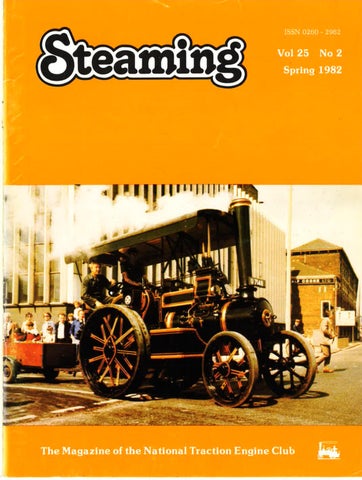
Starting out on the Road Run to Bramharn Park Rally after the unveiling of the John Fowler memorial plaque on the former site of the Steam Plough Works, Leeds is Fowler Tiger tractor 15625 of 1920. The date was 25th August 1979 and the engine is owned by David Mitchell of Guiseley, Leeds. (transparency courtesy G. Proctor) 51
Mwo From the President I would like to thank the organisers of Expo Steam at Peterborough who have again, through John Crawley, sent a substantial donation to the National Traction Engine Club from the proceeds of their steam engine rally. Further thanks are due to Brian Lecomber of Firebird Aerobatics who has also sent a donation to the Club. The NTEC is continually fighting legislation, studying safety regulations and doing its best for rally organisers and the movement in general. It is particularly gratifying for me, as President of the Club, to see the precedent set by Expo'Steam acting as a reward for the work carried out by the National Traction Engine Club. Donations to the club, however small are most gratefully received; so if your rally is a financial success please remember the National Traction Engine Club. (Jack Wharton)
From the Chairman More detailed notes of the activities of our various sub Committees are being provided by their various Chairmen, so I will deal only with more general matters of interest. Our application to the Charity Commissioners for charitable status is being redrafted after further consultations with our legal advisers. Our initial approach met with unfavourable comment and it was found necessary to more clearly define the activities of the Club which would rank as charitable, both in the field of preservation and education. Your Committee hopes that this matter can be successfully concluded in the next months. The Committee have discussed what can be done by the Club in furtherance of engine preservation. A number of possibilities have been discussed although no firm decisions have yet been taken. We feel that the Club should take the lead in preserving some engine or associated object of particular interest or alternatively provide active assistance in the restoration and improvement of an already established collection not in private ownership. Our enquiries and 52
deliberations are continuing and if any members have useful ideas in this connection, I would like to hear from them. The Club is also providing assistance to the Road Roller Association in their plans to commemorate the centenary of the death of Thomas Aveling. Although / the occasion has now passed — a memorial plaque was erected on the original works of Aveling & Porter at Rochester in March, and a commemoration run of Aveling engines held — the Appeal fund to cover the costs involved will remain open during 1982 and donations would be appreciated by the Association. May I wish all our members a successful and enjoyable steaming season in 1982, whether they be restoring or operating engines or simply enjoying traction engines and savouring the smell of steam and hot cylinder oil. (Peter Barber)
Rally Committee The Rally Sub-Committee is the longest standing of any of the Club's sub-committees and is the only one non-committee that includes members. It operates the Club's Code of Practice, the latter being 'a guide for the better organisation of Traction Engine Rallies.' On Saturday, 13th February, it held the first of its bi-annual conferences. This conference was an all-day affair. The morning session was the Safety Officers Seminar — a most important meeting, at which the Safety Officer of each rally has a chance to discuss outstanding matters of concern. As most readers know outdoor events generally, including traction engine rallies, come under the general jurisdiction of the Health & Safety at Work legislation; safety is therefore a prime consideration. We were fortunate at this meeting in having Mr. Jim Newnham, a member of the Health & Safety Executive, to talk to us on various aspects of safety at traction engine rallies which he had noted in the course of a number of visits to rallies during 1981. After commenting on rally practice and procedure the question of preservation generally was discussed and
how far the various Safety Acts might affect our rally organisers and engine owners (or anyone exhibiting at an event), and to what extent owners and organisers should concern themselves with these acts. Safety Officers present had an opportunity of raising various points with Mr. Newnham. Mr. David Crawley presented a short paper on the safety aspects of the use of ropes on rally fields both from the point of view of barriers to control spectators and also wire ropes on the engines when used for demonstrations etc. A lively discussion followed at which many points of view were expressed. The afternoon meeting was the Spring Conference of Rally Organisers and Affiliated Clubs which dealt with many aspects of rally organisation. The rally programme for 1982 wasconsidered in detail and a preliminary list for publication in due course was agreed. Amendments and additions to the Code of Practice are constantly being made, based largely on practical experience. A revised edition of the Code will be operative in 1983, so the opportunity was taken to discuss some of the alterations proposed particularly those concerning insurance discs. A particular point arises here that the Public Liability insurance recommendation is raised to £500,000 from the £250,000 as it is at present. This higher figure will be recommended as the amount fiom the 1983 rally season. (Eric A. Fillmore,
chairman, Rally Sub-Committee)
Engine Owners Committee The committee continues to work hard for the engine owners. Each committee member is responsible for a particular aspect. Fairly frequent meetings ensure good communication, and news for engine owners in every edition of Steaming. Problems do, however, occur. Whilst we can meet regularly because we all come from the same area of the country (the South of England), that advantage also gives rise to snags. In the last edition I boldly stated a list of
From Alan Martin's Collection 16 It is some while since I chose a roller for this spot. Thomas Green & Son is a name which is better known on road rollers of more recent decades, but the company has, of course, a long history of producing steam rollers — even if their sales were somewhat local to their Smithfield Ironworks at Leeds. This picture shows Green's 10 tonner 1461 of 1901, a single cylinder three-shaft machine owned by Pickering Rural District Council in the North Riding of Yorkshire. It was taken at Pickering about 1920. The rear wheels appear very heavily re-rimmed, and the canopy has an air of a hand-medown.
coals, advised by the National Coal Board to be suitable for traction engines, would be published this time. Of course, the NCB is split into regions. If you are in the south and you ask a question they will give you a southern answer. In consequence I now have a list of coals available from the lower end of the British Isles — I will try to get the 'national list' for the next edition! Our next magazine will contain the facts on whether engine owners need a tachometer in the cab of low-loaders that carry steam engines. Living wagon and van insurance will also be dealt with, hopefully ironing out some of the problems that have arisen. Elsewhere in this issue there are the results of further investigations carried out on the engine owners behalf, titled Use of Hydrants. A lot of 'engine owners business' is dealt with by NTEC members outside the Engine Owners Comittee, and I must thank Anthony Heal and Michael Mason for their work. Lastly I would like to remind you all of the Engine Owners Meeting to be held at the Royal Station Hotel, York, at 3.00pm on Saturday 24th April 1982 in conjunction with the NTEC Convention. All paid-up members of the National Traction Engine Club are welcome to the Engine Owners Meeting absolutely free of charge. I would welcome any questions for that meeting. Some queries require a little thought, investigation and discussion before an answer can be given. Therefore the sooner I receive a question the better! Please write or telephone M.
John Wharton, Southerndown, Minster Lovell, Oxford 0X8 5RD (Tel 0993-3336).
remember I have only spoken to one Water Authority and whilst it is reasonable to assume that their rules are all the same, they may not necessarily be so. (John Wharton)
Use of Hydrants More steam engines are travelling on the road than ever before in preservation years. In the working days of steam engines there were far more streams, water existed in ditches and there were even water holes especially engines. steam filling for Unfortunately many ditches are now dry and water is generally difficult to find. Using a water dandy is one option, but what happens after that is empty? The use of hydrants has become necessary. It is not illegal to use a hydrant. I recently spoke to one water authority who gave me their interpretation of the rules. (i) Only equipment booked out from a current Water Authority register should be used. Home made or obsolete equipment is frowned upon. (ii) A stand-pipe and hose should always be used in conjunction with the hydrant key. The practice of flooding the hydrant well is not liked. The particular Water Authority I spoke to hire our hydrant keys, standpipes and hoses at a 1981 rate of £1.85 per month. There was a £50 further For required. deposit information contact the Meter Room at your local Water Authority. Please
Steam Apprentice Club We are sorry to have lost the services of our Newsletter editor, Margaret Joachim, who has found her professional duties too pressing to be able to continue. Graham Gratwick from the West Country has taken over the editorship, and we welcome him and wish him every success. Also joining the team running the SAC is Richard Lacy, who will be active from the Hollycombe area in Hampshire. Preparations are in hand for the coming season. A new venue for us will be the event at Quorn, Leicestershire, on 11/ 12th April, the Easter weekend. On 1st/2nd May 1982 we make our second visit to Weeting as guests of the Parrott family; members are welcome for one or both days and camping/caravanning space is available here. Please let the membership secretary know if you intend visiting either event (address inside front cover of this magazine). And if any NTEC members have children or young friends they might like to introduce to the activities of the 53
Steam Apprentice Club full details are available from Sylvia. (Sylvia Berth-Jones)
Traction Engines and the Law Amendment Notes 2 Page 28, Rallies. In view of the provisions of the Sheffield Corporation Act 1928 s.215 and similar local authority Acts, the possibility does exist of a rally being considered to be a 'pleasure fair', and either requiring the permission of the local authority or being subject to local bye-laws covering pleasure fairs. In the recent Sheffield case (page 105, Summer 1981 issue of this magazine) the magistrates did find that the rally was not a pleasure fair but other benches might not agree, and rally organisers may think it wise to check with their local authority that there is no risk of offending against local bye-laws. Anthony Heal has kindly drawn my
attention to the Motor Vehicles (Construction and Use) (Amendment No 4) Regulations 1981, some of which may effect the steam engine owner: page 15, para 2. A new Regulation 46A provides that unbraked trailers must have their maximum gross (i.e. laden) weight stated in kilograms marked in a conspicious position on the outside of the trailer on the left or near side. page 15, last para. A new Regulation 14A provides new requirements for brakes on motor vehicles and trailers manufactured after 1st October 1982 and first used after 1st April 1983, but in any case these will not agricultural affect trailers, locomotives, motor tractors, and vehicle& which cannot exceed 25mph on the level under their own power. page 22 — brakes on trailers. Regulation 127 is amended to provide that a chock 'or other efficient device' may be used for immobilising a trailer which is detached from a drawing vehicle. Page 28, Town & Country
Three shovels-full of atmosphere drifts slowly skywards. The engineman nips on the injector as the cultivator bounces back to the other headland. It could be a past scene from almost anywhere in rural England; it is, in fact, Roxton Rally 1979. (Bob Payne)
Planning. The size of the extension which does not require additional planning permission has now been increased to 70 cubic metres (including any previous addition which has not had planning permission) except in Conservation Areas. (David Tew, Hon Solicitor)
Obituaries W.H. Balkwill Bill Balkwill, of Upton Pyne, near Exeter, Devon, died in January at the age of RQ. 'The Ross', as he was affectionately known to us all, was instrumental in sLai tiny many on the preservation road. His advice, help and encouragement was freely available, as also was storage space for engines at his Upton Pyne yard. A threshing contractor for many years, using Marshall, Aveling and Burrell engines, Mr Balkwill made Marshalls his favourite. He was known for a fine collection of models — engines and tackle — which he made himself. Bill's contribution to preservation may have seemed modest and quiet but it was invaluable. He will be sadly missed. (Richard Parkinson)
Arthur Fearnley
The death occurred on 11th February 1982, at the age of 73, of Arthur Fearnley, of Castleford, Yorkshire. There will be few members who have not, at sometime, been to a rally attended by Arthur and his family and one of their engines. The Sentinels, the Foden, and PANDORA the Fowler Tiger tractor were early restorations and travelled extensively from the late 1950s, appearing literally throughout the length and breadth of the country. Arthur, however, had a long background in steam, being brought up among engines during World War 1 and subsequently, both in employment and in the engineering business on his own account, he came into contact with a wide variety of engine types. It was a worthy story, featured in one of the 'Men of Steam' series in this magazine in June 1972. In preservation years to mention Arthur Fearnley's name conjured up a picture of him and his wife aboard the mechanically immaculate 'PANDY', ever willing to enter a ring event at a last minute request. And then, in the evening, of watching Mr and Mrs Fearnley load the engine onto 'Pandy's pram', that ingenious adaptation by the Fearnleys of a Crossley bus. It is sad to record Arthur's death so soon after that of his wife — sad too, to realise that when PANDORA's 'tummy troubles' (Arthur's phrase) are cured we shall not see his familiar figure at the regulator. The traction engine world has lost a good triend with his passing and those who had the pleasure of knowing him will miss the company of a kind and tolerant man. We offer our sincere sympathies to his family. (Roger West)
Richard George Macdonald It is with deep regret that we report the passing of Dick Macdonald of Louth, Lincolnshire, after an illness lasting several months. Dick was brought up amongst steam and began to learn the engineering trade under his father at a very early age. As a young man he soon became fully conversant with all types of repair work in field, farmyard and at the workshop bench. He also became a very competent driver of all types of steam vehicles in his early teens. When steam preservation began, Dick was in at the start and could be seen at local rallies with his Foster tractor 14589 LORD OF THE ISLES, or at more distant events with his Sentinel S4 wagon, 9374. By this time Dick was the head of the family business, and although steam was no longer the mainstay, it was still quite usual to see preserved engines in his shop for heavy repairs, especially to boilers and fireboxes. Both the Foster and the Sentinel were sold on the mid 1960s, and at a later date Fowler roller 18867 was acquired from the Louth Borough Council. This roller was of special significance to Dick, for it was the last new machine which his firm had supplied to the local authority, and he was particularly proud of it. A long standing Committee Member of the Lincolnshire Steam Engine Preservation Society and a good friend to many, Dick will be sorely missed in the circles where he was known. Our deepest sympathy is extended to Mrs. Macdonald and his sons, John and Glyn in their bereavement. (F.S.)
Jack Peirson It is with deep regret that I have to report the sudden death in December 1981 of John W. Peirson of Darlington, Co Durham. Jack, as he was known to his many friends, became interested in steam at an early age, and was also early in the preservation scene when he and his cousin, the late Jack Richardson of Kirby Thore, purchased McLaren 1105 in 1951. The agricultural engine and particularly the Marshall was Jack's favourite but he also had a soft spot for portables. Well known throughout the country and much respected, Jack will be sadly missed by his many friends. (George Thirkell)
Eric Sims Eric Sims of Newton Abbot died suddenly in September 1981. He was
a former Great Western Railway loco driver and well known for his restoration of engines, being latterly custodian of Devon County Council's Wallis Advance roller. Eric attended Liskeard Rally with the roller only a couple of days before his death. He was secretary of the South Devon Steam Preservation Society. His drive and enthusiasm will be greatly missed and our condolences are extended to his family. (Richard Parkinson)
Harry Wooding The death occurred on 3rd December 1981, at the age of 74, of Harry Wooding of Yardley Hastings, Northamptonshire. He was a gentleman in every sense of the word, and will be greatly missed by his many friends throughout the steam movement. Starting his outdoor working life as a tractor driver for the Marquis of Northampton, Harry was later employed by Holts of Higham Park, Rushden, threshing and steam ploughing contractors, and his last employment was with the Ministry of Supply at Yardley Chase, where he drove and maintained steam locomotives for 29 years. One of his abilities of which few of us knew was that he was an accomplished boot and shoe maker. Harry had been a member of the Bedford Steam Engine Preservation Society since 1958 and for quite a few years he rallied a Ruston Proctor engine and a late Aveling roller. I personally spent several week-ends steam cultivating or threshing with Harry in the company of the late Jim Bennie and the late Vaughan brothers and feel very privileged to have known him. He was also well known in bell ringing circles, a hobby of 60 years. Rest well, Harry. Our sympathies are extended to his widow and three sons and their families. (Alec /bbott)
London Area Social Meetings We are pleased to announce that Mr T.E. Timmings, a club member of very long standing, is taking over the organisation of London Area Social Meetings. Mr. TImmings would no doubt be pleased to hear from any member willing to provide future entertainment by way of talks, etc, or able to provide contacts for the same sort of thing. His address is 308 55
Hertford Road, Lower Edmonton, London N9. The final meeting of the 1981/2 season will take place at 8.00pm on TUESDAY, 27th APRIL 1982, at 'The Cock Tavern', Great Portland Street, London (corner of Margaret Street and adjacent to Oxford Circus). Charles Roads will present an illustrated talk 'Steam in India and East Germany'. Monthly meetings will resume in the autumn.
death, after a long illness, of Jim Dobbs, 49, of Kirkby-in-Ashfield, Notts. He was Chairman of our Club for two years and well known on the Nottingham and Derbyshire rally circuit, being secretary of the barn engine and tractor sections at Ashfield Rally. He will be missed by his many friends. (Mrs L.M. Wright)
Future Dates Membership Renewal May I remind members to include a stamped addressed envelope when renewing their membership — or with any Club correspondence. Collectively this could well help to defer a future increase in the subscription. (Fay Wood)
Affiliated Clubs Notts and District Steam and Vintage Machinery Club I have the sad task of recording the
AGM 1982 The Annual General Meeting of the Club is to be held at 11.00am on Saturday, 24th April 1 982 at♦ the Royal Station Hotel, York. Formal notices etc, are distributed with this Issue of the magazine.
of the meeting can be found in the Engine Owners Column elsewhere in this issue.
The York Convention The above two meetings are just part of a whole weekend of events at York organised for the Club by ViceChairman John Crawley. Full details were included on a leaflet with the last magazine, and whilst the closing date 'for bookings has now passed, particularly forgetful but determined members may find John has a vacancy 'up his sleeve' — or a cancellation. North country readers within easy travelling distance of York are reminded that tickets for the Dinner/Dance on the Saturday evening are still available at £11.00 per head. All enquiries to John Crawley.
Engine Owners Meeting This meeting is being held (under the auspices of the Engine Owners Sub-Committee) at 3.00pm on Saturday, 24th April 1982, at the same venue as the AGM. It is an ideal opportunity for engine owners to meet and discuss any problems they may come across in rallying, journeying on the road or just maintaining and operating their engines. Other details
'Foden wagons — Messrs Fodens Ltd have for sale in London several second-hand Foden wagons in firstclass working order, 5-8000 series. Price from £50 to £175. Apply for particulars to Fodens Ltd ... London SE26 and Eiworth Works Sandbach.' (An advertisment in Commercial Motor, 5th July 1927.)
County of Salop Steam Et Jine Society 21st Anniversary Celebrations ROAD RUN on the morning of Saturday, 28th August 1982 — a cavalcade of about 25 engines from Church Stretton to Bishops Castle.
ANNUAL RALLY on Sunday and Monday, 29th and 30th August 1982 — about 40 engines including our unique display of Sentinels. Full caravan and camping facilities are available at the rally site. For further information contact D.W. GODDARD, 29 NIBS HEATH, MONTFORD BRIDGE, SALOP (Tel 0939-260595)
56
the 91ealie Sheller Roger West Most of us, when starting on preserving an engine, have nearby friends or mentors to whom we can go for help, discussion or second opinions. In the wide open spaces of South Africa things are quite different — fellow enthusiasts can be hundreds of miles away — if indeed they are aware of each other at all! Thus it was that in 1975 Peter Mostert, farming in the Transvaal, wrote to our membership secretary for help in making contacts, having decided to restore the 1907 Fowler built engine that had been in his family for many years. He felt that it was a pity to hide it away in sheds on his estate where only friends would see it, and having externally restored it, thoughtfully presented it on permanent loan to the Heidelburg Transport Museum, some 30 miles south east of Johannesburg. Then, having taken 'before and after' photos, Mr Mostert sent copies to our club by way of thanks for assistance. He added the history of the engine as known to him, but things didn't quite tie up somehow, and with further research, an interesting tale gradually unfolded, revealing that the lonely Fowler is, or had been, a quite remarkable machine. But first we must look at our subject's sister engines, for this is no ordinary traction engine.
It is probably true to claim that the Steam Plough Works at Leeds, in their quest for fresh custom, varied from their standard designs rather more than most traction engine builders. As with their competitors they offered designs for the Colonial markets, where the American builders presence and style was quite established. One of the Fowler ranges in the early years of the century was their 'Colonial
South African farmer Peter Mostert has recently completed restoration of an exceptionally interesting Fowler steam engine, and the history of it gives us insight into one of the more unlikely products of the Steam Plough Works.
Farmer's Single Cylinder Traction Engine, designed to drive the large threshing machines in use in the Colonies, and to haul them from place to place, together with all necessary equipment'. Expressed that way the capabilities were not so very different from home market models but the finished engine presented an odd sight to British eyes. The firebox was enlarged for burning wood or inferior coals. The hind wheels were driven by two pinions on the third shaft — which was positioned across the front of the
firebox — working into a gear ring bolted to the rim of the road wheel. This resulted in a very high built engine (12ft 3in to chimney top), an appearance accentuated by lack of tender water tank — a driver's platform merely supported a small coal bunker. Belly water tanks were provided plus an optional second v-shaped tank placed partly under the smokebox and the front ring of the boiler. Self acting differential gear was fitted on the third shaft and a winding drum provided. Although compound
The official photograph in works grey of 10772 from the flywheel side. The engine had an 8in x 10in cylinder, was 15ft Oin in length and 7ft 6in wide. The indicated horse power was 45. (Institute of Agricultural History and Museum of English Rural Life, University of Reading) 57
Fowlers' gear side rear view of 10772. The third shaft pinion can be seen by the gear ring at the front of the hind wheel. The drawbar frame is strongly fixed to the firebox hornplates. (Institute of Agricultural History and Museum of English Rural Life, University of Reading)
cylinders were offered, it seems all examples built had a single cylinder. Weight was 7 tons 17 cwts. A small /13 inch flywheel, a spark arrestor equipped chimney and a spartan metal awning completed the un-British appearance of the engine. Other advertising claimed the class suitable for direct traction ploughing. Fowlers classified the design BAA and also referred to them as AngloAustralian engines. But despite Fowler's good sales record 'down under' the BAA type turned out to be rather uncommon. According to works registers only nine examples were produced, numbers 10772 to 10777 in 1906/7, and 11717 to 11719 between 1911 and 1914. Eight of the engines were sent to their designed-for
destination, Australia, mainly it seems into the hands of agents. Details are given in the accompanying table. W.M. Noakes was manager of Fowler's Sydney office. Some of the customers (Welch, Perrin & Co for example) were, in fact, agents. From the difference in building dates between the two batches, and individual later engines, it could be surmised that the first six engines took some time to be sold ott to customers by the agents. Several examples survive in preservation in Australia, and one has returned to these shores in recent years and is presently under repair in the north of England — an interesting rally entrant for the future. The ninth engine (the sixth of the first batch of
works number 10772 10773 10774 10775 10776
date dispatched 27th June 1906 16th July 1907 15th July 1907 23rd July 1907 8th July 1907
customer John Fowler & Co, Sydney for Welch, Perrin & Co John Fowler & Co, Sydney for Sydney Show John Fowler & Co, Sydney for Cribb & Foote John Fowler & Co, Sydney for Welch, Perrin & Co John Fowler & Co, Sydney for G,L. Throssell & Co
11717 11718 11719
8th March 1915 2nd February 1911 27th October 1914
W.M. Noakes for Welch & Perrin & Co W.M. Noakes for Cribb & Foote W.M. Noakes for S.C. Browning
58
engines), was Fowler 10777, and it had quite a different history. With it we come, at last, to the main subject of this article. 10777 was completed in 1907 and appears in Fowler's records as a 'BAA Anglo-Australian single cylinder traction engine fitted with mealie sheller attachment No X2125'. This attachment consisted of a cranked frame of steel channels fixed in front of the engine, the rear end attached by large brackets to the engine's smokebox, the front end being supported by a pair of wheels. Upon the frame was,. to be placed the mealie sheller — essentially a threshing drum for maize. The unit was supplied to William A. McLaren, the Leeds firm's manaaer of their Vereeniging Estate in South procum Africa, on 30th April 1907 ably the date of despatch from the works. Michael Lane in his excellent book The Story of the Steam Plough Works records a little about the Vereeniging Estate. William McLaren was the younger brother of John and Henry McLaren, Fowlers near neighbours in Leeds. He went to South Africa in 1903 and shortly after was appointed resident engineer and manager to the 22000 acre Vereeniging Estate, Transvaal, which Fowlers had recently rented. McLaren's instructions were to bring the land into cultivation and operate the farm profitably, at the same time using the estate as a testing ground for new implements and ideas, and as a showpiece for stimulating and encouraging new business in the area. The venture went well for some 10 years, but successive droughts and poor crop yields resulted in mounting trading losses and the estate was eventually sold. Fowler 10777 and its integral mealie shredder were doubtless one of the 'new ideas' tested at the estate. The rental agreement with The Vereeniging Estates Ltd contained an interesting clause providing for Fowlers to have the use of the Estate's portable steam engine and maize sheller as required. Thus it seems that the sheller placed on the elongated 10777 may have been the one already existing at the farm. The two accompanying illustrations of the unit in South Africa appear in an Album of photographs of the South African farm (now in the Fowler Collection at Reading University) and the contemporary captions are repeated here. Whether the machine was a success or not is unknown. Obviously it did work but we can maybe assume the contraption was not all it was hoped for — certainly Fowlers received no orders!
With the demise of the Vereeniging venture it seems likely that the engine had the sheller and frame attachment removed, its steel front wheels replaced, and was then offered for sale. The next we know of the engine is in 1915 when it was bought, together with a large Marshall threshing drum, by Peter Mostert's grandfather. Quite where it appeared from is not known, but grandfather's estate was at Rietbult near Balfour, 50 miles south east of Johannesburg and only some 40 miles east of Vereeniging, so the engine had not wandered far. The farm at Balfour was, and still is, of 18000 acres on which mostly maize was produced. The crop was reaped by hand and large piles of maize on the cob were heaped at various points whereupon the Fowler took the Marshall drum from one pile to another, threshing the maize. Drive was by a very long 6 inch belt. Mr Mostert still has the drum in
Fowlers captioned this photograph 'Self Propelled Mealie Sheller. The whole outfit...is carried on four wheels. The pair of wheels under the sheller are
arranged to act as steering wheels, the steering being done by the engine driver as it goes along. The water cart fitted with a syphon pipe as shown is coupled up behind the engine. The pickers put the bags of cobs in a row; the machine follows on travelling at a rate of f mile per hour.' It must have been a jolly task to steer the juggernaut in a tolerably straight line) And what about turning corners? (Institute of Agricultural History and Museum of English Rural Life, University of Reading)
Another Fowler picture: 'The bags of cobs are emptied into the hopper at the front of the machine and the shelling goes on as the machine travels along, the bags /of maize] being weighed and stitched up on the platform between the sheller and the engine; then slid off to the ground to be picked up by the transport wagons. Over 700 bags have been shelled in one day by the machine. The engine is fitted with a friction clutch on the travelling gear so that shelling can go on continuously whether the engine is travelling or stationary.' Peter Mostert comments that there must have been something basically wrong with the unit if it failed to catch on after returning such figures as mentioned above — 700 bags is a very good day's work with modern machines in 1981. The Fowler combination must have been 50 years ahead of its time; perhaps its weight and size precluded general acceptance. Were Fowlers exaggerating its output a little?... (Institute of Agricultural History and Museum of English Rural Life, University of Reading)
59
Photographs taken in Fowler's workshops, and not subsequently 'whited out' behind the subject, provide scope for the study of fascinating background detail, but this illustration of 10777 before dispatch to South Africa gives a somewhat confusing picture that requires careful scrutiny to appreciate what is what. (Institute of Agricultural History and Museum of English Rural Life, University of Reading).
Fowler 10777 before restoration. (P. Mostert) 60
working order and indeed used it until 1966, tractor driven. The Fowler was only used on the farm's earth road, hence the good condition of the strakes. Just one bag of coal 1200 lbs) was taken along each day; when this was finished the boiler was fired with the threshed maize cobs hand sorted from the chaff. Provided there was enough labour 1200 bags of maize (of 200 Ibs, each) could be threshed in a day — that compares very well with modern machinery. the engine also hauled large hopper wagons used for collecting maize to be taken to a silo. The 10 ton capacity wagons, 24 feet long by 8 feet wide and with 30 inch sides, had two chutes at the bottom so that the maize could be let onto a moving belt and so into the silo. Two of these wagons were in use in the 1920s and one still survives at Rietbult. The engine was taken over by Mr Mostert's father in 1939 and he carried on using it in the same way until 1948 when the inevitable diesel or paraffin tractors took over. The steamer was then employed for driving a sawmill on the estate until 1952 when it was finally retired, the last known boiler certificate being dated 28th June 1950.
The Mines Department plate on Fowler 10777 showing the department's official number 11113, the allowed working pressure and the building date of the boiler. The coat of arms is that of the old Transvaal Colony before the Union of 1910. (P. Mostert)
A much smarter machine — 10777 at Heidelburg after restoration. (P. Mostert) Evidence of mealie sheller days. The countershaft mounting brackets (left) and the filled bolt holes where the sheller frame was attached to the smokebox (right). (P. Mostert)
Mr Mostert inherited the farm in 1962 by which time all the copper tubing and useful nuts and bolts had been stripped off the Fowler — even the governor was missing. In 1975 it was decided to restore the engine and this was done in Johannesburg by Mr Phil Braidsch, who has restored a number of engines and steam wagons, some in the Johannesburg Municipal Tiansp(ii i Museum. NOIN Museum 10777 has recently had new tubes and with a few other points attended to should soon be able to be steamed again. In mute testament to its earlier experimental life the engine still has the brackets which carried the countershaft and intermediate belt pulleys; the now filled bolt holes for the frame attachment also show. As a postscript to the story it may be interesting to record an aside in the researching of the story of 10777.
61
When Mr Mostert made his first enquiries in 1976 he quoted the only serial number he could find on the machine — 11113. It was thought this was the Fowler works number and copies of appropriate working drawings were forwarded from Reading (they were for a 6hp engine, delivered new to Westmeath, Ireland in 1912). The plate bearing the number 11113 was, in fact, recording the 'official certificate to work' issued by the Transvaal Colony Mines Department when the engine went to South Africa. These plates were issued 'for life' but subject to yearly tests. The local boiler register documents for Fowler 10777 are not now in existence. This article on one of Fowlers more unusudl pi uduuts wuuld nut leave been possible without the help of either David Phillips, archivist to the Institute of Agricultural History and Museum of English Rural Life, University of Heading, who provided material trom surviving Fowler records or, of course, Peter Mostert who started it all by wanting to keep an old steam engine for posterity. John Elliot, and his daughter in South Africa, also provided information. We are grateful to all of them. If our Australian readers can add a little on the lives of their examples, we shall be pleased to publish the details.
Stamford Rally still maintains its long tradition of having engines and a fair organ in the town centre Red Lion Square on the Friday evening, collecting in aid of the Spastics Society. Here, in the early 1960s, John Crawley's Fowler 15657 KITCHENER (left) and Burrell 3610 WILLIAM V do their bit for charity: (H. Rowett)
STANFORD TRACTION ENGINE RALLY
Full ring events for engines on both days Trade and Preservation Society stands
on 26th and 27th June 1982
at Burghley Park 62
JOHN CRAWLEY, FIELD HOUSE, TURVEY, BEDFORD MK43 8DU
Tar Spraying and other tales PART 5 — continued from page 158 of the Autumn 1981 issue.
Percy Dabbs The threshing season came around again; the lads who were to work for me, George, Syd and Tommy had been out tar spraying during the summer and had had a good time. I thought I would try the new set myself first to see what it was like. I therefore had a day threshing rye, one Saturday at Chilton Grange near Ferryhill. This turned out to be a very rough stack but the set coped with it very well, including the tyer which hardly ever missed one. If one could get along without any tyer trouble, the farmer seemed happy. We both got going on the following Monday. I went threshing somewhere, although I can't remember where. Naturally I wanted to keep the set I had run previously, especially after putting a new canopy on and painting the lot over, so I let George Robinson and his mates take the set from Harome. He worked the round to his own advantage and all went very well until way into November when the tyer started to be troublesome and they were often coming for me to go to it. George would send Syd who could drive. This went on into December when I told George to try and get through the thick of the work and then bring the set in and take mine. I had my eye on a single band tyer which was on an old machine standing at a farm at Great Burdon near Darlington. We went for this one Saturday. Frank Stephenson went along with me to help strip it off the machine and load it on the trailer behind the Singer. I got it very handy — the whole lot appeared to have stood derelict for quite some time but I set on straight away and fixed it to the Marshall engine complete with winding gear and converted it to a double stringed tyer. When rebuilding it, I used mainly new parts and it was like a new one when finished. I used the long jawed knotter type and that did away with the tucker spring method and was a lot less trouble. I got going again early in January 1942 and it never faltered, so I was highly delighted. Consequently, I ran that set myself.
'CAUTION TAR SPRAYING' — an evocative scene as Woods Yorkshire 2189 pollutes the Yorkshire Dales in the early 1950's. (G.R. Hawthorne)
There was only one thing that bothered me a little and that was as it was a smaller engine I didn't know whether it would be able to cope with the two or three bad places which I had on this round. I must say, however, that she surprised me. Granted, the Marshall machine was a bit lighter than the Ransomes but everything went well and taking it all through we had a good season. We were held up a time or two with snow and one time I was very lucky. I went to a farm called Tursdale House which was close to Hett Mill where we had previously lived. This was down a lane which was all hard ground, then down a little sharp hill over the level crossing on the main Darlington to Newcastle railway line, and then a left turn down another steep little bit past half a dozen railway houses, through a biggish stream and up a steep hill to the farm. This hill had a gentle left bend in it and could be awkward should it be necessary to do any roping, which I was given to understand others had had to do at this location. I had been up here a few times with the bigger set and had no trouble. This time we wandered up nice and steady, except for slipping a time or two on knobbly stones which were sticking up and which was only usual. There were about a couple of
inches of snow on the ground at the time but this did not affect the roads so far. We got the set ready for the next day although it came snow showery during the day.•Mr Stephenson, the farmer, was anxious to get the threshing done for fodder for his stock and I was equally anxious to get done and away from Tursdale House under the prevailing weather conditions. However, the worst was yet to come! We got packed up and pulled out of the stackyard, coupled up, had a mug of tea and went steadily down the bank and through the stream. That was alright, but now the trouble started. It was snowing continually. I had rather more than a set of spud bolts but under the conditions at that time the heads of these were not big enough to get a grip. I had a few ferrules about two inches long, cut off inch piping, which I had used before in stackyards, so we put those on the outside of the wheel with the bolts to try to improve the grip. These certainly gave a better hold. I had an idea of getting close to the railway crossing and roping the machine up to me but then there was another problem facing us — could we chock the machine up safely under the road conditions- to allow the engine freedom of movement? This I did, not feeling too happy 63
about it. We struggled on for a couple of hours or more and found we were getting nowhere, although sometimes we did — to somewhere I didn't want to be! However, I could see the trouble was that I hadn't enough bolts and ferrules to do the job properly, so we damped the engine down and dropped sheets and went home after making adequate precautions with lights, to prevent anyone bumping into the engine. After a bit of supper, I set to and cut a lot more two inch ferrules and got more bolts. These were one inch bolts, about four inches long, su I got rather more than would do for each wheel in case of breakages. I think it would take about twenty-two in each wheel. We went back to the enaine the next morning and whilst getting steam up, we put all the bolts in place, then carried some battens of straw to the railway crossing to put under the wheels as we went over it, so as to do as little damage as possible to the rails and timbers. I then arranged with the signalman about getting across — the cabin was manned day and night because it was a busy line. More snow had fallen during the night so as soon as the signalman gave me the 'all clear', I set off. I had already coupled to the machine and had abandoned the idea of roping. We set off and all went well. She paddled away up the bank lovely, no trouble whatever with both wheels gripping as required and we got over the crossing nicely. I could go about another two hundred yards more with bolts and ferrules which I had put in at the start. We then had to put the ferrules on the inside of the wheels and just leave the bolt heads on the outside to avoid damage to the road surface. We did this for about another three hundred yards and then when we turned right towards Hett village we had to take the bolts out altogether as some of them were square heads, and some hexagonal, and we were now on a tarmac road. This was a gentle rise for nearly half a mile and it took us quite a while as there was a cam and hedge at each side of the road, and consequently there was very little or no grit to be had. My reasons for shifting under such atrocious conditions may be questioned, but when I got to Hett village there were five farms to thresh at with only the main road to be crossed once. It so happened that by the end of that week, the snow had melted a lot but there was still a good depth in the fields. The roads were reasonably clear so we came down the same road as we had taken into Hett, turned right at the junction for a few yards, then 64
left to a farm called Broomhill. This was across one field, along the bottom of another, then up a rather steep hill to the farm. It was all good hard shale road so there was no problem encountered going to this place. The farmer had been on at me nearly every day to go to his place — he didn't seem to realise that it was sensible to work the job as I was doing, especially under the weather conditions as they then were. It would be a Saturday night when we got to his place and the weather kept wintery over the weekend, but the roads were clear, even this farm road. We threshed here on the Monday and it had come a shower or two of snow during the day, otherwise it was a good threshing day. One of these flurries of snow came about half an hour before we finished. At the same time a Teesside Farmers delivery wagon came to the farm, but I never thought anything about that at the time. We finished, packed up and pulled out of the stackyard all coupled up ready for shifting on to the next farm. We went into the farmhouse to have our teas and had to go out again halfway through to move the set so the lorry could get out, as we were blocking its way. After we had finished eating we oiled up and set off from the farm, down the hill. About halfway, the engine's wheels picked up and she started to slide. I don't know whether she slipped on some hard packed snow left by the lorry or not, but it was possible. Just before reaching the bottom of the hill, the engine suddenly turned of her own accord to the right and into what had been a bit of a quarry hole. There she stopped and luckily it was not any worse. I still dread to think what could have happened if the lot had gone the other way, as it was a lot steeper down the field. Well, we uncoupled and I reversed out of the quarry, down the farm road to where I could turn round, and then reversed back towards the machine. Unfortunately, where the road began to rise, she started to spin. All that was required was a sprinkling of sand and I had noticed a heap of sand at the end of the stable, near the stackyard gate. When I went to ask the farmer for some, having told him of our predicament, he was not going to give me any. He was a very good farmer but a bit tight! He eventually let me have some, in fact, I think one of his sons took some down in a wheelbarrow for me, so all turned out well and we were not delayed very long. Whilst we were kept going with work, the other set had been held up a few days with the weather in the Thornley and Haswell area, but that is how it goes.
The end of the threshing season came round again; the other chaps went tar spraying and I stayed at home to do some repairs and finish off the few jobs which always seemed to be left to do during the summer. I also did a little bit of haymaking on the small piece of land which we had, as well as buying some more from the County Council '5 acre scheme' which was close to Garden House and which was available at the time because of the War. During the summer of 1942, I went to a sale of steam engines, threshing machines and other contractors equipment at a farm between Shotley Bridge and Durham, belonging to Mr W. Arnison who I think was giving up contracting. Here I bought two Anginps, a Bhp Foster — 14.4nn of 1919 (A06267) — and a 7hp Fowler — 8600 of 1900 (NL1203) — both single cylinder engines and in very good condition at £20 each. At this time steam engines were on their way out as internal combustion tractors were taking over. After I bought these Mr Arnison asked me about swapping my 8hp Ransomes engine for a Marshall which a scrap dealer from Stanley, Co Durham (Bell's) had bought at this same sale. The only thing wrong with the Ransomes was that a lot of her strakes were very loose. I had put a lot of new rivets in during the previous year or two, which were alright for a while, but the main trouble was that the holes in the wheels had got worn. Consequently, the scrapman and I contacted each other and he was prepared to do a deal but wanted £10 to boot. I said "No, either a straight swap or I keep the Ransomes". "Alright", says he "but thoo delivers the Ransomes!" This was alright for me as it only meant a day's work for George and Syd. Now it turned out that Mr Arnison had a job to do with an engine for someone, and since he had given up he couldn't do it. He said it was pulling out some felled trees from a ghyll near Finchale Abbey and if I cared to do it before I took the last of the engines home, it was mine. I had to contact a man called Wood who had a garage business near Nevilles Cross. This I did and the job was subsequently fixed. I had to call when the work was finished, on my way home, and he would pay me. We got the Foster and Fowler home alright and left the Marshall to do the tree pulling job. We started on it right away — everything was nice and handy, water in the field and coal was available at a small colliery, or drift, opposite the gate where we turned in. We completed the work by Friday dinner time without
k
•
any breakages and were home by Friday night and all paid up. The man was very satisfied with what we had done for him and I, in turn was satisfied, as that job paid for all the engines! Time went on and it came round to the threshing season again. This was 1942/3 — the 8hp Ransomes had gone, so I thought the Marshall I got in exchange would be very suitable for George. I sent him away to the farm of Mr Marshall, Colliery Farm, East Howie, which was only about three miles from Garden House, as a try out. Much to my surprise, George sent word to say that the Marshall was steaming badly. I thought the cause might be the rather poor coal, knowing the sort he usually got (pitman's sort) although there was always plenty of it to go at. Anyway, I went over to them and saw they were in difficulty. I stopped with them for a couple of hours or so but it was a real struggle to keep going, so I went back home and fired the Foster up and changed them over and had no more trouble. The Marshall appeared to be in good condition — the gearing was little worse than new and I wondered why she would not steam. As things turned out, she never did any more work for me, but I had occasion to take the ashpan off and the fire bars out at a later date and look in the firebox. There I found the cause of the poor steaming. The bars had at some time been set higher up the box, I would think by about three inches. This appeared to be on account of a little wastage at each side of the box, so she was put to one side out of the way, I had not really made a good swap, but I had the other engines to carry on with, so it didn't really matter. One incident which comes to mind now occurred when I had been threshing in the Spennymoor-Ferryhill area and had come to thresh a couple of useful stacks in a field on Dean Road, Ferryhill. On the opposite side of the road, which was a fair length, was a row of houses which were fairly new at that time. It think by now the other side will be built on as well. We had a good day on these stacks and were packing up ready to move out when it came on a sharp shower of rain. We thought nothing about this at the time. From here, we were moving to Mr Tinklers of Broad Oak, Bishop Middleham. As we were going down Ferryhill Station bank, which is quite steep, we were in low gear, and about halfway down the engine started to slide because of the wet surface of the road. I grabbed hold of the steering wheel from the steersman with the intention of keeping the lot straight
until we got to the bottom. Unfortunately, all of a sudden, the speed and weight of the machine forced the engine round and we stopped fairly sharp, as the engine was facing uphill and the machine down. We were certainly very lucky as all the apparent damage at that time was a broken '!n and out of gear' lever on the trusser. We chocked the machine up safely, loosed off, backed down the hill, turned round at the bottom, backed up again and coupled up. Whilst doing this, an official of Durham County Council came on the scene and asked if he could help. He could see what sort of predicament we were in and said he had various equipment in his own van which I could have, if necessary. I thought this was very good of him and thanked him very much, assuring him that it wasn't necessary and that we were alright. We then went on our respective ways and we got set in at Broad Oak, taking the broken lever home and repaired it that night. I took it back to the machine the next morning and put it on. When we started to thresh, the tyer went very
badly for a while until I got it set right. I won't say it went well for the rest of the season, but we managed. Later on, during the summer of 1943, I was threshing with this set on a farm in George Robinson's area, and I was standing away down the stackyard talking to the farmer and facing the tyer, when I saw how badly it was twisted. This was the first time I had noticed it and I pointed it out to the farmer and told him what had happened to cause it. He said we had been very lucky and we really wondered, having seen the tyer in such a state, as to how it had gone at all since then. When I got the set home, I completely stripped it down, straightened the bent parts and rebuilt it. It could not help but work properly after that. Following this, all went reasonably well with little else of importance to mention except air raid warnings which stopped us from getting on with our business from time to time.
(to be continued)
When advertising the attributes of their heavy duty weighbridge in the 1920s, the maker naturally portrayed the heavy goods vehicle of the day — the steam wagon. Here, on one of their trade cards, W. & T. Avery of Smethwick, Birmingham show a Sentinel. The illustration is typical of contemporary artwork but for some reason the engine depicted is shown mirror image — hence the left hand drive. The reversed registration number AW3714 is just discernible on the original and identifies the wagon as one owned by Avery:s — Sentinel A 1630, a 6 ton example new to them in 1917. (collection C. W. Tassell) 65
Steam around Northampton A young enthusiast's record of steam on the road 30 years ago
John L. Champion Although I have been a member of the Club since 1957 I have never been, nor ever shall be an engine owner. Firstly, I am unlikely ever to reach the necessary income bracket; secondly, and more impoi tent, my mechanical ability is such that were I ever to get an engine on to the rally field, the crowds would be entertained by a lot of hot water, very little steam, a disintegrating engine and a lot of bad language! So, I feel it more practical to drive a Kodak Retinette and to keep photographic records with my slides. I have long been a railway enthusiast (theories why would till a book) but I have always been fascinated too by steam road vehicles, probably because my mother, perambulating me around Sutton Coldfield or Ealing in the early thirties, used to point out as interesting diversions 'steam rollers', even if they were tractions, or 'steam Sentinels', albeit Foden overtypes! With the coming of World War 2 we evacuated to Northampton, and in August 1940 moved to a house overlooking the main Wellingborough Road. Here, at the age of nine, I begin my story. Very common sights then were the steam wagons owned by the Corporation, chuntering and clanking around with loads of gravel, air-raid shelter components or just bits of felled trees. We had some very bitter winters in the early forties, and the wagons were used on gritting and snowplough duties. Four in total, Nos 1, 2 and 4 were by the town's own builder Allchin, whilst No 3 was a Foden." A very good picture of No 4
*Further details of all the engines mentioned will be found at the end of this article 66
appears in Anthony Beaumont's book Steam on the Road, with the Foden in the background. No 4 was fitted with steam operated tipping gear and was named THE WANDERER, a title believed to have been transferred from the Aveling roller acquired secondhand by the Borough but also a nickname often applied to all four. A curious feature was their trafficators, in the form of a facsimile arm complete with leather sleeve. We saw far less of the maroon-painted No 1 than the others, which were brown but always looked immaculate. I recall an extra duty for one of the wagons sometime after the
war. The Northampton Brewery Co. kept a fleet of very old AEC lorries, some of which were articulated. They were very proud of these veterans (one was later bought for preservation), but on a certain Saturday morning, market day in Northampton, one of the artics chose to suffer transmission failure on the steep hill in Bridge Street. It jacknifed backwards with its heavy cargo of beer blocking one of the town's main thoroughfares, and it fell to the lot of a 'Wanderer' to extricate it. I have in my possession a 1950 press cutting giving an obituary of the steam wagons. It recalls a
Northampton's No 2 Allchin roller (1187 of 1900) blows off impatiently, ready to start a day's work at Spinney Hill in July 1959. (G.H. Starmer)
similar but more hair-raising incident at the same spot concerning a lorry and trailer loaded with explosives, the main difference being that this episode occurred at midnight during the blackout! The spark risk must have been enough to bring premature grey hairs to both crews. The cutting also shows a photo of No 2 with a snowplough attached, awaiting its fate at the West Bridge depot. It was not until 1943 that I got a closer look at one of the fine Corporation rollers. This was No 2, found working in Gold Street. An article on the sister Allchin, No 1 appeared in the September 1979 issue of Steaming. This latter machine disgraced itself one morning in 1949 by shedding the nearside rear roll on Black Lion Hill in the middle of the rush-hour traffic. This is the main road from the station to the town centre and the resulting chaos can be imagined! Both these old Allchins were always immaculately turned out, but the later Aveling was less often seen and never looked so well polished. The Corporation owned one more road steamer, a McLaren crane loco which I saw but once in service, replacing underground fuel tanks at the bus depot in St James Road in 1953. It did appear at the Hannington Rally in 1957, but shortly afterwards was sold up north, was unfortunately showmanised and now resides in Ulster. I recall the musical bark from its chimney when under stress. Contractors' rollers sometimes appeared on the streets of the town. Wilson Plant Hire had 10 ton Aveling 11010 of 1924, Scudamore & Luck had similarly sized and aged Aveling 11020 but Henry Martin's lately built Allchin 3859 (NV101) was more often dormant in a yard off Spencer Bridge Road, north of Castle station. This roller later passed into the fleet of E.E. Kimbell of Boughton. I once saw what I now know to be Robey tri-tandem roller 44083 (VL2370) in trouble half way across Kingsthorpe Road at Regent Square. No efforts were being spared to pinch bar and winch it out of the way. An odd looking machine; I had a grandstand view from the top of a bus held up in the queue, but no camera in those days! Thurston's Fair came to Abington Park evey Bank Holiday, bringing with it MARGARET, 5hp showmans Burrell 3926 (N04999). It was used only for haulage, never for generating, and just stood idle until the fair struck camp. Woe betide any adventurous kids who climbed on to it or even ventured suspiciously near it. Mr Thurston had eyes like a hawk and very strong lungs! MARGARET has been preserved and
The 8hp McLaren crane engine 1713 probably represented a bargain for the Borough Highways Department when Smiths Timber Co of South Bridge Wharf, Northampton sold it in 1940. It is pictured here, working days over, at the West Bridge yard in August 1959. IG.H. Starmer)
has now been sold to Holland. In latter days it seemed to have acquired a Ransomes chimney. The only other engine I remember in town was Burrell road locomotive 2625 (BD5257) owned by George Billings. In those days it was on heavy haulage and demolition, but has now reverted to full showmans condition and we know it as LADY PRIDE OF ENGLAND. Passing our windows every weekday morning and evening came a convoy of yellow Sentinels owned by the Cement Marketing Company(Blue Circle). In those days I had a youngster's passion for noting fleet numbers of all and sundry, be it buses, lorries or whatever, and I well remember the regular passage of CMC numbers 39, 65, 66 and 86, which were relieved occasionally by 23, 40, 59 and I think 78. These were stationed at Irthlingborough, and according to the lists in Maurice Kelly's book The Undertype Steam Road Wagon, No 62 (GC3734) was at Northampton, but I cannot recall this one. Through the help of Joe Thomas I have managed to trace details of all except No 40, and these are given at the end of this article. They were all DG6 machines on solids. The last working Sentinel I saw in
Northampton came past the bank at which I was working in St James Square in October 1953. I dashed to the window for a better look and received a 'burned right ear' for my sins — the manager had to admit however that "you didn't often see those things about nowadays". It was either owned by Pickfords, or was a dark blue liveried flatbed with a Pickfords container on board, and a DG or Super model, registration GN5769. We have been unable to trace this in Pickfords fleet list, but I am fairly confident of the number although it might have been GH.
In September 1945 we had moved to a bungalow a few miles outside town, between Overstone and Sywell. The main road from town passed the boiler works of Messrs E.E. Kimbell, at Buttocks Booth (a delightful name which authorities tried to bowdlerise into Boothville — with little success), and passing buses gave a good view of new arrivals and movements there. Rollers, tractions and wagons appeared; some were repaired but most were by then making their last 67
journeys, and remained derelict and forlorn for long periods. I often wish I had not been such a law-abiding youth for I would love to have ventured in there. Foden wagons arrived and were converted to tar sprayers. One of these (MT902) I had seen in London only a year or so earlier delivering beer for Fullers of Chiswick, but it now looked very dowdy in plain green after previously bearing the distinctive orange and black brewery colours. Another Foden tar wagon was PP8901 in dark red, and I seem to remember one KX 1138 as well. Kimbell's fleet always carried the 'rebus' on the chimney, a cut out bell shape bearing the letters KIM. The Alichin rollers NV100 and NV101 were most frequently seen, but the Avelings PC9716, NK8311 and BNV873 come to mind on various road repair jobs, sometimes working alongside Council rollers. Travelling back by bus from Kettering one evening I saw a roller which had run backwards into a ditch near the top of the hill above Cransley. It was dusk and I could only make out part of the registration number but all was revealed a week later, when along the main road near Moulton came Kimbell's Foden steam tractor CPP169 towing the battle scarred roller FX6946, obviously ex Eddison, which I have since traced as a Wallis & Steevens of 1895. The last time I saw a steam tar sprayer working was in June 1951, between Woodford and Thrapston, Northants. It was a Sentinel, GK5516,
Don Knight and Ron Wells return Fowler 14888 of 1917 safe and sound to Old after Northampton Carnival Parade in June 1956. (Northampton Chronicle & Echo)
which I have since identified as being number 8343. Originally another Cement Marketing Co lorry — No 75 — it eventually passed into Glossop's fleet, though I have a feeling Kimbells may have owned it when I saw it. County Council rollers were for the most part Avelings, though 1307994 which I vaguely recall seeing in Fine-
George Billings' 7hp Burrell showmans LADY PRIDE OF ENGLAND pauses in Finedon, Northants with galloper loads in 1933. (courtesy Fairground Society/W. H. McAlpine) 68
don once, was a Tasker. Avelings BD5640 and 5644 had been seen trundling along the Wellingborough road at various times. Over the years I remember BD8831 at Brixworth, RP2925 near Brackley, and when escorting my current girlfriend to a tour of Sulgrave Manor, one of the county's tourist attractions, my detailed examination of RP2948 parked in the drive did little to make the course of true love run smoothly. In fact, I have to admit the roller won! In October 1956, the village of Moulton, through which the early morning buses to Northampton passed, was subjected to much excavation, and this brought BD5643 for a few weeks stay. Very clean, painted maroon, with copper top chimney, it was the last time I saw a Council roller actually working. (Why I never got round to photographing it I shall never know — something always seemed to crop up!) However a year or so later I saw another, RP3645 parked by the roadside near Kelmarsh, on the road to Market Harborough. Traction engines in the period covered by this article, were becoming fewer and further between, especially active ones. One coming readily to mind, however, was Marshall 69326 (BD5525), owned by the Rands family at Ecton. This was later bought by Esmond Kimbell for preservation and was an early performer at Appleford rallies. It now lives in Staffordshire. At Great Doddington, south of Welling-
Northampton Borough Council No 1 No 2 No 3 No 1 No 2 No 3 No 4
NH3416 NH3417 NH3535 NH2961 NH3019 MA1128 NH4463 NH3998
10 ton roller 10 ton roller 10 ton roller 5 ton wagon 5 ton wagon 5 ton wagon 5 ton wagon crane road loco
Allchin Allchin Aveling & Porter Allchin Allchin Foden Allchin McLaren
Northamptonshire County Council BD5640 BD5643 BD5644 BD7994 BD8831 RP2925 RP2948 RP3645
12 ton roller 12 ton roller 12 ton roller 8 ton roller 10 ton roller 10 ton roller 10 ton roller 10 ton roller
Aveling & Porter Aveling & Porter Aveling & Porter Tasker Aveling & Porter Aveling & Porter Aveling & Porter Aveling & Porter
1131 1187 7639 1181 1189 9034 1285 1713
1899 1900 1912 1919 1920 1919 1922 1922
8852 6793 8839 1906 10842 11542 11583 11701
1918 1909 1917 1923 1924 1926 1926 1927
10220 10984 2693
1921 1924 1890
3858 3859 2323 12684 13000 13200
1931 1931 1895 1927 1928 1928
E.E. Kimbell, Boughton and Buttocks Booth, Northampton Aveling & Porter 8 ton roller PC9716 Aveling & Porter 8 ton roller NK8311 Aveling & Porter 10 ton roller BNV873 (previously XC9119) Allchin 10 ton roller NV100 Allchin 10 ton roller NV101 Wallis & Steevens 12 ton roller FX6946 Foden ton wagon PP8901 Foden ton wagon KX1138 Foden wagon ton MT902 Foden ton wagon CPP169 (This may have been a hybrid made up from other wagons) Marshall 8hp traction 805525
7
69326 1916
Cement Marketing Co (vehicles working from Irth lingborough premises) No 23 GF122 No 39 GC7436 No 40 No 59 GF3665 No 65 GH1422 No 66 GH4163 No 78 G0948 No 86 GN5753
DG6 wagon DG6 wagon DG6 wagon DG6 wagon DG6 wagon DG6 wagon DG6 wagon
borough, BD7056 stood forlornly in a farmyard, clearly visible from the bus. This was later traced as Foster 12427, owned by C.S. Sharpe. From the train approaching Kettering from the south one passed a nursery garden and orchards.Above the apple trees a chimney could be discerned, and one day there had been some clearance and there revealed was the rear view of a very large engine lettered BD5586. From a recent article in Steaming this has been traced as Allen ploughing engine 58 of 1910, which had been used for soilsterilising. Now we come to the mysteries, which perhaps some kind readers might be able to solve for me. Again on
Sentine Sentine Sentine Sentine Sentine Sentine Sentine Sentine
8185 8200
1930 1930
8235 8303 8359 8349 8452
1930 1930 1930 1930 1931
soil steaming, there was a large traction with stovepipe chimney on this humble job at Price's Nurseries, Moulton; it was later replaced on this duty by a small roller. Another stovepipe chimneyed veteran stood derelict at a farm off the Sywell-Ecton road up to 1949 at least — I think it was RP2372 and probably a Foster or Fowler. In 1945 I saw an engine threshing at the rear of Mears Ashby Hall. It was too far away to identify, as was the well kept slender looking engine painted black, with polished boiler bands (Ransomes or Marshall perhaps) which stood by a haystack in a field at Little Houghton, visible from the erstwhile railway line between Northampton and Peterborough. The
latter was believed to be owned by a Mr Thompson and was there up to 1947. If anyone could identify any of these, or that elusive dark blue Sentinel, would they please drop a line to the Editor? Finally we come to preservation days. June of every year saw a carnival parade held through the streets of Northampton in aid of the local hospitals. In 1956 the first prize was won by the Merry Comrades of Old (Old being a village between Moulton and Kettering). Their float was hauled by Russian-type Fowler 14888 owned by Percy Perkins, a threshing contractor in Old — he owned a large fleet at one time. It was driven by Don Knight and George Main, both early promoters of steam preservation in the county. The resultant publicity in the local papers brought an advertisement for a forthcoming traction engine rally at Rempstone, Notts, and a few weeks later I pointed my 1935 Series 1 Morris Eight in that direction, and so it all began...
The details of most of the engines mentioned in my article are listed here under their respective owners. Many owners of course had considerably more machines at that time, and over the years — these are merely the ones I noted. I am grateful to J.L. Thomas and Roy Taylor (and the past pages of Steaming) for help in finding information I failed to record those 30 yrj years ago.
A run for your money A John o' Groats to Land's End run on his 1924 Aveling piston valved steam roller is planned by Chris Dabell of Gotham, Nottingham. The run, in the autumn of this year, will be in aid of charities, and national sponsorship and support is now being sought. Although he will be making the journey single handed Mr Dabell invites other engine owners to join him for various stages of the run to draw maximum publicity. He also asks if any members have experience of fitting low profile rubber tyres to reduce vibration and raise the gear ratio a little (although it is not intended the run to be a race against the clock to the detriment of the engine). Interested members can contact Mr Dabell at Ridgeway House, Gotham, Nottingham. 69
SOME NOTES ON BELT JOINTING Jim Newnham Flat belt drives have been around as a major means of power transmission for a couple of hundred years or so and there have been as many ways of joining the ends together as there have been different materials for the belt itself. Leather was one of the first materials used and the lengths were joined together by stitching with leather thongs — hence the term 'lacing', which came to be adopted for any type of belt joint. Flat belt drives have now been almost entirely rAnlanwi in agriniiinire and industry by vee-belt drives, and individually motorised machines have replaced the line shafting and belts which used to be common until about twenty-five years ago. About the only flat belt drives now on view in our part of the world are on preserved machinery. During the 19th and early 20th century all sorts of belting materials came — and most of them went again — but the type which came to the top and has stayed there ever since is our old friend Balata and its close relatives; this type was land maybe still is) available in any length and in any section from 3 ply•by tin to 12 ply by 40in. Some of the many types of 'lacing' available during the 1930s are illust-
rated in Fig.1; the 'Stratford' type and its close relatives are certainly still available and the carded hooks might still be found, but almost any of the other types could turn up on old machinery. From the safety point of view, it is important that the joints should be properly made without any projecting hooks or pins which have a nasty habit of nibbling bits out of people if they get too close. There is also a good chance that a badly made (or badly maintained) joint will come apart under load with the risk of someone being struck by flying ends. The maker's instructions for fitting 'Stratford' lacings are reproduced as Fig.2, the point being that you don't get these instructions, or the gauge pin unless you buy a whole box of the things something few of us are likely to do. It is, however, well worth going to a bit of trouble (or expense if all else fails) to get a correct gauge pin for whatever size of lacing you happen to be using as it is extremely difficult to make a decent joint without it. The carded hooks and 'Universal' types make a very nice neat joint but they are not easy to fit unless you are lucky enough to have a lacing machine (Fig.3). It is possible to squeeze them up in a vice but, in my experience,
some of the hooks usually go in cockeyed and the joint often comes out offsquare so the belt won't stay on the pulleys. A nice feature of this type of joint is that they use rawhide pins which are less likely to take bits out of you if they project from the side of the joint. Another useful feature of the 'Stratford', carded and 'Universal' types is that, if the belt gets a bit 'yucky' on one side, you can turn it inside-out and start again — provided that there are not torn strips of it flapping about everywhere. The plate type fasteners shown in Fig.1 are probably no longer available but they might turn up on old machinery or amongst those job-lots that few of us can resist buying for a few bob at auction sales. Attractive as they may be, they represent all sorts ❑f dangerous projections and are best avoided on working machinery. The last types that should be mentioned are those where the ends of the belt are turned up and joined with plates and slotted pins (Fig.4). These were usually only used on very thick wide belts, for example, on the main drives in country provender mills and should not be used unless the drive is completely enclosed. The ultimate horror is a similar type of joint
Fig 1
READY TO APPLY
Stratford
FINISHED JOINT
Rristol
•Nearmil014"*"""milewersol"Jackson plate fasteners
carded belt hooks
cg.d.rre?rryrO
k(► Jackson oval fasteners 70
Klincha hooks
Universal belt fasteners
itaitialungui It is essential to select the correct size of
Cut belt-ends absolutely square. Break of au llele% lacing (about r lass than actual width of Bert to be laced). town gouge pin (fig. AN tutu balm tightly against a atop (Fig. and hammer In ad pronjA Bras • kup toeing 'glum Theo dririrall prongs sloogh Eist & hardwood audace, finishing by andling on etastal. Ropes operation with other end of bolt and connian with Mop Pint. It is Important that the Hitt. Plik be sited le pairs= Blustreted ham
fastener according to thickness of belt. The range of sizes of Stratford Flexible Steel Belt Lacing is as follows:— Size No. 15 for belts
z'z' (4
25
(4i
27
ie t.
35
e•••••"`
r .1./ (3 to a mm.) thick
20
45 55 65
.1;
•
I
Si 7 e
B - I
11"
•
4} e 1
(8}
41 e
(94
II
r cil
••
14 rI
rte edusweralle
9A1.10E PI1S FOR. A
Fig 3
STOP it 9
be do As T. We if its
Fig 2
MADE IN ENGLAND
Belt lacing machines
Fig 4
Walker-principle jump joint
Lagreille pattern
made of odd bits of iron fence rail and old, rusty coach bolts — usually at least 2 inches longer than they need to be; 40 years ago or so these were quite common in their proper rustic surroundings (predatory Factory Inspectors caused them to die out in industry long before that) but I haven't seen one for many years and won't mind if I never see one again. As a parting thought, what about
eTh
V
PER
using modern adhesives to make a nice neat scarf joint? No projecting pins or other metal bits to cause trouble but, on the other hand, no nice ting-ting noise as they ,go over the pulleys. (Jim Newnham is an Inspector of Factories with the Health & Safety Executive, and advises the NTEC on safety matters.)
We specialise in the construction and repair of locomotive type boilers. Firebox construction can be of the traditional flanged and rivetted design, or flanged and welded. Construction is to the appropriate British Standard Specification and all welding is by coded welders to BS 4870. Work being done is approved at all stages by an engineering surveyor from your boiler insurance company. Construction of tubeplates, smokeboxes, tenders etc, also undertaken.
For further details contact Roger Pridham, Hollybank, Chilsworthy Beam, Gunnislake, Cornwall. Telephone Tavistock (0822) 5276 Daytime, 832945 Evenings
71
A Howard ploughing engine and tackle Jim D. Coombes A recent business trip to America found me with a weekend free in Detroit. I decided to use this time to visit the Henry Ford Museum and Greenfield Village in Dearborn, one of the suburbs of Detroit and home of the Ford Motor Corporation. I was especially interested in seeing the Howard ploughing engine illustrated in Ronald Clark's the Development of the• English Traction Engine and Traction Engine Miscellany and which I knew was still at the museum despite efforts to secure its return to England. The Henry Ford Museum has a magnificent collection of steam items, including stationary engines of all types and sizes, several railway locomotives of which the most impressive is a massive 600 ton 2-6-6-6 'Allegheny' built in 1941 at Lima, Ohio, and used for hauling coal — including the 50 tons carried in it's own huge tender. The museum display includes a number of interesting portable and Traction engines, and the design differences between makes is in striking contrast to the fairly uniform design of English types. The large Avery traction engine for example, used for ploughing in the Great Plains of the OSA and Canada had the motion work beneath the boiler and a horizontal Pickering governor; entry onto the footplate was at the rear of the engine, the tender being split in a manner similar to that of the McLaren road loco 1652 BOADICEA. Associated with the Henry Ford Museum is Greenfield Village, a 260 acre site to which various old buildings have been moved and re-erected. Many of these buildings relate to early industrial activities in America. The machine-shop of Armington and Sims, manufacturer of high speed steam engines, has been rebuilt on the site and early cylinder boring machines and keyway cutters can be seen. The object of my visit, the Howard ploughing engine, was found standing in the open, the only protection against the elements being a sheet metal cap covering the chimney. The hind axle was obviously broken and the left hand side rear wheel leaned against the tender. Despite its age, the engine was quite restorable, and indeed most of the fittings were still 72
intact. A brief description of the engine is as follows. It is Howard's second design of 'Farmer's Engine' first exhibited in 1880, having 3 shafts, and a single cylinder and only a single speed. The most remarkable aspect of the engine is that the steam chest and cylinder, slide bars and valve gear are located to the rear of the boiler on the right hand side of the footplate, at the height of the fire hole door. The driver is protected from the motion work by a vertical steel partition running the full length of the tender. Steering on the left is of the conventional type. Steam is taken from the boiler at the top rear, and fed via a railway locomotive type regulator to the top of the steam chest. The boiler is fed by a Penberthy injector and a water pump driven directly off the crankshaft by a third eccentric immediately adjacent to the slide valve eccentrics. The boiler had a steam dome in the position normally occupied by the steam chest, and this was fitted with a pair of Salter safety valves and a steam pressure gauge — the latter presumably
presenting no difficulties to longsighted ploughing engine drivers. The crankshaft was fitted with a single sliding pinion at the right hand end which engaged either the second shaft gear pinion to move the engine, or a fixed pinion on a shaft immediately behind the crankshaft which drove the rope drums for ploughing. Turning now to the ploughing attachments on the engine. At the rear of the engine are two large rope drums mounted on a single horizontal shaft running parallel to the crankshaft. The outside rim of each drum has a toothed gear wheel, which engages with pinions on the driving shaft, which in turn is driven from the crankshaft. The two pinions on each end of the drive shaft are free to rotate, but can he engaged by a sliding dog clutch in the centre of the driving shaft. One or other (but not both) of the drums. can be driven by sliding the dog clutch to the left or the right. Each drum has coiling gear for the wire rope and this is on the outside face of each drum. The engine is also fitted with three rope guide wheels — these were each marked 'J and F Howard Bedford SB 380'. One is at the front of the engine held by a forward extension fitted to the perch bracket, and one on each side of the engine located just in front of and below the firebox. Generally the condition of the engine is good, with the lagging still in place and a complete set of firebars still in the firbox. Also at Greenfield Village are two
Seemingly abandoned and unappreciated in its present circumstances, the Howard plougher sits forlornly at Dearborn, USA. (J.D. Coombes)
Rope drums and coiling gear. The angle of the left hand wheel is because of the machine's broken rear axle. (J. D. Coombes) pieces of Howard tackle, doubtless belonging to the engine. There is a steerable 3 furrow anti-balance plough fitted with the original shares marked 'Howard Bedford VS 3' (and VS 5) and a 5 tine cultivator with 'J and F Howard Bedford England' on the wheel bosses. Both implements are small compared with the normal Fowler type. The circumstances of how this now unique set of Howard ploughing tackle came to be in America is not known but it is to be hoped that some means will be found to bring it back to the country of its origin.
Correction The report of the final Hollycombe Steam Fair in the last issue erroneously claimed that Burrell 3626 (AH221) normally frequented the premises. The engine's real owner, Jim Rochester of Finedon, Northants, tells us that he was steaming it towards an event near Northampton at the time mentioned! The Burrell at Hollycombe is of course 3815 of 1919 (BP5757) named SUN SET No 2; apologies to all concerned for this mistaken identity.
Footplate view of the cylinders, reversing lever and railway locomotive type regulator. (J.D. Coombes)
THE SOUTH COAST MUSEUM OF ENGINEERING TECHNOLOGY in steam at weekends
NEVILL ROAD, HOVE, E. SUSSEX TEL: BRIGHTON 559583 open 10am-5pm
Our fully equipped workshops are able to undertake all types of restoration work on stationary engines, traction engines, showmans wagons, vintage vehicles and other mechanical antiquities. The skills and facilities available include:
Firebox and boiler re-building, boiler testing and certification, welding and steel fabrication, pattern making. Most machining processes are available including gear cutting; refitting bearings, reboring and honing cylinders, valve facing, refitting pistons, rings etc, also forging, electrical repairs, coach painting and lining. We are able to provide inspection and estimates on or off site, together with research and documentation if required. We are also able to undertake mechanical design commissions and offer a complete museum design and building service. Get in touch with us and let our team work for you — remember Britain's engineering heritage is in your hands
73
Showland Freaks Derek Rayner These three photographs show showmen's engines that are out of the ordinary in various ways. The first illustration shows Pat Collins Burrell 3291 EMPEROR, new on 6th May 1911 and registered DH 2476. In lieu of a conventional flat belt drive from flywheel to dynamo Collins chose to fit a 'Hans-Renold silent type chain drive'. One wonders how it stood up to everyday use. The second example has something missing. Burrell 4hp tractor 2803 was new on 8th March 1906, registered AH 07 and delivered to Lord John Sanger & Sons Ltd, ostensibly to an address in Horley, Surrey. By 1922 the owner was A. Jones of Plymouth and the registration had changed to TA 3040. The missing item is the steering chain, for 2803 had a form of direct geared steering fitted by Burrells when new, designed by works manager William Wilson. It would be nice to have a photograph of the other side to see more of this unusual device. Another oddity is that a bulb horn seems to have been piefened as a warning rather than a whistle. The final picture is of J. Whiting's Fowler road loco 13036 DESPATCH. Admittedly not of the best technical quality it does show the patent spring wheels fitted at the rear. It was new on 7th May 1912 to Norman Box of Manchester and provided with these wheels which incorporated Boulton's wood blocks on the tread. The name was first acquired when sold in 1919 to Mitchell & Sons of Bolton, and the machine later passed to Hewill & Kellett, boiler makers, of Bradford. Whitings bought it in 1934 and added dynamo and car crane to fit it for showland use. The picture was made at Sheffield in 1941. The photographs are reproduced by kind permission of the British Fairground Society. 74
Rescued from Pimlico Our Autumn 1981 issue revealed that a steam roller in a London children's playground had been taken for preservation, and suggested that the task of removal may have been no easy one. John Newton relates the full story....
Sitting in our Thames Valley home one evening some eighteen months ago, my son Barnaby and I were chatting, as usual, about our favourite subject. By bedtime we had resolved to own a steam roller as soon as we possibly could! Consulting the Road Roller Association's booklet Parked-up Rollers, a decision was made to contact a number of councils who owned engines in children's playgrounds. We duly wrote our letters and waited with increasing excitement for the replies to arrive. The responses, whilst not over enthusiastic, were nevertheless encouraging, most stating that they would let us know if at any time they decided to dispose of their charges. Confident that we had done all we could for the present, our thoughts turned to other things. It was surprising then, to receive in March a letter from Westminster City Council informing us that they had decided to sell their roller, at present in a playground at Pimlico, on the south bank of the Thames. Should we still be interested we were to tender by Monday 27th April. A few days later SdVV us I leddil ly for London, all haste to find Pimlico. Having discovered the object of our quest, our first impression was one of hope, but at the same time, slight dismay. On the credit side the roller looked in remarkably good condition, bearing in mind it had been in the playground for almost 24 years, a fact clearly stated on a copper plate fixed to the nearside motion cover sheet: 'Presented to the Westminster City Council by Eddison Plant Limited for the Children's Playground, Churchill Gardens, November 1957' The children's present was Aveling & Porter 10 ton roller 10671 of 1923, one of the maker's E-type single cylinder piston valve machines. It was surprisingly complete; Eddisons had
been concerned that no small fingers should get trapped, and had tack welded each moving item. This meant virtually everything was left on the engine. The Morrison scarifier was complete, giving a further appearance of a workmanlike engine. The chimney had been filled for the uppermost part with concrete, and the cab repaired from time to time which had greatly helped to keep the topworks from the worst of the elements. It was evident that the roller had been popular as every uppermost surface was highly polished by the tread of tiny feet. Our dismay was brought about by the very situation in which we found the roller. The playground had obviously been built around this prime piece of equipment — not only was it some twenty yards or so away from the roadway, but was cut off by a six feet high concrete block maze immediately in front of it, and a brick wall of the same height virtually against the engine's offside. The nearside roll was within a few feet of a concrete and brick play fort rising some twenty feet into the air. To the rear of the roller lay two large 'ups and downs' similar to those now used by skateboarders, and these in turn were
bordered by a high steel fence. All this was overlooked by high-rise blocks of flats. We decided, because of all steam rollers remaining in existence the E-type Aveling was probably the most prevalent (spares therefore ought to be available), a tender should be sent. We glossed over the problems of getting it out as should we not be successful, the difficult task would not be ours. Three weeks after the tender date no news had arrived. I felt we had missed our chance but telephoned the Council, to be told that we had indeed been successful, but final approval to dispose of the roller was awaited from the local Tenant's Association. The proceeds would allow the purchase of new playground equipment. Confirmation duly arrived and an appointment was made with the Housing Manager to pay our money and discuss how we were to remove the roller. The problem lightly dismissed in March now assumed giant proportions. I had only one person to turn to, Jim Bracey of Lambourn, a farmer and haulier, and great personal friend, who loves nothing better than a task deemed by all to be impossible.
Trapped by walls in most directions, the Aveling's way out of the Pimlico playground was to be over these roller-coaster obstacles. (Jim Bracey) 75
Jim's reaction, as hoped, was that he would come with us to the London meeting and "have a look at the job". The following week we met the Housing Manager, who was at great pains to point out that we must remove the roller at no expense to the Council, and to make good any damage done. Having paid our money, we explained we intended to collect the roller on Sunday week, and asked that car parking near the playground be kept to a minimum on that day. Then we went to size up the job. I do not know what Jim's first thoughts were, but after a while we ruled out using a heavy crane — there was no space available for the size of crane that would be needed. The cost of knocking down the walls and rebuilding them was prohibitive, as was the job of digging up and replacing some of the playground equipment, even if this would have given us room to manoeuvre the roller out, which was doubtful. Jim formulated other ideas. On the way home it was decided we would visit the playground the next Sunday to ensure that the engine was free and would roll and steer. The time saved would help us greatly when we moved it. For this excursion Barnaby and I were joined by Barnaby's girlfriend Kathleen, and his friend Roy. The car boot was heavily laden with all manner of tools, jacks, pieces of timber and so on. An early start had been made for it was hoped to finish before too many people were about. In the event we spent five hours at the playground! The first snag was that it was locked, and all our equipment had to be lifted over the walls. We jacked up the rear rolls one at a time and freed them off, then similarly the front rolls, but try as we might, we could not get them to turn from side to side. The fork appeared to be rusted solid in the headstock. The steering worm-gear was also rusted and was eventually taken off and loaded into the car in the hope that during the week it could be freed. After a final application of Plus-Gas solution to everything we left for home, a little sad that we had not made better progress. The week that followed found us rather apprehensive about the coming Sunday, 28th June. Jim's mechanic agreed to free the worm-gear, and it was arranged we would help to load the lorry on the Saturday evening. A hectic few hours were spent collecting equipment we felt would be needed. A. small timber pole-trailer was loaded with as many railway sleepers as we could find, including a number of crossing sleepers some eighteen feet 76
Aveling 10671 being pulled across one of the timber infill bridges. (R. Croton)
in length (a fork lift truck was used — what a difference the morrow would be!) Large monkeyjacks, bars, chains and baulks of timber were all loaded onto Jim's new low-loading trailer; the loaded timber trailer was roped down on the rear platform, and around six tons of equipment was now ready. We arranged to make an early start in the car from Hungerford, Jim to leave Lambourne as soon as he was able and meet up with us at Pimlico. Five the next morning saw the car leave home, four-up again — this time besides Barnaby and Roy, we had Bob, my great friend and mate on steam-up days. Arriving at the playground we were pleased to see that car parking immediately near the gates had been restricted. Overalls on, we set to work. One task was to remove tall iron railings and whilst two were engaged on this the others started to chip up the concrete wedges that had been placed around the rolls of the engine to hold it securely in place. The railings came away easily; not so the supporting post in the middle of our access route — it was well concreted in and we had to dig up some of the pavement. Soon after we started work an incident occurred which was to set the mood of the day — a balcony door opened in a third floor flat and an angry voice enquired, "What the hell do you think you are doing at this time on a Sunday morning?" I said we had come to remove the roller, and even if it was early when we left home, we did not consider 7.30 to be unreasonable. After several exchanges he disappeared inside.
By the time the lorry arrived, around eight o'clock, most of the concrete wedges had been broken up and the fence post was almost out. I was delighted to see accompanying Jim Bracey, one of his men who had helped us load the trailer on the previous evening. Graham, a strapping red-haired young man, said he'd come along for the ride. We were very pleased to see him — our gang had grown to six. As well as the equipment and all our tackle, Jim had brought a large four-wheel drive tractor loaded on the swan neck of the trailer. Everything was unloaded, and with the fence post finally out, and the roller's steering reassembled, we set about our major task — to make two bridges across the large 'ups and downs' behind the roller. To span these two dips, some twenty feet long and almost four feet deep, we placed large square baulks of timber in the bottom of each dip, and then built up nests of timbers, finishing off with the long crossing sleepers, suitably packed up to clear the crest of each hill. This sounds simple, but all six of us were required to carry each crossing sleeper, and to reach the dip nearest the roller we had to cross the first bridge — an arduous job! Once the bridges had been built we laid sleepers right up to and under the rear rolls of the engine, for it was felt that once it moved it would be far better to keep on a timber roadway. We now had a wooden construction well in excess of sixty feet long, which had to be capable of withstanding what we estimated would be a total load of about seventeen tons.
Progress had been good to this stage, but the next problem then presented itself — despite all our previous efforts, the steering would not move. Numerous attempts were made to jack the front until the roll was clear of the ground and then knock it free, both sideways and vertically. After two hours we could see we were getting nowhere, and in desperation, knowing that the spindle of the fork is tapered, we jacked the fork and headstock apart. This was achieved by placing a large monkey jack on top of the fork, locating the toe of the jack under the headstock, and forcing them apart. All of a sudden HE was there, sitting on the canopy of the roller! HE was a young lad of about thirteen and 'gifted' with the largest mouth of any small fellow I have met. He proceeded to tell the inhabitants of the seventeen hundred dwellings that we had come to take away 'their' roller. He told us that no way were we going to do this, it was theirs, had always been, and would remain so. He clung to the chimney and declared in no uncertain manner "I shall not be moved". The youngster's effect was electric, and more immediate than the Pied Piper of Hamelin, for within moments, the whole area was literally swarming with children of all ages, colours and sizes — a hundred at least. The children, whose sentiments we could agree with (for it was their elders .who had decided to sell the roller), set up what was to become a non-stop tirade of abuse and harassment. Led on by this young lad, who is surely destined to become the Che Guevara of Churchill Gardens, the group started to chant 'we shall not be moved'. Now the time came to reverse the tractor over the bridges to couple up to the roller. Tension mounted as Graham on the tractor and myself on the roller prepared for the move, accompanied by a great cheer from the multitude. With the differential locked on the tractor, the roller was slowly inched backwards. Many times as the task
All set for the calm of rural RPrkshire — Aveling 10671 and its rescue kit. (R. Croton)
proceeded we had to jack up the rear rolls, first one and then the other, as various peices of wood snapped under the weight. At every snap of wood further cheers went up plus the chant "break, break". Each time I got down from the roller it became a seething mass of small bodies who refused to move off without the threat of physical removal. Some clung to the roof, others wrapped themselves around the rolls and declared we would have to leave the roller behind as they would not get off. Similarly, if Graham left the tractor, the keys had to be removed for fear of what might happen. Slowly but surely the roller crossed the first bridge, and then we could use some of the sleepers to further strengthen the second. At last the fence line and pavement were crossed and the narrow service road negotiated. The roller was now clear of the playground, safely parked, and immediately covered by a seething mass of bodies. We left the children to play whilst we cleared up. Now, early afternoon, we came under attack from some elderly residents. They hurled abuse and asked what right we had to take the roller away from the children. Through this we had to set to and dismantle the bridges and pick up our many pieces of wood. The timber trailer had by this time 'gone for a walk' — pushed away whilst our attention was on the roller. It was finally found in another part of the housing complex. A small trolley we had taken along and some chains from the low-loader were also missing, and it took a considerable bribe to locate these, dumped down an ash chute some distance away.
During the whole time we were on the playground we only stopped work just long enough to drink a pint — even this in relays, despite the pub being only some thirty yards away. After removing our equipment, we bagged up the smashed concrete and swept the whole site. In fact we left it a good deal tidier than when we arrived. The fence was put back and bolted into position, and concrete made up using materials brought with us to cement the post into position — hoping the children would leave it alone long enough to set. This done the trailer was put on the rear of the low-loader with the tackle heaped round it; next the roller was shunted into the well, accompanied, as usual by now, by a chorus of cat-calls, cheers, boos and further obscenities. Finally the tractor was parked on the front of the swan neck and securely fixed. Would the motors of the trailer now lift the colossal weight, we wondered? The rams took up the pressure and the trailer began to fold; we held our breath, for it looked as if the roller's scarifier would foul the swan neck. After what seemed an age the front locked into position, with only an inch to spare. Now we had so much weight on the trailer that its own hydraulic feet would not lift it up sufficiently to get the tractor unit under. The answer was to unship the large monkey jacks and assist the hydraulic feet. This nearly proved impossible as all our levers bent under the effort; but slowly and surely we won the day. Alas our battle with the children had not finished — the mountain of flesh all over the the trailer and roller resembled the goats on the hill at
Close up of some of the work needed to remove the roller. (Jim Bracey) 77
Regents Park Zoo, and they declared that they were not getting off; they would go with the roller. Exhausted by all this and our daylong exertions, we used strong words and assistance from watching caretakers to clear them off so we could start for home. It was a brief respite, for on slowing to turn into the main road several of the children who had run after the load flung themselves onto it or hung from the packing. We reached the Embankment and stopped for traffic lights and it
swarmed with children again — they had been following on bicycles. It seemed some of them — presumably cherished by someone if not us — might well end up in Berkshire, a fate we had no desire to inflict on the Royal County. Graham left the cab and rode for a while on the load 'helping' a few more children to leave each time the lorry slowed down. It was well beyond the Embankment and a mile or two down the road before all was safe. Lambourn was reached at seven — just in time to find the Red Lion
What do you think of this ? 'Abelle 1916'. What memories — of sadness or of comradely humour — lie behind the simple inscription on the reverse of this photograph of Foden steamers on service during World War 1? We can only take it as it is, and muse on the circumstances. But a study of the five wagons can be fascinating, especially if we ask George Lea what he thinks of the line up... 'This is a most interesting picture, though it doesn't take many seconds looking at it to realise I'm not going to be able to be very explicit about where each Foden comes from — there are no registration numbers to go by and we cannot ask the men to move over so that we can see more details — it will have to be calculated guesses. Firstly, the odd one out is the second from the right. It is the youngest, probably dating from late 1914 or 1915, because it has a concave bonnet over the cylinders. These bonnets were introduced by Fodens in 1914 at the instigation of the Metropolitan Police Commission-
ers to give better visibility than the previous convex type. I suppose there is the proviso that the covers may have been replaced. The others, I would hazard, are all pre-1914, especially the one on the extreme right which has become a bit knock-kneed at the front. This one does not have front mudguards, introduced about 1910, so could be older than that date, although another proviso — they could have been 'lost'. However, my son John has spotted it has a square headed pin in the centre of the front axle. These replaced round head pins about 1910 so the old girl could well be of that date. The wheels on these four older wagons are Bauly wood wheels with. smooth treads, favoured by furniture removers as they considered they gave a smoother ride -than straked, traction type steel wheels. H.C. Bauly ran their business at Bromley-by-Bow in London's East End, and along with G. Scammell & Nephew of Spitalfields (we know what they eventually did) were the main London agents for Fodens. Quite a number of wagons in chassis form were delivered to them and then fitted with Bauly-built
opening its doors-for the evening. Brief refreshment, and then the last mile to Jim's farm where the weighbridge revealed our little cavalcade grossed 33'/2 tons. Musing on the events of the day, I could not but say a silent prayer nobody had been injured during those long gruelling hours. There was a great sense of joy that we were returning to the peace and tranquility of some of the finest countryside, having achieved what we set out to do — Rescue a roller from Pimlico.
bodywork before delivery to the ultimate customer. I am hazarding a guess, then, that all five are impressed vehicles, taken for military service from a London firm, because they do not have cabs or panel dropsides to either War Department or Elworth drawings. The possible exception is the one on the extreme left which has an extended cab of the Elworth civilian type; it also looks the best cared for of the five and the flywheel brake has had more use than the others. It would be unfair to ignore the motorbike, for it is a beauty — a 2 cylinder typical army 'Duggie' opposed, belt drive, single speed, no clutch and 'paddle-off' to get under way. Perhaps I've been able to say more about the picture than I first thought!' Thanks are due to Bill Boddy for loaning the original from his collection of old photographs. It was taken in Flanders and 'Abelle' is almost certainly the present day l'Abeele, a small Belgian town hard by the French border and less than 20 miles from the Channel coast. Are there any more puzzling old photographs our readers possess that we can ask our experts to comment on at length?
MME2IME TOMffi ) Compiled by Derek Rayner The fatal accident to Anthony Myers at the conclusion of the Cumbria Steam Gathering at Kendal last year has previously been reported in these pages (Steaming, Autumn 1981). The inquest showed that the cause of death was accidental and therefore no-one was to blame. However, at this same event, three other unrelated incidents also occurred. An Aveling tractor, recently converted from a roller, fell off the side of a wagon, turning completely on its side; and with steam escaping from places where it shouldn't, finished up badly damaged with front and rear axles, and also the crankshaft, bent. The apparent cause was the regulator not shutting off at the critical moment. The driver escaped with cuts and bruises. A Wallis & Steevens tractor was being driven onto its trailer when the packing under the ramps collapsed, causing the engine to drop sharply to a most inelegant position. A considerable amount of hard work was necessary to jack and pack before the engine could be successfully loaded.
When a steam wagon was being winched onto a low loader trailer, the winch rope broke, allowing the wagon to run backwards, and the wire rope to whip. Fortunately there was no-one in the way of either. There can be no blame attached to the rally organisers for any of these four accidents. It is sheer coincidence that they should all have occurred at the same event within a couple of hours or so of each other. The one common link, it is interesting to note, was that they all occurred to engines being low loaded to the event. People who drive their engines on the road to shows get more enjoyment and cannot be involved in such incidents. There are lessons to be learned from this unfortunate chronicle of events (which could easily have resulted in several fatalities, instead of just one► they are — good mechanical condition of both engine and equipment is imperative; frequent inspections for defects should be made of any tackle used for lifting, pulling or pushing; ramps should be checked, and a suitable thickness of
AVON
winter months in the vicinity includes a new smoke-box and tubes for the 1923 Aveling roller 10594 (YA6375) belonging to Colin Hembury.
In mid 1981, Bob Whitfield's 5 ton 1921 Marshall tractor 74962 (YA2197) was driven to Stoneleigh and then back to the Bitton Railway centre near Bristol, for their Transport Rally. Also at the latter venue were Bob's other engine; Aveling Barford roller AC 601 (CPT233) TALISMAN of 1937, and Brown & May portable 4561 of 1880 which is now in the Wiltshire area. The Marshall later went down to Stourpaine for a paddle in the mud. Work being carried out during the
BEDFORDSHIRE The Saunders' Steam Up continues to grow. What started off as a small event has now reached mammoth proportions and at the end of the 1981 season, some 22 engines turned out for the owners to enjoy themselves. Two engines relatively new to local rally fields were present; Lance Statham's 1902 Garrett traction
good quality wood used for the ramps (if not steel), and more importantly, under the ramps. Due heed should be paid to the method of packing under the ramps and care should be taken with levels and differing ground conditions. Access should be restricted to loading areas and bystanders should be severely discouraged wherever wire ropes are used — this includes ploughing activities. A serious accident with a snapping, whipping wire rope would be an extremely unpleasant sight, to say the least; we must make sure one doesn't happen. The traction engine movement has been with us for a fair number of years and the safety record is good — so far. The NTEC Code of Praptioe is en accepted 'bible' for rally organizers and warns of many eventualities. It does not however cover such incidents as outlined above. Common sense does. IA revised Code is in preparation for the 1983 season — Ed.) Safety should be everyone's
watchword in our hobby, so that we can all continue doing the things we enjoy without any bureaucratic constraints. My thanks are extended to those individuals and societies etc, who have contributed letters and magazines from which information has been obtained for these columns. Journals etc have been received from ; Road Roller Association; Sheffield & District Steam Society; Leeds & District TEC; Notts & District Club; Lancs TEC; West of England SES; Southern Counties HVPT; Scottish TES and the Steam Plough Club. Press date for the next issue is the last day of April 1982. Information, news, letters etc by then to D.A. Raynor, 'Invicta', 9 Beagle Ridge Drive, Acomb, York YO2 3J H. Press
dates for future issues are the end of the months of July, October 1982 and January 1983.
engine 23992 (CF3473) and Steve Neville's Burrell road loco 3593 (KE3865) DUKE OF KENT, built in 1914. Another Burrell was Bill Davenport's 1907 agricultural engine 2921 (N0440) VIOLET. An unusual sight was the pair of 'tiny' steam rollers owned by Sandy Ross and Michael Watts respectively — Aveling & Porter 7385 (FC4016) built in 1911 and 1903 Wallis & Steevens 2660 (CJ4816) BILLY. Another newcomer to the event was Sid Vale's 1925 Fowler roller 16485 (WU2071) which was finishing 79
its first season in the Home Counties. It was previously with Brian Dunford of Flockton, Yorkshire. The Saunders' 1925 Burrell showmans engine EX MAYOR, 4000 (WT8606) previously reported as stripped down, has now received its new firebox and by the end of 1981 work was well in hand rebuilding the engine. Bill Davenport has subsequently purchased the very rare Allchin engine 1458 IDD2006), new in 1909, from Bernard Parris in Kent. This is one of the only two compound Allchin engines in preservation. At Dunstable, a sad end to Aveling & Porter convertible engine 2792 (BH8158) of about 1891 vintage. This massive engine was built for W. Bailey of Charlton, Dover from where it passed to Jesse Ellis of Maidstone and, by 1921, to L.B. Faulkener of Leighton Buzzard. Around 1950, it went to Carter's scrapyard in Dunstable. On the way the rear axle broke and the machine was eventually dumped in the yard, resting on its tender and slowly being covered with other scrap. Thirty years later it was uncovered, but sadly soon cut up (other engine parts exposed included the cylinder block from Wallis & Steevens engine 24411. It is surprising and sad that in 1981 a complete steam engine has been scrapped — surely the owners must have been aware of the traction engine hobby and that the machine's value, whatever the condition, was more than scrap? Was there a lack of local interest? An engine again offered for sale in the county is Ron Ruff's 1916 Fowler ploughing engine 14383 (NM1284) PRINCE.
BERKSHIRE A good number of spectators visited the Estate Yard at Englefield in late October for the end of season steam up organised by the Thames Valley TEC. The two stationary steam engines — a 16 hp Ransomes, Sims & Jefferies and 7 hp Clayton & Shuttleworth — were powered by the original boiler. Robin Greenaway's tiny 1905 Wallis & Steevens tractor 2811 (AD7460) was one of the visiting road engines at this pleasant event. The early Burrell Showmans engine THE MASTERPIECE, 2072 of 1898 (AD8785), owned by Martin Saunders of Sunningdale, is once more in working order. The engine, previously owned by Jim Hutchens, has had very extensive renovation work carried out over a long period. Never rallied before, it is to make its debut at Camerton Rally, a fitting location as the Burrell spent her working years in 80
'See, amid the-winter's snow....' Intrepid enginemen Bob Adam and George Coles (in the arctic headgear) do some 1920s style bridge-testing with George's 1913 Clayton & Shuttleworth traction 46059 on 27th December 1981; The bridge spans the recently completed miniature railway track built by the Urmston & District Engineering Society in Abbotsfield Park, Flixton, near Manchester. The test was a preliminary to an event, including a traction engine display, to be held there on the May Day holiday weekend of 1st — 3rd May 1982, when the half mile long railway track will be officially opened. Further details can be had from G. Coles, 18 Braemar Avenue, Stretford, near Manchester (061-865-31541. (photograph by Jim Stevenson)
the Somerset and Gloucester areas in the ownership of Bristol showman John Cole. Martin Saunders owns the ex-Australian Burrell road loco 3131 (FX872) built in 1909. Another engine to leave the ownership of Jim Hutchens is the 1931 DG4 Sentinel 8454 (CML734), purchased by Peter Bower of Sunningdale.
BUCKINGHAMSHIRE Jealotts Hill Steam-up was again the venue for several members of the Chilterns TEC to finish last year's rally season. The highlight for many regular
attenders was the appearance of Burrell showmans engine 3949 (N082871 PRINCESS MARY which was attending its first event away from John Baldock's collection at Liphook for many years. Several engines from the Boughton stable were present and other visitors were John Keeley's 1926 Super Sentinel wagon 8109 (or 6722) (YC7914) and Jumbo Palmer's 1924 Wallis & Steevens roller 7799 (H06354) DAISY MAY. A first time attender was Jim Hutchens' Garrett tractor 33284 (DX30991 PRINCESS
MAUD, new in 1918 to a firm in Ipswich. Seven other engines attended this now well established show which, for the first time in ten years, was rained upon. Not a bad record, even so! Some of the above engines then made their way to the last outdoor event of the Chiltern TEClub's 1981 season at F. Honour's yard, Little Chalfont. Honour's Aveling roller of 1921, 9314 (HR4399) THE HIGHWAYMAN welcomed visitors Jack Beale with his 1918 Garrett tractor 33296 (BJ5510) PRIDE OF PENN, Rowland Green with his 1930 Fowler traction engine 18539 INM741; and 1908 Burrell road loco 3057 LORD ROBERTS, owned by Jim Sarney. Also included at the event were vi tractors, stationary engines and models. It may be of interest to readers that the stationary steam engines at Englefield (see Berkshire notes) are not the only ones in the vicinity. North's furniture factory at Piddington, some 4 miles west of High Wycombe houses an interesting Marshall cross compound engine, in working order though not used commercially.
CAMBRIDGESHIRE Work is continuing at Stan Burgess's yard at Haddenham on Burrell scenic showmans engine 3865 (DH2507) NO.1, built in 1920 for Pat Collins, It is now owned by A. Beales of Wisbech who earlier rallied Fowler conversion 14758 (WY480) IRON DUKE, built in 1917. A very thorough rebuild of this famous Burrell is being undertaken under Stan's auspices.
CHESHIRE The number of engines in the county has increased by one with the purchase, by Roger Murray of Prestbury, of the 1918 Fowler BB1 ploughing engine 15139 (HR3399) from Dave Harmes of Kingston on Thames. Fred Dibnah, star of the little screen and ace steeplejack has been helping Roger with completion, for although a lot of work had already been done, including a new firebox, the engine was not in rally condition. It will be pleasant to have in the area another active engine of this type — a breed never too plentiful in Lancashire or Cheshire. An engine being retubed this winter is 1925 Burrell agricultural 4037 (E /490 04) owned by the Adamson, Allsop and Bolger consortium. An end of season event is usually staged by Bill Dakin at the Red Lion Inn at Goostrey and 1981 was no exception. The weather was unkind in this instance but nevertheless, some eight engines braved the elements and the crews certainly enjoyed the event, even if the spectators didn't. Amongst those present were Bill Briggs' 1908 Foden wagon 1742 (M2128) QUEEN MARY; George Coles' 1913 Clayton & Shuttleworth 46059 (CE7943); 1913 Burrell roller owned by Alan Porter — 3535 (TB2710) OLD ERNIE — and Jim Stevenson's 1974 Avelino roller 10906 (MB5846) CINDERELLA. Andrew Barber's Burrell traction engine of 1900, 2336 (E5113) was also in attendance. Alan Porter continues to have
trouble with his Burrell roller; as well as having an attack of worn gearing, OLD ERNIE developed a loud banging in the motion on one trip in the autumn, resulting in high water consumption as the engine could not be 'notched up'. The cause was the flywheel working loose. The gearing has subsequently been stripped down for attention prior to this season. (He never had this sort of trouble with the engine he owned before — but that was an Aveling! — DAR). Bob Adam's 1933 Fowler roller 20122 (TJ2626) was steamed in October after one or two repairs but, although it has a boiler certificate, plans are being made for it to be reboxed. The engine is still in it's original Fowiei pail-H/I/uric and despite this looking a little shabby now, Bob has no plans to repaint it. At the Warburton Park workshops, 1930 Ransomes agricultural 41046 (VX7317) owned by Frank Lythgoe has just had a new box fitted, whilst the next engine to receive attention is the ex-Shaw's Foden showmans engine 2104 (WR6985) PROSPECTOR of 1910 vintage. In south-west Cheshire, Bill Evans' 1901 Marshall traction 35554 (N026) JODOC is still for sale at around £12,000. Despite the extremely adverse weather conditions around Christmas 1981 with fog, snow and extremely low temperatures, the Tom Barlow Boxing Day run did take place, It was, however, reduced to but three engines — George Coles' 1913 Clayton & Shuttleworth traction; Peter Froud's 1932 DG4 Sentinel 8714 (KG1123) and the well travelled Aveling roller
12th and 13th June 1982 with fair organs and vintage vehicles at Roundhill, near Radstock (A367 Bath to Radstock road)
tamerton Steam Traction Secretary — D. Cleaves, 60 North Road, Midsomer Norton, Bath BA3 2QQ.
Engine Rally
81
CINDERELLA owned by Jim Stevenson. The cold was such that the water in the tanks froze and a fire had to be lit under the Clayton's tender before water could be put into the boiler. Despite these and other difficulties the 'mad steam men of Cheshire' had their run which at one time looked as though it might have to be cancelled. It is very pleasing to note the memory of the late Tom Barlow is upheld in this way — even to the degree of gritting a stretch of road for the Aveling roller to pass with relative ease. Subsequently, George took his engine to its winter quarters at Swinton along the snow covered roads to be laid up until the better weather.
CORNWALL The main item of news in this part of the country is the arrival in the county of the complete steam fair from John Baldock's collection at Hollycombe. Purchased by the 'Age of Steam', at Crowlas, near Penzance, the rides comprise a set of Gallopers with Savage centre engine, a RazzleDazzle with Savage centre engine, Cakewalk powered by Robey Portable 37958, Steam Chairs with Walker centre engine, Steam Swingboats powered by Brown & May Portable 6691 and single Steam Yacht powered by converted Burrell roller 3356. Four of the rides have organs fitted as well. The machines were acquired from the Madame Tussaud's organisation by 'Age of Steam' proprietor Tom Langar; the many fairground enthusiasts in this country must be very grateful to him as it seemed likely the collection may have been dispersed by Tussaud's. For traction engine enthusiasts, the main attraction will be the superbly-restored Burrell showmans PRINCESS MARY (3949 of 1923) which will not only form the centre-piece, but will take time off to attend local rallies, making an excellent advertisement for her new owners. It will certainly be a welcome asset to the engine ranks in Cornwall. The 'Age of Steam' display is due to open for the 1982 season on 4th April but intending visitors are advised to check beforehand whether the new exhibits are in place. Another new addition to the county's engine ranks is Aveling & Porter traction (converted from roller) 4735 of 1901 (PB9973), owned by Nigel Bowman who has moved her down from his home in Surrey to the new narrow gauge railway which he is promoting near Launceston. Mr. Bowman also owns two unrestored Wallis & Steevens tractions which he hopes to bring down in due course — 82
Foden 6hp compound traction 6920 LORD KITCHENER, pictured outside its maker's works when new in 1914. It was used for threshing for many years by the Borland family of Stewarton and Kflwinning in Ayrshire, and after World War 2 provided steam for soil sterilisation before being scrapped in 1953. (collection A.B. Graham)
2149 (BP9469), a very early convertible of 1889, and 7103 (M0526), a single of 1909. At Carn Brea Village, the building of the canopy on Joe and Dennis Warren's Foden Wagon 11208 has been completed. New. skirted side panels to the boiler, together with new apron and new mudguards front and rear have also been fitted. She is just about ready for the road and, weather permitting, might well have been for a seasonal steam-up around local lanes by the time this appears in print. Work on rebuilding a new butt for her is now in progress and we can be confident of seeing her long-awaited debut on the rally fields during the summer. Another major restoration which could well have had fire in its box by now is Geoff Westlake's Fowler K7 ploughing engine 14694 which, although far from complete, has had all the major boiler work completed and the motion assembled. Geoff was hoping to have a live steam boiler to play with by the New Year! Charles and Robin Daniel have purchased a high-wheeled water cart to accompany their ploughing tackle and hope to carry out some work on their 5-furrow anti-balance plough during the coming months. Brian Sanders held another of his popular Bonfire Night steam parties during November 1981, when his
Burrell roller 3999 (RL74), and 1915 Aveling roller 8585 (FH2253) of David Hicks were in. steam. An auction at the Tolgus Tin Mine Museum near Redruth early in the year included Aveling roller 5853 of 1905 (N03326) and Marshall portable 3255 of 1874. Both were formerly on view at Wendron Forge, and although they have been running on compressed air for several years, will need considerable work before they can run under steam again. The Aveling made £2,650; the Marshall £2,800, both engines going to a Mr Evans from Shropshire.
CUMBRIA A rare Fowler Hercules tractor has been purchased in scrap condition by brothers Cyril and Max Woodend of Milnthorpe who converted the 1910 Burrell roller 3220 (TB3719) to a showmans engine named OUTLAW. The Fowler, was formerly owned by Puddiford's, and Edward Box of Liverpool, and is 17293 of 1928 (UA2464). The Woodends also have acquired some parts of a Sentinel wagon.
DERBYSHIRE Following the success of the steam-up at Buxworth in the northern corner of the county in 1980, a second
event was staged last October, near the Navigation Hotel, a type of venue always good for a steam event! Two local engines owned by Tony Marchington, 1918 Fowler ploughing engine 15146 (AL8508), and another Fowler, 1905 roller 10386 (MA8203), were in attendance. Also present were Teddy Eansworth's 1920 Aveling tractor 9179 (CJ4158), Jack Hardman's 1915 agricultural engine, also Aveling, number 8597 (SW757) MAUD FOSTER, Bill Gardner's Foden Wagon 13120 (VM4536) and Phil Swindlehurst's 1913 Burrell showmans RAJAH, 3509 (G6469) which had driven to the event from Leek. The annual fireworks party at Stuart Woodbine's had better weather this year, even if on the cool side. One visiting engine was John Middlemiss" Burrell showmans 3555 (A06262) THE BUSY BEE, in steam but primarily there for a new tender. Brian Wright's 1917 Wallis & Steevens roller 7539 (8E9360) MIDNIGHT was also present, as was another roller from the Middlemiss stable, the rare old 1894 Fowler roller 7129 (BH8579), present for firebox attention. Another engine to have received attention at Sutton Springwood recently is 1925 Aveling roller 11171 (PU6775) owned by Ted Eansworth. Fire and smokeboxes were removed
and the boiler barrel jacked out of the throat plate for repairs. Apologies for the necessity for a correction to previous notes. Tim Moore's Fowler convertible 14211 of 1914 was reported attending the Kirk Hallam rally; actually the engine was at home in it's shed stripped down in readiness for the fitting of a new firebox. At Cromford, the Howard brothers are making progress with 1921 Fowler showmans engine 15653 (CU978) RENOWN. Steam has been raised successfully, and at the time of writing, the Howards have been advertising for a suitable water pump for this 8 hp engine. Any offers direct to them, please. They have been using a somewhat ingenious method of running in new bearings. An old lathe was set up by the engine and a belt taken to the engine's flywheel. Before going to work each morning, the lathe motor was switched on, and a check made that sufficient lubrication was in the appropriate places. The machine was left running all day, with frequent checks by other members of the family at home and thus the bearings were run-in without any problem — and without taking the engine. on the road. On the Sunday after Christmas, a large crowd of local enthusiasts braved the snow and cold at John
Bosworth's yard at Smalley to witness the first public steaming since reboxing of his 1920 Foster traction engine 14410 (UP6481). The engine has also had a major re-build. Denis Waters has sent his 1926 Marshall 81427 (PY6079) to Jack Beeby's yard at Rempstone where John and Jack Ketteringham are to replete the rear rolls, fit an internal spark arrestor, carry out ashpan repairs and fit a new smoke-box door. Dennis's other roller, • the exPortuguese Fowler roller 16523 of 1926 (EL1228) is in the same yard undergoing a similar exercise on the rear rolls and spark arrestor, a complete top motion overhaul and new chimney. She will have a complete repaint before the current rally season when she should again be seen on the Midlands circuit. We end on a sad note by recording the death of Prince Marshall. Prince was the originator and organiser of the annual Grand Transport Extravaganza at Crich Tramway Museum. He died.in November, after a long illness, aged 43. He was past secretary and founder of the Historic Commerical Vehicle Club and founder of the Old Motor magazine. His interest in steam buses was well known and through his efforts, many parts of a Clarkson steam bus were rescued although his
BICTON !TEM 92 ecorao, "--"\L3 TRACTION ENGINES ORGANS, OLD TRACTORS, PRESERVATION SOCIETIES
0- a :et -G:f36-
(
SAT-SUN 17-18 JULY Open 11 o'clock. Adults £1.50 children/OAP 75p
*FREE CAR PARKEIG *REFRESHMENTS *LICENSED BARS
C..91144.0 VINTAGE CARS & COMMERCIAL. VEHICLES STATIONARY ENGINES TRADE STANDS
*AAP ALL
THE RM OF 77/E FAIR., BicTON ARENAy 00BUR
NR- Vq0 EXETER, DEVON.
All enquiries to JOHN CRAWLEY, FIELD HOUSE, TURVEY, BEDFORD MK43 8DU
83
ambition to run a rebuild or a replica was not realised. Our sincere condolences go to his widow and young family.
DEVON 1909 Clayton & Shuttleworth engine 41601 (MN9014) ex Isle of Man is owned by Simon Caudwell and Derek Morrish, not as stated in the last issue. According to records at Reading University, it is of 6 hp and not, as most thought, 7 hp. The purchase price when new on 20th Sept 1909 was £460; the threshing drum sold with it, £150. Both went to C.&.T. Crowe on the Isle of Man and after a couple of other owners, finished in the late 1940s pulling up tree stumps in an orchard for a Mr Birchenough at Ramsey. Some 20 years were then spent in the open at the Steam Centre at Kirkmichael, and despite the relatively hostile salty local air, the engine has survived remarkably well. All fittings, except injector, were still there when Simon and his partner purchased it. The engine is now stripped down and firebox removed; a new tender is required and attention to the front tubeplate, but the barrel is in good condition and the top works likewise. Aveling roller 12396 of 1929 (VB5736) PRINCESS MARINA, which Simon sold to Derek Morrish a couple of years ago has changed hands again and is now with Brian Luck in Surrey.
Nevil Miller, now resident in South Africa, sends this photograph he took in 1936 or 1937 with his ten shilling Kodak box camera. The scene is Latchingdon, a village in that area of rural Essex between the rivers Blackwater and Crouch, with the Garrett traction engine waiting patiently while its master is enjoying his lunchtime bread and cheese and beer in a nearby inn. Alan Duke kindly identifies the engine as works number 27261 of 1908 (N03631); at the time of the photograph it was owned by F.A. Sadler of Latchingdon, having previously been at Wenden Lofts near Saffron Walden. Included in Sadlers' closing down sale in March 1948 the Garrett was no doubt there knocked down to a scrapman.
CO DURHAM The North has lost two more great steam enthusiasts. George Flynn, who died in November, is best remembered for the truly wonderful restoration work he has carried out on Fairground organs over the years including the 110 key Gavioli which was his last work. He was a perfectionist in everything he did. Earlier, he spent some time renovating steam engines, the first of which was 1913 Burrell showmans engine 3471 (J3471) THE ROVER, and then a Foster lighting set 3643 of 1908 which was sold only recently to Dick Preston whose own death was reported in the last issue of our magazine. Jack Peirson, of Darlington, died on 9th December, aged 85. He had a wonderful collection of engine photographs, built up over the years, and from which he contributed many examples to Steaming. Jack was one of the few people who took an interest in traction engines in the period between the wars, before preservation and rallies were even thought about. He owned several engines and portables, some in partnership with other 84
enthusiasts including Jack Wakefield and Bill Milner. Jack was often to be seen at rallies and other gatherings, not just in the north, but in many parts of the country and with his visits to northern engine owners during the close season, he did much to pass on the current news from place to place. He was, in fact, an ambassador for steam and loved everything driven by the medium. His short, stocky figure and his ever twinkling eyes will be sorely missed on the northern rally fields. He was a man whose knowledge we can ill afford to be without and we are the poorer for his passing.
ESSEX The finish of the season in this area is celebrated with a big steam up at the Spread Eagle pub at Ford End near Chelmsford. Last year some 12 engines made their way to the venue, which, on this occasion, was somewhat wet. Among those present were John Downs' Burrell showmans tractor 3453 (AH0117) THE MAY, Paul Haylock with his 1927 Aveling roller 11810 (R06933) and Bartrupt's
1915 Burrell 3655 (FU822). Arthur Bullman's 1917 Sentinel 1716 (AW3833) was_driven to the event, as was Steve Neville's Burrell road loco DUKE OF KENT. Charlie Brown's 1937 Aveling Barford AC621 (GMK939) was another roller present.
HAMPSHIRE The informal end of season event took place again at Bert Dibben's farm at Martin, near Salisbury. Since 1980, some more work has been carried out on Ernie Lucas's 1932 Fowler showmans engine 19782 (UB9763) THE LION; this always seems to be the main item of interest. Despite fewer engines being present it nevertheless was a very worthwhile event. Other attenders included another Anderton & Rowland's showland engine, Burrell showmans 3443 LORD NELSON, (from the National Motor Museum); Arthur Thompson's 1912 Foden agricultural 3384 (5N1646) WATTIE POLLOCK; Ron Hood's Aveling roller 7024 (TA2657) built in 1910 and Brian Snelgar's roller 12172 of 1928 (UR1881), also an Aveling. Two of Dibbens' engines were in steam whilst
their 1925 Burrell roller, 4025 (PR6641) PRIDE OF DORSET was undergoing extensive restoration. An engine to come into the county in something of a rush was 1931 Marshall roller 86104 (FW2355) MARY which was purchased from Peter Auger in Lincolnshire, only a few days prior to a model exhibition at the Southampton Guildhall. It was decided by her new owners, Peter Jury and Martin Clarke to use the roller for publicity for the event and they drove her through Southampton from the Guildhall to the TV studios for filming. As well as publicising the model exhibition, she faced the TV cameras for a Christmas special and her new owners were disguised as slightly sooty Santa Clauses! On the ,Sunday afternoon MARY led a small procession of engines around Southampton, circumnavigating the ancient Bargate twice and through the shopping centre. Others included Don Cully's 1917 Burrell agricultural 3746 (MA5733), 1918 Ruston Proctor tractor 52573 (TF8240) LUCIFER and Gary Olverson's 1900 Burrell traction 2250 (NM94) the latter trailing an 1894 Wallis & Steevens four-wheeled traction wagon. A derelict 1924 Marshall roller has been advertised for sale at Tidworth by Mrs B. Hicks. The asking price, which presumably reflects its condition, was only £800. The roller has only come to light within the, last two years, having been discovered in a scrap yard; its details are not recorded in Traction Engine Register. For those who wish to add it to their lists, it is S type 78100 (NR5098). As a complete contrast, at the Wallis & Steevens disposal sale mentioned in the last issue, the three steam rollers fetched what is editorially considered to be ridiculous prices. The Advance roller 7788 went for a 'modest' £6,000, the Simplicity 7940 fetched £8,500 land it is rumoured that this almost went to the Far East as a prototype for plastic kits) and the other roller, Oilbath 7730, which requires a new firebox and boiler barrel amongst other things, was knocked down for £7,000. It is reported that Dick Lacy has purchased the pair of Fowler K7 ploughing engines from John Baldock; 14257/8 (KE2494/51 were new in 1916.
HERTFORDSHIRE The last day of October was the date set for the end of season event at Redbourn by Albert and George Fensome. A run round the area by several engines set the scene before lunch and in the afternoon the partici-
pants enjoyed a 'venture into the unknown', led by Albert. Those taking part included John Crawley's 1928 Aveling & Porter tractor 12152 (SC15771; Bernard Emerton's 1926 Aveling roller 11542 (RP2925) and Burrell agricultural engine 4055 (VF1273) built in 1927, owned by George Fensome. It is sometime since any comprehensive engine news appeared for this area, so herewith an attempt to rectify this by reporting on engines which have not been seen in public lately. The main centre of activity is at Friars Wash, where David Philpott has received the rebuilt boiler of Marshall roller 77R7R (PI 140RR). This large 1924 piston valve engine is understood to have been new to Rumford UDC, but David would be pleased to hear from any one who can add to the engine's history from then until he purchased it from Stan Burgess of Haddenham, Cambs, in the early 1970s. Rumour has it that this fine roller may eventually emerge as a traction engine... (Editorial views on this type of activity are well known; we will not dwell on them any longer — Ed). Another of David's engines long out of the news is his 1917 Aveling roller 8837 (N01221), ex Taylor Bros of Wimbish; this was last rallied some ten years ago. A slightly younger Aveling residing at the same location is unrestored 10126 (FX8651), new to Eddison's in 1921' and still retaining their distinctively economical canopy. It belongs to Stan Hatfield and D. Hall. A part time visitor to the yard over the last few summers has been Les King's Aveling roller 10372 (ME5769) but this is now suffering a failed firebox. Les is hard at work removing the old box and plans to have a replacement made soon. In the meantime, he has been driving a rather nippier piece of equipment, John Crawley's Aveling tractor 12152 (SC1577) which was new to Edinburgh Corporation in 1928 and is now offered for sale by John. Although still dismantled, it is expected that Jim Coombes' Fowler crane road loco DUKE OF YORK will emerge from Friars Wash in due course. This ex Norman Box engine is 17106 (KD2826) and was latterly owned by Bill McAlpine of Fawley. Just over the hill, there resides 1926 Wallis Advance roller 7863 (H064951 which has yet to make a public appearance in preservation — it belongs to Peter Bland. At Elstree, scene of the August Elstree Hill rally, Roy Lipscomb continues the rebuilding of his 1926 Fowler K7 ploughing engine 16646. Now basically ready for steaming, Roy
has volunteered a test date in early 1982. Many of the parts for this engine were cannibalised from Fowler 14255, the remains of which still reside in the brambles. Both of these engines came from C. Roads of Orwell in a totally derelict state. For many years, Don Harding's ex Bucks CC Aveling roller 9008 of 1919 (BH7167) has been seen about the county but in late 1980, the boiler inspector would pass its firebox no longer. Don has had a replacement made by Roger Pridham and the rebuilding at home is now well in hand. An engine lost to the county is Geoff Gilbert's Burrell agricultural 3cm4 (N1144c1q); Geoff moved to Huntingdon, taking the 1924 engine, 1 115 Rdl 1501 I ICS UIUI11 dl lid Tdbkei timber drag along with him. This has been somewhat balanced by the arrival of a Garrett tractor from the Cambridge area — 4CD type 33782 (BL5337) UHAGONI-LY, new in 1920 is now owned by Doug Williamson. At one time it belonged to Albert Deans of Baldock, so has returned to Hertfordshire. A recent return to steam has been made by the Vickery's 1926 Aveling roller 11493 (MK4299), whilst also from Redbourn, Lance Statham's 1902 Garrett agricultural engine 23992 (CF3473) KELLY made its initial appearance in the county in 1981 after an extensive rebuild. Fowler roller 13453 (EP31381, new in 1912, also made its first appearance at a Hertfordshire SPS event in 1981, the Weston Park Rally. This compound roller came into the county from Hereford and now belongs to E.R. Lucas of Baldock. Problems with the crosshead limited its movements at the rally... which at least meant it did not get stuck in the mud like most of its fellow entrants! 1919 Fowler ploughing engine, 15336 (D01927) mentioned in Steaming, Summer 1981 as having been sold by Alec lbbott, is now with M. Howarth of Stevenage. The engine is now accompanied on the road by an ex-John Patten Fowler living van. At the end of 1981, David Ross of Welwyn Garden City, passed his road roller driving test on brother Sandy's 1923 Aveling roller 10596 IYA53851. The examiner clearly had problems in finding suitable test questions for a driver of a machine with no lights, no reversing mirror, no indicators or horn and a maximum speed of only 5 mph! For many years, Derek Wheeler of Hitchin has rallied his extensive collection of historic fire fighting equipment. Pride of place has always been the Merryweather fire pump dating from World War 2. However, 85
One of William Tasker's chain drive B2 Little Giant tractors, 1726 of 1917, poses at the Woodlarks ploughing match near Aldershot in September 1977. (Robin Walker)
Derek has now acquired a Shand Mason steam fire pump of 1876 vintage and no doubt he intends extinguishing even bigger fires. The engine was built for Sedgewick's Watford Brewery, in the High Street. In the 1890s, the boiler was rebuilt to incorporate a chain-driven fan in the flue to speed up steam raising, plus a methylated spirit lighting up unit. Derek has now rebuilt the chassis and bodywork and hopes to have the engine working on compressed air this summer; the boiler unit will be tackled last. Unfortunately the works number of this interesting machine is not known. A scrapyard in the county is reported to harbour an 'old Bedford lorry with a steam engine mounted in its chassis at the rear of the open cab'. Steaming's memory goes back to one of the Woburn rallies in late 1950s when a steam rebuild of a Bedford open-sided seafront bus appeared. The clouds of time (and steam) have since dulled this memory but an Aveling roller boiler is recalled, mounted amidships among the 'toastrack' seats with a chain drive to the rear axle! It did move about — just. Can the scrapyard report be of this 86
same vehicle? If so, the steam parts may be deserving of rescue and perhaps making back kJ-to a roller for enough rolls, headstocks and other necessary bits must be lying around somewhere from all the conversions reported in these pages. The scrapyard is Rush Green Motors, off the Al near Stevenage and Welwyn, not far from Knebworth House. Because the local authority were not able to obtain a heavy enough motor roller to roll a public car park at Chorleywood, Phil Honour's 1921 THE roller 9314 Aveling HIGHWAYMAN was pressed (?) into use to do the job. Mick Whittaker drove the engine on this short hire exercise which was speedily completed to everyone's satisfaction.
KENT Our reference to that grand old man of steam in the county, Joe Bull, was appropriate for he celebrated his 79th birthday at the Duke's Head, Sellindge on the last day of October. Joe's birthday was not in fact until the Sunday, but circumstances decreed that the event was marked on the Saturday night by a suitable party. It was
attended by many of his relatives as well as several steam, enthusiasts from the vicinity. An engine was present, somewhat younger than Joe, being Jonathan Price's 1930 Aveling roller 14039 (JG999). Joe only recently retubed the engine which is well known on local rally. fields. Tony Slingsby's 1921 ex Eddison roller Aveling 10043 (FX8240) was soon repaired • after the incident reported recently in these pages and has subsequently been sold to a newcomer to the movement, Chris Jones. Tony is now concentrating on his 1928 Fowler compound roller 17496 (GN8299). At Sittingbourne, work is progressing on Bill Munday's 1926 Aveling roller 11648 (RT2474). This engine was originally with the Borough of Lowestoft and was noted at the East Anglian Transport Museum, Carlton Colville near Lowestoft in 1968. It subsequently went into Kent and Smudger Smith sold it to Bill some years ago. Work has progressed since then on the replacement of the firebox. This has now been fitted, so hopefully it will not be too long before the roller is out and about. An engine to leave the county recently is the 1909 Allchin 1458 (DD2006), advertised for sale by Bernard Parris of Hadlow (see Bedfordshire notes► . It's departure means all three engines by this smaller manu-
facturer have been lost to the county in one year. A somewhat sad fact to recall, for Allchins, for some reason, were quite popular in Kent during the first half of this century.
ANNUAL AUCTION SALE
STEAM ENGINES — VINTAGE TRACTORS
LANCASHIRE Aveling & Porter tractor 9081 (KN5785) new in 1920 and now owned by John Hesslewood was steamed in late 1981 and hopefully, by now, should have been road tested after quite a bit of renovation. John is hoping to rally the engine later in the year, even though all the restoration work may not be fully completed.
STATIONARY ENGINES BYGONE FARMING EQUIPMENT The 1982 Sale will be held at
BUSHFIELD CAMP, WINCHESTER, HAMPSHIRE on Saturday, 15th May 1982.
LEICESTERSHIRE Steve Hayes, who rescued 1917 Aveling roller 8815 (RF2731) from the children's affections at Beacon Park, Lichfield and subsequently returned it to steam decided late in 1981 to advertise it for sale, having discovered a preference for an engine with a balanced crank. The new owner, Mr Hopkinson of Tugby, low loaded it away from Steve's place, and then decided to drive it in December to a new stabling point at Kibworth, a distance of some 11 miles. He succeeded in running out of both coal and water on the way, and is now looking for a trailer. Steve Hayes has subsequently bought Steve Arrowsmith's Aveling E type roller 1 1 520 of 1926 (MK5128)
LINCOLNSHIRE The end of season event at Coupland's farm at Carrington in October saw the first appearance, in Fred Coupland's ownership, of 1917 Fowler showmans engine 14862 (DW2235) EVENING STAR; it having only arrived from Norfolk the previous day. Another showmans engine present was Rundle's now unique 1916 Brown & May 8742 (AU4705) GENERAL BULLER. The three-abreast gallopers, now complete with 46 Key Verbeeck organ, were on display and many visitors availed themselves of a ride. The gallopers were previously with Teddy Reed. Other engines present included H. Smith's Marshall general purpose 51025 of about 1909 (D02056) MARGARET; Jim Hebden's 1917 Clayton & Shuttleworth 48162 (CT8260) and Rundle's Foster showmans tractor 13149 (FE1216) VENTURE, built in 1913. The pair of 1920 Fowler BB1 ploughing engines owned by Fred, 15441/2 (CT4177/8) kept the bystanders' attention by pulling themselves in turn up and down one of the farm roads. S4 Sentinel wagon 8942 (ATN 320) of 1934 was advertised for sale by R.H. Crawford & Son at Frithville. It
Further details and, in due course, catalogues from
_
EARSONS, ._.
!
Agriculture House, High Street, Stockbridge, Hampshire Tel 026-481-702
is now to be found in Yorkshire in the ownership of H. and E. Parkin and son. (see Steaming Winter 1980/1, page 42) The Britannia Iron Works, Gainsborough (now owned by Track Marshall, a descendant of Marshall, Sons & Co.) again has steam engines within its precincts. They are two Marshall-built engines — 88314 (DV039), an 8ton single roller built in 1937, and 7hp traction engine 78085 (E9624) of 1924. By the time these notes appear, the latter should be being re-tubed. Two Marshall rollers have left the area; 87618 (JL2172) of 1935 has gone to Norfolk — it was previously owned by the late George Cope — and Peter Auger's 1931 roller 86104 (FW2355) has moved to the Southampton area. In turn, Peter has acquired 1936 Wallis Advance 8098 (LP0122) from Crawfords of Frithville. During the current winter session, the Lincolnshire Steam Engine Preservation Society held two extremely interesting meetings. In October Ron Knight of Casterton showed a large collection of slides taken during his visit to Australia and the World Ploughing Championship in New Zealand. In November 'Heavy
Haulage in Scotland' was presented by Tom McTaggart. The talk covered work done in pre-war years by Road Engines & Kerr, and Coulson & Co., but later work by early low loaders in Scotland was also seen; it made an interesting comparison. At Belton near Epworth, John Selby has been rolling for the local bowls club with his 1937 Fowler roller 21632 (BWY 847). The same family's 1925 Marshall agricultural gave a threshing demonstration at Epworth last Septemebr; 79441 (FU4677) was joined by two Fowler ploughing engines — 1914 AA type 13881 (N0370) and BB1 14375 (BE7595) built in 1917 and owned by Messrs Flear of Kirton Lindsey.
LONDON Television viewers of a tea time 'audience participation' programme were treated to an unusual, if not somewhat ridiculous performance in late November when Mike Deering's 1932 Fowler roller 19481 (MAN57) KING OF THE RQAD was involved in a steam trouser pressing exercise in London's Old Covent Garden. How viewers could believe that any onlooker could be so gullible as to take off his trousers in public and then 87
watch them being put down on the cobblestones to be run over by the wheels of a 12 ton hissing monster is quite incredible, but this seemed to be the case and the fact that the trousers were returned with the zips crushed seemed not to matter. It was certainly good for a laugh, provided you did not suffer the inconvenience. Unfortunately the driver, presumed to be Mike, was kept well in the shadows and all the attention was focussed on the female TV personality who was steering and who leaned prominently out from under the canopy. News from Kew Bridge — Dennis Brandt last year purchased a 1927 Aveling tractor on behalf of Mr A. Henry of Sam Diego, USA. This is 11705 (PP7142) NIPPY and after a new firebox has been fitted, a re-tube and other sundry repairs, the engine will be shipped to the States.
NORFOLK The event which hitherto began the season in the Kings Lynn area — that at Walpole St. Andrew — will not be held in 1982. Many thousands of pounds have been raised over fourteen or so years but poor weather and declining engine attendances have resulted in the committee discontinuing the show. In early days, engines travelled many miles to the event — Ron Fearnley attended for a number of
years from Castleford, Yorkshire, with the rebuilt 1917 Super Sentinel 1465 and other Yorkshire owners joined those from Lincolnshire and Norfolk to start the season on a high note. Whether a rally will be held again depends on support but this, in recent years, has not been too forthcoming; a pity. The usual Christmas enthusiast's party at Thursford took place in somewhat inclement weather in early December. The Aveling ploughing engine usually steamed unfortunately suffered a boiler defect the previous day and could not be used. The engine is utilised to power the two stationary engines located in the far corner of the museum. The only engine in steam was 1920 Burrell showmans engine VICTORY, 3827 (CL4299). Some •of the Sunday visitors to the Carol event who arrived on various coach trips had the misfortune to be marooned by the heavy snowfall that day and spent the night sleeping in the seats of the museum. Staff coped exceedingly well, serving refreshments in the morning, and the stranded visitors had the benefit of additional music from the organs during their enforced stay!
NOTTINGHAMSHIRE The year's final steam up at the top of the county was at Pete Barlow's farm in October, but the weather had
the last word, with rain falling all evening. Bruce Ragsdale was generating with his 1927 Burrell conversion 4073 showmans (VF5265). The other full size engine was Mick and Les Baines' 1900 Wallis and Steevens roller 2524 (BP8585). With a couple of organs taking it in turn to play, a wet night turned into a good time for all. The only person to get really wet was Tiny Flinton setting off the fireworks. At Clarborough, Pete Gull has got the fly-wheel and crankshaft back on his Aveling roller 12079 (PH9633) of 1928. The headstock is back and Pete was hoping to do more work but winter's inclement weather dictated otherwise. Paul Scholey has finished the tender of his Fowler road loco and has started work on re-assembling the boiler and firebox.
SCOTLAND Clayton & Shuttleworth agricultural 47048 of 1915 (CE7685) RED ADMIRAL, an exile from eastern England and now owned by WilliamNichol of Aberdeen, has been shown in various locations during the summer of 1981. As well as Aberdeenshire rallies and shows, she appeared on Grampian Television in the Main Street, Alford. In early October, she was taken to Inverness by lowloader for an end of year working at which event she drove a Marshall thrashing mill. (Could this be 1981's most northerly report of a road steam engine working? — Ed.) The Scottish club's bonfire fireworks party was held at the Columbie Farm, Carstairs, home of John Aitken. Jim and Walter Borthwick's Marshall portable provided steam for the Paterson's collection of steam stationary engines. After a very enjoyable Saturday evening, the engine and Elza Craig's Dean organ moved to George Alexander's Garden Centre at Cleghorn but on this, the first day of November, the weather was unkind and it rained all afternoon.
SHROPSHIRE
Quite a few engines and rollers stood in the yard of S. T. Rosbottom Ltd at Bickerstaffe, Lancashire in the late 1950s. Their Burrell 10 ton single crank compound roller 4043 of 1926 was scrapped after this August 1959 photograph, but the 1915 Burrell traction 3695 in the background survives in preservation. (Geoff Hayes) 88
From the 'spare parts department' (who else likes scouring scrap yards for useful bits? — Ed) we learn that there are a pair of Aveling rear rolls of the bolt-on type in a scrapyard adjacent to Sports and Vintage Autos on the main Shrewsbury to Prees Heath road at Battlefield. The tyres apparently have plenty of meat on them and would certainly save a great deal of work for someone who might be contemplating a re-plating exercise. At an auction at Knocking late in 1981, some 30 lots of engine spares
SURREY
STEAM at the
MUSEUM MONDAY, 3rd MAY 1982 10.30am until 5.00pm Showmans engines Shire horses Fairground organs Ghildrens rides Traction engines Souvenir shop Steam wagons Entertainments Portables Refreshments Steam rollers Special brew Vintage vehicles Museum open throughout Stationary engines Licensed bar applied for Visits to Bass Tower MA itings by period bus Bass Museum of Brewing Horninglow Street Burton-on-Trent, Staffs Tel: Burton 42031
were offered for sale. These included injectors, whistles, lubricators • and gauge glasses. Also in this vicinity, a Marshall portable axle has been located, complete with a couple of wheels. (Any interested parties should write to Derek Rayner who will pass letters on.)
STAFFORDSHIRE Further visitors to the event at Burton-on-Trent's Bass Museum — 'A Celebration of Malting' — which was briefly mentioned in the last issue were Tarmac Roadstone's Clayton & Shuttleworth roller 48835 (YA74171 built in 1923 and from the Lincolnshire Life Museum 1913 Ruston Proctor engine 46596 (SFE519L) SYLVIE. Bass's own Sentinel wagon 1488 (AW3407) was also in attendance. Following the event, the Bass wagon visited the North Staffs & Cheshire Club's Klondyke Steam Museum for their end of season show. A lot of hard work has been put in by Club members, and it is a credit to them that the appearance of the museum premises has altered so much in the last few months. The two engines owned by John Bradbury and Jim Sear were present — 1926 Fowler roller 16665 (UM3918) HENGIST and
Admission Adults £1.30 each Children and OAP's 50p each
1975 Savage replica 905 (0AH14P) THE PHOENIX. Two more engines were in steam — Denis Waters' Marshall roller ANNE (which worked with North Riding County Council) and ex-Staffs County Council roller, Aveling 9128(E5336) MAJOR, built in 1920 and now owned by Roy Seeley. Also present was Aveling roller 8316(E5335) LADY HAMILTON, new in 1914 and owned by the Club and inside the shed, having work carried out on them were Bernard Bartram's Aveling roller 10235 mentioned in last issue's notes; the Club's second engine, 1904 Burrell road locomotive 2706 (TB2845) THE ADMIRAL and David Hallam's Fowler roller 17487 ILG2251), built in 1928.
SUFFOLK An interesting 1928 Marshall roller, 83270 (VH1261) has been advertised for sale by Michael Becher of Cransford. The engine has been on view recently at the Easton Park Farm Museum and came originally from the Huddersfield area of Yorkshire, being driven down to Suffolk some time ago; an interesting, if not arduous, journey for the driver involved. It is understood to be now with Wesley Key at Strumpshaw near Norwich.
Brian Luck has bought Aveling roller 12396 (VB5736) of 1929. The roller is one of the very handy six ton versions and comes from the Devon area. Brian has also purchased Wallis & Steevens roller 7572 (H02035) built in 1917 as a tractor. This engine is in a very run down condition, having been left out for over fifteen years since it was last used; the previous owner was John Drew of Redhill. Conversion from a roller back to its original t?actor form is well advanced and the owner hopes to rally both engines this summer. Brian has, in turn, sold the 10 ton Wallis Advance roller 7848 (H06438) of 1926 which he purchased from C. Gardner of Farnham the previous winter. The now owner of this engine is not yet known.
SUSSEX Ransomes Sims & Jefferies agricultural engine 38088 of 1927 (D06883) which worked originally in East Anglia and which was owned by the late W. Coad has been purchased by Mr Broad of Hatfield Broad Oak, Middlesex. John Taylor of Horsham has completed the rebuild, after heavy internal repairs, of his 1910 Wallis & Steevens traction engine 7155 (M020151 and a 40 mile rest trip just before Christmas took it to the British Engineerium in Hove where rubbers were to be fitted. The Chalk Pits Museum at Amberley has another engine to join the Aveling 1929 roller 14000 (KR477) presently there. The newcomer is on loan from E. Allen and is a unique three speed single cylinder Marshall engine, 46276 (H05556) built in 1906. It has a solid road engine type flywheel, has been in Lugg's Yard at Billinghurst, under repair, for many years and never rallied. Its early life was with an Alton, Hants, agricultural and haulage contractor who obviously wanted an engine to do all types of jobs. Hopefully final lagging, painting etc will be completed in time for the engine to be displayed this summer.
WEST MIDLANDS Fowler showmans 11108 (YA92) DREADNOUGHT which was noted in the last issue in Cornwall for re-boxing, is now reported at Midland Rolling near Birmingham for the job to carried out.
YORKSHIRE A new event took place in early October at Gunthwaite in 'Last of the Summer Wine' country. Some ten engines attended this enjoyable event. These included Jack Whitwell's 1921 Clayton & Shuttleworth conversion 89
48385 (BP5463) WOLD RANGER, J. Slater's Fowler roller 16439 (SM5121) of 1925 and Paul Scholey's 1903 Foster agricultural JANE, 2775 (FW3333). Hughie Winterbottom's 1934 S4 Sentinel 9086 (SE4013) was one of the wagons present at this pleasant show. A model show, first organised in 1980 by the PTA at Bedale School, saw an enlarged turn out of exhibits last October. The first year's sole full size exhibit — Harry Lyon and Ben Farrow's 1912 Aveling roller 7583 (TF395) — was joined by another engine from the same stable, Robinson & Auden traction engine 1376 of 1900 (AD8889). There were many exhibits of a fairground nature present as well as steam powered miniatures. Ones which took the eye in this category were two 2inch scale Clayton wagons owned respectively by Jim McNiel and Mike Dodgson. After coming into his hands only recently, 1914 Wallis & Steevens oil bath tractor 7479 (AA5413) has been advertised for sale by John Harrison. It was previously with Dennis Bainbridge in North Yorkshire who is now working on a Fowler roller which he has
90
The atmosphere of a working engine comes over well with 8hp McLaren 112 of 1881 and its roundabout cable ploughing tackle set up at John Baldock's Hollycombe House collection. (Roger West) Another Hollycombe set piece was Burrell 3949 PRINCESS MARY, here looking very much at home powering some of the fairground rides at the October 1981 farewell event. The scene will be re-created at 'Age of Steam' near Penzance (see Cornwall notes). (Clive Hollingworth)
acquired from further north. Rumour has it that there is a forecarriage head and other items for sale! Another tractor to change hands recently and which has not previously been reported is 1919 Garrett CD4 33632 (TB3740) JOYCE which has been purchased by Brian Dunford from Philip Carter at Shelley. Brian subsequently sold his 1925 Fowler roller 16485 (WU2071) to an enthusiast in the Stevenage area. An engine to return to Yorkshire after a two year 'holiday' in Norfolk is Derek Rayner's 1915 Aveling roller 8506 (CT5012) WHITE ROSE. She is now nicely tucked up safe on a farm in the York area and Derek is looking forward • rolling ♦L... rc,ads 'of his home county again later in the summer. It Is reported that two Yorkshire steam wagon boilers have been extracted from a Leeds scrapyard and taken to Gisburn. What Mr Varley plans for them is yet to be determined. It is believed the boilers were some disposed of by the Yorkshire Patent Steam Wagon Company during or just after the war as part of the scrap drive. The scrap firm, in Hunslet, have been clearing out their yard and the boilers only recently became accesible; their condition is not known. Some other interesting remains — already spoken for — are said to be in the same yard. Still on wagons, John Ward of Penistone has advertised his two Sentinels for sale. One is 1917 Super 1465 (AW3321), bought from Ron Fearnley; the other 1931 DG4 8606 (VE6492), obtained from Barry Taylor near Leeds — just restored but never rallied. The worst weather for many years did not deter some hardy enthusiasts from relishing their steam enjoyment over the Christmas and New Year period. Ken Elwood at Skipton had promised the local Round Table he would take part in their Father Christmas procession on 19th December. It turned out to be one of the coldest days of the year, with temperatures hovering around ten degrees below freezing; the stream which ran through the town was frozen! For a couple of weeks prior to the event, Ken had the engine covered, in its shed, with a paraffin heater burning beneath the sheet. Come the day and when the water flow to the injector was tried; it had frozen solid, just during the time it had taken to pull the engine out of its shed on the flywheel, before lighting up. When de-frozen and with steam raised, there was no further problem in that direction. The 1922 Burrell 3918 (PU578) carried Santa Claus in the procession
Masham Steam Engine and Fair Organ Rally near Ripon, North Yorkshire 17th and 18th July 1982 Steam engines, Fair organs, Veteran and Vintage Tractors, Barn engines and machinery, Cars, Motor cycles etc. plus other attractions (details on posters) Organiser — W.A. Wise, 8 Leyburn Road, Masham, Ripon, North Yorkshire (Tel 076 582 432) Please note — all Fairground and Trade Stands now fully booked
which passed off without incident. The trouble started when Ken tried to put the engine back in its shed. Despite having cleared all the snow from the slight rise into the shed, the ground was frozen so hard that even with strakes on, the engine would not grip, either forwards or backwards. About an hour and a half was spent attacking the road surface with little effect, and the prospect loomed of having to drop the fire as the sun went down, draining off, and leaving the engine exposed to the elements, some distance from a water supply. The problem was eventually solved, not by frost spikes, which the gaffers of old would probably have used, but by placing some old tarpaulins on the ground in front of the engine and carefully driving over these. Perhaps the lesson Ken learned from this escapade was — in freak weather conditions with sub-zero temperatures — it is may be better to forgoe one's pleasures and stay, like the rest of us, cosily at home! Despite the continuing arctic conditions and even with a good deal of fog thrown in, several hardy souls ventured into the wilds of the Yorkshire Welds to listen to Charlie Byass's organ powered by his 1931 Foster showmans engine 14632 (AAU370) SUCCESS, now happily together again after the latter's reboxing. We were sorry to learn that Charlie's stalwart companion of recent years, Roger Gaffney, had died in the autumn and his loss to the working and travelling of the engine will no doubt be felt later on this year. Whilst on the premises, the opportunity was taken to inspect the half size model Burrell showmans type engine which is
being built by Charlie in his workshop and also the work which is progressing on 1923 Fowler roller 16031 INW7277). This has not been steamed for some time now and is in the course of receiving attention to the tender water tank. Another engine to be found in the area, which has just received a new smoke box and other attention, is Martin Jones' 1907 Allchin 1406 (KE1985), brought to the county on a temporary basis from Kent, where it was purchased. It is not known whether the engine will be rallied locally but since it is the only representative of this maker in the area, it is to be hoped that some outings will be made. Little improvement to the weather had taken place before New Years Eve when the traditional ceremony of letting in the New Year with a resounding blast on the whistle of a traction engine or steam roller took place in the almost deserted terraced streets of south Sheffield. Mrs Carr blew the whistle of the Carr brothers 1918 Ransomes, Sims & Jefferies engine OLD PECULIER 27596 (WR6553). Any neighbours who were not already at the party were severly reminded that 1982 had most definitely arrived. It was pleasing to learn at this happening that Paul Wainwright and his father are working on one of Peter Lister's two Aveling & Porter rollers just over the border in Derbyshire. These two are 8211 (NU1917) built in 1913, and 1930 slide valve 14029 ITM6672). Rumour has it that another of Carrs' engines, 1913 Marshall roller 60207 (CA4775), which has not been seen in public for a number of years, may eventually return to the rally fields 91
as a traction engine. It seems that Denbigh County Council had a convertible of this nature, although why it should be necessary to alter a perfectly good Marshall roller to another form is not clear. We end this time on a sad note, by reporting the death at the turn of the year of Harland Franks of Great Ayton. Although he did not venture far to rallies — Masham was about his only regular appearance — he was a quiet, dedicated man and was well respected in the vicinity. The big 1909 Garrett road loco 27946 (016818) VERA, was first rallied by him, although he has been taking a smaller engine about recently (the road loco being purchased by Peter Rhodes), another Garrett, 4CD tractor 33295 of 1918 Our sympathies are (BH 55671. extended to his family.
ROAD ROLLER ASSOCIATION.
I■0 I R.R.A.
Donations to the Thomas Aveling Commemorative Plaque fund continue to arrive at the address of the Association's secretary — 144 Shardlow Road, Alvaston, Derby DE2 OJS. A substantial donation has been made by Messrs Aveling-Barford and also by the Council of the City of Rochester-upon-Medway. Further monies will be accepted up to the end of this year from any reader who may wish to contribute. Some correspondence has appeared recently in the Association's journal Rolling on cast iron rolls versus steel plited rolls. It seems over the years to have been generally considered that cast iron rolls were more
slippery than steel plates. Arthur Owen, a designer who worked at Fowler's, Marshall's and Green's, is said to have stated that drawing offices usually considered that a steam roller on steel would climb a hill of 1 in 4, but 1 in 6 was the considered limit for cast iron. A driver with Eddisons, in the north of England for many years, the late Jack l'Anson, confirmed this; he said many drivers disliked the piston valve Avelings because they were on cast iron rolls and were prone to slipping on hills — and he had plenty of experience driving rollers in hilly country. Before owners of piston valve Avelings rise up in anger, it should be said that Jack considered these rollers were as sweet running as any when given the proper care and respect. On another matter related to cast iron, driving rollers in extreme temperatures such as those experienced in Britain this last winter can be a more than hazardous experience. As well as the lack of adhesion, there is also the problem of the saddle casting which in these sort of temperatures, was found in days of old to be prone to fracturing. One Kentish repair works, when they cast new ones, used to put in wrought iron 'springers' made out of lin round bar in the same way as re-inforced concrete is made today. These were fitted in all the places where undue stress was likely to occur and it was true to say that they never fractured thereafter, however severe the weather. In fact when the end came and the rollers had to be broken up, the foundry men used a 5 cwt ball, lifted 40 feet in the air by a crane, to drop on the casting — but it made no impression. They certainly made them to last in those rural surroundings.
Our magazine is now in its twenty fifth year. Much has happened during that time in the world of traction engine preservation and this is the first of a regular series of columns recalling earlier issues. In April 1957 engine news frequently mentioned machines working commercially — including some wagons, tractors and tractions in use again because of the oil fuel shortage after the Suez crisis. Reports on preserved engines centred on their initial rescue rather than their rehabilitation. A rally was to be organised by John Crawley at Woburn Abbey — income to the Club would include £10 per engine... 'the owner would take the latter sum'. The annual subscription was 10/- (50p), the printing of the 12 page magazine cost £45 per issue and if more evidence of palmy days is needed, Londoners had a choice .of thirteen trains — all steam hauled, of course — between 10.30 am and 9.30 pm to travel to Appleford Halt and the NTEC rally. (Did it go on all night?) Small avertisements though were 2/(10p) per line — now they are free to members! Most intriguing reading, however, is the Midlands advertiser seeking a steam car 'not too old' (!) for towing vintage motor cycles to rallies.
Tennant Budd Ltd
LIFE AND PENSIONS
are pleased to offer the special arrangements that have been made whereby Members of NTEC can obtain special discounted rates of premium for — PRIVATE HOSPITAL TREATMENT — a plan has been negotiated with the Western Provident Association, giving Members the benefit of a 25% discount on the normal subscription rates, PROLONGED DISABILITY INSURANCE — this plan gives a weekly benefit in the event of disability caused by accident or illness and has been arranged with a leading Company in this field at specially discounted rates. For further details contact the manager — MR R.C. HARRIS — at
TENNANT BUDD (LIFE & PENSIONS BROKERS) LTD., HILDENBROOK HOUSE, THE SLADE, TONBRIDGE, KENT TN9 1HY. Telephone Tonbridge (0732) 357011.
92
CHINA
iQrol@
Mono)- - cL
It is well known that, until recently, China has been closed to foreign visitors for many years. Among the first of the new wave of tourists were railway enthusiasts and several groups have now returned from that large and fascinating country with reports of a railway system extensively operated by steam power and, what is more, of workshops still building new steam locomotives. The QJ class 2-10-2s with all-welded boilers and other modern refinements are produced at a rate of over 100 per year at Datong Works and there is no future date set for ceasing this manufacture. INe are grateful to Jim Mercer of Newton-le-Willows, Lancashire for Selldilly us details and several photo-
graphs of steam rollers seen during a railway enthusiasts tour to China in 1981. Their first sighting was of an abandoned example at a steelworks at Ginan. It was very similar to British built machines — a conventional three point design, compound cylindered and, from what the party guide deciphered from its works plate, a 12 tonner built in 1952 at Peking's '7th February Works', the latter so named after a railway strike of that date in the twenties. (Works and factories named in this manner are quite usual in Communist countries.) Later in the tour, whilst travelling by road coach, two further rollers of the same design were seen at work on new road crmstr.uction - nnly a brief stop was allowed, so as not to disrupt work, but quick pliutuytaplis were possible. Scrutiny of Jim's photographs by certain regulars in 'The Cherry Tree' (before the second pint!) produced the general opinion that the cylinder block and topworks look very Fowler-like, whilst the headstock design seems similar to that used by Garretts. No doubt when starting production the Chinese copied features off machines already at hand. Other features noted are the very broad spokes (probably six inches) to the rear rolls, and the 'mudguards' or safety sheets over the latter. Any further comments from readers?
NETHERLANDS
Working steam in China — two of the fairly modern rollers photographed by Jim Mercer at road works sites.
Steam event of 1982 in the Dutch enthusiasts calendar (writes Rob Gebhard) promises to be one day in the 750 years charter celebrations to be held in Roermond, a town in the east of Holland, near the German border. Saturday, 11th September 1982 is entitled National Steam Day with standard gauge steam trains, a 1901 fire engine, steam tugs on the River Maas and, from Stoomwalsenclub Nederland, ten rollers steaming from different points of the outer city to the old market place for a programme of games. Seems a good place for British traction engine clubs to try as a weekend outing. Another, similar, venture is 'Vestingdagen Hellevoetsluis' to be held on 21st/22nd August 1982. Hellevoetsluis is conveniently situated (for us) about 15km south of Europoort (North Sea Ferries) and 30km west of Rotterdam. This steam weekend, held in the Tramharbour, features steam tugs, steam rollers and narrow gauge steam trains among many other vintage items and models. A few engines from England are usually visitors. 93
SOUTH AFRICA A 4 ton single cylinder Aveling roller is preserved in the ownership of Colin Healey of Pinetown, Durban. It is 4698 of around 1900 vintage, and very similar to 7385 of 1911 (FC4016), the ex City of Oxford 4 ton roller now owned and rallied by Sandy Ross of Redbourn, Hertfordshire. The roller has a similar inside flywheel and single speed and, in addition, the trunk guides are flat, as on other contemporary machines from Rochester. Unusually both front and rear wheel rims are fabricated instead of cast.
apparently turned out a very unreliable machine. The transport firm was established by Mr Knee's grandfather in 1839 as W. Knee & Sons. In those days, of course, it was a cartage business, the horse their only motive power. After World War 1 Mr Knee inherited his father's share of the business and then bought his uncle's share. He has operated the business since then, although a large proportion was nationalised to become part of British Road Services. Another interesting item from the history of this long established business is that grandfather Knee cooperated with the Great Western Railway in producing broad (7ft 0'/4 in) gauge railway wagons suitable for the transport of road pantechnicon vans — that, presumably, long before the abandonment of the gauge in 1892. Michael Walters Towcester, Northamptonshire.
respectively. Thus the DG8's maximum payload could only be some 12 tons, probably less for a three way tipper. Certainly a gross weight of 32 tons, despite Sentinel's confidence in their creation, was beyond the law. I was intrigued by 8130 being built new on,pneumatic tyres. Was this an experimental 'one-off' job? I ask because it seems to have been produced in the midst of the solid tyred era and would require totally different rear suspension, as did the conversions. One other point which Joe may be able to answer: how was the additional space utilised in the long cab version illustrated in the first three photographs? Clearly the driving position is unaltered, and then as now, body length represented money, so I am bound to wonder why it was initiated, as to the best of my knowledge it was not used before the DG8. Ron Copp Walton-on-Thames, Surrey.
A Bristol Foden I was interested to see in our Winter 1981/2 issue (page 29) the 1927 advertisement for the 'late type' Foden 11286 culled from Commercial Motor. You may be interested in this photograph of the wagon when owned by Knee Bros of Bristol. I don't know where or when it was taken but think it would be in the Bristol area; the nameboard Cox & Fry in the background might be a clue to locals. I visited Mr Knee last year; he is now about 90 and can recall the first steam wagon his father bought in 1905 — an undertype Straker which
The Sentinel DG8s It may be of interest to amplify Joe Thomas' details on the weights and loads of the DG8s (Winter 1981/2 issue). Reference to the Construction & Use Regulations indicates that maximum axle weights then allowed were front axles 4 tons and rear axles 8 tons, but the maximum for an eight wheeler was 22 tons. These figures were in force until the 1950s — even now they are only 6 and 10 tons
(The World's Carriers for 15th. September 1930 in describing the DG8 causes confusion; in one sentence it stated 8 tons was the 'normal axle weight' but also acknowledged that a total of 32 tons was not legally permissible. The same issue of that magazine carries two illustrations of 8002 (one an advertisement by the makers). Both pictures show the wagons carrying a different 3 drop panel body to that shown in our article, and a solid side panel behind the driver's shoulder rather than a glazed one. — Ed)
Bomford living vans I would like to find out the date and some history of my Bomford & Evershed built living van. I bought it some time ago to use with my Aveling roller during the rally season. Although the outside seems largely original, even down to the iron wheels, the inside was the opposite and nothing remained of the fittings. It has now been refitted to the ideas and needs of my wife and I. The van bears a makers plate similar to that shown in the Spring 1981 Steaming and has the number 111. Does this enable any reader to Bomfords, the van? date unfortunately, arc unable to help. No records exist now except for the years 1904-1908, deposited at Reading University. The firm says living vans were built by them up to the 1950s and that many vans were sold with the roller fleet at the end of the 1960s. 94
I hope some reader may recall the number of my van, or one near it, and be able to throw some light on its history. Colin Brothwell 66 Wellington Street, Long Eaton, Nottinghamshire, NG10 4NG (We would remind readers that Derek Rayner has already made a plea for details of any steam roller living vans, to make up a register for the archives of the Road Roller Association (see Steaming Spring 1981 issue, page 92).
g3cDoliz THE POWER OF STEAM, by Asa Briggs. 208 pages, P /2 in x 10in, casebound with dustjacket, profusely illustrated, a few in colour. Published January 1982, by Michael Joseph Ltd. Price 10.50. The steam engine played a major role in the industrial growth of the civilised world during the 19th and the first half of the 20th centuries. Indeed the development of the steam engine can be said to be synonymous with the development of the industries in which it worked during that era. This book, described as 'an industrial history of the world's steam age' recalls that development.
It begins at the time when thoughts were turning to the possibilities of using steam as a source of power and locomotion, and chronicles the successes and failures of the early inventions. From there it follows the story of the evolvement and eventual demise of the steam engine, both in this country and in many other parts of the world. This is not, however, a treatise on the technical development, but a description of how the steam engine was put to use in industry and transport, taking the story further to show how these industries benefitted and expanded through this new source of power. The impression that the steam engine made on the writers of the period is brought to the fore throughout the book to demonstrate the inspiration and controversy caused directly or indirectly by the new technology. One of the five chapters is titled 'Gospel of Steam' being devoted to literary references of the period. To conclude the story the rise of other forms of power and the resultant demise of the steam engine are discussed, together with the continued use of steam as a source of power by other means and the growing interest in steam engine preservation. The book is profusely illustrated, the vast majority of the drawings and photographs coming from the era of steam. The quality of reproduction of these is particularly good. There are several collections of photographs depicting areas in which the steam engine worked, i.e. colliery, textile mill, ocean-going liner and agriculture. The first three set out to show the
environment of the location rather than the steam engine itself, while the latter will be of particular interest to readers of this journal, showing traction engines at work. Traction engines also feature in other paragraphs in the book, although the reader will need to use his or her knowledge to be able to identify the engines as the captions are lacking in such detail, at best only giving the manufacturer's name. This should not be taken as a criticism as it should be remembered that this book' will have a much broader appeal. The book concludes with a useful source list, to enable the reader to investigate further particular areas in which his or her interest has .been aroused, and a list of sites where steam engines are still to be found. The latter includes preservation sites and industrial premises where engines are either working or retained. It does not claim to be a comprehensive list, but is of particular interest for the locations where stationary steam engines are to be found, an area which has been relatively neglected. This book will, no doubt, be placed in the category of history of industry. It covers a broad area, doing so comprehensively and in a readable manner. The author is an authority on 19th and 20th century social and cultural history and has written extensively on various facets of this period. For the enthusiast seeking to expand his knowledge of the steam engine and its role in industry this book will prove a useful asset. It is a book to be read at leisure and one whose text and illustrations will prove a constant source of interest. (M.S. Fleming)
To keep up-to-date with weekly news of the Preservation movement you need
gORLD'S incorporating Preservation News
ONLY 22p PER WEEK Order NOW from your local newsagent. In case of difficulty (or for a free specimen copy) write to: THE WORLD'S FAIR LTD, 2 Daltry Street, Oldham, Lancashire OL1 4BB
95
gfflin caCTI6
Mao
The following information is offered in good faith for the benefit of all readers but whilst we endeavour to be accurate, no responsibility can be accepted by the Editor, the NTEC or the relevant Affiliated Clubs for erroneous information, or changed circumstances.
Dmmov affiliated club
usual night in month
Members are invited to participate in meetings of Affiliated Clubs. The information provided here has necessarily to be in brief form but regular meetings usually consist of lectures, slide shows etc; many clubs cater for associated interests and are not exclusively steam based. There are generally no charges but fund raising raffles may take place. Intending visitors should note that arrangements often change near holiday times and during summer months, and are therefore strongly advised to check before travelling any distance.
venue
contact
NORTH Cumbria Steam & Vintage Vehicle Society
2nd Mon 7.30pm
varies
Mrs Mary Cragg, The Lodge, Temple Sowerby, Penrith, Cumbria 1093-06-480 or 377)
Lancashire Traction Engine Club
1st Sun 8.00pm (not May,June)
White Horse Hotel, Railway Road, Leigh, Lancs
G.A. Ludford, 8 Barwell Rd, Sale, Manchester (061-973-9308)
Leeds & District Traction Engine Club
3rd Tue 7.30pm (Oct-Apr inc.)
Canning W.M.C„ Dewsbury Rd, Leeds
N. Boyes, 1 Brownroyd Walk, Bradford 10274-676227)
Masham Traction Engine & Vintage Tractor Club
2nd Wed 7.30pm (Oct-Mar inc.)
Masham Town Hall, Masham.
C.F. Holliday 1076-582-453) or B. Winterburn (0765-23221
Morecambe Bay Traction Engine Club
3rd Thu (Sep-June inc)
Trades & Labour Club, King St, Lancaster
Mrs F.M. Carr, 27 Norfolk Ave, Morecambe, Lancs 1052424119561
Ulster Traction Engine Club
last Wed 8.30pm Clanmore Arms Hotel, Randalstown, (not July, Dec) Co. Antrim
Geo. Little, Lismore, Lisdoart, Ballygawley, Co. Tyrone, NI (066-253-2351
varies 8.00pm (Oct-April)
Adam & Eve Hotel, Wragby, Lincs
F. Strange, 1 New Street, Brigg, S. Humberside DN20 8HL (0652-54890)
Anglesey Vintage Equipment 1st Wed Society 8.00pm
Plas Coch, Llanedwen, nr Llanfair PG, Anglesey
J.A. Phillips, Caer Sais, Rhoscolyn, Holyhead, Anglesey (0407-860253)
Ross on Wye Steam Society
3rd Tue
The Welwyn Arms, Much Marcie. Ledbury, Herefordshire
Mrs E.A. Powell, Wallwyn Court, Much Marcie, Ledbury, Herefordshire (053-184-662)
County of Salop Steam Engine Society
last Fri 7.30pm
Three Tuns, Bishops Castle, Shropshire
A. Semple, Brookfield, Waterwheel, Minsterley, Shropshire (074-374-4791
Bedford Steam Engine Preservation Society
1st Mon
Mowsbury Golf Club, Kimbolton Road, Bedford
Mrs L. Worbey, 35 Old Hale Way, Hitchin, Herts SG5 1XJ (0462-2107)
National Vintage Tractor and Engine Club
last Thur 8.00pm
Somers Arms, Leigh Linton, Worcester (A4103 to Hereford)
J.L. Thomas, 5 Minett Ave, Rushwick, Worcester (0905-4212521 _
Notts & District Steam and Vintage Machinery Club
3rd Wed 8.00pm
Forest Folk, Blidworth, Notts
B. and L.M. Wright, 52 Greenwood Drive, Kirkby-in-Ashfield, Notts (0623-7553981
Road Roller Association
varies 8pm (Oct-May(
Royal Oak, Ockbrook, Derby
Bernard Bertram, 144 Shardlow Rd, Alvaston, Derby (0332-723901
Welland Valley Vintage Traction Club
last Fri 8.00pm
White Lion, North Kilworth, Market Harborough, Leics
D. Wing, Oakleigh, West St, Welford, Northampton (0858-81-3061
Boarhunt & District Eng'g Preservation Society
2nd Wed 8.00pm
Boars Head, North Boarhunt, (A3331 near Wickham, Hants
Mrs Cole, 2 Birch Hill Cottages, North Boarhunt, Wickham, Hants
Fairford & District Steam Club
2nd Tue
Bull Hotel, Market Place Fairford, Gloucestershire
Mrs J. Yells, Ivy Villa, Cirencester Rd, Fairford, Glos. (0285-7122321
Hertfordshire Steam Preservation Society
3rd Mon
Flamstead Football Club, Friendless Lane, Flamstead, Herts
A.J. Ross, 2 Bassett Close, Redbourn, St Albans, Herts (058-285-44531
EAST Lincolnshire Steam Engine Preservation Society
WEST
MIDLANDS
SOUTH
96
Horsham Histories
3rd Thur (winter only)
Old Steamers Traction Engine Club Southern Counties Historic Vehicles Preservation T►ust (all Oct-Apr inc)
3rd Thur7.30pm Cowley Community Centre, (Sep-June inc) Cowley, Oxford 1st Fri Queens Hall, Cuckfield, 8.00pm Haywards Heath, Sussex 2nd Tue New Inn, Whyke Rd, Chichester 8.00pm 2nd Fri Langton Hall, Langton Green, Battle, 8.00pm E Sussex 3rd Fri Village Hall, Riding Lane, 8.00pm Hildenborough, near Tonbridge 2nd Mon Englefield Social Club, Englefield, Reading, Berks.
Thames Valley Traction Engine Club
Queens Head, Queens St, Horsham
Audrey Frampton, 32 Brownleaf Rd, Woodingdean, Brighton, Sussex (0273-36817) Peter Baker, 53 Bagley Close, Kennington, Oxford (0865-735887) B. Johnson, 2 Ivy Lane, Westergate, Chichester, Sussex (024-368-26171 B. Johnson — as above D. Watson, Woods Mill, Virgins Lane, E Sussex D. Warwick, 36 Annetts Hall, Borough Green, Sevenoaks, Kent (0732-8830111 C.F. Dixon, 16 Covey Way, Alresford, Hants (096-273-32261
OVERSEAS Lake Goldsmith Steam Preservation Co-op
rallies about April and Oct
Lake Goldsmith, via Beaufort, Victoria (1(X) miles Melbourne)
Melbourne Steam Traction Engine Club
1st Wed (annual rally early Mar)
Knoxfield (18 miles Melbourne)
Canada (southern Ontario only)
unofficial contact for traction engine information for overseas visitors
George Mulcahy, Wayside Mail, Beaufort, Victoria 3373 1053-495512) (for overseas visitors anytime) D.N. Moore, 31 Sunbeam Ave, Ringwood East, Victoria 3135 (870-5184) (for overseas visitors anytime) Neil Macleod, 600 Brunswick Street, Stratford, Ontario N5A 3N6, Canada
Road steam preservation gets together with railway preservation at Harworth station, West Yorkshire. Several rollers and engines attended the Keighley & Worth Valley Railway's autumn enthusiast's weekend in September 1981; ere 10 ton Aveling & Porter AD type roller 14070 of 1930 poses in front of 41241, an ex-LMS branch line tank engine of post war vintage. (Clive Hollingworth)
VN 2094
97
Tennant Budd If
NOW! PRIVATE CAR INSURANCE AT REDUCED RATES FOR NT EC MEMBERS
A 15% discount is offered to N.T.E.C. members under a new scheme arranged with Lloyd's underwriters. Your no claims bonus may be transferred to the new policy.
TENNANT BUDD LTD., Motor Department HILDENBROOK HOUSE, THE SLADE, TONBRIDGE, KENT TN9 1HY. Telephone Tonbridge (0732) 357011.
Kow7
December 1981— January 1982
WiGinITE0o A. Francis, 'Anchorage', Cnap Llwyd Road, Plasmari, Swansea. R. Familton, 33 Douglas Gardens, Berkhampsted, Hertfordshire. A.D. Ruffle, Field View, Field Common Lane, Walton on Thames, Surrey. A.J. Thompson, 24 Anderson Drive, Kettering, Northamptonshire, Family members — Jeanette and James. A.M. Looker, 51 Chatsworth Road, Charminster, Bournemouth, Hampshire. Family members — Jean and Deborah.
ammEll a)o Small advertisements for bona fide SALES and WANTS, and appertaining to steam .engines or associated items, are free of charge to National Traction Engine Club members. Advertisements should be in block capitals or typed, and to ensure publication must be accompanied by the advertisers NTEC membership number, Non-members rates for small adverts are 5p per word, with a minimum charge of £1.00, payable in advance. The publishers retain the right to refuse or withdraw advertisements at their discretion and do not accept liability for clerical or printers errors although every care is taken to avoid mistakes. ALL SMALL ADVERTISEMENTS TO BE SENT TO THE EDITOR. SEE TITLE PAGE FOR PRESS DATE.
NOTICE TO ADVERTISERS. The Business Advertisements (Disclosure) Order 1977 is now in force. This states that persons seeking to sell goods in the course of a business should indicate this clearly in the advertisement.
98
D. Haines, 33 Church Street, Merriott, Somerset. C. Vincent, 8a Hillcrest, Kilmington, Axminster, Devon. C.G. Greig, 21 Beech Close, Walton-on-Thames, Surrey. A.J. Thompson, 12 Garden Terrace, Hexham, Northumberland. G.N. Hall, Holly Bush, Hexham, Northumberland. A.C. Allnatt, 50 Keith Road, Talbot Woods, Bournemouth, Hampshire. J.W. Attrill, Russells Farm, Roud, Godshill, Isle of Wight. R. Steele, Wychdon Lodge, Hixon, near Stafford. C.R. Jones, 2 Audley Street, Great Yarmouth, Norfolk. D.L. Wedgwood, 1 Bella Vista, David Avenue, Pontesbury, Shropshire. D.C. Ryell, 19 Sidney Road, South Norwood, London. N. Myers, 2 Almsford Oval, Harrogate, N. Yorkshire. Anne M. Evans, Pineview Cottage, Swinley Road, Ascot, Berkshire. C. Weatherby, 1 Sussex Road, Southport, Lancashire. Family members — Margaret, John and Peter. R.A. Evison, 21 Lake Ave, Loscoe, Derby. Family members — Jeanne, Lynn and Mark. K.1-lutchinson, 10 Curzon Street, Long Eaton, Nottinghamshire. J.W. Gray, P 0 Box 476, Pietermaritzburg, South Africa.
For sale — Merryweather B boiler and firepump. Pump parts overhauled but requires assembling; boiler as seen. Will sell or swap for Sentinel parts. — Telephone 08242-4722 (North Wales). For sale — Marshall threshing drum, part wood and metal, on tyres. £150. — Tony Curtis, telephone Chatteris 3411 (Cambridgeshire). Wanted — copy of M. Lane's Burrell Showmans Road Locomotives to replace lost copy, also Clark's Steam Engine Builders of Lincolnshire. — F.E. Cheffins, Croft, Skegness, Lincs PE24 4RZ (Tel 0754-29211. For sale — Clark's Steam Engine Builders of Norfolk, also Fowler smokebox door name plate, and Aveling horse and Invicta, both from traction engines. — F.E. Cheffins, address as above. Wanted — photographs and any information on Fowler BB1 ploughing engines 15146/15147, Beeby Bros No 10 Set. Expenses paid and photos safely returned. Please contact — Allan Marchington, Barren Clough Farm, Western Lane, Buxworth, -via Stockport, Cheshire SK12 7NS. For sale — one set Pickering governors with valve for Garrett tractor; two Craven type lifting injectors, 1/2 in and '/.in, suitable for Wallis & Steevens roller; 1in and 1/2 in Penberthy injectors; Yin Buffalo injector; 2 boiler water level test cocks 1/2 in bsp; organ type steam whistle, %in bsp; brass Sentinel badges; Y/ in and 'Ain brass non-return valves. — L.J. Lambe, 84 Redditch Road, Stoke Heath, Bromsgrove (Tel 0527-31398).
Wanted — The Book Gardners of Patricroft 1868-1968, a history of L. Gardner & Sons, Manchester, diesel engine makers. First published 1968. — Tim Keenan, 8 Mutrix Road, Westbrook, Margate, Kent (Tel 0843-34419) For sale — Genuine original brass traction engine or wagon nameplate (17in x 3in) PRIDE OF ANDOVER, £25.00. Rear chassis member with Sentinel drawhook (believed from Super model), £20.00. One new Buffalo injector 'tin size, type P, £20.00. Also various steam whistles, including South African Railways large chime complete with valve. SAE for full list or phone for details — R. Parkinson, 12 The Village, Crediton, Devon EX17 1AU (Tel Crediton 5118). Wanted — Any old steam engines as used in steam launches, river steamers etc. Whistles of all types, particularly chime type. Traction engine and wagon makers plates, railway name and number plates, British and overseas. — R. Parkinson, address etc as above. Wanted — Sentinel wagon or tractor, any model or condition. — C. Hutchinson, 171 Bo'ness Road, Grangemouth, Stirlingshire (Tel Grangemouth 483865). For sale — 22ft Southerns showmans caravan, on good steel chassis, alloy panelled. In need of further restoration, would make ideal rally home. Lack of space forces sale. — J.L. Newton, Hungerford, Berks (Tel 04886-24871. Enthusing in Scotland? — Bed and Breakfast accommodation for steamaniacs or similar. — Hayes, 7 Bow Road, Auchtermuchty, Fife KY14 7AG (Tel 03372 8826). Wanted — Steering worm wheel for Aveling R10 roller, 13-14in diameter, 30 teeth 2Y2 in bore. Also small steam whistle. — N.D. Buncombe, 12 Woodland Road, Weston-super-Mare, Avon BS23 4HF. Country Padre — an illustrated autobiography by Rev. Philip Wright, the Club's first President — see our Spring 1981 issue. Autographed copies available at £5.50 post paid from the author at Queen Anne Cottage, Greensted, near Ongar, Essex. For sale — Books: A Century of Service (Whitehead); Album of Historical Steam Traction Engines (Clymer); The Development of the English Steam Wagon (Clark); Waterloo Iron Works (Rolt); Some Ploughing Engines (RLS); Traction Engines at Work (Oakwood Press); Traction Engines Worth Modelling (Hughes, 1969 edition); Steaming Vol 9 No 1, John Fowler issue; Steaming Vol 11 No 1, portable engine issue. Offers to L. Bedder, 105 Butt Lane, Allesley, Coventry CV5 9FB. Wanted — set of old pipe dies and taps (even rough ones, or part set) or odd taps or dies. Size in to 3 inch. Also old gas taps and dies 1/4 in to 2in. Also blacksmiths and wheelwrights tools in any condition, and wheelwrights tyreing platform, any size. Good price paid — P.M. Reynolds, Kent Cottage, Eltisley, St Neots, Huntingdon, Cambs. Wanted — Set of detailed works drawings for Savage No 3 organ engine, also any castings and parts for same. — P. Wyatt, 19 Chiltern Way, Hungerford, Berkshire RG17 OJR (Tel Hungerford 2631 evenings). For sale — Half scale Allchin 'floyal Chester' traction engine, built by Severn Lamb 1973. Weight 2 tons. Purpose built trailer and winch. £15,000. — Bainbridge, 'Pickets', Swains Road, Bembridge, Isle of Wight (Tel Bembridge 2788 evenings, Cowes 293104 daytime). Wanted — One set of Pickering governors to suit Wallis & Steevens Oilbath tractor — Telephone Pontefract 620175. Wanted — Super Sentinel wagon chassis, with or without axles. Any condition considered, — Telephone 08242 4722 (North Wales). Railway steam loco — FOREMARKE HALL (4-6-0), undergoing complete restoration, requires several additional shareholders. Opportunities for driving etc, upon completion. — R.H.G. Simpson, 147 Upper Road, Kennington, Oxford (Tel 0865735814), For sale — Aveling & Porter compound tractor, L type, built 1928. New firebox mid 70s, very good press on rubbers, painted and lined out ready for rallying. Current boiler insurance. — John Crawley, Turvey, Bedford (Tel 023-064-248). For sale — Aveling Barford steam roller, single cylinder, W type, built 1937. Good paint, retubed June 1981. Ready for rallying. — John Crawley, Turvey, Bedford (Tel 023-064-248).
Something to ponder over until the next issue apparition be seen again this year?
will this
Wanted — Rally programmes and any odd copies of Steaming. — D. Roseaman, 10 Grimshaw Close, North Road, London N6 4BH. Wanted — for restoration of Fowler BB ploughing engine — curved manstand/tool box for offside tender fixing; small toolbox for ditto; chimney base or loan of one for pattern; central smokebox door fixing darts; tops for oilers to motion; brass screw-on caps for wheel oilers; front toolbox. Any source of small spares — J.L. Newton, Hungerford, Berkshire (Tel 04886-2487). For sale — Steam generating plant, Belliss & Morcom compound engine 9in and 141/2 in x 6in stroke, with condenser. Driving alternator 440 volts 75kw and exciter. All on bed plate 9ft 10in x 3ft 10in, in excellent condition, suitable for use or as museum exhibit. Any reasonable offer considered. — Telephone G.W. Procter at Harrogate 770037. Garrett — undertype steam wagon, 1926. Wanted — parts and information to help with the restoration of this vehicle. — Michael Walters, 42 Jenkinson Road, Towcester, Northants NN12 7AW (Tel Towcester 51613). For sale — Genuine Thornycroft steam wagon maker's plate, very rare. Offers — John Crawley, Turvey, Bedford (Tel 023-064248), For sale — Aveling & Porter 10 ton E type PV roller, 1929. Much spent recently on firebox and other items. Current certificate full steam pressure. Reluctant sale owing to house purchase (lack of both time and money). Offers around £6,000. — Richard Harverson, Cowix Farm, Rusper, Horsham, Sussex (Tel Rusper 267). Wanted — Whistle for a 7hp traction engine. Please state condition and price. — G.J. Symonds, Trehowell, Mathry, Dyfed (Tel 03483-242). For sale — Early showmans living van, built c1900, 14ft long on pneumatics, mollycroft roof, Hostess range and some nice cut glass mirrors. In rally use until two years ago, now needs some renovation. Best offers over £300 — Contact Saffron Walden 27114. Road Roller Association — For all those interested in steam and motor rollers, road making machines, practices and history. Quarterly journal Rolling. Subscription £4.50 per year. — A.E. Hatfield, 535 London Road, Stretton, Warrington, Cheshire. Wanted — Copy of Burrell Showmans Road Locomotives by M. Lane — B.C. Sharp, 17 Castle Close, Stotfold, Hitchin, Herts (Tel 0462-7309521. For sale — Complete front end for Fowler ten ton roller, also living van on solid rubbers, sound condition. — Tel 0287-40489 (Cleveland area after 5pm.) Thomas Aveling Centenary Appeal — Please send donations towards erection of plaque on his works and restoration of his grave to — RRA, 144 Shardlow Road, Alvaston, Derby DE2 OJ 5.
99
Insurance for steam vehicles and traction engine rallies As Insurance Brokers to the National Traction Engine Club for many years, we have arranged insurances especially suited to owners of steam vehicles or engines, and to organisers of steam rallies. Wide cover and competitive terms are available with special terms for club members. For any further information you may require please do not hesitate to contact any of the following:Tonbridge Office Non-Marine General Department, Hildenbrook House, The Slade, Tonbridge, Kent Telephone: 0732 357011 Head Office 9 Harp Lane, Lower Thames Street, London EC3R 6DT Telephone: 01-626 9721
If this happens, are you covered?
Tennant Budd Ltd