ISSN 0260 - 2962
Steaming
Vol 24 No 4 Autumn 1981
The Magazine of the National Traction Engine Club
Mainanal Membership of the National Traction Engine Club is open to those who, whether engine owners or not, have a genuine interest in the preservation of self propelled steam road vehicles, portable engines etc.
on
ngnsno gLail
President (and Technical Services): S.J. Wharton, Southern Down, Minster Lovell, Oxford. Vice Presidents: John T. Beeby; Anthony S. Heal. Chairman: P.G.C. Barber, 77 Amyand Park Road, Twickenham, Middlesex TW1 3HG. Vice-Chairmen: J. Crawley, Field House, Turvey, Bedford MK/13 8DU. Eric A, Fillmore
General Secretary: George Beck, 127 Greensted Road, Loughton, Essex IG10 3DJ. The annual subscription is £8.00 for Membership Secretary: Mrs Fay Wood, 'Windrush', individuals, £10.00 for family Hail Weston, Huntingdon, Cambs PE19 4JY. membership and £5.00 for Treasurer: Mrs Y. Hanmore, 'Woodcote' Wannock Road, pensioners. The Club's magazine Polegate, East Sussex BN26 5EA. Steaming is sent tree to members Chairman, Rally Sub-Committee: E.A. Fillmore, 34 Northwick Park during January, April, July and Road, Harrow, Middlesex HA1 2NU. October, and other benefits of Chairman, Engine Owners Sub-Committee: M.J. Wharton, membership include advantageous Southern Down, Minster Lovell, Oxford. terms for boiler insurance as well as Secretary, Steam Apprentice Club: Sylvia Berth-Jones, post free prices on publications 101 Mill Lane, Sawston, Cambridge CB2 4HY purchased through NTEC sales, and Insurance Officer: J.S. Hirons, 98 Hailey Road, Witney, Oxfordshire access to advice on technical matters 0X8 5HQ.
...introducing the NEW
&earning binder Each binder can take up to twelve copies — that's three year's issues. Produced in royal blue with the magazine title and club motif nicely blocked in gold on the spine — a fine addition to your bookshelves and an excellent way of keeping your magazines in good condition whilst near at hand.
Price £3.20
it3twotttocA3 available from
Stuart Gray, NTEC Sales, Harbour Avenue, Comberton, Cambridge CB3 7DD or from Rally Stands
146
The Magazine of the National Traction Engine Club Volume 24 Number 4
Autumn 1981
Editorial
Editor:
By the time these words appear in print the rally season will be over, and apart from some small end•of-season gatherings of a more informal nature, our engines can be laid up — or taken apart if necessity dictates! During each summer we read and hear of various rallies up and down the country as being huge successes or near disasters, but by and large this season's overall picture of triumphs and failures has probably not varied very much from any other year. Undoubtedly it hasn't been a memorable summer as far as the weather was concerned — we seem to recall a distinct lack of sun and high temperatures, but it has been dry in most areas, although quite a few early rallies suffered wet weekends. Many factors vary the size of the rally crowds (and therefore the profitability) but it is difficult to judge the effects of inflation and the rapid rises in petrol prices — surely for every punter no longer able to afford our day out we find a replacement 'trading down' from a longer journey to the sea or
Roger West, 14 Charles Street, Market Harborough, Leicestershire LE16 9AB
Assistant Editor: Derek Rayner, 'Invicta', 9 Beagle Ridge Drive, Acomb, York Y02 3JH.
Display Advertising: to the Editor
Small Ads: to the Editor Distribution and Change of Address: Mrs Fay Wood, 'Windrush', Hail Weston, Huntingdon, Cambs PE19 4JY
The Editor will be pleased to consider contributions of suitable articles, shorter items or photographs for inclusion in future issues. All material so submitted is voluntary and payment cannot be made for any material published, although expenses incurred may be met. The opinions expressed in the magazine, with the exception of those printed as Club announcements, are those of the contributors and do not indicate the views of the Club as a whole. All items are held copyright by the contributors and/or the NTEC.
Next Issue: Press date for news items, recent photographs and small advertisments is 16th November1981
the hills?
Whilst nowadays rally organisers cannot run large events without carefully considering the commercial aspects, for us it is the engines and the friendships that are the real stuff of rallies. Let us hope that the delicate economics of holding sizeable steam engine rallies prove generally successful for many years to come. It would leave incredibly large and disappointing gaps in the traction engine world should those four score or so events each year cease to exist. Whether we — as engine owners and crews, or as enthusiast spectators — attend just a couple of events or as many as the number of summer weekends allow, we should all miss our rallies very much.
This issue 148 Club News Richard and Maureen Parkinson 150 Tropical Robeys E.E. Kimbell 154 What do you think of this? Percy Dabbs 155 Tar Spraying and other tales (Part 4) David Grey 159 Teete► Totter John Mayes 160 A Youthful Memory of the General Strike Joe Thomas 161 On Sentinels Ian Mc Taggart 162 Wattie Mair ... as I knew him 166 Gleanings Mary Corbett Harris 168 Injan Dafydd Jones 169 Accident at Warfield John Wharton 170 Going to a rally 171 Steaming Around, compiled by Derek Rayner 182 Letters, Books 185 Affiliated Clubs Diary 186 New Members, Small Ads
ISSN 0260 - 2962 Published by the National Traction Engine Club Ltd at 14 Charles St, Market Harborough, Leicestershire. Printed by AB Printers Ltd, Leicester.
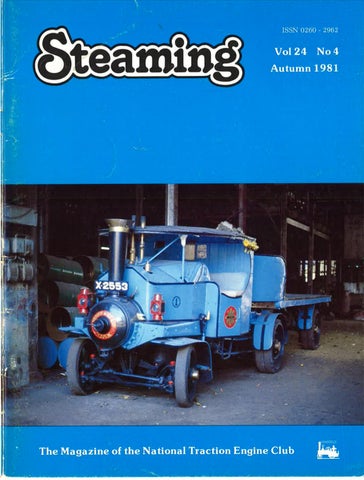
Cover A surprising survivor in working order in Sri Lanka (Ceylon) is this Robey six wheel steam wagon (43757 of 79284 shown here parked in one of its owners' large sheds at Hultsdorf Mills, Colombo, awaiting its next job. The story of the wagon and its four wheel companion is related elsewhere in this issue. (M. Parkinson) 147
Engine Owners Sub-Committee
New NTEC Publications
I was recently selected as Chair man of the above Sub-Committee. Serving with me I have a good selection of steam enthusiasts. All except one are engine owners, and each of us has had experience of driving steam engines on and off the road, and also had an appreciation of the other side of the fence, ie rally organising. The committee members are — Chris Barber, Nick Barker, Ian Bennett, John Hirons and Jack Wharton. Our first meeting was held on Saturday 8th August at Knowl Hill rally in the privacy of Wharton's living wagon, known as 'Hotel de Burrell II' . All committee members attended and many items were discussed. Some of them are outlined elsewhere in this edition of Steaming. Communications are paramount. In consequence we hope there will be some inlusion from the Engine Owners Sub-Committee in each edition of the magazine. I also invite members of the NTEC to contact me by letter or telephone with their problems, observations or comments upon anything that affects or would interest the engine owners, (M.J. Wharton, Southemdown, Minster Lovell, Ox lord OX8 5RD. Tel: Witney (0993) 3336.)
The Club has recently published two new books — Showman's Road Locomotives and Traction Engines and the Law. They are both reviewed in the books column elsewhere in this issue and other details can be found in the centre book list. All members are urged to support the Club in buying copies of the books land persuading any non-members to do likewise). The centre book list in this issue includes an extensive selection of out of season reading as well as many other interesting items. Our Sales Officer Stuart Gray hopes for a steady stream of orders from members during the autumn and pre-Christmas period. Remember that supporting NTEC Sales helps club finances to a very considerable extent and the post free price doubtless costs you less than travelling to your nearest specialist bookshop.
Steam Apprentice Club The main event of our season at Weeting in April was a great success and well attended despite widespread snowstorms. Fortunately the weather at our other rally venues — Rempstone, Banbury, Bicton and Fairford — has been such that our members were able to ride, steer (and the more experienced) drive engines in the ring. Our grateful thanks to -the rally organisers and engine owners who made this possible; also to the 'taxi driver' parents who all seem to find their labours worthwhile. (Sylvia Berth-Jones) 148
information regarding its previous history and he was only too pleased to have a yarn to owners or drivers of any Wallis engines. Whilst he was employed by the firm as foreman fitter in recent years, he looked after the Simplicity type roller, and attended several rallies locally, as well as Battersea Park and Stourpaine. He will be sadly missed by members of preservation groups around the southern areas as he enjoyed giving talks about the firm and its history, as members of the RRA will recall when their AGM was held at Basingstoke. Personally, I have a lot to thank Tommy for when I was rebuilding my Advance roller 7975 — his advice and the loan of drawings. I will miss him as a personal friend. He had a serious heart operation eight years ago, and had to take life a bit easy but still kept up his interest in steam and rolters. It is ironical that Wallis & Steevens recently closed down their 100 year old firm and now Tom Woods has passed on. (Bill Targett)
Jack Jaques
Obituaries Tommy Woods The funeral of A.T. 'Tommy' Woods was held at the village church of Sherbourne St John, Hampshire on the 9th September 1981. It was attended by Mr Arthur Wallis and several of Tommy's old workmates and by members of the Three Counties Steam Preservation Society and the Road Roller Association. It was a quiet affair; Tommy Woods was a quiet man. He was a man of steam, having started as an apprentice in the local firm of Wallis & Steevens in the late 1920s. He spent a lifetime with the firm and saw the age of steam pass to motor rollers. During World War 2 he moved about all over the southern counties keeping threshing engines in repair for the War Agricultural Committee. He was very involved with steam preservation, and was one of the founders of Wallis & Steevens Steam Club. Tom kept a very accurate record of the engines built at Wallis & Steevens. Anyone who purchased an engine for preservation could write to him for
It is with deep regret that I record the passing of R.S. (Jack) Jaques of Boston at the age of 83 years. Jack had been connected with steam for the whole of his life and a boyhood photo shows him on the footplate of the Fowler B6 road loco 10142 KITCHENER, at that time almost new and owned by C. & F. Drakard of Boston. Perhaps this was the engine which decided Jack's destiny because by the time he was little over seventeen World War 1 was upon us and Jack joined the old Army Service Corps. He was employed as a driver on a big McLaren road loco until his services were required in the delivery of new Foden steam wagons from Sandbach to depots all over the country. He served for a short time in France where he became familiar with the Clayton & Shuttleworth overtype wagon and found them nearly as good as the Foden. Although haulage with road locos was on the decline from 1920, Jack was rarely ever out of job and the rest of his professional career was spent on some kind of footplate, be it a steam wagon or tractor. Possibly Jack will be better remembered by older men as a model engineer. In this field he was an expert
14
My photograph of this Burrell showmans road loco is not in support of the Club's new publication on that breed, but a modest celebration by our magazine of the recent Royal Wedding. For Burrell 3945, a 7hp machine, was named PRINCE OF WALES, having a cast brass nameplate on the offside of the boiler barrel. The engine was completed in November 1922 and delivered new in January 1923 to H. Coneley of Bristol, registered HT 6804. Ten years later it passed into the hands of W. H. Marshall & Sons of Bradford and it is shown here somewhere in Yorkshire about 1935. Some rather fine floral decoration adorns the flywheel and the tender side still retains its communication bell for those overseeing the trailers whilst on the move. Our PRINCE OF WALES was, alas, cut up a long time since.
McLaren 3 speed compound road engine 1010, and a Foden steam wagon which was sold in 1943. When steam haulage was replaced by lorries the engines were used for threshing until the late 1950s, being scrapped just a few years before preservation began in Ireland. Having his own engineering works Clem Craig specialised in the repair and overhaul of steam vehicles and agricultural machinery, and was known far and wide for his workmanship. Though retired and confined to a wheelchair in recent years he took great interest in the preservation scene, and he will be sadly missed by his wide circle of friends. (G. Doherty)
regrettably cannot mind read! (Fay Wood)
From Alan Martin's Collection
and his attention to accuracy and exact detail became a standard by which other models were judged. Many fine examples of steam enginering came from his workshop, but possibly the finest of all was his 2inch scale model of the Fowler KITCHENER which now resides in the Science Museum at London and which he christened NIGHTMARE. Sadly, ill health about twenty years ago prevented any more work appearing from his workshop, but he was still able to visit model exhibitions and rallies which afforded him a great deal of pleasure. As a judge of model workmanship he could be a severe critic, but it was criticism tempered with kindly encouragement, especially to the beginner or even the established modeller who had found himself in unexpected difficulties. Jack will be sadly missed by all who knew him and our deepest sympathy is extended to his daughter, Mrs D. Appleby. (Frank Strange)
Clement Craig The death in June, at 86, of Clement Craig of Knockbridge, Co. Louth sees the passing of the last man in the area to have been commercially engaged in steam road haulage. Among the engines Clem owned was SHAMROCK Fowler 7645 of 1895, a 3 speed 8hp road locomotive. It was ex the Newry Traction Engine Co, Co Down, Northern Ireland, a company owned at one time by Clem's elder brother, which also used Fowler 7972, PRIDE. Clem also had 1910
Membership Renewal I would like to again remind members paying their subscriptions by Banker's Order to ensure that the correct amount is remitted. Despite numerous requests and the circulation of the necessary forms to update the subscription rate, I am receiving incorrect amounts from 80% of our standing orders. Even if your subscription is not due this quarter please check that your Banker's Order (if you have one) is for the correct sum — current rates are inside the front cover. A further point on renewals — would all those members who are old age pensioners and wish to claim the reduced £5.00 subscription please indicate this fact when renewing. I have no records on members ages and
Future dates Affiliated Clubs and Rally Organisers Conference The above conference will take place at the Great Western Royal Hotel, London on Saturday, 17th October 1981 at 11.00 am. Formal notice and invitations will be sent to Affiliated Clubs and Rally Organisers in the usual way.
London Area Social Meetings Meetings are held on the last Tuesday of each month from October to April inclusive (no meetings in December) in the upstairs room at 'The Cock Tavern', Great Portland Street, London (corner of Margaret Street and adjacent to Oxford Circus). They start about 8pm and all are welcome. TUESDAY, 27th OCTOBER 1981 This is the opening meeting of the 1981/1982 season and, as usual, will be members slides. So bring along some of your favourites. TUESDAY, 24th NOVEMBER 1981 Derek Legg will present the East Anglian Traction Engine Club's film of their Silver Jubilee road run and rally in 1980. There will be no meeting on 29th December 1981 and the 1982 fixtures will be advised in the next issue of
Steaming. 149
Tropical Robeys Heading photo — L.A. Nixon
In recent years brief but intriguing news has occasionally appeared on two Robey steam wagons still in use in Sri Lanka (formerly Ceylon). We are now able to present a more complete story — a first hand account by a member holidaymaking on the island; official and historical information from the owners of the wagons, and some excellent portraits taken some years ago by a steam photographer then resident in Sri Lanka.
1. The present scene Richard and Maureen Parkinson As we left Gatwick it was snowing. Following an excellent flight with Air-Lanka, Sri Lanka's own airline, we touched down at Colombo airport to be greeted by — heat at 110°Fl Thus on 23rd February we began a memorable three week holiday. The first few days were spent at the beach resort of Negombo, where we were introduced to hospitable people, the local mosquito population and the severe power cuts prevailing at that time. Greatly fortified by those days of sun, sea and local beer we set off for the interior of the island — the hill country, We travelled by observation car on the 06.35 train from Colombo Fort station, passing through breathtaking scenery, and having called at Kandy en route, arrived at our destination of Nuwara Eliya by midafternoon (a total journey of some 45 miles). Four days were spent enjoying the cooler air and the scenery of the area, and then, during one of our forays from Kandy, we came across our first taste of steam. 150
In a local authority repair yard by the roadside we spotted a 'parked up' steam roller. Upon further inspection this turned out to be an AvelingBarford 6 ton piston valve single of what one would expect to be very late manufacture. The only number we could find (all the maker's plates were
missing) was stamped into the brass filler plugs of the water ballast rolls; this was 1R077 WP were PntPrt9inod by the local engineer and his staff who thought it unusual, to say the least, that we should be so interested in his steam roller. We were told that the roller was in working order but in need of some repairs. It was fleet number SR 189. Several photographs were taken of this engine, and we were watched by what seemed to be the entire works staff who downed tools and viewed the proceedings with interest. The engineer told us he had another engine, larger and probably 10 tons, at another yard about fifty miles away, make unknown.* *Two Aveling & Porter and two Marshall steam rollers were seen by
Les Nixon in 1973. One of the Avelings (11698 of 1926) was number 138 in the Government fleet and in use by the district engineer at Puttalam, some 50 miles north of Colombo.
Aveling Barford 6 ton roller standing out of use in March 1981. (R. Parkinson)
Ye,
IA : 11
14'11 'c! 'II
11,,,,e .
! II ' t111 111111111111111110111::40
Robey wagon 42288 at Hultsdorf Mills in March 1981. The replacement brass chimney top and hub cabs seem the only non-Robey accoutrements. (Mrs M. Parkinson) At the railway station at Kandy we approached the stationmaster to enquire about visiting the locomotive shed. This fine gentleman, attired in magnificent white uniform complete with polished brass accessories, escorted us to the shed where we were made welcome and shown around by the shedmaster. The shed contained only broad gauge (5ft 6in) diesel locos, but parked beside the tracks and serving as a mess hut was the complete body of a broad gauge Sentinel steam railcar. The shedmaster told us that further up the line were kept two Beyer-Garratt steam locos which were used occasionally. Unfortunately time did not permit a visit. After more sightseeing we returned south to Colombo. One of the first trips we made from there was on the narrow gauge (2ft 6in) railway line which until recently ran to the gem city of Ratnapura but is now unfortunately truncated. An enthusiastic driver welcomed Richard for a footplate ride on the return; unluckily it was a diesel locomotive, not steam, but an experience none the less being a trip of some fifteen miles from Maharagama to Maradana Station, Colombo. The same helpful' gentleman, Driver Greasy (yes really) — invited us both to visit the steam shed at Dematagoda the following day, where we climbed over the several Hunslet built narrow gauge tank locos. A couple of these were in steam and the ever helpful railway staff moved them around for our benefit. Richard was invited onto the footplate of the shed
pilot loco, one of the broad gauge British built tender engines. Ceylon Government Railways do not allow ladies on the footplate, so Maureen filmed the proceedings from the lineside. Also in the shed, although unfortunately not in steam, were what must surely be the last two surviving operational narrow gauge Sentinel railcars.
One of these has recently been completely overhauled and there is talk that with some foreign backing it could be used as a tourist attraction on the Ratnapura line which may be reopened throughout. We also saw several other broad gauge tender locos on shed, all British built and some of them carrying the names of former Governors of Ceylon. A partly dismantled BeyerGarrett and a couple more broad gauge Sentinel railcar bodies were also to be seen through the midday heat-haze. We cannot close this railway chapter without expressing our gratitude for the help and courtesy offered us by Ceylon Government Railway staff at all levels.
Readers will no doubt remember the photograph and report published in Steaming (December 1979) about two Robey steam wagons operated by the British Ceylon Corporation in the Colombo docks area. Needless to say one of our main objectives whilst on this holiday was to track them down and get the full details, works numbers etc. Accordingly we set out through the extreme heat and tumultuous traffic of Colombo in one of the indispensable tri-shaw taxis to find the headquarters of BCC at Hultsdorf Mills. We were met by Mr W. Leslie Perera who couldn't have been more helpful, even apologising for being
Robey 43757 with a full load in Colombo's traffic, November 1973. (L.A. Nixon) 151
unable to steam one of the wagons for us, despite such short notice. Ile took us down to the part of the factory where the wagons were stabled (Maureen pulling her flip-flops out of the molten tarmac at every step). We rounded a corner and there they were! First was the four wheel overtype painted in BCC's yelluw livery; this was photographed from all angles and of course examined inside and out. We were gratified to find that it remained virtually as built, complete with the full motion splash covers, and still retained its Rnhey makers' plate with works number 42288 thereon. The engine is a compound. It was new in 1925 to Colombo Public Works Department, and purchased later by BCC, being their number 5. The registration number is C6037. Then on to the real highlight of the visit, the overtype articulated wagon which had only just been repainted in the new, blue BCC livery, This machine was also virtually as built and it too had its motion covers, makers' plate etc, still in situ. Quite apart from it being, so far as we know, the last 152
Being loaded at Hultsdorf Mills, Colombo on 1st August 1973 is Robey six wheel wagon 43757 of 1928. The sacks contain coconut pulp for soap manufacture. (L.A. Nixon)
surviving articulated steam wagon in the world, it was parked inside a large, cool building which made a welcome change from the midday temperature of 110°F. The engine's works number is 43757, its registration X2553 and is believed to have been new to BCC in 1928, now being their number 1. We of course enquired as to the eventual fate of the wagoi lb acid were assured that BCC have no intention of parting with them in the foreseeable future as they are both in excellent condition and in full working order; from our detailed inspection this would certainly appear to be the case. The wagons are used mainly for transporting coconut oil via a circuitous route avoiding the town centre, to and from Colombo docks; this is largely a publicity exercise nowadays and one could say that BCC (now a nationalised concern) view them as very valuable advertisements.
A short time before our visit, both wagons had participated in one of the first vintage vehicle displays to be held in Sri Lanka. The concept of such a vintage vehicle rally caused us considerable amusement as we had been impressed by the very high proportion of vehicles on the road of pre-1950 vintage. Sri Lanka is certainly a transport enthusiasts paradise! After our long survey of the wagons, during which time we met the regular driver who looks after them both so well, we were invited back to the offices for iced passion juice, a local speciality and very welcome. We made our farewells and headed out into the heat and the traffic once more en route to Negombo beach resort and a couple more days lazing in the sun before flying home. We had a very interesting and enjoyable (though not our most relaxing) holiday in Sri Lanka; the
people are extremely friendly and helpful and welcome foreign visitors. And where else can you find steam wagons in occasional commercial use?
2. Robeys in Colombo The two existing wagons are owned by the Government of Sri Lanka as successors of the Colombo business undertaking of the British Ceylon Corporation Ltd. The latter name is still used for trading and is carried by the vehicles in painted legend and engraved brass motif. According to BCC in reply to an enquiry by Les Nixon in 1973 six steam lorries were purchased by the company in 1931 and of these two (registered C6084 and X6439) were sold in 1961, and another two (X2868 and X2589) were scrapped in 1970/1. The remaining pair, detailed in the first part of this article, have survived the past decade in working order. M.A. Kelly in his book The Overtype Steam Road Waggon lists some two dozen Robey wagons as exported to Ceylon, mostly between 1924 and 1926 but some in 1931/1934. However, one of the survivors (43757) is not included. The wagons are listed variously as 5 and 6 tonners, 6 ton tippers, 6 ton articulateds and as 3 ton chassis. Seeing the relatively small span of years in which most of them were delivered and knowing one of the remaining pair is ex Public Works Department it could be that the lorries were imported for a large Government sponsored scheme — harbour or road improvements for example. Thus would machines be available for purchase by BCC in 1931. Of the survivors the four wheeler (Robey 42288) is quoted by BCC as 30hp with a tare weight of 110cwts. It was sent from Robeys on 22nd April 1925 and registered in Ceylon on 8th June 1925. The six-wheel articulated wagon (Robey 43757) is quoted as 40hp and has a tare weight of 128 cwts and a load capacity of 10 tons. It is said to have been first registered in May 1931 but this doesn't tie in with its 1928 building date. Has there been some exchange of engine/boiler units and chassis? In 1973 Les Nixon, between lecturing at Kandy University, found the six wheeler engaged in loading coconut products in sacks from BCC's Hultsdorf Mills to the Ceylon Government Railway goods yard at Maradana — about 2Y2 miles. The trip was
Although this illustration from a Robey steam wagon catalogue is not immediately identifiable, the legend PWD on the body sides would seem to indicate it depicts one of the machines sent to Ceylon in the 1920s. (collection Road Locomotive Society)
usually made twice a day, morning and afternoon. The livery then was plain dark green with white lettering, At that time he was told another concern in Colombo had only just finished using steam wagons. We are grateful to Nimal Ratnasekera, mechanical engineer at Hultsdorf for recently answering Steaming's questions about the steam lorries. He comments that although
both machines are in running condition and used for transporting coconut oil in drums to the port, they are not used constantly owing to the high density of traffic. Further, the drivers who have licences to drive them are getting quite old for the job. In the future he says, major problems are anticipated with regard to mechanical replaceryj ments and spares.
•
Mr G. Doherty of Dundalk, Eire kindly sends this picture of one of Tyrone County Council's rollers. The identity of the Aveling & Porter built machine is unknown — it looks to be the owners No.3 and is probably a 6 former, although if so the rear wheels look oversizie replacements. The distinctly racy looking push-bike no doubt provided swift homeward transport for one of the crew at the day's end. 153
What do you think of this ?
E. E. Kimbell My brother, from Broughton, near Kettering, Northants although familar with engines as a child, was never struck enough with the bug to become a mate or driver. Yet he was a close observer and being more than a bit-ofan-artist, could always put life into an engine picture, as the threshing scene in chalks on the wall of his 'local' will testify. "What do you think of this?" he said the other day. "Somebody in the village has given it me 'to improve my perspective'." What do I think of it? Well, that it was taken locally, at a guess, for the Clayton threshing machine and 28ft Roberts (of Deanshangar) folding type elevator were popular in Northants. Generally there was an Allchin engine, but this one is a 5nhp single crank compound Burrell — or "Devonshire" — and fairly new, more recent than the thresher, a pre-1912 one. The following Clayton model, with the large riddle wheel, had its end blower driven from the awner shaft, whereas here the belt goes to a twin on the riddle wheel. Thus the period could be around 1914. A little later and some of the men would have had trappings of khaki, and after 1920, even more, either from army service or surplus stores. And about then, a beard was rare for a driver. 1 54
The set could have been Wentworth-Smith's, a farmer and machine owner from Sywell, who also had an elderly Foster. If so, the Burrell, after a change or two of hands, went in the early 1930s to a Henton of Brixworth, who they said neglected his farm when he went around doing other folks' threshing. He did well at that though, and must have had some steam in his blood, being related to the Leicestershire Hentons, well known engine owners. In this picture they are threshing hard black horse-beans, not easy to fork up loose from the cart. The feeder is spreading them across the full width of the drum either by hand or short fork. A 'whizzer' could give a nasty crack on the face and the sheet there prevented beans from flying out, as protection against this would have been removed and the top half of the concave swung back for the wide opening the beans needed. Lower adjusters would be screwed back and the engine run at a lower speed, to crack as few beans as possible — this engine's governors have not spread out much — but if too slow the chaff would not winnow out and there would be 'bungs'. A ticklish job, threshing beans. They were generally harvested by binder. The feeder would be cutting the bands and doing his best to throw
the sheaves straight across. A headdown or aslant sheaf would stick and have to be eased back with a fork; dangerous, and sometimes the fork went down! "Boom-zoom-boom" would go the unopened sheaves, sometimes causing flapping of maindrive belt and slowing of engine, as the regulator was more often left halfclosed than governors adjusted, and expected lively chuffs in response seldom came. Beans shelled easily and did not have to be carefully fed by opening-out. The straw stack ladder on the elevator's side is not well placed. A little more winding up as the rick grew would see it slip back and crash against the drum — or the man on the handle, should it be on this side. Straw rick men usually knew what was what, however, and soon enough would have come the warning shout, "Lean that ladder to the rick agin' now I've built round this side, afore y'start turning that handle." One wonders what the driver has been saying. Perhaps, "Put a bit o' coal on now, boy, and turn that pump handle off a mite — it's where yer backside is — else we'll make a driver of you, soon as you can keep steam level a-threshing. 'Tis the best to learn, especially when you've not growed up enough to reach them handles properly."
Tar Spraying and other tales PART 4 — continued from page 10 of the Winter 1980/1 issue Percy Dabbs For the first two or three years when I was on my own, the feeder man was an elderly chap who lived in a lodging house at Sedgefield and spent most of his money on beer. He was called Harry Newcome. For thrashing, I got around E2 10 Od per day, with the feeder to pay out of that. The farmer paid the flagman or tyerman. Harry was only paid by the day when working and he got to work as best he could — mostly by walking, or occasionally by bus, if we were near a main road. This system had gone on for years. He worked for the Stephensons before I started but he eventually got too old to chase after thrashing machines. It was hard work and they were long days during the winter months, those were. Another season, I had a very good man from Trimdon called Harry Tinkler. I had to go for him each morning and take him back at night, with the bike and the sidecar. He, in turn, became too old and I next got a young chap from Ferryhill called Albert Curry. He did not do so bad but I was sometimes left to shift the set at night by myself; whether it was a girl
house, so if either of them woke up in the early morning, Jacky had to go up the street to see the Post Office clock to find out what the time was. I very often had to knock him up to take him to work with us. Ralph, on the other hand, was always ready. We had another good season, all went well — at odd times we were troubled with air raid warnings when shifting the set in the early part of 1940, but they came to nothing. Come the end of this thrashing season, around the middle of April, saw us back at Black Banks again to get ready for another tar spraying season. This time we were back to the old system of getting our tar from the local station and it so happened that George Wappett and I were together again. George had a bit of trouble with his Foden's tubes when we were around Hinderwell. Afterwards, during the early part of the season when we were at Nunthorpe station one day, both Fodens were blowing their heads off
and no tar had come to keep them quiet. Taroads area manager Mr Rawlings was there and we were debating whether we should go to Darlington for a load of tar each, or not. We eventually decided to do just that, to keep the job going. While we parked at this place there was an air raid warning one night, after we had all gone to bed. My sprayman that year was Maurice Kildale from Sandhutton, near Thirsk. As soon as he heard the siren, he dived straight out of bed and under a wooden warehouse which was set up on blocks about three feet or so from the ground. He was really frightened. I don't think anyone else bothered very much, although they were certainly bombing in the Middlesborough area. This was no doubt behind the reason for the delay to our tar tanks. Soon after this, George left me to take over a Yorkshire in another area, then in two or three weeks time I finished in that area and parked the Foden at Black Banks and relieved George on the Yorkshire at Kirkleatham. He had to go and attend to his own threshing business at home and had been engaged on the EstonLazonby-Marske-Saltburn to Brotton road, on which there were about another two weeks work still to do. It was here where I fell in love with the Yorkshire wagon. It was a WG type, number 2188 of 1931 (KY1281) and had previously belonged to Bradford Corporation. Two or three days landed us to Saltburn Bank, and unfortunately, the wagon developed tube trouble. I had rather a rough time that day but I managed to keep going and
problem or what, I never really knew. He was bad to reckon up and didn't stay long. After that I took on a young chap from close by where we lived. He was a farmer's son called Ralph Blackett. There were four or five lads at this farm which was only a small place and included a milk round as well. He was a very useful chap but would not interest himself very much in driving, although he would look after the engine a bit whilst we were thrashing, which made a break for us both. I quite liked the change which feeding gave. Our tyerman at this time and two or three years previously was a young chap by the name of Jacky Brown. He belonged to Co Durham and lived not very far from us. He was married and he was a bit slow — what they called about tenpence halfpenny to the shilling — but he was a good worker. He and his wife did not have a clock in the
Near Stokesley about 1940 and Woods Yorkshire wagon (2188) of 1931) forms a backcloth to the gang during filling operations. (P. Dabbs) 155
we moved on the Brotton by night, where I expanded the tubes very early next morning. While we were spraying Saltburn Bank and round about, there came a warning that there was a German submarine just off the pier. We saw a plane from our vantage point up in the hills, which appeared to be dive bombing the sub. After we got parked up in a lane on the outskirts of Brotton, a policeman told us they had sunk the sub — I think he came by to see that we were not showing any lights. When this 1940 season finished, I took the Yorkshire back to Yeadon, Leeds, as it belonged to D. Wood & Co Ltd, road contractors. Mr Rawlings was I think by in charge of the tar spraying section of that firm. During early 1940 preparations were wade ru ware building a Ftoyai Ordnance factory on land within about 300 yards of our house, so consequently the ex-pub became very useful, as we were able to put up workmen who came to the site from far away. The contractors were Harrisons of Leeds. As some of the men left others came as the building progressed. We were full up all the time and my wife was kept busy. We also had a girl living in, called Joan Hutchinson, more a friend of the family, to help out. This would go on towards the end of 1940/1 with the threshing. Occasionally we would be stopped at night for an hour or so by air raid warnings, on account of the lights. We very often got warnings during the night. We had a cellar under the house since it used to be a pub, and when the siren Went a lot of people out of Merrington Lane made a bee-line for our cellar as pre-arranged. This went on for a few weeks and then gradually died out as nothing happened very close to us. I can, however, clearly remember getting out of bed very early one morning when the sirens had guile. I looked out of the window and saw a ball of fire go across the sky like a red hot football — then there was a thud. My wife was telling me to keep away from the window — I suppose it was a daft place to stand, but I didn't want to miss anything. I can see that thing now! I found out later that it landed on Tudhoe cricket ground, only a hundred yards from the road at the end of the village. The damage was not as bad as it would have been if it had landed on the road. The vicarage adjoining the cricket ground was badly damaged and the roofs blown off some farm buildings on the other side of the road. There was no plane involved and it was too early for 'doodlebugs', so what it was, I do not know. Because of these air raids, my wife 156
did not want me to go tar spraying in 1941. Apart from that, there was plenty to do at home and one of the chargehands from the building site who was lodging with us said he would get me a job as a mixer driver or something similar if I wished. I thought this a good idea and by about the middle of April 1941 threshing was about finished, except for a few days left to do during the summer. So one Monday morning AIf Hall, the chargehand, took me onto the site to start in his gang. There were no mixer drivers required at that time so I started with some more men digging what we would call post holes. They called them stanchion holes and they were quite large affairs. They were for big pillars for a large foundry which was to be built by the Cleveland Bridge and Engineering Co Ltd of Darlington. When we got several holes dug, another gang fixed four large bolts into each hole, each was surrounded by a wooden box so that the bolts would give a little when setting the stanchions in position. After this we set on to barrow cement into the holes. In our gang there were four or five of us and, of course, I just worked away as I thought was normal. But the other men were telling me not to go so fast. I did not think I was doing anything out of the ordinary but I was too quick for them. The foundry builders had already started to erect the steelwork at one end. They had a big steam crane running,on rails along the centre of the building for this job. Alf had told me at the beginning of the week that the building foreman wanted a driver for this crane. He had had two already in just a few days but Alf said the driver would need a Board of Trade licence, so I did not bother about it at that time. It got to Thursday morning and I was, by that time, not too set up with my labouring job so I thought I would go and see the foreman about the crane driver's job. When I asked him about it, he asked me whether I had driven a crane before, so I told him what my real work was and he took me to have a look at the crane. The jub luuked very simple as everything was marked for 'the various directions. In the course of the conversation, I asked him about the Board of Trade licence. "Blow the Board of Trade licence", he said, "I haven't got one, never mind you!" I got the job and started right away. It was a very good job and I enjoyed it. We worked seven days a week during the first fortnight and received time and a half on Saturday afternoons and double time on Sundays; this weekend work was eventually stopped. It had gone on
from the start of operations, such was the urgency of the job, but ceased because a lot of local labour would work the weekends and have a day or two off during the week. This sort of thing just goes to show how men can spoil a job by not being conscientious. I must say that it suited me though, as I had plenty to do at the weekends. We had a couple of cows, four or five young beasts, a calf or two, pigs, hens, and five or six geese by that time. My wife did the milking mostly — in fact we had a little black cow who absolutely refused to let me milk her. I did not consider myself an expert on cranes, and indeed have not had anything to do with cranes since. I would think this one I got to drive was a big one, I never measured the jib, but it seemed, from memory, to be about a hundred feet long. It ran down the centre of the building and the jib had to be as low as possible for the height of the stanchions to set them up on each side. To keep moving back as the work progressed I had to lift a section of track all in one piece, sleepers included, from the front of the crane and swing it gently round to the back. The floor was reasonably level, so the track section did not take much fixing. After lifting one or two pieces of track into position, I would go and help the others to bolt it up as I had nothing else to do. The men said I need not bother — they thought I had plenty to do to look after the crane, but all the same I had plenty of spare time. As there was no canopy or cab on the machine the boiler had become very rusty although the operating levers and working parts were in nice condition. In my spare time I gave it a good clean and painted the boiler and chimney black. The men thought I had done wonderful and it certainly was a big improvement. The steel fixers were a gang of good workers and all pleasant to get on with including the foreman. I never had a wrong word with any of them. I could never tell why the first two drivers left. I used to watch some of the bricklayers who were following along occasionally, and if they had gone much slower they would have had to stop. You wouldn't have thought there was a war on. By the time the job got nicely under way it was the start of the 1941 tar spraying season. Mr Rawlings was very disappointed when I would not go out again. He came to see me twice at Spennymoor before the season actually started. I managed to get him a driver for the Foden which I previously drove, and also a couple of chaps as spraymen; all were eventually to work for me in the threshing
Parked by the side of the road for the night, Woods second Yorkshire wagon (2189 of 1931) makes a superb study of the trappings around a working engine. Photographed in July 1952 at Stockton-on-Forest. (P.N. Williams) season. These were George Robinson, Syd Elliot and Tommy Rutherford who came from the Wingate and Wheatley Hill areas of Co Durham. This crane driving job lasted well through the summer of 1941 and after renewing most of the boards on top of the Ransomes threshing machine and a few other repairs, I set on and cleaned the Ransomes engine and started to paint it. When the foundry was finished, my crane driving finished as well. They would have liked me to have gone to another job with them which was near Birmingham. This, of course, was no good to me as I had my own work at home. They even wanted me to go with them just during the summer but I thought I might just as well stick to tar spraying, although the crane was the easier job. Most of the buildings on the site were almost finished by now and the painters moved in. I don't know how many there were altogether but two of them came to lodge with us. When they saw I was doing some painting, they were very enthusiastic and keen to help me. Naturally, I thought this was very good and they would be a help but it turned
out that they were not as good with a brush as with a spray gun and they left me to it. I was rather pleased, with all due respect to them. In the previous summer, 1940, whilst I was out tar spraying my wife had seen a car advertised in the Darlington & Stockton Times. It was to be sold by auction in what was then called Feethams Field where Fred Robinson held a weekly sale on Mondays — Darlington market day. Off she went to Darlington and found the sale field if one could call it such, as it was all hard ground, maybe not too even but nevertheless it was where all the fairs, circuses etc were held at that time. When my wife got there, she asked a man in the crowd if he would start the car for her so she could see how it ran. Sure enough, one turn of the handle and it ticked over like a clock. When it came to be sold my wife bid £5, another man £6 10s and she got it with a bid for £7 10s. It was a Singer — two colours of brown. It was a very good car and it ran well; I only once had any trouble with it and I found that this was caused by a cracked distributor so I drilled a hole
through the crack, filled it with putty and that put it right. Going back to the time when we first came to Spennymoor I mentioned the man with the saw bench set up which was driven by an old BSA motor cycle. The old gentleman wanted to sell this lot as he said the Council was going to come on to him for rates and he felt he was too old to be bothered. The machine was on an allotment very close to our house so I bought the lot as it stood. There were all sorts of old fashioned woodworking tools including a very old treadle wood turning lathe, so along with some other material I had obtained and a lot of corrugated sheets, I built a larger workshop with plenty of room for the car to go in at one end. When I was repainting the engine I also set to and built a canopy onto it as it did not have one when I bought it from Mr Wappett. This worked out very well and although I made it to enclose the chimney, which could have been rather awkward sometimes when shunting among buildings or in stackyards, I never found it so. There was one thing in its favour — when the engine was sheeted down it was well guarded against the weather. Also, on a showery day when working with the sheet down at the flywheel side, it kept the rain off nicely. I did not go to 157
the expense of having new sheets made for the job — I bought some secondhand railway sheets which had been reconditioned. These were advertised in such papers as The Farmer and Stockbreeder and I cut them to fit my requirements, stitched the edges up and put brass eyelets in. These may have been a bit heavy but nevertheless they made a very good job and when carefully rolled up were very tidy. During late July 1941, or thereabouts, we went to a sale at Harome, near Helmsley, of threshing tackle belonging to Mr Percy Hildreth. The threshing set had gone through the sale when we got there and had been withdrawn; however I bought it for £400 and also one or two oddments including a driving belt. Mr Hildreth, ; was given to understand, was taking a farm somewhere else in the area. The set consisted of a 6hp Ransomes single 10846 of 1895 lAJ73821, and a Marshall threshing machine number 8703, supplied new in 1888. The engine was new to the agents Bushells of York. I must say that it was in very good condition and proved it could cope with all that it came upon. Also included in the set was a Howard trusser on wheels — I would much rather have had a fixed one with winding gear. However, Mr Hildreth said he had overhauled it since the end of the previous season and it would be in good condition. The problem of getting the set home to Spennymoor then arose. Well, a Mr White contacted me on this problem. He had a threshing business in the Helmsley area and during our conversation he said he had two good reliable men if I cared to have them as he could spare
Winching tar barrels up onto the tank of a Taroads Foden at Appleby, 'vtICJilllUlialld in 1951. The o tun wagon was ex E. & j. Fountain, uxbridge, 13044 of 1928 (MP5938). (R.G. Pratt)
them for two or three days to drive the engine back for me. This just fitted in right, as I had plenty of work to keep me going at that time. I saw they were well supplied with coal and oil etc to set off with the next morning and then contacted them towards the following night with coal for the next day and also found them a parking place and lodgings for the night. The next night, I did the same but there were no suitable lodgings available where they were, so I took them home to Spennymoor for the night and returned them to the outfit the next morning. The third day saw them safely home and after a wash and a meal, I took them to Bank Top Station, Darlington, en route for Helmsley. I built a lean-to along one side of the workshop for the saw bench and
oil drums. I used the BSA motor cycle to drive the saw for a while, then I bought a 3 or 31/2 hp Lister oil engine from a farmer customer at Croxdale for £2. It would not go but the bargain was that if I got it to go, he wanted a bit more money. I tried to make it go without success, so I took it to Teesdale Bros of Bank Top Iron Works, Darlington, and got it back in about a fortnight in perfect condition. It cost me about £25 but I was well satisfied. I'm afraid the farmer didn't get any more out of that deal. I sent away for a new blade, big enough to saw sleepers, as I seemed to get a good deal of that job for people locally who wanted sleeper boards for their allotments. (to be continued)
To keep up-to-date with weekly news of the Preservation movement you need
gours
incorporating Preservation News
ONLY 20p PER WEEK Order NOW from your local newsagent. In case of difficulty (or for a free specimen copy) write to: THE WORLD'S FAIR LTD, 2 Daltry Street, Oldham, Lancashire OL1 4BB
158
TEETER TOTTER David Gray Since my article on American traction engine preservation in the March 1980 issue of Steaming I have had numerous requests to provide the about information more 'teeter-totter' that I mentioned. The teeter-totter is a heavy timber platform measuring approximately twenty eight feet in length by some twelve feet in width and constructed of timbers two inches thick. This wooden platform is pivoted, either on a heavy timber log or on a specially built steel and timber trestle. The trestle is located under the platform at the mid-point of its length so that the platform becomes a large see-saw. The object of this piece of equipment is to prove the drivers' skill and ability at controlling their machines by driving up onto the platform, and manoeuvering their engines into a central position so that the platform is balanced with each end equally off the ground. It certainly takes a considerable amount of practice before a driver is able to match the skill of Paul B.
Stolzfoos of Leola, Pennsylvania who is able to drive his Peerless traction engine straight up onto the platform and into the balanced position without the necessity to reverse his engine once. He does it with such speed that no sooner is his engine mounting the platform than he is blowing the chime whistle in triumph having 'balanced out'. My pictures show Paul demon-
strating his prowess at the Rough & Tumble Engineers' showground at Kinzers in May 1980 — firstly driving on the tipped up platform and then standing, seconds later, balanced in the horizontal position. The teeter-totter certainly provides an excellent form of competition for the drivers of engines and also, at times, some amusement for the onlookers.
A Youthful Memory of the General Strike John Mayes The General Strike of May 1926 stands out in my memory as the very first time I had sole charge of a set of threshing tackle. "Can you get'steam up on that engine," my father said, having driven me in a horse and cart to where the set stood at the Field Barn, Billingford, which was some four or five miles from our Norfolk home. He gave me one match and one sheet of newspaper, and then drove off, saying he would be back in a couple of hours. I rolled back the sheet, hurrying in my eagerness to prove myself, then climbed up and took the cover off the chimney, swept the tubes, clinkered out and drew the ashes from the ash pan. This was much more to my liking than school ever had been! I hunted for dry sticks from under the hedge, returning with an armful, and then gathered straw from the stack; I was ready to start. Cramming the straw into the firebox thoughts of my one solitary match made me get a bit anxious. I rolled the sheet of newspaper into an untidy spill and pondered again over the match before making up my mind which was the most sheltered spot on the footplate near the firehole door to strike it. Then, taking courage in both hands I struck the match on the firehole door, lit the rough spill and when it was well alight gingerly thrust it down to the straw. On with the sticks, shut the firehole door and a sprint across to the hedge for more sticks — just in case! When I returned to the engine the sticks were blazing nicely, so I chucked on the rest, then started shovelling on small pieces of coal. So far, so good; the fire burning nicely and smoke coming out of the chimney. Again I thought this was far better than school — better even than riding round the hills on horseback counting cattle. 160
Threshing at Worthing, near East Dereham, Norfolk — a snapshot by the author taken during the General Strike in 1926, as described in the article. The engine is Burrell 1641, a single cylinder 8hp which was bought by John Mayes' grandfather off Burrell's stand at the Royal Norfolk Show in July 1890. It was licensed by Norfolk County Council No.86, and later carried registration AH 6609. The drum is a Marshall, and the straw pitcher was built by Oliver Rix of Sculthorpe, Norfolk.
But what should I do now? A bit early to start oiling up — how was the fire? It was getting rather boring just hanging about watching the fire and I began to worry when father would return, would it be before I ran short of water? The tank was full. I'd already checked it but there was no water near at hand if I started to run short. Then an interruption by a couple of old women (well, to me — they were probably barely thirty in fact). They came and hung over the gate yelling at me about "stealing the bread out of our mouths" amongst other long forgotten insults. But presently a familiar and very welcome voice shouted back "Go home, lie down, go to your kennel." Father had arrived on horseback. I don't remember oiling up, or if I replaced the wicks in the oilers and warmed the cylinder oil. I don't remember drawing beck from the straw stack, or turning the drum round and coupling up. I do remember the panic as we were ready to pull out, when father said something about me being at Billingford bridge in three quarters of an hour, where Police Sergeant Aldiss would see I was alright whilst filling up with water, and that he would see me again just before I got to Worthing village. It suddenly dawned on me that I had got to go the whole four miles on my own without even a steersman! Supposing I met a motor car, I thought; horses did not
bother me, I knew I had to stop for them anyway, and supposed I could stop for a motor car as well — still I might not see one of them unless I was very unlucky! Slowly, in little wheel, out through the gate I went, delaying turning right onto the road as long as I dare so the drum and straw pitcher would miss the post. The nearside front wheel went up onto the grass verge but I managed to pull the steering round in time. I was away, and the success of the last manoeuvre increased my confidence no end, but I seemed to keep going for ages before remembering that I should stop and get into big wheel! Up into high gear, and I knew enough to turn the crank into the correct starting position to go forwards before sliding the gear in. I put on a big fire, opened the damper and then set off. Up went the pressure — close the damper, turn the pump on — this was lovely, I thought to myself, feeling very proud and trying to watch everything at once without taking my eyes off the road ahead. It was a good job that part of Norfolk is very, very flat. I'd never seen the brake used and there probably wasn't one for all I knew! Doubtless I wasn't strong enough to hold the reverse back and steer at the same time. I went up one small hill past the church and as the bark of the exhaust grew louder began worrying in case the engine stopped! Billingford bridge at last, and there
was Sergeant Aldiss with his bike, cape folded over the handlebars and not another soul in sight. He helped me to get the lift pipe down into the river, and the lifter gurgled and thumped before finally getting water. Having filled up the Sergeant joined me in folding the hose away and saw me off. I remember driving through Worthing. Father met me on horseback and cracked his whip every now and again as he rode in front, this threat sufficed to keep everyone well out of the way. I also remember making a terrible hash of driving through the gate into the field where an oat stack had to be threshed. I ended up having to replace the drum
drawbar with a pair of wagon shafts and harness a pair of cart horses, assisted by my father and uncle, before finally getting the drum into the field and set against the oat stack. I must have set the engine to the drum quite easily and quickly however, as I remember uncle stamping around (he never walked) muttering "Don't understand it boy! Can't make you out at all — you set that engine in the twinkling of an eye, but you could not pull off the road through the gateway." We threshed the next day with a 'scratch crew'. Uncle fed the drum, the parson and his two boys pitched the sheaves of oats and cut the bonds,
and mother assisted by another boy sacked the corn. Father, single handed took the straw from the straw pitcher and built the straw stack. I bagged chaff, cleaned the calder from the front of the drum and drove the engine; in later years I shuddered to think what might have happened had the governor belt broken whilst I was round the front of the drum.
It was long past dark by the time we had finished loading the sacks of corn and chaff and delivering them into the barn, a job we had to leave until the last in order to complete thrashing before dark.
On Sentinels CEMENT HARKEilhi,1 COMPANY um.LI.
LONDON. Joe Thomas I purchased a copy of The Undertype Steam Road Waggon by Maurice A. Kelly soon after it was published in 1975. I then lent it out and have not seen it since! Now they are being remaindered at half price I have acquired another copy and for the first time have properly read the chapter on Sentinels. The following comments and additional details from my own records of Sentinel machines may be of interest to readers. Mr Kelly states that Standard models were produced up to 1922; in fact works number 4413 was the last one, delivered in June 1923. Further the DG model is noted as introduced in 1927 and produced up until 1932. Actually 9329 went to South Africa in November 1937. Perhaps I may add one or two details — the Super Sentinels were produced alongside the then new DG models for several years and there was no distinct 'cut off' as between the Standards and the Supers. The new SGLW (single gear lightweight) Super was introduced on 11th May 1932 and twelve were produced up to 30th July 1933. The first S model was 8798, new on 31st May 1933, and not in 1932 as Mr Kelly says, although a test model may have been running in 1932. S models are in the book as produced
A DG6 pneumatic-tyred Sentinel similar to the last DGs built that went to South Africa in dozens in chassis form. (collection J.L. Thomas)
from 1932 to 1950. However, there was a gap; normal production ceased with 9362, registered on 1st December 1938, then twelve years later 100 new model shaft-drive six-wheel tippers were produced by the firm that had by then taken the Sentinel factory over. They were exported to Patagonia at the southern tip of South America, and used for coal haulage over the 150 miles between newly opened mines at Rio Turbio and the coast at Rio Gallegos, pending the construction of a narrow gauge railway — the latter still steam worked in 1981. The eight DG8 rigid 8-wheelers were all built as tippers according to Mr Kelly (page 1551, but in fact the first two (8002 and 8120) and the last one (8130) were not tippers as the
picture reproduced on page 132 of Kelly's book shows. Finally the author says at the start of his owners list that he is only listing DG models and ends his list at 9223. But he misses out 9219/9220, and omits DG six-wheelers 9324 to 9329, all of which went to South Africa in tril chassis form.
'The Bradford-on-Avon Rural District Council show in their accounts for the half-year ending March 31, 1903, that they have received £54 14s 3d from the letting out on hire of their steam roller.' (From The Machinery Users Journal, July 1903.1 161
Wattle
•••
as I knewhim Tam McTaggart
I knew first knew Wattie Mair as driver of the big Bun ell CLYDE. He did not speak to me directly for about two years after I started working with Road Engines & Kerr (Haulage) Ltd from their yard at Mavisbank, Glasgow. Although there were only shout thirty men employed engine drivers did not mix with flagmen or labourers! When I had been there about six months I was sent to be second man on an old chain drive Scammell dieselengined tractor (light locomotive). We were to trace two steam engines (heavy road locomotives) to Aberdeen with a 68 ton marine boiler. Wattie was on Burrell 3419 CLYDE, steered by Tammy Fleming — who went on the engine in 1912 when it was new — and Dan Brown was third man. The other engine was 10hp McLaren 1650 driven by George Tough and steered by Bert Rankin, with Tommy Smith as third man, and in this instance, cook.
We left the Klondyke with the Scammell in front of the McLaren; that tracing the CLYDE, and the boiler sitting on a twenty-five ton tare trailer which could carry 130 tons. At the rear was a coal wagon and a caravan. Four slept in bunks — the two engine drivers, Tam Fleming and the cook — and the other four on the floor. The diesel driver did not rate a bunk in the eyes of steam men! As second man on the front y.hH.i it s my job to run ahead to hold up oncoming traffic at junctions, and as you may guess it was a very slow job trying to get past trams, buses, motors and carts. The engines were damped down for the overnight stop with dross or slack (coal dust) and a piece of steel plate was placed on top of the chimney. In the morning the plate was knocked off and the throttle opened to blow up the fire. Sometimes the monkey had to be opened to allow steam into both cylinders to make the crank turn over initially. The first man out in the morning performed this function. I had been flagman on a Fowler for a few weeks, and being
Wattle Mair started his career with Allan Meikle of Mount Vernon, Glasgow. Here BONNY JEAN, Meikle's superheated 6hp Garrett single cylinder traction (28375 of 1910), poses on a quay whilst delivering a ship's boiler from Bow McLachlan on an iron wheeled bogie. (collection late T.B. Paisley)
162
first out that morning I proceeded with the McLaren. Lucky for me George Tough arrived next and saved me from a row, for nobody interfered with the CLYDE except Wattie's crew. During the journey every time the engines lifted water, coal had to be transferred from the coal wagon to the engine tenders. A woodwoven basket was filled with coal and carried on the flagman's head up to the engine where the driver lifted it off and emptied it into the tender. This was fine if it was dry, but in rain or snow dirty water ran down the neck. The next time I was involved with the CLYDE was about seven months later, but Wattie was off ill and it was Bert Kilvington from the two speed 10hp Burro!! LOP,D FiCBERTS sPvho was driving her. Wattie was away with illness on and off over the next three years and one morning in 1945 after I had been driving for two years, Bob Kerr, the Managing Director, came into the yard and said to Wattie, "come down, Wattie, you have been fifty years up there — go with McTaggart as second man." Before he could answer Tammy Fleming cut in with "what about me? I have been here for thirty-three years, am I not due a break?" Bob replied, "go with McTaggart as third man." And that's how I landed with them; Wattie was sixty-five and Tammy sixty-three. Tammy then proceeded to get his own back after years of do-it-my-way from Wattie, and I was in between. We were on a 1943 Scammell tractor and they would spit out with the window shut. The tractor was only two years old, chain drive, but not solid tyres and it even had a self starter. We were sent to the North British Locomotive Company's Hyde Park Works to move frames, boilers and tenders round to the Atlas Works for finishing. They were busy building locos for Britain, India, South Africa and New Zealand and could not cope with it all at Hyde Park. This job lasted for months, with on occasion, the hauling of completed locomotives to the docks for shipment. I got to know Wattie very well and strange to relate he was completely different as a second man to how he had been as an engine driver. I discovered his name was Muir, not Mair as he was known everywhere. Wattle was born in 1880 in Lanarkshire, fairly near Glasgow. With only a few years schooling he left to work with Allan Meikle of Mount Vernon, a threshing and general haulage contractor. There he learned to steer and drive an engine and did all types of agricultural work. Once he was loaned to Codona for three months to :teach
his sons to drive an engine. He then went on to haulage work for William Beardmore & Co. of Parkhead Forge in Glasgow, a steel foundry that cast stern frames, rudders and up to 16 inch gun barrels. In 1927 he changed over to William Kerr & Co. of Scotland Street in the south-west of Glasgow and at the same time married Mary Steel of East Kilbride, a farmer's daughter. He went on to the two-speed Burrell LORD ROBERTS which had originally been built in 1897 for a Welsh showman. After a few years he took over the Burrell CLYDE, including steersman Tammy Fleming, and was in charge of most of the large loads moved by Kerrs. The engine, incidentally, was known as a 10hp rating but since then I have heard her referred to as being 12hp. However, that does not form part of my tale. In 1932 by the joining of the assets of Road Steam Engine Co. and W. Kerr, Road Engines & Kerr (Haulage) Ltd. was formed, and in 1938 they in turn were taken over by Wordie & Co., but the firm kept its name and now had cash to buy new equipment. Wattie was there, moving transformers up to 100 tons, boilers up to 120 tons, stern frames up to 35 feet wide, anvil blocks up to 135 tons, steam accumulators of over 100 tons as well as ship's engines, guns, boats, seven miles of wire cable for the Glasgow subway and so on. Most of it was on iron wheeled bogies without brakes. The original ones had one or two wheels at each corner and no lock, and later on, before 1939, crank framed trailers on solid rubber tyres on brass bushes. After that we had brakes and ballraces, again with solid tyreS. Where in 1920 four 10hp Burrells were required to haul a 100 ton boiler on a four wheeled bogie, only two would be required in 1940 and even one if it was but a few hundred yards with a trailer running on roller races and oscillating axles. During the late twenties and the thirties, hundreds of railway locomotives were moved to the docks on two crank framed trailers joined together at the rear. They weighed 62 tons empty and a 90 odd ton loco was perched on top, with the CLYDE and a McLaren in front and a McLaren back shoving. So many loads, in fact, that there were two lots of drivers and crews on the same engines and trailer, working night and day. If it had not been for the loco moving an odd Lancashire boiler and a very occasional ship job, Kerr would have gone into liquidation in the late twenties. When Wattie started with Kerr there was no road out of Glasgow to
A huge winding drum crankshaft for a South African gold mine during the first stage of its delivery behind LORD ROBERTS (left) and CLYDE (right) in Paisley during the 1930s. The two iron wheeled bogies are shackled together. (collection late T.B. Paisley)
the north that could carry more than three tons because of the canal bridges. All loads for Fife and the north-east that went by road first went north-west under the canal and then skirted the city alongside the Campsie Hills until clear of the canals; it was not until the middle twenties that heavier bridges were built over the canals. Ship's engines, boilers and other really heavy lifts bound for the east and north-east coasts from the River Clyde travelled by steam lighter through the canal that obstructed the road. From 1939 those lifts had to travel by road because of attacks on coastal shipping and this raised some problems, not least of them low bridges. The first marine boiler to go to Aberdeen became stuck between Dundee and Arbroath at a tank barrier which the local policeman refused to allow the crew to pull down. A hurried phone call to Glasgow quickly sorted that out. A truck load of RN ratings arrived from Arbroath with picks, shovels and crowbars to dismantle the barrier in front of the constable's horrified gaze. In 1939, on the outbreak of war, Kerrs was taken over by the Admiralty, or I should say taken under the wing of the Admiralty. All drivers then carried Rear Admiral White's phone number in case of difficulty. Kerrs did not work with the Ministry of War Transport, or in fact with the heavy haulage pool, unless
they had permission from the Rear Admiral to do so. Wattle had delivered heavy lifts as far south as Nottingham in the twenties and had been engaged in moving a steel works from Coatbridge to Corby in the early thirties. These movements were via Edinburgh and the A 1 road down the eastern side of England. It was rarely that any loads went via Carlisle and the Shap, and there were two reasons for this. One was that any heavy lift going into the Mersey area could go by ship, as each week at least one vessel sailed in ballast from the Clyde to Liverpool to pick up cargo there, and heavy lifts were cheaper travelling as ballast than by road. The second reason was that the road was so soft in places like Douglas Mum. Hew Marston Road Services' 100 tonner went down into the road in 1932 whilst loaded with one of the propellers for the QUEEN MARY and it was there for three weeks. Beattock was narrow and soft; Shap narrow and soft and hilly. It was not until 1934 that any real movement took place on this road. During the late spring of 1939 Wattie with the CLYDE and Tommy Macintosh with a McLaren set off to collect a new Dyson 130 ton crank-framed trailer from Liverpool — I cannot tell which McLaren it was because Kerrs had three, with two sets of registration plates that were changed around to 163
suit themselves! They were then to uplift an 80 ton transformer from Metro-Vick in Manchester by arrangement with Pickfords (the firm of that day and not to be confused with the nationalised one of today) for delivery in central Scotland. On the outward journey Wattie, who had never been over Shap before, proceeded in fog and on arrival in Kendal asked a policeman where this Shap was that he had heard so much about, only to be told that he was over it! He nearly had a fit when he saw it on the road home without the fog and then gratefully understood why Pickfords' manager had insisted on Kerr sending another engine down to assist them north from Kendal to Carlisle. Everywhere we went somebody knew Wattie. iii docks, shiuyeids, quarries, farms and pubs, he was greeted by dockers, miners, roadmen and threshers. We had parted with old Tammy by this time for he was back doing the flagman's job on SUPREME as he did not like being away from home. We rolled into Huddersfield one night with a second-hand Lancashire boiler, but having parked up, we couldn't find digs for the night. We were heading for the police station when a man came round a corner and in the blackout bumped into Wattie. By torchlight they discovered they knew each other and we were soon escorted to good digs. Another time we had broken down in Fife and could not get a blacksmith to repair a broken airpipe. Wattie took the pipe, disappeared into a mine workshop where he knew a miner and came back with the pipe repaired. Again in Fife, when we were held up by snow and went into an hotel for a snack, a man put a drink up for Wattie and asked if he remembered him, and then proceeded to tell us all how Wattie had helped him many years before when he owned a traction engine for hauling out logs. Wattie on the CLYDE with a Lancashire boiler bound for a pit, came upon this engine in the middle of the road with a broken rear axle. Wattie and his crew jacked up the engine, placed a 12 inch square block of timber under the front of the firebox as a sled, and locked the compensating gear, or differential as it is now called. They chained the block forward to the front axle and drove the engine on to hard standing clear of the traffic about two hundred yards down the road. In a pub in Kilmarnock one evening a voice said "Wattie Mairl Boys, here's the man who launched the LADY AILSA that stuck on the ways at the launching ceremony in Troon." Yes, Wattie had been delivering a funnel for a ship in 164
the fitting out basin and seeing their dilemma, he made arrangements with the foreman rigger to fit a quick-slip trigger from the ship's bow. Then Wattie ran the CLYDE down alongside the hull, coupled up the wire, and with a quick tug she caught the tide. Fortunately, the trigger worked or a certain engine would have landed in the river tool It may not be generally known that Kerr borrowed Pickfords' thirty twn wheeled trailer on at least three occasions. Two of those occasions were to move steam accumulators from Cochrane's of Annan, once in 1939 to a steel mill in Motherwell and again in 1943 to Blochairn Steel Mill in Glasgow. These were smaller in length than the Beckton Gas Works one of Picklurds fame. The third time was to move an 80 ton transformer from Struan Station to Tummel Bridge in Perthshire in 1940, this being a followon of Coulsons' work on this scheme in 1932. Wattie was in charge on all three movements. At Struan, as they were oiling up and checking equipment before leaving, one of the Grampian Hydro Electric Board members asked Wattie how long it would take to get to Tummel Bridge, a distance of about fourteen miles. Wattie replied that as it was about 12 noon then, they should be there by 5.0pm. The Director then asked which day, and was taken aback when the answer came "Why
today, of course." This cheek was reported to Bob Kerr, who replied "Aye, he was a bit ahead, I would have said about 6.0pm." The Director had been present in Coulsons' day with iron-wheeled trailers when they had to plate the wheels and winch the trailer along the road — the time taken, three weeks for 14 miles. No wonder he thought Wattle cheeky. Then Wattie offered a £1 bet on it, the winnings to go to a charity of the winner's choice. Another Director held the bets, Wattle won by twenty minutes and the Lifeboat Society became £2 richer. The holder of the bets presented Wattle with a bottle of whisky for his sportsmanship. They got the transformer off the trailer onto the plinth, and managed to get the tnree engines away but it was three months before the snow cleared enough to allow the trailer out! It was not often that Wattie and CLYDE were sent to move a sternframe. This was light engine work normally done by Jimmie Hudson on his Fowler 9986, or one of the McLarens, but rarely CLYDE and never LORD ROBERTS — that was too slow. But one frame was 35 feet wide and had to be loaded at an angle; enough to go into John Brown's gate about 20 feet wide and not too high to bring down the tram wires. It was loaded in S shop at Beardmore's in the east of Glasgow and had to travel through the
CLYDE at the dockside in 1930 having safely brought, with two other engines out of the picture, a North British Locomotive built 2-8-2 freight locomotive to the giant crane. The Indian XD class loco rests on two crank-framed trailers shackled back to back as described in the article. (collection late T.B. Paisley)
Many miles away from home in Park Royal, London and 1000 feet up in the Grampian Mountains of Scotland, three of Coulsons' Fowlers struggle to raise their load up Bohespic Hill, between Struan Station and Tummel Bridge, on 27th November 1932. The rear engine is winching the trailers over plates using the other two Fowlers as an anchor. In 1940 with more modern equipment, Kerrs did the run in 5 hours. (collection T. Mac Taggart)
body else went home and left the crew to it. Wattle was still on the footplate when the wee Burrell SIMPLICITY 4092 and the Fowler 20223 SUPREME arrived from Wales. The name plates were taken off along with the most of the twirly brass and chrome. The first job to come up needing a tracing engine was a ship's boiler to Aberdeen. The old Scammell tractor and SIMPLICITY went along with CLYDE. Long before they got to their destination the engine drivers were nearly at blows; Tommy Macintosh on SIMPLICITY said he was pulling but Wattle did not believe him for the smokebox on CLYDE was white hot, and the old Scammell kept boiling through overwork. When they arrived and were unloaded, Wattle took the
centre of the city to Clydebank. If this had been peace time it would have been a nightshift but with the blackout it was a normal day job. I do not think the Tramway Department ever forgave Wattie. The load arrived outside Brown's gate at 4.0pm and was still there at 5.30pm when the workers finished, with the trams blocked in, as the crew lifted the trailer up on one side to clear the building. John Rannie, Brown's Managing Director, was out handling timber packing with all the rest while Bob Kerr weighed up the angle. hoping the lashings would hold the frame on the trailer, itself up three feet on the nearside as they managed to squeeze it into the yard. They had to jack the trailer down again, but with the excitement over, John Rannie and every-
Tennant Budd Ltd
empty trailer and the wee Burrell took the coal wagon and van. But CLYDE could not catch her, she was off — she was a flier. Back at Glasgow they had a discussion with Bob Kerr about the lack of pulling power, and decided to try again to Grangemouth with a similar boiler, but this time George Tough would take over the wee Burrell. It was the same story all over again, no power, and George remarked that Burrells had built a Fowler, and Fowlers would not work with Burrells, all engine men knew that. There was more truth in his statement than he realised. I could go on for a long time about Wattle's exploits, but this is fair cover. He retired in 1948 when Kerrs was nationalised, and died not long after.
NOW! PRIVATE CAR INSURANCE AT REDUCED RATES FOR N T E C MEMBERS
A 15% discount is offered to N.T.E.C. members under a new scheme arranged with Lloyd's underwriters. Your no claims bonus may be transferred to the new policy.
TENNANT BUDD LTD., Motor Department HILDENBROOK HOUSE, THE SLADE, TONBRIDGE, KENT TN9 1HY. Telephone Tonbridge (0732) 357011.
165
kan gpicturedt
from the past
These pictures from the past have been sent by Mr W. M. Boddy of Llandrindod Wells, He recalls the days when he could take his VP Kodak camera and drive his Austin 7 not very far from his th..n H, ropshirc homc photograph traction engines either in use or standing waiting movement from one scene of activity to another. One such snapshot (right) is this Ruston Proctor' 'Lincoln Imp'. compound tractor caught hard at work on threshing duties. The location and occasion went unrecorded and is now long forgotten — probably somewhere in or near Sussex from the markings on the grain sacks. The tractor, works number 52579 (CE5365), was owned by A.J. Glue of West Marting in W. Sussex from about 1942 until 1946. The Foden C type tractor (13196 of 1928) was pictured (below, left) in London in the mid-fifties just before being laid up. Mr Boddy reminisces that he could have bought it for about £25 — "I was badly tempted, especially as our cleaning woman's husband — a tiny little man — had driven the Council steam roller before his retirement. I thought he would have helped me get it to rallies; my wife was less enthusiastic!" But the
166
I"
ai
r
27s it ,
v.
I '7,\_4417 1 •
d
Foden did survive — it was bought by Hardwicks of Ewell and then quickly passed to Peter van Houten, who rallied it extensively in the East Midlands for quite a few years. The tractor, new to Atlas Transport & Shipping of Chiswick, was worked by Q.M. Camroux of Fulham on coal haulage from 1932 — Bill Boddy's shot caught it thus engaged with a large moving-bed trailer. Most of us acquire old pictures when circumstances offer and this fine study (opposite page, top) is one from Mr Boddy's collection; again neither occasion or location are known. The wagon, the first of a pair owned by the Metropolitan Water Board, is almost certainly Aveling & Porter 6899, although there is mystery over the registration number carried.
Although it is quite clearly D4880 in the picture, that number (according to Kent county licensing records) was not steam, and Aveling's sent their 6899 and 6900 out new in 1909 registered D4780 and D47811 Be that as it may the crew seem to have kept their charge in excellent condition and were no doubt proud to pose for the camera. Another collected picture (below, right) is this one dating from World War 1 days when Richard Pool of Fleet in Hampshire used steam tractors On His Majesty's Service. Pool purchased new over a dozen tractors of differing make and no doubt found ready work for them (and a similar number of steam wagons) on construction work in the many Army camps in the district. On the left, coupled to a wood wheeled trailer is Tasker 1362 of 1906
NTEC Sales
Book List AUTUMN 1981
To claim the post free prices members must enclose with their order their current membership card, which will be returned. Post free prices are available to members of the National Traction Club, Steam Apprentice Club, and the Road Locomotive Society. Non-members prices, and overseas prices, include postage and packing charges. Payment should he by cheque or postal order only, made payable to NATIONAL FRACTION ENGINE CLUB.
National Traction Engine Club Publications:
Hi
'SHOWMANS ROAD LOCOMOTIVES This book is a reprint of the famous and presently much sought after Showmans Special Edition of STEAMING. It has now been produced as a book giving one of the most complete accounts of this aspect of the steam road engine. There are 120 pages, over 50 photographs; a complete list of showmans engines built, quoting original owners, and 10 pull out general arrangement drawings. 9 75 Members price UK only £5.50 Overseas, Non-members
TRACTION ENGINES AND THE LAW
Orders to: Stuart J. Gray, NTEC National Sales Officer, 60 Harbour Avenue, Comberton, Cambridge CB3 7DD.
by D.H. Tew No guide to the legal position of traction engines has been published since the early 1900s. The club's Hon Solicitor has therefore written this handbook to explain both Victorian and modern law. A must for all crewmen! £1.35 Members price, UK only £1. 75 Overseas, Non-members
STEAM ROAD VEHICLES by J.M. Meyrick-Jones.
NTEC Members Car Badge £3.65 (above) NTEC Membership Lapel Badge 75p
SHOW MA N'S ROAD LOCOMOTIVES
Reprinted by the NTEC, this book, originally compiled over four decades ago, provides a wealth of information for owners of steam road vehicles, and it goes without saying that it will provide many of the answers to the technical queries that are raised from time to time by the owners of more than 2,000 engine in preservation today. 995 Members price, UK only £5.55 Overseas, Non-members
STEA M ROAD VEHICLES
STEAM AT WORK by Anthony Beaumont.
£6.50 £7.50
TRACTION TRACTION ENGINES in Colour ENGINES IN COLOUR by 13MIRIWINCH
Barry J. Finch. Barry Finch, well known in this field, has caught all the glamour and colour of the traction engine in these photographs 48 in full colour - providing a superb visual record of the traction engine which will delight all enthusiasts.
Members price, UK only Overseas, Non-members
£10.95 £11.95
TRACTION ENGINES IN CLOSE-UP by E.H. Sawford
E.H. Sawford has gone to great lengths to re-create in a collection of photographs taken in recent years the real atmosphere that is present around the preservation movement. The line detail photographs bring alive everything from the sound of hissing steam to that familiar smell of metal polish.
Members price, UK only Overseas, Non-members
members of NTEC, Steam Apprentice Club, and Road Locomotive Society, unless otherwise indicated.
A selection of books available -
In this historical and high quality photographic selection, Anthony Beaumont reviews the various members of the traction engine family in detail. Each picture section is preceded by a concise but not over-technical description of the engine type which follows - traction engines, steam tractors, ploughing engines, showinans road locomotives, steam wagons and steam rollers - and the captions give full details. 100 nhotoaraohs.
Members price UK only. Overseas, Non-members
NTEC SALES LIST - Note that prices are post free to
£5.95 £6.95
Overseas Members price, or nonmembers UK only
NEW Traction Engines and the Law (NTEC) NEW Steam at Work (Beaumont) NEW Showmans Road Locomotives (NTEC) NEW The Traction Engine in Australia Traction Engines in Colour (Finch) Traction Engines in Close-up (Sawford) A Head Full of Steam (Stevenson)
1.75 1.35 7.50 6.50 5.50 4.75 2.30 1.95 11.95 10.95 6.95 5.95 1.65 1.25
1981/2 Steam Yearbook and Preserved Transport Guide Garrett 200
1.00 .80 11,00 10.00
Kaleidoscope of Steam Wagons (Whitehead) Kaleidoscope of Farm Tractors Kaleidoscope of Lorries and Vans (Whitehead) Vintage Tractor Album, No 1 Vintage Bus Album The Story of the Steam Plough Works (Lane)
7.95 6.95 7.95 6.95 7.95 6.95 7.95 6.95 6.95 5.95
special price 18.00 15.50 Foden Story (Kennet). special price 6.50 6.00 Scale Model Traction Engine Building (Mason) . 4.95 3.95 Building the Allchin. 7.95 6.95 Steam Power in Agriculture (Williams) 4.55 3.95 Farm Tractors (Williams) 4.55 3.95 Steam Traction Engines, Wagons and Rollers (Williams) 4.55 3.95 Fire Engines 4.55 3.95 Steam Road Vehicles (NTEC reprint) (Meyrick-lones) 5.55 4.95 Savages of Kings Lynn (Braithwaite). ....... . 5.05 4.50 British Tractors for World Farming (Williams) 6.95 5.95 Paddle Steamers (Cox) 8.95 7.95 The Steam Scene, Volumes 1 to 5 (Blenkinsop) .. . ..... ..each 5.50 4.95 Traction Engine Register .90 1.30 The Australian Steam Engine Listing 2.20 1.85 Garretts of Leiston (Whitehead) special price 2.99 1.99 The Undertype Steam Road Waggon (Kelly) special price 6.50 5.95 The Overtype Steam Road Waggon (Kelly) special price 5.50 4.95 Fairground Steam (Beaumont) L95 1.50 Farming with Steam 2.30 1.95 Military Traction Engines 1.10 .90 Travelling Shows and Roundabouts 1.10 .90 Apprentice at McLarens 1.20 1.05 Shire Publications:Discovering Preserved Railways .95 L25 Discovering Traction Engines .85 1.15 Fire Engines 1.25 .95 Vintage Tractors 1.05 .75 Old Stationary Engines 1.05 .75 Stationary Steam Engines 1.15 .85 Steaming binder (takes any two years, Vol 19 to 23 only) TEMPORARILY OUT OF STOCK 2.60 2.30 Steaming binder (takes twelve issues, Vol 24 on) 3.70 3.20
NTEC PUBLICATIONS - SPECIAL OFFERS Steaming Vol 17-23 - Any four issues
(in case we are out of stock of any issue include two second choices) Steaming Vol 17-23 single issues Steaming Vol 24 No 1 Steaming Vol 24 No 2 Steaming Vol 24 No 3 .. Heavy Haulage plus St. Giles Fair
(two very informative publications)
2.50 1.50
KALEIDOSCOPE OF TRACTION ENGINES by R.A. Whitehead
1.50 .55 2.60 2.00 2.60 2.00 2.60 2.00 1.65
1.05
ROAD LOCOMOTIVE SOCIETY PUBLICATIONS: NEW Major Ind Collection of Historical Photographs 6.00 5.25 Traction Engine Locomotives (Hutchinson) 2.60 2.00 Savage Catalogue (originals) 3.20 2.50
Reprint Catalogues:
tiiicnin No 14 Clayton & Shuttleworth No 17 Sentinel DG Wagons No 20 Burrell 1923 . No 21 Aveling & Porter, Steam Road Rolling
2.35 1.80 3.20 2.55 6.00 5.25 3.05 2.50 3.25 2.70
JOHN HANCOX PRINTS:-
(Available by post - each print is individually packed in a polythene bag and sent in postal tube.) Fowler Crane Engine McLaren Road Loco CAPTAIN SCOTT. Burrell Showmans Engine PRINCESS MARY Aveling & Porter Roller Clayton Threshing Set Ransomes, Sims and Jefferies with Threshing Set
95 95 95 95 .95 95
R.A. Whitehead, who has a lifetime's steam experience, has been persuaded to select and introduce dozens of historic photogr91,11 fcrty ytarr. rzr inailt In it he shows what the days of working engines were really like. Members price, UK only £6.95
Overseas, Non-members
4495
KALEIDOSCOPE OF STEAM STEAM YAWNS WAGONS by R.A. Whitehead.
Note: each order, however many prints, shAld also include .80p for post and packing UK; £1.15 overseas. GREETING CARDS (with Envelopes) Clayton Threshing Set (Hancox) set of 6 .... McLaren Road Loco (Hancox) set of 6
2.40 1.80 2.40 1.80
PLAQUES FOR PLEASURE
(Moulded plastic wall plaques) Allen Ploughing Engine Aveling & Porter Roller Aveling & Porter Tipper Wagon Burrell Showmans Engine Burrell Traction Clayton & Shuttleworth Traction Foster Showmans Locomotive Fowler Ploughing Engine Wallis & Steevens Showmans Locomotive
Please add post and packing for each order NTEC Car Badge (plastic) (members only) NTEC Members Badge (members only) NTEC Windscreen Sticker (SAE with order) Key Fobs - Burrell Traction Engine . - Farm Engine - Standard Fordson Tractor
1 85 1 85 1 85 2 15 2 00 2 00 2 15 2 15 2 15 UK only .40 Overseas .65 4.25 1.25 1.05 1.05 1.05
3.65 .75 .20 .65 .65 .65
NTEC Sales would be interested in purchasing any publications connected with steam road transport now our of print - please send details to Stuart Gray, National Sales Officer or contact NTEC area representatives on the rally stands.
For too long wagons have been the Cinderellas of the steam publishing scene, but now, thanks to the unique collection of photographs put together by R.A. Whitehead, we are able to offer the most authorative look at steam wagons ever.
Members price, UK only Overseas, Non-members
......... .......£6.95 £7.95
Other Kaleidoscopes in this series. KALEIDOSCOPE OF FARM TRACTORS KALEIDOSCOPE OF LORRIES AND VANS
Members price, UK only Overseas, Non-members
£6.95 £7.95
THE TRACTION ENGINE IN AUSTRALIA
by R. Butrims and B. C. Roberts
The authors have put together a really superb book, illustrating by some very fine photographs, both the traction engine at work in Australia, and the excellent work being done by the small band of enthusiasts determined to restore many of these machines as part of their heritage.
Members price, UK only Overseas, Non-members
£1.95 £2.30
THE STORY OF THE
team Plough W°rkSi .4.
THE STORY OF THE STEAM PLOUGH WORKS
White Metal Kits
By Michael R. Lane
Burrell 5 ton tractor
SPECIAL OFFER •
£15.50 NTEC Sales are now able to offer a specially reduced price to members on this now well acclaimed book, which gives indeed a very comprehensive account of the history of one of this country's most famous steam engine works, responsible for so much development - the harnessing of steam power in agriculture. If you have not yet purchased this masterpiece, then take this opportunity before this book becomes, as it will, much sort after when it finally goes out of print.
Members price, UK only Overseas, Non-members
£15.50 £18.00
THE FODEN STORY By
NTEC Sales offer a comprehensive range of white metal kits, approx 4mm scale, for the keen modeller, or the beginner who perhaps wants to re-create for the sheer flirt of it a miniature of their favourite type of steam road vehicle.
Overseas Members price, or nonmembers UK only NEW Sentinel S4 Undertype . NEW Marshall Traction Engine .. .... „ NEW Burrell 5 ton Tractor NEW Foden Showmans Wagon Burrell Showmans Engine Fowler Showmans Engine Aveling Roller/Van/Water Cart Crane Engine Portable Engine ... Fowler Ploughing Engine (single) Fowler Ploughing Engine (pair) Plough Fowler Road Locomotive Foden K Type Tipper 6 wheel Foden K Type Low-side 6 wheel Foden K Type Winch Tractor Allchin Agricultural Traction Engine NEW Showmans Caravan NEW Scammel Showtrac
SPECIAL OFFER £6.00 In The Foden Story Pat Kennett covers all aspects of the company's history, from the early steam-powered agricultural machines and follows the development of their road-going steam wagons through to the giant trucks of the 1970s.
Members price, UK only Overseas, Non-members
£6.00 £6.95
Other 'Special Offer' items Member, Price UK only
£5.95 THE UNDERTYPE STEAM WAGON (Kelly) £4.95 THE OVERTYPE STEAM WAGON (Kelly) . , now only £1.99 GARRETTS OF LEISTON (Whitehead) See main list for details of Overseas, Non-members price.
WHILST STOCKS LAST
All publications and kits are available from Stuart Gray, NTEC Sales (see front page) or NTEC rally stands. Many other items i.e. prints, key rings, badges, etc are available on the rally stands.
6.55 6.00 6.55 6.00 6.20 5.65 8.30 7.75 7.55 7.00 8.05 7.50 8.50 7.95 5.55 5.00 4.30 3.75 6.55 6.00 12.05 11.50 5.30 4.75 7.45 6.30 7.05 6.50 7.05 6.50 7.05 6.50 2.50 1.95 6.50 5.95 7.30 6.75
(AA2114), a 'Little Giant' engine fitted with pannier water tanks alongside the boiler. Next is Foster 'Wellington' 14045 of 1914 IFE14751 but the Robey tractor on the right is unidentifiable. What was the exact purpose
of the OHMS plate — did it identify the machine and speed it's way through traffic or red tape, or was it to prevent the engine being requisitioned along with the nation's horses? Thanks are due to Bill Boddy for
sending the photographs in the first place and to Alan Duke for providing identification and historical information.
Tennant Budd Ltd
LIFE AND PENSIONS
are pleased to offer the special arrangements that have been made whereby Members of NTEC can obtain special discounted rates of premium for — PRIVATE HOSPITAL TREATMENT — a plan has been negotiated with the Western Provident Association, giving Members the benefit of a 25% discount on the normal subscription rates. PROLONGED DISABILITY INSURANCE — this plan gives a weekly benefit in the event of disability caused by accident or illness and has been arranged with a leading Company in this field at specially discounted rates. For further details contact the manager — MR R.C. HARRIS — at
TENNANT BUDD (LIFE & PENSIONS BROKERS) LTD., HILDENBROOK HOUSE, THE SLADE, TONBRIDGE, KENT TN9 1HY. Telephone Tonbridge (0732) 357011.
167
MARY CORBETT HARRIS
In the quiet uplands of north Merioneth, up to the 1920's, one of the great events of the autumn was the advent of the Dyrnwr Mawr, the threshing machine, known as Injan Dafydd Jones, because it belonged to a farmer of that name. One of my greatest joys was to watch it working and to follow it round from farm to farm. The harvest was late in the mountains because of the wet, cold climate, so threshing did not begin until the end of September or the beginning of October. Then one day, from the vicarage across the valley a plume of smoke could be seen arising near a large stone barn, and the still, autumn air was filled with a rhythmic, humming noise, like the purring of gigantic cats. There were actually three machines: the one that did the actual threshing; the malwr , or chaff-cutter, which cut the straw into chaff when all the grain had been extracted; and y boiler, the coal-fired engine which supplied the power for the machines. It looked rather like the earliest kind of steam engine and had a very long funnel on top of which was a kind of metal crown designed to disseminate the sparks and so lessen the risk of setting the ricks alight. Setting up and running the engine was a skilled job. Above the fire box was a water compartment and a water gauge that had to be watched carefully. A piece of lead lead was fixed in it, which if the water fell below the safety level, melted and put out the 168
fire, thus preventing the boiler exploding. The engine consumed an enormous amount of fuel; there was one farm where only peat was burned that specially ordered 15cwt of coal at threshing time. The engine had a large wheel on one side, connected by a wide belt to a smaller wheel on the threshing machine. This was a massive wooden structure, and the number of revolutions at which it worked, depending on the condition of the grain, was very important and was decided by the Threshing Master. Oats were fairly easy to deal with providing they were not mouldy or overheated. They were pitchforked in at one end and fed into a rotary drum running at high speed, which had to be adjusted according to the condition of the grain. By complicated machinery the grain was separated from the straw, fed into a large riddle and then into a cleansing rotary pan; lastly into a cleansing screen where it was sorted into 1st, 2nd, 3rd class and tailings. Then it poured like a stream into widemouthed sacks. Threshing barley was more difficult for it had to pass through a 'huller' that removed the coarse hair guarding the grain. A special kind of barley with extra coarse hair was grown near woods because of the number of birds which would otherwise attack it. Setting up, or gosodiad, the Dyrnwr mawr was not easy, for the big Machine had to stand perfectly level, its wheels firmly scotched with
lnjan Dafydd Jones surrounded by
farm workers in 1905. The location is a farm called Bryn Blew, so remote that even today there is only a grass track leading up to it. (author's collection)
stones to prevent it moving. At the turn of the century, Dafydd Jones charged 17s 6d for setting up and the first four hours of threshing, and 2s 6d for each subsequent hour. By about 1914, the respective charges had risen to 27s 6d and 5s. I can still vividly picture the scene by the big barn; the cries of the men as they shouted instructions to one another; the whirring, throbbing sound of the engine, every now and then belching forth clouds of smoke; the lean sheepdogs nosing around; the pale autumn sunshine touching everything with its beauty; and in the distance, wherever one looked, the majesty of the great mountains, keeping their eternal watch. Moving the heavy, cumbersome machines from farm to farm was a hazardous task. It was bad enough along the narrow, twisting lanes, but there were some farms up such steep cart tracks that as many as eleven straining, sweating horses, one in the shafts and five pairs abreast, would have to be used for the Dyrnwr mawr, which had a number of ropes firmly tied round it. Some farmers had no horses, none had more than two, so
neighbours lent theirs, and it was quite a job sorting out the teams. The rule was that the farmer whose grain was to be threshed was responsible for providing the horses. The Dyrnwr mawr, or the 'box' as it was sometimes called, was the hardest to move; as it had no brakes, a piece of iron called a 'shoe', for it was shaped like one, was used to help control the wheels down steep slopes. When manoeuvring and edging it through some particularly awkward gateway, Dafydd would get very agitated and hop ahout crying: 'Mind the box, bach. Mind the box!' At the various farms enormous meals were provided for the workers — often beef, masses of vegetables and plum pudding. I he lane passing the vicarage was so narrow and had such awkward corners that to avoid meeting a farm cart — cars were unknown — the machines were moved at night. It was a truly dramatic spectacle — the rattle of iron wheels, the shouts of the men, the sparks struck by the horses' hooves from the stony road and the
fitful light of the candles in the lanterns bobbing up and down. As it was impossible to haul Injan Dafydd Jones up to Cwm, the most northerly part of the district, Injan Robin-y-gof, a smaller machine belonging to a blacksmith of that name before World War 1, visited the more accessible farms: other farmers had to thresh by flails. There was a tiny school in that remote area, and as children as well as adults were expected to help with the threshing, a typical entry in the School Log Book reads '28th October, 1904, our atten dance suffered badly, some of the children kept at home the last part of the week, owing to the Threshing Machine being in the neighbourhood'. But farming in Cwm altered completely after the compulsory ploughing orders were issued by the Government during 1917-18. For a couple of years the Ministry of Agriculture provided several small, petrol-driven threshing machines, which after the war were sold to private individuals. They served a wide area until World War 2, when compulsory ploughing was again intro-
duced, and then the Ministry of Agriculture provided much more up-todate, pneumatic-tyred machines moved by tractors. So Injan Dafydd Jones outlived its usefulness and gradually disintegrated, but the men who had tended it still speak of it with great affection. One of them was so fond of it that he salvaged two of its wheels and now they lie in his front garden, filled with flowers. I would like to thank Mr Rywell Vaughan Williams for supplying technical details.
(This item has been previously published in Country Life and Customs, Crafts and Leaends of Wales (David & Charles) and we are grateful to the respective publishers and the authoress for permission to repeat it here. The engine operated in the parish of Llanfachreth, a remote area a few miles north of Dolgellau. Can any reader identify the engine — certain features indicate it may be by Brown & May.)
Accident at Warfield This extract — from Boiler Explosion Report No. 2293 dated 30th April 1914 — describes a relatively minor incident, but nevertheless highlights the care needed with the use of tapered plugs.
In 1909 Fowlers delivered new to the Binfield Brick & Tile Co. at Amen Corner, near Bracknell, Berks their number 11818. There, un the 16th April, the 8hp Class R2 compound general purpose engine was put to work around the district on road haulage, delivering bricks. For some five years the engine presumably led an uneventful life; an explosion on the morning of 24th February 1914, however, brought her to the notice of the Board of Trade. The Fowler was driven and attended by Alfred Probert, and he had washed out the boiler about a week earlier — it was the practice of the works manager to have the boiler emptied and cleaned out every 14 days, but in wet weather, when the feed water was found to get dirty, the period was every 7 days. Probert had examined all the screwed plugs and, satisfied with their condition, screwed them well home. No leakage was observed when steam was raised, or during the following working days.
The boiler, incidentally, was inspected by and insured with the National Boiler and General Co. of Manchester. On 24th February a fire was lit at b.Uam, and about 6.30am, with about 150Ibs of steam, the traction engine left the brickworks for Walton, some 15 miles away. Everything went well on the journey until 7.30 when the explosion occurred. One of the screwed gun metal cleaning-hole plugs in the front tube plate had blown out. Although the explosion was not of a violent nature, steam and water, as well as exiting up the chimney, passed back through the smoke tubes and firebox door onto the footplate, where Probert and his steersman, Gilbert Young, were severely scalded. They were 'on a fair way to recovery' by April when the report was written. The Inspector found that the thread on the plug and the thread in the hole in the tubeplate had become so worn that their engagement was unable to withstand the 1801bs boiler
pressure. The plugs were made with a slight taper and even when new, he noted, there was always danger in fitting them incorrectly on account of the plug entering the hole lin to in before the threads engage — it was an easy matter to get them crossed. Further, the thread holes became worn by rakes and scaling tools used in cleaning the boiler. It was suggested that cleaning holes were better made elliptical and provided with doors secured by a nut to a dog placed across the hole and jointed inside the boiler. (The report provided most of the information for these notes; Alan Duke's records do not reveal when the Fowler left Binfield but by 1919 it was being offered for sale by W. Harrison of Grantham, Lincolnshire.)
'The West Riding County Council between January 1 and June 30, 1903, issued 46 traction engine licences, registered three agricultural engines and two road rollers, and granted 81 daily permits.' (From The Machinery Users Journal, July 1903.) 169
Going to a rally Some points concerning the welfare of steam engine owners at rallies by John Wharton, chairman of the Engine Owners Sub-Committee.
member views anything detrimental at a rally, such as poor toilet facilities, dangerous practices, insecurity etc, contact me or the Rally Organisers direct to ensure that each item will be investigated, discussed and hopefully rectified for next year's rally.
Organisation . Whilst this summer's rallies are still in our minds it is an ideal time to try and put right some of the ills so that we can improve things for the 1982 rally season. The following items were discussed at the last Engine Owners meeting. If you feel that you need to comment, enquire or require help on any subject please contact me by letter or telephone at the following address: M. Jo.hn Wharton, Southerndown, Minster Lovell, Oxford OX8 5RD Tel: Witney 10993) 3336
Remuneration The majority of time at Engine Owners Conferences has been occupied by this hardy annual. Many steam engine rallies this year did pay the 'NTEC Guideline Minimum' for appearance money. Some rallies did not. Most steam engine owners say 'we want more money' (taking into account inflation, boiler repair costs, etc), some rally organisers reply that they can't afford to pay such high rates. I have witnessed both engine owners and rally organisers who say 'Who the hell is the NTEC to tell us what to do?' This year rally organisers probably paid more for marquee hire
and other items than they did last year. The cost of running steam engines has gone up as well and exhibitors should be reimbursed accordingly — after all they do make the show. Steam engine owners (including myself) are their own worst enemy. Some steam engine rallies (not all) are so enjoyable for the exhibitor that I am sure many would attend for nothing if asked to do so. If you intend to take a steam engine to a rally, get the rally organiser to commit how much he is going to pay you, in writing, before the rally. If you decide it is not enough, do not go! Some years ago the Rally Organisers Committee devised a method of payment and coal distribution that was more fair in respect of distance travelled and size of steam engine. Some rally organisers still use this. If any organiser would like to take up this system we can outline it for you.
Safety facilities and conditions on rally fields The Rally Organisers Committee have an inspection team to view rallies to see if they carry out the rules as according to the NTEC Code of Practice. Obviously every rally cannot be visited each year. If any NTEC
Many rallies are not getting the full value out of their exhibits. One blame lies in communication. Long delays often occur between events in the ring etc because the owner of a particular engine who was due in the ring has gone for a walk around. Frequently engine owners are not to blame as they did not know they were supposed to be at a certain place at a certain time. Some rallies have exhibitors meetings on the field on each morning of the event. Rally organisers have benefited from these. The public must be entertained to ensure a recurring high attendance. Steam engines standing idle are not particularly interesting to the layman. Working steam engines as they used to be worked is ideal. Ring events when sensibly devised and conducted are still good viewing. Parades are frequently too long. Photographic sessions in the ring are time-wasting periods with no advantages. Events must cater for the whole family. Market stalls are frequently complained about, being a load of clutter and untidiness on the rally field. However, wives will spend all afternoon browsing through these while father looks at steam engines and the children are lost in the fair. The fairground and market stalls are also a major source of revenue.
Insurance Jim Hebden's Clayton & Shuttleworth agricultural (48162 of 1917) poses at the Lincoln Rally in August 1981, whilst Jack Aldrich's Davey Paxman manoeuvres in the background. (Bob Payne)
The Insurance Discs issued by Tennant Budd Ltd (if you insure with them) or by John Hirons (NTEC Insurance Officer) certifies that you have got boiler inspection and boiler insurance cover. It does not include 3rd party indemnity. The rally organisers normally ask you if you have 3rd party indemnity insurance within the rally entry form. John Hirons informs us that he has had very few requests for Insurance Discs this year. It may be that many engine owners have gone over to insure with Tennant Budd Ltd. I remind you that the rally organisers need to see proof of boiler inspection and boiler insurance; the Insurance Disc gives this. It is also a lot easier than having to produce a pile of paper when you are covered in oil and coal dust. John Hirons' address is now on the inside of the front cover of each edition.
MTEIMIOD 00)OrA Compiled by Derek Rayner
It is interesting to note that an increasing number of engines from the collection of the late Tom Paisley are being mentioned in these columns. Criticisms have been levelled at Tom and others like him who for various reasons have kept their engines, in some cases relatively untouched for a number of years. Such criticisms are really unwarranted, for anyone is entitled to do whatever he or she wishes with their engine or engines and the many conversions which are taking place (for whatever reason) are indicative of this freedom. The traction engine movement is essentially a preservation hobby and much has been written on preser-
vation versus conversion — indeed it is a fair bet a good deal will continue to be written on the various pros and cons, one against the other. A lot depends on the definition of conversion and where one draws the line. Is an Openshaw conversion of a road locomotive into a showmans engine which worked on the fairgrounds in days of old, in the same category as a road loco which, in the last (say) fifteen years has been made into a showmans engine? Alternatively, is a steam wagon, originally fitted with a flat bed and which now carries a tank or has sides, a conversion? From a personal point of view and
as chairman of the Road Roller Association, I do not like to see conversions when they are steam rollers to tractors, to traction engines or to showmans engines — in other words to something they never were. Subsequent prospective purchasers of a conversion can be fooled in to paying more for such an engine than it is theoretically worth. It must remain however with the individual's own conscience to tell him whether he has done the right thing with his charge or not. On behalf of all members I should like to thank our Lincolnshire correspondent Frank Strange who, for various reasons, has indicated that he wishes to retire from this honorary post Over the years Frank hcs contributed much information from this large county. Should anyone wish to take over the job on an occasional basis, would they please get in touch with me. As always, I am grateful to those editors, secretaries etc who have sent their various magazines, much information has been taken from these and used in the paragraphs below. Included in those which have been received are the following:- Southern Counties HVPT; West of England SES; Notts & District Club; Scottish TES; Sheffield & District Steam Society; Road Roller Association; South Tyne TES and Leeds & District TEC. Press date for the next issue is the last day of October 1981. Information, news, letters etc by then to D.A. Rayner, 'Invicta', 9 Beagle Ridge Drive, Acomb, York YO2 3J H (please note my new address). Press dates for future issues are the end of January, April and July.
RMOUTH
4,4 & 6
RITAIL
evens
(.1; a
AVON
c„6. ,,,,6 Cr YARMOUTH.,
4'1 e--11; '
This lately submitted photograph is claimed to show 'Steaming Around' compiler Derek Rayner's household goods about to leave Salhouse in September for his new home in York. We have tried several phone calls to Chateau & Co at Great Yarmouth for confirmation that their Foden had been booked for the removal, but their number being unobtainable we are forced to the conclusion that this is a poorly contrived attempt to hoax the Editor. Derek would only accept an Aveling machine!
A riverside event in the middle of Bristol, at the Industrial Museum, was attended by engines owned by member:, of the Avon Volley SES. Bob Whitfield's 1937 Aveling Barford roller AC601 (CPT233) was one engine which steamed to the event whilst more impressive was J. Hodgson's 1918 Fowler BB1 ploughing engine 15206 (CE7898) HERCULES. Another roller present was Brian Dando's 1926 Wallis Advance 7878 (H06482).
BERKSHIRE Traction engines featured in a big event staged in Windsor Great Park lily permission of H.M. The Queen). The event was billed as The Great Picnic and was a charity show, 171
basically for young people. Included in the attractions were aerial items, a car rally and steam train rides; engines present included Jack Wharton's two showmans engines, Burrell KING GEORGE VI and Fowler SUPREME, Peter Barber's 1912 Fowler road loco 13140 (Y9955) VOLUNTEER and Ian Bennett's 1916 Robey tractor 33957 (FE5043) VILLAGE QUEEN. The Chiltern TEC staged their 21st rally at Coleshill near Amersham. An engine appearing here for the first time was the 1918 Garrett tractor 33284 (DX3099) PRINCESS MAUD, owned by Jim Hutchens, whilst an engine attending its first rally since having a new firebox was Andrew Barr's 1946 Aveling Barford roller AG785 (MRF245). John Crawley's Aveling tractor 12152 (SC15771 SARAH was also present, rallied this year by Les King whilst his own roller is off the road.
CAMBRIDGESHIRE The small event at Brampton near Huntingdon attracted a fair crowd, helped no doubt by the good weather. The Saunders family were out in force with their Wallis and Clayton engines and Fowler roller whilst the tractors of Peter Coulson — 1936 McLaren 1837 (AAM801) BLUEBELL — and Richard Coulson — 1918 Garrett 33380 (CT 4565) SAPPHIRE — were also present. Another attender was 1919 Fowler ploughing engine previously owned by Alec Ibbott, 15336 (DO 1927), and now owned by David Howarth. Later in the season this engine was to be
.. 1r_
seen ploughing at the Weeting rally, having travelled there by road with a Fowler living van in tow. A rare engine also at Brampton was the Parrish brothers 1902 Fowell agricultural 91 (CE7856). Peter Coulson held his own evening event at Alconbury in the summer and this continues to grow in popularity. As well as miniature engines and his small scale railway, the many enthusiasts and others who attended could see around half a dozen full size engines including the McLaren BLUEBELL. Visitors included Ted Saunder's 1928 Fowler roller 17560 (TM4782), D. Harrower's 1908 Foster agricultural 3682 (CT3896) and Bill Davenport's 1907 Burrell 2921 (N0440). The 1913 Marshall roller 61307 (3E7805) purchased at the Paisley sale by Mr Fitton, Sawtry, Cambs was again offered at auction in early August following the death of the new owner. It failed to reach reserve.
CHESHIRE A new event at Grappenhall, partly organised by Frank Lythgoe, was a big crowd puller and Frank exhibited his five showmans engines. These were joined from over the Pennines by Jack Hardy's Fowler HEADWAY and Anthony Myers' Burrell conversion OUTLAW. Amongst other engines present were two agriculturals from the Lythgoe stable — the big 1937 Fowler 21647 (ZB1135) and the old Foden 443 (DJ1142) of 1899. Bill Briggs also attended with his
„,401111117fr.46
Tom Varley's Atkinson 'Colonial' wagon (number 72 of 1918) at Castle Howard rally in August 1980. (R.A. Walker) 172
newly repaired 1908 Foden wagon 1742 (M2128) which has been restored in the livery of Starkey, Knight & Ford, brewers, Tiverton. Bill was unfortunate to get into difficulties at an early season event when a rescuing vehicle in trying to tow the wagon out from the mud in which it was stuck, caused some extensive damage to the front axle assembly. Happily this was repairable and the wagon is now back on the road again.
CORNWALL At an auction sale at Wadebridge at the end of March, no steam entries changed hands. Richard Sandercock's Aveling & Porter roller 8547 lexSaltash playground) was withdrawn beforehand, and Rex Curtis's Armstrong Whitworth roller 10R19 failed to reach its reserve. This latter engine passed into new ownership a month or so later, when it was purchased by the proprietors of the 'Age of Steam' at Crowlas, Penzance. Several local engines spent time at Crowlas between events during the summer — Rex Curtis loaned his Marshall traction 69303 TITAN and Paul Richards his roller 75826 of the same manufacture. Willy Alford's Fowler road loco 12693 BRUNEL, complete with threshing tackle, and Mrs Pettitt's Aveling roller 5541 BOPEEP joined them. There is also the steam-operated railway, of course, and there are to be regular steam days in future with the road engines in action, so a visit by any enthusiast should be well worthwhile. Another engine to change hands is Mike Leath's Aveling roller 10187 HIGHWAYMAN which has been sold to Gordon Glover of Crediton, so will no doubt join his already considerable collection in storage. Mike is still further improving his Wallis Advance roller 8095 AMY. A new chimney with brass top has been fitted and the rear rolls are currently off for attention to the back end. Also at the Mawla Well yard, Jed Cox's Aveling roller 8581 DOUGAL is all back together again, and only awaits the fitting of a blowdown valve, before taking to the road once more. At Carn Brea Village, Joe and Dennis Warren's Foden 11208 continues to look more like a complete wagon. The metal uprights for the cab have been fitted and a start made on building the new cab itself, using ash as original. The gearing is also in position. Raymond Hoskin of Four Lanes is busy fitting a new gear wheel to the second shaft of his Fowler roller 19205 LADY GWEN. Down at Penryn, Brian Sanders celebrated his birthday in style at the
Amid signs of the previous evening's revelry, the Sunday morning grooming begins at Bishops Castle Rally 1980. This portion of the event's well known Sentinel line-up shows David Goddard's DG4 8571 nearest the camera, Edgar Shone's well travelled DG6 8213 and, in the background, the Lloyd Jones brothers' 004 tar sprayer 8122. (Bub Payne) end of May by holding a steam party in his yard and a run out to a local hostelry during the early evening with his Burrell roller 3999. Also at the Penryn yard, David Hicks has collected all the small components for his Fowler BB1 ploughing engine 15529. the boiler inspector has passed the firebox as sound, but a section has to be welded into the bottom of the barrel and a new tubeplate needs to be fitted. A long job ahead on this one, but it will be interesting to see her fully restored. She has several notable differences in design not usually associated with a BB1. Only five were ever built to such specifications, which include wider than standard rear wheels, working pressure at 200 lbs and a noticeable difference in the design of cylinder block.
The Daniel brothers have successfully put their McLaren ploughing engine 1552 HERO through the hydraulic test at Nanstallon, so an all out effort is now being made to get both their engines ready for the road in time for local rallies, their Fowler BB1 15163 being ready to go. Yet another Fowler ploughing engine to show further progress is Geoff Westlake's K7 14694 which has had its new firebox fitted. Geoff is now employed at Roger Pridham's engineering works at Lamerton where, no doubt, his skills are being put to good use. John Dyke of South Petherwin has fitted a new piston rod and rings to his Wallis & Steevens 'Expansion' traction 2672 and is now busy sprucing up the paintwork. Bill Lobb of Sticker has completed the major restoration work
on his Aveling 8432 MENDIP STAR. She is now fitted with a full-length canopy and all the necessary extras to equip her as a showman's tractor. Her first public event following this work was the Royal Cornwall Show at Wadebridge during June. Also at this event was Rex Curtis's TITAN and Richard Sandercock's Burrell road loco 3996 CONQUEROR. Richard also took his engine all the way up to Birmingham during May for the rally held ni aside the Science Museum in Newhall Street. The engine spent its entire working life near Tamworth, not far from this city, so it was a nostalgic case of 'going home' for a brief visit. Bernard True's Aveling roller 8301 had the repairs completed on the gearing in time for her to participate in the annual Victorian Fair at St Agnes at Spring Bank Holiday.
CUMBRIA A 1916 Aveling & Porter roller has been offered for sale by M. Cain, Workington for £5,500. She is a slide valve engine, 8788 (A06579). In 173
addition to the McLaren of Bill Douthwaite, pictured in the last issue en route to it's new home, another Cumbrian engine has gone into a museum. the 1920 Garrett tractor 33953 (BJ5522) previously owned by the late Syd Sutton is now in the Motor Museum at Holker Hall near Cartmel.
DERBYSHIRE Many memories were brought back to local enthusiasts by the cover picture of the last issue of Steaming; sadly all four engines are now missing from the county rally fields. Bruce Ragsdale's 1910 Garrett 28249 (FX8223) has been left at home whilst Bruce and his sons concentrate their efforts on the other engines they own. The Marshall road loco 74871 built in 1921 has left the county for warmer climes (Kent) whilst Graham Love's Fowler road loco 15323 of 1919 is absent from the,rally scene because of the dreaded firebox moth; Graham has the engine at Stuart Woodbine's yard in readiness for work to begin. Finally, John Blagg is experiencing similar troubles with his 1913 McLaren road loco 1421 CAPTAIN SCOTT. The Elvaston Castle rally in mid July went off successfully, with a good selection of engines attending, some making first appearances, including a trio of Fowlers. These were Bradbury and Sear's roller 16665 (UM3918) HENGIST built in 1926; Ted
Eansworth's 1901 agricultural 9230 INP30491, out and about again after being re-boxed and also Len Crane's crane engine 17212. Making a surprise appearance was Alf Baker's 1911 Garrett traction 29764 (AC9326) OLIVE. Of the 27 engines attending, no less than 14 were rollers! Tim Moore's 1914 Fowler convertible 14211 now sports an English registration EL1428. It was previously in Ireland and was BI1883 but this apparently caused some problems in the local Licensing Department so a 'new' English number has been obtained from Swansea. EL is one of the period spares from Bournemouth non-issues. In the north of the county, at Clay Cross, a vintage vehicle rally was attended by local engine owner Ted Eansworth with his Burrell showman's engine 2894 (FK1463) PRIDE OF WORCESTER and his 1920 Aveling THE (CJ4158) 9179 tractor WHIPPETT. The event was organised by the local Rotary Club. We end on a sad note in recording the death of Peter Repton late in the spring. He has been absent from the rally fields for the last couple of years due to his declining health. During the early years of the 1970's, Pete was part of the crew on Steve Durance's Marshall roller BLODWEN whilst later he could be found on the footplate of the Aveling roller 9103 along with his old friend Ernie Bull. Pete will be
remembered by his friends in the Derby area and his humour will often be recalled.
DEVON The first big event at Bicton Gardens, not far from Exeter, was organised by John Crawley, and held in an arena more usually catering for equestrian events. What a change our iron horses made, parading in front of the neatly tiered stands. Most of the engines were local although the one probably causing the most interest among the engine owning fraternity was from Lancashire; making it's first appearance at a rally was Tom Varley's newly restored Burrell ploughing engine which, it will be recalled was one of a pair purchased literally in bits at the Paisley sale. It's speedy restoration is all credit to Tom and his dedicated team. The other engine of the pair is due for renovation during this coming winter. Another rarity from Tom's stable was the exAustralian Aveling & Porter 9282 (D3777) built in 1921. Noteable local engines included the 1929 Foden wagon 13316 (UU1283), now a tanker owned by Horrell Bros land alledgedly dispensing cider to the engines); John Woodley's 1930 Robey tri-tandem roller 45655 (VL2773) and the very nicely restored and rare 1920 Green's roller 1968 (TA2431) owned by Devon County Council.
HAMPSHIRE The roller business of Wallis & Steevens Ltd Basingstoke has been acquired by BSP Foundations Ltd of Ipswich. Rollers are to continue in production but whether this will be at Basingstoke or elsewhere is not clear. Early in September the firm's three preserved steam rollers were advertised for sale at auction on 22nd September 1981.
HEREFORD and WORCESTER In the fairground at Bromyard Gala, the 1920 Burrell showmans engine 3847 (CL4483) PRINCESS MARINA owned by the Walkers occasionally helped to drive Harry Wigfield's Coronation Speedway. Also present was Bill Hunt's Wonderland Organ, accompanied by his 1920 Foster showmans 14446 (DH4593) THE LEADER.
HERTFORDSHIRE Burrell 2509 of 1902. This 7hp single cylinder engine was purchased new by J. Anderson of Bath Bank, Ayrshire. By 1915 William Bicket of Kilmarnock owned it and here we see his son George Bicket (foreground right) and driver Wilkie with the engine at work, in the few years before it went on to an owner in Fife. (collection A.B. Graham) 174
Weston Park near Letchworth was the scene of bad weather conditions for the rally this year. Several engines were unable to get onto the park but of those which did, the showmans
engines of Lance Statham, 1916 Fowler 14425 (DP4418) CARRY ON and Teddy Cushing's 1922 Burrell 3933 (FJ2041) PRINCESS MARY were coupled to organs and provided a fine sight for the crowds who turned up. For a second-year event, it had much to commend it and the organisers are looking forward to better weather next year.
KENT Work continues on various engines in the county. The Aveling roller of Gerry Cosgrove, 8097 (FX7014) built in 1913 and previously with Eddison, is to have some re-staying carried out and the intention is to carry out an ultrasonic test prior to doing this. As Gerry is i voled at present or. VV^od's Burrell engine 3931 (WY1563) it is unlikely that the roller will be seen out until next year. Stays have also received attention on Smudger Smith's Aveling roller 10271 (ME2103) built in 1922; some work has also been carried out on the motion, considerably reducing the noise. At the somewhat wet Sellindge rally at Spring Bank holiday an auction sale was held to sell, on behalf of the Folkestone Water Authority, 1901 Allchin traction engine 1173 (KE19841 AQUARIUS. This was sold, after a not too brisk series of bids, to Mr Maidment of Dorset for £8,000. Also in the sale, and not sold as bids reached only £2,000, was Les Birch's 1916 Aveling roller 8752 ITA26621. An Aveling roller to come into the county recently is 8240 (EE31 191 built in 1913 which has been purchased by John Richardson from Lincolnshire. A local roller to change hands of late is Colin Tucker's 1928 Fowler 17496 IGN8299). It was one of pair of Fowler rollers he once owned which had previously been with the Mechanical Tar Spraying & Grouting Co of London and Reading. (The other was 1925 roller 16519 (BW9211) which he sold to T.G. Philpot of Dartford some years ago.) The new owner of 17496 is Tony Slingsby who recently had the misfortune to have a slight accident with his other roller, 1921 Aveling piston valve 10043 (FX8240). The criticial words are 'piston valve' as the cylinder cocks weren't opened as they should have been on this occasion and some damage, including a loose flywheel and bent crankshaft — more than it should be — has occurred. At Sellindge, Mr Price's 1930 Aveling roller 14039 (JG999) CANTERBURY has been retubed — nothing particularly remarkable in that but Joe Ball who carried out the
THE
MUSEUM
presents A CELEBRATION OF MALTING on Sunday 25th October 1981 10.30am until 5.00pm Steam threshing demonstration Stationary steam engines Floor-malting demonstration Shire horses and drays Music and entertainment Special Brew of Celebration Ale Bass Museum open throughout
Traction engines Film shows Craft dcmonstrations Chihli-ens rides Licensed bar applied for Refreshments Souvenir and Gift Shop
Visits to Bass Tower Makings by period bus Bass Museum of Brewing Horninglow Street Burton-on-Trent, Staffs Tel: Burton 42031
operation, most of it on his own, is getting on for eighty, so he is to be highly commended for this work!
LANCASHIRE A change in dates by the Lancashire TEC for their rally brought little solace (or sunl. In an attempt to get away from a crowded July calendar, their new choice of datab at the end of May found them clashing with an air show and a vintage car rally as well as some more bad weather. Only about a dozen and a half engines attended the event which has, in the past, attracted over 50 — but several regulars were counted out due to mechanical problems. Of those which were present, Rufus Carr's little 6 ton Wallis Advance roller 7773 (X04975) was greatly admired as was the 1927 Super Sentinel tractor 6842 (KA6147) owned by the Merseyside County Museums. A trophy for the engine steaming the greatest distance to attend was awarded to P. Millington with his 1914 Aveling agricultural 8420 (BT8884). Incidentally, the Sentinel mentioned above can now be seen at the Museum's new section at the South Docks, Liverpool where a maritime display is under development. The first phase of this is now open.
Admission Adults £1.00 each Children 25p each OAPs 50p each
In the north of the county, Mr T. King has advertised his 1926 Wallis & Steevens Advance roller for sale. This is 7867 (0T3078).
LEICESTERSHIRE Rempstone rally once again provided excellent entertainment and this year was held on a different site. There were some 33 engines present of which the undoubted star was the 1875 Fowler ploughing engine 2479 (NR1213) owned by Beeby Brothers. This engine has had extensive boiler and firebox work carried out, together with a complete repaint. A visit to their yard in early June revealed her minus the drum as the bushes needed attention but she appeared at the rally complete, having been driven there with only one pin in as no differential is fitted. Unfortunately, and surprisingly, when in the ring she couldn,t cope with the grass on one driven wheel and so Philip Beeby had to get the second pin in. One wonders how many of the spectators realised what was happening — and why! Other engines attending for the first time or returning after a few years absence were the 1903 Foster agricultural 2775 (FW3333) JANE owned by the Scholeys; Arthur Henton's Aveling & Porter converted tractor 9267 175
Traction engines, particularly Thomas Aveling's, were amongst the first mechanisation reluctantly considered by the cavalry and infantry minded War Office a hundred years ago, but nowadays modern technology is always to the fore in the Army. This 1980 picture was taken at Hawley Hard, one of the Royal Engineers' training establishments near Farnborough, Hants and shows a giant hydraulic pontoon forming a contrasting background to Derek Trice's Aveling & Porter 6hp two speed road locomotive 4561 of 1900. !Paul Abbott)
(KE1290) built in 1920; Harry Palmer's 1915 Ruston Proctor roller 50735 (6E91431 and Alan Tingay's 1920 Garrett tractor 33986 (BJ5601). The rollers of P.R. Wood — 1925 Marshall 78572 (NR6296) and D.G. Macdonald — 1930 Fowler 18867 (AFW301) were also present.
LINCOLNSHIRE Some 18 engines attended the 1981 rally in aid of Stamford Spastics at Burghley Park, the engines organised by John Crawley. These included the rollers of F.R. Knight, 1929 Fowler 18155 (AV9387); Michael Watts' diminutive Wallis & Steevens 2660 (CJ4816) built in 1903 and two Aveling Barfords — John Crawley's 1937 AC606 (DTM538) and A. Waling's 1946 AG757 engines Agricultural (FRM960). & Clayton included present Shuttleworth 48162 (CT8260) owned by Jim Hebden and built in 1917 and 176
the 1910 Burrell single crank 3262 (AH 5278) of the Vaughan family.
LONDON The Borough of Merton once again held its rally in Wandle Park, attracting some seven engine entries this year. A good show was staged and very importantly, the weather was kind. Ian Bennett exhibited his 1916 Robey Tractor VILLAGE QUEEN and his 1925 Aveling roller 11093 (13-17935) RUCKINGE whilst from nearer at hand came Dennis Brandt's 1929 Foden wagon 13488 (R06330). Eddie Wood's 1914 Burrell agricultural 3586 (BP5921) TAM was also present with some other rollers which included M. Retman's 1930 Aveling 14064 (VF9350). An engine to leave the area which it can only have done with some difficulty is the ex-Eddision roller which was located in a children's playground in Churchill Gardens, Pimlico,
close to the River Thames. Aveling 10671 (1381165) was new in 1923 and worked in Eddison's fleet as their No.503. It was remarkably complete, even retaining it's works plate and part of the horse, the head of which unfortunately was torn off. The roller was overlooked by several high blocks of flats and would have required a crane to extract it from its concrete foundation as it was inside a solid looking wall, some six feet high. It is presumed permission was not obtained for demolishing the wall; perhaps the new owner Mr J. Newton of Hungerford, Berks, could give details of the recovery operation?
NORFOLK Work carried out over the winter and spring period on Derek Rayner's Aveling roller WHITE ROSE has included the making and fitting of a new regulator rod and water pump ram together with miscellaneous pins and bushes. The opportunity has also been taken to repaint several levers and rods, and one of the bunker sides has been replated and repainted. The roller nearly didn't make Strumpshaw Rally as on the first steaming of the year, the Saturday before, Derek succeeded in pulling one of the cylinder end cover studs out of a previously welded up
hole in the cylinder block. Local enthusiasts rallied round and by the kindness of one of the East's finest welders, Billy Barber, the problem was repaired on the Sunday, in double quick time and apart from blowing a mudhole joint (twice!), the roller was finally persuaded out from the side of the house on the Monday night. Somewhat damp and wet conditions prevailed at at the Norfolk club's Strumpshaw Rally at the end of May. The engines were able to move around on the Sunday but Monday was a veritable washout as far as going places was concerned. A topical touch was provided by Cliff Aldrich's Clayton & Shuttleworth agricultural 48224 (AH7651) VALIANT which had been renamed LADY DIANA and carried a new 'registration number' HRH 1981 in recognition of late July's Royal event. This rally saw the first time out in new ownership of the Fowell agricultural 103 (AH5456) CROMWELL now owned by Mr Green and another ex-Paisley sale engine was the 1900 Davey Paxman portable 11692 now with Mr Randall. In early July, Derek Rayner's WHITE ROSE attended a local gala at Blofield on its way home from Strumpshaw. A surprise visitor to Norwich on the 11th of the month was Dr Middlemiss' 1914 Burrell showmans 3555 (A06262) BUSY BEE which took part in the Lord Mayor's Street Procession through the City as an advertising stunt for his son's restaurant. Afterwards, BUSY BEE stood generating in the station yard opposite the restaurant giving passersby something to talk about on their way home. Bill Bird's 1921 Wallis agricultural 7690 (BJ8765) continues to receive attention. A massive grit blasting operation has been undertaken now that the majority of the mechanical work has been completed and repainting has commenced. A huge show with excellent weather gave East Anglian rally-goers a rally to remember at Weeting. In the order of 50 engines attended, some of them for the first time. Pride of place in these must go to the 1891 Burrell agricultural 1563 (AH7350) now owned by J & H Bunn Ltd which was resplendent in its new blue paint and which only a year or so ago was virtually just a shell, out in the open, blocked up in an old station yard. Another first attender was T. Young's well restored Garrett tractor 31633 (BJ16961. Many engines were to be found driving machinery such as saws and threshing machines and of particular note was Barry Freeman's 1922
Burrell 3923 (EW3026) JESSIE which loaded (having off loaded) two great tree trunks onto a trailer in the arena. Other engines present included S. Bath's 1908 Foster 3710 (CJ4222); Steve Neville's 1914 Burrell 3593 (KE3865) DUKE OF KENT; W. Moorfoot's little Aveling tractor conversion 12461 (MY953) built in 1929 and Paul Wood's 1920 Aveling roller 9155 (N02085). David Gray's 1917 Fowler road loco 14910 (CT9092) RISING STAR was also in attendance and was coupled to a traction trailer loaded with sacks of flour, the pair being an ideal combination straight from the days of old.
N^RTHERN IRELAN" The Shane's Castle Rally was held on its customary dates during the local holiday period, on the 17th and 18th July. Although none of the local engines present were new to the rally scene, we had three newcomers from England. Two of these were ploughing engines, believed to be the first to visit Ulster for sixty years or more. They were Fowler BB1 engines 15226 and 15227 (NR77 and NR76) both owned by Tom Varley and which had been receiving general overhauls at Rory Woolf's engineering works in Ballymena. During the two days of the rally they gave a demonstration of ploughing, under the supervision of John Antell, before returning again to England. They have been sold to Vic Mitchell of West Sussex who intends to use them for commercial dredging contracts. The other visitor was presented by the Leyland Heritage Collection. It was their Thornycroft wagon 115 (EL3908), which was built in 1902 and supplied to Bournemouth Corporation. Unfortunately the soft condition of the field made it impossible for the wagon to move under its own power; despite the skill and efforts of its driver, Peter Dawson, it had to stay immobile on both days. Two notable absentees from the rally were the Ransomes Sims & Jefferies engines belonging to Trevor Wasson and to Hugh Kennedy. Both these engines have attended this rally every year since it was first held in 1968. Trevor's engine is currently having a new firebox installed by Rory Woolf and this should make it good for a few more years.
NORTHUMBERLAND A Transport Festival held on Gosforth Park Racecourse just to the north of Newcastle attracted a fair selection of steam exhibits although the crowds did not turn up as hoped.
Newcastle's Museum of Science and Engineering contributed two entries, one an old Hornsby portable 2958 of around 1876 vintage which supplied steam to run a collection of stationary engines and the other, an 1882 Merryweather fire engine. Hubert Nixon's 1933 DG4 Sentinel 8784 (YD6587) CALLOW ROCK and his 1922 single crank Burrell agricultural 3937 (SU1212) were present as was Henry Thompson's Foden tractor 13218 IBUP71) CESTRIA, built in 1928; Robert Oliver's Aveling conversion HUNSLET and a selection of rollers. Robert's other engine made it's first appearance on a rally field at the South Tyne TES's rally at a new ;0c:zit-ion — Diistun Pork, Hexham, in June. The newcomer is Clayton & Shuttleworth 48656 (AF3573) which was built in 1922 and is now in showmans form, having been named OLD ENGLAND. This engine has been constructed around little more than a boiler and it is a real tribute to Bob's engineering skills that he has been able to create such a fine machine from so little. Strangely enough, another Clayton & Shuttleworth was also present in showmans form, this being the 1921 WOLD RANGER, 48385
WANTED
Area Sales Representatives Vounteers are required to run NTEC Sales Stands at rallies etc in various areas. It will be necessary to have your own car and caravan/tent, and travelling expenses etc will be paid. This interesting and worthwhile job offers the chance to meet other enthusiasts in steam surroundings over a wide area. If you are interested please seek further details from the National Sales Officer — Stuart Gray, 60 Harbour A venue, Comberton, Cambridgeshire CB3 7DD (022-026-3662)
177
(BP5463) owned by Jack Whitwell. Hubert Nixon's engines noted above also attended, as did his 1909 Foster 12438 (AH5496). Aveling rollers present included J. Corbett's 10921 (PT3779) JULIA built in 1924; Donald Cook's 10707 (PT1585) PEGASUS of 1923 and Anthony Myers' 1889 single 2481 (CE9187) PRIDE OF CAM. Rarities included Harry Lyon's Robinson & Auden traction engine and the Mann steam tractor from the Open Air Museum at Beamish.
NOTTINGHAMSHIRE Pete Gull's Aveling roller 12079 (PH9633) has returned home and now begins the job of re-building. It is hoped to have the roller in steam in the Spring. Paul Scholey has taken delivery of the boiler and box from his 1900 Fowler road taco 8712 (DE2439} which were sent away for attention and with any luck (and a lot of hard work) will have the engine ready for 1983. One engine making its debut at the Clowne rally this year was what was one of the last rollers made by Burrells in 1927. She was supplied new to Dormans of Thetford and was bought in 1977 by Doug Ragsdale and rebuilt by him to the present showman's form. She has been named NELL GWYNN and is 4073 (VF5265), previously VICTOR. Back on the circuit this year is Sam Wright with his 1917 Wallis Steevens roller 7539 (6E93601 MIDNIGHT. Sam did some overhauling on the engine whilst it was off the circuit last year. The only thing with Clowne is that it is getting known as the 'Stourpaine of the North' — yes, it rained again! The Notts club put on a successful rally again at Ashfield. The prize for
111
the best engine went to a newcomer — Barry Johnson's 1923 Wallis & Steevens Advance roller 7784 (XP2338) which he bought at the Paisley sale last October, having since restored it to a very good standard. As well as local engines from the Eansworth stable — PRIDE OF WORCESTER, THE WHIPPETT, ROLL ON and KIMBELL, the well travelled 1889 Aveling roller of Anthony Myers, PRIDE OF CAM was also present. There must also have been one of the biggest gatherings of miniature steamers seen at a rally, with twenty in steam.
OXFORDSHIRE Almost two dozen engines attended this year's rally at Holton and these included a couple of old Aveling rollers — R.W. Curryer's 1893 3278 (DW357) TREFUSIS and J. Shackell's 1894 3430 (P89801) SARAH, this latter making her first appearance. Unusual exhibits included D. Last's 1915 Tasker tractor 1666 (AA5639); 1902 Thornycroft steam wagon 115 (EL3908) from the Leyland collection; R. Markham's 1889 Hornsby agricultural 6557 (FL2598); Jim Hutchens' Garrett Suffolk Punch tractor THE JOKER and Brian Wallington's 1908 Robey traction 28094 (AD8932). The Steam Apprentice Club undertook a session of training young members at the Banbury rally utilising Allen Eaton's 1918 Garrett tractor 33278 (DP4479) PRINCESS MARY. It was an enlarged site this year for Wroxton rally and among those engines which attended were Dan Shorey's 1920 Burrell showmans 3836 (8H8020) STARLIGHT and R. Griffin's 1918 Fowler BB1 ploughing engine 15183 (H05868) AJAX. Also
there were the road rollers of A. Wallington — 1926 Aveling 12074 (YV826) — and Rodgers and Bosworth's 1927 Marshall 82842 (WW3643) together with R.P. Hickman's 1934 S4 Sentinel 9074 (BEV466), this latter complete with new sides to the body. The twenty first anniversary of the formation of the Thames Valley TEC was celebrated with a special 'Coming of Age' steam display at this year's Woodcote Rally. At this special occasion, all twenty eight engines and organs taking part in the rally were provided by the Thames Valley Club and the first three engines in the parade were owned by founder members of the Club. These were Jack Wharton's 1913 Burrell showmans 3489 (PB9624) KING GEORGE VI; Arthur Napper's 1902 Marshall agricultural 37690 (BH7373) OLD TIMER followed by the Fowler roller 14674 (BW9937) BUSY BEE built in 1917 and owned by Ran Hawthorne. Other engines present at the event were Jim Hutchens' 1937 Sentinel S4 9293 (UJ9497); Jack Lawrence's 1915. Burrell showman's tractor 3631 (0R2729) KATHLEEN and the 1932 Fowler roller 19481 IMAN57) owned by Mike Deering.
SCOTLAND Another event was staged by the STES at the Cleghorn premises of George Alexander. Engines present were Jim Drummond's 1927 Fowler 17260 (ES9796) KENMORE, Rees and Wood's Marshall roller 83452 (SY3582) and two conversions, both recent; the Marshall of Robert Carswell, 82506 and Dave Howatson's ex Ayr County Council Fowler roller 21222 (CS5409) built in 1937.
We specialise in the construction and repair of locomotive type boilers. Firebox construction can be of the traditional flanged and rivetted design, flanged and welded, or corner welded. Construction is to the appropriate British Standard Specification and all welding is by coded welders to BS 4870. Work being done is approved at all stages by an engineering surveyor from your boiler insurance company. Construction of tubeplates, smokeboxes, tenders etc, also undertaken.
For further details contact Roger Pridham, Hollybank, Chilsworthy Beam, Gunnislake, Cornwall. Telephone Tavistock (0822) 5276 Daytime, 832945 Evenings
178
STAFFORDSHIRE An interesting comparison was able to be made at an event held at Chasewater near Brownhills in mid June. The ex Brown Bayley Steels standard Sentinel wagon 1488 (AW3407) now owned by the Bass Museum, Burton, posed briefly by the side of a huge new Volvo juggernaut in Bass colours and was completely dwarfed by it. Over sixty years of development of road tianspori could be seen — and marvelled at. Also appearing here in the good weather which prevailed were Johnny Mayes 1882 McLaren agricultural 127 (H05618) LITTLE WONDER, Bill Dakin's 1890 Humphries portable 1663 and D. Eastwood's 1899 Allchin 1105 (FP1024) amongst others. The Bass wagon was one of the more local exhibits at the Fauld rally, held this year just outside Burton-onTrent. Over a dozen engines attended this event which unfortunately didn't altogether escape the rain although this didn't seem to deter rally goers. Of the rollers present, the 1923 Clayton & Shuttleworth 48835 (YA7417) restored by Tarmac Roadstone impressed, whilst P. Hough's 1930 Aveling 14062 (HV861) AMY was a late example of that marque. Two Burrell showmans engines attended, these being Walker's 3894 (NX947) ST BRANNOCK and J. Swindlehurst's 1913 5hp 3509 (G6469) RAJAH whilst another wagon was the 1933 S4 Sentinel 8884 ITJ33191 owned by the Williamsons.
SUFFOLK After much preparation and planning, it must have been very disheartening for the organisers of Thurlow Rally, the East Anglian Club, to have their event marred by the bad weather of the Spring Bank Holiday weekend. Over 50 engines attended and many of those which took part in the Saturday road run had to be towed into the field. Over 30 engines took part in this run, staged by popular request after the success of the anniversary run last year. It started, as last year from the village with the unlikely sounding name of Steeple Bumpstead and passed through Haverhill and Withersfield en route to the rally. Engines came from some great distances to be present at this event — Mr T. Henderson brought the 1901 Fowler engine 9225 (CF3795) PRIDE OF THE WYE from Herefordshire, (she used to belong to a farmer at Thurlow, so it was a home coming for the engine), and from Bedfordshire came S. Ross's 1923 Aveling roller 10596 (YA5385). Mole draining was carried out by Eric Fillmore's 1873
A bright and sunny afternoon at the 1977 Great Missenden Rally and TALISMAN, a Foden C type estate tractor (13484 of 1922), parades the ring. (A. Swain)
Fowler single ploughing engine 2013 (AL8463) NOREEN from Middlesex and P. Stanier's 1913 Fowler 13877 (282HYR) SIR JOHN from Kent. An engine making a first appearance on the rally fields since completion of rebuilding was EATE Club Chairman Terry Young's 1913 Garrett 4CD tractor 31633 (BJ1696) although parts from a similar tractor 34582 which languished in a children's playground for some years have also been used in the restoration. Another long distance visitor was David Philpot with his 1917 Clayton & Shuttleworth agricultural 48154 (NM1161) from Bedfordshire. The Cotton exhibition of Mechanical Music and Steam Engines had some good weather this year and crowds poured into the tiny village in their hundreds. Burrell engines featured prominently in the event which is held not too far distant from
the Thetford works; Richard Parrott's fine old agricultural 748 1CF3667) CENTURY was one of these. Natal Taylor, whose 1916 Wallis & Steevens agricultural 7497 (N04710) FAITH suffered boiler problems immediately prior to Strumpshaw rally and which prevented him from attending there, had repaired the defect and was able to appear at Cotton. Also present W. Vincent's tiny Wallis Simplicity roller 7981 (0U17891 built in 1929. A further event which Natal Taylor attended with his Wallis engine was the Thornham Park Country Fair, not far from Stowmarket. This was a good first time event but with steam playing only a small part in the whole. Cliff Aldrich's 1923 Clayton & Shuttleworth agricultural 48224 (BH7651) VALIANT (sorry — LADY DIANA) and George King's workmanlike 1917 Garrett tractor 33141 IBJ7721) JULIE were the other two engines present. 179
SUSSEX
WALES
An interesting restoration job is underway at the Brighton & Hove Engineerium. There, Peter Fagg is renovating what is alleged to be the oldest surviving Marshall traction engine — certainly it is in this country. The engine is number 14242 (H05913) built in 1885, and is a for (unusual engine 3-shaft Marshall's). Peter purchased her from Jonathan Minns last year. He is making new bearings and some new gears, among other things and has done some boiler work on her — fortunately the boiler and firebox were in reasonable condition, considering the age of the engine. A pleasant little rally was once again organised by Claude and Joyce Jessett at Hadlow Down. Around a dozen steam exhibits were present at this event at the end of May and these included Claude's own 1923 Wallis & Steevens showmans tractor 7777 (XP4417) GOLDEN QUEEN, Neil Herridge's 1928 Wallis Advance roller 7979 (0U285) and the 1919 Fowler Tiger tractor 15293 (BN2788) owned by Hon Patrick Lindsay. The Spectacular staged by the Southern Counties HVPT at Ardingly in mid July certainly lived up to its name. Among the two dozen or so steam entries were the Burrell showmans LORD NELSON of the National Motor Museum and Don Eastwood's 1911 KING GEORGE V, 3285 (AH5304). Fowler SIR JOHN FOWLER built in 1902, 9394 (YA44) owned by Goff Radcliffe was also present,
The fourth annual rally at Bailey Park, Abergavenny was notable for the first appearance of a newcomer to the area — Glyn Jones' 1917 Fowler showmans road loco 14758 (WY480) THE IRON DUKE. Attendances were somewhat down on last year but those who did pay a visit to the show had plenty to see. There were two Burrell showmans engines present, LORD NELSON and PRINCESS MARINA, and also Len Crane was there with the 1928 Fowler crane engine 17212 (RF6092). Ruston tractor 52766 (AW4996), built in 1918 and owned by W. Griffiths, and M. Salt's tiny 1927 Wallis Simplicity roller 7936 (0T5187) were among the other engines present. In North Wales, the last stalwart of commercial steam continues to find employment for his engines. E. Lloyd Jones of Lloyd Jones Bros at Llanfair D.C. had his 1937 Fowler roller 21628 (FF4912) on hire to the local District Council during May, rolling a very large new car park. As can be imagined, the roller attracted a good deal of attention and many people were amazed at its quietness. the 1929 Sentinel DG4 Tarsprayer 8122 (0F57831 has also been out during the summer doing some private tar spraying; the wagon was also the star performer (along with her owner) on a recent HTV programme about the countryside. The programme showed the various engines in the Llanfair yard together with the workshop. A new tender and bunker have
now been constructed at Llanfair for the 1919 Mann tractor 1325 (U4748), locking differential the whilst mechanism has been de-seized and made to function again. One or two problems remain to be sorted out on this unusual engine and after a steam trial or two, it is hoped to drive her home to Holyhead before next winter. During the next few months, it is hoped that Michael Jones' 1915 Marshall convertible 68754 (CH2462) will be moved to the yard for major firebox repairs, although the extent of the work required to be carried out will not be known until the rear of the engine is dismantled, With the continuing success of the Anglesey rally it was nice to see, earlier in the year, John Lea's 1914 Foden wagon 5078 (M7124) steaming to and from the rally along the North Wales coast at a steady 12 mph. They would undoubtedly do the journey faster than Jim Stevenson with his Aveling roller CINDERELLA has done in recent years.
WEST MIDLANDS A dull and overcast day, but thankfully dry, saw the Birmingham rally take place outside the Museum of Science and Industry in early May. Steve Arrowsmith's 1926 Aveling roller 11520 (MK 5128) SATAN was joined by Denis Waters' 1926 Marshall S type roller 81427 (PY6079) ANNE whilst from far away came the National Motor Museum's Burrell showmans 3443 (C03822) LORD NELSON. Two other large engines present were Bill Hunt's Foster showman's THE LEADER and Len Crane's Fowler crane engine. Roger Hickman's 1934 S4 Sentinel 9074 (BEV466) also attended.
YORKSHIRE
Aveling & Porter E type 10 ton roller 11053 of 1924, owned by public works contractors John Hadfield & Sons Ltd, was used at road works on the A629 in Rotherham during April 1959, but seems to have evaded subsequent preservation. (Roger West) 180
The county is having more than its fair share of tragic deaths this year for in addition to that of Ted Ashton, already mentioned in these columns, Anthony Myers received fatal injuries whilst loading up one of his engines to come home from the Kendal rally in July. Part of the low loader hydraulic system flew out and pierced his chest. Despite a speedy transfer to hospital, he was dead on arrival from heavy internal bleeding. Anthony was a relative newcomer to the engine owning ranks in the north, commencing with the 1889 Aveling roller 2481 (CE9187) PRIDE OF CAM which first came into Yorkshire in the late 1960s but has only been rallied during the last three or four years following an extensive renovation exercise. He purchased 1910 Burrell showmans conversion
The slow race at Havenstreet Rally on the Isle of Wight, in August 1981. (Bob Payne)
3220 (TB3719) OUTLAW more recently and both engines have been widely rallied, along with several miniature engines. He did much to help the Leeds & District TEC and only a matter of weeks prior to his untimely death, OUTLAW took part in the Lord Mayor's Parade around Leeds, publicising the forthcoming Bramham Park rally. To his wife and children, who often accompanied him to rallies along with his team of helpers, we extend our sympathies. One of the early season events at which Anthony Myers' engines appeared was the second rally under the new management at Nostell Priory at the end of May. Frank Lythgoe again made the trip over the Pennines with two of his showmans engines, DREADNOUGHT and WILLIAM V and Jack Hardy's Fowler HEADWAY was also present. It was probably in the other ranks, however, that many enthusiasts found much of interest — the first appearance of the Robinson & Auden 1376 (AD8889) owned by Harry I yon; his partner Ren Farrow's recent conversion of 1923 Aveling roller 10563 (DD2068); John Smith's ex-Australian Fowler road locomotive 9544 of 1902 and another recent conversion Burrell roller 4073 (VF5265) to a showman's tractor NELL GWYNN, the latter owned by D. Ragsdale. Rollers were well represented, there being examples by Aveling, Fowler, Garrett and Marshall among the ten present. Altogether, some 33 engines were on show at this pleasant venue. A change of date and a change of venue for the Sheffield & District
Steam Society saw their rally being held on the Waleswood Industrial Estate close to the M1 in early July. Hard standing was available but the weather conditions did not require its use. As the site was outside the City boundary, no problems were encountered with the local authority trying to claim the event was a Sunday fair. Some 18 engines came to the event including two 1925 Fowler rollers — those of J. Slater, 16439 (SM5121 I, and Brian Dunford, 16485 (WU2071). A type of roller not often seen in Yorkshire also attended conventional Wallis & Steevens 2524 (BP8585) built in 1900 and owned by M. Baines. Threshing machines were powered by P. Scholey's 1903 Foster 2775 (FW3333) and Fred Jackson's 1898 Wallis agricultural 2489 (A08906). Later on in July, Masham rally did not escape the attentions of the summer's poor weather but since the rain did not materialise until mid Sunday afternoon, virtually all the crowd was already in the field and enjoyed o good turn out of some II lieu dozen engines. Newcomers to the event inlcuded Lyndon Shearman's little Brown & May portable, Harry Lyon's Robinson & Auden traction engine and Bob Oliver's newly completed Clayton & Shuttleworth rebuild — now a showmans engine. David Mitchell's 1920 Fowler Tiger 15625 (U7148) and Harland Frank's 1918 Garrett 4CD 33295 (BH5567) PRINCESS ALEXANDRA were among tractors present whilst an Aveling roller not often seen in public was on view, this being E.W. Wood's 1925 compound 11200 (BT8252).
David Mitchell's tractor is one to be seen regularly at the relatively new family entertainment complex at Lightwater Valley, between Masham and Ripon. The proprietors have acquired 1925 Fowler traction engine 16289 (NL8292) from Co Durham and regular steam powered demonstrations are planned. A rally may also be held later in the year. A museum complex has been opened for the first time this year by Joe Duckett at East Hardwick near Pontefract. Again, demonstrations run by steam are a regular feature at this venue and Joe's 1910 Clayton & Shuttleworth agricultural which has had a lot of work carried out on it recently, is the chief provider of power. This is number 43187 (AH5473). It was sad to see recently that the Leeds warehouse complex at the corner of Hunslet Road and Leathley Road is now closed and open to offers for prospective tenants. E.J. Arnold, whose new manufacturing works this was and by whose kind permission the Leeds & District club were able to erect the Fowler memorial plaque on the corner of the property, have fallen victim of the recession and decided to concentrate their activities elsewhere. It is understood that the new occupants are to be the Leeds printing machinery firm of Vickers-Crabtree and arrangements are being put in hand for the continued good care of this important commemoration of the engine building history of the area.
ROAD ROLLER ASSOCIATION An early event in the programme at the Elvaston Castle rally near Derby in mid July was the test to find the Association's steam roller Driver of the Year. A relatively high number of 181
rollers and entries coupled with a particularly good standard of entrants meant that a tie between Mark Seeley and David Eansworth had to be decided by a final, staged on a 'neutral' roller. RRA secretary, Bernard Bertram masterminded the proceedings. The two finalists were originally on Ron Sealey's newly acquired 1919 Aveling roller 9128 (E5336) and Ted Eansworth's Aveling Barford roller 14186 (ENN173) whilst the final, won by David Eansworth, was held on Dave Reeder's 1930 Fowler roller 18651 (VF9312). Prospective purchasers of the various items offered for sale by the Association should note that Sales Officer, Ian Hutchinson has recently changed his address to: 2 The Limes, Stony Stratford, Milton Keynes, Buckinghamshire. Due to a misunderstanding with the Post Office, it is known that some mail has not been forwarded to Ian's new address, so if anyone has had any correspondence returned, please write to the address given above.
wrought iron axle, supported by a 6 inch x 6 inch solid oak beam, similar to the engine in the Science Museum, South Kensington. The steam chest, which is mounted unusually on the left side of the boiler barrel (looking forward), is held in position by eight
inch bolts, and is made steam tight to the boiler by two 2+ inch steam tubes screwed into the steam chest, and locked into the boiler barrel. Some modifications have been made to the engine during its working life, including the fitting of a Pickering
11DGi22Goo Aveling 1995 in October 1976 when first received by the group. It is registered BT 3939. (P. L. Hodgkinsonl
An elderly Aveling The mention in 'Steaming Around' in the Summer issue (page 134) of the rare Aveling & Porter agricultural engine is slightly in error and we would like to correct this and give readers a fuller account of our work. The engine is the property of Aveling Barford Ltd of Grantham who are sponsoring the renovation. Custody has been given to Jim Crane, at whose workshop the rebuilding is taking place, and Peter Hodgkinson, an Aveling Barford employee. They are assisted in their task by Andy Best, and all three are dedicated steam enthusiasts. The engine was manufactured at the Rochester works of Aveling & Porter in August 1884 and given works number 1995. It is a 6hp machine with one or two unusual features, and when restoration is completed it will be the oldest Aveling on the English rally fields. The front axle comprises a 2 inch x 2 inch 182
Progress in the restoration on Aveling 1995 earlier this year. (P. L. Hodgkinsonl
governor, a Manzel cylinder lubricator and a three quarter length canopy. Major restoration work has been taking place in West Bridgeford over the past five years, and work undertaken has included the manufacture and fitting of a new water tender, made in the traditional fashion (by forge and hot rivet). Major boiler repairs have included the fitting of a new front boiler barrel and smoke box, re-tubing, and the addition of many new steam fittings. A large crack was found on initial examination of the right-hand hornplate casting, the repair of which involved pre-heating and oxyacetylene welding, followed by stress reliet and machining processes. Other Ininrk nnriortaken inc!udes the fitting of new bearing brasses, and the re white metalling of the hind axle bearings. It is hoped that the engine will appear (albeit in an unfinished state) on the local rally fields during the 1982 season. Peter Hodgkinson
Bingham, Nottinghamshire
Island Treasure Club members may be interested in a reader's letter published in the September 1981 issue of Practical Classics — a journal devoted to the restoration of older cars. One sentence contains the information that there are five steam rollers in an old warehouse on Jersey, Channel Islands. Martin Brown
Horsham, W. Sussex
THE MAJOR R.J.W. IND COLLECTION OF HISTORICAL PHOTOGRAPHS, edited by Peter G. Smart. 112 pages plus card covers, 6in x 8'Ain, 106 illustrations. Published 1980 by the Road Locomotive Society. Price £5.25 (available from NTEC Sales). Major Roland Ind was a remarkable man. During the years between 1903 and 1931 he travelled widely over the eastern and southern counties photographing, by previous appointment
with the owners, a variety of traction engines in their working surroundings. Thankfully the crew were always invited to pose on or next to the engine, resulting in a certain social documentary content to what would otherwise have been a conventional engine portrait. The stovepipe chimneyed ploughing engine was the Major's favourite breed and many of the 106 illustrations are of this type especially the products of the Steam Plough Works at Leeds. There are, however, many road roller and traction engine scenes, including one of a Darby broadside digger, resulting in a good overall variety to the book. Luckily it was the older engines which were fast dis2ppearing from tho lancicx,opo u, the time that were tracked down and photographed in preference to the replacement machines just delivered from the makers. As a result the book forms a fascinating portfolio depicting many types of engines which will never be seen on the rally fields. In fact, of those illustrated, only five engines and one diesel conversion are still in existence. The book is presented in landscape format on matt paper, with one black and white picture to each page along with an informative caption. It is debatable whether glossy paper might have added a little more punch to the illustrations; your reviewer feels it would. For those who like mulling over old photographs this book is a must, as the quality of Major Ind's work is excellent. Our sister Society is to be congratulated on publishing the collection presented to them and so making it available for wider viewing. (Bob Payne)
ENGINEERING IN MINIATURE. A monthly magazine by TEE Publications. 111/2 in x 8 Y2in, 36 pages plus cover, illustrated throughout. Price 60p, available from most newsagents or by subscription from TEE Publications, 216 Coventry Road, Hinckley, Leics LE10 ONG. This magazine is a relative newcomer, but one which seems to have already established itself a good following in its own sphere. Articles on all aspects of miniature engineering are featured and one current series which could be of particular interest to some members describes the building of a 2 inch scale model Burrell 'Gold Medal' 5 ton steam tractor. The author, member Malcolm Frost, has produced an exceptionally fine piece of engineering in his model of Bill McAlpine's 1920 built example
POUS-NOUK-NOUK. From the work on this prototype model MJ Engineering makes available a series of fully detailed drawings for the construction of a 2 inch model, and a range of castings and components etc are also on offer. Malcolm's first article introduces the 'Gold Medal' tractor and the reasons for choosing the type, and further instalments will cover the construction, step by step. The series started in the June 1981 issue of Engineering in Miniature and back numbers of this well produced magazine are doubtless procurable for late starters. (REW)
-
STEAM AT worm Road dila; Farm Engines by Anthony Beaumont. 96 pages, 10in x 7in, casebuund with dustjacket, 100 illustrations. Published July 1981 by David & Charles. Price £6.50 (available from NTEC Sales) Time was, in the early days of traction engines as a hobby, when we were somewhat starved, literally — books on the subject were few and far between. Anthony Beaumont filled the early void with rally photo albums and since then has added no less than fourteen other books on various themes as well as keeping some early ones in print. This, his latest, consists entirely of collected historical pictures, and a fine selection of prints they are — scarcely a disappointment among them. Six sections cover the principal types of road engine and each is introduced by a couple or so pages of text. The captions could have been lengthier and both these and the introductory text contain some rather curious statements at times; the 'beer barrel' on page 18 would have produced some ghastly headaches if so filled (it is surely water) and the 'Mann's wagon' on page 73 is one of that maker's small patching rollers. Your reviewer found the unneccesarily abbreviated descriptions 'PE' and 'SRL' annoying. It is also disappointing that none of the pictures of steam tractors show the breed engaged in its designed-for role, hauling wagons or vans on the road. However the above is probably carping for here is the real stuff and atmosphere of working steam — engines sometimes scruffy, sometimes neat, often shiny but never gaudy. Owners wishing to impart an authentic look to their preserved machines could well be advised to study these pages. However, the ten showmans engines pictured have not one decorative under-canopy light 183
between them and that would probably be considered flying in the face of present day tradition! The book is printed on good cartridge paper lit could maybe have been slightly less matt) and seems good value at today's prices. (REW)
SHOWMAN'S ROAD LOCOMOTIVES. 122 pages, 81/4 in x 6in, 53 illustrations, card covers. Published by National Traction Engine Club. (available from NTEC Sales). Price £4. 75. To review an edition of Steaming in Steaming may seem somewhat unusual but in this instance it is in respect of the special edition, Volume 12 No. 1, on showmans engines, which was originally edited most assiduously by John Crawley, the then Editor, in 1968. Over the intervening years it has become a classic and is regarded as no less than a Work of reference for all who have even only the slightest interest in the subject matter, for the 10 comprehensive makers' lists contained therein have been included after very long and accurate researching by no less an authority than Alan Duke, the records officer. Incorporated in this section bound reprint are 8 pull-out draughtsman's drawings of Burrell scenic engine 3886 and 7hp Foster 14502 by Geoffrey Gilbert; such drawings are indeed classics in themselves. There are also pull-out drawings of 7hp Fowler 15657 and 6hp Wallis & Steevens 7052. A colour picture of Fowler SUPREME adorns the card cover. Well-known authorities, the late Alf Pepper of Fowlers and the late Jack Wilkinson, alias 'Cyclist' of The World's Fair, contributed articles based on their practical experiences and diaries from the days they were involved with engines professionally. Both have included either official works photos or photos of their own taking and to me it is particularly pleasing that rally-field photos do not appear in this edition. Yet another absorbing article, from William Oswald, the much travelled Scottish scribe, on engines used on the ,fairgrounds in his native land is both informative and well illustrated by 10 photos from his camera. In all 52 working engine photos are well reproduced in the book. To complement his excellent technical drawings of the 1921 Burrell scenic engine, Geoffrey Gilbert has written a full explanation, with diagramatic drawings, of the electrics involved with the scenic engines and 184
the riding machines used in the 1920s and 30s. He is to be congratulated on writing such an easy-to-follow expose on the mysteries involved. The only note of criticism I proffer is perhaps trivial. The heading 'date built' in the makers' lists, should surely read 'date despatched' i.e. when each engine left its maker's works new. I trust that readers will not think that these superb engines only took one day to be built! Fortunately conveyor belt systems were not part of steam engine building (although some makers did make different parts in large batches at the same time) otherwise we should never have seen such magnificent engines, let alone be able to write about them. At its very modest price, all readers should hasten to order a copy of this reprinted 'special' forthwith, as stocks will, I am sure, very quickly disappear! (A.J. Martin)
TRACTION ENGINES AND THE LAW, by David H. Tew, MA. 44 pages plus card covers, 8'/a in x 6in, 10 illustrations. Published August 1981 by the National Traction Engine Club. Price f 1. 75 (available from NTEC Sales). The NTEC Honorary Solicitor has performed a most valuable service in preparing this succinct summary of the laws and regulations that affect the owners and drivers of traction engines and other steam driven vehicles. He has set out a brief history of the legislation, starting with the infamous Locomotive Acts of 1861 and 1865, which for thirty years did so much to hinder the early development of mechanically propelled road vehicles in this country. An Appendix reproduces extracts from an earlier work published in 1899 by our predecessors, the National Traction Engine Owners & Users Association. From this it can be seen that licences had to be obtained (at an extra charge of 50%) for each other county in which the engine was to travel. When a licence was granted the County Council issued a licence plate giving the number of the licence and the expiry date. Illustrations of some of these, which were often substantial cast metal plates, are also included as an Appendix. A short chapter on Legal Definitions sets out the precise meanings of many of the terms affectng traction engines which are used in the Motor Vehicles (Construction and Use) Regulations 1978, and in the Road Traffic Act 1972. Motor tractor, light locomotive and heavy locomotive are all defined.
Incidentally, there is an evident printer's or proof reader's error in the definitions of the latter, whose unladen weight is shown as "exceeds 1 Y2 tons". The correct figure should, of course, be 111/2 tons. Most members' traction engines are licensed as agricultural machines, which are to be distinguished from agricultural locomotives and land locomotives. Engines in the first category are not to be used on public roads for hauling any objects except "their own necessary gear". The use of the other two categories of locomotives is very much more closely restricted. The expression "its own necessary gear" is clearly explained in the chapter The Use of Trailers on the Road. This is a subject which has recently given rise to some problems for members and David Tew's advice on the subject is timely as is his paragraph regarding brakes on trailers. Speed limits for various types of vehicles, which are likely to concern members, and rules about smoke and noise are dealt with in a section on The Use of Vehicles on the Road. The requirement of the Locomotive act 1861, that every engine "should be constructed on the principle of consuming, and so as to consume, its own smoke" was found to be impractical. Current regulations forbid the emission of smoke, visible vapour, grit, sparks, ashes, cinders or oily substance only if it is likely to cause damage or injury. No engine should cause excessive noise and the Construction & Use Regulations lay down permitted sound levels for various types of vehicle (92 decibels in the case of a locomotive or motor tractor), but they do not apply to road rollers who can apparently make as much noise as they like! The liability of engine owners for damage to roads, bridges, gas and water mains has been a problem since the earliest days. Legislation was slanted in a particularly onerous fashion against the engine owner. It was said that if a bridge was damaged by the weight of a horse-drawn wagon and its load, the liability for the repair fell on the Highway Authority, but it the same wagon and load were hauled by a traction engine the cost fell upon the engine owner. The National Traction Engine Owners & Users Association was successful in fighting a case where the owner of a pair of ploughing engines was sued by the local Highway Authority for damage to a road which had been recently rather inadequately repaired. Joynson Hicks, who was renowned for his legal defence of pioneer motorists and engine owners, acted for the member and he succeeded in proving that the
engines were not "extraordinary traffic" as they had travelled along the same road in previous years in the course of their normal business and hence could not be held liable for "extraordinary expenses". The limitations of the agricultural machine licence used by most members for their traction engines (including road locomotives and showman's engines), have already been referred to but the chapter Licensing and Manning clarifies the rules in connection with driving licences. A group A licence holder can drive most steam vehicles. The steersman of a vehicle on which a 5mph speed limit is imposed leg an engine without rubber tyres) need not have a driving licence. The steersman of a rubber tyred engine subject top 12mph speed limit
needs to hold a driving licence. David Tew emphasizes the need to study the insurance policy covering any steam driven vehicle before anyone under 21 is permitted to drive that vehicle, even on private ground, or at a rally. The NTEC has made special arrangements for young people between 17 and 21 to be named as drivrs on individual policies. They must be accompanied by an experienced driver when driving on private ground, and they are not covered for driving on the public highway. The book concludes with a short chapter on other legislation that may well be of interest to many members: Town and Country Planning, Capital Transfer Tax, and Capital Gains Tax. For the latter traction ,,ttgirlaS, it
movable property which is a wasting asset" and therefore not liable to Capital Gains Tax, which piece of information alone must make the purchase of this little book well worth while for every engine owner! In his introduction David Tew refers to some of the "grey areas" among the several regulations which govern the free use of the Queen's Highway by traction engines. At present these are being interpreted sympathetically by the powers that be. It is important that all engine owners and drivers are careful to keep themselves and their engines well on the right side of the Law. If present interpretations of some regulations were tightened up it would probably not bo te Our advantage (Anthony .C.
seems, are regarded as "tangible
Heal)
NTAllnis2g gETtho
The following information is offered in good faith for the benefit of all readers but whilst we endeavour to be accurate, no responsibility can be accepted by the Editor, the NTEC or the 'eleven( Affiliated Clubs for erroneous information, or changed circumstances.
DmmE07 affiliated club
usual night in month
Members are invited to participate in meetings of Affiliated Clubs. The information provided here has necessarily to be in brief form but regular meetings usually consist of lectures, slide shows etc; many clubs cater for associated .interests and are not exclusively steam based. There are generally no charges but fund raising raffles may take place. Intending visitors should note that arrangements often change near holiday times and during summer months, and are therefore strongly advised to check before travelling any distance.
venue
contact
NORTH Cumbria Steam & Vintage Vehicle Society
Masham Traction Engine & Vintage Tractor Club Morecambe Bay Traction Engine Club Scottish Traction Engine Society Ulster Traction Engine Club
2nd Mon George Hotel, King Street, Mrs Mary Gregg, South View, Kirby Thore, 7.30pm Penrith, Ctimhria Penrith, Cumbria (093-06-480 or 377) 2nd Mon Wayfarer Restaurant, Selside, Mrs Mary Cragg, as above 7.30pm near Kendal, Cumbria 2nd Wed Masham Town Hall, Masham. C.F. Holiday (076-582-453) or 7.30pm B. Winterburn (0765-2322) (Oct-Mar inc.) 3rd Thu Trades & Labour Club, King St, Mrs F.M. Carr, 27 Norfolk Ave, (Sep-June inc) Lancaster Morecambe, Lancs (0524-411956) 2nd Sat Hamilton Town Hall, Auchingramont Rd, Mrs E. Craig, 1 Mossneuk Drive, (winter only) Hamilton, Lanarkohirc Wishaw ML2 OLU (0G9-03-75250) last Wed 8.30pm Clanmore Arms Hotel, Randalstown, Geo. Little, Lismore, Lisdoart, Ballygawley, (not July, Dec) Co. Antrim Co. Tyrone, NI (066-253-235)
EAST Lincolnshire Steam Engine Preservation Society
varies 8.00pm (Oct-April)
Adam & Eve Hotel, Wragby, Lincs
F. Strange, 1 New Street, Brigg, S. Humberside DN20 8HL (0652.548901
WEST Anglesey Vintage Equipment 1st Wed Society 8.00pm Ross on Wye Steam 3rd Tue Society
Plas Coch, Llanedwen, nr Llanfair PG,
J.A. Phillips, 6 Bryngwyn Rd, Holyhead,
Anglesey The Wallwyn Arms, Much Marcie, Ledbury, Herefordshire
Anglesey (0407-3501)
County of Salop Steam Engine Society
Three Tuns, Bishops Castle, Shropshire
last Fri
7.30pm
Mrs E.A. Powell, Wallwyn Court, Much Marcie, Ledbury, Herefordshire (053-184-6621 A. Semple, Brookfield, Waterwheel, Minsterley, Shropshire (074-374-479)
185
MIDLANDS 1st Mon
Kings Arms, St Mary's St, Bedford
last Thur 8.00pm 3rd Wed 8.00pm varies 8pm (Oct-May) last Fri 8.00pm
Somers Arms, Leigh Linton, Worcester (A4103 to Hereford) Forest Folk, Blidworth, Notts
Horsham Historics
3rd Thur (winter only)
Queens Head, Queens St, Horsham
Old Steamers Traction Engine Club Southern Counties Historic Vehicles Preservation Trust (all Oct-Apr inc)
3rd June 7.30pm Cowley Community Centre, Cowley, Oxford (Sep-June inc) Queens Hall, Cuckfield, 1st Fri Haywards Heath, Sussex 8.00pm New Inn, Whyke Rd, Chichester 2nd Tue 8.00pm Langton Hall, Langton Green, Battle, 2nd Fri E Sussex 8.00pm Village Hall, Riding Lane, last Fri Hildenborough, near Tonbridge 8.00pm Englefield Social Club, Englefield, 2nd Mon Reading, Berks. The Barley RooM, Farnham Maltings, 3rd Tue Bridge Square, Farnham, Surrey 8.00pm
Bedford Steam Engine Preservation Society National Vintage Tractor and Engine Club Notts & District Steam and Vintage Machinery Club Road Roller Association Welland Valley Vintage Traction Club
Royal Oak, Ockbrook, Derby White Lion, North Kilworth, Market Harborough, Leics
Mr's L. Worbey, 35 Old Hale Way, Hitchin, Herts SG5 1XJ (0462-2107) J.L. Thomas, 5 Minett Ave, Rushwick, Worcester (0905-421252) P and R White, 91 North Rd, Retford, Notts DN22 7XL 1077-702945) Bernard Bartram, 40 Pares Way, Ockbrook, Derby (0332-675153) D. Wing, Oakleigh, West St, Welford, Northampton (0858-81-306)
SOUTH
Thames Valley Traction Engine Club Three Counties Steam Preservation Society
Audrey .Frampton, 32 Brownleaf Rd, Woodingdean, Brighton, Sussex 10273-36817) Peter Baker, 53 Bagley Close, Kennington, Oxford (0865-735887) B. Johnson, 2 Ivy Lane, Westergate. Chichester, Sussex (024-368-2617) B. Johnson — as above D. Watson, Woods Mill, Virgins Lane, E Sussex D. Warwick, 36 Annetts Hall, Borough Green, Sevenoaks, Kent (0732-883011) C.F. Dixon, 16 Covey Way, Alresford, Hants (096-273-32261 Mr D.B. Evans, 82 Albany Road, Hersham, Walton-on-Thames, Surrey (093-22-43604)
OVERSEAS Lake Goldsmith Steam Preservation Co-op
rallies about April and Oct
Lake Goldsmith, via Beaufort, Victoria (100 miles Melbourne)
Melbourne Steam Traction Engine Club
1st Wed (annual rally early Mar)
Knoxfield (18 miles Melbourne)
KQY. WQ)01E1Q'EDO D. Hill, 107 Manor Road, Donington-le-Heath, Coalville, Leicestershire. C.J. Finch, Brickfields, Whitehall, Hemyock, Cullompton, Devon. C.C. Readings, 81 Victoria Road, South Ascot, Ascot, Berkshire, D.C.W. Duncombe, 21 Honeywood Close, Potters Bar, Hertfordshire. M.P. Skates, 89 Hurstfield Crescent, Hayes, Middlesex. Family members — Marjorie and Martin. R.T. Griffin, 1 Roseby Way, Goldington, Bedfordshire. D.F. White, 42 Milton Road, Copner, Portsmouth, Hampshire. B.F. Manning, 5 Wintour Close, Chepstow, Gwent. P. Cummins, Under-the-Hill House, Adders Lane, Wooton-underEdge, Gloucestershire. M.J. Cox, Glencoe, High Street, High Littleton, Bristol. G.W. Chapman, 19 Boardman Street, Kallangur 4503, Queensland, Australia. J. Hosey, Amanco, Quinagh, Carlow, Eire. I.P. Watson, 26 Downs Park, Herne Bay, Kent. A.C. Bell, 32 Selby Road, Holme-on-Spalding-Moor, York. D.R. Maidment, 2 May Grove, Charlton Marshall, Blandford, Dorset • Family members — Shirley and Clive. A.L.G. Cox, 9 Georges Close, St. Pauls Cray, Orpington, Kent. Family members — Pal, Philip and Sheree. J.H. Williams, Green Close, Garras, Helston, Cornwall. R.D. Reid, 821 Maplehill Drive, Albert Lea, Maine, USA. A.J. Webb, 5 Mill Road, Battisford, near Stowmarkei, Suffolk. A.J. ReynOlds, 668 Canterbury Road, Vermont 3133, Australia.
186
George Mulcahy, Wayside Mail, Beaufort, Victoria 3373 (053-495512) (for overseas visitors anytime) D.N. Moore, 31 Sunbeam Ave, Ringwood East, Victoria 3135 (870-5184) (for overseas visitors anytime)
June-August 1981
R. Higginbottom, Oakmead House, Thompsons Lane, Denmead, Hampshire. D. Howarth, 1 Shepnal Green, Stevenage, Hertfordshire. R.S. Hesbrook, Row Farm House, Upper Wellington, Herefordshire. A.J. Barringham, 24 Cockshutt Avenue, Sheffield. D.J. Mawbey, Brickyard Cottage, Shirley Common, Brailsford, Derby. T.H. Brown, 8 Llewellyn Avenue, Lisburn, Co Antrim, Northern Ireland. D. Peirson, 12 Beechwood Avenue, Stokesley, Middlesbrough, Cleveland, P.M. Pocock, 48 Alderney Gardens, Northolt, Middlesex. Family members — Suzanne, Bonnie and Gareth. P.R. Peacock, Little Birches, Grosmont, Abergavenny, Gwent. R.B. Stay, 4 Stag Lane, Newport, Isle of Wight. R.R.R. Shepherd, 1 Russett Close, Tongham, near Farnham, Hampshire. A.D. Powell, 42 Ferry Road, Marston, Oxford. R.W. Williams, Pen-y-Heol, Caerlon Road, Llanfrechfa, Cwmbran, Gwent. P. Millington, Holly Bank Farm, Tybroughton, Whitchurch, Salop. Family members — Keith, Robert, Jane and Joyce. W.P. Williams, 2 Glan Wyled, Rhostryfan, Caernarfon, Gwynedd. A. Okell, Hulse Heath Farm, Lach Dennis, Northwich, Cheshire. Family member — Dorothy. D.M. Davies, Pine Trees, Uffington Station, Faringdon, Oxfordshire. Family members — Mary, Brian, Sarah and Louise.
For sale — Quantity of steam roller spares, mostly Aveling & Porter piston valve series, plus other items. Also steam whistles including chime type. SAE for lists or phone for details — R. Parkinson, address as above.
Small advertisements for bona fide SALES and WANTS, and appertaining to steam engines or associated items, are free of charge to National Traction Engine Club members. Advertisements should be in block capitals or typed, and to ensure publication must be accompanied by the advertisers NTEC membership number. Non-members rates for small adverts arc 5p per word, with a minimum charge of £1.00, payable in advance. The prihlishers retain the right to refuse or withdraw advertisements at their discretion and do not accept liability for clerical or printers errors although every care is taken to avoid mistakes. ALL SMALL ADVERTISEMENTS TO BE SENT TO THE EDITOR. SEE TITLE PAGE FOR PRESS DATE.
NOTICE TO ADVERTISERS, The Business Advertisements (Disclosure) Order 1977 is now in force., This slates that persons seeking to sell goods in the course of a business should indicate this clearly in the advertisement.
Wanted — For Marshall 6hp compound traction — a set of crossram governors or any parts. — G. Thirkell, Britannia House, Eldon Bank Top, Shildon, Co Durham (Tel Shildon 2578) For sale — One pair of wheels off an 8 or 10hp Ransomes portable, 42in dia. x 8in wide, with fore carriage and axle. — G. Thirkell, address as above. For sale — Aveling & Porter 8ton roller, 8788 of 1916. Single cylinder, slide valve. Extensively overhauled, previously unrallied, £5500. — M. Cain, 96 Newlands Gardens, Workington, Cumbria CA14 3PE (Tel Workington 2967). Wanted — Rally programmes and any odd copies of Steaming. — D. Roseaman, 10 Grimshaw Close, North Road, London N6 4BH. Wanted — Sentinel steam wagon or tractor, any model or condition. — C. Hutchinson, 171 Bo'ness Road, Grangemouth, Stirlingshire. Assistance — offered in steam engine repairs, gear cutting and machining etc. — Tel 0344-28106 evenings. Stephen Lewin — and the Poole Foundry. Detailed history of a Victorian engineer. Steam locomotives, launches, portables etc. 100 pages, 66 illus. £3.25 inc postage from IRS Publications, 47 Waverley Gardens, London NW10 7EE. For sale — Worthington Simpson twin steam injector pump. — C.A. Harvey, 21 St Williams Way, Thorpe, Norwich NR7 OAH. For sale — 20 foot Showman's living wagon. Built 1949 by Hyde of Cheltenham on wooden chassis. Interior finished throughout in walnut, cut glass windows and mirrors, Hostess stove, gas lighting, floral painted ceilings. Exterior painted maroon and cherry and lined. Four new tyres and tubes. All in excellent and original condition. — Tel 09277-62478. For sale — (on behalf of M. Parsonage due to ill health) Aveling & Porter 12 ton, G type single, piston valve roller 10981 of 1924. Fully restored to original condition with new smokebox, tubes and many other parts. Painted A&P livery and fully lined. June 1981 boiler certificate. Photos available on receipt of SAE and 50p deposit (refundable on return of photos). Can be steamed by appointment for serious enquiries. £5750 or near offer. Contact R. Parkinson, 12 The Village, Shobrooke, Credition, Devon EX17 1AU (Tel Crediton 5118). Wanted — Steam boiler, Merryweather or similar size, vertical, fire or water tube type. One in need of attention would suit. With or without fittings etc. — R. Parkinson, address as aboye. Road Roller Association — For all those interested in steam and motor rollers, road making machines, practices and history. Quarterly journal Rolling. Subscription £3.50 per year. — A.E. Hatfield, 535 London Road, Stretton, Warrington, Cheshire.
For sale — 5 litres undercoat and 5 litres topcoat of Fowler purple-brown coachpaint. Made by Williamsons of Ripon, original paintmakers to Fowlers. Also 2.5 litres of Williamsons ebony (black). Also pair of crosshead slide bars; pair radiused lagging plates from Class B Fowler road loco; Aveling & Porter chimney bottom ring, cast; New Caledonia living van stove. — Hawthorne, 19 Bridle Path, Woodcote, Reading RG8 OSE (Tel 0491680484) For sale — Boiler tubes, 72 number x 2in diameter, 8 arid 10 gauge mixed, all 79in length. £3.00 each or £200 the lot. — Telephone Newbury 41732 daytime. Wonted — For Burrell double crank compound traction 3739 — safety valves; regulator valve and rod; slide valves, low and high pressure. Or loan of patterns. High pressure valve chest cover, smokebox door, steering chains. Also information/history of this engine, named PRIDE OF THE WEST. — Tel Reading (0734) 690095 evenings. Wanted — 1.1ruse LJULAJ, rrirrlt LA, IdIlIVI r II t1VJ Steam Road Vehicles (Hughes), A Century of Service (Whitehead), A Century of Traction Engines (Hughes), Development of the English Traction Engine (Hampshire). — M. Howlett, 22 Kingswood Lane, Warlingham, Surrey (Tel 01-657 53341. For sale — Back numbers of Steaming. Special issues of each of Vol 6 to 11 (traction engine, roller, tractor, John Fowler, road locomotive, portable respectively). Also all issues Volume 12 to date (4 odd copies missing). Best offer secures, mint condition. — A. Pilling, 10 Grange Avenue, Southport, Merseyside PR9 9AH. Wanted — Boiler side transfers for Wallis & Steevens Expansion engine 7690 or information on possible sources. Also:for same engine, bridge for tubeplate mudhole, approx 7in inside measurement at ends of legs with 1in dia hole. — W.R. Bird, Hall Farm, Tunstead, Norwich NR12 8AH (Tel Norwich 737263). For sale — Pump plunger gland with connecting rod to suit Aveling roller, E or F type, as new; drawing gear for removing and fitting piston valve liners to Aveling 8/10 ton rollers; two Menzel single feed cylinder oil pumps; one Forrest cylinder oil pump; six in, 1in, 1-4 in, 1s in, 114 in), all 12 18in boiler stay taps U in, threads per inch, little used. Buyer collects. — W. Dowthwaite, Hutton Grange, Hutton End, Penrith, Cumbria (Tel 08534-250). For sale — Half full size (6in scale) Burrell showmans engine, 7hp dcc, built 1981, with 240v AC 6.25 KvA alternator. Weight approx 21/2 tons, believed to be the only one in the country. For details ring — 0352-780411 daytime; 0352-780324 after 6pm or weekends. Wanted — Sentinel S4 wagon. Please phone Thaxted 830537. Wanted — Stevens & Struthers steam siren, Type 1 or 2; set of ' Fowler gauge glass fittings; Fowler water lifter hose carrying bracket. — J. Coombes, 73 Church Road, Aspley Heath, Woburn Sands, Milton Keynes MK17 8TJ (Tel 0908-584236). Wanted — Bound volumes of The Engineer 1856-1900. Also copy of Cor/iss Engines (Uhland, translated by Tolhausenl. — J. Coombes, address as above. For sale — Pair of traction engine type front wheels and axle together with ail iron work from Tasker traction wagon. Would be ideal for tractor conversion. — Tel Bristol (0272) 560641. For sale — Foden steam wagon makers catalogue (with price list) c1912, very good condition, best offer secures. Also Kent County Council brass nameplate c1905. — Reynolds, 14 Merton Road, Bedford MK40 3AF (Tel 0234-53703). For sale — Massey knotter parts, needles and twine. XOX and CSS nuts and bolts. Drill ratchet. Back pressure valve. Safety valve. Nin and 1in injectors. — Reynolds, address as above. For sale — Aveling & Porter 10 ton compound roller. Fully restored to superb condition. Full boiler certificate and insurance. No 3430, built 1894 (earliest compound roller surviving). Offers — Tel Witney 3375 or 4789. For sale — Steam cylinder lubricator for Standard Sentinel wagon, £25. — M. Dyson, Black Horse Lane, Swavesey, Cambs (Tel Swavesey 30659). For sale — Over 200 Model Engineer magazines, what offers? — J. Sparks, Little Collins, Outwood, Surrey (Tel Smallfield 2766).
187
Insurance for steam vehicles and traction engine rallies As Insurance Brokers to the National Traction Engine Club for many years, we have arranged insurances especially suited to owners of steam vehicles or engines, and to organisers of steam rallies. Wide cover and competitive terms are available with special terms for club members. For any further information you may require please do not hesitate to contact any of the following:Tonbridge Office (New Business, Renewals and Accounts) Mrs V.M. Jessup, Hildenbrook House, The Slade, Tonbridge, Kent. Telephone: 0732 357011. Head Office 9 Harp Lane, Lower Thames Street, London EC3R 6DT Telephone: 01-626 9721
If this happens, are you covered?
Tennant Budd Ltd