N AU 6695
..•
k .
opo 4,.../.. .I I\ l'io'rif l yi i".:
PEASE OL Sou , warstr. WHARF
g") PA Ci(14 "JIM/0,
i
1 1. i
i ll
NtRT11. S.W.16 l /AND ilk •.• avh. Atrm, 24,20 ik
, %‘,Z
--„
,
.4. ----0
= ., .& . - ..., o1 111_ I 1.
.t )
--al
-901.W*7r''.!!
The Magazine of the National Traction Engine Club
Klbailomal Ifacim@lbm
ngnal@ Cg ,wt)
Membership of the National Traction Engine Club is open to those who, whether engine owners or not, have a genuine interest in the preservation of self propelled steam road vehicles, portable engines etc.
President (and Technical Services): S.J. Wharton, Southern Down, Minster Lovell, Oxford. Vice Presidents: John T. Beeby; Anthony S. Heal. Chairman: P.G.C. Barber, 77 Amyand Park Road, Twickenham, Middlesex TW1 3HG. Vice-Chairmen: J. Crawley; A. J. Martin
The annual subscription is £8.00 for individuals and £10.00 for family membership. The Club's magazine Steaming is sent free to members during January, April, July and October, and other benefits of membership include advantageous terms for boiler insurance as well as post free prices on publications purchased through NTEC sales, and access to advice on technical matters etc.
General Secretary: George Beck, 127 Greensted Road, Loughton, Essex IG10 3DJ. Membership Secretary: Mrs Fay Wood, 'Windrush', Hail Weston, Huntingdon, Cambs PE19 4JY. Treasurer: Mrs V. Hanmore, 'Wnndr'nte' Wannock Road, Polegate, East Sussex BN26 5EA. Chairman, Rally Sub-C 'lieu. P.G.C. Baibei 77 Amyand Park Road, Twickenham, Middlesex TW1 3HG. Chairman, Engine Owners Sub-Committee: M. Harmsworth, Littleton Wood Farm, Semington, Trowbridge, Wiltshire BA14 6LF Secretary, Steam Apprentice Club: Mrs S.J. Berth Jones, Pounce Hall Cottage, Sewards End, Saffron Walden, Essex.
A selection of books available
To claim the post free prices, members must enclose with their order their current membership card, which will be returned. Nonmembers prices include postage and packing charges. Payment should be by cheque or postal order only, made payable to NATIONAL TRACTION ENGINE CLUB Orders to:
Stuart Gray, NTEC National Sales Officer, 60 Harbour Avenue, Comberton, Cambridge CB2 7DD
Overseas Members or nonprice, members UK only
NEW Traction Engines in Colour (Finch) 11.50 10.95 NEW Traction Engines in Close-up (Sawford) 6 50 5.95 NEW A Head of Steam (Stevenson) 1 50 1.25 Kaleidoscope of Traction Engines (Whitehead) 7.50 6.95 Kaleidoscope of Steam Wagons (Whitehead) 6 50 5.95 Vintage Tractor Album, No 1 7 50 6.95 Vintage Bus Album ..6.50 5.95 The Story of the Steam Plough Works (Lane) 19.25 17.50 Building the Allchin 7 25 6.95 Foden Story (Kennet) 6 50 6.00 Scale Model Traction Engine Building (Mason) 4 30 3.95 Steam Power in Agriculture (Williams) 3 90 3.75 Steam Hoad Vehicles (NTEC reprint) (Meyrick-Jones) 5 25 4.95 Savages of Kings Lynn (Braithwaite) 4 50 3.95 Farm Tractors (Williams) 4 50 3.95 British Tractors for World Farming (Williams) ........6.50 5.95 Paddle Steamers (Cox) 8.50 7.95 The Steam Scene, Volume 1 (Blenkinsop) . . . ......... 5.50 4.95 The Steam Scene, Volume 2 (Blenkinsopl 5 50 4.95 The Steam Scene, Volume 3 (Blenkinsop) 5 50 4.95 The Steam Scene, Volume 4 (Blenkinsop) , .......... 5.50 /1.96 The Steam Scene, Volume 5 (Blenkinsop) 5 50 4.95 Traction Engine Register 1 10 .90 Garrett 200 (Whitehead) 10.50 10.00 The Undertype Steam Wagon (Kelly) 3 00 12.50 Fairground Steam (Beaumont) 1.75 1.50 Farming with Steam 1.75 1.50 Military Traction Engines 1.10 .90 Apprentice at McLaren's 1.20 1.05 Travelling Shows and Roundabouts 1.10 .90 Steaming binder (takes any two years, Vol 19 to 23 only) 2 60 2.30 NTEC car badge (members only) 2 80 2.50
The Magazine of the National Traction Engine Club Volume 24 Number 1
Winter 1980/81 Editor: Roger West, 14 Charles Street, Market Harborough, Leicestershire LE16 9AB Assistant Editor: Derek Rayner, 'Invicta', High Street, Salhouse, Norwich NR13 6RH Display Advertising: Tony Wood, 22 Larch Grove, Kendal, Cumbria LA9 6AU Small Ads: to the Editor Distribution and Change of Address: Mrs Fay Wood, 'Windrush', Hail Weston, Huntingdon, Cambs PE19 4JY
The Editor will be pleased to consider contributions of suitable articles, shorter items or photographs for inclusion in future issues. All material so submitted is voluntary and payment cannot be made for any material published, although expenses incurred may be met. The opinions expressed in the magazine, with the exception of those printed as Club announcements, are those of the contributors and do not indicate the views of the Club as a whole. All items are held copyright by the contributors and/or the NTEC. Next Issue: Press date for news items, recent photographs and small advertisments is 2nd February 1981
Editorial Firstly, I must offer my apologies for what will be the late arrival of this issue of the magazine. The change in format seemed adequately planned in advance, but arranging the editorial pages, the covers and other parts which have to be done at the last minute, proved a more time consuming business than anticipated. I trust that the new appearance of the magazine will find favour and maybe further enhance the standing of the Club outside our own circle. I appreciate the thoughts of those who for various reasons disapproved of any alteration, but with the continuing strength and advancement of the Club itself it is inevitable that changes will take place in some aspects of our activities. A word or two about the timing and distribution of Steaming. To ease the workload of the membership secretary and make best use of money spent on postage, it is desirable that the magazine is sent out to members at the same time as any membership renewal reminders. These fall due at the end of December, March, June or September and so Steaming and the reminder, if due, are posted to you during the early part of January, April, July and October of each year. All being well, that is, for all the work before sending the magazine to the printer, and in distributing it, is entirely voluntary — but we assure you we do our best to ensure that your copy reaches you promptly. Finally, as we go to press, we learn that the Minister of Transport has dropped all of the proposals mentioned on page 4 for alteration in the method of tax collection on road vehicles. It seems evident that the representations made by the Historic Vehicle Clubs Committee and its constituent clubs (of which we are onel, played a considerable part in bringing about the Minister's change of mind. Our own President and several club members helped to add weight to the protests which have led to a satisfactory outcome. It shows that sensible, purposeful lobbying in the right quarters by well organised groups can still get results.
This issue 7 11 14 16 17 18 20 21 24 27 43 45
Tar Spraying and other tales (Part 3) Everyman's Foden On Sentinels — Morris's of Shrewsbury NELLIE, a Foster roller Marshall 84921 Cornish Jubilee Kempton Park Finale Whistle Test The Paisley Sale Steaming Around, compiled by Derek Rayner Round the World Letters, Books, New Members, Small Ads etc
Percy Dabbs Malcolm Frost Joe Thomas Graeme Thirkell
ISSN 0260 - 2962 Published by the National Traction Engine Club Ltd at 14 Charles St, Market Harborough, Leicestershire. Printed by AB Printers Ltd, Leicester.
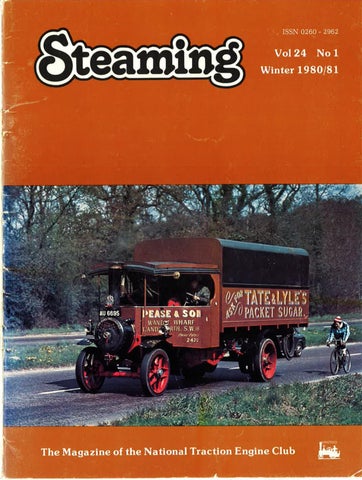
Cover Tate & Lyle's 6 ton Foden (10788 of 1922) is arguably one of the most authentically restored of the surviving steam wagons from that famous Sandbach firm. Bob Payne photographed it on the 1979 Brighton Run of the Historic Commercial Vehicle Club. 3
gib31KT= From the Chairman During the past rally season, there was a marginal reduction in the number of approved rallies, but the organisers have continued to give their full support to the Club's safety scheme by observing the provisions of the Code of Practice and submitting a record number of rally safety reports. These reports are continually analysed by the Rally sub Committee and further amendments to the Code are prepared in the light of the information obtained from the reports. We have also received considerable help during the season from Mr Jim Newnham of the Health and Safety Executive, and he has visited a number of rallies, quite unofficially, and given us various helpful suggestions. We have now invited him to become the Club's honorary adviser on safety matters, a position we hope he will be able to accept. The Steam Apprentice Club has increased its membership during the summer and has held a number of apprentice training sessions at various rally venues which were well attended. Here, Apprentice Club 'members have had an opportunity to work on and drive a variety of engines under experienced supervision. We look forward to a continuation and expansion of this scheme during 1981. The rally organiser's assistance in providing facilities for these training sessions has been sought by the Rally sub Committee and their response has been very good. Our thanks are due to all those who have assisted and agreed to assist in this Important extension of the Club's activities. We have been fortunate to secure a successor to Alan Wilson, our retiring Sales Officer, in the person of Stuart Gray, who is taking over this onerous position in the New Year. We wish him every success in his endeavours which will be of great importance to the Club finances. Once again on behalf of all members and of the Committee, I would like to thank Alan Wilson for his great efforts on our behalf in the past years. During the past few months, representations have been made by the Club, through its membership of the Historic Vehicle Club's joint Committee, to the proposal to institute a 'Tax on Possession' rather than a 'Tax on Use' for all motor vehicles which are 4
privately licenced. The HVCJC have consulted all their supporting Clubs, who are strongly opposed to this change in the taxation system, and they will continue their resistance to any attempts to change the present licencing laws to the disadvantage of preserved vehicle owners. The Committee have now completed their consultations with their legal and professional advisers regarding the Club's application to the Charity Commissioners for charitable status and an initial application will shortly be made to the Charity Commissioners. We hope that this matter will have progressed sufficiently for a detailed report, and any necessary alterations to the Clubs Memorandum and Articles of Association, to be submitted to this Spring's Annual General Meeting of the Club, which will be held in Birmingham this year. Finally, on a sad note, the General Committee have suffered the loss of a valued member and a keen supporter of the Club's affairs through the sudden death of Tony Parker. He will be very much missed. (Peter Barber)
Engine Owners Column Alternative Boiler Inspection Scheme by Tennant Budd Ltd It now appeals inevitable that boiler inspection fees will continue to rise at each renewal. Tennant Budd Ltd, therefore, have been seeking alternative arrangements in an effort to minimise these increases where possible. For those members wishing to make a change from the Scottish Boiler, another scheme has been set up with the National Vulcan Engineering Insurance Group. This is in the form of an annual contract for boiler insurance and inspection, and the premiums are payable on an annual basis. The main advantage of the National Vulcan scheme is that, in addition to annual thorough internal and external inspections, hydraulic tests (and other inspections required by any statutory provisions) will be applied at suitable intervals recommended by the engineer/surveyor. These will be included in the normal
annual premium, which is not subject to VAT under current tax legislation. Third party boiler expldsion indemnity is included in the new scheme, and members taking advantage of this contract will no longer require the separate New Zealand insurance covering the same risk. Therefore, the New Zealand policies will be allowed to lapse at their expiry dates, provided the inspections have been satisfactorily completed. and the National Vulcan have accepted the boiler for insurance. The Dominion NTEC Policy will not be affected by any changeover, and renewal will be invited to the individuals concerned in the usual way. It is emphasised that there is no obligation on the part of any member to make the change to the National Vulcan and anyone wishing to remain with the Scottish Boiler is, of course, at liberty to do so. In those cases, the normal application form will be forwarded as and when inspections become due, and the New Zealand policy for Third Party boiler explosion indemnity will still be necessary. Details of the new scheme are being sent to each policyholder, as renewal of their insurance or inspection falls due. Tennant Budd will of course be pleased to forward details to anyone wishing to take advantage of the scheme at an earlier date. — (Mrs V. Jessup, lennant Budd Ltd.)
Vehicle Excise Duty — Tax on Possession Many engine owning members will be aware of Government proposals for alterations In the collection of vehicle excise duty — the tax we pay to keep any vehicles on the road. Rather than being based on the use, as at present, it is intended that future duty will he a tax on the possession of a vehicle. The reasons for the proposed change are the excessive amount of evasion presently being encountered — the loss of duty with unlicensed cars alone is thought to be as high as £75 million a year. Laudable though a solution to this problem may be, the repercussions of the proposed new system to collectors of historic vehicles are very obvious. Basically duty would be payable on any road vehicle, whether active, laid up in working order, put aside for future repair, under repair or indeed
derelict whilst awaiting repair. According to a consultation paper circulated to interested parties 'special provisions' for vehicles over 40 years old could be made — but the actual details are unspecified. The interests of steam engine owners have been put before the Historic Vehicle Clubs Committee by our representative, vice-president Anthony Heal, and that Committee's response to the consultation paper has been forwarded to the Department of Transport, together with a petition. The outcome of these representations is awaited, but meanwhile a letter to your own• MP could help in stopping the introduction of an unfair change in duty as applied to historic vehicles.
vation societies. His great acquisition was the locomotive KING HAAKON 7, an ex Norwegian State Railways class 21c 2-6-0, built in 1919, which was kept and run at the Great Central Railway, Loughborough. This engine hauled the rescue train which brought the Norwegian royal family safely northwards after the Nazi invasion in 1940. Tony also owned the 4hp Foster steam tractor, known as MIGHTY ATOM and built in 1913; he regularly exhibited it at rallies in the Midlands. In October of this year Tony invited his many friends to a party to celebrate his 21 years of ownership- of the Foster and this was a very happy gathering enjoyed by everybody present. Held in great esteem by his many friends and business associates for his integrity and pleasant personality, Tony will be most sadly missed by us all. (J. Beeby)
Obituaries Tony Parker
Tom Barlow
The traction engine movement has lost a well-known personality by the death of C.A. (Tony) Parker of The Grove, Lincoln. It is hoped that these few words from one of his friends will do justice to the memory of a very kind person. Tony gave much of his valuable time to the preservation of steam. He was a Committee member of the National Traction Engine Club, and acted as public relations officer for the northern counties of England, and Scotland. He was also treasurer of the Lincolnshire Steam Engine Preservation Society for many years, and in addition was concerned with other societies in Lincoln and beyond. Tony was very interested in the running of railways, particularly when steam locomotives were used and he assisted in organising trips on trains drawn by steam engines for preser-
It is with great regret I record the death of Tom Barlow, of High Legh, near Warrington, Cheshire, on 22nd October 1980. He was 75 years old. Tom went to High Legh at the age of 3 when his father, William Henry Barlow, set up in business as an agricultural contractor at Mowpen Brow. Tom had four brothers land five sisters) who joined the family firm, and the Barlow fleet of engines was well known to the farming communities of north Cheshire up to the late 1940s, when the engines were laid up as tractors replaced them for threshing duties. After their father's death, the business became known as Barlow Bros, and the redundant engines were sold (three into preservation circles) until only one remained. This was their Foden compound 2654, KING GEORGE V on which Tom Barlow had been the regular driver since the early 1920s. Tom had married and moved to Little Bollington in 1936 — where Mrs Barlow kept the Post Office during the following 25 years — before finally settling down at the bungalow in Kay Lane, between Broomedge and High Legh. Here he established a truly magnificent garden and eventually kept the Foden engine on which he had earned a living during his early working life. It was there in July 1974 that I first met him to speak to. He was preparing the Foden for its visit to the Burtonwood rally on the following day. I accompanied Tom on the engine to the summer-time rallies and autumn steam parties for the rest of that year.
In January 1975, when I managed to purchase Aveling 10906, Tom not only arranged for me to keep and re-build the roller at the works yard at Mowpen Brow, but brought out the Foden and propelled it on the nine mile journey back to High Legh. I was, thereafter, a regular visitor to the works yard and to Tom's home, during which time I like to think that we struck up a mutual friendship which has now been so sadly, and suddenly, terminated. I know that enginemen and steam enthusiasts everywhere will wish to join me in extending their deepest sympathy to his widow, daughter and grandchildren and all the Barlow family in their bereavement. (Jim Stevenson)
Affiliated Clubs Boarhunt & District Engineering Preservation Society We welcome the above Society into affiliation with the NTEC from the 10th September 1980. President — Ken Judkins; Chairman — D. Bird; Secretary — J. Peck, Berkeley House, 50a Nightingale Road, Southsea, Hants P05 3JN. South Essex Traction Engine Owners Club A change of Officers within the above Group; Chairman — J.Downs, Treasurer — D. Dale, Secretary — Andrew Smith, Rectory Lodge, Rectory Lane, Battlesbridge, Wickford, Essex SS11 7QR. Thames Valley Traction Engine Club The above Club advise of their new Secretary — Mr C.F. Dixon, 16 Covey Way, Alresford, Hants. 5
National Sales Officer We are pleased to announce the appointment to the above office, of Stuart Gray, and hope he will derive satisfaction from looking after this important Club function. Profits from book sales are, of course, an important part of Club revenue and members are urged to encourage Stuart into his new job by obtaining their winter book reading from NTEC Sales (members rate is post free — see advertisement at rear of magazine). To Alan Wilson, the retiring incumbent, go our grateful thanks for his unstinting labours of the last few years. Now he can get on with camp rPriernrating!
Apology We are pleased to make it clear that the inference drawn in a letter from Mr C.R. Kilgour published in the December 1979 issue of STEAMING, regarding responsibility for roadside fires after Expo at Peterborough, 1979, was totally unfounded. Mr Kilgour, as the author of the letter, and Mr Blenkinsop, the then Editor of STEAMING, are pleased to take this opportunity of apologising unreser-
vedly to Mr J.C. Ward for any distress which the publication may have caused him.
Future dates Safety Officers Seminar/ Affiliated Clubs and Rally Organisers Conference The above events will take place in London on Saturday, 14th February 1981. Formal notice and invitations will be sent to Affiliated Clubs and Rally Organisers in the usual way.
London Area Social Meetings Meetings are held on the last Tuesday of each month at 8pm at 'The Cock Tavern', Great Portland Street, London (corner of Margaret Street and adjacent to Oxford Circus). TUESDAY, 27th JANUARY 1981 'Steam lookback at 1980.' An illustrated talk by George Barlow of Romney, Hythe & Dymchurch Railway fame.
AGM 1981
TUESDAY, 24th FEBRUARY 1981 'The Z7's return and other ploughing engine matters'. A talk illustrated by film and slides by Michael Davies.
The Annual General Meeting, 1981, will take place at the Midland Hotel, Birmingham during the morning of Saturday, 4th April 1981. A social function is planned for the afternoon. Formal notice and further details will be distributed to members in due course.
TUESDAY, 31st MARCH 1981 'A survey of the preservation movement'. A talk by John Crawley, vice chairman of the club. TUESDAY, 28th APRIL 1981 'Steam in Southern Africa'. Our intrepid traveller, Geoffrey Mileham, offers another slide show.
A steam artist with an eye for detail and proportion is John Hancox and this view is his latest offering. Threshing scenes and ploughing engines are among other subjects depicted on six different prints about 17in by 12in size and available at 95p each (plus 40p postage and packing in a tube roll) from John Hancox, 27 Warren Road, Rugby, Warwickshire.
Tar Spraying and other tales PART 3 — continued from page 214 of the September issue. Percy Dabbs Come the tar spraying season of 1935, I had two or three weeks at Black Banks, Darlington, adjacent to Thomas Ness's chemical works where the engines were stood over the winter, getting both them and the machines ready for the road. This season I got a Foden steam wagon, 6 ton model, 3 speed. My mate this time was George Wappett who was in the thrashing business and also had a pub at Manfield near Darlington. he too had a Foden wagon of the same type as mine. The first two of Taroads' Fodens which came up to North Yorkshire were originally driven by cockneys and were used for 'Spraymex'. They had had an additional oil burner attachment fitted beside the tar heating coil system as the 'Spraymex' had to be very hot when applied. I don't know whether the two wagons which George and I got were the same ones which had been altered, as Taroads had quite a large number of Fodens at one time or another. George and I had been friends for years — he really was a good mate and he said the same about me. He had worked for Taroads for a couple of seasons in Northumberland around 1928 before he started in the North Riding. All went very well and we had a good season together. It was easier tar spraying using the Foden, because with all the tackle being on four wheels, there was no coupling and uncoupling to do as we had when using the traction engines or steam tractors. There was only one little incident on a road between Knayton and Boltby in the Thirsk area when the road gave way and George was well and truly stuck with his wagon. I went to try to pull him out but could not, and eventually had to make a dash for Thirsk Station, where we were parked, to get in before lighting up time as we normally did not carry lamps on the wagons. We had four or five miles of the A 1 9 road to travel to achieve our home for the night. I had George and his mate and some of the chipper lads with me, and as usual some of them had cycles piled on top
to the tank. I was making a very good speed but eventually someone shouted that the police were following so I steadied up a bit. I don't know what speed I would be doing, but I know I was travelling faster than usual and the cycles were all in grave danger of bouncing off. It was not long before the law passed us, thankfully without any complaint. We got George's wagon out of the hole the next morning, using jacks and planks. Come the end of that season which was sometime in early September, we parked our wagons again at Black Banks, Darlington. We had a day or two to drain the water out of them and take all precautions against frost. We also had to oil or grease all bright parts and sheet them up well. I generally had a week or two in which to do various repairs before the thrashing season started. Up to this season, the Fodens had always gone back down south but this winter they stayed at Black Banks, along with the four or five Aveling tractors which Taroads had on the same job at various places, round and about.
I used to work nearly all the weekends when I was at home from the tar spraying in the summer, especially with the long daylight hours, although I sometimes had to go back to the tarring job on a Sunday night. This depended on the distance we were from home with the wagons, since living in the South Durham area put quite a few miles on the travelling required to some of the spots in North Yorkshire. My wife and mother-in-law did most of the cleaning of the machine and had painted it during the time I was away working for Taroads and it looked really well. The 1935/6 thrashing season turned out to be quite good. All went well for me; I had plenty of work and come the end of the season, which would be in the middle or towards the end of April, I had finished except for three of four days work left to do. The farmers were very helpful with me, going on towards the summertime and would thrash Saturday and Monday of the holiday weekends to help me complete this work. I would get finished tar spraying by working late on the Friday night and then be able to get home on the Saturday to finish the job. When you are working for yourself time is no object. Back to tar spraying time again and I had possibly a week, ten days, or up to a fortnight to get the engines and machines at Black Banks ready for the road again. I was helped by another driver and maybe a sprayman
Fowler 15308 at Souter's yard at Kirk Leavington prior to the sale in 1936. (J. Peirson)
7
or two. Sometimes a road foreman by the name of Dick Powell from Norby near Thirsk would come along. The engines had to be inspected and boilers tested etc. It was now 1936 and my mate of this season was Bill Stephenson from Sedgefield, Co Durham. He had the Foden which George Wappett had the previous season. Incidentally George was our foreman for this year. The foreman had varied over the years — for the first two years he was a little chap called Tommy Moran from Ebberston, near Scarborough. We then had Sep Holiday from Dalton near Thirsk, who was in the thrashing business. He had two sons who started in the gang and eventually got to driving an Aveling tractor apiece. Then followed Dick Puvvell and in 1930 we lied George Wappett. Bill Stephenson had knocked about with and driven for Frank Stephenson a few years before I was first with him. When I first went to the Stephensons, Bill (he was no relation to Frank) left to drive a railway loco for the ICI but that did not last very long. I don't know why he left and I can't say much more about him. He picked the job up fairly well but he did not keep things very clean. About this time, I heard that J.B. Souter had sold the engines and tackle in May 1936, and I think he farmed for a year or two before retiring. He then went to live in a biggish house at Barmpton near Darlington. He wrote to me at Spennymoor in 1939 or 40, and in his letter he said he had a lot of trusser or tyer parts which he would like me to have if I would care to go and fetch them. We went off one evening with a car and a small trailer and bought a good load of parts from him for a fiver. Both my boys, who would be about seven and three years old at the time, also went with us. We did not see J.B. again and I don't know when he died, but we met his wife again when she was living at Ainderby Quernhow near Thirsk. When I was with Bill Stephenson and the Fodens, there was one incident which could have been very serious. It was wet and we stood in Guisborough Station yard all day, just keeping the tar in the rail tanks hot, in case it faired up and the roads got dry. As it turned out, they did dry up after tea. I have mentioned before that the gang did not get paid unless they were working, and so they decided to put a load of chippings on and my sprayman and I went along to help them. We were working on the Kirk Leatham road which is between Guisborough and Marske-by-the-Sea, on the fringe of the Cleveland Hills. It was Bill's turn to go out, so he loaded and drove his 8
The author briefly poses against his Ransomes set (8hp single 13419 of c 1905) whilst others get on with the job at Mains forth Colliery farm, Co Durham. (P. Dobbs)
wagon and George and I rode in the wagon along with Bill and his sprayman. We turned off the Guisborough to Brotton road, over a narrow bridge which rose steeply and they had to change down. Somehow, they missed the bottom gear and the wagon started to run back. It was only the sharp presence of mind of George Wappett, who pulled the reverse lever back, got the engine turning in reverse, and then got her into gear, which prevented what could have heen a nasty accident Most likely the lot of us would have ended up in the stream and there were several chipper lads riding on top of the wagon. The driver and stoker worked together to change gear which could usually be done very well. The driver on this type of wagon both steered and drove, not like the old type where the second man only steered. These wagons were fitted with Ackerman steering. However, Bill managed quite well and apart from this particular occurrence, we didn't have a bad season. They would have had him back for the following year but I don't think he cared a lot for this type of work. At the end of this season — 1936 — it was back to Black Banks again and after draining all the water out and sheeting up for the winter I went back home to another thrashing season when we had a good run and all went well. Time unfortunately does not stand still and we were quickly round again to the 1937 tar spraying season which started around Coronation time. There was the usual boiler inspection and general repairs to be done where we
were parked by the Chemical Works Farm, before we were ready for tar spraying. My mate this time was again Bob Wilson. I had my usual Foden, and Bob had the Foden which George Wappett and Bill Stephenson had the previous seasons. Things went reasonably well; I had a good wagon and could hold my own without any trouble. I had learned a lot since we were together for that first season eight years ago with the old Ransomes and had by now become accepted by Bob as one of the team. There was one incident of note which happened when we were leading out of Stokesley Station. We were working on the Kildale to Great Broughton road. I always went through Great Broughton and returned the same way but in addition, there was also a kind of link road which went off the Kildale road about three quarters of a mile from Broughton whereby one could turn right at a junction and perhaps get there quicker. This road was only narrow and ran to the railway, turned left along the railway side and came onto the main road at the end of the bridge between Broughton and Stokesley. Bob took this road one day — I shall never know why as I am sure it did not really save any time or anything else! As he attempted to turn on to the main road, a wagon loaded with stone hit his off side front wheel, bent the track rod, damaged the smokebox door and threw two, three, or maybe more, chipper lads off the top of the tank over the rails and onto the railway side. Bob's wagon and the wagon load of stone shot across the
main road, through the fence and down the bit of the embankment and of course, they turned over. The Foden was knocked a bit skew and the front end was damaged. Fortunately, it didn't land on the railway line and as luck would have it, noboby suffered any injury. What an escape! To me, it was a miracle. It fell to me to go and tow Bob's wagon back to Stokesley Station and I only managed this with some difficulty as one front wheel was in such a position that towing it from Broughton Bridge to Stokesley Station, via Stokesley Town end — a matter of only about two miles — almost scoured the rubber tyre off (they were still on solid rubber tyres). Bob took my wagon for a couple of days while I was detailed to see about getting his put right. Most of the work was done by a blacksmith at Seamer near Stokesley. He made a very good job of it all — even to straightening the brass Foden name and the smokebox door centre pieces. I am pleased so say that all went well after this. I think now, what a pity I did not note the numbers of all these engines but at that time we did not bother. We were interested in our job; we did a good day's work and maintained our tackle as well as possible to keep the job going. Our wages were £2. 1 Os Od per week with a bonus of two shillings per load of tar sprayed. If the first man out on any day could get a second load on that day, he would get an extra three shillings for that one, but it was very rare that this happened.
Come the end of the tarring season, we returned to Black Banks again for the winter. After draining all the water out and greasing and sheeting up, it was home again for another season of thrashing after the customary ten days or a fortnight there to finish off whatever repairs were required. During the summer, I had worked hard at weekends and to me it was almost all bed and work but I enjoyed it. This was 1937/8 and we had quite a good winter season — things in general were beginning to pick up after the bad years of the early 1930s. Time passed quickly when you were busy and I got plenty of work with my Ransomes engine and thrashing machine. It soon came round to the back end of April 1938 and I went off to Darlington again to meet some of my old workmates at Black Burns and get ready for another tar spraying season. Up to now, all tar had come into the local station by rail in whichever locality we were working. It was supplied by Thomas Ness & Sons, Black Banks Chemical Works, adjacent to where we wintered the tackle. This season, however, we had a reorganisation as there did not seem to be as much tar spraying required. Each area was worked by one steam wagon
only and the tar was brought to us hot, from the same place each time in a tank set on the back of a flat bodied motor wagon owned by Jacksons of Darlington, Haulage Contractors. The tank could be taken off when not in use and the wagon used for other work. We pumped the tar into our tanks by means of a large flexible pipe and our own steam driven pump which also did the spraying. This made the job much easier again. By now there did not seem to be any engines hired locally working for Taroads — they were all their own. They had bought a lot of secondhand Foden wagons in the mid 30s which had been converted to tar sprayers, presumably to replace the, by that time, out moded Aveling tractor and separate tank method of spraying as it was easier and more efficient to use the wagons. All went very well and we used another innovation when I sprayed the old Al Great North Road from Leeming Bar to near Boroughbridge. We still had the full gang of men but in addition, we used two gritting machines. The men filled one, while I used the other. It was like a hopper, towed along behind the Foden and I found it quite a flogging sort of a job as I was dashing backwards and forwards to the chipping dump and to where I had left off,
Fowler's official photograph of one of their rollers with Fowler-Woods tar spraying gear, brush and grit ter, reproduced here, was also used by Woods on their letter heading. (Welland Valley collection)
9
loosing off, coupling up, turning round and shunting the empty gritter into position for loading up I seemed to be continually on the move. These gritting machines had three wheels, the front one was a single wheel acting as a sort of jockey wheel which could be raised or lowered, as required, to assist in coupling up. This system saved men crossing onto the road with shovels as it was a busy road, even in those days. At that time, I think the use of these machines with the steam wagon was only an experiment which was an idea of Mr Rawlings. It had come from his associations with another firm who tar sprayed in Yorkshire and with whom he was closely associated. This was D. Wood & Co of Yeadon, Leeds, and I shall have more to say about them later. To be truthful, these machines made a nice even job. They each held about five or six tons of chippings, but even this system would have been no good today with the amount of traffic there is on this road. When we had finished with them on the A1, they were dumped by the side of the road and were eventually taken back to Wood's yard at Yeadon from whence they had come. We then carried on with the old system of men scaling the chippings on by hand from a heap at the roadside. A year or two later, these gritting machines were converted from iron wheels to rubber tyres but I don't remember them being used behind the Fodens any more, certainly not before I left in early 1950. Woods did use them extensively behind their Rollers. Early in 1939, my wife heard of a house with a yard, orchard and small paddock to let in Merrington Lane, Spennymoor. This was quite a large house, in fact it had been a public house at one time and belonged to the West Auckland Brewery Co. and was previously called the Australia Inn. We had been very happy at Hett Mill by the railway line, but our eldest son Derek, who by this time was six years old, had a long way to walk to school and also my wife had about a mile to walk to catch a bus into Spennymoor to do any shopping if I was away. Garden House, as it was now known seemed a much more suitable place for us. It had a good four stalled cow byre, a loose box and a pig-sty in the orchard. We therefore moved, and my wife rather liked the small farming part of the job better than the other place. We kept a few hens and geese there when we got established. As I have said befoe, the house was rather big but its size and previous use served a good purpose, which I will come back to later on. When I had any spare time now, I set to and built a blacksmith's 10
shop using a wood frame and corrugated iron sheets. This was very useful as I always liked a bit of smithywork and it served me well for the next few years. The timber I had bought secondhand locally and I was able to get it sawn as required by a man who had a fair sized workshop on an allotment very close to Garden House. This saw was driven by an old BSA motor cycle using the rear wheel which had a flat rim bolted on to the existing wheel. This did its work very well although I doubt whether it would have passed any of the factory regulations! By now, we had two sons; Clifford was born at Hett Mill in February 1937. Time rolled on and it was soon the middle of April and I was again travelling to Black Banks to get ready for another tar spraying season. Whilst working there, I travelled from home in the morning and back again at night, as we knocked off around five o'clock. I was still working for Taroads and liked the job very much in the summer months, although it meant being away from home during the week. By now, I had got an old sidecar and chassis to fit the Norton motor cycle. The sidecar was not elaborate but was quite decent for a passenger. I fitted this up more to be able to tow the bike, rather than have to lift it into the living van when we moved from place to place. All went well for the 1939 season. I had a good mate as sprayman — in fact he had been with me for four or five years — Johnny Myers, one of the Myers brothers from Skipton on-Swale, near Thirsk. Another incident which could have been more serious than it actually was happened as we were moving from the Stokesley area to Castleton, near Whitby. It would be towards the end of the season and we travelled via Ayton, Guisborough, Charltons and up Birk Brow on the Whitby Moor road. All went nicely until we reached The Jolly Sailors, where there was another steep bank. On changing gear, we slipped up somewhere and the whole outfit started to move backwards. It only went very slowly at first as I was doing my best to hold it. The outfit comprised the Foden wagon, living van and the motorcycle and sidecar which we towed behind. The van locked across the road and toppled over very, very gently, chopping the nose off the sidecar as it went. Inside the living van, there was Johnny's Norton motorcycle, two or three cycles, four of the chipper lads and Dick Powell, the foreman from Norby near Thirsk. Remarkably, no one was injured. A plate or two and one pane of glass was broken and there
were a few ashes scattered about. It could have been much worse but since the van went over on the same side as the stove was fitted, not much ash was spilled. The lads got out without much trouble and we loosed off the motorcycle and sidecar from behind the van. It looked a bit of a mess. We then uncoupled the van from the Foden and, as luck would have it, I had a strong rope in the back cupboard of the van which was, by this time, laid across the road. I was in quite a good position with the wagon facing the bank, to pull the van back onto its wheels. This we did and all went well and we were all soon in order and on our way again. We had quite a bit of cleaning up to do in the van when we eventually got pulled up. The spot we chose was on the moor, between Castleton and the Whitby Moor main road. This was not a very good stand as we were too far from a water supply which was most essential on this sort of a job. We made it do however, as it was towards the finish of the 1939 season. The chipper lads had a good grassy patch for their tents. this might have been a small quarry, or working of some sort at one time. One of the lads had a wireless set which was very entertaining and whilst we were here, on the nine o'clock news on 3rd September, we heard that War had been declared. Well, about another fortnight or so saw us back to Black Banks and the end of another tar spraying season. The usual end of season jobs followed and I went back home to Spennymoot for another season's thrashing — 1939/40. (to be continued)
Can you help? A request has been received from a member of the Industrial Railway Society who is editing a new edition of their Teeside and North Yorkshire handbook of industrial railways. He is seeking information on forestry railways in the Helmsley-Pickering areas, and in particular a line which originally ran in the Sawdon/Brompton area and was later moved to run from Wykeham to North Moor. It apparently was not connected to the North Eastern Railway's lines in the area. Unfortunately neither the owners of the line nor the gauge are known but it is said to have been worked by a Tasker 'Little Giant' tractor converted for rail use. Should any reader be able to help with more information in this respect, would they please write direct to: Ken Fleming, 55 Petersham Road, Richmond upon Thames, Surrey.
Everyman's Wills Finecast have long been well known by the railway modelling fraternity for their white metal kits. Having brought out an Allchin traction engine some years ago, Wills now enhance their range with a Foden C type wagon kit.
Malcolm Frost I was delighted when approached by our Editor with a view to carrying out an appraisal of a new white metal kit of a Foden C type wagon by Wills Finecast. I was filled with enthusiasm when he showed me some photographs; unlike some other road steam white metal kits available this one was of some size, the finished model being 8iin long and 1 *lbs in weight. I couldn't wait to get started. In due course the kit arrived and I must admit to being a little nonplussed on opening the box — with over 150 components there were pieces everywhere! I should say at the outset, that although I am a professional model engineer, I have not built a great number of white metal kits and so my effort was thought to be a fair test. First impressions were very favourable. I liked the provision of a colour photograph of the finished model and also the black and white leaflet with excellent photographs of sub-assemblies, showing the detail of the model. The assembly drawing at first appeared complicated, but once construction had begun everything became very clear. Also included were a general instruction leaflet on building white metal kits, an instruction sheet which applied to this particular model and a comprehensive parts list. I began by familiarising myself with the instructions by reading them several times and also sorting out the various components. This I found frustrating as they were packed in plastic bags and those for any particular assembly were generally spread between several of the bags. I decided to follow the instructions almost exactly, using Loctite Super Glue 3 — this is a readily available glue. I found one problem at a very early stage. The boiler 'halves' have a recess in the top to take the hornplates and it is necessary to leave room for the rear spectacle plate (called boiler mounting plate, component B26) when fitting the hornplate/crankshaft
assembly to the top of the boiler. The instructions do not mention this point and no reference is made to B26 until a much later stage in the construction, when the problem cannot be rectified. However, with a little fiddling I completed the later stages satisfactorily. Due to the wealth of detail in this model, assembly of many of the components is quite tricky, but generally straightforward. Construction of the motion would have been easier had not the pins been missing from the Stephenson link casting provided with my kit. I found it easier to add the ashpan to the firebox sides earlier in the construction than suggested; it thus gave added support to the assembly. The miscellaneous details were easily fitted but I found that the lubricator had to be fitted to the offside hornplate before fitting the rear guards.
The front axle assembly came next and one fad of mine is that models should always have revolving wheels; I may be wrong, but it seemed to me that this Foden's wheels would not rotate if the instructions were followed closely. I therefore discarded the brass rod which was supplied for the front axle and substituted a piece that was longer, so that when the wheels were finally slipped on they were retained by the hub caps, which being fixed to the longer axle remain stationary whilst the wheels revolve. The front axle is quite a prominent feature of Foden's and all the photographs which were supplied with the kit showed very clearly the brass bar axle standing above the axle casting, and in my opinion not looking very nice, so I carefully filed my axle so that it is almost impossible to see the brass reinforcing bar. Incidentally, a minimum
11
of tools is necessary for building the model a few needle files for occasionally cleaning flash and tidying up components, a pair of tweezers and perhaps wire cutters. Certainly no lump hammers! I then moved, as suggested, to the wagon body/chassis assembly which was very straightforward, although I glued the floor sections together first and then stuck the chassis members to them, thereby ensuring a flat floor. I thought the instructions covering the
assembly of the rear axle and brake gear components were a little sketchy, and I had a fair amount of trouble with these, especially the brake gear. I could not make it look quite like the drawing, and then I noticed that the photographs supplied did not look quite like the drawing either. However, I am still not convinced that I have assembled them correctly. The cab assembly was straightforward, although the importance of a dry-run with Sellotape or similar can-
not be too highly stressed, as it is essential that the assembly looks just right. In my opinion the cut-outs in the rear side panels for the driver or mate's elbows were not quite the right shape and I modified these a little. I was also disappointed that there was no maker's plate on the offside rear panel of the cab as this is a prominent feature on Fodens, and is included on other, smaller, model kits. Uniting the main chassis/body assembly and the .cab assembly pre-
sented few problems except that my steering box fouled the main chassis member. In hindsight the steering box would be better fitted after the main assembly had been completed. All that now remained were the final details. These were mainly straightforward but the front mudguard supports (D14) gave me a lot of trouble as there is no way that these can be assembled as per the drawing without considerable modification. The rubber tyres for the wheels are of superb quality and look very realistic. I am afraid I have to admit to making a complete mess of the transfers, so the model appears unlined at present. I cut the roof supports as instructed, but think that the rear supports should be approximately 2mm longer; the front ones are just right, as instructed. Painting of any model such as this is best done in stages as the model progresses, and this model is so good that it is worth taking a great deal of trouble over it. The major colours, that is the main coachwork, chassis and were components, underframe sprayed with a Badger airbrush which is ideal for model work and produces an excellent finish. I would recommend the use of cellulose for this work as it gives a very tough finish and is easily obtainable in many colours — car touch up paints are ideal, not the aerosols though! I genuinely feel that this is the finest model kit of a steam road vehicle that I have ever seen, from whichever angle it is studied, it is just right — it really is a miniature Foden. The only criticisms are the omission of the works plate; the cut-outs in the cab sides (both mentioned before) and the Foden insignia on the smokebox
*ob
HOMAS BANTOCK &Ca 'NT S, • ~-r 0 LV ERH AM PTON. N932.
door which is not quite right. The detail in the model has to be seen to be believed, and although the kit is fairly expensive, the cost is fully justified when one considers the hours of pleasure to be had during the construction, and then afterwards just looking at the model. I was not able to keep an accurate log of the time involved, but it probably took something over 100 hours. The kitchen table, or a tray on your knees in front of the television are both quite adequate places on which to work. The castings are of high quality with very little flash to be removed, although quite a number of the location holes and spigots were missing, which could cause some builders a few problems. A model of this quality really requires to be displayed in a glass case as it would be impossible to keep it dust-free in normal circumstances.
Foden C types were extensively used by Thomas Bantock & Co for work from Great Western Railway freight depots in the Wolverhampton area.
It is to be hoped that this is only the first of many such models from Wills. Dare I suggest that a Foden tractor would be a fairly logical step from here as many of the components would be interchangeable. It would be a worthy partner for the wagon.
Foden Steam Wagon (C type) kit. tin to 1ft scale or II/ full size; made up length of model 81-in; weight 1ilbs. Price £48.30 inc. VAT and postage from Wills Finecast, Lower Road, Forest Row, Sussex RH18 5HE.
A really superb din to 1ft scale metal model (static) of the famous Foden 6 ton wagon. 8iin long, weight approx albs. Voted 'Model of the Year, 1980' by Old Motor magazine
£48.30 inc VAT, post free With a wealth of beautifully detailed parts, 'rubber' tyres, transfers, plus full instructions for assembly.
Strongly
boxed.
Send 20p stamps for catalogue including information on our large range of car kit models, mainly to Ath scale. ALSO TRACTION ENGINES WILLS FINECAST, LOWER ROAD, FOREST ROW, SUSSEX RH18 5HE 13
On Sentinels MORRIS'S OF SHREWSBURY
Joe Thomas James Kent Morris, second son of the owner of the general store in the Shropshire village of Ruyton of the Eleven Towns, left his rural home on 9th December 1869 and, at the early age of twenty-two, set up in business as a candle maker in the county of Shrewsbury. A small factory building was acquired, in which he manufactured candles for wholesale distribution throughout the county, together with a grocery shop to achieve retail sales. The business prospered and he became a well known local figure residing at a small farm at Radbrook, on the outskirts of the borough, and being elected to the Town Council. In 1891, when driving a spirited pony in a trap along Smithfield Road, Shrewsbury, the horse reared, throwing him out and causing injuries which led to his death later that year. He left a widow and eight children of whom the eldest, also James Kent Morris, was then eighteen and had completed his apprenticeship in his father's candle works. An extremely able young man, James took charge of the business but quickly realised there was no long term future for candles, due to the development of more efficient forms of lighting — oil, gas and electricity. Accordingly his three sisters were apprenticed to various grocery, bakery and confectionery firms, whilst he continued candle manufacturing and began to market imported American oil. By the turn of the century the family, with remarkable determination and unity of purpose, sought to establish a complete food service throughout the town. The enterprise, controlled by the eldest brother who had ceased to make candles and was using his personal skill and knowledge to commence the manufacture of lubricating oils, was run as one business under the name of "Morris's". Some twenty years later their purpose had been achieved, with a substantial wholesale grocery trade, many retail shops, a large bread and 14
The first wagon operated by Morris's was Sentinel 4152 (NT1585), a six ton model AS delivered to them new, complete with trailer, in June 1922. (collection J.L. Thomas)
No.2 in the fleet was Super Sentinel 6799 (NT9564) another 6 tonner with trailer and new in December 1926. (collection J.L. Thomas)
t
wa$111i.03t141(4 41IRL trSkoriRy 61.114.1.1
:tr it:
Morris's No.3 left its makers on 12th June 1928. This DG model was a 12 ton six wheeler, Sentinel 7458 (UX3034). (collection J.L. Thomas)
• 1.6,RIOT•
' , . _ . • :-• _ bil DA Eli SSUVI
•-
. ilgt
XeSi.tarr0).--NS13443a110
. MIL‘ .,. -
's ,Igte. /NM
, _{.,I_Ji Ilk
!I .
.1111µ.
COMPANY
RR\ss 51iREW5BN't
1
. 2..10111
The company's final unit, fully laden, poses outside the Sentinel works main entrance. The model S shaft drive 6 tonner was new on 31st May 1934, being Sentinel 9081 (UJ3333) — the trailer was Sentinel 9082. The set worked until 1939. (Morris's, Shrewsbury)
confectionery bakery, butchery section, cafés, chocolate manufactory, outdoor catering and the like. By now the lubricating oil side of the business had expanded nation-wide and Morris's were sole suppliers of crankcase and cylinder lubricants to The
Sentinel Waggon Works Limited, the leading manufacturer of steam wagons, and in 1922 the firm acquired its first Sentinel. This was used to bring in oil, flour, sugar, imported groceries, etc. from the docks at Birkenhead, Liverpool and Manchester
Proudly perpetuating Morris's name on a Sentinel steamer, David Goddard's DG4 model, Sentinel 8571 (KF6482), crosses over the South Downs on its way to Brighton during the 19 79 HCVC run. New on 26th August 1931 to Samuel Banner & Co Ltd, Bootle, it was used in more recent years by Paul Bros Ltd, Seacombe, Cheshire, and when acquired by Edgar Stone for preservation, was one of the first Sentinels to appear at the early traction engine rallies. (Bob Payne)
and was followed at intervals by three further purchases, the details of these being given the captions to the illustrations. During the nineteen-thirties the third generation of the family the continued enthusiastically development of the business, to be succeeded some thirty years later by the fourth generation. Throughout all this time Morris's continued as an entirely independent concern, selffinancing, operating a single business of many interests. Today a thriving food organisation serves the whole of the county of Salop whilst "Golden Film" and "Servo!" lubricants are manufactured in volume quantities for delivery to regular buyers in every county of England and Wales. Yet with all this growth Morris's still offer and supply small quantities of "Genuine Sentinel" and other well proven oils for vintage machines. In 1976, David Goddard, a steam enthusiast and chief engineer at the Castle Foregate works of Morris's, together with his wife Diana, a fourth generation direct descendant of Morris's founder, realised that in the town of Shrewsbury — where many thousands of Sentinels had been manufactured between the wars in the large factory that now produces RollsRoyce diesel engines — there was no vintage Sentinel in operation. With support and encouragement from the directors of Morris's, all members of the family, they sought to rectify this omission by acquiring a suitable steamer to display the firm's original livery. The writer of this article was approached and was able to put Morris's in touch with the widow of a Sentinel owner who had recently died, the outcome being that David Goddard purchased this steamer and arranged for its conveyance to Shrewsbury, where it was fully restored and painted in Morris's colours, with lettering as on their Sentinels of fifty years ago.
Illustrated are the five different model Sentinels bearing Morris's name, and the latest of these is expected to become a regular visitor at steam rallies and similar events in the West Midlands area. It is good to see a Sentinel once again on the road in its home town, where Morris's, with a workforce of five hundred and a numerous fifth generation due to leave school during the nineteen eighties, intend to continue to the turn of another century and beyond, possessing modern ideas yet always endeavouring to preserve the best that is old. 15
From Alan Martin's Collection 11
Much interest and curiousity is being shown by schoolchildren in J. Sterling's outfit in this undated and unidentified scene. Perhaps it was the tenting arriving for a much heralded local occasion, or could it even be the big top for a circus? Sterling, a general carrier of White Mare Pool, Co Durham is believed to have also been a tenting contractor. The steam wagon hauling the two laden trailers is Garrett 31283 (BJ1558), a 3 ron superheated model new in March 1913.
Nellie, a Foster roller Jim Proctor of West Bridgford, Nottingham tells us more of the -roller referred to in Jack Hampshire's article 'Rolling Round the Riding' on page 90 of the Yorkshire special edition of Steaming (Vol 21, No 2). It was not a Tasker but a Foster, and in view of the relative rarity of this make of roller, it is worthwhile elaborate to the correction. The name NELLIE is right and Jim remembers he drove the engine for a long time when in the ownership of Dickinson's at Doncaster; it was purchased by them from Carricks of Huddersfield. The engine was on hire to Claypole RDC near Newark in 1930 and Jim was driving it at this time. He did quite a bit of travelling with it and on one occasion drove, on his own, from Doncaster to Sleaford — some 60 miles — taking some sixteen hours for the journey, having started at 6 o'clock in the morning. Courtesy of Alan Duke, the majority of the engine's details and history have been obtained. It was Foster 14000 (FE1421) and was new as a tractor to F.W. Chambers & Co of Barnwood, Gloucester on 15th September 1914, and named NELLIE; by 1920 she was with the Kelvedon Haulage Co in Essex. Converted to a roller in 1926 by E.R. Cole Ltd of Wood Lane, London the machine was sold to Carrick Bros of Ashwellthorpe, Norfolk, and Huddersfield, and they in turn, sold it to Dickinson's at Doncaster in 1928 where it became No. 18 in their fleet. The conversion was achieved by providing new front and rear rolls, and 16
x' 411 ',
1Y15-
.i.frel;10. 11;of , aPA
:8177r1-
11IP
:411-
• s
these and the other parts were probably acquired from Fosters for the forks had FOSTER LINCOLN cast on them. The name NELLIE was carried on a plate on the cylinder on the gear side, and another plate on the gearcase had the number, or date, of 1909 on it, although the relevance of this is not known. The roller was fitted with a single tine scarifier, located between the tank and the back wheels, but this was not much good apparently. An interesting coincidence relating to this engine concerns the firm who carried out the conversion work. Jim Proctor and his father worked for Cole Bros of Roxholme, Sleaford in the 1920s and during this time a little trouble arose between the brothers. (Incidentally, Jim remembers a 1920's journey with his father with the Assistant Editor's Aveling roller 8506
(CT5012) and a living van from Sheffield to Sleaford when this engine was owned by the Roxholme firm.) As a result of the disagreement, the partnership between the brothers was dissolved and the firm continued at Roxholme in the name of A.M. Cole, Ernest the other brother, took several engines and men with him and set up in business in London. It was obviously this firm, E.R. Cole Ltd, which carried out the conversion. The ultimate fate of NELLIE is not known but it is thought that she was cut up by Dickinson's as they gradually withdrew steamers to concentrate on their diesel road rolling activities.
NELLIE, largely obscured by her workgang. (collection D.A. Rayner)
Marshall 84921 Graeme Thirkell I have recently succeeded in acquiring a Marshall traction engine — in my opinion the best, with workmanship and attention to detail that take some beating. These two photographs, courtesy of Jack Peitson, show the engine in its working days. Marshall 84921, a 6hp compound (UP 33251, was purchased new in 1929 by two Chester-le-Street men, Ludge and Donneson, who thought that they could make their fortunes in threshing. It was their first engine. By 1941 John Beattie of Northumberland owned the engine and in 1943 it changed hands again to come into the ownership of William Whitfield of West Auckland, Co. Durham. He found the Marshall a good machine, although he was a confirmed Ransomes man and had several engines of that make including 6hp compound 24585 which is now in preservation in Durham. The first picture shows Mr Whitfield (centre) beside my engine at Preston-le-Skerne, Co. Durham in 1947. Behind are a Ransomes thresher and a Powell baler — one of Whitfield's four sets. Rubbers salvaged from Foden wagons had by now been fitted, and also electric headlamps provided, powered by a dynamo driven by a short belt onto the crankshaft: I was told by her former driver that they startled many road users when travelling to their next job after dark! The dynamo can be seen behind the flywheel on the second, nearside, view taken in Whitfield's yard in 1947. The last years of the Marshall's commercial life were spent in a small village sawmill not far from where I live in Shildon, Co. Durham and she passed into preservation in 1960 when acquired by my good friends Jack Wakefield and Jack Pierson. New smokebox, tubes and chimney had been fitted when I purchased the engine in 1978. I have just completed restoration of Aveling and Porter 8 ton roller 10921 — now sold — and will now be tackling the Marshall, bringing her as near as possible to original condition.
A name survives Further to the mention in the Lincolnshire notes in the June 1980 issue we are grateful to member Robert Walker for sending further details on the recent history of Marshall's Britannia Works at Gainsborough, and the news that the wellknown name is to survive. Quoting from the works' house magazine Track Record he explains that in 1968 the old company became part of the Thos. W. Ward group and was renamed Marshall-Fowler Ltd. In 1975 it became Aveling-Marshall, a special products division of British Leyland, who had already secured Aveling Barford at Grantham. The national company felt that the products of their two acquisitions could progress well in the agricultural and construction industries, and
boilers and rollers were phased out at Gainsborough, the latter in favour of the Grantham plant, and replaced by work on heavy duty mechanical shovels, and 'Track Marshall' crawler tractors. Then in 1979 BL pulled out, but by November a new company Track Marshall Ltd, was formed, being part of the Nickerson group of companies. Over 100 employees now concentrate on the production of agricultural crawler tractors — 'Track Marshall, born and bred on British soil'. More than half the works is occupied by the company and of the remainder the boiler shop now houses Wefco Ltd (boilermakers), and the machine shop Nettleham Engineering (machine tool makers). May the new company long continue the Britannia tradition. 17
This year saw the twenty' fifth anniversary of the founding of the West of England Steam Engine Society. From a small gathering, with half a dozen engines in steam, at Charles Gregory's home at Coombe in 1955 there has developed a thriving club, with a well established annual rally, an excellent quarterly magazine and regular social meetings. Their first engine rally near Camborne in 1956 sported 15 engines and a year later the number had doubled. There followed a number of different sites, the original one being too small. Notable long distance entries featured at these earlier events — Stafford's effort in steaming Sentinel S4 9278 from Co Durham, highly adventurous in itself, was probably eclipsed by the amazing journey of Giles Corkran and Jack Hampshire from Sussex with Burrell 4019 — 300 miles on straked wheels! More recent rallies have continued to charm engines from far away — but then it's probably easy for our Cornish friends to persuade owners to visit their attractive duchy from more mundane areas up-country. 18
And so to celebrate their Silver Jubilee the Society planned to make the 1980 rally their biggest and most comprehensive yet. They would try to portray the finest selection of engines ever assembled in Cornwall, and as an added attraction for local spectators and enginemen alike, a road run would be organised for the Friday before the actual rally weekend — 16th/17th August. Both run and rally were very successful, though in common with many other events this year, the rally crowds were not as great as might have been hoped for. Forty eight engines turned up for the rally itself and bearing in mind that visiting engines cannot approach a Cornish rally from all points of the compass, as with many rallies, that is a highly creditable number, although it disappointed the organisers as being two short of their magic number. Six of the engines that attended had taken part in the first rally in 1956. The highlight of the weekend, however, was the Road Run. An attractive 81 mile circular journey was arranged from the rally field at Silverwell Farm, near St Agnes — some two
Taking water at the second water stop at Wheal Butson, not far away from the rally field. PHOENIX, Clayton & Shuttleworth 48279 (TA4561), is first in the queue and the hose is just about to be dropped over the bridge parapet. Waiting their turn are Burrell three speed road locomotive 3824 of 1920 and, behind, Aveling roller 7641. (R.J. Blenkinsop)
miles inland from the north coast and five from Redruth. Leaving the field the route took by-roads, climbing slightly to cross the main St Agnes road before descending through Skinner's Bottom and down the valley towards the sea. All around the landscape is marked with the stark remains of the old copper mining industry — and names such as Wheal Ellen gave that particularly Cornish flavour for the visiting crews. Near Manor Parsley at the bottom of the hill the engines took water from a roadside stream, and then went on
to Porthtowan. No visit to the cove here though, for from this halfway point in the run the engines had to climb 340ft in the next mile! That average gradient of 1 in 16 would be a tough enough task, but the appropriately named Engine Hill out of Porthtowan is 1 in 6. Not surprisingly this spectacular climb became a focus of attention for viewers. Every engine completed this incline without trouble which certainly silenced the cynics
Climbing the 1 in 6 hill from Porthtowan. CONQUEROR, Burrell 5hp compound road loco 3996 of 1924, makes a fine sight on its first time out since complete overhaul, including a new firebox. Now owned by Richard Sandercock, the engine was supplied new to J.H. Henton of Tamworth, Staffs and last used commercially in 1950. It was then stored under cover-until death of the owner in 1976. (R.J. Blenkinsop)
who doubted the veterans ability to do so. The heights regained, a stop was made at the Victory Inn, Towan Cross, for lunch — Cornish pasties of course — and here it was a pleasant sight as the participants assembled together. A further three miles now remained back to the rally field, still all on rural byways and including nearing the 500ft contour. At Wheal Butson just short of 'home' and amid more mined landscape, water was taken from another stream, ensuring engines entered the rally field with full tanks. The organisation went very smoothly thanks to the hard .work put in by many Society members, including Alan Thomas, Frank Pryor and Derek Hattam. Twenty engines took part in the run. Two gave particular pleasure to local enthusiasts, having been promised for many months and both only just finished after long and hard restoration_ work. Progress_ on_ Bic hard Sandercock's 1924 Burrell road loco-
motive 3996 (E9597) has been regularly reported in our Area Notes and its eventual debut on the run was a fitting tribute to a firm which has supported the Society's rally since its beginning — Richard is a director of R. Dingle & Sons Ltd. The other debutante, after many years rebuilding, was John Dyke's Wallis Expansion 2672 (AF4740); not quite finished but healthy enough for its first ever rally regrettably Space appearance. precludes mention of every engine but Len Crane's Fowler crane loco 17212 and Arthur Thomson's Foden agricultural 3384 were welcome visitors from outside the county, whilst old Cornish regulars were Fred Britton's McLaren traction 547, Phyllis Pettit's little Aveling roller 5541, Derek Hattam's Robey tractor 41493 and the Gladiator Club's Burrell showman GLADIATOR. Copies of the extremely detailed programme for the rally are still available (50p including postage) from A.V.K. Thomas, 43 Aneray Road, Camborne, Cornwall.
Kempton Park Finale The believed largest pair of vertical triple expansion engines in the world, used for supplying filtered water to northern London, were closed down at Kempton Park Pumping Station on 4th November 1980. By kind invitation of Thames Water Authority Steaming was able to see the engines running for the last time and be present at the short ceremony when the vice chairman of the Authority turned off the steam valve.
The two 1000hp engines — they face each other in an impressively large engine room 'and are mirror images — first started work in October 1929 as culmination of a £1+ million scheme by the then Metropolitan Water Board. They were built in 1928 by Worthington-Simpson Ltd of Newark, Notts and are 62ft high, each weighing an estimated 1000 tons. Their three cylinders are respectively 29in, 54in and (Ilin diainetei with a 66in stroke, whilst the 17 ft diameter flywheels weigh 32 tons — everything about these engines is massive. Coupled to three single acting pumps each unit could pass 19 million gallons of water a day. The latter was taken from the Thames via the great Queen Mary reservoir at nearby Ashford, Middlesex, and the Kempton Park filter beds. The engines' duties were to then pump this water along the seventeen miles of 48in diameter cast iron main to Highgate and Cricklewood — nearly 300ft above sea level — for further gravity distribution to the northern and west-central parts of London. The steam supply of 200/bs sq in was from four pairs of double drum water tube boilers with chain grate mechanical stokers. Three pairs were built by Babcock & Wilcox for the initial opening and a fourth, added in 1951, was by John Thompson of Wolverhampton. Some 130 to 160 tons of Nottinghamshire coal was used each weelg. Cost in 1929 was £94,000 for the engines, £34,000 for the 20
boilers. Two Fraser & Chalmers impulse reaction steam turbine pumps, located at the lower floor level between the two vertical engines, were added to the installation for similar duty in 1933. Present on the closing day was 78 year old Mr E. W. Seale, who had worked on the erection of the engines in the late 1920s when employed by Worthington Simpson. He recalled the huge castings and other parts arriving by road from the nearby railway station but couldn't remember the motive power — surely traction engines must have been involved in those days? Newly installed electric motor driven centrifugal pumps have now
taken over — simple and uninspiring perhaps, but doubtless efficient, for although the steam engines are still in good condition the boilers are at the end of their lives; high costs, both for new boilers and future manpower for the steam plant, have ruled against replacement. The magnificent Kempton Park engines are the last of a long line of triple expansion engines that have served London's water supply for so long. It is hoped that some means can be found to preserve them in situ — they are presently stored on a minimum maintenance basis — for, of all steam engines, they area most awe inspiring sight and a fine tribute to British engineering.
Whistle Test Until recently, we had not heard of William Foster & Co of Lincoln. But when news reached us — albeit somewhat tardily, the postal service being what it is — that. His Grace the Duke of Wellington had ordered one of Mr Foster's new four-wheelers and had even consented to have the machine named after him, we naturally leapt at the chance of testing this important new vehicle. Alas, we did not realise just how tardy the mail had been. Not only did the current Duke of Wellington have not the slightest idea of what we were on about, but we now learn to our chagrin that Mr Foster is no longer in business. Nevertheless, we pressed on with our original intention of testing this machine, and we managed to get hold of a nearly new example in pristine condition. Well, quite nearly new — it was built in 1922. Imagine our surprise when we discovered that this was not a four-door luxury saloon at all, but something totally different. Still, not for us to question the wisdom of motor manufacturers, and they have been known to come out with weirder devices and call them motor cars. In any case, we had these pages to fill, so the Editor decided we should press ahead with our test of the Foster
'Wellington'. A very versatile machine it turned out to be; perhaps it won't
appeal to those used to large limousines, but it is suitable for a wide variety of purposes — towing caravans on relaxed touring holidays,
Photographs courtesy of Motor.
demolishing blockhouses, or tiger hunting in the Punjab. The 'Wellington's' compound engine has a capacity of 30,502cc squeezed into two cylinders. Steam enters the smaller high pressure cylinder, expands and is exhausted into a receiver from which it is passed
into the low pressure cylinder. A partial vacuum in the smokebox draws the steam out through a single-branch vertical exhaust pipe, or chimney. Starting up is a simple operation, if rather slow by modern standards. First of all you screw up a few pages of the Financial Times, push them into the firebox, set fire to them and then get the fire going with twigs, oily rags and anything else that comes to hand. Once the fire is kindled, you pile on some coals and then take time off for breakfast. About an hour later you should be ready to go, when the steam pressure has built up to about 2001bs. Maximum power is 4 nominal horsepower, and this coupled with the light weight of only five tons gives the Foster rocket-like acceleration from rest (at which it is delivering maximum torque) all the way up to 4mph, which is reached in less than two seconds. Thereafter the urge tails off somewhat, though it only takes 7.8 seconds to reach its maximum of 9mph. A sensible cruising speed is about 8mph. For normal use, the vehicle may be
regarded as a single-speed vehicle. The low ratio is suitable for starting on 1 in 2 gradients, towing steamships
and pulling down skyscrapers. It is recommended that to change speed from the slow wheel to the fast wheel, you should first come to a halt; however, racing changes are possible. These take a mere five seconds or so to accomplish, but the penalty of missing a gear is to find yourself with neither brakes nor power. Talking of brakes, the 'Wellington' has none, other than a parking brake.
Slowing down is achieved in the same way as on Concorde — reverse thrust. The procedure is as follows: close off the regulator (a hand-operated lever which equates to a throttle), and pull the reversing lever back to the halfway mark. For greater deceleration you may have to pile on some steam to get the engine working against the direction of travel. It's a simple system incorporating plenty of feel, and it works well. With all that performance on tap and scant regard for the laws of aerodynamics, it is hardly surprising that the 'Wellington' is something of a fuelguzzler. Our overall figure of 7 miles
per cwt of coal reflects our usual enthusiastic driving, and we are confident that the average driver would exceed 10 miles per cwt. Taking the relative calorific values of coal and petrol into account, 7 miles per cwt is comparable to 1.18 gallons of petrol per mile. With a bunker
capacity of 3cwt (equal to 45.1 gallons of petrol), a range of 21 miles between fill-ups of Derby nuts or the equivalent is possible. In an emergency, alternative fuels (old furniture, small trees, or anything that burns) may be substituted. There is no fuel filler lock. 21
Drive is transmitted to the huge 66.5in diameter rear wheels by a system of spur gears and a differential. The transmission is very smooth, if not entirely silent. By modern standards the suspension is unsophisticated. A transverse semi-elliptic spring sits between the front subframe and the beam axle (the steering being by chain arms which pull the axle about a central pivot: none of your fancy Ackerman principles for the Foster), which is located by a single leading arm. the back axle is suspended by heavy-duty semielliptic springs.
With a turning circle of a mere 12ft 6in, the 'Wellington' is highly manoeuvrable, and the steering is light enough even at parking speeds to be suitable for the ordinary housewife. The steering is a little low geared, requiring 26 turns from lock to lock, so some wheel-twirling is necessary when negotiating tight corners. Once the driver has grown accustomed to the mixture of directness and low gearing which characterises the steering, the Foster is a remarkable simple machine to handle. He need only watch where the front wheels are pointing and react accordingly. At very high speeds — in excess of 7mph — there tends to be some deflection of the front wheels. Directional stability, however, is not affected by strong crosswinds. Mindful of the huge reserves of torque on tap, we elected not to explore the limits of the Foster's handling. Its roadholding, apart from some bump steer, is outstanding, and under most circumstances it corners as if on rails. Solid tyres are fitted to the artillery wheels, 66.5 x 1 2J at the rear, 35.5 x 5J at the front. Only on one occasion did we get beyond the initial mild understeer, but we decided that habitually hanging the tail out was inadvisable, as lock must be wound on and off so rapidly. The Foster is uncompromising on the accommodation front also. The driver stands up at the controls, and there is a single external seat for a passenger (who may also steer if that is his wish), which makes German seats seem soft by comparison and
which is rather lacking in lumbar support. There is room for an extra standing passenger so long as he or she is a close friend of the driver. Strange as it may seem, the 'Wellington' has no boot. There is, however, plenty of space for hanging sacks, and a luggage rack is an optional extra. Stowage space inside the cab is fair so long as you don't mind everything becoming covered in coal. At first sight the controls in the cockpit are confusing. The small steering wheel is offset to the left, the regulator is mounted on the right side of the fascia, and the reversing lever is at the right of the cab, in front of the handbrake and behind the gear levers. The fuel scuttle is mounted behind the driver, and the solid fuel reaches the firebox by the shovel method. There are a few other levers and taps lying around the place, but we won't go into those here, because we don't know what their purpose is. All-round visibility is outstanding, the only blind spot being caused by the exhaust pipe. At night-time the Colza oil lamps throw a powerful flicker of light into the darkness. Instrumentation is a bit sparse, the dash being dominated by the steam pressure gauge. There is no speedometer or rev counter, and the fuel level must be checked visually. Though we could find no means of adjustment, the .heating and ventilation system embodies the two vital ingredients for which we have long campaigned: simultaneous delivery of warm air to the feet and cool air to the face. Refinement doesn't seem to have been high on the list of William Foster's priorities. Engine noise is quite well restrained, but the transmission clanks quite a lot, road roar is much in evidence and wind noise at very high speeds is also noticeable. The 'Wellington' does not have a particularly high level of equipment. In standard form, for example, there are no seat belts, nor is there a clock, cloth upholstery, head restraints or a radio. But it does have a powerful winch, a towing bracket, a shrill whistle and a fixed hardtop. Overall finish is superb, with not a single piece of plastic anywhere. Our test tractor was finished in a splendid combination of enamelled maroon paint and gold leaf and the metalwork consists of brass, steel, copper and iron. The roof is made of high quality wood. Apart from regular greasing and oiling, the Foster demands little attention from its owner, and a major overhaul is recommended approximately
every 50 years. There is no spare wheel carried, but we understand that the construction of the tyres is such that punctures are unlikely.
This tongue-in-cheek road test first appeared in Motor in 19 78 and we are grateful to the editor of that magazine for permission to repeat it here. The engine discovered for the intrepid test crew was of course, Denis Brandt's example 14514 of 1922, normally on show at Kew Living Steam Museum, Brentford, London. We hasten to add, however, that this establishment does not hold a Foster dealership, and further, we have been unable to locate any showroom still holding stocks of the 'Wellington'. Potential purchasers may be able to pick up examples in the used engine trade.
PERFORMANCE CONOMONS Weather IstforPoritura useorneer Surface
SmOkeY Blowing hot end cold MI Per Bumpy term...Tarn
MAXIMUM SPEEDS mph Mean ol opposite 90 diremions Terminal Speeds: 9.0 et 5 mike 9.0 Cl kilometre 90 et mile Speed in ease tat MR rpm): 9.0 _ep ( feet wheel/ T Bottm o (slew wheal) 4.6
kph 14.6 14.5 14.6 14.5 14.5 7.4
ACCELERATION RIOM REST kph mph sec 0-2 0.4 0-1 0-4 0.8 0-2 0-6 0-3 13 0-4 0-10 • . 2.7 0-5 ..
sec 0.6 1.0 1.7 2.8 3.6
0-7 0-8 0-9
6.7 5.6 7.6
ACCELEFIATON IN TOP kph sec mph 1.1 2.4 2-4 1.4 3-5 4-8 1.5 4-6 6-8 5-7 2.1 10.12 6.8 3.4 12-14 7-9
10 miles 16 km
STEERING sec Turning circle 0.4 between kerbs 0.7 0.9 lock to lock
1.3
rn ft 12.6 3.8 26 turns
1.8
FUEL CONSUMPTION Touring See text 7 0 mpowt (0.85 mpg) 449.6 k1y100 km (332.3 hirea/100 km)
Overall
Tea distance
WEIGHT kg cwt Unladen weight' 102.4 5202,1 Weight as Meted 106.1 6390.1 `with fuel for approx 50 mile.
Fuel grade
anything that burns
Performance UM carded out by Motor's Wen end leen Few.
Territcapeelly
3 Owl Heil) 152,4 kg 21 miles 34 km
Test Oct.,' World Copyright reserved,' no unauthorised reproduction in whole or pert
Max tinge
GENERAL SPECIFICATION ENGINE Cylinders Two Capacity 30,502 cc 11860 cu Borabtroke HP cyl 114/229 mm (4 5/9,0 in) Bore/Wroke 171/229 mm 16 759 0 in) LP cyl Block Cast Iron Coe iron Head Shovel Induction Max power 4 Nominal Horsepower
TRANSMISSION Type 2-speed manual; spur gears Internal ratios end mpW1000 rpm
MASH 'We recommend our friends to try the effect of introducing potatoes into their steam boilers to prevent the formation of scale. We examined a few days ago a boiler that had been thus treated; the result appeared most satisfactory. It was one which had been in regular work for fourteen months at the warehouse of Gooch and Cousens, of London Wall, and during that period the man hole cover had not been removed. The boiler was a single flued Cornish one and supplied steam to two eight horse engines employed to work the hoisting machinery of the establishment. When we examined the interior it was
Top let Rev
0.235'N10.6
23.846:I9-2 The mew but beckwerch
0008104AS= Construction Monocogue Full enamelling Protection SUSPENSION Live axle, traneverse Front Semi-elliptic lief ming. single leading One. Live axle, eimi-WIlmic Rear springs STEERING Centre pivot, chain steering Type arms Assistance None whatever
perfectly free from scale or deposit of any kind, the plates having a black and somewhat greasy appearance, and the corners at the joints and the hammer marks around the rivet heads being as clear and sharp as when the boiler was first set to work. Mr Riley, who has charge of the boilers and machinery informed us that his practice had been to simply introduce into the boiler weekly four pennyworth, or about a couple of dozen pounds of potatoes. The boiler was blown off every week, and on its being refilled the charge of potatoes was introduced at the safety valve, the 'murphies' being merely cut when necessary to enable them to be passed
BRAKES Tyne Park Servo
Reverse thrust On rear wheels None
WHEELSITYRES IVO* ' doil .4v otsirs TON Pressures 0 pal RR (normal) 0 pal FM (Nil load) ELECTRICAL Um Ah Battery Wind and Fire Earth Generator Dynamo Headlights Colts oil lamps very dim main nearly as dim
type
through the opening. The effect of the potatoes was found to be to cause all the solid matters to be deposited by the water in the form of an extremely fine powder, which was completely removed when the boiler was blown off.' (We thank Bernard Parris of Tunbridge Wells for drawing our attention to this gem published in The Mechanic in March 1869. Before pulling back the reversing lever next time you pass a roadside farm shop, it may be as well to investigate any drawbacks - our Victorian correspondent, whilst. not being able to explain the phenomenon, could find no injurious actions to the boiler plates; can readers comment?) 23
Over f 300,000 changed hands on October 1st last at the largest sale of traction engines held for very many years.
There was much talk among engine enthusiasts at end of season rallies and gatherings of the impending auction sale of the late Tom Paisley's engine collection. Speculation as to prices, and even the future owners of various machines, was rife, and it was clear that there would be a very large attendance at this, the largest auction sale of traction engines for a good number of years. Many of those intent on journeying to the sale were obviously going only as spectators but it would be an event to go down as a vintage occasion in more than one sense of the word. The items from Tom Paisley's collection which were auctioned at Manor Farm, Holywell, on October 1st, consisted of 27 road steam engines, about half a dozen small stationary steam engines, a variety of threshing drums, living vans, trailers and miscellaneous items, and a very extensive collection of brass plates from both railway locomotives and traction engines. The latter — maker's plates, owner's plates, nameplates, smokebox door rings and other decorative items — comprised some 320 lots, mostly individual items. Auctioneers Ekins, Dilley & Handley of Huntingdon produced an attractive catalogue; most of the engines were illustrated and had their history recorded whilst the front cover 24
sported a colour print of the Foster showman ADMIRAL BEATTY. For the auction all the engines had been taken from their sheds or barns and assembled in the adjoining meadow. A goodly number of potential purchasers, as well as enthusiasts seeking a last (or first) look at the collection, viewed the engines on the Tuesday. By soon after nine o'clock on the morning of the sale the car park area was filling well and the engine line took on the appearance of a rally without a coal supply — but with a crowd many an event would have been pleased to see in mid afternoon. Friends, acquaintances or facesone-knew seemed to appear at every step. It would be interesting to know if this was, as has been suggested elsewhere, the largest ever sale of traction engines. The prices realised would obviously be an all-time high, but surely a total of 27 engines have been auctioned in one place before — what about sales by retiring steam contractors in the 1930s, not to mention World War I surplus sales of steam wagons and tractors. At 10.30 prompt the sale of the maker's plates began in a marquee on the house lawn. The first lots were examples from railway locomotives. Bidding was brisk and it appeared that the traction engine fraternity at the back of the tent was amazed at the prices paid — £60 seemed an average for a builder's plate, but top price was the nameplate of 'Sandringham' class 4-6-0 LEICESTER CITY, £2,400. Traction engine brassware, however, fetched similar figures to the earlier
lots — about £60 for works plates; £100 for some smokebox door rings. A tractor hauled trailer, complete with public address system, provided a rostrum for the auctioneer when the time came for selling the engines. A crowd of many hundreds surrounded the cavalcade as it prepared to proceed along the line. But before the auction began John Middlemiss spoke in brief tribute to his friend Tom Paisley, and mentioned the uniqueness of many of the engines in the collection, so carefully compiled, that was about to be dispersed. The first engines auctioned were the unrestored examples on which no work had been done since acquisition. Of these 7hp Clayton portable 48750 was sold to S. Pye of Ipswich, 7hp traction from the same maker (43200) found a new home with E. and G. Bolton of Coleshill, Bucks, whilst the undoubtedly now unique Burrell portable 1475 of 1890 was acquired by W. Day of Headcorn, Kent. Next came the pair of Burrell ploughing engines, 776 and 777 of 1879, also thought to be sole survivors of their breed. One engine had recently received a new boiler barrel and firebox and the lot included the dismantled components of both engines, loaded onto a trailer. A nice winter's jigsaw puzzle for purchaser Tom Varley of Gisburn. Two derelict Marshall engines followed — portable 69778 and 8hp feed water heated fitted 49222 were sold respectively to R.T. Herring of Banbury, and Parkinson and Holland of Stoke on Trent. Makers Davey Paxman were also represented by two examples, the single cylinder
The heading photograph shows the scene early on viewing day with the engines lined up and a growing number of inquisitive visitors.
portable 11692, sold to Mr Randall of Norwich, and the traction engine 13073, to Mr Aldrich of Louth, Lincs. Three 16hp Fowler ploughing engines were next to come under the hammer; odd man 14378 was bought by Charles Roads of Caxton, Cambs, but BB1 pair 15172/15173 found an overseas buyer in Ruben Blom of Gotene, Sweden. Engines going abroad are a controversial subject but surely if these two ploughers encourage interest in steam in Scandinavia that cannot be a bad thing. We wish their new owner good luck in the restoration. Two more Fowlers — TE2 hauling and winding engine 14950 in WD livery and the magnificent B5 road locomotive 8903 followed — the former to D.G. Corbin of Corfe Mullen, Dorset, the latter to J. Bailey of Dartford, Kent. Tom Paisley's beloved Fowell traction engines came up next. Cheers of approval came from fellow Bedford-
By mid-afternoon on auction day curiousity and hope were being answered as the auctioneer's hammer successively fell before the huge crowd surrounding the engines; Fowell 97 (foreground) already had a new owner. We are grateful to Dick B/enkinsop for providing the prints from which these pictures were made. 25
Not so many years ago engines standing with lot number attached, as in this close-up of Davey Paxman 13073, might well have had few prospects beyond the scrap yard.
shire club members when Richard Parrish of Shefford, Beds, successfully bid for number 92 — the engine was formerly owned by his grandfather. Richard was determined to secure the family heirloom. Fowell 97, another 7hp, went of Tom Varley, whilst 8hp example 103 was purchased by Mr Green of Gorleston, Norfolk. The attractive and finely restored 6hp Robinson & Auden traction came next eventually going to new owner Ben Lyon from Bedale, North Yorks. One
O
For further details contact
engine not of the Paisley collection had been included in the sale by permission, this being John Middlemiss' Savage compound electric light engine 761 for which the highest bidder was Dick Preston of Potto, North Yorks. The final traction engine offered was Foster 2163, an 8hp single with Starkes valve gear — bought by D. Skittrell of Barking, Essex. Highest bid of the auction was by Cragg and Cuttriss of Penrith, Cumbria
for Foster showman ADMIRAL BEATTY. The engine had been in steam the previous weekend at Stourpaine. Another rarity was Farmer's Foundry portable 36 of 1910 which was acquired by C.C. Russell of Bordon, Hants. T. Middlemass of East Linton, Lothian bid successfully for the little Aveling 4hp tractor 8288, but as might be expected a considerably higher price was paid by Tom Varley for the superb Aveling showmans road locomotive SAMSON; it was described in the catalogue as 'a real man's engine'. Burrell 10hp crane engine 1876, one of Tom Paisley's favourites, found a new home in John Baldock's collection at Hollycombe, Hants. The final three engine lots were rollers. Barry Johnson of Kegworth secured Wallis 6 ton Advance 7784 to go with the 44in scale Simplicity he built himself. Marshall 8 ton 61307, the first engine in the Holywell collection, was bought by Mr Fitton of nearby Sawtry and Robey tri-tandem 44083 went to C.C. Russell of Bordon, Hants, his second purchase of the day. Interesting items among the ancillary tackle were two Fowler heavy haulage trailers which went to the McAlpine stable, and a pair of Fowler traction wagons.
It is sad to reflect on the circumstances that necessitated the auction sale, and the breaking up of the collection. By Tom Paisley's efforts, however, the engines have now survived into an age where their future can be regarded as secure — we look forward to seeing them appear in steam in their new surroundings.
We specialise in the construction and repair of locomotive type boilers. Firebox construction can be of the traditional flanged and rivetted design, flanged and welded, or corner welded. Construction is to the appropriate British Standard Specification and all welding is by coded welders to BS 4870. Work being done is approved at all stages by an engineering surveyor from your boiler insurance company. Construction of tubeplates, smokeboxes, tenders etc, also undertaken.
Roger Pridham, Hollybank, Chilsworthy Beam, Gunnislake, Cornwall. Telephone Tavistock (0822) 5276 Daytime, 832945 Evenings
26
Mmoontal Compiled by Derek Rayner
dissected and re-allocated prior to use. This would make credits difficult or too numerous and the result would be a 'bitty' presentation. In addition, there are contributors who, for personal reasons, wish to remain anonymous and this request has, of course, to be respected. For these reasons it is not intended to reintroduce this method of crediting contributions. I should like to take this opportunity of expresing my thanks to all who have sent in items of news etc in the past year and although this is written before Christmas, 1 hope you have enjoyed the festive season and I trust that the New Year will bring may more enjoyable steam events on v.tich you roport duc ccursc. Magazines and journals have been received from the Scottish Traction Engine Society; Notts & District Club; Sheffield & District Steam Engine Society; Somerset TE Club; Road Roller Association; Southern Counties HVPT; The West of England SES; Melbourne STE Club Ltd and Lake Goldsmith Preservation Co-operative Ltd (Australia). Thanks the to contributors. A lot of news has been extracted from these sources but more would still be welcomed.
Three accidents are featured in this issue's notes, two of them serious. They bring home to us all the perils of travelling our engines on the roads and, indeed, low loading them. Care must be the watchword in all that we do, both on the rally field and going to and fro. There has already been one death at an event, caused thankfully by no fault of the organisers or the engine concerned. Let us all therefore try and ensure that another accident does not occur and especially when an engine is on the road. It could lead to a ban on such movements at some time in the future. It is always nice to receive compliments and thus when a letter of congratulations landed on the editorial desk regarding the high standard of
Area Notes, I was somewhat elated. May I therefore send my thanks to Mr Turner of Matlock who aoes on. in his letter, to comment on the almost allembracing nature of the coverage of the notes but makes the point that there are one or two areas from whence information is sparse. I can only therefore appeal to members in these areas to give me the necessary material and it will be published — do not wait for the next man to write — do it yourself. A further point Mr Turner made was a request for contributors names or initials to be included. This was previously a feature but since the change of style of notes, several contributors forward copy which covers different areas and it has to be
Press date for the next issue is the last day of January 1981. Information, news, letters etc by then to D.A. Rayner, 'Invicta', Lower Street, Salhouse, Norwich NR13 6RH. Press dates for future issues are the end of April, July and October.
BEDFORDSHIRE
ders, the ex 'Northern Cinema Company' 1901 showmans 9177 (AD8930). However, both this and 8712 have been sold to a buyer in Scotland and the other Fowler and their well restored Clayton 43130 (BD5494) built in 1910 are still for sale. The latest acquisition is 1925 Burrell showmans 4000 (WT8606) EX MAYOR from Bill McAlpine. This engine is pertly dismantled and is to have much work done prior to a complete rebuild. Its arrival necessitated the above sales. Another engine currently offered for sale is the 1919 Fowler ploughing engine 15336 (D01927) of Alec Ibbott, the Bedford Club Chairman. Bill Sykes has sold his 1917 Fowler showmans style engine 14758 (WY4801 THE IRON DUKE and although the new owner is not known, it is believed to have gone north. Dr Ian Coombes has bought another engine following the sale of his ploughing engine some time ago.
This is the Fowler B6 'Super Lion' 17106 (KD2826) DUKE OF YORK which was built specially for Edward Box of Liverpool and was delivered in 1928. It is, unusually, fitted with a special heavy duty crane, capable of lifting 12 tons. Purchased by Bill McAlpine in 1972 it was owned and rallied by Eric Middleton of Worcestershire in the 1960's. Some boiler work had been carried out in 1977 by Maskells for Mr McAlpine and Jim purchased it in a dismantled state, so the boiler is at present at Maskells being prepared for inspection and testing. Among the feats performed by the engine are the haulage of the rudder of aircraft carrier HMS Ark Royal by road from Darlington to Birkenhead in January 1937, and lifting a 17 ton boring mill into place. Acknowledgment is made to Dr Coombes for this information. On the rally scene, a new event this year, and a very sucessful one at
Engine movements within the area have centred round the Saunders family and included the return to South Wales of the Marshall single 52788 (DE3363) built in 1909 and now named RINGING ROCK. It was formerly in a very bad state of repair and much work had been done by the Saunders whilst it was in the area. This consisted of a new firebox, tube plate, tubes, piston rod and valve gear; tender, scnokebox and piping were all extensively repaired. Restoration was to the Saunders' usual high standard and the engine was road tested and rallied by them prior to departure to the west. As reported in the last issue, the two Fowlers 8712 and 8715 were then brought back to Bedfordshire. Both these engines have the tube plate and outer fireboxes rotted through and will need a great deal of work before they will run again. They joined another Fowler owned by the Saun-
27
that, was held at Broom near Biggleswade where a local firm, W. Jordan & Son Ltd of Holme Mills, who grind their own flour by water power, sponsored the Bedfordshire Country Festival to celebrate their 125th anniversary. There were crafts, entertainers, games and all the fun of the fair, which was complemented by fair organs with steam in attendance. These combinations were Philip Ives' 1920 Garrett tractor 33987 (BJ5597) supplying power for Fay Wood's Decap LILI and Peter Coulson's similar tractor 33380 (CT4565) generating alongside Len Brooks' Chiappa CEOL. Also present, and driving a threshing machine was the Saunders' 1921 Wallis agricultural 7666 together with their 1910 Clayton. The Roxton Park rally saw the 25th anniversary of the Bedford SEPS. It was attended by forty seven engines and eight organs although no newcomers were present this year. Such fine engines could be seen as Jack Joyce's Foster agricultural 14625 (VL3465) together with the Fowler showmans 14424 VALIANT. Co-incidentally, consecutively numbered CARRY ON, 14425 owned by 28
Aveling & Porter compound traction 3387 of 1894 pictured at last year's Netley Marsh Rally where it was entered by its owner D.G. Corbin of Corfe Mullen, Dorset. (R.A. Walker)
Lance Statham was also present. The unusual Dean's portable built in 1895 was an interesting exhibit, as was John Crawley's 1937 Aveling Barford roller AC 606 (DTM538). Another roller was the little 1903 Wallis 2660 (CJ4816) which has had a major overhaul including new firebox and tube plate since the last time out. The now annual Steam Party at Stotfold organised by the Saunders family has become like a rally and this year was favoured with fine weather. Almost two dozen engines were there, including an unusual exhibit, new to the area 1903 Fowell traction 92 (CE7857) which many local people were pleased that R & D Parrish had been successful in purchasing at the Paisley sale. They already own Fowell 91 and both engines were previously owned by Mr Hunt of Steeple Morden who, it is understood, was the grandfather of the present owners. Other engines on display included Jack King's 1922 Aveling roller 10346
(N05892), Sandy Ross's 1923 Aveling 10596 (YA5385) together with Richard Sadler's unique 1931 Garrett wagon 35465 (CV5166) and Alec Ibbott's 1919 Fowler ploughing engine. In addition to this being offered for sale, another exhibit also on show has been put on the market, this being Steve Neville's superb Burrell showmans LORD LASCELLES. John Crawley has advertised his 1928 Aveling tractor 12152 (SC1577) for sale.
BERKSHIRE The big event of the summer in the county, the Knowl Hill Rally, was well supported by local engines. It attracted large crowds and a Saturday night country music show followed by fireworks contributed much to the success of the show. A newcomer was the fine 1922 Burrell showmans now owned by Hardwicks of Ewell, 3909 (NR965) WINSTON CHURCHILL.
Another engine which spent a period on the fairground when it was known as GIGANTIC was the 1919 McLaren road loco 1652 (WF1864) BOADICEA, owned by Anthony Heal. One noteworthy effort was the arrival under its own power of Eric Fillmore's 1873 12hp Fowler ploughing engine 2013 (AL8463) NOREEN from East Hagbourne — 30 miles or so. Those familiar with the tank steerage on this engine will realise this was no mean feat. Martin Saunders' 1909 Burrell road loco 3331 (FX872) made its first appearance at Know! Hill as planned. This event is always well supported by the Chiltern club and many of their engines were steamed over from bases around the Amersham area during the previous weekend Peter Bowers 1922 Aveling roller 10350 (KX6838) has now been steamed to its new owner at Cobham, Surrey. Sad to see her go, as this was the engine rescued by Peter a few years ago from the playground at Slough, alongside the GWR line, but we understand Peter is looking for something with a little more mobility than the roller. Other departures from the area are Martin Saunders' 1917 Tasker tractor 1726, (SR1294) to D.L. Leadbeater, Hampshire and his 1920 Fowler roller 15490, (CA6328) to Mr C.W. Holmes, near Bromsgrove. Arthur Hall of Binfield, who gave up steam ownership a few years ago on doctors orders and then parted with his 1924 Fowler roller 16235 (AV45) back to Aberdeen, has decided that his health will now permit him to join the ranks again and has purchased a Marshall portable. No details are yet known but we understand there is some interesting work to do before steaming. Due to a very busy rally
season there has not been much progress on Jim Hutchen's 1925 Super Sentinel 6072 (Y18056). The axles and boiler are back on the chassis. Research into the former history of this wagon has confirmed that it started life in Dublin with Williams & Woods Ltd, 'makers of finest preserves' on 5th November 1925. The company, established in 1856, are still in existence and have been very helpful in providing early photographs of the wagon in their livery. The August Bank Holiday weekend saw several local engines assembled for transporting to the North London rally at Alexandra Palace. Burrells 3131 and 4040, and Garrett tractor 33180 were joined by engines from Hants, Bucks and Surrey. Also Ben Vaughan steamed the Sentinel S4 9293 (UJ9497) from Berkshire through London, to join the others on the Friday evening. From Fawley, just across the river, we have had Bill McAlpine's beautifully restored 1897 Soame steam cart (AH1361 in attendance at some of the Berkshire events. A fine addition to the Fawley Museum. Another engine residing just over the river, which regularly crosses the Thames at Henley is Jim Sarney's 1908 Burrell road loco 3057 (6E7217) LORD ROBERTS. Jim easily took the 'Best Engine in Show' cup at Woodcote rally this year. Ben Vaughan with the Sentinel S4 was runner-up. What a credit these two fine machines are to the folk who look after them. A bonus event for some Berkshire engines at the end of September was a steam and vintage tractor section incorporated into the annual Newbury Show. The gathering was sponsored by Mercantile Credit and a very enjoyable weekend was had by all participants. The Thames Valley club and the Woodcote rally committee were approached earlier in the season to assist in this show and a worthwhile arrangement it turned to be. Everyone was treated very well and a memorable display resulted. A dozen engines attended and these included the 1918 Fowler ploughing engine of James Hodgson, 15206 ICE78981; Derek Marder's 1918 Ruston & Proctor tractor 52453 (OR8501); the Burrell tractor 3458 (AB8795) DEFIANCE owned by Shipman & Barker and built in 1913 and Ran Hawthorne's 1917 Fowler roller 14674 (BW9937).
The water trap at Bramley, Surrey, that was formerly used by steam engines, as mentioned on page 97 of the March 19 79 issue. (Roger West)
BUCKINGHAMSHIRE Brill's rally on the top of the hill had an attendance of some 30 engines this year and avoided the hitherto unfor-
tunate clash of dates with an event at Woodstock. Strong winds seem to be an unavoidable feature at this event but nevertheless, there was a good attendance. Jack Wharton was present with both his showmans engines whilst another Burrell, making a first time appearance at Brill was Peter White's 1910 agricultural 3201 (BP5919). It was first time there for Martin Saunders ex-Antipodean Burrell 3131 whilst another traction engine present was the unique 1889 Hornsby product owned by B. Markham, 6557 (FL2598). Mike Deering's 1932 Fowler roller also appeared.
CAMBRIDGESHIRE A new event this year was a road run organised by the Eiifield & Distiicl Veteran Vehicle Trust which started at that location and finished in Cambridge. It was just one event in the city's festival fortnight and as well as a host of other types of vehicles, from motor cycles to buses; it also included four steam wagons of dissimilar styles. They were two Sentinels, the oldest being the 1917 standard type of Arthur Bullman, 1716 (AW3833), and Edgar Shone's 1920 DG6 8213 (GF8655). The other two were the Foden D type tractor 13068 (EU3764) built in 1928 and also owned by Edgar and Richard Sadler's 1931 QL type 35465 Garrett (CV5166). All completed the course without difficulty. The Peterborough Expo this year was 'the event of the wagon' — and probably subtitled 'the Varley show' as of the fourteen wagons on show, half were contributed by the Gisburn museum, including a first appearance of the 1913 Foden Colonial tipper 4086 (M4848). All were different and in several cases — Atkinson, Aveling and Fowler — unique. Other unique wagons there were Crawford's Thornycroft and Foden Sun tractor and Leyland's own wagon. Showmans engines were numerous, including the Burrells of (again) Tom Varley, HIS LORDSHIP, Ken Frost's PRINCESS MARY and Dick Preston's LIGHTNING II. Another 'one only' engine from the Varley stable was the Aveling tandem roller (previously owned by John Crawley) which had been restored since its last appearance at Expo and had received the usual Gisburn treatment. Marshall roller 72096 sold at the Wimbish auction mentioned in last issue's Essex notes has come into the county, its new owner being Mr Hurn of Great Bradley. Another new engine in the county is 10hp Davey Paxman portable 18025 of 1913, with duplex cylinders, purchased from northern 29
Portugal (without wheels) by Clive Flack. It has since received wheels from a Marshall portable boiler. On the debit side, the one engine of the Paisley collection which was not in the sale has gone to the only surviving relative and is believed bound for the Aberdeen area of Scotland. 1930 DG4 Sentinel 8381 (KF2110) was nicely restored in a blue livery. A Fowler ploughing engine previously owned by C: Roads, 15529 (EJW510) built in 1920, has left the county for a new owner in Cornwall. Mr Roads bought another at the Paisley sale to replace it. Concluding the East Anglian club's 25 years of rallying, they organised the Haddenham rally, near Ely, and presented an exceptionally fine show, the stars of which were undoubtedly the Burrell showmens of Steve Neville and Stan Burgess — LORD LASCELLES and EARL HAIGH respectively. Other engines present included D. Dale's 1924 Garrett roller 34267 (BJ9844); P. Garland's 1909 Burrell 'Devonshire' type agricultural 3135 (BJ6398); David Gowlett's 1905 Fowler traction 10373 (CE7922) and a couple of Burrell rollers — Mrs Playford's 1912 single 3388 (TB3718) and J & P Wright's 1924 compound 3994 (PW3993) crewed by Mr and Mrs Grimsay (congratulations on your recent marriage, Keith and Elizabeth).
CHESHIRE As usual, a large contingent of showmans engines contributed to a fine line up of engines at the Astle Park rally in early August. As well as Frank Lythgoe's five, there were Peter Startup's Fowler REPULSE, J. Swindlehurst's Burrell RAJAH and the 1906 Aveling tractor 6093 (D2800) of Alan Barber. Several engines appeared for the first time including the 1925 Fowler roller 16485 (WU2071) owned by Brian Dunford; Jack Henderson's 1915 Aveling traction 8597 (SW757); 1914 Foden wagon 5078 (M7124) owned by John Lea and Peter Clare's 1925 Sentinel 5665 (R55540) — a new acquisition, ex Tom Varley.
CORNWALL Space does not permit detailed accounts of each venue, but engines have participated in events at Ponsanooth, St Buryan, Morval, Mawla Well and St Erth — these last two, unfortunately falling on the same weekend. The Liskeard rally also attracted 28 engines. Held on a new field at Merrymeet this year, the rain fortunately held off until late on the 30
Burrell 5hp road locomotive JOHN of GAUNT (4066 of 1927) basks in the sunshine at Knowl Hill rally, 1980 (Roger West)
Sunday afternoon, and a good attendance was assured. Making its first appearance in the county was Horrell Bros newly acquired Foden wagon 13316 (UU1283) formerly owned by Jack Gilbert of Pinhoe, and recently fitted with a new tube plate and tubes. It was steamed down to the rally and back. Another newcomer was Jim Snell's 1930 Wallis & Steevens traction 8052 (0U7435), from Newton Abbot. Unfortunately, Len Crane had to enter hospital for an emergency operation a few days before the rally, so was unable to bring his Fowler crane engine along, a great disappointment to all. Two 5hp Burrell road locos, CONQUEROR and LORD FISHER, double-headed a timber wagon around the arena, which was a most spectacular sight. A new engine to the county is a Fowler BB1 ploughing engine purchased by David Hicks of Ponsanooth from the Cambridge area. It is 15529 (EJW510 — previously UA1876) which, although built in 1920, it was in fact the last of its type to leave the works in the 1930's. It is extremely derelict and David has a lot of hard work before him to make it into a runner. During July, Dick Wood's 1904 Burrell showmans 2651 (AY9840) CHALLENGER was put to work in towing the reboxed boiler of the Daniel Bros' Fowler BB1 ploughing engine from Roger Pridham's works at Lamerton back to Nanstallon — with the Fowler, the living van and a supplies wagon in tow, this was a particularly impressive road train. The Fowler has
since been for a trial steam in the locality, following re-assembly, so is a definite rally contender for 1981. The same owners' McLaren ploughing engine 1552 HERO is also progressing and with luck, this one will also be out next year. The other Fowler ploughing engine in the county, Geoff Westlake's K7 14694, is another showing signs of progress. The county's ranks of this type of engine are now very impressive. John Sawle's Marshall traction 62121 THE WHALE has been absent from the rally scene this year whilst it undergoes heavy repair, but this is now well in hand. Work is being done on the boiler, steering gear and new tyres fitted to the front wheels. Roger Phillip's Burrell traction 2417 BRITTANIA will also be undergoing major surgery shortly, as she is to have a new firebox fitted. Russell Gillbard was fortunate at a local show in having HRH The Prince of Wales grace the platform of his Marshall traction 38024 CRESSING TEMPLE during the summer. On learning that the engine once worked for his late grandfather, our future King became most interested and a lengthy conversation followed. The Prince was most impressed with the standard of restoration.
CUMBRIA Following their purchase of the big Foster showmans ADMIRAL BEATTY at the Paisley sale, Messrs Cragg and Cuttriss have advertised their 1912
Aveling showmans tractor 7612 (F5218) for sale.
DERBY A total of 14 rollers attended the rally at Cromford this year in early August, four of them pulling living vans. Ted Eansworth's 1937 Aveling Barford AC605 (DTM5371 was one of these along with other regulars such as BLODWEN, EVELYN, and MARY REGINA. The two showmens from the Eansworth collection, PRIDE OF WORCESTER and FIREFLY as well as David Walker's Burrell ST BRANNOCK were also present. A first time attender was Mr R. Booty with his 1926 Robey agricultural 42675 (JU8198) which. on the Saturday was belted to the generator of Jess Swingler's Foster VICTORIA which was having a problem or two. In this way, Don Robinson's 89 key Gavioli was unusually run. A rare engine in attendance was the 1890 Edward Humphries portable 1663 of W. Dakin, nicely painted in light blue. It was Cec Howard's last rally from an organisational point of view and a presentation was made to him on the Saturday night for all the hard work he has put in over the years to make Cromford rally as great as it is today. Peter Baker of Horsley Woodhouse is re-tubing his 1926 Aveling roller 11308 (PU9964). This accounts for the engine's absence from the rally fields this season. Peter has another Aveling roller which has never been rallied and this is, at present, at Stuart Woodbine's premises at Chesterfield, being re-boxed. The 1911 Garrett agricultural 29764 (AC9326) OLIVE owned by Alf Baker and Sons of Derby has had some building up done in the firebox and it is hoped she will be out and about again next season. The Bass Brewery's Sentinel, standard 1488 (AW3407) built in 1917 is now based at their Brewery Museum in Burton-onTrent; the wagon's boiler has had Some repairs carried out at a local boilersmiths. Yet another engine requiring major boiler repairs is the Fowler Z7 ploughing engine 15672 of 1922 which is owned by Lionel Fryer. His other engine, a Wallis traction, is also receiving some attention — the tender has been removed and will require renewal. The county has gained two engines, one being the Fowler road loco EXCELSIOR of Graham Love who has moved from Notts to Crich. The other is a Wallis Advance roller 7784 bought by Barry Johnson of Kegworth at the Paisley sale. Its restoration will
present no problem to its new owner who is well known for his engineering expertise. The Marshall roller BLODWEN attended the wedding of its owner Steve Durance to his regular, steersperson Pam Phelps. Steve, for some reason, was banned from the footplate that day so Bernard Bartram and Dave Crampton looked after the engine. The newlyweds left Borrowash Church in a 1948 Scammell tractor owned and driven by David Reeder of Chilwell, Notts. Another new event in the preservation calendar took place at Buxworth adjacent to the canal basin where restoration is presently being undertaken on a range of old sidings at the rail/canal internhange point the event was organised by the Marchington family and exceeded even their expectations when some ten engines turned up along with a host of other exhibits. Those who turned up included Jack Hardman with his 1915 Aveling agricultural 8597 and the 1923 Aveling roller 10753 (NU3041) owned by Norris Lawton and Frank Hardman. Two of the Eansworth collection were exhibited, the Fowler tractor FIREFLY and Aveling THE WHIPPET along with Tony Marching-
ton's 1905 Fowler roller 10386 (MA8203). This Fowler suffered troubles earlier in the season when a wheel bearing broke up at Cromford. It was low loaded home and repairs enabled the engine to attend later events. Another engine at Buxworth was John Cooper's 1910 Burrell tractor 3245 (AH054) which had been driven over some considerable gradients to be present. Talking of gradients, an incident occurred on the way to the Oakes Park event at Sheffield when Waite's 1924 Clayton & Shuttleworth roller 48971 (EP2966) was ascending a hill, she rolled back and jack-knifed, causing damage to the water cart and a car that was being towed. Finally the 1-)Prhy area mPPtinoc of the Rnari RnIlpr
Association are again being held this winter at the Royal Oak, Ockbrook and all are most welcome to attend. Details from the secretary, Bernard Bartram on Derby 675153.
DEVON Long distance traveller Len Crane with his Fowler crane engine 17212 was the star attraction at the Devon TE Veteran & Vintage Car Club's rally et Chapleton Barton at the August Bank Holiday. Len was among some
Burrell 5 ton Gold Medal tractor 3540 (AH 0171) featured in a recent issue as a current restoration project at Boston (USA) Museum of Transportation. Here, the engine hauls coal for its first owner, William Oakes of Hollington, Staffordshire, when new in 1914. (collection D. Gray) 31
Jack Hardy and Aveling & Porter KND tractor 9228 (CJ4159) prepare to leave Ulleskelf, Yorkshire, with this Whit Monday excursion in 1961. Run in aid of Sunday School funds, the collecting tins were full, but whether it was the good looking driver or the more attractive engine that drew the money we can't say. (Mrs J. Hardy)
14 engines present at this event and these included B. Casely's 1920 Burrell road loco 3824 (YA366), Bernard Fisher's Garrett showmans style tractor 33353 (BJ4236) of 1918, THE CHOUGH (named after a local bird) together with P. Bater's 1909 Marshall roller 53351 (Y9936). In September, a vintage working rally was staged by the South Hams club near Salcombe. Bernard Broad's Garrett THE CHOUGH generated for his organ and John Woodley's 1930 Robey tri-tandem roller 45655 (VL2773) was also present. The 1903 Ransomes portable 14704, previously owned by Roger Joice in Norfolk is now with Tom Read at Axminster and appeared at the Honiton Hill rally.
DORSET Stourpaine and mud go so well together and it is difficult to imagine how anyone would pay for the privilege of tramping round a muddy field, but such is the atmosphere of the Bushes that they do so, and quite gladly too. This year saw a surprise visitor among the 71 or so engines in the shape of the 1916 Foster showmans engine 14153 (BE7221) ADMIRAL BEATTY from the collection of the late Tom Paisley. It is certainly a tribute to the organising and persuasive powers of Mike Oliver that he achieved the remarkable feat of getting it to the site, in steam and on display in a safe and proper manner. There were 32
several others of the same builder in attendance also, these being Bill Hunt's THE LEADER, D. Robinson's VICTORY and Jess Swingler's VICTORIA. A somewhat heroic journey across country with a 1921 Burrell (N02379) 3888 showmans GENERAL GOUGH by Michael ListBrain from Canterbury was worthy of note but long distance steaming for Michael is nothing new, having piloted the Foden wagon BRITTANIA during her 'Round the World' tour some time ago. From Lancashire, but not on the road, came Fred Dibnah, that TV star and steeplejack extraordinaire with his Aveling roller 7632 (DM3079) ALISON built in 1912. Fred's presence created quite a large amount of interest. It is difficult to find superlatives to describe this event which with so many engines, of which no less than 27 were showmans type, must certainly be one of the best in the country and certainly maintains its popularity from year to year. At the auction, the Tasker tractor LITTLE JIM II, 1822 (H02930) went up to £16,000 but didn't make its reserve price. A 1924(?) Garrett portable from Northumberland went to Ron Bond in Somerset for £1,150.
DURHAM A Carnival at Herrington Burn near Sunderland attracted some 14,000 people. The main attractions were Carnival Jazz Bands, TV stars and helicopter rides but steam was present in
the shape of Tom Weatherall's 1922 Aveling & Porter roller 10357 (NL4218) RESOLUTION and Alan Cobb's diminutive 1934 Motor Units roller 126 converted to steam. Noted as being for sale is the Glenn's 1928 Aveling showmans style tractor 12115 (VW5172) RAMBLER.
EIRE The Irish Steam Preservation Society held its sixteenth annual rally at Stradbally, Co Laois in early August. Attendance was down on previous years due to poor weather, although it did not rain on the actual rally days. This year the engines were steamed on turf, Ireland's native fuel which is being used increasingly by the Electricity Authority for steam generation. The engines present were Osmond Bennett's Burrell showmans ERINS PRIDE; J. Crowley and Son's Fowler compound ex Tipperary Co. Council; J. Rochford's 1889 Marshall agricultural 17268; the Burrell single crank compound engine 3763 of M. O'Brien; 1923 Fowler traction 15786 (MI2229) owned by Leo Tector; J. Glynn's 1917 Burrell engine 3771 (MI1207) and his 1896 Ransomes 11412; Grant Bros Ransomes engine 18277 and convertible 19609 built in 1907; 1928 Marshall agricultural 83953 (IH2530) owned by S. Lordan & Sons; G. and E. Crosse's Fowell and Allchin engines; B. O'Gorman's Foden wagon and Ransomes engine 31100 (IP7111 built in 1920; The Society's 1916 Manns tractor 1216 (U4249); 43014 agricultural Ransomes (1C1892) of L. Murphy, built in 1934; 1914 Robey engine 33348 (Z200) owned by E. Fox; 1900 Marshall agricultural 33199 (C1929) of J. Fleming; Fowler compound engine 21649 (K11973) of Kilkenny Co.
Council; Aveling & Porter rollers of J. Fleming — 1913 built 8088 (ZA1454) and Graham Bros 1915 model 8563 (IY1682) and finally the 1925 Robey roller 42493 owned by N. Sixsmith.
ESSEX A new event was held in midSeptember at Billericay organised by a local Town Show Committee in conjunction with the South Essex T.E. Owners Group. some two dozen engines attended and these included the Aveling and Porter rollers owned by M. Retman — 14064 (VF9350) built in 1930; John Dillon — 1913 model 8036 (XN4688) and Carthorse Van & Car Hire's 1914 single 8242 (BH7171) HELEN, together with Arthur Bullman's 1917 standard Sentinel wagon. 1716 (AW3833); J. Ockendon's 1908 Marshall general purpose 49725 (BW4509) and C. Philp's 1899 Clayton & Shuttleworth engine 32900 (HK9836).
GLOUCESTER Stonehouse rally in September had a couple of recent imports on show in the form of Mr Slade's 8 ton Aveling roller 14102 of 1931 now registered 4132 DG and Richard Willcox's imported 1930 12 ton Fowler single 18659 now registered DG 3969. The Fowler is being finished in the maker's export livery of dark green with a plain white lining and this looks well on her. Another engine here was the 1927 Aveling roller of Nigel Partridge, 11880 (DW5598), ex Richards of Newport.
HAMPSHIRE An unusual funeral service took place in the village of Braishfield in late July when the late Boxer Old was conveyed to church behind his 1910 Wallis & Steevens engine 7115 (H058151 BOXERS BEAUTY. The coffin was carried on a cart, along with many flowers. The engine was driven by Derek Isaacs and his son Nigel and the church was packed with many friends and enthusiasts. A further tribute was paid to Boxer at the opening of Netley Marsh rally where he had showed his engine for a number of years. This event again lived up to its reputation and some twenty two engines were on display to the public. These included Ted Gale's 1921 Burrell showmans MAJESTIC, the Tate & Lyle Foden from the National Motor Museum, 10788 (AU6695) built in 1922 and the small Ruston Proctor tractor of 1918, 52573 (TF8240) LUCIFER, owned by Mike Inge. Steam rollers included the 1912 Aveling & Porter 7807 (EL7730) of J.
Young; 1923 Aveling 10564 (EL7790) of D. Dovey and Ken Honeybun's 1922 Wallis & Steevens 7742 (CR6315). A first time attender was the 1899 Burrell agricultural 2250 (NM94) owned by Gary Olverson. This had had extensive boiler repairs, a new tender and canopy, plus manufacture of motion work, valve gear and many other ancillaries. The seventh rally took place at Alderholt, near Fordingbridge in early August where, amongst other engines taking part were J. Parker's 10hp Robey portable 43739 of 1930 which was driving a saw bench and also A. Thomson's 1914 Garrett showmans tractor 32122 (BH8900) THE GREYHOUND. At the other end of the county, the Three Counties Club rally was staged at Rushmoor, Aldershot at which some 30 engines attended. Among the rollers which were present were the 1931 Aveling 14147 (YD4470) owned by R. Martino; 1904 Marshall 40047 (8E8186) of B. Hicks and the 1910 Ruston Proctor 38591 (PB9976) owned by Derek Marder. Other engines present included the big Burrell road locomotive JOHN OF GAUNT of J. Newton, 4066 (VF589) built in 1927; R. Anderson's Fowler traction engine 11698 (NK925) built in 1909 and the 1928 Foden tractor 13266 (VJ1476) owned by J. Britten.
present and a fair crowd turned up to view them. The engines included Roy's own 1926 Fowler ploughing engine which was not in steam as it's restoration was not complete — Roy having put the organisation of the event before his own engine. Two agricultural engines attended — David Philpott's 1917 Clayton & Shuttleworth 48154 (NM1161) and the 1922 Foster 14568 (NT7184) MATILDA owned by P. Bartlett. The little Aveling roller of Sandy Ross and Mrs Betty Vickery's similarly made QUEEN OF HERTS were also present. At Totternhoe, Johnny Mayes organised a small event which saw four engines take the field and these, in conjunction with a number of tractors and other exhibits, contributed much to the success of the show. Those who took part were Peter Bartlett's MATILDA; Boughton's 1928 Fowler roller 17502 (AV1632), driven by Sid Brightman, another roller — Don Harding's Aveling 9008 (BH7167), built in 1919, and Alan Frost's 1908 Ransomes 20760 agricultural 12891UR) JUBILEE. This latter engine, and Les King's 1922 Aveling roller were also in attendance at the Dacorum Steam and Organ Festival held in early September. At this event, Les King's roller drove, rather out of context it was thought, a threshing machine.
HERTS The Steam Owners and Drivers Club staged the 1980 Punch Bowl rally at Redbourn. Appearing here for the first time was the 1913 Foden steam wagon 3510 (M4673) originally owned by Lawtons of Manchester and now rallied by Lavery Moto-Cross Accessories of Hemel Hempstead, it having been in the USA for some time. There were several Aveling rollers at the event, ranging from the small 4 tonner, 7385 (FC4016) built in 1911 owned by J. Ross & Sons, through the 1913 8 ton 8064 (NK11021 of D.J. Newton to Les King's 10372 (ME5769), a 1922 pv 10 ton machine. The star of the show was, however, Lance Statham's big Fowler showmans 14425 of 1916 CARRY ON which led the parade and also was used to illuminate the Saturday evening proceedings on the rally field when most of the exhibitors still on the field gathered around the beer tent land inside) and enjoyed themselves. A new event this year at Elstree was organised by Roy Lipscomb on his farm and was well attended by engines from the locality. Unfortunately the weather was rather unkind and this no doubt reduced the attendance but some ten engines were
Marshall 61970 of 1913 is a familiar sight at northern home counties rallies — here it is seen at Great Missenden rally 1977. (A. Swain) 33
. _ -• -6C
..• W...ProrNO .
-erZBA fritt0* =*ptell ..4"1..
1980 was the year the mud returned to Stourpaine. Getting their feet wet here are two naval gentlemen — Burrell 3443 LORD NELSON, and Foster 14153 ADMIRAL BEATTY. (Roger West)
HEREFORD and WORCESTER Two rollers noted for sale in the area were a 1915 10 ton Aveling compound 8601 (0T4329) at Kidderminster and a 1927 compound Marshall 82096 (RF2836) at Upton on Severn. Their owners are A.G. llott and R.A. Smith respectively. The usual site at Much Marcie was the setting for the Ross Society rally where a regular attender of recent years has been the Fowler showmans SUPREME owned by our president Jack Wharton. An engine making its first appearance at a rally was D. Prout's 1904 Ransomes agricultural 15609 (CJ4220) whilst other engines present included P. Antell's 1910 Robey 29333 (AD9899) and W. Griffith's Ruston tractor 52766 (AW4996) built in 1918. Other showmans engines present included J. Miles' 1909 Burrell 3090 ( OH5022) FERMOY and J. and D. Walker's 3847 PRINCESS MARINA. There was also a recent showmans conversion by T. Leighton & Sons of 1921 Aveling p.v. roller, 10084 (RF5076). Three steam wagons or tractors were in attendance — 34
Sentinel 9074 (BEV466) of 1934 owned by Roger Hickman; the Foden 12770 of 1927 (FN9060) of J. HerveyBathurst and I. Jones 1931 Foden D type 13762 (VN2911).
ISLE OF WIGHT In mid August, the I.O.W. Steam Railway held its annual steam show at Havenstreet near Ryde. As well as 5 engines based on the island, additional attractions were present which had come over from the mainland on the ferries. It was quite unusual to see the Montague Motor Museum's Burrell showmans LORD NELSON, steaming off the boat with their Marenghi organ and a living van in tow. Other engines which took part were Fred Winter's 1907 Allchin 1415 (AP9071) HAVENSTREET QUEEN; the 1909 Marshall 52121 (DL2108) FAITHFULL owned by Ken Taylor and specially built for the island's narrow roads; Denis Philip's Burrell engine 2507 (AH7105) built in 1902, and two Aveling rollers — that of Stuart Maggs, 7600 (MP5185) having come over from Hampshire, and Westridge Construction Co's 1923 built 10626
T"rt
(DL3128) being based and still used on the island.
KENT A full scale event was held this year at Brands Hatch where amongst exhibits were the rollers of N. Herridge — Wallis & Steevens Advance 7979 (0U285) and Les Warren, 1922 Aveling 10393 (FX9641) and also Les Birch, with his 1921 Marshall road loco 74871 (6E9002) and the 1911 Burrell scenic engine 3285 (AH5304) KING GEORGE V, owned by Don Eastwood. Brian Hope now owns the overhead slide valve Aveling roller 5156 (TU874) built in 1902 and has made a pair of new motion covers for it, in addition to quite a bit of tidying up work. Another roller to come into the county recently is the Ruston & Hornsby 149813 (VF3136) built in 1928 which has been purchased by Mr and Mrs B. Harris from Cliff Aldrich at Aslacton, Norwich. Cliff obtained it from Peter White of Long Crendon, Bucks.
LANCASHIRE A display of traction engines formed part of the Great Railway Exposition held at Manchester (Liverpool Road) Station over the August Bank Holiday weekend, as part of the 150th anniversary celebrations
of the Liverpool & Manchester railway. Although some seven engines were present earlier, only three remained on the Sunday, the others having gone on to other events. Those seen were Peter Startup's 1921 Fowler showmans engine 15652 (CU977) REPULSE, Tom Barlow's KING GEORGE V, the 1911 Foden agricultural 2654 (E5684) and the Clayton & Shuttleworth 46059 (CE7943) built in 1913 and owned by George Cole of Stretford. There was much of railway interest at this show including engines in steam and replicas of the participants of the 1829 Rainhill Trials. A visitor to the county from the other side of the Pennines was Parkin's 1926 Foden wagon 12364 (TW4207) which was involved in filming for BBC TV on Liverpool Docks for a new series of When the Boat Comes In, due to be screened in Feb 1981. Since it was after 7pm when this concluded, it was too late to take her home to Castleford that night so
she was left at Hackney's yard in her native Sandbach for a while before returning home. Tom Varley's open day in early October was notable for the number of engines in steam all at once, all belonging to the same owner. There were eleven plus a visitor in the shape of Keith Collins who had driven over from Castleford in his 1937 S4 Sentinel 9308 (DDC838). One of Tom's recent acquisitions from the Paisley sale — the 1908 Fowell 97 (CE7893) IRONSIDE was steamed on the Sunday, and attempts had been made to do likewise with the Aveling showmans, SAMSON, on the Saturday but leaking tubes indicated treatment was necessary. The Fowell is reported as sinre being sold to a new owner in the South although its new destination is not yet known. Two of the other engines in steam were the
Foden colonial wagon 4086 (M4848) HER GRACE and the big 1902 Fowler road loco 9381, (WR6770) LADY BETTY which has subsequently been advertised for sale. In the main shed were Wallis & Steevens Advance roller 7869 10T1498) SIR ECHO built in 1926; (NR77) and a Stanley Steam Car nearing completion. Also in the depths of the shed was Robert Craig's Advance roller, unrestored, ex North Riding County Council and more recently with W. Marriott of Ferryhill, Co Durham. This, another 6 ton model, 7833 of 1926 (H06397), was owned by Mr Dodds, a contractor near Darlington in 1963.
LEICESTERSHIRE Hinckley rally was again a successful event and attracted engines from a
Another Stourpaine mudlark — Les Searle's 1922 Burrell 3887 PRINCE OF WALES makes light in the early evening gloom. (Bob Payne)
SEARLE & SONS HORSHAM
wide area. McDonald's 1930 Fowler roller 18867 (AFW301) came from Louth and there was a good selection of agricultural engines including the 1899 Allchin 1105 (FP1024) ELLEN of D. Eastwood; Johnny Mayes McLaren LITTLE WONDER; Rev Teddy Boston's 1927 Foster 14593 (FE9179) and M. Froggatt's 1916 Marshall 69269 (D096) SMOKEY. Two pairs of Fowler ploughing engines were also present.
LINCOLNSHIRE The organisers of the Steam Spectacular on Lincoln's showground were faced with a dull and overcast day at the start of the proceedings. However, they offer value for money and for the size of the event and the number of attractions a good turnout is always assured. This year's entrance fees were 60p adults and 10p children with free car parking — the same as last year, which takes some beating. Other organisers please note. Among the many engines present were the agriculturals of Jim Hebden, 1917 Clayton & Shuttleworth 48162 (CT8260), and the 1910 Garrett 28249 (FX8223) PIONEER of Bruce Ragsdale. A new event this year took place at Stragglethorpe, near Newark. It was called the 'Threshing Meeting' and featured the Lincolnshire Rural Life Museum's Ruston Proctor engine SYLVIA powering a Marshall threshing drum and also the unique Aveling portable 3338 on a drum and baler. In addition to these full size machines, Ken Tyler was there with his working miniature demonstration — the exquisite little Burrell set. The event achieved the desired result with a handsome profit being handed over to the local church.
LONDON This year's Lambeth Country Show at Brockwell Park, Herne Hill was virtually washed out by the bad weather, but nevertheless an attempt was made to present something for the public to watch but in view of the conditions underfoot, this was difficult. The Sunday morning road run went off satisfactorily — in the rain — and surprisingly, Bill McAlpine's Soames built steam cart (AH136) of 1897 made it all look so easy. This was one of the first time attenders and other engines making their local debut were Jack Wharton's two showmans engines, Fowler SUPREME and Burrell KING GEORGE VI. Other engines present included Ian Bennett's Aveling roller 11093 (BT7935) built in 1925; T. Wood's 1922 Burrell tractor 3931 (WY15631 and Dennis Brandt's 1929 36
Foden wagon 13488 (R06330). North of the Thames, the Victorian Fayre and Steam Rally was held at Alexandra Palace despite the disastrous fire which wiped out the Great Hall and much else besides, and it is indeed a tribute to the organisers who, having only just decided to run the combined events by themselves, were faced with the fire and were able to completely re-organise the event in just over a month. Some twenty six engines attended and these included Ken Drew's 1926 (P1349961; Aveling roller 11347 Tarmac Roadstone's 1923 Fowler roller 15965 (IA6195) and the 1926 Burrell roller 4040 (TT7917) owned by Jim Hutchens and crewed by Jim Callen. Also in attendance were the Taskers of D.M. Leadbeater, 1625 (BP5833) built 1914 and the 1904 tractor 1318 (AA2143) owned by Craven Tasker (Andover) Ltd.
NORFOLK An excellent country fair was held at Holkham Hall in North Norfolk which houses Dick Joice's fine collection of Bygones and several engines. In steam during the weekend was the 1870 Tidman centre engine, expertly looked after by David King and also on view were the Fowler agricultural engine and the 1926 Wallis & Steevens Advance roller 7836 (R0895). Several organs were also present at this well attended event. The 1903 Ransomes portable ex-Roger Joice has left the county and is now in the Devon area. In early September, an unfortunate accident happened to Steve Frost's little 6 ton Aveling roller 11670 when it was on its way to an event at Woodton. It had been loaded, bunker first, so that the low loader's winch rope could be attached to the towing pin and the front end secured by chains. They had not gone more than about half a mile from the yard when the tension on the chains round one front steering shoe caused it to break, throwing the load onto the other side, the engine moving first one way and then the other in the process. The result was that the roller came off the low loader, snapping the wire rope and finished up completely upside down in a very soft ditch at the side of the road with its wheels pointing to the heavens. The steering shoes and front forks were severely damaged, as was the forecarriage head but how much more was not readily discernible. The recovery took some six hours during which time the road was completely closed by the co-operative Norfolk police. Needless to say, the engine did not attend the event and
fortunately it was not in steam at the time, otherwise more serious damage may have been caused. Another Town and Country weekend was held this year at the Norwich Showground with the steam section organised by the local Bysteam group. This year it clashed with the near-athand and old established tractor rally at Tunstead, about 12 miles away, which also includes steam exhibits — to the detriment of both shows. Last year it clashed with the Henham rally, some 30 miles away and one would have thought some better liaison could have been achieved with dates in both cases. There were some 14 engines on the excellent site which the showground affords, some involved in working displays. These included the general purpose engines of R. Parrott with his 1907 Burrell 2948 (N0106) DREADNOUGHT; Cliff Aldrich's 1923 Clayton 48224 (BH7651); Barry Freeman's 1930 Burrell 4088 (VF9646) and the 1908 Ruston Proctor 34987 (AH5654) of Roger Wyeld. At the Tunstead event, organised by the Norfolk Internal Combustion Engine (NICE) Society, held on a stubble field, some six engines attended, including Ken Frost's 1911 Burrell showmans PRINCESS MARY which went straight from this event to Stourpaine, Ted Mack's 1899 Fowler agricultural 8334 (9314PW) and the first time out in his ownership of the 1912 Burrell traction 3420 (AH5607) THE DUCHESS owned by Billy Hammond. The 1891 Burrell 1563 mentioned in the notes in the last issue has been sold to Mr Thomas, Bergh Apton, near Norwich. Mr D.C.Potter, the previous owner, was a renowned preservationist in these parts and his interests spanned windmills through railways to traction engines.He used steam commercially up to the mid fifties and has recently died. Many engines now in preservation have passed through his hands and were it not for him, they would have been cut up long ago. His passing will be mourned by many.
NORTHERN IRELAND County Down enthusiasts held their annual threshing demonstration at Comber this year instead of the site at Clandeboye which had been used for eight previous years. The new site proved very satisfactory, with plenty of room and good access. There were five engines present in addition to which the usual wide range of vintage tractors and stationary engines were also in attendance. There were two Ransomes engines, James Patterson's 1914 model 26687
(MS3095) and Trevor Watson's 1922 vintage 33156 (IJ5747) together with the 1917 Wallis & Steevens 7626 owned by Rory Woolf and the Aveling light road locomotive 9405 of 1921 (IA2500) owned by Bob Edwards. In addition, it was the first event for Hans Rooney's 1909 Tasker 1424 (IB1679) since 1977 when it attended rallies in its tractor form. Hans has, remarkably, reversed the usual trend and converted his engine into a steam roller, and has subsequently put it up for sale, having acquired another Tasker, believed to be 1513 one which has only just come to light. Also in County Down, a Ruston & Hornsby portable engine has been noted as being for sale.
NORTHUMBERLAND The Treloar brothers were incorrectly attributed in the last issue with the ownership of Aveling Barford roller AC607 (CPT236). This was in fact owned by Don Proudlock who also has put it up for sale at a reasonable asking price of £4300 — for a rare machine (it is the only compound roller of this make still in existence► . Treloar brothers example was AD073 (CUP396) PATRICIA built in 1937, and it has recently been sold into either Lancashire or the south of England. Their Garrett portable was sold at this year's Stourpaine rally. A full scale rally was held at the Churchill playing fields, Whitley Bay — not far from the sea. Interest had grown from a small gathering of three years ago at the Museum of Science and Industry, Newcastle into this event which unfortunately suffered badly from the weather which occurred at the end of August. Some nine engines were present, together with three portables. Newly restored, and first time out in the county, the Burrell engine of Hubert Nixon attracted a good deal of attention, this being the 1922 single crank compound 3937 (SU12121 JANET. In addition to Hubert's other two engines, there was also the Beamish Museum's Mann tractor 1747 (MUP662) and their Foster portable together with"Graeme Thirkell's Marshall agricultural 84921 (as yet unrestored) and the Aveling roller previously owned by Graeme but now owned by Freeway Haulage of Dunston. This is the 1924 model 10921 (PT3779). Another Aveling present was the 1922 single owned by Tom Wetherell, 10357 (NL4218) now named RESOLUTION. The rally was unfortunately not a financial success because of the weather but it is hoped that the loss made this year will not prevent another rally being held in 1981 as
Ruston and Hornsby 10 ton single roller 52865 (EP1620) rests on a newly formed road bed at Cwm Lliniau. Owned by Montgomeryshire County Council it was photographed in May 1963. (Geoff Hayes)
events such as this are rather thin on the ground in the north east. On the 29th August, Andrew and Linda Black, chairman and secretary respectively of the South Tyne society purchased another 'parked-up' roller. This engine had stood in a Morpeth playground for some 18 years and now resides in Hubert Nixon's yard at Haydon Bridge where restoration has already commenced. Fortunately, despite its years out in the open and the ravages of the vandals, it is in good condition and few parts are missing. Details are thought to be 1922 built, 6 ton compound 10014 (NL3701) ROYAL OAK, but confirmation would be welcome. On the 14th September, the Open Air Museum at Beamish held a Steam Day, their Manns cart was running whilst a visitor was 1921 Aveling roller 10005 (BB5023) which was in the hands of M. Renwick. In October, the Northumberland Vintage Tractor Club held an event at Harlow Hill. As at Whitley Bay, the weather was poor, with the whole site becoming a sea of mud. Hubert Nixon's Foster and the 1928 Foden tractor of H.P. Thompson & Son, 13218 (BUP71) CESTRIA attended, as did G. Byerley's 1931 Fowler roller 19456 (5E3563) and his Marshall portable 87501 of 1935. Robert Oliver's Aveling HUNSLET and the Beamish Manns tractor were also present. Other renovation work being undertaken at Haydon Bridge includes retubing the boiler on Hubert Nixon's 1933 DG4 Sentinel 8784 (YD6587).
NOTTINGHAMSHIRE First, engine movements in the county — we have lost one engine, but also gained one. The loss is the 1919 Fowler road locomotive 15323 (HR3697) EXCELSIOR, owned by Graham Love who has moved with his new wife, Ann, to live at Crich near Ambergate. The engine to come into the county is the unusual 1908 Aveling tandem roller 6530 (NM291) which has been purchased from Tom Varley by Scholey's of Ranskill. They have had to renew the rivets which held the rear roll assembly to the horn plates and release the safety valves which were seized solid. Other work to be carried out will include a new smokebox as there is only a ain wrapper welded round it and the injector piping needs sorting out. Another engine which has had a few problems is the 1930 Aveling roller 14083 (DG1372) owned by Mr Fairwood, but after attention at Teddy Fanswnrth's, the engine is•hack on the road, even though sounding a bit asthmatic. The second shaft bearing seized on the way to Ashfield rally (but not through lack of oil) and a new bearing had to be made. The roller was mobile again within 48 hours, heading for Nottingham and the Water Spectacular. For the first time, several engines attended and these included the Marshall rollers of Steve Durance, 57168 (NN950) built in 1910 and the 1925 S type 78572 (NR6296) of Peter Wood. At Clarborourgh, Pete Gull has received his nameplate for his 1928 37
Aveling roller 12079 (PH9633) SPIT. He now only requires his boiler and firebox back from Stuart Woodbine's engine repair yard to put the name on! During July, the 1900 Wallis roller 2524 (BP8585) of Mick and Les Baines attended a local school fête. Engine sheds are being put up around the area — at Fledborough, John Gray is erecting a double shed for his two engines, the 1898 Aveling roller 4232 (CA4520) and his 1917 Robey agricultural 35548 (0020461; at South Leverton, Pip Rollin is converting a workshop to house his ex-Australian Foden road locomotive 1012 and finally, Pete Gull has started to build a shed for SPIT and the ex-Hull Fowler roller. Kegworth Carnival again had rain on the Saturday after a beautiful Friday and some of the engines had to stay on the hard standing just outside the gates. A couple of first timers were the 1916 Ransomes agricultural 26994 (WT1291) owned by the Bartrop brothers and the 1917 Fowler showmans type road loco 14758 (WY480) of Bill Sykes which generated for his 89 key Gavioli organ. With the muddy ground and engines having difficulty getting off the field, Graham Love again jumped in to help and winch the engines up onto harder ground with his Fowler road loco. Other engines there included the Lincolnshire Museum's Ruston Proctor engine SYLVIA, the two Fowler ploughing engines of E. Flear with his 1914 AA type 13881
(N0370) and Lionel Fryer's 1918 BB1 type 15207 ICE78991, as well as Michael Froggatt's 1916 Marshall agricultural 69269 (D096). The weather eventually cleared up and allowed Pete and Janet Waite's 1924 Clayton & Shuttleworth roller 48971 (EP2966) to roll out some of the ruts before they went on the road to Cromford rally on the Tuesday. Clive Dabell's search for accommodation for his engines reported in the June 1979 edition of Steaming looks as though it may not have been successful as the Ransomes agricultural and Aveling roller have been reported as being put up for sale. Clive also has a pair of Fowler ploughing engines.
OXFORDSHIRE The Woodcote Veteran Transport event attracted some two dozen steam entries, several of which were attending for the first time. Amongst these were Mike Deering's ex-Isle of Man roller and Martin Saunder's 1917 Tasker tractor 1726 (5131294). Two newcomers were the Greenaways engines — Robin's 1925 Super Sentinel wagon 5778 ISF1345). and Vic's 1912 Garrett showmans tractor 30959 (BJ1458). Other rollers present were Vic Mitchell's 1929 Aveling
12442 (MY102) and the 1917 Fowler of A and R Hawthorne — 14674 (BW9937) BUSY BEE. A council sponsored show was held in August in the park at Rousham near Steeple Aston at which several tractors and barn engines were displayed. Since the date unfortunately clashed with the big event at Knowl Hill, few engines were able to attend but those which did were two agriculturals, Bill Faulkener's 1913 Wallis expansion 7370 (BL4707) FAIR ROSAMUND and E. Freeman's 1912 Burrell 3391 (N0404) WEE LASS. There were big crowds at the Yesteryear Transport Pageant held at Blenheim Palace at the end of August to see a very good selection of engines, representative of types and makes. Among those present were two Burrell agriculturals — those of Ted Freeman, and the 1909 model of Tim Tomlin, 3121 (N01310) KEELING. One engine which created a lot of interest was the Foster showmans of Bill Hunt, 14446 (DH4593) THE LEADER built in 1920. This was making its first appearance in the area for some years, having undergone extensive restoration during the ensuing period. A roller which was present was the 1929 Fowler 17951 (EGP359) exMechanical Tar Spraying and Grouting
CHARLIE B — Burrell 6hp compound traction 3746 of 1917 — arriving at Netley Marsh rally 1980. (Bob Payne)
Co Ltd, Reading and now owned by E. Harris. Among engines present at John Carter's Free Steam Fair at Henley at the end of September were Jim Sarney's 1908 Burrell road loco 3057 (BE7217) LORD ROBERTS and Bill McAlpine's 1906 Garrett tractor 25565 (BJ2330) LUCINDA as well as his 1918 McLaren ploughing engine 1541 (H05832) allegedly fitted with the chimney and smokebox door from the Burrell showmans EX-MAYOR — which latter engine has now departed to Bedfordshire. An unfortunate experience befell Jim Callen who was driving Jim Hutchens' 1926 Burrell roller HEATHER, for he found a soft patch in th. grni Ind and thu rn!!.r h.eied ^v.r, coming to rest on its tender bottom. A concerted effort by LORD ROBERTS' winding drum soon had it back onto safe ground again. A similar misfortune also happened to Jack Beale's 1918 Garrett tractor 33296 (BJ5510). This year's Fairford rally in mid August was yet again another great weekend with over a 19,000 crowd who saw some 30 engines on show. The rally started on the Friday when Jack Wharton's Fowler SUPREME took up position in the Market Place in the town and powered John Keeley's Limonaire organ. Jack's other showmans, the Burrell KING GEORGE VI, also ran its lights and a couple of engines dropped in to add to the atmosphere of the evening. There were Bob Garnett's 1923 Aveling roller 10555 (YA5591) and the 1919 Fowler Tiger tractor 15293 (BN2788) owned by the Hon Patrick Lindsey and driven by Eddie Langley. The rally was opened by Brian Batchelor of New Zealand and other engines present included John Lea's 1914 Foden 5078 (M7124) all the way from Cheshire and his father's 1928 D type tractor 13222 (FK392b); the 1920 Fowler road loco of Wynn's of Newport, 15463 (DW2121) and the Aveling rollers of W.E. Simpkins 1920 built 9260 (FX7077), ex-Eddison and the 1923 example of C. Hembury. 10594 (TA6375) ex-W. Buncombe's of Highbridge, Somerset.
SCOTLAND The 'Yesterday's World' event at Lanark again was invaded by engines from across the border to swell the numbers to fourteen. Regular attenders Tom Varley and Cyril Woodend were joined this year by that well restored 1926 Foden wagon 12364 (TW4207) owned by Harry and David Parkin from Castleford, Yorks. Local engines included Ramsay's 1923 Fowler agricultural 15773 (JS3111)
FttlitifN. 1104
One of the numerous Sentinel entries for which Bishops Castle rally is now well known; Lloyd Jones' workaday tar sprayer 8122 of 1929 in August 1980. (Bob Payne)
BLACK ISLE and Jimmy Drummond's 1927 built Fowler 17260 (E59796) KENMORE which was originally supplied as a single cylindered engine but later modified by the makers to a compound. Rollers included Kirkpatrick's 1937 Fowler 21636 (CS7859) and Russell Kingain's 1913 Aveling 7857 (SH4274). An interesting curiosity was Alan Cobb's Motor Units 10cwt roller No 126 of 1934 which he has provided with a flash boiler and steam engine in lieu of the Villiers petrol engine with which it was originally fitted. Alan acquired the roller in somewhat derelict condition from Lanark and brought it back from his Sunderland home to exhibit in going order. A recent visit to the Transport Museum attached to the Shrubhill works of Edinburgh City Transport (Lothian Region Transport) revealed it to have been shut for some time for roof repairs and a notice on the door advising that no one is allowed inside. The museum hnuses a 1930 Marshall compound roller 85601 (SC4788) among other exhibits and anyone wishing to see this in the future is advised to check with the Transport authorities to ascertain whether the building is re-opened, before making a special journey there (as the writer didl.
SHROPSHIRE A first time appearance of a local product after a lengthy restoration was the talking point at this year's Bishops Castle rally at August Bank Holiday. John Nudd's 1921 Sentinel
3976 (NY344) in the livery of the original owners, Crosswell's Brewery of Cardiff, looked really well in its new maroon paint and it was certainly an appropriate event for its debut, along with so many other wagons of a similar marque. Two fine showmens engines, the McLaren GOLIATH and Burrell DOLPHIN from the Lythgoe stable were also present as was the 1919 Fowler ploughing engine 15333 (AL9855) owned by John Garman. John incidentally has now purchased the other engine of the pair (15332, AL98541, thus getting them together after a three decade gap. There were several other engines attending this event for the first time and these included R. Murray's 1915 Burrell traction 3686 (AH62081, E. Marshall's 1924 Ransomes agricultural 35247 (PU4391) and the old 1899 Foden general purpose 443 (DJ1142) VICTORIA owned by Frank Lythgoe. Also in the county, at Shrewsbury, an Aveling convertible steam roller has been noted for sale. Further details would be appreciated of the new owner etc.
SOMERSET The 21st rally organised by the Somerset Club was another well presented show in average summer weather. Appearing there, fresh from overhaul, was the 1914 Aveling showmans tractor of Alec Powell 8376 (KT2828) now with a new name of PRINCESS VICTORIA. Also there were the Burrell showmens engines PERSEVERANCE II owned by J.N. Gilbey and FERMOY of J. Miles. Agriculturals 39
included the same owner's 1901 Marshall 36033 (NK2524) HAYDEN PRINCESS and S. Millman's 1905 Burrell 2767 IYA1683). The 1931 Foden RELIANCE, 13752 (MW8324) owned by Messrs Waldrand, Higgins and Adlem was also present. Unfortunately the success of the event and this notable milestone in the club's history was marred by an accident which involved PERSEVERANCE II. The engine, being driven by Mr Gilbey and his son, with the showmans caravan in tow was severely hit in the rear by a lorry carrying meat waste. The result was that the caravan was smashed, the engine turned over which, followed by the lorry, caught fire and was severely damaged. The stench of burning meat only added to the complications. The engine's front axle was broken off, an injector torn off, the back axle and rear wheel spokes bent and the canopy burnt. Mr Gilbey suffered broken ribs and his son a broken arm. Steaming joins with the Somerset club in wishing their president and his son Guy a speedy recovery. Whilst sympathising with the Gilbey family, it is a relief that what could have been a desperately tragic situation was no worse. Mrs Gilbey has since expressed the family's sincere thanks for the enquiries, condolences and help received from all. When the engine was lifted out of the ditch it was low loaded to Antell's yard in Dorset for inspection and further assessment of the extensive damage.
STAFFORDSHIRE The Klondyke Steam Museum's rally was held somewhat earlier in the season this year in an attempt to miss the usual late season's bad weather. The change of date certainly met with a degree of success as the weather was good and a larger attendance was a direct result of this. There were two Burrell showmans engines present, Walker's 1921 5hp ST. BRANNOCK, 3894 (NX947) and J. Swindlehurst's 1913 RAJAH, 3509 (G6469) together with a selection of rollers. These included Steve Arrowsmith's 1926 Aveling 11520 (MK5128) SATAN and Peter Hough with the Aveling 14062 (HV861) AMY built in 1930. The only wagon present was Aran Williamson's 1933 Sentinel S4 8884 (TJ3319). A large amount of interest has been caused by Mr T. Oldbury of Eccleshall offering Aveling 10563 (DD2068) for sale for only £750. This 1923 piston valve B type 6 tonner is understood to be in poor and incomplete condition and has subsequently been sold into North Yorkshire. 40
SUFFOLK Henham rally was notable for good weather (during the daytime) although a tremendous thunderstorm on the Friday night did not help ground conditions and there was fog on Saturday night! However, there was a good attendance which must have been very gratifying for the organisers. The biggest engine present was Wesley Key's rebuilt 1918 Burrell 3789 (SW742) PRINCESS ROYAL, now in showmans form. Many thought that once this engine was put into the museum at Strumpshaw that it would never re-emerge so it was thus very pleasing to see it out again and in such fine condition. Its proportions and the gap between the cylinder block and the chimney make it look correct in its present form but no expert has yet confirmed whether the engine worked in Showland during its active life and it would be interesting to hear readers views on this. Another Burrell making its first appearance at this show was the 1912 agricultural of W. Hammond, 3420 (AH5607) whilst other first timers were W. Bird's 1916 Aveling roller 8766 (MNG259V) and D.A. Rayner's 1915 similar roller 8506 WHITE ROSE. Other agricultural engines present included Jimmy Nicholson's 1908 Burrell 2963 (AH7450) PRINCE CHARLES and the 1916 Wallis 7497 (N04710) FAITH owned by Natal Taylor. This latter engine attended a barn dance/entertainment evening at Stowmarket earlier in the season in association with the Suffolk museum established there. The 1921 Marshall roller 74399 (NR180) was recently seen on P. Wiltshire's farm at Weybread so may not have been sold as was thought.
SURREY In the early part of 1980, Paul and Rosemary Stileman of Addlestone purchased the 1924 Wallis 6 ton Advance roller 7790 (H06281) from John Britten. The engine was low loaded from Sussex to Byfleet where it was assisted off the trailer by Jim Lea's 1912 Wallis roller 7247 (H06417). It then steamed the last few miles home and is being kept at Addlestone under a giant car port, not without some initial local opposition — now overcome. Restoration work has commenced and this will include a re-tube. During its working life, the roller was used by Tunbridge Wells Council and any details of this would be appreciated by the new owners. The annual show of the Egham and Thorpe Royal Agricultural & Horticultural Association was again held at
Runnymede in late August. As usual, steam played its part in the show and among those present, in addition to the Kew Bridge regulars, were R. and S. Anderson's 1909 Fowler agricultural 11698 (NK925). An exhibit which attracted a good deal of interest was John Clark's 1935 Fowler built Gyrotiller which was used for a number of years by Ward's a local contractor. The massive machine (UG7046) dwarfed the Fowler steamer, not a small engine itself. A Wallis Advance roller was noted as being offered for sale at Ottershaw. Further details and the new owner would be appreciated. Another superb ploughing display and match was organised to assist the Woodlarks Home at Farnham at which a notable feature is the display of direct ploughing by various machines. Those which took part this year were Derek Trice's 1917 Manns tractor 1260 (U4298); J.K. Leadbetter's 1904 Wallis tractor 2706 (OPG187R); A. Mills 1914 Burrell tractor 3545 (AH0173) and Denis Brandt's 1892 McLaren agricultural 435 (F15). Several other engines were present at this well attended event at Seale, including Les Searle's 1921 Burrell showmans 3887 (HR6658) PRINCE OF WALES and Derek Trice's Burrell 3118 (AH53051 DREADNOUGHT. The traction engines of M. Hillary — 1912 McLaren 1160 (H05570) and C. Russell's 1890 Allchin 669 (AP9081) were also there.
SUSSEX The Burrell roller 3047 mentioned in the Essex notes in last issue which was sold at the Wimbish auction is now with R. Lonsdale and D. Horton, Chichester. A Wallis & Steevens agricultural has been put up for sale on the instructions of B.W. Gorringe et Brighton. This was the 1914 single 7411 (AP9261). Information regarding its new owner would be appreciated. Going back into the month of July, the Steam and Historic Transport Spectacular at Ardingly suffered somewhat from the inclement weather but nevertheless a sizeable crowd turned up and were treated to a really fine show. There were some nine rollers at the event, including the Wallis Advance 7972 (0T9586) built in 1928 and owned by Michael Davis. This has travelled some 2000 miles to rallies since its rebuild in 1970. R. Lonsdale's 1937 S4 Sentinel 9277 (DKN689) was present along with several showmans engines, including Michael List-Brain's Burrell GENERAL GOUGH and Goff Radcliffe's Fowler SIR JOHN FOWLER. In West Sussex Commander Baldock at Hollycombe
House has bought the unusual 1929 Wallis Simplicity roller 8023 (CG571) from R.C. Corbett, Alresford, over the border in Hampshire,
The show on Templeton airfield in south west Wales attracted some 10 steam exhibits which included among them the rollers of Geler Jones, Fowler 16003 (AF6190) built in 1923; W.S. Rees & Son, 1908 Aveling 6573 (CA6333) and the 1924 Fowler 16148 (TT1253) owned by Bill James. Up in North Wales, Aveling roller 11675 (RK8041) built in 1926 is undergoing a complete refit. This was purchased by F. Whitehead of Bangor from Lambe's at Bromsgrove and a new firebox, boiler barrel and front tube plate, six new gears and a new intermediate shaft are among items receiving attention. She will also have all new bearings, a re-bore, a new piston and rings before being put back into commission. Certainly enough work to keep Mr Whitehead occupied for some time.
(BD5257) owned by Frank Lobb was there, as was the old Brown & May portable owned by P. Shadbolt which is celebrating its centenary this year — 4561 of 1880. Johnny Mayes'1882 McLaren 127 (H056181 again made its annual 120 mile round trip as described in these pages some time ago. In September the Lapworth Steam Fayre was held at Hockley Heath adjacent to the Birmingham-Stratford road. For local enthusiasts it brought back many memories of the Hockley I leath rallies of a decade ago. Engines present included LADY PRIDE OF ENGLAND, the Aveling rollers 11520 (MK5128) SATAN built in 1926 and owned by S. Arrowsmith, and John 10416 1923 Walker's built (NX2702). An unusual roller was also present, this being the 1920 Ruston 114059 (CJ4835) owned by Trevor Daw which worked for Herefordshire County Council and was enjoying only her second outing since extensive rebuilding. R. Hickman's S4 Sentinel 9074 was also in attendance.
WARWICKSHIRE
YORKSHIRE
An incredible attendance of 139,000 for the three days was an impressive record for the Town & Country Festival at Stoneleigh. Engines present included Jack Wharton's SUPREME, contrasting well with the unusual looking 1928 Foden showmans tractor 13238 (UU111) of R.H. Say. LADY PRIDE OF ENGLAND, the 1904 Burrell showmans 2625
This year's event at Castle Howard had a reduced number of exhibits compared to previous years but nevertheless, the standard was high and some fine preserved engines were present. From over the border came Ramsay's
WALES
1928 Foden wagon 13008 (SS9191) WANDERIN' TAM whilst from the other direction, over the 'border' — from Lancashire — Tom Varley was out in force with HIS LORDSHIP (which was compared in standard by many with John Conner's Fowler KING CARNIVAL III; Yorkshires 2128 (UA1788) and 2008 (UA1163) and the unique Atkinson 72 (CK209). Also there were the Fodens of H.P. Thompson, 13218 (BUP71) and H. Parkin, 12364 (TW4207). Bramham Park rally at August Bank Holiday boasted 35 engines Including seven which had not been seen there before. These were the Fowler ploughing engines of J. Stephenson, 15452 (SD9377) built in 1920; G. Flear'c 1917 14375 (BE7595) and the 1914 13881 (N0370) owned by E. Flear, The other first timers were the 1920 Fowler showmans 15117 (3E8558) HEADWAY of Jack Hardy and Son; the Clayton conversion 48385 113P5463) of J. Whitwell built in 1921; 1928 Aveling roller 12088 (WK5769) of M. Gaines-Burrill and Brian Dunford's 1925 Fowler roller 16485 (WU2071). The Foster showmans SUCCESS of L.C: Byass and Son did not attend its usual August/September rallies due to firebox problems. The same weekend as Bramham, a dredging demonstration took place at Settrington Hall
John Lea poses his Foden 5 tonner (5078 of 1914) at the Expo event at Peterborough in August 1980. (Bob Payne)
4 r
'AM IN LiEtA 62`rAvo Mr.OlimAlk,atip; ' • !NILSON, C1441.P01110r:
enjoy yourself in Sheffield on a Sunday. Even the Transport Department had to get special permission to operate buses on a Sunday! As far as can be ascertained, the purpose of the E.H.O.'s visit was to ensure people were not enjoying themselves — but presumably they were claiming expenses for working on a Sunday!
near Malton using the two Fowler ploughing engines owned by Jim Lowther and mentioned in last issue's notes. A. Myers of Bramhope has purchased the Burrell showmans conversion from the Woodends, Milnthorpe, Cumbria. This is 3220 (TB3719) built in 1910. Harry Bell has sold his 1928 Fowler roller 17482 (XCE948) and it is believed to have gone into the Stamford area. Harold has purchased a Super Sentinel wagon of 1928 vintage, 7591 (WE3236) from Gerry Proctor of Nidd Bridge. This wagon worked for many years for Brown Bayleys steelworks at Sheffield and is still unrestored. It was purchased by Bass at the same time as their Standard to use for parts, although luckily few were in fact robbed. In the June 1980 issue, mention was made of a DG Sentinel arriving in the county. This is not strictly true as further information is now to hand concerning this — it is the wagon previously owned by Barry Taylor of Scarcroft, the 1931 built 8606 (VE6492), previously with Glossops and which has now been purchased by John Ward of Penistone. Whilst on Sentinels, Snowden and Bradley's 1934 S4 8992 (TJ4148) has now been fitted with a flat body and should be ready for next season. Another engine is noted as being for sale in the area. This is the 1925 Fowler roller 16439 (SM5121) of David Parkin; he hopes to replace it with something faster (An Aveling roller, perhaps? Ed). An event which did not really justify its title of a 'Grand Steam Rally' was staged at Deepcar near Sheffield in early October. Only two full size engines, Carr's 1929 Aveling roller 12467 (RF6437) and Brian Dunford's Fowler were present, along with Philip Clarke 11/2 hp exquisite Carter's portable engine built in 1880 at Canterbury. It was really a village fête held on a field as large as a medium sized rally arena and should have been
billed as such — with steam as a side attraction. Another event in the same area was the South Yorkshire Transport Rally which this year returned to its previous Norfolk Park site at Sheffield, the result of which was an increased attendance. There were buses and commercial vehicles in abundance but despite an entry of seven steamers, only three participated. These were Carr Brothers 1918 Ransomes 27596 (WR6553) and the Sentinel wagons of Ted Ashton, 1932 DG4 8694 (YG746) and Keith Collins, 1937 S4 9308 (DDC838). Worsborough Mill open day saw the appearance of one of the Lincolnshire Museum's ploughing engines, JOHN, as an exhibit. As the engine has a condemned box, it was decided to unload it outside the mill entrance and push it into position using the low loader tractor unit. The gradients of the entrance road did not cause much problem lit is about 1 in 8 at one point — downhill) but the sleeping policemen did. As the engine went over one of these, it snatched, causing the drawbar pin to come out, putting the full load of the engine on the safety chain which promptly broke. Twenty tons of engine started to accelerate down this slope and luckily it hit a stone trough which put the steering into full lock, sending the engine into the retaining wall of the bankside. The only damage was to the steering gear which had a broken worm wheel and a dented tool box, but the steersman had badly shattered nerves! The Sheffield Society's rally at Oakes Park had a visit on the Sunday from the City Council's Environmental Health officers. The council's attitude about planning permission has previously been mentioned in these pages and apparently there is another by-law which means, as a result of a 17th century Private Members Bill which was put through Parliament by a City Father who just happened to be a Quaker, that you cannot lawfully
The Association's president, Lyndon Shearman, with assistance from the newsletter editor, Alan Porter and several other members, is compiling as complete a list as possible of vintage motor rollers in preservation. It is intended to publish this list in booklet form in due course, in a similar manner to the Parked Up Rollers booklet, copies of which are still available from the RRA Sales Officer, Ian Hutchinson, 16 Shearmans, Fullers Slade, Milton Keynes (price 30p). The end of World 2 provided a break in roller design, the pre-war and austerity designs being often set aside in favour of updated types, and so this provides a convenient milestone and our list wil include motor rollers built up to 1945. Some rollers were built after this date to pre-war or war-time designs and these will also be included. Finally, also included will be post-war motor rollers which are in preservation, i.e. retained by their owners for reasons of sentiment. If any reader can help by detailing any motor rollers known to them, coming within the above categories or indeed has any comments about these 'definitions', Lyndon would be extremely pleased to hear from them. Information required is basically:— make; registration no; manufacturer's number; type; date of manufacture; owner and location (but not necessarily the full address). Please contact: L.R. Shearman, 1 The Cloisters, King Cross, Halifax, West Yorkshire. (Tel: 0422 55463).
Back in Steam
tubes were also buried! With such an early engine it was decided any major alteration could not be tolerated. Fortunately, local re-building of the smokebox tubeplate and mudholes plus a new set of tubes and stays was all that was required to pass inspection and certification for 401bs working pressure. Museum records indicate that the engine was acquired as 6nhp but the actual cylinder dimensions are 9.9in (rebored) x 12in, which do not tally with dimensions of any Hornsby
engines between 1862 and 1903 except for the 8nhp agricultural traction engine. Museum funds being limited, it looks as if the portable may only go out to rallies if the organisers provide transport and coal. The same goes for the recently restored Merryweather steam fire engine 3254. This was bought second-hand many years ago by Prudhoe UDC for £250 and finally passed to the museum in 1948, having been used at the local NFS training centre.
Class D Hornsby portable 2958 of about 1875, owned by Tyne and Wear County Council's Museum of Science and Engineering at Newcastle since 1934, has been put back into steaming condition. The wrought iron boiler was originally pressed for 801bs and had obviously not been well cared for during its working life. The bottom 9in of the firebox water space was solid with scale and the bottom two rows of 42
ROAD ROLLER ASSOCIATION
ANTARCTICA An unlikely spot for steam interest, but it is reported that Russian built steam driven tanks are being tested there. It is pleasing to note that they have survived the freezing conditions laden with supplies, men and heavy equipment with a failure rate less than that of conventional tanks. Funny how history has a habit of repeating itself — shades of Ruston's excursion into the realms of steam driven caterpillar tracked vehicles in 1909/10 and the unfortunate remains of the Yukon machine which still languishes on a beach in Western Canada.
AUSTRALIA From John Norris, president and newsletter editor of the Lake Goldsmith Steam Engine Preservation CoFowler compound roller 16943 of 1928, photographed at Ingleburn rally, New South Wales in 1976. (I. Wilson)
operative Ltd comes news of recent activities. The AGM was held in April 1980 and their late summer rally took place at the end of April. A large steam fired boiler was installed in the stationary engine shed on the rally grounds last year and a four ton single cylinder mill engine from Highett Gas Works was acquired for installation there as well. The engine is about 11 hp and was built about 1913 by George Waller & Son, Phoenix Ironworks, Stroud, England, No 2760. A ceilidth (kayley) was held in the western district at Coleraine in March, featuring, among other attractions, eight pipe bands, two traction engines and a steam roller. The roller was an Aveling compound elido valvo (number unknown) and the engines were a Fowler 8hp compound 11724 and a Burrell Devonshire. On a cold Saturday morning in June when there was a heavy frost and ice on the the ground at ten o'clock, a few hardy souls braved the cold to take part in the ceremony of turning the first sod of the new boiler house and engine room on the Society's premises. Progress is being made but much still has to be done. Two portable engines are reported as being preserved — the first built by the firm of Sidney Williams & Co of Sydney at their Brisbane works and is a 3hp engine, working at 901bs. It is on exhibition at Darwin Museum. The second is a 'Comet' portable in good condition which has been obtained by Reg Schuster of Burleigh Heads, South Queensland and is to be a companion to his Huston Proctor class SP traction engine.
stamped wording 'Giovi. Schlegel Agent Milano'. The wheels, however, had Ruston & Proctor cast into their hubs so it looks as if the engine is an amalgam of parts by two English builders! Lack of cylinder block and motion pointed to the portable having been used as a portable boiler in recent years. Has anyone any idea of the machine's age and history? A French manufactured portable by Pecard Freres, has been located near Perigueux. It was built in 1911, works number 14, and appeared to be basically sound and intact.
JAPAN At least one Japanese car manufacturer has a steam car on the market and it ie roportod that they have such faith in the idea that they've already produced a steam driven lawnmower. It is being heralded as something new — a pity that no one has told them that Leyland did the same way back in 1892! Peter English reports on a recent visit to Japan, and his research there into machinery imported from Britain. Most interesting to readers of Steaming is this Shand Mason portable fire pump built in 1898 and on display at Ivy Square Museum, Kurashiki, a former cotton mill. Apart from railway locomotives there is little evidence of other British steam engines having worked in Japan and Mr English appeals to readers for information on any traction engines or steam rollers that may have been sent there.
AUSTRIA The three steam rollers installed on a plinth outside the Montana Bau Works at Solbad Hall, Innsbruck, are reported to have been moved. If any reader happens to be in a position to enquire from the firm as to their present whereabouts and the reasons for the removal, we would like to hear the story. The rollers were a Fowler, a Maffei and a Ruthmeyer.
FRANCE Mr M. Gordon reports finding a British built portable at Menton, France — very near the Italian border. In August the engine was standing in the railway station goods yard uncomfortably close to a lorry loaded with scrap. The familiar name of Clayton & Shuttleworth was engraved on a brass ring on the regulator mounting, together with the number 8957 and 43
JERSEY Further information comes from Mr C.H. Denyer regarding the paragraph in the December 1979 issue, about the three engines at Sion. The Ransomes, a 6hp general purpose engine, is 15740, built around 1904 which evidently originally came from Kent. It was taken over to the Channel Islands and used for soil sterilisation in the St. Aubyn's area of Jersey from whence it was purthased by Mr Lindon Pallot. The makers number of the Marshall roller has, unfortunately, not yet been traced.
NEW ZEALAND Ian Tibbles of Greymouth, NZ, would like to know the exact building date of McLaren 227, which he owns. It was first 'ticketted' in Christchurch in January 1885 and was presumably built in 1883 or 1884. Ian found the engine in 1968 forming a small dam in a river bed, and acquired it in 1976. The boiler was beyond repair and the engine now has one, suitably modified, from an Aveling & Porter 8hp single. Brian Berry from Bishops Hull, a member of the Somerset club, recently visited the South Island and came across Don Clarke who hails from Totaru Oamaru. Don very kindly arranged a steam-up on behalf of the visitor who promptly enrolled him as a member of the Somerset club! Don's engines are all tractions and have been put on old tractor tyres to meet local regulations — Burrell single 3410; McLaren 772, a 3 speed compound of 1902, and McLaren 1347, a similar engine of 1913.
The Aveling road locomotive at Kabwe, Zambia. No chances are being taken on somebody wheeling it away! (K. Watson)
ZAMBIA We thank Ken Watson of Cardiff for reporting the existence of a fine Aveling & Porter compound road locomotive at Kabwe, Zambia (formerly Broken Hill, Northern Rhodesia). Abandoned for years at a roadside it is now 'at rest' in a public park. The
engine is believed to have been used in the construction of a local power station dam and to have arrived overland from Laurenco Marques — near enough 1000 miles away — in the 1920s. Can anyone further identify the machine?
To keep up-to-date with weekly news of the Preservation movement you need
gORLITS FAIR incorporating Preservation News
ONLY 20p PER WEEK Order NOW from your local newsagent. In case of difficulty (or for a free specimen copy) write to: THE WORLD'S FAIR LTD , 2 Daltry Street, Oldham, Lancashire OL1 4BB
44
) 201G.C.Cmoo Sentinel 9310 I see in the June issue of Steaming mention of the Sentinel S4 wagon 9310 that Joe Thomas sold to Australia. As owner of the wagon, I feel readers may be interested in its present situation. For 25 years I have admired S types and always wished to own one. It was not until I came to live in Australia that I could seriously consider acquiring one, and since they were
B3C9X0R0 A HEAD FULL OF STEAM, by J.G. Stevenson. 28 pages, 81in x 6in, 7 illustrations and several sketches. Published and illustrated by the author 1980. Price £1.25, copies are available from NTEC Sales by post, or from NTEC rally stands. This is the story of a 200 mile return journey from Cheshire to the Anglesey club's 1979 rally by the author's 1924 Aveling E type roller. It is a remarkably detailed account from the driver's point of view, nicely bringing out the anxieties and frustrations — and the satisfactions — of each day's travelling. It should appeal to experienced engine owners and laymen alike, and for the latter a 'crash course' introduction to a steam roller, and a three page glossary of terms, are a useful inclusion. The book could thus form a good indication of our hobby to a wide public. It deserves success, being the present culmination of a notable one man effort, for Jim Stevenson having restored the engine virtually single handed, has likewise covered well over 1000 miles on the road and now compiled, illustrated and published the story on his own. (REW)
TRACTION ENGINES IN COLOUR, by Barry J. Finch. 112 pages, 7in x 9iin, 82 illustrations. Published November 1980 by Ian Allan Ltd,
never imported here in their heyday, the only solution was to buy one in Britain — which I did. Due to prolonged absences from home as a marine engineer I have not made as much progress with restoration as I would have wished. However, the chassis, engine, boiler and all the controls have been fully reconditioned and reassembled, and the wagon very successfully road tested. I am now constructing the cab and coal bunkers and fitting the electrical system. Since I intend to restore the lorry as nearly as possible to original specification (which of course is the best, if not the only, way to do it), I need to build a tipping body, the only part of whinh I possess is the ball-ended push rod. If anyone can provide me with the information, eg
Shepperton, Middlesex. Price £10.95, copies are available from NTEC Sales by post, or from NTEC rally stands. This landscape format book is essentially a photographic album comprising 48 full colour plates and over 30 almost full page black and white half-tones. Reproduction and definition of the colour photographs are excellent, resulting in probably the best colour traction engine illustrations published in any quantity in a book to date. Most of the engines have been photographed in optimum light conditions with complimentary backgrounds and, for the most part, human interest and/or smoking chimneys.The colour plate captions - are printed opposite the black and whites on the page preceding the double page colour spreads; this is rather annoying as it interrupts the flow of reading the book. These lengthy captions, however, are well written and will be interesting to enthusiast and layman alike, although a few errors in engine class numbers, notably Fowler, have been printed. Perhaps the inclusion of the date and location of the engines portrayed would have boon a helpful addition. Unfortunately the black and white photographs lack the impact and quality of the colour work and many of the older rally shots have not stood up well to the printing. Furthermore the black and white captions are of little more than a sentence and are rather inadequate. But this should not detract from the enjoyment that most readers will get from this excellent album. It is regretable that the high production cost of this limited market book has probably put the cover price out of the
length of body, diameter and stroke of tipping ram etc, I would be most grateful. I estimate that perhaps 40 S types exist in Britain; the loss by export to Australia of one derelict and very incomplete chassis can hardly be considered serious, surely? Since I acquired the Sentinel, three steam wagons (one very unusual, and another unique) have been taken from here to England, so the balance is very much in your favour. I hope that no one begrudges me the pleasure I have already derived from restoring one of the fine S4 types. .Inhn Davip.c
49 .9t Alhan's Road, Schofield's, NSW 2762, Australia.
reach of many enthusiasts, for Mr Finch's work is worthy of wide circulation. Certainly the shot of the Ruston Proctor SUCCESS will long be remembered. (RP)
ENGINES, by John Day, 256 pages, 12in x 101-in, 280 illustrations, about 100 in colour. Published October 1980 by Hamlyn Publishing Group Ltd, London. Price £14.95. A book which purports to embrace all manner of engines between its covers could well risk being dismissed as too superficial. Club member John Day's Engines is not a text book or a technical manual — more a popular reference book. It will nevertheless be a book most readers of Steaming, however knowledgeable, will be able to learn from. It is divided into nine chapters; water, wind and steam power, and gas, oil, petrol and other engines are all covered. The text briefly describes the development of each type, with its variations, and many of the illustrations take the form of excellent colour plates or drawings. Whilst thc engineering oxporionco of the author has fully fitted him to write the text, I feel the book's real strength lies in John Day's ability to have chosen the best means of illustrating each particular subject — whether it is by photograph of the prototype or of a model, or a cut away drawing or coloured diagram, the medium selected is invariably beautifully clear. There are fine colour pictures of stationary steam engines, and cut away drawings of more modern internal combustion engines. Nearly a third of the book is devoted to steam power, although 45
traction engines only occupy a small section, as is perhaps appropriate to their relative importance in the development of steam power. However, I don't think the appearance and
layout of a typical agricultural engine comes through strongly enough, and surely a Sentinel wagon should have been featured — arguably the only highly developed road steam vehicle.
July-October 1980
The price is probably fair at today's values, for the quality of reproduction and printing is very good — I note, without comment, that the book was produced in Hong Kong. (REW)
A. Green, 94 Wellington Road, Bollington, nr. Macclesfield, Cheshire. M.J. Warren, 64 Hartshorne Road, Woodville, nr. Burton-on-Trent, Staffs. Family members — Kathleen and Michael Warren. A. Sankey, Rose Cottage, 8ramshall, Uttoxeter, Staffs. A. Cowley, 15 StarbOld Road, Bishop lchington, Leamington Spa,
Warks. Family members — Diane, Derick, Allan and James.
R. Newcombe, 31 Oakmead Road, Beddington, Croydon, Surrey. R.G. Burgess, HoIms Hill Farm, Back Lane, Cross in Hand, Heathfield, Sussex. R. Anderson, 97 Send Road, Send, Woking, Surrey. S.R. Garner, 10 Woodlands Grove, Coulsdon, Surrey. Elizabeth Phillips, 45 Bracewell Gardens, Croydon, Surrey. T. Mobbs, The Coach House, Tadworth Street, Tadworth, Surrey. G. Lapworth, 23 Norton Way, Hove, Sussex. W. Templeton, R.S.D. 140 Coleraine, Victoria, Australia. P.G. Williams, Chipperfield Lodge, Landley Road, Chipperfield, Herts. G.F.J. Williams, Poplar House, Broad Street, Hay-on-Wye, Herefordshire. J.H. Garwood, 113 Hawkwood Road, Sible Hedingham, Halstead, Essex. G.W. Hammond, Manor Farm, Aldborough, Norwich, Norfolk. P.J. Dainty, 7 South Close, Longlevens, Gloucester. S. Thomas, The Bungalow, Puxton, Hewish, nr. Weston-superMare, Somerset_ Family member — Linda Thomas. L. Wickens, Flat 6, 21 Dulnan Close, Tilehurst, Reading, Berks. G. Broadhurst, 59 Trent Avenue, Willington, nr. Derby. S.D. Peers, 86 Uffington Drive, Harmanswater, Bracknell, Berks. W.I, Mackray, The Shop, Cuckney, Mansfield, Notts. R. West, 5 The Ham, Westbury, Wilts. P.J. King, 5 Dale End Cottages, Lothersdale, Keighley, W. Yorks. Family member — Annie King. K.J. Clements, Lanesfield, Weston Road, Bretforton, Worcs. R.M. Boulton, 4 Shelley Road, Enderby, Leics. Family member — Jill Boulton. G.R. Foster, 8 Spring Gardens, Boroughbridge, Yorks. D.J. Horton, 67 Grosvenor Road, Donnington, Chichester, Sussex. C. Duke, 44 The Island, Hythe End, Wraysbury, Staines, Middlesex. Family members — Joan and lain. R.R. Bexley, 7 Newtown Avenue, Bognor, Sussex. M.W.E. Romaine, 35 St Andrews Road, Salisbury, Wilts. M.J. Wrench, 36 Central Avenue, Telscombe Cliffs, Newhaven, E. Sussex. I.N. Woo!lett, Hollins Hall, Flaunden, Hemel Hempstead, Herts. P.G. Veitch, 2 St Radigunds Road, Dover, Kent. E. Link, Harbor Branch Foundation, RRD1 Box 196, Fort Pierce, Florida 33450, USA. F.D. Pullen, Chilmington Green Farm, Great Chart, Ashford, Kent. Family member — Kathleen Pullen. A.B. Chidwick, 1 Calshot Road, The Square, Fawley, Southampton. G.Hendry, 65 Garden Lane, Moor Park, Liverpool. Family members — Suzanne, Andrew and Graeme. D. Snelson, 7 Stoneheads, Whaley Bidge, Stockport, Cheshire. Family members — Joan and Michael. E. Clarke, Honeysuckle Cottage, Lowes Lane, Gawsworth, Macclesfield, Cheshire. H. Hibbits, 12 Maple Road, Midway, nr. Burton-on-Trent, Staffs. Sally F. Robinson, 6 Egliston Road, London SW15. Family members — Dennis, Barbara and Esmee. W. Rochead, 9 Stoke Dry, Uppingham, Rutland, Leics. J.J. Jones, 20 Holland Road, Aylesbury Bucks. Family members — Stephen, Richard, David and Mark. A.A. Holmes, 713 London Road, Wilmorton, Derby.
46
D. Jackson, 21 Heath Road, Nailsea, Avon. P.J. Bowen, 47 Carr Bridge Drive, Leeds, Yorks. Family members — Margaret and Adam Bowen. R.A. Whitworth, 11a Malvern Road, Acocks Green, Birmingham. C. Hill, 98 Wilcot Road, Pewsey, Wilts. D.E. Hiller, 117 Weedon Road, Aylesbury, Bucks. Family members — Roger Hillier, Eric Hayward. S.J. Clerhents, 19 Chichester Court, Whitchurch Lane, Edgware, Middlesex. R. Lawrie, West End, Newstead, Melrose, Roxburghshire. M.A. Thompson, 62 Lyndhurst Avenue, Chester-le-Street, Co Durham. T.W. Cairns, 19 Lochinvar Close, Longtown, Carlisle, Cumbria. R.R. Ellis, 6 Cross Street, Ware, Herts. Family member — Carolann Ellis. J. van der Wal, Sperwer 26, Heerenveen (FR), Holland. J.B. Patterson, Braeside, Branxton, Cornhill-on-Tweed, Northumberland. Family member — one. M. Jones, 5 New Court, Woolmer Green, Knebworth, Herts. D. Allen, 29 Paddock Close, Clapham, Beds. A.J. Fletcher, 149b Derby Road, Stapleford, Nottingham. M.J. Smith, Fernleigh, Duggins Lane, Coventry. R. Birkwood, 15 Cranham, Stanshavyes Gardens, Yate, Avon. G. Shooter, 37 Malwood Avenue, Lordswood, Southampton. C. Lambert, 300 Mountnessing Road, Billericay, Essex. Family members — Ramon, Patricia and Malcolm. P.F. Cousin, 26 Godseys Lane, Market Deeping, Peterborough, Cambs. R. Dring, 69 Keys Avenue. Horfield, Bristol. Family members —
Margaret, Kevin, Nicholas, Alison and Jeremy. A.J. Henry. PO Box 1934, Rancho. Santa Fe, California. USA. J. Wolverson, 12 Hurds Hill Drive, Coromandel Valley, Australia. R. Fussell, 8 Balk Road, Ryhall, nr. Stamford, Lincs. Family members — Peter and Fred Fussell. A. Steele, 93 Main Street, Cairneyhil, Fife. J. Brinksmas, Bevrydingslaan 8, 7943 CB Meppel, Holland. N.A.C. Melhuish, Hillcrest, Alcester Road, Stratford-on-Avon, Warks. P. Childerstone, 74 Kings Road, Flitwick, Beds. R.A. Capel, 61a High Street, Ware, Herts. M.J. Howlett, 22 Kingswood Lane, Warlingham, Surrey. Family members — Norma, Derek and David. J. Brown, 249 Long Drive, South Ruislip, Middlesex. C. Paul, 31 Gloucester Court, Gloucester Gardens, London. B.R. Hyde, 73 Alphington Avenue, Frimley, Camberley, Surrey. G. Troman, pp Tarmac Roadstone, Hailstone Quarry, Rowley Regis, W. Midlands. R.M. Froggatt, Knoll House, Charley, Loughborough, Leics. P.J. Anderson, 23 Basil Green, Orton Longueville, Peterborough, Cambs. C.A. Jones, c/o Cotswold Industrial Supplies, Ltd, Innsworth Lane, Gloucester. J.A. Wilson, Longdale Cottage, The Brand, Woodhouse Eaves, Loughborough, Leics. A.A. Duncornbe, 8 Fields Court, Carpenter Way, Potters Bar, Herts. Family members — Anne and Richard. R.W. Thomas, 20 Strathaven Close, Cranleigh, Surrey. R.A. Courtney, 25 Upper Teddington Road, Hampton Wick, Kingston-upon-Thames, Surrey. M.N. Brazier, 50 Royal Drive, Epsom, Surrey. V. Renard, 81 Rue des Moulins, 4620 Fleron, Belgium. T. Dannecker, 68 Browning Road, Enfield, Middlesex.
Members rejoining J. Harraway, 17 Walton Bank, Brighton, Sussex. J.C. Morris, 5 Burnham Drive, Mickleover, Derby. P. Priestner, Castle View, Bellhouse Lane, Moore, Warrington, Lanes,
ammllil (2 Small advertisements for hone fide SAI FS and WANTS, and appertaining to steam engines or associated items, are free of charge to National Traction Engine Club members. Advertisements should be in block capitals or typed, and to ensure publication must be accompanied by the advertisers NTEC membership number. Non-members rates for small adverts are 5p per word, with a minimum charge of £1.00, payable in advance. The publishers retain the right to refuse or withdraw advertisements at their discretion and do not accept liability for clerical or printers errors although every care is taken to avoid mistakes. ALL SMALL ADVERTISEMENTS TO BE SENT TO THE EDITOR.
NOTICE TO ADVERTISERS. The Business Advertisements (Disclosure) Order 1977 is now in force. This states that persons seeking to sell goods in the course of a business should indicate this clearly in the advertisement.
Wanted — Spares for Aveling 6 ton single PV roller, cylinder and piston valve end covers, safety valves, firebars, boiler washout door and gauge glass fittings. — Black, 5 Abbey View, Hexham, Northumberland NE46 1 EQ. Wanted — 6 ton Foden steam wagon. Discretion assured, no valuation seekers please. — Tel Thaxted 830537 evenings. For sale — Coal fired water tube boilers to suit Stuart Turner 5A engines, from stock. Larger sizes to order, — R. Bossine, 12 Spring Grove, Chiswick W4 (Tel. 01-994-6389). For sale — 1925 Fowler 10 ton roller, class DN. Fitted with diff. and belly tanks. Rally condition. Current boiler certificate. — Tel 0977-558711 (Castleford, Yorks). Wanted — Any details of working life, photos etc of Wallis & Steevens Advance roller 7790 of 1924 (H06281), which worked for Tunbridge Wells Council. Was subject of Model Engineer article around c1958. Does anyone have copy of this, and would be prepared to loan for photocopying please? P. and R. Stileman, 12 Hare Hill, Addlestone, Surrey KT1 5 1 DT. Philip Wright's new book. An illustrated autobiography published by Egon Publishers, Baldock, Herts at £4.95. Autographed copies from the author posted for £5.50 — Queen Anne Cottage, Greensted, near Ongar, Essex. Wanted — Rally programmes, good price paid. Hundreds spares available for sale or exchange, — D. Roseaman, 10 Grimshaw Close, North Hoed, London N6 4BH. For sale — Aveling & Porter 6 ton steam roller. Offers and enquiries — F.J. Robinson, Nook Farm, Cleator, Cumbria (Tel. Egremont 820371). For sale — A matching set of 'Dependence' engine lamps by Oldfields, Handed front lamps on sprung brackets, protected side glasses. Rear lamp with angled side glasses, Cleaned but some restoration required, £75.— G.R. Hawthorne, 19 Bridle Path, Woodcote, Reading RG8 OSE (Tel. 0491-680484). For sale — One cast iron traction engine seat, £3, One six spoke stationary engine flywheel, 29in dia. to fit shaft 144in die. 23in wide rim, 31in deep, £5. — Tel. 0602-258691. For sale — 10f1 of bin solid rubber tyre; Tasker makers plates; boiler pump — vertical plunger frame fitting, all gun metal. — Tel. Wheatley 4411, after 6pm,
Wanted — White's water lifter hose clip fitting; copy of Waterloo Ironworks by L.T.C. Rolt — Tel. Wheatley 4411, after 6pm. For sale — Fire bars. 22 at 3ft 5in x 2in; 22 at 2ft 11 in x 2in; 11 at 2ft 9/in x 2in plus 3 spacers. Buyer to collect. — P. Dabbs, Kimberley Villas, Newton-le-Willows, Bedele, North Yorkshire. Road Roller Association — For all those interested in Steam and Motor Rollers, road making machines, practices and history. Quarterly journal Rolling. Subscription £3.50 per year. — A.E. Hatfield, 535 London Road, Stretton, Warrington, Cheshire. Wanted — Complete set, or back numbers of STEAMING. Rally programmes also wanted. — L. Wickens, Flat 6, 21 Dulnan Close, Tilehurst, Reading RG3 4YN. For sale — Ransomes portable front wheels and axle, 42in dia. by 8in wide; exhaust pipe off Aveling (casting 0245); Lucas irrayrieto model SRL type Mk Ila 200, single cylinder, Lucas magneto model SR4 type Mk Ila 359, four cylinder; one Fordson toolbox. — G, Thirkell, 17 North Terrace, Shildon, Co Durham (Tel. Shildon 2578). For sale — Traction engine bottle jack, TASKER cast in the body; Foden clinker shovel, unused; hydraulic test pump; one Goodyear solid rubber tyre 91n x 201n, unused; 1936 Stuart Turner marine (petrol) engine, plenty of brass and copper; 1/hp Fowler (Leeds) stationary engine (petrol); 100ft x 2in dia (approx.) heavy rope, used once for rally tug-of-war; heavy traction engine towchain with hook and ring, 11ft long. — G.R. Hawthorne, 19 Bridle Path, Woodcote, Reading RG8 OSE (Tel. 0491-680484). For sale — Craven +in and /in water lifting injectors as fated to Wallis Advance roller; set of sixteen tube expanders in chest; one inch Penberthy injector, new; Wallis 3 ton diesel roller. — L.J. Lambe, 84 Redditch Road, Stoke Heath, Bromsgrove (Tel. 052731398). Wanted — Blackstone oil engine up to 8hp; Aveling DX 8 ton roller. — L.J. Lambe, address as above. Wanted — Any parts or information to help in the restoration of Garrett undertype wagon, — Michael Walters, 42 Jenkinson Road, Towcester, Northants NN12 7AW (Tel Towcester 51613). Wanted — Crosshead for Marshall 6hp traction engine, with or without slippers, trunk guide bore 7in, pin diameter 1/in. Tel 0524411956 evenings. For sale — Robey portable 1920, in use four years ago. Boiler and firebox in excellent condition, smokebox needs slight attention. An easy restoration project. Offers — Tel 01-458-8462 evenings. Wanted — Old rally programmes and plaques, also STEAMING magazines. — K. Flinton, 16 Chestnut Avenue, Ordsall, Retford, Notts DN22 7RN. Wanted, for restoration of Fowler 10 ton roller, single cylinder. Cylinder draincocks and linkage, feed pump, clack valve and casting, eccentric oilers, mechanical oiler, boiler barrel, inspection door and clamps, reversing lever and catch mechanism, draw bar, gear levers, brake handle, chimney base and top, steering worm. — P. Gull, 11 Church Lane, Clarborough, near Retford, Notts (Tel. Retford 702808). For sale — Pair of piston rings, 8/in dia. for steam engine, make unknown; steam taps, fittings and gauges; oiler for piston and cylinder on single Aveling roller; oiler for Fowler compound traction Menzel model XD 911 RA; hand worked steam pump for testing boilers, — Reynolds, Kent Cottage, Eltisley, Huntingdon, Cambs. Wanted — Bell type steam whistle, about 2/in dia by 5in long with integral plug cock type valve, for Hornsby portable engine c1875. — Museum of Science and Engineering (Tyne & Wear County Council), West Blandford Street, Newcastle upon Tyne. For sale — Books on steam subjects. Last Steam Locomotives of Spain and Portugal (Fox); Northern Outpost — Mossman Central Mill (Kerr); The Locomotives that Baldwin built (Westing); Mixed Train Daily (Beebe); Scenes from the M&GN Joint Railway (Clarke); The Foden Story; The English Narrow Gauge Railway; A History of the Leigh Valley Railroad (Archer); Mining in Cornwall (Vol 1); A Short History of the M&GN Joint Railway (Clarke). Offers to R.A. Fox, 4 Springfield Crescent, Bedworth, Nuneaton, Warwickshire. Wanted — Good photos of engines at Paisley sale, 1st October 1980. Of particular interest are Fowler ploughing engines 15172/3. Offers to Rubens, Maskinhistoriska Samlinger, Lars Olofs Gard 7007, S-533 00 Gotene, Sweden.
47
Insurance for steam vehicles and traction engine rallies As Insurance Brokers to the National Traction. Engine Club for many years, we have arranged insurances especially suited to owners of steam vehicles or engines, and to organisers of steam rallies. Wide cover and competitive terms are available with special terms for club members. For any further information you may require please do not hesitate to contact any of the following:Tonbridge Office (New Business, Renewals and Accounts) Mrs V.M. Jessup, Hildenbrook House, The Slade, Tonbridge, Kent. Telephone: 0732 357011. Head Office Saracen's Head House, 92 Fenchurch Street, London, EC3M 4EE. Telephone: 01-481 8451.
Tennant Budd Ltd