-...11#.#"0. 00,---• • .— :0"ore.Yolroce 01: 1•"" •"%rerf' :74 1 ih '`Ns i. 00000000 0000000 0 0000000 0000 0illy41.-40-1,700-70000000000 000000 00000 1/4: 1 1*: ..1,„: ii Ari0 0. 00000 t,
i 0. — • . #• 0 0 " - - ' • — or0.000 . 0.:.. .... 0trkAlli I i,.:0.004 '•••6`--
se...b,
:*'; ,; ,ti
71000
0100.1. ,04640TallirrArialOX
'
i s
% .11.1 1010%t lik : %
`SEPTEMBEROZ: 000-.•0,0 •1 ..1". 003014: •. .. ,,...... ., 10 „,,,,A,. • .... ,a ...f0, 1":04W"4,-, Lt.!. . 4%.••0' ..*'"'" 0.,:rstr„raritar, A. sio s irso. se se" _17.0.orlw -7" val .' I°. Z..,..0 J, ,..0, 4•1".= • ..", ....'7.0.•-"iP2 11.-s"—i•X 0$ 01 di r ossass loi s , . •r:f......3•01-6 .., 0-.:...,,•••• ewoo _.........,,i,;,,: .".0.";%, .0..• • .... fa, goo' '•-!4. ...v. ,.- 11.•Woa ::: 0.,..••=. .......0 oidrit:' 4 , ...,4., . 0 rimy 0. ..... ... ,4V.. .m,..... ..-...,...0. ......±11. 10.0.00,0":1 r••„.,, .... •'•• * 51 0._.. arjr,....._•__ca.. ossesuiVA•vi dl _..1. -V-IP1, - 0.0.0.2.730,..._ :000 --•,,I...o.m".,..0.0-•••11.0, 04040'iro*.!, &I n .0•00"'"':' olo' ......,..,000000000 .00000 ....-;:0 00000 o •:.'11..2,. .0000000 _.....• 101.21_..„,=116 1. ...•._. 8"„p "sio —.0.0•1 "Iimpb., .01 •4„,• ••• ••‘.:;,,mom., ..250•• ,..
ail = - 11:aar#00.=;a '3,01.04 !rrwa:7*.assmal°`' oPil opPsessiles1 ___ 111. 4%. .0.1..4.0 ...moggionegoo4 msr , i'll rosi rsa• si so 0"111"V.
i
#
.V. .. .• 14... ' _Zfrw..V.01000.20 . R .;' ,,,,a Sigt...jsita. 0 ,....+0 •- —,3,## an.. , #. ...ma 1 „pan...
10:100.1. _. _,.... •
A 11
.gw:..2.: : __..r.....--.. . sw,.. . 1 RURAL DisTil'r---..........1 o „o n'__ ..........= ..!. --:,. --.7-=l i
I.
■
al."1"111.1.4" 001•100 aln
aim giallaiela.
laaMilipummiguls
ac ism
Is sit
National Traction Engine Club Membership is open to all, whether engine owners or not, with a genuine interest in the preservation of self-propelled steam road vehicles, portables, etc. The annual subscription is £5 for individuals, £6 for family membership. The benefits of membership include advantageous terms for boiler insurance. The club's journal 'Steaming' is sent free to members in December, March, June and September. All articles, photos for consideration should be sent to the Editor. All correspondence re subscriptions, bankers order, delivery (or non-delivery of 'Steaming' or change of address to: mpc F r
1-1All IMPC1Y114
1-n nuTimr".rinN
Annrtc
PPICI El IV
Please enclose SAE when sending subscriptions or when writing to any officer if a reply is required.
Officers President & Technicai Services: S. J. Wharton, Southern Down, Minster Lovell, Oxford. Vice-Presidents: J. T. Beeby, Wymeswold Road, Rempstone, Loughborough, Leics. Anthony S. Heal, Baylins Farm, Beaconsfield, Bucks. Chairman: P. G. C. Barber, 77 Amyand Park Road, Twickenham, Middlesex, TW1 3HG. Vice-Chairmen: J. Crawley, Field House, Turvey, Bedford, MK43 8DU. Alan Martin, 18 Pavilion Way, Eastcote, Ruislip, Middlesex, HA4 9JN. General Secretary: G. F. Beck, 127 Greensted Road, Loughton, Essex, IG10 3DJ. Treasurer:'Mrs Y. Hanmore, 'Woodcote', Wannock Road, Polegate, East Sussex BN26 5EA. Hon. Solicitor: David Tew, M.A., c/o Fowler & Co., Solicitors, 12 High St., Oakham, Leics. LE15 6AW. Chairman, Rally Sub-Committee: P. G. C. Barber, 77 Amyand Park Road, Twickenham, Middlesex, TW1 3HG Chairman, Engine Owners Sub-Committee: M Harmsworth, Littleton Wood Farm, Semington, Trowbridge, Wilts, BA14 6LF Membership Sec.: Mrs. F. E. Wood, 'Windrush', Hail Weston, Huntingdon, Cambs. PE19 4JY. Sales Officer: Alan G. Wilson, 7 Welton Road, Daventry, Northants. NN11 5PP. Insurance Officer: J. S. Hirons, 98 Hailey Road, Witney, Oxon. 0X8 5HQ.
Steaming Editor: Roger West, 14 Charles Street, Market Harborough, Leics LE1 6 9AB. Assistant Editor: Derek Rayner, 'Invicta', Lower Street, Salhouse, Norwich NR1 3 6RH. Display Advertising: Tony Wood, 22 Larch Grove, Kendal, Cumbria LA9 6AU.
The editor will be pleased to consider contributions for inclusion in Steaming in the form of articles, shorter items and historic or present day photographs. Press date for the next issue for news items, recent photographs and small advertisements is 7th November 1980.
STEAMING THE JOURNAL OF THE NATIONAL TRACTION ENGINE CLUB Vol.23 No.4
SEPTEMBER 1980
Editorial
Contents Club News Threshing the Cheshire Way Tar Spraying and other Tales An Early Leyland Motor Wagon Rolling to Wroxton Children's plaything taken away John Fowler and the Company he Founded Area Notes Letters Book Reviews, etc Affiliated Clubs Diary Small Advertisements
196 199 207 215 218 220 221 229 248 250 252 255
All opinions expressed in this Journal, with the exception of those printed under Club Announcements are obviously those of the Contributors and do not necessarily express the views of the Club as a whole. All items are held copyright by contributor and/or N.T.E.C.
The rally season is now all but over, and with it go many of the welcome chances for members to meet one another. A good number of the local clubs that are affiliated to the NTEC hold regular social meetings and these can form an area for us all to maintain contact with fellow enthusiasts during the close season. At the rear of this issue appears a new feature — the Affiliated Club's Diary. We hope that the brief information contained therein will encourage readers to extend their friendships and enable affiliated clubs to gain additional support for their activities. This issue of Steaming completes the present volume. It is intended to make certain alterations from the next issue and we hope that these will be considered improvements by most readers. The most noticeable change will be the increase in the magazine's page size to twice the present size. This will enable us to reproduce larger pictures, for many historical photographs of engines have a wealth of detail, very largely lost when reduced to our present size. It is intended to feature such illustrations more prominently in future (and if you have any suitable old photographs that you would like to see in these pages, please contact usl. Although the number of larger pages will, of course, be less, the amount of text in any one issue will remain the same, and the usual features will also keep appearing, together with any new ones our contributors care to develop in the future.
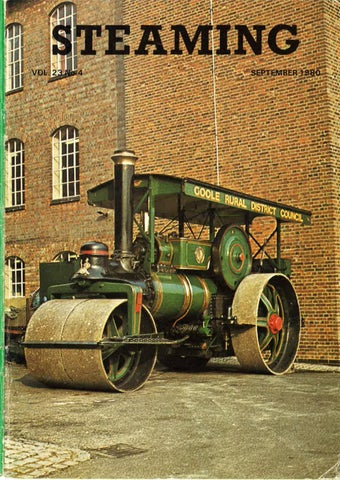
Front cover — Marshall roller GOOLE (82842 of 1928) has done much promotional work for the Road Roller Association this year. A journey to Banbury rally is described elsewhere in this issue — here the engine stands at Derby Industrial Museum in February, where it welcomed members to the Association's AGM. (Bob Payne) 195
CLUB NEWS Steam Apprentice Club We are now halfway through our first re& .nd 1 Ull YV events for members, and are looking forward to the third, The newsletter continues (we would welcome contributions from NTEC members — please contact Margaret Joachim), and we are about to have it printed instead of duplicated, which should give a much higher quality and the opportunity to include illustrations. Our first event was a training day, held on an April Sunday at Minster Lovell, by kind permission of the NTEC president, Jack Wharton. About twenty-five Apprentices came from almost all over England, and
were treated to a full day's instruction on everything from maintenance, lubrication and getting up steam, to steering an obstacle course and backing up to a trailer. For the most experienced there was the chance to drive, and even to try setting to a drum. The weather was beautiful, the four engine-owners and their engines were most o,,ve, UVUI you lc UIIU enjoyed themselves. The NTEC Sales Stand did good business as well. We are most grateful to everyone who helped make it such a successful day. The second event took place on the Sunday morning of Rempstone rally, and we hope it will be the prototype for many similar rally-based occasions. Members turned up from 10.30am, and each was allocated to an engine to help with the various jobs of cleaning, stoking and oiling. Most of them later took part in the grand parade, many had steering practice, and one or two of the
Steam Apprentices David Moore, Andrew Lowles and Richard Froggatt with 7hp Marshall 69269 during the morning steam raising exercise at Rempstone rally in July. (World's Fair) 196
FROM THE ALAN MARTIN COLLECT/ON OF PHOTOGRAPHS
No. 10
Ground conditions similar to those encountered around many of this summer's rally gates show in this April 1912 picture, taken somewhere in Hampshire. The engine is A.E. Smith's Wallis & Steevens 2673, built in 1904, and the two traction wagons probably came from the same maker. The story goes that Smith, of Kings Somborne, Hants, was keen on the horses, and on occasion was able to use his winnings to go out and buy a new engine, naming it after the obliging horse. Thus does this 6hp expansion engine bear the pretty name THE ORCHID on its smokebox door. It also appears to have a Hampshire County Council licence plate affixed to the hornplates.
older Apprentices had a go at the controls. Some even drove the Z7 Fowler ploughing engine brought back from Mozambique. Our Club caravan, with its new flag, was part of the engine line, and there was a lot of interest in our activities. We do rely a great deal on the goodwill of rally organisers and engine owners, and greatly appreciate the help that we get. There will be another SAC session at 10.30am on Sunday, September 14th, at the Roxton rally. All members, and accompanying parents, will be most welcome. In fact, one of the commonest sights at an SAC event these days is an envious father on the sidelines! We are always looking out for new members. If your child has always wanted to go on an engine, and is prepared to do some of the work involved, an SAC
membership would make an excellent birthday or Christmas present. The newsletter comes four times a year, and the tree rally entry scheme gives you — entertaining summer weekends! (Margaret Joachim, Newsletter Editor, 8 Newburgh Road, Acton, London W3 6DQ.)
Rally Organisers Conference The 1980 Autumn Rally Organisers Conference will take place on Saturday, 11th October at the Great Western Hotel, Paddington, London W1. Formal notices and invitations will be distributed to Affiliated Clubs and Rally Organisations in the usual way. 197
Membership Subscriptions Following decisions made at the AGM in May, and announced in the last issue, members are reminded that the annual subscriptions to the Club, from the December renewal period, are as follows — Ordinary Membership £8.00 £10.00 Family Membership £5.00 Old Age Pensioners (Mrs F. E. Wood)
Payment by Bankers Order The Club's bank account is being lialisfeilet.1 hum Leicester to Polegate. The principal reason for the change is that there are often occasions when the simplest way to sort out a problem is for the Treasurer to visit the Bank Manager, which is out of the question when the two are nearly 200 miles apart! We should be grateful if members paying by bankers order would sign the form enclosed with this issue of STEAMING and forward it to their bank without delay. By doing this promptly you will help to minimise any problems arising from this change and it will save the Hon. Membership Secretary much valuable time and be greatly appreciated. Thank you in advance for your co-operation. (Mrs Y. V. Hanmore)
London Area Social Meetings Meetings are held on the last Tuesday of each month at 8pm at 'The Cock Tavern', Great Portland Street, London (corner of Margaret Street and adjacent to Oxford Circus).
Tuesday, 28th October 1980 This is the opening meeting of the 1980/1981 session and, as usual, will be members slides.
Tuesday, 25th November 1980 Speaker to be arranged There is no meeting in December, and the 1981 meetings will be announced in the next issue. 198
A vacancy evicta for the office of
NTEC National Sales Officer The person appointed will be responsible for the selection, purchasing and stock control of all the goods sold by the Club. It will be a requirement to work closely with the Treasurer on the financial aspect of the Sales Dept. The National Sales Officer will also organise the operation of the Rally Stands through the existing Area Sales Representatives and he will deal with all the direct mail order sales. It will be necessary for the National Sales Officer to have space available for the stock to be kept in good condition.
This highly important position with the Club carries a seat on the Executive Committee and all the usual expenses are paid.
Any members interested in this very worthwhile position should write to R.J. Blenkinsop, (Chairman, Sales & Publications Sub-Committee), Hill Cottage, Radford Semele, Leamington Spa, Warwicks, CV31 1 UA.
THRESHING THE CHESHIRE WAY George S. Lea Photographs from the authors collection.
The traction engine was born as an adjunct to the threshing machine. Later, the breed was developed to be used for other purposes, but, as one was complementary to the other, let us take a quick glimpse into the birth of both beings. The first threshers were for barn use, at first hand operated, later to be used with a horse gear appliance. In Cheshire we called these 'jenny rings' which is probably a corruption of 'gin ring'. The first threshing machine is usually attributed to a Scot, Andrew Meikle, and it had a peg type of drum. It is rather amazing that some of these early types have survived in the USA, where they are referred to as ground-hog threshers. The peg drum thresher survived in the USA but it was soon displaced by the invention of the beater-bar and straight rail concave for British use. The first threshers were just that; threshing machines only, and the straw had to be hand shaken to get loose grain out before it was stacked for use. The grain then had to
be hand winnowed to get rid of chaff and dust just as in the old hand flail days. The next step was the addition of a blowing fan to give the grain a first dressing — that must have made it a right old dusty job! The steam engine also now started to appear on the scene, but not the portable engine, as might be assumed. The stationary barn engine with its separate boiler was more favoured if we are to believe the writings in the Journal of the Royal Agricultural Society during the 1860s and 70s. This was because the engine could run line shafting to operate other machinery, being most useful for driving butter churns on diary farms, whilst, at the end of the day, the boiler could supply hot water for cleaning down and scalding utensils. This is the explanation of a separate building on some of the older, larger farms, with a solitary chimney stack sticking up. Garretts had brought out a portable thresher in 1850 which could be moved to corn stacks and there driven by a portable
A farmer's stationary barn thresher. Probably one of the very first products by Edwin Foden, it bore a cast iron plate "Edwin Foden Engineer Sandbach" and would have been originally driven by a finny ring'. Photographed when standing derelict on a Cheshire farm. 199
1928, and George Lea's father poses by his Foden thresher; the large suction fan on the side can be noted. Foden compound 1395 stands to the right, behind the brand new 30cwt Bean lorry.
engine. Three years later, in 1853, Burrell's brought out the first threshing and finishing machine to be offered to British agriculturalists. This did not capture the market overnight and other makers started to make the threshing and finishing machine, i.e. it threshed, cleaned and graded the grain. Despite the conservatism of the RAS, this type of machine did eventually find favour and brought into being the threshing contractor, first with his portable, then the traction engine. This was a great aid to the smaller farms which could not afford mechanisation of their own and it also led to efficiency as more grain crops could be grown on these smaller farms. Contract threshing lasted for about a century before being displaced to all intents and purposes by the combine harvester. Esmond Kimbell has captured much of the atmosphere of threshing in his writings, especially for those who have done contract threshing with steam. It could be a dirty, loathsome job but it could also bring some happy days and memories, especially when the sun was shining with an autumn, golden glow, not so hot that the men were sweating and the dust sticking, but just enough to warm the air, with a slight wind to carry the 200
smoke to one side. There it did not suffocate the drum feeder, no dust was on the engine, and with everything running right and good coal, it was with a feeling of respect that one could stand on the engine and survey the scene of which you, as driver, were in charge. And, as Jack Hampshire brings out in his books, there were days of adversity which brought out the good comradeship of a good gang of men working together. Only now, in retrospect, can it be appreciated that although threshing started in a basically similar manner throughout the country, variations were to appear more locally in the method of operation. The early threshers threw out the straw loose as it fell from the shakers (not straw walkers, please!) onto the straw board, to fall onto the ground from where it was carried by pitchfork (pike!, in Cheshire) to be stacked up for future use. However, there were variations, especially in the dairy counties. I would say almost without exception in Cheshire three men would stand at the shaker end of the machine, each in turn would gather an armful of straw and then place it on the strawband which he had previously formed — a
quick twist of the wrist would tie the ends of straw in a special knot and the bundle would then be pitched onto the straw stack. This was to make later handling easier and tidier for getting the straw into cow shippons where it was used for bedding and fodder. Old Bill, who drove for us until the end of the 1937 season, comes to mind, as his first job when he started working for grandfather was tying straw, in the latter 1870's or early 80's. I know that if a straw trusser threw an untied bundle out ('tied up loose', as we called it!) he would grasp two small handfuls of straw, twist the ears' end together (that end was always called the rhyzome end) to make a long band. A quick flick and it was round the offending straw before it had chance to bat an eyelid. It was rather amazing that when we had two new Ransomes threshers delivered in 1939 and 1940 they came complete with straw boards. The straw board method was not to last much longer. In 1882, J. & F. Howard of
Bedford, patented and brought onto the market the straw trusser to be attached direct onto the thresher. In 1886, Grandfather Lea had one of these appliances fixed onto a new Foden thresher at Elworth Works. He also had Foden compound 215, his first traction engine from that maker, delivered at the same time, thus making up a complete set. The outfit had its first trial at the Fields Farm of a Mr Hodgkinson, of Plumbley near Knutsford. It was quite a seven days wonder for the locals to see the straw being tied up automatically with two string bands and no assistance from human hands; it also requiring only one man in attendance. Mrs Hodgkinson, the farmer's wife, left her household duties to have a look at this innovation and watch the proceedings for a few minutes, then she turned to grandfather and said, 'Well, I don't know! They always seem to be inventing something to save the menfolk from working; but they never seem to bother about the womenfolk!'
A Foden thresher with Hornsby trusser attached. George Lea's father is on the ladder with an oil can and "Old Bill" Lea (no relation; 'more Leas than fleas in Cheshire' — old saying) is adjusting the mechanism. The thresher was a Royal Show exhibit — note the brass beads around the holes for shoe hangers. A 1928 picture, taken whilst doing a test run before setting out on the road. 201
It would be around this period that Howards also brought out their baler. This had a wood frame, and a straw board for a man to stand on whilst he conveyed the straw coming off the shakers to the baling chamber. Edwin Foden started making these, probably under licence, using Howard fittings. These first balers had a small platform suspended by chains on one side. On this a man stood and, with a short pikel, thrust the straw into the baling chamber, whilst the ram was on its hank strokn Tn divide the bales, a follower board had to be dropped, on edge, just before the ram came up. As will be appreciated, this was a very hazardous and dangerous job indeed, and one man, Jonty Galley, did lose one of his hands. It was local blacksmith from the Sandbach area who thought out the 'horoc'a head' system of self-feed, as it was termed, to automatically push the straw into the bale chamber at every back stroke of the ram, and he was soon extremely busy, converting the old, dangerous balers. He could not have patented his idea, as he seemed to fade from the scene eventually. The straw elevator had come into being for use in conjunction with a thresher, to be used in the truly arable counties where not a great value was placed on the straw. I cannot recall or remember talk of one in commercial use with a thresher in the north Staffs, Cheshire or south Lancs areas, so I cannot speak with any authority, but I would say that they arrived in the early 1870's, firstly the telescopic types, the folders basically coming later. Cheshire has always been a dairying county, yet at the same time rotational arable has been mixed in, preserving a balance and making for good husbandry. Being situated with the Staffordshire Potteries to the south and Manchester and Liverpool to the north there has always been a ready market for the produce of both land and animals. Always is a long time so perhaps it should be qualified to that period from the beginning of the Industrial Revolution to the immediate post-World War 2 years. What was the motive power mainly used around these towns? Our old friends, of course, the Shires and Clydesdales to move the weight, the cobs to deliver the bread and groceries etc, and the Hackneys to take Stoneycroft, or Kidsgrove to his seat of office. This horse population, of course, had to be fed with hay and oats and be bedded 202
on straw, which explanation indicates why oats were the main cereal to be grown, followed by a bit of wheat, more especially in north Cheshire and south Lancs as wheat could be sold to the Manchester and Liverpool mills whilst the harder wheat straw was more favoured for horse bedding. Barley, thank goodness, in steam threshing days was almost unheard of in the country. Edwin Foden bears out the truth of the statement that the traction engine was an adjunct to the th,uhei clb he opei iiy Sidled that he only made them because he had to, to make his engines sell; it was only on the tractions that he made a profit, the thresher being sold at a loss. Possibly very true, for in 1902 a 54in thresher could be bought for £ 155, whilst the price of a 6 nhp compound traction engine, ready to drive the machine, worked out at just over £590. Despite his statement, Foden designed his thresher to make a marvellous job of turning out a 'market sample' of oats and I will willingly admit that the Ransomes which replaced the Fodens, as good as they were, could not touch the latter for dressing oats. Scotland, always renowned for oat growing, both for seed oats and for porage oats, was a good market ground for both the Foden thresher and traction engine. It was during the World War 1 that production of both threshers and tractions ceased at Elworth, the government demanding full production of the famous steam wagons. As an aside, the first blast was caused by a suction fan which sucked the chaff and dust into the chaff bags, all Cheshire machines invariably being fitted with chaff bagging apparatus. Wheat chaff, especially if it had been undersown with clover ley, would often be carried to a chaff house to supplement the diet of the farm horse, the tender particles of clover giving nourishment. Oat chaff and chaff from any weedy crop was always carried from the stockyard onto an adjacent field, where it was burned to destroy the weed seeds etc. To the suction fan, a duct was led from where the grain came off the second dresser riddle, this grain flowing over baffles and being subject to a controlled blast of air. This suction draught was controlled by an adjustable paddle, and if opened full out it would suck the whole crop into the chaff bags! It was used judiciously though, and soon sucked out the 'deaf' oats (i.e. those with no grain in the husk) and also wild oats. These did not fly straight to the chaff bags as the vacuum
was so arranged that these intruders fell out of the air stream into a sack which could be taken to the burning chaff when full. There was not the wild oat problem then as there now is in grain crops. In the south of the county are The Potteries. They have always been huge consumers of straw for packing purposes. The packers were, and probably still are, on piece work which is why they preferred trussed straw (we, and they, always termed it 'in battens'). With battened straw, they could soon whisk it round to line a crate ready to receive the pots, instead of having to shake out baled straw. In Middleport and Longport — 'teapot land' — they would not have anything other than battened straw. The crates, by the way, were a craft of their own being hand made from hazelwood rods, soaked, twisted and woven until a rectangular shaped crate was formed, strong enough to take 10-12 cwts. of pots,
and to take those pots to anywhere in the world. The wooden crates have now been displaced by steel mesh crates and these are now being displaced by the container, in which polystyrene foam and wood wool are now used for packing. In the early 1900's, Ruston Proctor brought out their self-feeder for threshing machines, soon to be followed by Marshall and other makers, and this mechanism was widely adopted especially in Lancashire and mid and north Cheshire, yet in other parts of the country the band cutter and separate man to feed were to survive to the end. It rather surprises me that Mr. Kimbell did not like the Ruston thresher, as it was very prevalent in Cheshire and Lancashire. Although they were a heavy machine to drive, they would take all that was thrown into them — as would their successors Ransomes, who took over Ruston's agricultural side, although Ransomes had been making
'Clarky', the mate, packs up the top of Lea's fiansome thresher at the end of another day's work with Foden compound 1395. It looks as if 'begin' is just appearing on the scene. The picture was taken in 1944 with some luckily acquired film — by then Leas were turning over to tractors and the picture is an attempt to make amends for previous neglect of making a photographic record. 203
threshers long before this. Probably it was because we did not have a lot of barley, for their whiskers to bung up the opening between the caving riddle and top shoe. It was a bad fault, both being on the same shoecrank throw, I agree, and possibly contribute to making the machine a heavy driver. Yet they did not rock and shake like a Marshall. In common with other early threshers, those from Elworth suffered from the eternal job of having to be oiled up twice a day, especially on the throws of the shaker cranks and the shoe crank. What a toil it was crawling on top of the shakers in the dark of a winter morning, a half gallon oil can in one hand and a paraffin storm lamp in the other; there were always snags to catch and tear overalls and one also had to be careful not to !inset the lamp because of fire danger. When the Ransomes came, everything was fitted with ball bearing races and eliminated the crawling about business, also, the shakers were now fitted to a closer tolerance so that straw did not find its way down between the shakers and wind onto the cranks. Previously, to set such a happening right had meant crawling up the cavings riddle, undoing the trap half way along the top shoe then crawling and thrusting to get at the straw and cut it off the crank throws, job which had to be done at least once a week. Theoretically, this oiling up was the second man's job but a good team always shared the duties, the mate doing the top and inside of the machine whilst the driver did his engine and the outside of the machine. The mate would oil the baler or trusser if that was being used. On a wet and windy day, it was a double handed job anyway, to handle the machine sheet without it getting blown away, and the cover had to be left up and re-spread after oiling so that all was in readiness when the rain ceased. It was on the mornings like that, that the shout "Breakfast!" from the farm's back door was most welcome. Just prior to World War 1, Rustons brought out their high-speed baler with conveyor feed for the straw on the straw board. This was operated by semi-reciprocating arms driven by an attachment from the ram connecting rod, and not to be confused with the later trolley type conveyors. This type soon found favour as bales were easier to transport to the towns and also did not require as much room to store under the Dutch barns, so common in these parts. With so much double work, threshing and 204
baling combined, compounds came into general use, single cylinder engines being almost non-existent in commercial use. The compounds did not require as many visits to the coal truck as singles when on heavy work. Old Farmer always looked a bit askance if he thought you were using too much of his coal! Here in Cheshire we have a saying that you will never find a satisfied farmer or a dead donkey. The only one I knew of was old Ned Cauley's donkey from near Northwich; he had just got it used to managing to work without eating when it died! But I digress. One thing that we were not troubled with was the power driven chaff cutter. From what I have been told it was a horror of a thing, worse than a trusser that was on the blink, but heavier than a baler to drive if There was anything being put through. Another thing that we were fortunate with was the fact that nearly all the threshing was from Dutch barns and most of these stackyards had a firm solid footing, one or two excepted, but all part of the job. As field threshing of stacks was usually finished by the end of September or beginning of October we did not have a lot of putting on of paddles and with a bit of luck the outside jobs, as we called them, were completed before the weather broke. Although we did have one or two bad moments after putting rubbers on the wheels in 1938, this addition really was worthwhile. Another attachment that we did not have, was a reed-comber. I well remember, as a lad, reading in a catalogue of threshing machine appliances of 'waterproof covers for machines fitted with reed-combers made to special order'. At the time I wondered what on earth these things could be and pondered the possibility of why anyone should want to push bundles of reeds through a thresher! Actually, it was not until a visit was made to one of the early Stourpaine rallies that I did see a machine fitted with one of these combers. Now they seem to be growing them down there.! Surprisingly, one crop that we did have quite a bit of was rye. This would have an early green cut taken off it to feed cattle, then be allowed to mature. Despite this early cut, it would often grow to a height of around seven feet on the fertile Cheshire soil and then would be cut to leave a two foot stubble. On quite a number of farms, especially the smaller holdings, quite a bit of the crop would be threshed in the old
On the verge of wartime. Foden compound 1395, a Ruston baler and a new Ransomes thresher in the final moments of preparing to turn out for the season on 7th August 1939. The thresher had been on its maker's stand at the Royal Show in Windsor Great Park. manner, using a hand flail, the heads only being placed on a low wood barrel to be hit, so as not to damage the straw. The straw would then be combed out with a head of a wood toothed rake, tied in bundles and despatched to harness makers who used this tough straw for packing out the insides of horse collars. We had the job of dealing with the remainder of the crop and this required a really good feeder on the machine as it had to be fed in as parallel with the drum as absolutely possible, otherwise it would lick onto the drum and soon wind itself around it, filling up the gap between the drum and concave, thus bringing proceedings to a rapid halt and, in all probability, throwing the drive belt off the engine. I well recall threshing some rye during the last war and the man I had feeding would not be told to let the sheaves trickle onto the self-feeder canvas at an angle so that as the straw went under the kickers, they would let it onto the drum just right. We had one or two minor wrap-ups, then he did a real beauty, both main and baler drive belts went flying. Mid-morning 'bagin' of tea and bread and cheese had just been brought from the farmhouse; the main belt caught them and they also went flying.
My mate, Cliff, needling the baler, got the baler belt wrapped round his legs, so he went down into the mud and slush; in fact quite a hectic half minute. Then it was onto the machine, up with the trap-door under the self feeder, onto the shakers and crawl to the drum itself to cut off the mass of straw. It was so tightly packed that we had to let off the concave to get it all clear and whilst trying to rock the drum to get at a bit more straw to cut off, the drum rocked back catching two of my fingers between a beater and a concave bar, cracking a couple of finger bones. There just was no sympathy at times! As mentioned before, at times like this it could be cussed — wet stacks, awner bunged up before we had chance to pull out the side to release wet grain, Old Farmer expecting a full set of steam tackle to get between a couple of stacks, just because his horse and cart had managed to get there... Come winter, there was snow and ice to contend with, but we are generalising, now. In Cheshire, we did have a bit of compensation when threshing by steam as the driver and mate were fed at the farm — yes, the thought of a bit of that farm cured bacon and fresh eggs for breakfast is very mouth 205
watering. At mid-day, we two also went in for a hot dinner, anything from rabbit pie upwards — but never, to our knowledge, cooked hedgehog! Some of the better disposed farmers would supply an afternoon 'bagin' around 4.0 pm and almost without exception if we were working on late to finish a stack off. The Cheshire term, 'bagin', derives from it being food that could be carried in a bag to field, wood or wherever the men were working. Also during the last war we went to thresh at one of the old manorial type of farms where the moat still survived. In fact, at one time it had been the seat of the local Lords of the Manor, the Shakerlys. Previously this farmer had an old Ruston thresher which he had used to do his own threshing using an old 11vprtime tractor, but he sold this machine to me and it went in south Lanus later.
It was a threshing-up ready for a sale setting, as the farmer, who did not enjoy the best of health, was retiring. At mid-day, he came to me and said, 'Come on in for dinner. Don't stop to sweep tubes and let it get cold, as its a bit of something special.' It was too; I can see him now carving at this joint on a side table and when we ate it, the meat simply melted in our mouths. Afterwards he enquired, 'Well, how did you enjoy that."Fine, I said, 'I've never tasted lamb as good and tender as that'. 'That wasn't lamb', he smilingly said, 'that was venison, the food of Kings! And why shouldn't Cheshire men think themselves Kings? But don't ask any more questions!'
Which place, I think, is a good place to draw this epistle to a conclusion.
By direction of The Administrators of Thomas Brownlee Paisley, dec'd
THE PAISLEY COLLECTION OF STEAM TRACTION ENGINES 28 ENGINES of the SHOWMANS, GENERAL PURPOSE, PLOUGHING and PORTABLE types by Aveling & Porter, Burrell, Clayton & Shuttleworth, Davey Paxman, Foster, Fowell, Fowler, Marshall, Robey, Savage, Wallis & Steevens 400 locomotive and traction engine nameplates Engine accessories, lamps, Threshing drums, German Field Gun, etc
AUCTION, WEDNESDAY 1st OCTOBER 1980 10.30am at MANOR FARM, HOLYWELL, Near ST. IVES, CAMBRIDGESHIRE Viewing — Tuesday, 30th September 1980 Catalogues Price £2 from the Auctioneers
Eltins, Miley & Handley Centenary House, Huntingdon, Cambs (Tel. 0480 56171) Ref: EW or VHE or PCH/3P545
206
TAR SPRAYING AND OTHER TALES Percy Dabbs (continued from page 144 of the June 1980 issue)
I went back to tar spraying again in May 1931, but this time with a Clayton & Shuttleworth compound which had stood for a number of years at Grove Farm, where J.B. Souter lived as tenant of 200 acres, near the railway line at Kirk Leavington. This engine was 48562 of 1920 IAJ68201, which had been new to C.E. Richardson of Kirk Leavington Hall, the owner of Grove Farm, J.B. took it into his head to have it overhauled by one of Marshall's men from Gainsborough. This engine did very well — my mate of that season was Stan Johnson, with a Fowler compound road engine without a canopy, a very good engine. By contrast, the 1931 season was moderate. We were often stopped for a day or two, and when this happened we would
have extra rail tanks waiting for us, and naturally, getting colder all the time. We could not keep them all warm unless we worked all night. As it was, I have often known us come out of station yards at midnight, one of them in particular being Bowes, on the way up to Stainmore. This was done to try to keep the job going when the weather was kind to us and the roads did dry up. Unfortunately, the chipper lads did not get any pay unless they were working. At that time, their pay was only around 81-9013+p) per hour, and they were allowed four hours to put on the requisite amount of chippings to a tankful of tar. It could be done in much less time than that however, depending on the size of the chippings. We many a time put on a load
Class A9 Fowler 15308 during a break in tar spraying at Scorton, near Richmond in the early thirties. Percy Dabbs, the author, is on the left and Marwood Fawcett, Mrs Souter's brother, on the right. (J. Pierson) 207
after tea, for the benefit of the gang, to boost their wages. We had quite a pleasant season, despite the holdups and a loose flywheel on the engine whilst we were near Middleton-in-Teesdale. The next season I had a very good Fowler single which I think came from Coles at Sleaford, Lincs., and would be a Class A9. It was number 15308 of 1919 (CT4179). The engine was in excellent condition and was very nice to handld. My mate that season was _lank Patlar from Reamer. between Yarm and Stokesley. The engine he had was the Fowler compound which had been my mate's the previous winter. This year we again had a good season, and helped one another, which meant that things were much more pleasant, unlike the firct coacon when I hod no help at all with that old Ransomes. Later on in the year, after the spraying season had finished, we again went onto the 'off-season' jobs — thrashing, wood sawing, timber felling and leading and usually anything else which came along. I remember one day in early March 1932, I took a load of hay to Fred Robinson, Stockton, brought a ton of wheat back home, took a further load to Stockton, this time of straw, before finally coming home, towing an Austin wagon which had been bought at a sale. Those were busy days. Later on, in the spring, I met up again with another good mate, Alick Douglas. We worked together a lot at various times, and on one occasion we towed an old Titan tractor home from near Greatham, which is on the way to West Hartlepool. We had a very rough journey with this. We used the 2 ton Morris as the towing vehicle, and through Stockton-on-Tees it was particularly bad with all the traffic. However, we eventually reached Kirk Leavington with the tractor, and after a bit of work on it, we managed to start it. I did a bit of harrowing with it after that. It really was bad to start but went well once it was going. I had not done any real farming since I first left school when I had three or four years of it, and I really enjoyed this break in the normal routine. Come tar spraying time again in 1932, there was a bit of a change as not so many hired engines were required, since Taroads Ltd started to send more of their Aveling & Porter tractors and Foden steam wagons into the North Riding area. Up to and including 1934, these Avelings and Fodens 208
with living vans were brought up from London by road. The tar tanks came by rail to Picton Station, near Yarm, about two miles away. We took them off the rail there and brought them back to Souter's yard at Kirk Leavington for distribution to the various areas. When they came they were clean, thoroughly overhauled and in perfect condition, complete with a good set of tools. I was given one of the Avelings, which carried a fair sized enamel plate with "Taroads Syndicate Ltd.. 9 Victoria Street, London S.W.1" on it and which had been driven for a number of years by an old hand and a real Cockney. He was a real good worker, up early every morning, and he appeared to keep himself clean. However, a few days after taking over this set, we began to find things none too comfortable at night in the van. My mate, John Plumb, seemed to be worse than myself. So, we got some fumigating candles and left them burning inside the van over the weekend to stove it out and kill the little blighters! Well, these candles made an awful smell, and the following Monday night we expected things to be alright. My mate, unfortunately, said things were not much better. On the Tuesday night, after finishing spraying, we set to and pulled out the spring mattresses and dismantled all the joints in the bed frames. We found the vermin alright and we made a strong solution of Jeyes Fluid and washed everything — van walls, floor, mattress frames, and ourselves — everything. After doing this again the following two weekends, we finally got rid of them. It was unpleasant while it lasted and we were well pleased when we finally achieved cleanliness once more. My mate of that season with the other engine was Stan Johnson again, with the previously mentioned Clayton Shuttleworth compound. We had quite a good season again together. From Bowes, in a typical week in June 1932, we filled the tar tanks on the Wednesday and sprayed over Cotherstone Moor. On Thursday, we filled again and sprayed the Eggleston Abbey road. Friday we filled again, spraying the Startforth to Boldron road. We continued on Saturday from Startforth to Barnard Castle Bridge and back round Startforth village. We naturally had a break on Sunday and spent the Monday, Tuesday, and following Wednesday on the Bowes to Barnard Castle section. Earlier in this season, I often helped my mate expand the tubes on his engine as
J.B. Souter's other Fowler, number not known, receiving attention from driver Jack Petler in Swaledale Station yard around 1932. (J. Pierson)
they were leaking, but as the season progressed we cured this problem. Up to that time, my means of transport had mainly been by either cycle or bus at the weekends. This meant often having to go back on the Sunday night from Picton where I then lived. Jack Petler, the driver from Seamer had a big 4H Norton motorbike which I thought to myself more than once was a large clumsy looking thing. It was tied up here and there with bits of wire, and string as well. However, Stan bought this bike from Jack (they were slightly related somehow) and after running it for a couple of weeks, he got his eye on a BSA Sloper at Stokesley, which he badly wanted. He wanted to sell the Norton first, so I bought it from him for fifty shillings. I did a bit of work on it, doing away with the wire and string business, and it turned out to be a very good machine. It took two of us, with all our pack, for most of the season up to Bowes and the Middleton-in-Teesdale area without any trouble. This motor cycle certainly made my transport a lot easier and featured in an incident which could, in fact, have been very
serious. I forget the exact date, but our foreman that year was Mr Sep Holiday from Dalton, near Thirsk. He was a thrashing machine owner and his two sons were with him at the time. The younger son, Ronnie, was driving Taroads Aveling tractor and the other was helping by putting on chippings with the rest of the gang. The Holidays had a living van of their own which we hauled about for them, along with our own van. We were at Forcett Station near Aldbro' St John at the time. It was just a small station, mainly used by the local limestone quarry and Meynals of Ravensworth, who were agricultural merchants. We were all in our van, the six of us, playing cards until about eleven o'clock that night. Leaning against the van at the hedgeside were two motor cycles, including the one previously mentioned, and three or four cycles, covered with an engine sheet. In the course of playing cards, someone unthinkingly must have dropped a cigarette end out of the van window and onto the sheet. We finished our card game, went into our respective vans and had all got nicely to bed when all at once 209
One of Taroad's Aveling tractors — 8544 of 1915 (KT4621) — is pictured here in a Hertfordshire lane in July 1934. (R. G. Pratt)
there was a shout of "Fire"! What a scramble there was. We managed to put our boots on and get out of the van. By this time, the oil soaked engine sheet was blazing quite merrily, but as luck would have it, there was some water standing near at hand where we normally got washed. This was in a five gallon drum with the top cut out and a bucket handle fixed on. We threw this on to the fire and it did the trick. Apart from the sheet, the only damage was to the licence of my motor cycle, and some scorching of one of the bike saddles. We certainly had been lucky, had we been fast asleep in those wooden vans, we may not have got out alive. The end of that season was early and we made our way back to the yard in August. Later in the season I spent several days on haulage, using the Morris wagon carrying beans, oats, wood, and even fetching coal from Ferryhill, Co Durham. In December 1932, we bought a portable engine from Portrack to the yard at Kirk Leavington, and this was eventually put to work driving a pulper in which turnips were crushed for animal feed. We were thrashing 210
in mid January 1933 when the weather turned icy and I spent a day sorting and oiling bolts and generally cleaning the engine house out. Later on I towed an Essex car home from Redcar and helped Jack Shepherd to move his thrashing set on the icebound roads to the next job. The following day we brought two loads of gravel from Yarm to the Hall for the builders to make a bed for an oil engine. Modernisation had arrived and we went the following week to Hilton to pick up an engine, dynamo, fuel tank, pulleys, and shafting for installation at the Hall for electric lighting. Shortly afterwards, Alick Douglas and myself were detailed to fell a small plantation between Northallerton and Ainderby Steeple. This was done then by axe and cross cut saw — there were no chain saws in those days! We started on the Monday morning and were finished by the Saturday of the same week. We normally finished at 4 pm on Saturday on these sort of jobs but we had got on well that particular time and there was only a small tree or two left with a bit of dressing out to do as well,
so we packed up at 3 pm. We later found out that J.B. had come to see us at some time between 3 and 4 and of course, we were missing! In the meantime, during that week, he had arranged with us to start leading this timber into the yard at Kirk Leavington on the following Monday with two tractors, one a Fowler T3 number 15290, and the other the Tasker which was very rarely used but was still alright. On the Monday morning I got up early, went into the yard, fired both engines up and sorted out our equipment until my mate, Jack Petler came along. I then left him to oil up while I nipped home to Picton, about three miles away, for my breakfast. It was not long before I was back and we were just on the point of pulling out of the yard with the two tractors and the timber trailers when J.B. came down in the car from Grove Farm. He got out, gave a great yell and stopped us in our tracks. "Absolutely [this was a most used word of his] take this b....s back; I don't care a damn if there isn't another wheel turned, take the b....s back." What had upset him, we never knew. We therefore stayed in the yard and he eventually set Browns of Leyburn on to put the wood on rail at Northallerton and we took it off at Picton. It seemed a fruitless exercise, but he was the boss I For the rest of the winter we took the good with the bad, and I started the 1933 spraying season with the same Aveling & Porter set as the previous year. Although I don't have a record of the exact number, I think it was No 16 in their fleet — 9153 of 1920 (KN8741). There would be four or five Avelings up in North Yorkshire at one time and I think the others were numbers 13, 14 and 15. My mate at this time was Fred Storey, a very good mate indeed. He also had an Aveling outfit belonging to Taroads, although which of the others it was, I can't remember. We started very early in May in the North Yorkshire Moors area, around Castleton and Danby, leading tar from Castleton Station. We had a fortnight or so around there, and on the final day we finished around 4.30 to 5 o'clock. Fred said, "What about moving down to Nunthorpe?" Of course, despite the relatively late hour, I was quite willing, so we had our tea, packed the vans up with various equipment including motor cycles, also the chipper lads tents, bedding, tuck boxes, and three or four cycles on top of the tank. We set off and it was not a particularly good travelling road because of the hills.
However, I took the lead and Fred followed very well to say it was his first experience of moving a relatively long distance with the little Aveling. All went well and it was a beautiful night and we arrived at Nunthorpe Station where we were going to park, having covered the fourteen miles over the Cleveland Hills, just before dark. We set up for the night, had a good wash, some supper, and a bit of a natter before turning into bed. When we got up the next morning, there was a good cover of two or three inches of snow! However, this soon went and the roads dried, and we got going after dinner. It was a good job we had decided to move the previous night, as it would certainly not have been easy making progress over the moors in the snow. At the latter end of this season we had the usual winter work. I went back to thrashing, and the many days spent at that, I remember, were charged at £2 5s Od per day, or £1 10s Od per half day. At that time I used to collect the money as well as obtain orders for the work to be done. One day away from thrashing in October was spent putting the Clayton single on to rail at Picton Station, although I can't remember where it was going to. One new job was hauling long baulks of timber, anything up to twenty or more feet long by some twelve to eighteen inches square — mostly pitch pine, from Craig Taylor's shipyard on the Tees at Stockton, to the sawmill at Kirk Leavington. At the mill it was nearly all sawn up for stakes and rails for the Hurworth Hunt, who were very active at that time. We also had a sawbench set up in a corner of a field by the roadside between Kirk Leavington and Yarm, and another at Trenholme Bar Station, on the Al9 between Crathorne and Clack Lane Ends. We led to either of these, depending on where the converted timber was required. Around Christmas 1933, I had a change from traction engines, and went snigging wood at Weary Bank with an Austin tractor. The end of April or beginning of May 1934 saw me out tar spraying again with the same Aveling set. To start off we were in the Winston Gate, Ovington, Smallways and Greta Bridge area, and I was pleased to have Jack Petler with me again as my mate, with the big Fowler compound three speed loco. J.B. Soute► wanted me to stay in the yard and let Alick Douglas take my place with the Aveling set but I would not agree, nor would Mr Rawlings, who was a shareholder and 211
area manager for Taroads Ltd. "Right," said J.B. threatening me, "I might have something to say when you come back in at the end of the season." He had some very peculiar moods and attitudes at times — most of the local threshing contractors who were obviously competitors in a somewhat limited market were at daggers drawn for most of the time, and one thing J.B. did not like was contact between his men and those of his competitors. We enginemen naturally became friendly with each other over the years, swapping stories and heiping each other out from time time when the occasion arose. One time, he caught me talking to my good friend Dick Preston who worked at that time for W.H. Thomas of Great Ayton, near Gainsborough, and he threatened to sack me. J.B. came to see us towards the end of the season at Northallerton with a view to making some arrangements for when we returned to the yard at Kirk Leavington. During the time we had been away, both Jack Petler and I had plenty of time to think about the situation and to discuss what we were to do. We had made up our minds and when we both told him we were leaving, I'm afraid he got a bit of shock. I think he would have given both of us the moon for us to change our minds and stay with him. Jack Petler, my mate of long standing actually went to W.H. Thomas to join Dick Preston and got a job there with no trouble at all. Going back to the time before I started for J.B., I had had a season thrashing in 1928 with Frank Stephenson of Sedgefield, Co Durham. I enjoyed this very much except for a fortnight or so when I had the measles. I lived in with the Stephensons and they looked after me very well. My young lady came from Constable Burton, near Leyburn to see me while I had the measles and I think I would look a bit of a mess, as I could not shave for a few days. It did not seem to put her off though. The people where she worked told her that if she came to see me under these circumstances, she would have to leave. She did not give them the chance to sack her as she gave her notice in before she left. I finished at Stephensons at the end of that season as there was no work during the summer. It was following that when I started for J.B. Souter, threshing and general duties in the winter, tar spraying in the summer. As I have recounted, I was employed by them from 1929 to 1934. My wife and I were married in August 1929, not long after the measles episode and we only had the weekend off. We had kept in 212
contact with Stephensons over the years whilst I was with Souters as we were friendly with them all. In fact, Frank tried to persuade me to go back to work for him several times when we visited them. In the meantime, Frank had sold one of his thrashing sets to his brother Alf who had had a farm called West Layton between Sedgefield and Thorpe Thewles and Frank took the farm called Garmondsway at Coxhoe Bridge. The engine was a Ransomes compound 7 hp of around 1917 or 18, with a Ciayton & Shurdeworth machine. vvniie my wife and I were on a visit to them during the summer of 1934, the suggestion of going back to him again cropped up. I had this in mind when discussing the question of leaving Souters with Jack Petler. Not being too happy there, with J.B.'s peculiar attitudes, I agreed to go hack. Frank told me a very glowing account of what work he had which, knowing the area, I could not dispute. Unfortunately I was in for a big disappointment, as I soon found out. The work was not there as promised and the next thing he wanted to do was to sell the thrashing set, so I bought it from him. It was a Ransomes single, 7 hp built about 1910 (UP5758) with an A.54 heavy machine from the same manufacturer. I thought I could not be any worse off than I was when working for him as sometimes I got paid and sometimes not. My wife and I had saved a bit of money before we were married, so this helped us and we were on our own from 1st January 1935. We had a very lean time for the remainder of that season and into the next, but I had the summer season's work of tar spraying to help out. During this summer, I got a job which I had not bargained for. I very quickly discovered that the smokebox of this Ransomes was in a deplorable condition, in fact, I was afraid it would give way before the end of that first half season from January 1935 onwards. As it happened, we were very friendly with the Hugills of Brompton-on-Swale, Catterick Bridge. Jim Hughill knew about the state of the smokebox and said if I took her to his place at the end of the season, he would help me to put a new smokebox on. He also told me where to get one made, which was the LNER workshops at North Road, Darlington. After I took her to Jim's place, I got the measurements and called at the North Road Works and they agreed to make a smokebox for me. This was ready the following weekend. It will be realised that I was tar spraying during the week and only
One of Taroad's Foden wagons — 10416 of 1921 (EC3671) — with combined tar tank at Much Hadham, Herts in August 1936. It was previously owned by Westmorland County Council. (R. G. Pratt)
had the weekends to do this. It turned out that Jim was very busy as usual and I had to do most of the job myself. He lent me the necessary tools except the spanners, as I had my own, but the job did not worry me in the least, although it took me longer than it would have done had he helped me. However, three or four weekends saw the job complete and I got the engine home to Hett Mill. During this time the insurance had become due, so I changed to the Prudential with whom we had other business. Whilst the engine was standing at Brompton-onSwale, a boiler inspector, Mr Holdsworth from Darlington, came to look at it and I gathered that all was satisfactory as she passed the hydraulic test alright. We started the 1935/6 thrashing season sometime in September, and had done a few days and were thrashing at a Mr Musgrave's farm, East Well, Sedgefield, when the boiler inspector called to see the engine under steam. After a look round, he said I must not use the engine any more until I got some welding done on the bottom of the tube plate. I was dumbstruck! I was left high and dry! There was no sign of trouble with the
boiler but I could not continue to thrash because I could not get anyone to do this welding immediately as this sort of work was not so easily come by at that time. Today it would have been no problem. Why the inspector did not mention anything about this when I was at Jim Hughills, putting the new smokebox on, I could never understand. I did not quite remember whether I advertised for an engine or saw one advertised, but I went to see one which turned out to be an 8 hp Ransomes, 13419 of c1905 (AJ61411, in quite good condition and belonging to Mr Wappett of, Eppleby, near Piercebridge, whom I had met several times whilst tar spraying out that way. He was George Wappett's father. It had no canopy but was just what I wanted to keep the job going — and it worked well for several years. It cost me £100 in September 1935, whereas the work on the other would have only cost about £10 or £20, but the problem was getting it done. Frank Stephenson's Ransomes was eventually cut up in 1936 as a result of this. 213
During the first full season and afterwards things went very well for us and we soon had the set from Frank Stephenson paid off. From now on I was employed by Taroads Ltd during the summer and not J.B. Souter, and I worked for myself during the winter. We moved to Spennymoor, Co Durham in September 1934 and lived with my wife's parents for a few weeks until we got a house at Hett Mill, which was very close to the Darlington — Newcastle railway line. It was a reasonable house with some outbuildings which I was able to use as a workshop and there was a small grass paddock where I could stand the engine and machine. The hamlet of Hett Mill consisted of our house and eight railway houses. About 200 yards from us and below the houses was a large stream or beck, as we called them. On the whole it constituted a small valley, as there was a sharpish little hill from our house to the main line over the level crossing and then a steep hill down to the
beck, over this and a stiff pull up to a farm at the top on the other side. There was a footbridge over the stream but all other traffic had to go through the water. It was a rough road, even for an engine with a thrashing machine. Others had been known to have used the rope to winch the machine along, but I always managed without recourse to this. The house we lived in at Hett Mill belonged to a farm in Hett village which was about half a mile from us and was farmed by Mr and Mrs Mnrtnn son Reece and his wife Agnes. I knew them slightly through a mate I used to work with on a farm near Newton-le-Willows, Bedele, when I first left school. They had farmed at Crakehall near Bedele, and turned out to be wonderful friends. If I had a spare day or two, I could go and work for them and there was never any mention of what did I want, they always gave me more than I would have got anywhere else. (to be continued)
We are grateful to Mrs N. Tit/ey of Rednal, Birmingham, for the loan of this undated photograph, on which her grandfather poses second from left. The steam wagon is Yorkshire 1042 (114650), new in October 1918, and the scene is the yard of Birmingham Corporation's Public Works Department in Bristol Road, SeIly Oak. They had a total of four Yorkshire wagons. 214
AN EARLY LEYLAND MOTOR WAGON This 1905 account by James Sumner of his first experimental steam wagon some twenty years earlier makes even more interesting reading today. By the time the article was originally published Sumner had succeeded to his father's business at Leyland and had played a large part in developing it into the Lancashire Steam Motor Co. (later to become Leyland Motors Ltd), manufacturers of the successful Leyland steam wagon.
A 5-ton steam wagon was built in the year 1884, at Leyland, Lancashire, by the writer, with the intention of using it for carting coal from a mine six miles distant to a neighbouring bleach works. About 40 tons of coal were used daily, carted by horses at a cost of 2s. 6d. per ton. It occurred to the writer that a steam wagon could be made to do this work at a good profit, and he unsuccessfully endeavoured to induce his father, who owned a small engineering business, to try the venture. So convinced was the writer in his own mind that this was the proverbial chance of a lifetime that he determined to make a wagon on his own account. The patterns were made at night, and, when castings and materials had been obtained, work was commenced in real earnest in the daytime, and everything had to be done without assistance — to bore cylinders; to make the forgings; to do all the turning and fitting. The boiler was the only thing that was bought, and after about eight months' hard work the wagon began to assume shape. But, alas! the time of successful motor wagons was not yet, so the fortune did not come; but, on the other hand, serious loss and trouble. It will be seen from the illustration that the wagon embodied many of the features of motor wagons as built to-day. The centre lock steering, three point support, vertical multitubular boiler close behind front axle, horizontal engine under body of wagon, and the "live" axle are all to be found in one or other of the wagons made at the present time. Its weak points were lack of a two-speed gear, insufficient tank and
Described by its Builder,
Mr James Sumner
bunker capacity, and too large an engine and boiler, which made it very uneconomical. Had the wagon been fitted with a slowspeed gear and a compound engine it would have worked with a boiler nearly half the size and have used half the fuel and water. The cylinders were 5in in diameter by 10in stroke — about the right size for a lowpressure cylinder if the engine had been made compound. The boiler was 3ft 3in in diameter by 5ft 6in high, fitted with 30 3in cross tubes in the fire box, and made for a pressure of 120Ib. The engine was fitted with Stephenson's link motion for reversing, ordinary slide valves, and trunk slides to the piston rods, the 2%in crank shaft, of Low Moor iron, carrying on one end a small driving pinion, which worked direct in the large compensating spur wheel on the back axle. The driving pinion was made with claw clutches and ran loose on the end of the crank shaft, so that the wagon could be thrown out of gear and the engine run free. The differential was of the usual traction-engine type, with one bevel wheel keyed to the live axle and the other to the free road wheel. The steering was by means of worm wheel and chains. The tanks were arranged on each side of the boiler, and the bunkers on top of them. The frame was made of 5in by 5in by y: in angle steel, and the body, which was about 10ft by 5ft 6in by 3ft, was of 2in deal planking. The back axle was 4in in diameter, and all four road wheels were of iron and very substantial. The tare was about five tons, and it was intended to carry a load of five tons. Of course, the builder soon found that he had to take out a traction engine license and to run the wagon as a traction engine, there being no Motorcar Act in those days. After one or two short preliminary runs, sundry adjustments, and alterations, it was decided to venture on our maiden trip to the colliery six miles away. An early start was made the following morning, and it was soon found what a thirsty customer the motor was and how soon it could empty its tanks on a straight run. We had barely gone two miles when the tanks were empty, and we found we were in anything but a handy place for 215
Elevation of Sumner's 5ton steam wagon built in 1884. Steering was by worm gear. Cylinders were on each side of the frames and drove a crankshaft which carried on one end a small spur wheel meshing with the compensating spur wheel on the live rear axle.
refilling them. But we were as yet undaunted and soon found water about half a mile off. We got the wagon as near as possible and carried the water to it. This hindered us considerably over an hour, but we thought little of it at the time. The same thing, however, occurred again, much too soon for our liking, and on its happening for the third time, as we were getting tired of carrying water long distances for such a confirmed drinker, we backed the wagon on some waste land by the side of the road to get nearer a friendly pond. I need hardly say that it took us much longer to get off this ground than it took us to get on, for this was our first experience of being bogged, and we had no jack or planks of any description. It was, therefore, three or four hours before we procured these essentials and got on the hard road again. However, we managed to reach the loading place, after a stop to buy some coals to help us to land. On our arrival we were soon loaded up, and this seemed to be the easiest part of the whole trip. It was now about 4 o'clock, and we had had no food since early morning, so we thought it as well to have breakfast and dinner both at once to save time. This done, we made a start homeward and mounted a stiff climb of 1 in 12 and 1 in 9 for about a quarter of a mile from the pit's mouth in fine style with a full load, but half a mile farther on trouble of another kind started by the fire 216
bars dropping out en masse. They were so hot that nothing could be done until they had been dragged away and cooled in a ditch by the roadside. After fixing them in again we got some straw and a few chips from a farm about 10 minutes' walk away and commenced to get up steam again. This was a very slow operation, owing to the poor material. However, with the exception of sundry stops for water, we managed to arrive with our first load of coals at the bleach works about 9pm, the trip having taken from 7am in the morning. As the horses did two trips per day — and I expected to make three — it is needless to say that I did not feel very excited over our maiden trip. But I was young and full of enthusiasm and energy, which determined me on another try the following day. I took the precaution of adding a small bottle jack and a few pieces of wood packing, also an additonal water bucket to our kit. By the time we had got up steam, oiled round, and tightened all the nuts found loose from the previous day's running, it was nearly 9 o'clock when we started. In order to make up lost time we went at a very brisk pace, which made the buckets dance about the empty wagon with an awful clatter. My stoker thought he would stop the noise by putting one bucket inside the other and the bottle jack in the top one, so as to weight
them down and keep them quiet. Imagine our surprise the first time we stopped to take water on finding that the jolting had caused the jack to knock the bottoms out of both buckets! Delay number two happened a little later, when we were about half-way on our journey. The water gauge glass broke, but as I expected to be able to get a new glass at the colliery I decided to go on without one. My concern was great, however, when a little later the injector (the only boiler feed) began to give trouble, evidently not being satisfied with the purity of water given to it. I do not remember what time we got to the mine on this day, nor the hour when we obtained something to eat, but I do remember that all seemed to be one long chapter of accidents and delays from beginning to end. First the injector would not work, then a steam joint would blow out. Towards night, when about half-way home, to prevent the wagon's backing on soft ground when getting near a pond to take water I suddenly reversed the engine with steam on, smashing the differential wheels to such an extent as to be unable to move. I then managed to
lock the broken wheels by means of a chain, which got loose several times before we arrived home. Apropos the consumption of coal and water, a local wag, who was having a ride home, took notice how often it was necessary to replenish the bunkers from the load, and remarked to a friend that it was a good thing I had not to take the load to Preston, about six miles farther on, as he was afraid I should have no coals left to deliver. It was quite evident that the wagon would not do in this state. In two days it had made two journeys instead of six. In addition to renewing the differential gear, many other things required alteration, and as funds were now to low to permit this, the dream of the previous two years was dispelled, and the wagon had, most reluctantly, to be put on one side until matters developed as I hope to explain again. (This article first appeared in Commercial Motor on 18th May 1905. We are grateful to member Tony Bennison for bringing it to our attention and to the publishers for allowjjj ing reprinting.)
Ayrshire harvesters pause awhile for the photographer. The scene is near Stewarton, and Robert Borland's single cylinder Foden WEE MACGREGOR (362 of 1896) powers the Foden mill, which is preserved in the Glasgow Transport Museum. (collection A. B. Graham) 217
This is a story of a group of enthusiasts who defied all the elements to take three steam rollers nearly 80 miles from Derby to attend the Banbury Steam Society's annual Wroxton Rally. Each year that Society highlights a different type of engine, and in 1980 the steam roller was to be featured. So what better than to support them with a road run which would also publicise the Road Roller Association. We started planning. Have you ever wondered how mad the world must be? We did in January this year when the plans started crystallising. The final essentials seemed to be: three steam rollers, six drivers, one spare man, four wives and a fiance, four children, four caravans and two living vans, and two water carts, together with four tons of coal, 6000 gallons of water and five barrels of beer. Two of the engines required re-tubing; the other one needed some new rivets around the tubeplate, and one living van and a water cart had to be rebuilt, so you can imagine what sort of a spring we had in Derby! 218
Bernard Bartram drives and Dave Crampton steers as MAJOR rolls down the Fosse Way, near Leamington, at the end of the second day. (Dick Blenkinsop)
With two weeks to go we still had one engine to re-tube and half a living van to restore. However Wednesday June 25th, our planned departure date, dawned with our plans successfully completed, and several weary fellows rose around five o'clock to get steam up in the rollers — two Marshalls and an Aveling, GOOLIE, BLODWEN and MAJOR. A couple. of hours later, with all three engines simmering gently in the early sunshine, a screen of TV camera men, radio reporters and wellwishers appeared, and it wasn't until eight that the cavalcade got underway — much to the confusion of what seemed like half the working population of Derby. Having successfully negotiated the traffic, the engines made their way out into open countryside and on towards Melbourne.
Lunch was taken near Swannington in a layby, found by the girls who had gone on ahead with the caravans, and this was to be the pattern for the next three days. All pleasant going — or so we thought. Four in the afternoon and the heavens opened! Were we glad the engines had canopies. The first night's stop was another lay-by near the junction of the M69 and A5, just south of Hinckley, and a distance travelled of 36 miles. One or two lorry drivers gave us funny looks, but it was three very weary engine crews that clambered into bed that night, completely oblivious to the roar of heavy traffic a few feet away. Next morning dawned as wet as before. and by the time we had cleaned the tubes (no leaks so far) and raked out the ashpans, we were ready for a good breakfast and a change into dry overalls. We were late on the road, about mid-day, but we had an easy run into Leamington, about twenty miles away. An emergency repair with the water lift pipe on MAJOR was needed after a flange joint broke, but a friendly garage soon put that right. The rain was a raging torrent down the road by this time and three very bedraggled engine crews walked into a posh hotel for a pint at lunch time. More funny looks! You can imagine what was said. Nevertheless, after refreshment we pushed on down the Fosse Way to a pretty village called Brinklow where we stoppped for a brew — it was here a funny orange ball appeared in the sky for a few minutes. By this time GOOLIE had gone on ahead, but MAJOR and BLODWEN stayed together, eventually coming upon a Fosse Way signpost at ninety degrees to the way we were going, pointing down a narrow country lane. It made us scratch our heads a bit as the map indicated straight on. We suspected sabotage! But after a trouble free run we all joined up again in a lay•by near Leamington Spa. Here we met Dick Blenkinsop and friends who were due to join us the followA day for the last 24 miles to Banbury. (It's nice to know Dick has now got the time to steam about — Edl. Believe it or not Friday, our third day, dawned bright and cheerful, and nine o'clock saw Dick and friends steaming merrily towards the horizon. We frantically shovelled more coal onto the faint glimmers in the fireboxes and set off in pursuit about an hour later. A few miles down the road we
passed our 'back-up' crew happily picking strawberries — it was alright for some! We knew that somewhere on the main Banbury to Leamington road was Warmington Hill, said to be about 1 in 9, but we weren't actually sure exactly where, so went mile after mile frantically blowing off steam, finally arriving at the foot of the slope totally unexpectedly, and having to stop for a blow-up. The other engine crews had stopped at the summit for a bite to eat and a rest, so with an audience poised with cameras we set off with a good fire, plenty of water, and in bottom gear. Have you ever heard a single cylinder engine pulling hard up a steep hill; Dick summed it up in one word — "magnificent". After taking our refreshment and replenishing the water tanks at the "Wobbly Wheel" pub we set forth again in glorious sunshine for the last few miles to the rally field. Whether the engine was tired or it was bad coal I don't know (maybe the crew was tired), but MAJOR decided she was not going to steam properly and had to be coaxed the last mile or two. We arrived to find the other engines lined up and the rest of the team clapped and cheered us into position for the first of many photographs to be taken. The rally itself suffered rather damp conditions, but nevertheless was very enjoyable and we must complement the Banbury Steam Society for the excellent publicity they afforded us, both in the programme and local newspapers. So by the Sunday evening all we had to do was steam the eighty miles back to Derby for Elvaston Castle Rally the following weekend — but that's another story.
For the record engines and crews were — Marshall 12ton single S-type roller 82842 of 1927, GOOLIE, crewed by Cliff Rodgers, Dave Bosworth, Mike Hartley and Ron Oxley. Marshall 10ton compound roller 57168 of 1911, BLODWEN, crewed by Steve Durance and Pam Phelps. Aveling & Porter 12ton single roller 9128 of 1 91 9, MAJOR, crewed by Bernard Bertram and Dave Crampton.
a
219
Children's plaything taken away Area Notes in the last two issues have heralded the new lease of life for Fowler 15688, a 1920 10ton roller that has spent 15 years in a children's playground in Hull. On a cold and rainy March morning earlier this year Keith Flinton, Chloe Gull and Janet Waite set out for Hull on the rescue mission. First call WAS to OfIlIPOt the rpipngp certificate from the Council offices, then on to the Danson Lane park, arriving at eleven. Five minutes later Jack Schofield arrived with the low loader carrying this 1939 Scammell tractor on the trailer — the means of winching the roller abroad. After a hot drink the winch rope was hitched to the roller and away we went — but one rear roll was locked. The drive pin had been broken off, leaving about 2 inches in the casting! We found the first gear shaft was seized, so with much puffing and cursing it was moved free of the second
Gear finds Michael C. Jones, of 8A Mwrog Street, Riithin, Clwyd writes to say that in searching for bits for his own engine, he has come across several other interesting items which may be of use to members. Amongst these are a couple of gear wheels, around 4ft dia, one of which has the teeth shrouded. Not being too well versed in the parts of engines by name he says that they are the ones on an engine which carry the planetary gear wheels which form part of the differential. One has definitely been identified as from a pre 1910 Fowler agricultural of some 5 to 7hp and is relatively light; the other is much more solid. Michael found them at the Welshpool yard of Arkinstall brothers who were travelling showmen during World War I but turned vehicle dismantlers in the early twenties. Several locals can remember a fair organ rotting there a few years back.
Prices now .... At a recent auction at Stockbridge (Hampshire), prices of engines seemed to be dropping. An Aveling roller, with a firebox only recently fitted, sold for around £4,500; 220
gear wheel. Then we tried winching again but still no joy, so it was decided that the other drive pin would have to be burnt in half; a neighbouring crane hire firm kindly brought a magic torch across and soon the roller was moving freely. Next was tackled the steering problem — the steering worm was missing but the winch rope on one side and a friendly JCB on the other quickly solved that. Jack now moved the Scammell into pneitinn to tort sniinrhirlo tkm roller onto the
low loader. The old Fowler went on beautifully, the steering chains fastened to the winch rope keeping the front rolls in a straight line. We were loaded by 2 o'clock and set off for home, though Jack had to drive the Scammell back at 15 mph! And now Pete Gull, owner of the ex plaything, has to start the long job of restoration. Many parts are needed and Pete would be grateful for any help in locating spares - a list can be found in his small advertisement in the June 1980 issue. (K. Flinton)
a Fowler roller in working order went at £5,000 , whilst a Burrell single crank compound in steam but needing repairs only reached £6,000 betore being withdrawn; it was later sold for £7,000.
.... and then '12hp Traction Engine, Thompson's Patent, for sale, india rubber tires and all parts in good condition, name of ditto ADVANCE, made by Robey of Lincoln; price £58; without boiler — Wm. Harris, Albert Road, Forest Lane, Stratford E.' (Advertisement in "The Engineer", 22nd December 1882.) "The Chairman reported that he had purchased on behalf of the Council, a new steam wagon (as had been decided upon) for the sum of £1398, payment to be made in September. He believed the price ... had already gone up since the purchase 15 to 20 per cent." ("Kettering Leader", 5th April 1920, reporting proceedings at Thrapston RDC (Northants). The wagon, delivered per Smith & Grace of Thrapston, was Clayton & Shutt/eworth 5ton tipper 48526 of June 1920 (FE3382) and it later transferred to the County Council fleet.)
JOHN FOWLER AND THE COMPANY HE FOUNDED Michael Lane The first and second parts of this article appeared in the March and June 1980 issues.
Robert Henry Fowler died in May 1919 in his 69th year. The Institution of Mechanical Engineers recorded somewhat modestly "His acquaintance with the application of mechanical power to the cultivation of land was extensive and exceptional and his agricultural experience covered a wide range of climates." There is no doubt that he was extremely pessimistic about the future of the Company during the final stages of his chairmanship. He worried greatly about the areas in which the Company ought to concentrate its energies and resources. He felt that the loss
of the European business was irreparable and when coupled with changing social attitudes everywhere, the advent of the internal combustion engine and the capital required for modernisation, the future looked bleak for his successors. In July 1919 a new board was formed. Alfred Fowler, Robert Henry's younger brother was appointed chairman; the other members were Charles Henry Fowler, Robert Henry's only son; George Turner of Magdeburg fame; Harold Tatham Eddison and Walter Gott Wigram, both of whom followed in their fathers' footsteps; William
A ridging and turning implement undergoing trials with R.H. Fowler in attendance. (author's collection) 221
No 12745 was the class R3 road engine fitted with Frank Bottrill's patent wheels, photographed here undergoing trials on Redcar Sands about 1913. (John Fowler & Co. (Leeds) Ltd)
McIntosh, the former secretary; William Sheldon, for many years the works manager; and last but not least, J. W. Thankray, who had joined the Company as a clerk in the 1860's and went on and on until his 92nd year. So much could and should be said about these wonderful characters, but time prevents us examining their careers in any detail. Harold Livsey was appointed general manager and Theo. Davis, company secretary. Both later became directors. Alfred Fowler had spent most of his career in London as the Company's financial director and travelling. He made a remarkable pioneering visit to Addis Ababa at the Emperor's request. He travelled extensively in Africa and the Far East and married the daughter of the Attorney General of Hawaii when it was still an independent kingdom. For many years his Mayfair home was one of the last of the famous Edwardian salons where intellectuals and nobility from all over the world forgathered. Charles Henry Fowler, who was shortly afterwards appointed managing director was a very different sort of man. He had been educated at Dulwich college, Cam222
bridge and Heidelberg in Germany and it was said he acquired his bad habits from his arrogant wealthy German friends. He was not popular and tended to quarrel with everybody. The next ten years were exceedingly fraught and difficult years for the Company and all whose livelihood depended upon it. More than half the Company's profits and turnover which had formerly come from Germany and central Europe were lost. Although immediate action was taken to initiate claims against enemy countries the matter was not finally settled until 1929. After a mini-boom, depression set in, enormous annual losses were made which peaked at £124,000 in 1932 and after 1919 the Company never paid a dividend during the remainder of its independent existence. The post war years are interesting from the mechanical historians point of view. I remendous efforts were made to find new products and new markets. Considerable credit is due to the design department for their ingenuity and the speed with which they worked. But often it was a case of more
haste less speed, for many of the new products clearly lacked adequate field testing and proved to be uncompetitive with American machinery. Initially, it was intended to develop further the pre-war crude oil engined tractors with the engine mounted on the boiler shell. It was soon appreciated however that the petrol engine offered a more efficient and economical alternative to the big cumbersome oil engines. Although diesel engines were used extensively by the Germans during the war, they had not reached a stage of development in the United Kingdom justifying their consideration as a viable alternative. A few years later when Fowlers did fit diesel engines to various types of machinery they imported MAN engines from Germany until such time that they had established their own production in the 1930's. Petrol engined motor cable tackle won the premier award at the 1920 RASE ploughing trials held in Lincoln and various types were offered for sale in the succeeding years, ranging from 40hp to 100hp versions. Clearly they were not particularly successful, lacking the robustness, flexibility and reliability of the steam ploughing engine, An attempt to rectify the situation was made in 1927. Large MAN diesel engines were mounted in a frame analogous to the steam engine boiler and the drive shafts to the large diameter hind wheels and the ploughing gear mounted under the engine frame were arranged exactly as on the old steam engines. Only seven sets were built. Detailed studies were also made of dieselelectric and all electric ploughing engines. Work on the latter had been carried out in Germany and France and elsewhere since the early part of the century and indeed in 1932 the Steam Plough Works were negotiating a £500,000 contract with the Soviet Union when all British trade with Russia was suddenly frustrated following the trial in Moscow of a Vickers' employee on spying charges. It is just possible that had this contract come to fruition it could have completely reversed the fortunes of the Company as the early Egyptian orders had done in the 1860's. At the RASE Leicester Show in 1924 Fowler exhibited the 'Rein-tractor', a sort of mechanical horse of Australian origin. All the controls, including the engine controls and the steering were operated by a pair of leather reins held by the driver just as a farm
horse was handled. It aroused considerable interest as a novelty but few were sold. In the following year the Fowler-Robinson 'Mono-motor' ploughing tackle was introduced. This was a self-contained motorised balanced plough which pulled itself along a wire rope between headlands. Clearly the most promising development was the 'Gyrotiller', first produced in 1927. It was the brain child of a West Indian sugar plantation manager, Norman Storey whom Charles Fowler met on a visit to Cuba. It was a self-contained tilling machine and not just a cultivator requiring successive operations by a succession of other implements in order to secure the correct tilth. It performed in a single operation the equivalent of ploughing, cross-ploughing, sub-soiling, harrowing and ridging in the conventional system of cultivation. It also had the advantage of working to a depth of 18 inches without bringing the sub-soil to the surface if correctly used. Its working was normally independent of the weather, an important factor in the temperate zone and the aeration achieved was excellent. But the machine was expensive. The 170hp model cost £6,000, world agriculture was in a state of severe depression and problems arose with the engines used and Fowlers after sales service proved defective. United Kingdom farmers often used them incorrectly and prejudices developed. Peak sales were achieved in the years 1933 to 1935. In 1935 'Gyrotiller' sales accounted for 45% of Fowlers' total sales, but it was all over by 1937. Less than 100 were built and in my opinion they were much maligned. In the United Kingdom 17 ploughing contractors employed them and in 1933 and 1934 some 50,000 acres were cultivated on 2,000 British farms at extremely low costs. Frankly, apart from limited successes with diesel engined crawler tractors which I will mention briefly in a moment, Fowler had little success with cultivating machinery in the world markets following the demise of the 'Gyrotiller'. Reverting to 1923, the Board decided to enter the steam wagon market. They recruited W. J. Lewin from the Yorkshire Steam Wagon Company and introduced an under-type wagon with a V-formation compound engine mounted vertically behind the driver. From their inception Fowlers were severely inhibited by the large number of patents already filed by their competitors necessitating the payment of royalties. In 223
1 I
L
the 10 years to 1933 they built a total of 124 steam wagons, 38 of which were supplied to local authorities fitted with gulley emptiers. They never demonstrated a great hauling capacity and a member of the design staff is on record as saying, "They weren't much good for anything else but gulley emptiers." Later, Fowler fitted their patented gulley emptier to a variety of petrol engined lorry chassis with some success, including a trailer rpnriei he,iierl hi the femre.e three_
wheel Scammell 'Mechanical Horse'. In the late twenties they also produced some interesting prototype vehicles including a 200hp heavy duty feeder line tractor and three trailers all mounted on cateipillal tracks. A set of 100hp motor cable ploughing tackle was adapted as a road locomotive, and a four wheel drive agricultural tractor was proposed. In 1929 another agricultral tractor fitted with a 40hp JUnkers diesel engine was built and this was followed by a neat looking industrial tractor mounted on pneumatic tyres. Various schemes for entering the commercial vehicle market were proposed, including a 60/70hp petrol engined lorry to compete with such makers as Leyland and AEC. A design was also prepared for a petrol-electric showman's tractor unit. In 1929 the board gave the go-ahead for a range of heavy duty oil engined lorries to be manufactured and marketed as the 'Warrior', 'Marathon' and 'Crusader' models. They were bedevilled with teething troubles and the publication of the Salter Report killed them stone dead. The Report proposed new axle loading restrictions and greatly increased the taxes on fuel. Furthermore, Fowlers' quoted prices were uncompetitive with other leading manufacturers. In the same post-First World War period Fowler also entered the construction and road building industry in quite a big way. They developed various types of internal combustion engined road rollers and improved tar spraying, gritting and bitumen burning apparatus. They manufactured an extensive range of concrete mixers, contractors hoists and winches and improved stone breaking and stone crushing
machinery. They also built brick breaking machinery and plant for manufacturing kerb, paving stone and building blocks. Designs were prepared, but never executed, for a dump truck and a motor grader. In 1923 Fowlers built their first internal combustion engined railway locomotive, a standard gauge 0-4-0 shunting engine fitted with a 35hp American Mid-West Company petrol engine which was supplied to the Nelson Gas Works. Others with engines for hiirning paraffin and alnnhol follnwed They were mainly for narrow gauge systems overseas. The first diesel engined locomotive appeared in 1930 and several hundred were manufactured until this side of the business was sold to Andrew Barclay of Kilmarnock in 1968. Standard gauge diesel shunting locomotives formed a major part of the Fowlers' war effort during the Second World War, many of which were fitted with special flame proofing apparatus for working in flammable environments such as munitions factories and oil refineries. The disastrous losses incurred between the Wars peaked in 1932. In May that year, the chairman Alfred Fowler, announced to the board that the Company would have to seek additional financial assistance from its bankers. The Company's realisable securities had dwindled to a mere £50,000 in spite of substantial sums having been received as war reparations. The chairman further stated that he was not prepared to make any new approach to the banks unless the existing management was re-structured. Charles Henry Fowler was asked to resign and Alfred Fowler's nephew, Paul Hasson, who had been the Company's representative in the West Indies succeeded him. Alfred Fowler was in his 72nd year, tired and distressed by events leading to his nephew's removal, which was due to factors considerably more complicated than simply the appalling trading results. He died in August 1933 while on a brief golfing holiday in Scotland. Paul Hasson was elected chairman, John Fowler's grandson, Edmund Godfrey Pelly vice chairman and two other grandsons, Dennis Pelly and Nicholas Geldard, also assumed responsible positions on the board.
No 12958 — a class T1 double drum ploughing engine built in 1911. (author's collection)
225
In 1932 the Board identified a rapidly expanding market both at home and abroad for crawler tractors. It was seen that there was a real need for a British built tractor in the British Empire to compete with the American products then dominating the world's markets. Harry Cooper completed seven hand built prototypes, the first of which was exhibited at the RASE Show held at Ipswich in 1934. The conservative British farmer was delighted to see the reappearance of a name he had long known and trusted. Tragically, Cooper was killed in a motor accident whilst returning home from the show. Tragically also, the Company missed a golden opportunity of re-establishing a profitable product line. The Cooper engines proved dirty and smoky due to improper combustion. They used an excessive amount of fuel and the pistons and cylinder liners proved to be defective due to inadequate air filtering. There were also teething troubles with the caterpillar tracks. Pending the availability of jigs and fixtures further batches were hand built which in-
evitably cost a great deal more than the advertised price, and enthusiastic potential customers soon got tired of waiting for deliveries which did not commence until June 1936. The board lost no time however in recruiting a replacement for Harry Cooper and a brilliant diesel engineer, Arthur Freeman Sanders was engaged. After a few months he was promoted as the Company's chief engineer and in 1936 he was appointed to the board in recognition of his work. He filed several important patents and undoubtedly exerted a considerable influence over the chairman. The 'Fowler-Sanders' trade mark was registered and all future production of diesel engines until 1941 carried that name. Time precludes us examining this interesting period in the Company's history in any detail except to say that the financial situation continued to deteriorate and the board became divided; those members who wished to concentrate solely upon precision diesel engine production and those who believed it necessary to concentrate upon the
No 14401 — an example of the class T3 'Tiger' compound tractor as supplied to R. & W. Callander of Newton Stewart, Kircudbrightshire in 1916. (author's collection) 226
Norman E. Box's 170hp 'Gyrotiller' No 20031 at work in East Anglia in 1933. (Museum of English Rural Life)
Company's more traditional, more diversified activities. The majority of the subsidiary Companies were disposed of, the road roller and concrete mixer business was sold and all cultivating machinery and steam engine spares were transferred to J. & H. McLaren. It was an extremely difficult and fraught period for all concerned. As the War clouds gathered over Europe important defence contracts were placed with the Steam Plough Works and at the time of the Munich Crisis these were said to exceed £650,000 in value, but production stagnated, the losses continued to mount and the divisions amongst the directors persisted. These contracts included large orders for military tanks, small marine diesel engines, portable pumping sets and diesel generators. A development contract was also awarded the Company for a prototype 12-cylinder aircraft diesel engine to compete with the German Dornier and Junkers engines. On 14th December 1940 an early morning board meeting was convened; so early in fact that the aged Mr Thackray sent his
apologies on account of the hour. Colonel Nicholas Geldard who had been recalled to the army took the chair. The outcome of this acrimonious meeting was that Paul Hasson was asked to resign. Clearly the bank and the Ministry of Supply had had a hand in this matter. The board wanted to appoint their financial adviser, Sir Leonard Coates to the chair to succeed I lesson, the Ministry wanted a local businessman Mr Charles Crabtree. The board initiated litigation against the Ministry which failed and the heavy hand of Government struck on 1 9th July 1941. The Company's assets were appropriated under the Defence Regulations then in force and only old Mr Thackray and the former company secretary Theo Davis survived. The Fowler family lost control for all time. During the remainder of the War the Company made a great contribution to our War effort and was a major producer of 'Matilda', 'Cromwell' and 'Comet' tanks, diesel engines and diesel railway locomotives. Just before the end of the War, when victory was in sight, the Steam Plough Works were sold 227
by public tender to the Essex based Rotary Hoes Company. They decided to concentrate upon the manufacture of crawler tractors and initiated the promising FD series with an initial production run of 2,000 units. However, this marriage did not last long in spite of the Government having granted the Company most• favourable terms and facilities. In 1947 John Fowler and Co (Leeds) Ltd were acquired by the Thomas W. Ward Group based on Sheffield and was merged with their Old enemies Marshalls of Gainsborough. Marshalls scrapped the FE series tractor and introduced a new VF series using their famous single cylinder Field Marshall tractor diesel engine. Some of these engines were also successfully fitted to narrow gauge railway locomotives. Then followed the successful range of 'Challenger' crawlers, of which many hundreds were produced, followed by the 'Track Marshall' crawler. Marshalls dominated the merger and the independent existence of the Steam Plough Works could be said to have ended in 1947.
Things started to go wrong again seriously in the early 1970's. In 1974 the Steam Plough Works were closed and the famous works were demolished in 1975. Some production was transferred to Gainsborough. Then Wards sold Marshall-Fowler, as it was then called, to British Leyland, who altered the name yet again to Aveling-Marshall. Now we learn that the Britannia Works, Gainsborough has closed as well, sinking without trace all that John Fowler and his successors built and achieved.
Modernisation, changing technology, flexibility there must be — but surely it is a frightful condemnation of our present generation of industrialists that such carnage is tolerated. I do not advocate the tax payer supporting lame ducks, but where are the men of courage, character, enterprise and flair such as was shown by John Fowler.
John Fowler was doubtless pleased when contemporary journals recorded his work, but what would he have thought of our admiration 120 years on? Fowler 7hp traction 9225 of 1901 at Much Marcie rally 1980. (Bob Payne)
AREA NOTES
Compiled by Derek Rayner
Mention is made in these notes of two mechanical failures — one a crankshaft and the other a perch bracket swivel pin. Rnth serve as reminders to us all that our engines are not getting any younger and can suffer mechanical failures — at any time — and as such should be treated with respect. The speed at which one sees some engines driven about rally fields is alarming and the attitude that 'It can't happen to me' should be thrown out of the window. Rally organisers must take steps to prevent engine racing as sooner or later a
AVON An informal and enjoyable weekend took place in Bristol when Bob Whitfield, Colin Hembury, Gerald Peacock and Diccon Pridie steamed their rollers on Princess Quay outside the Industrial Museum and even had a private barbecue outside their living wagons on the Saturday night. Colin's roller is 1923 Aveling 10594 (YA6375) and Bob's is Aveling Barford AC601 (CPT233) TALISMAN of 1937.
serious accident will occur through mechanical failure. In working days axles did break, flywheels dropped off and connecting rods bent. Despite our loving care and attention they can still do. We must beware. I am pleased to include in this issue some notes from the Isle of Man and several snippets of information from other readers who are not regular correspondents. I should like to continue to receive such interesting bits of information from anyone who cares to write. Letters don't have to be long; as stated previously a marked up rally programme is quite sufficient for a rally report — provided the information is accurate. I should like to thank all who have sent letters, programmes and notes for this issue and hope that even more will be forthcoming in the future. It continues to surprise me that rallies or clubs do not want the free publicity which the medium of these pages offer and which is available for the price of a letter and stamp. Magazines and journals have been received from the Scottish Traction Engine Society; Notts & District Club; Southern Counties HVPT; Sheffield & District Steam Society; The West of England SES; Somerset T.E. Club; Road Roller Association and Melbourne Steam Traction Engine Club Ltd (Australia). Much information has been gleaned from these but still more could be used. Press date for the next issue is the last day of October 1980. Information, news, letters and rally programmes by then to 0.A. Rayner, 'Invicta', Lower Street, Salhouse, Norwich NR13 6RH. Press dates for futuie issues are the end of January, April and July.
Bristol Steam was an event hit by the bad weather of early July. Nevertheless, some fine engines attended and these included the first appearance following restoration of Colin Waite and Graham Thomas's Fowler ploughing engine 14256 of 1916 (KE3135) GENERAL FOCH, which now partners their other engine, Fowler 1 5278 IFA1301). Mike Lawrence brought along his 1921 Wallis & Steevens traction 7685 (H055871 and also there, in addition to three Sentinels 229
To keep up-to-date with weekly news of the Preservation movement you need
gORLD'S FAIR incorporating Preservation News
ONLY 17p PER WEEK Order NOW from your local newsagent. In case of difficulty (or for a free specimen copy) write to: THE WORLD'S FAIR LTD., 2 Daltry Street, Oldham, Lancashire OL1 4BB.
We specialise in the construction and repair of locomotive type boilers. Firebox construction can be of the traditional flanged and rivetted design, flanged and welded, or corner welded. Construction is to the appropriate British Standard Specification and all welding is by coded welders to BS 4870. Work being done is approved at all stages by an engineering surveyor from your boiler insurance company. Construction of tubeplates, smokeboxes, tenders etc, also undertaken. For further details contact Roger Pridham, Hollybank, Chilsworthy Beam, Gunnislake, Cornwall. Telephone Tavistock (0822) 5276 Daytime, 832945 Evenings
230
belong to the Goold Bros, was the 1931 Aveling roller of G. Peacock, 14125 (KJ1871).
BEDFORDSHIRE A new engine to come into the area is the 1918 Garrett 4hp tractor 33278 (DP4479) PRINCESS MARY. This engine has been purchased by Mr Allen Eaton of Northampton from W.H. McAlpine, and was once owned in Anglesey. In turn, Allen has sold his 1903 Avelino & Porter compound
traction 5293 (IB1726) to P. Skinner of Raunds. This engine was converted from a roller in 1969, somewhere in Scotland. The 1936 Ruston & Hornsby traction 169167 (TL5452) has changed ownership from Mr Pentus Brown to his son, John Brown. Bedfordshire club chairman Alec Ibbott has kindly provided the following information about work in the yard of Maskell & Son, Engineers, Wilstead, Beds. In early April there was a re-boxed Fowler ploughing engine awaiting collection by its owner M. Harmsworth; also awaiting collection after having similar attention was the boiler of Rev. Teddy Boston's Foster agricultural. There were several roller boilers being worked on — the Armstrong Whitworth belonging to Mick George has a new firebox ready for fitting and a Fowler has just hod its firebox removed and a new one is in the process of construction. Awaiting attention in the form of a new firebox and other boiler repairs, was a locomotive from Whipsnade Zoo. Philip Ives' Marshall has appeared this year with its new paint finish and a high standard of lining by Alf Aldsworth. Yet another engine which has had a new firebox is Albert Fensome's Garrett tractor. All the work on this engine has been done by the family and when the engine was seen recently, it had been to a few rallies and was, as usual, immaculately clean.
BERKSHIRE Martin Saunders of Sunningdale has now decided to offer his Tasker tractor for sale. Burrell roller 4040 (TT7917) owned by Jim Callen was retubed during the winter in the brick kiln at Maidenhead, and during the early part of the season Garrett 'Suffolk Punch' 33180 was fitted with a new firehole door and new chimney. Ben Vaughan carried out his routine maintenance on Sentinel S4 9293 (UJ9497) early in the season and can be seen most weekends
heading for the countryside with caravan in tow. (It is not true that Ben does a coal round with the Sentinel in his spare time.) The Fowler roller of Mike Deering 19481 (MAN57) has had several more bits and pieces painted during the winter and the canopy is now lettered 'Mike Deering, Binfield, Berks' — Mike is now known as 'one of the Binfield Barks'. Peter Bowers put his Aveling roller 10350 (KX6838) in the auction at Coleshill rally in July and it is lign/Pri
iptn Si irrey althni igh it has not
actually moved yet. Super Sentinel 6072 (Y18056) known generally as a 'rebuilt Super' or 'Lightweight Super' (the only other one like this used to be with the Fearnleys, now with John Ward of Penistone) was brought into Berkshire from Dorset by Jim Hutchens in August 1979. This derelict engine has been in Jim's possession for 18 years or so and it was decided it would make a good restoration project for the weekends when Jim's crews are not out rallying. It now stands, chassis only, and it is hoped to start putting it back together soon. Another long term restoration job still progressing is Burrell Showmans 2072 (AD8785) THE MASTERPIECE. The rear wheels have been completely rebuilt over the past three years and left Fred Harris's premises at Witney in the spring. Since then, new strakes have been rivetted on and it is hoped to have four wheels back on the engine by the end of the summer. Martin Saunders fully expects to fulfil his promise to take his Australian Burrell 3131 to Knowl Hill for the first time out. A lot of work has been done on this engine since he acquired it from Tom Varley. Fowler VOLUNTEER 13140 (Y9955), ex Fred Simmonds and now owned by Peter Barber was rescued by low loader along the Henley to Reading road earlier in the spring, having sprung a leaking tube whilst en route from Fawley to Peter Barker's farm at Hurst. The Garrett wagon 35465 (CV5166) left Vic Greenaway's ownership in the early spring and now has a good home near Saffron Walden.
BUCKINGHAMSHIRE The County Fair was again held at the Milton Keynes Bowl on June 7th and 8th. It was attended by a host of veteran & vintage vehicles and literally thousands of spectators flocked to this well publicised 231
event. Steam, which formed only a small part of the whole show, was represented by, amongst others, John Brown's 1936 Ruston & Hornsby traction 169167 TREVITHICK, Phil Ives 1909 Marshall 52367 INM1821 and Garrett showmans 33987 (BJ5597) WOOFIE. Alan Jones' 1923 Aveling roller 10718 (TM3825) was also present. Further south in the County, the first outing of the newly restored Aveling & Porter c -•nvertibAc tractor 12.020 (KX73) of 1928 was to the wedding of its owner, Simon Newell of Amersham. The engine, now in tractor form was steamed to the church by Chiltern club member Mike Sunley and transport was provided for Simon and his bride Alison from Chenies Parish Church to the reception. Our congratulations to the happy couple. This tractor also featured in the Chiltern club's rally at Amersham where another exhibit also created a great deal of interest. The 1897 Soame steam cart, which originated in Norfolk (AH136), was purchased some four years ago by Bill McAlpine and has been extensively renovated, this being its first outing since completion. Another newcomer was R. Green's 1930 Fowler traction 18539 (NM74) now named SARABEN. There were also two Sentinels present, both owned by John Keeley — 1935 S4, 9163 (AER800) and 1929 Super 8109 (YC7914) which carries the makers plate 6722.
CAMBRIDGESHIRE A second event was organised at Brampton following last year's successful show. Several local engines attended, including Dr Middlemiss's Burrell showmans 3555 (A06262) BUSY BEE which is a rally veteran, and the relative newcomer to the area, Ransomes traction 31298 (SA4253) GARIOCH QUEEN, now owned by Barry Peacock. An engine which had steamed down from Lincolnshire was Ruston Proctor 35501 (6E7438) THE MUDDLER owned by P. Wright, whilst another engine was the recently restored Marshall from West Wales, RINGING ROCK, exhibited by the Saunders
family from Stotfold. This engine is the one mentioned on page 116 of Steaming March 1980.
CORNWALL Rex Curtis now has the reboxed boiler of his Armstrong-Whitworth 10R19 back at Roche, where reassembly and repainting can take place. In the same area, Mark Garrett has stripped down the little Aveling C type roller 10445 which he purchased at Siuurpnirre Iast year;
It 110W
awauis
examination by a boiler engineer before restoration commences. Mark has also purchased the remains of the very old, unidentified portable with duplex cylinders which has lain derelict at an old sawmill site near Roche for many years. Bernard True has brought his Aveling R12 roller 8301 home to St Agnes and very promptly cleaned her up and had her repainted in time to participate in the annual Victorian market event held in the village on Spring Bank Holiday; it has since attended a fete at Truro Cathedral School, steaming there and back. Another St Agnes engine, John Sawle's Marshall traction 62121 THE WHALE is currently undergoing boiler repairs and won't be seen in steam this season — she will, however, attend the Anniversary rally as a static exhibit, to give spectators a chance to see an engine undergoing restoration. At Carn Brea Village, Joe and Dennis Warren's Aveling C type Roller 10190 continues to receive a facelift in preparation for the rally. Their Foden 11208 continues to make progress, but it is now very doubtful that she will make her rally debut this year — the rear axle has recently been stripped out and shows considerable wear. Rather than spoiling the ship for a ha'porth of tar, her owners have naturally decided to spend a little more time on her than was originally expected. The "end result will still be well worth waiting for! In the same yard, Paul Richards has dismantled even further his recently acquired Robey tandem roller 42129, the rear roll and crankshaft have now been removed. The boiler inspector has passed the boiler as basically sound, with only a few small jobs requiring attention.
MAJESTIC — 7hp Burrell showmans road locomotive 3890 — was new to J.H. Herbert of Southampton in 1921 and stayed with him throughout its working life. It is now owned by Ted Gale of Sway, Hants, and is seen here at Netley Marsh Rally in July 1980. (R.A. Walker) 233
Paul's other roller, Marshall 75826 has been seen on the roads in the locality on a few occasions recently. Dr Dyke's Foden wagon 10530 will also be absent from the rally scene for one more season. Having completed the boiler work, her owner is now setting about tidying up the rear end. John Dyke is attending to a few last-minute jobs on his Wallis & Steevens Expansion 2672. He hopes to steam her down from his home near Launceston to the Rally, which will certainly be a test for this newly-restored engine. At Stoke Climsland, Richard Sandercock is going all out to complete the work on his Burrell road loco 3996 CONQUEROR so that she will be in outstanding finish paintworkwise as well as mechanically. Another owner who is working day and night in order to have his engine ready in time to attend her first rally is Bill Lobb of Sticker, going full steam ahead on his Aveling & Porter 8432 now that the reboxed and repaired boiler unit has been returned from Roger Pridham's works. The engine will not be completed, but hopefully, in steam and a tribute to her owner who has worked so hard on her.
At Penryn, Brian Sanders has removed the firebox from his Burrell traction 2575 and a new one will be fitted before very long — there is every hope that this engine will be rallying again next season. Brian is also carrying out a few small jobs on his Burrell roller 3999, including having a new Royalty plate made, the original being missing for many years. His Aveling roller 5683 is also to receive a new firebox at some future date, once the Burrells have been completed. Work on the West of England Society's Merryweather fire engine proceeds. The old tubes have been drawn and wastage is currently being built up prior to retubing with new copper tubing. She will be restored as original and will hopefully be in working order by the time of the Rally. Events featuring engines have been pretty sparse during the first part of the season, no doubt due to the fact that several machines are still undergoing refits. THE GLADIATOR and organ attended the local Conservative Fete at Tehidy during May and Bernard Broad's Garrett showman's tractor 33353
CJ sZs.• & SONS 04, cot., Bfradicvett, TRENT F NDON • SToltr
6.
'‘.."f
'1 .,41es-
#!PA141-4, i fr iz r0 .4vdittS2
Flat-bedded Sentinel S4 (8884 of 1933) poses at the 1979 Cromford Rally in Derbyshire. (Bob Payne) 234
and organ were at an event at Trewithen Gardens, Probus, during the same month. During June, the Royal Cornwall Show at Wadebridge featured a steam fair once again, which attracted the following engines: Bernard Broad's Garrett and organ, Rex Curtis's Marshall traction 69303, Derek Hattam's Robey tractor 41493, Anthony Hooper's Aveling traction 9096, Will Alford's Fowler road loco 12693 and George Hawkins's Fowler Roller 18843 as well as Dorman's steam oallope.rs. Dick Wood had his Burrell showman 2651 CHALLENGER on a trade stand as a separate exhibit. Dick has completed the repainting on this one and had the canopy lettered out, which improves its appearance considerably; full lining out will follow. Will Alford's Fowler and threshing equipment also took part in a film during June, titled "The Priest of Love" which is based on the last six years of the life of D.H. Lawrence. Several of the above mentioned engines attended the annual informal steam up at Ponsanooth. Altogether eight engines were present, along with many other attractions, all of which added up to an enjoyable event. R. Hoskin's Fowler 19205, Brian Saunders Burrell 3999, P. Richard's Marshall 88096 and R. Richard's Aveling 7641 were the rollers present whilst Derek Hattam's Robey tractor 41493 was another visitor.
CUMBRIA The Morecambe Bay rally at Lancaster had some 15 engines present including some newcomers to the area. From North Wales came Robin Gibson's 1928 Fowler roller 17077 (UW1331), from Yorkshire G. Lea's 1921 Garrett roller 34084 (BJ7045) and from Shropshire, 1931 DG4 Sentinel wagon, 8571 (KF6482) owned by A.W. Goddard. Amongst other engines present were T. King's Wallis Advance roller 7867 (0T3078), A. Rodgers Aveling roller 8727 ITC21731, J Armers Burrell single crank 2626 (TB3717) and B. Rawstrone's Burrell roller 2649 (TB3779).
DEVON As is usual in most areas, the winter months were quiet as regards engine activities. However, once the sheets were off and the season underway, several of the local engine owners ventured forth to various events. One of the first was the large carnival procession organised by the Exeter Festival,
to which Roy West took his 1928 Wallis Advance roller 7962 (0T8117) SMOKEY. Roy has now had new brass nameplates made from patterns kindly loaned by Tom Tilbury and these really enhance the appearance of this small roller. Over at Seaton in East Devon, Robin Barnard steamed his 1923 10 ton Aveling & Porter roller 10574 (PR205) for the first time in the season, only to have a tube burst just as he was about to set off to the local. FIGW6V6F 1110 fri.-,nt end of the angina was removed the next week, the old tubes cut out and new ones fitted. The engine was successfully tested and reassembled to enable Robin to make his trip to the pub, albeit about four weeks late. The engine made a fine sight as it passed along the Axe valley, a route which parallels the old Seaton railway line and the pall of smoke lying over the river brought back memories to many of those present of the days when steam was king on the railways. Previous to this, down in South Devon, Alan Wheelhouse held a 50th birthday party at an Islington pub for his Advance roller 8065 (0U5979) of 1930. In addition two other engines also attended — John Woodley came from Newton Abbott with his Robey tri-tandem roller 45655 (VL2773) and Eric Sims, also from Newton, brought his ex Devon CC 1927 Advance, 7904 t0T3167). Many local engine owners attended and were treated to a trip around the village and to an excellent cake in the shape of a roller. It was altogether an extremely enjoyable event and one for which Alan and his helpers should be congratulated. Back in the Exeter area, Tony Yelland has been putting in some hours on his 1910 ex Devon C.C. Aveling roller 7095 ITA2661). Tony has had quite a few jobs attended to, including the making and fitting of a new pump plunger and when the roller was last seen at its Upton Pyne home, it was looking very smart. This roller will be one of many attending the North Devon rally at Chapelton at the end of August. At Stoke Canon, Jeff and John Horrell have done a lot of work on their 6 ton Foden wagon of 1929, 13316 (UU1283), purchased from Jack Gilbert of Pinhoe last year. They have removed the smokebox tube plate, built up the boiler barrel and fitted a new tube plate from Roger Pridham's Tavistock boiler works, and retubed and tested the wagon. By the time these notes appear in print, the wagon 235
should be back on the road and a welcome addition to the active stud of Devon engines. Also at Stoke Canon, Richard and Maureen Parkinson have now virtually completed restoration of their 1924 12 ton single piston valve Aveling and Porter 10981 (AF9604), purchased from the Horrell brothers lest year. All missing parts have been made,bought, found or borrowed, the boiler lagging completed and the engine painted and lined out in the makers original livery. It is hoped that the roller will be at the Honiton Rally at August Bank Holiday — this will be its first time in steam in public since laying up in 1950.
EIRE As is customary because of the lack of information usually obtainable from this area the full lists of engines are given below of engines which were scheduled to attend two rallies in Southern Ireland. The first, at Ballysheehan Stud, Cashel on 15th June, displayed Burrell showmans 3295 (IC1240) ERINS PRIDE of 1911, owned by Osmond Bennett; 6hp Marshall traction 33199 (C1929) of 1900, J. Fleming, Athy; Marshall traction 83953 (IH2530) of 1928, Sean Lordan and Sons, Bandon; Marshall traction 17287 (M11954) of 1889, John Rochford, Cleariestown; a Ransomes owned by B. O'Gorman, Naas; a 1926 Fowler compound traction, Gerry Crowley, 'Ballycraddock; Burrell traction 3771 (M11207) of 1917, James Glynn, Nurney; McLaren traction 1534 (N11754) of 1917, Denis O'Mahoney, Enniskeane; Fowler traction 21649 (K11973) of 1937, Kilkenny Co. Council; Fowell 98 (CE7858) of 1909, G. and A. 1311 Allchin Donaskeigh; Crosse, (HR5059) of 1905, G. and A. Crosse and Ransomes 43014 (IC1892) of 1934, L. Murphy, Carlow. A fortnight previously the Upton Steam Rally in Co. Cork was held. A big turnout of engines included several of the above, plus Denis O'Mahoney's Ransomes 44013 (ZB965); his Fowler roller 17068 (IN1993) of 1926; Marshall traction 65944 (IF6101) of 1914, Edmond Foley, Youghal; Ransomes 19609 of 1907, John Grant, Ballyvaring; Aveling 'Coffee Pot' Roller 11363 (11F) of 1926, Donal O'Callaghan, Ovens; Aveling & Porter R1089 (333XIF); Jeremiah Desmond, Innishannon; 1901 Ransomes 13865, Billy Mason, Tralee; Marshall portable 70081 of 1916, Tim Nagle, 236
Kinsale; Marshall stationary 77849 of 1924, Edmond Harty, Tralee; Clayton & Shuttleworth 43173 (HC1129) of 1910, Sean Lordan & Sons, Bandon and Foden wagon 6350 (M8681) of 1916, B. O'Gorman, Naas.
ESSEX We start with a note of regret — the death ocurred in April of that stalwart of the rally scene Tommy Redburn at Enfield. He was a well known steam and vintage vehicle enthusiast and his public house 'The Falcon' at Ponders End was a meeting place of enthusiasts from many differing interests. He will most certainly be missed. Mark Money has still not sold his Aveling roller which was noted in last December's edition. The asking price is now £4,600 as Mark is emigrating. A huge engine turn out at the Great Saling Airfield was a fitting tribute to 25 years of EATEC rallies. A road run from Steeple Bumpstead on the Saturday of the Spring Bank Holiday weekend attracted some 40 entries and these, together with around 20 on the field, added up the largest collection of engines ever seen in this area. Garretts featured well amongst the entrants — 1924 roller 34267 (BJ9844) owned by Dave Dale; David Nourse's 1916 traction 32936 (ER603) and the only surviving 3hp tractor 25565 (BJ2330) LUCINDA, owned by Bill McAlpine. Other engines present included Jack Joyce's 1916 Fowler showmans 14424 (DH2545) VALIANT; Steve Neville's Burrell 3886 LORD LASCELLES; R. Pryor's 1911 Marshall agricultural 57375 (H05581) and a visitor from Kent, Pierce Bros 1917 Fowler road loco 14754 (N0459) ENDEAVOUR. The Shire Hill Crank Up at Saffron Walden took place on 1 2th July where, in addition to the engines appearing at the event, several engines of the late Ben Taylor's collection were up for auction and in steam. Those appearing at the rally proper included Steve Neville's LORD LASCELLES, C. Philip's 1899 Clayton & Shuttleworth 32900 (HK9836), Aveling tractor 11997 of 1928 (K06739), now owned by P & S Wright and Fowler traction engine 10373 of 1905 (CE7922), owned by D. Gowlett. Prices realised at the auction were for the Aveling tractor 11705 of 1927 (PP7142) — £10,500, sold to Denis Brandt; Fowler
• '-"".t'E.
Babcock & Wilcox single cylinder roller 95/4014 of 1926, photographed at Netley Marsh Rally 1980. Once part of the large fleet of rollers of Buncombe's at Highbridge, Somerset, it is now owned by Ray Meader and sons of Romsey, Hants. (R.A Walker)
K5 ploughing engine 12366 of 1910 (BP5599) — £9,500, sold to Mr Longford; Fowler BB1 ploughing engine 15332 of 1919 (AL9854) — £5,000; Fowler BB1 ploughing engines 15226 and 15227 (NR77, NR761, plus 6 furrow plough — £12,500, sold to T. Varley; Wallis & Steevens roller 7284 of 1912 (XD8048) — £4,500, sold to Mr Campbell. There were three entries from other sources and those sold were a Marshall 8ton roller of 1919, 72096 (E1E5066) for £4,200, and a 10ton Burrell roller 3047 of 1908 (AH6867) for £5,050. An engine not sold was the finely restored 1910 Clayton traction owned by the Saunders family, 43130 (BD5494) which was withdrawn at £18,500.
HERTFORDSHIRE Weston Great Park was the venue of the event organised by the Herts club in conjunction with the Letchworth Round Table. It saw one of the first rally appearances of the Foden wagon 3510 of
1913 (MA4673) recently returned to this country from the USA, and now owned by Chris Lavery of Kernel Hempstead. There were two other first time local appearances; the sole-surviving four wheel Garrett undertype, previously owned by Jim Hutchens, 35465 of 1931 (CV5166), and now owned by Richard Sadler, and another restoration from the Stotfold stable of the Saunders family, a Marshall whose identity is not known but which is now named RINGING ROCK. In addition to several showmans engines present, Len Crane from Wolverhampton took his Fowler crane locomotive.
HEREFORDSHIRE Bromyard Gala this year was attended by Hunt's 1920 Foster showmans 14446 (DH4593) THE LEADER which has been off the rally fields for a number of years for major overhaul. Other showmans engines present included J.N. Gilbey's 1910 Burrell tractor 3192 (CR6229) ST BERNARD, and 237
the 1920 Burrell owned by J. and D. Walker, 3847 (CL4483) PRINCESS MARINA. Fowler roller 17077 owned by R. Gibson and Tom Henderson's 1901 Fowler traction 9225 (CF3795) PRIDE OF THE WYE were also present.
ISLE OF MAN The 1923 Fowler roller 15814 (MN9390) owned by the island's Highways Board did a lap of the TT motorcycle course in July to raise money for the Lions charities. She took 15 hours 36 minutes and 5 seconds and made an average speed of 2.418 mph! It contrasts sharply with over 100mph which the motorcycle riders can achieve. The roller was, however, clocked on a level part of the course by the police Vascar radar at 4.4 & 4.6 mph. Crews for the marathon were two retired Highway Board drivers, Charlie Moore and Eddie Brew, and the lads involved with renovating the engine.
KENT A 1926 Babcock & Wilcox roller has been offered for sale from Borough Green. This is 95/4009 (YB7976). It had a new box in 1970 and was originally with Buncombe's in Somerset, having been purchased by that contractor following his dissatisfaction with the then current Aveling piston valve design. We thank Derek Marder for correcting news published in the last issue's notes on Aveling roller 10282. Whilst the engine is presently stabled in his Andover yard, he is not the owner — it belongs to Ewen Davies of Camberley, who was responsible for the rescue.
LANCASHIRE and CHESHIRE A severe blow to local enthusiasts came when the Cheshire Transport Collection had notice to quit its headquarters in the museum at Runcorn, due to the landlord New Town Development (Runcorn Corporation) considering the building unsafe. Engines requiring to find new homes included Alan Porter's Burrell roller 3535, and Bob Adam's 1933 Fowler roller 20122 (TJ2626). Work being carried out by Arthur Bridge on his 1925 Burrell roller 4004 (YEI2010) includes a rebuilt tender, tubeplate repair and retubing, together with gearing being built up and re-cut. Another 'late' Fowler, the 1937 roller of Ron Capper 22596 (EJ5535) is also being retubed and it was hoped to attend Haydock Park rally. 238
At Haydock rally, as last year, the attendance was well down compared with previous rallies at Burtonwood. This was no doubt mainly due to the weather but another factor must have been the number of other similar family style events held in the same location immediately prior to the Rally. The turnout of engines was good and among the first timers exhibited by was Super Sentinel tractor 6842 of 1927 (KA6147) by Merseyside County Council, and 1889 Aveling roller 2481 ICE9187) owned by A. Myers. G.E. Jones entered his Marshall portable 79936 of 1925, and 1915 Burrell tractor 3686 (AH6208) was shown by R. Murray. Another of the Merseyside Museum's exhibits was their Wallis & Steevens roller 781 5 (H06380) of 1925 and their journey to the rally certainly deserves mention. The installation of a new firebox was completed only at the eleventh hour and to enable the roller to appear at the event, it was steamed the 12 miles to the rally site with the boiler pressure not exceeding 30Ibs, taking some 8hrs to complete the journey. They finally arrived on site after midnight on the Friday. This is certainly dedication — or something else! Another engine at Haydock in new ownership was Dave McNamee's Aveling 11837 (EP3696) of 1927. Dave has recently purchased this roller, together with living van and water cart, from Eric Marshall of Glazebury.
LEICESTERSHIRE A host of models of all sizes and scales were displayed at the first miniature steam and model rally held at Loughborough in June and in addition to the circus, fairground, tramway and railway items there were several full size exhibits in attendance. These were J. Robins 1909 Burrell traction 3126 (BJ7155), F.A. Dockray's Marshall roller 76116 of 1922 (YA5040), Jack Beeby's 1911 Clayton traction 44103 (AL9348); Jess Swingler's 1922 Foster engine 14564 (FE8055) and the Foden wagon of Gardner & Savage 13120 of 1928 (VM4536). K Hubbard's 1923 Marshall roller 76796 (FU1326) was also present.
LINCOLNSHIRE The sale held at Sutton's Farm, Kirton End on July 5th on behalf of Frank Smith produced some interesting prices. The prime lot — Mann's Steam Cart 1425 (U7075)
Jonathan Wheeler sends this photograph from the collection of a friend, Bob Beeson. The latter's grandfather, Edward Beeson (right), poses with his men in front of OLD BILL, a fine old Aveling single cylinder convertible engaged on rolling work for the County Council in Buckinghamshire. The identity of the engine is unknown; as the roller doesn't carry a registration number the photograph was presumably taken before 1921.
was sold to Gregg and Cuttriss of Appleby, Cumbria for £16,500 and a further steam entry, a 1928 Super Sentinel tractor, 7527 (MP5939), realised £8,000. Rain caused problems at the Stamford rally held this year at neighbouring Ketton. The first day's programme was abandoned, such was the severity of the downpour and several engines didn't get off their lowloaders until long after they should have done. There were almost thirty engines attending and these included Alec Ibbott's 1919 Fowler ploughing engine 15336 (D01927), Ivan Pottle's 1904 Fowell TE 93 ICE78941, Jim Hebden's 1917 Clayton & Shuttleworth traction 48162 (CT8260) and D. & S. Wing's 1925 Burrell roller 4041 (U0793). Over near Boston, Carrington Park Rally at the end of May saw the appearance of several interesting engines including two from the Crawford stable — the Clayton & Shuttleworth wagon of about 1920, 48347 (FE2931) and their 1931 Foden 'Sun'
tractor 13730 (OFU567). The largest engine present was Fowler Z7 of David Adkins, 15670, some distance away from its midlands home, whilst another unique engine was the Brown & May 1916 showmans engine 8742 (AU4705) GENERAL BULLER.
LONDON The London Borough of Merton held their 8th annual steam rally in Wandlo Park -- Ten engines took part including E. Wood's 1914 Burrell traction 3586 (BP5921), Ian Bennett's Aveling roller 11093 (BT7935) and Robey tractor 33957 (FE5043) VILLAGE QUEEN. Also there was Denis Brandt's Foden wagon 13488 (R06330). The Horse Show at Putney has usually included a small display of engines but this year the organisers decided to give the ground a rest from the weighty machines and consequently there was little of steam interest there. Those who looked closely however, could find John Carter's steam 239
gallopers in full flight and also, in the farm machinery section, Ivan Fear's big 10hp Marshall portable 86161 of 1931 which he acquired recently. This was powering a Marshall threshing machine and a straw baler. An engine noted as being for sale is a 1915 6hp Burrell, although the exact identity is not known.
NORFOLK and SUFFOLK An early season show at Gressenhall Museum was a Fairground Fiesta where, in addition to such interesting pastimes as stilt walking and fire eating, several fairground organs played accompaniment to displays of both static and working fairground models. A full size exhibit was the 1922 Burrell showmans of Teddy Cushing, 3933 (FJ2041) PRINCESS MARY. The Sentinel timber tractor in the Bressingham collection, 8756 of 1933 (VN4294) is nearing completion; it has been stripped right down and re-assembly commenced last year. The Norfolk club's rally at Strumpshaw Hall saw the rally debut of Billy Bird's ex Italian State Railways Aveling roller 8766 of 1916, now named WHITE HEATHER. Since she has not previously been registered she now has a new Norfolk number, MNG 259V. Also at the rally for the first time were Cliff Aldrich's recently acquired Aveling roller 7920 of 1913 (0H6783), Derek Rayner's 1915 Aveling roller 8506 (CT5012) WHITE ROSE which was attending her first rally on Norfolk soil, and two Marshall agriculturals — David Dean's 52483 of 1909 (E5114) and G. Dann's 75077 of 1922 (BJ7640). The latter drove a saw bench which was attended to by Mr Arthurton of Hockering. A visitor to Norfolk around this time was Dave Mickle from Dandenong, Victoria, Australia. He was seen crewing on WHITE ROSE at Strumpshaw and the following weekend visited Lowestoft to see the Armstrong Whitworth roller 10R22 (DX4602) now being retubed at the Carlton Colville site of the East Anglian Transport Museum. Following this Dave went to see the wonderful collection of musical instruments at the Cotton Music Show which were complemented by Ken Frost's Burrell showmans 3343 of 1911 (DX3441) PRINCESS MARY and Robert Finbow's 1919 Garrett tractor 33566 (AD9069) LITTLE BILLIE. Both these were standing in 240
the fair section and added much to the ovdtall scene in this corner of the field. The rani Wallis Simplicity roller owned by W.A. Vincent of Cotton, 7981 of 1929 (0U1789) was also present, as were three traction engines which were earning their keep — N. Taylor's Wallis 7497 of 1916 (N04710) (complete with dog), Barry Freeman's 1930 Burrell 4088 (VF9646) and Richard Parrott's old Burrell 748 of 1876 (CF3667) CENTURY. It was altogether a very pleasant show in nice surroundings. The Bygones collection at Holkham Hall continues to attract visitors. The 1980 season has seen the addition of several new exhibits including a display of stationary steam engines and barn engines together with other features on local history. Dick Joice's own 1910 Fowler traction 11594 (EW2335) MARGARET is now on permanent display as is the unique 6hp Farmers Foundry portable engine No 39 which was built at nearby Ryburgh. At an auction sale held at Hingham on June 20th, the late Fred Browne's 1912 Burrell agricultural 3420 (AH5607) was sold for £13,250 to local buyer Billy Hammond of Aldborough. In the old station yard at Yaxham near Dereham is a collection of boilers and other railwayania including an 1891 Burrell agricultural engine undergoing restoration. It is 1 563 (AH7350) belonging to D.C. Potter. Derek Rayner's Aveling roller WHITE ROSE attended the Salhouse School Summer Fayre on a wet Saturday in July, but his intended money making venture of selling the act of blowing the whistle at 'Twopence a Toot' was stymied when the whistle thread sheared off when being fitted during the morning. (Sabotage by elderly villagers? — Ed)
In late July two engines attended the Worstead Festival — held in the village which gave its name to the type of cloth. They were both Avelings, the first Billy Bird's ex Italian roller WHITE HEATHER and the second the tractor belonging to Russell Hannant, 8384 of 1914 (KT2937) DUKE OF NORFOLK, originally a roller in Worcestershire. The EATE Club's rally at Weeting this year should have been renamed Wetting — at least on the Saturday — because it rained almost all day and completely blotted out all ring events. Nevertheless, in the brief
periods between the downpours, engines got onto the field, and sawing, threshing and ploughing took place for those spectators who braved the weather to witness a very good turnout of almost 50 steamers. These included R. Pratt's 1919 Ransomes agricultural 30004 (R6968), M. Matthews 1924 Wallis 7801 (PU3378), Kath Salmon's Clayton & Shuttleworth tractor 49008 of 1924 (VJ5861) and the Wyeld's 3hp Brown & May portable of 1870's vintage. Rollers present included 1946 Aveling Barford AG757 (FRM960) of A. Waling; R. Parrott's 1902 Aveling 5161 (CT6902) and the 1924 Garrett 34267 (BJ9844) of D. Dale. K. Steward's pair of Fowler BB1 ploughing engines 15420 and 1 5421 of 1919 (HR4261, HR4262) were cultivating in the top field.
NORTHERN IRELAND This year's Shane's Castle rally was the wettest ever. Some previous years have had their fair share of rain, but the excellent field has always stayed firm and permitted a full programme of events. Our thirteenth, was an exception; the field was soft from the start and overnight rain after the first day left several large puddles, resulting in restricted events on the second day. Two engines made their debut. Marshall traction 47576, purchased by Paddy McKendry late last year, has now been restored to rally condition. the other newcomer, Donald O'Mullan's 1912 Burrell road locomotive 3368 (TA18491 was formerly owned by D R Chappell of West Buckland, Somerset. Once again, we had visitors from England through the generous sponsorship of Townsend Thoresen ferries who kindly provided the sea transport. Leyland Motors Ltd once again provided their Leyland steam wagon, and from Holmfirth, Yorkshire, Arnold Brook brought his Sentinel wagon 6327, whilst from Gisburn, Lancashire, Tom Varley had Burrell 3444 HIS LORDSHIP. Other engines present included two Wallis Advance rollers. — John Hurrell's 8088 of 1936 and James Mcllfatrick's 7834 of 1926 (H06399) — and Hector & Terry Connelly's 1914 Marshall agricultural 66134 (IR2083) and Stevenson brothers 1930 Marshall tractor 85556 (PN5494). In addition to HIS LORDSHIP, The Lord O'Neill's 1922 McLaren showman conversion 1713 (NH3998) was also present.
NORTHUMBERLAND and DURHAM A new venue this year for the South Tyne club's mid June rally should have meant a better event but the weather was unfortunately most unkind and the majority of the engines had to be both winched on and off the field. The rain created a sea of mud at the High Wood Farm, Hexham and no steam vehicles could move on the Saturday; although thankfully; thA sun shone on the Sunday, and brought out the crowds. There were two conversions present, these being the Clayton 48385 of 1921 (BP5463), owned by Jack Whitwell and C. Woodend's 1910 Burrell 3220 OUTLAW. Most interesting was the rare Mann'c Stoam Cart 1747 (MUP662) of around 1923 which Is owned by Mr I' Anson and normally kept at the Beamish Museum and also the first appearance for several years of Aveling roller 10005 of 1921 (BB5023) which has recently been retubed and overhauled by Messrs Renwick, Thompson, Storey and Goulbourn. One novelty was a recently acquired Motor Units 10 cwt former petrol driven roller which has had a boiler and engine unit fitted by Alan Cobb — making it surely the smallest steam roller capable of working in existence. A fortnight after this rally, several engines were to be seen at a different type of event — the Ponteland Highland Games. Present were J.H. Nixon's DG4 Sentinel 8784 of 1933 (YD6587) along with his 65 Key Verbeeck Organ, and two Aveling rollers — T. Wetherall's 1922 single piston valve 10357 (NL4218) and R. Corbett's 10921 of 1924 (PT3779) which was enjoying its first outing of the season. There have been several engines noted as being offered for sale including Bill Marriott's 1926 Wallis Advance roller 7833 (H06397) and two at Haltwhistle.by Treloar Bros — 1937 Aveling Barford roller AC607 (cPT236) for £4,000 and a 1924 Garrett portable for £2,500.
NOTTINGHAMSHIRE With the start of the rally season comes news of two engines appearing for the first time for some years. The first is Harry Palmer's 1915 Ruston Proctor roller 50735 (3E9143) which is ex Louth UDC and was purchased by Harry in 1968. Restoration was completed only last year and its first rally was at Ashfield. The other roller was 241
Arthur Reeder's 1916 Fowler 14342 (AX3512). The first local rally of the season at Clowne saw the intial appearance of Teddy Eansworth's two purchases of last winter, these being the Burrell showmans PRIDE OF WORCESTER and the Fowler showmans tractor FIREFLY which had been rallied for some years by Wilf Payne of Bawtry. Another first timer was the Ransomes agricultural 26994 of 1916 (WT1271) owned by Mr Bartop which has recently had major restoration work done at Stuart Woodbine's At the Ashfield event, the two showmans of Teddy Eansworth were set to generate for D. Walker's Mortier and the Howard's Dutch street organ. On the Saturday evening the usual shindig was arranged, during which Jess Swingler's 1922 Foster 14564 (FE8055) powered Don Robinson's 89 Key Gavioli, and the Notts & District club presented to John Blagg, owner of the 1913 McLaren road loco 1421 CAPTAIN SCOTT, a tankard to celebrate his twenty five years with the engine on the rally fields. Two other new rollers to this rally were the old Aveling of Tony Myers, 2481 of 1889 (CE9187), and Teddy Eansworth's 1937 Aveling Barford AC605 (DTM537). Just outside Retford, Messrs Scholey's are well on the way to restoring the Marshall portable of 1912 or 1913 vintage which they brought back from Portugal. Rempstone rally's entries this year included four Fowler ploughing engines — none of them pairs and all different! G. Flear entered 1917 BB1 14376 (BE7548), Nottingham Museum showed K7 17756 of 1933 (V08988), David Adkin brought 1922 ex Mozambique Z7 15670 whilst Beeby Bros had 1918 diesel conversion 15199 (AL8510) present. Other engines on the field included Tony Parker's 1913 Foster tractor 13031 MIGHTY ATOM — now in its twenty first year of ownership with Tony — and the unique Aveling, portable 3338 of 1894.
OXFORDSHIRE A new event at Spring Bank Holiday, known as the Rally Round the Well was held at Stoke Row and attended by several local engines, two of which were new to the area. Greenaway's Fowler roller 17234 of 1928 (PP9257) made its first appearance in the 242
area as did Vic Greenaway's Garrett showmans tractor 30959 of 1912 (BJ1458) PENDLE PRINCESS II, previously owned by Tom Varley. Two Sentinels were present, the 1925 Super of Robin Greenaway 5778 (SF, 345) and John Keeley's 1935 S4 model 9163 (AER800). Some £3000 was raised at the event to go towards the restoration of the village well which was provided by the Maharajah of Benares during the reign of Queen Victoria. Jack Wharton's Fowler showmans SUPREME made an appearance at the WitneyTrade Fair powering John Keeley's 89 Key Organ. The engine was in steam for the four days of the fair and a large amount was collected for charity. A visit to Bill Faulkener's premises at Oxford by members of the Old Steamers Club was thoroughly enjoyed by those who participated. Several were able to drive Bill's 1913 Wallis traction 7370 (BL4707) FAIR ROSAMUND and also to be seen was the 1917 Garrett showmans tractor 33091 (BP6077) MARGARET which is now being reassembled following overhaul. The organisers of Holton rally in June suffered typical British summer weather with wet conditions and high winds but despite these problems were able to put on a good show. Ploughing was performed by J. Hodgson's 1918 Fowler BB1 15206 (CE7898) paired with Fowler Z7 1 5670 of 1922 owned by David Adkins. There were three unique engines at the rally, Leyland's own Leyland steam wagon, Jim Hutchen's Garrett 'Suffolk Punch' and, making its first appearance, Robert Markham's 1889 Hornsby 6557 (FL2598). The latter is the only traction engine remaining in this country by this manufacturer and restoration has only recently been completed. Amongst others present were two showmans tractors, the 191 5 Burrell 3631 (OR2729) KATHLEEN owned by Jack Lawrence and Vic Greenaway's Garrett PENDLE PRINCESS II. An engine noted for sale is Marshall 77550 of 1924 (H06292). Further details of its new owner would be appreciated.
SCOTLAND (Courtesy STES) The first steam of the season was found at Jim Gilchrist's Garden Centre at Kirkfieldbank where a big turn out of spectators was an unexpected feature of the event. The engines on view were Tom
Varley's Atkinson wagon 72 of 1918 (CK209) — some distance away from home in Lancashire — and the local rollers of Trevor Rees and Jim Wood (Marshall), Murdoch McKenzie Ltd (Fowler) and Robert Kirkpatrick (Fowler) The unusual home-built BITZA constructed by the Borthwick Bros was also there. It also appeared at a similar steam party at the Springfield Garden Centre at Cleghorn at the end of May along with J. Drummond's Fowler 'Hercules' tractor KENMORE and D. Hov,:atsan's o .olio WEE McGREGOR. Tom Varley's Burrell showmans HIS LORDSHIP came into Scotland the following weekend and was present at Airdrie Fair, now part of the week long Monklands Festival. The Paterson family contributed three stationary steam engines at the show and also present were Murdock McKenzie's Fowler and Rees and Wood's Marshall rollers. On 21st June, a vintage machinery rally was held at Maxwellton House, Moniaive at which HIS LORDSHIP was
joined by Russell Kingain's Aveling roller CHALLENGER. Russell has acquired another Aveling roller for conversion to a tractor; further details are awaited. This year's Bon Accord rally attracted an entry of some 30 engines to the fine site at Hazlehead park. Several visitors came from across the border again, including HIS LORDSHIP and three steam wagons, Robert Oliver's Aveling conversion HUNSLET and Hubert Nixon's Burrell. It was, however, local engines which tooK pride of place the oldest engine being George Strathdee's 1899 Robey 19435 (A08122) GENERAL SMUTS. Also present were the big collections of Barrack and Cowie plus the Fowler rollers of the Grampian Council, 19457 of 1932 (AV4778), James Craig, 1 A7R3 of 1926 (SA9876 1 and Willaim Smith, 18664 of 1930 ISR7648).
SOMERSET The Somerset club has recently changed its name having acheived limited company
JESSIE, E.W. Freeman's 7hp double crank compound Burrell 3923 of 1922 at the 1979 Roxton Rally. (Bob Payne) 243
status, and it is now the Somerset Traction Engine Club (Benevolent) Ltd. Charitable status has now been applied for. The change in title will make many far reaching changes necessary in the Club's constitution but it will be some time before these are apparent.
STAFFORDSHIRE In February, the North Staffs club held their 21st anniversary dinner, it being one of the first clubs — formed in 1958, by Stan Wedgwood. He travelled from his present home in Somerset to be present at the celebrations. On the engine scene, the Burrell single crank 2706 of 1904 (TB2845) THE ADMIRAL is now well on the way to completion of restoration after a complete strip down. A new tender, smoke box and tubes are being fitted.
SUSSEX John Mortimer of Horam has recently sold his 1909 Aveling single roller 6847 (PC9630) to Roland Burgess who has repainted it and fitted a canopy. This engine was extracted in a very sorry state from Hardwick's scrapyard at Ewell.some years ago, minus wheels and other parts and it is to John's credit that he has persevered and put the roller back into working order. Mention of Hardwick's prompts the news that the 1921 Burrell showmans 3884 (XH5728) GLADIATOR, previously owned by Edgar Shone, is now having everything in sight plated and will hopefully re-appear this year. At Lugg's boiler works at Billinghurst, 1914 Wallis Expansion engine 7411 (AP9261) has been rebuilt and passed a steam test. The engine has a new boiler barrel and firebox, tender and other items. The engine is going to a Brighton owner so she hopefully will be seen on the local rally fields in due course.
WALES The last area notes queried if Aveling roller 8906 was actually owned by the Welsh Industrial and Maritime Museum at Cardiff, and we thank the Museum, and Mog Thomas of Llantwit Major, the owner of the roller, for providing the correct record. The roller was acquired by Mr Thomas in derelict condition from Woodham Bros' scrapyard at Barry in 1968, and he has been rallying it for the last 5 years. 244
Whitbread Fremlins Ltd, the brewers, provide coal and a perpetual trophy for the best presented engine at Kent County Show each year. 1980 cup winner was Burrell 3868 of 1921 ISLAND PRINCE, ex Arnold Bros of the Isle of Wight, and now owned by Jack Clark of Rainham, Kent. It is pictured here with the crew — Wally May, his son Derek and grandson Richard. (Whitbread Fremlins Ltd)
The Museum have also sent details of engines they do own. these are Ransomes traction 31136 of 1920 IDM3048), which spent most of its life on the estate of Lord Mostyn in Flintshire, and the recently acquired Aveling Barford roller AH412 of 1948 (ECT352), now restored to its original Borough of Rhondda livery. Both these machines are able to appear at outside events but demands on staff time and relative scarcity of local events means such outings will be infrequent. They are normally kept in store and therefore only viewable by prior arrangement, but one is usually steamed on the first Saturday of every month. The Cardiff Festival of Transport in mid June featured Aveling 8906, Wynn's 1920
Fowler road loco 15463 (DW2121) and the Welsh Museum's Ransomes traction as static exhibits in front of the City Hall. The new owner of the Manns' tractor 1325 mentioned in the last issue is John Philips of Holyhead. In late July it was moved off the island of Anglesey — possibly for the first time in 60 years — to Lloyd Jones yard near Ruthin. Work has already commenced on the boiler for re-staying and re-tubing. At the same yard, a smokebox and associated parts have been manufactured for the Marshall portable at Mold. This large engine has come from France and is unusual in being fitted with a braking system on the rear wheels. Another job recently undertaken at Llanfair was the rolling of a smnkphox for Michael Jones' Marshall convertible 68754 of 1915 (CH2462). Work is proceeding slowly but surely on parts required to convert it back to tractor form. The front axle, spring and turntable from a Clayton overtype wagon have been utilised, the wheels of which went some years ago to Stan Burgess of Haddenham, Cambs, for his Clayton wagon restoration. A
pair of suitable front wheels with screw on hubs (as per Marshall tractor) were obtained from Clun, Shropshire. (Incidentally, on this same farm lie a pair of Howard portable wheels, should anyone have a need for them.) The two wheels for the tractor have had the tyres turned to suit the tee ring and also a perch bracket has been made to original specification. Not far from Ruthin are a pair of Burrell portable wheels fitted, somewhat i(J a mole piough. The owner would probably part with them to someone with a Burrell portable in need of wheels. On the rally scene, John Stevenson repeated last years' marathon journey from Cheshire to the Plas Coch rally on Anglesey with his Aveling roller CINDERELLA 10906 (MB5846). His account of tho 1979 journey -A Head of Steam- is now available in book form. At the Anglesey rally, amongst others were R. Murray's 1915 Burrell 3686 (AH6208) MEPHISTOPHELES, Lloyd Jones Sentinel DG4 tarsprayer 8122 of 1929 (0F5783), Alan Porter's Burrell roller 3535 of 1913 (TB2710) and the big Aveling engine 8420 of 1914 (13T8884) EMPEROR.
NOW! PRIVATE CAR INSURANCE AT REDUCED RATES FOR N. T. E. C. MEMBERS A 15% discount is offered to N.T.E.C. members under a new scheme arranged with Lloyd's underwriters. Your no claims bonus may be transferred to the new policy. Contact: TONBRIDGE OFFICE (MOTOR DEPT.)., HILDENBROOK HOUSE, THE SLADE, TONBRIDGE, KENT. TEL: TONBRIDGE (0732) 357011
TENNANT BU DD LTD. 245
The third annual rally was held in Abergavenny's Bailey Park. It was again organised by the Lions and an unusual exhibit was the little Wallis Simplicity roller 7936 of 1927 (0T5187) owned by M. Salt. This contrasted in size with the Fowler crane engine of Len Crane and the National Motor Museum's Burrell showmans engine LORD NELSON. Amongst other exhibits were R.E. Mann's 1927 Aveling tractor 11728 (TW67131 and Iwan Jones D type Foden tractor 13762 of 1931 (VN2911). This latter engine is much travelled and on the last weekend in July appeared at the Ross-on-Wye society's rally at Much Marcie, having travelled from Cardiff. It also regularly makes the trip to the Bishop's Castle rally in Shropshire under its own steam. Also at Much Marcie and owned by Dr. R.A. Sutton, Cardiff was an English Mechanic Steam Car built in 1903 and registered L23. The two Fowler road locos which have stood for many years at Letterston, Dyfed (West Wales) have been transported away
by R.C. Saunders & Sons of Stotfold, Beds. One is an early 3 speed engine and the other a 2 speed with a sheeted in flywheel, motion covers and a bracket round the smokebox — a convertible perhaps? They are near numbers, 8712 & 8715 (DE2439 & DE2453) of c1900. Having stood for so long they were in a sorry weatherbeaten state with a number of parts missing and their closeness to the sea will not help the restoration project which is pending. In conclusion, the Aveling & Porter 6ton Roller 8794 of 1917 (FX7043) which is 'parked up' in the Ynys Angharad Park at Pontypridd now bears no works or registration number but, surprisingly, still has it's Eddison plate on the motion cover. It is in a steadily worsening condition, but possibly not yet past redemption should anyone wish to try.
WARWICKSHIRE At Arbury Hall rally two of the exhibits were Gardner & Savage's 1928 Foden wagon 13120 (VM4536), now painted in
The Wallis & Steevens 'Simplicity' roller mentioned in the Wales notes, seen here at Weston Park rally in 1977. (D. Brooks) 246
the livery of Silkolene lubricants, Belper and the smart little Garrett 4CD tractor built in 1920, 33986 (BJ5601) owned by Alan Tingay.
WEST MIDLANDS The twenty first rally took place on 18th May outside the Science Museum in Newhall Street, Birmingham. This year, in bright sunshine, more engines than usual lined up including some not seen there in ieLei illese strangers inciucieci J. Hervey-Bathurst's 1927 Foden tractor 12770 (FN9060), John Bradbury's 1926 Fowler roller 16665 (UM3918) HENGIST and Tasker tractor 1396 (AA2254) of 1907, a very rare bird for this area. The big 1920 Foster showmans 14446 (DH4593) I HE LEADER owned by W.T. Hunt was also present and from Derby came Denis Water's 1926 Marshall roller 81427 (PY6079). Inside the Museum, 1892 Aveling roller 2992 (AB9331) and 1894 Ruston Proctor portable 18818 were both in steam. The sunny afternoon, however, was marred by an unfortunate incident. During the mile long course of the grand parade through the streets near the Museum, HENGIST disgraced itself. The crankshaft fractured adjacent to the flywheel, which dropped. The engine was immediately stopped by the driver and to his horror, the public crowded round to look at the interesting spectacle of the flywheel lodged behind the rear wheel and precariously tilting outwards, supported on the scraper bracket! Had the flywheel fallen further, injury or worse would have been highly likely. Fortunately one of the nearby engines was Len Crane's Fowler crane engine 17212 (RF6092) and this was hastily summoned to lift off the flywheel. This accomplished , the low loader was brought up and the roller driven in short bursts on to it — doubtless not the easiest of taks, even on a compound. Spontaneous applause from the crowd of a couple of hundred acknowledged fine driving and the owner slung his hat high in the air when he got the defective machine safely aboard. This type of accident does raise an interesting point as to how far one goes in the restoration process with checking and examining for flaws etc. The unfortunate thing is that with all things mechanical, it can happen to any of us, anytime. The other unfortunate point was the behaviour of the public — when will people learn for their
own safety to keep well away from an engine in obvious distress. Some of the antics that the spectators got up to were frightening, but the roller's owner and the police deserve praise for the way in which they handled a difficult situation.
WILTSHIRE The annual Heddington and Stockley rally was held at Home Farm, Heddington in early July, GIyIItCCII el pyil1Ctl tlllCllUtl U, .`feVeraI or them for the first time at this event. These were, Tasker Trailers 1904 Tasker tractor 1318 (AA2143) from Andover, J & B Newton's 1927 Burrell road locomotive 4066 WF5891, D.K. Plant's Aveling roller 3430 of 1894 (PB9801) and a long distance visitor in the torm of 1931 Garrett traction 35461 (0U9309) all the way from Ramsgate, Kent.
YORKSHIRE Working steam in the county has excited a number of enthusiasts, for in July ploughing engines could be seen dredging the lake at Thorpe Perrow Hall near Bedale. Jim Lowther from near Dorking, Surrey, used his two Fowler AA's 15364 and 15365 of 1919 (N01236/51 WINDSOR and SANDRINGHAM. It is good to know that steam can still be used commercially and that it is a viable proposition to transport engines such long distances in so doing. The 1925 Fowler roller 16436 (SA8439) previously owned by A.R. Windle and kept at G. Proctor's premises near Harrogate was sold at Gerry's auction at the end of June to M. Robinson of Pudsey. Gerry is moving further up into the Dales and this was an attempt to clear out some of his collection before he moves. Another engine to change hands is A. Padgett's 1910 Fowler road loco CITY OF HULL which has been sold to the London area. Information about its new owner would be appreciated. The Leeds & District Traction Engine Club was represented in the Leeds Lord Mayor's parade by 1931 Sentinel DG6 8652 (FD6603) owned by Tom Varley and presently on loan to that veteran Sentinel driver Ian Fearnley of Castleford (Ian has been driving these wagons since he was six years old). Still on wagons, Ted Ashton's 1932 DG4 Sentinel 8694 (YG746) has another change of livery, to its original form and bearing the first owner's name — 247
Thomas Sugden, Flour Millers of Brighouse. The wagon recently took part in Brighouse carnival as a float for that firm who are still in business. Tom Varley's 19-27 Yorkshire wagon 2128 (UA1788) also took part. Burton Constable rally was held at Spring Bank Holiday with, it is pleasing to note, a very warm weekend instead of the usual rain which has prevailed over the past few events. At this event, a notable addition to the rally scene was 1920 Fowler ploughing engine 15452 (SD9377) DREADNOUGHT in the ownership of John Stephenson of Market Weighton. It was its first rally appearance and it had not been steamed for 20 years. With the assistance of other local steam men, John steamed DREADNOUGHT to the rally, quite a feat on country lanes for the first time out. On the same weekend, an event was held at Nostell Priory near Wakefield. Some twenty engines attended and it attracted three visitors from over the Pennines, two of them Frank Lythgoe's Burrell 4030 of 1925 (FA2316) DOLPHIN and the 1918 McLaren 1623 (DH2482) GOLIATH. Unfortunately the organisers attitude left several enginemen somewhat disgruntled and it is to be hoped that circumstances change if there is to be an event next year. Masham rally was on 19/20th July and in contrast to Burton Constable, its usual fine weather was replaced with a wet weekend. Even so, spectators were still present in comparitively large numbers. Many regulars attended, together with some newcomers, including a surprise exhibit in the form of Jim Lowther's WINDSOR — the first ploughing engine to appear at this rally. It was interesting to see our southern visitor boiling potatoes in a pan down the chimney of the ploughing engine. Other new engines were the 1925 Foden wagon of H. Begot 11892 (EC9048) and Aveling rollers 2481 of 1889 (CE9187) of A. Myers, 11200 of 1925 (BT8252) of E.W. Wood and 10707 of 1923 IPT1 585) owned by P. Cook. Bad luck struck on the Sunday evening when Denis Bainbridge was taking his 1914 Wallis & Steevens tractor 7479 (AA5413) from the ground. He was just moving slowly forwards when the swivel pin on the front axle sheared off. The front axle went up to the belly tanks and saved her from going down and thanks to the rally organiser's JCB, the Wallis was soon moved from blocking the gateway. 248
A new event in Yorkshire is planned at Deepcar, Sheffield on October 4th. Finally, a correction to the last issue — Keith Bygrave certainly owns Fowler roller 19353 but the Ruston Proctor roller 39678 ex Balby School playground, Doncaster is owned by Horace Smith. Harry Bell, mentioned in the same paragraph, has put his Fowler roller RUTH up for sale, pending something better and faster. Further details in due course.
By the way The road bridge at Newbridge-on-Wye, near Builth Wells in mid Wales, is presently being replaced, writes Mr W. Boddy. It was built in 1909 by L.C. Mouchel of London, who had also been involved with the construction of Brooklands racing track. The material was the then new reinforced concrete but some traditional ways still held good, for the original drawings for the bridge are marked "test loads — 16 ton traction engine or 2101bs/sq in". Mr Boddy has been told that when the opening ceremony took place in 1909 no motor cars were present. Bridge testing by traction engine was not unusual, but one wonders which engine it was that mingled with the horses on the test day, and who was its intrepid driver?
LETTERS A Colussus Survives I feel Derek Rayner is very wide of the mark when describing LIVENS as representative of rolling mill engines and marine engines. It was a pumping engine and as such designed to rotate in one direction only at a moderate governed speed, being provided with two large energy-storing flywheels. Both rolling mill and marine triples were fitted with reversing gear and designed for much higher speeds and acceleration in both directions of rotation. They were not fitted with large
/1 b
t abit AME D UP ' about blW ace k go and white 'StTraEction e ngin e books so we are publishing
TA1LACTION ENGINES
in Colour Barry J. Finch
Traction engines may be slightly less well known than their locomotive counterparts around which a growing restoration industry is based, with preserved lines all over the country but they maintain their interest for many and appear at rallies and festivals throughout the year, appealing to young and old alike — colourful and cumbersome, there are few sights more impressive than a traction engine at work. Barry Finch, well known in the field, has caught all the glamour and colour of the traction engines in these photographs — 48 in full colour— providing a superb visual record of the traction engine which will delight all enthusiasts. BAR
TRACTION ENGINES in Colour
7"x94" 112pp 48 colour photographs plus --op about 30 black & white £10.95
Available through bookshops or direct from Mail Order Dept
IAN ALLAN LTD Terminal House • Shepperton TW17 SAS
249
flywheels as these would have inhibited rapid reversal, so essential to their respective applications. Consequently, while rolling mill and marine examples were hefty looking engines with thick con rods and supporting castings, waterworks engines land their close relations in cotton mills) tended to lighter construction, as there was less need for stress absorption. Although LIVENS was a most beautiful engine, it is far from unique, nearly half a dozen examples being preserved, and its reputed scrapping is a tragedy only in that such an action is by a museum. Merton Park, London B. Henderson (Geoff Hayes kindly points out that sizeable though the Elkesley engines were, they did not qualify as second largest. This honour is probably due to the 945hp Ha thorn, Davey built triple expansion engine installed at Walton-on-Thames pumping station in 1924 for the Metropolitan Water Board. This Board also had the largest examples — a 1000hp pair worked since 1928 at Kempton Park, and built by Worthington Simpson. They are due to be replaced during 1980.)
Did you get these books? non-members members 60p 50p Heavy Haulage St. Giles Fair 50p 40p More Working Engines 40p 30p 60p 50p Steam Directory (to clear) Available from Alan Wilson, NTEC Sales, or NTEC Rally Stands.
BOOK REVIEWS KALEIDOSCOPE OF TRACTION ENGINES, by R.A. Whitehead. 48 pages, 12 in x 81 in, 151 illustrations. Published July 1980 by Marshall, Harris & Baldwin Ltd, London. Price £6.95, copies are available from NTEC Sales by post, or from NTEC rally stands. Bob Whitehead's latest pictorial book, another in the publisher's 'Kaleidoscope' series, forms a companion volume to his earlier one on steam wagons. The avid reader of traction engine literature will not find a deal of new information or research in
Not exactly spoilt for choice in white metal kits, modellers will be pleased to see Finecast's latest offering — this Foden C type wagon. We hope to include a full article on the building of the 81 in long, 11 lbs weight model in the next issue, but for those wishing to start right away the kits are available from Wills Finecast, Forest Row, Sussex RH18 5HE, at £48.30 inc VAT and postage etc. 250
the book generally, but that is not its function — it is a first class pictorial record of traction engines as they really were. The format, as before, is of generous sized illustrations coupled with lengthy descriptive captions, grouped into nine chapters each on a different theme and introduced by a few hundred words of text. Most of the pictures, of course, show the general purpose engine, mainly in its working environment, and the descriptions COntra rourld tha ....L.:........soial c 1-1istory. and impact on the countryside. Photographs date from the 1880's, through Edwardian and World War 1 times to the prepreservation days when engines stood, hopelessly, awaiting further use. The standard of production is good, the originals well chosen, and although a few have appeared in print before most will be new to the majority of readers. (REW)
the A616 road from Sheffield and the A628 from Manchester. Secondly the leading engine is, in fact, VULCAN, Fowler 14844 — although it does carry TITAN's registration number!
STATIONARY STEAM ENGINES, by Geoffrey Hayes. 32 pages, 81 in x 61 in, 40 illustrations and numerous diagrams. Published 1979 by Shire Publications Ltd, Church Street, Princes Risborough, Aylesbury, Bucks HP17 9AJ. Price 60p.
Affiliated Clubs
This booklet, by Club member Geoff Hayes, is number 42 of the admirable Shire Albums, a series devoted to various rural and topographical subjects, and aimed largely at the popular or younger market. Geoff's style, however, is far from patronising and his text gives a very adequate introduction to the development and working of stationary engines for those whose interests may not yet have spread in that direction. All the mairt types are briefly described and illustrated and they encompass examples in cotton mills, collieries, waterworks etc. There is a useful list of engines accesssible to the public for viewing. An excellent little booklet, and surprising value at 60p. (RFW)
Corrections to previous issues We thank Alan Martin for pointing out two corrections to the caption under the illustration on page 155 of the June issue. Firstly the location is many miles from Shap, being high on the moors at the junction of
A further correction is necessary to some of the information on the Fowler Z7 engines on page 181 of the June issue. Bill Smith, Records Officer of the Steam Plough Club points out that the work's numbers are 16719 and 16720 as published earlier (16019 and 16020 were not ploughing engines). Further, the owner's name is Heher. The Z7 machines were formerly owned in this country by Bomford & Evershed and are to feature yet again in a future issue!
Avon Valley Steam Engine Society We welcome the above group into affilation with the NTEC from 1st August 1980. The chairman is R.M. Whitfield and the secretary, who will doubtless be pleased to forward details of the club and its activities to local NTEC members, is T. Brown, 26 Castlewood Close, Clevedon, Avon BS21 7HS.
New Club Members June 1980 Pauline F. Anderson, 6 Longcroft Drive, Waltham Cross,Herts. Family members — Richard, Florence and Kevin. P.J. Skinner, 35 High Street, Raunds, Northants. Family members — Robin Pentelow. D.C. Gardner, 2 Thorpe Lea Nurseries, Thorpe Lea Road, Egham, Surrey. I.D. Grayson, 2 North Road, East Boldon, Tyne and Wear. G.C. Beevis, 91 Melford Road, Sudbury, Suffolk. Family members — Lyda, Melissa, Victoria & Kirsty. D.N. Hunt, 23 Tennyson Road, Louth, Lincs. D.R. Miller, 60 Swan Lane, Coventry, Warwickshire. 251
AFFILIATED CLUBS DIARY
Members are invited to participate in meetings of Affiliated Clubs. The information provided here has necessarily to be in brief form but regular meetings usually consist of lectures, slide shows etc; many clubs cater for associated interests and are not exclusively steam based. There are generally no charges but fund raising raffles may take place. Intending visitors should note that arrangements often change near holiday times and during summer months, and are therefore strongly advised to check before travelling any distance.
NORTH usual night affiliated club in month venue White Horse Hotel, Lancashire Traction 1st Sun Railway Road, Leigh, Lancs Engine Club
contact G. Coles, 18 Braemar Ave, Stretford, Manchester 1061-965-31541 C.F. Holliday (076-582-453) or B. Winterburn (0765-2322)
Masham Traction Engine & Vintage Tractor Club
2nd Wed Masham Town Hall, 7.30pm Masham.
Morecambe Bay Traction Engine Club South Tyne Traction Engine Society Scottish Traction Engine Society
3rd Thu
Trades & Labour Club, King St, Lancaster
1st Wed 8.00pm
Railway Hotel, Church St, Haydon Bridge, Northumberland Hamilton Town Hall, Auchingramont Rd, Hamilton, Lanarkshire Canning W.M.C. Dewsbury Rd, Leeds
Mrs F.M. Carr, 27 Norfolk Ave, Morecambe, Lancs (0524-4119561 Mrs L.A. Black, 5 Abbey View, Hexham, Northumberland NE46 1 EQ (0434-605415) Mrs E. Craig, 1 Mossneuk Drive, Wishaw ML2 8LU (069-83-75255) N. Boyes, 93 Woodside Rd, Wyke, Bradford (0274-676227)
Adam & Eve Hotel, Wragby, Lincs 8.00pm
F. Strange, 1 New Street, Brigg, S. Humberside DN20 8HL 10652-54890)
Plas Coch, Llanedwen, nr Llanfair PG, Anglesey Three Tuns, Bishops Castle, Shropshire
J.A. Phillips, 6 Bryngwyn Rd, Holyhead, Anglesey (0407-3501) A. Semple, Brookfield, Waterwheel, Minsterley, Shropshire (074-374-479) Mrs E.A. Powell, Wallwyn Court, Much Marcie, Ledbury, Herefordshire 1053-184-662))
Leeds & District Traction Engine Club
2nd Sat
3rd Tue 7.30pm (Oct to Apr inc.)
EAST Lincolnshire Steam 1st Fri Engine Preservation 11980) 3rd Fri Society 11981)
WEST 1st Wed Anglesey Vintage Equipment Society 8.00pm last Fri County of Salop Steam Engine Society Ross on Wye Steam 3rd Tue Engine Society
The Welwyn Arms, Much Marcle, Ledbury, Herefordshire
MIDLANDS Kings Arms, St Mary's St, 1st Mon Bedford Steam Bedford Engine Preservation Society Somers Arms, Leigh Linton, last Thur National Vintage Tractor and Engine 8.00pm Worcester Club Forest Folk, Blidworth, Notts 3rd Wed Notts & District Steam and Vintage Machinery Club White Lion, North Kilworth, last Fri Weiland Valley Market Harborough, Leics 8.00pm Vintage Traction Club 252
Mrs L. Worley, 35 Old Hale Way, Hitchin, Herts SG5 I XJ (0462-2107)1 J.L. Thomas, 5 Minott Ave, Rushwick, Worcester (0905-421252) P & R White, 91 Norton Rd, Retford, Notts DN22 7XL 1077-7029451 D. Wing, Oakleigh, West St Welford, Northampton (0858-81-306)
Banbury Steam Society
3rd Tue
British Rail Social Club, Middleton Road, Banbury
C. Burbridge, The Bungalow, Blakesley, Towcester, Northants 1032-732-422)
Horsham Historics
3rd Thur
Queens Head, Queens St, Horsham, (winter only)
Southern Counties Historic Vehicles
1st Fri 8.00pm
Queens Hall, Cuckfield, Haywards Heath, Sussex
2nd Tue ti.Oupm 2nd Fri 8.00pm 2nd Fri 8.00pm
New Inn, Whyke Rd, Chichester Langton Hall, Langton Green, Battle, E Sussex Village Hall, Dunton Green, Sevenoaks, Kent
R. Haverson, Cowix Farm, Rusper, Horsham, Sussex (029-384-2671 B. Johnson, 2 Ivy Lane, Westergate, Chichester, Sussex (024-368-2617) B. Johnson — as above
2nd Mon
Englefield Social Club, Englefleld, Reading, Barks,
D. Watson, Woods Mill, Virgins Lane, Battle, .E Sussex D. Warwick, 36 Annetts Hall, Borough Green, Sevenoaks, Kent (0732-8830111 C.F. Dixon, 16 Covey Way, Alrestord, Hants )0913-2/3-j2261
Three Counties 3rd Tue Steam Preservation 8.00pm Society
The Barley Room, Farnham Maltings, Bridge Square, Farnham, Surrey
Mrs C. Evans, 82 Albany Road, Hersham, Walton-on-Thames, Surrey (093-22-436041
SOUTH
Thames Valley Tractlun Engine; Club
The above information is offered in good faith for the benefit of all readers but whilst we endeavour to be accurate, no responsibility can be accepted by the Editor, the NTEC or the relevant Affiliated Clubs for erroneous information, or changed circumstances.
TENNANT BUDD (LIFE & PENSIONS BROKERS) LTD. are pleased to announce that special arrangements have been made whereby Members of N.T.E.C. can obtain special discounted rates of premium for:(a) PRIVATE HOSPITAL TREATMENT — a plan has been negotiated with the Western Provident Association giving Members the benefit of a 25% discount on the normal subscription rates. (b) PROLONGED DISABILIITY INSURANCE — this plan giving a weekly benefit in the event of disability caused by accident or illness has been arranged with a leading Company in this field at specially discounted rates. For further details contact:— MR. R. C. HARRIS (MANAGER),
TENNANT BUDD (LIFE & PENSIONS BROKERS) LTD., HILDENBROOK HOUSE, THE SLADE, TON BRIDGE, KENT. TN9 1HY. Telephone: Tonbridge (0732) 357011.
253
NTEC SALES BOOKS
Overseas & Non Members
7.50 NEW Kaleidoscope of Traction Engines (R. Whitehead) 7.50 NEW Vintage Tractor Album No 1 19.25 The Story of the Steam Plough Works (John Fowler) (M.R. Lane 7.25 Building the Allchin (W.J. Hughes). 6.25 Kaleidoscope of Steam Wagons (R. Whitehead) 6.50 Kaleidoscope of Farm Tractors (N. Baldwin). 6.50 Kaleidoscope of Lorries and Vans (N. Baldwin) .................. . . . ....reduced price 6.75 Foden Story (P. Kennet) .. . 4.30 Scale Model Traction Engine Building 'MINNIE' (L. Mason) 3.40 Steam Traction Engines, Wagons and Rollers (B. Johnson) 3.90 Steam Power in Agriculture (M. Williams) 1.00 Traction Engine Register 5.25 Steam Road Vehicles INTEC Reprint) (J. Meyrick-Jones) ......... 3.30 Garretts of Leiston (R. Whitehead) 4.50 Savages of Kings Lynn (D. Braithwaite) 4.50 Farm Tractors (M. Williams) 6.50 British Tractors for World Farming (M. Williams) 8.50 Paddle Steamers (B. Cox) 5.50 The Steam Scene Vol 1 (R.J. Blenkinsop) 5.50 The Steam Scene Vol 2 (R.J. Blenkinsop) 5.50 The Steam Scene Vol 3 (R.J. Blenkinsop) 5,50 The Steam Scene Vol 4 (R.J. Blenkinsop) 5,50 The Steam Scene Vol 5 (R.J. Blenkinsop) 2.50 Steaming Binder Car Badge
UK only Members Price
6.95 6.95 17.75 6.95 5.95 5.95 5.95 6.00 3.95 3.25 3.75 .90 4.95 3.00 3.95 3.95 5.95 7.95 4.95 4.95 4.95 4.95 4.95 2.30 2.50
WHITE METAL KITS (4mm scale approx)
SALE We are able to offer a reduction of 1.50 on each of the prices quoted of the following kits, if ordered before 31st December 1980. Only whilst stocks last.
7.00 Foden 'K' Type Tipper six wheeler 7.00 Foden 'K' Type Low-sided Wagon six wheeler . .. ............. 7.00 Foden 'K' Type Special GWR Winch Tractor six wheeler 7.00 Fowler Road Locomotive
6.50 6.50 6.50 6.50
Non member's price includes postage and packing charge. Members must enclose their current membership card with order to claim post free price. Cheques and postal orders only, to be made payable to NATIONAL TRACTION ENGINE CLUB.
Orders to:
Alan Wilson, NTEC National Sales Officer, 7 Welton Road, Daventry, Northants NN11 5PP.
254
Small Advertisements Small advertisements for bona fida SALES and WANTS, and appertaining to steam engines or associated items, are free of charge to National Traction Engine Club members. Advertisements should he in hlock capitals or typed, and to ensure publication must be accompanied by the advertisers NTEC membership number. Non-members rates for small adverts are 5p per word, with a minimum charge of £1.00, payable in advance. The publishers retain the right to refuse or withdraw advertisements at their discretion and do not accept liability for clerical or printers errors although every care is taken to avoid mistakes. ALL SMALL ADVERTISEMENTS TO BE SENT TO THE EDITOR.
NOTICE TO ADVERTISERS. The Business Advertisements (Disclosure) Order 1977 is now in force. This states that persons seeking to sell goods in the course of a business should indicate this clearly in the advertisement.
Wanted — Rally programmes, good price paid. Hundreds of spares available for sale or exchange. — D. Roseaman, 10 Grimshaw Close, North Road, London N6 4BH. Wanted — Crosshead for 6hp Marshall traction, with or without slippers. Pin dia. 1f in, trunk bore c6iin. — Tel 0524 411956 evenings. Wanted — iin Penberthy injector, straight fore and aft type. Have +in as above if interested in exchange and cash, otherwise straight cash. — Tel 0524 411956 evenings. For Sale — surplus steam spares, and engine crests. SAE for details. — N.D. Buncombe, 12 Woodland Rd, Weston-super-Mare, Avon BS23 4HF (Tel Weston 415595). Wanted — Volumes 1 to 5 of STEAMING, or would consider complete set. Good price paid. — J. Parkinson, 124 London Rd, Long Sutton, Lincs (Tel 0406 3623881. For Sale — STEAMING Vol 8, Nos 2, 3, 4,; Vol 9, 2 and 3; Vol 10, 1, all mint condition. Would exchange for Vol 15, Nos 2, 3 and Vol 16, 3. Offers to M.G. Loydall, 13 Dawe Crescent, Bodmin, Cornwall PL31 1 PY.
For Sale — Ruston Proctor clover huller, 1913. Complete and generally sound, requires some work to forecarriage. Reluctant sale due to shortage of space; reasonable offer accepted. — R.M. Whitfield, 34 Oakdale Road, Downend, Bristol BS16 6DS (Tel 0272 560641). For Sale — Aveling & Porter 4hp compound tractor. Fully restored and in excellent rally field condition. Current boiler certificate. Brand new solid rubbers. With unrestored living van. Offers — Main, Gaskells Farm House, Winstone, Cirencester (Tel Miserden 5381. For Sale — House purchase necessitates sale of EVELYN 1929 Aveling & Porter 10 ton piston valve roller 12081. Known history. Over £3000 spent on major and minor works (Luggs, Billingshurst) over last 3 years. Passed at original pressure. Ready to rally — good for 20 years. Offers over £6000 needed — Richard Harverson, Cowix Farm, Rusper, Horsham, Sussex (Tel Rusper 2671. Wanted — Copy of English Fairs and Markets by William Addison, published Batsford 1953. Also Fairs and Circuses by P. White, published A & C Black 1972. Please quote price required to Ted Wyatt, 56 Newtown Road, Eastleigh, Hants (Tel Eastleigh 614312). Wanted — Steam Timber Tractor, any condition, one needing rebuild welcomed. Cash waiting. — F.A. Dockray, 67 Thirlmere Drive, Loughborough, Leics (Tel 0509 66743 evenings). For Sale — Threshing set, including Field Marshall Series 2, fitted makers winch and lights, fully restored; Foster 54in thresher, fitted self feeder, chaff blower; Jones stationary wire baler. Offers over £2,500. Heavy whipcord endless driving belt, length 29ft 5iin, unused, ideal for showman's engine. Offers over £60. Foster self feeder canvass, unused £75. — Tel 0977 682682 evenings (Leeds areal. Wanted — to complete Burrell 6hp SCC road loco 2239. Feed pump or parts thereof, to Burrell drawing No 583, pattern number 1320 appears on casting. Engine has single drive and volute springs — pump mounts on top of hornblock containing 2nd shaft sliding bearing block. — G.R. Clegg, Box 408, Young, NSW 2594, AUSTRALIA. Wanted — Steam tractor, any make. Derelict or fully restored engine considered. — Tel Westonsuper-Mare 10934) 414402.
Fo► Sale — Clayton & Shuttleworth motion spares. Also saddle and forks — all parts for roller (convertible). SAE for full list. — R.L. Brown, Sackers Green, Great Cornard, Sudbury, Suffolk C010 OQG. Wanted — to purchase or on loan for copying. Photographs of Aveling & Porter "traction tram" locomotives, particularly those taken in working days. — Ian K. Hutchinson, 16 Shearmans, Fullers Slade, Milton Keynes, Bucks. 255
INSURANCE for STEAM VEHICLES and STEAM RALLIES
As Insurance Brokers to the National Traction Engine Club for many years, we have arranged insurances especially suited to owners of steam vehicles or engines, and to organisers of steam rallies. Wide cover and competitive terms are available with special terms for club members. For any further information you may require please do not hesitate to contact any of the following:-
Tunbridge Office (New Business, Renewals and Accounts), Mrs. V. M. Jessup, Hildenbrook House, The Slade, Tonbridge, Kent. Telephone: (0732) 357011.
Head Office Saracen's Head House, 92 Fenchurch Street, London, E.:3M 4EE. Telephone: 01-481 8451.
TENNANT BUDD LTD. Panted in England by All. Printers Limited, Leicester 105331 769921