National Traction Engine Club Membership is open to all, whether engine owners or not, with a genuine interest in the preservation of self-propelled steam road vehicles, portables, etc. The annual subscription is £5 for individuals, £6 for family membership. The benefits of membership include advantageous terms for boiler insurance. The club's journal 'Steaming' is sent free to members in December, March, June and September. All articles, photos for consideration should be sent to the Editor. All correspondence re subscriptions, bankers order, delivery (or non-delivery of 'Steaming' or change of address to: MRS. F. E. WOOD, 'WINDRUSH', HAIL WESTON, HUNTINGDON, CAMBS. PE19 4JY. Please enclose SAE vvilen sending subscriptions or when •vvriting to any officer if a reply is required.
Officers President & Technical Services: S. J. Wharton, Southern Down, Minster Lovell, Oxford. Vice-Presidents: J. T. Beeby, Wymeswold Road, Rempstone, Loughborough, Leics. Anthony S. Heal, Baylins Farm, Beaconsfield, Bucks. Chairman: P. G. C. Barber, 77 Amyand Park Road, Twickenham, Middlesex, TW1 3HG. Vice-Chairmen: J. Crawley, Field House, Turvey, Bedford, MK43 8DU. Alan Martin, 18 Pavilion Way, Eastcote, Ruislip, Middlesex, HA4 9JN. General Secretary: G. F. Beck, 127 Greensted Road, Loughton, Essex, IG10 3DJ. Treasurer: Mrs Y. Hanmore, 'Woodcote', Wannock Road, Polegate, East Sussex BN26 SEA. Hon. Solicitor: David Tew, M.A., c/o Fowler & Co., Solicitors, 12 High St., Oakham, Leics. LE15 6AW. Chairman, Rally Sub-Committee: P. G. C. Barber, 77 Amyand Park Road, Twickenham, Middlesex, TW1 3HG Chairman, Engine Owners Sub-Committee: M Harmsworth, Littleton Wood Farm, Semington, Trowbridge, Wilts, BA14 6LF Membership Sec.: Mrs. F. E. Wood, 'Windrush', Hail Weston, Huntingdon, Cambs. PE19 4JY. Sales Officer: Alan G. Wilson, 7 Welton Road, Daventry, Northants. NN11 5PP. Insurance Officer: J. S. Hirons, 98 Hailey Road, Witney, Oxon. 0X8 5HQ.
Steaming Editor: Roger West, 14 Charles Street, Market Harborough, Leics LE1 6 9AB. Assistant Editor: Derek Rayner, 'Invicta', Lower Street, Salhouse, Norwich NR1 3 6RH. Display Advertising: Tony Wood, 22 Larch Grove, Kendal, Cumbria LA9 6AU.
The editor will be pleased to consider contributions for inclusion in Steaming in the form of articles, shorter items and historic or present day photographs. Press date for the next issue fur news items, recent photographs and small advertisements is 8th August 1980.
STEAMING THE JOURNAL OF THE NATIONAL TRACTION ENGINE CLUB Vol.23 No.3
JUNE 1980
Contents
Editorial
132 Club News, Obituaries 137 Tar Spraying and Other Tales John Fowler and the Company he 149 Founded 153 The World's Smallest Roller 155 The Cock and the Caravan 157 A Roller Reminiscence 163 A Colossus Survives 166 The Fowler Memorial at Leeds 167 Area Notes 181 Irternational Section Letters, Book Reviews, New Members, 182 Small Advertisements
The rally season is now in full swing and many photographs of engines will be taken during the remaining summer months — some examples, we hope, to be submitted for possible publication in Steaming. But are we alone in wondering at the general ordinariness of the composition of the average present day traction engine picture? Our railway enthusiast friends are perhaps more fortunate in that their pet subject, even on a preserved railway, is largely still in its natural environment — surrounded by stations, signals and pasengers; all this certainly adds to the atmosphere. Road engines on the other hand now have rather changed circumstances. The stackyard, the furniture repository, the heavy load or the water bound roadworks site can no longer form a background to our favourite steamers. Or can they? Working demonstrations — threshing, sawing, ploughing — take place at many rallies up and down the country, not to mention those out of season working days that the local club member, or enthusiast with his "ear to the ground", can usually find out about in time. Here are contemporary occasions where with care the spirit of yesterday's working steam engines can be captured for reproduction in these pages. And with a little pre-planning and knowledge of an engine en route under its own steam (and possibly some cooperation from the enginemen) what possibilities are there in our many rural villages or old market towns? We feel that a little more imagination in picture making by our more photographically minded readers could produce some very worthwhile studies.
All opinions expressed in this magazine, with the exception of those printed under Club News, are those of the Contributors and do not express the views of the Club as a whole. All items are held copyright by the contributor and/or the NTEC.
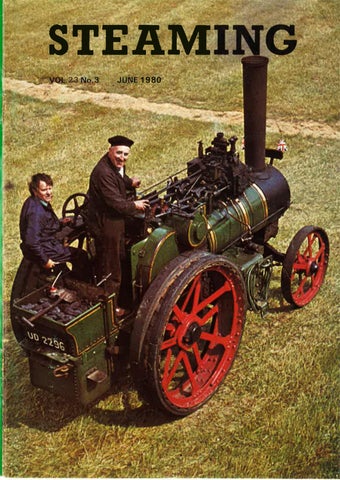
Front cover — George Main drives his Ransomes, Sims & Jefferies 5 ton tractor 39088 of 1928 in the parade at Welford Rally 1977
131
CLUB NEWS From the Chairman Since my last notes were written, there have been meetings of all the Club's Committees culminating in the Annual General Meeting which was held in London on 17th May. The activities of the Engine Owners Sub Committee are reported in detail elsewhere in this issue. Our efforts have been directed towards further development of new services to members, engine owners and interested members of the general public. Firstly, in the field of preservation, your Committee considers it essential that active assistance must be given to Engine Owners in their struggle to keep our national stock of engines in active use and safe working condition. Many of these engines are now approaching 100 years old, and the youngest well over 40 years, and the need for major boiler repairs, even for a second time, is being felt. With such repairs today costing thousands rather than hundreds of pounds, many owners of limited means, without large firms to support them, may feel unable to continue and there is a very real chance of their engine being sold or at least disappearing from active use. The Engine Owners Sub Committee are addressing themselves to this problem and must be supported in every possible way. Training of the rising generation and those new to steam traction engine preservation is another important factor. It is of the greatest importance that the skills and knowledge of our older engine owning members should he passed on to those entering the movement and the Steam Apprentice Club has already made an impressive start on this task. Again, financial assistance from Club funds is a necessity if this important' work is to continue and expand. Rallies are our showcase to the general public and although these events continue to be popular and attract large attendances, rally organisers have to provide an increasing variety of attractions at their events and face steeply rising costs. The club through the Rally Sub Committee are concerned to maintain and continually improve the standards of safety at all of its approved events and to give maximum 132
publicity to Rallies on the approved list. This year Rally details have been circulated by the club to over 3000 addresses including Tourist and Information offices, public bodies, tour operators and others both at home and overseas. The Rally Sub Committee is currently examining a proposal to provide a joint sales and publicity organisation to the coach and tour operating trade to publicise rallies wishing to participate in the scheme, dud it is hoped to commence this work during the autumn of 1980 for the 1981 season. An additional service has also been provided to organisers of approved events this year. They are now automatically included in an insurance scheme providing them with protection against the costs of defending any legal proceedings against them arising out of the organisation of their event. The Rally Sub Committee have established cordial relations with both the Health and Safety at Work secretariat and the Department of Transport, the two government departments most concerned with traction engine preservation and rallying, and have received advice and assistance from both these departments on matters concerned with safety. Engine owners will be interested to note that the Health and Safety Executive have recently produced Guidance Note (Plant and Machinery) 18 which is obtainable from Her Majesty's Stationery Office, price 30p. The Sales and Publications Committee, under their chairman Dick Blenkinsop, have advised that a final revision of Club Solicitor David Tew's handbook Traction Engines and the Law is now in progress and it is hoped to publish this eagerly awaited work shortly. Another possible addition to our sales range will be a large traction engine jigsaw. Sadly, Alan Wilson, our Club Sales Officer has been forced to tender his resignation due to increasing pressures of business. Alan has done a wonderful job for the Club and during his administration sales have increased dramatically. He will be much missed and we thank him for all he has done. Luckily, he has agreed to carry on whilst a search is made for a suitable successor in this important Club post. The Annual General Meeting on 17th May was reasonably attended for a date so well
into the Rally season. The principal business was the proposal put forward by the General Committee to increase membership subscriptions to £8.00 per annum for ordinary members, and f 10.00 for family 1980. December from members, Membership for old age pensioners will remain at the concessionary rate of £5.00. The part-annual accounts for the period to 30th November 1979 were presented and adopted and these showed a surplus of income over expenditure for the period of increasing Regrettably, £2198.00. expenses, particularly of postage, printing etc., will almost certainly absorb the whole of the surplus during the current year to November 1980, leaving no possibility of providing additional financial assistance to our various committees for their projects outlined above. The Club has also decided to set aside a proportion of its funds accumulated over many years for specific
purposes and accordingly a Legal Fund has been set aside for use in opposing any Parliamentary or Euro Parliamentary legislation which might adversely affect the use of engines on the roads. There is also a Preservation Fund to assist in engine preservation matters and a Capital Reserve Fund for assistance with training and other subjects. Initially £2500.00 has been allocated for each of these funds and we would hope to augment them regularly in future years. Bearing in mind the rising costs of running the Club and the necessity of implementing the various preservation projects, the AGM agreed by a very substantial majority to the motion before them to increase subscriptions. It was also noted that should the Club's application for Charitable status be successful, it would be possible to further increase nett income by the covenanting of members subscriptions and other means,
FROM THE ALAN MARTIN COLLECTION OF PHOTOGRAPHS
No.8
Burrell tractor 3631 has featured briefly in the last two issues (pages 46 and 122 of the December 1979 and March 1980 issues respectively). The engine was supplied new to W. Gritt, sand and gravel merchant of Romsey, Hampshire in 1914 and carried the registration AH 0225. Here the crew pose beside the engine whilst at work in Hampshire about 1915 in dreadfully wet and bleak winter conditions. The name PRIDE OF ROMSEY can be seen around the top of the smokebox door. 133
and that if our draft application receives conditional approval it may well be necessary to call a further Extraordinary General Meeting in the autumn to approve the necessary amendments to the Club's Articles of Association. Finally, we were pleased to welcome Ian Bennett who was elected to the General Committee in the place of Tim Holt. Ian is an experienced engine owner, well known in London and the South East and will be a welcome addition to the Committee. Tim Holt has served us well and we are sorry to lose him. He has attended many meetings and conferences despite the difficulties of travel from his native Cumbria and has been a tower of strength at our annual Safety Officers Seminars. We hope to have him as a committee member again one day. (Peter Barber).
Engine Owners' Column One of the principal aims of the NTEC is the encouragement of the active preservation of steam powered road vehicles, and to this end the Club has set up the Engine Owners Sub Committee. We have had a number of Engine Owners Conferences, which are valuable in giving people opportunity to speak up on the problems which beset them. However, as they do involve expense to both the Club and to individuals, and are limited by geographical factors, conferences can never be enough in themselves. For our part, we will let you know through Steaming what progress we are making; please let us know how you feel we can help in furthering the active preservation of the engines we love. Following incidents with preserved railway locos, the Department of Transport in conjunction with the Health and Safety Executive has recently published a Guidance Note on the safe operation and maintenance of locomotive boilers, primarily for the preserved railway loco operators, but road engines are also mentioned. This document does not have the force of law, but as with the Highway Code, non-compliance could be taken as supporting evidence of failure to safely maintain or operate a boiler. For many years now the NTEC, through the Code of Practice and the Rally Approvals Scheme, has achieved the acceptance of 134
regular boiler inspection to ensure that even if the worst occurred insurance would not be invalidated, and that boilers are maintained in a condition such that a disaster would as far as possible be avoided. The Department of Transport's Guidance Note is seeking to ensure that a similar high standard is applied to preserved railway locos; as a Club we may feel a glow of satisfaction that we have been doing it for years! The sixteen page Guidance Note does however make further suggestions, some of which we feel have some value to owners, particularly in relation to the insurance inspections. Basically these suggestons are for keeping a steaming log — recording the hours of steaming — and a maintenance log — which would record washouts, inspections and repairs. Such logs, by providing a continuing record of the boiler operation and maintenance, can give the boiler inspector a good idea of the service the boiler has performed between inspections, and coupled with the previous inspection reports help to ease his task. They could also be valuable in the sale or purchase of an engine, and for these reasons we would recommend that engine owners should keep such records. They need not be elaborate, though an exercise book would be preferable to loose sheets. (Guidance Note PM 18 from the Health and Safety Executive — Locomotive Boilers is available from HMSO Publications, 49 High Holborn, London WC1V 6HB, or booksellers. Price 30p.) We have been very heartened at the response to the enquiry as to which members own engines; if anyone has not yet done so, please let George Beck know. If you cease to be an owner, or as a nonowner, acquire an engine, again please let him know. Apart from the problems on boiler repair, on which we are currently pursuing the possibility of a Code of Practice, we feel that a register of patterns which could be made available would be useful and could avoid unnecessary expenditure of time and money. Anyone having patterns which they would either lend or obtain castings off, is asked to drop me a line listing engine make, nhp, weight and model or type; pattern(s) available and whether you would lend the patterns or provide castings. In the case of bearings and firebars, dimensions would also be helpful, and these could have wider applications. If you have any requests for patterns please drop me a line — the scheme
would simply aim to put the needy in touch with the possessers. Last, but by no means least, the Steam Apprentice Club has had a very successful training session at our President's establishment. This is a vital part of the NTEC's function, to pass on the knowledge of present generations to future engine owners and drivers. We shall be considering with the Steam Apprentice Club Committee how this aim can be developed; any owners who are willing to assist in further training sessions, or in other ways connected with this aim, please let me know. — (Mike Harms worth, Littleton Wood Farm, Semington, Trowbridge, Wiltshire, BA 14 6LF.)
Obituaries Thomas Brownlee Paisley The traction engine world has lost a well known personality with the death of T.B. Paisley, MA of Holywell, Huntingdon. It is hoped that these few words from one of his personal friends will do justice to the memory of a very unusual person.
Tom Paisley served, faithfully, this Club for many years in numerous valuable ways, and was on the Committee for a long time. He was a man of great knowledge and ability in many facets — a very fine musician (playing the oboe and the cor anglais) and musicologist; he was also an economist, a well known farmer and a person of considerable business acumen, being director of a large Scottish business. He had an extensive interest in military history. In the 1939/45 war he was in the Royal Artillery and served with distinction in the Far East, being seconded there to the Royal Navy. He was an expert in matters of gunnery. Railway locomotives were probably his favourites. He was a fine photographer and many traction engine photographs we see today are attributable to his wonderful copying of ancient prints. Tom was one of our earlier members to preserve an engine, in 1956. The first one was the small Marshall roller 61307, which he used to roll the approach roads on his farm. This was followed soon after by the Aveling & Porter GND tractor 8288 from Gravens of Ely. His collection finally escalated to 28 engines — all of these having an unusual flavour. There were three
The late Tom Paisley with his men and Marshall 61307 in 1960. 135
Fowells CROMWELL, ROUNDHEAD and IRONSIDE — all built in St Ives, near to his home; a Davey Paxman portable; the enormous Aveling road locomotive 4885 SAMSON; Burrells' yard engine fitted with a crane, 1876 EMPEROR; a Robinson & Auden traction and the two Burrell ploughing engines 776 and 777, almost the oldest Thetford engines in the world, and still in the process of rebuilding. Tom liked a big engine — EMPEROR was probably his favourite. He was a stickler for accuracy and purism in the renovation of his engines. He was a man of high integrity and honesty. Whilst he did not suffer fools gladly, he was scrupulously fair, as all those who served with him on the Rally SubCommittee will remember. He condemned racing and anything to undermine the safety of rallies, or the good name of the engine world. Writing as his doctor, it can now be revealed that his health had been deteriorating over the past few years — obviously lessening his engine activities. It is difficult for those who knew him very well to realise that Tom has passed his last milestone; but he will be remembered for many years to come. (John Middlemiss)
S.A. Cambray Stanley A. Cambray died, aged 81, on 5th June 1980. Although his name was not prominent in club circles, he spent a lifetime in steam and some of us knew him well. Before World War I he was apprenticed turner and fitter to • the Oxford Steam Ploughing Company which had John Allen at its head, whom Stan greatly revered. An activity of the company was •eboilering Fowler single ploughing engines, increasing capacity and pressure, and supplying boilers to some owners to do the job themselves. The hallmark was the well-known artistically shaped and flared chimney — cast, so it did not burn through like the Fowler rolled plate ones, and of great weight to keep the front down. One of his first jobs was helping build the two sets of compound Oxfords which were a new departure, having redesigned top-work; one survives in Bill MacAlpine's collection. They were perhaps over heavy for a single's "chassis". Later conversions were again singles but with still higher pressure, a piston valve, a balanced crank and short BB-type reverse lever. There was 136
also an experiment with a compound piston valve, but thought not to be worth the cost; these too he helped construct. When the company changed name to John Allen & Sons Ltd, rollers gradually took over from steam ploughing and Stan became manager when in his twenties. Eddisons were doing likewise and he was told to fight them with every weapon available, which meant a long price cutting war. Stan, however, was able to find work for over a hundred rollers, know where they all were and most of their ex-steam plough drivers. And the latter knew and liked him too, because he understood engines so well and was sympathetic and understanding. Calling to mind an instance — a driver was sent. to Lake over where a previous man had been sacked, but he was soon back, saying "There be a woman in the van who won't leave it". So Stan drove him back to look into things, and sure enough, so it was! Leaning over the door she said, "If he likes to share the van with me I'll look after him, as I did the other" She wasn't uncomely, and the man agreed providing no one let-on to his missus. So a deal was struck and happiness reigned! John Allen died in the thirties and in subsequent years the firm came to concentrate on civil engineering equipment, motor scythes, and diesel and petrol driven rollers. Then merging with Fords of Wokingham, the roller department became a separate company, John Allen and Ford, with Stan and Leslie Ford joint managing directors. It was a blow to him when this enterprise was sold, although the age of retirement had come. He never fully retired, though, and kept active with local haulage and plant-hire interests and was still on the Roller Owners' Association Committee when it merged with the Contractors' Plant Association. He had many steam ploughing tales: of foremen who could neither read nor write and so had wonderful memories, able to relate acreages they had done and exactly where, to a shorthand typist whenever they came to the yard; of crews aiding their cook with hares and game birds and flashlightand-net raids on night-grazing rabbits, and of changing a broken rope drum in a wet field with jacks, and only horses for transport. His years had not treated him unkindly and he was alway cheerful and good to be with. Our sympathies go to his widow. (E.E. Kimbell)
TAR SPRAYING AND OTHER TALES Percy Dabbs Percy Dabbs has been involved in steam in the North of England since the 1.920's, being employed by several contractors and also, for a period, running his own threshing business. He celebrated his Golden wedding anniversary in August 1979" with a big family re-union, and still drives at rallies in the north east having assisted Dick Preston and Walter Chilvers in recent years. This is the first part of what has to be a lengthy serialisation of Percy's story and which we are sure will be of absorbing interest to all readers.
I started work for J. Brown & Sons, Leyburn, North Yorkshire, as a tyerman and occasionally as feeder when they were in the thrashing business around 1922/23. I was doing a bit of farm work at that time as well. The engine I worked with was a very big Ransomes compound which had a 54in heavy Ransomes thrasher with it. I rather think the engine was a three speed but cannot be sure about that now. I eventually got as I could shunt her about although I did not think of myself as a driver then. After this, I went to Mr Sandy Myers of Moulton, Middleton Tyas, and was with him for three or four seasons, but I had to find other work during the summer. I then went back to J. Brown & Sons as a driver when work was scarce and moved down to the Kent and Sussex area. We led timber to a big sawmill at Frant Station, near Tunbridge Wells, Which still exists. As the firm had taken a house in the village, we used to park there at night. We led timber in from the areas Goudhurst, Lamberhurst, around Wadhurst, Biddenden, Sissinghurst, Ticehurst, Haw khurst, Crowborough and Uckfield, and even from as far down as Lewes. Here I remember I was fined £2 for making or causing too much smoke. We led into other sawmills from time to time — one where they made dolls and brush heads, etc. We lodged at Ringmer at one time, and one Saturday we decided to go by train to a World's Fair at Brighton. However, on the return we both went to sleep and ended up
about ten miles from where we were lodging and had to walk all the way back. The landlady had heard us come in about 2 a.m. on the Sunday morning, and very understandingly did not waken us up until tea-time. Incidentally my mate at that time was also called Percy — he was a little hump backed lad and a very good worker. The tackle we used was reasonably good, a Fowler Tiger tractor which was very sharp and a Foster tractor which was not quite so sharp, but nevertheless, was a very good reliable engine. All wheels were iron shod at that time. I tired of that work eventually and longed to come North again, so I left Browns and found a job thrashing for one season with Frank Stephenson of Sedgefield, Co. Durham, in late 1928. Following that, in the Spring of the following year, I went to J.B. Souter of Kirk Leavington, near Yarm, North Yorkshire, to drive one of their engines. I did not know that when I began at Souters it would be the beginning of what turned out to be about twenty years of tar spraying, except for a couple of years during the Second World War. One Monday morning in early May, the gang and I left Kirk Leavington with Ransomes, Sims & Jefferies single cylinder traction engine 1 5092 of 1903 (BT4799). We were pulling a tar sprayer and living van, en route to Winston Gate, this place being on the Yorkshire side of the River Tees between Darlington and Barnard Castle and which at that time consisted of only a public house and three or four houses. It may have grown since then, but at that time it served as a quiet parking spot for a few days. The actual village of Winston is on the main road to Barnard Castle, on the Durham side of the Tees, and the railway station was about a mile north of the village. It was a wet day and the engine had no canopy. It was also steaming badly because of steam leaks from two large patches, one on each side of the inner firebox. These had been studded on, as not much electric welding was done in rural places in those days. It was a long, weary, slow journey under the circumstances, as 137
we had to keep stopping to get up steam. The distance was about 25 miles. We eventually arrived at our destination and I began to learn something about the art of tar spraying. Our complete tar spraying gang comprised of two traction engines, one spraying whilst the other one was loading its tank. The tar tank was a large oblong one, mounted on four very heavy wooden wheels with iron tyres. It held just over a thousand gallons and the tar was heated by steam, through coils inside the tank about two inches from the tank bottom, from a take off on the engine on top of the cylinder. There was a wheel valve and fitting screwed in where the whistle would normally go and this was worked by a long forked rod with a handle on, positioned within reach of the driver. Steam was fed by means of a long flexible pipe to the tar tank or wherever else it was required. When we were travelling, if we had any steam to spare, we could put it through the tank coils to keep the tar hot, rather than waste it through the safety valves. The tar was sprayed through a spreader beam at the back by pressure from a pump which was driven from the rear wheels by two heavy chains to sprockets on a shaft which ran across the rear of the machine. A gear was engaged by a lever and there was a dog clutch at each end of the shaft. This was arranged so that which ever way round a corner we were travelling, by a ratchetting action, the pump would maintain the same pressure of the tar being applied to the road. When we wanted to stop after running a length of tar out onto the road, the two taps through which the tar ran would be shut off by pulling the single connecting lever, and then we would stand two or three minutes to let the tar finish dripping, after which we would pull forward a couple of yards, squeegee the drips out, put a few chippings on these and on the tar at the end of run, and then reverse four or five yards onto the chippings, ready to set off again. The large tanks we pulled would spray about a mile in a single spray but it was very seldoM we did this. We normally tried to double up and complete as we were going on (i.e. do both sides of the road at once). The only time we might run a tank-full out at one spray would be on a Saturday morning when everybody wanted to get away home for the weekend. It was then when we got our haversacks, biscuit tins, cases, or whatever else we had for our food, replenished for the next week. 138
We had a gang of eight to ten men with us when spraying and these consisted of one man to each heap of chippings which were about twenty to twenty-five yards apart down the road, depending on the width of the wad. Also, one nian was with me on the engine as a sprayman/steersman to operate the shut off lever on the tank as requested, as well as to steer the engine. There was also a foreman and a North Riding County Council man as supervisor. Throughout all this time, Souter's were on hire to Taroads Ltd., who were on contract to the North Riding County Council. The first few seasons, the chippings were supplied and led by the Leyburn Stone & Macadam Co,, from local quarries around Hai mby and Leybuin. What we called blue whin chippings which were usually used for main roads, would come from Middleton in Teesdale, and were hauled by local haulage contractors. We sometimes had two steam rollers with the tar spraying gang, one belonging to the North Riding County Council, the other usually a hired roller from Eddisons' Darlington Depot. These rollers were supplied to the tar spraying firm or provided by the County Council. We had to provide our own water, which in some cases, gave rise for concern, but we always managed. The rollers as well had to seek their own, unless it was a Council roller; these had special privileges. The foreman was engaged by the Taroads Ltd., but the supervisor was a County Council man whose job it was to see that we did not spray the roads when conditions were unsuitable. Spraying was not usually done in wet or damp weather, although at that time some of the roads had been sprayed only once before, or even not at all, and in these cases a dusty road was swept reasonably clean before we began, which was all to be done by hand. My mate of that first season was Bob Wilson and he had a very good Fowler single which gave no problems whatsoever, but I did not get any help from him -- he had been at this job the year before. One thing in my favour was a very good sprayman/ steersman by the name of Raymond Bulmer, from Dalton, between Richmond and Barnard Castle. I am sorry to say he is no longer with us. My engine, the Ransomes, was in far from good order, Just one of my problems was the jet, or blower pipe, which was wasted off just inside the chimney. I managed to get hold of a piece of old cycle
Mann wagon 1530 of 1920 (U7501), named HILDA and owned by D. Wood & Co Ltd, Yeadon, Leeds. Photographed in 1930 whilst leading stone from Beningborough Station. Alf Hardy of Thirsk is the driver, and Harry Fothergill of Burniston his mate. (collection A.R. Craske)
rear frame and put a bend on it. I pushed that onto the wasted end which helped considerably. A lot of enginemen, especially those of the 'old school' would deplore the use of the blower, but I must say from long experience, that you were obliged to use it a little, even with a good engine, otherwise you would get nowhere. It will doubtless be realised by now that there were a lot of complaints about this engine, and since I was in my first year with the firm, I tried my best to keep it going. It used a lot of coal and slathered a lot of water on the road, especially where we stood for a few minutes between one length of tarring and the next. I struggled on with this engine and all its faults until July. By that time she was hardly leaking at all, owing to the fact that I never washed her out because I dare not. It would only have made matters worse,but strangely enough, I never had any trouble with her priming. In the mean time, our foreman Mr W. Harrison, came out one weekend and put
what he called 'iron cement' round the leaking patches. I had to drop the ashpan and bars so he could get in but I am sorry to say he wasted both his time and mine. It was useless and there was only one course of action left — the engine was sent off the road. The changeover came one Saturday afternoon and I got a lovely Fowler compound road engine, a three-speed and with a canopy; what a grand change it made! Her name was JOAN, and she was number 12701 of 1911 (KE2797). In September 1929, at the end of that tar spraying season, my first with the firm, we went back to Kirk Leavington, and directly after that, went thrashing for about a fortnight whilst the weather was good, and then on to wood leading. We had to repair one of the timber wagons to do this job, and used an axle and wheels from an old Ruston Proctor portable engine. We also led hay, straw and corn to various stables in Stockton-on-Tees, Middlesborough, and on to Catterick Camp, although the latter haul 139
was by petrol motor. We had two of these, one a Morris 2-tonner and the other a Halley 5-tonner. After this we well timber hauling from near Stainton-in-Cleveland to Marske Aerodrome for the rest of the year. One load was a full day's work and we had not a minute to spare. In addition, we had to get our coal each day at Ormesby Station on the Middlesborough to Battersby line, which we passed on our way both there and back.
After Christmas we went back into thrashing and sometimes sawing in the yard. Towards the end of February I worked on another of Souter's engines, this being a Tasker tractor, and in April I handled yet another, this one a McLaren which I set to a sawbench in the yard and spent two or three days cutting wood. The engines we used were all on rubbers for road work, but these were taken off for thrashing etc, and normally just thrown in a heap anywere in the corner of the yard. What a job we had sorting them out when we needed them •next Spring! This was not entirely the driver's fault because we were usually not given enough time to do things properly. Fortunately, the Fowler JOAN was permanently rubbered, so I did not have that problem with her. For spraying this season, 1930, I had the same old Ransomes engine as the previous year, but over the winter it had a new firebox put in at Rileys', Stockton-on-Tees. I fetched her from the firm on the 1 7th May, and on the 20th I was out spraying with her.. This season I had very little trouble with her, except for a bit of caulking around the foundation ring a time or two, early on, when I washed out. My mate of this season was Jack Shepherd with a very good Ransomes compound engine. He was the landlord of the 'Lord Nelson' Inn at Appleton Wiske about five miles south west of Kirk Leavington, and he was a much older man than I. I think this engine would be Ransomes 35197 of 1924 IPY1858) which was bought by Souter's in July 1924. We worked well together, Jack and I. I remember spraying along Swaledale in the Reeth, Gunnerside and Muker areas, when we parked at Fremington. This village adjoins Reeth, and we led our tar from Richmond Station, which was a ten mile journey for a start. 140
We got our tar from local railway stations in whatever area we were working at the time. It came in big rail tanks holding three or four thousand gallons. These were dispatched from Thomas Ness, Black Banks Chemical Works, Neasham Road, Darlington, and were fitted with steam coils for heating, but our method was to put a long 1 in diameter pipe into the tar and connect our steam flex to that. This was through following other people's example, but I eventually found that the coil system of heating was the best, even though it was rather slower. It had the advantage of not allowing the water to get into the tar, and this reduced the danger of it boiling over in our tanks. Later on in the summer, Jack Shepherd and I were parked at the bottom of Scorton, near Catterick, on what was called 'The Bogs'. Being summertime, it was reasonably dry but there was rather a large stream, or beck, as we call them, running close by. Jack was parked along side the Bogs and by the roadside, on a bit of decent ground between the bridge and the garage. The garage is still there, but now the ground has been altered quite a bit. I was parked on the other side of the bridge by the roadside leading to Atley Hill, East Cowton. Jack was out first this particular Friday and I was second. I consequently sprayed in the afternoon. We had just finished about a quarter to five and I had stopped on the outskirts of the village of Middleton Tyas to fill up with water at a trough when suddenly, a terrific thunderstorm broke out, Not having a top or canopy on the engine, we were held up until about seven o'clock before we dare set off back. The water was rushing down the main street of the village like a real torrent. The road was in a terrible state and we had only just finished spraying it less than three hours previously. I think it would probably have had to be done again as there was hardly time for the chippings to bind in with the tar. It got really dark and at the height of the storm it was just like night. When it brightened, we set off and duly arrived at Scorton. Here conditions were awful. The stream was a real raging torrent and had flooded over the Bogs where the chipper lads and the foreman had their bell tents. They had got back before us and retrieved all their personal belongings including bedding etc. and the garage man took care of these until Monday.
9th June 1931 is the recorded date of this visit to the 'Tan Hill Inn' of Souter's Ransomes compound 35197 with the tar tank in tow. The area manager of Taroads Ltd, Mr Rawlings, is on the extreme right with driver Jack Shepherd next to him. The Chipper lads stand posed with their shovels. It was not unusual in those days for the roads to be sprayed twice in two years when the Council were trying to make a hard surface.(C.G. Curtis)
By now, though, the water was creeping towards Jack's van steps so I asked him whether he wanted his van moving. His old 'tash' wobbled and he said, no. However, by nine o'clock, Jack had to stoke his engine up and move on to higher ground. By that time there were only about 18 inches of the bell tent tops above the water. Since it was Friday, the chipper lads had made for home — one to Barton, one to Darlington, and the remainder to the Thirsk area. The foreman found lodgings at a pub for the night (he liked his beer and probably felt the need to drown his sorrows) and the rest of us stayed until the Saturday morning. It made a very wet end to what, otherwise, had not been a bad week. During the two or three years when I first started tar spraying, the area manager had an assistant who came up from Taroads' London office to help him. One or other of them came to see us every day to find out what we had used and what we still had in hand. They ordered further supplies accordingly. Our manager at that time was Mr W.A. Rawlings, and his assistant, Mr
Jack Hobbs. We were not often without tar but sometimes the Railway didn't get the tanks there on time and so we had to stand until the tar came. Provided everything was going alright we didn't see much of the boss of the firm, J.B. Souter, Either he, his daughter Annie, or more usually the foreman Mr W.; Harrison, would bring us oil, etc, as required.
Jack Shepherd was the first man out that 1930 season at the beginning of May, and later in the summer, on the morning of Friday, 4th July, he was recorded by the Darlington paper The Northern Echo as being the driver of the first steam engine to climb Tan Hill. This is where the highest inn in England is, at 1,732feet, and probably the loneliest. It is on the very borders of Yorkshire, being only about half a mile from the Cumberland boundary. It was only a narrow road, not much better than a cart track, and I joined him about a mile from Tan Hill on the Muker side of the climb. It's really 141
wild country up there on Bowes Moor and Arkengarthdale Moor. I remember leaving Picton, where we lived, in Jack's car one Monday morning. It was raining when we set off and it never faired up until the Friday dinner time of that same week. The chipper lads who lived in a couple of bell tents which were pitched in a timber yard close to Reeth and alongside the Arkle Beck were flooded out. However, some kind gentleman let them have an empty house at Grinton, which is close by, What a miserable week that was! One good point about working in the Yorkshire Dales was that we could depend on good clean water for the engines, but that particular week we had rather too much of it — in the wrong place! The area manager, Mr Rawlings, who came up from London, belonged to the Taroad Syndicate, Victoria Street, London. This man was a very good boss and was in fact, a shareholder. he was very strict but he certainly knew his job, and I found him very good to work for. He took a cottage at Sutton, near Thirsk for a year or two, and then built himself a house at Osmotherly, Northallerton, and called it 'View Point'. J.B. Souter hired his engines out to the Taroad Syndicate and for two years he had twelve or more out on hire to this firm. In fact, one year, in the early 1930's he had twentythree engines out on hire, although not all of them were working at once, owing to faults and breakdowns. One day, whilst out with this rather troublesome old Ransomes engine, I had rather an unusual experience with it. We had finished spraying late in the afternoon on the Aislaby Road, just out of Yarm, and went back to the station there to fill up with tar, ready for the next day. When I got to the station yard, the regulator would not shut off. However, when I moved the reversing lever it closed, but when I used the regulator again, the same thing happened. By skilful use of the reversing lever, I eventually got loaded, and we went through Yarm to our parking place, which at that time was near the Grammar School. It was late into the night before things cooled down, and steam had gone. I took the cylinder top cover off and found that the threads on the regulator spindle had wasted away to such a degree that the valve was loose on the spindle. I knew how to solve the problem, and being only a couple of miles from Kirk Leavington and the workshop, it 142
was a relatively easy thing to do. I had previously discovered where the key for the workshop was put at night, so without further ado, I went over to the shop and borrowed a suitable drill and the other necessary tackle. Working by the light of a couple paraffin lamps, I drilled a }in hole in the regulator itself, over the regulator spindle. I then tapped it out and fitted a -Ain stud with a checknut to keep it tight. This cured the problem and I was able to put things back together and was ready for work next morning. I remember we finished late in the autumn of this particular year — it would be mid October when we were between Bellerby and Leyburri. We finished spraying on the Saturday, around midday and quickly packed up, ready for setting off back to the yard. The shovels, brooms, and sundry equipment, together with the three big bell tents which the chipper lads were using all went on top of the tar tank. The living van was loaded up, including our bicycles, which went inside, and we made sure the cupboard doors were well shut. We had packed up in a hurry before and on opening the van door at the end of the journey, had been greeted with all sorts on the floor amongst the broken pots, plates and pans. After this, I did a couple of weeks or so thrashing with the same engine. Unfortunately, at this time Jack Shepherd contracted blood poisoning in a thumb through cleaning a riddle, and I took over his thrashing set for the remainder of the season. J.B. Souter ran three or four sets of thrashing tackle, and the set which Jack Shepherd usually had — the Ransomes compound 35197 with an A54 Heavy Ransomes thrashing machine — was considered to be the best. Only Jack usually drove this set and I had two good men with me on it, J.B.'s brother-in-law, Marwood Fawcett as feeder, and George Dent from Appleton Wiske as tyerman. George could also do a bit of driving. I had a very good season's thrashing with this set, although on two occasions I went in the ditch with her, near Aislaby in the November. On New Years Eve 1930 I washed the old Ransomes out in the morning, and in the afternoon took the McLaren referred to earlier to Skutterskelf.. Prior to getting the engines ready for tar spraying again, I spent some time in the yard sawing with a 7hp Marshall compound 76485 of 1923 IM01497) which had been
new to Bray and Turner, Burghfield Berks., and also repairing a Clayton & Shuttleworth 7hp single 48142 of 1918 (H05622) which had originally been with the WD. It was later with A. Hooydonk & Co, London, although it was registered in Hampshire. The Marshall was usually driven in the thrashing season by Fred Storey who joined the firm in 1929, from the Birtley, Co Durham area, having had to sell two engines and thrashing machines to clear some debts. These engines, a McLaren traction engine and Burrell 2150 (a cutdown showmans which was originally supplied in 1898 to S. Ford, Bristol and called KING OF THE WEST) were bought by J.B. Souter. Fred stayed with the firm until 1936. The Marshall he usually had was unusual in that it had brass canopy stays, like a showman's and incidentally, J.B.'s daughter 'claimed' the engine and had her name "A.E. Souter, Kirk Leavington" on the toolbox on the running board. Fred also had it tarspraying for two or three seasons but I remember him complaining about it not standing up to the chasing about on the roads. For thrashing, it was a very good engine. I did a bit of sawing of rails and posts for the Hurworth Hunt and also off-loaded tar
tanks at Picton Station. I towed the McLaren engine back to the yard from Skutterskelf although I can't now remember why it could not be driven back. During the previous summer, when we were out tarspraying, J.B. had bought a pair of Fowler single cylinder ploughing engines from Coles at Sleaford. He took two drivers and two steersmen down to Lincolnshire and the engines were brought back under their own steam, one of them, at least, towing a living van. The drivers were Fred Storey and Bob Wilson, from Stokesley. They must have done quite a bit of travelling by dark as I remember them saying afterwards that they could get on faster at night as they could not see what was falling off in the way of spuds, etc. These two engines were put through two or three annual sales that Souters had, but they did not seem good enough to sell. They were along with others, consequently cleaned up each year and this task either fell to me, as J.B. reckoned that I was the best cleaner he had, or Alick Douglas, one of the other drivers. We used to have a competition to see who could make the better job and I usually got more praise from the boss than Alick did.
WILLIAM III, Fowler 10699 of 1907, at a Northern fair when in William Murphy's ownership. (F. MacConville via S. Smith) 143
One of these ploughing engines was eventually sold to Steads who owned the knacker yard in Northallerton, and who I think wanted to use it for boiling and sterilization purposes. However, someone decided it may have another use and a mole ploughing demonstration was arranged at a farm belonging to Kit Walls, a thrashing contractor about two miles out of Northallerton on the Darlington Road. The ploughing engine was to pull the plough across the field and because it was not reversible, an 1.c. tractor was to pull it back. A n,.rnh.r of panpIP t..rnori nn to INatrh this demonstration; the driver was a young inexperienced lad and the rope broke because he did not take the pull steadily. Fortunately, no one was hurt, but then old Mr Walls drove the engine and everyone remarked how noticeable it was when an experienced man took charge of the engine. J.B. got two McLaren engines while I was there, one from Fred Storey (number 198 built in the mid 1880's and originally a crane engine), the other from a Thompson's sale at Chester-le-Street, Co Durham, and it was unusual in that it had copper tubes and firebox. They were two reasonably decent engines, but to me, they appeared to get abused. I think J.B. only wanted the second one for its scrap value as it was cut up at Kirk Leavington. He also got a Fowler showmans which had belonged to William Murphy at South Shields. This was called WILLIAM III and it was also cut up at Kirk Leavington. In the Spring, Jack Shepherd, Marwood Fawcett and I had been sawing wood with one of the little McLaren engines and a rack bench across a field on East Field Farm, Eryholme. We had quite a job getting back onto the road when we finished sawing for a start, as the McLaren seemed rather weak and the land was very wet. However, we eventually got to the road and turned left onto the Darlington to Northallerton road and then left again at Entercommon onto what is known as West Lane or Worsall Road towards Yarm. We were making for Mr Herring's farm near Aislaby, Yarm. We had gone about a mile along this road, past the farm house and up the other side when, about a couple of hundred of yards further on, the worm at the end of the steering column came off and we suddenly shot off the road into the hedge back and gutter. We looked around and found the worm and nut. The threads on this did not appear too good but we could find no cotter pin. We replaced 144
these and put a nail through the hole in place of the cotter pin — a case of do the best you can in the circumstances. Jack was in a bit of a stew, wondering what J.B would say, as he had not much love for the McLaren anyhow. With a good engine, we might have got out of the roadside, but with this we had no chance. The only thing to do was to leave it until next morning. We were well clear of the road and of course, it was dark when this happened. I don't remember which one of us actually reported it to J.B. Souter — I think it would be Jack, as hewas the driver, :Jilt he sent Alick Douglas with the Fowler road loco JOAN to pull us out the next morning. This did not take many minutes and we were bUIJI I Oil 001 vvay again to Aisla by. Here we did two or three days sawing and when we had finished, we packed up and prepared to move on. I think it would be early afternoon when we came out onto the main road. We were making for the yard at Kirk Leavington to leave the set there for the night. Within a very few yards of leaving the farm entrance, if the same thing didn't happen once more and we ended up in a similar position, stuck in the hedge back and unable to get out by ourselves. We had to send for help again, and of course by now, J.B. was not very good to talk to and he let us know it! However, Alick came along with JOAN and once more had us out in no time. (to be continued)
Shop Window If you are looking for an engine nameplate — perhaps one which is slightly different in style, having a nautical flavour maybe — then try Nauticalia Ltd. This firm do standard brass door plates with varying legends — from Bar, or Bog through to Cabin Boy, Hall Porter, No Singing or Mind Your Head, with prices from £2.40 to £4.30. In addition to this standard range they can do any pattern up to 3 feet wide, using a new pattern-making process which greatly reduces the cost, compared to conventional methods. The cost for special plates is dependent on size. There is an origination charge beween £7 and £15 and each plate is then in the order of 6p per square cm — plus postage. For further details, contact Nauticalia Ltd, 121 High Street, Shepperton-on-Thames, Middlesex TW17 9BL (Tel Walton-onThames 44396/ 4 1860).
JOHN FOWLER AND THE COMPANY HE FOUNDED Michael Lane The first part of this, the 1979 NTEC Silver Jubilee Lecture, appeared in the March 1980 issue. While Eyth was busy in North America and in Europe developing cable navigation, the Steam Plough Works under Robert Fowler's able leadership entered into another new activity. In specially erected shops on the north side of Leathley Road they started building main line railway locomotives as an overflow to Robert Stephenson's Forth Street Locomotive Works in Newcastleupon-Tyne. It is by no means clear whether the decision to enter this field of activitity was taken prior to John Fowler's death or not: but what is clear however, is that he was always fascinated by railway locomotives and that it was a perfectly logical step for the partners to take at this time. Private builders were enjoying a boom and there was insufficient capacity to meet the tremendous demand from railways both at home and abroad.
Joseph Pease, John's father-in-law, was the principal shareholder in Stephenson's works and the Fowler partners clearly enjoyed close and friendly relations with the Newcastle set. Since 1860 Leeds had become the largest railway locomotive manufacturing centre in the United Kingdom, and Kitsons, Manning Wardle, Hudswell Clarke and the Hunslet Engine Company were already well established when the first Fowler built locomotives, for the Imperial Mexican Railways, were completed in 1866. These were quickly followed by others for the London, Chatham and Dover Railway, the Great Northern Railway, the Great Indian Peninsular Railway, the Ceylon and Brazilian Government Railways, the Midland Railway and lesser railways in Ireland, in Egypt and in the Sudan. Later, other fine standard gauge engines were built for
No 8894 — an armoured 'Lion' type road loco and train built for service in South Africa during the Boer War. They were ordered, designed and built in four months. (Museum of English Rural Life) 145
the Somerset and Dorset Joint Railway and the Brecon and Merthyr Railway in South Wales, such that following the 1923 grouping, Fowler built locomotives could be identified with all four major companies. Originally, David Greig assumed overall responsibility for the planning and organisation of the new project, but later Frederick Parker, the works manager at the Great Northern Railway's Doncaster Works was appointed Fowler's locomotive works manager and thereafter locomotive building activity enjoyed a high degree of autonomy. 1 he erecting shops were always referred to as the Locomotive Works, Hunslet, as distinct from the Steam Plough Works. Parker had already achieved a distinguished career. He was apprenticed to Edward Bury, when the latter was locomotive superintendent of the London & Birmingham Railway and followed him to Liverpool, to the famous firm Bury, Curtis and Kennedy, then he went to the newly completed Great Northern Railway, where he was largely responsible for building the Doncaster Works in 1852. Following the ending of the locomotive boom in the mid-1870's Fowler concentrated upon the manufacture of standard gauge contractor's type engines and upon narrow gauge engines which found a ready market overseas for use in mines, on plantations and similar work in the developing countries. In the seventy years to 1936 Fowler built some 600 narrow gauge locomotives which found their way to all four corners of the world and indeed I believe some are still working today on the Indian sub-continent. Since the mid-1860's Fowlers had enjoyed a good working relationship with a leading French industrialist and farmer, Pau! Decauville. He was probably the first Frenchman to purchase a set of Fowler's double engine ploughing tackle and subsequently he was granted a licence to manufacture certain Fowler implements in France. In the 1870's he developed a system of light, readily portable, narrow gauge permanent way, which was ideal for use on sugar plantations and Fowlers were quick to exploit this development, placing them in a position to offer a package deal to the plantation owner — cultivating machinery, traction engines, carts and wagons, a complete railway system and stationary steam driven machinery. They remained supreme in the world's sugar beet and sugar cane growing areas until the First World War, just 146
as Marshalls of Gainsborough machinery dominated the tea plantation scene. In later years after building a few condensing steam wagons, the same Decauville began early experiments with petrol engined motor cars. In 1901 the brilliant Henry Royce acquired one of his cars and never made any bones of the fact that the first generation of Rolls-Royce cars were based very closely upon Decauville's work. But, we are running ahead of our story. Until a series of disastrous harvests precipitated the great agriculture depression at the end of the 1 870's the bulk of the sales of the Steam Plough Works were still derived from its ever increasing cultivating machinery. Ploughing engines ranged in size from the little 3hp 'Conte' type evolved to meet the need for a light, cheap engine for vine cultivation, to huge 30hp machines built for the remarkable agricultural innovator Robert Campbell of Buscot Park in Berkshire. Upwards of 200 different types of implement were offered ranging from massive single furrow deep trenching ploughs, to 10 or 12 furrow light top soil ploughs. Also included were a wide range of turning implements and cultivators, harrows, rollers and seed drills. In 1868 Fowlers began to develop seriously the German market and in the early 1870's established a works at Magdeburg under the able management of a former Leeds apprentice, George Turner and a German national, Richard Toepffer, who came originally to the Steam Plough Works in the 1860's very much as Max Eyth had done. He returned home during the FrancoPrussian War to drive Fowler ploughing engines which were employed hauling siege guns to the gates of Paris. In the twentieth century he died a rich man owning a huge estate on Luneburg Heath, near the place where Field Marshal Montgomery accepted the German surrender in 1945. Magdeburg became the spearhead of Fowler's tremendous successes in Europe, where for over forty years they dominated the German, Central and south eastern European and Russian markets. The Steam Plough Works were the UK's largest exporters to the area and derived more than half their profits and turnover from the area. Tragically, the First World War put an end to it all. Fortunately, Max Eyth's and Richard Toepffer's letters and diaries have survived, as well as those of another remarkable character, Julius Saxon, who headed Fow-
No 10325 — Box's TITAN with a 50ton Lancashire boiler, circa 1911. Notice the patent Boulton sprung wooden-block hind wheels. (author's collection)
ler's operations in Rumania, Bulgaria, Greece and Turkey. The trio's writings describe vividly the period and provide fascinating material for future research. The agricultural depression caused great distress at home and British agriculture never really recovered until the 1914-1918 War years. It caused also a general depression in overseas markets and the Steam Plough Works were hit very badly, the annual value of sales dropping to only £30,000 in 1884. The partners decided upon incorporation and in 1886 the Company was converted into a limited liability company having a nominal capital of £680,000. The new directors were Robert Fowler, chairman, Robert Eddison, David Greig and Reginald Wigram. William McIntosh who joined the Company during John Fowler's lifetime and subsequently rendered over 60 years service was appointed company secretary. Sad to relate Robert Fowler only survived incorporation by two years and he was succeeded by his younger brother William, a City financier and politician, who remained in the chair in a largely non-executive capacity until his own death in 1905.
Following Robert's death his elder brother's eldest son, Robert Henry Fowler, joined the Board. He had been employed by the Company without salary since 1875, having first qualified as a lawyer in London. Initially, he travelled extensively and secured a great deal of valuable business for the Company in the Far East and Pacific area. Shortly after joining the board he was appointed managing director and became its chairman upon Uncle William's death. Robert Henry was an outstanding personality and leader and was totally dedicated to the Company's affairs. He enjoyed the respect and confidence of his men and the industry as a whole and during his 30 years in office the Company prospered and grew as it never did before or after. Robert Henry always believed that the Company should concentrate its energies upon the development and sale world-wide of cultivating machinery. He was able to demonstrate the correctness of this policy during the Company's boom years prior to the First World War. But initially his colleagues, alarmed by the effects of the agricultural depression were unsympathetic and felt that the need was for diver147
sification. Since the early Egyptian orders the Company had manufactured some special plant and machinery outside its traditional activities. These included pumps, portable and semi-portable engines, winding and haulage machinery for mines and quarries and compressed air machinery. They pioneered the development of compressed air operated haulage machinery in mines, where good ventilation was absolutely necessary, replacing boys and ponies who traditionally did much of the underground haulage work. They built three large 1,000hp air compressing beam engines for the Birmingham Compressed Air Power Company, who intended to distribute compressed air to the industrial parts of the city through pipes, as gas and water were distributed. Working closely with the distinguished engineers Thomas Crampton and Colonel Beaumont they built the rock drills, boring machinery and air compressors for the first Channel Project in 1882 — preservationists should note this machinery is said to still exist, walled up in the original trial shaft outside Folkestone. Max Eyth was responsible for installing and erecting the first cable railway upon Mount Vesuvius in the Bay of Naples and Fowlers built the first funicular railway at Scarborough in 1876 utilising Barton's clip drum. At the 1879 RASE Show held at Kilburn they exhibited a very efficient and economical horizontal stationary steam engine which quickly established a great reputation and became known as the 'Yorkshire' engine. At the same show they also exhibited the first commercially viable compound cylinder built into a semi-portable undertype engine. Within a few years the bulk of their steam engine production, and indeed their competitors as well, employed the compounding principle. Following incorporation the Company devoted a great deal of time and money diversifying into electrical engineering, the manufacture of lead-covered electric cable and electricity generating plant. They manufactured also very large stationary steam engines, including the world's largest colliery winding engine, which had two 54in diameter x 84in stroke cylinders and a 34ft diameter winding drum capable of lifting 51/2 tons of coal 2,000ft in less than a minute. The story of Fowlers involvement in electric cables can really be traced back to old Edward Pease, who in the eighteenth century went to a Mr Tatham's Quaker school in Leeds. Later, the Tatham family 148
emigrated to the United States of America and many years later Robert Eddison called upon the family during an abortive sales mission to America trying to sell the Yankees steam ploughs. He returned home with his host's daughter as his bride. The Tatham's had become very successful cable manufacturers and offered Fowler the UK rights for their patents. Initially, they were manufactured at Leeds, later a separate Company was formed and a new factory was built at North Woolwich on the River Thames. Clearly, the project was not a great success, but today that same factory is the famous North Woolwich Works of the Standard Telephone & Cable Company. Fowler supplied both the steam plant and electrical machinery for the first electric light generating stations built by many local authorities in the 1880's and 1890's, developed largely as a result of an alliance with a clever electrical engineer named Robert Hammond. These included installations at Reading, Brighton, Eastbourne, the Port of London, Leeds, Wakefield, the City and South London Railway (London's first underground electric railway), the Boroughs of Kensington, Dublin, Burton-on-Trent, Bury St. Edmunds, Halifax, Ayr, Coventry, Cardiff and Newport and many other places, including important installations for both the Great Northern Railway in London and the Midland Railway. Robert Henry Fowler personally supervised the first installations in Spain at Madrid and Malaga and a big contract was received from South Africa for the Cape Town Metropolitan and Suburban Railway, which included steam driven alternators, as well as the railway locomotives. The Company's many unique products built in the period 1875 to 1900 deserve a far more detailed study than I am able to give them to-day. In addition to the types of engines already mentioned they did some marine work, and they built one of the first experimental steam turbines at a time when the Hon Charles Parsons was formulating his ideas whilst employed at Kitsori's adjoining works. They built several very efficient 500hp high speed steam engines for driving the early generators in the Steam Plough Works and gradually electric motors were introduced as an alternative to steam engines for driving such machinery as haulage and winding engines, air compressors and big ram type pumps. Throughout the period of diversification into major capital
No 9147 — a class A4 15ton road roller working one of Henderson's patent rotating tine independent scarifiers. (author's collection)
equipment as an adjunct to cultivating machinery, traction engines and railway locomotives, Reginald Wigram and his highly competent assistant John Marshall, were responsible for the design and manufacture of the specialities. Perhaps two more specialities are worthy of mention. It is fairly well-known that Fowler supplied some fine road locomotives to the Uganda Railway which was being built at the end of the century. Some were armoured to give protection both against unfriendly natives and wild animals. It is not so well-known however that they also built the world's largest funicular railway for this project. The railway was a vitally important strategic project. At this time the German Empire was rapidly expanding its foothold in East Africa and pushing towards Lake Victoria and the British Government was determined to get there first with a railway. It reached Nairobi in June 1899 and the contractors were then faced with the toughest part of the whole job, negotiating the 2,000ft Kikuyu Escarpment which was a sheer drop into the bottom of the Great Rift Valley. Some 15 large bridges and viaducts
were necessary to provide a continuous line to Kisumu and Lake Victoria and it was decided to give Fowler a contract for a huge funicular capable of handling the locomotives, carriages and rolling stock plus vast quantities of building materials. It was put into use in May 1900 and operated successfully until November 1901 when the permanent line was completed. The funicular was stored in Nairobi for many years and eventually in 1932, was sold to the Japanese as scrap, no doubt to be thrown back at us in the form of bombs and shells a few years later. The second speciality worthy of mention was an electric locomotive built for London's first electric underground railway, the City and South London Railway which operated between London Bridge and the Elephant and Castle. It had four wheels and the motor armatures were mounted directly on the wheel axles. One suspects that quite apart from Robert Henry Fowler's determination to concentrate the Company's efforts upon cultivating machinery they frequently lost money on many of these speciality projects and electrical work vir149
tually ceased by the turn of the century. We do not know from the surviving Fowler records and archives exactly how many ploughing engines were built since the Steam Plough Works started production in 1861 although I suspect Alan Duke's Road Locomotive Society's records are remarkably accurate as to numbers. We do know however that in the year of incorporation the Steam Plough Works manufactured only six engines and that the situation had been very bad for some years. In the following 14 years to 1900 they built 737 ploughing onginos and only 17 of this total found their way into the home market. These were the years of growth in Germany and central Firrope and in Fnwler's boom years, from 1900 to 1914, they built 2,534 ploughing engines, 90% being exported. During the First World War they built 707 engines and rather more than half went to home food producers to help the war effort, but in the post war years the decline set in and only 191 ploughing engines were built. This brief analysis totals over 4,100 engines of which 84% went to overseas customers. To these
numbers must be added the vast quantitites of implements of all types supplied with the ploughing engines. They built many weird and wonderful implements which probably were not very successful in many instances, but they were also first in the field with many types of implement which we take so much for granted today, such as the reversible plough, the spring tyne cultivator and the beet lifter. David Greig, who died in 1891, Max Eyth and later, George Turner working in Germany, were responsible for must of these inventions which were formally patented in the 1 870's and 1880's. Traction engines and road locomotives provided a steady sheet anchor to Fowler's activities throughout the period to the First World War. After the War the steam scene was dominated by the ubiquitous steam road roller until the final demise of steam engine production in the mid-1930's. In the fifty years to 1936 Fowlers built 1,606 traction engines, including tractors and strew burning 'Colonial' type engines, and 1,149 road locomotives of which 73 were specially adapted to the requirements of the
No 11157 — a class Z6 ploughing engine of about 1908, fitted with Fowler's firstgeneration smokebox superheater. (author's collection) 150
01
travelling showmen. Although the bulk of these were supplied between 1900 and 1914, it is clear Robert Henry Fowler was never very sympathetic to the showmen, because they usually wanted long credit and then paid in small denomination cash, which had to be laboriously counted by the cashier. After the First War many engines built for the military authorities were sold off cheaply and converted to showmen's type engines by private concerns such as Charles Openshaw of Reading. Since the 1870's Fowler produced several designs of traction engine which were primarily suitable for military needs. Initially Robert Fowler was reluctant to allow the Company's products to be used for such purposes, but gradually expediency replaced principle. Eyth demonstrated engines of his own design in Russia and Italy. The German War Office purchased an engine for trial purposes. Fowler engines were used extensively by the Indian Army and in Afghanistan and they played a very major role in the Boer War 11899-19021. Lord Roberts, the Commander-in-Chief personally telegraphed for four armoured road trains which were built in less than four months, each comprising a 'Lion' type road locomotive and three armoured wagons for carrying howitzers and ammunition. Eventually, the Celebrated Major Rookes Evelyn Crompton commanded over forty Fowler locomotives in South Africa and achieved remarkable feats of haulage on the veldt. Further substantial orders for military type road locomotives were placed during the First World War by both the British and Russian governments. The story is' told that the Russian order for 168 engines, placed through Vickers, called for oil burning engines, which the Steam Plough Works interpreted as oil-fired steam engines. Apparently the Russians wanted tractors with crude oil internal combustion engines and one can imagine their surprise and the red faces when the Russian inspectors arrived in Leeds in September 1915 to take delivery of the first batch. Honour was saved and the bulk of the order was shipped, only to be lost in swamps when fleeing from the victorious German army following the collapse of the Czarist regime. The tandem compound three cylinder 5 ton tractors introduced in 1905 were intended originally for military use. They soon reverted to conventional single cylinder and compound cylinder types, and only a
130 odd tractors were completed by the Steam Plough Works. Old George Tuer, the chief draughtsman, who all his long working life worked 16 hours a day, oxporimontod with aluminium slide valves on the tandem compounds in order to try and save weight when aluminium was a new developing material. The story has survived how the valves melted and disappeared up the chimney in a cascade of molten metal. Fowlers always were great innovators. Throughout their independent existence they probably had more patents to their credit than any other Victorian engineering company. Not only did they pioneer compounding on traction engines and road locomotives, but they produced many types of road spring gear and road wheels and were first in the field with superheating applied to ploughing engines and traction engines. It is doubtful whether this feature ever justified the added expense, but the German market called for it because of the German engineer Schmidt's successes with railway locomotive superheating. Fowler's difficulty was that Schmidt's patents precluded them from using smoke tube elements and they were forced to develop elaborate smokebox superheaters. During David Greig's lifetime Fowler had a tacit agreement with old Thomas Aveling that the Steam Plough Works would not manufacture road rollers so long as Aveling & Porter did not manufacture ploughing engines. This agreement appeared to work until the two characters died, but then Fowlers went after all the business they could get and subsequently became the second only to Aveling & Porter as the largest UK manufacturers of road rollers. In the period 1886 to 1900 they built 262, in the succeeding 14 years 670 and in the 22 years to 1936 they completed 1,347, over 70% of which were exported. During the first War they formed an association with a Yorkshire engineer, David Wood of Yeadon, who patented several novel integral tar spraying and gritting systems which had a measure of success. In 1921, when the Company were beginning their search for new products and new activities they formed a road rolling and pressure grouting subsidiary based on Reading and formed a close association with other major road rolling contractors such as Jackson of Wistaston near Crewe, Norman Box, the celebrated heavy haulage contractor who also later became an agricultural contractor, 151
No 12720 — one of the class Z6S oil fired superheated ploughing engines supplied about 1911 to Hawaiian sugar plantations. (author's collection)
and with David Wood's own contracting business in Yorkshire. In the early part of the twentieth century Robert Henry Fowler made an extensive tour of the United States. He was greatly impressed with the Americans' labour saving machinery and production line methods of manufacture. He brought back to Leeds many ideas for rebuilding and modernising a large part of the Steam Plough Works, and perhaps above all he was convinced of the great threat the internal combustion engine posed to the steam engine. Fowlers completed their first prototype petrol engine built for a War Department development contract in 1902. It would appear that this was unsuccessful for nothing further is heard of it. However, shortly afterwards they established a permanent internal combustion engine development department under the leadership of Harry Cooper. An experimental traction engine with a horizontal crude oil engine mounted on top of the boiler appeared in 1909. A very much more sophisticated engine was exhibited at the RASE Norwich Show in 1911 developing 50bhp at 750rpm. Subsequently a small 152
batch of similar engines were built matching in appearance as closely as possible the proven and understood traction engine. One was adapted for road haulage work, another was fitted with ploughing gear under the boiler and a third was converted to a road roller. Others were used for a variety of agricultural duties such as threshing and timber sawing. Two went to Australia where Fowler machinery was very well established due to years of hard work by William Noakes, the Company's senior representative in the area and three went to South Africa, to the 22,000 acre experimental farm operated by the Company and managed by William McLaren, the younger brother of the neighbouring Leeds traction engine builders, J. & H. McLaren. The outbreak of war inhibited further development although the Steam Plough Works did build two over-type wagons fitted with the horizontal crude oil engines in 1913. These were used for transporting shells and trench mortars from the Steam Plough Works to the filling station at Barnbow. In 1914 they competed for the War Office subsidised petrol lorry contract, and com-
pleted a prototype which remained in use until the 1 930's. They failed to secure the contract and internal combustion engined lorry production was shelved until 1930, although the question was often on the board agenda and various conjectural schemes were considered. In 1918, amidst great secrecy a new shop was built adjoining
Hunslet Road and some experimental military tanks were produced for a War Department development contract. They continued to do tank prototype work until the 1920's.
(to be continued)
End of the Road for the World's Smallest Roller? In 1933 Mr A.W. Trotter of Coleford, Gloucestershire, constructed a small steam roller of one ton weight as an experiment in the use of steam for footpath rolling and the like. He built it around a vertical cross-tube boiler of 1 8in diameter and 3ft height, and a vertical twin-cylinder launch-type engine of 2-fin bore x 33- stroke. The boiler is mounted between the rear rolls with the engine placed transversely in front of the boiler, driving the rear axle by reduction gearing and chain. An 18in flat pulley serves as a flywheel. In front of the engine and perched above the front rolls a small water tank provides the boiler feed via a crossheaddriven pump or a Penberthy injector. Behind the boiler is a manstand with a small coal bunker and toolbox on opposite sides. The boiler has the usual fittings, is unlagged, and all-rivetted apart from the firebox. It is believed it was made by Goodhands of Gillingham, Kent (now apparently out of business though once well known as the makers of boilers for the larger miniature railway locos). The engine is controlled by plugcock regulator and lever reverse, with provision to disengage the driving pinion. Steering is by worm gear and wheel and chain, and rather slow for so small a machine! When Mr Taylor died his models and the roller were bequeathed to Gloucester City Museum and though some of the former are on display there was not room for a seven foot long steam roller. Thus it was offered to, and accepted on permanent loan by, the Dowty Railway Preservation Society of Ashchurch, Gloucestershire. The Society is part of a local firm's sports society, founded in 1926, and one of the earlier railway preservation groups.
The society, natually, has been interested in running the roller if possible. It was discovered on preparation of the boiler for insurance inspection, however, that the vertical flue showed dampness and a screwdriver was easily able to penetrate at the normal water level! Those familiar with the design of cross-tube boilers will appreciate that replacement of the flue would normally involve removal of the entire flue and firebox assembly so that a new flue can be attached to the firebox crown. The Society has made various enquiries about this and it appears uneconomical to repair the boiler. The cost of a new complete boiler will be at least £600, and leave us with a not very attractive square-cornered welded unit; the rivetting of the old boiler was quite pleasing by comparison. With numerous calls on its limited finances the Dowty R.P.S. is not able to contemplate a new boiler at present and the only hope would appear to be to find a serviceable existing boiler. Has anyone any ideas? (R.A. Rainbow, Honorary Assistant Boiler Supervisor, Dowty R.P.S., Ashchurch, Glos.)
Alan Tingay reports the theft from his home in early June of the large American chime whistle normally attached to his Garrett No4 tractor. It was pictured on page 203 of the September 1979 issue and is 6in diameter and 1 8in high. If any member should hear of, or be offered this quite recognisable whistle Alan would be grateful for the information — his address is Station House, Shackerstone, Nuneaton, Warwickshire (Tel Tamworth 880408). 153
NATIONAL TRACTION ENGINE CLUB APPROVED EVENT
`E'ranoport
eov.vitry c.T
BSc
cur
EAST OF ENGLAND AGRICULTURAL SOCIETY SHOWGROUND (10 miles South of Stamford on Al)
23rd, 24th & 25th August Entries include over 60 Steam Engines plus Miniatures, Fair Organs, Vintage Fire Engines, and on the Sunday, Vintage Car and Commercial Vehicles. Noyces Gallopers and all the Fun of the Fair. Tractors and Stationary Engines, World War II Military Vehicles. Morris Dancers, Rural Crafts, Market Traders stands and Preservation Society stands, Displays by the Royal Militay Police, Royal Signals Motor Cycle Display Team (Sun/Mon). Regimental Band — Devon & Dorset Regiment (Sun/Mon) . Country Music & Folk Dancing (Sun/Mon). Hot Air Balloons. 3 Day Gymkhana; Personal Appearance of Red Rum (Sun only). BMW/British Field Sports Society Country Sports Triathlon. RAF Phantom Jet Display (Sun only). Carnival Band Contest with at least 10 bands (Saturday only).
PLUS MANY OTHER FAMILY ATTRACTIONS HORSE PLOUGHING, STEAM PLOUGHING, STEAM THRESHING AND STEAM WOOD SAWING Applications for Preservation Stands to:
JOHN CRAWLEY, Steam Secretary, Expo, Turvey, Bedford. Nearest Railway Station in Peterborough
Special Buses from City Centre
We reserve the right to vary the above programme according to circumstances
1 54
THE COOK AND THE CARAVAN Tam McTaggart Early in the Second World War, Wattie Muir set off from Glasgow for Dundee with a fifty-five ton boiler. Wattie drove the CLYDE, a 12 nhp Burrell road locomotive; George Tough had a 10 nhp McLaren, known as "the black McLaren", tracing. The two engines pulled the boiler on a 100 ton Dyson trailer which itself weighed 25 tons, and they also had a coal wagon and caravan. The first day, after loading, six miles were covered, thus clearing the city. Being early summer they left at 6 am next morning and made good time, arriving that night at the Whins of Milton outside Stirling, a distance of approximately twenty miles. As soon as the "Prince of Wales three feathers" appeared at the safety valves in the morning, they were off, to get through Stirling before the traffic got busy. A three mile detour to miss a low bridge before Causewayhead was needed and being a narrow road a bit of time was lost. The boiler
was also too high to go under a railway bridge going into Perth on the normal route, and another, longer, detour had to be taken via Crieff. By this time the sun was fairly high up, and without a wind, the tar on the road was beginning to get very soft. Great difficulty was encountered on a steep incline with the engines' driving wheels spinning. The cook was out assisting with a scotch behind the boiler trailer rear wheel, while the two other flagmen were grushing* the engines' driving wheels. No progress was being made, however, until the cook thought himself a great idea. If he uncoupled the caravan, they may get up the hill. So this he did — it worked, but as he was still scotching the van wheels, the engines and the boiler were rapidly disappearing in the distance, and he was left with the van in solitude! * grushing — gritting
No apparent problems with this crew caravan as Pick fords men pose against their train on top of Shap Fell about 1941. The 124 ton casting is being hauled by, left to right, Fowlers 14843 TITAN, 17105 ATLAS and 19989 ONWARD. (collection J. W Coates) 155
As readers may know, buses were few and far between during the War and normal traffic was practically non-existent. Time went on without a vehicle passing and the cook was very worried, when one of Raines agricultural traction engines from Stirling appeared, hauling a baler and bound north. A few words of explanation and cook's van was coupled on behind the baler. By this time the CLYDE had pulled in for water and Wattie was just about to remark that the load seemed lighter when the discovery was made ... they had lost the caravan! George Tnugh hurriedly watered and coaled, and set off to look for the van while Wattie stayed with the boiler. Fate is a wonderful thing. George was going so fast round a bend in the road, that he passed Raines' engine and never gave the van a second look, as most vans looked the same at first glance. He thundered on, taking the Raines' whistling as a salute, as he had worked there for a period. The cook borrowed the baler driver's bicycle and pedalled madly after George. We now have four units spread between Stirling and Crieff
— the CLYDE with the boiler, Raines' engine and baler with the van, the McLaren heading rapidly south and the cook in hot pursuit on a bicyle. By this time Raines man had run past the farm he was heading for, hoping at every bend he would see the boiler, but alas, he had a bit to go. Meantime George on the McLaren had arrived at the incline where they had stuck, and was turning at a farm road end when the cook arrived. George made him cycle back as he made his way north again. Raines delivered the van to :Nettie, who thanked them, then made his way back to the farm. Again fate intervened; he had just turned into the farm road and through some trees when George passed by, without seeing him, so they had to go to the CLYDE to get the address of the farm to deliver the bicycle back to the baler driver, then run north to assist the entourage into Crieff. By this time there were only two places open, a chip shop and the pub ... and there they adjourned after an eventful day. That was the last journey the cook did with Wattie.
RALLY PLAQUES NAME PLATES FERROUS AND NON-FERROUS CASTINGS ORNAMENTAL AND ENGINEERING Our Range of Stock Items of Polished Brass Castings for: Aveling & Porter, Marshall, Fowler, Burrell, Foden, Ransomes, Foster, Guy, Gardener, Sentinel, Lister & Blackstone, Ruston & Hornsby, Robey, etc., is now very extensive and it is usually possible to supply your demands. Please write or phone any time for Price List. This Company specialises in Polished Brass Rally Plaques and Engine Name Plates. Our Casting Service also includes Ferrous and Non-Ferrous Engineering Work, either from your patterns or we can produce patterns from your drawings.
GMS (WIRKSWORTH) LTD YOKECLIFFE HOUSE, WEST. END, WIRKSWORTH, DERBYSHIRE, Tel: 062-982 2805. DE4 4EG. 1 56
A ROLLER REMINISCENCE Charles P. Gregory I often find enjoyment in perusing old copies of Steaming and correspondence between friends which recall memories of the earlier days of our preservation activities. Recently I re-read the splendid contribution by Jean Nash in Vol 15, No 4 (Aug. 1972) entitled "The Steam Bug", in which she expressed as well as words possibly can the tremendous fascination a steam engine can have for some people. Until I read of Jean's 'bug' I had imagined that my own two daughters were about the only girls blessed with this complaint. The article also referred to a ride Jean had with her father on an Aveling-Barford roller between Axbridge and Highbridge in Somerset; the roller was travelling from near Bristol to Camborne in Cornwall, and although it happened eighteen years ago I hope that some details of that long journey will still be of interest. For many years our member Tony Coombes of Exeter has been contributing news from Devon and until a few years ago when my late wife's failing health made it impossible for me to obtain accurate information on steam happenings, I tried to represent Cornwall. During that period Tony and I often compared notes by correspondence and in a letter received from him early in 1962 he said that he had heard of an engine near Bristol which was built in 1948. This seemed to be unlikely in spite of the fact that I had always found Tony's news to be well-founded — so I asked for more details. His informant was Keith Vigus, whose name was already well known and respected and he sent me details, confirming the age of the engine, that it was an Aveling-Barford 10 ton roller, the last of three suppled to the Great Western Railway for use in maintaining their road bridges in the London area (hence registration JXH 1 74) and that it appeared to be in very good condition. A few days before I received these det?ils, I had replied to an advertisement regarding the offer for sale of a Wallis and Steevens Advance roller by Mr R Brazil at Great Missenden, Bucks, and had arranged to be at his premises on 5th May when the engine would be steamed for inspection.
On the morning just as I was about to leave by car for my appointment with Mr Brazil, I received the letter from Tony and accordingly visited the quarry at West Town, a few miles west of Bristol, to see the Aveling-Barford. I contacted the owners, Messrs Joseph Coles & Son, Ltd and was shown the roller. It had been out of use for a couple of years and much clearing of high weeds revealed a very interesting engine. It had a rusty chimney, and the usual rust on the rolls when an engine is idle, but the motion must have been well oiled when the engine was laid up as there was nothing there but a layer of stone dust from a nearby crusher. The canopy had also afforded some protection. Having ascertained that there was no prospective purchaser with a prior claim, I was given the option to purchase until the end of the week and preceeded to Great Missenden where the Wallis was in steam and had just passed the boiler inspector's examination. If I had not already been so favourably impressed by the Aveling-Barford I should have bought the Wallis there and then but I decided on the former as this appeared to be a rarer specimen. In spite of my declining the Wallis, Mr Brazil and his family were very hospitable to my friend and myself, inviting us to an excellent repast and then taking us to see several other engines in the district. We visited the late Mr Grover's place and here I was able to obtain a pair of black oil lamps to fit on my McLaren 547. I had been trying for the four years since driving the 'Mac' the 251 miles from Oxfordshire to Camborne to get some suitable plain lamps, but without success until here was exactly what I wanted; my journey to Great Missenden was therefore not wasted. On my way back to Cornwall I called at West Town and agreed to buy the Aveling. The works foreman kindly offered to prepare the engine for boiler inspection and light up for me when I had obtained insurance etc, and was ready to drive it home. Meanwhile, Tony Coombes had offered assistance regarding a lowloader for the long journey but, having four years earlier, with the late Mr Winn of Bude and my daughters driven the much older McLaren on a eleven day, longer 157
The Aveling-Barford in the pleasant surroundings of Coombe. (C. P. Gregory)
trip (and enjoyed it in spite of atrocious weather and no canopy!) I decided to steam the Aveling all the way. Insurance and other formalities having been completed, we loaded my newly acquired Victor Estate with its first cargo of coal, oil, tools and a large water tank. The tank held about thirty gallons and its outlet pipe fitted into the spare wheel recess in the floor. To the outlet a rubber hose was connected and when not in use this was clipped to the top of the tank. To fill a bucket or other receptacle it was only necessary to drop the end of the hose into the bucket and gravity did the rest, no tap being needed. With my girls, Phyllis and Kathleen, I set off for Bristol on 1st June and spent the night at my sister's school in the city. Next morning we arrived at the quarry at ten o'clock and found that Mr Rogers, the foreman, had already lit up and was tightening the mudhole doors as the boiler warmed up. To gain access to one of the mud-door nuts it was necessary to close the damper lid and on one or two occasions we forgot to open it afterwards so steaming was somewhat delayed. When steam was raised we moved the 1 58
engine across the yard to a water tank to which a small hose was connected. It took a long time to fill the Aveling's tank so we did not leave the quarry until half past one. A steep and rough road led down from the quarry to the main Bristol to Weston road and this was negotiated in slow wheel. On reaching the level road I felt that I was sufficiently acquainted with the controls so I engaged the high gear. I had complete con fidence in my 'steersman' — my younger daughter, Kathleen (more often known as Heather) — certain that I had an engine which would cause me no anxiety, with smooth rolls to give a comfortable ride compared to a straked engine and I was well acquainted with every mile of the road from bristol to Coombe, my destination near Camborne. Therefore, with Phyllis following with the car, we moved off towards Weston on this sunny June afternoon with high hopes of reaching Highbridge well before nightfall. The first couple of miles were just as expected but as the water level in the glass got lower it was necessary to try the injector. It refused to work. It was not quite cold but pouring cold water on it had no
effect. The pump was tried but this simply squirted water from its gland. On tightening this and keeping the pump on all the time, the water level was maintained but a lot was still being wasted from the gland and we soon had to replenish from the tank in the Victor. By the time we reached Congresbury and our left-hand turning towards Churchill we were in real need of water so we had to proceed a little way beyond our turning to a garage where the proprietor was willing to oblige and showed us a tap. With a bucket we were replenishing the tank when a couple of small boys who had been watching found some open-ended tins and tried to help with supplying the water. They actually hindered operations by getting in the way, but we didnt like to curb their enthusiasm. Having filled the tank we went back to the Churchill turning and from there to Churchill it was a very rough ride. The road surface was good but the central line of cats eyes could not be avoided owing to the narrowness of the road. The pump was still wasting more water than it was pumping into the boiler and it became obvious that we could not reach Highbridge before dark. I therefore decided to get to a suitable wide road at Churchill and stop for the night, hoping to do something to the pump before going on to Messrs Buncombe at Highbridge the next day. I let the fire down when approaching the village and having got there found a parking place. We had no sooner stopped than we were approached by a 'good samaritan' with a repast on a tray — tea in plenty, sandwiches, cakes — the lot! An employee at the West Town Quarry had overtaken us between Congresbury and Churchill on his way home from work and had rightly guessed that the roller crew would appreciate refreshments, so his wife had quickly responded and how very grateful we were for their great kindness on that hot afternoon. While enjoying our tea the tanks were refilled by other willing helpers and two men arrived in a car. The younger man introduced himself as Len Youd, the driver of the Aveling while in Messrs Coles' ownership and his companion was his father, also an old steam man. Old Mr Youd hinted tome that his son would like to handle the regulator once more and as Len was confident that he could keep sufficient water in the boiler, I suggested that he should take the roller on for a few miles. By this time the fire had got low but Len soon got up steam
again and before we had finished our tea the engine moved off towards the climb over the Mendips, the two Youds thoroughly enjoying themselves and the two cars following. Len made a further adjustment to the pump and we reached a large garage yard at Weare before dusk and were accommodated there for the night with mains water available for the next morning's start. Before Phyllis, Heather and I returned to Bristol for much-needed baths and sleep we thanked the Youds for their help, and they thanked us for the privilege! I told them where the engine would be kept and invited them to have another steam-up with it if they were ever in West Cornwall. My daughters and Iarrived at Weare at ten o'clock the next morning and on reaching the garage were very surprised to see the engine's flywheel slowly turning. Len Youd had arrived before us and had lit up and raised steam. With him was a young girl whom we had seen at the quarry watching us silently while we were preparing the engine for her journey the previous morning. She was Len's daughter, Jean — the Mrs Jean Nash who afterwards wrote the article referred to at the beginning of this narrative. At the time of our meeting she was about fifteen but had evidently already caught the 'bug' and she steered the Aveling with Len driving to Brent Knoll by which time our two friends had to leave us to keep an appointment, though they were both very reluctant to go. So on we went to Highbridge where we parked our engine in Messrs Buncombe's yard among about seventeen other rollers outside the big shed. We had arrived at Highbridge at about one o'clock but thanks to Mr and Mrs Buncombe's wonderful hospitality, it was five-thirty before we left for home. During the following week the pump and injector received attention at Highbridge and on the Friday evening I took Ron Haynes with me, together with some more steam coal, Dunlopillo mattresses, blankets, primus stove, kettle and other tea-making appliances and arrived at Highbridge and the works, closed for the night. Then on to Burnham to the Buncombe's residence. Here we were made most welcome and were entertained to a showing of slides. It was well after midnight before we returned to the works. Ron had a mattress in the Victor and I had one in a roller driver's van but the incessant stream of traffic along the nearby main road prevented sleep, so at first sign of dawn Ron lit up the roller while I prepared a 1 59
snack. Before long we were heading towards Bridgwater, my friend on the roller and I following or preceding him with the car. We were confident of a trouble-free journey — the engine had been attended to while at Highbridge and her driver was one who had proved his ability and resourcefulness in 1959 when, almost unaided he had brought his own roller JOY along many miles of very narrow and hilly roads from Newton Abbot to West Cornwall. Before we had travelled many miles the traffic had increased to such an extent that we thou ugh it wise to spend a couple of hours in a lay-by before entering Bridgwater. In
that town I tried to get some coal but all the depots were closed — it was Whitsun weekend which also accounted for the abnormally heavy traffic. So I made a detour with the car to Wembdon where Jack Chappell let me have all the coal he had on the premises. I had underestimated the amount
of coal requirerd as I had based my calculation on the experience gained during the 251-mile journey with McLaren 547 in 1958. That engine averaged about ten miles per hundredweight but the roller's appetite was much bigger. Taking advantage of the new road through Bridgwater which avoids the town centre, and the lull in the traffic during the lunch hour we made good progress to Taunton, Here we took nearly two hours to get through the town due again to heavy traffic but when in open country again I left Ron to continue with the engine while I made another detour to West Buckland to collect coal which Dennis Chappel had reserved for me. Soon after Wellington our first difficulty about a supply of water occurred. We had depended on replenishing our tanks where our road crossed a stream which a local man had assured us was adequate and accessible, but on arriving there we found a small trickle too far below the road level for the suction hose to reach. I took the car back to a farm which we had just passed, hoping to fill the emergency tank. Permission was readily given and I attached my small hose to a tap in the yard but the water pressure was so low that after twenty minutes the 30gallon tank was still less than half full. As I knew that the tender tank was empty I returned to the bridge intending to transfer the fifteen gallons to the engine but no engine was to be seen! I soon found it on a parallel road behind trees — it had been part of the main road until a new section which
160
was straighter and on a higher level had replaced it. The old road crossed the stream by a much lower bridge, well within the suction lift. A 'friend in need' had arrived on the scene during my wait in the farmyard and, being himself another roller owner lAveling 140091 knew just where water could be obtained. He was Mr Thomas of West Buckland, a cousin of Dennis Chappell, from whom he had heard that the Aveling-Barford was on the road. From this watering place our new friend acted as steersman until dusk by which time we had entered Devon and found a farm where we could spend the night. Rested and refreshed we made an early start next morning and had an un-eventful run to the Exeter by-pass by which time we were in need of coal again. So I left Hon to proceed with the engine and paid a visit to Mr W.H. Balkwill at Upton Pyne. He very kindly let me have coal but both he and Mrs Balkwill were so insistent that I should have a meal with them that by the time I got back to the roller it had reached the western end of the by-pass and Ron was scraping up the dust in the tender to keep going. After another five miles we reached the large caravan park near Tedburn St Mary and obtained permission to pull on to a grassy patch under some trees. After a meal Ron retired to his mattress in the car and I stretched a sheet between it and the engine and slept soundly beneath the engine's boiler barrel. Until now we had had good weather but Whit Monday morning dawned damp and rain was imminent. Without stopping for breakfast we raised steam and got the engine on to the hard road just before the heavy rain would have made it very difficult to move on the sodden grassy ground up a slope to the road. Mr George Hawkins, of St Issey had kindly offered to bring us some coal that morning and before we had travelled many miles we were in need of it and had to pull into a layby. Here we waited for four hours in the rain by which time the fire was nearly out and steam pressure down to 50. In desperation I went to a little farm and obtained a few logs and some coke — the only fuel they had, and there was no other habitation near. However, the logs and coke soon restored the pressure and we made another start. Before the coke was quite used up George arrived with the coal from Cornwall; he had been delayed owing to the illness of one of his farm workers. No doubt it was very in-
convenient to George to make the very long journey from St Issey in the circumstances, but such is the spirit of co-operation between engine owners that inconvenience is no deterrent where help is needed. Without any further hindrance except the unpleasantness of filling tanks in drenching rain, we passed through Okehampton and soon found an ideal parking place near Bridestowe, in a farm yard completely screened from the road and with a nice stream of clear water alongside. Satisfied that the engine could come to no harm there, we motored home at the end of our Whitsun weekend. Ron was again available on the following Saturday so we set out early and reached Bridestowe at 6.30 and were on the road with the roller an hour later. No trouble until when approaching Launceston we spent an hour in one lay-by and three hours in another owing to the density of traffic. That evening we pulled in at a filling station on Bodmin Moor and returned home by car. Next morning the Aveling had a new driver, as Ron had other commitments. Mr Gordon Dobbs, who had often driven Phyllis's diminutive roller BO PEEP was not only willing but eager to help me, so we made another early start and the engine was soon proceeding westwards. Several friends from West Cornwall met us that day and gave us encouragement and after a very pleasant and trouble-free run we pulled in to Mr B. Parson's yard at St Coloumb that evening to await the St Eval Rally due to be held on the following Saturday. On the Friday, the eve of the rally, I drove my McLaren from Coombe, Camborne, to the rally field — 33 miles and a long day's run for the 1894 general purpose engine on strakes — and left her in the field. On the rally morning, with my daughters, I arrived at St Coloumb and soon had the Aveling in steam. She climbed the steep hill out of the village and I was thinking how much more comfortable it was to travel on the roller than on the straked traction when, on trying to replenish the level of water in the boiler the injector refused to work. Having just climbed the long hill the water was low and the pump, which had not been reliable at any time, also refused to deliver. The injector had behaved perfectly since Highbridge but nothing I did would persuade it to do its duty now. I was about to pull out the fire after several attempts to prime the pump but it responded just in time and we were able to proceed to the rally just in time for the open-
ing. The 'Mac', meanwhile, had been lit up by a friend who knew that we had difficulties on the road, so both engines were able to participate in the day's events in which I drove the Aveling-Barford and Phyllis and Heather had the McLaren. After the rally we brought both engines back to Coombe. I had noticed that the Aveling emitted a few distinct puffs when starting slowly, but these merged into a continuous hiss from the chimney at higher revs. On removing the exhaust pipe I found it almost blocked with carbon, but in spite of the back-pressure this must have caused, the engine had steamed freely throughout the long journey. After a good clean-up the engine presented a very nice appearance with a copper-capped chimney and quite a lot of green paint beneath the covering of oil and stone dust. I was very pleased with my new acquisition when we appeared at the West of England Society's rally and as she had so many unusual features she attracted a lot of attention.
Subsequently, I learned from the late Tom Ellis that my engine was the last of her type to be sold to an English customer so I named her OMEGA and painted that Greek letter on the motion plates to symbolise 'the last'. OMEGA was re-tubed during my possession and while the tubes were out I noticed that the steam passage from boiler to cylinder block was through thirty small holes in three rows of ten. No doubt that explains why the engine showed little tendency to prime. 161
A few details of a more technical nature may be of interest. The roller is of the makers W type, works number AH162. It was supplied new on the 28th February 1 948. The single cylinder (6in x 9in) has a piston valve. The relief valves discharge into the exhaust passage inside the block and, unlike Aveling arid Porter rollers, the external pipework connected with injector and pump is very neat. The pump is mounted on the top of the boiler and driven direct from the cross-head. I wonder whether steam collects in the pump so making it un-reliable? I understand from a former driver that the pump could never be relied upon. Working pressure is 200 lbs. There are two speeds with constant mesh gears and a differential which is not usually fitted to steam rollers. Originally the engine had a side bunker with access to the footplate between this and the scarifier, but at some time a normal tender had been substituted. The firebox has a stayless arched crown and is exceptionally long, having been designed to burn inferior fuel of the post-wal- period — it certainly seems to thrive on anything that goes into it.
The canopy is supported by two angle stays from the tender and is attached to the chimney at the front — nothing to obstruct vision. The machine is rated at ten tons without water ballast in the rolls, or over twelve tons with rollers filled.
My sincere thanks are due to those who helped me to find this rare specimen and to all who helped me to get her home; those already mentioned and many householders and garage owners who willingly supplied water and accommodation. Also the numerous enthusiasts who met us on the road, some having travelled considerable distances — they added enormously to the enjoyment of the journey. OMEGA now belongs to Mr V. Carveth, Chairman of our West of England Steam Engine Society and in the very limited time he has available for his hobby he has done a great deal towards restoring her to her 1948 appearance when she was repairing roads on bridges with Kings and Castles of the Great Western Railway passing beneath. A
Trouble for a Hay's Wharf Cartage Company steamer as she breaks through a weighbridge. The wagon, Foden 5292, was new as a chassis to H.C. Bauly of Bow in March 1915, and they put on the body for Hay's Wharf, The photograph was probably taken in a London railway yard. (collection C. W. Tessa) 162
Derek Rayner
A COLLOSSUS SURVIVES One of the finest surviving examples of a dwindling generation of working steam engines has been rescued for posterity from a water pumping station in the depths of the Nottinghamshire countryside. After a two year search, a home has been found in Wales for LIVENS, a '150 horse-power triple expansion steam engine which first lifted water at Elkesley Pumping Station near Retford in 1911. Standing 50 feet high, it is the second largest triple expansion engine ever built in Britain. It has now been carefully dismantled and transported for reerection as a working exhibit at the Welsh Industrial and Maritime Museum in Cardiff where it will be powered by an electric motor. For sixty years, this old workhorse took turns with its twin sister engine JANETTA in pumping millions of gallons of drinking water each day to the City of Lincoln, 22 miles away. Six years ago JANETTA blew up, bringing the steam pumping era al Elkesley to a dramatic end. The Anglian Water
The LIVENS engine at Elkesley prior to dismantling. (Kinmain Construction Ltd)
Authority, which had taken over responsibility for Lincoln's drinking water supplies, had already decided to demolish the pumping station arid replace the engines with modern electric pumps. The explosion of JANETTA's high pressure cylinder merely hastened the process. The top flange of the cylinder blew off and the unrestrained piston sheared off at the base of the connecting rod, crashed into steelwork in the roof and bounced into a small inspection pit in the floor. Miraculously no one was hurt in the accident but it raised strong doubts about the other engine's continued safe working; metal fatigue was the suspected reason for the explosion and LIVENS was therefore stopped from working further. Elkesley Pumping Station had been listed, in 1973, as a building of historical interest. 163
The building itself was a magnificent eclectic style structure dating from 1908, decorated with elaborate legends in Latin on the subject of water purity and allegorical sculptures above the doorway. A public inquiry by the Department of the Environment into its demolition was therefore necessary. Although the Inspector ruled in favour of demolition, the Secretary of State for the Environment urged the AWA to make every effort to preserve the 'good' engine and find a home for it. An advertisement in The Times drew no suitable response from preservation bodies, and so in 1976 Kinmain Construction Limited, a civil engineering firm in the Midlands, made a special offer to the AWA. Tony Graham, a director of the firm and an avid steam enthusiast, fought an almost lone battle to save the remaining engine and it was his suggestion that his Company would undertake to dismantle and store the LIVENS engine until an appropriate home for it could be found, in.exchange for the scrap proceeds of the remaining engine, a proposal which eventually found favour with the Authority. While negotiations proceeded, Kinmain discovered that the Welsh Industrial and Maritime Museum, part of the National Museum of Wales, was interested in reerecting the engine in its next development programme. The engine is therefore to be a gift jointly from the Anglian Water Authority and Kinmain Construction. The firm, and Tony Graham in particular, are to be commended for their efforts in respect of the preservation of this huge engine, upon which future generations will be able to gaze in wonderment. The news that one of the engines is to be saved has delighted historian Dr Angus Buchanan, head of the Centre for the Study of Technology at Bath University. A few years ago he wrote of the Elkesley engines in a book on the subject; "It is important that this most efficient type of reciprocating engine should be adequately represented in the stock of machines preserved for posterity in Britain" Very few steam pumping engines were used in Wales to raise water because most distribution systems were gravity fed from catchment reservoirs. The Elkesley engine is nevertheless representative of the large industrial machines once used to power heavy industry in Wales and in particular the steel rolling mills, which have, for many years, been a feature of the South Wales 1 64
landscape. The engine is also typical of many installed to propel ships during the first half of this century. Kinmain's team of engineers have now dismantled most of the engine, the largest pieces being the three cylinder heads, weighing three, seven and nine tonnes respectively. These have been loaded onto a road transporter by a mobile crane which was kindly provided (free of charge) by the British Crane Hire Corporation in Birmingham and have now been delivered to site. The heaviest individual items are the flywheels. Each engine has two of them, weighing 20 tonnes each. A hole had to be knocked in the wall of the pumping station to allow the mobile crane to lift them out.
Historical Background Elkesley Pumping Station was built between 1908 and 1911 following a typhoid outbreak in Lincoln in 1904/5. The cause of the disease was traced to an accident with the City's water supply from the River Witham. Chlorine was consequently added as a sterilising agent, this action being the first time it had been used in a public water supply in Britain. It was subsequently decided to abandon the river supply and sink bore holes into the sandstone at Elkesley. In 1908, a Parliamentary Bill for the £250,000 scheme was passed after fierce opposition from some landowners who considered that Lincoln was 'poaching' water from Nottinghamshire. The two engines eventually became known, because of their location in the neighbouring county, as the 'Lincolnshire Poachers'. Difficulties were also experienced during the construction period with the contractor who was supplying the pipes for the rising main from Elkesley to Lincoln and this was the subject of a court case which the Corporation won. A local newspaper in Lincoln, the Herald & Leader on the 3rd October 1911 marked the opening of the new pumping station with the following fulsome words; "We owe it to a determined and progressive Corporation who, keeping their heads during the scare, refused to be turned aside from the considerations of reason and economy, who have pursued their course consistently through good and often through evil report; and also in no little measure to the energy and skill, to the
Loading half of one of the 20 ton flywheels outside the pumphouse at Elkesley. (Kinmain Construction Ltd) remarkable acumen, almost genius, of the Waterworks Engineer." Elkesley was clearly a great source of civic pride as well as wholesome water!
Technical Details The two engines were constructed by Messrs Ashton, Frost and Company Ltd of Bank Top Foundry, Blackburn, Lancashire. This company was formed in 1880 and made some of the finest pumping engines ever produced in Britain. Unfortunately, they went bankrupt in 1926. The Elkesley engines were each a set of triple expansion, inverted, direct acting rotary engines with three cylinders of 26ins, 45ins and 68ins diameter by 4ft stroke (complete with pumping barrels). They stood 50ft high and about 40ft long. Each had two flywheels weighing 20 tons each. Normal speed was 24 revolutions per minute. Each engine drove three high lift pumps and two deep well pumps, the former being driven from the engine's crossheads whilst the latter was driven from cranks, mounted one at each end of the engine's
crankshaft. They were fitted with Corliss valve gear and the cylinders were steam jacketted. Cooling water for the condenser was that drawn from the wells as the condenser was placed in the delivery pipe of the deep well pump. There were four boreholes, each 570ft deep. The deep well pumps were 314ft below the engine room floor. These delivered through the condenser to a settling tank from which the water flowed over a weir into a suction tank common to the three high lift pumps. The pipe from the pumping station to Lincoln was 21 ins in bore. The engines worked against a total head of 724ft. Each set was designed to deliver three million gallons of water every 24 hours at normal speed and 3.6 million gallons at full speed.
As we go to press Kinmain Construction Ltd tell us that they have been informed the museum has decided to scrap the engine. Should this actually come to pass it will be a sad end not only to a fine piece of engineering, but to an enterprising attempt at steam preservation. 165
THE FOWLER MEMORIAL AT LEEDS In the March 1978 issue of Steaming the Leeds & District Traction Engine Club formally launched an appeal to steam enthusiasts to raise funds for the erection of a memorial marking the site of the works of John Fowler & Co. (Leeds) Ltd. These notes record the events which led to a successful unveiling ceremony on 25th August 1979 and the accompanying Road Run. Recent times have seen the clearance of many inner city areas and the Hunslet area of Leeds, long famous for its engineering association, in no exception. By 1976 all that remained of the Steam Plough Works, founded by John Fowler in 1860, was an open space littered with building rubble. The land was acquired by E.J. Arnold & Son Ltd for the construction of a new stationery works and about the same time the idea of a memorial to mark the site of Fowler's works formed in the minds of members of the Leeds Club. The new landowners agreed to the erection of a suitable monument on a corner of their site where Hunslet Road and Leathley Road meet, and an appeal fund was launched to raise the necessary £3,000. A specially prepared brochure was circulated to thousands of enthusiasts via Steaming, to traction engine clubs throughout the country, and to all known owners of surviving Fowler engines. Thus over a third of the appeal money had been raised by the time of the Club's annual Rally in August 1978, but as the winter passed the fund grew but little. It was, however, decided by the organisers to go ahead with the erection, and unveiling of the memorial was arranged for the 25th August 1979. To create further stimulus to the fund a gathering at the ceremony of a variety of Fowler engines was proposed, to be followed by a Road Run through Leeds to the Bramham Park Rally being held the same weekend. The design of the memorial finally decided upon consisted of a base made from stone salvaged from the Fowler works archway, and engraved stainless plates, the steel donated by British Steel. The unveiling day dawned dry if hazy and many of the assembled engines were lit up and well polished by the time early 166
spectators arrived. The Lord Mayor of Leeds had agreed to perform the ceremony and was greeted on arrival by Leeds Club officials. Other invited guests included representatives of the late Fowler company, of the site owners, and of donating traction engine clubs, as well as surviving members of the Fowler family. Opening the formal proceedings, the Leeds Club president, Mr Walter Chilvers, welcomed all those present and thanked everyone for their support and co-operation, in particular E.J. Arnold & Son Ltd. Following speakers were George Binnie, the last secretary to the Fowler company, and Mr Robert Pelly, great grandson of John Fowler. The Lord Mayor of Leeds, Councillor Mrs Christine Thomas, was then asked to perform the unveiling assisted by Len Crane's Fowler crane locomotive,which was positioned with its jib over the covered memorial. The Lord Mayor, from the footplate, lifted the drapes with the giant hook, revealing the new plaques on the remodelled stonework. Following this ceremony Mr Anthony Heal, one of our own Club's Vice Presidents, was invited to start the dozen assembled Fowler engines on their twelve mile Road Run to Bramham. The route ran east from the city centre, firstly through industrial areas and later along quieter country roads. Having reassembled again at Bramham the twelve engines then paraded round the ring and Mr Robert Pelly declared the Rally open. To conclude the celebrations a commemorative plaque, cast in the form of a Fowler works plate, was presented to each engine owner taking part in the run by Mrs Anne Brown, great granddaughter of John Fowler. The whole event was witnessed by enthusiasts from abroad and all over Great Britain, as well as thousands of interested local people, and was a huge success. Despite the successful outcome of this ambitious project of the Leeds & District Traction Engine Club, the final Memorial Fund income fell short of the actual cost by some £300. The Leeds Club therefore invite donations from any enthusiast, owner or club wishing to be connected with the construction of the memorial to one of the most famous engineering works in the world. Cheques should be made payable to the Leeds & District Traction Engine Club and forwarded to The Fund Treasurer, 4 Wedgewood Grove, Leeds LS8 1 EG. Copies of the excellent souvenir programme for the events on 25th August 1979 are still available at 50p from the above address.
AREA NOTES
Column Compiled by Derek Rayner
An interesting report included in this issue tells of a Leicestershire public house being renamed 'The Foster Arms' after the well known Lincolnshire traction engine builder. There are many pubs named after railways, railway locomotives or stations, and one could run a long series of photos of such hostelries and their signs. The news prompts me to ask whether 'The Foster Arms' is the first local to be named after traction engines or their makers?. If any member knows of
similarly named pubs, would they be so kind as to drop the Editor a line and we can feature them in due course. Black & white photos would also be appreciated. If anyone tines an unusual job with his engine, such as the Sentinel which assisted in retrieving a locomotive from the Barry scrapyard of Woodham Bros for eventual restoration — and which was not mentioned in these columns as no report was received about it — I should be pleased if they would let me know. Other members are interested in what you do with your engine. My thanks are again due to those correspondents who have forwarded information foi this issue. There is still insufficient news to give a comprehensive coverage of the country — a larger number of correspondents would be appreciated. If you feel like writing, please do so. Magazines and journals have been received from the Scottish Traction Engine Society; Notts & District club; Southern Counties Historical Vehicles Preservation Trust; Sheffield & District Steam Society; The West of England Steam Engine Society; Road Roller Association and Melbourne Steam Traction Engine Club Ltd (Australia). These have been a useful source of information, but still more are required to give a better coverage — Affiliated Club Secretaries and Editors, please note!
Press date for the next issue is the last day of July, 1980. Information, news letters and Rally Programmes as requested in the last issue by then to D.A. Rayner, . 'Invicta', Lower Street, Salhouse, Norwich NR13 6RH.
AVON The 1926 Wallis Advance roller of Brian Dando, No 7878 (H06482) has been retubed and hydraulically tested; new coal bunkers are being manufactured. Another roller which has been re-tubed is Colin Hembury's 1923 Aveling 10594 (YA6375), whilst this engine has also had a new piston, piston valve liners and the cylinder rebored. At Bath, Mr W. VaughanJenkins has a Clayton roller, a 1924 model. It is 48946 (YA9576) named IRONSIDE, but is rarely rallied although in good condition.
Colin Hawkins 1930 Aveling roller 14089 (YD973) has been receiving a good deal of attention. Not out for several years it has now been retubed and received a new smokebox and a repaint. Bob Whitfield's 1921 Marshall convertible 74962 (YA2197) is likely to come out as a tractor as in its roller form it is somewhat ungainly to handle. Bob's other engine Aveling Barford roller AC601, TALISMAN, has had a hydraulic test during the winter following a pleasant outing at the New Year to the local CAMRA pub. 167
BEDFORDSHIRE With the coming of better weather, engines are being prepared for the coming season. Our first local event is on the first weekend in May — the season starts earlier almost every year! Alan Jones has begun the task of painting his roller, Aveling 10718, but work will not be finished this year as his aim is to do a good thorough job rather than a quick one. Tony Whitmill has put a new back on the tender of his 1909 Garrett agricultural 28218 MARGARET. Also newly fitted are lamp irons and he made patterns and had the correct type of fairlead brackets cast; new rollers have also been made for this. The second and third shafts have been reshimmed and finally, if all goes as planned, a wire rope will be installed on the previously empty winch drum. Peter Coulson has repainted his 1936 McLaren tractor 1837, BLUEBELL, this winter. It is, appropriately, blue but those who know the engine well will notice a difference in the colours used for the lining out. Peter and his team are again entering the London to Brighton run of the Historic
Commercial Vehicle Club and we hope they enjoy themselves as much as they did last year. 0 know what that means! — Editor) A new engine to the area is 1914 Burrell tractor 3626 (AH221) SUNSET II. This engine has recently undergone much work by Roger Pridham in his boiler works on the Devon/Cornwall border. It was sold by auction in Devon at the end of March and has been purchased by Jim Rochester of Finedon, Northants, who has already appeared at a number of steam events with the Burrell.
BERKSHIRE The Reading SME's model exhibition in March at the Hexagon was publicised by Bill McAlpine's 1931 Foden D type tractor 13832, THE DORSET WANDERER, which was driven around the area and then stood for the rest of the afternoon outside the building where it was inspected by many of the visitors. There may have been a case of mistaken identity in the last notes — the Aveling roller offered for sale by Peter Barnes is believed to be No 12074 of 1928 (YV826), and not
To keep up-to-date with weekly news of the Preservation movement you need
gORLITS FAIb incorporating Preservation News
ONLY 17p PER WEEK Order NOW from your local newsagent. In case of difficulty (or for a free specimen copy) write to:
THE WORLD'S FAIR LTD., 2 Daltry Street, Oldham, Lancashire OL1 4BB.
168
11618. Perhaps someone would be kind enough to confirm.
BUCKS The Chiltern club presented a display of engines at one of the season's early events, organised by the Quainton Railway Society. This type of combined rail and road steam event is becoming increasingly popular, and certainly this year an increased number of visitors were apparent. Around a dozen road engines were present, in addition to the usual complement of railway locos to be found at Quainton. Chil u regulars Messrs Boughton were well represented with three engines and amongst others in attendance was Anthony Heal's big 1919 McLaren road BOADICEA' , Jim locomotive 1652 Hutchens' 1937 Sentinel S4 wagon 9273, and Peter Bower's 1922 Aveling roller 10350 )KX6838) GREAT WESTERN, late of the Slough park. The Burrell traction engine ACHILLES, 3201 of 1910 (13P5919), was rallied in Norfolk last year by Cliff Aldrich but has now gone to Peter White at Long Crendon, Bucks in a deal which took Peter's Ruston & Hornsby roller 149813 of 1928 (VF3136) back to the county in which it spent most of its working life.
CORNWALL Two engines have changed hands within the county. Michael Leath and Monty Pearce have sold their 8hp 1916 Marshall traction 69303 INM3401 to Rex Curtis of Roche. Rex, in turn, has sold his 1936 Wallis 10 ton Advance roller 8095 (GOU5371 to Michael Leath and this will now reside at Mawla Well. Bill Lobb has been making progress with the 1914 Aveling 8432 INM2441 whilst the boiler is away at Roger Pridham's receiving attention; this roller will ultimately be restored as a showman's tractor and Bill is progressing well with the differential, front wheels and axle which he has all made himself. The rear rolls have been machined down and many other fittings either made or overhauled, At Little Petherick, Dick Wood has had CHALLENGER, his 1904 Burrell showman's No 2651 (AY98401, out for a trip in the locality and a few minor jobs are being attended to prior to repainting in readiness for the coming season. At the same location, Geoff Westlake is making good progress with his Fowler K7 ploughing engine 14694 of 1917 (MA51 281. The old
firebox has been cut out, a new one made by the owner and Colin Waite of Bristol, and work has now commenced on the front end, the boiler barrel being built up and a new tube plate fitted. A complete new tender will be fitted in due course. At nearby Tr2dinnick news is to hand that George Hawkins will have his Fowler showman's engine 15657 (FX6661) THE IRON MAIDEN on the road again this year, so she will hopefully make a return to the rally fields. In the north east of the county, John Dyke has had his 1903 Wallis & Steevens expansion engine 2672 ip,.F4.74n) in steam fo!!owing an arrii in' lc restoration programme, and it is hoped she will attend the Anniversary Rally later in the year. Burrell showman's The 1909 GLADIATOR has had new bushes fitted to the differential pinion and gearing and a new set of firebars. At Carn Brea Village, Joe and Dennis Warren are making progress with their Foden wagon 11208 of 1922 (YA7952) and the mass of rusty metal now closely resembles a chassis. Two sections of the mainframe have been cut out and replaced and the rest cleaned down and repainted in a neat red livery. A new water tank has been made and fitted, the axle springs have been overhauled and painted and several small parts treated similarly. Their 1922 Aveling roller 10190 is also undergoing a facelift; one rear roll has been removed and years of dirt, grease and paint have been cleaned off prior to repainting. It is interesting to note that under all the dirt and grime, the roller sports a very nice lining. Also at the Carn Brea yard, Paul Richards and his helpers have made a good start on the restoration of Robey tandem roller 42129 of 1924 IRL751. The remainder of the tubes have been removed and the boiler cleaned out in preparation for the inspector. The front rolls have been sandblasted and painted in primer. The inspector has also given his verdict on the club's Merryweather fire engine. The wastage is not as bad as was initially expected and consequently, Roy Richards and his helpers are currently removing the tubes in order that the boiler shell can be built up. There is now every hope that she will be ready and be able to be put to work at our Anniversary Rally. This will be the West of England Steam Engine Society's 25th Rally and plans are now well in hand. It will be held at Silverwell Farm, near St Agnes on 16/17th August, with an entry of around 50 169
engines, representing most types in preservation, from showman's through to portables; something to interest most enthusiasts. On the day immediately preceding the Rally, Friday 1 5th August, it is hoped to be able to stage a Road Run for engine entries — a round trip of about 12 miles. Entries will leave the rally field during the morning for an arranged venue at lunch and then return to the site a different way during the afternoon. The route as a whole has been chosen for the enjoyment of the engine owners and crews taking part, and also for the benefit of enthusiasts who come to observe, presenting interesting terrain for photography and tape recording. This rally will be the most ambitious that the Society has so far siaged, engine unifies uuriiiiiy from all parts of Southern England, and even as far as the Midlands, as well as a wealth of local engines.
DERBYSHIRE At Smalley, John Bosworth's Foster traction 14410 of 1920 continues to receive attention and with luck should be back on the rally fields this year after a few years absence. At Turnditch, the 1914 Fowler engine of Tim Moore was steamed on New Years Day and his usual tour of the local pubs ensued. This is No 14211 (B11 883). Following the driving tests taken on Marshall roller GOOLIE, when David Bosworth, David Crampton and Steve Andrews all passed successfully, the engine has been retubed. It is not true that she needed this treatment because of the antics of the trio. Work was completed just in time to allow her to be steamed to the Derby Industrial Museum in February on the occasion of the Road Roller Association AGM. Minor boiler repairs to Steve Durance's Marshall roller 57168 of 1910 INN9501 are now complete to the satisfaction of the boiler inspector. The work was carried out by Jess Swingler's team at West Bridgford, Nottingham. Aveling roller 9128 of 1920, MAJOR, owned by Dennis Waters has had a few tubes replaced by Dave Crampton and Bernard Bertram. The three above rollers will be steamed on the road down to Banbury
Rally at the end of June and then, they hope, back to Derby in time for the Elvaston Castle Rally on the first weekend in July. Dick Blenkinsop will be joining the convoy with his Aveling Barford roller for the final day's run to the Banbury Rally ground. Foden wagon 13120 (VM4536), owned by Messrs Gardiner and Savage, is out and about again after being fitted with a large tank, making the wagon look like a tarsprayer in which form it spent a good number of years in commercial service. In the north of the county at Grassmoor, Teddy Eansworth has got a new tender fitted onto the 1917 Fowler 'Russian' engine 14958 (E9600) and it should be back on the rally scene later this year. At Cromford, the Howards are making steady progress with Fowler showman's RENOWN; they have been in contact with GMS (Wirksworth), advertisers in these pages from time to time, who may be casting the required bearings. The Midlands rallies lost a popular character with the passing of Ken Stokes of Coventry in early April. In recent years Ken exhibited his replica of a 1900 Locomobile steamcar — but one example of his fine engineering expertise.
DEVON An auction sale took place at the Dart Valley Railway on 31st March. Amongst other items of steam interest for sale were 6hp Marshall traction 48341 of 1907 (TA1488) EXCELSIOR and 5 ton Burrell tractor 3626 of 1914 (AH221) SUNSET II.
ESSEX Marshall traction engine 57375 of 1911 (HO5b81), which belonged to Mr T T Couch of Hatfield Broad Oak, has been sold following his death to a local buyer, Mr R Pryor of Ugley, and so remains in the county.
HAMPSHIRE A Birthday celebration with a difference took place in late January to honour another year in the life of Ken Judkins formerly Fodens' chief demonstrator. Ironically,
Opposite — Pete Wright from West Deeping, Lincs, has covered many miles and visited many counties with his 8hp Ruston & Proctor (35501 of 1908) since completing a rebuild in 1978. Here the engine, together with a Fowler living van, cross a stream near Sibbertoft on the Leicestershire-Northamptonshire borders. (Bob Payne)
171
steam was represented by three Sentinel wagons, the 1937 model of R Lonsdale (No 9277), M Camp's 8846 of 1933 (YD81481 and Messrs White & Burrow's 9075 of 1934 (BEV467) — all three being S4 types.
HERTFORDSHIRE Roy Lipscomb's 1926 Fowler K7 ploughing engine 16646 is now restored and will be exhibited this year. It has been a hard uphill slog for Roy and his helpers to rebuild the engine, it having been used as a stationary engine with many parts gone missing. Even the rear wheels disappeared — probably claimed as scrap and thrown at Germany during the last war. Many new parts had to be made and some of them were obtained from a similar engine which had been scrapped. Roy is certainly dedicated to have acheived the degree of restoration he has. The engine has been named JACK OF HERTS and will contrast in size with Betty Vickery's little Aveling roller 6319 QUEEN OF HERTS when they eventually meet on a ?ally field.
NORTHERN IRELAND Two engines have left England to go to a buyer in Northern Ireland, reversing a trend of recent years. 1912 Burrell general purpose 3368 (TA1849) ex D R Chappell, West Buckland, Somerset, and 1923 Marshall roller 76798 (FU1328) ex A S Leverton, Quadring, Lincs have both been acquired by Donald 0' Mullan, Randalstown, Co Antrim.
KENT A 'parked-up' roller has departed from a Strood playground — this was the former Eddison Aveling 10282 of 1922 (FX9005) which stood at Sherwin Knight Primary School. Her new owner is Derek Marder of Andover who came across this one by chance; the roller was about to be sold to the local scrap dealer but Derek stepped in and saved it at the eleventh hour. On the 1st March, a Transport Exhibition at Sittingbourne was inaugurated by a vintage vehicle parade led by an Aveling
Burrell single crank compound 2933 of 1907 (CF3507) MARMADUKE, owned by C.C. Russell of Bordon, Hants, poses at a display at Blackmoor on 24th May 1980. (R.A. Walker) 172
piston valve roller owned by 'Smudger' Smith. It was 10271 of 1922 (ME2103) which appeared at a Yorkshire rally some considerable time ago, prior to full restoration heing carried out. 'Smudger' carried the Mayor of Swale, Mr J Elliott, from Sittingbourne Station to the Town Hall — the event was a prelude to Swale Festival week.
LANCASHIRE In steam on Easter Sunday at Torn Varley's Museum at Gisburn was HIS LORDSHIP, Tom's 1913 Burrell showman's engine No 3444. It gave a big toot of welcome to a coach load of visitors from Somerset — the Western Counties Fair Organ Club who had organised their Easter tour to venues of steam and other interest in Lancashire.
LEICESTERSHIRE Two social events took place in April. The first saw members and friends of the Rempstone club gather for a dinner and dance to celebrate 25 years of Rempstone Rallies. Presentations were made to Jack Beeby and Doug Creasey. The second event was on the evening of April 26th when a large number of enthusiasts gathered to witness the changing of the name of a public house at Kegworth. Previously 'The Concorde' it is now 'The Foster Arms'. Many photos and items of Foster interest are within and a visit is recommended for anyone who has an interest in engines by this manufacturer. Musical entertainment was provided by the Howard Bros' street organ which was appropriately powered by Jess Swingler's Foster 14564 of 1922. The Rally season started off in great form at Quorn Station when, thanks to the efforts of Jack Beeby and Terry Stirling, of the Rempstone club and the Great Central Railway respectively, some eleven road engines attended and staged a mini-rally in the station yard. The biggest engine present was G Flear's Fowler ploughing engine, 13881 of 1913 (N0370), whilst traction engines were J Robin's 1909 Burrell 3126 and Jack Beeby's 1911 Clayton & Shuttleworth 44103. There was an assortment of rollers present but only one wagon — that owned by Gardiner and Savage — 1928 Foden 13120 (VM4536). Several miniature engines also held the audience captivated whilst on the main line a nine coach train
was hauled alternately by B1 class 4-6-0 1306 MAYFLOWER and N2 class 0-6-2 tank 4744 — both engines co-incidentally having been built by North British Locomotive Co. GCR 4-4-0 506 BUTLER HENDERSON (built Gorton 1920(, GCR 'Barnum' coach and Stephenson & Hawthorn tank 0-6-0 tank 39 (in GCR colours) were on exhibition in the loop at Quorn and drew their own crowd of admirers.
LINCOLNSHIRE The previous owner of the two 1924 Fowler ploughing engines 16053 and 16054, JOHN and MICHAEL, which are now in the Museum of Lincolnshire Lite, was killed in a road accident recently at Gosberton. Mr G H Thorlby, a prominent enthusiast in the area who kept his Allchin engine EVEDON LAD in fine fettle, was one of the last farmers in the county to use steam for cultivation purposes. DREADNOUGHT, the Fowler showman's engine 11108 of 1908 (YA92) was spotted recently looking somewhat uncared for adjacent to a garage on the main road between Holbeach and Spa!Ong, and with quite an accumulation of bits and pieces piled around her. J. Quincey of Bardney has sold his nicely restored 1913 Aveling roller 7920 (0H6783) to Cliff Aldrich of Bunwell, Norfolk, in part exchange for a Ruston & Hornsby traction 122160 of 1923 1E1356701. The Ruston was earlier with R. Whitmore of Wisbech, Cambs. Courtesy of the Road Roller Association, we learn of the closure of Marshalls' Brittania works at Gainsborough, bringing to an end an era in that town's history. I he local paper for 20th February 1980 advertised 'Public Auction Sale by Order of the Board of Directors of Aveling Marshall Ltd, Brittania Works, Gainsborough, Lincs, England. On 6th March 1980...' The advert went on to list a very large selection of machine tools, vans, cars and office equipment but there were no steam engines mentioned!
LONDON Another engine has arrived at the Kew Bridge Pumping Station to supplement the already large collection housed there. A new type to the collection, Marshall portable 86161 of 1931, is a large 10hp engine with 173
twin flywheels and is in excellent condition. It was acquired from North Wales and previously worked at a sawmill in Berkshire. A further newcomer to the capital city is an engine which has recently returned to this country from the USA. It has been reported in earlier issues that Tom Varley of Gisburn brought home Foden wagon 3510 of 1913 which worked for Lawton's of Manchester and is still in their livery. It carries registration MA4673 and has been on display at the Ford Museum in Detroit. Now purchased by a Mr Prior of London it needs work on it to cure a bad crack in the firebox.
NORFOLK and SUFFOLK A breath of steam in the Spring sunshine was provided by Cliff Aldrich at Aslacton who held a threshing day in late March. There was a big stack to go through and power for the Ransomes drum was provided by 1919 Clayton & Shuttleworth traction 48224 (BH7651) VALIANT. Anglia Television were in attendance, filming for a future 'Bygones' programme and the event was enhanced by a number of ladies of the Women's Land Army who turned up in their uniforms and were captured for posterity 0 shall not comment or edit here( — Ed.) wielding pitchforks and other implements, much as they would have done in the dark days of the 1940's. The Bygones programme will be screened in October. Also present at Aslacton, looking very sorry for itself, was an unidentified sterilizing boiler, looking to all intents like a portable, but having no cylinder block. An engine which had recently returned to its native county was also in steam at the same event. Originally with a contracting firm at North Walsham ' 928 Ruston & Hornsby roller 149813 (VF3136) was previously owned by Peter White of Long Crendon, Bucks. This roller was being offered for sale as also was a very nice 10 ton Aveling machine 7920 of 1913 (0H6783) which was formerly in Lincolnshire. At the Sotterley Agricultural Museum, mentioned in these pages recently, is a portable engine of uncertain heritage. It is minus cylinder block since it has been used for soil sterilizing and the owner, Len Murray, is anxious to find out more about it. If any member happens to visit the Museum, which is near Beccles, Steaming would be very pleased to hear if they can identify the 174
engine in question. Mr Murray will no doubt be pleased to show any 'experts' the engine for them to cast their eye over. The 1903 Ransomes Sims & Jefferies portable 14704 belonging to Roger Joice has now been sold. It is believed the new owner lives in the Honiton area of Devon — confirmation awaited. The Aveling roller noted in the December 1979 issue as being for sale by Mr N R Shepherd of Docking is an ex Deans of Baldock engine. Previously with Essex C C it is 10323 of 1922 (N05900) and is nicely restored.
NORTHUMBERLAND and DURHAM Jack Pierson of Darlington has purchased a small Marshall portable of 1913 vintage from the Isle of Anglesey. A 3hp machine, works number 59763, it is presently in Albert Thirkell's yard undergoing repairs, e.g. new tubes, smokebox and lagging. Robert Oliver of Etherley is progressing well with the rebuilding of Clayton & Shuttleworth road loco 48656 of 1922, from only a boiler and cylinder block. A new tender, flywheel, crankshaft, gearing, motion and belly tank have all been made from scratch and it will be quite an achievement when it is finished. Robert has already tried the engine in steam and it should not be long, therefore, before it is on the rally fields. An engine which reputedly could never be purchased has been bought and retrieved from the middle of a field by Hubert Nixon of Haydon Bridge. It is a single crank compound Burrell road locomotive from Scotland and restoration is now well advanced. Further details are unknown at present, but will be published in due course. Jack Wakefield of Hetton-le-Hole has sold a large number of engines recently. These include a pair of Marshall rollers 74648 of 1921 (SP6292) and 82506 of 1928 ISW2847), both gone to a farmer in Scotland. Ransomes, Sims & Jefferies portable 27162 of 1917 has been sold to Messrs Cragg and Cutriss of Penrith whilst another roller to depart for Scotland is 1923 Aveling No 10760 I?). A further Aveling roller has been sold locally to a buyer in Darlington, this being 10707 of 1923 IPT1585). Jack is progressing slowly with his Fowler showman's engine 13922 of 1914
Sentinel timber tractor 8777 started work new in 1933 for Harold Judd of Reading. It survived into preservation days and this photograph was taken at the 1969 Bath Rally. (A. Swain)
(H05630) GIRLIE and when finished, she will be a fine engine and a credit to Jack's workmanship.
NORTHAMPTONSHIRE One of only five of its type surviving, Ransomes, Sims & Jefferies 5 ton tractor 39088 of 1928 (UD2296) has been offered for sale by George Main of Cogenhoe. A new event to the county at Spring Bank Holiday was Welford Rally. Held for the previous ten years just across the county boundary in Leicestershire, the new venue proved popular with engine owners who approved its more rural appearance compared with the former airfield site. Among the 32 engines present two came for the first time — Burrell Gold Medal tractor 3626 of 1914, recently purchased by Jim Rochester of Finedon, and Allen Eaton's winter acquisition, Garrett 4CD tractor 33278 of 1918, previously in the McAlpine stable. In addition to steam sawing and timber loading demonstrations, steam cultivation was possible for the first time; the natural slope of the land gave
excellent views of the Fowlers of Ibbott and Ruff working a small field on the opposite side of the River Welland. The latter rises but a few fields away, and thus provided a very appropiate location for the Welland Valley Club's rally. This year's welcome profits should enable the final touches to be put to the Club's purpose built workshops at their premises at Market Harborough.
NOTTINGHAMSHIRE Firstly, some corrections to last issue's notes. The Wallis & Steevens roller belonging to Mick Farmer is ex Heanor RDC not Hucknall. The Savage centre engine purchased by Jack Schofield is 422 of 1887 and Jack is hoping to start restoring the Gallopers as soon as time allows. At Lambley, Colin Brothwell is fitting new slide valve spindles to the Aveling roller EVELYN and repainting the living van and water cart which travel with it. At Clarborough, which is fast becoming a nest of rollers, another engine has arrived, this is the 1920 Fowler roller 15688 (AD9802) rescued from a Hull playground, which has been purchased by 175
The driver of an Ayrshire County Council roller pauses for discussion. An August 1954 picture near Maybole, the 8 ton compound is Fowler 21636 of 1937 (ES7859). (Geoff Hayes)
Pete Gull. Pete's other roller, Aveling & Porter 12079 (PH9633) has had the box removed and moved to Stuart Woodbine's for reboxing and tubing. Pete requires Fowler parts to fit the 10 ton roller — if anyone can help, please ring Retford 702808. Also at Clarborough, the Clayton & Shuttleworth roller of Pete and Janet Waite has been repainted and lined out after having the piston re-ringed and a new big end bearing fitted. On Sunday 26th February, members of the Notts & District club visited Linby Colliery to see the two Robey steam winding engines. These were installed in 1926 and it was a sight not to be missed as the engines were to be replaced by electric winding engines. Fortunately, they have now been reprieved for a time. Dave Reeder of Chilwell should be out again this season with his 1930 Fowler roller 18651 (VF931 21 having had the rear rolls replated during the winter. Also, the rebuild of the 1916 Fowler compound roller 176
14342 (AX3512) is nearing completion. This was acquired by the Reeder brothers several years ago from Dabell's of Gotham; she should be ready for the coming season. In the same area, Don Robinson's Burrell showman's engine 3334 (GA2168I THE BAILIE is nearing completion of the boiler work at Jess Swingler's yard. At Papplewick, Harry Palmer has finished rebuilding his 1915 Ruston Proctor roller 50735 (6E9143) which is quite a rare machine, it being a compound. Steam came early this year to a Gotham farm when Jack Beeby brought along his Clayton & Shuttleworth 44103 (AL9348) to thresh some 4 tons of oats. This took place on 4th February and the resultant straw was to be used for archery targets etc. Over at Worksop, Graham Love has made and fitted a new brakeshaft for his 1919 Fowler road loco 15323 EXCELSIOR (HR3697) and also new ash brake pads.
OXFORDSHIRE At Stoke Row, the winter has seen much activity centred around Vic Mitchell's 1929 Aveling roller 12442 (MY102). Vic has had the front end and smokebox off, and tubes out. It is hoped to be ready for the Spring Bank Holiday weekend's 'Rally Round the Well', an event being run to raise money for Stoke Row's famous well which was given to the village by an Indian Maharaja over a hundred years ago. This years 'xiv'oodcote Rally will be on 12th and 1 3th July and the weekend after that on the 19th a Road Run will be held, organised by the Road Roller Association, leaving Woodcote and calling at the Checkendon 'Village Day' en route.
SCOTLAND (courtesy of STES) Sandy Steele of Culross has bought an Aveling & Porter tractor from Tom Varley. It is believed to be 9354 of 1921 (KM5364) but confirmation is required.
SHROPSHIRE A correction is necessary to the details given in the March issue in respect of the Manns wagon found near Stockport. We are grateful to co-owner Mr R J Bailey for telling us that the wagon, or the remains thereof, is not at the Ironbridge Gorge Museum but stored in the Telford area; Mr Bailey owns the wagon in partnership with Mr Ian Findlay. The wagon, 1365 of 1919 (U4990), was new to Beyer Peacock & Co, locomotive builders of Gorton in Manchester and later owned by William Kayley of Ardwick. Sold to Allen Knight Boilers of Huddersfield, Yorks, it was extensively repaired, boilerwise, by them in 1951 and subsequently sold for soil sterilization at a nursery in Poynton in Cheshire, from whence it was purchased in January this year.
STAFFORDSHIRE Denis Waters' newly acquired Fowler 8 ton compound roller 16523 (ex Portugal) has had a crankshaft bearing repaired and after minor boiler work it is hoped it will be ready for the early May Steam Party at Klondyke. By courtesy of the oft wronged DVLC at Swansea, the roller now has the 'period' registration EL1228 which should have been issued in 1926. This indicates Bournemouth — which doubtless the roller never visited — but is presumably one which the DVLC keep for such eventualities. It is
pleasing to see that it is still possible to obtain such concessions when dealing with a computer — there is nothing more out of place than a vintage vehicle carrying a modern registration. Incidentally, the Klondyke Mill has a new title — hencetorth it will be known as the Klondyke Mill Steam and Preservation Museum. There will no doubt be benefits to be gained by this change and it is hoped they will become apparent in these pages in due course. Another roller receiving attention at the Mill, MAJOR Aveling 9128 of 192U, is having s^me
SUSSEX An interesting job came the way of enthusiast Neal Herridge. During the winter, he carried out a couple of professional rolling jobs for Oliver & Greenwood, the Bexhill contractors. The latter were working for Eastbourne Council who had specified a 6ton roller in the contract for rolling certain roads. Great difficulty in finding a suitable 6ton diesel roller led Neal to ask whether he could do the job for them with his 1928 6ton Wallis Advance roller, 7979 (0U285). The first job was in November, the second in late March. All were very pleased to see that steam can still do the job it was built for, 50 years on!. Several steamers again participated in the Historical Commercial Vehicle Club's 50 mile Brighton Run on the first Sunday in May, and early afternoon saw seafront Madeira Drive hosting a boisterous group of celebrating crews. Successful Foden overtypes were 13488 of 1929 (owned by Denis Brandt, London), 13752 of 1930 (G. Adlam, Somerset) and 12770 of 1928 (J. Bathurst, London), whilst Sentinels were represented by Super 8109 of 1979 Keeley of Knowl Hill), DG6 8213 of 1930 (E. Shone, London), S8 9105 of 1934 (E. Shone), and S4 9163 of 1935 (P. Austen, Berkshire). Tom Varley's 1927 Yorkshire 2128 was the first steam arrival, and last — delayed somewhere en route to the benefit of shareholders in a certain London brewery — was McLaren tractor 1837 of 1936, with Pete Coulson and crew from Huntingdon.
WALES (NORTH) A now unique steam tractor has a new owner (name presently unknown) although it will still remain, as now, on Anglesey. It is 1918 Manns 4hp tractor of conventional appearance (not a cart or a wagon) and 177
numbered 1325 (U4748). Work is proceeding on the renovation; it has had a boiler inspection and will be retubed in the near future. A Marshall portable has come into the Mold area of Clwyd. The engine came from France and is understood to be in fairly good condition. By contrast, a Marshall portable has been lost to the area, this being a small 3hp engine 59763 sold to Jack Pierson of Darlington. The Anglesey Vintage Equipment Society (Cymdeithas Hen Gelfi Ynys Mon) recently enjoyed a very good talk by Michael Lane, on John Fowler. The club meets on the first Wednesday in every month at Plas Coch, Llanfair P G — visitors are welcome.
WALES (SOUTH) It is reported that the Aveling roller at Fairwater, Cwmbran, which has been 'parked-up' for some time, 10072 of 1921 IYA37831, is to be moved to the Torfaen Industrial Museum at Pontypool. At some future date, the roller should be fully restored and rallied by the Museum who are presently working on the Marshall portable which drove the council's mortar pots for many years. Another Aveling, 8906 of 1918 (DW5880) and named MORGANYDD is featured on the posters for the Welsh Industrial and Maritime Museum. Can any visitors there please say if the roller is a static exhibit or whether it is rallied?
YORKSHIRE Worsborough Mill near Barnsley was the first venue for steam activity this year in early April. The Carr brothers 1918 Ransomes traction 27596 was steamed over from Sheffield on Saturday 5th April and for the rest of the weekend, powered a portable mill. One small problem was that the mill was designed to be driven by a small engine with a small pulley, not a big engine with a 4ft 6in flywheel. The mill's desired speed was 120rpm and the governor on the engine was so set, but since the mill had a 2ft 6in pulley, when the engine was doing 120rpm the mill was doing 200! By experimentation, a pressure of only 501bs was eventually found to be adequate to power the mill, control being acheived by the regulator. A fortnight after the above, there was a special opening of the Leeds Industrial Museum at Armley Mills. The museum is still in the development stage and will not be 178
fully open for some time yet. It promises, however, to be a very fine addition to the growing list of centres where the accent is on steam preservation. Facilities will be made available when complete for the Leeds & District Traction Engine Club to establish its headquarters within the museum. Two local engines were present — Sentinel S4 9308 of 1937 (DDC838) owned by Keith Collins, and Sentinel DG6 8652 of 1931 (FD6603) from the Tom Varley stable at Gisburn. The latter engine is in temporary residence in Yorkshire, and on loan to Ian Fearnley who will be rallying it this year. Several fair organs were in play and this mini-rally provided an appetiser for the coming season. Maurice Fearnley tells us that PANDORA, Fowler Tiger 14406 of 1916 (CJ4338), is at present having her firebox removed prior to fitting a new one; unfortunately pressure of business is slowing the job down. At Brotherton, Ted Ashton's Sentinel DG4 8694 of 1932 (YG746) has a change of livery in preparation for the 1980 season. It is expected to be turned out very much as it appeared when working for a local company. The Yorkshire WG wagon 2128 of 1927 (UA17881 in the care of Walter Fearnley, although now stationed at Gisburn, has also had a repaint in readiness for the 1980 HCVC London to Brighton run. Sentinel 8992 of 1934 (TJ4148) belonging to Howard Snowden and Jack Bradley is also progressing; the boiler is now refitted and the familiar big water tank removed to facilitate chassis painting. This may be replaced by a smaller tank and a flat bed. It is rumoured that another Sentinel DG type has arrived in the county from the Cambridgeshire area; more information on this when available. From the Yorkshire Wolds comes news that one of a pair of Fowler BB1 ploughing engines belonging to Mike Middlewood, 15154 of 1918 (FX6823), has recently returned home after having a new firebox, tender and other repairs. 15155 is now to have similar treatment and we await the results with great anticipation. On Saturday, 26th April John Stevenson of Market Weighton had one of his recently acquired Fowler ploughing engines in steam. John purchased the pair last year from C. Roads of Cambridgeshire, and it seems this was the engine's first steaming for over 20 years.
Traffic stops for the fine Fowler road locomotive CITY OF HULL (11111 of 1910) as it sets off on the Road Run after the unveiling of the Fowler memorial at Leeds on 25th August 1979, the description of which appears elsewhere in this issue. (D.A. Rayner)
John Smith of Sessay, Yorkshire has recently acquired an 8hp Fowler traction and is in need of spares, patterns etc to complete a full restoration of the engine. It is also noted that Alan Padgett's 1910 Fowler A5 road loco 11111 (6E79881 CITY OF HULL is offered for sale. It is to be hoped this very fine engine remains in the county of its birth. The Fowler roller in Danson Lane playground at Hull has now departed. It was previously owned by Earth & General Contractors Ltd from whom the Corporation bought it at a dispersal sale. Before being moved to Danson Lane, it was located on another, playground at Linneaus Street. The highest bid received when tenders were asked for it recently was £1,350; the new owner lives at Clarborough, Retford and also has an Aveling roller. Quite surprisingly, yet another engine has been 'found' within the county — again a roller and 'parked-up' at that. It is one which
escaped the attentions of our now departed sub-editor although to his shame he was told of its existence some ten years ago but never followed it up. (There is a lesson to be learned here, I'm sure — Ed.) Now part owned by Keith Bygrave of Doncaster, the roller is Ruston Proctor 39678 of 1910 (FE4058), a compound with overhead valves. Ex Dickensons', the local rolling contractors, it was No35 in their fleet, being the only one of this type they owned, having obtained it from Lincoln Corporation. It was latterly located in the grounds of Waverley School at Balby, put there by Fowler showman's engine KITCHENER (now better known as the THE IRON MAIDEN) when owned by Harry Hollingsworth. Keith Bygrave who has crewed for Harry Bell on his Fowler roller 17482 of 1928 (XCE948) for a few years, has also purchased the ex West Riding CC Fowler roller 19353 of 1932 (YG 914) from Arthur Fearnley. This has lain out of use for a 179
considerable number of years at Fearnley's yard at Castleford. Rallied in 1964/5 it was subsequently used on occasional rolling jobs in the late 60's. Another roller in the news is the Wallis Advance belonging to Bradford Corporation; it was new to them in 1929, number 7968 (0T8207) and since 1971 has been under restoration at the Bradford Industrial Museum at Eccleshill. The restoration is now complete and the roller was driven into the museum's transport gallery in April where she will be on view next to steam locomotive NELLIE which worked at the Corporation's Esholt Sewage Works. The Wallis was restored by two volunteers, Messrs Knapton and Robinson who tell us that it is not intended to exhibit the roller outside the museum. It does seem unkind, somehow, to restore an engine to working order for it to spend the rest of its life dead, as it were. The purple liveried Fowler showman's engine 14948 of 1918 1E649991 PRINCE OF WALES owned by the Alderson family of Boroughbridge looking very shabby. It did
not appear in public last year as brasses were stolen, but it is reported that the Aldersons have now got them back, so they should be on the road again later this year.
ROAD ROLLER ASSOCIATION The AGM was held in February at the Derby Industrial Museum where members attending were greeted by the 1928 Marshall S type roller 82842 (WW3643) GOOLIE, owned by Cliff Rodgers and John Bosworth. A 'change at the top' resulted in a new Chairman — Derek Rayner, whilst the new Vice Chairman is Ran Hawthorn. Dick Blenkinsop was elected to the Committee. Dick later concluded an excellent meeting at a very interesting venue with a slide show and talk. A further meeting has been held at the Royal Oak, Ockbrook. John Mayes, a one time driver of Norman Box's engines gave a fascinating lecture, illustrated by slides of the Box engines and loads. There was a very good attendance and further meetings will be held during the 1980/1981 winter season.
North London Steam Engine Rally
Alexandra Palace Park
Saturday, Sunday & Monday, August 23rd, 24th, 25th Engines, Organs, Vintage Cars, Commercials, Tractors, Stationary Engines, Rural Crafts, Trade Stands, Bar & Refreshments etc.
How to Get There — British Rail or London Underground to Wood Green and London Transport W3 Bus. Event Secretary: D. Lacy, The Pines, Hazeldene Road, Liphook, Hampshire GU30 7PH. Tel : 0428 722491.
1 80
INTERNATIONAL SECTION
AUSTRALIA From the Melbourne Steam Traction Engine Club Ltd we learn that there was great concern over the state of their Rally ground at Wantirna over Christmas — the grass disappeared due to continual drought and after endless irrigation by diesel and
electric pumps, it was brought back to its proper lush green in time for the Rally in March. The club is looking into the possibility of setting up an underfired multitubular Trevor boiler at Wantirna to run the many larger steam exhibits at their shows. Their Marshall roller has had its faulty seam cut out and samples have been taken away to test its weldability. On the Australia Day weekend on January 28th, the club had a prime site outside Treasury Place in Melbourne. Engines on display included the club's Fowler ploughing engine Z7 No 15500 of 1920, 1915 Buffalo Springfield roller 10669, Derek Moore's 1903 Fowler traction 9709, an unidentified Marshall portable and Andrew Reynold's Ransomes 6ton steam wagon 34036 of 1916 vintage. The two Fowler engines pictured in the December 1979 issue are identified by Denis Brandt, who met the owner on a recent visit to Sydney, Australia. They are in fact the two engines mentioned in the accompanying article by John Toy, although the numbers are wrongly quoted therein. The engine on the left is 16019 and the other 16020. Dick Meher gave Denis one or two details of these engines — they have
Foster's 1921 catalogue illustration of their single cylinder straw burning engine, specially huilt 'to suit the requirements of large farmers in the Argentine Republic.... where straw is the chief fuel available'. The 12 ton machine had a single speed with friction clutch drive from inside the flywheel rim. 181
A vacancy exists for the office of
NTEC National Sales Officer The person appointed will be responsible for the selection, purchasing and stock control of all the goods sold by the Club. It will be a requirement to work closely with the Treasurer on the financial aspect of the Sales Dept. The National Sales Officer will also organise the operation of the Rally Stands through the existing Area Sales Representatives and he will deal with all the direct mail order sales. It will be necessary for the National Sales Officer to have space available for the stock to be kept in good condition.
This highly important position with the Club carries a seat on the Executive Committee and all the usual expenses are paid.
Any members interested in this very worthwhile position should write to R.J. Blenkinsop, (Chairman, Sales & Publications Sub-Committee), Hill Cottage, Radford Semele, Leamington Spa, Warwicks, CV31 lUA.
182
three bearing crankshafts, no feed water pump (only an injector), butt strap boilers operating at 2001bs, and weigh 31 tons. The engine with the drums on the front was used to drive a 'flying fox' (aerial ropeway) in a sawmill in Smithton, Tasmania and the engine with the side drum was used in tin mining operations, presumably to haul a dredge. These two engines were part of a batch of seven secondhand Fowlers which went to Tasmania in 1951 — three 16/18hp, two 10/12hp and two Z7's. The other five engines are still on the island but only three are now serviceable. 16019 and 16020 had been converted to oil burning but the present owner is converting them back to coal-firing.
LETTERS Yorkshires and Manns I would like to clear up a point in my brother Jack's letter on Mann and Yorkshire wagons in the December 1979 issue. I think some readers may have taken him as saying that Yorkshires made a greater number of wagons than Manns. This is incorrect because Manns turned out the most wagons. As I have mentioned before in Steaming, I served my time at Mann's works and started in the spring of 1912. This, incidentally, was five years before Jack was born, and I got a very pleasant surprise when he came into the world! The two Leeds firms were next door to each other in Pepper Road, Hunslet, and I often used to go into the Yorkshire works during the dinner hour, especially the erecting shop, the large sliding doors being left open. Nobody ever said anything to me — I was only a lad then. All that explains my interest in the two firms. Manns started turning out steam wagons about 1900, some few years before Yorkshires started business. I should think that up to 1904 Mann would have produced anything up to 400, for in their 1906 catalogue they claimed to have built 600 vehicles up to that time — this of course would have included steam carts. During my first six months at Manns, at the age of thirteen, I was in the boiler shop,
heating rivets for the hydraulic rivetting machines, and I helped make many new
Summerscales steam tractor (see Steaming June 19751.
boilers. How ever, I did not want to become a boilermaker and became apprenticed to become an engineer's fitter and worked on all types of wagon including the repair of the very earliest 1900 types. Manns of course
In the early 1930's the Belgian National Railways ordered a railcar from the Birmingham Railway Carriage & Wagon Co. The latter decided to fit a Yorkshire design of
made their own boilers, and they knew how to make them, but Yorkshire boilers were made by Clayton Son & Co. Ltd, Moor End
Works, Hunslet, ready for dropping in the chassis when delivered. In spite of this I reckon Manns produced three wagons to every two that Yorkshires built. Jack remarks on the large number of Yorkshires running in Leeds in the 1920's, but I should think there were more Manns in Bradford
alone, than Yorkshires in Leeds and Bradford put together. I suppose I could continue writing about all
engine unit which I think had a standard WG boiler with a vertical three cylinder high pressure engine. When the railcars had been
running for some time, Yorkshires received a complaint that they were poor performers and dry steam could not be got to the engines. Ridealgh was sent to Belgium to investigate. He took with him a skilled driver who used to work at Manns before going to Yorkshires — we called him 'Big Allen' and he wag a very good driver_ Once there, they uncoupled the steam
pipe from the boiler to the engine, opened
this for a long time but I should like to conclude with a little story about Yorkshires. Their WG type wagon was designed by J.T.
the regulator and carefully watched the steam coming out. Globules of water were being carried over with the steam, so without further ado they returned home and
Ridealgh, one time works manager at Manns, and also designer of the
reported their findings. Ibbolution was taking place right under the regulator valve
A Mann's undertype steam wagon, owned by the Leeds Industrial Co-operative Society. The identity of the engine, registered 0466, is not known but it would appear to be the makers' 5 ton 1905 model and was probably fairly new when photographed. (LICS L td) 183
in the centre of the boiler barrel — water was boiling and bubbling up into the valve, taking the shortest way to get out. A locomotive type boiler, as on the Manns for example, did not suffer from this problem as usually the cylinders and regulators are well away from the firebox crown plate. Having expldined this theory to the works management, including Mr Clayton, the only reply Ridealgh could get was that they had always been like that. He was not well received when he pointed out that they must, then, always have been wrong. Mr Ridealgh told my brother Len this story after he had left Yorkshires about the beginning of the last war. He was then in charge of the heat treatment department at Kirkstall Forge. There was, however, a subsequent alteration in the last Yorkshires built and if one looks in Ronald Clark's excellent book
The Development of the English Steam Wagon, the boiler details of the last wagons show a firebox crown with a large flat drum over it, like an inverted motor car brake drum, so that water cannot get under it so easily. It does, however, have sufficient space beneath to prevent the crown plate from being damaged. It seems that Yorkshires thus tried to overcome the problem, but by that time it was too late and
The Yorkshire boiler and engine in the power bogie of the Entre Rios Railway steam railcar of 1931. (collection R. E. West) 184
steam production finished very shortly afterwards. Woodhouse, Leeds. W.G. Cole
(The Birmingham Railway Carriage & Wagon Co first used a boiler and three cylinder engine by the Yorkshire Patent Steam Wagon Co in 1931, when they constructed an articulated steam railcar for the Entre Rios Railway in Argentina. This 66 seat vehicle had an oil-fired boiler and was exhibited at the British Empire Exhibition, Buenos Aires. The Belgian railcar was a single 82 seat coach, built in 1933, and used in the Liege district. Neither of these examples, or a further one built for Egypt, seem to have produced further orders for the makers, and Yorkshire's excursion into railway engineering faded into obscurity. — REIM
Sentinel 8843 It has been brought to my attention that the reference to Mr David Webster in my article 'On Sentinels' published in the December 1979 edition of Steaming may have been construed as implying that Mr David Webster removed the steering system on the chassis of 8843. I wish to make it absolutely clear that Mr Webster did not remove the steering system, or any part of it, from 8843 and that my article had never intended to suggest that he did. Rushwick, Worcester J.L. Thomas
Coming as this article did from the author of the 'Sentinel Register', it is surprising to read that such an early S4 required four brake drums. The photo accompanying the article shows the wagon not to have been fitted with front wheel brakes (as were some later S types). Even allowing for the undoubted engineering expertise available at Shrewsbury, I find it difficult to believe Sentinels could contrive to fit four brake drums to the rear axle, unless they fitted split cast iron drums, keyed to the axle, as found on overtypes made by the firm at Sandbach. Further, we read that Mr Woolley was able to supply four wheels and tyres for this luckless chassis. Now even a normal S4 requires six wheels and tyres, without the spare, so was this perhaps a special lightweight model with single rear wheels!
In conclusion S4 number 8827 is owned by Mr Trice not Price. L. Burberry Aldershot, Hants I was interested — and not a little horrified — by Mr Thomas's article. I have a personal interest in that S4. In 1933 and 1934 I was an apprentice at the Sentinel Waggon Works, Shrewsbury, and helped build her — as a 3-way tipper. So I fully support Joe Thomas in all he says about turning 8843 into something she never was. There is another point even inure serious. It is reported that she is fitted with single tyres on the rear axle. I recall that Sentinels would never permit an S4 — or any wagon for that matter — to go to work with single tyres on the rear axle, as they thought it e dangerous practice. Also in this conversion there is the additional thrust land weight) of the Sentinel loco engine fitted directly over the rear axle to presumably drive the winch. Ai id now I hear from Mr Thomas there is also a crane fitted! I beg the GooId brothers, that if they continue to use their Sentinel as a timber haulage tractor, they should firstly fit the correct number of tyres and wheels to the rear axle, arid secondly see that the suspension and framing is made strong enough to take the above extra thrusts — for which it was never designed! A few words about the building of 8843 may be of interest. At the time, around October 1933, I was working as an apprentice to fitter Charlie Holt, under the eagle eye of Mr Hallam, foreman of the erecting shop. Charlie, incidentally, used to chew tobacco instead of smoking and in consequence had a fine set of jet-black teeth — when he smiled he looked like a benevolent gnome! We made the engine for 8843 and, as usual, it was our responsibility to see that the vehicle it went in was absolutely correct before it left the works. For this reason the fitter and apprentice had to stamp their check numbers on the end cover of the engine — and woe betide them if the wagon came back with a fault within its guarantee period! It was the same for the locos and rail-cars. She was used as a demonstration wagon by Sentinels before she went to Prices of Da wley. I can remember her tipping coal into the bunkers of Sentinel's power house as can be seen in the photograph reproduced in the December issue. I was able to pay
surreptitious visits if I was working evening overtime and if Hallam's eagle eyes were not so alert) The only time that wagons were moved with single tyres on the rear axle was if there was a rush on, and deliveries of tyres and wheels from the suppliers had not kept pace with the wagons leaving the erecting shop and going up the yard to the paint shop. We then had to use single tyres, but it was a strictly controlled arrangement between the erecting shop and raint shop foremen. The latter didn't like having 'dirty fitters' in his domain to put the extra wheels and tyres on later. He was afraid the dust they brought in would spoil his beautiful finishes — five coats of paint and three coats of varnish. How few of the Sentinels I see at rallies come up to the high standard of finish they had when they left the works in years gone by. I must admit that when I saw 8843's photograph in colour last year, I was impressed and thought that standards had improved, but now that I have read what has been done to her, I can't help thinking "the Sermon edifies, but Example destroys"! Harpenden, Herts J.A. Williams
Articles in are usually Steaming interesting and accurate, but we found the comments by Joe Thomas in the December 1979 issue on the restoration of S-type Sentinel 8843 (UJ2112) to be misguided, and as owners would like to make some comments of our own. Firstly, we have never tried to pass off the winch conversion as of Sentinel manufacture, and would not be so presumptuous as to do so. The wording on the front apron is designed to inform the public the function the wagon now performs. The wagon was not purchased solely for preservation but to be converted into a timber tractor for use on the land and for work in conjuction with our steam restoration. The machine is proving extremely successful and readers of the railway enthusiast press may have seen a picture of it on subcontract to haulier Mike Lawrence to load a 60ton Prairie tank locomotive at Woodham's scrap yard at Barry. The single track-grip tyres have now been removed and the wagon is back in its original twin 40 x 8 tyres. The single tyres were our 185
Sentinel 8843 showing the condition it was in when purchased by the Goold brothers (V. and J. Goold)
own personal experiment at obtaining maximum traction in bad working conditions. A set of tracks has now been obtained to fit 40 x 8 tyres and are proving totally adequate. Another point Mr Thomas makes is that all four brake drums were rusted through and four more were acquired from Mr R. Woolley. Such a notable historian on Sentinels as Mr Thomas should be quite aware that early S4 wagons were only fitted with brakes on the rear wheels, having four brake shoes per brake drum — two for the hand brake and two for the steam brakes. Four wheel brakes came in later on the lighter S models. To assist our restoration two rear brake drums were purchased from Norman Wheeler of Clee-St-Margaret. When acquired from Mr Thomas the wagon was in a very bad state; it consisted of only a bare chassis and boiler, indeed to load the chassis onto Jim Hutchens' low loader, it was necessary to borrow the steering column from our other fully restored Sentinel. The tipping framework and mechanism mentioned in the article, were viewed but 186
found to be a rusted frame with the mechanism long gone. The cab, chassis and running gear have been rebuilt to Sentinel specification. Parts that were missing such as front apron, windscreens, wings, castings, have been manufactured to original form. As to the winch construction, special care has been taken to mount the Sentinel loco engine which powers the winch drum on its own separate sub-frame, leaving the wagon chassis completely unaltered. Our critic had the opportunity to restore 8843 when it was in his ownership, as he did with another S4 tipper he part owned, but he chose to sell both, the latter unfortunately to Australia. It seems incredible that such a devoted Sentinel enthusiast would even think of exporting a steamer when there is a home market for such items. Finally, may we point out that over the past years we have worked on some thirteen Sentinels, many of which have been complete restorations. We feel the work we have done for steam preservation in general deserves a little more recognition than the
somewhat adverse publicity received from Joe Thomas. Vincent and John Goold
Camerton, Bath
Joe Thomas comments: Mr Burberry appears to write with sarcasm on detail matters whilst not mentioning the subject I was highlighting. Four wheels and tyres, of course, were all that was necessary to move the chassis about! I would amplify my description of the vehicle as being fitted with a crane (Mr Williams letter); this is a fitting holding a pulley which raises the wire haulage rope over the winding drum when rolling logs onto a jinker. Hardly a crane in the correct sense of the word, I suppose. Finally, replying to criticism of my selling a 54 to Australia, may I mention that there are five members of my family in that country. As the Goold brothers are so upset about my article on what they have done to their property, should they criticise what I do?
Glossop's Sentinel Tar Sprayer The photograph reproduced on page 16 of the December 1979 issue of Sentinel 6400 is there credited to J.L. Thomas. This photograph is undoubtedly one of my taking however. The caption gives the impression that the scene depicted is at Hipperholme, but it was taken on 7th July 1951 outside the firm's Mitcham Common depot in South London. The house in the background is, I believe, a railway house at the Beddington Lane Halt on the West Croydon to Wimbledon line. The vehicle was a rare visitor to Mitcham and it carried Glossops' Hipperholme address on its apron, whereas the wagons operating from Mitcham yard carried their HammetsmiLli address. I recall 6400 was finished in maroon in contrast to the local black livery. J.H. Meredith Copmanthorpe, York
Profiteering from Steam Having read Mr Hedge's letter in the March issue I am wondering if he is attending rallies as a hobby or a business. Before he criticises payments he should consider the other exhibitors who rally their restored tractors, stationary engines and other machinery without receiving a penny piece for doing so. As for there being no rallies if there were no engines, he may like to think of all the people who go to look at
exhibits other than steam; just imagine a rally of a few steam engines in an otherwise empty field. I personally run a complete set of threshing tackle, which took years to restore, with a very early Marshall tractor. I travel about 200 miles a year towing to rallies at 5 mph, and last year received no appearance money at all. But it cost me about f 180 for insurance, fuel and missed wages, so let us think about all the other working class lads who would like a little before doubling steam engine payments. K. Mallard Earls Barton, Northants.
BOOK REVIEWS MARSHALL STEAM TRACTION ENGINES. 8 pages, 101in x 5 illustrations. Reprint No. 19, published by the Road Locomotive Society and available from Mr P. G. Smart, 9 Vine Lane, Boundstone, Farnham, Surrey, GU10 4TD. Price 75p plus postage. From our sister society comes another facsimile reproduction of traction engine makers advertising literature. This time a slimmer brochure has been selected — Marshall's details of their 5 to 8hp single and compound agricultural engines. Full constructional information and details are set down. Reproduction, as in the rest of the series, is excellent, but in a historical reprint such as this surely the original date of publication should have been included — it would appear to he 1928. (R.E.w.)
DINOSAUR DOWN BELOW!, by /an W. Muir. 88 pages, 8iin x 6in, 72 illustrations and 15 cartoons. Published by the author 1980. Available from Peveril Publications, 59 Main Street, Neilston, Glasgow, G78 3NM. Price £2.10 including postage. Ian Muir will be well known to readers having featured as "Man of Steam" in the March 1979 issue, and for his dedication towards the last seagoing paddle steamer, the WAVERLEY. This book is Ian Muir's first attempt at setting down his memoirs and thoughts about the steam vessels he so clearly delights in. He light heartedly ranges 187
from memories of his first girlfriend, the venerable paddler LUCY ASHTON, through his times aboard vessels both on the high seas and around the British coast, to more up to date accounts of his being "persuaded" into being an engineer on the WAVERLEY. The style is racy and the production good. Your reviewer took a decidedly exciting trip on the WAVERLEY in the Bristol Channel recently and would urge all members to sample an excursion on this fascinating steamer if the chance occurs — and the book would be a good aperitif. (REW)
THE AUSTRALIAN STEAM ENGINE LISTING, compiled by Brian Burke and John Norris. 32 pages, 6in x 9in, 10 illustrations. Published February 1978 by the New South Wales Steam Preservation Co-operative Society Ltd at Box A469, Post Office, Sydney, NSW 2000 Australia. (See Small Advertisements page 126, March 1980 issue of STEAMING.) This small booklet records existing traction engines in Australia and is comparable to the well-known Traction Engine Register. Similar details are offered of each engine — works number, date, type of engine and horsepower etc — all listed under their respective manufacturers. Over 50 distinct makers are represented, a third of which are Australian, American or German, and the remainder British. Nearly a thousand engines — an astonishingly large number — make up the list and some 600 of these are British built portables. Although it will appeal mainly to those interested in the records or history of engines it is interesting for anyone to delve into the lists and wonder at such gems as a Clayton 3hp tractor, a Hindley two wheel portable and Ransomes wagons. Perhaps we may hear further of some of these engines in future in our International Section. (REW)
Approved Rally List 1980 The following rallies have recently been approved by the Rally Sub Committee and should be added to the list published with the March 1980 issue of the magazine. 188
Newark and Notts 5/6 July A2 Yesteryear Rally, Kelham Road, Newark, Notts. J.A. Marshall, Holme Farm, Suttonon-Trent, Newark, Notts. 18/19 July A2 Ulster Steam Traction Engine Club Rally, Shanes Castle, Antrim, Northern Ireland. J.S. Beach, Estate Office, Shanes Castle, Antrim, Northern Ireland. 19/20 July B1 3rd Fauld Steam and Preservation Rally, Fauld House Farm, Burton-on-Trent. Mr/Mrs D. Hallam, The Firs, Draycott-in-the-Clay, Sudbury, Derby DE6 5GX. 8/9/10 August D3 Great Yorkshire Steam Fair, Castle Howard, York. E. Lamb, Castle Howard, York. 16/17 August A2 Elstree Hill Steam Rally, Elstree Hill South, Elstree, Herts. R.A. Lipscomb, Edgwarebury House Farm, Elstree Hill South, Elstree, Herts WD6 3DE. 19/21 September B4 Great Working of Steam Engines, Stourpaine Bushes, near Blandford, Dorset. M.F. Oliver, Dairy Mead, Child Okeford, near Blandford, Dorset.
Affiliated Clubs South Tyne Traction Engine Society The above Society has appointed as Secretary Mrs L.A. Black, 5 Abbey View, Hexham, Northumberland NE46 1 EG.
New Club Members March 1980 M.A. George, 74 Rydal Avenue, Loughborough, Leics. C. Barry, 7 Ravensthorpe Road, Wigston Magna, Leicester. P. Herridge, 32 Hawkhurst Way, Bexhill-on-Sea, Sussex. R.G. Keen, 58 Hayes End Drive, Hayes End, Middlesex. A. Gladden, 10 Shelton Road, Southfields Estate, Stanground, Peterborough. Family members — Olive and Leslie Gladden. K. Barber, 201 Ford Green Road, Smallthorne, Stoke-on-Trent, Staffs. Family members, Christine, Malcolm, Ian and Julie Barber.
NTEC SALES BOOKS The Story of the Steam Plough Works (John Fowler) (M.R. Lane Building the Allchin (W.J. Hughes) Kaleidoscope of Steam Wagons (R. Whitehead) Kaleidoscope of Farm Tractors (N. Baldwin) Kaleidoscope of Lorries and Vans (N. Baldwin) Steam on the Road (A. Beaumont) Fairground Steam (A. Beaumont) Foden Story (P. Kennet) Scale Model Traction Engine Building 'MINNIE' (L. Mason) Steam Traction Engines, Wagons and Rollers (B. Johnson) Steam Power in Agriculture (M. Williams) Traction Engine Register Steam Road Vehicles (NTEC Reprint) IJ. Meyrick-Jones) Garretts of Leiston (R. Whitehead) Savages of Kings Lynn (D. Braithwaite) Farm Tractors (M. Williams) British Tractors for World Farming (M. Williams) Paddle Steamers (B. Cox) The Steam Scene Vol 1 (R.J. Blenkinsop) The Steam Scene Vol 2 (R.J. Blenkinsop) The Steam Scene Vol 3 (R.J. Blenkinsop) The Steam Scene Vol 4 (R.J. Blenkinsop) The Steam Scene Vol 5 (R.J. Blenkinsop) Steaming Binder Car Badge
WHITE METAL
KITS (4mm
Overseas & Non Members
UK only Members Price
19.25 7.25 6.25 6.50 6.50 4.50 1.50 9.00 4.30 3.40 3.90 1.00 b .2 b 3.30 3.30 4.50 6.50 8.50 5.50 5.50 5.50 5.50 5.50 2.30
17.75 6.95 5.95 5.95 5.95 4.25 1.25 8.50 3.95 3.25 3.75 .90 4.9b 3.00 2.95 3.95 5.95 7.95 4.95 4.95 4.95 4.95 4.95 1.95 2.50
scale approx)
Burrell Showmans Road Locomotive Fowler Showmans Road Locomotive Burrell Road Locomotive Foden 'D' Type Tractor Foden 'C' Type Tipper Foden 'K' Type Tipper six wheeler Foden 'K' Type Low-sided Wagon six wheeler Foden 'K' Type Special GWR Winch Tractor six wheeler Fowler Road Locomotive Single Ploughing Engine Pair of Ploughing Engines
7.00 7.25 6.50 5.50 5.60 7.00 7.00 7.00 7.00 6.50 11.50
6.50 6.75 6.00 5.20 5.30 6.50 6.50 6.50 6.50 6.00 11.00
Non member's price includes postage and packing charge. Members must enclose their current membership card with order to claim post free price. Cheques and postal orders only, to be made payable to NATIONAL TRACTION ENGINE CLUB. Orders to:
Alan Wilson, NTEC National Sales Officer, 7 Welton Road, Daventry, Northants NN11 5PP.
189
P. S. Griffith, 40 Somerset Road, Farnborough, Hampshire. Sue Kemp, 17 Chandos Avenue, Southgate, London. B.G. Holt, 7 Searle House, Ocean Street, Tower Hamlets, London.
April-May A. K. Atkinson, 19 Lanedale, Longton, Preston, Lancs. S. W. Daws, 49 Kirkley Run, Lowestoft, Suffolk. R. Gates, 20 Hall Street, Featherstone, Pontefract, Yorks_ D. Cattell, 6 Whirlow Court Road, Sheffield. Family members — Sheena, Rhona and Alan Cattell. P, Bartlett, Hillmeads Farm, Penmans Green, Herts. D„ S. Smith, 16 Woodend Close, Webheath, Redditch, Worcs. Family members — 3. A. J. Lush, Postings, 4 Belton Lane, Grantham, Lincs. C., M. Eames, 54 Harbin Road, Walton on Trent, Staffs. M. Eppinger, 51 Alfred Avenue, Metheringham, Lincs. G. Valiance, 13 Glebe Street, Annesley Woodhouse, Notts, Family members — Mrs P Valiance, Karen and Steven R. A. Meader, Riverside, Halterworth Lane, Crampmoor, Romsey, Hants. Family members — Margaret and Roger Meader. J. J. Griffiths, 3 Valley Rise, The Ridings, Royston. N. Barker, 44a Ainger Road, London NW3 3AT, K. Chapman, The Spinney, Chapel Lane, Cradley, Malvern, Hereford. D. B. Rees, 14 Hanbury Road, Pontnewynnydd, Pontypool. Family members — Dorothy and Mark Rees. J. D. Betts, 146 Wellingborough Road, Earls Barton, Northants. T. Whitmill, 1 Prince Street, Earls Barton, Northants. E. D. Mitchell, 20 Davos Close, Claremont Avenue, Woking, Hants. M. C. List-Brain, Preston Court, Canterbury, Kent. J. L. Brayne, 8 Hopton Fields, Market Harborough, Leics. H. H. Jennings, 40 Stoke Road, Slough, Berks. R, D. Stock, 4 Parkway, Houghton Regis, Beds. G. Spanton, 2 Park View Stables, Towcester, Northants., G.. D. Cowley, 63 Gerard Road, Rotherham, S Yorks. C: Farmery, 142 Halton Road, Sutton Goldfield, Warks. F. D. Newman, 44 Lindsay Avenue, Northampton. T. R. Hill, 154 Cheltenham Road, Gloucester. R J. L. Cox, 5 Priddy Close, Bath, Avon. Members rejoining J. S, Bloomer, Wye Close, Granby Croft, Bakewell, Derbys. W. A. Marriott, Rose Bungalow, Chilton Lane, Ferryhill, Co. Durham. J. M. Beck, Highfield Farm, Barnham, near Bognor Regis, Sussex. C. Perkins, Little Tregew Farm, Six Turnings, Mylor Bridge, FalMouth, Cornwall:
1 90
Small Advertisements Small advertisements for bona fida SALES and WANTS, and appertaining to steam engines or associated items, are free of charge to National Traction Engine Club members. Advertisements should be in block capitals or typed, and to ensure publication must be accompanied by the advertisers NTEC membership number. Non-members rates for small adverts are 5p per word, with a minimum charge of E 1.00, payable in advance. The publishers retain the right to refuse or withdraw advertisements at their discretion and do not accept liability for clerical or printers errors although every care is taken to avoid mistakes. ALL SMALL ADVERTISEMENTS TO BE SENT TO THE EDITOR.
NOTICE TO ADVERTISERS. The Business Advertisements (Disclosure) Order 1977 is now in force, This states that persons seeking to sell goods in the course of a business should indicate this clearly in the advertisement.
Marquee for hire — 40ft x 20ft, located Coventry, £30 per weekend if hirer collects, or can arrange delivery and erection at reasonable distance. Contact — 62nd Coventry Scouts, 7 Rowan Close, Binley Woods, Coventry (Tel 0203 543144). Wanted — Replacement vertical boiler, max 18in dia, for reputedly world's smallest steam roller (built 1933). Any details to Dowty Railway Preservation Society, c/o R.A. Rainbow, "Merryhill", Portway, Upton-St-Leonards, Gloucester, GL4 8DS. For sale — Showmans Caravan, 20foot, 1920/30s model. Mahogany panelled interior with built in furniture including carved fireplace; cut glass bay windows. Good condition throughout, a superb investment': — L. Jenkins, Bury St Edmunds (Tel 0284 67032 day; 0284 63895 evening). For sale — Unused 2inch boiler stay tubing. finch thick walls, any length cut to requirements. — J.T. Beeby, Wymeswold Road, Rempstone, nr Loughborough, Leics. Wanted — Copy of Fairs and Markets by Batson, and Fairs and Circuses by Paul White, about 1972. Published by A&C Black Ltd. — Ted Wyatt, 56 Newton Road, Eastleigh, Hants. Wanted — Any information, photos, etc on S8 Sentinels, past or present, for project on same. — C. Johnson, 12 Stephens Avenue, Kingsley, Staffordshire ST10 2DF. For sale — Twin valve steam injector pump for injecting water into boiler. Has been completely serviced. Ex Norwich City pumping station. Offers accepted. — C.A. Harvey, 21 St Williams Way, Thorpe, Norwich (Tel 36536).
Wanted — Any photograph of the Westgate & Birchington Gas Coke & Light Co. Sentinel DG6 steam wagon, registration KJ 7500, works number 8708, delivered new 1 7th June 1932 to Linksfield Road Gasworks, Westgate. — Tim Keenan, 8 Mutrix Road, Westbrook, Margate, Kent 10843 34419). Wanted — Steam whistles of all types — chimes, organ, siren etc. Railway nameplates, numberplates, signs. Also any canal signs, mileposts, nameplates, etc. Some whistles surplus to collection for sale or exchange, Please write R. Parkinson, I 6 with SAE, or phone for details. St Annes Road, Polsoe Park, Exeter, Devon EX1 200 I I el Exeter 317171. Wanted — Volumes 1 to 5 of STEAMING. or would consider complete set. Good price paid. — J. Parkinson, 124 London Road, Long Sutton, Lines (Tel 0406 362388). Wanted — STEAMING Vol 2 119581 Nos 1 and 2, Voi 5 (1961) Nos 3 and 4, to complete set.
Your price paid, — J,D. Coombes, 73 Church Road, Aspley Heath, Woburn Sands, Beds, MK17 87J.
Wanted — by steam enthusiast, traction engine or railway nameplates, whistles, horse brasses. Exchanges considered. SAE for list of swops. Chime whistle and GWR wurksplate especially sought. — M. Parsonage, 22 Middleton Road, Sidemoor, Bromsgrove, Worcestershire B61 8NH, Anyone — in the Chichester/Emsworth area interested in forming a coach party to StourOaine Bushes 1980, please contact G.H. Lee, 5 Monks Hill, Westbourne, Emsworth, Hants P010 8SX (Tel Emsworth 5581). For sale — Injectors fin and 1 in. Gauge glasses and fittings. Drill ratchet. 10cwt lifting block. Safety valve. Cylinder oil pump. Massey knotter parts, needles and twine. XOX and CSS bolts, nuts and washers. Instantaneous fire hose couplings. Back pressure valve. — H.L. Reynolds, 14 Merton Road, Bedford MK40 3AF (Tel 0234 53703).
Wanted — Traction engine or tractor in need of restoration. Have 1929 MG to exchange or sell. What have you? — Tel Bickleigh 255, Simon Caudwell.
For sale — One set of Pickering governors in good condition; gauge glass protectors — one 4)in long, one 81in, one 81in, one 12ffin; one set top/bottom gauge glass fittings ()in bsp thread>: two Wallis & Steevens traction engine smokebox door makers plates; one brass plate for Manns Steam Cart or wagon; two lin Wicksteed tube expanders (new). Will post latter — buyer to collect all others. - M. S. Gore, Station Road, Walpole St. Andrew, Wisbech (Tel Wisbech 780496 ally timel. To aid restoration of 10ton Fowler Wanted
single roller: cylinder drain cocks and linkage, teed pump, clack valve and casting, eccentric oilers, mechanical lubricator, boiler barrel inspection door and clamps, reversing lever and catch mechanism, draw bar, gear levers, brake handle, chimney base and top, steering worm. — P. Gull, 11 Church Lane, Clarborough, near Rotford, Notts (Tol Retford 702808).
For sale — Merryweather Steam Pump. Mounted on all steel 2 wheel trailer. Over-run brakes. Two wheel iron trolley and hose pipes included. Boiler certificate, rally condition. — Carter, 435 Penistone Road, Shelley, Huddersfield (Tel Kirkburton 2360). Wanted — By enthusiast for restoration — derelict steam engine. Any type considered. — C. M. Davis on Chertsey 60394 after 6.00pm. Boiler bands, 25ft of 2in x 1 8SWG. For sale New hard rolled strip. £9.00. — Tel 072 94 231 (evenings). Low loader semi-trailer — 18ft x 8ft bed. New floor, plated and MOT test. Will exchange for
smaller one in equally good condition or sell for £650. — Tel 072 94 231 (evenings). For sale — Pantechnicon removal wagon, suitable for steam haulage. Sprung, ball-race bearings and press on tyres. Further details — Tel
For sale — New castings — 6 ton Foden firehole door and baffle, left hand operated £20; set of 3 Burrell water lifter hose brackets £25. Castings can be supplied from patterns listed: 6hp Burrell — chimney base, hose brackets; 6 ton Foden —
Bishops Stortford 813160 (evenings). For Sale — Two portable steam engines by Bryan, Donkin & Co. Ltd of Chesterfield. £550. -Tel (Spalding) 0775-821106 or (Lincoln) 055234126,
chimney base and ring, rear axle phos. bronze bearings, rear axle bearing housing and cap, big end bearing and cap, gear shift fork, hp and 1p cylinder end covers, steering nut; Fowler D2 — compensating gear pinion, bearing for pinion, exhaust pipe, large end oil pot and cap, entry step. and castings supplied by Patterns made
One Powell steam baler, £300. For Sale Threshing machines, chaff cutter and various other machinery. — Tel (Spalding) 0775-821106 or (Lincoln) 0552-34126.
arrangement — H. Sanders, 22 Mere Road, Fearnhead, Warrington (Tel 0925 821760).
For sale — Traction engine lamps, 2 rear, 1 hand, complete. All 'Dependence' by Oldfield. £60 ono. — Tel Stamford 720877. For sale — Sentinel diesel lorry, 4 wheeler, good condition including tyres, Sentinel engine, was taxed and insured last summer, no MOT or plating required, Now becoming a rare vehicle, not many were made. — Tel 0446 734959. Wanted — Rally programmes, good price paid. Hundreds of spares available for sale or exchange. — D. Roseaman, 10 Grimshaw Close, North Road, London N6 4BH.
191
I r
INSURANCE for STEAM VEHICLES and STEAM RALLIES
As Insurance Brokers to the National Traction Engine Club for many years, we have arranged insurances especially suited to owners of steam vehicles or engines, and to organisers of steam rallies. Wide cover and competitive terms are available with special terms for club members. For any further information you may require please do not hesitate to contact any of the following:-
Tonbridge Office (New Business, Renewals and Accounts), Mrs. V. M. Jessup, Hildenbrook House, The Slade, Tonbridge, Kent. Telephone: (0732) 357011.
Head Office Saracen's Head House, 92 Fenchurch Street, London, EC3M 4EE. Telephone: 01-481 8451.
TENNANT BUDD LTD. Printed int2n9lind by &ff. PrIPT0113 limited. Leicester t05331 759924