National Traction Engine Club Membership is open to all, whether engine owners or not, with a genuine interest in the preservation of self-propelled steam road vehicles, portables, etc. The annual subscription is £5 for individuals, £6 for family membership. The benefits of membership include advantageous terms for boiler insurance. The club's journal 'Steaming' is sent free to members in December, March, June and September. All articles, photos for consideration should be sent to the Editor. All correspondence re subscriptions, bankers order, delivery (or non-delivery of 'Steaming' or change of address to: MRS. F. E. WOOD, 'WINDRUSH', HAIL WESTON, HUNTINGDON, CAMBS. PE19 4JY. Please enclose SAE dhi; is required.
Dom:Lily otibSt..1;ptiutib
or Wiwi I inn ;tiny to any value u a eply
Officers President & Technical Services: S. J. Wharton, Southern Down, Minster Lovell, Oxford. Vice-Presidents: J. T. Beeby, Wymeswold Road, Rempstone, Loughborough, Leics. Anthony S. Heal, Baylins Farm, Beaconsfield, Bucks. Chairman: P. G. C. Barber, 77 Amyand Park Road, Twickenham, Middlesex, TW1 3HG. Vice-Chairmen: J. Crawley, Field House, Turvey, Bedford, MK43 8DU. Alan Martin, 18 Pavilion Way, Eastcote, Ruislip, Middlesex, HA4 9JN. General Secretary: G. F. Beck, 127 Greensted Road, Loughton, Essex, IG10 3DJ. Treasurer: Mrs. Y. Hanmore, 'Woodcote', Wannock Road, Polegate, East Sussex. Hon. Solicitor: David Tew, M.A., c/o Fowler & C.n , Solicitors, 17 High St , C)akham, I eic LE15 6AW. Chairman, Rally Sub-Committee: P. G. C. Barber, 77 Amyand Park Road, Twickenham, Middlesex, TW1 3HG Membership Sec.: Mrs. F. E. Wood, 'Windrush', Hail Weston, Huntingdon, Cambs. PE19 4JY. Sales Officer: Alan G. Wilson, 7 Welton Road, Daventry, Northants. NN11 5PP. Insurance Officer: J. S. Hirons, 98 Hailey Road, Witney, Oxon. 0X8 5HQ.
Steaming Editor: Roger West, 14 Charles Street, Market Harborough, Leics LE16 9AB. Assistant Editor: Derek Rayner, 'Invicta', Lower Street, Salhouse, Norwich NR1 3 6RH. Display Advertising: Tony Wood, 22 Larch Grove, Kendal, Cumbria LA9 6AU.
Next issue: Copy, photos, etc, should be in the Editor's hands by 28th April 1980
STEAMING THE JOURNAL OF THE NATIONAL TRACTION ENGINE CLUB Vol.23 No.2
MARCH 1980
Contents 68 Club News, Personal, Obituaries John Fowler and the Company he 73 founded Traction Engine Preservation in the Eastern 88 States of America 97 By the Way Some Thoughts on the Preservation of 98 Engines 102 Portables Afloat 105 Area Notes 118 International Section Letters, Book Review, New Members, 122 Small Advertisements
All opinions expressed in this Journal, with the exception of those printed under Club Announcements are obviously those of the Contributors and do not necessarily express the views of the Club as a whole. All items are held copyright by contributor and/or N.T.E.C.
Editorial You all know that early last year Dick Blenkinsop indicated his wish to relinquish the editorial reins of Steaming, and indeed in the last issue he made his farewells and foretold of a fresh incumbent. The Editorial this time then, serves as your introduction to me as occupant of that august position. Our Club's magazine has been fortunate over the years in having relatively few changes of ownership to upset its continuity, and each editor has had sufficient length of time to improve the format and content in line with the rising fortunes of the Club itself, whilst putting his own individual stamp on the finished product. Now, we have a magazine that is second to none in the traction engine field. I sincerely hope to be able to carry on this tradition and am acutely aware of the good grounding handed over to me by my predecessors. Obviously I have certain changes in my mind to develop and further enhance the magazine, and I look forward to hearing from all members who have any thought on the appearance of Steaming. Once I have settled into the seat I may have some specific requests for articles but in the meantime I will be pleased, as doubtless all Editors are, to receive any contribution for consideration. The Club magazine is your magazine and I am here to produce the kind of reading you wish to see. Roger West, Editor
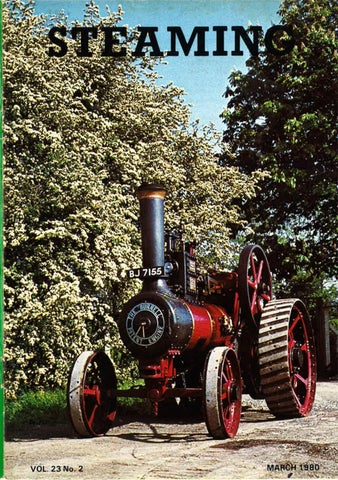
Front cover — After a strenuous afternoon of carnival parading John Robins' Burrell rests against a background of may blossom. The 6hp single crank compound, 3126 of 1909, was photographed by Bob Payne in June 1978 at the Welland Valley Club's premises at Market Harborough, Leicestershire. 67
CLUB NEWS From the Chairman We have been fortunate in finding an experienced new Editor for Steaming in Roger West, who takes over from Dick Rienkinsop from the present issue. Dick will continue to be associated with Club publications as chairman of the Sales and Publication sub-committee. The Rally Organisers Conference and Safety Officers Seminar was held in London on 9th February and was very well attended. The morning session for Safety Officers comprised 'Any Questions' under Steve Neville's chairmanship, and many excellent questions were put to the panel which included experts on insurance matters, rally organisation, boiler repair and maintenance, and a very helpful representative from the Health and Safety Secreteriat. The afternoon session for Rally Organisers discussed certain rally date problems, and endorsed proposals from the Rally subcommittee to provide a joint sales organisation to coach and tour operators on behalf of interested Rally Organisers. Following the Extraordinary General meeting in December both the national and executive committees have been much concerned with the development of new activities which will give a greater Club service to the interested public and dovetail with the Club's determination to achieve charitable status. Financial and active assistance will be given to the Steam Apprentice Club under its new chairman, Eric Fillmore, in their plans to establish regular training courses in engine handling and maintenance for young enthusiasts. The engine owners sub-committee is currently in discussion with the Insurance Offices Joint Technical Committee in an attempt to establish uniformity of inspection requirements and standards, and is also examining the possibilities of providing assistance by medium term loans and other means to engine owners faced with the high coast of boiler repairs. Continuing research is also in progress on the establishment of a cine film archive on traction engines in active use. The club's financial year has been altered to enable the Annual General meeting to be 68
held in the Spring in future, instead of September when many members ❑re still actively rallying. Our Annual meeting this year will be held during May, and further important business concerning the future reorganisation of the Club will be transacted there. We very much hope that as many members as possible will attend and thus ensure the continued progress and development of the Club both in the interests of the membership and the public at large. — Peter Barber.
London Area Social Meetings Meetings are held on the last Tuesday of each month at 8pm at 'The Cock Tavern', Great Portland Street, London (corner of Margaret Street and adjacent to Oxford Circus).
Tuesday, 29th April 1980. This is the final meeting of the present session. A further survey of steam on the Indian sub-continent with some scenic views will be presented by our indefatigable traveller Jeffery Mileham. There will be no further meetings until
Tuesday, 28th October 1980. This is the opening meeting of the 1980/1981 session and will be members slides.
Personal Rev. Philip Wright We are pleased to pass on news of a former chairman. To more recent members he is probably only a name but those who were members in the fifties and early sixties will remember him with affection. For many years he was in charge of a very large parish on the edge of London and later the quieter village of Roxwell, Essex. About a year ago he retired from full time ministry to the village of Greensted; since then he has been quite ill and has failing eyesight but he delights in the fact that he is now well
enough to undertake what he describes as 'stop-gap duties'. Philip is, as ever, deeply concerned with all matters of the country scene. His influence as chairman in the formative years of the Club is uncalcuable. He set the NTEC firmly on the high road. We wish him a happy and peaceful retirement and strength to carry on ministering to those close to him and to the wider circle of us all. (Ran Hawthorne)
Obituaries Wally Blackwell
Members will be sad to hear of the death of Wallace Blackwell of Northleach. Following a short, serious illness he died on 3rd February 1980 at the Lansdowne Nursing Home, Cheltenham, at the age of seventyseven. Wallace Blackwell was born in 1902 at Empshill Farm, Farmington, Glos. He was educated at Burford Grammer School, and then joined the family farming and steam threshing business which was founded by his grand-father in 1870. His father taught him to drive traction engines, and at the age
of seventeen he travelled to Ross-on-Wye to drive an Aveling on rack-sawing. Blackwells were the principal threshing contractors in the Northleach area and during their busiest times had five sets at work powered by Aveling, Burrell and Robey engines. Wallace gained first-hand experience of driving and repairing the threshing tackle in addition to his duties as a Cotswold farmer. In later years he became more involved with the running of the business and he took over from his father in 1940. In 1941 he married Ruby Brain of Stratton, near Cirencester. Wallace was present at the first Appleford traction engine race in 1950 and joined the National Traction Engine Club shortly after its formation. In August 1956 he introduced the Northleach Rally in conjunction with his brother-in-law Lionel Adams, and his friend Cyril Nichols of Gloucester. For a number of years this friendly event captured the spirit of steam preservation and gave impetus to the development of our interest in the Cotswolds. Following his retirement in 1963 Wallace lead an extremely active life in the traction engine movement. In addition to the Northleach Rally, he became a committee member of the Ross-on-Wye event. Many will recall seeing him at the controls of Arthur Napper's engines; on other occasions he attended with his tractors and generally assisted rally organisers by obtaining entries, loaning equipment and providing accommodation for passing engines. Wallace acquired an Aveling steam roller in 1957 and from time to time he used to steam down the lane to a nearby village to carry out some rolling for one of his friends. At other times he repaired old farm machinery and was often to be seen in his workshop where he spent many pleasurable hours restoring his tractors, steam roller, traction wagon and clover-huller. Wallace had a wide circle of friends and derived great enjoyment from the company of fellow enthusiasts, as indeed they did from him. He willingly offered encouragement to those who sought his advice and many have reason to be thankful for his help. Not one to seek the limelight, he did much behind the scenes to help matters along for rally organisers. We shall greatly miss his presence and warm personality on the rally field, and extend our sincere sympathy to his wife Ruby and the family. (M.B. Thexton) 69
NTEC SALES BOOKS
Overseas U.K. only & Non M'bers M'bers Price
NEW The Story of the Steam Plough Works (John Fowler) - M. R. Lane 19.25 Building the Al!chin - W. J. Hughes 7.25 Kaleidoscope of Steam Wagons - R. Whitehead ..... . . .. 6.25 Steam on the Road - A. Beamount 4.50 Fairground Steam - A. Beaumont 1.50 Traction Engines & Steam Vehicles in Pictures - A. Beaumont 4.75 Foden Story - P. Kennet 7.75 Scale Model Traction Engine Building 'MINNIE' - L. Mason 4 30 Steam Traction Engines, Wagons & Rollers - B. Johnson 3.40 Steam Power in Agriculture - M. Williams 3.90 Traction Engine Register 1.00 Steam Road Vehicles (NTEC Reprint) - J. Meyrick-Jones 5.25 Old Farm Tools & Machinery - P. Blandford 4.75 Garrett 200 - R. Whitehead 10.55 Steam in the Village - R. Whitehead 5.25 Historic Fairground Scenes - M. Ware 5.75 Traction Engine Miscellany - R. H. Clark 10.50 The Overtype Steam Wagon - M. A. Kelly .... 4.30 The Undertype Steam Wagon - M. A. Kelly 13.00 Garretts of Leiston - R. Whitehead 3.30 Savages of Kings Lynn - D. Braithwaite 3.30 The Steam Scene Vol 1 - R. J. Blenkinsop 4.50 The Steam Scene Vol 2 - R. J. Blenkinsop 4.50 The Steam Scene Vol 3 - R. J. Blenkinsop 4.50 The Steam Scene Vol 4 - R. J. Blenkinsop 4.50 The Steam Scene Vol 5 - R. J. Blenkinsop 5.50 Steaming Binder 2.30 Car Badge ...
17.75 6.95 5.95 4.25 1.25 4.50 7.50 2 95 3.25 3.75 .90 4.95 4.50 10.00 4.95 5.50 10.00 4.00 12.50 3.00 2.95 3.95 3.95 3.95 3.95 4.95 1.95 2.50
WHITE METAL KITS (4mm scale approx) Burrell Showmans Road Locomotive Fowler Showmans Road Locomotive Burrell Road Locomotive Foden 'D' Type Tractor Foden 'C' Type Tipper Foden 'K' Type Tipper six wheeler Foden 'K' Type Low-sided Wagon six wheeler Foden 'K' Type Special GWR Winch Tractor six wheeler Fowler Road Locomotive Single Ploughing Engine . . ... ............ ....„ Pair of Ploughing Engines
6.00 6.20 5.70 5.50 5.60 6.30 6.30 6.30 6.50 . 5.80 10.50
5.80 6.00 5.50 5.20 5.30 6.00 6 00 6.00 6 20 5,50 10.00
Non Members Price includes postage and packing. Members please enclose current Membership Card to claim Post Free price. Cheques and Postal Orders only, made payable to National Traction Engine Club. Orders to: A. G. Wilson, NTEC, National Sales Officer, 7 Welton Road, Daventry, Northants, NN11 5PP 70
FROM THE ALAN MARTIN COLLECTION OF PHOTOGRAPHS
No.8
LKIHI*1-1,10 BVIRV HERTS. SOW Al7P
Early autumn sunshine emphasises the newness of E. K. & H. Fordham's Foden wagon, posing with her crew at Bassingbourne, Cambridgeshire, in September 1909. The 5 tonner, 1820 of 190.9 (102194), sports a flywheel rope capstan and frame mounted fairlead — a useful 'extra' to the draymen faced with lowering heavy barrels into pub cellars. The Ash wall Brewery, long defunct, was some five miles west of Royston, Hertfordshire, in one of that county's most northerly villages.
Tom Howe The East Midlands lost a life long steam enthusiast when Tom Howe collapsed and died suddenly on 21st January 1980, aged 83. Readers will remember his "Life with Steam" article in our March 1979 issue and I know how pleased he was to have had his story published. I was introduced to Tom shortly after buying my first steamer and right away I recognised his life long practical knowledge of road and agricultural engines. At that time he had retired but still remained very active, doing various outdoor jobs for those who, in Tom's view, were in need of a helping hand from someone in a more able position. Such was his charitable outlook — no doubt formed during his time in the Somme Trenches and afterwards his yearly thresh-
ing circuit in the rural areas of South Derbys/Notts and the Soar Valley of Leicestershire. Thus began a friendship which I valued most highly and my knowledge of steam has been greatly increased thanks to his wonderful memory; he was a live manual of practical steaming. Tom helped in restoring and subsequently maintaining two rollers and a threshing drum in our yard, and if he had one regret it was the miles that separated us — when he spent a day with us he was a timekeeper of the old school — "Pick me up at 7.Q.0" he would say, but he was ready at 6.30, clean overalls and shining boots, ready for a day with his beloved engines. The highlight of Tom's year was to drive my Fowler roller DOROTHY to Kegworth 71
Rally, for this was his country — there were few bystanders he did not know, even the middle aged he recognised as Henry so and so's boy. Latterly Tom had the good fortune to have near to him a Marshall roller belonging to Peter Wood, and I know he was very happy to be able to go and tinker any day at will, for he was never more at ease with the world than when the odours of steam were around him. Tom Howe will be missed by ell the many friends he had in the steaming movement for he was a man of steam. To Tom's family we offer our sincere condolences. (J.H. Pattinson)
James Hake We regret to record the untimely death at the age of 47, of James Hake who was well known in South London and Surrey for his interest in steam preservation. Although having only recently joined the Club, Jim had a long connection with steam through his career as a driver with BR. His National Service was spent on the Longmoor
Military Railway and on his return to railway service Jim became a driving instructor and ultimately drove the 'Golden Arrow', True to his determined character he left the railway with the introduction of diesel traction. Of recent years Jim had taken a lively and keen interest in steam road traction and was invited to judge and award prizes for steam exhibits at the 1979 Lambeth County Show. His friendly mariner and fund of anecdotes will be sorely missed by his many friends. (A. V. Wilson)
Ben Taylor East Anglia lost one of its elder steam men in December 1979, when Ben Taylor died at the age of 84. Ben's yard at Howletts End near Wimbish has seen many steam engines through its gate over the years and his own engines have featured in many of the EATEC's rallies over the years. He was always helpful to anyone with a problem and will most surely be missed in this part of the world. The large attendance at his funeral after Christmas was truly a tribute to a well respected engineman.
STAMFORD TRACTION ENGINE KETTON RALLY (west of Stamford)
28th/29th JUNE 1980 Full ring events for engines both days Trade and Preservation Society stands Rally Secretary
72
John Crawley
Field House
Turvey, Beds.
NTEC SILVER JUBILEE LECTURE
JOHN FOWLER AND THE COMPANY HE FOUNDED A paper presented by Michael Lane at the National Traction Engine Club Convention, York in November 1979 Mr President, Ladies and Gentlemen, May I say how honoured I feel to be asked to deliver the NTEC Jubilee Lecture this year. lam your third victim and feel humbled by my two distinguished predecessors who have contributed so much to traction engine literature. I am also acutely aware of the honour of speaking to you about John Fowler and his remarkably talented collaborators and successors. Undoubtedly their contribution to the well-being of mankind was enormous. Neither should the Company's contribution to our national effort in two World Wars be minimised. I hope this lecture will be a tribute to all who have worked at the Steam Plough Works over a period of 115 years. I feel daunted also by the fact that there are some of you in my audience who have actually worked in the Steam Plough Works, albeit in the sad, declining years of this great Company. I pray you will feel that the perspective I give of events is fair and justifiable.
Throughout history minority groups have emerged from time to time whose influence upon civilisation has been totally disproportionate to their numbers. The Greeks and Romans are early examples. In the nineteenth century the members of the Society of Friends, or the Quakers as they are more commonly known, achieved great fame as bankers and industrialists in both this country and in the rapidly developing United States of America. A score or more of great families, all closely inter-related by marriage, amassed great wealth and influence in all branches of commerce and industry which they applied generally for the benefit and betterment of their fellow men. Quakerism was born out of the religious turmoil sparked off by the death of Queen
In a space of approximately two hours I am going to attempt to summarise the events of nearly one hundred years which I have spent some four and a half years researching. Those of you who want more may care to read my new book The Story of the Steam Plough Works published by the Institution of Mechanical Engineers. Even that is by no means totally definitive although occupying some 448 pages. The wife of Fowler's grandson and herself the daughter of the Company's distinguished chairman, Robert Henry Fowler, has kindly written a delightful foreword to my book. When asked to do this she commented, "John Fowler and my father would have been shocked at any suggestion of a work of this kind. Such was their Quaker background and upbringing that any form of self-advertising was an anathema to them. Never did they publicly discuss personalities." I hope they will forgive me.
Elizabeth and the accession of the Scottish King James. After Presbyterianism, the Baptist Sect were the most powerful group, but Non-Conformity bred Non-Conformity and they were quickly followed by the Seekers, the Ranters and the Quakers, so called somewhat derisively, because they were said to quake in their religious fervour. In their early days they were not regarded as men of peace and were vigordusly persecuted as trouble makers. It was not until the repealing of the Test Act in 1828 that they were allowed to enter public life or the Government services. Even after that date, prejudice, petty persecution and public ridicule continued for many years. Quite deliberately this saga of the Quaker John Fowler and the Company he founded 73
John Fowler and his early collaborators. Left to right — William Worby, Robert Burton, David Greig, John Fowler. (John Fowler & Co. (Leeds) Ltd)
will concentrate upon the man, his family and the remarkable team they built up, rather than upon the details of the "nuts and bolts" of the wide range of engineering products they produced in nearly a hundred years of independent existence. If I may coin an expression, the nutologists will be disappointed with what I have to tell you, but clearly there are many experts more competent than I to tell you of the subtle differences between a class K5 and K6 ploughing engine or a class 86 and B7 road locomotive. I would rather concentrate upon the remarkable man and the three generations of his remarkable family, who did so much for agriculture in both this country and especially in the developing countries overseas, as well as pioneering many important innovations in the fields of mechanical and electrical engineering over a very wide spectrum of activity. Throughout the Company's profitable and expanding 74
years from 1862 to 1919 the majority of its output was exported and between 1886 and 1914 over half its sales and profits were derived from its activities in Germany and Central Europe. It established in addition to the 14 acre factory at Hunslet in Leeds, a great factory at Magdeburg in Germany and subsidiary companies and branches in Hungary, in what is now Czechoslovakia, in Austria, Russia, France, Spain, Italy, and further afield in Australia, India, the Philippines and the Dutch East Indies. In South Africa it farmed a 22,000 acre experimental farm; indeed it is hard to name a single country anywhere in the world where Fowler-built machinery was not contributing to the well-being and prosperity of the country and its people. Originally, when I started my researches into the Fowler family I intended to go back to the seventeenth century when they first became followers of George Fox of Fenny
Drayton, who founded the Society of Friends in 1647. Quickly, I found myself back in the tenth century. The first Fowler to settle in these islands was a son of King Henry I of Saxony, who united the Saxons and the Franks into a kingdom roughly the size of modern Germany. His son came over with William the Conqueror and was rewarded with land in Buckinghamshire. A descendant, Richard Fowler, was a commanding officer in the English King Richard l's first crusade to the Holy Land. Later successive generations settled in Warwickshire and Oxfordshire. Continuing the direct line of descent we find in 1 550 one Thomas Fowler, a well-to-do yeoman farmer living at Stretton-on-the-Fosse in Warwickshire. His grandson, Christopher, became a silk manufacturer at nearby Shipston-upon-Stour in Warwickshire. During the Civil War the family took up arms with the Parliamentary side and fought at the Battle of Edge Hill. The earliest record of the Fowler family being adherents of George Fox's ministry is about 1692. In 1753, another Thomas Fowler, whose parents lived at Bloxham, near Banbury and who are buried in the Quaker burial ground at nearby Aynho, moved to Melksham in Wiltshire where he married a local girl, Catherine Rutty, a niece of the celebrated Irish Quaker physician, John Rutty. The family resided in Melksham until Thomas' Jnr Fowler John great-grandson, I1826-1864) moved to London and put up his plate as a consulting engineer at 28, Cornhill, in the City. Indeed, John Fowler's cousin, Sir Robert Nicholas Fowler, Member of Parliament and twice Lord Mayor of London, continued to live at the Fowler family home at Elm Grove, Gastard, just outside Melksham until 1891. John Fowler's grandfather, Robert, was a scholar and abandoned the family business of wine and spirit merchants upon his father's deathbed to become a full-time Quaker minister. The story has survived that he considered such an occupation as being incompatible with the profession of religion and that he confounded the good people of Melksham by publicly discharging all his stocks into the gutters outside his premises. Robert's ministry involved extensive travel throughout England and Ireland and it was while he was so engaged that he forged relationships with the leading Quaker families which were to prove so invaluable to his yet unborn grandson as he struggled
to establish his system of steam powered land cultivation. In 1790, Robert married Rachel Barnard, whose father was employed by the great Quaker iron founder, Abraham Darby at Coalbrookdale and was directly related to the Wilson and Pease families, leading Quakers in the north of England. It was Edward Pease (1767-1858) who appointed the Geordie engineer, George Stephenson, as engineer to the Stockton and Darlington Railway on the very day the Royal Assent was given to, the Act authorising its construction. Robert and-Rachel Fowler had six children. The eldest Thomas, married the sister of the founder of the world famous accountancy practice, Price Waterhouse & Company, who acted as auditors to John Fowler & Company throughout its • independent existence. The second son wa-s John Fowler, senior (1792-1861) the father of our subject; who in 1822 married Rebecca Hull, the daughter of a wealthy Quaker family living in Uxbridge and farming in Hertfordshire and Bedfordshire. He built up extensive business interests in Wiltshire and surrounding districts. He was farmer, banker and merchant and owned a brick works, withy beds for basket making and dyehouses, but he was happiest at home, working on the land, riding and shooting. Originally he lived at Beanacre on the banks of the River Avon on the outskirts of Melksham, but later, following his father's death, he moved to Elm Grove, Gastard. Old Edward Pease was especially fond of John Fowler senior and they visited each other frequently. He recorded in his diary: "He is a man of clear and deliberate judgement, always particularly cautious not to reflect upon the character of others". In 1845 he wrote: "John Fowler senior left me after two days exceedingly pleasant tarriance. I enjoy his society." Later still, he wrote: "A sweet man, one of the most perfect gentlemen I ever met, very gentle in manner and speech. He walks more after the model of his Master than any man I have ever met." John and Rebecca had five sons and three daughters, two of whom died in childhood. The eldest, Henry (1823-18801 married into the Barclay banking family, a grand daughter of the celebrated Quaker banker and philanthropist, Joseph Gurney. Early in adult life he moved to London and set up business at 75
A Kitson & Hewitson built slanting-shaft ploughing engine with double drum suitable for ploughing and draining work of about 1860. (author's collection)
Southwark on the south bank of the River Thames, becoming the leading manufacturer of oak staves for wine casks, and played little part in our story, although his son Robert Henry Fowler was destined to become a central character in later years. The second son, Robert 11825-1 888), remained a bachelor and lived the life of a gentleman with rooms in St. James. He took over as senior partner at the Steam Plough Works upon his brother John's untimely death in 1864. He was reputed to be a good businessman with a good head for figures and supported John both financially and practically from the moment he started developing the steam plough. He travelled extensively promoting steam cultivation and became friends with many world figures. John Fowler, junior 11826-1864) was the third son. He was followed by William 11828-1905), a barrister, Member of Parliament for Cambridge, and a partner in several great financial houses. In 1888, upon Robert's death, he became chairman of John Fowler & Company Ltd. holding office until his death in 1905, The fifth son, Barnard (1833 1882), also remained a 76
bachelor. He became a partner in John Fowler & Company in 1873, but was somewhat of a misfit. He suffered bad health and died in the Great Northern Hotel, Leeds in 1882. John Fowler junior appears to have been a very normal boy, not especially clever. The only anecdote of his childhood survives in a letter from one Hannah Law, who in later life recounted how he used to delight in throwing frogs at her during haymaking. He went daily to school at Corsham on the Bath Road and it was during this period that he encountered his first railway locomotive, for he had to pass the eastern entrance to Brunel's Box Tunnel which was under construction in the years 1836 to 1841. Clearly John developed a fascination for steam and when, at the age of sixteen, his father apprenticed him to a local corn merchant, he found the work dull and monotonous. Eventually, he persuaded his father to allow him to go to Gilkes, Wilson and Hopkins engineering works in the north east of England as an apprentice. The company had been founded by the Quakers Wilson and Gilkes with the aid of Pease money in the le-
cently established new town of Middlesborough, which itself owed its existence to the foresight and enterprise of the Pease family. Gilkes & Wilson manufactured railway locomotives as an overspill to Stephenson's Forth Street Locomotive Works in Newcastle, they built colliery winding machinery and blowing engines and produced structures for wrought iron bridges and worked closely with the other Quaker engineering works in the area, Bolckow and Vaughan. Young. John was undoubtedly in his element and quickly demonstrated his mechanical flair. He was welcomed into Joseph Pease's home and the third generations of the two families became close friends. Later, in 1857, John married Joseph Pease's youngest daughter, Elizabeth Lucy. Her old grandfather Edward recorded in his diary some months earlier: "I am informed today that my beloved Elizabeth Lucy is yielding to John Fowler — she is a lovely sweet child." Following the disastrous potato famine in Ireland when 1 1A million either starved to death or fled the country, Samuel Gurney, the Quaker philanthropist, led a relief mission to the Emerald Isle and invited the young engineer John Fowler to join him. Whilst on this mission he experienced some sort of vision similar perhaps to St Paul on the road to Damascus. From that moment he resolved to devote all his energies and resources to the increase and cheapening of food production. He saw a great need for improved machinery for land drainage. He appreciated that good drainage not only kept the land drier in the wet winter months, but kept it cooler and more moist in the summer, thus promoting a constant progress of vegetation. He formed a partnership with another Gilkes and Wilson apprentice, one Albert Fry of the Bristol chocolate family. Together they acquired the premises and some skilled craftsmen from the recently defunct old established carriage builders, Stratton Hughes & Company of Bristol. Fry concentrated upon building conventional, proven designs of farm wagons and agricultural machinery, whilst Fowler worked out new proposals for land drainage. He also put . up his plate as a consulting engineer in Cornhill in the City of London and busied himself establishing close relationships with such firms as Ransomes of Ipswich who were already established as the world's leading manufacturers of chill cast plough shares and cultivating implements. The Ransomes
were Quakers too and it seems probable that Robert Ransome, the founder of the business had been befriended by John's great-grandfather, Thomas, after he had been imprisoned during a missionary visit to the Bristol area many years earlier. Certainly John was amongst friends in Ipswich and he built up an especially valuable friendship with Ransomes much respected works manager, William Worby. In a paper given before the comparatively recently formed Institution of Mechanical Engineers at their Birmingham headquarters in April 1857, Fowler outlined his early work on land drainage. He told them: "Having once seen a drawing of a plough which was used to make a hole in the soil for the purpose of draining, there appeared to be no difficulty in making the same machine draw in some material to be left in the hole thus. made to form a drain." Fowler's first patent protecting his ideas was filed in London in March 1850 and almost simultaneously in Dublin. Basically, his aim was to draw a much larger mole than any previously used at a greater depth and so arranged that drain pipes, originally of wood, could be threaded onto a rope attached to the heel of the plough in such a manner that they would follow the plough and form a continuous drain. The first public appearance of the system took place at the Royal Agricultural Society of England's annual show held at Exeter in 1850, where he was encouraged by the award of a silver medal. An improved system, avoiding the necessity of moving the windlass at the end of each drain was exhibited in Hyde Park at the Great Exhibition in 1851, after which he not only offered his machinery for sale, but advertised a contract draining service to landowners. An interesting letter has survived written on the instruction of His Royal Highness Prince Albert, referring to successful draining work at his Clay Hall Farm and recommending the Fowler system to his cousin, the Duke of Mecklenburg. Another letter in my possession written at this time and addressed to Robert Fowler by a gentlemen in New York refers to an early plough in the United States of America. It was intended to exhibit Fowler's first steam powered self-contained mole plough at the RASE Gloucester Show in 1852, but it had to be abandoned due to its great weight and the impossibility of manoeuvring it in the field. In 1854, at the RASE Lincoln 77
- ?ii Pt fa L(./1 L
ct
_ LN44iPi EERZ.
Fowler's traction-tram engine introduced circa 1866. (John Fowler & Co (Leeds) Ltd)
meeting he exhibited yet another system, this time employing a Clayton & Shuttleworth portable engine to provide the motive power for hauling the mole plough. Clearly, Fowler was beginning to concentrate his attention upon the application of steam power to the cultivation of the land. Later, his friend Worby wrote to Robert Eddison, who was admitted into the Fowler partnership upon John's death: "Our first conversation [on the subject of steam ploughing] took place in July 1852 on the beach at Brighton on a fine summer's evening. I should think wo wore two hours very seriously talking and calculating on the subject." The concept of utilising steam power for land cultivation was not a new one and by the time Fowler became interested in the problem a score of patents had been filed by his predecessors, but nobody had applied themselves more assiduously than he did and no less an authority than the Dictionary of National Biography subsequently described him as "The inventor of the Steam Plough". 78
In 1854 the RASE offered a prize of £200 for "The steam cultivator which shall in the most efficient manner turn over the soil and be an economical substitute for the plough or spade". The next four years were the crucial years in Fowler's all too short career. The story of his struggles to gain the coveted prize, later increased to £500, is absolutely fascinating, but time prevents us examining events in any great detail, and I can do no more than refer you my book which traces events in detail. During the early stages of Fowler's experimental and development work, whilst simultaneously engaged upon a large draining contract in Hainault Forest in Essex he met and engaged as a technical assistant a remarkable Scottish farmer named David Greig. Born at Stonehaven on the east coast of Scotland, Greig had been compelled to leave home at an early age in search of work. After a period in Ireland he found employment as a farm manager at Barkingside in Essex. He was short, red. bearded, impetuous and called a spade a spade, but
quickly he proved his competence and a very close affiliation developed between the two men. Fowler's first attempt at steam powered land cultivation had employed a type of cultivator which scarified, but did not invert the soil as stipulated by the RASE judges. David Greig's first major contribution to the Fowler success story was his suggestion that a balance plough should be used so that all the furrows fell the same way when turning a the headland. Fowler discussed Greig's idea with his friend Worby of Ransomes in early January 1856 and again at a meeting of the Royal Society of Arts at the end of the month. The first experimental plough was demonstrated near Ransomes' works at Nacton on the banks of the River Orwell in April 1856 before a distinguished group of agriculturalists and sympathisers, including old John Fowler senior, It is perhaps of interest to note that it is on record that Fowler and Worby often met and discussed their problems in the very same rooms in the Great Northern Hotel at Kings Cross, where today the NTEC holds its exective committee meetings.
Following successful negotiations with the Fisken brothers, the original patentees of the cable hauled balance plough idea, Fowler was ready to compete for the RASE prize at their forthcoming Chelmsford Show in July 1856. This was the first occasion on which the British public were able to see Fowler's land cultivation machinery at work, although in the preceding month, John accompanied by his brothers Henry and Robert and his cousin Robert Nicholas had demonstrated the tackle in France, obtaining an order for draining tackle from the Emperor Napoleon He found himself in competition with William Smith, a Buckinghamshire farmer, and unquestionably these two contestants provided the greatest attraction at the Chelmsford show. Prior to the contest there had been a measure of liaison between the two, but this quickly ceased and for many years Smith was vociferous in expressing his antagonism towards John Fowler and the RASE judges, whom he considered treated him unfairly. Smith was quickly eliminated from the 1856 contest because the implement he used only scarified the soil
Cable navigation trials on the Aire & Calder Canal near Leeds in 1867. The figures include Baron von Holstein, Baron van Havre, Baron de Mesnil, Robert Fowler and the clip drum designer, Robert Burton, (author's collection) 79
A special straw burning ploughing engine built for Russia in 1876. (Museum of English Rural Life) and did not invert it. The Fowler sub-soil plough worked well, but the judges decided that the cost of operation was unfavourable in comparison with horse power and no prize was awarded. Further development work took place prior to the 1857 RASE Show held at Salisbury. He proposed three new systems, two of which included a steam ploughing engine with an integral double drum windlass. Two engines were built by Ransomes and they were used as either single engine sets, with an anchor carriage on the opposite headland or as double engine sets with an engine on each headland. These engines do not appear to hsve heen very successful, although one of them was exhibited as late as 1879 at the RASE Kilburn Show, rebuilt and fitted with a clip drum. There were also serious problems with coiling the rope neatly, one layer upon another on the winding drum and problems of dealing with rope slack when the headlands were not parallel. On this occasion, Fowler competed against three other competitors, including James Boydell with his Burrell-built endless railway engine, but once again the prize eluded him. As a 80
consolation he was awarded a medal and the judges commented: "No one who saw the work performed by Mr Fowler's plough could doubt that in its use at least, steam ploughing as such had attained a degree of excellence comparable in point of execution even with the best horse work." He married his beloved Elizabeth Lucy Pease shortly after the Show and three months later departed from this Tottenham home for the Highland Show held at Stirling accompanied by his bride. Although he encountered little competition and his single engine tackle did not perform particularly well, he was awarded that Society's £200 prize which had been on offer since 1827; but clearly, the challenge of the RASE prize was uppermost in his mind. During the winter months further improvements were made and modified steam engines and implements were prepared and tested. He engaged two new technical assistants, Jeremiah Head and Robert Burton, each of whom subsequently played a major role in establishing the supremacy of Fowler machinery and assisted with the planning and building of the Steam Plough
Works at Hunslet in the years 1859 to 1861. The former was seconded from Robert Stephenson's locomotive works who were building some of the machinery for the RASE's 1858 ploughing contest. Burton, a clever engineer and draughtsman, came from the pianoforte industry in the east end of London. The 1858 competition was held at Chester, on the banks of the river Dee. Once again Fowler was challenged by three other contestants — the brothers James and Frederick Howard of Bedford, who entered William Smith's roundabout system; James Boyden with his Burrell engine and endless railway; and Thomas Ricketts of Castle Foundry, Buckingham who presented his rotary steam cultivator, which was intended to turn-over the soil in a similar manner to the spade. A fourth competitor, William Crowley, was eliminated before the contest because his implement was not steam powered. Both the Burrell-Boydell engine and Rickett's rotary machine developed mechanical troubles and were eliminated. Howard's system demonstrated that it could cultivate the land at 70p an acre, whereas the judges considered the same work could not be done by horses at less than 92 1/2 p an acre. The capital cost of the equipment was stated as being £430. The calculations as to the cost of the work done by the Fowler tackle were conclusive — on light land 30p an acre, on heavy land 46p an acre. The capital cost of the equipment was stated by Fowler as £650, although this figure was hotly contested by Smith, who claimed that it should have been £750. However, the judges decided that the daily working costs of the Fowler tackle were £2.10 against £2.33 for the Smith tackle and in due course the £500 prize was awarded to Fowler, the judges report adding: "It is beyond question that Mr Fowler's machine is able to turn over the soil in an efficient manner at a saving as compared with horse power." From this moment, for over sixty years, Fowler ploughing tackle dominated the market, and was successful in winning the great majority of prizes offered by the leading agricultural societies all over the world. Indeed, by the turn of the century the agricultural press was becoming bored and treated Fowler's success at ploughing contests as almost inevitable. This supremacy was not held easily, however, a great many
technical problems remained to be solved and the Fowler team was constantly stretched to maintain its clear lead. Time does not permit us to look at the many improvements introduced and patented each successive year. Two factors struck me forcibly during my researches. Firstly, the pace at which the Victorian innovators worked and the speed with which new ideas were developed and got into production. Of course, there were failures and crazy ideas, but the overall trend was progressive and rapid. Secondly, the pioneers travelled great distances and frequently. From the formation of John Fowler & Company, Leeds, the partners, senior management and their engineers were constantly on the move travelling to the four corners of the world. Throughout the formative years culminating in Fowler's success at Chester he had been dependent upon outside suppliers for the main components of his machinery. Ransomes, Stephensons and Clayton & Shuttleworth were his main sources. He became increasingly aware that the standard production of the steam engine and portable engine builders lacked the sturdiness of design and construction necessary for fulfilling the heavy duty demands of his ploughing tackle. Through the good offices of his father-in-law, now a major figure in the heavy engineering Industry of the north east, and his associates in Newcastle. Fowler was introduced to the Quaker William Watson Hewitson, formerly an employee of both Fenton, Murray & Jackson, the Leeds locomotive builders and Robert Stephenson and currently a partner in Kitsons celebrated locomotive works in Leeds. It was agreed that Kitsons should build an entirely new design of heavy duty self-moving ploughing engine to Fowler's own specification. In the three years 1859 to 1862, Kitsons completed 98 of these fine engines, initially chain driven and later fitted with a slanting shaft drive to the hind wheels. The technical press were enthusiastic and The Engineer commented: "Few other than the most accomplished and most successful locomotive builders could turn out so well-arranged, well proportioned and admirably finished an engine for farm purposes." In 1860, Kitsons suggested a new company should be formed to specialise in this work and offered Fowler an ideal site adjoining their works. Thus, the famous Steam 81
No 3177 — a 6nhp crane engine based on Eyth's Military traction engine of 1876, and for many years employed as the Steam Plough Works crane engine, (Museum of English Rural Life) Plough Works was born. The original plot was some 727 square yards on the site of the old Spanish Leather Works owned by a Mr Taylor. Work started immediately and production commenced in 1861. By 1877 the area of the works had grown to 7.84 acres and by 1939 it had doubled again to over 14 acres. The new Company formed in 1861 was styled Fowler & Hewitson and commenced trading with an indebtedness of some £70,000 to Kitsons. Two years earlier, in April 1859 Fowler took another bold step in order to consolidate his financial position by forming the Steam Plough Royalty Company. This was one of the earliest Joint Stock Companies formed under the Companies Act of 1856, which enabled him to raise a substantial sum of money for development work against the surety of future guaranteed Royalty payments. Interest was fixed at £800 in 1859, plus £10 royalty on each sot of tackle sold, increasing to £200 in 1862 and each year thereafter until 1873 when all the patents expired. His friends and - collaborators William Worhy, David Greig, Collinson Hall 82
and John Allin Williams all enjoyed a share of Fowler's Royalty income. At home the capital cost of the steam plough was beyond the means of the small landowner and tenant farmer, and the employment of modern cultivating machinery on a contract hire basis became popular. Between 1860 and 1875, the period prior to the collapse of British agriculture, over 100 contracting companies were tormed and Fowler either took a financial interest in or wholly owned a number of these concerns. Both home and export business was booming at the Steam Plough Works and orders were flowing in from Europe. India, the West Indies and Egypt, as well as from United Kingdom buyers, but it was from Egypt that the new Company's golden opportunity arose. The political situation in the United States, culminating in the Civil War between the northern and southern stales, caused a cotton famine which had disastrous effect on the Lancashire cotton industry. At that time one-fifth of our population were said to depend either directly or indirectly upon the
cotton industry and the annual value of British cotton manufacturerers was greater than our total national revenue. Some years earlier a Frenchman had accidently discovered a cotton plant growing in an
Egyptian garden and the then Viceroy was quick to try and exploit the situation. He and his nephew, Prince Halim Pasha visited the International Exhibition held in London in 1862 and then paid a visit to Fowler's newly established Steam Plough Works in search of machinery and equipment. It is said that the Egyptian leaders gave Fowler an order for f 1/4 million, which was an enormous sum of money 120 years ago. Certainly, we can trace delivery of over 200 steam ploughing engines and associated im-
plements, large numbers of pumps and portables engines, engines for driving cotton gins, traction engines and tilting cotton carrying wagons and a complete workshop for maintaining the ploughing engines, and, here I quote from the order book: "To be able if necessary to construct locomotives." There is no doubt that this fortuitous contract put the new Company well and truly on its feet. The stories recorded by Fowler's two representatives in Egypt at this time, which fortunately have survived, are fascinating and worthy of being published in full. Prince Halim Pasha remained at the Steam Plough Works for some time as an appren-
tice. He and his retinue occupied the Queens Hotel in Leeds and he travelled to the works each morning at 6am in a carriage escorted by two dusky bodyguards carrying drawn scimitars. After working as an ordinary workman all day, he returned to his hotel in a like manner in the evening, usually distributing oranges to the poor children of Hunslet. By this time Fowler and his family were living in the Leeds area. David Greig was established as his deputy and Jeremiah Head was the works manager. Brother Robert was looking after the financial affairs of the Company in London and Robert William Eddison was appointed commercial manager. The latter came from a highly respected Leeds family. His father was a practising solicitor and the first town clerk of the City of Leeds. His three brothers were engineers and were associated with steam ploughing from an early date and founded the Eddison Company which survives today as Eddison Plant & Hire. Robert Eddison became a partner in the Steam Plough Works upon Fowler's death and subsequently both he and his son were directors of the Company in an unbroken line until 1940. Early in the life of the Steam Plough Works, Fowler concluded a lucrative agreement with Clayton & Shuttleworth, Charles Burrell and Ransomes, the licencees paying royalties on all machinery manufactured and
No 3815 — a 3ft Oin gauge locomotive built for Colombia in 1879, now preserved as a National monument. (Museum of English Rural Life)
83
No 5556 — a heavy duty standard gauge 2-6-2 side tank locomotive built for the Nitrate Railways in Chile in 1888. (Museum of English Rural Life)
sold by them which incorporated any features of eighteen of Fowler's patents filed between 1856 and 1861, as well as the Fisken Brothers and John AIlin Williams patents in which Fowler held a vested interest. Initially, J. & F. Howard of Bedford were parties to the agreement, but later they withdrew. It was a "Heads I win, tails you lose" sort of agreement because in the event of the licencees failing to reach agreed targets they were committed to pay Fowler a lump sum as compensation. In spite of the untimely death of William Hewitson in May 1863, success followed success. Fowler won all the major awards at the great agricultural shows and a number of important innovations were perfected including Robert Burton's clip drum, improved coiling gear for laying the rope neatly one layer upon another on the coiling drum and the double engine system of cultivation. Today, it is probably the latter which first comes to mind when the name John Fowler is mentioned. Unhappily, by the end of the summer of 1864, Fowler's indomitable energy and constant exertions to perfect steam ploughing began to take their toll and he suffered a 84
nervous breakdown. On his doctor's advice, he moved to Ackworth, a pleasant district near Pontefract and the centre of Quakerism in Yorkshire. Here, he was able to relax and indulge his favourite sport by following the local hounds. Late in November on a frosty morning, he was out hunting, riding a big grey stallion belonging to his father-in-law. They fell and the horse rolled on him fracturing his left arm above the elbow. Initially, the local doctor did not treat the injury as serious, but after a few days the dreaded tetanus disease set in and at 5 o'clock on Sunday, 4th December 1864, Fowler lapsed into unconsciousness and died. He was buried in the Friends Burial Ground in Darlington and in accordance with the custom of the day the horse was returned to its owner and promptly shot, its carcass being fed to the hounds. The agricultural fraternity were shocked by his death and a great cloud hung over the annual Smithfield Show which opened the day after. The address sent to Mrs Fowler from the Smithfield Committee read like the pages of Debrett, but perhaps the most moving tribute was that sent to her by the foremen and workmen at the Steam Plough
Works. What a pity it is that such respect between men and their master has largely disappeared from our industrial society. Robert Fowler, John's elder brother, assumed the role of senior partner and in due course both Robert Eddison and David Greig were admitted into the partnership. Some years later, John Fowler's younger brother, Barnard and Reginald Wigram were also taken into partnership. Wigram came from a wealthy family, his father, amongst his many other interests, was a Governor of the Bank of England and he is said to have paid no less than £20,000 for his son's partnership fee. In later years Reginald Wigram was mainly responsible for Fowler's activities in the fields of heavy electricity generating plant and large stationary installations and completely modernised the foundry side of the business. He and his son Walter Gott Wigram served the Company continuously for over 68 years. Wigram Senior also served as a director of the Great Northern Railway for many years with great distinction. No account of John Fowler and his successors would be complete without reference to a German national, Maximillian Eyth, who was employed by the Company from 1861 to 1882. Having been trained as an engineer in Stuttgart he came to England in the early part of 1861 in search of work. Such was the British dominance of world markets at this time that every German engineering graduate strived to come over here for a period to gain experience in an English factory. After several abortive attempts to find employment Eyth was given a letter of introduction to John Fowler whom he finally met up with at the 1861 RASE Show held in Leeds. All his life Eyth was a great diarist and faithfully recorded his world-wide travels and many adventures. Fortunately the majority of his writings, including his letters home to his family and no less than seventeen books he had published, have survived in the German national archives and at a museum at Ulm in Bavaria, where he died in 1906. Probably, his diaries give us the clearest surviving picture of John Fowler, his colleagues and his work and he recorded his first meet with Fowler in the following words: "I met John Fowler, who stood by his steam plough in the midst of a circle of pleasantly animated farmers who were congratulating him on the prize of the Royal Agricultural Society of England just won. A
splendid man of about 34 years old, big and stately, black haired and affable, with a laugh that did good to all within about 100 yards of him. He read my letter, shook my hand but could not use me". Apparently, Eyth had made it clear that if there was no vacancy for a draughtsman he would be willing to start work on the shop floor, for later Fowler wrote to him, offering him a job as a fitter, which Eyth gladly accepted. After a few months at the Steam Plough Works, followed by a period of practical field experience on John Fowler's cousin's farm near Bedford and at Much Hadham in Hertfordshire, he was sent to join the staff on Fowler's stand at the great 1862 International Exhibition in London. Clearly, Eyth's linguistic ability was of great value and already John Fowler had earmarked young Eyth for duty overseas. In 1863 he was despatched to India to hand-over some steam ploughs ordered by a tea plantation in Bengal. En route, whilst in Egypt, he was diverted to Prince Halim Pasha's vast cotton estates near Cairo where he stayed for three years as the Prince's chief engineer. After achieving enormous success and popularity in this appointment, he was compelled to leave the country due to the political unrest and the fall from favour of his employer. Robert Fowler then sent him to the United States of America with a brief to find agents for the steam plough; obtain patent protection for Fowler's many inventions; and to try and obtain relief from the prohibitive tarifs then in force against foreign made machinery. Clearly, Eyth was not impressed with Yankee business methods, modern American cities nor the American railroads, for he moved south to Louisiana as quickly as possible. Probably he was motivated by the romantic, although undoubtedly there was a big potential for the steam plough due to the acute shortage of labour on the cotton plantations following the ending of the Civil War and the freeing of the slaves. Whilst on the east coast of America he renewed an acquaintance with two Belgian diplomats, Baron Oscar de Mesnil and Baron Henri Van Nerve. They were concerned with the introduction of a French system of submerged chain haulage for barges on the canals and rivers, especially on the Erie Canal, which connected Lake Erie with the Hudson River, and already carried 3 million tons of shipping annually. Eyth was quick to 85
To keep up-to-date with weekly news of the Preservation movement you need
WORLD'S FAIR ...rpnrating Preservation News
ONLY 17p PER WEEK Order NOW from your local newsagent. In case of difficulty (or for a free specimen copy) write to: THE WORLD'S FAIR LTD., UNION STREET, OLDHAM, LANCS. OL1 1DY.
NOW! PRIVATE CAR INSURANCE AT REDUCED RATES FOR N. T. E. C. MEMBERS A 15% discount is offered to N.T.E.C. members under a new scheme arranged with Lloyd's underwriters. Your no claims bonus may be transferred to the new policy. Contact: TONBRIDGE OFFICE (MOTOR DEPT.)., HILDENBROOK HOUSE, THE SLADE, TONBRIDGE, KENT. TEL: TONBRIDGE (0732) 357011
TENNANT BUDD LTD. 86
No 7626 — this crane engine supplied to showman T. Taylor of Grimsbury in 1896 was later requisitioned for service in South Africa. (Museum of English Rural Life) suggest that Fowler's plough rope and Burton's clip drum were a better alternative to the heavy, cumbersome and expensive chain. Few appear to realise what an important part of Fowler's business this was to become in the years 1866 to 1870. They produced engines and cable haulage machinery for North America and for the major rivers and waterways of Europe. Eyth became a partner in a new Company based in Brussels together with his Belgian friends and a German diplomat, Baron Friedrich Von Holstein, who enjoyed the patronage of Bismark and himself later became German foreign minister. They negotiated concessions in France, Belgium, Holland, Germany, the Austro-Hungarian Empire and in Russia and Italy, as well as India, Ireland and on the Duke of Bridgewater's canal on the Cheshire/Lancashire border. Fowlers spent a great deal of time and money developing suitable engines and machinery and in all matters appertaining to the projects Eyth demonstrated his technical brilliance, but his partners, who handled the commercial side, were somewhat dilettante. Their greatest achievement was the negotiation of a concession for the world's greatest inland waterway, the River Rhine, but things went wrong from beginning to end and Eyth re-
turned to Leeds disillusioned and frustrated, but determined to concentrate his talent upon the development and worldwide sale of cultivating machinery and traction engines. He rendered outstanding service to the Company as a designer, patentee and as a salesman. He travelled extensively and opened up several extremely important new markets for the Steam Plough Works, especially in Eastern Europe, in South America and in California, where sugar beet and sugar cane was being grown on a large scale. It remains an ambition of mine to put the Eyth story together into book form, for rarely has a person worth writing about left so much material, so rich in humour and so full of anecdotes. It was a major tragedy when Eyth left Fowler's employ and re!turned to his homeland in 1882, having quarrelled with David Greig's renegade sons. He devoted the next 20 years to the formation of the DLG, the German Agriculture Society, which was based on and comparable with the Royal Agricultural Society of England. He was appointed a privy counsellor in Germany and elevated to the dignitary of Max Von Eyth.
(to be continued) 87
TRACTION ENGINE PRESERVATION IN THE EASTERN STATES OF AMERICA David Gray Early in 1977 I knew that later that year I would be moving out to the USA for a few years and therefore gave some serious thought of how I was going to pursue my traction engine hobby. Obviously, I could not take either my Fowler raod engine or my unrestored Aveling roller with me, and in any case, my son Stuart had plans to complete the restoration of the Fowler in my absence. I had already seen copies of the Encyclopaedia of American Steam Traction Engines on the NTEC sales stalls at rallies in England, and I thought that one of the best people to contact in the US would be the author of this book, Jack Norbeck. A telephone call to Jack resulted in a signed copy of his encyclopaedia arriving in my hands in early June. In this book are listed many of the organisations in the United States, which are involved in the preservation of steam traction engines, road rollers and other agricultural equipment.
The General Scene It was only when I moved to Long Island, New York, In December 1977 and sat with maps in front of me that I really appreciated what a vast country the United States of America is, and the distances between one association and another , most of which, unfortunately, are impossible to visit from my new home over a weekend. In the United States the preservation of traction engines and related equipment appears to fall into three broad categories: that carried out by members of a club or association, the preservation done by various museums, and that done by individual enthusiasts who live too far distant from a club or association to take advantage of being a part of that organisation, but perhaps in any case prefer to take their machines out to support local events. By describing an example of each of these categories, I have tried to indicate that there is a growing interest on this side of the Atlantic for the preservation of traction engines and by outlining the work being carried out on a Burrell tractor, to show that 88
the enthusiasm is not just restricted to engines built in the USA. There are actually 347 organisations in the United States, each of which has steam cr c!d agrcult'urol cquipmont shows of one description or another throughout the year. These organisations range from museums, which have all year round exhibits, to various types of clubs devoted to the restoration of traction engines, steam rollers, gas tractors, oil engines and other interesting agricultural and industrial bygones. Many of these clubs hold what are known as Thresherees of Threshermen's Reunions, at which the old steam powered methods of threshing, baling and chaff cutting are demonstrated. As most of these clubs have their own permanent sites, they are able to rebuild on their site examples of steam powered saw mills, shingle and grist mills, and demonstrate these to the public at reunions. In some cases these reunions resemble the rallies that are common throughout the United Kingdom, in that the engine owners take part in a grand parade of engines and demonstrate their various uses. I have not yet, however, come across any fair ground organs or for that matter fair ground equipment which is so much a part of a British rally at one of these events, although a 'flea' market is a fairly common side attraction besides popcorn and hamburger vendors. The states of New York, Massachusetts, Rhode Island, Connecticut, Pennsylvania, New Jersey and Delaware are the easiest for me to reach from my home on Long Island. The nearest large organisation, some 200 miles away, or 4 hours by car, is the Rough and Tumble Engineers I listorical Association in Lancaster, Pennsylvania, which appears to have been one of the earliest organisations within the states that I have mentioned. It seems fairly clear that the beginning of the steam preservation movement in the United States developed from some very small steam engine parties held between 1944 and 1946 in various parts of the
A 1921 Frick engine owned by Harvey Hoffman shows its paces at the Rough and Tumble Engineers Reunion 1979. Notice the model by the owner at the side of the engine. ID. Gray)
country. It was to one such event held in Alvordton, Ohio, that Arthur S. Young, who was the founder of an Agricultural Manufacturing Company in Lancaster County, Pennsylvania, went and as a result in 1947 a rather small steam engine show was held on Mr Young's premises in Kinzers, Pennsylvania. This idea was received with consider- _ able enthusiasm from local old-time threshermen and farmers. It was, therefore, decided by a group of them, to perpetuate the 'past glories' by holding an annual event. The next year the first grand parade of engines was held, led by a Peerless traction engine, which had been specially painted for the occasion; the last engine was an early Scheidler traction engine. The Peerless engine is now on display at the Landis Valley Farm Museum, whilst the Sheidler has been present in the grand parade every year since. Meanwhile, in 1949, the Lancaster and County Threshermen's Lebanon Association, after being inactive for a number of years, decided to disband, but they still had a balance of $100 in their funds. They decided to use this sum to provide free lunches for the public at a reunion to coincide with the annual show held on the
grounds of Arthur S. Young & Co., on 14th May, 1949. Steam engines were fired up and old machinery operated. This reunion was so successful that it has been continued each summer on an enlarged scale. From this beginning was developed the Rough and Tumble Engineers Historical Association, which appeared as such in 1950 with Arthur S. Young as its first President. It is interesting to note that the 10hp Scheidler steam traction engine 572, built in 1886 in Newark, Ohio, that took part in the first grand parade is now owned by the Association's current President, Amos B. Stauffer, who kindly allowed me to drive the engine at the Spring Steam Up this year 11979). Many of the steam engines that I have also had the privilege to ride upon owe their existance today to Arthur S. Young who, as a farm machinery dealer more than two decades ago, began putting traction engines out to pasture. At the time of the formation of the Rough Historical and Tumble Engineers Association, he had one of the nation's largest private collections of steam engines. He owned, at the time, 35 engines which 89
represented many of the famous manufacturers in the United States including Avery, Baker, Case, Frick and Geiser. During the War, Mr. Young had been accused of being 'unpatriotic' in that he was called a 'scrap metal hoarder'. However, he survived these accuasations by explaining that "not everything with a bit of rust on it was scrap" and further pointed out that his collection was "just a natural" for him because of his business. Mind you, at that time his hobby was a very lonely one for there were very few collectors and such as existed were in the Western wheat-producing regions of the United States, where traction engines had their most extensive use. Unfortunately, Arthur Young died in 1955, and therefore did not live to see the tremendous interest that was to develop in the preservation of steam engines and associated equipment. However, his son, C. Everett Young carried on the good work and is today the Association's curator. It is now a non-profit organisation that has grown steadily ever since its foundation. In June 1979 the paid up membership was 988 of which 141 were women.
The American Eagle is the trade mark of Case company — this 1924 65 hp engine is owned by A. D. Mast. (D. Gray) 90
In 1958 the Association purchased a section of land not far from the site where the past reunions had been held. Future plans involved buildings for various pursoses. A museum was the first planned building and this was formally opened in April 1959. There was then purchased additional land adjacent to the existing site, which now means that the Association owns a total of thirteen acres. Buildings were gradually added over the years by the Association for various activities including one for the model hobby group and others by individual members to house their own equipment. In 1967 a building some forty feet deep by one hundred and ninety-two feet long was erected to house all the members' traction engines under one roof, and then another building some thirty feet by fifty-two feet was erected over the saw mill area. All these projects have been financed by membership dues, proceeds from reunions and various donations. Most of the actual work is done by Association members themselves. An annual reunion is held during the third week of August for four days and many events are in operation at this time. The
A return-flue boiler is the outstanding feature of the Huber traction engine. This 16 hp 1912 veteran passes typical New England architecture at the Rough and Tumble Engineers grounds. (D. Gray)
Another view of the same Huber amid vintage tractors — the American rally scene. (D. Gray) 91
pageant of threshing is perhaps the most interesting demonstration. It starts with two men 'flailing' the grain on the ground, a skill used long ago in this part of the country to remove the grain from the straw. This is followed by the small ground hog of shaker thresher, powered by a one-horse treadmill. The next demonstration shows a four-horse sweep power machine, dating back to 1860, in operation, which creates the power to drive a large threshing machine. Then finally, various threshing machines, chaff cutters and straw baling machines are seen pmNpred by the, mernhPW steam traction engines. Engine owners also test their balancing skills on a 'see-saw' device called a 'teeter-totter'. This is a heavy wooden platform under the middle of which is a tree trunk. The driver of the engine moves his engine up on to the platform and positions it by cautious manoeuvring until the entire platform is off the ground. Amazingly, this accomplishment seems to be easier for the larger engines rather than the more manoeuverable small ones. May I suggest that some enthusiastic rally organiser in Britain introduce the 'teeter-totter' at a future rally? It certainly makes for much amusement. The Association runs six main events each year from April until October starting with a spring sale in April followed in May by the Spring Steam Up and a film night at which this year (1979) I presented two 400 foot reels depicitng steam engine rallies in England. Then July brings the Whistle Blow to commemorate Independence Day. Steam engine events are followed in the evening by a party and fireworks. After the four day Reunion in August all that remains of the season is the 'Oktoberfest' when the engines are in steam for the last time before being drained down and put away for the winter. At the Oktoberfest demonstrations of fresh cider making and fodder being shredded can he watched. The annual family style banquet two weeks later rounds off the season.
Boston Museum A visit to Boston, Massachusetts, has much to interest the historian: a visit to Bunker Hill and a very realistic re-enactment of the famous battle, a trip around the Boston Tea Party ship, and a visit to the Museum of Transportation reveals a number of very interesting projects which are being skillfully co-ordinated by the Museum's 92
Public Relations and Special Projects Officer, Bill Litant. In 1974, the museum became the owner of a Burrell 5-ton compound tractor 3540, registration number AH 0171 named GLADSTONE. This tractor was delivered in 1914 to William Oakes, a haulage contractor of Hollington, Staffordshire. Between then and 1950 it changed owners twice. In the late 1950's, when Jeffrey Roberts of Osterville, Massachusetts was visiting England, he came across GLADSTONE steaming down the street and as a result of a discussion with it. nwn.r.,GLADSTONE crneend the Atlantic and spent the next 14 years puffing around Mr Roberts' property on Cape Cod, where it remained until he donated it to the Boston Museum. For 3 years it remained as a static exhibit but in 1977 Bill Litant and the Museum's vehicle restoration specialist decided that it would be nice to get it back into operating condition, as eventually they hoped to have her steaming through the streets of Boston pulling floats in parades and taking part in the museum's annual antique machinery meets. The first step they took was to do some historical research and here they were helped by the late Michael Salmon who was able to provide them with much valuable technical information, including copies of the engine's original specifications, parts lists, etc., and more recently, Mrs Kathleen Salmon sent them some photographs of the engine that were taken shortly after delivery to its first owner in 1914. The next stage was to remove the engine from the museum to the museum's warehouse. Here a group of volunteers removed the steering chain and belly tank, and stripped off the lagging. It was soon apparent that the engine required to be retubed and a local boiler and tank company agreed to this at no cost. Although the original boiler pressure for this engine was 200 lbs, it was apparently felt that no further work needed to be done on the boiler provided the pressure was down graded to 100 lbs. (Surely the Museum wnuld experience trouble here? An engine won't compound at this pressure and it's working would undoubtably suffer accordingly — Ed.) Another local company in Boston agreed to donate the construction of a new canopy, so the restoration had made progress. However, a regulation that has existed for many years in the USA requires that all
Charlie Burrell Stateside. GLADSTONE, Boston Museum's 5 ton tractor is pictured being delivered there in 1974. (collection D. Gray) steam boilers should carry an ASME stamp Mechanical of Society (American Engineers). Such a stamp is cut into the boiler by the manufacturer and includes date of manufacture, maximum allowable boiler pressure and a set of numbers that the boiler inspector may look up in a book and find further information and specifications •regarding the particular engine, but of course, the Burrell doesn't carry such a stamp. As Bill Litant points out, boiler inspectors, particularly in Massachusetts, are not known to be extremely flexible and as a result of a recent visit by a boiler inspector, it seems that he feels that the firebox should be condemned and he is also very uncertain about the boiler shell itself. These latest problems have slowed down the restoration work. As in the UK a boiler inspection is required each year, and when it has passed such an inspection the inspector places a metal tag on the boiler. Another current steam project that the museum has been engaged in, and in fact,
has just come to fruition, is the operation of a 1915 American La France steam fire pump. It is now in excellent condition and, if necessary, I am sure could augment the local fire brigade with great effect. The museum also has in its possession an 1866 Dudgeon, which is in fact the oldest existing operational American 'car', a DeDion three-wheel steam car of about the same vintage, a 1903 Gardener Serpollet steam car and also, in working condition, a 1906 Stanley steam bus. Very recently added to the collection is a 1906 BuffaloSpringfield 10ton steam roller. Apparently, late in 1977 Mr Litant saw a photograph of the roller which had been purchased by Hudson town in Massachusetts in March 1906. According to the town's historian, Article 26 of the town council's record for March of that year showed that it had been purchased for the sum of $5,000 and that the Town Superintendent had recommended the buying of this machine in order to keep the streets, which were not 93
then tar sealed, in good condition. It worked in the town until being replaced by a more modern piece of equipment in 1925, after it had been driven to a local area known as Gates Pond where it was abandoned. The coal and ash from the last time it was steamed still remained in the firebox after 54 years and the suction hose was still attached and in the pond. Bill Litant knowing that the President of the Museum was a resident of Hudson, asked him if the town would be interested in donating the machine to the museum. The matter was then brought before the local council who apparently were keen on the suggestion until the present superintendent of public works indicated his hesitancy in parting with the machine, saying that he would like to display it in front of the town's public works department, although he did admit that it would not be the end of the world if it were donated to the museum. On February 15, 1979, the Hudson Town Council voted on the matter and approved the donation of the steam roller to the museum. As soon as the council's decision had been reached, Bill Litant looked for some
assistance to retrieve the roller from its resting place by the pond and transport it to Boston. He didn't have to wait long as the National Guard (America's Territorial Army) offered to do the moving as an exercise for the 26th Supply and Transport Battalion, and with precision, expedience and a bit of loving care, their personnel moved the stew!' tuner to Busturi where al the mortieril it is residing at the museum warehouse. It is in a pretty sad state and obviously will take a considerable amount of time and money to make it a presentable static exhibit, lot alone got in bock into ateom. The real reason for its abandonment by the side of a pond has now been established. Apparently, in 1924 the roller was driven to the pond from a nearby road project to take up water, and the front roll dropped into a hole. The driver went ahead and filled the engine and then discovered it was stuck. Another vehicle was brought along to tow the steam roller out, a chain attached to the scarifier, and towing commenced. As the engine was pulled, the swan-neck casting cracked, the front roll fork broke and the scarifier was rendered unuseable!
Boston Museum's very abandoned Buffalo-Springfield roller at Gates Pond where it rested for 54 years before rescue in 1979. (collection D. Gray) 94
The author — capped American engineer style — and the 1927 built Buffalo-Springfield tandem roller at Long Island. (collection D. Gray)
Long Island Rollers It was during my first year out here that I was driving on Sunday around the eastern end of Long Island, almost 100 miles from where I live and needless to say, in search of steam. Quite by chance I came across two steam rollers in the yard of a small engineering works just outside the town of Southampton. As it was Sunday, I did not get into the yard to pursue the matter further at that time. However, a few weeks later I contacted the owner, John Degan, who told me that he had purchased both steam engines a few years ago from the Long Island Automotive Museum, that he had restored them to, working condition and that each year he brought them out from their winter storage and cleaned them, ran them in the Independence Day parade in Southampton and then around September would drive them back some three miles to their winter home. To my delight and joy he invited me to drive one of the engines back that year. I obviously kept in touch with John Degan and as a result have been active with him
this year (1979) and have had the pleasure of driving the compound roller in this year's Independence Day parade, wearing my British grease top hat. Both engines were made by the Buffalo Springfield Company, which was formed as a result of the merger of the Buffalo Steam Roller Company and the Kelly Steam Roller Company. It, in turn, was purchased by Koehring Company of Milwaukee, Wisconsin in 1975 and now operates as a division of that company. It is still in the business of road construction equipment. The first engine is very interesting. It is a 8 hp vertical-boiler tandem roller built at Buffalo-Springfield's Ohio works in 1927. It is very similar to the Aveling & Porter vertical boiler tandem design, some of which, apparently, were imported into the United States in the early to mid-1920's. As far as I can ascertain, none of these have survived. Like the imported tandems, this example has a horizontal engine with twin cylinders that can be reversed without shutting off steam, and another feature is a rather primitive form of power steering 95
The
bria
oteam GATE OPEN 10AM EVENTS FROM 1 PM
COUNTY SHOWGROUND, KENDAL SATURDAY & SUNDAY 26th & 27th JULY 1980 STEAM TRACTION ENGINES, STEAM ROLLERS, STEAM WAGONS, FAIRGROUND ORGANS, CARS, FARM TRACTORS & AGRICULTURAL EQUIPMENT, BARN ENGINES, COMMERCIAL VEHICLES, FIRE ENGINES, MOTORCYCLES, MODELS, RURAL CRAFTS EXHIBITIONS, TRADE STANDS, BAR, REFRESHMENTS ETC. OLD TYME & MODERN FAIRGROUND. ALL SUBJECT TO AVAILABILITY.
YOU'LL FIND SOMETHING FOR ALL THE FAMILY. CARAVAN & CAMPING FACILITIES. FREE CAR PARK. FURTHER INFORMATION: CUMBRIA STEAM AND VINTAGE VEHICLE SOCIETY LTD. SOUTH VIEW, HUTTON ROOF, VIA CARNFORTH, LANCS.TEL: 0468 71584,
96
cApprOved 1980 :K
ti
;;I•A f q
tw,
NE CLUe
15p • 6 1,f1.14k
NATIONAL TRACTION ENGINE CLUB General Secretary: Mr Geo F. Beck, 127 Greensted Road, Loughton, Essex 01-508 4963
List of Approved Rallies 1980 To ensure a high standard of entertainment and maximum regard for the safety of the public, the organisers of Approved Rallies have undertaken to adhere to the NTEC Code of Practice. The information given in this list is correct at the time of publication. The NTEC cannot be held responsible for any subsequent variations made by organisers. To avoid any inconvenience or disappointment, arrangements should be confirmed with the organiser concerned. Copyright: This list is the property of the National Traction Engine Club and may not be reproduced whole, or in part, without prior sanction. CLASSIFICATION OF EVENTS A. B. C. D. E.
Predominantly Traction Engine Rally. Traction Engine Rally and other Veteran Vehicles. Traction Engine working event. Steam Fair. Display (Static or Parade).
1. 2. 3. 4
Under 15 Engines, 15 — 29 Engines, 30 — 45 Engines. Over 45 Engines
APRIL 6/7 A2
Road/Rail Steam '80. Quorn & Woodhouse Station, Leics. T. H. Stirling, Great Central Railway, PO Box 33, Loughborough, Leics.
MAY 3-5 A2 10/11 A2 17/18 B2 17/18 B2 17/18 B1 24-26 E4
3rd Belton House Steam & Organ Rally, Belton Park, Grantham, Lincs. J. Cairns Boston, The Greyhound, Belton, Grantham, Lincs. Gayhurst & Stoke Goldington Steam Rally, West Side Farm, Stoke Goldington, Bucks. M. E. Lukey, Missenden Cottage, Dag Lane, Stoke Goldington, Newport Pagnell, Bucks. Basingstoke Lions 9th Steam & Transport Festival, The Old Common, Basingstoke, Hants. B. M. Thompson, Lloyds Bank, Mayfair House, Basingstoke, Hants. 7th Dodington Steam & Vintage Fair, Chipping Sodbury, Bristol (M4 junc18). Dodington Estates Ltd, Chipping Sodbury, Bristol BS1 7 6SG. Isle of Anglesey Vintage Rally, Plas Goch, Llanfair PG, Anglesey. G. Morgan, Gwyndy Farm, Bethel, nr. Caernarvon, Gwynedd. East Anglian Traction Engine Club 25th Anniversary Road Run, Saling, nr Braintree, Essex. Secretary, 5 Brook Street, Little Dunmow, Dunmow, Essex.
24-26 B1
Frocester Manor Steam & Vintage Working, nr Eastington, Glos. (M5 junc 13) T. Fielding, 6 Overbrook Close, Barn wood, Gloucester.
A3
Welford Steam Engine Rally, Sibbertoft road (off A50), Welford, Leics/Northants border. R. E. West, 14 Charles Street, Market Harborough, Leics LE16 9AB.
25/26 B2
Beaulieu Steam Festival, National Motor Museum, Beaulieu, Hants. B. Johnson, 2 Ivy Lane, Westergate, Chichester, Sussex.
25/26
Ryhill Traction Engine & Fair Organ Rally, Nostell Priory (A638), Wakefield. W. L. Thorpe, 19 Cemetery Road, Ryhill, nr Wakefield, Yorks WF4 2DP. Fl-ny Q,. n•1 thu Well r-nx's i ono ct^ke H-n!cy-on-Tharnes, Oxon. Mrs J. Greenaway, 'The Beeches, Stoke Row, nr Henley-on-Thames, Oxon.
25/26
A2 l r`l .) C"
Al 30/1st El
Miniature Steam & Model Rally, Southfields Park, Loughborough. C. G. Swarbrooke, 71 Oxford Street, Loughborough, Leics LE1 1 ODR.
JUNE 7/8 Al
Merton Steam Rally, Wandle Park, Colliers Wood, London SW19. J. Fitzgerald, London Borough of Merton, London Road, Morden, Surrey.
7/8
Hertfordshire Steam Preservation Society Rally & Country Fayre, Weston Park, Weston, nr Letchworth, Herts. J. Saunders, 101 Arlesley Road, Stotfold, Hitchin, Herts. Ashfield Steam Engine Rally, Derby Road, Kirkby-in-Ashfield, Notts. Mrs L. M. Wright, 52 Greenwood Drive, Kirkby-in-Ashfield, Notts.
A2 7/8 A2 14/15 C2 21/22 B1
Holton Working Steam Rally, Windmill Field, Waterperry Road, Holton, Oxon. Mrs C. Hulse, Old Place, Holton, Oxon. National Vintage Tractor and Engine Club Rally, High Cross, Claybrooke, Leics. M. J. Wyles, 121 Lutterworth Road, Burbage, Hinckley, Leics LE10 2DL.
A2
Morecambe Bay Traction Engine Club Rally & Show, Ashton with Stoddy, Lancaster. Mrs F. M. Carr, 27 Norfolk Avenue, Morecambe, Lancs.
28/29 A2
Banbury Steam Society Rally & Fayre, Wroxton, Banbury, Oxon. J. M. Mills, Pear Tree Cottage, Radway, Warwick.
28/29 A3
Bon Accord Steam Engine Rally, Hazlehead Park, Aberdeen. Wm. McConachie, 18 Airyhall Avenue, Aberdeen.
2 8/ 29 A2
Stamford Traction Engine Rally, Ketton, Nr Stamford, Lincs. J. Crawley, Field House, Turvey, Bedford MK43 8NU.
21/22
JULY 5/6 B2
Ardingly Historic Transport Spectacular, Ardingly, Haywards Heath, Sussex. B. Johnson, 2 Ivy Lane, Westergate, Chichester, Sussex. (S.C.H.V.P.T.)
5/6 B2
Headington & Stockier Steam Rally, Headington, nr Caine, Wilts. D. Brown/G. Hyde, 1 West View, Stockley, Caine, Wilts.
5/6 A2
Bromyard Gala, Mintridge Farm, Stoke Lacy, Bromyard, Herefordshire. J. Wilkins, Chanctonbury, Pencombe Road, Bromyard, Herefordshire.
5/6 A3
The Chiltern Rally, Magpie Lane, Coleshill, Amersham, Bucks. B. G. Ruff, The Forge, Bell Lane, Amersham, Bucks.
10-12 82
Kent County Show, The Showground, Detling, Maidstone, Kent. J. Hendry, KCAS, Detling, Maidstone, Kent.
12/13 82
Woodcote Veteran Transport Rally, Wards Farm, Woodcote, Berks. R. Dorling, 41 Cleeve Down, Goring, Reading, Berks.
12/13
Punch Bowl Rally, Redbourn, nr St Albans, Herts. (Steam Owners & Unvers Uluto) J. Wilson, 28 Snatchup, Redbourn, Herts.
Al 1 2 / 13 A3
Lancashire Traction Engine Club Rally, Haydock Park Racecourse, Newton-le-Willows, Lancs. H. J. Daymond, Stanley Villa, Glovers Brow, Kirkby, Liverpool L32 2AD.
1 2/ 1 3 A2
Bristol Steam '80, Ashton Court, Bristol 3. B. Lewis, Fosse Cottage, Fosse Lane, Nailsea, Bristol BS19 2AR.
1 2 / 13 A2
Poole North Scout Group Rally, Lytchett Matravers, Poole, Dorset. B. R. Wilcox, 99 Wimborne Road, Corfe Mullen, Wimborne, Dorset.
1 2/ 13 83
Rempstone Steam & Vintage Rally, Loughborough, Leics. A60/A6006 (M1 juncs 23/24) M. J. Beeby, Rempstone, Loughborough, Leics LE12 6RW.
19/20 82
Lambeth Country Show, Brockwell Park, London, SE24. S. Holroyd, London Borough of Lambeth, 91 Clapham High Street, SW4.
19/20 A3
Westing Steam Engine Rally, Fengate Farm, Weeting, Brandon, Suffolk. Mrs S. A. Parrott, Fengate Farm, Weeting, Brandon, Suffolk.
25-27
Netley Marsh Steam & Vintage Rally, Ringwood Road, Netley Marsh, Southampton. D. Burdle, Fernbank Cottage, Ringwood Road, Netley Marsh, Southampton SO4 2GX.
B2 26/27 B2
Polegate Steam Engine Rally, Polegate, East Sussex. Mrs Y. Hanmore, 'Woodcote, Wannock Road, Polegate, East Sussex.
26/27 83
Rushmoor Steam & Vintage Rally, Rushmoor Arena, Aldershot, Hants. Mrs S. M. Lyons, 2 Grayswood Drive, Mychett, Camberley, Surrey.
26/ 2 7 A3
Kegworth Carnival & 27th Traction Engine Rally, Hailstone Meadows, Kegworth, nr Derby. P. G. Haywood, 49 Nottingham Road, Kegworth, Derby DE7 2FH.
26/27 A3
Cumbria Steam Gathering, County Showfield, Kendal, Cumbria. T. P. Holt, South View, Hutton Roof, via Carnforth, Lancs.
2 6/ 2 7
Ross on Wye Steam Engine Rally, Rye Meadows, Much Marcie, nr Ledbury, Herefordshire. D. Prout, Old Forge Garage, Dymock, Glos.
A2
AUGUST 2/3 A2
Yesterday's World Steam Engine Rally, Lanark Auction Market, Lanark. J. Patterson, 10 Boghall Avenue, Biggar, Lanark ML 12 6JL.
2/3 A3 2/3 A3 3/4 A2 9/10 A3 9/10 A4 16/17 A2 16/17 A3 16/17 A2
Cromford Traction Engine Rally, Cromford, nr Matlock, Derbyshire. N. C. Howard, Market Place, Crom ford, nr Matlock, Derbyshire. Alderholt Steam Rally, A338, Alderholt, Fordingbridge, Hants. R. C. Hood, Fernlea, Camel Green, Alderholt, Fordingbridge, Hants. Irish Steam Preservation Society Rally, Stradbally, Laois, Ireland. Mrs 0. Condell, Stradbally Hall, Stradbally. Astle Park Traction Engine Rally, Chelford, Cheshire (off A535). J. A. Barber, The Cottage, Chelford, Macclesfield, Cheshire. Knowl Hill Steam Rally, Know! Hill, nr Maidenhead, Berks. J. Keeley, c/o Star Works, Knowl Hill, nr Maidenhead, Berks RG10 9YB. Somerset Traction Engine Club Rally, Langport, Somerset. E. F. Alford, Elmlea, Broad Hinton, Swindon, Wilts. Fairford Traction Engine Rally & Show, Fairford, Glos. A. J. R. New, 9 The Plies, London Road, Fairford, Glos. Market Bosworth Steam Engine Rally, Cadeby, Nuneaton, Warwicks. Rev E. R. Boston, Cadeby Rectory, Nuneaton, Warwicks.
West of England Steam Engine Society, 25th Anniversary Rally, St Angnes, Cornwall. W. L. F. Came, 87 Roskear Road, Camborne, Cornwall TR14 88X. A4 Egham & Thorpe Royal Show, Runnymede, Egham, Surrey. 23 I. H. Fear, 1 Rowan Avenue, Egham, Surrey. El 23-25 N. London Steam & Vintage Vehicle Rally, Alexandra Palace Park, London N22. 83 D. Lacy, The Pines, Hazledene Road, Liphook, Hants. Bramham Park Traction Engine Rally, Bramham Park, nr Wetherby, 23-25 Yorks. N. Bo yes, 93 Woodside Road, Wyke, Bradford, Yorks BD12 8AP. A3 16/17
23-25 83 23-25 A4 23-25 B2 24/25 Al
Town & Country Festival, National Agricultural Centre, Kenilworth, Warks. T. R. Daw, National Agricultural Centre, Kenilworth, Warks CV8 2LZ. Expo Steam '80, East of England Showground, Alwalton (Al), Peterborough. J. Crawley, Field House, Turvey, Bedford MK43 8NU. Quexpo 1980, Quex Park, Birchington, Kent. T. Wood, 95 Alpha Road, Birchington, Kent. Devon Traction Engine Club Rally, Chapelton Barton, nr Barnstaple, Devon. M. R. Stabb, 12 Sun Valley Close, Brixham, Devon TO5 8JG.
24/25 A3
County of Shropshire Steam Engine Rally, Bishops Castle, Shropshire. D. W. Goddard, 29 Nibs Heath, Mountford Bridge, Shrewsbury, Shropshire.
25 81
Horsham Lions Vintage Transport Rally, Horsham Park, Sussex. N. Symes, Green fields, Lyons Road, Slinfold, Horsham, Sussex RH13 7R Y. Transport Trust Rally, Blenheim Palace, Woodstock, Oxon. M. Lindsay-Smith, c/o Ian Allan Ltd, Shepperton, Middx.
30/31 Al
SEPTEMBER 6/7
Cornish Traction Preservation Club Rally, Merrymeet, Liskeard, Cornwall.
A3
L. C. Baker, 15 Pengover Green, Pengover, Liskeard, Cornwall.
6/7
Dacorum Steam & Organ Festival, Six Tunnels Farm, Gaddesden Row, Hemel Hempstead, Herts.
A3
W. J. Evans. 222 Lawn Lane. Hamel Hamnstaari, Herts
6/7
Hinckley Steam Engine Display, Showground, Sapcote Road, Burbage, Hinckley (A5070), Leics.
A2
K. T. Nevett, 54 Southfield Road, Hinckley, Leicester.
6/7 A3
Haddenham Steam Rally, Haddenham, nr Ely. Cambs. R. J. Pumfrey, Spring well Farm, Little c;hesterford, Saffron Walden, tssex CB10 1 UE.
6/7
Brands Hatch Rally, Brands Hatch Circuit, Fawkham (A20), Kent.
A2
Southern Counties Historic Vehicles Preservation Trust, 2 Ivy Lane, Westergate, Chichester, Sussex.
6/7
6th Vintage Transport & Engine Show, Oldends Lane, Stonehouse, Glos.
B2
M. K. Smith, 43 Humphrey's Close, Randwick, Stroud, Glos.
6/7
Steam Up & Agricultral Yesteryear, Gredington Park, Hanmer, nr Whitchurch, Shropshire.
B2
C. Whitehurst, 1 Council Houses, Kidnal, Malpas, Cheshire.
13/14
Billericay Steam Engine Rally & Town Show, Billericay, Essex.
A2
Mrs M. Ockendon, 'Ashley', Lindford Road, West Tilbury, Essex.
13/14
Brill Vintage & Working Steam Rally, Temple Farm, Brill, Bucks.
B2
D. Southam, Temple Farm, Brill, Bucks.
13/14
Roxton Park Traction Engine Rally, Roxton Park, nr Bedford.
A4
F. Harris, 6 Woodmer Close, Shillingron, Hirchin, Herts SG5 3PA.
13/14
Scouts Steam Gala, Ladywood Road, Kirk Hallam, Ilkeston, Derbyshire.
A2
D. A. Castor, 205 Wirksworth Road, Kirk Hallam, Ilkeston, Derbyshire.
13/14
Tonbridge Steam Rally, Hall Place, Leigh, Kent.
A2
J. S. Thunstrom, 21 Nursery Close, Tonbridge, Kent TN10 4JH.
27/28
Free Steam Fair, Henley-on-Thames, Oxon.
D2
J. Carter, Smewins, Shottesbrooke, nr Maidenhead, Berks.
NOVEMBER 1st
Firework Fair, National Motor Museum, Beaulieu, Hants.
E1
M. E. Ware, National Motor Museum, Beaulieu, Hants.
The front cover illustration, by Bob Payne, shows John Saunders' 1910 Clayton & Shuttle worth agricultural 43130 joining the parade at Roxton Rally 1979. Inside, 1921 Fowler class K7 ploughing engines 15516 and 15517 show their paces at the 1977 Arbury Rally, and 7hp Burrell 3399 of 1912 poses at Banbury Rally in the same year — both photos by Denis Brooks. And overleaf is Bob Payne's study of the cylinder block of Marshall S-type roller 82842.
which is a little three cylinder engine controlled by a hand wheel, driving a worm wheel acting on the steering quadrant of the rear roll. The second is a 15 hp slide valve compound roller built in 1929. I have now driven it on two occasions; it is a wood-burning engine, and let me assure you, keeping a wood-burner going is very much harder work than one fired with coal. Perhaps the only consolation is that one can get up steam quicker, but it is keeping the pressure up that takes the effort. I hese two rollers are believed to be the only two remaining steam rollers on Long Island and at this time, no traction engines are known to remain on the Island. I have, in fact, located one more BuffaloSpringfield vertical boiler tandem roller similar to the one I have just described. This is housed in Pennsylvania and is jointly owned by George Gaunt and Fred Fox. Fred lives at Mount Royal in New Jersey. He is an Englishman who hails from Essex and has been in the United States for some 26 years. Fred tells me that he has been back to the old country on a number of occasions and attended the Roxton Rally in 1978. Fred's hobby is the building of model fair ground organs and perhaps his finest model is of a steam carousel which he modelled on an English design. It has 22 horses and 9 roosters and the music is provided by a tape recording of the carousel at Woburn Abbey in Bedfordshire. The diameter of this magnificent model must be in the region of 10 feet.
By the Way One of our earliest members, Giles Corkran, tells us that in his village of Bramley, Surrey, there is a survival of the steam age which he feels may be unique, either in its origin or continued existence. Mr Corkran writes: 'The relic is a trap door in the kelt where the A281 crosses over a stream in the middle of the village. The door is a right angle of cast iron that fits the kerb profile and is hinged so that when lifted it gives access to the stream which is but a few inches below road level. In bygone days I often watched drivers draw water at this point and the lift hose could be put into the stream without obstructing the footway. Periodically I go and lift it — to the astonishment of passers-by — to make sure it is still in working order!" Can any reader say if similar water points exit anywhere else in the country — Mr Corkran wishes to draw the attention of the local Village Society to the trap to ensure it's preservation and would like to prove the rarity of the item.
Chilbolton NR. STOCKBRIDGE, HAMPSHIRE The next Annual Auction Sale of
STEAM ENGINES AND VINTAGE TRACTORS together with
I fully realise that so far I have barely scratched the surface of the steam preservation movement in the United States, but with what little time I have available to me, I intend to pursue my search for examples of unusual engines within the limits of distance. Places to be visited are the Smithsonian Institute in Washington, DC, Steam town in Vermont, where I am told there is a Foden steam wagon, and the Henry Ford Museum in Michigan, where they had an example of an unusual ploughing engine and a cable plough, both built by J. F. Howard of Bedford. How long I can resist the temptation to become the owner of an American-built traction engine will depend largely on what engines become available within a reasonable distance to Long Island. a
STATIONARY ENGINES and
BYGONE FARMING EQUIPMENT will take place on
Saturday 31st May 1980 Entry Forms now available Irom the Auctioneers
EARSONS1 EST 1900
AGRICULTURE HOUSE, HIGH STREET, STOCKBRIDGE, HAMPSHIRE Stockbridge 702 (STD 026 4811
97
SOME THOUGHTS ON THE PRESERVATION OF ENGINES W. Michael Salmon This article was written by the late W. Michael Salmon in 1958, when the preservation movement was but a few years old. This remarkably acute and sagacious piece of writing is possibly as true today as when it was written those twenty years ago, and will provide food for thought and discussion among many of our owner members. We are grateful to Mrs K.M. Salmon for permission to publish the essay and to an anonymous member for submitting the manuscript.
The development of engine preservation over the last ten years has been very rapid, and yet it has progressed so evenly that it is difficult for those of us engaged in it to remember the conditions under which we laboured in the early days. Now we are finding major engine events clashing simply because there are not enough suitable Saturdays in a summer to separate them all, and at some of these the number of entrants exceeds the total number of engines which many of us would have expected to survive throughout the country by this time [1958]. Some engines, of course, remain in the ownership of those who used them commercially, or have been bought back by them, but many, and probably most, are owned and often maintained and driven by people who are keenly interested in them, but who have had no real training either as mechanics or as drivers. The movement as we know it today is a post-war phenomenon although a very small number of interested people had engines during or even before the war which were kept more for sentimental than strictly utilitarian purposes. The present writer purchased a Burrell tractor in 1942, ostensibly to pull his living van about, and the difficulties of those days, seem trivial and ridiculous now, but they were very real at the time and indeed were sufficient to force the sale of the engine. The makers were defunct. The firms who had specialised in the sale and maintenance of engines were either out of business or had 98
turned to other things. There never had been a service for engines comparable with the present vast network of garages, service stations, and driving and maintenance of engines had been learnt by working under an experienced man, almost always as a job and for a living. The inexperienced youngster, without friends or relations "in the business", was in a hopeless position and could only get spasmodic and often false advice from some driver who was temporarily unemployed and prepared to accept a pound for his doubtful assistance. It was a position which would not merely deter the most enthusiastic amateur, it would leave him embittered and disillusioned. The Road Locomotive Society had been founded before the war. It started in a very small way, and was interested entirely in the academic, historical and recording side of the fancy. Activities during the war were necessarily limited, and when peace returned it was the policy of the Society to restrict its membership and avoid publicity. Thus it was by the merest chance that its existence became known to some of us, and at that time there must have been a large number of solitary enthusiasts wandering about, each thinking he was the only man in the world who had ever paid homage to a traction engine. Despite its marked theoretical bias, membership of the Society brought the would-be-owner into contact with men of experience and knowledge, and, even more important, men who understood his enthusiasm and were prepared to offer generous help and advice to those who would listen and apply what they had learnt. Perhaps only those of us who have actual experience of owning an engine under those two sets of conditions can really appreciate the difference. So by about 1950 the first of the new breed of amateur owners were beginning to appear. Engines could often be obtained very cheaply. Owners of them rarely believed that they were really being brought
0
a
v.
Jack Fensom's Garrett No 4 tractor (33991 of 1921) was a regular attender at rallies at the time Michael Salmon wrote this article. (Roger West). for preservation or "as pets" as the press of those days sometimes put it. Any man who braved the ridicule of his friends and relations and purchased an engine, and certainly if he succeeded in getting it a bit cleaned up and steamed it in some local event, could be sure of a big write-Up with photographs in his local paper. From these reports the public gathered that cranks and eccentrics were more common on footplates than between main bearings. At that time, to buy an engine in more or less working order, to clean and paint it, perhaps repack its glands and do a few elementary superficial repairs, using equipment normally found in a domestic tool shed and such odd bolts, etc., as could be raised from the local ironmonger, was considered the last word in perfection. How we struggled! The number of family-heir-loom tools we broke using them for jobs far beyond their intended capacity! I recall commencing work on a showman's engine six weeks before a local event thinking that would be plenty of time. The engine had been standing for seven years! Meanwhile the famous race at Appleford had reached the headlines and in due course
the first Rally proper was held there. Many of us went expecting to find a few dozen people there. Instead there were many hundreds, and within a year or two many thousands. But for the first time we were seeing other people's engines. At first they were no better than we were used to, but soon the first professionally restored engine was on view, an engine which had been stripped right down in a proper engineering works and reassembled by experts with all facilities available and expense apparently no object. We saw shiny bright newlyturned rope rollers where we had imagined a lick of black paint was all anyone could expect. Professional signwriting and scrolls outshone our stencils and transfers. Patterns had been made and new castings obtained where we had patched and made do. New copper tops shone in the sun and made our patient polishing of an old and dented one look a waste of effort. It was the same with buying them. At first men tended to take over the engines which happened to be standing locally, steaming them uncertainly home or getting them towed by big tractors. When we went off 100 miles to follow up a lead we had been 99
given, and towed the resulting engine home with a Landrover ourselves we were judged to be virtually certifiable. (When the woebegone remains we towed in were examined the "virtually" was deleted). Six months later a sizeable crowd followed the engine up the street on her first steam trials. We had enjoyed wonderful facilities, or so we thought, an open yard, a handratchet and some drills, a big hammer and a chisel, and we had even got a local firm to do some electric welding for us which cost nearly four pounds. When they found the bunker too wasted to weld we patched it with concrete. The time came that Rally organisers started looking for entries. At first engines travelled to rallies on their own wheels, perhaps a dozen or twenty miles. A man who travelled 80 miles, sleeping the night under his coal trolley, was given a civic reception. The odd man whose engine arrived on a lowloader was regarded as cheating. But now engines arrive from hundreds of miles away on lowloaders. Some owners who are contractors have their own, or have a friend who has, but more and more private owners are hiring lowloaders at full rates to get their engines to events and the provision of suit-
able parking and loading space for them has to be arranged. So far we have been able to record with pleasure and satisfaction the great progress that has been made. More work, more facilities, more money, have been lavished on our engines than ever seemed possible. Crude amateur painting has given way to fine finishes and professional lettering. Undesirable tendencies to paint engines red, white and blue, or some such combination, have been suppressed by weight of public opinion and we now see some really magnificent examples of each type of engine at all the major events. How then do we stand? Is everything perfect and what of the future? When we first started to restore an engine our aim was to get it as nearly as we could to the sort of conditions we remembered seeing them in when at work. In paint and cleanliness we expected to do a little better; mechanically we did not expect to put back the clock, or rather the calendar. Now it seems we are expected to get our engines up the condition they were in when new. A fifty-year-old engine which shows sign of the reasonable wear of fifty years of labour is frowned upon. Honourable scars of a lifetime of toil
Burrell 5ton tractor (3458 of 1913) owned by Peter Barker of Hurst near Reading at Great Missenden in July 1977. (A. Swain) 100
are decried. Engines which have had 'soft' jobs on some big estate are ranked above some faithful servant that has made a living for two generations of a contractor's family. Should this be so? Again, engines owned by wealthy men appear at Rallies in immaculate condition. Their owners arrive by car and only take over from their paid drivers for a circuit of the ring and to receive the credit for an engine inside whose firebox they have never even looked, let alone worked, Some such engines have reached their present state by a policy of ruthlessly scrapping any earl which was ar all defective and replacing by new material. It is surely difficult to justify dating an engine, say 1911, if much of it is new now. Certainly some parts must be renewed and there can be no objection in the cases of parts such as tubes, smokeboxes, chimneys and so on which would have been renewed in normal service, or of injectors and boiler fittings essential to the safety of the engine, but the replacement of a softwood cab by a magnificent structure in mahogany, the fitting of chromium-plated rope-rollers and coupling pins, or the addition of electric lights would seem to be outside the sphere of restoration altogether. Borderline cases must arise and owners must be allowed to do as they think fit. For example, should a showman's engine which went all its working life without brasses on her canopy stays, be fitted with them in her retirement? They would be in keeping with the type and period of the engine, and might reasonably have been fitted during her working life had the owner felt so inclined, so there is probably little harm. Engines were built as commercial tools and to be sold at a commercial price. True, they were built in an age when a pride in the job and fashion tended to combine to produce little extra bits of decoration and quality which would not be seen on a new machine today, but even the most lavish of show engines wre not built entirely regardless of cost. Thus to replace worn parts with materials basically superior to the originals, or in material not available when the engine was built (we have not yet seen a fibreglass cab) would seem to be undesirable. Naturally we must sometimes avail ourselves of such facilities as we now have, particularly the welding plant, but the object should always be to restore and not replace by a modern counterpart. So in the end it seems we need tolerance,
tolerance and understanding. While we admire the magnificence of the rich man's masterpiece, let us not forget the blood, tears, toil and sweat of the man who has "done it all himself". While we are fascinated by the engine which is as good as the day it was built, let us remember that is was more likely to be the rattly old girl with the knite-edge gears who did more towards earning the traction engine its place in history. And what of the future? Will the continued presence of the professional job eventually 50 discourage The 'back-yard' owner that he will give up, or will the loving care he has put into his engine keep him faithful to her, with all her faults and frailties of old age, long after his competitors have lost interest? Will the increasing standards of cleanliness and paintwork preclude all engines from travelling on the road and reduce them to 'glass case' exhibits to be travelled solely on lowloaders? Or will the expense of keeping the engines up the expected standards and of carrying them about get to the stage that none of us can afford it? I for one hope that we shall be able so to arrange our affairs that owners are encouraged to maintain their engines according to the best of their various abilities, so that we shall for long enjoy seeing clean and wellmaintained engines passing along the highway in the manner in which they were intended to do, and retaining as far as pusible their original appearance. ill
'It is inadvisable to buy unless you have first arranged the freight. You must avoid offering to work for everybody, or for casual orders. You might try one or two of the leading brewers, or millers, with an offer to work by contract at £2 a day to cover everything. Don't begin without steady work assured for six months, and a stipulation that the hirers furnish loaders. It is possible to pay on three or four-mile trips where the gradients tell against horses, but you must see £10 a week, without reckoning on Saturdays to make it a certainty. You will require £200 cash to get delivery of a lorry on the hire-purchase system, and the balance of £300 can be spread over three years. Your experience should enable you to keep down repairs and to run a wagon successfully.' (An 'Answer to Correspondent' by Commercial Motor, 13th April 1905 when giving advice on the economics of purchasing a steam wagon.) 101
PORTABLES AFLOAT John Norris One tends to think of portable engines
being restricted to driving agricultural machinery, saw benches and the like, but their role in marine practice has long been overlooked by writers. Many English manufacturers advertised their portables as being available fitted with reversing linkage as an extra. These machines were very popular in Australia for the propulsion of paddle boats on the River Murray and it's tributaries which flow through New South Wales, Victoria and South Australia. The rivers had a navigable length at one time of some 2500 miles. Before the railway systems had reached the Eastern side of inland Australia the river was the principal means of transport, the boats being primarily responsible for the
opening up of pastoral land. Ironically they 'dug their own graves' by carting rails and sleepers for their rivals the railways. The size of the shipping industry on the river can be best gauged by the fact that some 240 boats were cleared from the Port of Echuca in Victoria in 1872. Marshalls were the popular choice of engine used in the boats and in fact of the remaining ten steamers still operating or preserved in a static state the Gainsborough firm is represented in no less than six. Old river engineers swore by the good Lowmoor iron used in their boilers. The only steamer still in commercial service carrying passengers on short trips is the MELBOURNE which
is powered by a 25hp Marshall compound 601 74 built in 1913; it is currently certified by the marine surveyor at its original pressure. A browse through the Shipping Register reveals Clayton and Shuttleworth, Robey, Ruston Proctor, Ruston Hornsby and John Fowler as engine builders. The steamer MAGGIE is described as being powered by "a portable road traction engine, 10hp built by Tennent and Co. Leith in 1879", whilst the tiny fishing boat ROY, recently restored and re-boilered, is propelled by a diminutive 1 1/2 hp single cylinder engine built by William Tuxford of Boston. However the most interesting steamer still working is the ENTERPRISE which was 102
launched at Echuca on 21st August 1878. One hundred and two years later and with her original machinery intact she operates regularly, and two years ago undertook a record tow on the river hauling the derelict steamer INVINCIBLE some 350 miles upsteam at an average speed of 41/2 miles per hour. Whether the boat is the oldest working vessel with its original machinery has not been confirmed but Lloyds' of London have said that there are certainly no other vessels' included in the current register of shipping that can claim this description. The 56 foot long boat has had a varied career since being built by William Keir to haul cargo barges, a duty she performed for nearly 50 years befOre being relegated to a fishing boat and then a permanently moored house boat. On changing hands in 1973 she underwent a major refit and was restored to near original outline. The engines, of 12hp, were built by the Beverley Iron and Waggon Works Ltd of Beverley, near Hull, Yorkshire. This Company has a most interesting history being the successor of the engineering business founded about 1825 by William Crosskill who was an inventor of new types of agricultural machinery using advanced methods of semi-automated production. The works also produced carts and waggons of all kinds and an illustrated catalogue, now in the possession of the Museum of English Rural Life at Reading University shows many types of steam engines, portables, semiportables, horizontal steam engines (up to 60 hp), Cornish boilers, vertical boilers and engines combined. Lancashire boilers up to 30 feet in length are also featured. The Company had been the principal employer of labour in Beverley with in excess of 800 workmen in the 1850's bought about mainly by contracts associated with the Crimean War; by 1878 the numbers had dwindled to about 250 men on the seven acre site. 1879 saw the firm in liquidation and the land, building and stock were sold at a fifteen day auction in October and November of that year. William McPherson, auctioneers, were favoured with the business and produced a
The venerable paddle steamer ENTERPRISE rounds Wakook Bend on the River Murray, South Australia during her centenary year 350 mile tow of the derelict INVINCIBLE. (John Norris)
large catalogue having received instructions "to sell by auction the whole of the very valuable iron and wood patterns, loose materials, loose engineering and other tools, stores, well seasoned timber of several thousand pounds value, new portable steam boilers and steam engines, thrashing and finishing machines, waggons, carts, rolling stock & etc". Lot 1127 described as "1 5cwts 2qrs 15Ibs firebox tube and front plates" realised £6 5s0d (£6.25). The works site is now covered by twentieth century housing including the town's new swimming pool. One building remains, the former wheel shop, and is occupied by an engineering firm. So much for the history of the manufacturers and on to some details of the ENTERPRISE machinery. As stated earlier it is of 12hp being twin cylinder, simple pattern (duplex), non condensing. Cylinders are 8in bore by 12in stroke; originally the
diameter was 8Y in but the cylinders were bored out during a major overhaul of the engines and boiler in 1948. Working pressure is 501bs, described on the Certificate of British Registry as "high pressure". Power was transmitted to the paddles at first through spur gears but was altered after World War 2 to a multiple silent chain and the engine now runs in reverse (when going forward) due to this change. The whole unit is very basic — simplicity itself. A feedwater heater is fitted under the boiler barrel and exhaust steam leaves this via the chimney to atmosphere. A short stroke pump drawing water direct from the river is actuated from the crankshaft and is supplemented by a Worthington duplex pump with a 1/4 in Brown injector as a back up. Two steam siphons or ejectors deal with bilge water whilst another attends to domestic water supply. The smokebox is supported on large wooden blocks whilst the firebox is secured with U bolts over the axle 103
Engine room of the ENTERPRISE looking aft, showing the duplex cylinder block of the Beverley Iron and Waggon Works portable and the multiple silent chain drive to the paddle wheels. (John Norris)
stubs. These stubs show little wear as at most the wheels would have only been fitted to transport the unit to the dockside in England and from the wharf in Melbourne to the railway for forwarding to Echuca. The engine, incidentally, was outshopped in 1877 just twelve months before the launching. The Melbourne agents were David Munro and Co. It would be assumed that the portable would have been ordered at the time of the laying of the keel so that delivery would be effected ready for installation in the hull. The maker's catalogue recommends that "complete sets of all parts liable to wear and tear should be ordered with the engine when intended for exportation", and these cost an additional £17 8s0d If 17.401. The boiler is fired with wood approximately three feet in length and consumption is about a quarter of a ton per hour at full speed of 7 1/2 miles per hour. At this speed the crankshaft turns at 98 rpm and the paddles revolve at 32 rpm. The boiler is a straight forward loco type fitted with 30 x 21/2 in 104
tubes 87in long; the smokebox is extended to improve draught. During a boiler survey last year the Government Inspector requested an x-ray of the single rivetted lap seam and it passed the tests with flying colours. As a matter of further interest the only other known Beverley engine is also in South Australia having been restored after years of work driving shearing machinery on an outback sheep station. This is a single cylinder model of 6hp, and cylinders 81/2 in x 12in. The boiler is fitted with the same number and size tubes as the twin cylinder unit but there is a noticeable difference in their length — 66in against 87in, the extra 21 being extra heating surface to allow for the second cylinder. Just how many portables were turned out by this somewhat obscure firm may never be known. Acknowledgement is sincerely extended to Mr R.G. Roberts, Director of Libraries and Amenities, Humberside County Council for background information.
AREA NOTES
Compiled by Derek Rayner
held in the true tradition of the early rallies. Long may they continue. Looking to the future, many rallies were not adequately reported last year because our various Area Correspondents obviously cannot attend them all and no one else took the trouble to advise me of details. Can I therefore please ask that during the coming season, someone on the organising committee of each rally drops me a line after the event to tell me about it. Just a short note will do — even a noted up programme with additions and non-attenders marked, provided it is a correct record of engines attending. Please do not leave it all to your Area Correspondent. I shall not worry if more than one report comes along for any one rally — providing they are in agreement. One further thing — photographs are always welcome for consideration to illustrate these pages but they should be accompanied by a stamped addressed envelope if they are to be returned. An SAE is also required if replies erg needed. Magazines and journals have been received from the Scottish Traction Engine Society, Notts and District, Southern Counties Historic Vehicles Preservation Trust, Sheffield & District Steam Society and The West of Enbland Steam Engine Society. My grateful thanks to Graham Gratwick who has provided notes for the Sussex area for a number of years. He has changed his job and therefore is unable to continue as correspondent. A replacement is urgently required; any offers please?
As usual at this time of the year news is fairly sparse. Activities are obviously going on — sometimes feverishly — but we tend to keep ourselves to ourselves in this season of dark evenings. The majority of reports in this edition, therefore, concern engine changes and end of season steam-ups — those events beloved of we enthusiasts and where we can let our hair down somewhat and enjoy ourselves outside the necessary restrictions imposed upon us on the rally field. These usually informal gatherings tend to bring us much closer together and are
Press date for the next issue is 30th April 1980. Copy by then to D. A. Rayner, 'Invicta', Lower Street, Salhouse, Norwich NR13 6RH.
AVON
Chappe! of Blagdon Hill.
A working rally held at Beckington provided a chance for three rollers to show their paces. James Wainwright's 1908 Aveling 6458 (YA831) was one of the participants and others were Bob Whitfield's AvelingBarford AC601 of 1936 (CPT233) and Colin Hembury's 1923 Aveling 10594 (YA6375).
With regret we record the death in Frenchay Hospital in recent weeks of James Wainwright who was one of the early engine owners in the area. He will be certainly missed.
Mike Lawrence's small Aveling roller 8832 of 1917 (HR4386) has left the area and another engine for sale in the vicinity was the Burrell compound of Dennis
We are now well into the close season and several of our members have work in hand. Bernard Emerton, whose 1926 Aveling roller 11542 (RP2925) was not out last
BEDFORDSHIRE
105
TENNANT BUDD (LIFE & PENSIONS BROKERS) LTD. are pleased to announce that special arrangements have been made whereby Members of N.T.E.C. can obtain special discounted rates of premium for:(a) PRIVATE HOSPITAL TREATMENT — a plan has been negotiated with the Western Provident Association giving Members the benefit of a 25% discount on the normal subscription rates. (b) PROLONGED DISABILIITY INSURANCE — this plan giving a weekly benefit in the event of disability caused by accident or illness has been arranged with a leading Company in this field at specially discounted rates. For further details contact:— MR. R. C. HARRIS (MANAGER),
TENNANT BUDD (LIFE & PENSIONS BROKERS) LTD., HILDENBROOK HOUSE, THE SLADE, TONBRIDGE, KENT. TN9 1 HY. Telephone: Tonbridge (0732) 357011.
North London Steam Engine Rang Alexandra Palace Park Saturday, Sunday & Monday, August 23rd, 24th, 25th Engines, Organs, Vintage Cars, Commercials, Tractors, Stationary Engines, Rural Crafts, Trade Stands, Bar & Refreshments etc.
How to Get There — British Rail or London Underground to Wood Green and London Transport W3 Bus. Event Secretary: D. Lacy, The Pines, Hazeldene Road, Liphook, Hampshire GU30 7PH. Tel : 0428 722491.
106
NTR.
season, is finishing renewing firebox stays ready for 1980. Mr Watts of Clifton purchased Wallis roller 2660 of 1903 (CJ4816) at the 1978 Weeting Rally and last year it was discovered that the engine required a new firebox. It is at present at the premises of the Newcombe brothers who are making and fitting the new box; hopefully this engine will be ready for 1980. Jack King's 1922 Aveling roller 10346 (N05892) did not go out in 1979 either and has been stripped; the boiler is in London for a new firebox. It should soon be returning. nenrop rpr.'Q Fr.wlar =aricultura! 1r1855 of 1907 also stayed in last year and is stripped prior to reboxing. Yet another new box engine is Ruston & Hornsby portable owned by Julian Measures of Thurleigh — Bob Pentlow of Riseley is undertaking the work on this machine which has not boon seen publicly and whose number is not to hand. (Sorry to intrude — I'm Celia West, the Editor's 'secretary' and Bob's sister. I've just luny him and the portable is 173763 of about 1936, class SF, size Pl. Phil Ives has removed the lagging from his Marshall traction 52367 for its ten year hydraulic inspection. He is also re-bushing the rear wheels bearings of this 1909 engine and intends repainting it before the coming season. Philip's fair organ is also being rebuilt and it is hoped that it will appear this summer in its own trailer. The work includes a new roller and gears for the keyframe. Philip is now the owner of Burrell roller 4083 of 1928 (RT4058) which he has bought from the Domleo brothers as they both have too many other commitments. Fowler agricultural 11357 of 1908 (NM219) is being retubed this winter by the owners Dowland and Holman. The latest engine to come into the Bedfordshire Club is a 1873 Shand Mason steam fire engine, ex Sedgwick's Brewery at Watford. It is believed to be the second oldest of its type in existence and is in a very derelict state. It is owned by D. Wheeler of Hitchin who already has a good collection of fire fighting equipment.
BERKSHIRE Organised by mine hosts at the 'New Leathern Bottle' at Jealott's Hill, Bracknell, the annual Steam Up and Fair was well attended by engines and spectators. Quite a bit of radio publicity was afforded to the event and this obviously helped to draw
crowds. Some thirteen engines attended including S. Love's 1912 Wallis traction 7248, Jumbo Palmer's 1924 Wallis roller 7799, and Mike Deering's Fowler roller 19481 of 1932. Lights were provided by Boughton's Fowler conversion JUBILEE whilst another engine well known in these parts, Jim Sarney's Burrell road loco 3057, was also present. An engine advertised for sale recently by Peter Barnes of Woodley was an Aveling roller belived to be 11618 of 1926. It was previously in Kent. A roller to come into the vicinity LI the from Northants of Robin Greenaway — Fowler 17234 of 1928 (PP9257), mentioned in the last issue as for sale by D. Knight of Old. This was previously with Boughtons and then Hardwicks at Ewell.
BUCKINGHAMSHIRE The Chiltern Club's end of season steam working took place at Little Chalfont and several engines made the journey to F. Honour's yard to take part. As usual in this part of the world, Boughton's engines were well to the fore and those participating included their Fowler traction 16044 of 1923 (AF7718) IRON ADA, Tasker tractor 1697 of 1915 (SR1516) WEE TAM, Fowler conversion 17290 and Fowler traction 7788 of 1898 (BH6971) BLACK JACK. Visitors included Bernard Ruff's Burrell 4005 of 1925 (RL574) SANTON, Geoff Wheeler's Ruston traction 113043 of 1920 (CE7977) OLIVER and Jack Beale's Garrett tractor 33296 of 1918 (BJ5510) PRIDE OF PENN. David Wren Davis' Burrell tractor 3554 of 1914 (AH 0181) drove a Marshall threshing drum whilst Phil Honour's 1921 Aveling 9314 (HR4399I was the only steam roller present. Four of the above engines took part in a pleasant outing to the Chalfont St. Giles hostelry 'Merlin's Cave' as their final event of the year. Those taking part were Boughton's IRON ADA and WEE TAM together with Phil Honour's Aveling 9314 and Bernard Ruff's SANTON. Jack Beale had a further outing nearer Christmas when PRIDE OF PENN provided Father Christmas with transport to a school at Flackwell Heath.
CAMBRIDGESHIRE Two new engines have come into the county recently, the first from a long 107
ar
.•
distance. Ransomes 31298 of 1920 (SA42531, previously owned by Bill Edwards of Aberdeen, has been acquired by Mr B_ Peacock of Sutton, Ely from Tom Varley via the Stourpaine auction. The second engine has moved with owner G. F. A. Gilbert to Wood Walton from his previous I wine in Hertfordshire. This is 1924 Burrell 3984 INU44951, DOLLY.
CORNWALL Two engineR hey.. recently changed hands within the county. David Hart of Camborne has sold his 8 ton Robey tandem roller to Paul Richards of Brea. With the help of Roy Richards with his Scammell it was moved to the Warren's yard at Cern Brea Village in November where restoration will be completed. Although a mass of bits at the moment, her previous owner had overhauled and made a lot of new parts, and David can be relied on to complete the job to perfection. The roller is number 47179 of 1924 IRL751. The large 12 ton Aveling compound roller 8547 of 1915 (CF3352) which has for a number of years been a children's plaything at Saltash, was recently considered to be in too dangerous a condition to continue as such, and has now returned to its former owner R. Dingle & Sons of Stoke Climsland, to await restoration in due course. Also at Stoke Climsland, work forges ahead on Burrell road loco 3996 CONQUEROR_ The engine is now being reassembled for the second and, it is hoped, final time. Paintwork so far completed is of a very high standard. New lagging sheets have just been fitted and the front wheels have been rubbered. The rear wheels are next in line, followed by the refitting of the canopy. It is hoped she will make her debut at our rally in August 1980. Dingle's 12 ton Marshall S type compound roller 88097 of 1937 also makes progress; the front rolls have been refitted and following restaying, the boiler is ready for its hydraulic test. At Roger Pridham's works, several local engines are showing signs of progress, Bernard True's 1914 12 ton Aveling single roller 8301 has been successfully trial steamed following the fitting of a new fire-
box crown, complete restaying of the firebox, new smokebox and a general overhaul. She should be rallied again during the coming season. New fireboxes have been fitted to Dr Dyke's Foden wagon 10530 of 1921 (TA12161 and Rex Curtis' Armstrong Whitworth 10R19 of 1923 (FJ27951, a roller which when completed will be named LORNA DOONE. Both these could well be out in time for our 25th Rally, as could Bill Lobb's Aveling compound 8432 of 1914, which is being restored in tractor form. The new box for this engine is ready for fitting and a new bottom section has been fitted to the boiler barrel. Another new firebox well on the way is for Robin and Charlie Daniel's Fowler BBI ploughing engine 15163 which has also been fitted with a new plate to the back head. Their McLaren ploughing engine 1552 HERO progresses at a similar rate at Nanstallon. At Mawla Well, Jed Cox's Aveling Roller 8581 of 191 5 (DW2166) has recently been mobile following boiler repairs, hopefully this will mean we shall see it at local events again during the summer. The Aveling was moved to a new resting place in order that further progress can be made on the Railway Section's 'Clun Castle' project. At Carn Brea Village Joe and Dennis Warren have had the assembled boiler unit of the Foden wagon 11208 of about 1922 under steam and ticking over, and she ran very well, by all accounts. The chassis lies now been moved under cover for restoration during the winter months, and it is hoped, although not complete, this one will be a runner in time for our rally. A former resident at Carn Brea, Aveling's roller 8585 of 1915 has now been moved a little nearer home by owner David Hicks, and now lives at Brian Saunders' yard at Penryn. Having recently completed the new covered accommodation for his collection, Brian will no doubt re-commence on his Burrell traction 2575 BULLER in due course. Finally, an engine which left the county early in the year was the ex Redruth Brewery Foden wagon 10136 of 1920 (MA46911 which has been sold by Douglas Berryman of Goldsithney to T. R. Lee of Leicester. No restoration work has been done by its previous owner and it has lain derelict since the
Opposite — Splendidly evoking memories of Edwardian furniture moving, Mann 5 ton overtype wagon 1120 of 1914, owned by John Butler and Bob Whitehead of Tonbridge, storms over the South Downs on the 1979 HOW Brighton run. (Bob Payne) 109
1940's. The new owner will therefore have quite a task ahead of him. A typographical error in the last issue credited a Mr Bond with the ownership of Garrett tractor 33353. It should have read Bernard Broad — our apologies.
DERBYSHIRE Several engines have changed hands
recently. Teddy Eansworth has been increasing his collection somewhat by the acquisition of two more engines. In addition to the Fowler showmans style tractor FIREFLY which he bought from Wilf Payne at Bawtry, he has now purchased Aveling-Barford roller AC605 of 1937 (DTM537) and in addition to this, 1907 Burrell showmans
2894 (FK1463) PRIDE OF WORCESTER
from Mark Bamford. Mark Bamford's other
large Burrell showmans engines are still in local residence, incidentally, these being the controversial 3938 of 1922 QUO VADIS which is undergoing firebox repairs, and his more recent addition from Niel Corner in Co. Durham — 3909 of 1921 WINSTON CHURCHILL. Work is progressing on other engines in the Eansworth collection — Aveling roller 11171 of 1925 (PU6775) is having a complete overhaul and a new firebox with
repaint to follow; 1901 Fowler traction 9230 (NP3049) is also having a new box, whilst Fowler road loco 14958 of 1918 (E9600) is receiving a new tender. At Cromford the recent addition reported in the last edition — Fowler showmans RENOWN — has been inspected by the Howard brothers and the extent of work required is now known. The second and third shafts/bearings require repair together with the rear axle, the boiler has to be relagged and a complete repaint is required. It may be next year before she is ready for the road again. At Killamarsh, 1925 Burrell 4010 (DD6888) brought from the south in a derelict state by M. Burr is having a new firebox whilst C. Dobbs is making good progress with his McLaren 510 of 1893 INM541 which is having a new box, boiler barrel and cylinder block fitted. The 6 ton Wallis Advance roller 7967 of 1928 (0T72561 owned by Norman Hunt of Turnditch has been advertised for sale in rally condition. Just before Christmas several budding drivers took their test on John Bosworth and
110
Cliff Rodgers' Marshall roller GOOLIE and furthermore — they passed. Their antics were duly recorded by TV and local press.
DEVON
A Steam and Crank Up display, the first for a few years was held at the 'Fox and Hounds' hotel, Eggesford. As well as over a dozen tractors and several stationary engines, steam was represented by Ron
White's Marshall roller 56187 of 1910 (TA2438). A torch light procession through the village of Dolton had an unusual leader in T.T. Boughton's Fowler conversion 17290 of 1928 (AV1045) JUBILEE. The engine was brought down to Devon specially for the event and will remain at the owner's nearby premises at Winkleigh for the rest of the winter.
DORSET
A late season gathering at Shillingstone at the 'Seymer Arms' which was supported by many enthusiasts, saw the final British appearance of Burrell showmans 3926 of 1922 (N04999) MARGARET now rechristened with to us, an unpronounceable Dutch name and owned by Ge Van der Pol of Holland. The National Motor Museum's Burrell showman's LORD NELSON was also
present, powering their Marenghi organ. Three rollers attended and these included a pair of Fowlers — A. Field's 1930 single 18652 (TI(4285) and Dr A. White's 1924 compound 16134 (U94931. The engine probably attracting most attention, however was Paul Antell's Robey 29333 of 1910 (AD9899) which was only on exhibition for the second time since completion. A further event at the end of the steaming year took place not far from the above at 'Druscilla's Inn' Horton, where a collection was made for charity and as well as Ron Gidding's Bursens organ which played tunefully during the event, steam was repre-
sented by the following — A. Thompson's 1914 Garrett showmans tractor 32122 THE GREYHOUND, D. Corbin's Fowler showmans 9977 of 1904 and two steam rollers, Uphill and Hunt's Marshall 71833 of 1919 (ER697) and R. Hood's 1910 Aveling roller 7024 (TA2657), BARONESS.
ESSEX
The 'Spread Eagle' at Ford End was the venue of an extremely well supported end of
season event organised by the East Anglian TEC. Some fourteen engines were present and several miniatures, of which those creating most interest were G. Trim's 2in scale Fowler BBI ploughing engines, complete with plough, cultivator, mole drainer living van and water cart — a really excellent set of models. Of the full size engines, Avelings were present in quantity — Paul Haylock attended with his 192 / roller 11810 IRO 6933) and it was the first time out for a new owner, Ron Vospei with his roller 8455 of 1914 INM971). Edward Menton showed his showman's style tractor 7778 of 1912 (OS 803) KENTISH BELLE and finally there was the 1937 AvelingBarford roller AC621 (GMK939) of Charles Brown. Burrells were also well in evidence in the shape of John Down's showmans tractor 3453 of 1913 (AH 0117) THE MAY, and the old general purpose of J. White, 1606 of 1892 SPANKER, contrasting with one of the last of this marque, Barry Freeman's 4088 of 1930.
Two interesting photographs showing the riverting of new strokes to the rear wheel of a Fowler single cylinder agricultural engine. The din diameter rivets are being closed hot using a hydraulic squeeze rivetter. Engine owning members may like to know that the work was undertaken by Mason Engineering of Cottonham, Camh.c (17954-50984) 111
An engine which has come into the county is Clayton traction 46823 of 1914 (KE4173) previously owned by P. Fagg and now belonging to R. Stacey of Canewdon.; The request for further details of the Aveling tractor 11486 MORNING STAR made in the last issue has brought a letter from Mr D. Hellyar of West Croydon who recalls having seen this engine at the Bromley Common Steam Display in October 1972 where it had bright yellow wheels and a green livery. It was owned by Steve Cook of Eversley near Basingstoke. Prior to 1960, the owners were Kent County Council although Mr Hellyar thinks it may have stood derelict for some time.
GLOUCESTER In November 1978 Mr P. Nichols of Northleach purchased 1932 Fowler roller 19354, a 10 ton compound imported with others from Portugal by Cha's Price. A plate on the motion cover reads: 'Represententes. Monteiro Gomes Limitada. Engenheiros. Rua Cascaes 47 Lisboa.' Any information readers may have on this roller would be gratefully received by Mr Nichols who tells us the machine is completely stripped down awaiting a boiler inspection. His subsequent advert offering for sale a Fowler 10 ton king pin casting and smokebox plus two front rolls leads us to speculate if this roller will eventually be turned out as something it never was. We wonder whether the principle of bringing engines back to this country for such a purpose is good or not. (Readers may wish to comment — Ed.)
HAMPSHIRE The well known Andover demolition and plant hire contractor, Derek Marder — a true steam enthusiast as well — is reported to have purchased S6 Sentinel wagon 9103 of 1934 (KUX205) which previously belonged to M, Bryant of Suffolk. Derek is intending to use it as one of his fleet of vehicles for local jobs and expects that it will be as economical, if not more so, than a similar sized diesel lorry on short hauls. We commend him for his initiative in this respect arid trust he will lead the field for a greater return to steam in everyday life and help solve the nation's current fuel problems. A change of ownership to be recorded is that of Aveling roller 10590 of 1923 (BB6961) which has been acquired by Dick Lacy of 112
from Liphook Exhibitions Ltd.
Southern
Enterprise
HERTFORDSHIRE The Steam Owners & Drivers Club concluded their season with a steam up at Redbourn where Mike Bevis' organ provided a touch of music of the right sort to brighten up a dull day. Power came from Lance Statham's Fowler showmans CARRY ON, whilst also in attendance was the little Aveling roller of Mrs Betty Vickery 6319 of 1907 (BP7501) and Reg Saunders' 1921 Wallis traction 7666.
KENT The death has occured of Mrs Florrie Marsh, wife of George Marsh of Acrise near Folkestone. George and his wife were very well known on the rally fields in the south east and our sympathies are extended to George in this his sad loss. An engine new to the county is the rare Davey Paxman traction 16849 of 1911 (AF3373) which has been purchased by W. Day from F. Stock of Essex. Don Eastwood has advertised his 1929 8 ton Wallis Advance roller 8016 (0V3532) for sale.
LANCASHIRE and CHESHIRE The two rollers owned by Peter Froud were sold in the latter part of 1979. His 10 ton compound Fowler 20122 of 1933 (TJ2626) has been purchased by Bob Adam and his Aveling convertible 7838 of 1912 (TA2436) which came from Devon C.C. some 12 years ago has been sold to Fred Dibnah of Bolton — TV star, steeplejack and Aveling roller owner of note! Alan Porter's Burrell roller 3535 of 1913 (TB2710) is receiving attention to bearings this winter and come the spring it will have a new chimney — original Burrell from a scrapped engine. Two engines which were noted as being in steam at Tom Varley's at Gisburn in the last issue have been put up for sale. They are Aveling tractor 9354, and a 4 ton Foden wagon 3510, from the United States. Down in the swamps, Tom Barlow's Boxing Day run attracted a good number of devotees. A fair crowd congregated at the 'Jolly Thresher Inn' around lunchtime when some six engines gathered in the car park,
50 YEARS AGO. March 1930 saw these three fine Garrett 12 ton tippers delivered to Lynx Motors Ltd of North Malvern, Worcestershire for the use of their parent company Pyx Granite Co Ltd, Malvern, by whose quarry plant they are photographed. In a letter to Garretts, reproduced at the top of the photo, Mr A. Creed, managing director of Lynx Motors, reported his company as having no less than 20 Garrett overtype steam wagons in use, the oldest of which dated back to 1911 — 'this patriarch, our driver says, is still one of the best of the fleet'. They were very pleased with their new rigid six wheelers and claimed that each one did the same amount of work as three of the overtype wagons did! Their satisfaction, indeed, resulted in the purchase of a fourth 12 tanner, delivered in August 1930. The first three were Garrett numbers 35371, 35373 and 35.174 (respectively UY7513-UY75151 and the final example 35433. We are grateful to Joe Thomas for sending these notes and the photograph. their crews dining inside. Engines came from all directions and by varying the routbs and calling places in the vicinity, an interesting day was had by all — engine crews and spectators alike. It was the eleventh consecutive Boxing Day outing for Tom Barlow with his Foden traction 2654 KING GEORGE V, whilst also on the road wore four of Frank Lythgoe's tractions — the Ransomes IVANHOE, Fowler LITTLE JOHN, Foden VICTORIA and Foster WINNIE. These were joined by Denis Priestner's 1923 Fowler roller 16007 and Geui ye Cule's Clayton traction 46059 of 1913, whilst another participating engine was that long distance traveller, Jim Stevenson with his Aveling roller CINDERELLA.
were also in steam and actually driving a saw bench, in the case of Denis Brandt's McLaren traction 435 of 1892 (F I 5), the wood for which was hauled, rather unusually, by Ken Brown's 1921 Aveling roller 10159 (N03867). It was a first time visit to this event by Ian Bennett's Robey tractor 33957 of 1916 (FE5043) VILLAGE QUEEN and also present was Denis Brandt's Foster tractor HIS GRACE. In the workshops under restoration was a Foden wagon; this has been brought back from France being a relic of World War I — further details would be appreciated.
MIDDLESEX LONDON A visit to Kew when the Model Steam Engine Working is on is a thing not to be missed. As well as hosts of models of all shapes and sizes, several full size exhibits
Following the successful exhibition of last year, the Wembley Conference Centre was again the venue for the 49th Model Engineer Exhibition in January and as well as the multiplicity of exhibits of all scales and types, twelve inches to the foot scale 113
engines were also on view on the opening day and on the two Saturdays. The engines present were Denis Brandt's 1922 Foster tractor HIS GRACE and his Foden wagon 13488 of 1929. An additional visitor on the first Saturday was TINKERBELL the 1927 Burrell tractor 4072 of R & P Walker, which was driven over from Stanmore for the occasion. Displays such as these attract a good deal of publicity for the events and on the whole do the traction engine movement a lot of good.
NORFOLK and SUFFOLK It was the first Christmas that the Gondolas were in use at the Thursford Collection and the crowds rolled up in their hundreds to attend the now well established Christmas Party and the Sunday carol concerts. As usual, the big Aveling ploughing engine which is inside the Museum building provided steam for the two stationary
engines, and enabled those who wished to .remember the old days and the old sounds and smells. Portables are in the news at the moment with a 191 5 Garrett being offered for sale, less crankshaft and flywheel, by E. Meale, Cranworth, Thetford. Another one has turned up which was found on an estate in Suffolk and was sold by auction during last
year. This is Tuxford 1432, presumably built during the 1880's and is now in the ownership of P. C. Death, Lavenham, Suffolk. A massive Robey portable of 12 to 16 hp is located at the Church Farm Museum, Martham, Great Yarmouth; this museum has a fine collection of agricultural bygones and houses a working smithy — a must for holiday visitors. The Robey (37871 of 1 918) has been overhauled and it is hoped to have occasional threshing demonstrations at the museum during the summer months with visiting engines from the immediate area.
July. The Down branch of the Ulster TE Club has announced its intention to re-establish itself as a separate Club; the Co Down TE Club. This appears to be merely a ratification of present practice as the Co Down branch ran its own affairs at its meetings at Six Road Ends near Bangor, quite seperately from the main body of the Ulster Club at co-operation Informal Randalstown. between the two Clubs will continue as before and since there are few engines in Co Down, they rely heavily on engines from outside appearing at their rallies.
NORTHUMBERLAND and DURHAM
The South Tyne Society have been able to obtain the use of a new rally field at High Wood Farm, Hexham. It has better standing
for engines and better access as it is located just off the Hexham by-pass. The rally will be held on 14th/15th June. The Treloar brothers at Haltwhistle became TV stars when they were featured after buying their latest steam exhibit — the 130 foot steam yacht SCHARHORN which was originally built for Kaiser Bill. This will take some getting to a rally! As far as engine news is
concerned, two have moved, these being Jack Wakefield's Fowler ploughing engines from Hetton-le-Hole, 15146/7 of 1918 (AL 8508/7) which have gone to a buyer in the Cheshire area. The Aveling roller which was reported as being for sale in the last issue by Graeme Thirkell of Shildon — 10921 of 1924 — has gone further north to J. Corbett of Gateshead.
OXFORDSHIRE Jack Lawrence held a small end of season steam up in his yard at Stonecroft, Great Milton to conclude the year on a high note, and the little Marenghi organ of Mr & Mrs Barry was a most welcome visitor. Jack's
showmans tractor, Burrell 3631 KATHLEEN, drove lights for the occasion. Another
NORTHERN IRELAND A Marshall traction engine 47576 (IF 6088) of 1907 has arrived in the area from Eire. Paddy McKendry has recently sold his 1932 Wallis Advance roller 8088 to John Hurrell of Randalstown and has acquired the Marshall from Daniel Dempsey of Kinsale, Co Cork. Mr Dempsey had owned the engine since 1916. It is in need of a general overhaul which its hoped will be completed by 114
November event was a repeat of last year's 'Steam Supreme' at Jack Wharton's premises at Minster Lovell. Somewhat
changeable weather was a feature of this year's again successful event. As well as the Wharton's own collection of engines, some of which are not only unusual but unique (such as the Lampitt traction and the 'kit-built' Fowler-Allen roller) visitors included Bill McAlpine's 1906 No 3 Garrett
tractor 25565 LUCINDA, Jim Hutchens S4 Sentinel 9293 of 1937 (UJ9497), Brian Wallington's Robey traction 28094 of 1908 (A08932), 1926 Burrell roller 4040 also owned by Jim Hutchens and the S4 Sentinel 9163 of 1935 (AER800) of John Keeley. Arthur Napper's Marshall traction OLD TIMER has been receiving a well earned overhaul which included shot blasting and repainting. It was this engine 37690 of 1902 (BH7373) which won the first ever 'race for traction engines' some 30 years ago at Aooleford. and it is good to SAP her still in prime condition. Al Wari (aye, Mr J. R. T. Hodgson has been advertising for sale Barrows & Co portable 2450 of 1899. This is an unusual make, there being only seven still known to exist.
SCOTLAND (Courtesy STES) Tony Olive at Aveling-Barford, Grantham, has very kindly provided additional information on the Aveling tractor 10156 located at 'HMS Caledonia' base at Rosyth. It was supplied new as a tractor in 1921, along with its twin 10158, to Fife County Council (Dunfermline District). One set of roller gear was supplied in 1924 and another in the following year. The bonfire party at Columbie Farm was held in atrocious weather on 3rd November. Stoam was reprcacnted by R. Kilpatrick's Fowler roller 21636 of 1937 (CS7859), Boithwick's BITZA and the Paterson family's stationary engines.
SOMERSET SHROPSHIRE A new discovery has found its way to the Ironbridge Gorge Museum. The remains of a Mann's wagon, mainly the boiler, turned up near Stockport and it is hoped to re-create the vehicle depending on close inspection. We hope for further details.
An end of season steam up at the home of Somerset Club president James Gilbey was a very pleasant finale to the season for club niembers and others who attended. As well as Mr Gilbey's two Burrell showmans engines, PERSERVERANCE II and ST. BERNARD, members also enjoyed a viewing of the collection of other transport
The Barrows & Co. portable mentioned in the Oxfordshire notes on this page when lying out of use at W. H. Liner & Sons' brickworks at Orton, near Kettering, Northants in April 1960. Most of the missing parts were still on the premises. (Roger West) 115
miscellanea which the Gilbeys have collected over the years.
STAFFORDSHIRE The Aveling roller in Beacon Park, Lichfield — 8815 of 1917 (RF2731) and ex Staffs C.C. No 13 — has been sold by tender following it being declared unsafe by the local council. It had to have a bracket manufactured to hold the front end up in its latter days in the park. The successful bidder was Steve Hayes of Hinckley, Leics, so it has not moved very far.
SUSSEX
News from this area will be at a low level for a while owing to Graham Gratwick leaving the area (see introduction to Area Notes). If you feel like taking on the job please contact Derek Rayner. One item which has been reported is two engines for sale — J. Hume's Marshall traction 66001 of 1914 (0S872), a 7 hp engine, and a 1910 Marshall portable, 54153.
WEST WALES
The Marshall single agricultural which left Trehowell some time ago for reconditioning has not yet returned, even though it was promised for October; the works number is at present unknown. The Rees brothers at Llanrihan have been working flat out, fitting rubbers to their Marshall convertible 73290 of 1920 (BE9749). The Marshall roller owned by Tom James 75015 of 1921 (DE2929) PRIDE OF PEMBROKE is all set now for our first rally in July and my own engine, 1924 Fowler roller 16148 (TT1253) is well on the way to completion. Another Fowler roller receiving attention recently is 16003 of 1923 (AF6190) owned by the Geler Jones museum, Cardigan, and which has been having a retube. (W.J.)
YORKSHIRE More engines have been offered for sale by Brian Hardy of Sheffield. Both were Fowler traction engines and are presumably imported. Further details would be appreciated. The NTEC Convention at York, reported in the last issue, produced a welcome visitor to the County's Premier City in 116
the form of Tom Varley's Fowler wagon which stood outside the St. Williams College at the commencement of the Silver Jubilee lecture, 'John Fowler and the Firm he founded' given by Michael Lane, our former chairman. It was commented that it was a pity that the wagon did not grace the county with its presence earlier in the year at the Fowler Works Memorial unveiling and the following Road Run which was an equally important engine event. Apologies are due once more to Jack Pierson and Bill Milner for wrongly attributing the ownership of the Marshall traction at Marton, Pickering, to Bill alone. It is, in fact, jointly owned and for the record it is 85620 of 1930 (TF2954) and not as printed the September 1979 issue (p.243). Another Council has woken up to the fact that steam rollers in playgrounds do not last for ever with but minimal maintenance. The Danson Lane Fowler roller, 1 5688 of c1920 (AD9802), mentioned in these columns some time ago has been condemned as unsafe as far as its present role is concerned and has been offered for sale. It was bought by the Hull City Council in 1957 for £62.10s for installation in the playground, and when last inspected by the writer was in a very poor condition. In typical press fashion it was reported that 'bids were rolling in for this interesting relic' — but its state is such that someone will have an uphill task in attempting its restoration when it is finally decided who the new owner will be. Still in the East Riding, Charlie Byass's now customary Christmas Carol concerts continued in 1979 with Foster showman's 14632 SUCCESS attending various venues in the locality with the big Gavioli organ. Scammell Showtrac, THE SHOWMAN, which is new to the area and owned by Barry Herbert of Howden, deputised on one occasion. The concerts were rounded off by a Boxing Day steam up in Charlie's yard at Little Weighton where, in addition to SUCCESS, also present were Eric Wood's Ransomes portable 441 26 of 1938 powering a thrashing machine, and the Byass's Fowler roller 16031 of. 1923 thlW7277), although not in steam. Andrew Craske at Woodhall, Askrigg, picked one of the wettest days of 1979 for his last steam up in November. His Fowler roller 15589 of 1920 (U8709) HILDA, which was previously owned by D. Wood & Co, Yeadon, has never been fitted with a canopy and consequently by the time steam
was raised at dinner time both Andrew and his mate were quite wet. With the weather getting steadily worse by 2 o'clock they were completely soaked, so nothing more to lose, they set off for a 5 mile trip in the pouring rain. One can appreciate the quandry in which Andrew is placed — it would make for much easier driving in such circumstances to construct a canopy and make his roller like many morn hi it few of Wood's rollers had canopies and, of course, it wouldn't he original' In the south of the county, an engine which many of us thought had taken root at Wintersett has now moved back to Sheffield. This is the ex Denbigh CC Marshall roller of Carr brothers 60207 of 1913 (CA4775) TUTOR which was rallied fairly extensively in the early 1970's, but has seen no use whatsoever in recent years. Work has been continuing on it from time to time whilst at Wintersett and it is good to know it is now moveable again. In the same area, Joe Duckett has now got the boiler back for his Clayton traction 43187 of 1910 (AH5473). This is an engine which has not been seen in public for a number of years as it has been having fairly extensive repairs. Hopefully it will not be too long before it is out and about again. Whilst in this area, it is pleasing to note that Ryhill Rally will be held again this year on 28th/79th June, the organiser again being Willie Thorpe. It was thought that last year's rally may have been the last as Willie moved from the area, but since applications are required to be made to a commercial address in Pickering it appears the format of the event may change and that local enthusiasts are not coming forward to help as was hoped. From Sheffield, we learn that the reindeer which pulled Santa's sleigh (a gaily decorated plant trailer) was none other than Carr's Ransomes 27596 of 1918 (WR6553) which visited the Mossbrook School for Spina Bifida children. There they distributed presents, bought with money collected by Sheffield Society members, much to the delight of the handicapped children. Father Christmas also had a ride round Rotherham with the same 'Rudolf' in charge. The Carr brothers held their usual New Years Eve party in their urban setting. This year the Aveling roller 12467 of 1929 was chosen to do the honours and right on the stroke of midnight, a deafening whistle arose to tell all the neighbours that 1980 had, in fact, arrived.
Just north of Sheffield, Irvin Barraclough is re-tubing his 1917 Russian Fowler 14893 ICT6888). Near Otley, a front roller, forecarriage head etc have been observed outside Harry Denton's premises. Harry owns Fowler roller 16854 of 1927 (UA1684) and has been threatening to do something with it for some time. In what form it will eventually emerge is unknown, but rumour has it that it will not be a roller, more is the pity! We have lost one engine, but gained two, in the county. Wilf Pay' re's unfortunate failing health has meant him parting with his 1917 Fowler showman's style tractor 14798 (U531 31 FIREFLY and low loader to Teddy Eansworth of Chesterfield whilst coming into the county are two Fowler ploughing engines 1 5451 /2 of 1920 ISD9378/71 from Chris Roads of Orwell, Cambs. These have been purchased by J. Stevenson, Market Weighton and have therefore come into the same area as the only other pair in the county.
ROAD ROLLER ASSOCIATION The bi-monthly social meeting organised by RRA secretary Bernard Bertram at the 'Royal Oak', Ockbrook, Derby continues to be enjoyed. January's meeting included slides of showman's engines by Bernard, Austrian steam by Dave Crampton and slides of engines taken a few years ago by Mike Hartley, Bernard hopes to organise two more meetings before the rally season and all are welcome to attend — for details, contact Bernard (40 Pares Way, Ockbrook, Derby).
A recent issue of Steaming broughl news of the movement to Leiston of the Garrett steam roller that returned to Britain from Ibiza, Spain some years ago. The Long Shop industrial museum project has now acquired a further steam engine a Garrett SC1 stationary engine which was used until recent years to power a complete timber and joinery works at High Onger in Essex, and which has since been steamed annually to ensure that it is in working condition. The project to preserve part of Garrett's works and form a regional museum is now well established — details and membership information are available from Keith Pittman, The Long Shop, Main Street, Leiston, Suffolk (Leiston 83051 5). 117
INTERNATIONAL SECTION
BELGIUM A ten ton single roller built by Ruthemeyer in Germany is owned by a Belgian enthusiast. No further information is available but it is believed to be the only preserved roller in Belgium. (Can anyone comment further? — Ed)
NETHERLANDS A combined road, rail and maritime steamrally was held this year on 25 and 26 August in the old town of Hellevoetsluis which is situated near the coast, south-west of Rotterdam. Steam on roads was represented by the steamrollers Aveling & Porter 11016 (1924) PLUISJE; Burrell 3351 (1924) No 1; Ruthemeyer 76 119071, ZOEF-ZOEF and a free-lance model traction engine built by the driver of the Ruthemeyer, Joop Riepe. On rail were the two restored narrow gauge six-wheel tank engines, 54 11916) and 56 11920), both built for the Rotterdamsche Tramweg Maatschappij by Orenstein & Koppel AG, Berlin. The maritime section was formed by the steam tugs DOCKYARD III (1946), VOLHARDING I (1930), WOLTMAN and FINLAND (which had actually not been invited). This was supplemented by the 1908 floating steam powered grain-elevator GEM4, which had been brought down from Rotterdam by the tugs DOCKYARD III and
Ruthemeyer 76 on the left contrasts with the familiar appearance of Aveling & Porter 11016. The two tramway locomotives are in the background. (A. C. van der Giessen) 118
Steam tugs VOLHARDING I and DOCKYARD Ill moored alongside the grain elevator, and in the background the steam tug FINLAND. (A. C. van der Giessen) VOLHARDING I (with your correspondent at the helm). Admission tickets included a half-hour trip on one of the tugs, during which the engineroom could be visited, as well as a ride in the narrow gauge train which was running up and down a stretch of track. The elevator with her huge compound engine in steam, acted as berth fur the tugs, and could be Inspected from top to bottom. The whole event was centered around the tram depot which is situated along the old Tramway Harbour. The narrow gauge railway forms the last remains of a huge network which was originally operated by the Rotterdamsche Tramweg Maatschappij, connecting Rotterdam by rail and steamer with the islands of the southern estuary. Since the rail services ceased some ten years ago a good selection of rolling stock together with both steam and diesel engines has been preserved in the depot at Hellevoetsluis, operated by the 'Rijdend Tramweg Museum'.
The steam week-end was held for the second consecutive year and hopes exist, following the success of both, that it will be continued in future. This certainly will be a good replacement for the Hoorn events, which were sadly discontinued, with the difference that in Hellevoetsluis everything is nicely concentrated on one location. (A. C. van der Giessen)
SUDAN We learn (courtesy Scottish TES) that there are several derelict engines in the Sudan — one in particular is a Ruston & Hornsby single cylinder portable which was in fair condition at the time of inspection and had not deteriorated much despite the fact that it had obviously been standing for some time. However, it had been robbed and boiler fittings, brasses, connecting rod and other parts were missing. This was one of a number engines which went to the Sudan in the 1920's in connection with irrigation 119
schemes and when found was located in the Kosti area, some 230 miles south of Khartoum.
SOUTH AFRICA From South Africa member Nevill Miller sends the accompanying photograph of McLaren 1471 of 1913. The engine has been presented to the Open Air Musuem near Pretoria, but its earlier history and technical details are unknown. Nevi!l would be grateful for any information that he can pass on to the museum. According to plates on the machine it was imported via Philip Bros of Port Elizabeth in 1914, and has 2001bs boiler pressure. The superheater mounted integrally with the smokebox, and the feed water heater between there and the encased cylinder block show clearly in this view; less prominent are the twin 'hat-box' coal bunkers similar to McLaren's earlier and larger military traction engines. Front and rear wheels seem to show evidence of holes and flanges for attaching additional rims to effectively widen the wheels for soft ground. 120
TURKEY Peter English reports two preserved portable engines in Turkey. At the Agricultural Institute at Ankara is a small Hungarian-built engine sporting a very tall chimney — other details unknown. At Bolu, midway between Ankara and Istanbul, an ex-Forestry Board portable is displayed in front of a macaroni factory. This single cylinder machine was built by Schrantz of Germany in 1919. Further details would be welcome.
PORTUGAL The Gloucestershire notes mention rollers imported from Portugal. The photograph by Roger West, opposite, shows a Germanbuilt Henschel roller (2539 of 1929) of about 12 tons. In September 1971 it stood in a small JAE (public works committee) yard near Braganca in northern Portugal, and whilst seeming in working order it functioned only as a potted plant stand. The compound cylinder block possessed the unlikely combination of overhead piston valves and spring balance safety valves.
BOILER FABRICATIONS In addition to our firebox fabrication facilities, we now have the dies for pressing 18 inch and 24 inch diameter flanged tube plates. If you have any boiler, firebox or tube plate problems we can probably help. Please ring Roger Pridham Work: Tavistock 5276
Home: Gunnislake 832945
Correspondence: HOLLY BANK, CHILSWORTHY BEAM, GUNNISLAKE, CORNWALL We can also supply the following to order: Certified boiler plate, boiler gaskets and boiler rivets.
121
LETTERS Profiteering from Steam Having seen the article about rally expenses in Vol 22, No 4, I heartily agree with the writer; expenses paid at rallies are very low. They are so low that I feel many working class owners must be in a position similar to myself; for I am faced with the fact that unless rally expenses increase I shall have to sell my Avelling roller because I cannot afford to run her. I feel that both mileage payments and appearance money should be at least doubled to be realistic. After all if there were no engines there would be no rallies. Here's hoping something can be done before I have to sell my roller, Faversham, Kent. W.M.G. Hedges Burrell Tractor 3631 In the Buckinghamshire area notes in the December Steaming (Vol 23, No 1) it is stated that the front pneumatic tyres on Jack Lawrence's Burrell tractor 3631 were fitted as original. This is not so, of course. This engine was supplied new to my family during the 1914/18 war and Burrells delivered it to the Remount Camp in Romsey. We used it for gravel haulage and it was named PRIDE OF ROMSEY. In the mid 1920's we sold it to Stokes of Basingstoke. It was Stokes who converted it to pneumatics as they used it for timber hauling and the narrow front wheels were not so successful in the woods. Littlewick, Nr Maidenhead, Jim Hutchens Berks Traction Engines in Fiction I can tell of three books which may be of interest to your correspondent Ian Thomas who asked about the traction engine in works of fiction. They are all childrens publications — Wheels of Fortune by Coutts Brisbane was published by Nelson in 1948 and deals with adventure on the high road with a vertical-boilered steam carriage of the early nineteenth century, whilst the 'Red Dagger' picture story featuring Alf Tupper in Africa and entitled Tough of the Track was published by Thomson. The latter is obviously written and illustration by a steam enthusiast as it features not only a steam railway but also a steam roller of apparent 122
Green's ancestry, a stationary engine and a set of the weirdest steam gallopers one ever did see. Most of the action takes place near the town of New Moshi and one of the character is called Gari. Is it pertinent to ask if there could be a connection with Keith Collin's Sentinel 9308, mentioned in Steaming recently as now being named GARI-Y-MOSHI? A third childrens work features a very well drawn Aveling steam roller, firstly derelict and then restored, but the book's title now escapes me. Norwich Derek Rayner (Burrell, Fowler and Robey road locomotives and Foden wagons are some of the unlikely subjects in Pavane, an alternate history science fiction story by Keith
Roberts (Panther paperback 1970) that will make fascinating and certainly different reading for any steam enthusiast. — REW)
Corrections to previous issues Vol 22, No 4, page 226. The captions to the illustrations should be transposed. Vol 23, No 1, page 16. The upper illustration caption should indicate that the Sentinel is on the right. Vol 23, No 1, page 54. The illustration should be credited to D.W. Mickle. Our apologies to the authors and contributors concerned.
BOOK REVIEW THE STORY OF THE STEAM PLOUGH WORKS, by Michael R. Lane. 410 pp, 11 3/4 in, over 500 illustrations and drawin x ings. Foreword by Isabel A. Petty, greatniece of John Fowler and wife of Godfrey
Petty, Fowler's grandson. Published in 1980 by Northgate Publishing Co Ltd, Northgate Avenue, Bury St Edmunds, Suffolk. Price £17. 75 including postage and packing. As Michael Lane relates, when he first embarked upon the awesome task of reading and assimilating the contents of the several tons of Fowler archives, he found that he had before him the raw material for a
two or three volume history, a project unfortunately out of the question in terms of economics. His basic problem throughout, therefore, was of compressing rather than enlarging. upon what he had, and ever present dilemma was what he could afford to leave out. The course he has chosen, wisely in the opinion of your reviewer who has had to tread the same path, is to present his reader primarily with a history of the firm, dealing with the engines and machines they built in this context rather than as the focus of the book. Though some specialists may well be disappointed by this decision — notably those who may have hoped for some revelation concerning steam ploughing or the showman's road locomotive — it seems difficult to argue a case for any alternative scenario. Indeed a comprehensive account of Fowler steam ploughing would have filled the book by itself and the subject has, moreover, received considerable and expert attention in print already. Though by no means a Fowler specialist, your reviewer, as the owner of a Fowler for twenty five years, has a long standing interest in the history of the firm. This notwithstanding, he has learned an enormous amount from reading this book, not least of the relationship within the partnerships and, later, the evolving boards of directors who controlled the firm. We learn the origins and character of David Grieg, for example, and the shortcomings of his less than satisfactory sons and of the difficult board room relationships which bedevilled the final period of independence. The underlying story of the firm, like that of Garretts, is of a controlling family gradually having to come to rely upon paid employees for the essential knowledge of the product they were making, rather than, as with the founders, either having originated that knowledge or having it from personal experience. Michael Lane ascribes the final whittling away of the firm — which perished with a whimper rather than a bang — in part to the decline of steam as a prime mover but more particularly to failure of the men in control to take effective decisions on alternative products. The slow erosion of the firm came from the fact that most of the latter directors brought to bear the talents of ordinary men, and men of scruple at that, upon a situation which needed not only qualities approaching genius but also a good deal of ruthlessness to solve it. Time after time, for instance,
management decisions were taken which brought the firm into competition with the mass producers from which situation they could emerge only as losers. However, as Michael Lane comments, how easy it is with hindsight to see how things went adrift and how hard it would have been to have done better at the time. Other subjects brought out and set in perspective are railway engine building, in which the firm played a substantial, if not innovative part; the making of large fixed steam engines and winders; the building of steam power plant for the nascent electricity generating industry; the formation, working and eventual sale of the electrical cable making subsidiary; ownership of other subsidiary companies in cultivation and road making, both at home and abroad; the outline of the development of the daughter works at Magdeburg and of foreign depots elsewhere and many other matters of which one has perhaps been vaguely aware but not known much about until now. What is perhaps of even greater interest is the way in which the author explains how economic, political or geographical factors made particular products important at any given time — how the American civil war, for instance, triggered the Egyptian cotton growing boom which, in turn, absorbed much of Fowler's output for a decade; how tariffs kept North America closed to them and how, later, sugar cane production took many sets of Fowler steam tackle. As a brief aside — too brief as far as your reviewer is concerned for he would have enjoyed more of it — there is a summary of the development of the Australian sugar growing industry and of how this was reflected in orders at the Steam Plough Works. The illustrations are copious and carefully chosen though lone imagines from pressure of space) too small to do full justice to them in many instances. So thick, too, are facts upon the page that one needs to read slowly and carefully if something is not to he missed. Unfortunately, as nowadays seems unavoidable, the proof reading or, perhaps, the actual correction of detached errors, has dealt the text one or two mildly irritating blows. Thus, for example, on page 32 where the text refers to the Chester trials, we have 1958 where 1858 is intended. There are others but one should remember that the responsibility for correcting such literal errors is firmly that of the publisher 123
and his production team rather than of the author. One may legitimately disagree with the author on one or two opinions. Boiler insurance was not, as stated page 226, universal by 1903. Many agricultural boilers were still uninsured in that year and, in your reviewer's lifetime, many traction engine boilers were insured without inspection. How, too, did Wallis & Steevens come to be missed out of the list of important makers of oil engined rollers on page 378? Nor did any change come about in 1897 in Frank Eddison's relationship with John Allen. The former had been dead for ten years at the time. Away with such carping, however, for this is in reality a very good book, giving the reader an unbelievable wealth of enlightenment and, for the first time, giving an overall picture, from the hand of a man trained in both engineering and business, of a firm which in its prime combined energy with resource, acumen with integrity and an inventive spirit with technical skill. The phenomenon will not recur so let us be thankful that an account of it has been saved for us. A bonus, so to speak, is a lively foreword by the vigorously well informed octogenarian Isabel Pelly who, being of the Fowler line both by birth and marriage, is able to recall, first hand, happenings written of in the pages that follow her introduction. The author does himself less than justice in omitting to give source references for his more important statements of fact. His book will be a reference source to industrial archaeologists and engineering historians for many years to come and would have been enhanced in value by citing the rock under the foundations. Acknowledgement of printed sources, though perhaps more of the nature of a courtesy, would also have been a welcome addition. (R. A. Whitehead)
Affiliated Clubs Hertfordshire Steam Preservation Society The above Society announces changes in officers as follows — Chairman, Albert Fensom; Treasurer, Ken Drew (Luton 527981; Secretary, Mrs Jean Emerton, 55 Moat Lane, Limbury, Luton, Beds (Luton 581355). 1 24
Nottinghamshire & District Steam and Vintage Machinery Club
We welcome the above group into affiliation with the NTEC from 1st March 1980. Their secretary is Mrs R. White, 91 North Road, Retford, Notts, who will no doubt be pleased to forward details of the club to interested local NTEC members.
New Club Members October — December 1979 A. J. Cook, 2 Sandfield Close, Bebington, Wirral, Merseyside. Family members — Sheila, John and Anne Cook. R. T. Wheeler, 7 The Shrublands, West Pottergate, Norwich. R. P. West, 83 Pembroke Ave, Luton, Beds. G. Monill, Laas 32170, Mielan, France 32170. R. J. Hawkins, Glen Lie R.D.2, Kaiapoi, Canterbury, N.Z. J. Hawkins, Glentui R.D. Oxford, Canterbury, N.Z. R. Kullman, Rusland 9 bovin, Amsterdam, Holland 1012 CK. K. I. Greer, 15 Helyer's Green, Wick, Littlehampton, Sussex. Family members — Eva, Denise and Ivan Greer. L. Lafond, 6901 N.E. Third Ave, Miami, Florida 33138, USA. Dr W. P. Murphy, 11901 Old Cutler Road, Miami, Florida 33156, USA. B. Lordan, Kilpatrick, Bandon, Co Cork, Eire. R. P. Drane, 14 New Road, Littleport, Ely, Cambs. P. J. Penn-Sayers, Millwards Cottages, Laughton, Lewes, E. Sussex. A. Curtis, 14 Peregrine Close, Watford, Herts. Family members — Valerie and Jason Curtis. F. Jones, 12 Sunnyside, Malpas, Cheshire. M. A. Beasley, 9 King George Avenue, Droitwich, Worcs. J. Lea, 4 Tabbs Court, Tabbs Lane, Scholes, Cleckheaton, W. Yorks. Family member — Shirley Lea. B. Ford, 114 Westfield Avenue, Rushden, Northants. K. Davey, 66 Stanley Road, Teddington, Middlesex. K. W. F. Mallard, 45 Wellingborough Road, Earls Barton, Northants. R. K. Alder, 10 Kings Grove, Maidenhead, Berks. J. Hancox, 27 Warren Road, Rugby, Warks. R. J. Fox, 7 Grange Road, Kingston-upon-Thames, Surrey. R. J. Newbery, 75 Keith Road, Talbot Woods, Bournemouth. Family members — Mary. Joanna and Emma Newbury. R. A. Price, 47 Cobden Street, Wollaston, Stourbridge, W. Midlands.
J. Hackett, Berrow House Cottage, Nr Malvern, Worcs. Family members — Rosamund Hackett. G. R. Clegg, Box 408 P0, Young, NSW 2594, Australia. A. Morris, 27 Bradshawe Way, Hillingdon, Uxbridge, Middx. P. Cooke, Valley View, Day Green, Hassell, Nr Sandbach. P. Wilkes, 79B Barrowby Road, Grantham, Lincs. P. Maguire, Townrath Drogheda, Co Louth, Ireland. G. Flear, 5A Torksey Street, Kirton-in-Lindsey, Gainsborough, Lincs. A. D. Wilding, Trade Winds, PO Box 8, Grootdrakenstein, Rep of South Africa 7680. J. A. Leah, 18 Unwin Street, Huthwaite, Suttonin-Ashfield, Notts. Family membership.
January 1980 H. M. Collier, Sealink UK Ltd, 163 Evershot Street, London. J. H. Peters, 3 Holtwood Road, Glenholt, Plymouth, Devon. S. D. Hayes, 75 Teign Bank Road, Hinckley, Leics. J. G. Perry, 76 Cloverdale, Stoke Prior, Bromsgrove, Worcs. E. D. K. Coombe, Worcester College, Oxford, A. G. Home, Gifts Galorious, 117 Walton Way, Aylesbury. J. Grant, Ballyvaring, Slieverue, Co Waterford, Ireland. A. J. Frost, Windmill House, Wingrave, Aylesbury, Bucks. G. C. Streets, The Cottage, Main Street, Kelfield, York. R. G. Siddall, Old Mill House, Church Warsop, Mansfield, Notts. J. G. Robinson, 153 Scalby Road, Scarborough, N Yorks. M. T. Craig, 72 Andover Road, Ludgershall, Andover, Hants. R. W. Luker, 3 Ouseley Close, New Marston, Oxford. J. H. Hillman, 16 Malmesbury park, Hawthorne Road, Edgbaston, Birmingham. J. Rochester, 91 High Street, Finedon, Wellingborough, Northants. D. K. Plant, Winterbrook House, Somerford Keynes, Cirencester, Glos.
February 1980 J, Newnham, Penlands, High Easter, Cholmcford, Essex. P. Scholey, Millfields Cottage, Everton Hill, Everton, Doncaster. Margaret Hopkinson, 9 Woodview Close, Wingerworth, Chesterfield. G. Thackray PO Box 23, Kariba, Rhodesia. Family member, M. Thackray. P. R. Wood, 101 Wolfe Street, Derby. P. J. Walsh, "Emoclew", Brownes Hill, Carlow, Eire. J. C. Summers, "Rinbourne", Longhedge, Corsley, Nr Warminster.
C. Hiscock, 94 Westfield Crescent, Patcham, Brighton, Sussex. R. Sadler, Spring Cottage, Cutlers Green, Thaxted, Essex. Family member& Moira Leven and Frederick Sadler. F, J, Gradwell, Greenside Farm Nn 4, Hatterslay, Hyde, Cheshire. Family member, Margaret Gradwell. C. D. Lavery, Cherrytree House, Cherrytree Lane, Hemel Hempstead, Herts. S. Wigham, 29 Blakesley Road, Wigston Magna, Leicestei . Family menibeis, Rusematy, Rubel I. and Beverley. C. J. Page, c/o Manor Farm Museum, Cogger, Witney, Oxon. J. Bateman, 8 Southend Road, Brookvale, Basingstoke, Hants. Family member, Linda Bateman. S. J. Irons, 35 Bright Road, Chatham, Kent. Family member, June Irons. W. R. Bird, Hall Farm, Tunstead, Norwich, Norfolk. D. G. Cook, 24 Caedmon Crescent, Darlington, Co Durham. N. D. Partridge, Filbert House, Middleyard, Stonehouse, Glos.
Small Advertisements Small advertisements for bona fida SALES and WANTS, and appertaining to steam engines or associated items, are free of charge to National Traction Engine Club members. Advertisements should be in block capitals or typed, and to ensure publication must be accompanied by the advertisers NTEC membership number. Non-members rates for small adverts are 5p per word, with a minimum charge of E1.00, payable in advance. The publishers retain the right to refuse or withdraw advertisements at their discretion and do not accept liability for clerical or printers errors although every care is taken to avoid mistakes. ALL SMALL ADVERTISEMENTS TO BE SENT TO THE EDITOR.
NOTICE TO ADVERTISE,FIS. The Business Advertisements (Disclosure) Order 1977 is now in force. This states that persons seeking to sell goods in the course of a business should indicate this cloarly in tho advortioo ment.
For sale — 1920 Aveling & Porter type KND Colonial steam tractor. Rally condition, with living van. Both on solid rubber tyres. Further details telephone Ross-on-Wye 3901. Wanted — to complete restoration — flywheel with six straight spokes, 38in dia, 3in face, 1 Y. in dia shaft, for small portable steam engine or near measurements). — Snell, Old Hall, Great Durnford, Wilts, Tel. Middle Woodford 261.
125
For sale — Ex Bomford & Evershed living van. Partially renovated. All enquiries to Robin Barnard, The Grove, Seaton, Devon (Tel Seaton 210771. Wanted — For Fowler 5hp compound traction L.E. brass bearing halves, set of Pickering governers, front axle assembly and any other suitable spares. Also a Mather & Platt 110v 150200amp open ended dynamo. — Tel, Scothern 487. For sale — STEAMING magazines in mint condition — 1972, Vol 15 - No 2; 1973, Vol 16 - 1 to 4; 1974, Vol 17 - 1 to 4; 1975, Vol 18 - 1 to 3; 1976, Vol 19 - No1. Best offer — Tel 061-904 0288. Wanted — Burrell steam roller, Steam organengine, Barford vertical boiler fire bars, grate dia 19in. — Millward, Lodgefield Farm, Lodgefield Road, Halesowen, West Midlands, (Tel 021-559 28831. For sale — Burrell 8nhp boiler, McLaren 10nhp cylinder block, Aveling cast type front wheels £200, Myford Super-Seven lathe £475, smoke box door flange ring 26in od £35, steam wagon cast type front wheels £50, petrol driven water pump tin delivery £15, 110v Yin portable drilling machine £15, Robey big end brasses (new) £30, Robey big end lubricatots £25, smoke box door hinge £5, solid tyres 4in x 3in x 8ft (two) £10 each, traction governors large/small £75 each, 2in boiler tubes 60p per foot, 110v coloured lamps 15 pence each, traction piston (8in) and rod £20, ornate displacement lubricator £85, Marshall water lifter £15, %in Autopositive injector £25, Y in Penberthy injector £25, Barford vertical boiler fittings. — Millward, address as above. For sale — House purchase forces my regretful sale of 1929 Aveling & Porter 10 ton single E-type piston valve roller 12081. Good condition and presently undergoing restaying and minor works. Also, 1929 Fowler 1 2ton roller 17481, good condition but laid up for 2 years. Offers for negotiation. — R. Harverson, Cowix Farm, Rosper, Horsham, Sussex, (Tel. Rosper 2671. For sale — The Australian Steam Engine Listing. A listing of 974 surviving Australian steam engines from 55 manufacturers. 10 photographs. SA 2.35 (inc. postage). Bulk orders, min. 20, 5A 1.50 plus postage. — NSW Steam Preservation Society, PO Box A469, Sydney South, NSW, Australia 2000. For sale — Pair of wheels off Ransome portable, with forecarriage and axle. 42in dia x 8in wide. Offers — G. Thirkill, 17 North Terrace, Shildon, Co Durham. ITel Shildon 2578). Wanted — Good exhaust pipe for Marshall compound traction, or has anyone a pattern to sell or loan? Will any Marshall owners wanting new pipe please contact; I will have pattern made and some cast. Also, one set of Marshall cross arm governers, with bottom casting to suit a compound, or drawing of same. Also, a set of wheel spuds for 18in wide wheels. — G. Thirkell, 17 North Terrace, Shildon, Co Durham. (Tel Shildon 25781. Wanted — Brass hinge type radiator cap for 1934 Scammell tractor or loan of one as foundry pattern. Cap for 'teapot' Scammel will fit. — R. Crooks, 12 Bedelands Farm Lane, World's End, Burgess Hill, Sussex.
1 26
Wanted — Pair of Aveling & Porter safety valve springs or complete valves to fit R10 model roller, — W.R. Richards, Mabe, Penryn, Cornwall. (Tel Penryn 74117). For sale — 25 issues of STEAMING in mint condition. Vol 15 - No 2; Vol 16 - 2; Vol 17 - 2,3,4; Vols 18 to 22 - all numbers. Sold as one lot, 25 issues, f12.50 buyer collects. David Bate, 40 Birch Street, Wolverhampton WV1 4JW. (Tel 0902 25357 office hours). Wanted — Tasker makers plate for side motion covers. Tel Wheatley 4411. For Sale — Two new Dunlop press on solids. 26in for 20 x 6. Offers — Tel Wheatley 4411. For sale — Vertical fire-tube boiler, built 1964 by Controlled Flame Boilers Ltd, London. 60in high x 22in dia; 25 tubes; 125psi; retubed. New boiler fittings complete with handbooks, automatics (pumps etc) and much piping, valves, Suitable for gas or oil firing. Offers around £450. D.R. Bartrop, 40 Lodge Road, Long Eaton, Nottingham NG 10 1AQ. For sale — Tangye 10hp vertical steam engine installed new at Tower Bridge, London, 1916. In excellent condition, finished in primer and ready for final painting. Also, Admiralty Merryweather Cochrane boiler, new in 1942 and never used. Water tube, approx. 100hp. Height 9ft, diameter 4ft, base diameter 6ft. 125psi. With steam pump. Also, new generater Lister 6kw at 240 volts, single phase. Preferably sold as one lot. £3,500 ono. — Tel. Charnaud at Castle Combe 782481. Wanted — Rally programmes, rally plaques, and any interesting literature to help compile an index of preserved traction engines and customize a Bedford CF van into The Steam Machine — K. Flinton, 16 Chestnut Avenue, Ordsall, Retford, Notts DN22 7RN. Wanted — late Ransomes M.G. tractor with implements. — N. Bennett, Gibb Lane, Mellor, Cheshire, (Tel 061-427 24521. For sale — One pair cast iron wheels with axle (ex Buncombe living van), galvanised water tank, Worthington Simpson Duplex pump (6in steam, 4in water cylinders) — M.J. Hawkins, Springfields, Dauntsey Road, Great Somerford, Chippenham, Wilts. Wanted — Pennant of Stourpaine Bushes Great Working 1979. Your price paid. — M.A. Shawcroft, 20 Durham Close, New Whittington, Chesterfield S43 2ED. For sale — Roller type living van on rubbers. Sound throughout. Tel Locks Heath 3347. For sale — Complete set STEAMING, mint, from Volt, Not. £35. — C. Dyson, 105 Severn Rd., Oadby, Leicester. (Tel 0533 716594). .As new Clarke's English Steam For sale Wagon, offers or would exchange for Clarke's Builders of Suffolk, Essex and Cambridgeshire and ditto Lincolnshire, or would purchase seperatly — G. Crook, 9 Sparrows Herne, Basildon, Essex SS16 5JH. Wanted — For Wallis 8ton Advance roller 8058 — Injector part No5; brass lubricator No45 (left hand); two cylinder drain cocks No39 (right); front steerage bracket, worm and shaft, bevel wheel, parts Nos 386, 392, 393; copper top for chimney
No 777; and whistle — M.S. Farmer, 146 Ne*herton Road, Worksop, Notts S80 2SB (Tel Worksop 86511). For sale — Tube expanders, 2 no 1 %in size; 1 each off 1% in to 1 ain, 1iin, 2in, 2in to 2 1/2 , 2% in and 2'/z in sizes. Lathe chucks, one 10in /1 jaw with back plate and key; one 7 1/2 in 3 jaw with key for Jones & Shipman; one 5in 3 jaw with key and back plate. — M.S. Gore, Station Road, Walpole St. Andrew, Wisbech (Tel Wisbech /80496 any time). For sale — Aveling & Porter 10ton compound roller, 1923, fitted new firebox 1969. Offers — Tol Reading 690096. Wanted — For Aveling & Porter G type 12ton pistol' veive siiigie reiier: right hand inuiiuii cover with front mounting bracket; suitable water lifter with hose and brass coupling piece; gauge glass securing nuts with ferrules. — R. Parkinson, 16 St Annes Rd, Polsloe Park, Exeter, Devon. (Tel 31717). For sale — Chimney for Marshall portable with bottom hinge piece, good condition, believed ex 5hp engine. Cheap to clear space. — R. Parkinson, address as above. For sale — For Aveling C type single roller: complete cylinder block with various valve gear and other parts, also complete crankshaft for C type, — R. Parkinson, address as above. For sale — Various types of steam whistles, suitable for road engines, including organ and chime types, steam siren etc. — R. Parkinson, address as above, Wanted — Rally Programmes, good price paid. Spares available for exchange or sale. Also wanted, any odd copies of STEAMING. — D. flosean Ian, 10 GI iiiishaw Close, Noi ton fload, London N6 4BH, Road Roller Association — For all those interested in steam and motor rollers, road making machines, practises and history_ Quarterly journal Rolling. Subscription £2.50 per year. — A.E. Hatfield,. 535 London Road, Stretton, Warrington, Cheshire. For sale — Wire rope, %in die with eyes, length approx. 40 yds, £15. Also four tyres, 6.50 x 20 (two, one with 5 stud wheel); 7.00 x 20 (one), all £5 each; 30 x 5 in good condition, £10, Suitable for trailers. Buyer collects • B, Wood, 19 Stan hope Road, Thorpe, Wakefield, Yorks (Tel Wakefield 829068). Wanted — For 1917 Aveling & Porter 12 ton Roller Type BS. Low speed pinion and fork selector, smallest gear on second shaft, gear change lever for low speed, '/tin injector, barrel mounted clack, regulator handle, reversing lever catch mechanism, steering worm, steering shaft, water lifter, two 3in die driving pins, big and little end pots, 3rd shaft oil pot, displacement lubricator, brass boiler bands, lagging front piece, S. Hayes, 75 Teign Bank Road, Hinckley, Leics (Tel 0455 3201 8). For sale — Ransomes, Sims & Jefferies 5 ton tractor 39088. Some firebox repairs required, otherwise in good condition. In present ownership for 26 years, View weekends, £11,000. 42 Station Road, Cogenhoe, Northampton,
Wanted — Rear wheels for c1905 Marshall portable, 12 spoke — wheels off a threshing machine would do. Also, a cast regulator bracket and two test cocks. — D.J. Hall, 9 Denbigh Road, Newport, Gwent. Wanted — 10nhp Road loco (8nhp considered), restored or unrestored. Cash payment, discretion assured. Distance no object and if unavailable in England will travel to Australia or New Zealand for right engine. Would like to hear from anyone who has been or is contemplating similar venture. Also wanted chime whistle. All replies answered. — Mike Parsonage, 22 Middleton Road, Sidemoor, Bromsgrove, Worcestershire B61 SNH. (Tel 0527 75623). For sale — Crenkehisic arid el:CerliliGS uumplete for Garrett 4CD Tractor; 2 bronze water gate valves, good order, tin and 1 1/2 in size; pressure gauges, good condition, some new; Foster and Menzel mechanical lubricators; boiler manhole cover asbestos joints, new, some suit Aveling; new gauge glasses; parts for engine lamps and burners; regulator lever, bracket, both rods for Garrett tractor; various small fittings. Low prices. — D.A. Smith, Tel. Littlewick Green 4781. LYNNE CASTELL DRAWINGS 1980 Engine/Tractor Prints, black on white, 15 x 11% ins, titles as listed in December issue, E1.75 + 50p post. Mounted, 18 1/2 x 15%ins„ E4.00 + £1.00 post. (David Brown Cropmaster TVO available soon.) Limited Edition of 400 Prints ("Prince of Wales", Burrell Showmans) £3.00 each + 50p post. Mounted E6.50 + £1.00 post. Greetings Cords/Notelets, seven engines and tractors, 6 x 4ins, brown on cream, 1 5p each + 1 2p post or 70p for five + 30p post. Steam Threshing Scene, 15 x 10ins, brown on cream, £1.75 + 50p post. Mounted, 18 x 12 1/2 ins, £4.00 i £1.00 post, Livestock Prints: Shire horse at trough; three shires harrowing; a Hereford bull. 11% x 9 1/z ins, brown on cream, £1.00 each + 30p post, Mounted, 11% x 10ins, E3.00 + 50p post. Overseas customers please send cheques for Pounds Sterling. Lynne Castel!, 23 Kensington Road, Weston-super-Mare, Avon BS23 3QR. Marquee for hire —• 40ft x 20ft, located Coventry, £30 per weekend if hirer collects, or can arrange delivery and erection at resonable distance. Contact — 62nd Coventry Scouts, 7 Rowan Close, Binley Woods, Coventry (Tel 0203 b43144).
127
INSURANCE for STEAM VEHICLES and STEAM RALLIES
As Insurance Brokers to the National Traction Engine Club for many years, we have arranged insurances especially suited to owners of steam vehicles or engines, and to organisers of steam rallies. Wide cover and competitive terms are available with special terms for club members. For any further information you may require please do not hesitate to contact any of the following:-
Tonbridge Office (New Business, Renewals and Accounts), Mrs. V. M. Jessup, Hildenbrook House, The Slade, Tonbridge, Kent. Telephone: (0732) 357011.
Head Office Saracen's Head House, 92 Fenchurch Street, London, EC3M 4EE. Telephone: 01-481 8451.
TENNANT BUDD LTD. Printod in England by A,B, Punters Limited, Leicester 10533) 769921