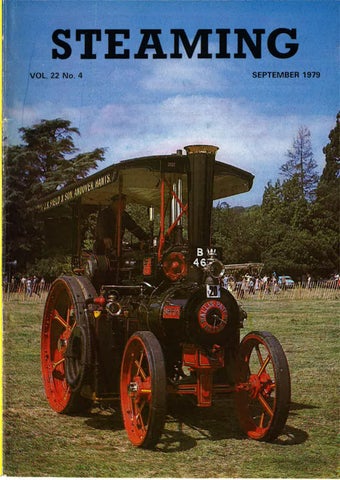
STEAMING VOL. 22 No. 4
SEPTEMBER 1979
A.
44'-'14Y1 "
•.-: " i-7•74'"
National Traction Engine Club Officers President & Technical Services: S. J. Wharton, Southern Down, Minster Lovell, Oxford. Vice-Presidents: J. T. Beeby, Wymeswold Road, Remptsone, Loughborough, Leics. Anthony S. Heal, Baylins Farm, Beaconsfield, Bucks. Chairman: P. G. G. Barber, 77 Amyand Park Road, Twickenham, Middlesex, TW1 3HG. Vice-Chairmen: J. Crawley, Field House, Turvey, Bedford, MK43 8DU. Alan Martin, 18 Pavilion Way, Eestcote, Ruislip, Middlesex, HA4 9JN. General Secretary: G. F. Beck, 127 Greensted Road, Loughton, Essex, IG10 3DJ. Treasurer: Mrs. Y. Hanmore, 'Woodcote', Wannock Road, Polegate, East Sussex. Hon. Solicitor: David Tew, M.A., c/o Fowler & Co., Solicitors, 12 High St., Oakham, Leics. LE15 6AW. Chairman, Rally Sub-Committee: P. G. G. Barber, 77 Amyand Park Road, Twickenham, Middlesex, TW1 3HG Public Relations Officers: London, Home Counties & South: Anthony S. Heal, Baylins Farm, Beaconsfield, Bucks. Northern Counties & Scotland: Tony Parker, Foley House, The Grove, Lincoln. Membership Sec.: Mrs. F. E. Wood, 'Windrush', Hail Weston, Huntingdon, Cambs. PE19 4JY. Sales Officer: Alan G. Wilson, 7 Welton Road, Daventry, Northants. NN11 5PP. Insurance Officer: J. S. Hirons, 98 Halley Road, Witney, Oxon. 0X8 5H0. Editorial Staff: Editor: Dick Blenkinsop, The Hill Cottage, Radford Semele, Nr. Leamington Spa, CV31 1UA. Assistant Editors: Ran Hawthorne, 19 Bridle Path, Woodcote, Reading, RG8 OSE, Berkshire. Derek Rayner, "Invicta", Lower Street, Salhouse, Norwich, NR13 6RH. Advertising Manager:
Tony Wood, 22 Larch Grove, Kendal, Cumbria, LA9 6AU.
National Traction Engine Club Membership is open to all, whether engine owners or not, with a genuine interest in the preservation of self-propelled steam road vehicles, portables, etc. The annual subscription is £5 for individuals, £6 for family membership. The benefits of membership include advantageous terms for boiler insurance. The club's journal 'Steaming' is sent free to members in December, March, June and September. All articles, photos for consideration should be sent to the Editor. All correspondence re subscriptions, bankers order, delivery (or non-delivery of 'Steaming' or change of address to: MRS. F. E. WOOD, 'WINDRUSH', HAIL WESTON, HUNTINGDON, CAMBS. PE19 4JY. Please enclose SAE when sending subscriptions or when writing to any officer if a reply is required. Next issue: Copy, photos, etc., should be in Editor's hands by 13th November 1979, earlier if possible. Area News to Derek Rayner by 31st October 1979.
Acknowledgements Area Correspondents, all the Photographers, Tom McTaggart, David Tew, Wilf Cole, Viv Kirk, Derek Rayner, Derek Hattam.
194
STEAMING THE JOURNAL OF THE NATIONAL TRACTION ENGINE CLUB Vol. 22 No. 4
OCTOBER 1979
CONTENTS Page 195-196 Editorial and Club Announcements Page 197 John Fowler Works Memorial Ceremony Page 198-201 The Flagman, by T. McTaggart Page 202-203 The Law Relating to Smoke and Noise, by David Tew Page 203-207 Reminiscences of a Yorkshire Steam Haulier, by Wilf Cole Pages 208-211 Furniture Bumping, by Viv Kirk Page 212 Technical Section. V.P.1, by Derek Rayner Page 212-213 "The Old Lady", by Brian Denny Page 214-215 Photo Feature compiled by Derek Rayner Page 216-219 Profiteering from Steam — A Myth Shattered, by Derek Hattam Pages 220-221 Gastown Steam Clock. Courtesy of the Vancouver Public Library and the Institution of Mechanical Engineers Page 222-227 Early N.E.R. Steam Lorries, by Derek Rayner Page 229-249 Area Notes, compiled by Derek Rayner Page 250-252 International Section, compiled by Derek Rayner Page 253-255 Letters to the Editor, New Members and Small Advertisements
All items are held copyright by contributor and/or N.T.E.C.
EDITORIAL OLD VEHICLE BLAMED FOR 21 FIRES was a Headline in the Daily Telegraph at the beginning of August. With the usual Journalistic licence "Traction Engine belching smoke and flames" we read further as the Police thought the fires caused a break in the electricity supply to a nearby village and how the vehicle was finally traced. You can read more about it in Area Notes but the moral must be clear — on the road Sparks are a real hazard, be they setting fire to roadsides or thatched cottages, so Arrestors should be fitted at all times and Insurance Companies will be totally unsympathetic to Engine Owners who do not have such a device in the Chimney. It reminds me of the occasion when a Sentinel driver, well known in the Preservation World, set fire to the lovely summer dress of a young lady who was travelling ii; an open sports car following just behind the Waggon. In this issue is a picture of an Engine still in Commercial use and still carrying out the job for which it was built in 1928. Steaming would like to compile a list of any steam vehicles in this category which may be in your Area. Please send us details. Although the September Issue should be with you early in October we are running late due to Printing Difficulties and late running of the postal services over which we have no control.
FRONT COVER From a transparency by David Milton showing the Wallis & Steevens Steam Motor Tractor 'Surprise', owned by Jack Field and on the rally field at 'Bristol Steam' in 1978. 195
FROM THE CHAIRMAN At the Annual General Meeting of the Club, I was honoured to be elected as Chairman of the Club in succession to Michael Lane, who has retired to enable him to give full attention to his duties as Director of the Snowdon Mountain Railway. We owe Michael a great debt for his services to the Club and wish him every success in his new appointment. During my period as Chairman, I would wish to concentrate on three main objectives. Firstly, and of prime importance, is the need to ensure the continued preservation of our engines. Engine owners are facing very large increases in running and maintenance costs and major overhauls and rebuilds are now beyond the means of many private individuals. The Club must seek ways of increasing funds available to engine owners so that the stock engines in active use does not decline. Surprisingly, a large proportion of engine owners are not members of the Club and we must seek their co-operation and support by demonstrating the benefits of membership in more positive ways than in the past. 0
London Area Social Meetings 1979-80 Season These are "Noggin-and-Natter" meetings with a slide or similar show with a traction engine, steam or other preservation theme. Times are 8 p.m. to 10 p.m. and meetings are held on the last Tuesday of each month. (Note: This season we are meeting on the last TUESDAY in each month.) Venue: "The Cock Tavern" (upstairs 0
N.T.E.C. Silver Jubilee Lecture We had intended to publish Part 2 of "Some thoughts on the bi-centenary of Richard Garrett of Leiston 1778-1978" by 0
Photographs There seems to be a misunderstanding where contributors of Photographs believe that any Prints sent to the Editor cannot be returned. This is not so and we have an interesting collection for future use all of which will be returned in due course. If 196
Secondly, as a Chairman of the Rally Sub Committee for many years I would wish to see the continuance and improvement of the Rally Safety Schemes and of the co-operation and understanding that has been built up between the Rally Organisers and the Club. Thirdly, we must improve communication between the ordinary member of the Club and the various Committees so that all members can know of the projects and problems facing the movement and the actions that are being taken on their behalf. At the present time, the Executive Committee are considering the possibility of employing professional assistance in some aspects of running the Club's affairs which are now almost beyond the scope of volunteer officers, but before any such decision is taken the whole membership will have the opportunity to discuss any proposals at an Extraordinary General Meeting which will be called for the purpose. Finally, we must actively encourage the development of our new Steam Apprentices section so as to ensure a future supply of keen and experienced younger drivers. PETER BARBER 0 room), Great Portland Street, London, W1 (about 200 yards from Oxford Circus, London Transport Station). Tuesday, 30th October. Members' slides. Please bring yours along — not more than 20 a member. Tuesday, 27th November. The Enfield Veteran Society enterains. Details of 1980 programme in next issue of Steaming, but we shall meet on the last Tuesday of January, February, March and April. 0 Mr. R. A. Whitehead in this issue, but due to production problems it will now appear in the December number. Our apologies to the Author and readers awaiting the final part of this fascinating story. 0 used they do of course have to go to the Printers for block making and are then returned a few months later. We have not lost one yet and any member who wishes for the return of a particular print has only to write a letter. While on this subject if you have a print you would like to see in Your Magazine why not send it along?
JOHN FOWLER WORKS MEMORIAL CEREMONY LEFT: Len Crane's Fowler Crane Engine No. 17212 with the Lord Mayor of Leeds, Councillor Mrs. C. Thomas on the footplate, performing the unveiling of the Memorial at Hunslet, Leeds, on Saturday, August 25th 1979.
BELOW: Close up of the Memorial showing the details of the stainless steel plaques. The stone blocks were cut from the original gateway into John Fowlers Works from Leathley Road. Photos: L&DTEC Further details of the event and the Road Run will appear in the next issue.
(.4
On this site stood the STEAM PLOUGH WORKS
of JOHN FOWLER ;`;:,° Steam & Agricultural Engineers
1861-1974 .r
.
:el
4.1 4410
TM* Num, was snood by
THE UM ONITRICT TRACTION MOINE CWO
443
Oaaadone Nan lalkushata Ihrounnonut Redd Mb lannadad by the Lon: Illsfor eh Loads CadaiNdSt Ws, CNRI{RNE TROVIAS • 20111 AuP114
ti 197
N.T.E.C. SALES BOOKS
Overseas U.K. only & Non M'bers M'bers Price
NEW Building the Allchin - W. J. Hughes NEW Kaleidoscope of Steam Wagons - R. Whitehead NEW Steam on the Road - A. Beamount Fairground Steam - A. Beaumont Traction Engines & Steam Vehicles in Pictures - A. Beaumont Foden Story - P. Kennet Scale Model Traction Engine Building 'MINNIE' - L. Mason Steam Traction Engines, Wagons & Rollers - B. Johnson Steam Power in Agriculture - M. Williams Encyclopaedia of American Steam Engines - J. Nobeck Traction Engine Register Steam Road Vehicles (NTEC Reprint) - J. Meyrick-Jones Old Farm Tools & Machinery - P. Blandford Garrett 200 - R. Whitehead Steam in the Village - R. Whitehead Historic Fairground Scenes - M. Ware Traction Engine Miscellany - R. H. Clark The Overtype Steam Wagon - M. A. Kely The Undertype Steam Wagon - M. A. Kelly Garretts of Leiston - R. Whitehead Savages of Kings Lynn - D. Braithwaite The Steam Scene Vol 1 - R. J. Blenkinsop The Steam Scene Vol 2 - R. J. Blenkinsop The Steam Scene Vol - R. J. Blenkinsop The Steam Scene Vol 4 - R. J. Blenkinsop The Steam Scene Vol 5 - R. J. Blenkinsop Steaming Binder Car Badge
7.25 6.25 4.50 1.50 4.75 7.75 4.30 3.90 3.90 13.00 1.00 5.25 4.75 10.55 5.25 5.75 10.50 4.30 13.00 3.30 3.30 4.50 4.50 4.60 4.50 5.50 2.30
6.95 5.95 4.25 1.25 4.50 7.50 3.95 3.75 3.75 12.50 .90 4.95 4.50 10.00 4.95 5.50 10.00 4.00 12.50 3.00 2.95 3.95 3.95 3.95 3.95 4.95 1.95 2.50
6.00 6.20 5.70 5.50 5.60 6.30 6.30 6.30 6.50 5.80 10.50
5.80 6.00 5.50 5.20 5.30 6.00 6.00 6.00 6.20 5.50 10.00
WHITE METAL KITS (4mm scale approx) NEW Burrell Showmans Road Locomotive Fowler Showmans Road Locomotive Burrell Road Locomotive Foden 'D' Type Tractor Foden 'C' Type Tipper Foden 'K' Type Tipper six wheeler Foden 'K' Type Low-sided Wagon six wheeler Foden 'K' Type Special GWR Winch Tractor six wheeler Fowler Road Locomotive Single Ploughing Engine Pair of Ploughing Engines 1979 CHRISTMAS OFFER! All orders for two or more model kits received before 31st December 1979, £1.00 off price of two. Non Members Price includes postage and packing. Members please enclose current Membership Card to claim Post Free price. Cheques and Postal Orders only, made payable to National Traction Engine Club. Orders to: A. G. Wilson, NTEC, National Sales Officer, 7 Welton Road, Daventry, Northants, NN11 5PP 198
THE FLAGMAN by T. McTaggart
The heavy road locomotive as seen in the eyes of the flagman is entirely different to that of the passer-by, who sees the romantic travellers of the countryside mounted on an engine having time to look around. The flagman or statutory attendant as designated by the Road Traffic Act of 1933 was required to operate trailer brakes and assist in other work as required. On applying for employment, the applicant was informed that he must be willing to go anywhere at anytime at a minute's notice. Having started, the greenhorn was taught how to couple up without loosing a pair of fingers. Single bars were used instead of a V-bar, the bars weighing up to 2 cwts each, and were U-shaped at the trailer to a single eye at the other end. The engine rear coupling being of three or five pin holes, the hole on each side of the centre being used by each bar. This allowed a certain amount of drift on corners, and increased the safety margin with two pins hauling the trailer, not one, as on a V-bar when safety chains were required. When coupling to the front of an engine with double bars, a triangular double plate with a pin hole at each corner was used. The single corner being coupled to the single front coupling, and the double section holding the bar pins at each corner. This plate was aptly named "the butterfly". Also hanging behind the tender was a large hook with three large links attached, the links being about eight inches long by four inches wide. This was used where the trailer would not negotiate a tight bend on narrow road. The hook was placed through the eye of the uncoupled bar, and the appropriate link pinned to the engine coupling ,allowing the trailer to run wide round the bend. When the turn was complete the hook was removed and the bar coupled up again. Two wooden "scotches" hung on the rear of the engine, one on each side and close at hand in case of an emergency. The scotches had a light chain passed from one side to the other which was used for
carrying them, but when in use the chain was placed underneath the flat side to prevent it slipping or kicking out under pressure.
Also on the rear of the tender hung a wood woven basket strong enough to carry a hundred-weight of coal. When coaling up, the steerer lifted the filled basket on to the flagman's head and he carried it to the engine where the driver lifted it into the tender. This was easy on a dry day, but on a wet or snowy day dirty water ran down the flagman's neck! Water in some cases had to be procured out of a hat. A dry stream could knock a driver's plans out easily, but this
did not happen very often in Scotland, particularly in the West where the rainfall is fairly high. Great care had to be taken when lifting water out of the streams on the coast, to ensure that the tide was out as salt water is excellent for corroding boiler tubes. The engine carried a lifting hose connected to the steam injector for lifting water from streams, and a standpipe with key was provided for drawing water from street hydrants. For the latter privilege it cost £1 per annum to the local water authority for the use of their water. Hurricane lamps were carried mainly for parking on the public highway although occasionally the engines had to move after dark. Shackles, wire slings and wire lashings for tying on loads all adorned the tender. Old dirty raincoats hid them from public view, the raincoats being mainly used by the flagman for changing if it was a wet day. Yes, the flagman's view of an engine was different to the romantic view from the roadside! The flagman, standing on the steel beam of the trailer, had to watch for bushes and overhanging branches which were liable to knock him off the trailer, and when using the offside brake, vehicles passed within an inch of his hand. For the first three months the driver never spoke directly to the flagman; all instructions came to him through the steerer. If the flagman lasted his probationary period and looked as if the would be a good man, the driver would then address him direct. With the older trailers running on brass bushes, lubrication was by oil cup, between the spokes of the wheel. Twelve miles was the maxi199
'Simplicity' and 'Supreme' with a Malayan locomotive of approximately 80 tons. Tom McTaggart walking along beside the trailer in Glasgow, the year 1946. Photo: Road Engines & Kerr (Haulage) Ltd. mum between oiling, and the complete operation took about half and hour. As the reader may guess, It was nearly Impossible to get two wheels in the right position at the same time, which sometimes meant about eight shunts. Once the flagman was trusted to do the oiling properly, the steerer could use the time to light his pipe. Depending on how the wind blew the rain under the canopy, the steerer was sometimes wet or sometimes dry, but the flagman was never dry. Even during a meal break, with the driver and steerer on the footplate he had to shelter against the boiler side, whilst eating his cheese sandwiches and drinking hot oily tea with a cinder flavour; his body roasted and legs almost frozen by the wind coming under the boiler. The usual view that the flagman got of the engine was from the rear, except when holding up traffic or cleaning the engine down. For cleaning, Brasso and cotton waste were supplied, but the rest of the items apart from coal and oil had to be acquired from engineering shops and shipyards. Moving boilers, tanks and ships engines were usually a straight forward job, but odd castings such as rudders and sternframes, 200
where they had to be loaded at an angle were not. Sternframes were from 14 feet, to 32 feet wide, depending what tonnage of ship they were for. Timbers 20 feet long by 12 inches were built up on the nearside of the trailer, with two alongside each other on the platform of a flat trailer, then one placed on top, split between the two. Two 14 feel by 12 inch square pieces were angled from the nearside to the offside, one at the front and one at the rear. If this was not enough of an angle, other 12 inch square blocks were used under the cross beams. The frame was slung by a rigger to the correct angle as the crane held it in position until it was lashed to the trailer as it only leaned on the timbers. Being about one foot from the road on the offside, and about 12 feet high on the nearside, the flagman's job was to guide the engine and load around stationary vehicles, tramcars etc., and he was lucky to get a five minute seat on the rear coupling. On some routes, with the trams running within seven feet of the pavement the flagman travelled ahead of the load stopping the oncoming traffic at wide sections of the road. This was of course before police escorts were provided. When the single line trams ran from Dalmuir to Dunbarton,
the flagman travelled on the tram until they met the oncoming tram at a loop line, and held it there until the engine caught up. Along with the slings and shackles were two snatch blocks. They were single reeve pulley blocks, with one side of the block hinged to allow the winch wire to be placed on the block without reeving the eye of the wire through the block. Snatch blocks could be used for winching around corners, or one at the foot of an erecting pole and the other at the top, for lifting a load. Steel chimneys were erected in this manner. The road locomotive was lined up to the pole and scotched with 12 inch blocks. If the load was fairly heavy, the loco was scotched up straight on to the object to be winched, this giving a greater anchorage. The locking pins were then withdrawn from the roadwheels allowing the winch barrel to rotate on the axle, driven by the compensating gear or differential, as it is known now. The wire was attached to the snatch block or blocks as required, sometimes the blocks were used as a return block with the rope end being anchored on the engine coupling. Steel plates were carried in the coal wagon for plating the trailer wheels over 0
the soft parts of back roads. The plates were three feet in diameter, and being circular, they could easily be rolled by one man, their weight was about one hundredweight. Travelling by traction engine had its drawbacks when on a long journey. It was not too bad when a living van was taken along then the flagman might have to cook, along with his other duties. Without a van, the space available to stow hand luggage was nil. Soap, towel and shaving gear was about the total carried — a tramp carried more and probably looked cleaner. As the flagman progressed, more responsible jobs came his way. If he was first in at 7.0 a.m., he was expected to knock the piece of tin off the chimney top, then open the throttle to blow the fire up, touching the 'monkey' to inject steam into both cylinders, if the crank would not turn in the first instance; remembering to open the draincocks to alto* the water to drain off and not be drawn into the smokebox. Then it was "Come up and steer", so as to give the steerer the time for a smoke. The flagman had made it — he was an engineman! 0
FROM THE ALAN MARTIN COLLECTION OF PHOTOGRAPHS No. 6
Norfolk C.C.'s single cylinder 10 ton A. & P. Roller No. 2757 of 1890, during a lull in its duties for the photographer's benefit, during a cold wet winter prior to the 1st World War. The roller was purchased by The Eddison Steam Rolling Co. in November 1923 and was finally scrapped c.1949. Photo: c.1910 201
THE LAW RELATING TO SMOKE AND NOISE by David Tew
SMOKE The Locomotive Act, 1861, s. 8 laid down that steam road vehicles should "be constructed on the principle of consuming, and so as to consume, their own smoke". I am not sure what this principle may have been and possibly the Victorians were not sure either, as the law was modified by the Highways and Locomotives (Amendment) Act, 1878, and the equivalent Scottish Act of the same year, which provided that users of steam road vehicles not constructed on the principle of consuming or not consuming their own smoke so far as practicable should be finod a sum not exceeding £5—a pretty hefty sum in those days. However, as far as I can discover the only current legislation on the subject affecting steam vehicles is contained in three Regulations of the Motor Vehicles (Construction and Use) Regulations, 1978 which came into operation on 30th August, 1978. In general "motor vehicles" includes steam vehicles. 202
Regulation 33 provides that "Every motor vehicle shall be so constructed that no avoidable smoke or visible vapour is emitted therefrom". Regulation 38 provides that every motor vehicle using solid fuel shall be fitted (a) with an efficient apparatus for the purpose of preventing the emission of sparks or grit and (b) with a tray or shield to prevent ashes and cinders from falling on the road. Finally, as to the use of steam vehicles on the road, the position is the same for all self propelled vehicles, as Regulation 109 says: "No person shall use or permit to be used on a road any motor vehicle from which any smoke visible vapour grit sparks ashes cinders or oily substance is emitted if the emission thereof causes or is likely to cause damage to any property or injury to any person who is actually at the time or who reasonably may be expected on the road, or is likely to cause danger to any such person as aforesaid". The Clean Air Acts of 1956 and 1968 provide for setting up smoke control areas but the wording of tho Acts suggest that they are intended to apply to buildings rather than to movable objects. Presumably under common law it would be possible for the owner of a steam vehicle emitting excessive smoke to be prosecuted for causing a common nuisance but I have not been able to trace any recent case of this sort and one would think that it would be much easier for the authorities to proceed under Regulation 109 if they wished to prosecute someone. NOISE The law relating to noise emitted by motor vehicles including steam driven vehicles is contained in the Motor Vehicles (Construction and Use) Regulations, 1978 which came into operation on 30th August, 1978. Regulation 114 provides that: "No person shall use or cause or permit to be used on a road any road vehicle or trailer which causes any excessive noise". There are however two good defences to a charge under this regulation which are (A) that the noise was due to an accidental or temporary cause and
could not have been prevented by due diligence or care and (B) in the case of proceedings against the driver of such a vehicle who is not himself the owner, that the noise was due to a design or construction defect or negligence in maintenance and could not have been prevented by due diligence and care on the part of the driver. Regulation 115 provides that no motor vehicle shall be used on a road in such a way as to cause any excessive noise which could have been avoided by the exercise of reasonable care on the part of the driver. Regulation 116 provides that no vehicle shall be used on the road which emits noise greater than a certain number of decibels when measured by a measuring apparatus. However, this does not apply to any vehicle first used before 1st January, 1931 or which is a trailer, nor does it apply to any road roller. If any steam vehicle is affected by this regulation the limits are set down in Schedule 9 of the Regulations. For most large vehicles the maximum noise permitted is 92 decibles. Any owner who is uncertain as to whether he may be affected by the Regulation may note that the most stringent requirement is 87 decibels in the case of modern 4-wheeled passenger vehicles.
0
0
REMINISCENCES OF A YORKSHIRE STEAM HAULIER (Continued from P.18 Vol. 22 No. 1)
by Wilf Cole As mentioned in my previous article, our firm, the Central Haulage & Motor Co., Leeds, had got our Foden Diesel wagon back from Messrs. Fodens after having a new cab fitted and the engine overhauled. We decided to put it on the opencast coal job to assist our steamers which were still doing well and we pushed our daily figures for the tonnage hauled from sites up to 183 tons 18 cwt., which was a record for us. We carried on for a few months like this and then had a nasty set back. Our telephone rang one morning and it was the driver who drove the DG4 Sentinel, ex Kings of Glasgow (this was No. 8259/GE9218). He had been tipping a load into a railway truck at Patrick Green Sidings between Leeds and Wakefield and the back wheels had mounted a small retaining wall which was
only about five inches high and acted as a block. Something then happened which should not have, as the back wheels dropped off the wrong way and the rear half of the waggon went into the truck. Since this was about three feet below the level of the roadway, it caused the waggon to be leaning backwards at an angle of about forty-five degrees. The front wheels remained on the road and of course the waggon was loaded with about eight tons of coal. We consequently loaded our Jowett car and trailer, which was standing in the yard, with timber, jacks and everything else which we thought we should need and we set off for Patrick Green to get the waggon out. I suppose it would be about 11 a.m. when we got there and we sized the job up. Frankly it was a mess. The middle of the chassis had 203
dropped onto the wall at the driver's side and had bent up about six inches in between the axles. The crank case and gear case were broken, the back axle had come out of the spring brackets and in addition to all this, it was hanging on the driving chains. Fortunately, the one thing that had happened with the boiler up in the air as it was, was that the fusible plug remained intact. We therefore decided that we would try and get it out of the truck without using a crane, so as not to cause any more damage. I should add that there were other lorries using the siding and we were holding the job up for them. However, they moved the other trucks up a bit so the others could continue to tip into them while we struggled with our problem. We started on the job—there were four of us—the driver and mate of the waggon, myself and the Ministry of Fuel and Power man who was supervising the loading of the trucks. We got into the truck and we managed to push the jacks under the back axle and by careful wheedling, to get the springs back into their brackets. We then continued jacking up until we could get some timber under the back wheels, putting this timber on top of the coal which had fallen into the truck. We gradually got it up three or four inches at a time until it was about eleven degrees from being level. I thought then,
right, we Will have a go and try to drag it out from this position. I contacted my brother Jack who was driving the Foden diesel on the same job and told him to put a small load on it, about five or six tons, just sufficient for driving adhesion on his back wheels, and then to come and give us a pull. We fortunately had a good strong towing chain and hooked it on. The steam waggon driver got on the seat and I told Jack to give her all he'd got. This he did and she dropped heavily onto her front wheels and out she came. We had commenced operations just after 11 o'clock in tho morning and had it on the road by about 1.30 p.m. and during this time the Ministry of Fuel and Power man never got out of the truck and helped us all the time, for which we were very grateful. The next job was to get it home to the garage which we did by about 5.0 p.m. It had to be towed, of course, as the engine could not run since it was a complete writeoff. With the work position as it was then, we obviously had to get it fixed up again and we naturally wanted to do this as soon as possible. Luckily we knew where there was a secondhand D.G. engine and gearbox all complete except for the cylinders which had been taken off. This was the one which we had advised Messrs. Concrete of Stourton, Leeds (Bison Floors), to buy from
Super Sentinel No. 7012 (TN 5876) on trade plates and presumably taken when new to John Baxter & Co. (NC) Ltd. on the quayside at Newcastle in 1927. It was from this firm that the DB4 engine came to repair Cole's waggon mentioned in the article. Photo: D. B. Stoyel 204
Leopold Watford Transport Ltd. No. 13 of Ardwick, Manchester. Super Sentinel No. 6329 (NE 4772). Later owned by J. Stirk & Sons Ltd., Halifax, Yorks. This waggon may have been involved in the controversy surrounding identity of the waggon bought and sold Photo: A. Brook Collection by Cole's. Messrs. Baxters of Newcastle after they had a breakdown with their D.G. engine. They had only used the cylinders and perhaps also the gland packing boxes so the remainder was standing at their place, only about four miles from Leeds. It had all the parts which we required so we went down and saw their Plant Manager whom we knew very well and talked nicely to him. We explained our position and he said right— leave it to me. We said we would make a reasonable offer for it and a few days later we contacted him and he told us it was all right, we could have it if we would collect it. This we did and took it back to the garage for stripping and rebuilding. We then started on the repair of the waggon. The first thing I thought of was to straighten the chassis, so we studied how to do this and came to the conclusion that the best way was to get it red hot at the point where it was bent and then try and straighten it. On top of the chassis was the tipping body which was hydraulically operated and since we did not want to start pulling things from together, we decided to fix up a temporary hearth under the chassis where it was bent. We built this up with bricks and put some steam wagon firebars underneath for air to get through. We got a good fire
going with some welsh coal which we piled up to near the bottom flange of the chassis. This set-up worked like a charm. Before lighting the fire, we fixed a piece of strong chain to each extremity of the chassis where it was bent and let it go over the tipping body chassis where we bolted the ends to it, so as to take the thrust of the jacks which we were going to place over the main chassis and under the tipping chassis. These, of course, had to be fixed up on a slope so that the jacks would not slip under load. The main chassis size would be about 7" deep and about i" thick. The idea was that the one which was red hot would bend first, which it did. It took us a good hour to heat it up and a good hour's work then to get the jacks working with the pressure on. It was an education to see how the chassis straightened and we did not use a hammer at all. We got it straight such that it could not be seen where it had been bent at all and we reckoned we had saved a lot of work —and expense—by that method. That left us such that we had a straight gate to go through with the engine. Of course we had had a lot of experience with these engines before and knew exactly how to go about it. We gave the fresh engine and gear box a 205
good examination and could not find much wrong with it. The main thing which I did find was that the crank shaft main bearings were worn. These were the parallel roller type. I found I could get a twelve thou. feeler gauge between the outer race and the rollers, a sure sign that the engine had done some hard work up in the North Country. We had to make this right so I got a set of now bearings and fitted them. Nothing is more likely to break a Sentinel crankshaft than the bearings having all that lift. All the other bearings, big ends, etc., seemed alright, so we timed the engine and put it together, ready tor installation. We put IT up and fastened it on the chassis, fixed all the pipes on and fitted our own cylinders from the old engine which were alright. We then prepared it for a road test, took it out and found it ran very well. It was then ready for work again and it had taken us about six weeks to do all this work. It was put back on the opencast coal job again, with the same driver as before. On September 22nd, 1942, we again broke our record of tonnage shifted as we hauled 190 tons 10 cwt. from various sites to various sidings in the area and again, the following day, we topped the two hundred mark for the first time, hauling 206 tons. 7 cwts. The steam wagons were doing most of this work which carried on all through the war and we continued moving more or less the same quantities daily. In late 1943, we purchased a ten-ton Foden Diesel six-wheel tipper as we had a demand to haul coal to power stations and similar places. This wagon only had one driving axle at the back but nevertheless was quite good and on occasions could go down into the site and get loaded. It was very economical with a four-cylinder Gardener engine in it. We normally loaded it under the loading drops near the sites. It was kept very busy as we were running daily with it to such places as Leeds Electricity Works, Bradford Electricity Works and we were taking approximately 10 tons per day to Avro Aeroplane Works at Yeadon, where the four-engined bombers were being made. This work again continued almost to the end of the War, so it will be seen that our efforts to help in winning the War were by no means small. To carry on with the Steam Wagons, as stated, we put the D.G.4 back on the coal job again. It had been on it for a few months and one day we had occasion to take opencast coal from Templenewsam site to Leeds Fireclay Co.'s sidings at Fernley near Leeds. The D.G.4 was put on this job 206
and Len and I took the Garrett 4-wheeler (No. 35250/RT5313), Len driving and me the mate. I think we were a bit short of man power that day which is why I had to get on it. It made a change for me as I didn't usually get out on the wagons at that time. We had tipped our loads at Farnley and were on our way back in the early afternoon to Templenewsam to get loaded up again. We had to come through the centre of Leeds and the D,G. was about 200 yards in front of us. We lost it for a moment in the traffic and when we were approaching the bottom of Briggate I noticed that there was a wagon on the road in front of us with a wheel off. I told Len about it and when we got up to it we found, to our surprise, that it was our D.G.4. It was down on the road right in the middle of the road crossing at the corner of Briggate and Swinegate, blocking the tram lines, and I reckon that this is the second busiest crossing in Leeds. However, there was room for ordinary traffic to get round so our thoughts were to get it clear of the main road as soon as possible to allow the trams a clear run through. Fortunately we had a good strong towing chain in the Garrett and we hooked it on the front of the Sentinel which we pulled on to the bottom of Call Lane where it was wide and where we could get to work at the wagon. This operation did not take us any more than ten minutes and we were fortunately clear of the main road before the Police arrived and started asking embarrassing questions. We ascertained that the front stub axle at the near side had broken. I think it must have been due to the previous incident at Patrick Green Sidings and the force with which it bounced down when we dragged it out of the railway truck. The screwed end of the axle, where the large castle nut which holds the wheel casting on to the tapered end of the axle, had broken off, so the next job was to get the stub axle off. To do this, we had to put a jack under the axle beam. I knew that we had a spare stub axle at home in the garage, so I made a dash home for it and collected the Jowett car at the same time. What a worker this was during the War. I got the stub axle down to the waggon fairly quickly and unfortunately found that it was a bit too long and was coming through the tapered hole by about an eighth of an inch. I was glad I had brought the Jowett back with me as I was then able to run down to the Millwrights who did our machining work for us and ask them to turn about 3/16" off the axle end, so as the wheel casting would tighten up
onto the taper. Time was now getting on, it being then about 4 o'clock and we wanted to get the waggon fixed up and home before dark. I therefore asked him if I could pick it up about 6 p.m. He said that would be O.K. so I duly picked it up at the agreed time, got it to the waggon and Len and I fitted it on. We then got some steam up and drove it back to our yard before dark. The D.G.4 driver and his mate had previously taken the Garrett which we had been driving. What a day I had to pick to have a day out. It certainly made a change! The waggon went out the next day and fortunately it was alright after that little interlude. It went back on the coal job and carried on until the next time we had a bit of fun with it, but an account of this must be left over until the next instalment. Before I conclude this episode, I should mention here that we started working direct for the Ministry of War Transport who took over the haulage of opencast coal from the sites on
May 1st, 1944, and we carried on with them until November 1st, 1945. (To be continued.) (Editor's Note—Further to the comments in Vol. 22, No. 1, p. 16 regarding the Super Sentinel which Cole's bought in a scrap condition from a man in Leeds and later sold to James Grains in London; Wilf Cole's brother Jack recalls that painted on the side of this wagon in a very faded condition was the name of a Halifax firm. According to Joe Thomas's article in Vol. 21, No. 2, Sentinel No. 6329 (NE 4772) was owned for a time by John Stirk & Sons Ltd., Halifax and it thus seems that this could have been the waggon which was involved. James No. 65 was originally reported, according to Alan Duke, as having plate No. 6329 but was later given as No. 6327. Can the experts say therefore whether No.6329 could have come into James Grain's ownership via Cole's as this would then solve the mystery).
Sentinel DG4's at Hipperholme, Halifax in June 1965. No. 8606 on left was new in October 1931 and is now owned by Barrie Taylor of Leeds. No. 8009 on right has the registration taken from No. 8825 (YD 7509) and was used by Cole's firm, Central Haulage & Motor Co., in 1941. 8009 was owned by Dr. Fursdon, Huddersfield since 1971 and has been recently sold to Mr. B. Dunford of Flockton. 207
FURNITURE BUMPING by Viv Kirk
INTRODUCTION Most people have a favourite period or year, my own being the 1920's — a truly wonderful period when steam road vehicles were at their peak of everyday use, where one would see all their varieties about daily in the streets of the cities, towns and in the countryside. Now. alas, you only have happy memories, being reminded of those now far off days when you are walking along a road or street where H. Tuckwells Foden steam wagons used to travel daily going about their work, or buildings that have not' changed much where you remember a Foden wagon driver had stopped to unload, or the Corporation Steam Rollers working amongst the City Streets. The wonderful times at the end of the summer — the arrival in Oxford of the magnificent Showman 's engines with their machine loads a few days previous to St. Giles Fair, the never to be forgotten St. Giles Fair itself. In the visits to the early rally fields the spectators used to he made up of so many old traction engine drivers, mostly in their 60's — now alas unfortunately, that has dwindled down to but a few, now in their 80's. I have felt for a long time what great stories these old drivers could tell, amongst these my old friend the late Blossom Trinder. I suggested to Blossom ten years ago he should let me write down some of his stories I had heard 'over the years, he at the time did not seem bothered. At that time I always saw him at the weekends when we had my engines in steam or winter time down at the Botley hostelry the Seacourt Inn, most Saturday nights. Blossom promised to tell me again the story which was one of my favourites of their trip during 1920 to the London area with Curtis's Burrell No. 3393 and three wagon loads of furniture. The Saturday evening I called at his home to write these details down, Blossom was not feeling very well saying "Would you do me a favour?" "Of course, I would Blossom". He said, "Would you take the lawn mower and mow the grass in the front garden, it won't take 208
you long. I will have the story ready when you have finished". This I did and took down Blossom's story where they had loaded up the furniture vans they were taking to Sydenham, also why did they g❑ Aylesbury, St. Albans way for London — this last query I should think on account of the amount of hills going High Wycombe, Stokenchurch Hill way — Aylesbury road being more level, they would make better time. During the early 1960s I went to St. Albans to look at a Garrett Showman's tractor that was for sale at a dealer's yard. Blossom accompanied me, going by bus. Quite by coincidence we travelled along the same route old Blossom and George Ellis travelled with the Burrell during those far off days of the 1920's. I am sure Blossom for a moment was back there, for on the return journey between St. Albans and Aylesbury going down a steep hill Blossom said, "We used to go down this hill with three loads behind the Burrell, flywheel brake and rear wheel brakes hard on and George Ellis with both hands on the reverse lever and one of his feet bracing against the second motion shaft bracket to get more support, just about holding her". A unique era of transport history as I mentioned previously — where else but in Britain could it have happened as part of the day to day work of men like Blossom and George Ellis.
BLOSSOM'S STORY Furniture bumping used to come our way quite a lot during the early 1920's, all this work being done by our Burrell 7 hp No. 3393 new 1912. We always used to refer to this engine as 'our' Burrell which was owned by our boss J. Curtis & Sons, Botley, Oxford, for whom I started work in 1912 and a few years later learnt to drive a Tasker gear drive tractor. Following four years service in France during the 1914-18 war, I started back to work for J. Curtis early in 1919, more or less where
Driver G. Ellis Timber Hauling near Minster Lovell with Burrell NQ. 3393, Reg. No. BL 1263, new in 1912 and belonging to J. Curtis & Sons. Photograph taken in 1920. I had left off to go into the army, steering on our big Burrell, and at times acting as driver or mate on the Tasker. I had days out thrashing on a Wallis & Steevens, and sometimes working in the yard helping the blacksmith on such work as restraking the engine wheels or shutting forging by sledge hammer I by now being quite good at this work, keeping time with the hammer and in turn with my mate. At the time of this story in the early part of the 1920's we had a lot of furniture removal jobs, amongst these being University Professors and other well off people retiring to Bournemouth or moving to other parts of the country. These households taking three pantechnicon trucks behind the Burrell and strange as it may seem, some of the heaviest loads were of professors' libraries of books — when you had a load of these amongst the furniture, you knew you had got them. One Friday evening early in 1920 found us, the Burrell, and three trucks already loaded early in the day, with a complete household of furniture pulled in on the road at the front of the Curtis yard at Botley — the Burrell with her tanks filled by lift pipe from the roadside stream, coal loaded on to one of the pan-
technicon trucks, fire banked down all ready for an early start at 4.0 a.m. in the morning for Sydenham on the other side of London. The driver of the Burrell on this occasion was Newt Lightfoot, who was by trade one of Curtis' blacksmiths, and used to act as a relief driver when George Ellis the Burrell's regular driver was laid up. I was to be steersman. The three pantechnicon trucks behind the Burrell were owned by Saunders & Co., Removal Contractors, Oxford, who did not have an engine of their own. We used to do all their hauling. All the three trucks were lettered with their name and a detachable board similarly lettered was fitted to the Burrell's canopy side boards. The loading of the furniture was done by Saunders & Co. own packers who always travelled by rail, meeting us at our destination the next day or day after according to the distance we had to travel. We used to help the packers with the loading and unloading of the furniture, also looking after our Burrell, which we used to keep in steam in order to move the trucks when loaded or unloaded. If loading in a city where the house was in a row of terraces, this sometimes meant a lot of shunting about. In country manor type 209
houses there was usually plenty ❑f room with long gravel drives. Some of the worst houses were like the houses in Woodstock Road, Oxford, well set back from the road. In this case, you had to uncouple and push the trucks one at a time as loaded or unloaded on the front drive to within loading distance of the front door. AN EARLY START Leaving Botley well before 4.0 a.m. Friday morning, we were soon passing through the centre of Oxford, our Burrell's steel shod strakes making quite a din, throwing back an echo from the college walls as we passed along the High Street. Some four years after this, Oxford City Council asked all steam haulage firms in the Oxford area, Curtis and John Aliens, etc., to by-pass the High Street using Long Wall Street. This was before the times of the by-pass of the 1930's. Our first stop was at Wheatley to pick up water from a roadside stream, which ran close to the hostelry, The Plough. Just outside Wheatley we left the main London road taking the Thame/Aylesbury Road, which was the route we used to take in those days with the Burrell for the London arca. Thame market square was an overnight stopping place with the Burrell where we could snatch a fow hours sloop, whon on route late in the night for London or on the return journey. There was no chance of lodgings on these occasions, not that I wanted any, I never liked sleeping in a strange bed. We used to settle down on the engine, I sleeping over the Burrell's motion, first making sure the flywheel brake was on and George Ellis used to curl up somehow on the footplate, and nearly always by morning had ended up with his head near the fire hole door. With some sacks and the warmth from the engine, you were, even on the coldest night, as warm as in bed at home. We were only sleeping for about 4 hours on these occasions, nearly always on the move by 4.0 a.m. We rarely got disturbed by the police, although I remember one night after we had pulled onto the market place at Thame and had been asleep a couple of hours, being awakened around about twelve o'clock by a policeman, who thought we would be better off sleeping in an old disused hut just behind the houses off the market square. We tried this only to find the place alive with bugs. It appears to have been a frequent place to spend the 210
night for tramps making for Oxford. We soon returned to the engine!! We had been making good progress since leaving Oxford. I rarely remember passing through Thame so early in the day. As I had been on the Burrell with George Ellis up and down this road so often I knew where to pick up water. Newt Lightfoot did not know the road very well, a good driver, but I used to think he would have sooner been back at work at Botley yard, going home to his tea at the finish of the day, instead of miles away, en route for London. I missed old George Ellis who used to suffer with gout. When an attack of this came on, George would say, "Come on Blossom, you have her now, let me get in the steersman's seat for a rest." Old George was a kind natured man, who never swore, even when things went wrong, fond of a drink of beer or whisky, due I think to misfortune earlier in his life. His father had a thrashing business at Newbury, which went bankrupt, due to having a Wallis & Steevens traction engine, which was so heavy on coal that farmers would not employ him. George later lost his wife and young son. Before he worked for John Curtis he drove the big Fowler of Archie Cowley, furniture removers, Park End Street, Oxford. George Ellis, although a very fine driver, would not answer any of my questions. I would at times ask about the engine, he always replying: "You will find out in time, Blossom", which was the case, as I did learn a lot by watching George. This was to stand me in good stead later, when I became the driver of J. Curtis' Foden wagon, and later the chain drive Tasker tractor. After leaving Thame our route was Aylesbury, St. Albans, Barnet, by which time we were getting towards the outskirts of London. We had during the day met quite a few steam wagons — Fodens and Claytons between St. Albans and Barnet, with a mixture of petrol engined vehicles of ' Dennis, Albion on the lighter type haulage work. These lorries and the steam wagons were mostly London based firms, including breweries. Cars about were on the whole Ford T's, with other makes as well. LONDON ARRIVAL After getting into the Barnet area, we encountered a great number of horse drawn vehicles. Water could be a problem as you were not allowed to pick up from the canals and fines were imposed on some streams you could reach with the engine's lift. If you were low, with no water in
the tanks, you had to have it even at the risk of a fine. On these occasions a wary eye had to be kept open for the London policemen, who were mostly Cockney anyway, and were aware of all the tricks — even so would often look the other way, though they must have known we had picked up water by the overspill from the engine's belly tanks. More often than not, they seemed to arrive just after we had filled the tanks and coiled the pipe back on the engine. Many times in the past with George Ellis and the Burrell in the central parts of London we have had to drop the lift into horse troughs, ornamental ponds of the water fountain type, that are or used to be so common around the London of the 1920's, sometimes only managing to fill half the tank before the approach of a policeman. On these occasions old George would say, "Never mind, Blossom, we have got some, we will be alright for at bit". Back to the story of our journey to Sydenham. By the time we had reached the central part of London, we realised we had not enough coal to get us to our destination and the return to Oxford. On our return journey we had to get across London from Sydenham to pick up a load of hospital beds from the American Hospital, Hampstead Road, Highgate, and deliver these to the Radcliffe Infirmary, Woodstock Road, Oxford. With the following day being Saturday, when we would be unloading the furniture all day at Sydenham, we did not want to run short Sunday when we would be on our way across London to Highgate, so kept a look out for a coal yard, which we found off a busy part of the road on which we were travelling. Rather than uncouple the Burrell and cross the road to where the yard was situated, I thought I would borrow the Coalman's hand wheel barrow wheel the coal over to the engine, being young and strong I could easily manage two cwt. at a time on the barrow. The first barrow was alright — with the second, I caught the barrow's thin iron wheel in between the tram lines, tipping the lot over. A few minutes after a tram came along, the driver shouting out with true Cockney humour, "Blimey, that was a quick shoot, mate". We soon had the coal cleared, followed by another barrowful. Newt paid the Coalman — the Boss had given Newt money for such an occasion. Anything costing more than coal, a bill had to be sent in to the Oxford office. After this little mishap with the coal, we
had no further troubles arriving at Sydenham that evening about 4 o'clock, after being on the road some fourteen hours. We found the street and the house where we had to unload the furniture. The house was the type with no front forecourt or drive, being of the large three storey terrace type, leading up some steps straight off the street. With nowhere to pull off the
road for the night with the engine and pantechnicons, we got permission from the police to leave the engine and loads out in the street, provided we lamped off with red storm hurricane lanterns. We always carried these when on long distance haulage work. After we had seen to all this, filled the Burrell's boiler to the top of the glass, damped down for the night, had a wash and a bite to eat, we had a walk along to the nearest hostelry for a couple of pints and talk, afterwards returning to the Burrell where we got down for the night in one of the vans where we had made room for three to sleep. We were up the following morning by six o'clock awaiting the arrival of the packers travelling by rail from Oxford. Relighting the Burrell's fire we would have to keep her in steam all day in order to move the vans, as unloaded. The packers finally arrived about nine o'clock making a late start with the unloading, but by five o'clock that evening we had unloaded all the furniture into the house. We again got permission from the police to leave the engine and vans in the street for the night, and arranged for an early start in the morning for the hospital at Highgate. The packers this time would be travelling with us. We spent the rest of evening the same way as the previous, again calling at the nearby hostelry. We were better off regarding room when we returned from the pub, having three empty trucks for sleeping in. We were up early, having a little to eat while the Burrell was getting up steam, which did not take long, as we found in the garden behind the house plenty of dry wood, which we used to get a good fire going before putting on any coal. By 8.0 a.m. we started off for Highgate, the packers travelling in one of the vans. After travelling some time, reaching the London area near Highgate we found a horse drawn type coffee stall open and pulled in nearby. We all had a cup of tea, and while we were doing this a policeman arrived wanting to know how long we would be stopping, as we were causing an obstruction with the engine and vans.
(To be continued) 211
TECHICAL SECTION V.P.I. Or what cyclohexyl ammonium-N-cyclohexyl carbonate can do for you The above is the chemical name for a substance commercially known as VPI 300 and is one of a range of Vapour Phase Inhibitors marketed by Shell Chemicals U.K. Limited. This particular member appears to be very suitable for the internal protection of steam boilers without the need for drying out. The accepted practice on traction engines seems to be to drain the boiler off while warm, let it dry out, and then leave it to continue to rust. This chemical offers protection from rust through the winter season. VPI's are solid powders of varying but relatively slow volatility which, when placed in enclosed spaces, saturate the surrounding air with their vapour. Steel, in particular, when placed in this environment is coated with an invisible film of VPI. which protects it from further corrosion. The one recommended for use in liaction engines is VPI 300 which is soluable in water and is the most volatile of the range marketed by Shell. i.e. it protects in the presence of water and establishes the protective film rapidly. The film, being water soluble, can he removed by steaming after the storage period. VPI 300 is available in minimum 1kg plastic kegs as a powder or in perforated sachets or in tablet form. Whore rapid protection is required or when inaccessible surfaces require protection, VPI may be dissolved in a volatile solvent such as ethanol (industrial methylated spirit) and applied as a 5 or 10% solution. The dosage required for an internal boiler treatment would be 55g. of VPI 300 per cubic metre or 15g per square metre of sur-
face area to be protected, whichever is the greater value. The method of application would be to suspend sachets from a top stay tube or longitudinal stay to provide an even distribution in the vapour space, or to spray the inside of the boiler with the calculated equivalent of VPI 300 as a solution in meths. The boiler should be well sealed afterwards to prevent loss of protective vapours. VPI's have a moderate oral toxicity and care must be taken in handling. Dust masks and impermeable gloves should be worn and attention paid to personal hygiene. The powders are inflammable, and inhalation of vapours should be avoided as they cause irritation of the mucous membranes. In case of fire use dry powder, carbon dioxide, foam, sand or earth—do not use a jet of water or foam. For further details and prices contact the official Shell re-seller for your area viz. (1) Leonard Stace Ltd. Gloucester Road Cheltenham GL51 8NH Tel. (0242) 54081 (2) Dunn Brothers (M/C) Ltd. Bowlee Mill Heywood Old Road Middleton Manchester M24 4SA Tel, (061) 643-6111 (3) Richard Smith Ltd. 61 Paterson Street Glasgow G5 8LF Tel. (041) 429-7821 (4) James A. Beck & Sons Ltd. 46/50 Sydney Street West Belfast Tel. (0232) 740231/2/3
"THE OLD LADY" by Brian Denny Allchin Steam Roller No. 1131/NH3416 was built at the Globe Works of William AIIchin Ltd. in Northampton in the latter half of 1899. She was bought new by the County Borough of Northampton Highways 212
Department in January 1900. As supplied she was without a canopy, but this was fitted in 1925 by Allchins, She worked almost continuously until 1954, when with the coming of diesel traction, she was put into
store in company with McLaren crane engine 1713/1926/NH3998 now in preservaton in Ireland and converted to a showmans engine. Her sister Allchin No. 1131/1900/ NH3417 formerly Highway No. 2 is preserved locally. To return to 1131 or 'The Old Lady" as she is known, having laid unused for twelve years she was in need of restoration, and in 1966 it was decided by Northampton Borough Council to put her back into working order. On the return to West Bridge Depot she was steam cleaned and retubed, all brass was polished. In June 1971 she appeared in public for the first time in many years at the Northampton Carnival Parade. After steaming to local rallies and shows, the driver became ill and could no longer undertake the work, and she was put into store once again. Early in 1975 Northampton Ironstone Railway Trust at Hunsbury Hill Museum, Northampton came to an agreement with Northampton Borough Council for the loan of the roller, and to maintain her in working order. At this stage the writer became to be assigned to The Old Lady, and restoration was soon begun in August 1976 after the roller arrived at Hunsbury. The boier lagging, etc., had already been removed prior to the move from West Bridge Depot. Owing to a serious leak between the boiler and the cylinder block, the inspector advised that the block be removed, not an easy thing to do without a crane. The method used was to jack up the block after removing all the holding down bolts,
and then sliding it down two railway sleepers. While the cylinder was being overhauled the chance was taken to ultra-sonically test the boiler and firebox for defects. The reports on the condition of the boiler were good, and a start was made on assembling the engine. The first job was to place the cylinder back on the boiler, after making new gaskets and holding down bolts, the old gasket had disintegrated after seventynine years. Putting the cylinder back on the boiler was made easy with the aid of a J.C.B., the motion was cleaned and polished and then coated with grease to protect it from rust during the winter of 1977/78. The spring of 1978 saw the roller ready for the hydraulic test, and it was given a clean bill of health at a working pressure of 100 psi. After the fitting of the lagging cladding, etc., she was tested in steam to the satisfaction of the inspector. With the completion of the rebuilding, she was entered in the Northampton Carnival Parade last year, but not without problems with insurance, but these were resolved thanks to Mrs. Jessup of Tennant Budd Ltd. The Old Lady performed well in the expert hands of Mr. Harry Wooding who will be remembered as the former owner of Aveling Barford roller 14179/1934/BKX861. She will be in steam again from Easter onwards. Also there will be outings to local rallies and shows, where she will be one of the few steam rollers still in original ownership from new.
Al!chin In tons Steam Roller 1131/1899/NH3416 with Mr. Harry Wooding prior to driving to Northampton Carnival, 22nd June 1978. Photo: A. Cooke 213
PHOTO FEATURE
DRIVER WOODLEY'S CHARGES ABOVE: Foreman Mr. Piper stands proudly against the front wheel of Burrell Ploughing Engine No. 776 of 1879 at Brize Norton, Oxon. in 1917. This is one of the pair of unique ploughing engines rescued from the scrapheap and now under restoration by Mr. T. B. Paisley of Holywell, Cambs. This engine, in its derelict state, is pictured in Barry Finch's book 'Rally of Traction Engines'. TOP RIGHT: Fowler BB, 14 hp Ploughing Engine owned by Mr. F. Smith of East Hendred, Berks, in 1918. This type was fitted with two ploughing gears. BELOW RIGHT: Leeds built Green's 10 ton Holler at Bishops Stortford, Herts, in 1920 when owned by the Oxford Steam Plough Co., Cowley, Oxford. Previous to this, the roller had bean with the Forces in France during World War 1. The War Office ordered some 25 Green's Rollers during the War and many of them passed to local Councils and Contractors afterwards, although four went for service in the Middle East, to Palestine and Trans Jordan. Photos: Arthur Woodley 214
215
TENNANT BUDD (LIFE & PENSIONS BROKERS) LTD. are pleased to announce that special arrangements have been made whereby Members of N.T.E.C. can obtain special discounted rates of premium for:(a) PRIVATE HOSPITAL TREATMENT — a plan has been negotiated with the Western Provident Association giving Members the benefit of a 25% discount on the normal subscription rates. (b) PROLONGED DISABILIITY INSURANCE — this plan giving a ..vockly benefit in the event of disability caused by accident or illness has been arranged with a leading Company in this field at specially discounted rates. For further details contact:— MR. R. C. HARRIS (MANAGER),
TENNANT BUDD (LIFE & PENSIONS BROKERS) LTD., HILDENBROOK HOUSE, THE SLADE, TON BRIDGE, KENT. TN9 1 HY. Telephone: Tonbridge (0732) 357011.
To keep up-to-date with weekly news of the Preservation movement you need
gORLITS FAIR incorporating Preservation News
PIM
ONLY 15p PER WEEK Order NOW from your local newsagent. In case of difficulty (or for a free specimen copy) write to: THE WORLD'S FAIR LTD., UNION STREET, OLDHAM, LANCS. OL1 1DY. 216
PROFITEERING FROM STEAM - A MYTH SHATTERED by Derek Hattam The Author of this Article is a well known member of the West of England Steam Engine Society and we are grateful to the Newsletter Editor, Alan Thomas for allowing us to use it in Steaming. The enginemen are making money out of their hobby! To the uniformed it may well appear to be so. What are the real costs to an engineman and why are they paid to attend our rallies? Who said paid? A better word would be subsidised. Few of the enginemen in our Society can be described as big businessmen. It is true that some own their own concerns, some follow a profession and some are ordinary working people. One thing they al; have done to become an engineman is to have struggled and sacrificed at some time in several ways to obtain their engine. Long hours, additional jobs, out of course work, worked holidays, etc., are just a few examples and then that is only the beginning. The great majority of our engines have now been restored by their owners at further financial cost quite apart from the time, running about, searching, organising, and carrying out restoration. Even when the work has been done, still more money and time has to be spent on insurances, licence fees, maintenance repairs, preparation for outings in summer and laying up for the winter months. Always there is the knowledge that the firebox will have to be renewed sometime.
pleasure to ourselves and others and thus keep alive part of Britain's history. Our rallies are in fact living museums. Generally speaking our own rally is well supported by enginemen, although at a lower cost to the organisers than in other parts of the country. However, there are really some owners who are unable to show their engines because the overall cost is too high. The criteria for rally payments must then hinge on the cost involved in running an engine. Of necessity, the whole situation must be looked at in a business-like manner, as indeed is the way in which our rallies have to be run. The expenses quoted are actual figures from experience in 1978. They can be broken down into three sections: 1. General Overheads Boiler Insurance Third Party Insurance . Road Tax Fund ...
£76.50 Covered Storage per year £20.00 2.
Some have other interests within the steam world; photography, societies and clubs, books, meetings, socials, rallies, it all takes time and money. Like everybody else, their pockets are hit by inflation and on many occasions an engineman could have been tempted to resign or sell out. No one makes them do these things, they do it voluntarily because it is their main hobby. Frequently they are encouraged by the help of other society members or friends and all in all are happy to carry on. What are we all really doing? We are preserving our engines for posterity and to do so they have to be looked after or they will deteriorate at an ever-increasing rate. We show them at our rallies to give
42.50 25.50 8.50
Running Materials i.e. steam coal (bought through Society at £1.00 per bag), lubricating oil, cylinder oil, grease, detergent, brasso, service vehicle. In practice, the costs worked out as follows: Raise steam ... £1.50 per day Travelling (light) 0.28 per mile In steam and ticking over 0.44 per hr. Clean, wash, polish engine 0.45 Service vehicle ... 0.05 per mile
3.
Maintenance, repairs, wear and tear Once an engine has been well restored, the wear and tear is relatively low. Nevertheless, it should be remembered that this class of work commands rates in excess of £5 per hour for workshop time. In fact, foundry work commands as much as £12 per hour and boiler work as much as £20 per hour. At lot of this type of work is frequently carried out with the aid of other enginemen or Society Members. 217
Wear and tear on fireboxes is another matter, however. If time permits, when necessary, some of this work can be carried out by the engineman, but invariably it involves a considerable amount of outside highly skilled work. It is reasonable to assume the life of a new firebox is now 30 years. The commercial cost of a firebox is now £2,000 or more which is equal to a write-down of £66 per annum. Even if an engineman is prepared to carry out much of the work himself in 30 years time, allowing for inflation the cost will probably be in excess of £2,000 for materials and labour, including a minimum amount of skilled work. At this stage, it has yet to be discerned what maintenance costs per year will average, but it is reasonable to expect a figure in excess of £20 per annum, for example, a set of new boiler door joints are needed at least every 14 months, at present costing £5.50. No account is taken of the original capital involved as this is incurred voluntarily. Based on the actual cost of engines attending our rally, last year 28 engines came from Cornwall and travelled a total of 1,356 miles to and from the site. This averages out at 48.43 miles per engine. Using this average as criteria, then the payment will be: 24.00 48 miles at 50p per mile Total appearance money 10.00 16 bags of coal at £1 per bag 16.00 £50.00 In addition, 1 gallon of cylinder oil and one passenger is admitted free at the gate, so total allowance amounts to, say £53.00. The National Traction Engine Club recommendations for this year are 30p per mile, £15 - £17 per day appearance money, £1 per horsepower per day, the usual coal allowance, plus food and drink for the crew. Under these terms, the average engine would be paid: 48 miles at 30p per mile ... 14.40 2 days at say £15 per day ... 30.00 2 days at 4 nhp per day ... 8.00 Coal allowance, say ... ... 7.00 In addition, food for crew is allowed, say £4.00, therefore, the total allowance will be £63.40. Don't forget, this is the minimum figure recommended. Coal allowance, for example, would in all probability be on a par with our own rally. "Little Glutton" is now in good mechanical order and is rated at 4 nhp. The cheapest way to a rally is by steam. Based on actual costs (incurred last season) it would have cost £60.94 to steam and attend the 218
rally from the average distance. Breakdown of costs for "Little Glutton" travelling the average distance of 24 miles, based on actual incurred last season, it will amount to: Raise steam (before rally) 1.50 Drive engine to rally, 24 miles at 28p per miles ... 6.72 Service vehicle to return crew to base, 48 miles at 5p per mile ... 2.40 Day 1: Wash and polish engine (45p), raise steam (1.50), tick over 8 hours at 40p per hour (3.20) ... 5.15 Day 2: Polish angina (15p), raise steam (1.50), tick over 8 hours at 40p per hour (3.20) ... 4.85 Service vehicle to bring crew to site (after rally), 48 miles at 5p 2.40 Raise steam 1.50 Total running cost ... £31.24 Allow 1/5th of annual insurances and licence fees 15.30 Allow 1/5th of annual write-down on firebox 13.40 Allow wear and tear on engine, say 1.00 Total reasonable allowance towards overheads ... £29.70 Total cost to attend rally
... £60.94
To summarise: Actual cost to Society (this year) 53.00 Minimum recommended cost NTEC rates 63.40 Actual cost to engineman 60.94 (small engine, last year) Notes: (i) Most engines in Cornwall attend only one or two rallies (15 attended both rallies in 1978) per year, which are also their main outings. It is therefore reasonable to charge a part of annual premiums and write-downs to rally costs, especially as insurance, etc., are a condition of entry. (ii) It is not practicable to travel the average distance to and from rally on the actual rally days, so steam has to be raised, in all, four times. (iii) No account has been made for crews travelling to and from the site on the rally days. (iv) It must be remembered that theso costs are for a small engine. A large engine would consume much more coal and qualify for more horsepower allowance. (v) If low-loading to the site, then costs
would be even higher. It becomes obvious that our Society rates are rather low and are certainly not covering costs of smaller engines, let alone the biggest. Preservation is our hobby, and no engineman is looking for a profit. Surely a Society, whose aim is preservation for our heritage, should be prepared to contribute to cover reasonable costs when our engines appear on show. This is especially so when most owners are working men and find enough financial strain in keeping an engine in good working order without coping with the additional expense of appearing at rallies.
0
One further thought, if anyone still thinks the engineman are making money out of their hobby, why aren't more people on the bandwagon instead of letting engines go out of the country.
EDITOR'S NOTE: Judging by the lack of "Letters to the Editor" it seems that members do not have much to write about. This Article may stir some thoughts particularly as this subject always gets a good airing at the Rally Conferences in London.
0
Making its first rally appearance since restoration is the magnificent Fowler Road Locomotive No. 14910 and owned by David Gray. Perhaps the Article by Derek Hattam could be applied to restoration projects of this nature with the figures adjusted! Photo: Rob Payne 219
*(
GASTOWN
STEAM CLOCK
Courtesy of the Vancouver Public Library and the Insiitulion of Mechanical Engineers.
Our Victorian forefathers were the ones for strange mechanical devices but surprisingly enough, even they did not ascend to the dizzy heights of a Steam Clock. We have seen or heard of Steam Radios, Gramophones, Sheep Shearing machines and even Kitchens at Traction Engine Rallies, but never a Steam Clock—and we are not likely to, either. The only Steam Clock In the world is a recent innovation and is located at the corner of Cambie and Water Streets in the old Granville Townsite area, known as Gastown, in Vancouver B.C., Canada. R was designed and built as a feature of the newly rehabilitated district by a local horologist and sculptor, Raymond L. Saunders, who collects old clocks and watches as a hobby —he has around 300 of them. 220
In that area of Gastown, the Central Heat Distribution Plant provides a continuous supply of steam to various properties in the vicinity for heating purposes and an existing vent from their underground main was harnessed to provide the power for the clock. This vent would otherwise have been an eyesore or inconvenience when the rehabilitation project was completed and the question was—what to do with it? Various ideas were put forward and the clock was an idea of a Vancouver City Councillor. It was this which finally came to fruition, but not without many problems having to be overcome. Raymond Saunders had to turn to Great Britain for assistance with the clock's mechanism and this was built for him by Gillett and Johnston of Croydon from an 1875 vintage design and has a pin wheel escapement which drives a 42-pound gold plated pendulum on a hickory shaft. Gillett and Johnston previously had connections with Canada as they supplied the mechanism and carillon for the Parliament Building Peace Tower Clock in Ottowa. Three single cylinder vertical steam engines (one duty, two standby) were supplied by Stuart Turner, Reading, and were specially modified for this somewhat arduous duty to minimise maintenance as, naturally, the engine has to run 24 hours a day. A special ' plastic ' piston and slide valve have been fitted to the engines and all moving parts have special sea'ed bearings. The steam engine is used to power a vertical chain drive which is loaded with steel ball weights. About every five minutes one weight rolls off the chain on one side, across a track at the bottom and is carried back up to the top by a chain on the other side, driven by the little Stuart Turner engine, thus providing an interesting spectacle for observers whilst also giving controlled motion under gravity to the clock's mechanism. The clock itself is designed in the Edwardian style, weighs over two tons and stands some 16 feet high. It has ' see through ' smoked glass bullet-proof side panels so the mechanism can be seen by curious onlookers and the foul clock dials are highlighted by handmade enamelled copper dogwood flowers. The opalescent dials, which glow at night, are surrounded by a 24 carat gold plated frame. The basic construction is bronze and of necessity, because the area on which it is situated is filled in land, special arrangements had to be made to ensure external vibrations could not interfere with the working of the clock.
Five whistles are mounted on top of the clock, one in each corner and one in the centre, and these are controlled by pins on a drum, similar to a barrel organ mechanism. These play the Westminster chimes every quarter of an hour on four of the whistles, by means of small switches and solenoid valves, whilst the large central whistle sounds once, on the hour. This fine chime whistle once graced the paddle steamer ' Naramata ' which cruised the interior lakes in British Columbia in days gone by. If the wind is in the right direction, every hour one can get a small shower of warm rain from the clock as it goes through its cycle and many visitors delight in this. During the hours of darkness, the whistles are silenced so as not to disturb the local residents. Four bronze plaques form part of the base and these record details of the clock's inception, dedication and the public subscription which paid for it. The whistle playing mechanism is located behind these plaques. Why has a project like this not been tackled before? Everyone, even our Victorian ancestors, said that steam and clocks don't mix and it was not until 1974, when Jon Ellis of the Vancouver City Council's Gastown Special Projects Committee combined with Ray Saunders, the clock's builder and the Gastown Merchants and Gastown Lions Club, that the project got underway. At that time, Ray Saunders was a clock and watch repairer as well as a creative metal sculptor and he didn't know Steam and Clocks don't mix—so he said he'd tackle this project. He subsequently achieved the well-nigh impossible by actually construct-
0
ing this unique Steam Clock which is now a big tourist draw as well as being a feature which has given him a new name for his business, a trademark and worldwide fame. Drawing up the plans, obtaining the parts and the manufacture of the structure took some two years and the clock was first put together in Saunders' Workshop which had to be specially modified to take the tall structure. It was erected on site inside a construction 'cube' in a continuous working ' day ' of 28 hours by Saunders and his assistants in order to meet the contract deadline of 24th September, 1977. The mechanism was initially electrically driven, finally going fully ' On Steam ' in July 1978 although the whistles have been on steam right from the start. The total cost was in the order of 57,000 dollars. Although this seems a lot—and it is well over the initial estimate of 25,000 dollars—for a modern day sculpture which is useful— in masking the steam vent—beautiful and a great tourist attraction, it is a relatively cheap price to pay for such a magnificent object. The citizens of Vancouver can be, and are, justifiably proud of their unique time piece which is a remarkable achievement both in the horological field and from an engineering aspect as well. In Vancouver they no longer say to their children, ' The mouse ran up the clock, the clock struck one ', as there it toots—and the ferries on the nearby Burrard Inlet hoot back. Information for this article has been extracted from the following Canadian papers and magazines: Vancouver Province, Vancouver Sun and Western Living, to whom thanks are extended.
0
A vintage scene of Thrashing Machines and equipment at Wootton Wawen, Warwickshire, about 1920. Photo: D. Izard collection 221
A BRACE OF BURRELLS
TOP: Burrell Tractor No. 3815/1919 'Sunset II' taken at Liphook in May this year. BOTTOM: Burrell Showmans Road Locomotive No. 3444/1913 'His Lordship' seen at Photos: Rob Payne Roxton Park in September 1979.
222
EARLY N.E.R. STEAM LORRIES by D. A. Rayner
The York based North Eastern Railway Company realised the possible benefits of steam lorries for the collection and delivery of heavy goods traffic very soon after the third Liverpool Self Propelled Commercial Trials in 1901 and the country-wide adoption of such vehicles during the 'Steam Lorry Mania' which followed. The first of the Railway's lorries were authorised by the Board in August 1904 and were intended to work in the Holderness district of East Yorkshire where the Railway was already running feeder bus services using Stirling petrol buses. Circumstances, however, decreed that they actually started work in the North Riding in October 1904, running from Tollerton Station, about 10 miles north of York, to Brandsby, a small village in the Howardian Hills.
A garage was built at Tollerton for these 5 ton lorries, at a cost of £78 Os. 3d. It would appear that the reason for the service being introduced in the Vale of York rather than in the East Riding, was the existence of a local farmers organisation — the Brandsby Dairy Association, which was expanding and in the hope of attracting more custom from the farmers in the area, the N.E.R, directed its lorries to this service.
After about two years, the service was altered to start from Easingwold, some 4 miles nearer to Brandsby, at the terminus of the privately owned Easingwold Railway, as the owners of this line claimed that it was losing traffic because of the Tollerton based steam lorries. The early promise of reliable services from the lorries did not materialise and many spares were required to keep them on their scheduled runs. Unfortunately, the expected heavy traffic from the farmers at Brandsby did not come to fruition; much of the goods conveyed consisted of smaller items, not of a size to warrant a 5 ton lorry to carry them and in consequence, it was hard to justify using such a large lorry for the job. After a time, in attempts to increase receipts, tenders were submitted to various councils for carry road stone and marginal improvements in business may have resulted from this. Another lorry service was started some 15 miles further north in 1905. This commenced between Otterington Station, on
the main line, and Osmotherley at the foot of the Cleveland Hills but very shortly afterwards, like the first service, its starting point was altered. Northallerton Goods Yard became the home base and an extended service was introduced to Trenholme Bar Station on the Stockton Road, linking Northallerton with the Yarm-Battersby-Whitby line. Driving these early lorries on such services was something of an adventure, as, has been stated, reliability was not one of their greatest assets. In the event of difficulties, little heavy equipment was available for assistance and it is said that on occasions, a lorry would set off on a rostered 10 mile journey on a Monday morning, only to return ignominiously three, or even four days later, being towed by horses following a mechanical breakdown. The soft roads of the time did not help as the lorries, which were on steel wheels, were often called upon to deliver to farms in winter and they could very easily get bogged down on the farm tracks for lengthy periods.
MORE SERVICES In the West Riding, one lorry started a service in 1906 carrying materials for the construction of a main sewer and other drainage works in North Leeds from the N.E. Railway's Cardigan Road Depot. Another lorry joined the Leeds District in 1907, but they were both withdrawn from there in 1911 after only a short period of service, being replaced by petrol lorries. A further expansion of service took place in 1907 when two lorries commenced opera-
tions with the Goods Department at Hull. These were supplemented by a third in 1908 and worked until 1914 when sufficient traffic had been poached by the more reliable petrol lorries so as to make the steam vehicles no longer a viable proposition. Although the majority of lorries were allocated to Yorkshire services, a number also worked from Newcastle on the Railway's services in and around that City. The first lorries were purchased in 1904 and they were quickly built up to a maximum of 17 in 1906. By 1909, they were decreasing in numbers and their unreliability is further shown by the number not in 223
Straker wagon (NER 4) on left, Thornycroft (NER 3) on right in Northallerton Goods Photo: National Railway Museum Yards in 1905.
regular service either in reserve or having been robbed for spares and awaiting replacement items. In 1905, 5 out of the total of 17 were spare vehicles. The Easingwold service closed in September 1915. Those run from Northallerton and Newcastle ceased in 1916. By the following year, all the lorries had gone, their life span of 13 years being comparatively short. Their demise was doubtless accelerated by the effects of the Great War when spares would be hard to come by. In addition, there was a great reduction in the Railway's road passenger services when the war started — excursions were no longer run and in consequence, the petrol Charabancs which were used on these had wagon bodies fitted and took over some of the duties formerly operated by the steam lorries. 224
Various manufacturers were tried when the lorries were purchased, the first orders being for one each from four different firms and an order for two from another. Thornycroft, St. Pancras, Coulthard and Seaham Harbour provided one each and Straker, two. Subsequently, some degree of standardisation was practised as an order for a further five Straker lorries was4placed, and a further six Seaham Harbour lorries were bought when the first one from this make had been in service for only five months. Certain features of the lorry must have found favour or it may have been significant that they were made near Sunderland where the firm's owner, Lord Londonderry, had his own private station which was well within one of the N.E.R. Co.'s main coal traffic areas.
DETAILS OF LORRIES All the lorries except the Thornycroft were of the same basic design, having a vertical boiler and undertype engine. Straker Steam Vehicle Co., Bristol & London The lorries by this firm were some of the first to use a single chain for the final transmission and had a De Dion type vertical boiler with inclined radial water tubes. An unusual feature of the boiler was the means of passing the exhaust steam through some annular passages in the lower part of the boiler to heat it up before allowing it to disperse to atmosphere. Although it was economical in use, the boiler was very complicated, having some 400 tubes fitted and it was difficult to maintain. Steel wheels which had cast iron hubs, were fitted to the lorry. Thornycroft Steam Wagon Co. Ltd., Chiswick & Basingstoke This lorry was unlike the others in that it had a horizontal multi-tubular boiler which featured a top firing arrangement and the coal chute forming part of the staying for the firebox top. An enclosed engine, having splash lubrication was fitted, which developed some 45 bhp. The rear wheels were driven via the Maker's Patented Spring Drive. Seaham Harbour Engine Works, Seaham Harbour, Co. Durham Named after the Marquis of Londonderry the local colliery owner, the Londonderry lorries had a vertical boiler mounted slightly behind the front axle. The chimney and smokebox were removeable so that the vertical smoke tubes could be swept when steam had been raised. A single eccentric compound engine was fitted which was quite economical. The lorry used a three point suspension in which the front axle was allowed to rise and fall without disturbing the wagon main frame. A tram type gong was fitted beneath the frame, under the driver's feet, actuated by a plunger through the floorboards, and this acted as a warning device. T. Coulthard & Co. Ltd., Preston The vertical boiler was placed between the axles so that a better weight distribution was achieved. The boiler had vertical fire tubes and a working pressure of 225 psi. The lorry used a compound engine with hollow piston valves. This developed 25 bhp at 450 rpm and incorporated a by-pass
valve which could make the engine into a double high (duplex) arrangement should this be required for short periods. A ram pump, permanently in mesh was worked off the second motion shaft and hence could be used when the vehicle was stationary. Gun carriage pattern wheels were fitted, having wooden spokes, steel hubs and shrunk on steel tyres. St. Pancras Ironworks Co. Ltd., Belle Isle Works, Holloway, London The compound engine used for this lorry had an unusual feature in that there was a piston valve for the h.p. cylinder and a slide valve for the I.p. cylinder. Two speeds were provided and the boiler was vertical with vertical tubes. A patented arrangement of suspension of the front end was used, giving a three point suspension similar to the Londonderry lorry. Several of the lorries had canopies over the driving position but others were open to the elements. It is presumed that some elementary shelter was eventually provided on the open lorries and it would appear that sheets were fitted to some, which could be drawn along the sides to give protection during inclement weather. MEDALS It is surprising to note that no orders were placed by the York Headquarters for locally built vehicles, despite ❑ ne of the Leeds manufacturers being represented at the Liverpool trials. It is possible that similarly designed Leeds built vehicles (Yorkshire or Mann's) could have given better service than lorries bought from London, Bristol, or Preston. It would no doubt have been easier to obtain spares for them from Leeds than from these relatively remote places. The Company may, however, have been influenced by the Gold Medals gained by both Thornycroft and Coulthard at the 1901 Liverpool Trial, whereas the Mann's entry could gain only a Silver Medal. The lorries were maintained by the Railway's Motor Deportment which was formed for this purpose. This was originally set up at the Alfred Street Workshops at Hull, but was transferred to York around 1907 into the Queen Street Locomotive Works which had closed in April 1905. Several of the staff came from Hull to York with the vehicles, including Mr. William Murray, who eventually became the Chief at Queen Street. 225
St. Pancras wagon (NER 7), York, 1905.
Photo: N.Y.M. Rly.
Coulthard wagon (NER 8). Photo in York Loco Works yard (subsequently old Railway Museum) in about 1906. Photo: Ken Hoole
226
The majority of the lorries were registered in the East Riding of Yorkshire, at Beverley, and carried a 'BT' mark no matter where they were going to work. This was a continuation of the arrangements already made in relation to the petrol buses which preceded them. Co-incidentally, recent boundary changes have brought the 'BT' mark within the York Licensing District and railway road vehicles once again can be seen with this registration mark, carrying on a 70 year old tradition. Exceptions to this were the Coulthard, 'CK' (Preston), which was registered at its place of origin and the Thornycroft, which for some unestabfished reason, bore a 'DN' (York) registration. Certain anomalies exist in the registration of the four early Straker lorries. N.E.R. No. 1 is pictured with an early London trade plate, A4S, and it is presumed that this was re-registered on its entry into service in the North. N.E.R. No. 4 is pictured with a North Riding registration (AJ 275) and it is thought that the other Strakers may
Date Authorised
Maker
4.08.04 4.08.04 4.08.04 12.01.05 12.01.05 22.06.05 22.06.05 22.06.05 22.06.05 22.06.05 14.12.05 14.12.05 14.12.05 14.12.05 14.12.05 14.12.05 14.12.05
Straker Straker Thornycroft Straker Straker Straker Straker Straker Londonderry Coulthard St. Pancras Londonderry Londonderry Londonderry Londonderry Londonderry Londonderry
Qty.
have been similarly registered, but this has not been confirmed in the North Riding Records at Northallerton. A somewhat haphazard system of numbering existed for a time on the North Eastern Railway. This was brought about by the introduction of several types of vehicle, e.g. buses/charas, vans, lorries, each commencing with a serial number of 1. As time went on, more and more vehicles were put into service and it became necessary to rationalise the numbering system. This was achieved, as far as the lorries were concerned, by adding a '40' to the existing number. I he lorries were, therefore, Nos. 41 to 57 when withdrawn. Again, some doubt exists as to when the last one finished work. They were certainly all officially withdrawn by 1917, but it is possible that a small number continued in 'Departmental Use' within the confines of one or other of the Railway Works or Docks for some time after this date. The table shows the details of the lorries as known:
Registered
2
Reg. No.
Makers No.
A4S
129 415
1 2
09.05
DN2 AJ275
3
08.05 10.05 10.05 07.05 09.05 07.05 04.06 04.06 04.06 06.06 06.06 06.06
BT206 BT208 BT209 BT204 CK420 BT203 BT214 BT215 BT216 BT217 BT218 BT219
1 1 1 6
38
35 40 41
Cost
Fleet No.
£550 £550 £550 £595 £595 £595 £595 £595 £500 £550 £550 £500 £500 £500 £500 £500 £500
1* 2* 3* 4* 5t 9t 10t 11t 6* 8* 7*t 12* 13t 14* 15* 16t 17t
tlndicates unconfirmed information Note: *Indicates photo of lorry in existence For much of the Information contained In this article, I am indebted to Mr. Ken Houle, author of 'North Eastern Railway Buses, Lorries and Autocars'. Thanks are also due to Mr. J. M. Cummings, author of Railway Motor Buses and Bus Services 1902-1933; Alan Duke; the late W. M. Salmon; E. Sedman; W. J. McDonald; J. H. Meredith; British Railways (ER); North Yorks Moors H. Rly Trust and Nidd Valley Narrow Gauge Rlys for assistance with details and photographs. 227
BOILER PROBLEMS ? We specialise in flanged fireboxes of rivetted or welded construction as well as fabrication and repair of any boiler part. All work is done to British Standards and is checked by official boiler insurance companies. If you have any boiler/firebox problems we can probably help. Please ring Roger Pridham Work: Tavistock 5276
Home: Gunnislake 832945
Correspondence: HOLLYBANK, CHILSWORTHY BEAM, GUNNISLAKE, CORNWALL Note: We also have facilities for pressing up to 300 tons, and can now supply certified boiler plate and boiler gaskets to order.
NOW! PRIVATE CAR INSURANCE AT REDUCED RATES FOR N. T. E. C. MEMBERS A 15% discount is offered to N.T.E.C. members under a new scheme arranged with Lloyd's underwriters. Your no claims bonus may be transferred to the new policy. Contact: TONBRIDGE OFFICE (MOTOR DEPT.)., HILDENBROOK HOUSE, THE SLADE, TONBRIDGE, KENT. TEL: TONBRIDGE (0732) 357011
TENNANT BUDD LTD. 228
AREA NOTES The compilers and publishers of Traction Engine Register (the number collector's bible) have done much to collate the lists of engines in preservation and those others which still exist in this country. It would be thought that the total would be static as engines are no longer being scrapped but the trend is now for engines to be imported, thus increasing the numbers already here. It is with some pleasure that reports have recently been received from correspondents, detailing engines which have always been here and which have hitherto escaped the engine sleuths and are hence not in T.E.R. Recent examples of this have been the Fowler roller No. 19045 and A. & P. No. 10487 reported in the last issue and also the McLaren roller No. 752 reported some while ago. It is good to hear of engines such as these, especially the first two which are still complete and in working order, despite the conclusions which have previously been drawn that they had been scrapped. These engines are 'in care' but 'discoveries' such as these make one wonder how many others are still lurking at the backs of barns, or are hidden in the depths of the Great British Countryside, away from the casual observer's view, just waiting to be unearthed again. A find such as an unrestored engine is no doubt many enthusiast's dream and also perhaps the only chance of owning one. It is therefore up to us all to keep our eyes and ears open for leads to such 'hidden gems' and hopefully to report them in these columns in due course.
I wish to acknowledge receipt of Journals/ Newsletters from the following:— Scottish T.E. Society. West of England S.E. Society. S.C.H.V.P. Trust. Notts & District S. & V.M.C. I should like to thank Robin Harding, who is retiring from the 'post' of E. Anglian Correspondent after some years of reporting. If anyone from Norfolk/Suffolk/Essex fancies taking on this area in part or as a whole I should be pleased to hear from them. My press date for the next issue is the last day of October. Copy by then please to: D. A. Rayner, "Invicta", Lower Street, Salhouse, Norwich NR13 6RH.
WEST WALES The first show of the year was held over the weekend of the 20th-22nd July and is known as the Ffynnon Plant Show. A record attendance for the three days was estimated at 18,000 and the show was opened by the Mayor of Haverfordwest, Councillor Mrs. Cole. The 16-year-old Show Queen, Miss Nora Davies, was chauffered around by Mr. David Jones of Ffynnon Plant, better known as Dai Ffynnon, owner or the Wallis & Steevens showman's style tractor No. 7390/ 1913/AA5116 'Beryl', which he purchased last year from Tom Varley. As usual, the Sunday service was conducted by Canon D. J. Lloyd of Cilgerran, and a fine display 229
of stationary engines, vintage tractors and cars pulled a fair crowd. The other engines present were Tom James' Marshall Roller No. 75015/1921/ DE2929 'Pride of Pembroke' which won a cup, the Fowler Roller No. 16003/1923/ AF6190 owned by Geler Jones; Ransomes, Sims and Jefferies traction engine No. 18504/1906/N06925 'Sybil' and A. & P. Roller No. 11519/1926/CH5904 'Pride of the Marsh', both owned by David Jones; Roy Haverson's Marshall Roller No. 87884/ 1935/FW8035; Foster traction No. 12394/ 1909/8E7638 'Smokey' owned by Bill miles; Robey Convertible Roller No. 32387/ c.1913/DE2592 'Sammie' owned by Michael Evans; Aveling & Porter Roller No. 6573/ 1909/CA6333 'Lady Gosen'; Mr. Rees and Rees Bros. old Foster Portable No. 201/ 1870 'Great Tew'. My own roller was unable to be present this year as it is having to be retubed. As the old set had been in for 23 years, I think they have done rather well! Incidentally, it is interesting to note that three of the above-mentioned engines came to Wales from Yorkshire recently. W. J.
DEVON During the early part of the year, the bad weather had its effect on engine owners' activities as in the rest of the country. However, some interesting moves did take place which have not previously been reported. In January, Richard Parkinson of Exeter managed to save a large Robey steam sterilizer boiler from being scrapped at a Newton Abbot Nursery. The boiler even had a 'current certificate' and it was felt that it would be a waste if it was cut up. Consequently, during the extremely cold spell, amidst snowstorms and icy roads, the job of shifting it to a site near Crediton was accomplished. It was, however, not destined to 'still its wheels' for long as within a few weeks its was part-exchanged for an Aveling & Porter P.V.S.C. 12T Type G Roller No. 10981/1924/AF9604 from the Horrell Bros. of Stoke Canon. This engine was in a partrestored condition but has had a lot of boiler work carried out and Richard and his equally keen wife Maureen are carrying on with the rebuild, despite having quite a lot of work left to do. They hope that this engine, which was with R. Dingle & Sons of Stoke Climsland, Cornwall, all its working life and was last used in 1950, will be on the Rally Fields in 1980. The Robey boiler was obviously feeling 230
the wandering urge after nearly 20 years in the nursery service and in June it was sold to some enthusiasts near Weston Zoyland, Somerset, for use in powering a large irrigation pumping engine in a proposed museum there. (More details perhaps from Somerset.) Jeff and John Horrell successfully delivered the Robey by road in one day, despite having one of the front wheels fall off en route! Other engine moves have also been taking place—Mr. Gordon Glover has at last retrieved his two derelict rollers from Nat Clifford's farm at Moreton Hampstead, and with no small expenditure of effort the job was done in a relatively short time. For the record, the first one to be moved was the ex-Dingle's Marshall No. 75476/1922/ AF7527, which was complete and had been steamed several years ago, whilst in the ownership of another enthusiast, Mr. Ellis of Chagford. Unfortunately several parts are now missing from the Marshall and it is believed they have been borrowed by another local engine owner for copying (perhaps this gentleman, should he read this, would care to contact Mr. Glover at Crediton to arrange for their return). The other roller, a Burrell, was more of a job to move, having been completely dismantled; the boiler was at the top of a field, back wheels beneath it, front fork and scarifier some distance away, front wheels over by a barn and the crankshaft reposed by the local stream!! In addition, a shed full of smaller parts had to be collected and loaded. However, with the assistance of a large mobile crane the job of assembling the roller was effected although it is still just a shell on wheels at the moment. The roller has now been returned to Mr. Glover's site near Exeter for storage, pending his anticipated purchase of premises where he will no doubt commence the lengthy task of renovating his fleet of stored engines and vehicles. The details of the Burrell are 10T SCSV, No. 3987/1924/ AF9294. Down in the south of the county Sam Payne of Haytor Vale is currently engaged in fitting a new smokebox to his Burrell roller which, incidentally, is sister engine to the one just mentioned, also ex-Dingles, she is No. 3986/1924/AF9293. Sam hopes to have the job completed soon, so we should not have to be without this fine roller on the rally fields for too long. Also in South Devon, John Woodley of Ipplepen, who is on a tour of duty as a Crane Inspector in Oman, came home for a couple of weeks in June and steamed his Robey Tr!-Tandem Roller No. 45655/1930/VL2773. The engine
performed well and John hopes to have it at Stourpaine in September. Incidentally, a correction to the Yorkshire notes in the last issue of Steaming is necessary regarding Burrell roller No. 4041/ 1926/U0793. This roller was not in fact ex-Devon C.C. but ex-R. Dingle & Sons, Stoke Climsland, having been purchased by them from the Tiverton, Devon, firm of W. Elworthy. This engine was bought derelict from Dingles in 1963 by Richard Parkinson of Exeter and completely rebuilt and rallied until 1969, when it went north, Mr. Parkinson acquiring the Sentinel S6 waggon No. 8821/1033/BRF200 in its place. Mr. Robin Barnard of Seaton successfully steamed his ex-Eddison A & P Roller No. 10574/1923/PR205 in early July. This engine will be attending the Honiton Hill Rally in August. The opportunity was taken whilst the engine was in steam to tour Robin's car park and this involved quite a steep climb at the end. The Aveling climbed this very well with a nice healthy bark. Finally, Mr. Bert Camp of Modbury has had his Burrell traction No. 3034/1908/ AF3580 'Pride of the South Hams' back on the road again, after the fitting of a new firebox, the majority of the work being carried out by Bert himself. The engine has also been nicely repainted.
BEDFORDSHIRE These notes in the last issue were concluded by wishing Mr. Peter Coulson well in the London-Brighton run. The day of the run started for one member of the crew at 3.30 a.m. with lighting up, so that the engine was on the road at six o'clock, with 52 miles ahead of it. The engine stopped twice for water, at Croydon and Crawley. The crew also felt a stop was necessary at 'The Plough', about six miles from Brighton. The trip took about six hours of running time, almost 4 cwt. of coal and about 300 gallons of water. All involved thoroughly enjoyed the day. Peter usually moves his engine by road and has no worries about mechanical failure—the low loader which took the engine to London was in Brighton at 7.30 a.m., ready for the return journey. On reflection, it was an easy day for the engine as it quite often does that sort of mileage in a day but usually towing the Garrett Showman's tractor and living wagon. Annther of our Club members who took part in the run was Mr. D. J. Rule of Saffron Walden with his Sentinel waggon No. 9213/ 1935/U15862. This waggon is in superb order and did the whole of the event under its own steam. Mr. Rule won his class.
The Ruston & Hornsby mentioned in Vol. 21, No. 1 (No. 169167/1936/TL5452), now owned by Mr. Pentus Brown, has been steam tested following repairs and is assembled and in primer, awaiting finishing. There are no changes in ownership to report this time but the Bedford Club Secretary has changed address. It is now Mrs. L. Warby, 35 Old Hale Way, Hitchin, Herts. Tel. Hitchin 2107.
SUSSEX The big Fowler Road Loco of B. M. Stafford, Co. Durham, No. 15649/1920/ CT3940 'Providence', completed the H.C. V.C. London to Brighton run in fine style on May 6th. The only other traction engine to finish was P. Coulson's McLaren tractor No. 1837/1936/AAM801 'Bluebell'. John Butler's Yorkshire wagon No. 652/1914/ U2749 also took part, as did several Foden wagons. The event was sponsored again by Fodens this year. At the Hadlow Down Rally there were some 20 engine entries of which five were entered by Claude Jessett. Also there were N. Herridge's W & S 'Advance' No. 7979/1928/0U285 'Kathleen' and P. Lindsey's Fowler Tiger Tractor No. 15293/1919/BN2788. On July 7th and 8th the SCHVPT held its annual Ardingly rally at the County Showground with a most comprehensive display of all types of exhibit. Severe damage to the main showground during the County Show forced last minute site changes so that the rally had to be held on the usual car park site instead of the planned move into the main showground itself. Unfortunately, of the steam entry, an unusually high fall out rate reduced the numbers actually present to just seventeen. Another loss was the non-arrival of Jimmy Williams' Gallopers, due to a damaged centre truck. Probably the biggest surprise of the event, even to the Steam Section Secretary, was the unexpected arrival of Michael List-Brain with his Burrell Special Scenic showman's "General Gough", No. 3888/1921/N02379. Bought only two weeks prior to the rally from F. J. Miller of Bristol, retubing and other boiler work was only just completed in time. By coincidence, the previous engine in Burrell's series was also present, also a Special Scenic, this being Les Searle's "Prince of Wales", No. 3887/1921 /HR 6658. Goff Radcliffe of London drove his Fowler Showmans "Sir John Fowler", No. 9393/ 1902/YA44, down by road, complete with a formerly horse-drawn pantechnicon and a traditional showmans living van. The entire 231
road train was a great credit to Goff and his helpers, who set a good example to owners of similar engines who rarely venture onto the road. Other entries included that of R. Crooks, who presented his derelict Barrows & Co. portable engine No. 2667 of unknown date. Much interest was shown in this exhibit by enginemen and the public alike. From Tadworth, Ian Bennett brought along his recently reboxed Robey tractor No. 33957/1916/ FE5043 which displayed a good turn of speed when required in the Lancia Steam Trials and a rev counter has been fitted for such occasions! The Edward Benton Cup was awarded to John Mortimer for his ten ton single cylinder Aveling & Porter roller No. 6847/1909/PC9630 which looks very much the working engine whilst remaining clean and presentable. The cup was presented to the Trust last year by Edward Benton & Co. Ltd. who exhibited their six-ton Aveling-Barford roller No. AG758/1946/ FRM973 under the capable care of Bob Tarrant. In conclusion the rally was a financial success and Trust funds have been boosted to help towards its long-term museum project. The only change of ownership noted was the sale from Hollycombe in the North-West corner of West Sussex of Commander Baldock's unique Ransomes, Sims & Jefferies crane engine No. 31066/1920/PV4943, which is fitted with steam assisted steering and an unusual style of crane jib. Restoration will be necessary and presumably the new owner, Bill McAlpine, will attend to this in due course. In return, a Savage lighting engine No. 537 of 1891 has passed from Mr. McAlpine to Commander Baldock. Hollycombe House, incidentally, is a fine place for the family to visit. It features a fully comprehensive Steam Fair with a Walker 3-abreast set of Gallopers having a Savage Centre Engine, a single steam yacht powered by a Burrell engine, steam swings. cakewalk, and this year they have been joined by a set of Walker Chairoplanes. The big Burrell Showman's No. 3949/1923/ NO8287 'Princess Mary' is also kept here, having been gradually rebuilt over the last few years by Commander Baldock and is now in excellent shape.
ULSTER Shane's Castle Rally has become a wellestablished event for the steam fraternity here in Ulster, taking place each year during the July holiday fortnight observed by most local factories. The numbers attending this 232
year's event were, unfortunately, fewer than the norm for recent years; this was attributed partly to the date, which was necessarily at the very end of the holiday period, and partly to the poor weather which we had to suffer on both days. Four of the entries were new to Shane's Castle Rally, although well known at events elsewhere. They were Tom Varley's Atkinson and Aveling & Porter wagons, Arnold Brook and Ken Hirst's Sentinel S4, and L. E. Haslett's Aveling & Porter roller. We were again fortunate that the Leyland Steam Wagon made its annual long journey to be present. Engines attending were:— McLaren No. 1713/1919/NH3998 'Banshee', The Lord O'Neill; Atkinson Wagon No. 92/1918/CK209 'Her Majesty', Tom Varley; Aveling & Porter Wagon No. 8782/ 1920/D3777 ' Her Ladyship', Tom Varley; Sentinel S4 Waggon No. 9075/1934/BEV 467 'Holmevalian', Arnold Brook & Ken Hirst; Leyland Steam Wagon /1919/, Leyland Motors Ltd.; Super Sentinel Waggon No. 5471/1924/H06314, Rory Woolf; Wallis & Steevens T.E. No. 7626/1919/? 'Molly', Rory Woolf; Ransomes, Sims & Jefferies T.E. No. 26687/1916/MS3095, James Patterson; Fowler T.E. No. 11114/ 1909/GZ2065, Billy Wilson; Marshall T.E. No. 66134/1934/IR2083, Hector & Terry Connelly; Marshall Tractor No. 85556/ 1930/PN5494, Stevenson Bros.; Ransomes, Sims & Jefferies T.E. No. 33156/1922/IJ 5747, Trevor Wasson; Wallis & Steevens T.E. No. 7008/1908/DZ1626, Wilmer Bryce; Ransomes, Sims & Jefferies T.E. No. 43033/1935/M13719, Hugh Kennedy; Wallis & Steevens 'Advance' Roller No. 7834/1925/H06399 'Wee Mary Ann', James Mcl Ifatrick; Wallis & Steevens 'Advance' Roller No. 8088/1932/?, Paddy McKendry; Fowler Road Locomotive No. 15313/1920/SX899, 'Redgauntlet', Nick Watson; Aveling & Porter Light Road Locomotive No. 9405/1921/1A2500, Bob Edwards; Marshall Portable No. 88828/ 1939/—, Nick Watson; Aveling & Porter T.E. No. 7410/1911/?, Bob Dowey; Aveling & Porter Roller No. 8919/1921 /EW2239 'Happy Wanderer', V. A. Law; Aveling & Porter Type AF Roller No. 14007/1929/ SY4144, James Doherty; Aveling & Porter Type SC Roller No. 4505/1900/A08101 'Fusilier', L. E. Haslett. For the past seven years the Clandeboye Steam Threshing Demonstration was traditionally held during October, but due to the habitually poor weather experienced, the organisers, the Co. Down Branch of the Ulster Traction Engine Club, decided to
One of the youngest Marshall engines, No. 66134, was built in 1934 and is owned by W. Coates H. & T. Connelly. Here seen at Shane's Castle Rally, 21st July, 1979. SCOTLAND NORTH EAST change this year's event to July. In the end, it was still not possible to completely escape William Edwards has sold his two the rain although at least it was warm for a engines, the Sentinel waggon No. 5665/ change! Three engines were present this 1925/RS5540 'Tiger' and Ransomes Sims & year, and between them they threshed a Jefferies G.P. No. 31298/1919/SA4253 small stack of corn. Members and visitors were all suitably impressed by the after- 'Garioch Queen', to Tom Varley of Gisburn and in their stead has purchased the speedy noon's work and entertainment. Robey 'Express' tractor No. 43388/1929/ Engines attending were:— VL983 from Tom. This tractor is to be Wallis & Steevens T.E. No. 7008/1908/ delivered via the Lanark Rally in early DZ1626, Wilmer Bryce; Ransomes Sims & August. It is with regret that the death of Jefferies T.E. No. 33156/1922/IJ5747, a local enthusiast, Mr. Alex Cowie, has to Trevor Wasson; Ransomes Sims & Jefferies be reported. Alex owned quite a collection T.E. No. 26687/1916/MS3095, James of rollers by Fowler, Marshall and A. & P. Patterson. and also the Marshall G.P. No. 78312/ The Stanley Steam Car owned by Rory 1925/SW1686 'Rob Roy'. It is pleasing to Woolf, the purchase of which from the note that Mrs. Cowie, who has a great U.S.A. was reported in the previous issue of Steaming, has been sold to Tom Varley, interest in steam, has decided to keep the tradition going and is continuing to exhibit Gisburn. It still awaits the extensive overthe engines at the local rallies. Our symhaul which will be necessary betore it is pathies are extended to Mrs. Cowie at her ready to run once more. sad loss. Aveling & Porter Roller No. 8414/1914/ The Bon Accord Rally at Aberdeen was 1L1835, owned by Arley Brown of Lisburn, a resounding success this year, with the has not been a regular rally attender for largest crowd attending ever to be seen at several years, but it is soon to be restored this event. There were some 36 engines tc running order. Arley and his son, attended and these included some notable Thomas, hope to have the overhaul complete visitors from 'over the border', in the form by the end of this year. of Robert Thackray's Fowler Showman's H. William Coates. 233
Engine No. 14862/1917/DW2235 'Evening Star', Tom Varley's Burrell Showman's 'His Lordship', and Atkinson & Aveling & Porter wagons; Jack Johnson's Tasker No. 1296/ 1903/BY106 'The Horses Friend' and Garrett tractor No. 35225/1929/0U3239 'Popeye' and Hubert Nixon's Fowler P.E. No. 13910/1914/AB9987 'My Delight'. Among local engine owners present were A. Cheyne's A. & P. Roller No. 7307/1911/ M067, Mary Nichol's Marshall Roller No. 72892/1925/ES4428 and Robey T.E. No. 19435/1899/A08122 'General Smuts' owned by G. Strathdee.
CORNWALL Steam activity in the area began at Easter with the annual Road Run and Steam-Up at Mabe, Penryn, five rollers taking part this year, in near perfect weather conditions. Participating were Roy Richards' Aveling 7641 /1912/FX6996 'Evening Star', Joe and Dennis Warren's Aveling 10190/1921/FX 8654 now rechristened 'Tommy' (in honour of Thomas Aveling), Brian Sanders' Burrell 3999/1925/RL74, Ray Hoskins' Fowler 19205/1932/AAF130 'Lady Gwen', and John Pengelly's Marshall 88096/1937/DAF 560 'Hilda'. During June, these five also attended the Ponsanooth Playing Field Association's Annual Steam-Up, where they were joined by The Gladiator Club's Burrell Showman 3159/1909/C03823 'Gladiator', complete with new canopy, Willy Alford's Fowler Road Loco 12693/1910/FJ1850 'Brunel' and Paul Richards' Marshall Roller 75826/1922/AF6015 'Jumbo'. This last one went on to a rolling job at Stithians the following weekend. Roy Richards also took 'Evening Star' to a vintage vehicle event at Probus over the Spring Bank Holiday, where he was joined by Derek Hattam's Robey Tractor 41493/ 1923/MF3946 'Little Glutton'. Derek had the misfortune to break down en route to the Ponsanooth event a fortnight later, when a big end cotter bolt sheared off. Repairs have since been effected and the engine has attended a number of events in the Newquay area during the summer. David Hicks was another non-starter at Ponsanooth with his Aveling Roller 8585/1915/FH2253. A new smokebox door and ring have since been fitted, also a blower and repairs carried out to the tank and tender. Further repairs and a full repaint are to follow after the current season. Joe and Dennis Warren have taken their Aveling 'Tommy' to the Dart Valley Railway's Road-Rail Rally, where they were joined by Doug Knight's Marshall S-type compound Roller 89543/1944/FJB990 'Ulti234
mate', having its first trip out in four years, and Anthony Hooper's Aveling Traction 9096/1920/AF6001 'Jubilee'. The Royal Cornwall Show at Wadebridge featured a steam section for the first time this year. Engines attending were Bernard Broad's Garrett Showman-type Tractor 33353/1918/BJ4236 'The Chough', George Moore's Fowler Traction 9698/1903/HR 4732 'Farmer's Friend', in the charge of Geoff Westlake, and Rex Curtis's Wallis 'Advance' Roller 8095/1936/GOU537 'Amy'. Messrs. Dorman's Steam-Driven Gallopers were making their first ever appearance in the county. Six engines attended the St. Buryan Vintage Rally at the end of July, these being Aveling's 'Evening Star' and 'Tommy', Fowlers 'Brunel' and 'Lady Gwen', Wallis 'Amy' and John Richards' Marshall Roller 88166/1937/DCVS 'Lyonesse'. A regular rally attender in the county and beyond will be inactive for a few years, pending the fitting of a new firebox and tubeplate. This is Joe and Dennis Warren's Garrett Tractor 34789/1926/YB 7841 'Queenie.' Repairs will not begin until their Foden Wagon 11208/1922/YA7962 is completed. Hopefully, this will be a runner by 1980. At Petherin Water, John Dyke is continuing restoration on his Wallis & Steevens Expansion Engine No. 2672/1903/AF4740. It is hoped she will be ready for our Society's 1980 Rally. Following the purchase of A. & P. Roller No. 8432/1914/NM244 'Mendip Star' from Joe Deacon's sale at Wadebridge—this was the only engine in steam there--she has been stripped by her new owner, Mr. W. F. Lobb. The work has included removing the tubes, firebox, front tubeplate, rolls, etc. She is being rebuilt as a tractor and a new back axle, front axle, chimney, perch bracket, governor and throttle have been made. This will be a major rebuilding job and work is progressing well. An engine now exhibited at a museum is Mrs. P. E. D. Pettit's little Aveling & Porter 3 h.p. roller No. 5541 /1904/PP581 'Bo Peep', which is now at the 'Age of Steam', Crowlas, near Penzance. This exhibition is well worth a visit.
SCOTLAND (Courtesy S.T.E.S.) Two brothers, Robert and William Carswell of West Barns have reversed the usual trend of engines disappearing from Scotland 'down south' by purchasing recently a couple of Marshall Rollers from Jack Wakefield,
The Mann Steam Cart and Portable Crusher in a Quarry near Inverness in 1910. Photo: A. B. Graham Hetton-le-Hole. The first of these, No. 74648/1921 /SP6292 was previously with Heggie Robertson of Dunfermline in their fleet of Marshall rollers, most of which were given the names of star constellations. This particular one was 'Aries'. Most were subsequently scrapped on the cessation of business in the 1950's but this one went to H. Douthwaite, Skelton, Cumbria before later passing to Jack Wakefield. The other roller, Marshall No. 82506/1928/SW 2847 was previously with Kirkcudbright County Council. Incidentally, another of Robertson's rollers, Marshall No. 80909/1926/FG 1444 'Virgo' was the subject of a query in the last edition. A visitor to the Rosyth base recently advises the engine therein is A. Et P. 10156/1921/?, 'Majestic' owned by Mr. MacFarlane of Dunfermline. It was previously on pneumatics at the front but now has a set of Foster wheels but still retains the rear roller wheels. As far as could be ascertained, the Marshall was sold and cut up by a local scrap yard. An event was held again this year at the Sandyholm Garden Centre, Crossford by courtesy of Bill Warnock. The site is a magnificent one and the weather was very good. Those present were J. Drummond's Fowler
tractor No. 17260/1928/ES 9796 'Kenmore'; R. Kirkpatrick's Fowler Roller No. 21636/1937/CS7859 'Covenanter'; Messrs. Rees Er Wood's Marshall Roller No. 83452/ 1928/SY 3582; Borthwick's Marshall Portable and a visitor from further afield, Tom Varley's Atkinson wagon No. 72/1918/CK 209 'Her Majesty'. The same Scottish engines were at Gilchrist's Garden Centre at Kirkfield bank the following weekend where both rain and hailstones did not deter the crowds. Tom Varley was also represented at a rally at Stirling in late May by the Atkinson and his Burrell showman's engine No. 3444 /1913/CK 3403 'His Lordship'. Five rollers were present as well as the local Marshall T.E. No. 47731/1907/MS 3081, 'Sir Hector'. Two Foden tractors were also there, these being Barrack's No. 11444/1924/VA 2519 'Heilan Laddie' and Ramsey's No. 13008/1928 SS 9191 'Wanderin' Tam'. The Marshall roller No. 83452 has, since the Stirling rally, been to two local events in Blantyre, one being a Donkey Derby and the other a Gala Day Procession. Attending the Dumfries and Galloway Vintage Machinery Club's Rally at Dumfries were a number of steam engines, including H. 235
Nixon's Sentinel Waggon No. 8784/1933/ YD 6587 'Callow Rock' and R. Kingain's A. Er P. Roller No. 7857/1913/SH 4274 'Challenger'. Finally, to the three Wallis 8- Steevens Rollers mentioned in the last issue. A recent visitor to the yard found No. 7915 only, with an Irish name painted on the side tank. There was no sign of the other two. Further clarification in this respect would be welcomed. Have the other two arrived in this country from Ireland yet?
LANCASHIRE Et CHESHIRE One engine owner who is fast gaining a reputation as a marathon steam expert is Jim Stevenson of Sale. To support this claim, Jim set forth one Saturday in late April from Lymm to Ince, near Frodsham on the first leg of a run to Anglesey to attend the rally there in 19th/20th May. On the Wednesday before the event, Jim steamed away from Ince, single manning his roller all the way on the 80 mile run. His roller, Aveling Et Porter, 10 ton p.v.s.c. No. 10906 /1924/MB 5846 'Cinderella' was complete with Showmans living van and car in tow! Destination was safely reached, however, on the Friday evening, the rally attended and the return three day trip completed, all without the slightest mechanical trouble. Jim was at it again in July when he steamed 'Cinderella' from the Haydock Rally, called at the Trentham Rally and then headed for Kegworth before returning to Cheshire to attend the Astle Park Rally in August—another 150 miles on the clock! New engine owner Roger Murray of Prestbury who purchased a 7 h.p. d.c.c. Burrell TE No. 3686/1915/AH 6208 from Cragg Cutriss of Appleby in April, had a thrilling, if unexpected, experience when the fusible plug went. Fortunately the plug errupted just as he was reversing into his shed after completing a round-the-district run one afternoon. The cause of the trouble was a false reading gauge glass which, when stripped down, was blocked solid and therefore gave a false reading. It was, however, fortuitous, because the old plug was only just held in position, so the crown was immediately built up and rethreaded. The elderly 5 ton Foden wagon No. 1742 /1908/M2128, owned by Mrs. J. Briggs of Mobberley, is now looking most resplendent after a complete repaint. The wagon now looks exactly as it did in 1908 when delivered new to Starkey, Knight Et Ford, Brewers of Tiverton, Devon. 236
Several fresh engines were to be seen at the Lancashire T.E. Club's Haydock Park Rally on its new site. These included a massive 10 h.p. s.c. Marshall Portable owned by P. Morrington of Whitchurch, the Wallis Et Steevens oil bath tractor No. 2931 /1906/? owned by the Merseyside County Museum, Liverpool; Hugh Winterbottom's S4 Sentinel Waggon No. 9086/1934/SE 4013 and Brian Dunford of Flockton, Huddersfield with his recently restored 10 ton Fowler Roller No. 16485/1925/WU 2071. Tom Varley held another auction sale in early June where several steam wagons and rollers came under the hammer together with many other items of vintage transport interest. Little, if any of the expensive items were sold as they have subsequently beeti re-advertised along with others which Tom has purchased more recently. Frank Lythgoe's home at Warburton Park Farm was the venue of the Road Locomotive Society's Summer visit this year and the host had his fine collection of engines on display. These, together with several visiting engines gave the RLS members from all over the country who journeyed to Lymm an excellent day out. A total of 17 engines were in steam on the day in question— April 28th and these included such notable engines as the Showmans by Burrell — 'WilliamV'; 'Dreadnought' and 'Dolphin'; by Foden — 'Prospector' and by McLaren — 'Goliath'. In mid May, an event was held on the Burtonwood Airfield under the title of the Northwest Festival of Transport. There was a large attendance and many items of transport interest were displayed as well as organs and engines. Amongst those who attended were the Fodens of Tom Barlow (No. 2654/1912/E 5684 'King George V') and Walter Fitter (No. 2312 / 1910/MA 7770 'Elizabeth') and the immaculate Wallis & Steevens prototype 'Advance' Roller No. 7773/1923/X0 4975 owned by Rufus Carr of Rimington. George Howard was also present with his Garrett 4CD Roller No. 34084/1921/BJ 7045 'The Baroness'.
LINCOLNSHIRE An excellent second rally was held in the grounds of Belton House with steam ploughing and some dozen organs to delight the public. Driving the organs were such engines as J. Hardy's Fowler Showmans No. 15117 /1920/ BE 8558 'Headway', Jess Swingler's Foster No. 14564/1926/FE 8055 and Don Robinson's Foster Showmans No. 14502/ 1921/XC 9862 'Victory'. Some four Fowler P E's were present and also in this category
(almost) was F. A. Smith's Manns tractor Nu. 1425/1920/U7075 'Little Jim' which is still capable of ploughing a fine furrow. At the end of May, the unique Foden 'Sun' tractor appeared at the Carrington Park Rally after a long overhaul. This is No. 13730/1931/0FU 567 and is owned by Crawfords of Frithville and it was one of Fodens final steam developments. Also at this venue was F. Coupland's recently acquired set of Gallopers (ex Screeton's) complete with the 'new' Savage centre engine. Some fine Showman's Engines attended, including Steve Nevil!e's Burrell No 3886/1921/XF 8162 'Lord Lascelles' which took the award for the engine travelling furthest under its own steam (well done— Steve!). Other interesting engines present were the Mann tractor noted above and the unique Brown Et May Showman's engine No. 8742 / 1916/AU 4705 'General Buller' owned by Rundles. The best working engine was Maddison Bros. Ransomes Simms Et Jefferies No. 26475/1914/E5122, 'Pride of the Marsh'. This year's Stamford Rally was held at a new venue — Burghley Park, home of the Marquess of Exeter. An excellent selection of engines was provided again by John Crawley and these saw plenty of sunshine on the Saturday and a downpour on the Sunday. Amongst engines present were Don Robinson's 'Victory' and a similar vintage Foster G.P. No. 14422/1920/CT 6708 of R. Watts. Fosters were prominent here at this venue as also exhibited were Jess Swingler's two showmen's style tractors. An unusual engine was that owned by Mr. Gibbons, the Robey G.P. No. 29330/1910/CT 4101 and the oldest was Mr. D. Lee's 1893 Savage centre engine.
NORTHANTS There was a welcome return to this year's Rowell Fair at Rothwell of an engine, organ and a model exhibition. The organ was Mr. Hutt's of Haddenham, Cambs., whilst the engine, a Burrell Showman's was in the livery of A. Buckland's Amusements, Towcester. This was No. 2646/1904/AD8923, a conversion from Road Loco,
NORTHUMBERLAND/DURHAM There were several 'new' engines at the South Tyne T.E. Society's rally at Hexham this year, the most notable of which was the A. Et P. Wagon No. 9282/1921 'Her Ladyship' owned by Tom Varley, Gisburn. Restoration on J. H. Nixon's Foster G.P. No. 12438/1909/AH 5496 'Herbert' has been
completed over the Winter and she made her roily debut in now ownorchip. Russell Kingain showed his Aveling & Porter Roller No. 7857/1912/SH 4274; 'Challenger' and s further newcomer was the Marshall Portable of M. Donoghue and G. Byerley. This was No. 87501/1935 and is a huge machine —16 h.p. It was driving a saw bench and providing steam for a Reader vertical engine coupled to a generator. The star of the show was Tom Varley's Burrell Showman's. 'His Lordship' which generated throughout for Nixon's 'Jungle Speedway' organ. Among the wagons present was the Sentinel No. 8784/1933/YD 6587 Tallow Rock' owned by Hubert Nixon. This is now back to a conventional wagon after having been cut down to a tractor at some time in the past.
LONDON Following the Editorial comments in the last issue, it was interesting to see a recent advertisement in our contemporary weekly paper 'The World's Fair'. Mr. Abdula Abbie Yateem was offering to pay up to £65,000 for a Burrell S.R.L. similar to 'Quo Vadis' (the late). One is prompted to ask the question, 'Where will this end?'
OXON Fine weather blessed the 1979 Holton Rally and the crowds in consequence turned up in thousands to see an interesting display which included a long distance visitor, Tom Varley's Atkinson wagon and a local Fowler Ploughing Engine which was converted during its working life by McLaren's to diesel. This is owned by J. Walker. The unique 'Suffolk Punch' Garrett, owned by Jim Hutchins, No. 33180/1918/BJ 4483 'The Joker' was also present as were D. W. Davis' Burrell Tractor No. 3554/1914/AH 0181 'King George V' and Vic Mitchell's A 8. P. Roller No. 12442 / 1929/MY 102 'Cantankerous'. On the 23rd/24th June, Banbury Club Chairman, Michael Davis had the pleasure of seeing the first of the Fowler Z7's which he played a vital part in transporting home from Mozambique (see Steaming Vol. 21, No. 4) at its first rally on home ground. The rally was held on a new site at Wroxton and Fowler No. 15670/1922/— headed the engine line up which also included R. Griffin & M. Davis's pair of BBI's Nos. 15182-3/ 1918/HO 5869-8 'Achilles' Et 'Ajax' and J Stanier's AA No. 13877/1913/282 HYR 'Sir John'. Another ploughing engine was the unique remainder of a pair of locally assembled engines now owned by a syndi237
Much has been said in Steaming about the Fowler Z.7's brought back from Mozambique but here is the first rally appearance of No. 15670 together with Wilder No. 1190 of 1869 in tow. Photo: Rob Payne
cate of members including John Hirons, Jack Wharton and Arthur Napper. It was put together by R. J. Et H. Wilder, Wallingford in the mid 20's from some new components and a quantity of second hand Fowler ones. Although it does not strictly have a number, it is identified by its name—Mary! A further engine used for ploughing was well outside its normal habitat, that was the little Mann tractor 'Little Jim' owned by Frank Smith of Lincolnshire.
DORSET The West Dorset Vintage Tractor and Stationary Engine Club held an exhibition at Looke Farm, Punch Knowle and as well as the various displays of tractors and stationary engines, also featured were a couple of local traction engines. These were Giles Romanes Wallis a Steevens tractor ?/c1904 /GRX 400 'Goliath' and Ron Willcox Et Charlie Trott's Burrell GP No. 1840/1894/ YA 2481 'Duke of Windsor'. A miserable 238
weekend weatherwise but nevertheless one which was enjoyed by those present.
NORFOLK AND SUFFOLK Bank Holiday weather provided wet conditions at Strumpshaw Hall again although the majority of the programme of events escaped the heaviest downpours. Two engines appeared 'in disguise', carrying bogus registration plates. Hopefully these did not confuse too many enthusiasts, but, for the record, Cliff Aldrich exhibited Clayton Et Shuttleworth No. 48224/1919/BH 7651 'Valiant' with MT 1979 plates (see last issue of 'Steaming') and Nicholson's Fowler Roller, No. 16078/1924/PP 928 carried SJN 14 plates. Also there, making a first appearance was S. Frost with his A. Et P. roller No. 11670/1926/SN3875 'Rover' and D. Rule with the Sentinel S4 No. 9213/1935 /UJ5862 painted up in the Glendronach Distillery livery. An unusual and somewhat rare Ruston & Hornsby Roller No. 122282/
1924/BJ9644 was also present at this event. An interesting stationary boiler on a trailer formed part of an exhibit by A. Risehorough. This was a Hunter & English vertical boiler which came from a Lowestoft pile driver at the docks and it was used to power a collection of small engines on the trailer. The numbers of engines on the field at Strompshaw were somewhat depleted this year as the 'resident' engines owned by Wesley Key are now on permanent exhibition in a purpose built shed adjacent to the Hall. This was opened to the public for the first time during the Rally and is open more or less daily for the rest of the season. In addition to the engine collection which includes a pair of Fowler BBI Ploughing Engines Nos. 15340-1/1919/BL8167/8 and old Burrell G.P. No. 2366/1901/AH5488 'Buller' and Foden wagon No. 13802/1931/ VN2912 'Santa Maria', there is also a display of pumping engines featured which have been removed from various nearby locations and which are owned by Robert
Morse. The following weekend, the Cotton Music Show provided an excellent afternoon's entertainment with steam thrown in. Local engines were K. Frost's Burrell Showman's engine No. 3343/1911/DX3441 'Princess Mary'; R. Finbow's Garrett Showman's style tractor No. 33566/1919/AD9069 'Little Billy' and the relatively tiny Wallis Et Steevens 'Simplicity' Roller No. 7981/1929 /0U1789 owned by W. Vincent. Shortly after this event, Ken Frost attended a Garden Party at the East Carleton Cheshire Home near Norwich with 'Princess Mary'. Yet another of Norfolk's collection of Museum engines opened its doors to the general public in June. A special 'Bygones at Holkham' weekend was an attraction for the collection—at Holkham Hall, near Wells, where visitors can now see—weekdays only, Tuesday and Saturday excepted, many hundreds of the exhibits which Dick Joice has collected over the years. On the steam front, these include some rare beasts such as a
The last Clayton Tractor built, No. 49008 of 1924, seen at this year's Weeting Rally. Photo: Bob Payne 239
Tidman centre engine of 1870, a portable made by the Farmers Foundry at Great Ryburgh which is close by, as well as Dick's Fowler T.E. No. 11594/1910/EW2335 'Margaret' and Wallis 'Advance' Roller No. 7836 /1925/R0895. At the inaugural event, a 'new' half size Marshall G.P. built by D. King of Norwich for Dick Joice was present and a truly fine replica this is. Also there were two local visitors. Cushing's Burrell Showman's Engine No. 3933/1922/FJ2041 'Princess Mary' and E. Mack's Marshall portable. Hopefully more 'in steam' open days will be held at Holkham in the future as this one was a very pleasant day out. The Engineering Works of Belmec-International Ltd., the builders of the Savage replica engines previously described in 'Steaming' have been noted as being up for sale. A novel attraction at the annual Worstead Carnival at the end of July this year were steam bus rides given by Mr. G. E. Milligan's S4 Sentinel coach replica No. 9151 /1935/JH9994. Further information is available about the A. Er P. Roller No. 10487 /1923/FK1650 mentioned in the last issue. This is actually located in North East Suffolk and was previously owned by the City Council at Worcester. It is fitted with a Bomford Et Evershed Scarifier and the owner wonders whether this is unusual for an Aveling to be so fitted. The only other one he has seen was on a Burrell Roller some considerable time ago. He would be interested in hearing from other Aveling owners who have B. Et E. Scarifiers. (Ed. note—I would be pleased to pass on any letters — please send to D.A.R.). A relatively high entrance fee for an event of £2.00 per head was enough to put anyone off, especially as it had not previously been advertised as such but it did not deter the 50,000 plus people who flocked to Long Melford Hall for the Fourth Sudbury Rally. They were nevertheless well rewarded in the number of engines present and the weather certainly made the event a success. A magnificently restored Fowler Showman's engine No. 14424/1916/DH2545 'Valiant' previously known as 'Goliath', was exhibited for the first time in the ownership of J. Joyce, Renhold, Beds. Also there were Arthur Bullman's Sentinel No. 1716/1917/ AW3833 and M. Kettle's Burrell G.P. No. 3882/1921/AH7306 'Dreadnought'. Steam Ploughing was demonstrated by K. Steward and his pair of Fowler BBI's, Nos. 15420-1 /1919/HR4261-2. Other Showman's engines present were Teddy Cushing's Burrell No. 3933, W. Sykes' Fowler Conversion No. 14758/1917/WY480 'Iron Duke' and W. 240
Hicks Foster tractor No. 13036/1913/FE 1079. All these were generating for organs which provided a good deal of interest at the event. One of the first events of the season was held at Walpole St. Andrew during the May Day Bank Holiday. The usual problem of getting people to turn out resulted in a low engine attendance and of the nine engines that did attend, two were very long distance visitors from Yorkshire, namely Wilf Payne's Fowler Showman's type tractor No. 14798/ 1919/U5313 'Firefly' from Bawtry and from further north up the Al, Ted Ashton's Sentinel DG4 No. 8694/1932/YG746. From nearer at hand, a first attender was Kath Salmon's little Burrell tractor No. 3433/ 1912/AH0108 'Peter Pan' and regular visitors included the rare Robey compound T.E. No. 29330/1910/CT4101 of F. B. Gibbons 8. Sons and the very old Burrell of R. Parrott No. 748/1877/CF3667 'Century'.
NOTTS With the start of another Rally season, a little more news is to hand. An engine which has come into the area is the Aveling Et Porter No. 12079/1928/PH9633 piston valve roller of Peter Gull who has moved into Clarboro near Retford. He hopes to be able to attend rallies in the area when he is able. Graham Love of Worksop has put a new chimney and base on his Fowler Road Loco No. 15323/1919/HR3697 'Excelsior' and is hoping to attend the Rempstone Rally if he gets his pistons back in time. The Clayton Et Shuttleworth roller No. 48971/ 1924/EP2966 of Peter and Janet Waite has been relagged and the rear and front rolls painted and now only requires lining out. An engine which stood for many years out in the open in Leicestershire Is now owned by Mr. J. Stubbs of Nottingham who has restored it to perfection. This is Ruston Proctor No. 52329/1918/CT5554. Not far away, D. Reeder is to have new tyres fitted to the Fowler Roller No. 18651/1930/VF 9312 'Susan Mary'. The first rally in the area was on May 27th Et 28th at Clowne. The weather was bad on the Saturday before the rally which turned the field into a mud pan. Most of the engines and rollers had to be towed onto the field although some did try to get on without and I think a bit of rivalry ensued to see how far the engines could get without help. A new engine to the area and attending the Rally for the first time was Fowler No. 14958/1918/E9600 'Marina', a big road loco now in the ownership of Teddy Eansworth who acquired it this year. Also
present was the Foden No. 1021/1905/?, an Australian import awaiting restoration. It is interesting to note the rear wheels of this engine are 6' 9" in dia. (Owner please—Ed.) Jess Swingler was also there with his two Showman's style Fosters, No. 12509/ 1910/UX6727 'Maid Marion' and 14564/ 1922/FE8055 providing power for the Howard's Er Walker's organs respectively. The C Et S. Roller No. 48971 and W. Et S. Roller No. 2524 / 1897/BP8585 'Caroline' again travelled in tandem from Clarboro to Clowne with the rain making for a wet journey. Next on the Rally agenda was on June 9/10 when the Ashfield Rally, organised by the newly formed Notts Et District Steam Et Vintage Machinery Club, took place. This was a success, with 17 engines and 7 different makes attending. Here, completely rerubbered, was the Marshall No. 74871/ 1923/6E9002 'Lion' road loco of Gary and Ian Howard and another road loco was the McLaren No. 1421/1913/6E7518 'Captain Scott' owned by John Blagg, Whitwell. This is an engine that always looks like it was built for work and always travels under its
own power. Nine rollers attended the event, including Marshall No. 82842/1928/WW 3643 'Goolie' owned by C. Rodgers Et J. Boswell, and also the Engine Secretary, Mr. Brian Wright's Wallis Et Steevens Roller No. 7539/1917/BE9360 'Midnight'. On the Saturday of the Rally, on seeing smoke from the engines, two visitors from Tucson, Arizona, U.S.A. decided to drop in and see what was going on. They stopped until 4.00 p.m. the next day, including joining the crowd listening to Don Robinson's Garioli organ playing until midnight in front of the beer tent. They expressed their delight in seeing the engines on show as they said they had seen nothing like it in the States. A rally now in its second year was the Newark Et Notts Yesteryear Rally at the Newark Showground where 12 engines attended, of seven different makes and five different types. Making a rare appearance was the only known Aveling Et Porter portable in the country, No. 3338/1894 owned by Aveling Barford and exhibited by Robin Drury. It was belted to a Foster threshing drum and baler and looked really smart, doing one of the jobs it was built for. Also there was one of Messrs. Flear's Ploughing engines and
'LADY BURRELL' RESCUES 'LORD BURRELL' The scene: 7 he rear of a small radio and television shop in St. Johns, Worcester. Date: Sunday July 15th 1979. 'Lady Burrell' resplendent in all her new paint and lining-our work and mechanically first class — she is a Burrell S.C.C. No. 2147, new November 23rd 1898 and owned since 1957 by J. L Thomas of Rushwick, Worcester and has been restored during the last two years by Michael Burton of 5 York Place, Worcester — takes on tow "Lord Burrell", a S.C. Burrell No. 1127, new in 1884, which needs serious front tube plate and other repairs and tows her to Mr. G. Tyler, the owner's home at Broadheath near Worcester. On 'Lady Burrell' are J. L. Thomas and M. Burton, and on "Lord Burrell" are Mr. Geoff Tyler and son. An uneventful, pleasant way to spend a nice warm Sunday! By Joe Thomas. Photo: Courtesy Berrow's Newspapers 241
Jack Beeby's Clayton Et Shuttleworth No. 44103/1911/AL9348 'Enterprise'. Winner of the prize for the best turned out engine was Colin Brothwell with Fairwood's Aveling Et Porter roller No. 14083/1930/DG 1372 ,'Evelyn', this being voted the best by his fellow engine owners. The following weekend, steam graced Aveling Barford's works at Grantham when a roller and living van were noted parked in their yard, presumably in readiness for a local event. WEST MIDLANDS The Rally in the streets took place at the Birmingham Museum of Science Et Industry in early May. Good weather brought an excellent attendance to this unique event. Where else can one see a Ploughing Engine parading through the streets, as did John Collins Fowler BBI 15142 (15175)/1918/ BR6125? A new engine to the event this year was the ex Pat Collins Foster Showman's No. 14446/1920/DH4593 'The Leader' now owned by W. T. Hunt of Oldbury and this powered the owner's 'Wonderland' Marenghi organ, also ex-Pat Collins. A wonderfully nostagic combination. Other interesting engines present were D. Eastwood's Allchin No. 1105/1899/FP1024 'Ellen'; W. Dakin's Humphries Portable Et J. Crabtree's Foden 'D' type tractor No. 13784/1931/ UX9728. ESSEX The Wallis Et Steevens Oil Bath Tractor No.7372/1913/H05608 has been offered for sale by Mr. R. Coates, Little Maplestead. YORKSHIRE A 'Steam at Work' event was organised at the Worsborough Mill bftween Barnsley and Sheffield at Easter. The mill itself is a large water driven mill now owned by the South Yorkshire County Council. The attractions during the Easter weekend included Dick Preston's Burrell Showman's No. 3526/ 1913/A06302 'Lightning II', Philip Carter's tiny 1+ h.p. Clarke Portable engine, John Ward's Sentinel waggon No. 1465/1921/ AW3321, Ted Ashton's Sentinel DG4 No. 8694/1932/YG746 together with Carr Bros. Ransomes Sims 8. Jefferies No. 27596/1918 /WR6553 'Old Peculier' and Teddy Eansworth's A. Et P. Roller No. 14186/1935/ ENN173 'Roll On'. Fred Bainbridge's little Aveling Tractor No. 9354/1921/KM5364 has been sold to Tom Varley and Fred has now bought a Gasparini organ. The Burrell Roller No. 4041
242
mentioned in the last issue has in fact been sold to Mr. Wing of Welford (Northants)— not Wakefield as stated. This error was the product of a softly spoken Yorkshire voice shortening the syllables. The saga of the Sheffield advertisements continues with a 3 speed Foden 6 h.p. road loco now being advertised for sale. The small rally at Burton Constable was almost a washout this year following almost incessant rain for days beforehand. Most of the engines (if not all) were confined to hard standing and the public were scarce in numbers due mainly to the weather but also to the Bank Holiday petrol problem. Engines which made it to the event were the local immaculate Fowler Showman's owned by John Conner No. 19783/1932/ EF4883 'King Carnival II' and Dick Preston's Burrell Showman's No. 3526/1913/A06362 'Lightning II'. A fine turnout of Showman's engines was a feature of the event as others present included Charlie Byass's Foster 'Success' and Bob Thackray's Fowler 'Evening Star' together with the conversions of R Oliver (A. Et P. 'Hunslet') and Mickey Glenn (A. Et P. 'Rambler"). The little Fowler tractor of John Conner made a comeback to the rally fields after a year or two away. This is No. 16365/1925/YC3689, 'King of the Road' which has been repainted in the same immaculate style as 'King Carnival'. A first time attender at the Masham Rally in mid July was Mr. Gaines-Burrill's Aveling Et Porter Roller No. 12088/1928/WK5769 which is a recent addition to the county from Woodend's of Milnthorpe. It appeared without lagging, having had a new front tube plate and smokebox and much other work carried out on it by its new owner. When completed, it will be a credit to him. Another newcomer to the event was the o/h s.v. compound Aveling of Barry Wood No. 5308 /1903/HD1573 'Withernsea'. Barry had his new bride, Liz (congratulations to you both, incidentally) crewing for him at the event. They had an unexpected visitor when, because of the gusty winds, one of the Blue Eagles parachutists came down very close to the roller and he banged his head on the rear roll, fortunately without injury. Jack Hardy also made a first time appearance with 'Headway' and another Showman's putting in a first appearance was the newly completed conversion of Fowler Roller No. 16326/1925/EC5521 'Lady Mary', owned by M. Jackson. When this was standing next to David Parkin's Fowler Roller No. 16439/ 1925/SM5121 'Billie' it was difficult to recognise that it had once been a roller, such was the transformation. Andrew Craske from Askrigg, that noted
Lf-:ertr-4. Malcolm Slater sent us this picture of the Sentinel 54 No. 9308 restored by Keith Collins and taken this year at Masham, its first rally appearance. This photograph was taken exactly three years to the day from when work commenced. (See 'Steaming' Vol. 21 No. 2 page 72.) Northern traveller of Rollers brought along his ex D. Wood of Yeadon's Roller No. 15589/1920/U8709 'Hilda' again, but this time also towing an ex Wood's Living Van on pneumatics which he has managed to acquire, courtesy of the Hargreaves Group. It now looks a 'proper' outfit and he was intending travelling the sixty or so miles across to Kendal with it after Masham. Keith Collins of Castleford was out for the first time at this event with his Sentinel No. 9308/1937/DDC838, now nicely restored and repainted. A local engine change to report is the sale by Dr. Furodon of Huddersfield of the ex Glossop's Sentinel DG4 No. 8009/1929 /YD7509 to Brian Dunford of Flockton. This has remained untouched for some time and hopefully the change of ownership will result in some attention being given to the vehicle. Brian's first acquisition, the Fowler Roller No. 16485/1925/WU2071 is now out and about and looks a real treat. Hopefully, the Sentinel will receive the same care and attention. A newcomer to the county is Fowler Road loco No. 12899/1912/BX1937
'Western Star' which has been bought by Stuart Harrison of Bradford from Devon. It requires a fair amount of work on it before it can be rallied. An addition to the calendar of Vintage Machinery Shows took place on the 7th/8th July on the Swinton Grange Estate near Melton. The largest exhibit there is understood to have been Mr. W. D. Milner's Marshall GP No. 85620/1930/PL 1564 which was making a rare public appearance. Following the acquisition of the Cole Bros. 89 key Gavioli Organ by crew-member George Dyson, Hunt's Burrell Showman's No. 3849/1921/TA 905 'Marshal Foch' accompanied the organ to several agricultural shows, local to the engine's home, In late July/early August. During this period, they also attended the H.C.V.C's Trans-Pennine Run. With the engine's home being close to the route, she was able to join the other vehicles for the last few miles of the run from Manchester to Harrogate. The only other steam entrant completed the entire run. This was Mr. E. N. Shones S8 Sentinel No. 9105/1934/UJ 3652 'The Shrewsbury 243
Flyer', ably driven by Dan Doncaster and crew. It now seems like an annual visit to the North for this unique waggon and the cross-Pennine trip took them just three hours. The run is a prestigious event, second only to the London-Brighton run in the historic commercial vehicle calendar and it was disappointing to see only two steam entrants this year. Another event which disappointed this year was the Leeds Lord Mayor's Parade. The Leeds Club has usually arranged for an engine or steam wagon to appear and to publicise their forthcoming rally. In view of the importance of this year's rally and its links with John Fowler and the City of Leeds, it was doubly disappointing that this initiative was lost. During the winter months, Carr Er Mettam's Roller No. 12467/1929/RF 6437 has had the gearing built up and re-profiled. She toured the streets of Sheffield in the Lord Mayor's Parade on the 14th June to the great delight of the assembled crowds. In July, she was at the Ryhill Rally where undoubtedly the star of the show was Jack Hardy's Fowler Showman's 'Headway' which was a first time attender as were other Fowlers — Road Loco No. 11111/1910/BE 7988 'City of Hull' owned by Alan Padgett and Roller No. 16485/1925/WU 2071 now named 'The Iron Lady' and owned by Brian Dunford. There were some 15 engines at this small rally which may be the last of the long series as the organiser, Mr. Willie Thorpe is intending leaving the area. Hopefully the local enthusiasts will rally around and organise another event next year. On the way home from this event, Carr Brothers Ransomes GP No. 27596 found a soft spot in the road in the form of a G.P.O. manhole cover and sunk in, landing on the new tender bottom, the engine keeling over somewhat in the process. Unfortunately as luck would have it, a constable popped up almost immediately and lots of suggestions were made about cranes and slings and fire engines to hose down in case of explosion. Some twenty minutes behind came Carr Et Mettam's Aveling Roller and without much ado hooked off from the trailer it was pulling, fastened on the front and with a deal of pulling and praying and with help from the Ransomes itself, got it out, much to everyone's relief. The G.P.O. said it was rather a load for their cover but it may not have been fitting properly. With regret, the sudden death is reported of Stan Butler, one of the founders of the South Yorkshire Traction Engine Club, now sadly defunct and also an active member 244
lately of the Sheffield Et District Steam Society. He will be sadly missed by his many friends in the south of the county. KENT This year was Sellindge Rally's tenth anniversary but unfortunately the weather did not heed the event and the participants nevertheless got wet. The Mann's light patching roller appeared in new ownership (No. 1145/1915/KM514 'Miss Mann'), as it now belongs to Mr. M. List-Brain. Engines making their first appearances were the Burrell Roller 'Lucy' owned by Messrs. Day and Town and Neil Herridge's Wallis Et Steevens. WALES As a Member of the Ross-on-Wye Steam Engine Society, which is probably one of the youngest Affiliated Members of the N.T.E.C. only joining last year— I would like to start with a brief rundown of the Club. It was formed in 1961 by the late Mr. Roly Jackson, who organised the first Rally which consisted of a couple of Engines and a few stationary Engines and Water Pumps. The next Rally was on a more grand scale as after some good diplomatic work by Members, Mr. Hackett, a local collector of Engines, was roped in and he brought along a large number of his Engines, which gave the Club the boost it needed. Mr. Jackson was the first actual Club Member to own an Engine when he bought Garrett GP No. 33442/1919/BL9009 'Caro line' which was new to Mr. Bayliss of Farrington, who was an Agricultural Contractor Et Haulier. Mr. Jackson purchased it as scrap and completely restored it. It was a sad loss to the Club when he was killed in a motor accident. The Engine was then purchased by the present owner, Mr. Richard Reed of Longhope. In 1970 the Chairman of the Club, Mr. D. Prout, bought Aveling Porter Road Roller No. 5347/1903/GA7832 'Sally' which was new to the Borough of Aberdeen. It took two years to completely restore to its now beautiful condition. The 'Steam Bug' caught on well in the area and another Member became an owner in the name of Doug Allen. He started with Standard Fordson Tractors, which he sold, and became the proud owner of Fowler Road Roller 'Victorious' No. 15852 / 1923/NX 3974. She was new to Leamington Spa Council, who used her for 37 years, and then went for scrap to a Bromsgrove Dealer. Luckily three Preservationists spotted and restored her. Doug
'
•
Still in commercial use by The Tunnel Cement Co. at a quarry near Mold in North Wales. The engine is a Compound Marshall Roller No. 83412/1928/JDM377, Micheal Jones kindly sent us this picture — do you know of any other engines still working for their Photo: Courtesy The Chester Chronicle living? just over 100 Full Members and a number Allen bought her in 1971 and completed the of Juniors. Open Meetings are held on the work. The Club draws Members from all parts third Tuesday in each month at the Welwyn Arms, Much Marcie and all N.T.E.C. Memof Herefordshire, Gloucestershire and Worbers are welcome to attend. In the next cester. A few years ago the Club was really notes, I will deal with more Engines in the in luck when it attracted the interest of Mr. N. Powell (now President), his wife (Secreimmediate area. Stan Walters tary) and two other landowners who had the best site for a Rally in the area, the Landlord An engine to leave Wales is the A. Et P. of the Welwyn Arms Pub (for Meetings), Roller No. 10126/1922/FX 8651 'Sally'. and lastly Mr. N. Weston, the owner of She was previously with Eddisons and Weston's Cider (for the refreshment) and latterly owned by D. Hall of Newport and and also a field for an additional Car Park. S. Hatfield of Beaconsfield. She now resides Mr. Weston soon got the owner bug and in Fensomes yard in Hertfordshire. Up in the purchased Aveling Et Porter Road Roller No. north, at one of the few Rallies to be held 9158/1920/WR7274. She was supplied to in Wales, the Llanfair Show took place in West Riding County Council, Yorkshire. Just May, again held at Plas Coch. More engines before the 1939 War she was sold to a attended this year and the variety was far Montgomery Contractor, passed on to Mr. better this year than last. Frank Lythgoe was Berrieu of Welshpool, then on to Mr. Link well represented and mention should be of Pembridge who did quite a bit of presermade of Jim Stevenson who drove all the vation work on her and sold her to the way from Warrington with his Aveling present owner. Porter Roller No. 10906/1924/MB 5846 The Club has made many notable friends, 'Cinderella', taking some 3 days for the such as Mr. Wharton of Minster Lovell, who journey. Local engines present were R. Gibhave brought along their engines to our son's Fowler Roller No. 17077/1928/UW Rally. 1331; Ted Jones Marshall Portable 79936/ The Club now boasts a Membership of 245
1925 'Florence' and J. Phillips 1912 Marshall Portable. The outstanding exhibit however was Len Crane's superb Fowler Crane Engine No. 17212/1929/RF 6092 'Wolverhampton Wanderer' which really thrilled the large crowds present at the event. Len also ventured to the event at Aber-4 gavenny's Bailey Park where the majority of exhibits were tractors and barn engines but also present were Burrell Showman's engine 'Princess Marina' and Mr. Jones Foden 'D' type tractor from Cardiff, No. 13762/1931/ VN 2911. The Burrell Roller belonging to R. Powell, Hereford (No. 3942 / 1923 / TA 5563) is reported as being up for sale.
CAMBRIDGE The Museum of Technology at Cambridge was the venue for an early season steam up which suffered from the effects of the weather. Nevertheless, a fair turn out of exhibits included several models, an organ and three steam engines. These were the Leys Steam Club's Roller, A. Et P. No. 4757 /1901/TA 2300 'Old Leysian', G. Wright's A. Et P. Roller No. 8842/1917/RO 2590 and D. Nourse's Garrett tractor No. 32936/1916 /ER 603 'Felstead Belle'. A unique exhibit was the Eddington Er Stevenson Portable No. 34/1879, built at Chelmsford and owned by C- Herriwood, on which visitors were invited to try their hand at re-tubing. What better music could one ask for than ratchetting tube expanders, accompanied by the rain?
WILTSHIRE On July 7th/8th the annual Heddington and Stockley Rally was held at Home Farm, Heddington near Calne, in fine sunny weather. Fifteen engines attended several of them appearing for the first time at a Heddington event. These were, W&S Advance roller 7878/1926/HO 6482, B. Dando, Chipping Sodbury; W&S Advance roller 7929 /1927/OT 4812, M. J. Hawkins, Great Somerford; Aveling Et Porter 10 ton roller 6458/1908/YA 831, J. D. Wainwright, Beckington; Aveling Et Porter roller 10594/ 1923/YA 6375, C. Hembury, Frome and a finely restored Fowler "Tiger" tractor 15293 /1919/BN 2788 owned by P. Lindsey. Next year's Heddington Rally will be held on the weekend of July 5th/6th.
HERTS The Herts Steam Preservation Society's event at Shillingstone was yet another event 246
to fall foul of the Spring Bank Holiday weather. The site used this year was some three miles distant from the usual one at Pirton and slightly smaller, but nevertheless it was a good rally. There were two newcomers at this event, the first being the W. Er S. converted roller No. 2660/1903/CJ 4816 'Billy' which was previously owned by R. G. Pratt and the late W. M. Salmon before being bought by its present owner, M. Watts at last year's Weeting Rally auction. The second was an unidentifiable Marshall convertible roller of around the 1913 era, still under restoration, having been brought back from Ireland by T. Redburn. Other local engine owners participating included Reg Saunders and his sons and the Case Brothers whose Fowler P.E's Nos. 14247-8/1914/YB 1268-9 'Surprise' and 'Sunrise' looked magnificent; together with Ken Drew, Les King, David Philpot and Mrs. Betty Vickery. This latter owner, attended a local scout group event at Redbourn Common later on with her A. Er P. Roller No. 6319/1907/BP 7501 'Queen of Herts'.
NORTH LANCS/CUMBRIA The annual Rally held at Stodday near Lancaster in late June by the Morecambe Bay T.E.C. featured an engine which has not been out for a few years, this being the Burrell S.C.C. Roller of C. Woodend, Milnthorpe which has recently been converted to Showman's Specification. This is the exIsaac Ball roller No. 3220/1911/TB 3719 and now named 'Outlaw'. Another conversion present was the Aveling Er Porter 'Hunslet' of Bob Oliver, Bishop Auckland. A roller still in its proper form and looking immaculate was the Garrett No. 34084/ 1921 /BJ 7045 'Baroness' which incidentally has recently been reported as being for sale.
RUCKS Stoke Goldington was the site of a rally held in May at which some 13 engines were present. Several of these came from outside the county and these included G. Holman's Fowler T.E. No. 11357/1908/NM219 from Cranfield, Beds. and D. Philpott's Clayton Et Shuttleworth No. 48154/1917/NM 1161. Attending its first rally was Phil Ives Garrett Showman's style tractor 'Woofie' and also there was the same owners Marshall 'Mary Marshall' mentioned in the last Notes as having a back axle fitted—in new bearings. A further Garrett Showman's style tractor was that of Peter Coulson, No. 33380/1918
/CT 4565 'Sapphire' as well as his unique McLaren tractor 'Bluebell' of H.C.V.C. London to Brighton run fame. The wet conditions under wheel which precluded much movement on the field did, however, provide entertainment for the general public when the engines got stuck. The bad weather also hit Samsteam, a Bank Holiday event organised in conjunction with the Samaritans. The field was extremely muddy and the adventurous souls who braved it soon got stuck. One of the hardest worked crews at the event was that of the McLaren P.C. No. 1541/1910/110 5032 'Avis' owned by Mr. McAlpine who pulled out those who required assistance. Also there to give help when necessary was the big Burrell Road loco of Jim Sarney, No. 3057/1908/BE 7217 'Lord Roberts'. The Great Transport Extravaganza at Milton Keynes featured local engines as well as many and varied cars, tractors, motor cycles and even custom cars and bikes. Steam was represented by A. Whitmill's Garrett T.E. No. 28218/1909/CF 3556 'Margaret' and G. Holman's Fowler T.E. No. 11357 along with engines owned by Phil Ives and the Fensom Bros. which have been detailed in these pages recently. Three rollers were also present, these being the Avelings of A. E. Jones (No. 10718/1923/ TM 3825 'Fair Nina') and C. King (No. 10372/1922/ME 5769) plus the Fowler No. 16175/1924/NW 8198 of P. E. Johnson. This year's Chiltern T.E.C. Rally was held at Coleshill where some fine engines were again exhibited. Newcomers included M. Deering's Fowler Roller No. 19481/1932/ MAN 57, ex 1.0.Man and A. Frost's Ransomes Sims Et Jefferies No. 20760/1908/ 2891 UR. Well known local exhibitors were J Beale's Garrett tractor No. 33296/1918/ BJ 5510 'Pride of Penn', Geoff Wheeler's Ruston Et Hornsby No. 113043/1920/CE 7977 'Oliver' and Bill McAlpine's McLaren Ploughing Engine 'Avis'. Two features of the Rally were the Lancia Steam Driving Time Trial and an auction, where amongst other items sold was a large Ruston Et Hornsby Portable No. 163864/ 1934 which was bought by J. Wheeler, Geoff Wheeler's son.
Winterbottom, Oldham on which restoration is not yet complete but when finished, the waggon will look in 'as new' condition. Another new engine was a Burrell single cylinder roller of 1927 owned by J. Meaker, Matlock which was purchased from Mark Bamford and apparently worked commercially in Cornwall. This was No. 4069/ 1927/R L9960. A number of engines made the journey from Kegworth to Cromford on the road, Brian Wright of Kirkby-in-Ashfield was one of them with the Wallis Et Steevens roller No. 7539/1917/DE 93G0. This engine neatly suffered a serious accident when the front roll pivot pin worked adrift, fortunately Brian's steersman spotted the problem before any serious damage occurred. The Cromford Rally was, as usual, a very enjoyable event. Ted Ashton from Brotherton, Yorks. attended the rally with his DG4 Sentinel No. 8694/1932/YG 746. He was alleged to have caused some grass fires on the banks of the M1 when travelling to the Rally which seems a little far fetched when one looks at the exhaust etc. from the chimney of any Sentinel. (Ed. note — Care MUST be taken in very hot weather by all engine crews as any adverse publicity in this direction will only give the movement as a whole a bad name). Some general news now, Mick Harris and Barry Biffer have sold their W. Et S. 'Advance' wile' Nu. 7967/1928/OT 7256 which stood on Ascot Drive, Derby for some time to Mr. N. Hunt of Turnditch who in turn has sold his Aveling Et Porter No. 11450/ 1926/NS787. in Steaming Vol. 22, No. 2, Peter Noble described the EXIT of Z.7. This engine, Fowler No. 15672/1922 is now owned by L. Fryer of Kirk Hallam. In the same issue, the Fowler Road Loco No. 14958/1918/E9600 'Marina' is mentioned.
This is now with Ted Eansworth of Chesterfield. S.K.D.
HAMPSHIRE A feature of the Basingstoke Transport Festival in the middle of May were the Steam Driving Trials sponsored by Lancia. Engines present at the event included locally built Wallis Et Steevens Advance Roller No.
DERBY
7788/1924/HO 6284 now owned by the
The local rally season started very well with Elvaston Castle Rally which proved to be a most enjoyable event and it certainly did not deserve the adverse press comments which appeared in one preservation paper. Newcomers included the S4 Sentinel No. 9086/1934/SE 4013 owned by T. Et H.
original builders which was overall class winner, first time attender Burrell T.E. No. 2159/1899/BW4424 owned by the Wessex Machinery Museum and carrying a plate on its toolbox 'W. Morley, Haddon, Bampton, Oxon'. Two tractors were also there, these being Tasker No. 1318/1904/AA 2143, 247
'Little Giant' owned by Taskers and E. Gale's Foden C type No. 13484/1926/LG 8784 'Talisman'. Marshall traction engine No. 54587/1910/AJ 5781 'Pride of the Road' which was used for threshing in North Yorkshire after being exhibited at the Darlington Show when new was also present, now being owned by F. Darnell. The following weekend at Beaulieu, the hard standing around the National Motor Museum proved a winner and saved the Steam Festival from disaster. Engines new to the event were D. G. Corbin's Fowler No. 9977/1904/HO 5655 and his old A. Er P. T.E. No. 3387/1894/HKJ 817 together with the Wessex Machinery Museum's Burrell No. 2159. Others there were the A. Er P. roller owned by D. Dovey, No. 10564/1923/EL 7790 and R. Lonsdale's S4 Sentinel No. 9277/1937/DKN 689. The Andover Rally took place in June when a long distance visitor arrived in the shape of Wallis Er Steevens Roller No. 7779 /1923/HO 6260, owned by J. M. Alder, all the way from Horsham, Sussex. 'Advance' No. 7878/1926/HO 6482 'Little Wonder' owned by B. Dando, Chipping Sodbury was a first time attender, as was Aveling Et Porter Roller No. 9260/1920/FX 7077 of W. E. Simpkins; Burrell GP No. 3798/1919 /TA 369 of A. Mitchell and Marshall Roller No. 40047/1904/BE 8168 of B. Hicks. Portable R.S.J. No. 1 51 69 /1 903 was also new to the rally. This is owned by the Road Locomotive Society Secretary, Peter Smart of Farnham. An arrival in Farnborough at the end of March was Aveling & Porter 10 ton sc pv roller No. 10048/1921/FX 8307, ex Eddison Plant No. 333 which came from Holmbrook, Cumbria and was mentioned in Steaming Vol. 22, No. 2. David Fowler at Tadley has advertised two engines for sale —the Burrell tractor No. 3807/1919/AH 0563 and an Aveling Et Porter Road Loco No. 8471/1914/AF 4478.
AVON Dodington near Bristol was the venue of the 6th Dodington Steam Et Vintage Fair. The part completed Foden Wagon No. 13752 /1931/MW 8324 'Reliance' owned by Messrs. Walrand Et Higgins was present as was R. Whitfield's Aveling Barford Roller No. AC601 /1937/CPT 233 'Talisman' and C. Henbury's A. Et P. Roller No. 10594/ 1923/YA 6375 'Hercules' which previously belonged to Buncombe's the Somerset Rolling Contractors. An unusual steam powered vehicle was the Grenville Steam Carriage
248
which is normally kept in the Bristol Industrial Museum. It is thought that this is one of the oldest self moving vehicles capable of carrying passengers, still in existence, having been built around 1875. An Aveling Er Porter 6 ton roller was noted as being for sale at Burnham-on-Sea. This is No. 8832/1917/HR 4386. Once again, steam featured in the plans for the Bath Er West Show at Shepton Mallet and several engines were found jobs driving saw benches and a threshing drum. The Marshall GP No. 52540 52280/1909/BE 7581 'Lorna' belonging to Ron Torr and Ron Bond's 5 hp Marshall portable drove benches whilst S. Hillman's Burrell No. 2767/1905/ YA 1683 'King Sedgemoor' powered a threshing machine. Three Showman's engines were also present, these being the Burrells 'Fermoy' and 'Perseverance the Second' together with R. Loader's Garrett 'Queen of Great Britain'. Completing the steam line up was the 3-abreast Gallopers of Dorman Bros. Bristol Steam '79 was held in the grounds of Ashton Court, on the outskirts of Bristol, in glorious weather on July 14th/15th. Although only 18 engines attended amongst these were some very fine examples of their type, including Fowler 1(7 ploughing engine 'Arthur Ashmole' 12578/1919/FA 1301 owned by C. Wait and G. Thomas of Bristol, E. Gales much travelled Foden 'C' type tractor 'Talisman' and Len Cranes impressive Fowler Crane Engine 17212/1929/RF 6092. Working exhibits were D. J. Penny's Ransome Sims Et Jeffries traction 'Mendip Lady' 26995/1916/EW 2320 driving a rack saw bench and R. Hobbs Foster 'Independence' 12544/1910/AW 9397 grinding barley in a corn mill. The big Fowler crane engine was hoisting timber for the saw bench.
GLOUCESTER Several engines have been imported recently into this area by Mr. Price, one or two of which have gone straight to Lambes at Bromsgrove who have an interest in the exercise. Fowler Rollers Nos. 17480/1928 and 19190/1931 ex Portugal were noted at Bromsgrove whereas Fowler Roller No. 16523/1925 and Foster Portable No. 13190 /1914 were at Price's yard together with parts only from A. Er P. Rollers Nos. 3927/ 1897 and 7269/1911, both ex Morocco. Further details of these imports together with any others would be appreciated. A real steam wedding took place at Swindon when Michael Woodroffe married Patricia Lane. They were conveyed around
the town of Fairford on a trailer pulled by Michael's Aveling Et Porter Roller No. 14002 / 1929/KR 479 which in turn was accompanied by John Plaister's Marshall GP No. 71837/1919/DD 2007. The best man was another steam man—Michael Thexton who owns Ruston Proctor No. 33471/1917/ EW 2691. As a postscript to this, the Aveling has since been put up for sale.
EIRE The Irish Steam Preservation Society held its fifteenth annual rally at Stradbally, Co. Laois on Sunday and Monday, 5th Et 6th August. Sunday was wet but Monday was ideal and large crowds attended. Engines present were as follows: Burrell Showman's No. 3295/1911 /ICI 240 'Erin's Pride' — 0. Bennett & Sons; Fowler Comp. T.E. ex Tipperary C.C. — J. Crowley Et Sons; Marshall T.E. No. 17268 (17287?)/1889/MI 1954 —J. Rochford; Burrell T.E. No. 3763/1917/? — M. 0. Brien; Fowler T.E. No. 15786/1923/MI 2229 — L. Tector; Burrell T.E. No. 3771/ 1917/MI 1207—J. Glynn; R.S.J. T.E. No. 18277/1905/? — Grant Bros.; R.S.J. Convertible T.E. No. 19609/1907/? - Grant Bros.; R.S.J. T.E. No. 27258/1917/IR 1253 — J. Cavanagh; Marshall T.E. No. 83953/ 192R/IH 2530—S. Lordan Et Sons; Fowell T.E. No. 98/1908/CE 7858 — G. Et E. Crosse; Allchin T.E. No. 1311/1905/HR 5059 — G. Et E. Crosse; R.S.J. T.E. No. 31100/1920/IP 711—B. O'Gorman; Foden Wagon No. 6350/1916/M8681—B. O'Gorman; Foster T.E. No. 14411/1920/ECI 317 — J. Casey; C. Et S. T.E. No. 34060/?/IP 1529—J. Tynan; Mann's Cart No. 1216/ 1916/U4249-1.S.P. Soc.; R.S.J. No. 43014 /1934/IC 1892—L. Murphy; Marshall T.E. No. 33199/1900/C1 929—J. Fleming; McLaren T.E. No. 1534/ 1917/NI 1754 — ?; Robey T.E. No. 33348/1914/Z200 — E. Fox; Fowler T.E. No. 21649/1937/KI 1973 — Kilkenny Co. Council; A. Et P. Roller No. 8088/1913/ZA 1454—J. Fleming; A. Et P. Roller No. 8563/1915/IY 1682 — Graham Bios.; Fuwler Roller No. 16971/1928/IN 1970; Robey Roller No. 42493/1923/?—N. Sixsmith; Marshall Stationary No. 77849— E. J. Harty together with J. Crowley Er Son's 'Combination' of a Ruston Et Hornsby Portable mounted on a Marshall Boiler and connected to a Foden Major back axle. Mr. F Boland's 1916 Stanley Steam Car was also present. G.D.
ROAD ROLLER ASSOCIATION The highlight of our summer activities in Southern England is the Road Run held on the Saturday following Woodcote Rally. This year we had eight steam rollers with the Fowler G.P. No. 7942/1899/TA 626 'Jonah' joining us at Stoke Row. We had rollers from 6 to 12 tons and five different makers. We set off from Woodcote about 11.00 a.m. and made an unscheduled stop at the Four Horseshoes as Maurice Bennett was busy rolling the car park there. This had all its pot holes filled in after the wet winter and spring. The Cherry Tree at Stoke Row was our objective and we were there in time for lunch, with all eight rollers positioned in a line abreast in the spacious car park in front. On the way back, everyone assembled in the centre of Checkendon, much to the delight of the organisers of the Checkendon Festival which was being held there. After a brief stop, it was back to Woodcote with some owners going on home the same day or next day, others to their parking places before going on later to John Carter's Steam Fair or to Knowl Hill. Those taking part in the run included newcomers to the Woodcote Rally: the unique Ruston Proctor 6 ton No. 38591/ 1909/ PB 9966 owned by D. Marder, Andover and Vic Mitchell's A. Et P. 12 run Nu. 12442/1929/MY 102 'Cantakerous'. 0
0
MYSTERY PICTURE Where, When and What? (Letters to the Editor, please.) 249
INTERNATIONAL SECTION This issue sees the start of what we hope will build up into a few pages with an International flavour. We have from time to time featured articles on engines in America, New Zealand, Australia, Holland and Africa. We would like to expand on this and it is hoped that all Overseas Affiliated Clubs will respond to this, their own section, and provide short news and views, in the same manner and style as Area Notes, to the Section Editor, Derek Rayner. As well as catering for countries where there is a known Traction Engine interest, we are also interested in those far off (and some near at hand) places where there are no usual means of reporting, so if anyone goes anywhere on holiday or on business or merely escapes to South America for some other, undetermined, reason and you see an engine—please find out about it, what sort,
whose and where is it, and let us know when you saw it. Good black and white photos (no colour), preferably postcard size, can be considered but unfortunately under no circumstances can these be returned. Contributions should preferably be typed, double spaced and on one side of the paper only. International means just that, so we will expect reports of Fowlers in Formosa, Taskers in Tibet, Allchins in Afghanistan and Burrells in Burma, not forgetting Yorkshires up the Yukon and Ransomes in Russia. 'Steaming' looks forward to hearing from you. International Section Editor: Derek A. Rayner, 'Invicta', Lower Street, Salhouse, Norwich NR13 6 RH, England.
A Fowler Road Locomotive belonging to Powdrell Bros. and hauling wool at Hastings, North Island, New Zealand. Photo: Michael Lane Collection 250
ANTIPODEAN FILMING ADVENTURE by Ray Lower (Secretary, South Canterbury Traction Engine & Vintage Steam Club, New Zealand)
Burrell No. 3348 belongs to Jock Blackmore and Jim Kelynack of the South Canterbury Club and the T.V. Crew had been filming there since the Monday morning for the Country Calendar Traction Engine Programme. I wrote to the T.V. people afterwards to see if we could get the cut offs of coloured film taken and perhaps also get a black and white copy of the programme with a bit of luck. To give you an idea of some of the filming which was done--Jock and Jim had been to a country school on the way down to Waimate and filmed with the kiddies. I saw them for a few minutes about ten miles from the Studholme Hotel where they were going to stop for the night, ready for more filming the next morning. They had been bowling along with the engine, fairly fast, trying to make up time lost at the school and were about four miles from the Pub when they
passed a Traffic Patrol car at the side of the road. After travelling another hundred yards or so, the Patrol car passed them with lights flashing and siren going and pulled up. They stopped (of course) and Jock who was steering got down and felt In his pockets and said "Damn, my papers are in Jim's car at the Pub". He shouted to Jim that he had better get down from the engine. The Traffic Officer said to Jim "Got a permit to be on the road?" Jim replied that he had and was then asked whether he had a Steam Ticket, or words to that effect. Jim then cottoned on to what was happening, as out here a Traffic Officer can't ask you for a Steam Ticket—only a Marine Inspector can. Jock looked around and found himself looking into the lens of a camera. The T.V. crew had been hiding in the Patrol car and weren't spotted as the engine went past. The programme organiser had previously pulled up
Brown & May 5 ton 4 nhp Tractor No. 8530, built in 1910 and at that time owned by A. Liepst. Taken circa 1920 near Marraekakhad, New Zealand. The engine is now in preservation and owned by Chris Pask. Photo: Michael Lane Collection 251
behind the Patrol Car and had given the Chief Officer a script to read and told him the story. He said that Jock and Jim would be coming along shortly and would be trying to make up lost time as they had kept them a bit too long at the school. The Officer looked at the script and said to his offsider "O.K. this is right up our alley—we will put on a good act for you"—and they did! The next morning, scenes were taken at the Pub and then filming of a supposed race between the Club Engine, Fowler Single Cylinder, 2-speed No. 13597 and their Burrell along the State Highway towards Waimate Aerodrome took place. My cobber Jack and I had left home at about 5,30 a.m. and travelled to the Airport to raise steam on the Fowler. We oiled up and travelled about 4-5 miles to the Studholme Pub turn off. We had to be there ready by 8.30 to put on a few acts. The last scenes were shot at the aerodrome with some 5 engines and 2 Threshing Mills which were on the grounds by that time. These included 0
Burrell No. 3348, Burrell No. 3529 and McLaren No. 1242 which were all 3-speed compound sprung engines. They were all on rubbers and travelling with such engines was a marvellous experience. I went with them on a 50 mile journey over some hilly country after the 3-day combined Air Pageant and Rally which was to take place at Waimate Airport. After the filming, we had our dinner and then travelled back up the road till we met the three engines doing the 50 mile trip that day. We parked the car at a Farmer's place and gave them a hand. On the way home we stopped and had a yarn to the crews of two more engines parked on the side of the road, out of harm's way for the night. Jock Chambers, who owns a Fowler Single 2-speed unsprung engine No. 9167, took his holidays for the period and afterwards he reckoned it was the best holiday he has ever had in his life. He evidently enjoyed the outing and the filming by all accounts. 0
A fine vintage picture taken in New Zealand at Hastings in 1931 and showing earthquake damage being cleared by the same Brown & May Tractor. A Model 'H' Cleveland Tractor Photo: Michael Lane Collection is in the foreground. 252
MATCHES Do you have trouble lighting your fire? Do you regularly leave your matches in the engine's tool box and find when you want them that they are soggy and you have to throw them away? What you want are 'Greenlites', a brand of waterproof matches made by Bryant & May in Australia. These will strike even after they have been soaked in water for up to four hours and are frequently used in humid and tropical areas in preference to standard matches. They are made with a special matchhead composition which is doubly waterproofed and lacquered to provide maximum resistance to moisture. The box is made from strong hoop pine, rather than cardboard and the inner tray is coated with a plastic film. The striking surface on the box is treated so that it can be
used in all climatic conditions. The matches are very safe as they will light only when struck against the ignition strip on the box. It would appear that a box of 'Greenlites' carried in the tool box would be a great boon to the engine owner, especially in our usual summer conditions — and, it would not matter if they were dropped in the water pocket when filling the engine tank — they would still light afterwards. D.A.R. 0 0 "CHUFF" Earlier this year Fowler roller No. 21636/ 37/C57859 "Covenanter" belonging to R. Kirkpatrick of Bonhill, Dunbarton, was in steam for sequences for an educational film on "Energy".
NATIONAAL AUTOMOBIELMUSEUM
WANTED
SHOWMAN'S TRACTOR Please send details of condition and price, photograph if possible, to: Nationaal Automobielmuseum, Veursestraatweg 280, 2265 CI Leidschendam, Holland
LETTERS TO THE EDITOR Cleobury Mortimer, Salop. 31st July 1979 Dear Editor, Mr. H. Brenholz enquired about Fowler 11246 in the June edition of Steaming, and I thought he would be interested to know that an article was written about this engine and two others, in the Model Engineer of January 25th 1951. The article entitled 'Traction Engines at Stourport' and written by W. J. Hughes, includes pictures of 'Little Mary' when in the ownership of Mr. F. W. Middleton, and it appears that he had acquired the engine in 1950 from a Mr. John Spence. The engine is a 6 nhp, single cylinder and two-speed, and appeared at this time on a run with 'Lord Burrell' owned by Mr. Frank Holl, and this is the DCC Tractor now in the Birmingham Science Museum and named 'Busy Bee' FK3564/1927/4084. Also
on the trip to Stourport Carnival was a Burrell SCC 'Lady Burrell' BL4716/1898/ 2147 then in the ownership of Mr. W. G. Carey-Walker. Yours faithfully, A. Williams (Ed. — see photograph page 241) 0
0 9 Sparrows Herne, Basildon, Essex SS16 5JH
Dear Editor, I wonder if your readers can assist me in the identification of a Garrett Showman's Tractor registered HT 3064, this was purchaser by George Nott Et Sons of Black Dog, Devonshire from a Timber merchant in Cornwall at the time when so much land was under the plough during the last war, the canopy with full brass trimmings confirmed its showland connections the only other clue being the mention of the name Jones! 253
The Garrett Tractor mentioned by Gordon Crook with a German Prisoner of War standing Photo: G. Crook in the foreground. The engine duly arrived at Morchard Road Station and was steamed to Black Dog with some difficulty; being overhauled by Marcus Hodges of Exeter prior to use with a brand new 54" Ransomes Thrasher. Considerable difficulties being experienced initially due to the engine having to run just about flat out, but this was overcome most successfully by fitting a smaller pulley on the drum thus reducing engine and water cart speed! It may be of interest to mention the other engines owned by George Nott, also not without mystery. First a Robey 7HP Single 29497-TA 2922 starting life in Yorkshire and appearing in Bideford where it was first registered by Bartlett Bayliss. Moving on to Exeter it was purchased by Notts for £20, fully overhauled by Hodges and used with a Marshall drum and Murch Reed Comber, the weight of this outfit was a real trial for any engine over the steep lanes in the area. The last engine was a Ruston and Hornsby Tractor 52776 FE 2658 which managed to slip over the Cornish border to the WinIcleigh area where it was purchased by Notts again and used for threshing. All the engines were cut up in 1950 bringing to an end the family's steam connections driving Fred Britton's McLaren 547 BD 54481. 254
I will be pleased to hear from anyone able to throw some light on the above and possibly photographs, or indeed anyone like myself with an interest in Devonshire owners and their engines. Gordon W. Crook
0
0
We should like to welcome the following new members to the club and hope they will find much of interest in our activities.
NEW MEMBERS — MAY 1979 Peter Donatsch, Ma rktgasse 90, CH 9500, Wil, Switzerland. F. Mills, Apt. E121 Paseo De La Concha, Redondo Beach, Calif., USA. R. Brown, 60 Moredun Park Gdns, Edinburgh, EH17 7LG. L F. Lawrence, 28 Hazell Road, Farnham, Surrey, GU9 7BW. C Roads, BrymIII, Bourn Road. Caxton, Cambs. J. Hasalwood, 1 Littlawood Avenue, Bury, Lancs. G. Vaughan, 91 Elm Road. Kingston-on•Thames, Surrey KT2 BHT. E. A, Gumbrell, 1 Church I sine Drive, Haaley,
B. S. Sharp, 218 Main Road, Gidea Park, Romford, Essex RM2 JJD. C. B. Laird, 899 W 38th, Eugene, Oregon, 97405, USA. E. Stevens, 62 Bretton Road, Westbury, Wilts. E. G. Holland, Old Stainton Hall, Stainton, Barrowin-Furness. M. A. J. Hutt, 41 Southerland Grove, Denbigh Hall Estate, Milton Keynes. D. J. Petty, 2 Alexandra Cottages, Quidhampton, Salisbury, Wilts. P J. Brothwell, 32 Bryon Close, Walton-on-Thames, Surrey. M. E. Fagg, 20 Priory Street, Farnborough, Hants. W. Marton, Wardown Cottage, 7 The Avenue, Patersfield, Hants. E. R. Padgham, 5 Huntington Close, Cranbrook, Kent, TN17 3BJ. R. Murray, 7 Bridge Green, Prestbury, Cheshire, SKIO 4HR.
R. Pandow, 11 Wells Roed. Riseley, Beds. J. Measures. Blackburn Hall Farm, Thurleigh, Beds. Mrs. L. Sudden. 66 Kendal Road. Harlescott, Shrewsbury, SY1 4ES. J. E. Ellis, Union Street, Market Rosen, Lincs. LN3 3AA. A...1, Rae. 12 Duvall Road. inverurie. Aberdeen. R. Honeychurch, Springrnere, Lyth Hill Road, Bays. ton Hill, Shrewsbury. JUNE 1979 P. Jeffs, 196 Aldridge Road, Streetly, Sutton Coldfield. R. C. Chapman, The Nook, Endway, Upper Althorne, nr. Chlemsford. M. W. Shepherd, 129 Eastfiefd Road. Louth, Lincs. K Barrett, PO Bag 6295, Jeddah, Saudi Arabia. J. Armitt, 1 Kendal Close. Harwood Park, Bromsgrove, Wares. B. 1 King, 79. Church Street. Pwlihen, Gwynedd. R. I. Staples, NOP 2J0 Ceriforeat, Windsor. Canada. Rev. F. Larkvvorthy, 5 The Butts, Westbury. Wilts.
G
Clarke. 19 Humberstone Road, Cambridge.
p. Ford, 52e Trevelyan Reed, Tooting, SW17 9LN.
A.
Lacy, The Pines, Hazeldene Road, Liphook, Hampshire. N. Oversby, 7 Coleridge Walk, Daventry, Nnrthants. H. F. Woods, Lyndhurst Cottage, 2 Forest Road, Borden, Hants. M. Snell, Old Hall, Great Durnford, Salisbury, Wilts. J. Hardman, 9 Macclesfield Road, Whaley Bridge, Via Stockport.
0
0
NOTE TO ADVERTISERS Please note that the Business Advertisements (Disclosure) Order 1977 is now in force. This states that persons seeking to sell goods in the course of a business should indicate this clearly in the advertisement.
SMALL ADVERTISEMENTS For Sale — Burrell S.C.C. 12 ton road roller. New firebox and generally very tidy. Cheap at £6,000. — Tel. Headcorn 890211. Wanted — ror A. & P. loner, R10, Nu. 4808, 1901, steam chest cover, oval brass nameplate, brake spindle bracket, water pocket lid, tender cocks, wheel scrapers, parts list (or swap for m 1907 compound book). Also required: Marshall diesel tractor from 1930's or late 1950's. — Alan Hirst, Taylor Hill, Cawthorne. Barnsley, S. Yorks. Tel. Barnsley 790098.
For Sale — One pair wheels off lifonSomes portable, complete with fore carriage and axle. 42" dia. x 8" width. Good condition. Offers to. — Graeme Thirkell, 17 North Terrace, Shildon, Co. Durham. Tel. Shildon 2578. For Sale — Brass 3-note chime whistle. Dimensions 111" high x 21" dia., 1" BSP thread at base. Excellent condition, £75 (ex railway loco). As whistle collecting is a main hobby of mine and I frequently get whistles in exchanges, etc., why not let me know your requirements for your roller, TE, etc.? Organ, chime and ex railway types usually available or obtainable. Contact — R. Parkinson, 16 Stannes Road, Exeter, Devon, EX1 2QP. Tel. Exeter 31717.
For Sale — Fowler Memorial Road Run and Rally Programmes, 50p each inclusive of postage. Send cheque. pcetol order or stamps to. — Leeds end District Traction Engine Club, 4 Wedgewood Greve, Leads, LS8 lEG. For Sale — Aveling & Porter 8 ton steam roller, built 1924. Restoration just completed. Full boiler certificate and NTEC insurance. Restored and painted to original condition. Fitted with a differential and rear rolls 3" thick. Engine and gearing like new. £6,000 ono. For details and photo apply — Graeme Thlrkell, 17 North Terrace, Shildon, Co. Durham. Tel. Shildon 2578.
Wanted — Owner of Sentinel 9074 requires photograph of Sentinels 9074 or 9075 when working for Castle Brick Co. 1939-1956. — Roger Hickman, 6 Ash Drive, Kenilworth, Warks, Tel. 0926 59328, For Sale — New Sentinel fire bars. — Roger Hickman, 6 Ash Drive, Kenilworth, Warks. Tel. 0926 59328. Wanted — Books: "A Century of Steam Rolling" by R. A. Whitehead, also "Traction Engines in the North" by David Joy. Also back numbers of Steaming wanted: Vol. 1 to 6 including Vol. 12 No, 2. Some for sale or exchange Vol. 14 on. — G. Crook, 9 Sparrows Herne, Basildon, Essex SS16 SJH. Wonted — Rally programmes, good price paid, Some spare programmes available for exchange. Also wanted — Arty old copies of Steaming. — D. Roseaman, 10 Grimshaw Close, North Road, London N6 4BH. Wanted — Living van and water cart suitable for Aveling 8 ton roller. — Tel. 0428 (Liphook) 722491.
Exchange — Complete set of Steaming . (mint condition) for Ruston-Hornsby open crank stationary engine. — C. Dyson. 105 Severn Road. Oadby, Leicester. Tel: Leicester 716594. Welford Rally — 1978, 1979 programmes available. More detailed than average. engine histories ,etc.. and very well illustrated — some previously unpublished vintage photos. 48 pages each. Send 40p for the two Issues (post free) to — Roger West. 14 Charles Street. Market Hsrborough, Leicestershire, LEIS 9AB. For Sale — 1/c tractor instruction books and parts lists — Lanz, Case, McCormick-Deering, Fordson, Rustons British Wallis, Minneapolis, Massey-Ferguson ,etc. Also Ruston & Hornsby, Bamford, Lister and Amanco barn engines and magneto and carburettor instruction books, plus a large variety of agriculture implement literature. S.A.E. For lists. — M. R. Lane, Mill Hill House, Brocicicy, Bury St. Edmunds, Suffolk 1P29 4AG. For Sale — Bound volumes 'Model Engineer', 1966 to 1970. Enquiries to M. R. Lane — address above. For Sale — 1+ hp John Fowler barn engine (complete). Carburettor and magneto need attention. Enquiries to M. R. Lane — address above.
255
INSURANCE for STEAM VEHICLES and STEAM RALLIES
As Insurance Brokers to the National Traction Engine Club for many years, we have arranged insurances especially suited to owners of steam vehicles or engines, and to organisers of steam rallies. Wide cover and competitive terms are available with special terms for club members. For any further information you may require please do not hesitate to contact any of the following:-
Tonbridge Office (New Business, Renewals and Accounts), Mrs. V. M. Jessup, Hildenbrook House, The Slade, Tonbridge, Kent. Telephone: (0732) 357011.
Head Office Saracen's Head House, 92 Fenchurch Street, London, EC3M 4EE. Telephone: 01-481 8451.
TENNANT BU DD LTD. Printed in England by Chiltern Printers (Slough) Ltd., Kelpatrick Road, Slough, Berks