STEAMING VOL. 22 No. 3
JUNE 1979
• k.
National Traction Engine Club Officers President & Technical Services: S. J. Wharton, Southern Down, Minster Lovell, Oxford. Vice-Presidents: J. T. Beeby, Wymeswold Road, Remptsone, Loughborough, Leics. Anthony S. Heal, Baylins Farm, Beaconsfield, Bucks. Chairman: Michael R. Lane, Mill Hill House, Brockley, nr. Bury St. Edmunds, Suffolk, IP29 4AG Vice-Chairman: J. Crawley, Field House, Turvey, Bedford, MK43 8DU. General Secretary: G. F. Beck, 127 Greensted Road, Loughton, Essex, IG10 3DJ. Treasurer: Mrs. Y. Hanmore, 'Woodcote', Wannock Road, Polegate, East Sussex. Hon. Solicitor: David Tew, M.A., c/o Fowler & Co., Solicitors, 12 High St., Oakham, Leics. LE15 6AW. Chairman, Rally Sub-Committee: P. G. G. Barber, 71 Winchendon Road, London, SW6. Public Relations Officers: London, Home Counties & South: Anthony S. Heal, Baylins Farm, Beaconsfield, Bucks. Northern Counties & Scotland: Tony Parker, Foley House, The Grove, Lincoln. Membership Sec.: Mrs. F. E. Wood, 'Windrush', Hail Weston, Huntingdon, Cambs. PE19 4JY. Sales Officer: Alan G. Wilson. 7 Welton Road. Daventry, Northants. NN11 5PP. Insurance Officer: J. S. Hirons, 98 Halley Road, Witney, Oxon. OX8 5HQ. Editorial Staff: Editor: Dick Blenkinsop, The Hill Cottage, Radford Semele, Nr. Leamington Spa, CV31 1UA Assistant Editors: Ran Hawthorne, 19 Bridle Path, Woodcote, Reading, RG8 OSE, Berkshire. Derek Rayner, "Invicta", Lower Street, Salhouse, Norwich, NR13 6RH. Advertising Manager:
Tony Wood, 22 Larch Grove, Kendal, Cumbria, LA9 6AU.
National Traction Engine Club Membership is open to all, whether engine owners or not, with a genuine interest in the preservation of self-propelled steam road vehicles, portables, etc. The annual subscription is £5 for individuals, £6 for family membership. The benefits of membership include advantageous terms for boiler insurance. The club's journal 'Steaming' is sent free to members in December, March, June and September. All articles, photos for consideration should be sent to the Editor. All correspondence re subscriptions, bankers order, delivery (or non-delivery of 'Steaming' or change of address to: MRS. F. E. WOOD, WINDRUSH', HAIL WESTON, HUNTINGDON, CAMBS. PE19 4JY. Please enclose SAE when sending subscriptions or when writing to any officer if a reply is required. Next issue: Copy, photos, etc.. should be in Editor's hands by 11th August, 1979, earlier if possible. Area News to Derek Rayner by 31st July, 1979.
Acknowledgements Area Correspondents, all the photographers, Anthony Heal, Bob Whitehead, Ian Hutchinson, Derek Rayner, Ran Hawthorne, George and Mary Lea, Thomas Howe, Joe Thomas, Bob Garnett.
130
STEAMING THE JOURNAL OF THE NATIONAL TRACTION ENGINE CLUB
Vol. 22 No. 3
JUNE 1979
CONTENTS Page 131-134 Editorial and Club Announcements. Page 135-140 N.T.E.C. — Silver Jubilee Lecture. Some thoughts on the bicentenary of Richard Garrett of Leiston 1778-1978, by R. A. Whitehead. Page 141-145 Information and pictures. Ian K. Hutchinson. Page 146 Traction Engines on Rails. Hints & Tips by George S. Lea. Page 147 Page 148 A brief account of my life with Steam by Thomas Howe. Page 149 A Steam Spit. The Editor of the Chartered Mechanical Engineer. Page 151-156 From Mary Lea's Diary/Log Book. Page 157-160 Shone's Seven Sentinel's. By J. L. Thomas. Page 161-166 Feed Water Treatment for Road Engine Boilers, by R. J. Garnett. Page 167-169 Photo Feature, by Derek Rayner. Page 170-185 Area News, compiled by Derek Rayner. Page 186.192 Obituary, Letters to the Editor, New Members and Small Advertisements.
All items are held copyright by contributor and/or N.T.E.C.
EDITORIAL Reports have been received from an exceedingly reliable source, saying that a Burrell Showman's Engine was recently sold to an Arab gentleman for £90,000. Apart from being vaguely interested and saying 'Which one — more details please', do we say 'Good luck' to the Vendor or 'Good bye' to the genuine enthusiast who has now, in these days of vastly inflated prices, absolutely no chance of ever owning such an engine. On a more down to earth note, two Rollers were offered for sale recently which adverts produced a stark contrast in asking prices for Wallis & Steevens Advance Rollers. One, a 1935 model — 'In good condition' — £6,000, the other, a 1926 6 ton machine — 'current Boiler Certificate, good condition' — £3,500. Quite a difference. It would be interesting to know which was the more realistic in today's market. Another pertinent point — can the ever increasing costs of insurance be pegged — for one year at least — to give the average enthusiast a chance to attend his local rally without being hopelessly out of pocket? Expenses are not increasing at the same rate as out goings and even
now, the number of engines attending rallies is decreasing due to the high cost of keeping them on the road. Naturally, repair and maintenance costs also continue to escalate and before long we will be again approaching the point reached some long time ago when it became uneconomical to retain an engine because a heavy repair was needed and the engine was cut up. What joy is there in keeping an engine if one can't do anything with it?
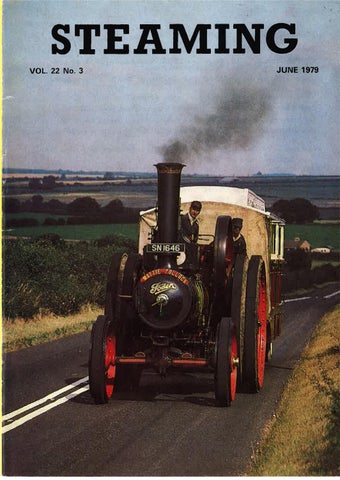
COVER PICTURE
Stourpaine will soon be on the horizon and the rolling hills of Dorset will reverberate to the sound of working engines. The Thursday before Stourpaine last year saw Arthur Thompson driving his Foden Traction Engine "Wattie Pollock" on the main road from Photo: R. J. Blenkinsop. Salisbury. 131
AFFILIATED CLUB NEWS
THE SOUTH ESSEX TRACTION ENGINE OWNERS' GROUP The South Essex Traction Engine Owners' Group (S.E.T.E.O.G. for short) came together informally in the autumn of 1976 as a result of a proposal to run a rally in the area in early 1977. The rally, run in conjunction with the Southend Round Table, was Hullbridge 1977 and set the pattern for the Group's main activities for the future. Events since then have included South Woodham Ferrers and Romford Rallies in 1978, as well as a number of local 'steamups' and joint events with other local societies. As the name suggests, the Group is aimed particularly at the active preservation of traction engines, and the members are either engine owners or directly involved in active engine preservation. One result of this policy is that the Group's rallies and other events are organised particularly with engine owners in mind, both
ENGINES ON
in terms of making arrangements at the events convenient and enjoyable for the owners of engines attending, and also to ensure that they receive a fair return from the profits of the event. So far, this does not appear to have proved incompatible with the interests of the public in any way. We also have an excellent understanding between members on such things as mutual assistance when a bit of heavy work is involved. As an Engine Owners Group we of course do not have the number of members that most traction engine clubs can boast nf, hut we do enjoy an excellent variety of engines sufficient to put on a small rally (including a set of steam powered gallopers). We rather suspect that in practice we have as many active members in our Group as there is in the average, larger, traction engine club. Finally, as you will realise, we are very recently affiliated to the N.T.E.C. (although most of our members have been members of the N.T.E.C. for many years). Possibly we are also one of the smallest affiliated societies, but you may rest assured that we are firmly convinced of the mutual advantage to be gained through this affiliation.
THE
ROAD
by A. S. Heal At the meeting of Engine Owners held recently there was some discussion about the law and the regulations that govern the use of traction engines on the Queen's Highway. The subject of taxation was also raised. The N.T.E.C. members know that it is the practice to regard all steam traction engines as "Agricultural Machines" for taxation purposes and if this arrangement is a favourable one for our members it also imposes on us certain limitations. A member was recently cautioned by the Police for towing his Land Rover behind his engine. "Agricultural" engines may tow trailers and agricultural machinery but not other mechanically propelled vehicles. Mudguards have to be fitted to trailers and one member was fearful at the thought of having to so equip his Fowler water cart which had been happily towed along the rural roads of this country for nearly 70 years. But if you read the "Construction and Use Regulations 1978" you will see that the relevant Regulation No. 79 provides 132
that "This Regulation shall not apply to (inter alia) water carts, living vans and trailers drawn by a vehicle the maximum speed of which is restricted to 12 mph or less. So he ought to remain happy. Reading these regulations, and the multitude of others which have been promulgated in recent years, shows how sympathetically the Department of Transport treats our engines and veteran vehicles generally. We have been excluded from the regulations regarding plating and testing, stop lights and traffic indicators, seat belts, and many others. Special rules apply to brakes on traction engines which are much easier for us to comply with than those that apply to most other vehicles. The Historic Vehicles Clubs Joint Committee, on which the N.T.E.C. is represented, is consulted by the Department of Transport before new regulations are introduced and it has found the Department very sympathetic to the representations it has made.
Our engines have received exceptionally favourable treatment and for this reason it behoves all of us who drive engines on the road to be responsible and considerate to other road users. If engines were the cause of nuisance to other road users, or were involved in accidents that gave rise to protest, the special treatment we now receive in so many ways might so easily be rescinded by a stroke of the Ministerial pen. Fortunately, our engines are regarded
0
- with interest and even affection by the public at large and engine drivers in general drive considerately and behave responsibly. It is up to all of us to see to it that this position is maintained. (Our Vice-President Anthony Heal serves on the Joint Committee and puts in a tremendous amount of work looking after the interests of the engine owning members of the Club.)
0
FULL-CIRCLE FOR 55-YEAR-OLD BRITISH STEAM ROLLER The final stage of a Trans European journey for a unique veteran steam roller was completed on Monday, 5th of March when it arrived at Leiston, Suffolk from Richmond in Surrey. Discovered two years ago in Ibiza, Spain in a 'retired' condition after working over fifty years on road and construction projects all over Spain this Garrett steam roller has returned to Richard Garrett Engineering Ltd. of Suffolk who made and exported the machine in 1923. The Transport Trust which is a national charity concerned with the preservation of inportant relics of Britain's transport heritage and whose patron is the Duke of Edinburgh launched a recovery programme to bring the steam roller back to Spain for restoration and display. The Spanish author-
ities were most helpful and indeed intrigued by the whole recovery operation. The Spanish Ambassador in London gave valuable assistance and persuaded the Spanish Ministry of Works to donate the roller to the Trust. The ICI company in Barcelona helped to transport the machine across Spain and the steamship company AZNAR Lines offered to ship it to Southampton without charge. The Foden Company volunteered to arrange its road transport to Leiston and over twenty British companies have contributed to the appeal launched by the Transport Trust to restore the roller to steaming condition. The Garrett roller will be a major exhibit at an industrial museum being constructed by the Suffolk Preservation Society at Leiston.
133
FROM THE ENGINE OWNERS' SUB-COMMITTEE SCOTTISH BOILER AND GENERAL INSURANCE COMPANY LIMITED Procedure for Thorough Examination of Locomotive Type Boilers 1. Open smoke box doors and thoroughly sweep tubes. Remove soot. Wire brush and clean tube plate. 2. Remove fire bars from furnace and remove soot and ashes. Chip and wire brush as necessary. 3. Remove all manhole and handhole doors also screwed inspection plugs. N.B. Ensure that new joints are to hand before carrying out this operation. 4. Remove all scale, sludge and dirt from the interior of the boiler so that the condition of the surfaces internally can be ascertained. 5. Prepare fittings for examination as follows: Safety Valve/s: dismantle sufficiently to expose springs, spindles, linkages, valve lids and valve seats. Stop Valve: dismantle sufficiently to expose valve spindle. It may also be necessary to examine valve lid and seating. Water Gauges: remove cleaning plugs to allow the clear bore for all passages and parts to be proved. Pressure Gauge: remove from boiler to facilitate testing for accuracy by our Surveyor. Feed and Blowndown Valves: may require to be dismantled sufficiently to expose internals (may be valve lid and seat or plug cock). Fusible Plug: to be removed for examination. Also it is prudent to renew this every two years — ensure that a spare is available. 6. Where the boiler shell and seams are covered by brickwork or lagging it will be necessary to remove parts of this at intervals. In some cases the whole of the covering must be removed, at periods not exceeding 10 years. 7 The boiler should be subjected to test by hydraulic pressure at the time when all covering is removed. In addition a hydraulic test is required at periods not greater than 6 years, also after major repairs. The boiler is now ready for routine thorough examination by our Surveyor — 134
if anything additional is required in the nature of preparation, it will be indicated by the Engineer Surveyor responsible for the inspection. Important: The purpose of the examination is to assess the suitability of the boiler to return to service for another 14 months at the present maximum safe working pressure. The examination may reveal that certain repairs are required to ensure continued safe working and these repairs are normally carried out by a reputable firm of boiler repairers and welding specialists. All proposed repairs should be approved by us prior to work commencing. The cost of such repairs will be borne by the owner of the boiler who will instruct the repairers as to what is required. It is important, therefore, that the boiler owner or his representative should be available at the thorough examination, so that our Surveyor can explain exactly the nature of the work required to effect satisfactory repairs. In case of difficulty you should write to Boiler Superintendent, Scottish Boiler & General Insurance Company Ltd., Windsor House, 250 St. Vincent Street, Glasgow G2 5UT (Telephone: 041-332 2911). 0
0
We have recently heard from one of our members that he has made a pair of cast 'Y' type rear wheels for his 1927 4 N H.P. Aveling & Porter Tractor. The Patterns are therefore available for further use and any Aveling owner who should be interested in replacement wheels should get in touch with: Bob Main, Caskills Farm House, Winstone, Cirencester, Glos. (Ed. note: There must be other members of the Club who have had parts made and the patterns are available. Please let us know — not only will you be helping the engine owner but assisting in keeping our engines on the road.)
N.T.E.C. SILVER JUBILEE LECTURE Some thoughts on the bi-centenary of Richard Garrett of Leiston 1778 — 1978 by R. A. Whitehead The Town Works at Leiston formerly ceased to be used on 10th April, 1978 after a period of continuous use of two hundred years, all trading being carried on since April at the newer Station Works. For a manufacturing business to be carried on on the same site for two centuries seems to me to warrant more than a comment in passing. Not the least remarkable thing about this bi-centenary is the way in which the double century has been spanned by the generations of the Garrett family. The first Leiston Richard was twenty-one years old when he acquired the works and his great, great grandson Victor Garrett is still living at the age of ninety-one — and one hopes will continue to live for some years to come. His grandfather (Richard III) was eight years old at the time of the battle of Waterloo. Victor is, by inclination an historian, despite the fact that circumstances made him a businessman, and took his degree in history of Pembroke College, Cambridge. In this leaning toward history he took after his father who had a keen appreciation of the past. Because of this unusual combination of very extended generations and sharpened awareness of history the opportunities for recording the past of the firm — albeit on an entirely amateur basis — have been unusually favourable. Without Garretts, Leiston would probably never have increased in stature beyond the growth achieved by the neighbouring villages of Westleton, Theberton or Knodishall. It was there, as a small but nevertheless going village, when they came but the way in which the two grew together seems to me to be very interesting. It is true that Garretts never did to Leiston what coal and iron did to Middlesbrough, which we may count a blessing. In their time the population of Leiston increased five or sixfold and though this may, in a small degree have been due to direct personal endeavour — Frank and Mary Garrett had eleven children and Frank once.
in a moment of candour, described his bachelor brother Richard as a "freelance sire" — the growth of a tiny agricultural community into a prosperous small town was the result of the way in which the developing works in the very centre of the village attracted more and more men to work there. The first Richard was an edge tool maker and in his time the establishment was never more than a sizeable village smithy, though noted for the excellence of its products. When his son (Richard II) married Sarah Balls, the foundation was laid for a significant change in direction of the business for her father, John Balls, of Hethersett, Norwich, was the patentee of an improved form of threshing machine and is said to have "joined himself to the firm" in 1806. Threshing by hand, about that time, varied in cost, according to "The Times" (3rd January, 1851), from five shillings and sixpence to seven shillings a quarter but by a horse worked machine probably only half as much. However, the Napoleonic Wars were on, corn prices were very high, labourers wages supplemented out of the Poor Rate and there was n❑ pressing incentive to farmers to encourage them to experiment with machines, particularly, once the Wars were over, to use them led to rural unemployment and fermented discontent amongst farm workers which expressed itself in fires and cattle maiming, though some farmers did. As corn prices and wages fell after the end of Napoleon, rural rebelliousness became increasingly common until the outbreak of overt rebellion it 1830 in Kent, Sussex and Hampshire, put down with great severity. After 1830 farmers felt bolder in the use of machines and the making of them began to gather impetus. Not much headway had been made up to that date. The wellknown Garrett poster of C.1828 shows a thresher of essentially the same form as in Balls patent of over twenty years before but it had been joined by seed drills, 135
The Garrett Portable of 1852. 136
Photo: R. A. Whitehead.
ploughs, harrows, hay tedders and a variety of general foundry and engineering work. Because the thresher was so important to the firm by the middle of the nineteenth century the part played by the seed drill in building up the firm is sometimes overlooked. By about 1826 the number of men had gone up to about sixty. In that year the third Richard, at the age of nineteen, took over the finances of the works. Ten years later he took over sole control. In that ten years he had greatly increased output, added a foundry to the works, bought ships for handling his own goods at Slaughden Quay and become sufficiently celebrated as an implement maker to be a consultant of the Duke of Richmond and William Shaw when they founded the Agricultural Society of England. At the first Royal, at Oxford in 1839, he had a considerable display of machines and models and was one of two makers (Ransomes were the other) to exhibit threshing machines at the show of the Smithfield Club the same year. It was probably, therefore, the combination of circumstances with Richard III's personality that launched the growth of Leiston Works. By the time he died over six hundred were on the pay-rolls. Though threshers and implements were important sources of work to Garretts, their ultimate fame rested upon steam engines and particularly upon the portable steam engine. The first Garrett portable reliably documented was a return flue engine shewn at the Royal at York in 1848. Another example of this type went to Norwich the next year this time accompanied by a second engine whose boiler was equipped with return tubes and, in all probability, a central chimney, rather like the engine which is shewn in the engraving in the catalogue of the Great Exhibition of 1851. Until quite recently it was accepted that this engraving depicted the engine exhibited but recently there has come to light in the rare books section of the British Museum Library a copy of the reports of the jurors of the Great Exhibition, illustrated by callotype photographs, one of which depicts a Garrett portable with single pass tubes and the smoke box and chimney in the conventional position, so the question of which type was actually shewn is pprhaps best described as open. In those days Garretts had no boiler shop. Boilers were bought from two firms
of London boiler makers, Wheatcrofts and Horton & Co. The latter had their works in Park Street, Southwark and Horton later took his works manager, Kendrick, into partnership, trading as Horton & Kendrick. Home built boilers displaced London made boilers in the early sixties. The last engine noted in the engine memorandum books as having a London made boiler was No. 453 in September 1861. The central smokebox, as we have seen, was superseded about 1851/2 and the wet bottomed firebox disappeared in favour of the conventional firebox in 1854. Up to that time the large carrying wheels had been at the smoke-box end and the forecarriage beneath the firebox but with the adoption of the deeper firebox their positions were transposed. Besides these portables, however, the firm were also makers of fixed engines, though there is no direct evidence that these ante-dated portables by any substantial period. The earliest fixed engines were beam engines, soon followed by crank overhead vertical engines and horizontal single cylinder engines. Soon again, there appeared a design of table engine later superseded by a Columnar engine. Garretts never lost interest in fixed engines. They went on building the horizontal single cylinder engines into the late seventies and then followed them by a series of fixed engines made from the top works of portables mounted on special bed plates. Never left far behind in any new thing Richard III undertook the building of a Boydell engine for exhibition at the Royal of 1856, held at Chelmsford. Reputedly this was made largely from the components of the contemporary portable engines, in which case the final drive was supposedly by pitch chain. Certainly this form of drive was that used in their first self moving portable shown at the Royal at Chester in 1858. The engine, named "Locomotive", never found a purchaser in its self-moving form and was sold as a common portable. A second engine of the same, or similar, type also failed to find a purchaser. For a period, beginning in 1863, Garretts were licensees of the Aveling & Porter traction engine. The first of these bore Aveling's Royalty number 82. This was a 10 N.H.P. engine with the cylinder and smoke stand in a common casting. In 1864 they began building Aveling's 1862 design with the cylinder block clear of the chimney. In 1867 they reverted to a design of self-moving portable engine in 137
The first Garrett self-moving engine of 1858 — exhibited at the Royal Show at Chester Photo: R. A. Whitehead. that year. which the drive was by pitch chain from the crank-shaft to an intermediate shaft on the boiler front carrying shrouded pinions on its ends which could be clutch into or out of drive with an annular gear fixed on the inside of the tee ring of each rear wheel. These engines were produced at reasonably regular intervals until early 1872 and then very intermittently until the Spring of 1875, after which they ceased to be made. Crude though the drive may have been the engines themselves were well constructed. One was in use in Ireland at least until 1911 when a new firebox and other parts for it were supplied tc William O'Neill, the Garrett Agent in Athy. The fitting of a new firebox makes it not unlikely that it enjoyed a further period of useful life. They followed these annular drive engines by a series of twelve gear driven two speed traction engines of more or less 138
conventional type but rather better than average design. These used a pressure of 120 p.s.i. compared with 70 p.s.i. in earlier engines but were curious in that the rear wheels were mounted not on a continuous rear axle but on gudgeons carried in large cast brackets bolted to the firebox side plates. The manner of the final drive is conjectural but seems likely to have been by pinions at either end of an intermediate shaft engaging with an annular ring bolted to a series of brackets carried on the Tring of the rear wheel. This series of twelve engines appeared at irregular intervals over a six year period. No. 9380, the first, came out in 1876 and No. 14040, the last, in December, 1881. The Garretts never did much more than dabble with steam ploughing, in 1855 Richard III, by then a very well-to-do man, relinquished day to day control of the Works to his sons Richard (IV) and John.
He had a pleasant small country estate at Carlton Hall, Saxmundham and took, in addition, a London house not far from Lords cricket ground from which he was able to keep an eye on another of his enterprises, the Camden brewery, managed by his son-in-law, George Grimwood. Richard and his brother Newson lived in a state of rivalry, often at loggerheads with one another, and each striving to outpace the material achievements of the other though kept in civilised communication by the circumstances of having married two sisters, pious women devoted to each other and to pouring oil on the turbulence of their husbands' dealings with one another. Because Newson had a London brewery doubtless Richard had to have one but, being the man he was, he made a success of it and, in owning it, advanced another matter in which he had a great interest, namely the combatting of the evil of inferior and adulterated beer. Like his neighbour in Suffolk, Quitter, he was interested in promoting the production of pure beer from malt and hops only. The campaign for real ale is not an exclusively modern phenomenon. Whilst Richard, then, was spending much of his time in London he had time to attend some of the meetings of the Royal Society of Arts, the traditional gathering point of men who have achieved professional eminence by the empirical rather than the academic path. Possibly it was through these meetings that he met Boydell. Boydell & Glaisher had a small works not far from the brewery and it would not have been difficult for them to have met. He took part in a debate at the R.S.A. which followed John Fowler's paper on steam cultivation on 30th January, 1856, in the course of which he referred to some private trials he had been conducting with rope hauled tackle, on the roundabout system, and to his interest in the Boydell system of direct haulage. At that time he was already in the early stages of making the Garrett Boydell and may well having been selling roundabout tackle but he was certainly not making steam diggers and his concluding comment that he believed some form of steam digger might be the final answer was, therefore, not predictable and must be concluded to be an honest expression of opinion. Slightly later he bought the Savory double engine patent rights and competed with a pair of Savory engines at the trials at Newcastle Royal in 1864 with the results that we all know. It was his disgust at
the abysmal level of logic applied by the judges, rather than dissatisfaction at their findings, which led him to withdraw from all future trials organised by the R.A.S.E., an agonising decision for a man who had assisted at its foundation, been a member of its council and had never missed a council meeting in a period of ten years. Garretts actually built two sets of Savory tackle, one for the Shrewsbury Steam Ploughing Co. and the other for Houghton & Thompson of Carlisle but the Fowler double engine system (though not the clip drum system) was a better one and soon displaced Savory sets from commercial esteem. In 1876 Garretts equipped a traction engine for ploughing on the roundabout method using Barford & Perkins patent, in which a trough in the rear wheel formed the winding drum. Twenty years later they began to build, over an eleven year period, a series of 6, 8 and 10 n.h.p. vertical drum single cylinder ploughers for their old trading partners Rudolf Sach of Leipzig, whose ploughs Garretts had sold in the fifties and sixties. John Garrett, in the fifties, probably from knowing and visiting Rudolf Sach, came to have a high opinion of Magdeburg as a manufacturing centre for the developing trade in farm machinery in Central and Eastern Europe. Just as Newson and Richard III, in the preceding generation, had often been at rivalry, so he and his elder brother (Richard IV) became increasingly at odds with one another. Whereas John saw himself as the cosmopolitan man of affairs Richard was the John Bull Englishman, a throw back, in some respects to the Regency period — a good boxer, keen huntsman, expert shot, breeder and improver of Suffolk sheep and Shorthorn cattle, deeply interested in the Suffolk draught horse and a founder member of the Suffolk Stud Book Association. He delighted to be known as an English tenant farmer though as he farmed over 2,000 acres in one estate at Brandon, he was working on a scale above that of the average tenant farmer. He was moreover a talented captivator of young women though his courtship of his cousin Louisa was barred by her family on the grounds of consanguinity. His outlook, in short, was the absolute antithesis of that of his brother. John wanted to establish a daughter works in Magdeburg, Richard would have none of it and over this they parted. John went to Magdeburg in 1860 and set up his own firm. Richard remained at Leiston and his father came back into 139
harness until such time as his two youngest sons, Henry and Frank could begin to bear their part in management. Richard's distaste for John was not lessened when he took as a partner James Smith, who had married his cousin Louisa after his own aspirations to her hand had been barred. Henry Garrett was a weak character who played a shadowy and indecisive part at Leiston for some years but finally left in 1878. Their father had died in 1866 and Richard IV, worn out by his exertions, died, when only 55, in 1884. Frank (1845 1918) was thus left as sole proprietor of the business at the aye of thirty-nine. His own eldest son, Frank, joined him in the Works in 1890. The period from 1875 to 1895 was dominated by the portable engine and the thresher, about ninety-five per cent of which were for export — to Central and Eastern Europe, Iberia, North Africa, the Middle East, the Far East and the Antipodes. Other machines were made besides, seed drills, steam winding engines for pile drivers, hoists and small mines, and such items as fixed engine and sawbenches. All these, however, were outshone by the portable and threshers. To enable this copious trade with foreign countries to be carried on an extensive system of agencies was built up — Pilter in France and North Africa, Thomas Cook in Egypt, the Borneo Company in Singapore and the Straits Settlement, Burn & Co. in Calcutta, Chambers and McAlister in New Zealand, Horrocks Roxburgh in Melbourne, Palmer Graham in
Rostoff-on-Don, Torrome & Mattos in South America and many others — which entailed the exchange of letters in the major European languages, particularly French, German, Russian and Spanish. This brought to Leiston a class of young men known as "foreign correspondents", capable linguists who could deal with foreign letters. The Garretts had the habit of having one member of the staff in whom they reposed their confidences. In part the result of their natural need for companionship there was also in it, the natural element of prudence in that, in the event of personal catastrophe overtaking the principals there would be at least one person versed in their affairs. For many years this need was met by Samuel Knights who had spent a lifetime with the firm since the days of Richard II when the total staff had been perhaps a couple of dozen. Latterly he had been in a position akin to works manager and his death in 1880 left a void that took some years to fill. However, in 1882 Richard IV and Frank took on a young German, Carl Remy, as a foreign correspondent, whose intelligence, trustworthiness and discretion soon earned him the respect and, before long, the friendship of the partners. After Richard IV died in 1884 Frank turned to him increasingly as a confidant and by the time of Victor Garrett's earliest recollections he enjoyed the absolute trust of his father in the most intricate and vital negotiations. Remy's particular province was the control of the European trade.
A Garrett Compound Stationary Steam Engine. 140
(To be continued)
Photo: R. A. Whitehead.
N.T.E.C. SALES BOOKS Foden Story - P. Kennet Fairground Steam - A. Beaumont Scale Model Traction Engine Building - L. Mason Steam Traction Engines, Wagons and Rollers - B. Johnson Steam Power in Agriculture - M. Williams Encyclopaedia of American Steam Engines - J. Norbeck NEW Traction Engine Register Fairground Organ - E. V. Cockayne NEW Steam Road Vehicles - M. Jones Old Farm Tools and Machinery - P. Blandford NEW Garrett 200 - R. A. Whitehead Steam in the Village - R. A. Whitehead Sentinel DG4 and DG6 Catalogue Clayton & Shuttleworth Catalogue Fowler Ploughing & Cultivating Catalogue Development of the English Traction Engine - R. H. Clark Traction Engine Miscellany - R. H. Clark The Overtype Steam Wagon - M. A. Kelly The Undertype Steam Wagon - M. A. Kelly Garretts of Leiston - R. Whitehead Savages of Kings Lynn - D. Braithwaite Pride of the Road (Softback) - M. R. Lane The Steam Scene Vol. 1 -R. J. Blenkinsop The Steam Scene Vol. II - R. J. Blenkinsop The Steam Scene Vol. III - R. J. Blenkinsop The Steam Scene Vol. IV - R. J. Blenkinsop NEW The Steam Scene Vol. V - R. J. Blenkinsop TIES - Red, Blue, Green Steaming Binder Car Badge WHITE METAL MODEL KITS (4 mm scale) (approx.) Fowler Showman's Engine Burrell Road Loco NEW Burrell Showman's Engine Foden 'D' Type Tractor Foden 'K' Type Sided Wagon (6 wheeler) NEW Fowler Road Loco Ploughing Engine Pair of Fowler Ploughing Engines Anti Balance Plough
Overseas U.K. only & Non M'bers M'bers Price 7.25 1.60 4.30 4.10 3.90 13.00 1.00 5.00 5.25 5.00 10.55 5.50 5.70 2.80 1.90 13.00 10.50 4.50 13.00 3.30 3.30 4.50 4.50 4.50 4.50 4.50 5.50 2.50 2.00
6.95 1.25 3.95 3.75 3.75 12.50 90 4.50 4.50 4.50 10.00 4.95 5.25 2.55 1.65 12.00 10.00 4.00 12.50 3.00 2.95 3.95 3.95 3.95 3.95 3.95 4.95 2.30 1.75 2.50
5.40 5.10 5.20 5.05 5.95 6.20 5.45 10.00 4.10
5.20 4.90 5.00 4.85 5.75 6.00 5.25 9.75 3.90
Non Members Price includes postage and packing. Members please enclose current Membership Card to claim Post Free price. Cheques and Postal Orders only, made payable to National Traction Engine Club. Orders to: A. G. Wilson, NTEC, National Sales Officer, 7 Welton Road, Daventry, Northants, NN11 5PP 141
ROBEIT STEAM VEHICLES a portfolio of photographs Photographic copies of 29 unique photographs of Robey Traction Engines, Portables, Steam Wagons and Rollers. Reproduced by permission of Messrs. Robey of Lincoln Ltd. Detailed text researched from company records. Photographs 10" x 8" on 12" x 10" mounts. Limited Edition.
Price £20.
G. K. BENTON, BARDNEY, LINCOLN, LN3 5SS Telephone Bardney (05263) 208
To keep up-to-date with weekly news of the Preservation movement you need
gownlab incorporating Preseation ry News
ONLY 15p PER WEEK Order NOW from your local newsagent. In case of difficulty (or for a free specimen copy) write to: THE WORLD'S FAIR LTD., UNION STREET, OLDHAM, LANCS. OL1 1DY. 142
A Steam Weekend was held this year at the "Dubbelde Palmboom" Museum in the old part of Rotterdam. With a variety of steam exhibits on show the picture is taken outside the twin warehouses which make up the Museum. The Steam Roller is a Ruthemeyer of 1907 and named "Zoef Zoef". Photo: Rob Gebhard. 143
SUPPLEMENT TO RALLY LIST JUNE 9/10
A2 9/10 A2
Ashfield Steam Engine Rally, Derby Road (A611), Kirkby-in-Ashfield.
Mrs. L. M. Wright, 52 Greenwood Drive, Kirkby-in-Ashfield, Notts. Holton Steam Rally, Windmill Ground, Waterperry Road, Holton, Oxon.
Mrs, C. Hulse, Old Place, Holton, Oxford, 0X19 1QF.
JULY
21/22 A3 AUGUST 18/19 A2 25 Al
Masham Steam Engine & Fair Organ Rally, Low Burton, Masham, Yorks.
W. A. Wise, 8 Leybum Road, Masham, N. Yorks. HG4 4ER.
26/27
Market Bosworth Steam Engine Rally, A477, Cadeby, Nuneaton, Warks. Rev. E. R. Boston. Cadeby Rectory, Nuneaton, Warwicks. Egham & Thorpe Royal Agriculture & Horticulture Society Rally, Runnymede, Egham, Surrey. I. H. Fear, 1 Rowan Avenue, Egham, Surrey. Chapelton Barton Rally, Umberteigh, near Barnstaple, N. Devon.
A2
F. G. Burt, 17 Toronto Road, Exeter, Devon.
SEPTEMBER 7-9 Brent Show, Roundwood Park, Willesden, London NW10.
B1 8/9 29/30 A2 B1
J. R. Beswick, Brent Town Hall, Forty Lane, Wembley, Middx. Tonbridge Steam Rally 1979. Hall Place, Leigh. near Tonbridge, Kent.
T. McHenry, 28 Bramble Close. Hildenborough. Kent. Fauld Steam & Pres. Rally, Hall Farm, Tutbury, Burton-on-Trent.
D. Hallam, The Firs, Draycott-in-the-Clay, Sudbury, Derby DE6 5GX. CLASSIFICATION OF EVENTS
A. B. 1. 2. 3.
Predominantly Traction Engine Rally. Traction Engine Rally and other Veteran Vehicles. Under 15 Engines. 15 - 29 Engines. 30 - 45 Engines. 0
THE 'ROCKET' AND THE RAINHILL TRIALS 1980 The 'Rocket', winner of the locomotive trials which took place on 6th October, 1829, was manufactured at the South Street, Newcastle-upon-Tyne factory of Robert Stephenson & Co. 'Rocket' was one of a series of prototype locomotives, each incorporating novel design features which marked the rapid advancements in locomotive efficiency taking place at that time. In September, a plaque commemorating 'Rocket's' manufacture is to be unveiled on the wall of the former erecting shop in which the locomotive was made. The 150th anniversary celebrations marking the opening of the LiverpoolManchester railway and the Rainhill locomotive trials will be held on May 24, 25 and 26, 1980, along the 11 miles of track
0 144
0 between Rainhill and Lea Green where the original trials took place. The performances, a re-enactment of the trials, plus a cavalcade of locomotives, aim to attract bank holiday crowds rather than commemorate the exact date. The cavalcade will show development from the earliest days of locomotives; the rear will be brought up by APT. Since the stretch of track is on the Trans Penine Line and is not electrified, APT will be hauled, hopefully by an HST power car. The promoters, British Rail and the Merseyside and Greater Manchester County Councils, will provide seating for 50,000 spectators each day and lay on all the fun of the fair. After the Rainhill event, three static exhibitions of the replica locomotives with some items from the cavalcade will be staged in Liverpool, St. Helens and Manchester. There will also be events at Rainhill and Earlestown stations and Edge Hill. D.A.R.
0
FROM THE ALAN MARTIN COLLECTION OF PHOTOGRAPHS No. 5 Wm. Shaw's, of Sheffield Burrell Showman's Road Locomotive No. 3787 and built in 1918. Named "Her Majesty" (WR 6641) the picture was taken at Elland, Yorkshire in 1934.
NATIONAL TRACTION ENGINE CLUB CONVENTION, ROYAL STATION HOTEL, YORK. Friday 23rd, Saturday 24th, & Sunday 25th November, 1979 Members are reminded that this year we are holding our second Convention at York. Details of the planned activities were included in the March issue of "STEAMING". Those members who wish to take part and who have not yet applied should do so as soon as possible as bookings are well up to expectations. If you have mislaid the form or you have joined the N.T.E.C. since the March issue was sent out SEND A S.A.E. TO JOHN CRAWLEY, FIELD HOUSE, TURVEY, MK43 8DU, who will be prepared to send you another form.
145
TRACTION ENGINES ON RAILS Some additions and corrections by Ian K. Hutchinson Since writing my earlier notes which appeared in Steaming (Vol. 22 No. 1) some further information has come to hand. It now seems that Isaac Watt Boulton, a contractor and machinery dealer of Ashtonunder-Lyne built the first traction engine type locomotive, probably preceding Aveling's design by some two or three years. Boulton's locomotive had duplex cylinders 8 x 12 inch stroke, mounted either side of the chimney. The drive was to the leading axle by means of a pitch chain and the wheels were coupled by normal locomotive coupling rods. This locomotive was hired out on several occasions, it was used in the construction of the Midland and Manchester, Shiffield and Lincolnshire joint line between Marple and Hyde Junction in 1865. Later going to Northampton on a construction job and then the Lincoln and Barnetby Railway contract. Finally it was sold to Trelowel Colliery, Chirk where it worked for several years. Fodens of Sandbach did in fact build one railway locomotive, a four wheeled "Sentinel" type, works number 13292. "Sifta" as it was named was delivered on February 17th 1930 to Palmer Mann's Salt Works at Sandbach. The engine used was similar to that in the "E" type steam wagon, having two 7 x 10 inch vertical cylinders. The boiler was pressed to 250 psi and had a smokebox superheater. It was apparently not too successful, as it was cut up for scrap in 1939 after a very short lift. No further examples were built. Readers may be interestod to know that in 1924 Fodens designed, but never built, a steam rail car. This proposed railcar was based on the "C" type tractor and would have had a seating capacity of 56. It is probable that this project was aimed at the continental market as a Foden drawing of the railcar quotes all measurments in metric units, the English equivalents in brackets alongside. The Fowler works shunter "Lion" was not the only one of its type built, several were constructed in the 1870s and 1880s. I am indebted to Mr. D. B. Stoyel for pointing out that "Lion" was in fact built in 1878 and not 1875 as I originally thought, he also informs me that the works number was 3409. 146
Between 1876 and 1888 four 3 ft. gauge traction engine type locomotives were delivered by Fowlers to the Bearpark Coal and Coke Co., in County Durham. They were for use on an elevated line to the coke ovens at Bearpark Colliery, they survived until about 1921. The works numbers of these four locomotives were 2820, 2821, 5006 and 5653. In April 1888 New Bracenpeth Colliery, also in Durham, took delivery of an 0-4-0, works number 5661. This was followed by number 5883 which was despatched from Fowlers Works on March 4th 1889. These locomotives were also built to 3 ft. gauge. is possible that 5661 and 5883 later went to Tudhoe Ironworks, if this is the case both were scrapped in 1910 when the ironworks was dismantled. Another company to employ Fowler traction engine type locomotives was the Dowlais Iron Company, at least two went to Dowlais, 2140 in January 1874 and 3076 in December 1876. Both were probably standard gaup. 2140 was a single cylinder type and 3076 had duplex cylinders 61 in. x 12 in. stroke. Acknowledgements are due to the following for their help in preparing these additional notes. Mr. D. B. Stoyel, The Industrial Railway Society, Fodens Ltd., and Mr. B. Henderson. 0
0
HINTS & TIPS— Gauge Glasses by George S. Lea Carry two or three spare gauge glasses, wrapped in asbestos string on top of the boiler crown, in the crank pit. This will ensure that there is always a piece of this latter, always useful, commodity to hand for a joint or emergency packing a rod gland, when impregnated with graphite flakes and cylinder oil. It also ensures that the glasses are warm in readiness for if a glass has to be replaced when under steam. In case of steam leakage past the column cocks, the bottom blow-down cock should
A road repair job by King's & Co. quarry masters of Glasgow. The Aveling & Porter Tractor has a wagon from Laurie Bros. of Falkirk and behind is an Aveling & Porter Convertible. The driver is Murdoch Mackenzie, now deceased, and King's had about 100 engines in service. Photo: A. B. Graham. be opened prior to inserting the new glass through the plug opening in the top mounting. Cone-type washers are preferable to rings as cone type allow for any misalignment of the gauge columns and they last longer than rings, besides giving a bit of warning before 'blowing'. With cones and washers in place, the glass held on its bottom seating, the lower nut is tightened hand tight to set the glass, then the top nut also tightened hand tight. The top mounting plug is replaced, a large piece of cloth is taken up — in threshing days we used a corn sack — the blow down still open, a trickle of steam via the top cock, is allowed to blow through the glass to warm it then, with the sack held to protect the face, the blow down is closed and the top cock gradually opened fully to take boiler pressure. Allow about a minute to see if the glass is safe before opening the bottom mounting cock. The pre-warming, followed by blowing through, gently, of steam makes the procedure as safe as possible but, if full pressure is allowed onto a cold glass, then in nine instances out of ten, it will 'let go' straight away. A follow up on the
nuts is advised after approx. an hour but strong hand tightness is all that should be necessary. One source of 'get you home' gauge glass washers used to be the red rubber rings on screw-top beer bottles — even if it did mean having to purchase two bottles of beer! Cone type washers are still obtainable from Messrs. W. H. Willcox, Southwark Street, London, or any other good engineers' stores, glass outer diameter being an essential requirement when ordering. Turning to reflex type glasses — Klinger or Dewrance — these should also receive E, gentle blowing through of steam if fitted to an engine in steam and rather gentler and for longer than with a conventional glass for, whilst they are classed as unbreakable, they are not unabusable! A reflex type glass usually gives a bit of notice when it is on its way out and it is advisable not to let dribbles and fizzes to go unheeded but to renew the glass and/or back packing at the first opportunity. 0
0 147
Fowler Traction Engine (No. unknown) Reg. No. GT 6879, threshing at Lockington, Leicestershire in 1931. The owner is G. Sharpe of Derby and the driver Thomas Howe, Author of this a rticle. Photo: T. Howe.
A BRIEF ACCOUNT OF MY LIFE WITH STEAM by Thomas Howe I was born on 25th April 1896 in the village of Diseworth, Leicestershire, the third child, second son of Mr. and Mrs. Thomas Howe, grandson of Mr. and Mrs. William Howe, also of Diseworth, who at that time were the only two steam men in the village, so I was brought up with steam engines from the day I was born. How well I remember grandfather when he was driving a portable engine threshing set, my father was his mate, I used to help fetch water to pour in a tub standing by the side of the engine, then stand watching the water disappear up the pipe. I would also be allowed to put some coal on the fire. I well remember moving with horses from one job to the next at all hours of the night, sometimes too late to come 148
home, grandfather and father would bed down in the stable or cowshed for a few hours so as to be ready for next morning. The portable engines became redundant with the coming of the traction engine. My grandfather drove a traction engine during the latter part of his life. By this time father had taken up driving traction engines used with threshing sets. I was now at school, hut at the weekend and school holidays I was always with the engine. One day when at school, the engine was threshing at a farm about half a mile away from the village, my brother, two more boys and I went to see the engine threshing during midday break not worried about school or the time, the threshing gang egged us on to stop as
they knew what would be waiting for us when we got back to school. To make matters worse, on the way back to school we had to pass the village church where two men called us to give them a push with a heavy tombstone on a trolley and into the churchyard, which was uphill going. We got back to school after 3.00 p.m. instead of 1.30 p.m., the old school gaffer was waiting for us. After trying to make all sorts of excuses we got a good caning, he said 'Now stop in school till 5.00 p.m. and write out all you have learned about the engine and threshing'. He later admitted I knew more about the job than he did. I left school on 25th April 1910 at the age of 14, I started to work with my father with the traction threshing set for the local contractor. When there was no work for the engine, I used to help on the farm. In 1912 that contractor went out of business which meant my father and I were out of job, but not for long; in 1911 a new firm had started up the name of Sharpe Brothers of Barrow-on-Trent. Derbyshire. First was set a Ransomes S.C. 3 speed, full length canopy Foster drum, Innes Chaff Cutter and Hornsby Tier. In 1912 a second set came, a second hand Burrell S.C.T.E. 2 speed, full canpoy: Foster Drum, Innes Chaff Cutter and Hornsby Tier. This set was driven by 0. Sharpe in Derbyshire. My father took over the first set in his old area and I was his mate. I was allowed to drive at times under father's supervision. August 1914 saw the start of World War I which altered things considerably. In 1915 the third set came, an Allchin S.C. 2 speed, full length canopy; new Ransomes drum, Maynard Chaff Cutter and Massey Harris Tier, driven by G. Sharpe in Derbyshire. Early in 1916 I joined the Army and was soon set out to France, I was involved in some very heavy fighting on the Somme 1916, at Paschendale 1917 and in the last great German offensive of 21st March 1918. I was taken prisoner of war 14th April 1918. I was released from the army in August 1919, and went back to work with the old firm of Sharpe Bros. who had now got eight threshing sets, the engines were as detailed above, plus a Fowler Road Loco, a Foster Showman's, a McLaren Showman's, a Ransomes D.C.C. and a Wallis and Steevens expansion valve engine. There were various makes of drums, etc. There were six of the Howe family working for the Sharpes now, father, two brothers, two
uncles and myself. I was put on the No. 2 set, the Burrell, which was not in very good shape after the war years. In 1921 the Sharpe Bros. parted, I and one uncle, Ted, stayed with G. Sharpe, my father and the others went with 0. Sharpe. As the years went by, some of these engines were cut up and replaced by Fowlers. During my years of driving, I had a few rather unpleasant incidents, twice sliding downhill on icy roads, I had one side of a little bridge break in under the engine and I have been in the ditch on several occasions, but never anything serious. The only injury was once when I got my own finger trapped on the Burrell engine, I had to have it stitched and a week off work. A threshing driver's job was no picnic in those days, sometimes ten or twelve miles or more to cycle and be there for about 6.00 a.m. and back home late at night. I well remember one morning in the early 1930's I left home at 3.20 in the morning, that same evening I arrived home just as the church clock was striking 10.00 p.m. — my wage for that day was seven shillings and eight pence. The traction engines finally gave way to Tractors. I left Sharpes about 1942 and got a job with the Derbyshire War Agriculture Committee, tractor driving. The combine harvester finished the threshing machine. I left and got a job on the roads with the Derbyshire County Council as a spare driver where I stayed until retiring at 67 years. I thought I had done with steam engines, but not so, I was recommended to a steam enthusiast at Belper who had bought a Fowler D.C.C. roller (Dorothy) I helped him to bring it back to its former glory and instructed him on how to drive, for which he was very grateful. In November 1975 a young steam fan brought a roller to Long Eaton, a Marshall 'S' Type, single cylinder, piston valve, roller No. 78572, Reg. No. NR6296, the owner P. Wood. I have taken a great interest in the roller as I have known it since it came new in 1925 to Castle Donington Rural District Council, an uncle of mine, Ted of Diseworth, drove it for many years. We took it first to Rempstone Rally when we had some troubles on the journey going. We went to take it from Rempstone to Kegworth about a five mile journey, before starting the journey we opened the smoke box door to clean the tubes and there lay the exhaust pipe in the bottom, we got a good head of steam up, we thought we might get along with the jet pipe but not 149
so, it was blocked up. We set off for Kegworth, before we had gone half a mile the fire was out and no steam, we got the fire going again and steam up, again the same thing happened, we made about half a mile at a time. We started from Rempstone at 11.00 a.m. arrived at Kegworth at 6.30 p.m. I have never experienced a
0
journey like that in all my years with the engines, but P. Wood worked very hard and got it repaired in time for the Kegworth Rally. After that it sailed along the road in fine style. That concludes a brief account of my life with steam engines.
0
A STEAM SPIT (Reproduced by Kind Permission of the Editor of The Chartered Mechanical Engineer).
Not intended to be a phlegmatic statement but no doubt many readers will have attended steam engine displays at which one of the attractions has been an Oxroast or indeed will have seen this type of activity going on elsewhere. In general, the Chef turns the beast on the spit but on occasions, powered spits are used. By courtesy of Messrs. C. G. Ludlow and A. S. Bahrani, authors of a paper to the Chartered Mechanical Engineer, Journal of the Institution of Mechanical Engineers, it is possible to reveal that a powered spit was in use in the Middle East in the 16th century. Steam provided that power and the device used appears to be the first application of a steam turbine.
with water then closed and its spout is placed opposite the blades on the wheel. A fire is lit under the copper vessel and the compressed steam comes out of the spout and rotates the wheel. When the vessel is empty of water, cold water is brought to it in such a manner that the spout is submerged in the water and in this way, the water is sucked into the vessel and then it is boiled and continues to do the work."
A manuscript written by Taqi-al-Din in Damascus in about 1551 A D. entitled 'The Sublime Methods of Spiritual Machines' which has not yet been translated into English contains a description of the spit.
This description indicates that the Moslems were the first people to use a steam jet impinging on the blades of a wheel to turn a spit. Up to recently, it had been thought that Branca was the first to describe such a device in 1629 although his was not practical. The first workable spit, driven by a steam jet was reported by Wilkins in 1648. Thus Taqi-al-Din's device preceded that of Wilkins by some hundred years.
"On the making of a spit on which the meat is put on the fire and it rotates by itself without the motion of an animal. This has been done by different people in different ways. One of the methods used is to have at the end of the spit, a wheel with blades and beside this wheel is placed a copper vessel with a spout outlet. The vessel is filled
The power of steam was hence known, well before Watt observed his kettle lid lifting and went on to construct his magnificent engines. It is interesting to conjecture what would have happened to our hobby, should traction engines have been "invented" in the Middle East, following on from the above developments, instead of in Great Britain.
0 150
0
FROM MARY LEA'S DIARY /LOG BOOK (Continued from Vol. 22 No. 2) Sunday, 12th February: We took the main gears to Banks. We could not take them last weekend as the turner had not found time to complete the bush and stud shaft. The old bush and shaft were quite badly worn and as the P/bronze bush is quite hefty we got out of the expense of having a new one cast by having the old shaft turned down and a sleeve shrunk on and turned to an oversize. The old bush was then skimmed out to fit. The old sprocket was worn and the teeth were quite hooked. This has had the old teeth turned off and a new toothed ring fabricated by profile cutting, the middle being turn-bored out for a 6 thou. shrink on fit. Just in case, John has put two rings of welding on the joint but it is fairly certain it will not be necessary. It took all day, until 4.0 p.m. to assemble the gearing; evidently the turner had slightly distorted the bush in his four jaw and had got a slight taper on also; not much but enough to require rectifying, so it had to be filed and scraped for a fit. The sprocket also had to be relieved slightly in the bore as shrinking the new toothed ring on had pulled it in just under a thou. and had we taken this off the outside of the bush, the gear wheels would not have been located correctly on it. Bitterly cold with a keen frost so a hasty retreat for home was made at 4.0 p.m. Sunday, 19th February: We managed to get away comparatively early considering the weather which is still bitterly cold, and were at Banks at 11.0 a.m. The main gears and fittings were prepared ready for lifting into place and the deck was cleared to make room for the fork truck to operate. After our usual Banks mid-day of bacon and eggs, John Johnson brought the small fork truck over and lifted them into approximate place, complete with stud shaft in place as everything has to go up as one assembly. Two holes in the hornplate have been welded up, re-drilled and tapped out as they had become elongated. These four holes take i" threaded studs to locate the flange of the stud-shaft to the hornplate. Either one hole had been drilled a little
bit out or the old holes were, for it took quite a lot of jiggery-pokery to get all four studs to start on their threads and to get the gears sitting squarely with the frame member. The outrigger bracket which locates the end of the stud shaft onto the chassis side member had to have its two holes welded up and re-drilled. The chain was pulled up and over the front sprocket with a piece of rope fastened to one end. The rope was then used to pull the ends of the chain together; one starts with a length of rope, thread this between two rollers of ❑ne end of chain then between the two opposite ones on the other end of chain and so on until four rollers on each end of chain are threaded on. As the rollers rotate — they should on all well mannered chains — when the rope is tightened, one now has a four purchase pulley block which soon brings the chain into position, usually to put the connecting pin in its appropriate link, but in our case to measure off as we are putting a short length of new chain in. It was a time consuming job today, taking until 5.0 p.m. With it being so bitterly cold, a cooked meal was more than welcome before returning home. Mar. 11/12th. The 'flu bug having bitten, we had to miss two weekends but, in the meantime, we have been chasing up Colin Dale for the trunk guides, etc., and Allard's for the crankshaft. This latter was ready during the preceding week so we were able to take this with us to Southport and also the new big-end brasses which Allard's have bored out to suit the journals. Much time had been spent in looking for the crankshaft main roller bearing outer housing but, as it could not be found, we concluded that it must be at Banks; it was not. As the crankshaft could not be lifted into place, we spent the time fitting the new lining ring inside the smokebox, this after sealing all air spaces with asbestos boiler lagging compound or, as it was generally referred to in old time vernacular 'Monkey muck!' — After mixing with water, one can see how the term derived. 151
Saturday evening, went went to Ron Kitchen's, Preston, to collect the lettered motion plates and doors; he has made a nice job. Afterwards, went went to see our old friend Arthur Wedgwood and his wife, now retired at Blackpool, for a good evening's natter on Fodens. After doing some sums, we concluded that in the early 1920's period, of the 37 steam wagons running around the Jotteries area, 22 were Foden 5-ton overtypes with token representation by Allchin, Burrell and Yorkshire, all two speed compounds, there being only a couple of single geared Sentinels which were situated on the outskirts. Time had to wait for the introduction of the 'D.G.' model before the "shh-shh' of Sentinels was heard to any extent on the Five Towns gradients. We 'Fodenised' until nearly midnight — and only got into the repair and test shops at Elworth; we did not get anywhere near the erecting shop! After our late night, we slept on until 10.00 on Sunday. John finished off the smokebox whilst a start was made on fitting the brasses, one pair being ready for the final touches when we left. Mar. 19/20th. On the Saturday a.m., we had to go to Colin Dale's to collect the trunk guides, crossheads and connecting rods. The electro-plating process to build up the crossheads had been decided against as it would have proved too costly, the amount being required; instead, after the crossheads had been turned down, they have had bronze cast slippers sweated on, located by countersunk screws, these, in turn being sweated into place for security with silver solder. The whole assemblies then being turned to a nice sliding fit in the bored out guides. It is not wise to have too tight a fit here as some rather very expensive noises are liable to be heard if picking up should occur here; the same applies to cast iron sheaves running on cast eccentric throws. That truant bearing housing was found — in the car boot — after we had even looked under the beds! Perhaps there is a moral here. Saturday afternoon and Sunday were spent in filing and scraping the big end brasses now the connecting rods are to hand. They are fitted so that the rods just fall when given a push, after they have been lifted above the horizontal. Being marine type, both sets are fitted with shims in so that something can be taken out as they bed in. 152
After fitting the main roller race bearing, the Johnson gang gave a hand to lift the crankshaft back into place again. Last weekend and this, they are getting all ready for the event at Park Hall, Charnock Richard, over the Easter Week-end. Whilst the brasses had been fitted, John had been making new Hallite joints for the cylinder block. Graphite sheeting always parts easier than plain jointing, we find. The H.P. T/guide went up grand but just putting the final torque-up on a +" stud on the L.P. side, this stud proved most unfriendly and parted company. Luckily for once, it did not break off flush but left a nice stub to get an extractor on after the guide was again dismounted. Easter Week-end. Back to Banks on the Friday afternoon with a stock of spare machine studs and other 'might be wanted' miscellany. The chip shop at Burscough was open so we called in to save cooking but did not dare start any activities until tea had been brewed and consumed at Banks. The first job was to insert the new .1" stud and refit the T/guide; believe it or not, but the new stud started to go as the final pull-up was being applied, so, back to square one again. A repeat performance of another stud 'Ah', we thought, 'achievement at last', as the final torquing was done. The H.P. piston and rings were eased into the taper end of the cylinder, John standing by with a wide screwdriver to ease the rings past the ports in case a ring slipped and jammed in the front port; those 3/16" rings can do, especially if the gaps are not placed away from the opening; however, no trouble. As the brasses had been pre-fitted, it did not take long to get the H.P. side assembled and turn to the L.P. Here, again, it did not take long to assemble but when it came to slipping the gland stuffer over the studs, it refused to co-operate; puzzle, why? — Could it be the trunk bored out of line, but the rods had lined up perfectly; the gland was turned round on the rod and the same situation prevailed so this could not be the guilty party. At first this was suspect as the glands have been bored and new bushes pressed in, located with screwed studs and the bushes bored to suit the rods. Off with the L.P. rod and crosshead again, to find the culprit. When Colin's machinist had bored the guide, he must
have let his boring bar travel just that bit too far and had caught and bent the gland studs. A bit of gentle chisel work was called for to flatten the end of the broken stud, then a bit of team work to hold the guide steady and upright and hold a centre pop whilst the partner gave it a gentle tap via a drift down the bore. Luckily we did not have to bore out a piece of round rod to take a short drill to reach down the bore as Jack had a long 5/16" drill, just long enough to reach down the bore after setting up on the pillar drill. We counter-drilled a bit deeper to get into parent metal but one does not have to drill too deeply as the plug part of the cover, which goes into the cylinder, is a cored, hollow casting on the L.P. side on Fodens, presumably a relic of which metal had to be saved to keep down the weight of the old 5-tonners to under 5 tons. Having a bit of 3/8" high tensile rod, this was threaded to suit, cut to length and inserted after re-tapping the hole. That little exercise just about took up all day as haste had to be made rather slowly. Saturday evening saw us heading back to Chelford. The lock-nut which goes on the piston rod to lock the rod, wedge and crosshead could not be found for the L.P. side. It had been placed on top of the boiler barrel in readiness but had evidently been dislodged in the general chaos. This part, again having Foden's own thread and nut size is a special os any old nut will not do; a good job we have a couple of spares which have been turned, at home. Back again to the routine as we left at 10.30 after a bit of a lie-in. We also took some more jointing with us as that perverse guide is just gobbling it up. On our return, things did go a bit better, for a change, and we rescinded our idea of turning it into a single cylinder block! At least things moved when the flywheel was pulled round by hand! Before fitting the valves and vale gear, piston travel was checked. Without the valves in place, one can check that the face of the piston comes just past in the inlet port inside edges, Foden ports being so directly at the end of the stroke, a 1/16" being allowed for the barrel expansion forwards. As there is only approximately 1/8" end clearance between piston and covers, there is not a lot of tolerance to play with. In our case, both were just right so there was no need to take oft or add metal to the front faces of the brasses to compensate.
It was not bad, but the starting valve seating was given a bit of a touch up. Not having any blue marking a drop of graphite compound was used. John, meanwhile, was fitting a new piece of solid drawn tube betwixt the cylinder block and the jet wheel valve; also fabricating a twiddly bit of jet pipe to go into the chimney base. A new piece of S/drawn tube has also been fitted between the block and the stop wheel valve on the line to the steam manifold on the footplate; one has to be as cautious as possible on parts where, live, boiler pressure steam is being dealt with. On the Sunday evening, the Howard family called in to report on Park Hall. Everybody was cold and tired out; attendance not very good and not surprising in view of the inclement, bitterly cold weather. Mr. Howard (George Snr.) had a word with John regarding timber for his Foden. He is going to supply ash framing and Douglas fir boarding. As the hydraulic had shown everything drum tight and no weeps, we pushed our luck and fitted the lagging, the timber for which had been sawn from some of our waste wood on Jack's circular saw. The fire bars now had to be dealt with; the new box being of 1/2" plate in lieu of 3/8", the bars were just that bit too long now, so they all had to have a bit ground off each end; it must be remembered that they expand both sideways and endwise and this has to be allowed for; regarding sideways ,they should have what I call a "joggly" fit — just so they can be moved up and down but only just. If too slack, they buckle and one is then liable to end up with an ash pan full of bars. It too tight, do not leave a bar out; grinding and/or chipping is the harder, but only answer, and least expensive in the long run, much better than having a batch of S-hooks! The valves had been fitted and set; we use the equal port opening method on a Foden; it seems to give equal lead also with their valve gear. With this method, when the motion is turned, the front inlet port and the rear inlet port are both uncovered by the same amount; if not, the valve rod has to be screwed in or out accordingly. If being set cold, allow the valves to be moved forward by 1/16" to allow for expansion but if being set with steam on, they can be set precisely. The other method is the equal lead on dead centre, but is the dodgiest as the 153
valve is moving at its fastest, obviously, to get steam into the cylinder just when required, at dead centre. One has only to rock the flywheel slightly when around a dead centre and the link head will be perceived to nod quite vigorously. Without recourse to a steam expansion indicator, setting to equal lead of the valve on each dead centre is, theoretically, the correct method. To find true dead centre all that is required are a small centre pop or a scriber and a measuring rule. A tramell can soon be made out of a piece of 3/13" round, approx. 18" long and is formed so — I 1, the short ends having points filed or ground on them. To operate, the engine is turned until just before a dead centre when a pop mark (or scribed mark) is made on the crosshead and also another on the trunk or slide bar, depending on the make of engine; another pop mark is made on the insde of a hornplate or other bit of engine framing to the flywheel and one point of the trammel is placed in this, the other end of the tramell is then moved over the inside edge of the flywheel's face and an arc scribed by the other pointed end. The motion is then pulled over dead centre, until the pop marks on crosshead and guide again coincide. The tramel point is again inserted in the frame pop mark and another arc is scribed on the flywheel edge. The distance between the two arcs is then measured and this is divided in two — either a computer or grey cells can be used to do this — and this halfway point is now marked and centre-popped on the flywheel edge. The tramel is again taken up, one point is the framework pop hole and the other point is the halfway pop mark on the flywheel, after pulling this round to suit. The piston, at that end, is now on true dead centre and the valve can be set cracking open around 1/16", depending on the type or make of engine. It is a ditto performance to deal with the other dead centre and a double ditto if you have a compound to deal with. Talking of dead centres, it is possibly worthwhile to revert to piston end clearance. If, perchance, you are saddled with a lesser type of engine (tongue in cheek) or your Foden has the valves in place, then, what is usually referred to as the 'Full Bump' method should be used; this is much better than using dabs of putty or plasticine on the piston. The big-end bear154
ing is uncoupled and the piston is pushed up until it touches the front cover of the cylinder; a pop (or scribe) mark is now made on both crosshead and guide to ndicate this point. The piston is then pulled back to touch the other end cover and another mark is made on the guide, opposite the same one no the crosshead. The big-end is coupled up again and the differnce between the mark on the crosshead and the one at each end of the guide will give the amount of clearance between the piston and cover. It is best to do this check with a bit of steam on so that the boiler is warm and expanded to its working position but do make sure that the valves are centred whilst doing it, otherwise, should the starting valve let a drop through, there really could be a mighty, expensive bump as the piston really clouted an end after the big. end being uncoupled, not forgetting that hands or fingers might get damaged; it would not be nice to walk around with people calling you 'Lefty'. Better still, to be sure, slacken valves chest, covers away from their Faces, also. If there is a discrepancy in end clearances, sheet steel packing plates have to be inserted in front, or behind the big-end brasses to make the clearances equal, or, possibly, a piece of steel will have to be taken out completely. It should be remembered that every time the taper cotter at either big-end or cross head is tapped further in, this also moves the piston slightly further into the cylinder. For this reason, as the years roll by, it is not a bad idea to check on this point. After that little preamble, back to more mundane things, bringing us to — April 8/9th. Rather beliiiling, but highly usefully, John J. towed the Foden outside with a Fordson tractor for this is The Day. After filling with water, the fire was lit for the first time in the new box. Using old, waste timber, steam was raised slowly to let the boiler take the strain gradually, then, at 100 lbs. the engine was pulled round by hand to make sure everything was free and no piston, by some michance, clouting an end cover! The big-end lubricators had been filled with castor oil (vetinary quality) in which we have great faith for running in phosphor-bronze 'brasses' but seldom take resource to it to make ourselves run! The displacement lubricator had been
filled and the Manzel had been opened up to give extra cylinder oil. The regulator was slowly opened and life returned to 'Cheshire Maid'; rather apprehensively, we heard some harsh gratering noise coming from the cylinder despite all surfaces having been oiled when building up. Fortunately all soon quietened down as the cylinder oil worked through and it was delightful to, again, hear that old, familiar note up the chimney. She was left ticking over all afternoon then taken gently up the road in the evening. Sunday was a repeat performance after taking up some slack in the drive chain; also the crosshead brasses. However, when we returned from our little run in the early evening, we noticed that one of the front cradle studs was fizzing slightly. Jack got on the 'phone to the boiler man — he is coming out next Saturday afternoon.
April 15/16th. The boiler man came mid afternoon, after we had taken the lagging off. Fortunately, it was a top stud which was giving trouble, one which goes through a welded-on plate. This latter was cut off by a bit of judicious use of the oxy cutter. When this was lifted off, it did not take many minutes to caulk the two revealed studs and also a couple of smokebox tubeplate rivets which are showing signs of a bit of moisture. Back to juggling with the lagging again after John L. had welded the piece of plate back to the cradle. The fire was relit and the settling in process resumed — now it recalled the days of 'Threshing Wind' as Old Bill used to call it when doing running in at Boots Green yard. Everything, including the exhaust beat, appeared satisfactory so Sunday was spent in replacing the gear covers, etc.
April 22/23rd. Back to Banks with the one remaining mudguard and cylinder 'bonnet' on top of 4 cwts. of coal — thereby not leaving much room in the little van for the old man to sit! The afternoon was spent in replacing all the missing apertenances which Fodens have then she was again towed out into the yard and washed down with the power washer and generally spruced up in readiness, we hope, for the trek back to Cheshire. Sunday, an early start was made; the
fire was lit at 9.00 a.m.! After breakfast Jack Johnson came round at 10.00 o'clock, as the engine was being run around. 'No leaks or weeps, I hope,' said he. 'Nothing so far,' said G. 'Y'aye, there is; it's starting again at the front, here'. It was; just a faint wisp of steam appearing under the lagging. Pressure was built up to 200 but it did not make up. We had a run to Mere Brow and back but it was weeping worse than ever when we returned. Jack J. phoned the boiler man but he was out on an emergency job, so it was arranged that he would ring on his return to home. At 5.00 p.m. the phone rang and the boilerman said leave a bit of fire in but minimum pressure and he would be out to us at 6.30, after snatching something to eat. Ah, well! He had allowed us plenty of time to remove the N/side mudguard, motion plate and some of the lagging. The cutting off process was, again repeated and the perverse stud, again, caulked, a small ring of welding was run round in the caulking groove and this was caulked down flat to the stud. In the meantime we had opened out the two holes in the piece of plate and countersunk them on the boiler side for, as soon as the nuts had been slackened, the weep stopped. It was, therefore, theorised that the hole clearance which was rather neat, was too fine and that when the welded plate had cooled, it was pulling the studs downwards. Apart from setting fire to our new lagging (which burnt our precious little length of nylon rope into two pieces, thus allowing all the lagging to collapse) all went well — after a hasty dash for a bucketful of water! Steam was raised to 200 and all appeared to be in order — 'It's got to be reet, tha knows!' quoting Jack. Rather belatedly, at 9.00 p.m., we departed for home in the little Morris; we are now keeping our fingers crossed for next weekend; it is rather disappointing as this is the first genial weekend, weatherwise, that we have had whilst at Banks.
April 29/30th. Back to Banks and Square One with the
lagging again. All the remaining engine covers and lagging had to be removed: the trouble is, it always takes longer to replace things than to take apart. Admittedly, it was 1 o'clock when we arrived 155
at Banks so it was not losing much time to get lagging, motion plates and mudguards back in situ by 8.00 p.m. We bestirred rather reluctantly at 9.00 a.m. and after a brew — we have to get our priorities right — John drove the Fordson to pull the Foden out in readiness for lighting up. After breakfast, 10.00 a.m., with 100 lbs. on, the engine was run until reaching 150; bottom gear and Double High were engaged to tuffter backwards to couple up to the caravan. Everything was checked over, several photographs were taken by various members of the Johnson gang and, after bidding our adieus, we departed at 11.55. Progress was taken very steadily to Rufford, but we could then tell that everything was right but we still plodded on steadily through Burscough to turn off for Bickerstaffe. At 1.13 we pulled into a layby on the Rainford bypass. Whilst noshing our bacon, egg and mushroom, John Johnson and Susan Woodward popped in to see if everything was faring well with us, a nice gesture on their part. They stayed for about 15 minutes and, after checking lubricators and taking up a couple of glands, we moved off at 2.30, reaching the East
Lancs. Road at 2.45 to meet a vicious easterly head wind into which we plodded on to eventually turn off for Newton-leWillows and Warrington. Clearing Warrington and after passing the Poplars Transport Cafe, we pulled onto the layby on the climb up to High Legh, 4.20, it having been a non-stop run from Bickerstaffe. A corpse reviver in the shape of a fresh, hot brew of tea did something to restore our frozen spirits. The fire, now badly clinkered, was then cleaned off and after checking lubricators, we moved off at 4.55 to pass through Knutsford at 5.30. At 011erton, 5.40, we had to stop as the Manzel had stopped delivering; the drain plug was removed to see if there was any water inside but only cylinder oil came out. As Manzels, in common with other makes, object to pumping water or steam, we favour belt and braces and fit two check valves in the oil delivery line. As whirring the handle round did not have any effect, the displacement lubricator was filled, then John suggested opening up the feed adjustment screw for more oil; this did the trick and the Manzel blissfully resumed its duties. We moved off at 6.04, to reach HOME at 6.13 — not unthankfully.
"Cheshire Maid" being towed out for the first time for trial Steam Tests.
156
Photo: G. Lea
SHONE'S SEVEN SENTINELS By J. L. THOMAS
Published with kind permission from Edgar N. Shone.
Continuing the long series "On Sentinels" that I have written over the last twelve or more years, it seemed only right that some recognition should be given to the man who has done more than anyone else to preserve as many different models of these amazing vehicles as he can. Taking them in order of their age we find that Mr. Shone purchased from the original owners in 1963 Model D5 Ton Tipper, new in 1916 No. 1170 Reg. No. AW 2667 to Henry Butt & Co., quarry owners, Weston-Super-Mare. Next we find is the Super Sentinel that stands out on the "terrace" for all to see outside Mr. Shone's home. This is Super Sentinel No. 7954 Reg. No. PG 2414. New 20/7/29 to Vine Products Ltd., Kingston-
PP'
upon-Thames. Converted to pneumatics 8/1932 Later H. Pye & Sons, Lidsing, Kent. L. & W. Cole, Leeds. United Africa Co. Ltd., Liverpool No. 13, and in 1960 to 1961 Mr. E. N. Shone. Was new with Sentinel trailer No. 7955. Mr. Shone's third Sentinel is a model DG6. This is No. 7966 Reg. No. UW 2522. New October 1929 to J. Lyons & Co. Ltd., Cadby Hall, London, Vehicle No. 3451 and named 'Nippy' as were all the waitresses in the famous "Corner Houses". She was last licenced in 1933 for an annual rate of £50. When found gypsies were living in it. The stretched canvas had rotted off the wooden framework and tarpaulins were thrown over same. Mr. Shone bought this one in 1965.
LYONS TEA HI I. MN.o1 -*TY 1111
h H fl H
1- 4.v
Pon
. FAA O N S 8c C? LT E)
t. (‘, W.r_lagIMBERMIEWM .4fA
Sentinel DG 6 No. 7966. The last of a very large fleet of Sentinels owned by J. Lyons & Co. Ltd. Their Fleet No. 3581 named "Nippy". Photo: J. L. Thome& 889
3)-C.
C cry‘tA-Xif
Mmit-ft
No. 8213 with the "Paris Transit Mixer" attached to a standard Sentinel DG 6 tipper chassis when new at the works. Photo: J. L. Thomas.
Next on the list is another DG6, No. 8213 Reg. No. GF 8655, new 12/5/30 to the British Steel Piling Company, Vauxhall, London, but this one is unique in as much as when it was new it was Britain's first ever mobile concrete mixer. In a long article in their house magazine "Sentinel Transport News" of June 1930 describing the building of this versatile vehicle Sentinels say the concrete mixer is known as the Paris Transit Mixer and was then (in 1930) being used extensively in the United States and Canada. They say that the manufacture and use of ready mixed concrete came into vogue in the United States around 1920, but, and I quote "the individual who first conceived the idea of selling ready mixed concrete is unknown", unquote. However, my copy of the American book "This Was Trucking" by Bob Karolevitz clearly states that a man named Stephan Stepanian took out a patent on the ready mixed concrete unit shown in a photograph and sketch in 1916. No. 8213 was sold by The British Steel Piling Co. Ltd., to the well known contractors Willment Bros. Ltd., of Twickenham, and Mr. Shone purchased her from them. 158
The fifth of Mr. Edgar Shone's Sentinel waggons is a further model DG6. This is No. 8351 Reg. No. RG 1417. New in July 1930 to William Tawse, Contractor of Rubeslaw Quarry, Aberdeen, No. 5. Later she was sold to Aberdeen Corporation and later still to Aberdeen Harbour Board. This is where I first saw her, stripped virtually to a short solid tyrcd tipper chassis used for taking large blocks of stone and concrete out on to the breakwaters. She was purchased from there by Mr. Shone in 1966. Now we come to the shaft driven Sentinels. The first of these is an S4 (4 wheel shaft drive) No. 9016 Reg. No. HV 3865. New 10th April 1934 to E. A. Shadrack, East Ham, London, No. 7. Later sold to Wingham Engineering Co. Ltd., Wingham, Kent, and by 1964 purchased by Mr. E. N. Shone. This S4 was virtually stripped down to a chassis, all the controls, plumbing, boiler, engine, etc., being used to convert the next vehicle on the list from a bare boilerless, engineless chassis into the world only model S8. Yes, the next and seventh Sentinel belonging to Mr. Shone is unique. Out of only nine 8-wheel Sentinels built this is
No. 9105 as found in Robert Wynns yard in Cardiff.
t:rN••
l'f•
00,11ed LAM.IdnaiR.
_ TRANSPORT. _ :
?ma ..
Photo: J. L. Thomas.
.4%
,„.•
ir li
4.• , Ctst ty 0
1114
•
No. 9105 when new at the Sentinel Works.
111J365i ,1
Photo: J. L. Thomas. 159
Sentinel DG 4 No. 8571. One of the first Sentinels to be preserved in 1949, Photo: J. L. Thomas. the last remaining one. This vehicle is No. 9105 Reg. No. UJ 3658 and was new for use as a demonstration vehicle on 1st August 1934 to Joseph Fish & Son, Bristol. Later she was sold to E. & D. Griffiths of Dingestow, Monmouth, to work as part of Freeguard Brothers Transport, Newport, Mon., No. 44. Later this became All British Carriers Ltd., Newport. Mr. Frank Rivers of Beenham contacted Mr Shone and on 19th May, 1969, she was removed from Robert Wynn & Sons, Cardiff yard to London, where she has undergone a complete rebuild. This remarkable vehicle took part in the John o' Groats to Lands End Run in 1976, steaming all the way from London and back to London without any trouble. Well, that makes up the "Seven". But one of the very first vehicles preserved in the vast •steam preservation movement was a Sentinel and was of the very first steam waggons seen at the rallies in the very early days of the steam rally era. This was Sentinel Model DG4 No. 8571 Reg. No. KF 6482 new on pneumatic tyres 26th August, 1931, to Samuel Banner & Co. Ltd., Bootle, No. 17, with trailer No. 8572. Around 1937 she was sold to Paul Bros. of Seacombe, Cheshire, who used her until 1949 — their vehiclue No. 6. Mr. Edgar Shone was then living in Bury, Lancs., and he purchased No. 8571 in 1949 from Paul Bros. I believe Mr. Shone 160
loaned her to Mr. T. N. Ward of Warrington in 1960, who completely reconditioned her. She was returned to Mr. Shone in 1965. Then in March 1964 Mr. John Hutchens of Kings Langley, purchased her and sold her in November 1975 to Mr. G. Clarke of Weston-Super-Mare. Unfortunately soon after this Mr. Clarke died and the vehicle was sold in 1977 to Morris & Co. (Oils) Ltd., Shrewsbury, who used to operate a standard model, a Super or DG model and an S model in the past. They have now completely overhauled and repainted this fine waggon in their own livery and she is really a sight to see. This was the best known Sentinel in preservation for many long years when in Mr. Shone's ownership, and it is a great pity he parted with it but she has fallen into good hands and is now immaculate, so all is well that ends well. That really makes eight but, only seven are in Mr. Shone's ownership, many of them out on loan to people who rally them, after all you can only drive one at a time. I am indebted to Mr. Shone for allowing me to write this article about his Sentinels but as I said at the beginning, he has done more towards the preservation of Sentinels than anyone living and anyone who does that surely deserves some praise in a little write up! 0 0
TECHNICAL SECTION FEED WATER TREATMENT FOR ROAD ENGINE BOILERS: by R. J. Garnett. In this article, it is intended to set out a basic idea of feed water control. For this, it is necessary to consider several main points which will be dealt with separately. 1.
THE OBJECT OF FEED WATER TREATMENT AND TYPES OF BOILER DECAY.
This is to prevent various forms of corrosion or damage to the boiler. At the end of every season, boiler doors should be knocked in for the engine's annual boiler wash. On first observations there always seems to be an incredible amount of debris and sludge which has accumulated over the period since the last wash out. Generally, the inside of the boiler will be covered with a red film which will also be noted as a sludge around the foundation ring and bottom of the barrel. This is red iron oxide or rust and shows that dissolved oxygen has been present in the feed water. This rust will continue to form until all the iron is eaten away. We find however that waters that are alkaline tend to cut down the rate of iron PRODUCTS OF ELECTROLYSIS HERETO FORM RED RUST ON OUTSIDE' Os, 03) AND at. ACH MAGNETITE ON INSIDE (Fe3 o4)
CONDENSED ELECTROLYTE
CA CATHODIC
AI R
^L75 CATHODIC AIYAtrc 056'
META L
SOFT SCAB P I T
FIGURE I
UNDER A DROP OF CHLORIDE SOLUTION
removal. On closer inspection of the interior walls, pits on the surface of the metal (which can be large and deep in some cases) are visible. This is also en action of oxygen in association with impurities (salts) dissolved within the boiler water. This defect mainly occurs with water having a Ph. value between 6 and 9 (Ph is a measure of degree of alkalinity or acidity expressed in terms of hydrogen ion concentration where zero is a dead acid and 14 is a dead alkali, 7 being neutral). This form of pitting occurs through an eiectro-chemical action. In this, the metal surface forms an electric 'battery like' reaction, dissolving the anode, hence the pit. This, In time, will develop into what is called a "SCAB PIT" (Figure 1). If the top of the firebox is inspected, there is a good chance of a disease called "AIR BUBBLE PITTING" (sometimes known as Oxygen Bubble), being seen. This defect will normally take the appearance of isolated hemispherical pits covered with a soft scab. This, again, is caused by dissolved oxygen present in the boiler and feed waters. When the water is boiled, the dissolved oxygen is liberated, the bubble thus created will then try to adhere to a metal surface. Here it will cause a potential difference across the metal surface thus causing a pit to be formed (Figure 2). This action is responsible for a lot of the wastage to be found around the water line area and also in any pockets where the rising gas can collect. This may also be found in steel pipes outside the boiler shell. It may be interesting to note that this defect was one of the primary reasons for railway loco boilers being fitted with top feed apparatus. With top feed, the oxygen is released in the steam space and is carried away with the steam and does not touch submerged boiler plates. This is not generally applicable to traction engines. 161
stay fails, a bolt may be fitted to seal the hole until replacement can be undertaken. In the case of tight corners or other places FORMATION OF AN AIR BUBBLE PIT where mechanical work takes place, a groove, which can sometimes be very deep, STAGE I will form. The reason for the appearance WATE R of this corrosion is the expansion of the boiler during steaming (the faster that steam is raised, the greater the effect on OXYGEN the boiler). As the metal expands, the EUBISLE protective film which has been formed, CORROSION will flake off; thus allowing electrochemical PRODUCTS -I. action as well as the mechanical actions ANODIC. ANODIC I of the rigours of steaming to take place. There again, if the state of the boiler water CATHODIC METAL METAL is such that the alkalinity is low and thus protective films are not readily formed, the greater will be the damage so caused. oo Therefore the answer to this defect is two fold: Raise steam slowly and ensure good feed water conditions. The next form of water damage to be STAGE 2. WATER considered is slightly different and one that it is hoped will not be encountered. It is termed "caustic embrittlement". This is CAP OF CORROSION caused in a very different way, being the PRODUCTS action of a highly concentrated build up of caustic in an area surrounding a leaking stay or rivet. A simple description of this form of attack would be to think of the CATHODIC CATHODIC metal molecular structure as being the same as a brick wall bonded together with SOFT Fe n 03 mortar. The concentrated caustic solution METAL being built up by being deposited through ANODIC. METAL the leak, attacks the bonding of the structure which will eventually leave a brittle The boiler tubes themselves over the crystaline structure which is very weak. years tend to become thin, especially over In other words, all the mortar has been the hotter areas of the boiler. This is almost eaten away from the brick wall, leaving a entirely due to employing a feed water of very unsound structure. Thus, action must too low an alkalinity, as a mixture of slightbe taken to avoid leaks and in bad cases, ly acid water and oxygen will tend to rethoughts of replacing the affected area move metal very quickly. Thus an ideal should be seriously considered. This form feed water would be that with a Ph level of defect however is very rare in road of 9.5 to 10. If these conditions were adwork and will probably rear its ugly head hered to, a protective film would readily if feed water treatment is undertaken on form and thus a greatly extended tube and e leaky boiler in a haphazard way. NOTE — boiler life would be achieved. excessive alkalinity will attack the Water Observation of the stays, tight bends in Level Gauge Glasses by dissolving them, the plate work and all places where so once again we see that water treatmechanical action can take place will reveal ment must not be done carelessly. a form of wastage termed as 'Necking and Grooving'. This shows up as a band of The final form of boiler internal ills to wastage. On stays, it almost always apbe dealt with is one that causes great pears about two thirds of the way along concern as road engines usually have such the stay from the inner firebox side. In a haphazard water supply. If oil is allowed some boiler practices it is normal to drill to enter the boiler it forms a film on the a small hole down the centre of the stay generating surfaces and subsequently colfor just over one third of its length from lects more loose scale and other debris the outside. Thus, on the failure of a stay, which would otherwise not have adhered a tail of steam will be seen blowing from to these surfaces. This, in turn, will cause the defective stay. overheating which will tend to encourage This hole should be tapped so that if ihrl distortion and subsequent failure. The oil
FIGURE 2
162
itself will break down in the hottest parts of the boiler (high temperature oxidation). Vegetable oils on breaking down produce fatty acids which will attack the boiler. Mineral oils however do not produce corrosive acids, but there is still a chance that any oil breaking down and helping to instigate an electrolytic action will subsequently cause pitting. The conditions of priming and foaming is generally caused by a great concentration of dissolved solids. As the small bubbles of steam are formed they rise to the water level and, as they do so, small particles are brought to the surface where the bubbles and particles will form a stable foam. This foam may be so thick that the steam bubbles do not break before reach-
ing the boiler outlet thus causing a danger of water being carried over. The remedy For this complaint is to reduce the level of dissolved solids held by the water, i.e. by blowing down. Thus briefly set out are some of the more common causes of boiler decay which can, as we all know, be very expensive. From the text we can see that our main enemies are: 1. 2. 3. 4. 5. 6.
OXYGEN SALT LOW ALKALINITY FAST STEAM RAISING OIL BAD FEED CONTROL AND/OR BAD WATER TESTING AND DOSING.
TABLE 1.
Boilers up to 250 psi
Boilers 250 to 450 psi
PPM. CaCO3
GPG. CaCO3
PPM. CaCO,
300-500
21-35
150-300
10.5-21
Max. Chloride Content
1000
70
150
10.5
E.D.T.A. Hardness Max.
5
0.35
5
0.35
Max. Chloride content of Raw feed water
10
0.7
5
0.35
Alkalinity to phenolpthalien
GPG. CaCO3
2.
BOILER WATER CHEMICAL LIMITS The limits to which boiler water should be maintained are shown in a very much simplified form in Table 1. Notes: P.P.M.: parts per million. G.P.G.: grains per gallon (conversion factor is 14.3 GPG to PPM). Terms expressed in CaCO3 (Calcium Carbonate) which is purely for simplicity in calculation. E.D.T.A. Hardness of 5 PPM of CaCO3 corresponds approximately to a Wanklyn soap titration of 0.5 per 100 ml. sample. Sentinel users should exercise a much higher degree of feed water control because of the higher pressures involved.
3.
THE RAW FEED WATER
Rain water is probably the purest of all waters but it tends to be slightly acidic aue to the affinity of some gasses to dissolve, i.e. Oxygen, Carbon Dioxide and Sulphur Dioxide. Also, during thunder storms, Nitrogen and water tend to form Nitric Acid and these are but a few of the impurities likely to be picked up by water on its journey to earth. On reaching
the ground some of its acidity is lost to the earth through its reaction with such minerals as limestone (this also accounts for the Calcium content of some waters). It should be noted that water containing more than 300 PPM of Calcium plus Magnesium should not be used. During its flow over and through the earth, other chemicals are picked up such as common salt (NaCI) as well as products of vegetable decay, thus forming a complex cock163
tail of chemicals which is unlikely to be the same in any two places. A dissolved oxygen content of 9-10.5 PPM would be the normal level to be expected. As a rough guide, moorland waters tend to be soft and acidic whereas limestone waters tend to be hard and alkaline. The chemical build up of water can be divided into two broad groups: hardness salts and salts which do not cause hardness. The hardness salts themselves can now be sub-divided into two further groups "temporary hardness" and "permanent hardness". It is the salts of Calcium and Magnesium which are hardness producers, i.e. Calcium Bicarbonate, Calcium Chloride, Calcium Sulphate, Magnesium Bicarbonate, Magnesium Sulphate and Magnesium Chloride. The Bicarbonates are termed as temporary hardness salts as they are broken down by heating (Calcium Carbonate comes out of solution at 138°F, hence the tendency for injector delivery lines to reduce in diameter due to 'scale'). Carbon Dioxide is released in this reaction which, in turn, combines with water to form Carbonic Acid which is corrosive. The Magnesium Bicarbonate salt has the same initial changes as the Calcium salt and then goes a step further in forming Magnesium Hydroxide and Carbon Dioxide which forms even more acid. The Magnesium Hydroxide is, however, alkali. These salts tend to form soft scales. The chlorides however are decomposed to form another hydroxide which is alkali, but also and more importantly, Hydrochloric Acid gas is formed which is highly soluble in water and therefore will attack the boiler plate. The sulphates are termed as permanent hardness salts which do not, when in solution, decompose by boiling. Calcium Sulphate will, by itself, produce a very hard scale but when mixed with other salts such as chalk or Magnesium Hydroxide its thickness, hardness and texture may be very much changed. Magnesium Sulphate is very soluble in water and does not usually form scale, except when it forms a super saturated solution. It will then tend to form crystals on the heating surfaces — this type of scale however is very soft. This salt will however do damage by instigating an electrolytic attack and the subsequent formation of pits. 4
WATER TREATMENT
The main aims of feed water treatment are: 164
1. The chemical removal of all 'damage causing salts' by precipitation of a nonadherent sludge. 2. To maintain an alkaline environment within the boiler water. 3. To maintain a small reserve of precipitating agents so as to be able to treat the incoming raw feed water and its consequent impurities. 4. To stop foaming and priming. 5. To reduce the dissolved oxygen content. For the treatment itself there are a variety of chemicals on the market that are suitable for the purpose. British Standard 1170: 1968 deals with feed water treatment of marine boilers. Marine boilers are generally considered to have a very high degree of feed water purity, this is very true in the main but there are a considerable number of Group 1 low pressure plants using raw town mains water and just a few older type vessels running on sea water. So it can be seen that similar problems can and do arise on the sea as well as on land. Chemicals suitable for road engine use are listed in BS.1170 and include the following, which Table has been compiled with a view to cost and availability. TABLE 2 Chemicals suitable for use in Boilers up to 450 psi Sodium Phosphate To help prevent scale formation Sodium Carbonate To give alkalinity Corn Starch To condition the sludge Sodium Sulphite Oxygen scavenger Sodium Sulphate To minimise the risk of caustic embrittlement. This list gives a wide range of chemicals which will, if employed correctly, give a boiler good 'all round' protection. In practice, due to the unknown content of the water supply, the main object of any treatment undertaken will be to build up reserves of alkali within the boiler. For this, Sodium Carbonate is admirable as this chemical is readily available and cheap. On commencement of a chosen feed treatment with an empty boiler, the recommended initial dose is 1 pound of chemical to one ton of water (one ton of water = 224 imperial gallons). If it is desired to compound the boiler for caustic embrittlement when refilling the boiler, sodium sulphate should be added at the rate of 11 pounds of anhydrous salt, or 3 pounds of crystaline salt, per ton of water. The boiler should be dosed initially in
the following way:- Pour the dosing compound into warm clean feed water, stirring until dissolved. When the boiler is being filled, pour the liquid in through the manhole door. It is important to ensure that the solution is completely mixed with the boiler water so that no highly concentrated build up ensues. It has been known for undissolved lumps of compound to adhere to heating surfaces causing an extremely hard scale and thus possible failure. If the compound is allowed to stand in a concentrated build up, it tends to crystalize, sometimes doing chemical damage or just causing a build up on the heating surfaces. When adding compound to a boiler which is steaming it should be done through the feed tank, preferably at the commencement of a run or long period of steaming. The tank will then be emptied and filled a few times thus ensuring that all the compound has been transferred to the boiler. It is vitally important that before any chemical is introduced to the feed system, the state of the boiler water is known so that the correct dose may be calculated. This method of boiler dosing however has a drawback and should not be applied when starch is being used as an additive as the starch will tend to separate out and remain in the bottom of the feed tank. The first law of feed treatment should always be adhered to:- "IT IS FAR MORE HARMFUL TO OVER DOSE A BOILER THAN TO UNDER DOSE". Greal care must therefore be taken to ensure that no over dosing takes place — the following few simple tests should be sufficient to ensure against any such occurrence.
5.
WATER TESTING
First obtain a fresh sample of water hum the boiler after it has steamed for some time, preferably after a day's work. This will allow the water to become a steady solution after the rigours of steaming. (Normally 24 hours is allowed before sampling is undertaken). This sample can be conveniently obtained either from the gauge glass drains, tri-cocks, or the blow down cock. If the blow down cock is used however, it should be noted that the readings s❑ obtained may be slightly different to those obtained from higher up the boiler, for, as has already been described, part of the idea of the treatment is to produce a heavy conditioned sludge ready for blowing out of the boiler. This sludge therefore will tend to end up in
the water sample from the bottom of the boiler, so giving a distorted view of the actual water condition. It is usual to take samples here after letting the water run from the cock slowly for a minute or so, in so doing, obtaining a sample showing the water in its worst possible condition and also freshening the water a little. In normal stationary and marine boiler practice, testing can range from continuous complicated read-outs, to hit and miss methods which have origins buried in the mists of time. A suggested scheme of simple testing would be as follows:(a) Universal Indicator Papers Available on the market today are Universal Indicator Papers. These, in conjunction with a colour code chart, will give a rough idea of the PH value of the water, which should ideally be between 10.0 and 11.0. It must be stressed that this is only a VERY ROUGH GUIDE and is not really suitable for this type of work but may sometimes be employed to advantage. (b) Phenolpthalien Titration An accurate method of gauging alkalinity is by the 'alkalinity to phenolpthalien' method. In this method, phenolpthalien is added to a sample of water, which if alkaline, the solution will turn pink. Acid is then added to the solution until it turns clear. Thus, by knowing the chemical quantities, the alkalinity to phenolpthalien may he calculated. Chemicals required:Phenolpthalien Indicator; Sulphuric Acid, strength 0.02N. Method:- Measure 100 ml of the water sample into, preferably, a white porcelain dish. Add 2 drops of indicator, if the liquid turns pink run in the acid from a burette until the colour disappears, then note the volume used. The alkalinity may now be calculated. Alkalinity to Phenolpthalien expressed as PPM of CaCO, = ml 0.02N acid x 10. On completion of this test the solution should be saved and used for the chloride test. (c) Chloride test The Chloride test is undertaken in the following similar manner. Chemicals required:Sulphuric Acid strength 0.02N, Potassium Chromate indicator tablets or solution, Silver Nitrate 0.02N. Method:To the solution left over from the previous test, add 4 ml of Sulphuric Acid then 165
add 5 ml or one tablet of Potassium Chromate. The liquid should then be yellow in colour. The Silver Nitrate solution should then be run in again by the use of a burette and stirred until the solution turns 'Brick Red'. This usually starts the age old argument which often takes place between Chemical Engineers — 'When is brick red, brick red?'. There are many thoughts on this subject, one being — on the first colour change the test is complete; another thought is that the Silver Nitrate should be run in until a good red colour is obtained. This last method stated is the one which, in the author's opinion, gives the worst possible reading and thus allows for a greater factor of safety as chemicals, as already described, cause a great deal of corrosion. It is understood from Chemists, however, that the first permanent colour change signifies the end of the test. It should be noted that on the addition of the Silver Nitrate, a trace of red will appear and then on stirring it will disappear. Only when this colour change becomes permanent may the test be deemed to be concluded if the first method is to be employed. The result may then be calculated by reading the amount of Silver Nitrate added, multiplying thus: Chloride content expressed as PPM CaCO3 = Mln/50 Silver Nitrate x 10. (d)
Hardness Value
The hardness value of the water may be obtained by placing 50 ml of the water sample in a 10 ounce bottle. Wanklyn soap solution is then run in and the bottle is corked and shaken up. The quantities of soap solution are generally added until a lather can be maintained for about 5 minutes. This test is generally reckoned to be a measure of the Calcium and Magnesium held in the water. It should be noted that it is not a precise method of measure of hardness as the presence of acids, etc., will cause the lather to be broken down. The reading thus obtained may be translated that 5 PPM of CaCO3 approximates to a Wanklyn soap titration of 0.5 ml per 100 ml water sample. (e)
Density Test
One further test may be of some practical use. This may be undertaken by drawing a hot sample of water into a tall pot then placing a thermometer and hydrometer into the pot. When the required temperature has been reached, on cooling, the reading on the hydrometer scale can be taken. It is important that the hydro166
meter is handled carefully, i.e. by only touching the top, non-graduated part. As for the hydrometer itself, the old sea water hydrometer is quite accurate enough for this purpose. This hydrometer is graduated in 1/32nds. A 1/32nd is the approximate difference between fresh and salt water and when a density of 3/32nds is reached the boiler should be blown down, thus giving a good plain and simple indication of the condition of the water. If other tests for caustic alkalinity are required they may be easily obtained from B.S. 1170: 1968 which contains a comprehensive list. It may also be interesting to note that there are one or two old boiler treatment tricks used for many years that appear to need no testing and little attention. One that springs to mind is the one where potatoes are placed in the feed tanks and as the potato decomposes it imparts a weak alkali and starch. This is the 'all in one' boiler dose (it works best however if the feed water is warm and the amount of alkali imparted is not sufficient to maintain a reserve within the boiler). 6 CONCLUSIONS In conclusion, the facts set out in this article are so written hopefully to give the reader a greater insight into the problems of boiler plant operations which engines have. They will continue to give good service without the luxury of good feed water conditions but as our engines become older and boiler metal thinner, we should consider it our duty to extend the lives of our charges in steam, well into the future. An alkaline boiler often blown down should help keep original working engines on the common roads for many years. (Editorial Note): This article is printed in the hope that it will give Engine Owners food for thought. It is not suggested that in the days of yore, the Driver, during his weekly break in the threshing season, returned to the engine on the Sabbath to take a boiler water sample and do a quick titration. But, in wishing to preserve our boilers, some indication of the necessary steps to do so is, it is felt, required. For those engine owners wishing to know more on the subject, it is suggested they contact the Author direct — Mr. R. J. Garnett, 132 Slade Road, Portishead, Bristol.
NATIONAL TRACTION ENGINE CLUB APPROVED EVENT
' ranoport T
eov.ntry
&
guir
EAST OF ENGLAND AGRICULTURAL SOCIETY SHOWGROUND (10 miles South of STAMFORD on A1)
25th, 26th & 27th AUGUST ENTRIES INCLUDE OVER 70 ENGINES, PLUS MINIATURES, FAIR ORGANS, VINTAGE FIRE ENGINES AND ON THE SUNDAY VINTAGE CAR AND COMMERCIAL VEHICLES. NOYCES GALLOPERS AND ALL THE FUN OF THE FAIR. TRACTORS AND STATIONARY ENGINES, WORLD WAR II MILITARY VEHICLES. MORRIS DANCERS, RURAL CRAFTS, MARKET TRADERS STANDS AND PRESERVATION SOCIETY STANDS.
FIREWORK DISPLAY ON SATURDAY AND SUNDAY EVENINGS HORSE PLOUGHING, STEAM PLOUGHING, STEAM THRESHING AND STEAM WOOD SAWING. Applications for Preservation and Trade Stands to:
JOHN CRAWLEY, Expo Steam Secretary, Turvey, Bedford. Nearest Railway Station in Peterborough.
Special Buses from City Centre.
WE RESERVE THE RIGHT TO VARY THE ABOVE PROGRAMME ACCORDING TO CIRCUMSTANCES.
167
PHOTO FEATURE
r
•
A TRIO OF MANNS
ABOVE
TOP RIGHT
What the Devil? Suitably be-decked Manns wagon No. 1318, 04678 of 1918 owned by T. F. Braime & Co. Ltd., Hunslet, Leeds, taking part in Leeds University Students Procession in about 1925/6.
Mann 6 Ton tipper owned by Hattersley & Sons Ltd., Keighley, Yorks. under repair at Mudd & Co., Doncaster in early 1930's. Wagon No. 1650, WT2951 of 1924. (Photo: Mudd & Co.)
(Photo: A. Sedgwick)
BOTTOM RIGHT A well earned rest. Driver pauses after loading Manns wagon with coal. Owned by James Critchley & Sons, Ltd., Batley, Yorks. (Photo: J. Hampshire) 168
,:.
169
Birmingham Science Museum Rally was held on Sunday, 13th May and Sentinel S 4 No. 9075 Reg. No. BEV 467 was making its first appearance with owner Roger Hickman driving and fired by Ted Proctor. Both of them have put in a tremendous amount of work rebuilding this wagon. Restoration of the bodywork will continue. Photo: Rob Payne. The 1979 Welford Rally held on May 27/28th was attended by quite a few new engines to that part of the world. Sentinel standard No. 3899 Reg. No. ET 1969 and built in 1920 arrives at the Rally. Photo: Rob Payne.
170
AREA NOTES Compiled by Derek Rayner By special invitation, I recently had the pleasure of visiting that place of contrasts — The Steam Engine and Organ Museum at Thursford. This is the remarkable collection of one man — George Cushing — and I was able to see the engines first hand — from the footplate, rather than from the floor of the museum as the average visitor sees them. A place of contrasts this certainly is — from the Superb Scenics, immaculately restored, to the Rusting Rollers, languishing as if uncared for out in the open under the trees. Although one could easily criticise Mr. Cushing for allowing these rollers to remain there, we must all be grateful that they have been saved from complete extinction and look forward to the time when further expansion at the Museum will put them under cover and allow them to be cared for again. I was able to yarn away an hour or two with Harry Bushell and also see those masters of restoration, Billy Jeanes and Billy Barber. It was very gratifying to learn from Mr. Cushing himself that an early project is the restoration of a Steam Roller, to complete the selection of types on view in the engine section of the Museum. On the information front, with the atrocious weather we have had this winter, work has been at a low ebb and consequently several correspondents have had little or nothing to report. I am grateful to those who have searched out news and trust that more will be forthcoming in due
course. Welcome also to Mr. Stan Walters of Ross on Wye, who is covering Mid Wales. Now the Rally season is upon us, can I repeat my previous request for photos of engines which can possibly be used in Area Notes. It should be understood that for various reasons, these cannot be returned. I wish to acknowledge receipt of Journals/Newsletters from the following: Scottish T.E. Society West of England S.E. Society Ross-on-Wye T.E.S. Notts & District S. & V.M.C. S.C.H.V.P. Trust More of these are required to improve the flow of information to members. Please give your P.R.O./Editor a nudge in this respect. In order to improve the coverage of Area Notes, I am prepared to accept small items of news for possible inclusion in Area Notes from individual members if they are unable to contact their Area Correspondent for some reason. Please confine letters to News & Information only and if a reply is required, an SAE would be appreciated. Queries on other topics connected with the Journal or Club should be sent to the appropriate Officer — see inside front cover. My Press Date for the next issue is the last day of July. Copy by then please to: D, A. Rayner, "Invicta", Lower Street, Sa!house, Norwich, NR13 6RH. 171
DURHAM After some twenty years of inactivity, Jack Wakefield's Fowler Showman's engine No. 13922/1914/H05630 "Girlie" steamed again in March at his yard at Hetton-le-Hole. The engine is almost mechanically complete and painting is well underway. She should be presented to the general public sometime later this year. An engine which has come back to the Wakefield stable after some years in the ownership of Jack Hardy of Yorkshire, is the Aveling & Porter tractor No. 9183/ 1920/K E18 "Pirate". Since Jack has now got his Fowler Showman's No. 15117/1920/6E8558 "Headway" on the road he is obviously concentrating his efforts in that direction. Another engine which should be moving in the near future is the Marshall T.E. No. 84921/1929/UP3325 which will be making the short trip from J. Wakefield's yard to Graeme Thirkell of Shiidon who, along with his father Albert, have almost completed the restoration of Aveling & Porter Roller No. 10921/1924/PT3779, which came from Harry Wakefield and Jack Peirson. A Wallis & Steevens Advance Roller has recently been advertised for sale by W. A. Marriott of Ferryhill. This is an ex N.R.C.C. (Yorks) roller No. 7833/1926/H06397. It is a small 6 Ton roller and was previously with W. Dodds of Melsonby who at the same time had Aveling & Porter roller No. 14068/1930/VN2092, having bought them to use in his contracting business. The Aveling is now in the ownership of Mr. Robert Oliver and is resplendent with the name 'Hunslet' whilst its erstwhile stablemate is still unrestored. Mr. Marriott is progressing well with the restoration of his Fowler Class D2 No. 12905/1912/KE2838 which has an unusually long firebox. This engine was turned out as a Road Loco but spent its latter years as a roller. It was sold in a very dilapidated condition from a playground near Blackpool a few years ago to someone in the north west and has now passed to Mr. Marriott who is rebuilding it as a Showman's Road Loco under its original name 'The Tyke'. In the east of Co. Durham, more repairs are taking place. Don Proudlock has his Aveling & Porter Roller No. 11145/1925/ TN216 'Ayesha', stripped down for a new firebox and nearby, Tom Tate is making good progress with the new smokebox and retubing of the Fowler traction engine No. 16289/1925/NL8292 'Supremacy'. Last year saw the first appearance after restoration of Harry l'Anson's Clayton & 172
Shuttleworth Roller No. 48793/1923/J9695 'Jubilee'. Harry made a splendid job of this and has now started work on his Burrell Showman's Tractor No. 3195/1910/ UP2936 'Country Girl'. The smokebox and tubes have been removed and if this engine is turned out like the Clayton, she will be a sight worth seeing. In early April, the Beamish Museum who have quite a collection of road engines of one sort and another, acquired a further example. This being a Foster portable from Northumberland although further details are not yet to hand. A long distance traveller from the county will be Stafford's Fowler Road Loco No. 15649/1921/CT3940 'Providence'. This engine is entered in the London to Brighton HCVC run which should be a relatively easy jaunt for the engine which hauled a railway loco (albeit narrow gauge) over Stainmore Summit on its way from York tc the Ravenglass & Eskdale Railway in the winter of 1966/7 when on the third day, a distance of some 75 miles were covered on the steep narrow roads of Westmoreland and Cumberland.
WEST HANTS/DORSET I was recently able to visit the Corbin family at Corfe Mullen, near Wimborne and was shown the three engines now in their possession. They include the Fowler Showman's Conversion No. 9977/c1904/ H05655 (Not HP5655) 5 n.h.p. (Doll type); Aveling OHSV Comp. traction No. 3387/ 1894/HKJ817 'Big Ben' and W. & S. Advance No. 7905/1927/0T3191 10 Ton, ex Devon County Council. The Fowler and Aveling are both in restored condition but the 'Advance' will require an overhaul before making a Rally appearance. Noted as being for sale at Cadnam was A. & P. tractor No. 11486/1926/KM7100 'Morning Star'. An evening with Geoff Hunt of Highcliffon-Sea furnished me with details of his Marshall No. 57304/1911/TM4430 'Challenger'. This is a three speed compound Road Loco — a type which is not very common on the Rally Fields from this manufacturer. She awaits Boiler Inspection at present and provided that this is satisfactory, Geoff anticipates fitting rubbers to the front wheels at an early date. He recently re-visited Australia and saw R. Brady of Coopers Plain, Brisbane and his 8 n.h.p. compound Marshall T.E., c1905, No. unknown as yet. This engine was found in the Mole River Area, N.S.W. with a tree growing through the front wheel and steering. I understand
that Mr. Brady would welcome the engine number as so far he has been unable to trace it. The engine was one of a batch of four and fitted with bronze eccentric straps and 7' 6" dia. rear wheels. Geoff also mentioned a Ruston Proctor Tractor, class SP, No. 43135 owned by Dr. Flecker. J. Kimpton's Fowler Roller No. 16270/ 1925/SY2457 should be out later this year as work on the crankshaft is underway at present. I have just heard that Aveling No. 11423/1926/KM2229 (Allen Conversion) has arrived at the Tarmac Depot at Parkstone, for major overhaul, including a new firebox.
LINCS. Don Robinson's Burrell Showman's Engine No. 3334/1911/GA2168 'The Baillie' is at present receiving attention. She is in Jess Swingler's workshop at West Bridgeford, having a new firebox fitted. It is hoped she will be back on the Rally Fields in 1980.
EIRE Noted as being for sale was a compound Fowler Roller No. 15904/1927/A13008 in County Louth. This is an ex Co. Meath Roller.
LEICS. An engine having repairs done at present is the Burrell No. 2421/1901/EB3051 'Old Glory', of J. R. and A. Felstead, Loughborough, which is having a new smokebox fitted. This engine has not been rallied since 1965. On 17th February, there was the annual get-together organised by the Kegworth Carnival Committee at the Village Hall. The weather was not good at all but some 150 people attended. Mr. Reg Turlington and Jess Swingler were unable to get their respective Wilhelm Bruder organ and Showman's type tractor to the event due to the bad weather conditions. The films that were shown were Warwick Steam Fair, 1972 and St. Issey, Cornwall, 1972 by Don Gardener, Ockbrook. During the evening, the Derby Serenaders Show Band gave a dancing display, models were displayed by D. Dakin, J. Lawson and P. Haywood. The 1979 Kegworth Carnival is on 28-29th July this year, and one engine already entered is the Fowler ploughing engine No. 13881/1914/N0370 owned by Mr. E. Flear, Kirton Lindsey, who has just finished restoration of this engine.
One of the first large events of the year was held at Quorn and Woodhouse Station on Easter Sunday and Monday, thanks to the good work of Mr. Terry Stirling of the Great Central Railway and John Beeby, President of the Rempstone T.E. Club. The following engines attended, in steam, and provided a mini rally on a tar macadam stretch of the old sidings. John Beeby's Clayton & Shuttleworth T.E. No. 44103/1911/AL9348 'Enterprise'; John Robins Burrell SCC T.E. No. 3126/1909/ BJ7155; R. Knight's Burrell SCC T.E. No. 3385/1912/SG6600 'Dandie Dinmont'; Howard Bros., Marshall No. 74871/1921/BE 9002; Reeder Bros. Fowler Roller No. 18651 /1930/VF9312 'Susan Mary'; K. Hubbard's Marshall SC RR. No. 76796/1923/FU1326; P. Wood's Marshall SC RR. No. 78572/ 1925/NR6296;J. Bccby's Marshall DCC RR. No. 82517/1927/RR7519 'Enoch'; A. Henton's Aveling & Porter Roller No. 14129/ 1931/WD2760; Mr. Dockray's Marshall No. 76963/1923/YA8855 together with Jess Swingler's two Foster Showman's conversions. The LMS Class 5 4-6-0 No. 5231 and Norwegian State Railway 2-6-0 No. 377, 'King Haakon 7' were on exhibition in the spur and N2 0-6-2T No. 4744 hauled the eight coach well filled train from Loughborough to Rothley and return regularly each day. This was the locomotive which starred in the film 'The Railway Children' when operating on the Keighley & Worth Valley Railway! Odd turns were double headed by 0-6-0T No. 39, rebuilt at Loughborough from a saddle tank and now painted and lettered in 'Great Central' livery, piloting 0-6-OST 'Robert Nelson'. Four 3" scale miniature traction engines, one a Wallis & Steevens 'Simplicity' Roller and another an 1849 design Willis Farmers Engine, owned by Mr. and Mrs. Johnson of Kegworth, caused nearly as much interest as the full size engines. On Saturday, 28th April, John Beeby organised an unusual venue for friends in the T.E. movement from the Notts/ Derbys/Lincs/Leics area when a train was hired on the Great Central Railway from Loughborough to Rothley and back. Full restaurant facilities were provided and a halt was made at Swithland Reservoir to enable guests to enjoy an excellent meal and also enjoy the view. We reversed at Rothley, returned to Loughborough and then had another return trip to Rothley by which time it was quite dark. It was quite an experience travelling in the dark, through the countryside with a steam engine at the front. The crew of 173
4744 started and stopped in expert fashion with not a drop of soup or alcohol being spilled. Our thanks to John Beeby who organised the trip, the engine crew, the train staff and especially the hard working catering staff for making a memorable evening. Any notes for Leicester should be sent to Doug Creasey, 6 Debdale Lane, Keyworth, Nottingham, NG12 5JD.
Vintage Machinery Club have decided to hold a rally on the same site as the old Ashfield Rally. The dates for the Rally are 9-10th June. Hopefully, this will be an annual rally from now on. Anyone with any news of interest in this area, please contact me at the address below:- K. Flinton, 16 Chestnut Avenue, Ordsall, Retford, Notts. DN22 7RN.
NOTTS
WILTS
With the weather in the first quarter of the year being the worst kind for some years, people with engines in the open have been able to do very little but fortunately, some have achieved some form of maintenance. At Retford, restoration of C. & S. Roller No. 48971/1924/EP2966 'Mary Regina' has continued with both rear and front rolls being cleaned and painted, plus the lagging being put on and painted. It was hoped to have a canopy on this year but due to the weather, this will have to wait until next year. Mr. and Mrs. Waite are hoping to attend the Clowne Rally on 27-28th May with the roller. 'Caroline', the other roller in the vicinity, property of Mick and Leslie Baines is having the rear offside roll removed to enable the pin casting to be renewed and is also hoping to attend the Clowne Rally. Over at Woodborough, the RSJ No. 27548/ 1918/NL2563 of Manny Foster is being fitted with a new firebox. Bob Bramley of East Leake has started repairs on his Burrell Showman's engine No. 2351/1900/AL9309 'Ephraim', John Beeby of Rempstone has sold the Fowler Roller No. 19346/1932/JU1294 to the Langham Engineering Co. A few repairs are needed and these are being carried out at Mr. A. R. Story's yard at Barrowden, near Oakham. This engine was last rallied in 1971. Over at Gotham, Mr. Clive Dabell is at present looking for accommodation for his four engines, R.S.. No. 27014/1917/DO 2043; Fowler P.E.'s 15426-7/1919/WR71812 and A. & P. Roller No. 10991/1924/BC 9483. Anyone with any ideas, please contact him. Colin Brothwell of Nottingham now has a living van, purchased from Peter Knight, to tow behind the Aveling & Porter Roller No. 14083/1930/DG1372 'Evelyn' which he rallies for Fairwoods of Lambley, near Nottingham. The outfit, complete with water cart, should make a fine sight on the roads during this coming season. Now — news of the Ashfield Rally. The newly formed Notts & District Steam &
The Fairground Association recently visited Robert Edward's yard at Swindon where, in addition to the Fairground Rides and up to date transport which was available for inspection, also on view were Edward's well known Burrell Showman's Engine No. 3651/1915/HR3964 'Earl Kitchener' which is, this year, available to Rally organisers along with the firm's Gallopers and also the not so well known Burrell engine No. 3950/1924/M02916 'Progress'.
174
EAST ANGLIA Since the last issue and during the late Autumn and Winter months quite a lot of engines have changed hands. A couple have left the area, but mostly they have stayed within the confines of our area. One to change, but to stay in Essex is Clayton & Shuttleworth TE 39400/1907/ CF3365 which was sold towards the end of the Winter by Alec Watson, Castle Hedingham to Dave Dale, Battlesbridge. Apart from doing a little reclamation work in the owner's extensive gardens, little has been seen of it during its stay at Castle, since it was purchased at the 1975 Weeting Rally Auction. Alec is now looking for a suitable Portable for woodsawing, etc. Any offers? In the same village work still continues on the other Clayton & Shuttleworth TE 32900/1899/HK9836 and with tubes in, it is hoped to complete a water test before commencing the reassembly of the new tender. The hard winter of recent months hasn't made a Dutch barn much of a prospect to work in. Suffolk has lost two rollers, firstly the ex Buncombe Clayton & Shuttleworth 48837/1924/YA7830 was sold in late 1978 by F. W. and L. Brown of Sudbury. It was later noted as being in the ownership of Ron Bond, Chard, Somerset, so has returned to 'Buncombe' country. It is not known if this was a direct transaction or via a certain well-known Norfolk 'dealer',
as it is never easy to get information out of these middle-of-the-road Preservationists. Also from Suffolk is Aveling & Porter Roller 11810/1927/R06933 which was sold by Mr. B. W. Keitley-Webb, Monks Eleigh just before Christmas to Paul Haylock, Shudy Camps. This area of Camps is just over the West Suffolk/Essex Border, but just into Cambridgeshire. Retubing and smoke-box repairs are under way by the new owner who sold four IC tractors to make the changeover to steam — wise man! In the fall of the year Jack Covill of Brinkley, Cambs., an EATEC Member, became the proud owner of Fowler roller 15902/1923/KR8728, purchased from Charles Roads at Orwell. This engine has a long history of Kent owners including the legendary Chris Lambert, being new to Ashford U.D.C. In the Greater London side of Essex, Michael Retman has purchased a Foden Road Engine 7 h.p., two speed, from Brian Hardy at Sheffield. No other details are known of its identity at present, all plates being missing. It is possibly an import from France, or more likely, Australia. A lot of work is needed to bring it back into shape, but it should make a nice addition to our rallying engines when completed. Typical are the Foden rear wheels which when rubbered will make it nearly as tall as a Showman's engine. A new Museum is in the process of being formed at the Garrett Works at Leiston in the old Long Shop Building. Garrett roller 34265/1923, 'light CD' 10 ton which was imported from Ibiza and owned by the Transport Trust has already arrived, after being reboilered by Hickeys. There is also on the Works Garrett tractor 33647/ 1919/BJ4508 owned by a Leiston owner. It is hoped to build up a collection of Garrett products and also of other firms who manufactured similar equipment for the agricultural and transport industries. Another feature is that the complex will house a restoration workshop where engines can be restored to working condition, also a showground for displays, rallies, etc. For the future, I personally think this is a worth-while venture and should be given all assistance by ourselves and affiliated clubs like the EATEC to make this a place well-worth a visit. Although we are barely into the 1979 Rally season at the time of writing, plans are already being laid for 1980 when the East Anglian Traction Engine Club hope to celebrate their 25th year with a Road Run.
A route has been selected starting at Steeple Bumpstead and to finish at the Saling Airfield, the site of the first Rally in 1955. This route takes in some very pleasant countryside and passes through the well-known picturesque village of Finchingfield. This will probably be held on the Spring Bank Holiday with the Run on the Saturday. Provision is being made for the huge number of visitors and for Caravans, Tents, etc. on sites within the area if not right on the Rally site. Mick Tuxworth, the EATEC Editor of 'Steam Preservation' is in charge of most arrangements, his address is 5 Brook Street, Dunmow, Essex. Tel. Gt. Dunmow 820995. Further details of this event will be given in due course as plans materialise. It is hoped that it will be on a par with a certain Road Run held by a few engines and owners down Appleford way a few years back! R. A. HARDING, Records Officer, E.A.T.E.C.
EAST ANGLIA The recent addition to the Thursford Collection — the ex-Percy Cole Venetian Gondolas were unveiled to the public in early May. They still retain the Savage Steam Centre engine but this is not yet restored to working order. An exceptionally well produced TV documentary by Anglia was recently networked which showed this magnificent ride being built up in its now permanent home and it also featured many other aspects of this excellent museum which has something to appeal to all the family in its collection and sales area. The TV show and fine Easter weather brought crowds to the Museum and another venue in Norfolk which has recently re-opened for the summer season is Bressingham which, this year, has a new exhibition hall with the Traction Engines well featured. The Garrett engine mentioned in the last edition came, in fact from Mr. H. P. Whipps, not Michael as stated (Apologies — Ed.) and previously belonged to his wife. It is No. 34187/1922/AH9623 'Kathleen' and has taken up residence in the Thursford Museum. Although reported not to be a publicity gimmick, but nevertheless well featured in the Press was the drive which Bunwell enthusiast Cliff Aldrich made on his Clayton & Shuttleworth TE on Election Day. Cliff and his two drivers, Charlie Aldrich and Bill Whatling travelled the mile or so from Maple Leaf Farm to Aslacton School to vote and the engine carried the special 175
number plate MT 1979. No guesses for whom Cliff wanted to see in power, and indeed his wishes were granted. The engine is actually No. 48224/1919/BH 7651 'Valiant' and the drive was in preparation for its outing to the Walpole St. Mary Rally on the following weekend — or so Cliff said. In the east of the area, an Aveling Roller which is presently receiving attention to axle and wheel bearings in the ownership of John Dean is No. 10487/1923/FK 1650, ex Worcestershire C.C. She has not yet been rallied in her present ownership but John hopes to have her in steam before the end of the year. She is one of a batch of 8 ton rollers, the others of which were sold to Eddison's.
WEST WALES I recently paid a visit to see my father's Marshall compound Roller at Pembroke. It is No. 75015/1921/DE2929 'Pride of Pembroke'. He has fitted a new set of tubes and a few stays in the boiler and it is now waiting for a boiler test. For the record, my father, Tom, is 85 years of age and carried out all these repairs by himself. My own engine, Fowler S.C. Roller No. 16148/1924/TT1253 'Queen of the Road' is also opened up and ready for a boiler test but, unfortunately, my arthritis has been bad of late and I am waiting for an eye operation so it may have to wait awhile. W.J.
SUSSEX Most news from the county relates to changes of ownership. The only arrival was an Aveling & Porter road roller No. 10028/1921/XM5870, a compound cylinder piston valve engine, bought from Surrey by Les Henton of Heathfield. In April Jack Elliott, Kirdford, sold his Burrell single crank compound traction engine No. 3201/1910/BP5919 to C. Aldrich in Norfolk. The Burrell which is called "Achilles" has been a local engine almost all its life having been supplied new to James Penfold Ltd. of Arundel, who used it until the late 1940's. For a few years the engine resided in Cornwall. Two other engines have been advertised for sale but at the time of writing both have yet to find new owners. These were Peter Stanley's Wallis & Steevens roller No. 7333/1912/H06341 and the Clayton & Shuttleworth traction engine No. 46823/ 176
1914/KE4173 'Dusty', of Peter Fagg, Shoreham. The Fowler roller No. 19050 bought by Jimmy Searle and noted in the last issue is to be substantially modified and should eventually reappear in Showman's style. A set of front wheels has already been obtained. By the time these notes are published the annual H.C.V.C. London to Brighton run sponsored by Fodens will have been held with the usual variety of wagons end road engines visiting the area. The sole steam representative this year from within the county will be the Sentinel S4 waggon No. 9277/1937/DKN689 owned by Richard Lonsdale of Chichester. In September last year, after repainting, the waggon made its rally debut in Richard's ownership at Stourpaine Bushes in Dorset. A total of some 18 steamers are anticipated to attend this year — some from very far afield. G.G.
DERBY John Bosworth's Foster 14410/1920/ UP6481, after being fitted with a new smokebox and firebox, is beginning to look something like a traction engine once more. All the parts have been sandblasted and primed, and work is progressing now with painting and reassembly in the Smalley Preservation Group workshops at the rear of John's butchers shop. "Sprig" should be ready for the 1980 rally season. With this year's rally season drawing near, plans seem to be well under way for Derbyshire's steam events. A new attraction at Elvaston Castle Rally on 7/8th July will be lawnmower racing to be sponsored by the local manufacturers Qualcast as part of the Derbyshire Festival. On 18th/19th August, Ashover Showground, near Chesterfield, will be the venue of a Gigantic Steam Engine and Veteran Vehicle Rally to be held in aid of several local charities. The Scouts Steam Gala, held annually at Ladywood Farm, Kirk Hallam, near Ilkeston, will this year become a two-day event. Because of their success in previous years, 1979's gala will be held on Saturday and Sunday, 15/16th September.
SCOTLAND (courtesy S.T.E.S) The owner of the ex-Perthshire C.C. 10 Ton Fowler Roller No. 16400/1925/ES7419, Douglas Millar of Leven, Fife, is seeking
assistance with the re-tubing of the engine which has laid for several years in Andrew Cook's yard at Leven. Another ex-Perthshire Roller, Fowler No. 16437/1925/ES 7547 Ben Chonzie, owned by Jock Mackay, 'Whins of Milton', is progressing well. She is being re-tubed and painted and may be out later this year. The vertical high speed Sisson engine No. 5491 owned by Gavin Rees (Cambuslang) has been at Uddingston Grammar School as part of a 'heat engineering' course being run by the Technical Department. It has been run on compressed air. lain Kirkpatrick of Bonhill died very suddenly on 7th February. He had served on the S.T.E.S. Committee since 1967 until the 1978 A.G.M. and was best known as the 'custodian' of his son Robert's Fowler roller No. 21636/1937/CS7859 'Covenanter' which was one of the most active and widely travelled engines in West Scotland. His expertise, cheerfulness and kindness will be sorely missed. An unusual engine which is still good for a day's work is a Clayton & Shuttleworth compound No. 47048/1914/CE7685, which is owned by William Nichol of Aberdeen. This engine has chain driven governors and was often seen last year driving a Clayton threshing drum at events in and around Aberdeen. Two requests for further information conclude this section. The first is in regard to a Marshall Roller which is thought to exist in the Submarine base at Inverkeithing. The engine is No. 80909/1926/FG 1444 which was at one time owned by Andrew Wilson of Rosyth and reported as being for sale for £150 in 1964. A number of recent lists still include this engine. A local member confirms the existence of an engine in the Dockyard but is not sure whether it is the Marshall or an Aveling tractor No. 10156/1921/? 'Majestic', which is known to be at Rosyth. Secondly, three Wallis & Steevens Advance Rollers are reported to be at Bonnybridge, Central Region. These are: Nos. 7865/1926/0T928, 7915/1927/0T4052 and 7927/1927/0T4814. They are believed to have come from Ireland. Can anyone throw any more light on this subject, please. Information to the Editor, please. (D.A.R. please — Not R.J.B.—Ed.).
0
0
SOUTH DEVON The annual New Year Steam Run from Newton Abbott to the "Dartmoor Half Way Inn" and back was scheduled for 7th January, but by that time, the severe winter weather was upon us and the run had to be postponed. It did eventually take place on the 28th although only five local engines were able to turn out, others being unable to participate because of problems with frozen water supplies, as conditions were still icy at that time. During the winter, Eric Simms and Jim Snell re-tubed their 1930 Wallis S.C. T.E. No. 8052/1930/0U7435 — the last T.E. the firm made — and a new feed pipe to the boiler was also fitted. George Moore has now re-painted and finally re-assembled his Allchin S.C. T.E. No. 1268/1903/NK864 and a trial steaming took place during December which revealed one or two minor adjustments were needed. Since the better weather in March it has been steamed again several times and has been driven a short distance, running quite satisfactorily. George has since sold this impressive engine but it will be moving only a couple of miles away, so it is good to know this unique make of engine in Devon will be staying locally. The Horrell brothers at Stoke Canon have sold their ex-Dingle's 12 Ton S.C./ P.V. Aveling Roller No. 10981/1924/AF 9604 which is partially restored to Mr. Parkinson of Exeter but the roller is remaining at the farm for the time being where restoration work continues. Another Aveling roller to change hands is the 8 ton S.C./P.V. No. 12396/1929/VB5736 'Princess Marina' which Simon Caudwell has passed to a friend of his and the engine has moved to the Tiverton area. The little 6 ton S.C. Aveling roller No. 10460/1923/H06161, formerly belonging to Buncombe's of Highbridge, which has not been steamed for some years has now been removed from storage at Holcombe Rogus and is now at Simon Caudwell's farm at Butterleigh where it has since been stripped down for reconditioning by Simon on behalf of its owner. It has lain dormant for some 12 years now, so it is nice
to know that action is afoot to get it steaming once more. The last remaining Devon County Council Steam Rollers (2) are understood to have now been placed out on loan to enthusiasts on a "care and maintenance" agreement. 177
The old compound top slide valve Aveling 12 tonner No. 4873/1899/TA6120 'The Masterpiece' is, at the time of writing, awaiting delivery by low loader to Broadclyst, near Exeter, where it will be retubed and overhauled by Mr. Norman Hill, a Devon C.C. employee. The other roller, a 14 ton "S" class compound Marshall, with radial valve gear, No. 78153/1925/TT1855 is being taken on in the Barnstaple area, the district in which she last worked. This roller is believed to be in quite good order and a fine example of its type. A similar Marshall, No. 85106/1929/DV4005 is still at Exeter in the Central Repair Depot awaiting refurbishing as it is stated that the Council may retain this engine for exhibition purposes, although this remains to be seen. At Withleigh, near Tiverton, Fred Britton has re-assembled and steamed his S.C. McLaren T.E. No. 547/1894/BD5448 'The Mac', after having a new firebox fitted during the past twelve months. Its first outing was to the Dart Valley Railway's Easter Steam Weekend and it is also due to take part in Tiverton's 'Country Fiar Pageant' on May Day, along with Derek Morrish's Aveling Roller No. 12396. Just outside the area, at Chard, Somerset, Ron Bond has acquired another portable (the third!) for his collection, again a Marshall, this time a 10 h.p. S.C. example No. 70986, built about 1916 and identical to the writer's own No. 70948. Ron found his portable at Hordle in the New Forest where it had been steam heating greenhouses until a few years ago. This engine is particularly interesting as it is believed to have been at one time with James Dennis & Sons, Braunston, N. Devon, and before that with Devon C.C. and was thought to have been scrapped in the 1950s. Further details of its history in due course. Ron is also now the owner of a Clayton & Shuttleworth roller No. 48837/1924/YA 7830 which he has recently purchased from Messrs. Brown of Sudbury, Suffolk. She joins Ron's other roller, A. & P. No. 10926/1924/AD8772. Also from Somerset comes news of another A. & P. roller, No. 8241/1913/BH7170 is now with M. Wines of Somerton, having been bought by him from Wally Balsdon of Huxham, Exeter. News now of that very derelict Marshall S.C. portable which has been at Puddington village for the past two years. The owner has given up any attempts at restoration and it has now moved on to Chard in the hands of another preservation178
ist, where its prospects of repair may be slightly more hopeful, being in close proximity to Ron Bond's 'Marshall Portable Works'. Last September, the writer was at the Kent and East Sussex Railway's Steam and Country Fair weekend where, amongst the ten engines participating, it was pleasant to see a former Devon C.C. roller, compound Aveling No. 14072/193/DV7077, a one time Tavistock depot engine, sold in 1965 for scrap but happily saved and moved to S.E. England in 1969, and now rallied in that area, where incidentally, a further Devon C.C. roller, 8 ton S.C. Aveling No. 8752/1916/TA2662, is undergoing a lengthy rebuild from a scrapped condition, in the hands of Les Birch at Sellindge, near Ashford (see Steaming Vol. 8, No. 3, Area News). We look forward to see 8752 in due course — in her later years with Devon C.C. she was based at Topsham depot, just outside Exeter. An engine that is now becoming sadly derelict (but not yet beyond recall) was recently seen by the writer — another roller that had connections with the Exeter area during its working life, Burrell 8 ton double crank compound No. 4061/1927/U0 945 has been standing now for 17 years and is rapidly being concealed by undergrowth and young trees, several of which have managed to grow from underneath the engine and have made their way upwards through the rear roll spokes and even through the narrow gap that divides the front rolls from the scraper bar — quite an incredible sight. At present the full canopy is affording protection for the motionwork and the chimney top is covered, but the tree growth must eventually cause breakage of the canpoy boarding and its collapse once the elements get a grip, Many attempts have been made to purchase but to no avail, the owner steadfastly refuses to part with it, so the little Burrell continues to moulder To end on a more cheerful note, and with the season getting under way at Easter, several engine owners from the area made their way to the Dart Valley Railway's Steam Weekend, and in Exeter for the Easter Parade, two local rollers entered, being John Horrell's 10 ton S.C. Fowler No. 18279/1929/CV1503 and Roy Roy West's 10 ton Wallis Advance No. 7962/1928/0T8117 'Smokey'. The Advance carried off first prize in its class, the Fowler coming second — "You should have been more liberal with that 'Brasso', John"!!
NORTH LANCS/CUMBRIA The old Fowler Roller No. 8889/1901/ WR6554 'Dreadnought' owned by John Armistead in the hills between Kendal and Sedbergh was seen recently. It hasn't been steamed for a couple of years but is in good condition and is stored under cover. The Woodend family of Milnthorpe have now converted one of the ex-Isaac Ball rollers to a Showman's type to power their Verbeeck Organ. The atrocious winter just experienced has tended to slow down the work on members' engines, although some hardy characters have still carried on. Most of the engines in the Morecambe Bay area are kept outside, so this hasn't helped much. Towards the end of last year, Bill Ormrod of Hambleton set about rivetting the foundation ring and new firebox into the boiler of his Burrell 8 ton S.C. Roller No. 3946/1922/YA4521 'Billy Boy'. To do this and to avoid falling out with his neighbours, the boiler parts, compressor and forge were transported out to a quiet field and the job done there. Norman Preston of Cabus is busy converting his Marshall convertible roller No. 76831/1923/SM1404 to a tractor. So far he has fitted the new smokebox and obtained front wheels, axle and perch bracket for this engine. Over to the main depot of the Morecambe Bay Club — John Armer's at Cockerham, the winter has seen a few jobs done. John's own engines are Aveling & Porter 6 ton S.C. Roller No. 5636/1905/ CWB285 'Old Joe' and Burrell S.C.C. T.E. No. 2626/1904/TB3717 'Spitfire'. The Aveling is awaiting re-tubing at present and the Burrell has had its boiler inspection and been fitted with a new smokebox door baffle plate. Brian Rawstrone is the owner of a Burrell 12 ton S.C.C. Roller No. 2649/1904/ TB3779 'Owd Isaac'. He and his partner, Bernard Gill have been remetalling the back axle bearings in the old Isaac Ball manner, namely with the axle in place as a former and the white metal poured in from the side. Tommy King has decided to sell his 6 ton Wallis & Steevens Advance No. 7867/1926/0T3078 'Old Lytham li', so unless he is unsuccessful, he may not be appearing at the Morecambe Bay Club Rally in June. As reported in Steaming Vol. 22 No. 1, the writer at last managed to acquire the last of the Isaac Ball engines from their yard at Wharles. This was the old S.C. Marshall T.E. No. 23885/1893/TB2843. As
she had been standing outside for 23 years and was overgrown with brambles, some four weekends were spent getting her moveable. As an example of what had to be tackled, when the shackles connecting the steering chains to the front axles were knocked off, the chains retained their shape — horizontal! The wheels were freed but the offside rear wheel and differential were seized, this job taking most time. She was, however, moved to Cockerham by low-loader in November and is now minus tubes, smokebox and footplate Fittings. The bottom ❑f the tubeplate flange is badly wasted so the tubeplate will have to come out. Surprisingly though, the slide valve and regulator valve seem like new. At present, the Rally Fields seem a long way off.
LANCASHIRE & CHESHIRE It is not often that an engine remains hidden from enthusiasts, but one in Cheshire has done just that, and for over 10 years! Fowler 10 ton roller No. 19045/ 1931/T0141 was known to be with K. Coombe of Portland, Dorset in 1962, then it went missing and was presumed sold "up north, Cheshire way". No one could find it and gradually it became forgotten, until a few months ago when interest was again aroused and it was finally tracked down in the ownership of Capt. J. J. Hollinshead of Nantwich, who bought the roller from Mr. Coombe in 1968! However, he kept it separate from his other engines, Fowler SRL No. 15375/1919/UUP526 'Supremacy', Ruston Proctor T.E. No. 44836/ 1912 / 6E7421 and Aveling & Porter RR No. 11678/1927/YB8380, and it was well hidden from view. In Lancashire, the ex Walton-le-Dale U.D.C. Aveling & Porter 8 ton DCC roller No. 8727/1916/TC2173 has been acquired from F. and A. Brown of Hurst Green, Whalley, by an enthusiast at West Marton, near Skipton, Yorks. Despite the awful winter weather, restoration work has continued at the Cheshire Transport Collection Museum at Runcorn. Peter Froud has divided his time between his 1954 Foden two-stroke coach, the Sentinel DG4 waggon No. 8714/1932/KG 1123 which has had the inner firebox dropped, and the Burrell RL No. 3098/ 1909/MA5657 which was steamed in midMarch for a small haulage job and then used to unload two narrow gauge industrial locos at the museum. 179
Another Burrell at the museum, Alan Porter's 10 ton DCC roller No. 3535/1913/ TB2710 has also seen much activity, having had the tubeplate fillet welded, new tubes fitted, water tank cleaned and painted, new timber lagging fitted (to replace the asbestos 'monkey muck') and new inch thick mild steel tyres fitted to the front rolls. Over at Bolton the immaculate rivetting on the boiler barrel of Aveling & Porter roller No. 7632/1912/DM3079 has been covered with timber lagging by owner Fred Dibnah. A few miles away, at Bury, John Hazlewood has commenced restoration on his Aveling & Porter tractor No. 9081/ 1920/KN5785. The engine has been completely dismantled and by the end of March the tubeplate and firebox had been cut out. A spate of boiler retubing hit several engines during the winter including George Bridson's 7 h.p. Fowler RL No. 15376/1919/ MA5656 at Neston; George Coles' S.C. Clayton T.E. No. 46059/1913/CE7943 (which also required replacement of several stays); Peter Walton's Burrell SRL No. 2879/1907/N0697 'Princess Royal' at Stretton; Walter Fitter's compound Foden T.E. No. 2312/1911/MA7770 at Little Leigh; and Tom Barlow's 6 h.p. Foden T.E. No. 2654/1911/E5684 at High Legh. At Gisburn, Tom Varley has the exTom Albert's Garrett Showman's style tractor No. 30959/1912/BJ1458 'Hilda', stripped down and away getting reboxed and also has been retubing boilers on the Aveling & Porter wagon No. 9282 / 1921/ D3777 and Yorkshire 6 ton WG type wagon No. 2128/1927/UA1788. Two more wagons have been obtained by Tom during the winter. From Australia comes an unrestored Foden 5 tonner (believed of 1910 manufacture). It was last used in 1939 for wheat transport and was severely robbed by scrap dealers about 15 years ago. Tom found it in the Lake Cargelligo area of New South Wales. From America a Foden 5 ton wagon of 1912, which worked in Manchester until 1928 is due to arrive during May. The Gisburn camp received a severe setback during April with the untimely and tragic death of Tom's right hand man, Jack Whitehouse, who died very suddenly at the early age of 33. Over the other side of Lancashire, at Banks, Jack Johnson and son John, have been active during the winter, rebuilding D. Cheeseman's Foster tractor No. 14044/ 1914/FE1469 and reboxing John Lea's Foden 6 ton wagon. Apart from a new 180
firebox in the Foster, the tender and belly tanks have been rebuilt and the rear wheels required major renovation including a new 'T' ring. Finally, a report of an engine at work. During early April, Peter Froud steamed the Burrell RL No. 3098 to the Liverpool Museum to winch out the veteran Leeds built and ex Liverpool & Manchester Railway loco 'The Lion' from the basement of the museum. Once safely winched onto the low-loader 'The Lion' was taken to the Vulcan Works at Newton-le-Willows for overhaul. It presumably will appear at the 1980 Rainhill trials in due course. A.R.P.
BUCKS News from Boughton's at Amersham is that work is well in hand in the restoration of another Tasker 'Little Giant' tractor. This is another ex Scottish engine, similar to the one restored recently and it required a considerable amount of work doing to it. Repairs so far have included a new tender, belly tank, firebox and boiler barrel!. For the record, the number is 1765/1917/ ? . Another of their engines was noted around Easter on several occasions actually doing a job of work. The car park at the owner's factory was the job in hand and the ex Aberdeen roller No. 17502/1928/AV1632 made an excellent job of this, being driven throughout by her usual driver, S. Brightman. Further up country at Warrington Lodge, Olney, Phil Ives successfully steamed for the first time his Garrett Showman's style No. 33987/1920/BJ5597 'The Leader'. This has now been renamed 'Woofie'. For this a champagne party was held on the 1st April and Mr. L. Brookes' organ 'Ceol' was playing. Guests came from as far afield as Devon and Surrey for the occasion. Phil has now purchased a Bruder organ from Devon which is not mounted in a trailer at present but it does sound very nice. The ex Bedfordshire C.C. Roller (No. 9) which Phil restored a couple of years ago has returned to its native county, having been sold to Alan Jones of Clapham, near Bedford. Also at the farm, Phil's other engine, the Marshall T.E. No. 52367/1909/ NM182 'Mary Marshall' was receiving attention in the form of having a new back axle fitted.
BERKS/OXON The unique Garrett QL4 wagon No. 35465/1931/CV5166 has been offered for sale by Jim Hutchens. Bob Markham of Charlton-on-Otmoor, Oxford, has sold his A. & P. Roller No. 12442/1929/MY102 — a twelve ton single — to Vic Mitchell of Benson. Not very far away at Wooton, near Abingdon, M. and J. Cross and associates now have the Robey Tandem compound roller No. 48869/1932/EDV916 ex Joe Deacon's sale at Wadebridge. Remarkably, the new owners found the roller complete with a locked tool box full of tools. Another Robey in the vicinity is the one owned by Bob Mosford at Satwell. This is No. 42216/1925/FE6672. The Russian type Fowler Road Loco No. 14958/1918/E9600 'Marina' has recently been offered for sale by Vic Greenaway and it is believed she has gone to a Northern buyer. The ex Slough Council A & P. No. 10350/1922/KX6830 mentioned in the last edition is coming along very well and it is confidentally expected that she will be out and about this year. A. & P. No. 10385/1922/ ? , owned by Bill Simpkins, likewise, is coming along but there is still much to be done before she steams. Maurice Bennett of Checkendon, a well known figure on the Rally scene, both as a former organiser of the Egham rallies and as a crewman with Arthur Napper has now become an engine owner. Some people thought he never would. He has bought 8 ton A. & P. roller No. 14001/1929/ KR478, formerly with Barnes Bros. of Trowbridge, Wilts, and more lately in this area with Tom Green and then Brian Willis. It is good to know she is to remain in the area. Wallis & Steevens 10 ton Advance Roller No. 7943/1927/0T6007 owned by Ran and Richard Hawthorne has been examined by the boiler inspector. She is in need of some new stays in the box, otherwise little else is required. On 14th April, a coach was organised for local Thames Valley Club enthusiasts and their friends to join the Paddle Steamer 'Waverley' on her first cruise of her South of England season. We boarded the paddler at Clarence Pier, Southsea, having given Billy Manning's amusements a look over, called at Ryde, then went westwards to the Needles, along the south coast of the Isle of Wight to Sandowri, where Ran Hawthorne delivered a pair of nameplates for the Aveling & Porter roller
'Reliable' which lives on the island in the ownership of Mr. Reed. Not many engines carry nameplates that have been delivered by Paddle Steamer!! We called again at Ryde, then Southsea and up to Southampton to rejoin our coach, on the way seeing the QE2 at her quay. Some wonderful weather on a wonderful boat made for a thoroughly enjoyable day.
STAFFS At Klondyke Mill, near Tutbury, work continues on the various engines stabled there. Having a building in which to work is a great asset and it is fortunate that the North Staffs & Cheshire Club have premises such as the Mill where shelter is afforded, especially during a winter such as we have just experienced. Ex Staffs C.C. Roller, Aveling No. 8316/ 1914/E5335 'Lady Hamilton' has had the front roll out for attention to the inner grease cups. An unnecessary repair had to be carried out to Aveling No. 9128/ 1920/E5336 'Major' when, as a result of the bad weather, the pump feed pipe split since it had not been drained off properly. ,(A lesson here for all of us — Ed!!). Other work carried out on this engine has included regrinding clack valves, repacking glands, repainting and the removal of one of the rear wheels and gear casing, just to tighten a couple of bolts which had unthoughtfully worked themselves loose. The Staffs County Museum at Shugborough Hall has increased its Steam Roller display by 100%. The County Highways Committee have placed their last Steam Roller, Aveling & Porter 10 ton single No. 9139/1920/E5337 there following the termination of its use by a local school as an 'education project'. Also in the care of the museum is one of the few Greens rollers, No. 2054/1927/RF3309 which was also a Staffs C.C. Roller in its working days. It is interesting to note that a high proportion of the ex-Staffs C.C. Rollers are still in existence — due no doubt to them being kept working until quite late
SURREY An interesting addition to the county has appeared in the form of a Manns steam cart, converted to drive an organ with a generator mounted at the front. This is something which I don't think one of this manufacturer's products ever had 181
in days gone by. It is number 1260/1917/ U4298 and is now owned by Derek Trice of Wonersh, near Guildford. Derek already owns a Burrell Showman's engine, A. & P. Road engine, a Sentinel and two Fodens, so the Cart makes an unusual addition to his collection. It was previously owned and rallied in Yorkshire by Messrs. Cole Brothers of Leeds.
KENT A Ransomes, Sims & Jefferies portable, No. 27106/1916 has recently been purchased by Mr. Wickens of Paddock Wood. This has double high pressure cylinders and has worked at the same timber yard at Marden, driving a saw bench, since it was new.
BEDFORD Almost immediately after the last notes were completed, there were two changes of ownership. Mr. Alan Jones of Clapham, Beds, purchased Aveling & Porter Roller No. 10718/1923/NM3825 from Phil Ives at Olney, Bucks. and another Aveling owner, Jack King of Stotfold who has Roller No. 10346/1922/N05892 has purchased the W. & S. Advance Roller No. 8096/1936/ACG 760 from Dennis Lee of Great Wymondley, Herts. This roller was previously owned by Peter Coulson of Alconbury, Cambs. George Fensom has had to remove the lagging from his Burrell No. 4055/1927/ VF1273 'Crimson Lady', mentioned in the last notes for the ten yearly boiler inspection and is taking the opportunity to have his star wheel gears built up and is having new pins and bushes made for the spur gears at the same time. Peter Coulson is venturing south in early May and is taking his little McLaren tractor No. 1837/1936/AAM801 'Bluebell' on the London to Brighton Commercial Vehicle Run. The club wish him and his crew an enjoyable trip.
YORKSHIRE Further to the comments about the Sheffield area in the last edition and the series of intriguing adverts which have appeared recently — a further one has been seen which required a buyer for the part built 'new' Showman's engine being constructed by Brian Hardy. Named 182
'Frustration' this was mentioned in Steaming Vol. 21 No. 2 and was the result of Brian's inability to purchase an engine elsewhere at a reasonable price. Without further ado, he set about constructing one and this latest advert is no doubt a result of him realising his ambition and now owning an engine from another source. Further details would be appreciated. Retired farmer Bob Walker of Kirby Sigston, Northallerton has sold his Marshall GP No. 84679/1929/WF2657, 'Yorkshire Bob' to another North Yorkshire enthusiast, Mr. H. Alderson of Girsby, who has had the ex Devon C.C. Burrell Roller No. 4041/1926/U0793 for some time. He has now sold this roller to an enthusiast in the Wakefield area. As a result of the unfortunate death of that well known Yorkshire enthusiast, Len Cole, reported in the last edition, the Mann tractor No. 1260/1917/U4298 has now been sold to a buyer in Surrey. Unfortunately, the garage and property which the brothers Len and Wilf had for many years has suffered from vandalism for some time but as a result of Len's death, this has intensified. The office furniture has been stolen and letters and papers have been scattered around. In the garage two jacks were removed and the thieves cut the centre out of the White steam car radiator condensor. It is hoped that this rare vehicle will eventually go to a museum in Norfolk, so its future is assured. It is unfortunate that the Police seem to be unable to do little about this senseless wrecking, but the nearby presence of a 'gypsy' camp certainly does not help. Our sympathies are extended to Wilf Cole who, as well as loosing a brother with whom he has worked for so long, has also lost a good deal of his tools and equipment which have been accumulated over a large number of years.
CORNWALL At Little Petherick, Geoff Westlake of Wadebridge has now completely dismantled the Fowler K7 Ploughing Engine No. 14694/1917/MA5128 which he purchased from Martin Saunders, Berkshire. He steamed it up several times before starting the stripping operation and the restoration work will include fitting a new firebox. Not so far away at Nanstallon, the Daniel Bros. continue to make progress with the reboxing of their McLaren P.E. No. 1552/ 1918/BD5504, 'Hero'. The new box is
currently ready for fitting. Their Fowler BB1 P.E. No. 15163/1918/WR7151 is now at Roger Pridham's works where the replacement of the firebox will also be taking place. There is quite a lot of activity here at the present time and further details will be given later. At Stoke Climsland, Richard Sandercock has recently taken his Burrell Road Loco No. 3996/1924/E9597 'Conqueror' out for its final road test prior to dismantling again for a full repaint. When she is finished, she will be a real beauty. The firebox on Messrs. Dingle's Marshall Stypo Roller No. 88097/1937/DAF499 has received a large number of new stays and their Fowler Roller, No. 18075/1930/CV 1662 'Brittania' is presently being retubed prior to the coming season. Aveling & Porter Roller No. 10374/1922/ NP1721 'Silver Cloud' which is owned by C. S. Oates, St. Martin, Helston, has been off the road for some two years but is now receiving attention to the valve rods. In consequence we may see her back in circulation again. At Mawla Well, the boiler of Mike Leath and Steve Buscombe's Aveling Roller No. 10187/1921/FX8131 'The Highwayman' has been turned upside down for the old firebox to he cut out. At the time of writing, the foundation ring is still resisting efforts to part it from the rest of the boiler to which it has been attached for so long. Another Aveling Roller in the same yard which is receiving attention is Jed Cox's No. 8581/1915/DW2166 'Dougal', which has had more welding carried out in the firebox. Also there is the Clayton & Shuttleworth T.E. No. 48279/1919/TA4561 'Phoenix' on which owner David Solomon has refaced the valve. At Redruth, the Burrell Showman's engine 'Gladiator' has now almost returned to her previous resplendent form with the fitting of the new canopy which is nearly complete. Finally, the W.o.E. S.E.S.'s Merryweather Steam Fire Engine has fallen foul of the bad weather. The building in which she was to be kept and worked on has not been completed due to the harsh winter and so she will probably appear as a static exhibit again this year but work will begin soon to enable her to be completed in time for the Society's 25th Rally in 1980. A.V.K.T.
WALES The Fowler Roller No. 17077/1927/UW 1331 ex Harold Bonnett and mentioned in the last edition has now arrived in North
Wales. She has been purchased by R. Gibson of Llandudno. A roller which has seen commercial use until recently is now under repair. She became a victim of the freezing weather earlier in the year when the boiler wasn't drained. She is Marshall No. 83412/1928/JDM377 which is owned by a cement company and is used to repair the stone roads at their quarry. It is pleasing to note that each year the life of the large tyres on the dump trucks which carry the stone from the quarry face to the crushing plant, is extended through using the roller to crush the small pieces of rock which fall on the roads and in so doing, several thousands of pounds have been saved. (This information courtesy R.R. Association). Two Fowler BB1 Ploughing Engines have been advertised for sale at Aberystwyth. These were being used last year on dredging a lake on an estate near Aberystwyth and it was understood were intended to go on display in an agricultural museum attached to the estate. This now appears to have fallen through and further details would be appreciated, if possible. At Ruthin, Michael Jones is continuing to make progress with his Marshall No. 68754/1914/CH2462. He has completed the front axle and the turntable and has been cleaning up the remains of a perch bracket before fitting new plates to it to make a complete job. Michael hopes that it may be back as a tractor before the end of 1979 hut, his recent marriage and house move has slowed things down somewhat.
WEST MIDLANDS During the winter, the County of Salop Steam Engine Society has held regular meetings at Wellington and Bishops Castle. The annual dinner was on 16th February, and there has been a members evening when slides and photographs were shown. There have been talks by Kenneth Lock on "The Mines around the Stiperstones" and by Ray Hooley, Information Officer at Rustons on "The Products of Rustons" with a film featuring the recovery of the Ruston Steam Navvy. The small 3 n.h.p. Clayton & Shuttleworth portable No. 44140 from Portugal, which was reported to be in a yard at Gloucester in a previous area notes, has now moved again, and is in new ownership in Shropshire. After new tubes, etc., it is hoped that it will appear at its first rally later in the year, and it will be well worth seeing, as it is one of the smallest Clayton portables known to exist. 183
Another engine has left Halesowen and has recently been in steam; This is the Aveling & Porter 8 ton compound Roller No.10824/1924/PT3595 which Ron Gregory of Wolverhampton has acquired from Roy M illward. The Garrett Showman's Tractor No. 33074/1917/BJ3451 previously reported to be at Bromsgrove; having been restored and converted to full Showman's specification by Les Lambe; has now been acquired by Peter Timmis of Baschurch, Salop. Near Cleobury Mortimer, an interesting steam operated sawmill is in part-time use. A rack sawbench with a 5ft. 6in. blade is driven by a Waller 12 h.p. stationary steam engine made in Stroud in 1926 and working at 80 psi. Steam is produced by a 12ft. Farrar vertical boiler of 1946, which was for many years in another Shropshire sawmill, and this is fed by a Worthington Simpson steam pump. About 40 trees have been converted in the last 3 months, with the boiler almost entirely fired by offcuts, waste branches and sawdust, which makes it a most economical operation. The Birmingham Museum of Science & Technology held a Steam Weekend on the 24/25th March. As well as their several stationary engines, also in steam were the 1894 Ruston Proctor Portable, the Burrell Tractor No. 4084/1927/FK3564 'Busy Bee' and their old A. & P. Roller No. 2992/1892/ AB9331. This museum is an excellent place to visit and has much to entertain all the family. If one goes on a Steam or Rally weekend, then one gets an added bonus:- Highly recommended. A.H.E.W.
ULSTER Ulster T.E. Club Chairman ,Rory Woolf, has imported a Stanley Steam Car from the U.S.A. The car which was built in 1918, was obtained from a dealer in Pennsylvania and shipped to Rory's home at Randalstown via Liverpool and Larne. It is hoped to have completed restoration work by the middle of next year. The Lord O'Neill's McLaren Showman's engine No. 1713/1922/NH3998 'Banshee' which was featured in Steaming Vol. 22 No. 1, having just completed a major overhaul is now being repainted. It was hoped to have the engine complete for a gathering at Shanes Castle in early May. This took place at the railway station on the narrow gauge railway at the Castle and four engines and a roller were in 184
attendance. Rory Woolf's Expansion engine No. 7626/1917/? was driving a Garvie thresher and also his Sentinel waggon was used to give children's trips around the estate. This was No. 5471/1924/H06314. A Marshall tractor owned by Stevenson Bros. was also on the same job, this being No. 85556/1930/PN5494. N. Watson's Fowler traction No. 15313/1919/SX899 'Redgauntlet' was in attendance as also was A. & P. light road loco No. 9405/1921/IA 2500 of Bob Edwards which was driving a saw bench. The Steam Roller, A. & P. No. 14007/1929/SY4144 of J. Docherty was rolling hardcore. Every one who came to the event travelled on the railway and there were some 2,000 people there in the afternoon. We have 'lost' an engine to England this being Marshall No. 77550/1924/HO 6292 'Strangford Belle', which has gone to reside at Kingston Bagpuize, Abingdon, Oxon, with its owner Mr. R. W. Watts. To even the balance, we have gained one, this being an A. & P., purchased by L. E. Haslett, Clogher, Co. Tyrone from Harry Carr, Morecambe. In early May this took part in a Church Fete in Omagh. Some of our engines are receiving annual repairs and work is also going on on one or two which have been derelict for years. The Tasker roller (Hans Rooney) and Burrell traction No. 3092/ 1909/N12073 (Special Irish Engine) owned by Robert Patterson, Kilrea being examples. Work is also well advanced on a Robey portable owned by Donald O'Mullan, Randalstown. This year's Clandeboye Steam Threshing Demonstration, organised by the Co. Down Branch of the Ulster T.E.C. is to move from its traditional October date to 28th July. It is hoped that by doing this, the obvious benefit of better weather will be gained and also it will be closer to the date of the Shane's Castle Rally. H.W.G./G.L.
0
0
The present Editor is retiring at the end of this year. Applications to fill this position are urgently required by the Club to ensure continuity in the regular production of STEAMING. The position requires an ability to deal with all the correspondence normally associated with Editorial work, (therefore Secretarial assistance is a must), the organisation to provide a flow of Articles, to maintain close contact with the Printers, and carry out the final paste-down of the magazine. Close liaison has to be maintained with the Assistant Editors and the Advertising Manager. This unsalaried position (but expenses are paid) carries a seat on the Executive Committee which meets regularly in London (19.00 - 23.00) and also a seat on the Sales and Publication sub-Committee. Any member of the Club with a flair for this type of work is invited to write to the Chairman of the Sales and Publication sub-Committee: MR. E. E. KIMBELL, "QUIETWAYS", BOUGHTON, NORTHAMPTON, NN2 8RH. who will be dealing with all the applications.
KEW BRIDGE ENGINES A rare steam powered twin beam water pumping engine which supplied the needs of the Rothschild family estate at Dancers End near Tring in Hertfordshire for many years is in steam again for public interest at its new home in the Kew Bridge Pumping Station. The engine, which has twelve fluted columns supporting the beams and which also incorporates an 11 ft. diameter 6 ton flywheel was built by James Kay of Bury, Lancashire in 1867. One of the first privately owned steam water pumping engines to be erected in a rural area, the Kay engine drew water from a well to feed a reservoir in the Chiltern Hills. It was installed in a typically elegant Victorian pump house which still stands today and from which water is still pumped to the reservoir by electric motors. The Kay engine was given to the Kew Bridge Engines Trust by the Thames Water Authority who took over the Dancers End pump house from the South Bucks Water Board after the re-organisation of Regional Water authorities some years ago. Members of the Trust camped in the pump house for a week while dismantling the engine. The dismantling exercise posed particular problems because the engine was installed at first floor level over the well (normally steam powered water pumping engines were installed at ground level). As a result, there was much heavy lifting to be done and careful handling and the Trust
are grateful to the Thames Water Authority for providing a crane and transport. Instalation of the engine at Kew has taken six months. One of the interesting features of the engine is that also all the parts are half the size of similar parts on a single beam engine. This is because the work load is shared by two beams. The engine has been designed to allow the two pumps to operate alternat'vely thus giving a constant flow of water. The steam pressure is 80 psi and the engine is equipped with two condensers and air pumps. At Kew, steam will be provided by one of of the Trust's Lancashire boilers. The historical part of Kew Bridge Pumping Station (leased by the Trust from the Thames Water Authority) is open to the public every weekend and each Bank Holiday Mondon when two of the resident beam engines plus three other examples of steam engine types are in steam. There is a working forge, a 19th century 'belt driven' workshop and examples of traction and other steam engines in operation. Admission is 60 for adults, 30p for children and senior citizens and there are special family and party rates. The engines are steamed for schools and parties by special arrangement on Fridays. There is a tea room, free car park and a sales shop. Kew Bridge Pumping Station is in Brentford, Middlesex just north of Kew Bridge under the tali tower. The entrance to the car park is in Green Dragon Lane. R.H. 185
REVIEW 'Historical Transport Annual Guide 1979' is published by the Transport Trust and is a guide to transport collections, museums, and working displays in Great Britain and Ireland for cars, aircraft, ships and railways. This excellent booklet costs £1.00, is fully illustrated and not only describes the various exhibits but when the site is open to the public and the various entry fees. From Bookstalls. A most delightful book has recently come to hand from the Industrial Railway Society and covers the history and products of Stephen Lewin and the Poole Foundry. Most locomotives constructed in the British Isles were built by firms which made their name in the locomotive industry. In recent years a few books have dealt with some of the more important companies, where it has been possible to draw
on existing records, but this is the first detailed history of one of the small extinct builders. Just why the products of Stephen Lewin should have interested enthusiasts over the years is a matter of opinion. Perhaps it is because so little was known about his locomotives or because the few he made at Poole Foundry had a character quite unique. In addition to locomotives, the authors describe the other products of the works and give much information on his agricultural machinery and marine craft. The book will also appeal to the general reader, and particularly to those with an interest in biography and industrial archaeology as well as local, social and economic history. Copies of the book are available from I.R.S. Publications, 47 Waverley Gardens, London, NW10 7EE. Softbound copies are f2.75 and there is a hardbound version at £3.75. 10p in the pound should be added for postage.
ff I?!of ' !!
...-1-ift.. 111 1#10 10 '140 t
f
In our September 1978 issue we included a photograph of Fowler No. 15117 "Headway", recently restored by Jack Hardy and son. In the March 1978 edition there was a picture of the engine under restoration. We are now able to include another photograph of "Headway", this time when she was in use, about 1925. She was new in November 1920, with the name "Headway", to John Drury & Son, Laceby, Lincs. in 1925 she went to M. Mellors of Nottingham and was used by him on the Fairgrounds until 1947. She went into preservation in 1950 but was rarely seen until she was fully restored over a period of 62 years by the Hardys. Photo copyright: Ran Hawthorne. 186
OBITUARY JACK WILKINSON Our series 'Showland Engines' regretably concluded in the last edition with the untimely death on 19th March of noted scribe Jack Wilkinson, better known in some quarters as 'Cyclist'. He was a veritable mine of information and had records of his journeys on his cycle to see fairs in Yorkshire and other places since the early 1930's. His vast collection of photographs, not only of Showland topics, was unequalled and he was an acknowledged expert on Showland rides and transport of all types. He joined John Fowler's at Leeds in the late 1940's and suffered a serious car accident in 1969 since when he had been handicapped both in getting about to rallies and to fairs and also in his writings. Despite his long associations with Fowlers and their Showman's Engines — his favourite engine was their B6 'Sunny Boy No. 2' owned by W. H. Marshall and
0
now under restoration at Banks — he still had a soft spot for Rollers and on several occasions has commented favourably on the pleasantly balanced proportions of a certain 8 ton Aveling & Porter Steam Roller. It pained him considerably at times to continue his writings after the accident and these all had to be done on the typewriter. The Traction Engine fraternity as a whole must be duly grateful to this remarkable man for the painstaking hours he put in, both in his informative and always interesting articles in Steaming and also for his weekly column in the 'World's Fair' which often contained reminiscences of engines and fair ground rides he had seen at various fairs and locations from time to time. His passing has created a gap in the movement which cannot be filled. To his daughter Ann, her husband Bob and their two children, to whom Jack was very attached, our deepest condolences are extended. D.A.R.
0
ed that adequate lubrication with steam at 500-550°C was easily possible without the high temperature in any way reducing the life of pistons and cylinders.
LETTERS TO THE EDITOR The Spinney, 41 Danycoed Road, Cyncoed, Cardiff CF2 6NB 26th April 1979 Dear Editor, I trust you will allow me to respond to John Dickinson's excellent article on 'Lubrication" in the March issue of Steaming. What Mr. Dickinson had to say was most instructive so far as the article went. However, I was rather disappointed that he said nothing about the severe problem of lubrication under conditions of extreme superheat. With so-called 'flash steam' generators temperatures well in excess of 700°F (400°C) are not uncommon. Curiously enough flash steam vehicles apparently functioned quite successfully seventy-odd years ago when the science of tribology was non-existent and mineral oils were still at the beginning of their development. Leon Serpollet in about 1906, for example, claim-
In conditions of very high temperature of course the displacement lubricator is completely useless because the steam is too hot to condense within the body of the lubricator. In such cases the only way is to supply the lubricant under pressure and this is usually done by injecting it at some suitable point in the steam line. However, the old trial and error methods left many questions unanswered: "What is the 'right' rate of flow?" "What is the 'right' viscosity?" Where is the best point of injection?" and so on. Serpollet developed the use of poppet valves and designed his steam engines along the lines of the petrol engine to obviate the problems that certainly would arise with the conventional slide-valve steam engine when operating at close to red heat. Some steam car designers ignored the lubrication problem altogether and relied entirely on splash lubrication from enclosed crank cases, the valves being left to run 'dry'. I have a small steam car — an English Mechanic designed in 1902, which 187
on odd occasions has run with the steam pipe red hot (not intentionally I might add) and on one occasion it set fire to the seat! It has also had trial runs without a lubricating pump until I was able to obtain a suitable one. But even then the pump had to be set by guesswork which to say the least is quite inefficient. A further aspect of lubrication about which Mr. Dickinson was silent is the problem of emulsification. It is important that the oil does not mix with condensate to produce a frothy emulsion. In that condition the emulsion is reckoned to be chemically harmful and of doubtful value as a lubricant. Admittedly it is a problem particularly associated with enclosed crank cases, but that must be a concern of quite a few vehicles — Sentinels for example. A closely related problem is that of getting rid of oil in 'closed systems' in which exhaust steam is condensed and recycled. If the oil is not removed it will be deposited within the generator causing all manner of troubles. Flash steam is an area which has never progressed beyond the empirical stage since Jacob Perkins' experiments some 200 years ago and I would be particularly interested to learn of any first hand experience in this field. Yours faithfully, Dr. R. A. Sutton (Ed. note: Mr. Dickinson's article was concerned solely withTraction Engines and similar vehicles. Other members may wish to comment on steam car applications, etc.)
8 The Clone, Kingston Hill, Tel. 01-549 3619 14th February 1979. Dear Editor, A copy of your journal Steaming has recently found its way into my hands and its pages have roused a very euphoric nostalgia in me of an event that had almost been forgotten by me but that I would like to recall if you or possibly a member of the N.T.E.C. could supply some details. It must have been about 25 years ago that I was a member of a team which was engaged on bringing a traction engine under its own steam from Wallingford to Stourport (or possibly Bewdley). All that I can recall is that the journey took some 3 or 4 days and included a sedate (but evenso) a rather hair-raising descent of Fish Hill 188
near Broadway. I fancy the engine in question was a Fowler (or a Burrell?) and the only detail that remains with me with any clarity is that the registration number was BL 4831 or 4871 (at least the BL of Berkshire is definite!). I cannot now recall the then Owner's name or that of any other member of the team that assisted in this operation but I would dearly like to know whether the engine is still in existence, and, if so, to whom it now belongs and further, whether by chance any of your members might claim to have knowledge of or to have been connected with delivery of the engine to the Midlands. Yours faithfully, H. Brenholz (Ed. note: Fowler 11246/1908/BL4831 "Little Mary" is a 6 N.H.P. Traction Engine presently residing in Worcestershire.) 0
0 23 Florence Place, Leeds 9.
Dear Sir, An item which is too costly for the average enthusiast, such as myself, to buy and which would be most useful is the DM2 portable thickness gauge manufactured by the Non-Destructive Testing specialised firm of Wells-Krautkramer Ltd. This unit is claimed to be completely foolproof and can be used for ultrasonically measuring the plate thicknesses of such items as the boiler barrel, firebox, smokebox and other, perhaps more inaccessible areas of engines without the necessity of drilling, tapping and plugging as has been the stipulated requirement in the past. This previous method had the disadvantage of weakening the plate if the B.I. required a thickness measurement at every inspection whereas with the DM2 instrument, the probe is merely placed on the surface whose thickness is to be measured and provided a satisfactory contact is made, a direct digital reading is obtained on the hand held unit. Would the Club consider obtaining one or two of these instruments for the purpose of hiring them out to members involved in boiler inspections, etc. — as a service to the members? Yours faithfully. B. WOOD. 0
0
548 Windermere Road, Durban, Natal, South Africa 4001. 3rd March 1979 Dear Editor, The December 1978 edition arrived yesterday and it is most interesting, and fortunately I have been able to secure some equally useful back numbers. I see that on the December '1978 frontispiece you request details of the bottom picture showing a crane engine. I should mention that this is not at the James Hall Museum, Bloemfontein Mines. The James Hall Museum is at Pioneer Park, in the southern suburbs of Johannesburg, some 220 miles north-west of Bloemfontein. It was formerly owned by the Crown Mines & Estate Ltd., who own property in or near Bloemfontein, and judging by the locomotive which was owned by the same firm, the photo was taken there. The crane engine is a McLaren, No. 1870 of 1928 and is believed to be 10 nhp. It came out as "standard" with the wide front wheels and reinforced axle, and is a hefty machine, with the typical McLaren
tub bunkers and wide belly tank. The museum als❑ has a Fowler crane engine, No. 16199, Aveling rollers Nos. 5776, 5804 (now at Natal Rural Life Museum), 5749, all three of 1905: two Fowler rollers, one of 1910 but unidentified, and the other 21493/ 1936: Wallis Advance 8118, said to be 1938, a Garrett undertype wagon, and an assortment of Sentinels. Unfortunately, only one or two engines in this collection are ever steamed, and that very rarely, so everything is somewhat static. Being employed by the Museums Department,) have access to the Marshall colonial-type engine shown on page 53 of the December 1977 issue: the correct number is 53048, not 9, and I have some
quite good pictures of this engine, which I would gladly send if you are interested, but unfortunately they are mostly taken from the same angle as the 'Natal Witness' photo you reproduced, as the off-side is close up to a wall, so they do not show much more detail. The flywheel is not actually double-spoked: what appear to be the inner spokes are members of the friction clutch inside the flywheel, Americanfashion.
The future of the engine is not certain but I am hoping to be able to participate in its restoration. You refer to "the usual journalistic licence taken with weights and measures" — I am afraid it was more ridiculous than that — one writer marvelled that the engine could ever "move itself" as it must have weighed 100 tons! — actually it is the smallest model in that particular Marshall range, which was quite well-known in its day, weighing 6 tons 16 cwt! Writing in the March 1978 issue, Mr. T. B. Paisley was of course quite right in saying that the Marshall could never have been at the Battle of Colenso: this came about because some people were searching at the same time for ex-South African War Fowlers, none of which appear to survive, and of course the Press got hold of the wrong tale. The Marshall was supplied on 26th November 1909, and the war came to an end over seven years before that. With all good wishes, Yours sincerely, E. G. Hodson, Membership No. 6689
0
0
Diamond Cottage, Shotesham All Saints, Norwich. 5th May 1979
STEPHENSON & DARBY Dear Editor, Mr. Bernard Bertram refers to a letter dated 5th October 1847 sent by George Stephenson to the Editor of 'The Engineer' and which letter relates to the invention of the pressure gauge. How could this letter be sent because 'The Engineer' did not commence publication until 4th January 1856 — nine years later. Was it sent in posthumously by another person? Mr. Gordon R. Turner asks for illustrations of the Darby Digger. May I say there are eight various illustrations of this machine in my 'Development of the English Traction Engine'. Mr. A. G. Wilson could no doubt let him have a copy. Yours sincerely, Ronald N. Clark 0
0 189
Dear Editor, On pages 94 and 95 of the current issue of Steaming you illustrate a traction engine and its train, the latter comprising an unmanned, towed Land Rover. I understood this practice was illegal; can you please confirm if such is the use? I have heard of a member in trouble with the Thames Valley Police for towing a Land Rover. Does the attitude of the police vary from place to place? If there is the slightest doubt about the legality of this practice I suggest care should be taken not to publicise photographs of members carrying out practices which might rebound on the T.E. Movement. May I conclude by congratulating you upon yet another excellent edition of Steaming. The Movement is very lucky having your services. Long may it continue. Yours sincerely, Bill Bloggs, Trainee Driver (Ed. note: The Club's Solicitor is being asked to comment on this aspect and his reply will be published in due course.) We should like to welcome the following new members to the club and hope they will find much of interest in our activities. JANUARY/FEBRUARY 1979 A. Ball, Woodlands Vale, Ryde, Isle of Wight, P033 1PN. J. B. Richley, 18 Keir Hardie House, Marian Way, Harlesden, London. Miss W. J. Gibson, 'Izzy Inn', Marton, Skirlaugh, N. Humberside. C. F. Daniel, Cottonwood, Nanstallon, Bodmin, Cornwall. J. Crome, P.O's Mess, HMS Amazon, c/o BFPO Ships, London. B. Two, 13 High Street. Clapham, Bedford.
P. Johnson, 107 Green Lane, Clapham. Bedford. R. C. Bate, Springfield, 17 Springfield Lane, Fordhouses, Wolverhampton. Staffs. WV10 6PU. A. Hutt, 43 Hillrow, Haddenham, Ely, Cambs, CB6 3TQ. G. F. Handel, 132 Oxford Road, Banbury, Oxon. H. Hackney, Hollybank, Victoria Street, Sandbach, Cheshire. J. W. G. Wayland, 7 The Croft, Swanley, Kent
(reinstatement). A. E. Brice, Glen Side North, Pinchbeck, near Spalding Lines. F. I. Hitchens, 42 Noel Street, Hilton Park, Western Australia. C Tighe, Mill House, Kilbride, Wicklow, Ireland
(reinstatement).
A. 'card, Lower Quinton, Stratford-on-Avon, CV37 8SE. H. McCulloch, Criffel Inn, New Abbey, Dumfries. N. M. Hendrie, 1 Highfield Drive, Uxbridge, Middx. UB10 8AL. P. J. Best, 10a Collingbourne Road, London W12 OJG S. A. Sykes, 118 West Park Drive, Blackpool, FY3 9HT. R.
190
MARCH 1979 G. H. Fensom, 58 Trowley Hill Road, Flamstead, near St. Albans. R. D. Griffiths, Wood End, Bagginswood, Cleobury, Mortimer. H. Sanders, 22 Mere Road, Fearnhead, Warrington WA2 OPS. J. Ashton, 15 Riverside Crescent, Holmes Chapel, Crewe. M. B. Gowlett, 55 West Road, Saffron Waldren, Essex. J. Chapman, 64 Bank Road, Matlock, Derbyshire. R. G. Care, The Farmhouse, Billing Road, Brafield on Green. A. J. Fensom, Acorn Lodge, Friars Wash, Flamstead, near St. Albans. J F. Denton, Holmwood House, Turvey, Beds. MK43 8DE. G. Long, 54 Powisland Drive, DerrIford, Plymouth.
P. Ellis, Bensgreen Farm. Froxffeld, Petersfield. M. C. Ashdown, 2 Chadwell Place Cottages, Chadwell by Pees, near Grays, Essex. RM16 4AX. A. F. March'own. Barren Clough Farm, Western Lane. Bintworth, Stockport, Cheshire, 5K/2 7NS. F. A. Bampton. 27 Sandford Road, Littfemora, Oxford, OX4 4PU. S. Caudwell, Old Mill Farm, Outterleigh, Cuffompton. Devon. J. ❑. M. Crooks, 102 Metzger Street, Invercargill, New Zealand. G. K. Foster, 337 Coode Street, Dianella, Western Australia 6062. P. Welch, 6 The Vale, Muswell Hill, London N10 1AD. R. Whitmore, 52 Sutton Road, Wisbech, Cambs. PE13 5DR. C. R. Webb, 83 Birchwood Avenue, Sidcup, Kent, DA14 4SZ. Miss S. Markham, Tithe Farm, Renhold, Beds. S. Hutton, 8 Eakring Court, Mansfield, Notts. NG18 3BP. B. Mags, 29 Beach Avenue, Severn Beach, Bristol BS12 3PD.
APRIL 1979 R. J. Lawrence, 22 Rushey Hill, Enfield, Middlesex. G. W. Smith, 5 Cumberland Court, 21 Cross Road, Croydon. B. G. Evans, 11a Highland Road, Bromley, Kent, BR1 4AA. M. J. Inge, 219 Winchester Road, Southampton. T. C. Brushwood, 38 Marlow House, Pepye Estate, London. S. R. Wellings, The Millhouse, The Common, Henfield Sussex. J. Doherty, Gate Lodge, Dunmore Park, Toome Read, Randalstown, Co. Antrim. J. McIlfatrick, Drumsara, Kilrea, Co. Londonerry. H. A. Patterson, 9 Sandmount Park, Galgorm, Ballymena, Co. Antrim. A. Bruce, 167 Orkney Drive, Ballykeel, Ballymena, Co. Antrim. I. Wilson, 3 Drumhillery Park, Drumhillery, Co. Antrim. J. W. Rollston, 88 Fellowshall Road, Killylea, Co. Armagh. H. Connelly, 6 Millicent Avenue, Ballymoney, Co. Antrim. T. Connelly, 20 Burnside Park, Ballinamore, Ballymoney, Co. Antrim. D. J. Williamson, 16 Brookvale, Bendooragh, Ballymoney, Co. Antrim. T, Wasson, Beechwood, Carntall Road, Mossley, Newtownabbey, Co. Antrim. N. Watson, 1 Starfield, Neillsbrook, Randalstown, Co. Antrim. R. McKibbin, 12 Killyless Road, Cullybackey, Ballymena, Co. Antrim.
P. G. McKendry, 4 Mullen Road, Kilrea, Co. Londonderry. R Patterson, 9 Agivey Road, Kilree. Co. Londonerry. W. Campbell, Sunnydene, Upper Princess Street, Ballymena, Co. Antrim.
I. W. Thomas. Bradley Cottage, 21 King Street, Leighton Buzzard. J. Vernon, Church Farm, Newbold Verdon, Leicester. K. L. H. Gibson, Rose Lea. Main Road, Irby in the Marsh. Skegness, Lincs. B. R. Skegg, 79 Bushy Park Read, Teddington. Middlesex. D. Guy, 90 Princes Way, Wimbledon, London, SW19 6HX. M. Rogers, 144 Thurlow Park Road, West Dulwich, London. AFFILIATED CLUBS Mechanical Organ Owners Society, B. Orem, Diplends Court, St. Marys Bourne, Andover. Hants. Anglesey Vintage Equipment Society, J. Phillips. Bali Hai, Bryngwyn Road, Holyhead, Anglesey, South Essex T.E. Owners Group. Arthur Millman, 41 London Road, Brockhill, Winkford. Essex. Masham Traction Engine & Vintage Tractor Club. C. Holliday, 54 Swinburn Road. Masham. Ripon, North Yorks, HG4 4HU.( change of address)
0
0
NOTE TO ADVERTISERS Please nnro that the Business Advertisements (Disclosure) Order 1977 is now in force. This states that persons seeking to sell goods in the course of a business should indicate this clearly in thn advertisement.
SMALL ADVERTISEMENTS For Sale — Superb 5 hp 3 speed Burrell. Sound Steam Tremor required In part payment or would purchase separately. Make and full details to. — Crowther. Riddings, Long Preston. nr. Skipton, N. Yorks. For Sale — Rolled smokebox blank f'• plate. outside die. 2' 2f", length 1' 3f". Suit early Avelino R10 Roller. Buyers collects. f30. Hansomes MG5 engine (*moque but for carburettor top. £40 ono. — Carr, 27 Norfolk Avenue, Morcambe, Lancs.. LA3 1JG. Tel. 0524 411958. Wanted — Steam roller, traction engine or steam lorry for restoration. Any make considered, elthough I would prefer an East Anglian or Lincolnshire engine. Burrell, Garrett, Ransomes. Marshall. Clayton & Shuttleworth, etc. Please send details to. — Mr. I. R. Maddams, 10 Borough Lane, Saffron Walden, Essex, C611 4AF. Fore sale — Sentinel diesel lorry, 4 wheeler, grind conditinn, has been to several rallies over the last 10 years. — King, Barry. Tel, Barry 734959. Wanted — Rally programmes, good price paid. Some spare programmes available for exchange. Also wanted — Any odd copies of Steaming. — D. Roseman, 10 Grimshaw Close, North Road, London NB 4BH. For Sale — Drivers' handbook for Nuffield tractor, types DM3V and DM4 BMC diesel engine, third edition. Offers. — T. Howe, 118 Peveril Cres., Long Eaton. Nottingham NGIO 30W. Exchange — Mather & Platt vertical V-twin (believed to be only 3 left in existence) stationary steam engine. Approx. 8 to 10 nhp. built 1900 approx., mounted on 4-wheel trailer with upright boiler end Worthington feed pump. Boiler, engine and pump not piped together. Would like to exchange for portable engine with certificate. Apply, — R. Smith, 'Ham Farm', Sturminster Newton, Dorset, Tel. 72338. Wanted — Information and addresses of any firms which have taken over the original traction engine firms, i.e., Aveling Barford, Grantham. These
are wanted for further research to help in compiling an index of preserved engines and for greaser accuracy to details. — K. Flinton, 16 Chestnut Avenue, Ordsall, Retford, Notts, DN22 7RN. Wanted — Rally programmes to help compile an index to preserved traction engines. Also rally plaques new or old, — K. Flinton, 16 Chestnut Avenue, Ordsall, Retford, Notts, DN22 7RN. Wanted — Small compressed air rivet gun for closing up to i" snap head rivets. Does anyone know where I can get one? — Burge, Exeter 68358 (evenings). For Sale or Exchange — Numerous issues of Steaming from Vol. 3 No. 4 onwards. Wanted — Jan 57, Oct 57, Jan 58, Vol. 3 No. 1, 2, Vol. 4 No, 1 issues of Steaming. — G. Gratwick, 20 Manning Road, Chichester, West Sussex. Tel, Chichester 789812. Wanted — Traction engine, tractor or wagon in need of major boiler repairs. Good price for interesting engine. — Tel. Bickleigh 255. Wanted — Any photographs or information regarding Fowler 7464 and 7633, both of which were built as convertible road/railway locomotives. Will willingly pay all postage and printing expenses. I have facilities for copying photos if no negative is available. — Ian Hutchinson, 16 Shearmans, Fullers Slade, Milton Keynes, Bucks. MK11 2BG. For Sale — Brass organ type whistle and valve, ex Burrell road loco, 11 ' high. 4" AGE thread; pair of pressed steel covers for Avoling 12 ton dcc roller cylinder huad; brass clack, suit injector or pump; cast water lifter, suit Wallis & Steevens engine or similar; cast horseshoe, Aveling & Porter, Rochester for wheel hub. (See be!ow). Wanted — For Aveling & Porter type 'G' 12 ton sc pv roller: water lifter, two stud fixing, Aveling pattern; pair of motion cover plates; good low speed pinion; low speed pinion cover; water lifter hose saddle; scarifier-stay (to wheel hub); Aveling pattern clack valve, loft and right injector delivery pipes; injector steam pipes; water lifter steam pipe; Aveling pattern displacement lubricator; cylinder cocks linking rod. R. Parkinson, 16 St. Annes Road, Polsloe Park, Exeter, Devon, EX1 2QD. Tel. 31717. Wanted — Pair of rear wheels for Clayton 7 hp traction engine, 6' or 6' 6" dia., 16"or 18" wide. Also pair of front wheels 4' or 4' 3" dia. Would consider adapting suitable wheels. — Robert Oliver, Sundown Works, Etherley, Bishop Auckland, DL14 OLA, Co. Durham, Tel Bishop Auckland 4607. Wanted — Traction engine or similar. Condition not of greatest importance, Good or unusual roller may suit. Tel. 0243 789812 evenings and weekends. Wanted — Draincock (Part No. 710) for Super Sentinel gauge glass. — Cooper, Aylesbury 748579. What size of boiler is required Advice Wanted for occasional weekend steaming of a 100-year-old Tengyo 13" x 26" x 24" compound mill engine. Any helpful advice will be much appreciated. — G. L. Reynolds. St. Mary's Hill, Chalfont, Stroud, Glos. Tel. 045-388 2392. For Sale — Blacksmith's vice. Offers to. — Wally Dell, 14 Morpeth Close, Whitley, Reading. Tel. No. 83116. Wanted — Cylinder motion Crankshaft and Flywheel for Marshall Portable. Will consider individual assemblies or alternative manufacturers. — Wight, "Wattlefield", Speen, Newbury, Berks. Tel. 0635-40600. Wanted — To complete renovation of Garrett CD4 steam tractor, one 14 tooth main spur driving pinion (approx. 10" diem, x 3" wide), and ono 64 tooth main spur driving gearwheel (approx. 42" diem. x 3" wide) required. — A. J. Thomson, 'Rotherwood', Elm Grove, Salisbury. Tel. 3714. For Safe — 1926 10 Ton Convertible Road Roller. Babcock & Wilcox. Excellent boiler. Current test and new tubes. Good running condition. Many spares and option on govenor and 1927 Living Van, — D. C, Pridie, Bristol 421533,
191
INSURANCE for STEAM VEHICLES and STEAM RALLIES
As Insurance Brokers to the National Traction Engine Club for many years, we have arranged insurances especially suited to owners of steam vehicles or engines, and to organisers of steam rallies. Wide cover and competitive terms are available with special terms for club members. For any further information you may require please do not hesitate to contact any of the following:Tonbridge Office (New Business, Renewals and Accounts), Mrs. V. M. Jessup, Hildenbrook House, The Slade, Tonbridge, Kent. Telephone: (0732) 357011. Head Office Saracen's Head House, 92 Fenchurch Street, London, EC3M 4EE. Telephone: 01-481 8451.
TENNANT BUDD LTD. Printed in England by Chiltern Printers (Slough) Ltd., Kelpatrick Road, Slough, Berks