STEAMING SEPTEMBER 1978 V°L 21 No 4
HO 5629
National Traction Engine Club Officers President & Technical Services: S. J. Wharton, Southern Down, Minster Lovell, Oxford. Vice-Presidents: J. T. Beeby, Wymeswold Road, Remptsone, Loughborough, Leics. Anthony S. Heal, Baylins Farm, Beaconsfield, Bucks. Chairman: Michael R. Lane, Mill Hill House, Brockley, nr. Bury St. Edmunds, Suffolk, IP29 4AG Vice-Chairman: J. Crawley, Field House, Turvey, Bedford, NK43 8DU. General Secretary: G. F. Beck, 127 Greensted Road, Loughton, Essex, IG10 3DJ. Treasurer: Mrs. Y. Hanmore, 'Woodcote', Wannock Road, Polegate, East Sussex. Hon. Solicitor: David Tew, M.A., c/o Fowler & Co., Solicitors, 12 High St., Oakham, Leics. LE15 6AW. Chairman, Rally Sub-Committee: P. G. G. Barber, 71 Winchendon Road, London, SW6. Public Relations Officers: London, Home Counties & South: Anthony S. Heal, Baylins Farm, Beaconsfield, Bucks. Northern Counties & Scotland: Tony Parker, Foley House, The Grove, Lincoln. Membership Sec.: Mrs. F. E. Wood, 'Windrush', Weston, Huntingdon, Cambs. PE19 4JY. Sales Officer: Alan G. Wilson, 7 Welton Road, Daventry, Northants. NN11 5PP. Insurance Officer: J. S. Hirons, 98 Hailey Road, Witney, Oxon. OX8 5HQ. Editorial Staff: Editor: Dick Blenkinsop, The Hill Cottage, Radford Semele, Nr. Leamington Spa, CV31 1UA. Assistant Editors: Ran Hawthorne, 19 Bridle Path, Woodcote, Reading, RG8 OSE, Berkshire. Derek Rayner, "Invicta", 1 Church Street, Woodlesford, Leeds, LS26 8RE.
National Traction Engine Club Membership is open to all, whether engine owners or not, with a genuine interest in the preservation of self-propelled steam road vehicles, portables, etc. The annual subscription is £3 for individuals, £4.50 for family membership. The benefits of membership include advantageous terms for boiler insurance. The club's journal 'Steaming' is sent free to members in December. March, June and September. All articles, photos for consideration should be sent to the Editor. All correspondence re subscriptions, bankers order, delivery (or non-delivery of 'Steaming' or change of address to: MRS. F. E. WOOD, 'WINDRUSH', HAIL WESTON, HUNTINGDON, CAMBS. PE19 4JY. Please enclose SAE when sending subscriptions or when writing to any officer if a reply is required. Next issue: Copy, photos, etc., should be in Editor's hands by 11th November, 1978, earlier if possible. Area News to Derek Rayner by 31st October.
Acknowledgements Ronald H. Clark, Michael Davis, J. Wilkinson, Slave Durrance, David Tew, D. Marder, Derek Rayner, Simon Bath, John Mayes, L. J. Lambe, J. Cornelius, Museum of English Rural Life, Alan Martin, Tony Dyer, H. C. Quigley.
198
STEAMING THE JOURNAL OF THE NATIONAL TRACTION ENGINE CLUB Vol. 21 No. 4
SEPTEMBER 1978
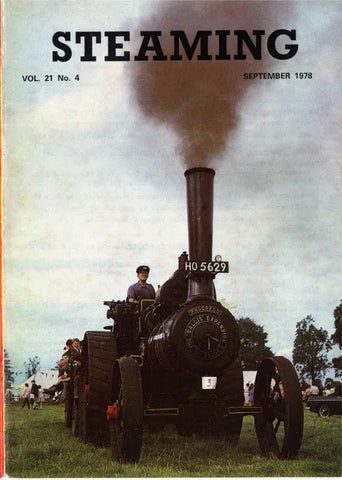
CONTENTS Page 199-200 Editorial and Club Announcements. Page 201-207 John Collings of Bacton — Engineer, by Ronald H. Clark, M.I.Mech.E. Page 208-214 The African Rescue, by Michael Davis. Page 215-217 "Sunny Boy No. 2", by J. Wilkinson. Blodwen goes a Blackpool, Page 218 by Steve Durrance. Page 219-221 Six Inch Scale Burrell "Devonshire" Traction Engine. South Dorset Engineering Co. (Weymouth) Ltd. Page 222 Capital Transfer Tax. Page 223 Fowler Road Roller, by D. Marder. Page 224-227 Four Steaming Days, by Derek Rayner. Page 228-230 A Visit to America, by Simon Bath. Page 230-234 "The Little Wonder" a Road Run, by John Mayes. Page 235-247 Area Notes compiled by Derek Rayner. Page 248-249 Photo Feature. Page 250-260 Letters to the Editor, New Members and Small Advertisements. All items are held copyright by contributor and/or N.T.E.C. COVER PHOTOGRAPH. Ted Evans drives across the field at the first Cropredy Rally, near Banbury. Wallis and Steevens Traction Engine, No. 7498 Transparency R. J. Blenkinsop. built 1916.
EDITORIAL If you are a regular reader of this magazine you will no doubt be an enthusiast who likes every facet of the Traction Engine — the sight, sound and smell. To the general public, who attend our rallies, for a variety of reasons, the engines, are looked at in a different way — the gloss
finish, the power and even the personalities who drive them!! However, one thing for sure that the average rally goer dislikes is clouds of filthy smoke billowing out from every engine the like of which I have seen at the last two large events that I
have attended. Is it not time that Rally Organisers provided good quality coal that burns well and has the minimum of smoke? The reason that many do not is most likely one of cost. It would seem prudent for someone to analyse carefully the savings that can be made in the total coal bill at a rally when Welsh Steam Coal is provided instead of a household variety. For my money I should prefer half the amount of Welsh Steam Dry coal ("Lady Windsor" as used in the Anniversary Run in 1975) to the smokey variety and after all the best is not twice the price of the worst, and as a bonus the copper top on the chimney stays clean!! In this issue is an article which includes a journey up the A.1 with a steam roller. What interests me is the precautions that the driver takes in warning traffic behind that the train is long and slow. Having driven to one rally this year some 20 miles along a busy trunk road I can easily understand the problems. Closing speeds of
some of the "Juggernaughts" must be well over 60 m.p.h. and the drivers do not seem to be able to stop quickly. I am sure it would be most helpful to us all if certain basic safety recommend-
ations could be made to ensure that a future tragedy is avoided.
199
CLUB NEWS The National Traction Engine Club Ltd. First Annual General Meeting, Henley-on-Thames, 5th August, 1978 Nearly 100 members attended the first Annual General Meeting since the Club became a Limited Liability Company. The meeting was held on Saturday, 5th August, at the magnificent private museum owned by Mr. W. H. McAlpine of Henley-onThames and presided over by the Club Chairman, Mr. Michael Lane. The Club is indeed very indebted to Mr. McAlpine for allowing us to use his premises and giving us free access to his galaxy of treasures. The formal business concerned the Chairman's Annual Report, which as a break in tradition was circulated to all members in advance of the meeting; the acceptance of the accounts; the election of the NaLiurial Committee for the ensuing months: and the motion increasing the annual subscription to £5.00, with effect from 1st September 1978. Since Incorporation took place in March 1977, two sets of accounts were presented to the meeting, those for the last six months as an un-incorporated body to February 1977, and those for the twelve months to February 28th 1978. A full report was presented to
London Area Social Meetings, 1978 - 79 Season These are "Noggin and Natter" meetings with a slide or similar show either with a traction engine or steam or preservation theme. Times are 8 p.m. to 10 p.m. and meetings are held on the last Wednesday in each month. VENUE: "The Cock Tavern", (upstairs room), Great Portland Street, London, W.1. (about 200 yards from Oxford Circus, London Transport station. Wednesday, 25th October. Members' slides. Please bring yours along — not more than 20 per member. Wednesday, 29th November. Dick Blen200
the meeting by Mr. Barry Gascoyne, of Radfford & Co., Chartered Accountants of Bury St. Edmunds, who were re-elected as the Club Auditors. The Chairman stressed that although the surplus of income over expenditure revealed in the accounts was satisfactory, the position could not be maintained without a subseriptinn increase, due mainly to the effects of inflation and the steeply rising cost of producing Steaming. He felt it was unsatisfactory to rely upon half the Club's income coming from the Rally Stand operation and the sale of books and further stressed that in his opinion the Club needed to build up greater reserves than it currently enjoyed. After some discussion the motion to increase the subscription to 15.00 was carried by a 2 to 1 majority, Mr. Alan Martin, who has done much for the movement aver many years, was elected Second Vice-Chairman. Newcomers to the National Committee, the direntnrs of the new Company, were Mr. Tim Holt of Cumbria and Mr. Chris Barber of London. Both are well known in Traction Engine circles and were warmly welcomed to the Committee by the Chairman. The Chairman referred to a new innovation undertaken by the Club, namely the reprinting of Moyrick-Jones 1920 classic "Steam Road Vehicles". This had involved a considerable outlay of Club funds and he hoped that all members would support the project and purchase a copy of this excellent book. After a comparatively short and good humoured formal meeting, refreshments were served and members had the opportunity of inspecting the museum and the various engines in steam and enjoying the good companionship of old friends. kinsop will give a slide show entitled "Steam Far and Wide". No meeting in December. Details of 1979 programme in next issue: each last Wednesday, January to April inclusive. Amendment to N.T.E.C. Policy Terms. As from 1st September 1978, we have arranged with the Dominion Insurance Company to increase the "Sparks and Ashes" limit under the Public Liability section to f50,000 each occurrence. This extra benefit will be included without additional premium. Tennant Budd Limited will be forwarding necessary endorsements with all renewals falling due from 1st September 1978.
JOHN COLLINGS OF BACTON — ENGINEER By Ronald H. Clark, M.I.Mech.E. Mechanical engineering and agriculture being the two basic industries, at least in the United Kingdom, it is all the more interesting therefore to consider an individual who, while to some extent an agriculturist, was chiefly a mechanical engineer, and a Norfolk man at that. So the second part of my address is devoted to John Maris Benjamin Collings, born in 1882, the only son of John Collings and Margaret his wife, the only daughter of Benjamin and Margaret Stannard. Benjamin Stannard was one of a family of six and his elder sister Elizabeth married Robert Holmes whose great aunt Ann Holmes, was grandmother to Anna Sewell, 1820-1878 the authoress of that immortal classic Black Beauty. Further back on his mother's side there were connections through the Buxtons to the Parrs and it ‘ivas Catherine Parr who became the ultimate wife of Henry VIII. The Parrs were wealthy watchmakers and jewellers of London and John Collings used with pride a large "turnip" type of watch made by one ❑f the Parr family. His mother's great grandfather Benjamin Stanford died in 1815 having married Susannah Farr. Here it is worth noting that Anna Sewell's mother, Mary, also wrote several books, "Homely Ballads for Working Men's Fireside", "The Children of Summerbrook" and "Mother's Last Words" and of this over one million copies have been sold. The family of Collings also came from versatile stock and in three Norwich City churches there are lapidary slabs to the Collings family dated 1639, 1690, 1695, 1700, 1727 and 1729. In Walcot church is a slab to John Collings, S.T.P., born 1623 and died 1690. Brancaster church contains a brass to Magister William Collying, rector in 1457 and died in 1480. It was from his father's side that John inherited his mechanical bent for John senior was a threshing contractor, land owner and merchant of Bacton, Norfolk. Therefore John junior, naturally became well versed in the mechanics and maintenance of agricultural machinery of the 1870s. His father had at that time taken up residence in Bacton Hall.
At an early age he was familiar with the mechanism of the threshing machine, the binder, the elevator and, of course, the portable or traction engine which drove them. He did not neglect the petrol engine and he had too, prepared a design for a tricar powered by a single cylinder internal combustion engine. In the precincts of the Hall he built up little by little his own small works, added one of the largest wheel-turning lathes in Norfolk, laid down a small ferrous and non-ferrous foundry and later drove the whole lot electrically. His first power unit was a small overtype steam engine by Savage of Lynn belted to the line shafting. Later he substituted a Fairbanks-Morse oil engine belted to a two-pole Edmundson dynamo with gauze brushes — a sight to delight the eye of the connoisseur! From time to time he retired to his small shed between the Hall and the little works which served him as pay, general and drawing office and being a self-taught draughtsman, committed to paper his prolific brainwaves. A number got beyond the drawing board and as far as H.M. Patent Office. Altogether ten patents were applied for of which seven were eventually sealed. The complete list is as follows:No. 9750 of 26th April, 1907. Sowing and harrowing. No. 28909 of 13th December, 1019. Scissors and sharpener. No. 26516 of 19th November, 1912. Petrol pourer and strainer. No. 29729 of 24th December, 1912. Multiple ploughs. No. 1350 of 17th January, 1913. Closing tyre punctures. No. 17013 of 17th July, 1914. Locomotives. No. 105671 (8627/16). Ploughs. No. 12831 (12738/7). Tractors. No. 146592 (8656/19). Ploughs. No. 169296 (17454/20). Ploughs. Those not sealed were Nos. 28909, 26516 and 1350. Seven out of ten is not a bad "score"! The applications of his inventions appertaining to cultivators and ploughs took 201
the form of his self-lift cultivator and plough for direct traction. The former could be fitted with either nine or eleven tines, spring or rigid, and was a one-man outfit with the same advantages as with the self-lift plough. The tines, sprung or rigid, are set in irregular rows to prevent choking and they can be arranged on the bars at any determined width.
automatically to its proper depth after turning on the headland. Altogether two very interesting and useful aids to the agriculturalist which worked well as many can testify. To make the task of the farmer still more idyllic, the inventor's plough for direct traction could be used with, and attached to it, a harrow, roller and seed drill.
In addition to controlling the lifting and lowering of the tines, the tractor driver can see from his seat to regulate the working depth. The implement after being drawn out of work at a given depth will always return to the same depth. In his large ploughs for direct traction any number of shares from 2 to 7 could be used; and they were, of course, fitted with the Patentee's auto-lifting gear whereby the power of the tractor is made to lift the plough out of work when arriving at the headland, the ploughman having only to release a small catch at the proper moment.
In this ingenious combination the disc harrow is placed next to the plough, its rear end is coupled to the third breast and is of sufficient length to cover the three fresh furrows and one from the previous round. The roller, drill and harrows are all made in one self-contained implement. The drill by the way, has seven coulters which are set to cover exactly the width of four furrows and it is connected to the plough in such a position that it will cover three fresh furrows and one of the old ones. Only one man was needed to work it.
Another feature of these implements is the mechanism for regulating the depth of work which can be adjusted whilst the plough is in motion. It is independant of the lifting gear and the plough will return
Steam engines had been for many years one of Collings's ruling passions and it is no surprise to find a patent appertaining to one type, in this case locomotives (No. 17013 of 17th July, 1914). It provides for a locomotive to have four cylin-
Engine No. 1, Offside front view and note the chain over the sprocket. 202
Engine No. 2, hauling three sail binders. The Author's fleet, Engine No. 2 and Tuxford Portable No. 1283 behind.
203
A 151-emn.
.,,, „:,,,::. ,- ,•_,..,::.,,,,,,-411 i
4 VI Lill II
111 1 411 Y
4
s l , /.1, imagftwszorreArealSk, Eks: ‘,....7117174 10, 4.‘‘ .,.., -., s.
4':9.' iL
ia at l .
_-_,,,
0
/
01
.-
0
IIIIffli
Ws 0
1,:q ;mmill. .1,111iirimm_tli=e1 'i Igru.
go
\
Zir 7 . "174 1,-41 -1 -111.in W I I W 414+ ...et Win 0.P AV
131. SECTION ON. AA.
SECTION. ON BB.
SCALE —HALF FULL SIZE Roy ro.o GLIM., AMUIALC14
COLLINGS TRACTOR—TANDEM COMOUND CYLINDERS.
elan... eel...
5.1E54101 All SAINTS MORWICK
Engine No. 2, showing details of the tandem compound cylinder block. ders arranged in two pairs in tandem, each pair to have a high and a low pressure cylinder. In addition, all cylinders were to be jacketed by extending the bottom of the smokobox downwards and around them so that the hot gases from the tubes diminished radiation of heat from, and condensation of steam in, the cylinders. Collings was so attracted by the steam engine in general and the road engine in particular that in his small works he constructed at least three engines of this type. His first was a small light steam motor tractor completed in February 1905. With the exception of the boiler and of the cylinder patterns, all was made at Bacton. It had two simple double-acting cylinders mounted on the firebox end of the boiler; the countershaft was beneath 204
it and the final drive was by chain to the rear wheels. One man could manage it easily, as the designer-manufacturer intended and at this period it was a familiar sight on the roads around Bacton. The success of this little engine encouraged Collings to design another tractor, completed in 1910, of less than five tons weight unladen and in this case he adopted the tandem compound arrangement of cylinders as specified in his locomotive patent, all gear drive, and showed the stereotyped railway engineers of the day the way to increased performance by adopting the high working pressure of 250 p.s.i., a pressure only equalled by some locomotives a generation or so later. Five years on in 1915 his third road
Engine No. 3, an Offside view. Engine No. 3, Derelict and too far gone to save. Some of the parts used on No. 2. ,..--
205
PLAN ON
B
SECTION OF LIVE SRAM VANE CIAEST
IyU
iiiiiii ,tit ONE FOOT
NONMS.V06.N P ' % . ZA/4W~ Z ZAVAAI !
I
Si RONL
I /
ill ig
r
Le
1if,
rovraararawnelow
.,,,,,,,,,..,
••••
4 /
P6 iiiir_ Mir= 4'. 1 .:•= . irsa . vivo III 'm i ti * 1/4 -twoh.
•
Engine No. 3, showing details of the tandem compound cylinder block. 206
A view inside the works. engine was completed and was quite similar to No. 2 save that he used piston valves and a super-heater was embodied in the smokebox, the working pressure being 260 p.s.i. Both Nos. 2 and 3 had cylinders 5" and 8" x 8", and were used for many purposes including direct traction in particular and a ploughing test was carried out at Bacton in September 1918 using the cultivator already mentioned. In reporting this rather remarkable performance the Eastern Daily Press concluded by stating "All the machinery Mr. Collings builds is of interchangeable parts, made entirely under the inventor's supervision, and he takes pride in the fact, that apart from his smith, all his men are discharged soldiers, or rejected from the army on medical grounds, and entirely trained in their present work by Mr. Collings." Subsequently John Collings was quick to see the advantage of light alloys and he was one of the first to use aluminium castings to reduce the weight of his own design of sawbench of which a fair number were made. Like many keen minded men before him, Collings was less of a business man than an originator and craftsman and it is sad to relate that by the beginning of the Second World War he was working on his
own and being single handed he had perforce to neglect the Hall, (its gardens were once a veritable show place), and other domestic chores. He also neglected his own creature comforts and was found dead in his own home on 23rd January, 1950, aged 68 years. He was laid to rest beside his mother at Bacton, close to the site of his small works where he had spent so much of his life. He was a well built man with dark penetrating eyes, a deep soft voice and plenty of energy for the job in hand. He died intestate with no next of kin and it fell to me to act for his solicitors in the matter of his engineering effects and I was able therefore to collect records and facts, so easily lost in such circumstances, upon which this short eulogy is based. His No. 2 tandem compound may be the only one of this type of steam road engine left in the country. Right to the end of his life he always maintained a regard for the steam engine and cherished a profound respect for such giants as Samuel Vauclain and F. D. Smith. Consequently his contribution to steam engine history is worthy of a place in our records. 207
THE AFRICAN RESCUE by MICHAEL DAVIS
In October, 1975, Peter Court approached me with "You know there are some Steam Engines in Mozambique. I have been on the 'phone to Sena Sugar Estates, in London, and they have told me we can have them if we go and fetch them. Would you be interested in going? and who shall we ask to join us?" This appeared at first sight to be a very far-fetched suggestion. However, things like this tend to grow on you and it soon became almost an obsession. We approached a number of other people and David Adkins eventually joined us. Knowing nothing of tho conditions in Mozambique, we pushed hard to go in February but as we subsequently discovered, this was quite impractical as the rainy season does not finish till April or May. We made numerous 'phone calls and wrote a number of letters to shipping agents, the Airlines and the TransZambesi railway. Eventually, we arranged a meeting in London with one of the directors of Sena Sugar. He turned out to be most hospitable and helpful and having organised passports, vaccinations and visas, we left Heathrow on 29th May. We stayed the first night in a hotel in Beira and the next morning went by "Air Taxi" to Luabo, Flying in a light plane such as this, was a completely new experience for the three of us but our apprehensions were soon dispelled and we found it most enjoyable. The journey took about half an hour and it was very interesting to see the chequer-board appearance of the estates from the air and also the Zambesi snaking in between them. On landing at Luabo, we were met by the factory manager who arranged for us to stay in the General Manager's guest house and have our meals in the company's restaurant nearby. After lunch we were taken on a tour of the Factory area where amongst other things we saw two large stationary steam engines providing compressed air for the factory, various narrowgauge steam railway engines and two of the old stern wheel paddle boats. These were of particular interest as they had loco-type boilers, and the main paddle208
spindle was virtually the crank shaft of the engine with an eccentric, etc. at each end driven straight from a large steam cylinder. As Mozambique is a little south of the Friu iator. the day and the night are much the same length and so it got dark at about 5.30 with relatively little twilight. On this first day, we met most of the remaining English people who were still living at Luabo including the manager of the cattle ranch, and Peter Du Boulay, the assistant general manager (production) with whom we had already corresponded. We were told that fat cattle were to be loaded the next morning and were invited to go along with Peter to have a look. This meant starting at 5.30. There are, in fact, no made-up roads in this area and at this stage some parts of the main tracks were still impassable and very rough after the rainy season. The cattle had to be loaded on to a barge to be taken across the river to the rail head at Marromeu. There were 100 Brahmen cross steers being sent to Beira for beef. Later in the day, we were introduced to a colourful Portuguese called Pemantel, the ploughman, who was to show us the ploughing engines. This, of course, was the day we had been waiting for and we were in no way disappointed. Having been to study Fowler's order books at the Museum of English Rural Life at Reading University, we already had a fair idea what to expect. The engines were all class Z7. One pair, new in 1916, with single-speed ploughing gear and three pairs new in 1924. One of the engines was missing, believed in the Zambesi and so there were only 7, one of which had a broken back axle. The Z7 was a class of large ploughing engine made by Fowlers almost entirely for export having full length canopy and 6ft. chimneys. The rear wheels are 7ft. in diameter and 3 ft. wide with narrow strakes. The boilers have 50 2lin. tubes and are fitted with one injector and a pump (in all cases this had been disconnected).
The engines were compounds with Salter safety valves. There was no bell gear fitted and we found no road gears. The general condition was good although they had not been used for twelve years. We understand that the steam plough foreman started with the company when the engines were new in 1924 and when he retired the engines were well-oiled before being laid up. Besides the engines, there were several cu► tivators fitted with ridging bodies, one 5-furrow and a number of 4furrow ploughs. These were all set to plough 16" wide and 15" deep and have now been replaced by Caterpillar D 6's with 5-furrow reversible ploughs, or D8's with heavy disc ploughs. Sena Sugar Estates were developed over a number of years soon after the turn of the century and their main enterprises are sugar growing on two estates at Luabo and Marromeu of 45,000 acres of cane. There is a vast acreage devoted to 36,000 head of cattle which includes the original estate at Mopea. The company also owns a coconut plantation near the mouth of the Zambesi and a sugar factory in Lisbon. Before a decision was made over how we were to proceed, we were able to make a long outing down the river by launch to see the coconut plantation which also supplied the company with quantities of firewood and railway sleepers. The fact that we were stranded on the mud for two hours emphasised that the river below Laubo is tidal. The chief item of interest from a steam point of view was the Fowler 20 h.p. portable engine still in use for driving the saw mill, which was a rather unusual machine with a number of vertically reciprocating blades. This portable also provided steam to drive the workshop table engine.
having been scrapped. These Z 5's were mostly in pretty poor condition and short of a considerable number of parts. However, as they were unique, we are seriously considering bringing one home. Some points of interest on these Z 5's — they have the same back wheels as the Z7, similar pumps and injectors with full-length canopy. The clutch on the rope drive is on the crankshaft instead of the vertical shaft. The engines also were single-speed. The chimney on a Z 5 is mounted on the back of the smoke box which is the same diameter as the boiler barrel. The safety valve is of a conventional type and the steam dome of the type which enables one to examine the valves when the engine is in steam. The only steam Fowler implement we saw at Marromeu was a ditching plough converted for use with a crawler. At about this stage, it was agreed that we should move the engines across the river rather than wait for official clearance. We, therefore, set about preparing for the move by removing the canopies and stacking as many of the spares as possible inside the boilers and on the foot plate. As the "plough yard" was about 8 kilometres away from the quay, it was necessary to use caterpillar tractors to tow them. A Sunday was chosen for the move in order not to disrupt the smooth running of the estate. We pulled 3 engines in a train behind a 08 and 2 behind a D6. As there was no crane at Marromeu capable of lifting 25 tons, it was necessary to carry the engines on the deck of a barge in order to be able to pull them off straight on to the bank at that end of the journey.
Shortly after this trip, David and I had a day with Mike Powell, the Ranch manager, up at Mopea where we saw a number of derelict portables and the remains of a Ransomes Colonial tractor. The main access to and from the estates is now by the Trans-Zambesi railway which has a spur going down to Marromeu so naturally we had to make preparation on that side of the river. While there, we saw some 27, 60cm. steam railways locos including some early Fowler's and also some of the company's steam engines on the main line which is a metre gauge.
The availability of a tractor for unloading caused some problems and further delay. As there was only one barge with deck space large and strong enough to carry the engines, we were only able to move one at a time. The stern wheeler tugs would take one or two barges lashed to either side and the journey up river took some 54- hours against the current. We were able to see four of our engines safely delivered before we left. The first time we saw one swinging in the air from a crane in Luabo, we had some misgivings but we have now become rather blase about this as we have seen them aloft three or four times. So, having spent a month at Luabo, we had to come home without knowing if we would ever see the engines again as we still had no export permit.
We also saw the five remaining Z5 ploughing engines, the rest apparently
During the ensuing months, we corresponded with Luabo regularly. Eventually, 209
CN
210
the patience and perseverance of Ted Baron, the commercial director, paid off and our permit was granted in late December 1976. We were now able to make firm arrangements for getting the engines home including setting up a letter of credit and investigating the timetable of likely vessels. By this time, it was apparent to us that we should have to make a second trip to Mozambique to provide the necessary impetus to get the engines dispatched. By the time the paperwork was in order, it was again late May before we were ready to go. We flew straight to Marromeu where we were met by Alan Simpson, the Assistant General Manager, who took us to the house usually used by the General Manager. The engines had been moved from the river bank to the factory yard and to our disappointment we found had suffered some damage and extensive vandalism. We spent some days assessing the situation, laying on railway trucks and negotiating for the use of factory contractors mobile cranes for loading purposes. We then moved down to Luabo to collect the front axle off the engine we had previously left to replace one bent in transit!! During this time, we were able to arrange an air trip to Quilemane where we saw a 1912 Fowler Railway locomotive and a 1926 Tiger tractor convertible, both of which had been restored by Sena Sugar for exhibition purposes on the local Showground. We were now working to a tight schedule, (Harrison Lines M.V. "Historian" was due in Beira about 20th June), so we had no time to waste. As soon as our railway trucks were available, we returned to Marromeu in the hope of loading them on the Sunday. However, the site chosen for this was unsatisfactory and we only succeeded in loading one. On Monday, our luck changed and the remaining five were placed on the wagons. The following two days were spent with the factory's erection gang welding on stops, chaining and wiring on the engines. The TZ being metre gauge, made the engines look extra large, their overall width being 10ft. 4in. We eventually saw them moved away by a Fowler Saddle Tank Loco
wondering very much how they would fare on the 200 miles of indifferent track. The rest of the week was spent preparing the only good Z 5 for moving to the factory yard ready for shipment at a later date. On Saturday, we went down the river on one of the company steamers, sitting on deck, colonial style in a deck chair which was really most enjoyable. On Sunday, Mr. Tinne, the General Manager, took us up to Mopea to investigate the reports we had heard of engines there. The road was still fairly rough and the 40 kilometres journey by Landrover was somewhat traumatic. Firstly, we went to the riverside where we found a number of portables stored in a shed which was in process of being washed away by the river. Of the eight there previously, only four remained. The others could be seen sticking out of the water, a very forlorn sight. There were examples of 8, 12 and 20 n.h.p. engines, mostly missing their motion-work, although boiler-wise, not too bad. We also saw an example of a 50 cm. Fowler Railway Loco and a number of small trucks. On the river bank also, was an unused boiler and fire box apparently for a ploughing engine. After a picnic lunch, we returned to the Mopea factory to re-assess the five 20 horse portables and the Ransomes Colonial tractor we had seen the previous year. As the latter appeared to be in reasonable condition, and David was keen on it, we agreed that this was worth bringing home. The simplest plan was for Peter and David to come up on a day convenient to Mike Powell, the Ranch manager, and using his County Super 4, tow it to Chupanga via the ferry from whence it would be collected by tractor from Marroreu. Before returning home in the evening, Mr. Tinne took us through the Bush in the Land Rover to see a huge freshwater lake where there were hundreds of birds. As we had discovered the "Historian" was not due in until Sunday, the day we were due to leave, we spent several most enjoyable days visiting our friends and then returning to Beira on the Wednesday to finalise our arrangements with the Shipping Agents.
1. Peter Court walks past the Z.7 Ploughing Engines at the original site. 2. The Fowler Tiger Tractor at Quelimane in preservation. 3. The Z.7. engines as found. 4. A view of the Fowler 20 N.H.P. Portable used for driving the saw mill. 211
ABOVE: Michael Davis stands on one of the engines to assist in offloading from the railway wagon to the ship in Beira. BELOW, left. Hanging in midair from the ship's derrick. BELOW right. Lowering down and into the hold. Note the chimney lying on the flootplate.
212
ABOVE: At rest on a Warwickshire Farm. Having done all that was possible, we then made a trip to the Gorrangoso Game Reserve staying overnight there and returning Friday evening after a most enjoyable time seeing lion, elephant, hippopotami, buffalo, crocodile, water buck, Wilde beest, zebra, gazelle, and monkeys, in their natural habitat, quite unspoiled by the crowds of people usually associated with Game Reserves. On Saturday, we went and inspected the engines which were in the Agents' siding and upon checking dimensions, we discovered, to our consternation, that they were considerably higher overall than our measurements from the previous year on softer ground had led us to believe. This necessitated someone staying behind as we understood that the engines had to stand under a beam of 9ft. 8in. inside the ship and the flywheels were 10ft. 4in. from the ground. It was agreed that David should return on the flight we had originally booked and Peter and I return later in the week. On Monday morning, we were very relieved when "Historian" steamed smartly up the river. Cameras were not allowed in the port area and we were fortunate that the Agents were able to obtain Police passes for us to go to the quayside where we met the officers and crew. After some discussion with the 1st Officer, it was agreed that we should have to remove the steam chest covers from three engines and the fly wheels, or the complete crank shaft from the other three. This proved to be quite a big job and we were only just ready to leave on the Maputo plane on Wednesday afternoon. We were highly impressed by the interest and enthusiasm of the British crew. Once again, luck was with us and after one very pleasant night in Maputo, we
managed to get seats to Johannesburg and hence home to England early Friday morning in time to help with the Banbury Steam Club Rally on Saturday and Sunday. As "Historian's" return home was to take about a month, our main responsibility at this time, apart from paying the bills, was to organise our transport which, of course, is somewhat difficult as the last minute timing is unpredictable. On hearing of "Historian's" arrival on 29th July, David and I went 'hot foot' to Avonmouth to find out the likely programme for discharging. It was anticipated that the first two engines would be accessible on Tuesday afternoon so David, Jeremy, my son, and I set off again on Tuesday. As it turned out, the engines had to be all off-loaded on Wednesday. Jeremy and I stayed the night on the "Historian" to be available to clear the paperwork and start loading first thing the next morning which by chance was my birthday!! As we had six engines rather than four to move in a day, we made emergency plans and were fortunate in that one of the vehicles was capable of transporting two engines at a time. The stories of Fowler Ploughing Engines travelling up the M.5 in convoy were, of course, true and to crown this Fowler rescue operation all the engines were taken off the lorries with a 1935 Fowler Diesel Crawler Tractor. (The restoration and preservation will have to wait for another instalment but we are most grateful to Michael Davis for giving us the story of this magnificent rescue operation. Our congratulations and thanks go to the happy trio for bringing the engines home. Would you like six Z.7 Ploughing Engines at the bottom of your garden? — Editor). 213
F. MAXEN & SONS LTD. ENGINEERS GALLEY HILL, WALTHAM ABBEY, ESSEX. Telephone: Lea Valley 712375.
Boiler repairs of all descriptions, welding, tubing, retubing, new fireboxes, metal spraying of motion gear, etc.
Quotations on site anywhere — established 1911.
en esign
LIMITED
MANUFACTURERS & DISTRIBUTORS OF QUALITY SPECIALIST SOUVENIRS
SUPPLIERS OF HIGH CLASS PRINT. POST CARDS CALENDARS JIG-SAWS BADGES CAR STICKERS PLASTIC CARRIER BAGS MODEL CAR KITS OUR 1979 VINTAGE VEHICLE CALENDARS NOW ON SALE — PRICE 65p Each inc. P&P. TRADE ENQUIRIES INVITED.
45 CASTLECROFT AVENUE BLACKROD BOLTON LANCS. TELEPHONE: BOLTON (0204) 694398 214
SUNNY BOY No. 2 By J. WILKINSON
One of the best known Showman's Engines in Yorkshire was probably Fowler No. 10318 "Sunny Boy No. 2". It was new in April, 1905 for the late W. H. Marshall, roundabout proprietor, Wakefield Road, Bradford, for use with a Savagebuilt Steam Switchback. Actually, it was their third Fowler engine to be called "Sunny Boy", as the two previous ones were No. 7036 (built 1893) and No. 6635 (built 1892). The first two "Sunny Boys" were single cylinders, whereas "Sunny Boy No. 2" was a compound, of "B.6" classification. The now defunct firm of John Fowler & Co. (Leeds) Ltd. built more steam engines for the road than did any other manufacturer, and in 1910 they achieved a record output with 410 engines. Fowler's
were first in the field to put a traction engine on rubber tyres, and that was in 1872 when they built an engine (No. 1675) for Lister & Co. Ltd., Manningham, Bradford. In 1881 they surprised everyone by building the first compound cylindered self-moving engine, which all other manufacturers thought would be a failure. Nevertheless, competitors then had to fall in line in order to remain in business. Fowler's built a few similar engines for showmen in 1905, and the first was No. 9984, appropriately named "The Showman" for Randall Monte Williams. All were mostly identical except that No. 10329 "Envoy" (for Charles Marshall) had a flywheel of five feet diameter instead of the standard 4' 6" size. At that time fastrevving Dickenson dynamos were in use. 215
and Mr. Marshall told me that by using a larger flywheel, the engine was able to run more slowly when 'driving lights', thus giving a saving on wear-and-tear. In the years before the First World War it was a common sight to see a Showman's Engine hauling a road train of six (or more) vehicles. Fitted at the rear of the engine's cab was a 'hammer bell', to which was attached what looked like a length of string, extending all the length of the road train. The man riding on the dandy (the water barrel) at the end of the convoy used this as a communication cord, in order to inform the driver that there was something behind that wished to overtake. Tramcars were the chief 'speedsters', and traction engine drivers hated them! During the First World War "Sunny Boy No. 2" left the fairgrounds for a time, as it was requisitioned for timber hauling in Wales. Showmen relied on their engines to A high degree, and they were very efficient. I think it was around the end of World War One when cranes were introduced to showmen's engines. Goldthorpe Marshall conceived the idea of using the steel wire rope for this purpose, so his engine "Envoy" was the first to be so fitted. A tubular post was fitted at the rear of the engine, to which was attached a tubular jib. Although the post was a permanent fixture, the jib was carried on one of the trucks. Thompson and Walton, an engineering firm at Brighouse, were responsible for the manufacture of this useful amenity, and they called it a 'feast crane'. It subsequently became standard equipment on all engines (regardless of make) for use with Scenic Railways. "Sunny Boy No. 2" would be the second engine to incorporate a car-lift crane. "Sunny Boy No. 2" had driving wheels of 7' 0" diameter, and with a face of 1' 6". By the mid-twenties the fitting of solid rubber tyres became compulsory, and when No. 10318 was so fitted a part of the rear of the fore tank was cut away in order to avoid the risk of damage when 'spuds' were fitted to the driving wheels when working on 'soft' fairgrounds. In the march of progress, Dodgems, etc., took over from the Switchbacks, and at Castleford Whit Fair, 1932, "Sunny Boy No. 2" took sole charge of the new novelty ride. It had, therefore, to be in use all the time to drive the Dodgems when fairs were open, and not merely used for 'driving lights' at night time. In the early years of the Second World War the engine was sold to Edward Box 216
& Co. Ltd., heavy haulage contractors. Liverpool and Manchester. Dynamo bracket was cut off with an acetylene torch, and cab reduced to three-quarter length. All its Showland fittings (including twisted brasses) were removed, and the engine gave useful service for the national effort. In later years the engine was acquired by Frank Morgan, who had taken over the heavy haulage business of Walter Denton (Hyde, near Manchester) in 1940. At one time Frank Morgan was manager for the Norman E. Box firm of heavy haulage contractors. But the days of steam were numbered, and along with another Fowler Road Locomotive (No. 14115), "Sunny Boy No, 2" remained in the Manchester Road yard idle, exposed to the elements for years. With the advent of traction engine rallies there were many enthusiasts who tried to buy the two derelict engines, but despite tempting offers old Mrs. Morgan (Frank's widow refused) to sell. Then out of the blue it was learned that a man and his son had been successful in acquiring the two engines. So they are now at Banks, and Jack Johnson is in process of restoring "Sunny Boy No. 2" to its original glory. The work entailed must he enormous, due to years of neglect. Perhaps Mr. Johnson might learn a hit from the photograph when Fowler No. 10318 was at the height of its fame. I took the snapshot (with an old box camera!) at Grimesthorpe, Sheffield on 6th July, 1935, only a few minutes before the fair opened. Standing by the rear wheel is its steerer, a Bradford man known as "Little Fred". Note the old type oil lamps and crane post, and the cut away belly tanks. Also the 'sunshine roof' (almost a luxury!) and the rings on the cab roof to facilitate getting up and down for fitting (or removing) the extension chimney. There is also to he seen the 'birdcage', used as a spark arrester when on the road. Towards the rear of the cab is the 'hammer bell'. If Jack Johnson and Company can make "Sunny Boy No. 2" look something like this it will most certainly be a really fine engine, and there must be many who will remember when the engine travelled so extensively with Marshalls — visiting fairs in all Yorkshire's three Ridings, and also places further afield like Oldham, Bolton, Ashton-under-Lyne, Liverpool, Blackpool, Chesterfield and Nottingham. I was only a small boy when I first saw "Sunny Boy No. 2" at Horton 'Tide' for the first time, and although I didn't know its driver I later learned it was a man by the
name of Oswald Deakin. After the end of the war there came on the scene a driver called Ernest Rowell, who I was told had been a 'car man' on Farrar's Dragons prior to joining Marshalls. Before that he was a carpenter, employed by Savage's Ltd., roundabout builders, King's Lynn. The job of engine driver usually meant being machine foreman, but the "Norfolk Dumpling" did not take kindly to the Yorkshire lads, and he had difficulty in keeping a staff for the machine. One of the new post-war men was Arthur McLaurie, who had worked previously on Harniess Bros' Scenic Motors and E. C. Farrar's Gold Dragons. He was a rather intelligent workman, and ere long took over as the driver of "Sunny Boy No. 2" and foreman of the Big Motors. In the meantime, "Long Ernie" left the firm, and began driving the Foden No. 1570 "Progressive" with Morley's Steam Gallopers, and later married Emma Morley. Arthur McLaurie was a first-class driver, and he maintained his charge to perfection. He was quite a handyman, too. If he had some rather specialised work to do he
would get hold of a book on it, and study it carefully. In consequence he was capable of making an excellent job. A complete new cab for Fowler No. 8725 "General Buller" was one example of his skill, and he also built (from scratch) a box van for use with one of the novelty rides. Arthur McLaurie seemed to nurse his engine, and Mr. Marshall told me his only fault was that he tended to stay in top gear too long. Once at a Martinmas Fair on Melton market place in the mid-1920s I was left in charge of "Sunny Boy No. 2" as it generated electrical energy for the little electric motor (used to drive the 89-key Marenghi organ on the Racing Motors) and the arc lamps. At that time the engine was not fitted with governors. Frank Orriss left me in charge for half-an-hour or so, and the traction engine attracted a large crowd of admirers. Naturally, I felt immensely proud to be in full charge of such a superb engine — but how I feared a burst gauge glass! I look forward to seeing what used to be my favourite engine once again.
Foster Traction Engine "Bromsgrove Queen" hauling a set of new wagons and carts for Photo: L. J. Lambe. D. Giles and on the way to a show at Stafford, circa 1910. 217
BLODWEN GOES TO BLACKPOOL By STEVE DURRANCE
Blodwen is my Marshall steam roller — No. 57168, built in 1911 and with the registration number of NN 950; and we drove her from Derby to Blackpool. The 'WE' being myself, my parents Ken and Glen ❑urrance, Derek Roose (Rooster), Mike Hartley, and finally my long suffering girl friend Pam Phelps. Why did we attempt this 130 mile trundle — two reasons . . . . The first being that I have always fancied going on a long run with the roller; dud secondly to raise money for the National Federation of Young Farmers' Clubs Development Fund by doing this sponsored steam roller run. At 7.15 a.m. on Sunday, 23rd April we set off — to take the scenic route to Blackpool, i.e. through Ashbourne, Leek, Macclesfield, Knutsford, Warrington, Wigan, Prestton to our journey's end. Did I say the scenic route, more like a ride on a scenic railway! We had hardly left the yard when a distant whistle was heard — this turned out to be Alf Baker and crew with his Garrett T.E. No. 29764, 1911, AC 9326 "Olive". Our escort went with us for the first six miles of our journey. It would be very easy to tell you everything that happened to us — but I am sure our worthy Editor would wish me to be brief — so I will bel On our second day travelling from Leek to High Legh — two things of note occurred. I noticed we were being followed not only by the usual line of cars — but also by an Aveling & Barford roller. This roller kept getting nearer until we were passed — and I always thought diesel gave way to steam! — "One up to the rampant horse'. A mile or two down the road and we were passed by a Foden — at least it was going in the opposite direction to us. The driver was a man who is familiar with steam and diesel power — George S. Lea — President of the Road Locomotive Society. Our journey that day ended at a lay-by opposite the "Bear's Paw" pub at High 218
Legh. Later in the evening quite a number of enthusiasts gathered at the pub. The word had boon spread by Alan Porter of the R.R.A. and Lancashire Club. Eddie Hatfield (treasurer of the R.R.A.) presented us with a piece of Welsh coal during the evening. Tuesday morning we all had a lie in . . . I will leave the readers to draw their own conclusions However, we were able to visit the home of Mr. Tom Barlow and saw his Foden T.E. No. 2654 "George V" and Mr. Jim Stevenson's Aveling & Porter roller No. 10906, 1924, MB 5846. Eventually, after a little more refreshment we left at about 2 p.m., travelling only eleven miles to our next stop. On the Wednesday we travelled towards Preston, the back-up crew set up camp in a secluded lay-by in the southern outskirts of Preston. Hardly had they set the two caravans up when a Panda car arrived. The constable climbed out of the car, and gave us a very broad smile. He then uttered, "It's alright — I can see you're not gipsies'Il Apparently some of the local residents thought we looked like a gipsy encampment. This was the start of a very harmonious relationship with Lancashire Police. Blodwen arrived in Blackpool on the Thursday afternoon — to park on the Rigby Road car park by courtesy of Blackpool Corporation. We ran up and down the promenade on Friday and Saturday — carefully missing the trams, although we did exchange greetings with a horse and carriage driver — the horse though, did not appear to be the least bit bothered. Our journey to Blackpool was free of any mechanical problems, and we enjoyed doing the run. Through our efforts about £500 was raised as a result of sponsorship and advertising fees. This run has sown the ideas of other road runs — why don't you try a lengthy journey with your own engine? If you do I am sure you will enjoy yourself.
With plenty of advertising in evidence "Blodwen" takes a steady pace to Blackpool. Photo: Steve Durrance.
SIX INCH SCALE BURRELL "DEVONSHIRE" TRACTION ENGINE recently made by
South Dorset Engineering Co., (WEYMOUTH) LTD. Towards the end of the 19th century, Charles Burrell & Sons of Thetford, Norfolk, one of the best known traction engine builders introduced a new model to their range. It was deliberately designed to be small, compact, and light in weight, specifically for customers who worked in areas abounding in narrow lanes such as the south-west of England, and was for that reason called the "Devonshire" engine. Despite its small size, it was sufficiently powerful to drive and haul a normal 4 feet 6 inch threshing machine. It was fitted with "Burrell's" patent single-crank compound cylinders which made it very
economical to operate. The result was an engine of very attractive appearance which deservedly became very popular. It was these points which were important factors in choosing it as a prototype for our scale reproduction. We are fortunate to have in our possession a full set of the original makers drawings. This has enabled us to make the engine absolutely authentic, down to the smallest detail. The engine we chose as the prototype for our model was built in 1904 and was sold to a customer in Ireland. It carried Burrells number 2644. 219
Brief specification as follows:"Burrell Devonshire" Single Crank Corn-1 pound traction engine, built to a scale of six inches to one foot (i.e. one half full size). Boiler of all welded steel construction complying with British Standards Specification B.S. 2790, and tested and approved by a leading Brilisli insurance cunipdny. Maximum working pressure 145 lbs/sq. inch, coal fired. Cast iron Cylinder Block to Burrells patent "single crank compound" system. Two cylinders 2/ inches and 41 inches x 5 inches stroke. Block is fully steam jacketted exactly as the original. Slide Valves. Fully working "Pickering" type Governor. "Ramsbottom" type Safety
Valves. Whistle. Mechanical Lubricator. Displacement Lubricator. Two-speed, three shaft, Transmission is via steel gears with machine cut teeth. Differential gear fitted on 2nd shaft with
final drive to both rear wheels. Wheels, as the original, are iron shod. However, rubber tyres could be supplied if required. Winding Drum and Hand Brake on Rear Axle. Approximate dimensions are as follows: Overall length 8 feet, 2.44m; Overall height 5 feet 1 inch, 1.55m; Overall width 3 feel 44 inches, 1.04w, Overdll vveiglii. 11 tons in working order, 1280 Kg; Water Tank 15+ gallons, 70.5 litres.
Painting: "Burrell's" standard livery as follows: ,Olive Green with Chocolate Wheels. Lining of Black, Red and Yellow is used together with bright motionwork, and polished brass and copper parts. Other colour schemes to order. Supplied equipped with Boiler Feed
Pump, Injector, Water Lift, Firing Tools, Tarpaulin Cover, etc. Suitable trailer for transporting the engine can be supplied.
The half-scale Burrell single crank compound traction engine being driven by its maker Chris Lord. This was its first outing and seen at "Bristol Steam". Photo: R. J. Blenkinsop. 220
N.T.E.C. SALES BOOKS Burrell Showman's Road Locomotive - M. R. Lane Digging By Steam - C. Tyler Fairground Steam - A. Beaumont Scale Model Traction Engine Building - L. Mason Steam Traction Engines, Wagons and Rollers - B. Johnson Steam Power in Agriculture - M. Williams Encyclopaedia of American Steam Engines - J. Norbeck NEW Traction Engine Register Fairground Organ - E. V. Cockayne NEW Steam Road Vehicles - M. Jones Old Farm Tools and Machinery - P. Blandford The Sentinel Vol. I - W. J. Hughes/J. Thomas Steam in the Village - R. A. Whitehead Steam Entertainment - J. Hume/B. Duckham Traction Engines Past and Present - A. Beaumont Traction Engines and Steam VVehicles - A. Beaumont Traction Engines Worth Modelling - W. Hughes Development of the English Traction Engine - R. H. Clark Traction Engine Miscellany - R. H. Clark The Overtype Steam Wagon - M. A. Kelly The Undertype Steam Wagon - M. A. Kelly Garretts of Leiston - R. Whitehead Pride of the Road (Hardback) - M. R. Lane Pride of the Road (Softback) - M. R. Lane The Steam Scene Vol. 1 - R. J. Blenkinsop The Steam Scene Vol. II - R. J. Blenkinsop The Steam Scene Vol. III - R. J. Blenkinsop The Steam Scene Vol. IV - R. J. Blenkinsop NEW The Steam Scene Vol. V - R. J. Blenkinsop
Overseas U.K. only & Non M'bers Price M'bers 6.00 5.50 1.60 4.30 2.75 3.90 13.00 1.00 5.00 5.25 5.00 3.45 5.50 2.45 4.25 5.00 5.00 13.00 10.50 4.50 13.00 3.30 7.50 4.50 4.50 4.50 4.50 4.50 5.50
5.50 5.00 1.25 3.95 2.50 3.50 12.50 90 4.50 4.50 4.50 2.95 4.95 1.95 3.75 4.50 4.50 12.00 10,00 4.00 12.50 3.00 7.00 3.95 3.95 3.95 3.95 3.95 4.95
4.45 4.20 4.70 4.70 5.65 5.65 5.50 10.00 4.00
4.25 4.00 4.50 4.50 5.45 5.45 5.20 9.50 3.75
WHITE METAL MODEL KITS (4 mm scale) (approx.) Fowler Showman's Engine Burrell Road Loco Foden 'C' Type Low Sided Wagon Foden 'D' Type Tractor Foden 'K' Type Sided Wagon (6 wheeler) Foden 'K' Type Winch (6 wheeler) Ploughing Engine Pair of Fowler Ploughing Engines Anti Balance Plough
Non Members Price includes postage and packing. Members please enclose current Membership Card to claim Post Free price. Cheques and Postal Orders only, made payable to National Traction Engine Club. Orders to: A. G. Wilson, NTEC, National Sales Officer, 7 Welton Road, Daventry, Northants, NN11 5PP 221
CAPITAL. TRANSFER TAX
As Hon. Solicitor to the N.T.E.C. I have had a number of queries about death duties as they affect the owner of a traction engine, and I feel that it is worth while to write something about what used to be called Estate Duty and has now become Capital Transfer Tax, or Gift Tax. Until the introduction of Capital Transfer Tax estate duty had sometimes been called a voluntary tax, in the sense that by taking evasive action it was possible to escape estate duty altogether. The most effective way of escaping estate duty was to give one's property, or most of it, away seven years before one's death — the drawback being that one does not know whether one is going to survive another seven years. Eventually Parliament decided to institute a new tax called Capital Transfer Tax which covers not only property which one leaves at death but also property that one gives away during one's lifetime. This tax is cumulative, so that once one has given away a basic figure of £25,000 (or property to that value) the tax starts to bite. Now, on income tax return forms, every gift over a certain value has to be reported, and these are added together at the Capital Taxes Office and taken into account in calculating the tax on future gifts and on the estate one leaves at death. The more you give or leave, the higher the rate of tax, and to discourage lifetime gifts the tax on these is at higher rates than on one's estate at death. But there are considerable exceptions and allowances which soften the impact of Capital Transfer Tax, and among these are the following: 1. Most importantly, there is no Capital Transfer Tax between husband and wife at any time, which is a great improvement on the situation under the old estate duty. This means that if you are intending to leave all your property to your wife (or husband) in your Will, you need not worry about Capital Transfer Tax. Gifts up to £25,000 in cumulative 2. total are not taxable, so that for example, if you have not made any lifetime gifts which would count towards Capital Transfer Tax you can Wive £25,000 in your Will 222
before becoming liable to Capital Transfer Tax. Combining this with the previous exemption, a person who has a wife, and children, can give (say) a traction engine by his Will to one of his children and the remainder of his property to his wife, and unless the traction engine is worth more than £25,000 his estate will pay no Capital Transfer Tax. 3. Gifts in any one year valued at £2,000 are free of Capital Transfer Tax and if this allowance is not used in one year it can be carried forward and used in the next year, but no further. One can also give small gifts of less than £100 to any person in any year without attracting the tax. 4. If your son or daughter gets married, you can give him or her up to £5,000 free ct Capital Transfer Tax. 5. Gifts to charities during one's lifetime are totally exempt provided that one survives for a year after the gift; gifts in one's Will to charities are exempt up to £100,000 though bequests to the National Trust, national museums and universities are totally exempt. 6. Some classes of property are taxed at a reduced rate: in particular, plant forming part of business property enjoys an allowance of 30% of its value. Obviously then, for example, if one owns a private plant hire business it is worth considering including one's traction engine in the plant for hire. For Capital Transfer Tax purposes, the value of an Item such as a traction engine is considered to be what it would fetch in the open market if sold without reserve, and Probate valuations are usually on the conservative side. Capital Transfer Tax is a most complicated subject, and this article only skates over the surface of the subject. Every person's case is slightly different, and if you are concerned about the tax it is short sighted not to get professional advice on the best way to minimise the amount of Capital Transfer Tax you or your estate will have to suffer. There are many perfectly legal ways of minimising the impact of the tax, in fact the Capital Taxes Office — the new name for the Estate Duty
Office — whose address is Rockley Road, London, W.14, has issued an excellent booklet on the Tax entitled CTT1. It is not easy reading, but it sets out the Tax and its exemptions and allowances as simply as is possible.
I hope to deal in the next article with the subject of licensing, both driving licenses and licenses for vehicles. If any member has any point which they would like clarified, I should be pleased to hear from them. D. H. TEW.
FOWLER ROAD ROLLER No. 15969 A chance conversation between the proprietor of the 3 P's and a member of A.D.M.E.S. resulted in our good fortune of being able to restore a steam road roller which had seen better days and was now standing wasting away amongst various items of steam and bric-a-brac in the yard of Mr. D. Marder of the Ox Drove, Andover. A place known locally for its Hysterical interest. A start was made on Sunday, 2nd of October, 1977. Being a roller which was used for tar spraying in its road making heyday, it was now fairly well preserved under a layer of tar and oil. The motionside of her was a little rusty where she had been attacked by the elements in her resting place for ten years or more. It took roughly a month to clean her so we could see the nuts, bolts also rivets (Barnacles) which keep the plates and brackets in the shape that looks like a steam engine. Underneath all the muck and dirt we found con rods, slide bars, pistons, valves and water pipes which were really at first sight an immovable mess. Having cleaned things up we decided to completely strip the motion from the boiler, clean arid restore parts that were worn and wasted away through her working life, the reason being we wanted her to be as near as good looking after we had finished work on restoration as when she left Fowler's Works half a century earlier.
At this point I should give the reader of this article an insight into the life at the yard of the Picket Piece Puffers, an apt name really as there are a few projects on the go which sometimes get worked on when all the puffing and blowing stops. Unlike us two novices, who have recently had the privilege of D. Marder's hospitality, there are a collection of steam men by birth and occupation who are more conversant with steam vehicles than our mere souls have been blessed with. We work under a continuous barrage of "I wouldn't do this, and wouldn't remove that, this engine is a good one because she were steamed into the yard and was used to level a certain piece of ground, so why strip her down!" Yet for all this keen and expert advice this roller laid there rotting for lack of attention. Work proceeds, hind rolls and tender removed for repairs and paint to parts you cannot reach when fixed to their respective partners. An hydraulic test is to be made, boiler inspector to look and we hope give her a certificate of good conduct. We are now 28 days and 1301 hours into the roller restoration. Motion works are ready to be assembled, flywheel, crankshaft due to be fitted when the weather settles down and we can find the crane driver. Hornplates, firebox sides, steering saddle all resplendent in a few coats of paint, wheels being scraped and painted, belly tank which was used for tar now to be used for water. Primer paint applied to this and tender — already a difference in the old girl. We must thank our wives for the patience and support they have given us over these past months we have spent up the yard on Sundays. Late and spoilt dinners, they have put up with husbands always out of the house, fussing and preening another lady, no doubt. Just about everything has happened since we began work at the yard, we have been rained on, flooded out by the inconsiderate chap who insists on washing out his boiler in the path of his adversaries, moaned at, frozen to the marrow, had numerous cups of tea and coffee, not forgetting bowls of soup when it has been bitter cold, supplied by the old chap who wears the bowler hat up at the house. (D. Marder). This tale to be continued after the roller has been steamed and driven by us. R.H. & R.G.E. 223
FOUR STEAMING DAYS By D. A. RAYNER
It is five to ten and traffic on the northbound carriageway of the A.1. at this time on Sunday is not very heavy. 'White Rose' is pulling well up the Boroughbridge bypass after just coming over the River Ure bridge. Visibility is good and the new moon is beginning to shine. I switch on vertical flasher as most of the other vehicles have their lights on. We arc on our way to Masham Rally and in another hour it will be dark. The vertical flasher is a home made pseudo-school crossing warning light, one mounted above the other, each flashing every second alternately.
which is the old road at Kirby Hill, and bed. We should not have been there at that time — our destination was Masham — still some 12 miles away and 'White Rose' should have been damped down and sheeted up some twenty-four hours previously but for our little problem which had occurred on Saturday afternoon. After a long up hill pull, I'd looked in the firebox and seen water. The ashes had been damp that morning but, after lighting up, the tube plate was dry and so on we went. Just past the 'Little Chef' at Marton-cum-
More coal on — a little smoke and she still plods onwards. Into the high bank of the cutting and now it is darker so I put on the rear lights and rotating flasher.
Grafton road end, I'd looked again and the water had turned to steam and it was getting worse. So, there we were, thirty miles from home, two trailers and a defective boiler. In days of old, I suppose
Full illuminations! The four red lights and number plate lamp show brightly, and the
they would have run like that for days, perhaps weeks, but now, with a sixty-odd
beams from the approaching cars headlights pick out the 'Long Vehicle' reflective sign on the back of the Living Van. I get back on the Roller, looking backwards from time to time. The rotating beam pencils a line along the dark embankment on the near side and then to the far side of the dual carriageway before coming back to the drivers side. On its way, it also serves to illuminate the large black and white 'Slow' sign above the Eddison Van's rear doors. This has letters 14" high and is visible from at least a quarter of a mile away. With all these lamps, if anyone runs into us now, they are either blind or asleep. I check the fire and water again. She is still pulling up the hill, the water is out of sight in the top nut and the gauge shows five pounds below blowing off. The damper is shut. My mate shouts above the noise of the gears "We could go on all night like this", but it will soon be dark and the A.1 at night is not the place to be with a Steam Roller, especially after a hard day. Another quarter of a mile and we pull off then to the layby 224
year old engine, it's not worth risking it. What were we to do? — A friendly farmer? On to the hard shoulder near a farm; Bike off trailer, ride up road, go and knock on duo!. Nu one in, Ride along road to next farm: someone in here. "I'd like to help you lads", he says, "but ours is only a small yard and we're haymaking next week and I'm expecting a lot of tackle in. Try over the road". I cross the dual carriageways. Again — no one in there. We learn later that he's gone to deliver some p:gs to the Yorkshire Show which was being held during the following week. No luck — so back to the Roller where my mate is talking to someone. I ask if things are worse. No, but we can't afford to go on. The tube which is blowing could split at the end and there's always a chance it could give way completely and we don't want to take the risk. Only one thing left. The gentleman who has appeared is not the farmer who has returned, but someone who lives in a small cottage across the road. He suggests I go to the Hall. I go, cap in hand and
"White Rose' taking part in the parade at Harewood House in 1976 and driven by the Author. Photo: R. J. Blenkinsop.
riding my bike. Eventually, having found the right person to ask, we get permission to pull in. A nice courtyard, reasonably hard, don't block the entrances or exits. We'll manage. Having found a haven, we'll manage, even if we have to stand them one on top of the other. But first, four carriageways of the A.1 to cross, and on a busy Saturday afternoon. Red flags out, hazard lights on. Wave flags, traffic stops behind. Well, almost; one or two hardy motorists insist on going through. I wave more furiously, my mate pulls the roller, trailer and caravan out into the fast lane and through the narrow gap in the central reservation, committed now. Traffic begins to move again behind him and luckily a big gap appears in the Southbound, so he dives into it at a full 3 m.p.h. and both the trailers are into the gateway and we are clear. We got bedded down in the yard on boards, just in case. I sat and thought:
what should we do? The easiest thing would be to abandon the trip and ring for a kindly low loader driver to take her back home to repair. But we should miss the Rally and still have the problem of the trailers, and one of them a steel wheeled job, to get back home. No, it became clear it would be easiest to repair, but first we would have to know how bad the problem was. Fire out, cool down, ashpan off, poker between the bars from above, bars out. They're both heavy and hot. It's a good job we have a couple of hessian sacks with us. Look in the box, look only. Don't work in fireboxes under steam. Draw tube plate on board. Mark defective tubes. These to expand, these to renew. Renew; what do we need? Jacks, wood packing, crowbars, chisels, hammers, new tubes, hosepipes, pump, wedges. A check on equipment already on board revealed we had the expanders, heavy hammer, drifts, ratchets, graphite grease, spanners and other tools. 225
So, I rang home and my long suffering wife arranged an instant baby sitter and drove up the A.1 to pick me up. We returned home to collect the necessary tackle, leaving Ken to his own devices. By the time we had picked up everything and returned, we found Ken standing by the A.1, watching the Firework display at Menwith Hill, some 15 miles away cross the Plain of Ynrk obviously a late celebration for the 4th July. By this time it was 11.30 p.m. and after the fish and chips we had picked up in Wetherby, had been eaten, we unloaded the van and Dorothy returned home. The following morning we were up early (at eight o'clock), and following a quick breakfast, made preparations for taking the front rolls out. During my absence the previous evening, Ken had drained off the water, taken off the chains, scrapers, quadrants and axle locking bolts. In the space of ten minutes, we had packed, jacked, and with a few quick thumps on a wooden block at the end of the axle, we had this out sufficiently far to be able to withdraw it the rest of the way by hand. It was laid on a couple of polythene sacks to keep it clean. The rolls were then crowbarred forwards out of the way — but only just sufficient distance — and not split too far apart. A sharp chisel was essential for the next exercise, and this we did not have. However, after a few exploratory probes with the locals, Ken went off and found a grinding wheel which was put to good use. In return, we found a spanner which fitted the gentleman's gas regulator for his home made wine gas bottle. Fair exchange! It was then possible to nick the two defective tubes at the smokebox end and collapse them into the centre. A similar exercise followed in the firebox and it was not long before they were both free at the firebox end. With a drift and heavy hammer, slow progress was made in belting the now crumpled tube ends towards freedom. As the swelled end was at the smokebox end, not a little resistance was experienced but after much too-ing and fro-ing and wriggling back and forth, both tubes saw the light of day. These out, the holes were cleaned up with a round file, several tablespoonfuls of 'Ready Brek' were poured into the boiler through the holes (to help with steam tightness later on) and graphite grease was smeared onto the cleaned surfaces. Our attention was next applied to the new tubes. Being slightly oversize, the 226
correct length was obtained by poking a steel tape down one of the existing tubes and, as luck would have it, a vice in a nearby shed made the job of winding round the cutter very easy. Having then dressed up the ends with a half round file, and wire brushed them, a calor torch was borrowed and the ends heated (should he to dull red) hefore allowing to cool in air. This anneals the tube ends and makes them easier to work when expanding. The tubes were then fed in from the smokebox end, having a short bar through the appropriate hole in the firebox to 'catch' the tube and ease it into the hole. Expanding was commenced in the firebox, making sure that when the tube eventually bit on to the hole, about ji" was protruding into the box. A mole wrench held the tube from turning at the smokebox end. When both tubes were tight (how tight is tight, one might ask — unfortunately, only experience will tell), the other, larger, expander was put to work in the smokebox. A ratchet and extension bar on this end made life easy as the torque could be applied from outside the box. Whilst Ken was dealing with the smokebox end, I referred to our sketch of the firebox tube plate and tweaked up the other tubes in there which had been leaking. This done, the whistle came off, hosepipe from a nearby tap into the hole at the top of the cylinder block (we didn't need the pump, fortunately) and the water was turned on. I made dinner — Baked Beans, mashed potatoes and sausage. It was a beautiful sunny afternoon by now and we lay back in the grass, having washed up, to await the water dribbling out of the bottom gauge glass fitting which had been opened for the purpose. It was only a small bore pipe we were using, so it took quite a time for the water to appear. The cock was closed and we anxiously waited until the level crept up the glass before looking at our handiwork. The firebox was dry, although a small weep was apparent at the smokebox end. Another tweak with the expander made this good and the boiler was filled until the water was way above the top nut. Things remained dry. The front rolls were wheeled back in, the axle cleaned, adjustments made to the jacks and the axle inserted into the fork and through the rolls. Tricky operation this, as the axle has to be lined up with the rolls, both of them. Much swinging of the lead hammer on the axle end and raising and lowering of the
jacks got the axle through the other fork after about ten minutes sweating. Axle locking bolts in, screw down greasers, quadrants on, chains on, whistle on, fire bars in, but not ashpan. Smokebox door shut, drain water to half glass, collect wood and paper, light fire. Wait, look and hope everything is still O.K. After about three quarters of an hour she starts to sing. No leaks yet. Clean out ashpan, remake ashpan/foundation ring joint with 'paste'. Ashpan up and hammer cotters home. Build up pressure. At 30 p.s.i., look in box, a dribble — look again — it's graphite greasing running down. Look in smokebox, all satisfactory. She's slow steaming, as there's no draught, being in an enclosed yard, so we clear up all the tools and tackle into the van, and make to set off tonight. It's eight fifteen: if we can get coupled up we might get an hour on the road tonight. It will certainly be easier crossing the dual carriageway at this time of evening than at 11 o'clock the following Monday morning when all the 'Heavies' are back. With 60 on the clock, try the injector, another look at the job, all still O.K. Off we go, up the drive, back the trailer down by hand onto the caravan, couple up again. Then we were ready. Our new found farmer friend who had shown an interest in the first place, and who had kept popping along to see how we were progressing, had rung the police, and by the time we had got to the end of the drive, there were two Panda Cars awaiting our pleasure. Stop, chock, change gear, pick up chock, check fire and then with a grand flourish and with traffic stopped on both carriageways, with whistle blowing, we cross the three lanes easily through the narrow gap we had precariously headed into the previous day. We continue our journey north, waving our thanks to the police who helped us, and also to the residents at the Hall who came to see us off. It is ten past nine and we are northbound again, some 31 hours late. We had set off on Friday afternoon in some uncertain weather and by the time we had reached the A.1 at Hook Moor, it was raining. It doesn't rain vertically on this road, where the canopy can shelter the crew, but because of the exposed nature of the road, the wind blows the rain in sideways. I therefore put on my cycle cape and this kept the worst of the weather off me. We stopped in Wetherby on Friday night and after taking water on the Saturday morning, returned in sunshine
to the A.1 and the busy holiday traffic about eleven o'clock. It was around two thirty when I discovered our problem and we had to pull in. After about an hour and a quarter on the road on Sunday night, we pulled in and set off again on Monday morning, reaching Masham without further Incident at tea time. The country lanes off the A.1 make a very pleasant change from the busy trunk road and in certain places we had to pull right in to the side of the road to let traffic pass on the grass verge in the opposite direction, so narrow was the road. We had been joined by Tony by this time, and he was steering along one of these narrow lanes when, passing a somewhat lonely house, I suddenly blew the whistle. He looked at me enquiringly and I told him the reason. He was extremely amused when I said it was the Level Crossing Keeper's cottage on the N.E.R. Masham branch and I blew the whistle to ask the Keeper to open the gates! We left 'White Rose' in the Station Yard at Masham, just on the opposite side of the road to the Rally site, but not before Ken had done a little rolling of the approach to the one time goods shed where some new stone had been put down and also round the back, adjacent to the loading dock in preparation for the following week's activities. Co-incidentally, the Rally site was the terminus of the one time narrow gauge railway which ran from Masham to the reservoirs at Leighton and Roundhill. This line was built following complaints in 1903 about the local haulage contractor, Arthur Atkinson, using his two traction engines, 'Majestic' and another, said to have recently returned from South Africa, taking materials for the reservoirs up the narrow valley roads from Masham, and causing damage in so doing. A shed in the middle of the Rally Field was the scene of a pile up in 1908 when a standard gauge N.E.R. loco ran away out of control approaching Masham. This branch line lost its passenger service in 1931 and closed completely from 11th November, 1963. The narrow gauge line was closed in about 1926, following completion of the reservoir works and was dismantled in 1930 or 31. Several remains can still be seen. I suppose if there is to be a moral to our 51+ mile, four day journey, somewhere, it could be that there is far more fun, roading one's engine to a rally than low loading it. It all depends on one's idea of fun. . . . 227
A VISIT TO AMERICA By SIMON BATH When I knew that I would be visiting America I told my sister, who is living in California that I would like to see some American traction engines if at all possible. With some help from our own Faye Wood and the American magazine 'Iron Men Album' my sister located a small collection of engines and a Stanley Steamer not in working order, some 60 miles from San Francisco where she lives. Unfortunately, there are not many engines in California, the majority being found in the Mid-West Plains or the East. However, we set out to see a 70 year old, Loren Wade of Tracy, which the signpost assured us was "more than just a spot on the map". Mr. Wade, an exheavyweight wrestler who fought as the Masked Marvel, was sitting on his porch waiting for us and after introductions he took us into the shed he has built to house his three engines. The smallest and the first engine that he purchased was a 1913 Case, a single speed single cylinder engine with a hand operated clutch. It was a 50 H.P. model No. 29761 and had spent most of its working life wood sawing. Although rated at 50 H.P. it appeared to be similar in size to a 7 N.H.P. of our native breeds. The next up in size was an Austin Western steam roller of 12 tons which had a double simple cylindered engine fitted with radial valve gear similar to Marshall's Patent. The last engine in his collection was the most impressive. A massive 25 x 100 H.P. Reeves traction engine weighing 25 tons with 7' driving wheels which towered over you. The engine was a compound with the low pressure cylinder being 13" in diameter with a 13" stroke. It was fitted with cylindrical belly tanks on either side of the boiler and equipped with two injectors, 1" and 4", also a Worthington Steam Pump which can be used with a hose for fire fighting. As Mr. Wade said when he used the engine at a friend's show "'Hell, I wouldn't want to burn down his farm!" The Reeves was bought by Mr. Wade in Canada where it had been used for timber hauling and direct ploughing. It had cost 300 dollars to buy in 1954 and 1,800 dollars to get it home! 228
All three engines were wood fired and the tender of the Reeves was like a giant wood basket about 5' high. The logs were cut into 4" lengths which could be shoved straight into the firebox. The next engine I saw was quite by accident. It was a vertical boilered traction engine of 1894 by the Best Company, who later made a smooth transfer from steam to internal combustion and merged with their main rivals the Holt Company to form the Caterpillar Co. in 1925. It was standing beside the main road at Furnace Creek in Death Valley, a three wheeled engine that was bought by the firm who mined the borax in Death Valley where the average day temperature exceeds 110°, to replace the 20 mule teams that hauled two 15 ton wagons of borax up the steep inclines out of the valley. The engine according to the history available was not successful at all. It was strong enough to pull the wagons but was constantly burying itself In the desert sands and needed the mules it replaced to extricate it. It was later sold to the Keane Wonder Mine where it was put Into service over the Daylight Pass to Rhyolite. However, it blew its boiler on the second trip and was dragged off the road and left until it was later returned to Furnace Creek as a tourist attraction. With an annual rainfall in the area of only 11" and the constant dry heat in the desert there has been little or no deterioration by rust, although the vandals have taken the crankshaft and the water tank. What looked like rust holes in the chimney turned out to be bullet holes put there by the local "cowboys" who have used it for target practice. The following week I visited Sacramento and just outside the town I met Maurice MacFarland who showed me around the collection of Mr. Fred Heidrich, who has collected together around 120 early American tractors and has restored all but about a dozen to as new condition He also owns three steam engines. One was a portable by Aultman Taylor which was unrestored. The second was an unrestored Fowler K.5 Ploughing Engine No. 10460 6 N.H.P. which was exported from England as one of a pair to the Pacific
Reeves 25 x 100 h.p. Traction Engine owned by Loren Wade of Tracy, California. Photo: Simon Rath The restored Best Traction Engine of 1902 owned by the Oakland Musuem. Photo: Simon Bath.
229
Sugar Mill, Hawaii. The salt air has played havoc with this engine and it will be a big job to restore it. The third steam engine in the collection was a 1915 Russel Single Cylinder No. 15752 16/48 H.P. which was used up until 1946 when it was pumping water for irrigation at Cottonwood, California. The engine when new cost 2,990 dollars and it is used annually at their steam show with their 1931 Case threshing drum. After a pleasant evening with Cliff Hardy, a local gas engine fanatic I travelled to Oakland museum where I had heard that there was a large lumber hauling traction engine. It was no longer at the museum but the curator, Mario Corrillo did not hesitate. He left his work and drove me to the warehouse where final restoration was being carried out. It was another Daniel Best & Co. traction engine of 110 H.P. similar to the one at Furnace Creek, built in 1902 with twin simple cylinders and piston valves No. 185 was one of 300 built by the Company and was successfully used by a number of lumber companies until the late 1930's. Mario Corrillo and a dedicated bunch
of enthusiasts have restored the engine over 2,500 hours to mint condition and it is most impressive with 9 ft. driving wheels and the operator platform above that. It also enabled me to see what the engine at Death Valley looked like when complete. It was interesting that although many parts were missing the boiler work necessary was minimal. The firebox needed a few new stays and the boiler required retubing. American engines are so different to our native breeds but they have a great fascination of their own. The round spoked wheels, very thin steering chains and the often unlagged boilers which extend to form smokeboxes are features which stand out. It would also be of interest to our safety conscious N.T.E.C. that there are no mandatory boiler inspections in California although most owners seem to hydraulic test their own engines. The American hospitality generally and particularly amongst steam engine enthusiasts has to be experienced to be appreciated and if any readers are going to the States, make a point of meeting some of their enthusiasts at home or at their steam shows, which unfortunately for me are held in the summer and autumn when my American trip will be just happy memory.
THE LITTLE WONDER " Road Run from Eccleshall, Staffs., to Stoneleigh, Warks. Li
By JOHN MAYES It was early in 1975 that I first entertained thoughts of driving "The Little Wonder (McLaren No. 127 of 1882) to the N.A.C., Stonefeigh, Warks. where she was a 1915 Russell Single Cylinder No. Country Festival over the August Bank Holiday weekend. A considerable amount of preparatory work is essential before attempting to drive a traction engine any distance in today's traffic and road conditions. Of paramount importance are such things as water supplies, coal, density of traffic and what hold-ups a very slow moving vehicle is likely to cause. Arthur Calvert (ex Norman E. Box) and I had a wealth of experience driving a pair of Ploughing Engines, "Excalibur" and "Excelsior", complete with implements, living van and water cart in present day 230
conditions on quite long journeys for block engines on strakes to such places as Birmingham, Earlswood, Cadeby, Packington Park, etc. More recently we had driven "The Little Wonder" on her newly fitted cut down tractor tyres on the rear wheels in considerably more comfort. Driving this little single cylinder G.P. was far less hazardous in traffic than a lumbering great Fowler 'BB', not nearly so exhausting either! At the outset Arthur and I decided to view the whole undertaking as a holiday; it would be pointless to make hard work of it. With this in view, the daily mileage had to be restricted to a maximum of 25, the City of Birmingham and any other town with a high density traffic problem must be avoided at all costs. We had in the past enjoyed many hilarious moments in
Birmingham rush hour traffic, Sutton ColdId and market day in Lichfield. A careful study of the inch Ordnance Maps indicated three probable routes, with various possible diversions to avoid busy sections of single carriageways. All three routes had one common point, Stonebridge where water was available from the river running alongside the A./152. At the outset we derided to take along our water cart which would give us a run of some 10 to 12 miles, also of course, we would have the Living Van in which to cook our meals and sleep. The Land Rover also would be on tow to carry coal and to give a means of communicating with civilisation should we become marooned out in the wilds or run short of anything. The total train we found would be 76 feet long, almost half as long again as a "Juggernaut", but being heavy haulage steam men we knew we had the edge on any modern lorry drivers. A preliminary survey showed that in the event of a dry summer, carrying water for only 12 miles at the most, the trip just was not on. To take our big tanker trailer which held sufficient water for 40 miles was the only answer. This would increase our overall length to 88 feet and our gross train weight would be 30 tons at the start of the journey. A formidable load for the 8 H.P. engine to haul over Cannock Chase as well as hold back down hills with only a band brake on the off-side third shaft and the rear wheels of the tanker. The route we finally chose from Cash Lane took us via Seighford and Doxey into Stafford in order to avoid the congestion at Gaol Square and through the centre of the town on Market Day, not to mention various sets of traffic lights, some of which were pedestrian controlled. Continuing via Milford, over Cannock Chase, Rugeley-by-pass to our first slaying point at Cleat Hill where we could park overnight on a lay-by (the old road) and well off the new main A.51. Total distance that first day was 24 miles, just inside the limit we had set ourselves and with suitable stopping points for taking on water from the tanker, coal, oiling-up, etc., at 4 or 5 mile intervals. Estimated time on the road 9+ hours allowing for climbing over the two railway bridges in Doxey Road, Stafford and over Cannock Chase in little wheel. ur route then continued via A.51, Lichfield By-pass and onto the A.446 via
Stonebridge where we would be parked right alongside the speeding traffic. Total distance 22 miles, estimated time on the road 9 hours allowing for little wheel both up and down the Coleshill By-pass and possible slow progress along the single carriageway section of the A.446 from the entrance to Hams Hall Power Station, past the Lurgi Gas Plant to the start of the start of the climb to the By-pass. We knew we might well suffer a disturbed night on this lay-by due to traffic hurtling past but hoped, as it would be a Saturday night, that the traffic might abate somewhat after midnight. We felt we would be safe enough with our lamps set all round the train although our off-side would be only some 3 ft. from the edge of the road. Unfortunately, there was no alternative position open to us. The third and last day of the trip via Balsall Common and Kenilworth to the Royal Agricultural Society Showground was the easiest run of all, only 18 miles, a level road as far as Balsall Common, then only one hill requiring little wheel before Kenilworth, little wheel again down the short hill by the Castle, then all plain sailing to our destination. Estimated time on the road 7 hours. We planned to (awry out this journey the weekend prior to the Bank Holiday, leaving Cash Lane on the Friday and arriving at the Royal Showground on the Sunday afternoon. Preparations for the journey began a fortnight before the Town and Country Festival. Wheels were removed from the Living Van and Tanker, bearings checked and adjusted, hubs packed, tyres examined and pressures corrected, brakes adjusted, glands re-packed on the engine, spares checked and loaded. In fact a full scale workshops inspection and maintenance operation was mounted and, as Brian Hollingworth, one of the crew, succinctly remarked when bagging end loading coal, "It's only a hobby". Various people had requested notification of our estimated time of arrival at certain points to enable them to photograph us. We thought it propitious to notify "The Law" of our intention. "How many trailers are you allowed to draw?" asked the local "Fuzz". "Two", I replied. "Rather more than two there haven't you". "No, only one as a matter of fact", I rejoined. To say he was thunderstruck was putting it mildly, but having shown him the relevant paragraph in "Construction and Use" Regulations governing Agri231
cultural Locomotives he went on his way satisfied that the only trailer was the Land Rover from which I had removed the Road Fund Licence and covered the rear number plate with HO 5618. For the first day there would be only two to crew the outfit. My daughter Alison steering, with me driving. As it would be rather a hard day as much work as possible was carried out the evening before. The fire was lit at 11.0 p.m. and carefully banked in a back corner of the box with the cap three parts across the top of the chimney. A bag of coal was placed handily by the bunker to replace that used in raising steam. On Friday morning I rose early and by 6.30 a.m. a good fire was burning evenly all over the grate in an already warm engine. Off with the sheet which, despite a heavy dew was dry from the warmth of the engine. By 7.30 a.m. we were getting out of the yard into Cash Lane, a manoeuvre which, including getting out and coupling up the train takes at least an hour, each trailer, due to the restricted entrance, having to be drawn out separately with a tractor and then shunted up for coupling to the engine. Then, by one of those quirks of fate, my neighbour decided to turn out his cows to pastures new which meant they had to pass us, an operation occupying some 20 minutes or so. Our departure was thus delayed until 9.0 a.m. Finally, after fond farewells to my wife we were underway, the beat of the exhaust barking clear and sharp as we headed up Cash Lane to its junction with the A.519. The turn out of Cash Lane onto the A.519 gave an excellent indication of how the train would behave at future sharp turns, roundabouts, etc., and we were somewhat relieved at the ease with which this first tight turn was completed. Along the A.519, turn left up Gorse Lane, climbing gently all the while, the steady beat of the exhaust a clear indication that "The Little Wonder" was coping adequately. What difference would the tanker make once we had filled it from the brook at Lawnhead! Turning left onto the 8.5405 at Knightley, a touch of brake down the slight slope, pump on and start to fire up. Steam pressure maintained a steady 100 p.s.i. About an hour later and some 44 miles from home we arrived at our filling point in the woods at Lawnhead. The stream, some 5 or 6 inches deep was running crystal clear over a stone bed with no mud whatsoever. 232
Engine hose in and fill up, a lift of only 10 ft. which the lifter coped with easily. Then in with the lift pump pipe from the motorised pump on the tanker. Now for it, I thought, if the little petrol engine jibs, but no, she struck up first pull. Loose the aii out of the system and soon the water was gushing into the tanker at about 100 gallons per minute. Get on with oiling-up all round, the tanker fills, secure the hatch, stow the hoses, check that the petrol is fully turned off. Fire up, we shall soon find out how "The Little Wonder" is going to cope with a heavy load. A quick glance at the crank showed it to be on the wrong stroke, drain taps open, reverse lever back, a touch on the regulator and as the crank came over throw the reversing lever forward, more regulator and we were away. 30 odd tons all told and she didn't know she'd got it on the level road. The test was yet to come with only a few minor undulations before the assault on the railway bridges in Stafford, one by the Universal Grinding Wheel works and the other by Venables Saw Mills, both firms housing friends of long standing who would be eagerly watching our progress, or otherwise! Suddenly we were into the first downhill before I realised it. I had been so intent on noting the performance of the engine with its load that I'd forgotten the sharp drop down from the old airfield into Seighford village. Engine brake on as fast as I could spin the wheel, speed checked immediately and we eased down to the bottom without having to touch the reverse lever. On through Seighford towards the bridge over the M.6, a clear road, a bit more steam, the exhaust barked fiercely in immediate response to the pull on the regulator and we went up over the motorway bridge with no trouble at all. We continued through Doxey and drew up at the foot of the first climb up the bridge over the railway alongside the Universal works, some 5 miles from Lawnhead. We took on water from the tanker, oiled up, put the fire to rights, changed into little wheel then, sending Alison on ahead to hold the approaching traffic when I neared the right-angle bend at the top of the bridge I drove and steered myself. She took the steep climb effortlessly, a feather at the valves all the while, a nice steady throb up the chimney, water in the top of the glass, pressure about 120. As I rounded the bend at the top of the bridge and shut off, Alison applied the tanker
brake then climbed aoroaa and took over the steering thus freeing me to apply the engine brake, the reverse too, if necessary. We must have timed it just right, there was very little traffic behind us. Down the hill the brakes steadied us nicely, no need to touch the reverse. At the bottom, Alison jumped down and knocked off the tanker brakes, took down a scotch and followed on foot alongside the nearside rear engine wheel as we ascended the next (steeper) bridge. This pull really did make her bark, but up she went, still blowing off. Once on top of the bridge I slapped the pump on full bore, Alison applied the tanker brakes, hung up the scotch on its hook then jumped up to steer as I applied the engine brake at the same time I turned on the injector and once more we went down without having to touch the reversing lever. All brakes off at the bottom, nip her out of little wheel and up into big wheel without stopping and we were moving rapidly towards the first island. Pressure had dropped to just below 100 with the inrush of water from both injector and pump, half a glass showing so pump off, a quick fire up to fill one or two holes, damper open and we were into the first roundabout, round she came, trailers following nicely. Straightening out from the island we managed to clear most of the following traffic, down past the Station, injector off, a few more shovelfulls, pressure climbing nicely and we were breasting the climb to the Newport Road traffic lights. All was clear behind as the lights changed to 'green', a touch on the regulator and we were rounding the bend into Newport Road heading down towards the Lichfield Road. Only three more sets of lights and we would be clear of Stafford. Second in the queue at the Lichfield Road traffic lights and well into the middle of the road in readiness for the right hand turn, stop with clank 'up', all we had to do was wait for the van in front of us to move off on 'green'. Attend to the fire, water O.K., lights change and we are off again. Keeping hard to the right Alison gave herself plenty of room for the left hand bend round the new traffic island following a rigid 8wheeler loaded with stone. A Post Office van "handily" parked on the corner almost causes me to stop but the Land Rover clears it by a fag paper. Next second hard back on the reverse lever, slamming regulator shut, steam blows out of everywhere as we shudder to a halt.
The 8-wheeler, with no warning signal whatsoever had pulled right across our front, The frightened look on the driver's face would have to be seen to be believed, as he realised what he had done and thought we could not stop. It seemed he had reached his destination and had to reverse over the kerb onto the ground alongside the road. Unfortunately for him his vehicle had only single drive and immediately the wheels on his back axle mounted the kerb his driving wheels were getting insufficient grip on the road to drive the vehicle, he drew forward again for another try, still no good. Finally drawing right across the road he belted his lorry back and literally jumped up the kerb, success at last. I open the regulator and with steam gushing out of both the piston and valve glands we wheeze clear of the roundabout into Lichfield Road where, notwithstanding the double yellow lines, Traffic Wardens and "Fuzz" I draw in and stop. Getting spanners from the tool box I climb onto the front of the engine and take up the glands. Fire up and once again we are on the move. What more excitements lie in store! The traffic lights are kind to us, we continue down to the Queensville Bridge, up we go with a steady throb up the chimney; a long queue of traffic is building up behind us, approaching traffic is in a continuous line as cars keep slowing down to enable drivers to gawp. As we reach the top of the bridge, pump on, a bit of brake and we are drifting down from the bridge at a steady 4 m.p.h. Traffic starts overtaking as we reach the wider part of the road clear of the bridge heading towards the final set of traffic lights. The way she pulled up over the Queensville Bridge in big wheel determines me to attempt Radford Bank without dropping down. Fire up, check water level, pump off, open damper. The lights change to green just as I'm about to shut off, open up, steam pressure climbing nicely, I want her blowing off by the time we reach the bottom of Radford Bank, more coal. Thick black smoke belches from the chimney and as we reach the bottom of the bank she starts to blow off, shut damper, a bit more steam as she gets into the climb. Steadily "The Little Wonder" punches upwards, the exhaust talking evenly up the chimney. Keeping well into the nearside allows following traffic to overtake, the summit at Weeping Cross is now well in view, we are over half way up and "The Little Wonder" con233
tinues to cope manfully, a continuous even bark up the chimney loud enough to waken the dead but she is turning over fast enough not to cause any alarm, our road speed is still around 4 m.p.h. Up and over at Weeping Cross, pump on, ease off the regulator a bit and we are beginning the gentle run down to Milford. Mend the fire, water about 3 inches off the top nut, pump off, steam gauge 100, keep damper shut. The drop gets steeper as we roll down towards Milford, regulator shut, a touch of brake. We level off by the Cricket Club, brake off, a touch on the regulator and we glide into Milford, open country again at last, Cannock Chase one hell of a climb at the start but plenty of time to consider this over lunch at "The Barley Mow". Time 1.45 p.m., not bad, only a quarter of an hour outside our estimate. After lunch Alison gets on with oiling up as we take on water from the tanker, a quick firkle in the fire box reveals no clinker, despite the heavy smoke this is excellent coal. I put in a big fire as I intend to go as far as possible up the Chase in big wheel. Check that both scotches are hanging free in their correct places in readiness for when I have to drop down into little wheel. The drill, immediately I shout, is for Alison to jump down gathering her scotch in the process and drop it behind the near-side rear wheel of the engine. Having stopped I drop the offside scotch behind that rear wheel, screw the brake hard on, meantime Alison has applied the tanker brakes and dropped another scotch in behind the tanker nearside rear wheel. Only then will I disengage the gears. Having attended to the fire I inspect all drawbars and lynch pins, steering gear and chains, driving pin and cotters, trailer tyres and wheels, scotches on trailers, Land Rover, rear number plate. Regaining the footplate, a swift look behind as I engage big wheel craftily bringing the crank into the right sector for starting off as the gear slides in. A touch on the regulator and once again we are off. A wisp of feather appears as we reach the start of the climb, a bit more steam, water almost in the top nut, she starts to bark louder as the gradient increases, more steam and up we go. That's the lot, get ready as we lose speed, shut off as Alison drops her scotch in, followed closely by mine under the other wheel. Screw brake hard on, Alison applies the tanker brakes and jams a scotch behind 234
the nearside rear wheel. Gently ease back the reversing lever, the train remains stationary as the weight comes off the gears. Slide her out of big wheel, flywheel back a bit more to bring the crank up as I engage little wheel. Brake off, start opening the regulator gently, she takes the strain, more steam as the wheels begin to turn, the scotches trail at the ends of their chains. O.K. she's got it, Alison retrieves her scotches and replaces them on their respective hooks, jumps up and takes over the steering, a bit more regulator then I lean over the off-side and retrieve my scotch, going well now, speed about 11 m.p.h. plenty of water, pressure 120 p.s.i. a nice soft even beat up the chimney, no strain whatsoever as she proceeds seemingly effortlessly uphill. A clear road in front, signal traffic to overtake, plenty of room and it is all clear behind now as we reach level road, stop, brakes on. Change up into big wheel bringing crank up on top in the process. Brakes off, a whiff of steam and we are underway again. half a glass, she starts blowing off as we begin the last ascent, no problems, speed a steady 3 m.p.h. and she's talking nicely up the chimney. As we breast the top a quick look at the fire, pump on as I start shovelling coal in, a bit of brake as we start descending towards the Pumping Station, making steam nicely so keep damper shut, past the Pumping Station and we start climbing again, not very much this time, the road to Wolseley Bridges is undulating all the way and it is simply a matter of keeping the fire right, the water level right, about 3 ins. from the top on the level and the steam gauge just over the 100 mark. (To be continued).
AREA NOTES Compiled by DEREK RAYNER Following the appeal in the last issue for further area correspondents, I am pleased to report that there has been some response to this — if only limited. Further replies would be appreciated, especially from Wales, North ❑ erbyshire and Scotland (North and East) areas. In order to bring some standardisation into the presentation of the Notes, a request has been made to contributors to give engine numbers in an easily understood, double reference, form. It is hoped that this will reduce the number of misquotes and also eliminate additional engines
EAST ANGLIA Firstly, a slight correction as to the ownership of A & P roller 10121/1921/ES 4162. This is jointly owned by Francis Earl and Mr. and Mrs. Walker of the Wolferton Station Museum where it is currently having a new smoke-box fitted. On the subject of Museums, Marshall Port. 26660/1895 is now at Caistor Castle Motor Museum. I don't know whether this is still owned by Mr. Potter. Yaxham and on loan, or whether it has been purchased by the Museum? (Anybody help?). Also in Norfolk, and also again a Marshall Portable is the ex. Bentinck Dock. Kings Lynn Marshall Port. 21622 which was purchased a few years ago 'by Mr. B. Winter of Holme Farm, Watlington and now recently sold to S. George, Blackborough End, also in the Kings Lynn area. Close by in the same village is Burrell RE 3777/1917Y 9922 "Queen Mary" of the Rudd Family which although not over active recently did attend a few E.A. rallies a few years ago. At Weeting Rally Auction, Wallis 3t. roller 2660/CJ 4816, "Billy" of Mrs. Kath Salmon, Banham, was sold to the Beds. area. Owner not known at the time of writing. Mrs. Salmon may also dispuse of the Foden 5 ton Wagon 5078/
being 'discovered', which do not exist — as has happened in the past. Thanks are due to the following Clubs, etc., for receipt of their Magazine/Newsletters as requested in the last issue. More would be welcome to extend coverage as previously indicated. Scottish Traction Engine Society. West of England S.E.S. East Anglian T.E.C. Would contributors please note that Press Date for Area Notes for the next edition of Steaming is 31st October. Copy to Derek Rayner, please.
1914/M 7124 "Pride of Burley" which is still over in Salop. In Suffolk a very rare Portable has recently been restored after standing some years and has been in steam. This is a Turner Port. No. 981 and the nearest to date of building is 1848-1858 making it at least 120 years old and the only example of its make(?). It works at 50 p.s.i. and rated at 8 h.p., and is single cylinder. It worked originally at Shottisham Mill and was later used on a rack-saw till as late as 1961. It was restored by the owner Jack Blake of Melton, with help from friends. Here in Essex, work goes well with Clayton TE 32900/1899/HK 9836 of Mr. Cyril Philp, Castle Hedingham. The new tender has been fabricated by a local firm and most items are reaching top-coat of paint stage, which will be a deep chocolate brown with red wheels. Johnny Garwood, a local model-maker has done much of the work and is eager to try his hand at lining it out. Rather him than me, but knowing Johnny it will be a fair enough job when completed, Mrs. Edna Driscoll hopes to soon make a start on restoring the last of her 'stud'. This is Marshall roller 65650/1914/BE 2227. This was steamed home from Wales to Essex in 1972 since when it has 235
had to wait its turn whilst restoration work was completed on the Foster TE 2127/ 1898/DO 2003. This is now on loan to Bressingham Hall in company with Mrs. Driscoll's Burrell TE 3017/1908/KE 2739, "Spider". It is possible that the Marshall will be completed in tractor form possibly even showman's tractor? (Oh dear—Ed!) Mr. Stuart Gray of Gt. Shelford informs me that they have sold the A. & P. roller 8766 to Mr. Bill Bird, Hall Farm, Tunstead, Norfolk. Mr. Bird has a large collection of I/C tractors and other farm machinery and hopes to restore the roller in the colours of the Italian State Railway who owned it from 1919. See Steaming Vol. 18, No. 4, page 232 for the story of the roller's return to this country. It was originally exported for the Ministry of Iron Works in 1916. It is a 8t. slide valve standard machine and is fitted with a new firebox with copper stays, and has the original A&P 'Sun shade' type canopy. It will be named "Pescara" after the town where it was found in Italy and it is hoped it will be completed by next year. Mr. Gray's other engine Fowler RL. 14910/1917/CT 9092 "Rising Star" is now complete as far as the heavy repairs arc concerned, and has left the workshops of Stan Burgess at Haddenham, Cambs. Reassembly and repaint are now to follow. It will be in lined black and will have a Fowler half cab fitted. If the yardstick of a good rally is a good gate, a good profit and a pleasant weekend enjoyed by all, then the Woodham Ferrers Rally on 20/21st May, organised by the S.E. Essex T.E. Owners Group in conjunction with the Maldon Round Table was certainly a good rally. A very good selection of 26 engines attended including the Fowler of D. Dale, No. 11554, 6 N.H.P. 1908, now in this area, this being the first Rally attended in the locality. One of the many Burrells on show was that of Mr. Kettle from Corringham. This 8 N.H.P. engine, No. 3882/1921, has been extensively overhauled during the last two years by Michael, who has done all the work himself, including the painting and lining out. One entry we were all looking forward to seeing was the Sentinel ❑f A. Bullman, No. 1716. Unfortunately, in spite of last minute work until 11 o'clock on Friday night, he was unable to make it to the Rally. A small group of engines attended the Suffolk County Show at Ipswich on 1st June. Although there were many other exhibits in several different classes, the 236
eight engines made their presence felt. Those present were Fowler P.E's 15420 and 1/1921/HR 4261 and 2. Mr. Parrott's Burrells No. 748/CF 3667 "Century" and No. 2948/NO 106 "Dreadnought"; K. G. Steward's Foster No. 14622/1931/FW 1917 "Sir William"; P. N. Garland's Burrell T.E. No. 3135/BJ 3698; N. Taylor's Wallis & Steevens T.E. No. 7497/NO 4710 "Faith" and M. E. Belcher's Marshall Roller No. 83270/VH 1261 "Jolly Joyce". A month later, on the weekend of the 1st/2nd July, the E.A.T.E,C. in conjunction with the Essex County Scout Council, staged their "Steam Engine Rally Plus", at Great Leighs. At this event, some 29 engines were present, including the newly restored ex Brown Bayley Standard Sentinel now owned by Arthur Bullman, Wickford. This is No. 1716/1917/AW 3833. Although not fully completed as regards painting and general finish, it was nice to see it well on the way to completion. Other interesting engines present were C. J. Brown's Aveling Barford 6 ton Roller No. AC 621/1937/GMK 939; D. J. Rule's ex Sentinel Demonstrator No. 9213/ 1935/VJ 5862, and the only (?) Fowler K5 P.E. now owned by Taylor Bros. No. 12366/1910/BP 5599, "Old Guard". Weeting Rally saw Burrell Roller No. 3994/ 1924/PW 3993 "Leader" in painted condition, and vastly different from the unpainted stage a year ago. Much praise and credit must go to Elizabeth and Keith Grimsey for the hard work they put in and they justly won the Plowright Cup. Finally in conclusion, my thanks to all who supplied various news items to me for inclusion, without whose help the columns would be that much shorter in content. Also, if any readers learn of any engines changing hands anywhere in the country it will be a great help to me in my 'other job' as Records Officer to the East Anglian T.E. Club. R. A. Harding, Records Officer, East Anglian T.E. Club, 59 Conies Road, HALSTEAD, Essex, C09 1BB.
YORKSHIRE At the end of May, the Middleton Railway, Leeds, held a very successful Steam Gala at which the Road Roller Association arranged the attendance of a trio of Aveling & Porter Rollers which,
during the Sunday afternoon, took turns in making a very good job of a new Car Park adjacent to the Railway's Tunstall Road terminus. The Rollers which attended were Barry Wood's (5308/1903/HD 1573, "Withernsea"), Derek Rayner's (8506/1915/CT 5012 "White Rose") — both of these two having been roaded to the Railway with their ex Eddison living vans and finally, Stuart Harrison's (14070/1930/VN 2094, "Billy Boy"). The following weekend, on Spring Bank Holiday Monday, Jack Lyon from Hatfield Woodhouse, attended Thorne show with his recently acquired Aveling & Porter Roller No. 2031/1884/ME 3918 "English Rose". A Fowler engine was in the news about the same time when one of Mr. Cuthbert's Traction engines was called upon to rescue a Caterpillar tractor from the corner of a field where it had dug itself in, and when other conventional methods had failed. (Steam triumphs again!). To celebrate the 125 years of locomotive building at B.R.E.L's Doncaster 'Plant Works',an exhibition was held on 17/18th June. Whereas the accent was on Railway locos and equipment (the record breaking 'Mallard' was there) also present were A. Fearnley's Fowler Tractor No. 14406/1916/ CJ 4338 "Pandora", H. Bell's Fowler Roller No. 17482/1928/XCE 948 "Ruth" and B. liagsdale's Garrett No. 28249/1910/FX 8223 "Pioneer", Strangers which have been noted in North Yorkshire recently have included Foden's own wagon "Pride of Edwin" (No. 6368/1916/M 8118) which attended the Great Yorkshire Show at Harrogate in midJuly, and at the Masham Rally, a Clayton & Shuttleworth Roller owned by H. l'Anson, No. 48793/1923/J 9695 "The Jubilee", and a Humphries portable No. 1663/1890. Engines reported as currently being available for purchase are Mr. Bob Walker's Marshall T.E. No. 84679/1929/WF 2657, and Keith Collins Fowler Roller No. 15813/1923/WR 8965 "Elsie". An engine hitherto unrecorded as still being in existence is that owned by Mr. J Wade of Oxspring, Sheffield. His late father bought McLaren Roller No. 752/1908/ WY 381 some considerable time ago after owning, and doing a large amount of work on, the Fowler No. 15813 referred to above. The McLaren is in a very dismantled state at present and it is intended that it will be restored as a tractor eventually. This seems a pity since it was built as a Roller and there are not many (if any) Rollers by this manufacturer left today.
Activities in the East Riding on the first weekend in July concerned John Conner's Fowler engines: Showman's No. 19783/1932 /EF 4883 "King Carnival II" attended the village fete at Langtoft on the Saturday, and Road Loco No. 15462/1920/AD 9126 "Belle of the Wolds" steamed to the Agricultural College Open Day at Bishop Burton along with Charlie Byass" Foster Showman's No. 1463211934/AAU 370 "Success" and his Gavioli Organ. It is with regret that I have to record the death of a stalwart of the Northern Rally scene, after lately being in very poor health. Duke Brewer was a great friend to many and the backbone of many a Pickering Rally. He, and his late wife Lena, and the Robey Tractor, "Village Queen" were a familiar sight on the Yorkshire roads as they travelled to rallies in the mid sixties and early seventies. A tribute paid to him on the Masham Rally field when whistles were blown, with vigour, was commemorative of a very good man. He will be missed. In conclusion, on a happier note, a Steam Wedding took place at the end of July, when Yorkshire Wagon No. 2128/1927/UA 1788 was present at the wedding of Gordon Horrocks of Castleford and Briony Duckett, Pontefract. Gordon crewed for Walter Fearnley at one time and the bride if; the daughter of Clayton & Shuttleworth T.E. owner Joe Duckett. It seemed only right that Walter should bring along his Yorkshire (now owned by Tom Varley), and in fact, Gordon drove it and his bride from the Church to the reception. They are tc live near Tom Varley country, in Longridge, Lancs. D. A. RAYNER.
SCOTLAND (courtesy of Scottish Traction Engine Soc.) The second Steam meeting to be held in the Clyde Valley this year took place at the Sandyholme Garden Centre, Crossford, on 20/21st May, courtesy of Bill Warnock. Engines attending were J. Drummond's Fowler tractor No. 17260/1928; J. & W. Borthwick's 1976 "Bitza"; T. Rees & J. Wood's Marshall Roller No. 83452/ 1928; R. Kirkpatrick's Fowler Roller No. 21636/1937/C5 7859, "Covenanter"• and a Marshall Portable owned by Borthwicks. Steam stationary engines, i.c. tractors and barn engines completed an impressive line up. 237
We have lost another engine to England — this being Marshall Roller No. 83217/ 1928 "Gleneagles" which has been languishing at East Kilbride for the past four years. This engine was discovered by Dr. David Young (Glasgow) in 1971 in a machinery dealers yard in the Glasgow suburb of Maryhill. She was purchased and
moved to Townfoot, Uddington, where she was restored. When the Townfoot engines dispersed in 1974 she was moved with three others to East Kilbride where she remained somewhat neglected until her recent sale. Details of her new location would be welcomed. In compensation, an Aveling Roller has been sold by Hubert Nixon of Haydon Bridge, to a purchaser in Ancrum, Hawick. Further details later. Trevor Rees and John Kennedy steamed the Marshall Roller No. 83452 to Larkhall and took part in the parade on 27th May, whilst on the same day, the Murdoch & McKenzie Roller No. 17471 was taking part the celebrations being held on Glasgow Green. The following day, the Dumfries
and Galloway Vintage Machinery Club's Show was held in Dumfries. Sentinel wagon No. 8784 owned by Hubert Nixon, together with his 110 Key De Cap Organ, was in attendance together with Fowler No. 17471 which had been loaded from Glasgow that morning. Also there was A. P. Taylor's ex Dumfries C.C. Aveling Barford Y5 Roller DSM 568/1938. The Bearsden Highland Games were held on the 10th June, and we had a visitor from England to this event in the shape of Robert Oliver's Aveling & Porter No. 14068/1930/VN 2092 "Hunslet". Also present was the Fowler Roller No. 17471. Marshall Roller No. 83452 attended the Blantyre Procession on 1st July.
SUSSEX Since the last Area Notes engine movements have been virtually non existent. The sole Fowell traction engine in the South, No. 98/ CE 7858 of Mr. Chandler at Smallfield, in Surrey, has passed on to a new owner in Ireland. One engine to appear is a Barrows Portable No. 2667 belonging to a Mr. R. Crook of Brighton. Little information is to hand at the moment other than that the engine requires a lot of work. Reappearing after a short absence are two of Claude Jesset's engines, Burrell
238
tractor No. 3851/PB 9539, driven by Tony Reen, and Tasker road roller No. 1409/AA 2299 driven by John Pullen. The former
engine was recently featured in the local press. The West Sussex C.C. road roller, Marshall No. 79669/PX 2690 has also been in the eye of the press when the council decided to publicise their treasured asset. Under the care of Alan Pronger, "Joan" is still used on occasions to undertake a day's work. A County Council official is quoted as having valued the roller at £6,000, and further stated that it was probably the only working example of the Marshall single crank radial type reversing gear! Two notable absentees from the rally fields have been H.M.S. Sultan's Sentinel waggon No. 8393/DX 9048 — during the winter the waggon was stripped down and major boiler work was found to be required. At the time of writing the boiler is lying at the Portsmouth Dockyard awaiting attention. The other engine is Ken Langley's 1896 Fowler single cylinder traction engine No. 7459/BW 4506, which is having a new firebox fitted. Although Ken lives in Gillingham, Kent, the engine is kept in Sussex where both sons, Robert and Edward live. Work has been continuing on several engines in the area and at Upper Beeding, Wally Paxton is having his Burrell Showman's Tractor No. 3718/AH 297, "Lion", prepared for its hydraulic boiler test. The Burrell was last rallied over seven years ago. After several years of extensive restoration work, the Fowler road rolller No. 17470/PX 9047 of Mrs. E. Hampshire has been successfully test steamed, the work being carried out by her husband, Jim. Lugg's at Billinghurst have been busy working on several engines, and two, Burrell traction engine No. 2386/NO 394 of Mr. Giles, Woking, and Mr. Hillary's
McLaren traction engine No. 1160/HO 5570 are being fitted with new fireboxes. The latter engine was purchased last year by a relation of the owner when new. At Bordon, Hants, Charles Russell's Sentinel waggon No. 5104/CA 6395 is gradually being overhauled and made ready for the road by Pete Gunning and Andy Knapp. A satisfactory boiler test was completed last year. At nearby Froxfield, Bamfylde, White & Stevenson have been working on M. Ellis's Marshall agricultural No. 43345/AF 3520, as well as on
their own Marshall road roller No. 69874/ TA 2432. It is with sadness that I record the death by road accident of Adrian Vickers of Worthing. He was a close friend of Derek Kilburn, being associated with his engine preservation in the 1950's, and in more recent years with Derek's Marshall steam tractor on which he spent many happy hours tending and maintaining it. Adrian had also been the owner of a Wallis & Steevens and an Aveling & Porter road roller. Among his wide ranging interests was an extensive knowledge of Sussex, and he also strongly supported his focal Model Engineering Society. His friendly manner, effort and loyalty will long be remembered by his very wide circle of friends. G.J.H.G.
BEDFORDSHIRE Our members have been rallying since early May. Many and varied functions have been attended. This year Mr. A. Fensom's Marshall agricultural No. 4356/1905/BD 5414 "Winifred" is looking very smart after receiving a repaint during the winter. Also this year the Burrell single crank compound road locomotive No. 2646/1904/ AD 8923 belonging to Messrs. Buckland of Towcester, appeared as a Showman's. Two engines undergoing major overhaul are progressing well; these are Philip Ives Garrett mentioned in previous notes, and an engine never seen in ❑ur area, the Fowler Showman's road locomotive No. 14424/1916/DH 2545 "Goliath", which has been in the ownership of Mr. Joyce of Renhold, Bedfordshire, for some time and is undergoing a complete refit. Both of these engines may appear at the very end of this season, or failing that, next year. Finally, I must record the loss of two engines from our area. Both of these have been sold by Mr. Stephen Bath of St. Neots, Huntingdonshire; they are Fowler agricultural No. 15466/1920/PF 7364, which has been fully restored in Stephen's ownership since he acquired it from the estate of the late Brian Hailey of Great Wymondly, Hertfordshire. The second engine is Marshall agricultural No. 87005/1934/BNO 519. Their new owners and locations would be appreciated, please.
DERBYSHIRE On Bank Holiday Monday, 29th May, the Centenary Show of the Derbyshire Agricultural Society was held on the Elvaston Castle Country Park ground. As part of the celebrations, a display of agriculture past and present was organised. Two engines were featured in this display — Mr. Lionel Fryer's Fowler BB1 Ploughing enge No. 15207/1918/CT 7899, together with a six furrow balance plough and Mr. Jack Beeby's Clayton & Shuttleworth T.E. No. 33103/1911/AL 9348 "Enterprise". Jack's engine had recently been completely repainted and she looked 'just right' driving John Bosworth's 1908 Robey threshing drum. Anne's Steam Party held on 3rd and 4th June, at Klondyke Mill, Draycott-inthe-Clay, proved to be an enjoyable, if somewhat damp, occasion. The usual engines were present, augmented by Sentinel S.4 Waggon No. 8884/1933/TJ 3319, owned by Mr. Alan Williamson of Endon. Steam returned to the Elvaston Castle Country Park on 8th/9th July for the Derby Rally. Two engines never before seen at this rally were present — Mr. N. Hunt's Aveling & Porter Showman's conversion Reg. No. NS 767 "Gem": this engine is a single cylinder piston valved ex-roller. The other engine new to the area was Fowler B81 Ploughing Engine No. 15206/1918/CT 7898 "Hercules", owned by James Hodgson of East Harney, Oxfordshire. It was a treat to see 15206 and 15207 (mentioned above) together after some ten years apart. Cromford Rally on 5th/6th August was as usual a very enjoyable rally, although the journey to the rally was eventful. My own engine, Marshall Holler No, 57168/ 1911 NN 950 "Blodwen" travelled from Kegworth without a hitch, or so we thought — however, closer examination of the chimney revealed a severe attack of the rust moths and a quick repair job was necessary. Marshall Road Locomotive No. 74871/1921/BE 9002 "Lion" ❑wned by Ian and Gary Howard of Cromford also suffered when the steam pipe to the whistle broke off below the isolating valve — which allowed the steam to come out of the boiler rather rapidly! They were rescued by Graham Love who used his Fowler 'Road Locomotive No. 15323/1918/HR 3697 "Excelsior" to push the Marshall the last twelve miles to home. At the rally John Patterson's Standard 239
Sentinel waggon No. 3899/1921/ET 1969 "Elizabeth" made its long awaited appearance after an extensive restoration — she is a credit to John and his crew. Another new engine at Cromford was Clayton & Shuttleworth Roller No. 48971/1924/EP 2966 owned by Mr. P. Waite, Retford — this engine moved from Cheshire last year. Making a very welcome re-appearance was Wallis & Steevens Roller No. 2524/1897/ BP 8585 "Caroline" which is now owned by Mr. Baines of Retford. She was previously owned by Alf Baker of Derby. Earlier in the year Alf Baker's other engine made one of its all to infrequent appearances — Garrett T.E. No. 29764/1911 AC 9326 "Olive" steamed from Derby to the Birmingham Rally also calling in at Anne's Steam Party on the way home again. Wallis & Steevens Advance Roller No. 7967/1924 — owned by Mick Harris and Barry Biffer of Derby, has been earning her keep by rolling stone at the new premises of her owners. By the time these notes appear in Steaming I shall be in New Zealand — on a farming scholarship, but hopefully finding some engines to look at as well. S. K. DURANCE.
NOTTINGHAMSHIRE Clowne Rally was held on the 28th/29th May in fine and sunny weather. A good attendance were able to see some 18 engines, including Graham Love's Fowler R.L. No. 15323/1919/HR 3697 "Excelsior" which had travelled from Worksop, and Mr. B. Wright's Wallis & Steevens Roller from Sutton-in-Ashfield. Also coming under steam were Mr. L. Baines W. & S. Roller "Caroline" in tandem with Mr. P. Waites 1924 Clayton & Shuttleworth Roller "Mary R". Also the same weekend, the Rally took place at Welford where a 100% of all classes of engines were on show in ideal weather conditions and as usual, an engine in the process of restoration was exhibited. This was Sentinel waggon No. 9075/1934/ BEV 466 owned by Derek Rule of Saffron Walden. It was completely stripped down and being rebuilt — boiler, engine, cab and body. A S.C. Robey Traction, No. 29084/AO 8932 made its first outing to Welford, now owned by Brian Wallington, Chipping Norton, Oxon. The Burrell "Devonshire" 240
type No. 3263/AH 5278 owned by David Baughan as usual was driving the sawbench, turning out fence posts. Four Fowler Ploughing Engines included Nos. 15170/NR 78 and 15171/NR 79 owned by Andrew Fisher of Burbage, Leics., which were in real exhibition finish. Had they not been built in 1918, they would have graced a Royal Agricultural Show. In the Roller section, the unusual Armstrong Whitworth No. 10R2/BD 7511 owned by Mick George of Loughborough and painted in ochre, was as usual, pulling a trailer round the ground. The three Retford based engines had outings in June. Mr. Ragsdale's Garrett No. 28249/1910/FX 8223 "Pioneer" attended a Gala at Ordsall on the 24th, Mr. Baines Wallis & Steevens Roller No. 2524/ 1897/BP 8585 "Caroline" went to a village Gala at Hayton on 10th June and Mr. P. Waite's Clayton & Shuttleworth Roller No. 48971/1924/EP 2966 "Mary R" travelled 11 miles in 24 hours, including half an hour stopping time, to a school centenary at Sutton-on-Trent. She then went on to Newark Showground an the 25th June. This latter engine which was new to J. Corfield, Abermule, Wales, worked until the late 1960's and then passed to Mr. W. Evans, Hampton Heath, Cheshire. It was bought in October 1977 by Peter and Janet Waite, and has had some 700 hours put into its restoration by them and friends. It is good to see it out on the road after all this work. There was a Vintage Rally staged on Newark Showground on the first weekend in July. This was attended by the C. & S. "Mary R", together with Beeby's C. & S. T.E. No. 44103/1911/AL 9348 "Enterprise". Fowlers — G. Love R.L. "Excelsior"; S. Woodbine's tractor No. 15732/1923/PT 832 "Sir Douglas"; Marshall's by Howard Bros., No. 74871/1923 BE 9002 "Lion"; and P. Angur's Road Roller No. 86104/1931/ FW 2355; Wallis & Steevens by Mr. Baines No. 2524 and B. Wright's Roller No. 7539/ 1917/BE 9360. This was a show where not one Aveling & Porter engine was present — this must be something for the Record Books? All engines except Messrs. Beeby's travelled under their own power. Unusual items noted from the railway line around Grantham of late have been a portable in a park ❑n the north side of the station, and what appears to be a well preserved traction wagon in farm use in a field about a quarter to half a mile north of the site of Hougham station on the east
side of the line. In Aveling's works there has recently appeared a rusty hulk which was once an Aveling & Porter Tram Engine of the type so beloved by Uncle George. Further details would be appteciated. Keeping this company are some Vintage Motor Rollers under tarpaulins. Five ploughing engines were present at Rempstone Rally This year. Three were there for the First time, these being Andrew Fisher's pair, and the other the Nottingham Industrial Museums Fowler No. 17757/1929/ VO 8988 which joined its sister engine No. 17756/V0 8987. Another newcomer was the Fowler G.P. of T. Moore, No. 14211/ 1914/BV1883. Fifteen rollers were present, accounting For nearly half of the 37
engines, newcomers were the C. & S. "Mary R"; R. McDonald's Fowler No. 18867/AFW 301 and Mr. Dockray's Marshall No. 76116/1922/YA 5040. John Blagg was there with his McLaren Road Loco No. 1421/1931/BE 7518 "Captain Scott", the only engine to attend all the twenty-one Rempstone Rallies; a notable achievement. In Messrs. Beeby's yard were noted the following:- Two Fowler ploughing engines converted to diesel, one of the two 1886 Ploughing engines, an Aveling & Porter Road Roller No. 8959/1916/AY 9690, which appeared at Hempstone until 1965 and a Fowler Roller No. 19356/1935/JU 1294 which appeared at Rempstone until 1971. After the Rally, Howard Bros. Marshall will be lined out here. During the end of June/beginning of July, Mr. H. Parkin's Foden was a visitor to Retford from Yorkshire, this being No. 12364/1926/TW 4207 which was parked in a nearby yard between rallies, K. FLINTON. An appeal
Nottinghamshire is not a county with a Traction Engine Society or Steam Preservation Society. In Retford there are people wishing to form such a society but it will involve a lot of hard work before anything can be achieved. Anyone wishing to help form a society is invited to contact Mr. K. Flinton, 16 Chestnut Avenue, Ordsall, Retford, Notts. DN22 7RN.
CORNWALL Russell Gillbard's Marshall Traction No. 38024 "Cressing Temple" has been out and about in the Callington area following fire box renewal and various other repairs.
She has also attended both Cornish rallies, as has Dr. Dykes Sentinel S6 Waggon No. 8928, which has undergone heavy boiler overhaul during the past couple of years. Messrs. Dingle's Fowler Roller No. 18075 "Britannia" has attended numerous carnivals and other events in East Cornwall, as well as rallies. Also at Stokeclimsland, further progress is being made on Burrell Road Loco No. 3996 "Conqueror". A new front axle has been refabricated and she
should be out for a few trial runs in the autumn. Once it has been ascertained that she runs well enough, she will be dismantled once again, and final repainting undertaken in readiness for her rally debut in 1979.
At Mawla Well, Derek Hattam has made great strides with his Robey Tractor No. 41493 "Little Glutton" during recent months. The wheels and gear casing have been sand-blasted and repainted to a high standard, so that she now looks like she
did when new. The engine made a return to the rally fields this summer, the first time in fully restored condition. Incidentally, this engine obtained her unusual name when under repair at Truro during her early preservation days, The engineer working on her opened her regulator and was so impressed by her forcefulness, he
remarked "I'll bet she's a little glutton for work", and her then owner decided to name her accordingly. Also at Mawla Well, Messrs. Leath and Buscombe's Aveling Roller No. 10187 "Highwayman" won't be seeing action for a while, as the owners have decided to replace the firebox. Joe and Dennis Warren continue to make progress with Foden Wagon No. 11208 at Carn Brea Village. The boiler has been relagged and recladded and a new smokebox door complete with Foden insignia fitted. She is to be restored in the brown livery in which Fodens once turned out
their wagons. Their Aveling Roller No. 8585 has recently been fitted with a new chimney. At Penryn, David Hicks has fitted a new smokebox and chimney to his Aveling Roller No. 10190 "Joy", and also acquired a replacement headstock, the original one being badly cracked. In the same yard, Brian Sanders' Burrell Roller No. 3999 has been given a top works overhaul. Nearby, at Budock, John Pengelly's Marshall Roller No. 88096 has been retubed, whilst further west at Drift, near Penzance, similar work has been carried out on John Richards' Marshall Roller No. 88166 "Lyonesse". 241
Cornwall had a visitor during late June when Goff Radcliffe's Fowler Showman's Road Loco No. 9384 "Sir John Fowler" came west to do a couple of days' filming for a television programme. She was kept busy, being followed by hoards of schoolchildren specially for the film which was shot in the St. Erth area. Unfortunately, the engine had come and gone before most enthusiasts knew anything about it. Another visitor on a longer term basis has been George Moore's Fowler Traction No. 9698 "Farmer's Friend", which since the end of the 1977 season has been in charge of Geoff Westlake of Wadebridge. He has refaced the valve face, fitted a new valve and new piston rings, and rallied her on her owner's behalf during the summer. The engine has also been in regular use powering a racksaw bench at Dick Wood's farm at Little Petherick, near Wadebridge, in between times. Dick has also done a lot of work on his Burrell Showman No. 2651 "Challenger", including removing the back axle and recutting 4 keyways by hand and fitting new keys. The differential has been overhauled and completely rebuilt, the second motion shaft pinion keys recut
in the shaft and pinion and new keys fitted. A new top to the tank has been fitted and a new front to the coal bunker. With the major heavy work now complete, her owner can concentrate on bringing the paintwork up to match its mechanical perfection — she will be finished in maroon. The West of England Steam Engine Society's Merryweather Steam Fire Engine No. 2541 did not pass the boiler inspector's test to be steamed during the season just passed, although she has appeared as a static exhibit. It is intended to completely dismantle her during the winter, carry out the necessary repairs, reassemble and repaint her in readiness for action next year. Finally, a bit of encouraging news from one of the West of England's supporters from further afield. Dave Hermes of Kingston-Upon-Thames who owns the former R. Dingle & Sons Ltd. Marshall No. 77479 "Fraddon", has recently acquired the necessary parts to put her back in her original roller form. In these days when so many engines are being made to look like something they never were, it is encouraging to see someone with enough enthusiasm to reverse proceedings.
a~a A.74
*VI 44
If you are a photographer it is surprising the fun you can have with the hook on the Crane Engine belonging to Len Crane. In this picture it is about to knock over Alan Thomas who is providing the commentary at the St. Agnes Rally last month ►► Photo: R. J. Blenkinsop. 242
WEST MIDLANDS Ruston Tractor No. 52766/1918/AW 4994 owned by W. Griffiths is now being rebuilt at Much Wenlock (Salop), the boiler having arrived back from Derby with a new firebox fitted in the last few weeks. This engine was one of the early attenders at the Church Stretton rallies, before they moved to Bishops Castle. Following extensive restoration work, Tacker 'Little Giant' Tractor No. 1396/1909/ AA 2254 owned by Mr. R. G. Snodin of Solihull, has had its hydraulic test and was steamed to the Birmingham Museum Rally in May. Further work is still be completed including the fitting of a new canopy. Tasker 'Little Giant' Tractor No. 1592/ 1914/AA 5253 was steamed for the first time for about 40 years last year, and has had its hydraulic test and is having a new front axle, perch and smokebox, etc., fitted in Birmingham. A.H.E.W.
SOMERSET Firstly, an apology for the non-appearance of any news from Somerset for a considerable time, due to a number of circumstances, many beyond my control. To get back on the "rails" a resume of last year's events is a logical starting point. Our rally was again held on the old aerodrome at Weston Zoyland although on a different section. With substantial areas of hard standing at our disposal the rain on Saturday posed no problems, other than keeping the people away. Sunday was altogether different, improving the financial situation no end. We were very pleased to be able to welcome the Chairman of the Ulster Traction Engine Club, Mr. James Mcllfatrick and his good lady who were on holiday nearby. Both enjoyed their visit in spite of the rain. The engine entry was confined to club members only with fourteen engines and one Foden overtype wagon appearing. Broken down this represented three Showmen's engines, one Road Loco, four G.P. engines, one plougher and five rollers. Eight different makes were present:- Aveling & Porter, Burrell, Clayton & Shuttleworth,
Foden, Foster, Fowler, Marshall and Rancomes, Sims & Jefferies, several steaming to and from the rally ground. Ian "hotrod" Underhill had the unnerving experience of having his roller's chimney catch fire while descending a hill. The accumulated soot ignited, sending flames and sparks shooting out of the chimney top and blistering the exterior but in no way deterring owner or roller (A. & P. 8 ton single No. 11085 "Energy" of 1924). Another big talking point was the appearance of Graham Thomas and Colin Waite's Fowler K7 Plougher No. 15278 (1919) "Arthur Ashmole" fitted with a Fowler type chimney. Whilst many may regard this as the finishing touch to a masterpiece of restoration the lads are reserving judgement and may well decide to refit the flared Allen pattern chimney. As they say "That's the way she looked during her last working years". A change of ownership took place wills David Milton's A. & P. Showman's type tractor "Comet" moving on to Alec Powell of Castle Cary, Somerset. For the record keepers the relevant information is A. & P. No. 8375, 4 N.H.P Reg. No. KT 2828 new to Kent C.C. 1914 as a tractor. Working exhibitions were carried out by Des Penny's Ransomes "Mendip Lady" (No. 26995 7 N.H.P. 1916) with Jim Sharman's sawbench and Sam Hillman's S.C.C. Burrell "King Sedgemoor" (No. 2767 6 N.H.P. 1905), which drove his Foden threshing drum, an implement it first drove over forty years ago. Two notable absentees were Jim Sharman's Marshall "General Scrumpy" and Bryan Wilkin's Ruston Proctor "Corn Maiden" both with "unmentionable" trouble. The balance was somewhat redressed by the appearance of both of our President's Showman's Burrells "St. Bernard" and "Perseverance II". Not steam perhaps, except for the vapours issuing from contestants mouths, but an enjoyable novelty was a race for racing motor mowers. Worthy winner of "'The President's Cup" was Paul Griffen. Saturday night and Sunday morning's barbecue and "rave up" at the "Steam Rally Inn" ensured more than one thick head when the time came to commence activities on Sunday. To round off the outdoor season our President, Mr. J. L. Gilbey and his family again held an open day at their beautiful home. With his two Burrell Showman's engines No. 3483 "Perseverance II" and No. 3192 "St. Bernard" in steam, tractors 243
and barn engines popping away and vying for attention a fantastic collection of Motor cycles (including a steam model) it was a day to remember. Our thanks to Mr. and Mrs. Gilbey and Reg, Joyce and Paul Griffen who assisted them, cannot adequately be expressed with mere words. A very satisfying conclusion to a most enjoyable season.
A major change in club administration has taken place with increased business commitments forcing Jim Sharman to relinquish the Chairmanship. Jim has been a tower of strength during recent years and we wish his successor John Harding every success during his period of office. E. TAYLOR.
Presentation of a carved table by the President Mr. J. Gilbey, to the retiring Chairman, Mr. Jim Sharman at the A.G.M. of The Somerset Traction Engine Club. Photo: J. Cornelius/S.T.E.C.
KENT We did not expect to revive the Kent Area Notes without dropping a plug or two. The first plug being, the sale of George Marsh's Aveling & Porter Showman's Tractor No. 7778/OS 803 to Mr. A. V. E. Manton of Chelmsford, Essex. The second plug being, the appearance of the Tasker tractor No. 1625/BP 5833 in Sussex. The Tasker formerly owned by John Gammon of Elham, attended the rallies in that area on pneumatic tyres. 244
The date of the sale is still unknown to us. John Gammon's other engine, the Aveling & Porter Traction Engine No. 6601/KE 2501, now in the ownership of Don Eastwood of Horsmonden, has been stripped ready for a complete rebuild. Brian 'Smudger' Smith has sold his Aveling & Porter No. RT 2474 to the Monday Brothers of Rainham. Their father owner of Maris the well known shall Traction Engine No. 56125/NT 595. This engine had a new firebox a couple of years ago. Bill was once the Chairman of the now defunct East Kent Traction Engine Club. Work has already begun on
the roller, with the assistance of 'Smudger', who received help from the Monday's when restoring his own roller. Returning the compliment, one might say. Our congratulations go to Messrs. Pierce Brothers of Borough Green with their Fowler Road Loco No. 14754/NO 459 and to Messrs, Canfield and Butler with their pleting this year's H.C.V.C. London to Brighton Run. Neither the Fowler or the Foden experienced any mechanical troubles what-so-ever. Our sympathies go to Will Day who unfortunately could not bring out his Burrell Road Loco No. 3593/KE 3865, due to his rear wheels being re-rubbered and not returned to him in time for the run. It was also nice to see the Cosgrove Brothers and Edward Wood in charge of the Steam Section at the Brighton Seafront. On the 28/29th May, Mr. and Mrs. Les Birch with their committee, ably led by Micky Pink presented the 9th Sellinclge Rally. Owing to road developments in that area another field had to be used this year, however, this did not detract from the standard of the rally and 17,000 people attended over the two days. The Kent County Show was held at Detling on 13/14/15th July, 25 engines were in attendance under the auspices of Will Day. Various events were put on for the engines on all three days. We hope to provide fuller reports in a later issue. Rallies to come include the Detling Rally run by the S.C.H.V.P. Trust, the Tunbridge Rally, Smokey Shepherd's Steam Up at Bromley, and the Pierce Brothers Steam Up. After many visits to Pierce Brothers at Boro' Green to measure up their Fowler, Alan Jones has now fitted a 3rd speed to his Fowler Traction Engine No. 13600/ NO 1449. We have heard that the first trials at Will Day's were quite 'Hairy'. Poor Alan has experienced some mechanical troubles with his latest acquisition the Aveling & Porter roller "Hero", but now all seems to be running well. David Rushton of Otford has now acquired most of the parts to put his Aveling Convertible back to a Tractor. This engine being No. 6943/1909/D 4889. A slight mishap occurred to David's living wagon on the way to Detling which ended with a bent axle and drawbar. This was very quickly rectified in time for the Rally. The fate of Tom Tilbury's Aveling-Allen Roller Conversion now seems to be certain. Word has come through that Tom's
sponsors, Tarmac Limited, have undertaken to rebox and restore the roller to its former glory. Tarmac's have already lowloaded the roller from Wood's yard at Crockenhill to their yard at Ditton from whence operations will commence. The engine and the running of it on completion will remain in the hands of Tom. Ditton is also the home of another Tarmac sponsored roller, the Wallis Advance No. 7920/ OT 4606. Malcolm Hobbs has got his Garrett Traction Engine No. 35461/OU 9309 at the Brighton Engineerium for certain boilerwork to be carried out. Malcolm has just finished working for the Engineerium on a pumping station at Portsmouth. Robbie Jardine has managed to acquire a chassis for the ex John Butler Foden Speed Six. The chassis, which came from the Midlands belongs to a Speed Twelve but Robbie can forsee no problems during the mating. A Speed Nine perhaps? Another engine going through the process of restoration is the Aveling & Porter Roller No. 14039/JG 999 belonging to D. I. Price of Stowting Common. This is the last roller ever worked by the Canterbury Council and once during its working life had a spectacular accident on Saint Martins Hill, Canterbury, when a driving pin was lost and the roller finished up at the bottom of the hill against a tree. At the time of writing Mr. Chandler of Rolvenden has yet to sell his Robey Portable advertised in the last issue of Steaming. 2 KENTISH MEN.
WEST HANTS/DORSET In these Area Notes I will endeavour to cover the area between Southampton in the East to the Sturminster Newton district in the West. This will cover the majority of engines owned by members of the Dorset Steam and Historic Vehicle Club and the Netley Marsh Preservation Club. Starting in the Netley Marsh area, D. Cully now owns Burrell Road Loco No. 3746 new to the area after being purchased from a Northern engine owner, this keeps company with his Ruston Proctor Tractor 4 N.H.P. Comp. No. 52573 ex Isaac Ball. Danny Dovey of the same village has recently purchased Aveting Roller 6 Ton SC/ PV from Ron Giddings of Bartley. Details to follow later. Mr. Gale of Sway, near 245
Lymington is the owner of Burrell Showman's No. 3890 7 N.H.P. built in 1921 for Messrs. Herbert of Southampton, which he purchased in 1976 from the Wessex Machinery Museum of Longparish. At the moment the crankshaft and flywheel are removed for attention. K. Honeybun of New Milton has recently purchased a Wallis & Steevens Traction Engine, though at present I have no details. Mark P. Loader of Ringwood has removed the crankshaft and flywheel from his Fowler No. 12255/FX 7170 "Princess" for some necessary attention due to a loosely fitting flywheel. Work continues slowly on the rest of the engine, time and finances allowing. This Fowler shares the same abode as Ron Hood's 1910 Aveling 8 Ton Roller No. 7024 "Baroness" of Alderholt, near Ringwood. This roller was purchased in 1970 by Mr. and Mrs. Hood from the Devon County Council. Mrs. Hood asked me to make a small correction concerning McLaren No. 1038 mentioned in the last edition of Steaming, regarding the fact that the Hood family lived at Alderholt and not Verwood as stated. Mr. G. Hunt of Christchurch, has been working on his Marshall No. 57304 7 N.H.P. "Challenger" with D. Warr of Lytchett Matravers where the engine is kept. A great deal of Mr. Hunt's spare time has also been spent in modelling a working 1/3rd size Marshall threshing machine. I feel sure that he will receive much praise when it is completed, as it is a most exceptional model. D. R. Loader of Southbourne has fitted some new firebox stays to Garrett No. 28758/FX 7239 and has exhibited "The Earl of Eldon" at several local Rallies. An engine as yet unrallied but in working condition, and still owned by the original owners, Mark Loader (Bmth) Ltd. Public Works contractors, is Wallis & Steevens 10 Ton Comp./S.V. Roller No. 7844 (not an Advance), built 1925. My own engine, Wallis & Steevens Tractor No. 7881 7i Ton Compound "Little Atom" is progressing well. At present we are in the process of giving the engine a complete overhaul and refurbish. The lagging is in the process of being replaced, shortly to be followed by other work, including repainting and lining at the hands of a local coachwork painter. In the Shillingstone area of Dorset, Paul Antell is pressing on with his Robey No. 29333 7 N.H.P. S/C Agricultural after what is surely a wonderful feat of restoration. He recently told me that he has made the 246
tender by conventional methods of forming and rivetting with Colin Waite of Bristol. In the same village Geoff Fincham is working on his Fowler Agric. S/cyl. 6 N.H.P. which he purchased from the Devon area — again, I will try and find out some more details. His brother Nichol owns Wallis & Steevens Tractor No. 7638/HO 2621. Built 1919. Ex Mark Loader (Bmth) Ltd. This engine spent a fair amount of its working life as a roller, although it was originally built as a Tractor. By the time these notes are read most of the local rallies will have taken place and the 10th Great Working of Steam Engines at Stourpaine Bushes will be but a memory. M.A.L.
THAMES VALLEY Further information comes from Bill Simpkins reference the derelict Aveling & Porter that he has acquired (reported in Steaming 21/3). The engine is A/P 12 Ton Class "E" Roller S.C.P.V. No. 10385 (1922). She was new on 7th September 1922 to W. E. Free, the well known Marlborough, Wilts contractor where she was in use until 1953, when she went to Rawlins of Collingbourne, Wilts. From there she went to a Mr. Buckland, a farmer who used her to supply steam for dairy sterilisation. Her next move was to the scrap yard at Newbury, where she languished for about 20 years. being ignored by preservationists (except to acquire parts!) because she was minus cylinder block. Now she is in enthusiast care but still minus cylinder block. The cylinder size is 7f" x 10". Anyone knowing of the whereabouts of such a block is invited to contact Bill at
13 Chisbury, Marlborough, Wilts. Monthly meetings, on the second Monday at 7.30 for 8, continue at the Village Club, Englefield (between Theele and talks, slide Pangbourne, Berks.) with shows, etc. Any members of N.T.E.C. or
affiliated clubs are welcome but it is legally necessary for visitors to "sign in" so please speak to any committee member on arrival. We look forward to seeing you.
Two Aveling & Porter Rollers have left the district. Vic and Eleanor Greenaway have sold No. 11093/1925/BT 7935 "Mercury" into Surrey. Robin Greenaway's No. 12366/1928/MT 3064, which was in the process of restoration and not yet rallied has gone to Northumberland.
ROAD ROLLER ASSOCIATION Our Chairman Ran Hawthorne and member Ralph Brown steamed Fowler 10 Ton No. 14674/1922/BW 9937 "Busy Bee" in May for a carpet advert photographs. The rolls were wrapped in carpet as the roller stood posed on a gravel drive, steam was made to come out of various places and after five hours of preparation, waiting for the sun and seeing to sundry details the job was done. The advert should have appeared in magazines by now. The firm was Durham Carpets. A small roller working was held in Leeds in May. The second Southern Area Road Run was held on 15th July, the Saturday after Woodcote Rally. This was completely informal and a most enjoyable event. The following took part: A/P 10 Ion S/C No. 3278/1893/DW 359 R. W. Curryer; A/P 10 Ton "F" No. 10168/1921/TA 2027 P. Narraway and D. Shearwood A/P 8 Ton No. 12079/1928/PH 9633 Peter Gull; Fowler 10 Ton S/C No. 14674/1922/BW 9937 "Busy Bee" Hawthorne; Ruston & Hornsby 10 Ton No. 149813/1928/VF 3186 "Success" Peter White; Burrell 10 Ton S/C No. 4040/1926TT 9717 "Heather" Jim Callan; Wallis & Steevens 10 Ton No. 7799/1924/HO 6354 "Daisy May" Jumbo Palmer; Sentinel, Super 3 Way Tipper, No. 5509/1924/PD 1701 Burberry and Lawrence. The engines left Woodcote about 11 a.m. and steamed to The Cherry Tree pub at Stoke Row for lunch. The return journey started at 2 p.m. taking a different route back to Woodcote. A stop was made in Checkendon where all the rollers lined up for photographs. Quite unplanned, the first five rollers in the line up were all of different makes, they were soon joined by the other two Avelings and the magnificent sight of the seven rollers in steam, drawn up in line ahead, with a village workshop and cricket on the green as a backcloth was recorded by numerous cameras. The drivers had a welcome breather and set off again for Woodcote, some to their own yards or to be parked ready for steaming home another day, some to be low-loaded to their next event. Jim Hutchens the owner of Burrell "Heather" was crewing the roller with Jimmy Callan who has the care of his engine. Ben Vaughan who is usually to be found behind the wheel of Jim Hutchens'
Sentinel S4 was with Jumbo Palmer on "Daisy May". Everyone was delighted to see Les and Jim with their three-way tipper Sentinel. A most appropriate entry. In future years it is hoped that other wagons, road locos and tractors, provided they have road making history, will join the rollers for another Run. A Midlands Road Run has also been organised. Hopefully, details will appear later in Steaming. Our first publication "Parked-up Rollers" came out two or three years ago. This gives details of all known rollers in Parks and Playgrounds. Happily the list is growing shorter for a number of these moribund rollers have now passed into active preservation. The latest to do so is Aveling & Porter 10 Ton S/C P.V. No. 10350/1922/KX 6838. She worked for Slough Corporation until 1950 and was then retired to a concrete plinth in Salt Hill Park where she could be seen from the Paddington-Reading railway. Her new owner is P. Bowers of Sunningdale, Berks. He says she is in remarkably good order and believes that someone left her so that deterioration would be minimal. This unknown person, perhaps her driver or a fitter, placed a strip of brass between the regulator and the face. The boiler was clean with all mud plugs removed so that air could circulate.
A DATE FOR YOUR DIARY 1st MIDLANDS MODEL ENGINEERING EXHIBITION Len Crane's well known Fowler Crane Engine will be the centre piece for the above Exhibition to take place at The Grandby Halls, Leicester, from 20th - 28th October, 1978. It is open from 10.30 in the morning to 21.00 each day and further information, entry forms, advance party bookings and special party rates may be obtained from the organisers: M.M.E.E., 216 Coventry Road, Hinckley, Leicestershire. It is worth noting that there will be eight large scale railway locomotives on display between 101" and 15" gauge and as this is advertised as a pure Engineering Exhibition there will, of course, be much to interest the traction engine enthusiast. 247
_
248
r .
OPPOSITE TOP: Michael Lane sent us this picture of an early Digging Engine and wonders if any member can throw further light on the make and location. Photo: Museum of English Rural Life, Reading. OPPOSITE BOTTOM: FROM THE ALAN MARTIN COLLECTION OF PHOTOGRAPHS. No. 2.
TIMBER HAULING IN MINIATURE. A. Knowlton's, of Weybridge, Surrey, 3 Ton Wallis & Steevens Tractor No. 2745 built in May 1904 Reg. No. P 1317. The picture was taken a year later in Surrey. THIS PAGE: Out for the first time, Jack Hardy stands beside "Headway" in the evening sun at Expo last month. Compare this picture with the one shown on P.73 of Vol. 21 No. 2. Our congratulations to Jack for a fine piece of work in bringing this handsome looking engine back into the preservation world. Photo: R. J. Blenkinsop. 249
Aveling & Porter Road Roller No. 11880 undergoing restoration at Brimscombe, near Stroud, in February this year. Note the set up for the hydraulic test to be carried out. Photo: Tony Dyer.
NOW I PRIVATE CAR INSURANCE AT REDUCED RATES FOR N. T. E. C. MEMBERS A 15% discount is offered to N.T.E.C. members under a new scheme arranged with Lloyd's underwriters. Your no claims bonus may be transferred to the new policy. Contact: TONBRIDGE OFFICE (MOTOR DEPT.)., HILDENBROOK HOUSE, THE SLADE, TONBRIDGE, KENT. TEL: TONBRIDGE (0732) 357011
TENNANT BUDD LTD. 250
RANSOMES STEAM WAGONS HEREFORDSHIRE WATERWORKS MUSEUM Two "new" exhibits have recently been added to the many interesting items at Broomy Hill. These are: 1. A horse-drawn manually operated fire engine believed to date back to the early nineteenth century and formerly used in the City of Hereford. In recent years it has bccn owned by the Heiefuid City Museum and stored at Canon Frome School. With the closure of this school in July 1978 the engine has been placed on loan to the Waterworks Museum where it is to be overhauled to working condition and the paintwork restored. Prior to the building of the Brooms Hill Waterworks in 1856 and laying of water mains throughout the City this machine would probably have been the best means of extinguishing any fires. 2. A 2 ft. gauge armoured locomotive built by the Motor Rail & Tramcar Co. Ltd., Bedford in 1918 for use on the War Department Light Railways in France and Salonika in hauling supplies, fodder and ammunition to the front line and wounded soldiers back from it. The locomotive has its original 110 h.p. Dorman petrol engine and has been restored to its original appearance by boys of the Kingston High School, Herefordshire, under the supervision of the Teacher in Charge of Metalwork, John L. Townsend, who is also the Curator of the Museum. Eventually the locomotive is to be operated over a length of waterworks railway which is being laid between the Museum (a Victorian Pumping Station) and the River Wye It will be displayed with a restored wagon of 1918 which was built for the above purposes and which could accommodate four stretcher cases. After the end of the Great War a number of these locomotives were sold to contractors and used on the construction of reservoirs and dams as well as in sewage works. These exhibits will be on show along with the steam pumping engines and other interesting items on the Museum's steaming days. Details can be had on receipt of a S.A.E. from John L. Townsend, Didley Cottage, New Mills, Clehonger, Hereford. Telephone: Medley 644. RAN HAWTHORNE.
Some years ago a Ransomes wagon was discovered, restored and is maintained in preservation at Echuca, Australia. We now have news of a second Ransomes wagon. This is a 1923 six tonner that during the letter part of its vvoikiny life was shortened and fitted with a winch for timber work. It stood in a shed for ten years and in the open for a further fifteen years before Clarrie Hall of the Royal Melbourne Institute of Technology commenced restoration. Three years and 3,500 mon hours later the job was dune. She is capable of 8 m.p.h. She uses 154 gallons of water and 168 lbs. of coal briquettes per 30 miles. An 80 mile road journey is planned for 1978. Road tax is a problem — 1,000 dollars but the police have agreed to a road worthiness test before each run instead. With acknowledgements to "Old Motor" vol. II No. 1.
Down Under Ken Cridge, a member of the Canterbury (N.Z.) Steam Preservation Society writes in a recent newsletter of his visit to Australia. He saw Buffalo Pitts No. 9855, a 5 H.P. Traction and a 21 H.P. Case portable Nu. 24546 but the highlight of his trip was to R. Hehers to see his collection which includes an "immaculate" 5 H.P. Fowler engine and Fowler plough engines Nos. 16719/16720, 25 H.P., 27 ton two speed engines built in 1926. Some of our older members will remember these engines in England. They were used for clearing beach defences after the war and then went out to Tasmania on a dredging contract where they were oil fired. The present owner had them shipped to Australia. He intends to restore them for solid fuel burning and to remove the extra wide rims that have been fitted to all the wheels. These engines have three bearing crankshafts.
WHEN RENEWING YOUR MEMBERSHIP SUBSCRIPTIONS DO NOT FORGET THE NEW RATES AND FORWARD THE CORRECT AMOUNT. THOSE MEMBERS WITH STANDING ORDERS PLEASE ADJUST ACCORDINGLY. 251
TENNANT BUDD (LIFE & PENSIONS BROKERS) LTD. are pleased to announce that special arrangements have been made whereby Members of N.T.E.C. can obtain special discounted rates of premium for:(a) PRIVATE HOSPITAL TREATMENT — a plan has been negotiated with the Western Provident Association giving Members the benefit of a 25% discount on the normal subscription rates. (b) PROLONGED DISABILIITY INSURANCE — this plan giving a weekly benefit in the event of disability caused by accident or illness has been arranged with a leading Company in this field at specially discounted rates. For further details contact:— MR. R. C. HARRIS (MANAGER),
TENNANT BUDD (LIFE & PENSIONS BROKERS) LTD., HILDENBROOK HOUSE, THE SLADE, TON BRIDGE, KENT. TN9 1 HY. Telephone: Tonbridge (0732) 357011.
To keep up-to-date with weekly news of the Preservation movement you need
gORLD'S FAILti incorporating Preservation News
%NIP
ONLY 15p PER WEEK Order NOW from your local newsagent. In case of difficulty (or for a free specimen copy) write to: THE WORLD'S FAIR LTD., UNION STREET, OLDHAM, LANCS. OL1 1 DY. 252
BRASS CASTINGS. Aveling & Porter Horse & Invicta Plate, Marshall Britannia, Fowler Owls, £12.85 each. Sentinel Plate £6.50. Tax Disc Holders £3.50. John Fowler oval number plate with your number engraved £8.50. Foden Diesel plates £9.00 per set. All prices include post and packing. Please enquire about our casting service itt ferrous and non-ferrous metals, engine nameplates a speciality —
G.M.S. (WIRKSWORTH) LIMITED, Yokecliffe House, West End, Wirksworth, Derbyshire, DE4 4EG.
LETTERS TO THE EDITOR Waynefleet, Castle Risiing Road, South Wootton, King's Lynn, NORFOLK, PE30 3HR. Dear Editor, The report about Mr. H. Clark's Dodman's lecture is most interesting. He mentions the 1868 drawings of certain parts of a traction engine. During the Winter 1976/77 I spent some hundreds of hours over four months in making detailed lists of the whole of Dodman's drawings — nearly 6,500 — which had recently come into possession of King's Lynn Museum. Unfortunately, 124 later traction engine drawings were missing but numbered in a Works List found during my researches. It would seem that the 1868 traction engine was made without prior drawings at the St. James' site. Certainly Dodman's made traction engines before the earliest ones noted in the R.L. Society's portfolio on that company. I made marginal notes on this Museum's copy to the R.L.S. portfolio to show my findings but have not communicated these facts. The design for the Dodman Steam Wagon, illustrated in June Steaming was
represented in 14 detailed drawings, which I put to one side. It owes much to Clayton whose name was stamped on a number of Dodman's wagon drawings. I do not think that any of these drawings had been published before the illustrations of the side and front views in Mr. Clark's lecture It is also clear that the Dodman wagon was never made. Probably the 1914-18 war put paid to further work on this effort. Dodman's were amazingly versatile engineers. One of the most interesting series of drawings was a complete set for a stern wheel paddle engine and parts of the hull. Every machine for gold mining in S. Africa is included in the drawings listed. Antique machinery remained to the end at Dodman's Highgate bite. The drop hammer and dies for forming smokebox flanges and doors and mid-19th century planing machines (with tables so battered that there were more holes than flat areas) were in the Works immediately prior to their closure. At that time the whole of the range of offices and boardroom had been totally wrecked by vandalism. Not one complete article remained there. The daughter of Alfred Henry Crisp (d. 1936: Dodman's manager) lives a few hundred yards from my home. I was not acquainted with Mr. Forster but he lived even nearer to me and on the same road. Yours sincerely, ANTHONY BEAUMONT. 253
29 Whitford Road, Bromsgrove. Dear Editor, The item by Joe Thomas on Bomford & Evershed Ltd. at certain dates in the past had added interest for me as a result of a sequel which occurred in late August 1977. A colleague told me that at a certain spot a few days earlier he and his son had seen a pair of derelict plough engines — Fowlers? A word with a resident of the parish confirmed their presence at a sewage disposal works. After speaking to the plant sub-manager and obtaining his consent, I had a look a few days earlier. They were (or had been!) Fowlers, and certainly at first sight seemed derelict. The cylinders, motion, chimneys had gone. The "livery" of both was a little black and an awful lot of rust, though traces of bottle green could be found on one. Most interesting, the tenders had gone and were replaced by diesel engines mounted with radiators to rear. They drove by a shaft forward to the boiler where by extra gearing the drive was transmitted to the original countershaft, thence by the vertical shaft to the drum. The engines appeared complete, drums, shafts, etc. well greased. Enquiries revealed that these were owned by Bomford's were in full working order, and used occasionally for dredging deposits from sludge beds. The engine of at least the one was reputedly out of a Sherman tank — and when at work they could be heard all over the parish. Registration numbers NO 748 and NO 749 could be made out, 254
and I believe the Works Numbers are 14267/8. May I point out what appears to be a typographical error on page 240 of Steaming — the engines of the McLaren conversions should surely be "on", not "in" the boiler. Such a creation was at the Banbury Club's Killington Rally — makers (Fowler) number 14380, known as "Salty". Were there any other types of dieselisation of these engines? Yours sincerely, JOHN T. RHEAD.
Twenty Nine, Nibs Heath, Montford Bridge, Shrewsbury. 16th July 1978. Dear Editor, Steaming gets better and better, keep up the good work. The cover photograph gives the right smell! Enclosed you will find a photograph found when clearing out an old aunt's house in Adderbury, near Banbury. I thought it might be of interest to your local members, and possibly Ted Freeman. You will see it was taken at Milton, some three miles from Adderbury—could it be the same contractor as your picture in Steaming? Yours sincerely, DAVID GODDARD.
31 Eastney Road, Eastney, Portsmouth, Hampshire. Dear Editor, With reference to the article concerning Alfred Dodman & Co. in the last edition of Steaming, I wondered if the enclosed photograph would be of interest. There is some information written on the back but I cannot tell if it is correct, not knowing the finer points of Dodman engines. The photograph was given to me a while ago with a similar batch of shots of various engines. I have since written to the address uii the back but the letter was returned as the area concerned had long been demolished. I notice that the photograph is copyright so I do not know if there would be any problems if you want to reproduce it, although on second thoughts it is not a good copy. Whatever you decide please would you let me have it back as I would like to hold on to it, I hope it may be of some use. By the way, many thanks for the mention of my engine in recent editions of Steaming. Yours sincerely, D. M. BIRD.
255
Foden Traction Engine 8 N.H.P. No. 664. P.O. Box 52, Hawarden, New Zealand. Dear Editor, 22/5/78. I am enclosing a few photographs taken at the Rally held by the Waimairi Lions Club on the 11th and 12th March 1978. This Rally was attended by engines from the Southbrook Traction Engine Club, and the following is a list of the eighteen engines that were present. Robey 1909 8 H.P. Compound No. 28295. Owner P. Easterbrook. Burrell 1909 10 H.P. Compound No. 3130. Owners R. & J. Hawkins. Burrell 1910 8 H.P. Compound No. 3228. Owner F. A. McIntosh. Burrell 1910 8 H.P. Compound No. 3227. Owners W. Vette & N. Kearns. Robey 1911 8 H.P. Compound No. 23939. Owners M. Pearson & Son. McLaren 1914 8 H.P. Compound No. 1110. Owner H. G. Feather. McLaren 1912 8 H.P. Compound No. 1341. Owner T. Greaney. McLaren 1909 10 H.P. Compound No. 957. Owners R. & R. Warwick. McLaren 1906 6 H.P. Single No. 853. Owner H. C. Quigley. Burrell 1907 8 H.P. Single No. 2835. Owner B. F. Quigley. Burrell 1904 8 H.P. Compound No. 2696. Owner J. D. Hedley. Burrell 1898 8 H.P. Single No. 2207. Owner B. J. Dwyer. Foden 1903 8 H.P. Compound No. 664. Owners S. & C. Nelson. Marshall 1909 8 H.P. Compound No. 52609. Owner J. L. Quigley. Marshall 1902 8 H.P. Single No. —. Owner F. Heron. Marshall 1903 8 H.P. Single No. — 256
Photo: H. C. Quigley. Owner D. Gower. Burrell 1924 8 H.P. Compound No. 3975. Owner A. R. Greer. McLaren 1926 8 H.P. Compound No. 1719. Owners M. Pearson & Son. The weather for the two days could not have been more perfect, a very good attendance on the first day, Sunday produced the largest assembly I have ever seen at a Rally and Vintage Fair of this type. The Waimairi Lions' organisers were extremely pleased with the result and various Charities would benefit to the extent of many thousands of dollars. A machine for detecting blood clots in the human body was purchased and donated to the Princess Margaret Hospital in Christchurch and has been used many times since it was presented. This piece of equipment cost eight and a half thousand dollars. The remainder of the money was distributed between the following organisations, The Aged People's Welfare Council, the Hoon Hay Boys Town, The N.Z. Intellectually Handicapped Society and The N.Z. Foundation for the Blind. At the present time the Waimairi Lions Club members are making preparations for a further Rally and Vintage Fair during March of 1980, so I presume the Southbrook Traction Engine Club will be asked to participate again. Kind regards, Yours faithfully, H. C. QUIGLEY. Secretary, Southbrook T.E. Club.
REVIEWS Road Locomotives, Traction Engines, Road Rollers, Wagons, etc.; reprint of C 1902 Clayton & Shuttleworth catalogue. No. 14 in a series. Road Locomotive Society. Cultivating Machinery, Steam Ploughing Engines Cable System; reprint of C 1926 Fowler catalogue. No. 16 in a series. Road Locomotive Society. These two important reprints are reviewed together, both are equally interesting. The Clayton catalogue was issued at just about the zenith of steam on road or farm. The Fowler catalogue came out when the sale of new engines had fallen almost to nil. Both are full of interest and detail and will appeal to all members. The original illustrations are first class and have been reproduced in all their glory. Highly recommended. Instructions to Drivers, reprint of book issued by The Eddison Steam Rolling Co. Ltd., Dorchester to their drivers. As with the catalogues this is faithfully reproduced being an exact copy of the original carrying all the character of the day. Much of the "instruction" is just 03 applicable today as it was in 1931 but driving licences can no longer be had for five shillings! All three reprints can be had from our sales officer, Alan Wilson, Clayton at £2.55, Fowler at £1.65 and Eddison at 60p. (members prices).
"CHUFF" Mark Halsall of Biggar, Scotland, recently bought two Foden 6 Ton wagon boilers and has started rebuilding one into a wagon. He has got hold of a Foden cylinder block and a differential unit but is in need of many parts, e.g. crankshaft, valve gear, gearing, etc. If you can help with Foden wagon bits, ring Mark on Biggar 20579. Many Traction Engine Men took the opportunity of sailing on Paddle Steamer "Waverley" when she paid an extended visit to South Coast and Thames piers in May. Many expressed the wish that the visit be repeated in 1979. We hope to give news, in Steaming, of P.S. Waverley's plans for 1979 in due course.
We should like to welcome the following new members to the club and hope they will find much of interest in our activities.
N.T.E.C. NEW MEMBERS MAY P. A. Broome, 10 Tadcaster Avenue, Ayres Monsell, Leicester. R. J. Jones, 4 Drake Road, Bishopstoke, Eastleigh, Hants. R. R. Rowbottom, 6 The Ridgeway, Knottingley, W. Yorks. Family Members: Brenda, Neil, Tony and Lynn Rowbottom. A. J. Best. 2 Church Drive, West Bridgford, Nottingham. T. R. Coxon, Sunny View, Moor Lane. Kirk Langley. Derby. F. E. Morris, 10 Kings Road, Barnet, Herts. J. Knott, Thornleigh, Tremont Road, Llendrindod Wells. 116 Friary Park. Ballabeg, Isle of Man. M. P. Tuxworth, Wimbish Hall Cottages, Nr. Saffron Walden, Essex. F' Shott, 6 Court Farm Road, Hove, Sussex. A. Thomson, Gaidtmers Cottage, Hoddington House, Upton Grey, Basingstoke. Hants. Dr. E. S. Owen•Jones, Welsh Industrial and Maritime Museum. Bute Street. Cardiff, CF1 6AN. D. A. Keeling, 3 Ballyhoo Farm Cottages, Arterial Road, Wickford, Essex. E. W. Waddoups, 21 Highcliffe Road, Wickford, Essex. N. Fitch, 21 Sycamore Road, Heybridge, Maldon, Essex. R. J. D. Miller, Andolino, Latchingdon Road, Cold Norton, Nr. Chelmsford, Essex.
JUNE J. I. Hampshire, 25 Wallasey Crescent, Ickenham, Middlesex. A. J. Fookes, 10 Tall Trees, Colchester, Essex, C04 SDU. R. J. Sawyer, 40 Vicarage Road, Chelmsford, Essex. CM2 9PQ, G E. Seymour, 3 Buchanan Road, Rugby Warks. CV22 RAY. R Vistucis, 58 St. Audrey Avenue, Bexley Heath, Kent, DA7 5BX. T. Wilson, 51 Kennelwood Crescent, New Adding. ton, Croydon. P. Bye, 7 Sudbury Court Road, Harrow, Middlesex, HAI 150. W. T. Morgan, Grooms Cottage, Warwick Road, Kineton, Warks. CV35 OHW. K. G. Lee, 24 Masterton Road, Stamford, Lincs. PE9 1SJ. R. Wills, Industrial Display Co. Ltd., Forest Row, Sussex, 111-118 5HE. W. E. Cooper, 3 Cairns Street, Birchills, Walsall, Staffs. J. D. F. Porter, 86 Derwent Drive, Swindon, Wilts. SN2 6NJ. B. J. Burton, The Flat, Winchcombe School, Newbury, Berks. P. M. Beesley, 184 Cunmor Road, Wootton Boares Hill, Oxford. OX1 SJS. P. C. Williams, 25 Cassiobury Road, London, E17 7JD. F. W. Bence, 105 Turnpike Road, Newbury, Berks. RG13 2QS. M. J. Streeter, 8 Segsbury Grove, Harmanswater, Bracknell, Berks.
257
M. J. Hams, 33 Gloucester Square, Malksham, SN12 7NJ. F. Dibnah, Park Cottage, Radcliffe Road, Bolton, BL2 1NU. P. Randles, 6 Ryelands Place, Kilgetty, Pembs., Dyfed, SA68 OUX. R. Sisson, Beverley House, 11 Park Close, Spalding, Lincs. PE11 1PP. K. Nightingale, 4 Helen Avenue, Feltham, Middlesex, TW14 9LD. C. W, Stevens, 31 Fontayne Avenue, Romford, Essex, RM1 4NS. Family Member: Maureen Stevens. S. E. Keeves, 29 Milton Drive, Newport Pagnell, Bucks_ C. P. Timmis, Moor Farm, Baschurch, Nr. Shrewsbury, Shropshire, SY4 2EB. K. R. Dickason, 333 Lynmouth Avenue, Morden, Surrey. Re-instatement. A. W. Ogston, Freshfield, Strathview Road, Kirriemuir, Angus. M. Parry, 28 Hawthorn Grove, Oswestry, Salop, SY11 2QB. D- F. Roberts, 278 Shirley Road, Southampton, Hants. SO1 3HL. I. Lawrence, 38 Montgomery Drive, Bilton, Rugby, Warwicks. D. J. Parker, 24 Vale Road, Ash Vale, Surrey. R Ritchie, Westfield House, Sellars Road, Hardwicke, Gloucester, GL2 6QD. G. H. Dodgson, Flood Street Farm, Breamore, Fordingbridge, Hants. Hawthorne Cottages, Fenwick, F. J. Jac.k5on, Doncaster, Yorks. Family Members - 3: Alan, Frank and Florence Jackson. G. J. Portman, 13462- 71 Ave. Surrey B.C. Canada, V3W 2K5. M. R. Miller, 132 Hollingwood Lane, Gt. Horton, Bradford, BD7 4DB. J. Baker, 52 Lightcliffe Road, Palmers Green, London, N13 5PW. J. A. Woodland, 98 West Parade, Donistone 2114, N.S.W., Australia.. J. Allen, The Lodge, Abingdon Road, Kingston Bagpuize, Abingdon, Oxon. S. Davies, 18 Lockheart Crescent, Cowley, Oxford, OX4 3RN. C. J. Baxter, Coppice Wood Lodge, 10 Grove Road, New Southgate, London, N11. M. Jepp, Steubenstrasse 95, 6070 Langen, West Germany. W. E. J, Allen, 44 Westbourne Road, Southport, Merseyside, PR8 2JB. A. Kovecevic, 62 Abbotsbury Gardens, Eastcote, Pinner, Middlesex. Miss E. J. Jolly, 68 Normandy Crescent, Cowley, Oxford. C. Booth, Agricultural Merchant, Farm Buildings, Wirksworth, Derbys. Re-instatement. H. M. Rowett, School House, Foundry Road, Stamford, Lincs. PE9 2PY. H. H. Smith, Chapel Road, Old Leake, Nr. Boston, Lincs. G. Patfield, 25 Hallgate Lane, Pilsley, Nr. Chesterfield, Derbys. E B. Mason, 17 Collyer Road, Stokenchurch, High Wycombe. R. Timson, 208 Longdon Road, Knowle, Solihull, Warwicks. K. Robinson, 43 Queens Drive, Sandbach, Cheshire, W. S. Turner, 9 Stringfellow Close, Chard, Somerset, TA20 1EY. G. S. Stead, 41 Springfield Road, Parkstone, Poole, Dorset. D. J. Light, 43 Church Road, Derry Hill, Caine, Wilts. SN11 9NS. C P. Cooling, 27 Co-operative Terrace, Sunderland, Tyne & Wear. D. M. Smith, Neapolis Farm, Didsbury, Alberta, Canada, TOM OWO. 258
SMALL ADVERTISEMENTS Members genuine Sales and Wants to be free. All other small adverts to be 5p per word with a minimum charge of £1.00. As before Advertisements should be typed or in BLOCK CAPITALS and MUST be on a separate sheet of paper (not incorporated in a letter). For the time being (until we can find an Advertising Manager) the Editor is dealing with all Advertising. Membership Numbers must be included for all free Adverts. For Sale - Fowler Showmen's Engine, 5 N.H.P„ built 1904. Compound cylinders. 3-speeds and sprung. Makers No. 9971. Rally condition and just passed hydraulic test. New Avon rubbers lifted with new canopy, lined and painted. Rallied August weekend first time out. Offers wanted. - F. H. Winter, HaVenstreet Garage, Nr. Ryde, Isle of Wight. Tel: Wooton Bridge 882455. 300 Books from the entailer Presses - Transport and industrial archaeology. Send SAE for Book List. Yorkshire Dales Railway, Embasy, Skipton, N. Yorks. Your Industrial Heritage - teed about it in "Industrial Past" Magazzine (Quarterly). Send 30p for sample copy. - 17 Uplands. Skipton, N. Yorks. Taps. Dies, Drills. Reamers - Send large S.A.E. U.N.C., B.S.F., for price lists of B.A., Metric, etc. both in sets and individually. P. S. Russell, 6 Pews Lena, Churchtown, Southport, Merseyside, PR9 7PP.
5.5.w..
For Sale - Model Horizontal Steam Engine. Steel centre flue Boiler, Pressure Gauge, Water Gauge', Safety Valve. Blow-off 50 p.5.4. Engine double acting. Hand made. 21" stroke, 11" bore Ilyvvheel. 8#" brass and steel. Water Pump Injection. 1250. Mr. L. Grice. The Cottage, HunstanwOrth. Blanch , land, Consett, Co. Durham, DH8 9UF.. Wanted - 12 Tooth Gear 10" dia., 2.1" pitch, 3,1" wide boss to suit. D/C Aveling & Porter Roller. G. Peacock, 17 Merrimans Road, Shirehampton, Bristol. Tel: Avonmouth 6251. For Sale - Welded New Chimney Pipe i" thick. 9" dia. base. 111" die. top. 4ft. long. Needs grinding to finish. Offers. - G. Peacock, 17 Merrimans Road, Shirehampton, Bristol. Tel: Avonmouth 6251. "World's Fair" - Ten years back issues going to the first caller. - Sandy Ross, 65 Attimore Road, Welwyn Garden City, Herts. Tel: Welwyn G rn. 24866. For Sale - 7 h.p. Marshall Engine, No. 57375. Single cylinder. Makers colour, Maroon. Lined out red and white. Top gear is nickel plated. Engine in f ood condition. Boiler is insured. 10-12 International Tractor. 1927 in Makers Colour. Lined out red, gold and grey. Threshing Drum. 4ft. bins. Last one Ransome made. In good order, repainted in Makers Colours. - Kept under cover. T. T. Couch, Lancaster Grange, Hatfield Broad Oak, Bishops Stortford, Herts. Wanted - 10 - 12 ton Steam Roller. Appearance unimportant, Burrel or Fowler preferred. - P. K. J. Harrison, 9 Church Redd, Aspley Heath, Milton Keynes, MK17 8TE. Tel: (0908) 583121. For Sale - New Generators, 240v. AC 2KvA. Briggs and Stratton petrol engine. British made. £250 plus VAT. 240v/110v. Model £20 extra. A. Carmichael. Tel: Preston (0772) 862217 (Evenings and Weekends). Why not floodlight your Rally Display? - Very reasonably priced Portable Floodlight Towers, 17 ft. and 21 ft. Models TelesopPiic to 6' for transport. A. Carmichael. (0772) 862217 (Evenings and Weekends.
Wanted — 1 Set of Gear Wheels for 1920 Aveling & Porter 8 Ton Road Roller No, 11675. — Whitehead, Gorwel Deg, Tregarth. Bangor, Gwynedd. Tel: Bethesda 0248/600896. Spark Arresters — S. Ramsey & Co. Ltd., 66 St. Paul Street, Islington. London, Ni 70A. Crofton Beam Engines, near Great Bedwyn, between Marlborough, Wilts. and Hungerford, Berks. Public steam dales October 21/22. — Enquiries: The Crofton Society, 273 East Grafton, Burbage, Wilts. Tel: Burbago 575. Wanted — For restoration of an Aveling & Porter 8 Ton Steam Roller, Cylinder Block, cylinder dia. 73" with piston valve, also trunk guide* and any other items. — W. E. Simpkins, 13 Chisbury, Marlborough. For Sale — Ex-Railway 4 wheel (wooden steel tyres) horse drawn dray. Minus shafts. — L. C. A. Warren, White House Farm, High Levert, Yarm, Cleveland. Horse Brasses — Collector seeks interesting examples. Railway company and steam subjects especially. Exchanges welcome — G. R. Hawthorne, 19 Bridle Path, Woodcote, Reading. Tel: 0491 680484. Norman E. Box, heavy haulage photographs. Set of 16 together with details £3.10. — G. R. Hawthorne, 19 Bridle Path, Woodcote, Reading, RG8 OSE. Required — By experienced Fitter/Driver, either full time employment or an engine on loan. Based at present in Cardiff. Good references, HGV I. All makes and types driven or worked on. PLEASE! write to: John Bush, 53 Fidlas Avenue, Llanishen, Cardiff. Wanted — Flywheel for Marshall type "5". 33" dia. x 5" wide. Also boiler clack valves, 5 stud and fire bars. Locomobile steam car parts, feed pump, etc. Any condition. One small direct acting injection pump. — P. Clarke. 7 Highwold, Couladon, Surrey. 073 7G 54824. For Sale — Compound lubricator. One Tasker T.E. Wheel 5" diameter. For Sale — Or exchange, one Weir direct acting injection pump, 3 ft. long, also one 5 ft. long. Wanted — 2 Tyres for 34" o/d. 5" wide wheels, and chimney stump, approx. 8" bore. For Sale — Worthington Simpson Reciprocating steam pump, £40. — Peter Clarke, "Squirrels Shaw", 7 Highwold, Chipstead, Surrey, CR3 3LG. For Exchange — 2" Scale Model Fowler Showman's Road Locomotive "Kitchener", and 3" Scale Burrell GP Traction Engine with boiler certificate to May 1980, will exchange for Roller with current boiler certificate. — Replies to: H. Hogg. Old Manse, Edgerston, Jedburgh, TDB. MN, Tel: Camptown 083 54 218, Wanted — Boiler, working pressure 70 p.s.i. minimum, output to drive 3 b.h.p. stationary engine. — Any offer to: G. H. Dodgson, Flood Street Farm, Breamore, Fordingbridge. Hants. Australian Member is interested in corresponding with an English member on matters of a similar interest concerning all aspects of steam. 34 years of ago, married with 3 children he owns 5 stationary engines and 2 steam pumps. — Please write direct to: John A. Woodland, 98 West Parade, Donistone 2114, N.S.W.. Australia. For Sale — 18 tooth 23" pitch sprocket. — J. Butler, 9 Judd Road, Tonbridge Kent. Tel: 352976 weekdays. Wanted — Pop safely valve threaded 1" B.S.P. to blow off at 160 p.s.i, — Trench, Sopwell Hall, Cloughjordan, Co. Tipperary, Ireland. Wanted — To purchase, exchange or borrow for copying. 35mm colour slide of Burrell 3833, 'Queen Mary' in the ownership of Viv Kirk, Oxford. — Gordon T. Turner. Rock Cottage, St, John's Road, Matlock, Derbyshire, DE4 3PQ.
Wanted — Rally Programmes — any dates. good prices paid. Some spare programmes available for exchange. Also Wanted — Any old copies of Steaming. — D Roseaman, 10 Grimshaw Clete. North Road. London, NB 4BH. For Sale — Set of three rare cast aluminium engine lamps, made by Tyer & Co., Ralston, London — suit engine or lorry. Nice working condition. £150 o.n.o. — S. J. Gray, 4 Essington Terrace. Long Crandon, Bucks. Tel: (0844) 209.0841. For Sale — Genuine Fowler Ploughing Van. Needs complete rebuild from floor up. new oak ribs for roof, windows and sufficient matchboarding to complete the job, all ...uuld be loaded into van and towed away. £50. — Fred Simmons, Lambdens Bottom, Ashampstead. Nr. Reading. Berks. Traction Engines by Post! — All the best books on traction engines are obtainable ex stock from The Mumbles Railway Co. Ltd. Access and Diner's Club welcome. SAE please for our latest list. — The Mumbles Railway Co. Ltd.. P.O. Box 79. Cheltenham. Wanted — Set of exhaust and inlet valves for M.M. Tractor Model G.T.S. or G.T.A. Also fuel tank for same. Wanted — International 15/30 or 22/36 Tractor complete, incomplete or any condition would be grateful to hear from anybody who knows where these might be obtained. — Tel: Ramsey 830219. Wanted — Rally Programmes to help compile index of preserved Traction Engines — good price paid. Also wanted, Rally Plaques to decorate top of box containing above index. — K. Flinton. 16 Chestnut Avenue, Ordsafl, Retford, Notts. 01422 7RN. Wanted — Diaphragm Pressure Gauge. Working pressure 80 p.s.i. Also British Railways type tube expanders 13". 11" and 13". — J. E. Solway, 16 Summer Lane, Poison. Walsall. West Midlands, WS4 105. Wanted to buy — Various issues of Steaming up to Volume 10 inclusive. Will buy complete set. Gratwick. 20 Manning Hoed, chichootor, Wear Sussex. Tel: 89812. Wanted — Set of gear wheels for 1926 Aveling & Porter 8 Ton Roller No, 11675, or any gears for same. Details and price to: F. Whitehead, Gorwel Deg. Tregarth, Bangor, Gwynedd. Tel: 0248 600896. Wanted — For restoration of Burrell 6 h.p. Road Locomotive No. 4010. built 1925, Pair of Front Wheels, 3 It. 10 in. dia. and Axle. Also any photographs, information or history of this erighie. — Marlin A. Burr, 22A Green Lane, Killamarsh, Sheffield. S31 8BD. Wanted — Two Gresham & Craven 9771 No. 3 injectors or cones to fit, for Wallis & Steevens, 10 Tnn Roller. Please phone after 6 o'clock evenings 309 1725 Roberts. Wanted — Rally Programmes, any date, will buy or exchange. Also Steam Year Books pre1971. — Roger Desouches, 32 St, Johns Road, London, E17 4JQ. Tel: 531 8936 after 6.30 p.m. For Sale — Rare 1952, 10 h.p. O.T.A. threewheeled Row Crop Tractor. Complete. No battery (6v). Offers. — Mr. .1. Simmons. 3 Aborn Parade, West End Road, Mortimer, Nr. Reading. Barks. For Sale — Surplus Genuine Steam Spares. Pickering Governors, Oil Pumps. Nuts & Bolts, Rivets, Spanners, Jacks, Brass Engine Plates, etc. S.A.E. details. — Buncombe, 12 Woodland Road, Weston-super-Mare. Avon. For Exchange — Fowler Single Cylinder 1924 Roller, No. 16148. New full length canopy fitted, In exchange for Traction Engine in need of restoration, any make would be considered. Ploughing Engine, if in fair condition, — Bill James, "Carisbrooke", Victoria, Roch, Haverfordwest, Dyfed. For Sale — Pair of rear rolls 60"x 16" x 4" centres. — Telephone: Hatherleigh 210 (Devon).
259
INSURANCE for STEAM VEHICLES and STEAM RALLIES
As Insurance Brokers to the National Traction Engine Club for many years, we have arranged insurances especially suited to owners of steam vehicles or engines, and to organisers of steam rallies. Wide cover and competitive terms are available with special terms for club members. For any further information you may require please do not hesitate to contact any of the following:-
Tonbridge Office (New Business, Renewals and Accounts), Mrs. V. M. Jessup, Hildenbrook House, The Slade, Tonbridge, Kent. Telephone: (0732) 357011.
Head Office Saracen's Head House, 92 Fenchurch Street, London, EC3M 4EE. Telephone: 01-481 8451.
TENNANT BUDD LTD. Printed In England by Chiltern Printers (Slough) Ltd., Ke!Detrick Road. Slough. Barks