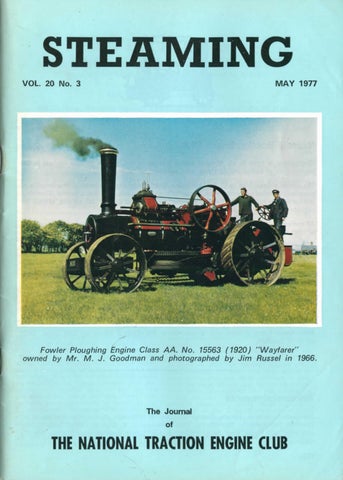
STEAMING VOL. 20 No. 3
MAY 1977
Fowler Ploughing Engine Class AA. No. 15563 (1920) "Wayfarer" owned by Mr. M. J. Goodman and photographed by Jim Russel in 1966.
The Journal of
THE NATIONAL TRACTION ENGINE CLUB
National Traction Engine Club Membership is open to all, whether engine owners or not, with a genuine interest in the preservation of self-propelled steam road vehicles, portables, etc. The annual subscription is £3 for individuals, £4.50 for family membership. The benefits of membership include advantageous terms for boiler insurance. The club's journal 'Steaming' is sent free to members in November, February, May and August. All articles, photos for consideration should be sent to the Editor. All correspondence re subscriptions, bankers order, delivery (or non-delivery) of 'Steaming' or change of address to: MRS. F. E. WOOD, 'WINDRUSH', HAIL WESTON, HUNTINGDON, CAMBS, PE19 4JY Please enclose S.A.E. when sending subscription or when writing to any officer if a reply is required.
Next issue: Copy, photos, etc. should be in the Editor's hands by 30th June, 1977, earlier if possible.
Acknowledgements Jim Russel, John A. Mayes, George W. Cox, J. Wilkinson, James Houston, David M. Webster, Les Burberry, Tom Varley, Tony Bennison, J. V. Grundy, and all Area Correspondents and those who have written to the Editor sending contributions for the magazine. 130
STEAMING THE JOURNAL OF THE NATIONAL TRACTION ENGINE CLUB all items are held copyright by contributor and/or N.T.E.C. EDITOR: R. J. BLENKINSOP Hill Cottage, Radford Semele, Leamington Spa, Warks., CV31 1 UA VOL. 20 No. 3
MAY 1977
From the Editor By the time you read these pages the Rally season will be upon us and all the hard work put in by many of the engine restorers will shortly be on view. Our thoughts at this time go to the Jubilee event which is mentioned at some length in this issue. For those not involved in the organisation, I can tell you that many people have put in hundreds of hours to put on a show that we hope will not only be profitable to the Club but will adequately celebrate the occasion. Whilst most of the engines have been seen before, it will be a gathering of a good cross section of many well known British manufacturers not normally seen at a single rally. For those of you who can get to London at the end of May you will surely be in for a splendid day out. Perhaps some of the affiliated clubs will be hiring coaches to visit Clapham for the day. One of the subjects to which we are devoting attention is a report by Mrs. Margaret Joachim on the need to encourage our younger members and also to enrol new young blood to the movement. Your Editor is middle aged and very much an amateur as he has not been involved with actual working engines — our older generation are the ones with the experience and memories. If we are to grow and prosper, we must look to those younger than ourselves — I should like to say to the affiliated clubs, What are you doing? Let us have some comments in letters to the Editor, please. Steaming will try to provide a section devoted to the younger reader — can anyone help? Imagine yourself suddenly landed with the job of being an Editor of a quarterly magazine with a circulation of 3,500.
Where do the articles come from ? — What shall be included ?. As the new boy, I must not cry too loud but Steaming is made up from what comes in by post and any people I can persuade to contribute. If you have a snippet of news or would like to put pen to paper, do drop me a line and the Editorial staff will soon shape it together if necessary. The Editorial Offices are not as you might think — just the usual front room with a portable typewriter and Glenn Miller on so loud that it drowns any conversation. The team are, wife and eldest daughter who do all the reading and will soon know more about engines than most of you!! It is wonderful relaxation from the box. But behind all this is a requirement for photographs old and new. In this edition I have had to include a number of my own purely as I have no others available. There must be many of you who have a collection — and would be prepared to share it amongst fellow enthusiasts. Most important are the engines in a working environment which will be in black and white and of any size — our printers can accommodate making them bigger or smaller. However, they must be as sharp as possible and will be well looked after until returned to you. The rally scene is always required but does produce a problem, as most of you will be taking colour slide films or negative film for producing colour prints. In this edition are two pictures taken from colour slides by copying them in the Editorial dark room (not palatial here, just a boarded off part of the back of the garage!!) I am therefore in a position to look at colour slides for possible inclusion in Steaming as black and white prints. 131
If they are of rally scenes make certain that they are of unusual interest, as we wish to build Steaming to have a good pictorial content. The post man should be busy next week, please! This year we have the rally list in the centre eight pages and it is designed to be sold separately from our rally stands. Additional copies of the rally list are available from the sales officer if you send a stamped addressed envelope and 10p in stamps.
The New NTEC Code of Practice During the past winter, the Rally Sub Committee of the Club has been engaged in the important task of revising the Club's Code of Practice for Rally Organisation. This Code was first drafted in the early nineteen sixties when Steam Engine Rallying was rapidly increasing in popularity and yet there were no clearly defined requirements for such necessities as Boiler Insurance. Since that time we have moved a long way, Rallies have become more numerous and ever increasing in popularity and the Code of Practice has been continually revised to keep pace with new trends and to improve safety standards. For a number of years we have held twice yearly Rally Organisers Conferences at which all those involved in the promotion of these events have been encouraged to give their views and make suggestions for the improvement of standards. The Club and its Sub Committee have received much encouragement and help from the Rally Organisers, many of whom have had long years' of experience in the movement. About a year ago, it became apparent that the Code needed a further major revision. Our Rallies have now increased in scope and attract all sorts of other exhibits as well as Traction engines and it was clear that safety standards and Insurance requirements for these required clear definition. The Health and Safety at Work Act of 1974 lays further duties and responsibilities on organisers and the Club felt that our Code should be thoroughly overhauled and updated so that it could be used by Organisers as a reasonable standard that could be accepted under this Act. 132
We have now completed this revision which has resulted in an entirely new Code with only a small part of the original remaining. The principal differences however are in the increase in Insurance indemnity limits now recommended, which is a natural result of ever continuing inflation and the requirement that every Rally should appoint an official Safety Officer to monitor the implementation of the Safety provisions of the Code and generally be responsible for all matters concerning safety at his Rally. The draft of the New Code was submitted to the February Rally Organisers Conference who gave it their enthusiastic support and it will be brought into use on a trial basis during the coming season. At the end of the season, we hope to receive comments and suggestions based on the year's experience of operating the new edition of the Code and any final revisions will be made in the light of these before the document is submitted to the Spring 1978 Rally Organisers Conference for final ratification. Any member of the Club who has any suggestion for the improvement or amendment of the Code is asked to write to the Chairman of the Rally Sub Committee before 30th September next. Copies of the draft Code are being supplied to all approved Rally Organisers and to Affiliated Clubs but any others requiring a copy can obtain this from the Club Sales Officer, Alan Wilson, price f1.00. PETER BARBER, Chairman, Rally Sub Committee.
MODEL ENGINEERING In this issue is an article by George Cox on the Ruston Proctor Traction Engines which he built over 25 years ago. There are many of us who cannot run a full sized engine, and model engineering is a splendid way in which our engineering skill can be used. Steaming will have one article in every edition on this subject and the Editor would like to hear from any member who would be prepared to submit an article on the engine he has built. Naturally if there is a particular story to tell of the construction or the history of the engine, that will be all the more interesting to members, and photographs will also be required.
NEW MEMBERS
N.T.E.C. Insurance Discs With the Rally season fast approaching, a reminder to all those Members who choose to arrange their own Boiler inspection and insurance, rather than use the Club's. A disc can be obtained from the undersigned to prove cover. To obtain a disc, it is necessary to send to me the relevant documents, so that by looking at them it can be seen that the engine has passed its boiler inspection and is currently insured for boiler r;sks and third party. Better still, it is much easier to get the Insurance Company to write a letter stating that the engine has been inspected and insured, giving the inspection date and insurance expiry date. As long as this is signed by a responsible member of the company, this is all that is needed and is so much more easily handled. When renewing your insurance, check that you are adequately covered — the N.T.E.C. Code recommend a minimum of E250.000. J. S. HIRONS, Insurance Officer.
In future issues of Steaming we shall show the names and addresses of all new members who have joined the N.T.E.C. in previous months. This will provide them with a welcome, and enable other members in the district to get in touch with them, and exchange information, ideas, etc. To our new members, we are delighted that you have joined a growing interest in the traction engine movement, and on another page of Steaming there is a list of all the clubs affiliated to the N.T.E.C. Should you wish to meet other enthusiasts we suggest you contact the Secretary of any of these clubs.
CHUFF There is still in existence in the Lowlands of Scotland, a Fowler Crane Engine No. 8920. It weighs 14 tons, was built in 1900 and is registered SG 4713.
Foster Steam Motor Tractor, No. 14608 near Bubbenhall while travelling to the Hinckley From a colour transparency photo: Editor. Rally in 1976.
133
The National Traction Engine Club Rally—Clapham Common London 28th/29th May, 1977 Organised by the NTEC, sponsored by Courage (Eastern) Ltd., the Rally will be held under the auspices of the London Borough of Lambeth, to whom we are indebted for the provision of the site and many other facilities. Beside being the Club's Silver Jubilee tribute to Her Majesty the Queen, this will be the largest full scale Traction Engine Rally yet to be held in London and promises to be a notable occasion. Engine entries have been invited by a panel under the direction of the Club's President, Jack Wharton and have been selected so as to provide as wide a range of make and type as possible, within the financial and numerical limits allowable. At the present time entries have been received from 52 engines of 25 different makes and it is possible that one or two interesting additions may yet be made. The engine entry includes 5 large Showman's Engines including examples by Burrell, Foster, Fowler and Foden, Showman's Tractors by Burrell and Tasker, and 10 different makes of Agricultural engine, the oldest of which is nearly 100 years old. Five different makes of Roller will be represented including a rare Wallis Simplicity and an Alan Aveling conversion. The Steam Wagons entered include the unique Leyland and Atkinson and we have eleven different makes of Tractor. A particularly interesting section will be the Road Locomotives where entries are confirmed for 5 different makes including three ten horse power examples. We have a portable engine by Brown and May and also by the solitary overseas make represented, Brouhout of France. Last, but certainly not least will be a fine pair of Fowler AA Ploughing engines to illustrate the rope system of ploughing and also the Garrett Agrimotor and the Mann direct Traction ploughing tractors. Each engine entrant will receive a specially struck and individually numbered silver medal to commemorate this unique event. 134
A full programme of ring events will be staged each afternoon with competitive steam engine events and parades by the other supporting attractions. Outside the ring, there will be engine working demonstrations including saw milling and threshing and we are negotiating for a steam launch to ply on the Lake within the Rally site. Supporting the Steam entry will be a special selection of vintage internal combustion engined tractors chosen to illustrate a wide range of make and date, and a limited number of stationary barn engines. There will also be a number of rare restored commercial vehicles and it is hoped to stage a road run with these and the steam wagons during the two Rally days. A unique feature of the Rally will be the Jubilee Pavilions, illustrating products of the 1887, 1897, 1935 and 1977 Jubilee years. Each pavilion will feature a variety of steam engines and other Horse drawn and mechanically propelled vehicles of the period, together with contemporary artefacts. We have been fortunate in obtaining steam engines made in each of these years and the pavilions will illustrate the transition from horse to steam to internal combustion engine power. The very fine selection of horse drawn vehicles will parade in a special ring demonstration on Sunday only. The Model Tent will be under the charge of Fred Watson of Balham and will contain Traction Engine and Fairground models, some of which will be in steam. The magnificent model of "Supreme" which took the championship at this year's Model Engineer exhibition will be on display and can thus be compared with its full sized counterpart which forms part of the engine entry. The Fairground will contain a variety of vintage rides, including Gallopers, a Big Wheel, a Lighthouse slip and the "Wall of Death", and music will be provided by a
THE NATIONAL TRACTION ENGINE CLUB
JUBILEE
STEAM
RA 2g9 CLAPHAM-COMMON Over 50 Engines • Steam Fair-Courage Ale Collectors Bazaar-Organs-Working Steam I OPEN 10 AM ■ ADMISSION 15p ■ CHURN - 0 A P'S - DISABLED 40p I
Sponsored by COURAGE 135
selection of large Fairground Organs, including Bill Hunt's Marenghi, Don Robinson's, and the Anderton and Rowland 98 key. These will be supplemented on Sunday by the British Railways Western Region Brass Band who will play throughout the afternoon in the Victorian Bandstand. A narrow gauge steam railway will be in operation throughout the show, giving passenger rides. Admission charges will be 75p for Adults and 40p for children and ample Car Parking space will be available on the Common, entered from Clapham Common North side, at 30p per car. For those travelling by public transport, Clapham Common and Clapham South stations on the Northern line tube are both within a short walking distance of the Rally field.
NOTICE TO N.T.E.C. POLICY HOLDERS RE 'LAID UP' RISKS Enquiries have been received from members insured under the special N.T.E.C. Scheme arranged by Tennant Budd Ltd., regarding the position of the cover with the DOMINION INSURANCE Co., whilst an engine is laid up and out of use. If the members concerned will refer to Section B (Accidental Damage) of the Dominion policy document, it will be seen that the insurance covers the cost of repairs or replacement of any parts damaged by FIRE, LIGHTING, EXPLOSION or THEFT, whilst the Insured Vehicle is laid up and out of use, and not undergoing any test under Steam or otherwise, up to but not exceeding the value stated in the Schedule against such vehicle. Further, should the position arise that during the currency of the policy, through no fault of the owner the Inspection Report
runs out prior to new arrangements being made, the the Dominion will limit the cover to laid up risks ONLY. The insurance would be null and void if an engine was used on the public highway or at a Rally, without a current Boiler Report. This limited insurance is granted only on the understanding that a boiler inspection will be arranged as soon as possible, in order to comply with the Inspection Warranty. The Dominion are not prepared to entertain proposals for new business on the 'laid up' basis, where there is no current Report, and there is no intention by the owner of arranging an inspection. With regard to insurance of TOTAL LOSS by Fire, Theft, etc. we would point out that normal motor insurance rate for 'laid up' risks is in the region of El % of the value of a vehicle. A similar rate would apply to steam vehicles, under a separate insurance, and with the values rocketing the premium involved for such cover would be extremely high. INSURANCE — IMPORTANT NOTICE At the request of Mr. Wharton, who has received enquiries from many N.T.E.C. members, our Insurance Brokers Tennant Budd Ltd., have been able to negotiate an important improvement in N.T.E.C. policy terms. As from 1st May 1977 all new business and renewals in respect of the Dominion N.T.E.C. policies, will be endorsed to include Malicious Damage, up to £200 per engine, at an additional premium of £1 per annum. The annual premium for the Dominion policy will therefore be increased to £16. The extension will exclude damage caused by persons in the service of the Insured, or by members of his family.
North Staffs & Cheshire Traction Engine Club MIDLAND FESTIVAL OF STEAM NEWPORT SHOWGROUND, SALOP. 30th and 31st JULY, 1977 The Showground is situated off the A.41. Whitchurch Road 1 mile from Newport.
136
CLUB NOTICES
ADVERTISING MANAGER We require an Advertising Manager who will look after all Commercial Advertising in "Steaming". The work will entail selling advertising space, dealing with the clients special requirements and after publication the sending out of Invoices. The Manager will work closely with the Editor and also the Treasurer and the objective is to build up a substantial advertising revenue to help produce a better publication for our members. Whilst not essential, it would be advantageous if applicants had some experience in advertising as a real selling operation will be required. Applications for this important Club position should be sent to The Editor.
0%0%"10%WaloWs0%•0140".0%".0%.,
"THE STEAM DIRECTORY" A NEW PUBLICATION FROM THE NATIONAL TRACTION ENGINE CLUB This new Directory is now available and gives a comprehensive list of firms who can supply parts and services for the engine owner. The result of much research, it is a must for all those involved in the maintenance and restoration of all kinds of steam machinery. Available from THE SALES OFFICER Price £1.00 members, £1.10 non members or from our Rally Stands.
SILVER JUBILEE RALLY We require some volunteer Marshalls to help in the Ring at the Clapham event on 28th/29th May. Would any member who can spare the time please get in touch with: MR. ERIC FILLMORE, 34 NORTHWICK PARK ROAD, HARROW, MIDDLESEX.
137
FROM STRAKES TO TRACK-GRIP RUBBERS by John A. Mayes It took almost four years for me to decide to fit cut-out tractor tyre track grip treads to the rear wheels of my McLaren No. 127 of 1882 vintage. A great many factors had to be considered, not the least of which was the problem of getting my Ploughing engines onto and off my land in bad ground conditions. Although my experience with traction engines goes back to the mid-twenties, there have been long gaps such as the war. Also from 1952 until 1968 I never handled an engine at all. Further, I forsook block engines altogether in 1934 for the more sophisticated Fowler B-6, fully sprung, rubber tyred Road Locomotives. Road surfaces had, during 35 years, undergone considerable changes which were not exactly beneficial for block engines on strakes, to say nothing of traffic conditions. The first time I drove a block engine in dense traffic was when I drove my McLaren in Birmingham, not exactly ideal conditions in which to pick up the threads as it were. Bouncing over 'cats-eyes', trying to dodge manhole covers, grids, etc., not to mention stopping on the wrong centre at traffic lights with a bus or lorry drawn up close behind. The experience I can assure you, was positively hilarious! In 1969 I built and fitted a cab to which 'The Little Wonder' took an instant dislike, finally managing to shake it to pieces early in 1972. Her regular driver complained bitterly when I decided not to re-build the cab, but I pointed out that as I had to stand out on a Ploughing engine in all weathers, I had no intention of providing a shed for someone else. Besides, what is wrong with an umbrella? Meantime I was constantly considering rubbers. Every engine I saw wearing cutdown tractor tyres was the subject of a minute inspection and its owner 'third degreed'. Finally, in the winter of 1974, following a hideously bitter week's work tightening the engine frame mounting bolts down onto the boiler shell, a job which in places required a left-handed right angle spanner and a man with two left feet, I decided to take the plunge in the hope of considerable reduction to the vibration. 138
Thus driven, preparations began in earnest. Operational plans were drawn up including a programme which ensured my daughter would be home from school to assist. Timber was obtained for filling the spaces between the strakes. Six 14 inch tractor tyres of nearly even track wear were sorted out. A stock of bolts was laid in. }in coach bolts to secure the wooden inserts. fin hexagon head for bolting the rubber through the spacers and 'T' rings. (The thought of drilling through strakes was too appalling for contemplation.) jin and sin hexagon head to secure the rubber through the spud pin holes. A butcher's knife and a skinning knife completed the aquisitions. The remainder of the tackle required was a set of 20 cwt chain block, wire sling, chains, shackles, packs, spanners, drills, plane, 'G' clamps, flat stbel bar, scotches, etc., which I already possessed. The spaces between the strakes were uneven, also the depth of the strakes varied, each timber spacer therefore had to be individually shaped. Due to various doubts, unknown ambiguous replies to multitudinous questions and a lack of confidence in my own capabilities I decided to tyre one wheel completely before making a start on the other one. Accordingly the timber spacers were cut, shaped and fitted with a sin coach bolt close to each end. All the time this work progressed, there sat the row of six tractor tyres, defying me to make up my mind which method to us, to cut them and into what lengths! The knowledge that when the centre of the tread was flattened against the engine wheel, the tread ends, no matter how carefully cut and lined up, would go all sfiapes, did not add to my peace of mind. Meantime I had become really skilled at sharpening drills and less adept at breaking them. Wrought 'T' iron of 1882 is apt to jib at high speed drills! I had elicited the information that rubber could be cut satisfactorily with a hot sharp knife or a wet sharp knife. Accordingly I sharpened the butcher's knife like a razor and tried both methods. I decided the cold water treatment suited me best — being slower I was able more easily to keep to my chalk lines.
"Little Wonder" at an early Woburn Abbey Rally before rubbers were fitted. Photo: Editor.
A small watering can had been discovered, a left-over from my family's childhood, which proved invaluable, enabling my daughter to keep a trickle on the blade without wetting me and at the same time keeping her hands well clear. We cut the tyres around the walls along a chalked line running level with the root of the track grip treads. With both walls removed we had a complete ring of tread, and by cutting in this manner we had avoided the need to cut through the wires. Each cut was started by drilling a series of holes (plenty of water) to provide a starting gap for the knife. A section of the tread, about 3ft long, was cut out of the tread. To make the cut open away from the blade during cutting, we placed the ring partly on a small trestle relying on the overhanging weight each side to open the cut — for the last little bit we pulled it apart by hand to facilitate the passage of the knife. We blocked the rear of one front wheel to the front of the rear wheel to prevent
movement of the front axle, anchored the chain block about half way up the front wheel, placed the tread section on top of and slightly to the rear of the back wheel, passing a wire sling over the centre of the tread, anchored off to a chain low down on the rear of the wheel. We took up the slack with the blocks, lining up the tread section as we progressed, inserted three flat iron bars between the sling and the tread, one at each end and one in the centre of the section. So far so good, until eventually the leading edge of the tread section refused to slide round the wheel. We then removed the front and centre steel bars, placed a timber block across the wheel and about a foot ahead of the leading edge of the tread and took the strain again — success at last! Then with a bit of judicious hammer and pinch bar work the tread was levelled, with the back edge down flat and firm. We drilled and bolted this end securely. Having securely anchored the tread it was comparatively easy to get the remain139
4111111a.... Taking water near Ladbroke on the journey to 8oddington in 1975. John Mayes stands by the hydrant. Note the neat way in which the rubbers have been fitted. Photo: Editor. ing length down flat by inserting bars under the sling, packing out with hard wood blocks where the bars did not pass over the tread sections, tightening the sling again and clamping the steel bars down further with 'G' clamps until the underside of the rubber was firmly flat against the wheel, then once again to the everlasting drilling and bolting down. Thus we slowly progressed, clamping, drilling and bolting down, where necessary cutting out small sections of the tread with the skinning knife and plenty of water in order to get the bolt heads right down clear of the running surface of the tyre. With the first section securely in position, our original straight ends were in the shape of arrow heads, rather extraordinary arrow heads in fact, definitely not Robin Hood's craftsmanship! I abandoned all ideas of cutting the next section with 'V' end to fit — having plenty of tyres to hand we could afford to overlap and cut to fit with the skinning knife once the tread was flattened onto the wheel. 140
We removed the sling, jacked up the engine, turned the rear wheel back so that our working area would be in the original position, lowered down into the scotch, and placed the next section of rubber in position with about an inch overlap. Flattening of the rubber was carried out as before, having got the starting end down with the steel bar some three inches ahead of where the join would come, then with the skinning knife and water running over the blade I cut the end to fit. This may sound easy. Well, it was not too difficult to keep the direction of cut to fit the end of the first section, but great care had to be exercised to avoid my hand slipping on the wet knife handle with possibly disastrous results, and while my daughter maintained a constant trickle of water on the thin swiftly moving blade, at the same time prising up the rubber ahead of the blade with a piece of wood. Having got the ends properly together we drilled and bolted the new end down before risking it moving, as we clamped
and flattened the remainder of this section of rubber. So we slowly progressed, loose off the chain blocks and remove sling, shift anchor on back wheel, jack up, turn back wheel, jack down the scotch, cut rubber, place on wheel, anchor sling, insert bar, tighten chain blocks, belt and lever into position, clamp end down, cut to fit, drill and bolt down, slack off, insert more steel bars, tighten, clamp down, everlasting drilling and sharpening drills, bolt up, tea upl Needless to say, despite mathematical calculations we finished needing only about 18in to complete the wheel and that section really was a pig to fit. Both ends had to be cut to shape and the section had to drop in exactly with no spaces at either end. We had learned as we progressed — the second wheel was completed in half the time; we still ended up requiring one short section to complete the wheel. Having driven the engine getting on for 200 miles on these rubbers, the improvement would have to be experienced to be believed. Less water, less coal, less fatigue. Strangest of all, on each of the first two or three trips we spent hours tracing noises, squeaks, etc., which we had never before heard above the rattle when the engine was on strakes. The most difficult squeak to trace started when about half way between The Royal Showground at Stoneleigh and Hinckley, coming along The Fosse. The
squeak seemed to be coming from the compensating gear, and having experienced trouble of this nature in the past, we stopped and withdrew the driving pin, turned the rope drum, cleaned out and oiled the gears, poured steam oil onto the inner gear ring with the rope drum revolving — no squeak. Off we went again, still with the squeak. At the next water stop one of our helpers watched carefully as we drove off and spotted one loose bolt which only showed when the bolt was on the road. A simple job to tighten it, and off we went minus squeak. We covered one journey of 35 miles, Hinckley to Boddington in 91 hours including stops for water. On soft ground at Boddington and again at Caldecote we were moving when engines on strakes and on smooth rubbers were fast, and for good measure we pushed a stranded Steam Roller up onto firm ground. Some quite lengthy trips have been satisfactorily completed over quite heavy routes towing our threshing drum, living van and Land Rover loaded with coal. The wear and tear to the treads so far seems negligible. Not only have we gained in comfort on the road and economised in both coal and water consumption, we have also increased the grip on soft ground and saved at least one hour's work each night tightening bolts, etc. can strongly recommend this method of rubbering a block engine.
MEMORIES AND MODELS by G. W. Cox The article by Mr. C. P. Gregory in the March 1974 issue of Steaming which includes two photographs of the Ruston single, brought back several pleasant memories, as I did a fair amount of fitting work for these engines during my early' days at Lincoln. I was pleased to note that the chimney top is the correct shape and could well be the original. No. 169 and 167 although finished and delivered in 1936, were probably the last ones of a batch which had been built some years earlier and taken into stock.
If I remember correctly, manufacture ceased in 1928 and the steam side of the business was turned over to Ransomes, who I was told later, did nothing or very little with it, quite understandably of course as their orders in this field were probably quite as scarce as those coming to The Sheaf Iron Works. I am, however, quite certain of the following. In 1935 I was working in the Traction Drawing Office, which had shrunk to a small section accommodated at one end of the large Oil Engine Design and Drawing
141
Taken in the garden in winter sunshine this model is a perfect reproduction of the original. In the picture on the right outstanding detail is shown. Photos: Editor.
Office. Mr. George Donington, Whit. Ex., was in overall charge and I took my instructions from Mr. Ernest Fox, a 'gentleman' in the true sense of the word. I think he had been connected with steam most of his working life and although our work was almost exclusively concerned with small oil engined rail locomotives with sometimes a motor roller (oil engined) included, we often spoke about tractions and portables and sometimes sighed in unison for 'the days that were no more'. One day, however, Mr. Fox, in a very pleased frame of mind bustled along to my board and said: 'I've got just the job for you, several modifications to two six horse tractions which are going to Latvia'. These were definitely engines which had been in stock since 1928. The alteration I remember most clearly was to devise some means whereby the safety valves could be made proof against unauthorised tampering. At first sight, this appeared simple; just cut off one end of 142
the casing lever, bolt on a sheet metal cover and fit a small padlock to prevent its removal. This in effect was the answer but Messrs Donington and Fox were old hands at the game and were well acquainted with the resourcefulness of enginemen in general and utterly mistrustful of their counterparts overseas. After each scheme that I prepared, one or both would come along, give it close and searching attention and perhaps say 'they could put a wedge or screwdriver in there and keep the valves down' or 'that padlock will come off without being unlocked'. Finally they approved of my last re-hash and detailed sketches were issued. Sometime later Mr. Fox and I went down to Anchor Street Works where the modifications had been carried out to see that all was according to plan. This was so when the foreman, Mr. Armitage, left us, we lingered a little to gaze rather wistfully at the two handsome beauties. Mr. Fox remarked: 'Aren't they a nice pair? I am
afraid they are the last we shall have anything to do with, although there may perhaps be one or two still in stock'. He continued: 'I believe you are a model maker. How nice it would be if you were to make a small edition of one of these'. I took this as a great compliment and hastened to agree. He then said 'Let's go back to the D.O. and see if we can find some suitable tracings; most of them have gone to Ipswich but I think there are a few left'. We found a few, general arrangement and cylinder of the 7 hp single; boiler, arrangement of motion work, details of gearing and section through back axle of the 7 hp compound, also a drawing of the water gauges. The girls took off some prints. I left the Company a few weeks later after having been with them nearly twenty years. The results of the conversation recorded earlier are shown in the two photographs. Both models are to a scale of 14in to 1ft representing 7 hp engines and each took over 5,000 hours spread over a period of ten years to complete. The boilers are fully riveted and stayed and except for over-
scale flue tubes and nuts on the inside ends of the firebox stays, are small copies of those turned out by the Boiler Works, caulking strips, manholes, mudholes and rubbing pads being included. On the moving parts departures from the prototype have also been kept to a minimum and incorporated only where necessary to make the engines work. On each the governor has been speeded up by means of a pulley, coupled to a small gear pinion meshing with the fast speed wheel on the crankshaft and the springs are very much below scale thickness. Both these changes are needed to make the governors float and operate throttle valves which also differ .from the full size ones in order to give control. The single cylinder engine (Class SH) was finished in 1951 and has done over 500 hours running, mostly driving a small drum and straw-jack made later. Making the drum actually work was quite an exercise, a lot of experimenting being needed before anything would move along the riddles. Now it threshes and dresses a mixture of plantain heads and dried grass
143
which it separates into grain, chaff, cavings and straw. The models can thus, in a way, carry me back many years to stackyards where I could always be found when 'the engine' came and I am able to experience to a considerable degree those sights, smells and sounds which I still remember so well. The compound engine (Class 5C) has been completed only recently but now takes turns with the single in driving the drum and elevator. It revives another memory in as much that I can once again watch big ends chasing balance weights around. Both models can also take me back to the Erecting Shop or perhaps the Paint Shop where I sometimes watched transfers being put on: I confess to being a little hazy regarding the exact colours of these, time has dulled my memory, and can only hope my small versions are reasonably correct in this repect. The models have been shown at various local functions, such as model exhibitions, Royal Show, Stoneleigh Festivals and one or two nearby Traction Engine Rallies. Comments from onlookers at some of these
events have served to illustrate the great changes which have taken place during my lifetime in the process of separating the grain from the ear. I have become accustomed to 'Well, it's a sort of combine harvester' and also to 'Your elevator is going the wrong way round' (it is a Hayes pattern, very common in the Eastern Counties sixty years ago), but must admit to having winced at 'It's worked by oil, of course! When, however, some old time threshing man stands silently watching and then says quietly 'Your screen belt's off', I realise that there are still many who like to be reminded of the way the work was done when they were young and steam was predominant. Editor: There is a sad note to Mr. Cox's article as the compound engine was recently on display at a Library in Rugby and it was stolen. This accounts for the rather poor quality of the photograph as it was produced from a colour slide. If any member has news of this engine please get in touch with the Rugby Police, Telephone 0788 74831.
The missing compound engine made by George Cox. 144
N.T.E.C. SALES Non M'bers Item M'bers Price LAPEL BADGE 50p CAR BADGE 1.90p WINDSCREEN STICKER 20p TIE: Maroon 2.16p TIE: Green 2.16p NTEC POSTCARDS (6) 40p 33p NTEC Retractable 16p 10p Ballpoint Pen NTEC 21st Anniversary Run 40p 30p Programme NEW CATALOGUE REPRINTS: 2.00p 1.80p Burrell Tractors (No. 13) (No. 12) 1.90p 1.70p Allchin STEAMING PUBLICATIONS: More Engines at Work 44p 30p (No. 2) 1.10p 1.00p Heavy Haulage (No. 4)
Non M'bers Item M'bers Price Steaming: Vol. 14/2 20p 30p 20p Vol. 14/3 30p Vol. 17/2 50p 60p Vol. 17/3 60p 50p Vol. 17/4 60p 50p Vol. 18/1 85p 75p Vol. 18/3 85p 75p Vol. 18/4 85p 75p Vol. 19/1 1.10p 1.00p Vol. 19/2 1.10p 1.00p Vol. 19/3 1.10p 1.00p Vol. 19/4 1.10p 1.00p Vol. 20/1 1.10p 1.00p 1.10p Vol. 20/2 1.00p Steam Wagons & Tractors (No. 3) 20p 15p 75p St. Giles Fair (No. 5) 60p Steaming Binder 1.95p 1.75p
BOOKS New: Encyclopedia of American Steam Engines - J. Norbeck New: Digging by Steam - C. Tyler Steam Scene: Vol. I - R. J. Blenkinsop Steam Scene: Vol. II - R. J. Blenkinsop New: Steam Scene: Vol. III - R. J. Blenkinsop Pride of the Road - M. R. Lane Burrell Showmans Road Locos - M. R. Lane Ploughing by Steam - C. Tyler and J. Haning The Overtype Steam Engines - M. A. Kelly The Undertype Steam Engines - M. A. Kelly The Development of the English Traction Engine - R. H. Clark Traction Engine Miscellany - R. H. Clark The Sentinel - Vol. I - W. J. Hughes and J. Thomas Modern Steam Road Wagons 1906 - W. Norris An Apprentice at McLarens - S. R. Fowler Military Traction Engines - R. W. Kidner Travelling Shows - A. Sellman Parked Up Road Rollers - Road Roller Association Stourpaine Gathering - M. Case Traction Engine Register - B. Johnson Discovering Traction Engines - H. Bonnett Farming with Steam - H. Bonnett More Working Engines - Road Locomotive Society
13.20p 5.40p 3.50p 3.50p
12.50p 5.00p 2.95p 2.95p
3.95p 4.50p 6.20p 4.70p 4.68p 13.20p 12.70p 10.70p 3.42p 3.42p 1.12p 1.00p 1.00p 30p 1.15p 65p 55p 1.40p 75p
3.30p 3.95p 5.50p 4.00p 3.98p 12.50p 12.00p 10.00p 2.95p 2.95p 1.05p 90p 90p 25p 1.00p 50p 45p 1.25p 60p
Prices include postage. Members please enclose Membership Card to claim Members price. Cheques and Postal Orders only, made payable to National Traction Engine Club. ORDERS TO:
A. G. WILSON, N.T.E.C., NATIONAL SALES OFFICER, 7 WELTON ROAD, DAVENTRY, NORTHANTS. NN11 5PP. 145
DART VALLEY RAILWAY
JUBILEE ROAD & RAIL STEAM WORKING BUCKFASTLEIGH STATION • • • • • •
JUNE 5, 6, 7 — 10.00 - 17.30 36 Ton steam crane in action About 15-20 road engines at work Continuous shunting Frequent DVR passenger trains Vintage luxury coaches in use Live steam miniature railway
See and hear road engines climbing gradients on the specially constructed engine circuit. Watch our tank locomotives at work on the 1 in 60 approaching Buckfastleigh. Admission: Adults 60p; Children 40p. Free car park. DVR train fares reduced. Easy access off Exeter-Plymouth A30.
NOW! PRIVATE CAR INSURANCE AT REDUCED RATES FOR N. T. E. C. MEMBERS A 15% discount is offered to N.T.E.C. members under a new scheme arranged with Lloyd's underwriters. Your no claims bonus may be transferred to the new policy. Contact: TONBRIDGE OFFICE (MOTOR DEPT.)., HILDENBROOK HOUSE, THE SLADE, TONBRIDGE, KENT. TEL: TONBRIDGE (0732) 357011
TENNANT BUDD LTD. 146
CLUB TROPHIES by Eric Fillmore THE CURTIS TROPHY usually awarded for an outstanding effort in some specific field, this year went to a participant in the marathon road run from John O'Groats to Lands End — Bert Winkfield of Bletchley — a truly remarkable effort. THE JACK HOLLOWAY TROPHY FOR COMMENTATORS. Little need be written of the contribution of the commentator to the rally scene. They do so much and the whole operation is of ten dependant on them as far as the public are concerned. Doug Smith of Birmingham must be amongst the foremost of our commentators and we are glad to be able to recognise his work by awarding him the trophy. THE DACRE LACY CUP regarded by the Club as the major trophy for renovation and presentation to the public of a specific engine was awarded to Bass North Ltd. for their outstanding efforts with their early Sentinel waggon. We are particularly pleased to note that the waggon is on display in a Bradford Museum much of the time it is not out rallying. We were glad Mr. Frank Pennett, Chief Designer of Bass North Ltd., and custodian of the waggon was present receive the trophy.
It is only rarely that the trophies are assembled together; most of them were so at York and the opportunity was taken of photographing them. A fine array they made. As part of the Club Convention at York during the last weekend in November a dinner and dance was held. The opportunity was taken of presenting the Club trophies for 1976 during the course of the evening and we were fortunate to have as our guest of honour the Lord Mayor of York, Councillor Jack Archer, J.P. He graciously undertook to present the trophies to the winners. In awarding the trophies the sub-committee responsible considers as wide a field as possible within the traction engine movement; nevertheless certain events take place which demand special consideration. During 1976 such an event was the road run by steam vehicles from John O'Groats to Lands End. Since our first Convention was in York, particular attention was paid to the North of England scene. The trophies, the winners and the grounds on which they were awarded are as follows:
147
THE ARTHUR NAPPER CUP FOR TRACTORS to Wilf Payne of Doncaster to mark his many appearances at rallies and smaller events over many years. THE ARTHUR NAPPER CUP FOR TRACTIONS to Simon Bath of Roxton. A worthy renovation of a traction engine and his constant support of rallies in his area. THE GOLDEN FILM SHIELD usually awarded for outstanding efforts and activities in the traction engine world to Tom Varley of Clitheroe in recognition not only of his considerable activities in re-building and preserving engines, but also for his organisation of the John O'Groats to Lands End run. JOHN CRAWLEY BOWL usually reserved for non-engine activities and often awarded for services to the Club went this time to Ran Hawthorne of Woodcote, retiring editor of Steaming. THE EDNEY SHIELD to Stuart Harrison of Bradford to mark the efforts he had made with his roller, particularly the considerable distances he had steamed it to attend events.
THE PERCY HIRONS BOWL usually reserved for an owner who worked his engine or gave demonstrations. Who better to receive this than James Lowther of Redhill, one of the few owners still working engines commercially, as well as supporting the rally scene. THE BAKER TOC-H CUP often awarded to an owner of a showman road engine for some particularly outstanding work of preservation. This year we were delighted to have John Corner of Bridlington present to receive it. History repeats itself as Jack Wharton held the same trophy a few years ago for his work on "Supreme". Now it marks the emergence of another of the last four Fowler showman's road locomotives "King Carnival II". CONNIE HUTCHENS MEMORIAL BOWL specially reserved for a lady connected with the movement. Who better to receive it than Mrs. Arthur Fearnley, a lady who has supported her own family in its many preservation activities and the rally scene generally for so many years.
The Lord Mayor of York, Councillor Jack Archer, J.P., presents the Dacre Lacy Cup to Mr. Frank Pennett. President Jack Wharton stands on the right. Photo: Bass North Ltd. 148
Illustrations: *Fowler BB1 Ploughing Engine *Foden Steam Wagon *Fowler Super Lion Showmans *Stanley Steamer *Fowler Road Roller *Fowler Crane Engine
=AM : 7111.L.ClrilEH The majesty of the steam engine captured by this magnificent seven leaf, full colour, spiral bound calendar for 1977 — size 15" x 21". Yours for £1.50 plus 40p for postage and packing, UK only.* Additional calendars available at £.1.50. Cheques or postal orders should accompany your order and be made payable to BSS Ltd, with your name and address clearly printed on the coupon provided. Cheque or postal order number amount of L1.90*
to the
Name Address
To:— Publicity Dept, BSS Limited, Fleet Street, Lee Circle, Leicester LEI 3QQ. 149
"ONE OF THE BEST" by J. Wilkinson Of the varied makes of engines built for the travelling showman, I have always liked the products of John Fowler & Co. (Leeds) Ltd. best of them all. As a boy in the years before the First World War I frequently used to follow No. 10318 'Sunny Boy No. 2' and No. 11127 'Hero' with the Savage-built Steam Switchback of W. H. Marshall and Sons, Wakefield Road, Bradford, Yorkshire. In those days metal-tyred wheels were used, so it was easy to follow the road trains on foot. Little did I know that in later years W. H. Marshall would be my best man, and that I would join the staff of Fowler's! In 1905 Fowlers turned out half-a-dozen 'big lions' for the amusement world, and apart from minor details they were identical. I saw every one of them, and took snapshots of all but one. The were No. 9984 'The Showman' (new for Randall Monte Williams), No. 10318 'Sunny Boy No. 2' (new for W. H. Marshall), No. 10323 'Admiral Togo' (new for John Studt), No. 10324 'Enterprise' (new for The Northern Cinematograph Co.), No. 10328 'Enterprise' (new for William Wilson), and No. 10329 'Envoy' (new for Charles Marshall). When I saw No. 9984 it was owned by Thomas Miller, and No. 10323 was in the ownership of White Bros. and re-named 'Welsh Horse'. No. 10324 was in the service of Harniess Brothers, and No. 10328 with Henry Irvin and re-named 'One of the Best'. 'Envoy' differs from the other engines as it was fitted with a 5ft diameter flywheel as against the standard 4ft 6in. Its owner (then Goldthorpe Marshall) told me that the large flywheel had been ordered when the fast-revving dynamos were in use. The subject of this contribution — 'One of the Best' — is devoted to Fowler No. 10328. It was my favourite of the Scottishowned engines, and I used to see it — and Irvin's other Fowler No. 14114 'The Tiger' — at the Cumberland fairs at Carlisle and Penrith; both were held at Whitsuntide and at Martinmas. Driver for the most part was Thos. W. McIntosh, known as 'Gateshead. Tommy', who had previously driven heavyhaulage engines for the Norman E. Box firm of Ardick, Manchester. In the mid 1920s Henry Irvin travelled a Scenic Railway, known as 'Irvin's Super Scenic 150
Whales', and 'One of the Best' was fitted with a Thompson and Walton 'feast crane' for lifting the heavy cars 'on' and 'off' the undulating track, and also an exciter. It was normal practice for Fowler's scenic engines to carry the auxiliary dynamo — called an exciter — on the off-side fore tank, it being belt driven from an additional pully fitted to the main dynamo. But 'One of the Best' did not have the large fore tanks, so a bracket was fitted to the side of the smokebox on the off-side. The Whale Scenic was the only one of its kind in Scotland, and it was a firm favourite at Glasgow's Kelvin Hall for the big Christmas and New Year indoor fairs. Besides travelling Scotland, however, a few fairs in England were also attended, and it was when on what was known as the 'Cumberland run' that one of the car trucks caught fire, and it and its four whale cars destroyed. At that time the Scenic Railways were going out of favour with the general public, and as they were expensive to run it was decided to replace with a modern novelty ride. So for the next few years Henry Irvin travelled a ride known as 'The Whip'. But with the advent of the Second World War I lost trace of 'One of the Best', and later heard that it had been broken up for scrap. I often think of the days when I used to go to Scotland on the bike to see my girl friends at Whitsuntide, calling at the fairs at Skipton, Kendal and Carlisle on the outward journey, and those at Penrith and Kirby Lonsdale on the return. Before arriving at Carlisle fair on the Saturday, I had negotiated the ascent of Shap, and had a further 50 miles to travel. Extension chimneys were fitted to the engines at the fair, and more often than not the smoke was blown eastwards immediately it left the chimney. I almost dreaded that, as it meant I had to face a strong headwind on leaving Gretna for Annan, Dumfries, etc., for I had started from Kendal that morning and sometimes was then feeling a little tired. 'One of the Best' was a well maintained engine, and it even retained a brass strip round the edges of the cab name boards, being the only one I remember to do so.
Henry Irvin's Fowler, No. 10328 "One of the Best" on 29th May, 1939 at Penrith, Photo: J. Wilkinson. Cumberland.
THE LLANTWIT MAJOR VINTAGE ENGINE CLUB The Llantwit Major Vintage Engine Club held a Steam Party at the Victoria Inn, Sigginstone, near Cowbridge on 15th September, 1976. With the weather fine, everyone enjoyed themselves. Mr. Morgan Thomas came under his own steam. He arrived with his 1918 Aveling and Porter compound steam roller No. 8906, Registration No. DW 5880. He stopped in front of the Inn for the photographic enthusiasts to take photographs with the Landlord and his wife, Mr. and Mrs. Peter Sanderson on the roller. Second attraction was Mr. Dave Garrett's 18ft. steam paddle boat. Mr. Graham Brown's 1912 Marshall portable was another great attraction. The rest of the party consisted of stationary engines, farm tractors, models and rural crafts.
Clandeboye Threshing Demonstration 1976 Clandeboye has always been unfortunate as regards the weather and 1976 turned out to be the wettest episode since the event was established in 1972. As a result, some of the long-distance entries chose not to travel, having forseen the difficult field condition. The work available was capably handled by two traction engines, Wilmer Bryce's Wallis & Steevens No. 7008 and Rory Woolf's Wallis & Steevens No. 7626, with assistance from a fleet of about a dozen vintage tractors. A short break in the downpour enabled some work to be done for about twenty minutes, at midday; it was not until three o'clock, however, that things really got under way. Also present was Strangford Ltd's. Marshall Roller No. 77550. With luck, in future years, Clandeboye will receive the dry weather which it surely deserves. H. Wiliam Coates, 4 Kirkliston Gardens, Belfast BT5 6EE 151
To the Editor: Dear Sir, Re Ran Hawthorne's article "The Cart Shed" here is some information which might be of interest to him and to Steaming readers in general. Just after the inauguration of the S.T.E.S. in April 1961 by a small group of enthusiasts of which I was one, we began to hear reports of 'huge traction engines' travelling both north and south across the Border on the Al and of ploughing being done near Dunbar with what a friend of mine described as 'a thing like a fish'. Investigation led us to East Barns Farm, Dunbar, belonging to Sir James Hope (not T. Hope) and also to his farm at Low Lynn just a few miles south of the Border and a little to the right of the Al. We heard that Sir James used the ploughing engines, as they turned out to be, fairly regularly with a balance plough (the thing like a fish) on the level ground but on the steep fields of the East Lothian escarpment he had developed what he called 'the perfect method' of ploughing such land with one engine stationed on top of the steep ground, pulling a caterpillar tractor with its own plough up-hill but not ploughing, the tractor doing the ploughing on the way down. As Sir James Hope was a man who could never be contacted by phone, a few friends and I set off one Saturday morning around August 1961 to see if we could find the mystery engines. At East Barns the first thing we saw, just at the farm gate, was a 6 furrow balance plough and on knocking the first door we came to, the Grieve (Anglice 'Farm Manager') reluctantly agreed to let us have a look round. In the farmyard behind the steading, what a sight met our eyes. I don't think there was any example of steam plough tackle which was not there, implements we didn't know even existed, balance ploughs of several different descriptions, turning cultivators, mole drainers, drill ploughs, harrows, rollers, you name it, it was there along with at least six threshing mills (Anglice 'box') all grown up in a mass of almost impenetrable and very stingy nettles, and all in various stages of dereliction. In the midst of all this was Fowler Ploughing engine No. 15565 bearing the legend of J. Faulkner, Middle Marsh, Holbeach, Lincolnshire, Engine No. 1, Reg. No. DO 2238. As I don't know much about Ploughing Engines, I have no idea of h.p. or class. 152
This engine was very derelict, tubes out, most of the gearing off and lying in any old way, and no chimney. We were told it was under repair. Unfortunately, the camera film I used was a dud and not one of the photos of this unique 'scrap yard' came out and so were lost for ever. We were assured by the Grieve that although no steam ploughing had been done for about two years, it had not been abandoned altogether and was to be resumed at an early date, in fact the 6 furrow plough at the gate had been recently purchased for that purpose. He also directed us to Low Lynn. On the way there although most of that part of the Al had been recently resurfaced, we came across many foot prints of the engines on their journeyings to and fro from East Barns to Low Lynn, and back, especially where they had pulled into the road-side at places where water was still available. Arriving as directed at Low Lynn we found at the tail end of a scrub wood and partly hidden in bracken, 5 Fowler engines, two of which were the biggest I've ever seen before or since. A new film in the camera gave better results and we were able to record:Fowler No. 15566 Engine No. 2 Reg. No. DO 2239. Sister to No. 15565 at East Barns. Fowlers No. 13147 Reg. No. DO 2024. No. 13418 Reg. No. DO 2023. A. B. & F. R. Bass Holbeach, Agents: Peacock & Binnington, Brigg & Hull Agents. These were the big engines (perhaps some reader with ploughing engine knowledge will be able to identify h.p. and class). And last but not least 'Mary' and 'Elsie'. No. 15350 Reg. BL 8291 Berks 334 'Mary' No. 15351 Reg. BL 8290 Berks 335 'Elsie'. These engines were all complete although there were signs of attempts to remove whistles and one or two other brass items. We know that later that year one at least was robbed of its whistle. A man came and warned us we were trespassing on private property, but on learning that we were genuinely interested, he unbent slightly and told us he didn't think the engines would work again. Prophetic words, for about perhaps two or three years later we heard that in one fell swoop Sir James had scrapped all the engines and implements having previously refused to sell to quite a few interested buyers, and seemed intent that no trace
Fowler Ploughing Engines at Low Lynn. Above: No. 15351, BL 8290 (Elsie) right. of them should remain. I believe Monty Thackery had heard of this destruction, and came north to see what could be done, but reached Low Lynn too late. He then went on to East Barns where the scrappy had just started on Fowler 15565 and was able to save the boiler, buying it from the scrappy in spite of violent protests from Sir James. I think all the implements at East Barns were scrapped except the 6 furrow plough which was eventually bought by the late Tammy Ramsay at Pencaitland and since his untimely death last year, I have no idea what has become of it and so ends one of the darker days of preservation.
No. 15566, DO 2239 left. Below: No. 15350, BL 8291 (Mary). Over page. In August 1961. No. 13417, DO 2024 on the left. No. 13418, DO 2023 on the right. All photos: James Houston.
I hope the above 'epistle' will be of interest to Ran Hawthorne. I am enclosing photos of the Low Lynn engines which I would be pleased if you would include in some future Steaming, but please let me have them back. I sent the negatives to a brother Society and they were never made use of, nor were they returned (they may have been lost in transit on the way home), so I would not like to lose the last (perhaps) remaining record of the last Steam Ploughing on the Scottish Borders. JAMES HOUSTON. No. 2903. 153
AREA NOTES —
LANCASHIRE & CHESHIRE Mid August in Cheshire means one thing to the rally goer, Astle Park, near Chelford. The 1976 rally was as good as ever with the tropical sunny weather bringing out thousands of spectators. At least one example of every type of steam road engine was represented, from portables to showman's as well as the centre engines on Harry Lee"s Steam Yacht and Dorman's Gallopers. Fresh engines to the regular Chelford visitors were Frank Lythgoe's, mighty McLaren Showman's 'Goliath' No. 1123; John Ward's 1931 s.c. Aveling roller No. 14191; John Armer's 1903 Burrell T.E. No. 2626 and Burrell 10 ton d.c.c. roller No. 3535. Making a welcome return after having a new firebox fitted was Andrew Baxter's 8 h.p. s.c.c. Burrell traction No. 2336 'Stanley Monarch'. In all 36 engines attended a most successful rally, well supported by a wide variety of vintage motor transport. The Saturday evening was as spectacular as ever, with a huge crowd surrounding the arena to watch the firework display, and the showman's engines, the steam yacht and gallopers forming the centre of attraction near the beer tent. The little village of Great Budworth held its annual Steam Party on 25th and 26th
154
September at Belmont Hall, a new and delightful venue. Although several of the regulars were unable to attend there was still an attractive line up of engines, tractors and vintage machinery. Walter Fitter and his Foden traction No. 2312 gave a threshing demonstration and were supported by Fowler traction No. 21647 (F. Lythgoe), Clayton traction No. 46059 (G. Coles), another Foden traction No. 2654 (T. Barlow), Garrett tractor No. 33609 (ably manned by Bill Chorlton and Fred Fields), Fowler Showman No. 15652 (P. Stanleys) and Burrell Srowman No. 2879 (P. Walton). The following weekend Frank Lythgoe staged a really big steam and tractor working at his farm at Warburton, near Lymm. For the engine enthusiasts there was plenty of action with no less than seven sets of threshing tackle under steam power four showman's engines generating and eight other engines in steam around the farm. In the threshing line up were Will Dakin's rare 6 h.p. Humphries portable driving a Crighton box; George Cales's 7 h.p. Clayton traction No. 46059 driving a Clayton box and Fisher Humphries baler; Frank's four agricultural engines came next, Ransomes compound No. 41036 driving a Ransomes box and Ruston straw trusser, Foster 7 h.p. compound No. 12539 driving a Foster box and Ransomes baler, Foden compound No. 443 with Marshall box and
a Jones baler, and Fowler compound No. 21647 with a Garvie box and Ruston straw trusser; and, finally, was Jack Johnson's 4 h.p. Burrell tractor No. 3862 driving a Foster box and a baler. As a bonus, Nigel Moore's tiny 3 h.p. Tasker tractor was set up to a Howard baler. It really was an impressive line up. So, too, were the Showland engines, with 'Goliath' (McLaren 10 h.p. No. 1623) generating alongside the 89 key Marenghi organ; 'Dreadnought' (Burrell 8 h.p. No. 3093) generating for the juvenile gallopers; and 'Prospector' (Foden 8 h.p. No. 2104) and 'Patricia' (Aveling & Porter 4 h.p. compound No. 6093) just generating lights. In the engine shed, converted temporarily for refreshments, was Frank's 86 key De Cap organ while adjacent to the entrance was Dave McNamee with his 1912 Aveling roller No. 7600 and Frank's diminutive Ransomes 3 h.p. portable No. 15169. Beyond these two stood the 98 key Marenghi organ of the Alberts Bros. Dotted around the farm yard were Dennis Priestner's Marshall traction and Fowler plough engines, Tom Barlow's 1913 Foden traction and S.Z. de Farrenti's Garrett tractor. October 9th and 10th saw the annual Holly Bush Steam-up organised by local enginemen and Albert Cowap, landlord of the inn. The event ran true to form with threshing and steaming during the day and much drinking and merry making at night. Walter Fitter and Foden T.E. 'Elizabeth' were in charge of the threshing, Peter Walton's 1907 7 h.p. Burrell SRL 'Princess Royal' generated light near to Alberts Bros. Marenghi organ and there was a host of other engines, tractors and farm machinery brought from far and near. Will Daken had moved down from Warburton with his Humphries portable, so too had George Coles and Clayton No. 46059, while Fred Fields and Bill Chorlton steamed the 1903 Aveling 10 ton roller No. 5199 from Stretton. Bill and Jacquie Briggs steamed the 1908 Foden 5 ton wagon 'Queen Mary' from Malpas en route home to Mobberley and another visitor from Malpas was Bill Evans with his 1901 Marshall 7 h.p. traction. Bringing up the tally of engines were Fowler roller No. 20122, Sentinel DG4 waggon No. 8714 and Burrell TE No. 4037. Gisburn, in the North East corner of Lancashire, has been attracting enthusiasts on the first Sunday of each month, when Tom Varley has opened his Museum of Steam for his now regular Organ Recital
and Steam-up. Progress on the Atkinson b ton Steam Wagon is steady. Already the boiler has been steam tested, the chassis cleaned and painted, an engine obtained, and with a bit of luck the wagon could be on the road under steam by this season. Work has yet to start on the Wallis & Steevens tractor No. 7390, the 8 ton Burrell d.c. roller No. 4004 and on Sentinel S4 waggon No. 9009, but in November 1976 Tom started to dismantle his 1913 Burrell SRL 'His Lordship' ready for the fitting of a new firebox. One engine which might be leaving the Museum is the ex Walton-le-Dale U.D.C. 8 ton Aveling roller No. 8727, which is now owned by two brothers, Frank and Andrew Brown of Hurst Green, a little village some 12 miles south of Gisburn. In late November at Mobberley, Bill Briggs, steamed his 1897 s.c.c. Burrell TE 'Diamond Queen' to tow his Foden wagon trailer from where it lies in the open to under-cover accommodation. This done the Burrell was put away for winter while maintenance work concentrated on Mrs. Briggs' Foden wagon which is to be retubed and re-lagged for the season. Another engine in steam in November was Dennis Priestner's 1909 Marshall TE 'Boadicea', No. 53176, which was used to dress a few sacks of corn seed ready for early sowing. Christmas time provided the next steaming, when steam men gathered on Christmas Eve lunchtime at the Saracen's Head Inn, Warburton, for a festive pint or two! In the car park was Frank Lythgoe's 89 key Marenghi organ, playing a marvellous repertoire of carols, while nearby was Frank's big McLaren Showman's engine 'Goliath' generating lights. And to add to the scene were two more engines — Frank's 1899 Foden traction No. 443, with Stretford schoolmaster George Coles in charge, and Marshall traction No. 53176 which had been steamed by Walter Fitter from nearby Durham. On Boxing Day (Monday 27th) Frank and the Foden were out again when they steamed to the Jolly Thresher Inn at High Legh, along with Frank"s 8 h.p. Fowler compound No. 21647 (with Dave McNamee in charge). Here they met with Tom Barlow and his 1912 Foden traction No. 2312, out for their annual Christmas steam up. After lunch the engines proceeded down the main A56 to Bollington and the 'Swan with two Necks'; and after a short stay they journeyed home, calling at a third 155
hostelry 'Ye Odd No. 3' on the way, just for a warm up! At Streeton in February, steam was raised for the first time in almost 18 months in Burrell roller No. 4067 'Nero' (an 8 ton d.c. machine built in 1927) when her owner, Peter Walton and crew moved the roller to better accommodation where re-lagging and a tidy up can take place in readiness for the season. Now to news of engine work, and by the arrival of December last year many engines were under repair or restoration. At Glazebury the 1923 Ransomes compound traction No. 35247 is having a new firebox fitted and when completed, owner Eric Marshall intends to completely repaint the engine.
Over at Banks, near Southport, Jack Johnson has kept busy during the winter months. The old single cylinder McLaren No. 435, built in 1892, obtained by Dennis Brandt a couple of years ago as a rusting hulk, is now finished. The final glass coat was added in February after a lot of hard work by Jack and his team, including new boiler barrel and firebox, new tender and re-building of motion from scratch. Also having treatment is 'Dolphin'; the 8 h.p. Burrell scenic Showman RL No. 4030 owned by Frank Lythgoe of Warburton, which is in for a complete overhaul. New rubbers have been fitted, new canopy made, the motion thoroughly checked and overhauled, and the repainting to supreme standard should be completed in time for the Banks Steam Party at Easter.
At High Legh, near Lymm, Jim Stevenson battles on with restoration of his 1923 Aveling E type roller No. 10906. New tubes have been fitted and many of the smaller parts have been cleaned and painted at home, new pieces for the motion are being made including new piston and valve rods, and the tender is almost finished. At the present rate of progress it is hoped to have the roller ready for the Burtonwood Rally on 9th and 10th July.
To end the stories of engine work we continue with the saga of the writer's Burrell 10 ton d.c.c. roller No. 3535. Mechanical trouble of one sort or another had been experienced throughout the '76 season until the roller completely failed on the return trip from Astle Park in August. In the last issue the roller was left with the off-side rear wheel off (to replace a couple of stays), the LP cross-head was violently banging about in the guide and the water pump was unusable. These jobs were put right, along with the HP valve (which was found in two pieces! The liner having come adrift from the main body of the valve), but the wretched roller still failed to behave (i.e. it still wouldn't stop when centred), and as a consequence missed the Holly Bush Steam Party in early October.
Another Aveling roller hoping to make the same deadline is No. 7632, a 10 ton s.c. of 1912, which is undergoing major surgery at the hands of her owner Fred Dibnah of Bolton. Work started in September on dismantling the roller and by early February 1977 all the firebox stays and foundation ring rivets had been drilled out by hand, the firebox removed, the cylinder block prised from the boiler barrel! and the barrel! itself was lying alongside the old firebox, ready for replacement. A third steamer which could make Burtonwood is Hughie Winterbottom's 1934 S4 Sentinel No. 9086, which is in the final stages of a complete overhaul and repaint. Hughie's other engine, 10 ton s.c. Aveling roller No. 14073, which is at Cockerham, has had the new firebox fitted and passed the hydraulic test. Work has started on restoring Aveling & Porter No. 7838 to its original form. New in 1912 as a KND tractor to West Sussex C.C., the eng:ne was soon sold to Devon C.C. who used it as a roller and was obtained as such from Devon in 1967 by the present owner, Peter Froud of Little LeLigh. The restoration could be a long job as many of the boiler fittings are missing. 156
During November it was decided that the alarming state of the worn out mechanics couldn't be tolerated any further, so a determined effort should be made to cure the ills. After much discussion with eminent men of steam it was decided that the regulator valve would be scraped flat by hand and the flywheel and crankshaft would have to be removed to sort out the loose LP eccentric. As a bonus, the main crankshaft bearings were worn out and would have to be renewed! — just to keep everyone busy the safety valves needed building up, truing and re-setting. By the end of February one disfigured Burrell roller stood at Stretton, minus one rear wheel (near side this time), one flywheel and crankshaft with the safety valves and sundry other pieces also absent. ALAN PORTER.
A very personal and highly biased account of the Great Steam Wagon Run JOHN O'GROATS TO LANDS END The rain trickled gently from the corners on the cab of 'His Lordship' on a damp evening at Harewood House in 1975, as Tom Varley and myself sheltered ourselves, leaning against a rear wheel at ease with the world, with a full pipe of tobacco and a pint in hand. 'Ever thought of going from John o'Groats to Lands End in your Sentinel' came a vague enquiry? 'Mm, strange you should mention that Tom, but it has been an ambition of mine for years, and one of these days I should like to give it a try' — 'well, how about next year then' said Tom; with my bluff called and feeling the effects of a number of John Smith's Taddy Ales, I replied 'Yes, why not', and then immediately thoughts of coal-wateraccommodation, how many crew etc., and the realisation of what we had just said came slowly and coldly to mind. Thus the idea of the run was hatched. We agreed that apart from some assistance, the run was just for our own pleasure and that we were not doing it for charity, and that we would all finance ourselves. By spring of 1976, arrangements were progressing and on a visit to Gisburn, we discussed the plans for the route and also daily mileage ablity, and other wagons that would be interested in joining us. In the event, the final list of wagons on the run was as follows: 1928 Foden 6 ton No. 13238 — Tom Varley, Gisburn 1914 Sentinel Super No. 5407 — A. J. Winkfield, St. Albans 1934 Sentinel S8 No. 9105 — Mr. Shone, London 1934 Sentinel S4 No. 9075 — A. Brook/ Hirst, Holmfirth 1934 Sentinel S4 No. 8942 — D. Webster, Ludlow The itinerary was that the Foden, the Super Sentinel and the S8 were going to visit the Aberdeen Rally the weekend before we were due to set off from John o'Groats, and that we should all start together on the Tuesday June 24th, averaging approximately 150 miles per day, with two days (Sat/Sun) at Stirling Rally. We planned to arrive at Lands End on Thursday evening July 1st. Well, that was the plan and so now the work of preparation for the run began.
by David M. Webster For a few years I have had a four wheel/ four cylinder Sentinel Diesel Lorry, and I decided that if I were to restore that, and put a beaver tail on the vehicle, I would be able to carry the S4 on the back and tow a caravan behind to enable us to have some creature comforts — even if we had to cook for ourselves. Restoration of the 1955 Shrewsbury product was now put in hand, and after many weeks of work entailing a re-built cab, beaver tail and ramps, caravan towing bar, re-built engine, new hydro-vac etc., we were finally ready with just 24 hours to spare before our starting date from Ludlow. My partners on the run arrived on the Monday morning, Philip Wadley from Malvern to be the Sentinel Diesel driver, and Les Burberry from Aldershot who had kindly agreed to be foreman due to the unavoidable absence of the S4's usual crew John Boughley. The S4 already had my two best 40in x 8in tyres put on the front axle and I had re-cut the 9.00 x 24's on the rear. It was now loaded onto the back of the Diesel, 30 cwts of Lady Windsor coal, 15 gallons of crankcase oil, 5 gallons of cylinder oil, 130 gallons of diesel, chains, wood, tools etc., followed by the caravan, connected behind, with 14 days supply for three men abroad, giving a total gross train weight of around 15 tons for the 4 cylinder Diesel to take 627 miles to John o'Groats. The journey in the diesel lorry is obviously of little interest to steam enthusiasts, but suffice to say that it was an epic in itself — or so it appeared at the time — for as the hills became steeper so it dawned on us that if we could get the S4 to make as much steam as the Diesel, our problems would be minimal! We stopped at Lesmahagow on the first night (280 miles), dropped some coal and diesel off on our route at a sawmill at Dunkeld on the second day, boiled merrily over Drumochter and Slochd summits, through Inverness and stopped in an idyllic spot, at the side of Cromarty Firth for the night (200 miles). This night was remembered for the fact that when we parked on our sward of 157
On the way north through Scotland a stop in a lay-by. David and Philip by the Caravan. Photos: Les Burberry.
grass, there were what appeared to be a courting couple in a Mini only yards from our spot, and so observing a modicum of decorum we tactfully all looked the other way. Next morning, bright and clear, there was the Mini still by us — out popped two most curveacous young ladies, stowed their sleeping gear, washed in the Loch and drove off leaving us to boggle at one another in total disbelief. On the third day just North of Bonar Bridge we met Tom Varley in his Foden on the way down. This was a little disappointing, but as he rightly reasoned the slower ones by starting early would be able to keep time on the latter part of the run. They had stopped the night at Brora and were on their second day, and spoke in hushed tones of the Banks (or rather Braes) at Helmsdale and Berridale. Further on, near Golspie, we met Bert Winkfield (in his ex-United Africa Super Sentinel) also on his way DOWN and he kindly informed us that as far as hills go we 'ain't seen nuffink yet'. On the coast road between Brora and Helmsdale we met the S8 Sentinel driven by Dan Doncaster and David Teasdale, which they had driven by road from London via Aberdeen Rally to John o'Groats, already a most commendable achievement. 158
We wished them 'Bon Voyage' and carried on our way. The Braes were indeed all they said of them, but our old diesel valiantly struggled on and we arrived at John o'Groats at 5.30 p.m. (121 miles). We unloaded the S4 and put her by the most northerly public toilet in Britain to fill her tanks (165 gallons in the cab, with 400 gallons in a tank at the rear of the bed). We went for a well earned pint at the John o'Groats Hotel and on arrival back found Arnold Brook, his stepson and Bob Brougham erecting a tent alongside our van. Apparently their Dodge Transporter had had a diff. 'go' near Carluke and Tom Varley's low loader was bringing the S4 up. It eventually arrived and we assisted in the unloading, and finished at about 2.00 a.m. Next morning — Thursday June 24th — we put Arnold Brooks' Ford van onto the back of the Sentinel Diesel, lit up, checked the S4, coupled the caravan and started out. We had a long way to go, and a lot of catching up to do! We left John o'Groats at approx. 10.30 a.m. in company with 'Holmevalian'. Arnold stopped near Wick for a change of oil. We both rattled our grates (it's legal now you know) and on again. The two wagons fairly stormed over the hills that had seemed so steep yesterday, and flew up and down the braes, aided
in no small part by the confidence in our excellent steam brakes which give braking performance very much on a par with modern air brakes. We stopped near Dunrobin Castle and Arnold picked out of our rear water tank which enabled us both to make Golspie for water and chips by lunchtime. These latter items incidentally, along with 'Weetabix' became our staple diet — I now suffer from a square duodenum! After coasting through Bonar Bridge we took the short cut over the scenic, but very steep Struie Hill, and Altnamain Inn road Alas, Arnold unbeknown to us took (through poor liaison) the longer route via Tain, and waited and waited for us. We meanwhile stopped at Dingwall, thinking this may have happened, and I asked a chap by the roadside if he had seen a yellow one of these' go through. 'Och aye, not a quarter of an hour ago', so thinking our problems were solved, set out in pursuit. We looked at our agreed stopping place at Inverness and as they were not there, we decided that they must have gone on to Aviemore, so we set to and chased this mythical S4 up over Slochd summit and the next 55 miles to Aviemore, where after a prolonged search not a sign was to be seen of them. Our dilemma was solved some four hours later by the arrival of a rather irate Arnold Brook and Bob Brougham who had waited for us and even let their fire out. After a good shower at the caravan site where we parked and some amusing mutual recriminations, problems were solved over two pints of cold lager before being ejected from the hostelery at 1.00 p.m. closing time (Scotland's answer to tourists!). Day 1 — Running time approx. 8 hours. Mileage 174
time we were all together, standing in grounds just below the impressive Stirling Castle. Light amusement in the best tradition of Music Hall was provided, when Arnold Brook found that all their tent pegs had been left at Aviemore! Day 2 — Running time approx. 5.30 hours. Mileage 117. The next morning we paraded round the town of Stirling and lined up for the honour of meeting the Provost before the rally started. One of the highlights of the weekend was the appearance of Tom Varley in Steve Burrows' kilt, put on alas the wrong way round, and when viewed from the rear gave startling optical evidence of the omission of a vital kilt pin! On the Sunday evening we all departed for various destinations on the route ahead having agreed to meet at Preston the next night. The Holmevalian and ourselves decided to go to Carluke, where we would be able to fit the new differential to their transporter. We finished at about 11.30 p.m. and having been advised to park in the station yard, we accordingly proceeded there with Holmevalian on the towbar as the fire was very low, we being fortunate in still having some fire on. Seven o'clock in the morning brought noises which would have done justice to a
Next morning we woke to another beautiful day, and after a good breakfast we checked oil levels and replenished the bunkers, watched Arnold and Bob pack up their tent, and set out for Stirling at about 10.00 o'clock. We were indeed fortunate that the weather was so good, as the scenery on this part of the run was most attractive. Somewhere during the morning we passed a railway bridge which appeared to be made entirely of timber, surely an unusual occurrence these days. We pounded up the Drumochter summit and on down through Dalwhinnie, Pitlochry, and stopped at Dunkeld for our cache of coal. and diesel. We then carried on through Perth and dropped down into Stirling, where we met the other three wagons and for the first 159
The evening of Friday, 25th June all the participants line up in the Park at Stirling.
banshee as a portly Station Master (or is it Manager?) with a puce face enquired in a somewhat agitated manner, who the the hell gave us permission to use his station yard. Admittedly his behaviour was understandable, his beautiful concourse filled with two steaming lorries, two transporters, one caravan and a van, and queuing far up the road going into 'self destruction' as Les Burberry put it, were the would-be occupants of the 7.10 commuter train. Arnold and Bob attempted to pacify this gentleman who informed us that he was going to get the PO-LEECE. At this, I popped my head out of the caravan window and asked if, while he was on to the 160
Police, would he be so kind as to ask them to fetch half a ton of coal so we could get out of his yard even quicker — working at boiler test pressure, he disappeared. Fortunately Holmevalian had lit up before us and we were able to be shoved on the push pole into the Agricultural Agents yard, adjacent to the Station, we now learnt was where we were meant to be. When we left, after denying to the enquiring officers that we had never been near the Station Yard, we espied our friend obviously trying to get out of a charge of 'wasting Police time!' From Carluke we joined the M6 motorway near Crawford and travelled on through
Photo: Editor.
Gretna into England, past Carlisle, and called at Penrith for water. After trying six hydrants, Bob Brougham had to tell us that they all have left hand threads in Penrith, the hydrants that is. I think this was the town where Dan and David in the S8 got caught using a hydrant — when does the case come up lads? Back out onto the motorway and up to Shap summit. We were surprised to see Tom's Foden just pulling away as we topped the rise, and found out that their whistle had broken off, or rather rocketed off. They put a wheel valve below this time, re-fit and were away in half an hour. We passed Kendal and Lancaster and arrived at
our halting place, a new sewage farm near Preston with showers, pressure washers and many facilities — a great spot — until 4 o'clock in the morning when the wind changed! We had arrived there about 4.30 p.m. — Tom and Bert Winkfield came just after tea, Bert having had his dynamo chain break the night before — fortunately got it fixed and after a few hours rest in the coal bunker, carried bravely on his way. The S8 arrived at 10.30 as they had gone via Gisburn to pick up coal — more coal to add to the mountain they carried, and which they used to move as an apparent therapeautic exercise from one end of the 161
Next morning the engines toured Stirling and here the Foden is seen leaving the Park. Photo: Editor. vehicle to the other every night, sometimes for a real 'freak out' even stacking it on the roof. Day 3 — Running time 7 hours. Mileage 168 The next day we all got off reasonably early in the morning as we had a long day ahead. Going down the M6 was a veritable nightmare due to the density of the traffic, and in an hour or so we caught up with Tom Varley who told us he had been stopped by the Law for doing 18 mph not the prescribed minimum of 20 mph, and having explained that he had a little clinker 'but everything was alright now', was allowed on his way. Our first stop was at Fred Hackney's in Sandbach to water up, and be offered a very welcome pint, then into the town to be kindly received by Foden's Limited and given refreshments. I think they must have felt the enemy was in their camp that day 162
with only one Foden and four Sentinels present. From there on through Crewe, and one hour and 45 minutes later we pulled into the Sentinel Works for a friendly welcome and hospitality, very similar to that we received at Fodens. After about and hour there we pressed on, the 30 miles to our halt at Ludlow, where we were gratified to be met by quite a turn out of local enthusiasts. We changed the firebars on the S4 and fitted a mesh to the top of the chimney in order to lessen the chance of starting any of the road verge fires which seemed to be dogging us in this part of the run. We were honoured to be able to offer a measure of hospitality to the crews and my wife kindly provided a welcome meal in the evening. Day 4 — Running time (including stops at Hackney's-Foden's-Sentinels) 9.30 hours. Mileage 123.
The next morning we loaded up coal, some kindly donated to each engine by the County of Salop Steam Engine Society, and when steam was up, departed on a beautiful morning, and much to our amusement left Bert Winkfield and Fireman still fast asleep on the back of his 'Super' with nothing between them and the stars except for a blanket. This night was the last time that we all would be together. Apart from Bert Winkfield we were the last to leave, Tom Varley being as usual the first away, to overcome his speed handicap as much as possible. We cruised at about 30 mph this day in an effort to lessen the pyrotechnics, which with the new spark arrestor appeared to be 100% successful. Our route took us through Gloucester and down onto the M5 Motorway for Bristol and Exeter. At Wellington, near Exeter we had to leave the Motorway as one portion was as yet unfinished and as soon as we left the slip road we were stopped by the Police doing a light-brakes-steering etc. check. The officer in charge apologised for stopping us
and having told his minions that we were 'exempt from everything', asked if he could have a quick look over the machine as he said he 'hadn't seen one of they things for years'. We pressed on and were met on the outskirts of Exeter by Richard Parkinson, who kindly escorted us to a 'lay-by' which surprise, surprise, boasted a pub and a hydrant — to three tired men after over 170 miles that sounded better than a nymphomaniac living over a pub. We had had our wash, prepared and eaten our evening meal, when the S8 appeared in our lay-by — strangely enough they had thought they had missed us and were calling at the pub to enquire where we were. Or at least that was David and Dan's story and they even tried to stick to it. There were no more arrivals that night, as we found out later, Arnold and Bob in Holmevalian having had an early start, decided to go on to Plymouth, and by using the M5 we had overtaken Tom Varley who went by A38. Day 5 — Running time 7 hours. Mileage 175
Climbing one of the steep hills in Scotland with a magnificent scenery in the background. From a colour transparency by Tom Varley. "VW1
163
ABOVE: The scene as the Foden arrives at the works where it was originally manufactured. Photo: Tony Bennison. BELOW: Nicely arrayed outside the Sentinel Works. RIGHT: A stop on the Exeter Bypass.
164
Photo: Les Burberry.
The next morning we had a visit from Tom Varley in his Range Rover acting as Scout for the Foden, and we learned that they had had a very early start and were now not many miles behind. Also that Bert Winkfield had passed us in the early morning, so the stage was now set for the final run into Lands End. We departed from Exeter at 10.00 a.m. leaving the S8 who were lighting up, David having slept in our caravan and Don Doncaster as usual calmly sleeping on the road under the rear axle of the S8, protected by a sheet pulled over the sides of the lorry bed. It was as usual an extremely hot day. The heat in the cab of the S4 was equatorial, giving the faces of Les and myself the appearance of zebras with black coal dust, skin broken by rivulets of sweat. The roar of the exhaust and noise in the cab had become part of our lives by now, and the utter silence when we stopped at 'Halt' signs, etc., was most noticeable. With regulator shut and closed ashpan and pump on, we came down the long bank into Plymouth, Les keeping the fire bright with an occasional shovelful of coal as we did not want to show any smoke in the city outskirts. It was as well that we did have a bright fire for instead of a flat road to the Saltash Bridge, we rounded a corner and found ourselves on a 1 in 6 hill — now we had both the pump and injector on, yet the
gallant Sentinel boiler still made steam and we topped the bank with safety valves lifting. It was after this bank and just before the Saltash Bridge that the Foden was caught taking water from a hydrant, but an understanding Water Board employee allowed them to have 'about 50 gallons', having been informed that it was liable to explode with dire consequences for the Counties of Devon and Cornwall if they were not able to get any water. After taking about 300 gallons they said they felt they must have had about '50 by now' and proceeded on their way, their halos slightly bent! Meanwhile back at the ranch — we in the S4 were a few hours ahead, but very concerned by falling oil pressure. I had noticed that the pressure had been falling very slightly all morning and as a precaution had used all my spare crankcase oil and filled the engine right up with as much as it would hold. This dodge incidentally was recommended by Sentinels in the event of oil pump failure. Between Saltash and Liskeard we nursed our ailing waggon along at much reduced speed in order to preserve our big ends, these always seem to be a weakness of the '5' type design. About 5 miles out of Liskeard it became obvious that to carry on any further with our falling pressure would be courting disaster — so we pulled into a lay-by near Dobwalls and found to
165
our horror that the crankcase oil was as black as ink, instead of the usual custard colour and had the consistency of meths. The oil apparently had been cooked by the heat of the boiler and hot weather, combined with prolonged cruising on motorways. We drained the oil out and removed the crankcase cover to strip a couple of big ends down just to check that no damage had been done. Fortunately we had stopped in time and averted any trouble, but we used more oil on the journey than anticipated and only had about one gallon of crankcase oil left — so there was only one thing left to do and that was to use ordinary engine oil suitable for internal combustion engines. Philip Wadley took the Sentinel Diesel off to Dobwalls and bought five gallons which just filled the sump back to normal levels. The reason for not using ordinary oil is, as most of you will know, that the steam which leaks past the pistons, turns to water and must be separated from the oil to be drained off — usually at every water pick up stop. If the water does not become separated from the oil as is the case of ordinary oil, it emulsifies and loses most of its lubrication properties and eventually ends up as watery oil, or even oily water! Obviously we were faced with Hobson's Choice and providing that we did not use the oil for too long a period it was safe to carry on. Unfortunately whilst I had been working on the engine the sun had been beating on the back of my neck, and when we started off after a stop of some two hours, I felt really dizzy and sick, and had to drive with the windscreen wide open in order to stay 'compus mentus'. We once again had a reasonable oil pressure, and had no more troubles in that direction. Nevertheless we drove at a slower speed 'just in case'. Forty-four miles later we stopped for water at Cambourne, and found Arnold and Bob's Holmevalian Transporter and Ford van parked in a car park just on the far side of the town. At least that meant that we were not the only Steam Wagon on the road that day, for we had not seen sign or sight of anyone else and were beginning to feel rather lonely. The reason for the Transporter being parked up was that the throttle cable had given trouble and so they had pressed on to Lands End, intending to return to rectify the problem, and we met their S4 about 10 miles on its way back from Lands End. We passed the beautiful Mounts Bay, 166
through Penzance and when only six miles from our destination, started to let the fire burn down a little, but found ourselves on hills every bit as steep as those at the North of Scotland. We came over these hills, once again making steam, admittedly after a shaky start and then after just a few more bends in the road were running down to the Lands End Hotel, where we arrived at 5.30. It seemed rather a let down somehow — we no longer had to worry about coal stocks, water or oil — instead stand and take photographs and talk to the tourists. A reporter from the 'Worlds Fair' came and had a chat as did one member of the Cornish Engine Club who had kindly come to meet us. We waited for about two hours hoping someone else would turn up, but as no one else had arrived by 8.00 o'clock we loaded the S4 onto the back of the Sentinel Diesel, having dropped the fire out and drained the water tanks off. Of course no sooner had we done this than the S8 came into view and coasted down to the hotel, so we had to be satisfied with pictures featuring the S8 with the S4 in piggy-back position. We all enjoyed a good wash and through the kindness of a lady re-opening her shop were able to get a pile of meat and potato pies, which rejoiced in the name of 'Tiddie Oggies'. These were wolfed down and in company with David and Dan from the S8 we enjoyed a quiet pint in the hotel where we discussed the whereabouts of Tom and Bert, i.e. the Foden and the Super Sentinel. We were partially enlightened when we left the pub (sorry hotel) for to our amazement there in the pitch dark stood the Foden, oil cackling under the lagging, doors wide open and not a soul in sight — it seemed like a steam version of the 'Marie Celeste'. The silence was rudely shattered a few minutes later by the arrival of the Foden's crew who had been to a pub up the road. They had been helped over the last few miles by a local enthusiast who had driven his car with the headlamps on the Foden, with Tom in front in the Range Rover to enable them to cover the last lap after dark. Tom kindly produced a large bottle of Scotch and the boys put the belt on the Foden's dynamo. A couple of very happy hours passed, reminiscing the events of the past week whilst enjoying a quiet smoke and a drink, and the faithful Foden generated lights, until 10 very tired men slipped gratefully between the sheets — Dan still slept on the floor under the S8 with the sheet
nn lull
mu UNE
LANcrs END HOTEL
min ii'■■ ■■ ■■ ■■ ■i ■■ ■■■ Ell
• FIVAII.
The road went no further — David in characteristic pose stands with Philip Wadley and Les Burberry on the right. Photo: Les Burberry.
over the tail end — he must be as hard as nails, for it blew a young hurricane that night, and he never even noticed!
FUELS AND OIL USED
Day 6 — Mileage 120. Time 10.00 to 5.30
Sentinel 4/4 D.V. Diesel Well, for what it was worth we had achieved our ambition, and looking back on it now the poignant memories are of the heat not only outside, but inside the cab, and of being unable to hold the steering wheel by the side closest to the boiler; of a classic hangover at Stirling (thank goodness we didn't have to move the next day); and of new friendships made and old ones cemented; and particulary the comradeship of Les Burberry and Philip Wadley, their assistance and enthusiasm making it all possible. The final act, which solved the mystery of the whereabouts of Bert Winkfield was the thrilling sight when we met him some 21 miles from Lands End (as we slowly progressed home in the diesel), with headlights on, ashpan wide open, whistle blowing and absolutely storming along — well done Bert.
918 miles loaded 918 miles empty 1836 miles on 150 gals of Derv. = 12.24 mpg Sentinel S4 Steamer 918 miles on: T-C-Q 2-5-0 of Lady Windsor Coal = 20.4 miles per cwt. (This includes lighting up and two days at Stirling Rally) This figure converted roughly at today's prices gives equivalent of 6.44 miles per gallon, or ignoring lighting up and Stirling Rally uses a sum of 7.72 mpg. 167
Dear Sir, I have a few comments to make which will provide further information on the Sentinel Waggons mentioned in Ran Hawthorne's excellent articles in the last issue of Steaming. On page 62 the last paragraph, Ran refers to a number of well known steam wagon operators, all of whom used Sentinels. John Allen (Cowley) Limited had two DG6 wagons. On page 65, H. Judd & Son, Spencers Wood, Sentinel Tractor Reg. No. WP 2169 was a D.G. model, Works No. 8706. It was new to L. Bullen & Sons, Kidderminster, Worcestershire in June 1932, and then in 1935 to H. Judd & Son. On page 79, the John Allen 'Waveless' roller also had a Sentinel engine as well as the boiler. On page 105 the Sentinel shown in the photograph at the bottom of the page was No. 5248, first registered in December 1923, to E. W. Reeves & Co., Wokingham, Berkshire. By 1930 to Ellis E. Hewitt & Sons, Bagshot, Surrey, and 1933 the Midland Brick Co., Birmingham, after which no record exists. I hope the above will be of interest to our readers. Yours sincerely, JOE THOMAS. AREA NOTES —
CORNWALL Since the last area notes, several movements have taken place within the County, and also a most impressive addition has been added to our ranks. During October of last year, Richard Saundercock of Messrs. R. Dingle & Sons Ltd., Stoke Climsland, was most fortunate in purchasing a 5 n.h.p. Burrell Road Loco No. 3996 (E 9597) "Conqueror" of 1924, from the executors of the late J. H. Henton of Hopwas, near Tamworth, Staffs. This little-known engine had been in his ownership for a considerable number of years, being kept under cover and regularly tested and steamed in its shed until the early 70's. Since her arrival in Cornwall, she has been stripped down for replacement of the firebox and a complete rebuild. Messrs. Dingle's first ever engine was a road loco, and this latest addition will undoubtedly become the pride of their fleet. Work on the Burrell has necessitated some delay in completing their Marshall compound 'S'-type Roller No. 88097 (DAF 499), but this has had most of the heavy work already done on it, final assembly and painting being not too far away. 168
The roller sold by Messrs. Dingle at the St. Agnes Rally last year, Wallis & Steevens 'Advance' No. 8095 (GOU 537) "Amy", has also been seeing much activity recently in the hands of her new owner, Rex Curtis of Roche. He has used her for rolling several car parks in the area, and has commenced working on her also, including replacing the canopy which improves her appearance greatly. The next job is repainting, and it appears she left the works in green rather than the firm's more usual ochre shade, so she will be finished as such, and appropriately lined out. Reg Morse's Farm Museum at Mawla Well, near Redruth, has been the scene of much activity during the winter months. After the St. Agnes Rally, Marshall Traction No. 62121 "The Whale" and McLaren Traction No. 547 "The Mac" made this their temporary base before "going home" — the Marshall to St. Agnes with her new owner John Sawle (who also owns Ruston & Hornsby Traction No. 169167 "Trevithick"), and the McLaren to Coombe, her home for many years previously, where she is staying till her new owner, Fred Britton, completes the building of the shed which is to house her at his home at Withleigh, near Crediton, Devon. Fowler Roller No. 19205 (AAF 704) "Jacqueline", a 10 ton single of 1932, was sold in the fall of '76 to Mike Parsonage of Camborne. She had been owned since 1961 by Cyril Glasson of Crowan, being rallied in that year, but has never been much further afield since then. She was steamed to Mawla Well where she remained for no more than a few months when she again changed hands, being purchased by Raymond Hoskin of Godolphin Cross, near Helston, and steamed to her new home in February. She requires little work, relagging, a clean up and repaint being the biggest jobs, so will no doubt be rallied during the season. On the second day of the New Year, local enthusiasts had a real treat when Messrs. Leath and Pearce's 8 n.h.p. Marshall Traction No. 69303 "Titan" went from Mawla Well to a farm near Porthtowan to bring back Mike Parsonage's other roller, Armstrong Whitworth 10R19. This was 'steam at work' in the true sense, as the roller had to be towed in reverse, firstly through an old mine track (the only exit which was allowed for use by an engine), then down through a valley and up and down a 1 in 7 hill before reaching the yard at Mawla. Some delightful 'stack music' echoed through the valleys and plumes of steam billowing from the Mar-
shall on a cold but pleasant winter's day made the occasion one to be remembered. The Armstrong has since been sold by Mike Parsonage of Camborne to Rex Curtis of Roche, and has been moved to its new home from Mawla Well. It will be stored under cover until Rex has completed the work on his Wallis 'Advance' Roller No. 8095 "Amy", when it will be given the full treatment. It will retain the blue livery of Exeter Corporation in which it was supplied new. Another engine at Mawla Well which is currently on the market is the late Denis Solway's Clayton & Shuttleworth Convertible No. 46817, which was steamed down from Liskeard late in February. Various other engines there are in the throes of overhaul. Steven Cox's Aveling Roller No. 8581 "Dougal" is having several firebox stays replaced, whilst nearby, Derek Hattam's Robey Tractor No. 41493 "Little Glutton" has been undergoing complete rebuilding and, hopefully, will be completed in time for a full season of events this year. David Solomon's Clayton & Shuttleworth Traction No. 48279 "Phoenix" is having new bearings fitted to the second shaft (note for enthusiasts — despite the description in the Traction Engine Register Publication, this engine has always been a traction — it was never a roller). David was also fortunate recently in purchasing the threshing machine of the same make which left the works new in 1919 along with his engine. The machine has lain idle, but is complete apart from the original wheels, in Devon for several years, but now resides at Mawla and is to be restored there. Another 'lodger' at Mawla for the winter has been Marshall Single 'S'-type Roller No. 88166 "Lyonese", of John Richards, Drift, Penzance, whilst one of the yard residents, Messrs. Leath & Buscombe's Aveling Roller No. 10187 "Highwayman" has been busy on at least two occasions, rolling hardcore at a farm near Porthtowan. After being out of the country for much of 1976, Brian Sanders returned home to Penryn in the Autumn and wasted on time in getting his Aveling Roller No. 5683 "Cornishman" out for a chug around the local lanes — she has just been fitted with a new chimney and is to receive a complete overhaul once Brian has finished work on his other roller, Burrell No. 3999, a 10 ton single. This one is now going back together again after overhaul of all components, and has recently been sandblasted prior to repainting — she will be
another newcomer to local events during the summer. At Nanstallon, near Bodmin, Messrs. Daniel Bros. & Veal have completed their Fowler Ploughing Engine No. 15163 and taken her for a few trips in the locality. They are now ironing out the few small problems that are to be encountered with a big restoration job, and she should be in fine fettle by the summer. They have also dismantled the McLaren Ploughing Engine No. 1552 "Hero", and a start has been made on cutting out the old firebox. Although not in this area, perhaps I may mention here that one of our rally supporters from up the line, Dave Harmes of Kingston-upon-Thames, has recently purchased a Fowler BB1 Ploughing Engine No. 15139 (HR 3399) "The Master" from F. Pratley, Redbourn, Herts., and will be bringing it to Cornwall this year to enable us to put on a demonstration of ploughing by steam. We are extremely grateful to him for this gesture. He has also supported us in the past and will, no doubt, be doing so again in the future. A roller shortly to undergo complete overhaul at St. Minver is Harvey Lander's Aveling single No. 10291 (FX 9022) "Rob Roy" which attended some rallies in the early 60's, but has lain dormant for several years since. Harvey's other Aveling Roller No. 10045 (FX 8405) "An Gof" was steamed over 250 miles to rallies during 1976, no mean feat for such an engine in a county of very uneven terrain. At Little Petherick, near Wadebridge, Dick Wood is having the valves reset on his Burrell Showman No. 2651 "Challenger", to be followed by repainting in due course. Christmas Eve, 1976, saw the 175th Anniversary of Richard Trevithick"s historic ascent of Beacon Hill, Camborne, with the first-ever steam-propelled road vehicle. To relive the occasion, Joe and Dennis Warren, in conjunction with a local organisation, took their Garrett Tractor No. 34789 "Quennie" over the same route, and once again, it was a case of steam "Going up Camborne hill, coming down", as they say locally! Finally, regarding the "Chuff" in Stearnfng Vol. 20, No. 1, page 6, and the Marshall Traction No. 66160 (MA 5658) — this was last heard of in a semi-derelict state near Bude Station during the 1950's — according to colleagues of the late J. M. C. Winn of Bude, who followed all engines with the greatest of interest at that time, this particular engine was later cut up, so any 169
hope of her surviving today can be discounted, I'm afraid. ALAN THOMAS.
SOUTH DEVON During the period since the last area news, some interesting engines have arrived in Devon, several representing makers that have hitherto not been seen in this county during the preservation era, so it is pleasing to record that products from the works of Messrs. Foden, Robey, Allchin and McLaren can now be numbered amongst the more numerous makes. As is now well known, the McLaren s.c. traction No. 547 (BD 5448), a 6 h.p. agricultural engine of 1894, was acquired by Mr. F. G. Britton of Withleigh, near Tiverton, after last year's West of England Redruth Rally, being formerly the property of Mr. Charles Gregory, W.E.S.E.S. President, who purchased this interesting engine in 1958, later driving it from G. T. Tew, in Oxfordshire to Camborne, Cornwall in 11 days. As a result of this purchase, Mr. Britton re-sold his unrestored Fowler 6 h.p. s.c. No. 11814 (MO 2910) which came from a Norfolk dealer in 1972, to Geoff Fincham of Shillingstone, Dorset, and he in turn has since sold his beautifully restored 10 ton Aveling s.c. roller No. 8394 (FX 7034), formerly in the Devon County Council fleet, to a new owner over on the Isle of Wight. Later in August, Richard Parkinson of Exeter, purchased one of the two surviving Robey Tri-Tandem rollers, this being No. 45655 (VL 2773), which has spent a number of years in Hertfordshire owned by Mr. Lisles of Hitchin. Several events were attended with it before the season ended. Also in mid-summer, George Moore of Aylesbeare, brought an interesting traction back from Saffron Walden, Essex, this being a 1903 s.c. 8 h.p. Allchin agricultural, No. 1268 (NK 864), new to Joseph Prior, Home Farm, Youngsbury, near Ware, and carries the Herts. C.C. plate No. 131, and believed to be the only 8 h.p. example left in the country. It is understood the engine finished its working life on soil sterilising duties and then stood derelict until purchased for preservation in the 1960's, but restoration was not completed and she lay abandoned in the open, resulting in further deterioration. However, the boiler inspector's report was satisfactory and 170
George decided to purchase the partially stripped engine and start the rebuild again, and this is now in progress — hopefully the first steam-up will not be many months away. The Dart Valley Railway at Buckfastleigh staged two very successful combined Road and Rail Steam Weekends last season, and they are planning another three similar events during the 1977 operating season — at Easter, June Silver Jubilee and August Bank Holiday. The station area is fairly extensive and bordered on one side by the attractive River Dart so the setting is ideal — a typical G.W.R. branch line, with G.W. locomotives and stock and a friendly atmosphere together add up to making the D.V.R. steam weekends now the major steam attraction in the county. Well over a dozen road engines are expected at the Easter steam-up, and joining them this year will be the 1906 Foden compound traction No. 1174 (SN 1609), "Pride of Leven', which is on loan to the D.V.R. from Foden's of Sandbach, Cheshire, being one of several engines the company preserved some years ago, and now an added attraction for visitors to the railway. Another newcomer to the area early in the New Year was a 5 ton Wallis & Steevens Oil Bath tractor No. 7289 (AA 5014), which Aubrey Sanders of Bow, near Crediton, purchased from Mr. L. J. Culley of Southampton, and carrying the name "Tinkerbelle'. She was new in 1912 to a farmer at Bere Regis, Dorset, later to Sharpes of Blandford, and has subsequently had a number of owners before returning south to Hampshire in 1975. Aubrey's other engine, the ex City of Truro compound Fowler roller No. 18873 (CV 3579) has spent the winter in storage at Eggesford, whilst Ken Stenner's 1903 Ransomes traction No. 15127 is away at Aylesbeare for repairs and repaint. Other engines in the area that have had, or are currently having, repairs undertaken include Burrell tractor No. 3626 (AH 0221) and Mike Hynd's veteran Aveling compound traction No. 4255 (TA 1063) of 1898, which are at Roger Pridham's premises just over the border at Gunnislake. Roy Wests' Wallis Advance roller No. 7962 (OT 8117) was fitted with a new firebox and tubeplate during the winter and has returned to Stoke Canon for reassembly, after which George Moore reboxed John Vinnicombes' 1900 6 h.p. s.c. Marshall portable No. 34617 and this engine was trial steamed for the first time
in many years in mid March, and ran quite well after some minor adjustments. Another Marshall portable of considerably larger proportions, Ron Bond's impressive 12 h.p. s.c. example, No. 88105, made its first rally appearance at last year's Honiton Hill Veteran Tractor Rally in August, and although still in undercoat primer, it attracted a good deal of attention, dwarfing the nearby other steam exhibits! Ron was very fortunate in locating genuine Marshall portable wheels and forecarriage, from a soil steaming boiler, for No. 88105 which until 1975 was a semi-stationary engine in Chapp!eton Sawmills, North Devon. The 10 ton s.c. P.V. Aveling roller that has been dormant at Seaton for several years was low-loaded to Buckfastleigh later in the year for attention at Mr. Paul Dove's premises, where it is still under repair at the time of writing. This is No. 10574 (PR 205), ex Eddison's, Dorchester depot, in the early 1950's, and is now owned by Mr. R. Barnard, Seaton. John Lee completed restoration and repaint of his 1899 compound Fowler traction No. 8337 (KE 2732) in time to attend the Stourpaine GT. Steam Working last September, and it is due to go into his new Museum building at Sandy Bay Holiday Park, Exmouth, along with most of his other preserved engines, the opening of which is expected at the start of the season. Our South Devon Steam Preservation Society member Eric Sims from Newton Abbot has been able to satisfactorily conclude arrangements with the Devon County Council over the long term loan of the Council's surviving 10 ton Wallis Advance roller No. 7904 (OT 3167) which has been stored out of use for some time in the Okehampton area. It was delivered by low-loader on 2nd March to Kingsteignton Sec. Mod. School where Eric is employed and where facilities exist for its overhaul and repair. Apart from U/S tubes and some stays, the roller is all complete and otherwise in very good order. Devon C.C. still own two Marshalls and two Avelings, all in store at the present time, but their future is undecided, although they have expressed the wish that they should be preserved within the county. An engine to leave the area is Burrell Road Loco No. 3593 (KE 3865), owned since 1972 by Mr. W. Hazel!, of Dulverton, and this departed for Berkshire during the winter, although I understand it has since moved on to its native county of Kent.
In spite of the appallingly wet and dreary winter, the Christmas period did see a few days of drier, colder weather and the prospect of a fine day on Sunday, 2nd January encouraged several S.D.S.P.S. engine owners to light up and turn out for a four-mile steam run from Newton Abbot to the "Dartmoor Halfway Inn", Bickington, near the A38 Plymouth road, where an arrival the engines stood in the Inn car park, while crews and other club members replenished themselves within. Quite an audience of interested spectators gathered, including the local press, the run being given coverage, with photographs later in the week. The return to Newton was made in brilliant afternoon sunshine, and as it was a particularly frosty day as well, some spectacular displays of steam and smoke on the pulling gradients brought out many cameras from among the afternoon's motoring fraternity, and of course, all was faithfully recorded on cine film by our tame photographer, John Wass! The engines concerned were Wallis Advance roller No. 8065 (OU 5979) Wallis s.c. traction No. 8052 (OU 7435), Burrell 10 ton roller No. 3986 (AF 9293) and Fowler 10 ton roller No. 19570 (AAF 704), owned by Alan Wheelhouse, Messrs. Sims and Snell, Sam Payne and Alan Bennett respectively. All agreed it must be repeated next Christmas, hopefully with more engines next time! TONY COOMBES.
YORKSHIRE NOTES Laurie Brooksbank's Foden Tractor 'Angelina' (No. 12782/ 1927/DE 4055) has moved from Hedon, Hull to Stillington where its owner has now taken up residence. It is now but a few yards from Jack Whitwell's two engines, one of which on the 6th November was powering a Fairground organ outside the Co-operative Store in York. This was Jack's converted Clayton & Shuttleworth (No. 48385/1921/ BP 5463) now known as 'Wold Ranger'. The occasion was the arrival of Father Christmas for his usual short term of residence prior to the festive season. The same weekend saw the numbers of Yorkshire engines increase by one when Michael Walters of Castleford brought home his Garrett wagon chassis from Kent. This will require a good deal of work to 171
be carried out on it before it is roadworthy. A start has been made on this and it is now stripped to the bare essentials. Michael is not inexperienced in this respect, having been involved in the Tom Varley team at Gisburn for a number of years. The wagon is No. 34841/1928/RT 1904, new to C. W. Packard, Welwyn Garden City, Herts., and it is requested that should any reader have any details of past history or liveries, would they please contact the writer. Jack Hardy's Showman's Engine, Fowler (No. 15117/1920/NWX 780) 'Headway' was steamed for the first time during its rebuilding in late November. Jack and his son Steve are steadily working on the engine — the motion is now receiving attention and the canopy has still to be added. On the 27th November, on the occasion of the N.T.E.C. Annual Conference at York, another Showman's Engine — Dick Preston's Burrell 'Lightning II" (No. 3526/1913/ AO 6302) was generating in York. This time, in front of the Royal Station Hotel where the conference was being held. Dick now has the 11 h.p. miniature engine 'Eskdale' which was built by T. C. Fisher of Reading (No. 41/1948). This was owned for many years by Jack Falkingbridge of Whitby, but became due for major boiler repairs. These are now being carried out in Dick's ownership and it is hoped to see the engine back at the Rallies later this year. Charlie Byass again held a Christmas Steam-up on 28th December. As well as the usual residents of his stable, he was visited by a local Aveling & Porter Roller and also Ted Ashton steamed the 50 or so miles from Knotting!ey with his DG4 Sentinel (No. 8695/1932/YG 746). One engine which has not seen much attention in recent years is the Marshall Roller (No. 60207/1913/CA 4775) which belongs to the Carr Brothers at Sheffield. This has been standing at a farm near the old Ryhill Rally site since the rallies were held there prior to the move to Wintersett some two or three years ago. An engine from the same area which is receiving a lot of attention, however, is Joe Duckett's Clayton & Shuttleworth No. 43187/1910/AH 4573. This is normally based at Joe's farm at West Hardwick but has been dismantled and has had a new firebox fitted down south and the gears, shafts and back axle have been receiving attention at a heavy engineering works in Leeds. 172
I have been requested by Mr. Brian Hardy of Sheffield to correct my statement in Steaming Vol. 20 No. 1, relative to the Aveling boiler and cylinder block he has acquired. I have to point out that Mr. Hardy is not building the engine from spares but in fact from new parts, which he is making himself. He regarded the boiler and cylinder block as too difficult to make, which is why they were bought. The engine is to be on the lines of a 'Fowler Tiger Showman's Engine'. I am grateful to member Martin Hallows for the following information relative to engines which I have not previously reported on but which can be seen in Yorkshire. Harrison's' at Sheffield who have two Sentinel Waggons (No. 2973/1920/AW 6682, ex Brown Bayley's and No. 6680/ 1926/NT 9133) have acquired a further waggon from Wedgewood's at Stoke-onTrent. This is No. A 2307/1919/AW 4693. The Sentinel at Glossop's at Hipperholme about which many enthusiasts have enquired in the hope of being able to purchase it, only to be told it is definitely not for sale, is No. 8666/1931/OD 1752 but it carries the plate from No. 6400. It is a DG4 not a Super and was fleet No. 106. Tom Kearton at Askrigg (North Yorks) now has Wallis & Steevens Advance Roller No. 8089/1923/CG 4674. This came from C. Woodend, Milnthorpe, Cumbria. Another Roller in the news is Aveling & Porter No. 4810 which was 'Parked Up' and has recently been removed from a playground in the North Barnsley area by members of the Barnsley Model Engineering Society. It requires firebox repairs and a start has been made on restoring it to working order. From the number of Rollers being rescued from Parks and Playgrounds in recent years, I would say to young enthusiasts — don't give up hope of the chance of owning an engine — some of these 'Parked Up' rollers are in fair condition and the right approach to the authorities might work out right one of these days. A further roller which has come to light is Fowler (No. 9004?) which is at John Conner's farm at Charleston, Bridlington. I describe it as a roller but it is little more than a derelict hulk having been robbed of all useful parts, presumably to restore another vehicle. It may now have gone. Bill Milner who lives near Pickering has a Marshall G.P. (No. 85620/1930/TF 2954 in addition to which has has a previously unreported Garrett Portable engine No. 34049.
In South Yorkshire, Mr. Cuthbert of Grenoside still has the three Fowler Traction Engines. Two numbers of these are fairly well known (No. 14100/1914/J 6673, 'Empress' and 13141/1912/ ? ) but the third has been rather elusive. This I am told is No. 7232/1895/ ? Can someone fill in the missing numbers please? To return to my own notes, an unusual Sentinel, Shone's DG6 (No. 8213/1930/GF 8655) which used to be a cement mixer is now with J. C. Ward at Penistone, owner of the A. & P. Roller 'Michelle' (No. 14090/1931/NG 564). This was delivered in steam by Ted Ashton and his mate Bill Strong late last year from Ted's Garage at Knottingley, where it had been stored for a short time. Outside the County, firstly in the South, I am told that one of Brown Bayley's Sentinel Waggons is stored in a shed in the Buxton area. Further details are not known. On two visits I have made to the North, I have found engines in two locations. Firstly, the North of England Open Air Industrial Museum at Beamish, Co. Durham have the following engines: Fowler Roller (restored) No. 16615/1926/ UM 3296; A.&P. Roller No. 3315/1894/NL 1309; A. & P. Roller No. 4307/1899/NL 2561; Robey Portable No. 51407 and most interestingly a Mann's Tractor which is awaiting restoration. No. 1747/MUP 662. This is stored under cover in the farm outbuildings, has a canopy and was fitted with pneumatics on the front during its working life. It was previously located near Bishop Auckland in the ownership of Mr. l'Anson. This museum is well worth a family visit, having, as it has, a railway and an operating electric tramway. Further north in Newcastle, in the Museum of Science & Engineering in Exhibition Park, there is a Portable by Richard Hornsby of Grantham of the 1880's vintage. There is no maker's plate with a number on it but stamped on the big end was the number 2958. It has iron wheels with a wooden turntable at the front. Jack Hampshire's business at Ravensthorpe may soon be moving premises. Jack tells me that a Compulsory Purchase Order is being served by Kirklees Council for the land which is required for an enlarged access road to industrial premises. This will mean that his Fowler Roller (No. 16485/1925/WU 2071) will have to be moved also. Jack incidentally has admitted that if he could obtain a small Wallis & Steevens Advance Roller (possibly in exchange for his Fowler) he would consider
it in the course of his business for asphalt work. Not far away, on the other side of the Calder at Thornhill Lees, a portable boiler can be seen which has been in use steaming soil in connection with mushroom growing. It was seen from the railway line, but from that distance it was not possible to ascertain the manufacturer but it appears to be substantially complete apart from the top works. After many years of Rallies at Harewood House, the Leeds & District Traction Engine Club are this year moving their August Bank Holiday Rally to Bramham Park, adjacent to the Al and the Leeds - York (A64) Road. A Fowler Roller has come into South Yorkshire which used to belong to Baxter's of Peterborough. This is a 12 ton machine and is owned by Mr. H. Bell at Thorne. (No. 17482/ 1928/XCE 948). Another Fowler Roller is reported as having arrived in the Cleveland area from Northumberland. This is No. 16236/1925/ EC 5521, but further details would be welcomed. In conclusion, two items which I feel should be commented on in these pages as I have not seen a previous report elsewhere. Both concern departures of engines from these shores, and both are from the same place. The first is the Garrett S.R.T. Conversion 'Pendle Princess' (No. 33705/1919/BJ 4778) which Tom Varley has despatched to Japan following which Tom and Mrs. Varley paid a visit out east last year to see it on arrival and acquaint the Orientals on how to use it. Secondly, a Sentinel chassis has been sent to a buyer in Australia. Although this was prepared for despatch at Gisburn, it is understood to have originated in Shropshire. Its number is not known. Although it is somewhat disappointing to see engines or indeed any of our national heritage leaving this country, the balance I think is in our favour at the moment following Tom's previous importation of the Atkinson wagon which, incidentally should be completed this year. Finally, my thanks are due to Mr. Philip Ogden for answering my query in Steaming Vol. 9 No. regarding the Fowler Engine No. 14751. This, Philip tells me, was cut up some considerable time ago and some of the parts still remain at his farm near Thirsk. D. A. RAYNER, "Invicta", Church Street, Woodlesford, Leeds, LS26 8RE. 173
BEFORE: Marshall Road Roller, 8 Tons, built 1937, No. 88314, Reg. No. DVO 39 at work in 1952. Photo: J. V. Grundy.
Lincolnshire The Lincolnshire Steam Engine Preservation Society held its second Steam Ploughing demonstration on 11/12th September 1976 at Revesby Bridge on land owned by Fred Coupland. Two Fowler Ploughing engines Nos. 15441/2 (1918) belonging to Fred Coupland, and Jack Hancock's K7 Fowler Ploughing engines Nos. 15516/7 (1920) provided the power. Other engines in attendance were: John Rundle's Foster Showmans engine 'Venture' No. 13149 (1914). Brown & May 'General Buller' No. 8742 (1911), powered Don Robinson's Organ together with Savage Centre engine 'Sans Parier No. 894. Breloux Portable No. 1643 (1929) belonging to Mr. G. Hutton. Clayton & Shuttleworth Traction Engine 174
No. 47015 (1915) owned by W. H. Fowler & Sons of Holbeach was kept busy with the water cart. Marshall Traction engine 'Dorothy' No. 45689 (1960) was running Eptons threshing set. A baling machine was operated by Ransomes Sims & Jeffries traction engine 'Pride of the Marsh' No. 26475 (1914) belonging to Maddison Bros. The weather was not very favourable. On the Saturday it was very dull and rainfall was quite heavy in the morning. However, there was an improvement in the afternoon and the demonstration was able to go on. Sunday morning was much brighter and by early afternoon the crowds started to arrive. About 4 p.m. the sky darkened and the rain sent the spectators dashing for shelter. The engines abandoned their tasks and headed for the yard for shelter.
AFTER: 24 years later and after a major rebuild Carrington Park in 1976. This was the second demonstration put on by the L.S.E.P.S. and in spite of the weather, attendance was up on the previous year. Plans are in hand for another demonstration in 1977. Other engine news from the area concerning the following: Glynn MacDonald of Louth purchased a Fowler Road Roller Class D2 No. 9003 (1901) during 1976 and although a lot of work has to be done Glynn hopes to have it ready for 1978. Mike Halliday has acquired the Aveling & Porter Road Roller No. 10590 (1923) which belonged to the late F. Clements of North Hykeham. The Fowler Road Roller 'Borough of Louth' No. 18867 (1930) which was presented to the L.S.E.P.S. in 1974 for preservation (Steaming Vol. 18 No. 2 page 112 — March '75), has now been reclaimed by the Council. J. V. GRUNDY
the engine takes part in the parade at Photo: Editor.
Sussex (WSCHVG) Reappearing after a long absence are notes from the Worthing & Southern Counties Historic Vehicle Group. Due to this absence some rather dated news is included so that the past few years can be accounted for. The engine population of Sussex now stands at the figure of eighty-six strong with others yet to be confirmed. Departures have included two Fodens, the rigid six wheel wagon No. 13008 to Scotland and road locomotive No. 4752 to George Marsh in Kent. Jack Hampshire's Fowler tractor went to the I.o.W. and an ex-West Sussex C.C. Marshall Universal roller No. 87652, reg. APX 542, went to Surrey. Marsh Plant of Havant first sold their scc Burrell agricultural No. 3586 to Kent, followed in 1976 by their 8 nhp Burrell showmans engine 'Pride of Worcester' No. 2894 which was sold to Mark Bamford. 'Quo Vadis', the Burrell special scenic No. 3938 arrived from Dorset in the ownership
175
of T. Rose of Danehill but left again in early 1976, also to join Mark Bamford. Barry Partridge bought a 10 ton single cylinder roller from Essex, this being Marshall No. 76913 registered as PU 804. At the dispersal sale of Wessex Machinery Museum, Lodge Plant of Rusper bought two single cylinder rollers, these being Aveling No. 12081 and Fowler No. 17481. The Aveling which is a 10 ton model was in use until 1957 with Wednesfield U.D.C. and the Fowler was used by Anglo American Asphalt of Bristol to 1956. Richard Lonsdale sold his 6 ton pv Aveling roller No. 10564 to Ron Giddings of the New Forest in late 1975 having bought a Garret agricultural No. 28410 in early 1974. Very little is known about this 7 nhp single engine except that it was registered in 1921 as No. 1186 and in 1925 was owned by Robert Portway of Great Sampford, Essex. Sometime in the 1950s Albert Deans of Baldock bought the engine for preservation. If anyone knows anything at all about 'Jolly', Richard would be pleased to hear from them at 14 Parchment Street, Chichester. Following a busy rally season in 1976 which included the groups' own Ardingly and Detling rallies, some engines stabled in the Chichester area met over lunchtime at the Nelson Arms at Colworth during early November. Organiser Bob Smith brought his Marshall S type roller No. 83168 with mate Dave. From Arundel came Jack Hampshire and Bob Tarrant on Jack's Foden wagon No. 13716. Michael Camp came from Hayling Island with his wife as stoker on his S4 Sentinel waggon No. 8846. Towing a locally built hay cart were Richard Lonsdale and Graham Gratwick on Garrett traction engine 'Jolly'. A small Gavioli fair organ which was parked on the forecourt managed to keep up spirits when the heavens opened up to make their contribution to the proceedings. Inside the bar, taking pride of place, was Charlie Pocock's newly built model Burrell showmans engine complete with working canopy lights. Eventually it was time for all and sundry to get back home, and fortunately the rain held off. Thus ended another years' pleasant steaming. Needless to say, with the coming of the winter months most owners have been attending to their engines. Bob Smith has had the crankshaft out of his Marshall to attend to the bearings, whilst John Taylor has been having a new firebox fitted to his Wallis & Steevens expansion taction engine No. 7155. 176
Lugg's at Billingshurst have been very busy and several jobs are now nearing completion. Michael Lugg's own 1900 sc Burrell traction engine No. 2298 has had a new tender fitted and is currently being repainted, with hopes of being ready in the late summer. If the finish on this engine is as good as the finish on his other Burrell, the end product will be a masterpiece of restoration. The Wallis & Steevens traction engine which has been undergoing rebuild for some time now is nearly completed and just requires painting. The works number is 7411 and the engine is mounted on rubber tyres. A recent arrival at the yard was the light Devonshire type Burrell road locomotive No. 3657 and it is to be fitted with a new firebox. Two steam launch engines have also been at Lugg's for repairs recently, one of which will be used to power a launch carrying the Queen at the Henley Regatta this year. Finally it is with deep regret that members heard of the death of Bill Druce of Bognor Regis on October 3rd. For the majority of his life he worked with all types of engines, at one time driving a Sentinel waggon for Penfolds of Barnham. In 1954 Bill bought his own engine, a unique Fowler showmans engine which had been supplied new to the W.D. with three cylinders, and this he rallied until his health seriously declined. Perhaps his most notable achievement was the occasion when he drove the Fowler showmans engine 'Supreme' from Glasgow to Chichester, despite the engine's nigh derelict condition. Bill will be missed through the South as the ranks of old enginemen are further depleted. GRAHAM GRATWICK.
East Anglia Since these notes were last submitted in Vol. 19 No. 3 at least three mentioned in those notes have since attended 1976 rallies. These were completed at Stan Burgess's workshop and attended the Haddenham rally in September 1976. First of these was Stan's own unique Clayton Wagon 48510 (FE 3344) complete with the box wagon type body sides painted with rural scenes. Named 'The Fenland Princess' it is the end result of much hard work over a number of years. Second was David Nourse's Garrett TE 32936 'Felsted Belle' which was reboxed in 1975-76 by David and his friends in Stan Burgess's workshop. The bulk of the donkey work was done by David, his
son-in-law Kevin Swann, George Swann (Kevin's father) and Terry Young (Chairman of E.A.T.E.C.) not forgetting the ladies who had the late dinners and dirty clothes, plus tired men-folk to put up with. I think without the good graces of our 'betterhalves' many of us would not be able to indulge ourselves as we do. The third out of Stan's work shop was the Garret Shm. Tr. 33566 'Little Billie' which is another tribute to Stan's engineering skill and is to be a very high standard of finish. Whilst on route from Haddenham to Wimbish with only one spare weekend between the two rallies the A&P Tr. 11997 'Lucy May' suffered a broken rear axle. On ringing Ben Taylor with the news, Ben's first inquiry was — 'Was everyone OK?' — the condition of the engine being a casual inquiry, after he was assured everyone was OK. A spare was found in the Wimbish yard so it was soon righted again. Derek Taylor's Burrell TE 3902 'Elizabeth' was to steaming stage by the latter end of 1976 and on the first trial run down the Hythe Quay it soon attracted quite a considerable crowd in a few minutes from the various places of work along the Quay. I expect many were amazed at the end result, of those who had seen her arrive in June 1974 as a very tattered looking engine, which nearly fell apart when they lifted her on with a crane at Westleton, Suffolk, her former home. We hope 1977 will see her at our local rallies and also returning in triumph to Westleton as Derek promised he would when she was fully restored. A very old A&P roller No. 4403 has now gone from Essex after standing for quite a few years in a field gateway at Highwood. This left in late January and has gone to P. Barnes of Woodley, owner of recently purchased Burrell TE 3739 'Pride of the West' and Burrell 3305 'Big John'. This very old ten ton single new in September 1899 to Norfolk C.C. was later with Gloucs. C.C. (AD 8764 registration) and then to R. M. Woolley of Bucknell, Salop. It returned to these parts with the Co-operative Wholesale Society, Pastor Hall, Braintree and in 1959 with Arthur Clarke, then of Fe!stead. It did rally a few times I believe, and was later owned by F. Reader of Blackmore, finally to C. Smith of Writtle. Mrs. Edna Driscoll, wife of the late Eric Driscoll, has now loaned her Burrell TE 3017 'Spider' to Bressingham Hall for at least three years and the Foster TE 2127 'Jumbo the 2nd' may follow some time later this year.
The Sentinel 9003 of Wally Hicks, Woodham Mortimer has now returned to her former owner, Tom Varley of Todber Caravan Park, Gisburn. A few out, and a few in to balance up the score — Wallis & Steevens TE 7683 the well-known 'Eileen and Erring' has now arrived from Kew to new owner Ray Osborne of West Tilbury. Also at the time of writing negotiations were in progress by Ted Manton of Chelmsford, owner of Burrell roller 4073, for the purchase from George Marsh of Acrise of the A&P Tr. 7778 (OS 803). In Suffolk, the A&P roller 11648 a class E of 1926 (RT 2474) that was owned by A. V. Bird and kept at the East Anglian Transport Museum at Carleton Colville, near Lowestoft, is rumoured has been sold to Cliff Aldrich. Or is it a rumour? If true, it leaves the museum minus a steam exhibit at all. Cliff sold the Robey Tr. 33957 'Village Queen' to V. Bennett of Banstead, Surrey, during 1975. In Norfolk, at Thursford, things are moving at Mr. Cushing's premises. The Burrell Shm. 3075 'Alexandra' is reaching the priming stage, and now the fourth Shm., Burrell 3200 'Unity' has been pulled. into the workshop to be started on. One of the rare A&P Ploughing Engines has also been painted up. At Fengate Farm, Weeting, home of Richard Parrott work is under way on restoring Burrell roller 3994 (PW 3993) of J. A. Wright, Brettenham. The work being undertaken by Keith Grimsey, who drives for Richard. This is another from the wellknown Norfolk Foiling Contractors Doran Bros. of Thetford. It was new in November 1924 and is a slide valve compound 2 tonner named 'Leader' with Dorans. It is hoped to be ready for the Weeting Rally in July. It is also now known that the serial is of Richard Parrott's own very old Burrell TE 'Century' which till now was just referred to be the reg. CF 3667. The serial is 748 and was found stamped on places not seen in the assembled condition, these escape me for a moment, but Richard seems pretty sure it is a serial and not a part number. It was originally a chain drive but was probably altered during its life with its former owners W. J. Ford, Engineers of West Row, Mildenhall. R. A. Harding, Editor, Steam Preservation, East Anglian Traction Engine Club 177
SCOTLAND The following information has been taken from the Scottish Traction Engine Society News Letter by the kind permission of their Editor Trevor Rees. ALBERT OGSON (Kirriemuir) hopes to have the ex Brechin Council Fowler Roller No. 18295 ready for the current season. Duncan Nicol (Dundee) reports that Bert is making an absolutely first class job of the engine, which has been completely stripped, overhauled and repainted. A new canopy has been made and fitted. While on holiday in Majorca during October, Chairman Rob Craig came across a Babcock and Wilcox steam roller in what appeared to be a council yard outside Palma. The engine was No. 95/5078 and was lettered 'Soad Espanola de Construcciones Marce Registrade', and appeared to be in very good condition and to have been working recently. It was possibly built in Bilbao, Spain. It was accompanied by an early diesel roller, possibly a Ruston. Rob recounts how the engine was first seen from a passing bus by James, and how the Craig family returned to the area some time later, taking the bus initially along the road in the direction of the yard and then walking miles (?), only to find the yard deserted and locked. They scuttled like wasps around a jampot, photographing the engine over walls and peering through chinks in fences in an attempt to find details of the machine. Eventually an open side door was found so that the above details could be obtained. Further news of engines formerly belonging to TOM RAMSAY (Pencaitland). Fowler Ploughing Engine No. 15405 'Sam Hird' is to be disposed of, but hopefully will remain in Scotland. JIMMIE WOOD (Leicester) reports that work on Leicester Museum's Aveling and Porter Roller No. 3319 of 1893 (ex Eddison) is almost completed and that the engine should be ready for operation during 1977. Heavy boiler repairs, including the buildingup of the boiler shell, have been undertaken. Meantime, Marshall Tractor No. 68823 'Jingling Geordie' is awaiting the restaying of her firebox. On the subject of re-staying fireboxes JOHN PAT ERSO N (Biggar) reports good progress on Marshall Portable No. 71725.
THAMES VALLEY Maintenance and restoration has been going on throughout the winter on a 178
number of engines. The biggest job being the fitting of a new firebox into the boiler of Aveling & Porter Roller No. 11093 (1925) BT 7935. "Mercury" as the roller is known, was stripped out by owners Vic Greenaway and his daughter Eleanor. The boiler was taken to the workshop of member Peter Barnes at Pangbourne. Peter and staff fabricated and fitted a new firebox, fitted a new piece of plate in the boiler barrel, retubed and finally, gave it a hydraulic test in the presence of the boiler inspector. The boiler was brought home and at the time of writing she is back on her rolls. Hopefully, she will be in steam again by the latter part of the season. Derek Rayner visited the Greenaway yard in February. He had known the roller since her working days in the East Riding of Yorkshire and also in preservation in Yorkshire when she shared a yard with Derek's own Aveling & Porter "White Rose". RAN HAWTHORNE.
REVIEW Encyclopedia of American Traction Engines by Jack Norbeck. Crestline Publishing Inc., Box 48, Glen Ellyn, Illinois 60137, USA. 320 pages, 1,200 illustrations, x 11in. Price: £12.50 Post free to members from NTEC Sales Officer. With this book Jack Norbeck has done for the American traction engine builders what Ronald Clark did for our makers with his so far unrivalled work "The Development of the English Traction Engine". It took Norbeck six years of research to gather information and illustrations for 86 makes of traction engines in addition to a further 19 pages of illustrations of portable engines and chapters on draft horses and agricultural machinery. He claims that the work of every known American and Canadian engine builder is detailed and illustrated. He gives a short history of each firm and its products are illustrated by contemporary catalogue engravings and some recent photographs of engines in preservation in USA and Canada. The strength of the steam preservation movement in those countries can be gauged from the 14 page Directory of engine clubs, threshing associations and organisers of live steam shows, which is included at the end of this book. It is to be regretted that there is no index. Portables engines were first produced in America in the middle of the 19th century
— one of the earliest being the Forty Niner, built in Philadelphia in 1849 by A. L. Archanbault in 4, 10 and 30 h.p. sizes. Early in the field was Henry Ames, who founded a factory to make portable steam engines in 1854. The Ames family continued to control the firm until 1919 but the Ames Iron Works of Oswego N.Y. still continues in business, employing some 300 people. One is struck by the wide variety of types of engine produced. Norbeck illustrates overtypes and under types, side cranks and centre cranks, single cylinder and double cylinders, cross compound, tandem compound and even a double tandem compound engine with two chimneys produced by Minneapolis. Some engines have their cylinders mounted over the firebox and others at the smokebox end of the boiler. Some have their flywheels on the right, others on the left. Most makers used locomotive type boilers but return flue boilers were not uncommon and a few engines with vertical boilers are shown including the Thomson Steamer built under licence for D. D. Williamson of New York by the Grant Locomotive Works at Paterson N.J. 50 were built and were widely shown throughout the States. One of them won first prizes in ploughing contests in California and St. Louis in 1871. Cable ploughing engines were rare as the system was not adapted for the large farms of the mid-west where furrows were measured in half miles rather than furlongs. 0. S. Kelly, however, did produce a cable ploughing engine, with winding drum under the boiler, which is illustrated. Most American engines were gear driven, some with double drive, but chain drive and slanting-shaft bevel-gear drives are also shown. A four wheel drive 12 h.p. Lansing engine with chain transmission, built in 1888, was preserved by the late Rev. Elmer Ritzman, who was known to some members as the editor of the "Iron Man Album". The steam engine was widely used in agriculture and forestry for ploughing, hauling or driving farm machinery. The development of the road locomotive seems to have been handicapped by poor roads. It was unable to compete with the well developed railway systems. By the time the roads were available the internal combustion engine had ousted steam for road haulage.
The need for engines to travel across country soon produced tracked vehicles and . engines with very wide wheels. Holt built a 60 h.p. engine with eight wheels on the driving axle, measuring no less than 46 feet in width, for working on marsh land. Most makers designed their engines to burn coal, wood or straw but curiously, few mention oil as a possible fuel. The majority of boilers were unlagged but Reeves engines were fully lagged for use in the colder climate of Canada. Reeves also built an impressive 40 h.p. cross compou9d ploughing engine with the steersman cab mounted high above the boiler to give an unobstructed view of the way ahead. It was equipped with 28 inch wide extensions for the driving wheels for use on soft ground and steam operated power steering was provided. It carried enough fuel and water (in 3 tanks) for several hours continuous ploughing. The 1907 150 h.p. Russell compound road locomotive also had steam power steering. Steering gear on most engines followed normal practice but Birdsall engines were fitted with Ackerman stub axles as used on motor cars. Many different types of valve gear were used and some ingenious boiler designs were developed. Although some are illustrated it would have been more helpful to those unfamiliar with American practice if more diagrams and explanations could have been provided. Henry Ford is often remembered for his saying 'History is bunk' but it is salutary to be reminded that he was one of the pioneers of industrial archaeology. Norbeck writes of expeditions made by Ford and President Harding into remote rural areas to discover disused engines and agricultural machinery for his projected museum at Dearborn. Some of these engines are illustrated in this book. Some pages at the end are devoted to agricultural machines for threshing, .baling, sawing, etc., as well as test equipment for measuring power output: the Baker fan and the electrical 'power eater' (heating units with rheostat control). There is also a short description of a caliope with sixty steam whistles which is played from a keyboard like a harmonium. A.S.H.
>--.E5SC#334
179
16th March 1977. The Editor, Steaming, Dear Sir, I read Mr. Newton's account of his adventures in driving "Ivanhoe" home in Steaming Vol. 20 No. 2, with increasing horror. I was very pleased to discover that it took place some considerable time ago, for if this sort of thing were to happen today, it would be extremely irresponsible. I would like to suggest that the article should be made compulsory reading for all prospective engine owners and the title changed "How not to bring an engine home" as it surely illustrates the wrong way to do almost everything on a journey. Yours faithfully, DEREK. A. RAYNER, "Invicta", 1 Church Street, Woodlesford, Leeds, LS26 8RE.
The Lodge Crampshaw Lane Ashtead Surrey KT21 2TX The Editor, Steaming Dear Editor, I would like to take this opportunity to tell you of my trip to a Steam Rally in Ontario, Canada. It all happened when I received a letter from my friend Bill McMullen of Otterville which is about 85 miles from Toronto airport. The Rally was a three day event which was the 4th, 5th and 6th of June 1976. It was held at Norwich, Ontario, which is about 61 miles from Otterville which was my base for the three weeks stay. The Rally took place in the Fairground and arena. It consisted of twelve steam tractors, about one hundred gas engines, seventy antique tractors, threshing outfits, saw mills and all types of farm equipment including horse drawn vehicles, one of which was an eight horse drawn steam organ buit in 1897 for the Great Western Shows. It is 22ft long x 101ft high, and weighs 12 tons. This is the only Steam Calliape organ in Canada. The engines were all burning wood fuel. They consisted of one 10 ton roller Waterous which I had the pleasure of driving. Other engines were Sawyer Massey, Min-
180
neapolis, Waterloo, Baiter, Case, Eclipse, Buffalo Pitts, Robert Bell, Geo. White. All in very good condition and well kept. My friends, the McMullens run a machine shop welding and boiler repairs in Otterville which is a small village, but all make you very welcome, and the trip was well worth while. PHIL SEYMOUR
Phil Seymour at the controls of a Geo. White built 1914.
The Old Rectory Congerstone Nuneaton Tel. Twycross 310 The Editor, Steaming Dear Sir, I enclose two photographs of a derelict Marshall traction engine taken at South Hole Farm, Hartland, North Devon in 1963. I first remember this engine, a 7 hp sc No. 46478, about 1950, and it looks as though it had been cannibalised to maintain some other engine. Does anyone know whether this engine was ever rescued, or did it go for scrap? About 1950 there was a similar Marshall engine kept at nearby Kilkhampton. Would there be any connection between the two as far as cannibalisation was concerned? It would be interesting to know if there is any further information concerning this. THOMAS G. RIMINGTON (Photo Right).
19 Hawley Court 302 Fernhill Road Farnborough Hants GU14 7NS 18th December 1976 The Editor, Steaming Dear Sir, I recently visited Czechoslavakia and located a steam roller in a plant yard on the outskirts of Prague. Unfortunately close inspection was not possible as the sighting was from a passing train. However, if anyone wishes to follow it up, the location was on the Eastern side of the city not very far from the suburban station of Vycosany, there is also a new motorway viaduct nearby apart from the electrified main line. There also appears to be the remains of a steam wagon there, which I believe were built under licence from Fodens in Czechoslavakia, by Skoda. A visit to the yard could prove quite interesting, and if I return I will certainly try to find the time for more detailed inspection. Yours faithfully, RICHARD CAPPER Editor: Overseas news is always interesting, and articles and photographs welcome.
5 Minett Avenue Rushwick Worcester Tel. Worcester 421 252 The Editor, Steaming Dear Sir, Further to the list of engines seen by me in Australia and listed in the August 1976 issue of Steaming and in particular those owned by Dick Heher of Kenthurst, N.S.W. I have been asked by him (A) to try and date the twelve undated ones — (B) Re Ransomes Sims and Head Portable No. 3686. Not only to try and date same but to let him know if onyone has one like it in England and (C) Barrows & Co., Banbury, 21 hp Portable. Again date wanted (No. 2675) and has anyone in England a 2+ hp one? Re Sam Marshall of Lockington, Victoria. Sam asks whether it would be possible to obtain one right hand foot and board C 60 for his 1920 Fowler balance plough No. 11462 or drawings for them with detailed measurements. Yours faithfully, JOE THOMAS
181
Advertising in Steaming by Members The Editor, Steaming Dear Sir, You may be interested in the enclosed picture which I took in the South of France. This engine was used for many years in the adjacent saw mill and is to be seen beside the road (N557) just after leaving Salernes in the direction of St. Raphael. The condition seems to be surprisingly good but I suppose it's a bit far for someone to retrieve. Yours sincerely, MAURICE A. SMITH Photo: Maurice A. Smith.
182
Please would all members who use this service ensure that their advertisements are written or preferably typed on a separate sheet of paper. This is necessary as all the advertisements are included in the last set of papers sent to the printers before the magazine is produced. CROFTON BEAM ENGINES, Great Bedwyn, Wilts., between Marlborough and Hungerford. Steaming dates for 1977: April 9th - 11th, May 14th - 15th, June 25th 26th, August 27th - 29th, October 1st - 2nd, and November 5th - 6th. Further details, The Crofton Society, 273 East Grafton, Burbage, Wilts. Tel. Burbage 575.
REVIEW
OBITUARY MR. ERIC MIDDLETON It is with regret that we have to report the death on Monday, 24th January, 1977, of Mr. Eric Middleton at his home at Low Hill, Hartlebury, Worcs. There are many members who knew him. It was Eric who re-built the Burrell Senic Showman's Engine "Winston Churchill" which was well known throughout the Midland Rallies and was amongst the first of the Showman's Engines to attend the Birmingham Museum Rally in the late 1950s.
BRITISH STEAM ROLLER Scale 1 :25 Retail price including VAT £3.95 We received a sample kit which will be of interest to our younger readers, as when it is built up provides a reasonble likeness to the average British Steam Roller. It takes about 11 hours of work to compete including painting, and comes fully equipped with instructions, detailed drawings which show the layout of all the parts, and how assembly should take place. There are both plan, side and front views, together with a list of parts and materials. The construction is from A.B.S. materials and this comes in sheets which have to be cut according to drawing. The plastic weld (not supplied with kit but available as an extra) is very easy to use and makes strong joints. The photograph shows the completed model, and we should be quite happy to see it displayed on a book case shelf. However, for the connoisseur we would stress that he can add detail according to his own requirements, and this would certainly enhance the appearance. A Showmans Road Locomotive, scale 1 : 12 is also being developed, and from the photographs we have already seen it is likely to be very attractive, but the price will be considerably higher. The Steam Roller is obtainable from model shops or if you have difficulty, get in touch with E.M.A. Model Supplies Ltd., 94 The Centre, Feltham TW13 4BH. R.J.B.
He gave great encouragement to the Birmingham Museum to start their rally in the centre of the City at Newhall Street. His collection of Traction Engines and Steam Wagons at Hartlebury were in steam most weekends and friends and visitors who called were always made very welcome, and given the chance to share his engines. The Hartlebury Steam Party was held on the second Saturday in August every year rght up till 1976, when visitors were welcomed by Eric and Miss D. Middleton who entertained everybody to tea on the lawns at Hartlebury. Eric Middleton was a very dedicated engineer both mechanical and electrical, and in his workshop he lovingly not only made parts for the restoration of his own collection of engines but also for friends. Any engine owner known to Eric, that was in trouble in getting parts made for their engine, he offered his workshop facility, and if he could not make the parts himself, he passed you onto someone who could help. Owing to failing health over the last four years he sold his great pride and joy "Winston Churchill", Savage Electric Light Engine, and Burrell and Fowler Crane Engines. Most of the Traction Engines that were left in his collection he gave to friends who helped him at Hartlebury. Eric Middleton was a very generous person and an early member of this club (Membership No. 64), he was also a member of the R.L.S. and S.E.M.E. His passing leaves a great gap in the movement with the loss of his great knowledge and skill as an engineer. We express our deepest sympathy to his sister at this time. J.E.P. 183
OBITUARY ALBERT MAIN Albert died in March, he was aged sixty-one. He knew and loved engines all his life. His first job was 'cook-boy' with a set of John Allen's cultivators. He was with them for a number of years but the glorious days of the Ploughing Engines were gone and they had to take the jobs that came, dredging reservoirs, levelling land for airfields and the remaining in cultivation. Albert went into the Army and was a Commando during the war. In the fifties as steam preservation got under way, Albert was one of the very first to help others with engines. Help characterised his life. He did a lot for old folks, British Legion and he was a Special Constable. Well known in the Thames Valley and further afield as a crewman on our Fowlers 'Busy Bee' and 'Renown'. A good family man, a good citizen of his area and a good engineman. A man who lived his life in the tradition of the engines he loved. R.H. We should like to welcome the following new members to the club and hope they will find much of interest in our activities. NEW MEMBERS JAN. & FEB. 1977 Jeffrey J. Doe, 22 Tile Barn Row, WooltonHill, Nr. Newbury, Berks. RG15 9TF. Peter G. Vass, 9 Denmark Avenue, Woodley, Nr. Reading, Berks. RG5 4RS. Brian R. Harrison, 11 Washington Road, Wickham Ford, Nr. Evesham, Worcs. Roy H. Beadle, 76 Lyndhurst Road, Bexleyheath, Kent, DA7 6DF. Christopher Maggs, "Oakleigh", Hazel Terrace, Midsomer Norton, Bath, Avon, BA3 4BG. G. Preece, 3 Orchard Way, Cheltenham, Glos. GL51 7JY. John C. Hayter, 15 East Bank, North End, Yarnton, Nr. Arundel, Sussex. Andrew J. Corfield, Flat 2, 430 Birmingham Road, Sutton Coldfield, W. Midlands, B72 1YJ. S. J. Lock, Yarner, Bovey Tracey, S. Devon, TQ13 9LN. 184
Kenneth Clark, 113 Pargeter Road, Smethwick Warley, West Midlands. Kevin Hobbs, 17 Tudor Drive, Morden. Surrey. John Clarkson, 20 Crossfield, Hutton Preston, PR4 SEH. Michael John Simpson, 3 Melbourne Road. Hedge End, Southampton, SO3 4JE. Trevor D. Fleisig, 32 Borkwood Way. Orpington, Kent. N. H. Clifford, The Dart Valley Light Railway Ltd., Buckfastleigh Station, Devon, TQ11 ODZ. Ronald Inwood, 77 Westmorland Road, Shepway, Maidstone, Kent. Thomas Devaney, 11 Rowan Road, Weaverham, Northwich, Cheshire, CW8 3DU. Patrick M. Forresst, Llainallt Tanygroes, Cardigan. Darren S. Forster, 40 Ettrick Grove, Humbledon, Sunderland, Tyne & Wear. Gerald H. Thornley, Medbury R. D. Hawarden, North Canterbury, New Zealand. Cyril H. Denyer, 38 Prince Charles Crescent, Sinehurst Estate, Farnborough. A. F. Gosling, 18 Southville Gardens, Kingsbridge, Devon. J. R. Crane, Marsh House, Uppingham Crescent, West Bridgford, Nottingham. Lorain Tyler, 7 Montgomery Close, Grays, Essex. Peter J. Massey, 4 High Lane, Cheddleton Heath, Nr. Leek, Staffs. Frederick Charles Thatcher, 95 Westonfields, Totnes, South Devon. John Walker, 14 Inchgarvie Crescent, Dunfermline, Fife, KY11 4HL. Ernest Myers, The Bungalow, Carlton Miniott, Thirsk, N. Yorks. Andrea Olivero, Via 4 Novembre 22, 12048 Sommariva Bosco. (Cn), Italy. Aldo Riccardi, Via Morghen No. 9, 10143, Torino, Italy. Giovanni Fissore, Strade Bra No. 245, 12060, Roreto Di Cherasco (Cn.), Italy. Jan Gerbens, Saturnusstraat 149, Emmeloord, The Netherlands 7250. A. Strawford, 38 Tynewydd Road, Pontnewydd, Cwmbran, Gwent, WP4 1NS. Bruce Macdonald, The Steam Museum, Crookwell Road, Goulburn, New South Wales, 2580, Australia. Brian Burke, 72 Roseberry Road, Killara, New South Wales, 2071, Australia. Walter F. C. Hatcher, 82 Hilltop Road, Frindsbury, Rochester, Kent, ME2 4QJ. Charles Morris, 10 Daws Road, Hereford, HR1 2JJ. Ivor R. Catling, 43 John Gray Road, Great Doddington, Wellingborough, Northants., NN9 7TF.
THE NARROW GAUGE RAILWAY MUSEUM TRUST, TYWYN, GWYNEDD.
FOR SALE
SPARE 'SENTINEL' ENGINE Twin Cylinders each 6.75" diameter x 9" stroke — developing 80 b.h.p. @ 150 r.p.m. Engine fitted with camshaft operated poppet valves (2 per cylinder), allowing for steam admissions of 80% and 30% of stroke. Normal maximum speed 500 r.p.m., at which speed 100 b.h.p. is developed with a steam consumption of 17 lbs. per b.h.p. hr. Offers/Enquiries — To: R. M. Palk, The Narrow Gauge Railway Museum Trust, 5 Bradene Close, Wootton Bassett, Swindon, Wilts. SN4 8DG.
TENNANT BUDD (LIFE & PENSIONS BROKERS) LTD. are pleased to announce that special arrangements have been made whereby Members of N.T.E.C. can obtain special discounted rates of premium for:(a) PRIVATE HOSPITAL TREATMENT — a plan has been negotiated with the Western Provident Association giving Members the benefit of a 25% discount on the normal subscription rates. (b) PROLONGED DISABILIITY INSURANCE — this plan giving a weekly benefit in the event of disability caused by accident or illness has been arranged with a leading Company in this field at specially discounted rates. For further details contact:— MR. R. C. HARRIS (MANAGER),
TENNANT BUDD (LIFE & PENSIONS BROKERS) LTD., HILDENBROOK HOUSE, THE SLADE, TONBRIDGE, KENT. TN9 1HY. Telephone: Tonbridge (0732) 357011.
185
ADVERTISEMENTS Members small advertisements free. Affiliated Club members 1p per word. Non members 2p per word. Advertisements should be typed or in BLOCK CAPITALS and should be on separate sheets of paper (not incorporated in a letter). Subject to acceptance. Small advertisements should be sent to the Editor, Hill Cottage, Radford Semele, Leamington Spa, Warwickshire, CV31 1UA.
OLD MOTOR The Journal of Motor Vehicle History. Six times a year, with 12 copies of Old Motor News, £7.50. Further details: Old Motor, 17 Air Street, LONDON, W1. Autographed Books — (Prices include postage). The Sentinel, Vol. One, £7.15; Century of Traction Engines, £4.70; Fowler Steam Road Vehicles, £1.50; Traction Engines Worth Modelling, £4.70; English & American Steam Carriages and Traction Engines (Fletcher), £2.75; Modern Steam Road Wagons (Norris), £3.20 — W. J. Hughes, The Sentinel, West Street, Beighton, Sheffield, S19 6EP. `The Stationary Engine Advertiser' — The monthly journal of the engine collector. Engines bought/sold, spare parts and information sections. Articles on restoration, engine history and identification. S.A.E. for details. — D. W. Edgington, Lodge Wood Farm, Hawkeridge, Westbury, Wilts. Books by Phillip Wright — Traction Engines (Black) £2.75. Old Farm Implements (D. & C. reprint) £3.95. Old Farm Tractors (D. & C.) £3.50. Salute the Carthorse (Ian Allan) £1.50 from booksellers or autographed copies from author (please add postage). — Roxwell Vicarage, near Chelmsford, Essex. The Paddle Steamer Preservation Society cater for all paddle steamer interests — extensive and varied charter cruise programme on paddlers and other vessels — illustrated magazine free to members — active branches in Scotland, Home Counties and Wessex. Enquiries to David Swaffield, 25 Glastonbury Road, Wells, Somerset, BA5 1TW, or for Scotland to Douglas McGowan, 69 Stanmore Road, Glasgow, G42 9AJ. Steamship enthusiasts Medway area, or able travel, to join team on restoration of Society steamer 'Kingswear Castle' are especially welcome — work mainly weekends. — Enquiries to David Swaffield (above). 186
Ryhope Beam Engines. Ryhope, near Sunderland, Tyne & Wear. Open every weekend Easter - September. Two R. & W. Hawthorn beam pumping engines built 1869. Herefordshire Waterworks Museum Broomy Hill, Hereford. Triple expansion and compound engines. — L. Townsend, Aidby Cottage, Ncw Mills, Clehonger, Hereford. Steam Plough Club — If you are interested in the Plough Engine and its application, why not join The Steam Plough Club? Regular Newsletters, list of all known Steam Engines in the UK. Subscription only £1 for year. — V. H. Burrough, 94 Harvist Road, Kensal Rise, London, NW6 6HL. Volume 4 of "The Steam Scene" is scheduled for publication at the end of May/early June, and commences at Stourpaine in 1975 continuing on to Carrington Park 1976. The price is not yet decided but will be announced probably by the time "Steaming" is published. Volume 5 and 6 are in preparation. Dick Blenkinsop. earkson Thimb!e Tube Boiler ex W.D. Unused. No fittings. Approx. 2ft. x 3ft., £45. — Tel: Sandiacre 397277. Approx. 12 Assorted Solid Rubber Tyres. 2ft. diam. down, ex tank, etc. Must sell or will scrap. Any offers? — Tel: Sandiacre 397277. Vertical Firetube Boiler 22in. x 69in. Oversmokebox built 1964. W.P. 120 lb./sq.in. Output 194 lb./hr. Gas/oil fired. Dry fire box. Good condition. Complete with automatic controls, some brand new fittings, electric feed pump, piping, etc. Instruction manual, £380 o.n.o. — Tel: Sandiacre 397277. Rare Restored Routledge & Omaney ex Railway Vertical Workshop Steam Engine, 4in. x 4in. stroke. 5ft. high on 12in. x 12in. pedestal 20in. flywheel, £115 or offer. — Tel: Sandiacre 397277. Wanted — Chonicles of a Country Works by R. H. Clarke. Also various editions of Steaming from Volume on to Twelve. — G. J. Gratwick, 20 Manning Road, Chichester, West Sussex. Tel: Chichester 89812.
All Steam; from bicycles to buses, light aircraft to airships, canoes to coastal paddle steamers and small stationary to massive beam engines. Fuels; gas, oil, coal, wood, sawdust, peat (turf), nuclear and solar. All described. Magazine and leaflet 70p. • — "Steam Power", Kirk Michael, Isle of Man, Britain. Wanted — Any parts and information to help with the restoration of a Garrett undertype Steam Wagon. — Michael Walters, 182 Lower Cambridge Street, Castleford, West Yorkshire, WF10 4AD. Tel: Castleford 556339. Wanted — Rally Programmes, any date, good price paid. — D. L. Roseaman, 10 Grimshaw Close, North Road, London, N6 4BH. Wanted for Marshall Universal Roller No. 80224, suitable whistle complete with valve. Brass Brittania with correct curve for front roll headstock, or possible loan of some for casting. Every care taken, etc. Would collect and return. — J. E. Hearle, 47 Nethercote Gardens, Shirley, W. Midlands. B90 1BH. Tel: 021-430 2826. Wanted — Instruction Book for Nuffield TVO Tractor, also any books for Jones Panther Stn. Baler. Has any member 1 or 2 copies of Farmers Weekly 1947 - 1950, good price paid. Tel: Haverfordwest 5947. Wanted — Railway & Traction Engine Nameplates, Workplates, Numbers, and Whistles, Lamps, etc. — Mr. M. Parsonage, 22 Middleton Road, Bromsgrove, Worcestershire. Tel: 0527 75623. Papplewick Pumping Station,Ravenshead, Notts. Steaming dates for 1977: April 10-11, May 29-30, June 5-6, June 25-16, July 23-24, August 28-29, October 15-16. For Sale — 1918 Manual of the Steam Wagon, Temple Press. 1938 Instruction Manual Running and Maintenance of Barford `A' Series Motor Rollers. 1938 Spare Parts Lists Barford `A' Series (Roller parts only). Barford Type BXB 4 Cylinder Petrol Engine. Offers. — J. Firth, 7 Selkirk Avenue, Warmsworth, Doncaster, S. Yorks. For Sale — Fowler BB1 Ploughing Engines Nos. 15344 and 15345. Complete with plough and harrow. — Morriss, Pippingford Park, Nutley, Sussex. Tel: Nutley 2205. For Sale — 300 5/16in. B.S.W. Plated Hex. Hd. Screws and thin Nuts. 2 Foundry Riddles approx. 1//8in. mesh. 3 4in. dia. Bourdon/ Capilliary Temperature Gauges 40-220°F. used but working. A Quantity of H.S.S. End
Mills up to 1.1/tin. dia. some chipped, all need sharpening. Wanted — Books, Model Mechanical Engineering Greenly & Steel Lives of the Engineers S. Smiles. — Write: K. H. Dee, 18 Charcroft Gardens, Enfield, Middlesex. For Sale — Book by The British Rail Engineering Limited, Swindon Works, G.W.R. Published to commemorate the 150th Anniversary of the Passenger Carrying Stockton and Darlington Railway Company and Swindon's contribution to Railways during this period. Very good for the money with many old pictures in it. Price 70p. this includes post and package. — M. T. Howard, 4 Glevum Close, Purton, Nr. Swindon, Wilts., SN5 9HA. Wanted — Sentinel S4 spares: Engine complete or Crank Case, Water Pump Drive Assembly, Housing Drive Gear and Eccentric, Aluminium Auxiliary Drive Unit Casing, Chimney Base and Furnace Top Plate. Tel: Timsbury 70806. — J. Goold, Wick Lane, Camerton, Bath. Wanted — Photographs and information re Burrell Tractor No. 3458 when in the ownership of Henry Rogers of Bedminster, Bristol, and Harry Coneley, Bristol, circa 1920's. The original registration number — Ali 0122, later AB 8795. — Please contact: Nicholas Barker, Hatch Gate Farm, Lines Road, Hurst, Berks. Wanted — Hand Book or Instruction Manual for Lanz Bulldog Single Cyl. Diesel Tractor Type D2206 with electric starter motor. 22 h.p. Built late forties. — P. Griffiths, "Granville",. Middlewich Road, Woolstandwood, Crewe, Cheshire. Tel: Crewe 3801 after 6 p.m. For Sale — Showman's Living Van, on pneumatics, solid fuel cooking stove, cut glass windows and mirrors, £500 o.n.o. — M. Harmsworth. Tel: Keevil 548. For Sale — 2 Water Lifter Suction Pipes, 25ft. long, as new. Wired. Suitable for a pair of Ploughing Engines or Showman's Engine. — J. Proctor, 10 College Street, East Bridgford, Notts . For Sale — Standard Fordson Industrial Tractor with mounted pneumatic crane, lifting capacity 1 ton, on solid rubber tyres, very useful for engine restoration. Land Rover, Series 1, 1951, very clean original condition, collector's item. Ransomes Threshing Machine 36in., on iron wheels, nice size to suit steam or I.C. tractor, suitable for restoration. `Unique' Elevator to complete the outfit, all wood on iron wheels. Albion Chieftain Diesel Lorry, 1950, suitable for restoration. Bamfords Vintage 187
Grass Mower, rally condition. Ransomes Portable 12 n.h.p. with engine removed, will buy engine to suit or sell boiler. Yorkshire Wagon Boiler in excellent condition. Bulldozer attachment for Fowler VF Crawler Tractor. Fordson Major TVO with winch operated loading shovel. Viewing by appointment only. — Procter, Harrogate 770037 or Leeds 459252 during office hours. For Sale — Foster 54in. Thresher, fitted Chaff Blower, steel wheels. Set Hub Caps and Water Pocket for Fowler Road Loco. — Ring South Milford 682682, Yorks. Wanted — For 1925 Marshall 'S' Type Roller, (1) Right hand gauge glass columns complete with extension to mount on boiler to suit Dewrance type fitting, or would welcome loan of items above to make patterns for manufacture of new parts. (2) 3/4in. Penberthy or Boss left hand injector. Internal nozzles and jets would help to enable refurbish present Boss injector or loan of items to make patterns or parts would be appreciated. — P. P. Wood, 35 Elvaston Road, Old Sawlel, Long Eaton, Nr. Nottingham, NGIO 3BQ. For Sale — Solid rubber tyres, all sizes, second hand, average 2in. thick. — J. Mayes. Tel: LUton 52666. For Sale — Impending house purchase prompts the reluctant sale of my well known Robey Tri-Tandem Roller, No. 45655, VL 2773 (1930), D.C.C. P.V. pistol boiler. Chain drive. A rare opportunity to purchase one of the only two survivors of this uniquely interesting type of engine in full rally condition, with current boiler certificate. Can be steamed by appointment for serious enquirers. (No time wasters, please). — Sensible offers to: R. Parkinson, 3 Russell Terrace, St. Davids, Exeter, Devon, EX4 4HX. Tel: 78898 (Office). Also — Large quantity of Robey spares (too much to list here) suitable for tandem roller, wagon or "Express" tractor. Virtually another roller in parts. Also some Wallis "'Advance" spares. — Enquiries to: R. Parkinson (as above).
Fowler Driver's Badges — Oval, Fowler with Leeds inset in centre in brass. Background Red. 70p plus 6-fp postage — I. K. Hutchinson, 16 Shearmans, Fullers Slade, Stony Stratford, Bucks. For Sale — Axle with two wheels. As new 19in. 6 ply tyres. Suitable for coal or water dandy, £20. Worthington steam pump, V.G.C., £75. Archdale Lathe, 12in. with gap. 22in. without gap. Set change wheels, single or 3 phase motors, £75. — Twigger, 7 Devonshire Drive, Eastwood, Nottingham. `Humber Crossing' — Booklet covering the Steam Ferry only 25p. '50 Miles from Spurn' — Goole scrapbook reduced to 50p. Black/ white postcards, 'Lincoln Castle', 'Wingfield Castle', `Tattershall Castle', only 20p set of three, inclusive of postage. — Barry Beadle, 40 Reynoldson Street, Newland Avenue, Hull. For Sale — Twin cylinder 5in. x Sin. engine. Differential reverse. Complete but dismantled for transportation. Weight approx. 5 cwt. Tel: Great Stour 2998. Steam Whistles, etc. — I may be able to supply a limited number of ex-railway 3tone chime whistles with valves later this year, price approx. £50 incl. shipping. Also possibly a few 24-volt steam turbo-generator (ideal for road lighting at night!), price unknown as yet. Will anyone interested in either of these please contact me so that I can estimate the numbers required and may be reduce costs. — A. R. Turk, "Nightingales", Rowbarns, East Horsley, Surrey.
Wanted — 5 or 6 ton Overtype Steam Wagon, Foden preferred. Must be sound and tidy. — Tim Noyce, 16 Southville Gardens, Kingsbridge, Devon. Tel: 2774.
Wanted — Large Rack Saw Bench, 4ft. 6in. to 5ft. blade. Inserted tooth preferred, but not essential. Good price paid for right machine, belt also required. — E. Hughes, 44 St. Davids Road, Colwyn Bay, Clwyd, LL29 9BL. Tel. 0492 57846. For Sale — A unique opportunity to purchase and bring home a Fowler three speed road locomotive, 10 n.h.p. No. 16162. Originally bought by the Australian Government in 1925 for haulage work at the new Houses of Parliament, Canberra. It has had little use and been in preservation since 1957 and retubed 18 months ago. Enquiries are invited at more than £10,000 (English) to: — Bruce Macdonald, "Marsden Cottage", Crookwell Road, Goulbourn, New South Wales, 2580, Australia.
Road Roller Association — Welcomes those interested in Steam and Motor Rollers, road making machines, practices and history. The illustrated quarterly journal "Rolling". Subscription £2 per year. — A. E. Hatfield, 10 Saxon Street, Wrexham, Clwyd.
Wanted — On return to U.K. in July 1977. 5 - 6 h.p. single cylinder steam engine and boiler, any condition considered, for installation in canal barge. — G. H. Wright, P.O. Box 1166, Southport, Queensland 4125, Australia.
188
Wanted - For 8 Ton A. & P. Roller. Displacement lubricator, brass Klinger gauge fitting or A. & P. type gauge glass protector, spark arrestor. Also stay tap 15/16in. x 12. - P. Gull, 5 Cherbury Green, Grove, Wantage, Oxon. Tel: Wantage 65488.
Wanted - Front rolls, fork and head for 4 n.h.p. 8 Ton Marshall Roller. Also flywheel for the same. - I. D. G. Bennett, 2 Reeds Rest Cottages, Burgh Heath, Tadworth, Surrey. Tel. Burgh Heath 58728.
For Sale - 1. Rubber tyres on steel rim, make Dunlop size 36in. x 4in. in good condition. (a) One complete rim for 30in. wheel. (b) Four curved pieces approx. 6ft. dia. Length 8ft. 6in. 2. Four Pressure Gauges. (a) R. F. Towler 0-160 lbs. 6in. diam. (b) Clayton 0-350 lbs. 5in. diam. (c) Rushton Hornsby 0-240 lbs. 5in. diam. (d) Barnet 0-250 lbs. 4in. diam. 3. (a) One Buffalo Lifting Injector (automatic). (b) One Penberthy Lifting Injector. 4. One large water lift (exMaclaren). Will sell but preference given to copies/volumes of "Steaming", "Steam Preservation", Road Locomotive Society Journals. - D. Leadbeater, Cornerways, Mill Road, Liss, Hants. GU33 7DZ. Tel: Liss 3666.
NATIONAL TRACTION ENGINE CLUB AFFILIATED CLUBS 1977 with Name and Address of Secretaries. Andover & District Model Engineering Society: R. G. Edwards, 13 Kennet Court, River Way, Andover, Hants., SP10 2EP. Banbury Steam Society: Mr. J. Mills, Pear Tree Cottage, Radway, Warwick, Warwickshire. Bedford Steam Engine Preservation Society: Mrs. L. Worbey, 13 The Green, Stotfold, Hitchin, Herts. Bon-Accord Steam Engine Club: Mr. W. McConachie, 62 Faulds Gate, Aberdeen, AB1 5QS. Brill Steam Society, Mrs. C. Eggleton, CowLeys Cottage, Piddington, Bicester, Oxon. 0X6 OQF. Burnham Steam and Historic Machinery Club: Mrs. D. J. Mills, 14 Forgetts Road, Lane End, High Wycombe, Bucks. Chiltern Traction Engine Club: Mr. K. W. Vaughan, 84 Deeds Grove, High Wycombe, Bucks.
For Sale - Two solid tyres 160 x 850 6in. or 7in. wide. Steam tractor, front wheel size. - Wally Dell, 13 Morpeth Close, Northumberland Avenue, Reading. Wanted - Steaming Vol. 1, 2 and 4; Numbers 1 and 2 of Vol. 3; Numbers 1, 2 and 3 of Vol. 5; Numbers 2, 3 and 4 of Vol. 6; Number 4 of Vol. 8, 10 and 12: Number 1 of Vol. 9. - G. Gratwick, 20 Manning Road, Chichester, West Sussex. For Sale - Fowler chimney bottom ring 18in. outside dia., 11lin. internal dia. Hinged pattern. In need of some repair or would make a pattern. - G. R. Hawthorne, 19 Bridle Path, Woodcote, Reading, RG80 OSE. Tel: 0491-680 484 (Checkendon). For Sale - 1915 5 n.h.p. Aveling & Porter No. 8665. Excellent boiler report. Full rebuild, new wheel bearings, etc. 2 years ago. Offers at £4,000 invited. - I. D. G. Bennett. Tel: Burgh Heath 58728 (Surrey). For Sale - Aveling Barford, Pioneer Pavement Roller. Type A3. Ref. No. AB 274. Engine No. BXB 207. £220 o.n.o. I. D. G. Bennett. Tel: Burgh Heath 58728. (Surrey).
Cornish Traction Preservation Club: Mr. L. C. Baker, 15 Pengover Green, Pengover, Liskeard, Cornwall. County of Salop Steam Engine Society: Mrs. M. J. Mulligan, Oak House, The Square, Bishops Castle, Salop. Cromford Steam Traction Club: Mr. C. V. White, Springfield, Clifton Road, Matlock Bath, Derbyshire. Cumbria Steam & Vintage Vehicle Society: Mr. G. Tofield, 3 Frenchfield Way, Carleton, Penrith, Cumbria. Devon Traction Engine and Veteran Car Club: Mr. F. G. Burt, 17 Toronto Road, Exeter. Dorset Steam and Historic Vehicle Club: Mrs. P. Warr, West Park Farm, Lychett Matravers, Poole, Dorset. East Anglian Traction Engine Club: Mrs. M. Royce, Hankins Farm, Waltham Road, Terling, Chelmsford, Essex, CM3 2RA. Fairford and District Steam Club: Mr. A. J. R. New, 9 The Plies, London Road, Fairford, Glos. The Fair-Ground Society: Mr. D. Taylor, Oakleigh, Peaches Close, Cheam, Surrey. 189
Great Yorkshire Traction Engine Club: Mr. and Mrs. G. HeseIton, Sands Farm, Wilton, Pickering, Yorkshire. Hertfordshire Steam Preservation Society: Mrs. B. Mayes, 23 Nunnery Lane, Luton, Beds. Hinckley Steam Appreciation Society: Mr. J. Marlow, 116 Lutterworth Road, Hinckley, Leics. Horsham Histories: Mr. N. M. Symes, Greenfields, Lyons Road, Slinfold, Horsham, Sussex, RH13 7RY. Irish Steam Preservation Society: Mr. W. F. Walsh-Kemmis, Ballykilcaven, Stradbally, Co. Laois, Irish Republic. Isle of Wight Steam and Veteran Machinery Club: Mr. F. E. Hollis, Clarris Thorne, Chale, Ventnor, Isle of Wight. Lake Goldsmith Steam Engine Preservation Society: Mr. J. Norris, Box 21, Post Office, Walkerville, South Australia 5081. Lancashire Traction Engine Club: Mrs. J. V. Daymond, Stanley Villa, Glovers Brow, Liverpool, L32 2AD. Leeds & District Traction Engine Club: Mr. N. Boyes, 93 Woodside Road, Wyke, Bradford, W. Yorks. Lincolnshire Steam Engine Preservation Society: Mr. F. Strange, 1 New Street, Brigg, North Lincolnshire. Llantwit Major Vintage Engine Club: Mr. T. Evans, The Croft, Llanmaes, Llantwit Major, South Glam. Main Line Steam Trust: Mr. T. H. Stirling, Loughborough Central Station, Great Central Road, Loughborough, Leics. Masham Traction Engine Club: Mr. C. Holliday, Low Springs, Low Burton, Masham, Ripon, Yorks. Morecambe Bay Traction Engine Club: Mr. H. Bevan, 6 Myerscough Avenue, Blackpool, Lancs. National Vintage Tractor Club: Mr. B. L. Dominic, 17 Charnwood Lane, Arnold, Nottingham, NG5 6PE. North of England Steam Traction Engine Society: Mr. C. Kelley, 2 West Parade, Consett, Co. Durham. North Staffordshire and Cheshire Traction Engine Club: Mr. D. Vernon, 2 Woodlands Road, Stafford, ST16 1QR. North Wilts and South Glos Preservation Society: Mr. E. Clayton (Steam Engine Section), 142 Hardens Mead, Chippenham, Wilts., SN15 3AP. "Old Steamers" Traction Engine Club: Mr. C. Raworth, 17 Union Street, Oxford, OX4 1JP. Road Roller Association: Mr. C. Cooper, 46 Endcliffe Glen Road, Sheffield, S4 8RW. 190
Ross-on-Wye Steam Engine Society: Mrs. E. A. Powell, Wallwyn Court, Much Marcle, Nr. Ledbury, Herefordshire, HR8 2LY. Scottish Traction Engine Society: Mr. A. J. Christie, 18 Lingley Avenue, Airdrie, Lanarkshire, KL6 9JR. Sheffield & District Steam Society: Mr. S. C. Butler, 48 Stowe Avenue, Sheffield, S7 2GP. Somerset Traction Engine Club: Mr. E. F. Alford, Elmlea, Post Office Lane, Broad Hinton, Swindon, Wilts. South Devon Steam Preservation Society: Mrs. B. Moore, Minchin House, Aylesbeare, Exeter, Devon, EX5 2BY. South Yorkshire Traction Engine Club: Mr. G. H. Harding, 17a Spa Lane, Woodhouse, Sheffield, S13 7PG. Southern Steam Tackle Association: Miss C. Strudwick, 25 Whitfield Road, Haslemere, Surrey, GU27 1DX. Steam Owners and Drivers Club: Mr. J. Wilson, 28 Snatchup, Redbourn, Herts. Steam Plough Club: Mr. V. H. Burrough, 94 Harvist Road, Kensal Rise, London, NW6 6HL. Stoomwalsenclub Nederland: Mr. R. Gebhard, P.O. Box 1478, Rotterdam, Holland. Stroud Vintage Transport and Engine Club: Mr. P. Watts, 2 Hill View, Fox Elms, Gloucester, GL4 OBS. Thames Valley Traction Engine Club: Mr. R. Woodruff, 31 King Edward Road, Ascot, Berks. Three Counties Steam Preservation Society: Ms. J. Walker, Horizons, Hilland Rise, Headley, Bordon, Hants. Ulster Traction Engine Club: Mr. H. A. Patterson, 3 Beechland Road, Magherafelt, Co. Derry. Uxbridge and District Vintage Vehicle Society: Mr. W. H. Howe, 235 Eastcote Lane, South Harrow, Middlesex. Warwickshire Steam Engine Society: Mr. T. H. Charman, 7 Highland Road, Lillington, Leamington Spa, Warwickshire. Welland Valley Vintage Traction Club: D. Wing, Oakleigh, West Street, Welford, Northants. Wessex Historic Tractor & Implement Club: Mr. R. G. Croad, 6a High Street, Fareham, Hants. West of England Steam Engine Society: Mr. W. L. F. Carne, 87 Roskear Road, Camborne, Cornwall. Worthing and Southern Counties Historic Vehicle Group: Mr. B. Johnson, 18 Orchard Gardens, Westergate, Chichester, Sussex.
National Traction Engine Club Officers
President, and Technical Services S. J. Wharton, Southern Down, Minster Lovell, Oxford. Vice-Presidents J. T. Beeby, Wymeswold Road, Rempstone, Loughborough, Leics. Anthony S. Heal, Baylins Farm, Beaconsfield, Bucks. Chairman Michael R. Lane, Mapletree Farm, Chartridge, Chesham, Bucks, HP5 2TF. Vice-Chairman J. Crawley, Field House, Turvey, Bedford, NK43 8DU. General Secretary G. F. Beck, 127 Greensted Road, Loughton, Essex, IG10 3DJ. Treasurer Peter J. Banks, 9 Ferneley Rise, Thrussington, Leicester, LE7 8UA. Hon. Solicitor David Tew, M.A., c/o Fowler & Co., Solicitors, 12 High Street, Oakham, Leics., LEIS 6AW. Editor Dick Blenkinsop, Hill Cottage, Radford Semele, Leamington Spa, Warks, CV31 1UA. Chairman, Rally Sub-Committee P. G. G. Barber, 71 Winchendon Road, London, SW6. Public Relations Officers London, Home Counties and South: Anthony S. Heal, Baylins Farm, Beaconsfield, Bucks. Northern Counties and Scotland: Tony Parker, Foley House, The Grove, Lincoln. Membership Secretary Mrs. F. E. Wood, 'Windrush', Hail Weston, Huntingdon, Cambs, PE19 4JY. Sales Officer Alan G. Wilson, 7 Welton Road, Daventry, Northants, NN11 5PP. Insurance Officer J. S. Hirons, 98 Halley Road, Witney, Oxon. 0X8 5HQ. 191
INSURANCE for STEAM VEHICLES and STEAM RALLIES
As Insurance Brokers to the National Traction Engine Club for many years, we have arranged insurances especially suited to owners of steam vehicles or engines, and to organisers of steam rallies. Wide cover and competitive terms are available with special terms for club members. For any further information you may require please do not hesitate to contact any of the following:-
Tonbridge Office ( New Business, Renewals and Accounts), Mrs. V. M. Jessup, Hildenbrook House, The Slade, Tonbridge, Kent. Telephone: (0732) 357011.
Head Office Saracen's Head House, 92 Fenchurch Street, London, EC3M 4EE. Telephone: 01-481 8451.
TENNANT BUDD LTD. Printed in England by Chiltern Printers (Slough) Ltd., Kelpatrick Road, Slough, Berks