STEAMING FEBRUARY 1977
VOL. 20 No. 2
THAMES VALLEY SPECIAL EDITION
. WALLIS a STEEVENS LT.° BASINGSTOKE NW Ai •
)
Mir •
.
I f -
-7:
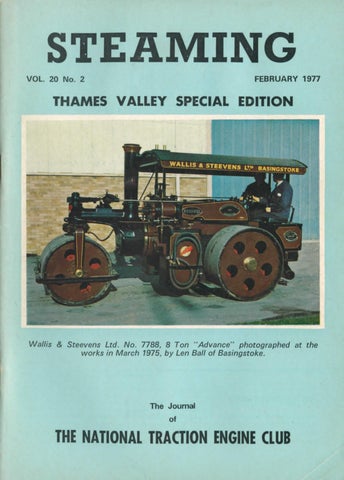
Wallis & Steevens Ltd. No. 7788, 8 Ton "Advance" photographed at the works in March 1975, by Len Ball of Basingstoke.
The Journal of
THE NATIONAL TRACTION ENGINE CLUB
National Traction Engine Club Membership is open to all, whether engine owners or not, with a genuine interest in the preservation of self-propelled steam road vehicles, portables, etc. The annual subscription is £3 for individuals, £4.50 for family membership. The benefits of membership include advantageous terms for boiler insurance. The club's journal 'Steaming' is sent free to members in November, February, May and August. All articles, photos for consideration should be sent to the Editor. All correspondence re subscriptions, bankers order, delivery (or non-delivery) of 'Steaming' or change of address to: MRS. F. E. WOOD, 'WINDRUSH', HAIL WESTON, HUNTINGDON, CAMBS, PE19 4JY Please enclose S.A.E. when sending subscription or when writing to any officer if a reply is required.
Next issue; Copy, photos, etc. should be in the Editor's hands by 30th March, 1977, earlier if possible.
Acknowledgements Thames Valley Traction Engine Club, Len Ball, Wally Dell, A. T. Woods, Wallis & Steevens Ltd., J. L. Thomas, John Newton, T. B. Paisley, Ran Hawthorne, Peter Wyatt, Ralph Brown, Cecil Brown, Les Burberry, Mike Harmsworth, Ann Nottage, Fred Simmons, Tony Parker. 58
STEAMING THE JOURNAL OF THE NATIONAL TRACTION ENGINE CLUB all items are held copyright by contributor and/or N.T.E.C. EDITOR: R. J. BLENKINSOP, Hill Cottage, Radford Semele, Leamington Spa, Warks., CV31 1 UA. VOL. 20 No. 2
From the Editor It is with some fear and trepidation that I set out on my journey as your new Editor. The Club magazine is one of the most important things we have to offer our members and I shall be looking to you all to help in the production, by sending in contributions and items of information which if of interest to you are bound to be of interest to others. Ran Hawthorne has carried the burden for many years and he has been a source of inspiration to us all. He has produced a stimulating magazine and at the same time broadened our outlook in other directions. It was fitting that he should have received one of the club trophies at York — I am delighted that he will be contributing to Steaming in the coming months. And what of the future as we arrive at the Jubilee year? Any changes in Steaming will be gradual, the layout will be the same and content both historical and of the present day. I should like to see more practical articles on engine preservation and the day to day problems of running engines. Another side of our interest is the Area News and I hope to ensure that we all know what is going on in every part of the country. Steaming has plenty of opportunities for those of you who are keen photographers. We badly need old pictures and also the rally scene today — but they must of course be in black and white, sharp and preferably whole plate glossy. Ran Hawthorne is responsible for the bulk of this issue and it is appropriate that in his last edition it should be a Thames Valley Special. For those of us involved in the production of Steaming we all wish you a happy new year and enjoyable rally season.
FEBRUARY 1977
John o' Groats to Land's End In the next edition of Steaming will appear an article on the epic journey of the steam wagons last summer. The Editor would be most grateful to receive black and white prints taken anywhere of the engines on the journey.
London Meetings Club social evenings (Noggin and Natter meetings) are normally held on the last Wednesday in each month at The Cock Tavern, Great Portland Street, London (two minutes from Oxford Circus Underground Station). We use the upstairs room and start about 7.45 p.m. February 23rd The engines in the area covered by the Worthing and Southern Counties Club — Brian Johnson. March 30th Traction engine in Ireland — a survey. Vic Burroughs. April 27th
Rally Stand Operators We require two extra sales stands to cover rallies in (a) Kent Surrey, Sussex; (b) north-east, north-west England and Scotland. The persons appointed will be responsible for attending rallies in their area witha club sales stand. To promote the N.T.E.C. by recruiting new members and selling club merchandise. Any member interested in becoming a rally stand operator should write to the National Sales Officer, Alan G. Wilson, 7 Welton Road, Daventry, Northants NN11 5PP. 59
Fowler "Jonah" No. 7942 Reg. No. TA 626, built 1899 at Woodcote Rally, July
1976.
Colour photgraphs by Len Ball.
Introduction to
THE THAMES VALLEY SPECIAL by R. J. BLENKINSOP
It was a good idea of Ran Hawthorne to invite me to speak at the December meeting of the Thames Valley Club. As he suggested I might like to see some of the engines in the area. This would give me an insight into the area covered by the club members and I was amazed at the 60
distance they travel to get to the meetings held at Englefield — from north of Didcot, Andover, west of Hungerford and in the east as far as London. My first stop was Pangbourne where Peter Barnes and crew were in the midst of putting in a new firebox for a small
Aveling roller. (For the engine numbers you can refer to Ran's article.) The boiler was upside down on the floor of the works and the new box had already been inserted. Staying was in progress with a useful tool for screwing in the stay tap. The design of box was new to me as all corners were square and of course it was welded throughout. Here was true preservation work being carried out on an engine that only a few years ago would certainly have been for the scrap man.
After lunch we took a few steps down the lawn and there stood the Burrell "John of Gaunt" with, beside it, a Wallis & Steevens Steam Motor Tractor. The light was now falling fast and our afternoon call was at Derek Marder's yard near Andover where we had a good look at all the engines under restoration. We have nothing like this in the Midlands and most refreshing it was to see a host of engines in the depths of winter. Our last call was for an inspection of
Foden "C" Type Estate Tractor No. 13484 (1930) Reg. No. 1974. Ran took me next to see Ralph Brown at the Pangbourne saw mills where a steam plant is used to cut all the wood required to heat the house. Ralph is a great enthusiast and apart from the installation at the bottom of the garden (vertical boiler and horizontal engine) he specialises in model stationary engines and railways. After a quick cup of coffee we went to Hungerford to find John Newton, who took us to see a large compound Aveling which attends local functions. John and his wife Brenda have the ideal situation — an engine house at the bottom of the garden.
LG 8784 at Basingstoke Rally
the engines in David Hirst's yard and by this time it was a torch light operation but even so well worthwhile as there were a number of engines which I had not seen before. Probably the members of the Thames Valley Club are typical of the dedication which takes place all over the country today in the field of preservation. I got the impression that the enthusiasm for all things "Steam" is alive today and judging by the attendance at the evening meeting the traction engine movement is in fine fettle. 61
•
WALLY DELL Man of Steam by Ran Hawthorne To enable us to see Wally in perspective we must first of all have a look at some of his ancestors. His maternal grandfather Noah Judd was the son of a farmer, who farmed at Chackmore, between Buckingham and Stowe. Noah was apprenticed to a blacksmith, he became a farmer but very quickly developed another side to his business, that of hauling timber with teams of horses. Noah and his wife had a family of eight, five sons and three daughters. As the boys grew up they came into the expanding business. A sawmill was built at Buckingham, by Noah and his sons, complete with stables for forty horses. A further twelve horses were kept at the farm at Chackmore. Wally's father was a farmer's boy with a great love of animals. Noah rented a farm at Tingewick and put Wally's Mum and Dad in charge. Engines had come on the scene by this time, they and the timber haulage horses were often stabled at Tingewick. Noah Judd's sawmill was steam driven, being used mainly to convert timber for the High Wycombe chair factories. Noah was a self sufficient character and, made most of the things he required. A living van, for examplle, was made at short notice when one was required for men working a long way from home. They worked as far away as Wales and Somerset. In 1916 one of the sons, Reg, was killed when "English Hero", a six horse Burrell with two loaded timber wagons ran away down a hill in a grass field at Malvern, Reg was twenty-one. Harold Judd left home to drive a Sentinel tractor and eventually set up as a contractor in his own right with a five horse Burrell and a Tasker tractor. Arthur Judd, the eldest son, who like the rest knew horses and engines inside out, joined Harold at Spencers Wood, near Reading. It was against this background of farming, timber hauling and sawing, hard and rough work that young Wally grew up. Wally's Mum and Dad moved to Kirtlington, near Oxford, and while at school there Wally was in daily contact with many engines, Grandfather had the Burrels "English Hero" and "Starlight", later to be used on the Fairs by Edwards of Swindon, and 62
now preserved by Dan Shorey, a Wallis & Steevens Tractor and two or three Fowlers that were used mainly with portable saws in the woods. Sykes of Water Stratford, used Fowlers for threshing and ploughing in the Buckingham area. Turveys of Weston-on-the-Green had Fowlers ploughs. The Oxon C.C. had two Fodens that were kept at a quarry at Kirtlington. Smiths of Bletchingdon had a yard full of engines including Mann wagons with two steering wheels, one either side, as well as Fodens and Wallis & Steevens Tractions, one of which was driven by Charlie Smith, this used to visit the farm where Wally lived. Wally was Charlie's "boy" whenever the tackle came, be it school holidays, or "truant" if necessary. Wally would sit in the bunker watching the water level and the pressure gauge, munching a swede or chewing grains of wheat. After all these years he still looks back on these times with the words, "Happy days". Smiths, then as now, supplied a lot of road stone, this was rolled in wet, with steam rollers, of course. Uncle Jock Dell often came to the village driving an Aveling & Porter or a Fowler for John Aliens of Cowley. Other local contractors included Partridge of Begbrooke with Fodens, Curtis of Botley with Foden and Clayton wagons and Tasker tractors, Chawley Brickworks had a Garrett wagon and Foden "D" type No. 12852, RX 1719. John Werrell at Cumnor had an immaculate 6 ton Foden that carried the legend "WEKANKARRYIT", just as Werrells modern day Fodens do. The cement works had two white painted Fodens that were always kept in beautiful condition. In Wally's teenage the family moved to Headington, where the Oxford by-pass was being built, such well known steam wagon operators as Wynns of Newport, Dudley Blowers Green Transport, Wm. Baters of Skewen, Swansea, H. P. Bulmers and many more were seen. At nearby Cowley, John Allen's Oxford Steam Ploughing Co. had numerous plough engines of Fowlers or their own make, they had a large fleet of rollers, a couple of "D.G." Sentinels as well as a number of sets of threshing tackle.
Wally in his first job, 1933.
TO WORK On leaving school Wally started work as a farmer's boy, this of course was a natural progression from the years that had gone before, he was already well used to horses, the tackle of the countryside and above all hard work. His elder brother became out of work and decided to cycle to Spencers Wood, near Reading, where uncle Harold Judd now had his base. Brother Eldred came home at the weekends with tales of journeys to places near and far. These tales stirred the young Wally to suggest to his Mum and Dad that this was the life for him. So in 1933 Wally left farming and joined H. Judd and Son. SENTINEL The day Wally started Sentinels delivered a brand new timber tractor to Judds, she was numbered 8777, registered JB 1655. Fitted with pneumatics all round, she had wind-up windows and was the last word in creature comforts. Wally was on the first trip this tractor did, but he was not here for an easy life, he was here as a
horse timber wagon man and spent the next nine months at this hard work. He was then sent as mate on any of the various steam or petrol tractors and was also on caterpillar tractors for a short period before becoming "mate-loader" on Sentinel 8777. She was the queen of the fleet, so to speak, being used on the long journeys to Worcester, Devonport Dockyard, etc. Arundel to Princes Risborough was a regular run for two years. The eighty-five mile trip taking eight hours. Coal and water were taken on at Bagshot then the crew crossed the road to feed at the Dolly Varden cafe. Mr. Bowler's "special", steak and kidney pudding and two veg, could be bought at midnight for a shilling (5p.). Another long contract for 8777 involved running from a site near Odiham to Dorking, with timber of course, the route being via Guildford, A3 to Cobham, Cobham Street where water was taken from the river alongside the road then through to Leatherhead and on to Dorking. Four or five trips a week being accomplished. While on this run Wally saw E. W. Rudd's Fowlers, assisted by Hickey's Burrell "City 63
"Sentinel- No. 8777 (1933) in Maidenhead Goods Yard with owner driver standing by the cab.
of London", hauling the Hackbridge transformers to Cobham. It was one of these loads that was involved in what transpired to be the last major accident involving heavy haulage steamers. DEMONSTRATIONS In conjunction with Sentinels 8777 was sent, on a number of occasions, as a demonstration vehicle to work for a week for firms who had expressed interest in this type of vehicle. Once they went to Chelmsford to a firm that ran two flat bed Sentinels, but a sale did not result. Another firm was impressed and bought a similar tractor. A typical contract started one Monday morning with a coal trailer hung on the back of the timber carriage and away they went to Clifton-on-Terne, ten or twelve miles on the wrong side of Worcester (in amongst the hills). The coal trailer with a few straw bales and a sheet provided the living accommodation for five, including the guv'nor, for three weeks. A Latil tractor was also in use here. The timber was hauled to Chipping Norton via Broadway 64
and the notorious Fish Hill. The guv'nor and the regular driver drove alternately, the Sentinel, and the men, putting in very long hours. On one occasion on a had hill at Bourton-on-the-Hill she "picked her feet up" and away they went "in some fashion". The guv'nor was driving this trip, he managed to keep on the road, and the right way up. Sherborne, Dorset to Devonport Dockyard. Totnes, Devon to Woolwich, were similar contracts. ANOTHER SENTINEL "Little Billie" the Tasker and "Charlie" the Burrell were still in use nearer home, but the growing need was for greater mobility. Two Foden wagons were bought and shortened for tarspraying work. About 1935 another Sentinel tractor registered WP 2169 was acquired from Bullens, Kidderminster. She had large solid tyred rear wheels and was faster than 8777. Wally had a year as mate on this one on similar work. Steam on the road was losing ground rapidly by the middle-thirties and wagons and tractors could be bought cheaply. A
"Sentinel" Tractor Reg. No. WP 2169 ex-Bullens of Kidderminster, in Oxford 1934. Wally Dell stands by the timber carriage.
Tasker "B.2" Compound Tractor outside a timber yard in Reading. 65
Sentinel tractor without a winch was bought but never used, a one year old rigid six wheel Foden was bought, she stood for some years and when she was sold again the new owner told Wally that he bought her only for the drive chain. A Foden "D" type came into the fleet, she was registered RX 2182. Wally had a year on her mainly local journeys to High Wycombe, Chipping Norton and Guildford. The Sentinels did the long journeys. It is appropriate here to use Wally's own words to describe the operation of this particular trade: We used to go right in the middle of some large wood with our steamers. If it was in a very bad place we would sometimes have a Latil tractor to help us in but once we had our Sentinel winch onto the log, it had to come. Now to a convenient place to load, we in the South mainly used two skids and rolled the trees up these onto the wagon. The North country men nearly always used three sheer legs and pulley blocks suspended from the apex, these used to be set astride the wagon. To my mind this was no better way than ours, certainly no cleaner. We all of us had a very dirty job in any weather, being either smothered in dust in summer and plastered with mud in winter. These Sentinels were very warm to work with in the summer, being fitted with windscreens, they were very modern as steamers of that period but they had to have good men to make them pay. On one job we had a change of crew, four blokes worked one engine day and night, she never went cold for about six months, apart from washout. We had an old "Holt" caterpillar on this site which used to pull the timber out and the crew that was supposed to be sleeping would help to load the spare wagon while the other was on the road. Total outlay of wages for 5 men about £15 a week and no subsistence. Another run we used to do, with the second hand Sentinel Reg. No. WP 2169, ex Bullens, Kidderminster, was from Shottesbrook Park, (where the big steam fair took place in 1964) to Miles Bros. of Stamford, large elm, mainly travelling by night as well as day, sleeping on the vehicle. Inside when it was cold, outside on top in the summer.
66
We never had a lot of money for lodgings so we used to have a tin that fitted in the firing shute of the engine for a cup of "sprog". When we felt like it we used to stop at a shop and buy a loaf, and a bit of cheese, Blue, or if it hung about for long it was black. As well as bangers in the shovel. What a life that was! Of course, we used to meet a lot of other steam hauliers, sometimes on the same estate. A firm from Essex had a six wheel Garrett Suffolk Punch on one job we were at near Hatfield. They always had three blokes on this, and a crawler to help them get loaded, they had some good up-to-date gear. A firm from Buckinghamshire, rival contractors, continued to use steam (Foden wagons converted to tractors mainly) right up to and during "Hitler's War", very good these were, being fitted with a winch as well. Another firm had two or three Tasker tractors these were useful and fast, being a bit lighter than our Sentinel.
THE END OF STEAM? In 1938 Wally became a driver, officially, by passing his driving test on a 4-wheel drive Latil tractor. His driving up to this time having been confined to private roads and in the woods. The steamers had gone, no one was really sorry — at that time — at any rate. Fodens came round demonstrating a diesel tractor that had the engine crossways behind the cab. Judds did not buy any as they were not four-wheel drive, but they did have two second-hand, later on. It was the Unipower Tractors that did the bulk of the work now steam was gone. These were faster on the winch, faster on the road and with four-wheel drive, and a good ground clearance they were ideal for the job. Wally had a spell with Butlins of Dimchurch, Rugby, and then back to Judds for another six or seven years driving a Foden shaft drive timber tractor. Then a couple of years with Baynes of Aldermaston, still of course on timber extraction and haulage. He then went to T. T. Boughton Ltd., of Amersham Common, Bucks., and had eighteen years on similar work, involving much running from Amersham to Devon and back driving Foden artics carrying round timber.
BACK TO STEAM For twenty years Wally was not directly involved with steam but during this period he often saw threshing engines and steam rollers on the road and some of the sawmills he visited were still using stationary steam engines. Wally was at the early races and rallies at Appleford, when Jim Hutchens was rallying six or seven engines from Ferndown, Wally was one of the team, and it was here that he met up with Sentinel 8777 again for "Old Bill", as the Sentinel had been named, had survived into preservation and Wally was often at the controls. He was often on Jim's plough engine "Princess Mary", the "Centaur" or the Wantage engine. As the preservation movement grew Wally was to become known over a wide area. He is a big man and always seems more at home on a big engine. When Anthony Heal got his McLaren "Boadicea" on the road it just seemed to be right that Wally should be part of the crew of the big engine. Since then Anthony Heal, Wally Dell and Ron Hedger have travelled many, many miles together. In October 1975, Wally had arranged to have a weekend with Jim Hutchens moving Bill Tame and Eric Fillmore's plough engines and cultivator to a ploughing match and then home to Hagbourne. This involved several journeys, wheels in and out many times, much jacking and winching, just the work Wally had done all his life but which he now missed as Boughtons had finished timber work and Wally was driving for a builders merchant. As far as Wally was concerned the much looked-forward-to-weekend never happened for he was struck down by a heart attack. He was in hospital for a time and it began to look as if his driving days were over, but Wally was determined they were not. He took heed of his doctor's' advice and within a few months he was behind the wheel once more, driving the pick-up truck for his firm's vehicle maintenance depot, fetching a tyre, taking spares, ferrying a driver to another vehicle. He is on the open road, amongst the work he loves. For most of 1976 he was obliged to keep away from engines and hard work but by July he was getting back into things and was able to help crew "Boadicea" again and did a number of journeys with her on the road.
When Stourpaine came round Wally was there once again. (A week's hard work at Stourpaine has been his holiday for the last few years). Where do we find him at Stourpaine? Yes, that's right. In the wood-sawing area, directing the timber loading, gently guiding the greenhorns, showing them where to put a chain, the angle to set the skids and so on. You will see him getting the big logs on the bench or driving an engine, the aroma of steam, sawdust and mud in his nostrils. A real MAN OF STEAM.
Wally, Knowl Hill, 1974. 67
WALLIS & STEEVENS LTD., BASINGSTOKE By A. T. Woods
The firm was started by Mr. Arthur Wallis in 1847 who remained Managing Director until his death in 1901. The firm was classed as, general engineers, making castings, farm implements, etc., they had steam to drive machinery in the 1850s, and in a short time were making portables and small stationary engines, in the 1860s, some of the portables were fitted with variable expansion gear and patent water heaters. William Fletcher, who became known as the father of the traction engine, took a position with the firm as designer and under manager in 1872 and worked on paper making machines, flour mills, biscuit making machines and portables until 1877
when he designed the First Traction Engine. These engines were known as the T Series. It was of orthodox appearance but long in the boiler, 8 n.h.p. 2 speed with differential, large boiler tubes, right hand steerage, W. Fletcher's story of the test of this engine is well known and often quoted, Fletcher left in 1878, in 1879 came 6 and 7 n.h.p. engines still known as the T Series. In 1884 the third design came out and was numbered in the 2000s, also in the 1880s a number of large stationary engines were made. In the 1890s the first steam rollers, and the well known 'Wallis Expansion Engines' these were in sizes of 6, 7 and 8 n.h.p. and traction of 5, 6, 7, 8 and 10 n.h.p. In 1896 the first Showman"s was
A traction engine of the 1870s the "driver" is believed to be William Fletcher. A Wallis & Steevens photo. 68
rn co
A Wallis & Steevens photo.
A Wallis & Steevens 7 h.p. single cylinder Road Locomotive No. 2336 (1896). Photographed when new.
A delightful scene. An unknown Wallis & Steevens "Expansion" engine at work in an unknown location. The sacks are marked: "Goulds Ltd., Ongar".
70
Wallis & Steevens made great efforts to harness "small" engines for cultivation.
ABOVE: A zli ton compound oil bath tractor is shown hauling a contemporary "riding plough" by means of a small cable drum, 1912.
OPPOSITE: A 3 ton single cylinder tractor fitted with "reversible" 3-furrow ploughs is seen at work about the same period. Three Wallis & Steevens photographs.
71
A Wallis & Steevens Lancashire boiler for C. Ashby, Brewers, Staines, 1893. A Wallis & Steevens photograph.
a single cylinder 8 n.h.p. for James Pettigrove, of Sevenoaks, Kent. Also in 1896 a 3 n.h.p. Road Loco Expansion was made and went to a Kent contractor, in 1897 a 2 n.h.p. single cylinder Road Loco went to Switzerland, in 1898 the first 3 Ton Motor was built and it was used by the works until 1915. In 1901 the 3 Ton Motor went into production; in 1902 5, 6, 7, 8 n.h.p. compound engines were under way, 19033-10 n.h.p. compounds, these were the only 4 shaft engines made by the firm, also in 1903 a 3 Ton Oilbath Tractor. In 1904 came the 4+ Ton Oilbath Compound, and the 41 Ton single cylinder Tractor. 1906 the first 5 Ton Steam Wagon, using the oilbath compound tractor engine. Rollers were being made using 5 n.h.p. compound open engines, 5 n.h.p. single cylinder engines and the 4 Ton Tractor Engines, the latter was the 4+ Ton made larger. 1910 came the 3 Ton Steam Wagon, 72
this had a compound open engine, and were only made to order. During 1914 the 5 n.h.p. compound traction was redesigned, by 1920 the 4. Ton oilbath tractor was given a larger firebox. In 1922 a start was made with designing a roller for use with the asphalt and bituminised materials, the rollers at this time were mostly adapted from small tractions or tractors, with narrow hind rolls, the weight distribution over the hind and front rolls was far from equal, this caused roll marks and ridges to be left in the finished surfaces. By 1923 the prototype "Advance" roller was put on test by the asphalting contractors, it proved successful, and went into production, all old type rollers were discontinued, 1925 the Simplicity Roller was designed, this was the last of steam designs by the firm, 1926 a start was made with the first Motor Roller, by 1930 steam,
5 h.p. compound locomotives were built from 1903 to 1914. One of the early ones is pictured here at Basingstoke in 1904. A Wallis & Steevens photograph.
diesel and petrol rollers were in production. The last steam tractor was made in 1928, traction 1929, "Advance" steam roller 1939. Diesel and petrol engined rollers continued to be made, petrol engines were no longer required after 1960, in 1965 a prototype engined hydrostatic transmission roller was designed with front and rear roll steering. It went on test with the Motorway Contractors in 1966, and into production at the New Works in 1967. In 1966 an 8 Ton "Advance" Roller was purchased and completely rebuilt at the new works. The new type roller and the "Advance" steam was exhibited at the Crystal Palace Show. In 1970 a Simplicity Roller was purchased and completely rebuilt. In 1972 the third old Steam Roller was purchased this is a 1922 8 Ton Compound Oilbath. It will be 100 years ago on 21st June 1977, when the first Traction was driven
out of the works on test, in 1967 the old works were raised to the ground to make way for the Basingstoke Redevelopment, not a sign of the old works can be seen today, the site is roads and office blocks, about one mile away at the new works road rollers with weight ranges from 35 cwt. to 16 tons all with hydrostatic transmissions are being built, but standing in one shop are the 3 Steam Rollers, still a centre of attraction to all who go in the shop. Mr. F. A. Wallis, son of Arthur, was Managing Director from 1901 to 1934, his son Arthur from 1934 to 1961, and Arthur's son Major Frank from 1961 to 1976, when Major Frank's son Arthur joined him as joint Managing Director. This article only gives a brief account of the firm's steam and roller products, many other products were made including all types of Mining Equipment, Farm Machinery, Water Wheels, Sprayers, etc. 73
Wallis & Steevens made oil bath tractors from 1903 to 1928. They came in 3 ton, 41 ton and 41 ton sizes. This one was photographed at Basingstoke in 1912.
OPPOSITE: An 1896 photograph of one of the famous "Expansion" engines. The general purpose "Expansion" engine and the "Advance" roller (Front Cover) were the two best known Wallis products and also two of the most successful models of any make. Wallis & Steevens photographs.
74
75
ON SENTINELS IN THE THAMES VALLEY AREA by J. L. Thomas
Standard Waggons The first Sentinel steam waggons on a full production basis were built in Glasgow✓ in 1905 by Alley & MacLellan Ltd. It would appear that they started to number them from No. 100. There are a lot of blank spaces in between the steam waggon numbers, but these could have been given to other items built, such as donkey engines, compressors, pit-head winding gear and even trawlers and lake steamers. The first number found in the Thames Valley area is the seventeenth in the list, namely No. 129, Reg. No. V 435. This waggon was new in 1907 to James Dewe of Burghfield, later sold to Clarks Ltd., Burghfield, and in 1924 in use by Thos. Smith (Haulage) Ltd., Camden Town, London. The next Standard was No. 637, Reg. No. V 2291, new in 1913 to Morland & Co. Ltd., Abingdon, Berks. In 1915, The Thatcham Road Transport Station purchased a Standard, Reg. No. V 3290. This Company, along with other large second-hand Sentinel users, purchased surplus waggons from the R.A.F. and the Ministry of Munitions in 1919. Among the waggons bought by this firm were Nos. 1731, 1742, 1847, 1904, 1978, 2072 and 2161. They also purchased second-hand from Stevens & Co., Oxford, a small 4 ton Sentinel No. 2329, Reg. No. AW 4787, Model B4T. The R.A.F. at Ascot, purchased several new Sentinel waggons during the 1914-1918 War; amongst them were No. 1659 (LR 8788), No. 1847 (AW 4016), No. 1848 (LT 8434), No. 1849 (KE 1538), No. 1850 (BL 0142), No. 1853 (BL 0144), No. 1851 (BL 0143), No. 1852 (BH 7829), No. 1855 (BH 7830). The first new Sentinel sold in the Thames Valley area was to Dymore, Brown & Co. Ltd., Reading; it was No. 2453, Reg. No. AW 5216, purchased in 1919. Model A 6 ton Sentinel No. 2616, Reg. No. AW 5689 was sold new in 1919 to C. H. Witherington Ltd., Sonning Mills, Berks., Fleet No. 3. This had a van body, and later went to H. Goodey of Twyford. 76
Small 4 Ton models seemed to be popular in the Thames Valley as G. & W. Talbot of Reading bought new No. 2650 (AW 5778) in 1919; Morland & Co. Ltd., Abingdon, Berks., purchased their second Sentinel No. 2876 in 1920; and The Thatcham Road Transport Station bought second-hand Nos. 2329, 2541, 3043, 3334, 3626, 3715, 3731, 4193, 4386, amongst others. Model A 6 Ton Sentinels were purchased by John Organ & Co. Ltd., Oxford, No. 3225 in 1920 and by E. J. Cole, Hungerford, Berks. No. 3784 (AW 9143) in 1921. Clarks Ltd., Burghfield, Reading bought their second new Sentinel in July 1921, No. 3862 (BL 8883) this was last licenced in October 1933. Model C seems to have been a special 8 Ton version of the Model A, being designed primarily for use in the Liverpool Dock area. However, the Sentinel Waggon Works apparently had one as a demonstration waggon in January 1922. She was No. 3931 (NT 944), sold to Warren Row Whiting Works, Berks., later to Fr. Norman trading as A.C.E. Transport Co., Reading, and was scrapped by Edney's (Turves) Ltd., Waterlooville, Hants. in 1932. S. M. Soundy & Sons of Reading, purchased No. 3965 in 1921. R. B. Needam of Reading bought Model B 4 Ton waggon from Hovis Ltd., London, No. 3970 in July 1929 (she was new in 1921) after she had been back to Sentinels for a refit. In November 1921, R. Simmonds & Sons Ltd., flour millers of Aldershot, purchased a Model A 6 Ton waggon, No. 4045 (HO 6007). Frank Rivers of Beenham, Aldermaston, who dealt in scores of Sentinels, did have one new. This was No. 4223, (HO 6144), a Model A 6 Ton in November 1922. 'Supers' The new Super Sentinel Model was introduced in June 1923; the first ones in use in the Thames Valley area were the 23rd and 24th to be built. They were Nos. 5035 (MO 2022) and 5036 (presumably MO
Standard Model Sentinel No. 129 Reg. No. V 435, 6 ton new to James Dewe, Burghfield, Reading, 1907. Later Clarkes Ltd., Burghfield. Photo: D. B. Stoyel.
2023), new in August 1923 to The Thatcham Road Transport Station. Next is Super No. 5046 new to John Organ & Co., Oxford. Super Sentinel 5 Ton, 3-way Tipper No. 5070 (PT 1424) was new on 14th June 1923 to Lewis Bros., Birtley, Co. Durham, sold to John Allen . Sons Ltd., Oxford, and in November 1932 was converted from a 4 wheeler to a 6 wheel rigid, the solid tyres being changed to pneumatic ones. Super No. 5184 (HO 6262) was new in 1923 to R. Simmonds & Co. of Aldershot, with Sentinel trailer No. 5185. In the following month, E. W. Reeves & Co., Wokingham, Berks. bought No. 5248 (MO 2418). John Organ & Co. of Oxford purchased their second Super, No. 5348 (FC 6402) in March 1924. Four more Super Sentinels were purchased in the Thames Valley area during 1924. These were: No. 5418 (FC 6359) to Henry Tuckwell & Sons, Oxford in May; 5545 (HO 6346) in July to J. Colyer & Co. Ltd., Aldershot; 5578 (BW 7974) in August to Henry Haines of Witney, Oxon; and 5672 (HO 6351) in November to R. Simmonds & Co., Aldershot, Fleet No. 10.
The first of the Double Geared Tractors listed in the Thames Valley was No. 6032 (WW 5127) new in March 1925 to T. Mossop, Kirk Hammerton, Yorks., later owned by George Lewis of Reading, and finally licenced by H. Judd & Son, Spencers Wood, Berks. She was returned to the Sentinel Works in January 1932. R. Simmonds & Sons Ltd., Aldershot purchased their third Sentinel in November 1925. This was No. 6086 (HO 6453), their Fleet No. 11. Super Sentinel No. 6161 (RO 831) was new in June 1925 to H. W. Sunderland & Sons, Kings Langley, Herts., who sold her to John Allen & Sons (Oxford) Ltd. The first Sentinel articulated six-wheeler listed in the Thames Valley area was No. 6169 (MO 8035) new in June 1925 to T. R. Sanders of Windsor. In January 1926, S. M. Soundy & Sons of Reading bought No. 6347 (DP 7116). Super No. 6398 (DP 7590) was new in May 1926 to Eldon Transport Co., Reading the name A.C.E. Transport is also listed in brackets with 77
Eldon Transport. This vehicle was burnt out when in the ownership of E. & H. Edney, Waterlooville. T. R. Sanders of Windsor purchased his second six-wheeled articulated Super Sentinel in October 1926. This was No. 6719 (MO 8651). The next one in the Thames Valley area only came there in preservation. She is Super No. 6725 (KA 5574), new in January 1927 to Edward Derbyshire & Co., Liverpool, and now preserved by John Keeley, Knowl Hill, Berks. Another Double Geared Tractor was No. 6917 (DP 8391) registered in March 1927 to S. E. Collier of Reading. John Allen & Sons (Oxford) Ltd., Cowley, Oxon, purchased their fourth Super Sentinel in May 1927. She was No. 6963 (UD 1099).
Works Ltd., numbered everything they built consecutively, it is interesting to note that No. 8269 was an engine and boiler supplied to John Allen & Co. (Oxford) Ltd. in July 1930. These were for the second of two WAVELESS ROLLERS ordered by the Dutch Authorities for reclamation work on the dykes. Another Sentinel Tractor in use in the Thames Valley area was No. 8706 (WP 2169) new in June 1932 to L. Bullen & Son, Kidderminster, Worcestershire. This had pneumatic tyres on the front wheels, and was later sold to H. Judd & Son, Spencers Wood, Berks. In July 1933, this firm bought No. 8777 (JB 1655) the well known in preservation Tractor "Old now owned by John Sparkes, Outwood, Redhill, Surrey.
D.G. Models 'Shaft drives' R. Simmonds & Sons Ltd., Aldershot, thought so highly of the several Sentinels they were already operating, that they purchased the very first D.G. (Double Geared) waggon built. This was No. 7162 (OT 6876), new in December 1927 their Fleet No. 12. Next to come to the Thames Valley area was D.G. 4 No. 7349 (RO 9520) new in March 1928 to D. Mylon & Co. Ltd., Watford, Herts., later owned by H. W. Seymour, Hillingdon & Thames Valley Ballast Co. Ltd. A six-wheel D.G. model (D.G. 6) No. 7396 (RX 2394) was registered in May 1928 by D. F. W. Rabbitts of Binfield, Berks. D.G. No. 7548 (DP 9967) was new in August 1928 to William Ridley & Sons of Reading. T. R. Sanders of Windsor purchased his third Sentinel No. 7561 (RX 3147) new on 9th October 1928, being a D.G. 6 threeway tipper. In February 1929, he bought a D.G. 6 side-tipper, No. 7717 (RX 3718), Fleet No. 1. R. Simmonds & Sons of Aldershot continued building up their fleet of Sentinels by purchasing D.G. 6 No. 7735 (OU 618) in February 1929. This was their Fleet No. 14. One wonders whether they had a No. 13 — if they did, it was not a Sentinel! During 1929, T. R. Sanders of Windsor, bought five new D.G. 6 tippers, allocating them Fleet numbers 2 to 6 respectively. These were Nos. 7876 (RX 4419), 7877 (RX 4420) in May; 7993 (RX 5198), 8008 (RX 5199) in August; and 8103 (RX 5611) in November. Wynn & Simmonds of Ascot, Berks., purchased D.G. 6 tipper No. 8011 (RX 6740) in May, 1930, their Fleet No. 9. She was last licenced in January 1932! Remembering that the Sentinel Waggon 78
The first of these new models to be used in Berkshire was No. 8827 (UJ 2225), an S.4. This was first licenced by C. Prior, Braywick, Berks. on 28th October 1933, after having been on demonstration to W. J. King, Bishops Lydeard, Somerset. This waggon was purchased at Capt. A. Wills' sale in May 1976 by Dennis Brandt of London. The next 'S' model with a Berkshire address is another preserved S.4. No. 8957 (BPD 969), new in March 1934 and now owned by Mr. A. Price of Hurst, Berks. The first '5* model delivered new in the Thames Valley area was firstly a demonstration vehicle, presumably to the firm which later bought it. This was S.4 No. 9091 (UJ 3452), sold on 3rd July 1934 to the Ramsdell Brick & Tile Co. Ltd., Ramsdell, Hants. No. 9208 (BY 485) an S.4 was new on 12th July 1935 to Price & Co. (Bakers) Ltd., London, Fleet No. 3. This waggon was purchased by W. Selby, Ashford Hill, Berks., and is now preserved by Mr. J. C. Butler of Tonbridge, Kent. S.4 Model No. 9276 (DKN 380) was new on 2nd December 1936 to Wingham Engineering Co. Ltd., Wingham, Kent, Fleet No. 72. After being owned by J. W. Hardwick, R. Rivers, Curwen and Newberry, it passed into the ownership of Berks, Bucks & Oxford Farmers Ltd., Twyford. This vehicle is now owned by John Keeley of Knowl Hill, Reading. To summarise, we have only five new, one second-hand shaft driven Sentinels, and three which only came to the Thames Valley area whilst in preservation, as representatives of the best steam waggon ever built.
The Waveless Roller built by John Allen & Co. (Oxford) Ltd., with Sentinel vertical boiler.
Sentinel No. 2616 Reg. No. AW 5689 (1919) taken in the early twenties. 79
"YOU MUST BE MAD" by John Newton
My story begins with a visit to an early Appleford Rally, which I attended with my father. What stands out in my mind as being most clear about that day was that an agricultural steam engine was being offered for auction, in steam and was withdrawn at £153. I tried to get Dad to bid for it but he said that he had had enough of steam engines, having spent a lifetime working with them, but that is another story. As I was only a lad at the time with very little money in the bank, even though I had enough enthusiasm for a dozen engines, needless to say, we did not bid. By the time I had seen all that was going on, I was determined to get to know the enginemen and their scene better, and if ever possible, to own an engine. Before I came away from Appleford that day, I had, in fact, spoken with the man himself, no less a person that Arthur Napper. He was seated on the coal in the bunker of his faithful old steed whilst she provided power for a threshing machine and he told me all about the movement that had sprung up to preserve these relics of the past. Suffice it to say that, fired with this enthusiasm, I was even more determined than ever to become part of that band of enthusiasts. Within a little while, I had written a letter to the only one I knew in the movement, Mr. Napper, to ask to be put in touch with a club. He passed my enquiry on to that other veritable mine of information on steam matters, Mr. Ran Hawthorne, the then Secretary of the Thames Valley Traction Engine Club, who kindly sent me all the details of the club. My money was in the next post and then began what has become a long, interesting and very happy association with what can only be described as one of the premier clubs in the preservation of steam engines and its associated equipment. The one aspect of the steam preservation movement which seems to me to be its most important and striking feature is the tremendous willingness of all persons to help one another, not only in word but also in deed in every sphere of this preservation. This seems to prevail at all times 80
and is possibly the main reason for the camaradery that exists, and also the complete lack of social and class barriers between all members. Now a fully paid up member of the movement, I felt that I was really on the way. I attended, and still do, virtually every meeting and function that were held, and all the time I became more determined to be an engine owner. I am sure that, at that time, I must have often annoyed my new-found friends when I plied them continually with questions as to where I could find an engine to buy at a price I could afford. Nevertheless they treated me with the usual kindness and forbearing. THE BURRELL ROLLER During the interval of time between my going to the Appleford Rally and my participation in the club, a few years had passed, during which time I had got married, left the farm and set up in business as a shopkeeper in Hungerford, Berkshire. My quest for an engine continued and nearly ended on my doorstep when I heard of an old Burrell roller which was standing derelict and almost forgotten on a nearby Estate. The next step was to meet the Resident Agent and find out all I could about my intended steed. Fortunately, the Agent was already an acquaintance of mine, so I felt quite confident. When I tackled him about the roller, he assured me that it was, in fact, for sale but the price he wanted I considered was too high. I decided to wait for a few weeks, when I felt sure that he would drop his price. After what I considered to be the appropriate time, I got round to the subject of the Burrell during my next conversation with him only to be told that he had sold it three days earlier. I was heartbroken. I told my wife that I knew that I would never get an engine now that the one which was so local to me had been sold, but she very philosophically told me that when one door closes, another opens, and sure enough it did.
THE RANSOMES It was only a few days later when, at our next club meeting, a member told me of an engine lying derelict (a traction engine — no less), but because it was owned by several persons, it was not possible to purchase because of the difficulty in tracking down all the owners and getting them to agree to sell. This was like a red rag to a bull to me and nothing as trivial as that was going to stop me from being an engine owner. I asked him for all the details of the engine as far as he knew them and its whereabouts. The engine was a Ransomes, Sims and Jefferies traction engine and it was standing at Bridge Farm, Appleford, the home of Arthur Napper, and the Mecca of Steam engines — I had gone full circle, my quest was over. At the very first opportunity, having telephoned to ensure that it was convenient, I made what was to be one of many trips to see and to work on the engine. I found it at the back of the yard, just off the hard roadway, standing on a piece of waste ground between the road and a ploughed field. It was covered by a tatty old tarpaulin and had sunk into the ground, fully a foot at the rear, which meant that the tender, partially visible below the sheet and through the nettles which grew around it, was almost sitting on the ground. She looked somewhat bedraggled, but nevertheless, on looking under the sheet, which mercifully through the kindness of Mr. Napper, had been kept on in spite of all weathers, she seemed complete down to the poker and shovel and a few knobs of coal. Bedraggled or not, to me she looked like a nugget of gold must have looked to a Klondike prospector, a noble find. Mention must be made here, I feel, of Bridge Farm itself. What a place it was to a steam enthusiast. Going in, one would find on the left, the two old Fowler single cylinder ploughing engines "Noreen" and "Margaret", now both over one hundred years old, then resplendent in new coats of paint and under new tarpaulins, parked so that their front wheels were just off the road. Next on the right towards the back door of the farmhouse, under a spreading tree was to be found a very nice Marshall traction engine which belonged to Hamish Orr-Ewing, so I was told. On into the yard, past a garage on the left and an open-fronted cart shed which housed an
old Titan tractor, we came to another ploughing engine which was very unique — the one sole survivor of a J. & H. Wilder Fowler-based ploughing engine. I am sad to say that this was not in going order, but to my eyes did not look to be in need of too much attention. Then we came to an old roller living van and a four-wheeled, high sided traction engine trailer (about which I will write more in due course), then — at the far end — The Ransomes. This was not all, by any means, for to be found in a large asbestos clad building across the yard were Mr. Napper's own engines. Firstly the already famous Marshall "Old Timer", the engine on which he raced back in the early 1950's. These races, about which many words have already been written, started the preservation movement of steam engines as we know it today. Also in the shed were his other two engines, a Fowler single cylinder engine "Tommy" and in those days his Foden over-type tractor "Berkshire Belle". This was the sight to meet the eyes of the enthusiast at Bridge Farm, Appleford, and to me it all rekindled many memories of my childhood days as it was when I was only a young boy that I spent about one week per summer staying at my Grandparents' farm at Brookland in the Romney Marsh of Kent. This farm, the Harvey Farm, Brookland, had been my father's family home for almost a century, and was the home of what had been one of the largest fleets of steam engines to be found in that part of the country. Steam was synonymous with the Harvey Farm as it was there, that a large steam ploughing and threshing contracting business had operated. EARLY DAYS In the days of which I write, the 1940s, the steam contracting business had naturally lapsed, but all or most of the steam tackle remained. This was because everyone said that my grandfather would never see his beloved steam engines cut up to feed hungry furnaces, which unhappily he did in his old age and failing years. My happiest times on my holidays were spent playing on these old relics. I well remember a line of six Fowler ploughing engines, standing slightly sunk into the ground where they had been parked adjacent to the workshop, all complete in every way. 81
Ruston Proctor No. 32404 Reg. No. KE 6254 shown at Walter Newton, Brookland, Kent. Photo copyright T. B. Paisley.
I used to stand up in the rear one pretending to be driving and look along the row in front of me, which, at my tender age, seemed to go on for ever, chimney stack after chimney stack. Then the thrill of running from one engine to another along the running board, jumping across to the tender of the next and so on until I reached the front engine, hopping over the cylinder chest, and back down the running boards to where I had started from at the rear one. Then to sit on one of the seats of the anti-balance plough and move the steering wheel as best I could and watch the one at the opposite end revolve as if by magic. I would sit there and survey the wondrous scene of machinery, engines, cultivators, living vans, water carts, ploughs, horse-drawn items and all the paraphernalia of an age just past. The strength and heritage of my family, the pride of my fore82
fathers, as it was more than a century before when the first steam engines to appear in any form took to the land, that my forebears had come to Kent to till the land using this most fascinating and loved form of propulsion. I am in no doubt that it was on these many holidays, playing amongst these machines and sniffing the smell that still lingered amongst the nowrusting machinery and ferreting amongst all that was to be found and seen in the now silent workshop, that kindled in me — then only a small boy — that love of steam that was to become such a passion and obsession with me later in life. All this returned to me as if in a flash, many childhood memories, as I stood and gazed around at Bridge Farm, and here I was embarking on what was to be for me another exciting adventure.
THE PURCHASE Back to my story. Having quickly surveyed the Ransomes, I went to find Mr. Napper, whom I was pleased to see had at least remembered me from my earlier encounter with him at that rally. I told him of my intention to buy the engine if at all possible and he informed me that he was sure that he knew who owned it, and also that I would have to have it tested by a Board of Trade inspector to see if the boiler was sound and fit to steam. After a long and interesting chat with him, he said that he would find out what he could by my next visit. When I arrived a day or two later, he presented me with a piece of paper on which was written the name and address of a titled lady who he assured me owned a fair proportion of the engine. My next step was to write to this lady and obtain her consent to sell her share in "Enterprise" as the engine was known at that time. It turned out that she was indeed willing to sell her third-share of the engine which she held with four other persons. Armed with the possibility of at least a one-third share in the engine, I found myself heading towards Fareham to find the person who owned the remaining two-thirds. Before I came away from Fareham that evening, I had made my purchase and heard a little more of the fascinating story of the Ransomes. Upon receiving the Log Book, all that I had so far learnt about fell into place and it was interesting to find that this engine was one of the very first engines in Essex to be preserved and had, in those days, taken part in some of the very first gatherings of engines before the Rally movement got under way in that part of the world. I also found out that the engine had in fact only escaped the cutter's torch by a mere two days. It came as somewhat of a shock to me to learn that my purchase also included the old high-sided traction engine wagon, mentioned earlier, but now that I owned it, I viewed it with more than a passing glance, and found that it was made at about the turn of the century, mounted on solid type wheels, but very dilapidated as most of the woodwork was rotten and the iron work very rusty. Its contents turned out to be some old 40 gallon oil drums, the odd engine spud and about a foot in depth of what looked like coal dust — not much good I came to the conclusion, but I felt
that it could be restored and as I had acquired it with the engine, I felt that it must stay with it. BOILER INSPECTION My next step was the boiler inspection, which was duly arranged. When the appointed day came, I once more played truant from the shop and headed my car on what was by now a familiar road. The boiler inspector turned out to be a most friendly and helpful man and all was well except that I had not known in advance what sort of things he would .get up to with my prize. It transpired that he wanted all the manholes and mud holes of every description taken out in order that he could peer into every nook and cranny. All went well until it came to the last one — the mud hole in the front tube plate inside the smokebox. "Take that out," he said, calm as you like, but it would not budge. In the end, I had to borrow a chisel from Mr. Napper's tractor driver, and after what seemed like an age, working in such a confined space, and after losing nearly all the skin off my knuckles, it finally came out. Whereupon the boilerman said that all seemed well with the external test and that tomorrow he would carry out a hydraulic test. This was the point when I am sure that I realised for the first time that there was more to owning an engine than just standing up there with the regulator in your hand and a smile on your face. Next morning, having hastily procured four one foot lengths of threaded bar and some similar lengths of drilled angle iron, with which to clamp down the safety valve, I duly arrived at Bridge Farm. The first job was to move the engine so as to reach it with the hose pipe from the tap near the back door of the farmhouse. Hurriedly, we set to work with a spade to dig out the ground around the wheels of the engine, and then with two diesel tractors joined together with chains fastened to the back of the engine, I took up my stance on the footplate. All was now ready and the signal given. The tractors started, took up the strain, but — alas — the engine would not move. The tractors were only digging holes for themselves as they strained at their task. Once more, Mr. Napper came to the rescue, he dispatched one of his men to fetch the Caterpillar tractor which was stored at the other end of the farm and 83
which was only used to certain times of the year for ploughing and so on. In due course, this came clattering over the fields and arrived at the yard. Together with one of the wheeled tractors, it finally managed to move the engine.
After what seemed like eternity, but must, in fact, have been only a short space of time, the boiler inspector, who, during the time that I had been pumping, had been darting around looking first in the front, and then underneath, finally said
"Ivanhoe" at Bridge Farm, note the Merryweather water pump on tender side.
By early afternoon, the engine was filled up with water, the safety valve clamped shut, and now the test was to begin. My job in all this was to man the pump which had been connected to the pressure gauge pipe up in the tender. With the pump in a bucket of water, I started to pump. Within a surprisingly short time, the hand on the dial attached to the pump started to rise quite rapidly. The old engine now started to creak and groan as water was forced into every space within the boiler and cylinder block. My heart seemed to stand still, even though the whole of my body was aching from pumping. Was my new found prize to be blown to smithereens so soon after being acquired and what was worse, was I to be blown up with it? All this raced through my mind as I continued to pump, the hand on the dial rising all the time. 84
that the pressure I had obtained on the pump was high enough and all I had to do was to maintain it for half an hour. He must have been joking, for by now my arms had almost ceased to work at all, my back seemed as if at any moment it would lock solid once and for all and what was worse still, water was beginning to leak out of the safety valve while my hastily rigged clamp looked as if, at any moment, it would give up the struggle. Suffice it to say here, that I did my very best, and even the boiler inspector, upon seeing the pained expression on my face, came and gave a hand on the pump. When, at last, he said, "That's enough, you need not pump any more." I was at a point of near mental and physical collapse that I almost tumbled out of the tender. So this was being an engine owner! I was immediately relieved and
surprised to hear from him that as far as he was concerned she would be alright, the tubes which had been my most worrying concern had apparently withstood the test satisfactorily. So elated was I and ignorant too, that instantly refreshed from the pumping, I jumped up into the tender and pulled the whistle, this being situated behind the crankshaft and within easy reach of my hand. Of course, I had not realised that this too was filled with water and still under some considerable pressure. Needless to say that no sound came out, but only a fierce jet of water, horizontally at just head height, which, whilst nearly decapitating me, left me pretty wet. I looked around quickly, but, mercifully no one had seemed to notice. I then furnished the boilerman with all the various details and papers concerning the history of the engine which I had managed to acquire, for him to take to enable him to write up his report. She was then shunted by tractor to the far end of the farm yard, pointing right down the road in readiness for the journey home. It was a very dirty, weary, sore and blistered, but nevertheless happy engine owner who finally arrived home in Hungerford that night.
FRUSTRATION The days now were full of excitement and frustration. Frustration at waiting for the test certificate and licence to arrive, but excitement at the prospect of our impending journey to be the start of my career as an engineman in my own right. One other thing I had to do was to convince my father that his son was not entirely devoid of reason but that I was only following in well-trodden footsteps, and also to inveigle him into assisting us on this epic journey. I remember so well telling Dad that I knew enough about steam engines to drive it home — after all, all you had to do was to keep plenty of coal and water in her — If only I had known! At last, after what seemed ages, the day drew nigh. On the Thursday afternoon — my half day from the shop — we again visited Appleford to make the engine ready, taking with us as much coal as we could carry safely in the boot of the car, having purchased this from our local coal man with the express instructions that it must be "Best steam coal and not household coal" — So much did I know about
it that I would not have known the difference if he had shown me some samples of both kinds. We polished the brass and did all that we could to prepare our steed. My visit to the monthly meeting of the Thames Valley Traction Engine club during the time which elapsed between the purchase of the engine and the journey home was indeed most exhilarating. There was firstly the news to break that, at last, I had joined the ranks of engine owners and now, more than ever, was entitled to a place in their club, and secondly to deliver the bombshell that I intended to drive it home. Some clapped me on the back at the news but there were those members who cautioned me that this was not a wise step to take considering that the engine had been standing for some years. In any case, despite their various warnings, I was determined to have a go.
IN STEAM At last, the day arrived. It was very early on a Sunday morning that my brother took my brother-in-law and myself, plus some more coal, oil and wood to Appleford. We arrived in the yard at Bridge Farm at 5.25 a.m. on what was a bitterly cold, windy morning, and after unloading the car, my brother set off for home. It was now up to us the prove ourselves at raising steam, as my brother was to return with my father at about 10 o'clock, when I had told them that all would be ready and, most likely, we would be on the road heading for home. Our first attempts at raising steam were pathetic, I'm ashamed to say. The wind blew hard right from behind the engine and all that seemed to happen was that the smoke came out round the smokebox door and not up the chimney at all. An old sack was found and soaked in oil, and we again attempted to light up. But it was a long time before any appreciable fire filled the fire box, and by this time we had placed a large piece of corrugated tin up against the front of the engine in an effort to divert the wind away from the smokebox door, also a further piece was rolled round and stuffed into the top of the chimney in an attempt to lengthen it and produce more draught. We must have looked a sight. After what seemed like hours, the needle on the pressure gauge began to move and the engine, at last, seemed slowly to come to life out of its 85
long slumber. Eventually, enough steam was raised to move the engine and I now engaged the gear and set about proving to myself that I could indeed drive the monster. Suffice it to say that, in the end, after much shunting around, we managed to reverse and couple up to the old trailer which we assumed would at least last the journey home. The next job was to move the outfit to where the hosepipe would reach and to fill up those oil drums which we had arranged at the front of the trailer to use as an emergency supply should it be needed. The time by now was well into the morning — we were already behind schedule and my father had arrived to help us. We oiled everything in sight on the engine and trailer and with much waving and goodbyes and a reasonable fire and not too much steam, we headed out to the road and our journey home of some 30-odd miles. A right-turn and at last, the open road. I feel, on reflection, that it was just as well that we were so inexperienced and knew so little about the workings of a steam engine or we would never have been brave enough to attempt such a journey in such an ill prepared and unknown state. I can only assume that the early explorers, when setting out on their respective journeys, must have been as oblivious as ourselves as to what lay ahead. I can only hazzard a guess as to what thoughts must have been going through my father's head as we set off. In fact, in all the years of his vast experience with steam, he had never driven a Ransomes engine before. He told me later that he only agreed to help us as he knew that we were so determined to drive the engine home and also had no knowledge of steam, that it was a case of 'if you can't beat them, join them', and also, I suspect, a severe attack of that malaise called 'paternal protection'. How glad we were that he agreed to help. So we began, Dad driving, myself steering and my brother-in-law in the trailer as 'lookout'. After about a quarter of a mile down the road, I noticed that two large nuts holding down the main crankshaft bearing in front of me were revolving quite happily. We stopped, tightened them down and off we went again. It was no further than two hundred yards down the road, if anything downhill, when the engine began to stop, labouring heavily. The reason for this was soon found, in tightening down the nuts, we had clamped the bearing 86
tight on the crankshaft and almost seized it completely. So we slackened them off, locked them together, oiled up again and set off once more. By this time the wind had increased, the clouds had thickened and, all of a sudden, without any warning, the heavens opened. Not only did it rain, but the hailstones came so thick that they lay on the road around us like snow. This lasted about ten minutes — just long enough to almost soak us, and we were still in sight of Bridge Farm! On we went at a steady pace, and I was experiencing for the first time the joys of riding on a steel-shod, unsprung agricultural engine on a modern, concretebased road. I was trying to decide whether to stand straight up and risk severe back injury, or to bend my knees, open my mouth and possibly have all my teeth drop out through the vibration. On to Milton village and our first stop for water. Well looked out in advance, a small stream running under the road. The water-lifter on the engine had been done away with, and in its place, bolted onto the rear of the tender hung a steam pump, part of a Merryweather fire-fighting machine. At this stage, we were unaware as to whether it worked or not, but we inserted one end of the hose into the water, the other into the pocket of the tender and switched on, only to be encased in steam. After several swings on the small flywheel of the pump, it burst into life and proceeded to fill the tender quite rapidly even if the hose which had been dry for many years did rather resemble a sieve. It was whilst all this was going on that a car drew up and stopped. Out hopped Mr. Napper, who had come along to see how we were getting on, a truly fine gesture on his part, I felt. So elated was I, that, after leaning on the engine, in order to dry out a little, I took a photograph of the scene to record our progress. Now, on we went, happy in the knowledge that, at least, we could take on water, but every little rise in the road proved to be a headache, as we could only raise and maintain a small amount of steam pressure. This was due, no doubt, to our 'best Welsh steam coal" which turned out to be no more than house coal, and also the fact that all the packings in the glands were so hard and old and as much steam escaped as was being used up by the cylinders. It was during our next stop for water, in a lay-by at Harwell, that a young lad
walked by and glanced at us with some interest. Again replenished and re-stocked we set off at a cracking pace and soon overtook the walker much to my glee, but imagine my horror when, on the next rise in the road, and again in bottom gear, he overtook us!!!! Later on we were to catch him up again, but this time I offered him a ride to save any further ignominy, this he accepted and rode with us until our paths diverged.
OVER THE HILLS Now our road lay over the hills towards racehorse country around the villages of West Isley and Farnborough — and the true test was still to come. In fact the first hill was mounted with surprising speed and we all felt better and more confident that the engine was now getting run-in again, so to speak. Safely down into West Ilsley and to our next watering stop. The time, by now, was well past midday and a very sure and confident young steerman decided to dispense with clambering down the foot-steps on the driver's side of the engine, and proceeded to jump off the tender only to find in doing so that the upturned end of the brake handle had swung out slightly and now went up the back of my donkey jacket. I came to a sudden halt, hanging with my wellies about a foot from the ground, and it was only upon hearing a loud rending sound that I eventually hit terra firma. Again for the second time in not too many weeks, I hastily looked all round me to see if anyone had noticed what had happened. Mercifully not one of the increasing band of onlookers seemed to have — there must be a moral in all this somewhere.
THE RUNAWAY Away again after a bite to eat out of black hands and with a piece of string pulled even more tightly around my jacket to try to keep the back together. We seemed to have more steam so the next rise was approached in top gear (2nd) which proved to be nearly our undoing. We couldn't make it, and had to stop, and here things happened all too quickly. We had no block to put down under the wheels and I had wound on the afore-mentioned brake, but immediately my father took the engine out of gear to try to engage the low speed, we started to run away backwards. Panic set in — at least in me —
was I to be so soon separated, possibly for ever, from my new love, let alone my family. Here, once again, my father's experience began to tell. By staying calm, he somehow managed to engage the gear, as at the same time I was trying all too soon to steer the engine and back a trailer in reverse, when only this very morning, I had only just started to steer an engine in a forward direction. With the other hand I pulled even harder to wind on the brake, and by the time the engine came to rest, the trailer was nearly alongside us, mercifully the heavy construction of It and its drawbar had proved to be a blessing. My brother-in-law was still with us if a little shaken, as we all were, and a car that had been parked by the roadside, which he had just passed when ascending the hill had miraculously escaped. Hastily we straightened ourselves out and, resolving not to attempt any more hills in a like manner, we set off once more, I for one, now fully aware of the importance of being amply provided for in the terms of blocks and so on, and even more aware of the great need for extreme care that must be taken at all times when driving these large, heavy vehicles. Perhaps, in one way, as things turned out, it was a good time to learn this lesson so early on in my steam engine days. Soon after this, once more, as if to add to our problems the second thunderstorm of the day took its toll on our now wearying bodies and somewhat dampened enthusiasm. But ahead suddenly a welcome sight, my wife and father-in-law and family coming down the road in the car towards us. Upon stopping and exchanging cheery greetings, if only to say that they thought that we should have been a lot nearer home than this, we made no mention of our near mishap and plodded on again. It was almost teatime by now and we could hardly have accomplished half of our journey. Again, Mr. Napper came by in his car and gave us a smile of encouragement, or was it possibly a smile of contentment as he drove past in his warm car while we were spending an enjoyable Sunday afternoon, wet through, cold, hungry and terribly black — but, I like to think that in fact, it was the smile of a deeplyinterested and dedicated man who recognised instantly, the birth in a young man of that 'steam bug' that was soon to grow into a hobby and almost an obsession in a matter of a few years. 87
Farnborough was reached at last after a long struggle up a winding hill, and now a new problem presented itself. Our 'best' coal had almost run out and we still had a long way to go. Now our 'lookout' suddenly found himself an entirely new occupation, one so different to his normal lifetime's task — that of a sweet shop proprietor — he became a coal miner. Hurriedly he dug amongst the foot or so of coal dust covering the floor of the old trailer, and surprisingly found a considerable amount of coal knobs there which he tossed into the tender as we went along.
of the stream in which to put the lift pipe. Our exertions were watched with considerable interest by a lady, who hearing us arrive, now stood at the bottom of her garden immediately across the stream. "What do you want," she asked. "Some water," I replied. Whereupon she said, "Oh, I can help you, I've got my bucket." "That is kind of you, but we won't be long," I said. Again the lady insisted. "It's no trouble, I will fetch my bucket." To which I replied.
Taking water at Milton on the journey home.
This he continued to do for many hours to come, and by the time we eventually reached home, he had nearly cleared all that remained, dust included. How thankful I was that we had decided to bring the old trailer with us. MORE WATER An uneventful hour or so passed — the only one in a very long day — and we found ourselves now well on the way, and in Great Shefford, at our next watering place, against a small, almost empty stream. On advice from my father, we set about digging a small hole in the bottom 88
"Thank you very much, but we do need quite a lot of water." "How much?" she asked. "About two hundred gallons," I replied, whereupon she turned on her heel and disappeared not to be seen again. It was then that we discovered that all the nuts holding the steam pump to the tender side had come off by vibration. Luckily the bolts had been put in head uppermost or we should have lost the pump as well. The pump now hung on the side in a crazy manner, and no amount of searching by us revealed any more nuts, so seeing as how it had survived this far, we left it well alone. It continued to func-
tion quite well, but by now as with the engine itself, it leaked an ever increasing amount of steam, enough to more or less envelope those operating it completely. It was at about this time that a car shot by around the corner, and narrowly missed our assorted relics. The fire was again stoked up, but by now the best of the coal had been used up and it was early evening before we set off again, this time to face yet another hill up out of Shefford towards Hungerford. The climb up this hill I will remember to my dying day. The poor old engine, now leaking steam from every gland, and not raising much anyhow, got slower and slower. My father looked at me and said that he did not think she would make it. He was doing all he knew. How he kept the wheels going round, I'll never know, and I feel sure that it was only his vast experience of engine driving that saved the day. First he juggled with one lever, and then another, coaxing every last dreg of steam out of the boiler. My heart was beating a good deal faster than the engine's exhaust. After what seemed like a lifetime, we emerged out from under the trees onto a more level piece of ground, and the smiles on our faces must have looked to a casual passer-by as if we were possessed. It was soon after this that another family search party approached. In fact, my father's brother and family, who rarely saw him, decided, as this was Bank Holiday, to pay him a visit from their home in Luton, only to be told by my mother that he had gone to help John get a steam engine home. His first words to my father were something to the effect that he thought that he ought to have seen enough of steam engines earlier on in his life, rather than to be mucking about with them now, on a Sunday of all days. I must confess that at this stage in our journey, and after being on the road for such a long time, I believe Dad almost agreed with him. THE DARKNESS We now felt that were on the last lap, and all that worried us now was, would our coalmine run dry and would we reach our destination before dark? Out on to the London to Bath Road, the A4 in the mid evening for a short way, then we turned right to Kintbury. Over the many little bridges that span the River Kennet and up
to the level crossing of the main PaddingtonPenzance railway line. I am quite convinced that the signalman in his box, who could not have seen us approach from behind him, must have nearly had a fit when, all of a sudden, he heard a shrill blast on a whistle, for by this time in 1965, steam on the railway was very much a thing of the past. The look on his face when he gazed into the fast approaching dusk and saw us told quite a story. Over the railway line and up into the village, now getting quite dusk with no lights of any kind, I remember thinking it would be no use worrying about the law because you can't pick up a traction engine and trailer and run with it, you certainly can't hide it and you even more certainly can't be quiet with it. As we had nowhere to park for the night, and home was only a further three and a half miles on, we might as well continue. I can only think that if the local village policeman had heard us, and I expect he did, as most of the village folk seemed to be out watching our sedate pace, he, being a true man of the people, shut a blind eye to us, or maybe he felt that we were more than a match for him and his bicycle. MATCHES Now it was a case of striking matches to find the water level in the glass, as on we went into the dark. At the last uphill rise into the lane only half a mile from the farm and home, we stopped to change gear again for the umpteenth time. It was now that fate seemed to have struck a cruel blow, for when we went to change gear, the lever moved but not the shaft, in fact, in the dark we had not noticed a pin drop out in the shaft mechanism. I felt truly despondent and desperate at this. Were we even at this stage to be thwarted in our attempt and, what was worse, we could not move it off the highway at this time of night, neither did we have a tractor large enough to tow us home. Also, tomorrow, Monday was a working day and I had to be in the shop and would have no time to be playing around with engines. With the last remaining matches, we miraculously found the pin lodged under the motion on top of the boiler. We inserted it with trembling hands and in a few more minutes, we were home at last. Into the farm, right into the middle of the yard and then, out of sheer exhaustion 89
and relief, we almost fell from the tender. Our engine was home, the time nearing midnight — so this was engine owning!!!! It is worth noting at this stage that the entire journey was accomplished with what seems almost impossible to believe — odds — that never, at any stage, did we have more than 60 lbs. p.s.i. pressure on the gauge. The engine equipped with an injector of which some of the pipework was missing and was therefore, useless, and the water pump controlling wheel valve was so worn out, that even when fully switched off, it was possible to pull the whole body out without much effort. It was also found later that the unladen weight of the trailer, as painted on the underframe, was over two tons, and this together with our three forty gallon oil drums full of water (which incidentally we did not use) and the foot-thick layer of coal dust must have given us a load in excess of four tons.
And now to the title of my story. The acquaintance of mine mentioned earlier in this article who was the resident agent at the nearby estate, was the same man who nearly hit us in his car whilst we were filling up with water at Great Shefford. I happened to be speaking to him not long after and he said that he had come past something in a cloud of steam one day on the side of the road, and when I told him it was I who had been there, and that it was an old traction engine that we had been trying to bring home, he looked at me and said, "You must be mad!!!"
REVIEW PRIDE OF THE ROAD By Michael R. Lane,
OUR FIRST RALLY
Published by New English Library.
Suffice it to say that in the next few weeks, following a re-paint and general tidying up and a good deal of maintenance, and an abortive attempt to visit a local fete which failed because, with new packings and a good head of steam, the tubes gave out, our thoughts were on again retracing our steps to visit the Appleford Rally. The engine was re-tubed on the Friday evening prior to the Rally and lit up immediately. We set out for the Rally early in the morning of the Saturday. Following a harrassing trip with new but leaking tubes, it was announced over the loudspeaker system at the Rally that the engine had been seen on its way, and indeed we did arrive in time for the latter part of the that same day's proceedings. For our efforts in all this, we were awarded the Harold Lines Trophy by our club, the Thames Valley Traction Engine Club. And so began what was to be a happy, frustrating, thrilling and rewarding association with my beloved steam engine. A partnership that was, at some times, to put me to bed through overdoing things, and at others to give me the greatest of joy. The engine concerned in all this a Ransomes, Sims & Jeffries 6 n.h.p. compound traction engine No. 41046 of 1930 vintage which I named "Ivanhoe".
£7.50 hard back and £3.95 paper back. 160 pages.
90
Our Chairman's latest offering is a large format coffee table book covering the history of the traction engine from the beginning up to the present time. Profusely illustrated in black and white and also a great many coloured reproductions, the text is most readable and gives expert and layman alike a chronological story of the development of the engine types that we have around us today and those long since past. There are many pictures not published before and of particular interest are the line drawings and official photographs from the makers collections. A book of this quality will find its way onto most members" bookshelves and will be a constant source of pleasure every time it is studied. It is the opinion of the reviewer that this publication will be a definitive work suited to a large audience and will be responsible for an expansion of interest in the traction engine movement. The only criticism is that those pictures covering a two page spread have lost much of their impact through a portion being hidden within the binding, and a few of the black and white illustrations have not sufficient quality in reproduction. R.J.B.
ENGINES IN PRESERVATION IN THE THAMES VALLEY Rather than list engines by makes we will make a circular tour of the area starting at Appleford, moving anti-clockwise and finishing in Reading. Some of the engines should perhaps more properly be included in another area but as they do come into the area quite a lot, they are included. Apologies, if we have missed anybody! We cannot start anywhere other than Appleford where Arthur Napper lives. It was here where Arthur first "raced" in 1950. Twenty-six years later he is still rallying Marshall No. 37690 (1902) "Old Timer" that won that first event and Fowler No. 15710 (1920) "Tommy" that he has had over twenty years. Various engines have come and gone at Appleford but these two singles are the firm favourites. May they and Arthur continue for many years to come. In Arthur's yard beside Fowler No. 1190 (1869) "Mary", the oldest road engine in the world. She was rebuilt by Wilders of Wallingford in 1920, using an Allens of Oxford boiler. Bill Tame and Eric Fillmore keep their venerable old ladies here also, they are Fowlers No. 1368 and No. 2013 of 1870 and 1873, both rebuilt by Beeby Bros. about 1920, using Allen boilers. All three are single cylinder plough engines. At Brightwell, near Didcot, R. F. Hilton owns Tasker General Purpose No. 1709 (1916) PU 4724 and Foden General Purpose engine, these have not been rallied since Mr. Hilton moved here from the Cambridge area some years ago. Fowler Roller No. 18637 (1930) YD 1601 is owned by four engineers Neale, Milbank, Harrison and Tomlin. Having four owners she moves about a bit as she attends various events but often spends her winters near Didcot. At Great Milton, the northern extremity of the area, Jack Lawrence and son Alan, keep Burrell No. 3631 (1915) OR 2729 "Kathleen" in immaculate order. She was at Shottesbrooke Great Steam Fair in 1964, she took part in the N.T.E.C. Road Run in 1975 and is a regular rally goer in the area. Moving west we find Mr. Hodgson and sons at East Hanney, their Fowler P.E. No. 15206 (1918) CE 7898 is currently having
a new firebox. They have just about finished a massive Marshall portable No. 53360 (1909). In the same yard Pete Gull from nearby Grove is working on his 8 ton Aveling and Porter Roller No. 12079 (1928) PH 9633, hopefully to be out in 1977. The oldest Aveling and Porter in the area is at Uffington in the ownership of L. J. & M. F. Cross and L. W. Curryer. She is No. 327 (1893) DW 357 a 10 ton s.c. Roller. Southwards now to Compton where Mr. Stone has a 10 ton Roller, Aveling & Porter No. 10997 (1924) MO 3687. She is preserved within twelve miles of the Lockinge Estate where she worked all her life. South again and a bit west, at Speen, near Newbury, lives Mr. G. R. Wight who is busy carrying out major restoration on both his Fowler Plough Engines Nos. 15208/9 (1918) AJ 6405/6 in his yard on the way to Marlborough. Bill Simpkins is in the same area at Chisbury, he is putting the finishing touches to his 1920 10 ton Aveling & Porter Roller No. 9260. Just down the road is the Crofton Pumping Station on the K. & A. Canal, here we see two venerable Beam Engines, one being an 1814 James Watt engine, believed to be the oldest in steam. At Pewsey, Cyril New enthusiastically preserves a Merryweather Steam Fire Pump which he displays regularly.
HUNGERFORD In Hungerford John and Brenda Newton have Burrell Road Loco No. 4066 (1927) "John of Gaunt". (S)he doesn't get to many events as the Newtons have a shop, but (s)he is well loved. Brenda's brother, Peter Wyatt owns a 5 ton Wallis & Steevens Tractor No. 7248. She was new in the area and later saw service on the fairgrounds before standing derelict for a very long time. Her restoration included a new boiler barrel, firebox and a new tender. Still in Hungerford we find a Clayton & Shuttleworth Road Loco No. 47216 (1915), CT 4817, "Lady Jean" is probably unique in England as the only C. & S. Road Loco. 91
At nearby lnkpen Mr. Painting owns Aveling & Porter Roller No. 11618 a 6 tonner that is usually seen at Hungerford Rally. Engines in this area have increased in recent years, in addition to those mentioned A. & P. No. 6970 (1909) YA 893, B. Krywald and Fowler Tractor No. 15293 (1919) BN 2788 P. Lindsey are now in the Hungerford area. In the Newbury area Peter Jagger has Marshall Portable No. 86161. Two young men who have "Graduated" from barn engines, Gordon Hedges and Alan Byng own Ruston & Hornsby s.c. Roller No. 1222338 (1924) XU 5721. HAMPSHIRE On now into Hampshire, to St. Mary Bourne where Joe Hirst and son David have quite a collection; Aveling & Porter No. 12023 is a vertical boilered tandem Roller they had from Ireland, Burrell Road Loco No. 3131 (1909) came home from Australia, or was it New Zealand?, anyway, they brought her back, Burrell No. 2921 (1907) "Violet" a single cylinder G.P. engine, Garrett Tractor No. 27342 (1908), McLaren No. 1160 "The Favourite" a general purpose that worked locally for Hillarys, the Ransomes Sims and Head s.c. general purpose engine No. 5137 (1882) Reg. Z1 "Lizzie McKenna". She has curved spokes in her flywheel, Tasker Tractor No. 1726, SR 1234, she spent her working life in Scotland but is now back where she was built. Wallis & Steevens is represented by a little 3 ton "Steam Motor" Roller No. 2656 (1903) HO 5834 "Little Alga" 'and Foden Wagon No. 13042 (1928) TP 9350 "Margaret". Round the corner, so to speak, is Ox Drove with Derek Marder's collection; Ruston Proctor 6 ton Roller No. 38591 (1909) PB 9976 Ruston Proctor Tractor No. 52453 (1918) OR 8501 both fully restored, Fowler Roller No. 15969 (1923) NW 6093 Ex Mechanical Tarspraying & Grouting Co., Reading, currently under restoration, a 1916 Marshall Portable, Marshall Portable No. 89199 (1940), Robey Portables Nos. 38403 (1919) "Hercules" and No. 40892 (1921) and W. S. "Advance" No. 8086 (1935) CG 4543 under restoration. Derek's yard also offers a home for a number of locally owned engines; Foden 'D' type No. 14078 (1932) MJ 369 Gordon Howell currently under restoration, Marshall Roller No. 89549 (1943) FRX 129 "Oor Wu!lie"' William Mitchell, Robinson and Auden Portable of unknown vintage but built at Wantage 92
about the turn of the century, this is owned by B. Randall and is under restoration, Chris Miles owns a little Tuxford Portable No. 1131 of 1883 completing a very varied and interesting group of Portables. M. Randalls W. S. "Advance" No. 8034 (1930) OU 5264 is also here under restoration. Also in the Andover area J. R. Field assisted by Alf Eggleton has Wallis & Steevens Tractor No. 7641 (1921) BW 4668 "Surprise", she started life at the other end of the area in Oxfordshire and went back there in 1975 for the N.T.E.C. Road Run. Wallis & Steevens Roller No. 7449 (1914) KM 9043 stands in the playground at Portway School, Andover, and is named "Portway Puffer". BUCKLEBURY Coming back towards the centre of the area Burrell G.P. No. 3798 (1919) TA 369 "Red Gauntlet" is owned by W. Hardy at Kingsclere. North to Bucklebury where R. & T. Milsom have W. S. "Advance" No. 8027 (1920) OU 2929 and Tom Mansky has Wallis & Steevens No. 7730 (1922) PD 8685, a single cylinder 8 tonner, perhaps it will not be too long before they are out and about like their near neighbours Fowler 13130 (1910) Y 9955 "Volunteer" owned by Fred Simmons and Marshall No. 55437 (1910) EB 2873 owned by John Alsbury, both are single cylinder general purpose engines that are well known in the area and further afield. Although Peter Barnes lives on the east side of Reading at Woodley, his Roller "Big John" Burrell No. 3305 (1911) TB 3722 a 12 ton s.c.c. spends most of her(his) time in this same area west of Reading. Peter has recently bought Burrell No. 3739 (1916) AF 836 "Pride of the West" from Sam Love, only she is hardly anyone's "Pride" at the moment. Sam bought her very much robbed about eight years ago, he dismantled her for repairs but she has laid in the open ever since.
BASINGSTOKE Moving south and east a little on the way to Basingstoke we find David Fowler at Pamber Green with Burrell No. 3807 (1919) AH 0563 a well known rally engine "Nobby", a 2 speed 5 ton Tractor. Not
so well known is David's 6 h.p. Aveling & Porter Road Loco No. 8471 (1913) AF 4471 that doesn't go far from home. Basingstoke is, of course, the home of Wallis & Steevens. They have in preservation, three of the Steam Rollers that they built; No. 7730 (1922) HO 6037 a compound 8 ton oil bath, No. 7788 (1924) HO 6218 one of the famous "Advance" series and No. 7980 (1928) OT 8512 the diminutive little "Simplicity". Nearby F. J. Darnall has two single cylinder general purpose engines, the big 8 h.p. Wallis & Steevens No. 2932 (1907) BL 422 recently rebuilt and preserved within a few miles of where she was built and within twenty-five miles of where she first worked near Maidenhead. His other engine is Marshall No. 54587 Reg. AJ 5781 that is now nearly three hundred miles from North Yorkshire where she worked having been exhibited at the 1910 Royal Show at Darlington. North east to Eversley where Steve Cook has just completed a wonderful restoration job on Fowler Showman's "Queen Mary" No. 15319, FX 7850. Steve and his Dad Ken own Aveling & Porter Tractor No. 11486 (1926) KM 7100 "Morning Star", they had her on the N.T.E.C. Road Run in 1975. North again brings us to Hurst where in a nice engine shed lives Burrell No. 3458 (1913) AB 8785 "Defiance" a fine example of the "Gold Medal" Tractor, owned by Shipman & Barker. After a long, hardworking life she came very early into preservation retaining the character of former days. "Just up the road" Alf Price owns a similar Burrell No. 3355 (1912) AH 5240 that used to be seen at rallies but latterly Alfie has taken his unknown number Sentinel S4 Reg. BPD 969 to rallies. KNOWL HILL On to Knowl Hill where John Keeley has his notable collection. John started with a Sentinel No. 9276 (1937) DKN 380, he now has in addition No. 8109 (1929) YC 7914 and No. 9163 (1935) AER 800. He has Burrell R.L. No. 3297 (1911) TB 2848, Burrell S.E. No. 3906 (1921) CR 5830 "Earl Beatty", Foden 'D' type No. 12852 (1927) RX 1719 that worked throughout the area and Fowler Roller No. 17950 (1929) CYY 424 another Ex Mech. Tarspraying & Grouting Co., roller that worked locally till well into the sixties. Bill Manning lives nearby, he has been a steam man all his life, like his father who drove a 100 year old engine when he was a 100. Bill has a big Wallis
& Steevens general purpose engine No. 7588 Reg. BL 8303 another local engine. A very similar Wallis & Steevens and another that first worked in Berkshire is No. 7248 Reg. HR 3555 "Pedler" owned by Sam Love of Barkham. Sammy was one of the last commercial threshing engine drivers in Berkshire and a man early on the preservation scene. At Maidenhead the Haynes Bros. own Marshall G.P. No. 70321 (1916) that is kept in first class order but doesn't travel far, here also is David Smith's Garrett Tractor No. 33284 (1918) DX 3099. At Oakley Green Mr. M. Henchoz of London keeps McLaren G.P. No. 1642 (1918) BE 8739. At Wokingham Michael Bowyer has a very tidy Clayton & Shuttleworth Roller No. 48835 (1923) YA 7417 Ex Buncombe of Somerset. At Bracknell the Fire Brigade preserve, and operate, the 1903 Merryweather horse-drawn Steam Fire Engine "Englefield" that did duty at Englefield till 1945 is still owned by the Estate. BINFIELD At Binfield Wallis & Steevens G.P. Engine No. 7227 (HR 3577) is in the care of Arthur Hall. At Chavey Down, near Bracknell "Jumbo" Palmer has "Daisy May", Wallis & Steevens 10 ton Roller No. 7799 that formerly worked at Banghurst between Reading and Basingstoke. E. Gale of nearby Warfield has a unique Foden Tractor No. 13484 (LG 8784) "Talisman". It is believed that this was Foden's yard engine for some years. Also here is Burrell Showman's Tractor No. 3497 (HO 5993) that has belonged to Arthur Napper and Dr. Elms and a big Garrett Portable No. 32577 (1916). In the far southern tip of Berkshire Martin Saunders at Sunningdale owns Fowler 12 h.p. Plough Engines Nos. 14694/5 (MA 5128/9) that were formerly used by Construction & Excavation Ltd. of Tettenhall on dredging work. Over the border in Surrey Les Burberry and John Lawrence own Sentinel No. 5509 (PD 1701). Sentinel No. 8590 (GT 2827) a D.G.6 is owned by Peter Smart and Les Burberry, she is under resoration but hopefully to be out and about in 1977. Travelling north, just over into Bucks lives Jim Callan who has the care of Burrell No. 4040 (1926) TT 7917 a 10 ton s.c. Roller that belongs to Jim Hutchens of Wareham. Although perhaps not strictly of Thames Valley area, but often seen at events are Jim's Garrett Suffolk Punch No. 33180 93
(1919) and his Sentinel Waggon No. 9293 (1937) UJ 9497. At Flackwell Heath Jim Sarney maintains a majestic Burrell Road Locomotive No. 30577 (1908) "Lord Roberts". FAWL EY Back across the Thames to Fawley and the McAlpine collection which consists of A. & P. Tractor No. 12766 (1929) SM 9983, the unique 1913 Allen Plough Engine No. 67, Burrell G.P. No. 2505 (1902) CF 3354 s.c.c., Burrell Tractor No. 3846 (1920) AD 7782, Burrell Showman's No. 4000 (1925) WT 7782 "Ex Mayor", Fowler 10 ton Roller No. 10714 (1906) WR 7737, Fowler Crane Engine No. 17106 (1925) "Duke of York", Foden Tractor No. 13832 (1931) HX 2197, Garrett No. 25565 (1906) BJ 2330, Garrett No. 33278 (1918) OP 4479, Savage Electric Light Engine N. 537 (1891) and Savage replica by Belmec No. 904 (1975), McLaren P.E. No. 1541 (1918) HO 5832 is kept in Northumberland. In addition this fine collection includes steam railway locomotives, a steam car, numerous models, nameplates and artefacts of the steam age. At a house at Satwell aptly named "Chimney Corner" Bob Mogford has a general purpose engine Marshall No. 75592 (1922) TA 4453 and a unique three-point Robey Roller No. 42216 (1925) FE 6672. Michael Scott owns a 1910 Stanley Steam Car, this had the distinction of being the lightest and fastest entry on our 1975 Road Run, it was also the only entry not made in England. Another engine "in store" is Ian Fear's Fowler Roller "Undaunted" she is No. 17506 (1928) was used by Mechanical Tarspraying & Grouting Co. at Reading, being driven all her life by the late Bert Kirk. She still has the Fowler Wood Tarspraying gear. At Stoke Row Robin Greenaway and his family have Foden "Emily" 6 ton wagon No. 12018 (1925) EU 2683 which they bought at Hirst's sale and restored from a very rough state. In time for Woodcote Rally 1976 they restored the 1899 Fowler Traction No. 7942 so much so that it took the award for the most meritworthy entry in the whole rally out of some three hundred plus entries. Next in line for restoration at Stoke Row is A. & P. 8 ton Roller No. 12366 (1929) MT 3064. The next village is Woodcote where Ran Hawthorne and family have Fowler 10 ton Roller No. 14674 (1922) BW 9937 that 94
worked in the area all her days, she was the first roller in preservation in the Thames Valley in 1960 and took part in the N.T.E.C. Road Run 1975. Fowler "Renown" No. 15653 (1920) CU 978 came from Co. Durham in 1963, in 1976 Wallis & Steevens "Advance" Roller No. 7943 (1927) OT 6007 joined the Fowlers, she needs some new stays in the box. The next village is Whitchurch Hill where Robin Greenaway's brother Vic has the areas only "Russian" engine Fowler No. 14958 (1918) E 9600 "Marina", she was another one on the 1975 Road Run. Jointly with his daughter, Vic also owns Aveling & Porter Roller No. 11093 (1925) BT 7935 "Mercury", she is upside down in Peter Barnes workshop having a new firebox fitted at the time of writing. Finally, we arrive in Reading, the very centre of the area, where Peter Lee has been restoring A. & P. No. 11975 (1928) TR 4485 for a few years but hopefully she will soon be in steam. John Marrington has an Ex. Oxon C.C. 10 ton compound Fowler Roller No. 15988 (1923) EW 7057. The Museum of English Rural Life's Clayton Portable No. 15635 of 1877 is in store awaiting the time when she can be displayed.
KEW BRIDGE ENGINES TRUST by Ran Hawthorne We do not normally consider London to be within our area but we do have members living there and the river that gives us our title finds its way to sea via London, so we do feel that we have, at least, a share in the "Living Steam Museum" of Kew Bridge. London is built in a basin and has adequate water in the strata below its foundations. The only trouble is that it has got to be pumped out and up to reservoirs, and so, as beam engines became economic they were installed in London for this purpose. Kew Bridge Pumping Station, in its hey-day, had five of these massive beam
engines and a Bull engine (steam cylinder directly over pump cylinder). One of the beam engines has gone and all the boilers were removed about 1944 when the station ceased operation. Even in the dark days of war it was decided to preserve these engines.
THE THAMES VALLEY T.E. CLUB
Various noises were made by people anxious to see these engines running but nothing really happened till a Trust was formed. Steam, of course, was needed and so boilers had to be obtained. The trust heard that a hospital in Reading had two Lancashire boilers that were being replaced. These were found to be in very good order and eventually the trust was told they could have the boilers if they would remove them. Tony Cundick was appointed the first full time employee of the Trust. He and Ralph Brown, a recently retired insurance underwriter set to work with D.I.Y. tools and an eight-ton hydraulic jack. They got the boilers out of their house, down a long alley way ready for loading and transportation by the army to Kew Bridge. The boilers were installed and fitted for gas firing, as Kew is now in a smokeless zone. In the autumn of 1975 the oldest engine at Kew, the 1820 Boulton & Watt came to life after well over thirty years of idleness. In 1976 the 90 inch engine was returned to operation. The other engines are being worked on and hopefully it will not be too long before they also are in steam. On Saturday and Sunday, 6th and 7th November, a special "working of steam models" was held in conjunction with the normal week-end working of the beam engines. Special steam lines were laid in the old boiler house so that the model stationary engines could be in steam. Model Traction Engines and steam boats were in steam while outdoors a Merryweather boiler supplied steam to a Greens horizontal engine. Peter Barber's Tasker was generating light, Denis Brandt's Foster Tractor was in steam, his Foden was on show but not in steam. A Marshall Roller with rubber tyres on the rear rolls and a pair of wheels on an axle under the smokebox was also in steam.
During that year "Steam Evenings" were held at Appleford, Hurst and Witney. On 21st July eight engines took part in the first Club "Run". They were: Marshall "Old Timer" and Fowler "Tommy" Arthur Napper, Wallis & Steevens No. 7370 "Sylvia" Bill Tame (now W. Faulkner, Oxford), Wallis & Steevens No. 7872 Dick Jolly (now Dr. John Camm), Burrell "King George VI" Jack Wharton, Fowler "Busy Bee" Ran Hawthorne, Marshall No. 73901 Hamish Orr-Ewing and Burrell "Defiance" Peter Barker. They steamed from Appleford to Sutton Courteney, lined up the green while the drivers had a drink then steamed back to Appleford. This became a regular event every year, usually being held a week after Appleford Rally.
Very good crowds were present on both days with members of the N.T.E.C. there in force. A very successful weekend which has done a great deal to publicise the "Living Steam Museum", Kew Bridge, which is open every weekend from 11 a.m.
The Club provided engines for Hurst Show, and arranged a display of engines at the Royal East Berks Show. Social meetings were held in various areas and at the end of the year sixty-eight people had become members.
In many cases local clubs have been formed to run a rally. In the Thames Valley in the late fifties a rally was already well established at Appleford. At the 1960 rally and in the months that followed Ran Hawthorne approached the engine owners and enthusiasts in the area with a view to forming a local club. His suggestion received unanimous support, he booked Shire Hall canteen, Jack Wharton arranged for Jack Barnden to come from London and show films. The meeting was held on 10th February, 1961. The Club was formed with Arthur Napper chairman, Jack Wharton treasurer and Ran Hawthorne secretary. The first club Newsletter was issued soon after, this gave notice of a social meeting at "The Roebuck", Tilehurst. The room overlooked the Western Region B.R. Main line where steam was still to be seen. It mentioned that the Mechanical Tarspraying & Grouting Co's Fowler Rollers No. 15967 (NW 6093) and No. 15970 (NW 6002) had been seen at work and that the Winksworth Quarries Robey tri-tandem Roller was still at work on the Maidenhead by-pass.
95
A similar pattern of activities continued in the years that followed. A regular monthly social meeting was started on the second Monday every month with talks or picture shows in the winter and natter sessions in the summer. After two years in the chair Arthur became the first President, and Bob Adnams took the chair. In 1964 the Club was deeply involved in The Great Steam Fair at Shottesbrook Park, White Waltham. The first event of its kind. Many consider it has never been surpassed. John Newton followed Bod Adnams in the chair, an unwritten rule having been established that chairmen retire after two years. Rallies at Woodcote, Hungerford and Knowl Hill joined Appleford in the calendar. The Club is involved with these rallies but not as promoters. The committee have considered running a Club rally but have decided against it, as it is felt the area is adequately catered for already. "Steam Evenings" have tended to disappear as more rallies, charity parades and end-of-season steam parties are held. Peter Barber did his turn as chairman to be followed by Arthur Hall. After ten
years as secretary Ran Hawthorne handed the job on to Dick Woodruff and went into the chair, he was followed by Cecil Dixon the first non-engine owning chairman. Cecil is well known as a commentator at rallies in the area. Ran continues as editor of the Club "Newsletter". The idea of a Road Run to celebrate the N.T.E.C.'s coming of age originated in the Thames Valley. The committee and the Club as a whole were deeply involved in this event which proved to be a milestone in engine preservation movement on a par with the early "races" and the Shottesbrooke Steam Fair. That just about brings us up to date. Club meetings are still held on the second Monday evening every month, the venue now is the Social Club, Englefield, between Pangbourne and Theele. The membership did rise to over two hundred but, since other clubs have become established this has now settled around one hundred and sixty. The Club provides the facilities for members to meet, to exchange ideas, to entertain and be entertained, generally providing the facilities required by a very varied group of individuals brought together by a love of steam.
MRS. ISABEL AMY PELLY Recently, Mrs. Isabel Amy Pelly, the only daughter of the late Robert Henry Fowler was elected an Hon. Life Member of the National Traction Engine Club. She is a great niece of John Fowler Jnr., the founder of the famous Leeds firm carrying his name, and a grand daughter by marriage, her late husband, Edmund Godfrey Pelly, was Fowler's daughter, Emma Mary's son. Mrs. Pelly has had a life-long connection with the Steam Plough Works, and in her agile mind she carries a wealth of fascinating memories of the era of the Steam Plough. Her father, the son of John Fowler's eldest brother, Henry, joined the firm in 1875, after qualifying as a solicitor. For several years he worked at Leeds without salary under the watchful eye of his Uncle, Robert Fowler who became the senior partner upon John's death in 1864. Early 96
in his connection with the firm he undertook an extensive world tour and received many valuable orders in the Far East for both cultivating machinery and light railways. Mrs. Pelly tells the story how the important Hawaiian market was won following a game of Poker between her father and last King, Kalakava, who was known affectionately to his subjects as 'the Merry Monarch'. These orders undoubtedly saved the firm from the worst of the ravages of the great Agricultural Depression which caused so much hardship in the period 1875-1885. He took over control of the Steam Plough Works in 1881 and following Incorporation in 1886 was appointed Managing Director. Upon the death of his Uncle, William Fowler he was made Chairman and successfully guided the Company through the boom years to the First World War.
Throughout his 43 years connection with the firm he travelled extensively. He supervised the installation of the first electric light generators in Spain and elsewhere in the United Kingdom, and pioneered the introduction of the steam powered alternator. He built the world's largest winding engines for a South Wales Colliery, was responsible for the Channel Tunnel boring machine built in 1882, and supplied railway locomotives to the four corners of the world. At the turn of the century he personally undertook a major rebuilding and modernisation programme at the Steam Plough Works, following an extensive study of American machinery and methods. Undoubtedly, he was one of the first British engineers to understand the potential of the Internal Combustion Engine, for Fowlers built their first petrol engine in 1902. His first love always remained the steam plough and its associated implements. Although, fundamentally little altered from the earliest days of the Steam Plough Works, Robert Henry Fowler was personally responsible for many of the detailed improvements introduced in the period 1880-1914, and many of the patents filed in the period bear his name. Agriculture in the United Kingdom never fully recovered from the great depression as more and more cheap American grain was imported, and Fowler's strength lay in the production of machinery for Germany and Central Europe for Sugar Beet cultivation, and for Sugar Cane cultivation in the West Indies, in Africa and in the Far East and Australia. The manufacture of a wide range of traction engines, road engines, and road rollers, together with narrow gauge railway locomotives was complimentary to the cultivating machinery activity. Mrs. Pelly travelled extensively with her parents, and claims to have been a John Fowler representative since the age of 8. She recalls the adventures of crossing the United States by train at the turn of the century, of steam ploughing in Hawaii, and of long journeys across Africa. She made one of the first motor car journeys across the Transvaal in an early Renault car. She was closely associated with her Uncle Alfred Fowler's mission to Abyssinia in 1905 and travelled the South American continent, crossing the 18,000 ft. high Andes by train, hauled by a locomotive built by Fowlers', of course. Shortly after her father's' death in 1919 she married Col. Edmund Godfrey Pelly, recently returned from War Service in
Mesopotania. Her brother, Charles Henry Fowler, became Managing Director of the firm, her husband a Director, and they, together with a cousin, Nicholas Geldard, working under the Chairmanship of Alfred Fowler, were largely responsible for the transition from steam to the internal combustion engine. Petrol, paraffin, alcohol and diesel engined railway locomotives were introduced in the 1920's, together with motor cable ploughing engines, road rollers, rigid wheelbase lorries, the famous tracked Gyrotiller cultivator, and a range of general purpose crawler tractors. The family continued to travel extensively in their search for orders and Mrs. Pelly remained at all times intimately connected with events. She has vivid memories of the other Directors and personalities in the firm, and a fund of amusing little anecdotes. She remembers William Sheldon, the Works Manager for many years, who was especially kind to her as a child; William McIntosh, the Secretary, and a great character, who joined the firm in the 1860's; old Mr. Thackeray, who retired from the Board in his 92nd year; George Turner and Richard Toepffer, who successfully managed the German factory at Madgeburg. Both, as apprentices, had known and worked with John Fowler since 1861. Then there was William McLaren, the younger brother of John and Henry, who were neighbouring traction engine builders, who managed Fowlers' extensive South African business and experimental farm, and a host of others, all of whom played no small part in establishing the Fowler marque throughout the world. Today, Mrs. Pelly lives quietly in the Thames Valley surrounded by her family's treasures and unique records of the great Quaker families, the Gurney's, Barclay's, Lloyd's, Fox's, Pease's, Wilson's and the Fowler's — all of whom played a very major part in making Britain the 'Workshop of the World' in the last century. Their commercial successes and acumen are a legend. The British Malaise did not exist in their day. Her son Robert is following in his great-grand-father's footsteps and as an agricultural engineer has recently established a small company manufacturing mole draining equipment — although sophisticated in design, fundamentally not so very different to that first demonstrated at the Royal Agricultural Society's Exeter Show in 1850. M.R.L. 97
THE CART SHED by Ran Hawthorne
In February 1919, F. Ridgway of Hall Place Farm, Burchetts Green, Maidenhead, Berkshire, took delivery of a pair of brand new Fowler Plough Engines. They were class AA engines numbered 15350/1. Ridgway named them "Elsie" and "Mary" after his daughters. Later on they were registered BL 8291 and BL 8290 respectively. To house the engines Ridgway altered his cart shed. As can be seen, two of the posts were moved about a foot to give the necessary width, gables were built into the roof to afford the height. Small turrets were built into these gables to carry the smoke away. Water tanks were installed above the rafters so that the engines boilers and tanks could be filled by gravity. "Elsie" and "Mary" ploughed and cultivated Hall Place Farm for almost thirty years, very occasionally venturing onto neighbouring farms. In 1947 the farm was
bought by the government, half being turned into The Grassland Research Institute, under the Agricultural Research Council. The other half including the farm buildings was sold to the Berkshire County Council for use as a College of Agriculture. "Elsie" and "Mary" were sold to Harold Goodey of Twyford and at one time they were earmarked for the ill fated Groundnut scheme, but they never went. About 1950 they went to H. Hope of Dunbar, Scotland, they were known to be still there in 1961 but nothing has been heard of them since. The cart shed at Hall Place is still much as it was except the tanks have gone from the rafters, the smoke turrets have gone from the gables and modern machinery such as forage havesters and potato harvesters occupy the places where "Elsie" and "Mary" used to rest.
OPPOSITE: Marshall No. 73901, "Princess Mary" (1920) with owner Hamish Orr-Ewing standing by the rear wheel. Appleford Rally 1960's. Photo: Editor. 98
99
THE LONG ROAD TOWARDS OWNING AND RESTORING A SHOWMAN'S ENGINE by Peter Wyatt With the end of the war, engines became very few and far between, and the last Showman's engines to visit Hungerford were in 1950, when M. Stokes Amusements visited a field opposite the Council school. Among the engines there, were "Endurance" and "Bluebird", both now fortunately in preservation, the latter being better known as Jack Lawrence's "Kathleen". The steam bug seems to have lain dormant in me until 1964, by which time my sister had married John Newton, who I discovered came from a family connected with steam for four generations. Together that year we went to Appleford Rally and the Great Steam Fair at White Waltham, which really rekindled the flames, and together we explored several possibilities of purchasing an engine. We finally narrowed the field down to an agricultural engine which we heard of lying in Arthur Napper's yard at Appleford. The story of this is told elsewhere in this edition. In the Autumn of 1967 I happened to see an advertisement in the Berkshire County paper for a sale at Twyford. What really caught my eye were the two magical words amongst the items for sale — "Showman's Engine". An application for a catalogue was despatched to the Auctioneers that same morning and when it arrived I quickly turned to the page listed With the coming of war in 1939, the steam items, and there sure enough was a gh fairs were not held any more, althou listed "an old 5 h.p. Wallis & Steevens refew rollers still occasionally came and Showman's engine". engine paired the roads, and a threshing When the viewing day came for the sale, and set would pass down the street making we went along and having looked round its way to some local farm. It was not the yard, we could not see the lot number until an August evening in 1943 that I was in question, and after making several ento see my next Showman's engine. These quiries we were told it might be round were Harry Symonds' Fowler No. 14863 behind the tent, so round we went. What "Shamrock" (ex Jennings, Devizes "Exa sight met our eyes, for any resemblance celsior") hauling dodgem loads and a to any Showman's engine I had ever seen Garrett tractor hauling the platform truck, was almost non-existant, except for the centre truck (steam driven) and organ remains of some twisted brass which truck of his set of Gallopers which I learnt pointed towards the sky at various angles. afterwards had just been acquired from G. The old enemy rust had certainly worked Scarrott & Sons of Wiltshire. Incidentally, on this one, holes in the smoke-box, bellythis was the first set of Gallopers I ever tanks, and the tender was even twisted 9" rode on, and fortunately, 'yours truly', out of line, with hardly any metal left, and although only a schoolboy recorded the a decent sized tree growing up through scene for posterity with a 'Baby Brownie' it all. camera.
For as long as I can remember, I have had a great affection for steam engines of all varieties, but my favourite from a very early age has been the Showman's' engine. Possibly for the simple reason, they were the most attractive and eye-catching to any small child. My first recollection of a Showman's engine goes back to those prewar days when I was about three years old, and I can still clearly remember seeing Sam Williams' engine hauling his Galloper loads up the Salisbury Road, Hungerford, en route for the annual Foresters Sports, which used to be held every Whit Monday on ground now occupied by the Council swimming pool. Every October in those pre-war years, the Michaelmas Fairs were held in Hungerford High Street, attended by Messrs. R. Edwards & Sons of Swindon with their Burrell engines No. 3681 "Earl Kitchener" and No. 3950 "Progress", which hauled and drove their Ark and Dodgems. Strangely enough my recollection is not of their immaculate condition and appearance, but only of the large stars which were painted on their fly-wheels, and the spark-guards on top of the chimneys. Little did I think then that I would one day be the owner of a similar engine.
100
Wallis & Steevens No. 7482 (1914) taken during the
However, we thought is was a feasible proposition to restore this engine, as most of the parts seemed to still be there, although the injectors and various minor parts were missing. Also, we were assured that it was possibly the only engine of the makers which had been made as a showman's tractor, still in existence. Upon making some enquiries, we were told that it had been used by Goodey Bros. of Twyford to haul their round-a-bout, and was No. 7482, built in 1914. The sale day eventually dawned, and to cut a long story short, the engine was knocked down to us, although many very eminent men of the steam world shook their heads, and there were mutterings of 'she will never go again' and 'it can't be done'!! and 'that engine is too far gone'.
Great War.
The same evening having the use of a lowloader, the engine was transported to a farm near Newbury, where John Newton's father was living at the time. After making a start on cleaning up various layers of oil and sludge, with which the whole engine seemed to be covered, I wrote to Messrs. Wallis & Steevens to see if they could help with more detailed history of the engine; and fortunately, the firm's records were still in existence. According to the firm's records, it was completed about July 1914, complete with various Showman's fittings, including twisted brass cab supports, brass cylinder covers (both side and front), brass hub caps. The painting was in showman's colours of maroon and primrose wheels, with lining to suit; and would appear to have been built for a showman. 101
No. 7482 in October 1967, before dismantling commenced.
For some unknown reason, probably the outbreak of war on 4th August that year, she did not go into showland, but was acquired by Mr. Robert Holland, a prominent agricultural contractor and haulage merchant of Chaddleworth, near Newbury, Berks. During the war, this engine was on W.D. work. No doubt due to patriotic fervour, which engulfed England in 1914, the engine was named "Little Belgium", and had a nameplate on the front to this effect. Its registration when new was AA 5459. In 1921, the engine went to Messrs. W. & J. Parker of Shinfield, Reading, who used it in connection with their fruit growing business. After several mishaps on the road (including the engine being overturned on at least two occasions), she was acquired by Goodey Bros. of Twyford, who used her to draw their Gallopers for a few seasons. The last commercial job the engine was engaged on was the construction of the Twyford by-pass on the A4 about 1927, which was the last time she was licenced for the road. She was never fitted with rubbers. From then on followed a period of forty years of neglect and decay, before she was purchased for preservation in 1967. 102
Rebuilding During the following winter of 1967/8, work commenced on stripping down the engine. Fortunately, being an 'oil-bath' model, the motion was found to be complete and in fairly good order, having been preserved in solidified oil, and protected from the elements. The fire-box appeared to be sound, but on expert advice we decided that barrel repairs would have to be made, for when the old tubes were removed the interior was found to be badly pitted. The tender, being a mass of holes and almost non-existent, together with the remains of the belly-tanks and smoke-box were removed, and it was decided to rebuild these locally, as and when time permitted. The boiler and fire-box were despatched to Mr. W. J. Gower of Bedford, who completely stripped down the engine, including the gearing and motion with a view to rebuilding the boiler barrel. However, when his boiler inspector looked at the box, he condemned it, and unfortunately before Mr. Gower could do any repairs, he retired from business. All the
parts were returned by road at Christmas 1968, and in the Spring of the following year, the boiler and box were sent to Messrs. John Moores and Sons of Bristol for re-building. This firm was recommended by the late Mr. Charles Rickards of Fairford. The new boiler barrel and box were returned home in the Spring of 1971, and then the biggest headaches of all started. We were faced with a pile of gear wheels, rods, pipework, levers and axles, to say nothing of about six tins of assorted nuts and bolts; and with no drawings of the engine, or works plans, we did not know where to start putting the pieces together. We managed, after a struggle, to get the boiler onto four wheels, and tow it to Hungerford Rally in 1971, where it created quite an attraction. It was at this point that my friend, David Brady came on the scene. Having been apprenticed to a firm of steam agricultural engineers, and worked with the same firm for twenty years, and moreover had tools for all occasions, we slowly started to re-assemble the various pieces, being guided only by two old works' photographs. We had some new tender plates flanged at a local firm and re-assembled the tender using only the old draw-bar, and water pocket from the original tender. The steering column was re-bushed, and the front wheels were also re-bushed by a good friend in the steam world. A 'correct pattern' Wallis & Steevens dynamo bracket was made and fitted, and an 80 amp Maudesley dynamo obtained from a showman, whose Uncle had used it on the fairgrounds since 1926.
On the Road Again And so in 1976, nine years after acquiring the engine, we drove to Basingstoke Rally; and I believe that it is the first time the engine went back there since she was built in 1914. Incidentally, we won the cup for the 'Best Restoration' at this rally. We also journeyed to Andover, Knowl Hill and the Windsor Forest Steam Fair, taking the engine round some of the area she once travelled all those years before; and as a certain correspondent reported in his paper "saved a valuable piece of local history", incidentlly travelling over the part of the A4 road at Twyford that she had helped to make forty years previously. The engine has been re-named "Royal Star", the name being made up from two local showman's engines that once travelled round Hungerford. These were Jennings of Devizes famous Wallis & Steevens Showman's engine "Royal John" (later owned by Sam Williams), and R. Edwards & Sons "Starlight". It certainly has been a long road since those days forty years ago, when a small boy stood in awe at the sight of his first Showman's engine, but I feel that the end product has been worth all the time, trouble and effort. I must end by giving thanks to all those many kind friends, both in and out of the Traction Engine Movement, who so kindly helped by finding and making spare parts, all over Southern England from Cornwall to East Anglia. Without their help, this restoration would not have been possible.
Gradually, the engine took shape over the years and a week before the Hungerford Rally in 1974, she was steamed for the first time. She left her shed on the Thursday before the rally, and proceeded to Hungerford Common, where she paraded round the ring and won the Musical Chairs event; but later developed injector trouble, and had to retire early. We also tried out the dynamo, but could not get it to work. When we later dismantled the interior, we found that mice had nibbled through the field-wires, necessitating the complete re-wiring of the coils. Whilst this was being done, we took the opportunity to repair the valve-rods, which were very badly pitted, where they had been exposed to the elements, and also to rubber the front wheels. 103
ABOVE: C. T. Prior's 6 Ton Foden from Maidenhead, loading tiles at Warner's for shipment to Iraq about 1932.
OPPOSITE: Isaiah Gadd & Co. Ltd., Wokingham. Aveling & Porter wagon, two Wallis & Steevens tractors and pantechnicons about 1912. The firm later became Ernest W. Reeves, their Sentinel Reg. No. MO 2418 is depicted below. Reeves' are now part of the Bisops Group, The warehouse has only had the owner's name altered since the photograph.
104
105
ACTIVE STEAM PRESERVATION IN THE THAMES VALLEY by Ralph Brown Much has been written of late concerning this aspect of our activities, which as far as most of us are concerned are what it is all about, but an "outsider" reading recent issues of Steaming might be forgiven for thinking that the activity in question is mainly practised in the North rather than the South. It might therefore be opportune to record two journeys made in October by a 10 ton Fowler R.R. which although not of great length (the journeys, not the engine!) will we hope convince our readers that feats of this kind we have read about are equalled in the Thames Valley. A "Roller Working" was being held in a small village some eight miles from the Fowler's depot, and whilst we agree the distance was trifling it involved a descent in about 2 miles of some 600 ft. down a somewhat winding and tortuous hill amidst a beechwood, with a rather nasty 'S' bend at the summit, another 'S' and a very narrow stretch at the bottom, with cottages abutting right upon the highway. The crew of the Roller had not before attempted this particular journey, but nonethe-less, raised steam and set off one morning in their usual spirits. All went well on the approach to the descent proper. About / mile from the top the tank and boiler were topped up and nothing daunted our intrepid duo approached the "point of no return". Upon the crest of the hill the local Electricity Authority had the road up, so after engaging the slow wheel and making sure the fire and water were satisfactory the mate had to enter an unpublicised "obstacle race" as the engine wound its way through the fluorescent bollards. Judging by the looks on the faces of the electricity work men it seemed that they thought the Roller and crew would never be heard of again, as with regulator shut, the engine in mid-gear and drain cocks open they started to hiss their way to the opening gambit of the descent — a distinctly nasty 'S' bend on a gradient of about 1 in 6! At the side of the road a great mass of beech mast had gathered, so the engine was allowed to creep down hill more or less in the centre of the road. 106
Fortunately there was little traffic about at this juncture and the bend was negotiated successfully and the long down hill straight attacked. Apart from the hiss of the taps and a slight murmur from the gears, the "silence" was broken only by an occasional remark from the driver to the effect that the water was still just visible in the bottom nut. An eternity seemed to pass and then the curves and buildings at the second 'S' bend towards the bottom of the incline hove in view. With repeated blasts on the whistle the first curve was rounded and the crew were confronted with an amount of stationary traffic which would have done justice to any rush hour period in Trafalgar Square. Inching its way forward the Fowler refrained from hitting anything and a few hundred yards further on, the challenge had been met and overcome. They were down, and the fast wheel was engaged, water level and fire inspected and at full pelt the journey continued. A Toll Bridge was the next obstacle, with a weight restriction of 10 tons, but when enquiry was made of the young female on the gate as to the amount of toll, without so much as turning a hair she announced it was 5p. and "Are you under 10 tons?" You would have thought that Steam Rollers crossed the bridge at regular intervals so matter of fact was her demeanour. The remainder of the journey calls for no comment, as it was mostly flat except for a rise up to a bridge spanning a motorway. It was on this rise, upon the return journey, that the crew had a certain amount of amusement, as a cycle road race was in progress and half-way up the incline the promoters had nailed a wire onto the road surface, to enable communications to be established between the finishing point of the race and the base camp some quarter of a mile the other side of the bridge. Most of you will have guessed what happened to this wire when the Roller tripped over it, and although the engine crew were sorry for any inconvenience caused, they had to chuckle at the consternation caused amongst the officials when their telephone ceased to function
GOOD RESULTS FOLLOW STEAM CULTIVATION
Cecil Brown of En borne Gate Farm, Newbury sends us this photo of one of a pair of single cylinder Fowler Plough Engines that were owned by John Allen & Sons, Cowley, Oxford. The driver is Ted Winnee of East Garston and the steersman is Mark Prior. The engine and cultivator are seen arriving at Cecil's grandfather's farm, Manor Farm, Great Shefford,
Berks. in September 1930. The engines cultivated this particular field which was subsequently planted with wheat which went on to yield 18+ sacks, or approximately 2 tons per acre. The engines were probably fifty or sixty years old at the time having been rebuilt by Aliens using their own boilers and their own distinctive cast iron chimneys.
somewhat abruptly. Despite their concern several of them took time out to photograph the cause of the then unknown disaster. Eventually the engine crossed the Toll Bridge once more having replenished its boiler and tank from a trout stream en route. The slow wheel was engaged, the fire made up, and with the safety valves "blowing off" much to the astonishment of some American motorists, the Fowler commenced the long climb which had taken 35 minutes to descend, but as events were to prove it took some 15 minutes less in the reverse direction. This climb was accomplished with the damper never more than half open, the pump on as required
and at the top she was still blowing-off, with the fire and water levels needing no further attention. Upon arrival at home she was still "on the blood" and carried out various shunting activities, rescuing a trailer load of logs which had sunk into the wet ground ,and push-poling a larger engine into her shed. Regretfully, it now being lunch time the fire was pushed forward and the engine put to rest in her shed, whilst the crew returned home, one to ruminate on what had been a splendid example of active steam preservation, the other to relive the high-lights of the run, because miraculously he had managed to record the journey by means of a tape recorder slung on his back! 107
H. F. WARNER LTD., STAR WORKS,
ABOVE: Six ton Foden loaded with tiles, driver Jack Light, photographed at Star Works in the late twenties.
OPPOSITE, ABOVE: Foden traction engine No. 767 "North Star", taken at Knowl Hill in Warner's ownership.
BELOW: A Fowler road locomotive in Warner's yard about 1911. The rear wheels and axle have been removed, the engine laid on its side, presumably for some minor repair (the tender and crankshaft would have been taken off for firebox renewal). 108
KNOWL HILL, TWYFORD, BERKS.
109
A STEAM PICNIC by Ann Nottage Now we sample the delights of a steam picnic in rural Berkshire. We are pleased to acknowldge the assistance of authoress Ann Nottage and the editor of the Aldworth Parish magazine who has given us permission to reproduce the article. Having driven over the route planned two nights before, and assessed the mileage and left a reserve of fuel, (wood blocks), amongst the fat hen in the corner of the stubble field we had gained permission from the farmer to have our picinc in, all that was left was to clean the 'brute', hope for a nice day and pray that we would not set any field of corn on fire en route. We had taken precautions about fire by not choosing to go up a hill between fields of corn, and on the day, changing to low gear on the hills to avoid sparks. The 'brute' (that's not her name) a very much thought of Traction engine, was duly cleaned on Saturday, her lamps filled, tubes brushed out, ash pan emptied, and tender filled to capacity with fuel and a few extra bags of wood tied onto the water barrel. The fire was lit at 10.30 a.m. on Sunday morning and finishing touches put to the engine, soon after 12 a.m. steam pressure was high enough to adjust the fly-wheel to put her in gear and she steamed out of the Four Points car park to the first stop only yards away, 'The Four Points'. Here, I must point out, through my very sparse experience, anything connected with steam is very thirsty work and no pub can be passed without stopping, unless there is an exceptionally good reason. Our picnickers were to be picked up at the 'Bell' where our trailer for transporting them was also waiting. Soon after 1 p.m. she steamed up to a place of prominence outside The Bell to await moving-off time for the picnic at 2.30 p.m. By this time all looked well for our round trip, with both engine and drivers' thirsts quenched, the engine's water barrel filled, the trailer hitched on and all picnickers sitting on their garden chairs aboard the trailer. With a perfect blue sky overhead, pleasant breeze blowing and whistle shrieking the Steam picnickers moved off. Down the gentle slope past 110
the Church, the right hand bend to Compton negotiated, we were really on our way. The first lovely sound of the engine pulling up to Pibworth, left hand turn through the coolness of the trees along Hackney Bottom, and so the main road through Hampstead Norris, with many a whistle blown to friends and on-lookers who appeared from all directions to see simple folk enjoying themselves in the country, being drawn by steam, which in a life-time has changed from the only means of mechanical transport, to a much treasured thing of beauty from the engineer's eye, and wonders to all youngsters who only see them on these rare occasions. Through Hampstead Norris, on the Yattendon Road, and we were near and very ready for our picnic, within sight of the contrast of the M.4. In the shade of an over-grown hedge on the side of the field, we ate our food, and wallowed in the beauties of the Berkshire countryside, and the good company of all who loved a simple afternoon in the country, transported by steam with the magnificent lines of the ever-faithful traction engine in full view over the bank before us. Every now and again the old engine would give a little thump in her chimney, which I was assured by the driver, all traction engines do when they are dreaming. Re-fuelling done, and picnickers back on the trailer, it was not long before were at the junction, turning left and up the hill parallel to the M.4 making for Yattendon. It is so amusing to see the faces of oncoming car drivers, some slowing right down, smiling, and having a good look, while others get halfway up the opposite bank, quite stationary and look absolutely petrified lest you should touch them on passing. After leaving the pretty village of Yattendon, time was working out just right to be at 'The Nut and Bolt' for opening time and sure enough, with four minutes to go, we pulled up alongside the newly opened
Fowler No. 13140 (1913) derelict about 1960.
Fowler No. 13140 (1913) Reg. No. Y 9955 at Appleford. 111
old pub for the most welcome pint. You always leave an engine facing up-hill, which ever side of the road you like, always with the thought in mind that you weigh 11 tons, so it's 'look out' to the rest of the traffic. Thirsts quenched once again, this time for the engine as well, we were off again. We just had room to make a complete turn-about on the cross-roads just past the pub, before passing the pub again, whistle blowing and full steam ahead for the homeward journey. Pubs were open now and no time could be wasted, which meant steam pressure must be kept high especially as the beautiful Ashampstead blue-bell woods were approaching, with the gentle rise and fall through the trees to the lower road back to Aldworth. In high gear with throttle open one of our more experienced steam picnickers reckoned we were going a full five miles per hour! This also was the busiest road we had encountered, so there was little time to spare for driver and steerer between stoking-up, oiling essential points, waving traffic by, being very conscious of
the terrific vibration when going almost flat out, and of course, not forgetting a whistle for all her friends en route. 'Volunteer' was brought to a halt right opposite the Four Points amongst crowds of people, for Aldworth on this beautiful summers evening and refreshment was very much appreciated. Fuel was getting low now and all reserves were put in the tender for the last lap up to The Bell. On reaching The Bell the daylight had almost gone and her oil lamps were duly lit. With the picnickers taking their last refreshment, all the children clambered onto the trailer to be driven to the Recreation Ground to leave the trailer before bringing the old engine down into the road in all her glory, with lamps lit, to await turning out time. When the cars had driven away and the last good-nights said, in the stillness of the night she once again was slipped into gear and driven down the lane past the church to her resting place for the night on the Four Points car park with an appreciative 'She's a good old engine' from her driver.
Sam Love's Wallis & Steevens No. 7248 "Pedler" and 1903 Wallis
112
& Steevens drum.
Fowler No. 14674 at Englefield. Photo: Editor.
ROLLER WORKING On 23rd October Thames Valley T.E.C. jointly with the Road Roller Association organised an end of season Roller working. The site was ideal, a Victorian Estate yard with hardly a detail altered in eighty years. The Rollers present were: A. & P. No. 10168 (1921) TA 2027 Pete Narraway and Dave Shearwood. A. & P. No. 14001 (1929) KR 478 "Dick Turpin" Brian Willis. Burrell No. 3305 (1911) TB 3722 "Big John" Peter Barnes. Fowler No. 14674 (1922) BW 9937 "Busy Bee" A. & R. Hawthorne & Sons. Fowler No. 18637 (1930) YD 1601 Neale, Harrison, Millbank & Tomlin. Ruston & Hornsby No. 122338 (1924) XU 5721 Gordon Hedges and Alan Byng. They had 20 ton of stone to roll, as much wood to burn as needed, water for the engines, beer and cider for the crews.
John Keeley drove over in Sentinel "S4" No. 9163 (1935) AER 800. Cyril New had his Merryweather Fire Pump in action and the Cooper family had a selection of stationary engine models in steam. The Englefield Estate's two stationary steam engines, a 1900 Ransome and a 100 year old Clayton Shuttleworth & Co. were in steam. They are still in the engine houses from which they formerly drove the saws and woodworking machinery. They were both turning over most smoothly, taking steam from the Cornish boiler, fired on off-cuts from the saw mill. This informal gathering of steam men, and women, was very much enjoyed by participants and visitors. After a full session of modern day rallies it was great to have engines at work in a compatible environment. No rally numbers, no programmes, no commentator, no marshalls, no entrance fee and probably the greatest enjoyment, no extraneous noise. The chuff from the exhausts and the crunch of the rolls mingled with the quiet of Englefield. A wonderful day of steam. RAN HAWTHORNE. 113
STUART TURNER LTD., Henley-on-Thames by Charles Wadley. When a copy of Steaming arrived I thought "how kind", but when opening, it revealed a note from Ran Hawthorne, I was not so certain! It read, "the next issue will be "Steam in the Thames Valley", what can you do?" As an engineering apprentice in the Thames Valley I had worked on traction engines and recall fitting firebox stays on an undertype in a sawmill on the Hardwicke Estate, near Whitchurch, Oxon. What happened to it? There was a large vertical steam engine powering the sawmills at Stonor for Lord Camoys in the thirties, which had a large fire tube boiler (mainly fired with sawdust and wood waste). I still recall crawling through the boiler and wire brushing the tubes prior to boiler inspection! My firm at that time made castings for Stuart Turner and this together with avid reading of model catalogues lead me to Henley. The story of Stuart Turner has been told a number of times but a brief resume will not come amiss, old man Stuart Turner, was a ship's' engineer who had swallowed the anchor and came to the Thames Valley as engineer in charge of the new fangled steam generating plant at Shiplake Court. As a good engineer he did his job and also found time to design small steam engines, the best surviving example being the No. 1 open column engine which some 76 years on is still a favourite. He was a friend and contemporary of Henry Greenley, "L.B.S.C.". and Bassett Lowke. Pre first world war, railway locomotives and lathes were in the model range and as late as 1926 the much sought after No. 6 compound engine was still produced. The model side of the business was not large but it secured a very high reputation and to some extent it was a prestige exercise, later petrol generating sets, marine engines and piston pumps were the main stay of the business. In the midthirties a patent sealing device led to the development of small centrifugal pumps, which have now become the backbone of the company's output. The increased interest in steam from traction engine rallies, railway preservation, 114
atomic energy, etc., together with a more enlightened approach in school's engineering classes to making working models has lead to the production of casting sets on a scale Stuart Turner could never have envisaged. There is now a world wide market and engines such as the little Sirius have been widely used in Solar Power experiments in the U.S.A. Recently although the old favourites are still popular, additions have been made ranging from engines suitable for small steamboats to replicas of various Victorian engines with more to come. The Victoria (illustrated) is typical of a type used in factory and printing works in the 1890's while the handsome Williamson is a model of an actual engine produced in 1862 by the Kendal firm of that name. this business is still in existence under the name of Gilbert, Gilkes and Gordon Ltd. A friend of the company is producing, with a little help from ST, a No. 6 A compound. It is believed only one of the originals survived, I wonder?
S.I.M.E.C. The Stuart International Model Engineers' Club was the idea of Mr. Peter Barnard, Managing Director of Messrs. Stuart Turner Ltd., of Henley-on-Thames. The firm had built up a very large number of customers all over the world and it was thought that a club of this nature would enable fellow members to correspond with each other and, especially, to give encouragement to beginners. In five years, the membership has exceeded 600 and there are members in well over 20 countries, and in nearly every state and province of the U.S.A. and Canada. The bi-monthly Newsletter has doubled in size and now includes four pages of photographs and drawings, etc. As a result of publishing serialised articles in the Newsletters in book form, after completion, a new off-shoot has been formed; Henley Engineering Publications Ltd. This venture is entirely separate from the club and manages its own affairs but, it owes its origin to S.I.M.E.C. and hopes, in time, to increase club membership as all its publications include details of the club and its activities.
S.I.M.E.C.'s next target is a membership of 1,000 and there is little doubt that this will be achieved in the near future. Full details of membership are availab!e from:The Secretary (SIM EC), 54 Berkshire Road, Henley-on-Thames, Oxon., RG9 1NA.
Model Fowler Showman's Road Locomotive SUPREME In a scale of 2 inches to 1 foot. Constructed by Mr. A. L. Pettett from 1964 to 1976. It was in 1964 when the model maker, whilst looking for a new 'live steam engine' to construct had occasion to visit a workshop in Witney where it became Immediately evident that his long search was over. For there he found a large
boiler stripped clean except for its cylinders still apparently unwilling to be divorced. Before fully appreciating the enormity of the venture, the solemnity of those majestic cylinders committed Mr. Pettett into action and the first measurements were taken for scaling down. The scale of the model was determined by the stock availability of 6in. inside diameter copper tubing. All the many components, jigs and patterns were produced by the model maker, who also made all the castings, except those made in iron which were made in a local iron foundry. The production of the locomotive has spanned many years and in 1970 the sight of the full size engine, itself by this time fully restored to its original splendour gave the model maker the extra impetus required to complete his own task. The model has the name of Mr. Wharton the renovator and owner of the full sized engine in gratitude to him for granting permission to allow Mr. Pettett to produce the model. 115
THE NATIONAL TRACTION ENGINE CLUB ANNUAL GENERAL MEETING At the last AGM we voted for the 1976 meeting to take place in York and you could not find a better city anywhere in the country to provide so many things to see of interest. A reception at the Guildhall started the proceedings at midday on the Friday and we went on almost non-stop until the early hours of Sunday morning. The Lord Mayor's reception was attended by over 50 members and their wives and in a very alchoholic state we were conducted round the council chamber, a building of great age and full of history. In the evening over a hundred of us gathered at the new National Railway Museum where the Keeper, Dr. John Coiley had arranged a special opening and cocktail party. How splendid it was to be able to look at the giants of steam in peace and quiet without the hundreds of people who normally visit in the daytime. One of the highlights is a Merchant Navy class locomotive that has been sectioned, and as the engine is raised from the ground an electric motor very slowly drives the wheels round and you can enjoy the study of valve gear. Saturday dawned bright and cold and on arriving at the Station Hotel, there flying from a flag pole on the highest part of the roof was a white flag with N.T.E.C. embroidered in blue. What a splendid idea and our grateful thanks to Sylvia BerthJones for putting us truly on the map. In the morning we had the engine owners' conference and a motion was passed to form an engine owners' subcommittee which would look after the interests of engine owning members. Our President, Jack Wharton, will chair this committee with other members of the club, all specialist in a particular field, providing assistance. After lunch the AGM, and by this time even more members had arrived from all over the country to participate in this annual review of where we have been and of more importance "to where we are going". A motion was passed for a second VicePresident to be appointed and this position was filled by Antony Heal who has done so much for the club over the years as Chairman. 116
Also by a unanimous vote the club is to become a Limited liability Company which will remove the possibility of the club officers being responsible for any of the club debts from whatever cause. Michael Lane in his address mentioned that we now have over 3300 paid up members and 50 affiliated clubs, with some of our members coming from other countries. He said that we are now in a healthy state to become incorporated and looked forward to the continued support of all members in the Silver Jubilee year when so much will be taking place within the traction engine movement. Needless to say with so many members present from the north country the meeting did not go by without much laughter and ribald comment! Our thanks to Michael Clark and his helpers who brought along a sales stand and from the look on their faces they must have had a good day. In the evening 150 members and guests sat down to a dinner in the hotel ballroom where after the meal and speeches the various club silver hardware was presented. The next edition of Steaming will include a complete list of the winners and the trophies presented. The outstanding success of this weekend at York was mainly due to the excellent organisation which was all provided by John Crawley. Each delegate had a full itinerary showing where he had to be at a given time and the various meetings started and finished with breathtaking timekeeping. And what a splendid touch to the whole proceedings to have "Lightning II" generating outside the hotel all day and our grateful thanks to Dick Preston and his crew for turning out at this time of year. Plans are now being made for a convention next year and for those who missed the enjoyment in 1976, why not come and join us all and make it an even bigger success. OPPOSITE: Burrell Showman's Road Locomotive No. 3526 (1913), outside the Station Hotel, Photo: Editor. York.
117
CHAIRMAN — "Good grief John, no wonder you wanted a two million insurance cover for the Conference". Thanks to Tony Parker for the Cartoon (any resemblance to him, John Crawley and Michael Lane is purely coincidental).
Some Rally Rambles in 1976 A small error crept into this article at the bottom of Page 19. Alan Thomas points out that it was only the Garrett Agricultural No. 28249 "Pioneer" which was a West Country engine.
In the last issue of Steaming there appeared three photographs credited as "A Fowler works photo". This is true but we failed to mention that the Museum of English Rural Life in Reading hold these extensive archives and we are indebted to them for the use of the pictures.
118
" CHUFF " "The Greyhound" Garrett Showman's tractor No. 32122 formerly used on the fairground circuit in London and the Thames Valley by Beachs, rebuilt by Dick Woodruff, with the help of Dave Bailey has recently been sold to Mr. Thompson of Salisbury, Wilts.
" CHUFF " We have heard from Mr. M. Hermansson, Keeper of the Arbaer Folk Musuem that they are going to restore the Aveling & Porter road roller which has been in a park since 1940. It is the only steam roller in the country of Iceland, and a picture of it appears in Steaming Volume 11 No. 3 for the summer of 1967. The works number is 7752 and the engine named "Briet".
Wallis & Steevens No. 2235, 7 n.h.p. New 1893 to W. & R. Bastard, Blackwater, Devon. Later with Townsend, Fawnhope, Hereford. Photographed about 1925 when owned by R. J. Holland, Chadd/eworth, Berks.
Obituary The Traction Engine movement has suffered a great loss in the death of Syd Sutton who lived at Beckermet in West Cumbria. He died on the evening of 8th December after being unwell for quite a while although he did get to a few rallies this year. He was very proud of his pride and joy, a Garrett Steam Motor Tractor No. 33953 which he had since 1920. He had a great knowledge of steam and was always ready to discuss any problems with fellow members. He was a member of the N.T.E.C. since it first started and we will miss him very much. Our sympathy goes to his wife and daughter. Wm. Dowthaite
" CHUFF " S. W. Brown, Princes Farm, Peasmore, Newbury, Berks., is a member of the Brown family of the Brown and May
engine builders of Devizes. Mr. Brown is a keen steam man and would be interested to hear of any Brown & May engines that may become available. His telephone is Chieveley 279.
" CHUFF " J. R. T. Hodgson of East Hanney, Oxon, has purchased Barrows & Co. portable No. 2450. This 6 h.p. engine was used in a Rothwell Brickworks until 1936 when it was replaced by Marshall portable No. 53360. (This engine was acquired by Mr. Hodgson and his father in 1973. They exhibited it at Appleford N.T.E.C. event in 1975). The Barrows has got in "a bit of state" since 1936 and restoration will be further delayed by the fact that Mr. Hodgson's BB1 compound plough engine No. 15206 (also exhibited at Appleford 1975) is currently being refitted with a new fire-box. 119
Letters to the Editor Elmhurst, Wood Road, Tettenhall, Wolverhampton WV6 8LN The Editor, Dear Sir, May I make a plea to those responsible for the preparation of rally programmes to always include works numbers and if possible registration numbers. This would save a lot of marking of programmes and enable them to be kept in mint condition by collectors. Some manage to do this but others provide no information apart from the name of the builder. Yours faithfully, E. H. ELIAS, 2449.
19th November 1976. Dear Sir, May I suggest, through the medium of your publication that some public spirited person, or even the N.T.E.C. itself provide a Test-Rig for Traction Engines — to enable owners to ascertain what Horse Power their engines may/not develop. The rig to be mounted on a trailer and hired out to Rally Organisers who could charge so much per test for such owners as were interested in having a go. There would seem to be three types of rig that might be considered:(a)
An electric generator — the difficulty with this type being the cooling of the resistances, which would probably entail large quantities of water, radiators, etc. and make the rig cumbersome.
(b)
A Hernan Froude type water brake — again calling for large quantities of water, and cooling arrangements if long spells 'on the belt' be anticipated.
(c)
An Air Brake. This to consist of an aircraft propeller mounted on a shaft with belt pulley and rev. counter. This to my mind would be the most practical form of Rig. Presumably there are still people about who deal with propeller driven aircraft, and who could say how big a propeller would
120
boost say up to 100 h.p. at about 100 r.p.m. Then it would only be necessary to belt the engine onto the propellor and see up to what r.p.m. it could turn the propeller. As the drum on a thresher generally turned at 1100 r.p.m. it would be a reasonable r.p.m. for the engine if a thresher pulley be used on the rig. My very scant knowledge of aircraft makes me think that I remember a D.H. 60 (Moth) used a 120 h.p. engine to turn a propeller at about 1200 r.p.m. so that an ex Moth propeller should make the basis of such a rig. The trailer would have to have swing-out jacks to absorb the thrust of the propeller and some rolls of fencing carried to enclose the engine and rig while testing was in progress to prevent some fool from getting involved in the drive on the propeller, and warnings issued to such fools about the draught (or slip stream). Three shaft and four shaft engines could drive from opposite ends to keep the rotation of the propeller constant. I would build such a device myself if I could afford it, but I am at present rebuilding my engine (which I can't afford either) and couldn't undertake the rig as well. Yours truly, G. P. CORKRAN. No. 114. (Editor: Any comments from other technically minded members?)
Road Roller Association R.R.A. members are reminded of the Wallis & Steevens Steam Club's invitation to their early season Steam Day at the Wallis & Steevens factory, Daneshill, Basingstoke, on Saturday, 26th March, from 2.15 p.m. The firm's three Steam Rollers; an "oilbath", an "Advance" and a Simplicity will be in steam as well as vintage motor rollers and current production models. Enquiries re membership of R.R.A. should be addressed to: E. Hatfield, 10 Saxon Street, WREXHAM, Clwyd, N. Wales.
ADVERTISEMENTS Members small advertisements free. Affiliated Club members 1p per word. Non members 2p per word. Advertisements should be typed or in BLOCK CAPITALS and should be on separate sheets of paper (not incorporated in a letter). Subject to acceptance. Small advertisements should be sent to the Editor, Hill Cottage, Radford Somele, Leamington Spa, Warwickshire, CV31 1UA.
Steam Plough Club — If you are interested in the Plough Engine and its application, why not join The Steam Plough Club? Regular Newsletters, list of all known Steam Engines in the UK. Subscription only £1 for year. — V. H. Burrough, 94 Harvist Road, Kensal Rise, London, NW6 6HL. Road Roller Association — For all those interested in steam and motor rollers, road making machines, practices and history. Quarterly journal 'Rolling'. Subscription £1 per year. — A. E. Hatfield, 10 Saxon Street, Wrexham, Clewyd. `The Stationary Engine Advertiser' — The monthly journal of the engine collector. Engines bought/sold, spare parts and information sections. Articles on restoration, engine history and identification. S.A.E. for details. — D. W. Edgington, Lodge Wood Farm, Hawkeridge, Westbury, Wilts. Books by Phillip Wright — Traction Engines (Black) £2.75. Old Farm Implements (D. & C. reprint) £3.95. Old Farm Tractors (D. & C.) £3.50. Salute the Carthorse (Ian Allan) £1.50 from booksellers or autographed copies from author (please add postage). — Roxwell Vicarage, near Chelmsford, Essex. The Paddle Steamer Preservation Society cater for all paddle steamer interests — extensive and varied charter cruise programme on paddlers and other vessels — illustrated magazine free to members — active branches in Scotland, Home Counties and Wessex. Enquiries to David Swaffield, 25 Glastonbury Road, Wells, Somerset, BA5 1TW, or for Scotland to Douglas McGowan, 69 Stanmore Road, Glasgow, G42 9AJ. Steamship enthusiasts Medway area, or able travel, to join team on restoration of Society steamer 'Kingswear Castle' are especially welcome — work mainly weekends. — Enquiries to David Swaffield (above). Modern, Vintage and Veteran Steam Cars, Steam Launches, Stationary Engines and alternative fuels all described. Specimen magazine and brochure, 55p. "Light Steam Power". — Kirk Michael, Isle of Man, Britain. For Sale — Man hole joints (£1 each), mud hole joints (3 for £1) for Aveling R10 roller. — Tel. Alan Porter 061-973 5852.
Autographed Books — (Prices include postage). The Sentinel, Vol. One, £7.15; Century of Traction Engines, £4.70; Fowler Steam Road Vehicles, £1.50; Traction Engines Worth Modelling, £4.70; English & American Steam Carriages and Traction Engines (Fletcher), £2.75; Modern Steam Road Wagons (Norris), £3.20 — W. J. Hughes, The Sentinel, West Street, Beighton, Sheffield, S19 6EP. Cylinder Oil — All grades available from stock. — P. J. Barnes, 13 Caldbeck Drive, Woodley, Berks. Tel. Reading 690095. For Sale — 7 nhp Wallis & Steevens GP Engine. Excellent all round condition. — Apply Bracknell 3485 before 9 a.m. and after 7 p.m. For Sale — Marshall (1876) threshing machine. Ransomes 36in. threshing machine, ball bearings. Massey Harris two band trusser. Carters unique elevator with Bamford engine. Innes & King five knife portable chaff cutter. — K. C. Harris, Grendon Court, Bromyard, Herefordshire. Tel. Pencombe 209.
OLD MOTOR The Journal of Motor Vehicle History. Six times a year, with 12 copies of Old Motor News, £7.50. Further details: Old Motor, 17 Air Street, LONDON, W1.
Fowler Drivers Badges — Oval, Fowler with Leeds inset in centre in brass. Background red. 60p plus 61p postage. — Road Roller Association. — I. K. Hutchinson, 16 Shearmans, Fullers Slade, Stony Stratford, Bucks. Ryhope Beam Engines. Ryhope, near Sunderland, Tyne & Wear. Open every weekend Easter - September. Two R. & W. Hawthorn beam pumping engines built 1869. Herefordshire Waterworks Museum Broomy Hill, Hereford. Triple expansion and compound engines. — L. Townsend, Aidby Cottage, New Mills, Clehonger, Hereford. 121
For Sale — Pair of motion cover plates, in good condition, suit piston valve series Aveling & Porter roller; also hand pump from Reeves of Braton water cart. Wanted — Pair of front wheels for steam tractor, 38in. to 40in. dia. Also required traction wagon of any make or size. — R. M. Whitfield, 34 Oakdale Road, Downend, Bristol, BS16 6DS. Tel. 0272 560641. For Sale — 8 nhp sc Foster GP Traction Engine No. 2775 Reg. No. FW 3333 with boiler certificate. — M. A. Burr, 17 Norwood Crescent, Killamarsh, Sheffield, S31 8DE. For Sale — For Sentinel Waggons: new chimney castings (Super and DG), new fire grates, small boiler, Sentinel motive (chrome plated). Wanted — Windscreens or windscreen frames to fit Super or DG. — Arnold Brook, Little Croft, Greenfield Road, Holmfirth, West Yorkshire, HD7 1LX. For Sale — 1912 Aveling & Porter dcc steam roller. Rally condition, current boiler certificate. £3,500 ono. — Tel. 061-790 0044. Information Sought — to help me restore Fowler 7 nhp Traction Engine No. 11814, Reg. No. MO 2909. Any photographs will be coplied and returned. Wanted — For the above: boiler clack box, pump valve assembly, injector clack valve to fit side of firebox, injector for lefthand side, Fowler whistle, water lifter, water pocket, wick oilers — G. A. Fincham, 'Hydes', Everetts Lane, Shillingstone, Blandford Forum, Dorset. Tel. Hintock 8244. Wanted — Brass curved plate from smokebox of Foden 5 ton wagon, inscribed . . . 'The Foden Steam Wagon'. Also Foden 'By Royal Appointment' coat of aims. Any railway loco nameplates, numberplates, whistles, etc., wanted for my collection (also T.E. and wagon plates). For Sale — Traction engine whistle (organ type), beautiful condition. £40. Chimney base for Aveling 10 ton roller, brand new. £10. — R. Parkinson, 8 Russell Terrace, St. Davids, Exeter, Devon EX4 4HX. Tel. (office) Exeter 78898. Wanted — Rally programmes — any date, good price paid. — D. L. Roseaman, 10 Grimshaw Close, North Road, London N6 4BH. `The Stourpaine Gathering' — A Pictorial Souvenir of The World Largest Steam Working. This 80 page publication includes over 75 detailed photographic illustrations. Obtainable from — Malcolm Case Photography, Donhead St. Andrew, Shaftesbury, Dorset, SP7 9EJ. Price £1 plus 20p P&P. Exchange Only — Any of the folowing literature for similar on early gas, oil and petrol stationary engines. 1894 Marshall catalogue containing many engravings of traction engines, stationary, threshers, etc., 122
etc. 1906 Dewrance catalogue of fittings, many coloured illustrations. 1862 Record of International Machinery Exhibition. Assorted absolutely mint gloss catalogues of Ransome traction engines, threshers, stationary steam, portable — early and rare. 11 Bound volumes of Gas Journal 1928-1930, various steam lorries, etc. photographed. Exchange only! — David Edgington, Lodge Wood Farm, Hawkeridge, Westbury, Wilts. Wanted — For Barrows & Co. Portable No. 2450: 6 h.p. water level try cocks, blowdown valve, displacement lubricator, valve chest cover complete with governor mounting. Also any catalogues issued by the firm. — J. Hodgson, Philberd's Manor, East Hanney, Wantage, Oxon. For Sale — Foden tractor timber carriage on wrought iron tractor wheels, woodwork needs restoring. New Mill engine belting, 35' x 11" x 7 ply Super-Tensile. 50' x 10" x 7 ply Super-Tensile. Ruston & Hornsby single cylinder vertical diesel type one, Class VTO, running condition. Wooden racksaw bench, maker Graham of Perth. — J. Hampshire, Holland Wood, Petworth, Sussex. For Sale — Roller living van by Barnes of Trowbridge, in good sound condition. Sprung chassis and original iron wheels. £150. Axle, wheels and cast iron ends for Baker water cart. Good basis for restoration. £8. — Brian Wilkins, 'Mullions', Walton, Somerset. Tel. Street 43056. For Sale — Baker 150 gallon water cart, painted and restored. A picture of it can be seen on page 211 of vol 19 no 4 of Steaming. Offers to — Mr. N. Herridge, 32 Hawkhurst Way, Bexhill-on-Sea, Sussex. Tel. Cooden 3164. Information Sought — I am trying to compile a list of stationary steam engine installations in the UK — waterworks, mills, canal pumping stations, museums display such engines, etc. I would welcome any information concerning such installations (including those still working, but, please, not turbines), particularly technical details of engines. All correspondence will be gratefully received and should be addressed to — Bruce Henderson, 46a Windmill Hill, Ruislip, Middlesex. Wanted — A Frame Drawbar, suitable for Racksaw Bench, also good 6in. Driving Belt. Details please to — W. A. Briggs, Oak Lea, Moss Lane, Mobberley, Knutsford, Cheshire, WA16 7BU. Tel: (Home) Mobberley 3140 (STD 056 587) or (Office) Warrington 51291 Ext. 239 (STD 0925). For Sale — One Pair of 2ft. 8in. dia. Steel Wheels on axle and leaf sprung carriage for Living Van or Trailer, in very good order ready to fit, £25. Spare wheel for above, £5. — Tel: Bristol 567940.
Books for Sale — "CheSteam — Incorporating `Cheap Transport,' Vols. 1, 2, 4, 5, 6, 7, 9, 12, 14 (1916-1930), 9 bound Vols., £20 lot. "Bulletin Des. Assns. Francais De Proprietaires D'Appareils a Vapeur", Nos. 19-30 and 43-78 (1925-1939), 4 bound Vols., £10 lot. "Knowledge — An Illustrated Magazine of Science",Vols. 1-8 (1881-1885), 18-26 (1895-1903) and -2 Ned Series (1904-1905), 19 bound Vols., £40 lot. "Encyclopaedia of Practical Engineering and Allied Trades", edited by J. G. Homer, 1905, 10 Vols. (covers stained), £10 lot. — Ray Hooley, 16 Alexandre Avenue, North Hykeham, Lincoln. For Sale — Penberthy Injector. Style 2. L/H fitting. 30/150 p.s.i. New and complete. 1—fin. Penberthy Injector. Style Universal. 30/150 p.s.i. As new. 1--fin. Gresham & Craven Injector 5/150 p.s.i. New and complete. Not a Lift Injector. 1-4in. Pressure Gauge 0 to 150 used. 1-4in. Pressure Gauge 0 to 200 new. 1-11in. Gauge Glass Protector for Aveling Roller. Morrison Scarifier and Tongs. Pair Land Rover Wheels. Various other items. — Gerry Cosgrove, 64 Lennard Road, Dunton Green, Sevenoaks, Kent. TN13 2UU. Tel: Dunton Green 508. For Sale — Pair Cast Iron Wheels with Axle, ex Isaac Ball Living Van. 2ft. 9in. dia. with 4in. rubber tyre. Over all width 5ft. lin. Bearings need slight attention. Offers. — D. W. Goddard, Nibs Heath, Montford Bridge, Shrewsbury, Salop. Tel: Baschurch 595. Wanted — For Foden 6 tonner, Foden Coat-of-Arms, Works number plate. Instructions to drivers plate. Set of 3-speed gears, steering box, or any information. — John S. Lea, `Silver Birches', Snelson, Chelford, near Macclesfield, SK11 9BN. Tel: Chelford 674. For Sale — 2 Hopkinsons 6in. Angle type Stop Valves, w.p. 150 lbs. sq. inch. Fig. 6130, suitable for Lancashire Boilers. £20 each. — E. Whitehead, 3 Bagley Lane, Farsley, Pudsey, W. Yorks. The New Book by Michael R. Lane, Pride of the Road, soft cover only £3.95p. Steam Scene No. 3, when available. Callers only. Drawings for 4" scale 6 n.h.p. Foster Traction Engine "Full Set" £19 including P. and P. — K. Beeby, 119 Avondale Road, Kettering, Northants. Wanted — Railway and T.E. Nameplates, Works Plates and Whistles of anything, especially Chime. Top prices paid and prompt collection. — Mike Parsonage, 7 Wellington Road, Camborne, Cornwall, TR14 7LH. S.A.E. please or phone 0209/ 716292.
For Sale — Fowler No. 19205 10 Ton Roller Single Cylinder 1934, excellent boiler report and recently hydraulic tested, plus spares, £3,500 o.n.o. Armstrong Whitworth 10 Tonner 10R19, Roller Compound, 1923, reasonable report but needs new smoke-box and tubes, has 4 tyne scarifier and spares. £2,950 o.n.o. Will haggle or swop. W.H.Y. — Mike Parsonage, 7 Wellington Road, Camborne, Cornwall, TR14 7LH. S.A.E. please or phone 0209/716292. For Sale — Catalogue of Wessex Machinery Museum Sale (Christies), together with list of estimated prices and list of prices fetched. Well illustrated, £2. — G. R. Hawthorne, 19 Bridle Path, Woodcote, .Reading, RG8 OSE. Wanted — 8-10 Ton Steam Roller. Must be in sound mechanical condition and boiler health. — Colin Walker, 37 Pendyke Street, Southam, Warwickshire. Tel: Southam 3731. Wanted — Two Front Iron Threshing Machine Wheels for 1919 Clayton & Shuttleworth machine, also fin. Whitworth Stay Tap. — Solomon, 23 Foundry Road, Camborne, Cornwall, TR14 7XB. Wanted — To complete restoration of 1921 Standard Sentinel: All boiler pipe work; Boiler check valve; Ash pan, cab ratchet lever; Ash pan brackets; Brass boiler bands; Stoking shoot and lid; Chain oiler; Pump bypass valve, complete; Valves for pump; Air vessel, S-type will do. Pump conrod. — John Nudd, Beech Tree Cottage, Beeston, near Tarporley, Cheshire. Tel: Bunbury 260566 after 6 p.m. For Sale — One Mechanical Oil Pump by Richard Klinger, as new, £7. 6 Scarifier tynes, £6. New fin. Wheel Valves and fin. Check Valve. One complete set of Mud Lids for Aveling & Porter Steam Roller. — J. Proctor, 10 College Street, East Bridgford, Notts. For Sale — New brass tallow cups, one and two cock types, for cylinder and valve chest lubrication, 1" and 1" BSP. New brass displacement lubricators 1" BSP. New brass wick feed screw top lubricators, various sizes. New Pickering type governor. New Buffalo injector. New boiler fittings of all types. Please advise your wants and enclose S.A.E. — R. L. Havard, 361 Pilton Vale, Malpas, Newport, Gwent. Wanted — Wallis & Steevens "Advance" type Steam Roller. Any condition considered. — D. Bailey, 17 Meadow Way, Bracknell, Berks. Tel. BRA 23256. For Sale — Foster 54in. Thresher fitted chaff blower, steel wheels. Set hub caps, and water pocket for Fowler road loco. Tel. South Milford 682682 Yorks. 123
THE STEAM SCENE VOLUME 3 by R. J. Blenkinsop To be published in February/March covers the traction engine movement in England from Shildon in the north to the Isle of Wight in the south. 94 splendid black and white plates from 12" x 10" enlargements a worthy successor to Volume 1 & 2 which are still available from the Publishers at £2.95 plus 25p for packing and post. Volume 4 is expected in the late spring and the glorious summer of 1976 has helped in the subsequent production of Volumes 5 & 6 for you to look forward to in the future. Orders are now being taken for Volume 3 at £3.30 plus 25p for packing and post and these will be sent off during the first week after publication.
STEAM ENGINE PUBLICATIONS, 78, SOUTHAM ROAD, RADFORD SEMELE, NR. LEAMINGTON SPA, CV31 1UA.
To keep up-to-date with weekly news of the Preservation movement you need
gORLB'S incorporating Preservation News
ONLY 12p PER WEEK Order NOW from your local newsagent. In case of difficulty (or for a free specimen copy) write to: THE WORLD'S FAIR LTD., UNION STREET, OLDHAM, LANCS. OL1 1DY. 124
FOR SALE BY AUCTION Sale commences at 11 a.m. on SATURDAY, 19th MARCH. Venue to be announced in the World's Fair.
Entries include Fowler Showman's engine, "The Victory", No. 11799, believed unique and the property of the late W. G. Druce; various old tractors and lorry; living van; water cart and agricultural machinery including drums and elevators, etc.
Enquiries and additional entries to the Auctioneers,
WYATT AND SON, 59 EAST STREET, CHICHESTER, WEST SUSSEX. Tel: Chichester 86581.
CROFTON BEAM ENGINES, Great Bedwyn, Wilts., between Marlborough and Hungerford. Steaming dates for 1977: April 9th - 1 1 th, May 14th - 15th, June 25th 26th, August 27th - 29th, October 1st - 2nd and November 5th - 6th. Further details, The Crofton Society, 273 East Grafton, Burbage, Wilts. Tel. Burbage 575. 1928, Aveling & Porter Compound Tractor, new firebox last year, excellent order. Tel. 023-064-248. Photographs of all types of Traction Engines, also colour slides of Traction Engines, Industrial and main line rail locomotives. Batches sent on approval for your selection. Please state choice. — I. K. Hutchinson, 16 Shearmans, Fullers Slade, Stony Stratford, Bucks.
Books — Out of Print, Rare, Second hand. Bought, sold, exchanged. "Steam Engine Builders of Suffolk, Essex & Cambs" R. H. Clark. "First 100 Road Motors" (Steam) R. W. Kinder, £1.80. "Savages Ltd. 1850 1964" R. H. Clark, £1.50. "Great British Tramway Networks" (1944) Bett & Gilham, £2.50. "Stewarts & Lloyds Ltd. 1903 - 53" £4. "The Sims Story from 1891" (1955), St. John C. Nixon, £2. "Skinningrove Iron Co. Ltd., a history" (1968), W. G. Willis, £2. "A Hundred Years of Engineering Craftsmanship, Tangyes Ltd., 1857 - 1957", Dr. Waterhouse, £4. "Locomotives & their Working", Simpson & Roberts, Vols. 1 and 11 (1952), 560pp., well illus., colour drawings. Steam, £12.50. "The Farmer's Calendar" (1864), J. C. Morton, 624pp. section on Steam Cultivation, £12.50. — G. R. Hawthorne, 19 Bridle Path, Woodcote, Reading, RG8 OSE.
For Sale — Showman's Wagon, built about 1925, carefully restored, 21ft. with pneumatic tyres. Offers. Details and picture from — Sermon, 10 Southgate Street, Winchester. Tel. 0962 65250.
Wanted — Toy Tractors by Britains Ltd. Top price paid, some swops available. — David Bate, 22 High Park Crescent, Sedgley, Dudley, West Midlands. Tel. Sedgley 2408. 125
N.T.E.C. SALES LAPEL BADGES Showman's Engine Ploughing Engine Road Roller Steam Wagon Steam Tractor 'Members' Badge
Price P&P 33p 84p 33p 8ip 33p 81p 33p 81p 33p 8-ip 45p 82p
CAR BADGE
1.90p 14p
CAR STICKER
20p 64p
CLUB TIES Maroon Blue Green
2.16p 11p 2.16p 11p 2.16p 11p
NTEC Postcard Set (6)
33p 84p
NTEC Retrac. Ballpoint Pen
10p 6ip
NTEC 21st ANNIVERSARY RUN PROGRAMME
30p 14p
'STEAMING' Vol. 14/2 Vol. 14/3 Vol. 17/2 Vol 17/3 Vol. 17/4 Vol. 18/1 Vol. 18/3 Vol. 18/4 Vol 19/1 Vol. 19/2 Vol. 19/3 Vol. 19/4 Vol. 20/1 'STEAMING' BINDER
PRIDE OF THE ROAD' THE OVERTYPE STEAM WAGON THE UNDERTYPE STEAM WAGON TRACTION ENGINE MISCELLANY THE DEVELOPMENT OF THE TRACTION ENGINE
THE SENTINEL Vol. 1 FOWLER STEAM ROAD VEHICLES BURRELL SHOWMANS ROAD LOCOS PLOUGHING BY STEAM
p 11i P 50P 1 50p 75 Pp 1 1 p 75p 11P 1.00p 11p 1.00p 11p 1.00p 11p 1.00p 11p 1.00p 11p 1.75 20p
'STEAMING' PUBLICATIONS 30p 14p More Engines at Work ... 15p Blip Steam Wagons & Tractors 1.00p 14p Heavy Haulage 60p 14p St. Giles Fair
TRACTION ENGINE REGISTER DISCOVERING TRACTION ENGINES FARMING WITH STEAM MORE WORKING ENGINES THE STEAM SCENE Vol. 1 THE STEAM SCENE Vol. 2 THE STEAM SCENE Vol. 3 (as soon as published)
STEAM ENTERTAINMENT MORDERN STEAM ROAD WAGGONS 1906 TRACTION ENGINES WORTH MODELLING A CENTURY OF TRACTION ENGINES
Price P&P 20p 11p 20 p 1 1 p 50 p 1 1 p
50p 45p 1.25p 60p 2.95p 2.95p 3.30p 3.95p 3.98p 12.50p 10.00p 12.00p 1.95p 2.95p 4.50p 4.50p 2.95p 1.25p 5.50p 4.00p
14p 9p 20p 9p 55p 55p 55p 55p 55p 55p 55p 70p 47p 47p 47p 47p 47p 32p 55p 55p
P&P free to members (please enclose membership card, which will be returned with order). Postal Orders and Cheques only, made payable to National Traction Engine Club.
A. G. WILSON, N.T.E.C. NATIONAL SALES OFFICER, 7 WELTON ROAD, DAVENTRY, NORTHANTS, NN11 5PP. 126
National Traction Engine Club Officers
President, and Technical Services S. J. Wharton, Southern Down, Minster Lovell, Oxford.
Vice-Presidents J. T. Beeby, Wymeswold Road, Rempstone, Loughborough, Leics. Anthony S. Heal, Baylins Farm, Beaconsfield, Bucks. Chairman Michael R. Lane, Mapletree Farm, Chartridge, Chesham, Bucks, HP5 2TF. Vice-Chairman J. Crawley, Field House, Turvey, Bedford, NK43 8DU.
General Secretary G. F. Beck, 127 Greensted Road, Loughton, Essex, IG10 3DW. Treasurer Peter J. Banks, 9 Fernley Rise, Thrussington, Leicester, LE7 8UA. Hon. Solicitor David Tew, M.A., c/o Fowler & Co., Solicitors, 12 High Street, Oakham, Leics., LE15 6AW. Editor Dick Blenkinsop, Hill Cottage, Radford Semele, Leamington Spa, Warks, CV31 1UA.
Chairman, Rally Sub-Committee P. G. G. Barber, 71 Winchendon Road, London, SW6.
Public Relations Officers London, Home Counties and South: Anthony S. Heal, Baylins Farm, Beaconsfield, Bucks. Northern Counties and Scotland: Tony Parker, Foley House, The Grove, Lincoln. Membership Secretary Mrs. F. E. Wood, 'Windrush', Hail Weston, Huntingdon, Cambs, PE19 4JY. Sales Officer Alan C. Wilson, 7 Welton Road, Daventry, Northants, NN11 5PX. 127
INSURANCE for STEAM VEHICLES and STEAM RALLIES
Club for many As Insurance Brokers to the National Traction Engine to owners of suited ally especi nces insura ed arrang have years, we rallies. Wide steam of sers organi steam vehicles or engines, and to l terms for specia with ble availa are terms titive compe cover and club members. not For any further information you may require please do ng:followi the of any t contac to hesitate
Tonbridge Office (New Business, Renewals and Accounts), Mrs. V. M. Jessup, Hildenbrook House, The Slade, Tonbridge, Kent. Telephone: (0732) 357011
Head Office Saracen's Head House, 92 Fenchurch Street, London, EC3M 4EE. Telephone: 01-481 8451.
TENNANT BUDD LTD. Printed in England by Chiltern Printers (Slough)
Ltd., Kelpatrick Road, Slough, Berks