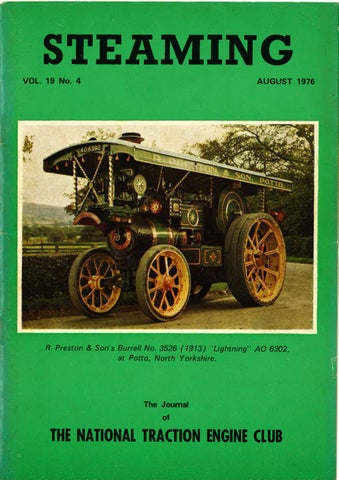
STEAMING VOL. 19 No. 4
ill
AUGUST 1976
R. Preston & Son's Burrell No. 3526 (1913) "Lightning" AO 6302, at Potto, North Yorkshire.
The Journal of
THE NATIONAL TRACTION ENGINE CLUB
National Traction Engine Club Membership is open to all, whether engine owners or not, with a genuine interest in the preservation of self-propelled steam road vehicles, portables, etc. The annual subscription is £3 for individuals, £4.50 for family membership. The benefits of membership include advantageous terms for boiler insurance. The club's journal 'Steaming' is sent free to members in November, February, May and August. All articles, photos for consideration should be sent to the Editor. All correspondence re subscriptions, bankers order, delivery (or non-delivery) of 'Steaming' or change of address to: MRS. F. E. WOOD, nitinkirtRi HAIL WESTON, HUNTINGDON, CAMBS, PE19 4JY Please enclose S.A.E. when sendlna subscription or when writing to any officer if a reply is required.
Next issue: Copy, photos, etc. should be in the Editor's hands by 15th September earlier if possible.
Acknowledgements We are pleased to acknowledge the assistance in the preparation of this issue kindly given by Derek Raynor, Wilf Cole, Neal Herridge, Joe Thomas, Ralph Brown, Alan Thomas, Waverley Steam Navigation Co., Roadrunner Productions Ltd., all Club and Area Correspondents and all those who helped in any way at all. With special thanks to Mrs. Smart and Mrs. Gull for typing. 194
Volume 2 of "The Steam Scene" follows on from Volume 1 in date order of taking and provides a feast of splendid pictures of the traction engine movement all being reproduced from 12" x 10" enlargements. The area covered is from Lancaster in the north to Liphook in the south. With another 94 pictures of exceptional quality one to each page, you will be able to have on record many of the engines to be found all over the country today. Each print has an informative caption and details of the engine and where it was taken. The Author, who is well known for his railway photography, has given you a book that the traction engine enthusiast cannot be without. The above picture is on the Linson cover and is a sample of the other pictures in the book. Order direct from:
STEAM ENGINE PUBLICATIONS, (DEPT. SG 76), 78 SOUTHAM ROAD, RADFORD SEMELE, Nr. LEAMINGTON SPA, CV31 1UA. Tel: 0926-22706. Price £2.95 plus 25p p. and p. or obtainable from your local bookshop to order. TRADE ENQUIRIES WELCOME. Volume 3 to be published in the Autumn and Volume 4 for Christmas 1976. 195
National Traction Engine Club Officers President, and Technical Services S. J. Wharton, Esq., Southern Down, Minster Lovell, Oxford. Vice-President J. T. Beeby, Esq., Wymeswold Road, Rempstone, Loughborough, Leics. Chairman Michael R. Lane, Esq., Maple Tree Farm, Chartridge, Chesham, Bucks. Vice-Chairman J. Crawley, Esq., Field House, Turvey, Bedford. General Secretary G. F. Beck, Esq., 127 Greensted Road, Loughton, Essex. Treasurer Peter J. Banks, Esq., 9 Fernley Rise, Thrussington, Leicester, LE7 8UA. Hon. Solicitor: David Tew, M.A., c/o Fowler & Co., Solicitors, 12 High Street, Oakham, Leics. Editor Ran Hawthorne Esq., 19 Bridle Path, Woodcote, Reading, RG8 OSE, Berkshire. Chairman, Rally Sub-Committee Denis W. Brandt, Esq., 27 Tregunter Road, London SW10. Public Relations Officers London, Home Counties and South: Anthony S. Heal, Esq., Baylins Farm, Beaconsfield, Bucks. Midlands and Wales: Dick Blenkinsop, Esq., Hill Cottage, Radford Semele, Leamington Spa, Warks. Northern Counties and Scotland: Tony Parker, Esq., Foley House, The Grove, Lincoln. Membership Secretary Mrs. F. E. Wood, 'Windrush', Hail Weston, Huntingdon, Cambs, PE19 4JY. Sales Officer Alan C. Wilson, 7 Welton Road, Daventry, Northants, NN11 5PX. 196
STEAMING THE JOURNAL OF THE NATIONAL TRACTION ENGINE CLUB all items are held copyright by contributor and/or N.T.E.C. EDITOR: RAN HAWTHORNE, 19 Bridle Path, Woodcote, Reading, RG8 OSE. AUGUST 1976
VOL. 19 No. 4
BLOW OFF ACTIVE PRESERVATION Recent weeks have seen some long distance runs by steam. Edgar Shone's unique 8 wheel Sentinel set off from London for John O'Groats to steam from there to Lands End in a run organised by Tom Varley. From Lands End she is steaming back to London. We include a photo of her leaving Cricklewood. Tom's Run is taking in one or two rallies on the way. We are sure that once again we shall see the dependability of steam demonstrated. Last year 100% of the entries that took part in our Road Run arrived under their own power at their destination. This Sentinel built in 1934 and squeezed off the roads by vested interests will show manufacturers -and governments what it is capable ❑f but more important it will give them a glimpse of what might have been, and might still be, had they not stiffled development that used British fuel. Another long distance steamer to be out and about earlier this summer was the Aveling & Porter Roller No. 14070 "Billy Boy" a 10 tanner, one of three that worked for the North Riding of Yorkshire C.C. until 1962. She steamed from Bradford, through the Pennines, through the Yorkshire Dales, across the bottom end of the Lake District, over constantly undulating roads of West Cumbria, including very severe gradients, to the Ravenglass and Eskdale Railway Gala Day at Ravenglass.
A journey such as this surely emphasises the mockery of conversion. This journey, like the Sentinel's journey is active preservation. How much better that "Billy Boy" should be preserved as she was built and that she still steams over roads she built, than the fate that has befallen one of her fleet sisters for she has had balloon tyres fitted all round "so that she travels better" but she goes everywhere by low loader and never has the road under her soft boots. Steaming sends its very best wishes to Tom Varley and all the lads on the John O'Groats - Lands End Run and all engaged in active preservation.
PERSONAL Having had five years in the editor's chair I have decided that the time has come for a change. I just cannot devote the time and energy to Steaming that I would wish. My job is taking up much more time, including many evenings. I have enjoyed being your editor but it has delayed the restoration of "Busy Bee" by two years. My sons John and Richard are apprentice engineers, I feel that I must devote more time to foster their interest in steam. An advert for the post of editor will be found elsewhere in this issue. Sincerely, Ran Hawthorne 197
INSURANCE I am also pleased to be able to tell you that further concessionary schemes have been negotiated for Club Members by our Insurance Broker's subsidiary company Tennant Budd (Life & Pensions Brokers) Ltd. which, as the name implies, specialises in all life assurance and pension matters. Brief details of the two plans are set out below:(a) Private Hospital Treatment The Western Provident Association, which is the third largest association of its kind in the United Kingdom, has agreed to allow members of the National Traction Engine Club a concessional discount of 25% off the normal rates of subscription. Full details of the Plan can be obtained from the Insurance Brokers but the main benefits, in the event of illness requiring hospital or specialist treatment are:(i) Guaranteed Cash Benefit of up to £189 plus additional reimbursement if costs incurred are greater, up to a total of £266 per week — higher benefits are available if required. (ii) A direct cash payment of up to £84 per week if, for any reason, admitted to a N.H.S. bed. (iii) A most realistic benefit for surgeon's, anaesthetist's and theatre fees. (iv) Maternity Benefit paid in full whether the mother is treated privately or under N.H.S. I hoQe are juqi: comp of the arivantagpc of the scheme. The subscription rates are highly competitive. (b) Prolonged Disability Insurance Special rates of premium have been arranged with one of the leading Insurance Companies in this field. The insurance provides a weekly benefit in the event of prolonged disability caused by accident or illness. Most periods of disability are of short duration but it requires little imagination to show what the consequences could be if these periods were prolonged, perhaps from the consequences of a motor accident or heart attack. The effect could be shattering. One's income will certainly be drastically reduced and, after a long period of disability, will probably cease altogether. The State makes some provision in such cases but who would want to rely on the State as the sole source of income? 198
The simple answer to this problem is income protection insurance and such cover is provided by this Plan. This will not afford immunity from disability but it will spare you financial hardship if, for a prolonged or indefinite period, you are disabled and unable to work. Further details of the scheme can be obtained from the Insurance Brokers. If you would like more information about the Private Hospital Treatment Plan and/or Prolonged Disability Insurance Plan please contact Mr. R. C. Harris (Manager) at Tennant Budd (Life & Pensions Brokers) Limited, Hildenbrook House, The Slade, Tonbridge, Kent, TN9 1HY. (Telephone: Tonbridge 67011).
Private Car Insurance N.T.E.C. members can now take advantage of a new car insurance scheme arranged at Lloyd's by our brokers Tennant Budd Ltd. Full Comprehensive or Third Party Fire & Theft cover is available at special rates 15% below the Underwriters' scheduled premiums. This scheme will be operated at Tennant Budd's Tonbridge Office in conjunction with the Traction Engine insurances. Please ask the Motor Department for a quutatiuii When yuui pFUSUIlt policy is due for renewal. No Claims Discounts are transferable.
Insurance of Model Engines and Portable Engines Tennant Budd Ltd. have been able to improve insurance arrangements made for model / miniature engines and portable boilers, for which they have received many enquiries from members. The Third Party Boiler Explosion indemnity £250,000 has of course applied to this type of engine in the past, subject to the usual current Boiler Inspection Report Warranty, at a premium of £2.50 per annum. In addition to this, they can now insure the general Public Liability risk, indemnity £250,000, at an annual premium of £10.00. We hope this extension in our special arrangements will benefit members who own models and/or portables. Any enquiries should be addressed to Tennant Budd as usual, and it is understood that no proposal form will be required.
SENTINEL 8784 by J. L. THOMAS
On page 234 H. W. Gough-Cooper joins issue in the conversion question. Steaming has tried in the past to encourage owners to keep or rebuild their engines in the same form as they worked, or better still were built. Mr. Gough-Cooper having found himself with a wagon converted since coming into preservation is anxious
for originality and is disappointed that he is obliged to use replica tanks and a replica body. In an effort to help him rebuild his wagon as near to original specifications as possible we are pleased to include notes and a photo supplied by Joe Thomas, co-author of "The Sentinel" Vol. 1.
Sentinel No. 8784 at Worcester Show (1958) with body as used by Callow Rock.
My first sight of this waggon was at the City of Worcester Show and Engine Rally in 1957 when Mr. Geoff King used to drive her up from Temple Cloud, Bristol, regularly to the Annual Worcester Show and we have been friends ever since. I have asked him to refresh my memory
of all the details he told me nearly 20 years ago and I am indebted to him for the details of the moving floor body and its use, etc. SENTINEL Model DG No. 8784, Reg. No. YD 6587. New 26/3/33 on Pneumatic tyres to Callow Rock Limestone Co., Cheddar, Somerset. 199
Moving floor was made by The Princepality Body Co., Cardiff. This was composed of rubber sheet running on hollow metal rollers, turned by hand, helped by being geared down, as can be seen on my photograph taken at the City of Worcester Show, August 8th and 9th, 1958. The body had fixed sides (again see photograph) and had a handle each side for winding the floor to and fro. Mr. King tells me it was hard work especially if the vehicle was facing downhill or if small coal got in and around the rollers. This type of body was lighter than a tipping vehicle frame. There was a trailer supplied with the waggon, Sentinel built No. 8785 on 38" x 8" tyres with steam brakes, normal load being twelve tons the two. Trailer had a fixed bed. Geoff tells me he purchased the waggon in 1956 for £55, which included a few spares, tubes, etc. The waggon had been out of work for several months when Geoff and a friend drove her away; she was in a rough state and steered very badly due to the back axle moving sideways on the spring holding down bolts! The trailer is at present on a farm in Somerset minus springs and steam brake. No. 8784 was sold by Geoff on March 19th 1966, to Mr. Tucker of Hamilton Motors, East Reach, Taunton, who later sold her to Mr. Alex Steele of Culcross, Fife, in 1972. In August 1973 she was purchased by Mr. Gough-Cooper of lacabaw Haulage (1973) Ltd., Fraserford, Dunscare, Dumfrleshlre who still owns her, I believe that at some time since she left Geoff King's at Temple Cloud she has been converted to a tarctor but Mr. Gough-Cooper has praiseworthily converted her back to a flat bed. Callow Rock had several Sentinels, Standards and DG's and, for a short time had two Robey wagons but these were not satisfactory. Before buying No. 8784 Callow Rock thought of buying une of the new S4 models shortly to come out, but "Sentinels" advised them that for hilly country and also pulling a trailer a light weight Super fitted with a DG engine would be a better proposition. They had this with 17 tooth driving sprockets later reduced to 15 (put back to 17 by Geoff King). The boiler had a firebox with semi-vertical tubes, the boiler steamed well but they had great difficulty with leaking tubes, so after six months Sentinels supplied another boiler with the usual cross tube box. 200
This waggon had a very good name for hard work, taking lime in bags out and small coal back, the journeys included lime to Bournemouth, Gloucester occasionally to Kent and loading back with paper bags. In later years she did two loads a day with small coal from Bristol Docks to Shifham. On one occasion a Pickfords tractor and trailer was bringing some new machinery to the Callow Rock Co., when it broke down about four miles away. No. 8784 was told to go and see what it could do; first the tractor was towed to the works, then the trailer and load of machinery was brought along, a load of 36 tons plus machinery trailer. There were a lot of up hills in the Four miles and the driver who drove her for 15 years told Geoff King he had the safety valve held down normal pressure being 275 lb.sq.in. During the later war years she was in use running between Bristol Docks and Shifham and used to pass an American Army Camp on the way. The driver was constantly stopped to be photographed but he did not mind as he and the stoker were kept well supplied with sweets and cigarettes. The camp personnel was constantly changing all the time of course.
A RARE BEAST! by Denis Miller. There were raised eyebrows in Cricklewood recently when Mr. E. N. Shone's 1934 Sentinel S8 steam waggon pulled into the Broadway on the first stage of an epic 1,885 mile journey to John O'Groats, Land's End and back — believed to be the longest trip ever undertaken by a vehicle of this type. Carrying 61 tons of best Welsh steam coal, 250 gallons of water and a 2-man crew, the 8-wheeled monster will join other steam veterans in a special road run from John O'Groats to Land's End organised by steam enthusiast Tom Varley of Gisburn, near Clitheroe, Lancs. The waggon was acquired some five years ago from heavy hauliers Robert Wynn & Sons Ltd. of Newport, Gwent, and is known to be the sole survivor of its type which, even in its day, was regarded as unusual and way ahead of its time. Since acquisition it has been completely re-built and is now restored to near original condition. See photo on page 239.
A STEAM CONTRACTOR R EMEMBER By D. A. RAYNER Frank Young was born about 1880 and was brought up near the village of Kirkney, not far from Boston, Lincs. He started on a steam plough gang when he was 17 years old as a cook and progressed
he often had to set off back at 1 a.m. which was not a very pleasing prospect. The girl he eventually married came from Boston and when he was courting her, at one time was working some 40 miles away
Frank Young, aged about 18, in Lincolnshire, posed alongside steam plough tackle. (All photos in this story are from the author's collection)
within a year to ploughman. Soon after, his brother joined him on the gang and eventually he spent some four years driving the engines for Ward & Dale of Sleaford. At that time, this firm had 27 sets of ploughing engines and were kept very busy. As a driver, he recalled, he was paid the princely sum of 17/- per week and he insisted on going home for the weekend after work was finished on the Friday night. In order to get back in time to start work again early on a Monday morning,
and used to travel to and fro by bicycle. One weekend he had gone home to see her. It was late on in the year, around harvest time. He had left her at Boston at 9 and had got well on his way before stopping to have a drink about 10 o'clock. There were several Irish men and their women who were helping with the harvest at the time in the pub. They were playing tin whistles and singing and generally having a merry time. Frank stayed a little longer than intended 201
and drunk rather more than was gond for him. However, setting off again and intending to make up for lost time, he took a short cut through Blankney Wood, as advised by his companions in the hostelry. They had given him directions to go through a white gate and straight down a track, some three miles in length. He had a good oil lamp on the bike, so undaunted by a ride through a wood, off Frank went. He managed to negotiate the first gate and after going on for a lot longer than three miles (he thought), his concentration lapsed and he ran into a further gate. His slightly merry condition had, by that time, not quite worn off and as his lamp had gone out as a result of the collision he pushed open the gate and set off on the bike once more After a short while, he saw a light so he went over to the cottage and knocked on the door. By this time it was near midnight and so an upstairs window went up and a voice enquired out of the darkness "What 'you want?" Frank asked where he was, his speech still somewhat slurred and the reply came back from above, "You're here!!', followed by the slamming of the window. This was not much help, so Frank continued on his way. By following the path he was then on, he eventually found the way out of the wood. emerging near a pub called 'Wood End'. He then knew where he was and was able to find his way back to the van. It was about a quarter to one when he propped his hike up against the hank wheel of the van and he was looking forward to a good sleep in what remained of the night but he was greeted by the foreman who told him to get his working clothes on and go and light the engine's fire. They were in for an early start! Such were the difficulties encountered in those days.
New foreman Frank's brother was promoted to driver in the same gang and the foreman, who was in charge of the gang was replaced shortly afterwards The new man, in his brother's opinion did not know as much as they did and after a difference of opinion, Frank's brother left and another man took his place An incident illustrating this foreman's knowledge happened during a job involving the ploughing of a particular field. By chance, Frank -had ploughed this field before and he knew 202
it was very soft with a silt hill across the middle. The foreman was on the first engine and Frank was driving. Left near the gateway were a set of wooden spuds to attach to the engine's wheels to make them like a paddle boat. Frank stopped and made to put them on but the foreman would not hear of it and forbade their use. Despite a refusal to go into the field without them, Frank was overruled and ordered to take the engine in, which he did. They had only gone about 15 yards with Frank steering and the foreman driving when the engine sank up to the water tank and refused to go any further. The foreman then thought that if the second engine could get in and in front of the one which was bogged down, it would be able to pull it out. So he brought the second engine in and came up level with the first, whereupon that one also sank. As a result of this stubbornness they spent the next five days and nights extracting the two engines from the mire They used three cartloads of reeds and seven tons of hastily acquired railways sleepers. There were four of them at it, the foreman, Frank and the second driver and ploughman. They took it in turns to jack and all the time the sleepers went down into the ground. They alternated so, 2 hours jacking and 2 hours resting and eventually managed to extract the engines without damage. When they got back to the yard, the boss called for Frank and asked for his version of the story. Since he knew Frank and had formed a high opinion of him and tug qkiik, it was not not-ocean/ to gn wary
deeply into the matter and he eventually took the easiest way out of the problem in offering Frank a job on another set until the backend of the year. The farmers in that area were very happy with the steam ploughs as many of them said that they could get more corn per acre from steam ploughed land than from that which was horse cultivated. Business was plentiful and Frank was paid the ordinary rate of 3d. per hour at that time — they couldn't pay any more — but he was given an extra £2 for working the overtime he did to get the two engines back onto terra firma. After the harvest that year, he left Ward & Dale's and went to work for a farmer at Donnington. He was there until after Christmas. He went as an engineman and whilst he was attending to some repairs on the engine one day, being underneath with his feet poking out, the farmer sent one of the labourers to see him. — Ee
worn'ts yew to gew an' see 'im at yard int' mornin' ", he said. "What for", Frank asked. "Ter riddle taties", came the reply. So the following morning Frank presented himself at 7.15 at the yard. The old man was leaning over the gate. "You're late", he said, "I want you to riddle me taties". Frank was annoyed at such a request being made as he had been engaged as an engine driver. So he refused, asking at the same time for his cards. The farmer ignored him, so Frank followed him about all day, not asking any more, but just being there. The farmer's wife offered him dinner, after which the old fellow asked him if he was going to pay for it. Frank said he wasn't and continued to follow him around until 4 o'clock. Fortunately his persistence paid off for he received his money and what was due to him.
Hampshire He had had his fill of Lincolnshire after that and went to work on a big estate in Hampshire, near Botley, owned by a Colonel Woods. There he drove a Fowler 8 h.p. compound engine on road haulage, leading to Botley station, a distance of some nine miles. The engine would take two wagons and six men to unload them at the far end. Frank also drove ploughing engines on the estate which was about 7,000 acres in size. One day whilst he was out on a job with the Fowler and trailers, he stopped to clean out the fire near a public house. A chap who Frank knew slightly came out of the pub. He had been in the Boer War and had come through unscathed. He chatted to Frank and showed him a clay pipe he had got shortly after the war had finished. Apparently he had been in a pub in Bishops Waltham and clay pipes were being given away. He had picked one with General Gordon's head on it. He proudly showed this to Frank and then Frank took his leave of him and started off. Unfortunately, the fellow did not manage to get out of the way soon enough and when Frank stopped again, having heard the cries from the old soldier, it looked as though the front wagon had gone over his foot. They had to get an ambulance to take him to Winchester hospital and eventually found that he had broken his leg and pulled a knee cap off. An unfortunate incident which Frank regretted and an unhappy coincidence for the chap who had come through the South African War without a scratch and had
merely stopped to show Frank his pipe and received a severe leg injury! Most of the work on the estate was done by the Fowler. Frank was setting this up to a threshing machine one day in a ploughed field. He was having a difficult job with the furrows and the front wheels of the engine. Suddenly the steering wheel spun violently as the wheels dropped into a furrow and the handle caught his wrist, breaking it. This injury necessitated his coming off the engines as with a damaged wrist, he could not cope with driving them. He therefore was sent into the sawmill on the estate for six weeks whilst the wrist mended. The portable engine and saw bench kept him busy, there was much larch and birch to cut and it was a good job making plenty of money. In the village there were only six houses with firegrates, the rest had wide fireplaces and so the demand for wood was high. After some nine months in Hampshire, Frank returned to his home near Boston. He found he had lost weight, having gone down from 11 to 9 stones due to his staple diet of smoked bacon, bread and cheese. His health had begun to suffer because of this diet and he found that he could not stomach a hot meal for quite some time after he returned.
Warwickshire Shortly after this, he saw an advertisement for a Steam Ploughman at Barwell, near Nuneaton. There were eleven sets of threshers and three sets of ploughing tackle, so he decided to take the job, discovering as he did so that very little was known about steam ploughing by the hands already employed. The first job he had when he arrived was on the farm belonging to his new employer, Thomas Powers, at Barwell. The foreman in charge of the gang, he discovered, had worked in a boot factory. When the engines were being set out, Frank knew it was wrong but decided to say nothing about it. The rope kept dropping off and getting twisted and when they had only done about 1+ acres, Mr. Powers came round to see why they were not progressing. Frank could bear it no longer and told him what was wrong. Mr. Powers went and told Mr. Kitchin, the foreman, to stop and then Frank got the job of explaining to him how it should be done. After another job at an asylum near Narborough, which involved pulling up hedges and cultivating the fields, Frank was made foreman; which post he held for some seven 203
years, looking after not only the ploughing sets but also the threshing outfits as well. Whilst working at Polesworth, near Atherstone, he injured his hand once more. This time a tier needle went through his finger and left it almost hanging off. Frank had travelled the ten miles or so from Barwell on his bike and after the local doctor had patched it up, the farmer took him back to the farm but wouldn't take him to the station at Atherstone. So Frank walked. On arrival he went into a pub, ordered a brandy and collapsed. The landlord brought the village policeman and the porter from the station and after another brandy, having first established his identity, the porter took him across to the station to put him on a train. He had about half an hour to wait before the train came. Whilst changing trains at Nuneaton, he spoke to a gentleman who knew him and after explanations, this gentleman told him that for his own good, he was taking him immediately to the Cottage Hospital and not letting him go to Barwell. This he did and they were met by the Matron at the door. More explanations followed and Frank was admitted. The private doctor who came to see him, he remembered, had to put on two pairs of spectacles to be able to treat him. It was 6 o'clock when he went in and was anaesthetised so that the doctor could amputate the finger satisfactorily. When Frank came round at 8.30, he found his arm strapped up and a raging hunger, having had nothing to eat since breakfast time. He was given drops of milk and nnnr and than hie watat to aatiafy hie hii hand started to swell under the bandage, making it very uncomfortable. The bandage was loosened so he could get some sleep. Next morning, the nurse came and asked if he could eat an egg. Frank replied, "I can and I can eat the bloody hen as well". He was reported by the nurse for swearing and had to appear before the Hospital Committee, who consisted of two old men with long beards, one of whom happened to be from Barwell and knew Frank. In explaining, Frank told them that he didn't swear at the nurse, he swore to her and told them what was said. They sent him outside and through the closed door, he could hear both the two men and the Matron laughing heartily. When he was requested to return, he was told that they had studied the case and found he had been severely provoked. They advised him to go and get back into bed and it would be overlooked in that instance. 204
Yorkshire Shortly after this, Frank decided to leave as his eldest daughter was then 15 months old and with her father working away such a lot, the baby didn't know him. Despite being happy at Barwell and the promise of a rise plus a better job, Frank left and brought the family to the West Riding to drive for George Armitage & Son, Quarry Owners and Brick Manufacturers of Robin Hood, near Wakefield. At their Oulton Quarry, they had a McLaren traction engine, the driver of which was not very bright and this had resulted in several dropped plugs. Frank was put in charge of this engine and on his first trip as driver, it nearly jarred his teeth out. It was on springs and was tight in the bottom of the gears as the springs had weakened. Old Mr. George Armitage had a word with Frank after his first day and enquired hnw it had been. "Rough", Frank replied. "Can you alter her?", he was asked. "Yes", said Frank, "if you'll give me tomorrow". So he had the next day and the one after that too and with two big jacks he had the wheels off, altered the bolts, tightened up all round and replaced the wheels. He steamed the engine the following morning and old Mr George rode round the yard on it with Frank. The difference was most noticeable and he asked Frank if he thought he could do two trips to Kippax, a distance of some 44- miles, with hardly any level ground along it, in the day. They finished up doing eleven trips in the week and then Frank found there was a difference of a half sovereign in his pay packet to what there should have been. He went back and told Mr. George. He asked him which side it was on and then told Frank to keep his mouth shut. It was a bonus payment for Frank for improving the firm's deliveries Around tea time one day, Mr. George came across to the engine shed to tell Frank that one of Nicholson's steam wagons, (a contractor from Hunslet, Leeds) had broken down with a load of 50 - 60ft. piles on board. They weighed about 6 tons and were at Hambleton, near Selby. Could Frank take the McLaren and tow them back on the following day? He agreed to do the job and as Nicholson's were still on the phone, the two bosses agreed a price of £3 10s. Od. for the exercise.
Early next morning saw Frank at the shed preparing the engine for the journey. By 6 o'clock, they were passing Swillington Church and they called at the Boot and Shoe Inn on the Great North Road for some sandwiches and a beer before arriving at Hambleton at 11 o'clock. They had taken a tow bar with them, borrowed from Minett's, the Threshing Contractors across the road at Woodlesford, so they got coupled up quickly and away. They called at the Boot and Shoe once more and then at the Old George at Garforth Bridge. The steersman with Frank — Jimmy Franks — had backed a horse in the November Handicap and whilst there, they learned it had won. This was Admiral Togo the Second. They naturally had a celebration drink and then set off again, pulling into Nicholson's yard, by Tetley's Brewery, about 5 o'clock and went for a drink of tea in a cafe across the road. Before they went, they'd put the pipe into the tank to fill her up with water and also lit the lamps. Unfortunately, whilst they were gone, one of the lamps caught fire and they had to go back to Nicholson's to borrow one to see them home. They were back at Woodlesford for 7 o'clock and seeing a light still on in the office, went straight to enquire about expenses for refeshments. They were greeted by Mr. James Armitage who was surprised to see them at such an early hour — such a journey would normally have taken a lot longer. However, they explained that the engine had run well. "Yes", replied Mr. James, "she must have been well oiled — and I can see her crew are as well!!" After a lecture on the perils ❑f drinking and driving, they eventually received their expenses and also a replacement lamp for the one which went up in flames. About the same time as Frank Young had started at Armitage's Joseph Doggett, a Cambridgeshire man, had taken a position as Driver with Bentley's Yorkshire Brewery. Joseph had served as a railway loco driver in South Africa during the Boer War, being several times captured and his engine blown off the lines. He had come to the local railway company at Bothwell, the East & West Yorkshire Union Railway, as an engine driver and then moved to the Brewery for higher wages. (He was offered 25/- per week at the Brewery). His regular wagon at the Brewery was the Mann overtype (No. 2) Reg. No. C 520. Naturally, being employed so close to. each other and on similar jobs, Joseph
and Frank met, exchanged ideas and formed a friendship which was to last for some 25 years. Joseph recommended Frank for a job at Bentley's and so Frank moved his employment down the road to the brewery. Bentley's had run Mann's Patent Steam Wagons and Yorkshire Patent Steam Wagons since 1904 but when Frank arrived, all the Yorkshire's had gone, as had the Thornycroft they had new in 1900. He was given a relatively new Mann's wagon — Bentley's No. 7 — and he looked after it very well. On one occasion, he was delivering beer to Selby and arrangements had been made for an important visitor from Spain to travel with Frank on the return journey. This had been done on behalf of Mann's, as a demonstration of one of their products after it had been in use for some time. When they got to Garforth Bridge, the Spanish gentleman alighted, to continue his journey to Leeds, and through an interpreter asked Frank if he was interested in going to Spain on a driving job as he had never, he said, been on a wagon which had run so sweetly. Frank explained that his family — he had three children by that time — must come first and despite the tempting offer, he declined it. After about three years, the wagon had to go back to Mann's. Frank had done about 20,000 miles in this time, at a cost of about £30. The second gear had worn to such an extent that damage was imminent. As Frank drove into the Pepper Road Works of Mann's, someone looked out of the office window and saw which wagon it was. As a result of the Spanish affair and his good driving generally, Frank's reputation had preceded him. A message came down to him. "Mr. Mann wants to see you". "What for", asked Frank, but an answer was not forthcoming. So he went into the office to see Mr. Mann. "Now then", he was asked, "What's your name. How long have you had this wagon?" Frank told him. "Well", Mr. Mann replied, congratulating him, "it wouldn't do for everyone to be like you — we should soon be out of work". This wagon used to do some 300 to 360 miles each week at about 5 m.p.h. (the maximum permitted speed). On one occasion, Frank was caught up by the Law for speeding at Doncaster. He had been to deliver ale to a large hotel ❑pposite the Police Station and on leaving, went up the road at some 8 m.p.h., it was alleged. He 205
was stopped and the policeman said, "Hey, do you know you're going too fast". Frank's reply was, "Not half as fast as my firm would like me to go". The case came up in the local court and Frank remembered that the Mayor was on the bench. The fine was 10/- and 10/- costs. After this period at Bentley's, Frank returned to Armitage's and the job of delivering bricks. At the beginning of World War I, he was still driving the big McLaren and on one occasion he took two trailers and loads to the then new munitions factory at Barnbow, Leeds, being preceded by Joseph Doggett whose wagon at Bentley's had been commandeered for war work.
the Midland Hotel yard, across the road from the quarry and, indeed, where Minett's, threshing contractor's had been before them. This firm sold out to a Company who in turn had sold to one Thomas Parker. The two partners bought a threshing set and found that there was a big 13 ton Aveling & Porter Roller left in the yard. This they also bought as they heard that Hunslet Council wanted a roller on hire. This was their first steam roller. As time went on, the firm prospered and more engines and rollers were acquired. A Fowler roller came from Stamford Bridge, (E. Yorks) and Reg Doggett, Joseph's son, went with Frank Young to bring her back. She worked with the firm
Young & Doggett's Fowler Roller in Farrer Lane, Oulton, mid 1920's.
Joseph again joined the Army and went overseas, again loco driving, but this time on the Egyptian and Palestinian Railways. When the war was over, he returned to Bentley's, on the wagons and again met up with Frank. They had a lot in common and eventually, after much discussion, Frank persuaded Joseph to go into partnership with him in a steam contracting business of their own. Thus Young & Doggett's was formed in about 1920. Their first premises were in 206
for quite a long time and did a lot of work for Rothwell Council in the early 1920's. Even at that time she was an old engine, being a convertible single cylinder with an old type balanced safety valve which was adjustable (II). The firm's gang was photographed whilst working during this period on a road making job in Ferrer Lane, Oulton, standing by this Fowler roller. Reg was on this roller at Crossgates, Leeds, when the saddle broke and he was also driving one of the various Aveling rollers
which the firm owned, when the saddle and front fork fractured as he was rolling large rubble on a job not far from home. With some difficulty and some ingenuity, they were able to get the engines home as the firm did most of their own repairs in their own yard, eventually moving from the Midland Hotel yard to larger premises at Armitage's Field near the end of Fleet Lane. This site is now occupied by houses, adjacent to a Supermarket. They worked not only in the immediate vicinity, often supplementing Rothwell Council's Green's steam roller but, also for councils at Castleford and Garforth whilst Reg Doggett spent some four years in the East Riding, on hire to the County Council as well as several periods on hire to the West Riding County Council. For jobs such as these, he lived, with his wife, in the roller living van and did not come home to Woodlesford very often. Two experiences which Reg remembers from just after his long spell away were when he was prosecuted for making smoke at Oulton Lodge, one day whilst he was driving a Marshall traction engine,
this offence costing him a fine of £1. The second was when he was also fined a £1 by Hunslet Council for drawing water from a hydrant when he was working at Halton, Leeds. When Bentley's Brewery sold one of their Mann steam wagons, Young and Doggett's bought it specially for use on a local contract. It was the Brewery No. 8 wagon, a 6 tonner and well past her best by that time. However, she was used to lead all the stone required for the making of North Lane, Oulton, from Armitage's quarry, only a short distance down the road. In the late 1920's, they acquired locally a Marshall tandem roller from Limmer and Trinidad. This was a very easy roller to drive and had a quick reverse for asphalt work. It had twin tanks and a chain drive. The firm used this roller quite extensively in the West Riding on street work, even hiring her back to Limmer's at times. An Aveling convertible was purchased from Cole Bros. at Sleaford. This was a 13 ton roller, being new to Cuckfield R.D.C., Sussex, in 1897. She was brought from Sleaford in about 1928. She was photo-
Young & Doggett's Aveling & Porter No. 3941 (CT 5525), new in 1897. Joe Doggett driving, at Nookin, Oulton. 207
graphed by the half timbered house adjacent to the roundabout at Oulton Lodge during a pause in work nearby. She was scrapped about 1936. This photograph brought back poignant memories to Frank, for it was only a few yards from this spot that Joseph Doggett was knocked down by a motor van in 1930. He suffered a fractured skull and never recovered from his injuries, dying about a month after the accident. Thus ended a long friendship, but the firm continued. The threshing set which went to Parker's — a Fowler engine and a Clayton & Shuttleworth drum — was purchased to supplement the two sets which the firm were then operating but it did not last long. They preferred Marshall engines and drums and so this other set was sold. Another incident which Reg remembers well was when he was driving one of the Aveling rollers, a big 19 ton engine with side tanks. He had left the yard and was travelling along Aberford Road towards Swillington. The exact circumstances were a little unclear, being overshadowed by the events which followed. Perhaps he had stopped to change gear without chocking the engine, but what was clear is that the flywheel brake was on and the engine was stopped. She jumped out of gear on the hill down under the narrow railway brirign ant{ ran awnv Frank Young ran after her, but couldn't catch her. Reg used all his skill to keep her on the road but was unable, with his other hand, to take the flywheel brake off and set the engine in motion. Had he been able to do this, he may have been able to get her back into gear One of Bentley's wagons was approaching the bridge from the other side and fortunately the driver sensed something was wrong and pulled into the side, allowing Beg and the runaway free passage through the bridge. The roller pulled up just past the Brewery, of her own accord on the rise to the bridge over the canal but the ride had been somewhat hair raising whilst it lasted. The sight of a 19 ton roller careering down the road must have been a sight worth seeing and Reg, who stuck to his post, like the captain of a ship, was literally covered with grease which had been flung up from the gears during the
swift descent of the hill. Two bicycles which were being carried at the back fell off and the bolts holding the tool boxes snapped and they also dropped off. Fortunately traffic in those days was light and no further damage was caused. Several local residents who happened to be chatting at the bottom of Station Lane at the time and who witnessed the incident, talked about it for years afterwards, much to Reg's embarrassment. An impressive engine which stood in the firm's yard for some time was a Fowler Road Locomotive which was owned at the time by Kit Johnson, a local Showman. Eventually, they were asked to take it to Driffield. Reg knew the roads fairly well, having spent so much time on hire in tho area. They set off from Oulton about 1 o'clock and finally arrived in Driffield at midnight, having traversed much of the Yorkshire Wolds in the dark with the aid of two small oil bicycle lamps. Happily, this engine is now in preservation, in the ownership of Mr. W. Chilvers, the Leeds & District Traction Engine Club President and is named "Lady Betty" (Fowler No. 9381). Frank Young's son, Arthur, worked for the firm before the Second World War but he died when he was only 40. Reg Doggett left the firm shortly after the War because the dust from threshing was affecting his chest but Frank Young and the firm continued in operation until 1953, the traction engines having being replaced just after the War, when replacements became available, by Field Marshall tractuis. A 10 ton Aveling compound roller remained the sole steam survivor. This was sold for scrap at the final auction sale. Also sold were a living van, two threshing machines, two Scottish balers, and a chopping machine, together with a tractor and implements. The Author was fortunate in being able to talk at some length with Frank Young before he died, aged 92, in 1972 — anutflui link with the past being severed with his passing — and he is grateful to Mr. Reg Doggett and his sister Rose, for their assistance in the preparation of this article on a typical small Steam Contractor's story which could have happened virtually anywhere in England.
Opposite, above: Young & Doggett's tackle (? Marshall engine) threshing at Woodlesford. Below: Reg Doggett with Young & Doggett's Marshall tandem roller at Armitages Brickwork, Oulton. 208
209
KATHELEEN GETS ROLLING AGAIN Katheleen is a 6 ton steam roller built by Wallis & Steevens in 1928. The roller was new to Messrs. W. Tuner (Aldwich ) Ltd. 127-129 Fairfield Road, Manchester, and then it was sold to Messrs. Davies Bros., Barmouth. Getting 7979 back to her former glory and in steam again all started one very wet and windy Saturday in January 1973. John Antel arrived with the roller on his low-loader at about 2 o'clock. After removing the back wheels of the trailer, John uncoupled the tug and push-poled the roller onto our drive, now the engine's new home. After hot coffee and a warm, John was on his way home and the roller was sheeted for the night. The next weekend the sheets were removed to see what the plan of attack would be. The first thing was to start stripping and cleaning the engine, this is where my young brother Peter came in useful (they do sometimes). The main thing therefore to do, was to make a start on two new coal bunkers and two new tool boxes. The steerage gear would need repairs, and in parts replacing. Also, the chimney base was broken and the chimney needed replacing. Many of the rivets were missing from the rear rolls, so we decided to re-rivet them completely, using about sixty rivets. We also decided that the boiler tubes would need replacing, because of this we called in the boiler inspector. He confirmed our findings and also asked for some welding to be done on the mudlid and in the smokebox, he also asked for the lagging on the boiler to be removed. While all this was going on I had written to Wallis & Steevens who by now had supplied me with drawings for the coal bunkers, tool boxes, ashpan levers, which were also missing and a G.A. drawing. Most of the work in making the coal bunkers was done by my Father except for the riveting, which was a joint affair. It is certainly hot work forming plates the old way by heating and bending. Also the rivets went in hot as well. The chimney and the tool boxes were made in much the same way, except for the tool box doors for which I made the patterns and had castings made. The next job I tackled was the steering gear. For this I made a new bevel gear and my Father also welded up the worm quadrant as described in Steaming Vol, 16, No. 4. 210
A few weeks later after talking to a reporter and posing with the roller we both made the front page story in the local newspaper. After we had recovered from all this stardom I started to re-tube the boiler. We spent one weekend chiselling out the boiler tubes. These were 14" o/d. at the firebox end and swelled out to 1i" at the smokebox. The boiler inspector then took another look, with the lagging removed and pronounced it fit for us to proceed. The tubes I bought were 1i" o/d. by .' wall thickness. To swell the smokebox ends to 1i" I made a forge in the back garden and my Father and I heated one end and then swelled out the tube. Phew! I then spent my one week of summer holiday expanding them in. With this completed, and the welding on the mudlid finished, the boiler inspector hydraulically tested and passed the boiler fit for steaming. With most of the work on the boiler finished I cleaned and painted the inside of the water tanks and made new hose retaining straps. I may add that as parts were repaired and replaced they were repainted. Also. the cracked chimney base was repaired as described in Steaming Vnl 16, Nn 4 Riveting the rear rolls was the next job on our list. First the old rivets were drilled out using a magnetic "clamp-ondrill". Using this rather large piece of machinery made life easier. Next a rivet dolly was made to hold the rivets while they were hammered home. This consisted of two pieces of tube with a steel blank welded on each end. One end had a thread in it, the other end held the dolly. A piece of threaded rod was put between the two pieces of tube. When a rivet was put in a hole in the wheel the dolly was put under the head to support the rivet and the tubes were screwed apart. This clamped the other end of the tube over the opposite rivet in the wheel to that which was being riveted. The rivets were heated in a small forge. Peter put the rivet in the hole 1 dollied up, then hammered over the rivet. After all this work we had a pair of rear rolls which were as good as new.
While the wheels were partly removed for the riveting all the brake mechanism was overhauled and the brake blocks were refaced with "Ferodo" brake linings. After finishing the wheels I made four new mud scrapers for the rear rolls. I then decided to re-lag the boiler. This was done with wood strips held on with steel bands. After the wood was in place, fibreglass insulating material was pushed behind the wood strips. This fibreglass is the same as used for insulating lofts in houses. When all of this was in place the steel sheet was put in place. This sheet had first been rolled to the diameter of the boiler. This helps to keep the lagging in place and some of the strain off the brass bands. The cylinders were also lagged in much the same way. As well as the tool box door patterns, I have also made patterns for the rear brass hub caps. All th.) makers name plates were missing so I made patterns
for these, as well as for the firebars. If there is someone who needs any of these castings for the restoration of their engine, would you please contact me and I will see what can be done. As well as all the work I have previously mentioned, I have made a new firebox door, some new valve gear covers and various gear guards. All this work has taken both my Father and I over a year and six months. The drain cocks on the engine needed altering, as the "Advances" originally had push-pull operated ones. We modified them to be operated from the footplate via one rod rotary movement. This operates all four simultaneously. The design of the links as well as the construction are all thanks to my Father. I have also replaced most of the bolts, nuts and studs on the roller.
continued on page 220 211
Frank Pennett's s.c.c. Burrell No. 3218 (1910) "Cromwell" registered TB 3959, worked for many years by Ball's in Lancashire, now in preservation at Fagley near Bradford.
212
ON "SENTINELS" IN AUSTRALIA By J. L. THOMAS, Co-Author of "The Sentinel" One morning about dawn early in December 1975, I set off for London's Heathrow Airport. It was foggy but not too bad. After due preliminaries we boarded our aircraft and there we sat for 24 hours. The fog got steadily worse and turned out to be the worst London 'pea-souper' for 25 years. Because they had accepted our bookings by loading us we were accommodated in the £25-a-day Ariel Hotel nearby from the Monday morning until the following Thursday afternoon. Because had the fog lifted one had to be ready to fly at an hour or twos notice. 3,500 slept on the floor for 34 days at Heathrow Air Terminal. After 29 hours flying we arrived in Sydney, the journey is the world's longest scheduled air flight. I was staying with my daughter at Avalon Beach which is 30 miles north of Sydney. The first person to come and take me out — I had no personal transport — was young Doug Wallis from Kogarah which is well south of Sydney. He showed me his and his father's engines and portables which included a large Fowler "Super Lion" Road Loco, a 10 hp McLaren Road Loco, an Aveling and Porter 12 ton roller and six portables including Barrows, Tuxford, Clayton and Shuttleworth, etc. Out in the bush on a 5 acre block he had an American Buffalo Pitts but it was a poor rusty old thing. However, on another Sunday he took me out to see a Mr. Dick Heher of Kenthurst, N.S.W. There had been a disastrous bush fire here 12 months before when his two neighbours' homes were burnt out. Dick Heher's home was only saved because it was stone built with an asbestos or metal roof. Mrs. Heher and her children also her mother had to jump into the swimming pool though this is a dangerous thing to do as the water can get very hot. The large shed where he kept his fifteen traction engines was burnt down and the wood boiler cladding and grease on the engines smouldered for weeks. He has since been able to restore to concours d'elegance condition a Fowler Agricultural Traction Engine No. 12900. Amongst the other fourteen was the largest Fowler Ploughing Engine I have ever seen No. 16720 reputedly of 27 hp which left England (ex Bomfords they thought) with others in 1951 for Burney, Tasmania
and was used on the Trevelyn Hydro Electric Works. This massive engine had been converted to oil burning, had rear wheels which were four feet in width and as well as the usual winding gear under boiler had a huge arrangement for winding alongside the smokebox on the offside. Also in this large collection were: Marshall 3 speed compound Road Loco of 8 hp No. 52962. Fowler Class 2 16 hp compound P.E. No. 4384. Double speed ploughing gear. Clayton & Shuttleworth compound T.E. unsprung with 6' 4" rear wheels. No. 46321. Fowler compound 6 hp agric. engine of 1903 No. 9873. Ransome Sims & Head portable No. 3686. Ransomes, Sims & Jeffries portable No. 15898. Ruston Proctor class P.S.G. portable No. 42049. American Case road roller converted from a Case traction engine. Barrows & Co., Banbury 24 hp portable No. 2675. Fowler s.c. 8 hp Road Loco No. 13004 on springs. Restored Fowler roller No. 16526. Fowler (made in Bundaberg, Queensland) 2ft. gauge sugar cane rail loco No. 16089. A few weeks later I went back to Dick Hehers and drove his Fowler roller down the road and back a few miles. Another place I was taken to was John Davis of Schofields, Nr. Sydney. Here he had an 18ft. launch powered by his own design engine and boiler both of which he had made himself. The engine had 3 cylinders. He also had a beautiful Clayton & Shuttleworth 4 hp portable engine in his garden which he uses for sawing wood of which there is an unlimited supply free in Australia. Whilst at John Davis's he asked me if I would like to go with him next day to Forbes, New South Wales, where he had a house and another 6 hp Clayton & Shuttleworth portable and to see the Lachlan Vintage Village that had been partially built there at a cost so far of 14 million dollars to recreate the old gold mining days on that actual site. I did go with him on the 7-hour car drive passing the famous Lithgow Zig-zag where the steam trains zig-zagged back and forth to get up and over the Blue Mountains before they built tunnels under them in 1910. 213
At the Lachlan Vintage Village there were several portable engines driving ore stampers, shafting in the workshop, a racksaw bench and other things. There were also some traction engines, a Fowler roller and three 2ft. gauge sugar cane railway locos which took tourists around the 200 acre site. Nearby at Parkes they also had in preservation six ex-State railway locos. The idea is that coach operators bring their tourists to Parkes and that they will be taken on to Forbes by old fashioned steam train, perhaps they may one day but, at the moment, they have run out of money and everything has stopped as with the authentic reconstruction of "Old Sydney Town". In January this year I was invited to go down to Melbourne to address the January meeting of that very well known club the Melbourne Traction Engine Club. They wished to hear all about the English rally scene as in Australia each club owns its own large rally site and sheds where members leave their engines from year to year and just bring them out for their annual rallies. Admittedly there were a few came on low loaders to the rally in March but more about that later. I did go to Melbourne to address them. It took me 14 hours to get there on the Intercapitals Express. My very good friend and his charming wife, John and Judy Smythe from Upper Beaconsfield put me up for ten days as they did again later in February. I addressed the January meeting and was invited to see several collections of engines around Melbourne and those which were kept at the Viantirna rally ground. Here there were a large collection of rusty old engines saved from the scrapyard. I'll admit that one would need extreme optimism and enthusiasm to do them up, yet everywhere I went I found the same thing said, "One day I'll get round to doing them up". There was a tree pulling Fowler ( a very large engine indeed), a huge 16 hp twin cylinder Marshall portable engine, a Fowler ploughing engine, a totally enclosed Garrett portable engine of 1923 No. 34381, a Fowler 8 hp T.E. and a Foden or two 8 hp T.E.'s. There were a very large number of old farm tractors and oil engines and John Robinson's 1903 Thorneycroft car under a sheet amongst the Benz tractors and his early 'Sentinel' standard model No. A4276. John Smythe and his wife and two children very kindly offered to take me up to Swan Hill in the Mallee where I worked for several years on farms and river paddle boats in the late 1920's and I grasped at 214
the suggestion. We spent several days inspecting large collections of rusty old engines up in that area and saw a very great variety of steam engines, tractors and oil engines. At Stan Hazleman's at Echucha I saw a Ransome steam wagon engine and boiler with boiler dated 9/7/23 and what appeared to be a number M996. He had the only complete Sentinel steam wagon I saw in Australia. It was a Super Sentinel 3 way tipper No. 5227 though Doug Wallis's Super 3 way tipper No, 5322 in Sydney is complete but needs repairs, whereas Stan Hazleman's is complete, steamable and a good runner. (Stan Hazleman also had many portables including a beautiful Case size 18 No. 35805). Whilst on the subject of Sentinels in case I forget later, there are apparently 10 in Australia but several I saw were only in chassis form, in fact all the others I saw were only in chassis form and I did not hear of any more complete ones. There was John Smythe's world's oldest Super Sentinel Tractor with large straked rear wheels, there was Peter Adams' super chassis and boiler with a Leyland steam wagon engine in it, Robin Gibbs' old Standard and his Super both only chassis with boilers and engines acquired elsewhere. There was Dez Lang's Super chassis at Wantirna and I heard of two brothers "who had enough bits to build a Sentinei" up near the Queensland border. Altogether there were 10 or 11 people who say they own Sentinels with possibly three of these being complete only. Upon our return from over a 1,000 MIN? tour looking for engines John Smythe took me out to Ballarat and the famous Lake Goldsmith rally ground. Here I met the owner George Mulcahy and was made an honorary member of the club. There were a very large number of traction engines, etc. in the sheds there of all makes and sizes mostly 8 hp and 10 hp engines with very early examples of farm tractors, combine harvesters, etc. Next I was taken to John Kirkpatrick's very large sheep station at Stockyard Hill where he, too, had a long shed full (in two rows) of traction engines, portables, old trucks, carts, cars, etc. We called in at several more places on the way back to Melbourne and during the next ten days I was taken to see anybody who had a traction engine or portable around Melbourne. One of these people was Clarrie Hall who has a Ransome steam wagon. He lit it up for me and I was the first to move it after its rebuilding. He is
a specialist and she is in very good order and will be a wonderful engine when the body and cab are built. The Chairman of the Melbourne Traction Engine Club Mr. Alan Robert, who amongst other things designed the rotating restaurant on the top of Australia's tallest skyscraper, invited me to come back down to Melbourne again and to open Australia's biggest traction engine rally. I was a little nervous as they had a long line of ministers and consuls to do the job before but. I did open it and from then on I was invited to go and stay for a week or more with one farmer after another out in the bush. This went on for seven weeks and every day they would take me out to see someone else's collection of engines! Eventually I consider I saw well over 500 traction engines and portable engines and as many vintage tractors and oil engines. A large number have only been dragged out of the bush and "brought home". One can only hope that given the money and time these fine old engines will be preserved. We also found a large number of engines, portables, tractors, cars and oil engines still lying about in the bush. After leaving Melbourne the first farmer I went to stay with was Mr. Sam Marshall at Lockington, Nr. Rochester, up country near the Murray River. He had a Ransome Steam Wagon at the Melbourne Rally and in his collection of farm tractors, etc. he had a Barrows 6 hp portable No. 2512 of approx. 1905 very well restored, a Ruston Proctor threshing box No. 254 with eccentric drive, a Fowler 26 ton 23 hp ploughing engine of 1920 No. 15499 ex-Manfred Station N.S.W., a Foden 8 hp compound T.E. of 1909 No. 2702, a Fowler 6 hp single cylinder T.E. of 1889 No. 6724, a Fowler 6 hp single cylinder T.E. of 1908 No. 11565. It may not be steam but amongst Mr. Marshall's many farm tractors was a friction drive 1909 International Dreadnough tractor with "Famous" engine and cooling tower cooling system. The engine developed 15 hp at 250 rpm and I drove it several times. There was also a Swedish "Advance" tractor, blow lamp start, of 1928 35 hp at 60 0rpm, twin cylinder, two stroke, diesel. From Sam Marshall's farm (his son had his own plane) I went on to Robin Gibbs' at Milawa, Nr. Wangaratta. His collection included the two Sentinels mentioned before and an Aveling & Porter 1912 steam wagon from which he had removed the steel straked rear wheels and fitted solid rubber ones, this was No. 7758. He also had there a Marshall 3 hp portable No.
12772, a Hornsby 6 hp portable No. 6633, a Ruston Hornsby 8 hp T.E. No. 116430 of 1925, a Robey 1899 single cylinder 8 hp No. 19109, a Fowler Road Loco No. 11317 of 7 hp, a 13 ton Aveling & Porter roller No. 11478 and several more. Robin Gibb took me to see Paddy Griffiths at Greta West who is or was the famous Ned Kelly's nephew and is on the same or adjacent property to the Kelly family's old homestead at Nine Mile Creek, Glenrowan. Now Paddy's collection covers acres and acres. He has there a large Clayton and Shuttleworth portable of 14 hp, another large Ruston portable No. 6613, a Ruston Class SC 10 hp traction engine No. 121557, a huge Marshall Colonial traction engine, a Hornsby of 1888 or 1890 traction engine No. 7081, etc., etc. Outside his gate were two very good looking traction engines I have lost details of. Both had canopies and one had a dynamo on front bracket, though I believe no Showman's engines ever went to Australia. Incidentally, when I previously made reference to Clarrie Hall's Ransome wagon at Melbourne I did not say that I had steamed up Mr. Hall's two wheeled portable sloping boilered and engined Hindley that Geo. Eves has been writing about in his Van Talk in the World's Fair newspaper. Robin Gibb took me to Plumbs huge scrap yard at a place called Benalla, N.S.W. Though only a small town here I found Renolds Chain Pty of Australia factory. Plumbs scrap yard covers very many, probably 30 acres and therein lies a real wealth of interesting scrap. The most interesting items I saw were a very big Marshall oil engined traction engine — very big indeed, and a traction engine noone knew what it was. As a separate item I will give details in a later Steaming. Here were all sorts of old farm tractors, American trucks, oil engines and all types of implements and machinery. At a town called Albury on the N.S.W/ Victoria border we saw a very old Ruston Proctor portable No. 7624, Gibbins Wantage Portable, also an old Clayton & Shuttleworth which was pre 1882! On the roadside at Kerang around a water tower with free access for anyone were a large number of vintage Blackstone and other makes of oil engines, all complete with their brass plates and several traction engines and portables, also an old railway truck from the Kerang and Koondrook Tramway now long since pulled up. 215
At a large farm at Greenvale, N.S.W. owned by Mr. Gordon Ellis, which is near the six houses and a hotel town of Boree Creek we saw another large area of scrap machinery. Mr. Ellis's McLaren 8 hp Road Loco No. 1180 was far from scrap and though not immaculate was a good working engine. Amongst a lot of other engines and farm tractors there were a Hornsby portable, a Clayton & Shuttleworth twin cylinder portable, a Marshall portable and a Robey portable with a round Britannia boiler. There was also a huge single cylinder oil engined Ruston Hornsby Traction Engine as big as a Burrell 6 hp s.c.c. It was from Mr. Ellis's scrap that Mr. Robin Gibb and I collected an old Standard Sentinel chassis and wheels less boiler and engine and took it back to Wangaratta about 200 miles on a Bedford truck. There were nearly 50 makes of Australian oil engines and a large number of these firms made farm tractors as well, Ronaldson & Tippett & Robinson, also Jelbart being the best known. There is a steam hauled passenger railway, narrow gauge still running in Victoria that has always been since 1901 when the engines were built, steam hauled and passenger carrying. It is called Puffing Billy and there are six engines on it. The journey is through dense bush in the Dandenonq range South of Melbourne from Belgrave through Clematis and Menzies Creek where there is a railway stock museum, to Lakeside. There are a very large number of Australians who are very keen on steam indoPrl Choir hnGpitAlity h oe to he oxperienced to be believed, as soon as they knew you are a genuine steam man. It was the holiday of a lifetime, I covered 5,000 miles whilst out there in 4+ months, slept in dozens of different beds and really did see some steam tackle to some order and enough oil engines and farm tractors to make the English oil engine boys eyes pop out of their heads!
" CHUFF " Only 128 Sentinel Diesel buses and coaches were sold in this country. Joe Thomas of the Sentinel Register and coauthor of "The Sentinel" Vol. 1 has managed to find photographs of 91 of these. He would be very pleased if anyone who has any of these photographs would get in touch with him; who knows they may have some of the missing 37! His address is 5 Minett Avenue, Rushwick, Worcester. Tel: Worc. 42152. 216
CONNAUGHT ROAD PUMPING STATION, DOVER Work has begun at the above station, now belonging to Folkestone and District Water Company, in the installation of electric pumps to replace the two steam engines used there. These engines, a matched pair, were built by Worthington Simpson and are dated 1937, with serial numbers 5055 and 5056. They were ordered by Dover Corporation Water Department, and 5055 was installed 1939, but 5056 was not erected and put into service for several years after the end of the War. The engines are high super-heat three cylinder compounds driving pumps lifting water from wells with shafting going down nearly 300 feet, and they also lift water to reservoirs on the outskirts of Dover. It is understood that this was the last steam powered installation completed by Worthington Simpson, and are also possibly the last ever erected anywhere in the country. Engine 5056 is now being dismantled for transfer to the: FORNCETT INDUSTRIAL STEAM MUSEUM, NORFOLK. This move will be no light task since the flywheel alone weighs 14 tons. Engine 5055 will continue in service until the new electric pumps are fitted, but at the moment its ultimate tate seems very uncertain. It seems unlikely that the Folkestone Water Company who acquired the Dover Corporation Water System some years ago will preserve it.
CONSULTATIVE PANEL FOR THE PRESERVATION OF BRITISH TRANSPORT RELICS 32 Russell Road, London, W14 8HU. Mr. W. 0. Skeat, B.Sc.(Eng.), F.I.Mech.E., has retired from the Hon. Secretaryship of the Consultative Panel for the Preservation of British Transport Relics, He has held the position since January 1962, he will remain a member of the Panel (Hon. Advisor). Mr. Skeet has been succeeded by Mr. Michael Horne, the representative of the London Underground Railway Society, whose address is 33 West Avenue, Hendon, London, NW4. The Panel, established in 1958 as an advisory body to collaborate with the then British Transport Commission and its Curator of Historical Relics (Mr. John H. Scholes), covers all forms of land transport. It now includes representatives of seventeen societies.
REMINISCENCES OF A YORKSHIRE STEAM HAULIER By WILF COLE (continued) My brother Len continued driviing the new Garrett wagon which had had the boiler patched, doing a fair amount of coal hauling to mills, gas works, etc. We pioneered a lot of this work from West Riding Colleries, using quick loading bunkers, for delivery in the Leeds and Bradford areas. In addition to the troubles experienced with the breaking of exhaust valves already mentioned, we found that the tappets wore excessively as they were too short and also the guides gave us problems. Another bad point was the tappet rollers at the bottom of the tappets where these rode on the camshaft. These rollers used to stick and in consequence, flats wore on them thus altering the tappet clearance. The cause of this problem was the sliding camshaft which had to be moved when altering the cut off and also when reversing. A ridge would form on the corner of the roller, causing it to stick. Sentinels did not fit these rollers to their engines and in consequence they had no problems with their tappets. We had to keep on fitting new tappets and guides after about 30,000 miles, in spite of oiling them well.
to a mill on the outskirts of Bolton, and all this had to be shovelled out of railway trucks, the prospective buyer supplying most of the labour. We finished this about tea time and set off back to Leeds where we arrived about 9 p.m. Needless to say, the people to whom we were demonstrating were most impressed and they bought a new wagan. MORE GARRETTS We kept running the 4-wheeler through 1932 and it was still showing good results, so we thought we would replace some of our now elderly petrol vehicles with more Garrett wagons. We accordingly bought two 6-wheel Garretts, double drive flat wagons. One came from Kinder Brothers, Blackburn, Lancs., (No. 35239, Reg. No. CB 8725) and the other from W. & J. Fleckney, Brentford, Middlesex (No. 35350, Reg. No. MY 8584).
DEMONSTRATIONS During the first year we had this wagon, we did a number of demonstration runs for Garretts and helped them to secure orders for new wagons. These trials were all in Yorkshire or Lancashire. On one occasion, we had a request to go to Bolton, Lancs. to give a demonstration. We were very pleased to do this for the firm and so we arranged to go on one particular day but before going, we took the front cover plate off the boiler, starting at 6 a.m.; we scraped all the tubes out inside with the special scraper provided for the job, then thoroughly washed the boiler out, removing the washout plugs to do this. We put the plate on again, refitted the plugs, steamed her up and were ready to leave Leeds by 10 a.m. The journey to Bolton — 60 miles — was accomplished by 1 p.m. The trial consisted of 5 loads of coal slack, about 8 tons at a time, from the Goods Yard
Len Cole and one of the ex Kinder Bros. 6-wheel Garretts. 217
At the time we were doing a lot of sand haulage over a fairly long haul and since these wagons could carry a 12 ton load and up to 15 tons when we could get away with it, they were quite economical. The wagon from the London area turned out to be the better of the two, as it had not done as much work as the other one. They were both built in 1929, the same year as our 4-wheeler. Len drove the wagon home from London with a mate, taking two days to do the journey with no trouble at all. All we had to do with the wagon was to put in new floor boards on the wagon bottom, where it required; fit new drop sides and repaint it. It required no mechanical repairs at all and eventually proved itself the best secondhand wagon we ever bought and certainly the best for heavy loads. We put it to work and it used to do about 150 miles per day, day after day. We had obtained some good contracts for the wagons through Arnold's at John o'Gaunts, Bothwell, and we were leading from Pollington quarries near Goole, to Leeds at 3/6d. per ton. We had a good set of men on the wagons and never asked any driver to do anything we couldn't do ourselves. They used to do two runs per day, one before lunch and the other after. Much of the foundations for the main Leeds thoroughfare of Eastgate and the Headrow were carried by us at this time. One other local firm — Tolson's of Knottingley said that this high mileage we were doing with these wagons would break them — and the drivers also, but we knew how to look after the wagons — and more importantly, the drivers, too. Tolson's bought a new Sentinel DG6 but it wasn't a success as they didn't look after the driver. HAMMERED We were now running three Garrett wagons and continued to do so, right up to the end of 1933. On December 31st, 1933, all three wagons did a full day's work and then the Slater report was implemented the following day. This, on 1st January, 1934, dealt a sledge hammer blow to the steam haulage contractor. The road tax was increased for a sixwheeler from £60 to £180 per annum and the four-wheeler's tax went up proportionally. There was, however, a 25% reduction for pneumatic tyred wagons but few contractors were on such luxuries in those days. We decided that we could not pay this increased tax as we were unable to 218
increase our rates owing to the very stiff competition we were having to face from other contractors who were running petrol lorries. SCRAP This increased taxation virtually put us out of business. We did not re-licence the wagons and stopped the drivers and mates. Len and I decided on a course of action. I had been in the office, running the commercial side of the business and so I started again, 'on the shop floor'. We decided to scrap and dismantle the wagons, including the remaining Mack petrol wagons which were also on solids, but one wagon we decided to keep. This was the Garrett 4-wheeler which was only then 5 years old and we decided to convert it to pneumatics. It had done at least 100,000 miles and we considered it was good for a few more. As we had had it from new, we knew its faults and its advantages. One fault it had was that the packing for the oil glands in the crankcase did not last long. They had to be frequently repacked as they seemed to get burnt. The particular location was where the piston rods came through and the superheated steam from the steam glands Appeared to burn the fn e. ^f the rukker and canvas packing of the oil glands. After re-packing, the engine would run 5 or 6 weeks without using any oil at all but after that, it would gradually get worse and would use anything up to a gallon n1 oil a day. 'v"v'e dace not iiyhteri them up too much as it only made matters worse. We did break two front stub axles, luckily without any serious consequences. We took this matter up with Garretts and they made stronger axles, slightly thicker on the taper where they were pressed onto the wheel. They used 100 ton steel supplied by Firth Brown of Sheffield for these, its trade name was 'Dur-atlas Steel' and subsequently all the high speed racing cars had their front stub axles made of this material; anyway, we did not break any more. Another slight fault was with the superheater tubes which did not last much longer than three years. I think this was a clear case for having them made from stainless steel when they would have lasted twice as long. The tubes in the water pre-heater were also made of mild steel and after about a year, they would develop pin-holes. This was another case
Garrett No. 35250 (1929) RT 5313 now fitted with pneumatics and pulling a trailer. Photographed in 1935 with 12 tons of sand.
for stainless, or perhaps heavy gauge copper. A further problem which we did solve concerned the crankshaft. This ran on Timpken tapered roller bearings and had a large cast nut on ❑ne end to take up any slackness in the bearings and it had a plate to fit in slots to stop it moving. It did this satisfactorily but, as there was a sidewyas pull on the shaft and it would pull the sliding adjusting sleeve out of the nut. Unfortunately, when this happened, the side of the shaft where the gears fitted and slid on would be subjected to about +in. of lift, which would break the welding in the middle of the shaft. This crankshaft was a fabricated assembly with no flywheel. Once the welding had parted the engine would not run and it was a major job putting it right.
On our 4-wheeler we did away with this cast nut and fitted a very strong mild steel clip to hold the sleeve in position and, in spite of the fact the end bearing was open to the elements, we had no further trouble in that respect. The two 6-wheelers were dismantled and the chassis of one of them sold for carrying boilers behind a traction engine. The other chassis was scrapped. One of the boilers was sold for sterilising milk bottles and the engines were kept back for spares. We then started to convert the Garrett No. 35250 to meet the new conditions. We had decided that we would operate this vehicle ourselves but would have one youth as a mate as we intended to purchase a trailer and carry 12 ton loads to make it into a paying proposition. We 219
accordingly ordered new hubs and tyres from Garretts and bought a new 3-way tipping trailer to carry 6 tons from the Spenborough Engineering Co., Cleckheaton, Yorks. This was all steel, twin tyred and had screw operated tipping gear. It weighed three tons unloaded and we bought this as we were hauling a fair amount of tarmac at the time. In order to make the wagon lighter — it weighed about 9 tons ready for the road as it stood — we took the heavy hydraulic tipping body off and replaced it by a wooden lightweight body from one of the Mack lorries. This had a single screw end tipping gear fitted and we knocked at least a ton off the weight by doing this. We then moved the water tank back from behind the cab and fitted it inside the frame over the back axle on its edge. An archway had to be made in it to go round the axle. By doing this we were able to transfer at least a ton off the front axle and tyres and put it on the back axle to assist in adhesion when pulling a trailer. This worked out very well and according to plan. We overhauled the engine and made sure the boiler was in good order. We then painted her and had her lettered and it looked good. The new wheels and hubs were fitted and it was ready for work. We had arranged it so that we could carry 11 tons legal load with the whole outfit, i.e. 51 tons each on the wagon and trailer. The Police were very keen on the axle weights as we got the impression that someone in higher authority had ordered a close watch to be kept on all steam vehicles and as much harrassment to be caused as possible to try and get us off the road. Steam had never been up against it so much, even during the "red flag" days but, we were determined that we would not be knocked out of business by artifiicial means. We did not mind fair competition. We considered that the steam vehicle had been very unfairly treated. It would not have been so bad if the users of existing vehicles like us had been allowed to run their vehicles for another 4 or 5 years at the old rate of tax, but this bombshell was dropped almost overnight. I know of many vehicles which were only about one year old which were scrapped as the selling price had dropped to almost zero and this was the major factor which caused the rapid decline of steam and put most of the engine manufacturers out of business. It was not the vehicles which were at fault. to be continued. 220
CORRECTIONS TO Reminiscences of Yorkshire Steam Haulier (Vol. 19 No. 3). Speed of Ridealgh Wagon should be about 14 m.p.h not 4 m.p.h. Mann's 4 ton overtype wagon obtained from Deerplay Colliery was built in 1923 not 1932. CORRECTION, Page 159, Please note that Mr. L. Fearnley lives at 27 Whitehouse Drive, Great Preston, Woodlesford, LEEDS, he does not live at 27 Whitehouse Drive, Preston, Lancs.
When one carries out a restoration job like this you do need equipment. I do have a small work shop with a lathe and drill plus many tools. Fortunately my Father and I are engineers and therefore have access to lathes, mills and welding plant, without which it would have been nearly impossible to do as complete a job as we did. I am also fortunate that most of the raw materials were at hand, even so one has to be prepared to spend between £150 and £300 on a job like this. Although this may sound a great deal it is spread over at least a year, more in most cases. I am not trying to put people off restoring steam engines, what does sometimes happen is that people buy an engine so that it can be restored, only to get halfway through the work to find that either they have not got the time to finish it or pArt of thP wnrk !e niitQoP their scope but they cannot afford for it to be done. So before you buy an engine make sure that the work is not outside your scope, and that you are prepared to spend two, three or more years restoring it. But when you finally light the first fire in the box and go for the first drive on the engine you will know all the hard work was worth it. Last year (1975) I built a canopy for the roller as per Wallis & Steevens drawings. I have also fully lined and lettered the roller. We are now in our third rally season and have attended many rallies and fetes in the area, with this and looking after the roller in the winter, owning a steam roller is a full time but very pleasant job. Neal Herridge's address is 32 Hawkhurst Way, Bexhill-on-Sea, Sussex.
AREA NOTES Cumbria It's been rather an eventful period in Cumbria for more than one reason (Steam, of course). On Saturday, 29th May, a new 15" gauge locomotive was commissioned and named "Northern Rock" by The Ravenglass & Eskdale Rly. Co. This engine was built at Ravenglass by the company's own engineers and is a credit to them. A small Steam Road Engine Party took place in Ravenglass Station Yard in conjunction with the R. & E.R. Co. on June 5th and 6th. The weather remained fine but dull, and many of the miniature railway's patrons enjoyed that extra smell ❑ f steam. The following three engines attended: Messrs. Stafford's Fowler 7 hp Loco "Providence" No. 15649, worthy of being there because it is almost 10 years since it arrived from York with the new engine "River Mite". The A. & P. Roller, No. 14070 owned by Stuart Harrison of Denholme, Nr. Bradford, had steamed to Ravenglass over some of the worst undulating roads in the country, plenty of gradients 1 - 10 and some 1 - 4 and 5, anyone having ever left the old AG at Levens and continued in the direction of Egremont and Whitehaven will have some idea of the tough country it is. In fact I've actually seen two 10 nhp locos with a very heavy load stall in one of the worst at Muncaster, in the same hill dozens of other vehicles have had to get extra assistance to get up it. Stuart and his crew managed the lot in both directions. (Cheers for Stuart and his crew). Finally, the third engine was Sutton's Garrett No. 4 CD Tractor No. 33953, Reg. No. BU 5522, delivered to Long Ashton in September 1920. This tractor came to the present owners in 1926, worked for twenty years and preserved for thirty years, and has only recently been painted, this being only the second time since acquiring it. May I say that I rather cheated, my very good friends Barry Stafford and Harry Wakefield arranged to transport the Garrett on the low loader to and from Ravenglass because of my ill health over the past months, thanks to you both. Syd Sutton.
Kent The return to Kent of the Foden compound 3 speed road loco No. 4752 "Sandy MacNab" was the main talking point at the latter end of 1975. Mr. George Marsh of Acrise, near Folkestone, a pioneer of steam preservation had purchased the engine from Mr. Bob Ansell of Wisborough Green, Sussex, who with his wife and friends had spent hundreds of hours restoring Sandy to its immaculate condition. Mr. Ansell had bought the engine in 1970 from the widow of the late Mr. John Young of Chelsfield, near Orpington, Kent, who died in 1968. Supplied new in 1914 to Codonas Amusements, Glasgow, later sold to Adams Bros. of Dumbarton, from whom John Young purchased it in 1942, this was used by him for threshing in Kent until 1957. The transaction included the part exchange of his Foster conversion No. 13036 "Pride of Acrise". The nameplate has been removed from the Foster and has now been transferred to another engine which is in the latter stages of being rebuilt in "Showman's" style. This is Aveling and Porter compound No. 7778. Supplied new as a convertible GND tractor to Wigtownshire C.C. 16.9.1912 with roller parts, registered OS 803 in 1921. Purchased as a roller in 1946 by Pegden Bros. Elham, later in 1953 purchased by Mr. C. W. Walker of Meopham and then returned to Pegden Bros. in 1955. In 1960 it was with Sir John Prestige of Bishopbourne Park, near Canterbury, and later in 1964 with Richard Neame of Bishopbourne from whom Mr. Marsh purchased the roller in 1973. He is now converting it. Mr. Marsh has sold Ransomes portable No. 26871 to Alan Jones of Gravesend. Richard Pierce of Borough Green has had a new firebox fitted to his Fowler BB compound ploughing engine No. 14213 and Peter Stanier of Luddesdown, near Cobham, is making steady progress with his Fowler compound ploughing engine No. 13876 which has been retubed and had boiler stays renewed. It is hoped to hold a demonstration of ploughing with these two engines in the Borough Green area later in the year. The Kent County Show is held at Detling, near Maidstone, each year as a two day event will this year he held over three days 15th, 16th and 17th July. A representative selection of different types and makes of traction engines, road locos and rollers will again be present with Mr. William Day of Headcorn again being the 221
organiser of this section. He is the owner of Burrels Nos. 3307 and 2051, the latter purchased from Mr. J. Truelove of Banstead last year having had a rebuild at Messrs. Luggs of Billinghurst, Sussex. Mr. Day's other engine Burrell S.C.C. No. 3307 which he purchased from Mr. W. Roberts of Flimwell, Sussex, in 1974 has had major repairs carried out to the front tube plate and bottom of the smokebox. The Burrell has been in steam and a successful hydraulic test carried out. It should be ready in time for a steam party at the end of June. Mr. T. G. Philpott of Hawley, near Dartford, who is the owner of Fowler roller No. 17519 and Aveling and Porter roller No. 2941 organised a model engineering exhibition at Eynsford village hall in February which was an outstanding success with over 4,000 people attending. Mr. Philpott is hoping at some later date to form a traction engine or steam preservation club for the area Mr. William Hedges of Faversham, was hoping to have his Aveling and Porter roller No. 11206 in steam and ready for the forthcoming rally season but further delays were discovered which will necessitate taking out the tubeplate and in consequence does not expect the roller to be ready by the end of the season, if then. His father's Babcock and Wilcox roller No. 95/4014 will probably be taken to various rallies instead of the Aveling and Porter roller.
Yorkshire One of our regular rally attenders in recent years, Aveling & Porter No. 11093 "Mercury" (BT 7935) has now been sold to an enthusiast in the Reading area (see Thames Valley notes). Unfortunately, before it left the area, it was found to have a thin boiler barrel and other defects and so the new owner will have quite a lot of renewal work to do to bring it back to rally condition, Barry Wood's A. & P. roller No. 5308 "Withernsea" (HD 1573) is steadily progressing, having been brought home from the Boiler Works at Keighley at Easter. All the stays are now fitted, tubes are on order and other details are being overhauled. The Road Roller Association organised an informal visit to the Bradford Industrial Museum at Eccleshill, Bradford on 25th April, and several engines were in steam for the occasion. The Museum's own Wallis & Steevens Advance Roller No. 7986 (OT 8207) was exhibited in partly 222
restored condition whilst Frank Pennett's Burrell G.P. No. 3218 (TB 3959) which is normally kept at the museum was steamed and was joined by Stuart Harrison's A. & P. Roller No. 14070 "Billy Boy" (VN 2094) which was driven in from Denholme. Ted Ashton turned up in his Sentinel DG4 No. 8694 (YG 746) to complete an interesting display. The Bass Charrington Standard Sentinel No. 1488 "Old No. 1" (AW 3407) was still in the museum's display area and was not in steam. Also on view were two other rollers belonging to the museum, these being an unrestored Green's DRM (CKU 691) and a Barford & Perkins type A2 which is about completed. The Fowler Steam Roller at Dawson Lane, East Hull, is No. 15688 (AD 9802) — number courtesy RRA is a single cylinder ON type. At one time it may have been green but most of the original paintwork is gone. The firebox still has the bars in position but it is full of earth. Several details, such as smokebox, chimney and bunker are missing but it is substantially complete. The Wallis G.P. No. 2489 (1898) belonging to Fred Jackson of Fenwick, has now moved from its usual place. Although its present whereabouts are not known, it appears restoration may have been completed. The A. & P. Roller No. 8679 (8T 8812) ex-E.Y.C.C. has been located in the village of Dunswell just north of Hull, after being 'lost' for some time. Jack Hardy's Fowler Showman's No. 15117 "Headway" (NWX 78fl ) has not progre5snri ac quickly , ac he would have liked and consequently is unlikely to be ready for this season's rallies. Another Showman's in the news is Fowler No. 19783 (EF 4883) "King Carnival II" which made its first public appearance at Burton Constable Rally at Spring Bank Holiday. John Connor, the owner, was ill and despite instructions that he was not to be involved with the engine, his helpers rallied around and drove it to the Rally where much comment was passed on the extremely high standard of workmanship which had been put into it. It has been said that its magnificence eclipseS -even that of "Supreme" — speaking of which, the buildings on that famous ex-works photo of that engine against which the cycle was leaning have just been pulled down, in the general demoltion work which is going on around Fowler's old works. It is good that a phOtograph of "Supreme" was taken after restoration at this same
spot as the 1934 photo when she came to Leeds in 1970 as one of the invited guests to the L. & D.T.E.C. Harewood Rally. Immediately after the boiler inspector had passed the writer's A. & P. roller, No. 8506 "White Rose", (CT 5012) for further service, it was discovered that excessive wastage had taken place around the fusible plug landing and in consequence it was only held in by about two threads. The plug was one with a removeable insert and the exterior 'carrier' has not been out for a number of years. A boss is awaiting welding in the firebox crown, the hole having been opened out to give a good thickness of metal to weld to. There is a moral to that story somewhere. As display of engines was arranged in Roundhay Park, Leeds, on 12th/13th June in conjunction with Leeds Metro '76. Those attending were D. Parkin's Fowler Roller No. 16439 "Billie" (SM 5121); H. Parkin's Foden Wagon No. 12364 (TW 4207); A. Fearnley's Fowler Tractor No. 14406 "Pandora" (CJ 4338) and W. Fearnley's Yorkshire Wagon No. 2128 (UA 1788). This latter wagon took part in a Cavalcade of Transport through Leeds on the Saturday morning before joining the other three exhibits in the Park. It was also hoped to have Messrs. Cole's Mann Tractor No. 1260 (U 4298) as a further Leeds built exhibit but Len and Wilf were unable to finish off the work associated with the re-boring in time for it to attend. Two early season long distance travellers were Walter Fearnley who steamed his Yorkshire wagon from Gisburn up to Scotland to attend the rally at Hamilton in May, travelling on the M6 for a lot of the way and averaging 31-33 mph for most of the distance, to the amazement of the police patrols. The other was Stuart Harrison, who after driving over into Lancashire to attend the rally at Middleton, was making his way up to Ravenglass, Cumbria, which is a tremendous distance It's certainly more for a roller to travel. interesting, driving the engines on the road, than lounging along on the back of a low loader. Finally, a plea — there was a Fowler G.P. No. 14751 reported in Steaming Vol. 3 No. 4 (1959) as attending a rally in the ownership of Mr. Radcliffe of Shipton, York. Can anyone advise myself or the Editor of its present owner and whereabouts, please. In conclusion, I have to end by recording a sad loss to the rallying fraternity in
the North, by the sudden death in January of Douglas Cole of Leeds, Len Cole's son. He spent most ❑f his life associated with transport of one sort or another, working for a time with the family firm and could be regularly seen with the Cole's Gavioli organ, a charabanc or veteran lorries in which he had a great interest. He will be sorely missed on the rally fields and our sympathies are extended to Len and his family. Derek A. Rayner, "I nvicta", 1 Church Street, Woodlesford, Leeds, LS26 8RE.
Cornwall Activity in the county began on Easter Sunday with another Steam-Up at Mabe, near Penryn. Although fewer engines attended than in 1975, weather conditions were better. The following participated: Aveling & Porter Roller 7641 "Evening Star", Roy Richards, Mabe; Fowler Showman 15657 "The Iron Maiden", George Hawkins, St. Issey; Garrett Tractor 34789 "Queenie", Joe and Dennis Warren, Cern Brea Village; Marshall Roller 88096, John Pengelly, Budock; and Wallis & Steevens Roller 2574 "Saracen", David Theobald, Ponsanooth. These five were also present at the second Ponsanooth Steam-Up, held early in June this year, when they were joined by Aveling Roller 8581. Steve Cox, Penryn; Aveling Roller 10187 "Highwayman", Mike Leath and Steve Buscombe, Mawla Well; and Burrell Showman 3159 "Gladiator", The Gladiator Club, Redruth. The popularity of this little gathering has established it on the local calendar of events, and it is likely to become a twoday one next year. A newcomer to Cornwall in recent months is Aveling sc/sv Roller 4747 (NX 371). a 10-tonner of 1900. purchased from Worcestershire by Mr. Danning of Tywardreath, Nr. St. Austell. It had the front end and firebox repaired in previous ownership, but still needs considerable work on the tank and tender. Another engine, also an Aveling, which is receiving attention, is 5683 "Cornishman" of Brian Sanders, Penryn, which is being fitted with new crown stays. This and Brian's other roller, Burrell 3999, now have another stablemate in the form of Steve Cox's Aveling Roller 8581. Her owner is now working in the Penryn area and has moved her into the locality. 223
Joe and Dennis Warren, having basically completed their Aveling Roller 8585 and Garrett Tractor 34789, are now concentrating their efforts on the Foden Wagon 11208, purchased derelict at the Hirst Sale in 1971. She has been stripped down completely, and a new firebox is being made locally. In the meantime, repairs to the outer shell are in hand. At the other end of the county, the reboxing of John Dyke's Wallis & Steevens Traction 2672 at Petherwin Water, has been completed and assembly is well under way, although it is not yet certain whether she will be a runner this season. Burrell Traction 3755 "Westward Ho" has also come to light and has not changed hands as was originally thought. She is still owned by L. T. Bezley, now living at St. Austell, and is mechanically sound, requiring only repainting to put her back into rally order. The late Denis Solway's Clayton & Shuttleworth Convertible Traction 46817 is now in the charge of veteran driver Alf Harper of Callington, and has recently been repainted. She will still be taking part in rallies in the area. A. V. K. Thomas, 43 Aneray Road, Camborne.
Lancashire & Cheshire Out for the first time since being purchased for preservation was Ray Hulock's 8 ton convertible compound Marshall roller No. 75408, which was steamed at Easter from its home at Steamport Railway Museum, Southport to Banks, some 7 miles away. The roller, now repainted in Royal Maroon, joined 14 others at the first major steam event of 1976, the annual Banks Easter Steam Party on 17, 18 and 19 April, an event which surpassed all the expectations of Jack Johnson and his helpers. Dominating the scene were the engines and particularly Frank Lythgoe's three Showman's Engines, lined one behind the other outside the shed. First in line was his mighty 10 hp McLaren No. 1632 "Goliath", resplendent in Royal Maroon livery and fully lined out after twelve months of hard restoration work by Jack. Next come "Dreadnought", Burrell No. 3093 and behind was "Prospector", the unique Foden 8 hp compound No. 2104 which had been re-rubbered during the winter. Frank's fourth Showman, Burrell No. 4030 "Dolphin", was also there, undercover and waiting the paint shop. 224
Surrounding the yard were the rest of the engines, Garrett tractor No. 35225, Tasker s.c. tractor No. 1296 (in grey undercoat), Burrell TE No. 3695, Wallis "Advance" roller No. 77851, Ransomes TE No. 35247 (steamed by owner Eric Marshall the 40 miles from Glazebury the week before), Marshall roller No. 75408, Burrell roller No. 2649, Burrell tractor No. 3808, Burrell tractor No. 3862 and the two Fowler Road Locos of Charles Baldwin. Adding to the scene were a narrow gauge steam railway, several restored tractors, stationary engines, and organs. May and early June provided three events in the Greater Manchester Area, which were each attended by 10-12 engines, and the annual "Family Day Event" at Oulton Park on Bank Holiday Monday, for which the Lancs. TE Club had organised 15 engines and two organs to attend. On Saturday, May 29th, a memorable and unique occasion occurred at the Jolly Thresher Inn at High Legh near Lymn, when Tom Barlow celebrated his half century of driving the same engine, Foden 6 hp compound traction No. 2654, a record which surely few steam men can equal. For the occasion, and after many hours hard work spent on repair work to the firebox and rear springing, Frank Lythgoe had driven another of the ex-Barlow Bros. threshing engine. t- th. Foster 7 hp compound No. 12539, together with the old threshing box and baler. They were lined up outside the inn with Tom's Foden belted to the box. After lunch came the surprise of the day for Tom when Ernie Cooper, President of the Luiludbiiiiu TE Club (and an oid steam roller driver himself of many years experience) presented Tom with a Pressure Gauge (appropriately set at the 50 lb mark) mounted on a plaque in recognition of this memorable milestone. In June, Cheshire lost one of its engines when John Nudd of Beeston sold his 1927 Wallis & Steevens 10 ton Advance roller No. 7933 to Mr. Mayne of Stroud in Gloucestershire. John is now hoping to purchase a Sentinel DG wagon or Tractor, if one can be found.
;--
Thames Valley Earlier this year Brian Willis of Woodley, near Reading, an enthusiast new to engine ownership bought Aveling & Porter 10 ton Roller No. 11093 in Yorkshire. Unfortunately, when she came to have her inspection before she was delivered some wastage of the boiler was discovered. Not
being accustomed to engine repair work Mr. Willis has sold the roller to Vic Greenaway of Whitchurch Hill, near Reading, and bought Aveling & Porter No. 14001, 8 ton S.C. named "Dick Turpin" from Tom Green of Blewbury, near Didcot. Vic Greenaway has the "Russian" Fowler No. 14958 "Marina" on the road so is content to spend a year or two looking into the needful repairs and the best way to carry them through. In the other Greenaway yard, Noel Greenaway, helped by his father Robin, has been busy rebuilding Fowler No. 7942 the 5 hp Traction bought in Cornwall some years ago and recently having had major boiler repairs, a new tender, etc. It is hoped that she will have been to Woodcote Rally by the time these notes are read. Michael Bowyer of Wokingham, went down to Devon during the winter and came back with a rare Clayton & Shuttleworth Roller No. 48835 built 1923, for many years she was with Buncombes before going into preservation. Michael has attended a number of Fetes and Carnivals during the spring and will be at rallies later on during the summer. Another "first-time-out" this summer is A. & P. No. 9260 (1920) Bill Simpkins' 10 Tonner that was at one time with Eddisons, with W. J. King and came to Bill via Hit si.'s sale a few years ago. Peter Wyatt's 5 ton Wallis & Steevens Tractor No. 7482 Reg. No. AA 5459, believed to be the only Wallis & Steevens in existence to have been used on the Fairgrounds, has been about this summer having completed her first journey of any distance for a very long time by going to Basingstoke. Ran and Richard Hawthorne have purchased Wallis & Steevens 10 Ton "Advance" Roller No. 7943 Reg. No. OT 6007 from Arthur Napper of Appleford. Arthur Hall has been unwell, his Fowler Roller No. 16235 has been sold back in Scotland, where she worked.
Devon A very successful Fete and Vintage Vehicle display was held at Littleham, Bideford in July. This year raised £325 for the village hall funds. Wallis & Steevens S.C. No. 7294 Traction Engine, owned by D. Dicker of Bideford. Twenty-five stationary engines, a large selection of agricultural tractors, also several commercial Vehicles, and a number of cars and motor cycles also attended.
Somerset Traction Engine Club Without doubt the appearance of Colin Waite and Graham Thomas's Fowler K7 ploughing engine No. 15278 at the Bath and West Show has already provided this season with its highlight. Following 31 years of painstaking work involving a major rebuild Colin and Graham are to be congratulated on a fine job of restoration. Thousands of visitors to rallies in this area will have seen their lorry carrying various components which have been dismantled or refurbished. By this means, not only have we been able to keep abreast of their progress, but for many unfamiliar with the internals of a traction engine came the opportunity to study them in detail. I would imagine that the wastage at the stay roots revealed by the old firebox gave considerable food for thought, particularly to any engine owner thinking in terms of a new box. Not only has a new box been made and fitted but also a complete new tender as well as smaller items such as tubeplates, etc. The engine has been painted and lined and runs as sweetly as the previous Fowler plougher restored by these lads. No. 15278 was built in 1919, the Reg. No. is FA 1301. The Club were fortunate in being given a preview by Graham and Colin who gave a film show covering all aspects of their activities at Othery Village Hall. Also on view at the Bath and West was Harold Miles's 1909 6 hp Burrell Showman's N^. 1 090 "Ferm^y" Reg. No. nH 5022 which was also making a welcome re-appearance following reboxing and looked very well. Our President, Mr. J. L. Gilbey was present with his scenic Burrell "Perseverance II" No. 3483 Reg. No. WR 9110 and Ray Loader completed the Showman's complement with the 1919 Garrett tractor No. 33486 "Queen of Gt. Britain" Reg. No. AD 8787. Ray has replaced a number of bearings and with brass and paintwork in first class condition the engine looks a little gem. Working exhibitions were given by Bob Hobbs with his 1910 Foster No. 12544 "Independence" Reg. No. AW 9397 of 6 nhp and Ron Torr with his 1909 Marshall No. 52280 "Lorna" Reg. No. BE 7581 or 7 nhp. Neither of which are exactly newcomers at the Bath and West. E. Taylor, 68 Headley Lane, Headley Park, Bristol. 225
RALLY REPORTS HOLTON (OXFORD) WORKING STEAM RALLY Normally we only report N.T.E.C. approved events. This one was not granted approval on a technicality. The organisers ran their event according to our code of practice, made a first rate job of it and are worthy of mention. — Editor. After a virtual wash-out last year Holton Village Hall committee staged their second rally in June. Unlike so many money raising rallies who give just a few bags of rubbishy coal and are so busy counting their money that they haven't time to even say "hello" to the engine drivers, Holton committee really went out of their way to look after the enginemen, good engine parking before and after, good coal, a barn dance on Saturday evening, a most marvellous English breakfast on Sunday morning and above all a genuine welcome, they really did make one feel amongst friends. The usual engine games were played, there was a visit from TV's "Black Beauty' and a local ,motor bike stunt team did their stuff. The steam and vintage machinery was not lost in a welter of "steam rally hangers on", as is so often the case. Well done, Holton. Traction Engines: Burrell No. 2426 (1901) SCC. E. Haggard. Fowler No. 11554 (1908) E. Freeman. Marshall No. 61970 (1913), S. W. Hatfield. Wallis & Steevens "Progress", E. J. Evans. Fowler No. 14958 (1917), V. Greenaway. Showman's Engines: Fowler No. 15653 (1920), A. & R. Hawthorne & Sons. Burrell No. 3631 (1915), J. Lawrence. Rollers: Fowler No. 17483 (1927), T. T. Boughton. Ruston & Hornsby No. 149813 (1928), P. White & Son. Aveling & Porter No. 12442 (1925), R. Markham. Fowler No. 17951 (1929), E. Harris. Aveling-Barford (I.C) (1940) Fordson engined, L. Nixey. Steam Wagons: Leyland 6 ton (1917), British Leyland. Foden No. 12018 (1925), R. Greenaway. Portable: Marshall No. 35922 (1901), R. Markham. 226
DODINGTON The Third Dodington Steam and Vintage Fair took place in the grounds of Dodington House, Near Chipping Sodbury. An event well worth a visit, with the site within one mile of junction 18 on the M4 motorway. Appearing for the first time at a rally was Aveling & Porter Roller No. 8906; now fully restored after being rescued from Woodhams Scrapyard, graveyard of many fine engines. A credit to owner Mog Thomas as the engine was in two halves when purchased. Other outstanding engines being the Wallis & Steevens Tractor No. 7872 and Burrell Road Loco No. 3824 "Lord Fisher of Lambith". Some 60 assorted tractors, 30 vintage commercial vehicles, 20 vintage cars and 100 barn engines made up the attarctions. A very enjoyable event and as a bonus, one can visit the house and carriage museum and view the collection of antique agricultural implements. Engines present: Burrell S.R.L. No. 3443 "Lord Nelson" (1913) CO 3822, National Motor Museum. Aveling & Porter Roller No. 8906 (1918) DW 5880, Mog Thomas, Llantwitt Major. Aveling & Porter Roller No. 6458 (1908) YA 831, G. Peacock and W. Wainwright, Bristol. Ruston Proctor T.E. No. 52266 "Corn Maiden" (1918) CJ 4178, J. & B. Wilkins, Street. Foster T.E. No. 12544 "Independance" (1910) AW 9397, R. Hobbs, Bristol. Aveling Porter Roller No. 10594 "Hercules" (1923) YA 6375, C. Hembury, Frome. Wallis & Steevens Tractor No. 7872 (1928) OU 5247, Dr. J. Cam, Swindon. Fowler Roller No. 21833, (1936) CRL 110, S. Green, Bristol. Fowler Roller No. 15973 (1924), D. Ranger. Aveling Porter Roller No. 11969 (1927) VB 1107, R. Grimshaw, Swindon. Wallis & Steevens "Advance" Roller No. 7878 (1926) HO 6482, B. Dando, Chipping Sodbury. Aveling Porter Tractor No. 11486 "Morning Star" (1926) KM 7100, S. Cook. Sentinel S3 Waggon No. 9087 (1935) CML 781, G. B. King, Highbridge. Burrell R.L. No. 3824 "Lord Fisher of Lambeth" (1920) YA 366, L. S. Caseley, Sherborne. Ransomes T.E. No. 26995 "Mendip Lady" (1916) EW 2320, R. Penny, Bath. Aveling Barford Roller No. AC 601 (1936) CPT 233, R. Whitfield, Bristol. ALAN W. BELCHER.
YELVERTON The 1976 Festival of Steam took place at Axtown Farm, Yelverton, on Spring Bank Holiday weekend on an extensive site some 8 miles north of Plymouth and on the edge of the Dartmoor National Park. An excellent well run event organised by the Devon Traction Engine Club in conjunction with Plymouth Y.M.C.A. Some 27 engines were present together with a good selection of barn engines, tractors, vintage cars and commercial vehicles. Log sawing and threshing demonstration were staged. Engines of particular note included the rare 1914 Green Roller No. 1969 on loan to the Devon Club from the Devon C.C., and Fowler S.R.L. "Kitchener" No. 15657. It was interesting to compare the three "Advance" rollers. Engines present were as follows: Ransome, Sims & Jefferies T.E. No. 15127 "Winifred" (1903) TA 1935, K. Stenner, Chawleigh. Fowler T.E. No. 7698 (1903) HR 4732, G. Moore, Exeter. Burrell T.E. No. 2662 S.C.C. (1904) AF 3531, Dove & Grey, Buckfast. Marshall T.E. No. 45872 (1906) BP 5819, Sharman & Winslade, Othery. Marshall T.E. No. 48431 (1906) TA 1488, W. & P. Tucker. Coads Green. Burrell T.E. No. 3034 (1908) AF 3580, B. Camp, Modbury. Marshall Roller No. 533351 (1910) Y 9936, H. Bater, Barnstaple. Green Roller No. 1968 (1914) TA 2431, no o, Clayton & Shuttleworth No. 46817 (1914) YA 2095, A. Harper, Callington. Ransome T.E. No. 26995 "Mendip Lady" (1916) EW 2320, D. Penney, Binegar. Marshall T.E. No. 689" (1916) TA 212, H. Slade, Braunton. Garrett Tractor No. 33353 "The Chough (1918) BJ 4326, B. H. Broad, St. Austell. Fowler S.R.L. No. 15657 "Kitchener" (1920) FX 6661, W. G. Hawkins, St. Issey. Burrell R.L. No. 3824 "Lord Fisher of Lambeth" (1920) YA 366, L. J. Caseley, Trent. Aveling & Porter Roller No. 10187 (1921) FX 8123, Leath & Buscombe, Truro. Burrell Roller No. 3986 (1924) AF 9293, S. Payne, Chudleigh. Garrett Tractor No. 24684 (1925) PU 6591, Armstrong-Evans, Launceston. Garrett T.E. No. 34789 (1926) YB 7841, J. Warren, Carn Brea. Wallis & Steevens "Advance" No. 7878 (1926) HO 645, B. Dando, Chipping Sodbury.
Fowler Roller No. 18070 (1929) YC 8375, S. Veale, Callington. Wallis & Steevens T.E. No. 8052 (1930) OU 7435, Simms & Snell, Newton Abbott. Wallis & Steevens "Advance" No. 8065 (1930) OU 5979, Smith Wheelhouse, Newton Abbott. Fowler Roller No. 1975 (1930), R. H. Dingle, Stoke Climsland. Fowler Roller No. 18873 (1930) CY 3579, A. Sanders, Bow. Fowler Roller No. 19570 (1932) AAF 704, A. Bennett, Toquay. Wallis & Steevens "Advance" No. 8095 (1936) GOU 537, R. H. Dingle, Stoke Climsland. Sentinel S4 No. 9192 (1935) CML 781, G. B. King, Highbridge. ALAN W. BELCHER.
BIRMINGHAM Engines present at the Museum of Science and Industry Rally on 9th May, were as follows: McLaren T.E. No. 127 "The Little Wonder" (1882) HO 5618, John Mayes, Eccleshall. Burrell T.E. No. 3068 "Victory" (1908) AH 5978, A. Allibone, Hatton. Foster Wellington Tractor No. 14608 (1930 PN 5629, D. Harding, Sutton Coldfield. Avelino R Pnrter Rnller Nn 11520 (1976) MK 5128, S. Arrowsmith, Sutton Coldfield. Ransome, Sims & Jefferie T.E. No. 15021 "The Countryman" NO 4034, J. Marshall, Hockley Heath. Aveling & Porter Roller No. 10416 "Wild Cat" (1922) NX 2702, J. Walker, Lapworth. Foden Tractor No. 3398 (1911) M 4489, J. Crabtree, Sutton Coldfield. Fowler R.L. with crane No. 17212 (1929) RF 6092, Len Crane, Wolverhampton. Burrell R.L. with crane No. 3197 (1910), Len Crane, Wolverhampton. Foden Tractor No. 11788 "Matilda" (1925) TD 3236, G. Llrnb, Romsley. Sentinel Tractor No. 9097 DG type (1935) ARE 195, C. James, Newport. Aveling & Porter Roller A.F. type No. 14862 HV 861, P. Hough, Bloxwich. Allchin T.E. No. 1105 "Ellen" (1890), FP 1024, D. Eastwood, Aston. ' Fowler BB1 Plg. No. 15175 (1918) BP 6125, J. Collins, Inkberrow. Burrell S.R.L. No. 9847 "Princess Marina" CL 4483, J. D. Walker, Minsterley. Garrett T.E. No. 29764 "Olive" AC 9326, A. Baker, Derby. ALAN W. BELCHER. 227
WESTON PARK STEAM WORKING The extensive 700 acre Weston Park Estate, home of the Earl and Countess of Bradford, was the venue for a first rate Steam Working event on the weekend of 12th/13th June 1976. Organised by an experienced team led by David Bradbury and Bill Allman the event was a resounding success and could well become the finest event of this type in the country. The wooded, slightly undulating grounds proved an excellent setting and it was pleasant to walk on the short grass rather than the painful corn stubble stones, bare earth and mud that mar similar events of this type held later in the season. Ease of traffic flow is made possible by the park's own one-way system and parking layout while the site is witihn easy reach of junct 12 on the M6 motorway. The house itself is also open to the public and the children can be amused in the extensive adventure playground. Some 20 engines were present, a surprise visitor being Dave Webster's fine Sentinel S6 3-way tipper crewed by John Boughey and Nigel Brown (Dave himself was at Camerton with his S4) doing sterling work on the "bus service" between the fairground and the cultivating area. Archie Semple's Ruston Lincoln Imp tractor with trailer were likewise engaged. Indeed three other engines had to be called in to cope with the queue of passengers when the crowd was at its peak. The cultivating section saw the Mayes' family hard at work with Fowler BB Ploughers "Excalibur" and "Excelsior" engaged in a friendly tug-of-war with the Fowler Cultivator whilst McLaren "Little Wonder" was belted to the Foster threshing drum. The Mayes' family were also responsible for watering the other engines working at the event. The road making section contained four rollers and the Lloyd-Jones Brothers fine DG4P tar-sprayer fresh from work in North Wales and due to start another contract on its return, nice to see a genuine working engine at a rally. An interesting comparison of widely differing types of roller was possible with the Aveling single "Lady of Lovesgrove" of 1895 with wheel tyres secured to the rolls with wooden wedges and the 1933 Duplex Marshall, a sizeable machine but only half the weight of the Aveling at a mere 8 tons. The general working area saw Marshall 228
T.E.'s "Sambo" and "Jodoc" working turn about on the rack saw bench, ably fed by the Foden timber tractors and Len Crane's Fowler Crane engine. The big Ruston 16 hp gas engine was making light work of the circular saw, while Ted Jones with his Marshall portable "Florence" was doing a spot of threshing with a box belonging to lronbridge Gorge Museum. Burrell S.R.L. "Princess Marina" suffered a slight mechanical defect on the way to the event and completed the journey behind Len Crane's Fowler. Well done David, Bill and team for such a fine first time event, look out Stourpaine! Incidentally, keep a look out for the N.T.E.C. sales stands at the events you attend and spend a little money with us, it all helps to further the aims of our club. Engines attending: Fowler BB Plougher No. 14381 "Excalibur" (1917) NM 558, P. J. Mayes, Eccleshall. Fowler BB Plougher No. 14382 "Excelsior" (1917) MM 357, Miss A. K. Mayes. McLaren T.E. No. 127 "Little Wonder" (1882) HO 5618, J. Mayes, Eccleshall. Marshall Universal Roller No. 86984 (1933) SY 4899, P. Cauley and R. Lee. Clayton Roller No. 48944 "Paradox" (1924) EP 2574, Mrs. E. Mason. Aveling Roller No. 3586 "Lady of Lovesgrove" (1895) MA 7890, W. Foxall and G. Minshall. Aveling "AF" type Roller No. 14062 "Amy" (1930) HV 861, P. Hough. Sentinel DG4P Tar-sprayer No. 8122 (1929) OF 5783, Lloyd Jones Brothers. Sentinel S6 3-way Tipper No. 8821 (1933) BRF 200, D. Webster. Burrell S.R.L. No. 3926 "Margaret" (1922) NO 4999, D. D. Price. Burrell S.R.L. No. 3847 "Princess Marina" (1920) CL 4483, D. Walker. Marshall T.E. No. 69236 "Sambo" (1916) BO 5525, W. Sambrooke and W. Allman. Marshall T.E. No. 35554 "Jodoc" (1901) NO 26, W. Evans. Marshall Portable No. 79936 "Florence" (1925), G. E. Jones. Fowler B6 Road Loco with crane No. 17212 (1929) RF 6092, L. Crane. Foden D type Tractor No. 13784 (1931) UX 4228, J. Crabtree. Foden Tractor No. 11788 "Matilda (1925) TD 3236, G. Limb. Foden Tractor No. 3398 (1911) M 4489, J. Crabtree. Sentinel DG4 Tractor No. 9097 (1935) ARE 145, C. James. Ruston "Lincoln Imp" Tractor No. 52607 (1918) HP 2201, A J. Semple. ALAN W. BELCHER.
IRONBRIDGE The first "Steam at Ironbridge" of the 1976 season took place in May. The event was held at the Blists Hill Museum in Ironbridge Gorge on the site of the old Ironworks first opened by the Madeley Wood Company in 1830. Many of the buildings, furnaces and rolling mills are now being reconstructed for preservation. A visit to this area is a must for traction engine enthusiasts, for were it not for the efforts of Abraham Darby who first processed steel here in the 18th century making the advent of the traction engine possible. Preserved industrial relics abound in this district, the entrance to the museum site being dominated by the huge pair of Cornish type blowing engines built in 1851 by Murdoch Aitken and used to provide blast for the furnaces of the Lilleshall Company, finally being withdrawn from service in 1952. Among many other features is the inclined plane built in 1793 and used to raise boats some 207 feet from the River Severn up to the Shropshire Canal. Also a steam engine of unknown make operates a set of pit head gear some 600 feet down a shaft, fuel for the blast furnaces was actually mined on site. Some fifteen engines attended the event, all types being well represented. The Marshall No. 69236 owned by Bill Sambrook was hard at work driving John Mayes' racksaw bench, log haulage being undertaken by both Foden and Sentinel timber tractors and loaded by the Grafton steam crane, while MANhn!! portable No. 79936 was driving a small Garvie thrashing box. An enjoyable working type event and a credit to organiser Bob Bailey. The next Steam in Ironbridge takes place on the 25th/26th September, when it is hoped to have a pair of ploughing engines at work clearing a lake on the site. Engines present: Burrell S.R.L. No. 3926 "Margaret" NO 4999, D. D. Price, Pershore. Marshall Portable No. 79936 "Florence", E. Jones, Shrewsbury. Foden D type Tractor No. 13784, UX 9728, J. Crabtree. Foden 3 Ton Wagon No. 3398, M 4489, J. Crabtree. Marshall G.P. No. 35554 "Jodoc" NO 26, J. Evans, Malpas. Marshall G.P. No. 69326 "Sambo" BD 5525, W. Sambrook, Newport. Sentinel DG Tractor No. 9097, ARE 195, C. James, Newport.
Wallis & Steevens "Advance" Roller No. 7815, HO 6380, Liverpool Museum. Aveling & Porter Roller No. 10056, NO 7926, J. Honeychurch, Shrewsbury. Fowler Roller No. 18655, TF 2260, Bob Bailey. Ruston Tractor No. 52607 "The Lincoln Imp" HP 2201, A. J. & J. M. Semple. Wallis & Steevens Simplicity Roller No. 7935, OT 5187, M. Salt. Fowler P.L.G. KK7 No. 17756, VO 8987, Nottingham Museum. Aveling & Porter Convertible Roller No. 9181, "Molly Pugh" EP 1649, H. D. Smith, Telford. Marshall Portable No. 8192, H. D. Smith, Telford. ALAN W. BELCHER.
THE CAMERTON RALLY A highly successful and enjoyable rally was held at Camerton, Nr. Radstock, on Saturday and Sunday, 12th and 13th June. The line-up of engines was, perhaps, the best that we have ever had from the point of view of variety and the quality of the restoration work. If one engine is to be singled out, it must be the Fowler Ploughing Engine No. 15278 belonging to Messrs. Colin Wait and Graham Thomas of Failand, Nr. Bristol. Part of this engine appeared at Camerton last year on the back of a lorry whilst it was undergoing restoration, and now the fruit of some 3+ years of labour has resulted in the most keautiful niece of restoration work. Derek l'Cleaves has been the Rally Secretary for the past nine years, and he has now decided that he must give up this post. To mark the appreciation of all concerned with the Rally, Andy Endacott provided a copy of his latest book which was autographed by all the engine owners and crews and presented to him in the ring. The 26 engines present at the Rally were: Showman's Road Locomotives: Burrell No. 3483 "Perseverance the Second", J. E. Gilbey. Showman's Tractors: Burrell No. 3192 "St. Bearnard", J. E. Gilbey. Road Locomotive: Burrell No. 3824 "Lord Fisher of Lambeth", L. J. Casely. Ploughing Engines: Fowler No. 15278 "Arthur Ashmole", C. Wait and G. Thomas. Garrett No. 33180 "Suffolk Punch", J. C. Hutchens. 229
General Purpose Engines: Clayton & Shuttleworth No. 46823 "Dusty", Shirley and Peter Fagg. Tasker No. 1902 "Little Giant", S. Hubbock. Burrell No. 1840 "Duke of Windsor", C. Trott and R. Willcox. Ruston Proctor No. 52266 "Corn Maiden", Jan and Brian Wilkins. Foster No. 12544 "Independence", R. Hobbs. Ransomes, Sims & Jefferies No. 26995 "Mendip Lady", D. J. Penny. Ransomes, Sims & Jefferies No. 27524 "Boanerges", Dr. and Mrs. M. P. Barton. Road Rollers: Aveling & Porter No. 6458 "Rowley", G. Peacock and J. Wainwright. Wallis & Steevens "Advance" No. 7929, M. J. Hawkins and K. B. King.
Aveling & Porter No. 10594 "Hercules", C. G. Hembury. Aveling & Porter No. 5467, S. Barnes. Wallis & Steevens No. 8100, D. Antell. Aveling & Porter No. 8394 "Reliable", G. A. and P. J. Fincham. Fowler No. 18652 "Fippeny Queen", A. Field. Fowler No. 16134 "Progress'„ A. White. Steam Wagons: Sentinel No. 9032, J. and V. Goold. Sentinel No. 9307, R. W. Winter. Garrett, No. 35465, J. G. Hutchens. Sentinel No. 9293, J. G. Hutchens. Sentinel No. 8942, D. Webster, Ludlow. Steam Ttractor: Foden No. 13832 "Dorset Wanderer", W. H. McAlpine.
Great Missenden
Burrell Tractor No. 3554 (1914) AH 0181 — D. W. Davis. McLaren No. 1652 (1919) WF 1864 — A. S. Heal. Garrett Tractor No. 33296 1918) — Jack Beale. Fowler Roller No. 17077 (1927) UW 1331 — Harold Bonnet. W. & S. Roller No. 7799 (1924) HO 6354 — "Jumbo" Palmer. A. & P. Roller No. 9008 (1919) "George" — D. Harding. Ruston & Hornsby Roller No. 149813 — P. W. White & Sons. Fowler Roller No. 17483 (1928) "Margaret" — T. T. Boughton. Fowler Roller No. 17502 (1927) AV 1632 — T. T. Boughton. Clayton & Shuttleworth T.E. No. 48154 (1917) NM 1161 — D. Philpott. Fowler T.E. "Enterprise" — Ted Freeman. Burrell Tractor No. 319 (1907) VLJ 346 — A. Rowan. Burrell Roller No. 40 (1926) TT 7917 — J. Callan. Garrett Tractor No. 33180 (1919) BJ 4483 — Jim Hutchens. A. & P. Roller No. 10159 (1921) — Kenneth Brown. Burrell T.E. S.C.C. — W. H. McAlpine. A. & P. Roller No. 10372 (1922) ME 57669 — Les King. A. & P. Roller No. 8064 — D. J. Newton. Sentinel No. 9293 "S" type UJ 9497 — J. Hutchens.
Rallies run by affiliated clubs "for the sake of running a rally" are outnumbered by the well advertised "anything that calls itself vintage" type of event. Great Missenden is in the former category. They give pride of place to steam, in fact there is very little else besides Steam Farm Tractors and Barn Engines. Encouraging steam as they do it can only be regretted that they see fit to condone the conversions of engines by inclusion in their line up. Some of the engines present: Tasker No. 1902 (1923) KC 9885 — S. Hubbuck. Burrell No. 3836 (1929) BH 8020 — D. Shorey. A. & P. Tractor No. 91-70 KN 9352 — A. Grover. Tasker No. 1928 (1928) 932 GRO — A. Grover. A. & P. Roller No. 9314 (1921) HR 4399 A. Honour. Fowler No. 18539 (1930) — J. Boughton. Fowler No. 7788 (1897) — T. T. Boughton. Garrett No. 33991 (1921) FK 1300 — Fensoms. Burrell T.E. No. 3984 (1924) NU 4495 — G. Gilbert. Marshall T.E. No. 1970 (1913) BJ 5934 — S. Hatfield and D. Hall. Garrett T.E. No. 26046 (1906) PU 3157 — J. B. Fletcher. 230
Lancashire T.E. Club President Ernie Cooper presenting a plaque to Tom Barlow to commemorate his fifty years with the same engine, Foden Compound No. 2654. Photographed outside The Jolly Thrasher, High Legh, Lymm, 29th May 1976 by J. G. Stevenson.
Basingstoke Festival of Steam The fifth and ever popular event organised by the Basingstoke Lions enjoyed good crowds and kind weather on May 22nd and 23rd. These are the engines that were present: Tractors: Burrell No. 3497 "May Queen" — E. Gale. Wallis and Steevens No. 7482 — Peter Wyatt. Foden No. 13484 "C" type "Talisman" — E. Gale. Tractions: Marshall No. 54587 — J. Darnell. Wallis & Steevens No. 2921 (1907) — J. Darnell.
Steam Rollers: Marshall No. 89549 (1943) — W. A. C. Mitchell. Fowler No. 15973 (1924) — Doug Ranger. Fowler No. 16235 (1924) — Arthur Hall. Aveling & Porter No. 10168 (921) — Pete Narraway and David Shearwood. Wallis & Steevens No. 7788 "Advance" — Wallis & Steevens Ltd. Wallis & Steevens No. 7730 "Oilbath" — Wallis & Steevens Ltd. Wallis & Steevens No. 7980 "Simplicity" — Wallis & Steevens Ltd. Steam Wagon: Sentinel No. 5509 (1929) — John Lawrence and Les Burberry. 231
Herefordshire Waterworks Museum After lying disused for 25 years the two steam pumping engines upon which this museum is based were in steam again on 26th April 1976 largely due to the untiring efforts of unpaid volunteers. Work was commenced in 1974 on the restoration of the engines, but the main problem was the refurbishing of the Lancashire Boiler, which although substantially sound, bore the inevitable signs of 25 years of neglect, flues having collapsed, the boiler shell scaled both inside and out and the chimney in need of repair as well. The cost of having the work done by professionals was prohibitive so that it was decided that whilst some work would be contracted out, the restoration would be done by volunteers where possible. Aided by a grant from the Department of the Environment, the boiler was eventually
prepared far a hydraulic test which was carried out in the presence of the boiler inspector, a pressure of 200 lbs/sq.in. being applied and maintained for over an hour, to the inspector's satisfaction no leaks having been in evidence. A boiler feed pump, donated by Worthington Simpson built in 1923 was installed, which apart from being a useful and reliable means of feeding the boiler is an interesting exhibit in its own right. Attention was now directed to the engines which between them are capable of pumping 1,300,000 gallons per day. Both engines were built by Worth Meckenzies Ltd. of Stockton-on-Tees, one being a vertical triple expansion condens-
ing engine of 1895, the other a vertical twin cylindered engine of 1906, also condensing, and it was this latter machine which caused least trouble in its restoration as it was found possible to run it on compressed air without any undue problem, the compressor having since been incorporated in the steam pipe by perman-
ent connection so that compressed air can be supplied to any of the steam equipment. The triple expansion took many hours of effort and easing oil, together with brute force, before it would condescend to be barred over. After all packing was renewed, etc. the day came for the inaugural lighting of the boiler. This was done four
days before the inspector's visit to ensure that the brickwork had adequate time to dry out. During this period the boiler was manned night and day and since many of our volunteers had not experienced boiler 232
management previously, written instructions were issued and a sequence of operation devised to raise the temperature gradually. At 10.30 a.m. on the auspicious day 90
lbs./sq.in. had been attained, at which point the safety valve lifted, and once the boiler inspector was satisfied that all was in order, steam was admitted to the engine cylinders, and the duplex was soon turning over.
At 3 p.m. the main valve for the triple engine was opened and nothing happened, but slowly each 55 cwt. flywheel was barred over by hand, until the engine moved under its own volition, and after dispensing with the condensed steam in her cylinders, gradually settled into a smooth rythmic motion which exceeded our expectations in the quietness of its running. After rectification of the inevitable leaks and when a suitable firing technique had been evolved it became possible to run both engines at once, a truly magnificent sight. The museum will be open on the first Sunday in each month from Easter to the end of September (hours 11 a.m. - 5 p.m. — parking free). Admission: Adults 15p: Children 5p: members free. Parties and schools can be catered for by arrangement with the Secretary by prior appointment — H. R. Penhale Esq., F.C.A., I.P.F.A., Reay House, 49 Bodenham Road, Hereford, HR1 2TR.
In addition to the engines there are many other exhibits of interest and for further details, those interested should contact the Secretary as above mentioned who will gladly supply information upon request. (S.A.E. please).
Unfortunately, space does not permit of the mention of technical data, so a visit to the museum is suggested when all will be revealed. Steaming dates: August 29th and 30th, September 25th and 26th.
TASKER ENGINES ON SHOW During June, the Hampshire County Council held an Open Day of their Museum Reserves at Chilcomb House, Near Winchester. Amongst the many historical items and bygones on view were the engines which once formed part of the Tasker Museum Collection at Andover. At this Museum's dispersal sale in 1969, a Trust was formed to purchase as many
as possible of the engines, in order to keep the collection as a complete entity, the main objective being to have them on display to the public in a new museum at some future date. Although a number of
the engines wore sold into private ownership, the Trust were successful in purchasing 11 of them, plus two stationary engines and several other items of machinery manufactured by the firm of Tasker. Some years later, the Trust decided to let the Hampshire County Council have custody of the engines and they were put in store at Chilcomb House, along with their other items, the ultimate objective still being to house the entire collection in a museum eventually. The recent Open Day was the first opportunity enthusiasts have had of viewing the Tasker Collection since it was in the private ownership of the Tasker Company itself. Unfortunately, the event was not widely publicised, being advertised only in local newspapers, and subsequently, there were not as many visitors as one would have expected. The inclement weather did not help matters either. The Collection is well worth a visit for any enthusiast, and it is hoped that should future Open Days be held, these should be publicised through a more widely-read medium, such as the pages of this Journal, for instance. If enough public interest is stimulated, then the future of these engines could well be assured. The collection is housed under cover at present, so is well protected from the elements. Each engine is restored ,2xtornnlly, and are in reasonable working order as well. It is believed that others will be fully restored as time and finances permit. The following Tasker engines comprise the colleointr No. 352 (No 1060) "Excelsior", TE sc, 8 nhp, built 1893, 'Economic' type. No. 1228, Portable sc, 7 nhp, 1898. No. 1352 (HO 5600), TE sc, 7 nhp, 1905. 'Economic' type. No. 1599 (AA 5296), Tr dcc, 5 nhp, 1914. 'B2' type. No. 1666 (AA 5639), Tr dcc, 5 nhp, 1915, 'B2' type. No. 1675 (AP 9027), RdL dcc, 6 nhp, 1915, 'C' type. No. 1715 (BP 6289), RR sc, 5 nhp, 1917, 'A2' type, 8 tons. No. 1776 (AP 9281), TE dcc, 6 nhp, 1918, 'C' type. No. 1906 (BD 7994), RR dcc, 5 nhp, 1923, 'B2' type, 8 tons. No. 1915 (YB 183), Wgn. dcc, 5 nhp, 1924, 5 tons. No. 1933 (OT 6201), RR sc, 6 nhp, 10 tons, 'C' type. Last Tasker engine built. There was also a 10 nhp sc horizontal mill engine No. 1246, a sc overtype stationary engine No. 111 of 1872, and a 10
nhp sc TE converted to stationary engine No. 2030, built 1878. Other items of interest included various parts of two 'B2' type Tractors Nos. 1643 and 1818, a 1912 side-tip trailer (similar to a traction wagon), an 1878 elevator and an 1891 Threshing machine. These latter two were on display outside, being driven by the Traction No. 1352. Messrs. J. Hirst & Sons of St. Mary Bourne also brought along their Tasker 'B2' type Tractor No. 1726 (SR 1294), 1917, which they purchased at the auction of D. C. Stewart's collection, Aberdeen, last year.
WESSEX MUSEUM SALE A crowd of almost rally proportions gathered at Barton Stacey, Hants. in hot summer weather in May, but then there was plenty to see even if one didn't go to spend money. Christie's auctioneer mounted the rostrum and sharp at 2 p.m. offered lot No. 1, a brass plate from a Motor Roller, this made £12. Plates, pumps and stationary engines followed but we did not have long to wait for the engines. A big Marshall portable was knocked down to Derek Marder for £950. The Aveling and Porter Roller Nn 171181 was in steam and lnnkori well, she changed hands for £3,000. The Fowler Roller No. 17481 a 10 ton s.c. Reg. YC 7438 was not in steam, she looked a little lonely but realised £2,900. Fowler Plough Engines Nos. 15334 and 5 brought £4,500 and £5,500, both going to Hardwicks of Ewell. Sentinel "S4" looked very tidy, she made £5,000. Jeremy Walker went to £6,000 for a S.C.C. Burrell Traction No. 3399, then a hush descended on the company as Burrell S.E. No. 3890 "Majestic" came under offer. It is quite a thought when one considers that each individual bid was more than the total price of similar engines just a few years ago! The bidding stopped at £28,500 and within minutes "Majestic" had gone from the sale field, her new owner? a Mr Gale is from the Beaulieu area. A 1933 Motor Roller made £850, threshers made £300, £100 and , £75. Tractors of the 1940s made up to £700, a rare Austin made £2,800, a similar figure was given for an International "Junior" while a "Titan' made £3,500. A fascinating sale; rarely does the chance arise to see so much (we have only mentioned a few of the nearly 200 items) stuff come under the hammer. 233
LETTERS TO THE EDITOR Fraserford, Dunscore, Dumfriesshire. The Editor, Steaming, Dear Sir, Mr. S. Deacon's statistics (Vol. 19 No. 2) on engine conversions are alarming indeed. If only engines, like buildings, could be "listed" for preservation as of historical interest! In 1973 knowing little about steam wagons we purchased a Sentinel DG4 Tractor. Later we discovered that originally it had been a full length wagon with a moving floor unloader body. It had attended rallies in the 60's and remained original up until 1971. After that it had the body scrapped, the wheelbase shortened and the end of the chassis cut off. The original cross fitted rear water tank had been removed and an upright tank was fitted on the end of the remaining chassis. Now we have "Callow Rock" back to its original dimensions and have refitted a replica water tank. But what have we really got? We have a wagon that can NEVER be original and we have practically no details of the original body, so I doubt if a replica of that will ever get made. To all those contemplating a conversion please remember that, like grandfather clocks, you do not own an engine — you merely buy the privilege of living with it for a lifetime. Please leave it as other would wish to find it. Yours, H. W. GOUGH-COOPER.
Matlock, Derbyshire. Dear Sir, It is with pleasure I note the Club and Area notes back in full swing with the May issue of Steaming. To members of the steam fraternity who find pleasure in this particular aspect, may I through you thank the various contributors and implore them to keep up the good work. Yours sincerely, G. R. TURNER. 234
92 First Avenue, Enfield, Middlesex. Dear Sir, I feel I must write and express the annoyment I felt on attending "SUPERSTEAM' 76" at Hatfield House recently. The name implied that we were in for something somewhat different from the average traction engine rally; how true that turned out to be. On arrival at the gate to Hatfield Park we were asked for £1 each for admission, which I think is rather high even allowing for the present rate of inflation. As we neared the showground we were confronted by a mass of stalls and sideshows, the type one would normally expect at the local fete and not at a traction engine rally. As our main interest was to see the engines and NOT to play bingo or smash china, we continued, eventually arriving at the engines, their position in the showground giving one the impression that they were only a secondary and not the main attraction. By this time the engines were ready to enter the arena, the usual Grand Parade and musical chair event then followed. At the finish of this the majority of the engines had left the arena, and as soon as the last engine had left, the area immediately in front of the commentator's table was lined with chairs, which were promptly filled by a boys' band. The commentator then handed the microphone to some other person, who seemed to express the whole attitude of both the organisers and the stall holders, when he said, "CAN WE KILL THAT STEAM ORGAN?" At that point I decided it was time to leave, and spend what was left of the afternoon in the pleasant countryside of Hertfordshire. If "SUPERSTEAM" is staged next year perhaps the organisers would care to rename it SUPERCON '77, and the N.T.E.C. reclassify it as "Predominantly sideshows". Yours faithfully, A. ROBELOU. P.S.: The standard of the engines present was, as always, superb, it was a shame that they were not appreciated by the organisers.
Faversham, Kent. Dear Sir, After reading the May edition of Steaming I feel I must express my opinion on conversions. I was prompted to write after reading the letter from Mr. C. Savage. Firstly, I would like to assure Mr. Savage that I am an engine owner, I own A. & P. 10 ton SC/PV roller No. 11206. I also do a lot of work on my father's 10 ton SC/SV Babcox & Wilcox roller No. 95/4014, which I once drove for my living. I agree with Mr. Savage that what an engine owner does with hie own property is his own business. However, I strongly disagree with his comment that conversion does not desecrate an engine, it does, it is also misleading to the general public. For example, the vast majority of tractors were built with compound cylinders, 3 speeds, steel wheels with strokes and were sprung on both axles. Now a young lad could come away from a rally field convinced that Aveling & Porter made showman's tractors with single cylinder, unsprung axles, 2 very slow speeds and smooth cast steel rimmed wheels with pressed on rubbers. Mi. Savage disci mentions engines converted in working days. A showman would never convert a roller to a showman's tractor. The reasons are obvious. It would be too expensive and the resulting tractor would be much too slow. I do know of a large A. & P. roller which was converted to a 6 nhp G.P. traction. This traction was derelict in a yard not far from where I amliving at the moment. This engine when converted was fitted with proper •T.E. wheels, a dif and winding drumfi and all the gear associated with a T.E. How many of the modern day conversions sport all this? Also this engine worked as a T.E. longer than she did as a roller. Modern day conversions never worked in their present state. Therefore, in my opinion they are fakes and nothing more. While I don't think that the N.T.E.C. should be a powerful union dictating to engine owners as Mr. Savage puts it, I do think that any conversion appearing at an N.T.E.C. approved event should be clearly labelled as such and it should be made clear in the programme that the engine is not representative of its type. Yours faithfully, W. M. G. HEDGES.
Wood Orchard , Audlem, Crewe. The Eidtor, Steaming, Dear Sir, I feel I must reply to Mr. C. Savage's letter in the May issue of Steaming. Personally I must agree that other people cannot and must not dictate how an engine owner should restore and maintain his engine. I do not think that people who write in criticism are trying to dictate but are really trying to persuade fellow enthusiasts to keep their engines as original as possible. They are for the most part very sincere in their beliefs that engines are being preserved for future generations to see them as they were. Of course, much conversion was done when engines had to work for their living but in most cases this was done by either the makers or good engineers and the results on the whole "looked right". In those days when engines were converted they were done of necessity, to earn a living, but our aim now should be to restore as original as possible lest some classes are lost irretrievably as some already have been. Since preservation came about a lot of conversions have been done purely for firuanciai gain as a "tractor" always [mikes more than a roller when sold, as does a showman's conversion. A lot of the fault has been with newcomers to our ranks who have in ignorance bought, say, a "Fowler Tractor" which is reaiiy a little six ton single roller with a pair of nondescript wheels stuck under the front and the rear roller wheels rubbered. This type of conversion looks and is ludicrous and I think that one of the answers to the conversion problem is for newcomers to take advice from more knowledgable people before buying and paying a lot of money for the conversions, which really resemble nothing turned out by their particular makers. Education of newcomers would therefore, help solve the problem. People are joining our movement (as we wish them to) but I think that if they can travel with an engine for a while helping the owner, this would help increase their knowledge and also let them experience the hard work involved in rallying and preservation. I can think of several examples of people who having bought a steamer became very disillusioned and found it wasn't the hobby for them. 235
It is a pity that engines are still being converted to make a "quick buck". One solution, and one that seems very extreme is for rally organisers to exclude or pay less appearance money for conversions. I thinks this may begin to happen if conversions continue to increase in numbers. We must realise that the engines we have are only in trust to us as it were and we surely have a great responsibility to keep engines in good repair and as original as possible. Yours truly, BOB LEE. 9 Main Street, Plains, Airdrie, Lanarkshire. Dear Mr. Hawthorne, Laying a Ghost (for good) Having read the article "Dig This" in Steaming, May 1976, I would like to inform the writer that further investigation has already been carried out. On his last visit to my house here my friend Mr. Ian W. Muir of Neilston, Renfrewshire, told me that like all the rest of us he had heard through the years all sorts of tales regarding the Wm. Aitken, Linlithgow, steam wagons and having a good nose for an affair of this sort decided to find out whether the wagons existed or not. The result was that he actually was able to talk to the man who dragged the wagons out of the quarry, before they were actually totally buried, and cut them up for scrap, Ghost well and truly laid!!! I would also point out that referring to Robert Mungall's Foden "Old Willie" on page 166, that Carluke is in Fife, not in Lanarkshire. Yours sincerely, JAMES HOUSTON. Woodlesford, Leeds. The Editor Steaming, Dear Sir, Requiescat in Pace Your recent article on buried wagons in Scotland and the interest in 'Parked-Up' Steam Rollers leads me to tell you of my experience in London. I was told of an Aveling & Porter Roller which was in a Playground near to Euston Station at Cumberland Market. Some photos had been taken by Mr. J. H. Meredith (R.L.S.) many years ago and I thought that an upto-date picture to compare with these would be useful. Having some time to spare at Euston before catching a train, I walked to the square. Gone were the 236
old properties shown in the photos, in their place were large blocks of modern flats. The playground was still there, all fenced in now, a concrete area, with the sounds of children's voices coming from a building at one end and the unmistakeable click-click of table tennis ball on table. I walked round the area, expecting to see the roller at the far end, but no — only an elevated adventure playground with tree stumps and sleepers to jump on and swing from. I enquired of the Playleaders back in the building. "Oh, yes," one mum said, "I used to play on the engine when when 1 was a girl, ifs still over there." She pointed to the other end, from whence I had just come. "It was concreted in," she explained, seeing my bewilderment, "when they modernised the playground at the same time as the flats were built, they couldn't be bothered to take it away, so they covered it over and put those tree trunks and things on top." "A pity really, 'cos it was quite fun the play an, my kids would have loved it." This story was confirmed by two more of the ladies in the room, so I left them to their immediate problem of the table tennis game, and marvelled at the idiotic 'planners' who could have allowed such a thing to be done. I returned to Euston to catch my train, feeling somewhat thwarted — I had got so near to seeing the roller, but yet so far. Yours faithfully, DEREK A. RAYNER. Editor Steaming, Dear Ran, I am the owner of A. & P. No. 4255 of 1899. My boiler inspector has recently discovered a crack in the cylinder casting which is irreparable because it goes out of sight, let alone reach inside the block. Therefore I am in urgent need of a new cylinder block and any assistance in locating the correct block or a set of patterns and core boxes, or even a drawing, would be much appreciated. However, this has raised an interesting question. The block is compound with overhead slide valves having inclined faces, exactly similar to the photograph of A. & P. No. 4280 on page 154 of the May issue of Steaming. It has been suggested to me that these blocks were cast by Fowlers and not by A. & P. The story being that A. & P. were having difficulty in casting their own pattern of compound block and to overcome a backlog of orders for compounds they purchased a batch from Fowlers.
I would be interested to know whether anybody can add anything to this and tell me whether I am looking for an A. & P. block or a Fowler! Whilst writing might I make a suggestion? It seems to me that it would be extremely useful if the N.T.E.C. could establish a voluntary register of patterns. The most expensive part of any replacement casting is always the pattern and such a register could easily provide a very useful service to members. As an example I possess a set of patterns for the steering worm and pinion gears from my 1899 Aveling and could easily obtain further castings from these, should any member wish, at a fraction of the cost of starting from scratch. Yours sincerely, MIKE HYND. Please send any replies: c/o The Editor. 3 Grange Cottages, Cullingworth, BRADFORD, Yorks. The Editor, Steaming, Dear Sir, I was particularly disappointed to read (Steaming, May 1976) of the conversion of yet another G.P. engine to the pseudo showman type and then even more disappointed to read that these efforts are actually condoned by some NTEC members (Mr. Savage, Letters to the Editor). It is indeed entirely up to the owner to restore his engine exactly as he pleases but one expects him to do this in a sensihla and raapona!hla manner. What Mr. Savage's attitude be, one wonders, if the National Railway Museum were to convert it's Terrier Tank (of which there are plenty of examples) to an attractive little streamliner. I doubt, in any case, whether his argument relative to replacement parts is sound. Certainly the majority of conversions are to the showman type which would entail the owner in extra work and searching for parts (and higher prices!). Engines in the old days were certainly converted but rarely from one type to another; a road loco, for example, may have had accessories added or removed over the years but it would remain basically of the same type. It is just nonsense to imply that some of today's conversions would have been practical in working days. What Showman would consider working with an engine that was basically a low geared, upsprung, two speed machine? A more serious aspect of the conversion
mania is the effect it has on the representative selection of remaining engines. Not only is the number of abstract engines increasing but the ranks of some types are being severely diminished. The straight road loco, already thin on the ground, has suffered greatly in this obsession. It is undoubtedly the inflated attraction of the showman type that is at the root of the conversion craze. This adulation has been boosted, over the years, by many books, magazines, rally organisations and a certain weekly newspaper. Before it is too late then, let us put the brakes on these "conversionists" so that we can continue to admire and preserve a fully representative selection of engines. It would certainly be a sad reflection on the movement, and on the NTEC, if the working guise of some classes was lost for ever. Maybe I should add, purely in answer to Mr. Savage, that I do write as an engine owner, the engine being a "plain" five ton tractor — and that's the way it's going to stay! Yours faithfully, D. W. MITCHELL.
118 Peveril Crescent, I ,,ng Fatnn, Nottingham. Editor Steaming, Dear Sir, Reference the CHUFF in Vol. 19 No. 3, where a Diseworth man is fined 10/6 and 10/6 costs by Ashby-de-la-Zouch magistrates for driving a traction engine without lights, I have reason to believe that this man could have been my father. I was born at Diseworth, 25th April, 1896, now over 80 years old, son of Mr. Thomas Howe, grandson of Mr. William Howe, which I believe were the only two enginemen in Diseworth at that time, I remember them telling its about it in my younger days. I myself started driving in 1914 after being brought up with engines. I have done a lot of Chuffing in my time and I still keep on Chuffing having helped a steam enthusiast with a Fowler roller and at present giving another young enthusiast a hand with a Marshall roller, and I hope to be Chuffing along to Rempstone and Kegworth Rallies July 1976 with the Marshall roller. Your sincerely, THOMAS HOWE, Member No. 1555. 237
123 Wellsway, Bath, Dear Editor, I had a jolly good time at the 3rd Dodington Steam and Vintage Rally on May 15/16th. You know how it is having waited all winter for the first event of the year. Will someone please tell me why the commentator has to set the volume at full blast and shout into the microphone. I came away with perforated ear drums, and the commentator kept going most of the afternoon. This terrific din cuts right across what should otherwise be a pleasant day spent in rural surroundings. I suppose commentators imagine they are the only people who can read a rally programme. It would be rather nice if we could watch the parade of engines in silence. I suppose the only alternative is to stay away and be miserable at home. I have heard music blaring over the loudspeaker system at 10.30 in the morning, why! is it a sin to relax. The fairground music by contrast was quite subdued at Dodington and for once I stopped to listen to music coming from the big wheel. Can you keep the Dodington commentator off the air. As far as I am concerned there were two clowns at Dodington, and he was the other one. May I congratulate you on the quality Steaming. Good luck, JOHN A. MOON.
Box 144, Booleroo Centre, South Australia 5482 Editor, Steaming, Dear Sir, I own a Tuxford & Sons portable engine No. 1273. It has wooden wheels and forecarriage and must be very old. It is beautifully engineered with a lot of brass, however the boiler is in poor condition. Can any readers give me information on this firm and its engines and the age of No. 1273. Yours, BRIAN KNAUERHASE.
55 White Paddocks, Woodlands Park, Nr. Maidenhead. Dear Mr. Hawthorne, Have just received Steaming and was 238
pleased to see a photograph on page 142 of a steam roller well known to me. The 10 ton Aveling & Porter single cylinder, was a common sight in Maidenhead, Reg. No. BL 8495, Maker's No. 5139. She was always kept in immaculate condition by the driver. Yours sincerely, DAVID R. SMITH.
COMMITTEE FOR THURROCK ARCHAEOLOGY 269 Seabrook Rise, Grays, Essex. Dear Sir, May I through the pages of Steaming appeal for some information regarding Grafton Cranes. Bedford. Early in 1974 a Steam Crane made by this company was cut up having lain in the Grays area for many years derelict. The crane number, stamped on the main frame of the crane chassis was 1124. On the end beam was the number 562. The makers name plates which have been recovered and are being restored had the number 56. The crane itself had been used in conjunction with a short tramway for discharging both flour and coal to the local Co-operative Society yard and bakery, which were served by the same wharf of the Thames. As two of the members of the local history society are preparing a local industrial history any information which any member can give on either the history of this crane or its makers would be most helpful Regretably the crane its boiler and all fittings were disposed of so quickly that we only managed to get a few photographs and these only after the cutting up process had commenced. Yours, truly, IAN M. YUILLE.
" CHUFF " Leeds and District T.E.C. invite all N.T.E.C. members to join them at New Canning W.M.C., Dewesbury Road, Leeds. at 7.45 p.m. on Tuesday, 19th October. when W. M. Salmon will be showing slides of the Norman E. Box heavy haulage Fowlers at work.
P.S. Waverley near Rothsay. Now in her second successful season of operation in preservation. Photo: Waverley Steam Navigation Co. Ltd.
The S.8 leaving Cricklewood for John O'Groats. Photo: Roadrunner Productions Ltd. 239
REVIEWS "THE WHEAT ALBUM" by KIRKBY BRUMFIELD
A nostalgic glimpse of the steam age as it was on the prairies of the United States makes us realise that there are no barriers of language or race to the sound and smell of steam. "The sight of a threshing machine at work in a wheat field never fails to bring to our minds what a thrilling experience for us, as boys on a middle-western farm, was' the annual visit of the threshing outfit". An extract extolling the now past joy of threshing as told in "The Wheat Album" published by Superior Publishing Company, Seattle, Washington, U.S.A. but available in this country through Landsman's Bookshop, Buckenhill, Bromyard, Hereford. Although priced at approximately £8 plus postage making a total of about £8.65 it is a book which is worth every penny to
the keen steam enthusiast . . . . apart from the text the photographs of prairie farming whether by means of horses, steam or vintage tractors, are themselves in a class of their own. Many interesting chapter headings such as "Can Steam Come Back"? which gives some interesting sidelights on the prairie threshing scene as quoted by readers of American Thresherman and Farm Equipment. An article which could have been written by a reader of Steaming and written but yesterday instead of many years ago. Then there is the story of the thresherman's daughter who, when her father was injured just as the new season was about to start, took on the onerous job of being the boss of the threshing crew and sees the season through for her father, who is restored to health. A verse from "An Old Thresherman's Dream" which starts . . . . I sit in my rocking chair and dream; I am back in the olden days it seems. I smell the smoke, hot oil and steam, And wish it were not just a dream. A verse with so much in common with the caption to a photograph of threshing in Kansas in 1908 which reads . . . . It was music to many an old timer's ear to hear the hiss of steam, the whirr of gears and the whine of belt which were the integral parts of every threshing scene. 240
Text, photographs or even the advertisements can, together or alone, provide the steam enthusiast with a feast of nostalgia.
In combination they provide a book which is irresistible. The author, Kirkby Brumfield, is described as an enthusiast about all aspects of agriculture having spent his boyhood on an Oregon farm. Few authors can be said to have portrayed the story of steam, whether ploughing or threshing, in such a way as in this book. Most of the photographs are obviously rare and can never be re-taken. They show the development of the steam age in the way that engines were designed in America . . . no Burrells, Fowlers or other familiar English names. Instead we read of Reeves, Avery, Russell and Huber. We read, too, of such famous names as International and McCormick along with the J.I. Case Threshing Machine Co. Inc., Allis-Chalmers. Famous names which have
matured like a growing wheat crop until they are what we know them today. This is without doubt a book which no steam enthusiast will resist buying. This can be
done direct from Landsman's Bookshop, Buckenhill, Bromyard, Hereford, or from their always popular bookstall at many of the big agricultural shows. "The Wheat Album" is ideal for a gift to oneself, to a friend or as an investment. To anyone with American or Canadian contacts or memories this book is priceless in the way it brings back treasured memories. The person who said that you cannot turn the clock back had never seen
this book! GEORGE JARRETT.
THE STEAM SCENE Vol. One by R. J. Blenkinsop, published by Steam Engine Publications, £2.95.
Dick Blenkinsop is well known to Steaming readers for his photographic contributions and also for his Railsteam books. Now he has produced a book of his high quality photos with Traction Engines as the subjects. All the photos are of recent taking, the steam scene as it is in fact. The photos are approx. 12" x 10" and pin sharp in detail. Each photo has two captions, a chatty piece and technical details. In today's climate of ever rising prices it is refreshing and very nice to be able to say: "here is a book which is modestly priced, very good value for money". Well done Dick, don't be too long with volume two.
AN APPRENTIICE AT McLARENS 1916-20 by S. R. Fowler, published by the Oakwood Press, £1.05p.
TRAVELLING FAIRS by David Braithwaite, published by Shire Publications, 45p.
The author served an apprenticeship with McLarens at a time when they were in full swing of engine building. Ploughing engines and mighty Road Locomotives for the W.D. being the main production.
Our member David Braithwaite is well known as a Fairground historian, his previous books have become "Standard Works". This delightful little book covers the whole history of travelling fairs but it is perhaps significant that the greatest emphasis is on that period of the fairgrounds history when steam was in use to power the machines, to make the light and then move everything to the next tober. The period known as the hey-day of the fairground.
This is a tremendous insight, not only into engine building, but also to the life of the times. Stories of the McLarens, the foreman and the author's fellow workers make this one of those books you can't put down until you have finished it. Nicely illustrated with engines of the period and some of the "Macs" in preservation today, also the author's drawing of the works. HISTORICAL GUIDE TO THE ROMNEY, HYTHE AND DYMCHURCH RAILWAY by C. S. Wolfe, published by R.H. & D.Rly. Association, 70p. If this were entitled the Engineman's Guide to R.,H. & D. Rly. the description would be just as accurate. It tells us all we want to know about the railway. It is not a long winded chronicle of unwanted detail. The author, an N.T.E.C. member has struck the right balance of fact, story, detail and illustration. A very readable and valuable guide. Obtainable from R., H. & D. Rly Association • ler. p.ov°Lou. 3 Hortrafield fin's ---"--` Road, Coulsden, Surrey. "A PAIR OF FLYERS" full colour prints from North Star by Geoffrey Wheeler, £2.50 each. What can one say about Geoffrey Wheeler prints? The quality of draughtsmanship, colouring and reproduction is, as always, superb. His latest offering "Two Flyers" is warmly welcomed. "Flying Scotsman" and "Mallard" are probably the world's best known steamers. "Flying Scotsman" was the first to have her 100 m.p.h. officially confirmed and "Mallard", to this day, holds the world's record speed for steam traction 126 m.p.h. Both are preserved. The prints measure approx. 2' 6" x 10" each and present a fully detailed nearside view of the engines and their tenders.
A nice book, well illustrated and at a very reasonable price. RAILWAYS IN YORKSHIRE, 1, THE WEST RIDING, a pictorial history compiled by David Joy, published by Dalesman Books, Clapham, via Lancaster. £1.50. This is the first of three volumes, one devoted to each of the old Ridings of Yorkshire. It is much more than a series of lineside shots and much more than technically correst posed photos of engines, the great days of our railway system are brought to file by these magnificent pictures and illuminating captions. 80 pages of wonderful pictures and text. Excellent value.
FAIRGROUND ARCHITECTURE by David Braithwaite, published by Hugh Evelyn Ltd., £8.50 hard back, £3.50 paper back. "Fairground Architecture" was first published in 1968 and was widely acclaimed. Now we have a completely new second edition that has been fully revised and had fresh material added. Truly a unique work and by no means stilted (as the title may possibly suggest). The chapter on transportation will be of especial interest to enginemen. The 250 plus illustrations include a good many of engines and traditional rides. Material from the very early days and the modern rides are covered but the bulk of interest is centred on the "golden age" of the fairground — the steam age. A wonderful book; the standard work on the subject. 241
STEAM ON FARMS AND ROADS published by East Anglian T.E. Club, photos by Ben Taylor, edited by R. A. Harding, £1, post paid from Mr. G. R. Royce, Hawkins Farm, Teding, Chelmsford. This delightful little book commemorates the 21st Anniversary of the East Anglian Club. Ben Taylor has had a lifetime in steam and during his many long years he has collected photos of engines, magnificent Fowler plough engines, the Darby digger, threshing engines, rollers, wagons, a steam Harrow and corndrilll and a Fowler Road Loco. Engines are seen in the field, on the road, in the stackyard and passing through a water splash. With such old photos reproduction is difficult and not all of them can be said to be good but as the subject matter is of such interest the slight lack of quality in some will not detract from this very worthwhile publication. If this is well received, and we are sure it will be, companion volumes will appear.
INDUSTRIAL RAILWAY RECORD published by I.R.S. Memb. Sec. T. Riddle, 14 Harcourt Street, Kettering, Northants. The June edition contains several references to road steam traction. In an article on stone quarries in the Malvern area we read of a number of road engines being used (a) in conjunction with Industrial Rail Locos or (b) when the use of rail traction was not practicable. A really excellent photo of a Burrell 5 Ton Tractor hauling a loaded Traction wagon in the ownership of the PYX Granite Co., Malvern, and a similar wagon being loaded under a chute are included. Another excellent photo shows Fowlef diesel rail loco No. 19425 (1931) that had a working life of thirty-one years.
GOLDEN ROLL TOM 0. HUNT One of the North's well respected engineers died in March, following illness and with his passing, we have lost yet another member who had a lifetime's interest in steam. Tom was born in Bridgewater, Somerset, and spent his childhood days close to the St. Matthews Fairground where he grew to love the fairground, the men who worked on it and 242
the steam engines they drove. He came from an engineering family, although his father was a tailor and was apprenticed to W. & F. Mills, Bridgewater, where he worked on Traction Engines and other forms of transport and engines. When he left Somerset, he worked for the electrical firms of Marconi, Chelmsford, and then B.T.H., Willesden, before going to Bentley Motors until the company closed. His association with Bentley cars lasted until his death. Following a spell with Glacier Metals, he joined Specialloid Ltd., Piston Manufacturers in 1935 as a Technical Representative and rose to become Chairman and Managing Director. He retired on his 60th birthday in 1966, on the day when the company was taken over, becoming one of the world's leading experts in diesel engine piston design. He maintained his interest in fairgrounds and traction engines throughout his life and after being a member of the British Fairground Society and founder member of the Leeds & District Traction Engine Club, he was elected its President and was also President of the Road Locomotive Society in 1961. He owned the 5 hp Burrell No. 3849 "Marshall Foch" (TA 905). Unfortunately, ill health restricted his active participation in the rally movement in the latter years but he was able to open the Harewood Rally in August, 1975. He will be missed greatly and we send our sympathies to his wife and family.
BILL COATES It is with deep regret that I report the death of Mr. J. W. Coates, of Woburn, Bucks., on 30th June, 1976, at the age of 75 years, his passing was peaceful. Most of his working life was spent with steam engines, chiefly road rollers. He became a member of Bedfordshire Steam Preservation Society on its inauguration, later to be made a Life Member. Much of his spare time was devoted to the maintenance of "The Iron Maiden" and "William V" when owned by John Crawley. As a mate, one could not wish for one more devoted to engine welfare. Many National Club members knew him and will deplore his passing. Internment took place at Woburn on Monday, 5th July, 1976. He is survived by his wife, Gertie, our sympathy goes out to her. F. H. ALLIBONE.
N.T.E.C. SOCIAL MEETINGS At the 'Cock Tavern', Great Portland Street, London, W1 (two minutes from Oxford Circus Underground Station). Meetings on the last Wednesday of each month, October to April (except December) at 8.00 p.m. All are welcome. October 27th: Members' slides (20 maximum per member). November 24th: A Century of Steam Trams — Don Sibley and slides.
THE EDITOR, STEAMING A vacancy has arisen for the appointment as Hon. Editor of Steaming, the journal of the National Traction Engine Club. The appointment carries a seat on the Executive and National Committees and interested members with the necessary time, qualifications and experience are requested to contact the Chairman: Michael Lane, Mapletree Farm, Chartridge, Chesham, Bucks, HP5 2TF. It is highly desirable that candidates should live within reasonable distance of London and be able to attend Committee Meetings. Commercial and clerical assistance is available.
STOURPAINE BUSHES STEAM EVENT BLANDFORD, DORSET.
JOHN JEFFREY AUCTIONEERS 4th ANNUAL SALE BY AUCTION OF:STEAM ENGINES, TRACTORS, VINTAGE MACHINERY & VEHICLES. FRIDAY, 24th SEPTEMBER, 1976 1% Commission Rates on items over £1,000. Entry Forms from our Office: HIGH STREET, SHAFTESBURY. DORSET. (Tel. 2012) 243
ISLE OF MAN CONFERENCE SEPTEMBER 1976 The Autumn Conference will take place on the Isle of Man from 16th - 19th September inclusive, on the theme of "Isle of Man Transport Systems — past, present, and what of the future?" As well as papers and discussion groups, visits are being arranged to:Gilbey Collection of horsedrawn vehicles; Castletown Maritime Museum; Isle of Man Steam Railway; Port Erin Steam Museum; Manx Motor Museum; Douglas Horse Trams; Manx Electric Railway; Laxey Wheel; Snaefell Mountain Railway; Murray's Motorcycle Museum; Sir Philip Wombwell's Gauge '0' historic railway layout; The T.T. Course. Graham Warhurst, Operating Manager and Engineer of the Isle of Man Steam Railway, will open the Conference with a talk entitled, "The Isle of Man Transport Systems — Past and Present". At the end of the Conference when delegates have viewed the railways, etc., there will be a discussion on " . . . . and what of the future?". Those who have been invited to take part in this discussion include: Harold Gilmour (General Manager, Manx Electric Railway), William Lambden (General Manager, Isle of Man Railway Company), Clifford Irving (Manx House of Keys & Chairman of the Tourist Board), Richard Evans (Manx Motor Museum), Graham Warhurst (Isle of Man Raillway Company). Anyone who would like further details and final costings of this tour and Conference should write now to Peter R. Davies, Secretary, Association of British Transport Museums, 33 Vauxhall Bridge Road, London, SW1. The Association of British Transport Museums, a non profit-making organisation, was established in 1962 as a national coordinating body of transport museums, and membership is open to any institution, society or indivival maintaining a transport collection which is regularly accessible to the public. It acts as a clearing house for information appropriate to such museums; it hopes to maintain and improve the standards of preservation and presentation of transport exhibits and all related material. The Association has, for example, just issued a memorandum on the Health 244
and Safety at Work Act 1974, an Act which affects all members "who provide a place of work for others", and this includes volunteer labour. A sub-committee is now working on recommended terms for loan and loan agreement documentation. One of the most important aspects of the Association's work is the twice yearly conferences, and subjects covered recently as diverse as: Creating a Collection; Establishing a Transport Museum; Transport in Central Scotland; Transport Musuems: Prospects for the Future; Restoration — For Operation or Display; Assistance — Cash or Kind (Two conferences); Organising Events at Transport Museums; Long term projects in Transport Museums. Delegates attending these conferences have all agreed that they provide much subject matter for discussion, both at open forum at the conference and later. One of the most interesting aspects of the Association is that it brings together, particularly at conferences, the complete crosssection of the preservation movement in the transport field. Both professional and amateur preservationists and museum staff, can meet to discuss items of mutual interest and it ha sbeen quickly realised that much can be learned on both sides.
Thames Valley T.E.C. At our AGM in the spring Arthur Napper was re-elected President. Cecil Dixon moved into the Chair with Dick Woodruff filling the dual roles of Vice-chairman and Secretary. David Fowler and Arthur Hall remain as Treasurer and Membership Secretary respectively. Ran Hawthorne continues as newsletter editor. The committee is made up of the above with the addition of P. J. Barnes, Fred Simmons, Len Ball and David Hurst. The retiring Chairman, Ran Hawthorne, presented the club trophies as follows:The Harold Lines Cup for the support of rallies and club events to Robin Greenaway in respect of his rallying of his Foden 6 wagon "Emily"; The Fowler ton Shield for the preservation of Fowler engines to Vic Greenway for his work on Fowler "M a r i n a" and The Nobby Cup awarded to a member for support of preservation activities to Frank Williams in recognition of his engine marshalling activities at rallies and club events in our area. Social meetings, with films, slides or talks, etc. in the winter months, are held at 7.30 p.m. on the second Monday every month at the Social Club, Englefield, — half way between Pangbourne and Theale, Berks.
The 35 ton beam of the 90 inch engine at Kew.
KEW BRIDGE After thirty-three years of retirement and seven months of restoration, the largest beam engine 'in steam' in the world came back to life at Kew Bridge Pumping Station in July. Peter Parker, MVO, Chairman designate of British Rail and himself a steam engine enthusiast set into motion more than 100 tons of a giant Victorian engine — an 1845 Cornish pumping engine which once supplied London with 6.5 million gallons of water per day. It was a triumph for volunteers of the Kew Bridge Engines Trust who laboured for seven months restoring this giant of our industrial heritage. The engine — a 90in. Cornish Beam Engine- - is the second of five huge pumping engines to be restored on the site. The first — the 1820 Boulton & Watt beam engine — has been working under steam for the public to watch each weekend since restoration eight months ago. Now leased to the Trust by the Thames Water Authority the historic engines are the focal point of what is becoming Lon-
don's mecca of steam. There are agricultural, fairground, model steam engines and steam wagons, in steam as well as representative exampIes of steam engine types. Steam is supplied to the beam engines by a gas fired Lancashire boiler. Also on site, is the beginning of a Musuem of London's Water Supply including the largest beam engine in the world — The Harvey 100in. Engine. The station is open to the public every weekend from 11 - 1 and 2 - 6 and there are special arrangements for school parties every Friday afternoon,
ROAD ROLLER SALES The Road Roller Association have appointed Ian Hutchinson of 16 Shearmans, Fullers Slade, Stony Stratford, Bucks. their sales officer. On receipt of a self addressed, stamped envelope Ian will be pleased to send the R.R.A. list of books and badges, etc. currently available. This list includes the R.R.A. publication "Parked Up Rollers", which gives details of over seventy Rollers in Parks, public places or in museums. This is available from Ian at 35p post free. 245
NATIONAL TRACTION ENGINE CLUB CONVENTION, ROYAL STATION HOTEL, YORK. Friday 26th, Saturday 27th & Sunday 28th November, 1976 Members are reminded that this year we are holding our first Convention (including the A.G.M.) at York. Details of the planned activities were included in the February issue of "STEAMING". Those members who wish to take part and who have not yet applied should do so as soon as possible as bookings are well up to expectations. If you have mislaid the form or you have joined the N.T.E.C. since the February issue was sent out SEND A S.A.E. TO JOHN CRAWLEY, FIELD HOUSE, TURVEY, MK43 8DU., who will be prepared to send you another form.
To keep up-to-date with weekly news of the Preservation movement you need
g
onLys incorporating Preservation News
ONLY 12p PER WEEK
Order NOW from your local newsagent. In case of difficulty (or for a free specimen copy) write to: THE WORLD'S FAIR LTD., UNION STREET, OLDHAM, LANCS. OL1 1DY. 246
TENNANT BUDD (LIFE & PENSIONS BROKERS) LTD. are pleased to announce that special arrangements have been made whereby Members of N.T.E.C. can obtain special discounted rates of premium for:(a) PRIVATE HOSPITAL TREATMENT — a plan has been negtiated with the Western Provident Association giving Members the benefit of a 25% discount on the normal subscription ratees. (b) PROLONGED DISABILIITY INSURANCE — this plan giving a weekly benefit in the event of disability caused by accident or illness has been arranged with a leading Company in this field at specially discounted rates. For further details contact:— MR. R. C. HARRIS (MANAGER),
TENNANT BUDD (LIFE & PENSIONS BROKERS) LTD., HILDENBROOK HOUSE, THE SLADE, TONBRIDGE, KENT. TN9 1HY. Telephone: Tonbridge 67011
NOW! PRIVATE CAR INSURANCE AT REDUCED RATES FOR N. T. E. C. MEMBERS A 15% discount is offered to N.T.E.C. members under a new scheme arranged with Lloyd's underwriters. Your no claims bonus may be transferred to the new policy. Contact: TONBRIDGE OFFICE (MOTOR DEPT.)., HILDENBROOK HOUSE, THE SLADE, TONBRIDGE, KENT. TEL: TONBRIDGE 67011.
TENNANT BUDD LTD. 247
HAREWOOD 76 TRACTION ENGINE RALLY Harewood House, Near LEEDS. 28th, 29th & 30th AUGUST Admission: Adults 60p.
Children 20p.
CAR PARK FREE
Presented by Leeds and District Traction Engine Club
248
Cumbria Steam & Vintage Vehicle Society Limited N.T.E.C. APPROVED
Cumbria Steaming Gathering
County Showground, Kendal Saturday and Sunday, 11th and 12th September, 1976 Gates Open at '10 a.m.
Free Car Parking
Further Information: 3 Frenchfield Way, Penrith. 249
N.T.E.C. SALES Price P&P
LAPEL BADGES Showman's Engine Ploughing Engine Traction Engine Road Roller Steam Wagon 'Member' badge
33p 8ip 33p 8ip 33p 8+p 33p 8ip 33p 84-p 45p 8+p
CAR BADGE
1.90p llp
CAR STICKER
20p 6+p
CLUB TIE Maroon Blue Green 'STEAMING' BINDER
2.16p 64-p 2.16p 61p 2.16p 61p 1.75p 15p
NTEC Postcard Set (6) NTEC Retrac. Ballpoint Pen
33p 8119 10p 61p
NTEC 21st ANNIVERSARY RUN PROGRAMME
30p llp
"STEAMING": Vol. 14/2 Vol. 14/3 Vol. 17/3 Vol. 18/1 Vol. 19/1
"STEAMING" BOOKS 30p 15p 'More Engines at Work' 15p 8113 'Steam Wagon & Tractors' 1.00p llp 'Heavy Haulage' 60p llp St. Giles Fair' CATALOGUE REPRINT Aveling & Porter Burrell 1881 Burrell 1909 Fowler Fowler Supplement Mann McLaren Foden Steam Wagon Coulson & Wear
TRACTION ENGINE REGISTER STEAM & ORGAN YEARBOOK 1976 DISCOVERING TRACTION ENGINES MORE WORKING ENGINES TRACTION ENGINES MILITARY TRACTION ENGINES TRAVELLING SHOWS SHORT HISTORY OF SAVAGES AN APPRENTICE AT McLARENS THE STEAM SCENE: Vol. 1 STEAM ENGINES WAGONS & ROLLERS THE STEAM LORRY TRACTION ENGINES AT WORK GARRETTS OF LEISTON THE OVERTYPE STEAM WAGON THE UNDERTYPE STEAM WAGON THE DEVELOPMENT OF THE TRACTION ENGINE A TRACTION ENGINE MISCELLANY
Price P&P 20p llp 20p 11 p 50p lip 75p llp 1.00p llp
1.35p 23p 80p 15p 1.50p 23p 1.35p 23p 90p 23p 85p 15p 1.75p 15p 1.00p 15p 10p 8ip 50p 50p 45p 60p 30p 90p 90p 50p 1.05p 2.95p 1.90p 60p 50p 3.00p 3.98p 12.50p 12.00p 10.00p
llp llp 8+p 10p 8-1p llp llp llp llp 15p 15p llp 11p 15p 32p 32p 47p 32p
P. & P. free to current members (please enclose membership card, which will be returned, with order). Postal Orders and Cheques only, made payable to NATIONAL TRACTION Allow up to 28 days delivery. ENGINE CLUB.
A. G. WILSON, N.T.E.C. SALES OFFICER, 7 WELTON ROAD, DAVENTRY, NORTHANTS, NN11 5PP. 250
ADVERTISEMENTS Members small advertisements free. Affiliated Club members 1p per word. Non members 2p per word. Advertisements should be typed or in BLOCK CAPITALS and should be on separate sheets of paper (not incorporated in a letter). Subject to acceptance. Small advertisements should be sent to the Editor, 19 Bridle Path, Woodcote, Reading, RG8 OSE.
Steam Plough Club — If you are interested in the Plough Engine and its application, why not join The Steam Plough Club? Regular Newsletters, list of all known Steam Engines in the UK. Subscription only £1 for year. — V. H. Burrough, 94 Harvist Road, Kensal Rise, London, NW6 6HL. Road Roller Association — For all those interested in steam and motor rollers, road making machines, practices and history. Quarterly journal 'Rolling'. Subscription £1 per year. — A. E. Hatfield, 10 Saxon Street, Wrexham, Clewyd. 'The Stationary Engine Advertiser' — The monthly journal of the engine collector. Engines bought/sold, spare parts and information sections. Articles on restoration, engine history and identification. S.A.E. for details. — D. W. Edgington, Lodge Wood Farm, Hawkeridge, Westbury, Wilts. Books by Phillip Wright — Traction Engines (Black) £2.75. Old Farm Implements (D. & C. reprint) £3.95. Old Farm Tractors (D. & C.) £3.50. Salute the Carthorse (Ian Allan) £1.50 from booksellers or autographed copies from author (please add postage). — Roxwell Vicarage, near Chelmsford, Essex. The Paddle Steamer Preservation Society cater for all paddle steamer interests — extensive and varied charter cruise programme Oil paddleis and other vessels — illustrated magazine free to members — active branches in Scotland, Home Counties and Wessex. Enquiries to David Swaffield, 25 Glastonbury Road, Wells, Somerset, BA5 1TW, or for Scotland to Douglas McGowan, 69 Stanmore Road, Glasgow, G42 9AJ. Steamship enthusiasts Medway area, or able travel, to join team on restoration of Society steamer 'Kingswear Castle' are especially welcome — work mainly weekends. — Enquiries to David Swaffield (above). Modern, Vintage and Veteran Steam Cars, Steam Launches, Stationary Engines and alternative fuels all described. Specimen magazine and brochure, 55p. "Light Steam Power". — Kirk Michael, Isle of Man, Britain. Crofton Beam Engines — Near Great Bedwyn, Wilts, Steaming days, 1976: August 28, 29, 30; September 11, 12, October 16, 17. 10 a.m. - 1 p.m. and 2 p.m. 6 p.m. Teas, Shop, Free Parking. Adults 40p.
Autographed Books — (Prices include postage). The Sentinel, Vol. One, £7.15; Century of Traction Engines, £4.70; Fowler Steam Road Vehicles, £1.50; Traction Engines Worth Modelling, £4.70; English & American Steam Carriages and Traction Engines (Fletcher), £2.75; Modern Steam Road Wagons (Norris), £3.20 — W. J. Tughes, The Sentinel, West Street, Beighton, Sheffield, S19 6EP. Cylinder Oil — All grades available from stock. — P. J. Barnes, 13 Caldbeek Drive, WoodIcy, Berks. Tel. Reading 690095. North Star prints by Geoff Wheeler (see November "Steaming"). Coloured 13.0.1. and "Supreme". £1.50 each plus 25p. post (£3.00 pair post free). Black and white cutaways, Bal. and Burrell Showman, 50p. each plus 25p. post, singly or pair. New drawings in pipeline. — Geoffrey Wheeler, 84 Hazlemere Road, Penn, High Wycombe, Bucks. HP10 8AG.
OLD MOTOR The Journal of Motor Vehicle History. Six times a year, with 12 copies of Old Motor News, £7.50. Further details: Old Motor, 17 Air Street, LONDON, Wl. Fowler Drivers Badges — Oval, Fowler with Leeds inset in centre in brass. Background red. 60p plus 6fp postage. — Road Roller Association. — I. K. Hutchinson, 16 Shearmans, Fullers Slade, Stony Stratford, Bucks. For Sale — 1 water lifter, £10. 1 brand new +in. injector, make unknown but similar to a Pemberthy, £20. 2 displacement lubricators with sight feed glasses ex. large steam pumps but suitable traction or roller, £10 each. Bell whistle, ex. B.R. steam crane, about 7in. high by 3in. diam., £25 complete with valve. — Offers to: W. M. G. Hedges, 26 Cyprus Road, Faversham, Kent, ME13 81-1B. For Sale — New iron castings for Aveling & Porter engines. Tender footsteps. See advert in November 1975 Steaming. Blast pipe: Old pattern 6 hp. Firehole door, part no. 290, hinged oval, fits 6 hp. Details from: P. Abbott, 29 Woodlands Way, Southwater, Horsham, Sussex. Tel: Southwater 730138. 251
Famous Mamod traction engines, steam rollers, steam wagons and accessories are more than precise, durable working toys. They're fun models boys of all ages get really steamed up about. And still surprisingly inexpensive at all leading toy shops. I
The famous Illhirrr I originals
Malins (Engineers) Ltd., Brierley Hill, Staffordshire. 252
For Sale — 1937 Aveling Barford 10 ton Roller. No. AC 607. First class mechanical condition and excelent boiler report. It is believed that only two of these compound Barfords exist in this country. Offers invited over £3,700. — Proudlock, "Wynlea", Heath Lane, Wingate ,Durham, Tel: Wingate 277. Ryhope Beam Engines. Ryhope, near Sunderland, Tyne & Wear. Open every weekend Easter - Sept. In steam Aug. 28th, 29th & 30th, Oct. 232rd & 24th. Two R. & W. Hawthorn beam pumping engines built 1869. Herefordshire Waterworks Museum Broomy Hill, Hereford. Triple expansion and compound engines. In steam 29th & 30th Aug., 25th & 26th Sept., 1976. — J. L. Townsend, Aidby Cottage, New Mills, Clehonger, Hereford. For Sale — 150 gallon water cart by Baker, Compton, Berks. Piston valves for 8 and 10 ton Aveling Rollers, also piston rings and a variety of aguge glasses. — C. Brown, Enborne Gate Farm, Newbury. Tel: Newbury 40876. Wanted — For Marshall 7 nhp traction engine No. 69269: steering worm and gear, displacement lubricator, second motion shaft drive, pinion (12 teeth) or hire of a pattern for same, brake handle, smoke box door left hand hinge, water lift suction hose and strainer, safety relief valve for boiler feed clack. — ivi. P. Froggati, Knoii House, Charley, Loughborough. Tel: Loughborough 39204. Wanted — Details of shape, lettering, etc. of makers plate of Motor Units Ltd., Coventry, 10 cwt. Motor Roller. Can any one Ioan a similar plate for copy to be made? Also any details of firm, quantities or rollers produced, etc. — D. A. Rayner, "Invicta" 1 Church Street, Woodlesford, Leeds, L526 SRE. For Sale — Various fire engine and hose fittings in gun metal and copper, e.g. hydrant stand pipes, £18. Hose branches, £8 - £10. Many others. — Green Mandalay, Westbiouk Street, Blewbury, Oxon. Tel: Blewbury 85076. Wanted — For restoration of A. & P. 10 Ton SC/PU Roller No. 11206. Gear locking rod that connects the two gear levers. Maker's plate for Price Patent Scarifier. — W. M. G. Hedges, 26 Cyprus Road, Faversham, Kent, ME13 SHB. Lister D and F Owners — Official reprint of Engine Manual for D and F type engines, price 50p post free. Trade supplied, details on request. — CSVVS Ltd., Sales, 3 FrenchfieId Way, Penfith, Cumbria.
Wanted For Fowler A8 Traction Engne. One pair or bevel gears for Fowler type governors. Wanted — For Burrell 6 hp SC Traction Engine. Chimney base. Smoke box door centre (cast iron). Driving Pulley complete with bevel gears for cross arm type governors. — M. Langford, 143 Broad Street, near Guildford, Surrey, GU3 3BJ. For Sale — 4in. scale 6 nhp Foster Traction Engine. Full set of drawings (27) available. — Details from: K. S. Beeby, 119 Avondale Road, Kettering, Northhants. Tel: Kettering 51677. For Sale — Steam Roller type Living Vans, sleep 3. Also 2-wheel coal/water trailers, some with hand pumps, all on pneumatics. ExDickinson's, Doncaster. — Hughes Plant Hire, rfo 351 Bentley Road, Doncaster. Tel: Doncaster 62414/63074. Wanted — For restoration of Wm. Tuxford Portable Steam Engine, 11 nhp. Built C.1883, to purchase or loan any publications, works catalogues, drawings and photographs, on any engines made by the above firm. — Please contact: C. J. Miles, 22 Wolversdene Road, Andover, Hants., SP10 2AY. Tel: 65892. Guide to Light Railways, Steamers & Historic Transport, 60p post free. Steam on Common Roads, £3. Saga of the Steam Plough, £3. Modern Steam Wagons, £2.50. Also printing services for brochures, posters, etc. and publishing services for books and booklets. — Avon-AngliA Publications & Services, 9 Poplar Avenue, Bristol, BS9 2BE. 4 lip Portable built by R. Wolf, Madgeburg, Buchan, E. Germany. 1894. Any information on above would be gratefully received by I. Pottle, 40 Cambridge Gardens, St, Neots, Huntingdon, Cambs. For Sale — S/H axle 5ft. 9in. long x 4in. dia. Various spuds, A. & P. non-return valve, A. & P. type injector with water cock and round flange fittings, new fire bars for Garrett No. 4 CD. Tractor, "Peerless" Lorry nameplate. Ransome Thresher nameplate, No. 28049. Buyer collects. — S. Sutton. Beckermet, Cumbria. Wanted — "Yorkshire" Steam Wagon catalogue. WCfWD type. Circa 1920. Your price paid. OR For it, will exchange Allchin Undertypes (1905), Allchin Overtypes (1925). W. & S. T.E.'s and Road Locos. Savage Roundabouts (1902). — Dr. J. L. Middlemiss, 25 West Street, Godmanchester, Huntingdon. Wanted — Nameplate of steam ploughing contractor "Ward and Dale"; "Oxford" or similar. — D. Coombes, 1 LeLighton St., Woburn, Beds. 253
Something new
from NORTH STAR " A PAIR OF FLYERS "
Two brand new prints showing L.N.E.R, locos "Flying Scotsman" (c.1928) and "Mallard" (c.1938) 36" x resplendent in their respective Apple Green and Teal Blue liveries. Engines 28" long on paper free. 14" approx. Introductory offer price £2.50 each plus 25p post and tube, or the pair for £5.00 post Fowlers", of Pair "A due). are reprints Alf other prints still available at the old prices (can't last, B.B.1 and "Supreme". £1.50 each plus 25p post, the pair £3.00 post free. Black and white cutaways. Burrell Showman, B.B.1, "Farmer's Friend", 50p each plus 25p post for up to three prints. ready STOP PRESS: The Savage Steam Gallopers cutaway (black and write, red numbers) should be for Stourpaine and hopefully will be under £1.00. A special message to collectors of Geoff Wheeler prints: DON'T STOP! U.S.A. and Canada: "Flyers" $7 each, "Fowlers $5 each, Cutaways $3. All include airmail postage. Australia and N.Z. allow min. post 75p. for airmail. S.A.E. WITH ALL ENQUIRIES, PLEASE.
GEOFFREY WHEELER, 84 HAZLEMERE ROAD, PENN, HIGH WYCOMBE, BUCKS, HP10 8AG. and an engine. P.S.: I've got a Brayshaw van. All I need now is a dandy Anyone with a spare showman lying about, or a tractor, please get in touch!. They're as market. the on comes P.P.S.: Now and again one of my original paintings rare as blue Burrells, and cost almost as much "SEE YOU AT STOURPAINE"
"If you enjoyed Jack Hampshire's "An Apprenticeship in Steam," here is the chance to read another lively account of the days of steam." — Ran Hawthorne in Steaming.
COME MILLHACKING AND SHEARING WITH "IKE" .... ISAAC M. THOMPSON, author of
`THE LYALLDALE WALTZ' The author recounts from the bullock wagon era of his pioneer grandfather during the 1860's, the close settlement of the Lyalldale district in South Canterbury in 1900, to his own farming, shearing, contracting and boilerhouse experiences. His greatest interest, traction engines, is featured in depth, with histories of locally owned engines, and the mighty Fowler Gyrotiller. He has written in a style which typifies his life . , . variety, humour and hard work, and makes no claim to literary genius in this his first book. $16 New Zealand dollars air freight (£9.50) $11 New Zealand dollars surface mail (£6.50) a mistake was made in the previous calculating the value of your £ ISAAC M. THOMPSON, THE "KOPJE", LYALLDALE, TIMARU No. 2 RMD, SOUTH CANTERBURY, N.Z.
254
Ike's McLaren, 1714.
For Sale — What offers? Ransome's 54in. Tractor Thrasher. Unrestored, but in full working order, on original iron wheels. Rack saw bench, portable, complete with five "English" blades up to 4ft. 9in. dia. Purchaser to collect from the West Country. though trannsport can be arranged. — M. S. Hynd, c/o The Editor. Wanted — Cylinder block for overhead inclined slide valve compound A. & P. No. 4255 dated 1899 or patterns and core boxes for same or any information leading to any/ either of the above. — M. S. Hynd, c/o The Editor. Wanted — Driving belt for threshing drum to traction engine and from threshing drum to stationary baling press. — Offers to: J. C. Dale, Oak Lea, Crouch Lane, Key Green, Congleton, Cheshire. Tel: Congleton (02602) 5252 daytime, or Congleton (02602) 54444 evenings. Wanted — Small (about 22in. x x 3in. or similar) mechanical lubricator with ratchet drive. — G. R. Hawthorne, 19 Bridle Path, Woodcote, Reading, RG8 OSE. Tel: 4091 (STD) Checkendon 680484. Wanted — Any information on owners of the following: Foden 13152, Sentinel 7973 and Ruston Proctor 52337. Also wanted Steaming Special Issue on Steam Rollers. — I. K. Hutchinson, 16 Shearmans, Fullers Slade, Stony Stratford, Bucks. For Sale — Tallow cups; single cock 41in. high /in. B.S.P., 5in. high, lin. B.S.P., double cock 6in. high, tin. B.S.P., 64in. high, lin. B.S.P., £5 each. — Richard Hayard, 361 Pilton Vale, Malpas, Newport, Gwent. Wanted Urgently — Penberthy Automatic Injector, size B.B. lin. left hand fitting. — Mr. J. Coles, 8 Normans Road, Sharnbrook, Beds., or ring Mr. Pack, Rushden, Northants 53667. Wanted — Still required for restoration of Foden 6 ton, 3 way tipper. Foden coat of arms, works number plate, instructions to driver's plate, White's injector, steering box, gears, catalogues, photos, or any useful information. — John S. Lea, 'Silver Birches', Snelson, Chelford, Nr. Macclesfield. Tel: Chelford 674. Coombe Mill Beam Engine (near Woodstock, Oxon). August 28th, 29th, 30th. Oct. 16th, 17th. 10 a.m. - 6 p.m. Admission 20p. Free car park.
For Sale — 1927 Yorkshire Patent Steam Wagon. A fine example of the W.G. Model. One of only three left in this country. Excellent working condition, the wagon has travelled to many Rallies over the past few years. A picture of the wagon was in the November '75 and February '76 editions of Steaming. The wagon can be viewed at T. Varley's, Gisburn, Nr. Clitheroe, Lancs. — W. Fearnley, 8 Eastdown, Healdfield Road, Castleford, Yorks. For Sale — 3 Stay taps, lin., 1iin., Iiin. 3 Large Spanners. 1 4ft. 6in. Crosscut Saw. 1 Ashpan Rake. 1 Length of Asbestos lin. Tape. Tyres, 1 5.00 x 18, 1 6.00 x 16, 2 5.25 x 16. All on wheels Also an old Magneto. — Wally Dell, 14 Morpeth Close, Reading, RG2 7UH. Tel: Reading 83116. For Sale — Case model C, 1939, good running order, inc. tyres. Log book. — Tel: Brent Knoll 309. Wanted — £10 offered for copy of a Sentinel makers brass plate which reads:4 Ton Steam Waggon, etc. One is known to be in Sheffield. — Replies to The Sentinel Register, 5 Minett Avenue, Rushwick, Worcester. Tel: Worcester 421252. U1111 anyuuuy null/
— 1 4111 auutupLing
to compile a book on "Armstrong Whitworth Rollers and I am desperate for photos, drawings, etc. Any help would be appreciated, and any items lent would be swiftly returned. Will any "Armstrong Whitworth" owners who would like to form a "AW" Club please contact me, so that we can help each other and utilise spares, etc. I own "AW" 10R19 and people are most welcome to call and photo, or measure up. Can anyone sell me anything of "AW" or another Roller? Special wants, "AW" whistle and brass, "AW" nameplate of rollhead. I have for sale or exchange railway relics, lamps, chimney off 6008, signals, 12in. clock. SAE brings list. I am now concentrating my interest on T.E. and Railway nameplates, whistles, smokebox rings, transfers, and can collect and pay top prices. Does anyone in Birmingham Area require an engine moved to Cornwall Area? Can anyone help with photos or information on: Burrell No. 3125 "Princess" AF 4574 of 1909 (nameplate of "Princess" urgently wanted), also A. & P. Roller No. 10893 of 1924 NX 6283. — Mike Parsonage, 7 Wellington Road, Camborne, Cornwall, TR14 7LH. 255
INSURANCE for STEAM VEHICLES and STEAM RALLIES
As Insurance Brokers to the National Traction Engine Club for many years, we have arranged insurances especially suited to owners of steam vehicles or engines, and to organisers of steam rallies. Wide cover and competitive terms are available with special terms for club members. For any further information you may require please do not hesitate to contact any of the following:Tonbridge Office (New Business, Renewals and Accounts), Mrs. V. M. Jessup, Hildenbrook House, The Slade, Tonbridge, Kent. Telephone: Tonbridge 67011. Head Office Saracen's Head House, 92 Fenchurch Street, London, EC3M 4EE. Telephone: 001-481 8451.
TENNANT BU DD LTD. Printed in England by Chiltern Printers (Slough) Ltd., Kelpatrick Road, Slough, Berks