STEAMING MAY 1976
VOL. 19 No. 3
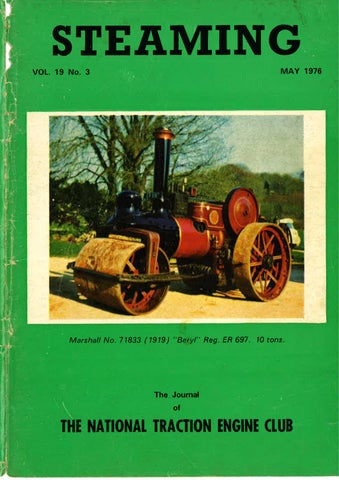
Marshall No. 71833 (1919) "Beryl" Reg. ER 697. 10 tons.
The Journal of
THE NATIONAL TRACTION ENGINE CLUB
National Traction Engine Club Membership is open to all, whether engine owners or not, with a genuine interest in the preservation of self-propelled steam road vehicles, portables, etc. The annual subscription is £3 for individuals, £4.50 for family membership. The benefits of membership include advantageous terms for boiler insurance. The club's journal 'Steaming' is sent free to members in November, February, May and August. All articles, photos for consideration should be sent to the Editor. All correspondence re subscriptions, bankers order, delivery (or non-delivery) of 'Steaming' or change of address to: MRS. F. E. WOOD, 'WINDRUSH', HAIL WESTON, HUNTINGDON, CAMBS, PE19 4JY Please enclose S.A.E. when sending subscription or when writing to any officer if a reply is required.
Next issue: Copy, photos, etc. should be in the Editor's hands by 15th June.
Acknowledgements We are pleased to acknowledge the assistance in the preparation of this issue kindly given by Derek Raynor, Wilf Cole, Chris Edmonds, John Ballard, Derek Stoyel, "a solicitor", W. L. Ford, Dick Blenkinsop, Len Crane, all Club and Area Correspondents and all those who helped in any way at all. With special thanks to Mrs. Smart and Mrs. Gull, typists and correctors of English extraordinary! 130
Volume One of "The Steam Scene" contains 94 magnificent photographs of the Traction Engine Movement taken in 1974/75. Dick Blenkinsop, well known for his Railway Photography, has turned his attention to Traction Engines and this is the first of four Volumes to be published this year. Each page is 114" x 11" and contains one picture with informative caption. Order direct from:
STEAM ENGINE PUBLICATIONS, (Dept. SG 76), 78 SOUTHAM ROAD, RADFORD SEMELE, Nr. LEAMINGTON SPA, CV31 1UA. Tel: 0926-22706. Price £2.95 plus 25p p. and p., or obtainable from your local bookshop to order. The above example is one of the mouthwatering pictures in the book.
TRADE ENQUIRIES WELCOME. 131
National Traction Engine Club Officers President, and Technical Services S. J. Wharton, Esq., Southern Down, Minster Lovell, Oxford. Vice-President J. T. Beeby, Esq., Wymeswold Road, Rempstone, Loughborough, Leics. Chairman Michael R. Lane, Esq., Maplc Trcc Farm, Chartridgc, Chcsham, Bucks. Vice-Chairman J. Crawley, Esq., Field House, Turvey, Bedford. General Secretary G. F. Beck, Esq., 127 Greensted Road, Loughton, Essex. Treasurer Peter J. Banks, Esq., 9 Fernley Rise, Thrussington, Leicester, LE7 8UA. Hon. Solicitor: David Tew, M.A., c/o Fowler & Co., Solicitors, 12 High Street, Oakham, Leics. Editor Ran Hawthorne Esq., 19 Bridle Path, Woodcote, Reading, RG8 OSE, Berkshire. Chairman, Rally Sub-Committee Denis W. Brandt, Esq., 27 Tregunter Road, London SW10. Public Relations Officers London, Home Counties and South: Anthony S. Heal, Esq., Baylins Farm, Beaconsfield, Bucks. Midlands and Wales: Dick Blenkinsop, Esq., Hill Cottage, Radford Semele, Leamington Spa, Warks. Northern Counties and Scotland: Tony Parker, Esq., Foley House, The Avenue, Lincoln. Membership Secretary Mrs. F. E. Wood, 'Windrush', Hail Weston, Huntingdon, Cambs, PE19 4JY. Sales Officer Alan C. Wilson, 7 Welton Road, Daventry, Northants, NN11 5PX. 132
STEAMING THE JOURNAL OF THE NATIONAL TRACTION ENGINE CLUB all items are held copyright by contributor and/or N.T.E.C. EDITOR: RAN HAWTHORNE, Path, Woodcote, Reading, RG8 OSE. Bridle 19 MAY 1976
VOL. 19 No. 3
`Blow off' As the new season gets under way, we cannot but think about safety on the rally field. Some of us who are old enough to have worked with steam, who carried sacks of corn under an unguarded belt that ran between the engine and the machine sometimes wonder if safety regulations today are going too far. It certainly seems like it at times but there is a lot of truth in the phrase 'You're a long time dead'. Once an accident has happened there is nothing one can do to undo it. In a workshop recently I read the code of practice for that shop and at the bottom the words: 'replacement limbs are not supplied. Injury is painful — death is permanent. We are operating outdated machines in a modern society. We operate them in much closer proximity to uninitiated humanity than it was ever considered they would operate. In these circumstances we must not only work to the standards laid down, we must go further and make our events be seen to be safe. One rally organiser has said: 'It is all very well NTEC making a Code of Practice. Their own members should set a better example.' Let us make sure that this remark cannot be passed, in truth, next winter. I liked the suggestion made by an organiser at the February Rally Conference in London. From the list of entrants at a rally NTEC would appoint one of its members, preperably a member of the Executive or National committees, to be a competing steward. This person would be listed in the programme. He would be NTEC's manon-the-spot; someone the rally committee or any engine owner or driver could refer
to. He would not be expected to act as a safety officer. He would be able to drive his own engine and take part in parades and events. In this way he would be in a position to assist and advise as required without being a 'big brother'.
The next issue Copy, photographs and adverts for Vol. 19 No. 4, should be in my hands preferably by mid-June and certainly not later than 30th June.
Small advertisements In spite of specific instructions at the head of the "small ads" page more than half the small advertisements that come in are still incorporated in a letter. PLEASE, print the advert in capital letters, including the name and address to which replies should be sent, on a sheet of paper. Any letter should be on a separate sheet. This would save a lot of time and work for both the editor and the printer.
Quotation The late King George VI once said: "The wild life of today is not ours to dispose of as we please. We have it in trust. We must account for it to those who come after". We might translate his words into steam terms and say: "The steam engines we have today are not ours to alter as we please. We have them in trust. We must account for them to those who come after". We certainly do have them in trust. Let us not betray that trust. 133
REMINISCENCES OF A YORKSHIRE STEAM HAULIER by Wilf Cole (continued) During our many visits to Bradford in the early 1920s, we came across a unique wagon which had been built there. It was driven by Walter Sowden, whose father used to make small fairground rides and who also made the single steam yacht which Commander Baldock now has at Liphook, Hants. Walter, who is still living in retirement in Bradford, used to haul coal to the woollen mills in the area and he maintained that it was a good wagon and could easily hold its own with other wagons. It was known as the Ridealgh Tipping Wagon and was designed and built by Mr. Thomas Ridealgh who was the works manager at Manns when I worked there earlier in the century. During World War 1, he had been directed to the firm of Summerscales, Keighley, to design a tractor to assist in food production as Germany's submarine menace was at its height and imports of food were being severely curtailed. The result was the three wheeled Summerscales Steam Tractor, using a 4 cylinder vee engine, with poppet valves, of 25 hp. It weighed 65 cwt, had a single speed and could haul a 4 furrow plough and also drive a threshing machine. Whether more than one were built is not known but the marque cannot have had a very long life. After the war, Mr. Ridealgh, who was a skilled draughtsman, had a small repair shop in Bradford where he built his The Summerscales steam farm tractor. wagon and he incorporated within its construction the engine and boiler of the cured the problem. We were so well Summerscales tractor and reverted to the satisfied with it that we bought another more conventional four wheels for extensive three like it and fixed them up with addiroad use. The 'vee' engine gave it a speed tional radiators and got them running too. of about 4 mph via a chain drive. After We also bought a number of other war this venture he returned to Leeds to work surplus wagons by such makers as Piercefor the Yorkshire Patent Steam Wagon Arrow, Peerless, Kelly-Springfield and Company and was responsible for the Albion. Of course, petrol was cheap then, design of the WG type of wagon, some only 8d. per gallon in the old money. These examples of which are still in existence in wagons would do about 4 mpg and were this area today. easier to operate than steam wagons — no As we had now disposed of the 5 ton waiting for steam in the morning, no coaling overtype Manns wagon and put the Mack up, no tube sweeping, no boiler washing petrol lorry to work, we thought we would out, no boiler examinations and repairs, no give it a good trial. We did this and found stopping for water and no oiling round. it an exceptionally strong wagon, very All the wheels and gear shafts on the capable of carrying up to 8 or 9 tons. This Macks were on Timken roller bearings and was more than the average British wagon would run a long time without attention. could carry in these days. Its only problem We continued to run petrol wagons up to was boiling on long hills, so we fitted an 1933 but in the meantime, we did have additional radiator on the outside and that some interludes with steam wagons. 134
. , The unique Ridealgh Steam Wagon that worked in Bradford. Driver W. Sowden.
Showman Our first one was in 1926 which happened after I attended a motor auction sale in Leeds. I was surprised to see that there was a Manns 5 ton overtype wagon going to be put up for sale. This, of course, was my favourite steam wagon at that time. It belonged to the well known Leeds engineering firm of Messrs. Greenwood and Batley. It had had a good home and was in fair condition for its age, having been built in 1916. It was No. 1135 (U 3673). Prices of second hand steam vehicles were dropping fast then owing to the large influx of ex Army vehicles which were being thrown onto the market. I bid for it at the sale and I bought it. It was in running order and so we got it home. As I was on the maintenance work at the time I set about getting it ready for some work, any necessary jobs that wanted doing to put it into good running order. I did them. It was on good rubber tyres with steel plated wheels. I gave it a good cleaning and then painted it battleship grey. We then had it lettered 'Central Haulage and Motor Company', which was the name we had decided to call the business so as not to be confused with our father's and uncle's J. Cole & Sons, who were still in business about / mile away. We then put it to work alongside the Macks.
It could hold its own alright and the road performance was about the same, although on steep hills the Mann was the better wagon and the more it pulled, the better it liked it, which was quite the opposite to the others. We were very pleased with it and had been running it for a few weeks when a friend of ours, an old steam wagon driver, asked us if we would consider selling it. This chap used to help the showmen at weekends, driving their engines on the fairgrounds when they were generating for the rides, organs and lights. He thought he had a customer who might buy it. We told him we might sell, so he then introduced us to Mr. Bob Dailey, D.C.M., a well known Yorkshire showman at that time. He asked us if we could give him a trial run which we agreed to do. Len towed him two loads including his living van from one site to another, a distance of about 10 miles. He was satisfied with its performance and bought the wagon. We found him a man to drive it called Willie Ashton who had worked for my father's firm when a youth. After that he had driven a Mann's 4 ton tipper for the Low Moor Colliery Company Beeston, Leeds. The next time I saw the wagon was at Woodhouse Feast, about a year later and it had been fitted with a small dynamo for making current for lighting 135
Mann 4 ton steam wagon, built about 1901. Photographed in the ownership of G. Hattersley & Sons Ltd., Engineers, Keighley.
his stalls. This was the only occasion that I heard ❑f a Mann's engine being fitted with a dynamo. Bob Dailey seemed to run the wagon for a year or two and later got a petrol wagon.
Express Our next interlude with steam, this time
later in 1926, was when we had a trial run with a new Mann's 6 ton wagon with a load, on a round trip of about 20 miles. We found it a great improvement over the ❑ld 5 tonner, it being much faster and it could easily do 20 mph on the road. We did not buy one, however, as we were having doubts about the overtype wagons at that time for our type of work. We started thinking about the undertypes and consequently had a good look round the Mann Express Wagon at Mann's Works. It looked alright but we thought that we should get to know a bit more about it and we went to see a man who had got
a new one. He had been working it for a few months on a trunk service between the West Riding of Yorkshire and Hull and his report was not too good. His main trouble was breaking valves and he showed my brother Len several of them. Of course 136
that put us right off it and we did not pursue it further. Very probably it was only teething troubles which were being experienced with a new design and they would have got over it but money was getting very tight with Mann's in the late twenties. In other respects the 'Express' seemed a very good wagon made of all the best materials and it was very quiet running on the road, besides having a good road performance and a good steaming water tube boiler.
Trial A further interlude occurred in 1928 when the 'Commercial Motor' magazine
organised a road demonstration run from Liverpool to London for steam wagons. Sales were dropping and they were trying to give them a boost. Mr. Scott Hall was the man who was put in charge of the run which was to include a call at large northern towns before ending in London. I think about all the steam wagon manufacturers were represented. One interesting entry
was an Atkinson steam wagon driven by young Mr. Ward from Warrington. Len and I went to see them arrive at the Town Hall Square, Leeds, late one afternoon. They
made a very brave show, Sentinels had two entries, a DG6 and a Super four wheeler. The drivers and mates on these wagons were all dressed in white overalls. One wagon which immediately caught our eyes was the Garrett undertype six wheeler. This was well got up and looked good. Mann's had had a 4 ton overtype tipper on the run but we were a bit disappointed not to see the Express wagon there. I think all the wagons completed the run and they had a good reception when they reached London. We were still running the Mack wagons very satisfactorily but after this demonstration we started thinking about steam wagons again for our work. We made arrangements with Messrs. Sentinels at Shrewsbury to have a day's trial with a DG6 platform wagon. In order to prove its worth we loaded it at a quarry at Otley near Leeds with 11 tons of stone blocks and took them to Corple Reservoir which was in course of construction on the moors above Hebden Bridge near Halifax about 35 miles away. It was a hilly road, up and down nearly all the way and the DG acquitted itself very well, doing all the main road hills in top gear. I remember there was one very steep hill on the side road up to the unloading point. We had to change to low gear for that. The trial took place in the middle of winter and ice was forming on the roads but the wagon did the day's work and made its way home to Shrewsbury the same night for all that. We were well satisfied with it but we had seen a Garrett wagon at the Notts Royal Show and we thought we would like to have a trial with one before we decided anything.
New Garrett Accordingly, we got in touch with their traveller in Bradford. He was called Charlie Hobson and he arranged for us to go over to Preston to have a look and a trial run with a Garrett six wheeler demonstration wagon which they had out there. We duly arrived but we could not find a load to put on it. We therefore asked their driver to take it away from the town centre and we tried it for speed on the outskirts of the town where the roads were quiet and level. We followed behind the empty wagon in our car and watched the speedometer. We let the driver carry on for about a mile and he reached 28 mph and held it at that. We then pulled round the front of him and stopped him. We were certainly satisfied with that. The wagon ran well and it was quiet enough. It had the four back wheels
chain driven like the Sentinel and it had a good driving position for the driver, it being a forward control model. Other similarities with the Sentinel were steam brakes, poppet valves, a good super-heater and last but not least a very good vertical water tube boiler. The more we studied it out the better we liked it so we thought we would have a day's trial with it with a load on. We therefore arranged acornmodation for the driver and mate. We put a load of 11 tons on and started off for Harrogate about 1.30 p.m., a good 15 miles away. This road is hilly almost all the way with long pulls about 1 in 10 and 1 in 11. We got there in just over an hour and then turned round and filled up with water before setting off back for Leeds. We reached our garage about 4 p.m. We considered this a very good performance and were well satisfied with it. The driver had to drop into low gear on some of the worst hills but it went up them quite comfortably. We tried it next day on a building site where we used to run and it did very well on the partially made roads. On the running of this wagon we decided to go in for a new Garrett and told their traveller this. We received a quotation for £900 and it was arranged for us to visit the works at Leiston, Suffolk. This we did in November 1928. We sent off from Leeds at 4 a.m. in my Jowett 2 seater and arrived about 11 a.m. We were well received when we got there and Mr. Maurice Plane, their chief designer, showed us round the works before entertaining us to a very nice beef dinner. We had decided to go in for a four wheel, 8 ton hydraulic tipper as we were then doing a fair amount of coal haulage work and had to deliver in mill yards and weigh over 20 ton weigh bridges. The deciding factor in us buying the Garrett as distinct from the Sentinel was the Timken roller bearings which we thought would be better running. We got the wagon in March 1929 (No. 35250 Reg. No. RT 5313) and put it to work. It was on solid rubber tyres and it was the only wagon I think we actually bought new. It certainly showed to good advantage over the Mack petrol lorries, being faster on the road and better hill climber. It could do more work in a day than them and it was more economical in fuel as the Chancellor had put up the price of petrol by 1s. per gallon and at 4 mpg this was a lot. We always used best Welsh smokeless coal for the steamers which cost us then about £2 per ton. 137
More speed About this time, 1929, we had started fitting auxilliary gear boxes on our Mack wagons in an attempt to improve them further. These gave a total of 12 speeds with an extra high gear which stepped their speed up from 13 to 22 mph, together with an extra low gear which stepped them down from 5 to 21 mph, making them a much better wagon. Even so, with these new boxes fitted, the Garrett could better their performance. We fitted the three Macks up like that and continued running them until 1932. We had not had the Garrett long before one or two troubles beset us. After only three days' use, Len was delivering a load to a building site and the gear case broke. This was a large case, about 2ft. diameter, made of cast iron in two halves and bolted together. The half which had cracked was the outer which had a spherical bearing bracket fastened to it which was one of two which held up the engine at the rear. The engine had a three point suspension, one at the front and two at the rear. It seems that Garretts had been in the course of making an alteration with the single support at the front and instead of having just one pin in the bracket for the engine to swivel round on when on uneven ground, they had fitted a swing link about six inches long with two pins in it. This had caused excessive strain on the gear case side, cracking it almost all the way round. Naturally, we reported this to Garretts and they sent us a new half of a gear case and also a new cross member with a single pin bracket on it. We told them we could fit them, which we did, and had no further trouble in that respect. We also sent the old parts back to Garretts as they had requested us to do so.
A race Competition was always rife among the various hauliers in the district and on one occasion we had taken the Garrett to Armitages Brick Works at Wood Kirk. They had just bought a new Leyland GH, similar to the R.A.F. type. The driver of this Leyland fancied his chances against our steamer and during loading we engaged in some light hearted banter. The petrol lorry had some 1,750 bricks on and had a slight advantage as we were loaded with about 2,000. We were both bound for the same destination in Bradford and I had decided I would show their driver what steam really could do. I fired up and the Leyland pulled out first with us soon behind and blowing off. He drew ahead by about half a mile 138
but it was a hard road to Bradford and on one of the hard pulls, up to ❑udley Hill, Len, who was driving, got the Garrett past him and we were away. We were pulling off the site and on our way home when the Leyland arrived. The race was won and we had proved our point. This run was talked about for many years after and the wagon became very much respected. However, on the way home, we noticed a strange noise in the chimney and the exhaust beat became very irregular. One of the exhaust valve stems had broken and replacing these became a regular feature, depending on who had been driving and how hard the wagon had been driven. Fortunately this was not a difficult job — it took about half an hour and we kept one or two spare valves on the wagon for this purpose. We ran the wagon alongside our petrol wagons for about a year with practically no trouble. After this time we had the boiler examined for insurance purposes, having done some 20,000 miles in revenue earning service. Unfortunately the boiler inspector found a crack in the vertical weld of the firebox. The box was pressed out in two halves and then welded together, the weld coming through the centre of the tube bank. The crack was just below the tubes and never shown any leakage but, nevertheless, the inspector said it would have to be welded. He suggested we got in touch with Mudds of Bradford and consequently their expert came and looked at it. He found it was possible for them to do the job and so their portable electric welding equipment arrived at our garage. This was all fitted up on a lorry (this was still 1930) and consisted of an electric generator and compressed air equipment for chisels, caulking tools, etc. Two men were with it; they 'veed' the crack down to the bottom, welded it up and built it up well, forming a kind of patch over it. Then they gave it a good caulking over. It took them about half a day to do this. In 1932 we decided to gradually replace the Macks by more Garretts — 6 wheelers this time. In the meantime, the previous year we purchased a Mann's 4 ton overtype tipping wagon from the Deerplay Colliery Co., near Bacup, Lancs. This was No. 1575 built 1932, Reg. No. TC 2899. We overhauled it and got it working, keeping it until the tax went up in 1934 when we let it go for practically scrap price. We have often regretted doing this, they way things have turned out. However, we were back on steam and stayed with it commercially until 1953 To be continued
NIL CONBUSTIBUS PRO FUMO or NO SMOKE WITHOUT FIRE by Chris Edmonds
Have you ever noticed, that most stories about the working of steam engines, either hair raising or amusing, always seemed to have taken place 'before the war'? We enthusiasts or preservationists are often looked upon by the older generation of
engine drivers as very tame exponents — 'nothing ever happens to us.' It is therefore my intention to relate one or two of my own experiences in the last 15 years which may amuse some of you, my readers, and more probably horrify most! I am well aware that some of these anecdotes will portray me as a very irresponsible person — I leave that for you to judge, but nevertheless these stories are
true, and did actually happen, and so, I feel, should be related. I am lucky indeed to be able to recall my first brush with a steam engine, for it took place while I was sitting happily in my pram at the age of two, outside a pub (how prophetic!) when the down 'Master Cutler' came thundering over the bridge showering white hot cinders in the road below. One of these landed in my then mode of transport, and it was very soon a definite proof of 'Nil Combustibus etc.' The G.W.R. had done its worst and I was hooked on steam from then on. I spent halcyon days at the age of 10 or thereabouts driving the 0-6-0 Pannier Tank on the defunct Watlington Branch — quite
unofficially of course. I only came to grief once when I was bundled unceremoniously into the coal bunker when the Area Locomotive Superintendent was spotted pretending to be a passenger on Chinnor station platform one afternoon. I stayed there till we reached Flisborough. There are various ways and means that young men can get themselves expelled from educational establishments, but what I now relate is to the best of my knowledge a unique method. I was, one day, educating two school friends of mine on the power of steam, and decided that perhaps a practical demonstration would drive
home what I was saying. The particular school had a 'bonfire that never went out'. You know the type of thing — the place where all the old boxes and grass cuttings were disposed of. Onto this 'funeral pyre' (which it nearly turned out to be) was placed a five gallon oil drum full of water. Suitably camoflaged some distance away we awaited the outcome. We waited and we waited, until the fire had burnt low. I was just about to venture across and stoke it up, when to my horror I perceived the groundsman approaching with another load of cardboard boxes. He got to within about 10 yards . . . and the oil drum exploded! With a report that was heard in the neighbouring town three miles away, it took off in a graceful arc over the greenhouses. The stupefied groundsman was sitting on the ground with not a cardboard box, or his cap, in sight. It was this same groundsman who successfully pleaded for my reprieve. Why he interceded on my behalf to the headmaster I shall never know, but I often wonder if it had anything to do with the fact that his previous employment was as a steam roller driver! Talking of steamrollers, the local Farnham R.D.C. had a fine 10 ton Aveling 7771 of 1912 which they made the grave mistake of leaving practically outside the school gates for a weekend. Three of us decided that it really could do with smartening up, and so, with no permission from anyone, we set to work. We decided the only thing to do was nothing short of a complete repaint, which we did! You've no idea what a transformation was affected, she looked absolutely magnificent! On Monday afternoon, we sauntered nonchalently past to ascertain the attitude of the driver. When we finally made outselves known he was delighted, and said that the whole gang had thought they were seeing things when they arrived that morning. He did notice, however, that the shade of green that we had painted her did resemble rather closely that of the school cricket pavilion! 139
About this time (1957) the railway authorities in Buckinghamshire were busily relaying the track, and repainting the stations of the Watlington Branch, and so, I thought, assuring its future. I didn't realise then that this was BR's time honoured method of intimating impending closure! With my one source of enjoyment doomed, it was perhaps significant that opposite the report of the final run in the local rag was a fine picture of David Davis's Burrell tractor 'King George' and his bride at their wedding. So I set my heart on a traction engine, brides come later!
The Burrell There used to be a lot of farmers about in those days who had 'cut their engines up only last week' and which, we were told, would have been ours for a tenner. My father was greeted with whistles of amazement when he announced to all and sundry in the village pub that he had paid £110 for a traction engine: hut a jolly gond old engine she turned out to be. Burrell sc compound No. 2426 arrived a week before my 14th birthday in June 1958 in the care of the late 'Blossom' Trinder, whose memory I treasure for all that he taught me in those early days. After repreated attempts to get me to take charge of the engine single handed, he drove it up the lane and flatly refused to drive it back! It was the best thing he could have done, and once under way my fear of the thing vanished. As he always said: 'An engine will always be the master of you if you are frightened of it.' So true. I must say, and I think this goes for all engine owners, it isn't so much the fun one gets out of driving, it is the good friends that one makes while doing it. That old Burrell (now beautifully restored by Ted Haggard of Swindon) made me most of the close friends I have today. Or at least until they've read this article! I don't think that any engine could do more for its owner than be responsible for sorting out it's owner's future wife, for it was while I was driving the Burrell at Appleford that I met the redoubtable Tony Upfold and hence his daughter Sally! We bounced our way to most of the local rallies in those days (mounted on Helical Springs — Burrell's patent — excellent for queezy tummies), held a televised christening ceremony, put her in the ditch, and founded the Chiltern Traction Engine Club. I was paid quite a respectable rate for appearing in the film 'The Iron Maiden' and it is the only time that I have ever prayed for rain at a rally. John Crawley 140
told me that the filming of the 'mock rally' at Woburn would take about three days provided the weather held — if it didn't, it could take anything up to a month, but with the engine in steam every day and the 'respectable rate' still payable. Needless to say the wretched sun kept on shining and it was all over in two days! Just prior to one of the early Chartridge rallies I volunteered to take the Burrell over to George Evans' yard at Tring and tow in an old compound Fowler so that it could be present at the Chiltern Club Rally. We towed the Fowler on a straight bar, with Jim Sarney (of Lord Roberts fame) and I driving the Burrell and Mike Scott-Jackson steering the Fowler. Now it is an exceeding tortuous and twisting road between Tring and Chartridge, but all seemed to go along well until we were just entering Chartridge, when to my horror the Fowler appeared alongside the Burrell with no one ❑n the footplate. We found Mike unconscious in the road some quarter of a mile back. I thought he was dead, as he had hit the road very hard. Luckily, however, his injuries weren't too serious, and he soon recovered. It turned out that he had eaten no breakfast that morning, and when I got on the Fowler to steer it the last mile or so I found to my amazement that there was no less than five turns of slack in the steering chains. How Mike ever got as far as he did I shall never know but he never once complained.
Sheep In 1963 I made a great mistake and sold the Burrell to a new owner in Scotland, a transaction which I have come to regret, but I always remember what happened on that last journey to Risborough station to load her on rail. It was almost as if the old engine knew she was going away, and was determined to make me enemies rather than friends that day. So it was, for we rounded a bend in the lane, and came face to face with Farmer Wooster's flock of sheep advancing towards us. It was the most incredible change of direction — 25 black faces simply became 25 woolly posteriors and the whole flock was beating retreat! The sheep dogs got cross and Arthur Wooster got beside himself with fury, and I wonder if the old Burrell knows that he has never spoken to me from that day to this? I replaced the Burrell with what I can only call a 'Fowler in Disguise'. It was a little 6 ton compound roller with a Burrell tractor chimney and cab, and was as pretty as a picture, and that was about
all! It was a fiendish thing to work with, and believe it or not, used more water standing idle than when it was at work. All the usual checks were made and no leakage at either clacks or glands were responsible, but the water would drop relentlessly down the glass if she stood for any length of time. Her number was 15973 and she managed to get herself a full page in the Daily Mirror with an hilarious article by the famous journalist 'Cassandra'. This was during a road repair job in which the residents of Lane End, a small village near High Wycombe took the law into their own hands and resurfaced the school road themselves, which the Council had previously refused to do. As you can imagine a lot of good natured politics was stirred up when the local MP consented
to open the road by driving the roller through a strand of RED tape. One interesting facet of her design was the fact that you couldn't remove the firehole door without removing the second shaft, and you couldn't do that without taking the rear roll off, having taken the scarifier off first, but, I mustn't get controversial! By this time (1964) my thoughts were turning increasingly to the possiblity of 'going into show business'. This was when the fun really started, and if the editor will allow me (and he should be well insured if he does) I'll tell you some most amazing things that happened with a Burrell Showmans on tour. Editor's note: Any expressions in 'Steaming' are not necessarily those of the editor or the NTEC, etc, etc!
DIG THIS!
As others see us
Recent renewed interest in the Loch Ness Monster brings to mind other interesting things which lie beneath the surface of Scotland. Not far away from Edinburgh in the lowland county of West Lothian is the royal burgh of Linlithgow. In the good old days of the 1920s William Aitken built up a business as a haulage contractor in the town. He used a number of steam wagons of various makes and a Garrett 4CD tractor. Some were sold, but others remained in the yard. Nearby was an old sand and gravel quarry which was being filled in with spent lime from various factories. As yard space was required with the acquisition of more and more diesel lorries, the steamers were consigned one by one to the quarry. They were not even sold for scrap — perhaps Mr. Aitken could not bring himself to part with them for dissection by the cutting torch. They were gradually covered up until only a metal detector could now pin-point their location. We hear from time to time of aircraft enthusiasts digging up crashed aeroplanes. Perhaps here is a worthy case for further investigation? However, the condition of the steel after 40 years underground and in close contact with lime, is a matter for conjecture. The vehicles thus buried included five or six superheated Garrett wagons, the Garrett tractor, a Foden 6 ton „overtype, a Yorkshire 6 tonner and two 5 ton Clayton wagons. Food for thought!
extracts from 'Motoring News', 18th December 1975
MN's festive road test The subject of this year's Christmas road test is a steam chain engine, a 1974 built replica of an 1868 Savage . . . A brief word about the background of steam traction engines. In the early 1800s there were many portable farm steam engines which were employed for threshing corn. The technique was to station one at either end of the field in question and run the thresher between each engine, the steam power being used to pull it backwards and forwards across the field. (The mind boggles — ed.) Later these engines were connected to a drive and the traction engine concept was born. MN claims the distinction of driving a brand new, slap up to the moment steam chain engine. The immaculate replica was waiting for us on arrival at its base. The mile and a bit trip up to the local pub took us just over half an hour, but the traction engines crave attention even when stationary and our host was forever popping out to make minor adjustments as it stood in the car park quietly simmering to itself. Truly a relic of an age where, of necessity, life moved at a slower pace. 141
142
K7, Fowler plough engines No. 17756/7, the last pair delivered new in the U.K., in 1933 to Nottingham Corporation. Jack Beeby driving one, towing the other, on a five mile journey to Woolaton Park Museum in November 1975. These engines may attend local events. Opposite, above, Burrell "Lady Pride of England" touring Coventry in connection with a model Engineering Show. Below, Aveling & Porter, bearing plate "Maidenhead Corporation", on a train passing through Hatton station 3rd October 1953. Can anyone identify? Where is she now? Both photos by Dick Blenkinsop.
143
A SYNOPSIS OF ROAD LOCOMOTIVE LAW IN VICTORIAN ENGLAND BY A SOLICITOR The topic of the law regarding road locomotives during Queen Victoria's reign may sound turgid, but it is helpful to have some knowledge of this subject, so that one can better understand the problems of those involved in steam haulage during her reign. When she came to the throne in 183/, 'highway' law was still in its infancy. Only by the Highway Act 1835 did highways then in use by the public become maintainable by the public at large. It became an offence to damage a highway, or deposit filth or manure on a highway. Drivers of carts were now required to keep to the left side of the road and to enable miscreants to be apprehended, to have their names legibly painted on the carts. The Town Police Clauses Act 1847 went further. Section 28 made it an offence to overtake other than on the right hand side of the road, and to drive a carriage furiously. (This section, incidentally, listed thirty or so offences, from 'wilfully and indecently exposing ones person' or singing 'obscene ballads' in the street, to flying one's kite there or hanging washing over it — but only to the annoyance of residents. Heinous conduct indeed, but a section worth reading!) The first Locomotive Act was passed on 1st August 1861. Its long title described it as 'An Act for regulating the Use of Locomotives on Turnpike (the main toll roads) and other Roads, and the Tolls to be levied upon such Locomotives, and on the Wagons and Carriages drawn or propelled by the same'. The Preamble to the Act explained its purpose. The use of Locomotives was likely to become common on Turnpike and other roads and cause problems. The general law had no adequate provision for tolls upon locomotives, whereby certain localTurnpike Acts had prohibitory toll levels. Further, certain aspects of these Acts: 'have not been framed in anticipation of Traffic by Locomotives, and are in many respects ill-adapted to the profitable carrying of goods . . . and . . . it is desirable that the use of locomotives on Turnpike and other Roads should be regulated by uniform general Provisions'. By why did this come in 1861? By then several firms which became leading makers — Fowler, Burrell, Clayton & Shuttleworth — were building engines, but possibly it 144
was the exploits of William Bray's engines which triggered off legislation at that date. One was illustrated in 1858 by the 'Illustrated London News.; Woolwich Arsenal and Dockyard experimented or used them 1858-9 and one tried to enter a cellar from above in Nelson Street, Greenwich in 1859. There was also the ill-fated circus proprietor Jem Myers with Bray engines in the South of England in 1859. and its High Court contest in February 1860. All these exploits or misfortunes were in or near the Metropolis and together they were almost calculated to create a legislative response. Several Acts affecting locomotives followed in the succeeding years. The main ones were the Locomotive Acts of 1865 and 1898, Highways and Locomotive (Amendment) Act 1878, and Locomotives on Highways Act 1896. Others will be mentioned in context. The law quoted was (unless otherwise mentioned) for England and Wales, but it must not be assumed that any provisions are, or are not, still valid law. For convenience and clarity, the matter will be discussed under various headings. The first question, of course, is what was a 'locomotive'? The 1861 Act did not give a definition, but the nearest were sections commencing 'Every locomotive propelled by Steam or other than by Animal Power'. This became the accepted definition though it was later decided to Include a steam roller, or even a steam tricycle.
Design and constructions The 1861 Act decreed that locomotives should, if not towing, have wheels with treads not less than three inches in width if they weighed three tons or less, an extra inch per ton or part of a ton extra. If towing, the wheels were to be not less than nine inches in width, the locomotive being not over seven feet wide, or twelve tons weight. The wheels were to be cylindrical and smooth, or with 'shoes' of bearing width of nine inches or over — is this legislative notice of Mr. Boydell? Larger engines could be used with the consent of local surveyors. Weight restrictions were also imposed on wagons. By section 8 was introduced the infamous . . shall be constructed on the principle
of consuming and so as to consume its own smoke'. The penalty for smoking is £5 per day, and the hardship so caused is too well known for present comment. Side lights were required to be used at night. The 1865 Act increased the permitted width from seven to nine feet, the weight from twelve to fourteen tons. The name and address of the owner had to now be conspicuously on show. In 1878, the question of wheels was further discussed with mathematical calculations necessary as to whether certain locomotives did or did not comply. Strakes were now an option — wheels could be 'shod with diagonal cross-bars of not less than three inches in width nor more than three-quarters of an inch in thickness'. They had to extend the full width of the tread, and be not over three inches apart. The 'smoke consumption' requirement was slightly eased in that while the engine was to be constructed on the principles of burning its smoke, it was now a defence to show that a locomotive so constructed was consuming it 'so far as practicable'. The law in theory thus accepted that consumption was not always possible. It was, however, the Act of 1896 which was to cause the greatest change by in effect creating a new creature, the 'light locomotive' or, as we know it, the tractor. It was defined as being a 'vehicle propelled by mechanical power if it is under three tons in unladen weight . . . and is so constructed that no smoke or visible vapour is emitted therefrom, except from any temporary or accidental cause'. The benefits accrued to a vehicle being a 'light locomotive' if running light, or towing one trailer so that the gross weight of locomotive and trailer did not exceed four tons. They had to carry a light in darkness, and a bell or hooter. It is doubtful whether the legislators could see the effect which this short Act of twelve sections was to have. The 1898 Act introduced the red light at the rear of the vehicle as a requirement as well as the white one at the front, requiring that the front one shall be fitted 'shutters or other contrivances as will enable the light to be temporarily screened in effective manner' (this was done when horses were passing — ed.). However, light locomotives did not need a rear light or shutters on the front one. Wagons now had to be marked with their unladen weight, and weights they could carry were increased. Incidentally, back in 1878 threshing ma-
chines came in for legislative attention. Just as Factories Act had required that machines there be fenced, so now the 'Act for the Preservation of Accidents by Threshing Machines' affecting any driven by mechanical means required the drum, feeding mouth and all moving parts to be securely fenced. How much of this survives? This is not an easy question to answer since, although the Acts referred to may no longer be law, the various aspects can be covered elsewhere. For instance, wheels still have to be cylindrical, thereby bringing the largest surface area into contact with the road surface and reducing pressure. Also the Construction and Use Regulations still specify the dimensions of the strakes. Somewhat of a strange situation arises in relation to spark-arresters. The Victorian legislation does not appear to require these, but if sparks from an engine set fire to a field of hay, the owner and driver would be liable, provided the farmer could prove it. This is still the case, sensible though not obligatory; it is open to insurance companies to claim that in not fitting one you were not using due care, and decline to pay, thus leaving you to foot the bill. Any newly constructed steam vehicle, however, e.g. the engines built to the old Savage patterns, would have to be fitted with ashpan beneath the firebox and 'an efficient appliance for the purpose of preventing the emission of sparks or grit,' but the Construction and Use Regulations 1973 do not specify whether this should be an internal design feature or an external fitting.
Use of engines — places of use Right from 1861, there was power for a Principal Secretary of State to prohibit either all or particular types of locomotive by Order from using particular roads, or roads in particular areas, or restrict their use there. He had two basic grounds to choose from: (a) particular types caused excessive road surface wear and tear; (b) it is dangerous or inconvenient to the public for either engines generally, or certain types in particular. These were the forerunner of the modern Road Traffic Regulation Orders we all encounter every day. Sections 6 and 7 of the 1861 Act are still in force, though awaiting repeal. By the former, locomotives may not be driven over suspension bridges, or bridges upon which the person liable to maintain it has conspicuously affixed a plate to the effect that the bridge is insufficient to bear such 145
weight. By the latter, if a locomotive either running light or drawing a load passes over a bridge and any part of the bridge is damaged, the owners of the bridge shall repair it and shall be reimbursed by the owner or person in charge of the locomotive. This is the provision which reputedly brought forth from Thomas Aveling the celebrated remark: 'If I send a boiler weighing 15 tons drawn by 15 horses over a country bridge and that boiler breaks the bridge I have nothing to pay, but if I send the same boiler over the bridge drawn by an engine weighing 8 tons, and the boiler breaks through the bridge, I have the whole expenses to pay'. However, in 1873, the Court of Appeal decided that this applied only to private bridges with public highways over them, a limited number. In 1865, it was appreciated that certain Acts of Parliament in which an offence was created of having steam engines driving machinery out of doors within 25 yards of a highway, could prove troublesome to farmers. Thus, ploughing engines were specifically exempted from this industrial restriction so long as a person was stationed in the road to tell the driver when to stop, to assist horses and horse-drawn carriages to pass, and, of course, ensure that the driver did stop in proper time. A precisely similar provision was later introduced to assist in relation to threshing operations by the Locomotive Threshing Engines Act 1898. The Act of 1898 permitted Counties or Boroughs to make byelaws regulating the roads in which locomotives could work. They could now: (a) prohibit or restrict their use if the highway was 'crowded or unfitted for locomotive traffic', because of inconvenience to inhabitants, 'or for any other reasonable cause'; (b) regulate their use on any road; or (c) prohibit their use on any bridge, if such bridge was unsuited for locomotive traffic or would endanger or damage it. Exemptions could be permitted for e.g. access to premises for delivery purposes. Worcestershire County Council availed itself of such powers under the 1861 Act. It had from 1880, taken unto itself powers to affix notices at each end of unsuitable bridges; it now prohibited entirely the use of eight bridges for reasons in (c) above, placed a weight restriction of twenty-four tons on three (including Holt Fleet Bridge over the River Severn), and prohibited the use of locomotives between 10.00 a.m. and 6.00 p.m. on certain roads for the reasons in (a). 146
By section 8 of the 1898 Act, and this is still good law, no locomotive was permitted to meet or pass another locomotive on any bridge. This is now broken many times every day, as any articulated tractor unit is within the definition of a 'locomotive'. Nothing at all in the Act of 1898 was to apply to 'light locomotives' as defined by the Act of 1896. They could, it seems, flout the County byelaws with impunity, unless these were specifically stated to be made in pursuance of powers granted under both Acts. As well as general provisions and byelaws, owners and drivers had to contend with Acts of Parliament of local application ('local Acts'). Several of these regulated where engines could go or banned them entirely. At least one, the Thames Embankment Act 1862, is still in force and section 41 still prohibits the use of locomotives (other than 'light locomotives', says an amendment of the original Act) from streets or roadways constructed under the Act. These include the Embankment on the north side of the Thames between Westminster and Blackfriars Bridges, and nearby streets. Further examples were the Birkenhead Corporation Act 1881, Bury Improvement Act 1885, Newport (Mon.) Act 1887, and later the City of London (Street Traffic) Act 1907.
Speeds Speeds were regulated from the very beginning. The 1861 Act specified limits of 10 mph on highways generally, but 5 mph in towns, cities or villages. An owner-driver could be fined £10 for exceeding these, or an employed driver £5 — heavy sums, when one recalls that £1 per week was a fair wage for an employed driver. In 1865, these speeds were reduced to 4 mph and 2 mph respectively, and the 'lighter' fines for the employed drivers abolished. These speeds remained in force until the twentieth century, and limited development drastically; extra speed could not legally be used. Incidentally, these limits did not apply to engines owned by the Crown or the Army who had no limits upon them, though this only became clear in a court case in 1904. The Act of 1896, however, decreed that light locomotives could travel at speeds up to an unprecedented 14 mph as may be prescribed by Regulations of the Local Government Board. Sadly, their views on safety decreed that maxima should be: Weight Under 1+ tons
Max. speed ... 12 mph
1+ to 2 tons Over 2 tons
...
... ...
8 mph 5 mph
Thus, though the potentially high speeds proved a mirage, 5 mph was a vast improvement on the urban 2 mph for heavier locomotives, and the benefits of single manning, mentioned shortly, further added to their appeal.
Manning One is' tempted to believe, when the question of the manning of road locomotives is considered, that Victorian legislators believed in full employment. The Act of 1861 required not less than two persons to drive a locomotive, and an extra person in charge of the wagons pulled thereby, if in excess of two. This was increased in 1865 to three in charge of the engine, one of whom walked not less than sixty yards in front with the notorious red flag. His duties were, as the Act stated: . shall carry a Red Hag constantly displayed and shall warn the riders and drivers of horses of the approach of such locomotives and shall signal the driver thereof when it shall be necessary to stop, and shall assist horses and carriages drawn by horses passing the same'. This poor hard-worked fellow's lot was eased in 1878, as he then could leave his flag at home, only had to be twenty yards in front, and was no longer obliged to make signals to the engine driver, who could presumably now reply on his own eyesight. The whole question was clarified in 1898. Two persons had to drive or attend to the locomotive and, except in the case of a roller, a third had to 'accompany' (not necessarily on foot) the locomotive to assist those with horses as necessary in passing or overtaking the locomotive. The Act limited the load to three loaded wagons, excluding one solely (showmen were known to forget this word) for the carriage of water. If more than three wagons were drawn, and County Councils could authorise this, another man had to be employed to attend to the wagons. So long as the fire in a locomotive was actually alight when on the highway, one man still had to remain in attendance even though it was stationary. The position of steam plough engines was anomalous. By their nature, these gregarious beasts travelled in pairs towing their gear behind them. If they ran closely one behind the other, it was permissible for a mere five persons to be in overall atendance (instead of six), as long as one
gave assistance to riders or horses as necessary. Despite the fact that much higher speeds were contemplated in 1896 for light locomotives, these were exempt from most of the earlier legislation. Thus, there were no statutory requirements for the crew: one man could lawfully drive at the higher speeds allowed.
Rules of the road A code of practice in driving locomotives was laid down as early as 1865. Section 3 lists 'do's and don'ts', which can be paraphrased as follows: (i) Crew required (dealt with above); (ii) 'Red Flag Man' (dealt with above); (iii) Drivers had to give as much room as possible to other traffic; (iv) (As well as consuming their own smoke), the whistle must not be sounded, the cylinder taps not be opened, nor should the steam pressure be allowed to build up so as to open the safety valves when in sight of any persons riding, leading, driving or in charge of any horse on the road. (No explanation as to how to achieve this was givenl); (v) The engine was to be 'instantly' stopped if the Red Flag Man, or any person with a horse or carriage raised a hand as a signal requiring the engine to stop; (vi) Lighting requirement. In default, the owner was fined £10, but could recover from the engine driver if this gentleman was responsible. Byelaws were possible under the Acts of 1896 and 1898 as to roadcraft. Worcestershire's byelaws of 9th March 1903 included several. These except nos. 6 and 7) did not relate to rollers when employed by the Council. They required that: 5. No locomotive should be stationary on a highway for over thirty minutes unless for some statutory requirement, or if due to accident or other inevitable cause. 6. Where the carriage way was less than 16 feet wide for over 100 yards, some person had to walk ahead and warn oncoming traffic. 7. No engine may stop on a bridge, arch or culvert, or within 10 feet from the face of an abutment (except for the exemptions in 5 above). 10. Any engine could be required to stop for examination by a Council officer or police officer, and could not continue on his way until authorised. 147
Added to all this was the duty, under section 23 of the 1878 Act, not to damage the highway as to cause the highway authority any extra expense in repairs than it would expect to expend on a similar road in that area, when used by the sort of traffic ordinarily there. This is now enshrined in section 62 of the Highways Act 1959, and known even today as 'extraordinary traffic'. Easy then but difficult today to prove, the owner of the locomotive had to pay for the damage he had caused either by one large or heavy load, or by a large number or smaller loads if out of keeping with the usual for such roads. Mr. Aveling was not amused. This is, however, a complex topic much of which grew up from the cases brought against recalcitrant owners or drivers, and much better dealt with at length on another occasion.
Financial The first section of the 1861 Locomotive Act dealt with Tolls, prescribing maxima for any toll road or bridge. The one basis was on a comparison with horses, so that for every two tons (or part of two tons) weight of the locomotive, one paid as for a horse. Thus, a nine ton engine paid as for five horses. The other basis related to the width of the wheels of the locomotive. Any Act prescribing large tolls for locomotives was to that extent repealed. A locomotive drawing any goods which were exempt from tolls, was itself exempt on that journey. A random example is the Leominster and Ledbury Road Act 1855, in which the toll was 6d for every horse drawing a wagon with wheels less than six inches wide, if between 1st March and 1st November, 9d at other times; for wheels of greater width, 4d or 6d respectively. Where the wagon was drawn by 'machinery', the charge was 1s per wheel at any time, i.e. 4s for a four-wheeled cart. Calculations show that this Act at least could not fail to be affected by section 1 of the 1861 Locomotive Act. County Authorities were authorised in 1878 to issue byelaws whereby they could grant annual licences to locomotives, fees being not over £10 p.a., to use the road within the County. Engines used, but not so licenced, could cost their owners £2 per day, although those used solely for agricultural purposes were exempt. Excise duties were imposed on many locomotives by the Customs and Inland Revenue Act 1888, of up to £2 2s; this was increased to a maximum of £3 3s by the Act of 1896. 148
But it was, as on certain other topics, the Act of 1898, which strengthened the law on licencing of engines. Now, every locomotive had to be licenced by a County Council, with the exceptions of those used solely for agriculture, those not used for haulage purposes, steam rollers, and locomotives owned by road authorities when used in their own area. Licences were to last for one year, and cost not over £10 if the locomotive weighed not over ten tons, and an extra £2 for every additional ton or part of a ton. The Authority had to issue a licence plate, which had to be conspicuously on show on the engine. Licences could be taken to enable the engine to be used in other counties; an extra fee of £5 was levied or of 2s 6d per day it was there. Cases later held that an engine belonging to the War Office need not be licenced, and an engine was being 'used' in another County even if only running through, and not drawing a load. Rollers or locomotives not needing licencing still had to be registered with their Counties; the maximum fee here was the princely sum of 2s 6d. They were also obliged to carry number plates.
Conclusion The Victoria road locomotive driver's life was, by its very nature, a hard and at times an anti-social one. It is clear from this summary that the law in its full majesty did nothing to help, indeed, sometimes made the job almost impossible. The duty upon the engine to consume smoke, and not to allow steam to issue when in the presence of a horse, were frequent excuses for the courts to make money out of locomotives and their owners. It is also clear that the local magistrates, drawn largely from the horse riding squirearchy, were not well disposed towards them. Certain cases, even in the High Court, indicate that the higher judiciary were not always as strictly impartial as might have been hoped. Case law has, however, for the sake of brevity and clarity largely been ignored in these notes. It is hoped that this article has demonstrated that on the comparatively tranquil 19th century roads, the drivers of locomotives had to be experts at their job, and have a good working knowledge of law, which many of them would not have been able to read, or have had no opportunity to learn; and that we should salute them for the tenacity with which they braved not only the rigours of nature, but also of a legal system loaded so heavily against them.
MEN OF STEAM the late Charles E. Hooker by John Ballard and Derek Stoyel.
This article was originally written when Mr. Hooker was alive. The authors are pleased to acknowledge the help given them in the preparation of this article by Mr. Hooker also to Alan Duke for assistance with engine details. Kent, the home of one of the earliest and most prolific builders of traction engines, has always been remarkable for the large number of engine owners within the county, both large and small. The name of Hooker was a well known one amongst the local engine fraternity, although not all the engine owners of that name were definitely related. Prominent amongst them was the branch that orginated at Egerton and from small beginnings they quickly rose to take their place as one of the more important agricultural and contracting firms in the county. Charles Hooker of Egerton, the founder of the firm, was not brought up amongst traction engines, which in fact were few and far between in that district in his youth. Evidently, however, he heard the call of steam at an early age as, after such a brief period at school as would not be tolerated in this enlightened age, he took his first job with a steam ploughing team, in which his most important duty was to prepare the meals. After this initiation he worked for a time with portable and stationary engines at the nearby Pluckley Potteries. By way of a change he then tried his hand at driving a traction engine for a local threshing contractor, Albert Palmer of Egerton, to such good purpose that by about 1887 he had bought an
Aveling & Porter engine from his employer in order to set up in business on his own account. From that time onwards he never looked back, and the solitary Aveling was quickly joined by other engines, including a second one from Albert Palmer, until he was operating quite a fleet of traction engines, rollers, steam wagons, etc. Before long he had been joined in the business by his two sons, Edward and Charles E. Hooker, who seemed to take to engines like a duck to water. In 1910, however, he decided to move west to Boughton Monchelsea, near Maidstone.
Charles E. Hooker. Age 21. He left some of his engines with his sons at Egerton and took the others to his new
home and it was not long before he was adding to their number once more. The neighbouring stone quarries provided him with plenty of work and he remained active there until 1926, when he returned to Egerton, leaving his engines standing in Boughton Monchelsea quarry. He died at Egerton in 1928. Meanwhile at Egerton his former business was carried on by his two sons in partnership in much the same way as before. There was, however, a further change in 1912, when the younger son, Charles E. Hooker, decided to leave the business with his brother Edward and to move to Monchelsea to join forces again with his
149
father. In 1918 he moved again, this time to Hollingbourne, not very far away. After a short period of farming here, he set up as a general engineer on his own account at Broomfield and thus broke right away from the family business. Once a steam man always a steam man, however, and it is not surprising that he gathered a few engines around him in his new surroundings. He continued to own them as long as it was economic to do so, his last one being sold in 1940 when he moved to Ditton on the western side of Maidstone. His brother Edward, who remained at Egerton all his life, died in '1959 but some time before his death his engines were taken over by his nephew-in-law, Arthur Collins. So it will be seen that during the eight years from 1920 to 1928, three separate sets of engines were owned concurrently by three members of the same family, and this explanation of the circumstances should help to clarify what might ❑therwise be a rather confusing situation, which was further complicated by the fact that two of the three had the name of Charles Hooker. There were also several other engine or steam wagon owners by the name of Hooker operating in the Maidstone district at about the same time. The principal subject of the present account, Mr. Charles Ernest Hooker, was born in 1884 and already at the age of three he was being shown by his father the controls of the engine the latter had bought, also born in 1884. This was Aveling & Porter No. 1975, an 8 h.p. general purpose engine, which can truly be said to have been a mainstay of the Egerton business for almost the whole of its existence. Not content with hauling and threshing jobs, it was later made convertible to a roller, and in its dual forms was available for threshing, haulage and road-rolling turn and turn about according to the season of the year. But to return to Mr. Charles E. Hooker; his early familiarity with his father's engines, and the practical experience he obtained from 1896 onwards by taking turns with their regular drivers as soon as he was old enough to d❑ so, was reinforced between 1900 and 1904 by an apprenticeship with the Ashford firm of Frederick Clark & Sons. Although they were in business as general agricultural engineers, they both owned and regularly repaired or rebuilt traction and ploughing engines and an apprentice was thus able to gain a much wider experience than would have been possible with a more specialised concern. After this he was 150
ready to undertake any job that might be required of him and indeed during the next few years he endured many of the severe hardships that were the regular lot of engine-men in that period, a fact conveniently overlooked or never known by many of those who speak with such nostalgia about the golden days of steam and to whom a traction engine has become a form of amusement. So far only one engine has been mentioned specifically and it will no doubt interest readers to learn something about the others. Mr. Hooker has however been concerned with so many of them during his long life that it would not be practicable to try to enumerate them all in these pages, and the following notes merely cover a selection of those of particular interest or with which he has had some rather special experiences.
Rough ride The engine with which Mr. Hooker was perhaps most closely associated, at least during his period at Egerton, was on 8 h.p. single crank compound Burrell traction engine, No. 2270, which was bought new by his father in 1900 through Messrs. George Thurlow & Sons, of Stowmarket. This was a very economical engine and was used on a great variety of jobs, especially road haulage. It was fitted with light helical springs, but these seem to have been more of a disadvantage than a benefit, and proved to be one of the great drawbacks to the use of this engine on the road. For some unexplained reason the springs could impart a pronounced shuddering motion to the engine when it was on the move. This in itself was rather unpleasant, but if the engine hit a bump or depression at a moment when the springs were slack, it gave such a jolt as to be positively dangerous. The drivers used to wear a specially tight belt when on this particular engine and once when Mr. Hooker was on it and had neglected to take this precaution he sustained a serious stomach injury as a result of this disagreeable characteristic. In other respects this was a very good engine and was one of those his father took with him to Boughton Monchelsea, for which Charles junior was perhaps not altogether sorry. It is strange how temperamental traction engines can be, and how outwardly similar or even identical engines can behave in quite a different manner. The economical running of Burrell No. 2270 was no doubt
"Dandy Jim", Aveling & Porter No. 1019, at Egerton, 1904. Charles Hooker left, age 20 years.
A. & P. No. 2526 at Smarden 1938. Driver Arthur Collins. Photo by Rex Wailes. 151
the reason why Charles Hooker, when he required a road locomotive in 1904, again chose a Burrell. This also was bought new (No. 2704), a three speed 7 h.p. engine, but this time a double crank compound. The most experienced driver was given this as a new engine, but for some reason the running expenses were incredibly heavy and after only two or three years it was sold back to Messrs. Thurlow. As Kentish contractors it was only natural that the Hookers tended to favour Aveling & Porter engines, and the majority of their fleet were of this make but of quite a variety of types. Reference has already been made to No. 1975 as the first engine with which the young Charles made a personal acquaintance. This had been new in 1884 and was purchased from Albert Palmer of Egerton in 1887. In 1900 it was sent to Messrs. Clark at Ashford to be rebuilt with a new firebox. At the same time spring axleboxes were fitted, of the type patented by William Lambert of Horsmonden, and the parts were supplied to make the engine convertible to a roller. In this guise it continued at Egerton after Charles Hooker senior had left and remained to be taken over by Arthur Collins in the 1930's, not being finally scrapped until about 1948. It was indeed a "maid of all work" and a wonderful investment.
Dandy Jim Another long-lived Aveling was an old single-speed 6 h.p. agricuturaf engine known as "Dandy Jim", dating from the 1870's. This was possibly Aveling No. 1019 of 1874, and if this identification is correct it is believed to have been sold to Baldwin Bros., of Wadhurst, Sussex, in about 1910 and to have survived until about the time of the last war. Two others were 8 h.p. road locomotives, but of quite different types. The first was No. 3441 of 1894, always known as "Long Tom" on account of its extra-long boiler, and this was of the class of single-cylinder haulage engines generally referred to in Kent as the "high wheelers". It had originally been No. 23 in the large fleet of Chittenden & Simmons, the quarry owners and contractors at Borough Green, and was eventually sold by the Hookers to C. W. Lambert of Horsmonden. The other Aveling road locomotive was No. 5080 of 1902, named "Queen Alexandra", an 8 h.p. compound with outside slide valves, of Aveling & Porter's best known type of road locomotive. This was purchased by Charles 152
Hooker from the Naccolt Brickworks and taken by him to Boughton Monchelsea in 1910. In addition to the convertible traction engine there was at least one Aveling road roller, No. 2771 of 1890 which had been with the Hythe Corporation, but perhaps more noteworthy were two rather ancient rollers by T. Green of Leeds. One was No. 1328 of 1887, acquired from Clark Maylam of Lenham, and the other was either No. 1888 or else was built in 1888, this information being taken from a sale catalogue which is rather ambiguous on the point, It was bought by Charles Hooker from his neighbour at Boughton Monchelsea, J. Wood. Two Fowler road locomotives deserve special mention. The first to be acquired was a class A5 7 h.p. compound 3 speed engine, No. 10002, which had been bought new in 1904 by C. M. Fox, a quarry owner at Marden, and sold to Charles Hooker senior in 1914. This was a fine fast engine which it was a pleasure to drive, but unfortunately it developed a cracked spur-wheel and thereafter was never the same again. The second one was a big 8 h.p. compound named "Majestic" which has so far eluded the authors' attempts to identify by works number. This, too, was bought second-hand by Charles Hooker senior, then sold to Beadle Bros. at Boughton Monchelsea, and then bought back by Charles E. Hooker for use at Kingswood, surviving until 1940 when it was broken up in his yard, the last of many. Other engines he had here included: Aveling No. 3146, 1893. 8 h.p. traction engine, bought second hand by his father at Egerton and eventually taken over from Edward Hooker. It was scrapped in 1938. Tasker No. 1646, 1915. Class B2 5 ton compound tractor, also acquired from his brother Edward Hooker in 1938 and later sold to M. Marshall at Bearstead early 1939. Aveling No. 7337, 1911. GND type 5 ton compound tractor "King George V", bought new by his father at Boughton Monchelsea and driven a great deal by Charles E. Hooker.
Foden Amongst a host of other engines of various types there were several steam wagons. These included Foden Nos. 763, 1186, 2406, 2658 and 8920; Aveling & Porter Nos. 7473, 8591 and 9442; and Clayton & Shuttleworth No. 48453, all purchased second-hand. On one occasion,
in December 1914, Charles junior was asked to fetch a Foden which had belonged to the Lyme Regis Brick Co. and was stranded in a ditch at Wincanton, in Somerset. Two men had not succeeded in bringing it home after a fortnight's absence; this he was able to do in less than four days, but in the face of great difficulties and hardships. During the war years (i.e. 1914-18 period) Charles personally drove this particular wagon a great deal, part of the time with Mrs. Hooker as his mate! But the "rarest" steam wagons with which he was concerned were two really old ones which his father bought in about 1916 when good vehicles were practically impossible to come by. The first was a Thornycroft, which n❑ doubt had been a good vehicle in its time but which was by then quite out of date. The second was built by Jesse Ellis of Maidstone and in Charles Hooker's opinion was never anything but a very second-rate machine. He had trouble with it even before it reached home from the Elephant & Castle, London, where it had been bought. It was being towed by an Aveling tractor "King George V" and when descending Swanley Junction High Street the brake failed to hold it. To make matters worse, a man on the tractor seeing the situation thought it would help if he uncoupled the steam wagon whilst in motion, with the result that it had nothing to hold it back and Charles had no alternative but to steer clear of the tractor and run for it. It was a very anxious few minutes, but by skilful handling he managed to bring it to a standstill at the bottom of the hill without mishap. During his residence at Broomfield, Charles had several engines of his own, but he did not have anything like the same variety of experiences with them as he had when working with his father, as engines were no longer his main business activity. Since the innovation of traction engine rallies, Mr. Charles Hooker re-lived his reminiscences and wrote a book "My Seventy Years with Traction Engines". This is an authentic and exact account of his life and experiences which would frighten to death many a present day driver of engines which attend rallies. Through the kindness of friends Mr. Hooker was able to attend several rallies in Kent and Sussex and spent many hours studying and enjoying the sight, presence and smell of many fine engines and rollers which he, and many other "Men of Steam", never thought they would see again.
Above: Charles E. Hooker, aged 90 years. OVERLEAF— Above: Aveling & Porter No. 1743 Reg. KE 2502. Edward Hooker, photo by Chamberlain. Below: Aveling & Porter No. 4280 (1899) Reg. CT 5130. Edward Hooker. Photo by Chamberlain. Neither did he ever think he would be able to drive an engine again after so many years, as he did at the Medway rally at Gillingham in 1971. On this occasion he drove Bill Monday's 1907 Marshall engine around the arena for a lap of honour, he himself being the oldest living Steam Man in Kent, and the engine being the oldest one present. The original buildings of Charles Hooker & Sons at Egerton were demolished in 1967 and the site cleared. Several houses have been built where the premises once stood and the name of Hooker is just a memory. 153
154
NATIONAL TRACTION ENGINE CLUB
Rally List 1976 To ensure a high standard of entertainment and maximum regard for the safety of the public, the organisers of Approved Bellies have undertaken to adhere to the NTEC Code of Practice. The information given in this list is correct at the time of publication. The NTEC cannot be held responsible for any subsequent variations made by organisers. To avoid any inconvenience or disappointment, arrangements should be confirmed with the organiser concerned. Copyright: This list is the property of the National Traction Engine. Club and may not be reproduced whole, or 10 part, without prior sanction.
CLASSIFICATION OF EVENTS In order to give some guide as to the type and size of event, the following letters and numbers have been used. 1. Under 15 Engines A. Predominantly Traction Engine Rally. 2. 15 - 29 Engines B. Traction Engine Rally and other Veteran Vehicles. 3. 30 - 45 Engines 4. Over 45 Engines. C. Traction Engine working event. D. Steam Fair. E. Display (Static or Parade).
MAY 29/30/31 A4
Pirton Steam Rally, Walnut Tree Farm, Pirton, nr. Hitchin, Herts. Barbara Mayes, 23 Nunnery Lane, Luton, Beds.
29/30/31 El
Spring Steam at Sudeley, Winchcombe, Glos. Harry Wigfield, 'Avoncroft', Norton Lindsey, Warwick.
30/31 A2
Beaulieu Steam Festival, National Motor Museum, Beaulieu, Hants. Brian Johnson, 18 Orchard Gardens, Westergate, Chichester, Sussex.
30/31 AD2
Burton Constable Traction Engine Rally and Steam Fair, Burton Constable, Sproatley, nr. Hull. J. R. Chichester-Constable, Esq., Burton Constable Hall, nr. Hull, North Humberside.
30/31 A2
Festival of Steam '76, Axtown Farm, Yelverton, nr. Plymouth, Devon. The Kitto Trust, Plymouth and The Devon Traction Veteran and Vintage Car Club, c/o Mr. F. G. Burt, Hon. Sec., 17 Toronto Road, Exeter, EX4 6LE.
30/31 A2
West Wycombe Steam Rally, West Wycombe, Bucks. J. Ross-Barnard, Cherrytrees, Candlemas Lane, Beaconsfield, Bucks.
30/31 A3
Welford Steam Engine Rally, Husbands Bosworth Airfield, nr. Market Harborough, Leics. R. E. West, 4 Adam and Eve Street, Market Harborough, Leics.
30/31 Al
O.N.C.A. Steam Rally, Clowne Field Farm, Clowne Road, Barlborough. Secretary O.N.C.A., 9 Wardale Avenue, Halfway, Sheffield. 155
JUNE
156
5/6 A2
HMS Sultan Steam Rally and Fete, Military Road, Gosport, Hants. Lt. D. J. Christopher, Steam Lorry Officer, HMS Sultan, Gosport, Hants.
5/6 A2
Northern Steam Rally, Tyndale Park, Corbridge, nr. Hexham, Northumberland. Prof. William G. R. Weeks, 11 Mitchell Avenue, Jesmond, Newcaste-upon-Tyne, 2.
12/13 A2
Andover Traction Engine Rally, Church Farm, Longparish, nr. Andover, Hants. G. Howell, 5 The Crescent, Andover, Hants.
12/13 A2
Bell Tower Rally, Evesham, Worcs. W. Kimberley, Brook Cottage, Hampton, Evesham, Worcs.
12/13 B2
Burnham Steam Gala, Burnham Park, Bucks. E Kay, 18 Westland Avenue, Slough, Berks.
12/13 A2
Camerton Steam Traction Rally, Camerton, nr. Bath. D. Cleaves, 60 North Road, Midsomer Norton, Bath, BA3 2QQ.
12/13 A2
Pilsey Steam Rally, Hal[gate Field, Pilsey, Nr. Chesterfield, Derbyshire. G. Fell, 8 King Street, Tibshelf, Derbyshire.
12/13 A2
Weston Park Steam Event, Shifnal, Salop. Messrs. R. W. Allman and D. J. Bradbury, Bank Top, Colton, Rugeley, Staffs.
19/20 A3
Bon-accord Steam Engine Club, Hazlehead Park, Aberdeen. William McConachie, 62 Faulds Gate, Aberdeen.
26/27 A2
Banbury Steam Society Rally, Oxford Showground, Kiddlington, Oxford. Mrs. V. Sutton, Bowman's Lea, Aynho, Nr. Banbury, Oxon.
26/27 A2
Mayford Steam Engine Rally, Mayford, Woking, Surrey. Mr. & Mrs. Hanmore, 'Woodcote', Wannock Road, Polegate, Sussex, BN26 5EA.
26/27 A2
Morecambe Bay Traction Engine Club Rally, Waterside Farm, Stodday, Lancaster. Chris Horne, 3 Thornfield Terr., Winewall, nr. Colne, Lancs.
26/27 A2
Ryhill Traction Engine and Fair Organ Rally, Wintersett, nr. Wakefield. W. L. Thorpe, 19 Cemetery Road, Ryhill, nr. Wakefield, WF4 2DP.
26/27 A2
Ryhall Rally, Stamford, Lincs. John Crawley, Field House, Turvey, Bedford, MK43 8DU.
26/27 B2
Steam Spectacular, Stirling. The Scottish Traction Engine Society, John Paterson, Hon. Sec., 10 Boghall Avenue, Biggar, Lanarkshire.
JULY 3/4 B3
Ardingly Steam & Historic Vehicle Rally, South of England Showground, Haywards Heath, Sussex. Mrs. J. Bromley, 8 Lennard Road, Dunton Green, Sevenoaks, Kent.
3/4 A3
Chiltern Traction Engine Club Rally, Gt. Missenden, Bucks. K. W. Vaughan, 84 Deeds Grove, High Wycombe, Bucks, HP12 3NZ.
3/4 El
Grantham Traction Engine Parade and Display. J. Crawley, Field House, Turvey, Bedford, MK43 8DU.
3/4 B2
East Anglia Traction Engine Club and Essex County Scout Council Traction Engine Rally, Essex County Show Ground, Great Leigh's, Nr. Chelmsford, Essex. Mrs. M. Royce, Hankins Farm, Waltham Road, Terling, Chelmsford, Essex, CM2 2RA.
10/11 El
Bromyard Gala, The Showground, Mintridge Farm, Stoke Lacy, Bromyard, Herefordshire. John R. Wilkins, 'Chanctonbury', Pencombe Road, Bromyard, Herefordshire.
10/11 A4
Burtonwood Traction Engine Rally, Burtonwood Aerodrome, nr. Warrington. H. J. Daymond, Stanley Villa, Glovers Brow, Kirkby, Liverpool, L32 2AD.
10/11 Al
Derby Steam Rally, Elvaston Castle. Mrs. E. Renshaw, Secretary, 21 Windsor Drive, Spondon, Derby.
10/11 B1
Isle of Wight Steam and Veteran Machinery Rally, Northwood, Cowes, Isle of Wight. F. E. Hollis, Clarris Thorne, Chale, Ventnor, Isle of Wight.
10/11 A2
Super Steam, Hatfield House, Hatfield, Herts. Paul Barnes, The Estate Office, Hatfield Park, Hatfield, Herts, AL9 5NQ.
10/11
Lanchester T.E. Rally, M. Cambell, 491 North Road, Darlington, Co. Durham.
16/17 B2
Ulster Traction Engine R ally. M. J. Duggleby, The Estate Office, Shanes Castle, Co. Antrim, N. Ireland.
17/18 B3
Masham Steam Engine & Fair Organ Rally, Low Burton, Masham. W. A. Wise, 8 Layburn Road, Masham, Yorks, HG4 4ER.
17/18 B2
Polegate Steam Engine Rally, Wilmington, Polegate, Sussex. (A27). Mrs. Y. Hanmore, 'Woodcote', Wannock Road, Polegate, Sussex, BN26 5EA.
17/18 C3
Weeting Steam Engine Rally, Fengate Farm, Weeting, Brandon, Suffolk. Mrs. S. A. Parrott, Fengate Farm, Weeting, Brandon, Suffolk.
17/18 B2
Woodcote Veteran Transport Rally, Reading, Berks. G. V. Ballard, 9 Bridle Path, Woodcote, Berks, RG8 OSE. 157
23/24/25 B2
Netley Marsh Steam Engine and Vintage Vehicle Rally, Meadow Farm, Ringwood Road, Netley Marsh. D. Burdie, Fernbank Cottage, Ringwood Road, Netley Marsh, Southampton, Hants.
24/25 A2
Farnham Steam Rally, Holt Pound, Farnham, Surrey. P. Smart, 9 Vine Lane, Boundstone, Farnham, Surrey.
24/25 A2
Lambeth Country Show, Brockwell Park, Herne Hill, SE24. R. J. Fox, London Borough of Lambeth, 14 Knights Hill, London, SE27 OHY.
24/25 A3
Kegworth Carnival & 23rd Annual Traction Engine Rally. Kegworth, nr. Derby. P. G. Haywood, 49 Nottingham Road, Kegworth, Nr. Derby.
July 31/ Aug. 1 A2
Alderholt Steam Rally, Alderholt, Dorset. Ronald C. Hood, Fernlea, Camel Green, Alderholt, Fordingbridge, Hants.
31/1 Aug. A3
Cromford Traction Engine Rally. N. C. Howard, Market Place, Cromford, Nr. Matlock, Derbyshire.
31/1 Aug. A3
Midlands Festival of Steam, Newport Showground, Salop. W. Allman, Lerridge Lane, Adbaston, Stafford.
AUGUST
158
1/2 A2
Irish Steam Preservation Society Rally, Stadbally Co. Laois, Irish Republic. W. F. Walsh-Kemmis, Ballykilcaven, Stradbally, Co. Laois, Irish Republic.
7/8 AD4
Great Yorkshire Steam Fair, Castle Howard, York. G. E. Lamb, Great Yorkshire Steam Fair, Castle Howard, York.
14/15 A2
Astle Park Traction Engine Rally, Astle Park, Chelford. Cheshire (off A535). J. A. Barber, The Cottage, Chelford, Macclesfield, Cheshire.
14/15 B1
Blackwood Murray Commemoration Run of Steam Weekend, Hope's Field, Biggar, Lanarkshire. John Paterson, Hon. Sec., 10 Boghall Avenue, Biggar, Lanarkshire.
14/15 A3
Knowl Hill Steam Rally, Knowl Hill, nr. Reading, Berks. Mrs. M. Cook, 1 Bottle Green, Littlewick, nr. Maidenhead, Berks.
14/15 A2
Lincolnshire Steam Spectacular, Lincolnshire Agricultural Showground, Lincoln. G. Taylor, 27 Addison Drive, Lincoln, LN2 4LG.
21/22 A2
Fairford Traction Engine Rally and Show, Fairford Park. A. J. R. New, 9 The Plies, Fairford, Glos.
21/22 A2
Leicester Diocesan Jubilee and Market Bosworth Steam Engine Rally, Cadeby, Market Bosworth (A.447). Rev. E. R. Boston, Cadeby Rectory, Nuneaton, Warwicks.
21/22
World's Greatest Steam Fair, Windsor Forest, Berks. John Carter, Smewins, Shottesbrooke, Maidenhead.
21/22 A3
West of England Steam Engine Society Rally (21st Anniversary), Silverwell Farm, Silverwell, Nr. St. Agnes, Cornwall. W. L. F. Came, 87 Roskear Road, Camborne, Cornwall, TR14 8BX.
21/22
Westonzoyland, Bridewater, E. F. Alford, Post Office Lane, Broad Hinton, Swindon.
28 El
Egham and Thorpe Royal Agricultural and Horticultural Association, Runnymede, Egham, Surrey. Miss V. L. Bayley, 3 Braywood Avenue, Egham, Surrey.
28/29 A2
Chapelton Barton, Umberleigh, nr. Barnstaple (A377). F. G. Burt, Hon. Sec., 17 Toronto Road, Exeter, EX4 6LE.
28/29/30 E4
Expo Steam '76, East of England Showground, Alwalton, Peterborough. John Crawley, Field House, Turvey, Bedford, MK43 8DU.
28/29/30 A2
Late Summer Steam Rally, Church Farm, Tottenhoe, nr. Dunstable, Beds. Barbara Mayes, Herts Steam Pres. Society, 23 Nunnery Lane, Luton, Beds.
28/29/30 A3
Leeds and District Traction Rally, Harewood House, L. Fearnley, 27 Whitehouse Drive, Preston, Lancs.
28/29/30 A3
Town and Country Festival, Royal Showground, Stoneleigh, Kenilworth. Town and Country Festival, R.A.S.E., N.A.C., Kenilworth, CV8 2LZ.
29/30 A3
County of Salop Steam Engine Society, Bishops Castle Rally. Mrs. J. Mulligan, Oak House, The Square, Bishops Castle, Salop.
29/30 El
Leicestershire Steam Show and Transport Rally, Quorn and Woodhouse Station, Leics. T. H. Stirling, Main Line Steam Trust Ltd., Loughborough Central Station, Great Central Road, Loughborough, Leics.
30 B1
Horsham Lions Vintage Transport Rally, Horsham, Sussex. Nicholas Symes, Greenfields, Lyons Road, Slinfold, Horsham, Sussex.
SEPTEMBER 4/5 A2
Brill Steam Rally, Temple Farm, Brill, Nr. Aylesbury, Bucks. Mrs. C. A. Eggleton, Cow-Leys Cottage, Piddington, Bicester, Oxon, 0X6 OQF.
4/5
Detling Rally, Kent Showground, Near Maidstone. Sec., 8 Lennard Road, Dunton Green, Sevenoaks, Kent.
4/5 C3
Cornish Traction Preservation Club, Wheal Honey, Liskeard, Cornwall. L. C. Baker, 15 Pengover Green, Pengover, Liskeard, Cornwall. 159
4/5 E2
Hinckley Steam Display, Hinckley, Leicester. K. Nevett, 54 Southfield Road, Hinckley, Leics.
4/5 BC1
Selwood Vintage Farm Working, Beckington, Frome, Somerset. S. Payne, 25 Avenue Road, Frome, Somerset.
4/5 C1
Stonehouse Model and Engine Show '76, Oldends Lane, Stonehouse, Glos. P. Watts, 2 Hill View, Fox-Elms, Gloucester, GL4 OBS.
11/12 A2
Cumbria Steam Gathering, Kendal Showfield, Cumbria. T. P. Holt, Moss House, Foulshaw Lane, Levens, Kendal, Cumbria.
11/12 A3
Haddenham Steam Rally, Ely, Cambs. R. J. Pumfrey, Springwell Farm, Little Chesterford, Saffron Walden, Essex, CB10 1UE.
11/12 B2
Steam Gathering, Norton Oakes Park, Sheffield. S. C. Butler, 48 Stowe Avenue, Sheffield, S7 2GP.
11/12
Tonbridge Steam Engine Rally, Hall Place, Leigh, Tonbridge, Kent. Tonbridge Lions Club, c/o N. Sturgeon, 61 Willow Lea, Tonbridge, Kent.
18/19 A4
Roxton Park Traction Engine Rally, nr. Bedford. Miss C. Pentlow, Rally Secretary, 62 High Street, Riseley, Beds, MK44 1DT.
24/25/26 C4
Great Working of Steam Engines, Stourpaine Bushes, nr. Blandford, Dorset. M. F. Oliver, Dairy Mead, Child Okeford, nr. Blandford, Dorset.
25/26 E2
Steam in lronbridge, Blists Hill Open Air Museum, Telford, Salop. Head of Interpretation, Ironbridge Gorge Museum Trust, Church Hill, lronbridge, Telford, TF8 7RE.
25/26 AC2
Wimbish Steam Engine Rally, nr. Saffron Walden, Essex. M. Tuxworth, Wimbish Hall Cottages, Wimbish, Essex.
NOVEMBER 5/6 El
Beaulieu Firework Fair M. E. Ware, National Motor Museum, Beaulieu, Hants, SO4 7YL.
FOR LIST OF N.T.E.C. SALES SEND STAMPED, ADDRESSED ENVELOPE TO: ALAN C. WILSON, 7 WELTON ROAD, DAVENTRY, NORTHANTS, NN11 5PX. 160
CLUB AND AREA NOTES Devon
East Anglia
On Saturday October 11th 1975 the 'Steam-up' at Eggesford was put on by the Lions Club of South Molton, helped by the Devon Traction Engine Club member Ken Stenner and others. Engines present in steam: K. Stenner's Ransome GP Engine No. 15127 'Winifred', his Brown & May Portable No. 8262, which was driving a saw-bench; Foden Wagon No. 13454, G. Lynch; Fowler Roller No. 18873, A. Sanders; Marshall Roller No. 53351, P. Bater; Wallis & Steevens GP Engine No. 7924, D. Dicker. There was an exhibition of wood turning on an early lathe by Messrs. F. & C. Stubbing. The power for this was supplied by a converted car engine, with steam from the Ransome engine. Other exhibitions included a model railway by the Taw Valley Club, a collection of sewing machines, a pedal ice-cream cart, a selection of old road signs, some small farm implements owned by P Jenkinson and a model of an LMS 'Black 5' railway locomotive, owned and built by D. Hayward. Also present were several oil engines, a number of motor tractors, a selection of farm implements and a 48 key Mortier organ, owned by D. Chappel. In January, Wallis & Steevens 'Expansion' engine No. 7294, belonging to David Dicker of Bideford, was driven from Ken Stenner's at Eggesford home to Bideford, a distance of 23 miles. Later a film and slide show entitled 'Past and Present' was held in the parish hall at Littleham, near Bideford, by members of the Devon Traction Engine Club and others. In spite of the cold weather approximately 100 people attended. The programme consisted of a railway film shown by D. Hayward. one of a pleasure boat trip to Lundy Island by M. Cook, and in lighter vein a comic film shown by Ross Hale, followed by a film of engines, etc., at Stourpaine 1975, shown by D. French. The last film to be shown was an excellent film of the Devon Club's two 1975 rallies by Mr. Hurved, Among the many slides shown were some of the Chapelton Rally 1975 by D. Clark, followed by motor cycles, oil engines and tractors by L. Badcock and R. Heywood. At the time of writing plans are well in hand for the Devon Club's rally at Yelverton on Sunday, Monday 30th-31st May 1976.
East Anglian area notes have been absent from Steaming since vol. 16 no. 3 when it was submitted by the late Eric Driscoll, Brentwood. His death of a heart attack last autumn was a great shock to us all in East Anglia. He was a preservationist in the true sense, and owned six engines mostly restored by him over the past 10 years. His unique Foster TE No. 2127 (DO 2003) with Starke valve gear did reach the steaming stage before his death, and his wife, Edna, hopes to rally it in '76 if costs, etc. allow. Over the past two years Essex has gained four engines and recently lost two. The two to go were both owned by Edgar Shone and were Fowler AA Ploughing Engine No. 13881 which has gone to Beds; and Burrell Showmans No. 3884 'Gladiator' which has been sold to the J.C.B. concern. The most recent to arrive in early January this year was Foster Showmans Tractor No. 13036 'Pride of Acrise' which was purchased from R. Ansel! by Wally Hicks, Lt. Stambridge. Of the other arrivals, one came in the summer of '74 and was Burrell TE No. 3902 5 hp (MA 7503) 'Elizabeth' to Derek Taylor, Cloucester. It was purchased from Mrs. Winter, Grange Farm, Westleton, Suffolk. It worked in Suffolk some years with Messrs. Hawes of Stradbroke, but was new to Cheshire in 1921, to Maj. R. Barbour, Bolesworth Castle. It was named after the major's daughter, Elizabeth. The Burrell was in poor but complete state, including the full-length cab, when it arrived and within a very short time was completely stripped down. We are hoping it will be this year we shall see her fully restored. Another to arrive in the autumn of '74 was Marshall TE No. 49725 'Old Nick', purchased from Meadowcrofts, Crayke, Yorks, by John Ockenden of W. Tilbury. Work to date is gearing put in order and a repaint. It has attended a few local events but no E.A.T.E.C. rallies as yet. At the '75 Weeting Rally, Clayton TE No. 39400 (CF 3365) was put up for auction. This was bought by another Essex man, Mr. Alec Watson, Castle Hedingham. A retired farmer with rekindled interest in steam, he remembers driving Garrett Tractor No. 33829 (now owned by J. Smith, Inworth) when it was owned by Blackwells, Earls Colne. He may use the 161
Clayton to grub out some tree stumps in his extensive grounds. The Clayton was new to F. Gage, Monks Eleigh, Suffolk in May 1907 and from the twenties by W. J. Ford & Sons, Agricultural Engineers, West Row, Mildenhall, Suffolk up to last year. Fords also owned the very old Burrell (no known serial) (CF 3667) 'Century' owned by Richard Parrott, Weeting and restored in 1972. Castle Hedingham is perhaps better known as the location of Mr. Cyril Philp, the well known user of steam ploughing tackle. The very dry summer of '75 made hard going for Fowlers Nos. 15362/3 'Lion' and 'Tiger' trying to do some cultivating in high summer, resulting in some very bent tines. The other working pair of Harold Jackson at Stambourne, Fowlers Nos. 14726/7 faired no better and one blew a tube on the first day out. Mr. Ben Taylor, Wimbish, managed to 'pull a few strings' and organise some quick repairs and things were moving again by the next day. Suffolk/Norfolk
Mr. H. P. Whipps, Stuston, near Scole has sold off three of his four engines during 1974. Ruston TE No. 49804 'Jack' was sold to Jim Atkins, Knodishall, Suffolk, owner of Garrett RR No. 34267 (BJ 9844). Ruston RR No. 122282 sold to Brian Green, Beccles, owner of Ransomes Sims & Jefferies TE No. 27000. The Burrell Showmans No. 3933 'Princess Mary' was sold to Cushing, jnr. of Fakenham. The one remaining is Mr. Whipp's wife's Garrett TE No. 34187 'Kathleen'. Mr. R. Finbow, Bacton, Stowmarket, should soon have his Garrett Showmans Tractor No. 33566 'Little Billie' at rallies. This is nearing completion after extensive rebuild at Stan Burgess's workshop at Haddenham, Cambs. The E.A.T.E.C. held its A.G.M. in the actual workshop on October 25th and was a grand opportunity to see what else was in the throes of restoration. These were Burrell Showmans No. 3878 'Island Chief' of Ken Wood; Fowler R.L. No. 14910 of D. I. J. Gray; Garrett TE No. 32936 'Felstead Belle' of Derek Nourse; and the prepared, rolled and welded boilers for the Burrell Ploughing Engines Nos. 776/7 of Tom Paisley. Stan Burgess's own rare Clayton Wagon No. 48510 (FE 3344) has had a trial run up the road but minus the woodwork of body parts, which are yet to be made and fitted. So it is that last year saw two restored Clayton Wagons in East Anglia as Mr. George Cushing has also completed his Clayton Wagons Ltd. variety No. T1136 (VG 1825). 162
Three or four rollers are in the course of being restored in the county of Norfolk. These are Aveling & Porter RR No. 14085 (VF 9891) ex C. L. Banham, Runhall, now owned by J. W. H. Key at Strumpshaw Hall, Brundall. This attended the '75 Strumpshaw Rally in unrestored condition and not in steam. Aveling & Porter No. 11670 (SN 3875) ex Potter Sale, is being restored by Ken Frost, Swardeston. Fowler No. 16078 (PP 928). a DNI type, by S. J. Nicholson, Cattleld. Marshall No. 23554 of Wm. Moorfoot, Shipdham, will probably be rebuilt as a tractor. Belmec International of St. Germans are now building a Centre Engine to the order of a customer who's name I'm not at liberty to divulge. There doesn't appear to be anymore Savage Chain Engines being built following the first two, despite rumours of a large batch in the first instance. The ex Ipswich Docks Board ArmstrongWhitworth RR No. 10R22 of M. Crofts was moved in '74 from his father's home at Theberton, Suffolk to his own home at Loughton, Essex. Finally a 'lodger' in Essex has now been moved by the owner to
Sussex. This was Aveling & Porter RR No. 10017 and was kept on the quay at Maldon by J. M. Dines. This never attended any events during its stay in Essex and is doubtful whether many knew it was there. R A. Harding, 59 Conies Road, Halstead.
Cornwall The back-end of 1975 saw quite a bit of activity in the south-west peninsula. In early October, a steam-up at Ponsanooth attracted 10 engines, including Joe and Dennis Warren's Aveling & Porter comp/sv Roller No. 8585, out for the first time since restoration. The other engines attending
were: Aveling & Porter Roller No. 5683 'Cornishman', Brian Sanders, Penryn. Aveling & Porter Roller No. 7641 'Evening Star', Roy Richards, Mabe. Aveling & Porter Roller No. 8581, Steve Cox, Nanstallon. Aveling & Porter Roller No. 10187 'Highwayman', Mike Leath and Steve Buscombe, Mawla Well. Garrett Tractor No. 33353 'The Chough', Bernard Broad, Pentewan. Garrett Tractor No. 34789 'Queenie', Joe and Dennis Warren, Cam Brea Village. Marshall Roller No. 75826, Paul Richards, Brea.
McLaren 547 "The Mac" threshing 1975. Marshall Roller No. 88096, John Pengelly, Budock. Wallis & Steevens Roller No. 2574 'Saracen' David Theobald, Ponsanooth. The following Sunday, Burrell Showman No. 3159 'Gladiator', was at an event at Carnon Downs with its Gavioli Organ, and during December, was out again, participating in a wood firm's open day at Truro. During October, as reported in the last isssue, Charles Gregory's McLaren Traction No. 547 'The Mac' spent five days driving a reed comber at a farm near Porthtowan, and it was indeed good to see an engine at work in it natural environment. Two engines changed hands towards the end of last year. Armstrong Whitworth comp./pv Roller No. 10R19 was sold by George Ingleby-Oddy, Porthtowan, to Mike Parsonage, Camborne. Amongst the items in his farm sale at St. Agnes, John Sawle included his 10 nhp Ruston Proctor sc Portable No. 52552 (1918), ex-Doublebois Nurseries, which was in a semi-dismantled state and unrestored. It was knocked down to a Mr. Langmead of Sussex (full details of new location welcomed) and said to be destined for a farm museum following restoration. John Sawle still owns Ruston
& Hornsby sc Traction No. 169167 'Trevithick', once well-known in the ownership of the late George Symons. At Nanstallon, near Bodmin, there is news of mixed fortune. Work on Messrs. Daniel Bros., Sanders & Veal's Fowler BB1 Ploughing Engine No. 15163 is proceeding apace, and having successfully passed her boiler test, there is every hope that she will now be rallied during the summer. On a less happy note, Messrs. Daniel Bros. wellknown McLaren Ploughing Engine No. 1552 'Hero' recently failed her examination and will require a new firebox, the fitting of which will commence upon completion of the Fowler. 'Hero' will certainly be missed from many rally fields during the next years or so — as one of her owners informed me — "she was undoubtedly jealous of the attention being lavished on the Fowler of late and sought her revenge!" Also at Nanstallon, Steve Cox's Aveling & Porter Roller No. 8581 has been relagged and repainted, following considerable boiler work last year. A visitor to the same residence this winter has been Wallis & Steevens 'Advance' Roller No. 8065 of Alan Wheelhouse, Newton Abbot. This one is having a new smokebox and tubes fitted, the previous ones having been the original fittings having lasted since 1930. 163
At Mawla Well, Redruth, Derek Hattam's Robey Tractor No. 41493 'Little Glutton' is undergoing complete overhaul, which it is hoped will be completed by the summer. Brian Sanders, Penryn, makes progress with his Burrell Roller No. 3999, although she will probably not now be ready in time to make any appearances this season. Aveling & Porter Roller No. 5853, now owned by the Wendron Forge Museum, near Helston, is to undergo overhaul during the year, to be followed, it is hoped, by a return to rallying next year. Plans for the West of England Steam Engine Society's 21st Rally and Road Run on August 21st and 22nd are now well advanced. The Road Run will take place on the Saturday and will now commence at the site of the Society's first rally (1956), Lanvain Farm, Kehelland, near Camborne, and finish at the curent venue, Silverwell Farm, near St. Agnes, a distance of about 12 miles. The route will take participants along the new Camborne-Redruth By-Pass, then along the by-roads to Silverwell, an interesting combination of modern and quiet roads. Engines will leave Lanvain Farm at regular intervals from 9.00 a.m. At the time of writing, some 30 owners have expressed their wish to participate and with several more still to return their entry forms, it looks like being an exceptionally good turnout. Efforts are being made to secure the appearance of as many as possible of the engines which attended the 1956 rally, some of which have not seen action for many years. Among these 'originals' is the Society's founder engine, Burrell scc Traction No. 2662 'Attraction'. A display of ploughing by steam will be another 'first time' event for the Society, the local Fowler No. 15163 pairing up with Ken Hobb's Fowler No. 15436 'Princess Mary', which is coming down from Somerset for the occasion. Displays of threshing and wood sawing by steam will again be featured, and it is hoped that a number of engine entrants taking part will be new to the area. The stage is set — all that is needed now to ensure a successful and memorable occasion is favourable weather conditions! A. V. K. Thomas, 43 Aneray Road, Camborne, TR14 8UB.
Yorkshire A new exhibit on the rally fields in the latter part of 1975 was the Standard Sentinel Waggon (ex Brown Bayley's) of S. 164
Harison & Sons of Sheffield. This is No. 2973 (AW 6682) which took part in the Sheffield (Oaks Park) Rally and the South Yorkshire Transport Rally. Brian Harrison is to be congratulated on the standard of workmanship on this wagon which is a welcome addition to the ranks. One of its erstwhile stable companions is now owned by Mr. J. H. Pattinson, Belper, Derbyshire but which one is not known. The writer's Aveling & Porter No. 8506 (CT 5012) 'White Rose' was steamed on several occasions in late September/early October to attend to several rolling jobs including a two-day session at the local Freightliner depot, consolidating a car park. Jack Whitwell of Stillington near York has 'Showmanised' his Clayton & Shuttleworth GP No. 48385 (BP 5463) 'Yorkshire Lass'. After several visits in the locality on Father Christmas/carol duties, Mr. Byass of Little Weighton held a Boxing Day steam up at his farm. Entertainment was provided by his Foster Showmans Engine No. 14632 (AAU 370) 'Success' powering his Gavioli organ, whilst also in steam were the Fowler Roller No. 16031 (NW 7277) and Mr. Wood's Ransomes Sims & Jefferies Portable No. 44126. A surprise and welcome visitor during the afternoon was Ted Ashton, who had driven some 40 miles from Knottingley in his Sentinel DG4 Steam Waggon No. 8694 (YG 746). Although the day was fine it was windy and cold on the somewhat exposed site but additional shelter was provided by the Field Marshall tractor which stood patiently turning over a threshing machine. Two engines in the north-west of the county which I don't think have been previously reported were Aveling & Porter 10 ton pv Roller No. 10824 (PT 3595) 'Smokey'. This is ex Jarrow, and also another engine from Tyneside, a Marshall portable from a sawmill. These were reported to be at Clapham earlier in the year. It is not known whether they are still there. An unidentified Aveling roller has been advertised for sale in a weekly advertising paper under a Yorks Box No., along with some other fairly large steam tackle. Any further details would be welcomed. Messrs. Coles Mann tractor is slowly taking shape again after its re-boxing. It is hoped to see this interesting vehicle back out on the rally fields in the summer. Derek A. Rayner.
Lincolnshire Carrington Park was held on Spring Bank Holiday weekend. Over 40 engines were present of various types and makes, and among them one or two newcomers. Notable in this number was Ron Dowlman's newly restored Clayton & Shuttleworth traction 48759 which had been completed just in time to travel to the rally. It was interesting to compare her with another Clayton of about the same age, Jim Hebdein's 48162. Jack Hancock's left-hand engine, Fowler 15517, was out this year, and travelled in company with her mate by road. They arrived late on the Saturday evening just as darkness was falling, and it was grand to hear the sound of Fowler gearing ringing out in the still of the dusk, as the drivers hurried their engines along, to beat the darkness. They had not had an uneventful trip owing to one or two minor troubles on the way, but had the honour to be the first ploughing engines to pass through Horncastle for very many years, and there were 'wheelings' to prove it. The rally was quite successful if crowd size is any guide, and there was plenty for all to see. Apart from the line up of engines, there was a good display of tractors and stationary engines, and there was some steam ploughing done on both afternoons, with a choice of two sets. The following weekend saw a massive exodus of tackle from Carrington. When the writer arrived at dinner-time, he was one of the last to get there, with many already gone off to their respective destinations. A little convoy was ready for moving off in the Alford direction, and subsequently Hawerby Park, which comprised of Fowler's 15516/7, Jack Taylor's Allchin 1499, Ron Dowlman's Clayton 48759 and the Society's Fowler roller 18867. As stated, this scribe left late, but managed to make a good 20 miles 'over the hills' before darkness found him in his van eating a lonely supper. In the event he arrived at Hawerby before any of the other road travellers, but only by virtue of a dawn start on the Sunday. Hawerby Park had a smaller line up, but all were old attenders, and this year we had the pleasure of Bernard Smith's Garrett traction 28218, which had not been out for some time. Bernard had been at Carrington with the Garrett, and it was said that she was for sale. It was sold later in the year and has now left the area. In this area there is always a long gap in events between Hawerby and Louth and this year the Society put on a steam
cultivating demonstration by courtesy of Mr. Fred Coupland at Revesby Bank. Two sets of tackle were at work here, with Fred's own set, Fowler's 15441/2 dragging, and Jack Hancock's pair working with a plough. This demonstration caused a great deal of interest among the older generation, and there were many retired steam ploughmen among the audience — in fact they were in the majority and obviously gave them a lot of pleasure. Louth Rally fell in early August, and was quite well attended by the regular supporters, and then there was the trip to a 'new place'. This year Caenby Corner Rally was moved to the Lincolnshire Showground, and from a crowd angle it must have been the most successful yet. There was only ❑ne newcomer at this event, Mr. Lister's Clayton & Shuttleworth 38742. We had not had the pleasure of his company before, and it certainly was a pleasure, with such a finely restored engine. From here many of the engines leave the area for Expo, whilst others return home with their season closed. The next steam event to follow was a Working Weekend at Mawthorpe, at the home of the Chairman, Eric Riggall. Most of the tackle to be seen at this rally is working, and apart from threshing, baling, or chaff cutting, there was a steam ploughing demonstration going on at the same time. This year we were honoured by being televised by Yorkshire TV, although they arrived to 'do their stuff' in the middle of the week instead of at the more conventional time. In mid October, the President, Mr. Frank Smith, held an Open Day at Kirton Holme, and whilst there were only two of his engines in steam, there was a very large and impressive display of tractors, nearly all of which had been restored to mint condition and were running beautifully. On the repair side, it is understood that all the engines which were at Macdonald's in Louth have now been completed. These were John Grundy's Marshall roller 88314, the Rundle owned Foster tractor 'Venture' 13149, and Mr. Turner's Fowler ploughing engine 14384. All the above mentioned have been re-boxed, and at the moment Macdonald's Works looks a little out of place without any steam machinery in sight. There is a mention that there may be other engines coming in the future for heavy repairs, but no specific information is available just now. At Old Leake, it is understood that the Fowler 14758 'Iron Duke' is in for repair work to be done, and repainting later. Meanwhile work progresses on Richard 165
Booty's Robey traction 42675 at Sutton Springwood, where it is hoped that she
will be ready in time for the 1976 season. F.S.
Foden No. 398 "Old Willie" new 1898 to R. Mungall, Carluke, Fife. By 1934 owned by David Howatson, Bieth. Robert Howatson is by the engine.
Foden No. 5814 6 hp compound. Reg. SD 5293 "General Hunter Weston". Photographed about 1956 in ownership of Forrest of Bonnybridge. Recently sold to Ireland. 166
A chain drive general purpose Kemna (German) engine under restoration in Eastern Europe 1975.
Foden No. 6608. New 1916 to W.D. To Gloucestershire C.C. 1919. Last licensed 1933. Reg. No. AD 6478 Driver Terry Luker. 167
Bournemouth and District
South Devon
In 1975, Don Cully of Calmore near Southampton purchased the Wallis oilbath tractor No. 7289 from A. Warwick of Huntington. After several small repairs, this little tractor attended rallies in this area, performing very well for her new owners, who have called her 'Tinkerbelle'. Another Wallis oilbath tractor is being restored by N. Smith of Bishops Waltham, Hants. Purchased last year in a very tired state from J. Crawley of Bedford, she is being painstakingly restored to her original condition and should provide another example of this type. As to details, it is No. 7640 built 1920, and at one time owned by J. Wharton of Witney. Nichol Fincham has been the owner of Wallis tractor/roller No. 7638, HO 2621, for some time. Work is progressing slowly as time permits, since a new boiler, firebox and tubeplates are being fitted. Restoration will include a thorough overhaul of 'works' and tender, and subsequently conversion back to the original tractor form. Supplied new to an estate at Henley on Thames, it was purchased after being converted by- Wallis's to roller form, by Mark Loader of Bournemouth for rolling purposes, and as such until 1961. Fowler No. 12255, showmans, has been out several times - this year, and the present owner has added a fair complement of twisted brass. Restoration is being carried out as time permits. Garrett sc No. 28758 agricultural traction engine has been retubed by two young enthusiasts David Loader and Chris Gerard, so that the owner was able to attend Stourpain Bushes. Also at this event, making a first welcome appearence, was Steve Hubbock's neat Tasker tractor No 1902. Now restored to its original form, it makes an interesting addition to the range of engines in these parts. After much encouragement from her former driver Arthur Field, the Wallis oilbath roller No. 7751, owned by Mrs G. Loader, attended her first rally for 12 years. This roller was new to Pitts Rivers Estate, Wilts in 1922, and used for rolling the estate roads and sawing firewood. Purchased in 1950 by the late F.S. Loader for preservation and remaining in the family ever since, this engine HR 6354, is an 8 ton compound, fitted with a large firebox for wood-burning. Incidentally, if anyone knows of a pair of rear rolls to fit this engine, would they be kind enough to contact me please. MARK A. LOADER
Among engine ownership changes during the autumn and winter months, the sole Clayton roller in Devon, the ex Buncombe 10 ton sc No. 48835 (YA 7417) owned by Messrs. Tanner, Noyce and Perkins, of Kingsbridge, was sold Lo Micheal Bowyer of Wokingham, Berkshire. A 6hp sc Marshall portable of 1900, No. 34617, that has stood disused for some years in Messrs Broomfields sawmills at Smeathorpe, near Honiton, has finally been purchased for preservation by John Vinnicombe, Ottery St. Mary, after several years of patient negotiations, and was towed to George Moore's premises in Alesbeare in October, where it has since had the firebox, smokebox and tubeplate removed in readiness for rebuilding later this year. The engine is all complete and well lined out on wheels and various parts of the cylinder block and crankshaft brackets, and should be an attractive little engine in due course. At the same place, Roy West's Wallis 'Advance' 10 ton roller No. 7962 (OT 8117) has had its new box and tubeplate fitted and re-assembly of the engine is underway. Another sawmills portable, or more correctly, a semi-portable, Marshall No. 88105, a twin flywheel, single cylinder engine with circular Colonial type firebox of about 10hp, built in 1937, that has worked for a good many years in Chappleton Sawmills, near Barnstaple, was aquired for preservation by Ron Bond of Chard, Somerset, in early March. It is in good order and, being fitted with front fore carriage pad under the boiler and rear axle attachments, Ron is now looking for a set of suitable wheels of Marshall pattern to enable the engine to be towed to events. Ron also owns a nice little 8 ton sc pv Aveling roller which is No. 10926 (AD 8772) and NOT as I inadvertently gave in Steaming June 1975 issue, when it was obtained from Cdr. Mildmays estate near Plymouth. Wally Balsdon of Poltimore, just outside Exeter, last year purchased an 8 ton sc Aveling roller No. 8241 (BH 7170) from the Norfolk area, but due to business commitments and lack of time to undertake its' overhaul, he has now sold it to an enthusiast in Somerset. Two further engines to arrive in the county include a Burrell 5 ton tractor No. 3626 (AH 0221) ex Cheddar Motor Museum, which has been at a Wild Life Park near Holsworthy for some time, and which was advertised for sale in November 1975, and another Wallis 'Advance' roller No. 8070 (OU 7354) which is understood to be in the Blackmore Gate area in North
168
Devon, having come south-west from Watnell, near Nottingham, and owned by a Mr. Stirland. Restoration work proceeds on various engines around the area, and at the Sandy Bay Holiday Park, Exmouth, John Lee is making good progress on his 1899 compound Fowler traction No. 8337 (KE 2732) 'Thalia' which he bought at the auction at Shepton Mallet, Somerset last August. New tubes, smokebox door and various other repairs have been undertaken and the engine should be steamable by the spring. Down at Seaton, in East Devon. the long dormant ex Eddison 10 ton pv single roller No. 10574 (PR 205) has been receiving some attention recently, and the front end has been dismantled for renewal of a wasted smokebox. Gordon Brice of Leigh Cross, Dunsford, who successfully recovered the 10 ton Marshall compound roller No. 74746 (TA 2442) from the playground of the Royal School for the Deaf in Exeter last autumn, has now stripped the roller down for overhaul and rebuild and as a number of parts are still required it will be some time before the engine appears restored. Alan Wheelhouse's engine stayed in Cornwall after last seasons Liskeard rally and his Wallis 'Advance' roller No. 8065 (OU 5979) was taken to the Daniel brother premises near Bodmin where it has since been retubed and fitted with a new smokebox. Mike Hynds veteran compound Aveling convenable traction No. 4255 (TA 1063) is also undergoing some boiler repairs at the time of writing, so will be out of action for a while. Two former inmates of Messrs Edwards, Swindon, yard that have been in Devon for several years are both Fowlers and progress on one of them is coming along slowly but surely. Sam .Payne of Chudleigh, well known in the area for the beautiful restoration job he completed on his ex Dingle 10 ton sc Burell roller No. 3986 (AF 9293) several years ago, acquired a Fowler, a Class A4 compound traction with overhead sv, No. 8781 (NK 5309) built 1900, in very derelict state after years in Edwards Fairford gravel pit and in the hands of several subsequent owners who had failed to achieve restoration. The Fowler is completely dismantled and refitting of a new firebox, part of the boiler backhead and a new front tubeplate are about to begin, but Sam reckons that it will be another two years before his painstaking and mammoth restoration will be complete, but if it is as good as his Burrell it will be well worth waiting for. The second Fowler is also a traction, a
single cylinder 6hp agricultural that was purchased from the Norfolk area in 1972 by Mr. F. G. Britton of Withleigh, Tiverton, but little restoration work has so far been undertaken on the engine, which also requires some major repairs and replacement of missing fittings. Although no identification was known at the time of purchase, subsequent enquiries have established that the makers No. is 11814 and registration MO 2910, which was noted among Edwards engines at Fairford in April 1958. On March 19, over 50 members, wives and friends of the South Devon Steam Preservation Society enjoyed a pleasant evening followed by a buffet supper at the home of Mr. & Mrs. George Moore in Aylesbeare, where we were able to see the excellent cine film made by Roy Paddey of Colyton which he took of George's Fowler T.E. 'Farmers Friend' from its departure from the village, scenes en route to Nettlebed and the Fowler with many other participants on the Road Run and in the Fields at Appleford. For those various crew members who assisted on this epic journey, it was re-living those three glorious weeks last July all over again! Finally, to end on a sad note, and record the passing of one more old time steam engine user, Fred Elliot of Newton Poppleford, near Sidmouth, who died in February at the age of 81. Fred was well known in East Devon and operated several engines and threshing sets for over 40 years, finally giving up steam about 1949-50. At that time he had five or six tractions in his yard by the river bridge at Newton Poppleford, which the writer well remembers seeing, dismounting from his bicycle and leaning on the fence, gazing sadly at the silent engines standing disused in long grass and nettles, (regrettably, no thoughts of preservation of such things at that period of time). One of them was the former ex Whiteleggs Burrell showman 'City of Exeter', shorn of its show fittings, which in fact was later sold to a timber merchant, a Mr. Melhuish of Chard, who used it for timber hauling until it broke its back axle in 1952 and was cut up in the woods, unhappily not surviving quite long enough into the preservation era in the west of England, a fact which Fred must have regretted in respect of all his last engines, for since retirement in 1960 he had taken a keen interest in engine preservation and visited many West Country engine events. A. C. 169
Ulster Six traction engines were present at Clandeboye, Co. Down on 18th October 1975 for the annual threshing demonstration organised by the Co. Down branch of the Ulster Traction Engine Club. To conserve the limited supply of corn the day's events were organised such that engines and mills took turns to work, with two or more sets being in operation at any time. Although previous years had attracted greater numbers of engines and also a greater variety of subsidiary exhibits, there was plenty to be seen during the whole afternoon, including a demonstration of threshing by flail given by one of the more energetic exhibitors. For the first time in several years the day chosen for the demonstration was a dry one, indeed, once the autumn mist lifted from the field it became sunny and quite warm to the relief of organisers and visitors alike. A reminder of the 'old days' was provided by Wilmer Bryce who drove his engine, with mill behind, the 30 miles round trip from Lisbane as part of the day's work. The several model engines on view included Martin Agnew's 3in. scale Burrell traction engine which he has finished to his usual high standard; Martin is a coachbuilder to trade and his skill can be readily seen by the mirror-like paintwork of his models. Engines attending were: Ransomes, Sims & Jefferies TE No. 33156 (IJ 5747) T. Wasson. Fowler TE No. 11114 (GZ 2065) W. J. B. Wilson. Wallis & Steevens TE No. 7008 (DZ 1626) W Bryce. Ransomes, Sims & Jefferies TE No. 26687 (MS 3095) N. Andrews. Wallis & Steevens TE No. 7628 R Woolf. Foden TE No. 5814 'General Hunter Weston' N Watson. On 27th September several engines gathered at the Brown Trout Inn, Aghadowey, to assist a collection being made in aid of medical research. The engines were on display in the inn's large car park, to which the public had free access. Having enticed many passing motorists from their cars the steam men had done their good turn, while their audience were confronted with the familiar rattle of the collecting tin. Earlier that week, Nick Watson's engines 'General Hunter Gordon' and 'Regauntlet' had been towed from Antrim by the Lord O'Neill's McLaren 'Banshee'. Engines attending were: Ransomes, Sims & Jefferies TE No. 43033 (MI 3719) H. Kennedy. 170
Marshall Tractor No. 85556 (PN 5494) J. Stevenson & Co. Aveling & Porter Light Road Locomotive No. 9405 (IA 2500) R. Edwards. Wallis & Steevens Roller No. 7834 (HO 6399) 'Wee Mary Ann' J. Mcllfatrick. McLaren Conversion No. 1713 (NH 3998) 'The Banshee' The Lord O'Neill. Wallis & Steevens TE No. 7628 R Woolf. Fowler Road Locomotive No. 15313 'Redgauntlet' N. Watson. Marshall TE No. 66134 (IR 2083) H. Connelly Foden TE No. 5814 'General Hunter Weston' N. Watson. Finally, it is my sad duty to record the
passing of Norman Andrews of Groomsport, Co. Down, who died suddenly on 6th January. Norman was the owner of Ransomes, Sims & Jefferies No. 26687 and, although he was not able to take it to many rallies, distance was no object to his own attendance at rallies throughout the British Isles. He was a founder member of the Co. Down branch of the Ulster Traction Engine Club and will be greatly missed by his many friends, both near and H.W.C. far.
North Staffordshire and Cheshire T.E.C. The Clubs A.G.M. was held at Chell Cricket Club on March 5 1976. The most important item on its agenda, was the Clubs Rally 'The Midlands Festival ❑f Steam'. After very much thought and debate, the chairman Mr. J. P. Swindlehurst told the members present that it was the committee's choice and recommendation that the annual rally should move to the Newport
Showground, Salop. (On July 31 and August 1 1976). Unfortunately, the new site would not be available for our usual dates and this necessitated the change of dates. The committee apologises for any disappointment to those who are committed elsewhere on the new dates.
Engine News Mr. A. J. Barber of Chelford, whose Burrell No. 2336 'Stanley Monarch' is beginning to take shape again, after having a new smokebox, firebox, and tender fitted and retubing has just been completed. The N.S & C.T.E.C. own Burrell No. 2706 'Admiral' is also having the treatment and is in the process of being stripped down and overhauled by the Stalwards of the 'Klondyke Recreation Centre' at Draycottin-the-Clay. Member John Bradbury has bought a Fowler roller which at the moment I understand is stripped down at a farm near Rugeley Staffs, awaiting repairs to D. VERNON the firebox.
Lancashire and Cheshire In Cheshire, Jim Stevenson has made great strides since the end of the last season, having fitted new crown stays to his 1926 Aveling & Porter roller No. 10906, removed the scarifier and tender and is about to retube and replace a few tubeplate rivets. At Durham Massey, steady progress is being made on the complete restoration of Dennis Priestner's 1923 Fowler 10 ton roller No. 16007. New tubes and a new smokebox have been fitted while a thorough overhaul of the mntinn, including new piston rings and relapping of the valves, has been completed. Frank Lythgoe at Warburton has made steady progress on the rebuilding and restoring of his 1925 Burrell 8hp Showman's engine No. 4030 'Dolphin'. A new tender was constructed, the belly tank repaired where necessary, all four wheels and at least three pallet loads of component parts were thoroughly cleaned before they were all painted in primer. Then refitting commenced and by early March 'Dolphin' was built up, complete with dynamo and exciter, but minus new canopy, all ready for transportation to the paint shop at Jack Johnson's at Banks. Towards the end of 1975 there was some engine movement at Warburton when Alan Porter's 10 ton sc Aveling & Porter roller No, 6544 was steamed out to the home of her new owner, John Webber of Bolton. Immediately the sale of the Aveling had been completed another roller was purchased, the ex-Leyland U.D.C. 10 ton Burrell D.C.C. roller No. 3535 from Frank, who had purchased it six months previous from Doug Russell. Just before the end of 1975 another engine arrived. This was a 6hp Ransomes, Sims & Jefferies agric No. 41036, purchased by Frank from G. Radcliffe of London and is the sister engine to Eric Marshall's 1923 Ransomes engine No. 32947, both engines were brought new and used by Mr. R. F. Fenn of Frating in Essex. In early March there was another addition when Frank obtained an engine which has spent all its working and present life in the area, the 6hp D.C.C. Foden agric No. 449 of 1899 and the oldest Foden engine in existence. Very shortly after another engine which has spent all its time in the locality was aquired by Frank, being Jim Dakin's rare 6hp compound Foster agric No. 12539 of 1910. With the possession of those two engines Frank has retained a couple of well known 'local' engines, for the Foden thrashed for
many years around the Glazebury area and the Foster was used from 1912 until the early 1950's by Barlow Bros of nearby High Leigh, being purchased for preservation by Jim in 1960. At Banks, near Southport, Jack Johnson has been kept busy throughout the winter, making a great job of Frank Lythgoe's 1918 McLaren 10hp Showman No. 1623 'Goliath'. By March all the boiler work had been completed and most of the mechanical and rebuilding work was also finished, while the finished painting was well under way. The wheels, too, had had a lot of work put on them, being re-rubbered and immaculately coach painted and lined. Jack has also been occupied on Nigel Moore's little 3hp sc Tanker Tractor No. 1269, and this, too, had been repainted by the end of March after undergoing a major overhaul. In mid March Jack took time off to steam his Burrell tractor No. 3862, to a Vintage Tractor Exhibition at Rufford, some five miles from Banks, where he joined George Howard with his 1920 Burrell tractor No. 3808, and Frank Lythgoe with his 1920 Foden Showman's engine No. 2104 'Prospector'. Frank also had his 89 key Hooghugs organ playing at the event, and although the weather was terrible, with driving sleet all day, there was still a very good attendance. Other engines to receive attention include Marshall 8 ton compound roller No. 75408, whose owner Ray Hulock of Formby, has completed retubing and had the hydraulic test successfully carried out. Dave McNamee at Worsley has renewed the lagging (after most of it caught fire last season) and had the crankshaft bearings attended to on his 1912 Aveling & Porter roller No. 7600. Not far away, at Swinton, George Coles has a problem or two with his 1913 Clayton & Shuttleworth traction engine No. 46059. Main concern is the sloppiness in the differential spur gear but steps are being taken to rectify the trouble. Mike Webber of Bolton has been kept busy all winter, 'building up' the brass and copper work on Aveling & Porter roller No. 6544 ready for the season. Nearby. Fred Dibnah has been regularly steaming his immaculate 1912 10 ton sc Aveling & Porter roller No. 7632 throughout the winter One engine reported to have left the area is the ex Isaac Ball compound Fowler roller No. 12905, which was sold from a childrens playground in very derelict condition by Warton Parish Council to F. Forrest of Bonnybridge, Stirling. A. R. PORTER 171
Norfolk The Aldrich Bros. of Bunwell have purchased Ransomes No. 27461 (1918) Reg. Fl 1176 from P. Phelps of Goostrey, Cheshire. This joins the other recent purchase Robey tractor No. 33957 'Village Queen' (1916) Reg. FE 5043. The Burrell that stood derelict for many years •at Wrenningham, has been purchased by F. Hollis of Chale Green, I.O.W. This was No. 2507 (1902) and Reg. AH 7105. Also sold out of Norfolk was the McLaren compound No. 1642 (1918) Reg. BE 8739 formally owned by D. King of Suffield, near Aylsham. This is believed to have gone to someone in the Windsor area. On the other side of Aylsham at Hainford a Mr. Kemp now owns Foden 'D-Type' No. 13444 (1929) Reg. VX 1440. This was formally owned by G. T. Cushing of Thursford. Also at Hainford is Burrell No. 3233 formally owned by L. Aldrich of Syleham. Undergoing restoration at Shipdham, is Marshall No. 23554. This engine, a roller, is owned by W. Moorfoot, but may be converted to a tractor. R. Finbow's Garrett showman's tractor No. 33566 (1919) Reg. AD 9069 is being re-built by Stan Burgess of Haddenham, Cambs. Work on this has almost been completed. The second Savage-Belmec chain engine No. 905 still stands in the yard of Belmec International at Wiggenhall St. Germans, unsold. At present they are reported to be building a centre engine for Messrs. Screetons gallopers. Nearby at Wisbech, R. Whitmore has purchased Ruston & Hornsby No. 122106 (1923) Reg. EB 5670 from Frank Burton of Ho!beach St. Marks, Lincs. Also in Wisbech, at an auction last October, Aveling roller No. 10121 Reg. ES 4162 was withdrawn unsold. Built in 1921 this engine is owned by T. W. Carley of Middle Drove, near Outwell. The 'star' of this auction was a 1913 Stanley Steamer 'Mountain' waggon (similar to a char-a-banc) which was sold for £11,000 to a Dutch enthusiast. Finally, an interesting exhibit at the Bridewell Museum in Norwich is a small portable steam engine believed to have been built by Tidmans of Norwich. The engine is fitted with a Crosby-Meady steam valve with an 1883 patent, so it is believed to have been built a little after this date. It was purchased from J. Hennall of Ketteringham, Norwich in 1973. P. C. WELLS 36 Gloucester Road, Gaywood, King's Lynn. 172
Somerset For engine men in Somerset 1975 proved to be a bit of a mixed bag. Overshadowing everything was the tragedy at Camerton which up until the accident had again been an enjoyable event held in fine weather. The Somerset T.E. Club being involved in two further steam promotions in the area were aware that they would come under scrutiny and accordingly devoted much thought towards eliminating any possible safety hazards while still satisfying the paying public's desire for close inspection of the exhibits. New safety measures in addition to the N.T.E.C.'s code of conduct can, in retrospect, be claimed to have been found reasonably satisfactory. The Chilcompton Rally once again fell foul of the weather clerk and looks a doubtful started this year. This is a great pity as a representative selection of engines were always to be see at the informal gatherings held on the New Rock Site. Worthy of a mention here was Ian 'Hot Rod' Underwood's Aveling & Porter roller 'Energy' which was making its first appearence in his ownership and looked very well. A type 'C', 8 ton, single cylinder roller of 1924, it was new to Reg Wells a contractor of Newport 1.0.W.. Its serial No is 11058 and Reg. No. DL 3782. The Club's steam party at Weston Zoyland proved an unqualified success even commanding television coverage. Noteworthy was the first rally appearance of Messrs. Adlem, Higgins and Walrend's Foden wagon following rebuilding from scrap condition. This 5 ton wagon was new to Swindon Boro. Council in 1930 and last worked commercially for W. J. King of Bishops Lydiard. Its present owners purchased it at Hurst sale and intend giving it its original name 'Reliance'. Serial No. is 13752 and Reg, No. MW 8324. Our Chairman's (Jim Sharman) 1905, 6 nhp Marshall No 45872 was christened 'General Scrumpy' with due ceremony (and cider of course) by Mrs Rosemary Slade and a nostalgic note was struck by Sam Hillman's 6 nhp 5 sc Burrell 'King Sedgemoor' No. 2767 which spent the night at the nearby Inn to which it was delivered new back in 1905. Altogether a worthwhile venture with 10 engines present. E. TAYLOR 68 Headley Lane, Headley Park, Bristol BS13 7QY
Fairford
N.T.E.C. Approved Rally
The club has had a very busy year with a visit to the Seven Sisters coal mine and Barry engine graveyard. The club barbeque in July was very well attended but not so many engines. Fred Simmons came with his Fowler TE No. 13140 7 nhp sc also John Plaister with his Marshall No. 71837 6 hp comp., some oil engines and tractors. The event was supported by a folk group. The rally in August was the highest we have known, altogether nearly 30 steam engines came and thanks to them we were able to hand out some £1,500 to local scouts and charities. The dates of this year's rally are 21st and 22nd August, same place. Quite a few engines have been sold and bought. Tim Tomlins of Bampton has sold his Aveling & Porter 10 ton Roller No. 9370 built 1920 (YA 1177). In its place he has bought a Burell 8 nhp No. 3121 (NO 1310) which came from Mr. G. Alford, Camborne, Cornwall. The engine will need a considerable amount of repair work on it before we see it on the road again. D. West and boys of Kempsford have sold their Aveling & Porter Road Loco No. 8420 built 1914 (BT 8884) 6 nhp 'Emporer'. She has gone to someone in the Worcester area. Now they have bought, from Dick Willcox, Fowler TE No. 9230 built 1902 (NP 3049). They plan to restore this engine to its former glory. Dick Willcox has bought a Fowler Road Loco from C. Vines of Hardwick. Woodruffe and Howard have been working their 8 ton Fowler Roller after a long break, now that M. Woodruffe's Fowler TE is running well. Out last year at Fairford Rally after a long stay in the workshop having new stays, tubes, etc. and minor jobs was Joe Powell's Garrett Tractor No. 33738 built 1919 (BJ 4991) 4 nhp 'Lord Raglan'. M. Thexton's Ruston Proctor No. 33471 built 1907 (EV 2691) 7 nhp is now nearly ready for the road after many hours of hard work. She should be in steam by now and will soon be out again with living van and trailer also restored. Reg Edney of Swindon has now started completely stripping down his Aveling & Porter 10 ton roller. Not much history of this engine is known. He would like to know its age, where it came from, reg. no., 'NO' and 'R10' on cylinder block is all he has to work on so if there is someone who can help please let me know. He needs front rolls and many fittings and bearings, etc. M. Howard, 4 Glevum Close, Purton, Wilts.
in Australia On 1st and 2nd November 1975, Lake Goldsmith Steam Preservation Co-operative Ltd. held their 26th Summer Rally. The programme carried the N.T.E.C. "Approved Rally" triangle and the organisers proudly drew their readers attention, in the text, to the fact that their Club was the 50th Affilicated Club and that they were the first to run an Approved Rally, using N.T.E.C. Code of Practice for running rallies, outside the U.K. We are equally proud that Lake Goldsmith have seen fit to adopt our code and hope that its use will lead to safer rallies in Australasia. The rally itself followed much the same lines as our own with, in addition to the engines, tractors, motor cars, etc., exhibitions of "pioneer homecraft and artifacts," a church service, Aboriginal stones and a book stall. ENGINE ENTRIES Aveling & Porter conversion 11084 (26), Max Rogers. Fowler Comp. TE 16107 (24), J. Kirkpatrick. Kelly (USA) TE 2061 (06), Jim McNicol. Fowler S/C TE 8841 (1900) Geo Mulcahy. Foden S/C TE 2262 (08), Geo Mulcahy. Aveling & Porter Comp. Roller 11149 (26), Tom Mulcahy. Fowler Comp. TE 11724, T. K. Brown. Fowler Comp. TE 9836 (03), John Norris. Buffalo Pitts (USA) 8111, Shanks, Carlisle & Gleeson. Ruston Proctor Comp. TE, T. K. Brown. Foden Comp. TE 573, T. K. Brown. Fowler S/C TE 11565 (08), Bob Campbell. Ruston Proctor S/C Colonial TE 42028 (c.1910), Langley family. Fowler Comp. TE 16106, H. Harrison. PORTABLES Brown & May 7382 (10), John Kirkpatrick, Jnr. Marshall 16 hp 52650, G. Ware. Marshall 8 hp 59980 (13), J. Kirkpatrick. Marshall 5 hp 60831, late Barry Upton. Case (USA) (1923), J. Kirkpatrick. Ruston Proctor 42478, T. K. Brown. R., S. & J. 1805, T. K. Brown. Marshall 6 6hp 58824, T. K. Brown. Marshall 55022, Carlisle & Gleeson. Clayton & Shuttleworth 8 hp 40725, David Broadbent. Marshall 8 hp (c.1910), T. K. Brown. 173
"Miscellaneous Steam Exhibits" numbered thirty-three and included, two vertical Tangye engines, 4" x 5" cyl., mill engine, pump and Lune Valley boiler, two Tangye horizontals of 1890 and 1892, a steam winch, six cyl. marine, twin cyl. launch engine 4" x 5" cyls., Humble & Nicholson drag saw, Stuart Turner steam generator cyl 1" x 1", Wier feed pump, compound marine engine built in Holland, steam pump USA, chain whistle, five cylinder radial engine and a ''Wizard Tester" — steam turbine driven milk tester. Seventy-four "Barn Engines" including Listers, Wolesley and many we never hear of. Twenty-nine model Traction Engines, Mill Engines, etc. Thirty-two examples of Tractors and Agricultural Machinery including a "Buzacott" Engine and Mitchell hay press. Thirty-one motor cycles, twenty motor cars and "miscellaneous exhibits" — including a clockwork fly catcher — completed the entry list.
Plough Engines at work In October James Lowther used a pair of compound Fowler Plough Engines to dredge the bed of Port Creek, a strip of water separating Portsea Island (near Portsmouth) from the mainland, so that a 33,000 volt cable could be laid to replace an overhead supply which has caused two fatalities in the past year. Fowler Plough Engines played an important part in the laying of Pluto, the Pipe Line Under The Ocean, to the Normandy beachhead soon after D-Day but one wonders if this is the first time that Plough Engines have been used to dredge the sea bed? James Lovvther's engine are kept busy on various steam ploughing, cultivating and dredging contracts.
'Chuff' The following item was taken from 'The Times' (Coalville Times) of 5th March 1976. 'YESTERDAY TODAY' (75 years ago) "A Diseworth man is fined 10s 6d and another 10s. 6d costs by Ashby-de-laZouch magistrates for driving a traction engine without lights. It is said that the engine was pulling three wagons which were 'virtually invisible' at night." Sent in by W. A. Randen. 174
THE GOLDEN ROLL JACK VAUGHAN It is with deep regret that we record the sudden death on 13th March 1976, of Jack Vaughan of Welford, Northants. Jack had spent a lifetime with steam, in more recent years having taken as his hobby what was previously his everyday work. He was born in Tetbury, Gloucestershire, and his first recollection of traction engines was as a 5-year-old when watching his grandfather's engine and set during the first World War, threshing allotment corn at Welford, to where he had now moved. Jack first worked with his father (who had now succeeded to the business) with a 3 shaft Allchin of 1897, and, as the surrounding Northamptonshire uplands and the Welland Valley were largely pasture, threshing work was augmented by much timber sawing. A 6 h.p. Allchin of unknown age was the first engine Jack had on his own, and later this was followed by an 8 h.p. McLaren. The engines were replaced by Field Marshall tractors in 1946, but by 1960, together with his younger brother Jim, Jack had returned to steam when they acquired Burrell 3262 for restoration. Since then the Vaughan Bros. have become well known over a wide circle, latterly creating much interest at various Rallies in the Midlands by organising and working displays of threshing and bench sawing — and showing the proper way, learnt through many years of experience. Jack was a true countryman; a keen gardener and a lover of wild life and rural crafts. He will be missed greatly by his many friends, and we send our sympathies to his family, and to his brother, Jim.
'Chuff' from Holland A small company at Wormer has purchased Fowler Roller No. 18647 (1930) from a scrap dealer in the province of Zeeland.for restoration. Three other Fowler rollers are already in preservation in Holland.
'Chuff' from N.Z. Southbrook TE Club have recently helped raise £10,000 for medical purposes and a community centre by participating in a Country Vintage Fair at Christchurch. Eleven of their engines were there.
IT'S NOT ALL RALLIES AND RACES by W. L. FORD One of my most rewarding Steam-ups in recent months was a visit I paid with my Steam Roller to the local Junior School. Ever since the Headmaster found out that I had a Steam Roller, he had been pestering me to bring it to School to show the children. He said they could use it for all manner of projects and so with a certain amount of trepidation, I agreed to go. I didn't really know what I was letting myself in for, but I thought it might be worthwhile. So it was arranged for a Friday afternoon. "Come after dinner", he said and since I was going to steam up on the Saturday morning anyway, to do some hard core rolling, it was quite convenient. I got to the shed quite early and spent most of the morning polishing the brasswork and cleaning down the paintwork. About eleven o'clock, I decided it was time to light the fire and by half past eleven, there was a good fire going and the initial clouds of black smoke had disappeared. I would be burning Welsh coal during the afternoon but for the sake of convenience I decided to light up on good 'black' coal, just to make sure. This is not an admission that I can't light up on Welsh as with my draughting arrangements, this is quite easy but it could have taken a little longer. I then carefully oiled round, making sure I got the cylinder oil for the big end and also for the mechanical lubricator. The grease stauffers on the wheels needed filling — always a messy job — so, after doing that and screwing them down so the 'tell-tales' popped up, I wiped all the grease off my hands. Putting some more coal on the fire, I evened it up over the box and then washed up. I went round the corner to the fish and chip shop for dinner. A long queue and I had to wait a while but it was then back to the shed, clutching my hot newspaper package. By the time I returned, steam was issuing forth from the valve I always leave open to ensure all air is expelled from the boiler when steam is being raised. Having shut this and checked the water level again, I settled down in the van to have my dinner. That finished, the greasy wrappings were consigned to the firebox when it was noted that the pressure had risen to 15 psi. As the Chimney top was again clear, it was time to fire up and, opening the drains, to turn the engine gently over
in reverse. The pressure was now steadily rising and at ten past one, it had reached 60. I tried the injector, which sung to itself quite happily, and then put her into gear and slowly emerged from the shed. A few last minute checks — plenty of coal, water, oil — and a final polish and then off we went, out of the gateway and into the road.
Wide Eyed It was about a 15 minute run, uphill nearly all the way and then a gradual drift down and in at the school gate. I stopped in the playground, near the entrance, shut the damper and put the injector on. Have you ever been surrounded as if in an instant, by some 60 chattering, inquisitive and wide eyed children? Somewhere at the back, fighting her way forward, came one of the teachers and welcomed me. Then the questions started. What's it called? Isn't it big! How much does it weigh? What's this for? Why is that leaking? (I'd turned the injector off). What's that for? Where's the brake? How old is it? and most important of all — How fast does it go? The Headmaster was summoned from the inner sanctum and at his request, I gave a conducted tour to one class at a time, explaining as we went how she worked. Chatter, chatter, chatter, excited little voices, eager to listen yet insisting on talking. I shout, and a sudden hush descends. A kettle, I explain, we all know what a kettle is like. 'Yes', they chorus. 'Sh-Shh,' says the teacher. 'We put water inside it,' I continue, 'heat it up and when there's too much steam, it comes out of the spout. My 'spout' is the safety valve. My heat is the coal fire (coal — this is coal — in these days of central heating and smokeless zones, there's not much of it about) and inside there is the water.' I go on. We progress round the engine. Injector, pump, water lifter, motion, lamps, horse, all viewed with ooh's and aah's and still the questions. One of the things that seemed to impress them most was the water lifter and pipe. Perhaps it was because it had a rose on the end. Funny how the things that you'd least expect, make the most impression. 'And up there, near the safety valve, what's that little brass pipe?' No one knew. 'Watch the steam then.' T000t- toot. I blew the whistle. They all jumped, frightened for a moment and 175
then 'Do it again, mister, please, oh please, mister.' T000t-toot. I obliged. 'Again, again mister, please."No, no — we've got to think of the people in the houses over there.'
Tape Recorder When this class had spent their allotted time in the yard, they were replaced by another one and then another. Climbing on the railings, all the same, kids, still the questions, how, why, where, when, what. Truly they had me dizzy. The same routine every time. Kettles, whistles, pistons, in and out, flywheel, gears, wheels, chains, water lifter, rose. Yes, the rose. Fascinated and all wide-eyed in wonders. 'How old is it? How fast does it go?' They brought paper, boards to rest on and pencils. I was drawn, in all colours. The juniors came and their teacher brought a tape recorder. I was recorded, I turned her over, blew the whistle. She was recorded. They went away — they wrote, they drew, they chalked, they crayoned, they painted, and all of it, my steam roller. It certainly gave me a sense of importance. It was almost hero worship. I think I could almost have raised steam on the amount of paper which was used.
Pied Piper Time went on, I was brought a cup of tea — welcome refreshment — my mouth was dry from talking, and all too soon, the mothers started arriving, in ones and twos at first as home time approached, and then in greater numbers. 'I remember these when I was a lass.' Haven't seen one for years.' How old is it?' — Here we go again — questions, questions and then the bell. One or two of the little ones came through the door, hesitating at first and then it was a sea of little faces once more. 'Bye-bye mister — thank you, thank you'. The teachers had primed them 'When are you going home?' Not 'till you've gone!' When most of them had dispersed, the lollipop man came over, his job done, and he reminisced for a while and finally, the head master came again and thanked me for my visit. He invited me back in a fortnight or so, to see the work the children had done. I was left alone, so off home I started. We'd not gone very far before some of the children who had been lagging behind heard the noise and they came back. Before I knew it, I was a Pied Piper, gathering more and more behind me. "Mister, can I have a ride, can I, can I?" "No, No, No," and the stones under the wheels, followed by the shrieks of delight when I'd gone 176
over them. (Memories of one's own childhood). "Blow the horn, mister." "It's a whistle." "Blow the whistle, mister." Toot-toot. "Again, again." But enough is enough and I soon reached the shed safely and quickly backed inside, closing the doors, so that I could have five minutes peace before shutting her down and letting her cool off. She had certainly done us proud, the old girl, and given pleasure to many during the afternoon. I went back about a fortnight later. The inevitable cup of tea, followed by a tour of the clasrooms. It was good, the work they'd done. There were steam rollers on the walls, on the tables, window sills and even on the floor. They'd made books with the teacher's help and mounted pictures and writings in them, poems and prose. There were clay models, paper models, wooden models. They'd painted and the colours were very true — green, black, maroon, yellow, red. Strange how some things impressed more than others. Back rolls enormous, almost touching the canopy, front rolls, tiny — and the rose — on the back, that little ball with the holes in it. Quite naturally, some stood out more than others and I was very impressed with the content and the presentation. On reflection, I was very pleased I'd gone to school again, my earlier fears were unfounded and although it was certainly hard work at the time, the children had certainly benefitted from our visit. I was able to bring home to some of them the joys of owning a Steam Roller — something which many of them had never seen before. Editor's note: What an opportunity this could be for publicising your own rally — a visit to one or two local schools just before the rally date, with one's engine. The headmasters would be delighted to accommodate you for the interest you would generate and you would be getting through to the children that there is a rally and what will be there. They may then natter their parents to bring them along. It's that sort of patronage which makes rally profits! and not only money profits. CHUFF W. F. Jeans and his daughter, Mrs. Freda Stevens, purchased Aveling Barford No. 14184 (1937) from Norfolk in 1973 since then they have retubed the boiler, named the engine "Highland Lassie" and attended Andover Rally. Re lagging and further tidying is being attended to. The roller was new to Galashields Council and is fitted with a rope drum.
UNDER RESTORATION
Marshall 12 Ton "S" Type No. 79087.
This 12 ton "S" type Marshall steam roller was new on March 30 1925 to Leicestershire County Council. She has the works No. 79087 and Reg. NR 6120. This photograph was taken by J. E. Cudmore when she was working on road improvements on the A6 near Foxton Crossroads towards the end of her working days in 1960. In 1961 she was bought for preservation by the late Tom Burton of Market Harborough and attended a number of preservation events in the area. Len Crane of Wolverhampton bought the
roller, in a partly dismantled state, from Mrs. Burton in 1975. Since then he has completely stripped it down and is now re-building, with every hope of having her in steam again by the end of this year. Len is well known to most members for the wonderful way in which he preserves his Fowler Crane Engine. If ever an engine looked as if it had, 'just come out of the works', it is this one. She was one of the stars of our 1975 Road Run. We look forward to seeing the Marshall roller on the road. No doubt it will be an inspiration to other roller owners. 177
THE KEW BRIDGE ENGINES TRUST After some months of restoration work, the first of the five engines at Kew Bridge Pumping Station was steamed on November 8th. The oldest at the the station, this Boulton & Watt beam engine was built in 1820, erected at Chelsea and moved to Kew in 1839-41. It has a 64in. diameter cylinder, 8ft. stroke and a pumping capacity of 130 galls per stroke, giving 2.5 million galls a day. The engine and pump have been completely dismantled and reassembled by members of the Trust. It is not permitted to pump water into the public supply, but the engine, idle since 1943, is now pumping recirculated water. In the adjacent west engine room, there are two engines. The 65in. built in 1837 by Maudslay & Field of Lambeth was the first to work at Kew. Similar in design and almost identical in capacity to the Boulton & Watt, it was extensively modified in 1840 and later many parts replaced. The second, now unique, is a 70in. Bull engine, manufactured in 1859 by Harvey & Co., Hayle, Cornwall. The cylinder is mounted immediately above the pump, which is driven directly by the piston. Thus this arrangement takes less than half the space
of a normal Cornish engine, and since the working parts are concealed in a panelled compartment, there is very little to see. The stroke is 10ft. and the pump capacity 235 galls per stroke, giving 4.3 million galls per day. Behind this engine house is the original boilerhouse, which contained six boilers. After many alterations and varying designs, the final installaton of 14 boilers was removed in 1958. In the former coal shed, the Trust has installed two large Lancashire boilers converted to gas firing. In 1845, the buildings were extended to accommodate a 90in. engine built by Sandy, Came & Vivian at the Copperhouse Foundry, Hayle. With an 11ft. stroke and pumping capacity of 472 galls per stroke, giving 6.5 million galls a day, this was the first Cornish engine specifically designed for water works use. In 1869, the building was again extended for the new 100in. Harvey engine, which also has an 11ft. stroke, but a pumping capacity of 717 galls per stroke, giving 10 million galls per day. These engines are enormous, powerful 178
A volunteer at work on one of the Kew Bridge beam engines. and beautifully designed and produced. The restoration of this magnificent station is only possible because of the enlightened approach of the Thames Water Authority. In 1942, the Metropolitan Water Board approved in principle the establishment of a museum station, where today we have one of the finest collections of 19th Century engines in the world. The Trust has received many donations from many sources and it is to be hoped that the Steam
Fraternity will give every support and encouragement to the venture. The Secretary of the Trust is N. F. Reynolds, M.A., A.C.A., 11 The Vineyard, Richmond, Surrey (Tel: 01-948 1577) and he would be interested to hear from anyone willing to help with the restoration work.
A photograph of an accident sent in by member G. Limb of Hales Owen. The caption reads: "Over she went! Extra-ordinary accident
to a steam Traction Engine at Grafton (Northants) on 9th October 1906. While backing to take up water it fell over the bridge". Copyright.
SALES OFFICER
items available. In the meantime anyone wanting Steaming publications, club badges, etc., please write to Alan who will be pleased to help you. We would remind members in his area that Ken Beeby, 119 Avondale Road, Kettering, is still supplying sales items and also that he has a few back numbers of Steaming available.
We are pleased to announce that ALAN C. WILSON, 7 WELTON ROAD, DAVENTRY, NORTHANTS. NN11 5PX. has been appointed N.T.E.C. Sales Officer. In the next issue we will carry a list of
179
Llwyn-barried Hall, Nantmel, Powys. 23.3.76.
LETTERS Best wishes for Steaming it gets better with every issue, E. Robson, Co. Durham.
Rouen, France. Dear Mr. Hawthorne, I thank you so much for this magazine, Steaming. I have enjoyed reading the story of those engines and looking at their wonderful life photos, which remind me of the rollers I watched along French roads years ago — and a few traction engines at work in Southern districts of France just after the Second World War. Unfortunately they couldn't challenge the "Marshall Plan" oil tractors . . . As I would like to read more about the engines, would it be possible for me, a foreign non-owner enthusiast to join your club? I hope you'll help me to do so and I thank you in advance. Long live the N.T.E.C. its members and engines.
The Editor Steaming, Dear Sir, Thank you very much for Steaming, which sets a very high standard indeed among Club journals. I have been wondering whether any of the traction engines which were engaged in building Brooklands Motor Course in Surrey in 1906/7 have survived, or if any members know anything about those so employed? As there are steps afoot to try to preserve the old track for posterity, anything that is known would be fairly topical! I feel sure that your Public Relations Officer for London and the Home Counties will be in sympathy with this enquiry. Incidentally, Powys County Council is still using its re-tubed Aveling & Porter roller for local road-making activities, although last year when members of the Light Car Section of the Vintage Sports Car Club came here and passed it en route, I think they thought I had had it put there for their benefit! Yours, W. BODDY, Editor, "Motor Sport"
G. MEYNARD.
19 Becher Street, Derby, DE3 8NP. Dear Sir, Would all members please note that Marshall Steam Roller No. 81427 "Anne" will be 50 years old during 1976, and to mark the occasion it is proposed to hold a Steam Party at Klondyke Mill, Draycott in the Clay, Staffordshire, in September. It is going to be a steam man's gathering, with the accent on Steam Rollers with other attractions added. There will be no appearance money, but coal and refreshments will be available to anyone bringing an engine. At least 12 engines are expected to attend, but space is limited and some applicants may have to be refused. Anyone unable to bring anything, may like to come to Klondyke Mill to see what is going on. The site is next to the Swan Inn about 21 miles from Sudbury, 4+ miles from Tutbury and 7+ from both Burton on Trent and Uttoxeter. Yours faithfully, D. W_ WATERS. 180
Melton Mowbray, Leics. The Editor, Steaming Dear Sir, I read in a recent edition of a newspaper that a very adequate Clayton tracttion engine has been "converted" to a pseudo showman type locomotive. This is not preservation, still less conservation, of a good example of a general purpose engine — it is "Keeping up with the Jones's!!", or attempting to. I am aware that engine owners have every right to do as they wish and the vast majority are very level headed and responsible on this subject. However, there are a few who do not seem to realise that they are holding some of the threads of industrial and agricultural history in this country. I am sure that the vast majority of our fraternity wish to sea engines maintained as they ware in their working days. I once spoke to the owner of a converted tractor (previously a roller) only to be told that by the conversion he had "increased the value of his investment-II Yours, C. T. MARLOW.
Langley Road, Spondon, Derby. Dear Sir, I feel that it is about time somebody with more respect for their fellow engine owners put a stop to all this nonsense about "conversions". It would appear that you think the N.T.E.C. should be a strong union dictating how an individual should restore and maintain his own engine. Surely, you must realise that it is up to the person who owns the engine (and who is paying all the bills) to build it as he wishes to working condition. if he wishes to convert an Aveling roller (of which there are plenty of examples) to an attractive little tractor, then it is his business, no one elses. I think I am right in saying that a great many of the people who write in complaining about "conversions" are not even engine owners and have no idea about the difficulties involved getting hold of the correct parts when replacing missing pieces on a derelict. It is certainly, therefore, none of their business how "Fred Bloggs" should rebuild his engine. If someone converts an engine it does not "desecrate" it at all. It is still basically the same engine. How many engines in the old days were converted by the makers after a few years and are still running in their "converted" state? You cannot say that their appearance is spoilt, as I doubt that you were around to see them roll off the factory floor! As an engine owner myself I think that Steaming should now wake up and get its priorities right. Stop this stupid, bias degrading of other peoples' engines and let all the true engine owners get on with the job without petty sarcasm and childish comments from these pages! Yours sincerely, MR. C. SAVAGE. Dear Sir, Let's see if you will have the courage to print this opposition to your opinions. COLIN SAVAGE. There you are Mr. Savage, printed word for word. I have no wish to start a slanging match I stand by all I have said in the past. Just three points; (i) In proportion more letters of support come from engine owners than from non-engine owners. (ii) You neatly avoid the word preservation Mr. Savage. (iii) I never saw an engine brand new but I did work with a good many General Purpose Engines and saw Showmen's, Steam Wagons and Rollers at work. — Editor.
Park Farm Brickyard Folkestone This very old brickyard, belonging to local builders was like a museum of ancient machinery, all working right up to the 1939 war (it was never reopened). The manager was a Salvation Army man and so were several of his employees. The tile-maker was a Salvation Army bandmaster, but in the winter when no brick or tile making was carried on, he made muffins and crumpets. The two vertical Pug-mills for the tile making plant had wooden casings with staves and hoops like barrels, and were operated via bevel gears and a belt from a very small portable steam engine, said to have been formerly used on Park Farm: the boiler of this engine was buried in the ground and steam was supplied by an underground pipe. Another large portable engine, also half buried drove a rather modern horizontal Pug-mill for wire cut bricks (the tiles were moulded by hand). Another wire cut machine had formerly been driven by a small beam engine (scrapped in the 1920s — it ought to have been preserved) but later it was driven by an old Fowler steam plough engine which was steamed from the Lancashire boiler. In the winter steam was raised in the Fowler engine's own boiler and it was driven some distance to a large clay pit where it drove a portable winch (probably originally used for single engine ploughing on the farm) via a chain and sprockets, to haul up trucks of clay ready for the next seasons brick making. At a second large pit there was a fixed winch with a diagonal engine also steamed by an underground pipe from the central boiler like the two portables. At another brickyard at Cheriton there was also a Fowler steam plough engine (more modern than the Park Farm one) which hauled the trucks of clay up from the pit by its own winding drum. These trucks were then hauled by horses along tracks beside and across two public roads about a quarter of a mile to the yard (where the Pug-mill was driven by a horizontal engine made at Ruabon, Wales, steamed from a Lancashire boiler). The original clay pit adjoining this brickyard was worked: it was gradually filled with rubbish and a school playground now covers the site. The yard was closed before war. Traction engine enthusiasts might be interested in the foregoing account. The second Fowler engine referred to above sometimes drove a centrifugal pump (by belt off the flywheel) to drain the pit. FL Polehampton 181
18 Austen Drive Bramley, Rotherham, South Yorkshire
1931 Foden Wagon No. 13802. Fowler 16 hp type BB1 Ploughing Engines Nos. 15340 and 15341 (BL 8619 and BL 8620), owned in 1970 by J. W. Desborough, Kings Lynn. Yours faithfully, C. R. Marshall
R. Hawthorne, Esq., editor Dear Sir, In the Norfolk area notes in the August 1975 issue of Steaming your correspondent, P. C. Well, was unable to give details of the collection of engines owned by the Key family at Strumpshaw Hall near Norwich. I attended the Strumpshaw Hall rallies in 1974 and 1975, at which most of these engines were present, and the following details of the collection might be of interest to other readers of our journal: 1921 Marshall No. 66182 7 hp TE. 1928 Marshall No. 83600 7 hp TE. 1928 Marshall No. 83780 7 hp TE. 1922 Ruston & Proctor No. 38994 7 hp TE. 1922 Burrell No. 3924 7 hp TE. 1898 Burrell TE. Ransomes Portable No. 36050. 1931 Aveling & Porter Roller No. 14135. (A second 1931 Aveling & Porter roller was listed in the 1975 programme as being in the process of restoration.)
Editor's note: Those of us who disapprove can say so and 'stand up and be counted." I get no end of letters saying . . . I support your stand but please don't publish my letter.
S.S. "KERNE"
"CHUFF"
R.
Extracts . . . there is another another Fowler (roller) of about the same age but the owner has converted it into a pneumatic tyred monstrosity. We would have the same distaste for conversions as you have yourselves but I am afraid there is little that can be done about this sort of thing . . . from New Zealand.
T. Adam of 4 Lyndhurst Close, Thingwall, Wirral, Merseyside, N.T.E.C. member and a member of the S.S. "Kerne" team writes that "Kerne" has only one boiler a Scotch wet back 11-feet dia., 10-feet long with two furnaces. S.S. "Kerne" is berthed at Duke Street Bridge, East Fleet, Birkenhead.
The Herefordshire Waterworks Museum at Broomy Hill Pumping Station, near Hereford hopes to have their unique Worth, Mackenzie & Co. Ltd. of Stockton-on-Tees 140 h.p. triple expansion engine in steam by the time this appears in print. If possible details of steaming dates will be given in our small advertisement pages.
"CHUFF"
"CHUFF"
Ex Eddison 10 ton SC/PV Aveling roller No. 10317 (FX 9412) that stands in a playing field at Dorchester, Dorset, was repainted during early March in green with black firebox, smokebox, chimney and roll rims, with red spokes and footplate and the corrugated iron roof replaced with steel sheeting, and now looks in almost "rally condition"! Still basically complete and in good condition after 15 years static, which speaks well for the gentleness of Dorchester youngsters!
Fowler Roller No. 15973, a 6 ton compound, registered BW 7794, has been purchased by member D. Ranger of Andover, who is being assisted in the preservation of this roller by member B. Hicks.
"CHUFF" At Charminster, Jack Miles and his team of helpers have nearly completed the rebuilding of his Burrell Showman No. 3090 (OH 5022) "Fermoy", which has had a new firebox fitted during the winter and after repainting and lining out, she is due to make her debut at the Bath and West Show, Shepton Mallet, in May. 182
"CHUFF" Member C. Miles of Andover has purchased Twxford portable No. 1131 of c.1883 single cylinder 11 n.h.p. Ex W. Vaux, Ilchester, Somerset.
Engine wanted for Fayre Day Martin Benson of St. Mary's College, Strawberry Hill, Twickenham, writes asking for any engine owner to attend St. Mary's College, Strawberry Hill Fayre Day on Saturday, 12th June 1976. If possible to give trailer rides. Please write direct to Martin.
REVIEW STEAM IN THE WEST by D. L. Endacott, published by David and Charles, £3.95 Here is a book which sets out to cover a wide spectrum of steam in the West Country and covers it very well. The author admits to being 'not too technically minded'. One of his hobbies is photography and it is on his own photos and some old ones from working days that the book is based. Like so many rallies who put Showmans engines first in their programme, Mr. Endacott starts in the same way, giving this particular type of engine a disproportionate share of the space. It is also a pity that he has seen fit to include three engines that have been drastically converted since their working days. Surely the West has plenty of engines that arc preserved in their original state? The chapter on railways is good; the chapter on ships is better. The chapter headed Fair Organs and Rides seems a little out of character in a book entitled 'Steam in the West'. as one has to go a long way to find the steam connection; in some cases the connection cannot be found. The book is nicely produced and on good quality paper.
Three on the Floor The main feature in issue No. 25, March 1976 is a 26 page article on Steam Yachts by Dennis Miller and George Kilvington. To try to record a history of all the sets of Steam Yachts is a massive and brave undertaking, the authors are sure to be sniped at, all the more credit for having a go. Apart from Harry Lee's and Cdr. Baldocks the last set I saw was at Stokesley Show Fair in September 1954. I remember clearly the engine had the name Robey on it, who owned it I did not know. Eighteen photos are included, some we have never seen before but many are "new". SY? captioned "unidentified yachts engine believed photographed at Rainham Show 1961" is in fact Harry Lee's, and it was photographed in Lister Park, Bradford in 1953. This is the original Savage engine No. 865 which was then in use in Harry's machine at that time. This is a masterly article on a subject few have tackled. "Three on the Floor" magazine, issue No. 25, is available as a back number at 25p. to subscribers to T.O.T.F. which is available direct from the publisher John Carter "Smewins," Shottesbrooke, near Maidenhead, Berks., at £3 for 6 issues. It can only be supplied to subscribers. More Steam Yachts pictures and an article on Cake Walks (many steam driven) are promised for future issues.
'INDUSTRIAL PAST' published by John Keavey 17 Uplands, Skipton, N. Yorks This quarterly magazine covers a wide variety of interest in everything embraced by the (to many) off-putting title 'Industrial' Archaeology; 'Industrial Past' is much more appealing. Recent edition contains stories of: The Stockton & Darlington Railway; The Tide Mill, Woodbridge; Morewellham — a Devon port; Kirkgate Market, Bradford; John Smeaton; Later iron production in Bradford and district; The Yorkshire Farm Machinery Preservation Society; The Humber Keel 'Annie Maud'; and many items on railways, windmills, canals and mining, etc, etc. Future editions are to include a Fairground Preservation feature. Profits from 'Industrial Past' are devoted to Industrial Archaeological (that word again!) projects. Details and specimen copies can be had from John Keavey. Please enclose 9p stamp to cover postage.
"THE LYALLDALE WALTZ" by Isaac M. Thompson. There are very few alive in New Zealand who knew the real pioneer days but, there are many who developed the country, broke virgin ground, cleared scrub and did all manner of jobs, often using steam. Ike Thompson was one such man. The difference it that Ike has seen fit to put pen to paper and write a racy account of his schooldays, youth, "mill hacking" (threshing to us), shearing, his threshing and chaff cutting business and many other incidents besides; engine recovery, moving complete buildings, etc. If you have enjoyed Jack Hampshire's "An Apprenticeship in Steam" here is the chance to read another lively account of the days of steam. See display advert for details of book and price. 183
"If you enjoyed Jack Hampshire's "An Apprenticeship in Steam," here is the chance to read another lively account of the days of steam." — Ran Hawthorne in Steaming.
COME MILLHACKING AND SHEARING WITH "IKE" .... ISAAC M. THOMPSON, author of
`THE LYALLDALE WALTZ' The author recounts from the bullock wagon era of his pioneer grandfather during the 1860's, the close settlement of the Lyalldale district in South Canterbury in 1900, to his own farming, shearing, contracting and boilerhouse experiences. His greatest interest, traction engines, is featured in depth, with histories of locally owned engines, and the mighty Fowler Gyrotiller. He has written in a style which typifies his life . variety, humour and hard work, and makes no claim to literary genius in this his first book. 283 illustrations, autographed copies £6 posted free by surface mail. £7.10 by Air from:ISAAC M. THOMPSON, THE "KOPJE", No. 2 RMD TIMARU, Ike's McLaren, 1714.
NEW ZEALAND.
To keep up-to-date with weekly news of the Preservation movement you need
gORLD'S FAIR incorporating Preservation News
PIM/
ONLY 12p PER WEEK Order NOW from your local newsagent. In case of difficulty (or for a free specimen copy) write to: THE WORLD'S FAIR LTD., UNION STREET, OLDHAM, LANCS. OL1 1DY. 184
ADVERTISEMENTS Members small advertisements free. Affiliated Club members 1p per word. Non members 2p per word. Advertisements should be typed or in BLOCK CAPITALS and should be on separate sheets of paper (not incorporated in a letter). Subject to acceptance. Small advertisements should be sent to the Editor, 19 Bridle Path, Woodcote, Reading, RG8 OSE.
Steam Plough Club — If you are interested in the Plough Engine and its application, why not join The Steam Plough Club? Regular Newsletters, list of all known Steam Engines in the UK. Subscription only £1 for year. — V. H. Burrough, 94 Harvist Road, Kensal Rise, London, NW6 6HL. Road Roller Association — For all those interested in steam and motor rollers, road making machines, practices and history. Quarterly journal 'Rolling'. Subscription £1 per year. — A. E. Hatfield, 10 Saxon Street, Wrexham, Clewyd. `The Stationary Engine Advertiser' — The monthly journal of the engine collector. Engines bought/sold, spare parts and information sections. Articles on restoration, engine history and identification. S.A.E. for details. — D. W. Edgington, Lodge Wood Farm, Hawkeridge, Westbury, Wilts. Books by Phillip Wright — Traction Engines (Black) £2.75. Old Farm Implements (D. & C. reprint) £3.50. Old Farm Tractors (D. & C.) £3.50. Salute the Carthorse (Ian Allan) £1.50 from booksellers or autographed copies from author (please add postage). — Roxwell Vicarage, near Chelmsford, Essex. The Paddle Steamer Preservation Society cater for all paddle steamer interests — extensive and varied charter cruise programme on paddlers and other vessels — illustrated magazine free to members — active branches in Scotland, Home Counties and Wessex. Enquiries to David Swaffield, 25 Glastonbury Road, Wells, Somerset, BA5 1TW, or for Scotland to Douglas McGowan, 69 Stanmore Road, Glasgow, G42 9AI. Steamship enthusiasts Medway area, or able travel, to join team on restoration of Society steamer `Kingswear Castle' are especially welcome — work mainly weekends. — Enquiries to David Swaffield (above). Parts required — for recently acquired Fowler D2 Road Loco No. 12902 — AB 8948. Correct Fowler pattern displacement lubricator. Brass Working Pressure 180 psi. plate. Differential pinions (2), 8 teeth, 5iin. dia (at the smaller inner end). Final drive road Spur Ring aft. 10in. dia. 3in, wide, 661 teeth. — R. Willcox, Ravenna Cottage, Stanley Downton, Stonehousc, Glos.
Crofton Beam Engines — Near Great Bedwyn, Wilts, Steaming days 1976: June 26, 27; August 28, 29, 30; September 11, 12; October 16, 17. 10 a.m. - 1 p.m. and 2 p.m. 6 p.m. Teas, Shop, Free Parking. Adults 40p. Steam Narrow Boat "Leviathan". Public trips at 2 p.m. and 4 p.m. every Sunday from Easter to September, and Crofton Steam Days, from Wooton Rivers. Enquiries: 273 East Grafton, Burbage, Wilts. Tel. Burbage 575. Autographed Books — (All prices include new postal rates.) The Sentinel, Vol. One, £6; Century of Traction Engines, £3.75, paperback, £1.60; Fowler Steam Road Vehicles, £2.75; Traction Engines Worth Modelling, £3.75, paperback £1.75; English & American Steam Carriages and Traction Engines (Fletcheri, £4.75; Mechanical Tractors in War (Layriz , £4.00; Modern Steam Road Wagons (Norris , £3.20. — W. J. Hughes, The Sentinel, West Street, Beighton, Sheffield, S19 6EP. Cylinder Oil — All grades available from stock. — P. J. Barnes, 13 Caldbeck Drive, Woodley, Berks. Tel. Reading 690095. North Star prints by Geoff Wheeler (see November "Steaming"). Coloured B.B.1. and "Supreme", £1.50 each plus 25p. post (£3.00 pair post free). Black and white cutaways, B.B.1. and Burrell Showman, 50p. each plus 25p. post, singly or pair. New drawings in pipeline. — Geoffrey Wheeler, 84 Hazlemere Road, Penn, High Wycombe, Bucks. HP10 8AG. For Sale — Large amount of Railway Relics, "King" 6008 Single Chimney, Lamps, Makers Plates, Shedplates, Enamel & Metal Notices and many interesting items. S.A.E. brings full list. Wanted — I own "Armstrong Whitworth IOR19 and am interested in any spares, photos or any information on these AW Machines and would welcome any information at all on these. Perhaps any existing owners would like to contact me with a view to forming an "AW" Club, so we can utilise spares and help each other, etc. I am also interested in obtaining Whistles of Anything, TIP, Trains, Ships, Factories, etc. Also any Railway or TIE Relics. — M. Parsonage, 7 Wellington Road, Camborne, Cornwall, TR14 7LH. 185
STAMFORD TRACTION ENGINE RALLY at
GRANGE FARM, RYALL, STAMFORD on
26th and 27th JUNE, 1976 Full ring events for engines both days. Plus a good selection of Fairground Organs.
Rally Secretary, John Crawley, Field House, Turvey, Beds.
186
Wanted — Details concerning Wallis & Steevens 5 ton Tractor No. 7647, Reg. No. HO 5514, when owned by J. Chivers of Devizes or later by J. Williams, (Showman) of Tadley, Nr. Basingstoke. Any borrowed photographs or information would be most appreciated, or indeed would any assistance, regarding the 1923 Type "Wallis 5 Ton Steam Tractor".—Mark A. Loader, 11 Rolls Drive, Southbourne, Bournemouth, BH6 4NA. Wanted — Pair of Rear Rolls (or wheels) to suit Wallis & Steevens 8 Ton Comp. Roller. Any make or type considered if somewhere close to 56in. urgently required to save conversion to Tractor. Please phone 0202 - 49520, or address as above. Wanted — For 1925 12 Ton Marshall 'S' Type Steam Roller, chimney and brass cap or drawings for same. Also Brittania Motif for headstock. —Len Crane, 232 Birmingham New Road, Lanesfield, Wolverhampton, WV4 6NR. Wanted — For restoration of Fowler DNA Roller, set of governors, also Rosbothams of Bickerstaffs owner plate for copying. Exchange: Whistle from "linty" Tank Locomotive for correct pattern Fowler whistle. — R. J. Bailey, 6 Church Road, Dawley. Telford, Salop. TF4 2AS. Wanted — Any information on owners of the following: Foden 13152, Sentinel 7973 and Ruston Proctor 52337. Alsa wanted Steaming Special Issue on Steam Rollers. — I. K. Hutchinson, 16 Shearmans, Fullers Slade, Stony Stratford, Bucks. Wanted — "Chronciles of a Country Works" by R. H. Clark — C. T. Marlow, 116 Asfordby Road, Melton Mowbray, LE13 OHS. Steaming back numbers; most editions from Vol. 14 No. 1 onwards. — Mrs. Wood, "Windrush", Hail Weston, Huntingdon, PE19 8JU. Please enclose S.A.E. for quote. Wanted — Magneto, working order for Standard Fordson Tractor; or, plastic end cover only for Lucas Magneto, Type SR4. — J. Lyle, 'The Geans', Duns, Berwickshire. Wanted — Details of shape, lettering, etc. of makers plate as fitted to `M-U' motor roller. Can anyone loan a plate for a copy to be made? Also, any details of firm, quantities of rollers produced and period of business. — D. A. Rayner, "Invicta". 1 Church Street, Woodlesford, Leeds. LS26 8RE. For Sale — Unique 1907 Pecard General Purpose Traction Engine, fitted with small, below boiler, winding drum for roundabout working in the vineyards. Complete sprung rear wheels. Single cylinder. About 10 tons, Working pressure 15 kilo sq. cm. Requires boiler repairs. The only one of its kind in
U.K. Can be viewed by potential purchasers in East London by appointment. — Please write, s.a.e.: Gilbert Pugh, 21 Stamford Road, Hackney, London, Ni. For Sale — Man hole gaskets al each) and Mud hole gaskets (25p each) for Aveling & Porter R10 Roller. Also pair of steering arms. — A. R. Porter, 96 Greenway Road, Timperley, Altrincham, Cheshire. Telephone: 061-973 5852. For Sale — Approx. 43 Brand New Boiler Tubes 1 Bin. i/d. x old., 3ft. 2in. long, swelled both ends. Offers. — R. F. West, 30
Fox Road, Beacon Heath, Fxeter, Devon
Tel: Exeter 68250 evenings. Wanted — Small Steam Whistle, approx. Sin. tall, with valve for use with B h.p. Elston Portable Engine. — A. J. Jackson, Gidding Road, Sawtry, Huntingdon, Cambs. Wanted — For restoration of McLaren 6 n.h.p. Traction Engine No. 510 built 1893, any drawings or loan of same for copy. Also any parts of motion including flywheel, crank, cylinder block, trunk guide, etc. or any patterns for above castings. Would also be grateful if anyone could supply an history of engine. — C. Dobbs, 14 Southdene, Prospect Estate, Worksop, Notts. S81 OSA. For Sale — Horizontal Twin Cylinder Steam Engine. Bore and stroke Sin. Differential-valve Reversing gear, length 29in., width 22in., height 27in. Make and age unknown, believed to be a slewing engine from a breakdown crane. A compact engine weighing approx. 5 cwt. in full working order, complete with stop valve and large displacement lubricator. Vertical Single Cylinder Boiler Feed Pump. Steam cyl. bore 5÷in. Pump bore 6in. Stroke 9in. Makers: Hall & Co. of Peterborough. In good order and working until replaced by a centrifugal pump recently. Cosmos Water Lifter and steam valve in working order. (No suction hose). Wanted Urgently: Vertical Multitubular Boiler. Approx. 5ft. x 2ft. No smaller. All items for sale can be seen, also replies to Boiler Wanted — C. Fleetney, 24 The Crescent, Chartham, Canterbury, Kent, CT4 7PX. Tel: Great Stour 298. Wanted — Instruction Book for 1952 Nuffield Petrol/TVO Tractor, or exchange for Field Marshall Spares Book. — David Reynolds, "Alen rey", Kennel Lane, Slade, Haverfordwest, Dyed, SA61 2UR. Tel: H'west 5947. Wanted — Steaming Vols. 1 - 4 and 6. Vol. 5 Nos. 1, 2, 4. Vol. 7 Nos. 1, 3. Vol. 8, No. 4. Vol. 12 Nos. 1, 3. Also Model Engineers Vols. 1 and 2, and No. 3386 Practical Mechanics, June 1962. — Michael J. Gilkes, 42 The Green, Southwick, Sussex, BN4 4FR. Tel: Brighton 593233. 187
1FORGANS 30+ENGINES
4r.drikl7W THE CREAM OF PRESERVATION (
PLUS GENUINE VINTAGE FAIR TACKLE AT THE WORLD'S GREATEST
COLLECTORS BAZAAR. HOT AIR BALLOON FIREWORKS ON THE SATURDAY EVENING BEER TENT. REFRESHMENTS 'FLUSH TOILETS
AUGUST.2I.22 WINDSOR•FOREST
Windsor Windsor Forest (B.3022) Bracknell •
188
• ' NOON start . admission El . children—o.a.p:s 40p. carpark FREE 0-
Wanted - Traction Engine Rally Programmes. - D. L. Roseman, 10 Grimshaw Close, North Road, London, N6 4BH. Wanted - Black and White Negative, any size of Sentinel No. 8413. At work for Whitbread Fremlins, 1974. Excellent price paid. - Malcolm Slater, 7 Malvern Close, Huntington, York, YO3 9RP. Wanted - Black and White Negative, any size of Sentinel DG4 No. 8122. Working, not at a rally. Excellent price paid. - Malcolm Slater, 7 Malvern Close, Huntingdon, York. YO3 9RP. For Sale - Marshall Threshing Drum No. 30272 complete with self feeder. All in good working order. Old type TVO Fordson Major in excellent condition. - A. J. Ward & Sons Ltd., Thorpe Lea Engineering Works, 19/20 Pond Road, Egham, Surrey. TW20 8BQ. For Sale - Burrell No. 3593 Reg. No. KE 3865. 6 n.h.p. D.C.C. 3 speed, spring mounted Road Loco. Built 1914. Superb condition. Serious offers to - W. E. Hazell, Dulverton, 487, Sorneiatt. For Sale or Exchange - 1937 Standard Fordson Land Utility with 3 ton Hesford Winch, good working order. Pair each Fowler Plough and Marshall Drum Hub caps. Tube Expanders, 3in., 2fin., 2fin., 2Iin. and Ilin. Root Pulper, very rare rootcuber, Cake Crusher, Corn Grinder, Chaff Cutter. All flat belt driven. Pre-1850 Winnower. Wanted Flat Belt Driven Band Saw and Rotary Wood Planer. Up to 5 n.h.p. Fixed Steam Engine (not boiler). Exchange only - 1919 Traction Engine, size Timber Carriage on solid rubber shod iron wheels, for smaller wooden wheeled one. - P. Weaver, New Farm, Corsham, Wilts. Tel: Lacock 249. Wanted - Small (about 2/in. x 2/in. x 3in. or similar) mechanical lubricator with ratchet drive. - G. R. Hawthorne, 19 Bridle Path, Woodcote, Reading, RG8 OSE. Tel: 4091 (STD) Checkendon 680484. For Sale - For Fowler Road Loco, 2 rear, 2 front and I fly wheel, hub caps, I water pocket. - South Milford 682682 after 6 p.m. For Sale - New llin. tube expander £25. Heavy drawbar off threshing machine, £5. Penberthy in. injector, £15. Tube plate reamer 'fin. to Ifin. dia., £5. 1/in. Taper tap for firebox stays, £3. - J. Younger, 1 North Road East, Wingate, Co. Durham. Tel: Wingate 502. For Sale - Steam plough living van, body in need of repair. - V. Greenaway, Hill Bottom, Whitchurch Hill, Near Reading, Berks. Tel: Pangbourne 2639. Wanted - Anything to help restore Atkinson Steam Waggon. - T. J. Varley, Todber Caravan Park, Gisburn, Clitheroe. Lanes.
Fowler BB1 Spares, from a Nursery Steriliser, cylinder block, cylinder ends, steamchest cover, safety valve and base, false cover for L.P. cylinder, exhaust pipe, cylinder domed cover, chimney base, boiler manhole door and bridges, L.P. piston rod tail pipe and end, slidebar bracket, lin. Penberthy injector, various brass washout plugs, smokebox door hinge, boiler locking plates, smokebox tubeplate baffle, pair of slide valves, complete perch bracket. Also three unused boiler tubes for BB1, and Bourdon pressure gauge 0-300, red mark at 200, believed new. Offers invited for above, preferably in the form of exchange parts to assist in the rebuilding of Fowler Compound A8 Traction. Further details (of the above, and of our requirements), from: B. Chapman, 8 Home Close, Histon, Cambridge, CB4 4JL. For Sale - 24 tubes, 5ft. 6in. long by 2/in. dia., 2fin. one end. Must sell, wrong size ordered. £50 o.n.o. - Sim & Snell, 7 Kings Kerswell Road, Decoy, Newton Abbot, Devon. For Sale - Books: "The Steam Engine" 1891, prof. Rankine, £5. "Steam Power" 1920, W. E. Dalby, £5. "The Supervision and Maintenance of Steam Raising Plant" 1924, C. A. Suckan, £4. "Steam Boilers, Engines and Turbines" 1908, S. F. Walker, £4. "The Steam Engine and Other Heat Engines" 1899, J. A. Ewing, £5. "The Steam Engine and Gas and Oil Engines" 1914, J. Perry, £3. "Mechanical Engineering" 1906, W. J. Lineham, £3. "The Testing of Motive Power Engines" 1911, R. Royds, £3. Bound Periodicals: "English Mechanic" 1898-1906 £3/ vol. Proc. S. Wales Inst. of Engineers, 18821961, £2/vol. Trans. Chesterfield & Derbys Inst. of Engineers" 1876-1884, £2/vol. Trans. Inst. Junior Engineers 1891-1910, £2/vol. Ray Hooley, 16 Alexandre Avenue, North Hykeham, Lincoln. Tel: Lincoln 62406. Fowler Drivers Badges - Oval, Fowler with Leeds inset in centre in brass. Background red. 60p plus 6ip postage. - Road Roller Association. - I. K. Hutchinson, 16 Fuller's Slade, Stony Stratford, Bucks. Wanted - Contact with other Fowler owners who require round spud pan 3ft. 6in. dia. Economical only if enough owners interested. Contact: G. I. A. Holman, 33 Crawley Road, Cranfield, Bedford, MK43 OAA. Tel: Bedford 750305. For Sale - The only known 5 n.h.p. Robey Traction Engine. Current Boiler certificate. Rally condition. - Brian Wallington, Walk Cottage, Chipping Norton, Oxon. Tel: Hook Norton 236. Wanted - Steam Engine Builders of Norfolk. - Marsh, School Garage, Acrise, Nr. Folkestone, 189
NATIONAL TRACTION ENGINE CLUB APPROVED RALLY
& OLD TIME FAIR 28th, 29th and 30th AUGUST, 1976 EAST OF ENGLAND SHOWGROUND, PETERBOROUGH (10 miles South of Stamford on Al, 5 west of Peterborough on A.605)
Steam Ploughing, Single Cylinder and Compound Sets. Steam Wood Sawing, Horse Ploughing, Steam Threshing, Old Tractors, Fair Organs, Miniature Railway, Vintage Fire Engines, Vintage Vehicles, Traction Engines (80 plus expected). — PLUS — Harry Lee's Steam Yachts, Screetons Gallopers and many other Rides still to be confirmed. — PLUS — Speedway Meeting (Saturday Evening and Monday Morning), White Helmets Motor Cycle Display Team, Blue Angels, The R.A.F. Free Fall Parachutists, Trotting Races, Blue Eagles, Helicopter Display, R.A.F. Police Dogs, Royal Anglian Regimental Band, Military Vehicle Display, Tug of War Contest, Ox Roast, Hot Air Balloons, Rural Crafts, Preservation Society Stands, Open Air Market and Helicopter Rides.
SATURDAY NIGHT ONLY — FIREWORK DISPLAY
John Crawley, Expo Secretary,
Field House, Turvey, Bedford. Tel: Turvey 248.
We reserve the right to vary the above programme according to circumstances.
190
Modern, Vintage and Veteran Steam Cars, Steam Launches, Stationary Engines and alternative fuels all described. Specimen magazine and brochure, 55p. "Light Steam Power". — Kirk Michael, Isle of Man, Britain. For Sale — 60 Good quality Steam Water Glasses, mostly /in. and fin. A few /in.
Most 20in, long £7. In place. — Mr. A. Harper, Holmbush, Downgate, Callington, Cornwall. For Sale — 2 Mechanical cylinder oil
pumps, 2 water lifters, 4 x Showman's wood wheels, 2 wood wheels with key way in taper bush, I steam gauge 5in., bet of brass tank fittings for showing water level, also various tools, etc. 25ft. x 2in. Hose. Buyers collect. Aveling & Porter, 10 Ton E Type, No. 11496, partly restored, probably one of the best of its type left. Inspection invited. Offers to: S. Sutton, Beckermet, Cumbria. Wanted — Sentinel Bus and Coach Photographs to purchase or borrow for copying, by co-author of "The Sentinel". — 5 Minett
Avenue, Rushwick, Worcester. Tel: Worcester 421252. Wanted — Any old or new, Rally Programmes. Details to K. Brothwell, 23A Bowes Road, Walton-on-Thames, Surrey. KT12 3HT. Wanted — Good copies of Some Ploughing Engines (R.L.S.), Steam Engine Builders
For Sale — 360 old copies of "The World's Fair" some going back to 1940's, £15, buyer collects. — Peter Hough, Broad Lane, Farm. Bloxwich, Walsall. Tel: Bloxwich 76748. For Sale — One Carters Unique Elevator,
extends to 24ft. Ideal for threshing outfit. Also one Albion 4ft. 6in. left hand cut binder. Year 1908. — Peter Hough, Broad Lane, Farm, Bloxwich, Tel: 76748. For Sale — Good Foden wagon driving chain and sprocket, £60. 2 Aveling 6 Ton front rolls and forks, good. — Marsh School Garage, Acrise, Nr. Folkestone. Tel. Hawkinge 2478. For Sale — Fuel tender comprising 15 cwt. coal bunker, 250 gall. tank, mounted on three wheel pneumatic tyred chassis, £40 or offer. 2kin. Tube expander. Manzel oil pump. — F. R. Bird, 77 Forest Road, Mansfield, Notts. Wanted — Slides of engines photographed on N.T.E.C. Road Run, particularly Fowler 14674. Also photos of 14674. Will copy from your material and pay costs. — Ran
Hawthorne, 19 Bridle Path, Woodcote, Reading, RG8 OSE. Wanted — Black and white or colour photos of Burrell Roller No. 3535, at work or in preservation. — A. R. Porter, 96
Greenway Road, Timperley, Altrincham, Cheshire. For Sale — 31ft. endless rubber and balata
of Norfolk (R. H. Clark). — K. Brothwell, 23A Bowes Road, Walton-on-Thames, Surrey.
dynamo belt Sin. wide 6-ply, as new, £40. — Preston, Potto, Northallerton. Tel: Hutton Rudby 700947.
FOR SALE
FOR SALE
7 H.P. MARSHALL ENGINE No. 57375
Serious offers invited for two well-known Cornish Traction Engines in rally condition.
Single Cylinder. Maker's Colour Maroon. Lined out Red and White. Top Gear is Nickel Plated. Engine in good condition, Boiler is insured.
MARSHALL 7 H.P. SC 62121 (1913) TA 3624 "The Whale", Rubbers, Copper Piping, Long Canopy, Motion, Plates, Flywheel Brake.
10-20 INTERNATIONAL TRACTOR 1927 in Maker's Colour. Lined out Red, Gold and Grey.
THRESHING DRUM 4ft. 6in. Last one Ransome made. In good order, re-painted in Maker's Colour. Kept under cover. T. T. Couch, Lancaster Grange, Hatfield Broad Oak, Bishops Stortford, Herts. CM22 7BA Tel: H.B.O. 204.
McLAREN 6 H.P. SC 547 (1894) BD 5448. Well maintained 4 shaft engine owned by McLaren family until 1940. Satisfactory National Vulcan Boiler reports on both engines. C. P. Gregory, Coombe, Camborne, Cornwall 191
INSURANCE for STEAM VEHICLES and STEAM RALLIES
As Insurance Brokers to the National Traction Engine Club for many years, we have arranged insurances especially suited to owners of steam vehicles or engines, and to organisers of steam rallies. Wide cover and competitive terms are available with special terms for club members. For any further information you may require please do not hesitate to contact any of the following:Tonbridge Office (New Business, Renewals and Accounts), Mrs. V. M. Jessup, Hildenbrook House, The Slade, Tonbridge, Kent. Telephone: Tonbridge 67011. Head Office Saracen's Head House, 92 Fenchurch Street, London, EC3M 4EE. Telephone: 001-481 8451.
TENNANT BUDD LTD. Printed in England by Chiltern Printers (Slough) Ltd., Kelpatrick Road, Slough, Berks