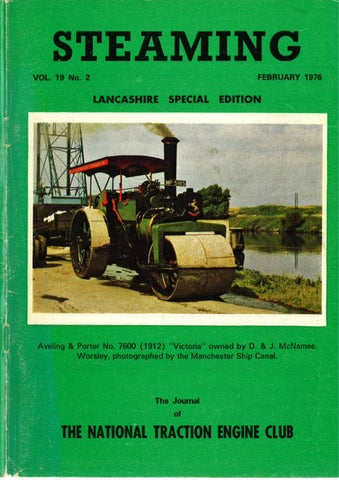
.- STEAMING FEBRUARY 1976
VOL. 19 No. 2
LANCASHIRE SPECIAL EDITION
Aveling & Porter No. 7600 (1912) "Victoria" owned by D. & J. McNamee, Worsley, photographed by the Manchester Ship Canal.
The Journal of
THE NATIONAL TRACTION ENGINE CLUB
National Traction Engine Club Officers President, and Technical Services S. J. Wharton, Esq., Southern Down, Minster Lovell, Oxford. Vice-President J. T. Beeby, Esq., Wymeswold Road, Rempstone, Loughborough, Leics. Chairman Michael R. Lane, Esq., Maple Tree Farm, Chartridge, Chesham, Bucks. Vice-Chairman J. Crawley, Esq., Field House, Turvey, Bedford. General Secretary G. F. Beck, Esq., 127 Greensted Road, Loughton, Essex. Treasurer Peter J. Banks, Esq., 9 Fernley Rise, Thrussington, Leicester, LE7 8UA. Hon. Solicitor: David Tew, M.A., c/o Fowler & Co., Solicitors, 12 High Street, Oakham, Leics. Editor Ran Hawthorne Esq., 19 Bridle Path, Woodcote, Reading, RG8 OSE, Berkshire. Chairman, Rally Sub-Committee Denis W. Brandt, Esq., 27 Tregunter Road, London SW10. Public Relations Officers London, Home Counties and South: Anthony S. Heal, Esq., Baylins Farm, Beaconsfield, Bucks. Midlands and Wales: Dick Blenkinsop, Esq., Hill Cottage, Radford Semele, Leamington Spa, Warks. Northern Counties and Scotland: Tony Parker, Esq., Foley House, The Avenue, Lincoln. Membership Secretary Mrs. F. E. Wood, 'Windrush', Hail Weston, Huntingdon, Cambs, PE19 4JY.
National Traction Engine Club Membership is open to all, whether engine owners or not, with a genuine interest in the preservation of self-propelled steam road vehicles, portables, etc. The annual subscription is £3 for individuals, £4.50 for family membership. The benefits of membership include advantageous terms for boiler insurance. The club's journal 'Steaming' is sent free to members in November, February, May and August. All articles, photos for consideration should be sent to the Editor. All correspondence re subscriptions, bankers order, delivery (or non-delivery) of 'Steaming' or change of address to: MRS. F. E. WOOD, 'WINDRUSH', HAIL WESTON, HUNTINGDON, CAMBS, PE19 4JY Please enclose S.A.E. when sending subscription or when writing to any officer if a reply is required. NEXT ISSUE, copy date 30th March.
Acknowledgements We are pleased to acknowledge the help given in the preparation of this issue by the officers and members of the Lancashire Club, the Morecambe Bay Club, all those who supplied stories or photographs or helped in any way and especially Alan Porter who wrote the bulk of this edition. Thank you all. 58
STEAMING THE JOURNAL OF THE NATIONAL TRACTION ENGINE CLUB all items are held copyright by contributor and/or N.T.E.C. EDITOR: RAN HAWTHORNE, 19 Bridle Path, Woodcote, Reading, RG8 OSE. VOL. 19 No. 2
"BLOW OFF" Steaming's Opinion Column
As we write in the latter days of 1975 we inevitably look back over the year. The club has felt - the full impact of inflation and has had to raise the subscription by 50% to be able to offer a similar level of service as before. On the credit side we can rejoice in increased membership and more clubs affiliated than ever before. On the "engine activity" side we can look back with great satisfaction on the Road Run. Every starter completed the run. A tremendous achievement. We doubt if any other group of veteran vehicles could match that for reliability! Since the Road Run many opinions have been expressed about possible future runs, some have suggested it "go round the country" but more have said it should continue in the same area. "Steaming" suggested the Road Run ("Steaming" June 1974). We now say let it remain Appleford — Nettlebed for this is "historic ground". The Veteran Car Club stick to London — Brighton, (which is nowhere near as central as Appleford— Nettlebed) because it is "historic ground". In just the same way as London — Brighton is "historic ground" to the Veteran car men so Appleford — Nettlebed is "historic ground" to Traction Engine men. In this area Arthur Napper "raced"; Giles Romanes was fined "five-bob" for carrying a motorcycle in a trailer but in con-
FEBRUARY 1976
sequence he established the rights of the preservation owners to be on the road. In this area the Club was formed. Appleford — Nettlebed is "historic ground", we have the co-operation and goodwill of the local Police force, so let us go forward, building on the foundations already laid, and establish The Road Run from Appleford to Nettlebed as a bi-ennial fixture.
Beam Engines All but the narrowest Traction Engine men will be delighted with the news that Kew Bridge Pumping Station has reawakened in steam. We will include a story in the next issue. Sufficient here to say that the trust set up to restore and steam the engines at Kew has already got the 1820 Boulton & Watt engine working and opens the station for public steamings on Saturdays and Sundays. The Crofton Society did a fantastic job to restore and steam their engines. They have shown what can be done in an isolated engine house miles off the beaten track. Since then Ryehope in Co. Durham and Kew have come to life and a number of other beam engines are being restored. When we were in Cornwall two years ago we saw some fine engines standing idle in what one regards as the "natural home" of the beam engine, and an area with a busy tourist season. May we hope that the difficulties that have been overcome in other areas will give the Cornishmen strength and inspiration to steam and run some of the magnificent engines they have inherited. N.T.E.C. items of news, etc. will be found towards the back of this Special Edition. 59
Foden No. 2564 (1912), owner Tom Barlow, at Astle Park, 1975.
Clayton & Shuttleworth No. 46059, owner, George Coles.
Photos by courtesy D. McNamee.
STEAM IN LANCASHIRE An introduction by the Editor Probably, in no other county was steam so widely used as in Lancashire. As well as the vast number of stationary steam engines; the dense railway network, both public and industrial, that was operated by steam we find what must surely be the greatest concentration of steamers in use on the roads in this county. Lancashire is, or was (we are using the new county boundaries but are also covering those areas that were in the "old" Lancashire) a densely populated county with much industry. There was a great deal of movement of machinery within the county and also from the place of manufacture to the docks. The nationally known firms of Norman E. Box and Edward Box operated all over the British Isles but the bulk of their work was within the county. Their fleets of Road Locomotives were predominantly Fowlers. The area being heavily populated resulted in a demand for amusements and many showmen were able to make a living within a comparatively small area, also there was a demand for large riding machines. These two factors resulted in many large Showman's engines being used. Engines were retained after steam had left the fairgrounds in areas where longer moves were the order of the day. Burrell, Fowler and Foster engines were used more or less in proportion to the numbers built. Agriculture in Lancashire was, and is, based on small units and small fields with many vegetable, poultry and dairying enterprises. While there was a considerable amount of threshing, ploughing engines were rarely used. With a large mileage of roads to be made and maintained steam rollers were numerous, many were at work well into the 50's and quite few into the 60's. Avelings and Burrells were the most numerous with a large number of the Burrells being of single-crank-compound design. I have deliberately left steam wagons until last for without a doubt Lancashire had the greatest concentration of steam wagons, anywhere in the world. Furthermore, steam wagons and "wagon type" steam tractors and trailers lasted much longer in Lancashire than anywhere else. Large quantities of raw materials needed to be transhipped from ship to warehouse, mill or factory. Finished goods needed moving to railway goods yards or
to the docks. The steam "Iurry" as it was called, was the ideal means of transport for these jobs. Even when punitive taxation "killed" the steamers in other areas they could still compete on Merseyside. Many were cut down to Tractors to reduce the effect of this taxation. In tractor form with three trailers; one loading, one unloading and one being transferred, the steamers became even more suitable for this heavy but short distance work. So suitable was the steam wagon/ steam tractor that many were in use long after their builders had given up manufacture. Sentinels and Atkinsons were common on Merseyside in the 50's and a few were still highly competitive in the 60's. What of the preservation scene? Lancashire was not the earliest area to form a club and at first the club looked as if perhaps it may not get "off the ground" but after starting the Burtonwood Rally the club, and in consequence engine preservation, has gone from strength to strength. It would seem to me that here is a club that has got its priorities right. They organise "A Traction Engine Rally", not a money making bonanza, not a spectacular or any other name you might hatch up. Thcy organise a rally for club members. A generous sum is given to various charitable organisations who assist by acting as gatemen, car parkers, etc., engine owners get a "fair-do" and any surplus goes into building up a reserve fund against bad weather. Besides Burtonwood, where they achieve twin objectives of (a), staging a rally for members and (b), entertaining the public they organise a number of "enthusiast gatherings" of various types. When one realises that twelve or fifteen engines are usually present one can be sure that here we have some real enthusiasts. When I paid my visit to the county in connection with this edition I think it was enthusiasm and dedication to the cause of engine preservation that impressed me most. I will not single out any members for special mention as I was not able to visit everyone and I am sure those that I was not able to visit are doing an equally good job to those I was able to see. A good many of the engines owned in preservation are engines that worked in the county. The Lancashire steam men of today are worthily upholding the glories of the past. 61
ISAAC BALL by A. Staples and Alan Porter. The name Isaac Ball of Wharles must be one of the the most well known of all the large steam engine operators of Lancashire, as well known as Box, Criddle, or Rosbottom. At the height of his threshing and rolling business Isaac Ball had around 35 engines working, both rollers and tractions (with the rollers on contracts the length and breadth of Lancashire) as well as a thriving engine repair and agricultural engineering business at Wharles. The story starts in the late 1870's when Isaac, the eldest son of John Ball, farmer and threshing contractor of Banks, near Southport, became tired of working for his father and, with his young wife, left home. The couple walked to Lytham, a town the other side of the river Ribble, possibly by using the ferry (which is thought to have existed in those days) from Hesketh Bank to Freckleton, some seven miles east of Lytham. Isaac found lodgings at a farm, where he also got work, and remained there until he started up his own threshing business by buying an old, second-hand Marshall engine in 1881. Shortly afterwards he moved to the little village of Wharles where he obtained a site to build a workshop and have yard space for the engines and machines he now owned. About 1890, or perhaps a little earlier, Isaac was joined by his younger brother John, who also had tired of working for his father at Banks, and had gone to live at Winmarleigh, a village close to Forton. Now known as I. & J. Ball, the business prospered at Wharles and in 1890 a new 8 hp sc Marshall engine was ordered, to be followed the next year by another 8 hp sc Marshall and a new 7 hp, Burrell, with a third new Marshall engine being added in 1892. By 1893, however, Isaac was back on his own. John had left and set up business at Forton, some 10 miles north of Garstang, taking with him the 1892 Marshall engine, no. 21049. To replace this engine Isaac ordered another new sc Marshall, no. 23885, which was built to Isaac's own instruction, having the gears outside the hornplates (Burrell style) and short wheelbase. This engine was delivered in 1894. This was the last new Marshall that Isaac ever bought for by now he had become a friend of Mr. Charles Burrell, Engineer, of Thetford who, in the years ahead, became a frequent visitor to Wharles. 62
Isaac Ball. Isaac Ball, who was born in 1859, had a large family; four daughters and three sons, William, Peter and Thomas, who all took an active part in the business at Wharles. William Ball, Isaac's first son, worked at home until he married, when he then left to join his uncle, John Ball at Forton, and help him run his threshing business. Certainly by 1895 John was prospering on his own, for he had by then purchased a new 6 hp Ruston Proctor engine no. 19510 and a new 6 hp sc Marshall no. 25382, in addition to Marshall no. 21049, and in 1899 he purchased from Burrells a new 7 hp
single cylinder engine no. 2159. William eventually took over the running of the business from John about 1924, as John
had no family and William's son, also called William, was to take over from his father in later years. Isaac's second son, Peter, was apprenticed to Charles Burrell at Thetford, who was by now (the early 1900's) a firm friend of the family. Peter stayed on at Thetford after his apprenticeship, eventually rising to foreman, and he did a lot of field work for Burrells, taking out new engines to their owners and showing them, or their men, how to operate and service the engine properly. Peter was personally involved in building many engines, in particular no. 3297, a spring mounted, three-speed, 6 hp, dcc engine, which was new to his family in 1911. Shortly after completing this engine he left Burrells and joined his father at Wharles, but didn't stay long, however, and became Engineer for Lancashire County Council in charge of all repair work, a job he held for many years, although he was always available to give advice to the family business. With his great knowledge of engines he also did private work for many engine owners and it wasn't long before he knew most engines in the county in great detail. Peter was involved with engines right up to the last, restoring Burrell scc engine no. 2950 at Forton in 1959 and Burrell no. 2513 at Lea Gate Garage in 1960. One of his last jobs was to retube Burrell No. 3484, a 10 ton sc roller which was still in commercial use at the time. Unfortunately Peter died in the mid 1960's, before rallies had really become established in the area. Thomas Ball, the third son of Isaac, was born in 1889 and when old enough was apprenticed at Vulcan Motors, Crossens, near Southport and when his apprenticeship finished he returned to Wharles and assisted in running the firm, eventually taking over the running of the firm on Isaac's death in 1943. Although he was a time-served motor engineer, Thomas was a keen steam man and it is thanks to him that so many of their engines survive today, for he would not allow any to be cut up, as happened at Forton. Thomas's two sons, John and Victor, are running the business today. John, the eldest, was first an apprentice engineer with a firm of millwrights, Stevenson of Preston, before joining the family firm as a driver and fitter. He rose to foreman and took over running the business on his father's death in December 1959, being the present Managing Director. Victor, Thomas's second son, was apprenticed to a welding firm in Preston before joining the business as a
Tom Ball. driver, and he drove the Garrett tractor no 33459 (TC 64) for many years. The youngest member of the family in the business is John's son David, who is now a driver and fitter. Not much is known of Isaac's four daughters, except that all four worked in the business at some time, as clerks, etc., until they married, although one (who was married to a local businessman) remained as Company Secretary until the late 1950's. But back to the early 1900's and Isaac Ball. After becoming a Burrell agent business really began to increase (as well as his fleet of engines), for Isaac not only took on more threshing work and engine repairs but branched out as a rolling contractor. ❑uring the summer months the threshing sets became idle and Isaac didn't like equipment lying idle. and so to keep men and engines at work he turned to making-up local farm roads, using the rear straked wheels of his engines to crush and roll the stone. The results were far from satisfactory, compared with those of other farm roads which had been rolled by a steam roller, and so as not to lose this business, Isaac was resolved to doing something about it. It is believed he had words with his friend Charles Burrell about the problem of threshing and rolling and suggested the 63
Isaac Ball's yard at Wharles in the 1890s.
Photo courtesy of Alvin Cook.
idea of a convertible traction engine to road roller to him, and not long after this type of engine came into being. It was around this time, the Preston Guild Celebrations of 1902, that Isaac was firmly established as the main agent for Burrell engines in the area and until the collapse of Burrells in the early 1930's he supplied many engines to contractors and local authorities, as well as a few showmen. At the Royal Lancashire Show of 1902 (which was part of the Preston Guild celebrations) Isaac had a large stand and showed four brand new Burrell traction engines, nos. 2511, 2512, 2513 and 2514, the two 6 hp scc engines (nos. 2512 and 2513) were kept by Isaac and the other two, both 7 hp scc engines, were sold. Isaac's first convertible TE/RR, however, came new from Burrells in 1903, being no. 2626 (which was not converted for threshing until 1941), and was followed at regular intervals by six more brand new Burrell rollers during the next 10 years, the last one being a 10 ton sc roller no. 3484 in 1913. During the early years of this century Isaac was also buying more new threshing engines, so that by the outbreak of World War 1 he had a least ten engines and threshing sets and seven rollers, the rollers being employed mainly on contract work for the Lancashire County Council. During the Great War Isaac bought two
more engines, both second-hand, and several more tractions and rollers were acquired during the 1920's, for there was plenty of work to be had in the area. Isaac threshed on the Fylde, his area stretching from the river Ribble to the river Wyre and west of the main A6 road, while his brother John, operating from Forton, threshed an area north of the Wyre and east of the A6 — they seldom broke these boundaries. On the rolling side, however, there was no set territory and Isaac's rollers could be found as far north as Barrow, in the Furness district of Lancashire, and as far east as Bacup. When threshing in the early days and before the telephone was widely used, Isaac's means of communication with the yard at Wharles were ingenious. If an offer of work came while he was out threshing, his wife would telegram the information from Kirkham Post Office (the nearest one to Wharles in those days) to the nearest Post Office where Isaac was working, and when finished for the day Isaac would then call in to collect the news. Another method used by Isaac was postcards. Shortly after he became agent for Burrells he obtained a quantity of postcards advertising Burrell's products and distributed these amongst his customers so that all they had to do was fill them in and post or send the card to Isaac.
64
ABOVE: Burrell 3297 "Mauretania" — built by Peter Ball. Seen hauling a tar tank soon after delivery. Note polished hub caps, fly wheel. Photo courtesy A. Staples. The years before the First World War saw Isaac's eldest daughter using a pony and trap to give Isaac information, supply bailing wire to the sets, collect money from the farmers, and in general run around from customer to customer. By the time war came in 1914 Isaac had a telephone and this practice ceased. About this time, too, Isaac ceased threshing himself, and travelled on his rounds to his customers and men on a motor cycle (believed to have been a De Dion Bouton). This was replaced by a Ford model 'T' when the war finished. During the war Isaac started another agency, that of binder twine. The local farmers found it more convenient to buy it from Isaac rather than obtain it direct from the manufacturer, as this would entail a long trip to the big towns, such as Preston. Soon the term 'Old Isaac' for binder twine became commonplace, and is still used to this day on the Fylde. As the threshing and rolling business increased so, too, did the repair work. By 1925, and for the next 10 years or so, all manner of work was being undertaken at Wharles, not only on Isaac's own engines and machines, but also for other owners and local authorities. Indeed, repairs to steam engines were still being carried out in the late 1950's. The range of machinery at Wharles was extensive and such jobs as a complete rebuild, reboilering, reboxing, retyring rollers and reboring cylinders were
undertaken, while such jobs as retubing, rebushing axles and bearings, replacing smokeboxes, were commonplace. Agricultural implements, too, came in for repair and they even built their own living vans. The years leading up to World War 2 were ones of great activity and continual expansion, except for a brief spell around 1930 or 1931 when for once, and only once, all the engines were without work and came to the yard. There were so many that some had to be stored at local farms until required. Although Thomas, Isaac's youngest son, was running the business, no major decisions were taken by anyone but Issac, and it was not until Isaac's death BELOW: Isaac in his Ford "T" visiting a Roller in the 1920s. Photo courtesy Alvin Cook.
65
Retubing Burrell S.C.C. No. 2706 "Admiral Togo" April 1958. No. 3297 "Mauretania" Both photos by G. Hayes. is on the right. in 1943, at the age of 84, that Thomas fully took over the business. A fire in 1938 or 1939 at the yard destroyed many threshing sets and damaged several engines as well as damaging the buildings and destroying the overhead crane which they had. However, the engines were repaired, more threshing boxes obtained and it was just as well, for when the Second World War came Ball's became busier than ever. More engines were acquired, mostly second-hand rollers or tractors for conversion into rollers, as a great deal of rolling work for the War Department was obtained, mainly at the new Army camps which were springing up and the airfields at Inskip (which was on their doorstep) and Salmesbury. In addition to this, of course, there was still the regular contract work to be done for the Lancashire County Council. In common with other threshing contractors at this time, their business went wild, and some 15 sets were in action employing around 80 men, and with nearly 20 rollers at work and repair shop was also kept very busy. The firm employed so many men at this time that they were able to run their own football team in the winter months and a cricket team during the summer. 66
The threshing work continued for a short while after the war much as it had done, but it began to decline during the years, and the advent of the combine harvester didn't help. Another blow came to the firm about 1946 when the Lancashire County Council decided to employ their own rollers and as a result the regular, and quite extensive, roller work was terminated. However, Thomas concentrated all his efforts on road making and repair work and gradually the agricultural work diminished. During the mid 1950's there was a series of mysterious fires in the Fylde district and about 1956 the yard at Wharles was also hit. Although a lot of equipment was rescued damage was still extensive, many threshing machines were lost, the old sc Marshall engine no. 23885 was ruined and an enormous amount of equipment and specialised tools were destroyed, the total extent of the damage amounting to around £18,000. The firm gradually recovered from this catastrophe but not long after, in 1959, another blow hit the firm when Thomas Ball died at the age of 70. John, his eldest son, took up the reins and during the 1960's concentrated on road work, today the firm is busily engaged on road making and maintenance.
A line up in Ball's yard August 1956. The roller nearest the gate was built from a Mann tractor. The Engines of Isaac Ball and Sons — Compiled by ALAN PORTER. The majority of the information contained in this list has been compiled from the records of the R.L.S. whilst additional information from various sources has been included to give the most comprehensive record possible of the engines once owned and used by this famous contractor. Also included in the record are the engines of Isaac and John Ball, the forerunner of Isaac Ball and Sons. An interesting fact to emerge from the list is the high number of engines which have survived, out of a total of 44 engines owned no less than 23 are in preservation today. Burrell No. 915, 8 h.p.; s.c. T.E., bought in 1885 from W. Grime of Preston later sold to W. Hailstone, Yarwell, Northants. Marshall No. 6984, 6 h.p.; s.c. T.E., bought in 1891 from Rimmer & Higson, Walsall. Marshall No. 18633, 8 h.p.; s.c. T.E., new to I. and J. Ball in 1890, but sold by 1921. Marshall No. 19701, 8 h.p.; s.c. T.E., new to I. and J. Ball in 1891. Burrell No. 1527, 7 h.p.; s.c. T.E., new to I. and J. Ball in 1891, but sold by 1907. Marshall No. 21049, 6 h.p.; s.c. T.E., new to I. and J. Ball in 1892, later sold to J. Ball of Forton. McLaren No. 159, 6 h.p.; s.c. T.E., built in 1883, bought by Isaac Ball from W. Ormorod of Milnthorpe and later re-sold.
Marshall No. 17718, 6 h.p.; s.c. T.E., of 1889 (TB 2842), bought from J. Johnson about 1921. Marshall No. 23885, 6 h.p.; T.E. (TB 2843) built 1893 and purchased in September the following year by Ball's. Still in their possession, derelict but scheduled for restoration. Burrell No. 1655, 8 h.p.; s.c.c. Showman's Engine, built in 1892. Bought about 1919 from Connelly Bros. of Blackpool, rebuilt about 1920 as single cylinder engine, then later sold and scrapped around 1935. Burrell No. 1715, 6 h.p.; s.c.c. T.E. (TB 2844) of 1893, purchased from J. J. Daggars of Blackpool around 1917 and sold in 1922. Burrell No. 2112, 6 h.p.; s.c. T.E. (TB 2849) of 1898, went into preservation in 1960 to present owner, J. Clegg of Warburton, Lymm, Cheshire. Burrell No. 2512, 6 h.p.; s.c.c. Devonshire T.E. (TB 2846), bought new in 1902, went into preservation about 1965, now owned by D. Goddard, Montford Bridge, Shrewsbury. Burrell No. 2513, 6 h.p.; s.c.c. Devonshire T.E. (TB 2847), bought new in 1902 and now in preservation, owned by R. Morris, Lytham Creek, Lytham, Lancs. Burrell No. 2537, 8 h.p.; d.c.c. Road Loco of 1902, bought in 1916 from Abbott & Barber of Norwich, eventually sold to Connelly Bros. of Blackpool. 67
Burrell No. 2626, 6 h.p.; s.c.c. Convertible T.E. (TB 3717) bought new in 1903. Went into preservation in 1971 to present owner, J. Armer, Cockerham, Lancaster. Burrell No. 2642, 12 ton s.c.c. Roller (TB 3776), built 1904, bought from J. Ball of Forton, Garstang. Went into preservation in 1968 to present owner, J. Webster, Tarleton, Preston. Burrell No. 2649, s.c.c. Roller (TB 3779), built 1904, bought from J. Ball of Forton. Went into preservation in 1974 to present owner, B. and H. Rawstone of Blackpool (relatives of Isaac Ball). Burrell No. 2706, 6 h.p,; s.c.c. Devonshire T.E. (TB 2845), bought new in 1904 and now in preservation, owned by North Staffs and Cheshire T.E. Club. Burrell No. 3128, 10 ton s.c.c. Roller (TB 3721) bought new in 1909. Burrell No. 3220, s.c.c Roller (TB 3719), bought new in 1910. Went to C. Woodend & Sons, Milnthorpe, Cumbria in 1974. Burrell No. 3297. 6 h.p.; d.c.c. T.E. (TB 2848), bought new in 1911, went to J. Keeley of Knowle Hill, Reading, and still in his possession. Burrell No. 3298, s.c.c. Roller, bought new in 1911 but by 1921 had been sold to J. Ball of Forton. Burrell No. 3305, s.c.c. Roller (TB 3722), bought new in 1911 and sold about 1964. Now owned in preservation by P. J. Barnes, Woodley, Reading. Burrell No. 3388, 12 ton s.c.c. Roller (TB 3718), bought in 1912 and worked up to 1951. Went into preservation in 1969 to present owner, P. Clare, Heywood. Burrell No. 3398, 5 h.p.; d.c.c. Convertible T.E. (TD 264), new in 1912 as a Roller to Fylde R.D.C., used for threshing by Isaac Ball. Went into preservation in 1971 to the late F. Preston, Cabus, Garstang, and now used by his son. Burrell No. 3484, 10 ton s.c. Roller (TB 3720), bought new in 1913, went into preservation in 1962 to present owner R. Morris, Lytham, Lancs. Burrell No. 3618, 5 ton d.c.c. Tractor (TD 4276), built in 1914 and bought second hand. Went into preservation and now owned by R. Preston, Potto, Northallerton. Burrell No. 3808, 5 ton d.c.c. Tractor (AH 570) built in 1919 as Tractor. Purchased by Isaac Ball in 1944 and used as a roller. Went into preservation in 1969 to present owner, G. Howard, Banks, Southport, and restored to original. Burrell No. 3841, 7 h.p.; s.c.c. T.E. (TB 2864) built in 1920 and bought from H. Bimpson of Rainford, near St. Helens. 68
Burrell No. 3862, 5 ton d.c.c. Tractor (MA 8472) built in 1921 as a tractor and used in Malpas area. Bought later by Ball's and used as a roller. Went into preservation in 1969 to present owner J. Johnson, Banks, Southport, and restored to original. Burrell No. 3929, 10 ton s.c. Roller (TC 1678) bought new in 1921. Went into preservation in 1968 to present owner J. Tomlinson, Bury, Lancs. McLaren No. 192, 8 h.p.; s.c. T.E. (TB 2850) built in 1864, purchased from J. Johnson of Wigan around 1920. Aveling & Porter, No. 3616, 15 ton d.c.c. Roller with 0.H.V. (TB 8166) built in 1895 and bought from Chorley, Corporation. Fowler No. 7456, s.c. Roller (TF 2544) bought second hand around 1930. Aveling & Porter No. 3681, 12 ton comp. Roller with 0.H.V. (TF 4059) built in 1896, bought in 1943 from Longridge R.D.C. and sold in 1958. Aveling & Porter No. 5438, 15 ton comp. Roller (TB 6046) built 1904, bought from Lancashire County Council. Aveling & Porter No. 7583, 10 ton s.c. Roller (TF 395) built in 1912, bought from Preesall U.D.C. Went into preservation in 1974 to an enthusiast in Slaithwaite, near Huddersfield. Fowler No. 12905, 10 ton comp. Roller (KE 2838) bought in 1930 from J. Ball of Forton. In 1964 went to playground at Warton. Garrett No. 30959, 5 ton comp. Tractor (BJ 1458) built in 1912 purchased in 1944 and used as a roller. Went into preservation in the early 1960's to the late T. Alberts of Bolton and now owned by T. Varley, Gisburn. Garrett No. 33459, 5 ton comp. Tractor (TC 64) built in 1919 bought in 1944 from Lancashire C.C. Went in 1956 into preservation, now owned, as a Showman's Tractor, by J. C. Tennant, Askrigg. Ruston Proctor No. 52573, 5 ton comp. convertible Tractor (TF 8240) built in 1918. Purchased from Isle of Man in 1932 and went into preservation in 1964. Now owned by Dr. L. J. Cully, Calmore, Hants. Mann (No. unknown) comp. Steam Cart (TF 2598). Bought from Fylde R.D.C. Sold to L. Cole of Leeds and now owned by G. Proctor, Nidd Bridge, Harrogate. Aveling & Porter (No. unknown) 10 ton Roller (VN 192). Bought from J. B. Souter, Kirklevington, in 1929 and worked until 1940, when scrapped.
THE JOHNSONS OF BANKS By ALAN PORTER. To most readers the name Johnson of Banks will be synonymous with Steam Parties and engine restoration, but this aspect of the family is, however, a comparatively new venture and only one side of the story, for long before preservation came about the Johnsons had been earning their living from steam, as threshing contractors and, latterly as agricultural engineers, too. For over a century the Johnsons have been around Banks, a small village some four miles North East of Southport, and which is those early days was a mere hamlet, compared with today. Certainly by 1872 Jack's great uncle Steve Johnson had settled in Banks and was running a threshing business with one ancient horse drawn portable engine and threshing box. Later his nephew, Henry Johnson, worked the set for him, being paid £40 a year, and he was expected to have the set ready for work at any time of the day or night, Saturdays and Sundays alike, whenever and wherever there was work to be had. And in those days there was no excuse for being unprepared.
olo 4
Henry Johnson, Jack's grandfather. In 1897 the portable was replaced by a brand new single cylinder Marshall engine, No. 28452, with the old box being retained. For a time the set continued to be owned by Steve Johnson with Henry employed as driver, then the two went into partnership and eventually, around 1908, Henry took the business over completely. During the years at the turn of the century Henry would walk to wherever the thresher was working, which could mean a trek of anything up to seven miles, and then return by the same means in the evening. Before long, however, he got tired of this and so purchased a bicycle, becoming the first man in Banks to own such a machine.
Steve Johnson.
About the outbreak of the Great War Henry's two sons, Peter and John William Johnson, began work in the business and in 1915 a second engine was purchased to help cope with the extra work that was now available. This engine was a new 3 speed 8 h.p. d.c.c. Burrell, No. 3640, with sprung rear axles and was bought for a special reason. With most farms in the 69
Peter Johnson and Marshall 28452(97) on war work 1915. area being on the small side threshing only lasted a few days (as opposed to weeks or months in some areas of the country) and it was a regular practice to travel the set to the next farm immediately after finishing threshing, even if it meant driving after dark. As the distance could be anything from 5 to 15 miles, a fast engine would make the job easier and, more important, ensure that the set was ready for work first thing the next morning, instead of mid-afternoon or the following day as could often happen with a slow two speed engine. However, the idea of expanding the business in 1915 was soon crushed, for not long after delivery of the Burrell the War Department commandeered the old Marshall and baler, and young Peter as well, for hay baling. So the Burrell, along with the old threshing box, was run by Henry with John William as driver, and this arrangement lasted for the duration of the war. After the war the Marshall No. 28452 and Peter were returned, another threshing box and baler were obtained for Burrell 3640 and for the next seven years or so Henry Johnson ran two sets of tackle. In 1926 the old Marshall was sold (and, incidentally, was last taxed in 1947 in the new 3 speed 8 h.p. d.c.c. Burrell, No. 70
Wisbech area) to be replaced by another 4050, which was driven by John William. With these two fast and powerful Burrells, Henry Johnson became a very competitive threshing contractor, extending his area from the outskirts of Liverpool in the south, to Wigan, and Preston in the north. Business was very good during the late twenties and early thirties for the Johnsons and John William began to take more responsibility in running the business with his father, Henry. The situation was partially forced upon John William as a severe accident in 1930 involving an old Ruston baler, guillotined his right leg below the knee and left him somewhat confined to work in the yard at Banks. When, in 1936, Whitesides of Hesketh Bank (a village some 5 miles north of Banks) ceased threshing John William bought a third set from them. He didn't particularly want the set or the Fowler engine which drove it, for by now he was a confirmed Burrell man, a conviction which came about through his close association with Peter Ball of Isaac Ball & Sons, Wharles. But John Willy (es he was known) did want the driver, one Joe Lea, and the customers he could bring. On selling the Fowler (to Robey of Melling) he bought a set from Powell of Knowsley at a cost of £150, which was
John William Johnson (centre) Jack's father, and crew pose in front of one of the Burrells. powered by a 2 speed s.c.c. Burrrell, No. 2511 (FY 3888). Joe Lea was put in charge of this set, and worked on his old rounds.
JACK Around this time another new face had joined the now expanding business, and this was John William's son Jack, the Jack Johnson we know today. Jack would be a lad of about 15 at the time and for his first full time employment with his father he was put to carrying chaff with the newly acquired set, a task for which he received 5/- a day. About 12 months later Jack was promoted to wiring the baler and got all of 9/- a day, a rare promotion as normally a man would be 25 or 30 before he did this jojb. The only way in which Jack could learn the arts of threshing was by keeping his ears open and watching how the others did their jobs, for they were loath to teach anyone for fear of losing their own jobs. It was the same with driving, a job Jack was longing to do, but the only way he could gain experience was to do favours for Joe Lea or the other drivers. These favours included such tasks as cleaning the engine during the lunch break
or carting a barrow load of coal. Then the driver might, just might, let Jack start up the set or give him some instruction. These tactics, however, were to prove vital for Jack, as the following year the opportunity to drive arose. Jack's father was now running the s.c.c. Burrell as a temporary engine and was looking for another 3 speed Burrell to make the third set as mobile as the other two. He got what he wanted from Arthur Cole of Sleaford, a 1921 d.c.c. Burrell No. 3875 which had fenland wheels, four inches wider than normal and was still on strakes. Joe Lea was put in charge of this engine with Jack still on wiring and receiving instruction as before, but shortly after delivery of 3875 the driver of Burrell 4050 suddenly left. Without hesitation Jack nipped in and persuaded his father that he could do the job. He was put to the test and given the job, knowing full well the consequences if he failed, for John William was a hard employer, even to his son. But the instructions received from Joe Lea and the others, and Jack's own initiative, were good and at the age of 17 Jack became the full-time driver of their No. 2 set, at £2.10.0 a week. Henry Johnson died just before the outbreak of war and the business was then run by the executors of the estate and it 71
Burrell 4050 soon after being delivered new to Johnsons in 1926. was not until 1941 that Jack's father was able to buy out the other beneficiaries of the estate. Until this time John William managed the day to day running of the firm, organising the threshing and the repair work which was now flooding in. Previously most of the repairs were carried out either by Peter Ball, or Jones of Preston, but the conditions forced the Johnsons to repair their own machinery as well as for others, and so commenced a new side of the business. It was now that Jack began to gain valuable experience on engines, particularly BurroIls, for he was expected to lend a hand on the repair work after he'd finished a day's threshing. Such jobs as re-tubing, re-staying, scraping bearings and valves became second nature to Jack and he could strip an engine in a couple of days. Most of the repair work was done in the yard in the open, rain or fine, summer or winter, for there was little covered accommodation, unlike today.
RUBBERS One of the first major jobs to be carried out, however, was the rubber tyring of Burrell 3875, a job which was entirely done by manpower as electricity had not come to Banks at this time (and did not 72
come until 1941). First the strakes were removed using the big sledge hammer and set, an operation carried out by William Leadbetter, who could split each rivet after three clean blows from the 201b. sledge hammer. Fresh holes were then rachetdrilled by hand in the wheels before the rubbers themselves were drilled. When 3875 had been rubbered it was the turn of 4050, but to make life easier and the job a bit quicker, a device was erected from the flywheel boss of the engine and 4050 really drilled its own wheels! By now the Johnsons were becoming experts at rubbering and not long after Burrell 4050 had been completed a local threshing conntractor, E. D. Robinson, sent one of his engines to be rubbered. It was while drilling the rubbers with the rachet drill that an amusing incident occurred involving John William's wooden leg. Robinsons had sent one of their men to assist with the manual work and while this man was doing the drilling, with Mr. Leadbetter assisting and J.W. looking on, he dropped the heavy drill and it came crashing down on John Willy's foot. Of course, he never felt a thing and just walked away. The man was absolutely astonished, exclaiming, "By gaw, he's tough!". to which Mr. Leadbetter replied, "Drop it on t'other foot an he'll kick thee
out o't yard." And John William would, too, for he was a powerful man despite his disability. While the repair work to engines and machinery was going on during the early years of the war John William had also been building up a very successful business in buying, renovating and selling second hand engines and threshing sets, in addition to taking an ever increasing amount of threshing work. The need for more threshing sets to cope with the extra work was becoming obvious and about 1942 it also became clear that the s.c.c. Burrell 2511 was not satisfactory for the heavy demands being made upon it. John William began to look for something more powerful and speedy to replace No. 2511 and for some more engines, but they had to be Burrells. There were at this time many showmen's road locos available and John William bought three 7 h.p. d.c.c. Burrells, the 8 h.p. engines being to heavy and clumsy for his requirements. One of these engines was bought from Deacons of Brynmawr, Burrell No. 3952 "Modesty" built in 1923 and another was obtained from Grahams of Glasgow, Burrell No. 3512 "Nonesuch" of 1913, but they did not last long as they were past their best before the Johnsons got them. All three were in need of constant attention and Jack can
testify to that as he did drive them from time to time. John William replaced them with two, smaller, 6 h.p. Burrell tractions, No. 3782 and No. 3813, both double crank compounds and sprung on the rear axle. When delivery was taken of 3813 J.W. was horrified at the sight that met him, for the engine had been used on tar spraying work and was covered in the stuff. It was a disgrace compared with the other engines and machinery in the Johnson fleet, which were always well maintained and smartly turned out. There was only one thing for it, the engine would have to be repainted and the quickest way of removing the layers of tar was to set the engine on fire! This was duly done and it wasn't long before No. 3813 emerged all smart in her new livery and in keeping with the rest of the Johnson tackle. It was given to the charge of Peter Johnson, Jack's brother and John William's youngest son, who drove the engine for the rest of the war.
FODEN Demand for threshing during the war was intense, as was the competition, and at times things became really hectic for the Johnsons. One particular time Jack
Foden 341 7 h.p. compound "Wave To Me" with Jack Johnson by rear wheel. 73
was threshing one Saturday morning near Parbold with Burrell 4050 and as was normal practice after he'd finished, he had to move the set to the next job ready for Monday morning. On the Monday, however, he was instructed to drive Peter's engine, Burrell 3813, and finish that day before moving to Dixon's farm ready for an early start on Tuesday. All went well with 3813 on the Monday, the job was completed in good time and Jack moved out. On arrival at Dixon's farm the tubes were leaking profusely and Jack just about managed to get the set into the yard before the Burrell gave up. Once home Jack reported the situation to his father. As there was no spare engine and time was short his father, unknown to Jack, that night phoned another farmer who had an old 7 h.p. Foden compound engine, No. 341, bought it, sent two ment to steam it out and take it to Dixon's. When Jack arrived on his bicycle next morning there was the strange engine in place of the Burrell, all ready to be belted up to the tackle! Jack drove the Foden all that winter and the following summer, but the following year, 1944, Jack was back on his favourite Burrell No. 4050, while the Foden was driven by another of their men. It finally found its way into the care of Joe Lea, who's own Burrell had developed leaking tubes and was in for repair. Joe took an instant dislike to the Foden, but he only had it 10 days before he finished threshing for the season. On the way back to the yard he parked the set outside a pub, where he took some refreshment, and on coming out was heard to comment to his steersman, "Give me a tank of water an' a load of coal an', I'd take it where no one would ever find it. That darn thing is fit for nowt but blocking up a hole in hedge."
TRACTORS At the height of the business during 1944/1945 Jack's father had seven threshing sets and 21 stationary balers in action, and he carried on much the same just after the war until the coal shortage of 1946/47 slashed the business to three steam sets. John William tried to continue with steam, his customers as well as himself preferring it, but the demand for his services was still great and he had to give in to tractors if he wanted to continue with as much business as before. In desperation he ordered three brand new Field Marshalls at a cost of £750.00 each. Un74
fortunately there were a failure and the following year were replaced with P6 Fordson tractors, which weren't much better. However, he found that the TVO Fordson Major was ideal and ordered seven. That was the end of steam threshing for the Johnsons. The engines were laid up and not long after were cut up in the yard, the only one to survive was Jack's engine, No. 4050, which was retained for any tree pulling jobs. But this didn't last long and in 1955 it did its last job, pulling up the trees for the present large building at Banks. Then it, too, went to the scrapman in bits, being cut up on the spot in the yard.
ON HIS OWN In May 1950, Jack got married and within a short time started a threshing business on his own account, buying one of the Fordson sets from his father for £100 per year for 10 years. He soon built up a good round in another area away from his father, for there was still a lot of threshing to be had. When, however, no threshing was available Jack turned his hand to building farm trailers or any repair work at the little workshop he had built at a local farm. In 1952 Jack branched out into tree pulling and recovery work when he bought a 1947 TVO Fordson Major tractor for £16 and fitted a winch on it. He continued with threshing and tree pulling throughout the 1950's and up until 1965, making quite a success of it. It was around this time that Jack became interested in the traction engine rallies which were now gaining in popularity and when time allowed he would visit a few. In 1960 he went to rallies at Woburn Abbey and Jodrell Bank and it was here that the desire to own a steam engine of his own was really fired. But Jack knew that if he was ever to get one he would need a bit more capital, and that meant concentrating on his work. There could be no more visits to rallies for a few years. So he continued building his business, changing from threshing to combine harvesting in 1962 and buying a new and bigger combine the following year. Meanwhile, back at Banks, John William Johnson carried on threshing with the tractors during the 1950's, then changed to combining at the same time as becoming an agent for combine harvesters, as well as continuing with agricultural engineering. This continued until the death of John William in July 1965, when the
Burrell 3862 built as a tractor, converted and used by Isaac Ball & Sons, purchased by Jack and restored as a tractor, "Harvester". Photos by courtesy B. D. Stoyel. business was then run by his younger son Peter, but he couldn't make a success of it and so he sold everything and turned to greenhouse cultivation. Jack bought his father's premises at Banks in 1967 from the other members of the family and transferred his contract combining and flourishing recovery and tree pulling business to Hoole Lane. He now had a great big shed with very little in it, a stable business and no capital! But Jack felt he could now fulfil his dream of the early 1960's and acquire a traction engine and it wasn't too long before he got it.
"HARVESTER" Being brought up on Burrells it had to be such an engine and knowing that his friends at Wharles, Isaac Ball & Sons, had several Burrell engines lying in their yard, Jack went there and acquired a 4 h.p. 3 speed, 8 ton compound roller, No. 3862, which had been converted from a tractor by Balls before the war. In October 1968 it arrived at Banks, rusting and derelict but with a good boiler and by March 1969, after only five months of intensive effort, it had been fully restored into its original form as a tractor. At the same time as
No. 3862 was acquired another Burrell, a 15 ton s.c.c. roller No. 2642, was also rescued from Ball's by Jack, for his friend John Webster of nearby Tarleton. The roller went to Hoole Lane and long hours were also spent on restoring the roller from a rusting hulk to concours condition. It was completed not long after Jack's tractor had emerged and the two were put on show with a few other local engines during Easter 1968. This was the start of the now famous Banks Steam Party, which since its beginning has donated a colossal £12,500 for various charities in the Southport Area, a total Jack hastens to point out which could only have been achieved by the enthusiasm of his helpers and the engine owners who attend the Banks Steam Parties. Once Burrell 2642 was finished another Burrell found its way into the workshops of Jack Johnson. This was George Howard's newly acquired wreck from Balls and another 4 h.p. d.c.c. tractor, No. 3808, and during the next twelve months this engine was given the treatment, including new firebox, tubeplate and full length canopy. Ever since the late sixties there has been a steady flow of engines going to the "Banks Engine Works", some for minor 75
The Johnson family by "Harvester", October 1975, left to right, Alan, John and their Photo J. G. Stevenson. father Jack. All wearing clogs.
repair and others for major overhauls, jobs which Jack has fitted in with his other business. And steam engines have not been the only items to be restored at Banks, for apart from his own collection of farm implements Jack has tackled the restoration of an old horse drawn bus, old farm implements and ploughs, a horse drawn furniture van and a genuine gipsy caravan. 76
Today with his two sons, John and young Alan, Jack Johnson not only has enough engine and restoration work to keep him busy for years ahead but also has ample combining and winching work to ensure that he will remain firmly established in the area, so continuing the name Johnson of Banks. All photos in this story are by courtesy of Jack Johnson unless otherwise stated.
MEN OF STEAM - ERNIE COOPER By ALAN PORTER.
From the early years of this century to the mid 1960's Ernie Cooper has made his living from steam, first with the threshing gang, then on furniture removal work and finally on road making and rolling. Ernie was born in 1899 and brought up in Balterley, a little hamlet lying on the Cheshire/Staffordshire border, near Crewe, and he well remembers the house as it was the last house in Cheshire. Next door was half in Cheshire and half in Staffs., while the third was all in Staffordshire! His father was employed by Joseph Carter of Betley, near Newcastle-under-Lyme, a threshing contractor who had two single cylinder Foden Traction Engines of 1888 vintage. Both were fitted with "Burrelltype" springs and the only two ever made of this type. One was called "Village King" and the other "Village Queen", the plate of which survives on a Robey Tractor, and it was one of these engines which his father drove, and incidentally, on which all Ernie's brothers were to learn the art of driving steam.
THRESHING The first time that steam and Ernie Cooper came together, was when, as a lad of nine, he was put to chaff carrying with his father's set of tackle. It was a dirty job and one not liked by the young boy, especially as the pay was a mere 3d. a day, and no more than 6d. at the best of times. One compensation, however, was that the gang were always fed by the farmers in this area, on most visits breakfast, dinner and tea would be provided. Another job which Ernie detested with the threshing gang was water carrying for the engine. Some how whenever Ernie had just filled the tank to the top the driver would invariably turn on the injector and so Ernie would have to pick up the two great buckets and start carting again! When Ernie was 15 years old he left the farm work for the coal mines, going to Minnie Pit at Audley, not far from Newcastle, Staffs. He was there for three years, until one day in January 1918 a terrible explosion ripped through the mine
killing nearly 200 miners. Ernie's last duties in mining were involved with the rescue and recovery of 47 bodies from the disaster. Not long after this disaster the pit was closed so he enlisted in the Army, in the North Staffordshire Regiment and on the day he signed on in Staffs. the Cheshire Constabulary were out to arrest him — for failing to enlist in the Army! Apparently red tape had got itself all of a twist and issued two sets of call up papers, one for Ernie Cooper of Staffordshire and one for Ernie Cooper of Cheshire! July 1918 saw Ernie and the North Staffs. Regiment in service in France at Ypres where muck and bullets were the only things to occupy his mind.
SENTINEL After demob from the Army, Ernie and steam came face to face again when, in April 1919 he was employed by C. F. Chinnery and Co. Ltd., furniture removers of Southport, as second man to his brother George, on a 1916 Standard Sentinel Wagon with trailer. It was now that Ernie began the basics of driving steam, for these early Sentinels would often test the driver and his mate to the limit. The smooth solid tyres and the rough narrow roads at this time didn't help to make life easy, and driving at night was a positive nightmare, for oil lamps gave absolutely no illumination at all. Frequently they ran off the road into ditches and got stuck, while the single gear was a plain nuisance, for every time a hill with anything like a steep gradient was encountered, it was stop, select (or guess!) one of the low speed sprockets (of either 9, 10 or 12 teeth), remove the driving chain, change the sprocket, replace the chain, proceed up the hill, stop and reverse the changing procedure, and get going until the next hill. If Ernie had a bob for every time he has done this manouvre, he'd own a Showman's engine, now! Furniture removing took the two brothers all over the place, frequently to London. On such a trip they were allowed three days to get there, one day to unload, one or two days to load a return con77
Ernie and his brother by the 1916 Standard Sentinel of Chinnery & Co. Ltd. trip, at Stafford, this time the offender was snow. Only once has Ernie pushed his luck with the safety valves, and this on a particularly heavy haul to Scotland. In 1921 Chinnery's took delivery of a new Sentinel wagon and it was with this machine, complete with a large box trailer some 20 feet long and 10 feet high, that Ernie set forth for the North. Things were going well on this trip, so well that he •remembers clattering over the limestone streets of Milnthorpe, near Lancaster, leaving a great cloud of choking white dust behind. On nearing the long climb to Shap Summit, Ernie stopped at his regular stopping place for the Scottish run, The Valley Cafe. Just outside the cafe began the long climb and Ernie knew that to get up without having to change that blasted sprocket again he would need all the steam he could get, so once he had started off he hung the heavy hammer on the safety valves to gain extra pressure. Normally the Sentinel's valves lifted at 230 lbs. but with the hammer trick it was nearer 300 lbs., but this extra pressure did get him up the incline in one go, without having to change gear. 78
signment (if any) and three days for the return journey. The maximum permissable speed of 5 m.p.h. (with trailer), often exceeded by the pair, of course, didn't allow for difficulties or delays. One such journey dogged by delays concerned a consignment of furniture from Durham to Leamington, Warwickshire. Chinnery's No. 1 wagon, a Sentinel similar to Ernie's, was on this job, but not far out from Durham tube trouble struck. The crew managed to crawl into the Sentinel Wagon Works at Broughton, Manchester, and Ernie was then sent with the No. 2 wagon to trans-ship the load and proceed to Leamington. With the reloading completed, and already five days behind schedule, they set off, only getting as far as Newcastle-under-Lyme before they came to a complete standstill, due to dense fog. And there they stopped for three days and nights before the fog cleared! The rest of the journey was not much better and on arrival at Leamington they were greeted by an anxious owner, who informed the pair that they were only two weeks late with delivery! Just to complete the wretchedness of this job, they were stopped for another three days on the return
One of Ernie's favourite hauls, and the longest, was from Southport with a full load of furniture, to Lymington in Hampshire. Apart from having a trouble free run, there and back, he got 2d. a mile extra on top of his weekly wage of £3, so that week his takings were good. Not all the removal jobs were done with the comfortable Sentinels, for Chinnery's also had a two speed Tasker tractor with wooden blocks on the wheels and on several occasions Ernie took charge of the engine complete with two small vans.
On one job, in 1925, he was sent from Rosbottom's yard to Chester to do some scarifying with a 14 ton Burrell s.c.c. roller. All went well on the journey, with the roller behaving itself until the swing bridge over the River Weaver at Acton, near Weaverham, was reached. The bridgeman saw Ernie coming, took one look at the huge roller descending upon his precious bridge, and refused to allow it over, on the grounds that as it was over 12 tons it was too heavy. Now Ernie knew that if he couldn't get over
Ernie Cooper with one of Rosbottom's 14 ton S.C.C. Burrells at Euxton in 1927. In 1924 Ernie left the removal business and moved to road making with S. J. Rosbottom and Co. Ltd., of Bickerstaff, near Ormskirk, who, incidentally are still in business today. His first job was driving a big single cylinder Marshall traction engine which pulled the tar tank on tar spraying work. But it was as a steam roller driver that Ernie made his mark with Rosbottom's, and for close on 25 years he was involved with every type of rolling work, travelling some considerable distances, too.
this bridge he'd have one heck of a detour to make through Northwich (about 16 miles in all) so he protested that the roller weighed only ten tons. A right old argument developed and was stopped when the bridgeman demanded to see the licence — and the licence stated the roller was 14 tons. Ernie was doomed. However, the bridgeman phoned his headquarters at Chester Castle who instructed him to lay planks across the bridge. This was done and before long Ernie was safely on his way. 79
Another memorable breakdown occurred in 1929, and involved another of Rosbottom's 14 ton s.c.c. Burrell rollers that Ernie was driving at the time. A bolt broke on the side bracket and dropped into the gears between the first and second shafts causing the bracket which held the crankshaft brasses to burst into fragments. There was only one thing for it, tow the roller to the nearest workshop and have the bracket repaired. Rosbottom's sent their 8 h.p. Burrell traction engine No. 3695 "Lord Derby" (which is now owned by Pat Kelly) to do the job and before long they set off for Tarleton, some 17 miles away. The worst part for Ernie was having to steer the roller in reverse for the whole of the 41 hours journey, and if anyone has tried to steer a rollor in roverse, this is no easy task. In 1932 Ernie was working in Standish, just north of Wigan, with one of the Burrell s.c.c. rollers, doing routine road maintenance work along the tramlines. All was going well as he reversed down the side of the rail until suddenly Ernie realised that there, not 50 yards away, was a tram clattering towards him at a fair old rate. Without hesitation Ernie slammed the reversing lever forward, let fly on the regulator at the same time as he spun the steering wheel, with the result that the roller gave a great lurch followed by an almighty bang and stopped dead just as the tram passed by a whisker away from the tender. Looking into the motion Ernie It was a rare occasion for a roller to was horrified to find the valve spindle break down in Ernie's charge for he was doubled up! It was repaired by the fitter (and still is) most meticulous with his on the job the same day. engines and never had a runaway or On another occasion Ernie was rolling dropped a plug. But, inevitably, small with one of the 10 ton Fowler compound troubles and the occasional breakdown did rollers and for some reason this roller, at occur. His first experience of a roller in times, just would not move from a dead trouble came in 1925 when steaming one stop, even with drain cocks open and of Rosbottom's big 14 ton Burrell s.c.c. persuasion from the double-high button. rollers through Euxton. About half way Eventually he found a solution by removing up a hill Ernie decided to give the engine the blast pipe and pushing a long piece a bit of help by using the double-high of tough wire into the LP valve to release button. Unfortunately the return spring it. With this done all would be well, and broke, preventing the valve from shutting this procedure continued for some time and so before the roller took to its heels until one day it failed completely. After something had to be done. much cursing and prodding, and vigorous movement of reversing lever, drain cocks But what? Of prime importance was to and double-high, the Fowler began to move, get rid of the steam, and this Ernie did emitting the oddest of sounds. It was in three ways. First, he slammed the pump back to Bickerstaff right away, about 10 on, then opened the injector steam valve miles distant, with drain cocks open and and then steered the roller to the nearest the HP cylinder doing all the work. Back pub, where he proceeded to shunt back at the yard the trouble was soon detected and forth with 14 tons of unstoppable when the valve cover was removed. The steel until the steam had been used up, a process which took the best part of 11 threads on the valve spindle were nonexistant and the LP valve was just banging hours!
One of the biggest and longest road rolling contracts on which Ernie was involved was the Tarleton New Road job in 1929. The job involved constructing a hard piece of road, one mile long with a carriageway of 301t. width and was the first new length of main road. When the spoil had been excavated, by pick and shovel, it was carted away by horse and cart and petrol lorry. The foundations consisted of 4ft. of ash, then 9in. of pitching stone (rubble), 4in. coated bond macadam and finally a top layer of 5in. of tarmac. There were 6 or 7 steam rollers of Rosbottom's on this job, including the 14 ton s.c.c. Burrell roller driven by Ernie, whose job it was to consolidate the ashes and the pitching stone. In 1930 it became compulsory to have boilers inspected and insured, and although most councils had been doing this for years very few of the contractors, Rosbottom's included, bothered about it. Consequently the inspectors found many of Rosbottom's engines in need of attention and for a long time Ernie was confined to the workshops at Bickerstaff helping to put right the years of maltreatment and wear. He was involved with all sorts of repairs from restaying and retubing to fitting new fireboxes (and all that this job entails), dismantling and rebuilding of engines. It was a good grounding, for engine drivers were expected to do their own routine maintenance.
80
about where ever it wished, completely out of sequence. The longest journey with a roller that Ernie ever did occurred in 1932 when Rosbottom's received a rolling contract in Ludlow, Shropshire, some 100 miles from Bickerstaff. The job required two rollers, so two 10 ton Fowler compound rollers (one No. 18655 and now owned by Roger Lees of Parbold) were despatched by rail to Ludlow. The job completed, they had to be brought home, but Rosbottom's didn't like the idea of paying another £20 to get them back, so sent Ernie and another man to fetch them home, one at a time, of course! Each trip took only 21 days (they weren't hanging about), the first overnight stop being made at Prees Heath, south of Whitchurch, and the second night being spent 45 miles further on at St. Helens, only 10 miles from Bickerstaff. One of the oddest jobs that Ernie ever undertook was in 1937 when one stretch of the road which climbs over Rivington Pike, a local landmark near Norwich, required resurfacing. Because of the severe gradient the only way to roll the chippings was to descend in reverse, come round by Lord Lever's bungalow to Pidgeon House, steam down the main highway through Rivington, blast up the other side of the hill, turn round and start again! As each circuit took almost a day to complete and 12 circuits were needed, the job lasted the best part of a fortnight. And the day that the wagon laying the chippings (an ancient petrol lorry) ran amok down the hill didn't help either! Getting ditched was an occupational hazard with steam engine drivers and roller drivers had their fair share, Ernie included. At Appley Bridge, near Parbold, Ernie was working with one of the 14 ton Burrell s.c.c. rollers on a routine job. While rolling close by the verge the inevitable happened, the side of the road collapsed and into the ditch slid the Burrell and Ernie. Rosbottoms were informed of the disaster and in due course the recovery gang arrived, one Foden steam wagon complete with timbers, chains, jacks, etc. Work started immediately on jacking up the roller level with the road, but it took the best part of the night before the roller was ready to be hauled out onto the road by the wagon. But there was no sleep for Ernie as the Burrell which had suffered no damage, had to be ready to continue duties by 8 a.m. that morning. Another ditching incident involving Ernie occurred in 1937, when Chorley R.D.C.'s
Aveling & Porter roller got itself into difficulties and was in danger of dropping 20ft. The roller was left propped up overnight and next day Ernie was called in, as he was working not far away on contract work for the council. With the nippy 10 ton Fowler it wasn't long before Ernie arrived and promptly put his roller in the same ditch some yards away! But this was deliberate, as they wanted to attach the chain block to the rear of the Fowler to chain the Aveling out by hand, they had no heavy recovery gear like Rosbottoms. Once the Aveling was in a secure position the chains were released, Ernie climbed abroad the Fowler and extracted himself from the ditch, came round the Aveling and completed the recovery by pulling the Aveling onto the road. World War II saw Ernie employed on airfield work, the first 22 years being spent rolling runways at Salmsbury Airfield, between Preston and Blackburn. From here, and still employed by Rosbottoms, he was moved to the Fleet Air Arm airfield on the Fylde at Inskip, a little village miles from anywhere. There were 13 rollers employed at Inskip and if any steam engine owner thinks it hard work firing up a couple of engines at a rally, think of Ernie on a Monday morning, and early at that, firing all 13 up! This was a convenient arrangement between Ernie and the other drivers, for they in return lit up for Ernie during the week.
LEYLAND R.D.C. Shortly after the war a roller driving job came available with Leyland U.D.C. and Ernie took the job, mainly because it was nearer home and didn't involve lengthy journeys to and from work or frequent overnight stops on jobs. It was here that he teamed up with Burrell 10 ton d.c.c. roller No. 3535 (new to the council in 1913) and for the next 16 years, from 1947 to 1963, the pair carried out their duties on the roads around Leyland, and sometimes further afield when the council either hired or loaned the roller out. In 1958 Burrell 3535 was showing signs of wear, particularly with the main drive sprocket on the second shaft, which had two teeth missing, and one of the front mud holes, which was now frequently blowing its gasket. So Ernie steamed the roller to Wharles and that famous firm of Isaac Ball & Sons for a thorough overhaul, which was duly completed at a cost of £150. Now as good as new, the roller was steamed back to Leyland by Ernie and continued as before until 1963, when the council retired the Burrell and gave 81
Ernie and the Leyland U.D.C. 10 ton compound Burrell No. 3535 at Leyland, June 1962. Ernie an Aveling-Barford diesel roller. After 44 years, steam and Ernie had parted company. But not for long. Within 12 months Ernie was reunited with his old roller for a brief spell, when he returned to the council yard in October 1964 to see the Burrell steam into preservation and the ownership of I. D. W. Russell of Kirby. Shortly after, the roller became one of the four founder engines of the Lancashire Traction Engine Club and at the Club's first Rally, on September 18th and 19th 1965 at Lowton, Ernie was back on the footplate. Sometime later Ernie had charge of the roller again, when, along with Neil Carney (then, as now, the Club Secretary, he steamed from Maghull to Ince Blundell, about 7 miles away, to attend a Whit Monday Garden Fete. Here they gave rides to children with a trailer 82
borrowed from a farmer and were in continual demand from 1 o'clock until nearly six, raising almost £80 at 6d. (old pence) a ride. Ever since he joined the Lancashire Traction Engine Club at the inaugural meeting early in 1964, Ernie has been involved with the preservation movement, and he was unanimously elected the Club's President in 1972. He's always around at rallies or wherever steam happens to be, ready to give of his valuable knowledge of steam gained the hard way — through experience. And at the sprightly age of 76 he can still climb aboard an engine and show the young drivers of today how to handle an engine properly! His willingness to assist others was no more clearly demonstrated than at the 1970 Burtonwood Rally when a certain
Ernie and Burrell 3535 at work at Leyland, June, 1962. 'new' owner of a then battered 1908 Aveling & Porter roller was struggling with the rudiments of steaming an engine. Up popped Ernie at the crucial hour, a complete stranger to this young enthusiast, gave him all the knowledge he wanted and then disappeared, only to reappear next day with an armful of gland and water pump packing to help put right the troubles. These few stories can only give a glimpse of the experiences of a man who has spent a lifetime with steam, to tell all would take a book! But Ernie has enjoyed his days with steam, taking the rough with the smooth and he wouldn't have changed them for anything. Should you ever be driving along one of the roads of Lancashire, in an area from Preston to Warrington, or from Southport to Bolton, then the chances are that at some stage they have been rolled or travelled by a steam roller and Ernie Cooper — MAN OF STEAM. All photos in this story are by courtesy of Ernie Cooper. 83
ATKINSON & CO. By ALAN PORTER The origins of Atkinson & Co., eventually to become widely known as Atkinson Vehicles Ltd., started way back in 1907 when Edward Atkinson left his employment as shop foreman with the Pullcar Company of Preston, joined forces with his brother, Harry Birch Atkinson and a friend, George Hunt, and formed Atkinson & Co., Millwrights, Preston. Atkinson was 32 at the time, and by 1912 the business was employing 20 men, not only repairing textile machinery and setting up looms, but also on the repair of steam wagons. Soon the name of Atkinson had gained for itself a considerable reputation as a first class repairer of steam wagons, for not only could the workshops at Kendal Street, Preston, tackle any type of repair on any make of wagon, but quite often the inventive genius of Edward Atkinson put right the deficiencies of design and workmanship of these wagons. With the outbreak of war in 1914 demand for road transport rose considerably and Edward Atkinson, a shrewd observer, decided to design and build a wagon of his own to capture some of this demand. And so commenced Atkinson's involvement with heavy goods vehicles. Early in 1916 the first Atkinson steam wagon was completed at the Kendal Street Works, a wagon which formed the basic design for the entire production life of Atkinson Steam Wagons. Wagon No. 1, a four wheel 6 tonner, measured 20' 6" overall in length on a wheel base of 10' 6", had a platform area of 100 sq. ft. and weighed 7 ton 10 cwt. with fuel, water and oil. The boiler was of the vertical type with cross water tubes and a working pressure of 230 p.s.i. The engine was a double acting duplex type with cylinders of 64" bore and 10" stroke, developing a maximum power of 70 b.h.p. at 300 r.p.m. No. 1 was used by Atkinsons for five months, during which time performance tests were carried out, before it was sold to H. & G. Curwen Ltd., of Preston, and was last used by the Preston Gas Company before being scrapped in 1934. The popularity of this design of wagon, which sold for £1170 in 1916, spread rapidly amongst local hauliers and to meet the increased demand the Company trans84
ferred the steam wagon production from Kendal Street to new and larger premises in Frenchwood, Preston, retaining the Kendal Street Works as a repair depot. 125 chassis had been completed in the old works by the time Atkinsons moved to Frenchwood in June 1918, and in 1919 the work force totalled well over 100 and had risen to 150 by 1922, by which time 300 wagons had been produced. The first nine wagons built by Atkinsons were all 6 tonners and although variations of this wagon were made (the first was chassis No. 10, a 4 ton tipper built in 1916), the first really new design of steam wagon was the 2+ ton, conceived in July 1921 and put into production the following year. However, only one such wagon was actually built, being supplied to J. I I. Martin, coal merchants of Preston. Unfortunately is proved uneconomical in fuel consumption and after a short time was sold back to Atkinsons and used for several years as works transport. In 1923 Atkinsons introduced their articulated trailer unit, designed to carry 12 tons, manufacturing the complete unit (4 wheel Tractor and 24ft. trailer) themselves at a price of £1520. Also introduced in the same year was the modified epicyclic gearing which provided two speeds as well as a "free engine" position, something previously impossible with an Atkinson wagon unless the driving chain was removed. The first wagon to be fitted with this gearing was an 8 tonner, supplied to E. Bennett of Ambleside, for hauling coal and slate in the Lake District. In 1924 Atkinson's built the first of many 4 wheel tug tractors for J. Bibby & Co., of Liverpool, a tractor which was a development from the artic unit of the previous year. Following the post war boom the slump had begun to set in by 1924 and the middle and late 20's were not a good time for Atkinson's, with sales becoming slack and production of their steam wagon falling off. If the Company was to remain in business it was essential to diversify, as it was obvious to most that steam was rapidly becoming obsolete on the roads. In an effort to reinforce the by now shaky financial position of the Company, Edward Atkinson negotiated a merger with Walker Bros. (Wigan) Ltd., and in June 1925 the
Company became Atkinson Walker Wagons Ltd., producing both steam wagons and steam rail tractors. The last batch of steam wagons, numbers 530 to 545, were built during 1928 and 1929, and the very last steam wagon to be built by Atkinson's was No. 547, an articulated wagon fitted with windscreens, and supplied to a Scottish haulage contractor. The last known example of an Atkinson Steam Wagon in commercial use was a pneumatically tyred tractor used by J. Bibby & Co., of Liverpool in 1953. The Rail Loco venture proved a failure and as the steam wagon business was declining further the situation became very serious and in 1930 the association with Walker Bros. was terminated. This was disastrous for Edward Atkinson and he had no alternative but to become bankrupt, the Frenchwood factory ceasing production while a small skeleton staff of 12 was retained at the Kendal Street Works for essential repair work. Atkinson's the steam wagon builders were finished. In 1931 the receiver sold the bankrupt Company to a group and once the financial
tangle with Walker Bros. had been sorted out the Company name was changed back to Atkinson & Co., then became Atkinson's Lorries Ltd. On the 30th June 1933, a new Company was formed called Atkinson Lorries (1933) Limited, and this was the turning point for Atkinson's, for ever since then the Company has grown. During these trying few years the main business of Atkinson's came from steam wagon repair work and pneumatic tyre conversion, diesel engine and rim wheel conversions mainly to petrol lorries, although they did produce a few diesel engined lorries of their own, the first in 1932. However, it was not until 1935 that Atkinson's produced their first really successful design of forward control diesel engined lorry, laying the foundation for a successful range of heavy goods vehicles which today, under the name of Atkinson's Vehicles Limited, Walton-le-Dale, Preston, are world renowned and proven vehicles. STOP PRESS: Tom Varley has recently taken delivery of an unrestored Atkinson, from Australia.
Atkinson No. 10 (1916) 5 ton tipper with auxilliary engine for the tipping gear. New Photo courtesy R. Nichol. to J. H. Martin, Deepdale, Preston. 85
Standard Sentinel of 1911. F. Bibby & Sons Ltd., Liverpool.
JAMES Imo ttAttrft COAL MIEPCHANT
Ett,Tti.1.0„..
Super Sentinel No. 6928 (1927) WM 5585. 5 ton 3 way tipper. Photos courtesy J. L. Thomas. 86
SENTINELS IN LANCASHIRE BY J. L. THOMAS (co-author of "The Sentinel") Stephen Alley died on 23rd March 1898. His eldest son, Stephen Evans Alley, stepped into his father's shoes and by 1903 was Managing Director of Alley & MacLellan Ltd., Glasgow. He, undoubtedly, was interested in the 'Simpson-Bibby 5 Ton LURRY' built at Pomona Engine Works, Manchester. One was sold in 1901 to The Table Bay Harbour Board, and he would see Simpson's advertisements for these vehicles. One such appeared in a large book "Port of Manchester", Also, in 1900, a paper was read to the Institution of Mechanical Engineers by Professor H. S. Hele-Shaw, who commented favourably on the SimpsonBodman system. Daniel Harrison Simpson, a brilliant engineer, was the son of William Simpson, senior partner in the firm of Simpson and Goodlee, textile manufacturers in Manchester. Simpson was fortunate in that an uncle, H. E. Simpson, was Managing Director of the Horsehay Ironworks in Shropshire. The uncle agreed that his nephew could carry out experimental work and build wagons at Horsehay. At Horsehay, worked a young apprentice of great promise, George Woodvine, who became Simpson's chief aide. Later, he became Managing Director of the Sentinel Waggon Works Ltd. After two more years building prototype wagons, which included two three-ton six-cylinder wagons, their efforts became known to many people. In 1903, Stephen Alley invited Simpson and Woodvine to Polmadie, Glasgow. An agreement was reached and the old foundry was given to them to continue their experiments. In 1905, production of Sentinel waggons commenced; and so through the son of a Manchester textile manufacturer, there is a genuine connection between Sentinel steam waggons and Lancashire. In my records, the first Sentinel Steam Waggon purchased new in Lancashire was No. 137, Registration V 437 by the General Motor Carrying Co. Ltd., Manchester in 1907. The second, (probably) No. 152, Reg. No. V 555, was new also in 1907 to J. Bibby & Sons Ltd., Liverpool. Probably nowhere else in Great Britain saw as many Sentinels working in the dock areas as did the Lancashire and Cheshire area. The following is a list of some of the main users in the County,
some of whom had upwards of 40 or 50 Sentinel Waggons. United Africa Co. Ltd. Tate & Lyle Ltd. J. A. Webster & Co. Ltd. J. Bibby & Sons Ltd. Edward Billington & Sons Ltd. Kirkdale Haulage Co. (over 40). R. Silcock & Sons. Garston Haulage Co. North Shore Mills Co. Ltd. The African Oil Mills Ltd. John C. Halsall Ltd. Thos. Wilson Ltd. English Margarine Works Ltd. Adelaide C. Jaffa (City Cartage Co.). J. R. Alexander. Edw. Hutchinson Ltd. Richard Costain Ltd. Liverpool Warehousing Co (about 50). Fairrie & Co. Ltd. J. H. Burns & Co. Coast Lines Ltd. Geo. Davies Ltd. The Distillers Co. Ltd. E. D. W. Derbyshire & Co. Ellerman Lines Ltd. J. & J. Rankin (Grafton Haulage Co.). Fazackerley Bros. Ltd. White, Tomkins and Courage Ltd. Mersey Docks and Harbour Board. Kinder Bros., Blackburn. H. Viney & Co. Ltd., Preston. Wm. Gee, Elton, Bury. Topham Bros. (Manchester) Ltd. Pilkington Bros., St. Helens. Thos. Lawrenson, Bootle. Samuel Banner & Co. Ltd., Bootle. Holt Lane Stone Co. Ltd., Whiston. F. Wearing & Co., Darwen. John Farr Ltd., Wigan. Star Paper Mills Ltd., Fenniscowles. Port of Manchester Road Services Ltd. The above list of 41 users covers hundreds of Sentinel Waggons, and many scores more were seen in Lancashire from across the border in Cheshire. When the punitive regulations against steam vehicles came into being in 1930, vast numbers of Sentinels were scrapped because it became uneconomic to run them in competition with internal combustion engined vehicles. It was easy to pick up a Sentinel very cheaply, with many more years of life left in it; and scores were converted to short wheelbase tractors (by the Liverpool Sentinel Service Depot) to pull trailers, so partly avoiding the crippling tax. Many were then in use around the docks until the late 1950's, and one such tractor is preserved in Speke Museum, Liverpool. 87
Sentinel DG6 No. 8728 (1932) TF 9228
Sentinel S4 (Reg. TJ 4651) No. 18 in the fleet of G. Davies & Co. Ltd., in Liverpool. Photo courtesy J. Howarth. 88
STATIONARY STEAM by G. HAYES Most of the famous traction engine builders made stationary engines of many types and it may be that readers will! assume that in the Lancashire towns and villages the products of Marshall, RustonProctor, Robey and others abounded. In fact the names of these firms were rarely seen. Almost all of the vast number of engines and boilers employed in the colleries and mills of Lancashire were made in the county. In many instances the products of the various firms were not found outside their immediate locality. A few firms became well known internationally, for example Hick, Hargreaves of Bolton and Walker Bros. of Wigan. Both firms are happily still in being. The former firm built mill engines amongst other things, up to 4,000 horse power for use at home and abroad. Walker Bros. were colliery engineers and built winding engines, air compressors and mine ventilation fans. The scores of other engine and boiler makers are probably little known if known at all outside the county. The Wigan based makers concentrated on colliery plant, the most prolific firms being the Worsley Mesnes Ironworks and Messrs. Wood and Gee. Bolton had two major builders in addition to Hick, Hargreaves. Messrs. J. & E. Wood built many fine mill engines and Messrs. J. Musgrave and Sons built both mill engines and colliery winding engines. Blackburn also was the home of engine builders, the major concern being Messrs. Yates and Thom who built an enormous variety of mill engines, colliery winding engines, air compressors, waterworks pumping engines in addition to a full range of boilers. This firm built the largest winding engine in use at a Lancashire Colliery (Astley Green) which was a twin tandem compound with cylinders 35in. x 60in. x 72in. and a bicylindro-conical drum with a maximum diameter of 27 feet. The engine was rated at 3300 h.p. with a maximum rope speed of 82 feet per second. Versions of the same engine rated at 4400 h.p. went to a Yorkshire Colliery and South African gold mines. Other Blackburn engine builders were Messrs. Ashton Frost and Messrs. Clayton, Goodfellow & Co. Ltd. Ashton Frost were mill engine makers and a tandem compound pumping engine was supplied to the Staffordshire Potteries Water Co. in 1914. Clayton Goodfellow built mill engines, colliery winding engines and brick-
works plant. All of these firms made very many magnificent engines but equally fine engines were built by firms such as George Saxon of Openshaw, J. & W. McNaught and Petrie & Co. both of Rochdale, Urmson & Thomson of Oldham, Wm. Roberts & Sons of Nelson, Buckley & Taylor of Droylsden, S. S. Stott of Haslingden and very many others.
Colliery steam Sandhole Colliery, near Walkden, commenced operations about 1866 and was sunk by Bridgewater Trust Colleries, which later became Bridgewater Colleries Ltd. and in 1929 became part of Manchester Colleries Ltd. There were eventually four shafts, three being main winding shafts and the fourth an upcast ventilation shaft only. The winding engines at 1 and 2 shafts were twin cylinders of the true vertical types with crankshaft above the cylinders. The cylinders were 30in. x 60in. and the engines were built by Nasmyth Wilson in 1866. They had a long career and were scrapped in 1964 following closure of the colliery. No. 3 shaft engine was a twin cylinder horizontal built in 1943 by the Worsley Mesnes Ironworks and replaced an earlier engine in the same house. The Worsley Mesnes engine had 36in. x 66in. cylinders with piston valves and Gooch valve gear. The upcast shaft, No. 4 had a twin cylinder horizontal engine by Robert Stephenson having cylinders 21in. x 48in. The ventilating fan was of the centrifugal type and was made by Walker Bros., together with the engine which drove it, in 1897. The engine was a cross compound with cylinders 21 in. x 38in. x 42in. and Meynell expansion slide valves. Electric power was supplied from a colliery 'grid' system but the power house contained two large air compressors of the 2-stage type driven from the tail rods horizontal cross-compound engines. The main engine compressed 10,000 cu. ft. per minute to 70 lbs. per square inch. This engine was built by Walker Bros. in 1927 and the motion was fully enclosed. The standby compressor which worked at weekends compressed 6000 cu. ft. per minute and was built by Robey & Co. Ltd. in 1915. This was a great machine, the bedplate being of the girder frame pattern with trunk crosshead guides favoured by the makers. The bedplate was painted light green but all moving parts and brasswork were polished bright although 'polished' 89
is a gross understatement for the standard achieved. Steam was supplied from two boiler houses or 'fireholes' as the term boiler house is unknown in Lancashire. The firehole serving 1 and 2 pits had six Lancashire boilers working at 105 lbs., three having superheaters, and a Green's 240 tube economiser was fitted in the main flue. The firehole which served No. 3 pit and the power house had eight Lancashire boilers working at 120 lbs., one only having a superheater and a 240 tube economiser in the main flue. Each firehole had its own chimney octagonal in section. The chimney serving No. 1 and 2 was 155 feet high and No. 3 was originally 160 feet but was suddenly shortened to 130 feet during an air raid, during World War II. About two miles west of Sandhole was Mosley Common colliery the largest in the Manchester Colleries group. There were five shafts, four being winding shafts and the fifth for upcast ventilation only. At this colliery were four winding engines. two reciprocating compressors, one turbocompressor, two mixed pressure turboalternators and two fan engines. Steam was supplied to this impressive amount of plant by no less than twenty-two Lancashire boilers spread over three fireholes. Twelve boilers were in a single bank at 1 and 2 pits, seven at No. 4 pit and three at No. 3 pit. In the main firehole each boiler was fitted with a superheater and there were three sets of economisers. The other fireholes had an economiser each, and three boilers at No. 4 pit had superheaters. All the winding engines were twin cylinder horizontal, the oldest being No. 1 which was an 1870 Musgrave 24in. x 72in., and the largest at No. 4 pit which was 40in. x 72in. built by Haigh Foundry, Wigan in 1882. The air compressing plant was most impressive. The turbo-compressor was by Daniel Adamson, Dukinfield, with a capacity of 10,000 cu. ft. per minute compressed to 80 lbs. This was assisted by two cross-compound horizontal two stage air compressors. The largest of three was a Musgrave having a capacity of 10,000 cu. ft. per minute. Week-end supplies were provided by a 6,000 cu. ft. compressor built by Robey & Co. Ltd. in 1915. This ran at 25 r.p.m. and was fitted with dropvalves. Again this was painted light green with polished brightwork. A very impressive sight in action, these large slow speed compressors ran night and day. Each stroke was accompanied by a deep
90
"thud" as air was delivered into the mains, and on a still frosty night this could be heard a mile away. On the outskirts of Leigh was another of the Manchester Colleries concerns. This was located in a district known as Bedford and the colliery had commenced operations in 1875. Eight Lancashire boilers with superheaters supplied steam to three winding engines, a fan engine, a turbogenerator, a Browett-Lindley high speed engine generating set and a Bellis & Morcorn vertical high speed air compressor. The original winding engines were built by Greenhalgh & Co. at New Foundry in nearby Atherton, No. 1 engine being 28in. x 60in. and No. 2 — 20in. x 48in. Both engines had slide valve cylinders as originally built. When a third shaft was sunk in 1908 to 891 yards depth, Messrs. Robey & Co. Ltd. supplied a large twin cylinder horizontal winding engine. The cylinders were 42in. x 72in. and the winding drum was of the bi-cylindro-conical type, tapering from 14ft. to 22ft. diameter and a width of 13ft. The cylinders were fitted with drop valves, these having Robey Patent automatic trip gear and Robey Patent reversing gear. The trip gear automatically shortened the cut-off as the engine speed increased, by releasing the inlet valves progressively earlier. The point of release was determined by a set of governors. When electric lighting was first introduced at Bedford Colliery about 1890, the generating set comprised a 100 volt dynamo made by Messrs. Royce of Manchester, driven by a belt from a Ruston Proctor single cylinder engine.
In t' mill Dacca Mill was located at Swinton on the outskirts of Manchester. The large single storey building with saw-tooth roof proclaimed that it was a weaving "shed" and the square chimney denoted that the mill was old. In common with many other weaving mills the processes of winding and taping were carried out and there was also a dye-house. Dying and taping take a lot of steam, so to provide steam for these processes and also for power were three Lancashire boilers, complete with a set of economisers. Two boilers were 8ft. diameter made in 1889 and the third was much smaller, about 6ft. 6in. diameter and made about 1878. The main "shed" engine was a horizontal cross-compound with Corliss valves and Dobson trip-gear made by Messrs. Yates & Thom of Blackburn. Cylinder lagging
covers were blue planished steel and the flywheel spokes were covered in polished timber boarding. The jet condenser was below the floor and the air pump was driven by a rocking lever from the lowpressure tail rod. The drive to the main shafts were by cotton ropes from the flywheel, and a couple of ropes were taken to a generator for electric lighting. The engine house walls and floor were covered in spotless white glazed tiles, definitely not for walking on. Mats were provided. In the body of the mill, screened only by timber partitions and without the benefit of a proper house was the dye-house engine. Its mundane surrounding did not detract from the fact that it was a very nice cross-compound engine although very much smaller than the "shed" engine. Even more interesting was that it was made by Marshall of Gainsborough. Typical of Marshall were the disc cranks patent drop valves and trip gear and substantial girder frames. The valves were driven by a geared side shaft on each side of the engine, the actual drives being by eccen-
trics and short rods. There were thus four eccentrics to each cylinder, one for each valve. (Robey engines had 6 eccentrics as their trip gear required 2 eccentrics). No condenser was fitted to this engine as the exhaust steam could be used in the dye-house. "Taping" is the process of running the cotton yarn through a bath of boiling size and then drying on two copper faced steam heated drums. Once a "set" is started it must continue until finished and it was usual to provide an auxiliary engine to take over during the mill dinner-hour, etc. Often these engines were two cylinder diagonal of 'A' shape with crankshaft at the apex. Dacca Mill was no exception and the taping engine was made by Alldays & Onions of Birmingham. Dacca Mill closed in 1941 under the wartime rationalisation plan and never reopened for production. It was used as a warehouse during the war (and still is). The engines survived the war, but with new owners taking over the building they were eventually scrapped.
The first steam propelled Merryweather fire engine, new to Leyland U.D.C. 1903, Reg. TB 2711, photographed at Preston Guild Celebration 1922. Courtesy of A. Staples. 91
A contemporary drawing of a McLaren road loco and a Fowler engine driving pumps on the Thirlmere aqueduct contract. Courtesy of F. J. Ballard.
LANCASTER R.D.C. v. FISHER & LE FANN Few people in Manchester when turning on the kitchen tap give a thought to the Thirlmere Aqueduct, whereby much of their water comes to Manchester. It has done so for 70 years. Even fewer people in the Lancashire area will realise that they (or more particularly, the rate payers of Lancasher Rural District) had to bear certain expenses in relation of such an aqueduct; yet this is what happened. On 26th May 1902, Manchester Corporation entered into an agreement with certain civil engineers, Messrs. Fisher and Le Fann whereby Fisher and Le Fann contracted to lay the joint water pipes for the Corporation. This second line of pipes for the Thirlmere Aquaduct was to run between Ambleside and Brook. The Lancaster R.D.C. claimed that in 92
doing the work, considerable damage was done to highways within their area, and that the contractors should be responsible for the expense of repairs. They relied on section 23 of the Highways & Locomotives (Amendment) Act 1878, as amended by the Locomotives Act 1898, section 12. The Council allaged that highway damage had been caused by the contractors hauling water pipes along various roads; that this was traffic of a sort not contemplated or expected upon the roads concerned, and that the contractors should pay the repair costs. This principle is known in legal jargon as 'extraordinary traffic', not that the traffic need be peculiar or weird, but simply out of the ordinary for the relevant roads. There was, however, a time limit laid down in the section of the 1898 Act — proceed-
ing had to commence within 12 months of the date of the damage, or where the damage resulted from a lengthy contract, within six months of its completion. In fact, however, the writ was issued (and thus proceedings commenced) on 20th May 1905. Thus, it could be argued, that only damage done after 20th May 1904 at the earliest could be recovered. But the greater portion of the damage complained of, occurred before that date. Indeed, pipe haulage was completed by the end of August 1904, and water was run through the pipes on 1st November of that year. Fisher & Le Fann was a firm which took many contracts, and employed steam power on them. They are known to have owned and used both traction engines and rollers, but it is not known which engines were used on this contract. It should perhaps be mentioned that the contract documents between the Corporation and the contractors specified that the latter should maintain the completed works from the time when the Corporation indicated its satisfaction with them for a further period of 12 months. Strangely, such satisfaction had never been put on paper, although the date of 1st November 1904, when the water first ran, had been accepted by both sides as the commencement date for the maintenance period. The case was heard by Mr. Justice Bigham. He felt that contract was still not completed at the date of service of the writ (20th May 1905) since the maintenance period, which was due to end on 1st November 1905 had not yet run, and the contractors could still find themselves with work to do. He held, therefore, that as the project was a long and continuous one (both before and after the service of the writ), that judgement should be given against the contractors for all damage caused, for a sum of £500. The contractors appealed to the Court of Appeal. They apparently had no wish to pay such a sum, and had legal advisers who were willing to find good grounds for appeal. Both sides employed King's Counsels. The Court of Appeal's judgement was delivered on 14th and 15th June 1907. The parties to the case were fortunate in having particularly elevated judges ,the first being Lord Cozens-Hardy, the Master of the Rolls. He opened by stating quite clearly that with all due respect to the learned judge, he had misconstrued the problem. The construction put on the section was absurd and could not be justified. He would allow the appeal. Sir Gorell Barnes, President of
the Probate, Divorce and Admiralty Division of the High Court, was taking a break from his usual branch of the Law, and agreed with Lord Cozens-Hardy's verdict, but for different reasons. He believed that 'completion' of the works simply meant when the job had been done; the possibility of returning to remedy defects did not come into it. The third judge, Lord Justice Kennedy, agreed with his colleagues. Lord Cozens-Hardy issued judgement: "There will be a declaration that the defendants are not liable, except for such portion of the total damage, which has been assessed at £500, as has been accasioned since 20th May 1904". Thus, the Appeal was allowed. Who won? Probably, nobody, except perhaps the lawyers involved. The reports (and the cased is reported in no less than seven sets of law reports, five of which have been consulted in the preparation of this note) make no mention of any order as to costs of the hearings. This may mean that though the contractors had only a small sum to pay in damages, they had to pay the costs of fighting through two courts. The rate payers of Lancaster R.D.C. would seem to have come off even worse; they only recovered a small sum from Fisher and Le Fanu, paid the court costs and the repair of the damaged roads. But the outright winners were the citizens of Manchester; they received pure Lake District water and, unless an arrangement was made with Lancaster R.D.C., did not even have to pay for the road repairs. The quotation from Lord Cozens-Hardy, M.R., reported (1907) 2KB at page 521 is printed by kind permission of the Incorporated Council of Law Reporting for England and Wales.
CHUFF! For the first time ever a rally is to be held in the grounds of Hatfield House on 10th and 11th July 1976. Sandy Ross of Welwyn Garden City and Paul Barnes — both NTEC members — have been asked by Lord Salisbury's committee to organise it. It is a splendid spot for steaming; we are aiming for between 20 and 30 engines. The rally should be well patronised; there are abundant parking spaces and the main entrance to the park is opposite Hatfield Station on a line which serves London, Stevenage, Hitchin, Cambridge, Peterborough and so on. Needless to say the NTEC Code of Practice is to be the bible. Enquiries to Hatfield House Traction Engine Rally, Estate Office, Hatfield Park, Hatfield, Herts, AL9 5NQ. 93
Fowler 15374 "Peace" WR 8399 at Brierfield, March 1931 in the ownership of Connelley Bros., Blackpool.
Foster 13052 "Clara" DH 2477 at Burnley in July, 1947. M. A. Collins had her in regular use for haulage and craning. Both photos by W. P. Riley, copyright B. D. Stoyel. 94
Foster 12940 "Lancashire Lad", TB 3704, W. Mitchell & Sons, at Carr Road, Nelson, 1933. Copyright B. D. Stoyel.
Burrell 3444 "His LOrdship" CK 3403, Si!cock Bros. at Nelson 1937. Restored 1975 by Copyright B. D. Stoyel. Tom Varley at Gisburn, Lancs. 95
PRESERVED ENGINES IN LANCASHIRE By ALAN PORTER The re-organisation of the county boundaries in 1974 played havoc with the established boundaries of Lancashire and this article includes some of the old areas as well as the new. Briefly, the article includes those parts of the Liverpool and Manchester areas which were in Lancashire before they were swallowed up in the giant Metropolitan Districts of Merseyside and Greater Manchester, and the newly acquired territory East of Clitheroe, but omits those areas which were in Cheshire and which are now in these Metropolitan Districts. Very complicated it may seem to those unfamiliar with this part of the country, but a look at an old map will soon give an indication of the area being described. Fortunately in the Lancashire area most of the 70 preserved steam road engines are in good or steamable condition and can be frequently seen in action during the summer months. Very few, only 9, are in a sad state of dereliction, and awaiting restoration. One of these is the remains of a rare, sprung, 6 h.p. compound Clayton and Shuttleworth T.E. No. 48656, which has only a boiler, cylinder block, one complete rear wheel (the other is in pieces) and tender left. Jack Johnson of Banks, near Southport obtained this engine partly as a challenge and partly in payment for work done on Alec Stewart's 1913 Aveling & Porter Roller, No. 7673, and although in unrestored condition this 10 ton s.c. Roller does occasionally get steamed up from its home at Little Hoole, near Preston. Apart from the Clayton and his own restored Burrell Tractor, No. 3862, Jack has quite a collection of other engines at his premises, either shedded or under restoration. There's a Burrell s.c.c. Roller No. 2642, owned by John Webster of Tarleton; a Fowler R.L. No. 10318, being restored to original Showman's condition, and another Fowler R.L. No. 14115 as yet unrestored (both owned by Charles Baldwin of Aughton, near Ormskirk, and both rescued in an awful condition from Walter Denton's yard at Hyde in 1974); a fully restored Garrett Tractor No. 35225, and a little s.c. Tasker Tractor Na. 1296, just fitted with new gearing, both owned by Nigel Moores of Formby; a unique 10 h.p. s.c. straw burning Davey Paxman, No. 14766, built about 1905, owned by R. Cooper of Eccleston, near Leyland; a fully restored 96
10 ton Wallis & Steevens "Advance" Roller, No. 7851, bought as a derelict from Jim Hutchens by her owner Ron Kitchen of Preston; the massive McLaren S.R.L. No. 1623 "Goliath", in for a new firebox and complete restoration, owned by Frank Lythgoe of Warburton in Cheshire; and an ancient s.c. McLaren, No. 435 of 1892, owned by Dennis Brandt of London, and being re-boxed and re-boilered by Jack. Not far away, and also in Banks, is George Howard's 1919 Burrell Tractor, No. 3808, another fully restored engine, rescued in scrap condition from Ball's yard in 1968, and George's second engine, a rare 8 ton Garrett Roller, No. 34084, purchased from Lambe's of Bromsgrove in 1973. In Southport itself, at Steamport, is a Marshall 8 ton Roller, No. 75408, purchased from the Isle of Man and shipped over by Ray Hulock of Formby. Another Marshall Roller in the County is No. 83704, a s.c. piston valve 10 ton Roller owned by J. Entwistle of Whelley, Wigan, and though in Rally condition is never seen on the road, but is occasionally steamed privately. Down the A49 from Wigan is Newtonle-Willows and here at the Vulcan Works of Ruston Paxman Diesels, a Ruston Proctor T.E. No. 46596 is an annual visitor to the area, though most of its life is spent at the Museum of Country Life in Lincoln. Moving further south we come to Bold Heath and the farm of Pip Atherton, where can be found one of the first engines to be preserved in Lancashire, an 1898 6 h.p. McLaren T.E. No. 616, still on strakes, which was bought in 1948 from Dan Fitter of Great Sankey. Also owned by Pip is an unrestored Garrett s.c. portable (No. unknown) of 10 h.p. and a couple of unidentifiable Foden boilers. In the Merseyside area is Liverpool City Museum and in it, confined to a life of idleness, are a s.c. 10 ton Aveling & Porter Roller, No. 14025 (HF 6621) of 1930, a Sentinel Super Tractor, No. 6842 (KA 6147) and a little Wallis & Steevens Tractor, No. 2931, which came in 1964 from Hunter's Pies of Huyton. Two more of their entrusted engines are, happily, free to travel the road, and the ex Robert Bridston Burrell R.L., No. 3098, venturing to the Burtonwood Rally each year while the other, a Wallis & Steevens "Advance" Roller, is steamed at a Museum in Shropshire.
OLD FODEN Some 17 miles east of Liverpool lies Lowton where can be found a very rare engine, the oldest Foden in existence, a 6 h.p. compound traction No. 443 built in 1899, which is in the care of the Adamson Family, but since the death of Gerald Adamson some six years ago the engine hasn't moved a wheel. Not far away is Glazebury where two engines reside, a magnificent 6 h.p. compound Ransomes, Sims and Jeffries T.E., No. 35247, a one owner engine until purchased by Eric Marshall from R. F. Fenn of Fraling, Essex in 1973, and Eric's other engine, a 10 ton piston valved Aveling & Porter Roller, No. 11837, which is also immaculately kept since being restored from a very shabby condition in 1969. Travelling further East down the A580 we come to the Greater Manchester conurbation and in its boundaries are numerous engines. First to mind is the 1913 Clayton & Shuttleworth T.E., No. 46059, owned by George Coles and kept at Swinton. Bought in 1968 in restored condition from Albert Deans, the Clayton is a well travelled engine, annually steaming from its base to the Morecambe Bay T.E. Club's Rally, as well as roaming all over Lancs. and Cheshire. Not far away from Swinton is Worsley, and handily placed near the Red Lion is David and Jean McNamee's 1912 compound Aveling & Porter Roller, No. 7600, now fully restored after having firebox repairs and a repaint since being purchased in 1973. In another part of Worsley is the fourth derelict, a s.c. Aveling & Porter Roller, No. 8920, which has remained untouched since being purchased from the Hirst Sale in 1971, but the owner, Andy Corfield, will one day start restoration and will not sell. A few yards from this roller lies an engine of many parts, once being a large, proud portable but which is now reduced to a motion-less Ruston-Hornsby boiler on Foster rear wheels and Robey front wheels. Over the other side of Manchester, at Oldham, is a seldom seen BB1 Fowler Ploughing Engine, No. 15337, which is occasionally steamed in its shed by its owner Reg Bolton, and at nearby Moorside lives Hughie Winterbottom, owner of an Aveling & Porter Roller, No. 14073 and, with his father, Sentinel S4 Wagon No. 9086, bought from Fearnley's of Castleford and slowly being restored. At Chadderton an ex Isaac Ball roller is also under restoration. This is Burrell No. 3929 (TC 1678), a 10 ton s.c. machine rescued by J. Tomlinson in 1969, and yet another ex Ball's
Roller is at Heywood, owned by Peter Clare. This is a big s.c.c. 12 ton Burrell, No. 3388, fully restored from a rusting hulk and was first steamed in 1974. Still in the Greater Manchester area, and at Bury under the care of the East Lancs. Railway Preservation Society is the County's rarest Roller, a little s.c. 8 ton Green Roller, No. 1978, bought new in 1920 by R. and T. Howarth Ltd., of Rochdale and still owned by them. To Bolton, now, and once the home of the late Tom Albert's stable. All his engines have gone (but are still in the North West) but there is one steamer in the town, the beautifully restored Aveling & Porter Roller, No. 7632. Since being purchased from the Charlton Bros. of Mold, Denbigh in 1967, this 10 ton Roller has undergone a fantastic transformation by her owner, Fred Dibnah, who has single-handedly fitted a new, all riveted tender and new gearing as well as completely repainting and fully lining out the Roller. Also at Fred's is a s.c. 8 h.p. Ruston Proctor Portable, No. 52721, which has lain untouched in its working condition since being purchased in 1973 by K. Shorrock of Farnworth from the Knapp Turning Mill at Inchture, Perthshire. Northwards on the A6 is Chorley, where another fine piece of restoration can be seen on a seldom steamed 1929 Fowler compound Roller, No. 17498 (GE 5520), the property of Andrew Shorrock who steamed the Roller the 60 odd miles from Neston in 1967 after purchasing it in run down condition from R. Bridston and Sons. Not far away is the home of Pat Kelly at Heath Charnock, who owns a 8 h.p. s.c.c. Burrell T.E. No. 3695 which was new in 1915 to S. J. Rosbottom of Bickerstaff and worked in Lancashire all its life.
OLD FOWLER Over the River Ribble now and into Preston, where is the Civil Engineering firm of Thomas Croft and Co. Ltd., who still have one of their old steam rollers, and an old roller it is. Built in 1895 as a traction engine, Fowler No. 7446 was converted to a 10 ton roller by Croft's when returned to them after the Great War. The roller was used until 1959 and after lying idle for 10 years was restored. Moving into the Fylde area we come to that very famous firm of Contractors, Isaac Ball and Sons of Wharles, whose engines have all gone save one, their s.c. Marshall T.E., No. 23885, bought new in 1894 and the sixth engine in the county in a terrible state of dereliction, having stood in their 97
yard for the past twenty years or so. One of their engines which has recently steamed again is a Burrell s.c.c. Roller, No. 2649 of 1911, acquired in 1974 by the Great Nephews of Isaac Ball, B. and H. Raw-
stone of Blackpool. Near Blackpool is Lytham, where, at the Helical Springs Museum, R. Morris has two more engines once owned by Ball's, a s.c.c. Burrell T.E. No. 2153 and a s.c. Burrell Roller, No. 3484. Both are in very good condition and steam from time to time, but are now rarely seen out and about. Moving inland and on the fringe of Garstang is Cabus, where N. R. Preston has three engines. The first is a well restored, small 8 ton Marshall Roller, No. 77201, purchased by his father, the late Freeman Preston, from Northern Tar Roads of Kendal in 1961. Ten years later the second engine was obtained, a 5 h.p. Burrell Traction, No. 3398 built in 1912 and yet another to be rescued from Isaac Ball's yard. The third engine is another Marshall 8 ton Roller, No. 76831 (SW 1404) which was recently purchased from Geoff Hay of Morecambe. Also near Garstang, tucked out of the way, is Out Rawcliffe where can be found the only Foster Traction in the county. This big 8 h.p. engine, No. 13111 (AH 5496) was built in 1914 and was purchased by John Whiteside and John Carter as a heap of bits in 1974 from the late Herbert Shephard of Pilling who, at the time of his death, was having extensive boiler repairs carried out. These repairs have now been completed and the engine took to the road in July 1975. COCKERHAM
Moving further North up the A6 we come to the preserve of the Morecambe Bay Traction Engine Club. At Cockerham are shedded several Club Members' engines. There's John Armer's two, Burrell T.E. No. 2626, a s.c.c. engine of 1903 (another from Ball's) and Aveling & Porter 6 ton Roller No. 5636; Harry Carr's 10 ton s.c. Aveling & Porter Roller No. 4505, once owned by Suttons of Beckermet, and obtained in rough condition from Treloar Bros. in 1972; Granville Oldroyd's 1924 piston valve Aveling & Porter Roller, No. 10915, and now off the road for some time as a new firebox is required; Bill Ormrod's 8 ton s.c. Burrell Roller, No. 3946, an ex W. J. King Roller bought at the Hirst sale in 1971, and undergoing major boiler repairs; and the last of the stable, also undergoing firebox repairs, the Aveling & Porter Roller of Hughie Winterbottom, bought from Bill Ormrod in 1966. 98
At Wharton, close to Carnforth and almost next door to Steamtown, is a beautifully kept ex Cumberland C.C. Garrett Roller, No. 28408, owned by Tony Chalmers and purchased in 1968 from J. Halmshaw. TOM'S
The final visit takes us over the Trough of Bowland and into the Pendle Hills (a newly acquired area of Lancashire) to Gisburn which means only one thing to enthusiasts, the steam collection of Tom Varley. And what a collection it now is. The latest addition being the exSilcock Bros., 8 h.p. Burrell S.R.L. No. 3444, "His Lordship" purchased from the late Tom Alberts in February 1975, and since fully restored, the Burrell's sister engine in Tom Albert's collection, Garrett Tractor No. 30959, followed to Gisburn in April 1975. Superb restoration from the most appalling dereliction has been the hallmark of Tom and is reflected in his unique Fowler Wagon, No. 19708, and his 1917 3 ton Yorkshire Wagon, No. 940, which were both recovered from a Leeds scrapyard in 1968 cut up in pieces. Another of his Yorkshire Wagons, a 2 ton model of 1905 No. 117, was just a bare, rusting chassis and four wheels with little else when obtained from North Wales in 1970, while Tom's third Yorkshire, No. 2102, was complete and only rusty by comparison! In 1969 Tom successfully tendered for the compound Aveling & Porter Roller No. 8727, then lying in the yard at Walton-le-Dale U.D.C., near Preston, and his second roller, Burrell 8 ton d.c.c. No. 4044, came in 1971 from the Hirst Sale at Andover. Other engines in the collection are a 1930 Sentinel DG6 Wagon, No, 8562 (obtained in scrap condition from Hardwick's of Ewell in 1971 and since fully restored); a rare Robey Express Tractor, No. 43388 (and another superb example of the Varley restoration magic since being purchased as a near hopeless wreck from D. Yarnell of Navenby, Lincs.); a Wallis & Steevens Tractor No. 7390; a 1930 Foden overtype Tractor, No. 13238, (which started life as a wagon and was purchased by Tom in 1975 from A. J. Steel
in the form of a Showman's Tractor complete with twisted brass and dynamo); one of the oldest steam rollers in existance today, a 10 ton Aveling & Porter s.c. Roller, No. 2031, built in 1884 and purchased from the sale of D. C. Stewart's collection in Aberdeen in June 1975; and his latest acquisition, a semi-restored Sentinel S4 Wagon, No. 9009. continued on page 104
Fowler 15529 Reg. EJW 510, owned by J. B. Carr Ltd., dredging a Walverden reservoir, Nelson. February 1955. in snow. Photo W. P. Riley, courtesy B. D. Stoyel.
The same engine photographed by G. Hayes on 10th November, 1957 at Old Warke Dam, Worsley. 99
Preservation Activity 1975 was a very busy year for engine owners in Lancashire and Cheshire with both large rallies and small events being attended. One Saturday towards the end of June Frank Lythgoe took a day off from Showman's engines and steamed his 1936 Fowler T.E. to a local carnival at Rixton where he met Eric Marshall with his 1923 Ransomes compound engine. Both enjoyed the informality of the day, as did Bill Briggs of Mobberley when he steamed his 1897 s.c.c. Burrell traction to a local Conservative Party Fete at the end of July. Dennis Priestner of Dunham Marney was out on 5th July with two of his engines at a school fete in nearby Altrincham, steaming his then newly acquired 1908 6 h.p. compound Marshall traction No. 53176 (KE 4681) "Boadicea" (delivered from P. Comfort of Ripple, near Deal the week before), while his younger son Mike took charge of his magnificent and fully lined out 1918 Fowler BB1 ploughing engine. The big event of July was the Lancashire Traction Engine Club's annual Steam Engine Rally at Burtonwood Airfield, Warrington, which turned out to be a really first class event and undoubtedly the best yet not only in terms of finance and attendance, but just as important, in terms of enjoyment for the public and engine crews. A full report of the rally appears elsewhere, but there was only one incident which dismayed many, and as a result it was decided at the committee meeting following the rally that the awarding of trophies would be suspended for the 1976 Rally. On 26th and 27th July eleven engines attended the annual Lower Whitley Steam Party, which was another successful event and the weather behaved itself for once with a hot and cloudless day on the Sunday, a change from the very wet previous couple of years. In the line-up of engines were Clayton T.E. 46059 (G. Coles), Aveling roller 6544 (A. R. Porter). Aveling roller 5199 (F. Fields), Burrell roller 4067 (P. Walton), Burrell S.R.L. 2879 (P. Walton), Burrell T.E. 4037 (R. Adamson, S. Allsop and R. Bolger), Fowler roller 20122 (P. Froud), Burrell R.L. 3098 (P. Froud), Sentinel DG4 wagon 8714 (Froud & Rathbone), Aveling roller 7600 (D. & J. McNamee) and the surprise of the weekend, Stewart Harrison's 1930 Aveling & Porter roller No. 14070, which steamed in on the Saturday afternoon and stayed the weekend before being steamed home to 100
Bradford, Yorkshire, some 60 miles away. Colin Gleave and Carl Frei organ made a rare public appearance and, as usual, there was a good selection of vintage tractors, cars and motor cycles supporting the event. It is pleasing to report that a couple of steam rollers were put to work inbetween steam events. The week before Whitley, Albert Cowap (landlord of the Holly Bush Inn) took delivery of some tarmac and for a couple of evenings Peter Froud's 10 ton compound Fowler roller was steamed up to roll the tarmac on the roads around the nearby farm and part of the yard near the inn. A fortnight later, on Saturday, 2nd August, the writer's 1908 10 ton Aveling & Porter s.c. roller was steamed over from the Holly Bush to a farm at Marton, near Chelford, ready for the Astle Park Rally. The following day some 30 tons of roadstone was laid by hand in the two ruts of the farm drive and then consolidated by the roller. Only half of the 250 yard drive was covered and the Saturday after the Chelford Rally saw the same crew back at the farm to complete the job, "Little Wonder" rolling the last patch at nine o'clock at night!
Astle Park The L.T.E.C. was well represented at the Astle Park Rally on 9th and 10th August, with 13 members' engines attending out of a line-up of 35. For the record they were: Garrett tractor 33612 with Bill Charlton in charge, Aveling roller 7600 (D. & J. McNamee), Aveling roller 6544 (A. R. Porter), Marshall T.E. 53176 (D. Priestner), Aveling roller 11837 and Ransomes T.E. 35247 (E. Marshall), Clayton T.E. 46059 (G. Coles), Burrel S.R.L. 3093 and Burrell S.R.L. 4030 (F. Lythgoe), Foden T.E. 2654 (T. Barlow), Burrell S.R.L. 2879 (P. Walton) and Aveling roller 7632 (F. Dibnah). The next event on the Steam-man's calendar was the Malpas Agricultural Yesteryear, on 13th and 14th September, when 19 steam engines attended as well as a whole host of vintage tractors, barn engines, agricultural machinery, army vehicles, car and motor cycles. The attraction of this event is the working exhibits and three steamers were put to work, Frank Lythgoe's 8 h.p. Burrell Showman "Dreadnought" generating for his organ, Jim Dakin and his compound Foster T.E. "Winnie" were put to threshing, and John Bourne with his 7 h.p. compound Burrell
T.E. drove the rack saw, while several tractors were ploughing or cutting wheat while the big Shire horses were cultivating and ploughing. Great Budworth Steam Party got off to its annual damp start on Saturday, 27th September, but the weather picked up on the Sunday, allowing Tom Barlow with his 1912 compound Foden T.E. No. 2654 to do a spot of threshing but the other nine engines had to remain static due to the soft state of the field. The two main end-of-season events, at the Holly Bush Inn, Little Leigh, and the L.T.E.C. Steam Party at Warburton were both well attended and enjoyed to the full. Unfortunately this year's Holly Bush do, on 11th and 12th October, had no threshing (due to the poor state of the corn) but this did not restrict the enthusiasm. The weather was glorious on both days and ten engines were in steam including Walter Fitter's fine 7 h.p. compound Foden traction No. 2312 on which Sid Green and Walter's son Bill had spent several hours getting the engine ready after a two year lay up. In addition to the engines were three organs, several well restored vintage tractors and farm machinery. The Saturday night lived up to its reputation with the Alberts' Bros. 98 key Marenghi organ playing and the 1907 Burrell Showman's "Princess Royal" generating light and many enthusiasts and friends filled the Inn courtyard. The event was a success and thanks must go to organiser Peter Froud and to the landlord of the Inn, Albert Cowap and his wife. Warburton Park Farm, near Lymm, was the setting for the final event of the season, when the L.T.E.C. virtually took over member Frank Lythgoe's farm for a Steam Party on 18th and 19th October. The weather here was also perfect and it turned out to be one of the best events ever, with no less than 19 engines, 4 threshing sets, three organs and several tractors and stationery engines. Being at home, Frank decided to steam all eight engines, right down to the little 3 h.p. single Ransomes portable No. 15169 and the 1920 Savage centre engine No. 699, and so Burrell Showman "Dreadnought" generated for the Alberts' Bros. 98 key organ, Marenghi Burrell Showman "Dolphin" had an easy time just ticking over and Foden Showman "Prospector" (with Barry Nicholson in control) generated for the juvenile gallopers. Of the others, Fowler traction "Little John", with Jim Dakin and Dave Vernon in charge, was
put to thrashing on Frank's set, Aveling Showman's tractor "Patricia" just generated light and Burrell d.c.c. roller "Hazel" had her old boss back in charge, the L.T.E.C. President Ernie Cooper, who drove her for Leyland U.D.C. up to 1963. The second thrashing set in action was Dennis Priestner's and was powered by his 6 h.p. Marshall engine "Boadicea" while nearby stood his massive Fowler BB1 plough engine, No. 15148. Not far away stood Jack Johnson's 1921 Burrell tractor coupled to his small Foster box and baler and a few yards further on stood Eric Marshall's quite rare and complete Ransome's set of engine (No. 35247) box and baler. The other seven engines in steam had a very quiet weekend and the first to trundle in around Saturday lunchtime to join Bill Evans' 1901 Marshall T.E. was the 1908 Aveling roller of Alan Porter to be followed by Burrell S.R.L. "Princess Royal" (P. Walton), Clayton T.E. 46059 (G. Cotes), Foden T.E. "King George V" (T. Barlow) and Garrett tractor "Camilla" driven by Bill Chorlton, with Peter and Shirley Froud and Sentinel DG4 Wagon joining them for Sunday lunch. With Fred Hackney's Carl Frei organ shut down for the night, Saturday evening saw Frank's 89 key Hooghuys organ playing outside the bar with "Dreadnought", "Prospector" and "Princess Royal" generating around the organ until closing time. An impromptu roller working took place at Hampton Hall, near Malpas, on Sunday, 2nd November when the pot holes in the drive of Bill Evans' farm were filled in with 30 tons of scarified tarmac. The rollers employed on the job, Dave Bennion's 1920 Aveling single No. 9128 (ex Staffs C.C.), Bill's 8 ton single Clayton No. 48971 and John Nudd's immaculate 1927 Wallis "Advance", didn't start rolling until after lunch and gradually, patch by patch, worked their way to the end of the 200 yard drive, arriving there around nightfall. The rollers then returned to the farm in convoy, sparks shooting into the ever darkening sky, only to find that they'd missed at bit in the yardl So with the aid of torches the patch was completed and the rollers put into the shed before the crews and workers retired for a well earned rest. One other roller to be put to work before the winter lay-up was the 10 ton piston valved Aveling single roller No. 11837 owned by Eric Marshall, when the road to his farm at Glazebury was resurfaced with tarmac. 101
A.G.M. At the A.G.M. of the L.T.E.C. on 2nd November almost 50 members were welcomed by the Chairman, Fred Westall, who reported another very successful year for the Club, with two first class outdoor events being organised (at Burtonwood and Warburton), well attended monthly meetings and an enjoyable dinner dance in February. Mr. Westall paid tribute to all the hard work undertaken by Committee members, especially Rally Secretary John Daymond, and Club members. The Secretary, Neil Carney, had much the same to say, while Membership Secretary Bob Prescott was very pleased to report that membership was an all time high at 159. Treasurer Edwin Dickinson reported a very healthy state of affairs, due in no small way to a very good rally which enabled sufficient to be put into the "wet day" fund, a good payment to be made to engine owners and no less than £640 donated to charity. The election of officers then followed and a proposal was put to increase the
Morecambe Bay T.E. Club by HARRY CARR The Lancashire Club covers most of the area under consideration but although they have a few members in Cumbria the Morecambe Bay Club is also very much fn Lancashire. — Ed.
The club's beginnings were partly due to the publication by the N.T.E.C. of its list of members and their addresses, back in the middle Sixties (is it too much to hope that this will be revised soon?). John Armer had just purchased his first engine from a coal yard in Poulton-le-Fylde and managed to steam it home, eventually to Cockerham. This was Aveling & Porter 6 Tort s.c. Roller No. 5636 of 1905 and on arrival John was told by his exroller driver father, that he could have carried it quicker! It was parked up, the boiler inspector called and the firebox immediately condemned! John set about stripping the engine on his own and then received his copy of the members' list and saw the writer's name in it and invited him to help. I went to Cockerham looking forward to a whiff of steam and my first trundle on a steam roller, ony to find the said roller was in small parts scattered about the field! However, a start was 102
named officers from four to seven and after some discussion it was adopted that a Vice-President, Membership Secretary and Rally Secretary, be added to the list of Officials and up to nine committee members be elected. The Officers for the coming year are: President, E. Cooper; Chairman, F. Westall; Vice-Chairman, A. R. Porter; Secretary, N. Carney (2 Catterall Crescent, Bradshaw, Bolton); Treasurer, E. Dickinson; Rally Secretary, H. J. Daymond; Membership Secretary, R. Prescott; Committee members: E. Marshall, G. Coles, A. Hickson, J. Hall, M. Mulcrow, L. Morris and H. Sanders. There then followed Any Other Business in which the annual subscription was discussed but it was decided to leave it at £1 per annum, and the Annual Dinner Dance was also discussed, but this brought little response. Before the meeting closed, The President made a speech in which he thanked all club members for their efforts during the past year which had produced some excellent events, and he went on to also thank the owners of engines and other vehicles for their cooperation and enthusiasm in attending these events.
made fitting the new box, conditions at times being more than a little rough! I have seen it written, that one had to admire the enthusiasts who restore engines in cold barns in the winter. When we replaced the box in the Aveling, we were sat in a hole in the field underneath the box, with snow piled against the outside of the boiler! Eventually the engine steamed and ran, so John went out and bought a pile of bits that had once been Wallis & Steevens "Advance" No. 7867 of 1926. About this time Roderic Robinson of Morecambe bought a 1912 10 Ton Compound Aveling No. 7600 and Granville Oldroyd of Heysham bought Aveling s.c. 10 Ton No. 10915 of 1924 shortly afterwards. Roderic contacted several interested parties, one of whom was Tony Chalmers of Carnforth, owner of Garrett 8 Ton compound roller No. 28408 "Elizabeth" of 1909, with a view to forming a club in the district, and a meeting was duly held in February 1970 in Morecambe. A heavy fall of snow on the day reduced the attendance to 14 but at least these were the keen ones. Almost immediately we were invited to put on a rally the following May, three months after the formation of the club.
Fowler 10 ton compound No. 18288, a motor roller and Burrell s.c.c. No. 3695 (1915) Photo G. Hayes. S. T. Rosbotham & Co. Ltd., Bickerstaffe, May 1955.
John Miller's Avelings testing Gorse Bridge, Blackburn. The gent in front of the offside Photo, courtesy Harry Carr. wheel is Hary Carr's grandfather. 103
The invitation was made by the Cockerham Village Hall Committee. After a lot of hard work — a foretaste of things to come — the Rally was put on with nine engines appearing, including the Wallis, reboxed, retubed and rebuilt. The day turned out to be the hottest of the year and a handsome profit was made for the Village Hall who generously gave us £10. John Armor's became a regular depot for the club, weekends seeing et least a few of the members out there working. The late Herbert Shepherd brought his 1909 Foster s.c. 8 h.p. Traction Engine to be re-boxed and Geoff Hey brought his 8 Ton Marshall compound roller No. 76831 of 1923.
The next Cockerham Rally was to be mainly for the club's benefit and when the weekend came so did the rain. However, we managed to scrape through and then we parted from the Village Hall and took our Rally to Levens Hall at the request of our then President Mr. 0. R. Begot. The first Levens Rally was a successful one financially but the rain again rather spoilt our site, By now more engines were being brought to the rallies. John Armer having bought 1903 Burrell s.c.c. Traction Engine
No. 2626 from the yard of Isaac Ball, Kirkham, after selling the Wallis to Tommy King of Bentham. At the same time Ball's sold 1912 Burrell 3-speed compound Traction Engine No. 3398 to Norman Preston and his late father of Cabus, who already owned Marshall 8 Ton compound roller No. 77201 of 1924. Bill Ormrod of Hambleton had been to Hirst's sale in St. Mary Bourne and purchased 1922 Burrell s.c. 8 Ton roller No. 3946. This has had to have new firebox, boiler barrel, tubes and tubeplate so far and we are all looking forward to its appearance in steam. Stewart Stainton of Kendal, took on a huge job when he bought the remains of a Marshall 10 Ton compound roller in Northumberland. This needed L.P. piston, motion, gears, tender, all brasses and bearings, boiler fittings and chimney, but he too is doing well. Rufus Carr of Clitheroe bought the prototype 1923 Wallis & Steevens 6 Ton Advance No. 7773, I myself bought Aveling & Porter No. 4505 of 1900 from Northumberland and this too has become a resident at Cockerham. Other new owners were Alec Stewart of Longton with Aveling & Porter s.c. s.v. 10 Ton roller No. 7673 of 1914. C. Woodend of Hincaster with Wallis & Steevens Advance No. 8089 of 1933 and the latest owner, who is a great nephew of Isaac Ball, is Brian Rawstrone. He and his 104
brother Howard bought Burrell s.c.c. 12 Ton roller No. 2649 of 1904 from Ball's Yard and have just steamed it, after initial restoration, to John Armer's. The other branch — the Vintage Tractor department — has been busy too. Alvin Cook, Mike Doyle, Stephen White and Neil Thompson of Pilling have collected
so many items that they now have their own country museum. John Hill of Glasson Dock has a selection of about ten stationary engines to keep him busy. The only trouble with the M.B.T.E.C. is that of around 100 members more than half have exhibits for the Rallies, so this means stewarding is a little difficult. We had three Rallies at Levens and then Mr. Bagot decided he had had enough and resigned. The club has been fortunate in obtaining a good hard field near Lancaster at Ashton-with-Stodday, where the 1975 Rally was held and where the 1976 Rally is to be held on 26th and 27th June. This year's Rally took place in gorgeous hot weather that attracted the public and gave the enginemen a "landlord's blessing" of a thirst. Looking back, although we have only been going for five years, already we have learned much and have many happy memories. I wonder what the next five years will bring.
Preserved engines continued from page 98
The final two of the nine derelicts in the county can be found here, the boiler and wheels of a Marshall portable, No. 68877 and the back half of a Sentinel DG4 wagon, No. 5471. Other steam engines to be seen at Todber Park are the Wallis & Steevens "Advance" roller No. 7869, owned by M. & R. Transport of Gisburn, the Sentinel S4 wagon No. 9075 of Messrs. Brooke & Marsden of Holmefirth and the 10 ton s.c. Fowler roller No. 15589 of Andrew Craske. Not far away at Rimmington is Rufus Carr's 1923 6 ton Wallis & Steevens "Advance" Roller, No. 7773, the prototype of the "Advance" Rollers to be built. Now fully restored it was bought in 1972 from Hesselwood Bros. of Bury in a dismantled state and completely rebuilt by the present owner. These, then, are the preserved engines of Lancashire, but a visitor to the many steam events and rallies which take place in the County can often, see other engines which have travelled over the borders of Cumbria, Yorkshire and Cheshire. It's quite a place for steam, is Lancashire.
THE
S.S. " KERNE
77
By ALAN PORTER
The S.S. "Kerne" at Bridston Dock, Birkenhead, August 1975. At one time steam powered vessels could be found in commercial use up and down the waterways of Britain, but today only a few remain, and most are in preservation. The S.S. "Kerne" is one of these fortunates to have found a good home. Built in 1913 by the Montrose Shipbuilding Company of Montrose, Scotland, as a steam tug for the Admiralty, she was named H.M.T. "Terrier" and worked mainly in the Chatham area until 1948. Then she was sold to commercial interests on the Thames and renamed "Kerne", but this lasted only a short time before she moved north to the Mersey, working for the Liverpool Lighterage Company. Early in 1971 "Kerne", by now the last coal fired steamer in use on the Mersey, was retired and laid up for scrap. But by the middle of 1971, and after protracted negotiations, she was safely in preservation, belonging to the newly formed "North Western Steamship Company Ltd." This company consists of nine directors, each a dedicated steam ship preservationist, who hold shares in the company, a unique kind of pre-
servation in the North West but one which has worked well, for S.S. "Kerne" anyway. Since the group purchased the tug, considerable renovation has taken place under the decks and to the engine and boiler, while the hull has been scraped and repainted in dry dock, so that today S.S.
"Kerne" is once again a proud reminder of the steam age on water. The S.S. "Kerne" is some 71 feet long with a width of just over 18 feet, is nearly
20 feet in height to the top of the funnel and weighs over 62 tons. The power unit, built by W. V. V. Lidgerwood of Coatbridge in 1913, is a triple expansion double acting three cylinder steam engine which is fed by two 8ft, long "Scotch" boilers (built at H.M. Dockyard, Chatham in 1936) working at 180 lb per sq. in. pressure. Maximum power available is some 400 b.h.p. while cruising speed is 8 knots, enough to enable this sea going tug to steam from her berth in Birkenhead into Liverpool Bay and back, as occasionally happens when her owners can afford to fill the bunkers with 12 tons of best coal! 105
Green No. 2011 NW 2701 at Trafford Park, 1954.
_ Salford Corporation's Aveling & Porter 10223 Reg. BA 1896 off Singleton Road in 1952. Both photos courtesy B. Roberts. 106
. . . _ S. T. Aosbotham & Co. Ltd., Bickerstee. Fowler 18663 (1930) "Lily" working at Swinton on 29th January, 1956.
Bituminous Surfacing Ltd., Manchester. 6 ton Wallis & Steevens "Advance", XO 4975, working at Swinton on 5th September, 1958. Both photos by courtesy of G. Hayes. 107
North West Engine News Engine news starts at Banks, near Southport, where there has been an addition in the shape of the small s.c. Tasker tractor No. 1296 "The Horses Friend". Although purchased by Nigel Moore's of Formby from M. Bamford of Uttoxeter in April the engine did not arrive until June, and then it was in bits. The boiler work had been completed and since arriving Jack Johnson has had new gearing made and fitted but there's still a lot to do, including a complete repaint. Mr. Moore's Sentinel S4 waggon No. 9009 was then offered for sale in its partly restored condition and joined Tom Varley's collection at Gisburn in September. Work still continues at Jack Johnson's on several engines, Charles Baldwin's 1913 Fowler Showman No. 10318 "Sonny Boy No. 2" now looks more like an engine. So far the boiler work has been completed (new barrel and firehole plate), new tender fitted and the engine is now on its wheels, gradually being rebuilt and parts fitted as work progresses. Frank Lythgoe's massive 10 h.p. McLaren Showman No. 1623 "Goliath" is, however, just the opposite, being completely stripped down to the bare boiler. The old, worn out firebox has been removed and a new one made and fitted, the wheels have been cleaned and rubbered. Frank's Foden Showman "Prospector" is also at Banks, and has been completely re-rubbered. Also on the go is Dennis Brandt's 1892 s.c. McLaren traction No. 432 which has had a new boiler barrel and firebox, and now needs new motion, while somehow Jack has found time to obtain and fully restore his own Foster threshing box and a baler. In Cheshire and at Neston, on the Wirral, George Bridston has completely repainted and lined out his 7 h.p. Fowler Road Loco No. 15376, and steamed the engine before the end of the season at Bishops Castle Rally and the Malpas Steam Working in September. Still in Cheshire, and Ray Pearson doggedly continues to work on his piston valved compound Aveling roller No. 11788 at his farm at Alderley Edge. All the fittings, motion, tender and wheels are off, leaving only the boiler barrel and firebox, so that the years of muck and rust can be removed. A new smokebox will have to be fitted, in due course. Another piston valved Aveling roller, No. 10906, the s.c. roller of Jim Stevenson, has now had all the tubes 108
removed ready for a full boiler survey, but it looks as though all crownstays will have to be replaced. Down on the southern borders of Cheshire, at Audlem, L.T.E.C. members Bob Lee and Pete Cauley continue the heavy restoration work on two of their engines. The 10 ton s.c. Ruston Proctor roller, No. 52785, is having the firebox crown and many stays replaced before the new tender is fitted, while their latest buy, the 1918 Mann tractor No. 1287 "Tiny Tim" is virtually having to be rebuilt. At the moment the engine is completely dismantled, only the near-side hornplate and the backplate remaining of the boiler while the rest is in pieces all over the shed. A new off-side hornplate, boiler barrel, tubeplate and firebox are required, as well as a new chassis, complete overhaul and rebore of the cylinder block and major work on the wheel and axle bearings. When this lot has been completed they can then start on converting their Garrett roller No. 33636 back to its original form as a tractor and commence reboxing their 1919 Fowler Road Loco No. 15371. Work has started at Frank Lythgoe's farm on his 8 h.p. Burrell Showman No. 4030 "Dolphin". The day after the L.T.E.C.'s Steam Party at Frank's farm had finished the still warm water was drained from the engine and by the end of the week lagging, canopy, belly tanks, front wheels, tubes and smokebox had been removed. Shortly afterwards a thorough sonic test was conducted on the boiler barrel and box and proved that the boiler is in an excellent state of health, only four stays and nine tubeplate rivets needing replacement. By December the hydraulic test had been successfully passed with flying colours and work started on fitting the new smokebox.
Apology In the Editorial in the October 1975 issue of "Rolling" comment was made on the number of accidents involving steam engines. Regrettably mention was made that an Aveling-Barford steam roller, owned by Mr. R. M. Whitfield of Bristol, was involved in an accident this year. This is not true, as the roller was in fact safely in its shed. The Editor of "Rolling", therefore, apologises for any embarrassment which may have been caused to Mr. Whitfield.
THE BUILDING THAT WENT BY ROAD By ARNOLD STAPLES
Burrell No. 3215 "George V" en route to Turpin Green in the middle of the night, with Photo, A. Staples. the newly acquired building for the Leyland Methodist Church.
In 1915 the Leyland Methodist Church required a building in which they could hold meetings, and after a search of the area found the ideal one and bought it. There was only one problem, the building lay on the east side of Leyland, some three miles from the Methodist Church. Rather than dismantle the building piece by piece and rebuild on the new site, the Church Elders decided it was possible to transport the building, en bloc. George Damp, an engineering blacksmith of the town, was also connected with the Methodist Church and it was he who supervised the jacking up of the building onto bogies, ready for transporation. Motive power for the job was provided by another local man, Thomas Dandy, a threshing contractor of Leyland, who had
a five year old Burrell 6 h.p. s.c.c. engine No. 3215 "George V", which, incidentally, worked all its life for Thomas Dandy before being cut up in the early 1950's. The day came for the move, "George V" was sent to the field where the bogied building was all ready, and then proceeded to winch out the building, using snatch blocks and chains, on to the road. As the load was of an excessive width the three mile haul to Turpin Green had to be done at night, but all went well, and the local people lined the route from end to end, eager not to miss such a rare sight as a complete building on the move. The engine and its driver did their jobs well and the building was installed on its site, to remain there for 55 years, until 1970. 109
BURTONWOOD RALLY 1975 Some how every year sees the Burtonwood Rally going from strength to strength and the 1975 event was no exception; it must rate as the finest rally ever staged by the Lancashire Traction Engine Club. Apart from good attendances, engine crews and all participants really enjoyed themselves, a fact which makes the months of effort and preparation all worthwhile. Engine entries were up again, with no less than 14 first-time entrants in the record breaking line-up of 45. At the front of the line-up was Frank Lythgoe's 1936 Fowler T.E. No. 21647 (purchased from E. A. Twigger of Nottingham in March). Alongside, was the 1925 Burrell S.R.L. "Dolphin", obtained by Frank from Knaresborough. This was shown in the condition in which it was bought, after lying in the open for over 10 years. A little further on came Ron Kitchen's beautifully restored 10 ton Wallis & Steevens Advance roller No. 7851 (purchased as a near wreck in October 1974). Then came Robert Oliver's controversial Aveling & Porter engine No. 14068, which was awarded the Tom Alberts Memorial Trophy for the best Showman's Engine, by the judges, members of the Leeds & District Traction Engine Club. Another magnificently restored Wallis & Steevens Advance roller was Rufus Carr's 6 ton No. 7773. Further on in the line-up was Dave and Jean McNamee's 1912 compound Aveling & Porter roller No. 7600. Marshall is a Make not often seen at Burtonwood, but this year there were three. From Malpas, Bill Evans entered his 1901 7 h.p. s.c. Marshall traction engine No. 35554, and from Audlem, some 43 miles away in the South of Cheshire, Bob Lee and Pete Cauley had steamed their 8 ton Marshall Universal roller No. 86984. The third Marshall was Dennis Priestner's latest acquisition, a 6 h.p. compound traction engine No. 53176, bought only a few weeks before the rally from P. Comfort of Deal. Of the steam wagons present, four were new to Burtonwood; three of these, all Fodens, steamed to the rally. These were the ❑ type tractor, No. 13222, owned by George Lee of Chelford, Tate & Lyle's C type No. 10788, and Messrs. Morris, Gardner and Wilson of Leeds with No. 13120. The fourth 'new face' was the 1905 2 ton Yorkshire wagon, owned by Tom Varley. 110
Stewart Harrison of Denholme, Bradford, was awarded the Bob Moss Trophy for steaming his 1930 10 ton Aveling & Porter No. 14070 all the way from Bradford, taking 16 hours for the trip. The final newcomer was the 8 h.p. s.c. Foster traction engine No. 13111, now owned by J. Carter and J. Whiteside. This has been off the road for major boiler repairs since attending the Haydock Park Rally in 1968. New attractions at Burtonwood were demonstrations of thrashing, when Dennis Priestner coupled his Marshall engine to his restored Foster box and baler. while Jack Johnson belted his 1921 Burrell tractor to his recently acquired Foster thresher. Organs, too, had come in numbers with the big machines of Alberts Bros., Frank Lythgoe, and H. Silcock being placed around the arena. The smaller organs of S. Mortimer, F. Hackney, B. Blockley, K. Redfern. and J. Floyd were dispersed throughout the site. Two more organs were present, the Gavioli on Bill Dorman's Gallopers and the Chiappa on Harry Lee's Steam Yachts. Club member Bob Moss, who comes from Perth, Australia, was surprised to receive a trophy himself, when the Club presented him with a tankard for being the furthest travelled attender at the rally! With the weather keeping fine during the day, 14.000 attended on the two days, with Sunday in particular being a good day. Vintage vehicles were well represented with well over 100 cars of all ages and types, many in a superb state of preservation; about 70 motor cycles, vintage farm machines, tractors and commercial vehicles also attracted a lot of attention. In fact, a display of transport which, with the 45 steamers dominating the scene, added up to the finest gathering ever assembled at the Club's rally. This could be repeated in 1976, since the site has already been booked for the 10th and 11th of July. Engines attending: Fowler Agric. 21647 'Little John", F. Lythgoe, Warburton. Burrell Showman 4030 "Dolphin", F. Lythgoe. Foden Showman 2104 "Prospector", F. Lythgoe. Burrell Showman 3093, "Dreadnought", F. Lythgoe. Burrell Tractor 3862 "Harvester", J. Johnson, Banks. Garrett Tractor 35225 "Popeye", N. Moores, Formby.
Burrell Tractor 3808 "Forester", G. Howard. Burrell 8 h.p. s.c.c. 3695 "Lord Derby", P. Kelly, Heath Charnock. Wallis & Steevens 10 ton Roller 7851 "Friend Richard", R. Kitchen, Preston. Burrell 15 ton s.c.c. Roller 2642 "Ethel", J. Webster, Tarleton. Aveling & Porter 14068, J. R. Oliver. Burrell 5 h.p. Agric. 3398 "Big Jack", R. Preston, Garstang. Burrell 6 h.p. s.c. Agric. 2626, J. Armer. Wallis & Steevens 6 ton Roller 7773, R. Carr, Rimington. Garrett Tractor 33612 "Camilla", S. de Ferranti, Knutsford. Ransome, Simms & Jefferies 6 h.p. Agric. 35247, E. Marshall, Glazebury. Aveling & Porter 10 ton s.c. Roller 11837 "Daniel", E. Marshall. Aveling & Porter 10 ton Roller 7600 "Victoria", D. & J. M. McNamee, Worsley. Clayton & Shuttleworth 7 h.p. s.c. Agric. 46059, G. Coles, Stretford. Aveling & Porter 10 ton s.c. Roller 7632 "Alison", F. & A. Dibnah, Bolton. Aveling & Porter 10 tun s.c. Roller 6544 "Little Wonder", A. Porter, Altrincham. Marshall 7 h.p. s.c. Agric. 35554 "Jodoc", W. & J. Evans, Malpas. Burrell 8 ton Roller 4067 "Hero", P. Walton. Burrell 6 h.p. Road Loco. 3098, P. Froud, Sentinel DG4 Wagon 8714, P. & S. Froud and J. & M. Rathbone. Fowler 10 ton Roller 20122 P. Froud. Burrell 5 h.p. Agric. 4037, Miss R. Adam-
son, S. Al!sop, R. Bolger. Fowler 18 h.p. Plough Engine 15148, D. Priestner. Marshall 8 ton "Universal" Roller 86984, R. Lee and P. Cauley, Audlem. Foden D type Tractor 13222 "Cheshire Maid", G. Lea, Chelford. Foden 5 ton Wagon 1742 "Queen Mary", Mrs. J. Briggs, Mobberley. Fowler 7 h.p. 14588 "Enterprise", F. & H. Hackney, Sandbach. Foden 7 h.p. Agric. 2654 "King George V", T. Barlow, High Leigh. Aveling & Porter 10 ton Roller 14070 "Billy Boy", S. Harrison. Sentinel S4 Waggon 9075 "Holmevalian", Messrs. Brook & Marsden. Foden 6 ton Wagon 11892, H. Bagot. Sentinel DG4 Tar Sprayer 8122, Lloyd Jones Bros., Ruthin. Foden 6 ton Wagon 10788, Tate & Lye Ltd., Liverpool. Foden 6 ton Wagon 13120, Messrs. Gardner, Morris and Wilson, Leeds. Ruston Proctor 6 h.p. s.c. Agric. 46596 "Sylvie", Museum of Country Life, Lin coin. Foster 8 h.p. s.c. Agric. 13111 "Herbert", J. Carter & J. Whiteside, Preston. Yorkshire 2 ton Wagon 117 "Pendle Maid", T. Varley, Gisburn. Yorkshire 3 ton Wagon 940 "Pendle Queen", T. Varley. Marshall 6 h.p. Agric. 53176 "Boadicea", D. Priestner.
Yorkshires 2128 (UA 1788), 2008 (UA 1163), 940 (U 4245) and 117 (CA 170) at Photo Derek A. Rayner. Gisburn, Lancashire, 1975. 111
N. T. E. C. A.G.M. Report The Club held its 21st Annual General Meeting at the Midland Hotel, Birmingham, on Saturday, 6th December and was attended by 82 members. This was the first occasion in which the meeting was held outside the London area and was considered a great success. It seems probably the experiment will be repeated next year and York has been suggested as the likely venue, returning to London in 1977. The Acting Chairman, Michael Lane, gave a review of Club affairs, paying tribute to the Officers, who for a variety of unconnected reasons, had found it necessary to retire during the year. Special praise was reserved for Anthony Heal, who had been the Club Chairman for 10 years, during which the Club had achieved remarkable growth and influence in the preservation world; Jack Hobbs, the retiring Treasurer. who had successfully managed the Club's finances for nine years; and Mike Harmsworth, the Chairman of the now influential Rally Sub-Committee. The Chairman said that the Code of Practice for the better conduct of Traction Engine Events was widely accepted as the definitive work on the subject and had been proved of great assistance in the enquiries following the tragic Camerton accident in June. Tribute was also paid to the retiring Sales Officer, Vic Burrough. The Chairman also praised the work of the other Officers, Committee members and Rally Stand Sales Staff, all of whom in their own way, had contributed enormously to the success of the year under review. Also included were the stalwarts who worked so hard to make the 21st Anniversary Road Run an unqualified success. Mr. David Tew, M.A. and Mr. Peter Banks were then introduced to the meeting. The former had agreed to accept the appointment as Hon. Solicitor to the Club and to advise the Committee and members concerning any legal matters which might arise from time to time. Many members had sought clarification of recent legislation, especially Capital Gains Tax, Capital Transfer Tax and the possible Wealth Tax and the committee had felt the need for expert guidance. Further, it has been felt for sometime that constant vigilance was needed with respect to the use of steam propelled vehicles on the road. David is in practice in Oakham and also advises the Road Locomotive Society and the 112
Newcomen Society. Peter Banks is a Chartered Accountant and will take over as Treasurer from Jack Hobbs in the New Year. He lives in Leicester, is a keen Traction Engine enthusiast and is also in private practice.
REPORTS The Chairman then outlined his 10-point programme of work for the Committee in 1976, which seemed to meet with general approval. The cornerstones of this programme were to further enhance the prestige of the Club as the truly National Club; to further promote the interests of the engine owner — "without them the whole thing falls apart" commented the Chairman; and to give added meaning and teeth to the Rally Approvals Scheme. The various Officers then presented their Annual Reports — George Beck, Secretary paid tribute to the Affiliated Clubs, which now totalled 50, emphasising the need to maintain close links and good liaison with them. Jack Hobbs, retiring Treasurer emphasised the sound financial position of the Club and the important contribution made by the Rally Sales Organisation to Club funds, but stated that this position would not be maintained without the increase in subscriptions approved at the Appleford Extraordinary General Meeting, held in July. Fay Wood, our very efficient Membership Secretary stated that the current paid up membership now stood at 3,223 with 479 new members enrolling during the year. Ran Hawthorne, our Editor, then outlined the progress of Steaming, circulation having doubled since 1972 and the size and content having substantially increased in the same period. He then explained the reasons for the recent changes in the size and format, both of which had resulted in economies in production. The new Rally Sub-Committee Chairman, Denis Brandt, said that the Club must accept greater responsibility for diplomatically educating the minority of Rally organisers who did not yet accept our Code of Practice and Rally Approvals Scheme, if the best interests and continued enjoyment of our movement were to be protected. Whilst the Club had no wish to impose excessive restrictions upon Rally organisers, the Code of Practice must be adhered to in detail and with this in mind it had been proposed to develop a scheme for Club appointed Stewards to assist and work with the Rally organising committees, both before and during an approved event.
John Hirons, the Club's Insurance Officer outlined the new rates quoted by Tennant Budd Ltd. for both insurance and boiler inspection and a lively discussion followed. The need for adequate third party insurance at all times was emphasised. John also administers the Club's Insurance Disc scheme and he took the opportunity of stressing the need to provide him with proof of adequate insurance cover before discs could be issued. Eric Fillmore followed with a report on the Club's social activities and the Winter Meetings at the Cock Tavern in London, organised by Lyn Mitcham. In the absence of the Sales Officer, the Chairman reported on the good progress made by the Rally Stand Organisation during the year achieving sales in excess of £6,600. Then followed the approval of revisions of the Club's constitution. The Secretary explained that the present committee was too large and unwieldly to deal with day to day matters effectively and that the Management Sub-committee did not have the powers to deal adequately with them either. The revision, which was unanimously approved, created an effective Executive Committee, the larger elected body forming the National Committee. The revisions also enabled the President to be re-elected for a period longer than the previously established three years, thus ensuring continuity on the Executive Committee in the event of changes which might otherwise affect the smooth working and efficiency of the Committee.
ELECTIONS
The Annual Elections followed. Mr. S. J. Wharton and Mr. J. T. Beeby were unanimously re-elected President and VicePresident respectively. Mr. M. R. Lane and Mr. J. Crawley were elected Chairman and Vice-Chairman, the latter post being held by Mr. Crawley for twenty years. Mr. Peter Banks was confirmed as Treasurer to succeed Mr. Jack Hobbs. Twenty-six members offered themselves for the National Committee and following a ballot the following twenty were elected:- P. G. C. Barker, P. R. Barker, Mrs. S. BerthJones, R. J. Blenkinsop, N. Boyes, D. W. Brandt, P. Coxall, E. A. Fillmore, M. Harmsworth, G. R. Hawthorne, A. S. Heal, J. S. Hirons, J. H. Hobbs, B. Johnson, A. J. Martin, C. G. Mileham, S. W. Neville, C. A. Parker, D. J. Philpot, and A. Porter. Following the reading of the Minutes of the Extraordinary General Meeting held
at Appleford in July some pertinent questions were asked from the floor concerning the costings of Steaming. The Chairman assured the Meeting that the Publication Sub-Committee had gone into the whole question in great detail and had invited identical quotations from twenty-two printers and that it was clear the ❑ffer put forward by Chiltern Printers Ltd. of Slough was the most competitive and satisfactory.
The Chairman further stated that the Publications Sub-Committee were studying additional alterations and changes to the format of Steaming and that new quotations would be sought for Volume 20. Several members expressed their appreciation of the work done by the Committee, especially by the Editor and a motion was proposed by a substantial majority expressing their satisfaction.
PROFICIENCY
Under Any Other Business, the following items were discussed. Firstly, the venue for the 1976 A.G.M., when it was unanimously agreed to try and arrange a suitable programme and accommodation at York. Several members requested that the Committee should organise a Dinner/Dance. Secondly, Mr. E. E. Kimball suggested that experienced enginemen such as Jack Wharton and John Beeby, should provide a course of instruction for new drivers, with a suitable proficiency badge being awarded at the end of the course. The suggestion was well received. Mr. Peter Barker then outlined the Club's proposals for publishing an 'Engine Drivers' Handbook' during 1976. The question of holding a repeat Road Run was then discussed. The general opinion was that such events should not be held too frequently and
that it would be preferable to change the venue on future runs. Finally, the new Family Membership scheme was discussed and it was requested that every member of the family over 18 years of age should have a vote. The Chairman agreed to refer the matter to the National Committee. The Meeting ended at 6.45 p.m. and was followed by a most enjoyable film show, which included the ATV film of the Appleford Road Run and other very entertaining films provided by Barry Finch. There is little doubt that the majority of the four score members attending the A.G.M. felt the effort of travelling to the centre of Birmingham well worth while and in spite of the parking problems encountered by many. 113
Message from the new Chairman While expressing my gratitude to you for doing me the honour of electing me as your Chairman I must, as we enter a period of unprecedented difficulty and change, call on you all to rally around the Club. Inflation and other factors, especially the loss of several highly experienced and valuable Club Officers, are bound to create new problems for your Committee. To make a wrong decision at this time could risk the decline of the Club. At the recent Annual General Meeting I briefly outlined a 10-point programme of work for the Committee in 1976 and I am pleased to have a further opportunity of bringing this before the membership as a whole. Firstly, we must ensure that we maintain our position as the 'National' Club, speaking with a clear, united voice in order to protect and develop our hobby. We must constantly safeguard our image and project ❑ur influence in the preservation world. Secondly, we must do more to promote the interests of the Engine Owner. He is the very kernel of our movement and undoubtedly feeling the full blast of inflation in trying to maintain his engine in first class condition, not only for his own pleasure and gratification, but also for the pleasure of the tens of thousands who attend Traction Engine events each year. He is entitled to expect fair recognition for his efforts. Thirdly, we must maintain the initiative the National Club has always takekn in promoting safety and the good organisation of Traction Engine events. We must give more meaning and teeth to our Code of Practice and Approvals Scheme and by firm gentle persuasion ensure a wider application and complete conformity. If we do not control the safety and interests of the Public, Authority will end very likely to the detriment of the Movement. Steaming is our main means of com-
munication with members and the main thing the non-engine owning member gets for his subscription. We must ensure that by its content and format it remains a first class publication, competitive with the many excellent commercially produced publications on the market. Then we must develop our Sales and Markekting organisation, which operates mainly through the loyal hardworking Rally Sales Stand organisation. The results of their efforts can provide a valuable bulwark against inflation and help us to build up reserves for more ambitious schemes for the good of members and the movement as a whole. 114
We must be ever mindful of the need to further develop our Insurance, Technical and Legal services to members. We must maintain close liaison with legislators and other Authorities likely to affect the future of our movement and ensure that our point of view is clearly heard. All this demands efficient administration and financial stability, and the Club must operate on a proper business footing. Your Committee is studying the problems of Incorporation. Then finally we must develop cooperation and good communications with our friends in the Affiliated Clubs and other bodies close to our movement. We must develop further the Social and Educational side of Club activities for the greater benefit and enjoyment of all members. I shall personally welcome any constructive comments and indeed criticisms, that members may care to let me have. Only 2% of the membership attended the A.G.M. I am sure there are many other members with excellent ideas of great potential to the Club. One thing is clear — although the present membership of 3,300 is very encouraging — the Club will inevitably ultimately decline if it does not continue to increase its membership. I therefore ask each of you to try and recruit one new member during 1976. With Best Wishes and Good Steaming to every one of you during 1976, whether in the United Kingdom or overseas. MICHAEL R. LANE.
Engine owners conference The second conference of engine owning members was held in London on 15th November. In welcoming the large number of owners present, the President, Jack Wharton, said that the club had worked hard to raise standards of safety during its 21 years existence, and had done much to improve organisation of rallies. Nevertheless, he felt that engine owners, who were the very core of the movement had not been cared for sufficiently. It was time that the National Club looked to the owners' interests and gave them a 'fair crack of the whip', particularly in these inflationary times. John Hirons, our Insurance Officer, then gave details of new rates for the club's insurance scheme premiums and boiler inspection charges, which had recently been notified. In common with all other forms of insurance, premium rates had risen substantially. However, the club had been able to obtain considerably improved cover on many items under the policy, for instance the Public Liability section now gave
cover up to £250,000 instead of the previous £100,000. Boiler inspection rates had risen steeply, and this was due to the increased costs of providing the inspectors and their expert back-up. The club had resisted these increases as far as possible, but the insurers had argued that traction engines are generally found singly and in isolated positions, rather than in groups as most factory plant, and this contributed greatly to the increase in inspection charges. In answer to various questions, he undertook to examine the possibility of a reduction in inspection charges, where a group of engines could be inspected at one time and in one place, and also to see if a fully comprehensive insurance could be made available to owners at reasonable rates. The club is also redesigning the engine insurance discs, which are issued annually to owners. The present discs carry only the date of last boiler inspection but the new issue will also state the date of expiry of the insurance cover, which will be an advantage to rally organisers and others checking that engines at their events are satisfactorily insured. The improved discs will come into use during the coming season.
EXPENSES Opening the discussion on appearance money, Jack Wharton said he had no need to remind engine owners of the continually rising costs, they had just heard of further increases in insurance charges and only recently licence fees had been raised. Those who drove engines on the road faced vastly increased costs for coal, whilst low loader charges had reached 50p per mile. Some engines had been running at rallies even before the NTEC was formed and must be getting thin in their firebox plates if they had not already been rebuilt. Costs of heavy repairs and even boiler tubing were now very high. He appealed to rally organisers to ensure that appearance money paid bore some relation to engine owners costs in attending and warned that the stage might soon be reached when some owners might not be able to afford to attend some rallies. 'I do not think engine owners are mercenary men', said the President. 'Most of them have done a great deal for charity and would like to continue to do so, but it is up to club rallies to make fair payment to engines before giving to charity, and the big commercially run rallies should cover the engineman's costs. If this is not done, then there will ultimately be a shortage of engines at rallies as owners are unable to meet the cost of repairing ageing engines.' Following the President's address, there was a lively discussion regarding the scale of appearance money that should be reason-
ably expected for attendance at rallies. The grading of appearance money between different types of engine was discussed at length, and it became clear that some simple system of grading had general support although much would depend on engine availability at particular rallies. Some owners felt that payments should bear some relation to the overall cost of upkeep and maintenance as well as to running costs, but the general feeling of the meeting was that owners should receive as a minimum their expenses incurred in transporting or driving their engines to the rally field and for subsistence while on the field, and that this should include adequate supplies of coal for the purpose. It was resolved that the club committee should put forward a revised scale of appearance payments, based on engine type and size, and designed so as to cover reasonable attendance costs. The Chairman promised that, in carry out this recommendation, the committee would take note of all that had been said at this conference. Michael Lane revealed that the club was currently reviewing the Rally Approval Scheme, and it was their intention to give teeth to the Rally Code of Practice so as to ensure its observation, particularly in the interests of safety at rallies. The club and its engine owning members must work closely together at all times, and the club looked to the engine owners for support in its endeavour to maintain and improve standards at rallies. In turn, the club would put its remommendations for appearance payments to the rally organisers, who had shown themselves anxious to co-operate with the club and implement the code recommendations in the past. On another note, there was a demand for an Engine Driver's Manual, which would contain guidance for those who were new to engine ownership. This was a subject on which the club had not given any guidance, and it was now time to rectify this omission. Peter Barber then outlined the suggested contents of the proposed Driver's Manual. Generally, it would contain simple instructions on driving and firing engines, recommendations for safe working and conduct of engines, sections on legal requirements, legislation affecting steam vehicles, and insurance requirements. Other information included would cover general day to day maintenance, preparation for boiler inspection, and the basic points to examine before purchasing an engine. Finally, it was hoped to include a list of suppliers. The manual would be prepared in a loose leaf format so that it could be updated as necessary. 115
CLUB TROPHIES 1975 The Club has a fine array of trophies which are awarded annually for various outstanding aspects of preservation, restoration and maintenance of traction engines; also for outstanding services to the Club and to the movement as a whole. The Club is much indebted to the various donors who, over the years, have enabled the Club to own such a fine collection. Mostly they are held by various winners and are rarely seen together. But one such occasion this year was at the 21st Anniversary Celebrations at Appleford when the trophies were presented in the Large Marquee during the buffet super. This year the Honours Sub-committee considered the whole 21 years of the club's separate existance in selecting the recipients. In most cases the persons were present to receive the trophy. These were most graciously presented by Mrs. Avril Wharton, our President's lady. The trophies, the winner and the grounds on which they were awarded were as follows: The Arthur Napper Cup for Tractions to Mr. G. T. L. Moore of Aylesbeare, Devon for steaming his Fowler traction engine all the way from Devon to Appleford celebration. A truly remarkable effort. The Arthur Napper Cup for Tractors to David Webster of Ludlow, Salop for the outstanding effort of bringing his Sentinel wagon under its own steam to the celebrations at Appleford. Dacre Lacy Cup, a major engine preservation award to W. H. Tame of Wallingford for his work in restoring and maintaining engines and equipment over many years. Bill Tame one of our earliest supporters has membership number 30. Choisy & Simson Cup, again a major preservation award to Dr. G. Romanes — club member number 2. Present at the earliest events including Nettlebed 1952 and present again on the celebration run. A member of the steering committee that founded the Club. The Golden Film Shield often regarded as our major trophy and usually presented for outstanding effort and support — frequently to a group of persons was awarded to the Dutch Steamroller Club whose secretary, Rob Gebhard, was present to receive it. The John Crawley Rose Bowl, a large bowl specifically awarded to a person — not necessarily an engine owner — for his 116
services to the Club and the movement generally was awarded to John Hirons of Witney. John is a prominent and senior committee member and currently our insurance officer. The Edney Shield originally purchased by the Club in memory of a former treasurer of the Club is presented to a person for service to the Club and this year was awarded to Frank Upton who has served the Club in many capacities from the earliest days — Frank is another member with a number in double figures. The Percy Hirons Bowl is awarded to an engine owner for his support of rallies and events generally with special reference to the agricultural scene. In this anniversary year it was awarded to the Vaughan Brothers of Welford, Northants. The Baker Toc-H Cup, a large and magnificent cup usually awarded to a person who has made, or is making, a larger than usual contribution to preservation. This year is awarded to Mr. W. H. (Bill) McAlpine of Henley in recognition of his very considerable support of the preservation scene — particularly of the road run and anniversary celebrations. Jack Holloway Commentators Bowl as its name imples is awarded to a person giving an outstanding commentary on the rally field. This year it went to Jonathan Bush of the Chiltern T.E. Club for his many and varied commentaries. The Connie Hutchens Memorial Trophy, a new trophy purchased in this anniversary year by subscription by club members to place on permanent memorial our affection and regard for the late Connie Hutchens — a former officer of the Club. Specially reserved for a lady, who better to be its first recipient than Mrs. W. Fensom, truly another "first lady of steam". We had the honour that this first presentation of this fine trophy was by Mimi, daughter of Connie; it was received by Mrs. Fensom's sons Albert and George.
McLaren at work During the back end of last year McLaren single cylinder General Purpose Engine No. 547, built in 1894 now owned by Charles Gregory the President of the West of England Steam Engine Society, spent five days driving Len Hoskin's thresher and reed comber on a farm near Redruth. It is nice to know that in spite of the price of coal, and her age, the McLaren is still commercially viable.
Steam Vehicle Insurance
Family membership
Improved Cover but Higher Premiums From 1st January, 1976, the benefits under the Club Insurance Scheme will be increased as follows: 1. Public Liability indemnity increased from £100,000 to £250,000 (with Sparks & Ashes limit remaining at £20,000). 2. Accidental Damage (cost of spare parts following an accident) from £100 to £200. 3. Theft (Brass & Copper attachments) from £100 to £200. 4. Cost of recovering from the scene of an accident from £100 to £200. 5. Legal costs in the event of Manslaughter proceedings (under Section A) increased from £100 to £1,000. 6. In respect of Damage caused by weight or vibration of engine from £200 to £500. Regrettably, because of inflation, premiums will also be increased to £15.00 per annum for the comprehensive policy and to £2.50 per annum for the full Third Party Boiler Explosion cover (indemnity also £250,000). For those members wishing to include cover against damage to the Boiler resulting from Explosion, the additional premium under the latter insurance remains at £2.50.
Following the introduction of the new category of membership, i.e. Family Membership. It has been agreed that such members will be entitled to a vote. So, to 're-cap', for a subscription of £4.50 any number of members of a family recorded on the membership form will be deemed to be members of the club; they will each have a vote; they will receive one copy of Steaming' between them. Ordinary members paying £3.00 have their vote and will receive their copy of Steaming.
BOILER INSPECTIONS From 1st November, 1975, it will also cost more to obtain an inspection report under the N.T.E.C. Scheme with the Scottish Boiler. Engineering insurance premiums and inspection fees are being increased like everything else, but it is essential that a good service is maintained.
New rates Thorough examination, issuing report, £22 Hydraulic and report, £15 Examination following repairs, and issuing report, £12 Supervision of repairs, hydraulic test and issue of report form 55, £37.50
Greens of Leeds Following close on the closure of Fowlers works at Leeds we now hear that Greens have sold their Road Roller business to Atkinsons of Clitheroe Ltd., a member of the Laird group. Production of Rollers has now ceased in Leeds and is being transferred to Clitheroe. The North Street site will be offered for sale.
Rev. R. C. Stebbing Members will be pleased to know that Rev. Stebbing has accepted life membership of the N.T.E.C. Early in his life Mr. Stebbings was connected with the design and manufacture of Traction Engines. For many years, since long before engine preservation, he has taken a keen and deep interest in engines so that today he is one of the foremost authorities on engines generally, ploughing engines in particular. Both in working days and in preservation days Mr. Stebbing was deeply involved in the practical side as well as the historical aspect. We wish him well and many more years of happy retirement.
Welford Steam Engine Rally The Welland Valley Vintage Traction Club would like to have two or three engines from some distance away attend their Welford Rally (mid way Northampton and Leicester) at the 1976 Spring Bank Holiday (May 30 - 31st), in the interests of exchange of engines and members at N.T.E.C. Approved Rallies. Would any Affiliated Clubs or N.T.E.C. members who might like to be considered for selection please contact the Rally Secretary, Roger West, 4 Adam & Eve Street, Market Harborough, Lecister, by early March. Full engine transport costs would be covered in lieu of appearance money, and a fairly accurate idea of these costs should be sent in, together with details of the engine, etc. Any types of engine except "conversions" and most distances, will be considered. Welford Rally is only a medium sized Rally, but we do try to make it an engineman's Rally and with only properly appropriate supporting items. (See report in the last issue of 'Steaming'). 117
LETTERS Room 626, Thomas Spencer, Halls of Residence, Grand Depot Rd., Woolwich, London, SE 18. Dear Sir, Readers of Steaming may be interested to hear of some traction engine equipment I have come across recently. At Hainford Hall, near Norwich, there is a Foden tractor "Little Lady", and a Burrell Compound Traction Engine "Trudy Jane" (No. 3233). These engines have stood in a shed for at least two years. Standing outside was a 1906 Marshall threshing machine, and elevator. Neither engine has been steamed during the present ownership. At nearby Weston Longville (O.S. Sheet 125, Ref. 111/154) there is a wooden Marshall threshing machine, unprotected, and has stood there for 10 years. It is mostly complete, and I would value an opinion as to its possible restoration. I would be pleased to hear from anybody regarding steam vehicles, in any state of disrepair, with a view to buying for restoration, and may be contacted at the above address. May I add on a personal note, how much I enjoy reading Steaming, and meeting people within the preservation movement. My congratulations also to the organisers of the Road Run, for such a splendid and representative turn out. Yours sincerely, J. G. MURLEY. 16 Alexandre Avenue, North Hykeham, Lincoln. The editor, Steaming. Dear Ran, I wonder if readers of Steaming might be interested to know about the various Ruston/Hornsby information that I can supply. I hold almost complete sets of Sales Records covering:Steam engines (traction, portable and stationary). Rollers (steam and oil). Threshers and clover hullers. Internal combustion engines (oil, petrol and gas). Given the machine/engine number, I can supply date of sale and often details of customer. I can supply photo copies of instruction books, parts lists, sales bro118
chures, etc., at cost price. I also have original Ruston & Hornsby transfers (shields, clasps and roundels) in various sizes. I am happy to receive queries on any aspect of Rustons or Hornsbys. Conversely, since I am recording all their products in preservation, I would be grateful for information from any readers on items that I may not know about. Yours sincerely, RAY HOOLEY. Bristol. The editor Steaming, Dear Sir, As a bit of an engine records fanatic I have done some research on conversions. The sad truth will come as a shock (I hope) to those who say, "It doesn't matter, only a few have been converted". My records show that the following numbers actually converted or in the process at present; Aveling & Porter 13, Burrell 10, Foden 6, Foster 6, Fowler 11, Garrett 14, Marshall 9, McLaren 1, Sen tinel 2 and Wallis & Steevens 2. A total of 74 and I have not included two or three I have heard rumours about but have been unable to confirm. On a happier note we can rejoice in the fact that a Garrett Tractor has been restored back to its original form having worn "Fairground clothes" for a few years; an Aveling & Porter Road Roller being converted to a "Tractor" is now being restored as original for a museum; a Burrell Roller bought for conversion had all its front end removed before the owner had second thoughts and is now restoring her as original; a Foden that has been altered out of all recognition by successive owners may soon be restored to something nearer its original state. Finally an owner has scrapped his plans to convert a Fowler "Russian" engine and is now busy restoring her to original format. Yours originally, S. DEACON, Editor's note: I am grateful to Mr. Deacon for drawing our attention to the sad fact that over seventy of our engines have been drastically altered to something they never were. I was going to go on to say "since coming into preservation" but this is just the point — this is desecration not preservation. We can be heartened by the second part of Mr. Deacon's letter, let us hope that more will be encouraged to deconvert and restore to original. We would welcome news of any such restoration.
"CONVERSIONS"
Dear Sir, As perhaps the only member who has direct family connections with a manufacturer of steam vehicles, and as a member of the earlier Society, may I offer all possible support to your stand against the all too frequent habit of owners trying to change sows ears into silk purses. Our engines were mainly built for work, often under the roughest working conditions in which vehicle care played little part: only few engines were built as "showman's" machines. To change a roller or a timber hauling tractor into a showman's engine is to be deplored utterly. Such an action can only be compared with fitting a diesel engine in a "real" Bentley chassis such as I once met in Bombay where there was a 6-litre Bentley fitted with a Leyland bus engine! Meanwhile may I say how much I enjoy Steaming which takes me back to road tests up Gas Hill and The Long Shop at Leiston, also to my uncle at Eddisons of Dorchester. Yours faithfully, PETER C. GARRETT. Ringwood, Hants. The editor Steaming, Dear Sir, With reference to the article "FOUR
MORE" by A. V. K. Thomas in the latest edition of Steaming. (Netley Marsh). I would like to point out the rack and pinion arrangement for raising and lowering the chimney is Original. As it is my intention to restore this engine to her original finish. No Conversions here, Mate . . . . D. J. PARKER.
EXTRACTS " . . . I like 'Steaming' very much, it is a wonderful publication . . . " J. H. Heusser, Zurich.
. . Keep up the good work, our members thoroughly enjoy reading 'Steam" Roy Lower, South Caning' journal . terbury (N.Z.) T.E. & Vintage Steam Club.
" . . . An even better job this month than even the previous high standard you have set . . . " A. J. Winkfield.
" . . . As you rightly say, this fallacy that even young engine-owners and helpers must be top beer drinkers is so wrong . . . " Major the Reverend Philip Wright, past Chairman and President N.T.E.C.
THE UNDERTYPE STEAM ROAD WAGGON MAURICE A. KELLY This book Ise companion volume to Mr. Kelley's 'Overtype Steam Waggon' and describes in detail mast of the Undertype and Semi Undertype Steam Waggons that were manufactured both at home and abroad since World War 1. It is lavishly illustrated with a unique collection of photographs and engineering drawings and contains specifications of most makes, in addition to lists of purchasers, there are appendices dealing with the possible revival of the steam waggon industry after the Second World War and modern developments in Steam Bus design In California. Price £12.50.
Goose & Son Publishers Limited, Warner House, Folkestone, Kent
A vacancy exists for the office,
N. T. E. C. SALES OFFICER The person appointed will be responsible for purchasing, maintaining a liaison with, and supplying the Rally Stand Operators and for direct mail order sales. The officer to be responsible for stock control and to liaise with the Treasurer on the the financial aspects of the Sales Department. This is a very worthwhile club activity. Any members interested in becoming the Club Sales Officer should write to the Chairman: MICHAEL R. LANE,
Esq.,
MAPLETREE FARM, CHARTRIDGE, CHESHAM, BUCKS. 119
THE GOLDEN ROLL
THOMAS COOKE It is with regret that we have to report the death on Thursday, 4th December 1975, ❑f Mr. Thomas (Tommy) Cooke. Mr. Cooke who served Fodens for 59 years started work in 1916 and continued up until his death working for the company. He retired from full time employment in 1969 but has continued with the company on a part time basis maintaining the two Foden steam vehicles one of which the "Pride of Edwin" was delivered in the same year as he began working for the Company. During his working life he served the Company as a test, demonstration and delivery driver, and saw the transition from steam to diesel in this capacity. He was a tank test driver during the Second World War and towards the end of the war he drove the Foden band bus on their famous European trips to entertain the allied forces. He continued to drive the Foden band bus throughout the U.K. for many years. During the late and middle 50's Mr. Cooke delivered several vehicles and gave driving instruction to Foden customers in Kuwait, India and Malaya. He was well known to many Foden customers in his role as barman and steward on the Foden stand at the Commercial Motor, Scottish Motor and Boat Shows over a great many years. He was also well known for his knowledge and 120
love of Foden steam vehicles and has
assisted many people in renovation work on many of the Foden steamers which survive today. Tommy and his friend and colleague Albert Bourne, who still works part time at Fodens, have completed between them over 116 years service with the company a remarkable achievement. Being an active member of the Foden Sports and Social Club and a Committee member of the Foden pensioners association he was a very keen bowler and snooker player and has taken part in many competitions on Fodens behalf. Tommy Cooke was also a long and dedicated member of the Royal Antediluvian Order of Buffaloes having joined in 1931 and held the office of President of the Crewe and District Knights Chapter in 1959, and until his death was an active member of the Edmund G. Hudson Lodge. He will be sadly missed by his colleagues and friends at Fodens and the many steamer enthusiasts throughout the U.K. We would like to express our deepest sympathy to his family. NORMAN BYWATER
Nationally Norman was perhaps only a name on a list of rally organisers. He was the organising secretary of the Rousham Park Rally, not the biggest of rallies, but the job was done properly and that was Norman Bywater. He was a founder member of the Banbury Steam Society, a keen committee man for many years. Above all we shall remember him for his attention to detail and basic principals. He looked after the exhibitors at Rousham and was relied on at Banbury and Knowl Hill rallies as a gateman taking money or in charge of the exhibitors entrance. Norman ran a small engineering business at Rousham, died suddenly on 29th November 1975. We extend our deepest sympathy to his wife and daughter. LESLIE DREWITT It is with deep regret that we learn of
the sudden death of Leslie Drewitt, the chairman of the Road Locomotive Society. Mr. Drewitt belonged to a family that had long connections with farming and steam power. He was a commercial user
and was active in the historical and preservation areas of engine activity. We extend our deepest sympathy to his family and to members of the Road Locomotive Society in their sad loss.
Foden 6 wheeler Reg. TU 9235 equipped with an asphalt mixer in Trafford Park, Manchester in the 50s.
"Roller working"
Steam Plough Club
The Road Roller Association held a highly successful "Roller working" at Peppard Common in south Oxfordshire in November. The Rollers at work were Burrell No. 3305 (12) 12 Ton S.C.C. "Big John" P. J. Barnes & Sons and Fowler 14674 (22) 10 Ton S.C. "Busy Bee", A. & R. Hawthorne & Sons. They rolled hardcore, scarified high places in the yard and rolled the spare stone in pot holes. The Road Roller Association promotes interest in steam and vintage motor Rollers and the history of the roads industry. "Roller workings" and "Roller meets" are held and a comprehensive journal "Rolling" is circulated to members four times a year. Further details of the Road Roller Association may be had from, A. E. Hatfield, 10 Saxon Street, Wrexham, Clewyd.
The A.G.M. will be held at 3.0 p.m. on Saturday, 27th March, 1976, at the Great Northern Hotel, Peterborough.
Will McLeod's (Linlithgow) CHUFF! Fowler compound Roller No. 21635 ex-Ayr C.C. was at work in September rolling Anderson's yard at Bo'ness.
Frank Upton's Wallis and CHUFF! Steevens general purpose engine, a veteran of the very early races and rallies in the Thames Valley area was in steam at Kew Bridge Pumping Station, London, on the occasion of the official ❑peeing in November. She did a number of tours of the site and the busy roads adjoining the station. 121
REVIEWS STEAM IN ACTION published by The World's Fair Ltd. £2.25. "The Run" that we (N.T.E.C.) organised last year has already gone down as a landmark in the steam preservation movement. It ranks with the original "races" and the early Appleford rallies, which set a pattern that has been adopted throughout the U.K. and further afield. Members will no doubt already have the official Run programme that gives full details of all entrants and photos of quite a few. At the time of The Run The World's Fair announced its intention of publishing a booklet which would include pictures of all participants. It was therefore with great interest that I looked forward to seeing my copy of Steam in Action. While it is a booklet I shall keep and while it is a book I can recommend, I must be honest and say, "I am disappointed". The format is good, one entry to each page with an illustration 185mm x 130mm at the top, Works No., etc., and a well informed caption by John Wharton beneath. It is the quality of reproduction of the photographs that detract from an otherwise excellent publication. Some of the photos were taken at places far removed from Nettlebed to Appleford and the steam car, surely worthy of inclusion (he was an official entry) seems to have escaped notice altogether. Generally the photographs are excellent but in the printing process five have had part of either a wheel or the chimney "cut off", are much too "contrasting" or very "muzzy", which is a pity. In spite of the disappointment "Steam in Action" is recommended as a momento of a great occasion. WALTER HANCOCK and his Common Road Steam Carriages by Francis James, published by Laurence Oxley, £4.85. We often hear someone say "he was born before his time", some would say this of Walter Hancock, but it is not so. By the early 1830's he had, through his own inventiveness and using his own money constructed viable steam carriages. Toll roads were a problem, but it was two or three unfortunate coincidences that caused set backs in the introduction of steam carriage services on a large scale. Then, of course, the railways got going and fast light steam power on the road became something that might have been." Stiffer tolls, speed limits and regulations as to when and what steam vehicles could 122
or could not do led to the development of a design of Traction Engine and prevented any further improvements and so we got a more or less rigid pattern that it seemed makers could not then escape from and so steam disappeared from the roads. Had Hancock not met with a rogue. Had one of his men not killed himself by wiring down a safety valve we could well have had a network of Road Steamers for passenger and goods services instead of the Railway system. Steam cars, steam direct traction tractors would have followed long before internal combustion. It is no use to muse, but this does illustrate how much Hancock achieved. The book is in two parts, Hancock's biography by Francis James, a relative of Hancocks' and a reprint of Hancock's Narrative of Twelve Years' Experiments (with Steam Carriages). Nicely produced and illustrated this is reasonably priced. Walter Hancock must not be overlooked. THE UNDERTYPE STEAM ROAD WAGGON by Maurice A. Kelly, published by Goose £12.50. In 1971 Maurice Kelly produced The Overtype Steam Road Waggon. This was immediately recognised as the authorative work on the subject. Since then we have been eagerly awaiting the companion volume on undertypes. Now that it has arrived it will immediately take its place as the authorative work on undertypes. In these two volumes we have a most wonderful fund of information, detail and lore of Steam Waggons. The Author has not attempted to cover every engineer who at sometime produced some sort of a waggon that never got beyond the stage of the first dozen vehicles. He has, quite sensibly, concentrated on those builders who made a significant contribution to road transport. Twenty-eight pages are devoted to "Foreign manufacturers", builders in Australia, Canada, France, Germany and U.S.A. being covered. Having read the book one is left wondering just how soon it will be before road transport is once again steam powered. The British led the world in the Steam Road Transport era, there is no doubt of that. The vehicles were rugged, they had to be, but perhaps they were too closely related to the Traction Engine. It seems the final attempts of Sentinel, Fodens, Manns, Fowlers, Yorkshire and one or two others either, came too late. A magnificent and important book.
ADVERTISEMENTS Members small advertisements free. Affiliated Club members 1p per word. Non members 2p per word. Advertisements should be typed or in BLOCK CAPITALS and should be on separate sheets of paper (not incorporated in a letter). Subject to acceptance. Small advertisements should be sent to the Editor, 19 Bridle Path, Woodcote, Reading, RG8 OSE.
Steam Plough Club — If you are interested in the Plough Engine and its application, why not join The Steam Plough Club? Regular Newsletters, list of all known Steam Engines in the UK. Subscription only £1 for year. — Contact R. F. Oliver, 143 Norfolk Avenue, Sanderstead, Surrey. Road Roller Association — For all those interested in steam and motor rollers, road making machines, practices and history. Quarterly journal 'Rolling'. Subscription £1 per year. — A. E. Hatfield, 10 Saxon Street, Wrexham. Clewyd. `The Stationary Engine Advertiser' — The
monthly journal of the engine collector. Engines bought/sold, spare parts and information sections. Articles on restoration, engine history and identification. S.A.E. for details. — D. W. Edgington, Lodge Wood Farm, Hawkeridge, Westbury, Wilts. Books by Phillip Wright — Traction Engines (Black) £2.75. Old Farm Implements (D. & C. reprint) £3.50. Old Farm Tractors (D. & C.) £3.50. Salute the Carthorse (Ian Allan) £1.50 from booksellers or autographed copies from author (please add postage). — Roxwell Vicarage, near Chelmsford, Essex. The Paddle Steamer Preservation Society cater for all paddle steamer interests — extensive and varied charter cruise programme on paddlers and other vessels — illustrated magazine free to members — active branches in Scotland, Home Counties and Wessex. Enquiries to David Swaffield, 25 Glastonbury
Road, Wells, Somerset, BA5 1TW, or for Scotland to Douglas McGowan, 69 Stanmore Road, Glasgow, G42 9A1. Steamship enthusiasts Medway area, or able travel, to join
team on restoration of Society steamer 'Kingswear Castle' are especially welcome — work mainly weekends. — Enquiries to David Swaffield (above). For Sale — Book by The British Rail Engineering Limited, Swindon Works. G.W.R. Published to commemorate the 150th Anniversary of the Passenger Carrying Stockton and Darlington Railway Company and Swindon's contribution to Railways during this period. Very good for the money with many old pictures in it. Price 70p. this includes post and package. — M. T. Howard, 4 Glevum Close, Purton, Nr. Swindon, Wilts., SN5 914A. Wanted — "Steaming" Vol. 13, Nos. 3 and 4, — John Nelson, 34 Daisy Road,
Edgbaston, Birmingham, B16 9DZ.
Fowler Drivers Badges — `Fowler' with `Leeds' inset in the centre. An oval badge with rim and letters in brass, background red enamel. 60p each post free. — G. R. Hawthorne, 19 Bridle Path, Woodcote, Reading, RG8 OSE. Wanted — For Aveling & Porter Roller No. 12079 8 ton compound: bottom gauge fittings, ash pan (any condition), driving wheel pins, brass steam manifold to lit inside
cab. — P. A. Gull, 5 Cherbury Green, Grove, Watttage, Oxon. Tel. Wantage 65488. (Ali prices include Autographed Books
new postal rates.) The Sentinel, Vol. One, £6; Century of Traction Engines, £3.75, paperback, £1.60; Fowler Steam Road Vehicles, £2.75; Traction Engines Worth Modelling, £3.75, paperback £1.75; English & American Steam Carriages and Traction Engines (Fletcher), £4.75; Mechanical Tractors in War (Lay.riz), £4.00; Modern Steam Road Wagons (Norris), £3.20. — W. J. Hughes, The Sentinel, West Street, Beighton, Sheffield, S19 6EP. Cylinder Oil — All grades available from stock. — P. J. Barnes, 13 Caldbeck Drive, Woodley, Berks. Tel. Reading 690095. Wanted — For the restoration of Foden 6 ton 3-way tipper steam wagon, right hand steering box and arm, rear axle bearings and outer boxes, makers plate, Foden coat of arms, any other useful parts. Also any Foden works catalogues and useful information. — John Lea, Silver Birches, Mill Lane, Snelson, Chelford, Nr. Macclesfield, Cheshire. Tel. Chelford 674. Wanted — 110 volt D.C. Dynamo, about 100 amp. — R. Greenaway, The Beeches, Stoke Row. Henley-on-Thames. Tel. Check-
endon 680585. Wanted — Programmes from recent or
aged rallies. — D. L. Roseaman, 10 Grimshaw Close, North Road, London, N6 4BH. Book — 'Ploughing by Steam'. The complete book on development of steam ploughing in the UK. £3 post free, autographed if required. — C. R. Tyler, 10-12 Armour Road, Tilehurst, Reading, Berks. North Star prints by Geoff Wheeler (see November "Steaming"). Coloured B.B.I. and "Supreme", £1.50 each plus 25p. post (£3.00 pair post free). Black and white cutaways, B.B.1. and Burrell Showman, 50p. each plus 25p. post, singly ❑r pair. New drawings in pipeline. — Geoffrey Wheeler, 84 Haztemere Road, Penn, High Wycombe, Bucks. HP10 8AG. 123
ARCHBOLD FREIGHTAGE LTD., ROAD TRANSPORT CONTRACTORS
MORLEY, Near LEEDS, are pleased to offer their services for the transporation of
TRACTION ENGINES, ROLLERS, etc.
ARCHBOLD FREIGHTAGE LTD., ALBERT ROAD, MORLEY, Nr. LEEDS, LS27 8TT. Telephone: MORLEY (STD 0532) 538716. LEEDS • LIVERPOOL • NEWCASTLE •
HULL •
GLASGOW
TgARA in action The World's Fair Souvenir Brochure of the N.T.E.C. 21st Anniversary Road Run with pictures of every engine which took part in the event, complete with full historical details. A wonderful souvenir for every steam enthusiast.
£2.25 (incl. post) THE WORLD'S FAIR LTD., P.O. BOX 57, UNION STREET, OLDHAM, OL1 1DY.
124
.11o.1
. ,41114 01,, • •• h •
Elut;icin--
Wanted - Slides of engines photographed on N.T.E.C. Road Run, particularly Fowler 14674. Also black and white photos of 14674. Will copy from your material and pay costs. - Ran Hawthorne, 19 Bridle Path, Woodcote, Reading, RG8 OSE. For Sale - Vertical boiler, 'riveted construction, dry firebox, firetube design, built by Brockhouse of West Bromwich 1947. W.P. 110 lb. sq. in. Little used, unused since retubed. Many bosses for steam takeoffs and mounting for steam pump at base. Fittings include water gauge, pressure gauge and syphon, smokebox, no funnel. Height 65in. 0/diam. 20in. £350 o.n.o. - Tel. Sandiacre (Derbyshire) 397277. For Sale - Four 525 - 16 wheels with X ply tyres and hubs. Pair forecarriage rings, 4ft. 2in. diameter. Brake screw and yoke, also draw bar. - J. H. Pattinson, Long House Farm, Farnham Green, Belper, Derby. Wanted - Models by Dinky and Britains of farm tractors. Especially: Dinky Standard Fordson and Britains Fordson E27N Majors. Please reply stating price and condition. D. M. Bate, 22 High Park Crescent, Sedgley, Nr. Dudley, Worcs. Tel. Sedgley 2408. Wanted - Old type Radial Arm Drill. Flat belt drive would suit. Also wanted any parts suitable to help with restoration of Manns Tractor. Third design with side fired boiler (same engine and boiler as Standard Overtype Wagon) date 1918. P. Cauley, 79 Chester Road, Middlewich, Cheshire. Tel. Middlewich 2489. For Sale - 1930 Ransome, Sims & Jefferies Compound Traction "Ivanhoe". Full hydraulic test after major overhaul including re-tubing and new rubber tyres. This engine is perfect in every way and a trial of any kind is welcome. Serious offers to - G. P. Radcliffe, 67 Albert Road, London, SE25. Tel. 01-654 4058. For Sale - Nine boiler tubes x 51in. belled +in. one end. Injectors, safety valves, gauge glass fittings. Check valves. Engine screw jack. Engine chain with hook and ring. Driving belts 6in. x 60ft. and 5in. x 24ft. Cloth for thrashing machine. Sack weighing machine. Snatch blocks. Drawbars. - Reynolds, 14 Merton Road, Bedford 53703. For Sale - J. Deere 4 furrow trailer Tractor Plough. Blacksmiths tongs, swage block and base. Bolts and nuts +in. to *in. Cheaving water filter. 4 wheels off Fowler Rope Porter 30in. x 2.1in. 3 h.p. electric motor and starter 440/3/50. Chain lifting block S.W.L. 10 cwt. Ropelock S.W.L. 10 cwt. - Reynolds, 14 Merton Road, Bedford 53703.
Crofton Beam Engines - Near Great Bedwyn, Wilts. Steaming days 1976: April 24, 25; May 29, 30, 31; June 26, 27; August 28, 29; 30; September 11, 12; October 16. 17. 10 a.m. - 1 p.m. and 2 p.m. - 6 p.m. Teas, Shop, Free Parking. Adults 40p. Steam Narrow Boat "Leviathan". Public trips at 2 p.m. and 4 p.m. every Sunday from Easter to September, and Crofton Steam Days, from Wonton Rivers. Enquiries: 273 East Grafton, Burbage, Wilts. Tel.
Burbage 575.
For Sale - 64ft. of new Beleta Belting ?fin. wide x 8 ply. £30; also 72ft. of new 6in. x 8 ply, £25. Wanted - Steel twin tee ring hind rolls for 6 ton Fowler. - J. Hampshire, Holland Wood, Petworth, Sussex. Burrell - 6 h.p. d.c.c. No. 3892 Reg. KE 4422. New 4/21 to C. Tassell of Luton, Chatham, then G. May of Luton, Chatham about 1936: Sold to Keeling, Essex, then to
Brown, timber merchant, Barking. From there? If anyone can find this engine I will pay a reward of £5, if ii is still in working order. - H. Pye, Abbey Court Farm, Lidsing, Gillingham, Kent, ME7 3NL. Wanted - Drive belt for threshing drum. Also drive belt for stationary baler. Particulars or any information especially hand-
book or parts list appertaining to Humphreys Threshing Drum 1943. Also details of Bowdell Baler manufactured at Crewe,
Cheshire. Please telephone information in first instance to - J. C. Dale, Congleton 5444 (STD Code 02602 evenings, or alternatively daytime 02602 5252. Wanted - Anything to help restore Atkinson Steam Waggon. - T. J. Varley, Todber Caravan Park, Gisburn, Clitheroe, Lanes. For Sale - Standard Fordson circa 1940, partly restored and re-painted. Excellent condition and near-new tyres, £200. International Farmall 'H' 1949 original condition and good working order, £300. Books. A. Morton-Bell "Locomotives" set of two vols. 1936, £15. A. W. Judge "Modern Motor Cars" set of three vols. Circa 1930's, £15. Caxton's "History of the Great European War" 10 vols. Circa 1918, £12. All books carriage paid in U.K. - T. Green, Mandalay, Westbrook Street, Blewbury, Didcot, Oxon. Tel. Blewbury 850676. Wanted - "Chronicles of a Country Works", "Steam Engine Builders of Norfolk" by Ronald Clark. - J. D. Coombes, 1 Leighton Street, Woburn, Beds. Tel. Woburn 631. Information Wanted. - Photographs and information on all types of steam digging engines, particularly Darby broadside diggers. Anything welcome. - C. R. Tyler, 10.12 Armour Road, Tilehurst, Reading, Berks. 125
Famous Mamod traction engines, steam rollers, steam wagons and accessories are more than precise, durable working toys. They're fun models boys of all ages get really steamed up about. And still surprisingly inexpensive at all leading toy shops.
The famous originals
11111111■MMIEhl
Malins (Engineers) Ltd., Brierley Hill, Staffordshire. 126
Wanted — Steaming issues for January 1958 and Volume 6 No. 1. Traction engine screw jack and pair of hydraulic toe jacks. Fowler smokebox, nameplates and owls. — Coombes, 1 Leighton Street, Woburn, Milton Keynes, MK17 9PJ. Wanted -- Standard Sentinel water feed pump, parts or manufacturing drawing required to complete restoration. Would anyone loan pump for copying. Wanted — Steam generator for Traction Engine. — J. H. Pattinson, Long House, Farnham Green, Belper, Derby. Tel. Belper 2651. Wanted — Black and white or colour photos of Burrell Roller No. 3535, at work or in preservation. — A. R. Porter, 96 Greenway Road, Timperley, Altrincham, Cheshire. For Sale — Fowler Steam Ploughing Engines. Reasonable offers considered. Apply to: Brown, 6 Church Hill Road, Tettenhall, Wolverhampton, Staffs. For Sale — Two wheeled Trailer on balloon tyres, pin couplings with T-shaped tow-bar. Size: 6ft. long, 4ft. wide, 3ft. 6in. high. Apex shaped lids. Well made and strong chassis. Body needs slight repairs. Ideal for engines stores. — Contact: Mr. C. W. Winch, 6 Gorle Close, Watford, Herts. Trailer can be seen at: Mr. F. Townshend, Knights Cote Farm, Breakspere Road North, Harefield, Middlesev. Wanted — Any Fowler-Wood tar spraying tackle including spray bar, etc., as fitted to Foller 10 ton rollers. Books, photos and information on same; also top half of Fowler whistle. — A. R. Craske, Woodhall, Askrigg, Leyburn, North Yorkshire. Required — Two interior wallmounted oil lamps suitable for living van. Please contact — Lynne Castell, 29 St. James' Square, Bath, Avon BAl 2TT. Wanted — For 14 ton Aveling roller complete set of wheel scrapers. For Sale — Fordson Standard wide wing model suitable for restoring. Offers? — M. J. Money, Tel. Romford 47564. Wanted — Steaming vol. 11 no. 1. —D. H.
Jackson, Stars Cottage, Cumrew, Heads Nook, Carlisle, Cumbria.
Wanted — Good second-hand copy of the book 'Traction Engines' by Peter Wilkes. — Mr. D. Smithers, 74 Tressall Road, Coalville, Leics, LE6 3QD. Wanted — Clayton & Shuttleworth threshing machine makers plate. — W. Hooks, 2537 Lakeshore Blvd. West, Apt. 203, Toronto, M8V1E8, Ontario, Canada. For Sale — Threshing Mill, built by Garvie, Aberdeen, on good tyres (2 new) complete with chaff blast, pipes, pipe trestles, ladder, wedges, chain blocks, set of sieves for various crops, Ruston & Hornsby trusser. Belts fully guarded. Oilers, when seen (weekends), are invited for this good example. — J. Lyle, 'The Geans', Duns, Berwickshire. Tel: 2245. For Sale — Large works photo of Fowler s.c. General Purpose engine in wooden frame, inner frame gilded. Fowler boiler feed pump body, 2 pistons, rod and eccentric strap. Fowler "heavy duty" petrol engine. Burrell advertising postcard, depicting 5 ton wagon No. 3401 (1912). Offers. — G. R. Hawthorne, 19 Bridle Path, Woodcote,
Readin, RG9 OSE. Tel: Checkendon 680484 (weekends). Wanted — Model/Toy Steam or Motor Rollers, Tractors, may be able to exchange items. — G. R. Hawthorne, 19 Bridle Path,
Woodcote, Reading, RG8 OSE. Wanted — For Fowler Class A8 s.c. Traction Engine. 1 Pair of Differential Pinions. Also for Burrell Traction Engine, one cast iron Chimney. 1 lin. bore, or loan or hire of pattern for casting same. — M. • B. Langford, Korner Kot, 143 Broad Street, Nr. Guildford, Surrey, GU33BJ. Tel: Gfd. 70374. For Sale — Tasker 8 ton Trailer platform 18ft. Din. x 7ft. 4in. Good tyres, traction drawbar, air brake receiver and connections. Price £100 or near offer. — J. Peirson, 12 Trafalgar Terrace, Hopetown, Darlington, Co. Durham, or ring Darlington 67134. For Sale — Forty-four unused ten gauge boiler tubes, each 10ft. 3in. long by llin. o/d., each belled at one end over a distance of 3in. by in. Offers. Buyer collects. (Scotland). Box "S-Y", c/o The Editor.
THE "APPROVED RALLY" LIST WILL BE PUBLISHED THE NEXT ISSUE. FOR DETAILS OF DISPLAY ADVERTISEMENTS IN
STEAMING Please contact:
ROY FOWLER, 96 MARYLAND ROAD, LONDON, N22 BAN. Tel: 01-889 1220. 127
INSURANCE far STEAM VEHICLES and STEAM RALLIES
As Insurance Brokers to the National Traction Engine Club for many years, we have arranged insurances especially suited to owners of steam vehicles or engines, and to organisers of steam rallies. Wide cover and competitive terms are available with special terms for club members. For any further information you may require please do not hesitate to contact any of the following:-
Tonbridge Office (New Business, Renewals and Accounts), Mrs. V. M. Jessup, Hildenbrook House, The Slade, Tonbridge, Kent. Telephone: Tonbridge 67011.
Head Office Saracen's Head House, 92 Fenchurch Street, London, EC3M 4EE. Telephone: 001-481 8451.
TENNANT BUDD LTD. Printed in England by Chiltern Printers (Slough) Ltd.. KeIpetriok Hoed. Slough. Burka