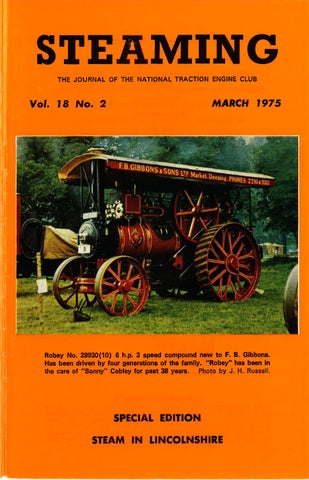
STEAMING THE JOURNAL OF THE NATIONAL TRACTION ENGINE CLUB
MARCH 197
Vol. 18 No. 2
Robey No. 29930(10) 6 h.p. 3 speed compound new to F. B. Gibbons. Has been driven by four generations of the family. "Robey" has been in the care of "Sonny" Cobley for past 38 years. Photo by J. H. Russell.
SPECIAL EDITION STEAM IN LINCOLNSHiRE
NATIONAL TRACTION ENGINE CLUB OFFICERS President S. J. Wharton, Esq., Southern Down, Minster Lovell, Oxford. Vice-President J. T. Beeby, Esq., Wymeswold Road, Rempstone, Loughborough, Leics. Chairman Anthony Heal, Esq., Baylins Farm, Knotty Green, Beaconsfield, Bucks. Vice-Chairman J. Crawley, Esq., Field House, Turvey, Bedford. General Secretary G. F. Beck, Esq., 127 Greensted Road, Loughton, Essex. Treasurer J. H. Hobbs, Esq., 6 Esher Close, Basingstoke, Hants. Editor Ran Hawthorne, Esq., 19 Bridle Path, Woodcote, Reading, RG8 OSE, Berkshire. Chairman, Rally Sub-Committee M. Harmsworth, Esq., Elm Cottage, Ockwells Road, Maidenhead, Berks. Public Relations Officer D. Brant, Esq., 27 Tregunter Road, London SW10. Membership Secretary Mrs. F. E. Wood, 'Windrush', Hail Weston, Huntingdon, Cambs, PE19 4JY Sales Officer V. H. Burrough, Esq., 94 Harvist Road, Kensal Rise, London, NW6 6HL. Technical Services S. J. Wharton, Esq., Southern Down, Minster Lovell, Oxford.
NATIONAL TRACTION ENGINE CLUB Membership is open to all, whether engine owners or not, with a genuine interest in the preservation of self-propelled steam road vehicles, portables, etc. The annual subscription is £2. The benefits of membership include advantageous terms for boiler insurance. The club's journal "Steaming" is sent free to members in December, March, June and August. All articles, photos for consideration should be in the hands of the editor by the first day of the month preceding publication. All correspondence re subscriptions, bankers order, delivery (or non-delivery) of Steaming or change of address to: MRS. F. E. WOOD, 'WINDRUSH', HAIL WESTON, HUNTINGDON, CAMBS, PE19 4JY All items are held copyright by contributor and/or NTEC.
ACKNOWLEDGEMENTS We are pleased to acknowledge the help received from the officers and members of the Lincolnshire Steam Engine Preservation Society and particularly Frank Strange, Frank Cheffins, Tony Parker, John Grundy, Frank Smith, Robert Crawford & Son, Dick McDonald, Jim Proctor, Eric Riggall & Son, Dennis and Dorothy Robinson, The Dogdyke Engine Trust, The Humber Paddle Steamer Group and many more who have helped in a variety of ways in the preparation of this issue. 66
STEAMING THE JOURNAL OF THE NATIONAL TRACTION ENGINE CLUB EDITOR: RAN HAWTHORNE, 19 BRIDLE PATH, WOODCOTE, READING, RG8 OSE. VOLUME 18 No. 2
MARCH 1975
FROM THE EDITOR'S CHAIR The current financial state of things has not by-passed Steaming. In January our printers had to bear a 15% increase in both paper and wages. there is not much besides paper and wages in printing' Block making, for illustrations, gets more expensive, the colour blocks in particular have gone way up. At present we are holding the standard ❑f Steaming and the number of pages. Your executive committee and Steaming sub-committee are both very conscious that our journal is the only link that a lot of members have with activities in the engine preservation world and we are therefore most anxious to maintain the journal in its present form and to maintain the high standard which has been set in the past. Postage is another item that is going to hit us. Would members please enclose a S.A.E. if a reply is needed, or expected, when writing to club officers. Contributions to Steaming cannot be acknowledged unless a S.A.E. is enclosed. The next edition will contain items relevant to the 21st Anniversary Road Run and Steam Party on 12/13th July. Articles, "Chuffs", Letters, adverts, etc., should be in the hands of the editor by 16th April.
"BLOW OFF" - STEAMING'S OPINION COLUMN As we enter our "coming of age" year (we still regard 21 as coming of age!) it is perhaps an appropriate time to look back as wet' as forwards. In 1950 two enthusiasts got together and had a race on Traction Engines. This little event involving only two engines, lasting an hour or two had all the ingredients of success. It brought engines and enginemen together, it enabled engines to be seen "in steam". This race at Appleford, the events there and at Nettlebed in subsequent years brought about, in 1954, the birth of the National Traction Engine Club. The engine preservation movement was under way. Now, we can point to well over 2,000 engines in preservation. If we are honest the Traction Engine movement has been somewhat soured in recent years by commercialism. Fortunately there is still very great interest (in fact we are sure it is the dominant one) in "Preservation Activities". We are not against commercial events nor are we against engine owners attending these and getting "the rate for the job". What we try and encourage is the true spirit of engine preservation where steam comes first. It is heart warming to see the efforts of those who restore and steam engines. It is good to know men and women go to so much trouble to run clubs and societies The response to our Road Run and Steam Party in July can only restore one's faith in the movement and so we can look forward in the knowledge that engine preservation will go from strength to strength.
N.T.E.C. LONDON AREA SOCIAL MEETINGS 1975 The Cock Tavern, Great Portland Street, Oxford Circus at 8.00 p.m. Wednesday, 26th March 1975. The Brooklands Society. Entertainment featuring old cars. Wednesday, 30th April 1975. Cultivation by Steam Power. Films and slides. The Steam Plough Club. Meetings recommence on Wednesday, 29th October 1975. 67
The unique Foden No. 13730(31) "Sun" Tractor.
Photo by J I-I Russell.
Marshall No. 79441 (25) FU 4677. J. H. Selby. Photo by John Grundy.
STEAM IN LINCOLNSHIRE — an Introduction Without a doubt Lincolnshire is one of the most important agricul tural counties in England. The accent of this activity has been on "growing" rather than livestock farming. In consequence of this machines for cultivation were required. Right from the earliest times local craftsmen produced ploughs and harrows, etc. Throughout most of the county rivers and streams ran slowly and so the windmill became common. When the power of steam arrived Lincolnshire already had a lot of men who were used to machinery of one sort or another and so it is not surprising that she produced so many engine builders and so many engines and threshers. We could so easily have filled this edition with accounts of the various engine builders but this would have left no room for the farmers, the contractors, the repairers and the drivers. We have tried to cover the subject in much the same way as we have done with previous specials. Claytons, Fosters, Marshalls, Robeys, Rushtons and many other makes all enjoyed due popularity both within the county and further afield. It is perhaps strange that very few, if any, ploughing engines were made but then John Fowler's Steam Plough Works built engines sufficiently near that they were usually steamed into the county. Engines of all types found employment in Lincolnshire but it was of course those most directly connected with farming that predominated; portables in the early days, the bulk of them local built; tractions followed in due course again mainly local built but Fowlers, McLarens and Ransomes were used. The thresher, so much a part of the scene; well a machine from outside the county must have been a very rare bird! Ploughing engines from Fowlers and McLarens with a few representatives from Rochester dominated the headlands. Tractions and ploughing engines were very often fitted with wide "Fenland wheels", even so they had great difficulty in getting about in a wet time. The dykes provided a source of interest especially when an engine got in one! My visit to Lincolnshire, for this edition, in November left me with the impression; here is a county that is in the forefront of agricultural development but at the same time a county that will not allow its past to die just for the sake of being "with it". They are preserving a beam engine at Dogdyke; they preserve windmills; they preserve their capital city with all its historic connections; they even preserve their poacher — and why not? But from our special point of view we can be glad they have preserved so many engines, threshers and the like; and what is more they use them whenever then can.
A FAMOUS MARSHALL The famous Marshall Steam Tractor No. 68823, Reg. BE 3044, has been presented by her owner, Ian N. Fraser of Arbroath, to the Leicester Museum of Technology for the East Midlands. Following an appeal for an engine for the museum, Mr. Fraser decided that this was where his engine should go. She was, of course. built in Gainsborough, in the East Midlands and Mr. Fraser was closely connected with Leicester through the "At!antics" and "Directors" on the G.C. Railway. No. 68823 is depicted and described in "Traction Engines Worth Modelling" by W. J. Hughes. She was one of the earliest engines in preservation, being acquired in December 1947. In 1959 she figured in the Arbroath Planning Enquiry which set a precedent of major importance to the road engine preservation movement. No. 68823 is shortly to enter the works of Andrew Barclay Ltd., Kilmarnock for retubing, ,a new canopy and repainting before going to Leicester. 69
SOME LINCOLNSHIRE CONTRACTORS The subject of the contract trade in Lincolnshire is so vast, that it would take years to fully compile each and every business which was extant, when steam was in commercial use. In addition, I think that the county must have had more constractors that any other county in the British Isles. In some parts, every village had someone who owned a set of tackle which was for hire, often only single sets of threshing machinery and these small businesses were in far bigger proportion that the big operators, but many of them survived long after the big men went out of the trade and were almost forgotten. Unfortunately I can only go back in memory to the late 1920s, not a good time at all, for agriculture was in a serious decline, and so was the contract trade. Even so, I will d ❑ my best to recall the contractors, so far as I am able, but most ❑f them will be from the district were I was born and raised, North Lindsey. My first memory of a set of threshing tackle was a set belonging to the late Robert Peatfield of I Ilnehy. when they used to come and do a fairly long spell of work for grandfather at his place in Croxton. Grandfather farmed about 600 acres so the job generally ran into a week at a time. It was not too long before I was lifted on to the footplate, which was considered a safer place than to be running wild around the machine. I cannot say what make of engine it was, perhaps it was a Marshall, for Peatfield had several of this make, whatever it was, the thrill was great, and it came to stay. By the time 1 became familiar with the Peatfield name, it was almost a household word in that area, for he was a big employer of labour, both in the threshing and road haulage, not only at Ulceby either, as there was an out station at Holton le Clay near Grimsby. The sight of his road locos or steam wagons passing our house was an every day event. He ran several big Fowler compound road locos and also a big McLaren. Some of these, such as Fowler 12760 were new to him, others like Fowler 13929 and the McLaren 1424 came secondhand, as for the wagons, I think that most of them were Clayton & Shuttleworth 5 tonners, and there was generally a trailer in addition. I cannot now remember just how many sets of threshing tackle he owned, but it was quite a number, and the yard at Ulceby was a place of great interest with lots of interesting things to thrill a little boy. I would say that some of the biggest steam operators at one time, were the big farmers, and the Bowsers of Friskney are an example of this, In the late part of the Great War, they got two sets of Fowler B.B.Is. and full tackle, besides these, they also got a couple of Fowler compound traction engines, and for road haulage there was a big compound road loco. This loco was well up to her work and would haul thirty tons of potatoes to Eastville Station quite easily, and return with the same weight of fertilisers. However, agriculture did not fare very well in the 1920s, and most of Bowser's engines were sold. I believe that the Fowler road loco was conserved to an S.R.L. by whoever got it, and spent some years with the Scottish showmen. Squire Pearson of Freiston had a set of Fowler B.B.Is. as well at the end of the Great War. These eventually went to Sauls of Leverton, but their last working owner was H. Thorlby of Evedon some time after, Dennis & Son were in a very big way too, with land at Kirton near Boston, and at Nocton near Lincoln where they were involved with Smith's Potato Crisps. At Kirton I can remember a set of Fowler B.B.Is. with the double speed winding gear, and there was two sets of A.A.7s. as well. 70
.—.
•-•
.-,-, ,. A. - ;' '- .q.. .b , ' '.• ;;, ..*,.... llsiti.-, .'• N.. '
•
,•-
-
__
•
.e-j:•
.: .: 1 • •• - ' 1 - _ -
One of the many Fowler Road Locomotives owned by R. Peatfield of Ulceby, Lincs. Photo F. Larter, Covenham, Louth.
nwitOriP .4., 11.4. •
-.. : ..k..L,•. :- ., '• '- • ,'..;.. , --••;‘ 1. ,61:. • ...,,, c,,,i2.. ...1.,.&••N‘. .c.... „ . : ,‘ :-: w .00:- ••,. .,,,...._,._ .
..
.._,... .. --_ ..,-,..i . -__ ,,t_:.._ •-•":•-_. :, :,„•.... .-...-s? .,rte —7-—. .: .._:..%. ,I. ins'' .. '^..c... k` 47 • 0! 12, ... -_ . ...p.,... . :1! „..., 0,,,. .b-..;
•
In the smaller size, they had a pair of K7s and for haulage there was a three speed compound Fowler. Portables too were owned at Kirton, and there was certainly one of these in use at the sawmill. At Nocton there were two pairs of Fowler K.7s, and at least one compound traction, maybe more. In addition, they had a very late portable Foster, built in 1942, one can hardly believe that such engines could have been built at so late a date, but I have seen her at work years ago, and a caterpillar tractor ready to put her to her next job. A long time ago, Mr. Royston of Fowlers told me that Denniss's bought the last pair of AA7 Class ploughing engines built for this country ,and this was in 1927. The Hundleby family were connected with engines and threshing long before the turn of the century, and one branch of the family was in business at Chapel St. Leonards, running about five sets of tackle. In later years, one of the sons, Norman, went into business on his own account at Mumby with a couple of sets. He survived into very recent years, and his sale was barely two years ago, after which he retired. He had a neighbour at Huttoft called George Stevenson running a Fowler engine and Foster machine. Not far from there was John Robinson of Anderby Creek with a very old three shaft Fowler and a machine of almost the same age, but uncertain origin. This set was replaced later on with a modern set of Ransomes tackle, and in addition to this he ran a set of 14 h.p. Fowler ploughing engines. The local authority, Spilsby R.D.C. were steam users in their time, and had a pair of Aveling & Porter rollers. one of which has survived into preservation. For haulage they ran steam wagons by both Robey and Clayton & Shuttleworth. The wagons had their own regular drivers right up to the time when they had to be scrapped in the early 1930s, and at Skegness we could have seen the pretty little Marshall 8 ton roller owned by the urban council. I have often heard that a Marshall road loco was very rare, and true enough there were never many of them built. One I did know of was owned by Mr. A. E. Andrews of Temple Bruer, near Navenby, He bought it for haulage of sugar beet, etc. and it went to him in 1929, although it had been in store at the works for several years before that. Mr. Andrews had quite a bit of steam stuff on his farms, and I remember after his death, I attended his sale and saw a pair of very old Fowler single cylinder ploughing engines on offer. They had not long been fitted with new fireboxes, and were in fine condition, but there was not much sale for engines by then, and they went for scrap. Grandfather died in 1930, and soon afterwards, Peatfields came to thresh us out for the last time before our dispersal sale. It was just about the last job that this particular set did in his ownership too, as he himself was in financial trouble, and in 1931 had to go into liquidation. His dispersal sale followed close upon ours, and both of them were a reflection of the times in which we lived, everything went at give away prices. In later years I have often heard Robert Peatfield criticised for the sore disrepair which much of his tackle had got into. He had no choice in the matter, as for several years he had been in difficulties trying to get money out of customers who in turn did not have the money with which to pay him. It is much to his credit that he kept the business going for as long as he could, for when he did go down, the disaster to his workpeople was great as fresh jobs were just not there to be had. The failure of Peatfield's business did a little good to those who had been nearby competitors, and little family concerns like Fussey Brothers of East Halton were able to enlarge their round of work to some extent. I never knew this family very well, but I can remember one of the engines, it was a Marshall compound 52828, a 7 h.p. type and new to them in 1909 and I think it stayed with them until they went out of business after the last war ended. Another beneficary was Amos Taylor of Wootton, with just a single set, he seemed to do pretty well and make a fair living for many years. 72
In the early years of this century, a Norfolkman came into our area, his name was Macdonald Stevens, and he came from a family of engine owners. Maybe there were enough of them at home so Mac decided to have a try on his own. He had been on a visit once, and found what he was looking for, a place to start. He chose Goxhill, near the Humber bank, and took over the old round which had once belonged to Spencer & Steeper. This little firm had sold out to Peatfield, at least so far as the tackle was concerned, but I wonder what they thought about Mac's arrival, when it got to be known at Ulceby? It is too far back for me to have known, but I know what his neighbours, the Fusseys thought about it, they were very annoyed, and there was a lot of hostility for years between the two parties. It could not have bothered Mac much, because he did very well in his venture, and by 1911 he was in a position to buy a brand new set of Foster tackle, engine, drum, elevator and chaff cutter. It was a big step forward, and perhaps he had to go into debt to get the new stuff, but it put him into a very good line indeed, and he was able to increase his round. Mac was, and is, very much a Foster man, but he did not always buy Foster engines. Soon after he settled in the area, he fixed his headquarters at Saxby all Saints, and in 1916 he bought a brand new Marshall 7 h.p. single, 68938, but at a guess this would be running with a Foster machine. As his round got better, or competitors fewer, he increased his stock. He bought a Fowler compound in the early 1920s, but it came second or third hand, and was of Class T.E.2, numbered 14981. He owned another of the same class, but at a rather later date, maybe around the start of the last war, numbered 14922, and he has often told me how fond he was of the Leeds built compounds. There were other engines in his fleet, some of which only stayed a short time, and I cannot remember much about any of them, however, the man himself had some very set ways about engine and machine work. He never liked the idea of pumping cold water into a hot boiler, and several of the engine had the pumps removed. These were replaced with a + inch injector, which it was possible to leave runing semi-continuously, giving a hot but steady feed. At the time, it raised a bit of an uproar amongst the locals, but it worked all right, and in any case Mac stood or fell by his own decisions. His tackle was always in pretty fair trim, and regular overhauls were done at Saxby, although 1 do not think he ever got as far as fitting a new firebox. His engines lasted into the very late days of steam, and the last of them were broken up just as the preservation era dawned, these would be one of the Fowlers and the Marshall. In the event, it was not his idea, the decision was taken by his sons, and in the end he agreed to them being cut up. Not too many years ago, he stood on the footplate of my Marshall, and told me how bitterly he regretted ever allowing his sons to tell him what to do with his engines. Macs most northern neighbours at one time were the Killick family of Barton on Humber. They were in both threshing and at one time road haulage. Cultivating also came into their scheme as well, and I have seen an old photo of them in the far off days, but I cannot say what number they were. One of the most often talked about engines they owned was a McLaren compound 1421, a road loco, which came to them second hand when still pretty well a new engine. Just after the end of the Great War it did a lot of road work for them, and tales are told that it did battle against Peatfield's McLaren, on many occasions for the honour of being the fastest engine in the area. In the event there was a faster engine than either of them, she was from the same builder, but bigger, and we shall meet her later on. Some time about 1926, the McLaren was sold out of the area, and three years later a set of Fowler P.Es. was bought in, second hand, numbered 15416/7. I am not very sure how much business this pair did in the Barton district, and I have a feeling that they went to North Kelsey, where they had a small branch. It was heavy land down there in the Ancholme valley, but there was a certain amount of work 73
to be had, whether it did much in the way of enriching the Killick's is questionable, as their fortunes never seemed to be very rosy. This set was sold about 1939, and is still extant today, but derelict now, and I should say that Killicks went out of business when they sold the tackle, for I never heard of them in the contract trade afterwards. As regards the threshing activities of Killick's, I have very little information, nor can I ever recall seeing any of their stuff at work. They must have covered the customers which Stevens lost or did not cater for, but I have heard that they came as far south as Elsham on occasions, which was definitely Macs own preserve, perhaps there was a bit of price cutting here, although the low rates of the time would not allow too much of that. Not many miles away from Elsham, we could have seen a set of tackle run by a farmer and contractor, Syd Fisk of Kirmington. He had bought the set mainly for his own use but did a bit of work outside when convenient. It was worked by an old Marshall 8 h.p. single 30165, which he had bought from Robinsons of Osgodby near Market Rasen. The engine lasted until after the war, but did not survive preservation. Mr. Fisk and my father once jointly owned a massive Case combine, which I think was in the harvest of 1932. It was bought for use on both farms but was too large and unhandy, and was sold the year after. In reality, she was more at home on the prairies, but she showed what was to be the shape of things within ten years. We ran a set of our own in those days, but it was tractor dnven. the machine was a big old Clay tun un plain bearings, with a self feeder, and we ran her for our own use until the war came and a new combine arrived. Perhaps some readers might think that it was unusual to modify such an old machine to self feeding, but round my home it was a common practice, there were more of the self feeders than the open type, regardless of the age of the drum, it might have dated from the Great War, when manpower was short. Our nearest contractor was G. W. Broughton of Barnetby, with two full sets. His round covered a fair sized area, but it was all hill land. The set which was in most regular use was run by an old Burrell compound road loco No. 2827, a 6 h.p. type of 1906. The driver of the time was, and still is a great friend of mine and I have spent many happy hours on the footplate with him. His mate was his brother, and both were very competent men with tackle. To see these two at work setting tackle in some of the Wold stackyards was an experience to remember, but the odd thing was that they hardly ever spoke to each other, nor did they cycle home in company, anything up to a mile might separate them. Sometimes I used to travel on the road with them on the engine, and it was the same again. The Burrell came second hand to Broughton in 1920 from The Home Brewery Company of Nottingham, whilst the engine on the other set was brought the year previous. It was a very pretty little Marshall, 70321, a 6 h.p. single of Class Q type, and new in 1916 to Robert Bridson of Neston in The Wirrall. This engine was rarely used, but in times of stress it would be brought out for a short spell, and the Burrell driver's brother always drove it. In later years it was sold to old Tom Stamp of Linwood, a great Marshall man, and Broughton continued business with just the one set. This state of affairs continued until 1946, when the Burrell went out of commission in favour of an International tractor, but 1948 saw the end of threshing for this little firm, and the Burrell was broken up about that time. The little Wold village of Grasby was served for many years by a family called Urry, who had relatives in the same Trade at Binbrook. The Grasby branch had perhaps a couple of sets and I think that the old Fowler 10136, an 8 h.p. single pulled one of them. She was nine years old when they got her, and she stayed for twenty years. There was a wagon too, which I have been told was a Clayton & Shuttleworth, and also a roller which I have not been able to trace. Urry's went out of business about 1933, and old 74
George Andrews took over the round, along with the wagon. George was a blacksmith, and had been known to hand forge a crankshaft and connecting rod from time to time for engines under repair. As a threshing man he was well liked in the district and kept some very good stuff. The wagon was sold soon after he started work, and a lorry was bought in its place. The only engine that Andrews had which really left its mark with me was a very fine Fowler compound. She was a full road loco and it had spent many years in the isle of Axholme, it came to him in the mid 1930's and stayed up to the end in 1946. He went over to using tractors for a short time after the last War, but this ended quite quickly. The Fowler was left in our yard for some time, well sheeted and in immaculate condition, ready to drive away. I found her there on my return from abroad, and was all set to buy her for preservation, but there was some difficulty about parking arrangements with Dad, and like a fool I gave way to him. She was sold soon after, but only survived for another few months and was then broken up. The house where I live in Brigg has had steam connections long before I came to live in it. A family called Smith lived here and conducted a threshing business from this address. They had four or five sets in their hey day, and I can remember a very old Marshall three shaft type still at work in the late days of steam. Apart from her there was a big Burrell road loco which had been built for export and not delievered, she was not broken up until the mid 1950 period. Another engine which comes to mind was a Wallis Expansion type which nobody got ❑n with at all. In desperation, Smith's converted it to a 'simple', but things did not work out quite the way they had expected, and it was sold hurriedly. I knew the two Smith brothers well, as their premises was next door to the place I work at. My employers late Father, who was himself a steam haulier at one time, used to do repair work for them to help them on their way, and on these occasions I would sometimes have to assist, being partly 'engine trained'. The old men retired eventually, with the end of steam, and a son carried things on for a time with a tractor, but in the time around 1960 he sold all that was left and found a job away from home. I never knew much about the Trade around Scunthorpe or the area to the north of the town in the Winterton district. Old Mac Stevens used to cover a lot of it so he told me, and at one time was much grieved when a farmer moved out of the Isle of Axholme to the Wintringham area and got Selby's of Epworth to come and thresh for him, and assumed that this would continue, the fact that the new man had been a Selby customer all his life did not seem to register with him. Nixon of Broughton used to get into the same part a bit. One of his engines was a very nice Clayton 48759. a 7 h.p. single which he got new in 1926. I cannot recall when he went out of business, but the engine went to Vampiew's of Grimoldby near Louth, and is still extant with the same family, although not now in use. The last man I knew to thresh round there was called Lambert, but he had a tractor driven set. Kirton in Lindsey was served by several concerns, and perhaps the best known among them would be the Rawson's. In their hey day old Mr. Rawson had favoured 8 h.p. single's, and had a McLaren, an Aveling & Porter, a Marshall and a Garrett amongst his fleet. One of the reasons he favoured the big engine was his sideline job, which was driving windmills when they were becalmed. This usually had to be done at night if they were busy during the day with threshing. Mr. Rawson is long since passed on, but his son Charles, who is now 74, can remember many times hurrying home with an engine, to do a full night at the mill, and then returning to a full day of threshing the day after. Just to the South, at Willoughton, there was Robinsons' who had quite a lot of work, much of it for the late Clifford Nicholson's Estate. I never knew much about the Robinson tackle at all, but 75
he had another branch at Osgodby, near Market Rasen, and in all perhaps would have about eight or nine sets. The land surrounding the River Ancholme was unfamiliar ground for me, and the only man in the Trade who comes readily to mind was old Alf Shepherdson of North Owersby. 'Shep' did threshing and cultivating too, in the latter line he ran three or four sets one of which was a pair of McLaren's. Apart from contract work he did a lot of engine dealing, and many readers will recall his name as being the owner of engines which are now in preservation. Whether 'Shep' was gifted with foresight I do not know, but many of us owe a lot to men like him for keeping hold of engines in the period from 1945 to 1960, so that a preservation movement could even get off the ground. The two Kelseys', North and South, both had their own men in the Trade. John Farrow at North Kelsey was in business when he had Killick's to contend with. He survived them and lasted until after the War, but I am almost certain that all of the engines were broken up. Apart from Killick as a rival, he had perhaps more trouble with a family called Smith at South Kelsey. A long established family concern of the real old school kind, but the only engine of theirs that I can remember now was a Clayton 7 h.p. single, 44058, which had been new to them from the Lincolnshire Show of 1911. They went out of business before 1930 I should say, because this engine went to Hundleby's and was still at work in 1945. Ow next pull LA call is Caisiur, steeped in histui y wlliuli dales back to Roman times, and built on a hill side, the devil of a place to work an engine through either uphill or down. In its day, it was the home of many engines, mostly big ones too, but they are all gone now and only a few of the old drivers still remain, long in their retirement In order of the rdrIcrot klicinocc I thir-A- litre should accord that honour to the late Richard Spalding, although I was never lucky enough to know him. He ran perhaps five sets, and all manned by either relatives or trusted retainers, but I cannot say much about the engines which were in use. He had a Ransomes and a McLaren, but neither had been new to him, and there was an old Allchin which came to work there too. Mainly his round was on the Wolds, and in very difficult country, right down almost to Binbrook. As I say, I never knew him, but his reputation was well known as a good man at his job. He had strong religious views, and no work was done on a Sunday, nor did he own any form of transport. It was his practice to attend Evensong at Caistor on a Sunday night then
return home for a meal and change of clothes, followed by long walk through the night to where ever his tackle was at that time. so that he could light up and be ready for work when his gang turned up at daylight. From what I have heard, his tackle was kept in good repair, although they did have their thrills and spills from time to time, however, it was all taken in a dignified manner, and no lost tempers by all accounts.
I suppose that to most readers, the name Caistor will bring to mind the firm of George Roberts, for it was the home of this large concern. I cannot say just when this firm came into being but records tell us that Roberts & Jollands bought a new Foster engine in 1891. this was an 8 h.p. single numbered 1700, and in 1894 they bought another new engine, this time a Fowler 8 h.p. single of Class B.3, number 7096. Both were likely bought for threshing, and it is hard to say how many other sets of tackle there were in addition. Roberts had other strings to his bow, that far back, and was in road haulage and road rolling and well established in both fields. The threshing venture seems to have been disbanded in the early years of this century, as one partnership with Jollands was ended about 1901 or so, but we shall hear more later about this. The engine shed was in a yard just off North Street, and is still there now used as a bus garage, but I am almost sure that there were other premises beside this yard. For many years Roberts's 76
W. Barnes' Ruston Hornsby No. 161250 threshing near Alford, Lincs., about 1935. Photo J. I. Smith. Alford.
Clayton & Shuttleworth No. 36336 owned in preservation by M. V. Pink at Horsmonden June 1953. Photo John H. Meredith.
77
biggest customer was the County Council, he supplied the haulage for their road stone and the rollers for making the roads. His fleet for both jobs grew apace, but I cannot say if it was ever known for all the tackle to be at home at one time, very unlikely I would think. It is said that if a man hrnught his roller home, and there was no immediate work for him to go out to, then he would be paid off on arrival, and might be re-employed as and when new work came in. Not a very satisfactory procedure, but one which many older men would tell us was quite usual in that type of work at that time. On the haulage side, much of the work was hauling road stone. Most of it from station yards and it had to be shovelled out of railway trucks into wagons, the engines in use seem to have been. many of them. Fowlers. The period after the end of the Great War was very busy for this firm, and with the increase of road works, more engines had to be bought in. The most often mentioned engine which comes to mind here is the McLaren 1652, a 10 h.p. compound, and it arrived in 1922. It is remarkable even today, that many of the old enginemen of Caistor still speak of this engine, they were used to seeing big engines, true enough, but this one was bigger than anything they had seen before. She was given to the late Joseph Shacklock to drive, one of the top drivers of the time, and his eldest son, Ernest, was his steerer. Her stay at Caistor was not long, perhaps less than two years. but in that period she became almost d legend. About this time, it was found that hauling road otonc direct from the crushing plants in Scunthorpe was a better proposition than loading it out of railway trucks in a station yard, so Roberts and many other contractors began to do the job in this way. McLaren 1652 was ideal for hauling three wagon loads, and could do it with It far more ease than many of the big Fowlnr 8 h p nnmpeands was during this time too, that she made the acquaintance of both Peatfield's and Killick's McLaren compounds, and ran the wheels off both of them, I have Ernest Shacklock's confirmation to this, and he goes on to say, 'She could haul more, and at a faster speed than any engine we had ever had before, or since' Then, almost overnight, there was a change of policy at Catsup,- and Roberts decided to go out of haulage, and concentrate his interest in road rolling alone. He decided to buy one or two lorries, and the McLaren went to Foley's of Bourne in exchange for a Peerless lorry. Very soon all the big road engines had gone, one or two stayed near home, which I should say that Peatfield bought. The road rolling side went ahead right up to 1942, when this side too, came up for sale, and the large Roberts business ceased to exist. Now to turn back to the early days, when Roberts & Jollands were involved in their joint venture in threshing. When the partnership was dissolved, old Mr. Jollands carried on with the two sets of tackle. Years later, when he passed away, the business was divided between his son, and a son-in-law named Hinch, with the latter named getting the big old Foster single. So far as I know, the round was divided between them, and they were for some years to compete with old Mr. Spalding, although everyone seems to have made a living. Eventually the Spalding business came to a close, but I am not very sure if this made much of an impact on the other two. I would be inclined to think that Andrews of Grasby was to feel more benefit, but that is only my opinion. The only item which brought either Jollands or Hinch into the limelight was art incident which almost wrecked Hinch's complete set. Apparently Hinch and his mate were travelling to another farm, and going down hill through a part of Caistor known as Horse Market. Both were men of vast experience and so we must presume that the road was slightly icy. Whatever the reason, the resulting pile up was something that has gone down in the folk-lore of this little town. The old Foster began to slide with ever gaining speed until Fred Beach, her steerer, managed to get her up against the bank. That checked her all right but the tackle behind took charge from then and the whole train of machine,
78
elevator and chaff cutter turned round in the road with the elevator ending on its side. No one was hurt which was indeed lucky, and the 'jacker' was repairable as it happened, but men speak of it even now. Fred Hinch went out of business in about 1935, but I have no idea where his tackle went. On the Jollands side, William the son, carried on in his usual efficient way, and was in business until he sold out to S. A. & H. C. Wright sometime about 1940 or 1941. Wright's were haulage contractors, but had done a bit of threshing at some time in the past. The War caused them to increase this side of their venture, and Will allowed himself to be bought out. He had been running the old Fowler 7096 up until his sale, of that I am almost sure, but when he was with Wright I seem to remember him having a rather attractive but quite small Fowler compound which I thought was plenty small enough for the kind of round he had. He retired in 1950, but I can recall a little incident which endears him to me. He had been retired about a couple of years when a manpower shortage caused him to be invited to take out a set of tackle to thresh a crop of Cocksfoot seed. He was happy enough to find that he still of use, but his temper was not improved in any way as it was a tractor run set he had to use. The machine was a Foster with a Jones baler and run by a big M.M. tractor. He did not drive such things himself, so the honour of tractor driver fell to me. We worked together for about a week, and this was the last professional work he did. In that week we became very good friends, and I have always been pleased that I was able to share this job with him for he was a great teacher to anyone who wanted to learn the craft. Well, that was the little circle that I lived in as a boy and beyond that circle there were many names that I was to know later on in life. The large number of names in the Trade in say, the Isle of Axholme, were not known to me then such as the Kitching's of Crowle, or the Selby family in Epworth and many others besides them. The Grimsby and Louth area was uncharted country too, with Drury of Laceby, the Maddison's of Fulstow, Haxby of Ravendale, Vamplew of Grimoldby and lots of others out Market Rosen way as well, the list is almost endless. Now and then when I was still small, Dad sometimes used to take me with him on business trips into South Lines., and it would be on these outings that we could see a bit of ploughing or cultivating. There was very little of it done in our district that I ever knew about, but down on the Fens you could see fine sets of tackle at work belonging to the big estate owners like the Dennis's of Kirton, or maybe it might be a set owned by Ward & Dale. As regards Ward & Dale, I think that they should be regarded as the specialists in this field, and at one time they owned the biggest fleet of tackle in the country, perhaps even in Europe. Occasionally I was lucky enough to get Dad to stop for long enough to allow me the time to have a real good look at how things were going, but he is no enthusiast and never was, so it was a rare treat, and even today, there is a great deal about steam cultivation that is a closed book to me. It was on one of these South Lincs. trips that I saw some very curious equipment in the way of engines. We were in Boston one day in the mid 1930's and I saw a number of big old engines travelling through the town. All of them had a metal strap passed around the boiler just in front of the throat plate to which was fastened a roping sheave. I noticed that a plate on the tool box of one of the engines bore the name 'Mornement & Ray Ltd., East Harting.' This was a puzzle that stayed with me until I was able to get to see one of my engine driver friends who told me that they were dredging engines. Just ordinary traction engines which were modified to pull a dredge scoop between them in the same way that a pair of ploughing engines perform their task. In fact I was to learn in later years I had been very lucky to see these engines, as their place of work was on the lonely river banks, far away 79
from the public eye. The work which they performed was of the utmost importance to the Fenland, where the drainage is absolutely vital. The length of time that the job ran into must be a record in the history of Contract Work too, for it continued for nearly forty years. I should say that these engines were based at Boston depot and were manned by local men. I wish there was more space to allow me to say a little more about this wonderful work they did, but it is a complete study all on its own, and one of great interest. They were wonderful days, because even if there were no engines to be seen at work, you would see someone on the move with some sort of tackle for sure. That man from Peatfield's who lifted me into his tender never knew what he was starting, and it came to stay, just as it has for most of us I think.
J. BRADSHAW & SONS John Bradshaw started business in 1889 as a threshing contractor, the tackle was a Clayton & Shuttleworth portable engine with drum and elevator believed to be of the same make. In 1891 a Foster traction had been added. It was not new and going by the photographs it had very large governors, flat smokebox door and a long stovepipe chimney. In 1894 the move was made from Bransby to Sturton-by-Stow. and about this time a new 8 h.p. s.r. three shaft engine of Foster make was purchased and this type of engine became the mainstay of the fleet which now grew to five or six sets. During slack periods traction wagons were made and so developed a thriving haulage business which still goes on today. One interesting point, about this time, Curtis & Hewer Furnishers, etc., of Lincoln owned some pantechicians for removals and if these journeys were long one of the Fosters was used. From 1900 Mr. Bradshaw was taking out new engines for Fosters to all parts of the country, he took the first 8 h.p. compound into Cornwall and brought the second one himself mainly for haulage, there are many stories about this engine, it literally pulled itself to pieces by hauling the heaviest loads and was always ready for more, but the repair bills piled up and by the time she was four years old she had been fitted with new cylinders, crankshaft, firebox and strakes on the wheels, shortly afterwards it was found the steam gauge was wrong and she had been blowing off at 260 instead of 180 p.s.m., after a new gauge was fitted she gave many years good service. By about 1912 a good boiler maker was engaged, a machine shop was put together and ❑ utside repairs were taken on, this mainly consisted of settling a good engine and trading in one that needed a new box. Smokeboxes and chimneys were also made, cylinder rebores and also slide valves refaced. By 1914 Mr. Bradshaw had three sons in the business so it was restyled J. Bradshaw & Sons, the first purchase being a set of 16 h.p. Fowler A.A. ploughing engines complete with all equipment collected new from Leeds, these engines did an enormous amount of work and a second set was bought in 1920. The threshing tackle by this time was all Foster drums with sliding roofs and all pulling from the screen end. The Hayes pattern elevators had gone and now there were all by Hundieby, in fact by 1918 this type of elevator was being made on the premises. Chaffcutters with blowers were used, mainly Foster and Innes. A start was made with steam wagons in 1920, the first one an Allchin disgraced itself by breaking in half outside Forman Bros. yard at Branston, this was followed by a Clayton and two new Fosters, the latter pair were very adept at breaking rear axles in the most embarrassing places and this habit was never cured. A Robey and a Foden succeeded the Fosters and in 1928 a new "Yorkshire" under80
type tipper with trailer was bought, this was a very fast engine and good to drive but it had a tendency to knock out big ends. The steam wagon days came to an end when the unladen weight tax came into force, they had gradually been replaced by lorries and these noisy objects now took over the haulage side of the business. The ploughing engines were sold about 1933 and replaced with Marshall tractors, the threshing sets carried on until 1937 when they were sold to Mr. Ron Vickers as a going concern.
MEMORIES OF A FEW LINCOLNSHIRE ENGINE OWNERS by Frank E. Cheffins Showland and its equipment has always been of great interest to me, especially since I spent a number ❑f years in that profession. My first visit to a fair was when both my brother and myself were quite young, and the place was Wainfleet. On that occasion I saw for the first time a set of Tidman built steam driven Gallopers, three abreast, owned by a man named Stores. For haulage he ran an old Burrell single cylinder traction engine which bore neither awning nor dynamo. For electricity they had a dynamo mounted on one of the trucks, and the Burrell was belted up to it for generating. In later years when I was going to school, I can remember Fred Thomson of Skegness attending Wainfleet Fair with a Cake Walk and a brand new Foster tractor to haul and power it. A year later he had bought the Tidman three abreast from Stores, and travelling that machine with a three-speed Wallis & Steevens road loco named "Salisbury City". Boston of course had its own showland family of Aspland & Howden, and one of the rides that I can remember with them was a Savage Motor Switchback, and a Burrell road loco named "Kathleen Mary" which used to go with this set. Smith & Warren were on the go at that time in Lincoln, and between them they ran several Burrells. All of them were 8 h.p. type, No. 1810 "Clarence" and No. 1985 "Mona I" were both single crank compound pattern. In 1921 they bought a brand new double crank type, No. 3132 "Mona 11". As for their rides, they had a couple of sets of three abreast Gallopers and a steam Switchback. If I recall it correctly they had one or two other engines for haulage work, but they were plain agricultural type, one was a Foster, and the other a Ruston Hornsby. Over in the Isle of Axholme there was the Wroot bros. of Eastoft and we used to see them at the Gainsborough Mart Fair with a set of steam driven Flying Chairs. They ran quite a few engines too, a couple of Fosters and a Burrell tractor, in later years there was a big Fowler as well, "Mons Star" it was called. The most unusual tractor that I ever say was owned by them, it was a Walsh & Clarke cable ploughing engine, but it would haul three loads quite easily. When I left school, I went to Marshalls at Gainsborough to serve my apprenticeship and this was from the mid 1920s to 1931. During that time when I was off duty, there were plenty of chances to go on visits to the engine and machine owners in the Gainsborough area, and I think that my favourite call was at Sturton by Stow, the home of the Bradshaw family, long established in business as hauliers and threshing contractors. Mr. Norman Bradshaw very kindly undertook to add a piece for us and it is included herewith, but I am sorry to say that he passed away only a few days after he sent it to me. Of the other owners that I knew during that period, there was The East Stockwith Threshing Company at Morton which ran quite a large fleet of stuff, and I can remember them having a new Marshall set of tackle delivered to them whilst I was in Gainsborough. Not far away, at Laughton there was the partnership concern of Wright & Markham who ran a couple of sets of Marshall machines, but pulled 81
by Burrell single crank compound engines, not a very common combination in Lincolnshire. Their neighbour at Blyton was Raymond Clixby also with a couple of sets of stuff, one was a Marshall engine and machine, the other was a Ransomes engine with a Marshall machine. Clarke of Corringham had a full set of Marshall tackle, and the engine to this set is in preservation to this day with Major H. D. Marshall
of Pilham Hall. Henry Winter of Heapham supported the local industry with a single set of tackle and not far away at Upton there was George Stephenson running a traction set on his farm. The furthest extent of my travels used to take me to Kirton Lindsey, to the old business which was run by the Rawson family, most of the stuff was of fair age, and I should say that there were maybe four sets in use at various times. The area around my home at Croft is almost all agricultural and the number of firms in the contract trade was vast, with the oldest so far as I know, being the one owned by Abbott & Son of Burgh
le Marsh. No one really seem to know just how far back it was when they came into business, but there used to be a farming family at Boothby Grange who had employed Abbotts to thresh for them for seventy years when they sold the property in 1930, so that would put Abbotts as having been at work in 1860. Their first sets must certainly have been run by portable engines, and the first one that I ever heard of was an 8 h.p. one which was bought in 1877. The next was a 7 h.p. type and it was bought complete with a new machine in 1881. The following year another complete set was bought, again with a portable engine. The first of their
traction engines was purchased in 1892, and by 1898 they had six full sets of Foster tackle in use, all working with traction engines. The old portables were still used at the turn of the century, and were replaced singly by traction engines, the first in 1904, the second in 1906 and the last in 1909. Old harry Abbott, the tounder, passed away in 1910 and his son carried on in business until 1943 when it was all sold. Another fair sized firm some years later was that of Stovin & Addison of Willoughby near Alford, with six sets of tackle in work. After the end of the Great War they went into ploughing with a new set of
Fowler B.B.Is., which remained in use for quite a few years. Not far away at Welton le Marsh there was another old established concern owned by Lancaster & Hundleby. Eight sets of threshing tackle were in use here of various makes and there were a couple of sets of Fowler ploughing tackle for hire as well. Some of their tackle was pretty elderly, and there was an old Burrell that came once to a neighbour's farm at Croft which I am sure had a wooden front axle. Around Spilsby there was Haw with a single set of Foster stuff, engine and machine; whilst at Little Steeping, Mears & Son also ran a couple of Foster set. One of the engines was a very old three shaft type, numbered 1700, this was replaced in 1930 by a new Foster 8 h.p. single, numbered 14625, which is still extant today, although not in the county. Not far away, at Stickney, there was a Ransomes engined outfit and Foster machines run by Maddison & Hansard, men with years of experience in the threshing business, and who survived into quite recent times. There was a pretty little Fowler 6 h.p. single with a Foster machine down at Wainfleet Bank, which was run for many years by Ward Allenby, but about the oldest set that f knew of was owned by Ward of Townton, this was a Fison engine running a machine of similar age by Ransomes. A good many years ago, I was threshing at Thorpe and saw an engine number plate fixed to a barn door. It was a Foster plate and belonged to engine number 75, on enquiry I found that it had been a portable built in 1862 for a Mr. Gilliatt of Thorpe St. Peter. It had worked for many years, and when it was finally scrapped the plate was kept, I got the plate from them and still have it now. Portables were in use in the area until a fairly recent date and I can remember Archie Croft using one at Skegness about 1920, but his land was built on some time ago. Work was not too good for 82
An early 6 horse McLaren in the ownership of Sidney Leverton, Quadring, Lincs.
Foster No. 2119, 8 n.h.p. Driven from new 1895 to 1938 by Mr. Beeby of Burgh-Le-Marsh, Lincs. 83
him though by this time, as the traction engined sets were taking it all. Two portable engine owners not to be forgotten in the same area were W. Epton of Croft and C. W. Parker of Wainfleet Grange. Epton had a Marshall portable and machine, in the 1930s he replaced this engine with a new Ruston portable, and put the old engine on to his grinding mill, in which job it survived for some time.
In 1939, I started up in the threshing business at Burgh le Marsh, and I bought the Ward Allenby set to begin it with, the engine and machine had been well looked after, and work was plentiful with the war being on then. It was not very long before I had to look for another set, but by them they were not too easy to come by. Eventually I managed to get hold of a new Marshall machine, with an old Allchin to pull it. The engine was pretty rough, but it managed to survive until I could replace it with a Ransomes single. We went away from home to do some W.A.E.C. work with this set down in Leicestershire for a spell, and it netted quite a bit of profit, and pretty soon there was another set added to the business which was again a Ransomes engine this time with a machine of the same make. By 1944 I was looking around for another engine, and managed to find one which was standing at the yard of the late Ed Knowles at Braithwell. It was an old Fowler compound traction but she was not in very good order. It had a new machine from Marshalls, so we brought the engine home by road and collected the machine from the works at the same time. It took quite a bit of work to get the Fowler into •conditions, but it •Nas all done at home and in the end she turned out to be a good buy. The last engines that I bought were a set of Fowler ploughing engines from Hundleby's sale, and we did a bit of cultivating for several seasons. In the end the work got too scarce to stay in the business, so I did the same as my neighbours had done before me and sold up for what I could get.
THE GOLDEN ROLL John H. Rundle It was with the greatest regret that we received the news that our President, John Rundle had passed away on Thursday, November 21st last year. It would be safe to say that he had been connected with engines and their tackle ever since he was old enough to walk, for photographs taken in his childhood show him on the footplate of an engine or a steam wagon, very often, so he must have been almost born in the trade. His first venture into business was just before the Great War, and a Foster tractor 13149 was bought and named "Venture". At the same time, he bought a showman's type living wagon, which like the tractor, is still extant even today. Much of his work at the time was hauling for showmen. Unfortunately this work had to be curtailed by the Great War and his engine was requisitioned by the War Department. Out of a job, Mr. Rundle joined the Army, and drove his engine, and they served together for military service. On his return he went back to work for the showmen that he had
served in the past, but he did not neglect the work around his home at New Bolingbroke. He had one or two additions to his tackle, but not always to his liking. A Burrell wagon was bought and sold hurriedly the following year, but this did not put him against steam wagons, as he later ran a Yorkshire which gave him some very good service. Eventually the work fur showman was phased out, and he went into threshing, probably not at the best time, but he managed to make a living, and it was a side of his work which lasted up until 1947. Engineering work was done at his premises, and he catered for repairs not only for his own engines and machinery, but took in work from other people. In fact engines and threshing machines used to 84
Foster 13149 "Venture", when new.
come from far and wide at one time for repairs in his workshop, as his fame spread. He tacked construction work too, and just before the last war he designed and built an elevator for use with threshing tackle. It carried all the things that he liked, but had to be of the lightest construction possible. it also brought him quite a bit of criticism from machine owners who had been brought up to believe that only the heaviest stuff was good enough for their work. It made no difference to him, and over the next few years he built several for his own use, so it was not until the war was over that he had many orders from customers. Over fifty of them were eventually built, and gave satisfaction to their users, some are even in working order today. The end of Mr. Rundle's threshing business in 1947 caused quite a bit of comment, but he was determined not to work with tractors, and so the six or seven sets were put up for sale. There was little call for engines by then, but he was happy to buy them all back for a small figure after the sale was over, and they were put in store for later days. It was rare for an engine to be broken up, and from time to time others engines joined them, if he heard of one that was likely to fall into the hands of a scrapman. When the preservation movement started it was from him that many of the engines came, in this area. and quite soon only three were left. These were the Brown & May S.R.L. "General Buller"; the Foster tractor "Venture"; and a very pretty little Savage centre engine, which has been at many rallies. He was a great attender of rallies right from the first days and in this Society we felt highly honoured when he consented to become our first President, His advice was widely sought, for he had a vast store of experience to draw from, and there are many people who are richer for his wise counsels. At other times we have enjoyed his hospitality, both in private, and at the open days, something which is remembered with great pleasure. It was rare to pass his house with an engine, and not see him come out long before one got near, for he would have heard the sound of an engine approaching. My journeys to Carrington Rally always had this feature, and few things gave me more pleasure that to see him waiting on the side of the road to exchange a few words, and have another look at the living wagon, which used to be his, so many years ago. Treasured memories these, for we shall never see his like again. 85
DOGDYKE by the Editor.
For centuries the Fenlands were more or less uninhabited and were unproductive due to their low lying and wet characteristics. Various drainage schemes were put into operation. In 1796 "an engine" was erected at Dogdyke in the parish of Tattershall. This "engine" would today be described as a windmill. Wind power turned sails. Through bevel gears power was transmitted first to a vertical shaft and then to a horizontal shaft that carried a scoop wheel that lifted water from a drainage channel into the river Witham. While this "engine" brought about considerable improvements its was inefficient and unreliable as it depended on wind being available in time of flood. In 1855 the windmill "engine" was replaced by a steam engine. This is a beam engine built by Bradley & Craven of Wakefield, and carries the date 1856. She has a cylinder 24in. x 42in. stroke, the beam is 15 feet long, 12ft. 3in. centres. The 16 feet, six-spoked flywheel revolved at about 28 r.p.m. 4 : 1 reduction gearing drove the 28ft. scoop-wheel at about 7 r.p.m. The lift varied from 6in. to 1 Oft . dt;u1 d tu vvdtui h probably lifted 25 tons of Se water a minute. Coal came by river; between 100 and 200 tons a year being used, in 1875 171 tons 6 cwt. cost £169 18s. 3d. In 1909 a Foster boiler No. 12373 16ft. x 6ft., with twin fire tubes replaced earlier boilers. The enaine worked until 1940 when a Ruston diesel was installed next door, to drive a 22in. Gwynnes Vacuum Pump. This is soon to be replaced by electric pumps. In 1941 the chimney was dismantled and the engine was left. In 1969 Messrs. Burton & Porter did a lot of work to help preserve the engine and its house. A steering committee was set up and worked through 1972/73 and so began the restoration of this fine engine. The Traction Enginemen of Lincolnshire are deeply involved and work is going ahead all the time. I was priviliged to visit Dogdyke in November and saw the work that had been done. Much is still required before she will turn again, a new chimney, shorter with forced draught is needed. The boiler needs work and the bed of the engine itself has to be "squared up" as it has tilted due to subsidence. Things are moving and I have no doubt that those respontible will overcome their problems and once again the Dogdyke engine will be in steam.
DOGDYKE PUMPING STATION PRESERVATION TRUST The Dogdyke Pumping Station Preservation Trust was formed at a Public Meeting held in November, 1973, and already has nearly 100 members. The main aim of the Trust is to ensure the permanent preservation of the steam operated beam engine and scoop wheel which was used for draining the fenland in Tattershall parish. Working parties are held most weekends to repair the building and to clean and restore the beam engine, boiler and scoop wheel. The site will be open to the public on the first Sunday of every month throughout the summer, 1.30 - 5.30 p.m. There will be a special open day on 6th July 1975. Membership is open to all, and is only £1 per year with a family membership of £1.50. New members welcome. You can help to preserve this interesting monument by writing to: Hon. Sec. J. G. Porter, Bridge Farm, Tattershall, Lincoln, LN4 4JG. 86
The Beam engine at Dogdyke believed taken about 1938 -40. Reproduced by courtesy of Ruston Paxman Diesels Ltd.
87
MEN OF STEAM THE MACDONALD'S OF LOUTH By 'DRAWPIN' In these days of massive combines and huge takeover bids it is indeed pleasant to be able to sit in an office with a Company Director and look through the window and see that at least his Company has changed little, but even so, been able to keep well abreast of the times in which we live. This was the way that it was when I called on Dick Macdonald one autumn afternoon. Outside in the yard was the boiler of a Marshall roller awaiting the fitting of a new fire-box, whilst inside the shop there were three engines under repair, one for a new tender, and two more being fitted with new fire-boxes, and other items under construction for customers who would fit the completed article themselves. It all began, when Ewan William Macdonald started up a little blacksmith's shop in the country town of Louth. The late E. W. Macdonald was a trained craftsman and apart from shoeing horses and general repairs in the area he was well acquainted with the repair of traction engines and threshing tackle. His venture into leineice nn hie own annni int w as about 1419, and by the time that the Great War had started, he had bought a set of threshing tackle of his own. Neither engine nor machine was new. The engine was b Fowler, an old compound, No. 8105 of 1899 and the machine was a Clayton. The previous owner was Coates Sharpley of Wold Newton. The repair side of the business continued as the main stay, but before the War had ended there were three sets of threshing tackle dll— d Lille set of Fowler ploughing engines in work. There was a fair amount of work on offer for steam cultivating specialists, and the set which was bought was by no means new, they were an old pair of single cylinder engines, but they did good work until a better set could be found. About 1919 a pair of Class B.B. type engines numbered 15189/90 of 1914 came on the market. and they were bought in at £4,000, even so there was quite a lot of repair work to be done on them. They had been little used, the worst part of the trouble was that many of the fittings had been stolen whilst they had been out of use. The old singles were sold, and no more than one set of ploughing engines were ever run. Likewise in the threshing department, no more than three sets were ever used, however the business did expand in other ways. It was felt that there was an opening in road haulage, and since E. W. Macdonald had started a little machinery dealing enterprise along with his other interests, it appeared that some tackle to haul his sales and purchases in this line would be of great use. For this venture a Fowler compound of Class A.4 Road Locomotive was bought this being 10589 of 1906, it came from a firm in Surrey. Later on there was another engine bought for road work, and also an Allchin steam wagon was in service for a time. Much of the haulage work wbs in connection with heavy machinery and boilers which the firm had supplied to buyers. Macdonald's did the complete job of haulage, and erecting on site. Some of the jobs entailed long journeys to be undertaken, others were concerned with unloading off railway wagons, but there were some difficulties in the local station yard as the crane was of small dimensions and unable t❑ lift the really heavy items. This would often moan that a lot of millwright work had to be done, with the result that it was often cheaper to collect the piece direct by road. As a boy, young Dick was often to be found in the workshop, and his first job was blowing the forge for the blacksmith. Soon he was being taught the first rudiments of the craft by his Father and the men, and only a short time elapsed before he was taught 88
co co
Compound Fowler plough engine No. 14190 (1914) BE 8828 arriving at a contract, No. 14189, BE 8827 was close behind with the cultivator in 1919.
to shoe horses. Dick never liked this type of work and determined to get out of it whenever he could, however, living as close to the premises as he did, it was far from easy, and his Father was a hard taskmaster. Other work went on in the workshop, in off seasons there were threshing sets in for overhaul, with work for all departments including a carpenter. The ploughing engines came in every year for overhaul, valves would be refaced, pistons drawn and rings checked, any boiler work which came up was attended to straight away and nothing left to chance. Old Mr. Macdonald was a confirmed Fowler man, for him, there was no other make of engine, and he favoured the compound type in every way. On the steam cultivation side, he had very few competitors, and none of them ran compounds, so it was not long before the economy of this type showed itself in his charges. Frearson & Bartholomew of West Barkwith gave up the battle around 1920, and this left only Vamplew's of Grimoldby who had single cylinder sets of tackle. It came to the notice of Mr. Macdonald that Ward & Dale were anxious to get into his ground, and were sending a set of new compounds to Louth to be shown to prospective customers, on hearing of it he set his two Fowler ploughing engines in the cattle market before the Sleaford engines arrived, and never suffered from any competition thereafter. By this time, Dick had left school, and was employed full time in the business. He had to drive engines when regular drivers were ill, and was conversant with all branches of the job. One of his troubles was that he was expected to be at work with a set of threshing tackle during the day, and on his return home, he would find an evening's work already arranged for him in the shop. This work could be anything from shoeing a couple of horses to a bit of lathe work, and he was expected to be able to cope with whatever came his way. From time to time work on repairing their own tackle had to be undertaken at short notice, and Dick recalled an incident to one of the Fowler ploughing engines which came into this category. He was driving one of them down near Withern on some very strong land which called for a lot of Double high button. Whilst pulling nearly flat out, there was a loud bang, and the end cover was blown off one of the cylinders. It was three o'clock in the afternoon when it happened, and he rode to Louth on his cycle to report the mishap to an irate Father. A telephone call was made to Fowler's at Leeds, and the spare parts were put out with the night watchman, whilst Dick set out from home on a motor cycle and sidecar. He returned before daylight, and fitted the new parts ready for work to commence the next morning, and little time was lost. Quite early in his life. Dick had a longing to build a model engine, and he began his work without fuss in the workshop at home. Work was scarcely under way when his Father found him, and it was stopped. From then on, if he wanted to do any model work, it had to be done when the coast was clear, and it was on one of these occasions that he was found by the late Mr. S. A. Darby of Sutton. The Darby family had sand quarry interests in the Louth area at that time, and in later years a firm friendship developed between the families, which resulted in Dick being able to complete his model in Mr. Darby's workshop at his home in Louth, and the model was later presented to him. When there was no work to be found for Dick in the workshop, he could be found on the road quite often, sometimes with a wagon or maybe an engine. There was a large amount of stone haulage to be done for the local Council, most of it out of railway trucks and delivered to the various road jobs in the area. The old Allchin wagon had been replaced by a slightly better Foden on rubber tyres but, she was long past her best. With arty excess weight abroad her tubes would leak at the top of every hill, and it was almost impossible to expand them any more, so she was eventually sold. The engines could be quite often found doing stone haulage too, and pulled three wagons each. By the late 1920's machinery sales 90
Fowler compound No. 10589 (BE 8830) transporting a boiler from Louth Station to C. G. Smith's Soap Works. E. W. Macdonald on right, Dick Macdonald sat on rear wheel, about 1919.
and re-erection work was not so plentiful as it had been, and one of the last long runs in connection with this was to a place near Ashbourne in Derbyshire. For this job, Dick took the Fowler 10589 and two wagons complete with jacks and tackle, to collect a brick mill. The journey took them through Lincoln, which at that time had a restriction on the use of traction engines in the High Street after nine o'clock in the morning. It called for a very early start and the little train left Louth long before dawn. By daylight they were at Langworth, and it was here that an accident befell them. Dick was bending down to fire up, and with regulator wide open the engine hit the crossing over the main line. The impact shook the engine rear springs out of place, and brought the run to a stop. Not for long though, she was soon jacked up and a wheel off, so as to get the spring back into position. It was refitted, and the wheel back again, and they still got through Lincoln before the appninted time Night fall saw them very near to their destination and the next day was spent in preparing the mill for loading. The return trip took more than one day, and before they got the mill into it's new home a full week had been spent on the job. Another long run about this time was with a borrowed steam wagon, a Clayton & Shuttleworth overtype. This run was to Northampton. Dick's Father had bought some of the stock from the Allchin sale, and a party of five of them set out to collect the items involved. This also was a week's work, but the poor performance of the wagon had a hit to do with it. Early on the driver did not get OA very well, and before many miles had been covered, he asked Mr. Macdonald to spell him off. He refused but told Dick to get on with it, and to keep 'the feather flying'. He did, but it was still a long journey. Travelling Showmen were at one time regular customers to the repair side. and they were always well received at Louth. In the far off days Showmen from out of the Notts and Derby area used to
Young Dick Macdonald poses by the Allchin wagon about 1919. 92
attend the Fairs in East Lincs. Dick made many friends in this profession, and would sometimes cycle as far as Grimsby to help a Showman friend out if he was short of a driver. He very nearly joined them once, and after a row with his Father left the district at the regulator of one of Cox's Fowlers. However, they were overtaken before night fell by an irate Mr. Macdonald who returned him to Louth in quick time. Work in the shop was usually pretty brisk for much of the time, a lot of the blacksmith work was over, but there were always engines in for repairs. New fire-boxes were quite a regular fitting and it was a set thing that if a man started on an engine due to be reboxed on a Monday, the old fire-box had to be on the floor by Thursday night. Only hand tools were in use, of course, but men in those days were fast with ratchets. The new fire-boxes were flanged up by hand, and stays all made in the shop, in all it was reckoned that the complete job would be back with the customer within a month, and the price was £100. Apart from this kind of thing, there was cylinder re-boring, wheels could be re-straked, any sort of boiler repairs, in fact any work that came with engines even to the extent of converting a compound Foster to Showman's specification, but this was a "one off" job, and all record of it seems to have vanished. Several Patents were taken out by Dick's Father, one of which was a mirror bracket designed specially for use on engines. An example of this is still extant on the Marshall roller 76797 today, and the Firm's own type of Spark Arrestor is still to be seen in the shop. This contains very much fine metal work, and many of the pattern were made and sold over the years. Then there was an engine which was designed and patented, but never built. It was on the normal lines of a traction engine, but although the boiler was of normal loco type, it had a stayless and easily removable fire-box, and was quite similar to the type which Messrs. Robey's used for their later pattern of wagons and tractors. The engine itself was of a rotary pattern, but unfortunately it came at a time when there was little call for a new design, and it was not proceeded with. There are many stories connected with the Macdonalds engines and some of the difficult jobs that they tackled. One which comes readily to mind happened after the great flood which hit the town in the early 1920's. There was an old watermill in those days which ground locally grown wheat for flour, and when the torrent swept by the building it carried the lorry which the miller owned away with it. It was wedged firmly under a nearby road bridge and the best efforts possible were of no use in recovering it. Mr. Macdonald sent one of his Fowler ploughing engines to the mill and it must have been a work of art to get it set into position. It took a lot of patience, but in the end the lorry was recovered. On another occasion, Mr. Macdonald heard of a Fowler compound for sale at a sawmill in Berkshire. It was in good condition, and at the right price, but it was to be moved straight away by the buyer. The only trouble here was that it had been set to work on the top of a very steep hill, and had been there for many years. Moving it was going to be risky, but an offer of this kind was not likely to be repeated, so a chance was taken, and it was carefully reversed down from its lofty perch, taken to the local station and loaded for Louth. This engine had quite a bit of history attached to it, and was the Fowler 9887 of 1903. She was a Class A4 compound of Showman's type and had at one time been with Biddall's Electric Bioscope Show, rejoicing under the name 'The Mexican'. She was bought by Mr. Macdonald for haulage work along with Fowler 10589, but in later years when haulage had declined, both engines were relegated to threshing duties, and replaced two older types that had been in use up to that time. The Firm had done quite a lot of good business in the way of sales of new engines over the years, but as with nearly every other 93
company by the late 1930's it was difficult to find buyers. However, patience had its reward for the Macdonald's, and the Louth Rural District Council bought a new Aveling & Porter machine at a fairly late date. But the very last new one to be sold by them was a Fowler, and this was supplied in 1938 to the Louth Borough Council. This was 18867, a 9 ton single complete with scarifier, and was in service until April of 1974. It passed into the hands of the Lincolnshire Steam Engine Preservation Society for safe keeping, and it is housed at the premises of the firm who supplied her. In fact, she has always been repaired and serviced by them since she came to the town thirty six years ago. Sales of second hand engines and machinery continued at a steady pace over the whole period of the decline in steam. During the 1939-1945 War it was sometimes keener than it had ever been, with threshing machine owners clamouring for sorely needed replacements to meet their commitments. The coming of the War made a lot of difference in the workshop too, and since it was well equipped with machine tools, Mr. Macdonald went in search of war work. He did not have to look far, but in the event he was not able to undertake the work which was offered. Dick recalls this incident with some amusement, when his Father returned from a business trip to discuss with him the new work in view. The job was tempting enough, but it involved some Inside Milling to the components, and this was the one movement that they could not do. In the end the project had to be abandoned, but all was not lost, and the Firm turned to the job of overhauling worn lathes. This work was of national importance, and before long came under Government control, but it was not without its own complications. There was a lot of trouble in getting the lathes into the shop and out again after the work had been done, with heavy items having to be slipped on plates for quite a distance. On the steam cultivation side, things came to a stop very early in the War. The set was brought home in the late Autumn of the year, and parked up in the shed. The engines were never used again at Louth, and eventually sold to an opencast coal mine in Warwickshire, whilst the implements went into South Lincolnshire to another user. The threshing business went on, but no more than three sets were ever in service, even under Wartime conditions. It was a sad time when this line had to be given up, but the Firm did not turn to using tractors, and so the engines were either broken up or sold by 1950. Even so, one or two more engines passed through the Firm's hands, but these were sale items and were not used by them. The days following the War saw a lot more changes in trade. Structural steel work was done for farm buildings and for the local sand and chalk quarries. A special line which they have pursued throughout the whole of the time is their work on the boilers belonging to a number of laundries, bakeries and hospitals. It goes without saying that this kind of work has to be done at 'off peak' times, so very often the week-end would be the busiest time at Macdonald's. The dawning of the preservation era saw Dick at the very early Rallies, with a variety of different engines or wagons, and he travelled widely in his spare time to attend such gatherings. 1963 saw the death of the Founder. Mr. E. W. Macdonald, and Dick took charge of the Firm in his stead. A little of the old kind of work on loco type boilers was still to be had, and this was taken on, when the shop capacity could run to it. At one period Macdonald's had been customers of Messrs. Abbott of Newark, and had bought ready made fire-boxes from them. Abbott's had been in a position at one time to offer a cheaper item than to make it at Louth, and quite a number were bought from there. When Abbott's went out of this type of work, Macdonald's took some of it on, and since that time there has been quite a steady trade, doing work for preservation owners. In these days, the third generation of Macdonald can be seen at work in the shop and office, doing the type of work that old Mr. Macdonald would have approved of, steam engine work. 94
LINCOLN'S "WELLINGTON" FOUNDRY by DOROTHY M. ROBINSON Let us take a look into the history of one of Lincoln's famous Steam Engine builders: William Foster, a firm well known all over the world. William Foster himself was a Manchester Merchant who entered into partnership to buy a corn mill in Lincoln in 1846, with premises on the Waterside North, adjacent to Thorn Bridge, and called the Wellington Foundry. It was here that he started the manufacture of grinding mills and agricultural machinery. William Foster also became a partner in the malting firm of Foster and Frankish, and was Mayor of Lincoln in 1876. In February, 1877, Letters of Incorporation as a Limited Liability Company were obtained, and William Foster and Company, Limited had its first board meeting in June, 1877. At the time of his death the Waterside Works employed two hundred hands, principally in the production of threshing machines and portable steam engines. A disastrous fire in April, 1898, was the prelude to the Waterside Works being left and the whole business being located in Firth Road, New Boultham, Lincoln, in 1899, under W. A. Tritton, who was appointed Managing Director in 1906. The first engine William Foster made was a portable and was exhibited at Northallerton Show in 1858. where it won special commendation. It had Stephenson Link Mption and twin Salter Safety Valves, and could be supplied with or without wheels. A very popular engine this proved to be. The great days of Fosters have been at Firth Road, but today the factory is split into four or five firms, from steel holding to cosmetics. The main office block still has the name William Foster and Co., Ltd. over the front door. If Foster's salesmanship had been the equal of their engineering skill there would have been many more Foster engines in existence today. Let us take a look at some of the engines Fosters manufactured: "THE WELLINGTON". A 4 n.h.p. tractor, made to comply with the Heavy Motor Car orders of 1904. It was a three shaft tractor first introduced by Fosters in 1904. Most examples left are sprung on both axles and the rear axle supported an elliptical springs outside the hornplates, patented by the firm in 1909 and 1911. The cylinder block with a flat base contains compound cylinders Olin. x 64in. x 9in., providing a continuous B.H.P. of 18 at 210 P.S.I. (See Tony Parker's article on "The Mighty Atom"). Another popular engine was the portable S.C. 8 N.H.P. made chiefly for Lincolnshire farm work. A number of good examples of this very popular engine are still preserved. The wheels are unusually wide and of double channel, rolled and welded 'T' ring construction, to which the tyres are riveted. The regulator is operated by the unequal lever. These "maids of work" served a very good cross section of work and would burn either coal or wood very well. In later years Fosters have become renowned for their traction engines and road locomotives. The first engine described as a road locomotive by Fosters was No. 2955, an 8 H.P. engine with cylinders x 10in. x 12in., new on 5th April, 1906 to F. Harrison of Somelby. In 1920 this engine was in Showland use by T. Drakeley of Stetchford, Birmingham. Foster classified their engines as follows:CLASS S.T. A single cylinder general purpose engine, with two speeds; could be supplied with or without spring mountings. CLASS C.T. A compound cylinder and general purpose engine; could be supplied with or without spring mounting. CLASS H.R. A heavy type compound, spring mounted, three speed road locomotive. CLASS L.R. A lighter type compound, spring mounted, three speed road locomotive. The engines had code words: the L.R. road loco95
motive types were called "Figment', and the 65 B.H.P. types were called "Fivor". The 65 B.H.P. and the Class L.R. engines of Fosters gave them something to be proud of, and after reading through old books and official records and advertising literature, some of the special features are noted below, as only six of these two types of engine are known in preservation today:Designed to work at 200 P.S.1.: cylinder cast in one piece with the valve casting an auxiliary stop valve is fitted, by which means high pressure steam can be admitted to the tow pressure cylinders; the cylinders are lubricated by means of the "Foster Patent Commonsense" oil pump; Pickering type governors and valves are also fitted to this type of engine. Steam is admitted to the cylinders by slide valves of "D" pattern, which are placed on top ❑f the cylinder. The rear axle is of carbon steel Siin. in diameter, the axle boxes are of cast steel brushed with gun metal and hung on "Fosters' improved compensating levers," which bear on single laminated springs. The combine crank brackets and first motion brackets are of cast steel in one piece, fitted with adjustable brasses and secured to the horn plates by turned fitting bolts. The gearing is arranged to give three speeds, nominally 2, 4 and 6 M.P.H. at an engine speed of 250 R.P.M. The fast and low speed pinions are arranged outside the horn plates and as close to the bearings as possible. The intermediate speed pinions are placed between the horn plates. Only one lever is necessary to effect a change gear from one speed to another. The speed locking mechanism is certain in action and renders it impossible to place two wheels into gear at the same time. Differential gear is fitted and can be locked from the outside of one of the driving wheels causing both wheels to revolve with the axle. A winding drum is mounted to the rear axle with some fifty yards of wire rope. The rear wheels are 6ft. 6in. in diameter, and 214in. wide, made from strong section tee-rings rounded and welded together. The spokes are of iron cast into metal bosses. The boiler is of the locomotive type with plates flanged by hydraulic pressure, all rivet holes drilled in position after the plates are bent. The fire box top is supported by direct stays through the crown of the boiler, leaving the crown plates easy to clean. The sides and ends are supported by screwed stays. A fuseable plug is inserted in the crown of the box. An efficient continuous action, slow feed pump is fitted. A duplicate feed injector is also fitted. The back pressure valves are fitted directly on the boiler, the one fitted in connection with the injector has a shut-off cock, which enables the valve to be examined whilst steam is on the engine. Fosters made an entry into Fair-Ground circles rather later with their large type of engine, but through their tractor successes they then sold quite a number of these large engines. At the present time only seven of the larger type of Showman's engines are known to be in preservation. They are as follows:No. 3642, "MAUDE", 7 N.H.P. 1908. Was new for Rowley's Bioscope Show, and purchased shortly after delivery by J. & F. Rose, Amusement Caterers, Chertsey, in whose possession she still remains. No. 13200, "AQITANIA", 6 N.H.P. 1914. Was new to Gray's of London, and used by them on their amusements. When sold, it was bought by Robinson of Osgodby, Lincolnshire, and used as a general purose engine ,threshing, etc., until 1940; sold again to 'Mac' Stevens; purchased in 1942 by the late George Smith of Old Leake, Boston, and now preserved by his son Horace Smith. This engine is preserved as a plain road engine, with belly tanks, twisted brass, and a full length awning, but no dynamo bracket. One hopes to see it restored to its Showland condition one day. 96
Perhaps the most unusual Showman's Engine ever built by Fosters was this 7 N.H.P. No. 12514, new in 1912 for Hollands. Apart from "filled in" wheels she was a typical 7 horse compound. She was photographed by the late F. H. Gillford about 1912-14 and scrapped in 1953.
No. 141153, "ADMIRAL BEATY", 7 N.H.P. Type L.R. 1916. Now as a road engine, delivered by rail to Market Rasen Station for the Brigg Farmers Co. Ltd., and used by them for road haulage until 1920, when it was returned to Foster's Works at Lincoln and there rebuilt as a Showman's engine, and sold to Stanley Thurston, the Eastern Counties Showman. It is now preserved by Mr. T. B. Bailey of Holywell. No. 14446, "THE LEADER", 10 N.H.P. 65 B.H.P. 1921. This engine spent most of its walking life in the possession of Pat Collins, the Midland Amusement Caterer, and is reputed to have been one of the last Showman's engines to work on a fair-ground, having been retired from service in 1956. It is now owned and preserved by Mr. W. Hunt of Oldbury. No. 14501, "VICTORIOUS", 7 N.H.P. Type L.R. 1920. Was new to Mr. Pettigrove of Princess Risborough, in whose possession it has remained during its life. It is stored away in his yard and some day one hopes to see it at work again. No. 14502, "VICTORY", 7 N.H.P. Type L.R. 1920. Was supplied new to Mrs. C. Bird, the Watford Show Lady, and retained in that family until it was retired in 1939. It has had several owners who have carried out much work to restore her from the derelict and dismembered state into which she had fallen after being left for a number of years, and is now owned by Mr. D. Robinson of Market Rasen, who is still carrying on the restoration work. The engine made her first trip back to Lincoln City in 1974, when she was visited by several of the workers who were employed by the film of William Foster and Co. Ltd. No. 14632, "SUCCESS", 10 N.H.P. 65 B.H.P. 1934. Was new to Nibble and Mellors of Nottingham and was delivered, new to them, by road from Lincoln. She was later owned by Carl Mumby of Cleethorpes, 97
and together with her sister engine "Progress", which was owned by Wroots of Eastoft, Lincolnshire, became Lincolnshire's last two Showman's working engines. "Success" is now owned by Mr. L. C, Byass of Little Weighton, Yorkshire. She is extremely quiet in operation, having machine cut gears. E. W. Whatham of Lincoln and L. A. Hackett of Stockport invented and patented the Patent Control System in 1911 for the desired regulation and remote control to be obtained by two dynamos. There was a main dynamo for generating the power current and an auxiliary dynamo for exciting the field coils of the main machine. Whatham was a representative of William Foster and Co. Ltd. and, being a partner in the patent, it was natural that this firm should have devised a suitable arrangement to fit one on their own engines. The usual pattern of Foster's dynamo bracket consisted of vertical side plates bolted to the smoke box sides and supporting a flat cast iron platform upon which the dynamo was mounted. By extending the side plates rearwards as well, a second smaller platform for the auxiliary could be fitted in behind the chimney. This whole arrangement was mounted on a special powerful engine of 65 B.H.P. The first of these engines to be supplied, complete with the main and auxiliary dynamos, was No. 12901, "Medina", new in 1912 to Henry Thurston. The two 65 B.H.P. engines in preservation, "The Leader", and "Success", carry the extended bracket but no auxiliary dynamo. The Foster steam wagon was very much in production, embodying cylinders 4i. n. X x 7in., mauntcd on a compound 9ngine short locomotive boiler boiler with a Belpaire firebox, the working pressure being 200 P.S.I. Slide valves were fitted to each cylinder, operated by Stephenson's gear, and a double high pressure valve was included for ease in starting. Some of the wagons had an end tipping body. These wagons gave very good service and became popular with Rural District Councils and Highways Departments. At present none of these wagons is known to be in existence. Quality was always their watchword, and it was because of the efficiency of their products that Fosters built more threshers than all the other makers in Lincoln — a great thing to say, remembering that Lincoln is a city famous for its threshers. The "Lincoln Thresher", as it was known, embraces all the latest improvements for producing a first class sample of grain, clean and graded, and ready for marketing without any further treatment. The machine had a 22in. iron drum fitted with Brown's patent rolled steel reversible beater plates, and adjustable safety guard for the drum mouth, improved awner and blower, and reversible screen and concave. The frame was made of best, well-seasoned English oak, stiffened by means of two diagonal trussing irons on either side. All the main shafts, such as awner, drum, shoe shakers and blowers, were fitted with ball bearings which were also applied to the thrower, shoes and shaker shafts. Wood or iron travelling wheels were fitted desired. The last threshing machine made by William Foster & Co. Ltd. in about the 1960's is preserved at a farm near Market Rasen in Lincolnshire. William Foster & Co. Ltd. never made a steam roller, but perhaps the most interesting "special" ever turned out from the Wellington Foundry was a joint effort between W. Foster & Co. Ltd. and Richard Hornsby & Sons Ltd. The main engine and boiler and other major items were by Fosters, while the track and transmission were by Hornsbys. (See the article by Ray Hooley). In 1910, after a visit to South America, Mr. W. A. Tritton (later Sir William Ashbee Tritton) decided that an oil engine driven tractor was likely to find a good market, and the Foster paraffin engine driven tractor was designed and built. The engine was a two cylinder horizontal which was started with petrol. This tractor pulled 14 plough shares on a farm near Lincoln. Mr. Tritton demonstrated the tractor in the Argentine, pulling twenty one disc shares. An order for 46 tractors was obtained. 98
On the journey back to England a call was made at Brazil and an order for a petrol tractor to use chain track propulsion was obtained. This was designed and built in Lincoln in 1912. The success of the Foster oil engined tractors attracted the Daimler company, and Fosters designed and built a small tractor, fitted with a 50 H.P. Daimler petrol engine, and a large tractor with a 105 H.P. petrol engine. The First World War commenced in 1914 and trade with South America became impossible. Fortunately for the Company, Admiral Bacon Commander of the Cinque Ports, decided that the large FosterDaimler tractor would be ideal for hauling large howitzer guns to be used in the defence of Paris. A large number of these tractors were made at Fosters' together with the special wagons for carrying individual parts of the guns Mr, Tritton and Admiral Bacon thought that this tractor should be modified to enable it to cross trenches and shell torn terrain. This modification was carried out by arranging the front wheels in tandem and the provision of a bridge transported by the tractor to be eventually laid to enable the rear wheels to cross a trench. This machine was tested at Shoeburyness and the tests were successful enough to arouse thoughts as to the possibility of converting it into an armoured fighting machine. At this time the "Landship Committee' formed by Winston Churchill was carrying out experiments at Burton-upon-Trent without much success. Eventually the two interested parties got together, and in March 1915 Mr. Tritton of Foster's and Major Wilson of the Landship Committee were given the entire responsibility for designing, producing, and testing a fighting machine capable of crossing trenches and rough ground, and carrying both light and heavy guns, and fully armoured against rifle fire. The first machine designed and built was known as "Little Willie" and was tested on the South Common, Lincoln, in October 1915. The 105 H.P. Daimler engine and gear box was used. Whilst this machine was being built the drawings of a larger machine were being made, and from these drawings "Big Willie" was produced, having been issued to the Works as a "Water Carrier for Mesopotamia", to become known in the workshops, owing to the frequent modifications, as "that Bloody Tank". Despite all the modifications the machine was first tested in Poppleton's field, and then in Burton Park, Lincoln, in January 1916. Later in January 1916 "Big Willie" was sent by rail to Hatfield and there again put on test before King George, Lord Kitchener, Lloyd George, etc., in Hatfield Park. Both "Little Willie" and "Big Willie" are on show at the Tank Museum, Bovington, near Bournemouth. All smoke box door rings of Foster engines made after 1918 carry a cast replica of a tank of 1914-18, signifying the firm's manufacture of these vehicles at Lincoln. In all these Tanks Sir William Tritton had some concern, and the firm of William Foster and Co. Ltd. owed its ultimate prosperity to his drive and ingenuity. After the First World War the Tank trade collapsed and Sir William purchased the firm of Gwynnes Pumps, at which firm he served his apprenticeship. This purchase proved a very valuable asset. Because of the universal need for pumping water and other liquids, effective pumping machinery was required. FosterGwynnes kept the firm in operation in Lincoln until the late 1960's, when it moved to Bedford and still trades under the name of Gwynnes Pumps and forms part of the Amalgamated Power Engineering Company, Ltd. Much interest is being aroused in Lincoln at present about its past industrial heritage, and a lot of reasearch is going on. A number of people are still resident in Lincoln who worked at William Foster's works, notably William Rigby, Esq., who joined Foster's as an apprentice in 1903. As head draughtsman he was closely connected with the development of the Foster tank. He later became a director, both of Gwynnes Pumps and Foster's, and retired in 1963. 99
ROBEY AND CO. LTD. by D. H. YARNELL
The Portable Steam Engine was built by many firms large and small, during the second half of the nineteenth and the first quarter of the twentieth century, but one company only built portable engines spanning a hundred years, from the 1850's up to 1960, namely Robey and Co. of Lincoln and the total number built by the firm, whilst not, perhaps, equalling one or two other firms such as Marshall and Clayton and Shuttleworth, must have run into several thousands! However, portables were only one of many types of steam engines and many other engineering products including boilers of various types and sizes, which were made by Robey and delivered to countries far and wide. From the portable engine the traction engine evolved and the Globe Works were in this field as early as 1862 after which a good number were built, but, by the turn of the century, this branch of engineering had largely ceased at Robey's, their activities being very fully employed building high class stationary steam plants for powering mills, factories, mines, etc. also Gas Engines, Oil Engines and machinery for gold extraction and the tea, coffee and sisal planations. However, about 1905, Traction engines were again taken up and, with the appointment of Mr. W. C. Pears, who had been with Fosters and then with Fowlers, a completely new range was designed, also five ton steam tractors. By 1907, an under type steam wagon appeared which was similar to the early "Yorkshire" but with vertical boiler. The traction engines continued to be built up to 1928 together with the tractors, but, by 1914, the undertype wagon had given place to a rugged looking overtype steam wagon of orthodox lines, but war work retarded production of these. The works was enlarged during the war and two large shops were built for aircraft production, some 400 Short Seaplanes being produced up to 1918. With the Armistice being concluded, Robeys immediately tackled the steam wagon market once more by appointing Mr. F. J. Bretherton from Clayton and Shuttleworth to produce designs for a new overtype wagon of advanced style and, clearing the impedimenta of aircraft production from the two new shops, these were laid out to produce the new steam wagons in some quantity, the first batch appearing during 1919 with the new, stayless, locotype boiler and pleasing lines. This wagon sold quite well in the first few years until the increasing supply of petrol lorries, largely from Government stocks, caused a gradual falling off until the last articulated ten tonner was built in 1934. By this time, in addition to the various other products, horizontal diesel engines had come to the fore in the production of the Globe works and electric mine winding gears were in turn taking the place of the steam winding engines, made in sizes up to six feet piston stroke, which had been produced since before 1900. After the war production of 1939 - 45 and some further production of steam engines the works settled down to a long run of electric winder production until the run down of coal mining curtailed this activity. In 1969 the firm became part of the Dunford Hadfield Group and known as Robey of Lincoln Ltd., and in addition to many varied special mechanical assemblies for various industries, the boiler shop, recently enlarged is again making steam boilers, of the "economic" type, so almost completing a century and a quarter of "steam". 100
Robey 5 Ton Overtype Steam Wagon No. 39433, Reg. FE 4804, Spalding Urban District Council. Photographed by the late F. H.Iltord, about 1920, as she was being loaded with road stone.
Robey 5 Ton Tractor No. 33957(16) just before delivery to London Brick Co. Special short chimney for working in places of low headroom. Later with Fisher of Tamworth. 101
THE MIGHTY ATOM FOSTER WELLINGTON TRACTOR No. 13031 by TONY PARKER When in late 1915 Wm. Foster & Co. Ltd. of Lincoln designed and built the first Caterpillar Machine Gun Destroyer or Land Cruiser, using the pseudonym "Tank" on the drawings to mislead the curious, they created for themselves an indelible place in history, and gave a new meaning to a familiar word. No less important, and infinitely more productive, had been their design and production in 1903 of a 5 ton steam motor tractor, made to comply with the Heavy Motor Car Orders and called the "Wellington Tractor" after the name of the foundry in which it was made. From that year Fosters continually improved the model and in 1909 acquired the patent rights for one of the greatest and most radical improvements made in tractor design, namely the basic patent for suspending the rear part of the tractor on springs placed above the axle and outside the horn plates. They later advertised the model as the "only Spring-mounted Tractor". The engine was "equipped with two changes of speed, differential gear, winding drum and rope, water lifter and hose, geared feed pump and injector, awning, powerful rim brake, and all usual accessories". It was claimed to be capable of hauling, in the fast speed, a gross load of 8 tons on good roads including gradients of 1 in 20, and the same load, in the slow speed, up gradients of 1 in 8. Works No. 13031 Wellington Tractor was built in 1913 and after initial uncertainty, passed into the ownership of J. Hadfield & Sons, Sheffield, with the Lincoln registered number FE 1456 and carrying the nameplate "Mighty Atom". She was built to the standard specification having compound cylinders of 4iin. and 6/in. diameters, a flywheel of 2ft. 6in. diameter governing at 250 r.p.m. and had a working pressure of 210 p.s.i. Little is known of her early life in Sheffield and district but she appears to have passed through two or three hands before being returned to Fosters in 1921 whence she found a stable home with Mr. Henry Walker at Theddlethorpe on the coast of her native county. It is said that Mr. Walker was extremely fond of the engine and looked after her like a pet, and of this there is little doubt, he kept her in good order for over 20 years. Her hardest tasks were threshing and clover hulling, for which she was provided with a larger flywheel, giving her a distinctive appearance and improving the balance of the design. She was well and regularly maintained and was retubed when necessary. She suffered no major breakdowns, but as was inevitable, the box gradually wasted and in 1939 she was sent into Louth where Dick Macdonald and his father put in a new box and tubes and made her almost as good as new. Several people still remember her in Theddlethorpe days and come forward at Rallies to recount their reminiscences, generally with affection but always with confirmation of Mr. Walker's pride in his possession. But times change, and by the early 40's the "Mighty Atom's" ownership had been transferred to Mr. Phillipson of Alvingham, near Louth, and here she again became part of the family and was well cared for. But working days for steam engines were by now about at an end, and the men of steam, of which many still remained in Lincolnshire, were thinking of preservation. The "Mighty Atom" was one of the lucky ones to miss the cutter's torch. She attended her first Rally at North Hykeham in June 1959, being entered and driven by Dick Macdonald who also took her to other local events. It was September of that same year that the writer chanced to see the "Mighty Atom" sheeted down in Macdonald's yard, and interest being aroused, it was not many days before a mutual agreement was reached and the engine once again changed bands and returned 102
"Mighty Atom" after restoration.
to her birthplace, Lincoln. She has been in the writer's ownership ever since. There then followed several years of appearance at local events and at major Rallies such as North Hykeham, Rempstone and Kegworth Carnival all of which have been adequately documented. During these perambulations she enjoyed, as did the owner, hospitality from such men of steam as Henry Challand, Doug Yarnell, John Beeby and Jack Haw, and good years they were too. However, age and inactive winters took their toll and it became obvious that the front end was getting thin and that other items required attention, and s❑ a major overhaul was decided upon. A space was cleared at Rempstone. and under the capable hands of Mr. John Beeby, every part was carefully removed and examined and decisions made regarding repair or replacement. Removal of the front tube plate revealed that deterioration was much greater than anticipated, the front end of the boiler around the rivetted seam being far too thin for comfort. The whole of the lower half was cut away for a distance of 18 inches. until the plate could be found to be thick enough to satisfy the boiler inspector who kept a close and constant watch on the proceedings. A new section of boiler plate was rolled and prepared and fitted in to the cut away section, the two edges were chamfered back to form a V-joint and the whole welded together. A new tube plate and smoke box were fitted, new tubes inserted, and the boiler hydraulically tested to 50% above working pressure. Not a drop of water seeped through. Fortunately the crankshaft, gearing and motion required little attention, but no part was taken for granted, being sent to the local precision engineers, Skirrow Engineering Ltd. to be dealt with as necessary. Opportunity was taken to have a new back tank and tender made and a new section was welded into the outer firebox around and below the firehole door where continual deterioration had badly pitted the outer face of the plate, Eight new stays were necessary. 103
It was decided to fit solid rubber tyres to the wheels and these were obtained through Jack Wharton. They were not easy to fit. being for larger diameter wheels than a tractor, and had to be carefully clamped before being edge welded. The larger diameter presented somewhat of a problem, and a section of gear casing had to be cut away and the side tanks moved forward. The result, together with the original springing, is a very smooth, quiet and higher geared ride. It would be too tedious to record every item of work, for no part escaped attention, but particular mention must be made of the painting and lining carried out by Mr. Percy Glover, the well-known craftsman model maker. The engine looked so resplendent when completed in the Spring of 1974 that it almost seemed sacrilege to light a fire and run the risk of spoiling the finish. But a steam engine must have a soul and its own vitality, and so all those who had worked on it were invited to the "Coming Out Party" and once again there was smoke and steam, and the "Mighty Atom" began a new lease of life, extolling the craftsmanship of the original builders and proving the capabilities of her restorers.
HORNSBY STEAM CHAIN TRACTOR by RAY HOOLEY The story starts in 1903, when the War Office offered a prize of £1,000 for a tractor which would travel 40 miles non-stop, without taking in additional supplies of fuel or water. David Roberts, Managing Director of Richard Hornsby & Son, Grantham, decided to enter a 70 h.p. twin-cylinder oil-engined machine. He easily won the prize — and in fact won a bonus of £180 for travelling 18 miles beyond the stipulated 401 Whilst watching the above trials, David Roberts realised the need for a machine to travel over very rough terrain. He set to work on the design of a Chain Track System. His initial invention is described in British Patent No. 16345, which declares:- — "My invention relates to improvements in traction engines, road locomotives and motor vehicles, or vehicles to be drawn thereby. It is well known that traction engines or other heavy road vehicles as now constructed are limited in their use by reason of their wheels sinking to too great an extent when travelling over soft or sandy ground and over surfaces of considerable irregularity. Now this invention has for its object to obviate this defect, etc., etc The first machine to be fitted with chain tracks by Hornsbys was a 20 h.p. tractor powered by a single-cylinder horizontal Akroyd engine, originally built in 1896. Trials of this machine were carried out from July 1905. The twin-cylinder prize-winning tractor was fitted with chain tracks in 1906 and the War Office carried out trials with it at Aldershot in July 1907. It was at this time that the watching soldiers coined the name "CATERPILLAR" to describe the machine's progress over rough ground. The trials were repeated in May 1908 in the presence of King Edward, and the Prince of Wales (later George V). In 1907 a Rochet-Schneider 40 h.p. motor car was converted to chain tracks. This was thoroughly tested at Grantham, and a film — which is reputed to be the first commercial film ever made — was produced and shown at the Empire Theatre, Leicester Square, London, in the Summer of 1908. A copy of this film is held in Ruston's Library at Lincoln. This machine also performed in the Aldershot trials in May 1908. David Roberts tried hard to prove that the chain tractor would perform better than the traditional horses or wheeled tractors. In 1908 he fitted a 75 h.p. Mercedes motor car with chain tracks. This machine was taken to Skegness beach, where it attained speeds of approxmiately 25 m.p.h. 104
"11
- Above: The Foster boilered Hornsby on trial just prior to delivery to Photo: Richard Hornsby & Sons. the Yukon.
The War Office were now beginning to take notice, and from July 1909 they ordered four chain tractors from Hornsbys. The first, delivered on 5th May 1910 was a 6-cylinder 60 h.p. machine. This was followed by three 4-cylinder 50 h.p. machines, two of them being delivered on 16th July 1910, and the last one on 26th July 1910. Extensive trials followed, but despite glowing reports from the Army Mechanical Transport Committee, they were over-ruled by Senior Officers of the Horse Artillery who claimed:"It is impossible in a column with other troops; its noise and
smell are abominable and very few horses will pass it." The 60 h.p. machine was designed to start on petrol and then run on paraffin. In 1911 it was altered to run entirely on petrol. Thus increased its power to 105 h.p. This tractor is the only surviving complete chain tractor built by Hornsbys. It is preserved in the Royal Armoured Tank Corps, at Bovington, Dorset — where it is readily acknowledge to be the most important forerunner of the First World War Tank. Hornsbys formed a separate company: Tractor Transport Ltd., for the purpose of marketing the Chain Track Tractor. The idea failed to catch on, and only one machine was sold, apart from the War Office tractors. Subsequently, in November 1912. Hornsbys sold most of their foreign patents for the Chain Track to the Holt Manufacturing Co. of New York. They are now known as The Caterpillar Co. Ltd.!! I mentioned earlier that one machine was sold, apart from the War Office tractors. This was the steam tractor which went to Canada. An order was placed on 26th July 1909, by the Northern Light Power & Coal Co., London, for an 80 h.p. compound steam engined chain tractor. It was required for hauling 100-ton land trains (8 trailers) across frozen or marshy ground from a coal mine to the railhead. The coal mine was in the Klondyke area of the Yukon Territory, Canada. 105
The boiler and engine were built by William Foster at Lincoln. Road trials were carried out at Grantham from 7th March 1910. After a few minor modifications, including a wooden enclosed driving cab to keep out the Arctic cold, the machine was despatched to Canada. Nothing more was heard of this machine until August 1974, when a Lincoln businessman, Jack Maddock, went to Vancouver Island on a fishing holiday. He was shown some photographs by a local steam enthusiast and he immediately recognised the remains of the Hornsby Yukon Tractor. He was told that it lay in a very remote spot several hundred miles away. Very excited by his discovery, he hired a seaplane and, with a couple of the 'locals', went off to see the relic. The boiler and engine are missing. These were removed many years ago — reputedly for working in some other local site. Brasses have been removed by scrap dealers who wander for hundreds of miles looking for easy pickings. We presume that the tractor chassis was too massive for them to handle. The complete tractor weighed 25 tons! The remaining chassis appears to be in quite reasonable condition — considering that it has been standing for approximately 30 years! The cost of bringing it back to the U,K. is bound to be very high. As I see it, the machine has to be hauled from the beach on which it lies, on to a barge, and taken about 400 miles to Vancouver for shipping to a U.K. port. The operation is likely to require a large bulldozer, a barge, and a tug, working for 3 or 4 days. We are at present establishing ownership and likely recovery costs. Assuming the machine is brought back home, we shall probably be looking for a suitable boiler and engine. The boiler measures approximately 7 feet from firebox to smokebox and is approximately 3 feet 44 inches diameter across the cladding. The engine is 80 h.p. compound. The cylinders measured 74in. bore by 12in. stroke. I do not know of a Foster traction engine of this size, but they may have produced a portable or stationary engine. Failing a Foster, any suitably sized boiler can be considered, of course. With regard to the uniqueness of this machine, and its importance as a forerunner of the tank, and the fact that it was the first successful chain-tracked tractor used commercially anywhere in the world; we will make strenuous efforts to bring it back for restoration. I should be more than grateful for any assistance or helpful suggestions that
THRESHING TACKLE REMEMBERED — by Harry Benton of Burgh, when he was driving for Robinson of Willoughton in the 30's: R. PEATFIELD, Ulceby, 13 Sets, 4 Steam Wagons; W. FAWCET, Holton-le-Clay, 1 Set, 1 Steam Wagon; G. SUTTON, Waltham, 4 Sets; R. HAXBY, Ravendale, 4 Sets; F. URRY, Binbrook, 2 Sets; ROBINSON, Willerton, 4 Sets; ROBINSON, Osgarby, 4 Sets, 1 Set Ploughing Engines; RAWSON, Kirton Lindsy, 2 Sets; VICKERS, Normanby, 3 Sets; VICKERS, Kirton Lindsy, 1 Set; ❑REWERY, Laceby, 4 Sets; W. SMITH, North Thorsby, 1 Set; A. SMITH, North Thorsby, 1 Set; E. SMITH, North Thorsby, 1 Set; BRODDLE, Tetford, 2 Sets; CHAPMAN, Swaby, 2 Sets; BRUMPTON, Swaby, 2 Sets; CLARK, Corringham, 2 Sets; MACDONALD, Louth, 2 Sets, 2 Sets Ploughing Engines; VAMPLEW. Grimbleby, 2 Sets, 1 Set Ploughing Engines; U. FIRTH, Waltham, 4 Sets; CAMPIONS, Grainthorpe, 2 Sets, 1 Set Ploughing Engines; MADDISON BROS., Fulstow, 2 Sets; MADDISON, Tetney, 1 Set; COULSONS, Hibleslow, 2 Sets; WRIGHT, Lawton, 2 Sets; BRADSHAWS, Sturtonby-Stow, 2 Sets; PARKINSON, Ravendale, 2 Sets, 1 Set Ploughing Engines; HARRISON, Fulstow, 2 Sets; CRISP, Ludford, 2 Sets, 6 Steam Rollers MacSTEVEN, Bonby, 4 Sets; WRIGHTS, Caistor, 4 Sets; PHILIPSON, Alvingham, 3 Sets; FUSSY, East Halton, 2 Sets; GEO. ROBERTS & SON, Caistor, 56 Steam Rollers. 106
Great care is needed when reversing near a dyke! This Foster 5 h.p. got in difficulties at Revesby Bridge, near Boston.
— it needed two more engines to fetch her out. Note "stream" from Photos Robt. H. Crawford & Son. the bunker. 107
HUMBER PADDLE STEAMERS For over 150 years paddle steamers have provided ferry services across the Humber and excursions inland to Goole and seawards to Spurn Head, Grimsby, Cleethorpes and even further afield. Since the war L.N.E.Rly, and later B.R., have maintained a ferry service from Hull to New Holland (Lincs) using P.S. Tattershall Castle, P.S. Wingfield Castle and P.S. Lincoln Castle, normally with any two in use the third vessel on stand by or out of use for maintenance. In 1972 it was announced that these three coal-fired steamers — the last operational coal-fired paddlers in the UK — would be retained until the Humber road bridge was opened, in about 1976. Towards the end of 1972 P.S. Tattershall Castle was withdrawn and sold; P.S. Wingfield Castle was replaced in January 1974 by a diesel-electric paddle ship.
P.S. LINCOLN CASTLE. The last coal fired Paddle Steamer on a cruise at Goole in 1973. Photo by Norman Burnitt, Goole, by courtesy Humber Paddle Steamer Group.
P.S. Lincoln Castle is expected to be in use until 1976 when it is hoped that she will be preserved. Don't miss the chance of a trip on this noble vessel, the last of a magnificent era. She crosses the Humber several times a day. On Sunday 4th May she makes her first cruise of 1975 — this will be to Goole. For further details of this cruise and the Humber Paddle Steamer Group write to Barry Beadle, 40 Reynoldson Street, Newland Avenue, Hull, HU5 3BH. 108
COLE BROTHERS, ROXHOLME, SLEAFOIW by Jim Proctor
As a buy I was burn and brought up in the village of Roxholme, which is just outside Sleaford. Most people seem to connect this town with Ward & Dale. which is quite correct, but there was a much bigger firm in existence in those days, and they owned far more tackle. This was Cole Brothers and their home base was at Roxholme. My upbringing in steam must have begun at birth, because my father was employed by Coles, and was with one of their sets of cultivating tackle, so I came to know quite a bit about the trade at a very early age. The monotony of the school room was often relieved by the passing of enaines. and by the time that the Great War was
being fought, the procession was almost constant. Many of the engines were hauling materials for the building of the big camps for the Royal Flying Corps at both Cranwell and Digby. In the main most of the stuff came in by rail. That which was destined for Cranwell came into Sleaford, and for Digby Camp there was a station in the village of flinhv
Colo Brothers had a int of the haulage to hnth 2itpq, apart
from their regular runs of work. I can remember some of the engines even now; we used to see a couple of big Fowler road locos "King of the Road" and "King George" every often, then there was the McLaren compound "Captain Scott" which also spent a few months with Coles. But there were many others which I have long since forgotten, even so, it was right up my street. Eventually the time came for me to leave school, and of course, there was no question about it, I had to be an engineman. In the event, I had to wait until I was sixteen and then my chance came when there was a vacancy in a gang on one of the cultivating sets. It was the same gang that my dad was with, Fowler engines of course, and I was appointed to the job of cook boy. Just in case anyone might think that this was an easy little number, perhaps some explanation of the duties of the cook boy had better be made. True enough, the meals had to be forthcoming, and at the correct time as well. This on it's own often meant that you had to be the first out of bed in the morning, and well before daybreak too. It usually meant that you were the last one to get into bed at night, after you had finished
the washing up. The groceries had to be fetched from the nearest shop and this might be quite a long way off, so if you had no cycle and could not borrow one, it was Shank's Pony, and that would take up a lot of time. There were other errands too which had to be attended to, and everyone used to want something doing, or collecting. Then as you got older and started to learn the work of the gang, you would soon find that they would let you relieve one of the drivers or the ploughman, whilst they took time out for their meals. When they found that you were really interested the men would set to and give all the help they could and they were great teachers. As cook boy. you were an apprentice, and were expected to be handy around the tackle in every way. They were good men on the cultivators. I can remember some of them even now, such names as Bill Oliver, Jack Woods, Arthur Craven and my uncle, Bob Proctor, all well respected in the area and every one of them a master at the craft with many years of 109
experience behind them to prove it. We had some grand times at work and there were plenty of good drivers, as well as foremen. which I have already mentioned. A couple of these come to mind straight away, "Chick" and "Docker" who had worked together on the same set for many years. A lot of their time was spent in the Leasingham area and they were some much a part of the scene that they had their ❑ wn seats in the local pub, The Duke of Wellington. When you had men like these to work with, a lad just had to show willing and learn. Of course cultivating is seasonal, so in off times other work had to be done, unless you got laid off like some men used to do. Well at Coles there was nearly always some other work to be done and after my first season with the cultivators, I was sent on one of the old three-speed Fowlers as mate. The lad whose job I took, had
been run over the day before, and this engine was on a job hauling sugar beet from a farm to Ruskington station. Hard and heavy work on this job, three trucks to be filled and delivered to the railway yard, then they had to be unloaded into the wagons. The farmer provided help at his end, but it was a case of no help at the station, so it would often be dark before we got back to the yard at night. The work could be pretty rough at times, but you had good mates to work with and that was over half the battle. As many people know, Cole Brothers used to run quite a big fleet of stuff, such as the road engines and cultivators which I have already told you about. Beyond this there was a fairly large number of road rollers, and a hiring department which had engines out ❑n contract hire in far off places like Nottingham. Then there was another side which dealt in the buying and selling of engines and tackle, Coles did a lot of business in this line. Whenever an engine was bought or sold it often called for collection or delivery, so the spare men used to get sent on these jobs. It was not very long before I found myself steering a Marshall tractor for Bill Oliver. She was on steel wheels and had to be taken to Driffield in East Yorkshire. It was more than one day's running, so we travelled until ten o'clock at night, and then slept on the tractor with the sheets down ,and me in the same seat that I had sat in all day. We were not there for long though, as we had to be away before daylight. You will have seen the old Russian type Fowlers many times, well just after the Great War most of them were put up for sale in different part of the country, and Coles bought quite a few of them. I remember four of us being sent to Stockbridge in Hampshire to collect two of these. I believe that one of them was 14944, and its mate might have been 14945 although I am not sure now, but both passed through the firm's hands. This run lasted us about a week, and we had to sleep where we could every night because there was no van with us. By that time, 1926, I was a full driver and my first command was an old Aveling & Porter compound roller. She was one of a pair that Coles had recently bought from the Blackpool Corporation, and luckily I still have a photo of her. Notice that she is of the overhead slide valve type, with her feed pump on the flywheel side. Her old Corporation number can be seen on the steering head, and there are no prizes for guessing who the man is that is leaning on the front fork. My first job with her was on the reconstruction of Gunthorpe Bridge in Nottinghamshire, and I drove her over there complete with van and water cart. The other roller we bought from Blackpool was very similar to mine, but she had a glass enclosed cab fitted, this was removed before it was put to work. I worked with rollers for some time, and then did a couple of seasons in one of the cultivating gangs again, but this time as a driver on one of the Fowlers. Then I felt the urge to move on, so I handed in my notice to Coles. My next employers were Dickinsons of Doncaster, who were in a very big way with road rollers, owning perhaps forty-five of various makes and types. I was with them for twenty years or so, and in 110
Jim Proctor with his first command ex-Blackpool Corporation compound Aveling & Porter still carrying her Blackpool fleet number 3. Reg. No. R 2865.
that time I worked for a long time in the Boston area. But when you are a contractor's man you have to go where the work takes you, and my work took me to many parts of Yorkshire and Nottinghamshire over the years, some of the journeys between jobs were very long and difficult, often 1 would be single handed too. I had married by then, and Mrs. Proctor used to travel with me. Lots of the roller men had their wife with them in those days, in fact some of them had no other home. This was the way it was for us, until after our daughter was born then my wife moved into a house, and I travelled alone right up to leaving Dickinson's service some years later. My last job was with the Nottinghamshire County Council, and my last roller was a diesel, perhaps some of you passed me when I was at work on the Notts. roads. The diesel never had the same appeal for me that a steamer had. I know there is nothing like so much dirty work such as tube sweeping and boiler washing out to be done, but I was brought up to it. The preservation movement gave me a second wind with steam, and over the years I have owned three different Aveling & Porter rollers at various times, although I sold my last one some time back. If you came to any of our rallies in Lincolnshire or Nottinghamshire no doubt you would have seen me with one or another of my rollers, or maybe you might have passed me on the road travelling one of them because I always took the roller and van by road. I have always loved working with steam vehicles, but the time I loved the best of all was my life with Cole Brothers of Roxholme. JIM PROCTOR. 111
STEAM ROLLERS IN LINCOLNSHIRE Opposite, above, Marshall No. 76795 at work at Hagworthingham. In 1923 Lindsey C.C. had four new Marshall Rollers, Nos. 76795/6/7/8, they were registered FU 1325/6/7/8. All gave long and faithful service and all are now preserved. "Mary" No. 76797 is shown opposite below, at Hawberry Park 1974 in the ownership of Mark Riggall. ABOVE: The last Fowler Roller supplied for the home market was No. 18867. In 1938 she was sold to Macdonalds (agents) to Louth Borough Council. She worked until 1974 when she was presented to the Lincs Steam Engine Preservation Society. Pictured above in the council yard prior to the handing over ceremony on 29th March 1974. She is kept at Macdonald's yard, Louth, and cared for by her former driver.
112
Photos: Above, J. I. Smith, Alford. Left and below: J. V. Grundy, Covenham.
113
LINCOLNSHIRE NOTES Rallies this year in the area, have been held at Carrington Park, Hawerby Park, Stamford, Louth and Caenby Corner. One aspect this year which has been noticeable, has been the lack of the usual road travellers that we are used to seeing every year. George and Ken Turner have been out of action this season, as repair to the firebox on their Aveling roller 6343 have kept them busy until a late date, although this is expected to be completed very soon. Jack Taylor had some bad luck with his Allchin 1499, when she blew a tube at Bardney in the early part of the season.
As opposed to this line of travel, it was nice to see a Fowler ploughing engine on the road, and this was Mr. J. Hancock's K7 No. 15516, with Maurice Cramm in charge. For company they had Ron ❑owlman with his Wallis & Steevens 2394, and the little convoy covered quite a lot of mileage during the summer. In our last notes, I reported the purchase of the Aveling roller by Mr. R. Haxby of Ravendale. The number of this machine is 10237, and it is a single cylinder piston valve type. It was new to Eddison's of Dorchester in 1922, and is in very nice condition. Another roller which has come into the area, is not a newcomer, Marshall 88314 (DVO 39). and some readers may remember it when it was owned by the late Mr. H. Sanderson of Boston. 'Sandy' sold it into Norfolk, and it reappeared at Messrs. Epton & Son's at New Bolingbroke some time ago. Since then it has again changed hands, and is now with Mr. John Grundy of Govenham near Louth. Engines leaving us recently which have been reported are both of the rollers which Ted Stones of Butterwick owned. These were Aveling & Porter 10073, a piston valve compound, 10 tonner which has gone to an owner in the Annesley Woodhouse area, and Marshall 40047, a 10 ton compound, which has been bought by Mr. E. Howard of Cromford, Derbyshire. August 31st this year saw a sale of engines and spares at the premises of Mr. A. E. Dowlman of Sloothby. Items on offer included a Marshall piston valve portable engine No. 84916; the Wallis & Steevens converted roller 2394; two Fowler rollers — 16665 a 10 ton compound, and 18651 a 10 ton single; and a Fowler ploughing engine 15257. Apart from these, there were a quantity of spares for Fowler ploughing engines, Marshall rollers and threshing machines, with other sundry spare parts such as injectors, spanners, chimney tops, water columns, steam gauges, altogether about 200 items. The sale was well attended, and a very large crowd was in evidence. Prices for the spare parts items were good, but on the engine side only the Marshall portable reached high figures. This went to Mr. Mason of Burnham Market. The Wallis & Steevens 2394 was withdrawn from sale as the reserve was not reached, and likewise for the Fowler roller 18651. The Fowler compound roller 16665 was sold to the Staffordshire area, and I understand that the buyer was a Mr. Bradbury, whilst it was reported that the Fowler ploughing engine was sold to the present owner of its mate 15256. Since then, the Fowler roller 18651 has been sold privately to Mr. Reeder of Chilwell, but the Wallis 2394 is still on offer. Several engines have changed hands in recent months, and those reported at the moment are as follows. Mr. Epton has bought the Fowler roller 17287, a 10 ton compound in very nice condition from
Mr. G. Hutton of New York. The Clayton & Shuttleworth traction 48759 which was owned for many years by the late Mr. R. Vamplew has now been bought by Mr. R. Dowlman. and is now at Mawthorpe for restoration. This engine has rarely been seen in public for many years, although it has been stored under cover, and steamed occasionally
until the death of Mr. Vamplew some weeks ago. It is one of the last tractions to be built at Stamp End Works, and did not go into service until 1926, and Mr. Dowlman will be it's third owner, so we hope that it will be ready in time for next year. F. STRANGE. 114
Above, "Challenger" R. H. Craword & Sons "Russian" Fowler No. 14933(17) in the Coronation Parade 1953. This was probably the first preserved engine in Lincs having been bought and restored by Crawfords in 1950.
A works photo of a Clayton & Shuttleworth wagon of about 1912. The derelict hulk of a similar wagon awaits restoration at Messrs. Crawford's yard at Frithville, near Boston.
115
SENTINELS IN LINCOLNSHIRE by J. L. THOMAS, co-author of the recent classic "The Sentinel" The records of Sentinel Steam Waggons and official works photographs were destroyed some years ago. The records that we have today have been compiled largely by the efforts of Alan Duke R.L.S. end N.T.E.C. Records Officer and Joe Thomas "The Sentinel Register'. We are grateful to Joe for this 0 rt cl a, if anyone can fill in any information or furnish additional authentic dotails. please write so him at 5 Mines Avenue, Rushwick, Worcester.
In my last article Sentinels in Cornwall we found that the first one in that county was the eighteenth built. In Lincolnshire we have to go as high as No. 3416 to find the first one, 15 years after production started. Our records may not be complete but it would appear that there were only the following: Standard Model (1920) One; Super Model (1924) Two; D.G. Models (1928 and 1929) Four; "S" (Shaft Drive) Models (1934 and 1938) Two; supplied new in the county. Listed below are the other known waggons which were purchased from previous owners outside the county and brought in for use in Lincolnshire together with the names and addresses of the purchasers of the new waggons. There are therefore only two Sentinels that once worked in Lincolnshire left in preservation. The S.4 Waggon No. 9347 which is the 'newest' Sentinel left (apart from the wreck of the S.6 waggon in the Argentine) and No. 7527 the T.4 10/12 Ton Tractor. EARLY STANDARDS: 3416 1920 A6T. A. C. Potter & Co., Grantham, for sale 1928. "SUPER" MODELS: 5267 PR1857 19/24 5 Ton, 3 Cwt. W. C. Veale, Parkstone Dorset; later E. Burton & Son, Nottingham, cony. to Pneum. 4/32; later Arthur Kent, Market Rasen, for sale 7/47. 5511 FU2592 6/24 Glanford Brigg R.D.C., Lincs.; later Lindsey County Council, scrapped by Margie & Gilliott, Sheffield '34. "D.G." MODELS: 7367 GT9758 5/28 DG4 Bourne Gravel and Concrete, Lincs.; later Goodman, Price & Co., Osterley, Middlesex, cony. to DG6. 7429 GT9780 8/28 DG6 Chas. T. Turnell, Walcot, Lincs; later C. Durston, Brentwood, No. 17. 7673 TL126 1/29 DG4 Tipper Bourne Gravel and Concrete, Lincs. 7960 TL602 7/29 DG6 Forman Bros, Branston, Lincs. "S" MODELS: 9063 JR1852 3/5/34 S6 Lowden Bros., Lemington-on-Tyne; later '43 L. W. Dixon, Moordown, Hants.; 1944 Carl Mumby (Productions) Ltd., Cleethorpes, Lincs.; 1946 Sleight & Genny, Brigsley, Lincs. 9347 FGC930 23/3/38 S4 Tipper Gas Light and Coke Co., No. 15; North Thames Gas Board, No. 14; F. Rivers, Aldermaston; 1953 H. Challands, Collingham; R. G. McDonald, Louth; F. S. Darby, Louth; H. W. Jaynes Ltd., Manby, Lindsey; Raspberry, Kings Lynn; 5/67 T. L. Harvey, Wednesbury; 1/71 Hardwicks, West Ewell; 19/1 Rush Green Motors, Stevenage, Herts. 7527 MP5939 3/8/28 4 Wheel Tractor Model T4 10/12 Ton, Hunt, Kennard & Co., Harrow, Middlesex; 1945 Liverpool Warehousing Co. Ltd.; 1947 Geo. Davies & Son, Liverpool, No. 9; 1960 Restored by G. Powell, Mold, Flint.; 1963 Douglas H. Yarnell, Navenby, Lincoln; 1964 Storer Bros., Welby, Lincs.
NEW YEAR'S HONOURS LIST We were delighted to see that John Smith of Shottesbroke, the instigator of the Great Steam Fair of 1964, has received a C.B.E. in the 1975 New Year's Honours List. On behalf of all readers we send Mr. Smith our heartiest congratulations. 116
Elston No. 7 built at Welby, Lincs., now preserved. One of the smallest ever built.
A busy steam scene outside the gas works, alongside the River Welland, at Spalding, Lincs. The steam crane lifts flexible pipes from the sailing barge on to the Garrett's trailer about 1912. Garrett was registered BJ 5510. 117
Mann Tractor No. 1425(20) at work in Lincolnshire. The owner, Frank Smith is sat on the riding plough.
JOHN H. RUNDLE LTD. ENGINEERS & IRONFOUNDERS
NEW BOLINGBROKE, BOSTON, LINCS. PE22 7LN. SUPPLIERS OF —
NEW & SECOND HAND MACHINE TOOLS ELECTRIC MOTORS FANS FOR DRYING & VENTILATING Manufacturers of CAMBRIDGE & BALLAST ROLLERS. 118
Richard Hornsby & Sons. Class "D" Portable of 1889. These were supplied in 8, 9 and 10 H.P. sizes.
;. •
4 074.46 " .•• This is how Portables were moved in 1912. The engine, believed to be a Tuxford built at Boston, was owned by William Bowser, Sibsey, who had several farms. The men are A. Squires and T. Burman. 119
THE GOLDEN ROLL J. M. C. Winn Through the death on the 26th November 1974 of Mr. Clifford Winn, in his 81st year, the West of England Steam Engine Society has lost one of its founder members and a mast colourful personality. As a schoolboy, in Truro, Clifford Winn had already become so badly bitten by the "steam bug" that he often played truant to watch one of the then numerous big road engines at work. On reaching manhood he chose banking as a career, but in consequence of the outbreak ❑f the 1914-18 war he found himself in khaki. Not being medically fit enough for active service, he was put on a traction engine as steersman — to his great delight! When, because of the terrible loss of men in the trenches his driver was one of those who were up-graded for service in the Infantry, he was told that he would have to take charge of the engine within a fortnight and he thought to himself "Yes, and I can do that too", and he did. He thus became a Service driver and the experience which he gained in the Army stood him in good stead in later years. One of the amusing stories which he used to tell was of a runaway with an old single cylinder Wallis when hauling two heavily laden trucks ❑f Army stores. They had stopped at a pub at the top of a steep hill to drink the health of two men who they had not seen for a while. When they emerged from the hosterlry they were all distinctly merry but Winn, being the driver, told the third and fourth men to screw the truck brakes down hard for the hill. This they were too inebriated to do, and very soon after the engine moved it was obvious that they were out of control. Winn shouted to his steersman to try to keep her straight as that was their only hope. At the bottom of the hill there was a hump-backed bridge and the engine was travelling at such speed that she was nearly airborne as she shot across it. Winn's inimitable comment was "I tell you straight, by the time we managed to stop we were all dead sober"! With the end of hostilities Mr. Winn resumed his career with Lloyds Bank at Newton Abbott, in Devon. However, he found it so strange to have clean hands and a white collar again that he yearned for a life once more on the footplate. He even contemplated asking Messrs. Hancock, the celebrated West Country showmen, to take him on as an engine driver. As he later admitted, it was only the pleading of his dear mother that saved him from throwing up his career at the Bank — such is the fascination of "steam"! Mr. Winn had an encyclopaedic knowledge of West Country engines and enginemen and the fairs that travelled the region. In later life he and Mrs. Winn did a vast amount of voluntary driving for the Hospital Car Service and this took him into odd lanes over much of Cornwall and Devon and thus he got to know of many engines that were mouldering away when the preservation movement began. This knowledge led to the preservation and restoration of several engines which would otherwise have been cut up. In the early days of the rally movement Mr. Winn was one of an enthusiastic band of Cornishmen who travelled far afield to attend rallies and on engine-hunting expeditions. To be in a party with him was a feast of fun and engine lore laced with many a story of olden days. When the West of England Steam Engine Society was formed in 1955 he was one of the first to join and thereafter for many years he was to be found in charge of various engines at the Society's annual rallies. Clifford Winn was also much involved in helping to bring various engines home to Cornwall but his greatest driving feat was achieved in 1958 when he was already 65 years of age. It was then that Mr. C. P. Gregory, the Society's President, bought a single cylinder 6 h.p. McLaren traction, No. 547, at Great Tew in ❑xfordshire. ft was decided 120
to drive it to Camborne in Cornwall, a distance of 251 miles, the crew consisting of Mr. Gregory (driving a car as tender), his two daughters and Mr. Winn. All took turns at steering but apart from the first mile Mr. Winn drove for the whole distance, the journey taking eleven days. As McLarens have their strakes set unusually square across the wheels they tend to be rather rough riding on the present-day hard roads and this journey of 251 miles on a steel shod, two-speed engine without springs, was a real feat of endurance. It was certainly a tribute to Mr. Winn's enthusiasm for he was no longer in the best of health. Also, as the engine is without a cab the crew were often wet through as it rained most of the time but they came to no harm living, as they did, a healthy outdoor life! Incidentally, this tremendous journey (for an engine of such a type) became so noised abroad that on various occasions the party was accorded a Mayoral Welcome on their way to Cornwall. Clifford Winn was a rare character and those of us in the West Country are the poorer for his passing. This much is certain, it there are engines in the next world he will be found driving one, preferably "a very high one with 7 foot wheels" for such were his joy and delight! To Mrs. Winn we extend our very sincere condolences. C.P.G. & J.H.T.
REVIEWS FARMING WITH STEAM by Harold Bonnett, Shire Publications Ltd., £1.25. ThA iatngt adriitinn to impnrtAnt nA‘A/ qnrinc -HiAtnry in Camera" is this delightful little book Farming With Steam. Harold Bonnett, a country lad from Lincolnshire, grew up amongst steam ploughs, threshing machines and engines, steam rollers and steam wagons. His career was on the railway, he came to the London area but is now retired to rural Buckinghamshire where he has done so much for the Steam Plough Club and where he "potters" with his steam rollers, as well as writing about steam. There are no chapters as such, the book starts with a description of the introduction to steam to the countrysides and the many uses to which it was eventually put. The main body of the book consists of some ninety-seven photos with captions which could only have been written by someone who understood and had lived the situations. The reproduction system used has enabled the publishers to give us a book of wonderful value but, by its very nature the system has not made the best of one or two illustrations. Nevertheless, this is a valuable and important addition to the range of steam books. INDUSTRIAL RAILWAY RECORD I.R. Society, 141 Mold Road, Mynydd Ise, near Mold, Flintshire, CH7 6TG. Quarterly. The December issue's main article is entitled "Locomotives in Transit". This shows and describes the movement in Industrial locos from works to buyer and from site to site. Human power, horse power and even elephant power are seen. To N.T.E.C. members the 1915 picture showing a 2ft. gauge 0-4-0 Hudswell Clark loco loaded on a steel shod, wooden wheel 5-Ton Foden wagon belonging to Harold Hudson of Hunslet Moor, seen about to set off from Leeds for Ripon is of tremendous interest. Other items of interest to Traction Enginemen include an engraving of a Ruston Proctor Steam Navvy and two official works photos of Locos by T. Green of Leeds, No. 484 of 1908 and No. 490 of 1913. A really worthwhile publication. 121
ENGINES ON MOTORWAYS? We have had that many questions, letters and ❑pinions on this subject that we sent a typical question to a solicitor specialising on highway law. Here is the question and the solicitor's reply. QUESTION I have read various reports recently of engines using motorways. Would you please advise me if this is legal? My engine is fitted with solid rubber tyres. ANSWER First, the signs at motorway access points advising of no access to e.g. V drivers (except H.G.V.), cattle, etc., only give broad indications as to what cannot go on a motorway, and are not complete statements of the law. What may go upon a motorway (which includes a road of motorway construction, e.g. A1(M) Doncaster by-pass, or A38(M) Aston Expressway north of Birmingham) is contained in the Motorway Traffic Regulation 1959 (as amended), and comprises classes 1 and 2 as set out in the Fourth Schedule of Highways Act, 1959. Class 2 deals with abnormal loads, and it is class 1 which relates. It commences with words:- "Heavy and light locomotives, motor tractors, heavy motor cars What do these include? Heavy locomotives, light locomotives, motor tractors — these are all defined in S.99 of Road Traffic Regulations Act 1967 as being "a mechanically propelled vehicle which is not constructed itself to carry a load other than . . . [in effect water, fuel and other items necessary for its propulsion] loose tools and equipment." The only difference between these types of vehicles is one of weight. The case of Millard v. Turvey f1968) 2 QB 390 held that a motor tractor was designed to draw something which was itself constructed to carry a load. Clearly, traction engines, road locomotives, steam tractors, all come within these classifications, even Sentinel of Foden timber tractors. Steam rollers too are locomotives. Mr. Justice Bray said in Waters v. Eddison Steam Rolling Co. [1914] 3 KB 818 "This steam roller is a locomotive. It is propelled by other than animal power." Thus, "motor tractors" are "motor" even if steam powered. Heavy motor cars — S.99 defines these as being "a mechanically propelled vehicle . . . . which is constructed itself to carry a load or passengers and the weight of which unladen exceeds two tons and a half." This would include steam wagons. However, before you start planning the route to the first rally along your home motorway, having decided that your engine is within one of these categories, vehicles within class 1 must satisfy all of five conditions. Three need not concern us, but: (ii) "that all wheels of the vehicles are equipped with pneumatic tyres" and (v) "in the case of a motor vehicle that it is so constructed as to be capable of attaining a speed of 25 m.p.h. on the level under its own power, when unladen and not drawing a trailer." (The speed here is commonly still thought to be 20 m.p.h., it was raised to 25 m.p.h. in 1971). Thus, while steam vehicles are not specifically mentioned in the Regulations the effect of these is that steam is illegal on motorways with the exception of pneumatically shod Sentinels or Fodens. 'Your engine, not being on pneumatics, cannot venture on to a motorway. To do so is an offence under Section 13(4) of Road Traffic Regulation Act 1967, and a fine of £100 can be imposed (having been raised from £50 on 1st January 1975). You should also be aware, wherever you are driving your engine, of Road Traffic Act 1972 Section 3. It is an offence to drive a motor 122
vehicle on a road "without due consideration for other persons using the road." The fine has just been raised front £100 to £200 maximum. with imprisonment for second or subsequent offences. and the endorsement of your driving licence is compulsory. Your driving may be impeccable, but to unreasonably hold up a queue of traffic would be "inconsiderate" within the meaning of the Act. Thus, those who believe that any engine can go on to a motorway are almost completely wrong. One accident to an engine on a motorway could easily have repercussions for the whole movement, not only yourself, so I would advise in the strongest possible terms — except for the fortunate few — DON'T.
REVIEWS AMERICAN TRUCKS OF THE EARLY THIRTIES by Olyslager Organisation, published by Warne, £2.60. A book for the student/enthusiast of Transport. No. 17 in the Olyslager Auto Library gives a cross section of the various makes and types, many of which got to the U.K. 140 excellent illustrations. THE OBSERVER'S BOOK OF COMMERCIAL VEHICLES by Nick Baldwin, published by Warne, 60p. Describes and illustrates vehicles from all over the world. This new edition has been brought up to date and will prove to be a most useful guide to all enthusiasts. 192 pages and over 250 photos. THE OBSERVER'S ARMY VEHICLES DIRECTORY by Bart H. Vanderveen, published by Warne, 378 pp. £4.50. The period from the very beginnings of mechanised military vehicles to 1940 is the period covered by this book. Steaming readers will, of course, be interested in the heavier trucks and tractors, many being indistinguishable from steamers. Early tracklayer photos and details remind us of the important part Traction Engine builders played in the development of tracklayers. Apart from Cugnot's Steam Tractor of 1769 in France, which was never perfected, and the American Steam Ambulance by the White Motor Co. in America, the only country to use steam road vehicles to any extent, for military purposes was Great Britain. Boydell and Bray were early in the field (see Heavy Haulage the recent Steaming publication). In W/W I engines by Aveling & Porter, Burrell, Clayton and Shuttleworth, Foden, Foster, Fowler, Garrett, Mann, Marshall, McLaren, Robey, Ruston, Proctor, Sentinel, Thornycroft and Wallis & Steevens were in use. Illustrations include Fowler Lion, 75 of these, 42 Steam Rollers and many Fowler trailers were in use; a Tasker Crane Tractor, 22 Ttractors and 80 Tasker Trailers were in use; a Wallis & Steevens 5 Ton Tractor and Trailer are also shown, 20 Tractors of this make, 10 Steam Rollers and 11 Trailers were in use. In November 1918 some 1,300 Steam Wagons were in use with Foden by far the most numerous. A Thornycroft of 1904/5, a 5 Ton Foden (800 in service 1918) and a 5/6 Ton Sentinel (131 in service 1918) are illustrated. Fodens and Sentinel wagons remained in use until the 1920's as late as 1925. Skoda of Czechoslovakia produced Skoda—Sentinel Steam Tractors for artillery haulage, these were virtually the Sentinel Timber Tractor of that period built under licence by Skoda. Vintage Tractor enthusiasts as well as Steam men will find much of interest in these 378 pages which are crammed with detail and the fantastic total of some 3,500 illustrations. An excellent book. 123
REVIEWS MODEL BOILERS FOR ROAD & PLOUGHING ENGINES by John Haining, Oakwood Press, £1.50. Our member John Haining is well known for his work on model engines, especially plough engines. His chapters deal with: Locomotive type boilers for Ploughing and Traction Engines; Double-ended return tube boilers Vertical boilers; Circular firebox boilers; Construction Notes and care of boilers, and finally, Safety Valves. As well as the numerous drawings in the text we have four "fold out" drawings of boilers at the back. In these days of expensive books here is an extremely valuable and practical book at a very modest price. The stout card cover in place of a hardback being quite adequate and enabling the publisher to market this book at such a modest price. As the title implies, John Haining deals only with the boilers and attachments but, of course, the boiler is the heart of any engine and by far the most important item. Fowler, Marshall, Kitson and Hewitson and various vertical boilers are ably dealt with by text, drawings aond some excellent photos. Highly recommended, not only to model makers but to owners and enthusiasts who wish to enlarge their knowledge of boilers. HEAVY HAULAGE A "Steaming" Publication, edited by Ran Hawthorne. This book, No. 4 in a series of Steaming publications, is edited by Ran Hawthorne and contains 67 pages of photographs each with a descriptive caption and is printed on quality art paper. Size of the 72 page book is a convenient 54in. deep by 81in. long. On the front cover is a four colour picture of Robert Wynn's Fowler Road Loco., which sets the standard for the rest of the publication. From the moment the reader opens the first page difficulty will be found in putting the book down until the back cover is reached, so interesting are the contents. After the introduction the first illustration sets the quality of this pictorial record of heavy haulage in the age of steam, with a wonderful shot of a Bray engine taken as long ago as 1858. The rest of the book continues with a fascinating array of excellent pictures depicting a variety of engines engaged on a variety of work and reaches a climax with a superb photographic recollection of Norman E. Box's heavy haulage Fowlers. A highly recommended publication, especially when the price is known, only £1.10 post free from N.T.E.C. Sales Officer, V. H. Burrough, of 94 Harvist Road, Kensal Rise, London, NW6 6HL. A.R.P.
NEW N.T.E.C. MIDLANDS OFFICE OPENS Owing to the expansion of the NTEC Sales Organisation, in an effort to give members a better service, a new area office has been opened to help service the Midlands, this being at 119 Avondale Road. Kettering, Northants, and is under the supervision of our Midland Area Sales Manager, Ken S. Beeby and his charming wife Edith. This office will be open to CALLER ONLY, no mail orders please, in the evenings throughout the year and at weekends during the winter months, when a display of the NTEC stocks can be seen. During the summer season Ken and Edith will welcome members to the NTEC Rally Stands at the various rallies in the Midlands Area. V.H.B.
WHERE NOW? Any details of Fowler R.L. 12746, last noted Co. Mayo in 1964? To the editor please. 124
N.T.E.C. 21st ANNIVERSARY CELEBRATIONS Special events to celebrate the 21st Anniversary of the NTEC will be held in Oxfordshire, in the places where the very first Traction Engine preservation events were held. The dates are 12th and 13th July. Engines will assemble at Nettlebed, just off the A423 five miles west of Henley-on-Thames, on Friday 11th July. Starting at 7.30 or 8 a.m. on Saturday 12th July forty engines will leave at approximately three minute intervals. To avoid "bunching" the fastest engines will leave first. The forty engines on the run will be selected from (a) Engines that were at Appleford in 1954; (b) Engines that attended the early NTEC Appleford rallies; (c) Engines sponsored by affiliated clubs; and (d) Engines of special interest. The run will follow the A423 westwards almost to Wallingford, then turn north to Dorchester-on-Thames, then turn west again on the A415 towards Abingdon. Two miles before Abingdon the run turns south on an unclassified road, crosses the Thames and as it enters Sutton Courtenay the route turns east until in enters the event field at Bridge Farm, Appleford. The run avoids the more direct route through Wallingford, which has some very narrow streets. Engines will be arriving at Appleford throughout the day from about 9 a.m. There are numerous vantage points along the route where members will be able to see the engines pass. It must be strongly emphasised here that we have heen very fortunate in getting permission to take forty engines on this run. Engine owners and drivers will do their utmost to avoid traffic holds ups and we would appeal to members who come to witness this unique event — Please to not predjudice future runs by parking in the road. Get them in car parks or side roads or on a wide verge. Please leave lay-bys clear so that engines can pull in to allow traffic to clear. Fully paid up members of NTEC will receive passes giving FREE admission to the fields at both Nettlebed and Appleford. These will be sent with the next edition of Steaming. On the Saturday evening a buffet supper will be laid on, the tents being illuminated by showmen's type engines. Tickets will be available, to members of NTEC, from E. A. Fillmore, 34 Northwick Park Road, Harrow, Middlesex. On Sunday 13th July the engines will be on display "in steam", There will be no ring and no "events" but parades will be held during the day. In addition to the forty "Run" engines there will be additional entries at Appleford. There will be a Model Tent and a small Old-Time Fair. The accent is most definitely on "STEAM", without the internal combustion engined vehicles.
MEMBERSHIP SECRETARY As from this issue we have a change in the office of Membership Secretary. Peter Dalton's stay has not been long but we thank him most sincerely for doing the job so efficiently. During the summer he had extra responsibilities thrust on him at work but he gallantly kept the membership work up to date and got Steaming out to members, all of which takes up a great deal of time. Thank you, Peter. At the same time we welcome Mrs. Wood (her address is inside the front cover). We trust that the important work of maintaining our membership list and getting Steaming out to members will prove interesting and rewarding. In this time of escalating costs would members please enclose a S.A.E. when renewing their membership, also when writing to other officers, if a reply is required. 125
.g,
Fine line pen drawings by Lynne Castell, printed in black on good quality white card. Four engines available to date: Mendip Lady (Shown above and drawn at Stourpaine Bushes 1974) A Ransornes, Simms and Jefferies 7 N.H.P. General Purpose Engine No. 26995. Owned by D. J. Penny, Binegar, near Bath, Somerset. Jolly
A Garrett 7 N.H.P. General Purpose Engine. No. 28410. Owned by Richard Lonsdale, Chichester, Sussex. Drawn at Singleton 1974.
Reliable
An Aveling Porter 5 N.H.P. Roller No. 8394. Owned by G. A. and P. J. Fincham, Shillingstone, Dorset. Drawn at Camerton 1974.
Queen Mary A Fowler Showman's Road Locomotive, 7 N.H.P. Engine No. 15319. Owned by K. W. S. Cook, Eversley, Hampshire. Drawn at Beaulieu 1974. Prints are either unmounted, or mounted and ready to frame (each with coloured card window mount, backed with board and wrapped in cellophane). Coloured mounts available are black, maroon, dark green and scarlet. Unmounted print size: 15ins. x Mins. — £1.00 + 25p P&P. Mounted print size: 181ins. x 15ins. — £2.00 + 25p P&P. All enquiries to: L. V. Castell, 29 St. James's Square, Bath, Avon BA1 2TT. 126
WE'VE LEFT CAENBY CORNER NOW IT'S THE
LINCOLNSHIRE STEAM SPECTACULAR
SAT. AUG. 16 & SUN. AUG. '17 (In Aid of Lincolnshire Spastics)
After 8 years, one of Britain's top Steam events has left its home at CAENBY CORNER to move to a new and bigger site on the LINCOLNSHIRE SHOWGROUND on the A15 only 3 miles North of Lincoln. Many improved facilities include permanent toilets, hard roads, etc. on site.
ADULTS 40p
CHILDREN FREE
FREE PARKNG FOR 20,000 CARS EACH DAY Service buses to and from Lincoln, Brigg, Barton-on-Humber, New Holland (for the Hull Ferry) and Intermediate Villages. 127
Great Yorkshire Steam Fair Castle Howard August 9th and 10th Showmen's and Agricultural Engines Working Engines Fair Organs Motor-cycles Cars Tractors Fairground
Models
_4=141 r,
—right by Castle Howard (A64 York-Malton)
Foden Steam Wagon No. 13716 1930. Print size 17+" x 11i". Price 40p. This is just one of the many superb reproductions in our range of collectors fine prints. To order or for further details contact Ted Dewar on 01-804-4903. We are also wishing to appoint additional agents to represent us at Steam Shows throughout the country. If you are interested then drop us a line.
DAVID JAMES PUBLICATIONS LTD., ADEN ROAD, PONDERS END, ENFIELD, MIDDLESEX
"STEAMING" DISPLAY ADVERTISEMENTS Would all Advertisers and Rally Organisers wishing to advertise in the May and/or August issues of "Steaming" please contact ROY FOWLER, 96 MARYLAND ROAD, WOOD GREEN, LONDON, N22 5AN. Tel: 01-889 1220. 128
ADVERTISEMENTS Members small advertisements free, Affiliated Club members 1p per word Advertisements should be typed or in BLOCK CAPITALS and should be on separate sheets of paper. (Not incorporated in a letter). Subject to acceptance. Small advertisements to the Editor.
Steam Plough Club — If you are interested in the Plough Engine and its application, why not join The Steam Plough Club? Regular Newsletters, list of all known Steam Plough Engines in the UK. Subscription only £1 for year. — Contact R. F. Oliver, 143 Norfolk Avenue, Sanderstead, Surrey. Road Roller Association — For all those interested in steam and motor rollers, road making machines, practices and history. Quarterly journal 'Rolling'. Subscription El per year. — L. Shea rman, 15 Thornton Street, King Cross, Halifax, Yorks. Exchange — 8 Ton Compound Aveling & Porter Steam Roller in good general condition but unrestored for 6-8 Ton Steam Roller, any make, in working order. Cash adjustment. — Robin Greenaway, The Beeches, Stoke Row, Henleyon-Thames, Oxon. For Sale — 1928 Aveling & Porter 8 Ton No. 12172. Compound. Can be viewed during March. — P. Rock, North End, Broughton Stockbridge, Hants. Tel. Broughton 305. Wanted — 5 or 6 Furrow Balance Plough for Fowler Ploughing Engines. Please send details, price, etc. to: Mr. W. Leeraar, Nachtegaalweg 815, Wapenveld, Nederland. Wanted — M.M., G.T. or G.T.A. Massey-Harris 201 - 202 or 203 International 10/20. Complete or incomplete, no matter how rough these tractors are or any parts for them or lead to tollow up where they may be obtained. — R. Abblitt, Grange Farm, Steeple Gidding, Huntingdon, Cambs. Tel. Ramsey 830219. Farming With Steam — illustrated paperback. Author's autographed copies £1.34 (includes postage). — Harold Bonnett, 3 Ridge Side, Haw Lane, Bledlow Ridge, High Wycombe, Bucks. HP14 4JN. Wanted — Fowler chimney bottom ring, internal dia. 8?-,in. - 9in. — G. R. Hawthorne, 19 Bridle Path, Woodcote, Reading, RG8 OSE. Tel. 0491 680484. Wanted — Aveling & Porter Horse and "Invicta". — Box A/P, c/o The Editor.
For Sale — 11 Ton Fowler Compound Roller. Rally condition. Also Living Van. Further details SAE. Box No. "R", c/o The Editor. Wanted — Brass Fowler Chimney Top for 8 h.p. engine. — V. Greenaway, The Glen, Hill 13ottom, WhitChurch Hill, Nr. Reading. Tel. Pangbourne 2639. For Sale — 31 Boiler Tubes 40in. in length x 11in. o/d. Swelled one o/d. £25. Spur Ring end to Gears for Wallis Steevens 8-10 Ton Advance, £45 per pair.—T. Tilbury, 296 Lowfield Street, Dartford, Kent. DAl 1LH. Tel. Dartford 21909. For Sale — Steam driven (turbine) nod comcream separator eire plete. £30. Sentinel stay tap 1 lin. x 27in. long, very good condition, £16. Some Super Sentinel odds and ends. — King, Primrose Farm, Mark, Highbridge, Som. Wanted — Magneto and Exhaust Valve operating parts for Amanco 'Chore-Boy' 2+ h.p. Also any spares for Fowlor IPA-500 11 h.p. and Mr. A. Wolsley W.D. 14 h.p. Rogers, 2 Marton Hall Cottage, West Marton, Skipton, N. Yorks. For Sale — Barrows Portable No. 2420 (1898 approx.) double high pressure. Good general condition. Needs new tubes and smokebox repairs. £2,000. — C. Jacques, "Roughbeech-, Gowlands Lane, Sir allfield. Horley, Surrey. Tel. Smallfield 2386. The Paddle Steamer Preservation Soddy caters for all paddle steamer interests — extensive and varied charter cruise programme on paddlers and other vessels — illustrated magazine free to members — active branches in Scotland, Home Counties and Wessex. Enquiries to David Swaffield, 25 Glastonbury Road, Wells, Somerset, BA5 1TW, or for Scotland to Douglas McGowan, 69 Stanmore Road, Glasgow, G42 9AJ. Steamship enthusiasts Medway area, or able travel, to join team on restoration of Society steamer 'Kingswear Castle' are especially welcome — work mainly weekends. — Enquiries to David Swaffield (above). 129
To keep up-to-date with the Preservation movement you need
ME WORLD'S FAIR "In Steam" all the year round.
ONLY 9p EVERY WEEK Order NOW from your local newsagent.
In case of difficulty (or for a free specimen copy) write to: THE WORLD'S FAIR LTD., Union Street, Oldham, Lancs. OL1 1 DY
130
Books by Phillip Wright — Traction Engines (Black) £2.25. Old Farm implements (D. & C. reprint) £3.50. Old Farm Tractors (D. & C.) £2.95. Salute the Carthorse (Ian Allan) £1.50 for booksellers or autographed copies from author (please add postage). — Roxwell Vicarage,
near Chelmsford, Essex.
Steam Preservation — The happy, light hearted review published by the East Anglian Club. 24 pages comprising news and plenty of unusual items. Send 20p (plus 5p p.p.) for trial copy to — Mrs. M. Lyon, 3 Church Lane, Ford End, Chelmsford, Essex. Crofton Beam Engines — Near Great Bedwyn, 5 miles west of Hungerford. Steaming dates 1975: April 5/6, May 24/25/26, rune 28/ 29. August 23/24/25, September 20/ 2l, October 25/26. — Secretary, 273 East Grafton, Burbage, Wilts. Ryhope Beam Engines Steaming Days 1975 — Friday 28th to Mon-
day 31st March (Easter); Saturday 24th to Monday 26th May (Spring Holiday); Saturday 23rd to Monday 25th August (August Holiday). — Ryhope Engine Trust Ryhope, Sunderland, Co. Durham. `The Stationary Engine Advertiser'
The monthly journal of the engine collector. Engines bought/sold, spare parts and information sections. Articles on restoration, engine history and identification. S.A.E. for details — D. W. Edgington, Lodge Wood Farm, Hawkeridge, Westbury, Wilts. For Sale — Wico 'A' type Magneto. Suitable for single cylinder petrol/paraffin engine. As new, unused. — Ray Hooley, 16 Alexandre Avenue, North Hykeham, Lincoln. Wanted — Back nos. Steaming vols 1, 2 and 4 complete; vol 3 no 1, vol 5 nos 1 and 2, vol 6 no 4, vol 9 no 4, vol 10 no 2. — The Rev. F. A. Coley, The Rectory, Stoke Bliss, Tenbury, Wells, Worcs, WR15 8JQ. Tel. Kyre 342. For Sale — 6 complete vols of `Modern Electrical Engineer'. 6 complete vols of 'Modern Engineers and Power Generators', Rankin Kennedy. 1 complete vol of 'The Engineers' Handbook', Prof. Henry Adams. 30 various `Marchinery Reference Books'. Kempes (1942) `Modern Motor Engineer' vol 3. 18 copies 'Light Steam Power' 1969-72. All the above in excellent condition. Most have photographs and sections
on steam locos, engines, etc. Price £15 plus postage. — The Rev. F. A. Coley, The Rectory, Stoke Bliss, Tenbury Wells, Wares, WR15 8JQ.
Tel. Kyre 342.
For Sale — 6 Tube expanders, 1 fin. to 2-}in. dia. £20. 1919 Marshall Traction Engine and Machinery catalogue, £5. Ransome ditto, £5. Foster Threshing Machinery, £5. Water guage i?lasses: 10in. x 12in. x fin. 144m. x fin., 18in. x lin., 20in. x +in. and 12in. x fin. £1.25 per doz. post paid. Worthington Duplex Steam Pump 36in. x 12in. £45. — J. Younger. l North
Road East, Wingate, Co. Durham. Wanted — Mudguards and fittings. Also water pump shaft with fan belt pulley, tool box, handbook, for 1942 Standard Fordson. Please state condition and price. — Kevin Hall, 3 Wyvelle Crescent, Kegworth, near Derby, DE7 2ES. Wanted — M.M. Tractor model G.T. or G.T.A. or does anybody know the whereabouts of these, complete or incomplete, in any condition. Also any spares. Also radiator core for Oliver 90 Tractor. — eep1,R. Abblitt, (=range Farm, Gidding, Huntingdon, Cambs. Tel. Ramsey 830219. Wanted — For 8 nhp Burrell Road Locomotive. Brass flywheel and motion plate rings and stars, also pair brass front lamps. Condition and price to. — A. H. Overington, Collins Cross, The Haven, near Billingshurst, Sussex. Wanted — Traction Engine. Immediate cash available. — Sims, 7 Kingskerswell Road, Decoy, Newton Abbot, Devon. Wanted — Four solid tyres 160 x 150 mm, or similar to make up. — J. H. Pattinson, Long House, Farnah Green, Belpher, Derbyshire. Wanted to purchase — Photographs of Aveling & Porter S.C. Roller No. 10545 (Reg. No. HR 7772) when in the ownership of Barnes Bros., Trowbridge, Wilts. — W. J. Revell, Syke Lane, Nawton,
York, YO6 5SA. F. A. Smith Collection — A large private collection of Vintage Farm Tractors. Small petrol engines including several over 50 years old. By many well-known English and American firms. Also Steam Engines, Ford Cars. Farm Machinery, etc. Collection open to inspection
by appointment only. — 50 West End Road, Frampton, Boston Lincs. 131
4,
INSURANCE for STEAM VEHICLES & STEAM RALLIES As Insurance Brokers to the National Traction Engine Club for many years, we have arranged insurances especially suited to owners of steam vehicles or engines, and to organisers of steam rallies. Wide cover and competitive terms are available with special terms for club members. For any further information you may require please do not hesitate to contact any of the following:Tonbridge Office (Renewals and Accounts). Mrs. V. M. Jessup, Hildenbrook House, The Slade, Tonbridge, Kent. Telephone: Tonbridge 67011. Head Office Saracen's Head House, 92 Fenchurch Street, London, EC3M 4EE. Telephone: 01-481 8451.
Tennant, Budd & Roderic Pratt Ltd. 132
Wanted — Smokebox door for 8 hp Foster (1908) engine. — R. J. Winter, 171 Upper College Ride, Camberley, Surrey. For Sale — Steaming Vol 3 to 16. — D. L. Roseaman, 10 Grimshaw Close, North Road, London N6 4BH Wanted — Rally Programmes, good price paid. — D. L. Roseaman, 10 Grimshaw Close, North Road, London N6 4BH. Wanted — 6-furrow (or any other number) balance plough. — N. Bekkema, Kerkdijk 2, Heerde, Holland. Books — Available from the NTEC Sales Officer: The Development of the English Traction £12.30 post paid and A Traction Engine Miscellany £8.70 post paid (available April), both by Ronald H. Clark. Owing to the high cost of these books they will only be obtained to members orders, who we hope will support us. NTEC Ties — Now available in maroon with our usual engine motive in gold. These have been produced by popular request and are priced at £1.55 post paid. — Availfrom the Sales Officer. Wanted — For restoration. Traction, roller, portable or wagon. Any condition considered. — Mrs. M. J. Delisle Gray. Grange Road, Duckfast, Buckfastleigh, South Devon, TQl1 OEH. For Display Advertising in Steaming contact: Roy Fowler, 96 Maryland Road, Wood Green, London. N22 SAN. A quantity of Fowler and McLaren patterns — Free to anyone prepared to preserve them. — M. D. Thackray, 2 Castle Howard Drive, Malton, Yorks. Tel. Malton 3100. For Sale — Canopy of 8 ton Aveling & Porter roller. In good condition. £40 or exchange for Stationary Engine. — Apply M.
Mills, 38 Hall Lane, Werrington, Peterborough. Wanted — Cast-iron nameplate `Curtis & Howell Ltd., Retford, Notts." — C. J. Dyson, 105 Severn Road, Oadby, Leicester. Tel. Leicester 716594. Wanted — Spares for Sentinel DG6, particularly engine valves. Also any photographs of Sentinel 8590 (GT 2827), in ownership of Cement Marketing Co., Fleet No. 112. Any Sentinel literature, Sentinel Transport News, buy or borrow. W.H.Y.? — P. G. Smart, Stoneleigh, 9 Vine Lane, Boundstone, Farnham, Surrey, GU10 4TD. Tel. Frensham 3561. For Sale — Rare Books. Offers invited for my collection of Traction Engine Books. all or part, which includes all those by Ronald H. Clarke, and many others. S.A.E. for list. Charles H. Dean, 24 Church Ackl am. Middlesbrou2h, Lane. Cleveland, TS5 7EG. Wanted — One copy of 'The Portable Steam Engine', 1911 edition by W. D. Wansbrough. Please state condition and price. All replys an- J J WhitP. 'Longlands,' Worcester Road, Low Hill, Kidderminster. DY11 7RL. For Sale — Pair of Aveling & Porter rear rolls. 66in. x 18in. x centres, axle to drive pin 7in. Offers — D. West, Kempstead, Fairford, Glos. Ruston Reprints — 'Steam Traction Engines constructed by Ruston, Proctor & Co.' — 50p. 'RustonHornsby Cars, Models 1923" — 50p. `Ruston Aircraft Production-19141918' — 50p. — Ray Hooley, 16 Alexandre Avenue, North Hykeham, Lincoln. New Book — 'Memories of St. Giles Fair', a new Steaming publication. £1.20 including postage, from the editor.
133
Invest in your own Traction Engine
First time ever, by LOCOMOTION — superb replica working models (4" equals 1') of the Allchin 1906, either gas or coal-fired. The models, comprising traction engine and caravan as photographed, are constructed throughout in authentic materials and are available completely finished and hand-painted or in kit form. Showman's fittings comprising: canopy roof, sides and ribs; working dynamo; set of candy brasses; solid flywheel; belly tank ends and wrapper; gear casings; set of small coloured bulbs and holders for canopy, etc., are available with either version.
All enquiries to: TRACTION MARKETING, MICHAEL HOLDEN ASSOCIATES LIMITED, SOUTH NEWINGTON, NR. BANBURY, OXFORDSHIRE, ENGLAND. Tel: BANBURY (0295) 720300.
134
N.T.E.C. SALES "STEAMING PUBLICATIONS" £p More Engines at Work
.35
Steam Wagons and Tractors Heavy Haulage
.25 1.10
'Cordex' Binders for Steaming
1.60
Crane Engine Model Kit in white metal to 4mm scale
2.05
BOOKS AND REPRINTS Burrell Reprint Catalogue (1881)
.80
Fowler Reprint Catalogue
1.45
Fowler Reprint Supplement
.95
Mann Reprint Catalogue
.95
McLaren Reprint Catalogue NTEC and RLS Members Non Members
1.85 2.10
Traction Engine Register
.55
More Working Engines
.65
A Short History of Savages
.55
Farming with Steam
1.35
POSTCARDS Set of Six Colour Postcards of Engines in Holland by Stoomwalsenclub, Nederland .35 Set of Six Coloured Postcards by NTEC .35 SPECIAL OFFER 1.00 Garretts of Leiston Literature (in sets) BADGES AND TIES N.T.E.C. Lapel Badges (roller, wagon, steam tractor, P.E., T.E. or S.E. Please state choice) each .35 NTEC Car Badge (bar or grill fixing, please state choice) each 3.40 NTEC Ties (maroon, blue or green, please state choice) 1.55 VAT and Postage, where applicable, is included. Please quote membership number. Cheques, Postal Orders, etc. payable to N.T.E.C.
BY POST ONLY V. H. Burrough (Sales Officer) 94 Harvist Road, Kensal Rise London, NW6 6HL
CALLERS ONLY K. S. Beeby (Midland Area Sales Manager) 119 Avondale Road Kettering, Northants 135
Make a note now . e . NATIONAL TRACTION ENGINE CLUB
list ANNIVERSARY CELEBRATIONS OXFORDSHIRE.
12th & 13th JULY, 1975 PROGRAMME: Friday, 11th July: Engines assemble at Nettlebed Saturday, 12th July: 40 engines leave Nettlebed on The First Ever Road Run (20 miles) via
A423 and A415 to Appleford. Leaving at three minute intervals from 8 a.m. Arriving at Appleford from 9 a.m. A Reception will be held on the field in the evening. Sunday, 13th July: A Steam Party, approx. 60 engines in steam, with parades but no ring events. N.T.E.C. members admitted FREE. General enquiries: E. A. Fillmore, 34 Northwick Park Rd., Harrow, Middlesex
Engine entry enquiries: R. Hawthorne, 19 Bridle Path, Woodcote, Reading.
or
C. Dixon, 16 Covey Way, Alresford, Hants.
Printed in England by Chiltern Printers (Slough) Ltd., Kelpatrick Road, Slough, Berks