STEAMING THE JOURNAL OF THE NATIONAL TRACTION ENGINE CLUB
AUGUST 1974
Vol. 17 No. 4
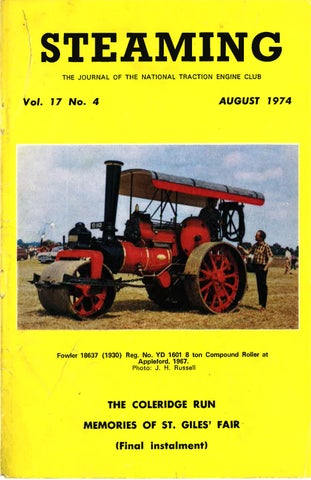
Fowler 18637 (1930) Reg. No. YD 1601 8 ton Compound Roller at Appleford, 1967. Photo: J. H. Russell
THE COLERIDGE RUN MEMORIES OF ST. GILES' FAIR (Final instalment)
NATIONAL TRACTION ENGINE CLUB OFFICERS President S. J. Wharton, Esq., Southern Down, Minster Lovell, Oxford. Vice-President J. T. Beeby, Esq., Wymeswold Road, Rempstone, Loughborough, Leics. Chairman Anthony Heal, Esq., Baylins Farm, Knotty Green, Beaconsfield, Bucks. Vice-Chairman J. Crawley, Esq., Field House, Turvey, Bedford. General Secretary G. F. Beck, Esq., 127 Greensted Road, Loughton, Essex. Treasurer J. H. Hobbs, Esq., 6 Esher Close, Basingstoke, Hants. Editor Ran Hawthorne, Esq., 19 Bridle Path, Woodcote, Reading, RG8 OSE, Berkshire. Chairman, Rally Sub-Committee M. Harmsworth, Esq., Elm Cottage, Ockwells Road, Maidenhead, Berks. Membership Secretary P. R. Dalton, Esq., 54 Woburn Gardens, Basingstoke, Hants. RG22 6UB, Sales Officer V. H. Burrough, Esq., 94 Harvist Road, Kensal Rise, London, NW6 6H L. Technical Services S. J. Wharton, Esq., Southern Down, Minster Lovell, Oxford.
NATIONAL TRACTION ENGINE CLUB Membership is open to all, whether engine owners or not, with a genuine interest in self-propelled steam vehicles, portables, etc., and in steam preservation and operation. The annual subscription is £2. The benefits of membership include advantageous terms for boiler insurance. The club's journal "Steaming" is sent free to members in December, March, June and August. All articles, photos for consideration should be in the hands of the editor by the first day of the month preceding publication. All correspondence re subscriptions, bankers order, delivery non-delivery) of Steaming or change of address to:
(or
P. R. DALTON, Esq., 54 WOBURN GARDENS, BASINGSTOKE, HANTS. RG22 6UB. All items are held copyright by contributor and/or NTEC.
Acknowledgements We are pleased to acknowledge the help, in the preparation ❑f this edition. of• Vic Kirk, Derek Rnyner, Andrew Petrick. H. C. Quigley, Keith Brothwell, Affiliated Clubs and Area Correspondents, and many more. "Thank you". 202
STEAMING THE JOURNAL OF THE NATIONAL TRACTION ENGINE CLUB EDITOR: RAN HAWTHORNE, 19 BRIDLE PATH, WOODCOTE, READING, RG8 OSE. VOLUME 17 No. 4
AUGUST 1974
FROM THE EDITOR'S CHAIR A few days after the last Steaming went to press 1 received the enthusiastic report of the Coleridge Run in New Zealand (printed in this issue). It was almost uncanny that, having just made the suggestion of a "Steam Run" in "Blow off". There was a report of our fellow enthusiasts at the opposite side of the world having conceived a similar idea and put it into practice! It is quite obvious that the Coleridge Run was a great success, that it was greatly enjoyed by those taking part and that it gave enjoyment to many people. A really worth while preservation activity. The March 1975 edition of Steaming will be a special edition Steam in Lincolnshire. A number of articles are already under way but we would welcome further articles on engines, and anything to do with them, in the county. Also photos of Lines built engines, in or out of the county and other makes at work or in preservation in the county. All material to me before Christmas please. The December edition will, as usual, be made up mainly of reports of 1974 events. We give preference to NTEC approved events and Steam meets etc. as organised by affiliated clubs. More reports come in than we have space for so please send EARLY, in any case not later than October 1st. Copy for Steaming should be typed, double spaced, on one side of the paper only. If typing is not possible write clearly leaving a good space between each line use capitals letters for any unusual names. We extend a welcome to Roy Fowler who joins Steaming as Display advertisement manager. Businesses. Rally organisers and anyone interested in display advertisements in Steaming please contact Roy. (See advert towards the back of this edition). Small advertisements direct to the editor as previously. These should be typed, or written in block capitals. on seperatc sheets of paper. (Not incorporated in a letter). "BLOW OFF" Steaming opinion Column The recent news that a group of people had got together as a "Steering Committee" with a view to forming an Association for the encouragement of the preservation of historic items connected with Road Rolling, and the road making industry, and for the study of the subject and the collection of photos, information etc. on the subject is warmly welcomed. Our British Steam Rollers have gone all over the world, in fact many are still at work in various parts. Road making has altered a great deal in the last 25 years. There is much to be recorded before it is too late. In some quarters the Steam Roller is regarded as the poor relation of the Traction Engine world. This should not be, for Steam Rollers, as a group, have proved their value over a longer period than others. Steam Rollers are not the "poor relation", in fact today's "average rally goer" has a warmer place in his heart for the Steam Roller as it is the only type of road steam vehicle he has seen at work. We welcome and encourage this new group. Anyone wishing to be associated should write to L. R. Shearman, IS Thornton Street, King Cross, Halifax, Yorkshire, or watch for further details in Steaming. 203
N.T.E.C. SOCIAL MEETINGS At the 'Cock Tavern', Great Portland Street, London, W.1. (two minutes from Oxford Circus Underground Station). Meetings on last Wednesday of month, October to April (except December) at 8.00 p.m. 30th October Members Slides (20 maximum per member). 27th November — 'The Big Narrow Gauge' (Mr. G. M. Mileham). C.G.M.
BANKERS ORDERS The best way to ensure your N.T.E.C. subscription is paid on time is to use a bankers order. In this way the bank do your remembering. A number of members using bankers orders have not yet increased their subscription (now £2). If you have not altered your bankers order or if you wish to start paying by this method forms are available from the membership secretary.
INSURANCE Some members have their boilers inspected and insured by insurers other than the club's official insurers. In most cases this is perfectly satisfactory but it has come to light that in certain cases a very low maximum cover is given. Menthe's are therefore advised to read the small print or see their broker and check on the amount. £100,000 is considered to be the minimum. Members who low load their engines everywhere (not taxing the engine for the road) are reminded that third party cover is still required when attending events. If an engine runs over someones toe — or worse — the owner will be liable. We also warn that "sparks risk" insurance becomes invalid if sparkarrestors are not "worn".
HELP Our Club, with its 3,000 members, includes people with many and varied skills and qualifications. The knowledge and experience of members of the Committee enables them to give help and advice on many matters to members who need it. Some of the problems that Committee members are occasionally asked to deal with are of a legal nature about which even the experienced layman hesitates to offer advice. Are there, amongst our members, any with legal qualifications who would be prepared to help engine owners with problems of this kind? Would anyone willing to assist kindly write to the Chairman, A. S. Heal, Baylin's Farm, Beaconsfield, Bucks.
PRESS AND PUBLICITY We are in need of an officer to help project the Club's image amongst newspapers, radio and television, etc. Please contact the Chairman.
ACKNOWLEDGMENT The illustrations on page 140 and 172 in the last edition of Steaming were published without knowledge of the photographer. It appears that these two photographs were originally taken by Mr. John Wilkinson of Bingley. We appologise that this work was not acknowledged at the time of publication. — Editor.
HORACE LAMPITT As we close for press we hear of passing of the President of the Banbury Steam Society. An appreciation will appear in the next issue. 204
Wallis & Steevens "Advance". Photographed in commercial ownership of Herbert Ward & Son Ltd., Thorpe Lea, Egham. c. 1967.
LOG BOOKS In the course of the next few years the records of the registration of vehicles are being "centralised". This will result in "log" (registration) books being retained by the local authority. However, we are given to understand that owners of vehicles of historic interest will be allowed to retain their "log books" but they must ask specifically that the books be returned to them when they are taxing their vehicles.
WEIGHT RESTRICTIONS The Bucks C.C. have restricted the movement of heavy goods vehicles on certain roads in that county. Our Chairman has been in touch with the Clerk of the Council who has stated that the regulations will "apply only to vehicles which are constructed or adapted for the carriage of goods". Our Chairman's timely action has ensured that Traction Engines still retain the freedom of the road.
FOWLER TRACTION ENGINE REALISES £4,700 Messrs. Whittaker & Biggs, Auctioneers and Valuers of Congleton, Cheshire, report that a 1918 compound "Russian" type Fowler Traction Engine, Makers' No. 14958, and in working order, was sold by auction at Lower Withington, near Macclesfield, on Wednesday 6th February, at a figure of £4,700, to Mr. V. Greenaway of Whitchurch Hill, near Reading. This engine, which was well known to all local enthusiasts, was the property of the late Mr. fames Bostock, and brought prospective purchasers from all parts of the country. 205
Re-enactment of
THE COLERIDGE RUN by The Southbrook Traction Engine Club Easter 1974 by the Club Secretary H. C. Quigley Between 1912-1913 the New Zealand State Hydro Electric Department commenced work on the damming of Lake Coleridge in Canterbury for the production of electricity for the City of Christchurch and the Province of Canterbury. Lake Coleridge is approximately 80 miles from Christchurch and 60 odd years ago the roads leading there were not as pleasant for travel as the present bitumen surfaced ones. Practically all rivers were unbridged, consequently a Nor-West rain made the crossing positively dangerous to all modes of transport. All machinery and materials were railed to Coalgate, the nearest railway station to Lake Coleridge, and were taken from there by a fleet of up to 15 traction engines the remaining 35 miles or so to Lake Coleridge. A great deal of rivalry between the various drivers used to occur in the early mornings as engine crews jostled for position in the Railway yards in an endeavour to obtain the must advantageous position for the early start on the journey to Coleridge. Many an engine made mistakes in surveying the river fords preparatory to crossing to the other side and were frequently left bogged down to the firebox level. The unlucky drivers were usually left to their own devices in finding their own way out of these difficulties. Some very heavy and awkward loads were transported over these roads, sometimes two engines had to be used in tandem in an endeavour to move an extra heavy piece of machinery. The complete job was finished during 1914 and the Station was opened i n 1915. Some 18 months ago a member of our Cub suggested that we should stage a re-enactment of the Coleridge Run. as it came to be called. There happened to be one engine in the Club that had worked under the ownership of a Mr. Truman Jones of Hororata during the whole of the construction of the Coleridge Station. This engine was purchased by J. L. Quigley of Masons Flat some years ago and has been completely restored by him to it's original condition. it is a 10 h.p. McLaren and as can be seen by the enclosed photograph is in wonderful condition. After a great deal of preparation and contact with various Government Departments permission was finally granted us to leave an the journey during Easter 1974. Four engines from Hawarden left on the morning of the llth April to travel the 45 miles to Rangiora to meet a further four engines from there. The morning of Good Friday was cold and very foggy but an early start was made on the next stage of the journey, a distance of 45 miles to CoalFate. This was reached during the late afternoon after an uneventful tourney along an excellent tar sealed road. All engines with wagons and huts (living vans) were driven in to the yard of the Mid-Canterbury Transport Company for the night. The cooks prepared a meal for all hands and after this had been disposed of and the cleaning UP completed a visit was made to the local Tavern for an hour or two. Perhaps. if one or two of the crews displayed a certain amount of reluctance to rise on the Saturday morning an excuse could be made for them, the previous day had been long and hard! Saturday morning dawned clear and line, a promise of another beautiful day. An old identity of the district, Mr. Phillips, who had worked on the Dam construction 60 years before was given the honour of steering the It) h.p. McLaren engine belonging to Mr. J. L. Quigley from Coalgate to Hororata. Mr. Phillips had never thought the chance would occur for him to steer an engine that had worked on the project so long ago. At every road crossing and at all townships along the route the engine crews met 206
Above: The Coleridge Run 1912-13. Engines in the Coalgate railway yard about to set off for Coleridge. Below: The Coleridge Run 1974. Engines at practically the same spot as above. All photos by courtesy of the Southbrook T.E.C.Sec. H. C. Quigley.
207
with a wonderful reception from the local population. The Chairman. Councillors and County Clerk of the Malvern County Council who had given us so much help and encouragement with this project were in attendance at Coalgate to see the engines away on the last kg of the journey to Coleridge. These Gentlemen could not have been more helpful as far as we were concerned. The Chairman of the Council, Mr. Redfern, spoke a few words congratulating us on our re-enacting this journey and wished us well on the final leg. About 9 a.m. the eight engines which had now been joined by a further five engines from nearby areas left on the last 35 miles to the Lake. This stretch of road which is mainly through hilly country, some of it being rather steep, tested the capabilities of some of our younger drivers to the utmost but all came through with flying colours. A large crowd met the first engine at about 5 p.m. By seven in the evening all engines and equipment was parked in the area adjacent to the Power Station and the Lake. Sunday was a day of rest and all crews spent the day cleaning and adjusting engines. A very large number of campers and visitors from Christchurch and surrounding areas surged around the engines and huts all day asking all manner of questions and taking all manner of photographs. Many visitors had not seen traction engines before and the questions came thick and fast, however we managed to satisfy most questioners. with the exception perhaps of the person who asked how much petrol the tank held and what mileage we could expect from such a heavy machine! After a good night's rest an early start was made on the return journey. The weather was dull and overcast and as the trip progressed heavy ram commenced to fall. However, on the way to Coalgate a cup of coffee containing a well known additive was appreciated by. even the most temperate of drivers and steersmen. Coalgate was reached in reasonable time in the afternoon and after all had changed into dry clothes and participated in a meal, sights were again fixed on the Tavern. Luckily, perhaps, the rain continued to pour down, sonic 34 inches of it and as an approach to a bridge on the route home was damaged an enforced stay of some 24 hours hours was made at Coalgate. Needless to say, the time was not entirely wasted. Wednesday morning was bright and clear so an early start was made for Rangiora, 45 miles away and a downhill run. Rangiora was reached by early afternoon. thus allowing the local engine owners time to clean and sheet down their engines before nightfall. Once again the local Tavern at Southbrook, only a short distance from where we were camped, was visited, mainly I think just to celebrate the approaching end to a most successful trip. On the morning of Thursday 18th April the four engines from Hawarden left on their 45 miles journey which as before proved to be quite uneventful. All engines were home and under cover by 6 p.m. The four engines from Hawarden travelled the round distance of 250 miles without a mishap or breakdown of any kind. During the whole journey to Lake Coleridge and return only one engine suffered a mishap, that of our Club President, Mr. Fred McIntosh, a broken rear axle. All connected with the trip were so pleased with the performances of all the engines that they are now planning a further trip inside the next two years. As one spectator said to me: "You must be beggars for punishment." In retrospect it can be said that a most enjoyable time was had by all concerned. This has been the longest journey made since our Club was formed. Incidently, this Club was the first formed in New Zealani. Mr. Martin R. Pearson was the guiding spirit and it is pleasing to know that he still takes his Robey 8 h.p. compound to rallies. The Club was formed in 1958 and has gone from strength to strength over the years One engine that made the trip to Coleridge and return is worthy of mention. This is a 1907 Burrell two speed, unsprung 8 h.p. s.c. This engine had been lying derelict for many years, in fact no engine enthusiast would have anything to do with it. It was bought by the present owner, Brian Quigley. and has been completely restored by Brian and his comin, I oaan Quigley. The fact that this engine did the 250 miles without trouble of any kind speaks for itself. 208
THE COLERIDGE RUN, NEW ZEALAND
8 h.p. McLaren Compound No. 1110 (1914), owned by H. G. Feather, taking part in the run, Easter 1974.
8 h.p. McLaren Compound No. 1188 (1911), owned by B. Curragh, and other engines at Lake Coleridge having completed the run. 209
10 h.p. McLaren Compound No. 957 (1909), owned by J. L. Quigley and R. J. Warwick. This engine was one of those that worked on the run 60 years previous to this re-enactment.
The following engines took place in the Coleridge Run. McLaren 10 h.p. No. 957 (1909) compound, 3 speeds, on springs. Owned by J. L. Quigley and R. J. Warwick. Marshall 8 h.p. No. 52609 (1909) compound, 3 speeds, on spring. Owned by J. L. Quigley. McLaren 8 h.p. No. 1241 (1912) compound, 3 speed, on springs. Owned by A. B. Calder, see front cover of Steaming Vol. 16 No. 1. McLaren 8 h.p. No. 1188 (1911) compound, 3 speeds, on springs. Owned by B. Curragh. Burrell 8 h.p. No. 3228 (1910) compound, 3 speeds, on springs. Owned by F. A. McIntosh. Burrell 8 h.p. No. 3975 (1926) compound, 3 speeds, on springs. Owned by A. R. Greer. McLaren 8 h.p. No. 1110 (1914) compound, 3 speeds, on springs. Owned by H. Feather. McLaren 6 h.p. No. 853 (1907) s.c., 3 speeds, on springs. Owned by H. C. Quigley. McLaren 6 h.p. No. 1108 (1912) s.c., 3 speeds, on springs. Owned by A. B. Calder & Sons. Burrell 8 h.p. No. 3227 (1910) compound, 3 speeds, on springs. Owned by W. Vette and N. Kearns. Robey 8 h.p. No. 13939 (1911) compound, 3 speeds, on springs. Owned by Martin R. Pearson. Aveling & Porter No. 7304 (1914) compound, 3 speeds, on springs. Owned by Bruce Gillanders. Burrell No. 2835 (1907) s.c., 2 speeds, unsprung. Owned by Brian Quigley. 210
STEAM IS WHERE YOU FIND IT EACH A GLIMPSE by D. A. Rayner Come with me on a journey. It is a damp grey January morning. The time is 7.32. The concourse at Leeds City Station is brilliantly lit compared with the dismal scene through the barriers. A flustered businessman in pinstripe suit rushes to the barrier in the hope of catching the "Executive", the fast London train which had left promptly at 7.30. We mutter the well known password "Paytrain" at the ticket collector and he stares blankly past us, not caring about us or our destination. Descending the steps and making our way up again, we emerge on one of the island platforms and make our way to No. 7. The train is not yet in. We join the numerous workmen and a few student teachers waiting in the cold. Soon a twin diesel unit appears round the corner in the distance and, twisting and turning, eventually finds its way into our platform. The bleary eyed early morning workers emerge and we get in. We are cheered by the warmth in the coach. Someone has left a morning paper for us to read, tucked down the side of the seat. We can find a use for this later. But we are unlucky, for no sooner have we settled ourselves in than the owner returns, excuses himself and retreives his paper. Fortunately, this morning, the "No Smoking" portion is located at the front of the train and so we can sit immediately behind the driver and to his right, in order to view the road ahead. The time for departure approaches, the signal at the platform-end changes to green and two buzzes from the guard, returned by the driver in the same motion as he releases the brake, herald our departure. We slowly wend our way out of the station, over the many points and crossings and eventually head on to the old Midland main line, bound for Normanton and beyond. We pass Holbeck Diesel Depot on the right but its 40 ton steam crane is away for overhaul so we cannot see that. As we pick up speed, we snake along the black stone walled cutting, through that mecca of all traction engine enthusists — Hunslet — the location of the steam engine works of such famous firms as Fowler's McLaren's, Yorkshire's & Mann's. As we slow for a permanent way slack a couple of miles out, the conductor/guard appears and asks for our fares. "Two singles to Barnsley, please." Our destination is deep in the heart of the Yorkshire coalfield. Once the majority of colleries shunted by steam power but now very few retain their steam locos. We hope we will be lucky and see one or two. Now, clear of the slack, the driver opens the unit up and on the relatively flat road past the Freightliner Depot, we are soon up to 70 m.p.h.. the maximum speed. Passing over the main road, we look down with scorn on the little tin boxes, restricted now to 50 m.p.h., as they crawl along below. A colliery on our right, but no chance of steam here, there is no rail access. On we go, alongside the River Aire and the canal, passing power station sidings and spoil heaps and slowing for our first stop. Woodlesford. The sidings to the brewery were lifted many years ago but those to the colliery on the right only came up in the past few years. The once immaculate side tanks which graced the colliery yard are now departed to find use elsewhere and the site is flattened, the steam winding engines having gone for ever. Over the long embankment we go, past the redundant tips, past the council rubbish dump and the sewage works and then, yes, there it is, our first glimpse. Savile Pit, Methley. About a quarter of a mile from the line and almost hidden in the conglomeration of pit head gear, screens and other buildings, a wisp of steam and then, just as we draw level with her, obscured now and then by the newer farm buildings, the loco moves. No doubt about it, the distinct lines of a Hunslet saddle tank and dome. A puff, puff, puff and a cloud of smoke and steam rises in the damp air. We crane our necks backward and the train continues 211
its journey, the passengers behind wondering what we have seen and what they are missing. And then we lean for the corner and she disappears out of sight. It is interesting to note that they have a diesel locomotive at this pit — in reserve. They prefer to use the steam on the basis that if the steamer fails, the diesel takes only a few minutes to start but conversely, if the diesel fails, which from past experience happened too often, to prepare the steamer would take a much longer time. Still we lean to the right in a cutting, under a bridge and then on to an embankment, passing redundant colliery workings on the left, now grassed over and over a canal, slowing for Altofts Station. The new motorway (M62) workings catch our eye and as we follow their scar across the countryside we see a familiar sight. Some two miles off, but unmistakeably so, a white plume rises in the air. An unexpected bonus this and one we'd forgotten about. Newmarket Colliery. Steam is working there, out on . the tips, clear of the colliery buildings and because of our elevated position, we are able to see it. At that range it was impossible to make out the loco or wagons so what it was, we did not know. There is but one person waiting on the platform at Altofts — a somewhat unnecessary stop, perhaps, but knowing the local bus services and the journey times to Leeds, it is a station which is well used in the opposite direction. Our next stop is Normanton, the station now a shadow of its former self. In days gone by it revelled in its importance as a main line junction. complete with dining rooms for the mid 19th century travellers. But this is no more and now it is little more than an unstaffed halt. A lot of wnrkmen and the student teachers get out here, several people get in. We are off again and the conductor/guard is kept busy almost as far as Wakefield. We have now left the Midland main line and are heading westwards on the ex-Lancashire & Yorkshire line. We are reminded of the still extensive colliery workings underground by a 20 m.p.h. slack and then crossing the river, past another sewage works and the power station, we arc into Kirkgate Station. Again, a large station, demoted in stature insofar as passengers are concerned, it is nevertheless kept busy by the large volume of parcels traffic it handles. There is a big interchange of passengers on our train and as the buzzers go again, we head off under the 99 arched G.N.R. viaduct towards open country once more. We arc soon up to 70 again as we run parallel with the River Calder and the ubiquitous canal. In the distance, on an embankment, the MI crosses the valley and we slow again to 20 m.p.h. The signal is on but changes to yellow at our approach, along with the feather for our sharp left turn up the branch. The weather is brightening now. the weak early morning sun casting long shadows of our train on the fields as we accelerate away past Charles Roberts' at Horbury Junction, builders of rail vehicles of many years. We cross the river which gently foams with its high detergent content as it desends a weir and the canal, climbing steeply now towards the old station at Crigglestone. It was here, a few years ago, at Flockton Sidings, that one of the ex-B.R. "Jinties", now owned by the Midland Railways Company Ltd., worked in the hands of Pepper's on opencast coal working. Still climbing, we again slow to our now seemingly usual speed of 20 m.p.h. for even more colliery subsidence. This is most noticeable here as the train sways from this side to that and lurches back again, dipping at the front at the same time. Then, the other line leaves us in its own cutting and with a blast on the two-tone horn, we plunge into the darkness of Woolley Tunnel. These are two straight single bore tunnels and we can see the end almost as soon as we enter. The small oval patch of light gradually gets larger and larger as we make our way along. Almost at the end and sudden memories flood back to me. I say a little prayer for a girl I once knew who, together with her boyfriend, died under the wheels of a train in tragic circumstances here several years ago. Water showers across the front of the train from a spring in the tunnel roof. The driver starts the wipers and then we are out into the open again and rejoining the other line. Another closed station, Haigh, now mostly demolished is passed and the motorway appears on our right, having gone over us whilst we were in the tunnel. Some outcrop workings and a disused colliery tip, recently graded and grassed over become visible on the left and we are approaching the mountainous slagheaps of Woolley 212
Colliery which is happily still in full production. The sidings here leave the main line sharply at a tangent and almost immediately disappear behind leafless trees and another pit heap. Not much chance here of any steam as they've had two diesels working for a while now. The signal box at the Colliery outlet is manned (if that is the correct term) by a woman, one of the few signal women employed by British Railways. I try to catch sight of her as we pass but my companion excitedly jabs we in the ribs and shouts, "Look" and there, at the top of the yard, a huge column of steam above a loco whose shape of cab is most definitely Hunslet in design. An Austerity 0-6-0ST blowing off and then it was gone behind the enormous spoil heap. Another glimpse, again unexpected and coming through the cutting now, we cross our fingers, for just past Darton Station, the next stop. is where we had expected to sec our second steam loco, but, if we were to continue being lucky, as we had been so far, it would be our fourth. We stop at the station, pick up several more passengers bound for Barnsley and then we are off again, on a falling gradient, past the carpet works and the junction for North Gawber Colliery. In the sidings curving away from the line and above it now on a ledge, are rows and rows of trucks but no loco. As the lines diverge, a cloud of black smoke becomes visible, rising in the now somewhat misty atmosphere near a small cabin. Ah, we thought, our fourth. But it was not. We were disappointed to sec that it was only a steam crane and judging by the colour of the cloud, the driver was using the sweepings up from around the screens to fire his charge. It was a still day and the cloud hung motionless over his chimney, mushrooming upwards in an atomic effect. But we arc accelerating away, now descending faster and faster. I notice another column of smoke coming from a chimney over a fence on the right hand side of the track. What can it be? There's no other railways near. It turns out to be a false alarm. A single deck bus minus it's engine. used as a mess van for a group of contractors engaged on a land reclamation scheme. Their stove in the middle of the bus being fired on wood and a long drain pipe forming the chimney is the source of our concern. We continue our downhill dash, 60, 65, and as we touch 70 once more, we start ascending and "There, see", says my friend, "they've not let us down". The N.C.B. line from the junction at Darton swings upwards and away from our line and disappears for a time behind a mound of debris. North Gawber Pit itself is some two miles from Darton and as we are now ourselves about a mile away and on the other side of the valley, the colliery yard and sidings are now visible. The tell tale plume of steam clould be seen from a minute loco pushing some equally minute wagons about the yard. A Hudswell-Clarke engine this and then it is gone again, behind some nearer buildings and we continue our headlong ascent, through a bridge, no longer now being able to see back. Again passengers behind us in the coach are looking, wondering, what is so interesting to these agitated persons in front. Two minutes later we are slowing down and clattering over the junction into Barnsley Station where we quickly jump out, run over the bridge in time to see a similar train to ours coming over the level crossing from Sheffield We are thus able to return to Leeds almost immediately with the possibility of similar sightings on the way back. All the four locomotives we had seen on this journey through some of Yorkshire's most unlovely and industralised Broad Acres, had been well within N.C.B. territory and naturally from the distance we had seen them, photography was impossible. Even to visit the sites concerned in the hope of taking photos without trespassing would have been impracticable. The only way would have been to apply officially to the N.C.B. for permission to visit the pits concerned and probably get tied up in red tape. However, for the princely sum of 22p which is all our journey to Barnsley cost, we had witnessed, even today, despite not being able to record same for posterity, four steam locomotives at work on the Yorkshire Coalfield. using natural and home produced products for the purpose of speeding the good quality Yorkshire coal to both power stations and to the merchants for domestic use. Some of it may even find itself thrown into the firebox of a traction engine, to be used to give pleasure to others, as is our wont. 213
REMINISENCES OF ST. GILES' FAIR 1939 By Viv Kirk Early in the spring of 1939 I started work at the University Department of engineering in Parks Road, having tried unsuccessfully the previous year for a job there, in the meantiine working at two other temporary jobs. The red brick buldings of the engineering department, with its entrance doors in Parks Road, a well polished brass plate, with "Engineering Laboratory", etched into the metal, lettered out in red. Looks little different today from the time I worked there over 30 year's ago. now more prosperous with a ultra modern building. A little further down the road, all going under the name of Nuclear energy laboratory. The old building where I worked. now forming an annexe to the new building. My wages commenced at 17 shillings and six pence a week, rising by half-a-crown the following year. at the start every thing seemed to point to my having a chance to acquire some skill in the engineering field, unfortunately this did not materialise. Though the chief of the whole department was a Professor of engineering. The man responsible for keeping all the equipment running an►! who I walked under. He was of the old school, well dressed and mannered. starched shirt, collar and bowler hat. Although a first class engineer, skilled in boiler work, fitting. diesel, gas and steam engines. he was reluctant to pass any of his knowledge on to others, so I only got the more unskilled manual jobs. like cleaning with a wire brush the inside drum of the Babcock & Wilcox steam boiler when layed up for inspection. From the outside of the building there was little to show of the interesting engines that lay within, except when the Babcocks boiler valve lifted, then the noise was like a ship leaving port, blowing her steam siren. Housed in the north wing of the building on the ground floor, were a four cylinder Dorman petrol car engine of 1920. Vintage vertical steam engine, Blackstone semi diesel engine started with a blow lamp, a National gas engine, both the semi diesel and the gas engine, were of the heavy horizontal open crankshaft type of about 8 or 10 H.P. and built in 1908 and 1906. Other parts of the building contained electrical dynamos and motors, metal testing equipment. All very interesting days they used to be during the two years I worked there. As so few steam vehicles were about I had ceased to be alert, as in the part, for the unmistakable sound of a traction engine gearing, or familiar noise of a steam wagon about in the streets of Oxford. It was therefore, quite a pleasent surprise when one day during the early summer of that year, two steel shod agricultural type engines pulled up in front of the building, on the opposite side of the road, one having developed trouble with a broken boiler feed pipe. After some time, the trouble was remedied and they set off together along Parks Road. It was at this University engineering dept. I came across an interesting weekly magazine, "The English Mechanics", a copy had been thrown out by some one. I ordered a copy soon afterwards, which together with the Worlds Fair, and the Model Engineer I had some very interesting reading. I am sorry to say the old "English Mechanics", which used to be four pence a copy, has long since ceased to be published. About this time, one day R. Edward's and Sons Chariot Racers loads went by along Parks Road, no engine. I was sorry to see the loads being hauled by a large Scammell tractor which I had seen the year previous pulled in at Pains Field. Mounted on the tractors chassis were two generating sets, one or both were fitted with Tilling Stevens 214
ex-bus radiators. Mounting the two generating sets in this fashion gave extra weight on the tractor's rear wheels. also greater hauling power. and saving wear on its own engines, as the generating sets drove the machines while open at the fair. During the summer John and Charles Thurstons opened a fair in Morrell's Park at the bottom of Headington Hill. I had never seen any fair there before. Present were two of Thurstons Burrells. No. 3200 "Unity" and No. 3075 "Alexandra", Charles Thurstons fine Burrell No. 3827 "Victory" being unfortunately replaced by two Armstrong &aver tractors, one of which was fitted with a winch and ground anchors for roping out, both having large dynamos fitted transverse above the chassis. The machines present that year were John Thurstons Noahs Ark, and Dodgems, Charles Thurstons Monte Carlo Rally. I remember one evening during the fair, seeing one of the students from the engineering department studying the two BuffetIs, "Unity" and "Alexandra" while they drove the machines. not long after this event, we started the long summer vacation. One benefit of working in the University Science department, was that we used to get six weeks, I looked forward to that years holidays, which should have been terminated with again being free to enjoy St. Giles Fair, the week before the fair and the two days of the fair itself. This was not to be however, as it turned out the Sunday 3rd September, when we should have been looking at the sheeted up centre trucks in St. Giles followed with a walk to the station to see the Burrells of Thurstons on the eve of the fair, instead the war had started, I was called back to the University department. to help fill sand bags, and prepare black out fittings for the building. We were still living on the Botley Road that summer, always enjoying long walks, on some of the days off. I used to walk via Ferry Hinskey Road, pass Paines Field, where T. Clarke. later F. Wilsons two Burrells No. 3272 "King George" and No. 3273 "Green Mary" used to pull in with the switchback loads before the fair, along several footpaths crossing the southern by pass, over a public open park, and after crossing on the edge of some fields by right of way bridle paths, would reach Chawley Heath, which over looked the disused brick works of that name, with the brick work kilns and chimneys looking as though the works had only stopped yesterday, when in fact they had been closed down some five years. Among all this array of the brick making industry, standing where she had last done a days work, was a Clayton Portable of about 7 H.P. further on round the front of the works, still in her shed, stood a fine Fowler, with the firms Garrett steam wagon also under cover close by. Sadly enough both the Clayton and the Garrett wagon, survived the war, only to end their days during the mid fifties. The brickworks is now used by a timber company, all the chimneys were demolished some years ago. By August 1939 we moved house going back to the Walton Street area, about this time R. Wilson opened a fair at Wolvercote on the northern outskirts of Oxford, the fair being held on the Wolvercote end of Oxford's famous open space Port Meadow. I was present on the Friday evening of the weekend the fair opened. No engines, again all transport and machines being driven by a mixture of petrol lorries. and diesel tractors. Here R. Wilson opened their newly purchased Autodrome, a ride which was to become quite popular, being the latest in new rides that year. The former bus. Tilling & Stevens petrol electric was driving the other machine present, the Monte Carlo Rally. These famous vehicles were fitted with 110 volt. 150 or 200 amp. dynamos they were ideal for work on the fairground. An odd looking vehicle used by R. Wilson that year for haulage and driving the machines, was a former six wheel diesel lorry, with the platform body removed, and a large concrete block mounted over the rear four sets of wheels, with a dynamo mounted transverse above the chassis, between the drivers cab and the concrete block. One could not help thinking how neater it would have looked with the end pair of wheels removed, becoming a four wheel tractor. 215
On Saturday 2nd September I remember walking down to the L.M.S. and G.W.R. station goods yard, to see if any engine and loads of Jacob Studts C. and J. Thurstons had pulled in. None having done so, at the time of my visit. The only Showmans vehicle I saw that day was a lorry and living van, which pulled up outside the newsagents shop in Park End Street, while the showman hurriedly purchased a news paper for the latest news. By the following day we knew there would be no fair that year. Little did we know six years were to elapse before St. Giles would again echo to the welcome sound of laughter, and yet sadly what was to be the last but one year of the Showman's engine driving the machines. Every thing during the first year of the war carried on very much the same, there seemed as many students studying engineering as during the term before the out break of war. The Babcock and Wilcox steam boiler was still in steam on certain days of the week, supplying steam for the vertical steam engine, steam turbine and wier steam pump. Just after returning from dinner one day, there was a mighty roar, the water glass had broken. The chief assistant who I worked under, placed the wooden ladder. which was kept in the boiler house, against the boiler, climbed up and shut the gauges bottom and top valves. Although the boiler had been in use during the morning afterwards being shut down, I was suprised this amount of steam could be held in the drum for that length of time. By the middle of August I was working in the upstairs part of the building over looking Banbury Road. Amongst the every day sounds of buses. cars. lorries and all the other noises associated with a busy thoroughfare. One sound, unmistakably, a traction engine! gearing sounding with that certain ring of a Fowler, which it was in fact. as shortly afterwards a Fowler Showmans engine came into view, with the loads of a Autodrome, all the three trucks being on balloon tyres, not long afterwards another engine followed, with the three loads of Monte Carl❑ Rally, the latter engine a Burrell. Both engines being strangers to me no showmans name was lettered on the engine's cab side boards. As they were both going towards the centre of Oxford, I wondered if a fair under war time conditions would be held perhaps opening at Pains Field, Ferry Hinskey Road, where until the war Batley fair had been held. That evening I walked down to Ferry Hinskey Road. Pulled in on Pains Field was the two engines and loadc, the Fowler No 15654 "Lioness" and Burrelll No. 2804 "White Rose of York", the fair if I remember correctly remained open for the complete week, being still summer time there was no need for blackout precautions. The fair brought great pleasure to many people, being held during those difficult times. I spent several evenings there watching the two engines hard at work, Pains Field had changed a little at the front entrance, some buildings now standing where Tom Clarks later F. Wilsons two Burrell's with the Switchback loads used to stand for four days before the fair. Carter Patterson had a depot further along Ferry Hinskey Road, and an electric grid station adjoined Pains Field, this having been in use for a good many years, the hum of the transformers could always be heard. By the early spring of 1941 my days at the engineering laboratory had come to an end, I now worked for some building firms, mostly on building brick air raid shelters, having a day off from this work I was in the centre of Oxford. when I met an old school pal, Ted Rawlings. who at that time worked in the Oxford covered market in the green grocery trade. Ted, I already knew was in the Home Guard, after having a talk for a few minutes. Ted said "come on we will go down to the Central Police station, obtain a form. fill it in, making sure you enroll in the West Oxford platoon like myself". This we did, unfortunately this did not turn out as we had hoped, when the time came, I found myself in the central platoon, with one-night training taking place in a former shop in George Street, a bit of further training Sunday morning. and guard duties Thursday night, of all places! the electric grid station Ferry Hinskey Road, using the brick building near the entrance to Pains 216
Mrs. Bird's, later Flanagan's, Foster 12538 (1910) "Surprise". A regular St. Giles' Fair visitor.
Billy Nichols' Burrell 3949 (1923) "Princess Mary" with galloper loads soon after she was new. She attended St. Giles regularly, now in preservation. 217
Field as a guard room. 1 never did find out if Ted's lot, also did their guard duly there, poor old Ted, he was about two years younger than myself, lost his life in Normandy on D Day with the Paratroops of the 6th Airborne Division. After being on guard at the grid station several times during the early summer of 1941 R. Wilson opened another fair on the adjoining Pains Field, besides the Burrell No. 2804 "White Rose of York" and the Fowler No. 15654 "Lioness", he also now owned a further engine Foster "Queen Mary", together with a set of Dodgems, some of the trucks of this machine being on solid tyred iron wheels, the other two machines being the same as the previous years, Monte Carlo Rally and the Autodrome. R. Wilson returned again towards the end of the summer, on this occasion the trucks of the dodgems and the Monte Carlo Rally, remained on Pains Field long towards the autumn. The three trucks of each machine have been drawn up close to the entrance gates. The two engines having gone, following the pull down of the fair. I used to hope each time I was on guard duty I would find the two engines had returned for their loads, and perhaps had remained there for a few days, as it was this never happened, the loads were always there, but no engines. At last one Thursday I found the trucks had all gone. While they were there I used to like having a look round them during my two hours on duty, and day dream of those wonderful days the fair spent at this very place. After all did not Tom Clarks, later F. Wilson two Burrells No 3273 "Queen Mary", No 3272 "King George IV" with the switchback loads, stand just about where our brick built guard room buildings were? I do not remember ever seeing R. Wilson engines and rides again, as by August of the following year I had my calling up papers for the Army, having to report to Chichester Sussex. to a primary training Unit, wearing my former Home Guard uniform, which was the rule at the time, travelling by train to Chichester. Some two miles from the town, on the left side of the railway was what looked like a Showmans yard, stood a Foster Showmans engine, in near derelict condition. Some two weeks after starting the military training I met with a accident during the P.T. session, breaking my arm, which meant a stay at the Chichester Hospital, while sitting out in the grounds there one morning, I had the pleasant surprise of seeing a Foden steam wagon go by the front gate, heavily loaded with beer crates and barrells. she must have been owned by the local brewery. I saw her at a distance several times during my stay at the hospital, before being transferred to a very large army and civilian hospital near Epsom Surrey. Some weeks after my arrival there. accompanied by some pals from the same ward, we used to have a walk Sunday afternoon to near by Ewell, where had noticed previously a contractors yard, standing by the owners house was a Foden steam tractor. and I believe an agricultural type traction engine, as may be imagined my pals soon realised where my interests lay. and not long afterwards following a operation on my arm, when I came round they were all pulling my leg about the traction engines, some of the first words I remember hearing were, what about those traction engines, they said I was muttering about my old favourites before coming round properly, whether this was true or not I never could be sure. The nurses said it was. The largest number of hospital casualties were troops injured in training also including motor cycle despatch riders, there were also some casualties of enemy action, one I remember who had been given his ticket (discharged) a commando wounded at Dieppe. After the usual convalescent depot. I was sent back to Chichester now nearly a year later to complete my training, being down graded to BI category following posting to a RASC training unit near Matlock, Derbyshire, by August 1943 I was posted to Chilwell. Notts. becoming a base stores unit store man of the RAOC motor spares section. By early spring of 1944 together with two pals we were posted to a sub depot near Mansfield, Notts. dealing with iron ballast weights for the Diamond T tractors who used seven tons each Jerry cans by the thousands were also handled ready for D Day. 218
On the 14th December 1944 I was on a draft for . Belguim, sailing by paddle steamer from Southampton to Ostend in Belgium, by Christmas Day we were in a transit camp near Lourain, joining, in the New year. a mobile ordnance unit carrying stores for the Guards Armour ed. Division further into Belguim, a new type of life after the depot in England. During the spring we were at Tilburg Holland, finishing at the end of the war outside Bremen, Germany, afterward, by July moving to Cologne taking over the area from the Americans, of all these areas we were in towards the end of the war I liked Holland best. During August my turn came to go home on leave, a week later I would have been home for St Giles Fair, as it was my 14 days expired a few days before the fair, in fact when on my way back, F. Wilsons two Burrells "King George" and "Queen Mary" were arriving in Oxford with the Dodgems and Ark loads. After being back in Cologne a few days we were on the move again, being posted to another Division the 3rd Infantry for service in the Far East, fortunately the war there finished, so we never went, we were now attached to a R.E.M.E. workshop of this Division stationed at Ghent, Belgium, while looking around this town, one day I came across a whole railway siding full of shot up engines which had been shunted in there over some months, although some of their boilers were peppered with holes, none had appeared to have exploded. One day after dinner in the school which we used as a billet and cookhouse, I was reading my Worlds Fair (my parents used to send these out to me) when a R.E.M.E. soldier had noticed the paper, and straight away started talking about fairs up North. I believe he was a Showmans son, We had a very interesting talk although I did not know a lot about Northern Showmen. In this billet I also read all about the 1945 St Giles Fair which I missed, how I would have liked to have been there for the first St Giles Fair after the war. By the spring of 1946 I was home for good, being released earlier on the B release scheme, starting work on building pre-fab houses, thoughts about the coming St Giles Fair were with me all that summer, with the Showman and their sons being demobilized, labour should not be too much of a problem. Although we did not expect things to be back to normal. some how you did not know what changes there would be. Having read while out in 13elguim of the 1945 St Giles Fair with only four Showmen engines attending all Burrells, John Thurstons Burrells "Unity" and "Alexandra", F. Wilsons "King George" and "Queen Mary". These four I was hoping to sec that year, this was not to be however, as when the Saturday before the fair came round i went along to the L.M.S. goods station yard. On arriving there John Thurstons loads had pulled in, I could see the last two trucks of the "Noahs Ark", showing partly in near by Bewley Road and the adjoining Hythe Bridge Street. I could not until I got nearer, tell if there was an engine on the front of the trucks or not. When I got close, there was neither "Unity" or Alexandra", but a ex-army Diamond "T" tractor, the other loads of the three machines all being hauled by these Diamond "T's", generating sets being fitted over the rear wheels where the seven tons of ballast used to be carried. As the tractors had not been properly painted, it seemed as if they had only recently been put into use, looking round the loads, which were the same trucks as used before the war. I noticed still some remains of steam coal in one of the belly boxes. Next, walking down to the Oxnens parking area, here at least an engine, F. Wilsons Burrell No. 3273 "Queen Mary" the only engine at the fair, and sadly the last of all those fine engines to attend. F. Wilsons other loads being hauled by a Scammell tractor. We were to have one pleasant surprise, the return of the ex W. Wilsons famous Rodeo Switchback in the ownership of George Studt. This is the machine now being travelled by Jimmy Williams. Changes most noteable that year being, no more centres being built up in St Giles on Saturday night, all the machine loads being allowed to draw in at 8.00 a.m. on Sunday. Monday morning draw in, now 219
F. Wilson's Burrell 3273 "Queen Mary" arriving at St. Giles' Fair in 1946. Photo: V. King
no more. For a few years the side show and stall Showman still drew in at 5.00 a.m. Now in recent years this has stopped they draw in after the machine loads on Sunday. I expect if they had kept to the Monday morning at 5.00 a.m. draw in I would have still got up early and been there for old time sake, even though without the engines it would never have been the same. I spent the evenings of the fair there as in the past, near the Burrell No. 3273 "Queen Mary" of F. Wilsons, and looking at George Studts Rodeo Switchback.
I am often in Botley Road and often think of the times when F. Wilsons two Burrells used to stop near the river bridge of the Thames. and fill their tanks from the nearby roadside stream. on the Thursday before the fair, if they did this today, it would cause a traffic jam stretching past Carfax. How more leisurely the days were then, there was never any hurry in moving the engines. In fact I have seen both the two Burrells there together. I sometimes go down to Ferry Hinskey Road. Pains Field has long since been swallowed up with the building rush there is just perhaps a little bit of hedge a solitary bit still showing. where once full grown it used to stretch the length of that side of Ferry Hinskey Road. with the rough gate entrance to the field where T. Clark's, later F. Wilsons two Burrells No. 3273 "Queen Mary" and No 3272 "King George" used to stand, there cabs with canvas side sheets in position just sharing. Some-how I can still sec them there now.
These articles will be published in book form during the coming winter. Details will be given in the December edition of Steaming — editor.
220
" THE END OF AN ERA "
"Queen Mary", Burrell 3273, at St. Giles' Fair, 1946.
221
BY FODEN TO BRIGHTON BY K. BROTHWELL Foden 13848 (1931), owned by John Butler and entered by Mr. Riven-, was looking very awake at 5.00 a.m. on 5th May. The trees of Battersea Park were just splitting into vivid green, the sun really shone — yes, even at that time! — and if you ignored the chilly breeze, and that you are normally asleep at five on a Sunday. It was a fabulous morning, and best of all the Historic Commercial Vehicle Club's 1974 run was just beginning.
Removeable brasses and the lamps on 13848, were being repositioned, the fire was alight. Oiling round and general checking was under way, so being only a platform passenger, I took note of the other steamers that were getting ready to start the run. Parked in front of the Foden was an earlier wagon from the same builders. This was "The Dorset Rambler", Foden 6350, out on its first trip, since a complete overhaul and repaint. It is owned by J. W. Hardwick & Sons of Ewell, in Surrey, and was immaculate in its new red livery. This wagon — built in 1916 — is on solids (as is 13848) so both would be leaving early. A Sentinel on its first trip out since a total rebuild was No. 763. This is a 1914 'standard' platform ►waggon ❑ wned by Ken Senior of Chertsey, her rebuild was only complete a couple of days before. Painted in a vivid blue, neatly lined, she looked resplendant in the early morning light. Sentinel 8393, owned by H. M. S. Sutan was awake. gently hissing up and down the drive. Mr. A. Winkfield's super Sentinel No. 5407 was also present. having just been rebuilt. It presented a very smart picture in its deep brown livery. Nearby, was an Aveling & Porter roller!, No. 8242, an eight ton.
single of 1912. Was she going on the run? Final preparations were nearly completed on 13848 when T returned. and by seven a.m. we ►were proceeding down the drive towards the exit from the park. As the first vehicle to leave, shouts, horns, whistles, "we'll pass you before you're halfway," sort of comments ►were given, as the two passengers made ready to cover their faces, when our smoke blew back over (which it did quite often). At about 7.15, we passed through the gates and onto the road leading to Brighton (did that lowlander outside the gates really have a steam roller an it? surely not!) As a passenger, the most noticeable part of the ride, was when the solid tyres — on cast wheels — hit the cats eyes and other studs. Every shock is felt, The smoke was a nuisance at first: it was quite strong stuff ►which persisted in blowing over the cab, and then down onto the passengers. Once out of the built up areas, the wind dispersed it sideways which made the ride almost comfortable. No other exhibit had started with us, although we were closely followed by our support vehicle — an early forties A.E.C. Matador. Following us like a shadow. It was useful in backing up hand signals from the Foden, with its flashers. It was surprising how many drivers wanted to argue with a steam wagon. By 7.30 we had crossed Clapham Common and we pulled into Streatham High Street soon after. Here, the first entrant to catch up was noticed in the distance. After following us through a roundabout, north of Croydon — where the police gave us right of ►way! — A 1912 Dennis fire engine. overtook us through our smoke. Gradually, a great array of vintage machinery began to catch up. Lorries. Buses, Taxi-cabs, small delivery vans, more fire engines — all seemed to be regarding
the Foden with envious amusement. At about 8.00 a.m. — near Waddon — we made our first stop to coal-up. While here, we just noticed a flash of blue, a cloud of steam and "Sultan" passed — with the rear section absolutely full of passengers! By 8.15 we had passed Waddon Road Station and came to the hill passing the old Croydon Aerodrome. By now the spectators were noticeable, appearing in larger numbers all the time. At Purley. 'The Dorset 222
Rambler' overtook us when we stopped to remove clinker which was clogging the bars. Not only this, but a big end bearing was running hot keeping the crew more than occupied. About an hour later we passed through Recthin, pausing at the bottom of the climb out of the town to change the coal with some of the spare. (Comments were made about returning the ctinkery muck, to the rally that it had come from!). More oil was given to the slackened off bearing, and we continued up the hill watched by most of the area's poptilation. It was while passing through SaIfords, near Horley, that we overtook a traction engine on the road! Mr. & Mrs. LangIey's Fowler No. 7459 was heading south, but not to Brighton. With due acknowledgement
we continued to the coast. By 10.30 we were on the dual carriageway that skirts Gatwick Airport. More and more vehicles were on the road now. Buses, fire engines and lorries overtook us with increasing regularity. The number of old cars following the run was also noticeable. It was on this stretch of road that we caught tip "Sultan". Nothing so low as carrying extra water — just take out the stand-pipe, block the nearside lane of the carriageway, and take water on, properly. We pulled off this road into a layby, packed with a large collection of vehicles; although its strange to see space appear where there is'nt any. It's only a five ton Foden after all. A quick sight of immaculate red paint and "The Dorset Rambler" passed the layby, closely followed by a Sentinal D.G.4 tractor hauling a trailer. This is No. 8413 owned by R. A. Jardine. which took the Concours award in the steam section of the run. Having been used by Frernlins the Brewers earlier this year during the fuel crisis, it is painted in their livery. After refreshment for the crew this time — and the addition of their sons in the cab — we pulled back an to the Brighton
Road. At Pease Pottage, we came upon our only traffic hold-up — and it was'nt caused by the run. Motorway construction had narrowed the road to a single lane, slowing up the traffic. Once clear we pulled into a layby to replenish the cab's coal stocks. While doing this, a quiet red Sentinel whispered up to us, checked that we were not broken down, suggested that we ought to drive a Sentinel instead, and then disappeared into the distance. In a couple of minutes we had been visited by E. N. Shones S.8 Sentinel No. 9105. This waggon is so fast, that it often
overtook, and then stopped to watch the others, later, easily catching up and passing again. Then Winkfield's brown Sentinel appeared in the distance, pulled into the side of the road, and got the toolbox out. This was the last time we saw it. Later learning that it could not complete the run due to mechanical trouble. At Pyecombe, we caught tip with "The Dorset Rambler" who also had experienced bearing trouble — overtaking the earlier vehicle near the Clayton Tunnel Vents. About four miles to go and it was nearly 2.00 p.m. as we entered the outskirts of Brighton nobody seemed surprised at seeing a steam wagon on the road anymore. We passed through Preston, with it's neat gardens, under the viaduct, and on to the "Old Steyne". The pavilion appeared through our smoke and by standing up and looking through it we could see the sea. 13848 had nearly done it! We turned into a crowded Maderia Drive and gently eased up under the finish banner. The customary presentation was made. and the Foden pulled into the crowds. Was parked neatly in the line and was left simmering in the sun. The Foden had "done the Brighton" again. Yes, on solids, in modern traffic at an average of 8-10 m.p.h. Foden forever! "The Dorset Rambler" soon arrived, Ken Senior's Sentinel
763 came later after having injector trouble and the Aveling roller was present already. To me, the steam vehicles are the main attraction, but the number of heavy commercials has to be seen to be believed. A noticeable point is that nobody goes past a stopped entrant without checking if all is well with the stationary vehicle; be it steam or otherwise. Perhaps you ought to be somewhere along the A.23 on the first Sunday in May next year? You will not regret it.
223
FODENS
Foden 5 ton Wagon, Reg. No. MA 849. c. 1912. Driver A. A. Shawyer.
MASI WANOLI 1, 414DSWOR
A 6 ton Foden Wagon, Reg. No. YM 6968 in the ownership of Pease & Son, Hauliers for Tate & Lyle. c. 1921. Driver A. A. Shawyer.
Photos: G. Gurney 224
GARRETTS
Garrett 3 ton Overtype Wagon 32433. New to Pattinson Ltd. 1914. Sold in 1917 to E. Gorton of Warrington. Reg. No. BJ 2206.
Below: Garrett Untertype Wagon 34361. New to Oakhill Brewery 1923. Reg. No. BJ 8598.
225
P.S. "KINGSWEAR CASTLE" Andrew Patrick
In the early twenties the River Dart Steamboat Company was running a passenger and Royal Mail service between Totnes and Dartmouth calling at Dittisham Pier and other places using three small paddlers: "Kingswear Castle" (1904 - 19241, "Dartmouth Castle" (1907 - 1947). "Campton Castle" (1914 - 1962) and a couple of motor launches. Growing traffic required more steamers and as the river is narrow at Totnes the need for ready manoeuvrability produced two new paddlers. The "Totnes Castle" was an addition to the fleet in 1923, but her sister, built to the same drawings, replaced the old "Kingswear Castle", even utilising her engines! She was built by Philip and Son at Dartmouth (Yard No. 667) and was launched in 1924.
p.s. "Kingswater Castle" under steam on the Medina, Isle of Wight, 1969. Photo: G. Lewis
After wartime service with the Royal Navy and the US Navy, she was partially rebuilt. In the winter of 1961 - 2 came another rebuild which was meant to keep her going another ten years but the economics of operation caught up with her: after spending the 1965 summer in reserve she was withdrawn and laid up in the company's yard at Old Mill Creek. In June 1967 she was sold at less than market value to Paddle Steam Navigation Ltd., a company set up by and under the complete control of PSPS, following a resolution at the PSPS AGM in November 1966. After being chartered for a while to the Medway Queen Marina in the Isle of Wight she was towed on 16th June 1971 to a special slip built for her by Machin Knight and Co. at the Medway bridge Marina. Rochester, Kent. 226
Here, every weekend, a small band of enthusiasts, both skilled and unskilled, gather to chip rust, strip out old woodwork, and overhaul machinery. The rest of PSPS raise money for professional grit-blasting, replacement of plates, and so forth, all with the aim of restoring the ship to active preservation. Her steel hull has an overall length of 113ft. 8ins. and beam of 17ft. bins. but she is 28ft. over paddle boxes. On the lower deck are an austere but pleasant kitchen and dining saloon, and picturesquely panelled Captain's Cabin and lounge, together with "all mod. cons." — well, cons at any rate — they could do with being a bit more mod! There is more handsome panelling in the wheelhouse and the vestibules that lead respectively from the forward well to the dining saloon and from the aft well into the lounge. The only steam auxiliaries being pumps, steering is by direct chains from the wheel, lines are warped in by hand, and the anchor is weighed by hand winch (in the forward well) and there is no electricity aboard. Real period stuff! However, it was in the engine room that I fell in love with the "KC" as we affectionately call her. Aft of the paddle shaft with fire-hole facing forwards is the 8ft. by 8ft. Scotch wet-back boiler, having a single coal-fired furnace. Natural draught comes by two ventilators that stand either side of the funnel. The compound diagonal engine "Works backwards.- a phrase used by paddle steamer people, where the cylinders arc forwards of the paddle shaft: the usual British arrangement was to have the cylinders aft and the boiler forwards of the shalt, as in the "Old Caledonia" or the "Waverley". Built by Cox and Co., of Falmouth, the cylinders arc 121ins. and 25ins., by 24ins. stroke, both high and low pressure valves being slide valves on the port side of their cylinders: hence the low pressure valve is inconveniently between the cylinders, which is odd, as such engines usually had the valves mid-way between the sides and tops of the cylinders. Stephenson's Link motion is employed, which was usual, although Brock's (an arrangement of Walschaert's) was used (e.g. the "Old Caledonia"), some Swiss paddlers have Gooch motion, and I have an old textbook which describes diagonal engines with Joy valve gear built in 1885 for Indian river steamers "by Messrs. Alley & Maclellan, Sentinel Works, Glasgow". As was also common, the condenser lies athwartships below the slides, the air pump being driven off the low pressure cross-head. I find the entire ensemble entrancing. "KC" is the last of the "penny steamers" of the sort that ran a river bus service through London until the electric trams killed them off. Her single mast (the foremast) is typical of British excursion steamers. The little wheelhouse is strongly reminiscent of that of the Solent paddler "Freshwater", one of the prettiest paddle steamers ever built, and the graceful bows with their scrollwork are very similar indeed to the famous old MacBrayne's paddlers on the "Royal Route" to the Western Isles and Highlands. The "radial" paddle wheels, that is to say, with fixed floats rather than with feathering floats as on the "Waverley" and "Old Caledonia", are the type used by the "Great Eastern" or the first Cunarder, and indeed the old time paddle-liners nearly all had funnels aft of the paddle shaft, as did all but a few of the hundreds of paddle tugs. The paddle boxes are so ornate that they must incorporate a decorative feature from the paddle boxes of practically every paddler that ever sailed! The "working backwards" engines were also found in one of the famous big Thames excursion ships: the "Royal Sovereign". So the "KC" forms a museum of paddle steamer history how much better if she were a living museum, and in steam!
CHUFF " •
This edition carries a full page advertisement of a model Traction Engine. The "Allchin" is the first of a range of high quality working models from "Locomotion". We will be having a look at this engine in the December issue and will include details of additions to the range of models as and when produced. 227
SENTINELS
Sentinel D.G.4 No. 8595 (1931) photographed with her Canadian owners at the Milton Steam Show, Ontario, 1971. Photo: J. L. Thomas
Sentinel 8213. The first English mobile concrete mixer. Copyright: J. L. Thomas 228
BARNES BROS., TROWBRIDGE
Marshall, Reg. No. MR 4157 S.C.P.V., at work near Shepton Mallett. Driver Ted James second from left.
Aveling & Porter S.C. Reg. No. HR 3634 at work c. 1925. Driver George Banks first left. Photos: M. L. Greenham 229
SENTINEL AT WORK by Geoffrey King
The Sentinel DG4 steam tractor, now wearing the livery of Whitbread Fremlins, the Kent brewers, has had a long varied life and is probably more roadworthy now than it has ever been. Certainly its appearance has been enhanced by the artistic care given to it since it came under contract to the brewery. The vehicle was acquired by 36 year old Robbie Jardine, a dour Scots entusiast, of Offham, kent, last year. Built by the Sentinel Waggon Works, Ltd., of Shewsbury, for the Oldbury Gas Company in 1931, it was a six wheel side tipper with solid tyres. It was converted to a tractor in 1934 at the Sentinel Service Depot and was then run with a 12 ton tipping trailer for coal. About 1939 in was acquired by J. Webster, haulage contractors, of Manchester and Liverpool, and was used for hauling trailers. It worked in the Liverpool Docks until 1947. Then it was. bought by Edgar Shone, in Lancashire, and in 1951 it went to R. M. Woolley, in Shropshire. Two years later it was bought by Potter Bros., of East Dereham, Norfolk, and was acquired by G. T. Cushing, of Thursford, in 1957, by R. Nixon, of Potters Bar, in 1964, who rebuilt it and matched the trailer with it before disposing of it to Mr. Jardine in 1973. The vehicle carries about 5 cwt. of coal in its cab and will cover 10 to 15 miles on a hundredwieght. Its water tank, at the rear of the cab, has a capacity of 500 gallons. It is a thirsty steamer and consumes 10 gallons to the mile. On the Historic Commercial Vehicle Club Run in May, Robbie Jardine took the vehicle from Offham to Battersea for the start of the event, then ran down to Brighton in good time. There he was awarded the Transport World Challenge Cup for steam wagons and the Old Motor Magazine Challange Trophy as runner-up in the Concours d'Elegance. After the event Mr. Jardine drove the steamer back to Offham, travelling often at 28 to 30 mph on the flat — though considerably slower on some of the gradients. During the whole trip his wife, Maureen, mother of two young children, acted as mate and fired the vehicle. She estimated that she had shovelled about three quarters of a ton of coal into the steamer's firebox during the run. Mr. Jardine has been interested in steam since he was a boy. In addition to the 1931 Sentinel DG4 he also has a 1927 Super Sentinel which he is rebuilding, and a traction engine. Under his contract with Whitbread Fremlins he has been delivering beers throughout Kent and the vehicle will be appearing at carnivals in the county.
SALE Two engines were the principle items of preservation interest at a sale at Tilford, Surrey conducted by Messrs. Weller Eggar. The sale was on behalf of the executors of the laic Jim North. A 1919 Garrett No. 34545, registered Bi 4384, which had been converted to a showman type engine since commercial use made £7,700. A 1906 Burrell Agricultural Engine No. 2921, registered NO 440 made £4,300. A 1936 Standard Fordson on
steels made £32; two Fordsons of 1940 and 42 on rubbers made £90 each; a Barford petrol roller fetched £85; two small steam engines dating from
1907 went for £130 and £65; two lubricators made £22 and a brass whistle made £26. All items were subject to VAT. 230
Yorkshire 117 "Pendle Maid", owned and restored by Tom Varley. Photographed by John Meredith at Castle Howard, 1973.
Sentinel 8413 at work for Fremlins, June 1974. Photo by courtesy "Thanet Times", Margate. 231
MADDISON BROS., FULSTOW
Maddison Bros., Fulstow, threshing at Cavenham in 1947 using Al!chin 1139 and an 1898 Clayton & Shuttleworth machine.
Maddison Bros. threshing at Fulstow 1971 using Ransomes, Sims & Jefferies 26475 (1914) and the same 1898 Clayton & Shuttleworth machine. 232
Fowler class K7 No. 14738 (BL 1769) or 14739 (BL 1786). New to Major Morrison, Upper Basildon, Berks in 1918. Photographed 1926. Sold to Taylor, Ashey, Cambs. 1927. 1935 with E. J. Homewood, Newchurch, Kent. Last licensed 1942.
THE GOLDEN ROLL JOSEPH WARD
It is with very sincere personal regret, that I have to report the death of Mr. Joseph Ward of Carrington Grange on June 3rd 1974. The first time I met him, would be in 1964, when the first Rally was held on his land. and he welcomed both myself and my wife, when we arrived with our engine and tackle. In the years that followed. when we came t❑ know him better, we found that he welcomed everybody to Carrington, personally, a thing which made every attender feel that his attendance was really apreciated, and he always expressed the hope that one would come again the following year. As the President of the Committee, it was due to his generausity that the Rally took a very high place in the yearly organisation of his Estate, and the next Event would be in the planning stage. almost before the last Rally had been cleared away. So far as was humanly possible, he saw to it that his Staff always had at their disposal, every aid which would help them to make the Rally a success, and well I remember one desperately wet week-end, when the ground was under water on the Sunday morning. As soon as the rain stopped Mr. Ward got a mole drainer to work and the water went down rapidly, so that at least the crowd could walk about in fairly dry conditions, even if the engines could not be moved. Mr. Ward's interest did not end with just the Rally, for he was the owner of Marshall roller 79597, an ex Lindsey County Council machine. which had been bought in the first instance for work on the Estate roads, and later went into preservation. In these days it can be seen in fine condition, and is lovingly cared for. Apart from this, he had a deep affection for veteran Tractors and Farm implements, as well as Vintage Cars, and it was customary to see him driving a beautifully restored example of the latter. Always at some time during the Rally, one could see him just strolling through the area where engines and tractors were parked, pausing every few yards to chat with someone, or inspect some particular machine, and really loving every minute of it. It is sad to relate that in later years his health gave cause for concern,
and it was known that he was not in good health, but he never allowed it to make any difference to his plans, and he still appeared at every Event no matter how he felt. At the 1973 Rally, which was the tenth on his land, the show was of outstanding success, more machinery of every type attended, and the fine weather brought crowds of record size. This was the last Rally which he was able to attend in person, as when the 1974 Rally was opened, he was too ill to leave his house unaided. It was hoped even then that by some miracle, he might just
be able to see a little of what was going on, but it was not to be, and a few days later he passed away, mourned by many people over a very wide area. One of his wishes was that the Rally he founded should continue, and it is understood that under his Son's administration this will be so, and what finer tribute to such a gentleman as Joseph Ward could there be. L. T. C. ROLT
It is with deep regret that we record the death of Tom Rolt at his home in Gloucestershire recently at the age of 63. Tom Rolt was an engineer by inclination. His early years were closely invloved with steam including Traction Engines. Since the war he has done probably more than any other man for the preservation movement, railways in Wales, canals anywhere and of course the writings which brought many people to canals and steam. Steaming extends its deepest sympathy of members to his family. 234
Class K7 Compound Fowlers 14695 (14694 in distance) dredging at The Vyne near Basingstoke, 1965. Now owned in preservation by Martin Saunders of Sunninghill, Berks.
AREA NOTES THAMES VALLEY There has been several engine changes in the arca over the past few months. The well known Foden tractor, "Early Bird" No. 12852 Reg. No. RX 1719, has joined John Keeley's Collection at Knowl Hill. Malcolm Randall, of Andover, has obtained one of the last working rollers in the area, being the last roller used by Herbert Ward of Egham. This is Advance 6 Ton, No. 8034 Reg. No. OU 5264. One of its last jobs was appearing in the film "Dad's Army". It is now kept at Derek Marders yard, which recently saw the arrival of Robey portable No. 37403 from Binfield. Arthur Hall, the previous owner, round that keeping three engines in order was a bit too much, so parted with the portable. Fowler No. 14958 the "Russian" type has arrived in the area, being purchased by Mr. V. Greenaway at auction in Cheshire. We look forward to seeing this rather rare engine at local Rallies in the future. Les Burberry and Peter Smart have acquired Sentinel DG6 No. 8590 Reg. No. GT 2827 from the Herts area. This Sentinel is a well known Rally attender and does not require any major work to bring it up to their high standard of restoration. Early season events have been well supported by members. Dave Bailey and Dick Woodruff are getting the measure of their Garrett "The Greyhound". They have rebuilt this ex-Beach's Showman's Tractor from total dereliction to her original condition, the remnants of the star on the flywheel, lining and scrollwork have been faithfully traced and reproduced. "The Greyhound" has attended Basingstoke, Blackbushe and Hungerford. Ken Cook and Son have put in a winter's work on Fowler SE "Queen Mary" and got her to Hungerford. The Hawthorne family's Fowler "Renown" has successfully passed her hydraulic test and went to Stoke Row in June to provide light for a Barn dance with pig roast and bar-b-que. "Renown" provided power for the lights in the marquee, round the ground and her own canopy lights from 8.30 p.m. to 1.30 a.m. Tom Green of Blewbury has had a good long tour with his Aveling & Porter No. 140131, 10 Ton Roller "Dick Turpin" taking in rallies at Andover and Hungerford. R.M.W. & G.R.H.
SURREY Surrey has gained Marshall No. 77479. This was new as a roller to R. Dingle & Sons in 1924, but was converted to a traction by its first preservation owner. It was bought from Cornwall earlier this year by D. R. Harmes of Kingston-Upon-Thames. Mr. A. H. Overington of Banstead, has been busy with his Aveling & Porter No. 3430. Apart from some rolling jobs, new back axle and third shaft bearings have been fitted; and she has been the "star" at a photographic session for The General Accident Insurance Company with "Smokey" Shepherd as her driver. Aveling & Porter No. 7056 — a roller cut back to a tractor — owned by R. F. Cakebread of Wimbledon, made its first appearance on a rally field at Merton in April. The engine is now blue with maroon wheels! This year's Basingstoke Rally saw only the second appearance of A. Mills' and E. Summerhayes' immaculate Burrell tractor. This is No. 3545 that was last seen in 1971. It was steamed to and from the rally by its owners. On Spring Bank Holiday Monday, Mr. Giles' Burrell TE No. 2386 was present at the Surrey County Show on the stand of the Ben Turner Social Club. On the same day at the Shepperton Village Fair three engines were on display, these were K. Seniors' Sentinel No. 763, J. W. Hardwicks' Foden No. 6350 and J. Kecly's newly acquired Foden No. 12852, from Knowl Hill in Berkshire. 236
Surrey continued
Further information on the Wallis engines mentioned in the Surrey notes in the last issue has been sent to me by A. J. Woods of Wallis & Steevens. The details are as follows: Mr. N. Bowman's Wallis with the doubtful number 7108(3) is confirmed as 7103. This engine was supplied new to C. Horsell of Surrey. on 18/9/09, passing t❑ W. G. Tarrent of Byfleet, later in its life. (No. 7108 was a 5 ton wagon supplied to Pear's of Lincoln). Mr. Bowman's other Wallis No. 2149 was the first convenable traction-to-roller made by Wallis & Stecvens. It was sold as a roller with traction parts. Mr. Woods also gives the following information on Wallis No. 7572. It was supplied new to Hall & Co., Mill Road, Epsom. on 12th September 1917, passing to The Brentham Manufacturing Co., Hangar Lane, Ealing. on 29th July 1919. It was converted t❑ its present state as a roller for E. West of Burgess Hill, Sussex. K. BROTHWELL, 23a Bowes Road, Walton-on-Thames, Surrey, KT12 3HT.
YORKSHIRE On the 1st June, Gerry Procter's Ruston Proctor Tractor No. 56207 (HP 2201) was 'roped in' by Pickford's to lake part in the first Lord Mayor's Parade in Leeds. This event was watched by an estimated 100,00(1 people and was a great success. It was intended that The Leeds & District Traction Engine Club should have an exhibit in the procession but insurance technicalities at the last minute precluded this. Ted Ashton's DG4 Sentinel No. 8694 (YG 746) was on display at Newby Hall, Ripon on the 9th June at a Veteran and Vintage Vehicle Rally. This smart wagon, which has been repainted and has had sides fitted to a hitherto flat body, is now fitted with a mechanical stoker in continuation of Ted's fuel experiments. He is burning a mixture of Welsh Coal and Coke at present, which is pulverised before loading into the machine. The stoker is driven by a vertical steam engine and Ted aims to make it automatic before he is satisfied with the arrangements. Ernie Liversidge advises me that due to medical reasons, he has been told to cease driving his wagon, or doing anything else of a strenuous nature. This well known team, Sentinel No. 8992 "Prince" (TJ 4148), equipped with water tanker and Ernie have been regular attenders at many rallies for a good many years and have a boon to Rally Organisers in supplying water to exhibitors. This, at times, has been a thankless task and Ernie has had to undertake a considerable amount of unnecessary work over the years to cater for the whims and fancies of enginemen who don't know their requirements from one minute to the next. The team will, however, I am sure be sadly missed and I hope that the plans to pass on the wagon to someone who is able to continue the good work come to fruition. Best of luck for the future, Ernie. The Standard Sentinel waggon No. 1286 (AW 2964) which was restored some years ago by its then owners, Brown Bayley Steels, Sheffield and exhibited by them at various rallies and exhibitions is now the property of Glasgow Museums. As this type of waggon was first made in Glasgow, it is fitting that an early, well restored version is exhibited in the city. Another of the ex-Brown Bayley wagons in now in the hands of S. Harrison & Sons, Sheffield and is undergoing restoration by them. This is No. 2973 (AW 6682) and has more recently been joined by Sentinel No. 6680 (NT 9133), a super model. ex Hurst's sale. Derek A. RAYNER 17 Rutland Close, Woodlesford, Leeds. 237
LANCASHIRE & CHESHIRE Easter time brought it's usual crop of steam outings, with Jack Johnson holding his annual Easter Steam Party at Banks. (See Morecambe Bay report — ed.) Cheshire engine owners Frank Lythgoe and Alan Porter were also in steam on Easter Monday, when they met at the "Green Dragon" in Warburton for lunch. Frank steamed his Burrell SRL 'Dreadnought'
while Eric Marshall was in charge of Frank's Aveling & Porter tractor No. 6093, and they were joined by Alan and his 1908 Aveling & Porter roller No. 6544, now complete with new steering worm and pinion. The first rally of 1974 was organised by Tyldcsley Rotary Club at Cleworth Hall, Tyldcsley and despite the terrible state of the rally site (a ploughed field no less!) and inclement weather on the Saturday,
the event attracted 12 engines and four organs. Early in the year the Club had been approached by the Manchester Evening News (the area's leading evening newspaper) to provide some engines and organs at their Family Day. which the paper were promoting at Chilton Park Motor Racing Circuit on Bank Holiday Monday, 27th May. Negotiations were successful and a week after the Cleworth Hall rally saw eleven engines and four organs assembled at the Cheshire racing circuit. Although only on static display the engines and organs created great interest amongst the motor racing fraternity. Immediately after this event the Club's long distance expert George Coles set off on the 90 mile steam to Levens Hall, but due to the water lift failing on the first day (and again, despite attention) the trip took four days to complete. Engine news begins with, and confirms, the pleasing and thankful rescue act of the two Fowler Road Locos. which have been rotting in Waiter Denton's yard at Hyde since 1956. Somehow Club member Charles Baldwin of Augton, near Ormskirk managed to secure the pair and they are now at Jack Johnsons premises at Banks. Fowler No. 10318 "Sunny Boy No. 2" is in a sad state, requiring a new boiler barrel as well as many new fittings and heavy repair work, while work has yet to be started on the second engine, No. 14115, in a similar state of dereliction. Also keeping Jack busy is Dennis Brant's little Foster tractor which has had a new tubeplate fitted and been repainted, and Nio,e1 Moores Sentinel S4 No, 9009. being completely rebuilt from a heap of scrap. A new crown is to be fitted to the firebox of Dave McNamee's Aveling & Porter roller No. 7600 after the boiler inspector suspected the strength of the crown and then condemmed it on the result of a sonic test. Work is to continue through the summer and it is hoped steam can be raised before the end of the season. One engine in steam and on the road after having a new firebox fitted is Dennis Priestner's massive 1918 Fowler ploughing engine No. 15148, which was successfully steam tested during June. At Bolton, Fred Dibnah has finished the mammoth task of renewing the gearing on the crank, second and third shafts of his 10 ton Aveling & Porter roller No. 7632. In addition to this work Fred found time
to make a new pump eccentric and strap, and finish painting the tender to concours condition. Out for the first time after undergoing considerable restoration during
the last five years is Burrell miller No. 3388, owned by Peter Clare of Heywood near Rochdale. When brought from Isaac Ball's yard was in pretty rough condition. Doubts were expressed late last year when Frank Lythgoe purchased Foden SRL 'Prospector' whether it would be ready for rallying, as it required a new firebox, tubeplate, repairs to tender and tanks and a complete repaint. But with determination and hardwork throughout the winter, Frank and his band of men got `Prospector' finished and in steam by early June. 238
Lancs continued A new engine to come in to the area is a Marshall 8 ton compound roller No. 75408. bought by Club member Ray HuJock of Allerton, Liverpool from the Isle of Man, and steam should be raised soon. after a few minor repairs. Ian Rice, driver of the T. Croft's 1895 Fowler roller No. 7446, had a nasty experience recently when the roller, with his own Showmans living van in low, ran back on a steep hill near Settle. After about 100 yard of fighting for control the van jack knifed and the roller ploughed into it. breaking its canopy and smashirng the van to a write-off. In the far corner of Cheshire at Malpas, Bill Evans ❑f Hampton Hall completely repainted his Marshall s.c. traction No. 35554 during the winter. and now starts restoration on his 1918 Clayton & Shutticworth roller. John Nudd's 10 ton Wallis & Steevens "Advance" roller No. 7933 is now finished, apart from lining out. and has already attended a couple of local events. All the hard work over the past 18 months has been worthwhile as the roller really looks nice and performs well, too. Both these engines appeared at the Cheshire Show at Eaton Hall on June 5th and 6th along with John Bourne's Burrell No. 3049, Jim ❑akin's Foster No. 12539. W. Sambrook's Marshall No. 69326, and Ted Jones' Marshall portable No. 79936. Other news from Cheshire concerns Mrs. J. Briggs' Foden No. 1742. which has been re-rubbered and has had the foundation ring rivets replaced: the purchase by R. Pearson of Alderley Edge of the Hereford CC Aveling & Porter roller No. 11788, offered for sale some months ago; and the news that Rob Whitby of Little Leigh has joined the ranks ❑f qualified roller drivers when he passed the driving test using Peter Froud's Fowler compound roller. A. R. PORTER 96 Greenaway Road, Timperley, Altrincham.
Wedding of Rev. E. R. Boston and Mrs. Audrey Lees This happy event drew hundreds of friends to witness the wedding of the Rev. Teddy Boston and Mrs. Audrey Lees at Cadeby Parish Church on May 11th. The bride arrived in style in a showman's living van hauled by Mrs. Peter Van Houten's Foden Steam Tractor No. 13196 "Pride of Fulham". The service was conducted by the Right Reverend Ronald Ralph Williams Lord Bishop of Leicester. After the ceremony the bridal couple walked under an archway of railway firemen's shovels to a wailing train on the Cadeby Light Railway, hauled by Orveston & Keppel 0-4-OWT No. 2 (Works No. 7529/14). True to Cadeby tradition the bridal wagon was derailed on the return journey which added to the jollification! The Rev. Boston's Aveling & Porter Roller No. 5163 "Thistledown", coupled to his other engine Foster Traction No. 14593 "Fiery Elias", were coupled to a 1920 Midland Railway dray suitably decorated to take the bride and groom to the reception at the Village Hall, Again fun was had by all when the front engine started a little too quickly and snapped the lowing pin. After the reception Teddy and Audrey joined in the general proceedings which lasted until a film show in the Village Hall ended at 10.30. Other engines present were Mrs. Sansome's Fowler Traction No. 12761 (1911) Reg. Na 379 TRO, and Mr. Hayes' Robey Tandem Roller No. 41593 (1921) Reg. No. FE 6255. 239
1974 EVENTS
BANBURY STEAM SOCIETY RALLY The Banbury Rally is noted for a good selection of Traction Engines Vintage Farm Tractors and Barn Engines. This year's event was well up to standard. T. F. Tomlin's SC Allchin looked extremely impressive in unlined black. Wallis and Steevens "Fair Rosamund" was out for the first time in the ownership of Ted Freeman, having had a considerable amount of work carried out during the last few months. She now carries her correct livery of green with brown wheels, nicely — but not over lined, and set off with a makers transfer. All the showman's engines looked well. "Supreme" was supplying power for an organ and two or three other items that required electricity. Dr. Camm's neat little Wallis & Steevens worthily represented Steam Tractors. Jim Hutchens was up from Dorset with his unique Garrett wagon, how much better she now looks with the sided body. Jim had a bit of trouble with the cow-plats! if he got the back wheels "in it" he lost his grip! two or three times he needed a pull; the Garrett really needs 5 ton on the back axle to give the wheels some bite. The Rollers were a fine bunch led by Dick Blenkinsop on the dainty little Aveling Barford followed by Derek West & Sons with the smart Burrell beautifully restored since purchased derelict in 1971, some how still retaining all the character of former days. Next came the unique Fowler Allen another engine of character but still worthy of further tidying. A Fowler that worked till recently and a proud Marshall all the way from Derby completed a grand group of engines. 33 Farm Tractors ranged from 1917 Saunderson, Overtime and Fordson of 1918 right through to David Brown, Fordson Majors, Field Marshall and a Nuffield of late forties and early fifties. Barn Engines numbered over 100 with a very wide variety of makes and types. Many of them were pumping, generating or showing their paces in a similar way. Engines present: Burrell 2625 (1904) SE 7 H.P. Comp. Frank Lobb; Burrell 3836 (1920) SE 6 H.P. Comp. Dan Shorey; Burrell 3894 (1921) SE conversion Tom Gascoigne; Fowler 15319 (1919) SE 7 H.P. Steve Cook, Eversley; Fowler 20223 (1934) SE 10 H.P. Comp. Jack Wharton; Fowler 14381 (1917) PE 16 H.P. Comp. P. Mayes; Allchin 1546 (1911) TE 6 H.P. SC T. F. Tomlin; Allchin 1652 (1914) TE 6 H.P. Comp. D. L. Charlett; Burrell 2426 (1901) TE 6 H.P. SCC Ted Haggard; Foster 14410 (1920) TE 7 H.P. SC John Bosworth; Fowler 8282 (1899) TE 8 H.P. SC Dennis Smith, Marshall 15391 (1887) TE 6 H.P. SC John Wharton, Marshall 28922 (1900) TE 8 H.P. SC Peter Court; Marshall 71837 (1919) TE 6 H.P. Comp. John Plaister: Wallis & Steevens 7370 (1913) TE 7 H.P. SC Ted Freeman; Wallis & Steevens 7872 (1928) Tr 4 H.P. Comp. Dr J. Camm; Foden 13848 (1930) Tr 4 H.P. Comp. E. Gale; Garrett 35465 (1931) Wag. undertype, Jim Hutchens; Aveling-Barford AC 624 (1938) 6 ton Rol. Dick Blenkinsop; Burrell 3942 (1922) 10 ton Rol. Derek West; FowlerAllen 8111 (1905) 10 ton Rol. Jack Wharton; Fowler 17951 (1929) 8 ton Rol. Eddie Harris; Marshall 57168 (1911) 10 ton Rol. S. K. Durance. 240
BANKS STEAM PARTY "STEAM UP" The Easter weekend was once again the time of the year for the Banks Steam Party, under the leadership of Jack Johnson, to hold their "Steam Up". This is ❑ne of the first of the season's steam events in the North-West. drawing large crowds. many of whom are enthusiasts
getting the year's first whiff of steam. Banks. on the outskirts of Southport. witness a lot of happenings connected with preservation, Jack Johnson's agricultural engineering works being the site of the "Steam Ups" plus a multitude of restoration jobs. This year's attendance broke all records, the weather being perfect for the occasion. The public were able to view the two Fowler "Big Lions" newly arrived from Hyde, these being No. 10318 "Sonny Boy No. 2" and No 14115. Also in evidence were the rusty remains of a McLaren S.C.T.E. of circa 1890, brought over from Eire, and a Clayton & Shuttleworth compound T.E. in a partially scrapped condition. These are both for eventual restoration. The 5" gauge live steam railway owned by Larry Jones of Skelmersdale was busy giving rides as was the Juvenile Roundabout belonging to Tom Alberts of Bolton. Inside the building housing the workshop were a number of fundraising stalls and a model engineering section. There was also the 1922 Foster "Wellington' tractor No. 14514 ex E. C. Hine now owned by D. Brandt of London, undergoing the Banks repainting job. Torn Albert's 98 Key Marenghi organ entertained inside, while the 80 Key de Cap Dance organ owned by John Webster of Tarleton played outside.
Engines present were: 913 Burrell D.C.C. Showman No. 3444 "His Lordship" T. Alberts, Bolton. 912 Garrett Comp. "Showmans" Tractor No. 30959 "Hilda" T. Alberts. 921 Burrell D.C.C. Tractor No. 3862 "Harvester" J. Johnson, Banks. 919 Burrell D.C.C. Tractor No. 3808 "Forester" J. Johnson, Banks. 903 Burrell S.C.C. T.E. No. 2626 "Spitfire" J. Armer, Cockerham. 915 Burrell S.C.C. T.E. No. 3695 "Lord Derby" P. Kelly. 912 Burrell D.C.C. T.E. No. 3398 "Big Jack" F. N. Preston, Cabus. 929 Garrett Comp. Tractor No 35225 "Popeve" N. Moores, Raiford. 902 Burrell S.C.C. 12 ton roller No. 2642 "Ethel" J. Webster. Tarleton, 911 Davey Paxman S.C.T.E. Strawburner R. Cooper, Burscough. 895 Fowler S.C. 10 ton roller No. 7446 "Elizabeth" T. Croft & Sons. Also there was George Howard's newly acquired Garrett Compound 8 ton roller No. 34084 "The Baroness" and a part restored Sentinel
Waggon owned by N. Moores of Burford. Two old horse-drawn vehicles on view were Jack Johnson's Showmans van and the newly restored 100 year old pantechnicon lettered out for "J. Webster & Sons, Tarleton".
CHUFF " •
Cardigan's main streets and Guildhall Square were thronged with many InIndreds of people, considered to be the largest number for many years, to watch the traditional parade of horses through the town on Barley Saturday — the last Saturday in April which has long been observed as a holiday by the local farming community to mark the end of the sowing season. The centre of much attraction was the drive through High Street and Pendre, prior to the horse wade, of two vintage steam rollers, one owned by Mr. and Mrs. Geier Jones, Pendre, Cardigan. and the other by Mr. David Jones. Flynon Plant, Crymych. 241
EXHIBITS AT THE SIXTH MELBOURNE STEAM RALLY PORTABLES Marshall 48317, 12H.P. Compound, Puffing Billy Pres. Society. Marshall 62081, 20 H.P. Twin 1913 W. Veers, Armadale. Marshall Rodney Watson, Moama. Marshall 468 (?-ed) 7 H.P. SC 1907 L. Bloom, Doncaster. Robey 28628 3 H.P. SC 1905 C. McClelland, Frankston. Ruston & Hornsby 4 H.P., 1890 Tod Watson, Moama. TRACTION ENGINES
Buffalo Pitts 10433, 10 H.P. SC 1909 W. Vears Burrell 2945 6 H.P. SC 1907 W. Years Foden 1138 7 H.P. Comp. 1905 John Smyth Fowler 8256 6 H.P. SC 1900 Ivan Rintoull. Fowler 9055 7 H.P. SC 1901 Bill McKinnon. Fowler 9709 8 H.P. SC 1903 D. N. Moore & Sons. Fowler P.E. Compound, awaiting restoration. M.S.T.E.C. Fowler Tree Puller SC awaiting restoration. J. Robertson. Aveling & Porter 4 H.P. 1914 Tod Watson. STEAM ROLLERS Buffalo Springfield 10699 twin cylinder 12 ton 1915 R. Rintoull. Cowley (Australian) 12 ton 1928 Bill McKinnon. Fowler 16243 Comp. 12 ton 1924 Dave Mickle, Randenong. Fowler 16770 Comp. 12 ton 1926 Winifred Veers. Marshall 88198 Comp. 9 ton 1925 M.S.T.E.C. The other exhibits include 16 stationary Steam engines including four by Tangye and a Smit Slikkeveer built in Holland in 1912; Six turbines or turbo-generators numerous steam pumps, winch engines and whistles etc; 47 "barn engines" with Bamford & Blackstone prominent, powering generators and pumps; five vintage farm tractors and two diesel rollers, both by McDonald, a 3 ton and an 8 ton.
THE LEVENS HALL RALLY The 3rd Levens Hall Rally of the Morecambe Bay Traction Engine Club took place on the 8th & 9th of June in rather changeable weather. Leonard Brooks of Essex, an organ owner making his first visit to
the area, was astonished by the rapidity the weather of Southern Lakeland could alter. Though for most of the time the public were able to dodge the torrents, the ground suffered so much that by the end of Sunday afternoon conditions were deplorable. The most essential piece of
equipment was a large 4 W.D. tractor which was kept busy helping out the engines. After the public had gone on Sunday evening came the disheartening job of getting the engines and the stallholders gear off the field on to the hard standing. Most were got of with the tractor though it took two of the vintage tractors helping it to get some engines off. A sight to see was George Cole's Clayton T.E. using its wire rope to haul out the two tractors and Tony Chalmers Garrett roller. "Bertha" was left on the field until Wednesday when the ground had dried out sufficiently for it to be steamed off. This was Morecambe Bay Club's biggest Levens Hall Rally, but unfortunately it will be its last. Due to a number of reasons, the field will not be available to us next year, Mr. 0. R. Bagot of Levens Hall has also resigned as our Club President. 242
Levens Hall continued A few of our visiting engines had "incidents" en route, the most alarming being that which occured to T. Crofts 1895 Fowler roller on the notorious Buckhaw Brow when being steamed from Gisburn. The engine lost its feel near the summit, slipped back and jacknifed with its living van. The van was a write off and the roller canopy and lender badly damaged. However after some hard work by the crew arid some club members. a "roofless" old lady arrived on the Saturday afternoon of the rally, winning the prize for the engine having the hardest job getting there. Nobody begrudged them this prize. George Coles, the long distance traveller from Stretford, slopped south of Lancaster for a quiet but illegal top-up from a hydrant and found the hydrant wouldn't stop when finished. In no time at all the emergency services were on hand. George will never live it downt
Engines and Organs attending were as follows:
1920 Fowler S.R.L. No. 15116 "Bertha" 0. R. Bagot, Levens Hall. 1913 Burrell S.R.L. No. 3526 "Lightning II" R. Preston, Potto. 1930 Aveling & Porter "Showman Type" No. AD 14068 R. Oliver. 1928 Aveling & Porter "Showman Type" Tractor No. 12115 "Rambler" C. Glenn, Whitley Bay. 1921 Burrell Tractor No. 3862 "Harvester" J. Johnson, Banks. 1919 Burrell Tractor No. 3808 "Forester" G. Howard, Banks. 1930 Fowler Tractor Conversion No. 18640 "Enterprise" H. Bagot. 1917 Fowler 'Tiger' Tractor No. 14406 "Pandora" A. Fearnley, Castleford. 1922 Foster 'Wellington' Tractor No. 14514 "Duke of Wellington" D. Brandt, London. 1929 Garrett Tractor No. 35225 "Popeye" N. Moores, Rufford. 1913 Clayton & Shuttleworth S.C. T.E. No. 46059 G. Coles, Stretford. 1927 Aveling & Porter Tractor No. 11839 "Oberon" J. Crowther. 1914 Fowler S.C. Ploughing engine No. 13910 "My Delight" J. Nixon. 1903 Burrell S.C.C. Traction engine No. 2626 "Spitfire" J. Armer. 1912 Burrell Comp. T.E. No. 3398 "Big Jack" J. F. & R. N. Preston Cabus. 1924 Marshall Comp. 8 ton roller No. 77201 J. F. & R. N. Preston, Cabus. 1900 Aveling & Porter S.C. 10 ton roller No. 4505 "Fusilier" H. Carr. 1924 Aveling & Porter S.C.P.V. 10 ton roller No. 10915 "Sooty" G. Oldroyd, Heysham. 1923 Wallis & Steevens 6 ton Advance roller No. 7773 R. Carr, Clitheroe. 1933 Wallis & Steevens 8 ton Advance roller No. 8089 C. Woodend. 1926 Wallis & Steevens 6 ton Advance roller No. 7867 T. King, Bentham. 1909 Garrett Comp. 8 ton roller No. 28408 "Elizabeth" A. W. Chalmers. 1895 Fowler S.C. 10 ton roller No. 7446 "Elizabeth" T. Croft & Sons. 1913 Burrell S.C. 10 ton roller No. 3484 "Lancashire Witch" R. Kitchen & J. Morris, Lancs. 1917 Yorkshire 3 ton wagon No. 940 "Pendle Queen" T. Varley, Gisburn. 1905 Yorkshire 2 ton wagon No. 117 "Pendle Maid" T. Varley, Gisburn. 1921 Sentinel Waggon No. 1465 R. Fearnley, Pontefract. 1925 Foden 6 ton No 11892 H. Bagot, Levens Hall. 1901 Locke Steam Car H. Bagot, Levens Hall. Also present were Bill Dorman's Steam Gallopers and Organ and organs presented by E. Myers, E. Emmerson and L. Brooks. Rather unusual in this area was the appearance of three Wallis & Steevens "Advance" rollers two six tonners and a ten. J. H. Nixons unique Fowler ploughing engine "My Delight" created a lot of interest, this being the second appearance since restoration. So its farewell to Levens Hall Rallies, they were fun for a lot of us, hard work for others. No doubt we'll have another rally somewhere, sometime, we don't go down so easily. 243
BLACKBUSHE STEAM FAIR One cannot help but compare any event bearing the "Steam Fair" label with the 1964 event at Shottesbrooke. Blackbushe came perhaps the nearest of any to the original.
Organiser John Carter put on a tremendous show of old time Fairground tackle, he provided a good array of engines and he placed them nicely round the machines. We congratulate him on drawing all his Fairground engines from the ranks of those that actually worked on the Fairgrounds. With the exception of a Steam Tractor on the water cart and a Sentinel delivering coal, every engine present had a history of life on the sobers. May we hope Mr. Carter will continue his practice of presenting only the genuine article. leaving the "imitation" engines out. If anything was missing at Blackbushe it was the spirit that existed at Shottesbrooke in 1964. No doubt this was inevitable. The feeling at Blackbushe seemed to be: "Just another Steam Fair". In 1964 it was a question of, ''Can it be done?" in 1974 we knew it could be done.
The engines present were a good selection: Burrells, "Prince ❑ f Wales" (Searle). "Lord Nelson" (Montague Motor Museum). "Ex-Mayor" (McAlpine). "Margaret" (Price), "Dreadnought" (Trice), Fowlers: "Carry On" (Statham), "Kitchener" — "The Iron Maiden" (Hawkins), Garrett: "The Greyhound" (Bailey & Woodrufte). Savage light engine "Sarah" (Middlemiss) and Foster "Maud". not in steam (Rose). Not forgetting the two service engines. Foden "C" "Talisman" (Harmsworth) and Sentinel three way tipper (Burberry, Lawrence & Reason). How much more fitting to see steam engines on these duties than the more usual "straight off the field" farm tractors.
"CHUFFS" FROM ULSTER •
The Lord O'Neill has changed the name of his McLaren Road Locomotive (Showman Conversion) No 1713. Formerly called "General French". this engine now carries the name "Banshee" on cast brass plates. It is said that a Banshee foretells the death ❑f members of
the O'Neill family! Trevor Wasson is repainting his Ransomes, Sims & Jefferies traction engine No. 33156. He expects that the job will be complete in time for Shane's Castle Rally. The Co. Down branch of the Ulster Traction Engine Club hope to • repeat the success of the past two years when they stage their annual threshing demonstration at Clandeboye, near Bangor, on 12th. October. The event is to be attended by at least four engines and mills besides the usual impressive array of vintage tractors and other machinery. II The Royal Ulster Agricultural Society's show at Balmoral, Belfast was attended this year by four engines: Ransomes, Sims & Jefferies No. 26687, N. Andrews; Wallis & Steevens No. 7008, W. Bryce; Marshall No.77550, Strangford Ltd.; and McLaren No. 1713 The Lord O'Neill. At a Steam Gala organised by the Railway Preservation Society • of Ireland at Whitehead on 29th June, Aveling & Porter No. 9405 owned by Bob Edwards was attended by Hector McPherson who for many years drove the engine for Antrim Co. Council. •
"CHUFF" FROM REVD. PHILLIP WRIGHT •
244
Problems of pollution were evidently recognised as far back as 1876. That year in the spring the Folkestone Chronicle reported on a case wherein proceedings were taken against the Oxfordshire Steam Ploughing Company for driving their engines through the town "without consuming their smoke". Of course in those days steam use generally was receiving terrific opposition especially on the roads.
t.ok
ts-) 4=.
Estate, Erishwell, Suffolk, before 1914, photoBurrell single-crank compound traction engine in the ownership of Lord Iveagh's annual outing to Great Yarmouth. Probably their on Station Railway Brandon to families and employees conveying graphed when Photo by courtesy of P. Ware. Esq. engine. h.p. 7 a (1912) 3432 No. Burrell
LETTERS 31 King Edwards Road, Ascot. The Editor, Steaming, Dear Ran, Regarding the excellent model of an A►eling & Porter Tandem Roller, illustrated on page 164 of the June Steaming, according to the Traction Engine Register (available from the NTEC Sales Officer!) No. 7411 is still with us. I believe that the well known firm of W. W. Buncombe, Highbridge, Somerset, have owned it for many years now. Yours, etc., DICK WOODRUFF.
347 Chartridge Lane, Chartridge, Nr. Chesham, Bucks. 19th June 1974. The Editor, Steaming, Dear Mr. Hawthorne, In Steaming Vol. 17 No. 2, March 1974, there appears a photograph on page 94 entitled "An unidentified scene believed to be near St. Buryan, Penzance. I believe I can give a little information on this. It is a threshing set that was owned by a Mr. Jeffrey of Penzance. He is in the photograph and is standing fourth from the left in front of the belt. I have another photograph of ,this threshing set, taken at a different location which I obtained from a Mr. Jeffrey, the grandson of the owner appearing in the photo. He unfortunately is unable to recall the portable engine make and number but tells me his grandfather owned the only such set in Western Cornwall in the 1880s and travelled extensively with it in this area. Hoping this little bit of information will be of some interest. Yours sincerely, BILL FREE.
40 Reynoldson Street. Newland Avenue, Hull HU5 3BU The Editor, Steaming, Dear Mr. Hawthorne, John Bradshaw has just been appointed the new Curator of Hull Museum and the H.P.S.G. are helping him to build up a Humber Ferries collection to be exhibited in the new Maritime Museum. Perhaps some of your readers would be able to help us trace any records or relies of the paddle steamers that have provided a passenger service on the Humber and its estuary for over 150 years. Paddle boats, during the 19th century, sailed up the Ouse and Trent and we would like to trace any documents of those services which could be borrowed or copied for use in the museum. Yours, BARRY BEADLE, Secretary Humber Paddle Steamer Group. 246
Constructors John Brown Ltd. Athens Branch. Valaoritou 9B. Athens 134. Dear Sirs, Steam Engine Road Roller
While working here in Greece, my friend and I have noticed in the Eubora area a 'Marshall Road Roller' circa 1910. The machine obviously has been working in the not too distant past due to the evidence of wood ash in the fire box. The general condition is very good indeed, at the moment we are trying to locate the owners who have parked the roller since its last working days on a recently constructed road. Both my friend, 'Mr. .1. Handley. and I feel that for the age of the roller its condition is excellent and well worth restoration.
Due to our commitments we are unable to carry out such restoration work, but perhaps you could through your club publications bring to the attention of some enthusiast the possible availability of this road roller. DEREK SMITH. Yours, Ports and Harbors Division 168 Exhibition Street Melbourne, VIC. 3000 Dear Sir, I wish to acknowledge receipt of December 1973 copy of Steaming, congratulations to the Editor for such an interesting Journal. Also enclosed Souvenir Programme of our Clubs recent Steam Rally* Monday 11th of March, being a public holiday, we held a three-day rally, it was most successful. Approximately 6,000 adults and some 3,500 children attended over the three days, in perfect weather. Monday 11th March, the temperature was around 90°F, rather hot up on the foot plates of the traction engine, every one went home Monday night exhausted after a very enjoyable and satisfactory three day rally. My self and three sons, 11 years 16 years and 22 years of age, all club members, camped out at the Rally ground for the whole period. We had our own 32 volt Power supply from a 1 kw-Petrol 3+ H.P. engine unit. A low voltage power station was set up (32 volts) Generators being driven by stationary Diesel and Portable Steam engines, which supplied the hot water urns, toasters, hot plates in the Refreshment tent, which was staffed by wives of Club members. Working Bee's were conducted on four successive Saturdays and Sundays before the Rally setting things up and organising exhibits. This was the first Rally that my sons and I worked a Traction engine, Fowler No. 9709 8 H.P. single cylinder and although it has a current Boiler Certificate for 100 lb/D". work is required to bring it up to a reasonable good standard, However, we had taken this over (purchased Rally week) and we are most ambitious to have it in Tip top condition for the next Rally. The steering chains parted while we were putting it away at the final evening of the Rally. I would be most grateful if any N.T.E.C. member could help out with good pictures if available of this type of Fowler Engine. Particularly in connection with height of funnel from hinge joint and Diameter, and length of Roof, weather or not it was carried right over the motion and smoke box. a hole being provided for ihe stack to go through ❑ r did the Roof finish at the stack. Also name plates which I can get reproduced. What did they consist ❑f and what size.
That's all for now, any assistance will be appreciated. Good Steaming, D. N. MOORE *(see report on page 242 of this issue — editor). 247
c/o Sunnyside Nursery, Barnham, Bognor Regis. The Editor, Steaming,
Dear Sir, I have just read the current issue, and was pleased to note the mention of the Gyrotillers. At the beginning of 1938 and for 21 years I drove one of these for ?enfold & Rice of Arundel, who at one time
owned four of these powerful machines. It maybe of interest to members to know a little that I learned of them through driving one. In Surrey, Sussex and Hampshire there were three contractors, namely: The Oxfordshire Land Cultivation Co.. who were a subsidiary of Eddison's, Wards of Egham, and Penfold & Rice of Arundel. When a firm bought a gyrotiller, to avoid price cutting, Fowler's allotted an area for each company, also this avoided a lot of fast running between jobs, and as this was most detrimental to them as they vibrated themselves to pieces
more on the roads, than at work. There were three types that I came across, the largest, the old 170 hp version fitted with a MANN 170 hp diesel engine with a top speed of 2 miles an hour in top gear, with a 12ft. width pair of tillers, and cleats on its tracks that overlapped similar to a fishes scales, with a grip in the shape of a horse's shoe. This model
had a castor wheel under the radiator to take the weight of the front end, when the tiller was in the ground, and these could go to a depth of 3ft. 9ins. and rout up a 4ins. water main, without a grunt! This model also had an arrow above radiator level to show which way the castor wheel was facing, as if the wheel was sideways on when you moved forward, it was possible to buckle the wheel, or break the fork. Of course, although these powerful machines could only till at
of a mile per hour, when they went on the road at 2 miles per hour, you went top gear all the way up or down hill, including Bury Hill or Duncton Hill in Sussex, and I have gyrotilled a gradient of 1 in 4 in Hampshire with one in the early war years. Then there was a smaller model, driven by a 108 hp Sanderson Diesel, this one to me was like a Rolls Royce compared to the others, and the Churchill tank was supposed to have been designed from it, especially the tracks, these were 12ft. 6ins. long, 2ft. 6ins. width each, and the whole vehicle was 27+ tons — 22 tons of tractor and 5+ tons of tiller, with a tillage width of 9ft., and a maximum depth of 2ft. 6ins. this one was capable of tilling at -} of a mile an hour, and a road speed of 4 miles per hour up or down hill, and with this one I tilled a gradient of 1 in 4 without any bother. Both of these implements were powerful enough to gyrotill at a faster rate than I stated, but they missed some subsoil if driven in a higher gear than 1st., but the smaller model was able to go a bit faster, as they had redesigned the tynes to overcome the misses. Both of these machines were made by Fowlers. One thing that fascinated me about these machines, was the fact, that although I consider myself a most dedicated man of steam, they were in several ways superior for cultivation of land than anything else I know, and in my life I have worked with horses, steam, and many types of tractors. Mostly, and especially during the early years of the war, we worked these machines the full 24 hours with a crew of two, in four hours on and four hours off sessions. Very tiring and trying times they were sometimes. We got £2 per week and 1/- an acre and 1/- an hour overtime with double time, and acreage for Sundays. There was another gyrotiller made and used after the war for ground to be cleared of bracken and scrub. I believe it was built by Howard Rotary Hoes Ltd. on a Fordson Major, but I only saw one and that was a single turntable capable of doing the same width as an ordinary three-furrow plough with a possible depth of (Sins. in tight soils.
Yours, etc., E. G. VINE. 248
One of the larger size Fowler Gyrotillers photographed soon after new in the ownership of A. J. Ward & Sons Ltd., Egham.
Photo loaned by J. S. M. Ward, Esq.
" CHUFFS " •
Richard Parkinson of Exeter, has sold his Wallis & Steevens Advance roller No. 7962 Reg. No. OT 8117 of 1928, to Geoff and John Harrell of Stoke Canon in Exeter, the engine was steamed to its new home on 19th January. Richard has replaced the Wallis with a Fowler 10 Ton S.C. roller in need of restoration, this is No. 18660 Reg. No. YD 1484 of 1931, ex W. .1. King, Bishop Lizdeard. Somerset — this engine has lain partly dismantled at Rockbeare. near Exeter. for some two years. but it is hoped to transport it to its new home shortly, to enable restoration to commence.
•
R. Edney of Swindon, has bought the last engine in Edwards' Yard. It is a 10 Ton Aveling & Porter Roller, but is minus many parts, including the front rolls! 249
REVIEWS THIRLMERE LAKE ACCIDENT 1908 This is an ablum of 10 photographs beatifully mounted on black card and with a two-page account of the accident described in Steaming Vol. 16 No. 2 by Dr. John L. Middlemiss. The title page and cover are nicely printed. The first four photos show the scene soon after the accident with just the tip of one rear wheel of the upturned Burrell, No. 2979 "Reliance", peeping out of the water. The remainder show the recovery of the living van, and the hauling out of the engine. She was dismantled right down to the boiler smokebox and dynamo bracket. The shafts and cylinder block were removed at the waters edge. This magnificent album is available, to order only, from R. J. Thompson (Leicester area representative of the Fairground Society), 32 Queens Drive Wigston, Leicester LES 2DG at the price of £1 post included. COLOUR SLIDES
The Humber Paddle Steamer Group are doing their utmost to ensure that when the last working Paddle Steamer in England retires in 1976 she will be preserved. To help raise Funds to finance their fight to save P.S. "Lincoln Castle" they produce postcards and notelets, Their latest addition is colour slides. Two views of P.S. "Lincoln Castle". three views of P.S. "Wingfield Castle", and one view of P.S. "Talbershall Castle" are now available, and very good value they are at 15p each, from H.P.S.G. 40 Reynoldson Street, Newlands Ave, Hull HU5 3BH. "A COUNTRY CAMERA 1844 - 1914" by Gordon Winter David & Charles Price £2.95 Although this book was first published in 1966 and republished in July 1973, it is one which could so easily be overlooked. There is no mention of traction engines in its title and there are only two photographs of traction engines, but this book has captured inside its covers. in photographs, country life as it was lived during the period when the traction engine was in its "hey-day- as no other hook has done. It is a picture book of outstanding quality of every aspect of living in the country between [844 and 1914. It is all about people in domestic life, crafts and trades, leisure and sport and their means of transport. The photographs are of the highest quality and for anyone who wishes to see life as it was in the days of the traction engine, this book is
a real must. TRACTION ENGINES by Ray Lamb, illustrated by Tony Beardsell. 20p. This latest little book is remarkably good value in amongst today's soaring prices. It consists mainly of pictures but has a brief text. The photo captions are in three languages. This book does much to give casual rally visitors an introduction to Traction Engines, it is a pity therefore that a few mistakes have crept in. A right band Fowler Ploughing Engine is described as a left hand! and the often repeated misuse of the word "scenic" crops up once again. The thirteen colour and eight monochrome illustrations are of excellent quality but is is a pity that a "Showman" conversion had to be selected for the front cover. Nevertheless a useful introduction to the preservation movement. 250
DISPLAY ADVERTISING IN
STEAMING We are pleased to announce that Roy F. Fowler, 96 Maryland Road, Wood Green, London, N22 5AN. Tel: 01-889 1220 now deals with display advertising in Steaming. He will be contacting regular advertisers and would be pleased to help Firms, Rally Organisers and anyone who may wish to use our display advertising service. The Steaming print off is approaching 4,000, we reckon it is read by 10 - 12,000 people.
"In Retro, Nottingham Goose Fair" A superb collection of old photographs taken when this historic fair was held on the Market Place in Nottingham. A "MUST" for all enthusiasts. Price 85p (inclusive of postage) from: Ronam Publications, P.O. Box 7, Buxton, Derbyshire SK17 9SR.
RETURN TO STEAM OF FOSTER TRACTOR To mark the culmination of several years hard work on rebuilding Foster Tractor No. 13031 (1913) "Mighty Atom", owned by Tony Parker of Lincoln, by the hands of John Beeby and his merry men. Mr. and Mrs. John Beeby, with Mr. and Mrs. Tony Parker, invited a large number of friends and enthusiasts to a steam party and buffet on the lawn of the Beeby home at Rempstone. Music was provided by Mr. and Mrs. Price and their Bruder Organ which provided ideal music for dancing for the more active guests. John's Marshall Roller No. 82517 (1927) Reg. No. RR 7519 was also in steam and with strip lighting under the canopy helped with illuminations. 251
Foden Steam Wagon No. 13716 1930. Print size 17-1" x 11r. Price 40p. This is just one of the many superb reproductions in our range of collectors fine prints. To order or for further details contact Ted Dewar on 01-804-4903. We are also wishing to appoint additional agents to represent us at Steam Shows throughout the country. If you are interested then drop us a line.
DAVID JAMES PUBLICATIONS LTD., ADEN ROAD, PONDERS END, ENFIELD, MIDDLESEX
A new book by W. A. Tuplin for all steam enthusiasts.
THE STEAM LOCOMOTIVE its form and function. In his latest book, Dr. Tuplin draws on his detailed and comprehensive knowledge of the railway engine to describe its invention, precisely how it works, the design and constructional considerations which had to be faced as it grew larger and more powerful, and the practical problems of the locomotive in service. Illustrated with 61 photographs, and 21 diagrams and line drawings, price £3.75, publication date 18th July. Also: THE RAILWAY TRAVELLER'S HAND BOOK .. a well produced version of a most fascinating Victorian guide to railway travel, and rail operation.' £1.75
RAILWAY REVIEW
For our full list of railway books, write to Adams & Dart 252
la Queens Square
Bath, Avon county
"GIANTS AT CAMDEN"
Smoke and Steam drift across a lowering sun to soften the massive bulk of three simmering "Giants at Camden". Staniers superb Pacific Engine "Duchess of Sutherland" keeps good Company with his rebuilt Royal Scot Class No. 46141 the "Staffordshire Regiment" and a ".jiihilAR" at Camden Yards This superb colour print promises to be a sound investment. Printed on excellent quality paper it is reproduced from a specially commissioned original by David Weston, who confesses that Staniers magnificent Locomotives are amongst his favourite subjects. This is not "just a steam print" but a print of the finest looks and quality which should grow in value and will grace the very best of homes. Its overall size is 33" x 24" with a print area of 28" x 18". The fully inclusive price including delivery in good strong postal tubes is only £5.50. Orders to include cheque or crossed postal order to:
WESTON & WATSON, FINE ART PRINTS
THE HIGH LEYS, CRICK, NORTHANTS. 253
INSURANCE for
STEAM VEHICLES & STEAM RALLIES As Insurance Brokers to the National Traction Engine Club for many years, we have arranged insurances especially suited to owners of steam vehicles or engines, and to organisers of steam rallies. Wide cover and competitive terms are available with special terms for club members. For any further information you may require please do not hesitate to contact any of the following:Tonbridge Office (Renewals and Accounts). Mrs. V. M. Jessup, Hildenbrook House, The Slade, Tonbridge, Kent. Telephone: Tonbridge 67011. Head Office Saracen's Head House, 92 Fenchurch Street, London, EC3M 4EE. Telephone: 01-481 8451.
Tennant, Budd & Roderic Pratt Ltd. 254
Invest in your own Traction Engine
First time ever, by LOCOMOTION — superb replica working models (4" equals 1') of the Allchin 1906, either gas or coal-fired. The models, comprising traction engine and caravan as photographed, are constructed throughout in authentic materials and are available completely finished and hand-painted or in kit form. Showman's fittings comprising: canopy roof, sides and ribs; working dynamo; set of candy brasses; solid flywheel; belly tank ends and wrapper; gear casings; set of small coloured bulbs and holders for canopy, etc., are available with either version.
All enquiries to: TRACTION MARKETING, MICHAEL HOLDEN ASSOCIATES LIMITED, SOUTH NEWINGTON, NR. BANBURY, OXFORDSHIRE, ENGLAND. Tel: BANBURY (0295) 720300.
255
To keep up-to-date with the Preservation movement you need
THE WORLD'S FAIR "In Steam" all the year round.
ONLY 7p EVERY WEEK. Order NOW from your local newsagent.
In case of difficulty (or for a free specimen copy) write to: THE WORLD'S FAIR LTD., Union Street, Oldham, Lancs. OL1 1 DY
256
CUMBRIA STEAM AND VINTAGE VEHICLE SOCIETY
SECOND
STEAM GATHERING COUNTY SHOWGROUND, Longpool, Kendal 14th & 15th September, 1974 GATES OPEN 10 a.m.
Traction Engines — Steam Rollers — Steam Wagons — Fairground nrganQ — Vintage Farm Tractors and Agricultural Equipment — Vintage Cars — Vintage Commercial Vehicles — Vintage Motorcycles — Horse Drawn Vehicles Rural Crafts — Trade Stands — Fairground Refreshments — Bar — Etc.
Further information: CUMBRIA STEAM AND VINTAGE VEHICLE SOCIETY, 3 Frenchfield Way, Penrith.
257
SATURDAY : SUNDAY SEPTEMBER 7th & 8th A NEW DATE TO REMEMBER . . . . & A RALLY NEVER TO BE FORGOTTEN
Harewood Rally '74 at 2 p.m. each day, gates open at 11 a.m. ADULTS — Saturday 40p. Sunday 50p. CHILDREN 10p both days.
CAR PARKING FREE
258
ADVERTISEMENTS Members small advertisements free, Affiliated Club members 1p per word. Advertisements should be typed or in BLOCK CAPITALS and should be on separate sheets of paper. (Not incorporated in a letter).
Subject to acceptance. Small advertisements
to the Editor.
Fowler Cultivator tines. 8 requiring repairs, 2 Beet Lifter tines and boxes. 14" Boiler Tubes 9 x 51" long, 2 x 498", 1 x 451". Reynolds, 14 Merton Road, Bedford. Tel. 53703. Building, steel frame asbestos clad 75' x 342' x 12' to eaves, 14' opening slide doors. Steelwork and doors only for 45' x 10' Building. Reynolds, 14 Merton Road, Bedford. Tel. 53703. Banbury Steam Society Rally programmes for sale 1972/73 & 74. 15p post free. S. Wilde 50 Desborough Park Road, High Wycombe, Bucks.
Wanted — Pre-war copies of Farm Implements & Machinery Review, Farmer & Stock Breeder or Farmers Weekly or any literature describing Farm Tractors. J. S. Hirons 98 Hailey Road, Witney, Oxon. For Sale — Ransomes Sims & Jefferies 6 N.H.P. Compound built 1932 No. 42032 appointments to view by potential purchasers. Tel. 0926-22706 evenings. Wanted — Details of any engine, etc., that worked in Surrey, especially in the Esher, Walton or Weybridge area. — K. Brothwell, 23a Bowes Road, Walton-onThames, Surrey, KT12 3HT. Wanted — Any information or unrallied engines for records. — K. Brothwell, 23a Bowes Road, Walton-on-Thames, Surrey, KT12 3HT. Wanted — The following books (please state condition and price) Clark — Chronicles of a Country Works; Clark — Development of the English Traction Engine; Clark — Steam Engine Builders of Norfolk; Clark — Steam Engine Builders of Suffolk, Essex, and Cambridgeshire; Phoenix — Burrell 2704; R.L.S. — Some Ploughing Engines; Savages Ltd. — 100 Not Out; T.V.T.E.C. — The Steam Fair 1964. — K. Brothwell, 23a Bowes Road, Walton-on-Thames, Surrey, KT12 3HT.
Wanted—Steam Roller or Traction Engine, anything considered. R. H. Weston, 56 Station Road, Tiptree, Essex. Wanted—Water lifter & hydrostatic lubricator for a Burrell. Dan Shorey. Tel. Banbury 50209. Wanted—Straw Trusser. F. J. Darnell Manor Farm, Tunworth, Basingstoke. Tel Long Sutton 430. For Sale — Genuine Foden clinker shovel new and unused, ex 5 ton wagon. G. R. Hawthorne 19 Bridle Path, Woodcote Reading. RG8 OSE. Fairground Rides. Just one of many photograph sets from Slaters. 16 prints only 90p. Ask for set No. 4. Slater Photographics, 7, Malvern Close, Huntington, York. Showmans Lorry and Loads. Set No. 3 contains 12 genuine photographs of showmen travelling from Fair to Fair. Only 70p. Our photo sets are 10 in number, ranging from Fairground rides to Steam Lorries. Send for list and sample photograph, to Slater Photographics, 7, Malvern Close, Huntington, York.
Books by Phillip Wright — Traction Engines (Black) £2.25. Old Farm Implements (D. & C. reprint) £2.95. Old Farm Tractors (D. & C.) £2.95. Salute the Carthorse (Ian Allan) £1.50 from booksellers or autographed copies from author (please add postage). — Roxwell Vicarage, near Chelmsford, Essex. Wanted — Old Rally Programmes to buy or exchange. — K. Brothwell, 23a Bowes Road, Walton-onThames Surrey, KT12 3HT. Wanted — A copy of "Some Wallis & Steevens Traction Engines" by R. C. Wallis and J. P. Mullet — K. Brothwell, 23a Bowes Road, Walton-on-Thames, Surrey, KT12 3HT. Wanted — Back numbers of the Road Locomotive Society Journal pre-1972. — K. Brothwell, 23a Bowes Road, Walton-on-Thames, Surrey, KT12 3HT. 259
Castle Ashby
Traction Engine Rally (EAST OF NORTHAMPTON ON THE A.428)
SATURDAY & SUNDAY, 28th & 29th SEPTEMBER. STEAM PLOUGHING, THRESHING, WOOD SAWING, PRESERVATION SOCIETIES AND TRADE STANDS, FAIR ORGANS, 1=1111=1
PLUS
ALL THE FUN OF THE FAIR —
LICENSED BARS AND REFRESHMENTS
N.T.E.C.-) Rally Secretary: John Crawley, Field House, Turvey, Bedford.
260
44_
i oli
/
For Sale. - Chimney, 11/in. x 9in. x 5ft. complete with Aveling copper top in good condition. Twisted brass, 2 pieces tin. A.F. x 31/in. 1 piece 1in. A.F. x 20in. 2 pieces 1/in. A.F. x 15in. - G. R. Hawthorne, 19 Bridle Path, Woodcote, Reading, RG8 OSE. Tel: Checkendon 484. (Apply after August 27th.) Black & White: "N" Prints 3/in. x 3in., 2/p. Postcard 3/in. x 5/in., 5p. Half Plate 20p. Whole Plate 40p. Larger if required. Colour Prints. "N" Prints 25p. 5in. x 5in. in folder 55p. 5in. x 7in. in folder £1.05. 8in. x 10in. in folder £1.15. 10in. x 12in. in folder £2.05. - C. H. Holland, 96 Avondale Road, South Croydon, Surrey. Wanted. - Up to a dozen boiler tubes 7ft. Oin. x 2/in. x 28in. o.d. to enable restoration of portable to be completed. Also curved flair for chimney top, 12in. dia., 20in. top. Marshall style. - G. Moore, Aylesbere, Exeter. Wanted - Boiler water pressure test pump. Also lift pipe bracket, preferably Fowler pattern. - G. R. Hawthorne, 19 Bridle Path, Woodcote, Reading. Tel. Checkendon 484. Wanted-Books, slides, photos, etc. on Steam Boats and Paddle Steamers. - G. R. Hawthorne, 19 Bridle Path, Woodcote, Reading, RG8 OSE. T. Varley, Steam Museum, Gisburn. Set of six fine coloured postcard photographs. Garrett Showman's No. 33705, Yorkshire 3 ton Wagon 940, Fowler Wagon No. 19708, Sentinel DG6 No. 8562, Sentinel 'S' No. 9003, Verbeeck Organ. 30p per set, post free. Apply - B. Roberts, 88 Barnoldswick Road, Barrowford, Nelson, Lanes, BB9 6BQ who is dealing with postal sales on Tom's behalf. Crofton Beam Engine Pumps On Kennet and Avon Canal between Hungerford and Marlborough 2 miles off A4. Steaming dates for 1974. August 24/5/6, Oct. 5/6, Nov. 9/10.
Wanted Photographs of Clayton & Shuttleworth No. 36336 "Peggy" Reg. No. BP 5821. - K. H. Dee, 18 Charcroft Gardens, Enfield, Middlesex. For Sale - Injectors, Safety Valves, Check Valves, Guage Glass fittings, lin. to 3in. Bolts and nuts /in. to 1in. Swage Block and Base. Engine Screw Jack. 4 wheels 30in. x 2/in. off Fowler Rope Porter. Snatch Blocks 36in. dia. Hetherington & Parker. 12in. and 9in. Face Plate 12in. x 9in. 2 wheel Tractor Trailer low loading 12ft. x 7ft. Tubes 2/in. Boiler. 3in. x 1/16in. round. 11-in. x oval. Steel /in. dia. 2 of 3/16in. plates. De Burgue pneumatic squeeze Rivetter tin. capacity, 11 in. x 7in. throat. Driving Belts 6in. x 60in. and 5in. x 24ft. Steelwork only for 45ft. x 10ft. building. Tank with lid 14/in. x 22in. x 12ft. Tangye Oil Fired Space Heater. Warsop 3in. petrol engine Portable Pump. Electric Motors 1/ and 3 h.p., Z h.p. with reduction gear to 26 r.p.m., a h.p. with 1/in. circulating Pump. No. 45 steel link chain. - Reynolds, 14 Merton Road, Bedford. Tel: 53703. Steam Plough Club - If you are interested in the Plough Engine and its application, why not join The Steam Plough Club? Regular Newsletters, list of all known Steam Plough Engines in the U.K. Subscription only £1 per year. Contact R. F. Oliver, 143 Norfolk Avenue, Sandcrstcad, Surrey. For Sale - "The Story of Stanley Steamer" by Geo. Woodbury, £2.50. - P. Stevenson, 669 London Road, Coventry, CV3 4EX. Special Purchase-From Garretts of Leiston. A selection of original material, including catalogues, leaflets, etc., of Threshing Drums, Spare Parts, Boilers, Engines. These have been sorted into sets and are offered as they stand for £1.00 per set. Limited offer. NTEC Sales Officer. Wanted - Collector wants Traction and Steam Engine makers plates. - W. H. McAlpine, 40 Bernard Street, London, WC1. 261
NATIONAL TRACTION ENGINE CLUB APPROVED EVENT
B OLD TIME FAIR East of England Agricultural Society Showground (10 miles South of Stamford on Al)
24th, 25th & 26th AUGUST THE WORLD'S BIGGEST TRACTION ENGINE RALLY WE ARE HOPING THIS YEAR FOR 90 TO 100 ENGINES FUN FOR THE WHOLE FAMILY Speedway Meetings (Saturday evening and Monday morning), Hot Air Balloons, Helicopters, Heavy Horses, Sheep Dog Demonstrations, Whitechapel Bell Tower, Rural Crafts and Market Traders Section, Preservation Society Stands and Demonstrations of Ploughing (Singles and Compounds), Threshing (three sets) and Wood Engines will parade daily. Sawing. All the Fun of the Old Time Fair, Steam Gallopers, Steam Rodeo Switchback, Organs, Ox Roast, Morris Dancers, etc., etc. Licensed Bars & Refreshments
Expo Secretary: John Crawley, Field House, Turvey, Beds. 262
Miniature Railway
Wanted. — 1903 - 7 Yorkshire U-Type Wagon photos urgently wanted to aid restoration. — Geoff Tomlinson, 102 Gawler Place, Adelaide, South Australia, 5000.
Wanted — To complete restoration, one N.S. hind wheel (or rim only) 18in. wide, for E Type A & P 10 ton roller. — S. Sutton, Station House, Beckermet, Cumbria, CA21 2XX.
"North Star" Cutaway Drawings.
The Paddle Steamer Preservation Society caters for all paddle
Fully detailed black and white prints showing all the workings of Burrell 7 n.h.p. Showman's Loco and Fowler 7 n.h.p. Traction Engine. On art paper 25in. x 171in. 50p. each plus 10p. post and packing on one or both. Coming soon, Super detailed "Flying Scotsman". Large Greeting Cards, "Supreme", Aveling Roller 20p.; Burrell 7 n.h.p. G.P. 18p.; "Iron Maiden" 15p. Locos: "Caledonian 123", 18p.; G.W.R. "Flying Dutchman", 15p. Post extra. Any card supplied plastic-sealed and mounted on black background with white frame, ready to hang at £2.25 post free. — G. Wheeler, 84 Hazlemere Road, Penn, High Wycombe, Bucks. HP10 8AG. For Sale. — 3 "Klinger" glasses and one gasket 4-kin. Steam Wagon Lamp, 6in. face. Various side and rear lamps, new. Three Railway Lamps. Offers.—G. R. Hawthorne, 19 Bridle Path, Woodcote, Reading. For Sale. — Steam Roller Van, in good conditions, but needs painting. On four iron wheels and front steering, forecarriage with draw-bar. Match boarded inside and out, sliding window in each side, radius roof. Easily adapted to wheels with pneumatic tyres. Offers after viewing. — Albert E. Deans, 193 Weston Way, Baldock. Phone Baldock 2239. For Sale or will be scrapped. Scarifier, Morrison two tyne resersible, complete with hub mounting, etc. Marginal price asked £5. For Sale — High pressure boiler washout pump, hand operated, plunger type, copper and brass body (brass plated George Thurlow & Son). Ideal for a craft museum exhibit. Further details or offers to. — Chris Greatley, Dhustone, Lamplugh, Workington, Cumbria. Tel. Lamplugh (094-686)
324.
steamer interests — extensive and varied charter cruise programme on paddlers and other vessels — illustrated magazine free to members — active branches in Scotland, Home Counties and Wessex. Enquiries to, David Swaffield, 25 Glastonbury Road, Wells, Somerset, BA5 1TW., or for Scotland to, Douglas McGowan, 69 Stanmore Road, Glasgow, G42 9AJ. Steamship enthusiasts Medway area, or able travel, to join team on restoration of Society steamer 'Kingswear Castle' are especially welcome — work mainly weekends. — Enquiries to David Swaffield (above).
Steam Cars — and other road vehicles, steamboats, locomotives, and small stationary power described. Modern, vintage and veteran. Magazine and colour brochure 43p ($1 U.S.A. and Canada). — "Light Steam Power",Kirk Michael, Isle of Man, Britain. Steam Preservation—The happy, light hearted review published by the East Anglian Club. 24 pages comprising news and plenty of unusual items. Send 20p (plus 5p P.P.) for trial copy to — Mrs. M. Lyon, 3 Church Lane, Ford End, Chelmsford, Essex. Autographed Books. — The Sentinel £5.95; A Century of Traction Engines £2.95 (paper cover £1.35); Traction Engines Worth Modelling £2.95 (paper cover (£1.50); Fowler steam Road Vehicles £2.00; Steam on Common Roads (Fletcher) £3.50; English & American Steam Carriages & T.E's. (Fletcher) £4.50; Modern Steam Road Wagons (Norris, 1906) £2.95; Mechanical Traction in War (Layriz, 1900) £3.95. — W. J. Hughes, 'The Sentinel', West Street, Beighton, Nr. Sheffield.
263
N.T.E.C. SALES "STEAMING PUBLICATIONS" Showman's Special Edition Vol. 12 No. 1 More Engines at Work Steam Wagons and Tractors 'Cordex' Binders for Steaming MODEL KITS in white metal to 4mm scale Fowler B6 S.E. ("Anbrico") Crane Engine Allchin T.E.
£p 1.10 -.35 - .25 1.36 3.45 2.10 1.30
BOOKS AND REPRINTS A Century of T.E.s — Hughes (paperback) Burrell Reprint Catalogue (1881) Burrell Reprint Catalogue (1909) Fowler Reprint Catalogue Fowler Reprint Supplement Mann Reprint Catalogue McLaren Reprint Catalogue NTEC and RLS Members Non Members Steam & Organ Year Book 1974 Hertfordshire Steam 1974 T.E. Register 2nd Edition
1.85 2.10 .30 .30 .55
POSTCARDS Set of Six Colour Postcards of Engines in Holland by Stoomwalsenclub, Nederland
.35
1.35 .80 1.30 1.40 .95 .95
BADGES AND TIES N.T.E.C. Lapel Badges (roller, wagon, steam .35 tractor, P.E., T.E. or S.E. Please state choice) each 3.45 N.T.E.C. Car Badge (bar or grille fixing) 1.40 N.T.E.C. Ties (blue or green) VAT and Postage, where applicable, is included. Please quote membership number. Cheques, Postal Orders, etc. payable to N.T.E.C.
V. H. Burroughs (Sales Officer) 94 Harvist Road Kensal Rise London NW6 6HL. Printed in England by Chiltern Printers (Slough) Ltd., Kelpatrick Road, Slough, Berks