STEAMING THE JOURNAL OF THE NATIONAL TRACTION ENGINE CLUB
JUNE 1974
Vol. 17 No. 3
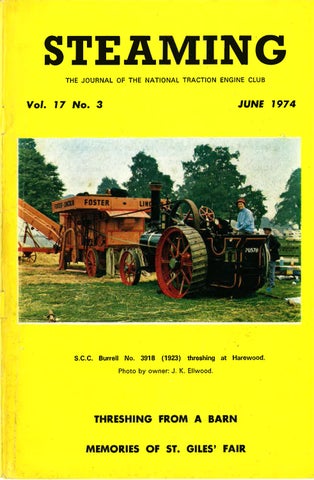
S.C.C. Burrell No. 3918 (1923) threshing at Harewood
Photo by owner: J. K. Ellwood.
THRESHING FROM A BARN MEMORIES OF ST. GILES' FAOR
NATIONAL TRACTION ENGINE CLUB OFFICERS President S. J. Wharton, Esq., Southern Down, Minster Lovell, Oxford. Vice-President J. T. Beeby, Esq., Wymeswold Road, Rempstone, Loughborough, Leics, Chairman Anthony Heal, Esq., Baylins Farm, Knotty Green, Beaconsfield, Bucks. Vice-Chairman J. Crawley, Esq., Field House, Turvey, Bedford. General Secretary G. F. Beck. Esa., 127 Greensted Road. Louahton. Essex. Treasurer J. H. Hobbs, Esq., 6 Esher Close, Basingstoke, Hants. Editor Ran Hawthorne, Esq., 19 Bridle Path, Woodcote, Reading, RG8 OSE, Berkshire. Chairman, Rally Sub-Committee M. Harmsworth, Esq., Elm Cottage, Ockwells Road, Maidenhead, Berks. Membership Secretary P. R. Dalton, Esq., 54 Woburn Gardens, Basingstoke, Hants. RG22 6UB. Sales Officer V. H. Burrough, Esq., 94 Harvist Road, Kensal Rise, London, NW6 6HL. Technical Services S. J. Wharton, Esq., Southern Down, Minster Lovell, Oxford. Public Relations Officer Jonathan Minns, Esq., la Hollywood Road, London, SW10. Publicity and Press Officer Patrick Coxall, Esq., Smokey Cottage, Lion Lane, Haslemere, Surrey.'
STEAMING Steaming is published by the National Traction Engine, Club in December, March, June and August. Articles, photographs, news items, display and small advertisements should be sent to the Editor. Steaming is posted direct to all paid-up members. (It can be obtained through NTEC affiliated Clubs). The subscription is £2. The best way to be sure you are paid-up is to use a Banker's Order. All correspondence re subscriptions, bankers order, delivery (or non-delivery) of Steaming or change of address to: P. R. DALTON, Esq., 54 WOBURN GARDENS, BASINGSTOKE, HANTS. RG22 6UB. All items are held copyright by contributor and/or NTEC.
ACKNOWLEDGEMENTS We are pleased to acknowledge the help, in the preparation of this edition, of: E. E. Kimbell, Viv Kirk, John Millar, the P.S.P.S., John Nicholson, Ken Ellwood, Barry Finch, "Steam Preservation". Tony Coombes, Alan Porter, Geoffrey Wheeler, Affiliated Clubs and Area Correspondents, and many more. — "Thank you". 138
STEAMING THE JOURNAL OF THE NATIONAL TRACTION ENGINE CLUB EDITOR: RAN HAWTHORNE, 19 BRIDLE PATH, WOODCOTE, READING, RG8 OSE. VOLUME 17 No. 3
JUNE 1974
FROM THE EDITOR'S CHAIR One of the things we have tried to do, (without losing sight of our objective; the preservation of "Traction Engines") in Steaming, is to bring other forms of steam power to the attention of readers. Crofton
Pumps, railways, the "Craigivar Express", Cornish and other stationary engines have been covered. We have made mention of Steamboats and have included the odd reference to Paddle Steamers. It was our intention in this edition to make Paddle Steamers a feature but this would have taken up too much space, so we have an article by John Millar that sets the scene We also give details of paddlers and other steamships still operating. In future editions we will have a look at P.S. "Kingswear Castle" and others. There is great similarity between Paddle Steamers and Traction Engines, perhaps the closest affinity being in that in both, one can see the "works going'. Both are leisurely and make nice noises and smells. Very few paddlers remain, make the most of them while they are in service, and do what you can to sec that as many as possible are preserved. "BLOW OFF" STEAMING'S OPINION COLUMN
In Vol. 17, No. 1, the December edition, we referred to the fact that 1975 sees the coming of age of our Club. The executive committee feel that some special event or celebration should be held. One suggestion that has been made is that the rally that was staged at Appleford twenty-one years previously be re-enacted with, as far as possible, the same engines that were present in 1954. Taking a serious look at rallies over these twenty-one years leaves one in little doubt that, in different ways, money Js more than ever dominating our activities. Not only organisers but engine owners (and we have some sympathy with them) are looking out for the biggest and brightest penny.
Over these years we have "grown-up". We don't hold flat races any more, we are conscious of boiler risks, we have rallies and steam workings (long may they continue). As we as a Club enter manhood Steaming would make the suggestion that, as we did twenty-one years ago, we put something on, not for profit, but for the pleasure ❑f others and for our own satisfaction. Our suggestion is that we, the NTEC, institute a "run",ort similar lines to the London - Brighton runs organised by the Veteran Car Club and the Historic Commercial Vehicle Club. We do not suggest London as the departure point, nor Brighton as the destination. Obviously the points must be nearer together and we feel the run must be in the country. Traction Engines were and are essentially of the countryside. Steaming would suggest that if the idea of
a steam run finds favour the villages of Appleford and Nettlebed could form the starting and finishing places. (The very first T.E. event was at Appleford the second at Nettlebed). These villages are about fifteen miles apart. The journey would involve a considerable climb from the valley of the upper Thames into the Chiltern Hills, a reasonable test of engine and driver. A National Traction Engine Club Run could become the Traction Engine event of the year. What better than that we should inaugurate it in 1975. 139
NEW MEMBERS Recent new members include: B. Bird of Aylesbeare, Exeter, who is helping with the re-boxing of W. Moore's Fowler "Farmer's Friend"; Leslie Smith of Wickford, Essex, who has rejoined having been a member in 1955, he has been "re-united" with his Aveling & Porter Tractor No. 7898; C. F. Baldwin of Aughton, near Ormskirk, has joined having recently acquired two Fowler Road Locomotives Nos. 10318 (1905) and 14110 (1914); George H. Newth of Bath, has joined us following his enjoyment of Viv Kirk's "Memories of St. Giles' Fair": David Pratley of Whitwick, Leicester, has recently purchased a compound Fowler Roller (Works No. please David) and T. D. L. Rose of Danehill. Sussex; who has recently acquired Fowler Tractor No. 15293, Ree. No. BN 2788. Paul Bourke of Southsea, has joined the Club having recently purchased a 1926 Aveling & Porter S.C. piston valve Roller. Brian Sanders, Penryn, Cornwall, also owns an Aveling & Porter Roller, a 12 tonner of 1905. He is now a Club member. We hope they will all find value and encouragement in membership.
Fowler No. 10318 (1905) "Sunny Boy No. 2" recently purchased for preservation. Seen here in her latter days of commercial use.
•
140
"Five Ones" as Fowler No. 11111 is known in Yorkshire, has been purchased by Allan Padget of Pocklington. The engine was new in 1910 for R. J. Hosdell of Hull, she is Class A5 Compound Road Locomotive on springs. Allan is to restore her to her original condition.
THRESHING FROM A BARN By E. E. KIMBELL
These days threshing engines are rarely seen together with their machines. Threshing machine or "Drum" and accompanying elevator. The exception is one on the belt to a drum in a corner of the field away from the crowd, mostly attracting the old hands, who see some meaning in it. It is not so interesting because there are no men working around it; no sheaves being slung on top; no bands being cut there; no spreading the loosened bundles over the beaters by the next man; no dust; no straw dropping from the elevator onto a new rick; no sacks being wound up for shouldering onto a cart; no chaff being carried away; no sweating; no swearing; no nothing. The engine's beat remains quiet and monotonous because of the light and unvarying load, and the "conveyor thing" — straw-jack or elevator to the initiated — winds its rakes up a strawless trough. "Not interesting" indeed, because not understood.
And what of the engines themselves? Once always ❑n their own, unless in an owner's or repairer's yard, are they proud to be ''presenting a living and breathing chunk of the glorious past" to so many admirers; or peeved at not having a drum and elevator with them to show-off their prowess? Do they really take kindly to being in a row with strange engines, paraded, made to do musical chairs and to have nonenginemen crawling all over them? Or are not their dreams, in the long ►winter sleeps, less of rallies than of threshing days, when farmers waited anxious weeks for their coming and greeted them with "I'm glad to see you come, and be glad to see you go"? Some, perchance, would be able to dream of an out-of-the-barn thresh, when one could
show-off all the more and really be seen to be at work without the visual dilution of the drum and its minions: a holiday from domesticity, as it were sometimes necessary, even from the pleasantest of things. The best barns were old and of stone with mid-way large double doors on either side. At harvest time the carts would generally go in and fill each end before having their stand outside and completing the middle, rather than make one rick of the whole. Then, when the threshing-set came, the doors would be pinned back and the drum put alongside to empty this part first, mostly without the elevator, the straw being built into a large "haycock". Next the engine would pull the drum round until it was endways to the opening, and then go backwards to the other side of the barn, to shunt forward as close to the opening as its chimney would allow. Meanwhile, the push-pole would be put on behind the drum and the pair of chains hanging on the hunker taken round to couple onto it and reach to the engine's front, when there would be a slow backward movement of both, with the guide chains on the drum's forecarriage keeping it straight. Drivers then had the art of careful handling and could go inch by inch if need be, and also steer to be in line for the drive belt at the same time. The elevator would not be far away on the other side, and if on hard ground, manhandled to the drum's far end. Should it not come easily the engine's wire rope would be payed-out beneath its forecarriage and the drum's axles to draw it up until the elevator's two-inch drive belt, which had buckles for adjustments, would reach its pulley from the small one on the end-shaker-shaft. On starting-up again, sheaves would bang down to the band-cutting man from the darkness above, now and then hitting a dust laden beam, with the humming of the cylinder's eight beaters (the actual "drum") buzzing back in harsh echo from the roof tiles. The straw-shakers, turning on their cranks at 180 to the minute would "Clobber, clobber, clobber", but not very loud. The four riddle-crank big-ends, at 200 r.p.m. would "knock out" the signal that oiling had been missed a time 141
or two in the past, and for a moment, every now and then, join in an "All togetherness" with the shakers' sound. When they did this the whole far end of the machine would rock in sympathy; not very emphatically, but enough to be noticed. The belt fasteners sounded their presence on a higher pitch, clickle-clacking metallically as they raced over awner and blower pulleys, beating their different times, yet likewise coming together every now and then. Thus did the drum embody some human traits. The sounds, though magnified, were mostly contained, so that tittle beyond a softened hum escaped from the barn. Fortunate indeed were the two men on the straw rick outside, free from noise and dust, as they moved with their long forks and yellow heaps dropping from the elevator across to the four corners, and with an end of their rick set out wide enough to include the "haycock". Fortunate too was the engine, also out of the dust, and with its smoke able to go up as far as the barn roof. There were times, though, when. some would drift inside and give the dust a taste of coal! The exhaust ramp in a rtnithle miff to every turn of the crank, one a little the heavier, and fought any drift for the first foot or so from the top of the chimney, "Chaff-chuir at 160 to the minute, louder and sharper alternating with quieter down to sibilance, according to how the sheaves were going into the drum. One not fanned out enough over the beaters would bring a slowing, to be instantly corrected by the governors. When their whirled circle lessened with the revs drop, the collar on their stalk lowered and the level on it twisted the little rod going into the steam chest which moved a valve there to increase the steam flow. Often then the revs would rise above their norm, when the governor's arms, stretching out beyond their norm too, with the increased centrifugal force, would lift the collar and throttle down the steam, to the accompaniment of grateful chuckles from relieved piston rings. (Once the governor belt was on and stationary work had begun it was usual to move the regulator handle wide open. However, some drivers were loath to open more than enough "to get the drum humming right" even though the governors then controlled the speed. They feared the belt might come off or break and they not be close enough to leap up and shut the regulator before damage resulted; because beaters. happy on their drum at the proper 1100 revs are apt to strip their holding bolts and fly off into the blue with speeds way and above this. There was no risk, though, with a belt in good order and kept tight; and no economy in keeping an old one in such an important place instead of relegating it as a make-up piece for the elevator belt. A partly opened regulator caused sluggishness, resulting in some corn being left in the straw at every slow-down.) Remembered dreams can be cartoons of the past; auguries of the future; and sometimes shared, with more than one dreaming the same dream. In this particular "Engine-dream" a partaker approaching from the offside would see the engine a "single", its crosshead flashing to and fro pushing a miniature bow-wave of oil and condensate ahead on its towards-the-cylinder movement and drawing it back unseen and with only a speck of oil ahead then, where a piece of sacking left underneath the trunk guide collects the drips. These are a mixture of gland-leaked cylinder oil, thickening when cold, and seepage from the gudgeon pin, wick-fed from a brass cup above. When saturated this is wiped on smokebox and chimney to keep them black and shiny, and can also be pressed on a slipping belt to make it grip. Soon the eye turns to the main drive belt leaving the dust and mystery of the barn, rigid tight to the top of the just seen flywheel, while the lower half, partly hidden by the smokebox, returns in a shallow downward curve with snake-like writhes, and swings arid trembles whenever thcre's an extra sharpening of exhaust. The large rear wheel moves to and fro to-time with the clinker shovel and poker leaning against it scraping out small sounds in harmony with a soft bird-like noise from the feed pump inside the footplate, as it sends most of its updrawing back through the return pipe, with just enough getting past the adjusting tap to replace that used as steam, to clack into the boiler through an alongside pipe. 142
Just as a face will vary according to where, when, and on which side it is seen, so will an impression of an engine depend on place, time and angle of view. Sometimes in both an assessment of mood and an adjustment of perspective to suit it is called for — which is why an engine was first dubbed a "she". Other things went to underline it, like the worry about age and the rejuvenations to disguise it. Brass and copper chimney tops, which weren't invented when some of them were born; Pickering governors looking down on the long holding collar where a pre-cross-arm type once flapped its weights; an elongated smokebox; a heightened bunker; a firebox-entering injector; a steersman's seat being just a few. Also moods. An engine can acquire a mood on a sideways slope. Here, approaching from the offside, is an away slant, causing the chimney to lean back haughty and uncommunicative, as do some ladies. But after a while the various sights and sounds suggest an unbending, which a move to the opposite side will confirm. Here a confidential lean and slight wheeze of throat — cleared whenever slowing governors caused an exclamation and a make-up of revs — breaks down the barrier. The whole of the flywheel's 4i-foot diameter can now be seen, the lower part through the spokes of the this-side rear, the belt crackling against its top from past holdings of oil-rag. Also the mesmeric linkmotion, an upper rod moving the valves just below it and going a little the further in each direction, with the lower having no more to do than wag the connecting link hanging from its moving fulcrum above. Two figures are near corn sacks just inside the large doorway, one helping the other pull off a sack from the barely seen end of the thresher. In a little while the helper comes this way until lost offside. His overall jacket, a many-times-washed blue, is next seen bending over the bunker to the sounds of coal resisting scrapes from the firing shovel. He swings round half a dozen times towards the firebox door and the shovelling ends with a hinge-squealing clang as he straightens his back and kicks the door shut in one movement. For a few minutes he leans on the steering wheel, with a suggestion of emphasis to the engine-induced jogging, as if aiding it. And while the black smoke from the firing lasts, words seem to be coming from the chimney. "We're-a threshing; we're-a threshing; we're-a threshing; E we're-a threshing-out-the-barn; we're-a threshing; we're-a a lively dittee at each double syllable, the smoke above the barn a sort of heraldry for those too far away to know what's going on; like an engine more itself than usual with only a muted background humming from the drum, if they would but get near enough to hear it. The driver's hat is a dusty sack-coloured grey; so too are his shoulders and large moustache. The face, weather-beaten and smudged with black, is cheerful and satisfied, and demeanour with a "just rightness" about it, as if engines, threshing, and the farming which needed them would never ever vanish from the earth. Then rather suddenly, he has gone, and the engine seems to have lost something of itself, and as if in a dream within a dream sees rather a different future — which has an effect like a shadow covering a sunbeam. Was that an extra large sheaf going through the drum just then? An extra effort, a little late in beginning, gains recovery, and brightness soon returns. Also the driver is not lost and no further away than where the sacks are. And it's not long before he's back, as if summoned, seconds before the cattle trough into which the wirebound lifter pipe stretches, runs over. With a foot on the lower step he reaches inside for a tap. A whiff of steam, a gurgle, and the water level begins to drop. Meanwhile he lights a stub from his hat-band for a few draws until the bubbles sound again; then shuts the tap and pauses for a few more before pressing it out and returning it, and going back into the dust; while the slow running hose to the tank begins its long refill. Perspective, in order to balance the moods, can be had by a slow walk round in increasing circles until the chimney is neither taciturn nor loquatious, which comes at about twenty paces to the rear, three 143
yards out from each rear wheel, in line with it. Also then the whole engine achieves a oneness and the moving parts are seen as complementary to each other. The wheel slats slope up from the outsides, so that the arrow of their track points away from the front. The staggered muckfilled holes in them are for bolting on spuds (the inside ones) for soft going, and (any of them) for the blunt-pointed frost bolts to keep her feet steady on icy surfaces. The bottle-jack before the near-side wheel presses both against the tapered blocks behind to lessen the jerking, and the waving belt frames the spinning governors and the link-motion oddly different from this angle. On the other side the crosshead still dominates as it pushes and pulls its connecting rod with great activity, with the twirling crankshaft-end and enlivening the blank gear casing below it. After the exhaust, the pulsating ring of the guventuts' cast bieel bevels in the clearest individual sound. For more, an under-the-belt dive finds the deep-throated "Chunk-chunk-chunk-chunk' of the exhaust entering the chimney base — listening must be close up, from where the chimney frowns down on the smokebox door. Offside, a pinion chinks loosely on the crankshaft, the haze underneath it caught now and then by the swinging big-end, drifting it forwards, with a smell of coal tar from bankings-up, and burnt oil drips from the crankshaft's brood of bearings. These give off little knocks and "shuffles" with an approach rearwards, which merge with the fire-irons' and pump's song, and the sound of water splashing back to-time coming from the tank-fillingpocket behind the bunker. Back at the perspective points some are more in the memory than the ear, but for those who have "ears to hear" they can take-on a meaning, with the movements, like gestures, aiding the dialogue. These are "Engine murmurings": an aid to reminiscence; half forgotten conversations; happenings on the road; or in a farmyard; opening times on Sunday mornings; odd scraps of local gossip 1-lere though they differ by being of things not known before. The owner's name is first pronounced, oddly different from the wording on the bunker side. Next, varying in tone, emphasis, and metre with the up-and-down of threshing, it's about the driver. "Good enough for most occasions; but in fifteen years not yet . . . the man his father was who drove . . . the first ten years since I was new. Father had come from . . . a Portable Engine . . . and for a long while . . always pulled the flywheel . . . to get it on centre . . . son . . for is better with . . . the reverse lever . . . the key controller most stops and starts. But father was so kind and gentle . . . years and years of no repairs. Both with oiling most punctillious. But son's first years with no oil pump . .. when so many others had them . . . always made him rather tatchy . . . 'til the boss got round and bought one. it sits on top and never's He still dislikes the brass container . . polished. Four times a day through its small hole . . . thick-oil-hadto-be . . . slowly-poured-for-it . . . to-drip-feed-gently . . . Father knew better where . . . to leave the feed handle . . . according to how cold . . . the wind blew across it . . . an' how little it needed . . . inching open . . . on a hot day. But now watch my lovely oil pump! See its arm clamped to the valve rod. Hear its ratchet clicking, clicking . . . at every inward move of spindle. Happy? Yes, of course 1 am. Farmers like me best of all . never heavy been on coal. See how quick my governors are! I am only five-and-twenty, and if whenever glass gets cloudy, a good washout . for as long again soon follows on; no new firebox will be wanted ahead. 'Tis only rare that I've been primed; so piston rings will go some while ... in spite of my slight wheezing cough. no matter how they oil and black it. Smoke-box will get thin in time Bunker's not immune from rotting; new plates please, I can't bear patches. Every three years tubes come out . . . so always get clean bill of health. Thus it is I'll last for ever! Driver's nephew, now on drum . . . steers straight tracks when on the road. He'll take over later on . . . when him with "walrus" joins his dad. In sitting on a bench outside . . . a certain public house, with jug. And engines all he'll talk about; me especially without doubt". 144
However, unforeseen changes came which had nothing to do with neglectful driving or wearing-out. The nephew never did become a driver, and the walrus moustached one removed this dust filtering device long before retiring, and went away to drive a tractor. This was because the dream within a dream came true and engines were not wanted any more. So those still alive should think themselves lucky indeed to feel a warming tire inside them now and then, even if its only to get up steam for a rally.
THOSE WERE THE DAYS Member Tom Woods of Wallis & Steevens has been temporarily laid aside with trouble with the valves of his heart. Not being able to get at them "to grind them in" (he jokes!) he has been obliged to rest but even so he has not been idle and sends another set of castings from days of commercial steam.
1901 STEAM HAULAGE IN ENGLAND WITH A FOWLER COMPOUND ROAD ENGINE from Fowlers instructions for working Traction Engines. COST OF PLANT: One Class 13 Compound Road Loco on Springs fitted with 3 Speeds Six 8 Ton Traction Wagons fitted with Springs and Brakes ... ... ... 12 months interest on Plant at 5 per cent ... Depreciation at 7 per cent (life of plant 15 years) ... Maintainence at 121 per cent, on cost of Plant ... ... ... One Engine Driver, 52 weeks at 35/... One Steersman, 52 weeks at 21/- ... ... ... One Assistant, 52 weeks at 20/- ... Oil, Waste, and Sundries, 261 working days at 3/Coal, — 261 days Max. coal consumption 8-10 cwts. per day ... ... ... = 130 Tons 10 cwts. at 15/- per ton Total expenses etc., per annum ...
0 0
0 0
£1,395 0 £69 15 £97 13 £174 7 £91 0 £54 12 £52 0
0 0 0 6 0 0 0
£97
7
6
£676
8
0
£795 £600
Net Load 24 Tons, Working Days 261. Distance Travelled: 32 Miles per day i.e. 16 miles with load, and 16 miles return journey empty. Work done: 24 tons x 261 days equals 6,264 tons carried 16 miles; then 6,264 x 16 = 100,224 ton miles which, divided into the cost as stated above, viz., £676 8s. Od. dives 1.62 pence (say 1 pence) per ton per mile, assuming that the hauling is done on a good average macadam road. This will allow for shunting but does not include loading and unloading. This estimate gives the maximum of cost, but not the maximum of work done. It provides for the engine and wagons being laid off work one day a week, so as to give opportunity for cleaning and overhauling the plant. Number of Working Days Fixed as follows:365 Number of days in a year 52 ... ... Deduct Sundays ... ••• 261 Number of working days in a year, per annum The total calculated expenses, etc., per annum, provides a fund for renewing the engine and wagons in 15 years; it also covers, interest on cost of plant at the rate of 5 per cent per annum, and provides £174 7s. Od. per year, to cover cost of repairs. 145
AREA NOTES LANCASHIRE September and October 1973 provided a number of Cheshire steam events for Club Members to attend at Malpas, Great Budworth and Little Leigh. This last event was the annual steam-man's highlight of the season — non other than the Holly Bush Threshing Party, which attracted a large number of enginemen and preservationists and once again lived up to its reputation! The Club was well represented with Eric Marshall's two engines (R.S. & J. agricultural No. 35247 and Aveling & Porter roller No. 11837), George Coles with his 1913 Clayton & Shuttleworth agricultural No. 46059, and Frank Lythgoe with 'Dreadnought' his 1909 Burrell S.R.L. No. 3093. Organisers Peter Froud (with Burrell road loco No. 3098 cultural No. 2312 had their engines in steam along with Burrell agricultural No. 4037 (R. A. Solger, S. Allsop and Miss A. Adamson), Fowler conversion No. 14958 (F. Hackney of Sandbach), Aveling & Porter tractor No. 8384 (J. Doyle), Aveling & Porter tractor (P. Edwards), and Burrell S.R.L. No. 2879 with Peter Walton in charge. Also attending were those two stalwarts of steam from North Wales. the Lloyd Jones brothers who steamed George Bridson's Fowler road loco No. 15367 from Neston. While the engines took turns at threshing on both days the vintage tractor enthusiasts led by John Bryers and Alan Cowap did a spot of ploughing in a nearby field. Although a thunderstorm somewhat ruined Saturday afternoon, the evening was its usual with good music and good ale flowing until nearly midnight. The following weekend saw several engines congregate at Frank Lythgoe's farm at Warburton, near Lymm, for an informal party. Frank's Burrell S.R.L. was prominent, but taking most attention was his latest acquisition. 'Prospector'. the 8 h.p. compound Foden S.R.L. No. 2104. which had arrived the day before. Jack Doyle's tractor was also there. and was joined by Eric Marshall's Ransomes. Simms & Jefieries agricultural, George Cole's Clayton & Shuttleworth agricultural and (on the Sunday) Denis Priestner's Fowler Roller. One of the last steamings of 1973 took place on 17th and 18th November at lack Johnson's premises at Banks when nine engines. two organs, a few vintage vehicles and old farm machinery were on view. Engine news starts with club member Dave McNamee of Worsley who joined the growing band of engine owners when he purchased his first steamer — Aveling & Porter roller No. 7600 (MP 5183) — from R. Robinson of Morecambe. After a few repairs, including two new stays. Dave hopes to be in steam for the start of the season. One engine that might miss the season is Frank Lythgoes rare Foden Showman's engine which is under major repair having a new tubeplate and firebox as welt as a general overhaul. George Howard of Banks has bought his second engine, an 8 ton Garrett roller No. 34084 (E.1 4075), from Lambe's of Bromsgrove. Although no lagging was on, George had the roller in steam at Jack Johnson's in November, just after purchase. An engine to leave the area, and the first preserved engine for some time was the big 12 h.p. compound Ruston & Hornsby portable sold by Keith Shorrock of Bolton to Ron Mitchell of Amersham, Bucks., in November. Two other portables left the area in January, being the property of P. A. Atherton of Bold. Widnes. The single cylinder Clayton & Shuttleworth No. 45269 has gone to an owner in Herefordshire, while his single cylinder Garrett (No. unknown) has gone to Hampshire. News came, too, that Pat Kelly of Adlington, Chorley, has acquired another steam engine, but this time a railway engine, and non other than an L.N.E.R. B1 No. 61302 now named "Mayflower', which is at present at Steamtown, Carnforth. 146
The Club's A.G.M. was held in November and in his opening remarks, the Chairman, Mr. F. Westall, revealed that for the first time since the Haydock Park Rally, the Club had been able to donate a large slice of rally profits to charity — this year £500 being distributed to seven charities. The election of officers resulted in all but three of the existing committee being re-elected, and for 1974 the committee is: President, Ernie Cooper; Chairman, Fred Westall; Treasurer, Edwin Dickenson; Secretary, Neil Carney, 2 Catterall Crescent, Bradshaw, Bolton; Committee: G. Coles, J. Bryers, A. R. Porter, H. J. Daymond, R. Prescott, E. Marshall, J. Prince, F. Lythgoe, A. Hickson and D. Rimmer. In addition to the regular Club meetings two outstanding social activities took place during the winter period. On 22nd February a Steam Dinner was held at The Chetwode Arms, Lower Whitley, near Stretton, for those enginemen and friends who attended last year's Threshing Party at The Holly Bush Inn, Little Leigh. Many Club members were among the 30 odd guests who had a thoroughly enjoyable evening. Shortly after, on 9th March, the Club organised a Hot-Pot Supper, an event which attracted over 300 members, preservationists and friends to Eric Marshall's farm at Glazebury, near Leigh. The recital was performed by Frank Lythgoe's 89 key Marenghi organ and, despite a bitterly cold wind, four engines were in steam, Eric Marshall's Ransomes, Simms & Jefferies agricultural and Aveling & Porter roller, Frank Lythgoes Burrell S.R.L. and his latest acquisition, Aveling & Porter Showman's Tractor No. 6093, which attracted a lot of attention. Finally, plans are well in advance for the Club's rally at Burtonwood, which has the making of being even better than last year's, with the agreement by Bill Dorman to attend with his set of steam gallopers. A. R. PORTER, 68 Greenway Road, Timperley, Altrincham.
FAIRFORD & DISTRICT STEAM CLUB We may see Mr. Thexton's Ruston Traction in steam later on this year and may be out around the Wiltshire roads again. Michael Woodroffe and I are very busy dismantling the motion on his Fowler traction engine. The little end pins and bearings are being completely rebuilt and many motion pins renewed. Joe Powell is near completing his Brown & May Portable, and may be seen out this year. To date three new engines have come into the Area, they are an Aveling & Porter 10 Ton Steam Roller, which came up from the Southampton district and is owned by Mr. I. Gibbs of Swindon, and from the Stroud Area comes the news that a Robey Under-type Steam Engine has been bought for preservation, this engine is a 12 n.h.p. Compound Under-type, built about 1912 and was used until 10 years ago. Club member Brian Dando has now bought a Wallis & Steevens 10 Ton Steam Roller Reg. No. HO 6045 No. 2674 built 1901, a single cylinder engine previously owned by G. W. A. Heritage of Hook Norton. On 20th/21st October our member Bob Soule presented an open weekend at his home at Southrop. With his friends he put on a show of his collection of aspects of country life. On walking up his drive one's eyes were turned to his very large Blackstone Oil Engine, next to that was John Plaister's Marshall traction in steam and looking very smart, nearby was Bob Soule's Ryder hot air engine of 1900. Next was M. Woodroffe's Fowler traction engine of 1909, and ticking over near more barn engines was Dick Willcox's Marshall portable No. 84963 built 1924. M. HOWARD, 4 Glevum Close, Purton, Swindon. 147
CUMBRIA STEAM & VINTAGE VEHICLE SOCIETY The New Year seems to have crept up on us very quickly, and in January the Society celebrated its first birthday. The Society is extremely fortunate to have a very enthusiastic membership as the area from which they are drawn is enormous encompassing as it does the Counties of Cumberland, Westmorland, North Lancashire and parts of North West Yorkshire. Some members have round trips of over 150 miles to get to our Monday night monthly meetings, some even further that come down from the South of Scotland or across from Northumberland and Durham. To ease the problem slightly meetings are now alternating between Penrith and Kendal, and it is hoped to do something for our West Coast members in the not too distant tuture. The dates for the 1974 Steam Gathering have been set for 14thi15th September again at the ideal site of the County. Showground at Kendal. From conversations with four committee members alone, it looks as though we may have at least four new engines at the 1974 event. Chris Greatley up at LampIntl, Workington, now has his Fowler Roller No. 18507 back together after retubng and fitting a new tube plate, Chris incidentally made a very good job of being Chief Engine Steward at the [973 rally. Dick Ransome, from Torver, Coniston, who was in charge of Commercial vehicles at the rally is progressing well with his Marshall Roller No. 65822. We hope it will not be too long before this engine is as well known a sight round the area as Dick's very smart 1934 Leyland Wagon. A third committee member Stuart Stainton now has most of the parts he needs for his Marshall Roller No. 75332 and hopes to have the engine ready for the 1974 event. The fourth committee member to be engaged in restoration work, is Billy Dowthwaite up at Skelton, Penrith. He is hoping to have his Aveling & Porter Roller ready during 1974, and if the standard of "Margaret" his McLaren General Purpose Engine No. 1105 is anything to go by this should be well worth seeing when complete. Although not steam, I think that two engines belonging to club members are well worth mentioning. Firstly, there is the Ruston & Hornsby Crude Oil Roller No. 159737. Built 1930 which belongs to C. Woodend of Milnthorpe. This 101 ton engine was Ruston's answer to steam in the early thirties, a single cylinder engine it has three speed constant mesh gears and will run on most residual fuels. Several were exported to Batavia, Manilla and the Phillipines. The second engine is the Barford & Perkins Diesel Roller No. RR067. Built in 1932 belonging to Frank Delaney of Harrington, Workington, this is a 10 ton engine built for Wigan C.B.C. I personally am glad that these two have been preserved as they make an interesting comparison when lined up with the more traditional rollers in the club. The Society held its annual dinner during November at the Shap Wells Hotel, Shap Fell, where after an excellent meal 140 members and wives continued with dancing to the early hours. Although officially vetoed for the evening, the words Fowler, Burrell, Foden, etc. were well to the fore around the Bar, and also incidentally was our esteemed Steaming editor's aversion to things converted. After a quite lengthly. somewhat heated but friendly discussion it was generally agreed by those taking part that on the whole they were against conversions, but they admired the engineering skill and expertise that had gone into some engines. Several Society members are actively engaged in searching for engines and any information that could lead to the purchase of either a single or pair of ploughing engines and also a showman's engine would be greatly appreciated. Any N.T.E.C. member visiting the Lake District this year will be more than ►welcome to join in any of the Society activities and details of these and the '74 Steam Gathering can be obtained from The Event Secretary, Cumbria Steam & Vintage Vehicle Society, 3 Frenchfield Way. Penrith. D. LACY, Event Secretary, C.S.V.V.S. 148
WEST CUMBERLAND In August I had the pleasure of driving my Garrett No. 33953120 "Anne" to Whitehaven to take part in one of the nicest parades I've ever seen, it was a lovely day and the wagons, trailers, drays, etc., with dozens of little children dressed up for the occasion on them made it a day to remember. The route was great for a parade, no gradients, so with a nice bright fire. the water just in the top of the glass the old Garrett ticked over so nicely in high gear, that I began to wonder how much sweeter an engine could be. On 10th November, one of the last few remaining engines owned by Suttons of Beekermet, left by low-loader for Chipping Norton, Oxon. It was the 5 n.h.p. single cylinder Robey, No. 28094 new in 1908 to the late J. P. Thompson, (Maus, near Maryport. It was used by Mr. Thompson mainly on threshing until 1946, it then remained in his yard until June 1955 when 1 acquired it. Following a successful hydraulic test 1 steamed her home, a distance of nearly thirty miles without incident. Having no springs or rubber tyres this was quite an experience, as all our engines (Steam Tractors, Traction Engines, and Road Locos) had mostly been spring mounted and fitted with rubbers from the early 20's, I ant pleased to relate that although I am reluctantly reducing my engines, the Robey like the Garrett roller No. 33636 has gone to a genuine enthusiast — Mr. Brian Wallington, I know him to be a conscientious steam man with two little sons to follow up the good work. The polished steel work on the Robey being well greased for the long journey into Oxfordshire I loaded her ("Edwina") with the Garrett No. 33953 ("Anne") then, we had a reshuffle, I pulled a Showman's living wagon from behind the engine shed, then coupled to J. H. G. Dayah's Armstrong-Whitworth Roller 10R11 putting it into a more sheltered position for the winter, and double locked the van back in front of it, this was followed by going into the shed and coupling to the Aveling & Porter roller No. 11496, to bring it out to turn it around and pushed it backwards into a position whereby we could get the front rolls out for cleaning and painting. The Garrett must have moved between thirty and forty tons in about one hour, weights like this were commonplace in years' gone by, but I would say it does not happen very often now. This kind of work always intrigued me, it calls for serious concentration all the time, and particularly when using a steam tractor with loads that were at least twice its own weight. I would also like here to commend Chris Greatley of Lamplugh, near Workington, for the amount of heavy boiler work he has successfully carried out on his Fowler roller No. 18507, all of it done "by the wayside". New front tube plate, smokebox, and tubes have been fitted and it has passed the inspector's hydraulic test, and has been out at Whitehaven doing a job of work. It is now back at Lamplugh and the boiler lagging is being fitted, also the front tank and a general clean up prior to a repaint. Another fine example of restoration is the 6 n.h.p. McLaren No. 1105 T.E. owned by W. Dowthwaite, Hutton Grange, near Penrith, it is now named "Margaret" and is a credit to its owner. On a recent visit to the 15-inch gauge miniature railway engine sheds at Ravenglass, work was in progress with the overhauling of the engines, and parts of yet another new "steamer" 'were seen. The standard of maintenance is very high on all the stock used on the Ravenglass & Eskdale Railway, and the engines in particular are beautifully kept. Keep it up lads, "ALL" steam engines may yet be needed. S. SUTTON, Beckermet, Cumberland. fi The Ravenglass & Eskdale Railway's number of passenger journeys for 1973 exceeded 250,000. Since the railway changed hands in 1960 well over two million journeys have been made. Send S.A.E. to the Ravenglass & Eskdale Railway, Ravenglass, Cumberland, for details of train times. Frequent services run in the season. 149
BEDFORDSHIRE It is with deep sorrow we have to record the death of Jim Bennie, Host of the Old Red House, Hannington, Northants. Jimmie, well known from North to South, was a wealth of information on engines. Talk of an engine in some remote part of the country, and he would come up straight away with Engine Number and original owner in seconds. Jimmie organised several Rallies in his home County, and will be missed, but not forgotten by his many friends at future occasions. Bedford Club had quite a successful year in 1973, many of our engines attending Expo Steam at the East of England Show Ground, our own Rally at Roxton, Marsh Gibbon and Castle Ashby. Steam ploughing demonstrations at all these Rallies were carried out by our now well known teal!!, many speetatois commenting on 110W inteiesting it was to see engines carrying out the work for which they were intended. I was pleased to be asked to take charge of a Threshing Demonstration in November, at the local Young Farmers' Ploughing Match, Fowell No. 91, owned by R. and D. Parrish of Sheltord, was used, it was great to see this engine on the belt again after about 25 years neglect, and she performed splendidly, it is hoped to put on a Threshing display at Roxton next year. Wishing all your readers Good Steaming in 1974. ALEC IBBOT, Bedford.
NORTH STAFFORDSHIRE & CHESHIRE T.E. CLUB The series of monthly meetings has been very full (these meetings are always held on the first Friday evening of every month at 8 p.m. at the Conservative and Unionist Club, Biddulph) September being the first one this was in the form of a Forum on the questionnaire which members were asked to fill in earlier in the year. October gave all members a chance to show their newest seasons slides. Friday, 2nd November saw a slight alteration in usual meeting procedure, the regular meeting was put back to the 9th. A Dinner Dance had been arranged for all helpers, workers and exhibitors, at The Midland Festival of Steam '73. This was held at The Pavilion, The County Show Ground, Stafford, and was one of the best nights out of the year. It was a great meal, the local caterers from Stafford made an excellent job. The band was provided by the leader of the quite well known local Big Band Sound, Burton-on-Trent. The dancing continued until oneo'clock in the morning. Never again will such value be offered. All that for £2 per ticket. The next day, Saturday 3rd November, members from a wide area went to Goostrey Steam Party. All the local engines, tractors, machinery, etc. were in attendance. The altered club night was the 9th November, again members were given the chance to show their own slides and cine films, (at request from questionnaire). The engine owners got together (well a few of them did, 12 out of over 60) on Tuesday 20th November 1973, at the usual venue and discussed a wide variety of topics to numerous too mention in these notes. On Friday 7th December an Extraordinary General Meeting was held to consider raising membership subscription to £2 this was carried. Dave Vernon gave us a showing of his own slides which he took at most of the Club events and events attended by Club members over the last 12 months for the January 1974 meeting. These pictures were of very fine quality and interested not only the steam fraternity but also any other members in the room. The room was really filled to capacity with a lot of members having to stand, this I attribute to the Newsletter which keeps members informed of what is going on. Klondyke Mill looks a little bleak at this time of year, but all sorts of work goes on all the while, as and when weather permits. D. HALLAM. 150
BANBURY STEAM SOCIETY Leaving Banbury on a wet and unpromising Sunday morning the coach chartered by Banbury Steam Society made its way through Chipping Norton, Charlbury and Witney, picking up passengers en route for the Seven Sister Colliery in South Wales. After just over 44 hours non-stop travel, the colliery gates hove into view and our host Mr. Davies welcomed us and conducted the party to his local rugby club five miles up the road where lunch was served. Then back to the colliery engine room where a twin cylinder winding engine awaited our inspection. Built in 1927 by the Wordsley Mesnes Ironworks of Wigan, this engine drove the winding drum direct, each cylinder working a crank either side of the drum. With a 32-inch bore and 5ft. stroke, the engine was rated at 2,500 h.p. and steam emission and exhaust controlled by drop valves. Steam came from Lancashire boilers converted to run on pit gas which was piped in direct from old mine workings that had been sealed off some years ago. Mr. Davies put his engine through its paces winding the cage up and down, and having seen the infallibility of the system with our own eyes, we signed disclaimer forms, collected our lamps and prepared to enter the cage. The descent to the bottom of the shaft was smooth and swift, with the cage building up to a descent of 55ft. per second, and at a depth of 735 yards the cage came to a smooth stop. These were the old workings we were told, and having had a look by the light of the electric lamps we carried, the cage ►►as taken up to where the present scam was being worked. The cage emptied and we passed through the doors that controlled the ventilation, to where the coal trucks started their one mile journey to the coal face. It was interesting to see the R.S.J.'s and pit props under pressure holding up the roof over our heads. and the white-washed walls with the gleam of black coal showing here and there. The return journey to the pit head was just as smooth and swift as the descent, the lamps were returned to the stores and the visitors were allowed to wander at will around the colliery complex. Two engines of similar design to those previously described were run for our benefit, and in an adjacent building was a Bellies and Morcom vertical compound partially dismantled. At 16.50 hours we bade Mr. Davies farewell and headed for the Llangennech Colliery about an hour's drive away, the attraction here being a 1907 winding engine built by Andrew Barclay & Son, the Kilmarnock firm that was once well-known for the many industrial locos bearing their works number. Smaller than the Seven Sisters engines, with 20-inch bore and 42-inch stroke, the layout was the same, with two cylinders and connecting rods directly coupled to the winding drum. Two interesting features were the Corliss valves and the steam operated Stephensons link, the advantage of the latter being that the link was raised and lowered instantly with little effort on the part of the enginemen. Steam was provided by Lancashire boilers which were hand fired on coal, no feed heater or economiser was fitted, and instead of the usual feed pump an injector was used. There was only time for some of the party to make the 110 yard descent to the mine workings and at 19.05 hrs. the return trip began. A halt for refreshments at the Severn Bridge service area, and at 22.20 hrs. back on board the coach for the long run home, arriving in Banbury 01.05 hrs — quite a day.
•
Hugh Darlington is travelling overland to Australia. He has seen quite a bit of steam on the way. Between Delhi and Bombay he noted Fowlers Nos. 17589 and 21634, Aveling & Porters Nos. 12243 and 12244, Aveling Barford AO 558, and another without a number, Marshall 71853 and several Indian built Marshalls including No. 291 built 16/11/49, and 643J of 1950 all at work, together with a further seven or eight he was unable to record. 151
YORKSHIRE There have been several changes in ownership recently, one of the most notable being the 6 n.h.p. Garrett Road Loco No. 27946, "Vera". Reg. No. 01 6818 which has been purchased by Mr. P. C. W. Rhodes of Boroughbridge, who also owns the Burrell No. 1426 "Old Faithful". Both these engines were noted during the winter months at the side of the main railway line near Northallerton Station, only a few yards away from the spot where Marshall Roller No. 76890 Reg. No. PY 272, ex N.R.C.C. and now owned by Mr. C. West of Helperby, stood for many years. Gerry Proctor of Nidd Bridge has purchased a Ruston Proctor Class S.C.1D. "Lincoln Imp" Tractor No. 52607, Reg. No. HP 2201 from Mr. J. M. Crowther, Long Preston. Gerry has also acquired the remains of a Sentinel wagon from the Pudsey area which was used for spares for the Bass Charrington Sentinel No. 1488, Reg. AW 3407, when this was restored. Both these wagons arc ex-Brown Bayley Steels, Sheffield. An interesting and unusual roller which has never been rallied is reported to have left the area. This was a Marshall Universal No. 87246 owned by Mr. Clarke of Kirk Smeaton, Pontefract. This has gone to Mr. Crawford of Frithville. An engine in the same area which has been receiving attention recently is Clayton & Shuttleworth No. 43187, Reg. No. AH 5473 which is now owned by Joe Duckett of West Hardwick. An Aveling & Porter roller which used to belong to Joe is now owned by a welding and engineering firm at Penistone. This is believed to be Nu. 14090 but confirmation is awaited. Fowler Road Loco No. 11111 which has had a number of Yorkshire owners has now passed from the Meadowcroft family at Crayke to Alan Padgett, an enthusiast at Pocklington. This engine made a brief rally appearance at Birdforth about two years ago. Meadowcroft's Fowler Showman's (Conversion) engine No. 14948 "Prince of Wales", Reg. No. ER 4999 has, at the time of writing, still to make its first appearance since its accident damage has been repaired. A visit to Tom Varley's Little Todber Farm (or should it be renamed "Yorkshire Patent" Farm), on one of his monthly steam-ups (first Sunday in each month) showed that Tom has not been idle during the close season. Almost ready for exhibition was the next Yorkshire to come off the restoration lines, this being a WG, No. 2008, ex Walter Fearnley of Castieford. This was originally an articulated vehicle used for carrying cable drums and it is planned to restore it to this unusual type when a suitable trailer can be found. Initially, however, it will appear with a sloping back, in the form of a recovery vehicle. In steam was Tom's Showman style Garrett, No. 33705, Reg. No. 111 4778, "Pendle Princess", and also the Yorkshire gem No. 117. Reg. No. CA 170, "Pendle Maid". This being the 2 ton wooden wheeled vehicle which first made its appearance last year. Tom's first wagon, the S4 Sentinel No. 9003, Reg. No. VE 9963, has been sold to a gentleman in Essex and has, it is understood. been repainted. Tom is also progressing with work on two other recent acquisition namely a Robey Express Tractor No. 43388 and also a Wallis & Steevens oil bath tractor No. 7390. I was interested to learn that at the time of my visit, the Wallis was being re-boxed by a firm of Boiler Repairers who operate in a shed adjacent to the Worth Valley Railway, near Haworth, and who also had on their works at the same time, one of the W.V.R. locos for attention, rail access being available right into the works. An unusual instance of two preservation activities co-inciding. Work had stopped on the Burrell Roller No. 4004, ex-Hirst's sale, since Tom was giving preference to the more unusual items. "After all, it's only a Burrell", from Tom made me feel he had got his priorities right in that respect. Round the back of Tom's Museum were a couple of items patiently waiting; another Sentinel, which came from Hardwick's at Ewell at the same time as the massive DG6, this being a 'Super', Reg. No. HO 6134, and also a Marshall No. 68877 which appeared to have been a portable at one time. 152
Inside, on view, were the rest of Tom's collection, admirably covered by the Editor in Steaming Vol. 14 No. 3, supplemented by Walter Fearnleys Yorkshire No. 2128, Reg. No. VA 1788, and also John °sties Marshall GP No. 54492, Reg. No. CT 3859. Thus, the discerning reader will have realised the significance of my comment on the renaming of Tom's farm — he had on exhibition, three restored Yorkshires and one almost completed. This is considered something of an achievement when it is remembered that the first Yorkshire wagon to appear at a British Rally was Tom's 3 Ton at Harewood House in August, 1970. The S4 Sentinel No. 9075 "Holmevalian', Reg. No. BEV 467 is in the process of acquiring a stable, mate Messrs Brook & Hirst of Holmfirth are rebuilding a Super Sentinel No. 6327, Reg. No. NE 4770 which used to work for Leopold Walford Transport Ltd., Ardwick, Manchester. This wagon has travelled widely since then, it being in the ownership of James & Sons, Bermondsey; Hardwicks of Ewcll and finally being purchased from Fakenham, Norfolk, Whilst on the subject of Sentinels, an enquiry •to Messrs. Glossop's, the Road Surfacing Contractors, who still own a Tar Spraying model, revealed that they have no intention of parting with this at the present time and it may even be restored by them. In the north of the county, Mr. E. H. Frank, late owner of the Garrett Road Loco, has purchased a Garrett tractor No. 33295 from Mr. L. C. Byass, Little Weighton. Bob Walker's Garrett tractor No. 33219 "Vindictive", has also been sold into the far north. The Burrell Roller No. 3456 moved last year from Kirby Sigston to North Kilvington, and there stood adjacent to the late Jack Walker's Burrell G.P. No. 3895 for a while. It has now been put under cover. Over the border (the River Tees), in Durham, Jack Wakefield has made a start on the rebuilding of his Fowler Showmans ("Girlie"?). Further north still, Mickey Glenn of Whitley Bay, Northumberland, has sold his Fowler conversion No. 14758 "Iron Duke" to the Wisbech area and has purchased the Aveling & Porter Showman's style (conversion) tractor No. 12115 "Rambler", previously owned by the late Arthur Walker of Scarborough. The Fowler Roller No. 16175, Reg. No. NW 8198 has been sold by Jack Hardy & Son, Sherburn-in-Elmet. Jack has now bought a Fowler Showman's engine No. 15117 "Headway", Reg. No. NWX 780, from Bettinson's of Cresswell. It is understood that also included in this were changes of ownership of Fred Jackson's Garrett tractor and Jack's own Garrett GP No. 28410, Reg. No. NO 1186. Our congratulations are extended to John Day of East Ardsley, who was married on 30th March. Present outside the chapel and unbeknown to John until the happy couple emerged, was Barry Wood's Aveling & Porter Roller No. 5308 "Withernsea". The bride and bridegroom had to pass beneath an archway of fire irons held by local enthusiasts on their way out from the ceremony, to the accompaniment of toots on the roller's whistle. D. A. RAYNER, 17 Rutland Close, Woodlesford, Leeds, LS26 8LL.
SMALLEY PRESERVATION GROUP Smalley Preservation Group held their first Supper Meeting at The Bell, Smalley on 28th March when Mr. Tony Hunt, Chairman of Leeds & District Traction Engine Club, was the guest speaker. A hot meal was served to the 43 guests before the talk began. Mr. Hunt showed films of various rallies and events around the country, and of the 1963 Denby Dale Pie, when his own Burrell engine hauled the huge pie. Colour slides taken by Mr. Hunt in Switzerland and Johannesburg were also shown. A vote of thanks was later given by Mr. John Bosworth. Mr. Hunt was asked to present a brass nameplate to Mr. J. Bosworth and Mr. C. Rodgers for their 1927 Marshall roller "Goolie", 153
KENT There do not appear to have been many, if any, changes ❑f ownership but Mr. William Hedges of Faversham is making steady progress with the rebuilding and restoration of Aveling & Porter 10 ton piston valve S.C. roller No. 11206 which he is hoping to have ready in time for the Kent County Show at Detling on 12th/13th July. Mr. Hedges had purchased the roller from Mr. Peacock of Dorking, Surrey, in 1971. Previously the roller was owned by Walter Smith & Co. of Brasted, Kent, and had stood in their yard for 10 years between 1958 and 1968. The chimney, smokebox, cab and ashpan have been renewed as well as the lagging and sheets for the boiler and cylinders. The rear wheels have been removed, painted and lined out plus all other working parts. Mr. Hedges father is the owner of ilahenek & Wilcox 10 ton S.C. roller No. 95/4014 of 1926 which had a successful boiler test last year. This roller is at present standing in the yard of the Bluebell Railway at Horsted Keynes in Sussex. Mr. Jack Clark of Rainham, has also had successful boiler tests with his Burrell Showman's Tractor No. 3868 "Island Prince" and Aveling & Porter S.C. Tractor No. 11840. Steady progress is being made with Pierce Bros. Fowler compound road locomotive No. 14754 "Endeavour". A new firebox was fitted last year and the boiler test was satisfactory. The main job is to re-assemble, hoping that this will be completed some time this year. Mr. Colin Tucker of Bexleyheath has, with helpers,
"The Cornishman" in the early 20s delivering a boiler for a creamery at Penzance. The "forward" position of cylinder block can be seen. Ben Parsons first left.
stripped down his Burrell S.C.C. T.E. No. 2909 "The Cornishman" to enable a new front tube plate and firebox stays to be fitted also a certain amount of attention to be given to the firebox crown. This engine was new in 1907 to Mr. Charles Parsons of St. Colomb, Cornwall, and had the unusual features of having a 6in. longer motion with the cylinders Gin. forward and the rear wheels being Eft. instead of the normal 5ft. Gin. Mr. Tucker has purchased "The Cornishman" from Messrs. Edwards of Swindon in 1973 in whose yard it had stood for a number of years. Previous owners had included Murch Bros. of Umberleigh, North Devon, and Mr. Jesse Vines of Hardwicke, Gloucester. Mr. Tucker's other engine Fowler compound roller No. 17496 is being painted and lined out in readiness for the coming rally season. F. J. BALLARD, 3 Zetland Avenue, Gillingham, Kent. 154
MORECAMBE BAY T.E. CLUB After a good summer season the Club's engines were bedded down for the Winter, some owners having a final run before doing so. These included three of the engines at Cockerham, namely John Armer's 1905 S.C.S.V. 6 Ton Roller No. 5636 "Old Joe", Granville Oldroyd's 1924 S.C.P.V. 10 Ton Roller No. 10915 "Sooty', and Harry Carr's 1900 S.C.S.V. 10 Ton Roller No. 4505 "Fusilier", all the products of Aveling & Porter. These engines went for a short run across Pilling Marsh, Harry Carr and his steerswoman(?), wife Frances, calling at a farm for eggs on the way back! John Armer's. Burrell S.C.C. T.E. No. 2626 "Spitfire" of 1903 also ventured to Piling to collect a Powell Baler John had bought from Herbert Shepherd. This was done on what seemed like the coldest day of the winter with a southerly gale blowing over the bleak marsh and the tide lapping against the road edge. The crew had to be prised off on arrival! The Cockerham engines were steamed up once more to roll in several tons of slate waste delivered by Dennis Clark of Windermere, our coal merchant and a club member, this was to provide hard standing for the engines in the winter . Geoff Hey of Morecambe has had the firebox repairs completed on his 1923 Marshall Compound 8 Ton Roller No: 76831 and was able to go for a few local runs. Tommy King of Bentham has had a spot of bother lately with the owners of the property on which he stores his engine, 1926 Wallis & Steevens Advance Roller No. 7867. The complaint was that his engine was damaging the drains on the land, though very heavy lorries use the same land and Tommy's engine is only a 6 TONNER! All the engines mentioned so far nave now passed the boiler test. Freeman and Norman Preston have re-rubbered the wheels on their Burrell Compound T.E. No. 3398 "Big Jack" of 1912 as also has John Armer on his Burrell "Spitfire". Bill Ormrod of Hambleton has now removed the boiler barrel from the throatplate on his 1922 Burrell S.C.S.V. 8 Ton Roller No. 3946 "Billy Boy" ex Hirst's Sale. The hardest job was removing the double row of rivets joining the two, the new barrel has been rolled and delivered. Our President and his wife Mr. and Mrs. Bagot of Levens Hall have had the motion re-pinned and bushed on their 1920 Fowler Compound Showman No. 15116 "Bertha", and have now purchased a 1902 Puritan Steam Car which has just passed its hydraulic test. Additions to the Clubs engine list have been made with the enrolment of three new members, these being an 8 Ton Marshall Compound Roller "Casey Jones" owned by Dick Fawcett of Clapham, number unknown by me, 1923 Wallis & Steevens 6 Ton Advance Roller No. 7773 owned by Rufus Carr of Clitheroe, and 1904 Burrell S.C.C. 10 Ton Roller No. 2649 owned by Brian and Howard Rawstone of Blackpool. This last engine has been brought by Brian and Howard, who are greatnephews of the late Isaac Ball of Wharles, the contractor from whose yard many of todays preserved engines originated. In fact the roller has been moved into the works at Balls while Brian and Howard restore it. The yard itself is now cleared of derelicts, the other two remaining rollers 1912 Aveling & Porter 10 Ton S.C.S.V. No. 7583 has gone to Huddersfield, Yorkshire, and 10 Ton S.C.C. Burrell No. 3220 of 1910 has been purchased by a man in Hincaster, Cumbria, both for preservation. The only remaining engine at Balls is the Marshall S.C. T.E. No. 23885 of 1893 which is very derelict, this being Balls original engine it is due to be restored by them in the near future. The members of the Club were all shocked to hear of the death of Herbert Shepherd after a long illness, his engine 1909 Foster 8 h.p. S.C. T.E. No. 12438 has been undergoing major boiler works for some time. One of his last wishes was to have an engine take him to his last resting place, but unfortunately the press got wind of it and threatened to turn a solemn occasion into a carnival, therefore the engine owner refused. 155
MORECAMBE BAY T.E. CLUB (cont.) The Club members were all invited to Tom Varley's at Gisburn in March. Quite a number turned up and were very interested to see his latest acquisition 1929 Robey Express Tractor No. 43388, and his Yorkshire articulated steam wagon. We all enjoyed Tom's usual hospitality as well as the two fair organs that were playing. Club members Neil Thompson, Mick Doyle and Stephen White have now got so much vintage farm tackle that they have started a small club to cater for fellow enthusiasts. Finally some other bits of news, Dick Ransome of Torver has got his 1914 Marshall Compound 10 Ton Roller No. 65822 through its hydraulic test, and Tony Chalmers of Warton has purchased a set of new gears from Lambe's of Bromsgrove for his 1909 Garrett Compound 8 Ton Roller No. 28408 "Elizabeth". Roderick Robinson of Morecambe has sold his 1912 Aveling & Porter Compound 12 Ton Roller No. 7600 "Victoria" to a member of the Lancashire Traction Engine Club, David MacNamee of Altrincham, the Club has therefore lost its original engine. The Club's first Social Evening was held in February and was quite a success, maybe we'll have another sometime. It was noted that our Rally at Levens Hall was missing from the Ra]ly List this year, this was due to an oversight and not cancellation. We hope to see everybody on the weekend of 8th/9th June. HARRY CARR, 27 Norfolk Avenue, Morecambe, Lancs.
THE LINCOLNSHIRE STEAM ENGINE PRESERVATION SOCIETY It was with great regret that news was received on 22nd March, that one of our oldest members, Mr. Jack Haw of Bassingham, had passed away. Jack had been a steam man for the whole of his life, and spent much of his younger life amongst the ploughing tackle with Ward & Dale of Sleaford, generally on the old single cylindered types, in later years he was with Brigg's of Stamford. But it was as a roller driver that most of us will remember him best, and he remained on this work until his retirement in the mid 1960's. He was not done with steam though, for he had in preservation a fine Fowler 10 ton single, No. 15942, which he had bought some years before, from the late James Stafford of Hatfield, Yorks. He attended several Rallies with the Fowler, and then parted with it to Mr. R. Heugh of Boston, and in return, acquired Mr. Heugh's Marshall, No. 87618. This was a roller that he had delivered brand new to the first owners in the early 1930's, straight from the Works. From then on. in the Rally season, it was quite a regular thing to see Jack on the road with the roller and van, journeying between events, and he had a reputation for not wasting time or mileage, usually too, he would be single handed. Like his contemporaries. he had no call to advertise his wide experience in his craft, even so. he was ever willing to give some help or good advice to those less fortunate than himself, and his passing has left a gap that cannot be filled. We would all like to extend our deepest sympathy to Mrs. Haw and the family, in their bereavement. During the Winter months, a number of Social Events have taken place, which include parties given by the Louth Rally at Fulstow; the Mawthorpc Steam Meeting, at Alford; and the Carrington Rally at their own Hall. The Annual Dinner for the Society was held in Brigg this year, on 9th March, and the Guests for the evening were Mr. and Mrs. J. Wharton from Minster Lovell, Oxfordshire. It is reported from Mr. Crawford of Frithville, that his Company have acquired the Marshall Universal roller No. 87260 from Yorkshire, during the Winter months, and more recently a Thornycroft steam wagon, in preserved condition. Also reported is that Mr, R. T. M. Haxby of East Ravendale has bought art Aveling & Porter roller from Nottinghamshire, but the number of this, has not yet been quoted. 156
LINCS. (cont.) On Friday, 29th March, the Louth Borough Council handed over their Fowler roller, to be kept in preservation by this Society. it had been at work up to the previous day, with its driver Frank White, still in charge after so many years in this capacity. In preservation, it will still be in Frank's capable hands, as it is staying in the town of Louth. and will be housed at Messrs. Macdonald's Works, although it is understood that the new Authority are anxious to hire it for work, in preference to hiring a roller from outside. For those who have not seen this interesting roller, she is a 9 ton single, 18867, (AFW 301) and supplied new in 1939 by Messrs. Macdonald's to the Louth Borough Council, the last new Fowler to be sold by the late Mr. E. W. Macdonald, and the last new one to enter service in the whole County. In preservation, it will remain in the livery of its original owners, and bear their plate on the motion covers. FRANK STRANGE, 1 New Street, Brigg
SURREY One of the last Burrell rollers built, now has a Surrey owner. This is No. 4083, a single cylindered eight ton roller of 1928, which belongs to A. Domleo of Ether. It was bought from C. Hall & Son, Cambridge, at the end of last year. Mr. Domleo will rally it from the Bedford area during this season, pending finding somewhere to keep it nearer home. No. 4083 was supplied new to the East Suffolk C.C. — who used it until the late 'fifties — and carries the Registration No. RT 4058. Mr. K. Senior of Chertsey, is in the process of overhauling and repainting his Sentinel Waggon No. 763, which was bought from A. Steele of Cuirass, Fifeshire last year. The waggon has been completely stripped down, and is now being re-assembled with the intention of taking part in the H.C.V.C. Brighton run in May. Nearing the completion of repainting is Aveling & Porter Roller No. 8974, new in 1919 to Horsham It has been owned by W. Lees and C. Childs since 1969. The fitting of new tyres and valve rod (it is a single) prevented it from rallying last season. Some of Mr. N. Bowman's engines arc kept at CodaIming, Aveling & Porter No. 3555 is a traction converted from a roller that had badly damaged front forks when recovered from J. W. Hardwicks yard at West Ewell. Being so bad its owner made new bunker, smokebox and front wheels for it. One of the most interesting engines there is Wallis & Steevens No. 2149 of 1889. It is a two speed, single cylinder traction that was built as a roller, but converted early in its working life and was used by Carter Bros. of Billinghurst, Sussex. A roller type head and smokebox door, as well as the remains of scarifier fixings, hint at its origins. The engine is very badly rusted, and it is expected to take a couple of years to return it to working order. Wallis No. 2149 was purchased from Hardwick's yard by W. Lees of Godalming. However it is now being restored by its new owner N. Bowman of Shalford, who swopped his Aveling & Porter roller No. 4604 with Mr. Lees for it! No. 4604 is having firebox repairs and a general overhaul and repaint. When finished this 1901 single will be in Avelings colours of light green with black rings. Both Mr. Bowman's Aveling No. 2955 and Wallis No. 7108(3) are now at the yard. The latter requires heavy rebuilding. The number of this engine is in doubt. as its plate is damaged on the last figure, although all through its preservation history it has been known as 7108. A small Wallis single cylinder tractor is the last engine in the yard, this is owned by P. Gibson of Guildford. who has completely dismantled it, and is progressing well with the restoration. The maker's number is believed to be 3362, although further details and confirmation will follow. During the winter, Mr. Rivett of Leatherhead, has fitted new bearing bushes to his Foden Waggon No. 13848 of 1931. 157
SURREY (cont.) Mr. C. Jacques of Smallfield. near Harley, is the owner of two engines, one is Fowler No. 14925 (a Russian type of 1917) Registered No. YKJ 381, and the other is Barrows & Stewart portable No. 2420. The Fowler, which was bought from J. Sparks of Outwood, late last year is in good order, and it is intended to repaint the engine soon. The portable is unusual in that it is a compound with equal size cylinders (Duplex — surely — Ed.) it will need new tubes and smokebox repairs to put into working condition. D. P. Trice of Shalford, has added an interesting engine to his collection, this is Foden tractor No. 13090, which was built in 1928, but not
sold until 1935. It left Fodens as the tractor part of a 'flexible six wheel wagon' or, in today's terms, an 'artic'. At the time if writing it has been completely dismantled and boiler repairs are being undertaken by J. 0. Lugg & Son, at Billinghurst. Sussex. J. Drew & Son of S. Nutfield, have been engine owners for some
lime now, having two compound 'oithath' Wallis engines at the moment. No. 7572 was bought in 1958, and is a roller of eight tons, Registered No. HO 2035, this engine was built as a tractor in 1921, and has vertical belly tanks fitted. Used commercially by E. West of Burgess Hill, Sussex, it will need new tubes before it is seen on the rally fields again. Their second engine is Wallis & Steevens No. 7732 that was built in 1923 for Thedwastre (Suffolk) R.D.C., and is Registered No. CF 4771. In 1929 it was dismantled for conversion to a roller, but was never completed! It is still in the same position today, having been purchased by J. Drew in the dismantled state. It was built as a two speed, fully sprung, 43 ton tractor with differential and winding drum. K. BROTHWELL,
23A Bowes Road, Walton-on-Thames.
LETTERS TO THE EDITOR
42 Dordrecht Road, Acton, London, W3 7TF. 24th April 1974. Dear Sir, On reading an article headed "The Cornish Engine" in March 1974 edition of Steaming, I found reference to a Holman engine in Dorathea Slate Quarry, North Wales. This caught my eye as at Easter I visited this Quarry quite out of the blue. As it is so derelict it never dawned on me what might be up there, but on looking around I saw the Pump House. By making some enquiries I found that somebody lives up at the quarry. On asking
I was shown the engine. The boiler needs a lot of work. As for the engine it is almost complete (only the valves are missing). Since work has begun the piston has been freed and the engine turned over on compressed air. This quarry, so I've been told, was one of the deepest of its kind. The pump shaft
being some 550ft. deep, but as this has been tined up with some 300ft. of water it seems as though the work involved would be too great in restoring the original pump shaft to its full depth. I am hoping this letter will be of some interest to someone and, should anybody be interested further they should write to the so called 'Caretaker' of the pump:- Mr. Roger Lees, c/o 7 HYFRYDLE ROAD, TAL-Y-SARN, CAERNAFON. NORTH WALES. Yours, S. C. RICKARDS.
158
The Editor, Steaming.
"Invicta", 17 Rutland Close, Woodlesford, Leeds.
Dear Ran, HAREWOOD HOUSE TRACTION ENGINE RALLY: 7thi8th SEPTEMBER. In an attempt to promote an interest in a hitherto relatively untouched sphere of preservation activity and to widen the scope of the Rally, the Club Committee are considering the introduction of a section for Vintage (pre 1940) Internal Combustion Engined Rollers. It is felt that as the Vintage Tractor is the development of the Traction Engine, so is the Vintage lie Roller that of the Steam Roller, although the time scales of use overlapped greatly in the case of the i/c roller but not so markedly in the case of the Traction Engine. If sufficient interest is shown in this particular activity to make it worthwhile going ahead with the Section, the Committee will be pleased to welcome drivers and their restored machines to the Rally in due course. Yours, DEREK A. RAYNER. Rietbult Estate, P.O. Box 101, Balfour, 2410, Transvaal.
The Editor, Steaming Dear Sir, I have just joined the N.T.E.C. and received my first edition of Steaming, December 1973. I was indeed surprised to note that on Page 33 of that issue a photo of Mr. Wilson's Fowler No. 11114. the engine that I am busy restoring is No. 11113. This engine has been on the estate since about 1915 when my grandfather acquired it together with a very large Marshall threshing machine that I still own. There appears to be quite a number of old steam engines in S.A., yet we have no Club, something we'll have to correct. Steaming is a very interesting publication and I'm looking forward to the next issue. Yours sincerely, PETER MOSTERT. Editor's Note: Perhaps any other members who may be interested in forming a Club in South Africa would get in touch with Peter.
42 Fordwich Road, Welwyn Garden City, R. Hawthorne, Esq., Herts. Editor, Steaming 20th April, 1974. Dear Mr. Hawthorne, On Easter Sunday, 13th April, Aveling & Porter Roller No. 11208 (EP 3339) was parked at the side of the A.4081 road, where roadworks were in progress about one mile to the west of Llandrindod Wells. This roller sported a polished brass plate, bearing the (now up-to-date) legend "Radnorshire County Council", and from outward appearances, was well maintained. Evidently the local inhabitants in this remote part of Wales must be regarded as exceptionally trustworthy, since no attempt had been made to cover up the bunker which was half full of good steam coal. Yours, J. S. WHITING. R. K. Higgins of Froome, writes: " . . . . the colour pictures in the last Steaming are really great. I was wondering if it would be possible
to obtain them on postcards". "Yes, they will be produced as postcards" — Editor. From Malcolm Howard, Purton. Wilts.: " . . . . the colour pictures in March edition of Steaming help to brighten up the winter. 159
Dishley Grange,
Measham Road, Swepstone, Leics. Editor of Steaming, Dear Mr. Hawthorne, With reference to the letter to the Editor in the March 1974 issue of Steaming, from Mr. V. H. Carveth, I wonder whether you might have seen the September - October 1972 issue of the United States Magazine "The Iron-Men Album", where there is an article on "The Story of a large engine and an iron-man", describing how Ioe Miller, who purchased a new Aultman-Taylor Traction Engine in 1912, kept it until 1963, and during which time only one new tube had to be put into the boiler. The
article states that Joe would put the boiler away for the winter, by filling it almost to the top and then add about 5 gallons of motor oil, warm the boiler up slowly, and slowly drain it down. It is interesting to note that the replaced tube had only a pin hole in it, right in line with the feed water inlet from the crosshead pump, which Joe used at all times, seldom using the injector. I am considering putting in bags of silica gel in my boiler over the next winter, together with one ❑r two lumps of burnt lime, so as to keep the inside of boiler and firebox in reasonable dry condition.
Yours, H. BOOKER.
We have asked "Technician" to comment on the preservation of boilers, he writes: This method of attempting to protect the waterside of the boiler against corrosion is a rather novel idea, and potentially extremely hazardous. Oil on the heating surfaces is a very good insulator (1/32in. of oil is equivalent of +in. of scale) and can result in overheating and possible failure of the firebox or other tubes. The failure of the (2E2 boilers in April was caused by oil in the boiler water. Whilst the oil will undoubtedly reduce the corrosion, it would be essential to ensure that all the oil was removed when re-commissioning the boiler. This would be a great problem, as any detergent would be liable to cause foaming and priming without any positive guarantee that all the oil had been removed. Much of the corrosion which occurs in our boilers is pitting corrosion, caused by the release of oxygen dissolved in the feed water. This occurs at the heating surface, and results in local corrosion. and can occur underneath scale, resulting in scab corrosion. Many American engines are fitted with exhaust steam feed water heaters; in this case the oxygen is largely released in the feed heater, and escapes via the engine without corroding the boiler. If the feed water is relatively soft, the scale formation will be small, and scab corrosion will also be minimal. The best way to minimise water side corrosion is to wash out the boiler, and leave all manholes, mudlids, etc. open, in order to promote circulation of air throughout the boiler, The use of trays of quicklime in a sealed boiler is not recommended ,since this results in moisture being retained in stagnant conditions. The low wattage heater, suggested by Mr. Carveth is a good idea, but this should be as he proposes, electric, so that are no products ❑f combustion to condense and cause corrosion. His suggestion will also help to protect the fireside surfaces. A good preparation for these surfaces is to clean off all soot and scale, arid wash the surfaces with hot strong washing soda solution, followed by plain water. This will neutralise the sulphur acids which cling to the surfaces. If the heater suggested is not feasible, a good coverage of clean oil (not old sump ❑il, which is acidic) will minimise corrosion. But please, for your own sake and pocket, NO OIL ON THE WATERSIDE!
160
STEAM-MAN TAKES TO WATER By ALAN R. PORTER The idea of a steam boat had been at the back of Neil Carney's mind for some time as owning a traction engine or even a steam roller could not be entertained. Neil, a keen steam-man, is secretary of the Lancashire Traction Engine Club and often assists club members with their engines. Although he owned a single crank vertical steam engine of 4-inch bore by 5-inch stroke, Neil realised that because of the weight (about one cwt.) any suitable boat for it would be too large to tow around. As Neil had also decided that on no account would he leave a boat at moorings, a smaller boat with a smaller engine was the answer. Neil sold the steam engine in 1967 and immediately bought the set of castings and materials for the new engine — the Stuart 5A. Construction soon began. but with no great urgency as this was strictly a 'spare time only' job and it was not until 1971 that the engine was first tested, on compressed air! Steam for the engine was obtained from a two foot high vertical boiler. bought from a fellow Club member, and although bare was in good condition. After a little while Neil had made and fitted all the necessary boiler fittings and lagged the boiler with timber and brass bands. The engine and boiler was then mounted on a timber frame together with a car dynamo and small canopy with lamps and exhibited in this form at both the 1971 and 1972 Burtonwood Rallies. But the 'steam boat bug' began to bite once again, so attention was turned to obtaining a suitable craft, suitable meaning primarily towable. G.R.P. hulls were out as far as Neil was concerned while commercially built timber hulls were rather heavy not to mention expensive. The problem was solved with a 25p booklet on boat building which contained, amongst other things, not plans but dimensions for a simple 12ft. by 4ft. 6in. hand chine, marine ply, sailing dinghy. So without any more delay the necessary materials were obtained and, on winning the toss of a coin with his wife, between boat building or decorating, Neil commenced construction in June 1973. There was, however, still one problem to be resolved — propulsion. Neil gave much thought to the various methods. A fixed propellor of at least 10in. diameter under the hull would be a great encumberance when launching the boat from a trailer while the lines of the dinghy were not suitable for such a method. A wealth of literature was consulted and much discarded (the story of the Great Eastern was no help at all!) and in the end common sense and the old rule if it looks right it will be right, were employed with the result that paddles became the means of propulsion. Each paddle would be 3ft. diameter with eight fixed floats, 9in. wide and 4in. deep, being driven by a chain from the engine crankshaft to the paddle shaft. The first steam test (on dry land) took place in September, but it was not until early November that the maiden voyage took place, on Hollingworth Lake, near Rochdale. The weather that memorable day was not at all kind, in fact very cold and showery. However, steam was raised after launching (there wasn't much point in lighting up, if P.S. 'Sidewinder', as the craft was called, was going to sink!). After about 45 minutes 'Sidewinder', with Neil safely on board and 80 lb. on the clock, was under way at about 3 knots. The only snag experienced on the trip was a slipping drive chain which was no problem to fix. At the end of the day the trial was declared a success and armed with a few notes for modification to be made during the winter, Neil returned home to Bolton pleased with his efforts, and pleased that at last he was 'in-steam', and with a unique, if not interesting, possession. 161
BRIDGE TESTING In days gone by bridges old and new were tested, and what better to test them than the heaviest machines that were likely to pass over. Opposite we reproduce two photos from member G. Swan with data by Jack Chapman ex steam ploughman. The top picture shows a pair of compound Aveling & Porter plough engines, the surveyor's car and the local constable (in a white hat?!) on Stretham Ferry Bridge, which is on the A10 Cambridge - Ely road, when the bridge was tested on 26th July 1926. The bottom picture, opposite, shows a pair of compound Fowlers that were used on the same test. All four enaines belonged to Sidney Smith of Stretham. They were: Aveling & Porter compounds Nos. 8053/4 (1913) Registered EB 243/2; Fowler Class AA7 compounds, Nos. 15234/5 (1917) Registered EB 108/1; Many of the "gaffers" can be seen in both pictures. The picture below shows twenty-five steam vehicles, Road Engines, Rollers, Tractions and loaded wagons on Reading Bridge on the occasion of the testing about 1925. The total weight was over 300 tons. Engines were supplied by Berkshire, Oxfordshire and Reading Councils, as well as by local contractors. The deflection recorded in this re-inforced concrete bridge was 1 *in. The barge carrying some of the instruments can be seen.
300 tons of engines on Reading Bridge.
162
Aveling & Porters 8053/4 on Stretham Ferry Bridge.
.
. .r. - . Fowlers 15234/5 on the same occasion as above. (Both photos copyright, G. Swan). 163
A FINE MODEL
Here is a picture of a fine model which has recently been completed by member R. K. Drury of Harrogate, Yorks. She is a 2in. to the foot miniature of Aveling & Porter No. 7411 a class MLD Tandem Steam Roller that was originally built in 1911 for the Fulham Corporation she was registered XP 2915. The Roller has a locomotive boiler which supplies steam to two high pressure cylinders, which are mounted vertically on the off side. A bevel drive takes power through single speed gearing to the rear roll. A quick reverse is operated by means of a helical key. We congratulate Mr. Drury on his model. It is particularly valuable that this model should be made as it is very doubtful if an original of the type exists. Mr. Drury is now busy with a "coffee pot" boilered Aveling & Porter roller.
PORTABLE IN JERSEY D. A. Owens of 21 Wellesley Road, Brentwood, Essex, writes that whilst on holiday in Jersey he saw a "Traction Engine" at Ville a L'Evique, Trinity. The photos that Mr. Owens sent show the "Traction Engine" to be a portable minus cylinder block and motion. It would appear to be in use for steam sterilisation of greenhouses. The smoke box door carries a small "Robey" ring above this a rectangular plate carries the legend: "Fred Watkins, Engineers, Coleford, Glos. for spares quote No. 1872". It is well known that many portables had their "works" removed before being shipped to the Channel Islands for sterilising the tomato houses. It would seem that Fred Watkins was one of those engaged in this work. 164
"FARMER'S FRIEND" JOHN FOWLER No. 9383, 1903 by TONY COOMBES. Many readers will remember this fine 7 n.h.p. single cylinder traction engine, Registration No. NR 4732 still in its original paintwork, during
the earlier years of engine preservation in the Berkshire and Buckinghamshire areas, and some may possibly even recall its pre-war working life with the well known Wiltshire contractors, Messrs. Barnes Bros., of Trowbridge. In recent times it has appeared as the subject of a very detailed cut-away drawing (reproduced in this issue — Ed.). Younger enthusiasts will probably remember it appearing in the "Eagle".
"Farmer's Friend" at a Chiltern Club Rally about 1971. (Photo, A. Swain).
165
"Farmer's Friend" was purchased during April 1973 by George Muuiu, of Aylesbeare, near Exeter, Devon. from Robin Brazil of Amersham, and subsequently appeared at several shows and local steam-ups. During the winter of 1973/74 the engine became due for the annual examination. which included the hydraulic test, and was duly prepared. Although outwardly the engine looked fine, still maintaining its original working pressure of 140 p.s.i. and the mechanical condition very good, close scrutiny of the firebox by the inspector confirmed George's suspicions that it was getting past its life span, and as a result of much welding about the firebox tubeplate area and tubes being welded in at this end. plus heavy welding of a number of stay heads and corrosion along the radius of the crown adjacent to the crown girder bars, the inspector passed the dreaded verdict — "You need a new firebox"! Fortunately, George Moore is a specialist in metal-work, and undaunted by this not entirely unexpected news, decided that re-boxing his engine would be an interesting challenge and within his capabilities. Thus it was that one evening a week or so later several local enthusiasts gathered around the engine for a thorough discussion on how to go about the task. Soon after acquiring "Farmer's Friend", George began the construction of a substantial "engine house" which was completed by the late summer and which was later to be the scene of the "re-birth" of 9383 sooner than was realised! The engine was re-positioned in the building, tender end to the double doors, for easy removal in due course. A start was made by burning out the stay heads from inside the box, several of the stays falling into the foundation ring during the pioeess, indkating some broken ones. The 33 boiler tubes were then cut out via the boiler manhole, cutting them in half lengths first and then cutting close to the firebox tubeplate leaving the welded ends in the tube holes. The forward sections could then be easily pulled back from the front tubeplate, which was found to be in good condition, Whilst this was being undertaken, several work benches were put in place around the walls, vice fixed up, storage boxes for fittings and small parts with identifying labels for them were prepared, a quantity of square timber blocks and packing, shaped wedges, several heavy duty jacks and bars, two 10in. x Sin. R.S.J's which were hoisted into two positions across the roof of the shed above the engine to which pulley blocks were attached and, later, a heavy chain which was to be slung under the boiler barrel just forward of the throatplate. Backhead and footplate fittings were dismantled, boxed and stored, and boiler casing, brass bands, fixing tools, and other lightweight parts greased and hung in the roof rafters out of the way. Up to this point the engine had stood on all four wheels, and whilst initial drillinig of the foundation ring rivets had started from the firebox front exterior, after the heads had been angle-ground off flush ►with the plate, it was now necessary to begin the dismantling of the tender, gear casing and rear axle and spring gear, the front of the engine remaining on its wheels and securely blocked up under wheels and perch bracket to prevent the boiler tilting sideways if raised from behind. Blocking up under the firebox lengthways with sleepers, and with the heavy safety chain now in position around the boiler barrel, the rear wheels were slid off the axle and stood forward of the engine against the further wall. Next, winding drum and driving gear wheels unkeyed and slung clear using the overhead lifting chains, and the various tender securing bolts released, it then being lifted clear and drawn outside the building, where it was stood on blocks and sheeted down. An interesting innovation noted when dismantling the rear axle springing was a shaped wood block fitted snugly against and between the top spring leaf and the centre section of the axle, it being lubricated all the time by overflow oil down twin pipes from the bearing brackets — quite an ingenious idea! which will he put in place again when reassembling. Counter shaft brake gear was next removed, followed by careful releasing of the springs and side guides, and finally the axle itself, for which the engine had to be slewed sideways several feet to 166
allow the axle to be drawn clear from the opening in the hornplate, being then greased and laid alongside the wall. When the boiler was slewed back again to its central position in the building, it was decided to lift out the crankshaft and flywheel COMPLETE (not disturbing the securely keyed flywheel), which would have been necessary in any case when it came to drilling out the uppermost row of stays on the flywheel side, due to the rim of the wheel coming well below the stay heads. Having cleared the back end of the firebox, drilling out of the foundation ring and firehole opening rivets commenced in earnest and was considerably eased by the use of an air compressor and drills kindly loaned for a weekend by John Lee of Exmouth, all rivets being drilled through to just inside the outer firebox plate from the outside in the foundation ring, and drilled fully through around the firehole opening, all drilling being preceded by a 3/ 1 6 pilot hole through each rivet. Two rivets at each of the four corners of the box were angled and countersunk and these needed extra attention when it came to easing the box down in due course, as the remains of some undrilled thread effectively held the box in place until they were drilled again and the remains chipped out, after which the box started to come down, aided by some hefty clouts at various points with a sledge and baulk of timber. Once the foundation ring had dropped below the outer firebox, an obvious fault showed up, and a lesson learned, in that the box then fouled itself against the remains of the burned off stays still attached to the outer shell, but by burning off those that could be got at on one side, the box could then be slightly twisted to clear the remaining old stays as it was lowered down. Once at floor level, the rear of the Fowler was raised about a foot to allow the old box to be pulled clear from under the engine, the whole operation from the start having taken just over seven weeks of evenings and weekends, with George occasionally putting in a full day during the week when time permitted, and being frequently assisted by Derek Marriot, Brian Bird and Alan Edwards, the latter two neighbours of George, who seem to have been bitten by the "steam bug"! and who have showed much enthusiasm in helping with the work on the engine. The old box has been sent away as a pattern and it is hoped that re-fitting of the new one will have commenced by the time these lines are read. To be continued
HOW DO YOU SAY? A member writes: "Can you stop your correspondents calling ploughing engines "Ploughers"? John Fowler never did, also there are no Ruston and Proctor engines". This to some may seem to be a bit pernickety, but we do profess to be a band of preservationists. We are, or we say we are, trying to preserve engines that worked so successfully and for so long so that present and future generations san see how our forebears coped. Surely then, it behoves us to use, as near as possible, the terms that were used when our engines were in commercial use. "Ploughing engines" or "Plough engines- and sometimes just the word "Plough" was used, but not "Ploughers"! Another one is "D.C.C." Could you imagine a steam contractor giving an order: "Tom, will you take the dee cee cce Fowler this week"? No, it never happened. Except in Thetford works. The phrase "Steam Traction Engine" is another one that makes the old school wince. We seem to be lumbered with this on rally posters, but at least let's keep it out of Steaming. 167
" FARMER'S FRIEND "
Block by permission of Geoffrey Wheeler.
" THE HIGHWAYMAN "
Aveling & Porter No. 10187 (1921) a 10/12 Ton Class "E" single cylinder piston valve Road Roller, "The Highwayman". Registered FX 8131, she was purchased derelict in 1958 and restored by owners Leath and Pearce of Camborne. Pictured in a Cornish lane in 1963. Photo by Barry J. Finch.
170
REMINISCENCES OF ST. GILES' FAIR by VIV KIRK of Oxford.
1938, a year of uncertainty which little did we know, was to he the last St. Giles' Fair of the pre-war years, so ending an era of what some say, not very happy times, but to myself they were indeed happy days. Today looking back you sometimes think did it all happen, those wonderful 5 a.m. Monday morning draw-ins at St. Giles. with the fifteen showman engines and loads arriving in St. Giles from Beaumont Street and Magdalen Street during the early 1930's, getting less with the passing years, with engines down to half by 1938, the showmen building up in the darkness, with the dawn breaking and later the sun rising, with the showmen's task of building up nearly completed by 8.00 a.m. with the last of the empty trucks being taken back to the G.W.R. and L.M.S. railway goods yard, and in later years the Oxpens parking space. With the start of the long day for both Showmen, their men, and engines soon to begin. Somehow it all seems a different age, even 1938 was so different to the following years of the post-war period, we still had the wonderful sight of the rows of Showman's engines at the rear of the machines. true the best of that period had already gone some years before, the Switchbacks and Studt's Scenic with their colour and movement, which to my mind represented what a fair should be like, the showmen had to put a lot of effort into it, which whether they knew or not was showmanship at its hest, truly a wonderful period. During the early Spring of 1938 a report was given in the World's Fair by the local correspondent the late Harry Godfrey, that the loads of Jacob Studt's Diving Dolphin Scenic were being stored at the former 1914-18 war aerodrome just outside Witney. Shortly after reading this report one Sunday afternoon, I set off by bus to Witney, where on arriving there and after walking the remaining two miles via Corn Street out to the aerodrome. here the scene was quite different to what it looks like today. being then very rural with farm land bordering the main Gloucester road, where today industrial buildings of Smith's stand and most of this area now between Witney and the aerodrome on the west side being built on. I remember thinking when nearing the aerodrome during that early spring Sunday afternoon, could it be true, would 1 find Studt's Scenic loads there after all. I did not have long to wait as when the buildings of the aerodrome came into sight, mostly the usual hut type buildings built in brick, near the entrance gates to which led off a side road, in view just behind a roadside hedge near this entrance stood one of the bow topped scenery trucks which I had seen many times before, the one with very small wooden spoked wheels and on its sides in yellow was the wording Diving Dolphins painted in large letters. In the largest of the buildings behind the truck, its entrance doors hanging on one hinge I had the pleasant surprise of finding two of Jacob Studt's engines. one Burrell and a Fowler, I am sure the Fowler was No. 13408 "Mons Star", and the Burrell either No. 3967 "Morning Star" or No. 3579 "Monarch", the engines standing just where they had been left after being driven in. 171
Jacob Studt's Fowler "Mons Star" No. 13048.
On one of the doors hanging by one hinge was the colour of many paints, where someone had tried out his paint brushes, after cleaning, or before painting. With no one about and everything open to all and sundry, I took the liberty of looking round, I would rather have liked to have got permission as respecting other peoples property, but with Jacob Studt's depot in South Wales this would have taken time in finding their address, etc. Judging by how everything looked, 1 should not think there had been any of Studt's stall there for some months, as apart from the engines and the Scenic loads which were in the near building. from the one with the engines, and one 1914-18 war petrol engine, that looked like one out of a F.W.D. lorry that I found lying on its side amongst some long grass outside one of the near roadside buildings, these were the only ride and engines of Jacob Studt's stored at the aerodrome at this time. How the Scenic trucks had been placed in the building was truly amazing being packed in so tight that there was no daylight penetrating, as there was only one entrance gate with a small adjoining door leading from the building where the two Showman engines were, at the time I could not see how it was possible to place the trucks in the position they were in, it would be many years later when I think 1 found the answer, when having my Garrett in steam 1 wanted to move one of my trucks to a different position, which due to other items in the way could not be pushed, what was needed being to move them bodily sideways, here was where Blossom's experience came in with the aid of a large screw bottle jack Blossom packed the truck sideways a little at a time, explaining what was needed was a timber jack and that's what we used to use for these jobs, this then must have been the way Jacob Studt's staff managed to place all these loads into the building. Whatever way it had been done it was still some feat, there being six loads crammed in which comprised two bow topped scenery trucks. one gate truck, two car trucks, and the Marenghi Organ centre truck, very little light was able to penetrate the loads being so tight to the buildings wall where the windows were. Looking round all this grandeur the Sunday afternoon passed all to quickly and although reluctant to leave I had the happy expectation to look forward to returning again 172
soon, which as it turned out would be two years later under more difficult times, when accompanied by my father and a pal living further along Walton Street we cycled over, unfortunately the military authority had taken over during the summer of 1940 and there was an armed
soldier on guard at the entrance. We had therefore journeyed over in vain even though we did see the solitary scenery truck which was still there behind the hedge near the entrance, and being a summer's clay if I remember correctly a Sunday, it was a pleasant afternoon outing. Somehow it does not seem nearly 36 years ago when I paid my First visit during that spring Sunday of 1938, the two buildings used by Jacob Studt's are still there today being used by a general dealer, the remaining buildings ❑f the aerodrome are in use by several firms, some buildings have been demolished and the whole area now forming an industrial site. With so much connection of those wonderful days of Jacob Studt's engines and Scenic it's nice to know the sounds of those
days have not vanished altogether, as Jack Wharton's premises are quite close to the former aerodrome, where Fowler "Supreme" is often out and about on the main Gloucester to Oxford road which Studt's engines and loads travelled so often. The opening fair season of 1938 started as in former years with the Band Contest held at the Botley Road recreation ground, with another different showman attending. H. P. Studt who opened on the Friday evening, with the fair and band contests on the Saturday, the machine presented that year — a new ride — the Monte Carlo Rally, again unfortunately H. P. Studt's Burrell No. 3371 "Lord George" and Fowler No. 9502 "King Edward" being absent, the ride being hauled and driven by an Armstrong Saurer diesel tractor a former lorry with the rear platform body removed and a large dynamo mounted transversely along the rear chassis. I called on the Thursday evening hoping to find at least one Showman's engine present, instead the loads had drawn on, the new machine loads behind the Armstrong Saurer, as I had never seen any photos of the new ride I wondered what it would look like built up, being quite novel as new rides go the machine was still in its undercoat, most likely the band contests being the first time of its opening with no engines present. Although I did attend the fair and band contests on the Saurday there was little of interest, the band contests without a Showman's engine present somehow did not seem possible, another of the same type of ride would soon be travelling opening fetes and lairs during the late spring and summer months of that year, again hauled and driven by a mixture ❑r diesel engine vehicles. R. Wilson, who later during the war was to become a well known Showman, opening fairs at Coventry and Birmingham at the time or just after the terrible air raids on these two cities. I first saw this Midland Showman's Monte Carlo Rally when he opened at Kidlington, a village just outside Oxford during the early summer of 1938, the ride on this occasion was being driven by a Tilling Stevens bus which Ihad seen many times before pulled in a few days before St. Giles' Fair at Paynes Field, Ferry Hinskey Road. R. Wilson being a regular visitor to St. Giles' Fair where he opened with a Mono Rail, the ride being transported by the Tilling Stevens, unlike other Mono Rail rides which were electrically driven R. Wilson's was driven by a petrol engined train, the engine being carried on the rear platform of the bus where the stairs to the upper deck used to be, the top deck and stairs being removed, it is interesting to note although R. Wilson started with diesel and petrol vehicles later he was to become an engine owner, using three Showman's engines, being Burrell No. 2804 "White Rose of York", Fowler No. 15654 "Lioness", and a Foster, when owning three machines during the war years, I do not think the three Wilsons attending St. Giles' were related being different families, W. Wilson from London; F. Wilson from Reddish; and R. Wilson of Birmingham, this must have been confusing to the general public to see the three different rides, trucks and Showman's engines. Of these three Wilsons' I think the name William Wilson of Peckham Rye, London, was the most famous. 173
S.C.C. Burrell No. 1887 (1895) "Empress of India," a regular visitor.
Steam driven vehicles about the streets of Oxford, even road rolling contractors rollers passing through were nearly non-existent apart from the Showmen attending later the Great Western Railway Floral Show and Fete in August and later St. Giles' Fair. about the only steam vehicle on haulage work I remember seeing that year was J. Curtis & Sons. Botley, Oxford, Tasker tractor driven by Blossom Trinder, engaged on timber haulage. Early in the spring we moved house, going from Walton Street to a house on the Batley Road quite close to the G.W.R. railway station, where we remained for only a year returning to the Walton Street area, two weeks before the outbreak of war 1939. While living in the house on the Botley Road, the fete and show I used to look forward to was The Great Western Railway Floral Fete, held as in the past on the Batley Road recreation ground on August Bank Holiday, this year I the pleasure of seeing some of John Thurston's engines and loads go past the house en route to the recreation ground entrance in Helen Road on the Thursday, that evening 1 visited the ground and how grand to see C. & J. Thurston's three Burrells No. 3200 "Unity", No. 3075 "Alexandra" and No. 3827 "Victory", with the loads of the Chariot Racers, Dodg'ems and Swirl, work had started on building up, and I was present both on the Friday night and on the day of the fete Saturday, after the band contests of some months previous with no engines present, how enjoyable to see Thurston's three Burrells hard at work driving the three machines, standing side by side their water lift hose placed in the nearby stream. About this time close to the approach of St. Giles' Fair a few weeks later, I had been given a week's notice from the Science Department terminating my employment, although not by choice I was free to enjoy the complete week before the fair, and the two days of the fair itself, the work in the Science Department was not really my cup of tea, being heavy handed I broke to many of the glassware chemical items. For the first time in two years I was again able to see the arrival in Oxford of F. Wilsons two Burrells No. 3272 "King George V" and No. 3273 "Queen Mary" who pulled onto the Oxpens parking ground Thursday afternoon with the loads of the Dodg'ems and Noah's Ark. this popular parking ground soon became filled with besides the engines and loads of F. Wilson, those of the side stall showmen whose lorries. trucks and living vans pulled in, here were to be seen Tilling Stevens' 174
Burrell "Quo Vadis" with William Wilson's Rodeo Switchback loads. pet' ol elect' ic former bus vehicles In various forms, some fitted with complete tongue and groove bodies others still in their original bus form, with the glass windows boarded in, most being painted maroon or a bull colour. Leylands were there, too, in bus forms, some fitted with diesel in place of their original petrol engines, I remember seeing a former petrol R.A.F. type Leyland of the 1920s Cited with a diesel engine. A. Bird's Steam Yachts loads pulled in on Friday. as in previous years one of the two Dennis former buses was used to carry the boats, and had to be towed in by the other Dennis, how it ever managed this I will never know. Saturday morning saw C. & J. Thurstons' three Burrells No. 3200 "Unity", No. 3075 -"Alexandra". and No. 3827 "Victory" pulled on to the L.M.S. goods yard with the machine loads of the Chariot Racers, Dodg'ems and Swirl. That year also saw again a new ride, The Moon Rocket, owned by Pat Collins, but again unfortunately no engines, the machine being transported about by what must have been at the time the forerunner of the present day eight wheel lorry loads, except the lorry used was a six wheel vehicle carrying the gates and the bottom of the machine. the centre truck being towed by another lorry, as far as I can remember the six wheel lorry was a petrol engined Leyland. During Saturday morning Jacob Studt's Burrell No. 3967 "Morning Star" arrived in the Botley Road with the loads of Chariot Racers stopping just past our house outside the Old Gate House Hostelry, afterwards pulling on to the G.W.R. railway slope Botley Road side, which was the approach to the railway level crossing used by Showmen with high centre trucks that would not pass under the railway bridge. Why "Morning Star" with the Chariot Racers pulled on there I never knew. except one truck with this machine was a bit high, the former Scammell articulated truck, another truck used that year looked like a former Scenic scenery truck, which must have had a mishap to one of its four solid tyred iron wheels, one being replaced by a balloon tyred wheel which looked odd. Some time after "Morning Star" with the Chariot Racers loads had pulled on to the slope Jacob Studt's Scammell arrived hauling the two ornate living vans, as there was much leg-pulling by the driver, steersman and third man with "Morning Star's" loads. I assumed a wager had been made who would get to Oxford first, had well and truly been won by the Burrell. 175
Sadly this was Burrell No. 3967 "Morning Star's" last appearance at St. Giles' Fair, with Jacob Studt so early in the use of Scammell tractors for hauling and driving the machines, I think we were fortunate to have her there that year, it has been argued that Jacob Studt's Burrell No. 3642 "General French" was in fact the last Burrell of this famous South Wales amusement caterer to attend that year, not "Morning Star", writing from memory I am sure it was "Morning Star". Later during the morning H. P. Studt's loads of the Monte Carlo Rally pulled in on to the G.W.R. goods yard slope at the top end of Becket Street and Botley Road corner, the machine being hauled again by the Armstrong Saurer, as when attending the band contests, I was going to miss the Burrell No. 3371 "Lord George" and Fowler No. 9502 "King Edward" that year. That evening up in St. Giles at 6.01) p.m. found large crowds to watch the centres of the machines placed in position, which was completed by 8.01) p.m., engines arriving there that evening being F. Wilson's Burrell No. 3272 "King George V" with one of the Dodgem plate trucks, the other machine centre of F. Wilson's Noah's Ark was towed up behind a motor lorry, John Flanagan's Foster "Surprise" with the Gallopers centre, the last St. Giles' Fair for both the engine and Gallopers, C. & J. Thurstons' Burrell No. 3827 "Victory" with the Chariot Racers centre, Burrell No. 3201) "Unity" with the Swirl centre parts truck. The Sunday, known as Fair Sunday, found as in other years, large crowds walking through St. Giles to see the sheeted up centre trucks and built up centres, like the Swirl with no truck centre, that year it seemed strange going home to our house on the Batley Road near the station, instead of Walton Street, the complete reverse ❑f other years. I still spent a Iot of lime that Sunday evening in Si. Giles, coming home past the L.M.S. goods station, where Thurstons engines were all ready for the 5 a.m. Monday morning draw in at St. Giles, fires being banked down there was still there that Sunday evening the feeling of great expectations like the approach of Christmas, even though we had had the war threats earlier in the year. Monday morning for the first time I was to see some of the start of the draw in from the station parking places, C. & J. Thurstons' three Burrells were drawn out into Hythe Bridge Street. I was able to get to my usual place at the corner of St. Giles and Beaumanl Street before the 5.00 a.m. start, there for this last draw in of the pre-war era was still that something, words would be hard to find to describe, I missed so many engines that year, W. Nichols' two fine Dimells were missing, in their place being a Foden Showmans tractor, J. Proctor's place, I believe being taken again by a motor hauled Moon Rocket of Pat Collins. H. P. Studt's two fine engines were missing, instead the Armstrong Saurer, the Steam Yachts of A. Birds drew in, one of the two former Dennis buses, with bus bodies removed and fitted with cradles to carry the boats arrived in St. Giles, being still towed by the other Dennis, which was boiling well al the radiator, it is possible the Savage centre engine was trailing on at the back, a superhuman effort when one considers the two former buses had already completed eight years service with some bus company, followed by two years hard life on the fairground, one could not help thinking the proprietor would have liked to have had his old stalwart Fowler No. 9817 "Progress" there that year. The number of people there that Monday morning to see the draw in was still as large as in the past. I always used to think the best part was the first two hours of darkness and early dawn, although it was all wonderful. Engines present that year were: F. Wilson's two Burrells No. 3272 "King George V" and No. 3273 "Queen Mary", Jacob Studt's Burrell No. 3967 "Morning Star". C. & J. Thurstons' three Burrells No. 3200 "Unity", No. 3075 "Alexandra" and No. 3827 "Victory", John Flanagan's Foster No. 12538 "Surprise". During the building up that Monday morning the new ride, Moon Rocket of Pat Collin's I found interesting as far as the gates structure was concerned, with one end reaching quite a height, this supporting 176
the single rail track the continuous cars of the ride ran on. There being no canvas covering, the whole ride being exposed to the elements, with no cover for the passengers should it rain, the other new ride of H. P. Studes the Monte Carlo Rally being similar to the Dodg'em type ride except the track ran at a faster speed, with a pay box in the centre if I remember correctly, the track running continuously round this. Besides the three coal fired fish and chip carts near St. Giles church, with their pleasant aroma we also had that year, as in previous years, a Walls ice cream tricycle with their famous slogan Stop Me and Buy One. I spent both the two days of the fair that year, mostly at the rear of the fair, where the Showman's engines Were hard at work, both days as in the past going all to quickly. With all those wonderful days soon
that for the last St. Giles Fair to come to an end, I +1-."-k it was the war, we should have A. Bird's Steam Yachts and John Flanagan's Gallopers, together with Jacob Studt's Burrell "Morning Star", John Flanagan's Foster "Supreme", F. Wilson's two Burrell and C. & J. TIonstuns' duet: Bunt:lls as it touted out some there for the last time. Somehow I always associate with those tunes places like Paines Field, Ferry Hinskey Road, where Tom Clark later F. Wilsons used to pull in before the fair, now an industrial site, Little Clarendon Street, the one time charming little narrow street, that joins St. Giles at its northern end, where amongst its former times many shops there used to be two Victorian ladies who kept a top shop. when at Fair time toys would be hung from iron nails all over the shop's front, at ordinary times the interior was so stark through so much of the toy trade wares being hung up in the shop's small front window, all this and most of the other shops and houses of all shapes and sizes have gone to make way for the usual block shape concrete buildings one sees about today, l always think — from those houses like so many elsewhere, students and town citizens had gone off to serve in the armed services in two World Wars, this all may seem a little removed from St. Giles' Fair. but
somehow to me they all seem a part of it. To be continued.
REVIEW The Romance of AUSTRALIAN RAILWAYS by Patsy Adam Smith. Robt. Vale, £4.50. "A steam book written by a woman?!!" One can almost hear the incredulous cries. But why not. Patsy Adam Smith was "a railway child" absorbing countless details and much railway lore from a family that lived, ate and slept railways. Since then her varied career has
enabled her to become one of Australia's best known writers. This is a mighty and important book. 246 generous sized pages filled with lively text and a wide variety of wonderful illustrations, quite a lot of them in full colour. Diesels creep in here and there, but basically this is a steam book. Construction, Leaping Lenas, Transcontinent, Ned Kelly, specials and very much more its all here. A magnificent book. 177
THE PADDLE STEAMER PRESERVATION SOCIETY By JOHN MILLAR When one considers the widespread and informed interest in steam engines, both railway and road, which has grown up in the last few decades, and the number of people involved both directly and indirectly in the 'working' preservation of fine examples of these machines, it seems surprising with our proud maritime history that so little enthusiasm is evinced for the steamship. All honour then to the comparatively small band who are active in this preservation field. Of these. the members of the Paddle Steamer Preservation Society are among the most dedicated, and were certainly the first, as a Society. to have acquired a real live commercial size steamship with the object of restoring her and returning her to active operation. What then of this Society? The Society was founded in 1959. Alan Robinson, later to become Doctor Robinson and President of the Society, was crossing from the Isle of Wight to Lymington in the paddle steamer "Freshwater" when he learned that she was to be sold, almost certainly to end her days, as indeed she did, with the ship breakers. He thereupon conceived the idea of forming a Society with the twin objects of supporting existing paddle steamer services while they continued, and of seeking to purchase and preserve one of these graceful steamers. His letter to a national daily newspaper produced a nucleus of support, and the Paddle Steamer Preservation Society was launched later that year. In 1959 paddle steamers were to be found in fair numbers plying from coastal towns and resorts, giving splendid opportunity (how one misses it!) for viewing wide stretches of the coasts of England and Wales, while on the beautiful Cylde Estuary the paddle steamer was still "supreme". Now there are only "Maid of the Loch" on Loch Lomond and one Humber ferry still in commercial operation, but people tend to develop an interest in things they are about to lose — and so it has been with paddle steamers. As the numbers have dwindled the Society has continued to grow increasingly to serve the causes for which Alan Robinson called it into being. The Society today comprises a central organisation supporting and supported by Branches centred on Scotland (the Clyde), the Home Counties and the Wessex area. The Branches organise programmes of meetings, talks, visits, et., and cover all aspects of paddle steamer interest. Some short cruises in local vessels are arranged by the Branches, but mainly the charter cruises arc the responsibility of the Central body. A number arc organised each year — on paddle steamers where possible but also on other vessels — and invariably these are well supported not only by members but in considerable numbers by local people and holiday visitors, delighted to experience the pleasures of a steamer excursion and to view the coastal scenery in the only way it can be viewed (and rarely is these days) — from the water. A quarterly magazine is published to members to keep them in touch with the Society's activities and the paddle steamer scene. Throughout all this runs the Society's basic involvement with preservation, both static and operational. In the field of preservation the Society cut its teeth on a valiant but abortive effort to take over a small ugly duckling of a paddle steamer called "Alumchine", which operated on the ferry service at Milford Haven from Neyland to Pembroke Dock. The money was actually put down (in November 1963) but distance and the considerable added cost of bringing her round to the Solent where she could be worked on, defeated the (at that time) small membership. "Alumchine" was reluctantly surrendered to the breakers but the Society had learned much from the attempt. 178
P.S. MEDWAY QUEEN . P.S. "Medway Queen" with a full load of passengers. Photo P S.P.S
The next chance came with the "Medway Queen". A tine example of the traditional paddle excursion steamer, of 316 gross tons, built by the Ailsa Shipbuilding Co. of Troon in 1924, she had spent her life. except for the war years, plying on the Medway and Thames Estuary. where she was a popular favourite. In 1939 "Medway Queen" was taken over and served the Navy for the duration, earning a place in history by her exploits at Dunkirk. In consort with the other seven converted paddle steamers of the 10th Minesweeping Flotilla, part of the Dover Patrol, she sailed away on 27th May 1940, and in the ensuing eight days of the evacuation made seven trips to the mole and beaches bringing back more than 7,000 troops, a record unmatched by any other ship below the size of a destroyer. Just short of her 40 years, "Medway Queen" was withdrawn at the end or the 1963 season, after outlasting every other of the many paddle steamers that once plied the waters of the Thames. The Society called a public meeting and set up the Medway Queen Trust, which in spite of many difficulties succeeded in keeping her from the breakers for 20 months until, literally at the twelfth hour. she was bought by commercial interests in the isle of Wight, whither she was towed to become a club ship on the Medina River. near Newport. There she remains, essentially intact, serving a useful purpose, with her splendid paddle machinery displayed in its open engine-room and a brass plate commemorating her exploits at Dunkirk. "Medway Queen", in commercial hands, remains a matter of concern. As the best surviving example of the traditional paddle steamer and with her unique claim to be the last representative of the 'little ship' of Dunkirk, the Society would dearly like to see her future assured by a responsible public body — and maintains pressure to this end. In no small measure due to the interest engendered by this Society several other paddle steamers have found static employment with commercial firms. One of the best known is the former Clyde steamer "Caledonia", brought South in 1971. Moored on the Thames beside Waterloo Bridge, and essentially as she was when she sailed the waters of the Clyde, she is now a very popular and successful Charrington's pub. 179
And so we come to the Society's own paddle steamer, "Kingswear Castle". With the experience of "Alumchine" the Society realised it had to set its sights modestly when it came to a choice of steamer for preservation by the Society itself. -Kingswear Castle", the last of the River Dart steamers, of 94 gross tons, 108ft. long and 28ft. beam over paddle boxes, was built by Phillip & Son of Dartmouth in 1924 and fitted with engines from an earlier Dart steamer, dating from the turn of the century. She was laid up by the River Dart Steamboat Company at the end of the 1965 season. The Society acquired her in 1967 and "Kingswear Castle" was towed to the Medina, Isle of Wight, in August. Put on loan to the owners of the "Medway Queen", she remained on the Medina until 1970, when the Society. decided the time had come to arrest the growing deterioration and seriously set to work to restore her. "Kingswear Castle" was again taken under tow in 1971 to the Medway and is currently berthed near Rochester where facilities exist, and a team of members arc at work restoring her for operation by the Society. Much hard work has already been successfully completed on the hull, but much remains to be done on decks, superstructure and engines. The Society has a warm welcome for new members with a practical approach to ship restoration, and above all, the enthusiasm to work with a dedicated team to speed the day when, proudly, P.S.P.S. members can go afloat in their own fully operational steamship. And now there is "WaverIcy' — a steamer of 693 gross tons, the last of the paddle steamers on the Clyde and, so far as is known, the last sea-going paddle steamer in the world — withdrawn at the end of 1973. Arising directly from support given in her latter years by the Society's keen and active Scottish Branch and its members, the Company (Caledonian - MacBraync Ltd.) have offered P.S. Waverley to the Society — but that is another story which is still to be told.
Paddle, and other Steamers 1974 P.S. "Lincoln Castle". the last coal fired paddle steamer, operates daily on the Humber between Corporation Pier, Hull Docks, and New Holland (Lincolnshire), approximately every 45 minutes. She is assisted by a diesel-electric paddler so be sure to get on the one with the funnel! P.S. "Maid of the Loch" is the only other paddler operating. She is on Loch Lomond and steams from BaHoch Pier (adequate car park), 10.40 on Monday, Wednesday. Friday and Saturday, also 14.40 on same days. Tuesday and Thursday she goes at 11.40 and 16.10. on Sunday at 11.30 and 14.30, with late cruises at 19.30 on Sunday and 19.40 on Wednesday and Saturday in the main season. Turbine steamer "King George V" sails from Oban 9.30 on Monday. Tuesday. Thursday and Saturday for Staffa and lona; via Fort William on Wednesday and to Corrievrechan on Friday. T.S. "Queen Mary 11" operates on the Clyde from Gourock. Details of cruises of these last three boats can be obtained from Caledonian McBrayne, The Pier. Gourock. S.S. "Sir Walter Scott" will be steaming on Loch Katrine in the Trossachs, weekdays she leaves Trossachs Pier at 11 a.m. and 2.30 p.m. and Sunday 2.30, 3,45 and 6.00 for shorter cruises. S.S. "Queen of the Broads" (1889) will be in steam again this year, details from Pleasure Steamers Ltd., 1 Riverside, Great Yarmouth (Tel. 2366). 180
GYRO-TILLERS Our honorary Life Member and Past President Rev. Philip Wright of Roxwell, Essex in a recent letter mentions current interest in Gyro-Tillers. Some would say the Gyro Tiller was a logical development of the steam cultivator, others will tell you it was the Gyro-Tiller that finally "knocked-out" steam ploughing. To the best of our knowledge no GyroTillers are now in commercial use but a certain amount of steam ploughing and cultivation is still carried out. For the uninitiated a Gyro-Tiller is basically a crawler tractor with two horizontal discs on the back, in work these discs were lowered to the ground where large tines, attached to the discs pulverized the ground to a depth of as much as 2ft. 6in. as the discs revolved. Gyro-1 fliers were made by Yowlers of Leeds, mainly in the early 1930s. Like most steam cultivation tackle they were mainly contractors' machines, moving from farm to farm, Their main value lay in the fact that they broke up the "pan" left by regular horse and tractor ploughing. This was normally about 6in. deep so creating a "pan" below this level. Philip mentions that Messrs. R. H. Crawford & Son of Frithville, Boston have at least two Gyro-Tillers. These can be seen by appointment; telephone Sibsey 367.. Messrs. Crawford's Fowler Gyro-Tiller No. 15531 (1935) is illustrated on page 167 of Steaming Vol. 14 No. 4. This is one of the smaller models (if not the smallest). It was photographed at the 1971 Carrington Park Rally. One of the larger Gyro-Tillers was present as a late entry at this year's Stourpaine Bushes Steam Working. She had stood derelict for some eight years and was still pretty rough externally but when she started up and moved to her working area she was followed by literally hundreds of people. She was given more attention at that time than any other machine on the field. We never loose sight of the fact that the title of our magazine is Steaming but we do welcome mention of Gyro-Tillers and would be glad of any details and pictures of any in preservation, in store or derelict. "Gyros" were successful machines. well worthy of preservation and a little space in Steaming.
THE 10th ANNUAL STEAM & VINTAGE RALLY, ECHUCA, VICTORIA, AUSTRALIA In the traction engine section there are 14 entries, including tractions by Marshall, Fowler, McLaren and Buffalo Pitts. Exhibit number 5 is the first of interest — a 12 ton compound Cowley roller no. 1171 built by Cowleys, Eureka, Iron Works, Ballorat in 1927 and originally owned by the Country Roads Board. Now owned by Hazelman & Son of Echuca. Exhibit number 8 is a really rare engine, being a 4 hp compound overtype wagon built by Ransomes, Sims & Jelleries of Ipswich. Two more wagons, a Foden and Super Sentinel three way tipper (owned by Hazieman & Son) while other varieties include a Fowler plougher; Fowler road loco and 8 hp Fowler single cylinder tractor, and the only other roller present, a compound Aveling & Porter. In the portable engine section Hazleman & Son arc prominent with six entries. First is a rare 4 hp single cylinder Barrows portable no 2393 built in 1905, followed by their Ruston Proctor portable no. 27853 (a 4 hp single cylinder engine having the round Briltania type firebox); a 4 hp merry-go-round engine built by Herbert Thompson of Armadale; a 6 hp portable built by Garrett's in 1907; a 21 hp Clayton & Shuttleworth portable no 44137 and finally another rare engine — a 4 hp single cylinder portable built by Case in 1924. Of the remaining 24 entries there are portables by Brown & May. and Garrett, a 1903 Toledo steam car, a generating engine built by Robey of Lincoln in 1920 for use in the Murray paddle steamer "Edwards", and many varied examples of steam plant. 181
REGULATOR TROUBLE by TECHNICIAN "G" This article is intended to assist engine owner; who like myself, are considered by the "old jossers" to be "freshmen". It deals with the problem experienced with the regulator on my Fowler roller and the cure to the complaint. It took some time to locate the fault, the symptoms displayed were that although the regulator was steam tight at all pressures, as the pressure rose from 150 p.s.i. to 200 p.s.i. so the force required to open the regulator became tremendous. At 200 p.s.i. the force required on the lever was so great that when the regulator did open, it opened wide and the engine set off in the most alarming fashion. Without regard to the possible damage to the gearing which could be expected from this behaviour, it made manoeuvring in tight conditions (e.g. loading on to a low loader) impossible with a boiler pressure greater than 150 p.s.i. Early in my period of ownership I made a point of seeking out other similar engines at rallies and begging a hand at the regulator, this only proved that the performance of my engine was exceptional. The regulator disc was removed and a few rubs on the surface plate soon revealed that the valve was in contact with the seat on a ring about .050in. wide on the extreme outside edge. Further investigation revealed that the valve seat was concave probably as much as .010in. the diagram explains. This discovery was followed by a somewhat lengthy job by modern standards, scraping the whole of the valve seat flat and fitting a new valve disc. A mild steel block with a flat ground surface was obtained. The valve part was packed with cloth to prevent ingress of metal dust to the engine and the seat covered with engineers blue. Rubbing the surface block on the seat revealed the high spots as bright areas. These areas were scraped carefully with a specially prepared file tip. The scraping was carried out slowly taking only tenths of a thou off the seat at a time to ensure that grooves didn't occur, and the scraper was frequently reground to keep it keen. The process of applying blue and scraping was repeated for a total of about 35 hours until at last the whole of the surface had been covered and the surface block was touching points all over the seat. The seat was lapped using lapping compound and the surface block and this was followed by lapping the new brass valve to the seat. A steam test has proved it all to have been worthwhile. The regulator is still steam tight when shut and it glides open as freely as other engines at 200 p.s.i. One word of warning, good housekeeping is essential, metal dust or lapping compound won't do the engine bores or valve seats any good. The household vacuum cleaner is very handy to remove the loose dust before removing the cloth from the valve this followed by a clean up with an oily rag and finishing with a good wipe round with a paraffin rag should leave it ready to reassemble.
DISPLAY ADVERTISING MANAGER To lighten the duties of the Editor and Treasurer we are seeking a member with a little time, and the ability to write letters and make contact with advertisers and potential advertisers in Steaming. The Steaming Display Advertising Manager need not have previous advertising experience, but must have the commonsense and energy to do the job. This is an honorary position, the only reward being a more viable Steaming. Enquiries to the Editor. 182
VALVE
f//////
s-EcTio,) /-)a
1/// / 04/L-V/E S E/Xr Pohl
E 09-1VATu ee Or SF AS
VA-Lva JQ C
tmb/c A-r4 s Q ,N4 oP caPbT-Firi
h-r,ag 4e0 wt.') 7-7P <Bev oi..b
/
R#4.
cw 77.4.E END
SCR 'foci/n(4
A Cri
30° /5 4s°
183
THOSE WERE THE DAYS (II) By ALAN R. PORTER Further correspondence from member Tom Woods of Sherbourne St. John, near Basingstoke, enclosed a very old and rare four page catalogue of Everitt, Adams & Co., Engineers, St. Andrews Works, Ryburgh, Norfolk, but unfortunately the publication is undated, though it is thought to be about one hundred years old. On the front of the catalogue is a line engraving illustrating their patent `Universal' Engine (reproduced here) which will, the makers claim, be equally effective for all systems of ploughing. For the Double Engine System one winding drum is mounted to the side of the boiler and driven direct from the crankshaft. For `roundabout tackle' (their wording)
two drums are used. The makers claim that for 'Traction or Threshing purposes this engine is equally efficient' while for heavy haulage 'this engine is admirably adapted.' No mechanical details (h.p., weight, speed, etc.) are given at all, but the price for the engine, £580.00, appears at the base of the description. The inside pages of the catalogues deal with the company's Patent Winders (the description of which is punctuated by a profusion of emphatic black type) and their Patent Automobile Travelling Anchor. Opposite these pieces of equipment are featured Patent Corner Snatch Blocks and Tubular Rope Porters, below which comes their Ploughing Tackle followed by their Patent 8 Horse Power Contractors Engine unillustrated and very briefly described). Of most interest is the Ploughing Tackle, which is offered in three complete sets. Set I comprises 'one wrought iron Windlass, two self moving Anchors (without signal apparatus), two patent corner Snatch Blocks, twelve Rope Porters, all the above as per description, two barrel! Rope Porters, two small Snatch Blocks, and 1,600 yards of first quality steel rope. Price complete £310. Set 2 comprises one Patent 'Universal' Engine, complete for Steam Cultivation, with Spuds and all necessary Tools, two patent corner Snatch Blocks (strong), twelve tubular Rope Porters, two small corner Snatch Blocks, and 1,600 yards of special quality Steel Rope. Price complete £83. (This is obviously, a printing error as the price must be £830 at least). Set 3 comprises 'one pair of 14 horse power patent Engines, each fitted with wrought iron Winding Drum, two speeds for travelling on the road. and steel gearing, and 800 yards of special steel 7/8in. Rope for Steam Cultivation. Price complete, £1,522', The third item on this page — the 8 h.p. Contractors Engine — would cost a prospective purchaser £500, and from the description is almost the same as their 'Universal' engine, having the patent winding drum making it 'not only specialy adaptable for all farm purposes — but for general contractors work'. On the back page is a price list of Steam Cultivating Machinery, ranging from £45 for the 5-tine size of cultivator to £75 for the large II-tine size. Steam Ploughs are priced at £60 for a three furrow model up to £105 for the six furrow size. Single or double furrow ploughs for 'Extra Deep Work' are also available at £90 and £110 respectively. Information on Evcritts is somewhat scarce, all that is known is that they took out the Patents on the engines and machines, but most of the work was done by Garrelts, however, not many engines were made due to a shortage of money and finally Fowlers took over the Patents. •
The Secretarial duties of Stoomwalsenclub Nederland, are now shared by Ron de Jongh and Rob Gebhard. The Club's address is: P.O. Box 1478, Rotterdam, Holland,
•
Member H. R. Harveson of Whitland, Carmarthenshire, has purchased Marshall Steam Roller No. 87884 (1936) Reg. No. FW 8035, a 10 Ton single cylinder engine, from Mrs. Roberts, Castle Morris, Haverfordwest.
184
Everitt, Adams & Co's "Universal" engine.
Another one from Cornwall. Marshall No. 43345 (1905) AF 3520 Photo by Barry Finch. "The Countess". 185
GOLDEN ROLL CONNIE HUTCHINS With the passing of Mrs. Connie Hutchins, the Traction Engine movement has lost a great enthusiast. Her work with Jim as Membership Secretary to the National Traction Engine Club, was held in high esteem by the Committee; she held this office for many years. She was well known at Rallies up and down the country; after being chief stoker to Jim and arriving on the Rally Site as black as coal, displaying her beaming smile, she would then say "I am just going into the caravan to make a cup of tea, come in and have one with us". She was always prominent and popular in the Steam World. At Expo Steam at Peterborough last year, Connie was presented with a bouquet — the inscription on the card read "To the First Lady of Steam". During the past five years Connie suffered great pain and discomfort, but was never known to complain and always managed a cheerful smile. The courage and cheerfulness which she maintained throughout her illness is an example to us all. Both Jim and Connie were early members of the National Traction Club and they together have done much to further the preservation movement. With the passing of Connie Hutchins, the world and the traction engine movement have lost a great friend and will be much poorer at her passing.
JIM BOSTOCK by Bill Briggs.
It is with deep regret that 1 record the death at the age of 79 of Mr. J. J. (Jim) Bostock on 8th November at Macclesfield Infirmary after a few weeks' illness. Jim had a lifetime of experience with traction engines having established a threshing business at Clonterbrook, Sweltenham in 1928 which in 1940 he transferred to Lower Withington. The original engine that Jim used in this business was Foden No. 347, "Village Queen". This was later replaced by a three speed McLaren Showmans engine "St. Anthony" No. 1346 and a McLaren 5 n.h.p. tractor "Victory", both purchased from Tom Kaye the showman. These in their turn were replaced by a Marshall (Registration No. TB 2683), and a fine Foden No. 380 "Pride of Cheshire". a former Showman's engine which had been the first Showman's engine turned out by the Sandbach company and which was illustrated in their catalogues of the period. With these two engines Jim carried on his business until soon after the 1939/45 war when they were replaced by tractors. However, the coming of the traction engine hobby coincided with what Jim termed retirement in that by then he only worked part time! Regretting selling the engines he had had, Jim purchased a Russian type Fowler No. 14598. With this engine he attended the local rallies and it was a common sight to see him happily out for a journey round the lanes of Lower Withington and Chelford. The Fowler was often used in a way lesser people use a car. Jim was forthright in his manner and expected a high standard from all concerned with engines and would not hesitate to point out with a view to correction anything that did not meet those standards. In a time when engines were being acquired by persons with no previous practical experience (such as the writer) this was a good thing and myself and many others owe a great deal to Jim for much practical advice and help over the years. His recollections of local engine history were fascinating. In the passing of Jim Bostock we have lost a great engineman and a true friend who will be long remembered. 186
HERBERT SHEPHERD On 17th February 1974, Morecambe Bay Traction Engine Club lost one of its best-known and liked members, Herbert Shepherd of Pilling, who died aged 56 after a long illness. Herbert had lived all his life in Pilling village and had one of those broad local accents that are fast disappearing from the countryside. He was employed as a farm-hand and his knowledge of threshing and its associate operations was one we could ill-afford to lose. He was never happier than when he was perched on top of Ken Ellwood's thresher, cutting bands for his mate George Hall, now also dead, at the Harewood Rallies. A fact not known to many was that T4erhert was a champion mole
catcher and could literally smell them out. He used to take his one-man tent to any Rally he could get to and has been known to sleep rough under a corn rick in the earlier days. his engine was 1909 Foster 8 h.p. Single No. 12438 which Herhert took to the 1966 Haydock Rally organised by the Lancashire T.E. Club of which he was also a member. Heavy boiler repairs were needed shortly after this, and these were well under way when Herbert died. He will be sadly missed by us all, his big clogs, pipe and side-saddle cap, were all Herbert's trademarks, but those who knew him knew his greatest attribute was his simple friendship. Truly, Herbert was one of Nature's gentlemen.
JIM NORTH by Patrick Coxall, Vice Chairman, Three Counties Steam Preservation Society. It is really terrible, when you have worked with someone for four or five years in a society such as ours and shared a hobby with him for eight or nine years, to have a telephone call to say that he has quietly died. Jim North, our Chairman for several years, our helper at any time, and above all true preservationist. Our society has grown up around Jim and his engines, his organ and his farming. He did not go into his hobby selfishly, but involved as many people as possible letting them work his machinery, engines and tractors, giving them the chance to learn and thereby assist the charity that was close to his heart, The Woodlarks Workshop for Crippled Girls. A very sad loss for the Steam and Local Community — Jim North — may his memory remain.
FRED THOMPSON A steam driver for 60 years, Freddie started with a roller at the age of twelve. He drove anything steam, but chiefly wagons, his employers included Boots, Peach Transport, Chas. Prior of Maidenhead, Newberrys Reading, Ayres Reading, Jim Fisher Reading, and Mechanical Tarspraying and Grouting Co. For whom he drove the last Foden in commercial use in the 60's, when he was well past 70. Fred was a honorary life member of the Thames Valley T.E.C. He often recalled his days with Fisher's Foden Speed 12 which he regarded as "the best steamer I ever handled". Fred will be sadly missed by Club members and enthusiasts over a wide area.
•
Martin Saunders of Sunningdale, Berks., has purchased a pair of Class K7 Fowler plough engines that have been in use until recently on dredging work. They are No. 14694 "Hilda" and No. 14695 "Greta", new in 1917. Martin is being assisted in the "big clean up" by John Abbott, also of Sunningdale. 187
ENGINES AT WORK In recent months we have heard of a number of engines at work. Jack Hardy in Yorkshire has had his Fowler Roller in use on three or four different contracts. The Daniel Bros. in Cornwall, have had their mighty McLaren "Hero" assisting a crawler tractor mounted mole plough lay pipes across an estuary. in June of last year Ken Steward's Fowler RBIs were in action dredging a lake at Cowlinge in Suffolk. Stan Smith's compound Aveling & Porter 8 ton Railer No. 10121 (1921) a piston valve engine Registered No. MV 763 was working for the Braintree Council, Essex, in April 1973,
In the more recent fuel crisis we heard of a conversion engine generating light for a spare parts depot, so enabling it to remain open. M. A. Loader's Wallis & Steevens Tractor No. 7881 (1927) was called in to use her rope to "slip" a large boat out of the water at Christchurch, when a huge caterpillar tractor had been unable to do the job. A number of mills in the north of England reverted to steam power during the crisis. W. & J, Whitehead Ltd. of Bradford, brought their 76 Ton horizontal steam engine back into use. It was new in 1919, was retired in 1965, was used briefly in the 1972 miners strike and has been brought back to full time working, keeping the mill going for three shifts a day, five days a week. Steve Veal has done a few days' work with his Fowler Roller, rolling a "hard standing" for other engines. We are always glad to have reports of engines at work. Please send details of any work done by steam engines, either in a full time or a part time capacity. Black and white glossy pictures of the engines at work would be appreciated.
RALLIES & EVENTS Due to various difficulties, a number of local events were undecided about their 1974 event in time to receive approval before the Approved List was printed in the last edition. A list of additions or corrections, correct to the time of going to press, will be included in this article. This should be read in conjunction with the list issued with Steaming 17/2. 17th and 18th August is the date for the Fairford Rally in North Wilts. The Woodcote Rally, for the first time is to be a two-day event. Steam will be present on both days with the Saturday given over to ring events for engines and the Sunday being devoted largely to Cars, Motorcycles and Commercials. These have always been a strong feature of
the Woodcote Rally which pioneers the attendance of Veteran I.C. Vehicles at rallies. This year's event on 14th/15th September will include Jimmy Williams' Rodeo Switchback accompanied by the Fowler "Renown". The popular Roxton Park Rally is most definitely ON in 1974. The dates are 14th/15th September. The Secretary is Cyril Norman, 16 Rye Crescent, Cople, Bedford. On 12th October many organisers will be meeting in London to chew over the 1974 season and make their plans for 1975, while on the same day the Thames Valley Club in conjunction with the Henley Agricultural Society will stage their one-day Steam Working and Ploughing Match. This small event has an intimacy rarely found at the larger events. It is staged by the Thames Valley T.E.C. and the local Show primarily for the benefit of their members and enthusiasts. Jimmy Williams' Rodeo Switchback, the Fowler "Renown", and the two 100 year plus ploughing engines "Margaret" and "Noreen" will be there . The site is Cowfields Farm about two miles west of Henley-on-Thames. 188
N.T.E.C. Addenda to Approved Rally List 1974 JUNE 1/2
A2
7/P/0
8/9
A2
15/16
A2
15/16
A2
15/16
A2
Steam Rally at H.M.S. Sultan, Gosport, Hants. Lt. D. Meadows, R.N., Wardroom, H.M.S. Sultan, Gosport. .Monmouthshire Steam & Organ Festival, Little Mill, Nr. Usk. Stentor Exhibitions Division, 6-7 Bath Street, Cheltenham Spa, Gloucestershire. Steam Engine Rally, Levens Hall, Kendal. Mrs. F. M. Carr, 27 Norfolk Avenue, Morecambe, Lancs. Hungerford Olde Tyme Fayre & Steam Engine Rally, Mrs. B. Newton, Oak Lodge, 8 Salisbury Road, Hungerford. Mid Summer Rally, Little Heath Great Farm, Potten End, Nr. Berkhamsted. Mrs. B. Mayes, 23 Nunnery Lane, Luton, Beds, E.A.T.E.C. Rally, Bretons Farm, Hornchurch, Essex. Mrs. M. Royce, Hankins Farm, Waltham Road, Terling, Chelmsford, Essex.
JULY 19/20
Al
27/28
Al
Ulster Traction Engine Club Steam Rally, Shanes Castle Estate, Antrim, N. Ireland. The Lord O'Neill and Ulster Traction Engine Club, Estate Office, Shanes Castle, Antrim, Co. Antrim, N. Ireland. Country Comes to Lambeth, Brockwell Park, Lambeth. F. Hayman, 21 Hunston Road, Morden, Surrey.
AUGUST 17/18
A2
Aug. 31 & A2 Sept. 1
Fairford Traction Engine Rally & Show, Fairford Park, Gloucester. Fairford & District Steam Club, 4 The Plies, Fairford. Clay Cross & District Steam Spectacular, Lower Pilsley, Nr. Chesterfield, Derbys. P. Goodwin, 18 Cooke Close, Old Tupton, Nr. Chesterfield.
SEPTEMBER 14/15
AC4
1 4/15
A2
14/15
B2
Roxton Park Traction Engine Rally, Nr. Bedford, C. J. Norman, 16 Rye Crescent, Cople, Bedford. Woodcote Veteran Transport Rally, G. V. Ballard, 9 Bridle Path, Woodcote, Reading. Steam Gathering, Norton Oakes Park, Norton, Sheffield. S. C. Butler, 48 Stowe Avenue, Sheffield.
OCTOBER 12
AC1
Henley-on-Thames Steam Working, Cowfield Farm, Henley-on-Thames. G. R. Hawthorne, 19 Bridle Path, Woodcote, Reading, RG8 OSE. 189
REVIEWS TRACTION ENGINES PAST AND PRESENT by Anthony Beaumont, 9k" x 7i", 96 pages. David & Charles. Price £2.95. This is book number twelve by the author, but it is a picture book with a difference. The book is divided into two distinct parts. The first part deals with engines while still at work, doing the jobs they were built for, while the second part shows the engines in preservation which are part of our present day rally scene. "The Working Years', as part one is called, carries 57 really outstanding photographs, of which no less than 30 are full page. All the photographs are of first class quality and reproduction, and they could have been taken yesterday. "The Preservation Years' starts on Page 51, depicting many well-known and not so well-known engines. One photograph shows the fatc of a Fowler ploughing engine, which was cut up in 1959 en-route to Woodton Rally, because of a broken rear axle. Two more photographs show engines in the course of being restored. In all there are 115 excellent photographs covering more than 29 manufacturers. For those of us who love well taken photographs of engines this book is a must. The author acknowledges the extensive use and help of John P. Mullet's fine collection of photographs. THREE ON THE FLOOR a bi-monthly magazine, £1.60 per year from publishers at, Smewins, Shottesbrooke, near Maidenhead, Berks. "Three on the Floor" was launched some fourteen issues ago with American cars as the chief interest hence the title: "Three (gears) on the Floor"(change). Since No. 1 the coverage has broadened to military vehicles and latterly to Tractor Preservation, and it is of course in this aspect that Steaming readers will be particularly interested. Issue No. 14 includes a "double spread" photo of a very early Tractor, possibly Mogul, driving a thresher about 1919. Alan Candle, General Secretary N.V.T.C. has a line illustrated article on different types of Standard Fordson, together with a general discourse on the tractor preservation scene. Dennis Miller's article "Thirty Years of Showland Heavies" is an important contribution to the history of showland transport. Many of the tractors and lorries mentioned were, or are, the immediate successors of the Showman's Traction Engines. While not dealing directly with steam "Three on the Floor" is making a very valuable contribution to the preservation scene. DRAWING P.S. KINGSWEAR CASTLE by Chris Simmonds. Published by P.S. Preservation Society, f1.40. The best introduction to this drawing is to say that it is a cut-away drawing basically similar to those of Traction Engines produced by Geoffrey Wheeler. This magnificent drawing is on good paper 24in. x 17in. In fact we get two drawings, one of the whole ship and one considerably enlarged showing all the details of the boiler, the engine and auxiliaries and paddle wheels. Both drawings are extremely clear and detailed and some 86 parts are numbered, with a key giving names of the various parts. The great similarity between Traction Engines and the smaller paddle steamers will be readily evident; the coal, hand fired boiler, the compound cylinders and completely open motion work are all portrayed in this drawing. Highly recommended, an ideal introduction to this fascinating form of steam power. Available from NTEC member L. Beal, 23 Tudor Gardens, Shoeburyness, Essex. All profits go to the resoration of this fine ship. 190
STEAM IN THE SOUTH AND WEST by D. L. Endacott, 30p. This is a delightful little book mainly of pictures (and what beauties they are) but with an excellent text aimed mainly at the rally visitor. Andy Endacott takes the visitor, as it were "by the hand" and warmly explains the different types of engine he will see and the different jobs they did in working days. The enthusiast will welcome the pictures (seventeen in full colour) and generous informative captions. A wonderful book for -foreigners" as well as the "locals". SET OF 8 COLOUR POSTCARDS photos by Andy Endacott, 24p. the set. These are eight of the colour illustrations from the above book. They include Sentinel S6 with a load of hard-core, a Marshall Roller on the road; a Garrett Tractor likewise; the Garrett "Suffolk Punch"; a Merryweather horse drown steam fire engine; a rowlei Road Loco, and a Marshall TE in typical Rally or Steam working scenes. Excellent shots worthy of a place in any collection. BOOK MARK produced by Andy Endacott, 22p. With so many books on engines these days, why not a steam book mark? Here we have just that, no cheap plastic here, genuine leather embossed in gold. They come in green, black, red and blue, and are of Aveling, Burrell, Fowler and Marshall. Thu Fowler book mark is embossed with the famous "Fowler Owls", the Leeds coat of Arms, a ploughing engine and a Road Loco. The above three items are available from Andy Endacott, 23 Watts Park Road, Peverell, Plymouth. BRITISH CARS OF THE EARLY FORTIES Olyslager Auto Library, £2.45. The war obviously dominated production and we find many pictures reminding us of cars we knew so well, but have now forgotten; 1940 Austin 8, R.A.F. Humber Pullman, Standard Flying Eight, Y.M.C.A. Tea Van, Hillman Minx with "blackout" lights and white edging to body work, Humber Super Snipe in desert trim, the not forgotten Jeep and many of its imitations. This was a chapter of history that, in recent years, has often been dismissed as "too recent" to be of interest to preservationists, but this book brings home the importance of the era and reminds us how few of these historic cars have survived.
A very worthwhile book. BUSES AND COACHES FROM 1940 Olyslager Auto Library, £2.45. This is a follow-on volume from Passenger Vehicles 1893-1940. It is of the same format treating a wide variety of vehicles in alphabetical order by makers name. It is only when studying this book that one realises the vast variations in typo and size of buses and coaches, articulated cabs, even articulated power and steerage units, double deckers, semi-double deckers. A mine of transport information. BRITISH CARS OF THE LATE FORTIES by the Olyslager Organisation, £2.45. Another important book in this well planned series of publications on transport. In the last five years of the forties we saw 1939 designs reproduced, and then as things became easier the trends which have continued to the present time. Remember the first Land Rover? the Series 'E' Morris 8? the Jowett Javelin? or the Standard Vanguard? Many old friends will be found amongst the pages of "British Cars of the late Forties".
191
Foden Steam Wagon No. 13716 1930. Print size 171" x 11r. Price 40p. This is just one of the many superb reproductions In our range of collectors line prints. To order or for further details contact Ted Dewar on 01-804-4903. We are also wishing to appoint additional agents to represent us at Steam Shows throughout the country. If you are interested then drop us a line.
DAVID JAMES PUBLICATIONS LTD., ADEN ROAD, PONDERS END, ENFIELD, MIDDLESEX
J. NICHOLSON MARINE AND LANDSCAPE ARTIST Colour Prints 50p including postage (Any two or more 40p each) TS Marchioness of Graham (Cal. S.P.) PS Lincoln Castle (Humber ferry) SS Leviathan (US Lines) PS Brittannia (P. & A Campbell) SS St. Sunniva (North of Scotland Co.) SS St. Tudno (L & NWS Co.) SS Lady of Mann (IOMSP Co.) PS Pioneer (MacBrayne) SS Nieuw Amesterdam (H.A.L.)
55 Gledhow Wood Grove, Leeds LS8 1 PA
REVIEW — As we close fur press the Steam and Organ Yearbook 1974 comes to hand from the publishers Traction Engine Enterprises. This gets better every year, and thanks to increased circulation, the price remains at a modest 25p. The yearbook gives details of Traction Engine and allied events and clubs, and details of a wide range of preservation activity. An invaluable publication from TE Enterprises or from our Sales Officer, 30p post paid. 192
ADVERTISEMENTS Members small advertisements free, Affiliated Club members 1p per word. Advertise. ments should be typed or in BLOCK CAPITALS and should be on separate sheets of paper. Subject to acceptance. Details of display advertisement rates from the Editor.
Steam Ploughing Book. - For all steam enthusiasts. 360 pages, 250 illustrations, packed with information. "Ploughing by Steam" £3.00 post free, autographed from C. R. Tyler, 10/12 Armour Road, Tilehurst, Reading, Berks. Wanted - Rally Programmes to Black & White, from your negs. buy or exchange. - K. Brothwell, "N" Prints nin. x 3in., 21p. Post23A Bowes Road, Walton-oncard 3-)in. x 5in., 5p. Half Plate Thames, Surrey, KT12 3HT. 20p. Whole Plate 40p. Larger if Wanted - Steaming in good required. Colour Prints: "N" Prints condition - April 1957, October 25p. 5in. x 5in. in folder 55p. 5in. 1957, and Vol. 3 Nos. 1 and 2. x 7in. in folder £1.05. 8in. x 10in. - K. Brothwell, 23A Bowes Road, in folder £1.15. 10in. x 12in. in Walton-on-Thames, Surrey, KT12 folder £2.05. - C. H. Holland, 96 3HT. Avondale Road, South Cryodon, Wanted. - Up to a dozen boiler Surrey. x 2Bin. o.d. tubes 7ft. 0in. x It has been reported that Mar10 enable restoration of portable to shells of Gainsborough have Two be completed. Also curved flair Traction Trailers that are now no for chimney top, 12in. dia., 20in. longer in use. It is believed that top. Marshall style. Address beAnyof. disposed be to are they low. one interested? Enquire direct. COME ABOARD ! Sunday 30th June. p.s. "Lincoln Wanted - Boiler water pressure Castle". Day Cruise on R. Humtest pump. Also lift pipe bracket, ber to Goole. Tickets and informpreferably Fowler pattern. - G. R. ation from W. R. Blakeney, 2 Hawthorne, 19 Bridle Path, WoodPoor Garden Lane, Scredington, cote, Reading. Tel. Checkendon Sleaford, Lincs NG34 OAQ. Fares 484. (Advance Booking): £1.70. Saturday 6th July. m.v. "Venus". photos, slides, Wanted-Books, Cruise from Southampton to R. Paddle and Boats etc. on Steam Medina for p.s. "Medway Queen" Steamers. - G. R. Hawthorne, 19 and Yarmouth (landing). Tickets Reading, Woodcote, Bridle Path, and information from D. A. E. RG8 OSE. Thorogood, 10 St. George's Ave., Bournemouth BH8 9DF. T. Varley, Steam Museum, GisSaturday 10th August. m.v. burn. Set of six fine coloured post"Bournemouth Queen". Cruise card photographs. Garrett Showround the Isle of Wight. Tickets man's No. 33705, Yorkshire 3 ton and information from C. J. M. Wagon 940, Fowler Wagon No. Phillips, 54 Fieldway, Lindfield, 19708, Sentinel DG6 No. 8562, Sussex, RH16 2DE. Fares (AdSentinel 'S' No. 9003, Verbeeck vance Bookings): Bournemouth/ Organ. 30p per set, post free. Round Isle of Wight £2.25. BourneApply - B. Roberts, 88 Barnoldsmouth/Yarmouth £1.60. Yarmouth/ wick Road, Barrowford, Nelson, Round Isle of Wight £1.50. Lancs, BB9 6BQ who is dealing Saturday 29th September. p.s. with postal sales on Tom's behalf. "Lincoln Castle". Cruise from Hull to Immingham and Grimsby. InCrofton Beam Engine Pumps - formation from J. A. Fuller, 18 Chelmsford Avenue, Wardon Hill, On Kennet and Avon Canal betCheltenham, Glos. GL51 5DN. ween Hungerford and Marlborough Further information from C. J. 2 miles off A4. Steaming dates M. Phillips, 54 Fieldway, Lindfield, for 1974. June 22/3, August Sussex, RH16 2DE. 24/5/6, Oct. 5/6, Nov. 9/10.
Wanted. - 180 gall. Steam Roller Water Cart, Baker or similar, on iron wheels. One needing repair would suit. - George Moore, "Minchin House", Aylesbeare, Exeter, Devon. Tel. Woodbury 0395-32345.
193
Wanted — Details of any engine, etc., that worked in Surrey especially in Esher, Walton, or Weybridge area. — K. Brothwell, 23A Bowes Road, Walton-on-Thames, KT12 3HT. Wanted — Details for records on any unrallied engines. — K. Brothwell, 23A Bowes Road, Walton-onThames, Surrey, KT12 3HT. Wanted — The following books (please state condition and price): Clark - Chronicles of a Country Works; Clark - Development of the English Traction Engine; Clark Steam Engine Builders of Norfolk; Clark - Steam Engine Builders of Lincolnshire; Meyrick - Jones — Steam Road Vehicles; Phoenix Burrell 2704; R.L.S - Some Ploughing Engines; Savages Ltd. - 100, Not Out; TVTEC - The Steam Fair, 1964; The Steam Lorry Album — K. Brothwell, 23A Bowes Road, Walton-on-Thames, Surrey, KT12 3HT. For Sale. — Steam Roller Van, in good conditions, but needs painting. On four iron wheels and front steering, forecarriage with draw-bar. Match boarded inside and out, sliding window in each side, radius roof. Easily adapted to wheels with pneumatic tyres. Offers after viewing. — Albert E. Deans, 193 Weston Way, Baldock. Phone Baldock 2339. For Sale. — Ransomes, Sims & Jefferies 6 n.h.p. single cylinder Agricultural Traction Engine, Dec. 1916, Reg. No. WT 1271, No. 26994. Recent hydraulic and inspection. Rebuilt to rally condition. For further information and appointment to view. — Apply: Bartrop, 7 Danesfield Road, Worksop, Notts. Wanted. — Steaming all issues of Vols. 1 and 2, issues 1, 2, 3 of Vol. 3 and issue No. 3 of Vol. 6. Also bound volumes or individual copies of Motor Cycle or Motor Cycling for years 1924-5-6-7, and individual copies Model Engineer prior to 1910. — Eric C. Cosh, 46 Parkside Avenue, Littlehampton, Sussex, BN17 66Q. For Sale. — New unused Dunlop Solid Rubber Press On Tyres. Eight 36in. x 10in. and three 36in. x 7in. Offers. — J. Batchelor, Charwelton, Nr. Daventry, Northants. 194
"IN RETRO Nottingham Goose Fair", a superb collection of Photographs. Contains many pictures which have never before been published. An absolute MUST for every fairground enthusiast and collector. £1.10 per copy, post paid. — John Nelson, 34 Daisy Road, Edgbaston, Birmingham, B16 9DZ. Wanted. — Rally Programmes; Steaming Vol. 3, No. 2. — D. Roseaman, 6 Rowlands Close, North Hill, London, N6 4BX. Wanted. — Any photos, to buy or borrow, of Fowler 10 Ton Roller 18660, YD 1484, whilst owned by W. J. King, Bishops Lydead, Somerset. — R. Parkinson, 8 Russell Terrace, St. Davids, Exeter, EX4 4HX, Wanted. — Any information (past and present owners) on the following engines: Allchin No. 1187 (R.R.), Burrel's No. 2051 (T.E.) & 3057 (R. Loco.), Fowler's No. 18635 (Trac.) & 17106 (Cr. Loco.), Foster No. 14564 (T.E.), Foden No. 13444 (Trac.), Sentinel No. 6504 (Trac.), Garrett No. 35465 (S. Wgn.), Mann No. 1425 (Trac.), Ruston/P. No. 52329 (Trac), Fowell No. 91 (T.E.), Rob/Auden No. 1376 (T.E.) — P. Wells, 36 Gloucester Road, Gaywood, King's Lynn, Norfolk. For Sale. — 8 n.h.p. Portable by Breloux of Nevers. Most unusual engine. In perfect order. May be seen by appointment. Lagging removed for your inspection. £1,500 o.n.o. — L. E. Middlemass, 25 West Street, Godmanchester, Huntingdon. Phone H. 52905. For Sale. — 8 Ton Fowler Road Roller, No. 17251. Compound, in very good condition and recently in use. — W. J. Farrell, Newry Road, Warrenpoint, Co. Down. For Sate. — 1945 Fordson Major on rubbers. Good runner. 3 point linkage. Single Furrow Lift Plough. Offers around £200. 1948 Rover 60 Sports Saloon. HMV radio. Old type body. Slight attention required to body, £100. — K. Pauley, 154 Garton End Road, Peterborough. Phone P'boro 54214. Required for Technical Study. — Marshall Class "S" Traction Engine/Roller Catalogue. Details and price to — Donovan, 20 Embankment Road, Kingsbridge, Devon, TQ7 1 LA.
Steam Preservation—I he happy, light hearted review published by the East Anglian Club. 24 pages comprising news and plenty of unusual items. Send 20p (plus 5p P.P.) for trial copy to — Mrs. M. Lyon, 3 Church Lane, Ford End, Chelmsford, Essex. Wanted — Back numbers of "Light Steam Power". Also books, literature, photographs relating to Steam Launches, River Steamers, Paddle Steamers, etc. — Box SL, c/o Ran Hawthorne, editor. Books by Phillip Wright. Traction Engines (Black) £2.25; Old Farm Implements (Black) £1.25; Old Farm Tractors (David & Charles) £2.50; and Salute the Carthorse (Ian Allan) £1.50, from booksellers; or autographed copies from Author (add postage). Roxwell Vicarage, nr. Chelmsford, Essex. Steam Cars — and other road vehicles, steamboats, locomotives, and small stationary power described. Modern, vintage and veteran. Magazine and colour brochure 43p ($1 U.S.A. and Canada). — "Light Steam Power",Kirk Michael, Isle of Man, Britain. Books for Sale — The Cornpleat Traction Engine Man (E. Kimbell) £2.75; Burrell Showman's Road Locomotives (M. Lane) £3.95; A Century of T.E. £2.60; T.E. Worth Modelling £1.65; T.E. and Steam Vehicles in Pictures £2.50; Ransomes Steam Engines (Beamont) £3.50; Our Agricultural Heritage £1.75. All post free. — G. R. Hawthorne, 19 Bridle Path, Woodcote, Reading RG8 OSE. For Sale. — Runs of and Iron Man Album Magazines. Offers. — G. Watkins, 24 Kingsley House, St. Philip, Bristol, BS2 OLU. Wanted. — Portable Steam Engine in unrestored condition. — C. J. Miles, 22 Wolversdene Road, Andover. For Sale. — 400 yards New Plough Engine Rope, approx. 5/8in. dia. — J. Beeby, Wymeswold Road, Rempstone, Loughborough, Leics.
Autographed Books. — The Sentinel £5.95; A Century of Traction Engines £2.95 (paper cover £1.35); Traction Engines Worth Modelling £2.95 (paper cover (1.50); Fowler Steam Road Vehicles £2.00; Steam on Common Roads (Fletcher) £3.50; English & American Steam Carriages & T.E's. (Fletcher) £4.50; Modern Steam Road Wagons (Norris, 1906) £2.95; Mechanical Traction in War (Layriz, 1900) £3.95. — W. J. Hughes, 'The Senticiel', Nvest Street, Beighton, Nr. Sheffield. The Peddle Steamer Preservation Society caters for all paddle steamer interests — extensive and varied charter cruise programme on paddlers and other vessels — illustrated magazine free to members — active branches in Scotland, Home Counties and Wessex. Enquiries to, David Swaffield, 25 Glastonbury Road, Wells, Somerset, BA5 1TW., or for Scotland to, Douglas McGowan, 69 Stanmore Road, Glasgow, G42 9AJ. Steamship enthusiasts Medway area, or able travel, to join team on restoration of Society steamer 'Kingswear Castle' are especially welcome — work mainly weekends. — Enquiries to David Swaffield (above). For Sale.—Complete set of new Back Axle Bearings for Fowler T.E. 5iin. I.D. x 7in. O.D. x 9in. long x 9iin. flange dia. Wanted — 8 Tank Tyres or similar 16in. I.D. x 20in. 0.D. x 9in. wide. — I. K. Barraclough, "Fairmead", Doncaster Road, Thrybergh, Rotherham, 965 4NU. For Sale. — Tasker Trailer, 14ft. x 7ft. Reboarded, repainted, new wings, 3 spare tyres. As new. £125 o.n.o. — Bartrop, 7 Danesfield Road, Worksop, Notts. Tel. Worksop 2512. Wanted — To complete restoration of Garrett Tractor odd pieces of twisted brass. One piece 3ft. long x 1in. across corners and 4 pieces 2ft. Sin, long x tin, across corners. Will purchase or exchange for brass engine parts. — Woodruff, 31 King Edwards Road, Ascot, Berks. 195
To keep up-to-date with the Preservation movement you need
THE WORLD'S FAIR "In Steam" all the year round.
ONLY 5p. EVERY WEEK. Order NOW from your local newsagent.
In case of difficulty (or for a free specimen copy) write to: THE WORLD'S FAIR LTD., Dept. S, Times Buildings, Union Street, Oldham, Lancs.
196
I NSURANCE
for STEAM VEHICLES
STEAM RALLIES As Insurance Brokers to the National Traction Engine Club for many years, we have arranged insurances especially suited to owners of steam vehicles or engines, and to organisers of steam rallies. Wide cover and competitive terms are available with special terms for club members. For any further information you may require please do not hesitate to contact any of the following:Tonbridge Office (Renewals and Accounts). Mrs. V. M. Jessup, Hildenbrook House, The Slade, Tonbridge, Kent. Telephon: Tonbridge 67011. Head Office Saracen's Head House, 92 Fenchurch Street, London, EC3M 4EE. Telephone: 01-481 8451.
Tennant, Budd & Roderic Pratt Ltd. 197
CUMBRIA STEAM AND VINTAGE VEHICLE SOCIETY
SECOND
STEAM GATHERING COUNTY SHOWGROUND, Longpool, Kendal 14th & 15th September, 1974 GATES OPEN 10 a.m.
Traction Engines — Steam Rollers — Steam Wagons — Fairground Organs — Vintage Farm Tractors and Agricultural Equipment — Vintage Cars — Vintage Commercial Vehicles — Vintage Motorcycles — Horse Drawn Vehicles Rural Crafts — Trade Stands — Fairground Refreshments — Bar — Etc.
Further information: CUMBRIA STEAM AND VINTAGE VEHICLE SOCIETY, 3 Frenchfield Way, Penrith.
198
HUNGERFORD OLDE TIME FAYRE AND STEAM ENGINE RALLY 15th and 16th JUNE 1974 ON aVIArkINALI/a.M11-11
• sw rylwo ore IA %two • me 110ii
BIGGER AND BETTER THAN EVER THE COMPLETE FAMILY SHOW GATES OPEN 10 a.m. DAILY ADMISSION: ADULTS 35p. Children & OAP's 15p. FREE CAR PARKING
THE BANBURY STEAM SOCIETY PRESENT A
VINTAGE RALLY ON
JUNE 29th & 30th
Near CHIPPING NORTON (One mile from Chipping Norton on the A.361 to Banbury)
ATTRACTIONS INCLUDE STEAM ENGINES COMMERCIAL VEHICLES STATIONARY ENGINES ORGANS MODELS FAIRGROUND RURAL CRAFTS VINTAGE TRACTORS YA RING EVENTS ki REFRESHMENTS & LICENSED BAR 199
N.T.E.C. SALES "STEAMING" PUBLICATIONS Showman's Special Edition Vol 12 No. 1 More Engines at Work Steam Wagons and Tractors 'Cordex' Binders for Steaming
£p 1.00 30 .20 1.26
"AMBRICO" MODEL KITS Fowler S.E. 4mm. Scale Crane Engine Allchin T.E.
3.30 1.98 1 22
BOOKS AND REPRINTS A Century of T.E.s — Hughes (paperback) Burrell Reprint Catalogue (1881) Burrell Reprint Catalogue (1909) Mann Reprint Catalogue Fowler Reprint Catalogue Fowler Reprint Supplement Ruston-Proctor Reprint Steam & Organ Year Book 1974 Hertfordshire Steam 1974 T.E. Register 2nd Edition
1.25 .75 1.25 .85 1.35 .85 .50 .30 .30 .55
POSTCARDS Set of Six Colour Postcards of Engines in Holland .35 by Stoomwalsen Club BADGES AND TIES N.T.E.C. Lapel Badges (roller, wagon, steam tractor, P.E., T.E. or S.E. Please state choice) each .33 2.75 N.T.E.C. Car Badge (bar or grill fixing) 1.37 N.T.E.C. Ties (blue or green) VAT, where applicable, is included. All items post free to members N.T.E.C. Please quote membership number. Non members please add 5p per book. Cheques, Postal Orders, etc. payable to N.T.E.C.
V. H. Burrough (Sales Officer) 94 Harvist Road Kensal Rise London NW6 6HL Printed in England by Chiltern Printers (Slough) Ltd., Kelpatrick Road, Slough, Barks