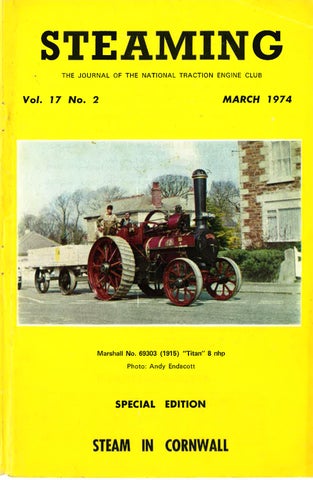
STEAMING THE JOURNAL OF THE NATIONAL TRACTION ENGINE CLUB
MARCH 1974
Vol. 17 No. 2
Marshall No. 69303 (1915) "Titan" 8 nhp Photo: Andy Endacott
SPECIAL EDITION
STEAM IN CORNWALL
NATIONAL TRACTION ENGINE CLUB OFFICERS President S. J. Wharton, Esq., Southern Down, Minster Lovell, Oxford. Vice-President J. T. Beeby, Esq., Wymeswold Road, Rempstone, Loughborough, Leics. Chairman Anthony Heal, Esq., Baylins Farm, Knotty Green, Beaconsfield, Bucks. Vice-Chairman J. Crawley, Esq., Field House, Turvey, Bedford. General Secretary G. F. Beck, Esq., 127 Greensted Road, Loughton, Essex. Treasurer J. H. Hobbs, Esq., 6 Esher Close, Basingstoke, Hants. Editor Ran Hawthorne, Esq., 19 Bridle Path, Woodcote, Reading, RG8 OSE, Berkshire. Chairman, Rally Sub-Committee M. Harmsworth, Esq., Elm Cottage, Ockwells Road, Maidenhead, Berks. Membership Secretary P. R. Dalton, Esq., 34 Woburn Gardens, Basingstoke, Hants. RG22 6UB. Sales Officer V. H. Burrough, Esq., 94 Harvist Road, Kensal Rise, London, NW6 6HL. Technical Services S. J. Wharton, Esq., Southern Down, Minster Lovell, Oxford. Public Relations Officer Jonathan Minns, Esq., It Hollywood Road, London, SW10. Publicity and Press Officer Patrick Coxall, Esq., Smokey Cottage, Lion Lane, Haslemere, Surrey.
STEAMING Steaming is published by the National Traction Engine Club in December, March, June and August. Articles, photographs, news items, display and small advertisements should be sent to the Editor. Steaming is posted direct to all paid-up members. (It can be obtained through NTEC affiliated Clubs). The subscription is £2. The best way to be sure you are paid-up is to use a Banker's Order. All correspondence re subscriptions, bankers orders, delivery (or delivery) of Steaming or change of address to: P. R. DALTON, Esq., 34 WOBURN GARDENS, BASINGSTOKE, HANTS. RG22 6UB.
ACKNOWLEDGEMENTS For articles, photographs, information and assistance in many ways with the preparation of this special edition, our grateful thanks and acknowledgements to Charles Daniel, Rob Daniel, Charles Gregory, John H. Trounson, Alan V. K. Thomas, Steve Veal, Vernon H. Carveth, E. J. Saundercock, Joe L. Thomas, Alfred Maidwell, Barry J. Finch, Dick Blenkinsop, D. C. Mitchell, M. F. T. Leath, Andy Endacot, B. D. Stoyel, D. Bradford Barton Ltd., L.G.R.P., West of England Steam Engine Society, The Cornish Traction Preservation Club, The Gladiator Club, The National Trust, Wendon Forge and many more. 74
STEAMING © copyright reserved Editor: Ran Hawthorne
FROM THE EDITOR'S CHAIR Many kind remarks were made about the last edition. It is nice to receive compliments, we also welcome constructive criticism. With this issue we say, "Thank you, goodbye and all the very best" to Mr. and Mrs. Charles Ayes. Brenda and Charles have worked very hard and most efficiently on behalf of the Club. I know that they have averaged over 25 letters per post and when they have been on holiday they have returned, literally, to sacks full! They have dealt with the receipt, recording, banking and issuing receipts for our 3,000 members' subscriptions. In addition they have addressed the envelopes, inserted Steaming, stamped and posted our copies to us. Much of their mail has involved answering questions, passing on information or questions to other officers and writing tactfully to members who have not sent the right money or have got behind with their subs. Little of their work has been straight forward but, it has been done quickly, efficiently and with a smile. Thanks again Brenda and Charles, our best wishes go with you to your new home at Kintbury, Berks. We welcome Peter Dalton to the Membership Secretary's job, and trust that he will be as successful in the work as Mr. and Mrs. Ayes have been. Although I was born in County Durham, I must have a little bit of Cornish blood in my veins, for my earliest known ancestor was born at Falmouth in Cornwall — 270 years ago. It was therefore with a little feeling of "going home" that I visited the county, and particularly the steam enthusiasts there, in December. I was certainly made to feel "at home". I was able to renew friendships with many and for what I hope will not be the last time meet many more. I was shown the mighty Cornish Engines and had their inner workings and finer points patiently explained by one who really understands and loves them. Traction Engines were mostly all "a bed" but I did a see a number, where they "live", where they were brought back to "life" and are kept "alive". 1 saw many aspects of steam, mining and Cornish life. All these things happen when people are "involved" and in Cornwall they do gel involved.
My thanks to you all, I did enjoy meeting you. The June edition will be of a general nature. It is hoped that it will be out by the end of May. Would correspondents please see that their contributions are in my hands by 1st April. Small news items and adverts can be accepted up to 15th April.
BLOW OFF Steaming's opinion column Long before the Traction Engine preservation movement got under way, examples of the impressive Cornish Engines were preserved by far sighted steam men in Cornwall. As the last two or three examples ceased commercial work successful efforts were made to keep them intact. Thanks to this foresight some seven or eight of these engines have been saved. In almost every case the boilers that provided the steam have gone. One engine runs on compressed air, another is made to move hydraulically, and another has had a trial run on compressed air. To see a Cornish Engine run under steam one has to go to Crofton in Wiltshire, where two engines are preserved, and can be seen in action from time to time. The restoration of a Cornish Engine, its house and boilers is a tremendous task. We can be thankful that a number have been saved, but can we Traction Enginemen think of ourselves not just as Traction Enginemen but as Steam Men and lend our support, perhaps by devoting some rally proceeds to the resoration, in steam, of at least one of these beautiful, important, and historical engines? 75
ABOVE: Aveling & Porter No. 4255 (1899) "Victoria". A convertible engine. BELOW: Burrell No. 315 (1909) "Gladiator" 7 nhp. Both photos taken at Camborne in 1971 by Andy Endacott. 76
STEAM IN CORNWALL An introduction by the Editor It is of little value, at this stage in time, to enter into arguments as to who, when or where the first steam engine, the first railway locomotive or traction engines were built. Over many centuries a large number of people had ideas, made improvements, designed more efficiently, and many wonderful examples of steam machinery came into being. We can single out James Watt and George Stephenson for the important contributions they made but there is little doubt that Cornwall made a greater contribution than any other county to he development of steam power for the benefit of mankind. The Cornish Engine enabled mining to be carried on at much greater depths than had previously been possible. In spite of the fact that he did not follow up his early work Trevithick, "showed the way" in no uncertain fashion, with both road and rail engines. It is him we have to thank for the fusible plug. Portable engines found a wide variety of uses in Cordwall but, of course, mainly for threshing, sawing, stone crushing and in mining. Tractions also found wide employment in the mining industry, (as well as for threshing), one at least being used commercially for this purpose even after preservation began. Road Locomotives were used extensively in Cornwall, heavy loads of machinery and stone together with some severe gradients, often on unmade roads, called for powerful engines. Steam Tractors played their part hauling lighter loads and for threshing in small stockyards. While undertype wagons made an impression before the First World War, the slower over-type steam wagons with the benefit of a greater range of speed-power through two or three speed gearing were more suited to the work that steam wagons were called upon to do. Steam Rollers, mainly Avelings, Burrells, Fowlers and Marshalls, as in other areas, did their work honestly and without fuss. It was well into the 50's and the 60's before the "push-button" diesels took over. West Country Showmen had a reputation for maintaining their engines in tip-top order. Their Burrells and Fowlers became well-known to the public and provided a "draw" at the Fairs. Steam served the Showmen well, but the long distances often involved enabled the readily available ex-Army transport to oust steam in the late 40's. It is believed that the double-engine system of steam ploughing was never used commercially in Cornwall. Not till the days of preservation has the sight of a pair of engines pulling a plough by means of cables been seen here. In the working years of steam Cornwall produced wonderful Engineers and Engines. The present generation of Enginemen are just as dedicated; worthy successors of their forebears.
WHAT YOU SAY "Congratulations upon the colour edition of Steaming" — Billy Coates, Belfast. "I would like, most sincerely, to congratulate you, and all connected with publishing it, on your very fine first coloured issue of Steaming. This is really great" — G. H. Windley, Rugby. "I like the colour front cover and think it is an excellent Journal" — C. J. Watts, Cirencester. "Congratulations to all concerned regarding full colour cover and continued high standard of Steaming. May I suggest that the photographic competition is extended to colour slides in 1974 with the winning entries used for the cover" — B. J. Bird, Wednes field. 77
R. DINGLE & SONS, STOKE CLIMSLAND By E. J. SAUNDERCOCK
Few remote villages in the county of Cornwall received the amount of publicity. as created by the legend "R. Dingle & Sons, Stoke Climsland", adorning the awnings of some sixty to seventy rollers and other steam machinery, from the late nineteenth century. to the mid-1950's. The beginnings of the steam toiling business. unfortunately, are lost in obscurity. It is however. on record that one Richard Dingle was, in 1846. at the age of fourteen, apprenticed as a blacksmith for a term of seven years, to John Hawton of 1-lampt, near Luckett. At this time. it should be understood that mining in the Callington area was at its height. with a considerable call for blacksmiths. John Hawton, alone, had live
journeymen working under him . On completion of his apprenticeship, Richard Dingle set up in business on his own account, at Venterdon, where his blacksmith's shop, together with his dwelling house, are still in existence. It is evident that he married at an early age, resulting in the birth of four children. The eldest, Edmund John, is still remembered today among the older steam enthusiasts. His other children were one daughter, and two more sons, Ernest and George. Ernest became a schoolmaster and taught in Landon. Edmund John and George worked with their father in the general smithy business, but soon discarded the shoeing of horses and repairs to farm ploughs and harrows, branching out into the various types of steam machinery. Traction engines hauling one (jr two wagons were used to transport products away from the local mines. Vivid memories are also revived of a Mann Wagon in operation at the turn of the century. At about 1900 or earlier, a workshop was set up in an orchard, away from
the smithy, and equipped with lathes and other machine tools essential to the maintenance of the steam engines. At times the big lathe would be turned by shafting from a hand wheel, but if an engine happened to be available, it was lined up, and steam power substituted. The haulage business progressed to other aspects of steam power; threshing, stone crushing, wand sawing, and finally, the rapid expansion of the firm's steam roller fleet. This was made up of mast of the wellknown makes of engine: Aveling & Porter, Marshall, Fowler, Wallis &
Steevens, and, most popular with the Cornish engine men, Burrell. Brand new rollers were sent farthest afield, for the obvious reason that they were least likely to require repair. In normal use. a roller would stay away for about ten years, by which time the three to four inch thick hind and front rolls would have worn down to less than half their original thickness. On returning to Stoke Climsland, for a refit, the hind rolls would be sent to Allens of Oxford for replating. In the case of the front rolls, where the rolls were bolted to the spoked centres, they were sent to Easton & Johnson of Taunton, who would cast new rolls, carry out the necessary machining and fit to the original centres. The method with the rear rolls was to put the roll in a wheel lathe and turn off to obtain a true surface. One and a half inches of steel plate suitably formed to the correct contour would be fitted to the new face in separate lengths, about three feet long. A threequarter inch gap would be left between each length, and this gap filled with a close-fitting piece of hard wood. In use, the steel would stretch as well as wear, so that in the course of several years, the ends of the plates would touch. If the gap was not reformed, the stretching would continue and would lift the one inch rivets holding the plates on. The firm soon became one of the main agents for steam engine manufacturers, and supplied many sets of threshing tackle in the locality. 78
Aveling & Porter No. 9096 winching a diesel roller up a steep farm lane in the 1950's. Note the check chain between front and rear wheel.
Some of Dingle's staff and No. 9096. The engine is now owned in preservation by A. T. Hooper. Both photos by E. J. Saundercock. 79
R. Dingle & Sons' Fowler roller in difficulties in Pound Street, Liskeard in the 1920's. Photo: S. Veal.
The 'S' type Marshall No. 88097 (1937) reg. DAF 499 pictured here in Dingle's yard before restoration began. Photo A. V. K. Thomas. 80
Fowler No. 18075 (1930) "Britannia". Owners R. Dingle & Sons.
Wallis & Steeven Advance No. 8095 (1936) "Amy". Owner R. Dingle & Sons. Both photos by A. V. K. Thomas. 81
In the firm's earlier days, George Dingle travelled the counties in motor cycle combinations, loading up the sidecar with oil, cotton waste, scarifier tynes, gauge glasses, and all the odds and ends used on steam engines. Memories remain of an 8 hp Royal Enfield and an earlier water-cooled Williamson. In about 1920, the first car carne along — an Overland. The
firm's chief fitter at that time was Ernest Lock. It was commonplace for him to set oil for Liskeard on a bicycle, with a bag of tools on a carrier. whereupon he would take a train to Redrnth or points ►vest, cycle to a roller in trouble, complete the necessary repairs, and return borne in similar manner. Edmund John Dingle was a man of powerful physique. who loved walking, and thought nothing of returning home from Plymouth on foot, if no other means were available. including crossing the Brunel
railway bridge if the last train had departed. Charles Lock, who succeeded his father Edward, made use of a pony and trap as transport. Even today, he often refers to a small service pick-up as "the pony and trap". Many a roller driver married and moved into a living van, bringing up his family on the road. In those days of low wages, the van represented a rent-free home, such as it was, fully furnished! The drivers regarded their rollers as their pride and joy, keeping the brass and paint►vork shining, just as well as the enthusiasts d❑ today. On Council work, washing out the boiler was arranged for every three weeks, on Mondays when the boiler would be cold. The engine was to be ready and in steam by noon. It is a sad reflection on today's standards. that the piles of coal left in the Council yards in those days were never touched. Today, diesel rollers are broken into, and batteries and tools stolen. Apart from the roller fleet, about a dozen portables were on the strength, mostly driving stone crushers and granulators in quarries throughout the county. A few were used to drive rackbenches, a notable one being employed in the Duke of Bedford's woods near Stoke Climsland, where rough sawn timber was available at very low cost. After the Sei.und V4'ul ld Wah the poi tables fell into disuse as providers of power,
but a new use was found for them in providing steam for sterilising greenhouses, especially in the Channel Islands, where a number were sent. A particularly fine example from the Duke of Bedford's mill at Gutworthy was among these. This engine was not many years old, and a lovely sight. In what seemed a wanton act of vandalism, the top works were removed and discarded, to make it lighter and less bulky for
shipping to Jersey. With the demand for diesel engined rollers, storage of the steamers, now gradually becoming redundant, presented a problem, and many were sold as scrap, owing to lack of space. It is probably a fact that many a fine engine which was sold for as little as £10 was in better condition than others that have survived, and are so valuable today. A fine specimen of a Marshall roller was among those scrapped. This one had all machine-cut gears, and the hind and front rolls were all fabricated wrought steel, including the centres. It was considered by its drivers to be the fastest roller on the road. The firm is now run by the grandson and great-grandson of Richard Dingle, descended from his only daughter. Although the firm stilt specialises in road rollers, diversification has had to be made into the heavy, towed vibrating rollers used for base work, and for consolidating deep earth embankments and suchlike on modern road schemes. However. steam is not forgotten, as three rollers from the former fleet arc in
preservation by the firm. A 1930 single cylinder Fowler No. 18075 (CV 1662) and a 1936 Wallis & Steevens 'Advance' No. 8095 (GOU 537) are in full working order, and regular rally attenders. A 1937 compound `S'-type Marshall No. 88097 (DAF 499), the last derelict to have remained in the Stoke Climsiand yard, is nearing completion of a thorough overhaul by the firm's fitter and turner John Stephens, an accomplished model engineer, and 'doctor' to the diesel fleet. Many other engines and rollers formerly of the Dingle fleet are to be found in preservation, particularly in the West country. but also much farther beyond.
82
STEAM HAULAGE IN CORNWALL by Charles Daniel. Cornwall's heavy industry was centered around the practice of winning minerals from the ground, initially deep mining for metals and later for china clay . Both industries demanded a lot of haulage work to be done by road, as rail connections were sparse, at least until a mine had been established for a few years. Before a mine was equipped there would be a lot of heavy machinery to be hauled, the huge castings of the beam and cylinders for the pumping engine — and the boilers to steam them. Horse teams provided the motive power for many years, one firm of engineers, Harveys of Hayle, kept a farm to provide food for their draught horses. Their first traction engine is believed to have been a single cylindered Aveling & Porter crane engine, later they had a least one compound, top valve, Aveling & Porter crane engine. Harveys also owned a four-shaft Burrell S.C.C. No. 1654 built in 1893 and a S.C. No. 1884 new in 1895. Levant mines also owned at least three engines, an engine was very necessary as they were about seven miles from the nearest railway station, Penzance, and between them some very hilly ground. One of their engines was an 8 n.h.p. Ransomes Road Locomotive No. 10609, she was new to R. Matthews, Levant Mine, St. Just in 1896. A single cylindered engine she was very heavy ❑n coal and water and to cap this a poor steamer, yet she survived long after the mine — until just after the Second War when she was being used by a threshing contractor.
BELOW: Aveling & Porter compound in Hayle Town. Owned by Harveys of Hoyle. (M.F.L.T.)
Another of Levant's engines was an 8 n.h.p. Aveling & Porter No. 5743 built in 1905 and named "Excelsior". During her first year of use she was involved in a spectacular accident in Redruth when hauling a load of refined arsenic in wooden casks. On an icy downhill stretch of road at West End, Redruth, the wagons pushed the tail of the engine around and she finished up between the large cast iron pillars of a shop front. This engine was often in trouble with the highway authorities as she was very heavy, her owners removed every non essential, even the front tanks, but this transformation had the effect of making her loose
adhesion weight and she finished her days, until the 1930's driving the machinery in the workshop. East Pool and Agar mines situated between Camborne and Redruth at one time owned two engines, a badly decomposed 10 n.h.p. Burrell No. 1821 called "Conqueror" and a 7 n.h.p. Fowler heavy haulage engine No. 10304, a class A5 compound registered AF 4993 built in 1908 but was not new to East Pool and Agar. The mining company were engaged on sinking a new shaft and to enable work to start before the winding engine was installed they refurbished the Burrell which had stood out of use for a couple of years and used her to haul men and material from the shaft. All went well for some while and then a heavy knock developed. Arthur Pethick diagnosed this as the low pressure piston being loose on the piston rod, his warnings were not heeded and in due course the piston pushed the front cylinder cover off. Had this occurred when
men were being hauled to the surface after lighting the fuses to detonate the explosives, there would have been terrible consequences to this story. The Burrell never worked again, she was pulled back to the mine yard where she lay derelict until being cut up during the 1940's. The nearby South Crofty mine owned a Fowler 6 n.h.p. 3 speed Road Locomotive, No. 11029 built for J. Lucas, Bridgerule, Devon, passing to C. Reed of Plympton, Devon, in 1908. South Crofty Ltd. purchased her from S. Craddick, St. Germains in 1950. She was registered AF 3541.
This engine survived into preservation days and attended some of the early rallies held in the Camborne area. When she was purchased from the mine for preservation her new owner found the firebox was badly wasted and without the Oft of foresight this fine engine was scrapped, only her chimney top survives, now on an 8 n.h.p. Marshall traction engine. In 1916 Basset Mines Ltd., near Redruth, purchased a large Lancashire boiler from Phoenix Mines, near Liskeard, and a contractor was given the job of getting the boiler and a couple of wagon loads ❑f scrap to Basset Mine. The boiler was loaded on two wagons which then had to be roped over some soft ground to the road. Unfortunately the driver had after loading the boiler, only loosely wound the rope ❑n the drum and when he came to rope the wagons the rope pulled tightly between the coils and split the drum. The makers could not supply a new drum as they were busy making munitions and it was several weeks before a second hand drum could be found and fitted. However, one Monday morning all was ready and the journey began. On meeting a horse drawn vehicle in a narrow road the train was pulled into the side to enable the vehicle to pass but the trailer wheels sank into the ground and the boiler had to be unloaded and reloaded before the journey could restart. However, by nightfall they reached Liskeard, and the two engines, two wagons and the boiler and its wagon spent the night in the town square. In the morning it was noticed that the rear axle of the rear boiler wagon was bent, there was not room in the square for a repair to be effected, so they moved away down the hill to a spot near Moorswater locomotive sheds, from whom they were able to borrow a large jack enabling them to lift the boiler from the wagon and remove the axle. Then they found that the wooden axIe tree was rotten and it was pointless straightening the axle without first finding a new axle tree. A local swamill was able to oblige by finding and shaping a piece of oak, while at a smith in the town the axle was straightened. At the end of the day the wagon was together and the boiler back in place. The next day a good run was made covering sixteen miles to Lanivet, where after a disagreement about the cleanliness of the men they were allowed to stay in the Inn. The following day they covered the twenty-two miles to Truro without incident, only to find that the police would not allow them to park in Trafalgar Square for the night. The engineer in charge of the operation then said that if there was an accident with the two engines hauling the boiler up Station Hill in the dark, then he would hold them fully responsible. Needless to say, they were allowed to park in the square, providing lights were displayed and a watchman provided. The morning afterwards the two engines hauled the boiler up the steep hill without incident. although they did do a lot of damage to the road, which ran alongside the County Council headquarters and the engineer was challenged by a council official and he had to admit that the engine and wagon wheels, all being steel, had done a considerable amount ❑f harm to the road surface. By afternoon the boiler was unloaded at its destination, Basset Mine, the journey of about sixty miles having taken five days, it was now Friday afternoon. One firm whose engines are well documented was Hosken, Trevithick and Polkinhorne of Hayle. They owned at least three big Aveling & Porter traction engines, which the makers quoted as being 8 n.h.p. engines although their cylinders were 7in. x 114-in. with 12in. stroke. Their first engine was No. 3476 of 1894 and was fitted with 7ft, din, by Idin. rear wheels, their second was No. 5155 of 1902, was fitted with only 7ft. diameter wheels while their third engine, No. 6410, had 18in. wide 7ft. wheels.
OPPOSITE: Fowler compound road locomotive handles a Lancashire Boiler at South Crofty Mine in the 1950's. (J.H.T.) 85
KEN IRE THIC POLK NH Co. LID & TRU '
WSJ
Wallis & Steeven No. 7250 (1911). They are also known to have owned two Thornycroft steam wagons, a Foden five tonner No. 5524, new 1915, registered M 7426, and a very noisy Wallis & Steevens oil bath wagon. No. 7250, a five tonner, new in 1911 and registered AA 2440. Their last engine was an 8 n.h.p. three speed Fowler No. 13040, a class R3 compound that came new to May 1912, she was no doubt by tradition, offered to their senior driver, one Jack Richards. When the Fowler arrived she was accompanied by a 'man from the works' and he challenged Jack that he could get a load from Penzance to Hayle, a flat road by Cornish standards, more quickly with the new Fowler than Jack could with the two speed Aveling. The challenge was readily accepted and the two engines left Penzance with their loads almost together — Jack Richards had shunted his trucks at Hayle and was waiting in the road outside the yard when the Fowler arrived. He continued to drive the Aveling. H.T.P.'s first Aveling was the engine involved in the accident at Tuckingmill between Camborne and Redruth. The circumstances were that the road here is carried on a stonewalled embankment and heavy traffic had been advised to keep away from the north side. The electric tramway was being laid between the two towns and here there was to be a passing loop, and so while the south track was being laid all traffic had to use the north side of the road. The engine was coming up the hill with three trucks and a water dandy when the wall collapsed under the rear wheel leaving the right hand front wheel several inches off the ground and the rear wheel three or four feet below road level. Plenty of help was on hand from the track laying gang and the engine was shored up and chains put across the road to prevent her slipping further. A stout fence constructed of iron bars passed through large granite posts, which still exists also helped to hold the engine. The following day with the help of two other engines, she was pulled out and returned to Hayle under her own power. Many other firms owned interesting engines and hauled unusual loads. Messrs. Freeman and McCloud owners of several large granite quarries in the Penryn area, were renowned for their ability to transport large blocks of granite weighing many tons with their traction engines: many small contracting firms when the season's threshing work was finished would turn themselves — and their engines — to the possibly more exciting job of road haulage. One can only guess at the amount of material there would have been if steam engines had in their working days attracted so much accurate reporting as they do today. 86
Class R1 Fowler No. 10695 (1907) near Penzance railway station on October 18th 1907, in ownership of RotaHack Mine, St. Just. By 1915 she was with Cornish showman J. Brewer, named 'General French'. (J.H.T.) 87
THE CORNISH ENGINE By CHARLES DANIEL
Steam power was probably first tried for pumping water from mines in 1698 when Thomas Savory took out a patent on his machine for 'Raising water from mines by the impellant force of fire' and it is possible that his engine was tried at Wheal Vor early in the 1700's, but would seem that it was not particularly suited to its task of pumping water. At this time Newcomen was working on the design of a pumping engine along, what was to become, conventional lines. A beam was pivoted over the mine shaft, one end connected to the piston and the other to pumps in the shaft. When the piston was at the top of the stroke low pressure steam was introduced beneath it followed by a jet of water which condensed the steam, thus causing a vacuum beneath the piston which in turn pulled the piston to the bottom of the cylinder and raised the pump rods. Steam was then introduced below the piston and the piston again rose to the top of the cylinder largely by the out of balance weight of the pump rods in the shaft. These eniiines were thermally inefficient and consequently used a lot of coal which had to be imported to Cornwall incurring very heavy transport costs and an import duty. In 1727 it is recorded that five engines were at work in the county but, this figure may only relate to engines erected by Joseph Hornblower. During the 1730's there was an increase in demand for the copper mined in Cornwall, the import duty was removed from coal and engine design and building surged ahead. Originally the huge cylinders for these engines had been cast in brass but with improving foundry techniques they could now be made in cast iron. All the while the mines were getting deeper, requiring more pumping capacity and engineers were trying to make the same engines do more work efficiently. and in the 1770's engines built under James Watt's patent began to appear in the county. His patent allowed for the steam to be condensed. not in the ylinder but in a separate condenser thus saving a lot of heat losses that had occurred when the cylinder was warmed and cooled at every stroke. Watt's engines too, used steam pressure above the piston to improve the power stroke and his engines size for size were more powerful than Newcomens and more efficient. At Gwennap, Great Consols mine replaced seven Newcomen engines with five of Watts, in a certain period the Newcomen engines had used 19,086 tons of coal while in a similar period the Watt engines used only 6.090 tons, saving £9,097 on the coal bill alone. However, Watt's patents effectively prevented other engineers building engines to his design at his patents embodied the basic principal of the Cornish pumping engine. The adventurous engineers however, carried on designing, ignoring patents or trying to build engines outside them. One of these was Jonathan Hornblower and his first successful engine was a compound beam engine which he erected at Radstock colliery in Somerset. In 1791, the first of his compound engines to be seen in Cornwall was put up at Tincroft Mine between Camborne and Redruth. The cylinders were of 21 and 27 inches diameter. An attempt to move away from the principle of using a beam, and thus the strong building needed to support it was made by Edward Bull and Richard Trevithick (Junior), who built engines with the cylinder directly over the shaft, the piston rod being coupled to the pump rods. By 1792 about ten of these engines had been put to work. 88
A Harvey's Hayle Foundry, Cornish engine of 1884. Note the James Watt separate condenser (to the right of the central wall) and the parallel motion that enables the piston rod to remain vertical at all times. Reproduced by permission of D. Bradford Barton Ltd., Truro.
89
Messrs. Boulton and Watt (Boulton was Watt's business partner) realised that if they took Hornblower to court over the patent rights they were in danger of losing the whole patent, so instead they successfully prosecuted Bull and an injunction in 1794 prevented Bull from erecting any more engines. The conflict between Boulton and Watt, and Hornblower and Winwood (who now had a financial share in Hornblower's patents) continued not in the courts but in the mines. One well recorded trial that occurred was between the Hornblowcr compound engine at Tincroft Mine and a Boulton and Watt engine at Sea Hole Mine. St. Agnes in 1792. The results showed that the Hornblower engine was slightly superior, performancewise, and as a result another nine Hornblower engines were erected in the following two years. In 1800 Watt's patents expired giving local engineers a free hand in designing and building the engines that they had to use and maintain, but Watts inventiveness had given the Cornish engine a big push forward, the idea of using steam expansively above the piston, the separate condenser, the double acting engine where steam pressure and vacuum acted alternatively above and below the piston, and the rotary engine. Fortunately his work was well documented, much of the history having been extracted from his reports and those of his contemporaries. For the next ten years documentation is scarce but in 1810 one Joel Lean began a publication called Engine Reporter in which he gave details of certain engines and the duty they performed. Duty was a measure of the efficiency of an engine being the weight of water in pounds raised one foot, by one bushel of coal used in the boilers. The publication of these figures increased compeptition between engineers and resulted in what came to be called the Duty Race. By 1814 most good engines were doing up to 20 million duty but in 1815 a new Woolf compound engine with cylinders 28in. and 53in. erected at Wheal Vor passed 50m. duty. There was now a trend towards larger engines, and in 1820 Woolf erected a single cylinder engine at Consols Mine in Gwennap parish having a cylinder of 90in. diameter At about this time some engineers were beginning to question the economics of the compound engines, their initial cost, installation and maintenance costs were higher, but running costs were lower although single cylinder engines now running at higher pressures and using the steam more expansively were rapidly reaching the efficiency of the compound engines. In 1825 an attempt was made to reach conclusions about the question and a trial was arranged between a Woolf compound being steamed from his own design of cast iron boilers and a big single cylinder engine steamed from Trevithicks Cornish boilers. Results of the trial showed that neither was significantly superior in regard to duty done, but the cheaper outlay of the single cylinder engine made a more attractive proposition. During the trial when the boilers were being steamed hard Woolf's cast iron boilers gave quite a lot of trouble and he seems to have given them up soon afterwards. While this trial was being conducted the duty figures being obtained were surpassed by a small engine erected by Samuel Grose at Wheal Hope in Gwinear parish. He had paid particular attention to the thermal insulation, enclosing the cylinders in a wooden jacket filled with sawdust and lagging the steam pipes to prevent loss of heat. This engine did 45m. duty in August 1825, its third month of work. Six years later the average duty of the engines reported by Lean had risen to 45m. while Groses best engine was reported at over 70m. In 1835 at Fowey Consols an 80in. engine erected by William West, who had worked under Grose reached a duty of 97.8m. and during a short trial, under ideal conditions the duty reached I25m. However, the only engine to regularly reach 100m. duty was an 85in. engine built by the famous Perran iron Foundry and erected at Ale and Cakes mine, a part of the great United Mines complex near Gwennap. The engine was built with specially large steam valves and steam pipes enabling the steam to be easily and quickly got into the cylinder and then shut off allowing expansion of the steam to do as much work as possible, for a recorded two and a half years this engine worked at from 87-107m. duty. 90
By 1850 the Cornish engine had perhaps reached the peak of its development, cylinder sizes were regularly 80in. or 85in, and strokes of 10 or 12ft. were common. After the middle of the century duty figures began to decline; one of the biggest factors was the poorer quality of the coal being supplied and another was the increase of the number of underlie (inclined) shafts which caused a great deal more friction on the pump rods. Some engineers argued that by working an engine hard to report a high duty figure was, in the long run not economical, hard work meant that the engine, the pitwork and the pumps needed more maintenance and repairs; so perhaps now the great duty race was over, but it had made engineers aware of the more subtle facets of steam engineering. The late 1860's saw a great depression in Cornish mining, which resulted in there being many engines for sate, large engines often found a buyer up country or abroad but a small engine was not such a saleable commodity. Many lay idle for several years, but gradually a new industry was emerging, the mining of china clay and by the turn of century some fifty engines were at work in the clay industry, mainly in the St. Austell area and some of these engines survived at work until the 1950's. The twentieth century saw little activity in engine building, Holman Bros. built two engines, one a 68in. for Dorathea Slate Quarries in North Wales and an 80in. engine for Phoenix United Mines in East Cornwall. In 1913 Charlestown Foundry built a 36in. pumping engine for Goonbarrow Clay Works. Though few engines were being built a few were being moved around, in 1922 South Crofty Mine purchased a 90in. engine from nearby Wheal Grenville and this engine worked until 1950 when the main beam broke and the engine was scrapped. Now there remained only two engines pumping from deep mines in the county, the 90in. engine at East Pool Mine which stopped work in 1954 and the 80in. engine at the nearby Robinsons shaft at South Crofty, which finished work in 1955. Sadly during [he 1960's the battery of beam engines that had drained the Severn Tunnel for seventy-five years ceased to work, there was nothing wrong with the engines except that steam power was very unfashionable. Cornish engines were not only used for powering pumps they could easily turn their reciprocating motion into rotary mode and drive machinery, ore crushing stamps, hauling from shafts and providing power for engineering works. Another duty to which Cornish engines were put to use was a provide the motion to the man engine, a device consisting of platforms attached to the pump rod duplicating platforms fixed to the shaft walls. Men wanting to ascend or descend stepped onto a platform on the rod, travelled with it to the end of the stroke and stepped off waiting for the rod to travel in that direction, a great improvement to using the shaft ladders to reach the surface after ten hours hard work underground. Whim engines, the beam of the engine connected to a winding drum by a heavy sweep rod, were used widely for hauling ore, men and materials through the shaft, more cheaply and quickly than a horse powered whim. These engines were much smaller but ran faster than their pumping counterparts, few had cylinders larger than 30in. and the smallest believed to be one advertised for sale at St. Agnes in 1825 having a cylinder of only 6in. diameter. Today there arc no fewer than eight engines extant in the county, and three of these are able to be run under compressed air. The 50in. engine at Parkandillick, is the only example where the boilers exist and these arc being examined with a view to running the engine under steam again. Nearby another 50in. engine exists at Goonvean. sadly now heavy with rust and the condition of the wood floors in the building renders them unsafe. In 1959 the last Cornish engine finished work in the county, again in the china clay area, where she had worked since 1890. Strangely nothing is known about this engine not even the name of her builders, but she is thought to have started work at a mine in East Cornwall in about 1850. Incredibly in 1972 this engine was purchased for preservation, 91
East Pool winding whim and head gear in the 1890's.
dismantled and moved to a new site near Helston where she is on view, working under compressed air, at Wendron Forge. At Pool, between Camborne and Redruth stand three engines, Taylors 90in. pumping engine preserved and on view as a static exhibit at the old East Pool mine; beside the main road stands the well known 3flin. whim engine which in 1972 was rebuilt and made capable of being run on compressed air. At the still working South Crofty Mine stands an 80in. pumping engine, built at Copperhouse Foundry, Hayle in 1854 and erected at South Crofty in 1903, where she worked until May 1955, being the last big pumping engine to work in the county. One of the exhibits in Messrs. Holman's fine Museum at Camborne is a 22in. rotary beam engine built at St. Blazey foundry in 1851 and now preserved and run on compressed air for visitors. Further West at the old Levant mine stands a small building near the edge of the clilTs, in the building is a 24in. rotative engine now 135 years old. There seems Little hope that the engine will be restored but it is gratifying to know that it exists. Cornish engines are preserved in many parts of Britain and other parts of the world in recognition of the great part they played in producing a progressive world-draining the deep mines to provide metals, supplying canals with water to transport goods; they pumped water for cities; they worked as 'blowing engines' providing an air blast for metal smelting furnaces; their applications are too numerous to mention. The Cornish engine is a beautiful piece of machinery, at rest the combination of polished metal and wood, and whitewashed granite sets is as appealing as many works of art — at work the Cornish engine moves slowly and it pauses between each stroke as if to draw attention to itself, everything moves gently and with reverance and yet the only sounds are valves seating, gentle rushes of steam, and an almost imperceptible creak of the woodwork. For its beauty and magnitude, no less than its service to society, has the Cornish engine been preserved. 92
TRIBUTE TO TREVITHICK By C. P. GREGORY Many of us will remember the bi-centenary celebrations of Richard Trevithick's birth which were held at Camborne in 1971, when twentythree engines paraded through the town. (See Steaming Vol. 14, No. 3). An earlier celebration is recalled by an article which appeared in "The Locomotive Magazine" in February, 1902, part of which reads as
follows:THE CENTENARY OF THE LOCOMOTIVE ENGINE "On 24th December, 1801, the pioneer practical (Road) locomotive engine started on its first trial run from the Cornish mining town of Camborne, and the centenary of this historic event, the subsequent influence of which on the development and expansion of the world's commerce and civilisation during the past century has been of such incalculable importance, was fittingly celebrated at Camborne on the first Christmas Eve of the twentieth century. To Richard Trevithick and Andrew Vivian is due the honour of bringing to a successful issue the invention which was to revolutionise the world. Trevithick, who was born at Illogan on 13th April, 1771, came early to Camborne where he subsequently became engineer in the famous Dolcoath tin mine, the largest, oldest and deepest in the world. As early as 1796 he had constructed a model locomotive, and in conjunction with Vivian, the manager of the Dolcoath mine, he made the historic engine which one hundred years ago ran successfully from John Tyack's smith's shop in Camborne, where it was built, to a point some distance up Beacon Hill, carrying with it seven or eight passengers. To celebrate the centenary of this event a procession was formed which, starting from the Gustavus Mission Room, which now occupies the site of Tyack's shop, marched round Camborne to Commercial Square, where an address was delivered by the Chairman of the District Council. Included in the procession were half a dozen traction engines, one of which drew a car conveying some twenty of the Dolcoath miners who carried boards with the legends; "Trevithick and Vivian, Inventors of the Locomotive", "First Successful Run, Xmas Eve, 1801", etc." It should be added that Trevithick followed his success by constructing the first railway locomotive which ran on the Pen-y-Darren Tramway, near Merthyr, in February 1804 . . . . In recent years men have journeyed to the moon. To the astronomers, scientists and engineers who have made such fantastic things possible
all credit is due, but they did have some guidance from the accumulated experiments and experiences previously recorded. Trevithick had no such help — he experimented with high-pressure steam which, until then, had never been put to use. Until then the main source of power were the muscles of men and animals, the wind, and falling water and the limit of these had been reached. Ncwcomen's atmospheric engine and Watt's improvements were of great benefit to the Cornish mining industry, chiefly for pumping the ever-deepening tin and copper mines but these
engines were very bulky and consumed large amounts of coal which had to be brought to the Cornish ports from Wales and then taken to the mines by horses and mules. By using steam at a much higher pressure, Trevithick was able to increase the power and reduce the running costs of the then existing engines and the availability of economical power soon increased the outputs of mines and manufacturers. Their products could be transported throughout the country by the rapidly expanding railway system, also envisaged by Trevithick although largely developed by Stephenson, and to overseas countries by steam-propelled ships which were no longer dependent on the vagaries of wind force and direction. Thus Britain
became the world's workshop and the benefits to this country which have resulted are chiefly due to our famous Cornishman — Richard Trevithick. 93
THRESHING IN CORNWALL ABOVE: An unidentified scene believed to be near St. Buryan, Penzance. BELOW: T. Eva's 6 hp compound Burrell No. 3739 (1916) "Pride of Cornwall" AF 3836 at work in the Helston area. Both photos: J. H. Trounson.
94
THE BODMIN & WADEBRIDGE RAILWAY By CHARLES DANIEL
The Bodmin and Wadebridge Railway was opened in 1834 to serve the needs of the area surrounding the valley of the river Camel, and the town of Bodmin. Wadebridge was at this time an important port, but to keep it so the river estuary had to be constantly dredged clear of sand and this sand gave the railway an important part of its traffic, as it was widely used for agricultural purposes, several of the intermediate halts, ❑ r wharfs as they were called, had a sand drop at the end of the siding where bottom ❑pening wagons could discharge directly into road vehicles. The area too boasted numerous mines, several of which provided a considerable amount of traffic for the railway. The railway was unusual in providing a passenger service from the outset and one rare example of early excursions trains was those run to Bodmin to witness public hangings at the jail. The railways main line was from Wadebridge to Wenford Bridge with branches to Bodmin and Ruthern, but paSsenger services only ran from Wadebridge to Bodmin, From the beginning trains were steam hauled, the first locomotive, aptly named "Camel" was built at Neath Abbey Ironworks and delivered to Wadebridge, in parts, by sea. Shc worked the line single handed for two years when she was joined by a second locomotive by the same builders named "Elephant", it seems that the two engines ►were rather similar although "Elephant" was slightly larger. They were 0-6-0 tender engines with the cylinders mounted vertically beside the boiler, the piston rods coming out of the top of the cylinders necessitated a system of bell cranks and connecting rods to transmit the power to the ►wheels. "Camel's" principal dimensions were, cylinders 101in. x 24in.; boiler 1 1ft. 6in. x 4ft. 6in. with 38, 3in. diameter tubes; a chimney no less than 7ft. 10in. high — n❑ wonder a curt entry in an official diary states "chimney broken oil engine". "Elephant" had cylinders 12fin. x 24in.; 65, 3in. diameter tubes and a chimney 9ft. 4in. tall (possibly chimney heights were measured from the boiler centreline); both engines worked 50 psi. I assume from the facts that "Elephant" had a lot more boiler
tubes and a taller chimney that "Camel" was difficult to steam. Even with such large cylinders their hauling abilities were not phenomenal, "Camel" could manage three loaded wagons of sand up the 1 in 51 gradient to Bodmin, a gross weight of 191 tons; "Elephant" could manage four.
In 1847 the railway was purchased by the London and South Western Railway Company. they immediately replaced the two engines with "Ajax." and "Atlas", a pair ❑f 0-4-2 locomotives with 5ft. diameter driving wheels which had been built in 1840 by Messrs. Jones and Potts. The next engine to appear was an 0.4-0 saddle tank locomotive built by Fletcher Jennings of Whitehaven in 1863. She had cylinders 12in. x 20in., driving wheels 4ft. diameter and was christened "Bodmin". It is not clear when "Ajax" and "Atlas" stopped work, but "Bodmin" was joined in 1875 by "Scott" a 2-4-0 tank engine which the L.S.W.R. had purchased from the Somerset and Dorset Railway Co. in 1871. "Scott" had been built in 1862 by George England, Hatcham Ironworks, with cylinders 1 1 in. x 17in. and driving wheels 4ft. diameter. She disappeared from the Bodmin and Wadebridge again in 1887 when she went to Ninc Elms for a major rebuild, after which she worked on the 95
Bodmin and Wadebridge Railway's Fletcher Jennings 0-4-0 "Bodmin". Built in 1863. Photo: L.G.R.P.
Bodmin and Wadebridge Railway. One of the famous "Beattie" welltanks locos at Wenford clay dry. Note crosshead driven boiler feed pump and steam donkey pump. Photo: L.G.R.P.
96
Lee-on-Solent Railway. In 1886 an 0-6-0 saddle tank, possibly built by Manning Wardle in 1862 came to the railways, she had cylinders 12in. x ISin. and records claim driving wheels of only Mt. diameter and consequently must have been a rather slow locomotive. The line from Dunmere Junction, where the Bodmin branch diverged, to Wenford Bridge was at this time, and still is today, very much as it was built; a ledge carrying a railway beside the river. There are ungated level crossings, very sharp curves and very tight clearances and these two latter facts dictate that only small locomotives of short fixed wheelbase can run to Wenford Bridge. By the end of the nineteenth century the passenger train services had grown, the L.S.W.R. line from Exeter to Padstow joined the Bodmin and. Wadebridge at Wadebridge and the Great Western Railway had running powers from Boscarne Junction to Wadebridge and ran through trains from their main line station at Bodmin Road, through their own station at Bodmin. to Wadebridge, and so another requisite of the locomotive working the Wenford Bridge freight service was that it should be able to show a good turn of speed between Wadebridge and Dunmere Junction so as not to create a large gap in the passenger train service. A third requisite was that the engine could carry enough water to reach the only intermediate water supply, a tank fed by a stream a mile or so beyond ❑unmere Junction. No doubt several engines of that period would fulfill any two of these conditions, but the only class suitable was the now famous Beattie well tank 2-4-0 locomotives, which had been made redundant on the London suburban passenger services. From the turn of the century the three sole survivors of this class were shedded at Wadebridge, one worked the freight service, another performed shunting duty at Wadebridge, while the third was on shed. A little known fact is that one of these engines never worked to Wenford, her water tank filler was not compatible with the watering arrangements on the Wenford line. For the greater part of the twentieth century passenger services were worked by Adams 0.2 class 0-4-4 tank engines, but when these were out of commission and no other engine was available one of the Beattie tanks, although not fitted with the vacuum brake, would run the passenger service. One occasion I remember well concerns the morning "school train" to Bodmin. This was worked by, now, Southern region locomotives and stock but ran to Bodmin General, the Western Region station built high above the original Bodmin station necessitating a gradient of 1 in 38 to reach it from Boscarne Junction, on the Bodmin and Wadebridge. On the morning in question I had arrived at my local halt to catch the "school train" only to find that the previous train, which ran some twenty minutes in front of the "school train", was just arriving. ❑espite the fact that this train went to the original Bodmin station leaving me with a long uphill walk to school, I caught this train and arrived at school in good time. A few minutes later I was looking out of a window from which I could see several hundred yards of the Boscarne Junction to Bodmin General branch and was amazed with what I saw, not one, but two of the Beattie tank engines surmounting the gradient in tremendous style with the three coach "school train" — a few days later this rare combination occurred again, this time I was on the train, A few years before dieselisation the whole line came under Western region management and the Beattie tanks were replaced by ex-G.W.R. 1368 class 0-6-0 pannier tank engines — time between Wadebridge and Dunmere Junction did not matter now, the passenger service had dwindled. Today the main line of the original Bodmin and Wadebridge Railway is still in use, only the branches to Ruthern and the original Bodmin station have been closed, and the rails removed from the Quay at Wadebridge. No passenger services run today but china clay trains run from the dries at Wenford to Boscarne Junction and thence to the Western region main line, while Wadebridge goods yard still boasts enough traffic for a daily visit from a freight train. 97
Sentinel No. 6520 (1926) vertical boilered 0-4-0 locomotive owned by Port of Par, Cornwall at Par Harbour in 1951. Photo: G. Alliel, copyright: B. D. Stoyel.
G.W.R. No. 6004 "King George II" beautifully cleaned and ready to take the Cornish Riviera express to London. Photo: Dick Blenkinsop. 98
SENTINELS IN CORNWALL By J. L. THOMAS, Co-author of the recent classic "The Sentinel". The records of Sentinel steam waggons and official works photographs were destroyed some years ago. The records that we have today have been compiled largely by the efforts of Alan Duke RLS and NTEC Records Officer and Joe Thomas, "The Sentinel Register". We are grateful to Joe for this article. If anyone can "fill-in" any information or furnish additional authentic details, please write to him at, 5 Minett Avenue, Rushwick, Nr Worcester.
The earliest known Sentinel in Cornwall was the 18th waggon built.
This is believed to be No. 131 Registered V 432 (Lanarkshire) and was sold new to Harvey & Co., Hayle, Cornwall by 8/1907. No. 132 (V 436) also went to Cornwall and was new to Porthia China Clay Co., St. Ives, Cornwall. No. 133 Reg. not known, went to Geo. Baaeley & Sons, Penzance, and No. 134 Reg. not known, went to The Truro Gas Co. Ltd. in 1907. So 131, 132. 133 and 134 all went to Cornwall together.
The Porthia China Clay Co., St. Ives, Cornwall, placed a repeat order later in 1907 for another Sentinel Waggon. This was No. 153 Reg. No. V 456. Later in 1907 a Sentinel was sold to Mr. E. Allen of St. Day, Cornwall. This was works number 192, believed to have been Reg. No. V 522. The next Sentinel sold in Cornwall does not appear in the lists until Geo. Bazeley & Sons, Penzance, bought their second Sentinel, No. 1223, in 1916. By June 1919 (and probably much earlier because commercial vehicle registration dates d❑ not seem to have been kept prior to 1921, though numbers were issued) Messrs. Aitken & Morcom Ltd., Penzance, had bought their first Sentinel. This was a Model A 6-Ton Platform Waggon No. 1763 Reg. No. AW 3899 (Note the Shrewsbury registration now). I do not know the date but Jory & Sons, of Hayle. Cornwall, bought a Model A 6-Ton Platform Waggon No. 1841 Reg. No. AW 4006 second
hand from H. & G. Dutfield, of London, El, who had her new in 1918. Shortly after this Aitken & Morcom Ltd., Penzance, bought their second Sentinel waggon this was another Model A 6-Ton Flat platform waggon No. 1827 Reg. No. AW 4107. Sometime prior to 1920 a Sentinel waggon was sold to Berrida (Nigeria) TinfieIds Ltd., of Poldice, Cornwall, but I have n❑ number or registration number for it. This is all the Standard Model Sentinels sold in Cornwall. The last
known date therefore was 1917. Super Sentinel Waggons went into production in 1923 and started at No. 5001, but one has to go to nearly 7000 — No. 6979 before you find that Mr. Joe Warren of Cam Brea, had this Super Sentinel 5-Ton 3-Way Tipper (No. 6979) Reg. No. YH 5763 which had been new 2/6/1927 to Charles Franklin Ltd., of Kings Cross, London — their No. 197. It was 5th hand when it came to Mr. Warren in preservation from Mr. Jim Hutchens, of Ferndown, Dorset, in 1962. She is now in Kent. Despite the very many thousands of Super Sentinels, D.G. and Shaft drive models sold no one in Cornwall seems to have purchased a new one of any of these three models. If anyone has any records to contradict this, I would be extremely grateful if they would let me know, so that I can put "The Sentinel Register" records straight. There are, of course, some preserved Sentinels in Cornwall now. The ex-Teignmoulh Quay Co., Model S4 No. 8850 is there, so is the exHooker & Sons, Canterbury, S6 No. 8928, but no others now that I know of. The Sentinel Waggon Works also built many rail coaches and shunting engines. One I remember in Cornwall was shunting engine No. 6520, new in 1926 and used at Par Harbour,
Joe Warren owned 8454 (DG 494) and 9087 (S4) in preservation in 50's and 60's. 9293 (S4 of 1937) was owned by W. G. Hawkins in 1960's. 99
Sentinel No. 1223 (1916), owner George Razeley & Sons, Penzance. This waggon went out of control on ice descending Bridge Hill just before Christmas 1916. She struck the Bridge Inn and is pictured here having been roped round the corner out of the way by "Art" Pethick driving Rohey Road locomotive No. 27894 "Lord Roberts", owned by S. & T. Trounson Ltd. Photos: John H. Trounson. 100
STEAM ENGINE PRESERVATION IN CORNWALL By C. P. GREGORY It will probably surprise many readers to know that steam engine
preservation started in Cornwall as long ago as 1935. In that year the Cornish Engines Preservation Society was formed to save some of the redundant mine engines from destruction. Thanks to the foresight of those pioneers several such engines and their houses still exist for us and future generations to admire. Those who have never seen any of these huge vertical-cylindered engines are advised to do so if they have the chance — five are now in the care of the National Trust and one, which can be seen in motion (operated by compressed air instead of steam) is in Messrs. Holman's Museum at Camborne. The preservation of the types of engine with which we are more familiar started in Cornwall in 1951, less than a year after Mr. Arthur Napper had had his first challenge engine race in Berkshire which was the fore-runner of the many rallies, and before his name had become as well-known as it is today. Early in 1951 I bought four acres of woodland at Coombe, near Camborne in order to construct a caravan park and one of my first jobs was to make some roadways. I had always been fascinated by steam rollers, and as I had plenty of wood available on the premises for fuel, I felt justified in buying one. However, as most usable rollers were still in commercial use the prices asked were high, I turned my attention to general purpose engines which I knew would be less useful for roadmaking but would have the added advantage of a winch and wire rope for tree stump pulling, plus governors for the steady driving of a dynamo for electricity until such time as a mains supply became available. After viewing more than a dozen engines in varying stages of dereliction I found one which appeared to be suitable. This was Burrell 2662 and she was steamed from near Penzance to Coombe leaving telltale marks along the route. Traction engine movements had become very infrequent by 1951 and th.: fresh strake marks led several men to Coombe to satisfy their curiosity. The Interest which they showed in 2662 together with my realisation that such engines had already been supplanted by the more modern tractors, convinced me that my engine was worthy of being kept intact after she had completed the tasks for which she had been bought. At that time I had had no
experience of handling any sort of steam engine and to such people as Messrs. Bert Bennett (who gave me my first lesson in steam-raising), Joe Warren, Jack Trounson, Ron Haynes and Arthur Pethick, who showed so much interest and gave me so much practical help and advice, I shall always be grateful. Several "steam-ups" were held at Coombe, sometimes to do useful work such as roadway consolidation and tree-stump removal and occasionally just for fun. Interest spread slowly hut it was given a tremendous boost in 1953 when "The Gladiator" wis purchased by the newly-formed Gladiator Club and steamed from ExeWr to Iledruth, driven by Mr. A. Pethick and his son Donald, who have been that engine's chief crew ever since. After years of idleness and neglect, "Gladiator was in a very shabby state but the Club members soon restored her to
showland appearance and she soon became a familiar sight on the local roads travelling to and from various charity functions. By this time a few engine rallies were being held but the nearest to Cornwall was at Andover. After a visit to that rally in 055 a few of us wondered whether a similar event could be organised nearer home and accordingly a try-out meeting was arranged to be held at Coombe on 3rd September. Instead of the more usual advance publicity. letters were written to those who had shown interest inviting them to attend with [heir friends and, instead of the fifty or so expected nearly
101
seven hundred actually arrived. We had six engines present, these being "The Gladiator" (Burrell 3159), two Garrett Tractors, 33353 and 33987, Fowler 11029, Aydin and Porter 5541 and Burrell 2662. Garrett 33353 was brought by Mr. J. Warren. He had rescued it in a very rough state from a local quarry only three weeks earlier and in that short time had turned it into a very presentable machine. This engine subsequently changed hands several times and has since been completely re-built and converted to Showman's type by her present owner Mr. B. Broad. The other Garrett was brought from Kelly Bray by Mr. R. Dingle to whom we were very grateful for bringing his engine so far for a very short afternoon's exhibition. The Fowler was owned at that time by the South Crafty Mine and Mr. J. H. Trounson was responsible for the attendance of this engine. She was a 7 nhp road locomotive but after firebox trouble had developed a few years later was cut up at Hayle in 1960. Similar fates befell other engines even after that late date, but few, if any, in Cornwall. The Aveling and Porter was "Bo Peep" — a small roller converted from a 3-ton tractor which I had purchased in Gloucestershire and subsequently gave to my daughter as a birthday present. This little engine is at present at Buckfastleigh where a new firebox, tube plate and smoke-box arc being tilted. The Burrell — by now named "Attraction" was laid up in 1959 when the firebox showed signs of weakness. In 1959 I sold her to Mr. D. Hattam who completely dismantled her including removing the firebox, preparatory to re-building. Most of the removed parts were restored to "as new" condition but due to health reasons Mr. Hattam was unable to complete the work and 2662 has since been re-built by Mr. Dove at Buckfastleigh and has appeared at several rallies in 1973. She now belongs to Mrs. Delisle Gray and Mr. Dove. In addition to the full-sized engines a splendid 34-inch model based on a Burrell compound locomotive was exhibited by Mr. S. W. Pearse, and a smaller engine by the late Mr. B. Parsons. A White steam car owned by Mr. S. Littler, a perfect model steam railway locomotive. 01 ''U" gauge, built by Mr. Relph, a perfect model of a coal-filed Davey Paxman traction engine built by Mr. R. Haynes and a model of part of the steam-producing plant at Hayle Power Station contributed to an enjoyable afternon. It was obvious that there was plenty of interest in steam in the district so a meeting was held at Redruth few weeks later and the West of England Steam Engine Society was formed. To date, eighteen rallies have been held by this Society and, judging by the attendance of both engines and spectators at each succeeding event, saturation point has not yet been reached. The restoration of the Burrell "Cornish Maid" by the late Mr. C. H. Parsons did a great deal towards increasing enthusiasm in Mid Cornwall and in response to this a second preservation organisation was formed in 1961. The Cornish Traction Preservation Club has held annual rallies since that date and these, too have attracted large crowds and have encouraged the purchase and restoration of other engines by their members. The existence of the second club has spread the awareness of our movement throughout the middle and eastern parts of the county more evenly. Owing to the preservation activities starting comparatively early in Cornwall, many engines were brought into the county before the interest had developed in some other parts of the country. Back in 1951 I believe there were only two or three traction engines in working order in Cornwall. At that time there were numerous rollers but their numbers quickly declined as they were replaced by diesels. Now there are upwards of thirty tractions of various types, about the same number of rollers, six wagons. two ploughing engines and a few portables. Not all of these are in "rally condition" but they are in existence and are certainly not likely to be scrapped. Among the biggest "importers" of engines into Cornwall must be mentioned Mr. J. Warren and Mr. G. Hawkins. Mr. Warren bought several which were in a very rough state. After carrying out a great deal of arduous work in restoring them to working order he allowed 102
new owners to reap the benefit of his labours and complete the restoration. At present Mr. Warren is completing the restoration of his Marshall roller and also working on various pieces of rusty iron which he hopes will emerge later as a Foden Wagon. Knowing him as I do, I am confident that he will succeed. Mr. Hawkins is responsible for what is probably the world's most famous engine, the "Iron Maiden" being in Cornwall. He still owns this fine Fowler but several other engines which he had collected were dispersed at a recent sale and some have now left the country. The most impressive engine brought into Cornwall is (in my opinion, anyway) the big McLaren Plougher, "Hero". This became redundant in a Somerset nursery and as no local enthusiast was sufficiently interested it was due to be cut up at ten o'clock on a certain Monday morning. Having been advised of the engine's impending doom I contacted Mr. Hawkins and although he had no use for the engine himself he decided to save it from destruction and it was duly brought to his home near Wadebridge. The decision to save "Hero" was made just one hour before the scrappers were due to arrive! "Hero" later became the property of the brothers C. and R. Daniel and Bob Gunn, who carried out a colossal amount of really heavy work to restore the great engine to its present condition. Most of the work was performed at Mr. Reg Morse's premises at Mawla Well, near Redruth, where another restoration which must surely rank with the best anywhere in the country, was carried out on a Clayton and Shuttleworth compound traction by Mr. David Solomon and his helpers.
"Bo-Peep" Aveling & Porter No. 5541. New in 1904 as a 3 ton tractor, in 1923 was converted to present form by T. T. Baughton and known as "Handy-Boy". Owned by Mrs. Pettitt, driven by Mr. G. Dobbs as she comes up the lane from her home at Come near Camborne.
Photo by Barry J. Finch. 103
To be more precise, this was only part of an engine when David bought it — it had belonged for a time to a scrap dealer who had removed all brass, all boiler fittings, the rim and most of the spokes of the flywheel, some spokes from a road wheel and had left the remains in a small stream in Devon. One of the trunk guides had been smashed and years of exposure had left little of the tender and tank, but "Phoenix" duly appeared in 1971 as she must have been when she left her maker's works in 1919. A lot of other restoration goes on at Mr. Morse's premises and people like David and the Daniel Brothers must have been encouraged to undertake such tasks as they did by the earlier restoration of "Highwayman" and "Titan" by the joint owners. Mr. Michael Leath and Mr. Monty Pearce. In 1958 they bought Aveling and Porter roller 10187 which, although in a very rough state was steamed from Mid Cornwall to Coombe where it was stripped of all removable parts, completely overhauled and re-painted. As "Highwayman" it appeared as one of the most outstanding exhibits at the 1960 rally. Then on the last day of that year Michael and Monty bought Marshall 69303. an 8 nhp single which presented an even greater challenge. The Marshall was towed to Coombe by the "Whale" — Mr. Trounson's 7 nhp Marshall and nearly four years' spare-time work resulted in "Titan's" magnificent appearance in 1964. All operations carried out at Mawla Well, Coombe, and several other places have been in the open air with the minimum of facilities. It is therefore a greater credit to those who have accomplished so much under adverse conditions. Another restoration, now well on the way is that of "Challenger", Burrell 2651 which lay in pieces for several years before her present owner Mr. R. Wood commenced the then apparently hopeless task of restoration. "Challenger" with a new firebox and numerous repairs to worn and broken parts, has been attending the Cornish rallies this year and by next season there is every prospect that she will be completely re-fitted with het showlaild fittings. We have our fair share of unusual engines in Cornwall. The 16 nhp McLaren Plougher "Hero" is believed to be the only one in existence "Omega" is the last 10-ton Aveling and Barford supplied for use in this country, in 1948. "Bo Peep" is the smallest Aveling and Porter roller, "Trevithick" is the last Ruston and Hornsby traction engine, built in 1936, there is a Wallis and Steevens Advance roller (8095) of the same year and a Sentinel S6 (8928) only two years older. Other rare specimens include an Armstrong-Whitworth roller; "Little Glutton" — a Robey tractor recently steamed after many years out of use and now being very carefully restored by Mr. D. Hattam, two Robey tandem rollers and a Wallis Expansion traction. Less unusual are the products of Aveling and Porter. Burrell, Marshall, etc., but every engine has distinctive features — there arc not two alike and when one delves into the reasons for the differences either in original construction or of later modifications to suit their owners' needs, every engine is an object of interest and is worthy of preservation. Messrs. Buncombe of Highbridge and Dingle of Stoke Climsland have been well-known road-making contractors for many years. To Mr. N. Buncombe of the former and Messrs. Sandercock and Spear of the latter we arc very grateful for their help in many ways, especially for supplying spares, also to Mr. G. Richards of Camborne, who has been everyone's "Friend in Need" on so many occasions. Last but not least we thank Mr. J. M. C. Winn of Bude. It was due to him that several of the engines of the many he remembered working in Devon and Cornwall years ago, were tracked down and saved, among them being "Phoenix" and "The Whale". I, personally, thank him most sincerely for persuading me to buy my old McLaren (547) and, in spite of indifferent health, for driving it safely home to Coombe from Oxfordshire in 1958. I have often noticed that elderly men who are feeling sorry for themselves, invariably revive when in charge of an engine in steam. Can it be that our engines are preserving us? 104
Engine Society, driving his McLaren No. 547 (1894) Charles Gregory, the President of the West of England Steam Cornish engine houses. Photo by Barry J. Finch. "The Mac" along an old mine road against a background of derelict
•
MEN OF STEAM -GEORGE W. SYMONS By CHARLES P. GREGORY My first encounter with the subject of these notes was early in the 1950s. Mr. Joe Warren had bought Burrell 3455 "Semper Fidelis" and had steamed it from North Devon to Coombe, near Camborne and parked it in a very confined space. A few days later Joe informed me that someone would be visiting his engine to clean it and that this person had been given permission to steam up and move it to a more convenient position. George Symons duly arrived and my first impression made me somewhate anxious about the advisability of allowing him to move the engine in such a small space, where a slight mis-judgment could have resulted in it dropping into a depression from which extrication would have been difficult. However, it was Mr. Warren's engine and he had assured me that George was competent, so "Semper's" fire was lit and steam raised, while George slowly and methodically examined the engine and lubricated the works. When the time arrived for moving I felt very nervous, but my fears were soon proved to be unfounded. The engine moved slowly to the position she was to occupy for cleaning with the absolute minimum of shunting and the handling of an unfamiliar engine in such a restricted space, convinced me that George must have had a lot of previous experience. I have met George many times since and from time to time he has told me a lot about his associations with steam engines, and I will record some of them in the following article. George was born in 1895. His father worked at the Levant Tin Mine, near the North Cornish Coast, and as a small school-boy at St. Just he liked to watch haulage engines taking coal to the mines at Levant and Botallack. Later the family moved to Wales where his father was employed in the coal mines and George was fascinated by the pit-head winding engines and the smaller steam engines driving saws and other machinery, also the brewery lorries visiting the local public houses. His father died in Cardiff Royal Infirmary after an accident and his mother with her five children, returned to their native Cornwall and lived at Paul, near Penzance. At the age of eleven George worked for a while as an errand boy for a shop. and as shops often remained open until midnight on Saturdays. it was often between one and two o'clock in the morning before he got home. Then followed two years on a farm for which he was paid eighteen pence per week. His next employment was at Catchall Dairy where his financial reward rose to seven shillings per week. Here he had the opportunity of seeing traction engines and steam lorries delivering cattle foods and he lost no chance of learning all he could about them. In 1912, in partnership with his brother-in-law he ordered a new Burrell wagon and trailer. This was not delivered until October, 1913, and an illustration of this wagon appeared in Burrell's catalogue of that period with the names "Ivey and Symons" painted on the side board. From this time, sixty years ago, George has held a driving licence without endorsement. Four days' tuition by Burrell's demonstrator were sufficient to make a capable driver of George and he claims that throughout his driving career he never "dropped a plug" or melted a white-metal bearing. I can quite believe this claim as I have seen how very conscientious he always is regarding water levels and lubrication. The Burrell was used mostly between the dynamite works near Hayle and the railway, but in 1917 a branch line was extended to the works and road transport was no longer needed. At the beginning of the 1914/18 war. George sold the Burrell and enlisted in the Army Service Corps as a driver. Within a month he was in France in a Company which had twelve Clayton and Shutticworth lorries and three Fodens. Tt was during this time that he learned that 106
the application of graphite and oil to mud-hole door rings made it possible to re-use the rings many times. He has passed on this tip and many others to the advantage of many. When assisting the Canadian Railway Troops rigging up temporary bridges to replace those destroyed by the retreating Germans, some of his loads included girders about 47 feet long and weighing about live tons. Shortly after the end of the war George's Foden was considered to be the best-kept vehicle in the Company and although he was the youngest driver he was honoured by being chosen to drive officers to an important HQ Christmas dinner. After demobilisation one of his first jobs was to supply steam with an old traction engine to Penzance Laundry while the works plant was under repair. Then some threshing and at the end of the threshing season he became the driver of a new 6-ton Sentinel for the Heavy Transport Co. of St. Austell. This vehicle was often grossly over-loaded when hauling china clay to Charlestown for export, but George drove carefully and never broke a spring. Another job was hauling building materials to a new council housing estate at St. Columb. One evening a fire broke out at a farm in a nearby village and no horses were available to pull the lire-engine. George was approached, he immediately turned on the blower and the Sentinel had a full head of steam by the time the fire-engine had been loaded and the crew assembled. He also recalls that a young lady invited him to enter the 1920 St. Columb carnival and he was "delighted to oblige". He wonders whether this was the first occasion when a steam vehicle paraded in a carnival. Soon after the war speed trials and hill climbs were permitted on some roads and George made fastest times at events held by Penzance. Truro, Central Cornwall and Tavistock Motor Cycle and Light Car Clubs, with his 492 c.c. side-valve Sunbeam. In 1923 when driving a load of over eighty passengers in a twenty-eight seater bus he had to negotiate a hairpin bend on a steep hill between Mevagissey and St. Austell. This necessitated a reversal but the awkward manoeuvre presented no difficulty to Georgs. In spite of his evident driving ability he was dismissed at a minute's notice shortly afterwards through being late for duty after attending a hill climb at Goonhavern where once again, he had been the fastest competitor. He then entered the Amateur TT Races in the Isle of Man ,and after successful practices he was probably leading the race on 20th September 1923 when a tyre came off his Sunbeam. George was taken to hospital and did not regain consciousness for six weeks. He had suffered brain damage which has been a handicap to him ever since; even now he gets periods of forgetfulness. Often when telling us interesting anecdotes he will suddenly stop, leaving his listeners wondering what happened next. It was this characteristic which made me doubt his ability to move "Semper Fidelis" without mishap when I first met him. His knowledge of both theory and practice of driving and maintaining steam and internal combustion engines is, fortunately, un-impaired and most of us can learn a lot of useful tips if we listen to him. Regarding theory — George actually obtained a provisional patent in connection with traction engines. His idea was that after passing through the exhaust-heated feed-water heater as fitted to some engines, the water should pass through a coil of tubing inside the smoke-box before entering the boiler. If this suggestion had been followed it could have led to extra economy in fuel. Until the outbreak of the second world war George spent most of his time driving engines for threshing, stone crushing and haulage, mainly in Cornwall but for a while he drove Atkinson and Sentinel wagons in Shropshire and Cheshire. He also went to Canada where he drove a Model T Ford truck but after two years returned to the milder climate of Cornwall. In 1939 he again enlisted in the Army, passed his mechanic's test and became a driver instructor, but was discharged for health reasons in 1942 and resumed work in Cornwall. liv then petrol and diesel had almost supplanted steam and most of George's work was concerned with the more modern forms of power. 107
When, in the early 1950s the interest in preserving steam engines was spreading, his help and advice were sought by several who had acquired engines and he was always eager to respond. In 1962 he invested most of his savings in a 6 nhp Ruston and Hornsby general purpose engine, 169167 — the last of that famous make built. This engine had been neglected for several years but its new owner soon had it running as sweetly and quietly as it had when it was exhibited at the Royal Cornwall Show at St. Ives in 1936. George spent most of his spare time in attaining mechanical perfection and paint and polish took second place. By now named "Trevithick" the engine with its bowler-hatted driver visited numerous local events and contributed to the general awareness of the preservation movement. When the film "The Iron Maiden" was being screened at a Camborna cinema, "Trevithick" was quietly ticking over at the entrance and at a parade of veteran vehicles in Penzance. the engine attracted the largest crowd of admirers in spite of there being a wonderful assortment of fine old cars.
-44
Ely
All eyes turn to watch George demonstate the art of setting to a drum. Copyright photo by Barry J. Finch. On one occasion, when en route for a steam-up at Coombe the McLaren Ploughcr "Hero" was obliged to let another vehicle pass in a narrow lane and slid into a ditch as the road verge gave way. "Trevithick- soon appeared on the scene and the big plougher was soon on firm ground again. At the 1967 West of England Rally our commentator. Mr. J. H. Trounson invited engine owners to try to balance engines on two long baulks of timber placed as a see-saw on a large half-round log. Two responded — the late Mr. C. H. Parsons with "Cornish Maid" and George Symons with his single-cylindered Ruston. I3oth men demonstrated wonderful control of their engines by actually achieving balance. To do this with a compound engine like "Cornish Maid" must require expert handling, but with a single it must be even more difficult. Not only does the engine have to be stopped at the precise moment balance, but allowance must be made for the forward surge of water in the boiler.
of
103
"Trevithick" No. 169167 (1936), the last built Ruston & Hornsby traction engine, driven by George Symons at Redruth. Photo Barry J. Finch.
109
One of George's greatest disappointments must have been in 1971 when "Trevithick" failed In pass the boiler inspector's test, The repairs, including a new firebox would have been far ton costly for him so the engine was sold and, unfortunately, has not been seen in public since. When at the 1973 rally George was one of the four oldest drivers who
made a "Lap of Honour" around the ring, we all felt very sorry that the engine on which he had lavished so much care was not the one he was driving.
if
GEORGE SYMONS - MAN OF STEAM A recent photo of George with his famous bowler hat and his equally famous oilcan. 110
THE GLADIATOR CLUB by V. H. Carveth. Burrell Showman's Road Locomotive No. 3159, Registration No. CO 3823 was built in 1909 and delivered new to Messrs. Anderton & Rowland the well-known West Country Showmen when at Pontypridd, South Wales. The engine remained in the Bristol section with their Venetian Gondolas until 1921 when this ride and the engine were transferred to Captain Arthur Rowland's Cornish section. The Gondolas were sold in 1932 and the Gladiator was then acquired by T. Whitelegg & Sons to haul and power their American Radio Cars. About 1935 a new canopy was fitted and the engine repainted. A new firebox was fitted in 1937. The Gladiator was laid up at Launceston. Cornwall in 1941, and in 1946 was towed to Messrs. Whitelegg's yard at Exeter where it stood idle until 1953. A total of 12 years. In July of that year Gladiator was to live again. A small band of enthusiasts at Redruth had arranged for the purchase of the engine and after preliminary work she was steamed 100 miles to Redruth driven by Arthur (Art) Pethick, who has been her senior driver ever since. This journey was not entirely uneventful as one might expect, but the engine completed the journey under her own steam. In December 1953 a meeting was held at Redruth when it was decided to form "The Gladiator Club", the object being to "adopt" the engine for preservation. It was also agreed that the Club should cater for enthusiasts of other fairground activities, notably organs. In the early years of the Club the main activity WAS of course, preservation of Gladiator and much work was done. As in most preservation cases of this type the work was undertaken by members in their own spare time and as cash permitted. It was not until 1956 that a Traction Engine Rally as we know them now, was staged in Cornwall and Gladiator was certainly a main attraction at this event and, for that matter has been ever since. During the summer seasons the engine would attend carnivals and similar activities. The Gladiator Club has always had a membership of about 30 members and it has intentionally been kept to about this number. A further major step in the life of the Club was in 1955 when arrangements were made with the late Mr. George DeVey of Messrs. Anderton & Rowland for the Club to have the use of their 98 key Marcnghi Organ. This gave the Club a great boost as the possibilities of attending events with the organ as well as the engine were attractive indeed, especially to those members with leanings towards fairground organs. A "gentlemen's agreement" matte at that time with Mr. DeVey was for the organ to be on indefinite loan to the club and the members to be responsible for it. preserving and insuring it and of course making use of it. Gladiator and the Organ came to be in great demand during the summers that followed and early in the year it was usual for the Club to have to decide what events it could attend in the coming months. It was a challenge to the members which was enthusiastically met in having the organ to look after and maintain as well as the engine. It also meant that the same members had to man the outfit when it was out. Fanancial arrangements were usually such that the organisers of the event which the engine and organ were attending would either pay for or provide the necessary coal for the engine. The Club members nromally have a collection box on the engine and organ and invite contributions from the public, 50% of this money would be donated to charity and the other 50% would go to the Club's preservation account. A considerable sum has been donated to various charities over the years as a result of this. Souvenir cards would be available and members of the public could view the interior of the organ. About three years ago the day came when Mr. DeVey notified the Club that he wanted the organ back. Gladiator and the Organ had been a very familiar sight on Cornish roads at summer weekends and the idea of the Club having the engine only was now looked upon with some dismay. It was always understood, of course, that the organ was Ill
only on loan but over the years the two had become almost inseparable and it was unusual to see one without the other. The Club just had to have another organ. The search was on and a few organs were viewed and studied. After having become accustomed to the big Marenghi it was thought that something similar would have to be a replacement, But at what price and how could the Club raise the cash? The search took members to
Leeds where a Gavioli was available. A few members were deputed to visit Leeds to view and listen to this organ. They came back quite enthusiastic but, at that time the organ was mounted on a vintage lorry. For the Club's purpose however, a suitable trailer would be necessary. Raising the necessary cash was discussed at considerable length, but as in most things, if the enthusiasm is there, ways and means can be found and ways and means were. The purchase was ultimately arranged and the vehicle with the organ driven the long journey to Redruth by the previous owners. Quite a few members turned out to see the new arrival and to listen. They were impressed, The organ was offloaded and the
empty lorry returned to Leeds. In the weeks that followed a 4-wheeled trailer chassis was purchased,
"Gladiator" on the road at Treluswell in 1971. Note the cord from organ to a bell under the canopy to enable the flagman to warn the driver of overtaking traffic.
suitably modified for the purpose in hand and a brand new box van type body built on it. The organ was installed and after painting the whole outfit looked most impressive and was a great credit to the handful of Club members who did the whole job. Gladiator and the Gavioli have had a very busy 1973 season together and much pleasure and enjoyment has been generated to the public who viewed and listened to them and to the Club members who operated them. Next summer if you are driving in Cornwall and find yourself held up in a queue for a while, be patient, it could be Gladiator and the Organ "up front" setting out on another mission.
112
CHALLENGER by Richard D. Wood.
The Burrell Showman's Road Locomotive No. 2651 Reg. AF 9840, "Challenger" was delivered new on 10.3.1904 to Annie Holland, Mile End, London, remaining in the Holland family for many years. at one time powering the famous Palace ❑f Light Cinematograph Show. She later passed to W. H. Dorman & Sons of Nottingham, who in December 1957 sold her t❑ W. H. Jonas of Tredinnick. I was then shorter than the front wheels — and never dreamt that one day I would be her cwner. While at school, Robin and Charlie Daniel and I did restoration work on Mr. George Hawkin's McLaren ploughing engine "Hero" at Tredinnick. Often we worked to the accompaniment of Mr. Bill Jonas's Gavioli organ. driven by Challenger. Later, when she Mac was in working order, I was delighted to learn that Mr. Hawkins had consented to sell her to Robin and Charlie Daniel and Robert Gunn. In September 1963, Challenger was on her way home from St. Columb carnival with two tubes plugged. The third tube went at the top of "Dark Lane", which borders our farm. Here, Bill plugged this one. When I arrived home from school. cycling down the lane, I noticed Challenger steaming. I hardly ate any tea, and was up across the fields to where Bill was getting up steam. After a little thought he said we would go on, so with about 100 lbs. of steam we set off down Dark Lane with the tubes leaking badly in the firebox. This was the first time I had steered Challenger and in some places in the lane she cut her Own width just before the bottom, she primed loudly and Bill quickly opened the drain cocks. We made it up the longer hill from Boughton Bridge and did the last straight at the top in high wheel. Challenger was steamed once more after this so that Bill could lay her up. As Robin. Charlie and I worked on "Hero", Bill would be doing more work on his organ than on Challenger. After a poor boiler report, she was eventually towed outside and left partly stripped in the open for live years. Her canopy, motion. dynamo, rear wheels, differential and
back axle were removed. In May 11.:68 I learned from a friend that Bill Jonas would sell Challenger to a fellow Cornishman considerably more cheaply than to a "foreigner from up in England". On hearing this. I went home through the lanes via Tredinniek and came to an agreement with Bill. That summer, I built a shed for Challenger at home. I finished
stripping her and loaded everything with the help of one hydraulic jack and our loader tractor. I also used my Field Marshall series II, which 1 rebuilt on leaving school. The first boiler inspector wh❑ came from a reputable firm, condemned everything. He even said that the barrel would now be brittle after standing in the open for five years. After several months. Mr. Antony Hooper from Liskeard brought down his boiler inspector. He said that I would need a new firebox. We managed to save the front tube by straightening it. His first reaction was that the boiler must have been grossly over tested hydraulically to bulge the front plate. A few years before when my elder brother and I were told that Bill was steaming Challenger on Boxing Day, we went over and noticed that the safety valves had stuck. We drew Bill's attention to the high pressure, which was over 200 lbs. He got a stick. gave them a clout, and told us that she was tested for another 12 months. The roar of steam lasted for some time!
When I cut out the box, I discovered that numerous stays had broken: fifteen all in the same area on one side, and seven on the other. Two of the four cast iron bridge girders were also broken. Having cut a hole in an old Second World War trailer on which the boiler now stood, Iwas then able to use it for cutting out the box.
113
After a lot of correspondence concerning the new box, the boiler inspector finally persuaded Mr. Hill of Appledore, Devon, to undertake the job. I gave all the physical help I could, and it was three weeks of very hard but enjoyable work. The first boiler plate for the box tube plate and fire hole plate were found to be cracked on arrival. After some time therefore, I collected the second two plates, which were all right, from Dartmouth, Devon, and took them to Appledore. Mr. Hill welded the box, which is in five pieces: two ends (rolled), two sides and the crown with four pieces of boiler plate 84in. x tin. welded to the crown to replace the girders. This being completed and the crown stress relieved, I was called up for the fitting. I tapped all the holes for the stays and they were drilled before the welding commenced. We did the rivetting together, using a jack hammer and 'wetting sun, and finished off cauling by hand. The stays were made in a lathe in order to get a tight fit — tin. B.S.F. We did the tubing together — I was in the box and Mr. Hill on the front end. The smoke box was off. On the 22.3.71 she passed her hydraulic test, keeping 300 lbs. for I hour. We brought her home the next weekend. Throughout the summer months. I slowly assembled her. in October of that year, she was able to be pushed into the shed which, three years before, 1 had built for her. In July 1972 we towed her to a rally at Tredinnick ,down the lane along which I first steered her. There was a report of this in a Steaming magazine of that year. That year at Blandford I met a fellow Cornishman, Mr. Brian Lawry. Together we relagged and assembled the motion, first raising steam en 5.5.73 — five years after starting restoration.
Photo by Brian Lowry. Before the rallies, we brought home two large loads of hay on the wagon which had carried Bill Jonas' organ. The loads were nine tons each and brought home on different occasions. This was very rewarding. We also attended the two Cornish rallies and the Wadebridge Carnival, we steamed down to Redruth, but unfortunately had bearing trouble — crankshaft, main bearing gear side and had to low-load for the remaining journeys. Since the rallies we have fitted a new main bearing, made of phosphorbronze, new piston rods with rebushed glands and also rebushed one front wheel. On Christmas Eve, the dynamo and canopy were lifted into place. For Christmas 1973 therefore, after just over 10 years. Challenger once more looked like a true Showman's Engine. 114
CORNISH RALLIES 1973
REDRUTH RALLY, The 18th Annual Rally of the West of England Steam Engine Society was held this year on 18th and 19th August, on a new site at Mount Pleasant Farm. near Porthtowan. Generally, this was thought to be an improvement on the previous one, the ground being of a more level nature. Over 20,000 people attended during the two days. which remained fine and warm, perhaps a little too good for a rally with the counterattraction of the Cornish coast less than a mile away. Some of the regulars were unable to make it this year, but among the 29 engines present were three that had not been at this event since the 1950's. Burrell No. 2662, the Society's `Founder Engine' made a welcome return under her new ownership, and led the grand parade, as she did back in the 'early days'. Another Burrell, 2651, was making its first rally appearance in steam for many years. Although well on the way to complete restoration as the 8 n.h.p. Showman's road locomotive it once was, it appeared minus its dynamo and canopy, and was the source of great interest. It will ultimately be turned out in a dark blue livery, with yellow wheels, appropriately lined. Also demanding great attention was the Robey tractor No. 41493. which was steamed for the first time since 1959 on the Friday evening before the rally, following a suuccessful boiler test. The motion work has been overhauled to ex-works condition. and complete restoration will follow, A partially restored engine is of as much interest to the general public, as one completely restored, as the foregoing example showed. It certainly gives insight to the vast amount of work the owners have to put into their engines. Making its first rally appearance was Marshall roller No. 89543, resplendent in its dark blue livery, its mechanical condition matching its appearance. It is considered to be the last but one roller turned out by this firm, and Wallis & Steevens "Advance" roller No. 8100 made the long trip from Dorset to attend. A racksaw bench was powered by Marshalls Nos. 62121 and 69303 on Saturday and Sunday, respectively. Similarly. Marshall No. 38024 was belted to a threshing set ❑n the second day. This was one of several sets of threshing machinery exhibited by the 'far west' contingent of Society members, and included a reed comber for the first time at a Cornish rally. The very popular display of radio-controlled model aircraft of 1972 was again repeated this year. The following is a list of engines attending: Aveling & Porter: Roller No. 5683 (TA 2433) "Cornishman", B. D. Sanders, Penryn. Roller No. 8301 (FX 7026) B. W. True, St. Agnes. Roller No. 10187 (FX 8131) "Highwayman", M. Leath and S. Buscombe, Roller No. 10190 (FX 8654) "Joy", R. W. Haynes, Illogan. Burrell: S.R.L. No. 2651 (AY 9840) "Challenger", R. D. Wood, Little Petherick, T.E. No. 2662 (AF 3531) "Attraction", P. H. Dove and M. D. Gray, S.R.L. No. 3159 (CO 3823) "Gladiator", The Gladiator Club, Redruth. Clayton & Shuttleworth: Convertible T.E. No. 46817 (YA 2095), E. D. Solway, Marazanvose. T.E. No. 48279 (TA 4561) "Phoenix", D. Solomon, Blackwater. Foden: Wagon No. 10530 (TA 1216) "Pride of the West", Dr. W. R. Dyke, 115
Fowler: Road Loco No. 12693 (FT 1850) "Brunel", F. W. Alford, St. Just. S.R.L. No. 15657 (FX 6661) "The Iron Maiden", W. G. Hawkins. Roller No. 18075 (CV 1662) "Britannia", R. Dingle & Sons Ltd. Garrett: Tractor No. 34789 (YB 7841) "Queenie", J. Warren & Son. McLaren: T.E. No. 547 (BD 5448) "The Mac", C. P. Gregory, Camborne. Plougher No. 1552 (BD 5504) "Hero", Daniel Bros., Nanstallon. Marshall: T.E. No. 38024 (TA 629) "Cressing Temple", G. R. Gillbard, Callington. T.E. No. 43345 (AF 3520) "Countess", H. J. Gotts, Treskillard. T.E. No. 62121 (TA 3624) "The Whale", J. H. Trounson, Redruth. T.E. No. 69303 (NM 340) "Titan", M. Leath and M. Pearce, Camborne. Roller No. 75826 (AF 6015) P. Richards, Brea, Camborne. Roller No. 77474 (TC 6642) "Peggotty", J. Warren & Son. Roller No. 88096 (DAF 560) J. H. Pengelly, Penryn. Roller No. 89543 (FJB 990) "Ultimate", D. C. Knight, Trelill, Bodmin. Robey: Tractor No. 41493 (MF 3946) "Little Glutton", D. E. Hattam, Saltash. Sentinel: S6 Wagon No. 8928 (UJT 333) Dr. W. R. Dyke, Rilla Mill. Wallis & Steevens: Advance Roller No. 8030 (OU 3787) "Wilma", W. D. I. Gunn, Manaccan. Advance Roller No. 8095 (GOU 537) "Amy", R. Dingle & Sons Ltd. Advance Roller No. 8100 (BAA 432) "Pride of the Hills", D. Antell.
LISKEARD RALLY, 1973 The Cornish Traction Preservation Club this year concentrated their efforts on one rally only, billed as 'Traction Engines at Work', which took place at Pengover, Liskeard, on 8th and 9th September. This turned out to be one of the finest events so far staged within the county, and attracted a good crowd, in ideal weather conditions. It was the first time that a demonstration of ploughing, using the double engine system, was staged in Cornwall. The Daniel Bros. paired their McLaren No. 1552 with Bill McAlpine's Allen No. 67. The plough used was a five-furrow, recently purchased from near Cambridge by the Daniel Bros., and restored just prior to the rally. Demonstrations of tractor and horse ploughing were in progress in a nearby field. Russell Gillbard's Marshall No. 38024 drove Len Hocking's immaculate Marshall thresher fitted with a Murch reed comber, out for the first time this season, and has taken over 600 hours to restore. Dick Wood used his Burrell No. 2651, still minus its showland fittings at present, to power his Marshall thresher, whilst Antony Hooper's Ransomes machine was driven by an early tractor. Dave Dicker's Wallis & Steevens No. 7294 was on belt to lack Richard's Stenner racksaw, whilst the Marshall No. 43345 of Harry Gotts drove that of Mike Hynd, which was built by Barretts of Albaston, near Callington. Mike Hynd's Baxter stone crusher was powered by Brian Sanders' Aveling No. 5683. Various other engines acted as water tenders to those at work, throughout the two days. It was the first rally appearance for Steve Veal's Fowler Roller No. 18070. Most of the work has been carried out in the open, and there is still a bit left to be done. Credit must go to her owner in getting her ready in time for the rally. 116
Engines present at Liskeard. Allen: Plougher No. 67, W. H. McAlpine, Henley-on-Thames. Aveling & Porter: Roller No. 5683 (TA 2433) "Cornishman", B. D. Sanders, Penryn. Roller No. 8301 (FX 7026), B. W. True, St. Agnes. Roller No. 10045 (FX 8405) "An Gof", S. H. Lander, St. Minver. Roller No. 10187 (FX 8131) "Highwayman", M. Leath and S. Buscombe, Burrell: S.R.L. No. 2651 (AY 9840) "Challenger", R. D. Wood, Little Pethcrick. Roller No. 3986 (AF 9293), S. Payne, Chudleigh. Clayton & Shuttleworth: Convertible T.E. No. 46817 (YA 2095), E. D. Solway, Marazanvose. Foden: Wagon No. 10530 (TA 1216) "Pride of the West", Dr. W. R. Dyke. Foster: Tractor No. 13088 (FE 1125), 1. G. Norman & Son, Hatherlcigh. Fowler: Road Loco No. 12693 (FJ 1850) "Brunell", F. W. Alford, St. Just. Roller No. 18070 (YC 8375), S. Veal, Downgate, Callington. Roller No. 18075 (CV 1662), "Britannia", R. Dingle & Sons. Roller No. 19570 (AAF 704) "William Leslie", A. L. Bennett, Torquay. Garrett: Tractor No. 34789 (YB 7841) "Queenie", J. Warren, Cam Brea Village. McLaren: Plougher No. 1552 (BD 5504) "Hero", Daniel Bros., Nanstallon, Bodmin. Marshall: T.E. No. 38024 (TA 629) "Cressing Temple", G. R. Gillbard, Callington. T.E. No. 43345 (AF 3520) "Countess", H. J. Gotts, Treskillard. Roller No. 89543 (FJB 990) "Uultimate", D. C. Knight, Trelill, Bodmin. Robey: Tractor No. 41493 (MF 3946) "Little Glutton", D. E. Hattam, Saltash. Sentinel: S6 Wagon No. 8928 (UJT 333), Dr. W. R. Dyke, Rilla Mill. Wallis & Steevens: T.E. No. 7294 (HO 5601) "Sheaf of Arrows", D. F. Dicker, Crediton.. Advance Roller No. 8095 (GOU 537) "Amy", R. Dingle & Sons. Advance Roller No. 8100 (BAA 432) "Pride of the Hills", D. Ante11, .1••
•••••••1“1•1.
West of England Steam Engine Society
19th ANNUAL RALLY 17th & 18th August 1974 NEAR REDRUTH, CORNWALL 117
PRESERVATION NOTES by Alan Thomas There have been a number of ownership changes within the county since the last area notes. Paul Richards of Brea, near Cambourne, purchased Marshall s.c./s.v. Roller No. 75826 (AF 6015) from John Nicholls of St. Just, and after some repairs and a tidy-up, she attended the 1973 Redruth Rally. Other repairs are now in progress, including the fitting of a new canopy. Marshall s.c. Tractor No. 43345 (AF 35201 "Countess", formerly owned by the late Richard Jennings of Bissoe, is now the property of Harry Gaffs of Treskillad, near Cambourne, and was rallied by him last season. Garrett CD4 Tractor No. 34789 (YB 7841) "Queenie" was also purchased last year from Dick and Betty Rule of Cambourne, by Joe Warren of Carn Brea Village, Redruth. This engine is also receiving minor repairs and a repaint. Joe Warren's Foden Wagon No. 11208 (YA 7952), ex-King's of Bishops Lydeard, is also coming along nicely. The boiler is currently being overhauled, and should be ready for a steam test in the not too distant future, although complete restoration is still some time away. Those who saw it at the sale of the Hirst Collection in 1971 will recall the deplorable condition this wagon was in. Joe's third steamer, Marshall s.c./s.v. Roller No. 17474 (TC 6642) "Peggotty", has now been completely restored, and lined out in the maker's original livery. In the North of the county, John Dyke of Callington, has purchased the very derelict Wallis & Steevens 'Expansion' Traction No. 2672 (AF 4740) from Joe Deacon of Wadebridge. Much work fill be needed to put this one back in working order, but her new owner is the son of well-known Cornish engine-owner, Dr. W. R. Dyke, so can be assured of all the assistance he needs. Also at Callington, Russell Gillbard is carrying out repairs to the differential on his Marshall compound Traction No. 38024 (TA 629) "Cressing Temple". Nearby, at Downgate, Steve Veal makes further progress with his ex-King Fowler s.c. Roller No. 18070 (YC 8375). This one made its debut at the 1973 Liskeard Rally, and, it is hoped, will be completed by the 1974 season. Still in the same area, John Stephens has almost completed the overhaul of Messrs. Dingle's of Stoke Climsland, Marshall 'S'-type Roller No. 88097 (DAF 499). At Liskeard, Antony Hooper is having a new firebox fitted to his Aveling & Porter compound Traction No. 9096 (AF 6001) "Jubilee". Derek Haltam's Robey compound Tractor No. 41493 (MF 3946) "Little Glutton" has also been kept at this yard since the Liskeard Rally. Derck moved from Redruth to Saltash during 1973, and after steaming his engine to Liskeard for the rally, has stabled her at her present resting place until he is able to find suitable undercover accommodation nearer his home. Also after the Liskeard Rally, Aveling & Porter s.c./s.v. Roller No. 8301 (FX 7026) owned by Bernard True of St. Agnes, moved to Roger Pridham's premises near Gunnislake for minor repairs. Also there is Aveling & Porter Compound o.h.s.v. convertible Traction No. 4255 (TA 1063) "Queen Victoria", owned by Mike Hynd of Bovey Tracey, and Roger's own Aveling & Porter s.c./p.v. Roller No. 11220 (RL 1085). Another engine in the Liskeard area, which the writer was fortunate in seeing recently, is Burrell No. 3676 (HR 3736), a `Devonshire' type s.c.c. Traction, owned by S. W. Pearse & Son of Middle Taphouse. This one is not rallied, but kept in good order, and steamed occasionally for pleasure. She is well sheeted, and her owners hope to have her under cover by next winter. Mr. Pearse and his son are accomplished model engineers, making model engines to the order of enthusiasts throughout the world. A mile or so up the road, at East Taphouse, Mr. Pearse's uncle, now 88 years old, has a Marshall s.c. Portable No. 50595 in his sawmill. Although now out of use, it is kept under cover and has been owned by him since new. Further West, at Nanstallon, near Bodmin, Messrs. Daniel Bros., Sanders and Veal are working on the Fowler BB1 Plougher No. 15163 (WR 7151), 118
now that the boiler has been passed as satisfactory. The Daniel Bros. also purchased a 5-furrow anti-balance plough from near Cambridge. during the summer of 1973, and had it put in working order by the time of the Liskeard Rally. Their McLaren Plougher No. 1552 (BD 5504) "Hero" has been seen at rallies in the West country and beyond. and at the time of ►writing is at Hayle, assisting its modern counterparts in the laying of new sewer pipes across the estuary, making use of its ropewinding drum.
Douglas Knight completed the restoration of his Marshall Compound p.v. `S'-type Roller No. 89543 (FJB 990) "Ultimate" in time for the Redruth Rally. This is believed to be the last but one Marshall roller built for use in the U.K. was turned out in June 1944 for the W.D. (It is believed that Marshalls built rollers for export after this), the last No. 89549, being in Berkshire, I believe. Not so far away, near St. Minvcr. Harvey Lander's Fowler Roach Locomotive No. 12047 (FX 85821
is receiving attention. This is a 5 n.h.p. Class D2, with an extended perch bracket, and last worked commercially for Messrs. Craddock of St. Germans. News has also come to hand that Reg Tonkin of St. Eval is overhauling his Burrell Road Locomotive No. 4010 (DD 6888) "Empress of Cornwall". During its working life, the belly tanks and motion covers were removed and discarded. It was last rallied by its present owner in 1967. At Little Petherick, Dick Wood is progressing steadily with his Burrell Showman No. 2651 (AY 9840) "Challenger". She ►iras rallied last year minus her Showman fittings. but should be completed by this season. It is believed her owner now intends to finish her in the green livery for which she was well-known in Lei Showland days. Mark Sims Of St. Columb recently towed his Burrell d.c.c. Traction No. 3816 (AF 3518)
"Cornish Maid" to a resting place nearer his workshop, where he will be able to work on her more conveniently. This one has had extensive repairs to the firebox. Burrell Showman No. 31y.►9 (CO 3823) "Gladiator" is being retubed at Redruth, ►whilst 1-owler Class D2 Road Locomotive No. 12139.3 1850) "Brunei", owned by Will Alford. has undergone similar treatment at St. Just. Aveling Sc Porter s.c./s.c. Roller No. 5541 (PP 581) "Bo Peep", owned by Mrs. Phyllis Pettitt of Camborne, is at Buckfastleigh. Devon. where a new firebox, tubes and tubeplate arc being fitted. It is hoped that this engine will also be completed in time for local rallies this
season. There has been one new arrival in the county to date. This is the oldest-known Marshall in the county, a double cylinder Portable No. 3255, built 1874, and reboilered in 1903, It has been purchased from
near Weston-Super-Mare, by Wendron Forge, a commercial venture, near Helston, and is fitted with a wooden fore-carriage. It was new to the West Cornwall Railway, so comes back to its home county for preservation.
THE TRACTION ENGINE REGISTER A Second Edition of the handy and informative "Traction Engine Register" has just been published by the Worthing & Southern Counties Historic Vehicle Group. This is the only published list of the known remaining traction engines, road rollers and steam wagons in the British Isles and has been compiled by three enthusiasts with the help of many other correspondents. The new edition has information on nearly 2,500 engines and incorporates more than that number of corrections or up-
da tings ❑f the information given in the previous Register published in 1968. The Register can be obtained from the NTEC Sales Officer, V. H. Burrough, 94 Harvist Road, Kensal Rise, London, NW6 6HL, or from the Worthing Group at "Balavarry", Borers Arms Road Copthorne, Crawley, Sussex, price 50p.
119
STEAMING INTO 1974 A section of a new sewerage pipeline in Cornwall involved laying a pair of Sin. diameter pipes across a part of the estuary of the Hayle river, over a distance of some 600 metres. To d❑ this Yates/Badger mole ploughing equipment was used, which is basically a sophisticated mole plough built on a large crawler tractor and when ploughing two more crawlers winch the plough towards them. As an insurance against getting machinery stuck in the mud the contractors wanted a winch with a cable long enough to cover the whole of the working area. The ideal tool? a ploughing engine, and in Cornwall lives the 16 n.h.p. McLaren No. 1552. She was duly brought down to Hoyle and soon foundherself at work. As the crawlers worked the surface soon got soft and one of the McLaren's first jobs was to hold one of the winching tractors so that it could exert its full winching power without sliding through the mud. As the job progressed the going got softer and the engine's winch rope was coupled on to the plough tractor to help with the hard work. And hard work it was too, although the pulling speed was very slow full regulator and the simpling valve open were needed, even then the crankshaft would hesitate occasionally as the low pressure crank came over centres, as if waiting for the other winches to catch up. All the work had to be done between the tides, resulting in some curiou3 shifts for the engine driver often working long after dark — one unusual addition to a driver's normal equipment was a pair of binoculars to see hand signals from the tractor crews. It is gratifying to know that a ploughing engine can still be of use where modern machinery is in use, and to see the engine parked between her newer bright yellow sisters after a day's work, makes one proud to know her so well.
"Hero" McLaren 1552. Owners, Daniel Bros.
120
LETTERS TO THE EDITOR
9 Barncoose, Redruth Cornwall. Dear Mr. Hawthorne, I have been a regular reader of Steaming for many years and keenly look forward to each issue. It has been interesting to note the improvements in the magazine over the years and at present it has reached a very high standard. As an engine owner I am particularly interested in articles on engine preservation but regret that these seem to be few and far between. We are all supposed to be interested in engine preservation but the interpretation of this amongst engine owners varies tremendously. It is, of course, appreciated that time, money and other factors have a considerable hearing on this but it is surprising nevertheless. It is accepted, I would think, that at the present time any engine is expensive to buy. It will also probably be agreed that the average engine will decay through rust and corrosion before it is likely to wear out. How far then should we go towards preventing this? We have all probably seen the engine owner who steams his engine at every opportunity during the summer, attends as many events as he can and then, come the winter, the engine will he parked in some odd corner, probably exposed to all weathers and with only an apology of a sheet thrown over it. On the other hand there are those who will go to considerable lengths even keeping their engines in centrally heated sheds. For my own part I keep my own engine (a 10 ton Aveling-Barford roller) in a wood shed (but not centrally heated!). I am fortunate in that I have some space available on my own property but I physically built the shed myself from second-hand timber and it was not expensive. The shed has an asbestos sheeting roof but is not lined inside. This effort thought was worthwhile as the engine is not exposed to the weather although damp is always a problem. Regarding external parts of the engine, paint or grease as appropriate will usually keep rust at bay. But what about the boiler and firebox? Surely some effort is worthwhile preserving this unit from damp and decay. We all know of cases where an engine has reached a period when the boiler inspector has said the dreaded words: "I'm sorry, but I cannot pass this firebox for steaming purposes." The result is either disposing of the engine at any price you can get or a very expensive and involved repair. For my own part experiment with a small electric healer in the firebox. This need only be of low wattage and enough to keep the air dry. Heat from the firebox will then pass through the boiler tubes and will keep the whole boiler dry. What do other engine owners do? In this day and age of chemical anti-rust preparations no doubt there are some which are admirably suited to our purpose. I would even go so far as to say that provided we had a good boiler and firebox to start ►with. that with the limited use which the average engine gets in preservation and with proper care and protection when not in use, the life of a Firebox and boiler tubes should be indefinite. This letter is intended to stimulate some interest on this subject for the benefit of engine owners in general. V. H. CARVETH. Editor's note. We would agree with Mr. Carveth's sentiments expressed here. Perhaps owners are bashful, but we have found great difficulty in persuading people to write about their preservation activities. Let us reiterate, we do want articles on how you preserve your engine, as well as on restoration. 121
REVIEWS HARVEY'S HAYLE FOUNDRY CATALOGUE 1884 reprint published by D. Bradford Barton Ltd., Truro, £1. Readers who have seen copies of the reprints of Traction Engine catalogues, that have appeared recently, will be familiar with the high standard of reproduction of these fascinating publications. This one published by Bradford Barton is no exception. It has 53 pages llin. x Almost every page is illustrated by fine engravings showing machinery for mining, water works, pumps, water wheels, stamps, portables, marine engines and steam ships, winding engines and many other items of great interest. A magnificent catalogue at a very modest price.
FAIRGROUND AND CIRCUS TRANSPORT compiled by Olyslager Organisation, published by Warne, £1.95. This most recent addition to the Olyslager Auto Library Series is probably of greater interest to Steaming readers than any of the previous titles. After an introduction and a chapter "The Development of Showland Transport", the bulk of the 64 pages deal with Showland vehicles right through from the early use of steam to the present day, with each make treated in alphabetical order. Many of the steam pictures are well known shots that have been seen before but, of course, they are no worse for that. In the 1930's both Fowlers and McLarens built diesel powered tractors (with traction engine rear wheels). Fowler's No. 20892 "Jubilee" was built for Nibble & Mellors Ltd. While she was successful at her job. no more were built. McLaren's contribution was similar but with forward control cab, she went new to Pickfords and was still in use on Yorkshire Fairgrounds in the 50's. Scammell and Foden had most, if not all, the new vehicle market after the last steamers were delivered in the early 30's. Fairground transport is a fascinating study. Steam made possible the big machines, steam enabled Showmen to use electricity. Steam was "king" on Fairgrounds for perhaps only half the time that it reigned on the land but it brought the Fairground industry from something very small through its hey-day to the complex and flourishing position it enjoys today.
A unique and valuable book.
PASSENGER VEHICLES 1893 - 1940 compiled by the Olyslager Organisation, published by Warne, £1.95. In short, buses. Like "Fairground and Circus Transport" this volume starts where horse transport left off and covers the period up to 1940. Again the bulk of the coverage is by different makes dealt with in alphabetical order. Many will enjoy finding old friends from childhood. Steam men will find excellent illustrations and details of: 1903 Clarkson. the Foden "Band Bus", 1900 Leyland with condenser on the roof. 1917 Mann wagon with a charabanc body that was put on for weekend excursions, 1924 Sentinel, 1905 Sheppee, the 1915 Stanley Steamer "Mountain Wagon"
and the 1903 Straker with steam heated saloon. A record of tremendous development over less than half a century. A welcome edition to the Steam library. 122
FARM TOOLS THROUGH THE AGES by Michael Partridge, published by Osprey, £4.95. Today, farmers and farm workers are engineers and mechanics, whereas previously they were craftsmen. Britain led the world with the development of Agriculture as we know it. During the eighteenth and nineteenth century our farmers and "agricultural engineers" produced a fascinating variety ❑f tools for use by hand, with oxen, with horses and. of course, in harnessing the power of steam. "Farm Tools" deals mainly with this time of innovation. Michael Partridge has however, cast his net wider than rural England and includes examples from Australia and U.S.A. The book is set out under the various farm operations; Land drainage; cultivating the soil; steam cultivation; sowing and planting; harvesting the crops; processing the crops; barn machinery; tools for nse with livestock; motive power and farm dairy. Each section has four or five separate headings, Motive Power, for example includes, Animal Power; Windmills; Water Power; Steam Engines; Farm Transport and Development of the Tractor. The text is supplemented by over 200 magnificently clear and concise drawings by the author and a number of contemporary engravings. Together in 240 pages I lin. x Blin. contained between fully bound covers and dust jacket this book is a mine of information for all those who collect, or merely take an interest in, what is referred to at "grass roots" level as "old tackle". A reference book, a historian's book, but at the same time a readable book of great interest to country lovers generally.
TRAVEL BACK, a guide to transport Museums, Displays and Minor Railways, published by Transcport Trust, 18 Ramillies Place, London, W1V 2BA, 50p. The fourth edition of "Travel Back" has over 200 entries giving full details or transport museums, displays, minor railways and collections of transport items. The main body is listed under counties while a full index and a geographical list enables one to find any particular exhibit to matter in which area of Great Britain it may be. The information given covers: exhibits; admission; times; parking; public transport; refreshments and catalogue or guide. Our particular interests are covered by Bicton Gardens Museum. Breamore Museum, Beaulieu, Holyeombe House, Lytham Motive Power Museum. Museum of Lincolnshire Life, Syon Park (Aveling & Porter Traction Tram Engine), Bressingham. Cheddar Motor Museum. Birmingham Museum, Cadeby Light Railway, and The Steam Centre Kirk Michael. All have at least one full size engine on display. In addition to this list there is also a Traction Engine and a Steam Wagon at the Albany Steam Museum, Isle of Wight, no doubt this will be listed in future editions. The eight centre pages carry illustrations from some of the listed centres. If you are planning a day out or wish to find what is of interest in some far flung county before you visit for a holiday, then "Travel Back" is for you. An excellent publication.
"CHUFF " •
Paul Tucker of Coads Green, near Callington, has purchased Marshall 6 n,h.p. Traction Engine No. 48341 from North Devon. The engine is partly restored and has a current boiler certificate. but there is large (frost?) crack in the valve chest which is causing some concern. 123
STEAMING WEEKEND IN HOORN ! ! In close co-operation with a group of sponsoring firms, our Dutch friends of the "Stoomwalsenclub Nedereland", will stage a great steaming weekend in the town of Room on 5th. 6th and 7th July 1974. An event as never before organised in Holland. Among the guest entries from Britain are: W. Dorman & Son's steam driven gallopers; the Burrell's showman's "Lord Nelson" owned by the National Motor Museum at Beaulieu, and a racksaw bench. The showman's engine and saw bench will be transported by John Antell from Shillingstone, Dorset. Furthermore: twenty Dutch owned steam rollers, portable engines, three old steam boats, an ancient floating steam crane to handle logs, steam driven railway, steam tramway (railroad track of about 10 miles), etc. The association of Dutch show-people will give grand support and will enter their ancient fairground attractions to the event. On Saturday afternoon a grand parade of the engines through the old city; on Saturday evening an open air barbecue and dance party with live music on the fairground. The centre of the activities will be the most picturesque part of Hoorn near the harbour. Steam will be there "almost continuously" from Friday evening the 5th until Sunday evening the 7th! NTEC's Steaming is considering to act as organising centre for those in our country who want to visit this grand steam spectacle in Hoorn. Your editor will be in close contact about it and will have details available in due curse. GE VAN DER POL.
Provisional arrangements have been made for a party to leave Gatwick on Friday evening, return Sunday evening with two nights bed and breakfast in Volendam (about 5 miles from Hoorn). The cost inclusive is £33. Further details and bookings: G. R. Hawthorne, 19 Bridle Path, Woodcote, Reading. Tel. Checkendon 484. Early application is essential.
ENGINE OWNERS CONFERENCE The NTEC invites all engine owning members to a conference to be held at: The Great Western Royal Hotel, Paddington Station, London, on Saturday, 4th May at 3 p.m. Discussion opened by Jack Wharton, President NTEC, Chairman, Anthony Heal.
LONDON AREA MEETINGS At the Cock Tavern, Great Portland Street (near Oxford Circus
Underground), London, Wl.
Wednesday 27th March: District & Met. Railway — J. R. Day. Wednesday 20th April: "Supreme", slides and films — Jack Wharton. Lyn Mileham, 14 Honeypots Road, Woking, Surrey.
DEATHS It is with deep regret that we record the passing of Mrs. Connie
Hutchens of Dorset, Jim Bostock of Cheshire, and Jim North of Surrey. Appreciations will appear in the next edition. 124
ADVERTISEMENTS Members small advertisements free, Affiliated Club members 1p per word. Advertisements should be typed or in BLOCK CAPITALS and should be on separate sheets of paper. Subject to acceptance. Details of display advertisement rates from the Editor.
For Sale. — Solid Rubbers, assorted sizes available. — Bartrop. Tel. Worksop 2512. Wanted. — "History of Great Central Railway" (3 Vols.) by George Dow. Published by Ian Allan. — Bartrop, 7 Danesfield Road, Worksop. Tel. 2512. For Sale. — 54 Boiler Tubes, 2in. x 77in. long x 10 gauge each, swelled 1/8 x 3in. at one end, to BS 3059. New 1974, unused. £2.50 each. — A. S. Heal, Baylin's Farm, Beaconsfield, Bucks. For Sale. — Large quantity of Traction Engine books, including "Chronicles of a Country Works" and books by Philip Wright, W. J. Hughes and other well known authors. Offers for items or the lot. Purchaser to pay carriage. S.A.E. for list. — G. A. Suffield & Co., Auctioneers, 28 Flowergate, Whithy, Yorkshire. Wanted — Boiler water pressure test pump. Also lift pipe bracket, preferably Fowler pattern. — G. R. Hawthorne, 19 Bridle Path, Woodcote, Reading. Tel. Checkendon 484. Wanted—Books, slides, photos, etc. on Steam Boats and Paddle Steamers. — G. R. Hawthorne, 19 Bridle Path, Woodcote, Reading, RG8 OSE. T. Varley, Steam Museum, Gisburn. Set of six fine coloured postcard photographs. Garrett Showman's No. 33705, Yorkshire 3 ton Wagon 940, Fowler Wagon No. 19708, Sentinel DG6 No. 8562, Sentinel '5' No. 9003, Verbeeck Organ. 30p per set, post free. Apply — B. Roberts, 88 Barnoldswick Road, Barrowford, Nelson, Lancs, BB9 6BQ who is dealing with postal sales on Tom's behalf. Crofton Beam Engine Pumps — On Kennet and Avon Canal between Hungerford and Marlborough 2 miles off A4. Steaming dates for 1974. April 20/1, May 25/6/7. June 22/3, August 24/5/6, Oct. 5/6, Nov. 9/10.
Autographed Books — Get your copy of 'The Sentinel'. A history of Alley & MacLellan and the Sentinel Waggon Works 18751930 Vol. 1 post free at £5.95 from co-author J. L. Thomas, 5 Minett Avenue, Rushwick, Worcester, WR2 STQ. Tel. Worc. 421252. Engines for Sale — Richard Hornsby Traction Engine No. 6557 of 1889. Needs firebox repairs otherwise in very good condition. Wallis & Steevens 3 ton Steam Tractor No. 2811 of 1905. Restored condition. Earlier boiler report available. — For further details 'phone Hackett, Ross-on-Wye 3901. Wanted. — Small Steam Roller or Steam Tractor, preferably in need of restoration. Genuine steam enthusiast. Box 'A', c/o The Editor, 19 Bridle Path Woodcote, Reading, RG8 OSE. Fur Sale. — Baker Watei Cad. 180 galls. Ex-Eddison. — Messrs. M. & B. Langford, "Korner Kot", 143 Broad Street, Nr. Guildford, Surrey, GU3 2BJ. Tel. Gfd 70374. Wanted. — For International Model F-20 Tractor (1939) inlet and exhaust manifold system. For A. & P. 10-ton Piston valve roller slow speed pinion 16 tooth on 3" square shaft. Any information that would lead to the acquisition of these parts would be very welcome. — A. J. Ross, 65 Attmore Road, Welwyn Garden City, Herts. Tel. Welwyn Garden 24866. Wanted. — Copy of "Century of Service — Edisons." By R. A. Whitehead. Also 'Steaming' Vol. 7 No. 1. — H. Carr, 27 Norfolk Ave., Morecambe, Lancs. For Sale. — Wallis and Steevens 2 ton Motor Roller, Morris Commercial engine, rebuilt 1971-72, originally built 1934. Excellent for rally purposes and the occasional rolling job. Would consider exchange for small Steam Roller Caravan on solid rubber tyres, to suit Wallis steam Tractor. — Phone Bournemouth 49520. 125
Steam Preservation—The happy, light hearted review published by the East Anglian Club. 24 pages comprising news and plenty of unusual items. Send 20p (plus 5p P.P.) for trial copy to — Mrs. M. Lyon, 3 Church Lane, Ford End, Chelmsford, Essex. Wanted — Back numbers of "Light Steam Power". Also books, literature, photographs relating to Steam Launches, River Steamers, Paddle Steamers, etc. — Box SL, c/o Ran Hawthorne, editor. Books by Phillip Wright. Traction Engines (Black) £2.25; Old Farm Implements (Black) £1.25; Old Farm Tractors (David & Charles) £2.25; and Salute the Carthorse (Ian Allan) £1.50, from booksellers; or autographed copies from Author (add postage). Roxwell Vicarage, nr. Chelmsford, Essex. Steam Cars — and other road vehicles, steamboats, locomotives, and small stationary power described. Modern, vintage and veteran. Magazine and colour brochure 43p ($1 U.S.A. and Canada). — "Light Steam Power", Kirk Michael, Isle of Man, Britain. Books for Sale — The Compleat Traction Engine Man (E. Kimbell) £2.75; Burrell Showman's Road Locomotives (M. Lane) £3.95; A Century of T.E. £2.60; T.E. Worth Modelling £1.65; T.E. and Steam Vehicles in Pictures £2.50; Ransomes Steam Engines (Beamont) £3.50; Our Agricultural Heritage £1.75. All post free. — G. R. Hawthorne, 19 Bridle Path, Woodcote, Reading RG8 OSE. For Sale — Sets of six colour postcards of engines in Holland. Published by Stoomwalsenclub, Nederland. 35p post free to members, non members add 5p. — V. H. Burrough, Sales Officer, 94 Harvist Road, Kensal Rise, London NW6 6HL. Wanted — Handbook, spare list etc. for Allis-Chalmers "B" tractor. Could offer Massey Harris 'Junior' Trac-Tractor T20 or Fordson Major books in exchange. — Richard Hawthorne, 19 Bridle Path, Woodcote, Reading RG8 OSE.
126
Steam Classics — by Fletcher, Norris, and Layriz; see W. J. Hughes' advertisement. For Sale. — McLaren Belly Tank, from 7 or 8 n.h.p. Road Loco. 6ft. x 28in. x 18in. in sound condition, £25.00. Garrett Tender, from No. 4 C.D. Tractor, corroded condition. Suitable as pattern or for rebuilding, £25.00. Wanted. Steel backed Rubbers, 5in. wide with at least 2in. depth of rubber. — M. Ward, Kiln House, Honeyknab Lane, Oxton, Southwell, Notts. Phone Woodborough 2969 or Business, Nottm. 268144. The Paddle Steamer Preservation Society caters for all paddle
steamer interests — extensive and varied charter cruise programme on paddlers and other vessels — illustrated magazine free to members — active branches in Scotland, Home Counties and Wessex. Enquiries to, David Swaffield, 25 Glastonbury Road, Wells, Somerset, BA5 1TW., or for Scotland to, Douglas McGowan, 69 Stanmore Road, Glasgow, G42 9AJ. Steamship enthusiasts Medway area, or able travel, to join team on restoration of Society steamer 'Kingswear Castle' are especially welcome — work mainly weekends. — Enquiries to David Swaffield (above). For Sale. — Complete set of new Back Axle Bearings for Fowler T.E. 5iin. I.D. x 7in. O.D. x 9in. long x 94in. flange dia. Wanted — 8 Tank Tyres or similar 16in. I.D. x 20in. O.D. x 9in. wide. — I. K. Barraclough, "Fairmead", Doncaster Road, Thrybergh, Rotherham, S65 4NU. For Sale. — Tasker Trailer, 14ft. x 7ft. Reboarded, repainted, new wings. 3 spare tyres. As new. £125 o.n.o. — Bartrop, 7 Danesfield Road, Worksopp, Notts. Tel. Worksop 2512. Wanted — To complete restoration of Garrett Tractor odd pieces
of twisted brass. One piece 3ft. long x 14in. across corners and 4 pieces 2ft, 3in, long x 2in. across corners. Will purchase or exchange for brass engine parts. — Woodruff, 31 King Edwards Road, Ascot, Berks.
Greeting Cards—For any occassion, ideal for framing. 'Supreme' (original condition) 20p; Aveling Roller 20p; Burrell 7 nph G.P. 18p; 'Iron Maiden' 15p. Locos: Caley 123 (original condition) 18p; G.W.R. 'Flying Dutchman' 15p All with envelopes, post extra. 'North Star' cutaway drawings, 17 in. x 25in., for framing etc. Burrell 7 nhp Showman; Fowler G.P. 'Farmer's Friend' 50p each plus 10p packing and postage on one or both. Few only, block mounted cutaways ready-to-hang, (6.50 post free. Trade enquiries Invited. — G. Wheeler, 84 Hazlemere Road, Penn, High Wycombe, Bucks, HP1O 8AG. For Sale — Bluebird 4 berth Caravan. About 8 years old but sound. — G. R. Hawthorne, 19 Bridle Path, Woodcote, Reading. Tel. Chackendon 484. For Sale. — Tliiee Tine Scarifiers with axle hub fixing and 'A' Bars, £10 .— P. W. White, Beam Cottage, 28 The Square, Brill, Nr. Aylesbury, Bucks. For Exchange. — 1 Aveling & Porter Steam Roller, Type R.6. Built 1915. Current Boiler Certificate. In exchange for:- 1 Ploughing Engine, plus cash. Boiler must be in perfect condition and engine complete. — L. J. Watts, 3 Wharf Lane, Lapworth, Solihull, Warwicks B94 5NR. Tel. Lapworth 3429. For Sale. — Rear Axle Keys and Locking Pin, Washers, Pump Plunger Rod fit Fowler 11in. dia. x 111in. end worn. Rear wheel locking pin 11in. long, 2in. dia. 1 Ash Pan Rake, 64in. long. — Enquiries please to: M. T. Howard, 4 Glevum Close, Purton, Wiltshire, SN5 9HA.
Wanted. — Crankshaft. and flywheel to suit Wallis & Steevens oilbath 5* ton Tractor and any other bits suitable for this type of engine. — Contact M. A. Loader, 26 Harland Road, Southbourne, Bournemouth, BH6 4DN, Bournemouth 49520. Autographed Books. — The Sentinel £5.95; A Century of Traction Engines £2.95 (paper cover £1.35); Traction Engines Worth Modelling £2.95 (paper cover (1.50); Fowler Steam Rued Vehicles £2.00; Steam on Common Roads (Fletcher) £3.50; English & American Steam Carriages & T.E's. (Fletcher) £4.50; Modern Steam Road Wagons (Norris, 1906) £2.95; Mechanical Traction in War (Layriz, 1900) £3.95. — W. J. Hughes, 'The Sentinel', West Street, Beighton, Nr. Sheffield. Steam Ploughing Book. — For all steam enthusiasts. 360 pages, 250 illustrations, packed with information. "Ploughing by Steam" £3.00 post free, autographed from C. R. Tyler, 10/12 Armour Road, Tilehurst, Reading, Berks. Wanted. — For a 1926 A. & P. 10 ton P.V. Roller 18in. wide rear wheel rim, or complete N.S. rear wheel.—Sutton, Beckermet, Cumb. For Sale. — Two Aveling P.V. Liners and Bobbins. New. — P. J. Layfield, Westgate, Old Lincoln Road, Caythorpe, Grantham. Tel. Fulbeck 625. Wanted. — Stearming Vol. 6, No. 4, October 1962. — J. D. Gamble, 104 Sunnywood Drive, Haywards Heath, Sussex, RH16 4PB.
For Sale. — Original 35mm. Agfa colour slide, RR, TE, SMH Engines, PLG Engines, etc. 11p plus p/p. — J. R. Coleman, 10 Brunel Drive, Preston, Weymouth, Dorset.
Wanted. — Steaming Vol. 9, No. 1. Purchase or loan. — A. James, 16 Middleton Drive, Bury, Lancs.
'Steaming' back numbers — Recent editions from the Sales Officer. I have a few odd copies and one or two complete volumes. Back numbers always wanted. — Ran Hawthorne.
For Sale. — Marshall 10 ton roller, single cylinder, built 1936, No. 87884, good condition. — Roberts, "Delfryn", Castle Morris, Haverfordwest, Pembrokeshire.
127
Wanted - Rally Programmes; Steaming Vol. 3 No. 2. Anyone interested in exchanging engine news please write. - D. Roseman, 6 Rowlands Close, North Hill, London, N6 4BX. Wanted - 34-22in. dia. boiler tubes 8ft. 1in. long. 44-2in. dia. boiler tubes 7ft. 7in. long. - Daniel Cottonwood, Nanstallon, Bros., Bodmin, Cornwall. Tel: Lanivet 293. Wanted - Set of engine lamps and false cylinder cover for Aveling-Barford Type W. - R. M. Whitfield, 34 Oakdale Road, Downend, Bristol, BS16 6DS. Tel: 0272 560641. For Sale - Very rare Steam Locomotive, 0-6-0 standard gauge saddle tank, approx. 40 tons. Full working order, painted and lined, current boiler certificate. Offers invited or will consider exchange for Roller or Ploughing Engine. Tel: Liss (Hants) 3295. For Sale - 22in. o.d. Boiler Tubes. De Bergue Squeeze Rivetter 11in. x 7in. troat. Driving Belts 6in. x 60ft. and 5in. x 24ft. Steelwork only for 45ft. x 10ft. Building. Tank with led 142in. x 22in. x 12ft. Tangye Oil Fired Space Heater. Warsop 3in. petrol engine portable Pump. Engine screw Jack. Swage Block and Base. Nuts, Bolts and Rivets. - Reynolds, 14 Merton Road, Bedford. Tel: 53703. For Sale - Ruston & Hornsby Tyer, single string, little used, needs painting. - H. R. Wyeld, Brookview, Bamburgh, Norwich, NOR 46X. Wanted - Steaming Special Issue on Steam Rollers. - A. R. Porter, 96 Greenway Road, ...Timperley, Altrincham, Cheshire. Tel: 061-973 5852. For Sale - 2 Cast Iron Wheels, 6 "Y" Spokes, 311in. dia. to fit nin. dia. Axle, believed to Foden Front Wheels. No rubber tyres. John Crawley, Field House, Turvey, Bedford. Wanted - Burrell Water Lifter and any other Burrell fittings suitable for a Scenic Road Locomotive. - John Crawley, Field House, Turvey, Bedford. Wanted - By Steam Scene addict. Instruction in driving and operating Steam Rollers and Tractors. - P. R. Barker, 18 Reigate Drive, Derby, DE3 4EN. 128
For Sale - c. 1943 Standard Fordson Tractor requires some attention. £90 o.n.o. International Titan Magneto, One Single, one Twin Fairbanks Morse, Tractor Magnetoes. - M. C. Jones, 6 Maes Derwen, Llanbedr, Ruthin, Denbs., N. Wales. For Sale - Pair Aveling & Porter, cast steel front tractor wheels, good rubbers. - M. C. Jones, 6 Maes Derwen, Llanbedr, Ruthin, Denbs., N. Wales. Wanted - For 1915 Marshall Steam Tractor, pair suitable front wheels, 3in .dia. chimney saddle, governor with valve, etc. Small Britannia for smokebox. - M. C. Jones, 6 Maes Derwen, Llanbedr, Ruthin, Denbs., N. Wales. Wanted - For Merryweather Valiant fire pump original pattern 2 wheeled truck for transport of same. Also any boiler fittings. M .C. Jones, 6 Maes Derwen, Llanbedr, Ruthin, Denbs., N. Wales. For Sale - Believed Aveling living van. Poor condition, hence reasonable price. - M. C. Jones. 6 Maes Derwen, Llanbedr, Ruthin, Denbs., N. Wales. For Sale - Pair c. 1870 Brown & May portable wheels. - M. C. Jones, 6 Maes Derwen, Llanbedr, Ruthin, Denbs., N. Wales. For Sale - Two wheels, 2ft. 6in. i.d. on }in. steel rim, lOin, wide. with 2-in. rubber, in fairly good condition. Buyer collect. £16. 11 Gloucester Place, Darlington, Co. Durham. Tel: 67134. For Sale-Allis Chalmers Model B Tractor with single furrow plough, tool frame, etc. and instruction books. Ferguson Tractor T20, with two furrow plough and and instruction book. David Brown VAK Tractor in excellent order (petrol TVO). Sensible offers for these Tractors are invited in writing to - H. Wooding, 85 High Street, Yardley, Hasting, Northampton, NN7 1ER. Wanted - Rally Programmes to bu yor exchange. - K. Brothwell, 23A Bowes Road, Walton-onThames, Surrey, KT12 3HT. Wanted - Steaming in good condition - April 1957, October 1957, and Vol. 3 Nos. 1 and 2. - K. Brothwell, 23A Bowes Road, Walton-on-Thames, Surrey, KT12 3HT.
Wanted — Details of any engine, etc., that worked in Surrey especially in Esher, Walton, or Weybridge area. — K. Brothwell, 23A Bowes Road, Walton-on-Thames, KT12 3HT. Wanted — Details for records on any unrallied engines. — K. Brothwell, 23A Bowes Road, Walton-onThames, Surrey, KT12 3HT. Wanted — The following books (please state condition and price): Clark - Chronicles of a Country Works; Clark - Development of the English Traction Engine; Clark Steam Engine Builders of Norfolk; Clark - Steam Engine Builders of Lincolnshire; Meyrick - Jones — Steam Road Vehicles; Phoenix Burrell 2704; R.L.S - Some Ploughing Engines; Savages Ltd. - 100, Not Out; TVTEC - The Steam Fair, 1964; The Steam Lorry Album — K. Brothwell, 23A Bowes Road,
Walton-on-Thames, Surrey, KT12 3HT. For Sale — A few only NS & CTEC Calendars for 1974. The art of David Weston. Six transport art pictures: 1 Steamer Streamlined Pacafic Locomotive. 2 The Paddle Steamer Duke of Devonshire. 3 Foden 6 Ton Steam Wagon. 4 2-6-2 G.W.R. Tank Engine. 5 Steam Traction Engine with Somerset Wagon. 6 Douglas Lifeboat putting to sea. Aavailable £1 post paid. — David Hallam, The Firs, DraycottDerbyqs, Sudbury, in-the-Clay, DE6 5GX. Do You Own An Engine in Surrey? Like to have its history and restoration progress in Steaming? Write to: The Surrey notes compiler with details — K. Brothwell, 23A Bowes Road, Walton-onThames, Surrey, KT12 3HT.
"STEAM IN THE SOUTH AND WEST" A Booklet of 16 black and white and 18 coloured pictures, illustrating the many fine examples of working preserved steam traction engines, wagons, rollers, etc. There are brief county maps showing areas of rallies, exhibitions and places of steam interest. This booklet, still priced 30p, proved to be a good rally sale item, therefore whilst stocks last the normal sales discounts are available to Clubs and Societies direct from: D. L. ENDACOTT, 23 Watts Park Road, Peverell, Plymouth, PL2 3NN. Also available — Set of 8 coloured postcards, priced 3p each card, of West Country Engines. Leather Bookmarks of four different Traction Engine makes, with gold embossed design of Makers' Badge and view of a typical engine price 22p each.
HMS SULTAN STEAM RALLY & OPEN DAYS JUNE 1 & 2 1974 Steam Engines, Model Displays, Side Shows, etc. A chance to see the Royal Navy's Marine Engineering School Rally Officer: Lt. D. Meadows, RN, HMS Sultan, Gosport, Hants
129
Foden Steam Wagon No. 13716 1930. Print size 171" x 11+". Price 40p. This is just one of the many superb reproductions in our range of collectors fine prints. To order or for further details contact Ted Dewar on 01-804-4903. We are also wishing to appoint additional agents to represent us at Steam Shows throughout the country. If you are interested then drop us a line.
DAVID JAMES PUBLICATIONS LTD., ADEN ROAD, PONDERS END, ENFIELD, MIDDLESEX
G. C. PENALUNA, WHEAL ROSE COACH WORKS, SCORRI ER, REDRUTH, CORNWALL. Telephone: ST. DAY 429. PERSPEX STOCKISTS — RESPRAYING ALL CLASSES OF BODY REPAIRS AND INSURANCE WORK. We specialise in Hand Made Panels, Wings, etc., by order, for Vintage Models. 130
An important new Westcountry title to be published 13 June
STEAM IN THE WEST
by D. L. ENDACOTT It was a Devon man, Thomas Newcomen, who first appreciated the power of steam when harnessed to work a piston inside a cylinder. From his experiments at the end of the eighteenth century came the first stationary steam engines employed for pumping -water from mine workings in the Westcountry. Thus the West of England was in the forefront of steam pioneering which heralded the countrywide Industrial Revolution. Steam power was developed in Victorian times as the main means of propulsion for nearly all forms of the then known transport on land and water. Today the Westcountry is still in the forefront of steam traction but in preserved form, not only on such railways as the Dart Valley but also the many restored traction, showmen's and other road engines, steam waggons and the like, which can be seen at rallies in the West of England and other parts of Great Britain. This album portrays steam in action west of a line from the Bristol Channel to the New Forest, in its past glories of everyday working and today with lovingly cared-for working antiquities of a past era. Four pages of colour plates show various types of steam traction and the colourful liveries of a bygone age. About £3.50.
DAVID & CHARLES NEWTON ABBOT . DEVON
131
To keep up-to-date with the Preservation movement you need
THE WORLD'S FAIR "In Steam" all the year round.
ONLY 5p. EVERY WEEK. Order NOW from your local newsagent.
In case of difficulty (or for a free specimen copy) write to: THE WORLD'S FAIR LTD., Dept. S, Times Buildings, Union Street, Oldham, Lancs.
132
LIONS CLUB of BASINGSTOKE are staging their 3rd.
STEAM &TRANSPORT FESTIVAL SATURDAY & SUNDAY
May 18th. & 19th. 1974 at
BASINGSTOKE, HAMPSHIRE ALL PROCEEDS TO CHARITY
In spite of the national crisis Members and enthusiasts please note
MERTON
STEAM RALLY 27th & 28th APRIL 1 p.m. — 6 p.m. WANDLE PARK, COLLIERS WOOD, MERTON IS
MOST DEFINITELY
ON
Admission: Adults 20p. Children free.
TRACTION ENGINES ORGANS — FAIR — EXHIBITION REFRESHMENTS Good bus service and S.R. main line to Wimbledon and Haydons Road. Wandle Park is next door to Merton bus garage and opposite Colliers Wood Underground Station. ORGANISER: F. T. Hayman, 21 Hunston Road, Morden, Surrey.
134
INSURANCE for
STEAM VEHICLES
STEAM RALLIES As Insurance Brokers to the National Traction Engine Club for many years, we have arranged insurances especially suited to owners of steam vehicles or engines. and to organisers of steam rallies. Wide cover and competitive terms are available with special terms for club members. For any further information you may require please do not hesitate to contact any of the following:Tonbridge Office (Renewals and Accounts) Mrs. V. M. Jessup, Hildenbrook House, The Slade, Tonbridge, Kent. Telephon: Tonbridge 67011. Head Office Saracen's Head House, 92 Fenchurch Street, London, EC3M 4EE. Telephone: 01-481 8451.
Tennant, Budd & Roderic Pratt Ltd. 135
N.T.E.C. SALES "STEAMING" PUBLICATIONS Showman's Special Edition Vol. 12 No. 1
p 1.00
Traction Engine Special Edition Vol. 13 No. 1
1.00
More Engines at Work
.30
Steam Wagons and Tractors
.20
'Cordex' Binders for Steaming
1.26
"AMBRICO" MODEL KITS Fowler S.E. 4mm. Scale
2.75
BOOKS AND REPRINTS A Century of T.E.s — Hughes (paperback) Aveling & Porter Reprint Catalogue
1.00
Burrell Reprint Catalogue (1881) Burrell Reprint Catalogue (1909)
1.25
Mann Reprint Catalogue Fowler Reprint Catalogue
1.35
1.25 .75 .85
Fowler Reprint Supplement Ruston-Proctor Reprint
.85 .50
POSTCARDS Set of Six Colour Postcards of Engines in Holland by Stoomwalsen Club .35
BADGES AND TIES N.T.E.C. Lapel Badges (roller, wagon, steam tractor, P.E., T.E. or S.E. Please state choice) each .33 N.T.E.C. Car Badge (bar or grill fixing) N.T.E.C. Ties (blue or green)
2.75 1.37
VAT, where applicable, is included. All items post free to members N.T.E.C. Please quote membership number. Non members please add 5p per book. Cheques, Postal Orders, etc. payable to N.T.E.C.
V. H. Burrough (Sales Officer) 94 Harvist Road Kensal Rise London NW6 6HL Printed by Chiltern Printers (Slough) Ltd., Kelpatrick Road, Slough, Bucks.